Cambridge IGCSE Sciences - Co-ordinated (Double) 0654 — 2017 Oct/Nov Paper 4 · Variant 1
0654/41/O/N/17 · 13 questions · 120 marks · ≈135 min
The question paper and its mark scheme, free to read here and free to download. This is Cambridge’s own paper, exactly as it was sat.
Question paper32 pages



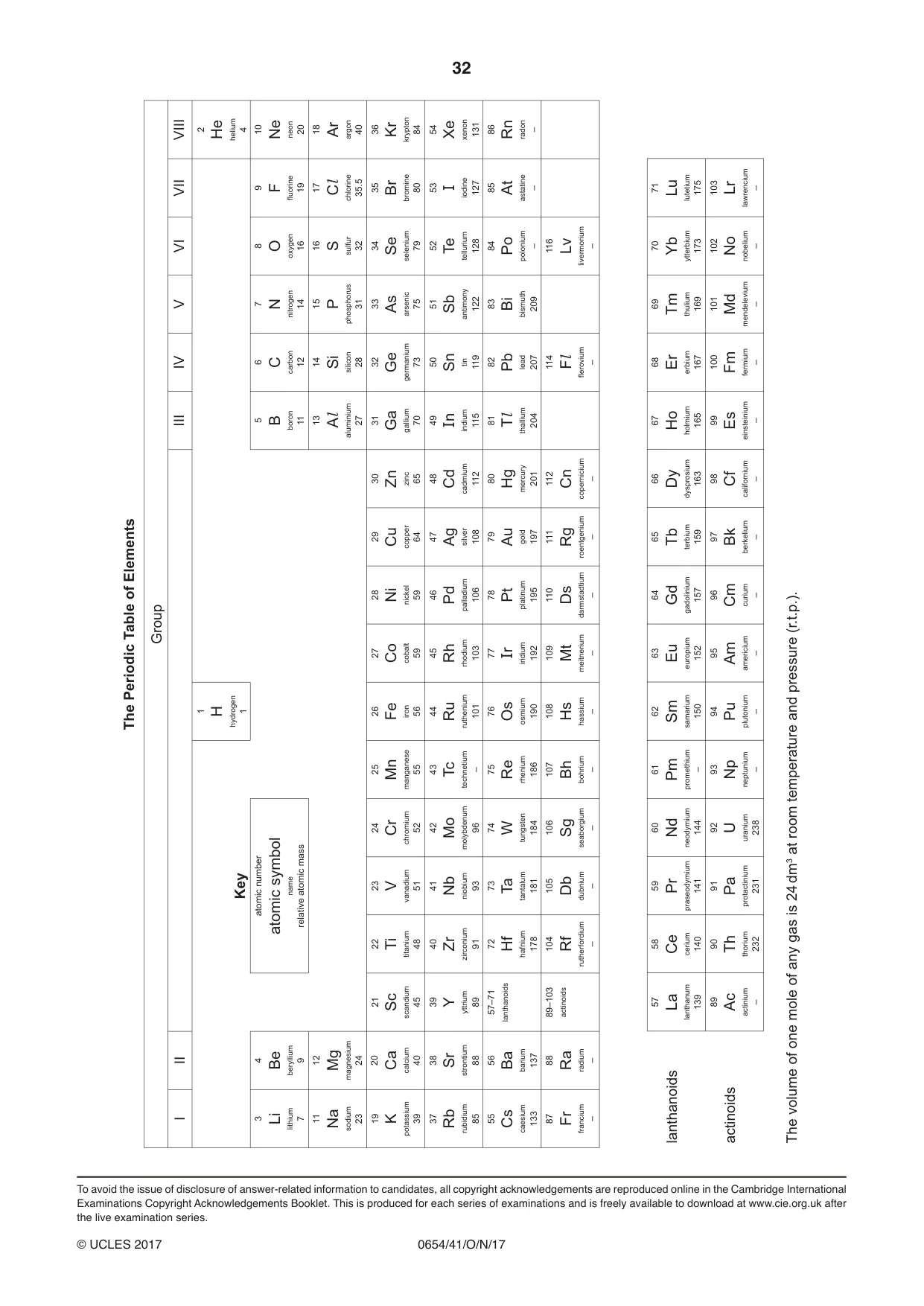
Mark scheme12 pages
Answers below. Sit the paper first if you are practising.
Questions as text
Q1 · A diagram of the male reproductive system
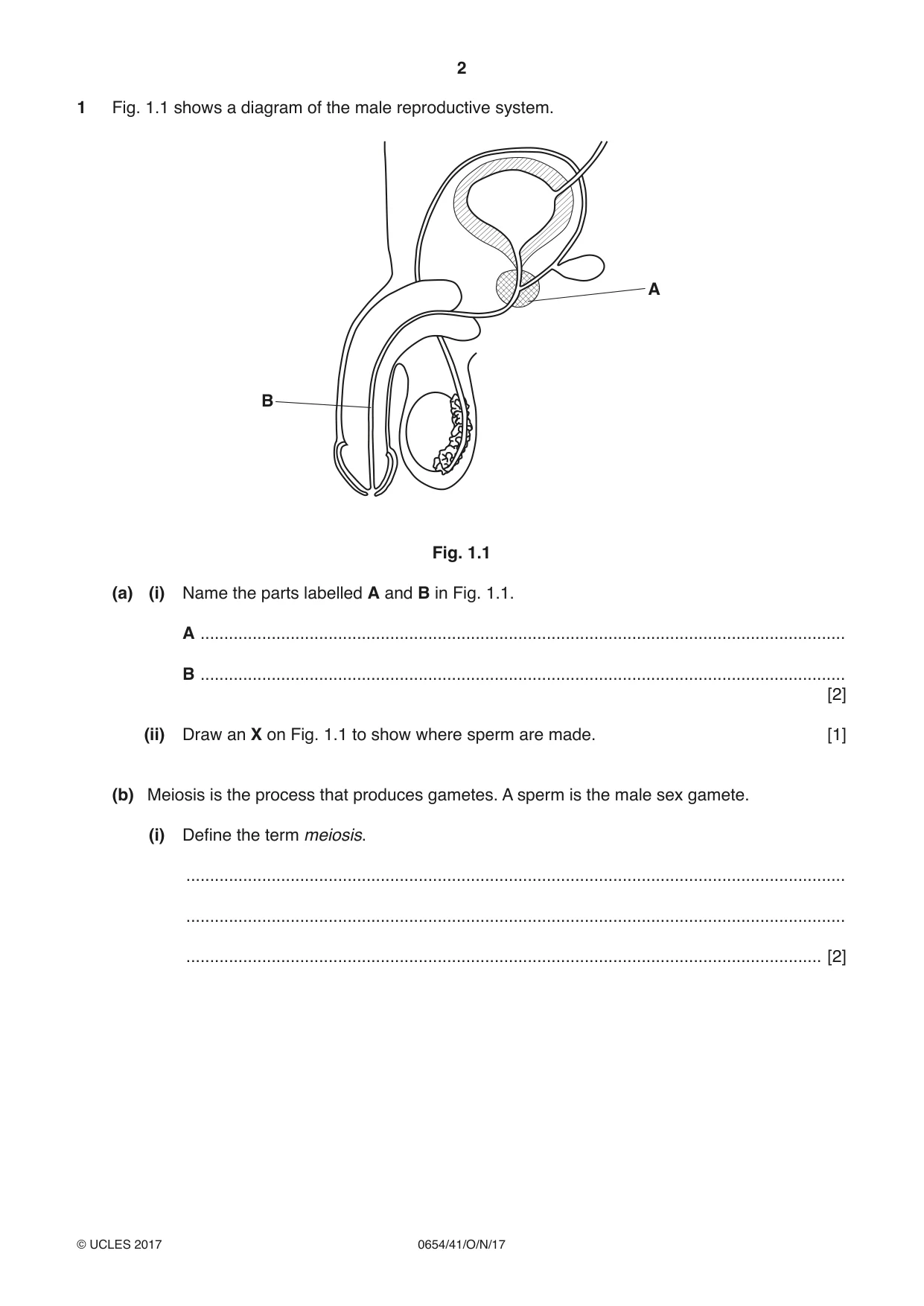
1 Fig. 1.1 shows a diagram of the male reproductive system. A B Fig. 1.1 (a) (i) Name the parts labelled A and B in Fig. 1.1. A ........................................................................................................................................ B ........................................................................................................................................ [2] (ii) Draw an X on Fig. 1.1 to show where sperm are made. [1] (b) Meiosis is the process that produces gametes. A sperm is the male sex gamete. (i) Define the term meiosis. ........................................................................................................................................... ........................................................................................................................................... ...................................................................................................................................... [2] (ii) Describe two differences between a male gamete and a female gamete in humans. 1 ......................................................................................................................................... ........................................................................................................................................... 2 ......................................................................................................................................... ........................................................................................................................................... [2] (iii) Name the term used to describe the fusion of the male gamete and female gamete. ...................................................................................................................................... [1]
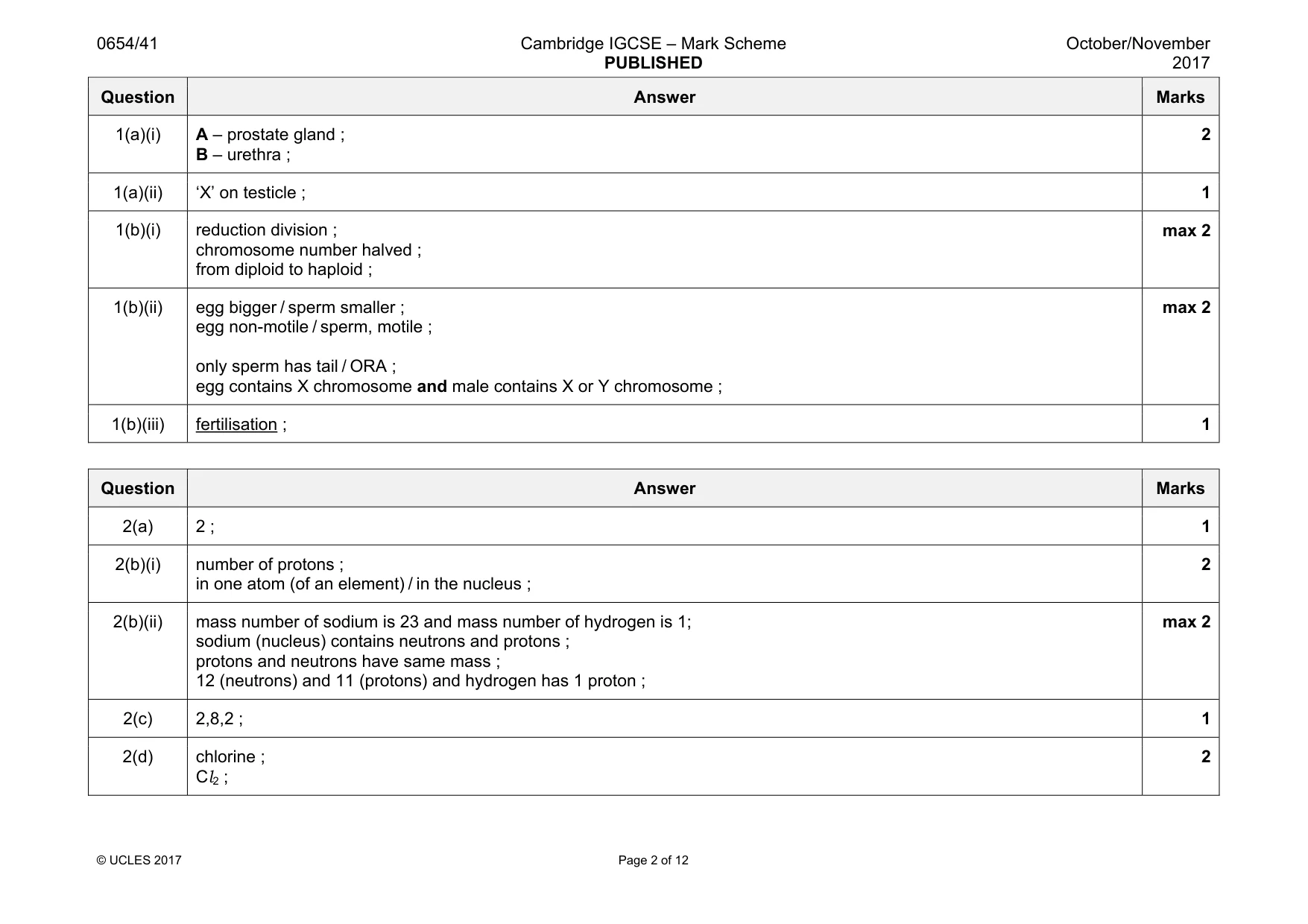
Mark scheme: 1(a)(i) A – prostate gland ; B – urethra ; 2 1(a)(ii) ‘X’ on testicle ; 1 1(b)(i) reduction division ; chromosome number halved ; from diploid to haploid ; max 2 1(b)(ii) egg bigger / sperm smaller ; egg non-motile / sperm, motile ; only sperm has tail / ORA ; egg contains X chromosome and male contains X or Y chromosome ; max 2 1(b)(iii) fertilisation ; 1
Q2 · Part of the Periodic Table
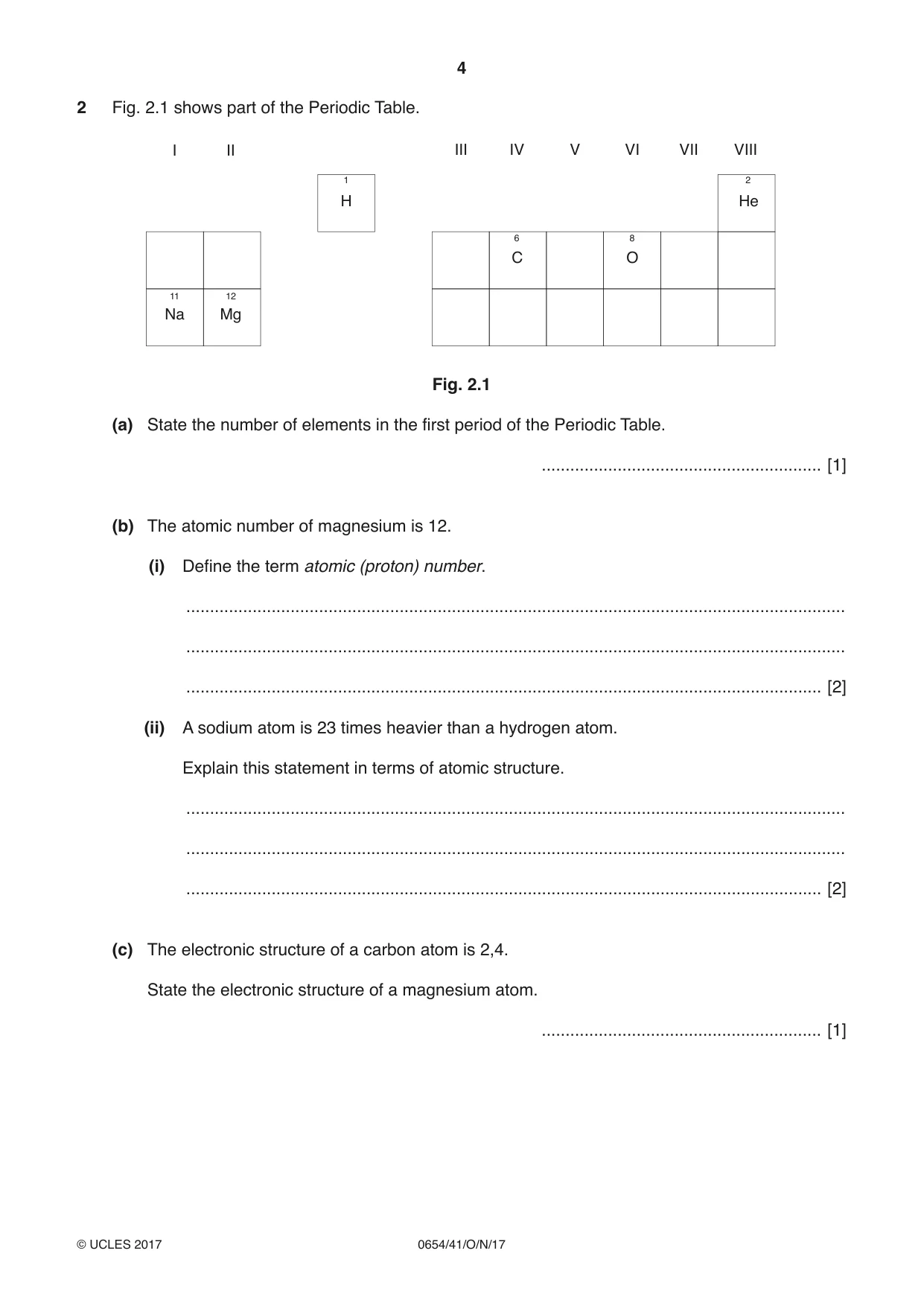
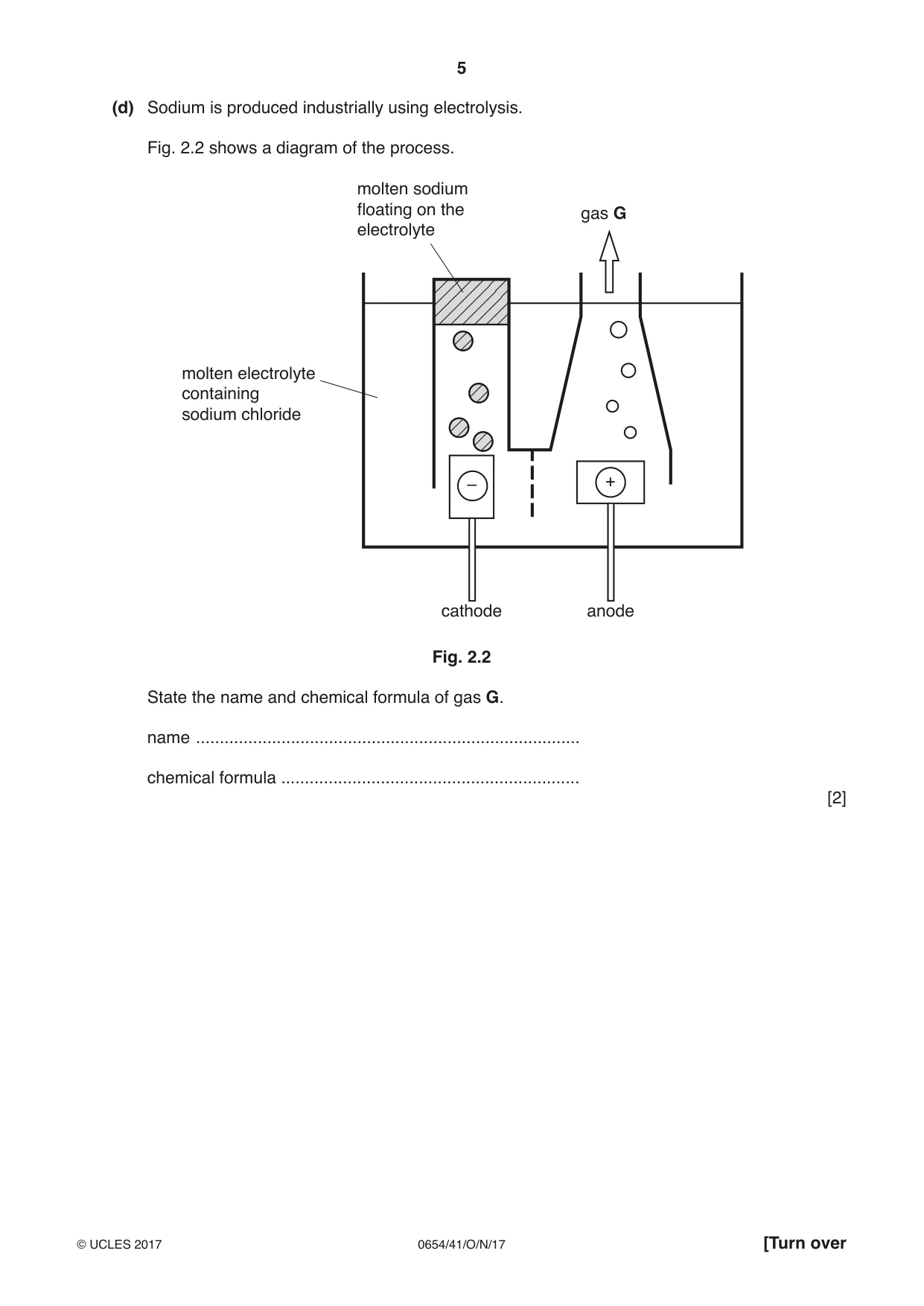
2 Fig. 2.1 shows part of the Periodic Table. I II III IV V VI VII VIII 1 2 H He 6 8 C O 11 12 Na Mg Fig. 2.1 (a) State the number of elements in the first period of the Periodic Table. ........................................................... [1] (b) The atomic number of magnesium is 12. (i) Define the term atomic (proton) number. ........................................................................................................................................... ........................................................................................................................................... ...................................................................................................................................... [2] (ii) A sodium atom is 23 times heavier than a hydrogen atom. Explain this statement in terms of atomic structure. ........................................................................................................................................... ........................................................................................................................................... ...................................................................................................................................... [2] (c) The electronic structure of a carbon atom is 2,4. State the electronic structure of a magnesium atom. ........................................................... [1] (d) Sodium is produced industrially using electrolysis. Fig. 2.2 shows a diagram of the process. molten sodium floating on the gas G electrolyte molten electrolyte containing sodium chloride – + cathode anode Fig. 2.2 State the name and chemical formula of gas G. name ................................................................................. chemical formula ............................................................... [2]
Mark scheme: 2(a) 2 ; 1 2(b)(i) number of protons ; in one atom (of an element) / in the nucleus ; 2 2(b)(ii) mass number of sodium is 23 and mass number of hydrogen is 1; sodium (nucleus) contains neutrons and protons ; protons and neutrons have same mass ; 12 (neutrons) and 11 (protons) and hydrogen has 1 proton ; max 2 2(c) 2,8,2 ; 1 2(d) chlorine ; Cl2 ; 2
Q3 · Five different types of power station are listed
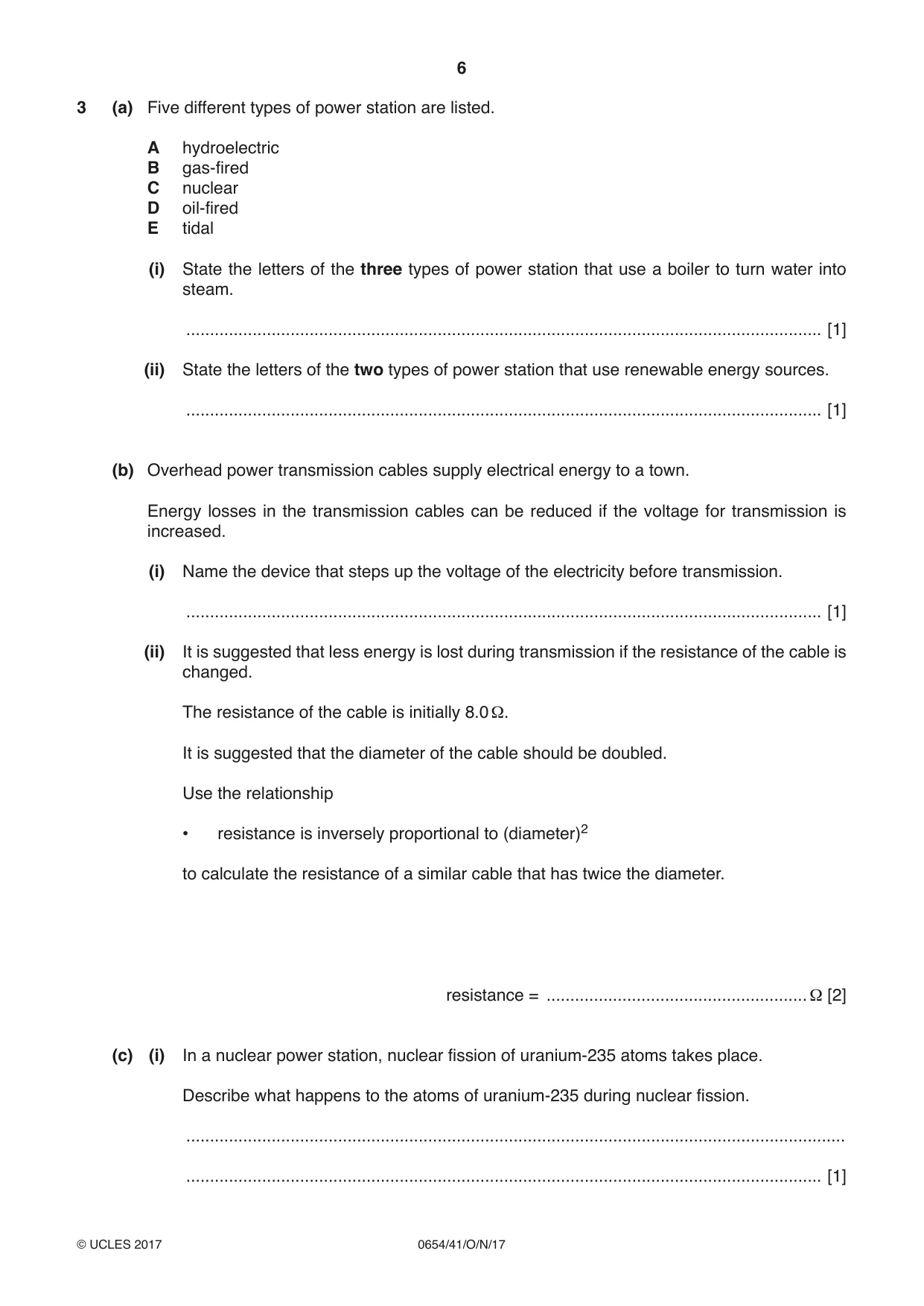
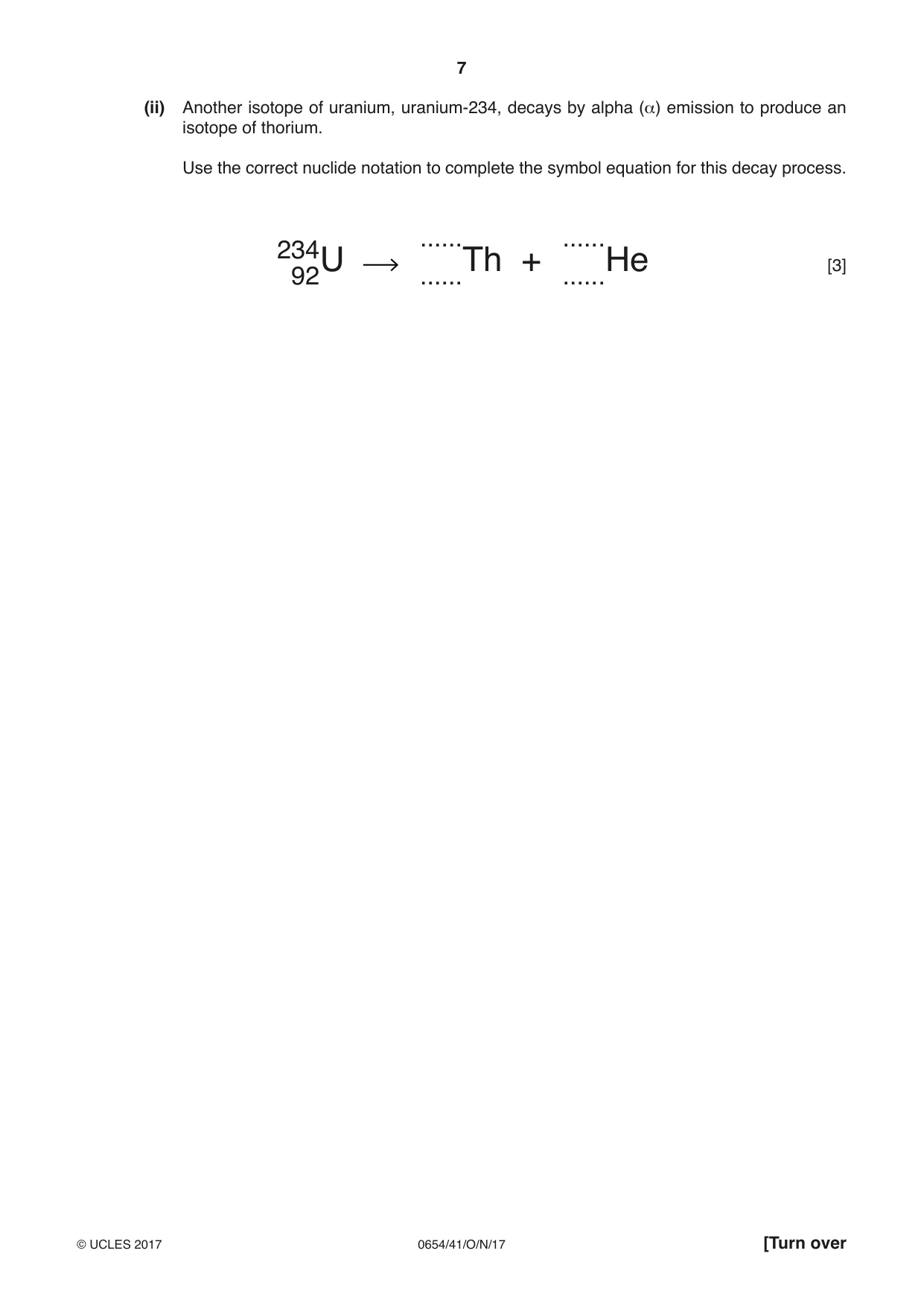
3 (a) Five different types of power station are listed. A hydroelectric B gas-fired C nuclear D oil-fired E tidal (i) State the letters of the three types of power station that use a boiler to turn water into steam. ...................................................................................................................................... [1] (ii) State the letters of the two types of power station that use renewable energy sources. ...................................................................................................................................... [1] (b) Overhead power transmission cables supply electrical energy to a town. Energy losses in the transmission cables can be reduced if the voltage for transmission is increased. (i) Name the device that steps up the voltage of the electricity before transmission. ...................................................................................................................................... [1] (ii) It is suggested that less energy is lost during transmission if the resistance of the cable is changed. The resistance of the cable is initially 8.0 Ω. It is suggested that the diameter of the cable should be doubled. Use the relationship • resistance is inversely proportional to (diameter)2 to calculate the resistance of a similar cable that has twice the diameter. resistance = ....................................................... Ω [2] (c) (i) In a nuclear power station, nuclear fission of uranium-235 atoms takes place. Describe what happens to the atoms of uranium-235 during nuclear fission. ........................................................................................................................................... ...................................................................................................................................... [1] (ii) Another isotope of uranium, uranium-234, decays by alpha (α) emission to produce an isotope of thorium. Use the correct nuclide notation to complete the symbol equation for this decay process. ...... ...... 234 [3] 92U ......Th + ......He
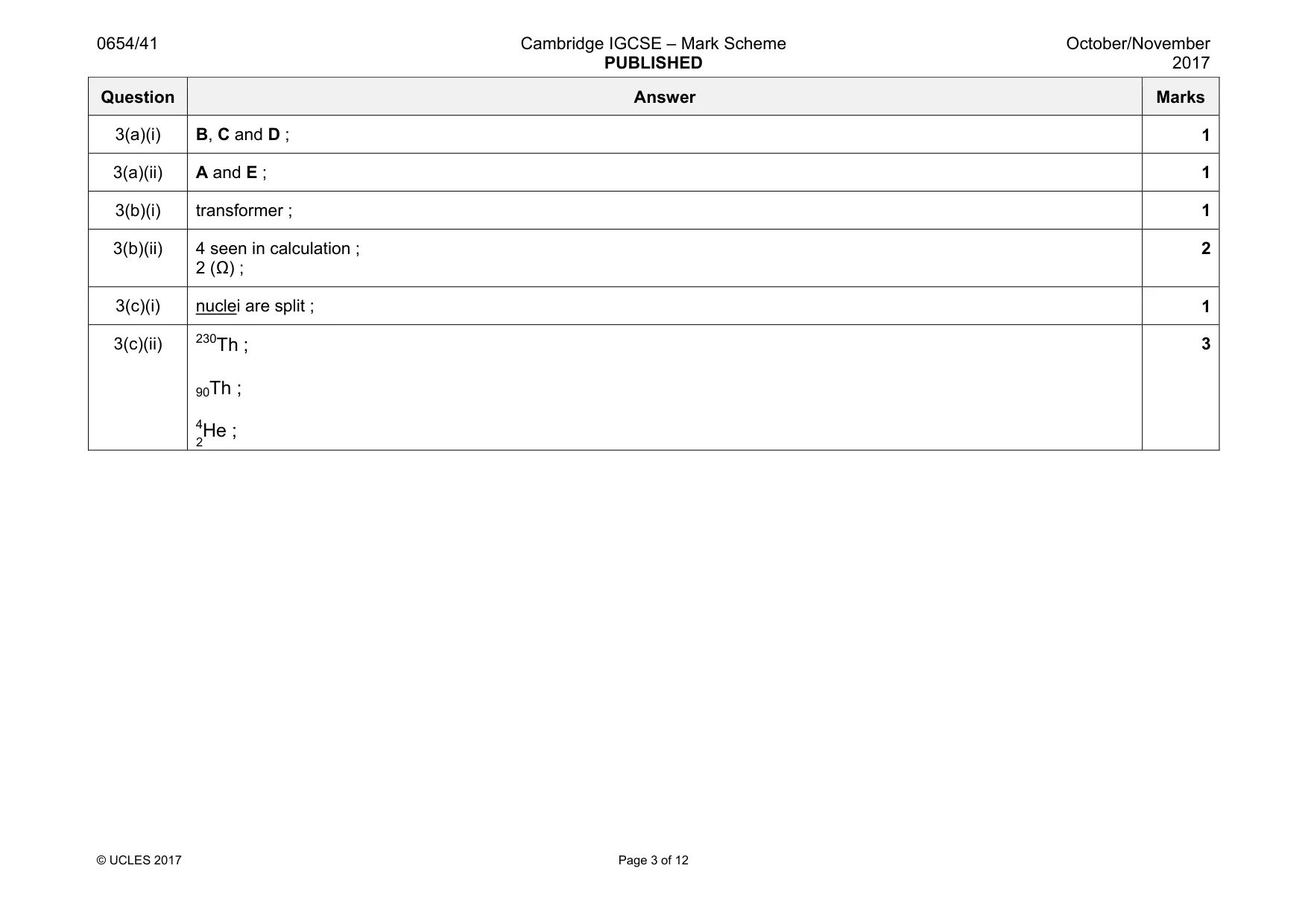
Mark scheme: 2 3(a)(i) B, C and D ; 1 3(a)(ii) A and E ; 1 3(b)(i) transformer ; 1 3(b)(ii) 4 seen in calculation ; 2 (Ω) ; 2 3(c)(i) nuclei are split ; 1 3(c)(ii) 230Th ; 90Th ; 4He ; 3
Q4 · The atmospheric carbon dioxide concentration measured in Hawaii from 1958 to 2005
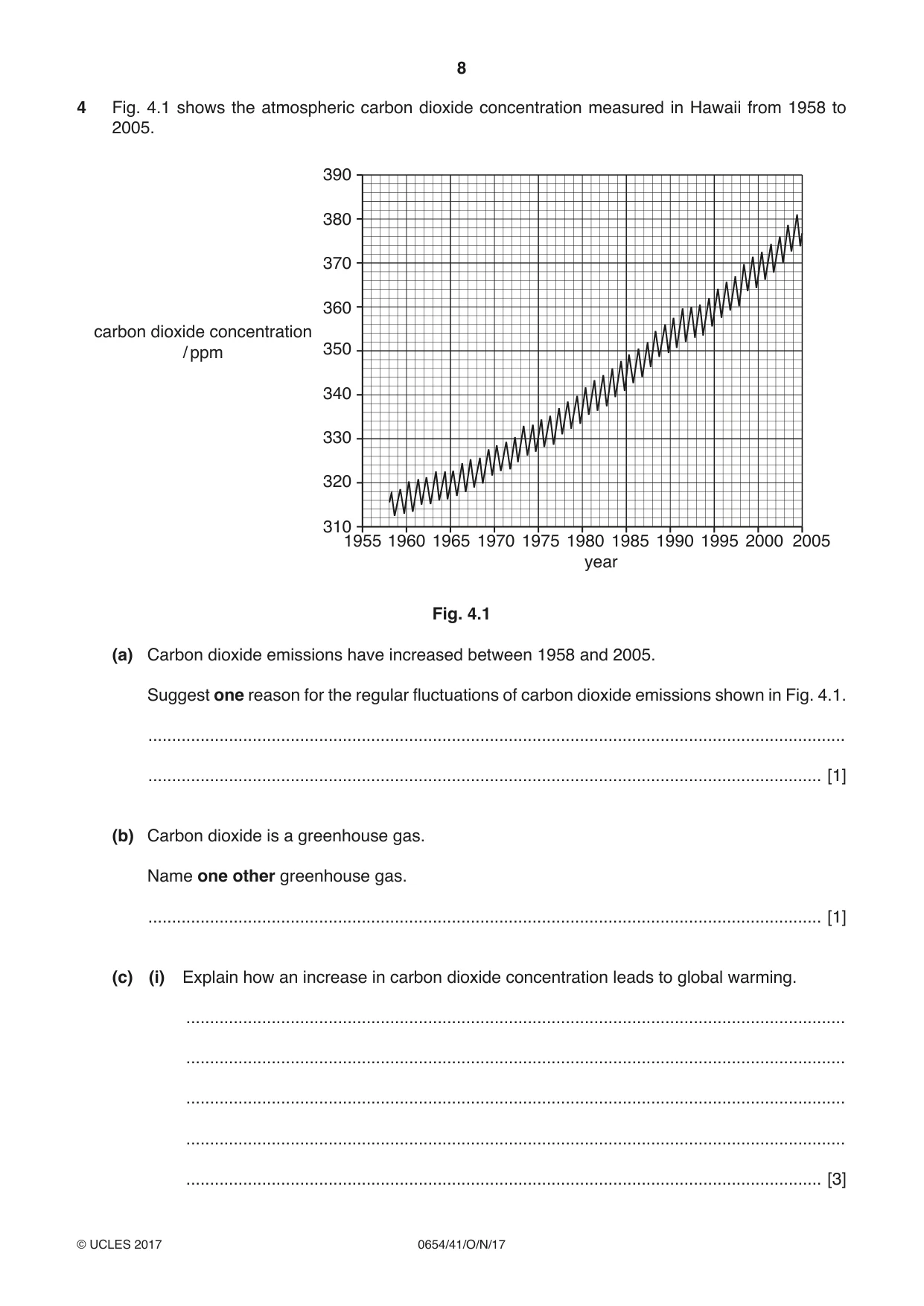
4 Fig. 4.1 shows the atmospheric carbon dioxide concentration measured in Hawaii from 1958 to 2005. 390 380 370 360 carbon dioxide concentration / ppm 350 340 330 320 310 1955 1960 1965 1970 1975 1980 1985 1990 1995 2000 2005 year Fig. 4.1 (a) Carbon dioxide emissions have increased between 1958 and 2005. Suggest one reason for the regular fluctuations of carbon dioxide emissions shown in Fig. 4.1. ................................................................................................................................................... .............................................................................................................................................. [1] (b) Carbon dioxide is a greenhouse gas. Name one other greenhouse gas. .............................................................................................................................................. [1] (c) (i) Explain how an increase in carbon dioxide concentration leads to global warming. ........................................................................................................................................... ........................................................................................................................................... ........................................................................................................................................... ........................................................................................................................................... ...................................................................................................................................... [3] (ii) Describe two effects of global warming on the environment. 1 ......................................................................................................................................... ........................................................................................................................................... 2 ......................................................................................................................................... ........................................................................................................................................... [2] (iii) Suggest two ways governments could encourage industries to reduce carbon dioxide emissions. 1 ......................................................................................................................................... ........................................................................................................................................... 2 ......................................................................................................................................... ........................................................................................................................................... [2]
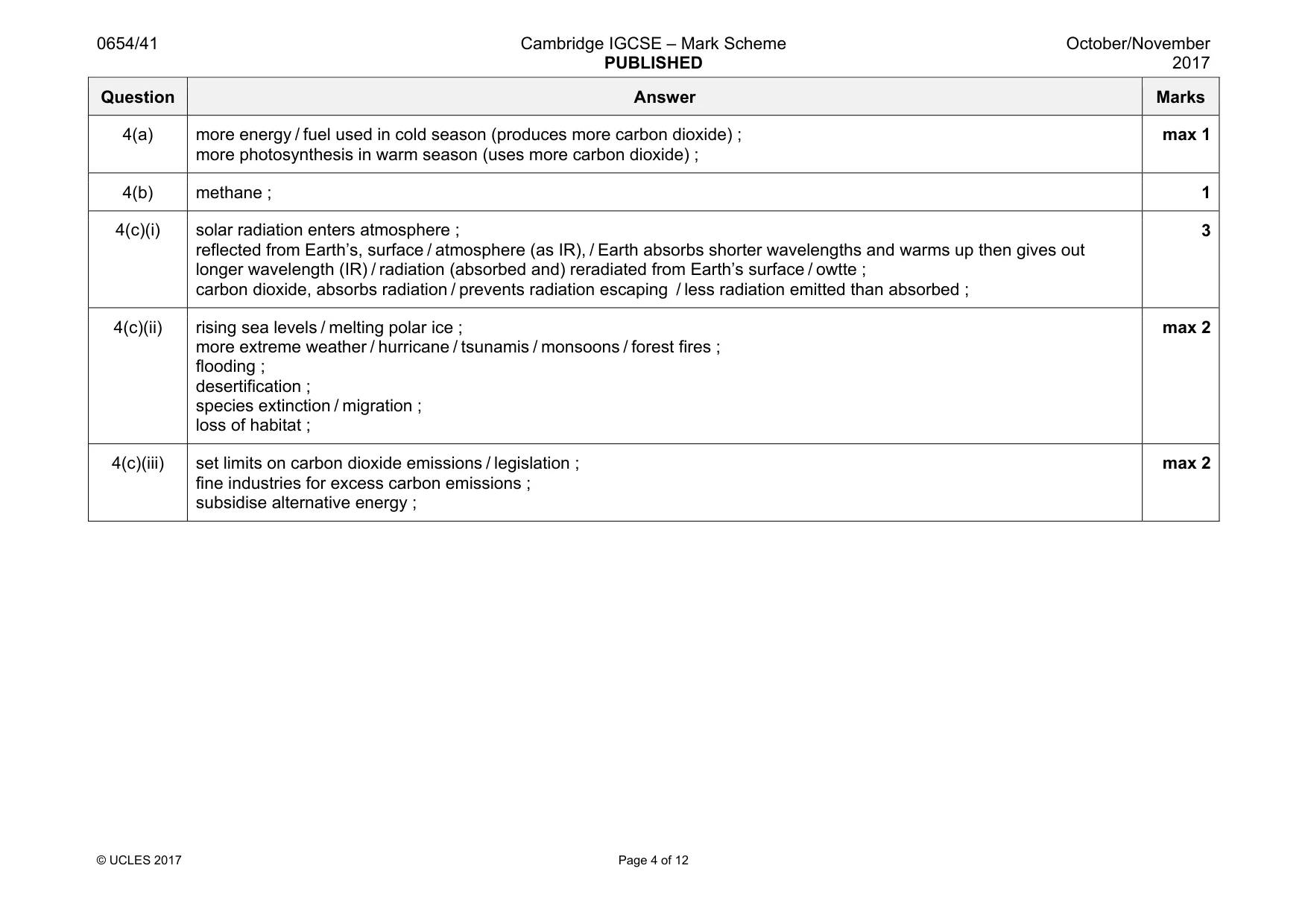
Mark scheme: 4(a) more energy / fuel used in cold season (produces more carbon dioxide) ; more photosynthesis in warm season (uses more carbon dioxide) ; max 1 4(b) methane ; 1 4(c)(i) solar radiation enters atmosphere ; reflected from Earth’s, surface / atmosphere (as IR), / Earth absorbs shorter wavelengths and warms up then gives out longer wavelength (IR) / radiation (absorbed and) reradiated from Earth’s surface / owtte ; carbon dioxide, absorbs radiation / prevents radiation escaping / less radiation emitted than absorbed ; 3 4(c)(ii) rising sea levels / melting polar ice ; more extreme weather / hurricane / tsunamis / monsoons / forest fires ; flooding ; desertification ; species extinction / migration ; loss of habitat ; max 2 4(c)(iii) set limits on carbon dioxide emissions / legislation ; fine industries for excess carbon emissions ; subsidise alternative energy ; max 2
Q5 · State the percentage of nitrogen in clean air
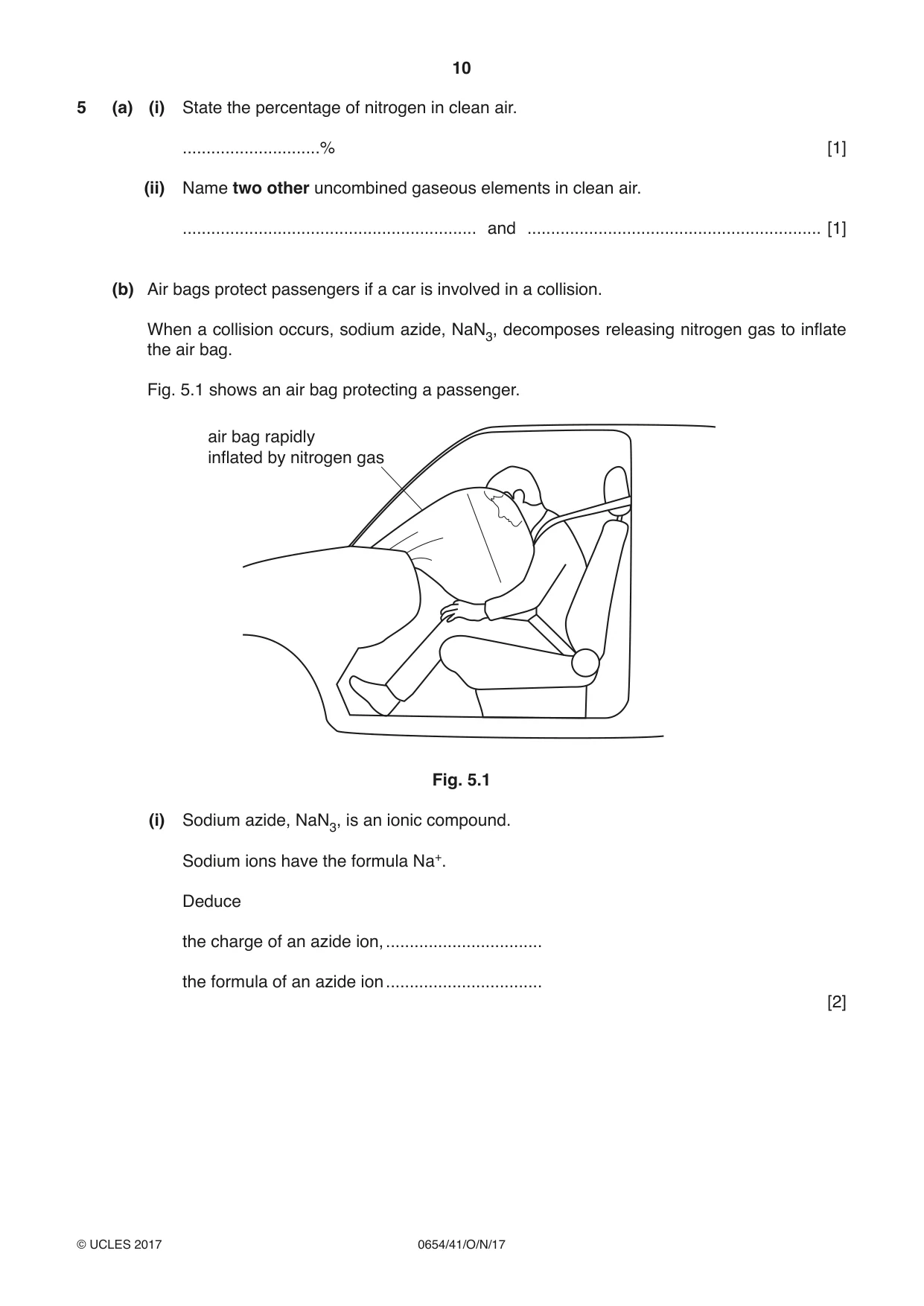
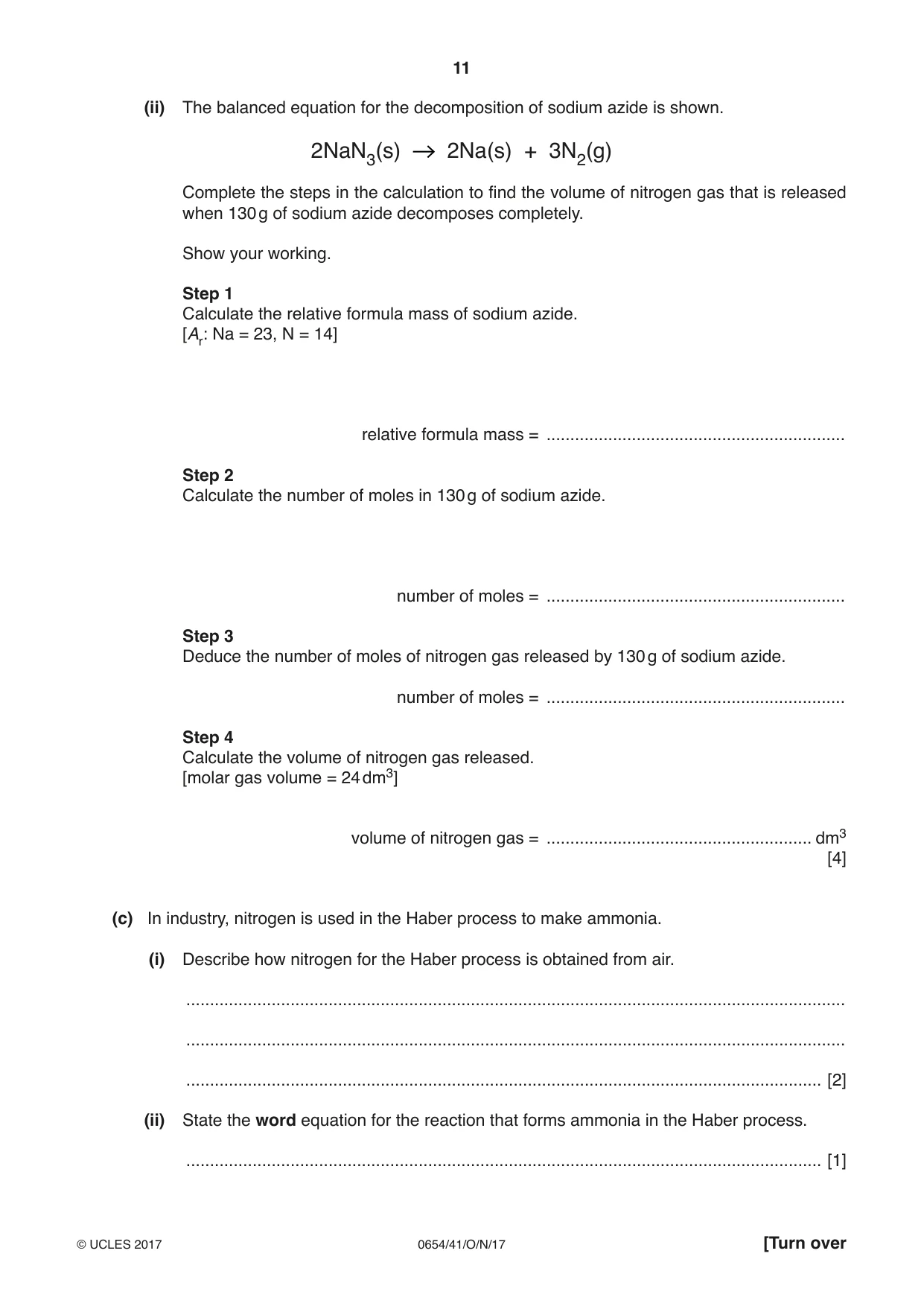
5 (a) (i) State the percentage of nitrogen in clean air. .............................% [1] (ii) Name two other uncombined gaseous elements in clean air. .............................................................. and .............................................................. [1] (b) Air bags protect passengers if a car is involved in a collision. When a collision occurs, sodium azide, NaN3, decomposes releasing nitrogen gas to inflate the air bag. Fig. 5.1 shows an air bag protecting a passenger. air bag rapidly inflated by nitrogen gas Fig. 5.1 (i) Sodium azide, NaN3, is an ionic compound. Sodium ions have the formula Na+. Deduce the charge of an azide ion, ................................. the formula of an azide ion ................................. [2] (ii) The balanced equation for the decomposition of sodium azide is shown. 2NaN3(s) 2Na(s) + 3N2(g) Complete the steps in the calculation to find the volume of nitrogen gas that is released when 130 g of sodium azide decomposes completely. Show your working. Step 1 Calculate the relative formula mass of sodium azide. [Ar: Na = 23, N = 14] relative formula mass = ............................................................... Step 2 Calculate the number of moles in 130 g of sodium azide. number of moles = ............................................................... Step 3 Deduce the number of moles of nitrogen gas released by 130 g of sodium azide. number of moles = ............................................................... Step 4 Calculate the volume of nitrogen gas released. [molar gas volume = 24 dm3] volume of nitrogen gas = ........................................................ dm3 [4] (c) In industry, nitrogen is used in the Haber process to make ammonia. (i) Describe how nitrogen for the Haber process is obtained from air. ........................................................................................................................................... ........................................................................................................................................... ...................................................................................................................................... [2] (ii) State the word equation for the reaction that forms ammonia in the Haber process. ...................................................................................................................................... [1]
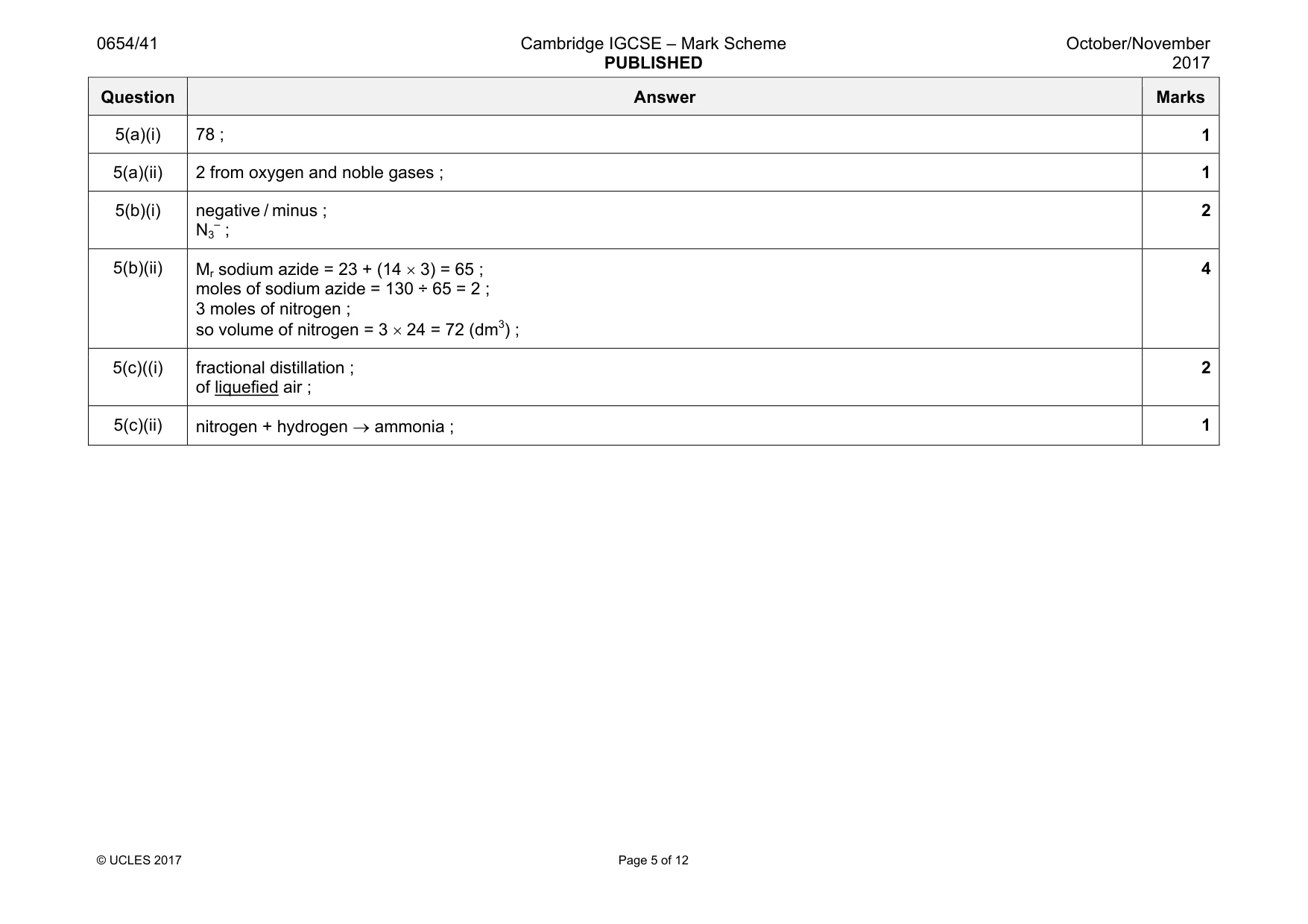
Mark scheme: 5(a)(i) 78 ; 1 5(a)(ii) 2 from oxygen and noble gases ; 1 5(b)(i) negative / minus ; N3 – ; 2 5(b)(ii) Mr sodium azide = 23 + (14 × 3) = 65 ; moles of sodium azide = 130 ÷ 65 = 2 ; 3 moles of nitrogen ; so volume of nitrogen = 3 × 24 = 72 (dm3) ; 4 5(c)((i) fractional distillation ; of liquefied air ; 2 5(c)(ii) nitrogen + hydrogen → ammonia ; 1
Q6 · A house has an electric doorbell
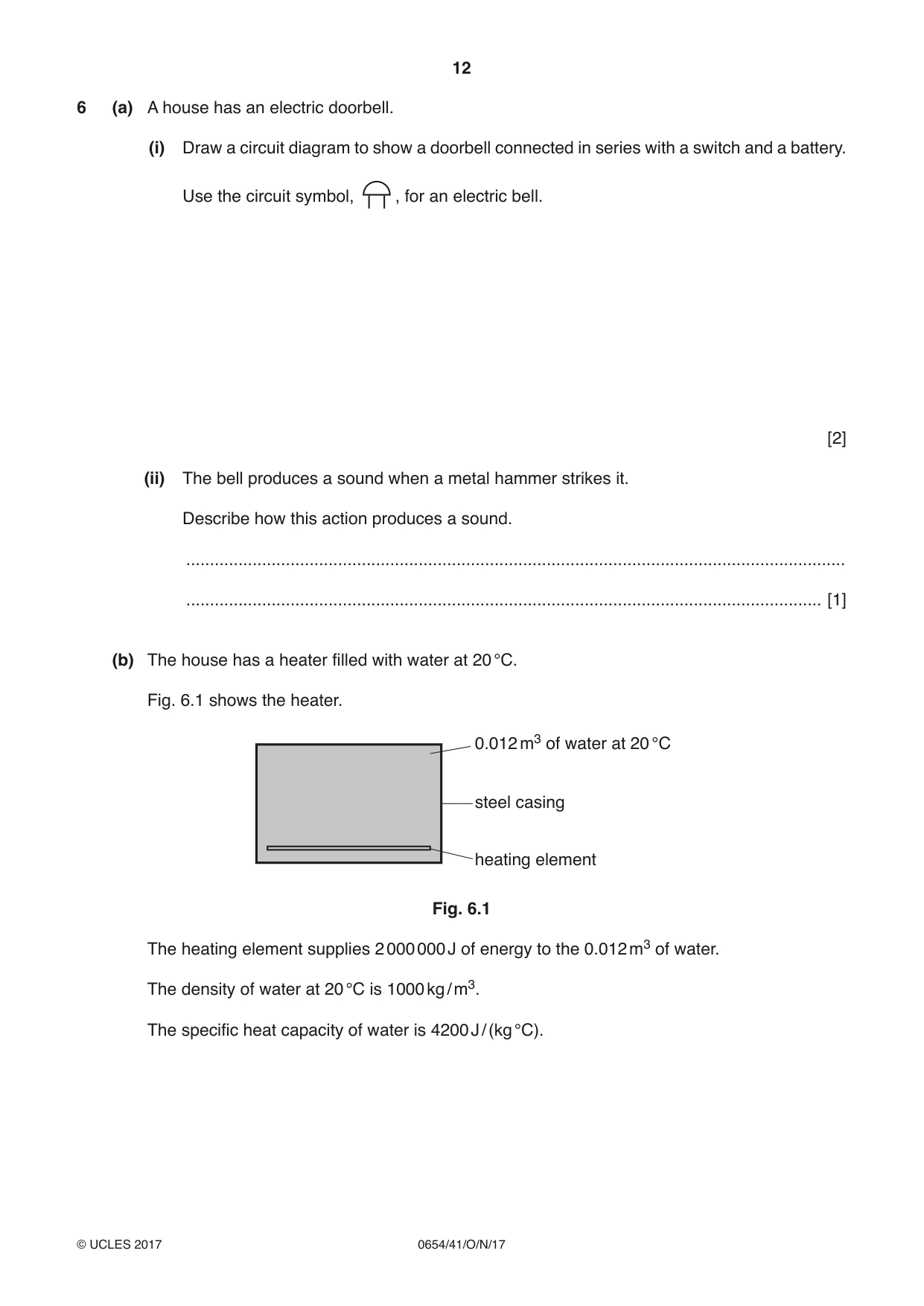
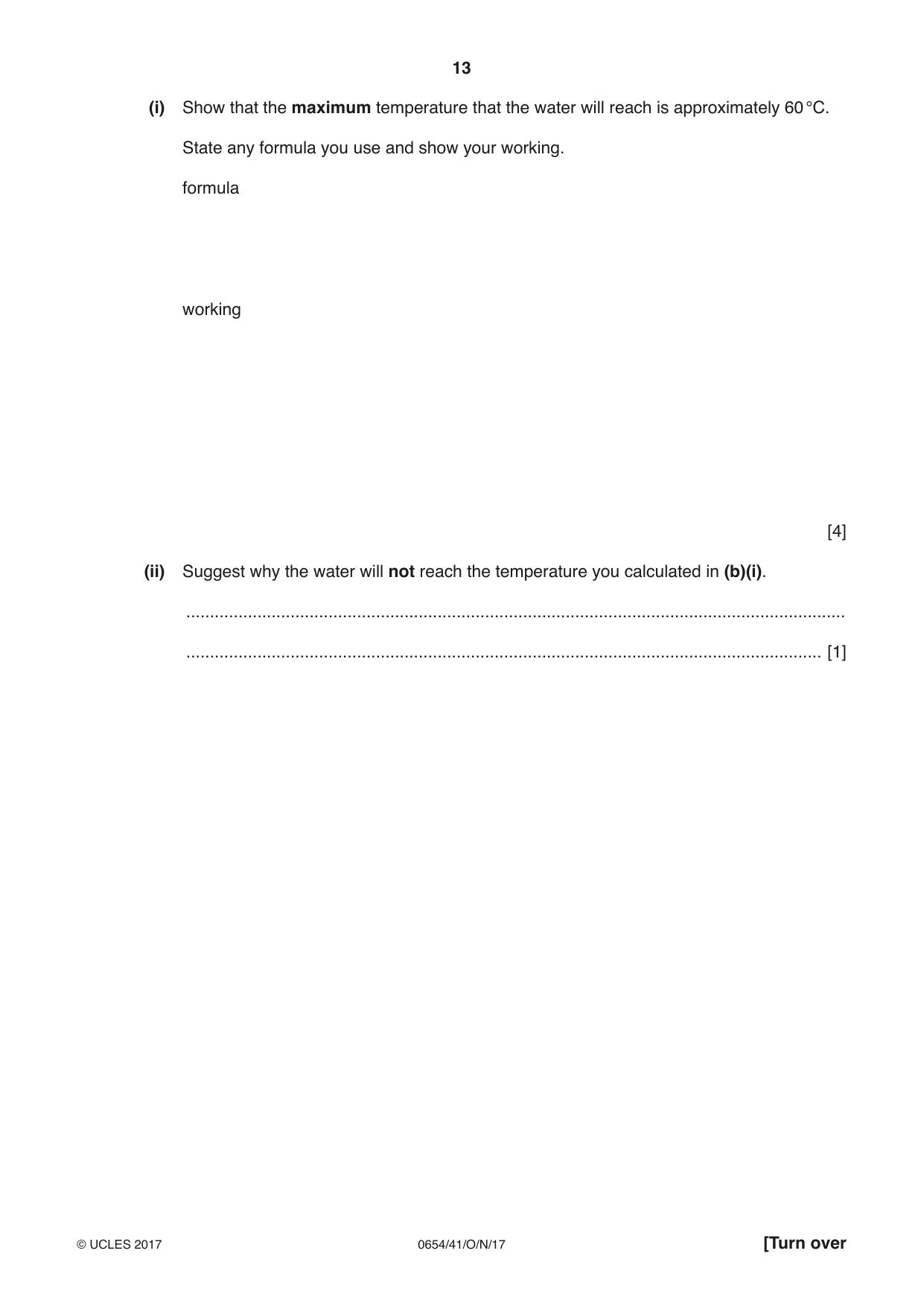
6 (a) A house has an electric doorbell. (i) Draw a circuit diagram to show a doorbell connected in series with a switch and a battery. Use the circuit symbol, , for an electric bell. [2] (ii) The bell produces a sound when a metal hammer strikes it. Describe how this action produces a sound. ........................................................................................................................................... ...................................................................................................................................... [1] (b) The house has a heater filled with water at 20 °C. Fig. 6.1 shows the heater. 0.012 m3 of water at 20 °C steel casing heating element Fig. 6.1 The heating element supplies 2 000 000 J of energy to the 0.012 m3 of water. The density of water at 20 °C is 1000 kg / m3. The specific heat capacity of water is 4200 J / (kg °C). (i) Show that the maximum temperature that the water will reach is approximately 60 °C. State any formula you use and show your working. formula working [4] (ii) Suggest why the water will not reach the temperature you calculated in (b)(i). ........................................................................................................................................... ...................................................................................................................................... [1]
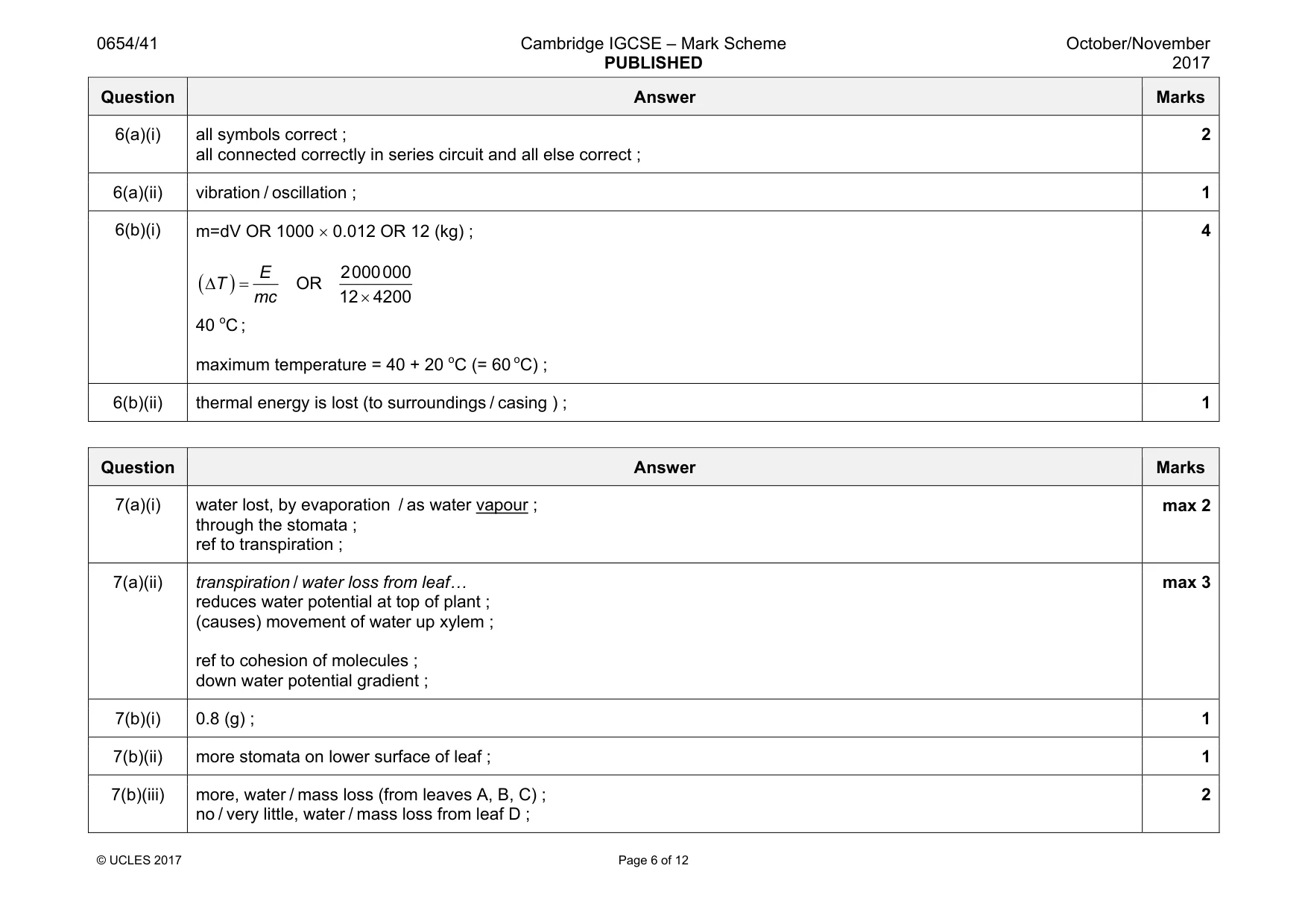
Mark scheme: 6(a)(i) all symbols correct ; all connected correctly in series circuit and all else correct ; 2 6(a)(ii) vibration / oscillation ; 1 6(b)(i) m=dV OR 1000 × 0.012 OR 12 (kg) ; ( ) 2000000 OR 12 4200 E T mc ∆ = × 40 oC ; maximum temperature = 40 + 20 oC (= 60 oC) ; 4 6(b)(ii) thermal energy is lost (to surroundings / casing ) ; 1
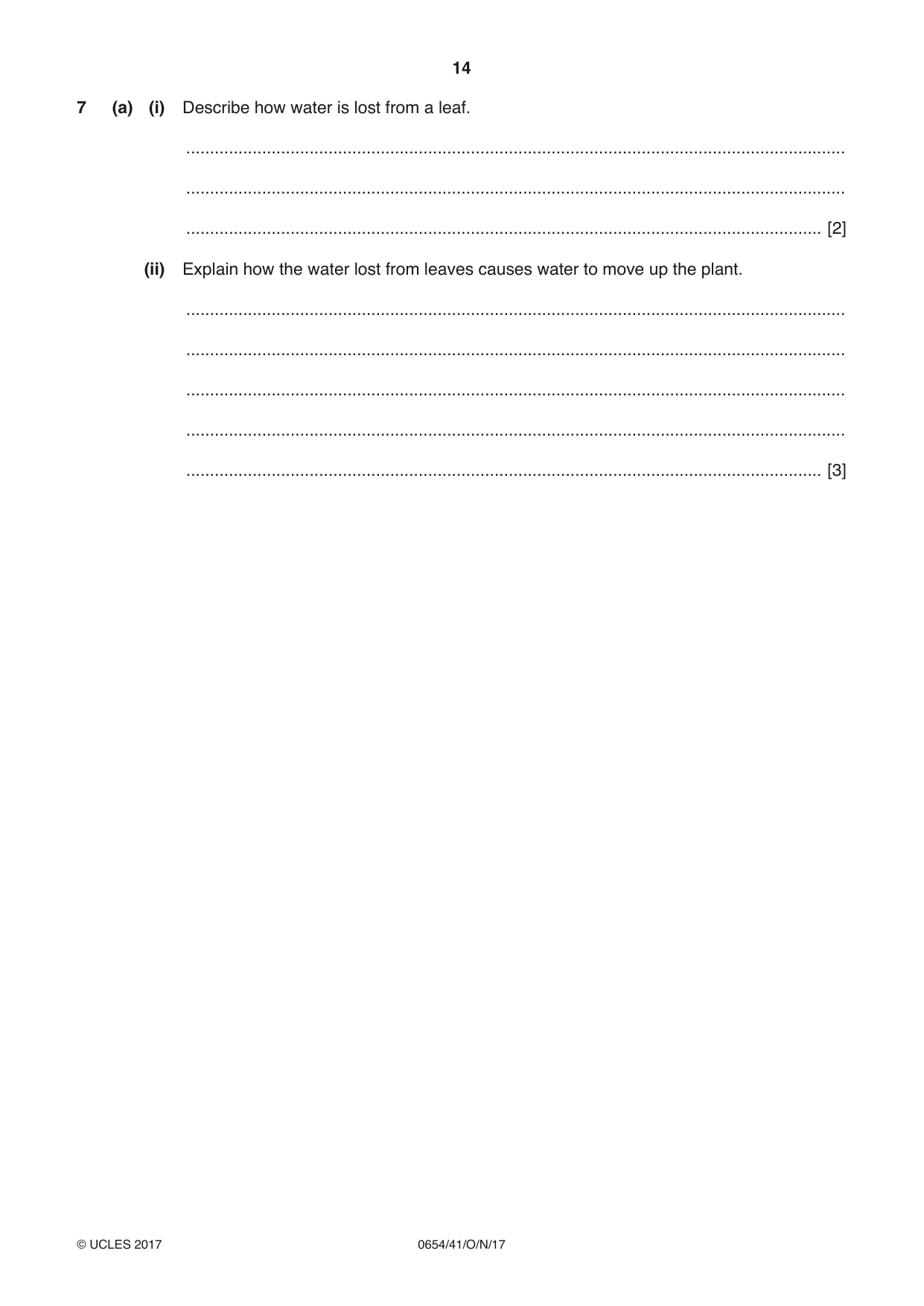
Q7 · Describe how water is lost from a leaf
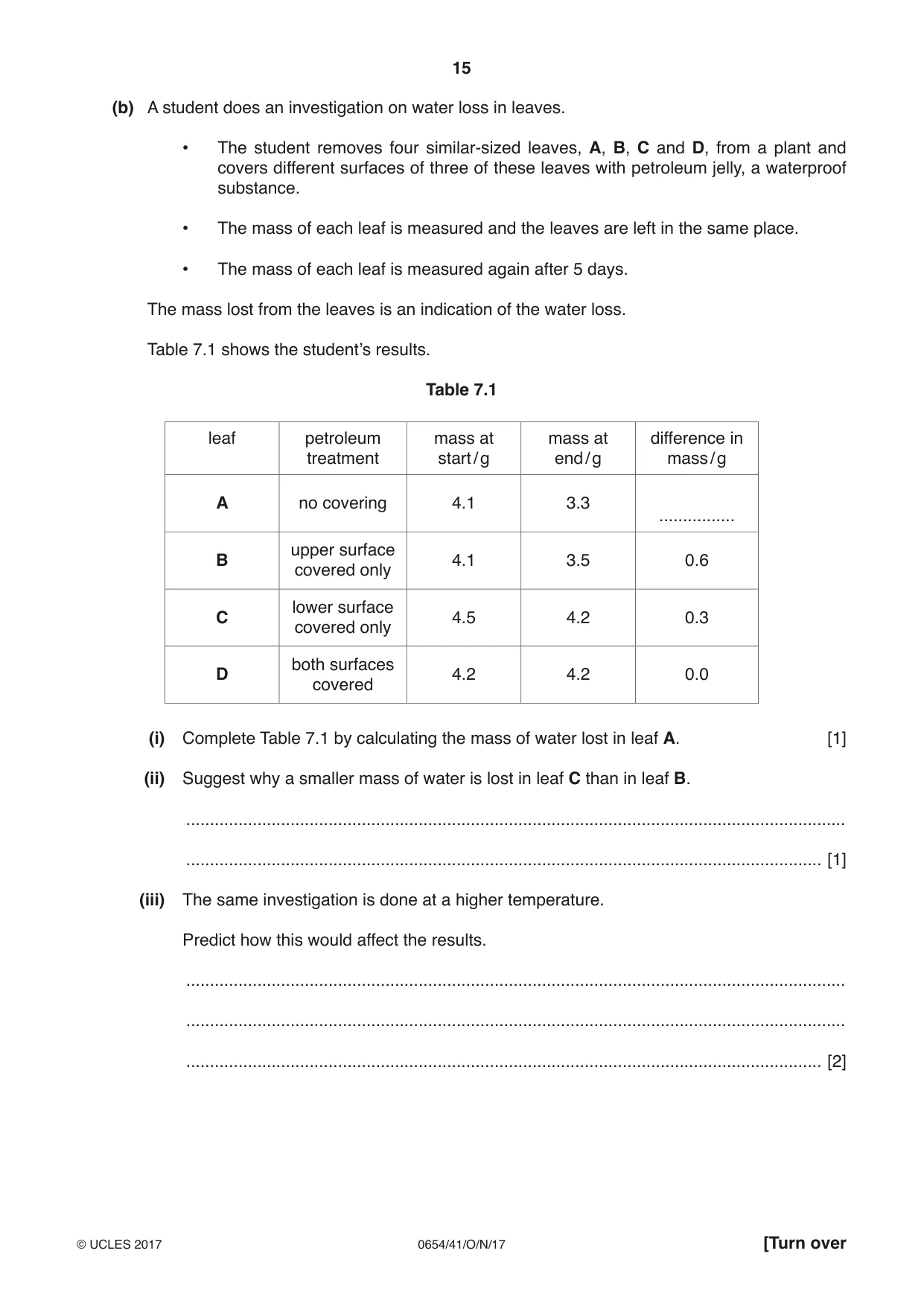
7 (a) (i) Describe how water is lost from a leaf. ........................................................................................................................................... ........................................................................................................................................... ...................................................................................................................................... [2] (ii) Explain how the water lost from leaves causes water to move up the plant. ........................................................................................................................................... ........................................................................................................................................... ........................................................................................................................................... ........................................................................................................................................... ...................................................................................................................................... [3] (b) A student does an investigation on water loss in leaves. • The student removes four similar-sized leaves, A, B, C and D, from a plant and covers different surfaces of three of these leaves with petroleum jelly, a waterproof substance. • The mass of each leaf is measured and the leaves are left in the same place. • The mass of each leaf is measured again after 5 days. The mass lost from the leaves is an indication of the water loss. Table 7.1 shows the student’s results. Table 7.1 leaf petroleum mass at mass at difference in treatment start / g end / g mass / g A no covering 4.1 3.3 ................ upper surface B 4.1 3.5 0.6 covered only lower surface C 4.5 4.2 0.3 covered only both surfaces D 4.2 4.2 0.0 covered (i) Complete Table 7.1 by calculating the mass of water lost in leaf A. [1] (ii) Suggest why a smaller mass of water is lost in leaf C than in leaf B. ........................................................................................................................................... ...................................................................................................................................... [1] (iii) The same investigation is done at a higher temperature. Predict how this would affect the results. ........................................................................................................................................... ........................................................................................................................................... ...................................................................................................................................... [2]
Mark scheme: 7(a)(i) water lost, by evaporation / as water vapour ; through the stomata ; ref to transpiration ; max 2 7(a)(ii) transpiration / water loss from leaf« reduces water potential at top of plant ; (causes) movement of water up xylem ; ref to cohesion of molecules ; down water potential gradient ; max 3 7(b)(i) 0.8 (g) ; 1 7(b)(ii) more stomata on lower surface of leaf ; 1 7(b)(iii) more, water / mass loss (from leaves A, B, C) ; no / very little, water / mass loss from leaf D ; 2
Q8 · Apparatus a student uses to collect the gas that is made when a solid reacts with a liquid
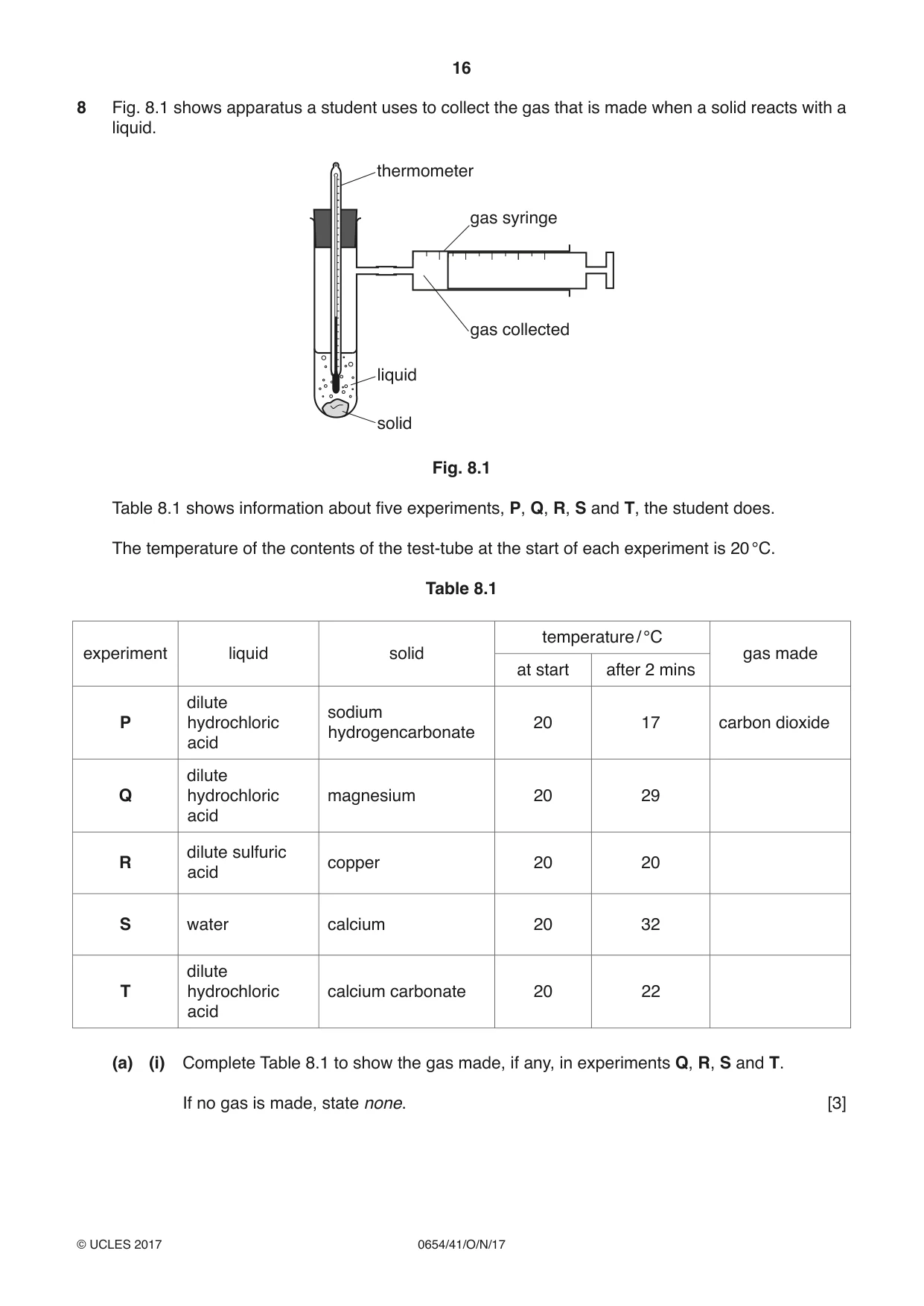
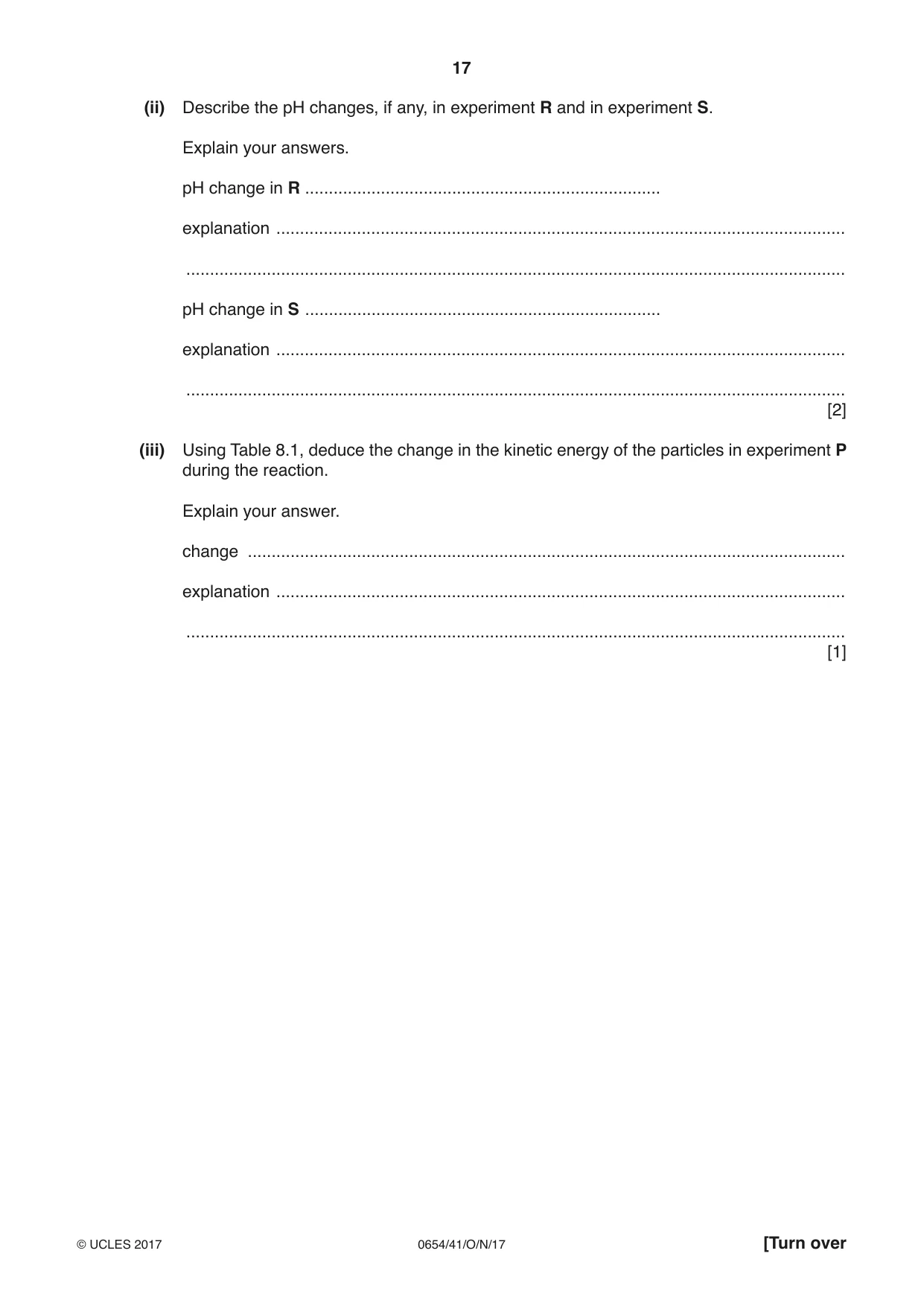
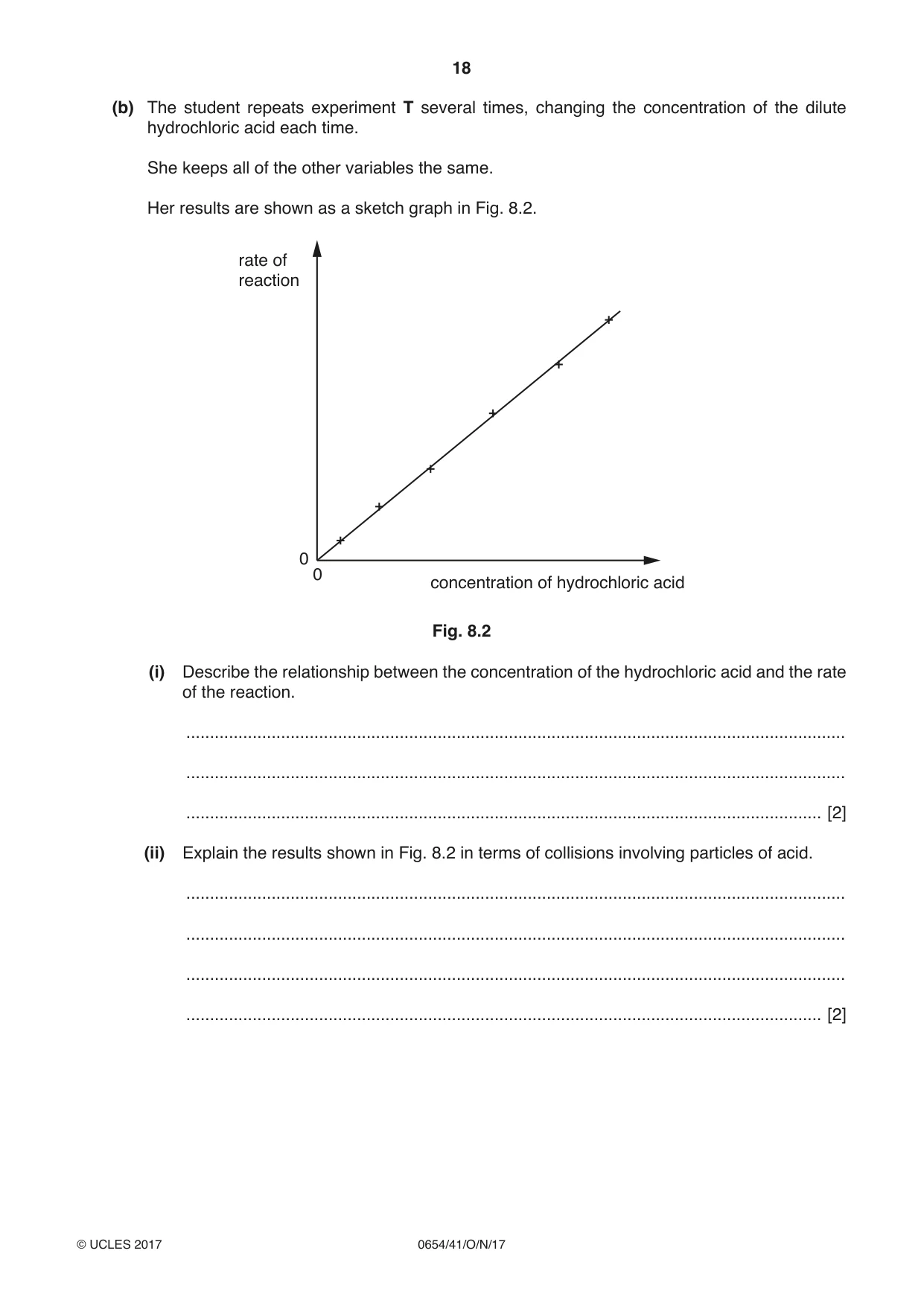
8 Fig. 8.1 shows apparatus a student uses to collect the gas that is made when a solid reacts with a liquid. thermometer gas syringe gas collected liquid solid Fig. 8.1 Table 8.1 shows information about five experiments, P, Q, R, S and T, the student does. The temperature of the contents of the test-tube at the start of each experiment is 20 °C. Table 8.1 temperature / °C experiment liquid solid gas made at start after 2 mins dilute sodium P hydrochloric 20 17 carbon dioxide hydrogencarbonate acid dilute Q hydrochloric magnesium 20 29 acid dilute sulfuric R copper 20 20 acid S water calcium 20 32 dilute T hydrochloric calcium carbonate 20 22 acid (a) (i) Complete Table 8.1 to show the gas made, if any, in experiments Q, R, S and T. If no gas is made, state none. [3] (ii) Describe the pH changes, if any, in experiment R and in experiment S. Explain your answers. pH change in R ........................................................................... explanation ........................................................................................................................ ........................................................................................................................................... pH change in S ........................................................................... explanation ........................................................................................................................ ........................................................................................................................................... [2] (iii) Using Table 8.1, deduce the change in the kinetic energy of the particles in experiment P during the reaction. Explain your answer. change .............................................................................................................................. explanation ........................................................................................................................ ........................................................................................................................................... [1] (b) The student repeats experiment T several times, changing the concentration of the dilute hydrochloric acid each time. She keeps all of the other variables the same. Her results are shown as a sketch graph in Fig. 8.2. rate of reaction 0 0 concentration of hydrochloric acid Fig. 8.2 (i) Describe the relationship between the concentration of the hydrochloric acid and the rate of the reaction. ........................................................................................................................................... ........................................................................................................................................... ...................................................................................................................................... [2] (ii) Explain the results shown in Fig. 8.2 in terms of collisions involving particles of acid. ........................................................................................................................................... ........................................................................................................................................... ........................................................................................................................................... ...................................................................................................................................... [2] Please turn over for Question 9.
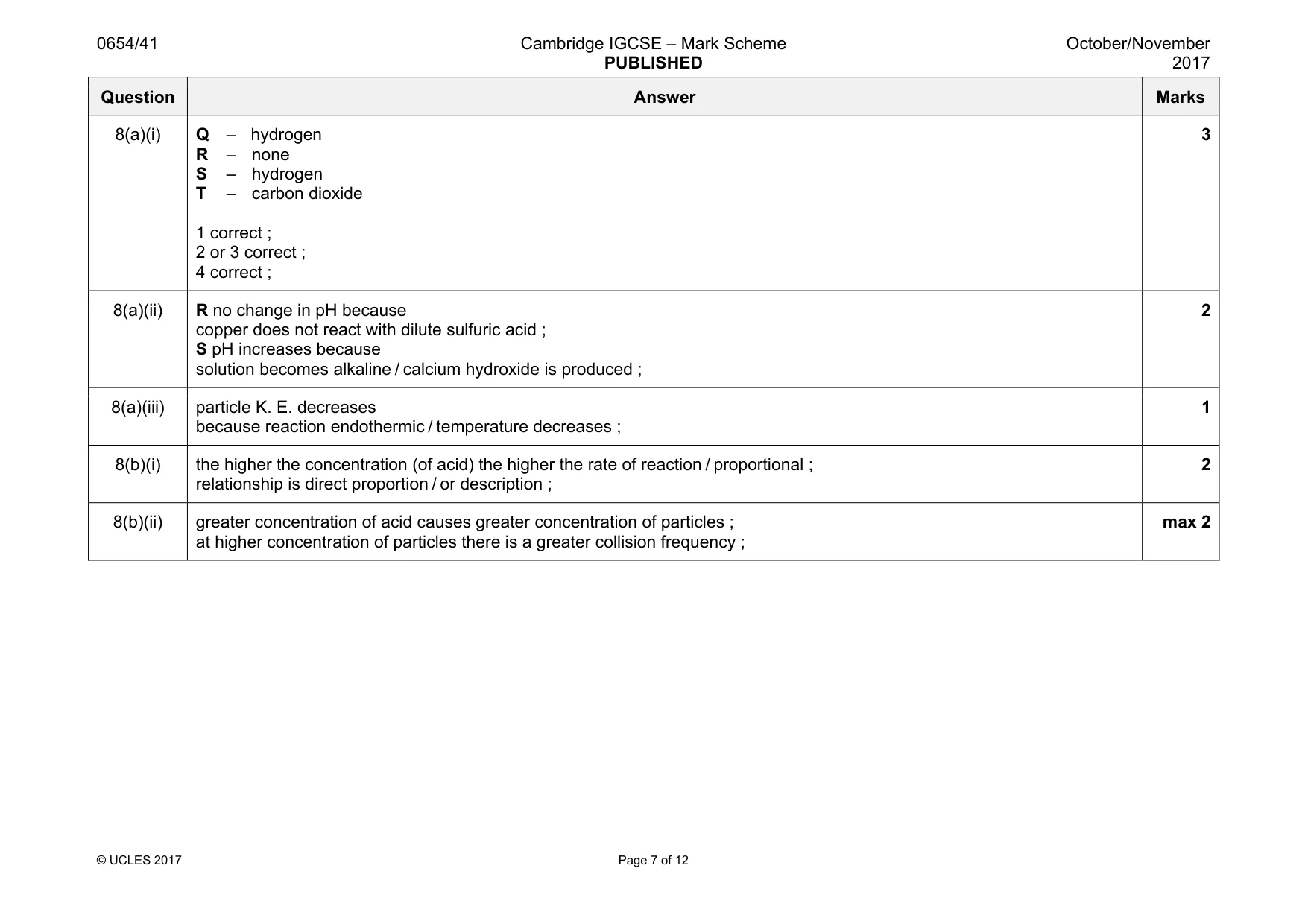
Mark scheme: 8(a)(i) Q – hydrogen R – none S – hydrogen T – carbon dioxide 1 correct ; 2 or 3 correct ; 4 correct ; 3 8(a)(ii) R no change in pH because copper does not react with dilute sulfuric acid ; S pH increases because solution becomes alkaline / calcium hydroxide is produced ; 2 8(a)(iii) particle K. E. decreases because reaction endothermic / temperature decreases ; 1 8(b)(i) the higher the concentration (of acid) the higher the rate of reaction / proportional ; relationship is direct proportion / or description ; 2 8(b)(ii) greater concentration of acid causes greater concentration of particles ; at higher concentration of particles there is a greater collision frequency ; max 2
More questions on The characteristic properties of acids and bases
Q9 · A snowboarder moving down a ski slope
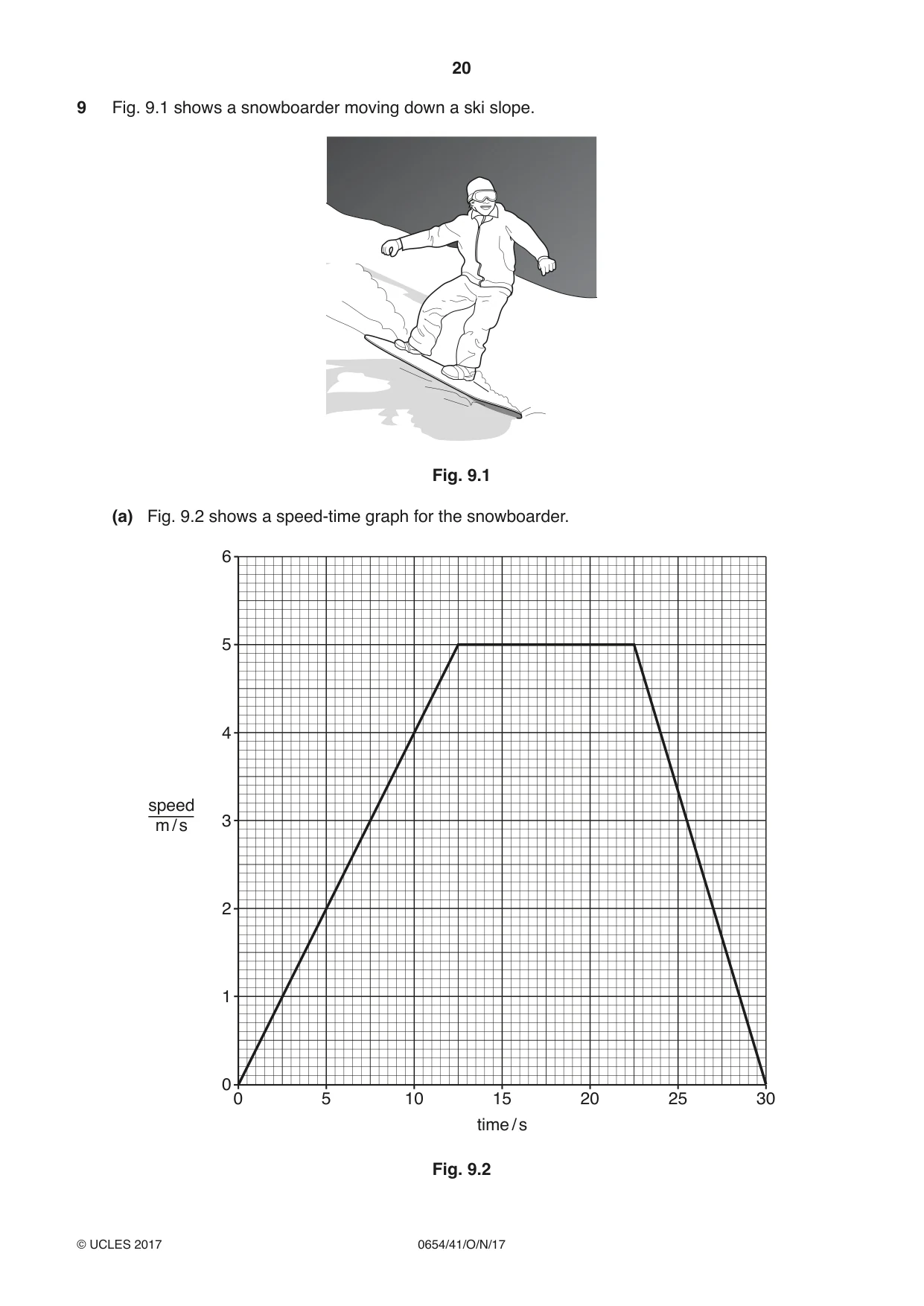
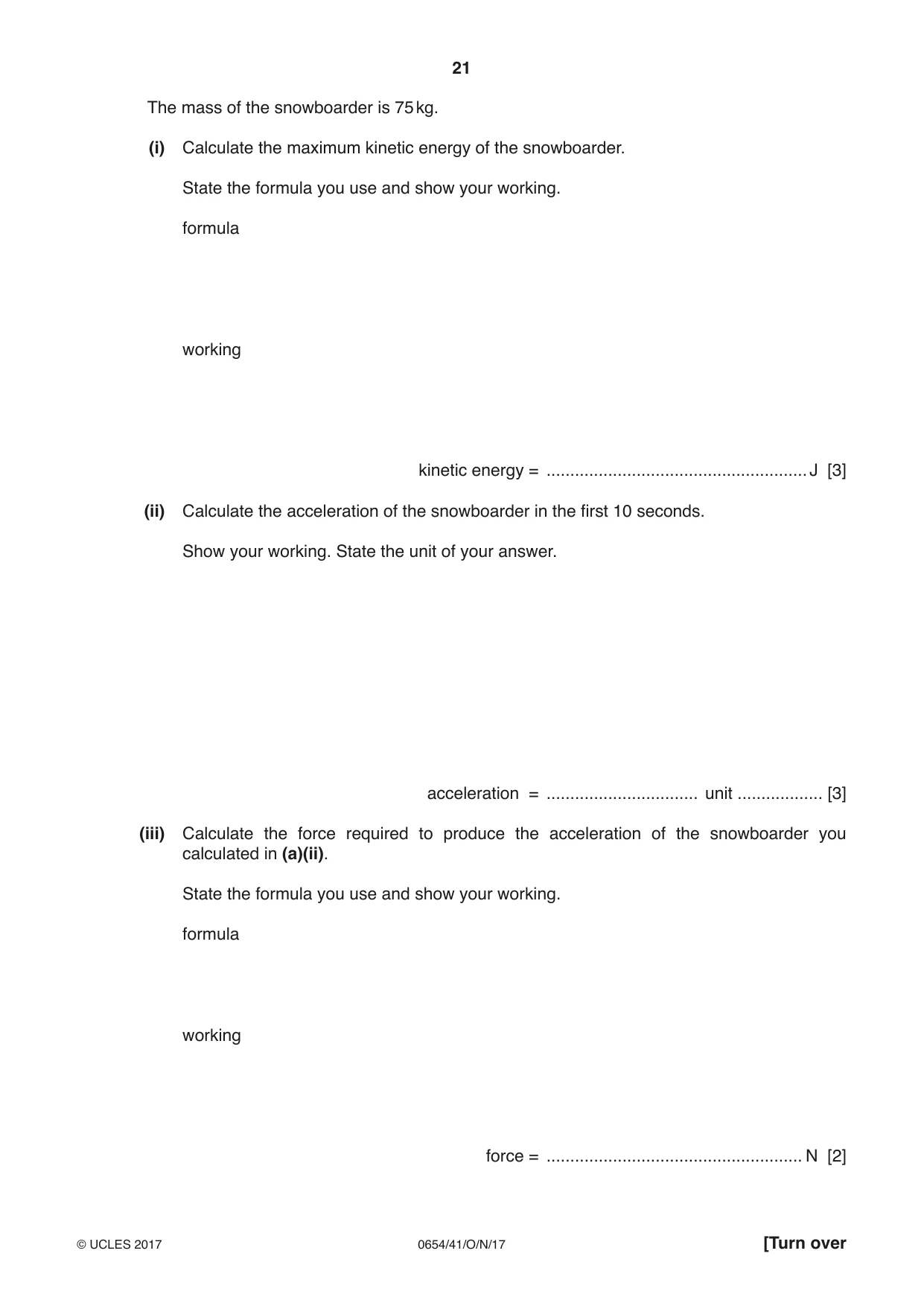
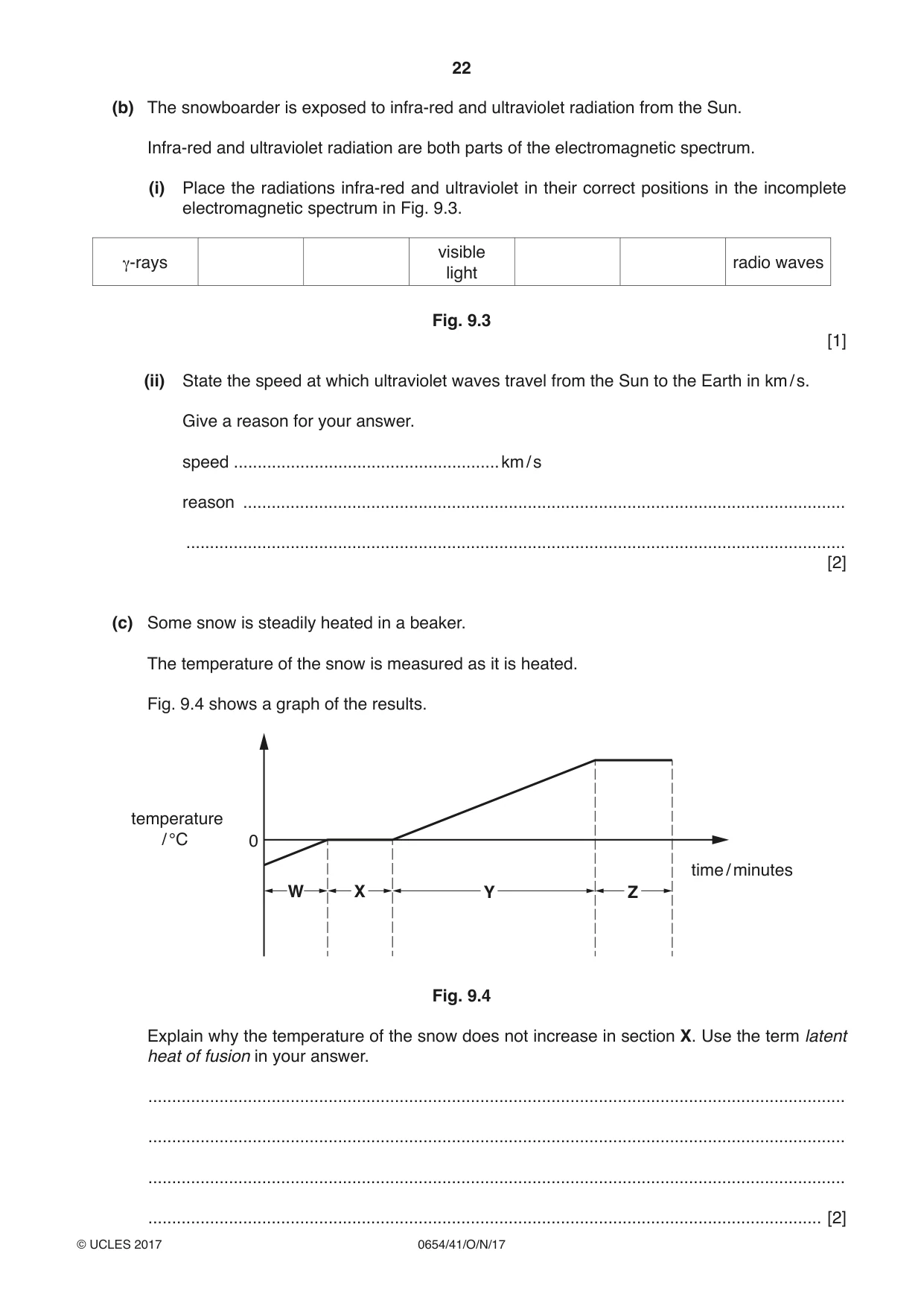
9 Fig. 9.1 shows a snowboarder moving down a ski slope. Fig. 9.1 (a) Fig. 9.2 shows a speed-time graph for the snowboarder. 6 5 4 speed 3 m / s 2 1 0 0 5 10 15 20 25 30 time / s Fig. 9.2 The mass of the snowboarder is 75 kg. (i) Calculate the maximum kinetic energy of the snowboarder. State the formula you use and show your working. formula working kinetic energy = ....................................................... J [3] (ii) Calculate the acceleration of the snowboarder in the first 10 seconds. Show your working. State the unit of your answer. acceleration = ................................ unit .................. [3] (iii) Calculate the force required to produce the acceleration of the snowboarder you calculated in (a)(ii). State the formula you use and show your working. formula working force = ...................................................... N [2] (b) The snowboarder is exposed to infra-red and ultraviolet radiation from the Sun. Infra-red and ultraviolet radiation are both parts of the electromagnetic spectrum. (i) Place the radiations infra-red and ultraviolet in their correct positions in the incomplete electromagnetic spectrum in Fig. 9.3. visible γ-rays radio waves light Fig. 9.3 [1] (ii) State the speed at which ultraviolet waves travel from the Sun to the Earth in km / s. Give a reason for your answer. speed ........................................................ km / s reason ............................................................................................................................... ........................................................................................................................................... [2] (c) Some snow is steadily heated in a beaker. The temperature of the snow is measured as it is heated. Fig. 9.4 shows a graph of the results. temperature / °C 0 time / minutes W X Y Z Fig. 9.4 Explain why the temperature of the snow does not increase in section X. Use the term latent heat of fusion in your answer. ................................................................................................................................................... ................................................................................................................................................... ................................................................................................................................................... .............................................................................................................................................. [2]
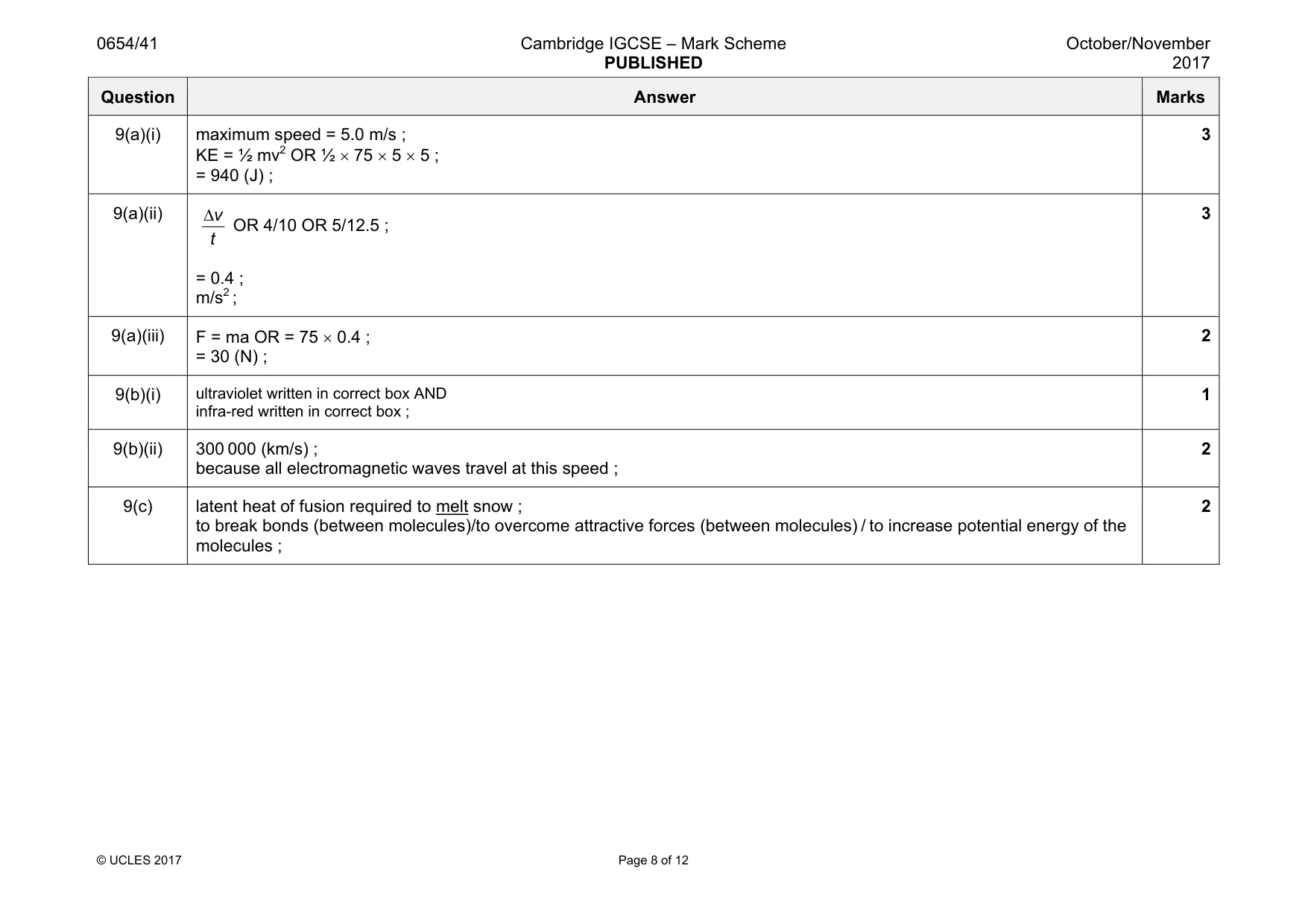
Mark scheme: 9(a)(i) maximum speed = 5.0 m/s ; KE = ½ mv2 OR ½ × 75 × 5 × 5 ; = 940 (J) ; 3 9(a)(ii) v t ∆ OR 4/10 OR 5/12.5 ; = 0.4 ; m/s2 ; 3 9(a)(iii) F = ma OR = 75 × 0.4 ; = 30 (N) ; 2 9(b)(i) ultraviolet written in correct box AND infra-red written in correct box ; 1 9(b)(ii) 300 000 (km/s) ; because all electromagnetic waves travel at this speed ; 2 9(c) latent heat of fusion required to melt snow ; to break bonds (between molecules)/to overcome attractive forces (between molecules) / to increase potential energy of the molecules ; 2
Q10 · A graph to show the blood glucose concentration of a person’s blood measured every hour…
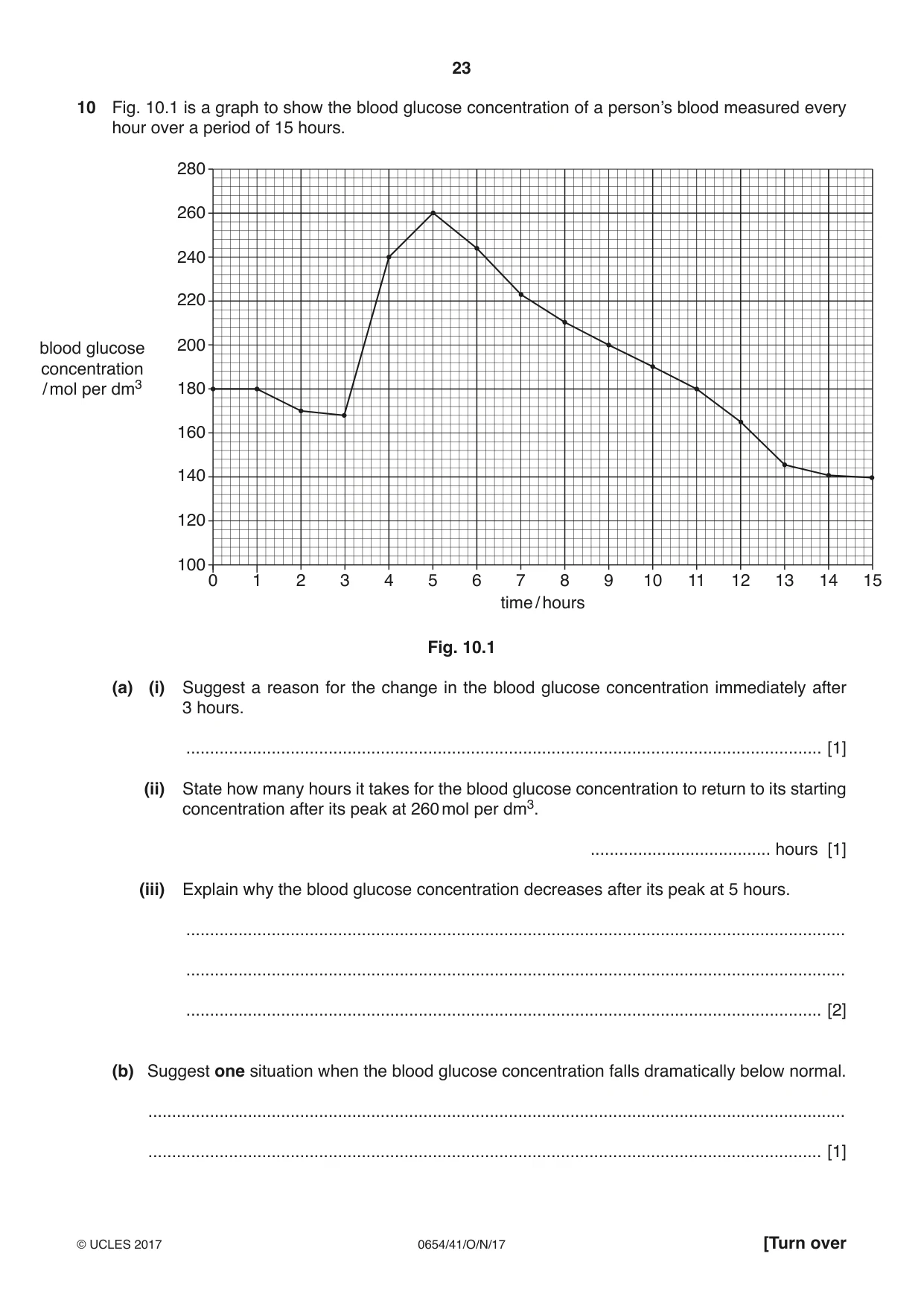
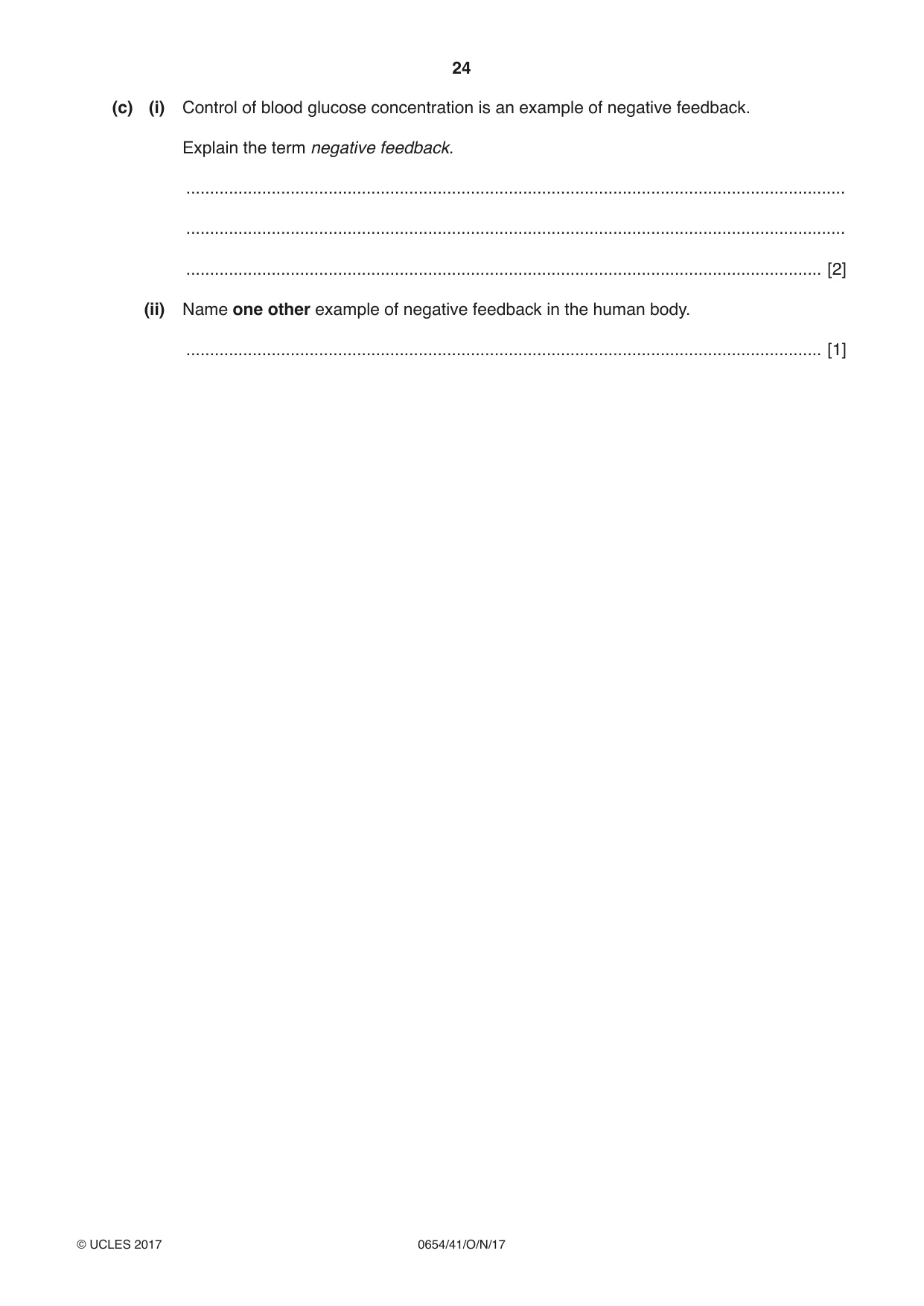
10 Fig. 10.1 is a graph to show the blood glucose concentration of a person’s blood measured every hour over a period of 15 hours. 280 260 240 220 blood glucose 200 concentration / mol per dm3 180 160 140 120 100 0 1 2 3 4 5 6 7 8 9 10 11 12 13 14 15 time / hours Fig. 10.1 (a) (i) Suggest a reason for the change in the blood glucose concentration immediately after 3 hours. ...................................................................................................................................... [1] (ii) State how many hours it takes for the blood glucose concentration to return to its starting concentration after its peak at 260 mol per dm3. ...................................... hours [1] (iii) Explain why the blood glucose concentration decreases after its peak at 5 hours. ........................................................................................................................................... ........................................................................................................................................... ...................................................................................................................................... [2] (b) Suggest one situation when the blood glucose concentration falls dramatically below normal. ................................................................................................................................................... .............................................................................................................................................. [1] (c) (i) Control of blood glucose concentration is an example of negative feedback. Explain the term negative feedback. ........................................................................................................................................... ........................................................................................................................................... ...................................................................................................................................... [2] (ii) Name one other example of negative feedback in the human body. ...................................................................................................................................... [1] Please turn over for Question 11.
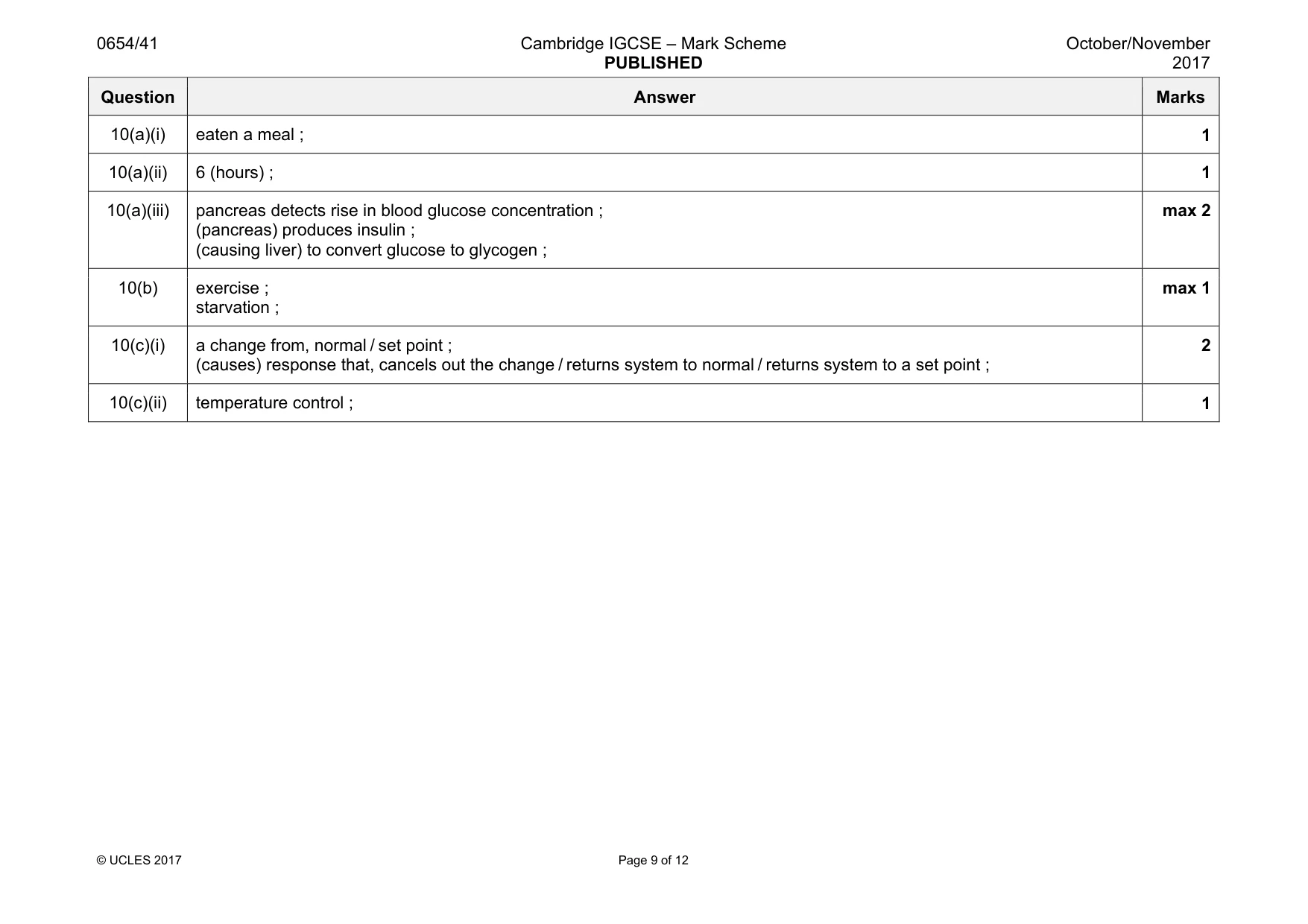
Mark scheme: 10(a)(i) eaten a meal ; 1 10(a)(ii) 6 (hours) ; 1 10(a)(iii) pancreas detects rise in blood glucose concentration ; (pancreas) produces insulin ; (causing liver) to convert glucose to glycogen ; max 2 10(b) exercise ; starvation ; max 1 10(c)(i) a change from, normal / set point ; (causes) response that, cancels out the change / returns system to normal / returns system to a set point ; 2 10(c)(ii) temperature control ; 1
Q11 · Petroleum is a liquid fossil fuel that is a mixture containing many different hydrocarbons
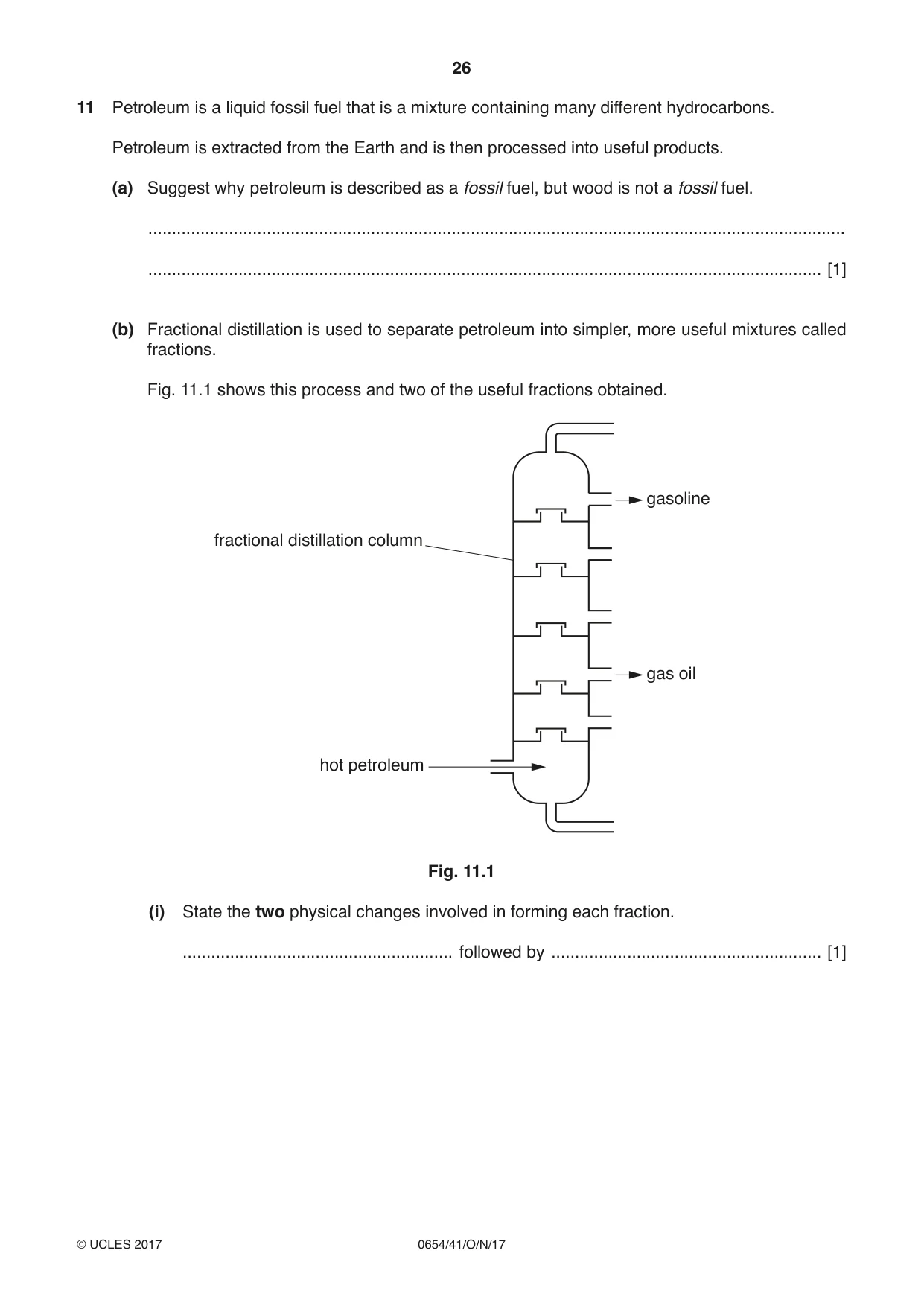
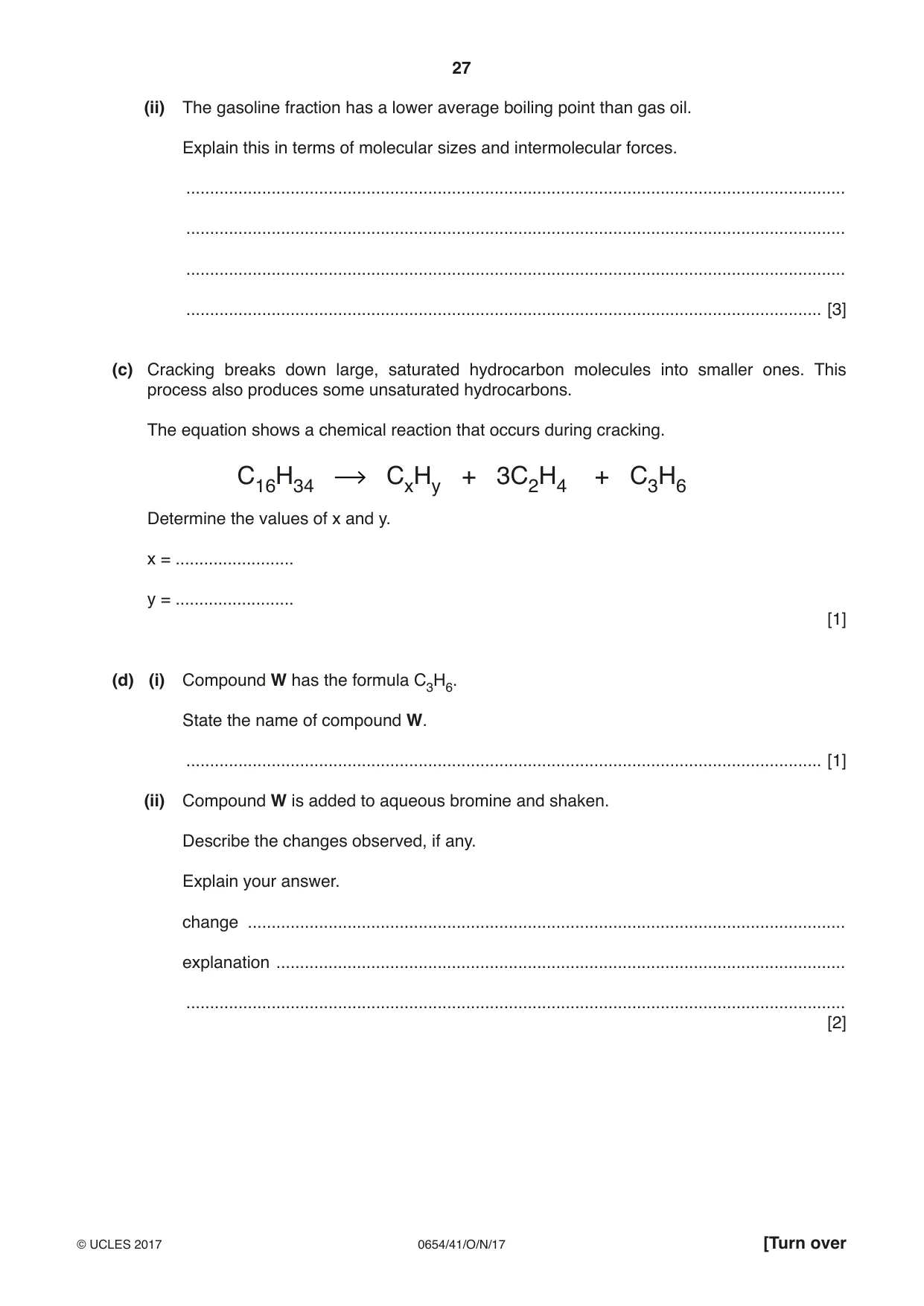
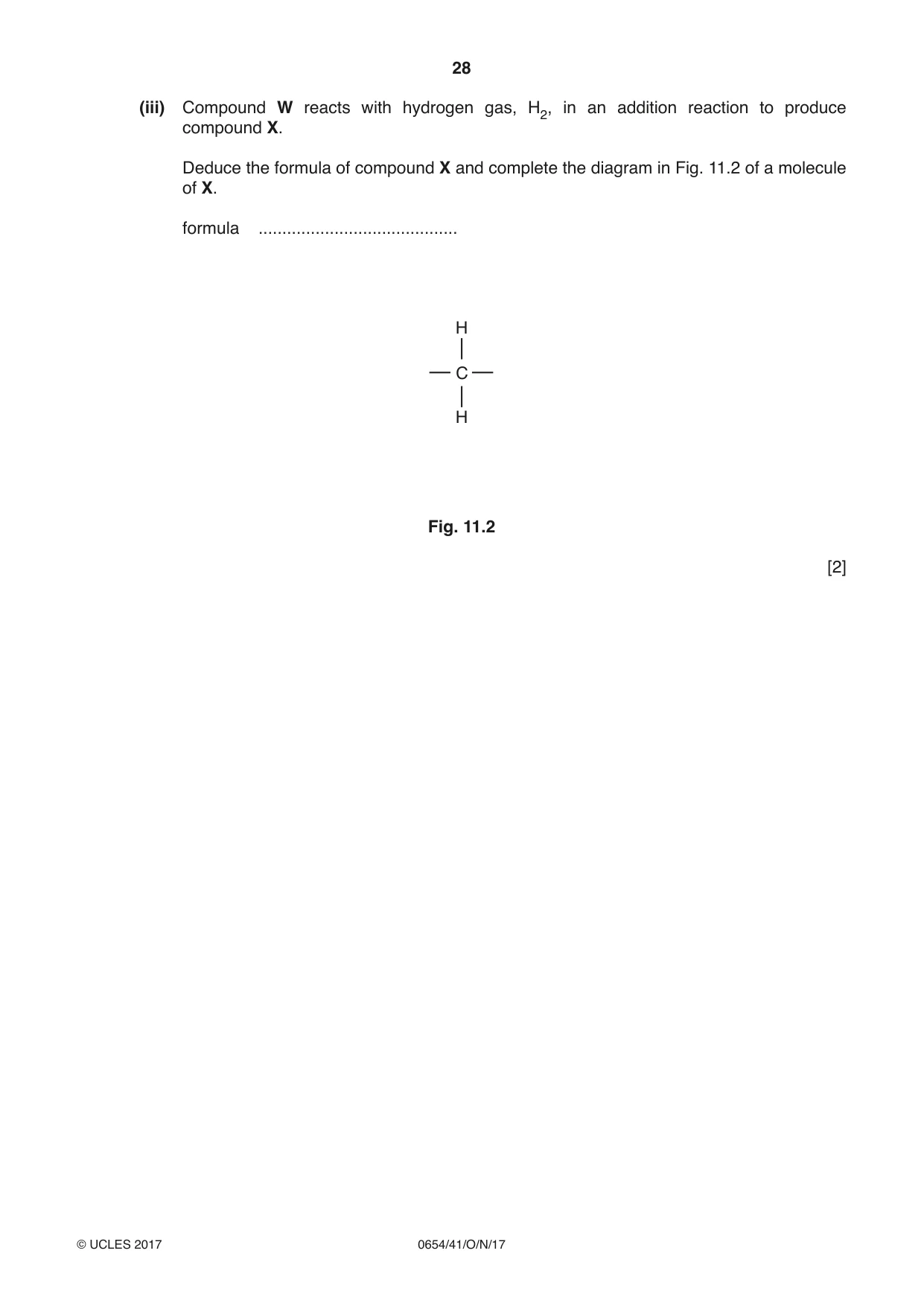
11 Petroleum is a liquid fossil fuel that is a mixture containing many different hydrocarbons. Petroleum is extracted from the Earth and is then processed into useful products. (a) Suggest why petroleum is described as a fossil fuel, but wood is not a fossil fuel. ................................................................................................................................................... .............................................................................................................................................. [1] (b) Fractional distillation is used to separate petroleum into simpler, more useful mixtures called fractions. Fig. 11.1 shows this process and two of the useful fractions obtained. gasoline fractional distillation column gas oil hot petroleum Fig. 11.1 (i) State the two physical changes involved in forming each fraction. ......................................................... followed by ......................................................... [1] (ii) The gasoline fraction has a lower average boiling point than gas oil. Explain this in terms of molecular sizes and intermolecular forces. ........................................................................................................................................... ........................................................................................................................................... ........................................................................................................................................... ...................................................................................................................................... [3] (c) Cracking breaks down large, saturated hydrocarbon molecules into smaller ones. This process also produces some unsaturated hydrocarbons. The equation shows a chemical reaction that occurs during cracking. C16H34 CxHy + 3C2H4 + C3H6 Determine the values of x and y. x = ......................... y = ......................... [1] (d) (i) Compound W has the formula C3H6. State the name of compound W. ...................................................................................................................................... [1] (ii) Compound W is added to aqueous bromine and shaken. Describe the changes observed, if any. Explain your answer. change .............................................................................................................................. explanation ........................................................................................................................ ........................................................................................................................................... [2] (iii) Compound W reacts with hydrogen gas, H2, in an addition reaction to produce compound X. Deduce the formula of compound X and complete the diagram in Fig. 11.2 of a molecule of X. formula .......................................... H C H Fig. 11.2 [2]
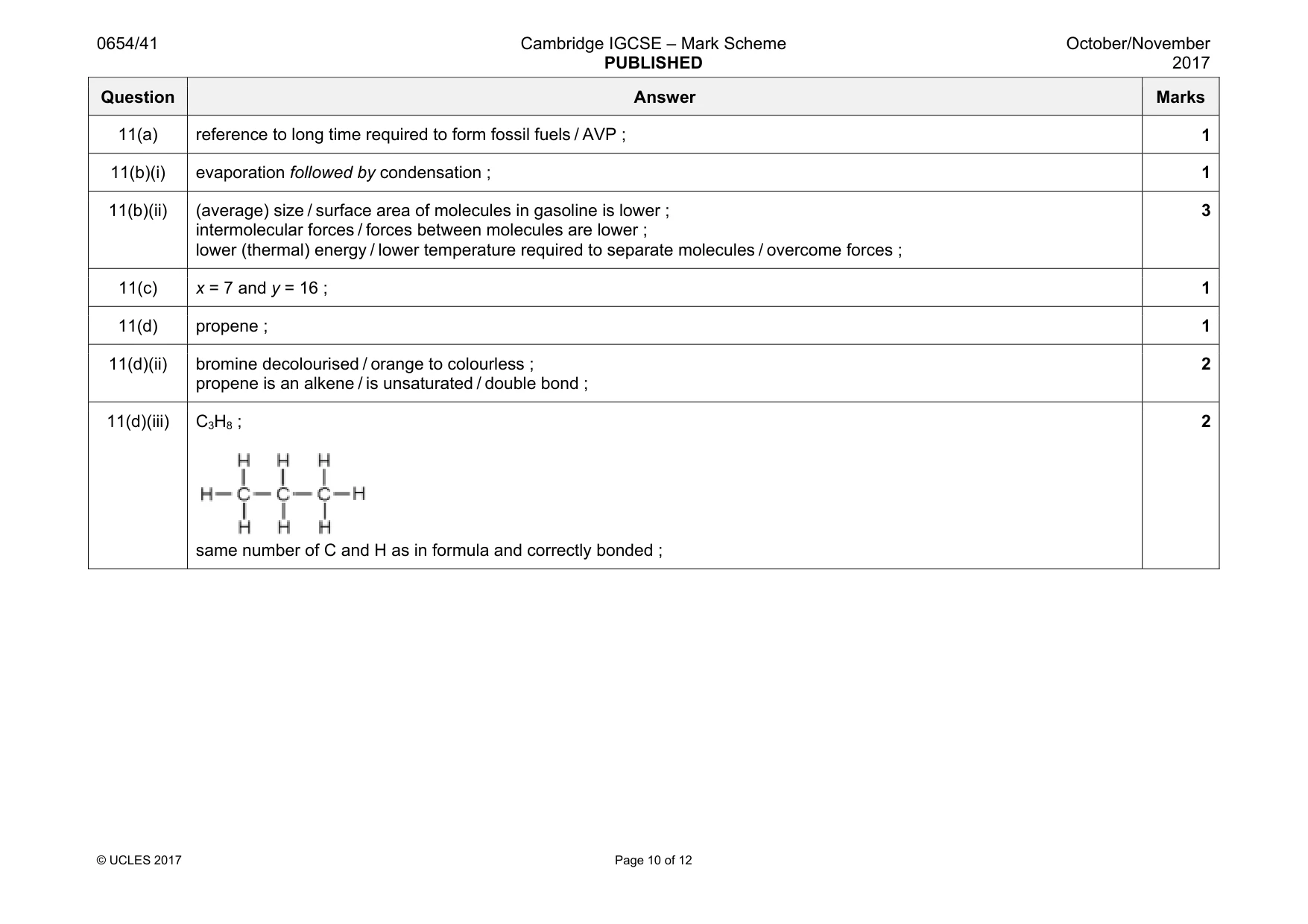
Mark scheme: 11(a) reference to long time required to form fossil fuels / AVP ; 1 11(b)(i) evaporation followed by condensation ; 1 11(b)(ii) (average) size / surface area of molecules in gasoline is lower ; intermolecular forces / forces between molecules are lower ; lower (thermal) energy / lower temperature required to separate molecules / overcome forces ; 3 11(c) x = 7 and y = 16 ; 1 11(d) propene ; 1 11(d)(ii) bromine decolourised / orange to colourless ; propene is an alkene / is unsaturated / double bond ; 2 11(d)(iii) C3H8 ; same number of C and H as in formula and correctly bonded ; 2
Q12 · Two forces acting on a swimmer as he swims in a swimming pool
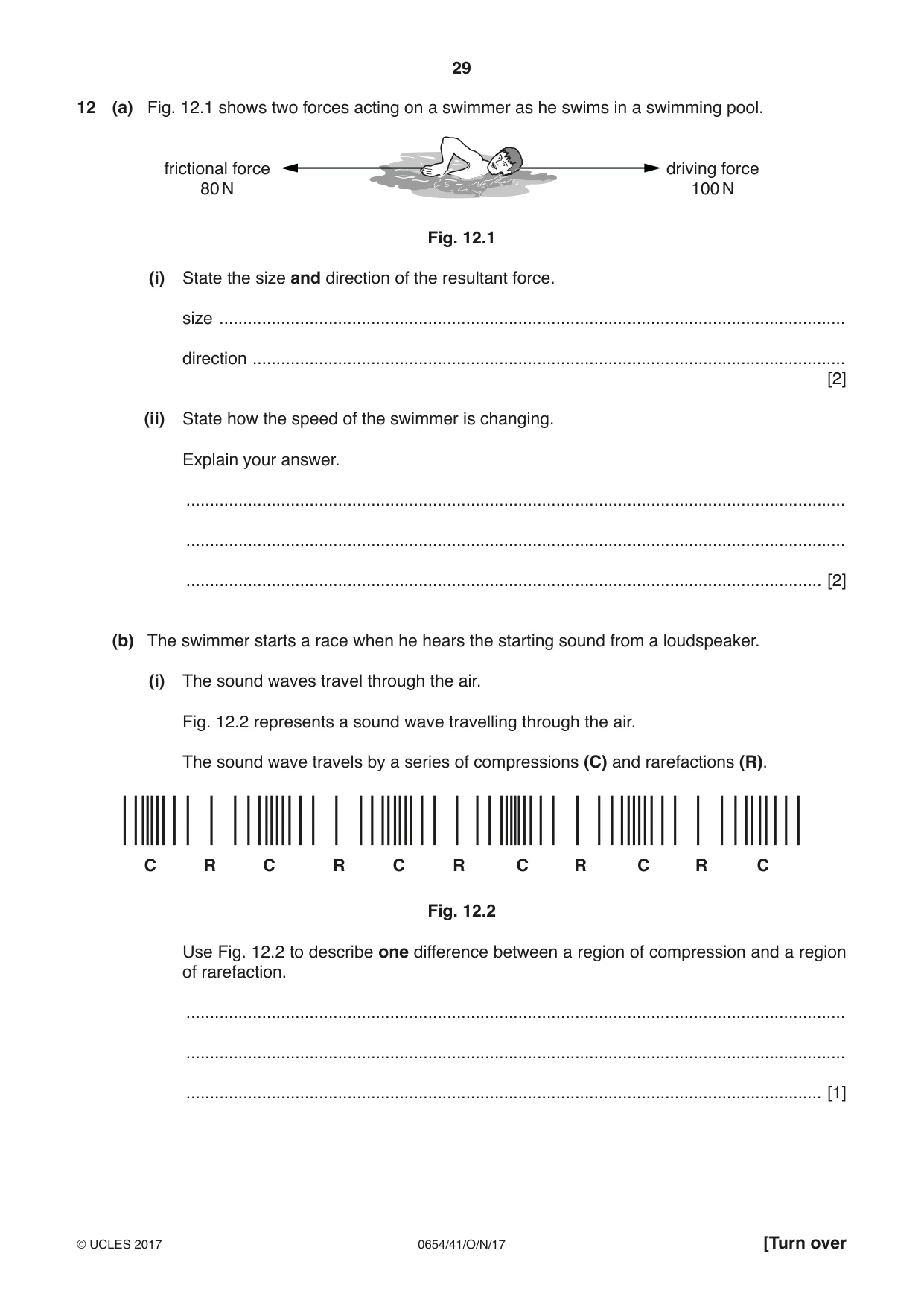
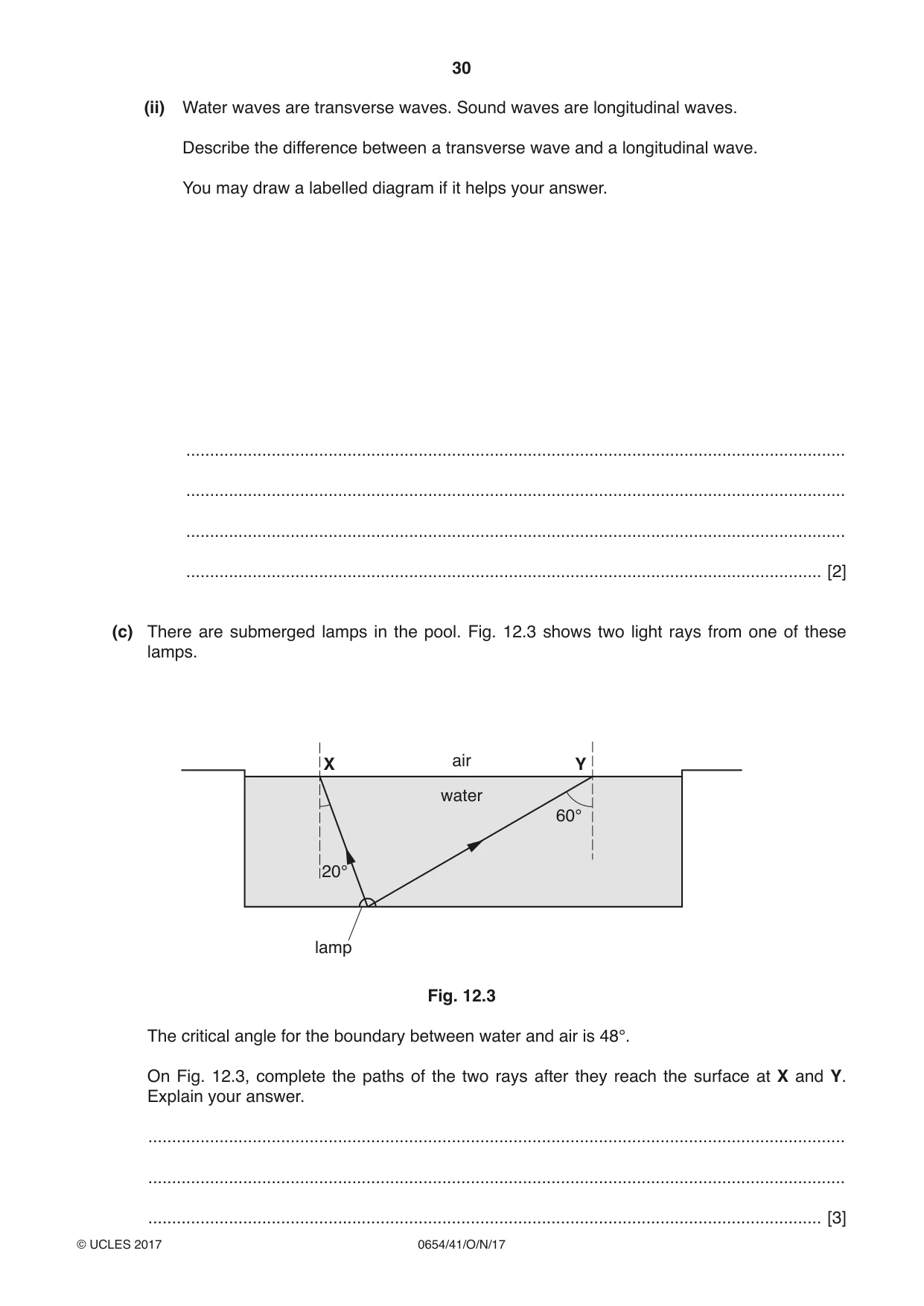
12 (a) Fig. 12.1 shows two forces acting on a swimmer as he swims in a swimming pool. frictional force driving force 80 N 100 N Fig. 12.1 (i) State the size and direction of the resultant force. size .................................................................................................................................... direction ............................................................................................................................. [2] (ii) State how the speed of the swimmer is changing. Explain your answer. ........................................................................................................................................... ........................................................................................................................................... ...................................................................................................................................... [2] (b) The swimmer starts a race when he hears the starting sound from a loudspeaker. (i) The sound waves travel through the air. Fig. 12.2 represents a sound wave travelling through the air. The sound wave travels by a series of compressions (C) and rarefactions (R). C R C R C R C R C R C Fig. 12.2 Use Fig. 12.2 to describe one difference between a region of compression and a region of rarefaction. ........................................................................................................................................... ........................................................................................................................................... ...................................................................................................................................... [1] (ii) Water waves are transverse waves. Sound waves are longitudinal waves. Describe the difference between a transverse wave and a longitudinal wave. You may draw a labelled diagram if it helps your answer. ........................................................................................................................................... ........................................................................................................................................... ........................................................................................................................................... ...................................................................................................................................... [2] (c) There are submerged lamps in the pool. Fig. 12.3 shows two light rays from one of these lamps. X air Y water 60° 20° lamp Fig. 12.3 The critical angle for the boundary between water and air is 48°. On Fig. 12.3, complete the paths of the two rays after they reach the surface at X and Y. Explain your answer. ................................................................................................................................................... ................................................................................................................................................... .............................................................................................................................................. [3]
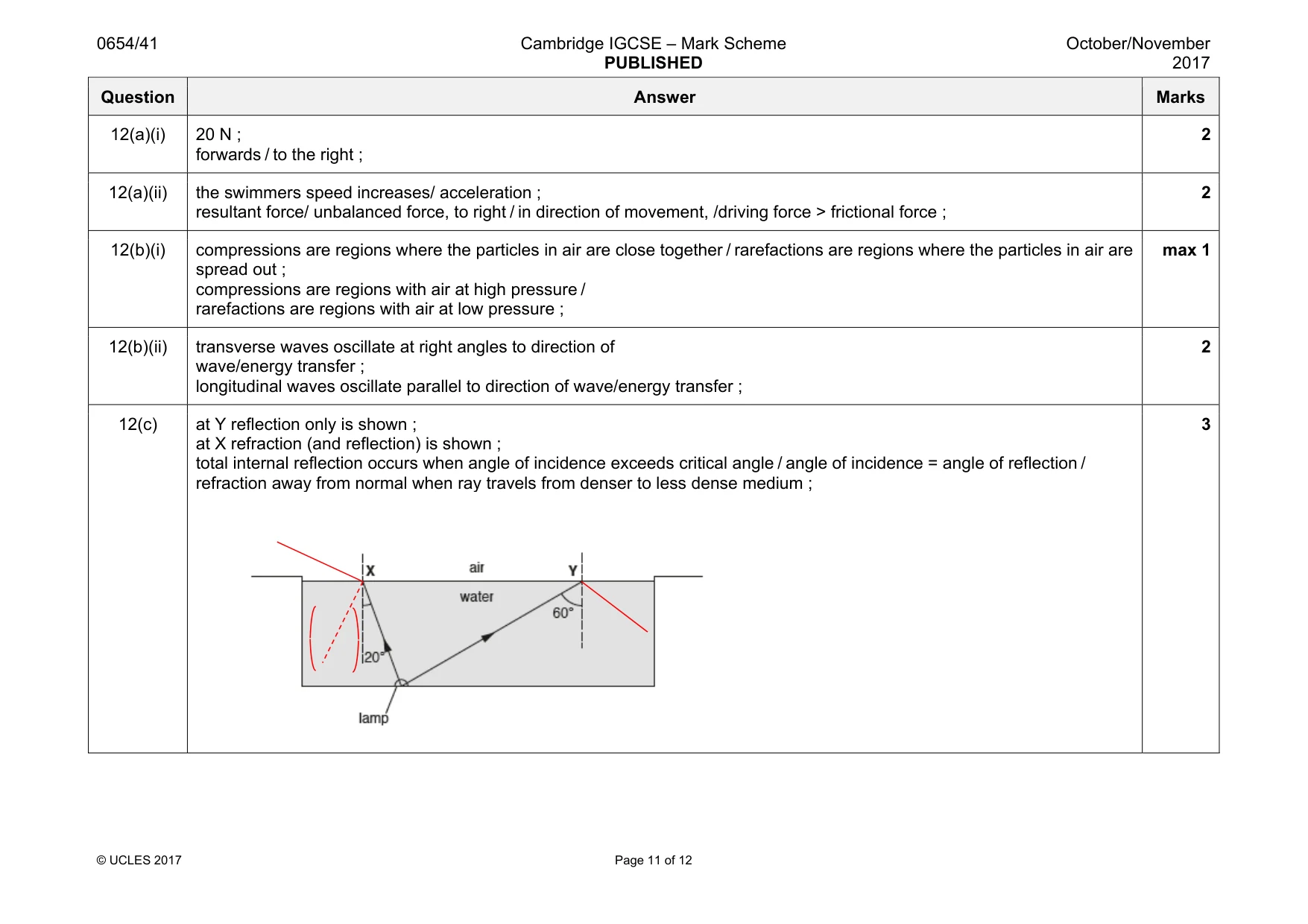
Mark scheme: 12(a)(i) 20 N ; forwards / to the right ; 2 12(a)(ii) the swimmers speed increases/ acceleration ; resultant force/ unbalanced force, to right / in direction of movement, /driving force > frictional force ; 2 12(b)(i) compressions are regions where the particles in air are close together / rarefactions are regions where the particles in air are spread out ; compressions are regions with air at high pressure / rarefactions are regions with air at low pressure ; max 1 12(b)(ii) transverse waves oscillate at right angles to direction of wave/energy transfer ; longitudinal waves oscillate parallel to direction of wave/energy transfer ; 2 12(c) at Y reflection only is shown ; at X refraction (and reflection) is shown ; total internal reflection occurs when angle of incidence exceeds critical angle / angle of incidence = angle of reflection / refraction away from normal when ray travels from denser to less dense medium ; 3
Q13 · Yeast is used in the brewing industry to make beer
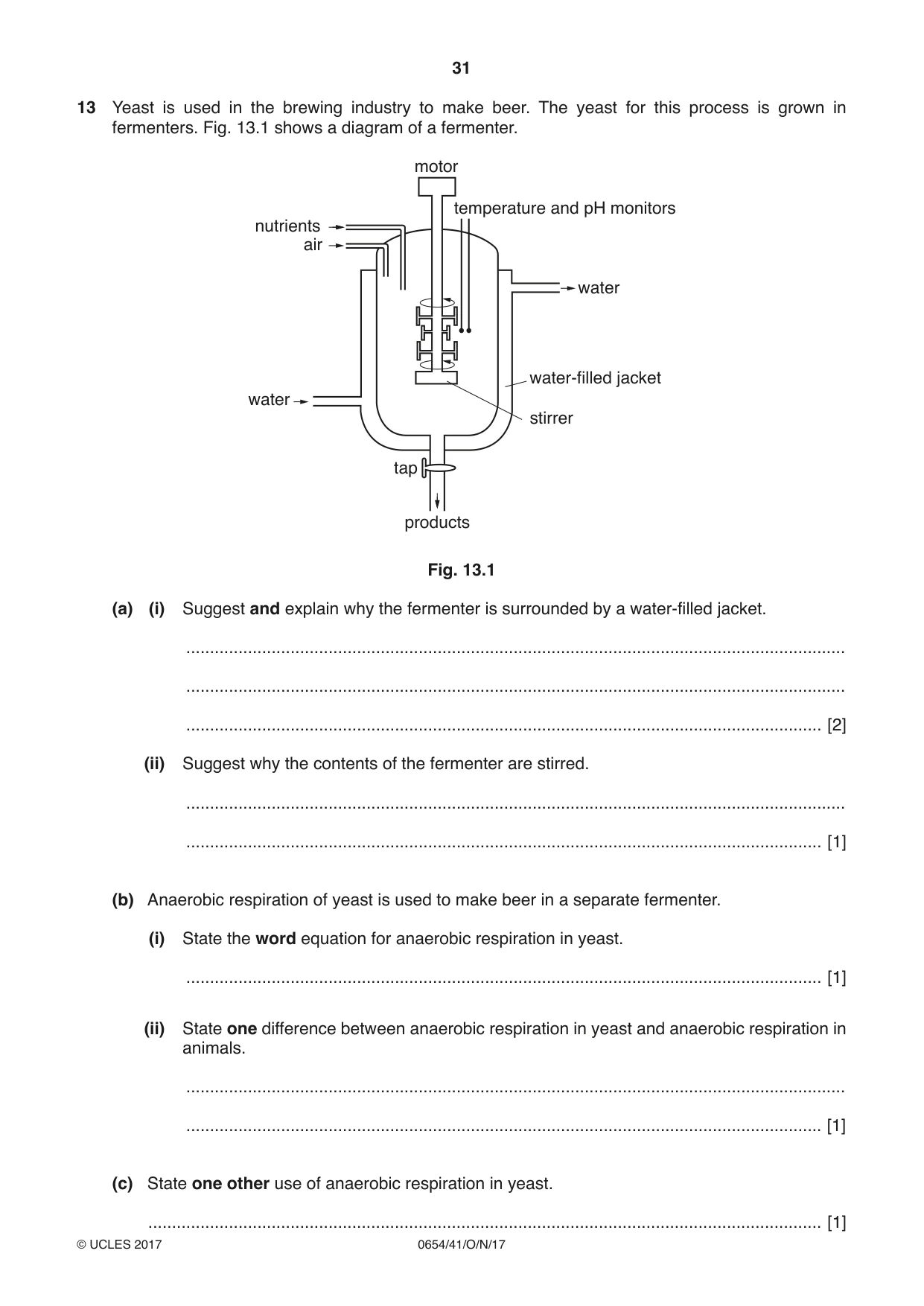
13 Yeast is used in the brewing industry to make beer. The yeast for this process is grown in fermenters. Fig. 13.1 shows a diagram of a fermenter. motor temperature and pH monitors nutrients air water water-filled jacket water stirrer tap products Fig. 13.1 (a) (i) Suggest and explain why the fermenter is surrounded by a water-filled jacket. ........................................................................................................................................... ........................................................................................................................................... ...................................................................................................................................... [2] (ii) Suggest why the contents of the fermenter are stirred. ........................................................................................................................................... ...................................................................................................................................... [1] (b) Anaerobic respiration of yeast is used to make beer in a separate fermenter. (i) State the word equation for anaerobic respiration in yeast. ...................................................................................................................................... [1] (ii) State one difference between anaerobic respiration in yeast and anaerobic respiration in animals. ........................................................................................................................................... ...................................................................................................................................... [1] (c) State one other use of anaerobic respiration in yeast.
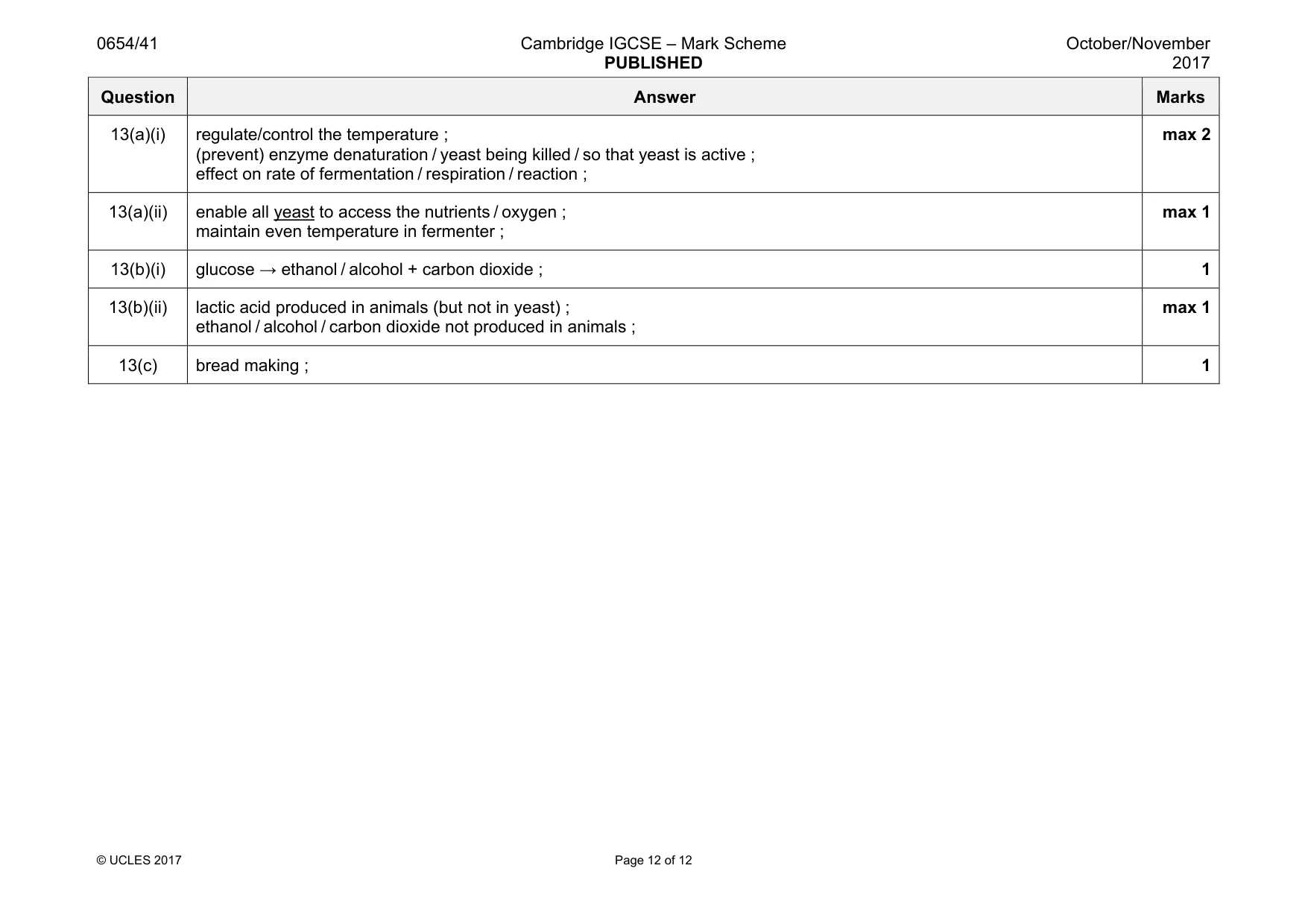
Mark scheme: 13(a)(i) regulate/control the temperature ; (prevent) enzyme denaturation / yeast being killed / so that yeast is active ; effect on rate of fermentation / respiration / reaction ; max 2 13(a)(ii) enable all yeast to access the nutrients / oxygen ; maintain even temperature in fermenter ; max 1 13(b)(i) glucose → ethanol / alcohol + carbon dioxide ; 1 13(b)(ii) lactic acid produced in animals (but not in yeast) ; ethanol / alcohol / carbon dioxide not produced in animals ; max 1 13(c) bread making ; 1
What was in this paper
The subtopics covered by these 13 questions, and how many questions each got. Open one in a new tab to see every Cambridge question on it.
What you needed in this session
Cambridge’s own grade thresholds for 2017 Oct/Nov, Paper 4 · Variant 1. A higher threshold means an easier paper — the bar moves with how the cohort did.