Cambridge IGCSE Sciences - Co-ordinated (Double) 0654 — 2022 Oct/Nov Paper 4 · Variant 3
0654/43/O/N/22 · 12 questions · 120 marks · ≈135 min
The question paper and its mark scheme, free to read here and free to download. This is Cambridge’s own paper, exactly as it was sat.
Question paper32 pages

Mark scheme14 pages
Answers below. Sit the paper first if you are practising.
Questions as text
Q1 · Gills are the gas exchange surface in fish
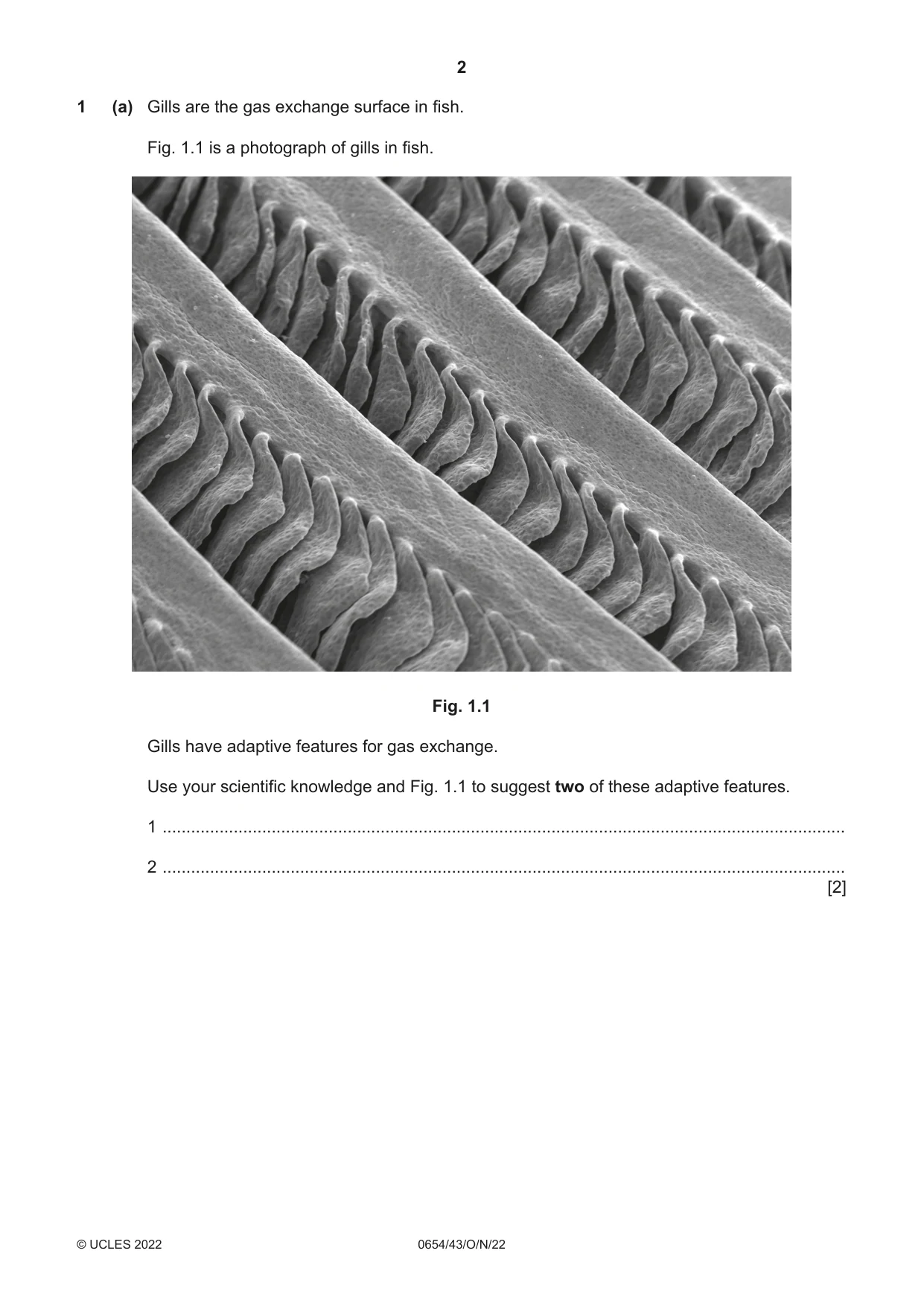
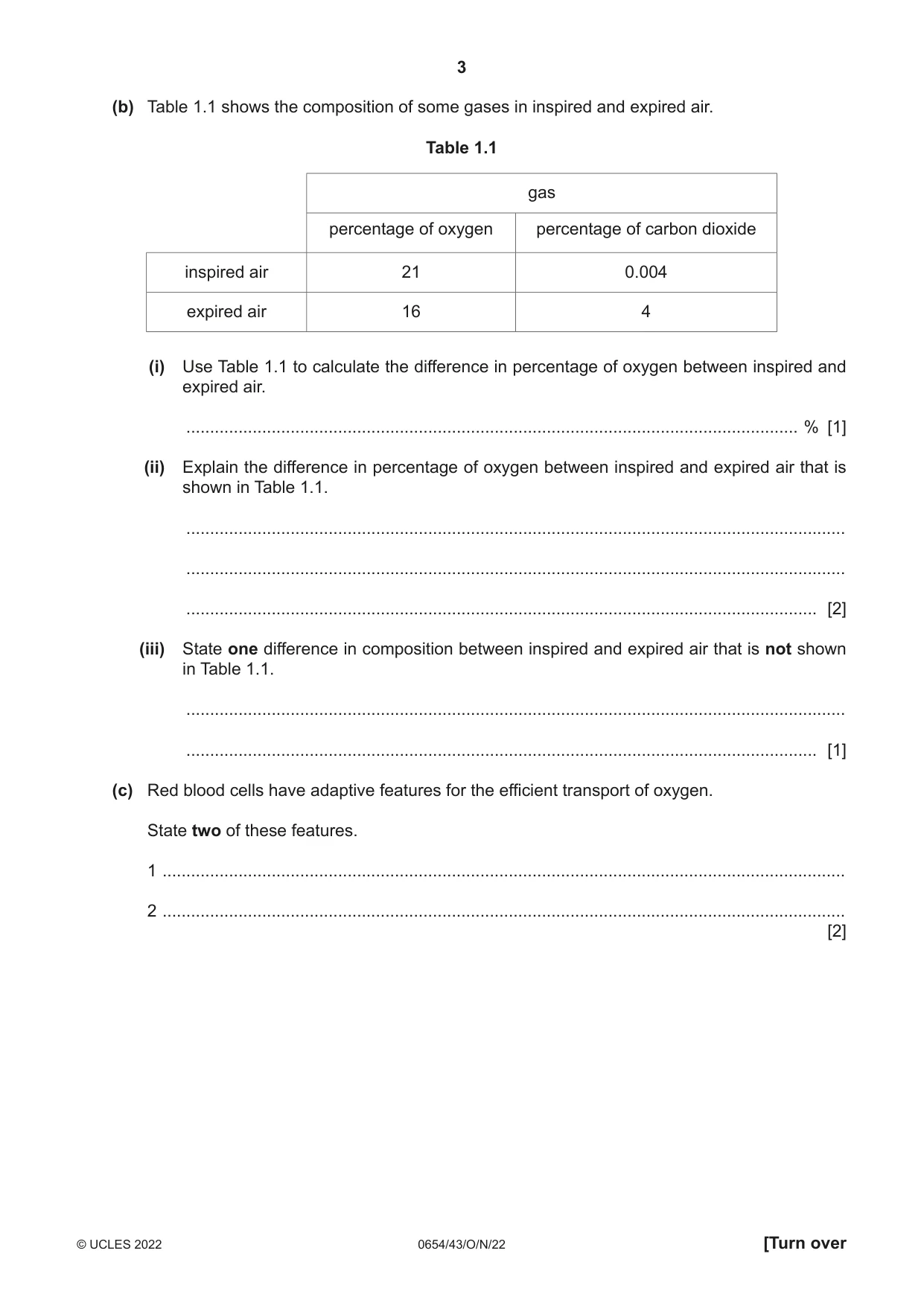
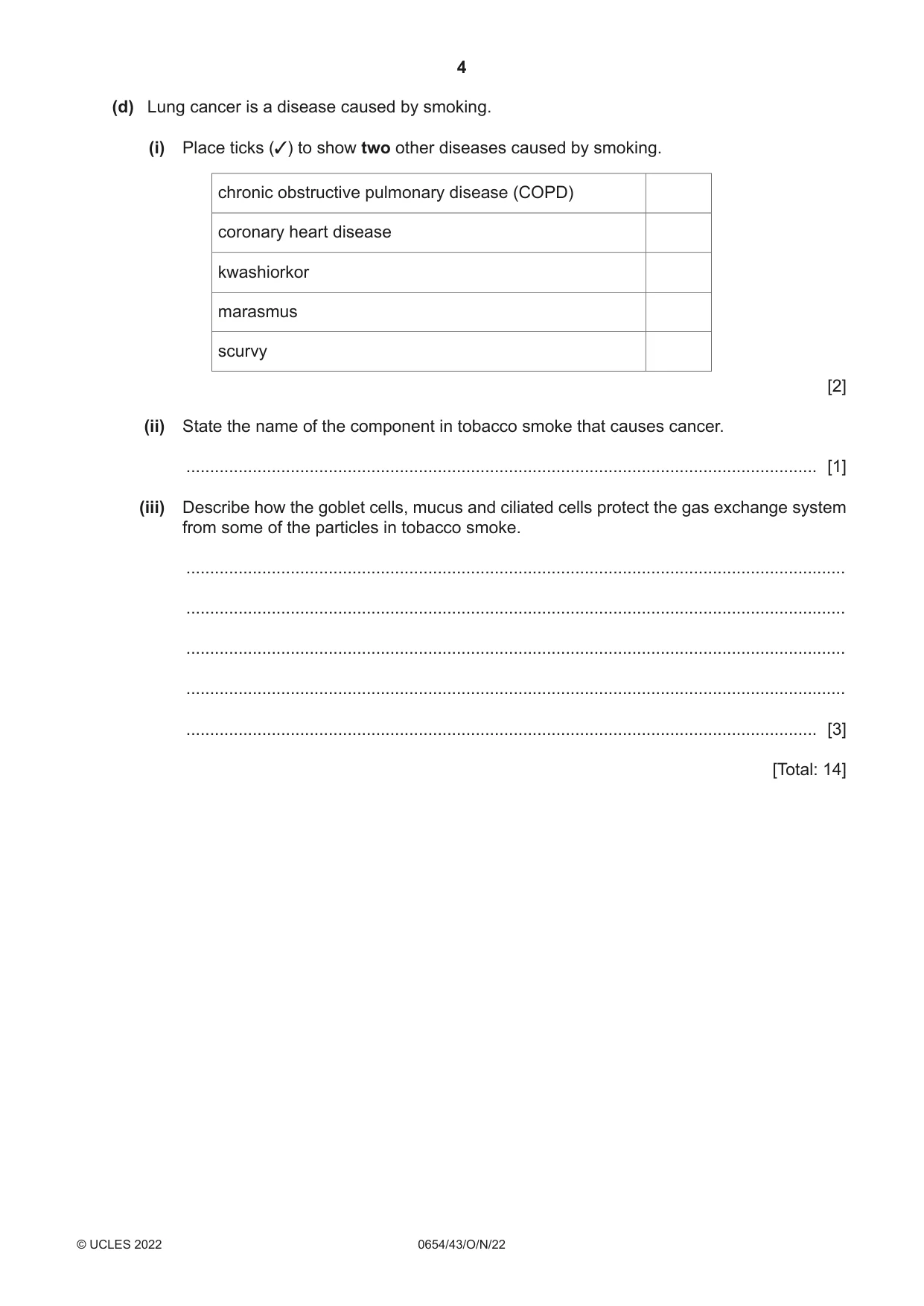
1 (a) Gills are the gas exchange surface in fish. Fig. 1.1 is a photograph of gills in fish. Fig. 1.1 Gills have adaptive features for gas exchange. Use your scientific knowledge and Fig. 1.1 to suggest two of these adaptive features. 1 ................................................................................................................................................ 2 ................................................................................................................................................ [2] (b) Table 1.1 shows the composition of some gases in inspired and expired air. Table 1.1 gas percentage of oxygen percentage of carbon dioxide inspired air 21 0.004 expired air 16 4 (i) Use Table 1.1 to calculate the difference in percentage of oxygen between inspired and expired air. ................................................................................................................................. % [1] (ii) Explain the difference in percentage of oxygen between inspired and expired air that is shown in Table 1.1. ........................................................................................................................................... ........................................................................................................................................... ..................................................................................................................................... [2] (iii) State one difference in composition between inspired and expired air that is not shown in Table 1.1. ........................................................................................................................................... ..................................................................................................................................... [1] (c) Red blood cells have adaptive features for the efficient transport of oxygen. State two of these features. 1 ................................................................................................................................................ 2 ................................................................................................................................................ [2] (d) Lung cancer is a disease caused by smoking. (i) Place ticks (3) to show two other diseases caused by smoking. chronic obstructive pulmonary disease (COPD) coronary heart disease kwashiorkor marasmus scurvy [2] (ii) State the name of the component in tobacco smoke that causes cancer. ..................................................................................................................................... [1] (iii) Describe how the goblet cells, mucus and ciliated cells protect the gas exchange system from some of the particles in tobacco smoke. ........................................................................................................................................... ........................................................................................................................................... ........................................................................................................................................... ........................................................................................................................................... ..................................................................................................................................... [3] [Total: 14]
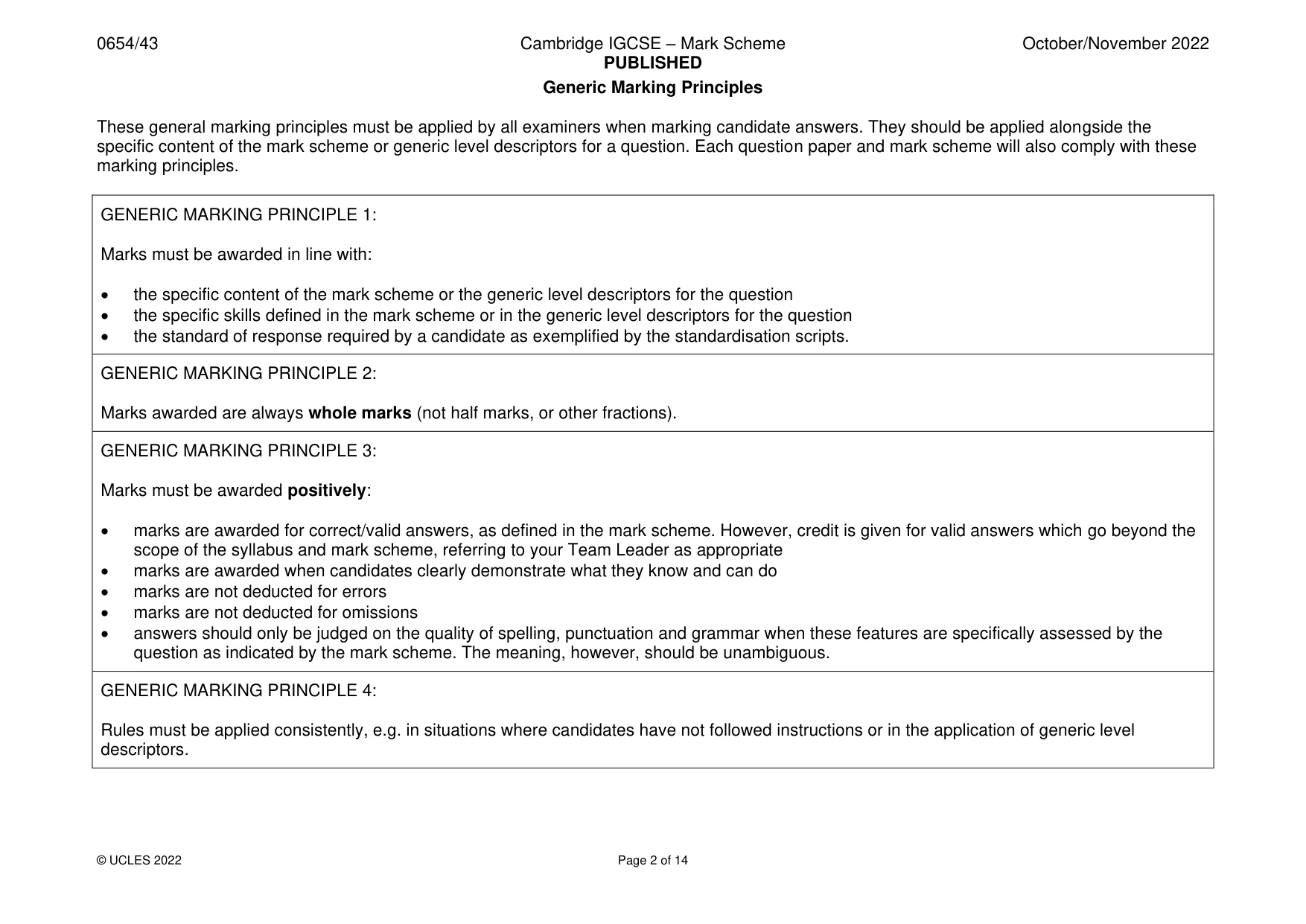
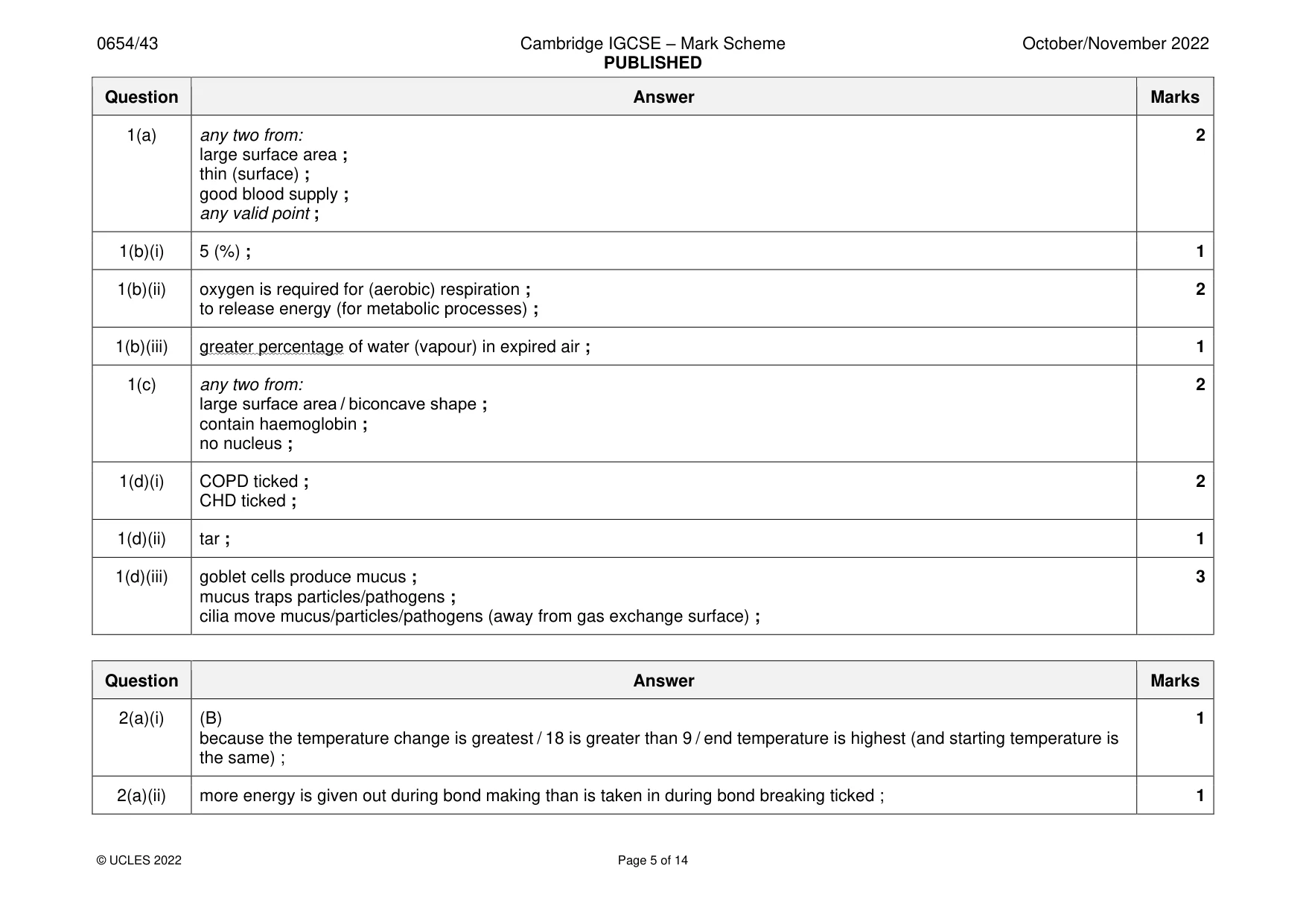
Mark scheme: Question Answer Marks 1(a) any two from: 2 large surface area ; thin (surface) ; good blood supply ; any valid point ; 1(b)(i) 5 (%) ; 1 1(b)(ii) oxygen is required for (aerobic) respiration ; 2 to release energy (for metabolic processes) ; 1(b)(iii) greater percentage of water (vapour) in expired air ; 1 1(c) any two from: 2 large surface area / biconcave shape ; contain haemoglobin ; no nucleus ; 1(d)(i) COPD ticked ; 2 CHD ticked ; 1(d)(ii) tar ; 1 1(d)(iii) goblet cells produce mucus ; 3 mucus traps particles/pathogens ; cilia move mucus/particles/pathogens (away from gas exchange surface) ;
Q2 · A student investigates two liquid fuels, A and B, to find out which fuel releases most…
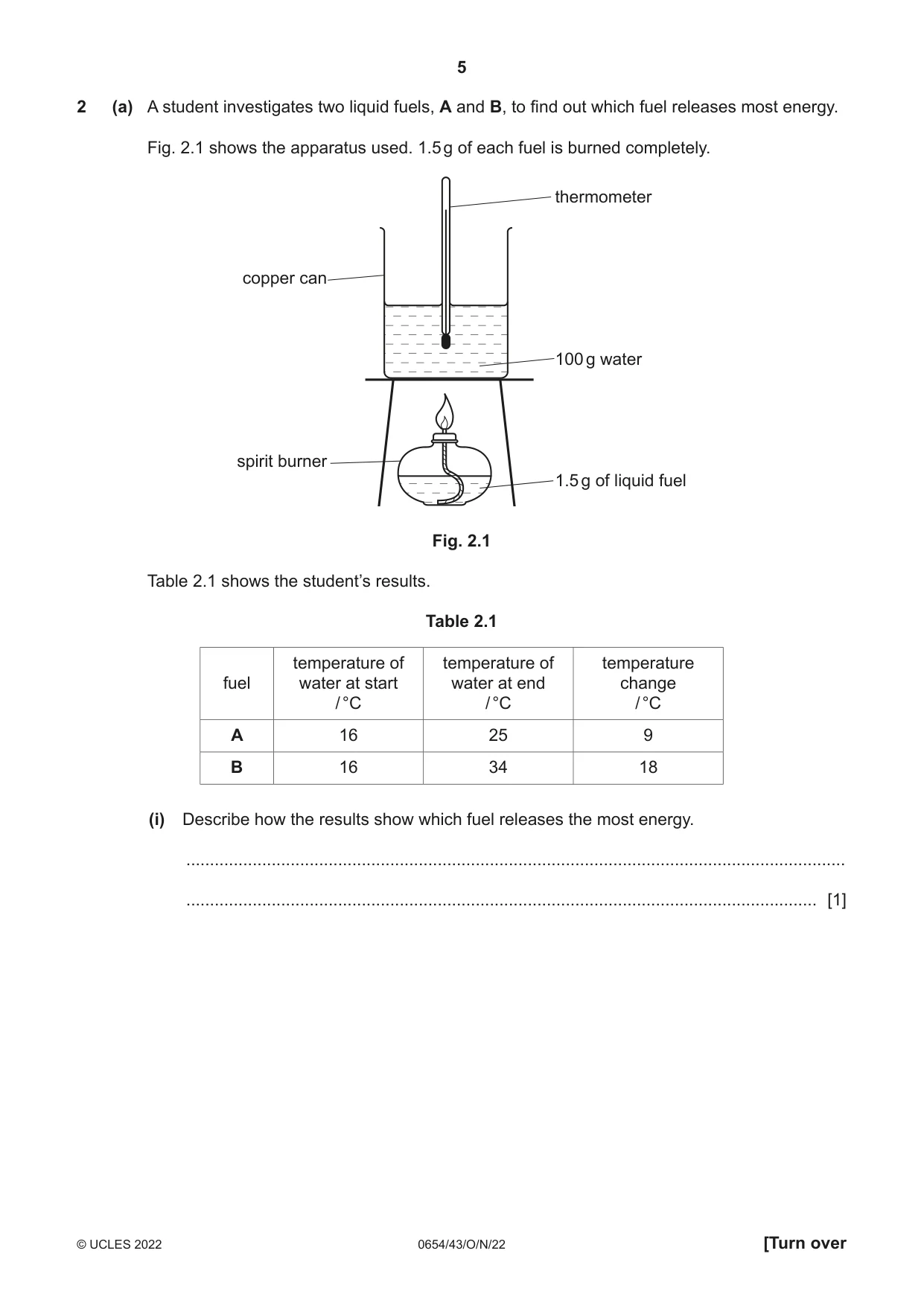
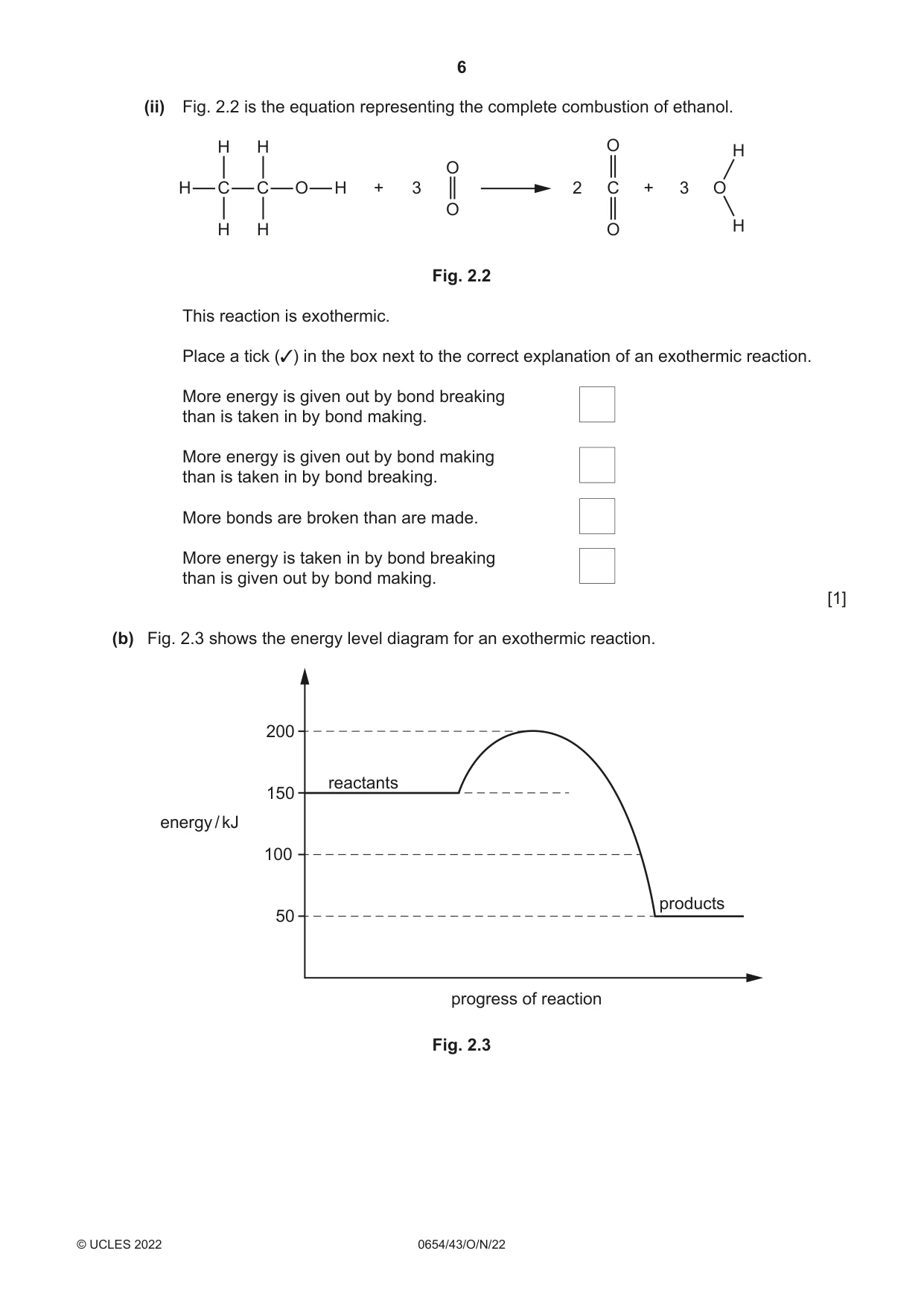
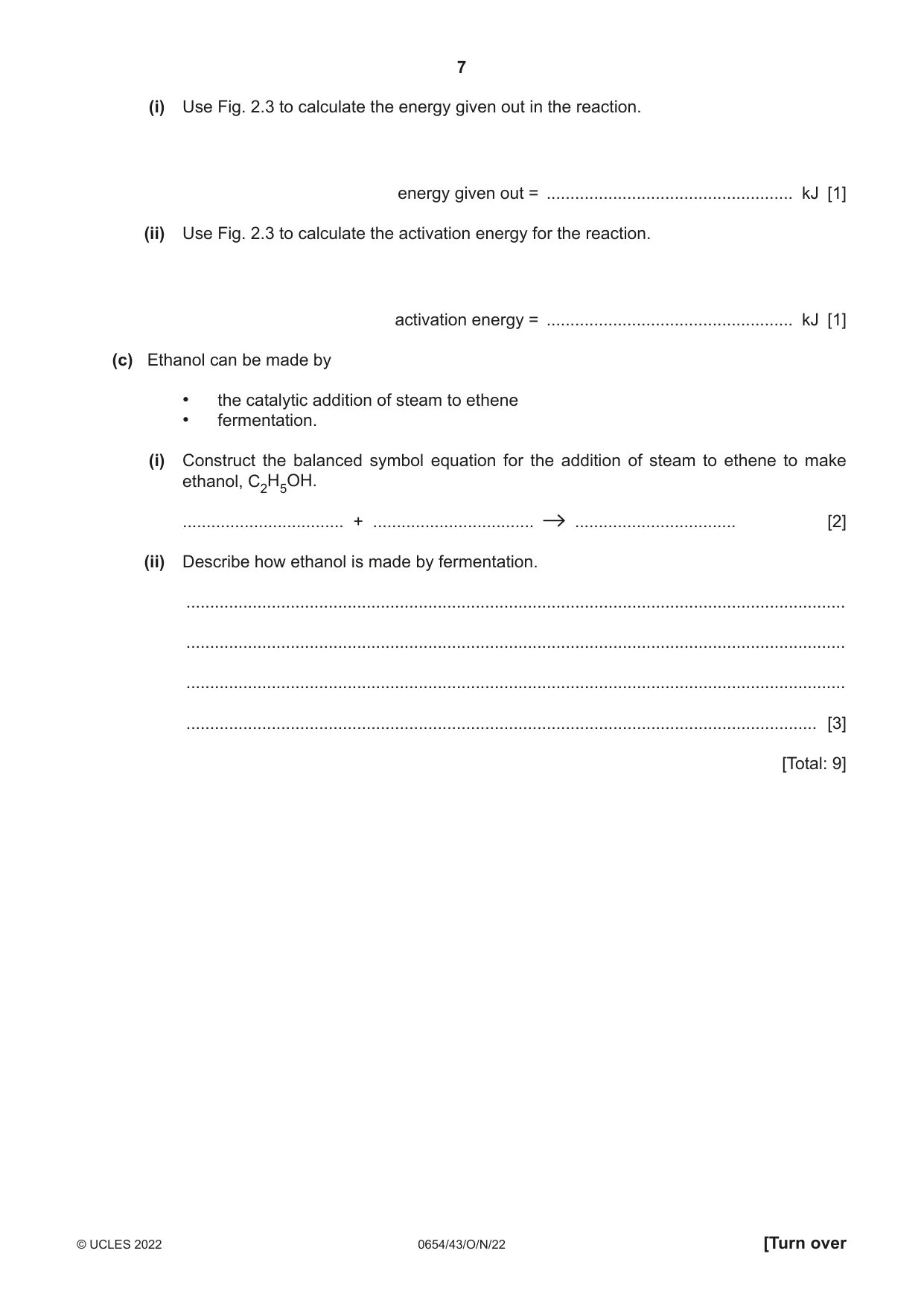
2 (a) A student investigates two liquid fuels, A and B, to find out which fuel releases most energy. Fig. 2.1 shows the apparatus used. 1.5 g of each fuel is burned completely. thermometer copper can 100 g water spirit burner 1.5 g of liquid fuel Fig. 2.1 Table 2.1 shows the student’s results. Table 2.1 temperature of temperature of temperature fuel water at start water at end change / °C / °C / °C A 16 25 9 B 16 34 18 (i) Describe how the results show which fuel releases the most energy. ........................................................................................................................................... ..................................................................................................................................... [1] (ii) Fig. 2.2 is the equation representing the complete combustion of ethanol. H H O H O H C C O H + 3 2 C + 3 O O H H O H Fig. 2.2 This reaction is exothermic. Place a tick (3) in the box next to the correct explanation of an exothermic reaction. More energy is given out by bond breaking than is taken in by bond making. More energy is given out by bond making than is taken in by bond breaking. More bonds are broken than are made. More energy is taken in by bond breaking than is given out by bond making. [1] (b) Fig. 2.3 shows the energy level diagram for an exothermic reaction. 200 reactants 150 energy / kJ 100 products 50 progress of reaction Fig. 2.3 (i) Use Fig. 2.3 to calculate the energy given out in the reaction. energy given out = .................................................... kJ [1] (ii) Use Fig. 2.3 to calculate the activation energy for the reaction. activation energy = .................................................... kJ [1] (c) Ethanol can be made by • the catalytic addition of steam to ethene • fermentation. (i) Construct the balanced symbol equation for the addition of steam to ethene to make ethanol, C2H5OH. .................................. + .................................. .................................. [2] (ii) Describe how ethanol is made by fermentation. ........................................................................................................................................... ........................................................................................................................................... ........................................................................................................................................... ..................................................................................................................................... [3] [Total: 9]
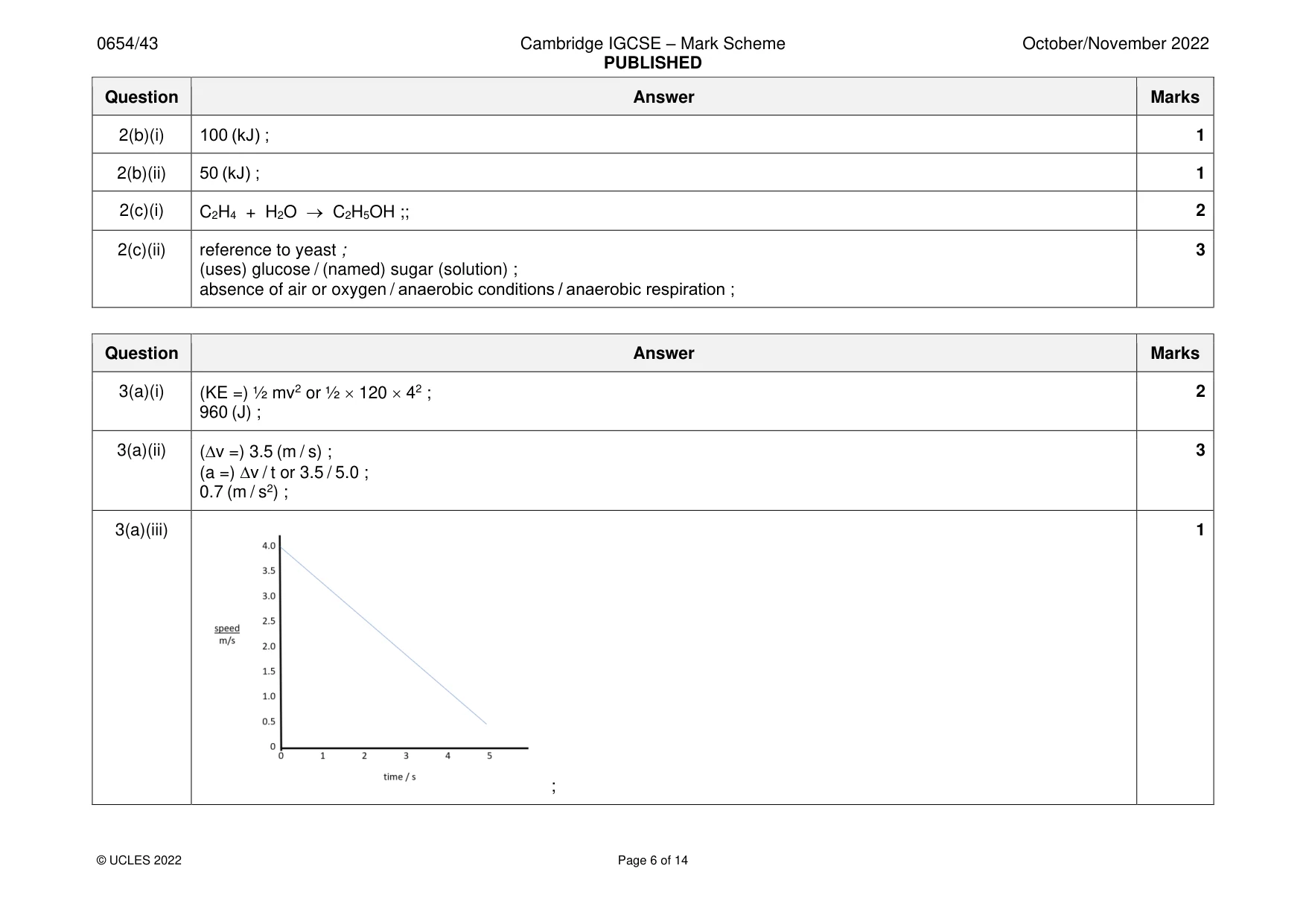
Mark scheme: 2(a)(i) (B) 1 because the temperature change is greatest / 18 is greater than 9 / end temperature is highest (and starting temperature is the same) ; 2(a)(ii) more energy is given out during bond making than is taken in during bond breaking ticked ; 1 2(b)(i) 100 (kJ) ; 1 2(b)(ii) 50 (kJ) ; 1 2(c)(i) C2H4 + H2O → C2H5OH ;; 2 2(c)(ii) reference to yeast ; 3 (uses) glucose / (named) sugar (solution) ; absence of air or oxygen / anaerobic conditions / anaerobic respiration ;
Q3 · A man in a canoe on a lake
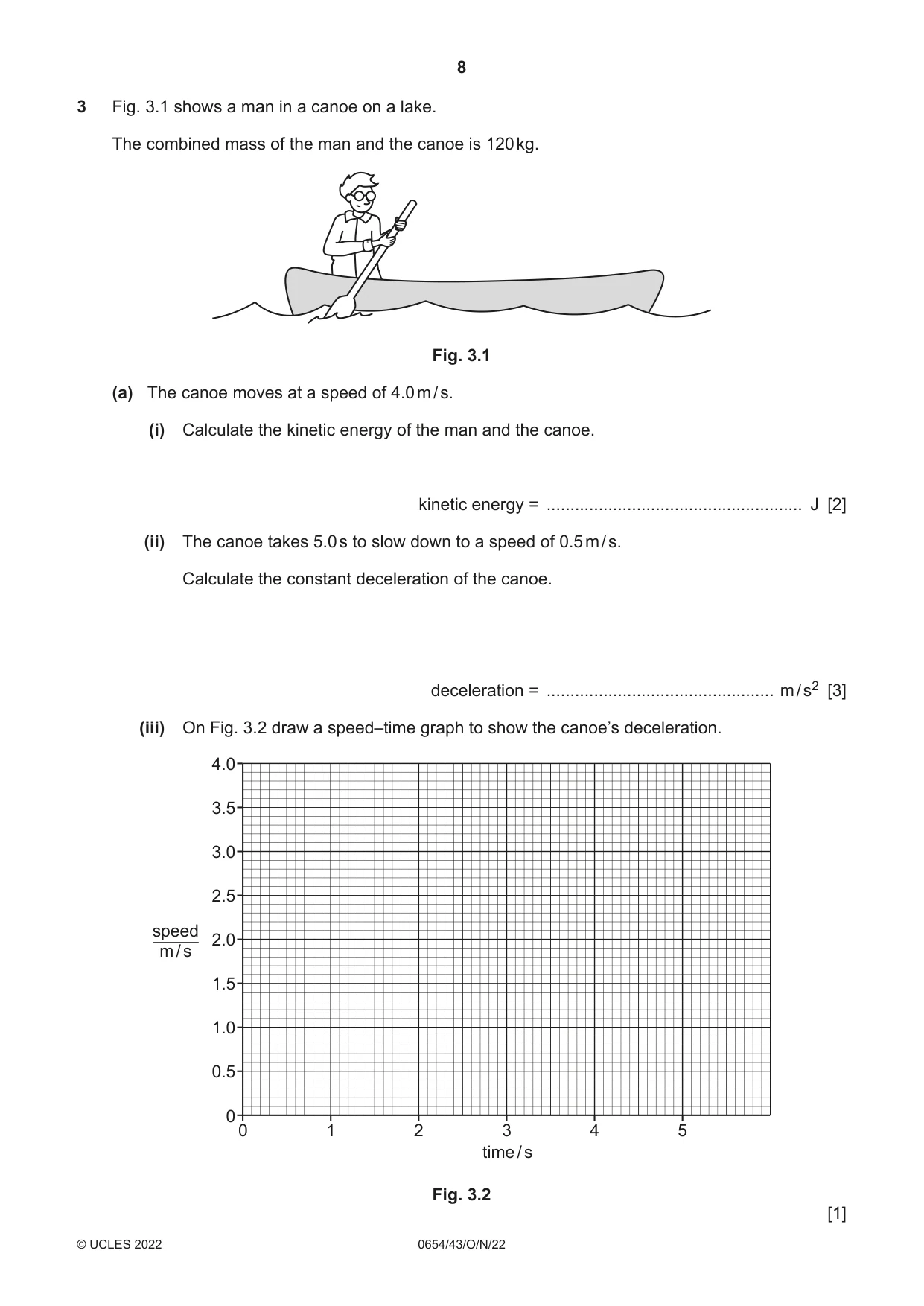
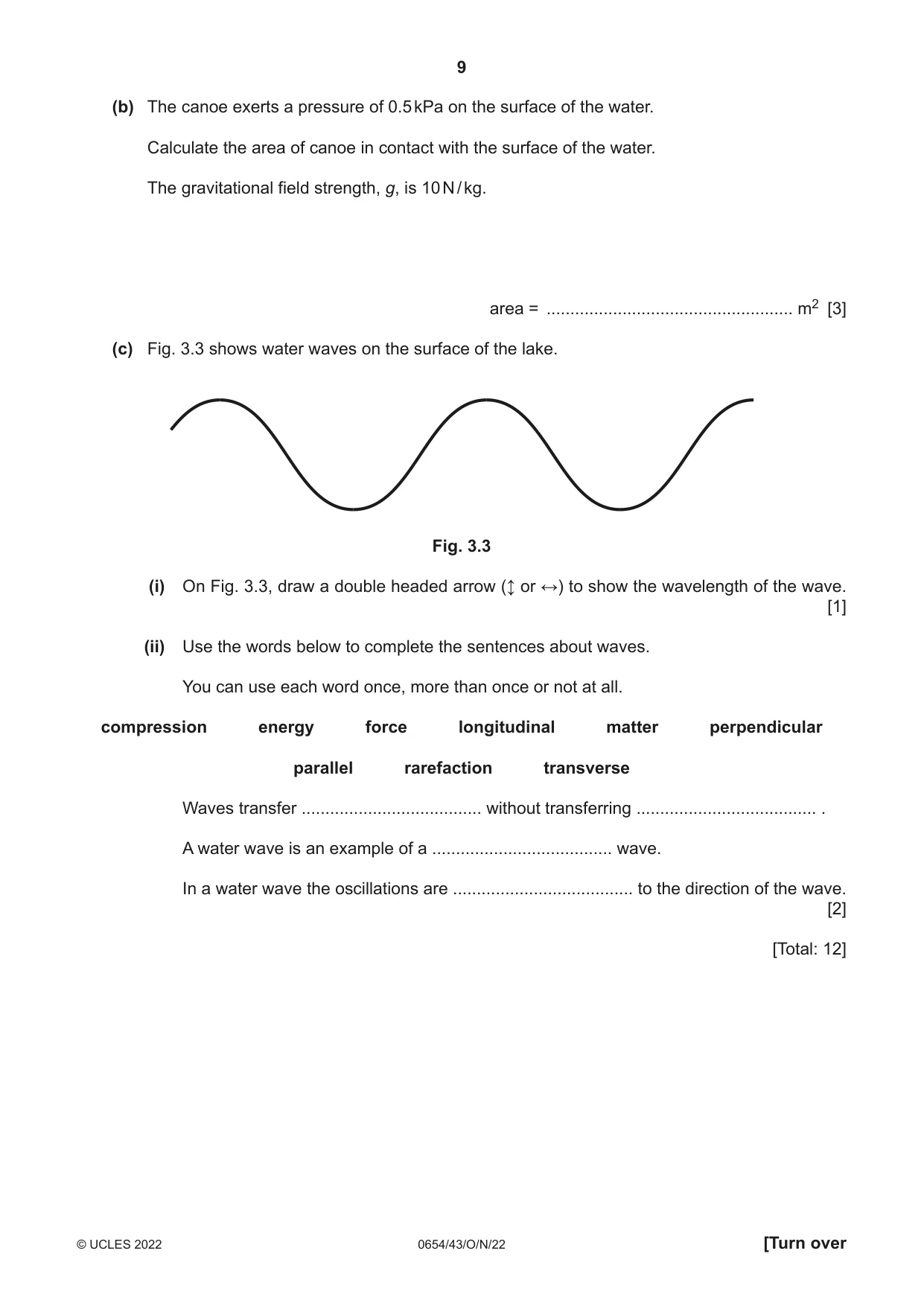
3 Fig. 3.1 shows a man in a canoe on a lake. The combined mass of the man and the canoe is 120 kg. Fig. 3.1 (a) The canoe moves at a speed of 4.0 m / s. (i) Calculate the kinetic energy of the man and the canoe. kinetic energy = ...................................................... J [2] (ii) The canoe takes 5.0 s to slow down to a speed of 0.5 m / s. Calculate the constant deceleration of the canoe. deceleration = ................................................ m / s2 [3] (iii) On Fig. 3.2 draw a speed–time graph to show the canoe’s deceleration. 4.0 3.5 3.0 2.5 speed 2.0 m / s 1.5 1.0 0.5 0 0 1 2 3 4 5 time / s Fig. 3.2 [1] (b) The canoe exerts a pressure of 0.5 kPa on the surface of the water. Calculate the area of canoe in contact with the surface of the water. The gravitational field strength, g, is 10 N / kg. area = .................................................... m2 [3] (c) Fig. 3.3 shows water waves on the surface of the lake. Fig. 3.3 (i) On Fig. 3.3, draw a double headed arrow (↕ or ↔) to show the wavelength of the wave. [1] (ii) Use the words below to complete the sentences about waves. You can use each word once, more than once or not at all. compression energy force longitudinal matter perpendicular parallel rarefaction transverse Waves transfer ...................................... without transferring ...................................... . A water wave is an example of a ...................................... wave. In a water wave the oscillations are ...................................... to the direction of the wave. [2] [Total: 12]
Mark scheme: 3(a)(i) (KE =) ½ mv2 or ½ 120 42 ; 2 960 (J) ; 3(a)(ii) (v =) 3.5 (m / s) ; 3 (a =) v / t or 3.5 / 5.0 ; 0.7 (m / s2) ; 3(a)(iii) 1 ; 3(b) (W =) mg or 120 10 or 1200 (N) ; 3 (A =) W / P or 1200 / 500 ; 2.4 (m2) ; 3(c)(i) correct arrow showing one complete wavelength ; 1 3(c)(ii) energy AND matter ; 2 transverse AND perpendicular ;
Q4 · A student investigates the effect of light intensity on the rate of photosynthesis in an…
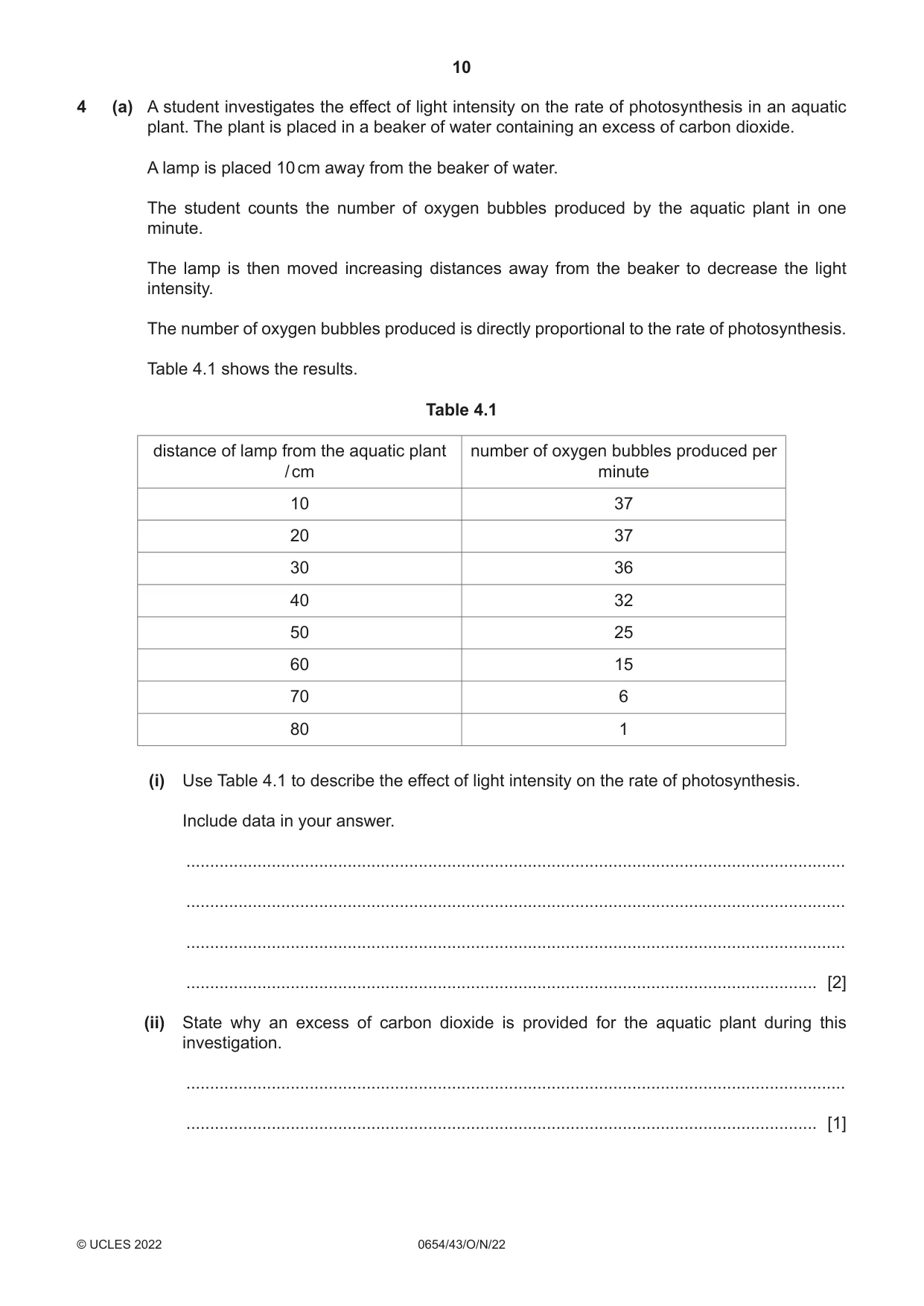
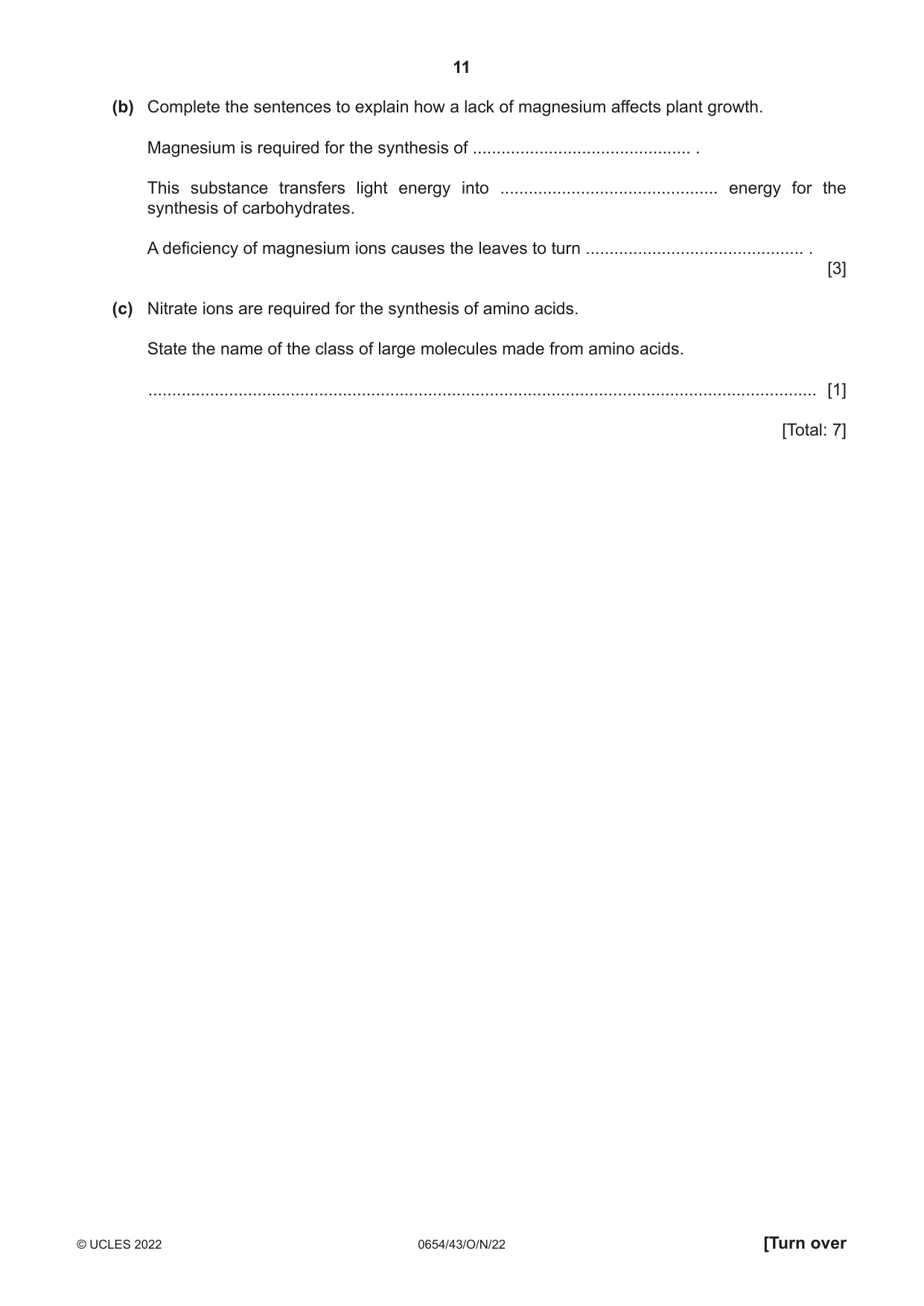
4 (a) A student investigates the effect of light intensity on the rate of photosynthesis in an aquatic plant. The plant is placed in a beaker of water containing an excess of carbon dioxide. A lamp is placed 10 cm away from the beaker of water. The student counts the number of oxygen bubbles produced by the aquatic plant in one minute. The lamp is then moved increasing distances away from the beaker to decrease the light intensity. The number of oxygen bubbles produced is directly proportional to the rate of photosynthesis. Table 4.1 shows the results. Table 4.1 distance of lamp from the aquatic plant number of oxygen bubbles produced per / cm minute 10 37 20 37 30 36 40 32 50 25 60 15 70 6 80 1 (i) Use Table 4.1 to describe the effect of light intensity on the rate of photosynthesis. Include data in your answer. ........................................................................................................................................... ........................................................................................................................................... ........................................................................................................................................... ..................................................................................................................................... [2] (ii) State why an excess of carbon dioxide is provided for the aquatic plant during this investigation. ........................................................................................................................................... ..................................................................................................................................... [1] (b) Complete the sentences to explain how a lack of magnesium affects plant growth. Magnesium is required for the synthesis of .............................................. . This substance transfers light energy into .............................................. energy for the synthesis of carbohydrates. A deficiency of magnesium ions causes the leaves to turn .............................................. . [3] (c) Nitrate ions are required for the synthesis of amino acids. State the name of the class of large molecules made from amino acids. ............................................................................................................................................. [1] [Total: 7]
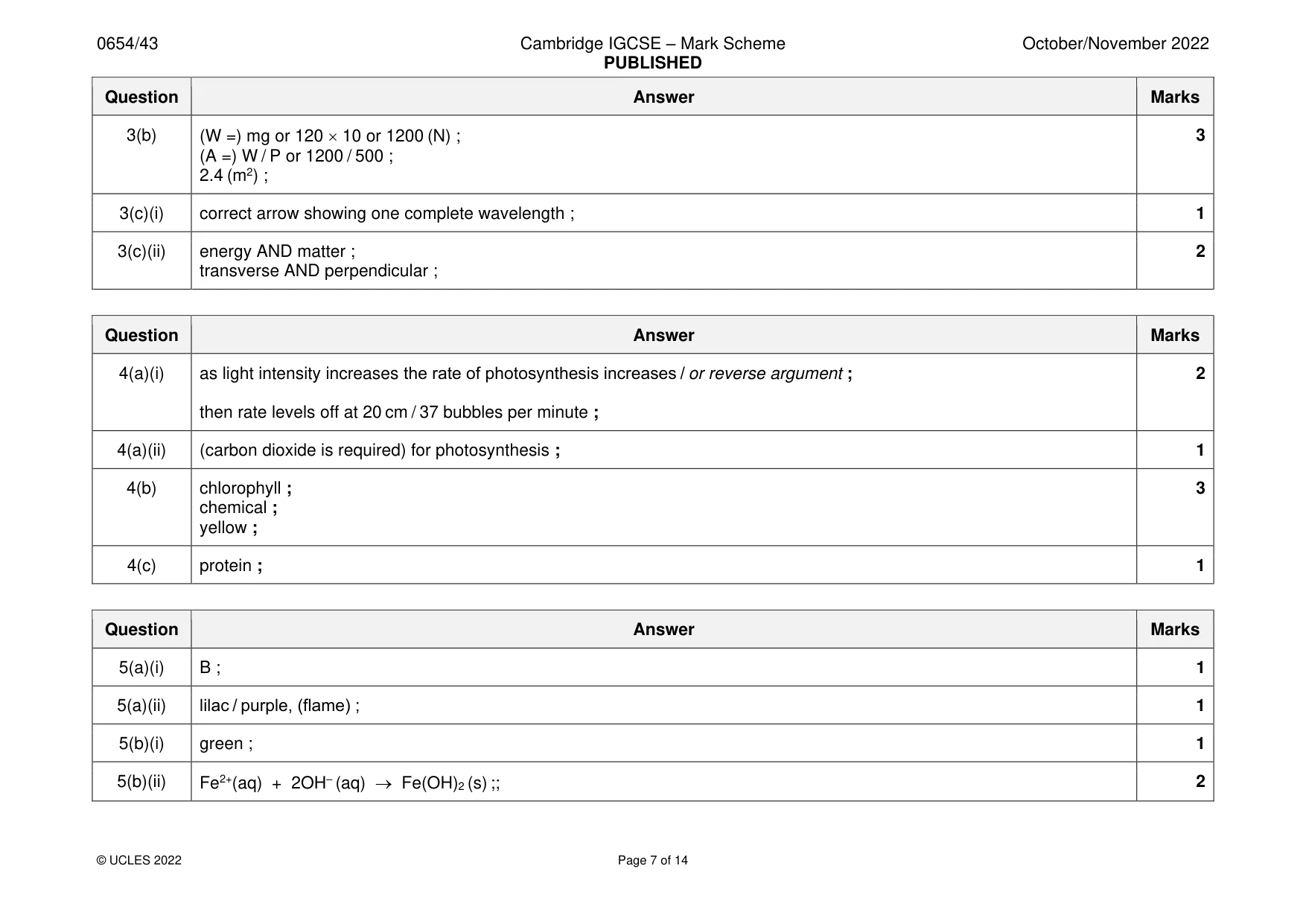
Mark scheme: 4(a)(i) as light intensity increases the rate of photosynthesis increases / or reverse argument ; 2 then rate levels off at 20 cm / 37 bubbles per minute ; 4(a)(ii) (carbon dioxide is required) for photosynthesis ; 1 4(b) chlorophyll ; 3 chemical ; yellow ; 4(c) protein ; 1
Q5 · This question is about metals
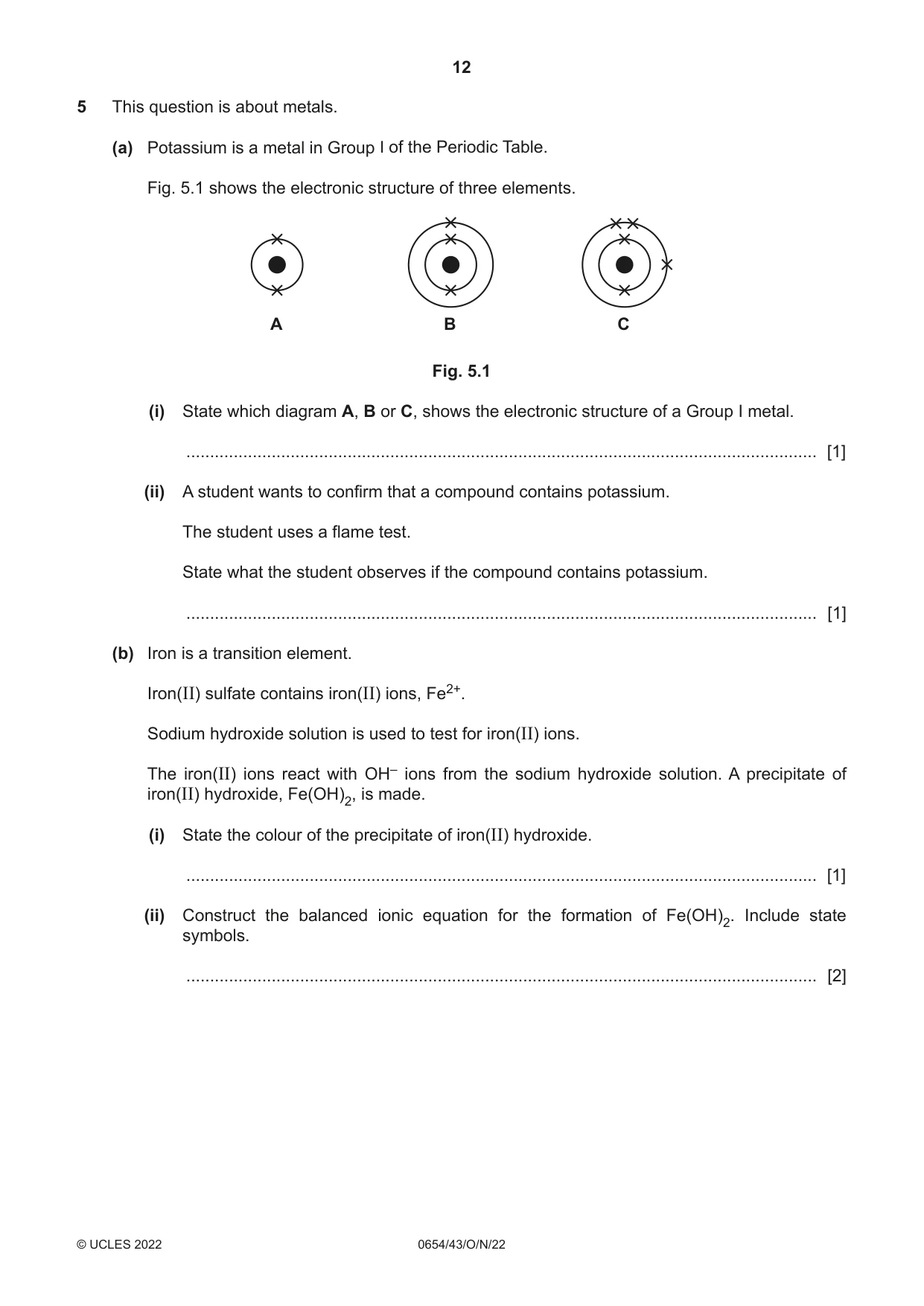
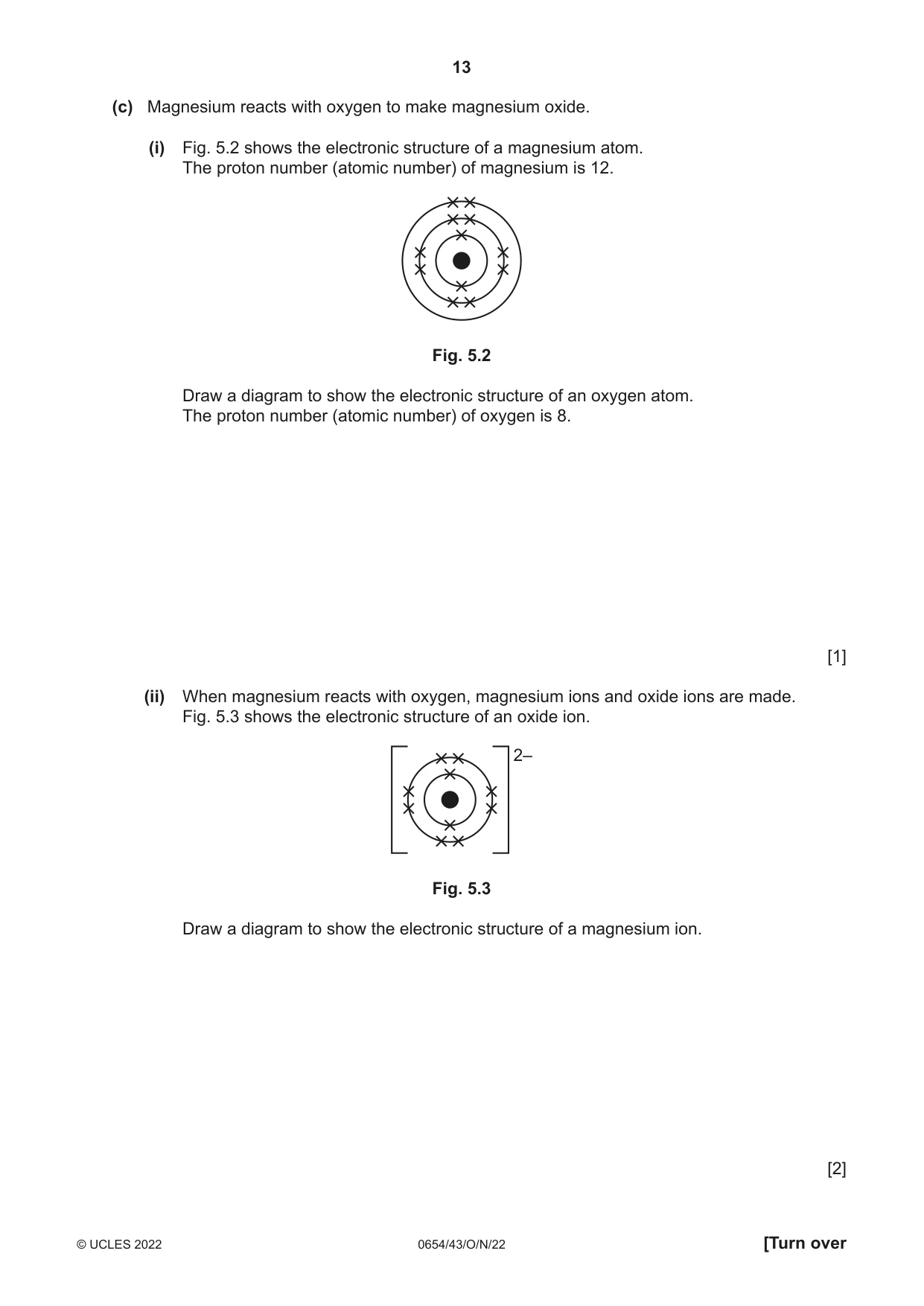
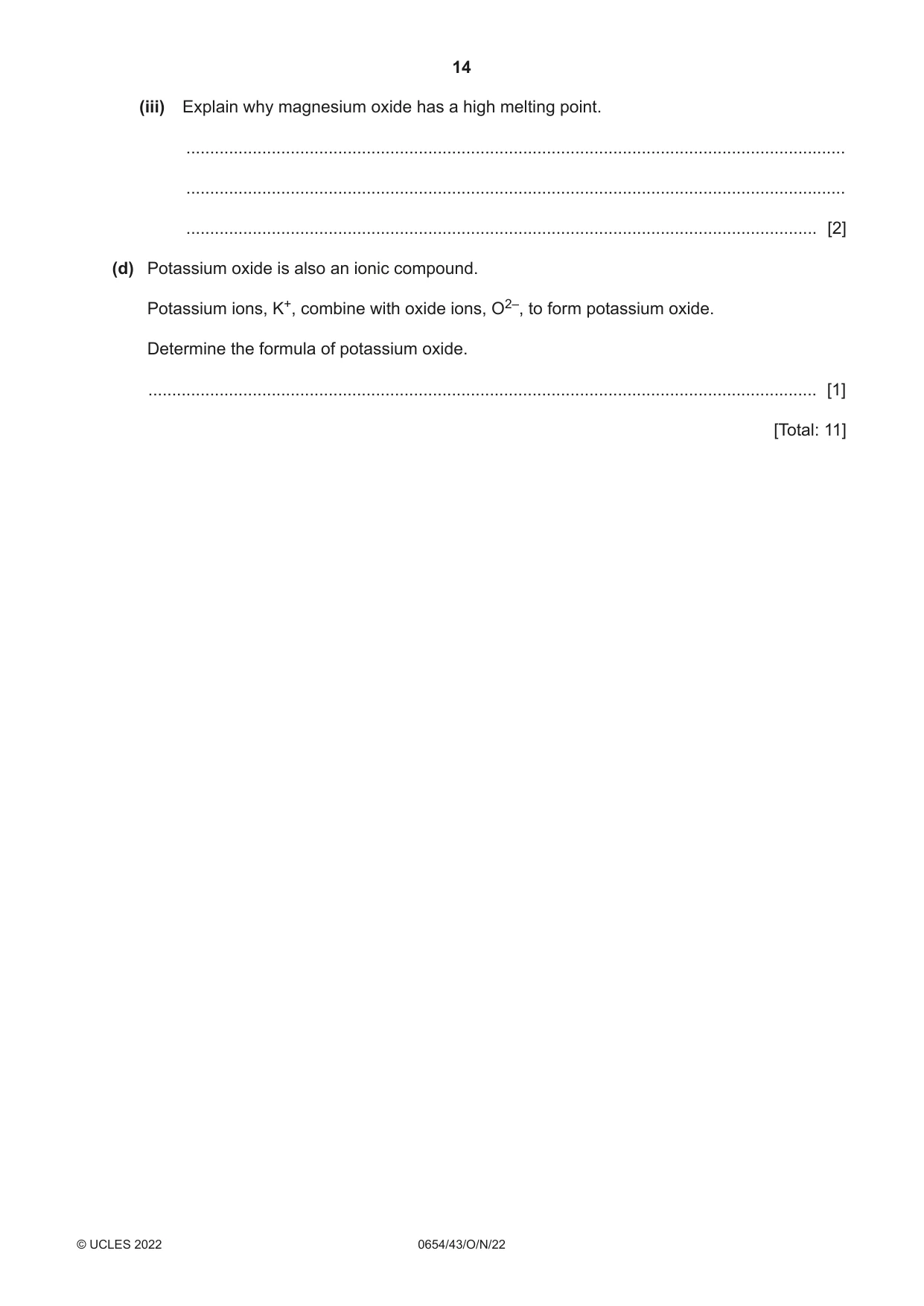
5 This question is about metals. (a) Potassium is a metal in Group I of the Periodic Table. Fig. 5.1 shows the electronic structure of three elements. A B C Fig. 5.1 (i) State which diagram A, B or C, shows the electronic structure of a Group I metal. ..................................................................................................................................... [1] (ii) A student wants to confirm that a compound contains potassium. The student uses a flame test. State what the student observes if the compound contains potassium. ..................................................................................................................................... [1] (b) Iron is a transition element. Iron(II) sulfate contains iron(II) ions, Fe2+. Sodium hydroxide solution is used to test for iron(II) ions. The iron(II) ions react with OH– ions from the sodium hydroxide solution. A precipitate of iron(II) hydroxide, Fe(OH)2, is made. (i) State the colour of the precipitate of iron(II) hydroxide. ..................................................................................................................................... [1] (ii) Construct the balanced ionic equation for the formation of Fe(OH)2. Include state symbols. ..................................................................................................................................... [2] (c) Magnesium reacts with oxygen to make magnesium oxide. (i) Fig. 5.2 shows the electronic structure of a magnesium atom. The proton number (atomic number) of magnesium is 12. Fig. 5.2 Draw a diagram to show the electronic structure of an oxygen atom. The proton number (atomic number) of oxygen is 8. [1] (ii) When magnesium reacts with oxygen, magnesium ions and oxide ions are made. Fig. 5.3 shows the electronic structure of an oxide ion. 2– Fig. 5.3 Draw a diagram to show the electronic structure of a magnesium ion. [2] (iii) Explain why magnesium oxide has a high melting point. ........................................................................................................................................... ........................................................................................................................................... ..................................................................................................................................... [2] (d) Potassium oxide is also an ionic compound. Potassium ions, K+, combine with oxide ions, O2–, to form potassium oxide. Determine the formula of potassium oxide. ............................................................................................................................................. [1] [Total: 11]
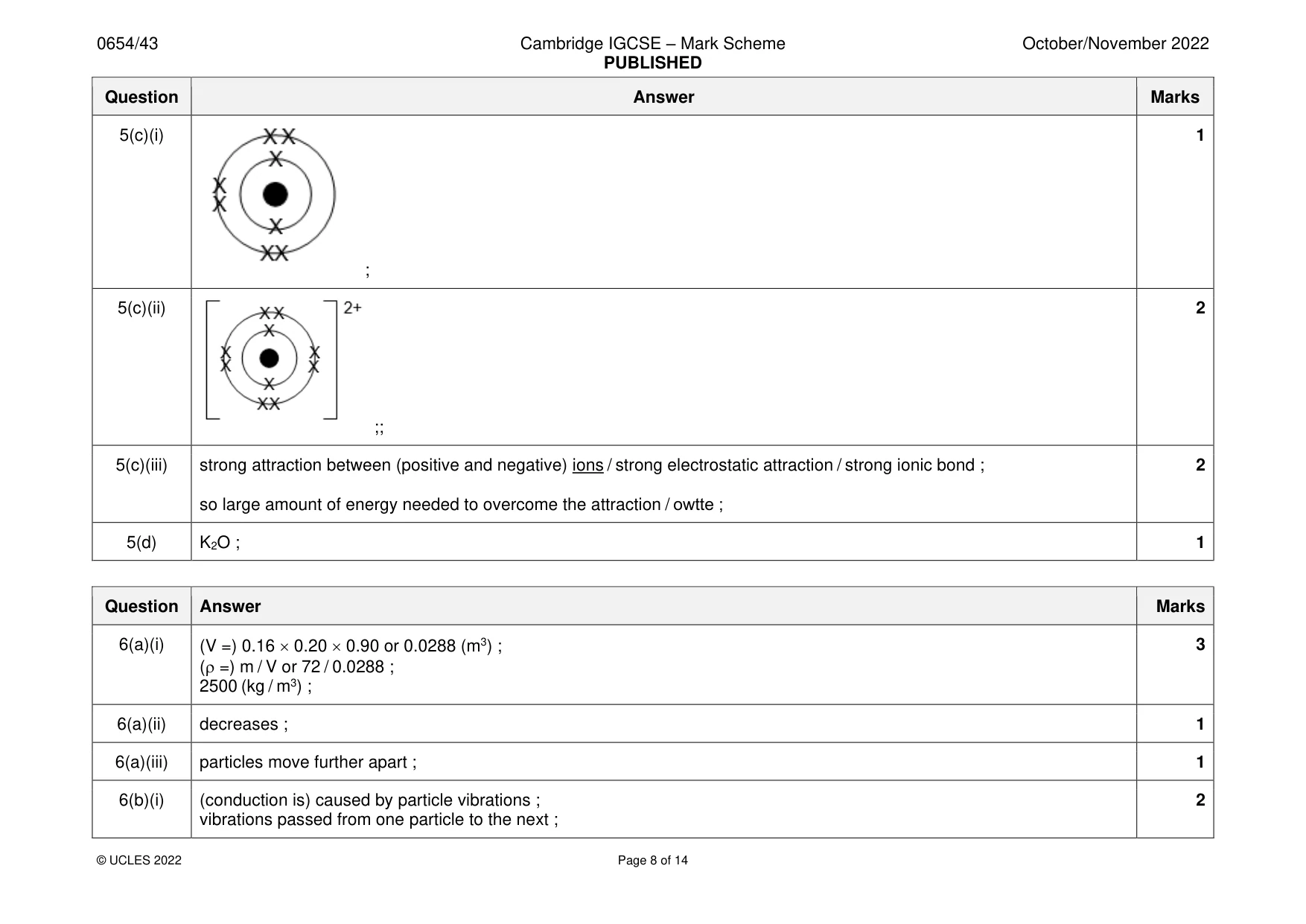
Mark scheme: 5(a)(i) B ; 1 5(a)(ii) lilac / purple, (flame) ; 1 5(b)(i) green ; 1 5(b)(ii) Fe2+(aq) + 2OH– (aq) → Fe(OH)2 (s) ;; 2 5(c)(i) 1 ; 5(c)(ii) 2 ;; 5(c)(iii) strong attraction between (positive and negative) ions / strong electrostatic attraction / strong ionic bond ; 2 so large amount of energy needed to overcome the attraction / owtte ; 5(d) K2O ; 1
Q6 · A marble staircase made up of 17 steps
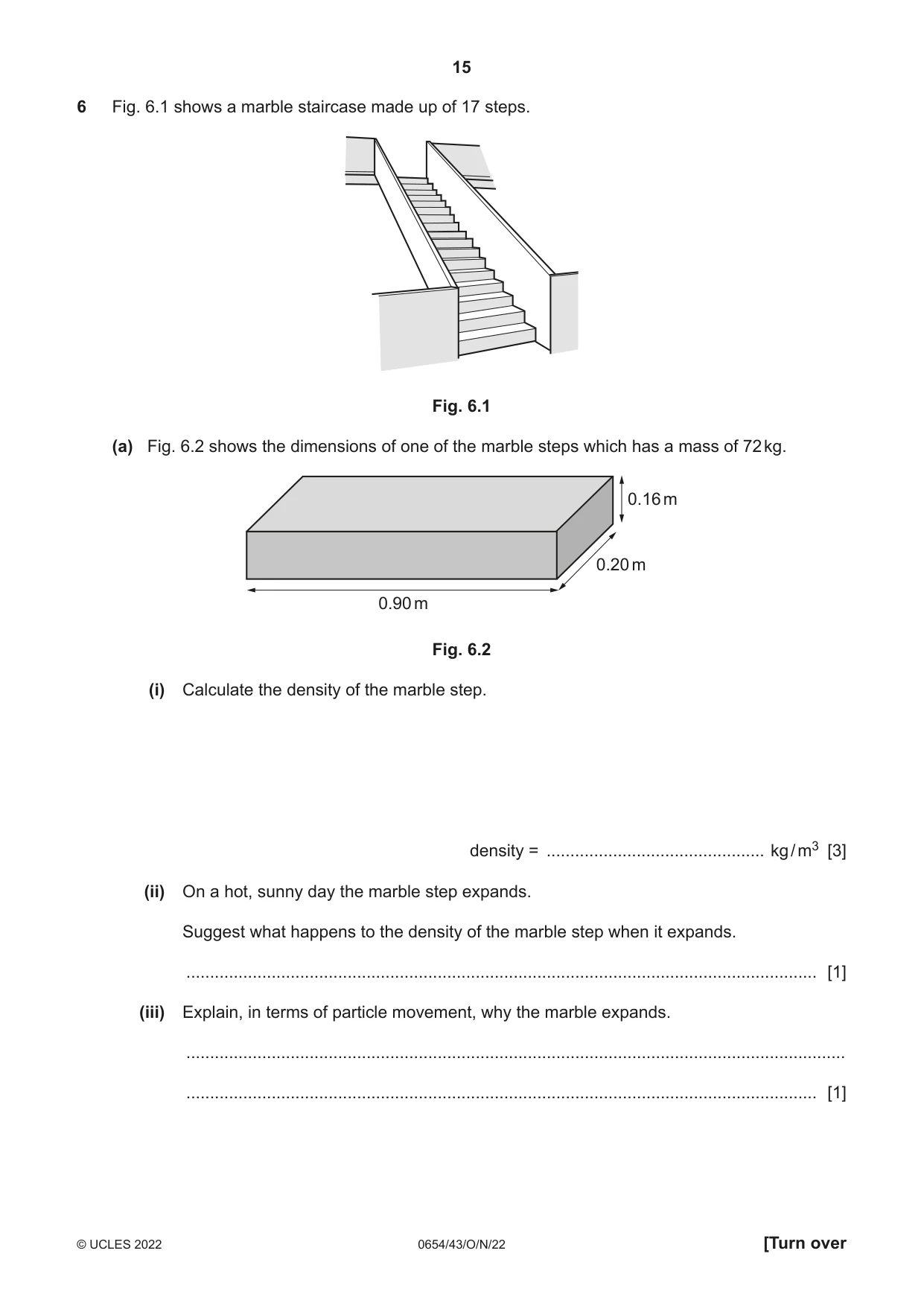
6 Fig. 6.1 shows a marble staircase made up of 17 steps. Fig. 6.1 (a) Fig. 6.2 shows the dimensions of one of the marble steps which has a mass of 72 kg. 0.16 m 0.20 m 0.90 m Fig. 6.2 (i) Calculate the density of the marble step. density = .............................................. kg / m3 [3] (ii) On a hot, sunny day the marble step expands. Suggest what happens to the density of the marble step when it expands. ..................................................................................................................................... [1] (iii) Explain, in terms of particle movement, why the marble expands. ........................................................................................................................................... ..................................................................................................................................... [1] (b) (i) On a hot, sunny day the marble steps feel cold because of conduction. Describe the process of conduction in marble. ........................................................................................................................................... ........................................................................................................................................... ........................................................................................................................................... ..................................................................................................................................... [2] (ii) Explain why conduction causes the marble to feel cold. ........................................................................................................................................... ..................................................................................................................................... [1] [Total: 8]
Mark scheme: 6(a)(i) (V =) 0.16 0.20 0.90 or 0.0288 (m3) ; 3 ( =) m / V or 72 / 0.0288 ; 2500 (kg / m3) ; 6(a)(ii) decreases ; 1 6(a)(iii) particles move further apart ; 1 6(b)(i) (conduction is) caused by particle vibrations ; 2 vibrations passed from one particle to the next ; 6(b)(ii) thermal energy is moved away from the hand / surface ; 1
Q7 · Yeast produces carbon dioxide during anaerobic respiration
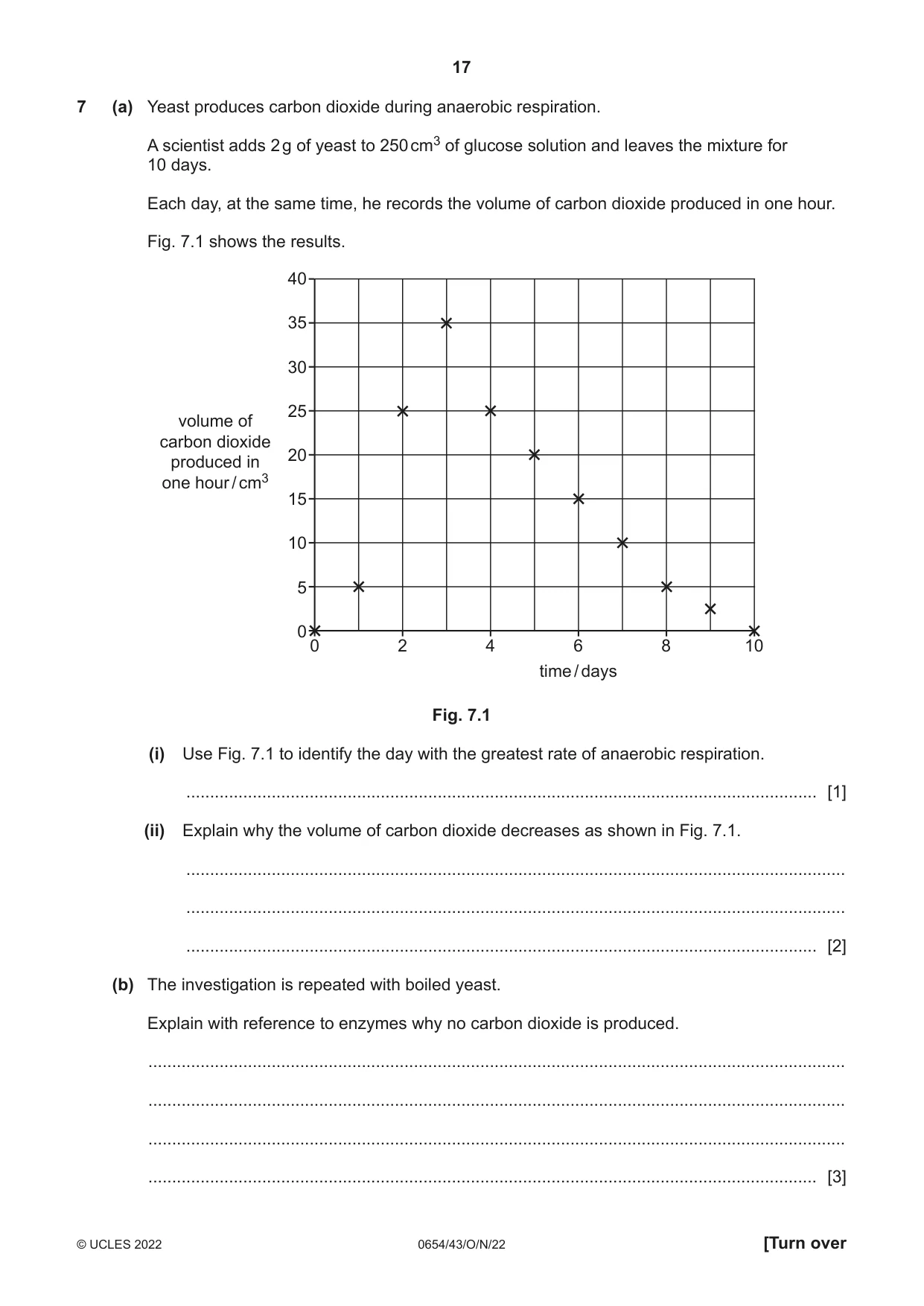
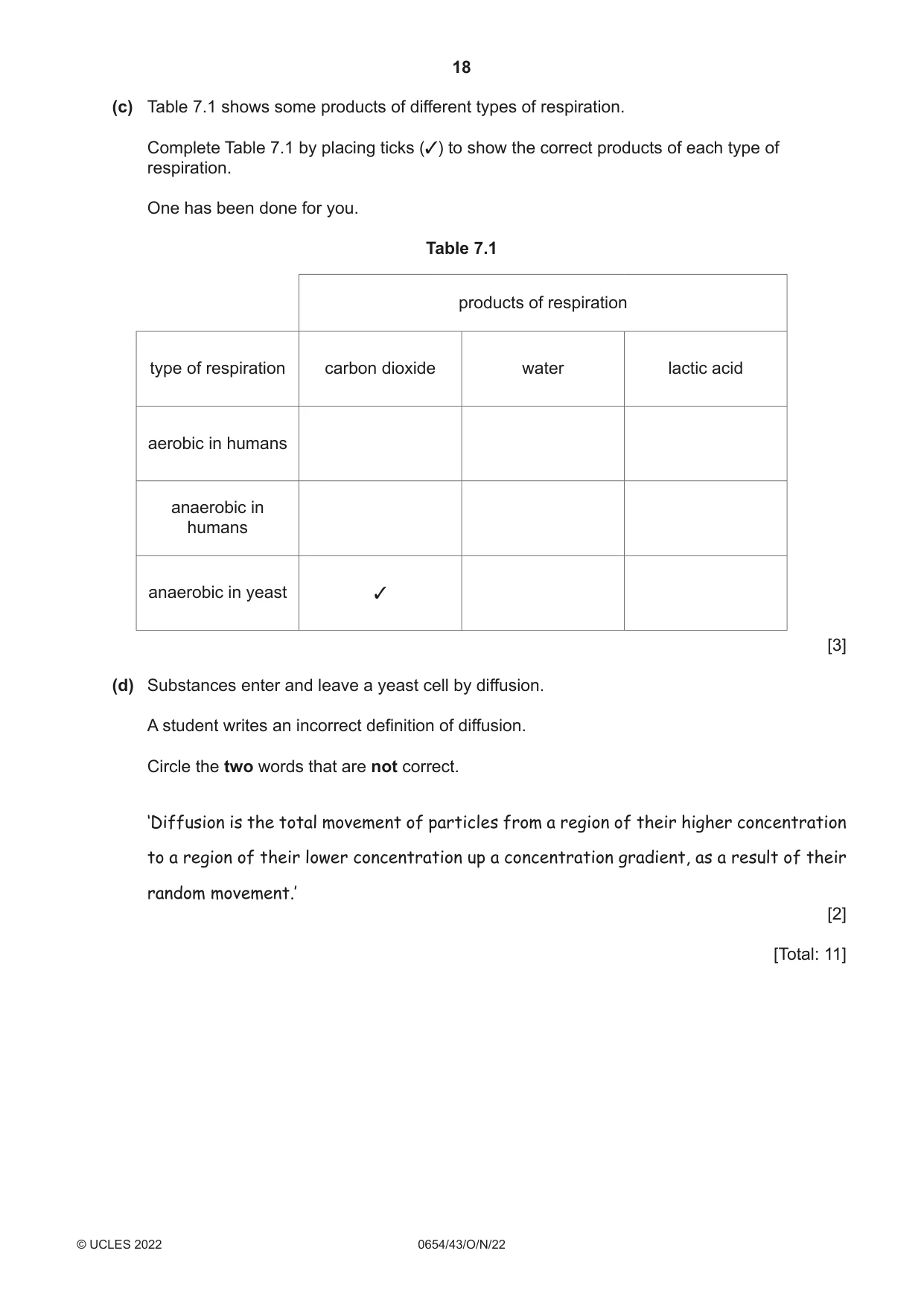
7 (a) Yeast produces carbon dioxide during anaerobic respiration. A scientist adds 2 g of yeast to 250 cm3 of glucose solution and leaves the mixture for 10 days. Each day, at the same time, he records the volume of carbon dioxide produced in one hour. Fig. 7.1 shows the results. 40 35 30 25 volume of carbon dioxide 20 produced in one hour / cm3 15 10 5 0 0 2 4 6 8 10 time / days Fig. 7.1 (i) Use Fig. 7.1 to identify the day with the greatest rate of anaerobic respiration. ..................................................................................................................................... [1] (ii) Explain why the volume of carbon dioxide decreases as shown in Fig. 7.1. ........................................................................................................................................... ........................................................................................................................................... ..................................................................................................................................... [2] (b) The investigation is repeated with boiled yeast. Explain with reference to enzymes why no carbon dioxide is produced. ................................................................................................................................................... ................................................................................................................................................... ................................................................................................................................................... ............................................................................................................................................. [3] (c) Table 7.1 shows some products of different types of respiration. Complete Table 7.1 by placing ticks (3) to show the correct products of each type of respiration. One has been done for you. Table 7.1 products of respiration type of respiration carbon dioxide water lactic acid aerobic in humans anaerobic in humans anaerobic in yeast 3 [3] (d) Substances enter and leave a yeast cell by diffusion. A student writes an incorrect definition of diffusion. Circle the two words that are not correct. ‘Diffusion is the total movement of particles from a region of their higher concentration to a region of their lower concentration up a concentration gradient, as a result of their random movement.’ [2] [Total: 11]
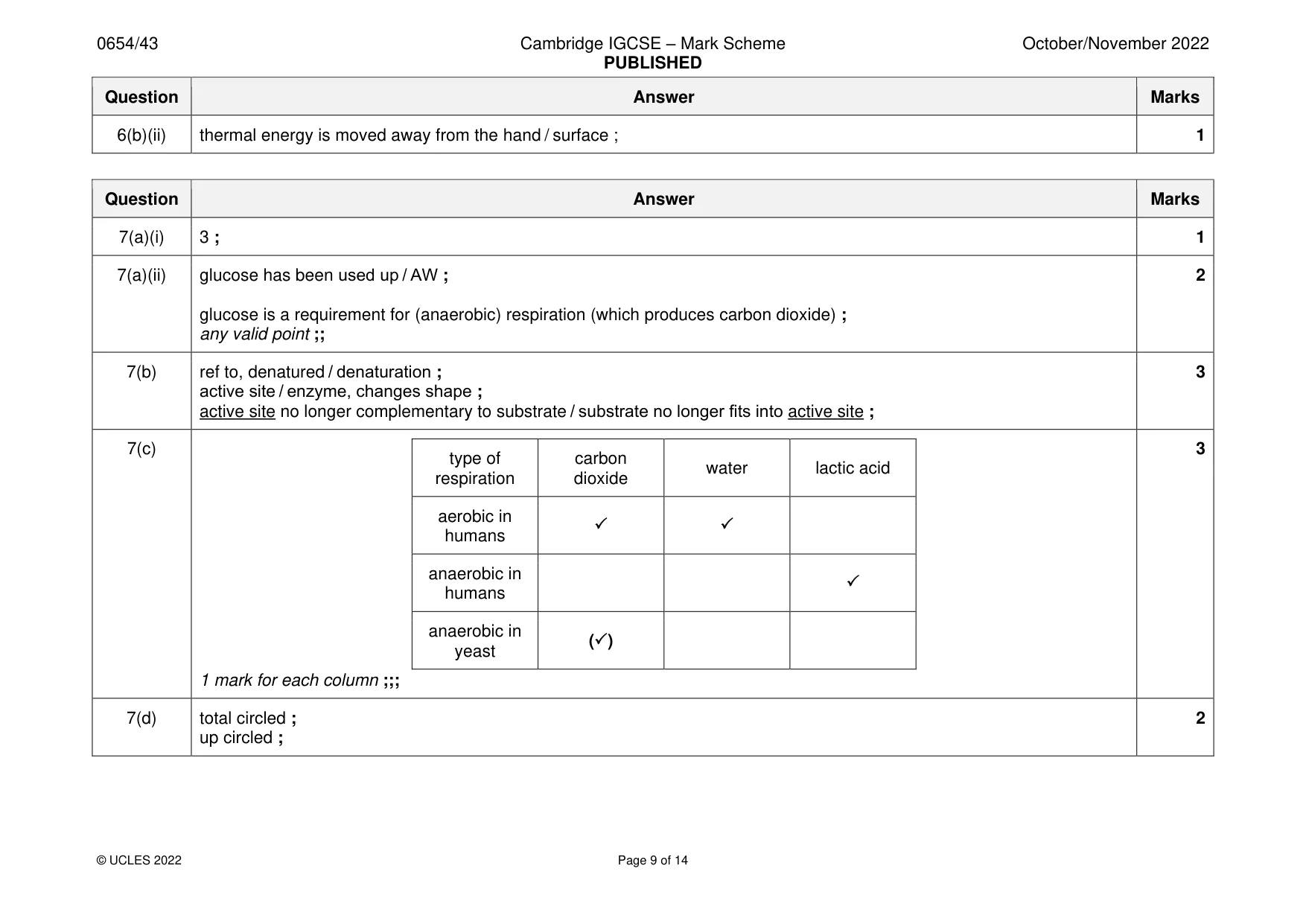
Mark scheme: 7(a)(i) 3 ; 1 7(a)(ii) glucose has been used up / AW ; 2 glucose is a requirement for (anaerobic) respiration (which produces carbon dioxide) ; any valid point ;; 7(b) ref to, denatured / denaturation ; 3 active site / enzyme, changes shape ; active site no longer complementary to substrate / substrate no longer fits into active site ; 7(c) 3 type of carbon water lactic acid respiration dioxide aerobic in humans anaerobic in humans anaerobic in () yeast 1 mark for each column ;;; 7(d) total circled ; 2 up circled ;
Q8 · Water must be treated so that it is safe to drink
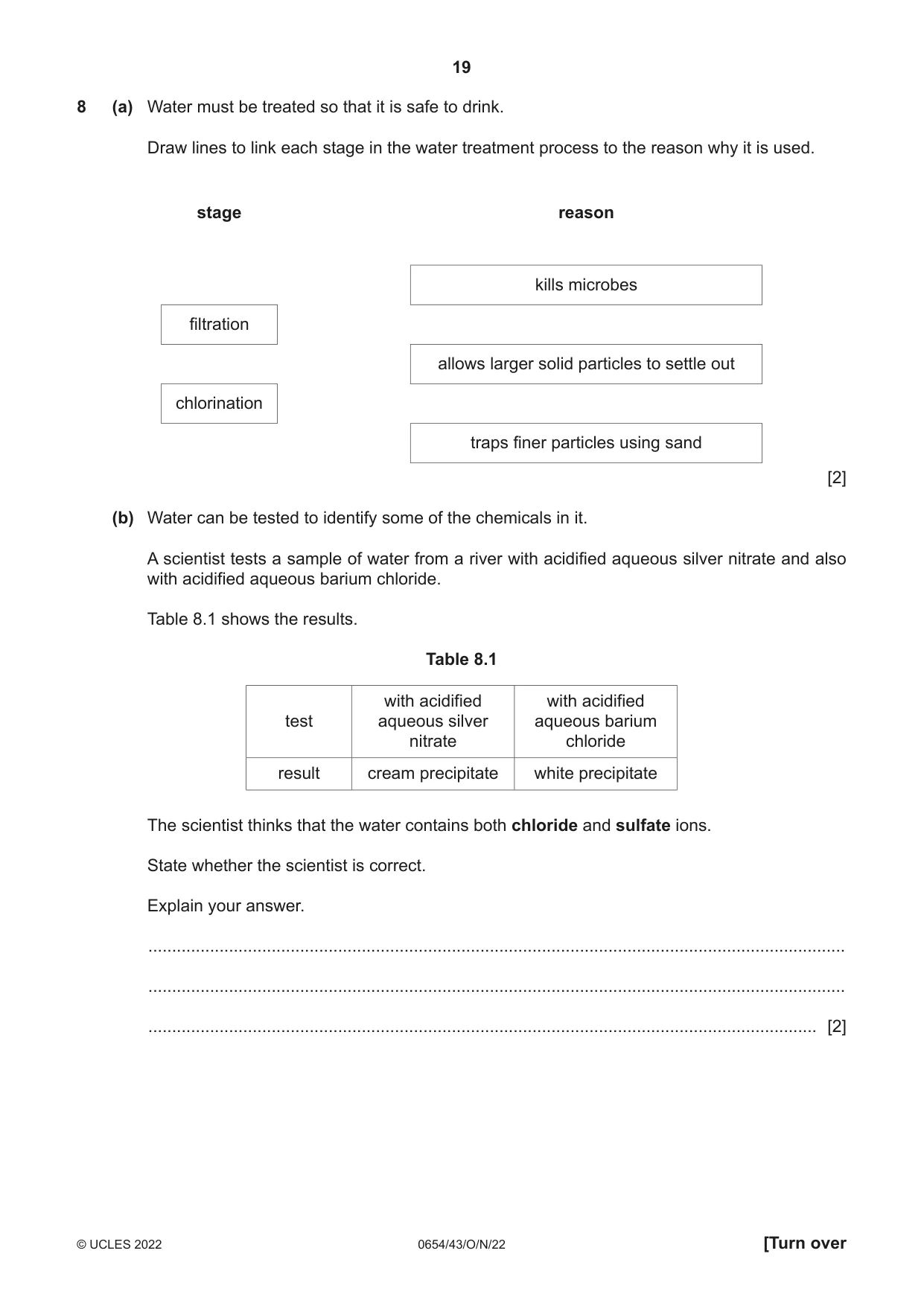
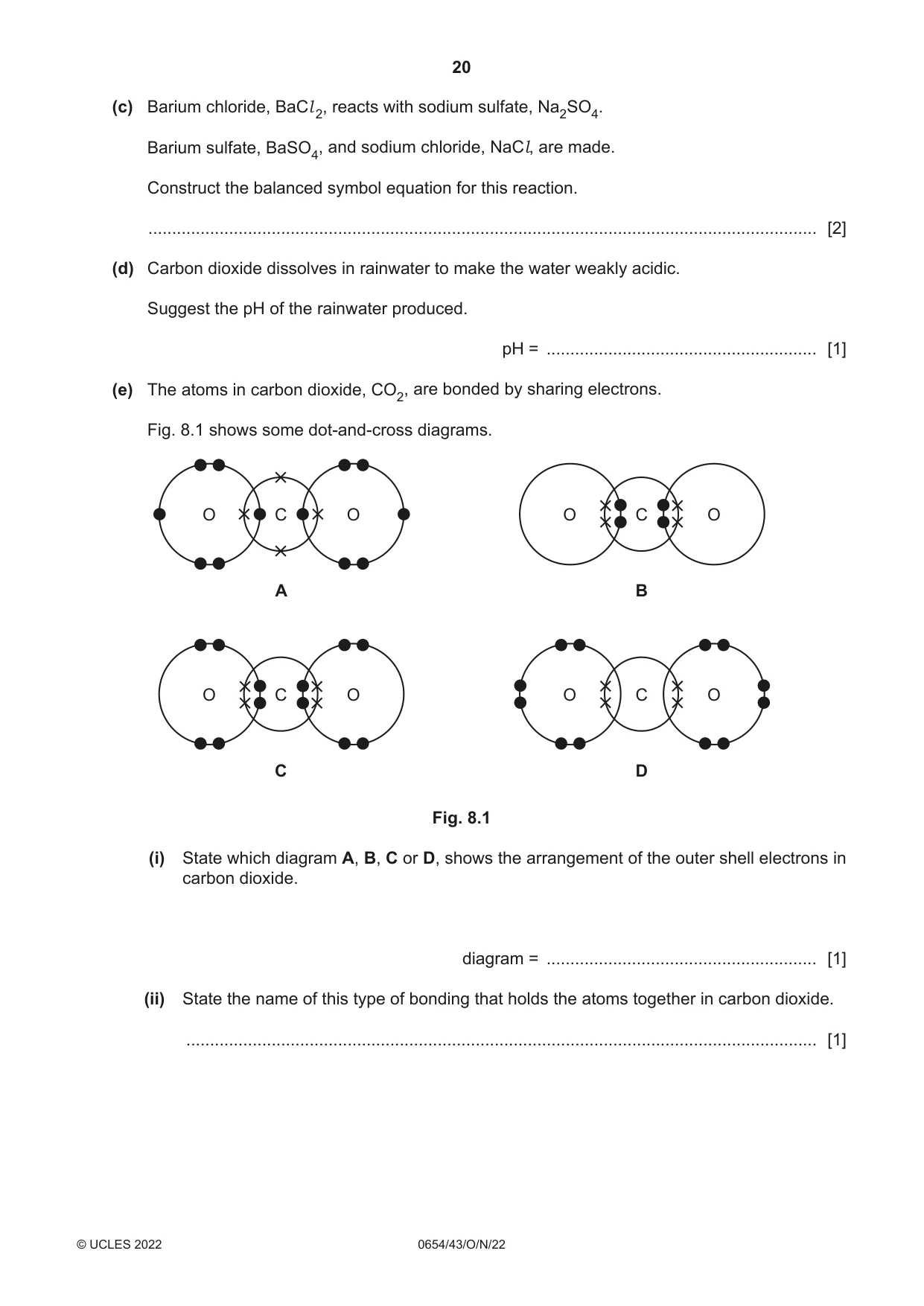
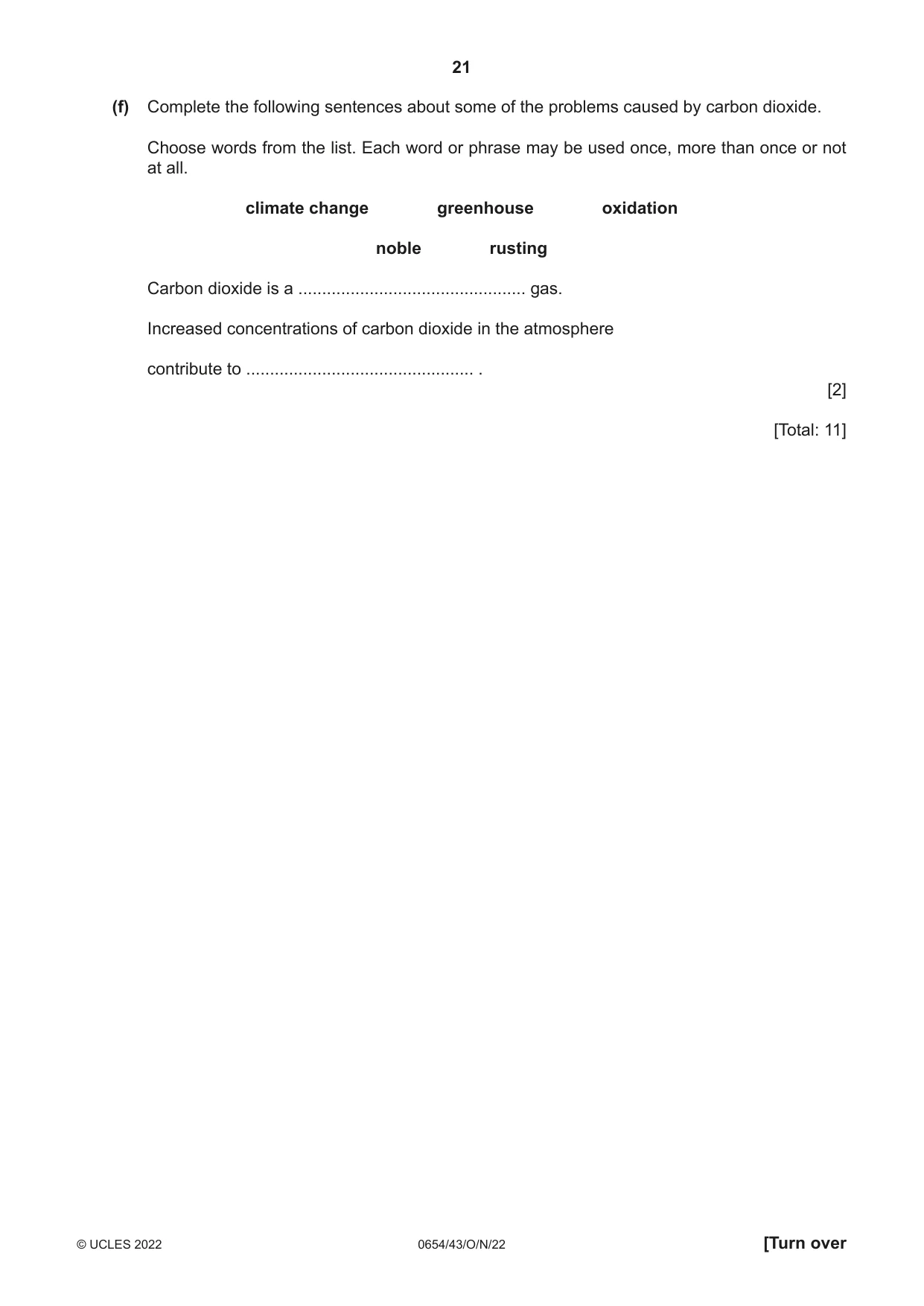
8 (a) Water must be treated so that it is safe to drink. Draw lines to link each stage in the water treatment process to the reason why it is used. stage reason kills microbes filtration allows larger solid particles to settle out chlorination traps finer particles using sand [2] (b) Water can be tested to identify some of the chemicals in it. A scientist tests a sample of water from a river with acidified aqueous silver nitrate and also with acidified aqueous barium chloride. Table 8.1 shows the results. Table 8.1 with acidified with acidified test aqueous silver aqueous barium nitrate chloride result cream precipitate white precipitate The scientist thinks that the water contains both chloride and sulfate ions. State whether the scientist is correct. Explain your answer. ................................................................................................................................................... ................................................................................................................................................... ............................................................................................................................................. [2] (c) Barium chloride, BaCl 2, reacts with sodium sulfate, Na2SO4. Barium sulfate, BaSO4, and sodium chloride, NaCl, are made. Construct the balanced symbol equation for this reaction. ............................................................................................................................................. [2] (d) Carbon dioxide dissolves in rainwater to make the water weakly acidic. Suggest the pH of the rainwater produced. pH = ......................................................... [1] (e) The atoms in carbon dioxide, CO2, are bonded by sharing electrons. Fig. 8.1 shows some dot-and-cross diagrams. O C O O C O A B O C O O C O C D Fig. 8.1 (i) State which diagram A, B, C or D, shows the arrangement of the outer shell electrons in carbon dioxide. diagram = ......................................................... [1] (ii) State the name of this type of bonding that holds the atoms together in carbon dioxide. ..................................................................................................................................... [1] (f) Complete the following sentences about some of the problems caused by carbon dioxide. Choose words from the list. Each word or phrase may be used once, more than once or not at all. climate change greenhouse oxidation noble rusting Carbon dioxide is a ................................................ gas. Increased concentrations of carbon dioxide in the atmosphere contribute to ................................................ . [2] [Total: 11]
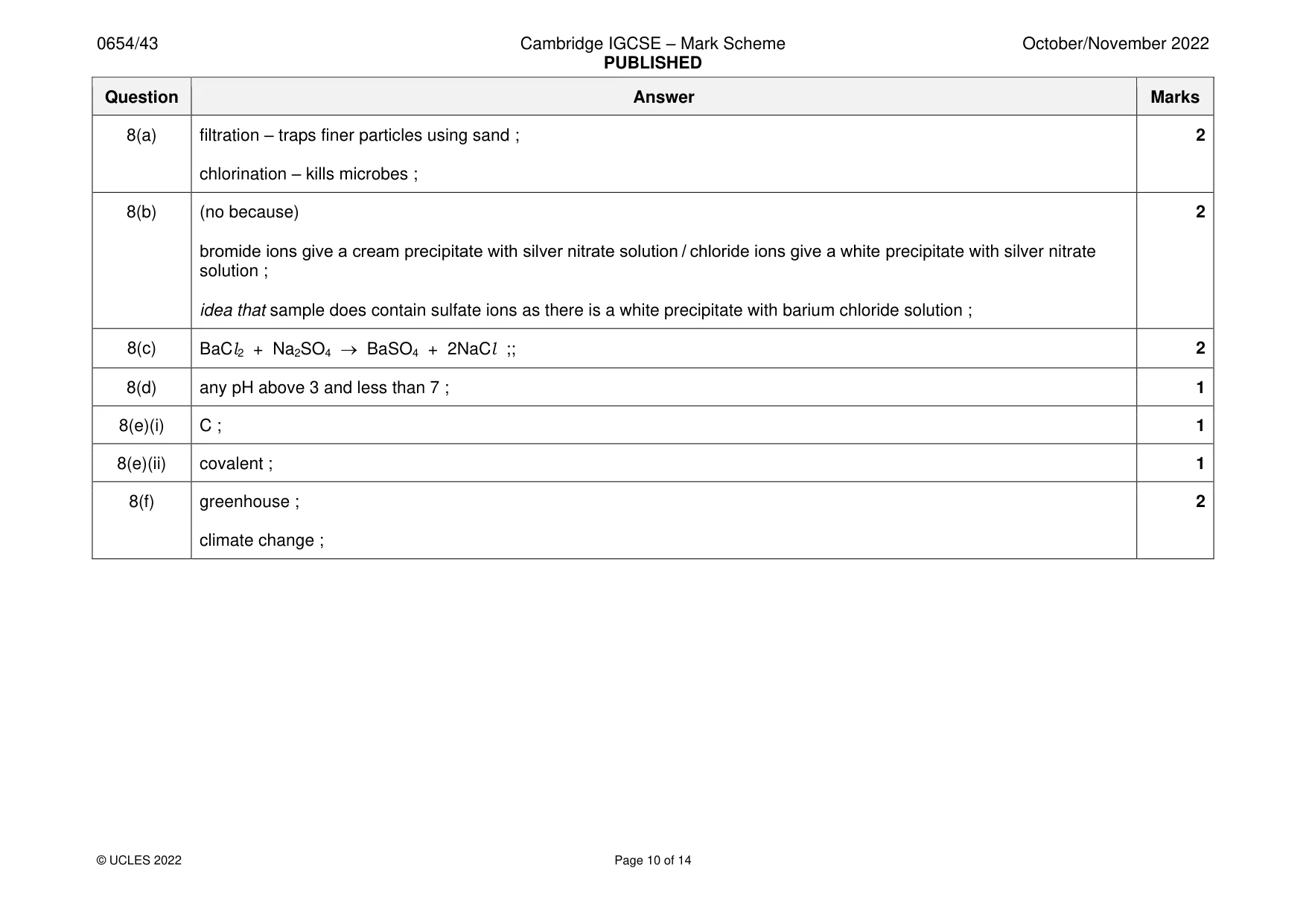
Mark scheme: 8(a) filtration – traps finer particles using sand ; 2 chlorination – kills microbes ; 8(b) (no because) 2 bromide ions give a cream precipitate with silver nitrate solution / chloride ions give a white precipitate with silver nitrate solution ; idea that sample does contain sulfate ions as there is a white precipitate with barium chloride solution ; 8(c) BaCl2 + Na2SO4 → BaSO4 + 2NaCl ;; 2 8(d) any pH above 3 and less than 7 ; 1 8(e)(i) C ; 1 8(e)(ii) covalent ; 1 8(f) greenhouse ; 2 climate change ;
Q9 · The equipment used by a teacher to demonstrate the properties of ionising radiation to a…
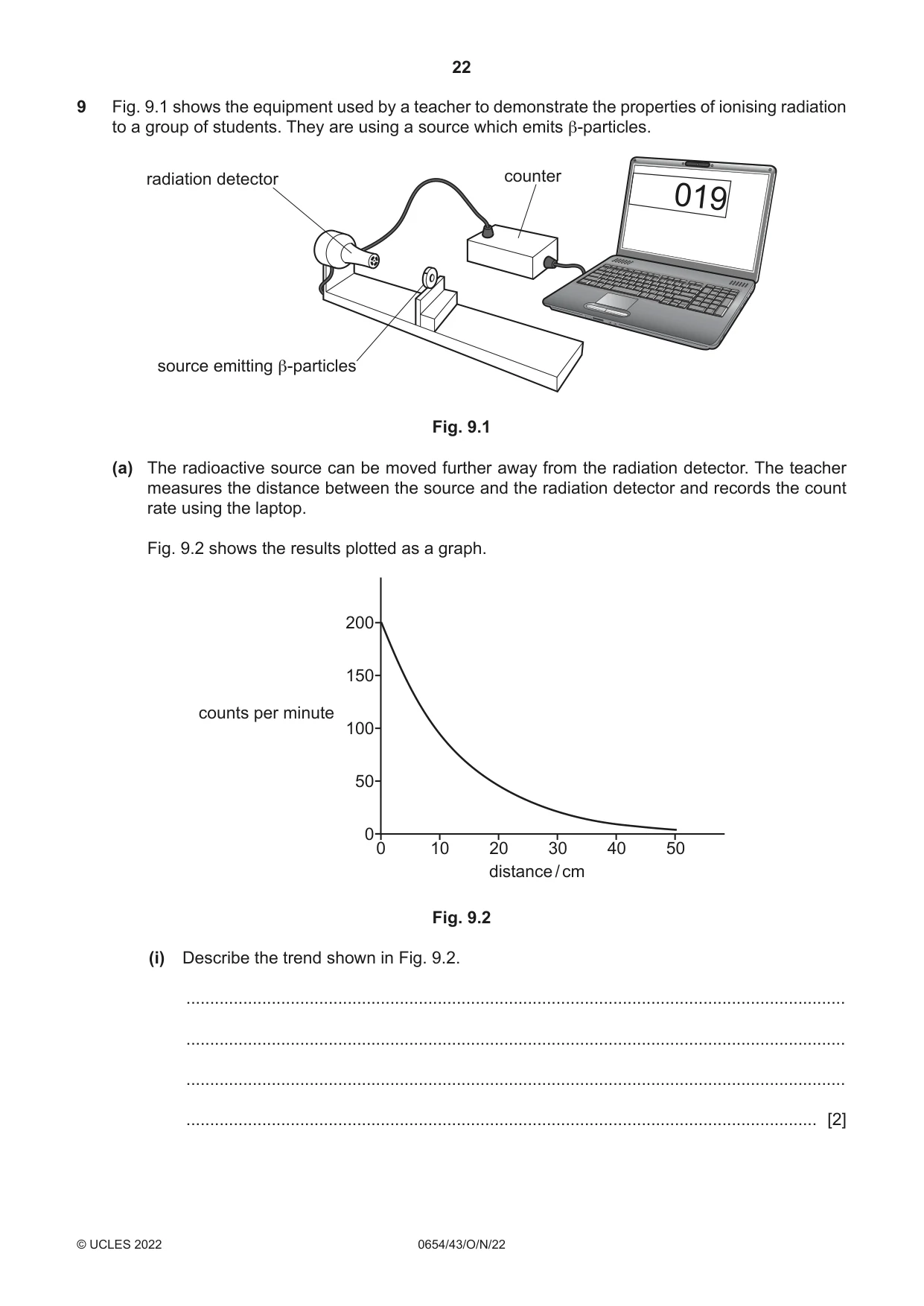
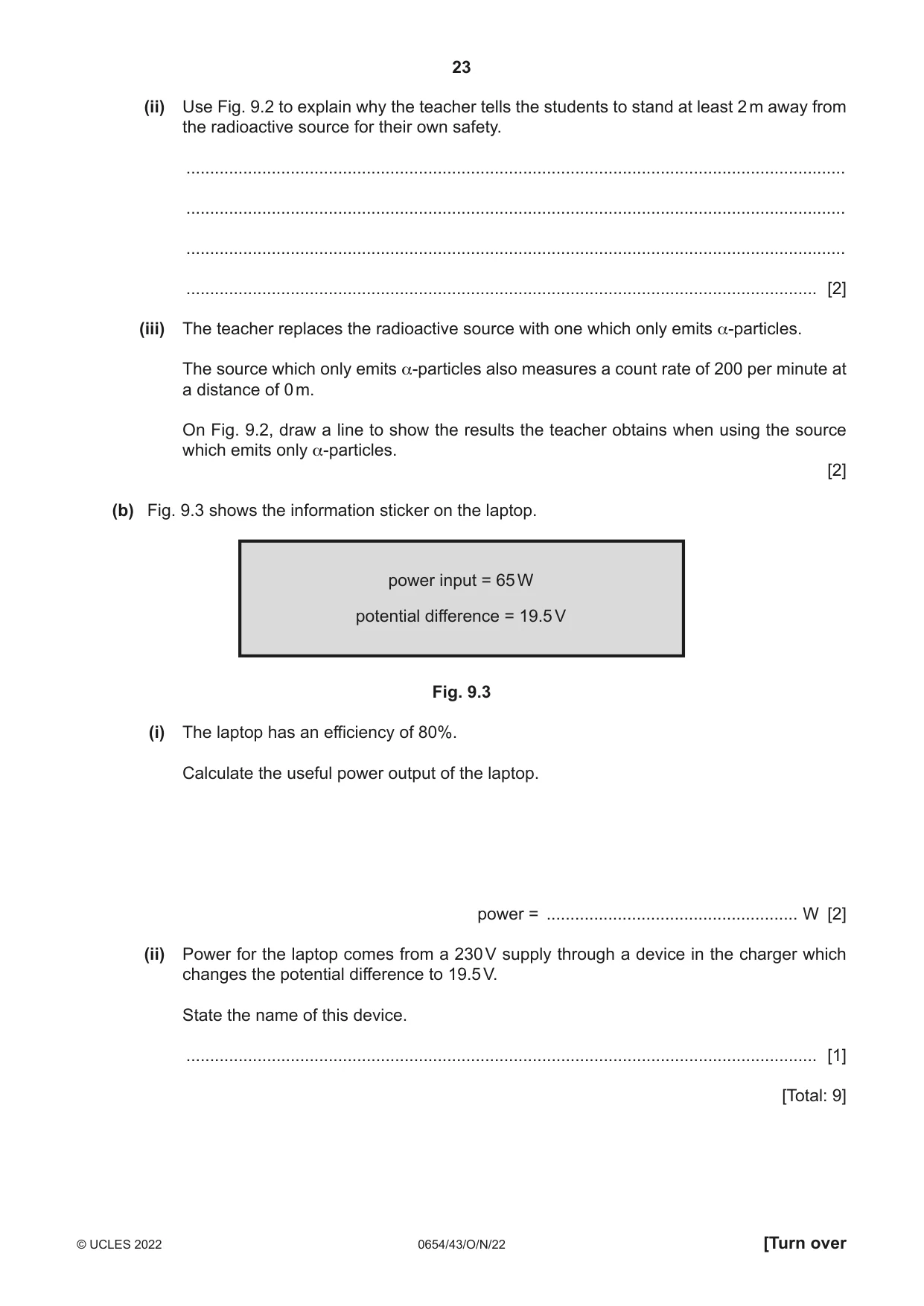
9 Fig. 9.1 shows the equipment used by a teacher to demonstrate the properties of ionising radiation to a group of students. They are using a source which emits β-particles. radiation detector counter 019 source emitting β-particles Fig. 9.1 (a) The radioactive source can be moved further away from the radiation detector. The teacher measures the distance between the source and the radiation detector and records the count rate using the laptop. Fig. 9.2 shows the results plotted as a graph. 200 150 counts per minute 100 50 0 0 10 20 30 40 50 distance / cm Fig. 9.2 (i) Describe the trend shown in Fig. 9.2. ........................................................................................................................................... ........................................................................................................................................... ........................................................................................................................................... ..................................................................................................................................... [2] (ii) Use Fig. 9.2 to explain why the teacher tells the students to stand at least 2 m away from the radioactive source for their own safety. ........................................................................................................................................... ........................................................................................................................................... ........................................................................................................................................... ..................................................................................................................................... [2] (iii) The teacher replaces the radioactive source with one which only emits α-particles. The source which only emits α-particles also measures a count rate of 200 per minute at a distance of 0 m. On Fig. 9.2, draw a line to show the results the teacher obtains when using the source which emits only α-particles. [2] (b) Fig. 9.3 shows the information sticker on the laptop. power input = 65 W potential difference = 19.5 V Fig. 9.3 (i) The laptop has an efficiency of 80%. Calculate the useful power output of the laptop. power = ..................................................... W [2] (ii) Power for the laptop comes from a 230 V supply through a device in the charger which changes the potential difference to 19.5 V. State the name of this device. ..................................................................................................................................... [1] [Total: 9]
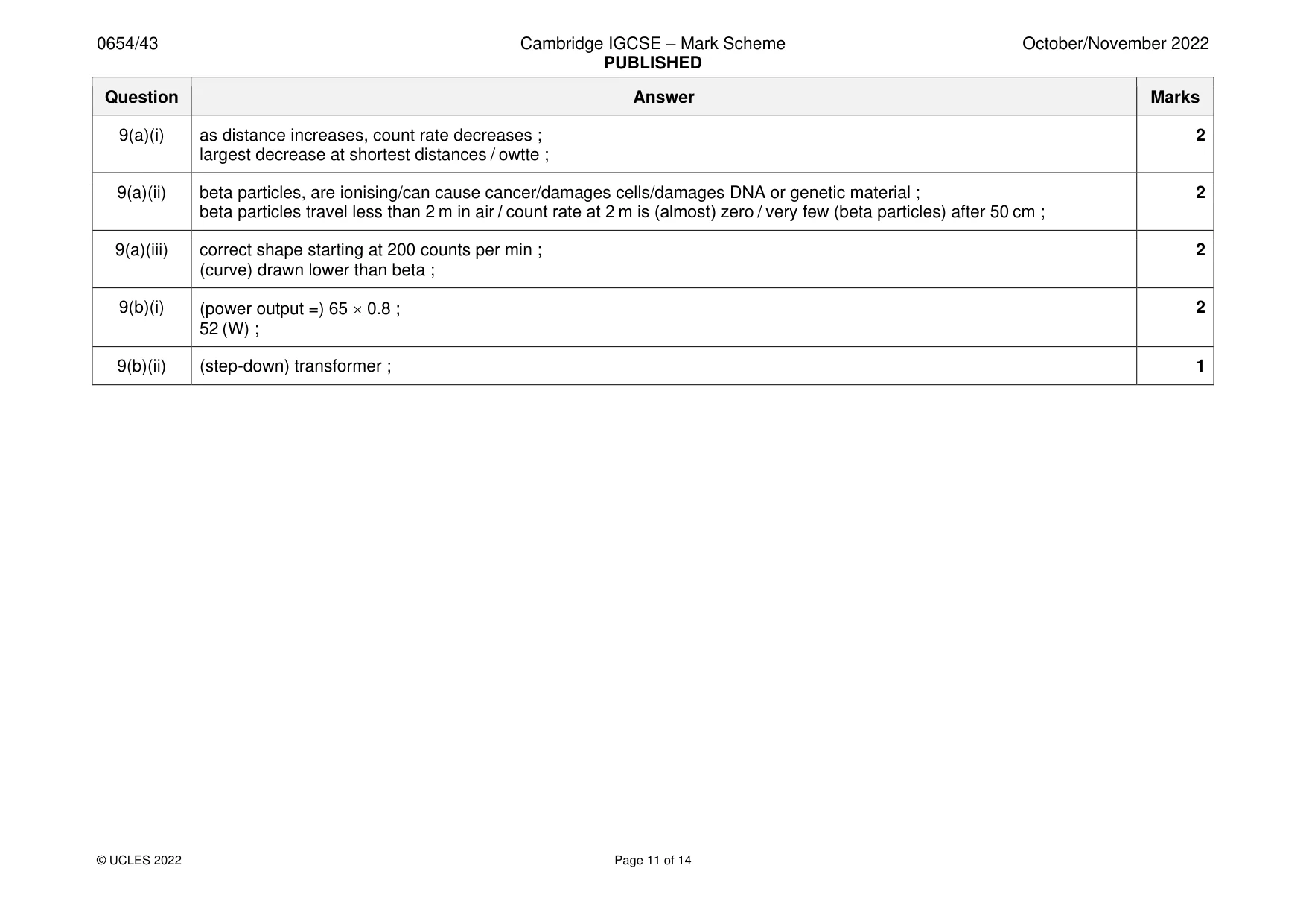
Mark scheme: 9(a)(i) as distance increases, count rate decreases ; 2 largest decrease at shortest distances / owtte ; 9(a)(ii) beta particles, are ionising/can cause cancer/damages cells/damages DNA or genetic material ; 2 beta particles travel less than 2 m in air / count rate at 2 m is (almost) zero / very few (beta particles) after 50 cm ; 9(a)(iii) correct shape starting at 200 counts per min ; 2 (curve) drawn lower than beta ; 9(b)(i) (power output =) 65 0.8 ; 2 52 (W) ; 9(b)(ii) (step-down) transformer ; 1
Q10 · Albinism is a condition that results in a lack of colour in the skin causing a very pale…
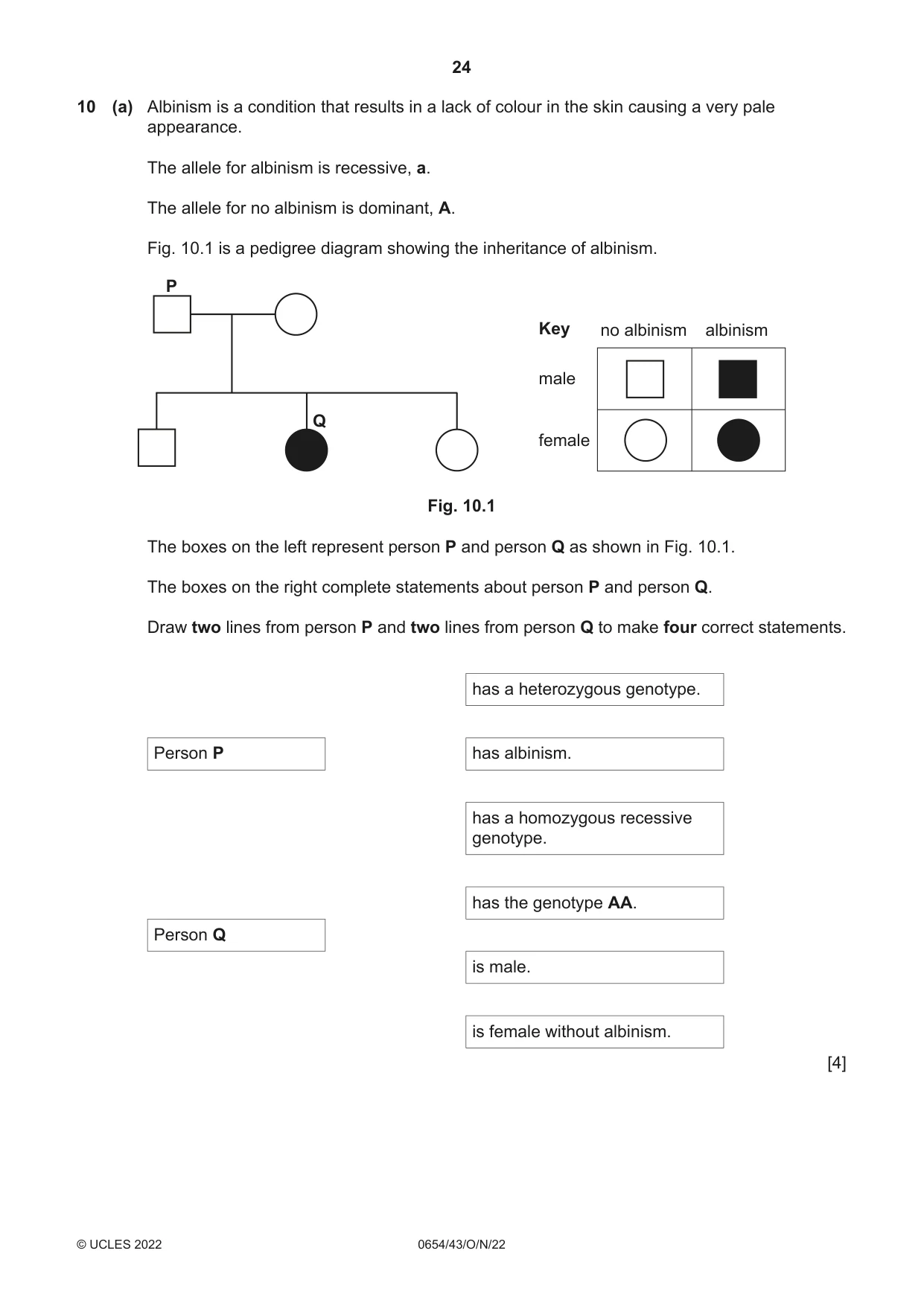
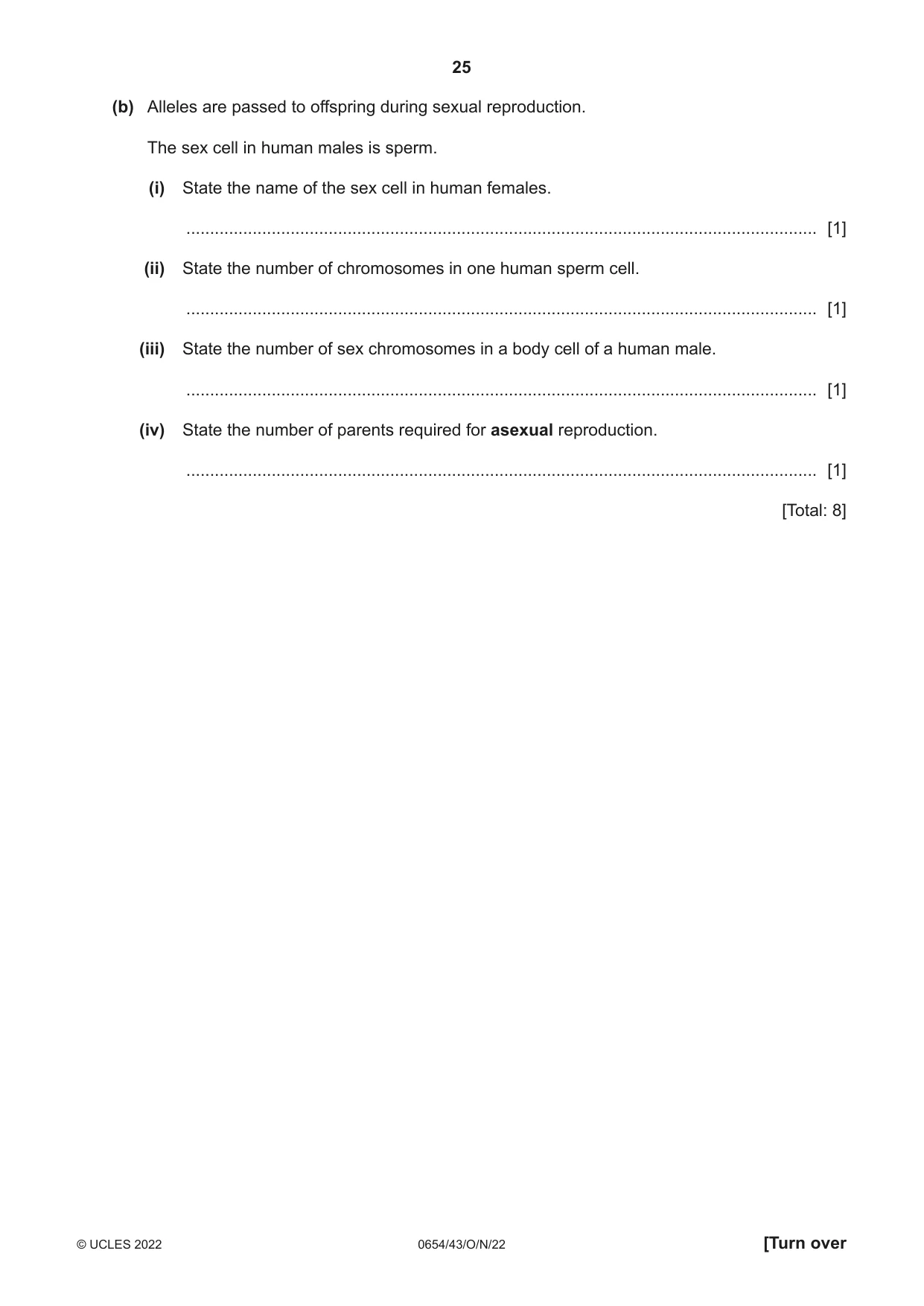
10 (a) Albinism is a condition that results in a lack of colour in the skin causing a very pale appearance. The allele for albinism is recessive, a. The allele for no albinism is dominant, A. Fig. 10.1 is a pedigree diagram showing the inheritance of albinism. P Key no albinism albinism male Q female Fig. 10.1 The boxes on the left represent person P and person Q as shown in Fig. 10.1. The boxes on the right complete statements about person P and person Q. Draw two lines from person P and two lines from person Q to make four correct statements. has a heterozygous genotype. Person P has albinism. has a homozygous recessive genotype. has the genotype AA. Person Q is male. is female without albinism. [4] (b) Alleles are passed to offspring during sexual reproduction. The sex cell in human males is sperm. (i) State the name of the sex cell in human females. ..................................................................................................................................... [1] (ii) State the number of chromosomes in one human sperm cell. ..................................................................................................................................... [1] (iii) State the number of sex chromosomes in a body cell of a human male. ..................................................................................................................................... [1] (iv) State the number of parents required for asexual reproduction. ..................................................................................................................................... [1] [Total: 8]
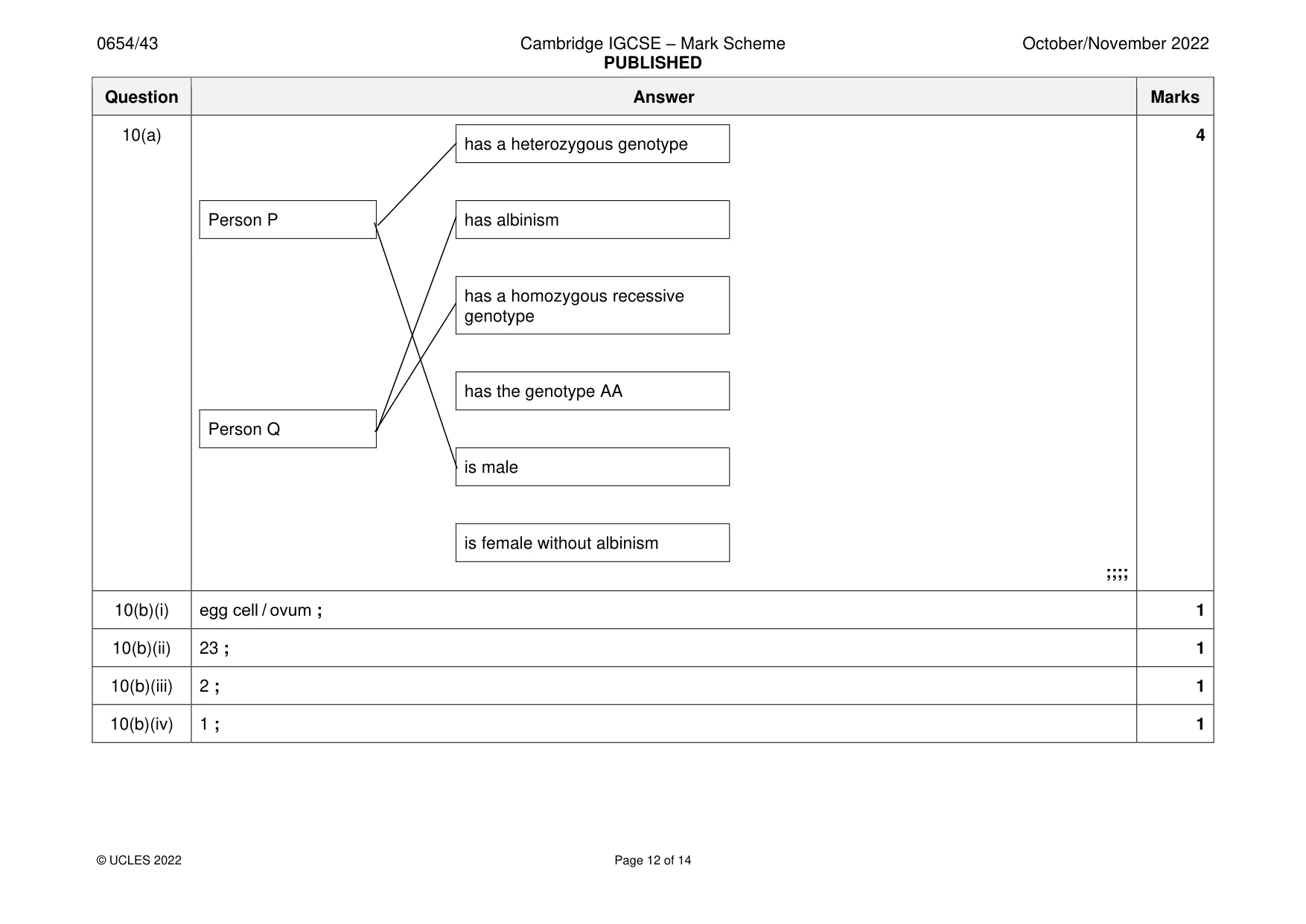
Mark scheme: 10(a) 4 has a heterozygous genotype Person P has albinism has a homozygous recessive genotype has the genotype AA Person Q is male is female without albinism ;;;; 10(b)(i) egg cell / ovum ; 1 10(b)(ii) 23 ; 1 10(b)(iii) 2 ; 1 10(b)(iv) 1 ; 1
Q11 · Diamond is one form of carbon
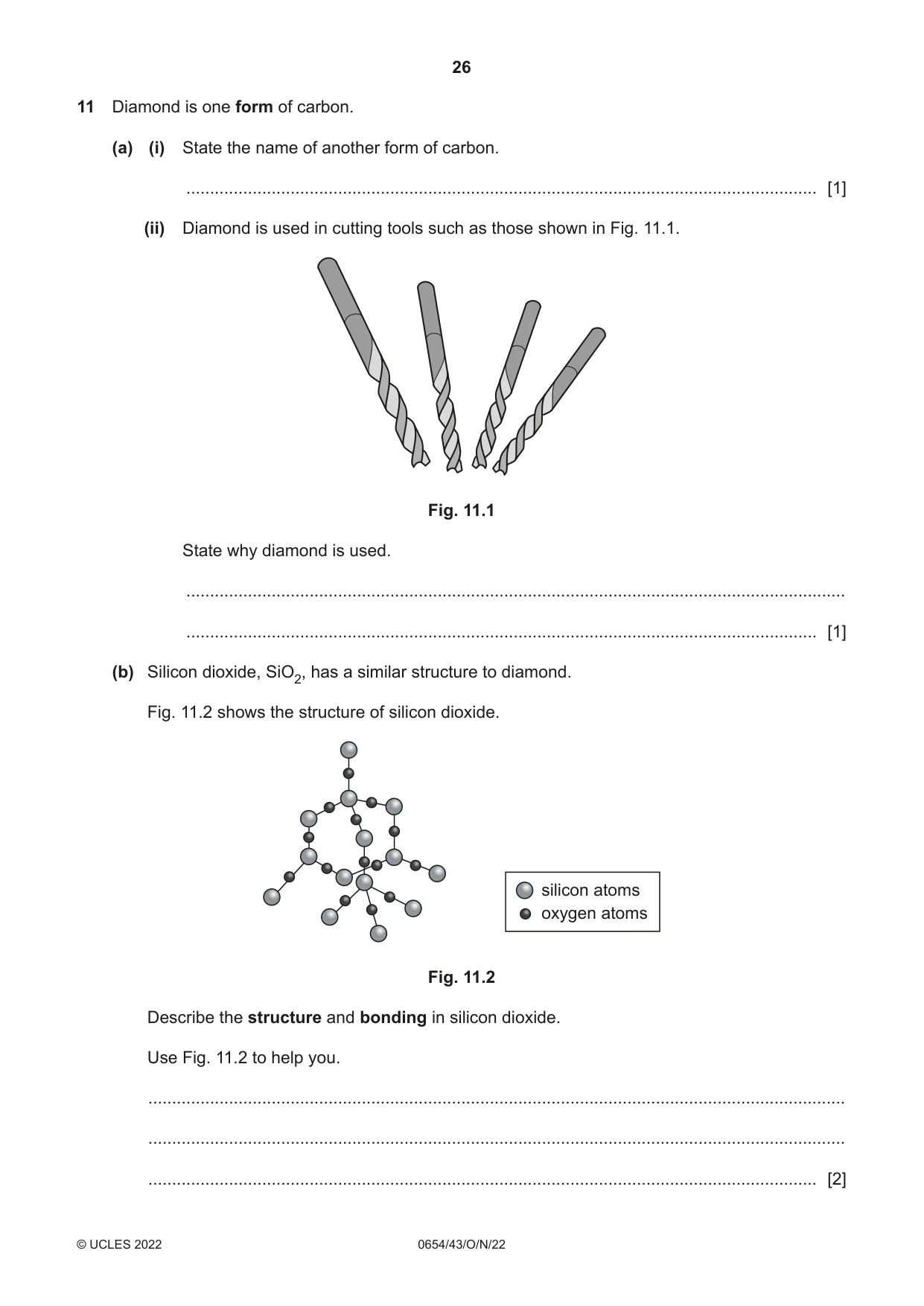
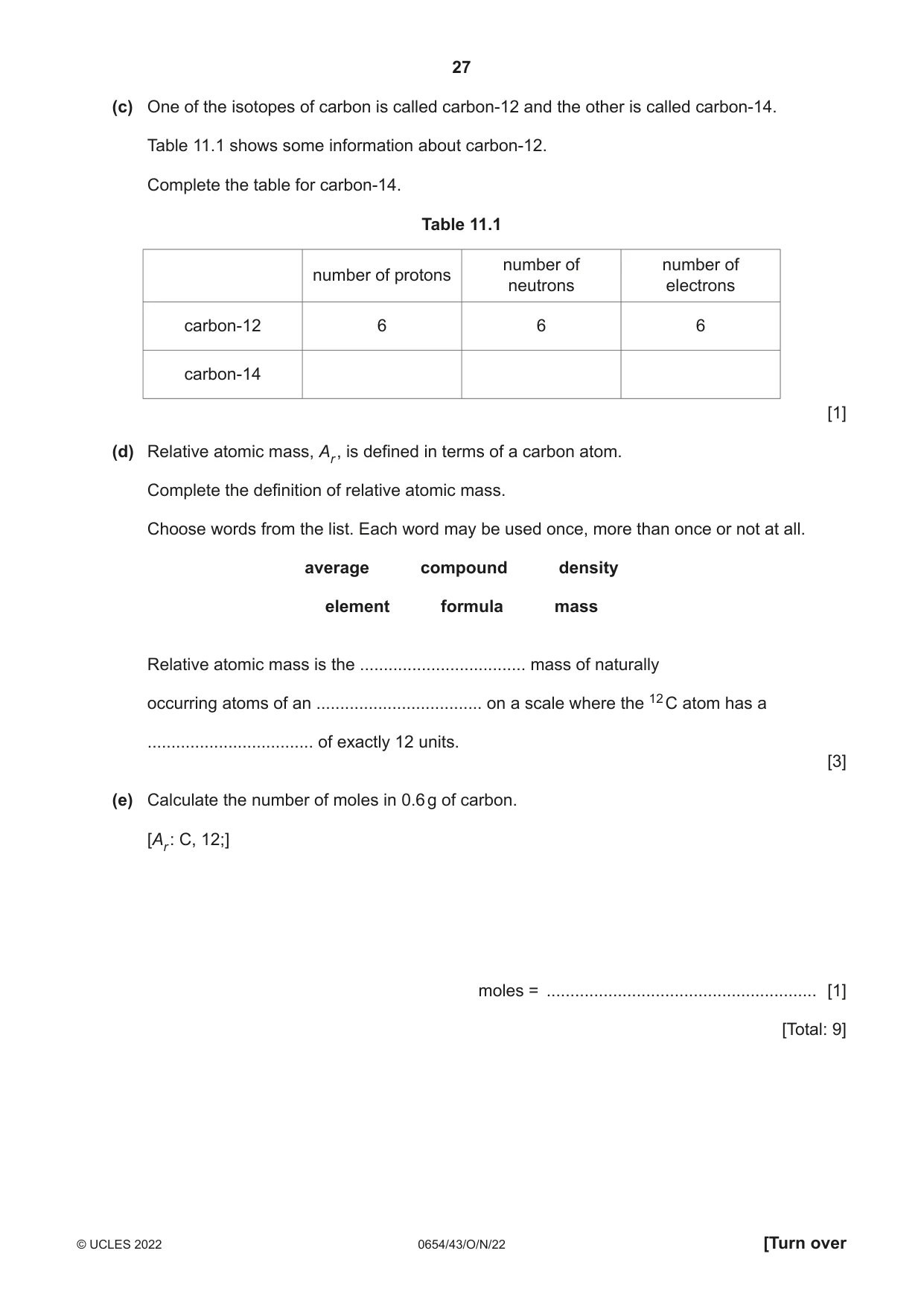
11 Diamond is one form of carbon. (a) (i) State the name of another form of carbon. ..................................................................................................................................... [1] (ii) Diamond is used in cutting tools such as those shown in Fig. 11.1. Fig. 11.1 State why diamond is used. ........................................................................................................................................... ..................................................................................................................................... [1] (b) Silicon dioxide, SiO2, has a similar structure to diamond. Fig. 11.2 shows the structure of silicon dioxide. silicon atoms oxygen atoms Fig. 11.2 Describe the structure and bonding in silicon dioxide. Use Fig. 11.2 to help you. ................................................................................................................................................... ................................................................................................................................................... ............................................................................................................................................. [2] (c) One of the isotopes of carbon is called carbon-12 and the other is called carbon-14. Table 11.1 shows some information about carbon-12. Complete the table for carbon-14. Table 11.1 number of number of number of protons neutrons electrons carbon-12 6 6 6 carbon-14 [1] (d) Relative atomic mass, Ar , is defined in terms of a carbon atom. Complete the definition of relative atomic mass. Choose words from the list. Each word may be used once, more than once or not at all. average compound density element formula mass Relative atomic mass is the ................................... mass of naturally occurring atoms of an ................................... on a scale where the 12 C atom has a ................................... of exactly 12 units. [3] (e) Calculate the number of moles in 0.6 g of carbon. [Ar : C, 12;] moles = ......................................................... [1] [Total: 9]
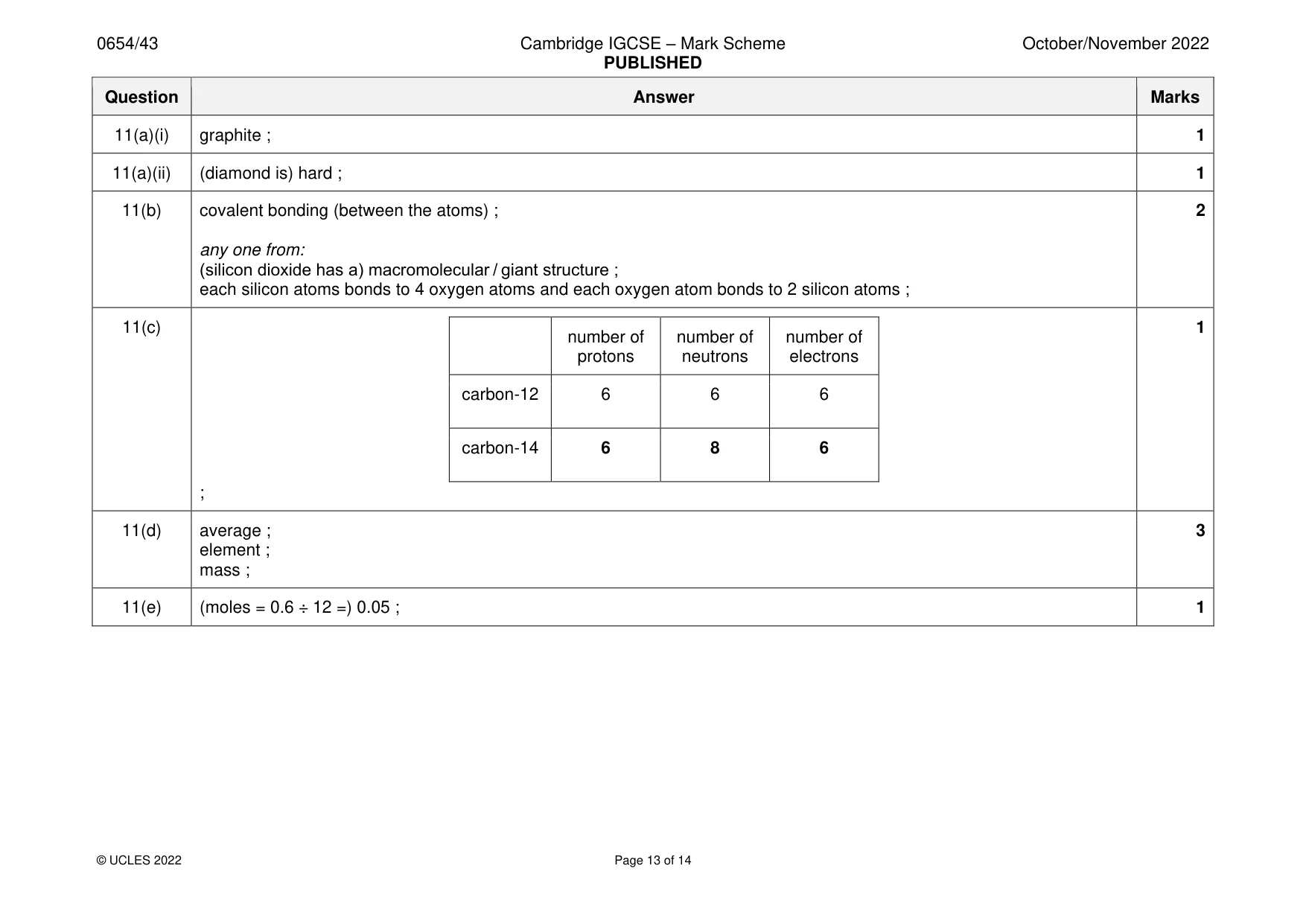
Mark scheme: 11(a)(i) graphite ; 1 11(a)(ii) (diamond is) hard ; 1 11(b) covalent bonding (between the atoms) ; 2 any one from: (silicon dioxide has a) macromolecular / giant structure ; each silicon atoms bonds to 4 oxygen atoms and each oxygen atom bonds to 2 silicon atoms ; 11(c) 1 number of number of number of protons neutrons electrons carbon-12 6 6 6 carbon-14 6 8 6 ; 11(d) average ; 3 element ; mass ; 11(e) (moles = 0.6 ÷ 12 =) 0.05 ; 1
Q12 · A circuit containing two resistors connected in parallel with a 9.0 V battery
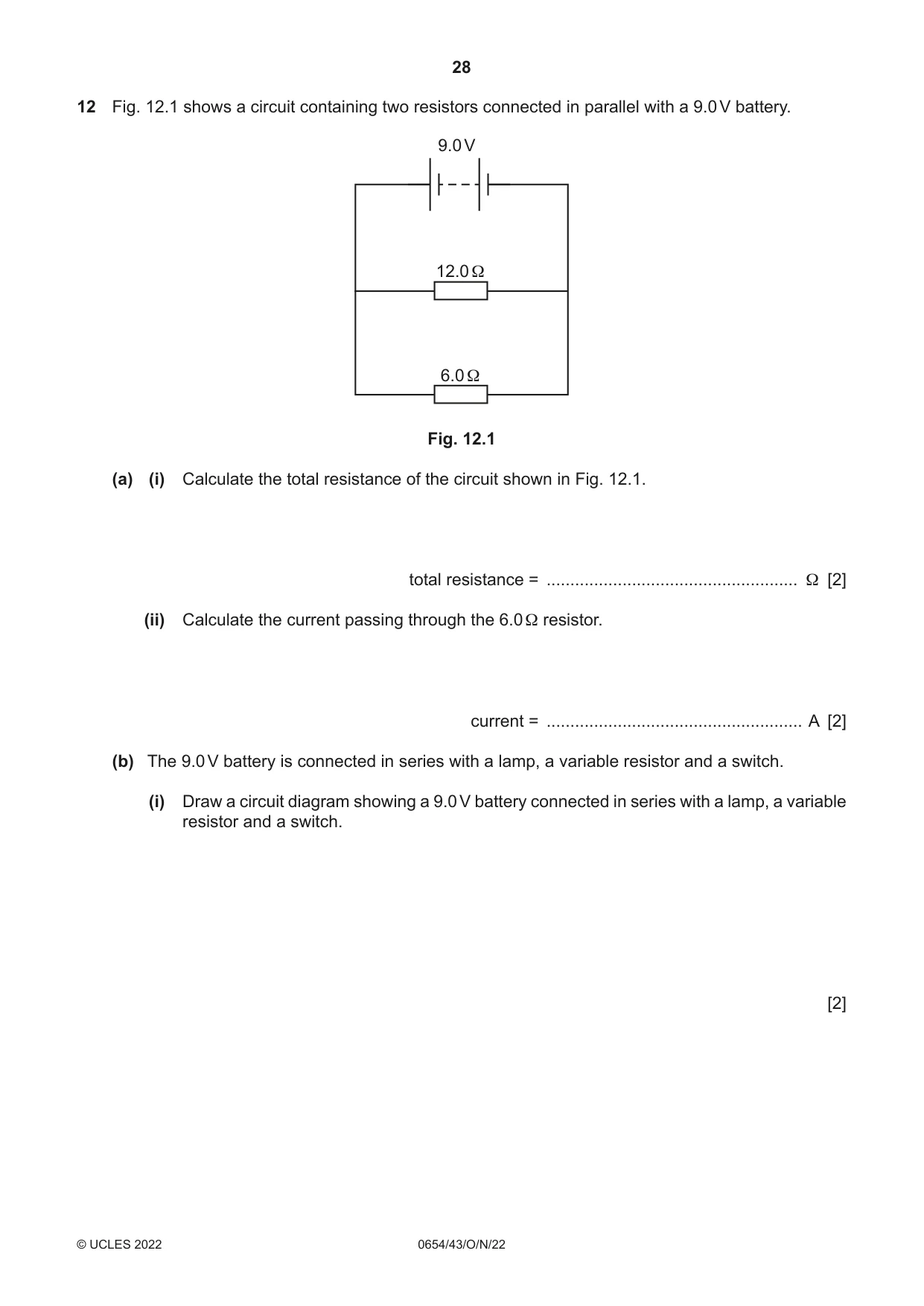
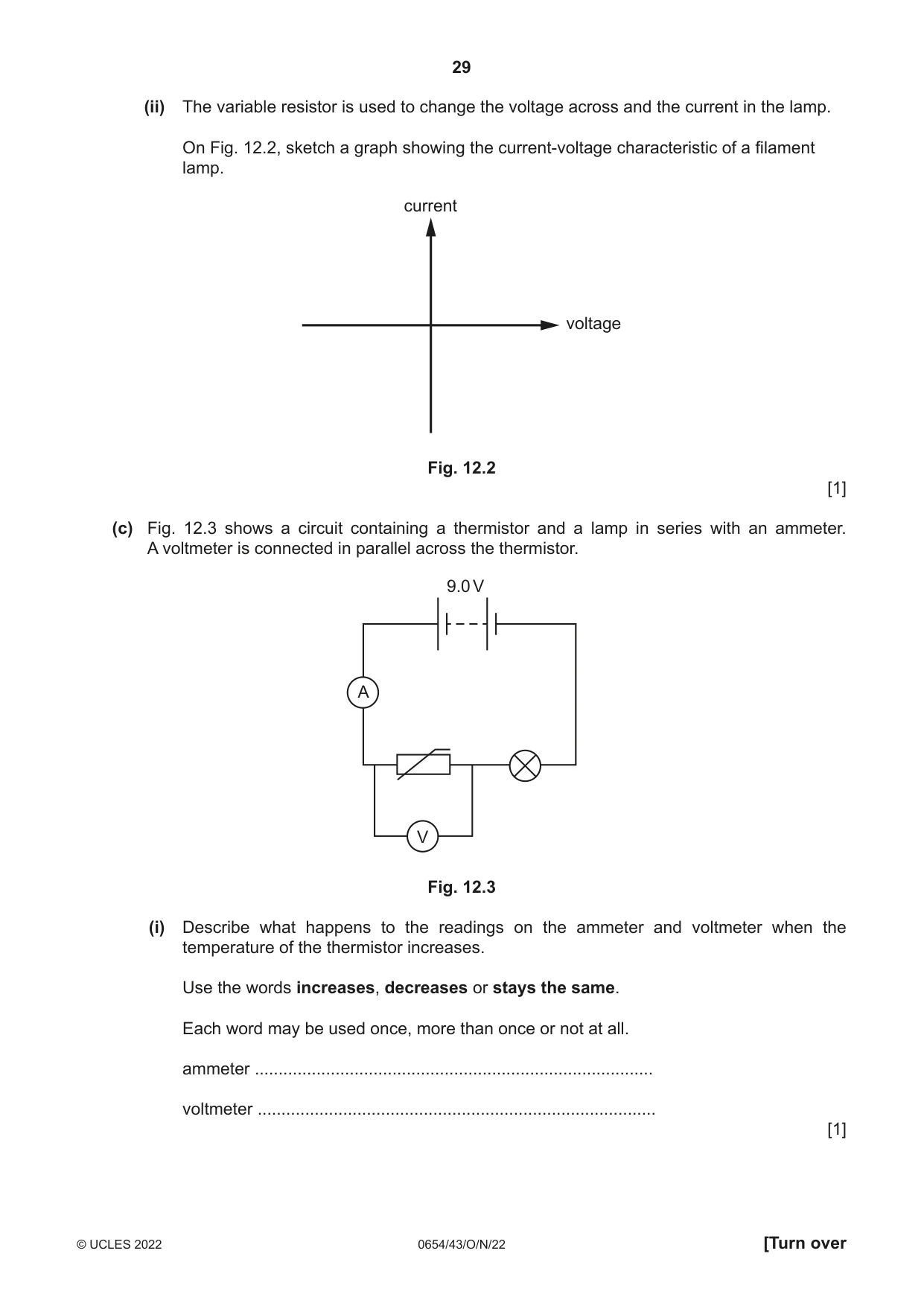
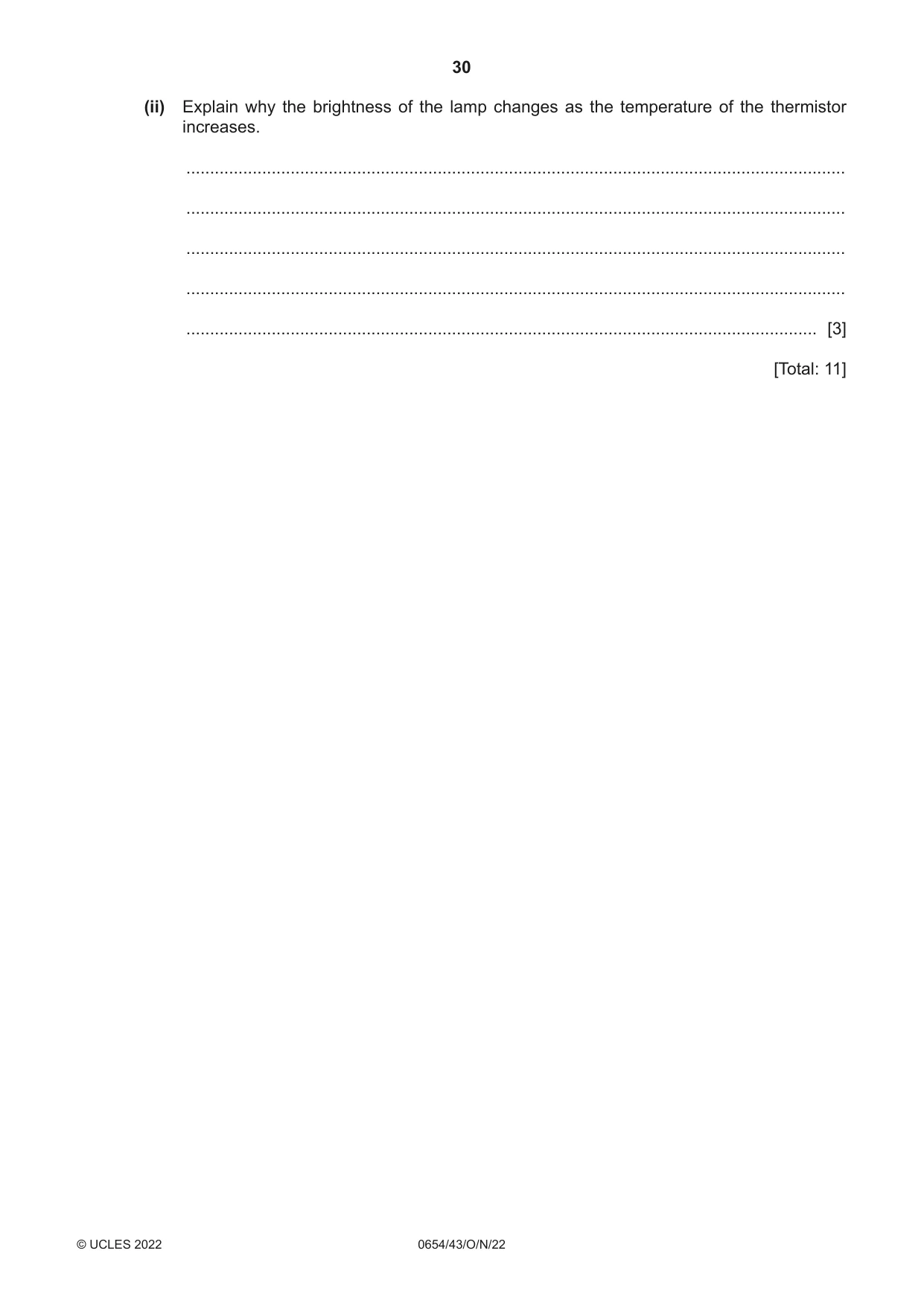
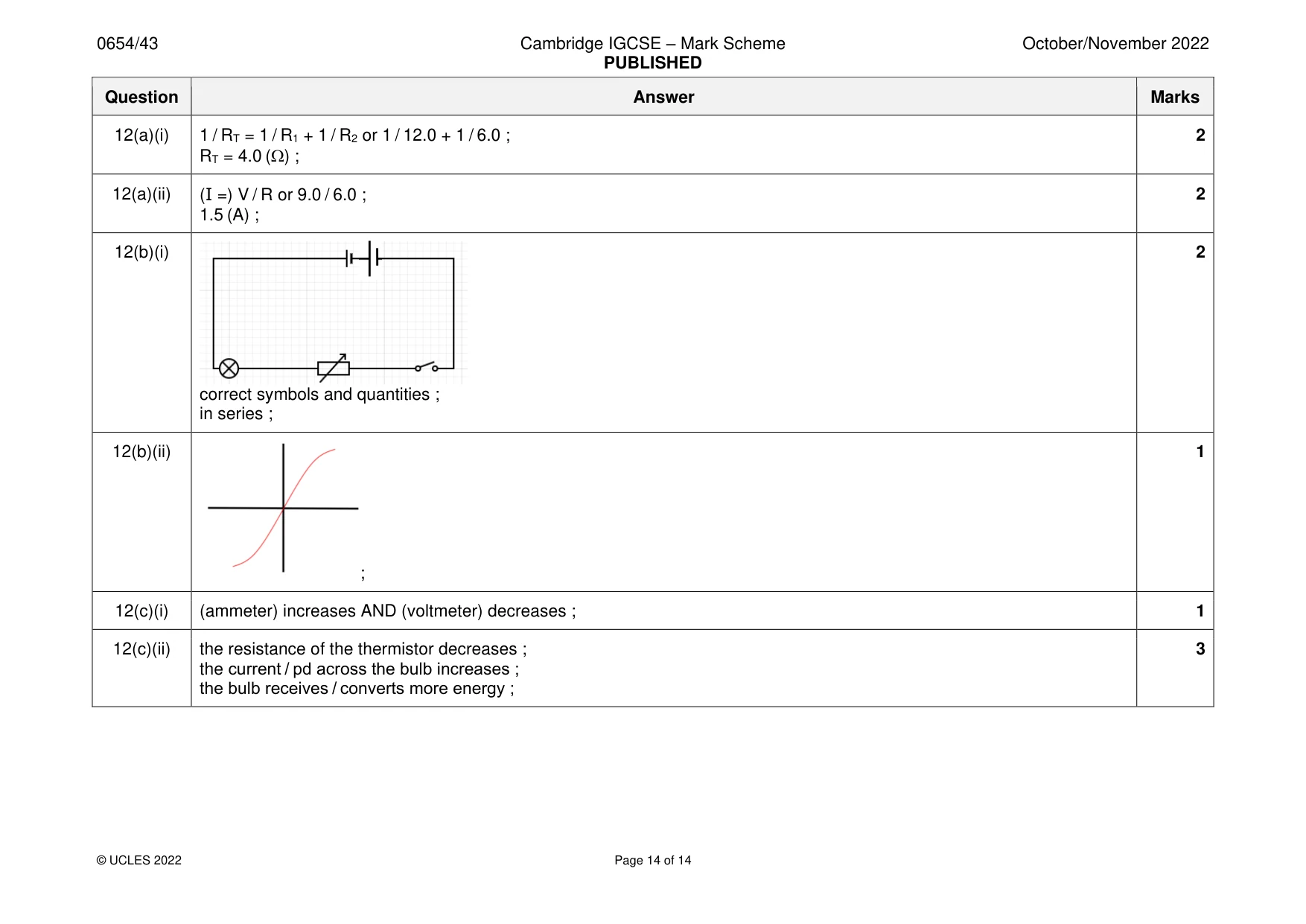
12 Fig. 12.1 shows a circuit containing two resistors connected in parallel with a 9.0 V battery. 9.0 V 12.0 Ω 6.0 Ω Fig. 12.1 (a) (i) Calculate the total resistance of the circuit shown in Fig. 12.1. total resistance = ..................................................... Ω [2] (ii) Calculate the current passing through the 6.0 Ω resistor. current = ...................................................... A [2] (b) The 9.0 V battery is connected in series with a lamp, a variable resistor and a switch. (i) Draw a circuit diagram showing a 9.0 V battery connected in series with a lamp, a variable resistor and a switch. [2] (ii) The variable resistor is used to change the voltage across and the current in the lamp. On Fig. 12.2, sketch a graph showing the current-voltage characteristic of a filament lamp. current voltage Fig. 12.2 [1] (c) Fig. 12.3 shows a circuit containing a thermistor and a lamp in series with an ammeter. A voltmeter is connected in parallel across the thermistor. 9.0 V A V Fig. 12.3 (i) Describe what happens to the readings on the ammeter and voltmeter when the temperature of the thermistor increases. Use the words increases, decreases or stays the same. Each word may be used once, more than once or not at all. ammeter .................................................................................... voltmeter .................................................................................... [1] (ii) Explain why the brightness of the lamp changes as the temperature of the thermistor increases. ........................................................................................................................................... ........................................................................................................................................... ........................................................................................................................................... ........................................................................................................................................... ..................................................................................................................................... [3] [Total: 11]
Mark scheme: 12(a)(i) 1 / RT = 1 / R1 + 1 / R2 or 1 / 12.0 + 1 / 6.0 ; 2 RT = 4.0 () ; 12(a)(ii) (I =) V / R or 9.0 / 6.0 ; 2 1.5 (A) ; 12(b)(i) 2 correct symbols and quantities ; in series ; 12(b)(ii) 1 ; 12(c)(i) (ammeter) increases AND (voltmeter) decreases ; 1 12(c)(ii) the resistance of the thermistor decreases ; 3 the current / pd across the bulb increases ; the bulb receives / converts more energy ;
What was in this paper
The subtopics covered by these 12 questions, and how many questions each got. Open one in a new tab to see every Cambridge question on it.
What you needed in this session
Cambridge’s own grade thresholds for 2022 Oct/Nov, Paper 4 · Variant 3. A higher threshold means an easier paper — the bar moves with how the cohort did.