Cambridge IGCSE Sciences - Co-ordinated (Double) 0654 — 2019 May/June Paper 4 · Variant 1
0654/41/M/J/19 · 13 questions · 120 marks · ≈135 min
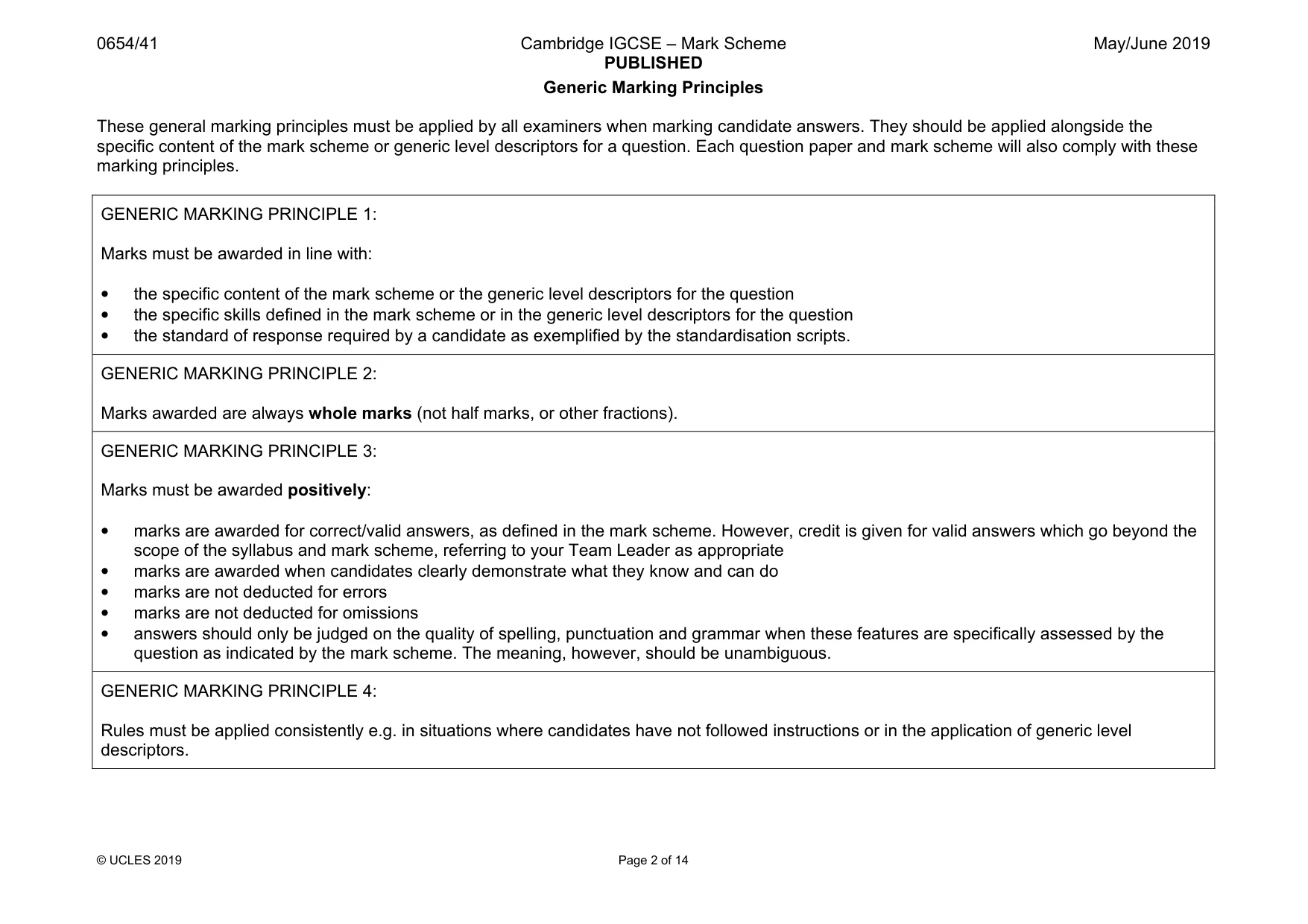
The question paper and its mark scheme, free to read here and free to download. This is Cambridge’s own paper, exactly as it was sat.
Question paper32 pages

Mark scheme14 pages
Answers below. Sit the paper first if you are practising.
Questions as text
Q1 · The graph in Fig
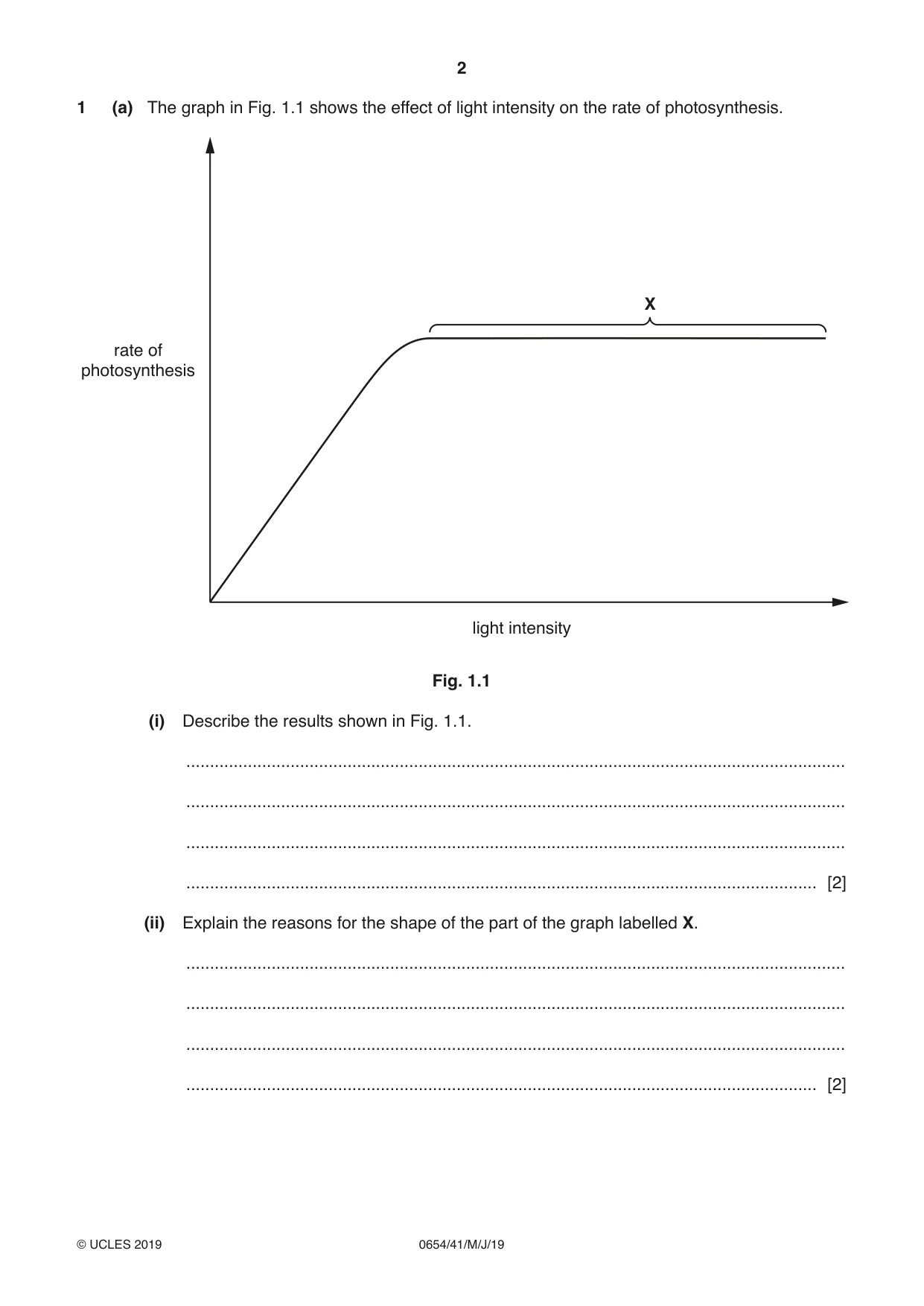
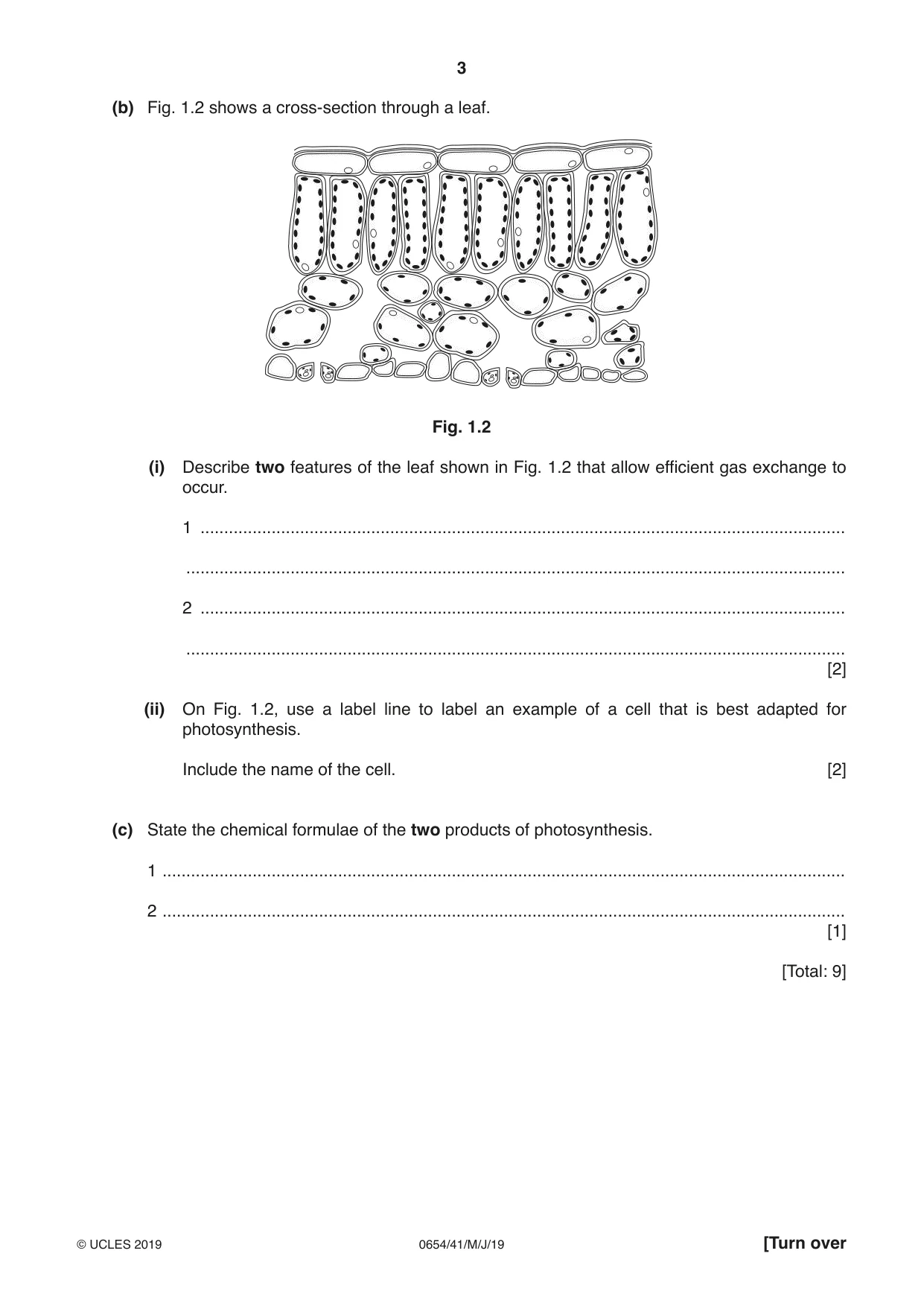
1 (a) The graph in Fig. 1.1 shows the effect of light intensity on the rate of photosynthesis. X rate of photosynthesis light intensity Fig. 1.1 (i) Describe the results shown in Fig. 1.1. ........................................................................................................................................... ........................................................................................................................................... ........................................................................................................................................... ..................................................................................................................................... [2] (ii) Explain the reasons for the shape of the part of the graph labelled X. ........................................................................................................................................... ........................................................................................................................................... ........................................................................................................................................... ..................................................................................................................................... [2] (b) Fig. 1.2 shows a cross-section through a leaf. Fig. 1.2 (i) Describe two features of the leaf shown in Fig. 1.2 that allow efficient gas exchange to occur. 1 ........................................................................................................................................ ........................................................................................................................................... 2 ........................................................................................................................................ ........................................................................................................................................... [2] (ii) On Fig. 1.2, use a label line to label an example of a cell that is best adapted for photosynthesis. Include the name of the cell. [2] (c) State the chemical formulae of the two products of photosynthesis. 1 ................................................................................................................................................ 2 ................................................................................................................................................ [1] [Total: 9]
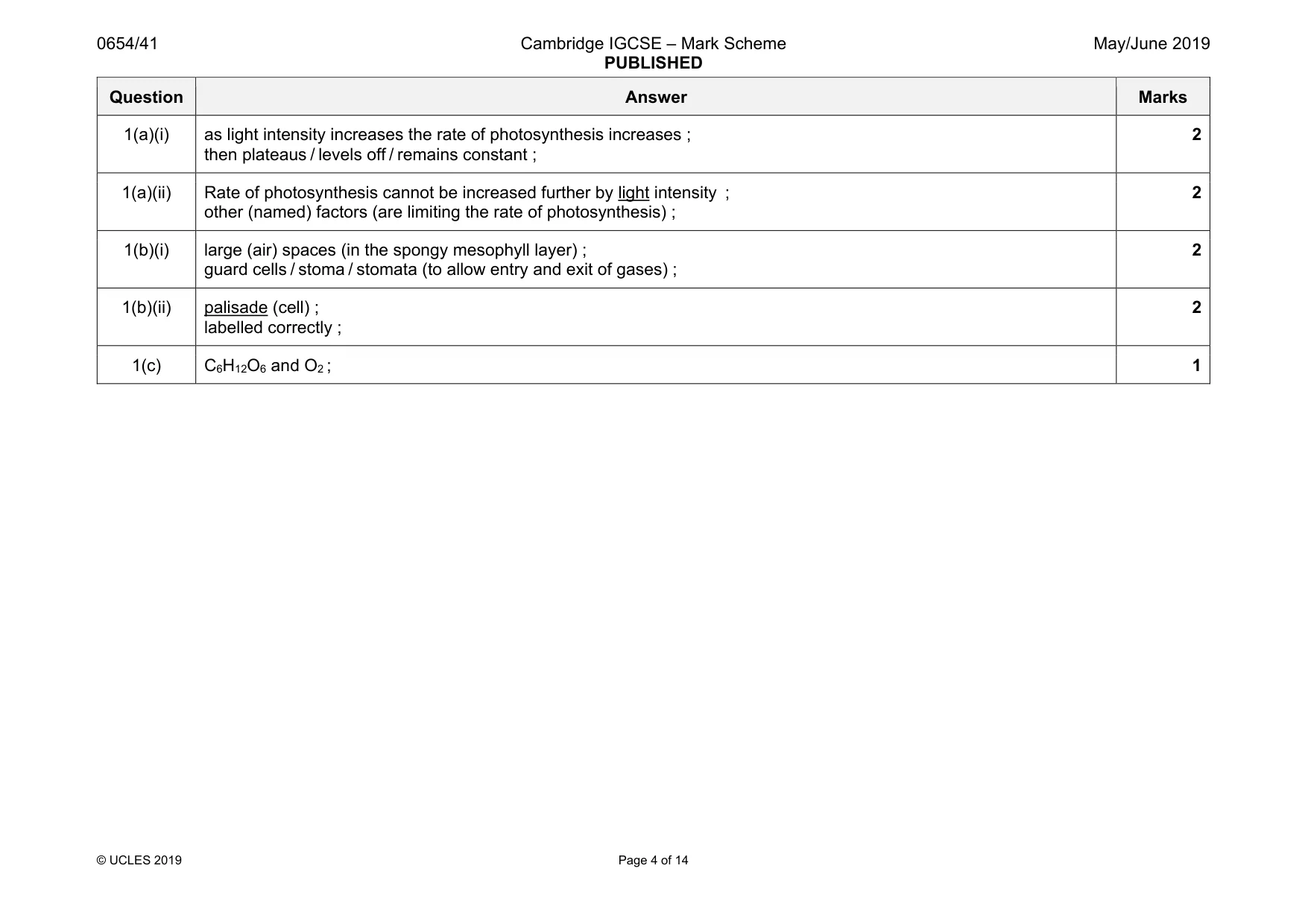
Mark scheme: 1(a)(i) as light intensity increases the rate of photosynthesis increases ; then plateaus / levels off / remains constant ; 2 1(a)(ii) Rate of photosynthesis cannot be increased further by light intensity ; other (named) factors (are limiting the rate of photosynthesis) ; 2 1(b)(i) large (air) spaces (in the spongy mesophyll layer) ; guard cells / stoma / stomata (to allow entry and exit of gases) ; 2 1(b)(ii) palisade (cell) ; labelled correctly ; 2 1(c) C6H12O6 and O2 ; 1
Q2 · Carbon is used to extract zinc from zinc oxide, ZnO
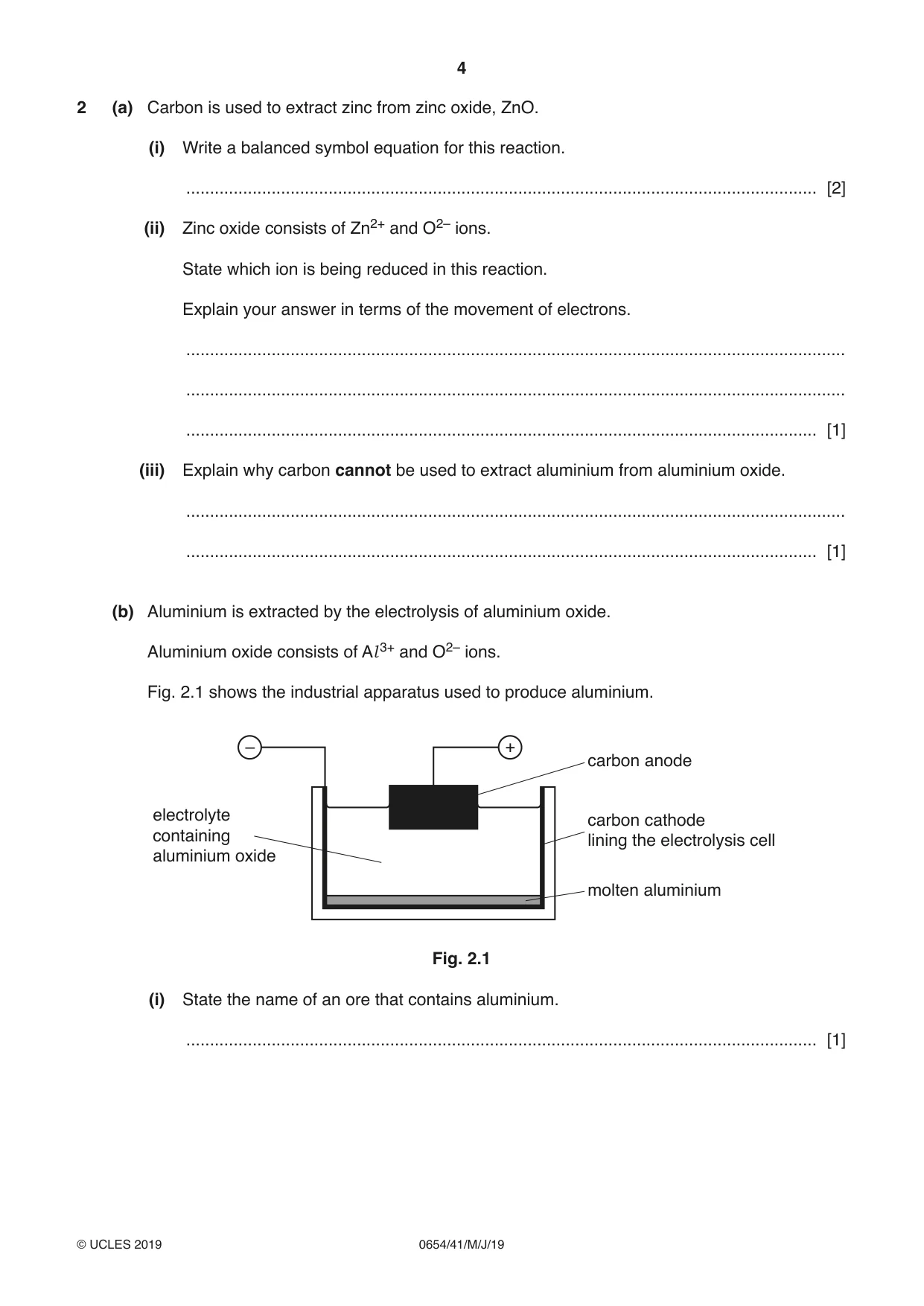
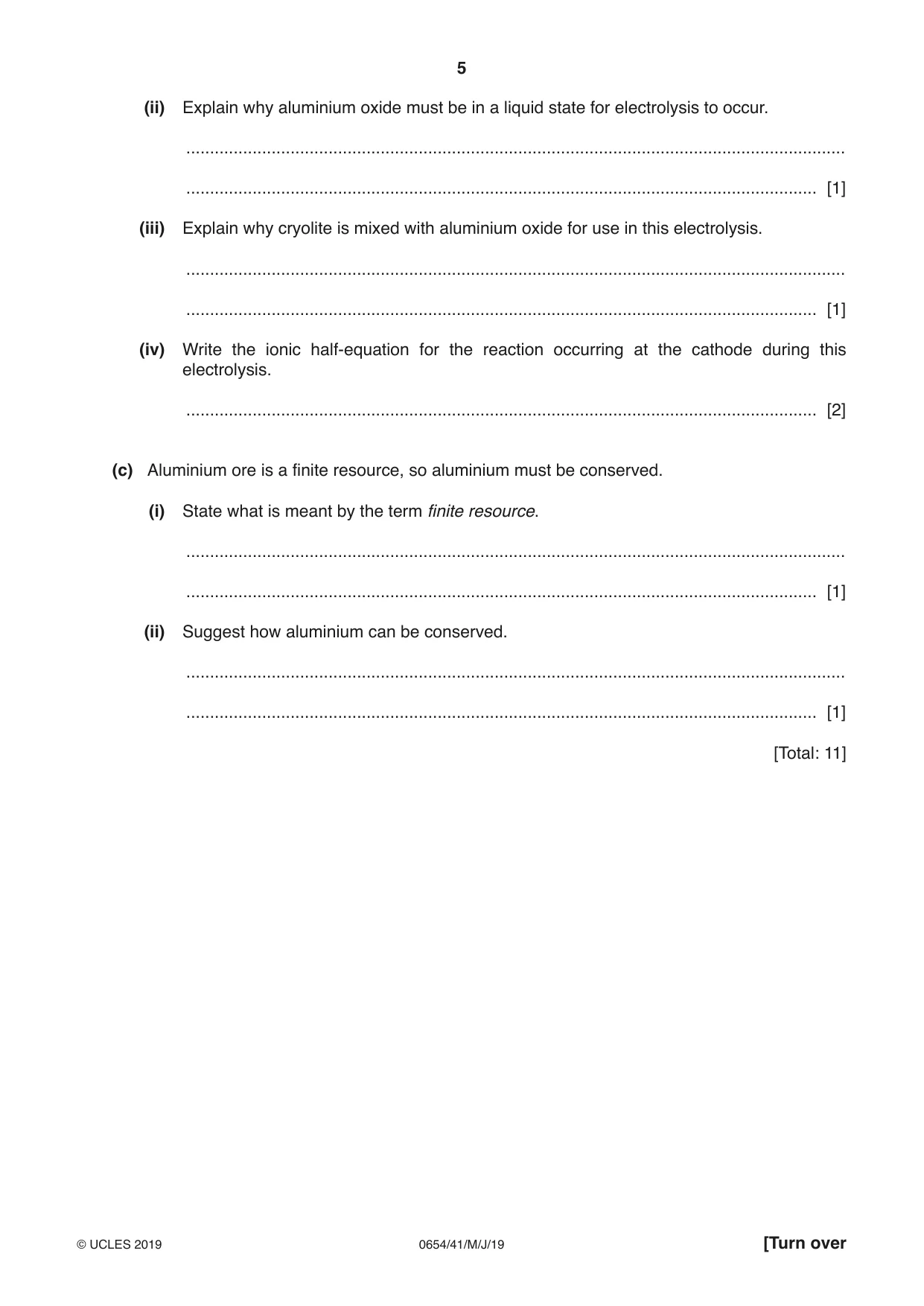
2 (a) Carbon is used to extract zinc from zinc oxide, ZnO. (i) Write a balanced symbol equation for this reaction. ..................................................................................................................................... [2] (ii) Zinc oxide consists of Zn2+ and O2– ions. State which ion is being reduced in this reaction. Explain your answer in terms of the movement of electrons. ........................................................................................................................................... ........................................................................................................................................... ..................................................................................................................................... [1] (iii) Explain why carbon cannot be used to extract aluminium from aluminium oxide. ........................................................................................................................................... ..................................................................................................................................... [1] (b) Aluminium is extracted by the electrolysis of aluminium oxide. Aluminium oxide consists of Al 3+ and O2– ions. Fig. 2.1 shows the industrial apparatus used to produce aluminium. – + carbon anode electrolyte carbon cathode containing lining the electrolysis cell aluminium oxide molten aluminium Fig. 2.1 (i) State the name of an ore that contains aluminium. ..................................................................................................................................... [1] (ii) Explain why aluminium oxide must be in a liquid state for electrolysis to occur. ........................................................................................................................................... ..................................................................................................................................... [1] (iii) Explain why cryolite is mixed with aluminium oxide for use in this electrolysis. ........................................................................................................................................... ..................................................................................................................................... [1] (iv) Write the ionic half-equation for the reaction occurring at the cathode during this electrolysis. ..................................................................................................................................... [2] (c) Aluminium ore is a finite resource, so aluminium must be conserved. (i) State what is meant by the term finite resource. ........................................................................................................................................... ..................................................................................................................................... [1] (ii) Suggest how aluminium can be conserved. ........................................................................................................................................... ..................................................................................................................................... [1] [Total: 11]
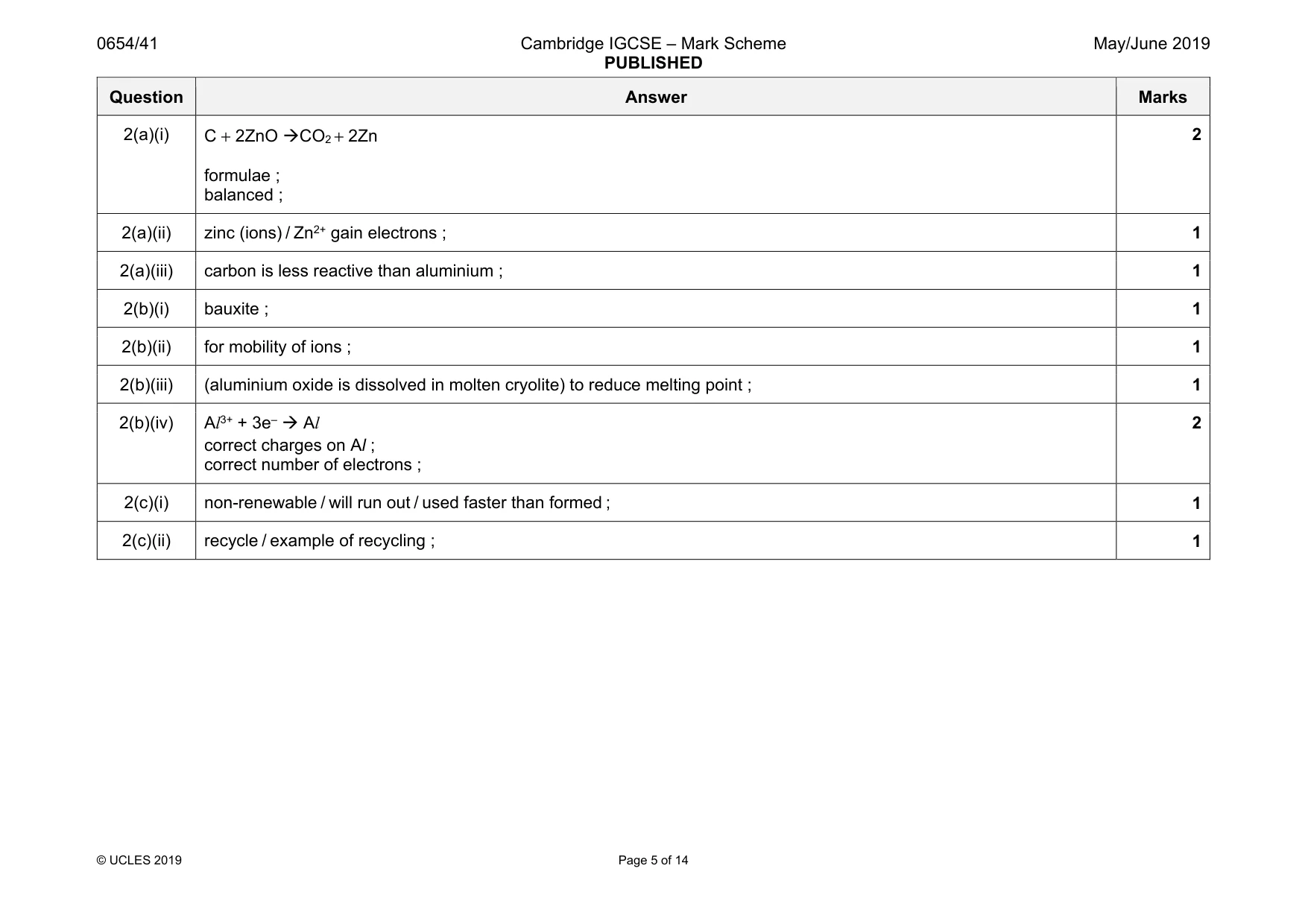
Mark scheme: 2(a)(i) formulae ; balanced ; 2 2(a)(ii) zinc (ions) / Zn2+ gain electrons ; 1 2(a)(iii) carbon is less reactive than aluminium ; 1 2(b)(i) bauxite ; 1 2(b)(ii) for mobility of ions ; 1 2(b)(iii) (aluminium oxide is dissolved in molten cryolite) to reduce melting point ; 1 2(b)(iv) Al3+ + 3e– Æ Al correct charges on Al ; correct number of electrons ; 2 2(c)(i) non-renewable / will run out / used faster than formed ; 1 2(c)(ii) recycle / example of recycling ; 1
Q3 · A motorcycle with a rear lamp
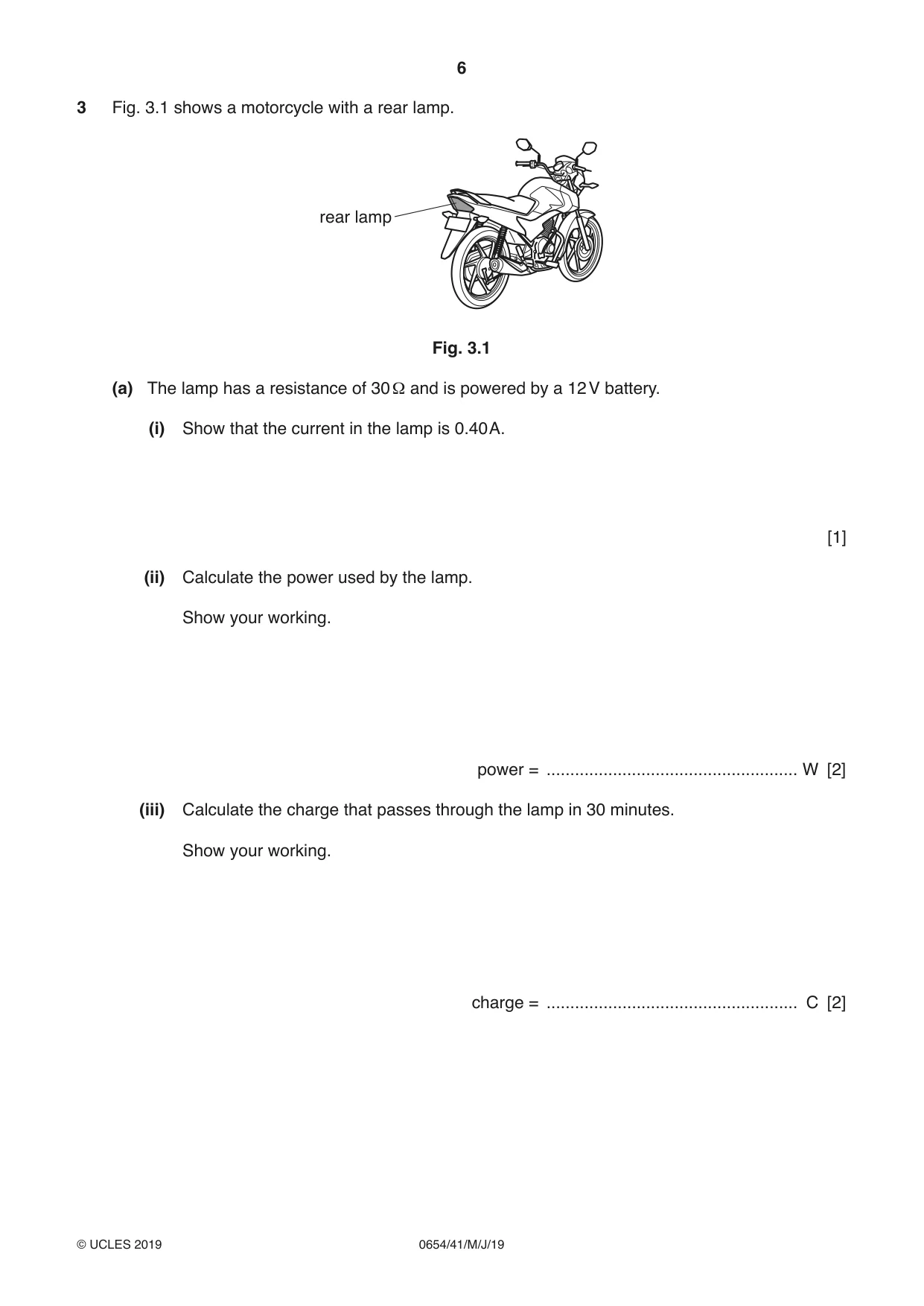
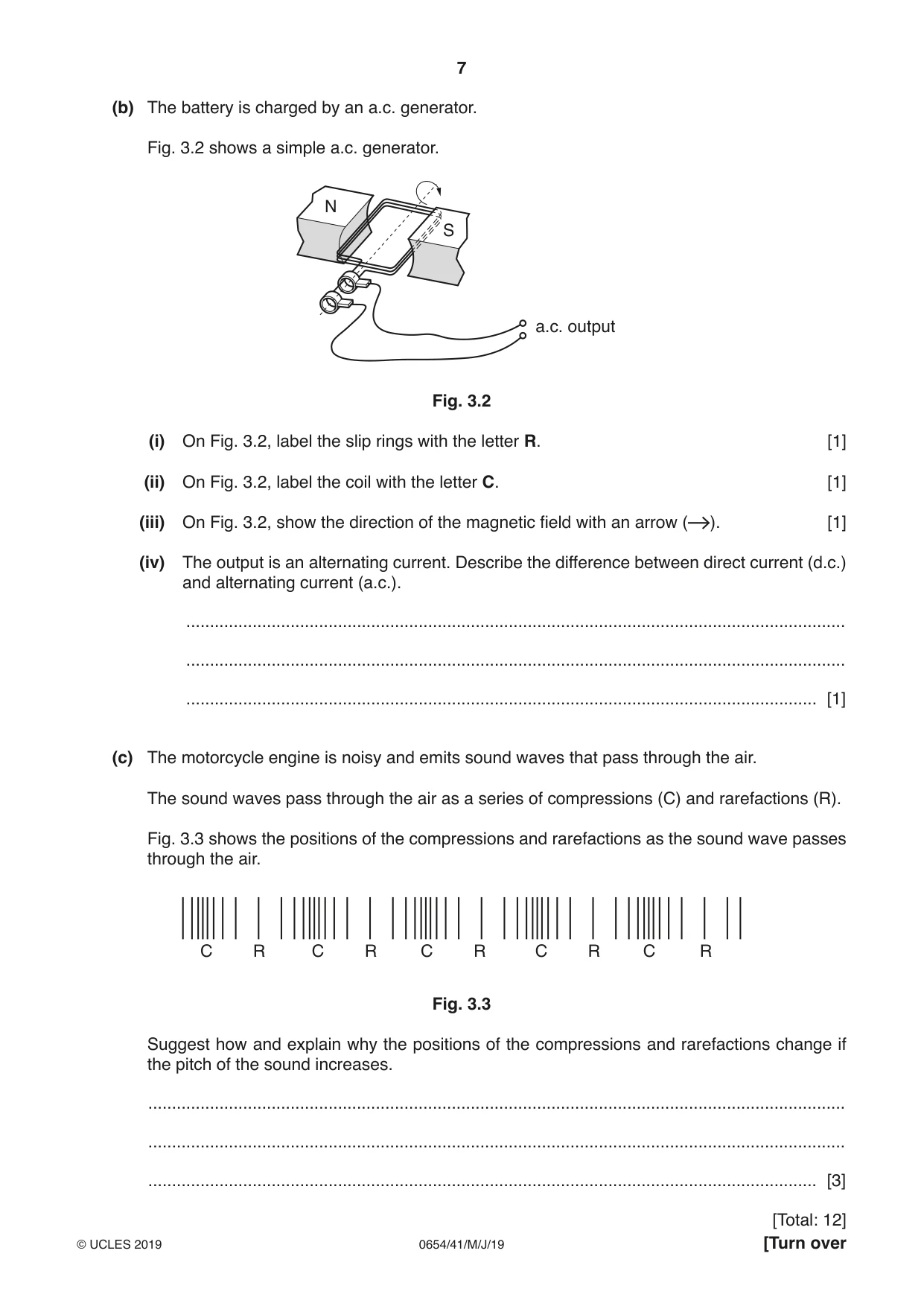
3 Fig. 3.1 shows a motorcycle with a rear lamp. rear lamp Fig. 3.1 (a) The lamp has a resistance of 30 Ω and is powered by a 12 V battery. (i) Show that the current in the lamp is 0.40 A. [1] (ii) Calculate the power used by the lamp. Show your working. power = ..................................................... W [2] (iii) Calculate the charge that passes through the lamp in 30 minutes. Show your working. charge = ..................................................... C [2] (b) The battery is charged by an a.c. generator. Fig. 3.2 shows a simple a.c. generator. N S a.c. output Fig. 3.2 (i) On Fig. 3.2, label the slip rings with the letter R. [1] (ii) On Fig. 3.2, label the coil with the letter C. [1] (iii) On Fig. 3.2, show the direction of the magnetic field with an arrow ( ). [1] (iv) The output is an alternating current. Describe the difference between direct current (d.c.) and alternating current (a.c.). ........................................................................................................................................... ........................................................................................................................................... ..................................................................................................................................... [1] (c) The motorcycle engine is noisy and emits sound waves that pass through the air. The sound waves pass through the air as a series of compressions (C) and rarefactions (R). Fig. 3.3 shows the positions of the compressions and rarefactions as the sound wave passes through the air. C R C R C R C R C R Fig. 3.3 Suggest how and explain why the positions of the compressions and rarefactions change if the pitch of the sound increases. ................................................................................................................................................... ................................................................................................................................................... ............................................................................................................................................. [3]
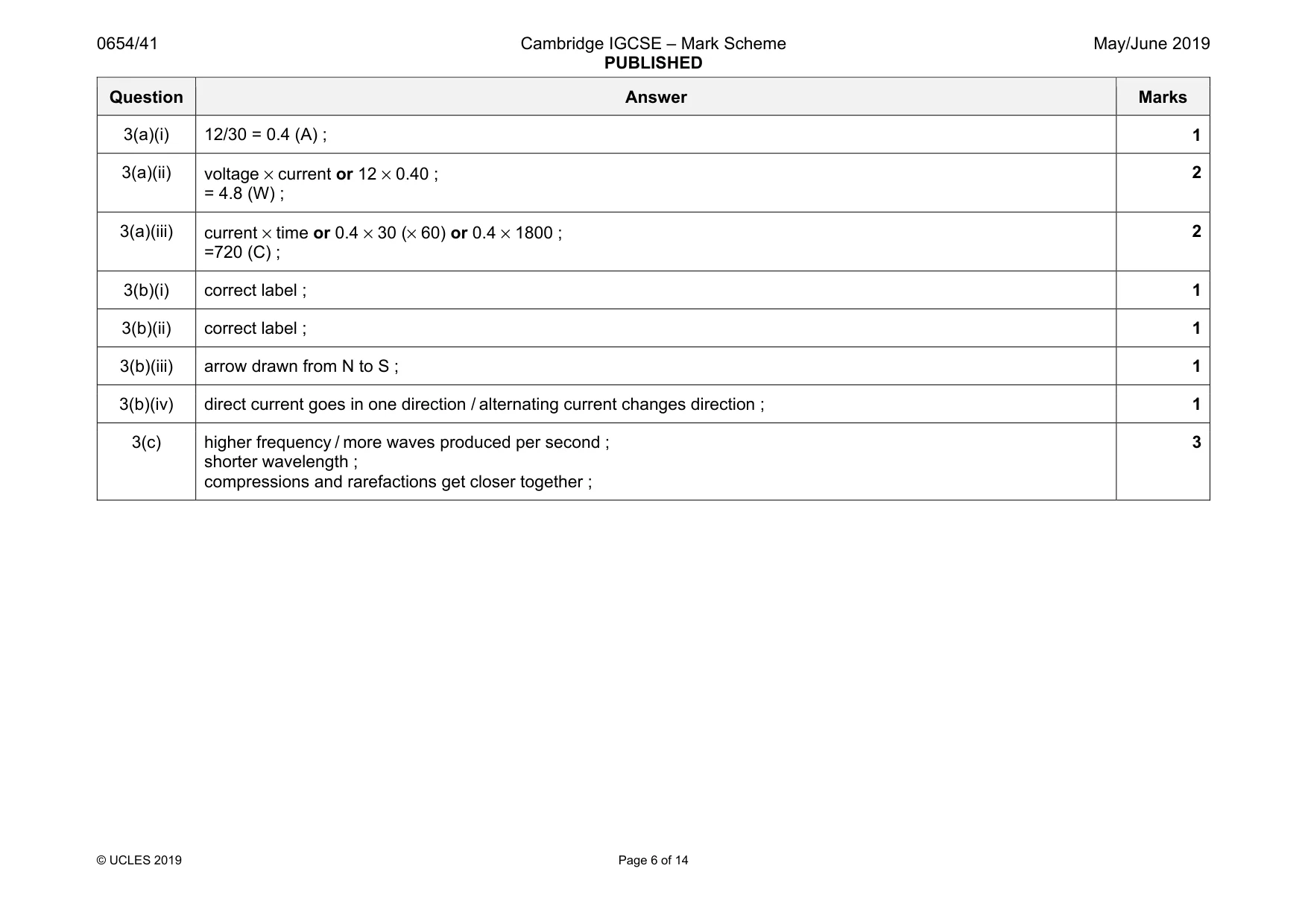
Mark scheme: 3(a)(i) 12/30 = 0.4 (A) ; 1 3(a)(ii) voltage × current or 12 × 0.40 ; = 4.8 (W) ; 2 3(a)(iii) current × time or 0.4 × 30 (× 60) or 0.4 × 1800 ; =720 (C) ; 2 3(b)(i) correct label ; 1 3(b)(ii) correct label ; 1 3(b)(iii) arrow drawn from N to S ; 1 3(b)(iv) direct current goes in one direction / alternating current changes direction ; 1 3(c) higher frequency / more waves produced per second ; shorter wavelength ; compressions and rarefactions get closer together ; 3
Q4 · The pie chart in Fig
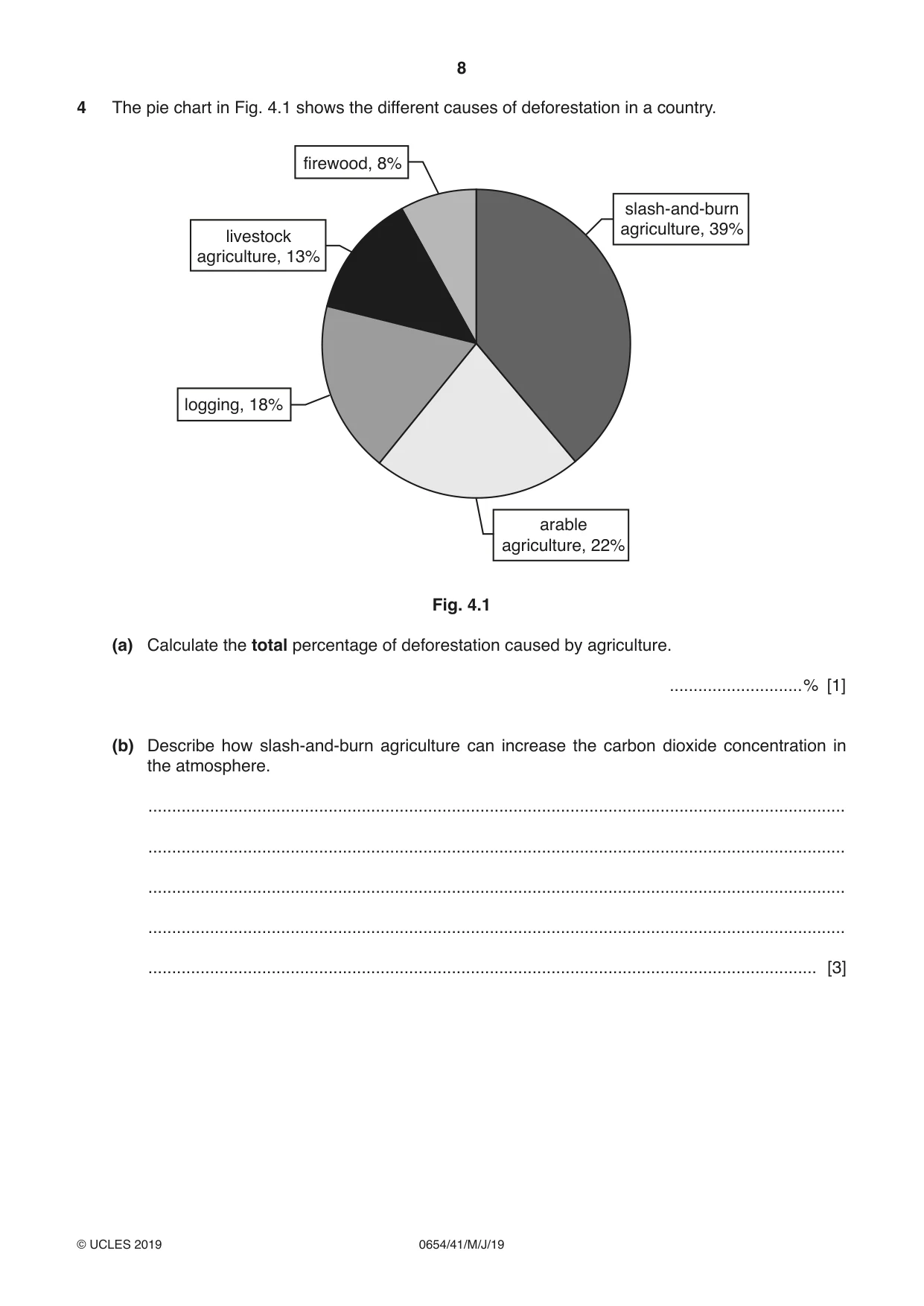
4 The pie chart in Fig. 4.1 shows the different causes of deforestation in a country. firewood, 8% slash-and-burn agriculture, 39% livestock agriculture, 13% logging, 18% arable agriculture, 22% Fig. 4.1 (a) Calculate the total percentage of deforestation caused by agriculture. ............................% [1] (b) Describe how slash-and-burn agriculture can increase the carbon dioxide concentration in the atmosphere. ................................................................................................................................................... ................................................................................................................................................... ................................................................................................................................................... ................................................................................................................................................... ............................................................................................................................................. [3] (c) Describe the undesirable effects of deforestation on soil. ................................................................................................................................................... ................................................................................................................................................... ................................................................................................................................................... ................................................................................................................................................... ............................................................................................................................................. [3] (d) Forests are ecosystems. Define the term ecosystem. ................................................................................................................................................... ................................................................................................................................................... ................................................................................................................................................... ............................................................................................................................................. [2] [Total: 9]
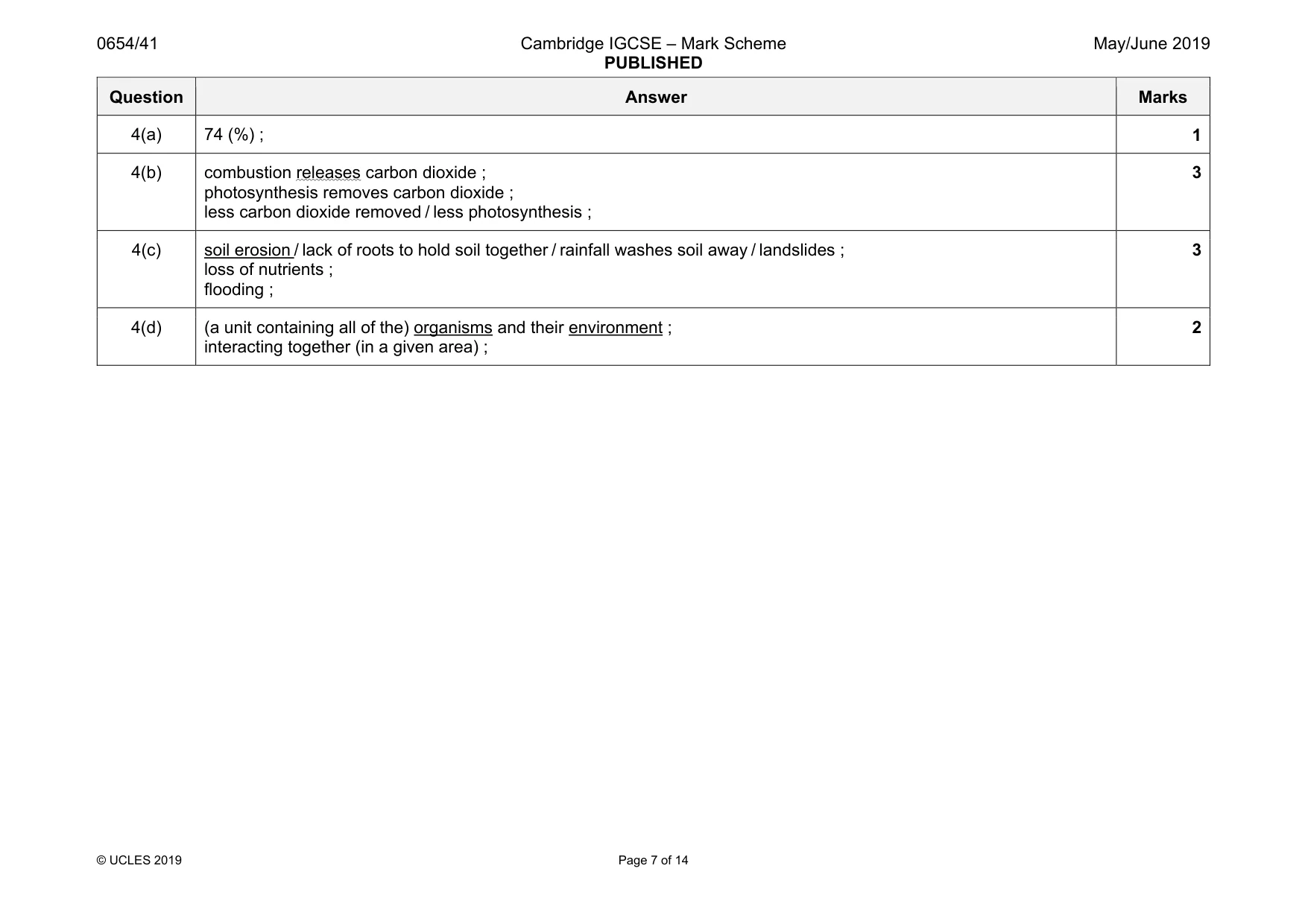
Mark scheme: 4(a) 74 (%) ; 1 4(b) combustion releases carbon dioxide ; photosynthesis removes carbon dioxide ; less carbon dioxide removed / less photosynthesis ; 3 4(c) soil erosion / lack of roots to hold soil together / rainfall washes soil away / landslides ; loss of nutrients ; flooding ; 3 4(d) (a unit containing all of the) organisms and their environment ; interacting together (in a given area) ; 2
Q5 · Petroleum is the raw material for the production of many useful substances
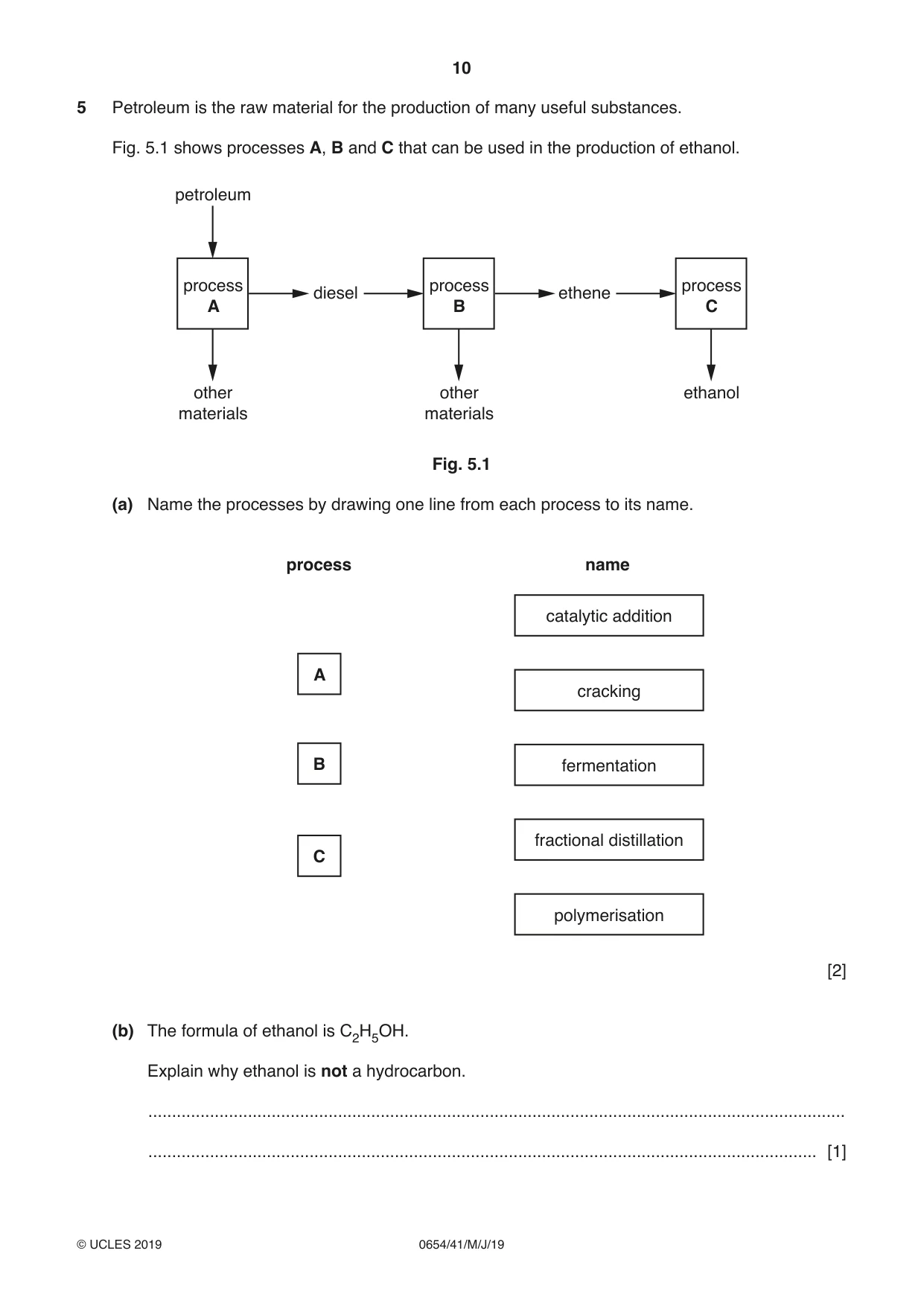
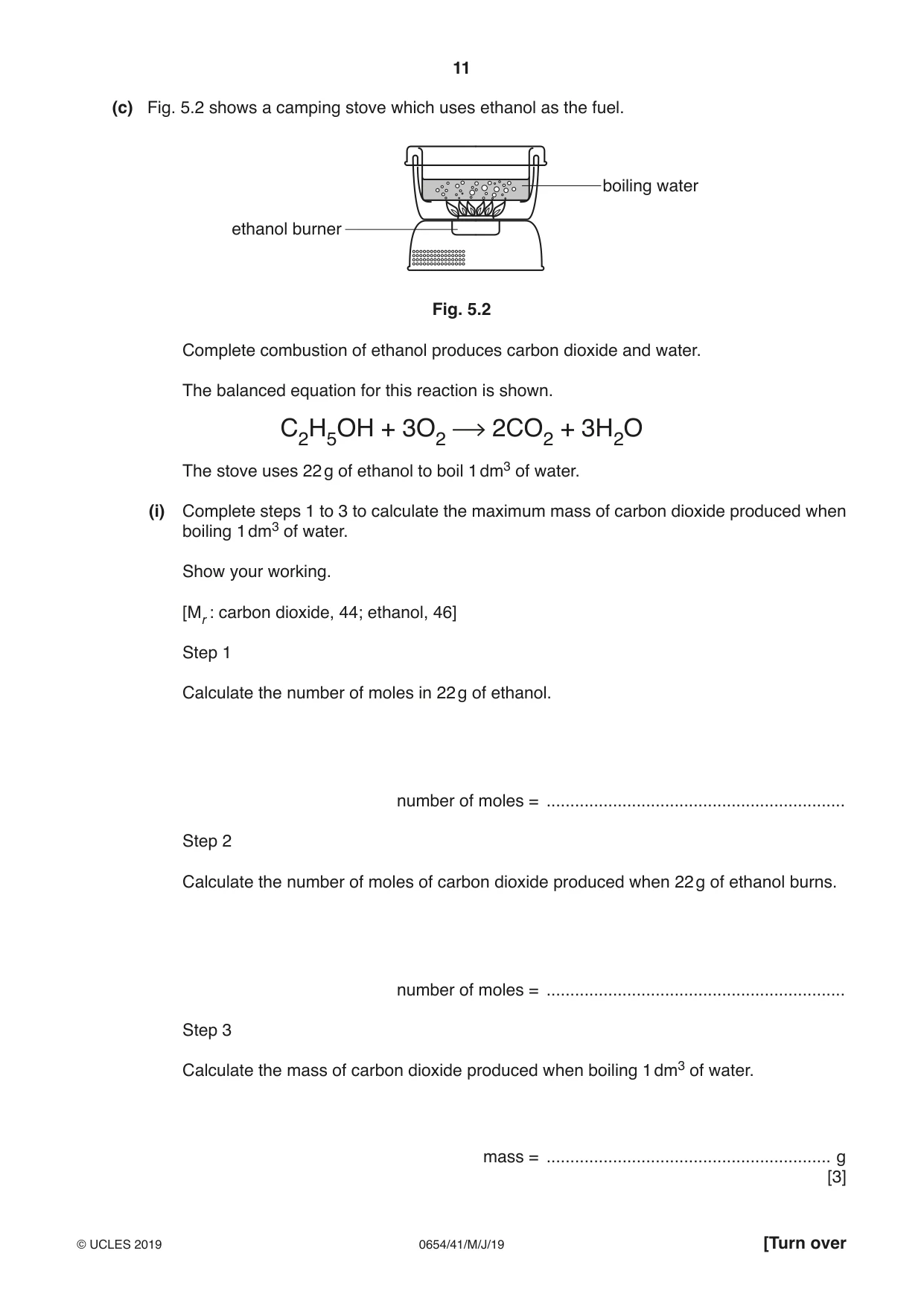
5 Petroleum is the raw material for the production of many useful substances. Fig. 5.1 shows processes A, B and C that can be used in the production of ethanol. petroleum process process process diesel ethene A B C other other ethanol materials materials Fig. 5.1 (a) Name the processes by drawing one line from each process to its name. process name catalytic addition A cracking B fermentation fractional distillation C polymerisation [2] (b) The formula of ethanol is C2H5OH. Explain why ethanol is not a hydrocarbon. ................................................................................................................................................... ............................................................................................................................................. [1] (c) Fig. 5.2 shows a camping stove which uses ethanol as the fuel. boiling water ethanol burner Fig. 5.2 Complete combustion of ethanol produces carbon dioxide and water. The balanced equation for this reaction is shown. C2H5OH + 3O2 2CO2 + 3H2O The stove uses 22 g of ethanol to boil 1 dm3 of water. (i) Complete steps 1 to 3 to calculate the maximum mass of carbon dioxide produced when boiling 1 dm3 of water. Show your working. [Mr : carbon dioxide, 44; ethanol, 46] Step 1 Calculate the number of moles in 22 g of ethanol. number of moles = ............................................................... Step 2 Calculate the number of moles of carbon dioxide produced when 22 g of ethanol burns. number of moles = ............................................................... Step 3 Calculate the mass of carbon dioxide produced when boiling 1 dm3 of water. mass = ............................................................ g [3] (ii) A similar stove uses butane as the fuel. Butane produces less carbon dioxide when boiling 1 dm3 of water. Suggest whether using the butane stove or the ethanol stove causes less damage to the environment. Explain your answer. type of stove ....................................................................................................................... explanation ......................................................................................................................... ........................................................................................................................................... ........................................................................................................................................... [2] [Total: 8]
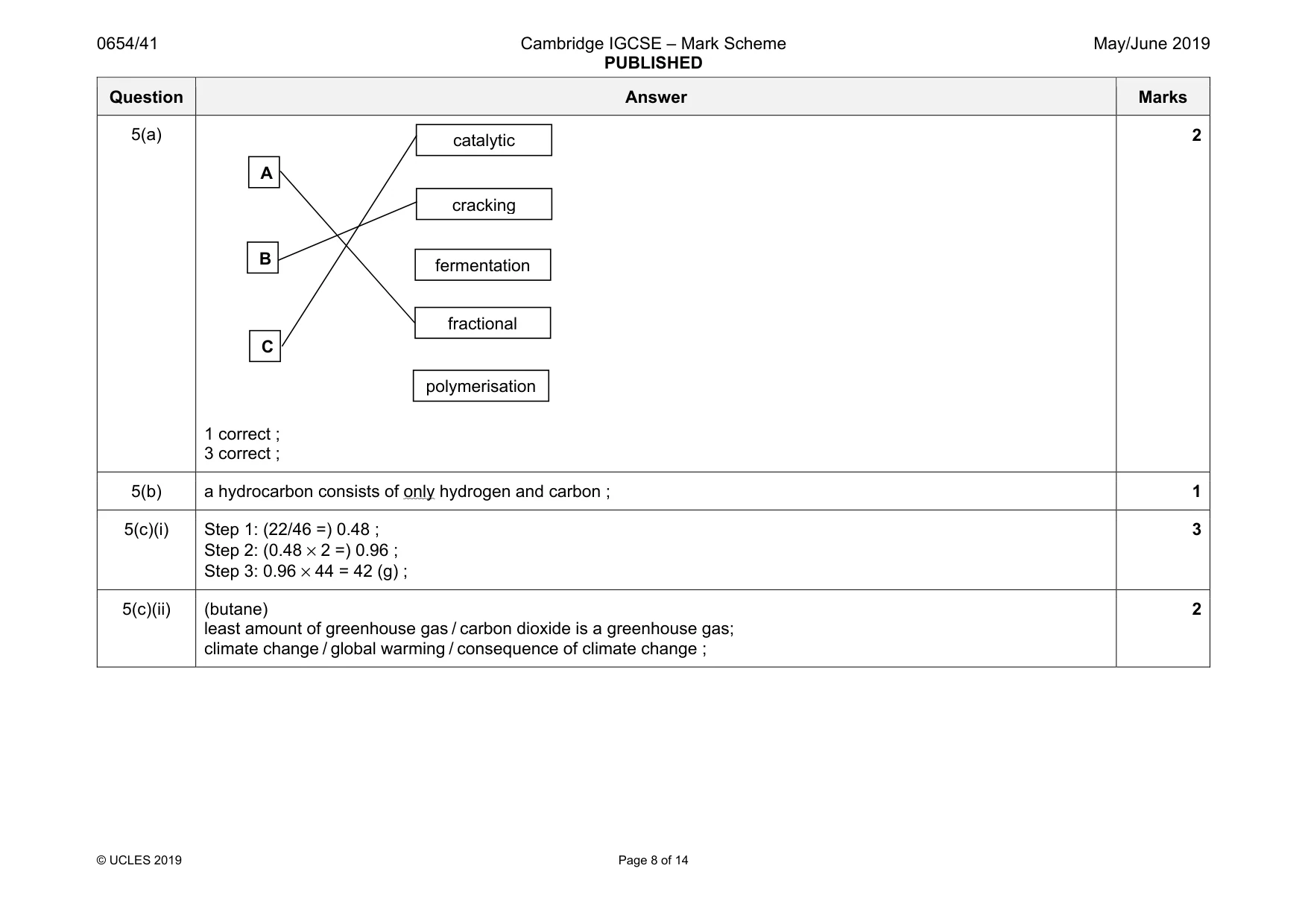
Mark scheme: 5(a) 1 correct ; 3 correct ; 2 5(b) a hydrocarbon consists of only hydrogen and carbon ; 1 5(c)(i) Step 1: (22/46 =) 0.48 ; Step 2: (0.48 × 2 =) 0.96 ; Step 3: 0.96 × 44 = 42 (g) ; 3 5(c)(ii) (butane) least amount of greenhouse gas / carbon dioxide is a greenhouse gas; climate change / global warming / consequence of climate change ; 2 catalytic A cracking fermentation fractional polymerisation B C
Q6 · The visible light produced by the headlamps of a train is part of the electromagnetic…
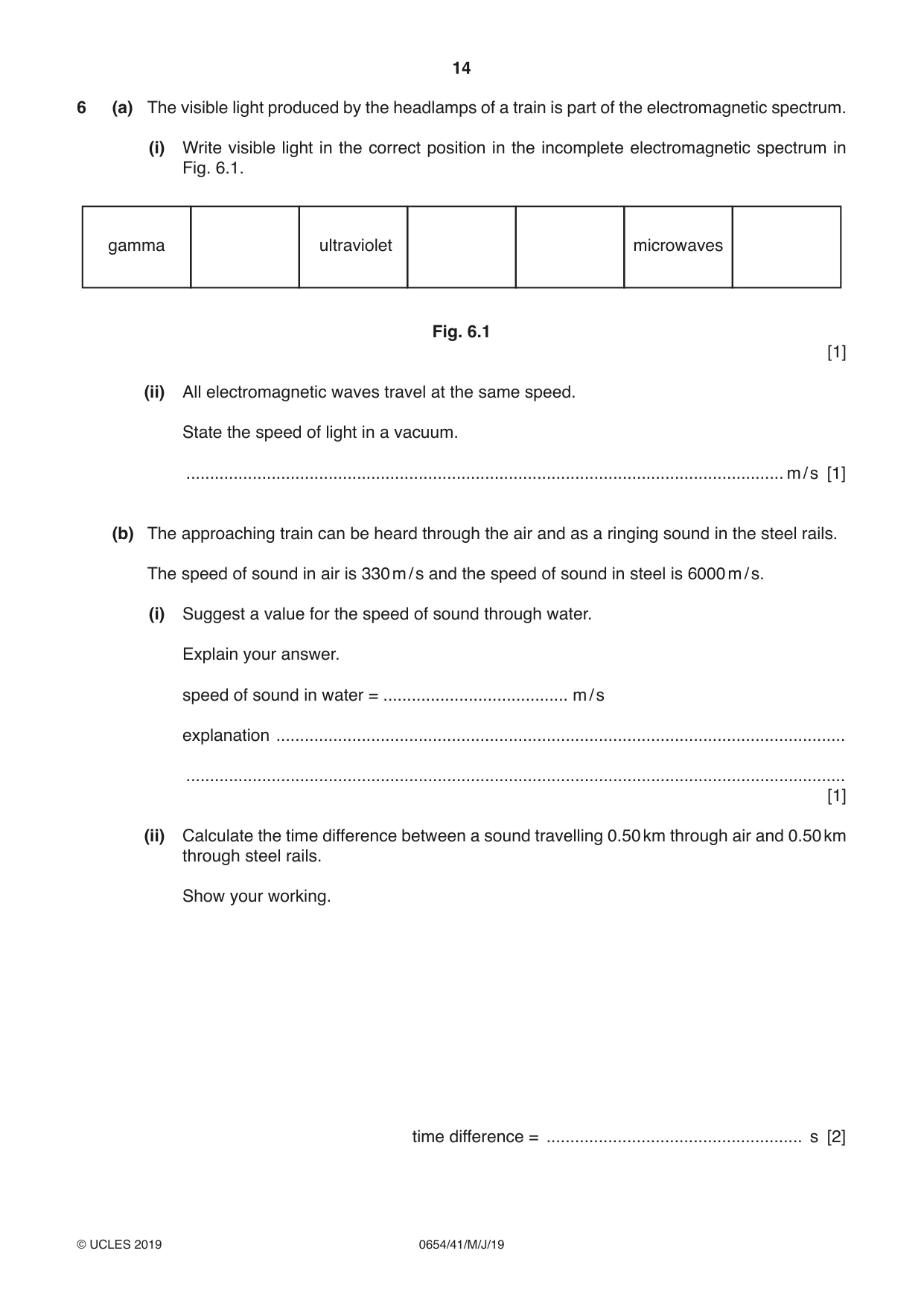
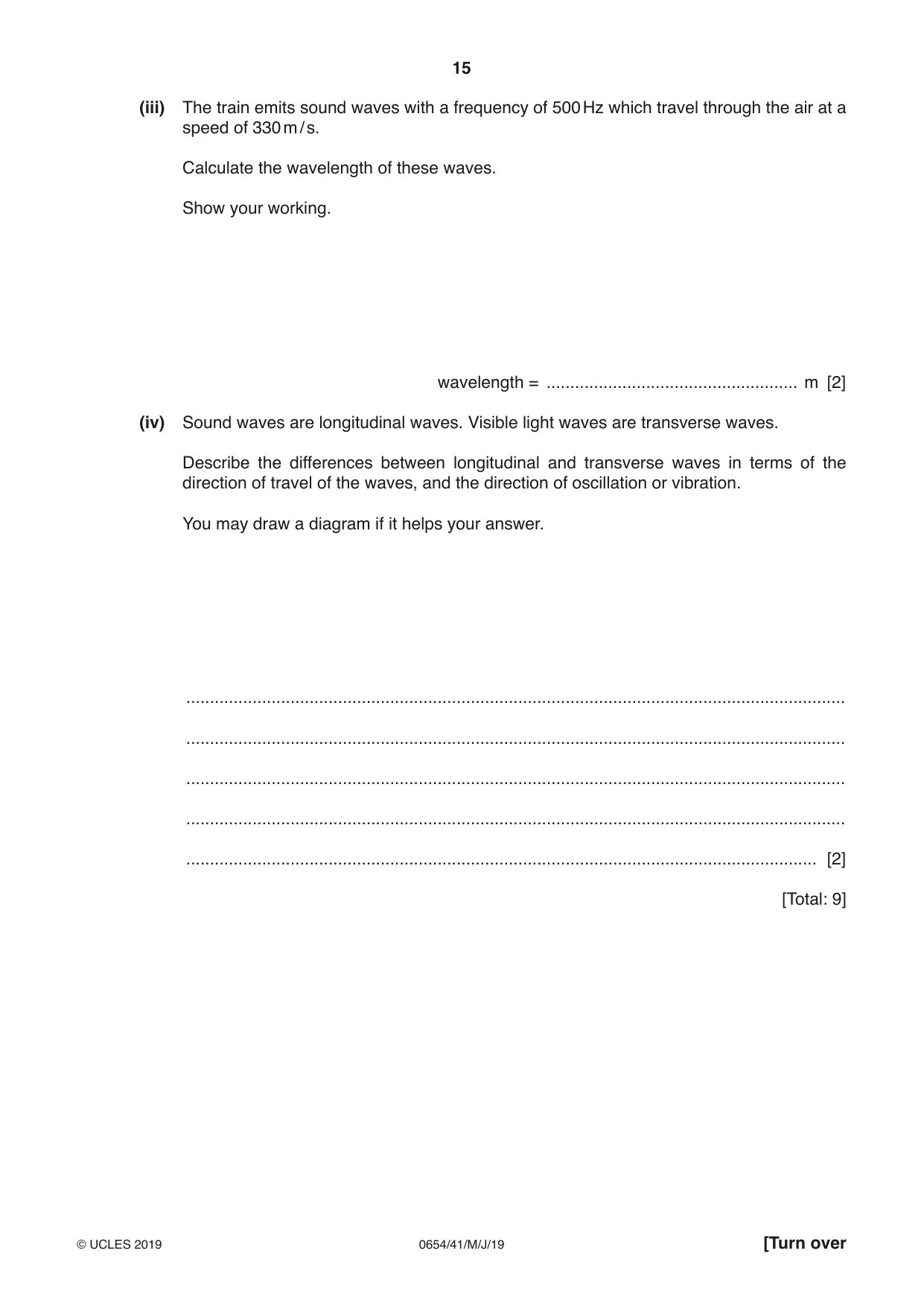
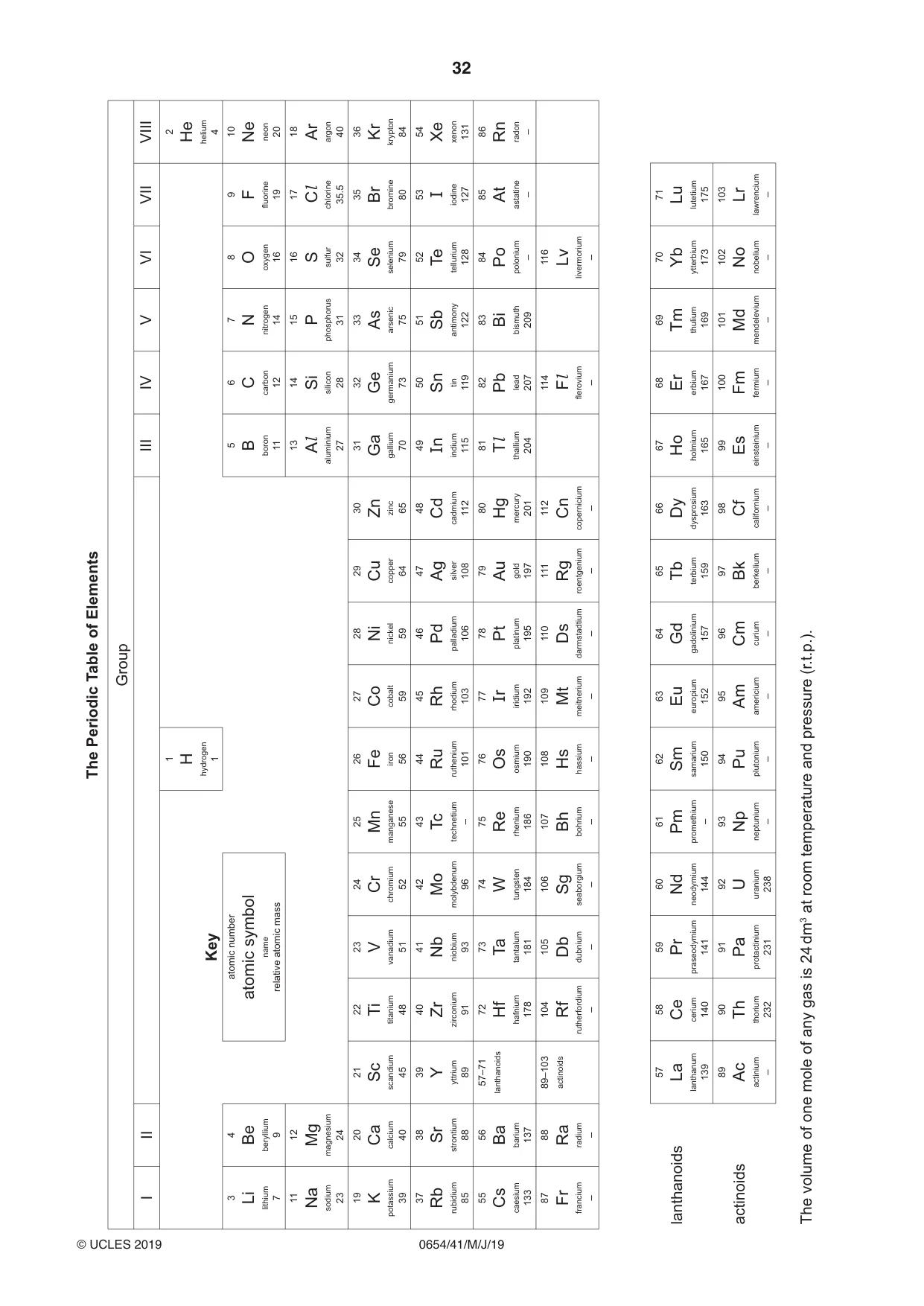
6 (a) The visible light produced by the headlamps of a train is part of the electromagnetic spectrum. (i) Write visible light in the correct position in the incomplete electromagnetic spectrum in Fig. 6.1. gamma ultraviolet microwaves Fig. 6.1 [1] (ii) All electromagnetic waves travel at the same speed. State the speed of light in a vacuum. .............................................................................................................................. m / s [1] (b) The approaching train can be heard through the air and as a ringing sound in the steel rails. The speed of sound in air is 330 m / s and the speed of sound in steel is 6000 m / s. (i) Suggest a value for the speed of sound through water. Explain your answer. speed of sound in water = ....................................... m / s explanation ........................................................................................................................ ........................................................................................................................................... [1] (ii) Calculate the time difference between a sound travelling 0.50 km through air and 0.50 km through steel rails. Show your working. time difference = ...................................................... s [2] (iii) The train emits sound waves with a frequency of 500 Hz which travel through the air at a speed of 330 m / s. Calculate the wavelength of these waves. Show your working. wavelength = ..................................................... m [2] (iv) Sound waves are longitudinal waves. Visible light waves are transverse waves. Describe the differences between longitudinal and transverse waves in terms of the direction of travel of the waves, and the direction of oscillation or vibration. You may draw a diagram if it helps your answer. ........................................................................................................................................... ........................................................................................................................................... ........................................................................................................................................... ........................................................................................................................................... ..................................................................................................................................... [2] [Total: 9]
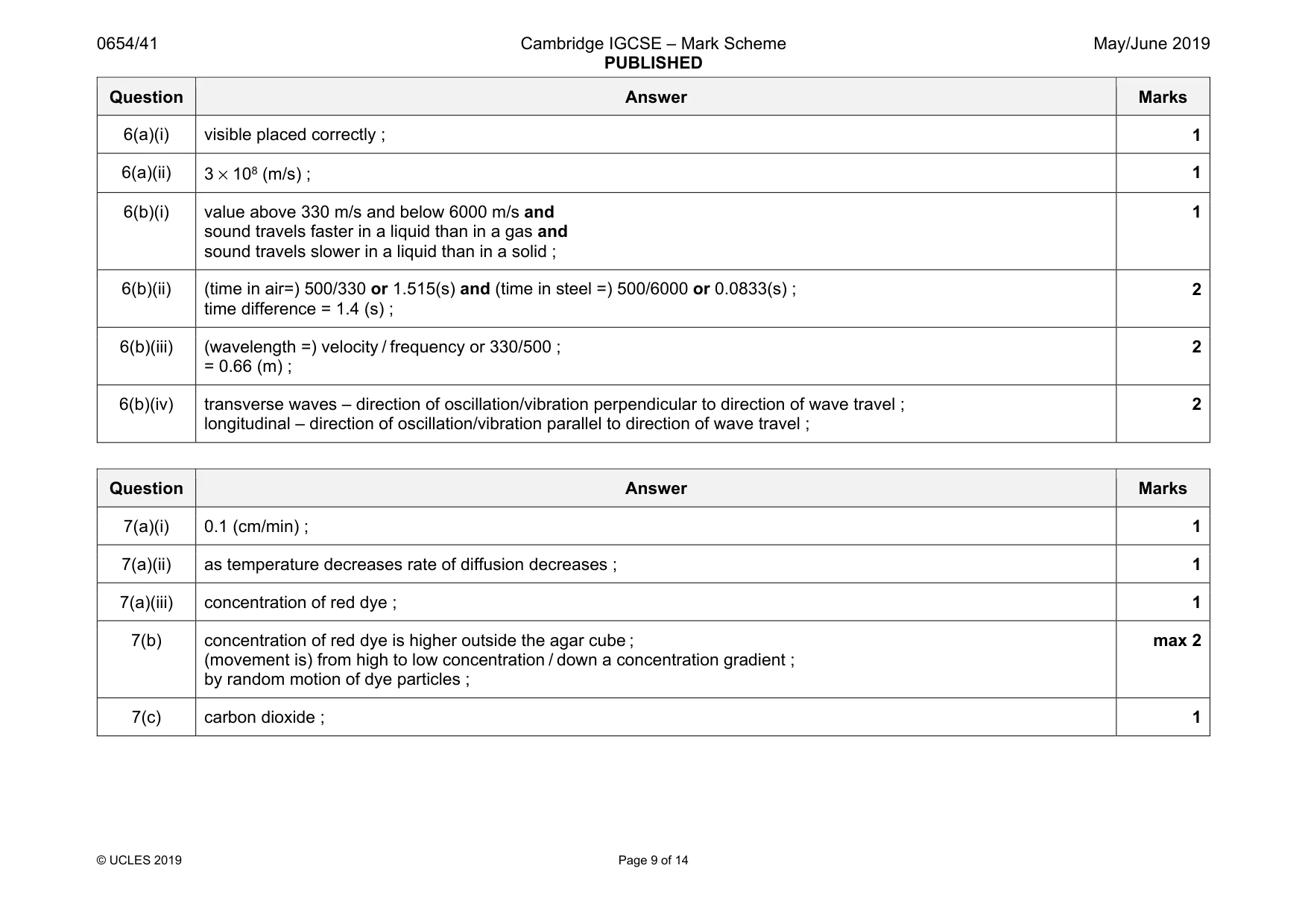
Mark scheme: 6(a)(i) visible placed correctly ; 1 6(a)(ii) 3 × 10⁸ (m/s) ; 1 6(b)(i) value above 330 m/s and below 6000 m/s and sound travels faster in a liquid than in a gas and sound travels slower in a liquid than in a solid ; 1 6(b)(ii) (time in air=) 500/330 or 1.515(s) and (time in steel =) 500/6000 or 0.0833(s) ; time difference = 1.4 (s) ; 2 6(b)(iii) (wavelength =) velocity / frequency or 330/500 ; = 0.66 (m) ; 2 6(b)(iv) transverse waves – direction of oscillation/vibration perpendicular to direction of wave travel ; longitudinal – direction of oscillation/vibration parallel to direction of wave travel ; 2
Q7 · A student investigates the effect of temperature on the rate of diffusion of red dye into…
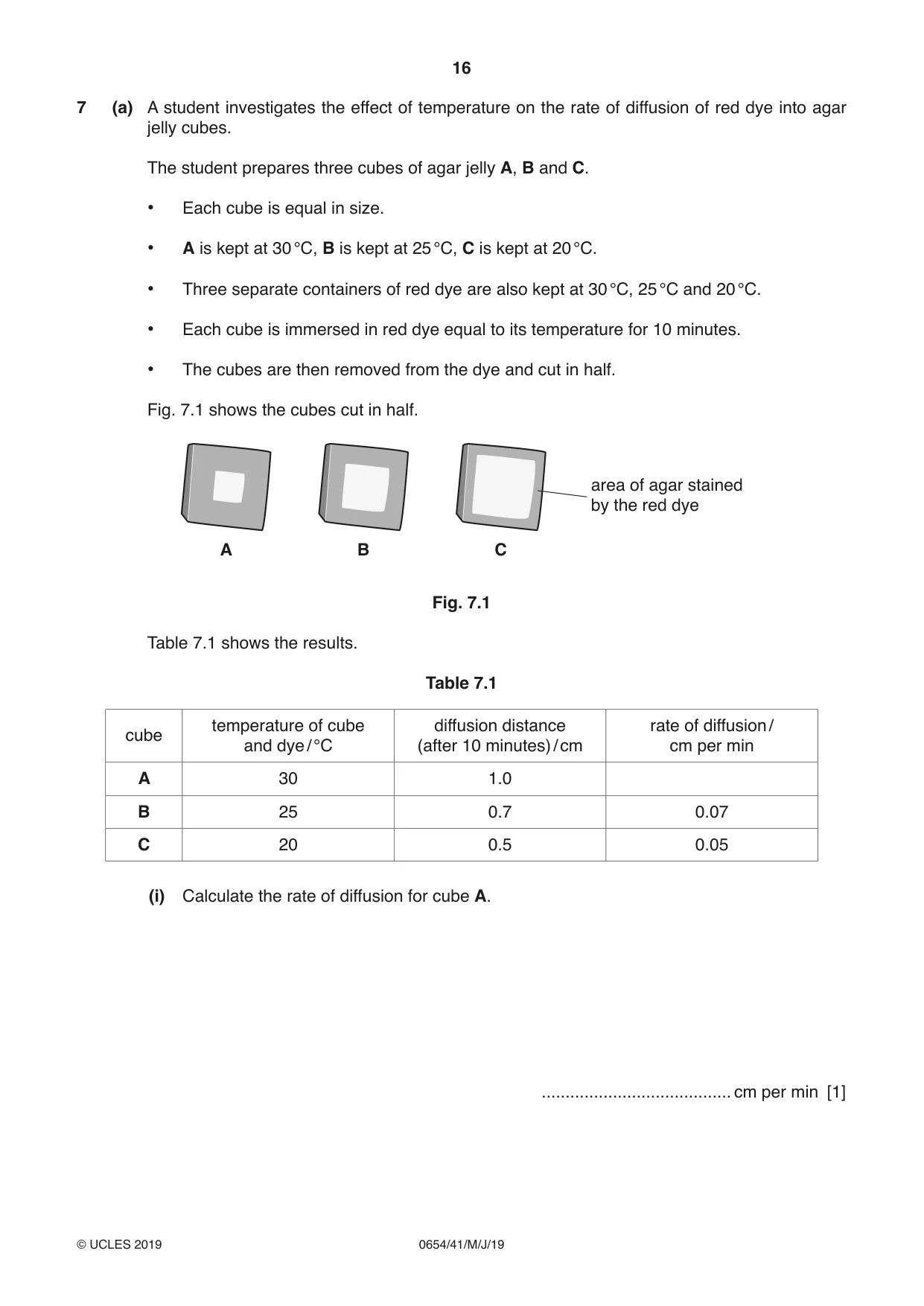
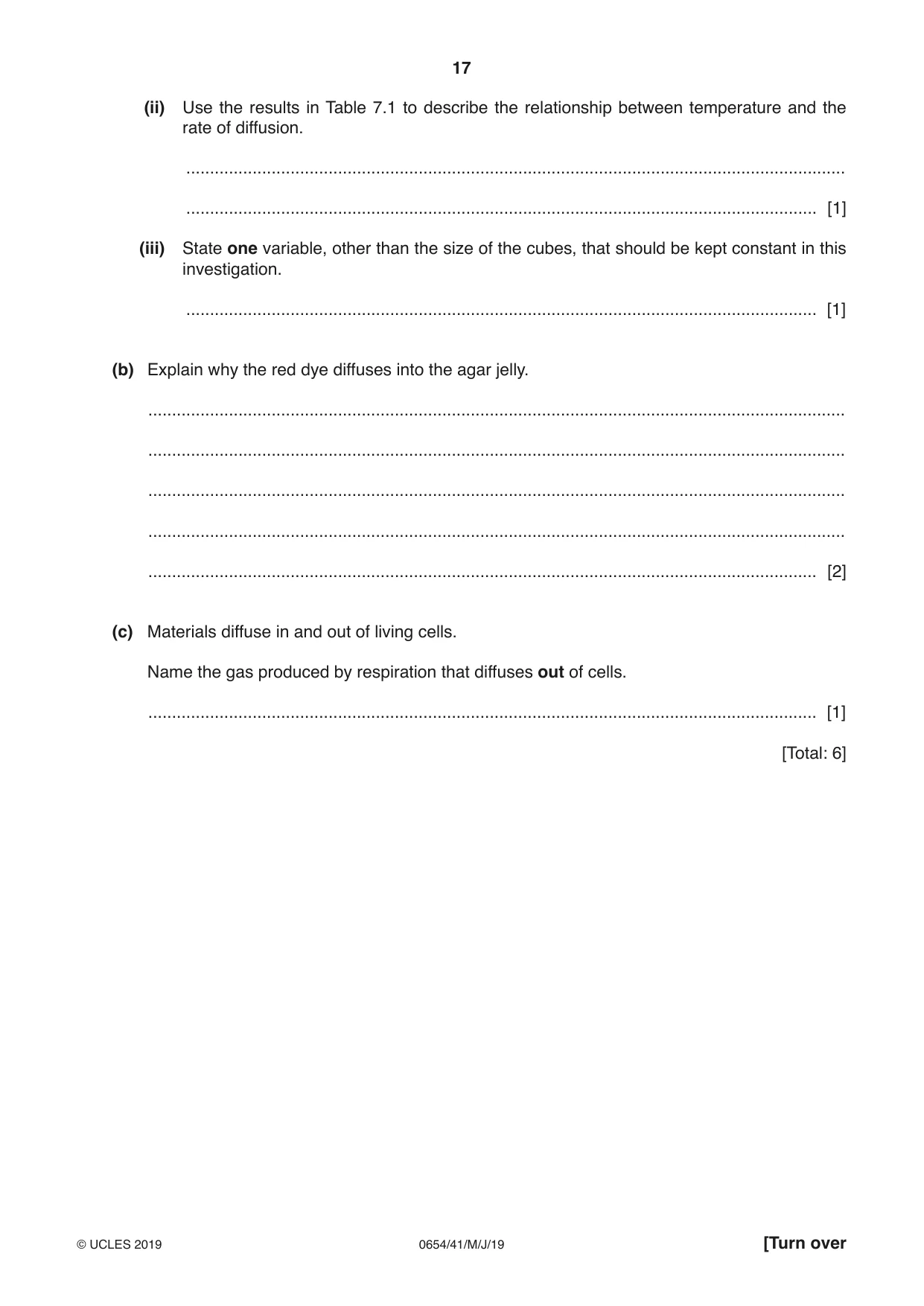
7 (a) A student investigates the effect of temperature on the rate of diffusion of red dye into agar jelly cubes. The student prepares three cubes of agar jelly A, B and C. • Each cube is equal in size. • A is kept at 30 °C, B is kept at 25 °C, C is kept at 20 °C. • Three separate containers of red dye are also kept at 30 °C, 25 °C and 20 °C. • Each cube is immersed in red dye equal to its temperature for 10 minutes. • The cubes are then removed from the dye and cut in half. Fig. 7.1 shows the cubes cut in half. area of agar stained by the red dye A B C Fig. 7.1 Table 7.1 shows the results. Table 7.1 temperature of cube diffusion distance rate of diffusion / cube and dye / °C (after 10 minutes) / cm cm per min A 30 1.0 B 25 0.7 0.07 C 20 0.5 0.05 (i) Calculate the rate of diffusion for cube A. ........................................ cm per min [1] (ii) Use the results in Table 7.1 to describe the relationship between temperature and the rate of diffusion. ........................................................................................................................................... ..................................................................................................................................... [1] (iii) State one variable, other than the size of the cubes, that should be kept constant in this investigation. ..................................................................................................................................... [1] (b) Explain why the red dye diffuses into the agar jelly. ................................................................................................................................................... ................................................................................................................................................... ................................................................................................................................................... ................................................................................................................................................... ............................................................................................................................................. [2] (c) Materials diffuse in and out of living cells. Name the gas produced by respiration that diffuses out of cells. ............................................................................................................................................. [1] [Total: 6]
Mark scheme: 7(a)(i) 0.1 (cm/min) ; 1 7(a)(ii) as temperature decreases rate of diffusion decreases ; 1 7(a)(iii) concentration of red dye ; 1 7(b) concentration of red dye is higher outside the agar cube ; (movement is) from high to low concentration / down a concentration gradient ; by random motion of dye particles ; max 2 7(c) carbon dioxide ; 1
Q8 · Using information in the Periodic Table on page 32, calculate the relative molecular…
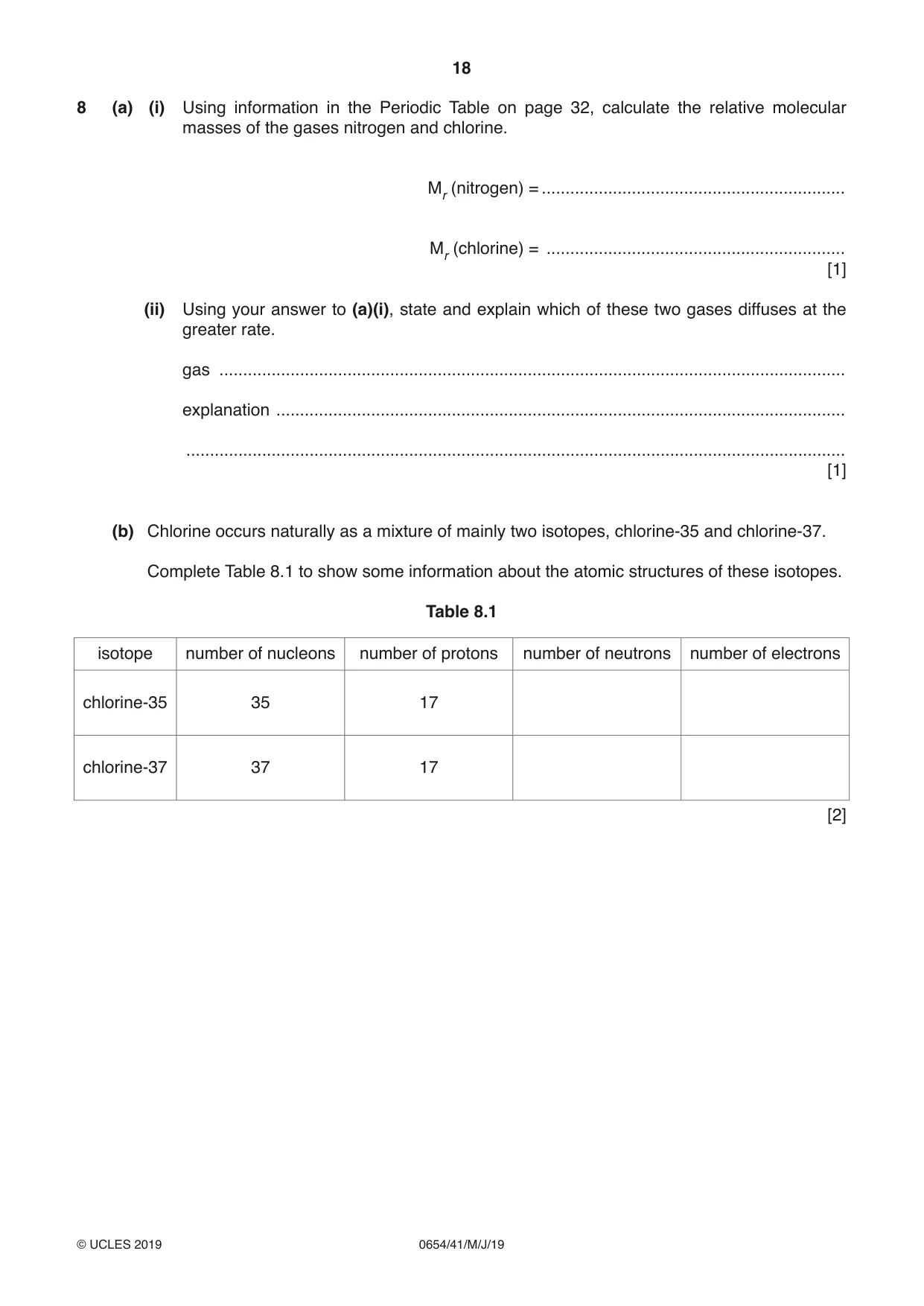
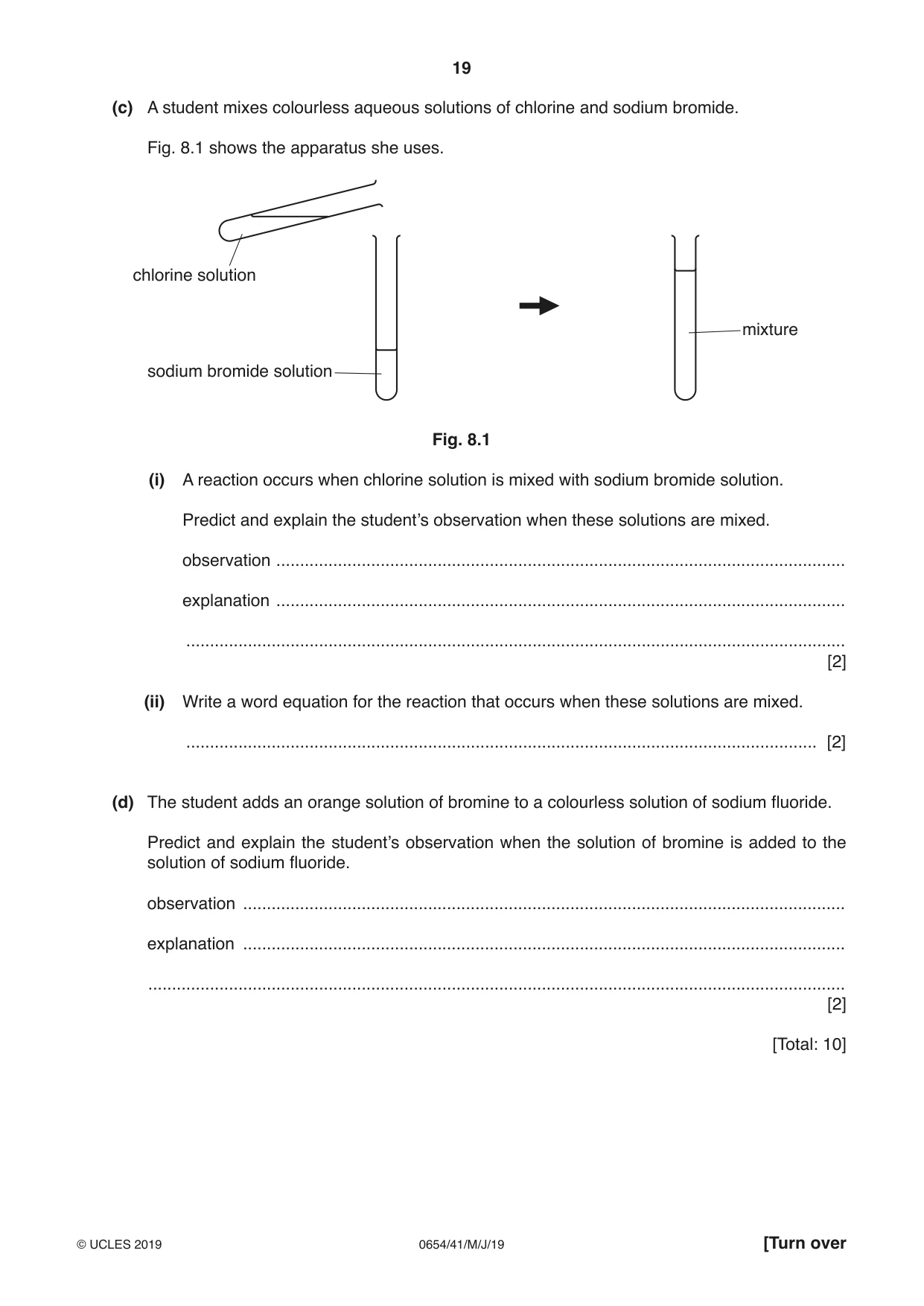
8 (a) (i) Using information in the Periodic Table on page 32, calculate the relative molecular masses of the gases nitrogen and chlorine. Mr (nitrogen) = ................................................................ Mr (chlorine) = ............................................................... [1] (ii) Using your answer to (a)(i), state and explain which of these two gases diffuses at the greater rate. gas .................................................................................................................................... explanation ........................................................................................................................ ........................................................................................................................................... [1] (b) Chlorine occurs naturally as a mixture of mainly two isotopes, chlorine-35 and chlorine-37. Complete Table 8.1 to show some information about the atomic structures of these isotopes. Table 8.1 isotope number of nucleons number of protons number of neutrons number of electrons chlorine-35 35 17 chlorine-37 37 17 [2] (c) A student mixes colourless aqueous solutions of chlorine and sodium bromide. Fig. 8.1 shows the apparatus she uses. chlorine solution mixture sodium bromide solution Fig. 8.1 (i) A reaction occurs when chlorine solution is mixed with sodium bromide solution. Predict and explain the student’s observation when these solutions are mixed. observation ........................................................................................................................ explanation ........................................................................................................................ ........................................................................................................................................... [2] (ii) Write a word equation for the reaction that occurs when these solutions are mixed. ..................................................................................................................................... [2] (d) The student adds an orange solution of bromine to a colourless solution of sodium fluoride. Predict and explain the student’s observation when the solution of bromine is added to the solution of sodium fluoride. observation ............................................................................................................................... explanation ............................................................................................................................... ................................................................................................................................................... [2] [Total: 10]
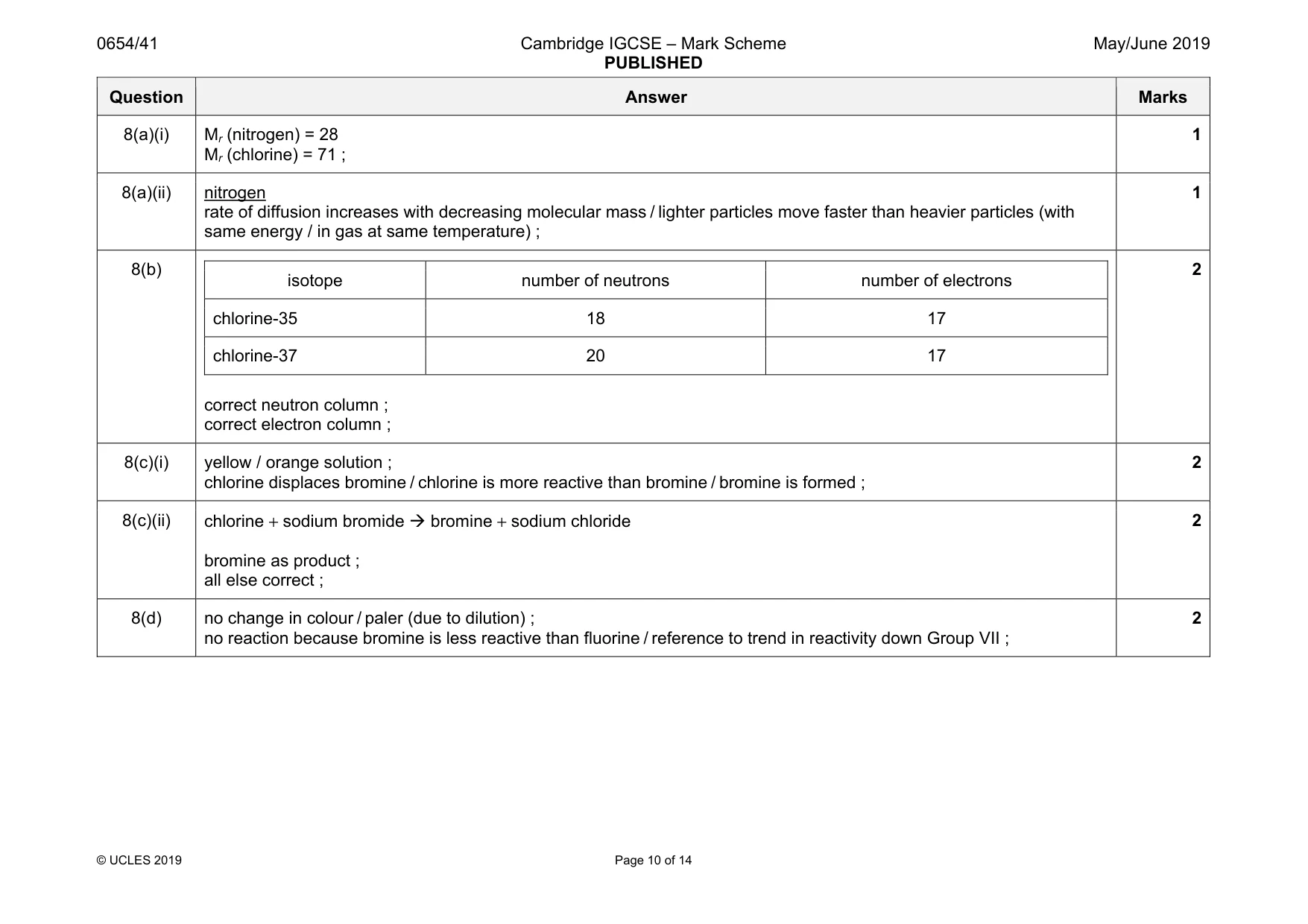
Mark scheme: 8(a)(i) Mr (nitrogen) = 28 Mr (chlorine) = 71 ; 1 8(a)(ii) nitrogen rate of diffusion increases with decreasing molecular mass / lighter particles move faster than heavier particles (with same energy / in gas at same temperature) ; 1 8(b) correct neutron column ; correct electron column ; isotope number of neutrons number of electrons chlorine-35 18 17 chlorine-37 20 17 2 8(c)(i) yellow / orange solution ; chlorine displaces bromine / chlorine is more reactive than bromine / bromine is formed ; 2 8(c)(ii) chlorine + sodium bromide Æ bromine + sodium chloride bromine as product ; all else correct ; 2 8(d) no change in colour / paler (due to dilution) ; no reaction because bromine is less reactive than fluorine / reference to trend in reactivity down Group VII ; 2
Q9 · During a mission to the Moon in 1971, an astronaut dropped a feather and a hammer
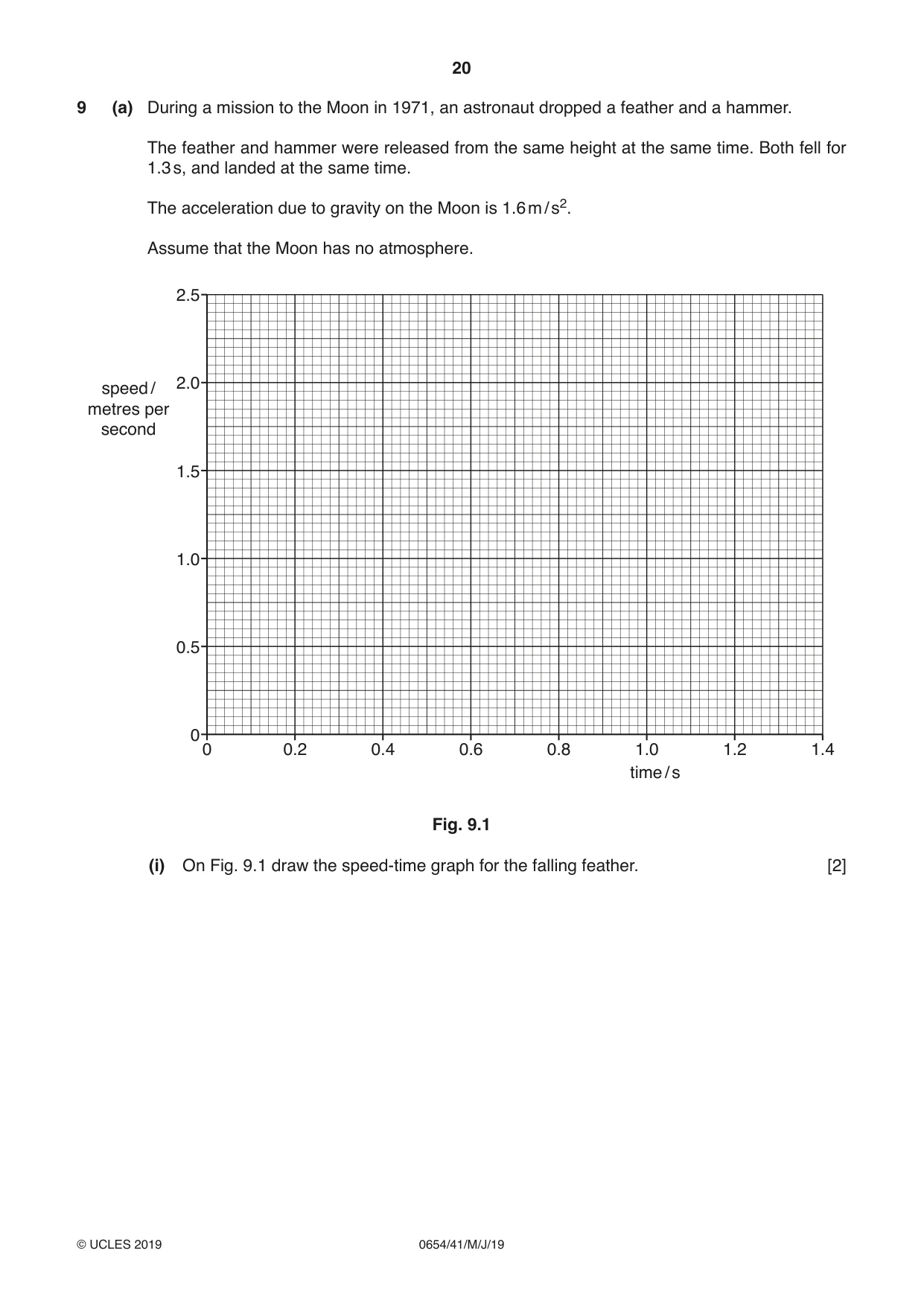
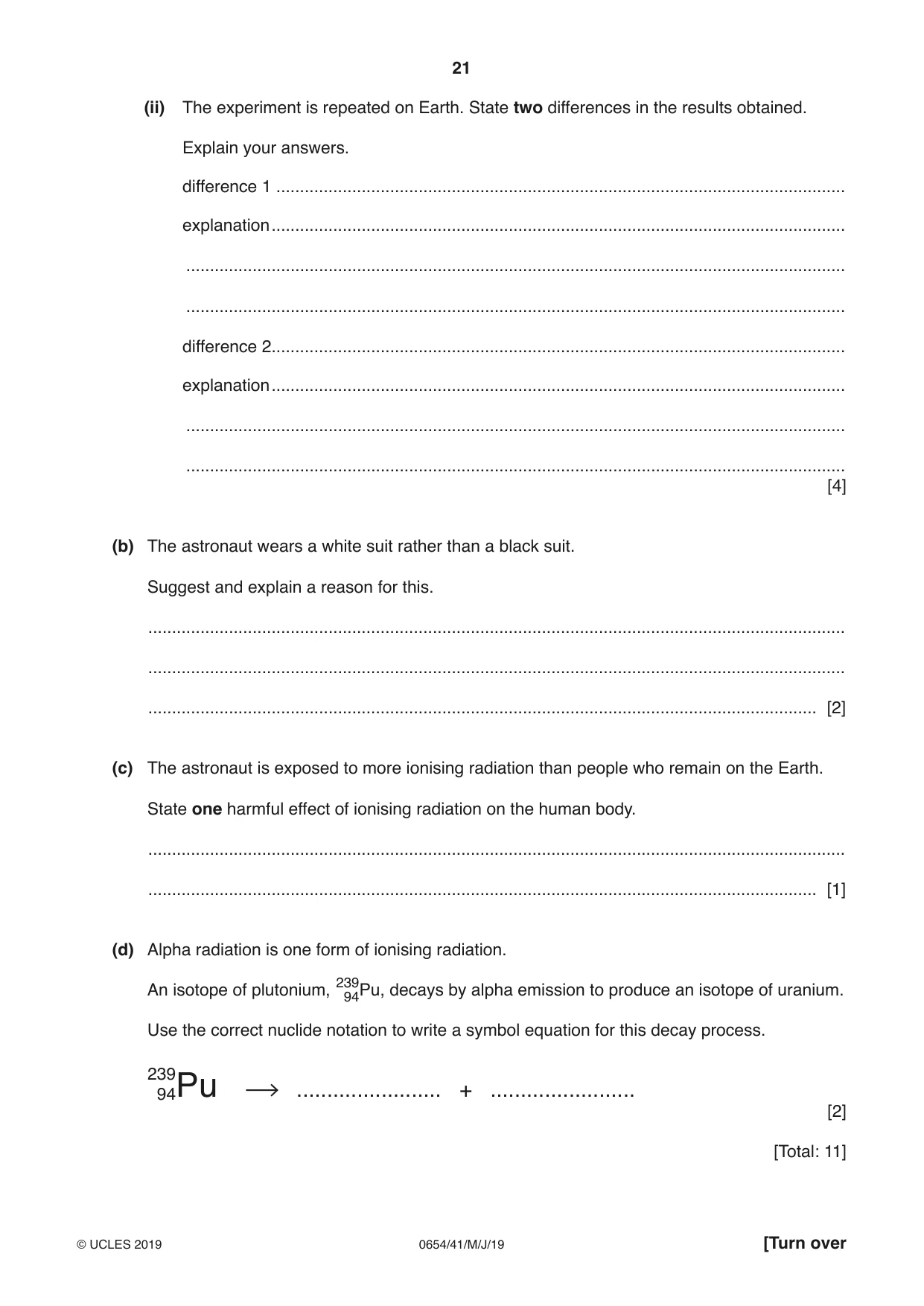
9 (a) During a mission to the Moon in 1971, an astronaut dropped a feather and a hammer. The feather and hammer were released from the same height at the same time. Both fell for 1.3 s, and landed at the same time. The acceleration due to gravity on the Moon is 1.6 m / s2. Assume that the Moon has no atmosphere. 2.5 2.0 speed / metres per second 1.5 1.0 0.5 0 0 0.2 0.4 0.6 0.8 1.0 1.2 1.4 time / s Fig. 9.1 (i) On Fig. 9.1 draw the speed-time graph for the falling feather. [2] (ii) The experiment is repeated on Earth. State two differences in the results obtained. Explain your answers. difference 1 ........................................................................................................................ explanation ......................................................................................................................... ........................................................................................................................................... ........................................................................................................................................... difference 2......................................................................................................................... explanation ......................................................................................................................... ........................................................................................................................................... ........................................................................................................................................... [4] (b) The astronaut wears a white suit rather than a black suit. Suggest and explain a reason for this. ................................................................................................................................................... ................................................................................................................................................... ............................................................................................................................................. [2] (c) The astronaut is exposed to more ionising radiation than people who remain on the Earth. State one harmful effect of ionising radiation on the human body. ................................................................................................................................................... ............................................................................................................................................. [1] (d) Alpha radiation is one form of ionising radiation. 239 An isotope of plutonium, 94Pu, decays by alpha emission to produce an isotope of uranium. Use the correct nuclide notation to write a symbol equation for this decay process. 239 ........................ + ........................ 94Pu [2] [Total: 11]
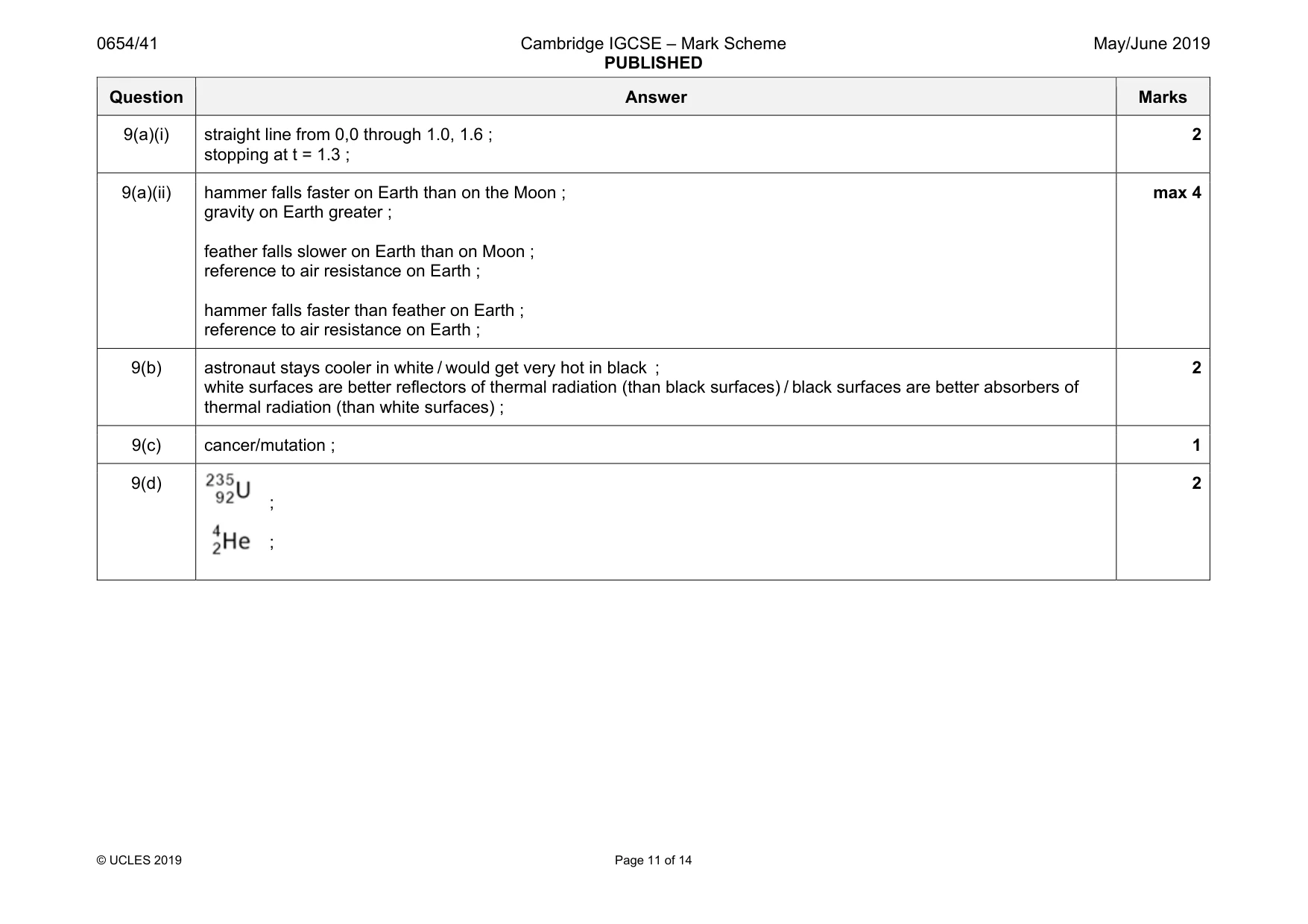
Mark scheme: 9(a)(i) straight line from 0,0 through 1.0, 1.6 ; stopping at t = 1.3 ; 2 9(a)(ii) hammer falls faster on Earth than on the Moon ; gravity on Earth greater ; feather falls slower on Earth than on Moon ; reference to air resistance on Earth ; hammer falls faster than feather on Earth ; reference to air resistance on Earth ; max 4 9(b) astronaut stays cooler in white / would get very hot in black ; white surfaces are better reflectors of thermal radiation (than black surfaces) / black surfaces are better absorbers of thermal radiation (than white surfaces) ; 2 9(c) cancer/mutation ; 1 9(d) ; ; 2
Q10 · A cross-section through a vein when seen under a light microscope
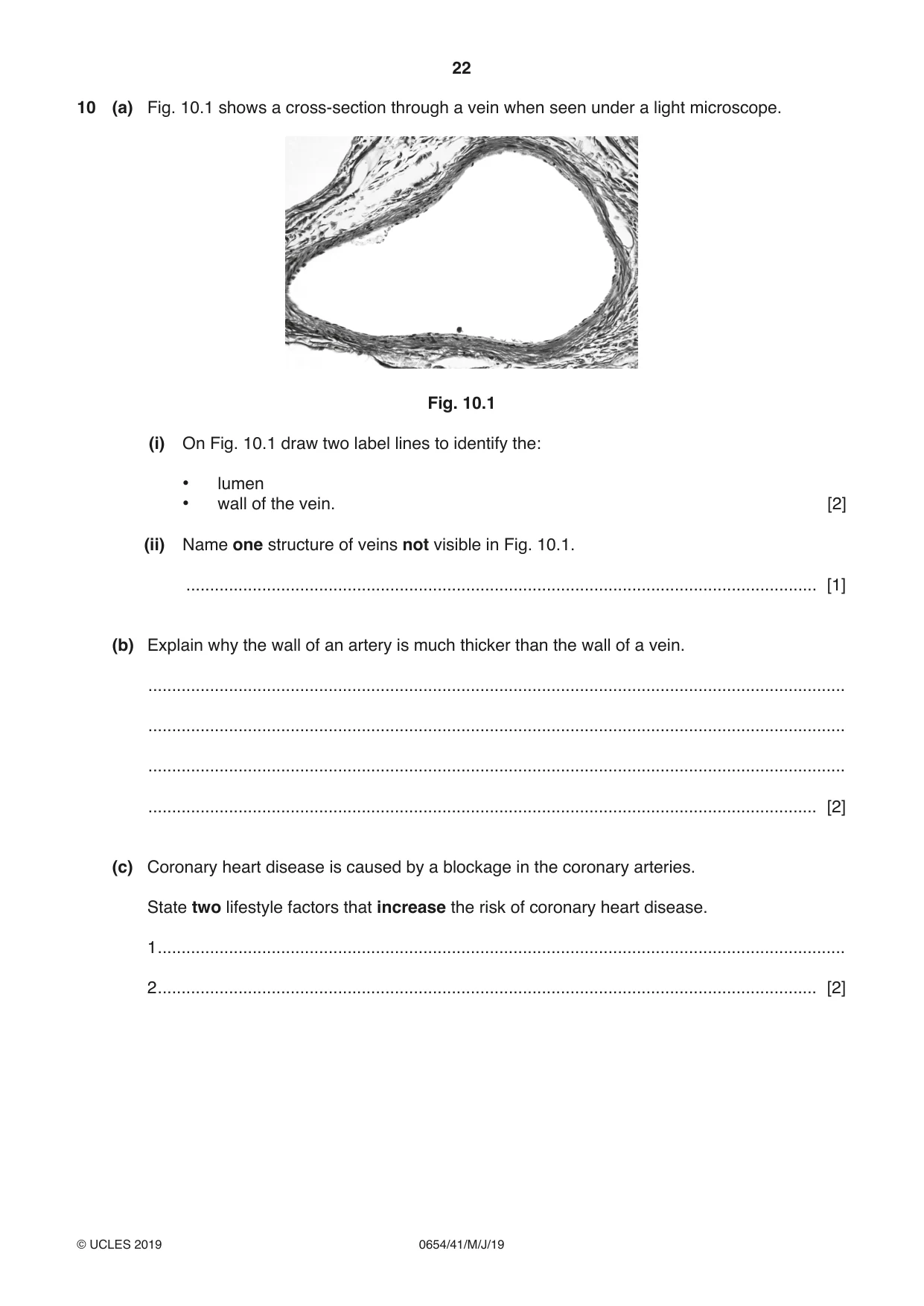
10 (a) Fig. 10.1 shows a cross-section through a vein when seen under a light microscope. Fig. 10.1 (i) On Fig. 10.1 draw two label lines to identify the: • lumen • wall of the vein. [2] (ii) Name one structure of veins not visible in Fig. 10.1. ..................................................................................................................................... [1] (b) Explain why the wall of an artery is much thicker than the wall of a vein. ................................................................................................................................................... ................................................................................................................................................... ................................................................................................................................................... ............................................................................................................................................. [2] (c) Coronary heart disease is caused by a blockage in the coronary arteries. State two lifestyle factors that increase the risk of coronary heart disease. 1 ................................................................................................................................................. 2 ........................................................................................................................................... [2] (d) Hormones are released into blood. (i) Name the hormone that: • is released in stressful situations .................................................................................................................................... • decreases the glucose concentration of the blood. .................................................................................................................................... [2] (ii) Auxin is a plant hormone. State the effect of auxin on plant cells. ..................................................................................................................................... [1] [Total: 10]
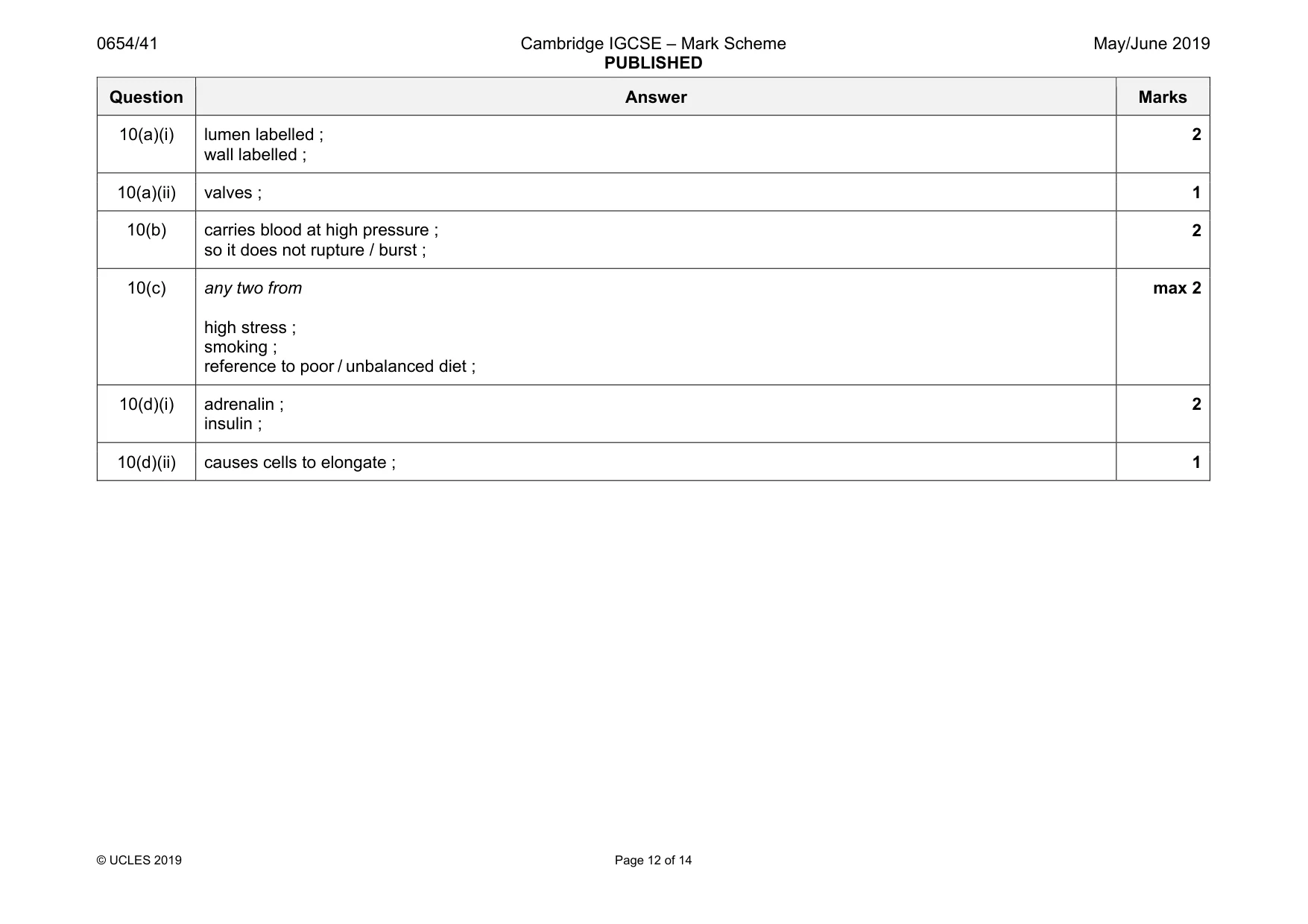
Mark scheme: 10(a)(i) lumen labelled ; wall labelled ; 2 10(a)(ii) valves ; 1 10(b) carries blood at high pressure ; so it does not rupture / burst ; 2 10(c) any two from high stress ; smoking ; reference to poor / unbalanced diet ; max 2 10(d)(i) adrenalin ; insulin ; 2 10(d)(ii) causes cells to elongate ; 1
Q11 · A student investigates the rate of reaction of calcium carbonate with dilute hydrochloric…
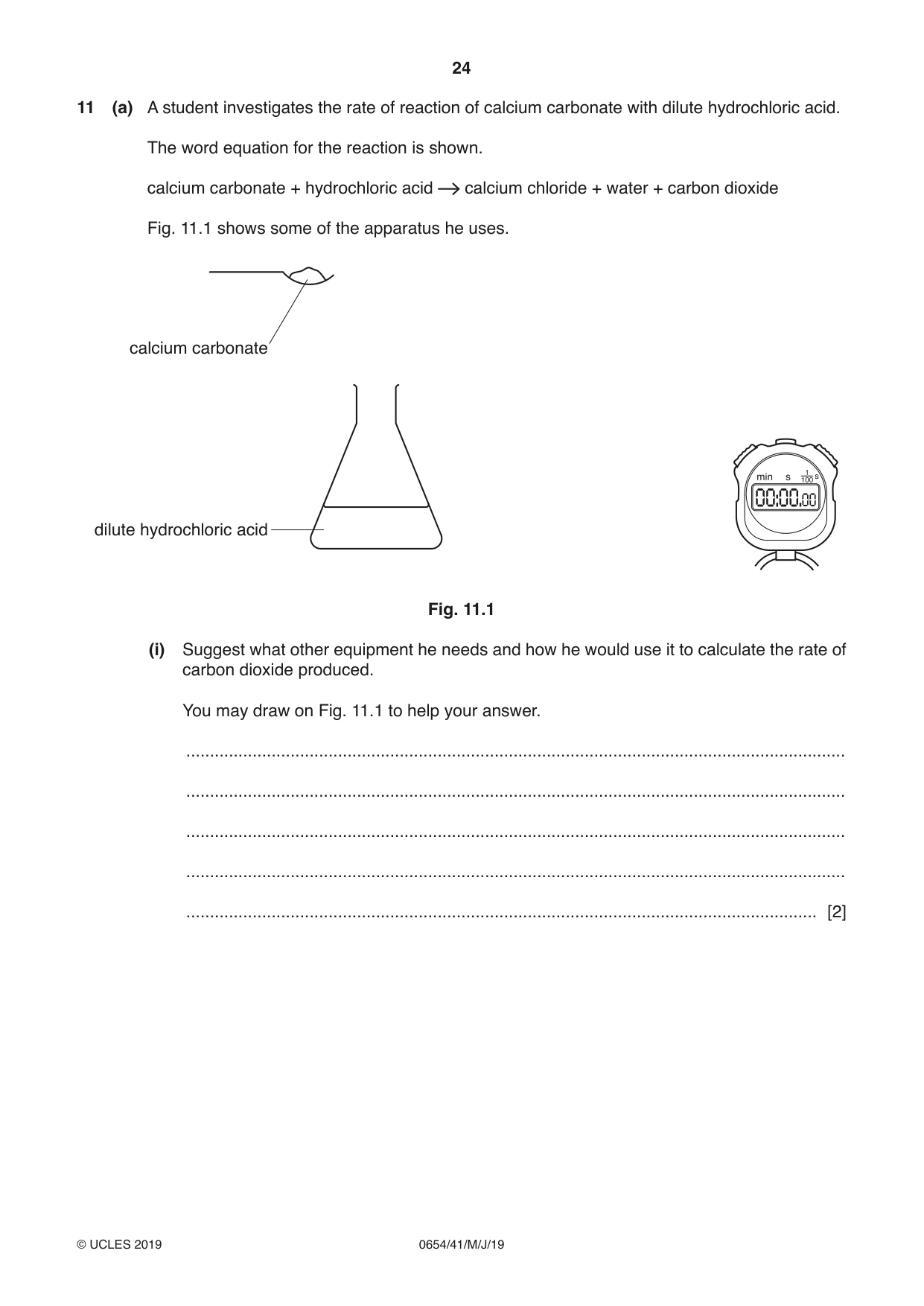
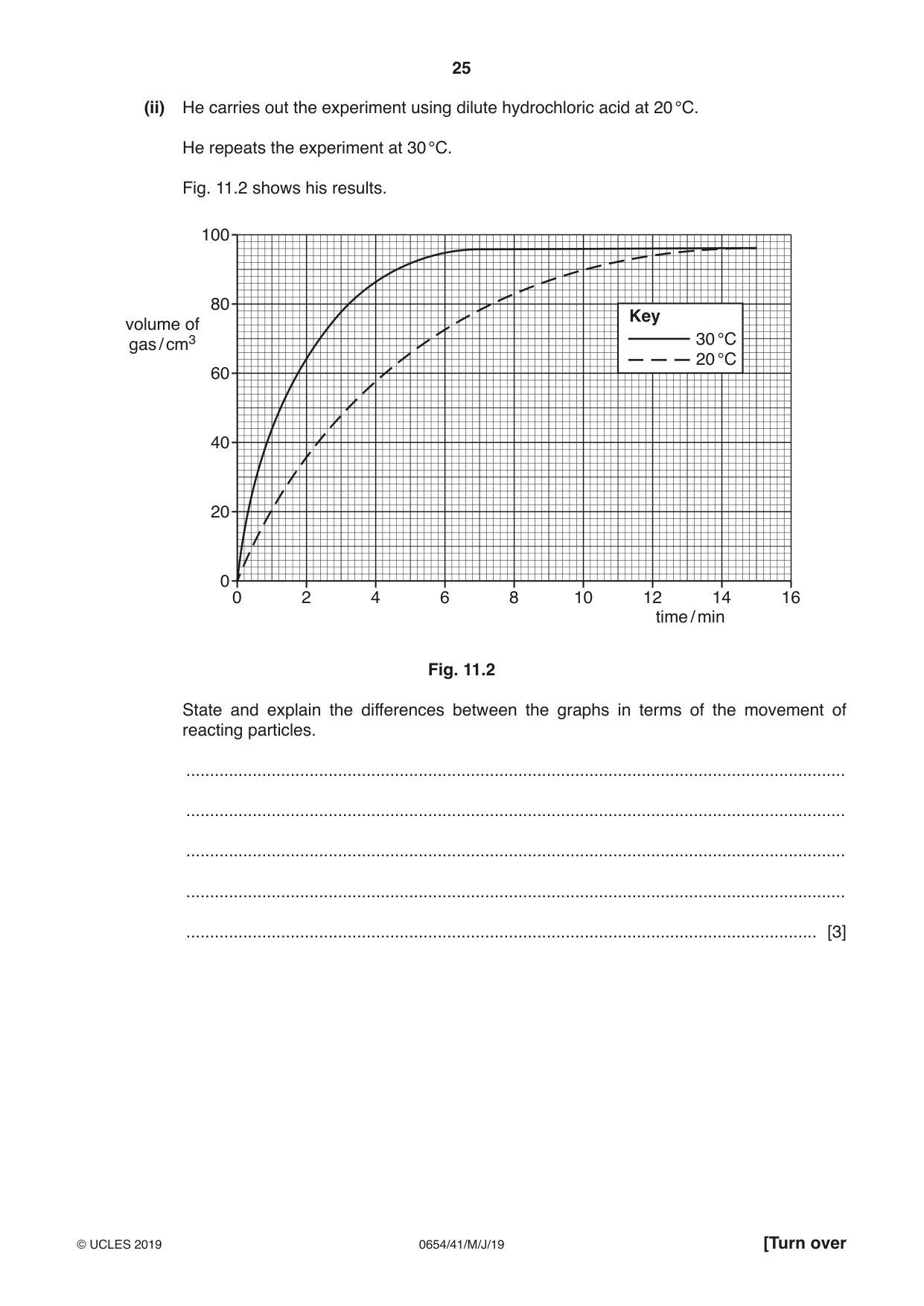
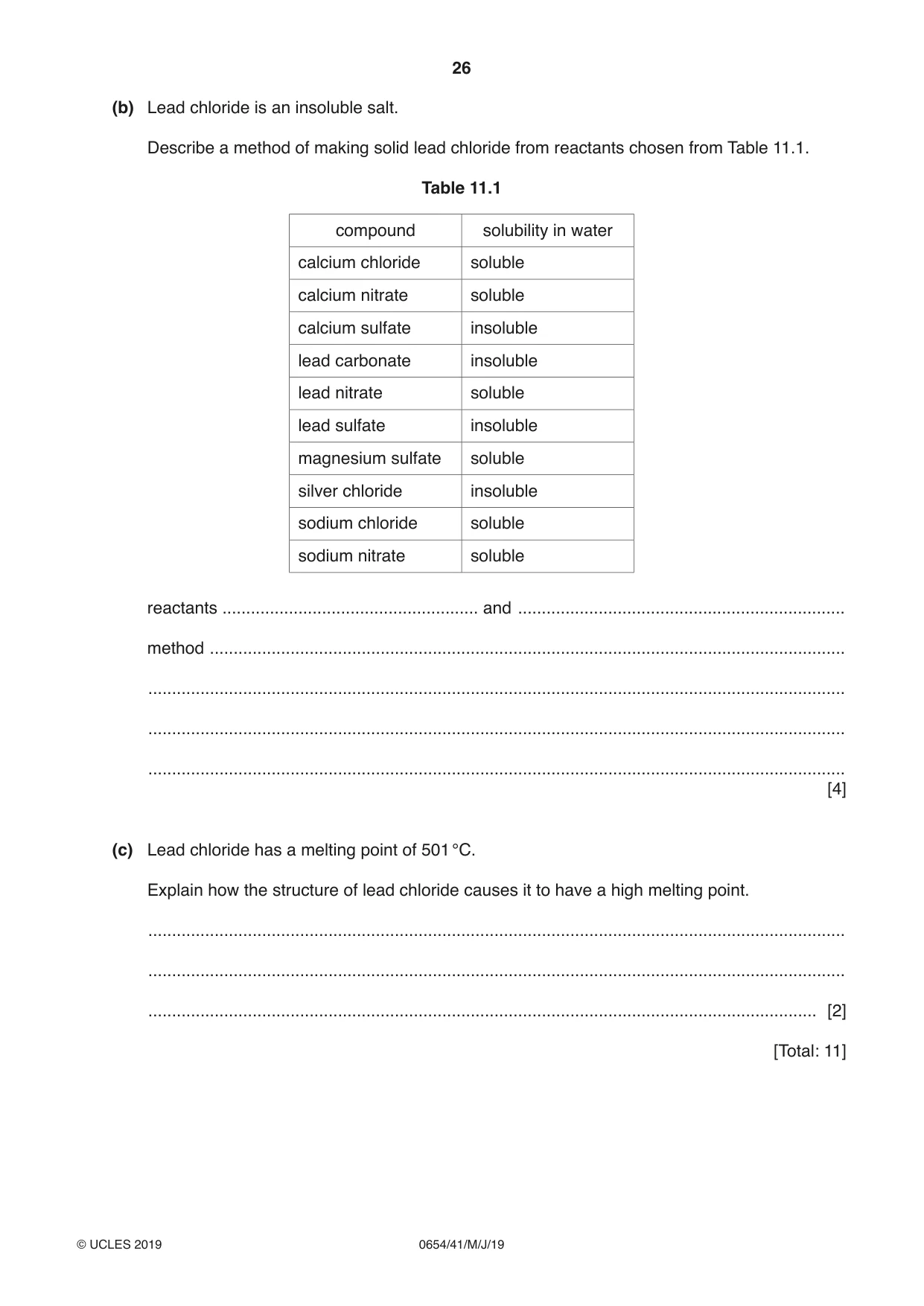
11 (a) A student investigates the rate of reaction of calcium carbonate with dilute hydrochloric acid. The word equation for the reaction is shown. calcium carbonate + hydrochloric acid calcium chloride + water + carbon dioxide Fig. 11.1 shows some of the apparatus he uses. calcium carbonate dilute hydrochloric acid Fig. 11.1 (i) Suggest what other equipment he needs and how he would use it to calculate the rate of carbon dioxide produced. You may draw on Fig. 11.1 to help your answer. ........................................................................................................................................... ........................................................................................................................................... ........................................................................................................................................... ........................................................................................................................................... ..................................................................................................................................... [2] (ii) He carries out the experiment using dilute hydrochloric acid at 20 °C. He repeats the experiment at 30 °C. Fig. 11.2 shows his results. 100 80 Keyvolume of 30 °Cgas / cm3 20 °C 60 40 20 0 0 2 4 6 8 10 12 14 16 time / min Fig. 11.2 State and explain the differences between the graphs in terms of the movement of reacting particles. ........................................................................................................................................... ........................................................................................................................................... ........................................................................................................................................... ........................................................................................................................................... ..................................................................................................................................... [3] (b) Lead chloride is an insoluble salt. Describe a method of making solid lead chloride from reactants chosen from Table 11.1. Table 11.1 compound solubility in water calcium chloride soluble calcium nitrate soluble calcium sulfate insoluble lead carbonate insoluble lead nitrate soluble lead sulfate insoluble magnesium sulfate soluble silver chloride insoluble sodium chloride soluble sodium nitrate soluble reactants ...................................................... and ..................................................................... method ...................................................................................................................................... ................................................................................................................................................... ................................................................................................................................................... ................................................................................................................................................... [4] (c) Lead chloride has a melting point of 501 °C. Explain how the structure of lead chloride causes it to have a high melting point. ................................................................................................................................................... ................................................................................................................................................... ............................................................................................................................................. [2] [Total: 11]
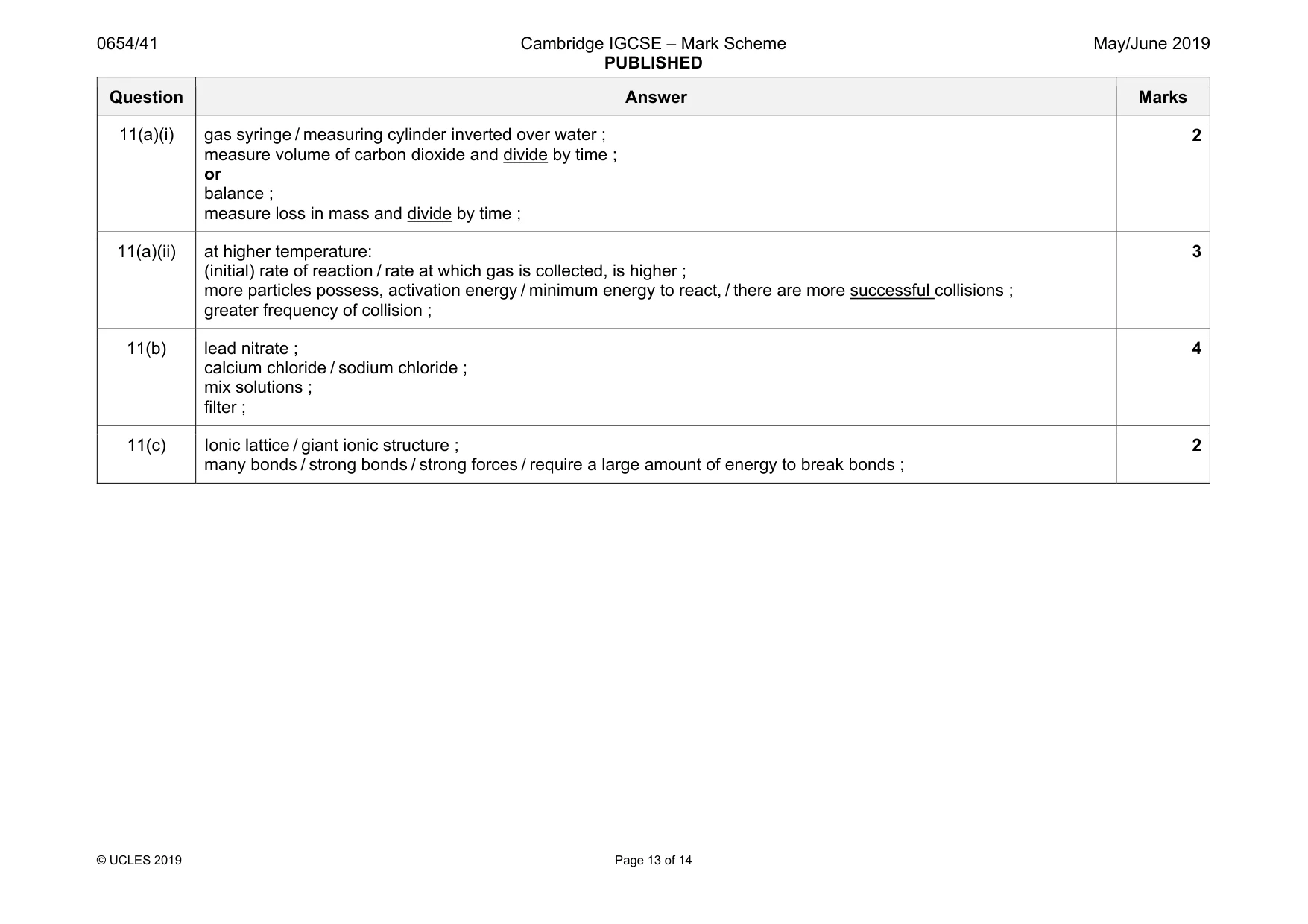
Mark scheme: 11(a)(i) gas syringe / measuring cylinder inverted over water ; measure volume of carbon dioxide and divide by time ; or balance ; measure loss in mass and divide by time ; 2 11(a)(ii) at higher temperature: (initial) rate of reaction / rate at which gas is collected, is higher ; more particles possess, activation energy / minimum energy to react, / there are more successful collisions ; greater frequency of collision ; 3 11(b) lead nitrate ; calcium chloride / sodium chloride ; mix solutions ; filter ; 4 11(c) Ionic lattice / giant ionic structure ; many bonds / strong bonds / strong forces / require a large amount of energy to break bonds ; 2
Q12 · A solar-powered golf cart, with solar cells on the roof
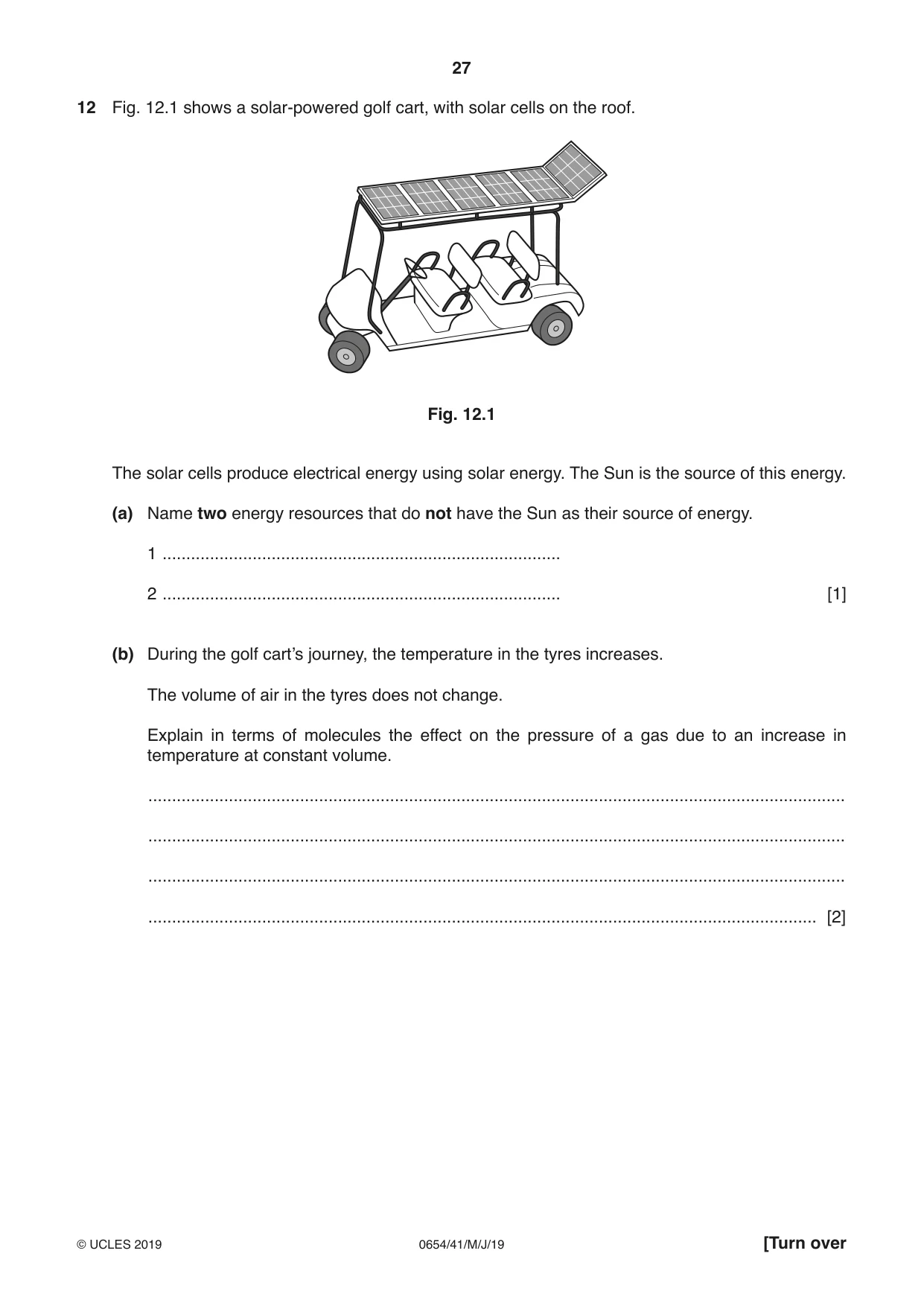
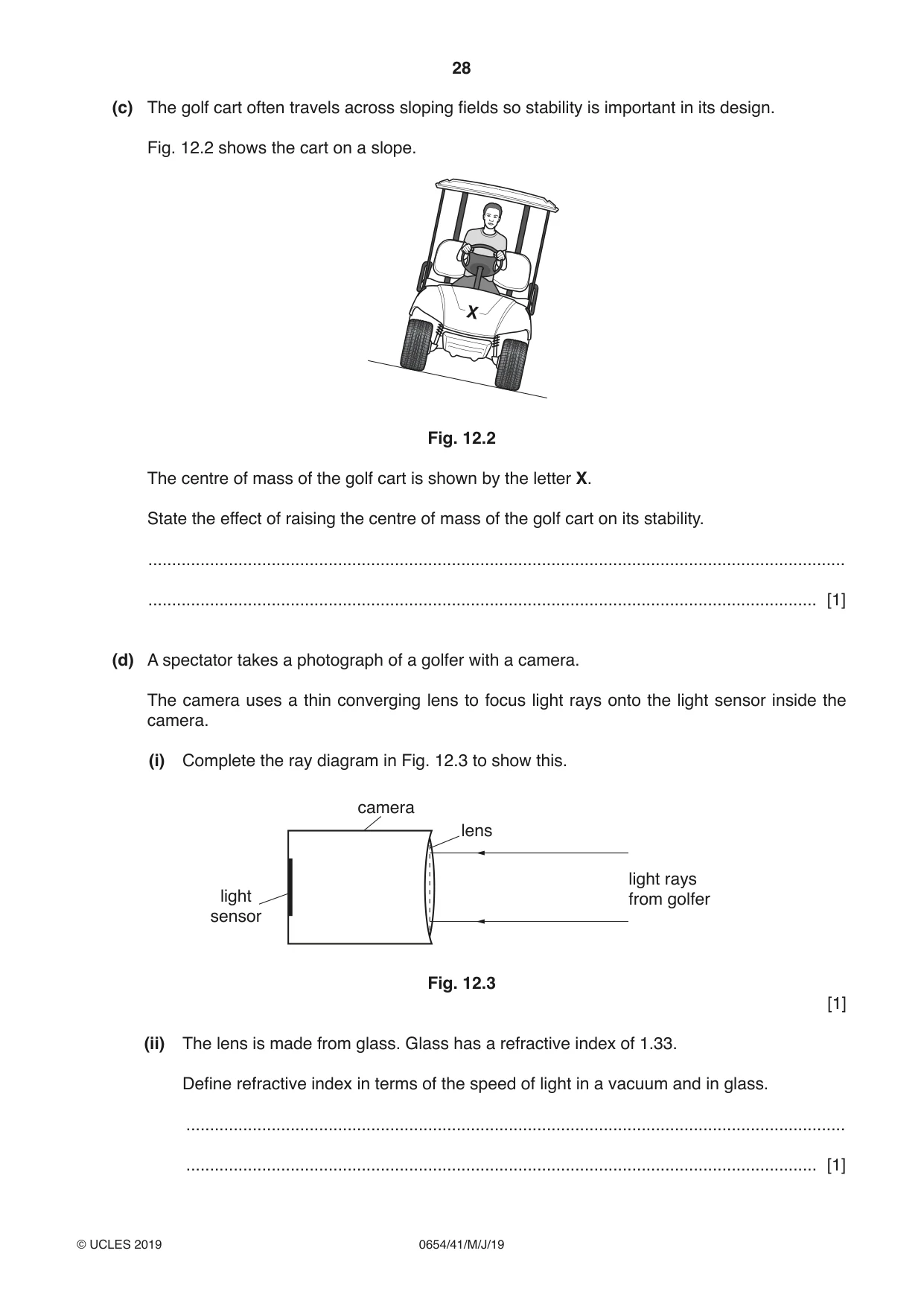
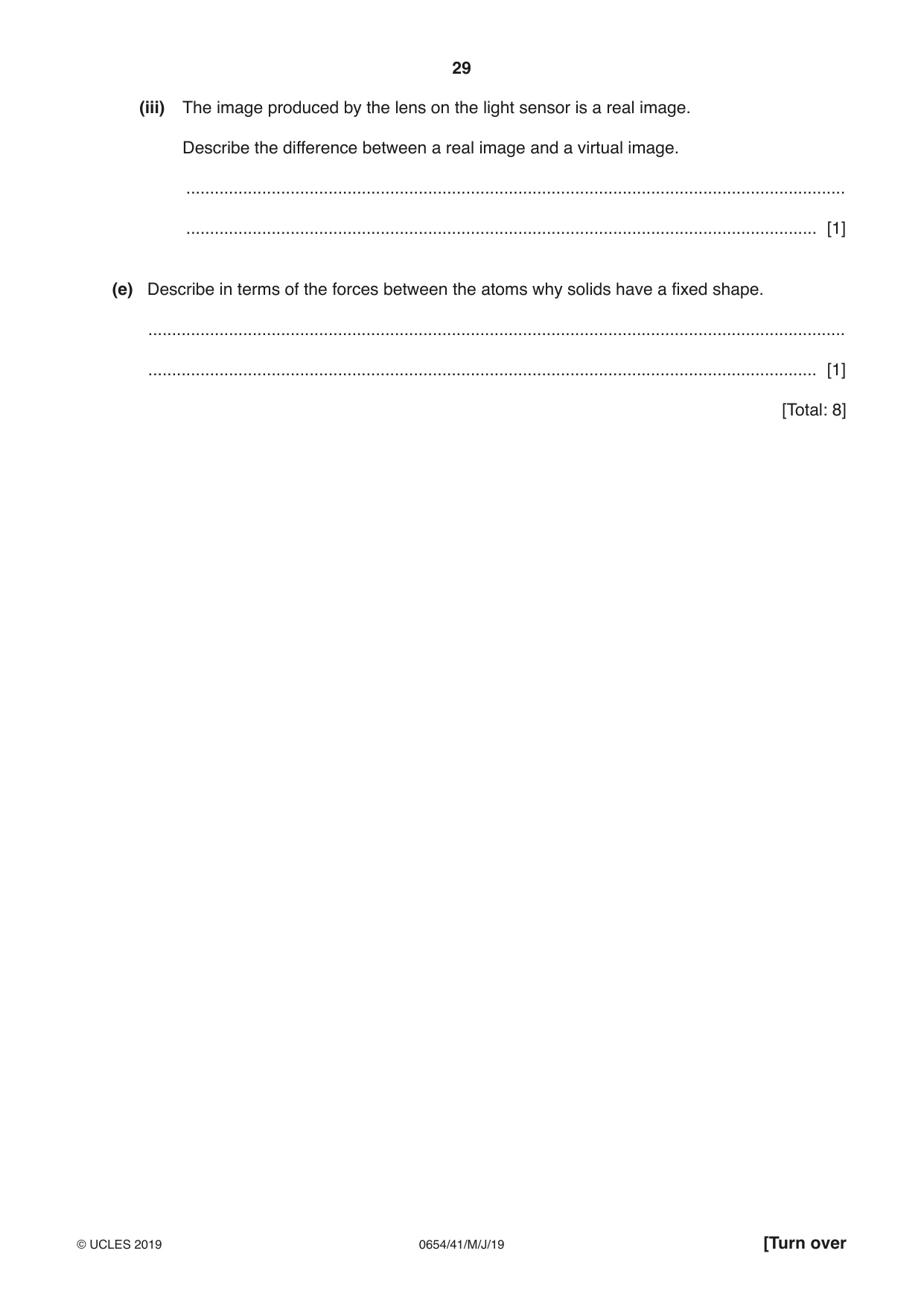
12 Fig. 12.1 shows a solar-powered golf cart, with solar cells on the roof. Fig. 12.1 The solar cells produce electrical energy using solar energy. The Sun is the source of this energy. (a) Name two energy resources that do not have the Sun as their source of energy. 1 .................................................................................... 2 .................................................................................... [1] (b) During the golf cart’s journey, the temperature in the tyres increases. The volume of air in the tyres does not change. Explain in terms of molecules the effect on the pressure of a gas due to an increase in temperature at constant volume. ................................................................................................................................................... ................................................................................................................................................... ................................................................................................................................................... ............................................................................................................................................. [2] (c) The golf cart often travels across sloping fields so stability is important in its design. Fig. 12.2 shows the cart on a slope. X Fig. 12.2 The centre of mass of the golf cart is shown by the letter X. State the effect of raising the centre of mass of the golf cart on its stability. ................................................................................................................................................... ............................................................................................................................................. [1] (d) A spectator takes a photograph of a golfer with a camera. The camera uses a thin converging lens to focus light rays onto the light sensor inside the camera. (i) Complete the ray diagram in Fig. 12.3 to show this. camera lens light rays light from golfer sensor Fig. 12.3 [1] (ii) The lens is made from glass. Glass has a refractive index of 1.33. Define refractive index in terms of the speed of light in a vacuum and in glass. ........................................................................................................................................... ..................................................................................................................................... [1] (iii) The image produced by the lens on the light sensor is a real image. Describe the difference between a real image and a virtual image. ........................................................................................................................................... ..................................................................................................................................... [1] (e) Describe in terms of the forces between the atoms why solids have a fixed shape. ................................................................................................................................................... ............................................................................................................................................. [1] [Total: 8]
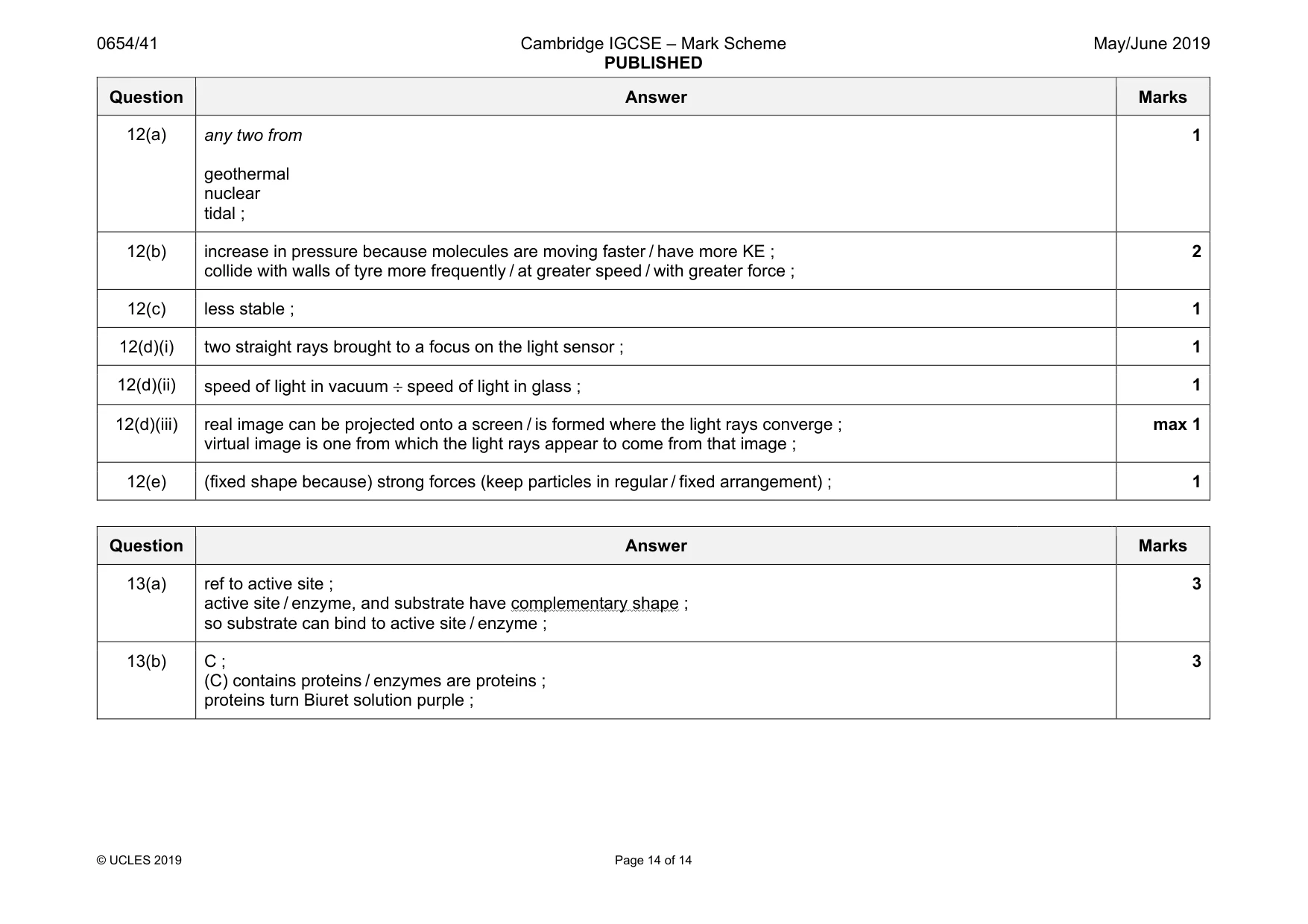
Mark scheme: 12(a) any two from geothermal nuclear tidal ; 1 12(b) increase in pressure because molecules are moving faster / have more KE ; collide with walls of tyre more frequently / at greater speed / with greater force ; 2 12(c) less stable ; 1 12(d)(i) two straight rays brought to a focus on the light sensor ; 1 12(d)(ii) speed of light in vacuum ÷ speed of light in glass ; 1 12(d)(iii) real image can be projected onto a screen / is formed where the light rays converge ; virtual image is one from which the light rays appear to come from that image ; max 1 12(e) (fixed shape because) strong forces (keep particles in regular / fixed arrangement) ; 1
Q13 · Enzymes are biological catalysts with a specific shape
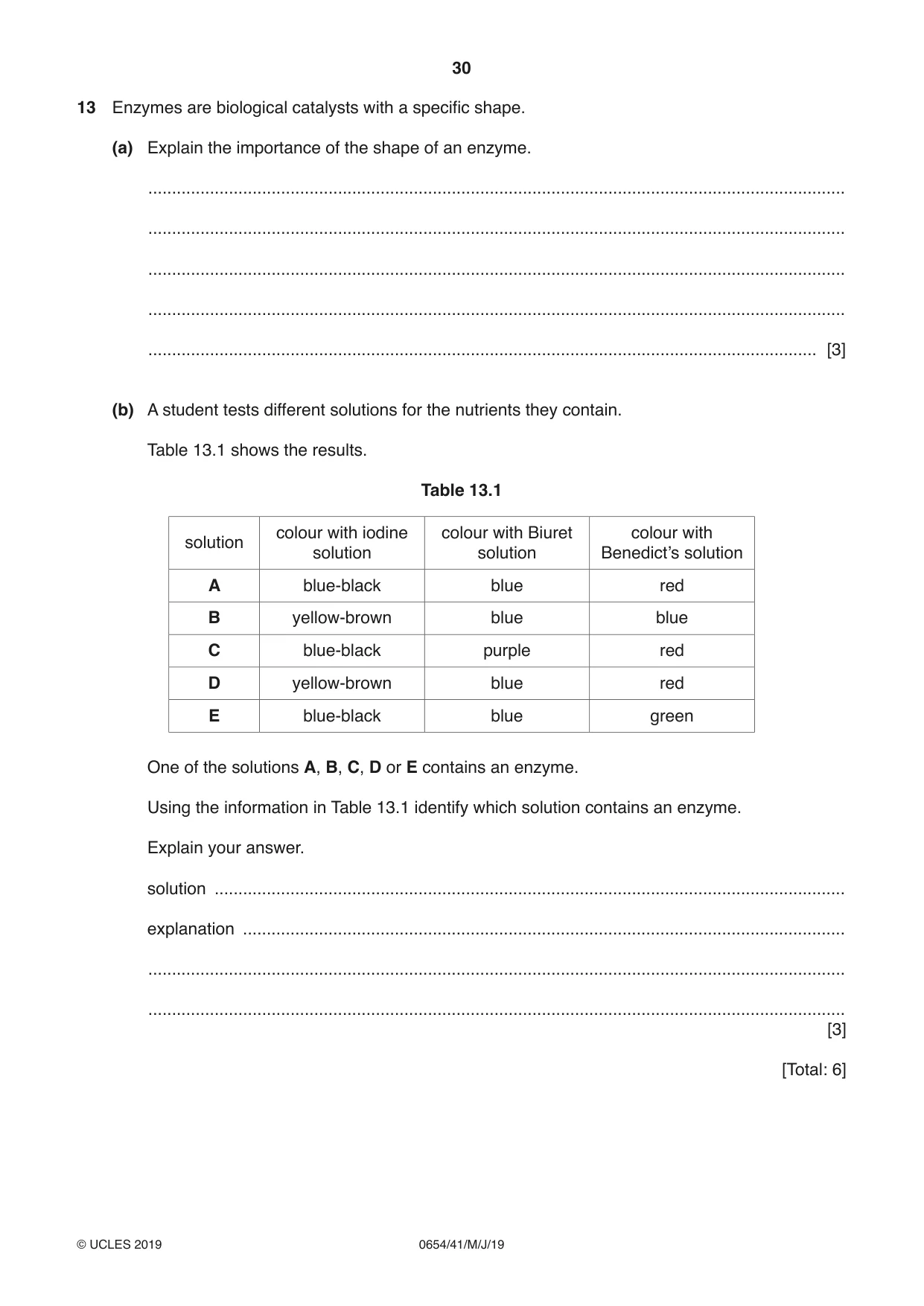
13 Enzymes are biological catalysts with a specific shape. (a) Explain the importance of the shape of an enzyme. ................................................................................................................................................... ................................................................................................................................................... ................................................................................................................................................... ................................................................................................................................................... ............................................................................................................................................. [3] (b) A student tests different solutions for the nutrients they contain. Table 13.1 shows the results. Table 13.1 colour with iodine colour with Biuret colour with solution solution solution Benedict’s solution A blue-black blue red B yellow-brown blue blue C blue-black purple red D yellow-brown blue red E blue-black blue green One of the solutions A, B, C, D or E contains an enzyme. Using the information in Table 13.1 identify which solution contains an enzyme. Explain your answer. solution ..................................................................................................................................... explanation ............................................................................................................................... ................................................................................................................................................... ................................................................................................................................................... [3] [Total: 6]
Mark scheme: 13(a) ref to active site ; active site / enzyme, and substrate have complementary shape ; so substrate can bind to active site / enzyme ; 3 13(b) C ; (C) contains proteins / enzymes are proteins ; proteins turn Biuret solution purple ; 3
What was in this paper
The subtopics covered by these 13 questions, and how many questions each got. Open one in a new tab to see every Cambridge question on it.
What you needed in this session
Cambridge’s own grade thresholds for 2019 May/June, Paper 4 · Variant 1. A higher threshold means an easier paper — the bar moves with how the cohort did.