Cambridge IGCSE Sciences - Co-ordinated (Double) 0654 — 2024 Oct/Nov Paper 4 · Variant 2
0654/42/O/N/24 · 12 questions · 120 marks · ≈135 min
The question paper and its mark scheme, free to read here and free to download. This is Cambridge’s own paper, exactly as it was sat.
Question paper24 pages
Mark scheme14 pages
Answers below. Sit the paper first if you are practising.
Questions as text
Q1 · The circulatory system in horses is similar to in humans
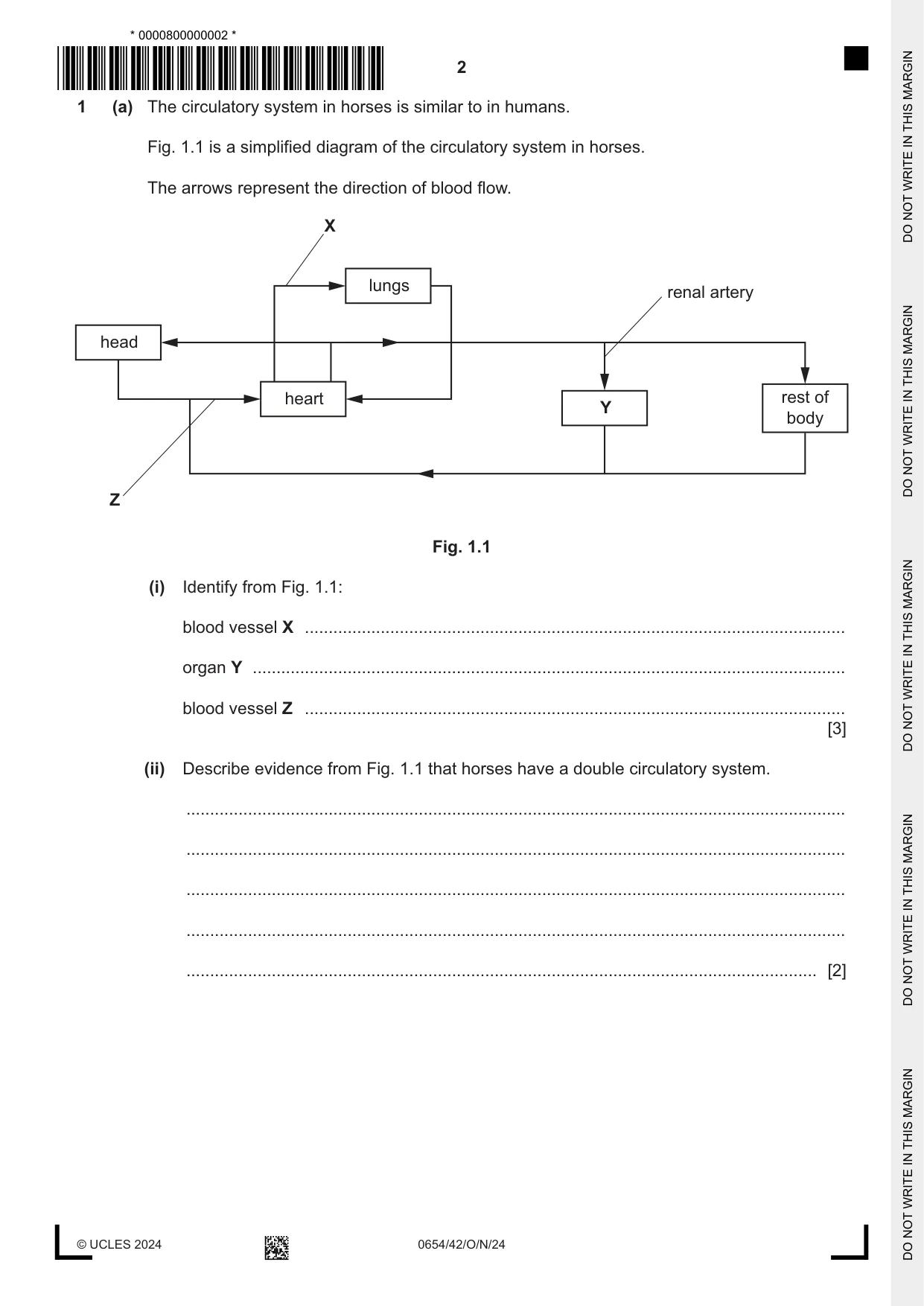
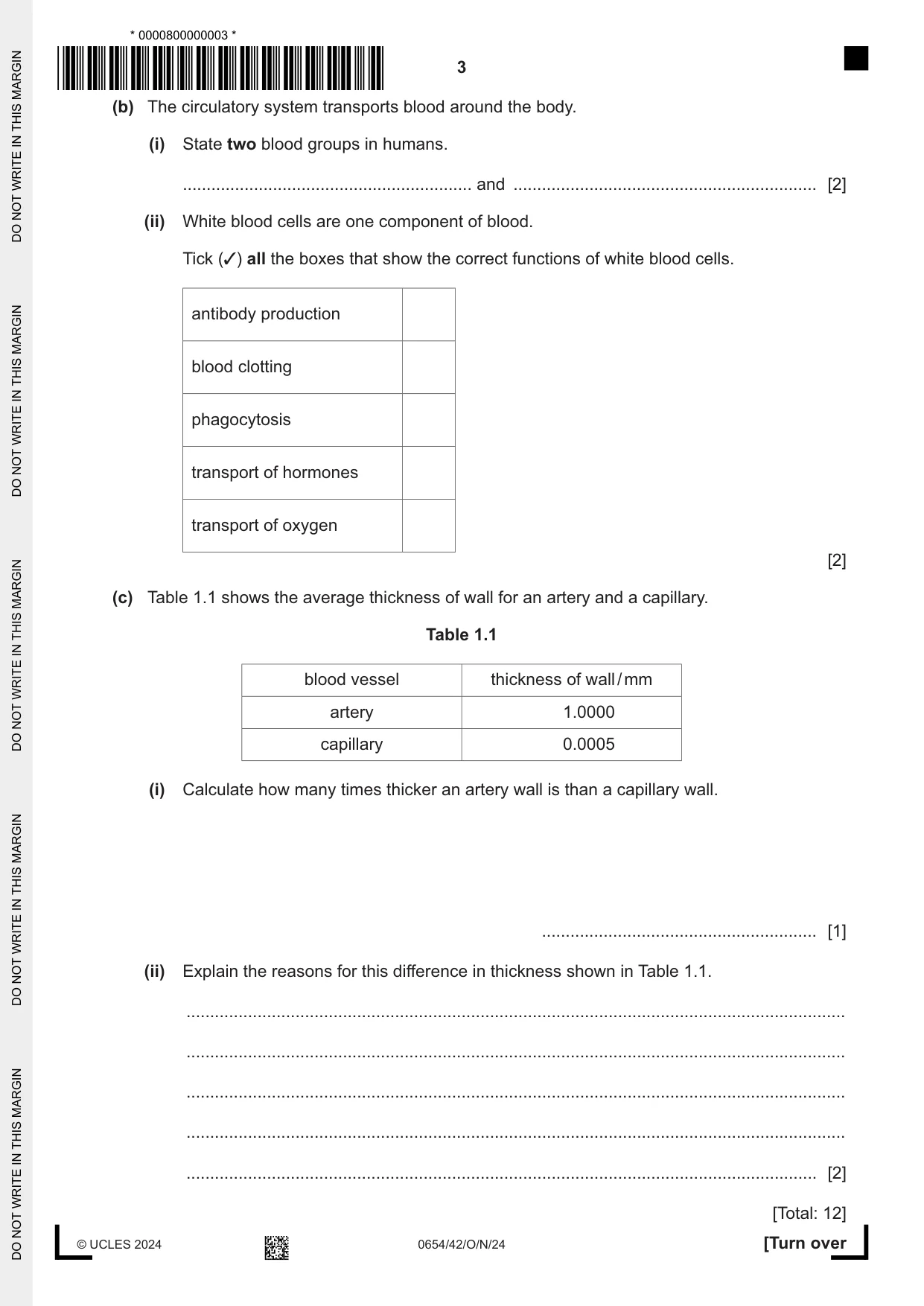
1 (a) The circulatory system in horses is similar to in humans. Fig. 1.1 is a simplified diagram of the circulatory system in horses. The arrows represent the direction of blood flow. X lungs renal artery head heart rest of Y body Z Fig. 1.1 (i) Identify from Fig. 1.1: blood vessel X .................................................................................................................. organ Y ............................................................................................................................. blood vessel Z .................................................................................................................. [3] (ii) Describe evidence from Fig. 1.1 that horses have a double circulatory system. ........................................................................................................................................... ........................................................................................................................................... ........................................................................................................................................... ........................................................................................................................................... ..................................................................................................................................... [2] (b) The circulatory system transports blood around the body. (i) State two blood groups in humans. ............................................................. and ................................................................ [2] (ii) White blood cells are one component of blood. Tick (✓) all the boxes that show the correct functions of white blood cells. antibody production blood clotting phagocytosis transport of hormones transport of oxygen [2] (c) Table 1.1 shows the average thickness of wall for an artery and a capillary. Table 1.1 blood vessel thickness of wall / mm artery 1.0000 capillary 0.0005 (i) Calculate how many times thicker an artery wall is than a capillary wall. .......................................................... [1] (ii) Explain the reasons for this difference in thickness shown in Table 1.1. ........................................................................................................................................... ........................................................................................................................................... ........................................................................................................................................... ........................................................................................................................................... ..................................................................................................................................... [2] [Total: 12]
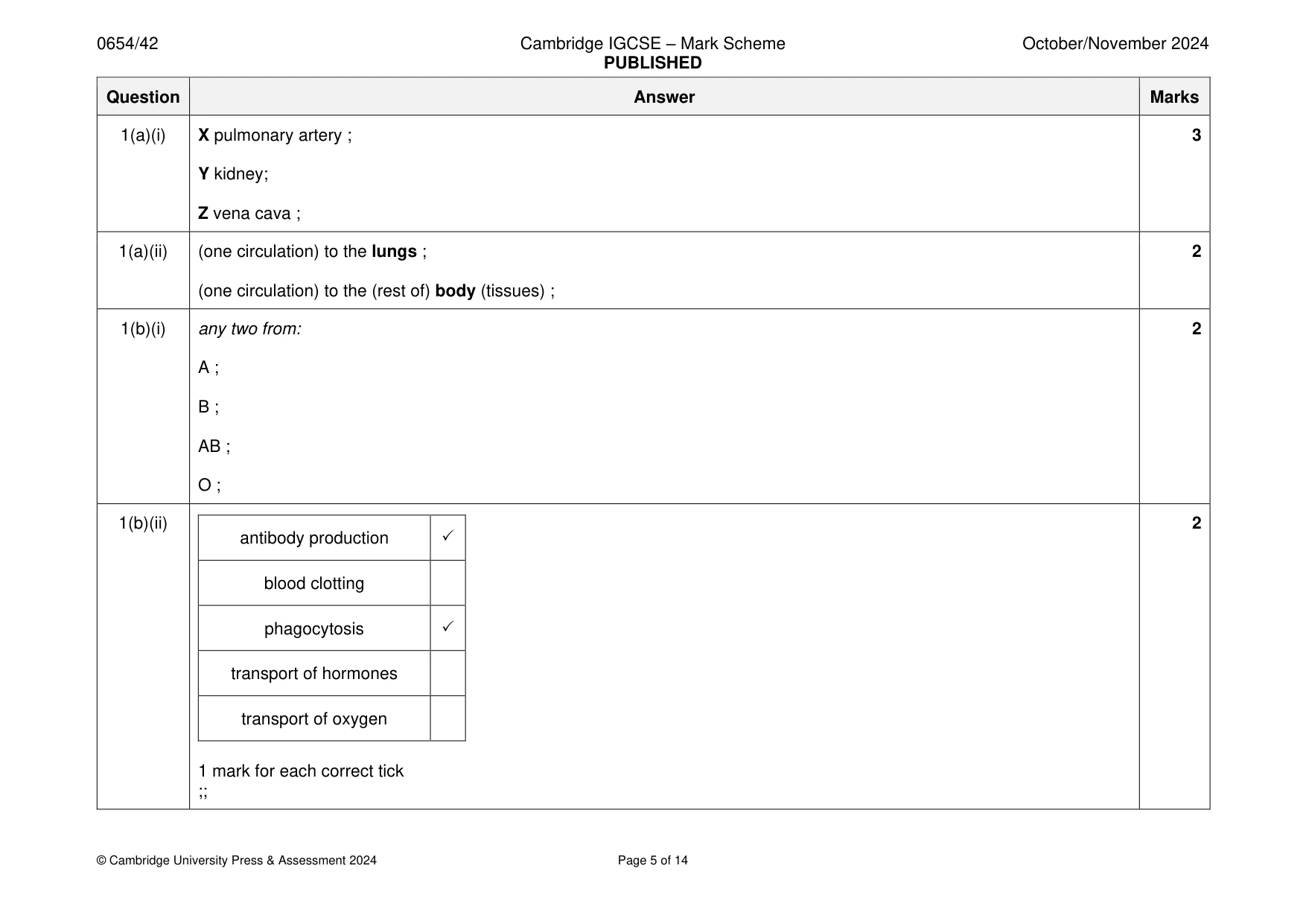
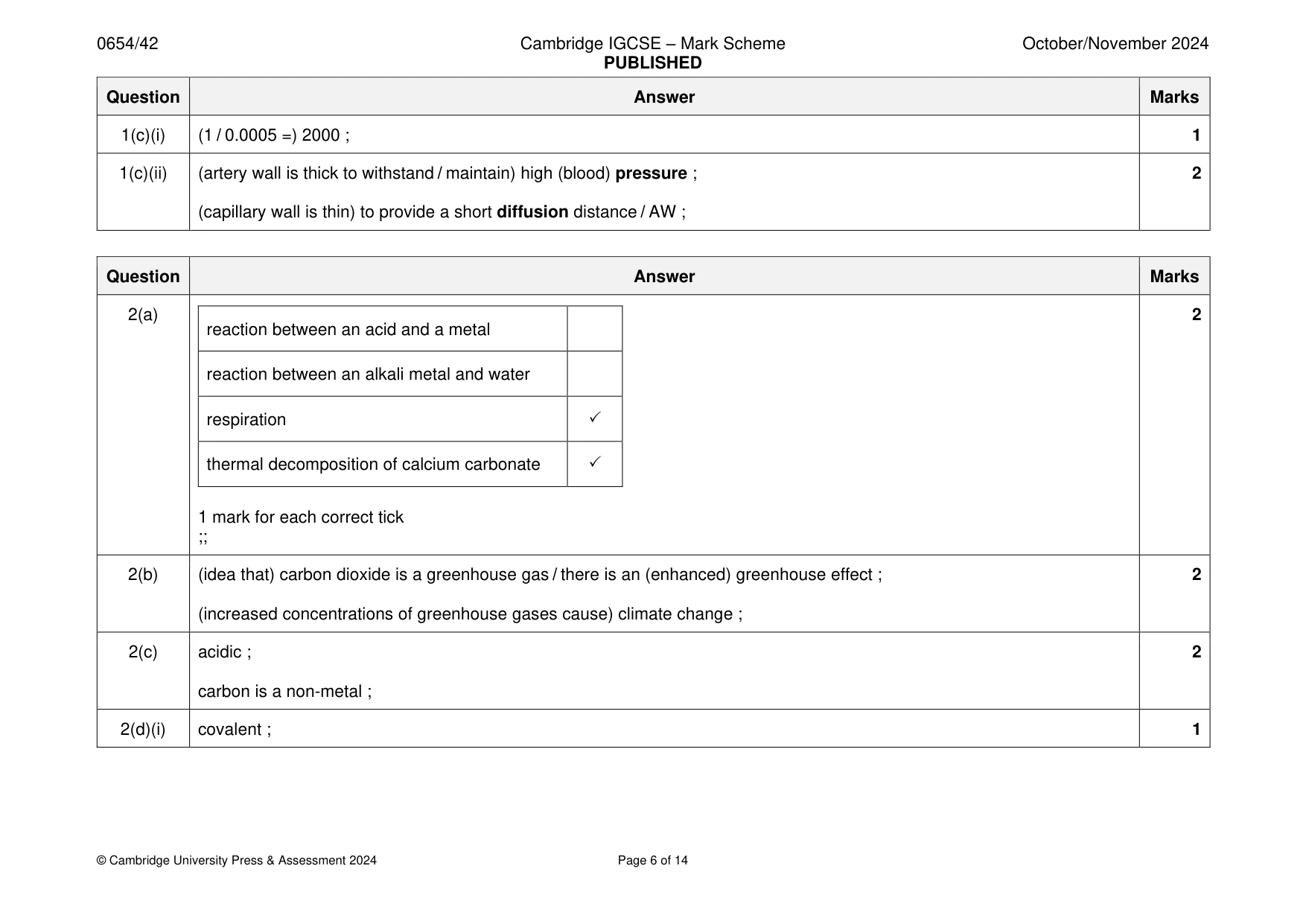
Mark scheme: Question Answer Marks 1(a)(i) X pulmonary artery ; 3 Y kidney; Z vena cava ; 1(a)(ii) (one circulation) to the lungs ; 2 (one circulation) to the (rest of) body (tissues) ; 1(b)(i) any two from: 2 A ; B ; AB ; O ; 1(b)(ii) 2 antibody production blood clotting phagocytosis transport of hormones transport of oxygen 1 mark for each correct tick ;; 1(c)(i) (1 / 0.0005 =) 2000 ; 1 1(c)(ii) (artery wall is thick to withstand / maintain) high (blood) pressure ; 2 (capillary wall is thin) to provide a short diffusion distance / AW ;
Q2 · Carbon dioxide gas is made in many chemical reactions
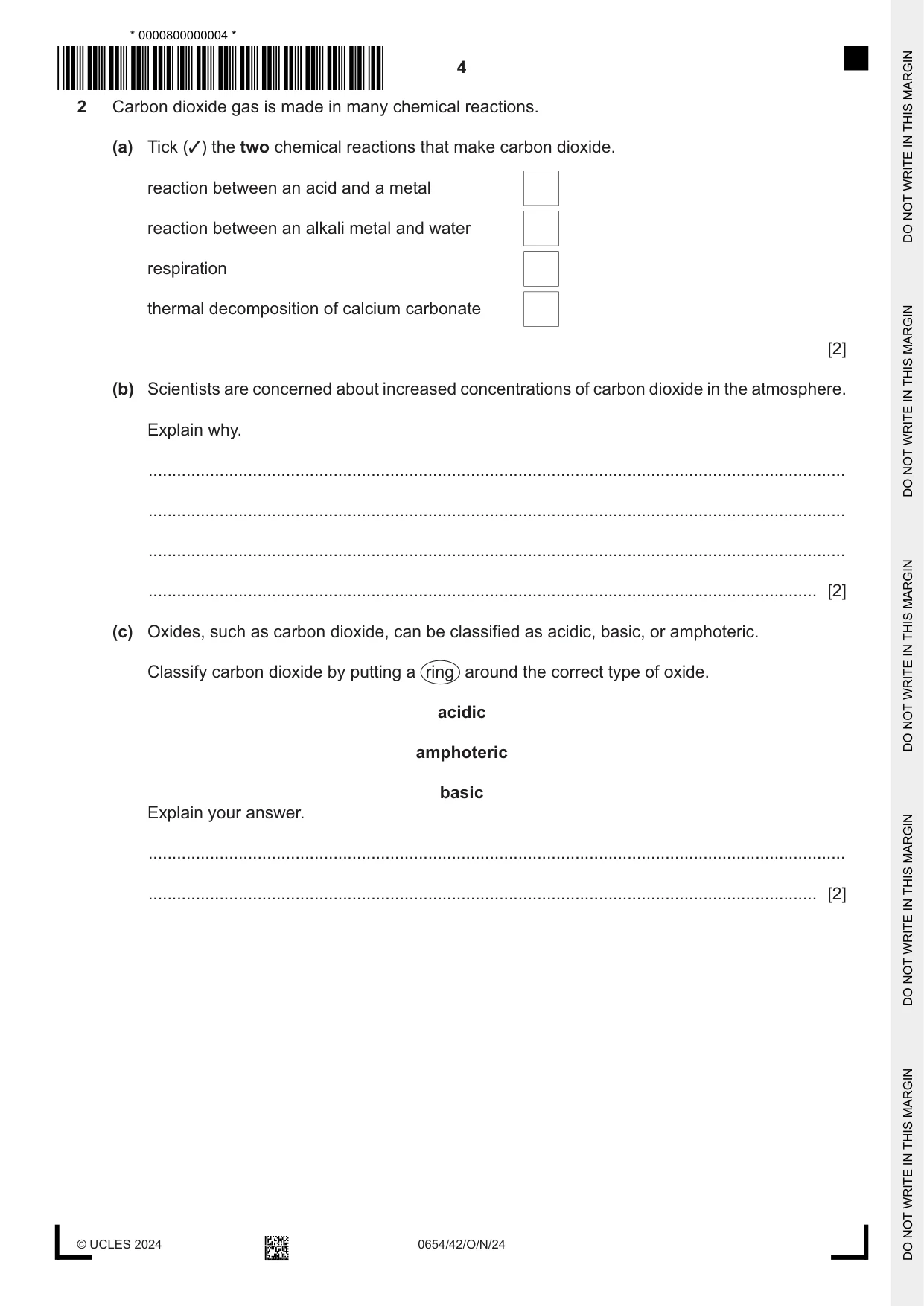
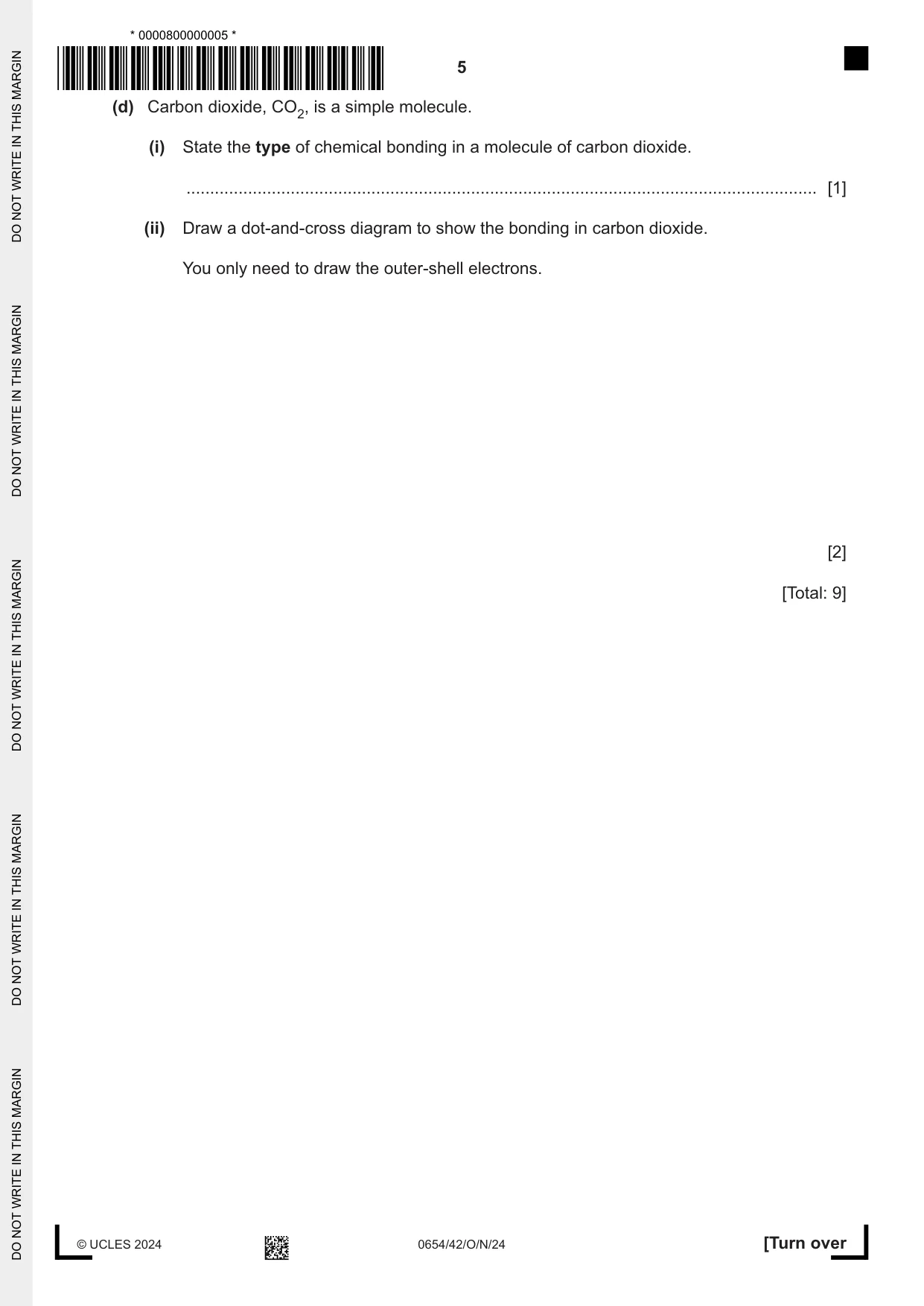
2 Carbon dioxide gas is made in many chemical reactions. (a) Tick (✓) the two chemical reactions that make carbon dioxide. reaction between an acid and a metal reaction between an alkali metal and water respiration thermal decomposition of calcium carbonate [2] (b) Scientists are concerned about increased concentrations of carbon dioxide in the atmosphere. Explain why. ................................................................................................................................................... ................................................................................................................................................... ................................................................................................................................................... ............................................................................................................................................. [2] (c) Oxides, such as carbon dioxide, can be classified as acidic, basic, or amphoteric. Classify carbon dioxide by putting a ring around the correct type of oxide. acidic amphoteric basic Explain your answer. ................................................................................................................................................... ............................................................................................................................................. [2] (d) Carbon dioxide, CO2, is a simple molecule. (i) State the type of chemical bonding in a molecule of carbon dioxide. ..................................................................................................................................... [1] (ii) Draw a dot-and-cross diagram to show the bonding in carbon dioxide. You only need to draw the outer-shell electrons. [2] [Total: 9]
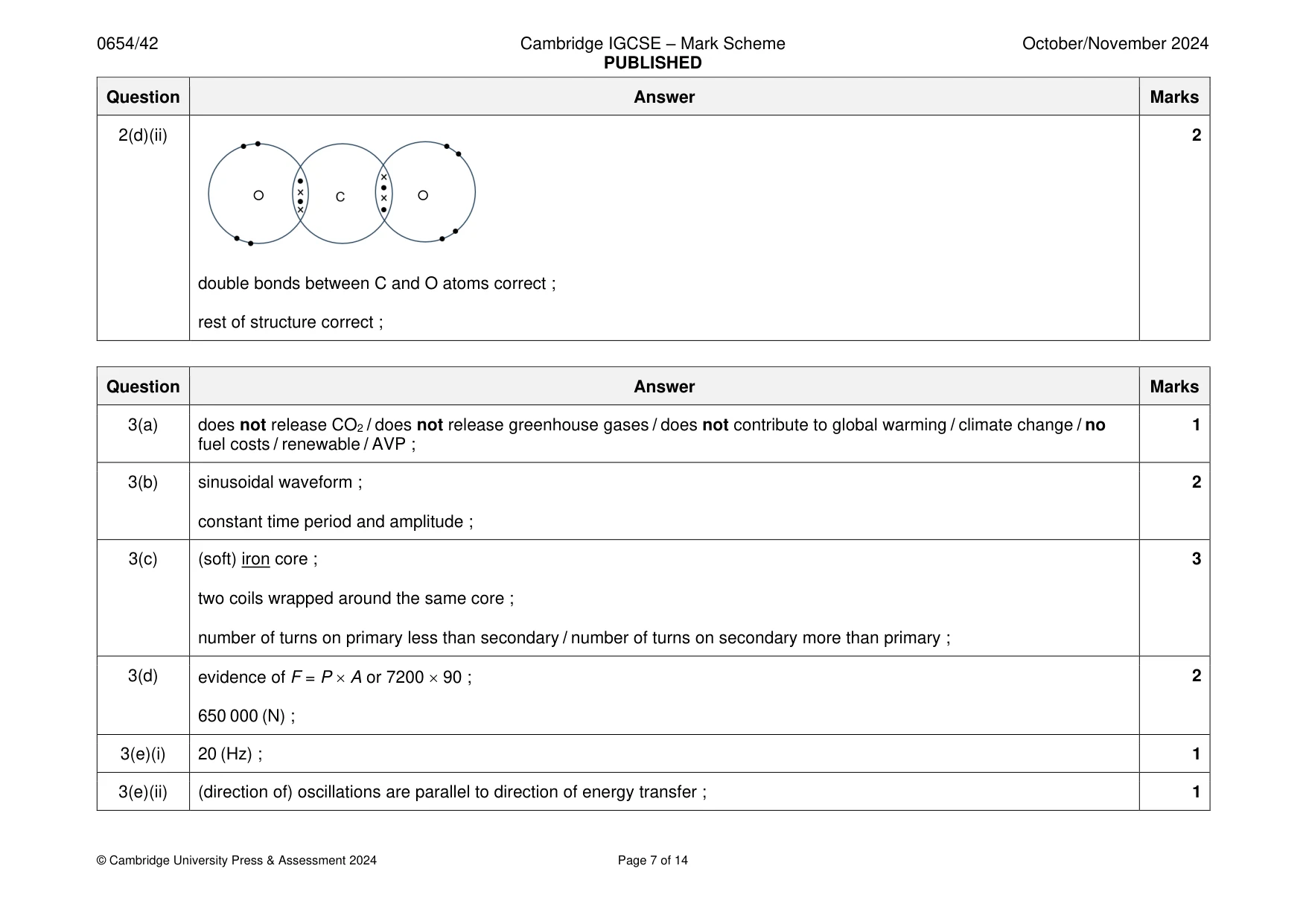
Mark scheme: 2(a) 2 reaction between an acid and a metal reaction between an alkali metal and water respiration thermal decomposition of calcium carbonate 1 mark for each correct tick ;; 2(b) (idea that) carbon dioxide is a greenhouse gas / there is an (enhanced) greenhouse effect ; 2 (increased concentrations of greenhouse gases cause) climate change ; 2(c) acidic ; 2 carbon is a non-metal ; 2(d)(i) covalent ; 1 2(d)(ii) 2 double bonds between C and O atoms correct ; rest of structure correct ;
Q3 · A wind turbine used to generate electricity
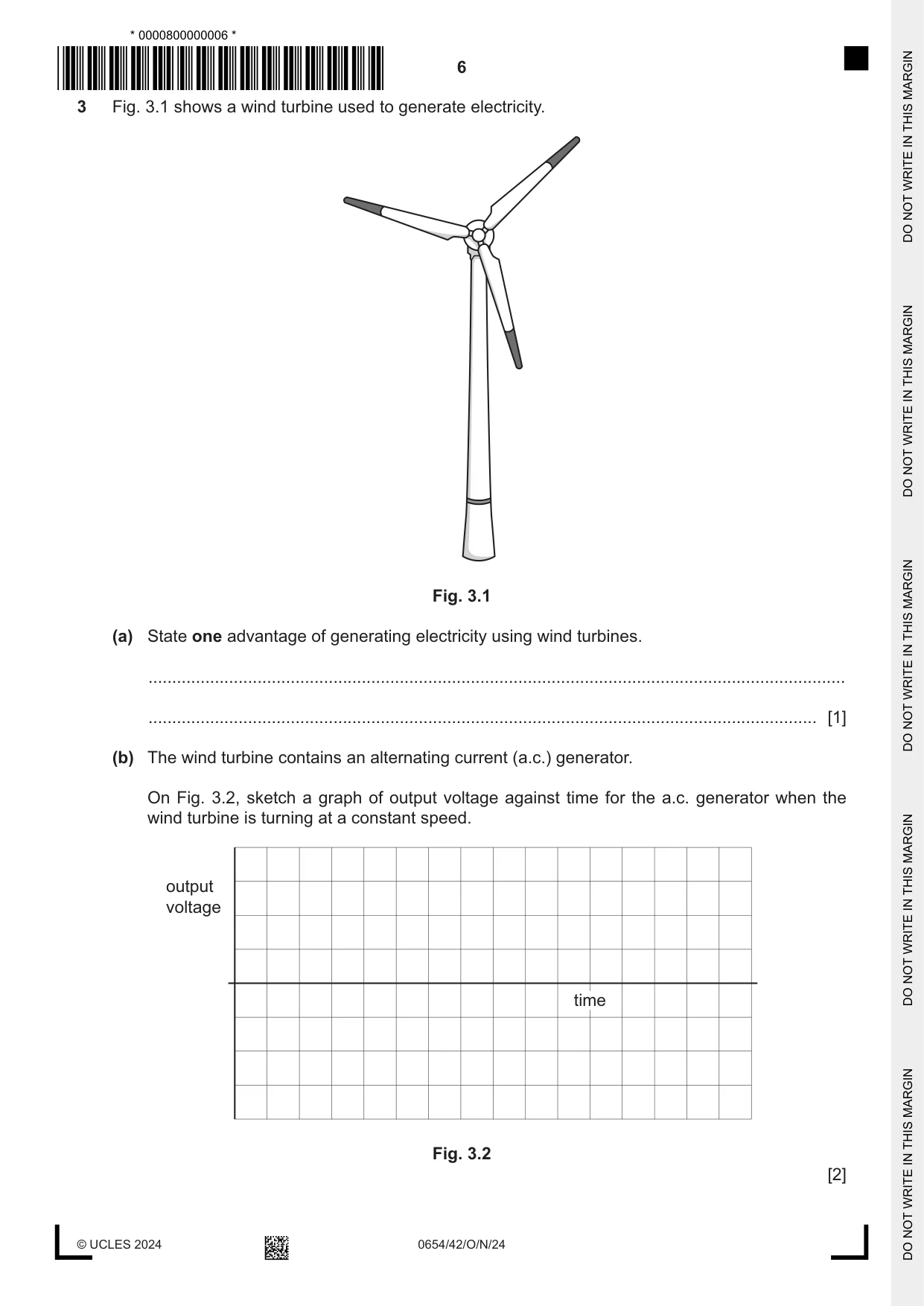
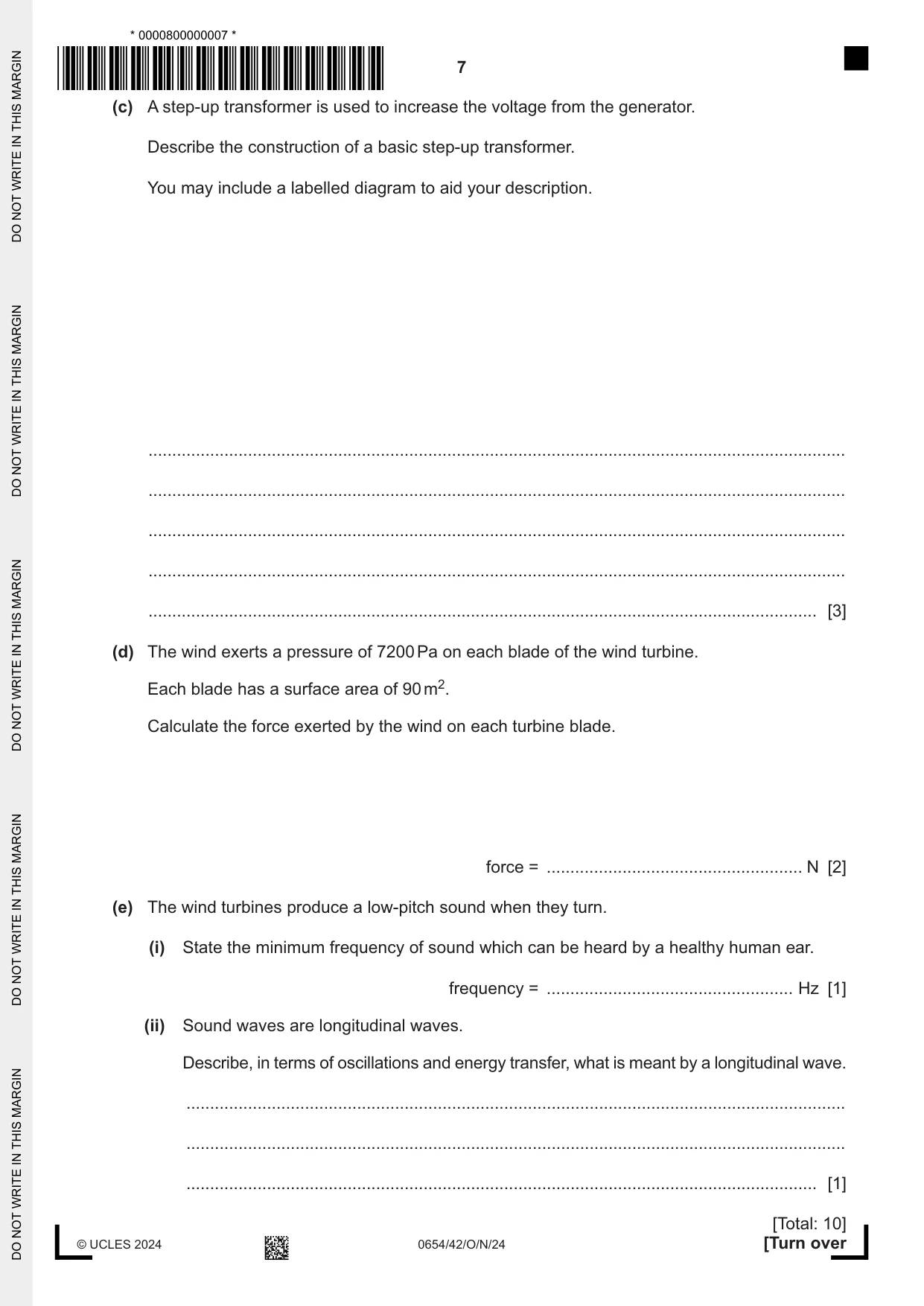
3 Fig. 3.1 shows a wind turbine used to generate electricity. Fig. 3.1 (a) State one advantage of generating electricity using wind turbines. ................................................................................................................................................... ............................................................................................................................................. [1] (b) The wind turbine contains an alternating current (a.c.) generator. On Fig. 3.2, sketch a graph of output voltage against time for the a.c. generator when the wind turbine is turning at a constant speed. output voltage time Fig. 3.2 [2] (c) A step-up transformer is used to increase the voltage from the generator. Describe the construction of a basic step-up transformer. You may include a labelled diagram to aid your description. ................................................................................................................................................... ................................................................................................................................................... ................................................................................................................................................... ................................................................................................................................................... ............................................................................................................................................. [3] (d) The wind exerts a pressure of 7200 Pa on each blade of the wind turbine. Each blade has a surface area of 90 m2. Calculate the force exerted by the wind on each turbine blade. force = ...................................................... N [2] (e) The wind turbines produce a low-pitch sound when they turn. (i) State the minimum frequency of sound which can be heard by a healthy human ear. frequency = .................................................... Hz [1] (ii) Sound waves are longitudinal waves. Describe, in terms of oscillations and energy transfer, what is meant by a longitudinal wave. ........................................................................................................................................... ........................................................................................................................................... ..................................................................................................................................... [1] [Total: 10]
Mark scheme: 3(a) does not release CO2 / does not release greenhouse gases / does not contribute to global warming / climate change / no 1 fuel costs / renewable / AVP ; 3(b) sinusoidal waveform ; 2 constant time period and amplitude ; 3(c) (soft) iron core ; 3 two coils wrapped around the same core ; number of turns on primary less than secondary / number of turns on secondary more than primary ; 3(d) evidence of F = P A or 7200 90 ; 2 650 000 (N) ; 3(e)(i) 20 (Hz) ; 1 3(e)(ii) (direction of) oscillations are parallel to direction of energy transfer ; 1
Q4 · State the balanced symbol equation for photosynthesis
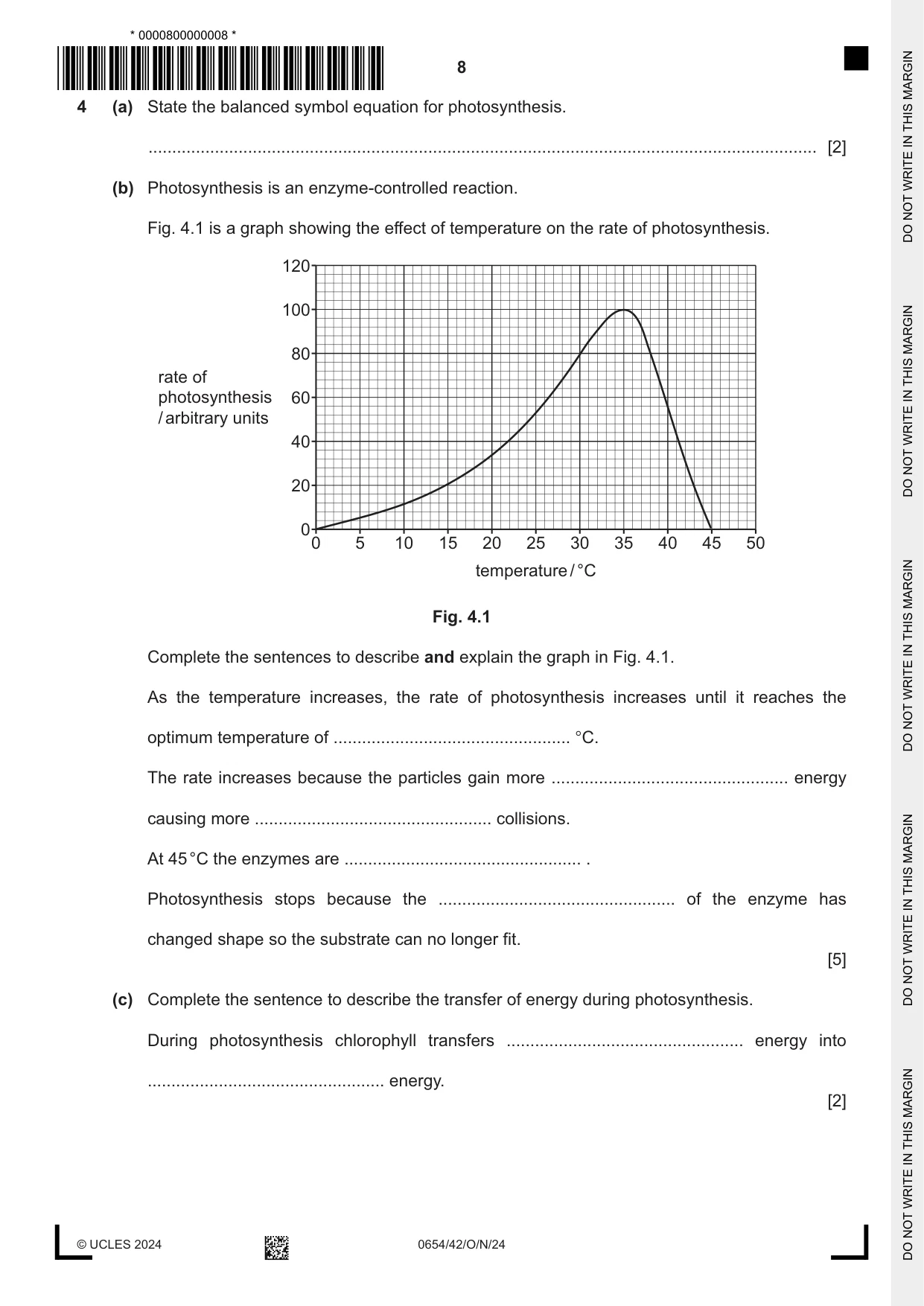
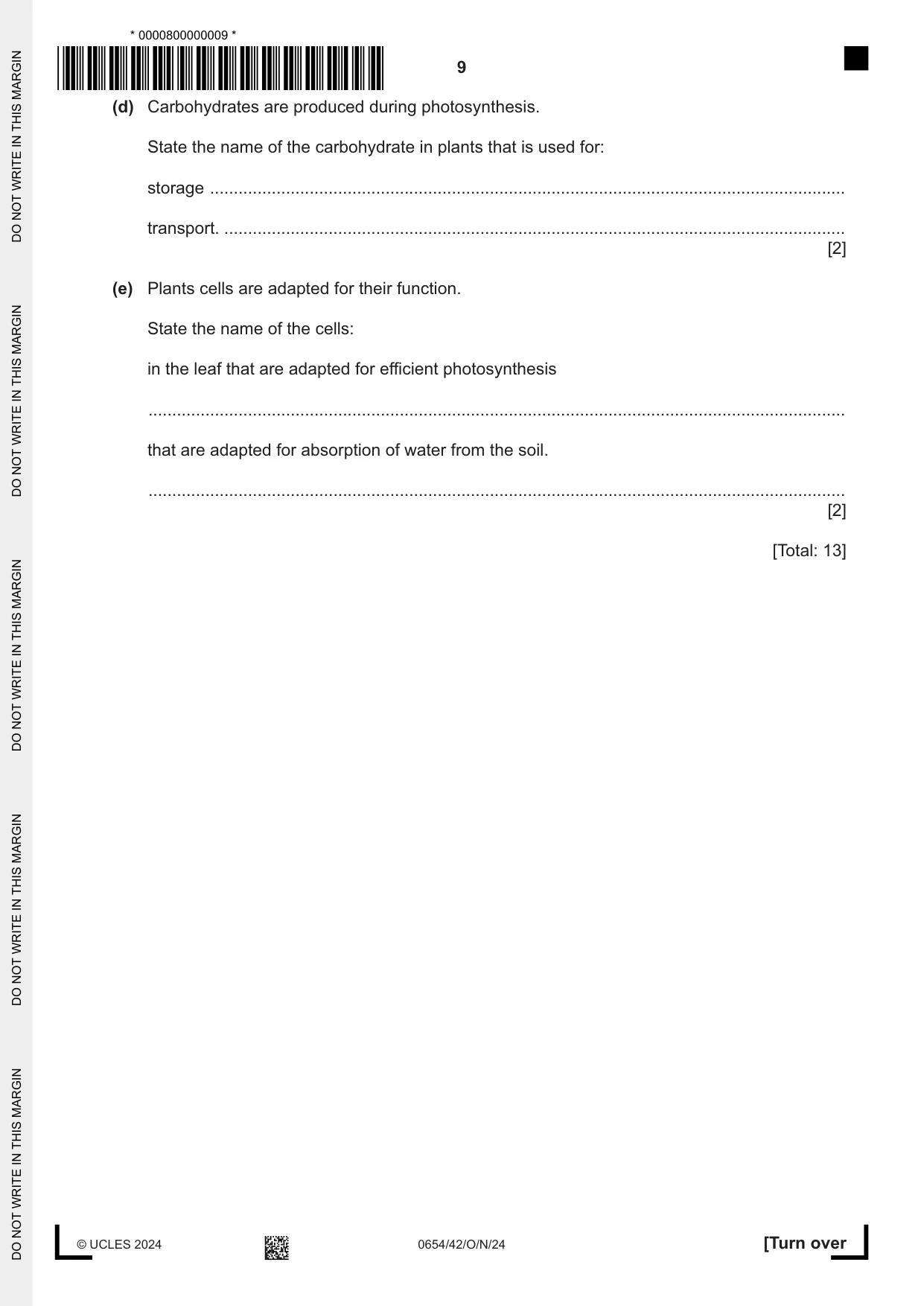
4 (a) State the balanced symbol equation for photosynthesis. ............................................................................................................................................. [2] (b) Photosynthesis is an enzyme-controlled reaction. Fig. 4.1 is a graph showing the effect of temperature on the rate of photosynthesis. 120 100 80 rate of photosynthesis 60 / arbitrary units 40 20 00 5 10 15 20 25 30 35 40 45 50 temperature / °C Fig. 4.1 Complete the sentences to describe and explain the graph in Fig. 4.1. As the temperature increases, the rate of photosynthesis increases until it reaches the optimum temperature of .................................................. °C. The rate increases because the particles gain more .................................................. energy causing more .................................................. collisions. At 45 °C the enzymes are .................................................. . Photosynthesis stops because the .................................................. of the enzyme has changed shape so the substrate can no longer fit. [5] (c) Complete the sentence to describe the transfer of energy during photosynthesis. During photosynthesis chlorophyll transfers .................................................. energy into .................................................. energy. [2] (d) Carbohydrates are produced during photosynthesis. State the name of the carbohydrate in plants that is used for: storage ...................................................................................................................................... transport. ................................................................................................................................... [2] (e) Plants cells are adapted for their function. State the name of the cells: in the leaf that are adapted for efficient photosynthesis ................................................................................................................................................... that are adapted for absorption of water from the soil. ................................................................................................................................................... [2] [Total: 13]
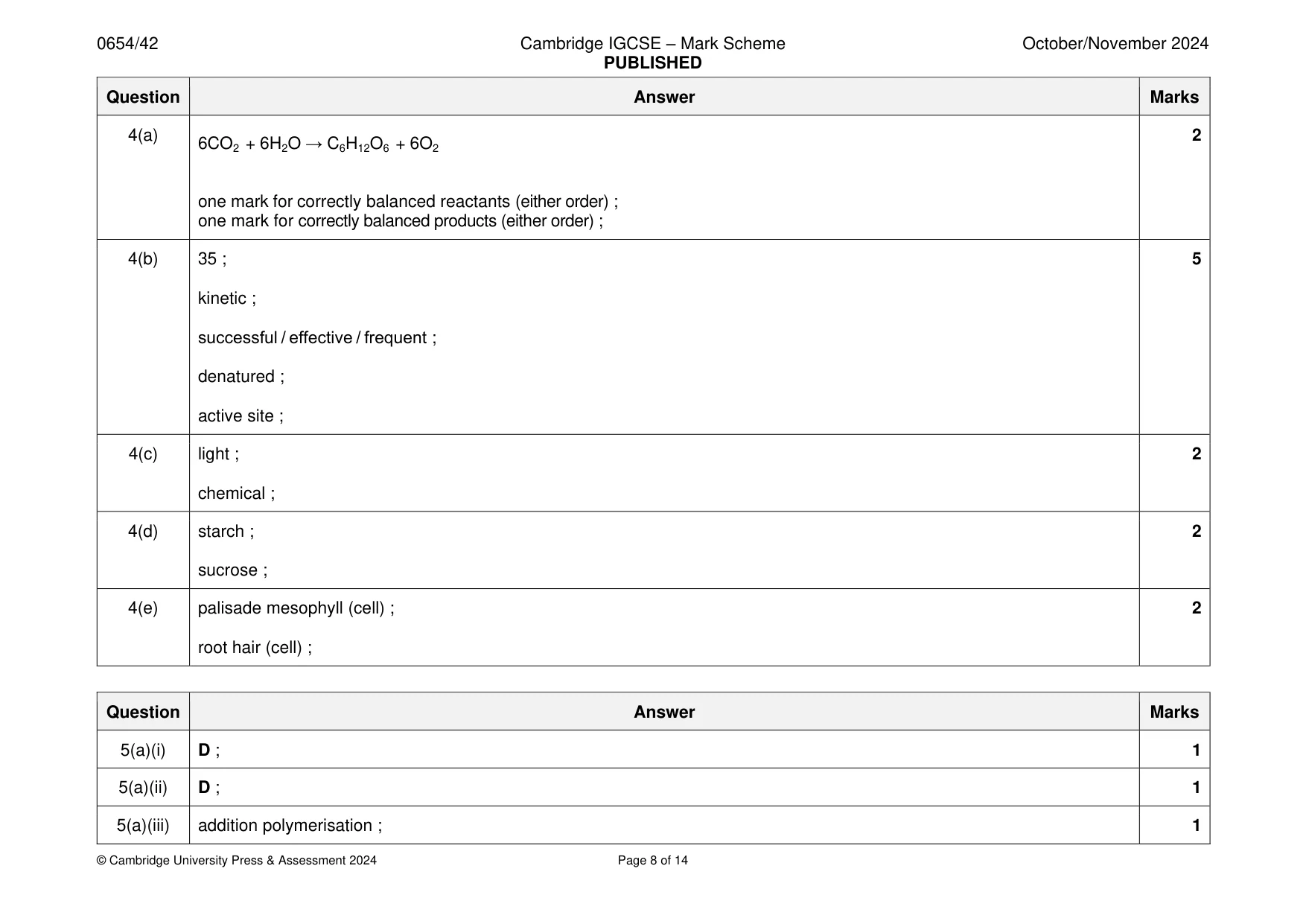
Mark scheme: 4(a) 2 6CO2 + 6H2O → C6H12O6 + 6O2 one mark for correctly balanced reactants (either order) ; one mark for correctly balanced products (either order) ; 4(b) 35 ; 5 kinetic ; successful / effective / frequent ; denatured ; active site ; 4(c) light ; 2 chemical ; 4(d) starch ; 2 sucrose ; 4(e) palisade mesophyll (cell) ; 2 root hair (cell) ;
Q5 · The structures of four carbon compounds
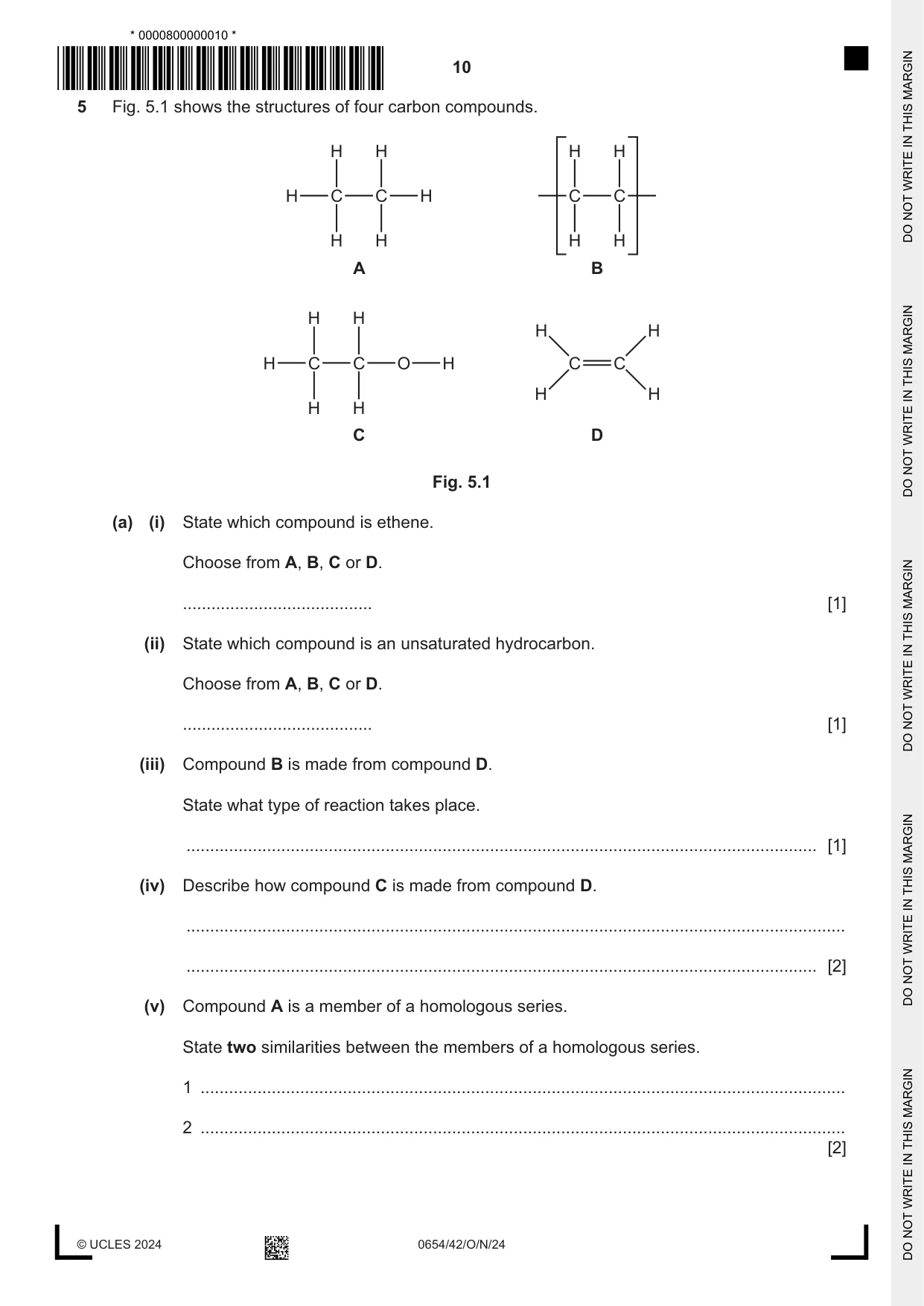
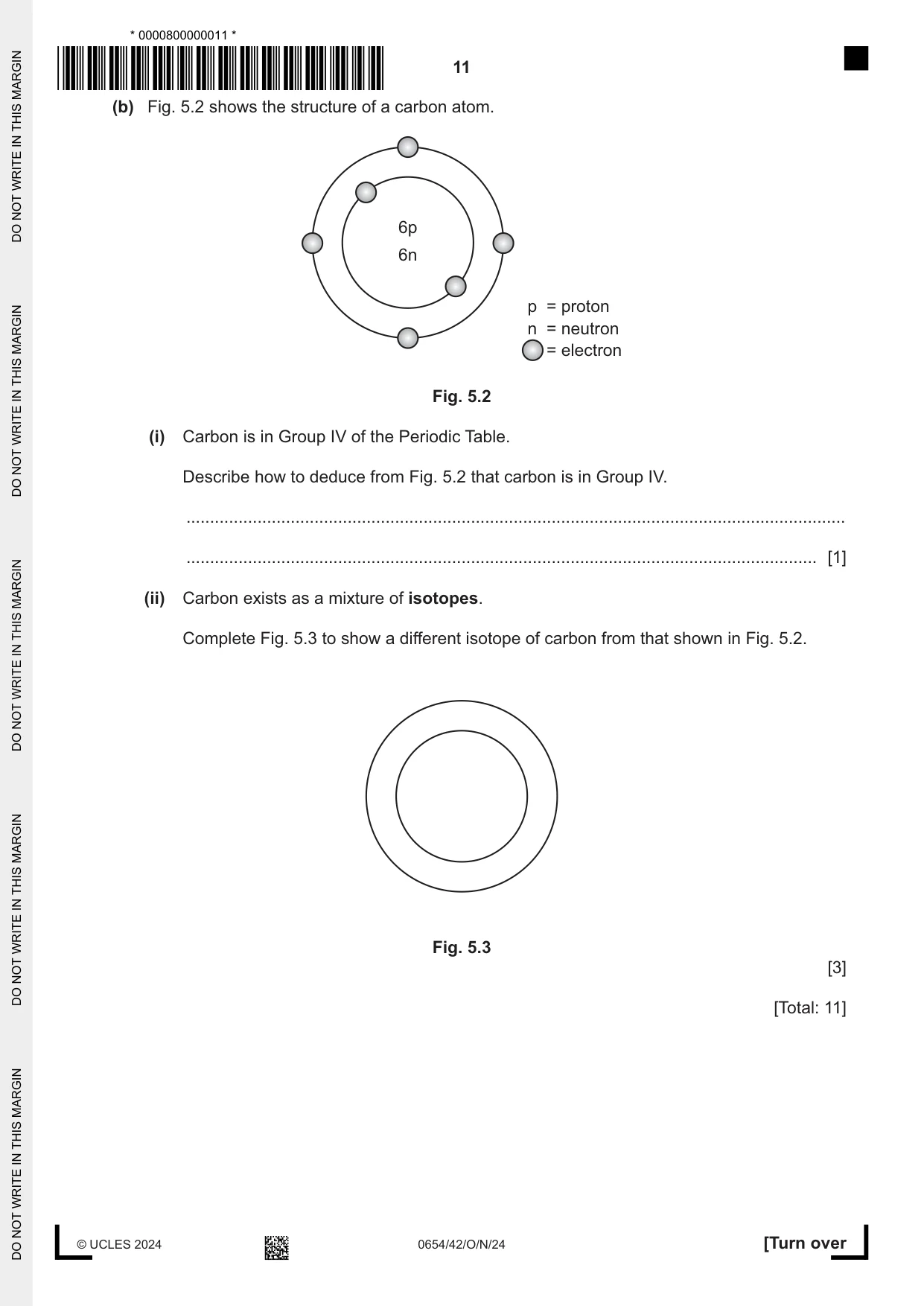
5 Fig. 5.1 shows the structures of four carbon compounds. H H H H H C C H C C H H H H A B H H H H H C C O H C C H H H H C D Fig. 5.1 (a) (i) State which compound is ethene. Choose from A, B, C or D. ........................................ [1] (ii) State which compound is an unsaturated hydrocarbon. Choose from A, B, C or D. ........................................ [1] (iii) Compound B is made from compound D. State what type of reaction takes place. ..................................................................................................................................... [1] (iv) Describe how compound C is made from compound D. ........................................................................................................................................... ..................................................................................................................................... [2] (v) Compound A is a member of a homologous series. State two similarities between the members of a homologous series. 1 ........................................................................................................................................ 2 ........................................................................................................................................ [2] (b) Fig. 5.2 shows the structure of a carbon atom. 6p 6n p = proton n = neutron = electron Fig. 5.2 (i) Carbon is in Group IV of the Periodic Table. Describe how to deduce from Fig. 5.2 that carbon is in Group IV. ........................................................................................................................................... ..................................................................................................................................... [1] (ii) Carbon exists as a mixture of isotopes. Complete Fig. 5.3 to show a different isotope of carbon from that shown in Fig. 5.2. Fig. 5.3 [3] [Total: 11]
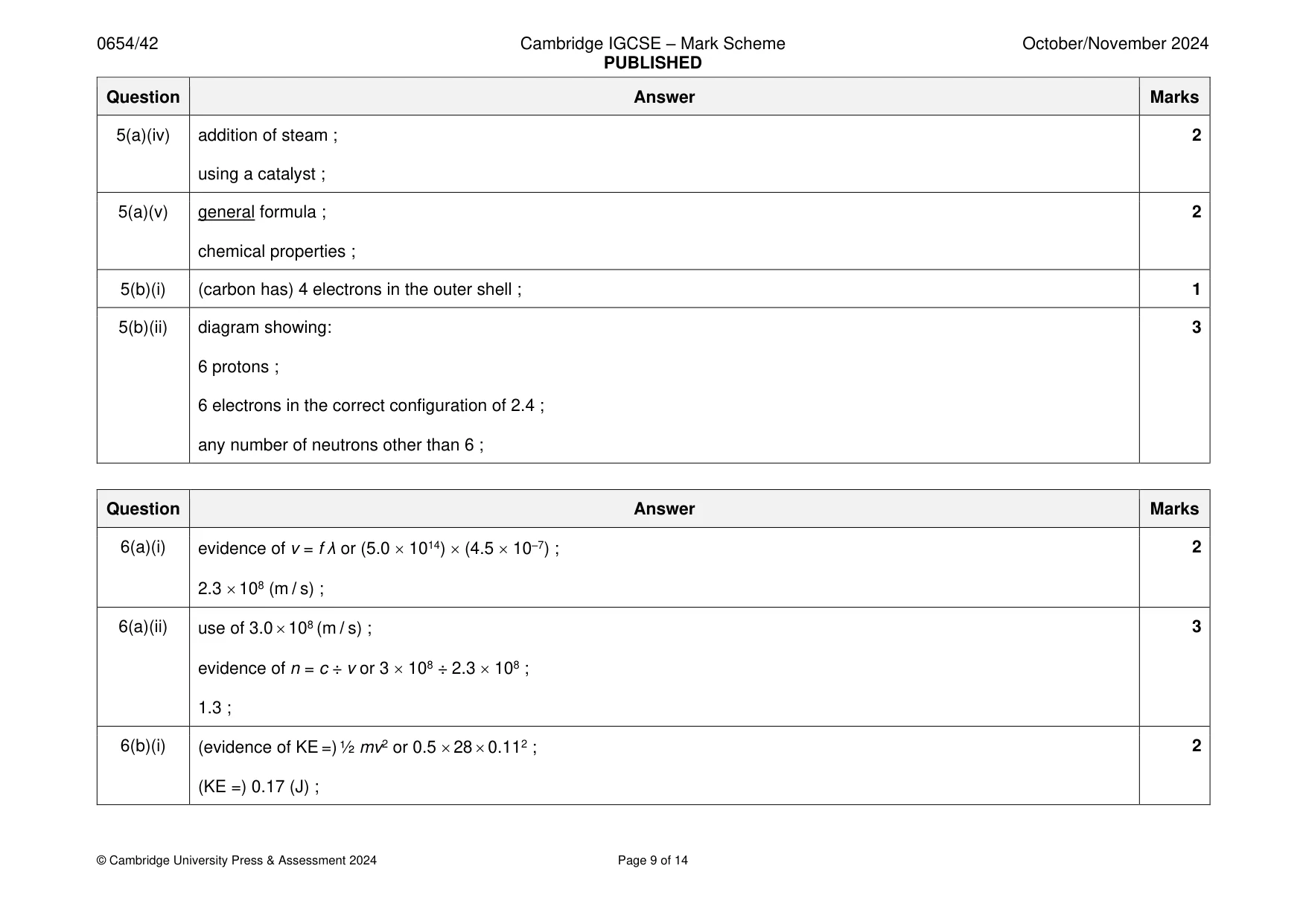
Mark scheme: 5(a)(i) D ; 1 5(a)(ii) D ; 1 5(a)(iii) addition polymerisation ; 1 5(a)(iv) addition of steam ; 2 using a catalyst ; 5(a)(v) general formula ; 2 chemical properties ; 5(b)(i) (carbon has) 4 electrons in the outer shell ; 1 5(b)(ii) diagram showing: 3 6 protons ; 6 electrons in the correct configuration of 2.4 ; any number of neutrons other than 6 ;
Q6 · Angler fish live in the sea at depths of up to 2000 m
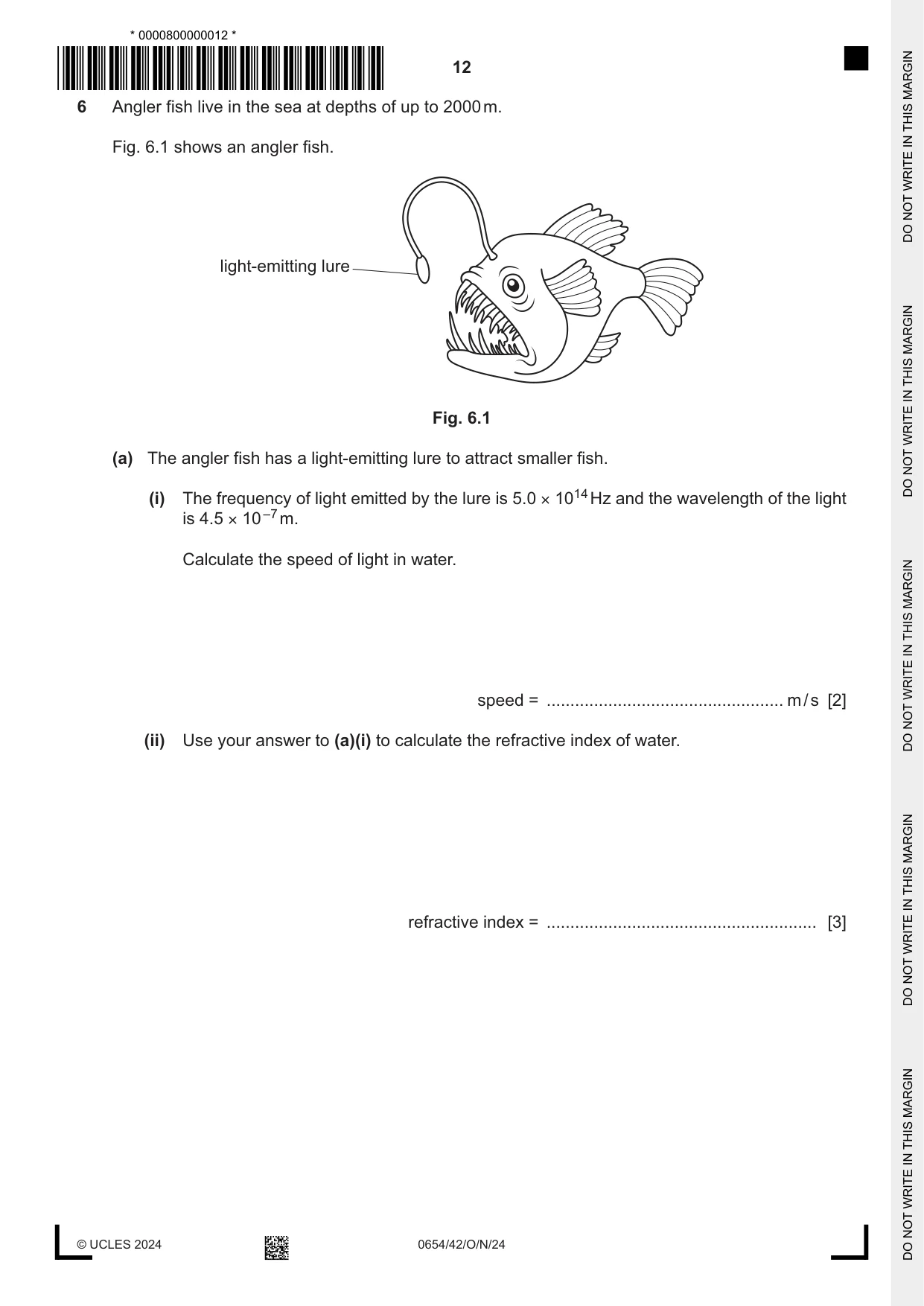
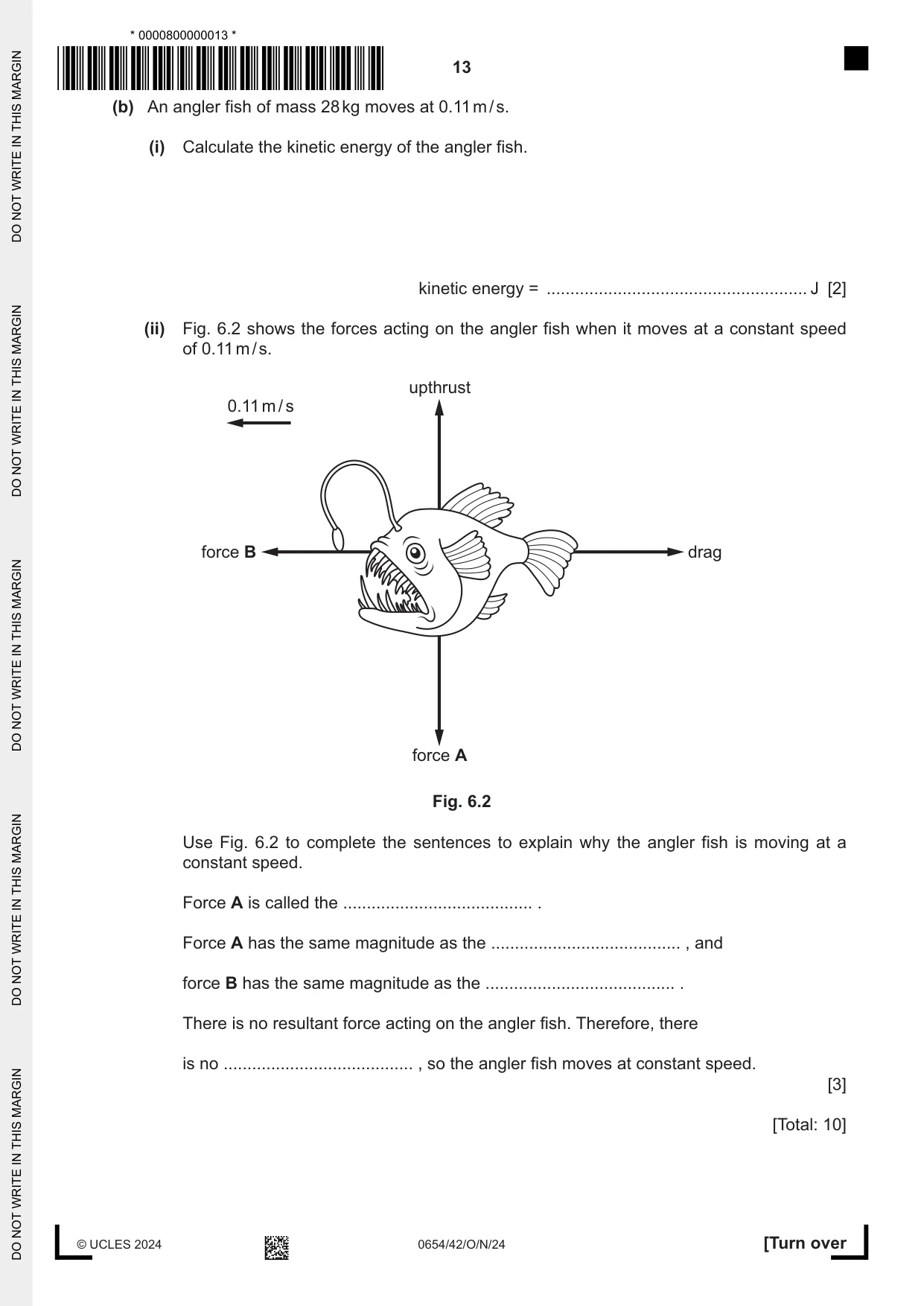
6 Angler fish live in the sea at depths of up to 2000 m. Fig. 6.1 shows an angler fish. light-emitting lure Fig. 6.1 (a) The angler fish has a light-emitting lure to attract smaller fish. (i) The frequency of light emitted by the lure is 5.0 × 10¹⁴ Hz and the wavelength of the light is 4.5 × 10 –7 m. Calculate the speed of light in water. speed = .................................................. m / s [2] (ii) Use your answer to (a)(i) to calculate the refractive index of water. refractive index = ......................................................... [3] (b) An angler fish of mass 28 kg moves at 0.11 m / s. (i) Calculate the kinetic energy of the angler fish. kinetic energy = ....................................................... J [2] (ii) Fig. 6.2 shows the forces acting on the angler fish when it moves at a constant speed of 0.11 m / s. upthrust 0.11 m / s force B drag force A Fig. 6.2 Use Fig. 6.2 to complete the sentences to explain why the angler fish is moving at a constant speed. Force A is called the ........................................ . Force A has the same magnitude as the ........................................ , and force B has the same magnitude as the ........................................ . There is no resultant force acting on the angler fish. Therefore, there is no ........................................ , so the angler fish moves at constant speed. [3] [Total: 10]
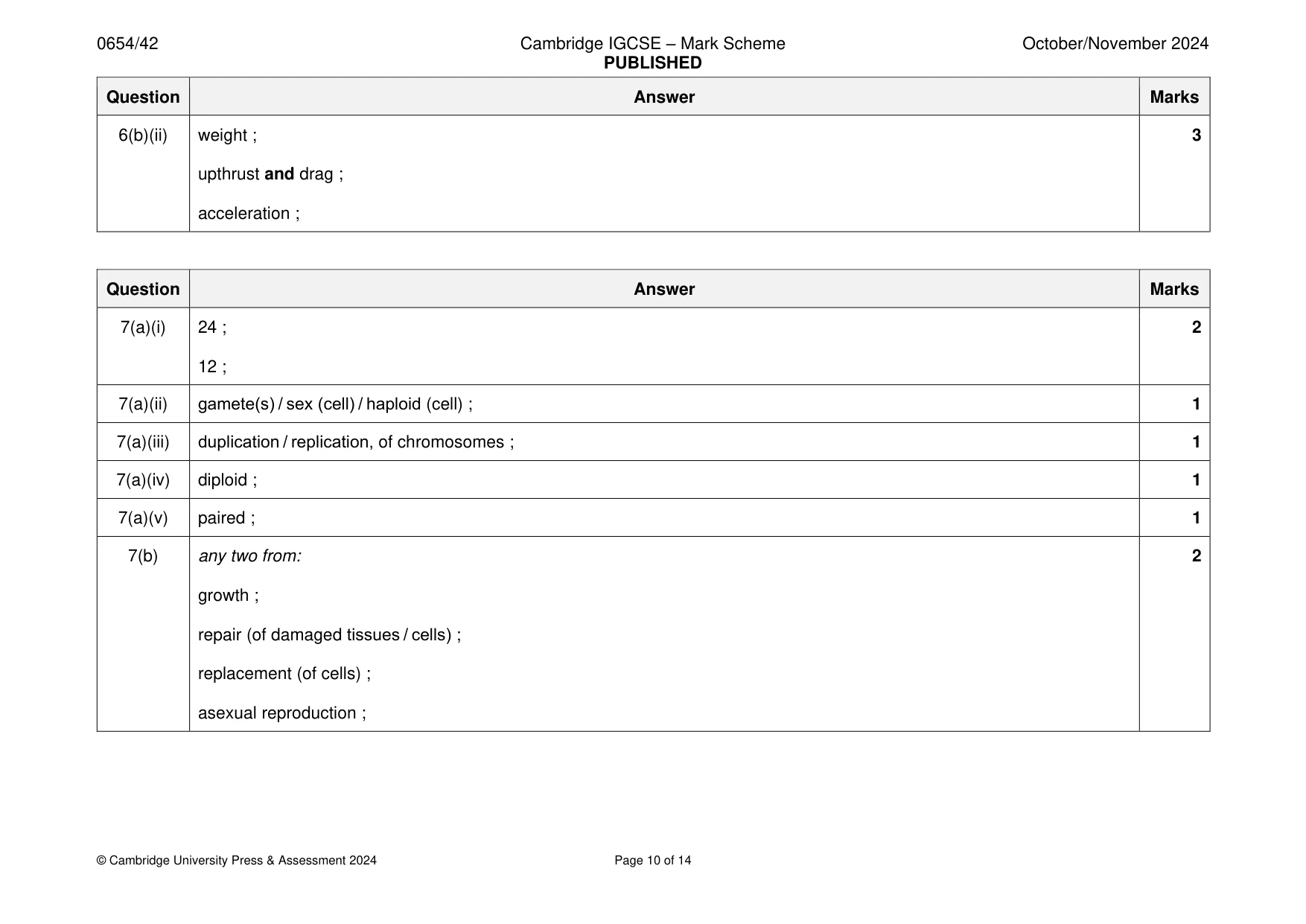
Mark scheme: 6(a)(i) evidence of v = f λ or (5.0 1014) (4.5 10–7) ; 2 2.3 108 (m / s) ; 6(a)(ii) use of 3.0 108 (m / s) ; 3 evidence of n = c ÷ v or 3 108 ÷ 2.3 108 ; 1.3 ; 6(b)(i) (evidence of KE =) ½ mv2 or 0.5 28 0.112 ; 2 (KE =) 0.17 (J) ; 6(b)(ii) weight ; 3 upthrust and drag ; acceleration ;
Question 7
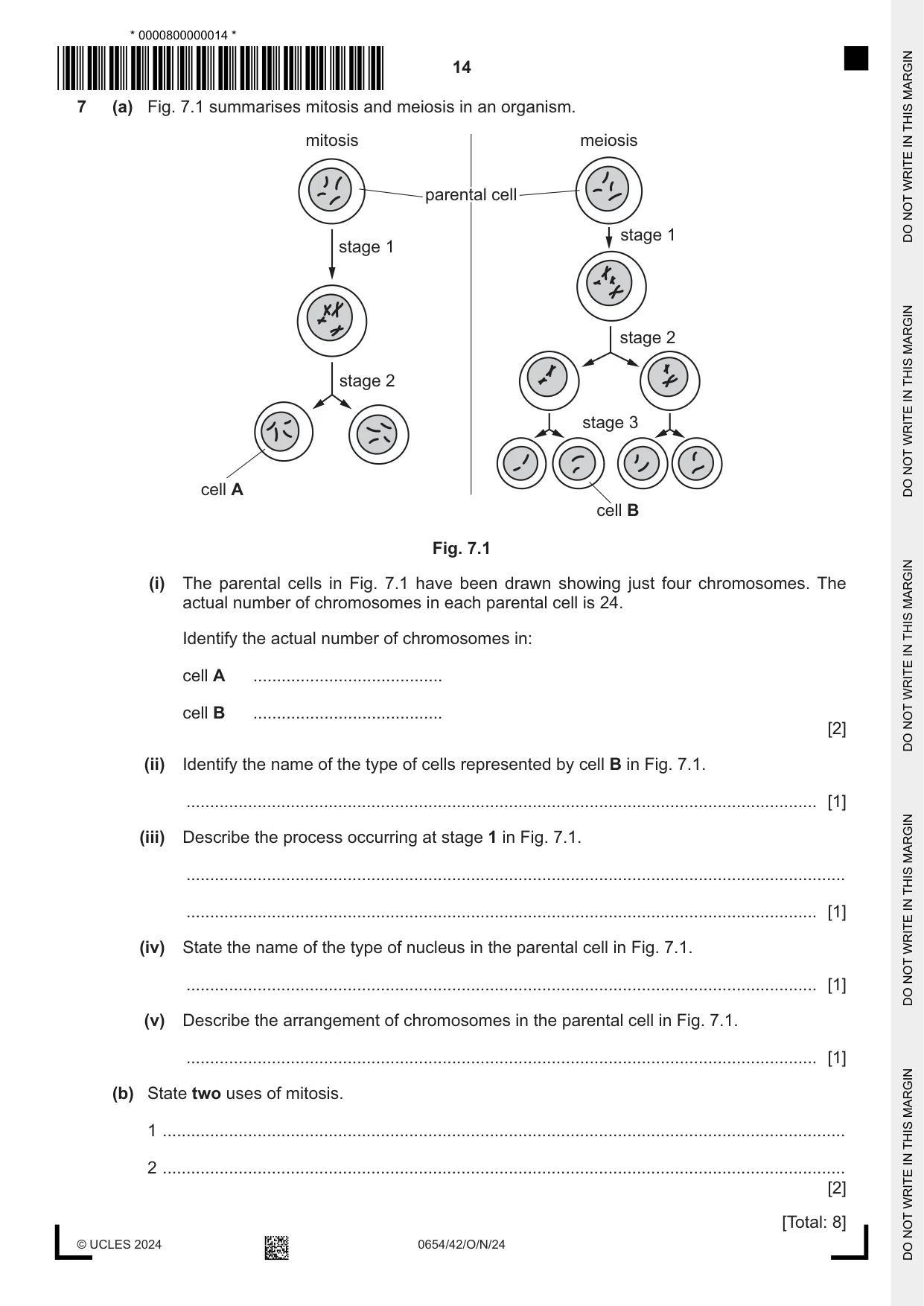
7 (a) Fig. 7.1 summarises mitosis and meiosis in an organism. mitosis meiosis parentalparental cellcell stage 1 stage 1 stage 2 stage 2 stage 3 cell A cell B Fig. 7.1 (i) The parental cells in Fig. 7.1 have been drawn showing just four chromosomes. The actual number of chromosomes in each parental cell is 24. Identify the actual number of chromosomes in: cell A ........................................ cell B ........................................ [2] (ii) Identify the name of the type of cells represented by cell B in Fig. 7.1. ..................................................................................................................................... [1] (iii) Describe the process occurring at stage 1 in Fig. 7.1. ........................................................................................................................................... ..................................................................................................................................... [1] (iv) State the name of the type of nucleus in the parental cell in Fig. 7.1. ..................................................................................................................................... [1] (v) Describe the arrangement of chromosomes in the parental cell in Fig. 7.1. ..................................................................................................................................... [1] (b) State two uses of mitosis. 1 ................................................................................................................................................ 2 ................................................................................................................................................ [2] [Total: 8]
Mark scheme: 7(a)(i) 24 ; 2 12 ; 7(a)(ii) gamete(s) / sex (cell) / haploid (cell) ; 1 7(a)(iii) duplication / replication, of chromosomes ; 1 7(a)(iv) diploid ; 1 7(a)(v) paired ; 1 7(b) any two from: 2 growth ; repair (of damaged tissues / cells) ; replacement (of cells) ; asexual reproduction ;
Q8 · A student investigates the reaction between calcium carbonate and dilute hydrochloric acid
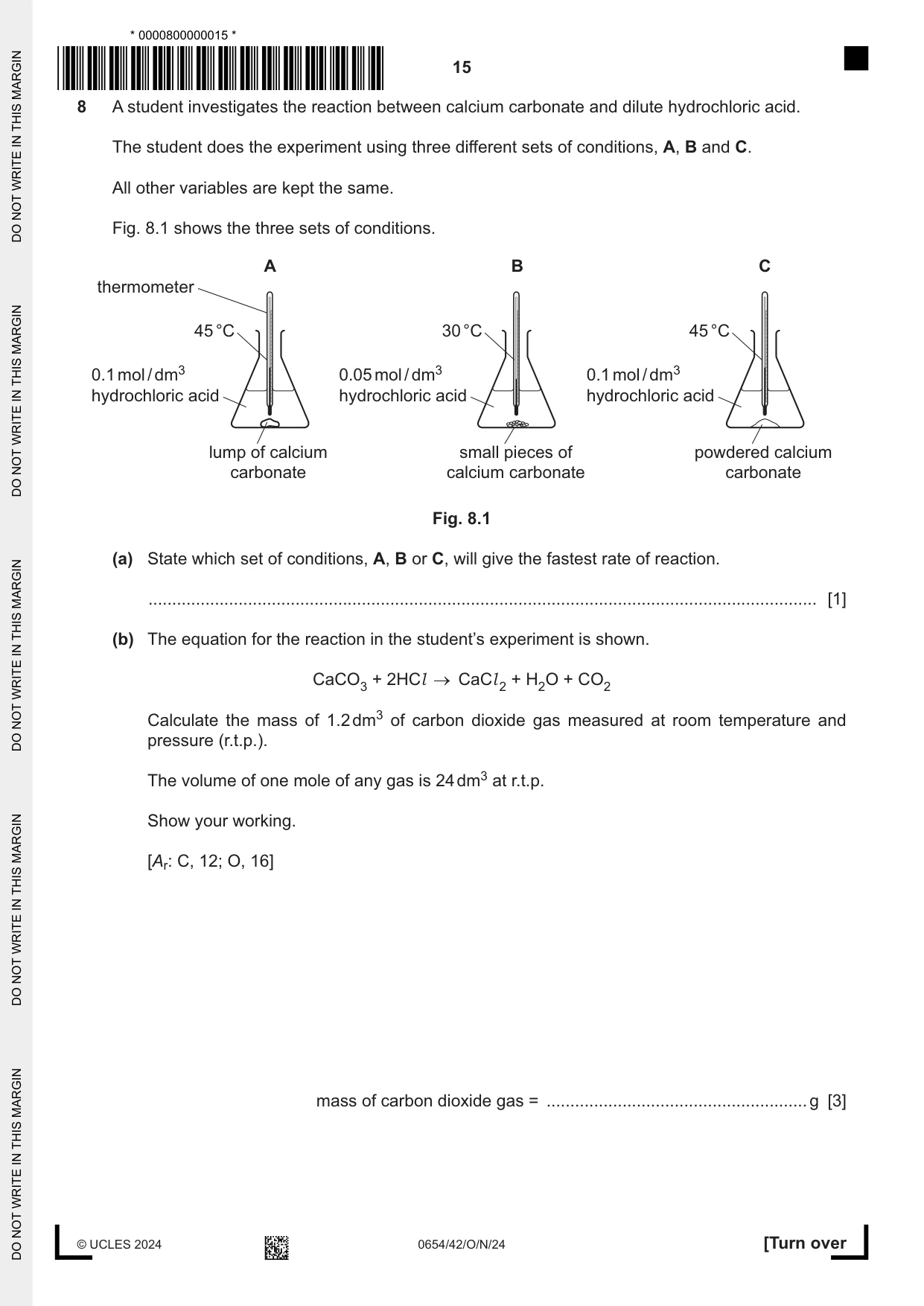
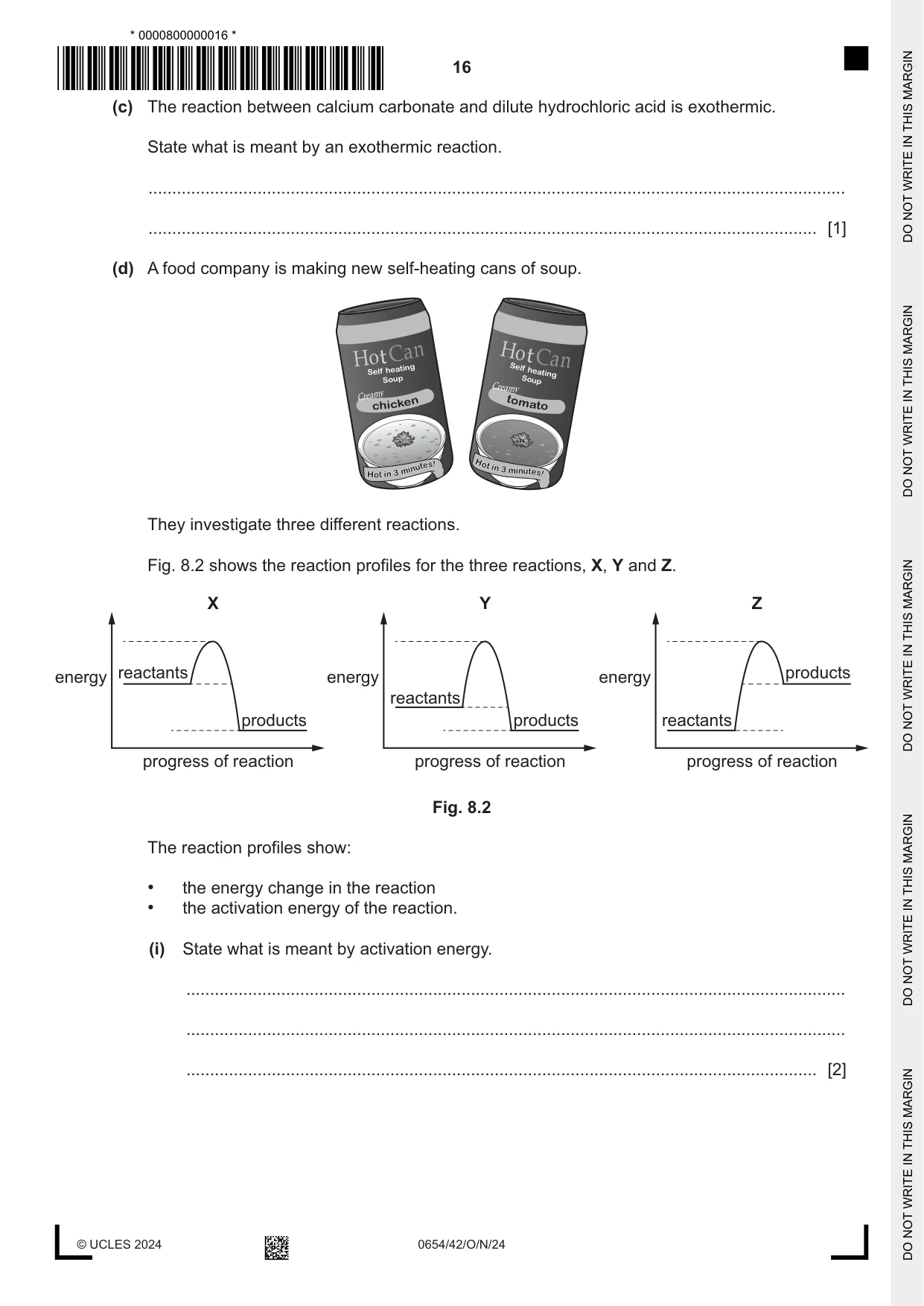
8 A student investigates the reaction between calcium carbonate and dilute hydrochloric acid. The student does the experiment using three different sets of conditions, A, B and C. All other variables are kept the same. Fig. 8.1 shows the three sets of conditions. A B C thermometer 45 °C 30 °C 45 °C 0.1 mol / dm3 0.05 mol / dm3 0.1 mol / dm3 hydrochloric acid hydrochloric acid hydrochloric acid lump of calcium small pieces of powdered calcium carbonate calcium carbonate carbonate Fig. 8.1 (a) State which set of conditions, A, B or C, will give the fastest rate of reaction. ............................................................................................................................................. [1] (b) The equation for the reaction in the student’s experiment is shown. CaCO3 + 2HCl CaCl 2 + H2O + CO2 Calculate the mass of 1.2 dm3 of carbon dioxide gas measured at room temperature and pressure (r.t.p.). The volume of one mole of any gas is 24 dm3 at r.t.p. Show your working. [Ar: C, 12; O, 16] mass of carbon dioxide gas = ....................................................... g [3] (c) The reaction between calcium carbonate and dilute hydrochloric acid is exothermic. State what is meant by an exothermic reaction. ................................................................................................................................................... ............................................................................................................................................. [1] (d) A food company is making new self-heating cans of soup. n H Ca ot ot C H ng an Self heati Self heati ng Soup Soup Creamy Creamy chicken tomato iinn 33 minuteminutess!! HHotot iinn 33 minuteminutess!! HHotot They investigate three different reactions. Fig. 8.2 shows the reaction profiles for the three reactions, X, Y and Z. X Y Z energy reactants energy energy products reactants products products reactants progress of reaction progress of reaction progress of reaction Fig. 8.2 The reaction profiles show: • the energy change in the reaction • the activation energy of the reaction. (i) State what is meant by activation energy. ........................................................................................................................................... ........................................................................................................................................... ..................................................................................................................................... [2] (ii) Suggest which reaction, X, Y or Z, would be most suitable to use in the self-heating cans. Explain your answer. reaction ........................................ explanation ........................................................................................................................ ........................................................................................................................................... ........................................................................................................................................... [3] [Total: 10]
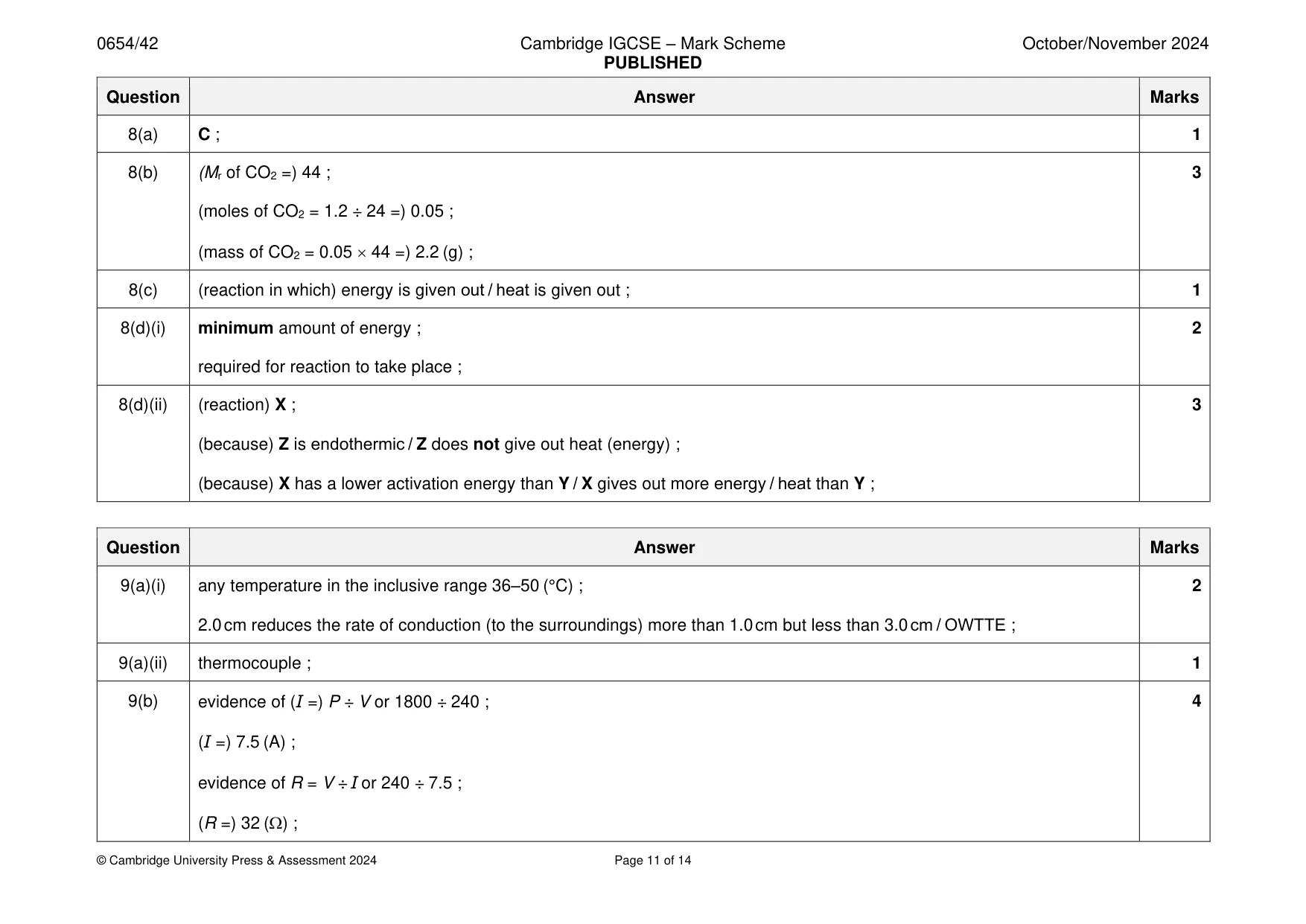
Mark scheme: 8(a) C ; 1 8(b) (Mr of CO2 =) 44 ; 3 (moles of CO2 = 1.2 ÷ 24 =) 0.05 ; (mass of CO2 = 0.05 44 =) 2.2 (g) ; 8(c) (reaction in which) energy is given out / heat is given out ; 1 8(d)(i) minimum amount of energy ; 2 required for reaction to take place ; 8(d)(ii) (reaction) X ; 3 (because) Z is endothermic / Z does not give out heat (energy) ; (because) X has a lower activation energy than Y / X gives out more energy / heat than Y ;
Q9 · A student investigates the use of cotton wool to insulate a beaker of hot water at 90 °C
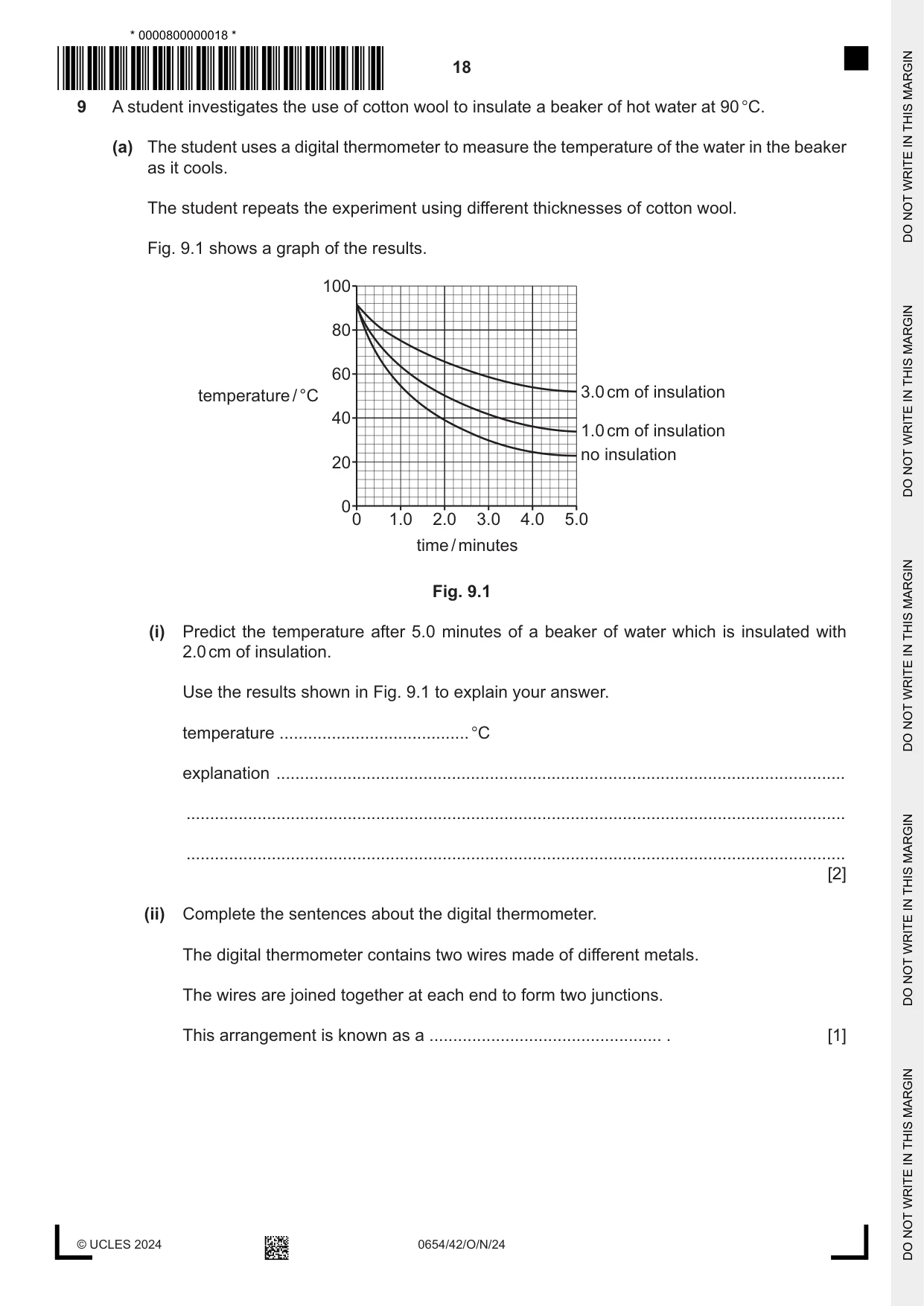
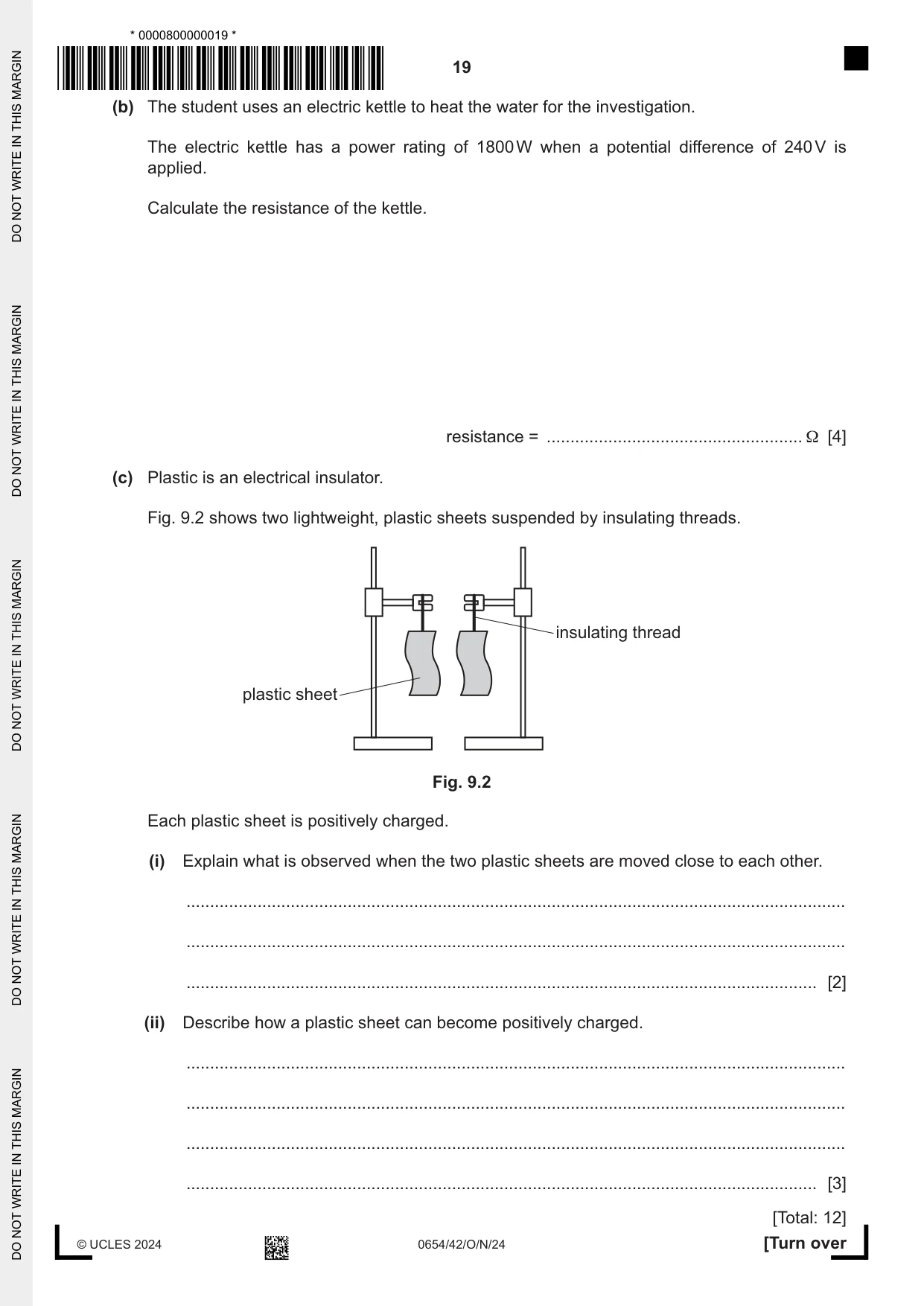
9 A student investigates the use of cotton wool to insulate a beaker of hot water at 90 °C. (a) The student uses a digital thermometer to measure the temperature of the water in the beaker as it cools. The student repeats the experiment using different thicknesses of cotton wool. Fig. 9.1 shows a graph of the results. 100 80 60 temperature / °C 3.0 cm of insulation 40 1.0 cm of insulation no insulation 20 00 1.0 2.0 3.0 4.0 5.0 time / minutes Fig. 9.1 (i) Predict the temperature after 5.0 minutes of a beaker of water which is insulated with 2.0 cm of insulation. Use the results shown in Fig. 9.1 to explain your answer. temperature ........................................ °C explanation ........................................................................................................................ ........................................................................................................................................... ........................................................................................................................................... [2] (ii) Complete the sentences about the digital thermometer. The digital thermometer contains two wires made of different metals. The wires are joined together at each end to form two junctions. This arrangement is known as a ................................................. . [1] (b) The student uses an electric kettle to heat the water for the investigation. The electric kettle has a power rating of 1800 W when a potential difference of 240 V is applied. Calculate the resistance of the kettle. resistance = ...................................................... Ω [4] (c) Plastic is an electrical insulator. Fig. 9.2 shows two lightweight, plastic sheets suspended by insulating threads. insulating thread plastic sheet Fig. 9.2 Each plastic sheet is positively charged. (i) Explain what is observed when the two plastic sheets are moved close to each other. ........................................................................................................................................... ........................................................................................................................................... ..................................................................................................................................... [2] (ii) Describe how a plastic sheet can become positively charged. ........................................................................................................................................... ........................................................................................................................................... ........................................................................................................................................... ..................................................................................................................................... [3] [Total: 12]
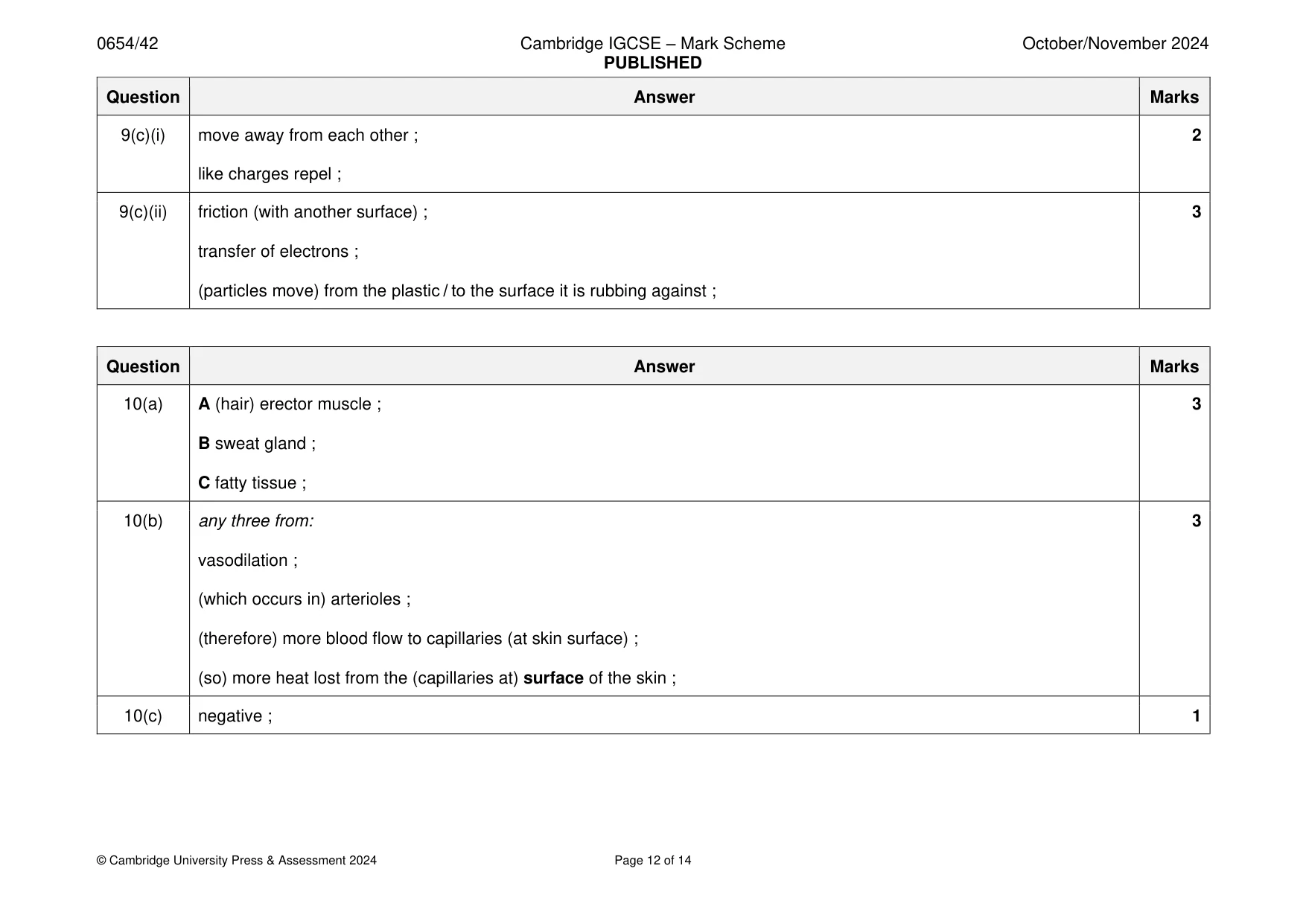
Mark scheme: 9(a)(i) any temperature in the inclusive range 36–50 (°C) ; 2 2.0 cm reduces the rate of conduction (to the surroundings) more than 1.0 cm but less than 3.0 cm / OWTTE ; 9(a)(ii) thermocouple ; 1 9(b) evidence of (I =) P ÷ V or 1800 ÷ 240 ; 4 (I =) 7.5 (A) ; evidence of R = V ÷ I or 240 ÷ 7.5 ; (R =) 32 () ; 9(c)(i) move away from each other ; 2 like charges repel ; 9(c)(ii) friction (with another surface) ; 3 transfer of electrons ; (particles move) from the plastic / to the surface it is rubbing against ;
Q10 · A diagram of human skin
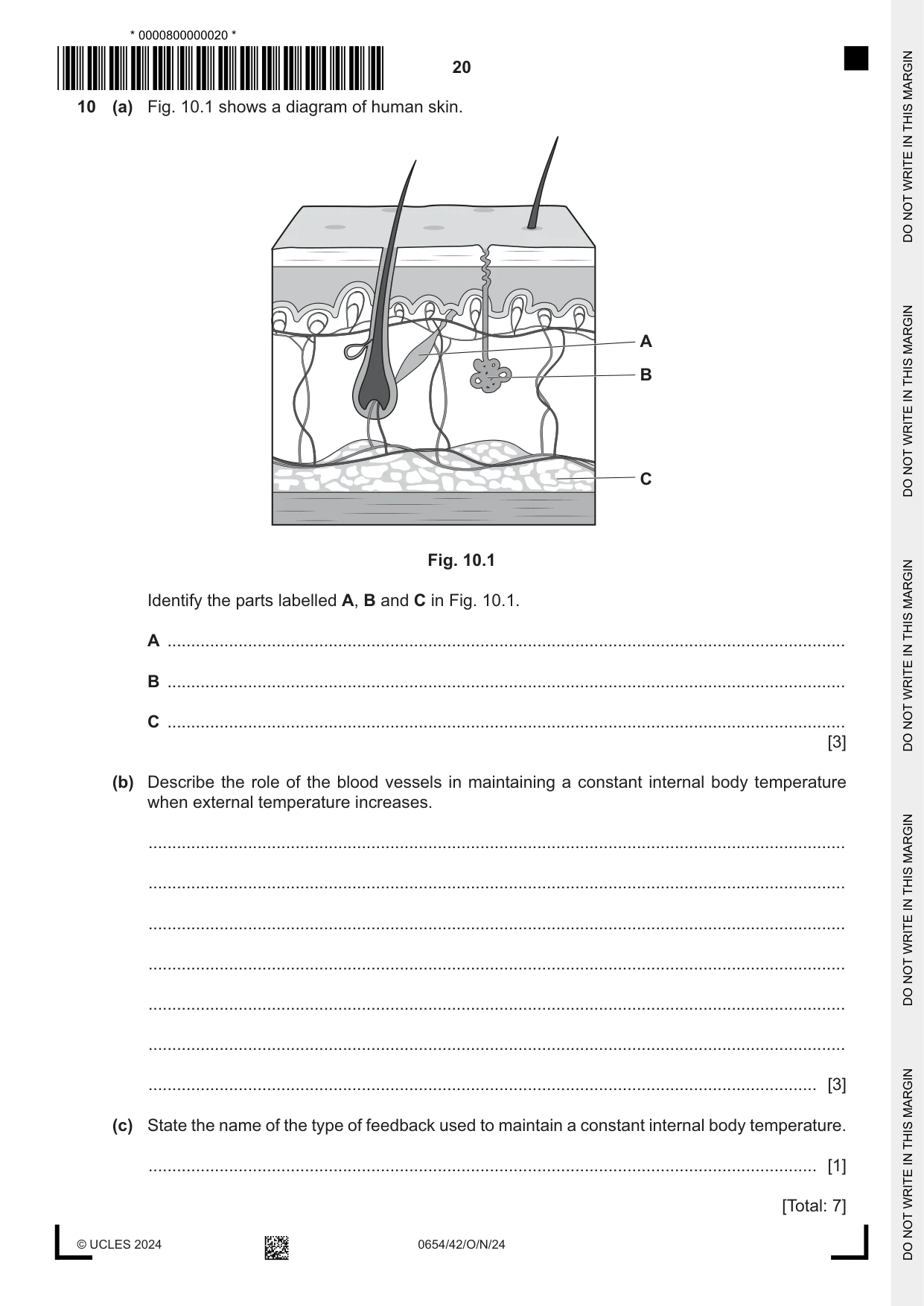
10 (a) Fig. 10.1 shows a diagram of human skin. A B C Fig. 10.1 Identify the parts labelled A, B and C in Fig. 10.1. A ............................................................................................................................................... B ............................................................................................................................................... C ............................................................................................................................................... [3] (b) Describe the role of the blood vessels in maintaining a constant internal body temperature when external temperature increases. ................................................................................................................................................... ................................................................................................................................................... ................................................................................................................................................... ................................................................................................................................................... ................................................................................................................................................... ................................................................................................................................................... ............................................................................................................................................. [3] (c) State the name of the type of feedback used to maintain a constant internal body temperature. ............................................................................................................................................. [1] [Total: 7]
Mark scheme: 10(a) A (hair) erector muscle ; 3 B sweat gland ; C fatty tissue ; 10(b) any three from: 3 vasodilation ; (which occurs in) arterioles ; (therefore) more blood flow to capillaries (at skin surface) ; (so) more heat lost from the (capillaries at) surface of the skin ; 10(c) negative ; 1
Q11 · Complete the sentence about electrolysis
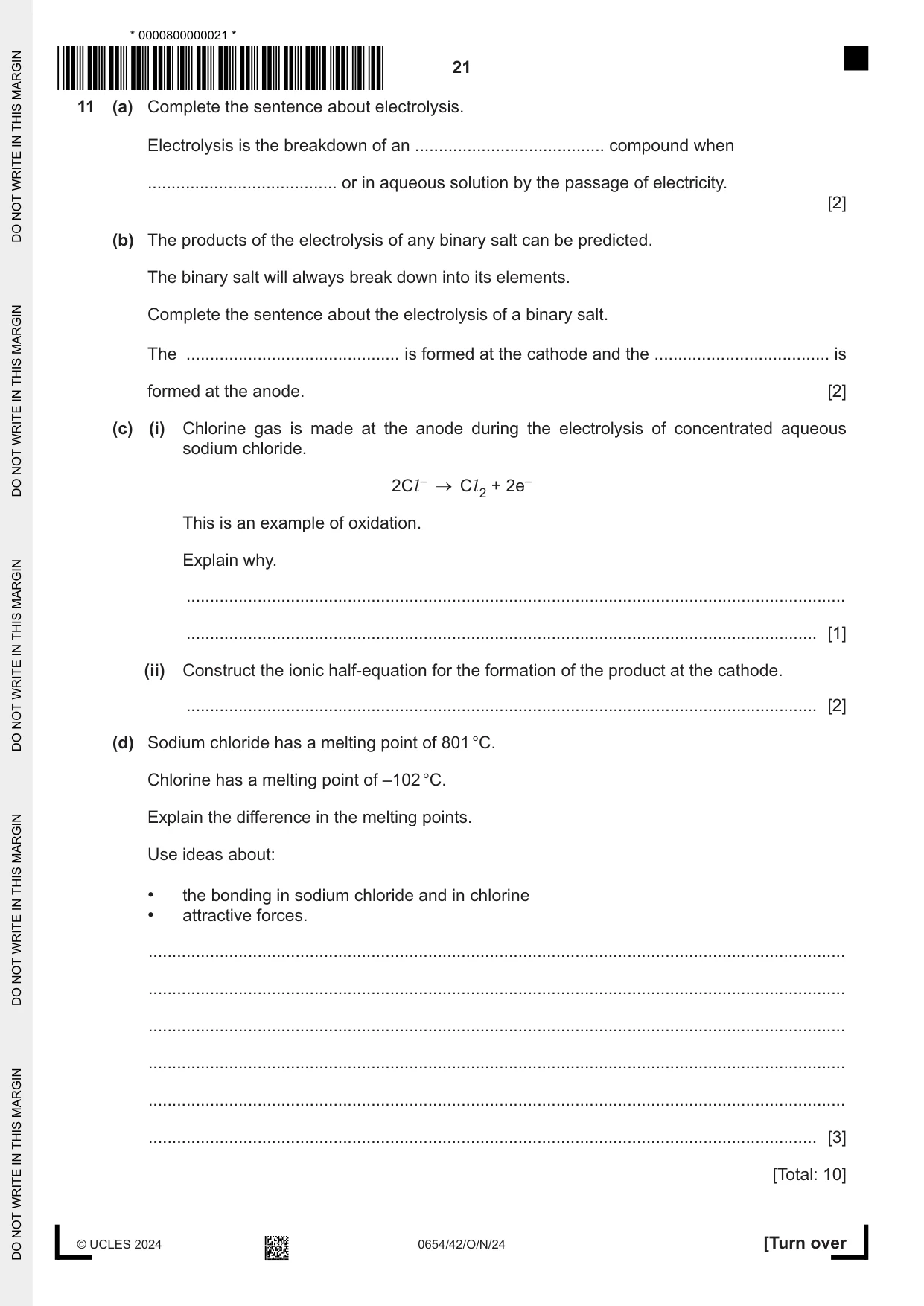
11 (a) Complete the sentence about electrolysis. Electrolysis is the breakdown of an ........................................ compound when ........................................ or in aqueous solution by the passage of electricity. [2] (b) The products of the electrolysis of any binary salt can be predicted. The binary salt will always break down into its elements. Complete the sentence about the electrolysis of a binary salt. The ............................................. is formed at the cathode and the ..................................... is formed at the anode. [2] (c) (i) Chlorine gas is made at the anode during the electrolysis of concentrated aqueous sodium chloride. 2Cl – Cl + 2e– 2 This is an example of oxidation. Explain why. ........................................................................................................................................... ..................................................................................................................................... [1] (ii) Construct the ionic half-equation for the formation of the product at the cathode. ..................................................................................................................................... [2] (d) Sodium chloride has a melting point of 801 °C. Chlorine has a melting point of –102 °C. Explain the difference in the melting points. Use ideas about: • the bonding in sodium chloride and in chlorine • attractive forces. ................................................................................................................................................... ................................................................................................................................................... ................................................................................................................................................... ................................................................................................................................................... ................................................................................................................................................... ............................................................................................................................................. [3] [Total: 10]
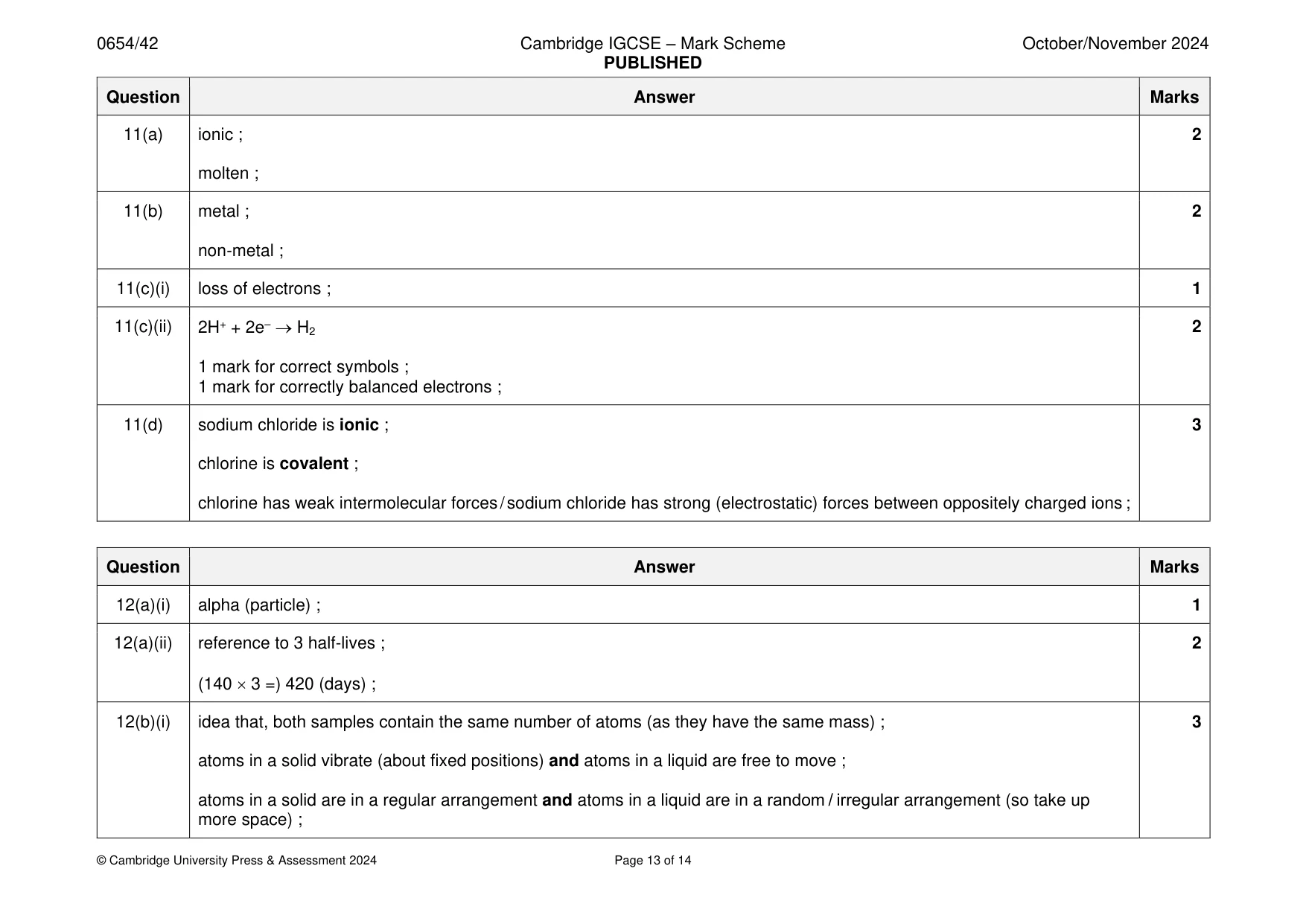
Mark scheme: 11(a) ionic ; 2 molten ; 11(b) metal ; 2 non-metal ; 11(c)(i) loss of electrons ; 1 11(c)(ii) 2H+ + 2e– → H2 2 1 mark for correct symbols ; 1 mark for correctly balanced electrons ; 11(d) sodium chloride is ionic ; 3 chlorine is covalent ; chlorine has weak intermolecular forces / sodium chloride has strong (electrostatic) forces between oppositely charged ions ;
Q12 · Polonium is a highly radioactive metal with no stable isotopes
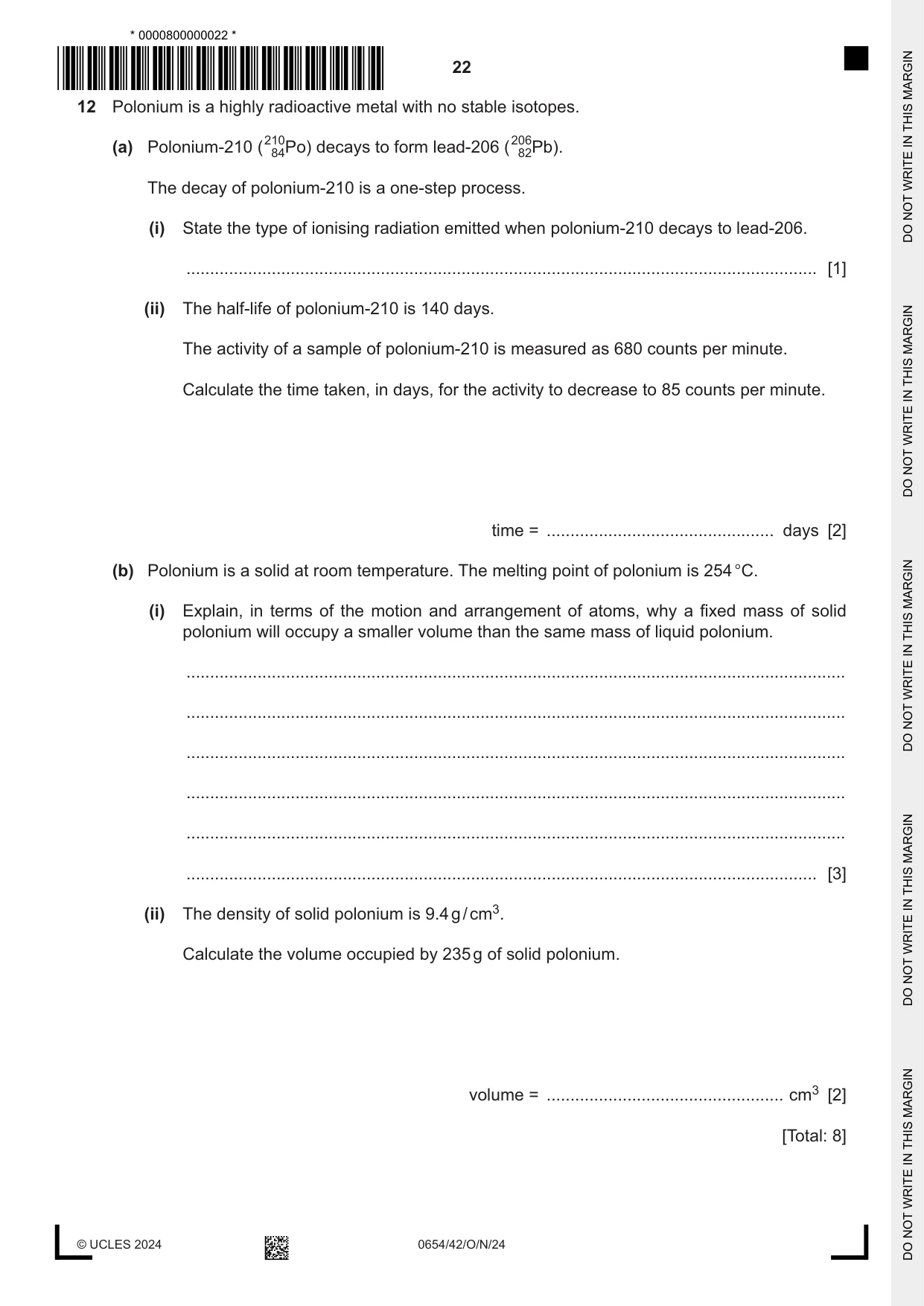
12 Polonium is a highly radioactive metal with no stable isotopes. (a) Polonium-210 (21084Po) decays to form lead-206 (20682Pb). The decay of polonium-210 is a one-step process. (i) State the type of ionising radiation emitted when polonium-210 decays to lead-206. ..................................................................................................................................... [1] (ii) The half-life of polonium-210 is 140 days. The activity of a sample of polonium-210 is measured as 680 counts per minute. Calculate the time taken, in days, for the activity to decrease to 85 counts per minute. time = ................................................ days [2] (b) Polonium is a solid at room temperature. The melting point of polonium is 254 °C. (i) Explain, in terms of the motion and arrangement of atoms, why a fixed mass of solid polonium will occupy a smaller volume than the same mass of liquid polonium. ........................................................................................................................................... ........................................................................................................................................... ........................................................................................................................................... ........................................................................................................................................... ........................................................................................................................................... ..................................................................................................................................... [3] (ii) The density of solid polonium is 9.4 g / cm3. Calculate the volume occupied by 235 g of solid polonium. volume = .................................................. cm3 [2] [Total: 8]
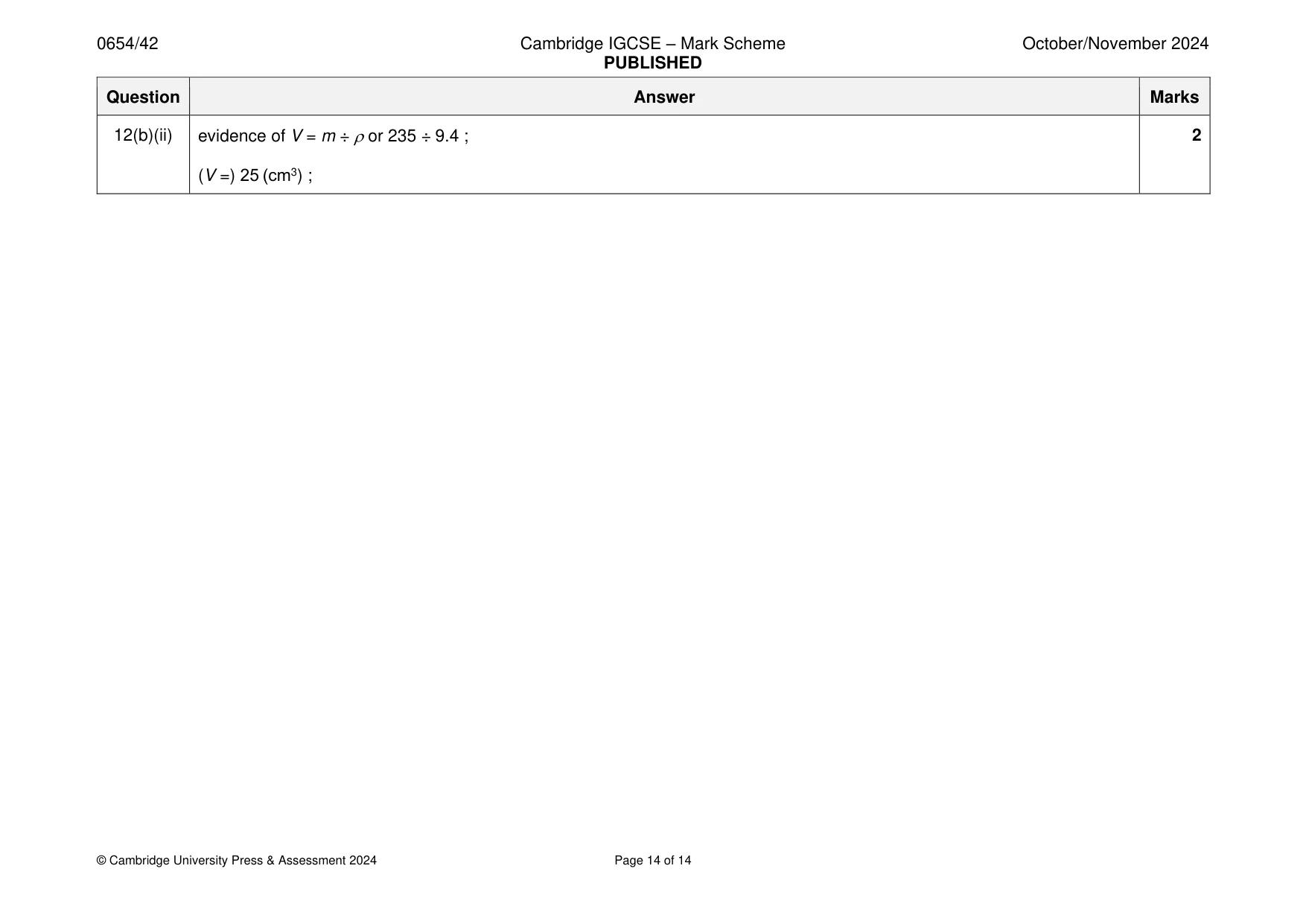
Mark scheme: 12(a)(i) alpha (particle) ; 1 12(a)(ii) reference to 3 half-lives ; 2 (140 3 =) 420 (days) ; 12(b)(i) idea that, both samples contain the same number of atoms (as they have the same mass) ; 3 atoms in a solid vibrate (about fixed positions) and atoms in a liquid are free to move ; atoms in a solid are in a regular arrangement and atoms in a liquid are in a random / irregular arrangement (so take up more space) ; 12(b)(ii) evidence of V = m ÷ or 235 ÷ 9.4 ; 2 (V =) 25 (cm3) ;
What was in this paper
The subtopics covered by these 12 questions, and how many questions each got. Open one in a new tab to see every Cambridge question on it.
What you needed in this session
Cambridge’s own grade thresholds for 2024 Oct/Nov, Paper 4 · Variant 2. A higher threshold means an easier paper — the bar moves with how the cohort did.