Cambridge IGCSE Sciences - Co-ordinated (Double) 0654 — 2024 Oct/Nov Paper 4 · Variant 3
0654/43/O/N/24 · 12 questions · 120 marks · ≈135 min
The question paper and its mark scheme, free to read here and free to download. This is Cambridge’s own paper, exactly as it was sat.
Question paper32 pages
Mark scheme15 pages
Answers below. Sit the paper first if you are practising.
Questions as text
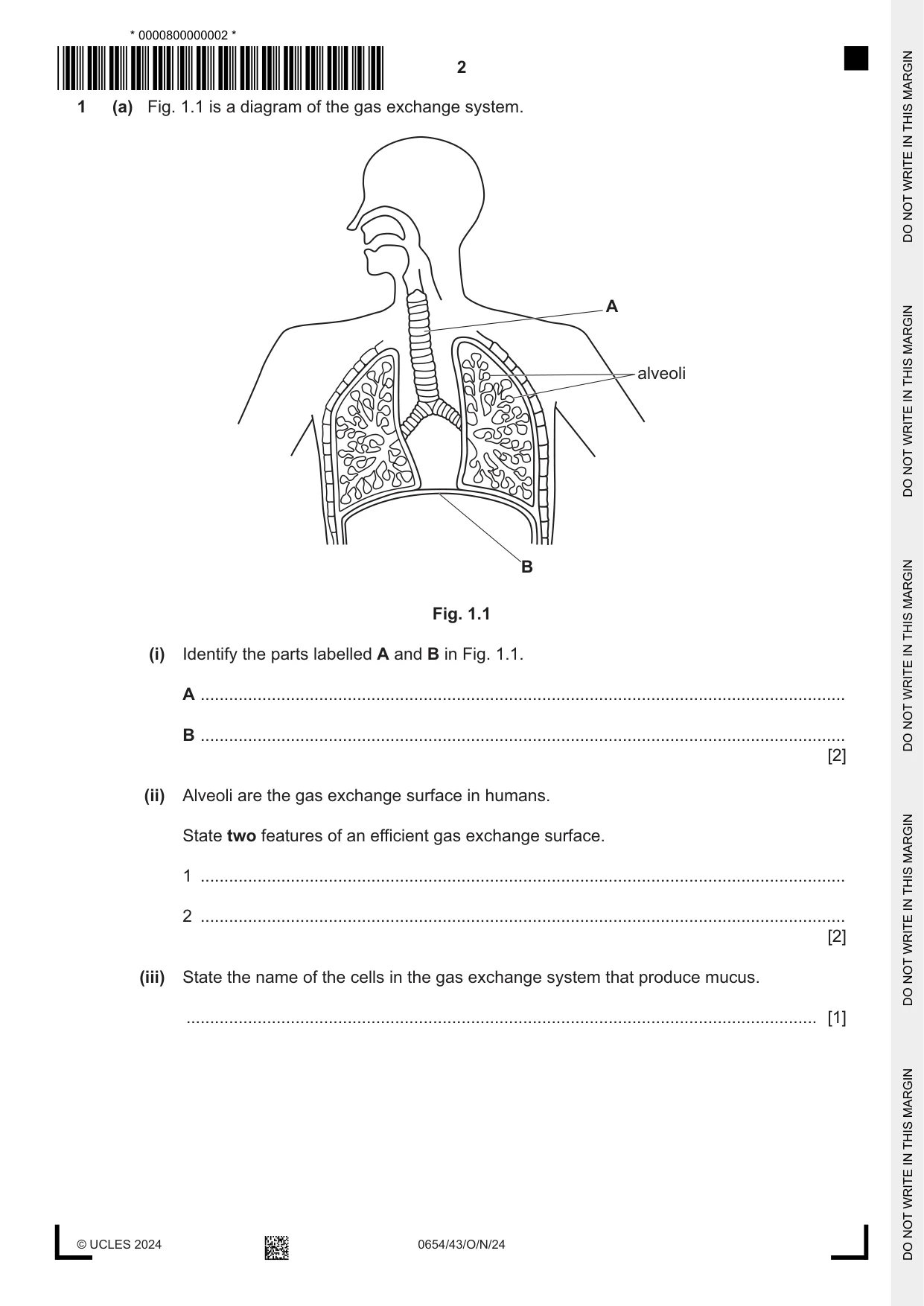
Q1 · A diagram of the gas exchange system
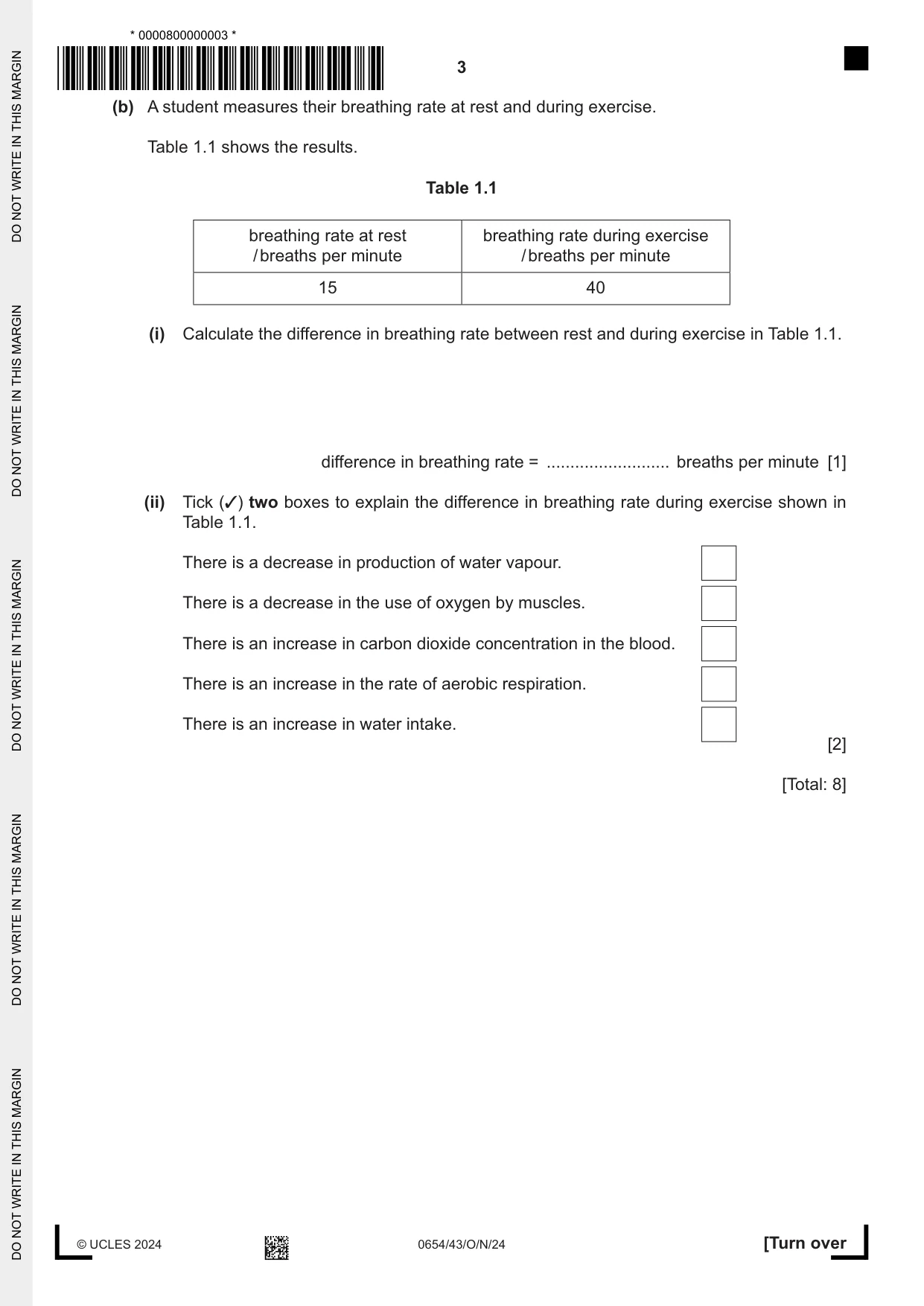
1 (a) Fig. 1.1 is a diagram of the gas exchange system. A alveoli B Fig. 1.1 (i) Identify the parts labelled A and B in Fig. 1.1. A ........................................................................................................................................ B ........................................................................................................................................ [2] (ii) Alveoli are the gas exchange surface in humans. State two features of an efficient gas exchange surface. 1 ........................................................................................................................................ 2 ........................................................................................................................................ [2] (iii) State the name of the cells in the gas exchange system that produce mucus. ..................................................................................................................................... [1] (b) A student measures their breathing rate at rest and during exercise. Table 1.1 shows the results. Table 1.1 breathing rate at rest breathing rate during exercise / breaths per minute / breaths per minute 15 40 (i) Calculate the difference in breathing rate between rest and during exercise in Table 1.1. difference in breathing rate = .......................... breaths per minute [1] (ii) Tick (3) two boxes to explain the difference in breathing rate during exercise shown in Table 1.1. There is a decrease in production of water vapour. There is a decrease in the use of oxygen by muscles. There is an increase in carbon dioxide concentration in the blood. There is an increase in the rate of aerobic respiration. There is an increase in water intake. [2] [Total: 8]
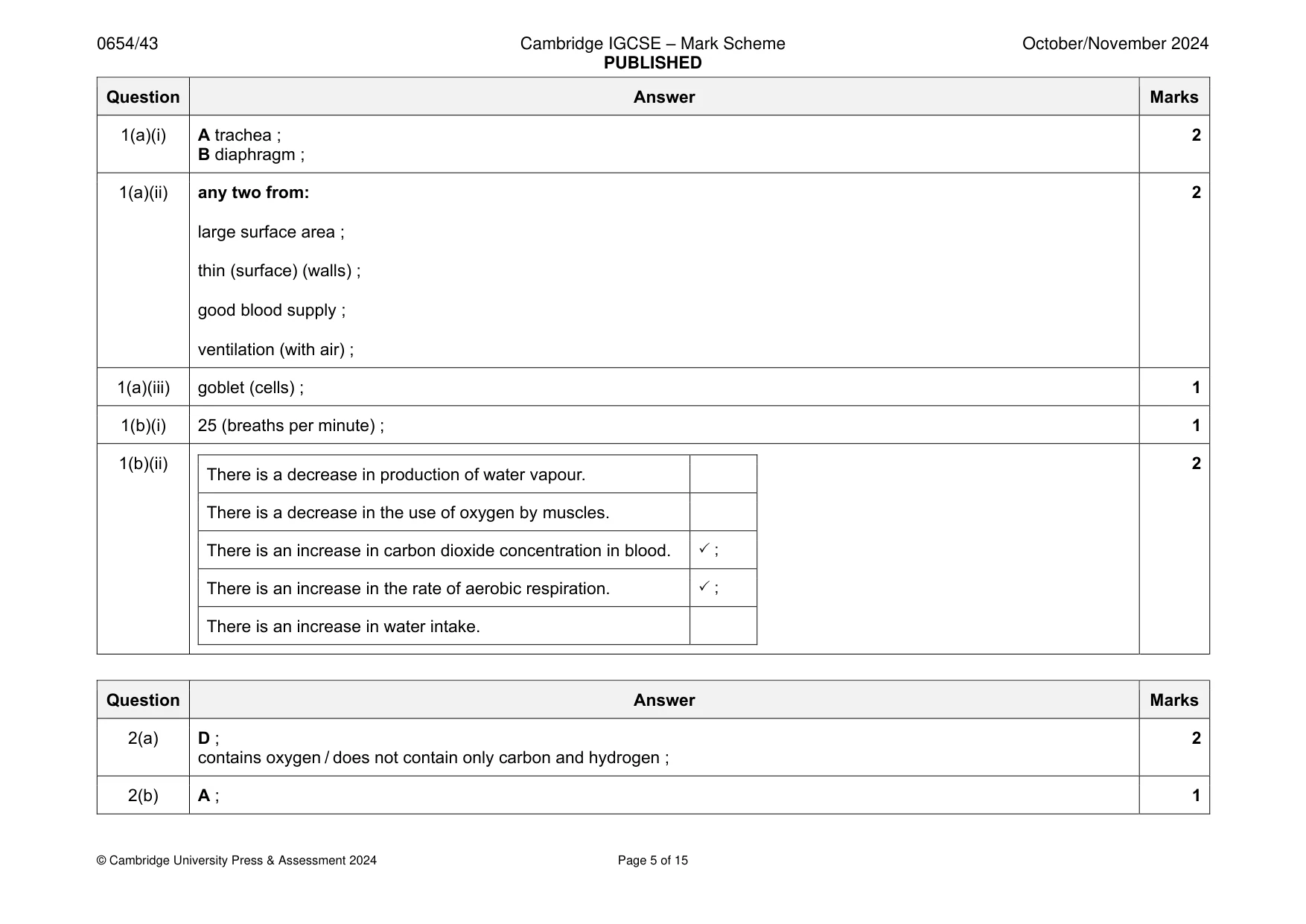
Mark scheme: Question Answer Marks 1(a)(i) A trachea ; 2 B diaphragm ; 1(a)(ii) any two from: 2 large surface area ; thin (surface) (walls) ; good blood supply ; ventilation (with air) ; 1(a)(iii) goblet (cells) ; 1 1(b)(i) 25 (breaths per minute) ; 1 1(b)(ii) 2 There is a decrease in production of water vapour. There is a decrease in the use of oxygen by muscles. There is an increase in carbon dioxide concentration in blood. ; There is an increase in the rate of aerobic respiration. ; There is an increase in water intake.
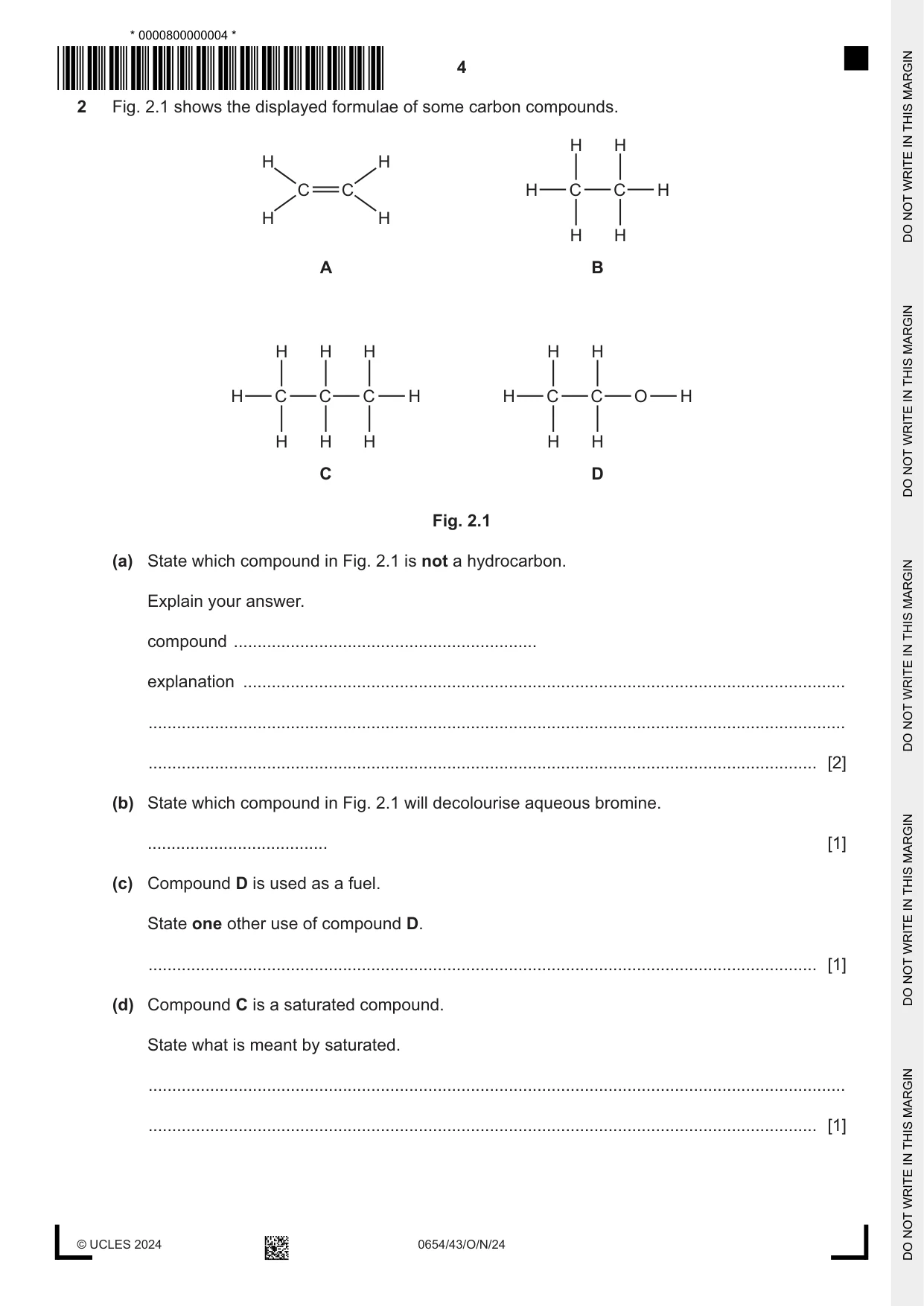
Q2 · The displayed formulae of some carbon compounds
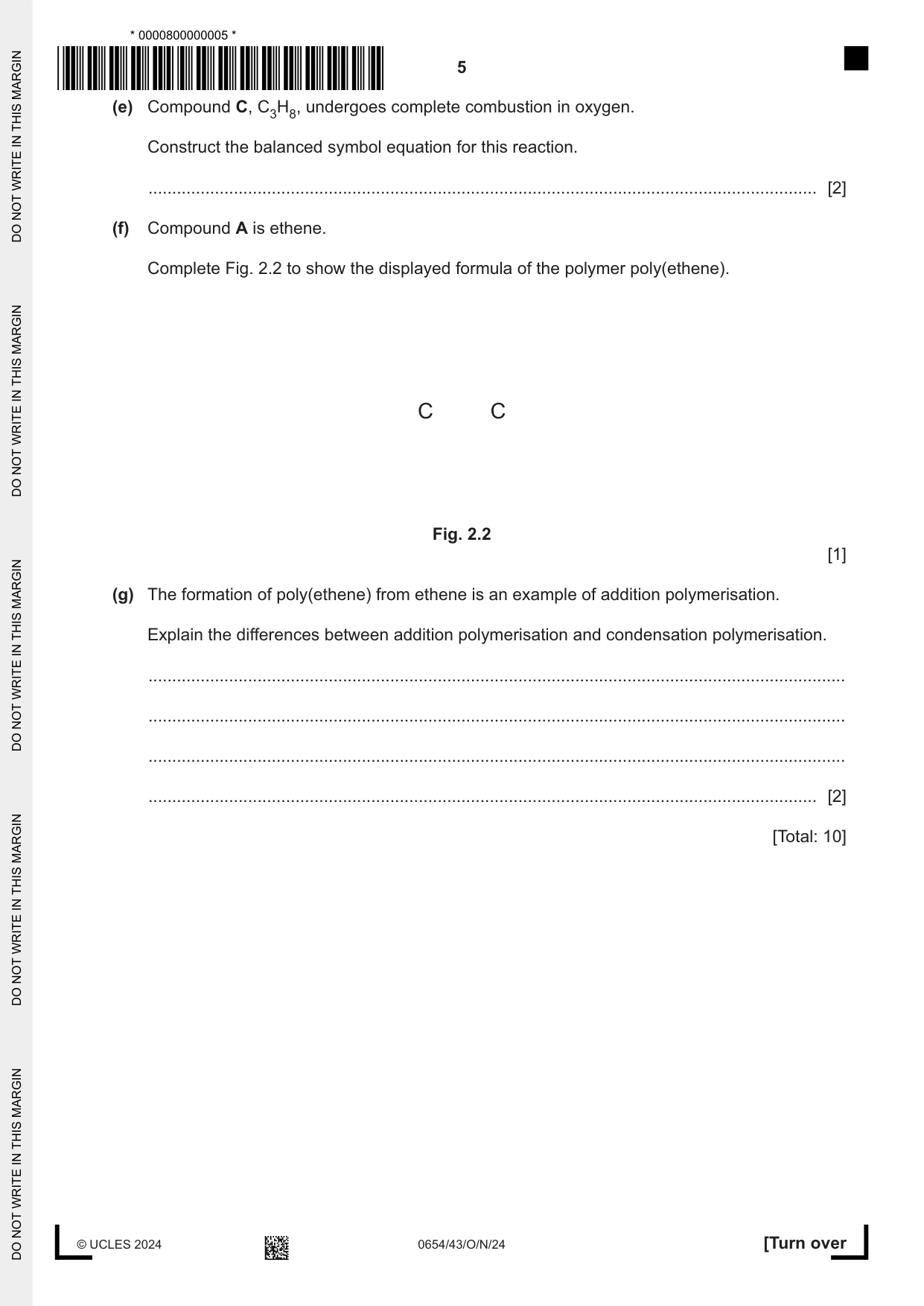
2 Fig. 2.1 shows the displayed formulae of some carbon compounds. H H H H C C H C C H H H H H A B H H H H H H C C C H H C C O H H H H H H C D Fig. 2.1 (a) State which compound in Fig. 2.1 is not a hydrocarbon. Explain your answer. compound ................................................................ explanation ............................................................................................................................... ................................................................................................................................................... ............................................................................................................................................. [2] (b) State which compound in Fig. 2.1 will decolourise aqueous bromine. ...................................... [1] (c) Compound D is used as a fuel. State one other use of compound D. ............................................................................................................................................. [1] (d) Compound C is a saturated compound. State what is meant by saturated. ................................................................................................................................................... ............................................................................................................................................. [1] (e) Compound C, C3H8, undergoes complete combustion in oxygen. Construct the balanced symbol equation for this reaction. ............................................................................................................................................. [2] (f) Compound A is ethene. Complete Fig. 2.2 to show the displayed formula of the polymer poly(ethene). C C Fig. 2.2 [1] (g) The formation of poly(ethene) from ethene is an example of addition polymerisation. Explain the differences between addition polymerisation and condensation polymerisation. ................................................................................................................................................... ................................................................................................................................................... ................................................................................................................................................... ............................................................................................................................................. [2] [Total: 10]
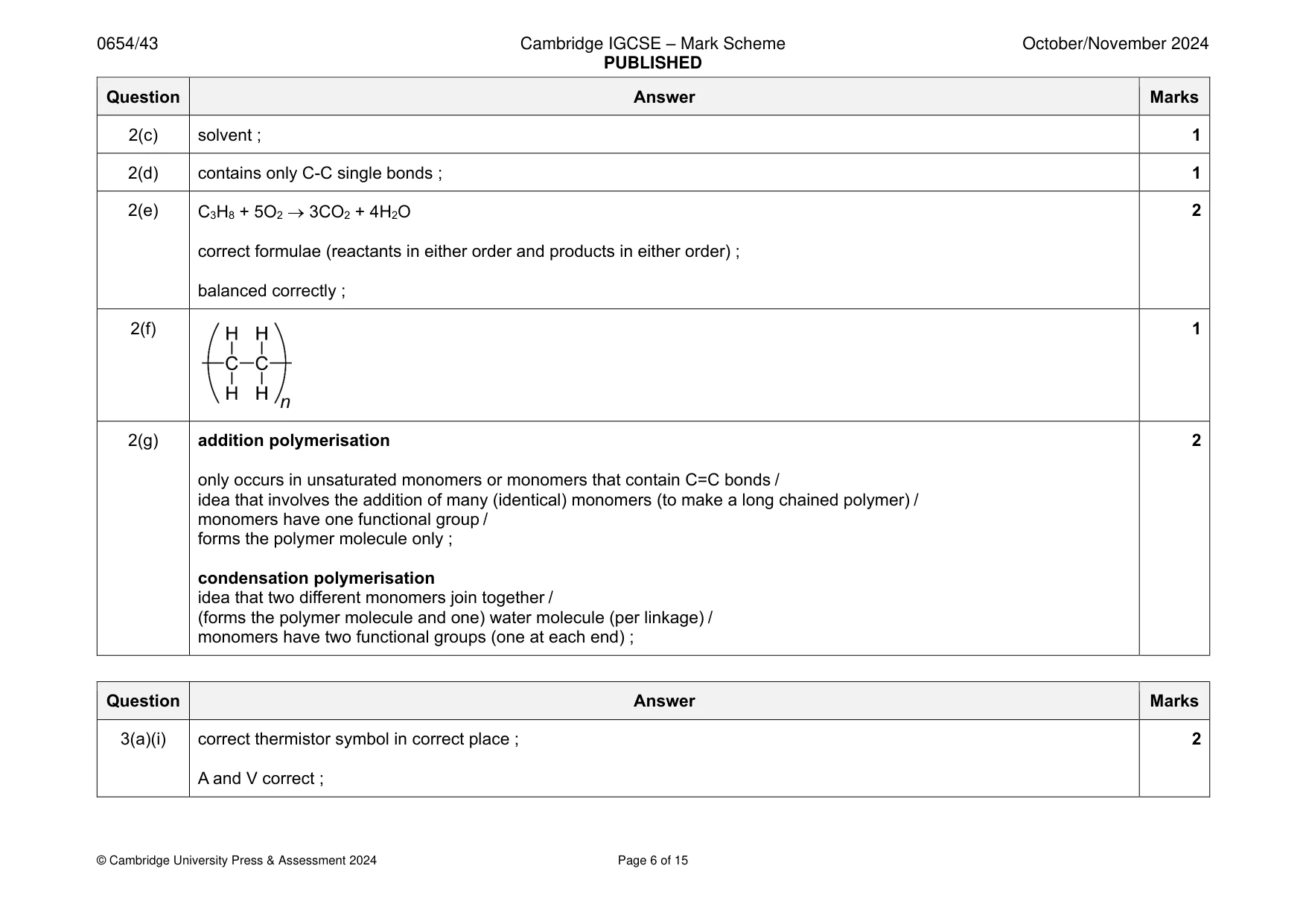
Mark scheme: 2(a) D ; 2 contains oxygen / does not contain only carbon and hydrogen ; 2(b) A ; 1 2(c) solvent ; 1 2(d) contains only C-C single bonds ; 1 2(e) C3H8 + 5O2 → 3CO2 + 4H2O 2 correct formulae (reactants in either order and products in either order) ; balanced correctly ; 2(f) 1 2(g) addition polymerisation 2 only occurs in unsaturated monomers or monomers that contain C=C bonds / idea that involves the addition of many (identical) monomers (to make a long chained polymer) / monomers have one functional group / forms the polymer molecule only ; condensation polymerisation idea that two different monomers join together / (forms the polymer molecule and one) water molecule (per linkage) / monomers have two functional groups (one at each end) ;
Q3 · A student investigates an NTC thermistor
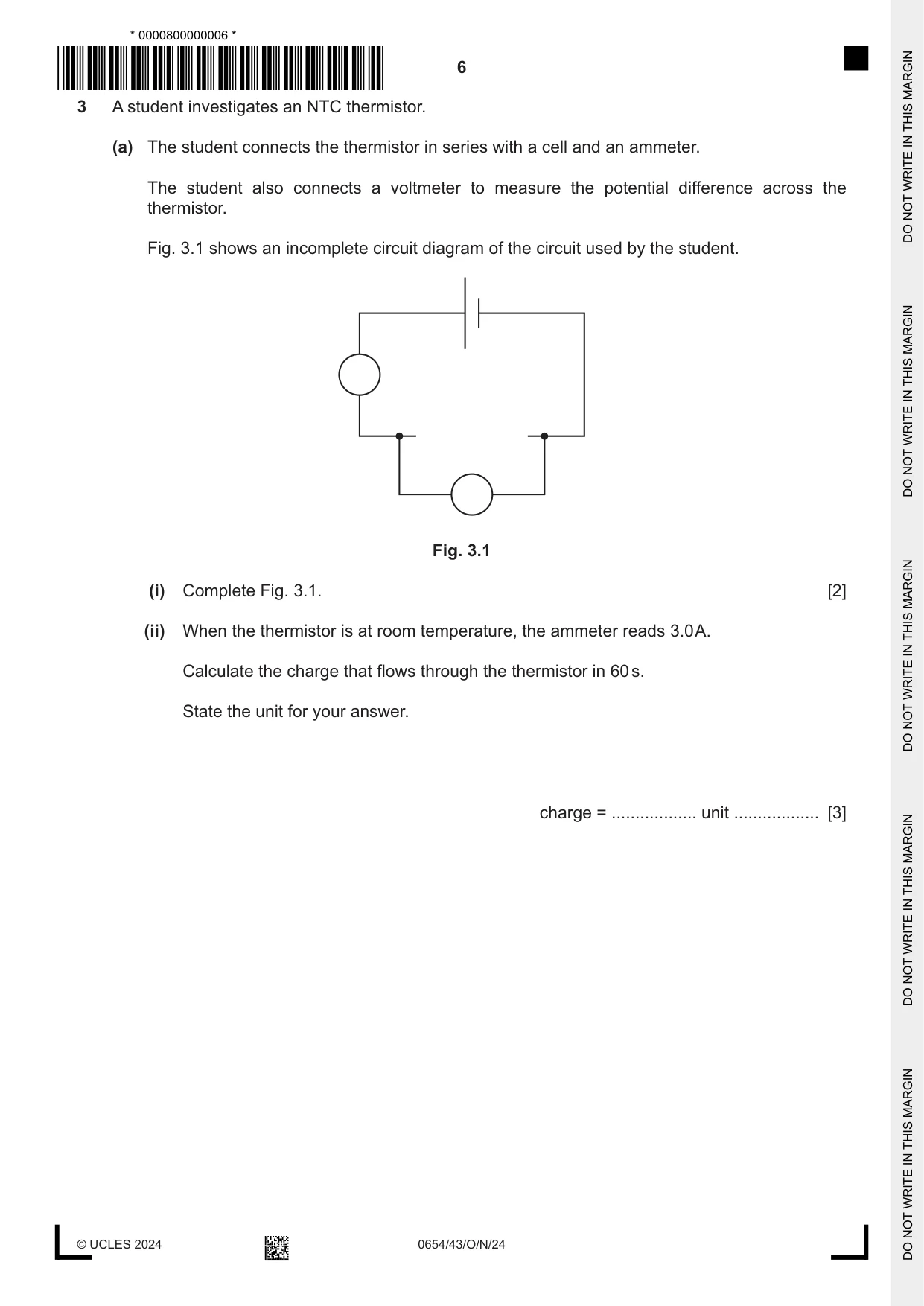
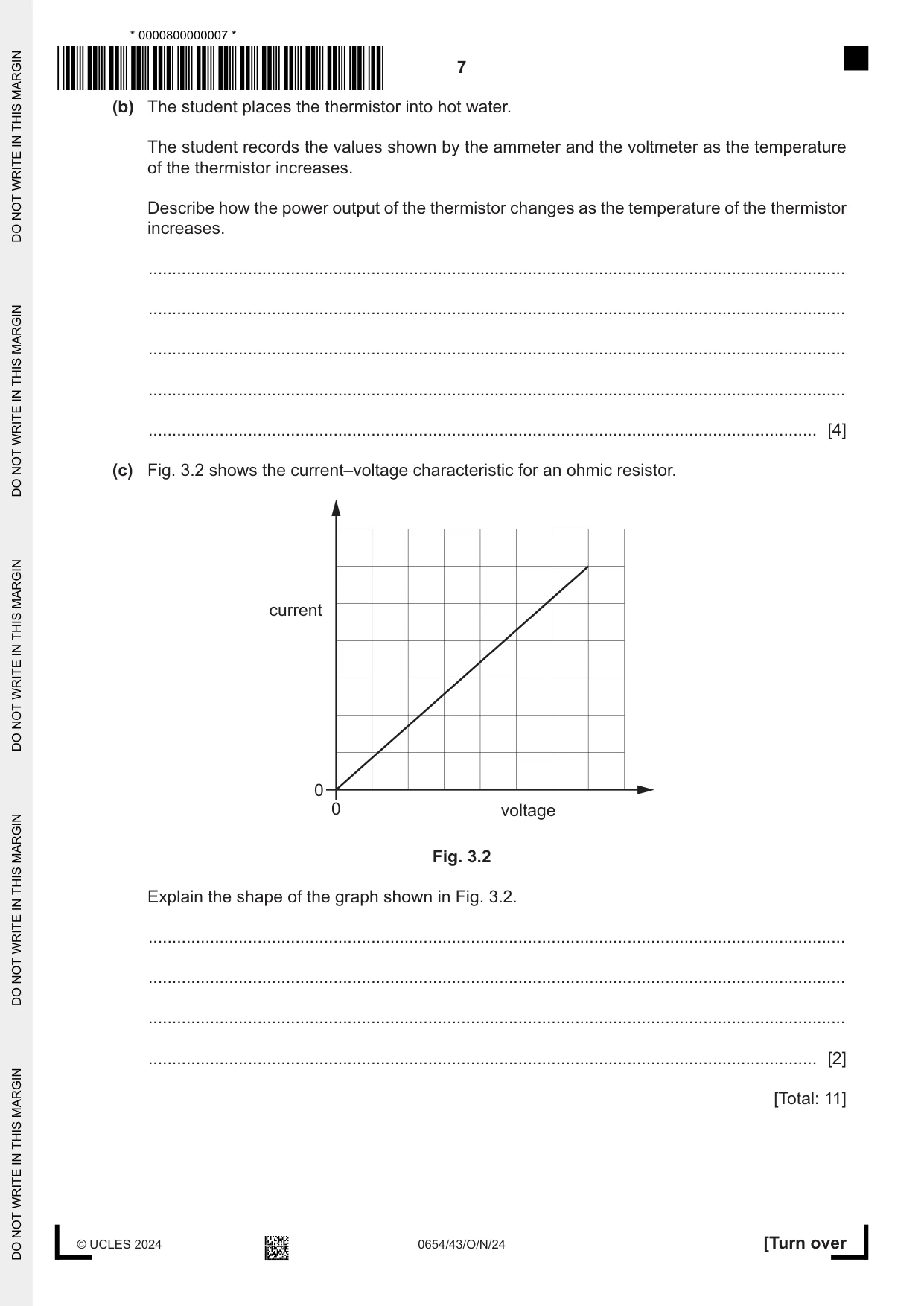
3 A student investigates an NTC thermistor. (a) The student connects the thermistor in series with a cell and an ammeter. The student also connects a voltmeter to measure the potential difference across the thermistor. Fig. 3.1 shows an incomplete circuit diagram of the circuit used by the student. Fig. 3.1 (i) Complete Fig. 3.1. [2] (ii) When the thermistor is at room temperature, the ammeter reads 3.0 A. Calculate the charge that flows through the thermistor in 60 s. State the unit for your answer. charge = .................. unit .................. [3] (b) The student places the thermistor into hot water. The student records the values shown by the ammeter and the voltmeter as the temperature of the thermistor increases. Describe how the power output of the thermistor changes as the temperature of the thermistor increases. ................................................................................................................................................... ................................................................................................................................................... ................................................................................................................................................... ................................................................................................................................................... ............................................................................................................................................. [4] (c) Fig. 3.2 shows the current–voltage characteristic for an ohmic resistor. current 0 0 voltage Fig. 3.2 Explain the shape of the graph shown in Fig. 3.2. ................................................................................................................................................... ................................................................................................................................................... ................................................................................................................................................... ............................................................................................................................................. [2] [Total: 11]
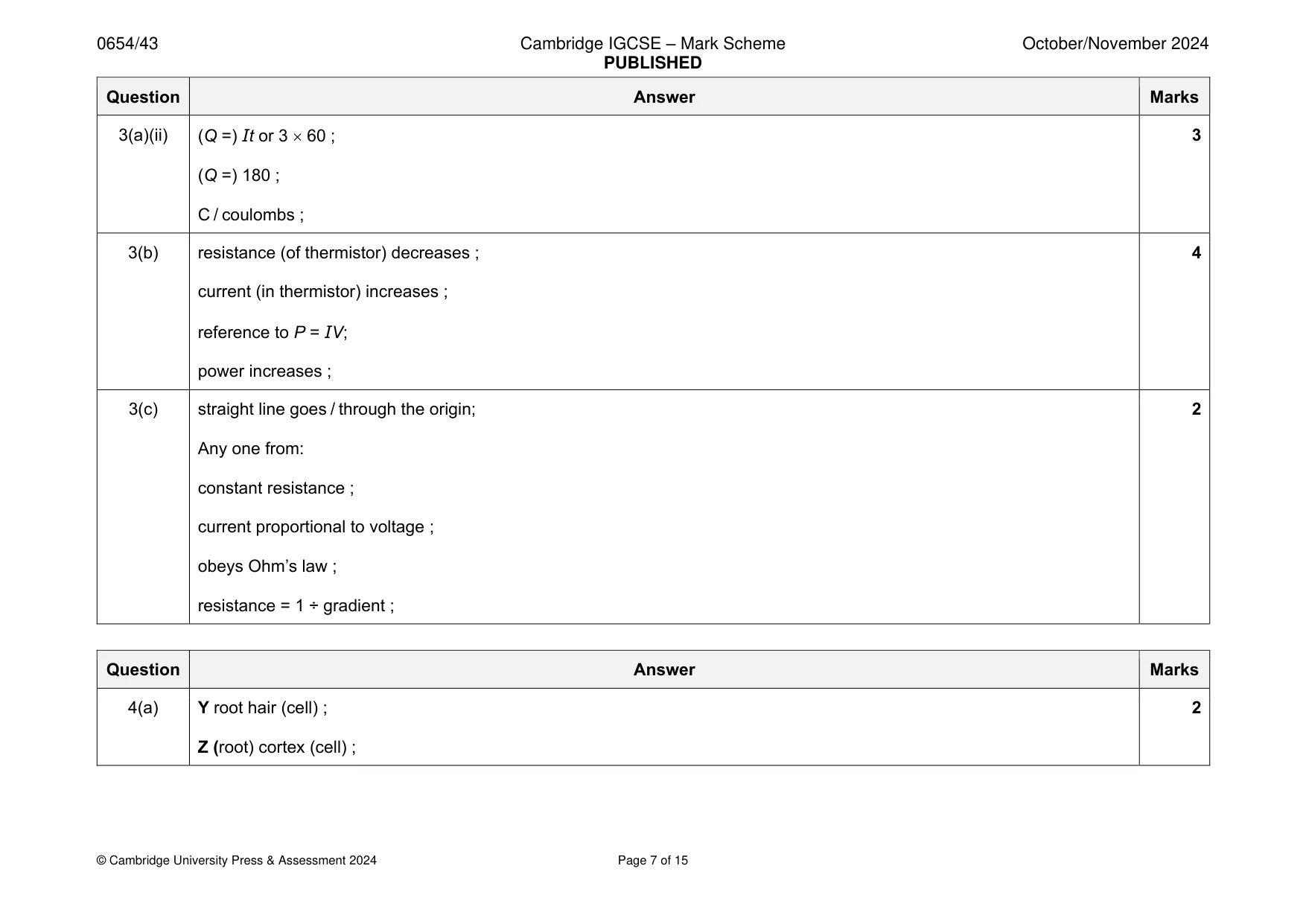
Mark scheme: 3(a)(i) correct thermistor symbol in correct place ; 2 A and V correct ; 3(a)(ii) (Q =) It or 3 60 ; 3 (Q =) 180 ; C / coulombs ; 3(b) resistance (of thermistor) decreases ; 4 current (in thermistor) increases ; reference to P = IV; power increases ; 3(c) straight line goes / through the origin; 2 Any one from: constant resistance ; current proportional to voltage ; obeys Ohm’s law ; resistance = 1 ÷ gradient ;
Question 4
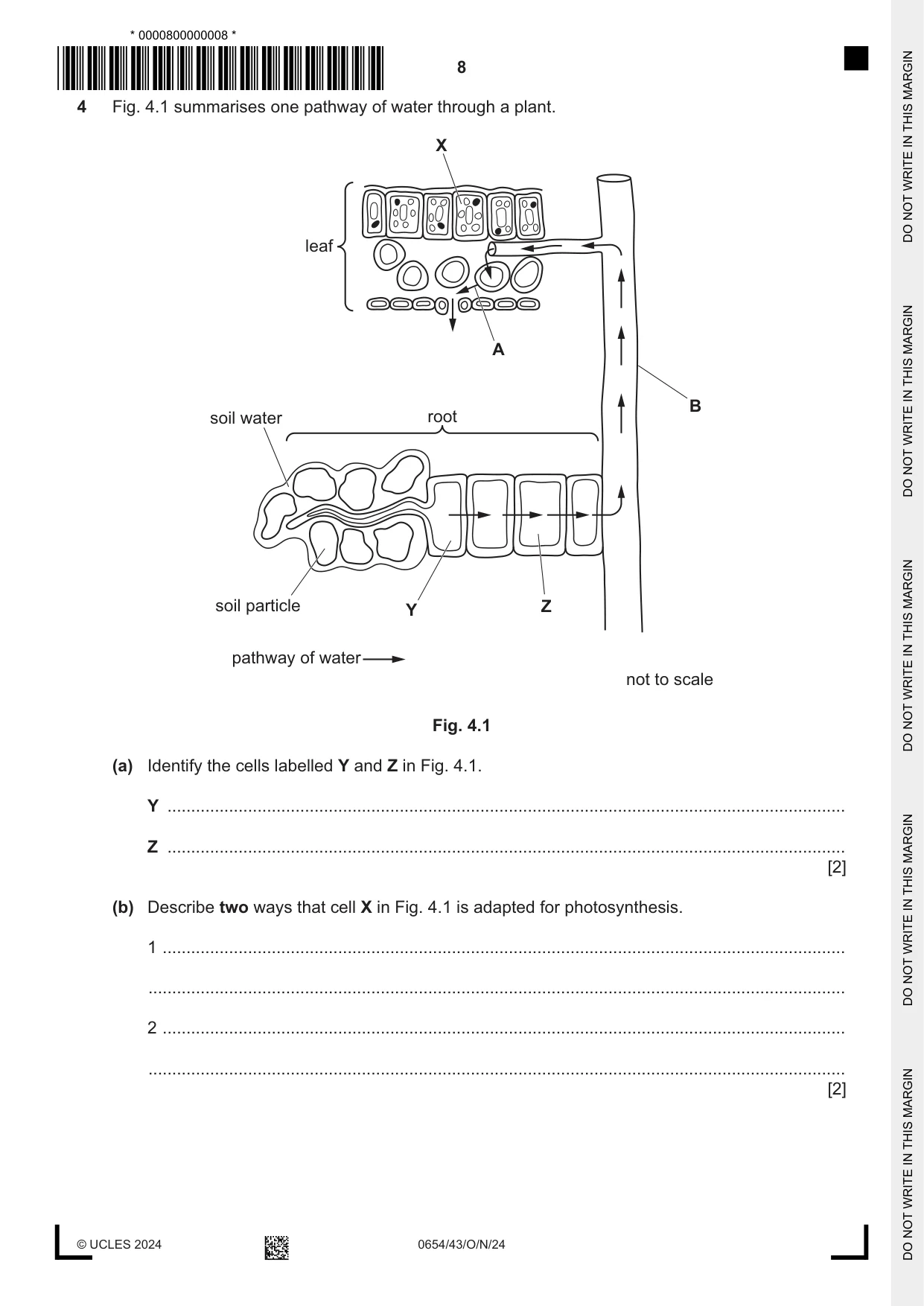
4 Fig. 4.1 summarises one pathway of water through a plant. X leaf A B soil water root soil particle Y Z pathway of water not to scale Fig. 4.1 (a) Identify the cells labelled Y and Z in Fig. 4.1. Y ............................................................................................................................................... Z ............................................................................................................................................... [2] (b) Describe two ways that cell X in Fig. 4.1 is adapted for photosynthesis. 1 ................................................................................................................................................ ................................................................................................................................................... 2 ................................................................................................................................................ ................................................................................................................................................... [2] (c) Explain the effect of an increase in humidity on the process occurring at A in Fig. 4.1. ................................................................................................................................................... ................................................................................................................................................... ................................................................................................................................................... ................................................................................................................................................... ............................................................................................................................................. [2] (d) Complete the sentences to explain how water is moved in part B in Fig. 4.1. Water is moved up part B by ............................................................ pull. This creates a ............................................................ gradient, drawing up a column of water molecules that are held together by ............................................................ . [3] [Total: 9]
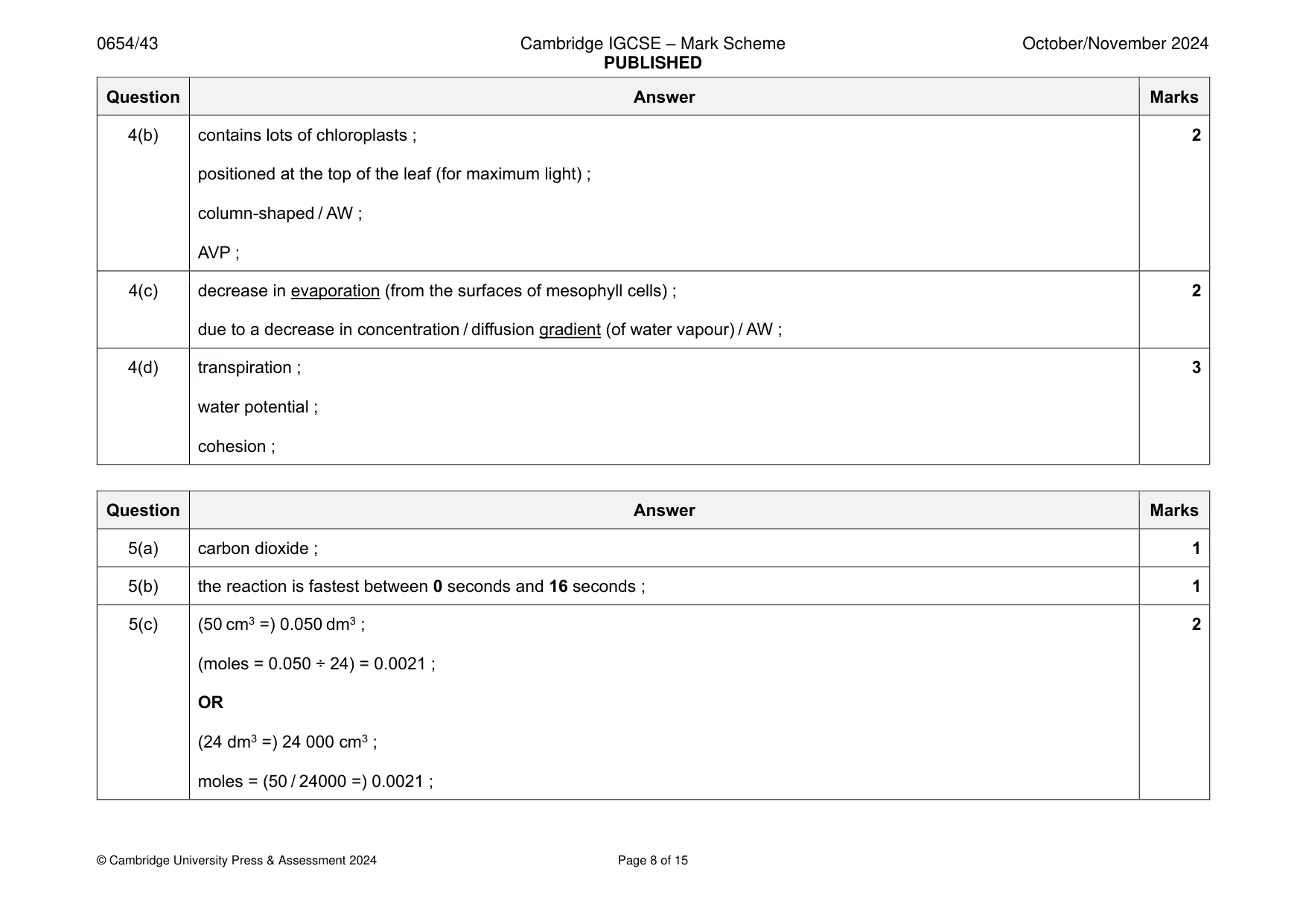
Mark scheme: 4(a) Y root hair (cell) ; 2 Z (root) cortex (cell) ; 4(b) contains lots of chloroplasts ; 2 positioned at the top of the leaf (for maximum light) ; column-shaped / AW ; AVP ; 4(c) decrease in evaporation (from the surfaces of mesophyll cells) ; 2 due to a decrease in concentration / diffusion gradient (of water vapour) / AW ; 4(d) transpiration ; 3 water potential ; cohesion ;
Q5 · A student investigates the reaction between calcium carbonate and dilute hydrochloric acid
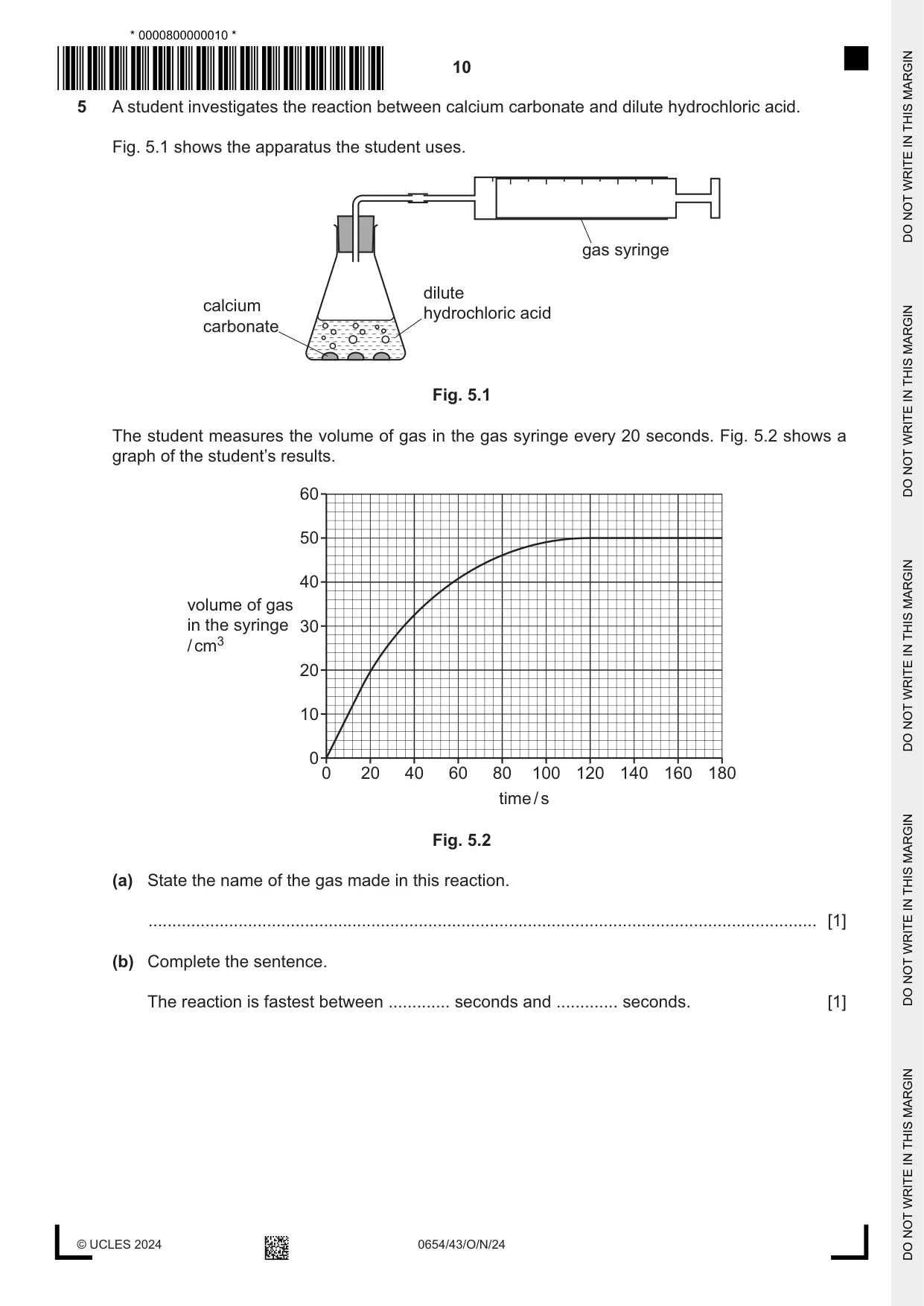
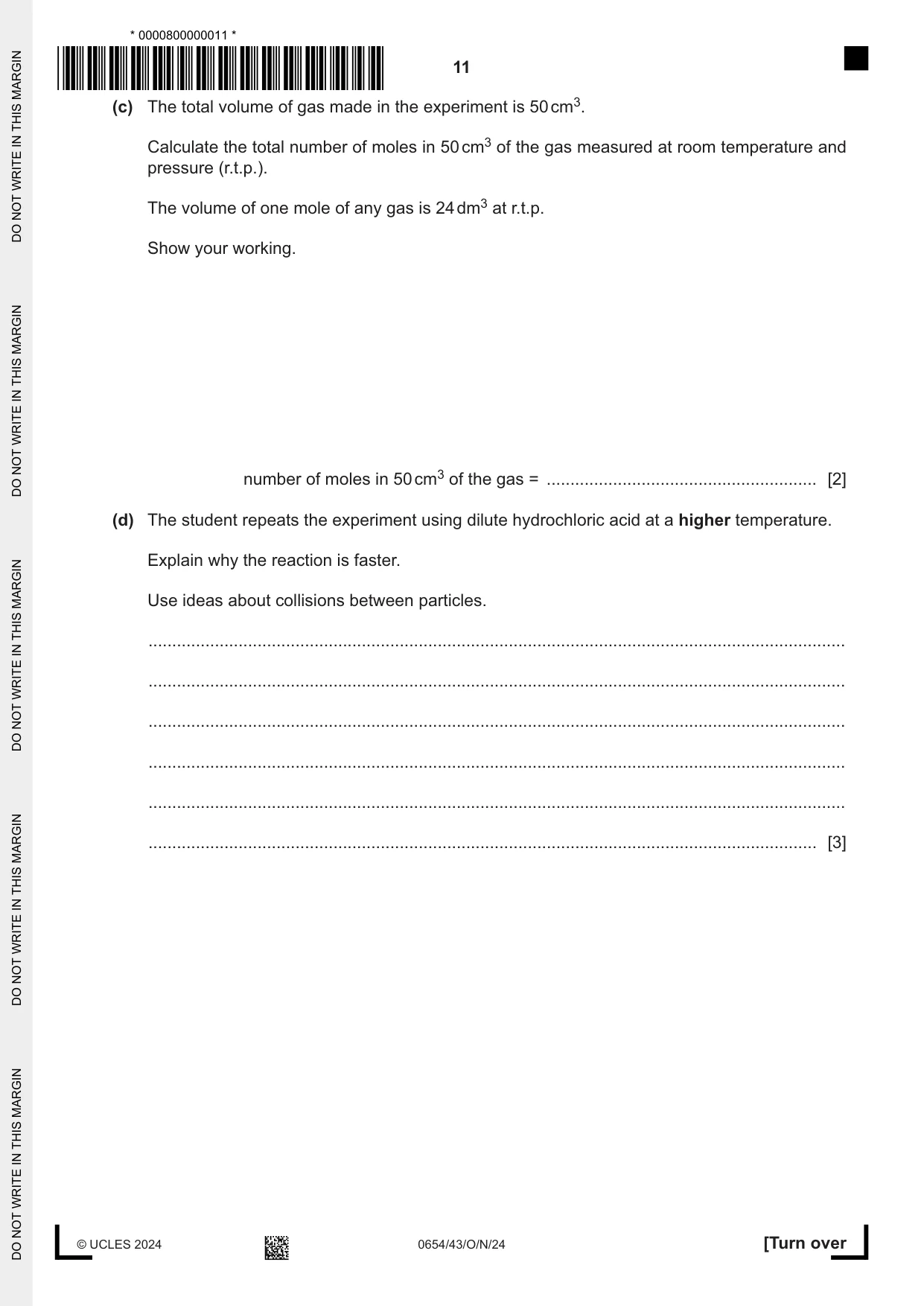
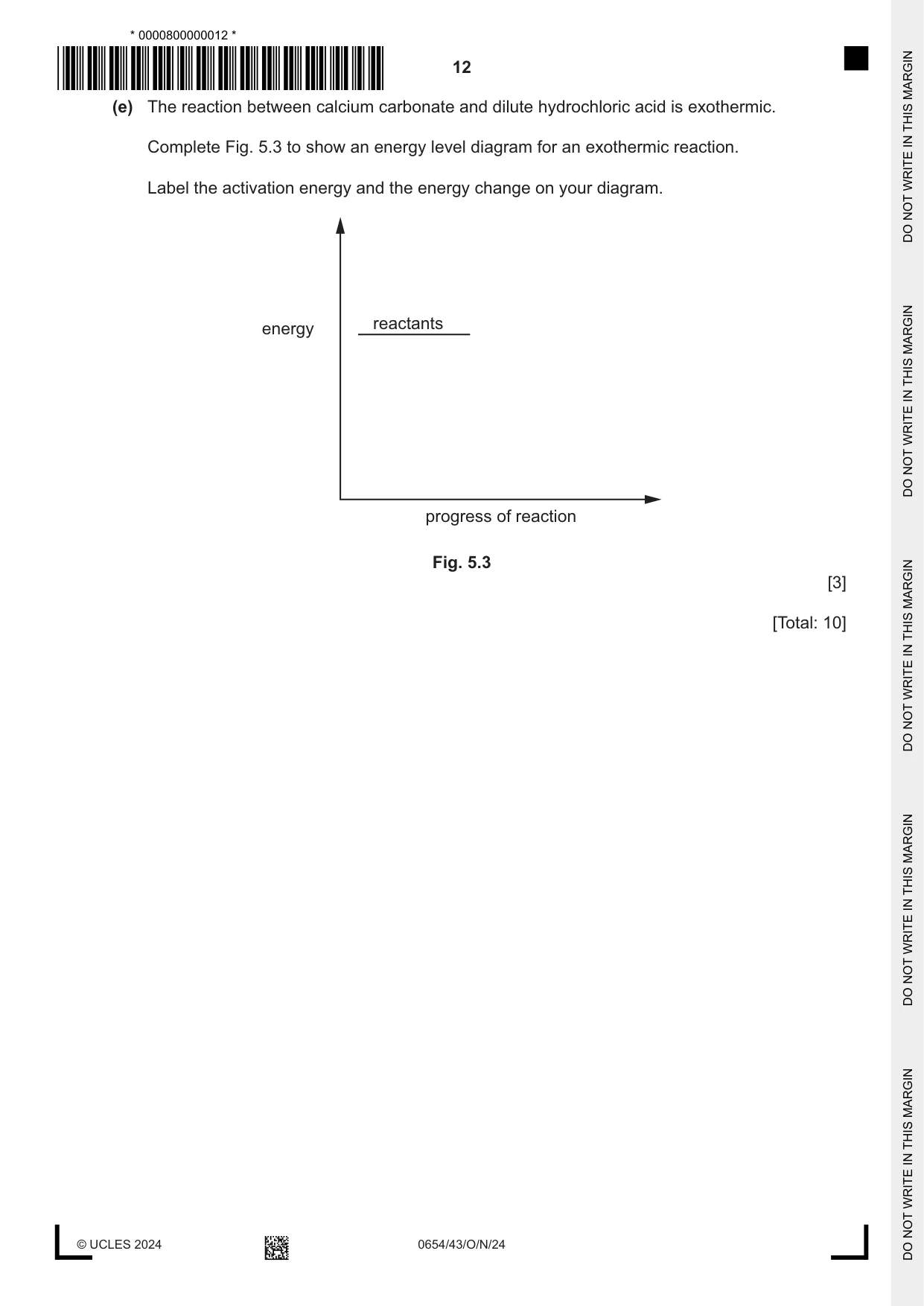
5 A student investigates the reaction between calcium carbonate and dilute hydrochloric acid. Fig. 5.1 shows the apparatus the student uses. gas syringe dilute calcium hydrochloric acid carbonate Fig. 5.1 The student measures the volume of gas in the gas syringe every 20 seconds. Fig. 5.2 shows a graph of the student’s results. 60 50 40 volume of gas in the syringe 30 / cm3 20 10 0 0 20 40 60 80 100 120 140 160 180 time / s Fig. 5.2 (a) State the name of the gas made in this reaction. ............................................................................................................................................. [1] (b) Complete the sentence. The reaction is fastest between ............. seconds and ............. seconds. [1] (c) The total volume of gas made in the experiment is 50 cm3. Calculate the total number of moles in 50 cm3 of the gas measured at room temperature and pressure (r.t.p.). The volume of one mole of any gas is 24 dm3 at r.t.p. Show your working. number of moles in 50 cm3 of the gas = ......................................................... [2] (d) The student repeats the experiment using dilute hydrochloric acid at a higher temperature. Explain why the reaction is faster. Use ideas about collisions between particles. ................................................................................................................................................... ................................................................................................................................................... ................................................................................................................................................... ................................................................................................................................................... ................................................................................................................................................... ............................................................................................................................................. [3] (e) The reaction between calcium carbonate and dilute hydrochloric acid is exothermic. Complete Fig. 5.3 to show an energy level diagram for an exothermic reaction. Label the activation energy and the energy change on your diagram. reactants energy progress of reaction Fig. 5.3 [3] [Total: 10]
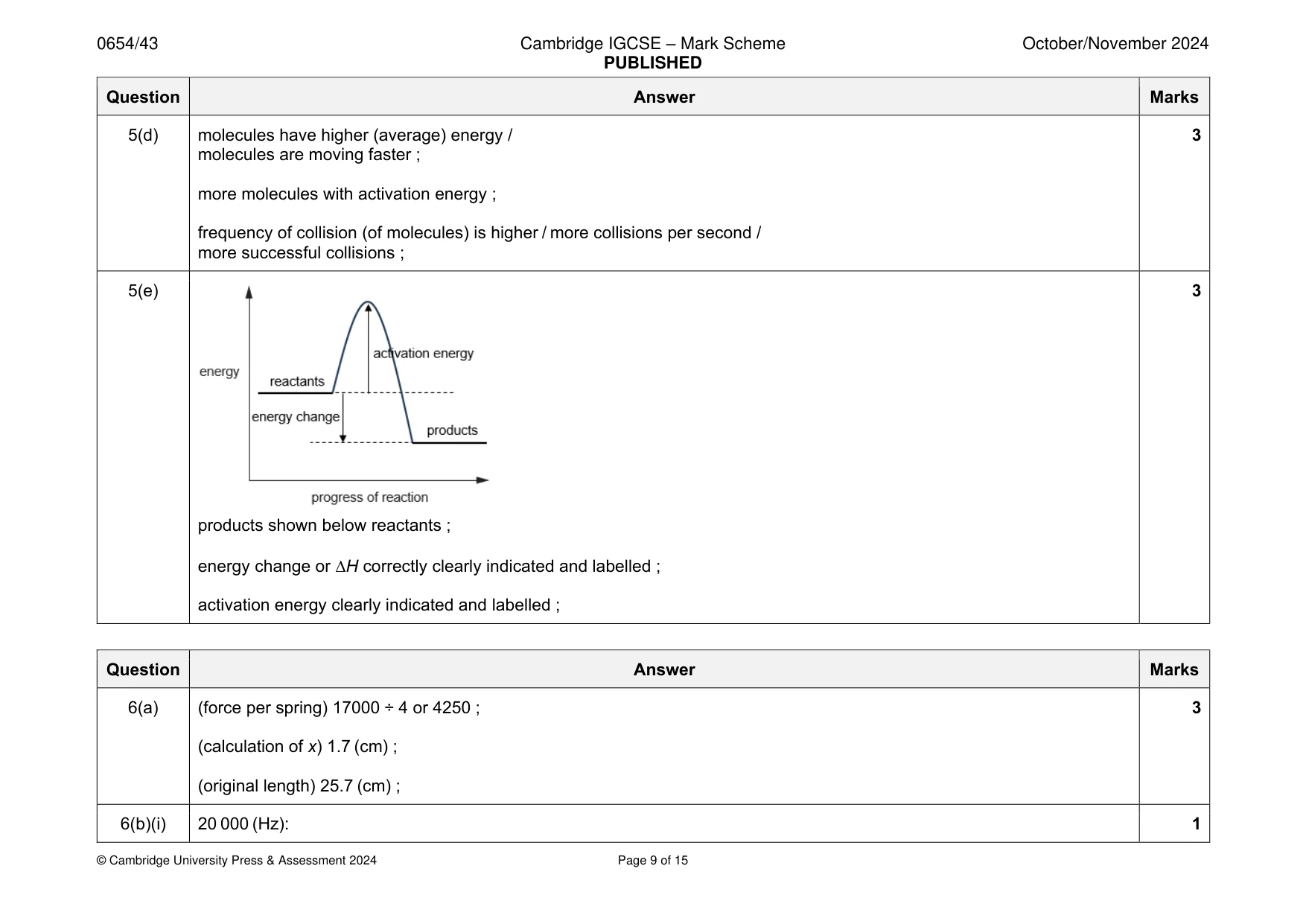
Mark scheme: 5(a) carbon dioxide ; 1 5(b) the reaction is fastest between 0 seconds and 16 seconds ; 1 5(c) (50 cm3 =) 0.050 dm3 ; 2 (moles = 0.050 ÷ 24) = 0.0021 ; OR (24 dm3 =) 24 000 cm3 ; moles = (50 / 24000 =) 0.0021 ; 5(d) molecules have higher (average) energy / 3 molecules are moving faster ; more molecules with activation energy ; frequency of collision (of molecules) is higher / more collisions per second / more successful collisions ; 5(e) 3 products shown below reactants ; energy change or H correctly clearly indicated and labelled ; activation energy clearly indicated and labelled ;
Q6 · A car suspension system
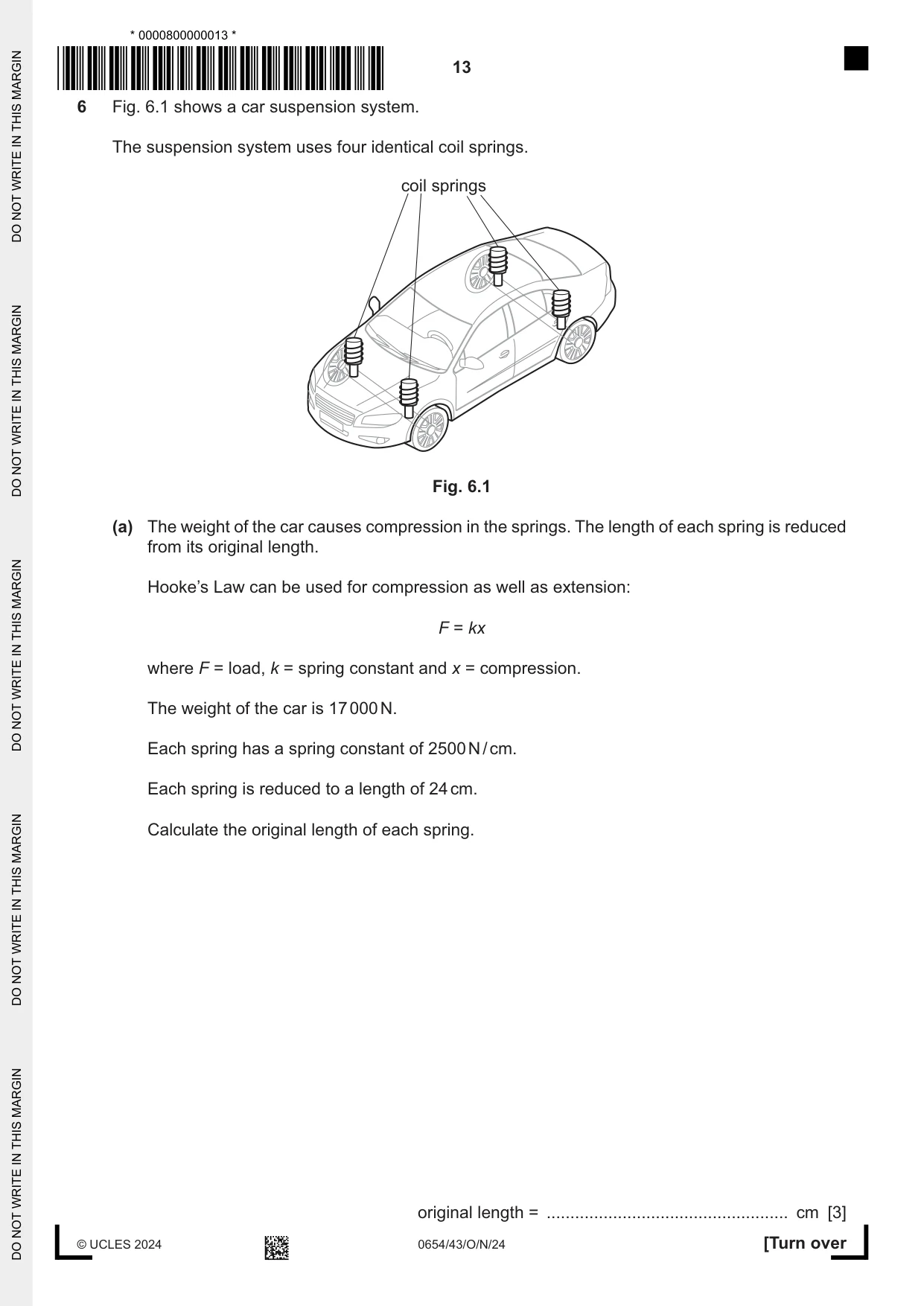
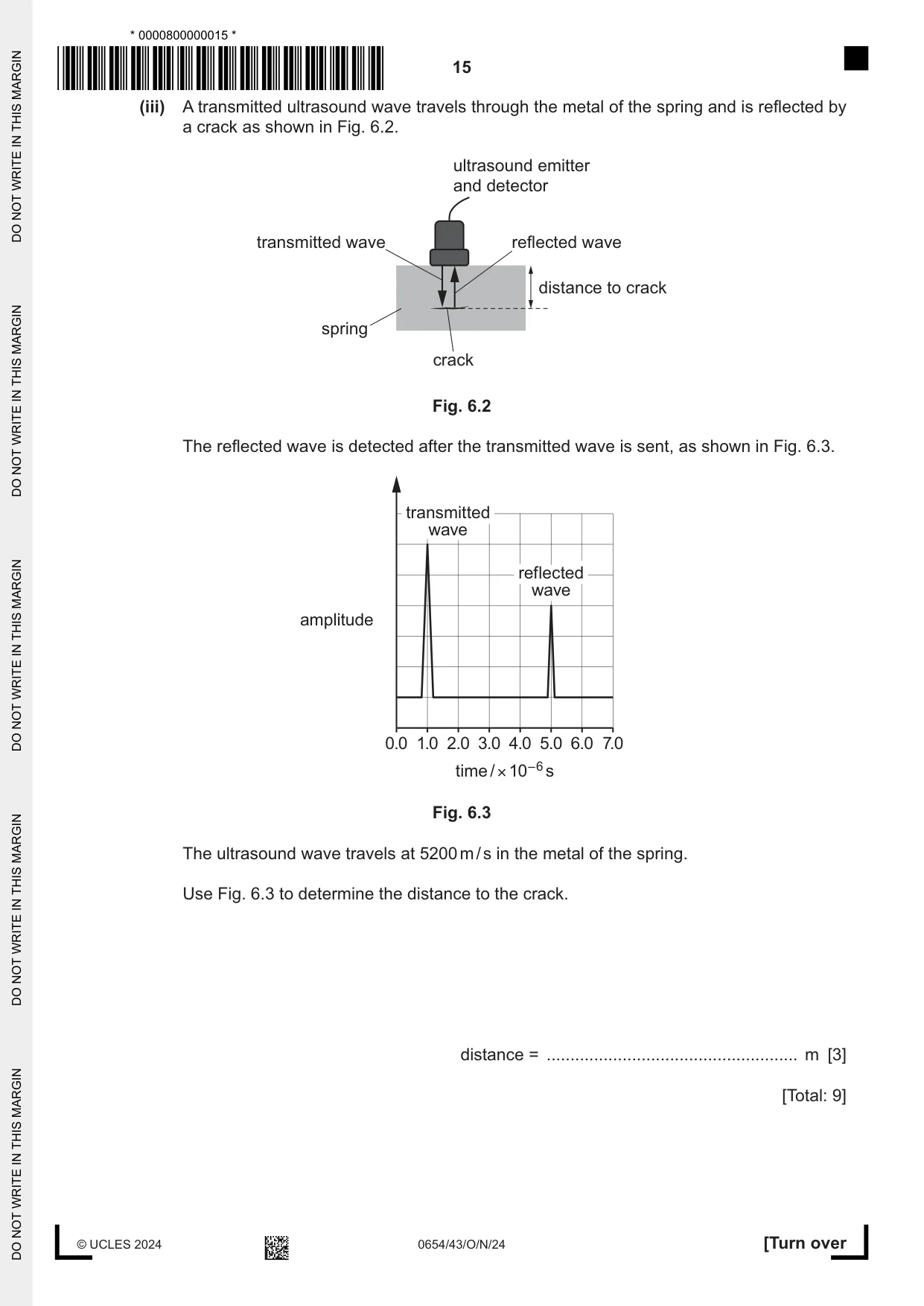
6 Fig. 6.1 shows a car suspension system. The suspension system uses four identical coil springs. coil springs Fig. 6.1 (a) The weight of the car causes compression in the springs. The length of each spring is reduced from its original length. Hooke’s Law can be used for compression as well as extension: F = kx where F = load, k = spring constant and x = compression. The weight of the car is 17 000 N. Each spring has a spring constant of 2500 N / cm. Each spring is reduced to a length of 24 cm. Calculate the original length of each spring. original length = ................................................... cm [3] (b) Ultrasound waves are used to check for cracks in the springs of the car. Ultrasound waves are high-frequency sound waves. (i) The frequency of the ultrasound waves is above the audible range of a healthy human ear. Suggest a frequency for ultrasound waves. frequency = .................................................... Hz [1] (ii) Ultrasound waves are longitudinal waves. Complete the sentences about longitudinal waves. Longitudinal waves are produced by vibrations which occur ......................................... to the direction of energy transfer. Longitudinal waves travel through air in compressions and ......................................... . [2] (iii) A transmitted ultrasound wave travels through the metal of the spring and is reflected by a crack as shown in Fig. 6.2. ultrasound emitter and detector transmitted wave reflected wave distance to crack spring crack Fig. 6.2 The reflected wave is detected after the transmitted wave is sent, as shown in Fig. 6.3. transmitted wave reflected wave amplitude 0.0 1.0 2.0 3.0 4.0 5.0 6.0 7.0 time / × 10–6 s Fig. 6.3 The ultrasound wave travels at 5200 m / s in the metal of the spring. Use Fig. 6.3 to determine the distance to the crack. distance = ..................................................... m [3] [Total: 9]
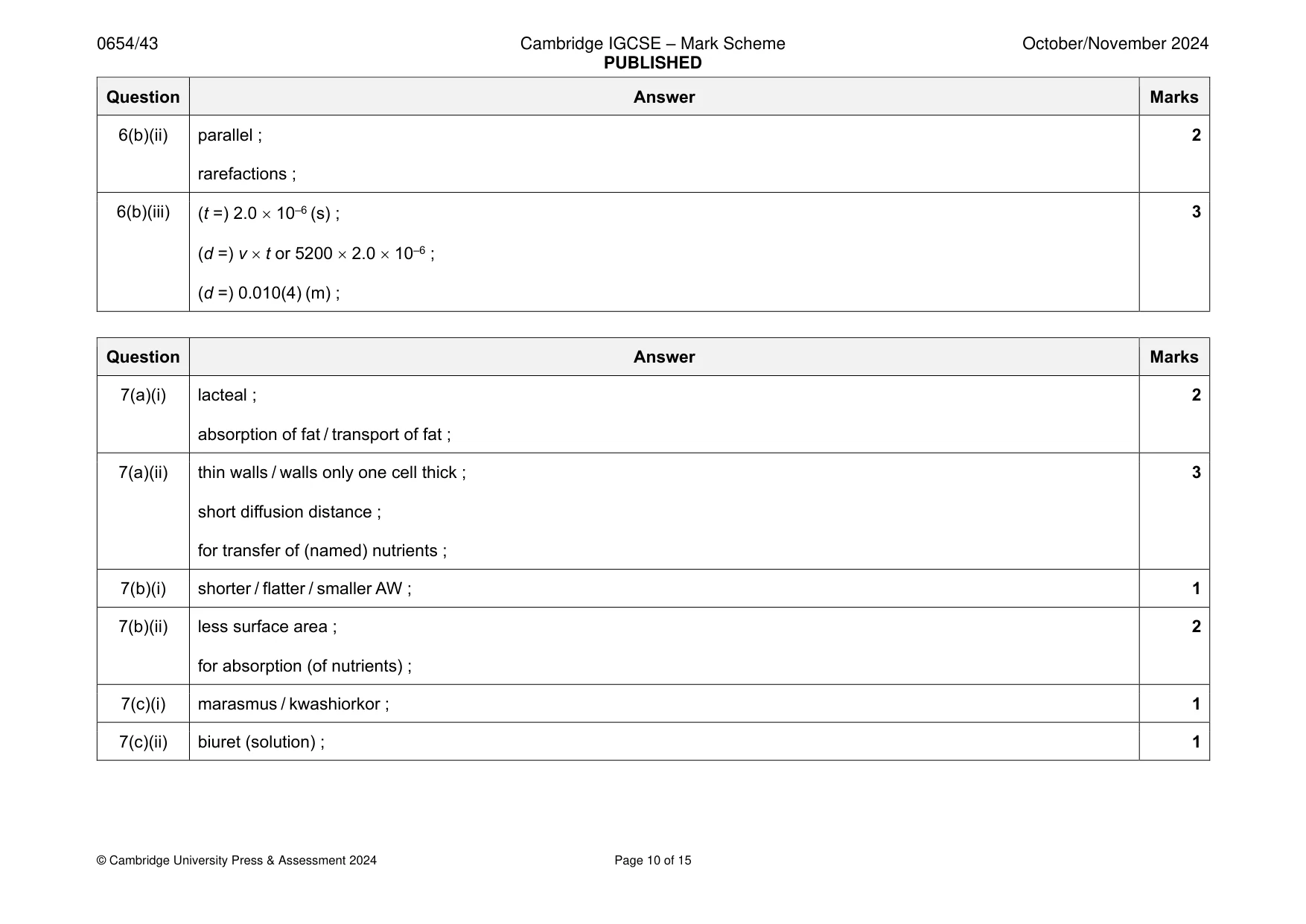
Mark scheme: 6(a) (force per spring) 17000 ÷ 4 or 4250 ; 3 (calculation of x) 1.7 (cm) ; (original length) 25.7 (cm) ; 6(b)(i) 20 000 (Hz): 1 6(b)(ii) parallel ; 2 rarefactions ; 6(b)(iii) (t =) 2.0 10–6 (s) ; 3 (d =) v t or 5200 2.0 10–6 ; (d =) 0.010(4) (m) ;
Q7 · The structure of a villus
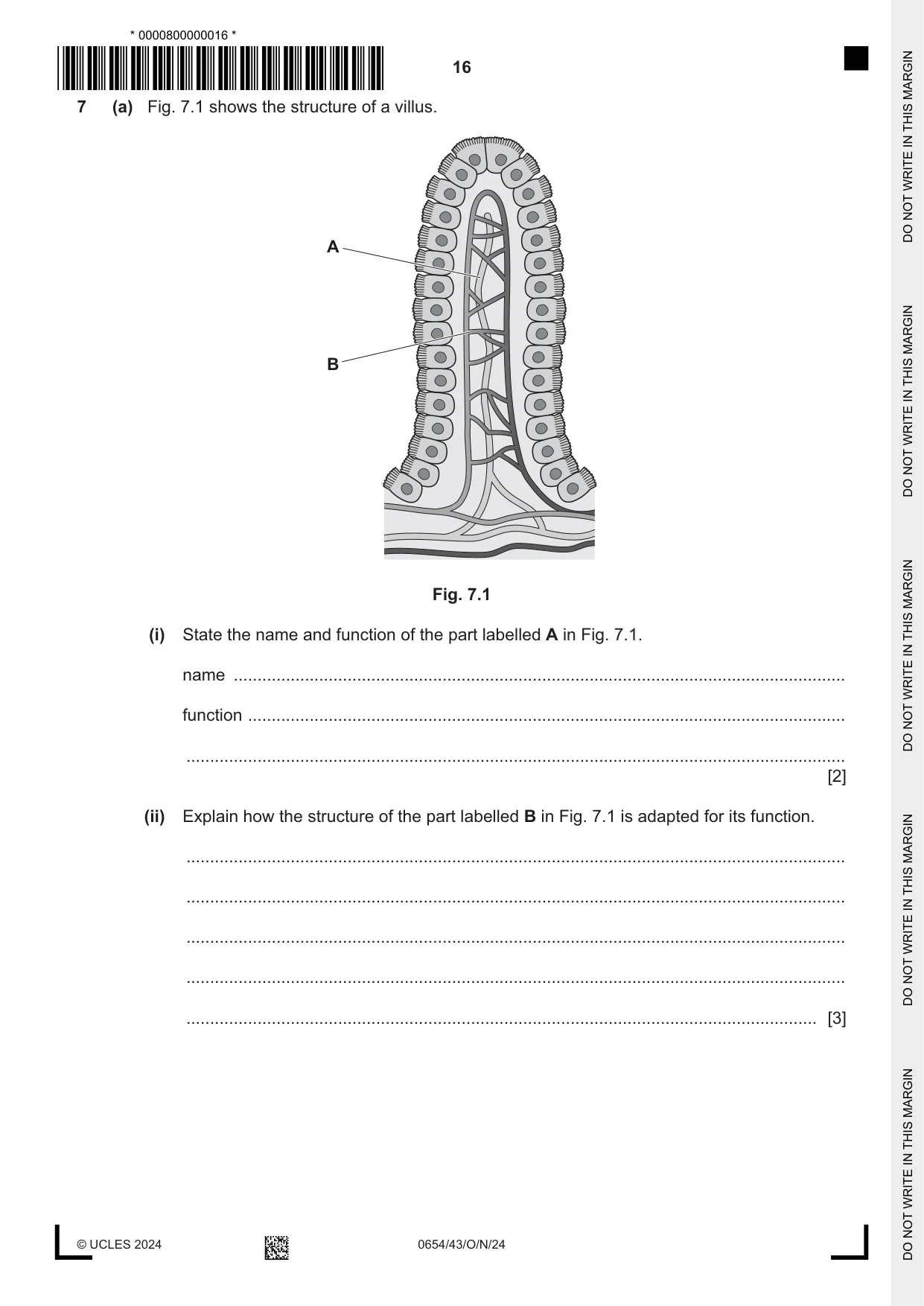
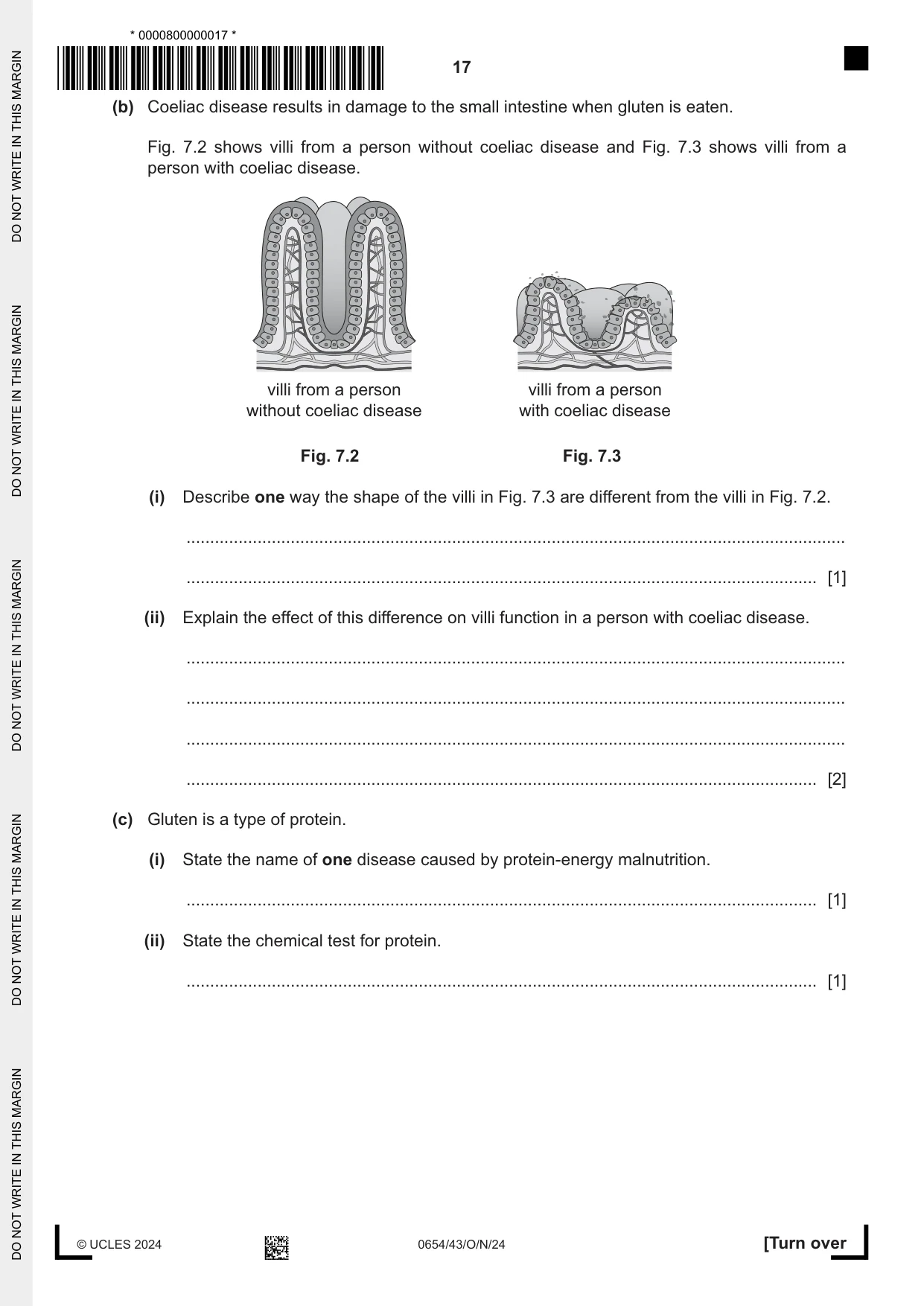
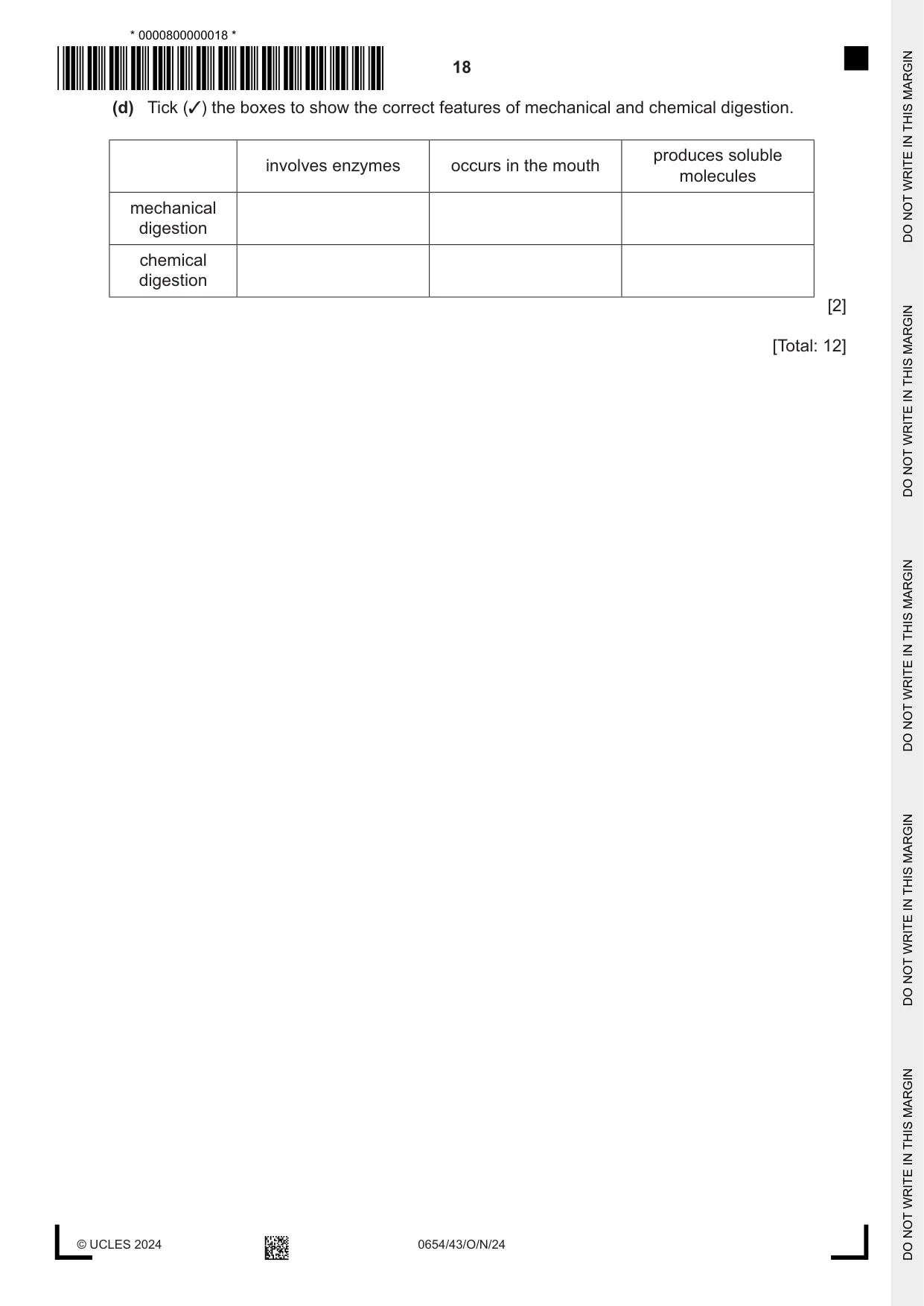
7 (a) Fig. 7.1 shows the structure of a villus. A B Fig. 7.1 (i) State the name and function of the part labelled A in Fig. 7.1. name ................................................................................................................................. function .............................................................................................................................. ........................................................................................................................................... [2] (ii) Explain how the structure of the part labelled B in Fig. 7.1 is adapted for its function. ........................................................................................................................................... ........................................................................................................................................... ........................................................................................................................................... ........................................................................................................................................... ..................................................................................................................................... [3] (b) Coeliac disease results in damage to the small intestine when gluten is eaten. Fig. 7.2 shows villi from a person without coeliac disease and Fig. 7.3 shows villi from a person with coeliac disease. villi from a person villi from a person without coeliac disease with coeliac disease Fig. 7.2 Fig. 7.3 (i) Describe one way the shape of the villi in Fig. 7.3 are different from the villi in Fig. 7.2. ........................................................................................................................................... ..................................................................................................................................... [1] (ii) Explain the effect of this difference on villi function in a person with coeliac disease. ........................................................................................................................................... ........................................................................................................................................... ........................................................................................................................................... ..................................................................................................................................... [2] (c) Gluten is a type of protein. (i) State the name of one disease caused by protein-energy malnutrition. ..................................................................................................................................... [1] (ii) State the chemical test for protein. ..................................................................................................................................... [1] (d) Tick (3) the boxes to show the correct features of mechanical and chemical digestion. produces soluble involves enzymes occurs in the mouth molecules mechanical digestion chemical digestion [2] [Total: 12]
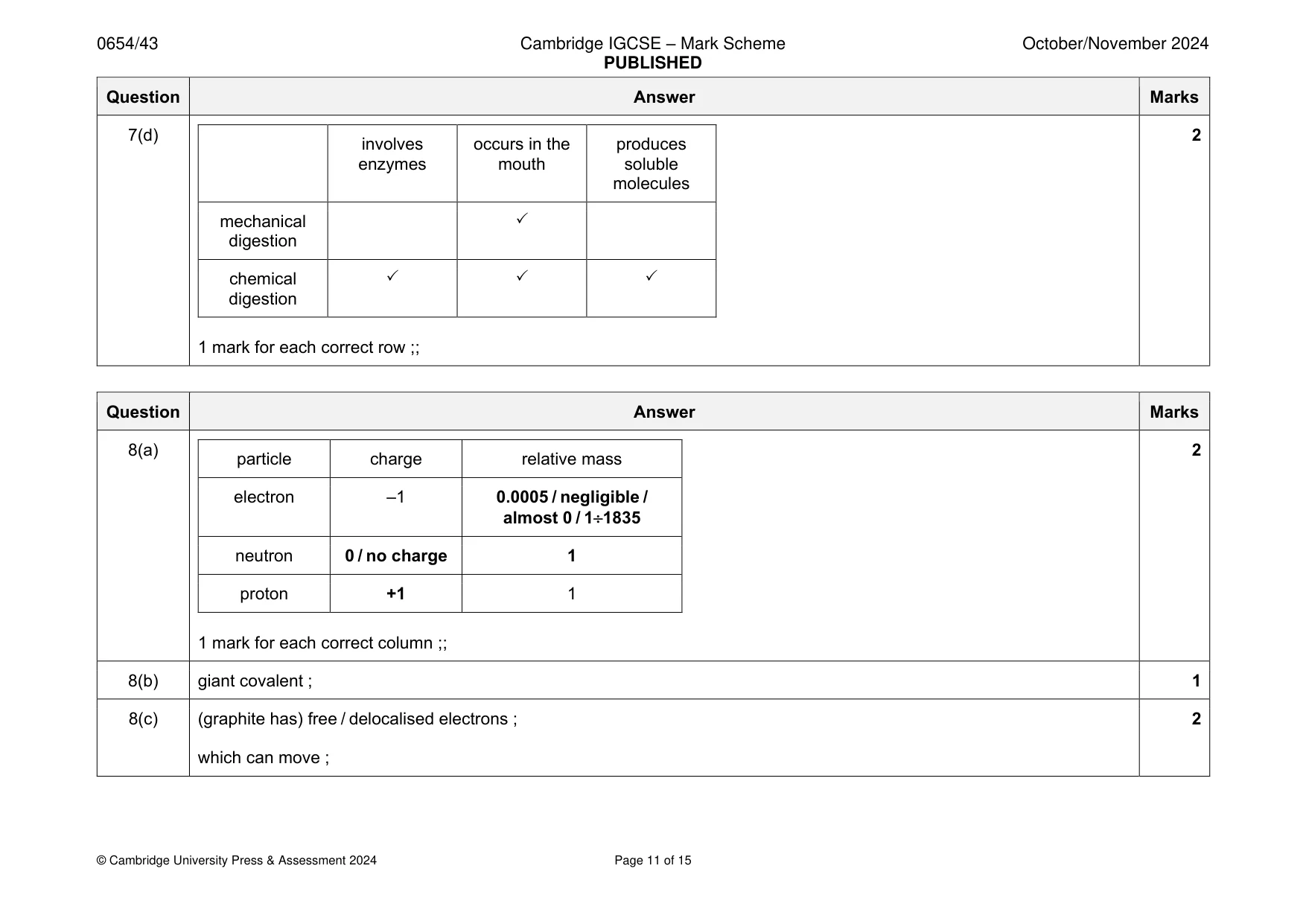
Mark scheme: 7(a)(i) lacteal ; 2 absorption of fat / transport of fat ; 7(a)(ii) thin walls / walls only one cell thick ; 3 short diffusion distance ; for transfer of (named) nutrients ; 7(b)(i) shorter / flatter / smaller AW ; 1 7(b)(ii) less surface area ; 2 for absorption (of nutrients) ; 7(c)(i) marasmus / kwashiorkor ; 1 7(c)(ii) biuret (solution) ; 1 7(d) 2 involves occurs in the produces enzymes mouth soluble molecules mechanical digestion chemical digestion 1 mark for each correct row ;;
Q8 · Some information about the structure of atoms
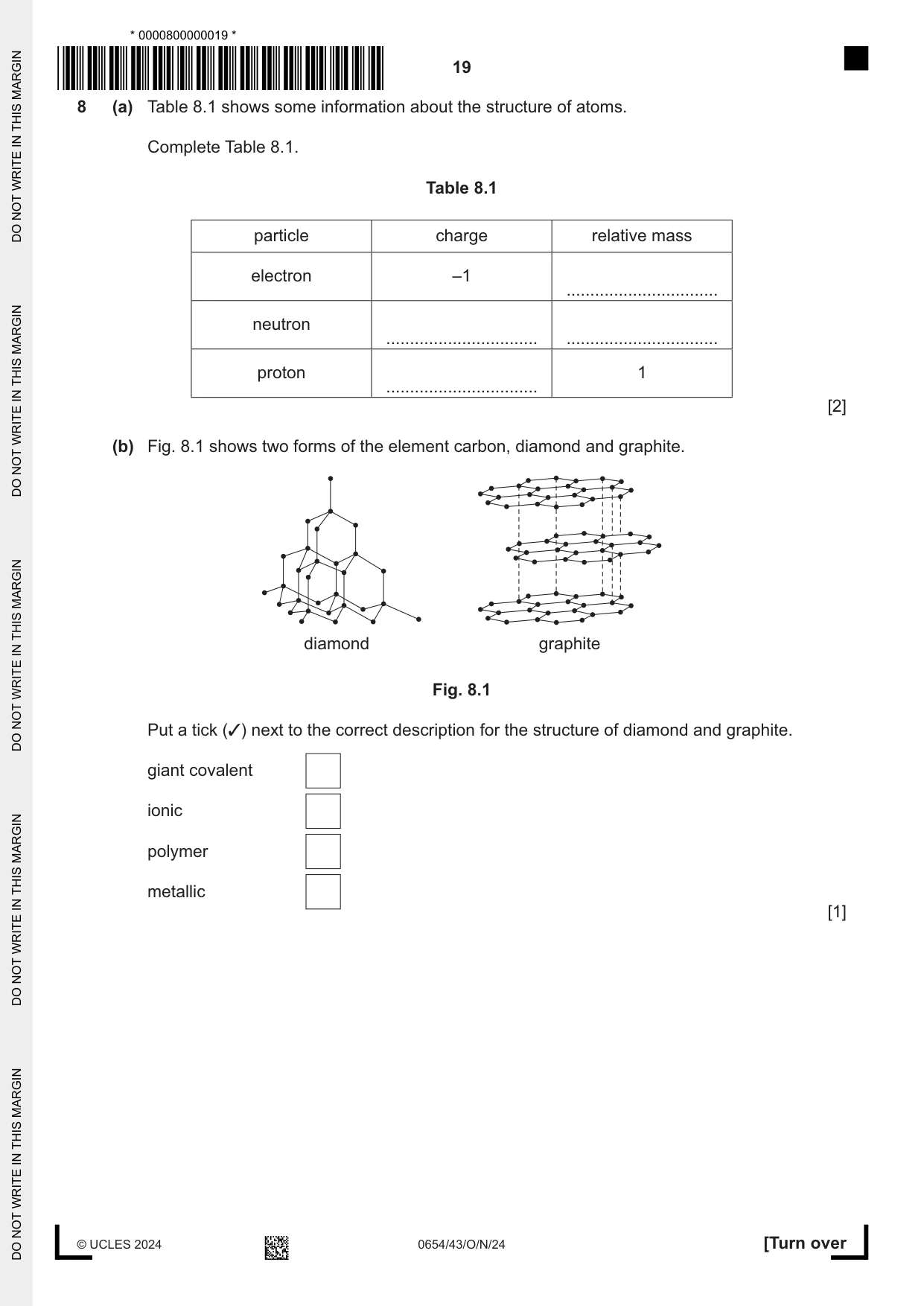
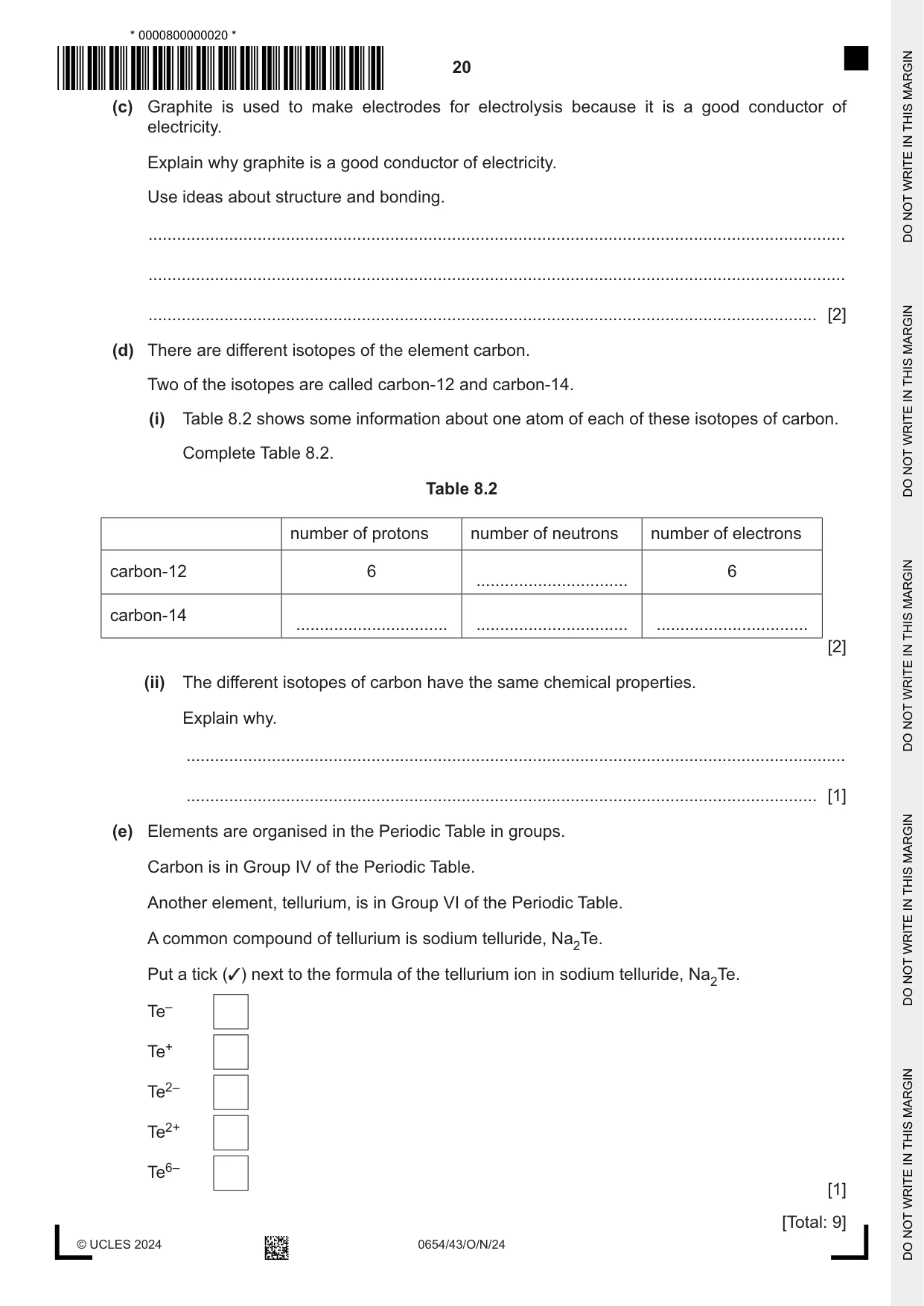
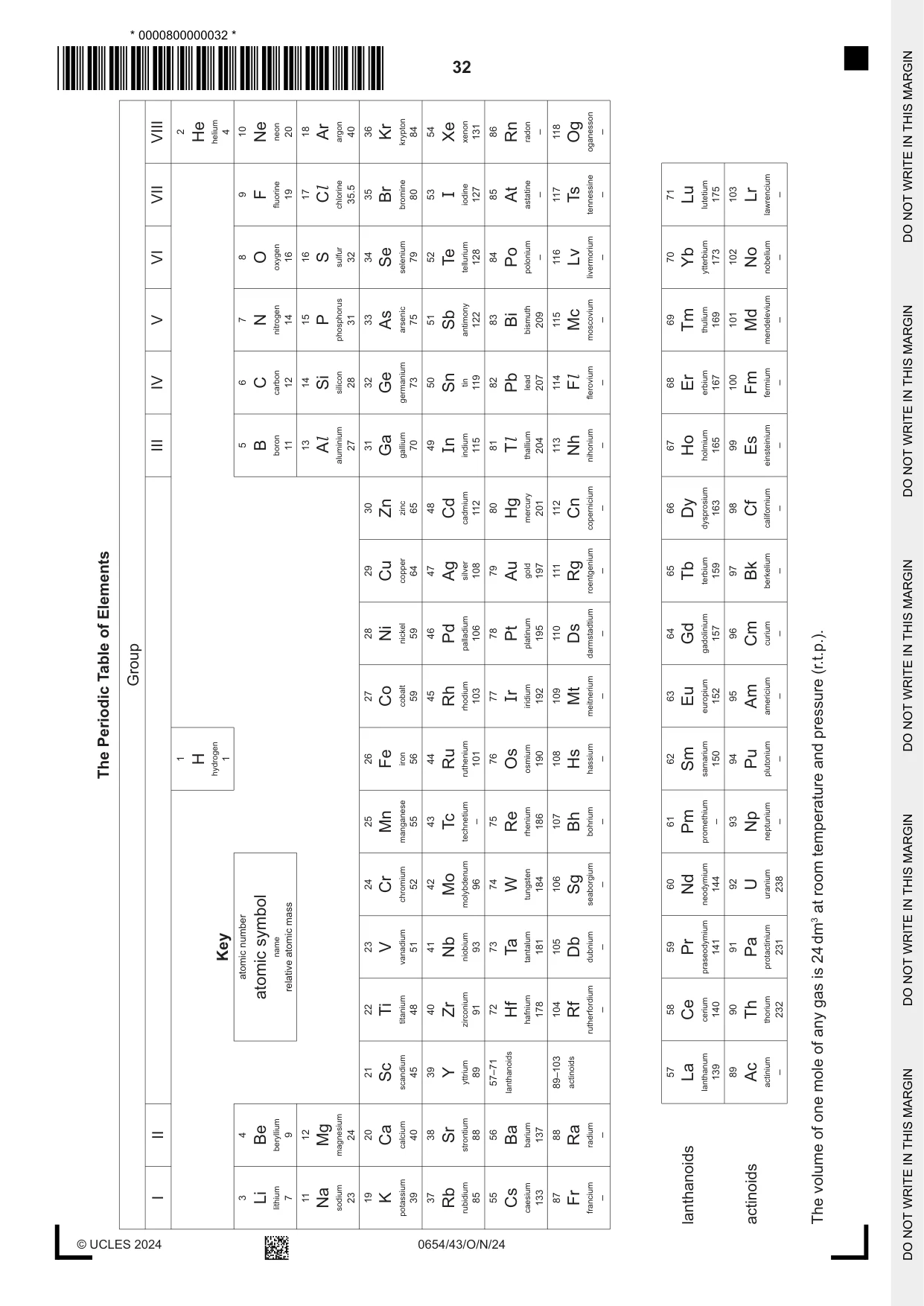
8 (a) Table 8.1 shows some information about the structure of atoms. Complete Table 8.1. Table 8.1 particle charge relative mass electron –1 ................................ neutron ................................ ................................ proton 1 ................................ [2] (b) Fig. 8.1 shows two forms of the element carbon, diamond and graphite. diamond graphite Fig. 8.1 Put a tick (3) next to the correct description for the structure of diamond and graphite. giant covalent ionic polymer metallic [1] (c) Graphite is used to make electrodes for electrolysis because it is a good conductor of electricity. Explain why graphite is a good conductor of electricity. Use ideas about structure and bonding. ................................................................................................................................................... ................................................................................................................................................... ............................................................................................................................................. [2] (d) There are different isotopes of the element carbon. Two of the isotopes are called carbon-12 and carbon-14. (i) Table 8.2 shows some information about one atom of each of these isotopes of carbon. Complete Table 8.2. Table 8.2 number of protons number of neutrons number of electrons carbon-12 6 6 ................................ carbon-14 ................................ ................................ ................................ [2] (ii) The different isotopes of carbon have the same chemical properties. Explain why. ........................................................................................................................................... ..................................................................................................................................... [1] (e) Elements are organised in the Periodic Table in groups. Carbon is in Group IV of the Periodic Table. Another element, tellurium, is in Group VI of the Periodic Table. A common compound of tellurium is sodium telluride, Na2Te. Put a tick (3) next to the formula of the tellurium ion in sodium telluride, Na2Te. Te– Te+ Te2– Te2+ Te6– [1] [Total: 9]
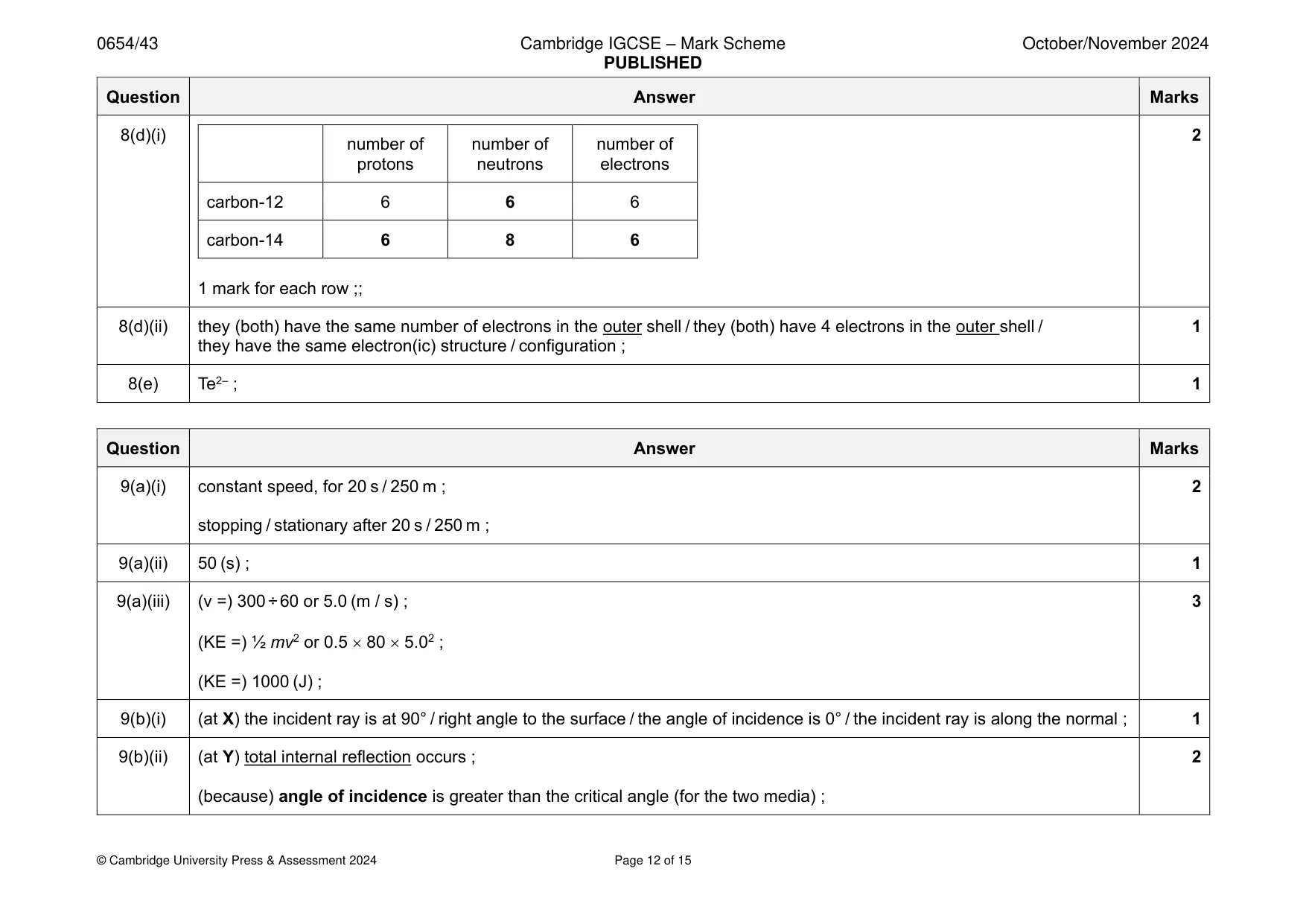
Mark scheme: 8(a) 2 particle charge relative mass electron –1 0.0005 / negligible / almost 0 / 11835 neutron 0 / no charge 1 proton +1 1 1 mark for each correct column ;; 8(b) giant covalent ; 1 8(c) (graphite has) free / delocalised electrons ; 2 which can move ; 8(d)(i) 2 number of number of number of protons neutrons electrons carbon-12 6 6 6 carbon-14 6 8 6 1 mark for each row ;; 8(d)(ii) they (both) have the same number of electrons in the outer shell / they (both) have 4 electrons in the outer shell / 1 they have the same electron(ic) structure / configuration ; 8(e) Te2– ; 1
Q9 · Distance–time graphs for a car journey and a bicycle journey
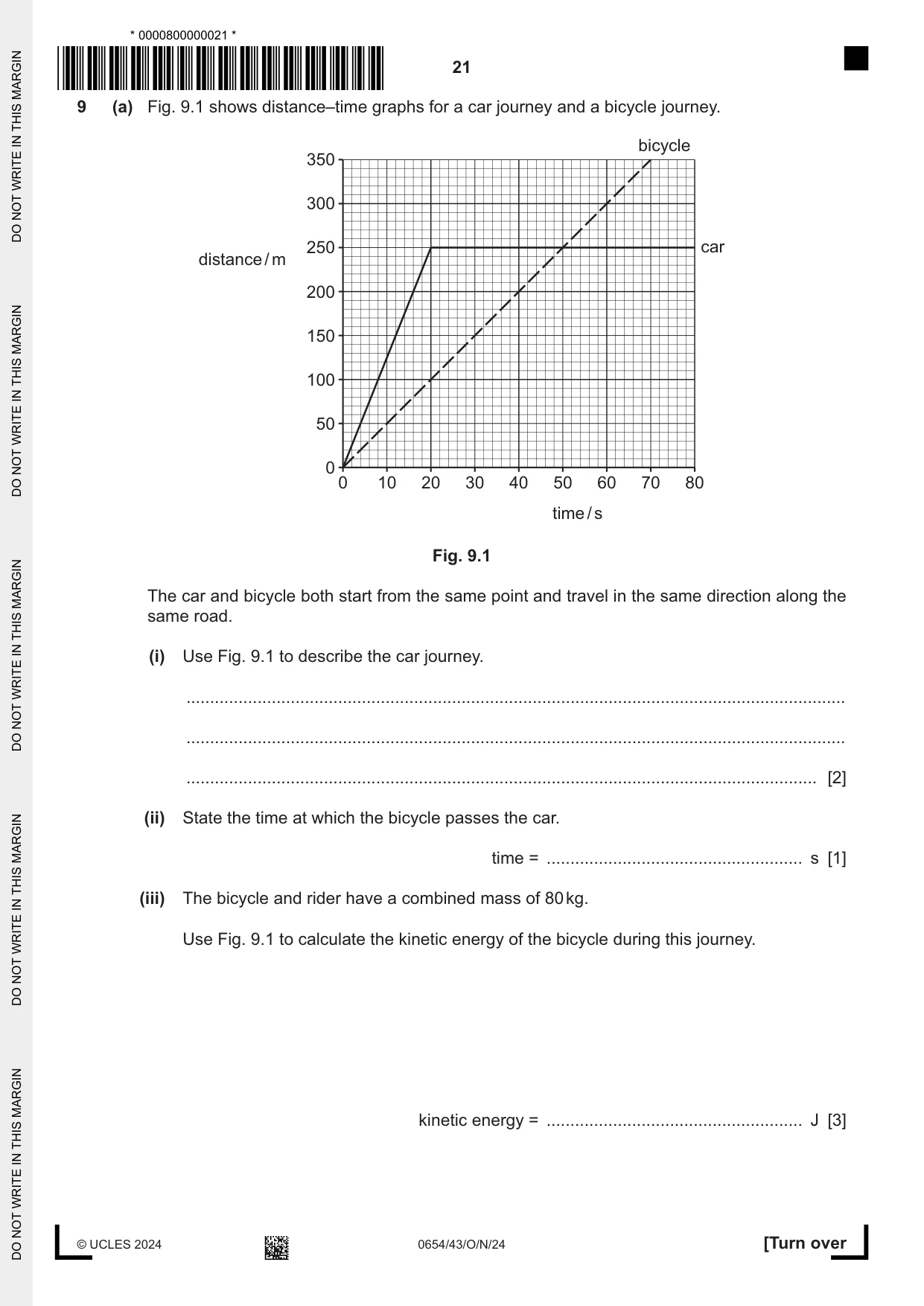
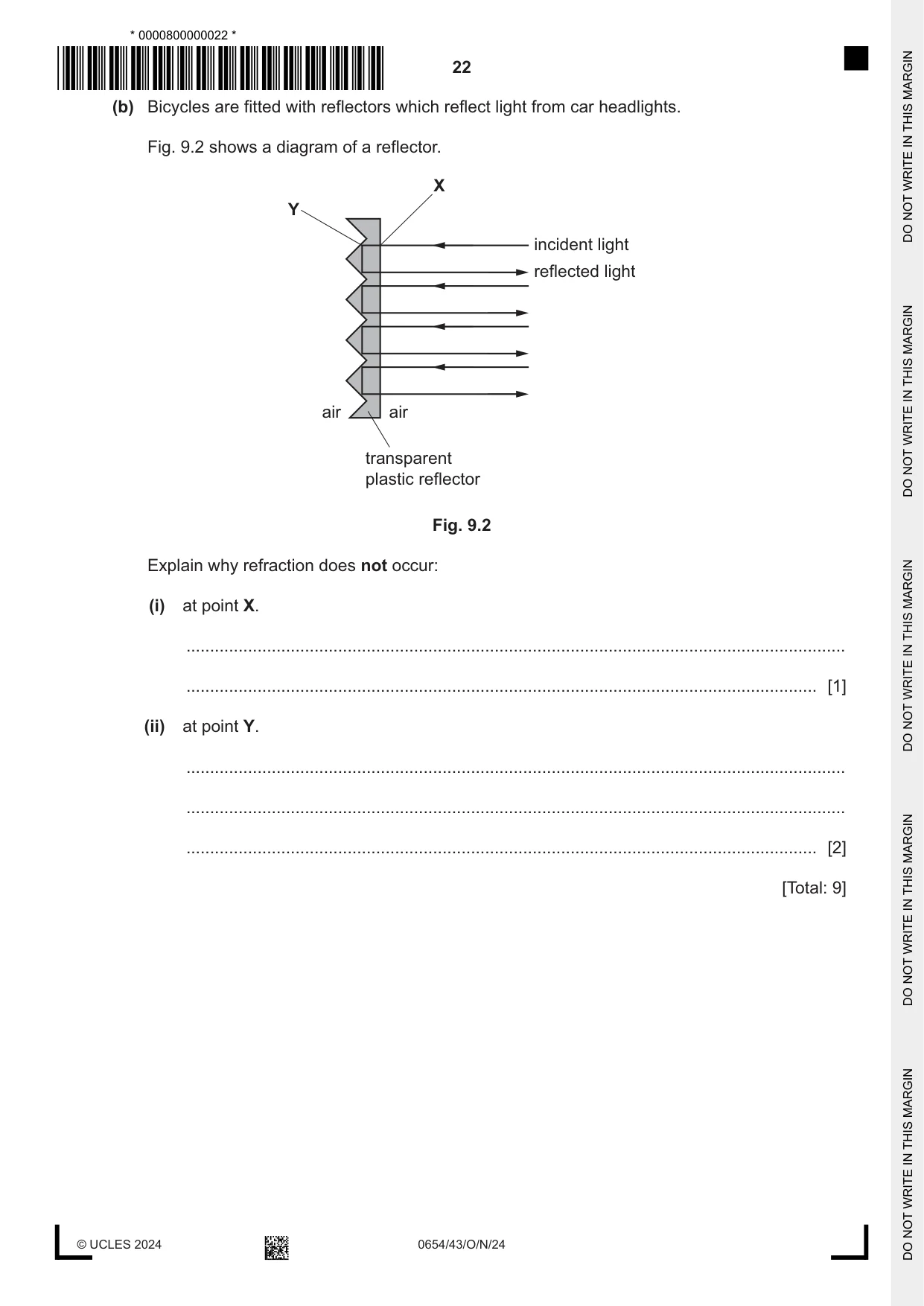
9 (a) Fig. 9.1 shows distance–time graphs for a car journey and a bicycle journey. bicycle 350 300 250 car distance / m 200 150 100 50 0 0 10 20 30 40 50 60 70 80 time / s Fig. 9.1 The car and bicycle both start from the same point and travel in the same direction along the same road. (i) Use Fig. 9.1 to describe the car journey. ........................................................................................................................................... ........................................................................................................................................... ..................................................................................................................................... [2] (ii) State the time at which the bicycle passes the car. time = ...................................................... s [1] (iii) The bicycle and rider have a combined mass of 80 kg. Use Fig. 9.1 to calculate the kinetic energy of the bicycle during this journey. kinetic energy = ...................................................... J [3] (b) Bicycles are fitted with reflectors which reflect light from car headlights. Fig. 9.2 shows a diagram of a reflector. X Y incident light reflected light air air transparent plastic reflector Fig. 9.2 Explain why refraction does not occur: (i) at point X. ........................................................................................................................................... ..................................................................................................................................... [1] (ii) at point Y. ........................................................................................................................................... ........................................................................................................................................... ..................................................................................................................................... [2] [Total: 9]
Mark scheme: 9(a)(i) constant speed, for 20 s / 250 m ; 2 stopping / stationary after 20 s / 250 m ; 9(a)(ii) 50 (s) ; 1 9(a)(iii) (v =) 300 ÷ 60 or 5.0 (m / s) ; 3 (KE =) ½ mv2 or 0.5 80 5.02 ; (KE =) 1000 (J) ; 9(b)(i) (at X) the incident ray is at 90° / right angle to the surface / the angle of incidence is 0° / the incident ray is along the normal ; 1 9(b)(ii) (at Y) total internal reflection occurs ; 2 (because) angle of incidence is greater than the critical angle (for the two media) ;
Q10 · A farmer planted some seeds
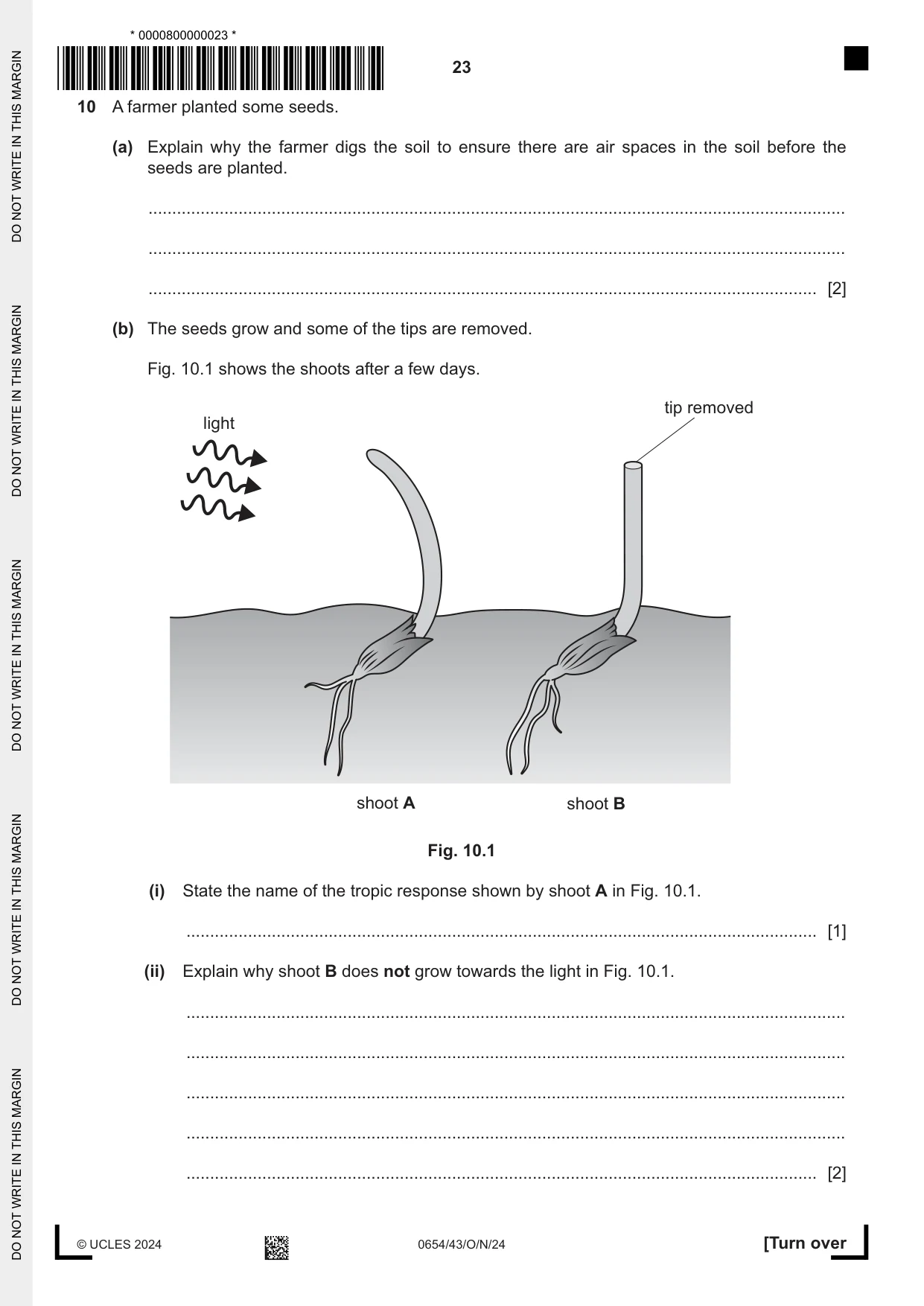
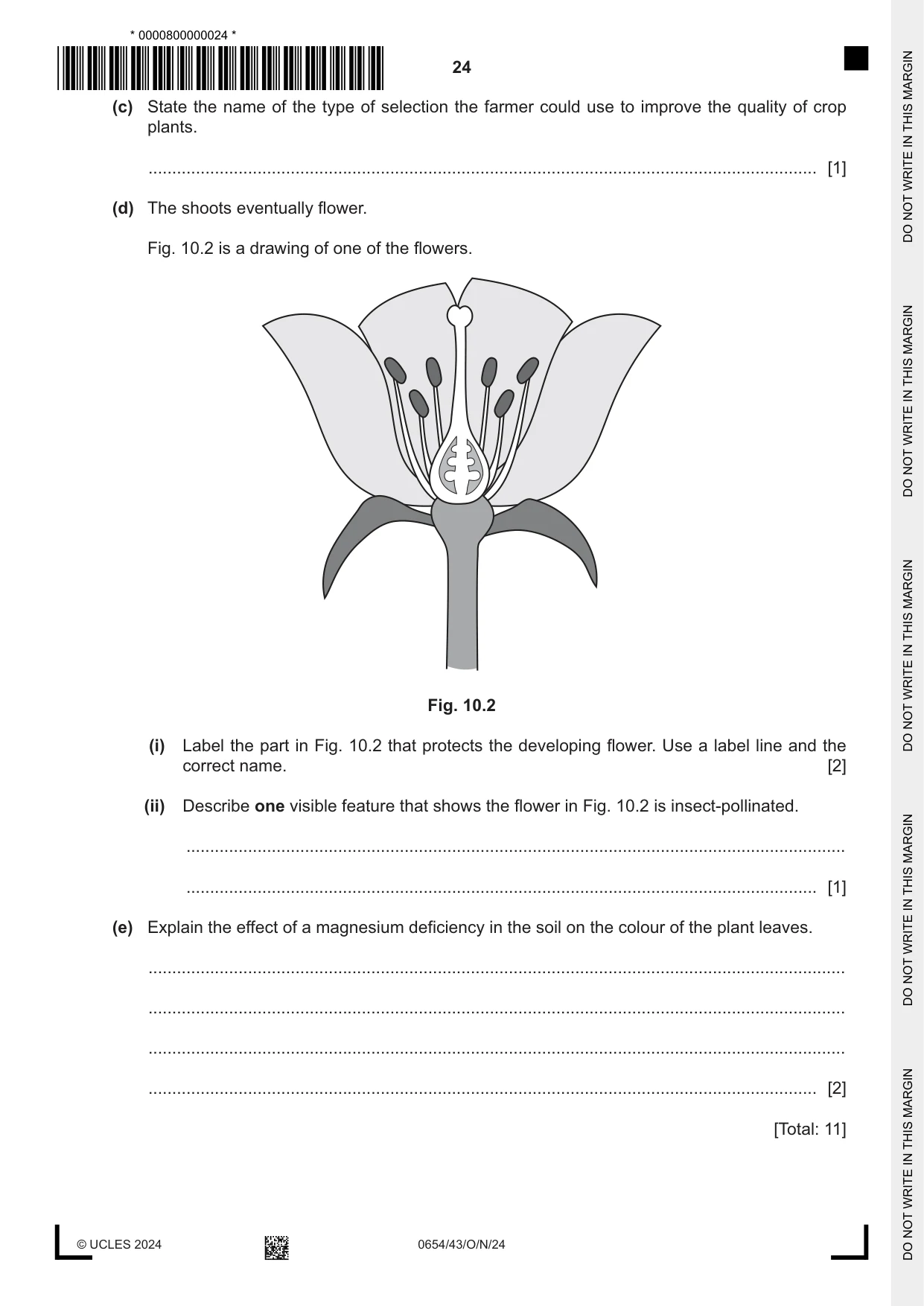
10 A farmer planted some seeds. (a) Explain why the farmer digs the soil to ensure there are air spaces in the soil before the seeds are planted. ................................................................................................................................................... ................................................................................................................................................... ............................................................................................................................................. [2] (b) The seeds grow and some of the tips are removed. Fig. 10.1 shows the shoots after a few days. tip removed light shoot A shoot B Fig. 10.1 (i) State the name of the tropic response shown by shoot A in Fig. 10.1. ..................................................................................................................................... [1] (ii) Explain why shoot B does not grow towards the light in Fig. 10.1. ........................................................................................................................................... ........................................................................................................................................... ........................................................................................................................................... ........................................................................................................................................... ..................................................................................................................................... [2] (c) State the name of the type of selection the farmer could use to improve the quality of crop plants. ............................................................................................................................................. [1] (d) The shoots eventually flower. Fig. 10.2 is a drawing of one of the flowers. Fig. 10.2 (i) Label the part in Fig. 10.2 that protects the developing flower. Use a label line and the correct name. [2] (ii) Describe one visible feature that shows the flower in Fig. 10.2 is insect-pollinated. ........................................................................................................................................... ..................................................................................................................................... [1] (e) Explain the effect of a magnesium deficiency in the soil on the colour of the plant leaves. ................................................................................................................................................... ................................................................................................................................................... ................................................................................................................................................... ............................................................................................................................................. [2] [Total: 11]
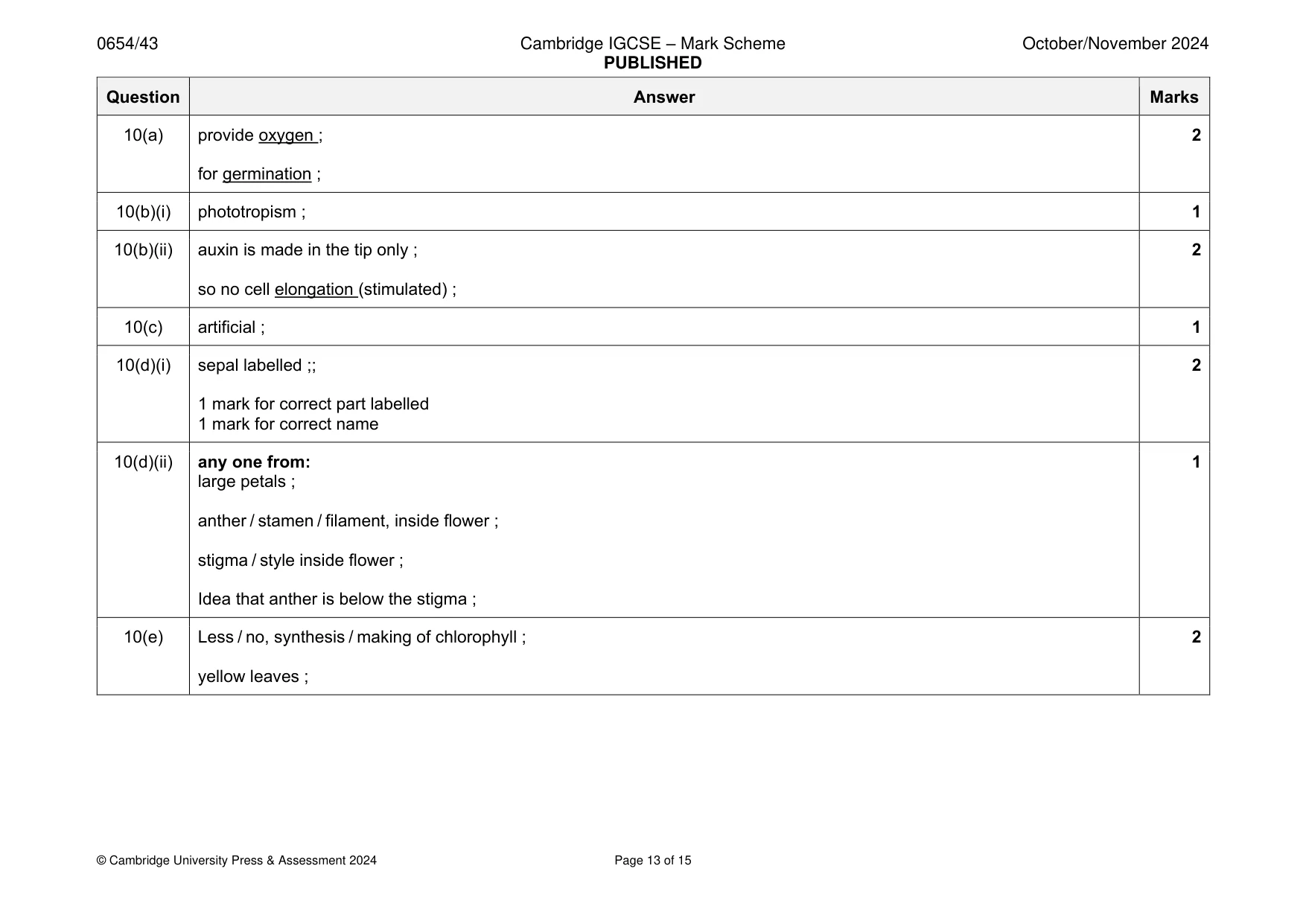
Mark scheme: 10(a) provide oxygen ; 2 for germination ; 10(b)(i) phototropism ; 1 10(b)(ii) auxin is made in the tip only ; 2 so no cell elongation (stimulated) ; 10(c) artificial ; 1 10(d)(i) sepal labelled ;; 2 1 mark for correct part labelled 1 mark for correct name 10(d)(ii) any one from: 1 large petals ; anther / stamen / filament, inside flower ; stigma / style inside flower ; Idea that anther is below the stigma ; 10(e) Less / no, synthesis / making of chlorophyll ; 2 yellow leaves ;
Q11 · The reactivity series of some metals
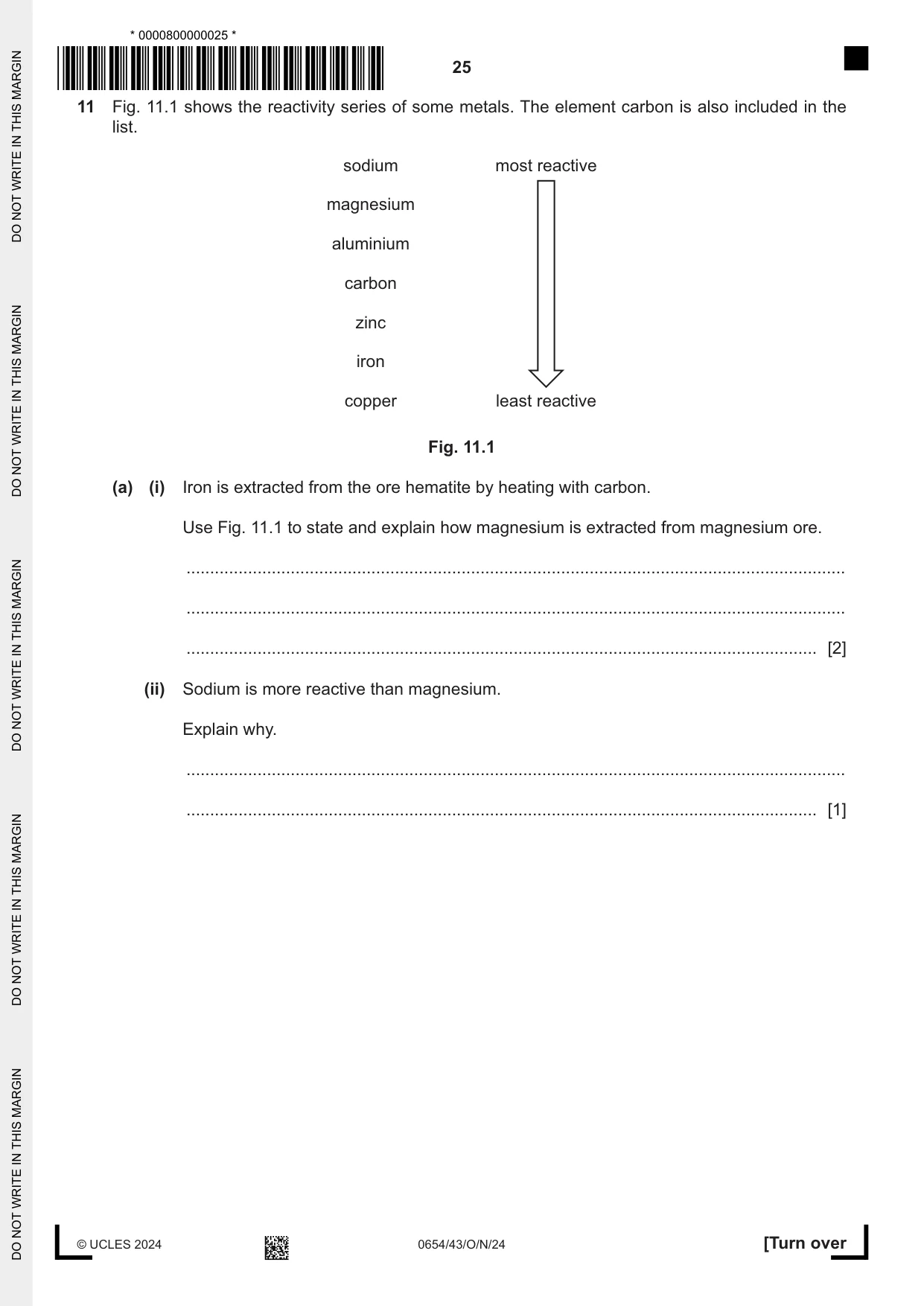
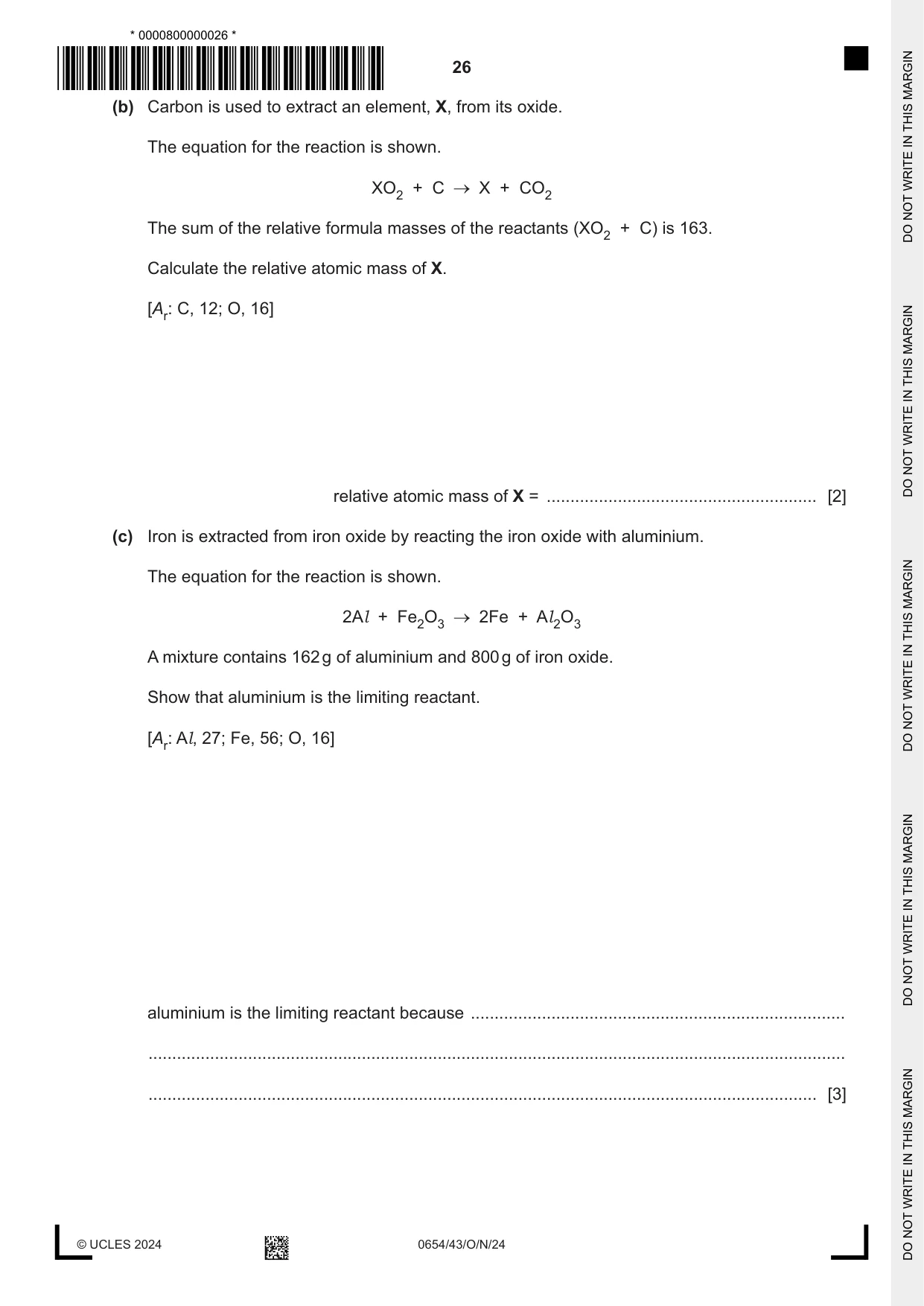
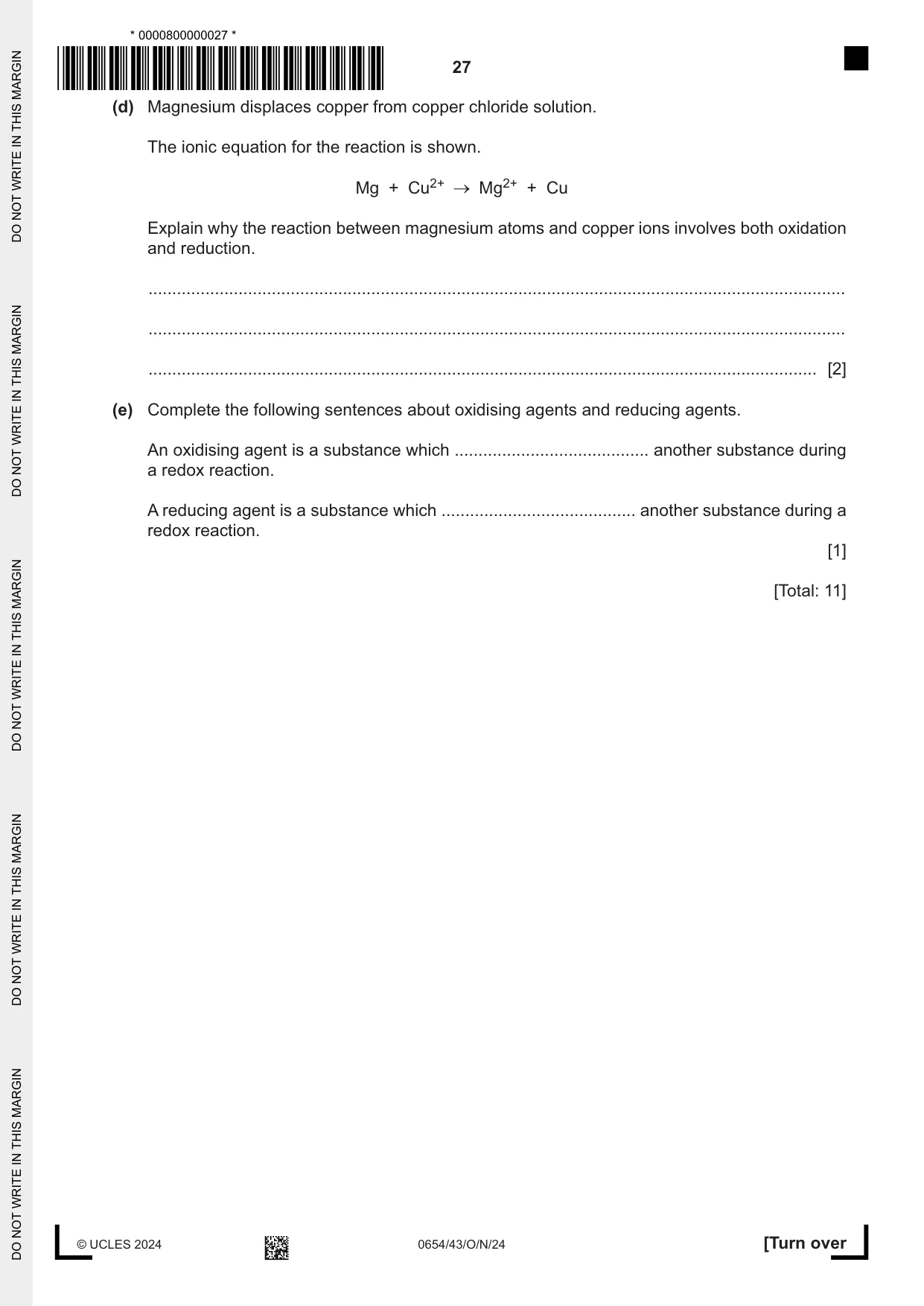
11 Fig. 11.1 shows the reactivity series of some metals. The element carbon is also included in the list. sodium most reactive magnesium aluminium carbon zinc iron copper least reactive Fig. 11.1 (a) (i) Iron is extracted from the ore hematite by heating with carbon. Use Fig. 11.1 to state and explain how magnesium is extracted from magnesium ore. ........................................................................................................................................... ........................................................................................................................................... ..................................................................................................................................... [2] (ii) Sodium is more reactive than magnesium. Explain why. ........................................................................................................................................... ..................................................................................................................................... [1] (b) Carbon is used to extract an element, X, from its oxide. The equation for the reaction is shown. XO2 + C X + CO2 The sum of the relative formula masses of the reactants (XO2 + C) is 163. Calculate the relative atomic mass of X. [Ar: C, 12; O, 16] relative atomic mass of X = ......................................................... [2] (c) Iron is extracted from iron oxide by reacting the iron oxide with aluminium. The equation for the reaction is shown. 2Al + Fe2O3 2Fe + Al 2O3 A mixture contains 162 g of aluminium and 800 g of iron oxide. Show that aluminium is the limiting reactant. [Ar: Al, 27; Fe, 56; O, 16] aluminium is the limiting reactant because ............................................................................... ................................................................................................................................................... ............................................................................................................................................. [3] (d) Magnesium displaces copper from copper chloride solution. The ionic equation for the reaction is shown. Mg + Cu2+ Mg2+ + Cu Explain why the reaction between magnesium atoms and copper ions involves both oxidation and reduction. ................................................................................................................................................... ................................................................................................................................................... ............................................................................................................................................. [2] (e) Complete the following sentences about oxidising agents and reducing agents. An oxidising agent is a substance which ......................................... another substance during a redox reaction. A reducing agent is a substance which ......................................... another substance during a redox reaction. [1] [Total: 11]
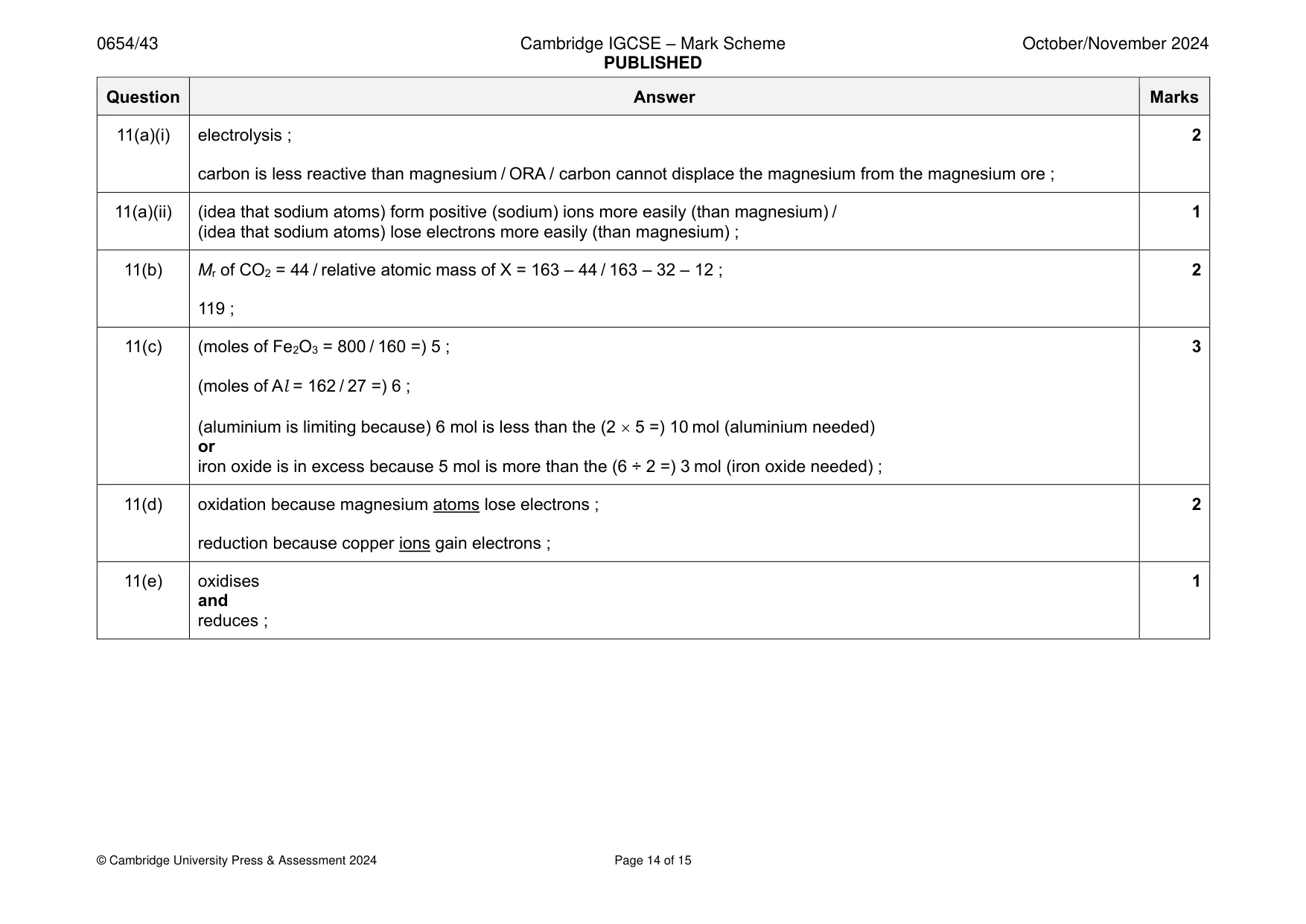
Mark scheme: 11(a)(i) electrolysis ; 2 carbon is less reactive than magnesium / ORA / carbon cannot displace the magnesium from the magnesium ore ; 11(a)(ii) (idea that sodium atoms) form positive (sodium) ions more easily (than magnesium) / 1 (idea that sodium atoms) lose electrons more easily (than magnesium) ; 11(b) Mr of CO2 = 44 / relative atomic mass of X = 163 – 44 / 163 – 32 – 12 ; 2 119 ; 11(c) (moles of Fe2O3 = 800 / 160 =) 5 ; 3 (moles of Al = 162 / 27 =) 6 ; (aluminium is limiting because) 6 mol is less than the (2 5 =) 10 mol (aluminium needed) or iron oxide is in excess because 5 mol is more than the (6 ÷ 2 =) 3 mol (iron oxide needed) ; 11(d) oxidation because magnesium atoms lose electrons ; 2 reduction because copper ions gain electrons ; 11(e) oxidises 1 and reduces ;
Q12 · A diagram of a nuclear power station used to generate electricity
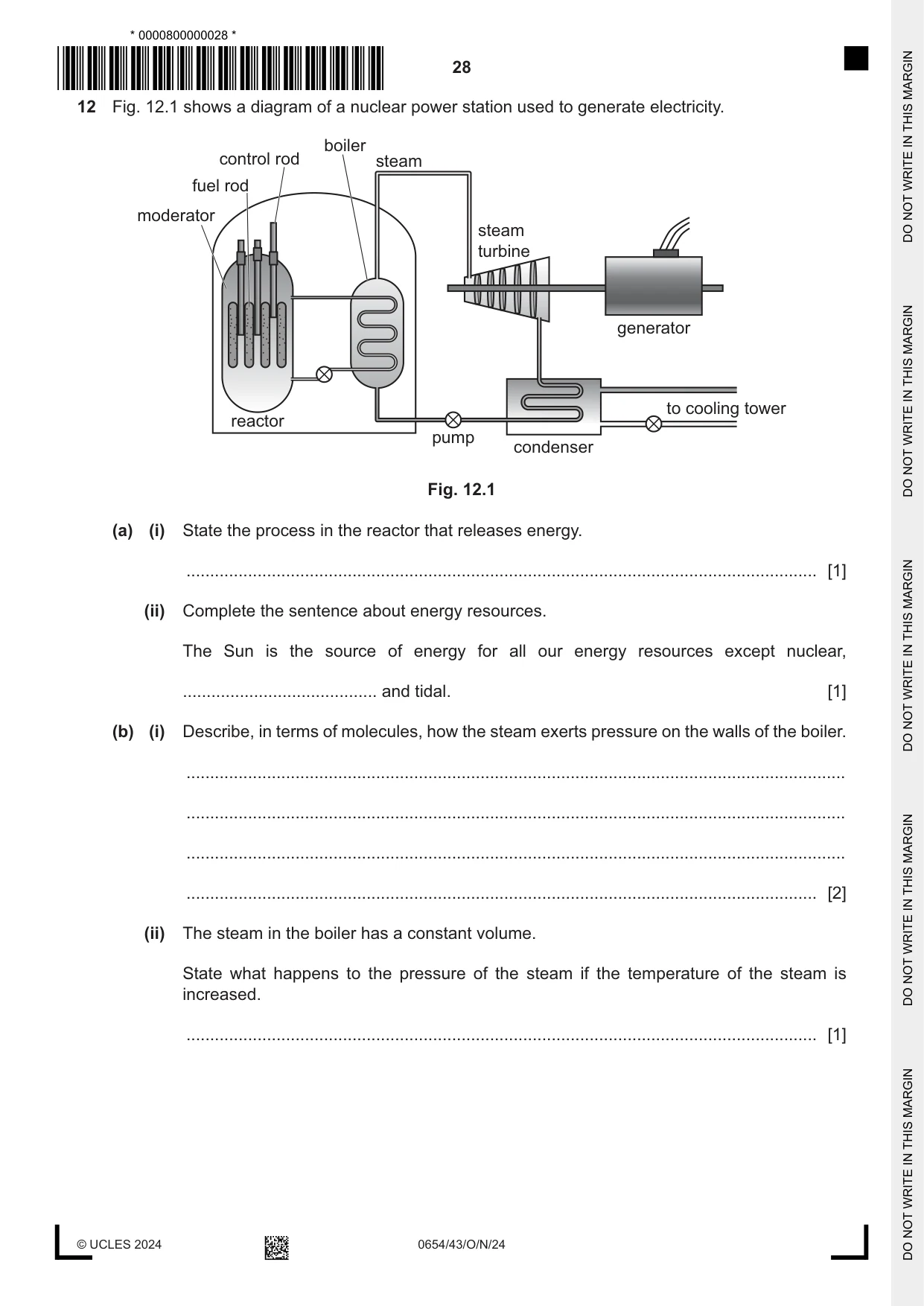
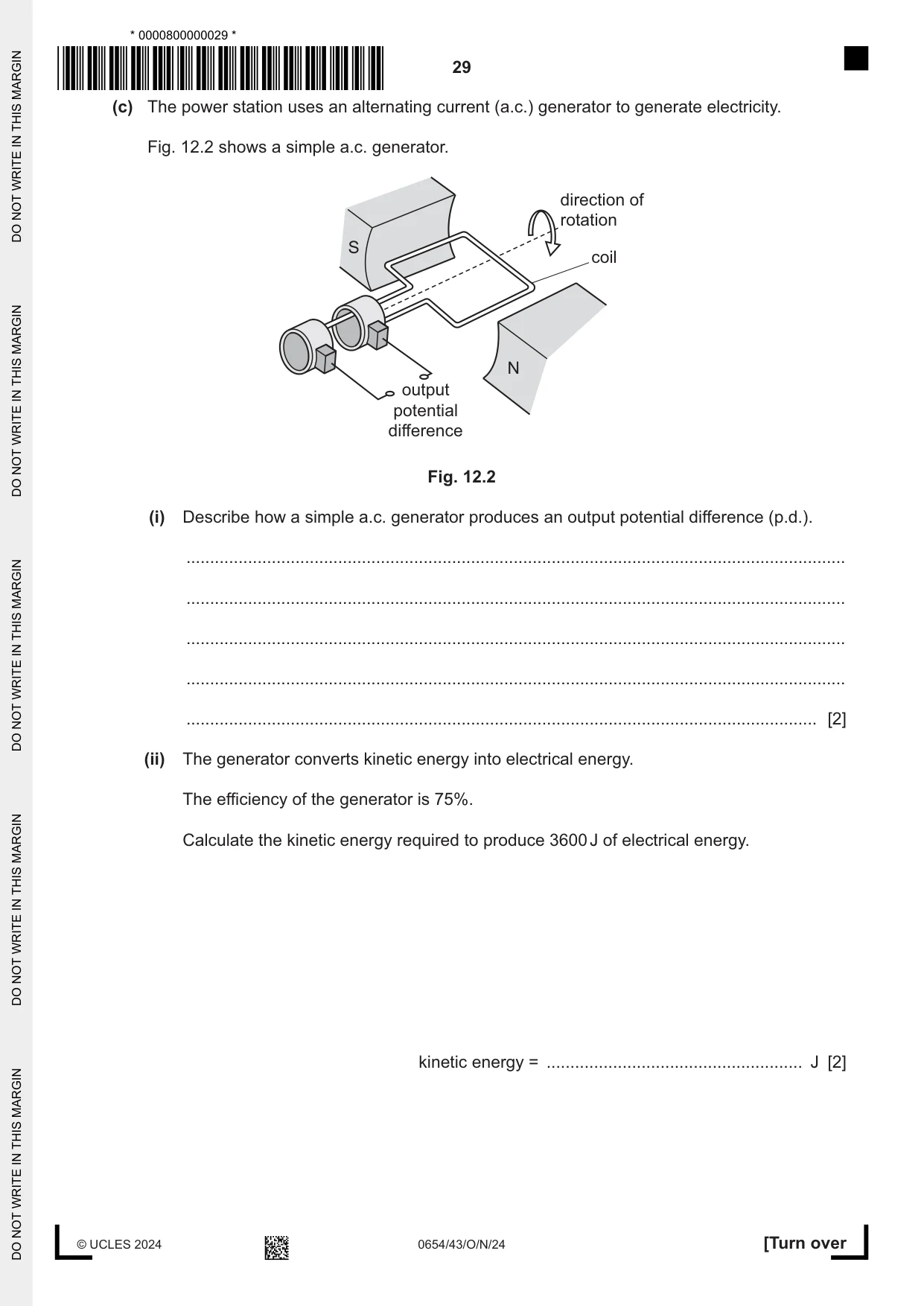
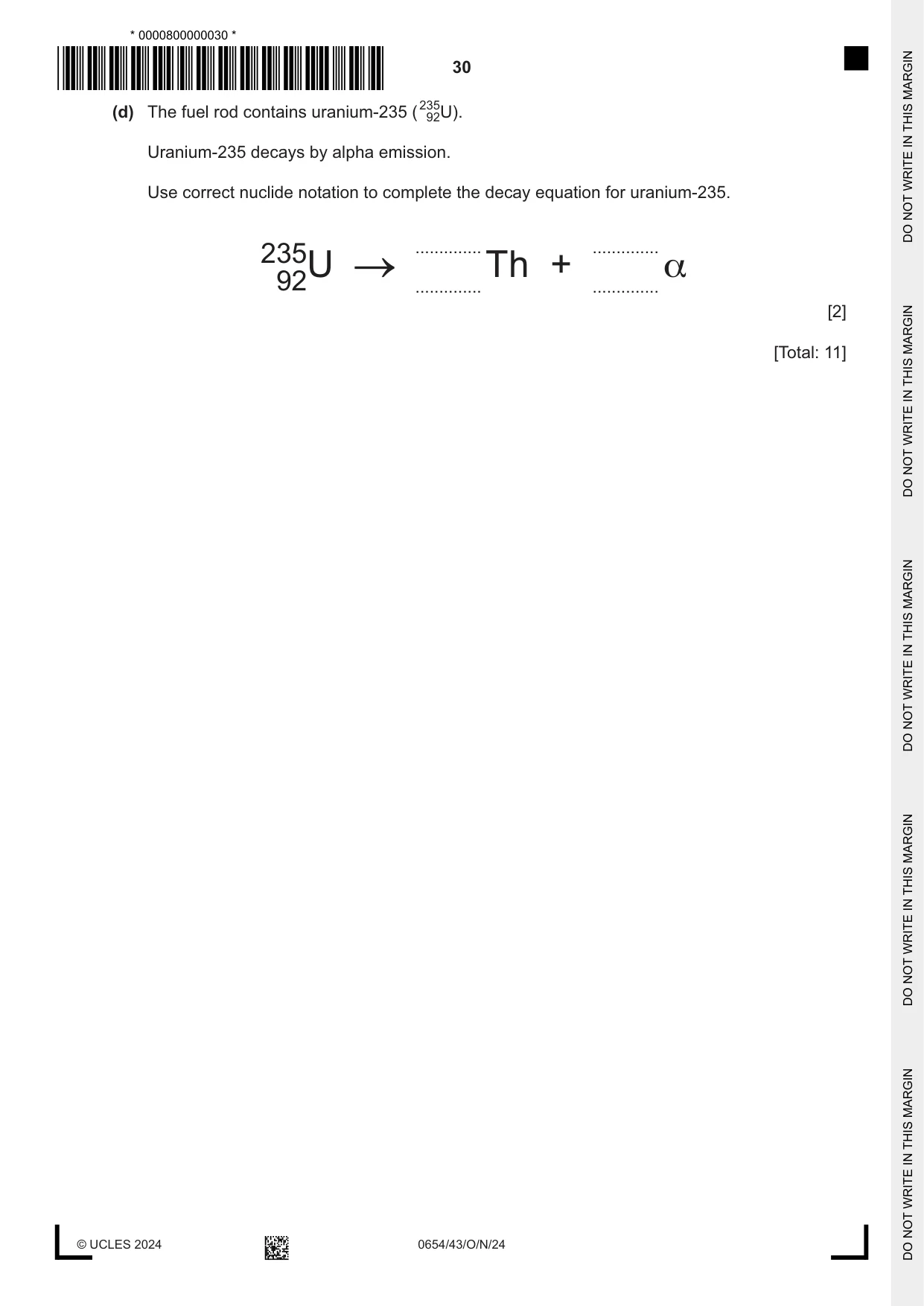
12 Fig. 12.1 shows a diagram of a nuclear power station used to generate electricity. boiler control rod steam fuel rod moderator steam turbine generator to cooling tower reactor pump condenser Fig. 12.1 (a) (i) State the process in the reactor that releases energy. ..................................................................................................................................... [1] (ii) Complete the sentence about energy resources. The Sun is the source of energy for all our energy resources except nuclear, ......................................... and tidal. [1] (b) (i) Describe, in terms of molecules, how the steam exerts pressure on the walls of the boiler. ........................................................................................................................................... ........................................................................................................................................... ........................................................................................................................................... ..................................................................................................................................... [2] (ii) The steam in the boiler has a constant volume. State what happens to the pressure of the steam if the temperature of the steam is increased. ..................................................................................................................................... [1] (c) The power station uses an alternating current (a.c.) generator to generate electricity. Fig. 12.2 shows a simple a.c. generator. direction of rotation S coil N output potential difference Fig. 12.2 (i) Describe how a simple a.c. generator produces an output potential difference (p.d.). ........................................................................................................................................... ........................................................................................................................................... ........................................................................................................................................... ........................................................................................................................................... ..................................................................................................................................... [2] (ii) The generator converts kinetic energy into electrical energy. The efficiency of the generator is 75%. Calculate the kinetic energy required to produce 3600 J of electrical energy. kinetic energy = ...................................................... J [2] (d) The fuel rod contains uranium-235 (23592U). Uranium-235 decays by alpha emission. Use correct nuclide notation to complete the decay equation for uranium-235. 235 .............. .............. 92U ..............Th + ..............α [2] [Total: 11]
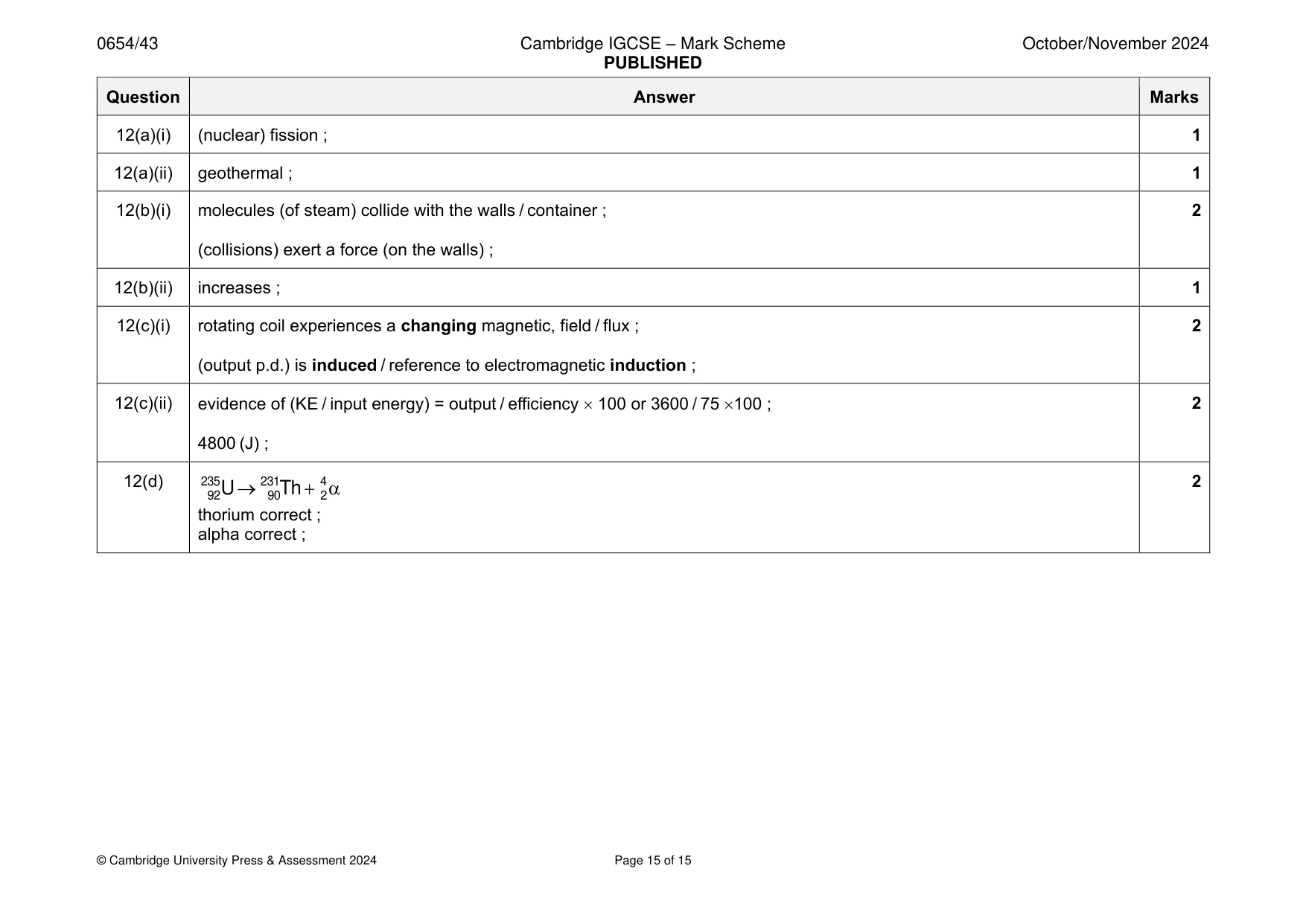
Mark scheme: 12(a)(i) (nuclear) fission ; 1 12(a)(ii) geothermal ; 1 12(b)(i) molecules (of steam) collide with the walls / container ; 2 (collisions) exert a force (on the walls) ; 12(b)(ii) increases ; 1 12(c)(i) rotating coil experiences a changing magnetic, field / flux ; 2 (output p.d.) is induced / reference to electromagnetic induction ; 12(c)(ii) evidence of (KE / input energy) = output / efficiency 100 or 3600 / 75 100 ; 2 4800 (J) ; 12(d) 235 231 4 2 92 U → 90Th + 2 thorium correct ; alpha correct ;
What was in this paper
The subtopics covered by these 12 questions, and how many questions each got. Open one in a new tab to see every Cambridge question on it.
What you needed in this session
Cambridge’s own grade thresholds for 2024 Oct/Nov, Paper 4 · Variant 3. A higher threshold means an easier paper — the bar moves with how the cohort did.