Cambridge IGCSE Sciences - Co-ordinated (Double) 0654 — 2017 Oct/Nov Paper 4 · Variant 2
0654/42/O/N/17 · 13 questions · 120 marks · ≈135 min
The question paper and its mark scheme, free to read here and free to download. This is Cambridge’s own paper, exactly as it was sat.
Question paper32 pages

Mark scheme10 pages
Answers below. Sit the paper first if you are practising.
Questions as text
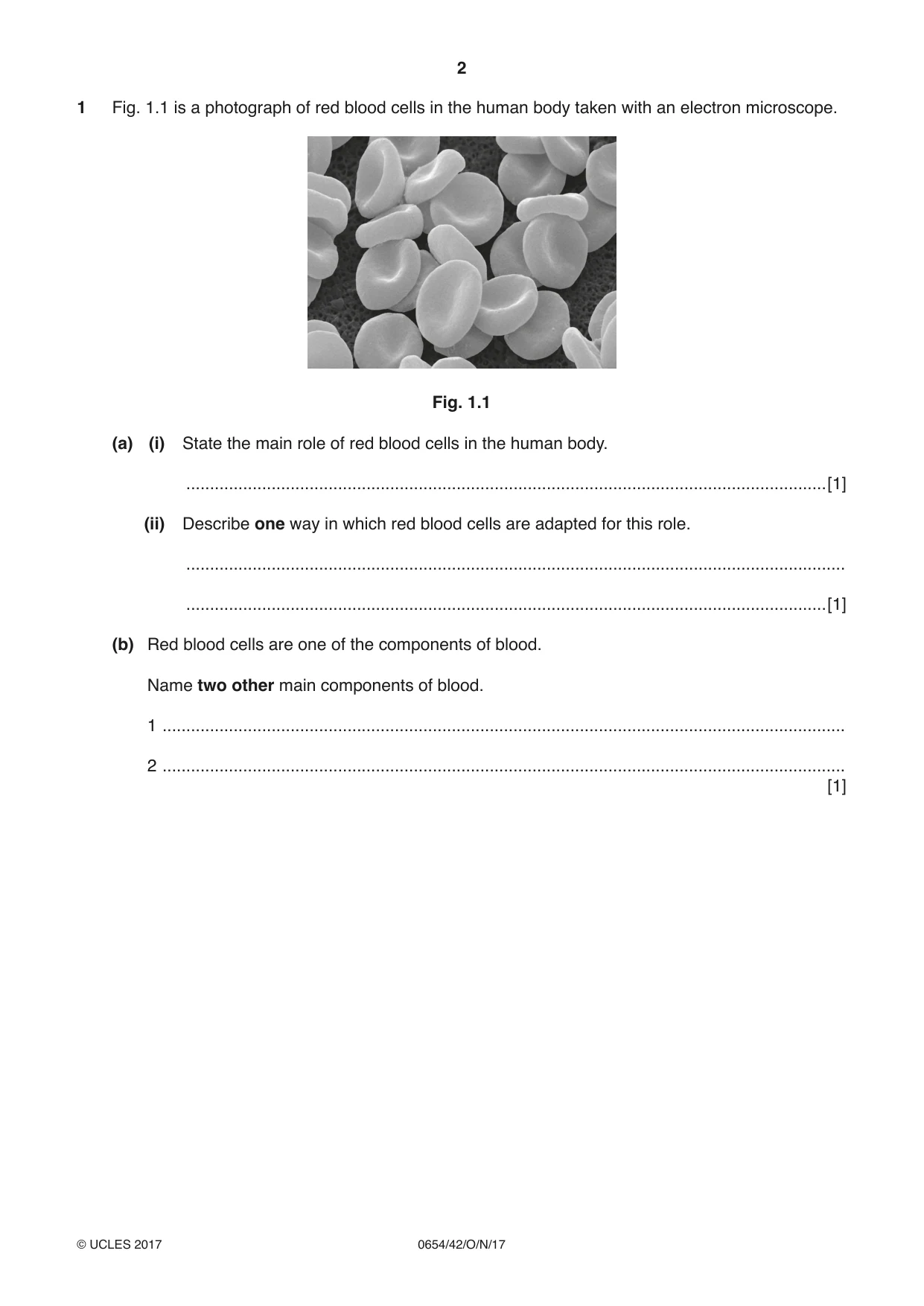
Q1 · A photograph of red blood cells in the human body taken with an electron microscope
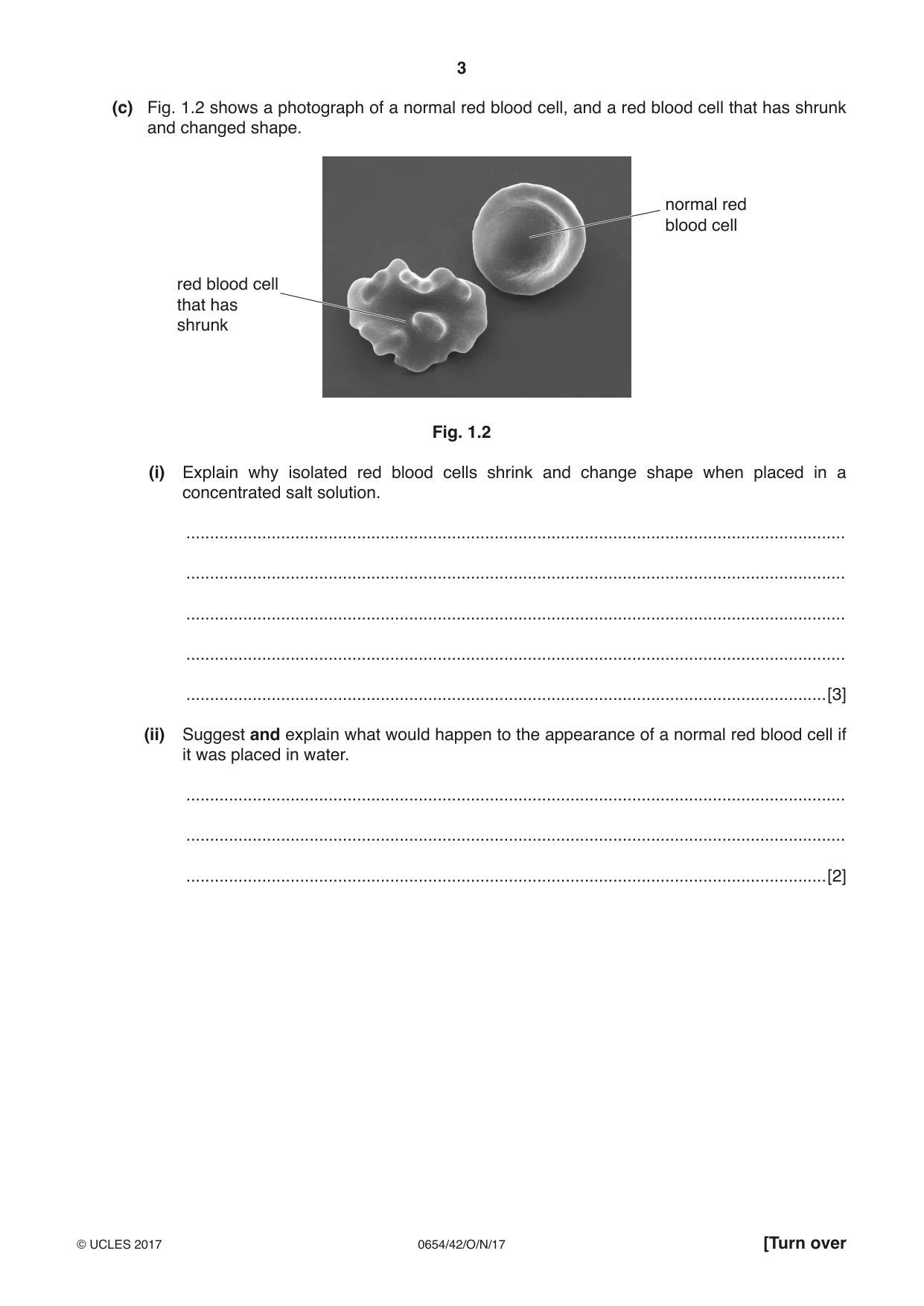
1 Fig. 1.1 is a photograph of red blood cells in the human body taken with an electron microscope. Fig. 1.1 (a) (i) State the main role of red blood cells in the human body. .......................................................................................................................................[1] (ii) Describe one way in which red blood cells are adapted for this role. ........................................................................................................................................... .......................................................................................................................................[1] (b) Red blood cells are one of the components of blood. Name two other main components of blood. 1 ................................................................................................................................................ 2 ................................................................................................................................................ [1] (c) Fig. 1.2 shows a photograph of a normal red blood cell, and a red blood cell that has shrunk and changed shape. normal red blood cell red blood cell that has shrunk Fig. 1.2 (i) Explain why isolated red blood cells shrink and change shape when placed in a concentrated salt solution. ........................................................................................................................................... ........................................................................................................................................... ........................................................................................................................................... ........................................................................................................................................... .......................................................................................................................................[3] (ii) Suggest and explain what would happen to the appearance of a normal red blood cell if it was placed in water. ........................................................................................................................................... ........................................................................................................................................... .......................................................................................................................................[2]
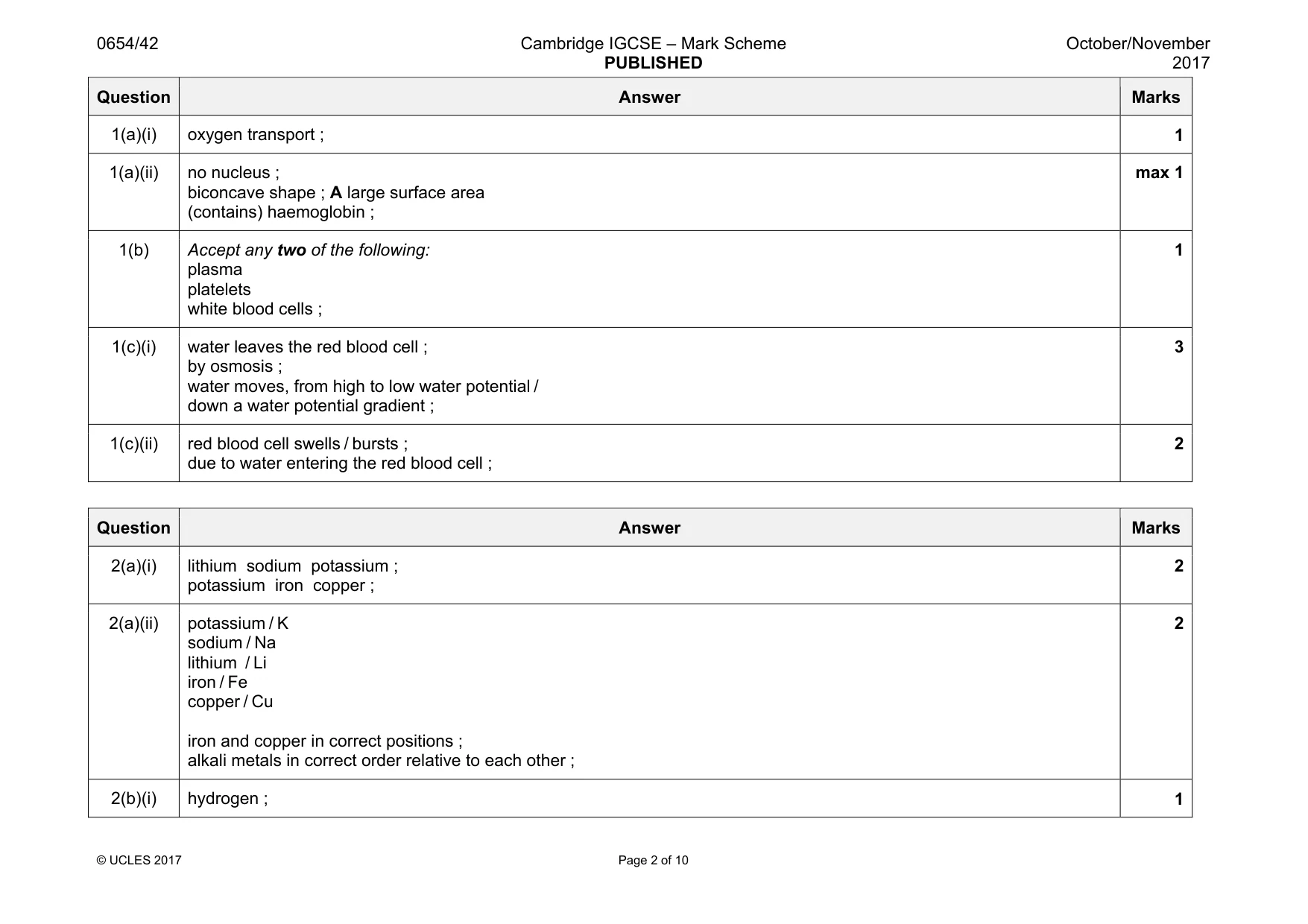
Mark scheme: 1(a)(i) oxygen transport ; 1 1(a)(ii) no nucleus ; biconcave shape ; A large surface area (contains) haemoglobin ; max 1 1(b) Accept any two of the following: plasma platelets white blood cells ; 1 1(c)(i) water leaves the red blood cell ; by osmosis ; water moves, from high to low water potential / down a water potential gradient ; 3 1(c)(ii) red blood cell swells / bursts ; due to water entering the red blood cell ; 2
Q2 · The Periodic Table includes the five metals listed
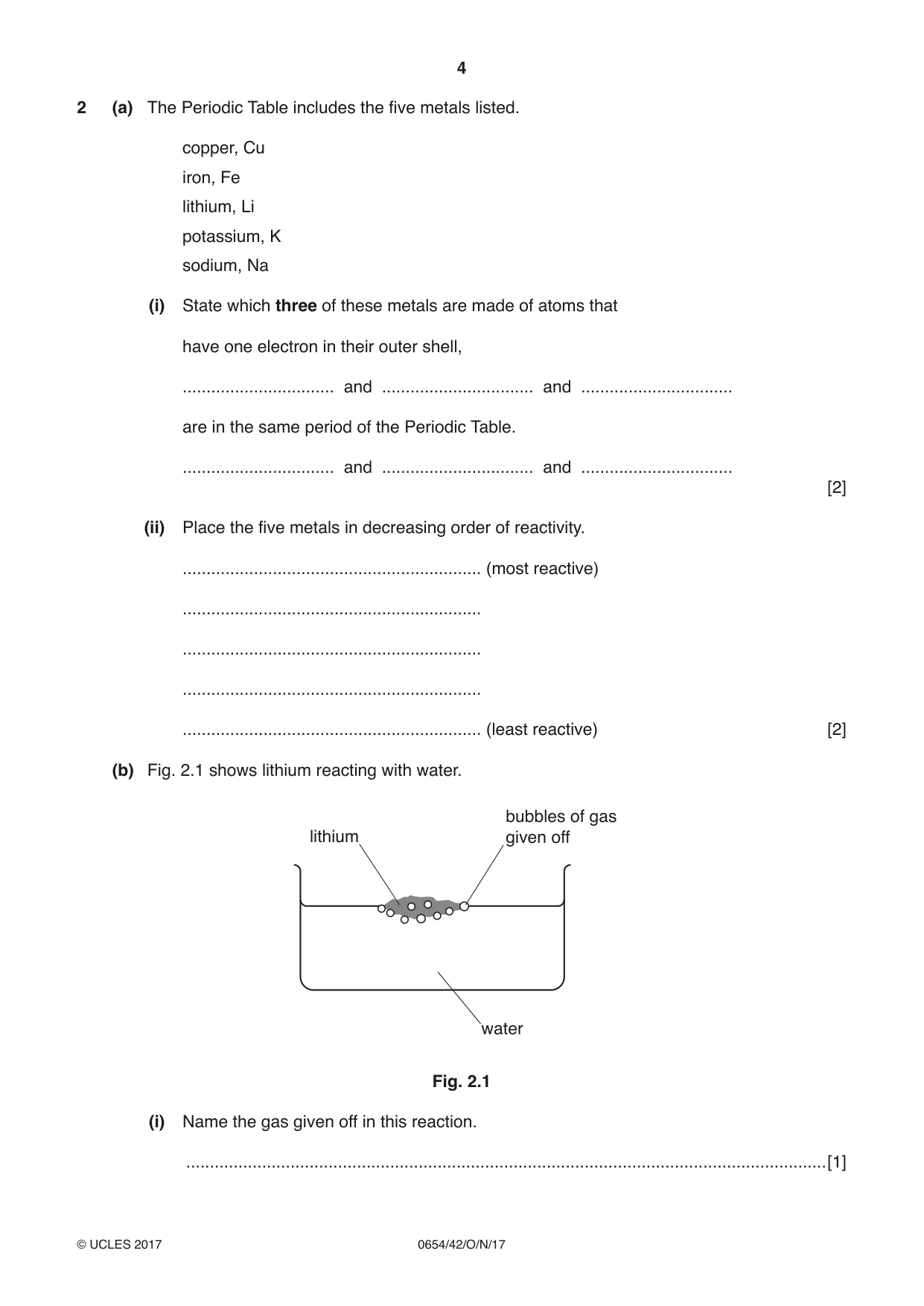
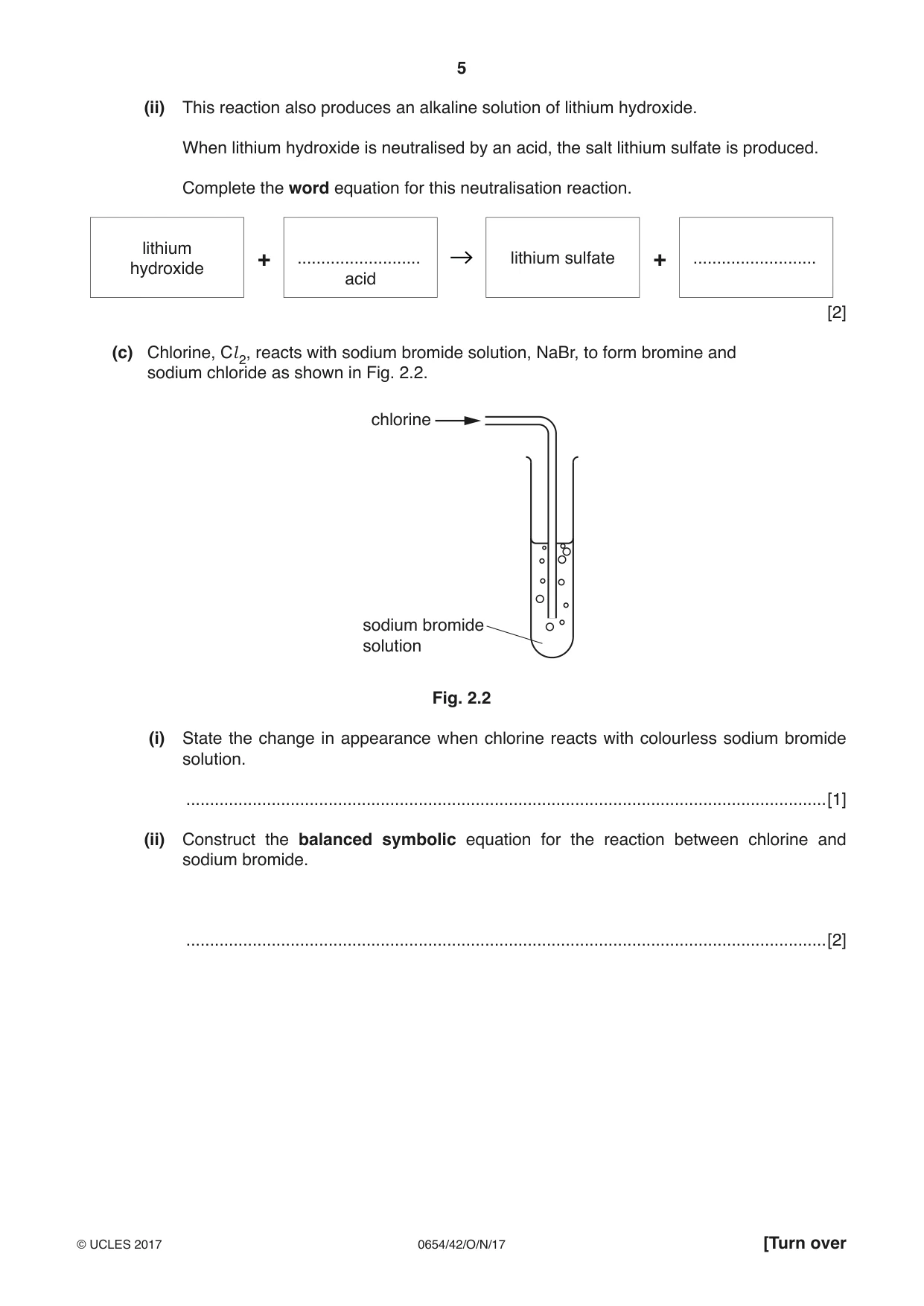
2 (a) The Periodic Table includes the five metals listed. copper, Cu iron, Fe lithium, Li potassium, K sodium, Na (i) State which three of these metals are made of atoms that have one electron in their outer shell, ................................ and ................................ and ................................ are in the same period of the Periodic Table. ................................ and ................................ and ................................ [2] (ii) Place the five metals in decreasing order of reactivity. ............................................................... (most reactive) ............................................................... ............................................................... ............................................................... ............................................................... (least reactive) [2] (b) Fig. 2.1 shows lithium reacting with water. bubbles of gas lithium given off water Fig. 2.1 (i) Name the gas given off in this reaction. .......................................................................................................................................[1] (ii) This reaction also produces an alkaline solution of lithium hydroxide. When lithium hydroxide is neutralised by an acid, the salt lithium sulfate is produced. Complete the word equation for this neutralisation reaction. lithium + .......................... lithium sulfate + .......................... hydroxide acid [2] (c) Chlorine, Cl 2, reacts with sodium bromide solution, NaBr, to form bromine and sodium chloride as shown in Fig. 2.2. chlorine sodium bromide solution Fig. 2.2 (i) State the change in appearance when chlorine reacts with colourless sodium bromide solution. .......................................................................................................................................[1] (ii) Construct the balanced symbolic equation for the reaction between chlorine and sodium bromide. .......................................................................................................................................[2]
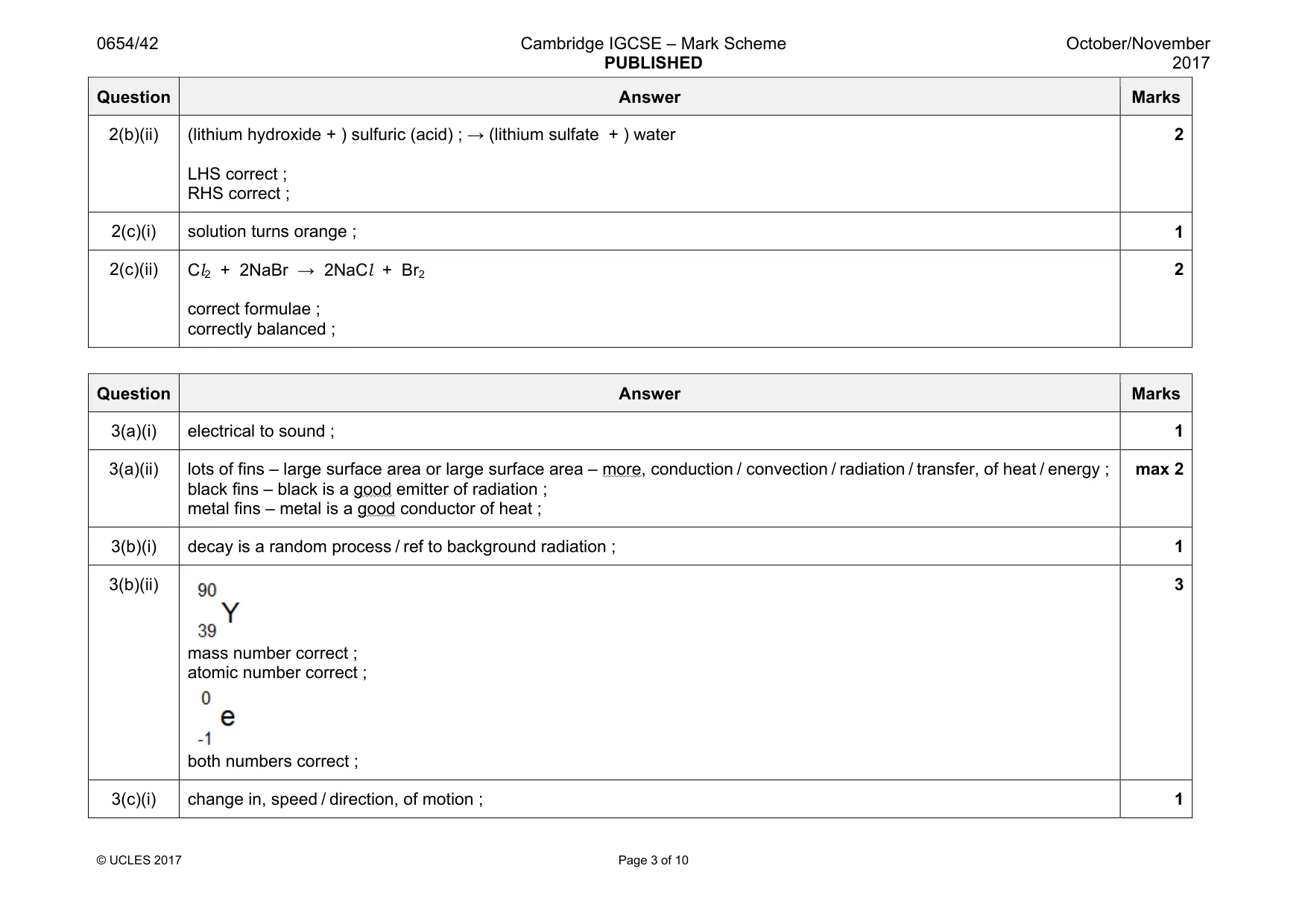
Mark scheme: 2(a)(i) lithium sodium potassium ; potassium iron copper ; 2 2(a)(ii) potassium / K sodium / Na lithium / Li iron / Fe copper / Cu iron and copper in correct positions ; alkali metals in correct order relative to each other ; 2 2(b)(i) hydrogen ; 1 Question Answer Marks 2(b)(ii) (lithium hydroxide + ) sulfuric (acid) ; → (lithium sulfate + ) water LHS correct ; RHS correct ; 2 2(c)(i) solution turns orange ; 1 2(c)(ii) Cl2 + 2NaBr → 2NaCl + Br2 correct formulae ; correctly balanced ; 2
Q3 · A student is listening to music on her computer using headphones
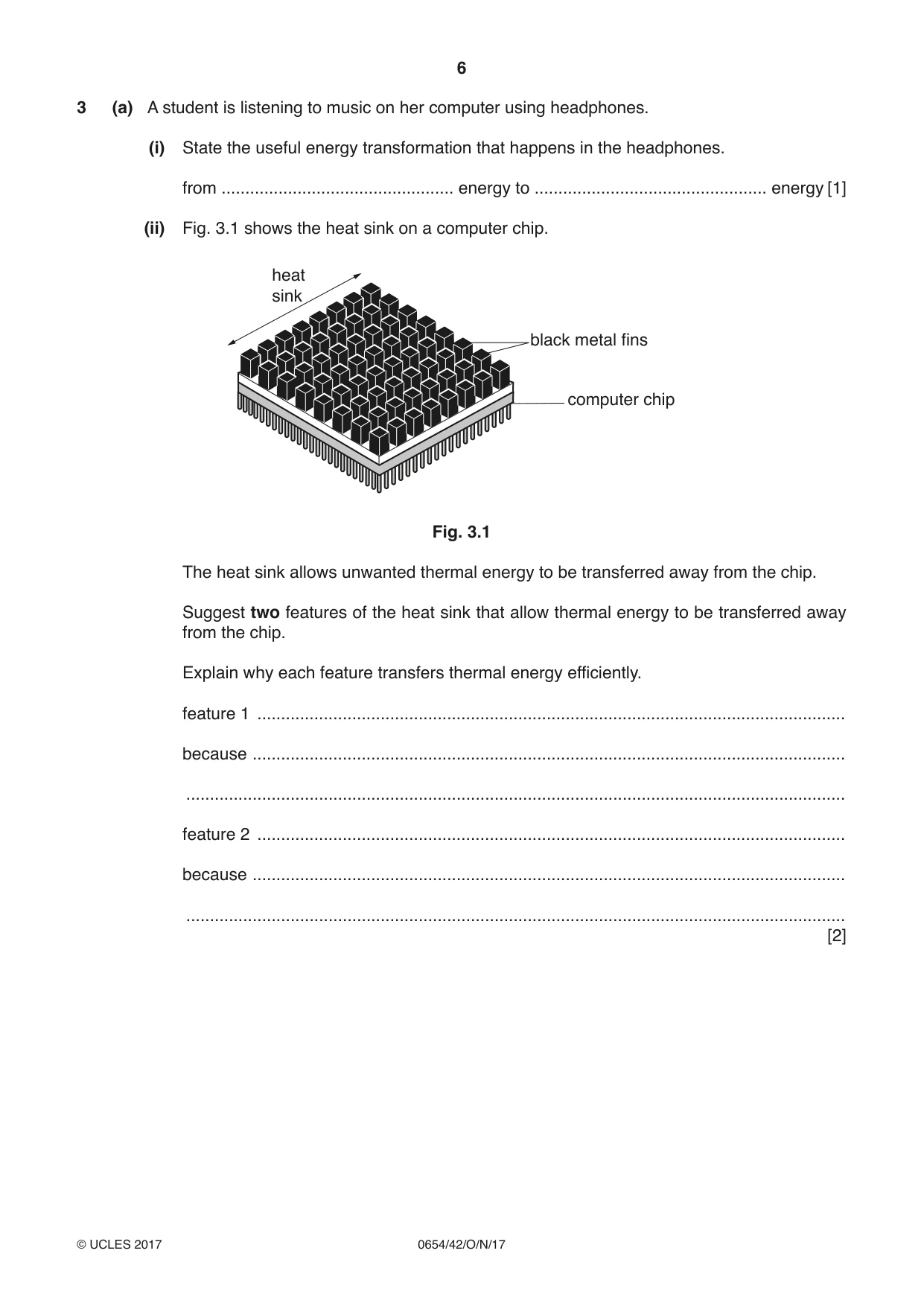
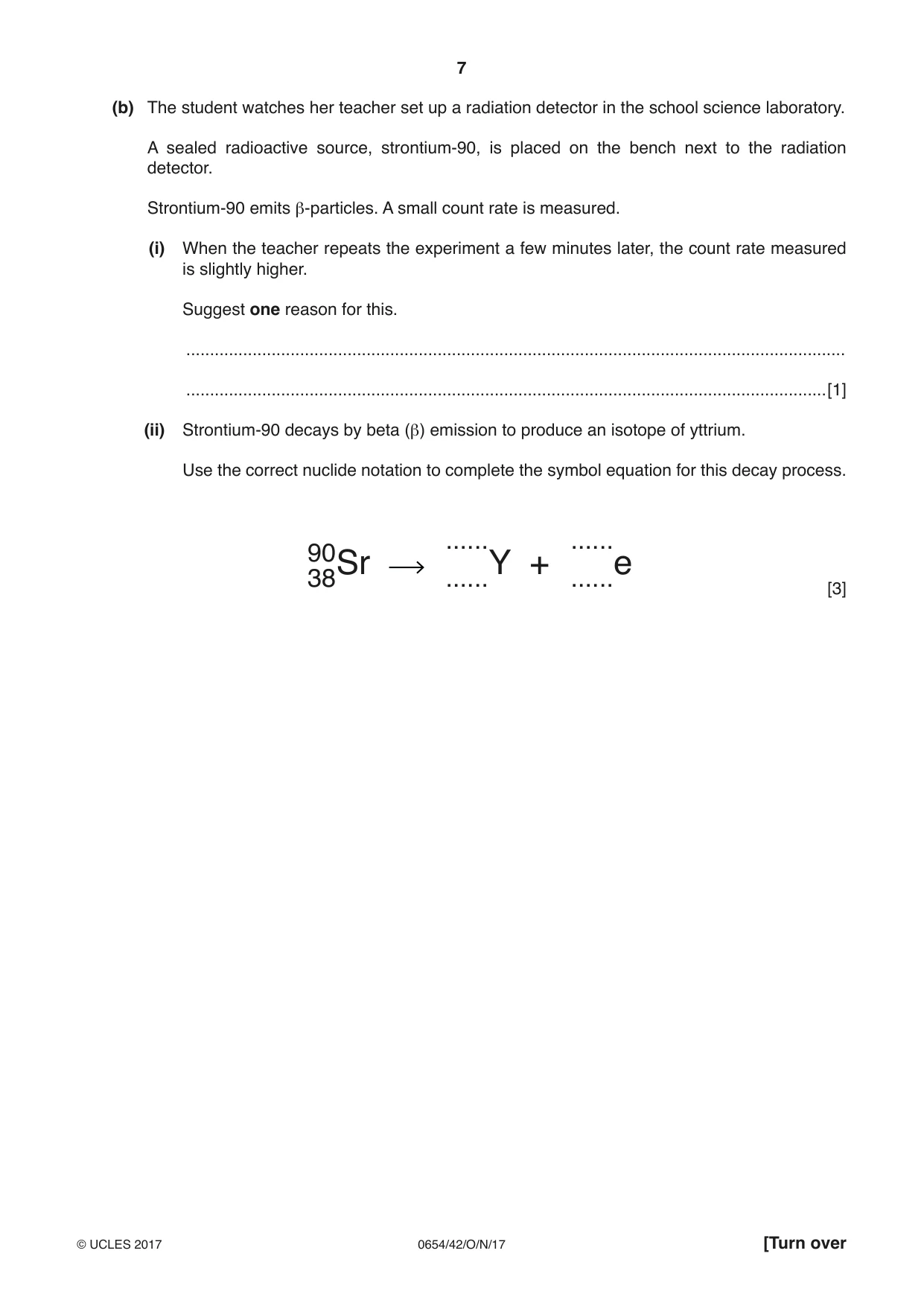
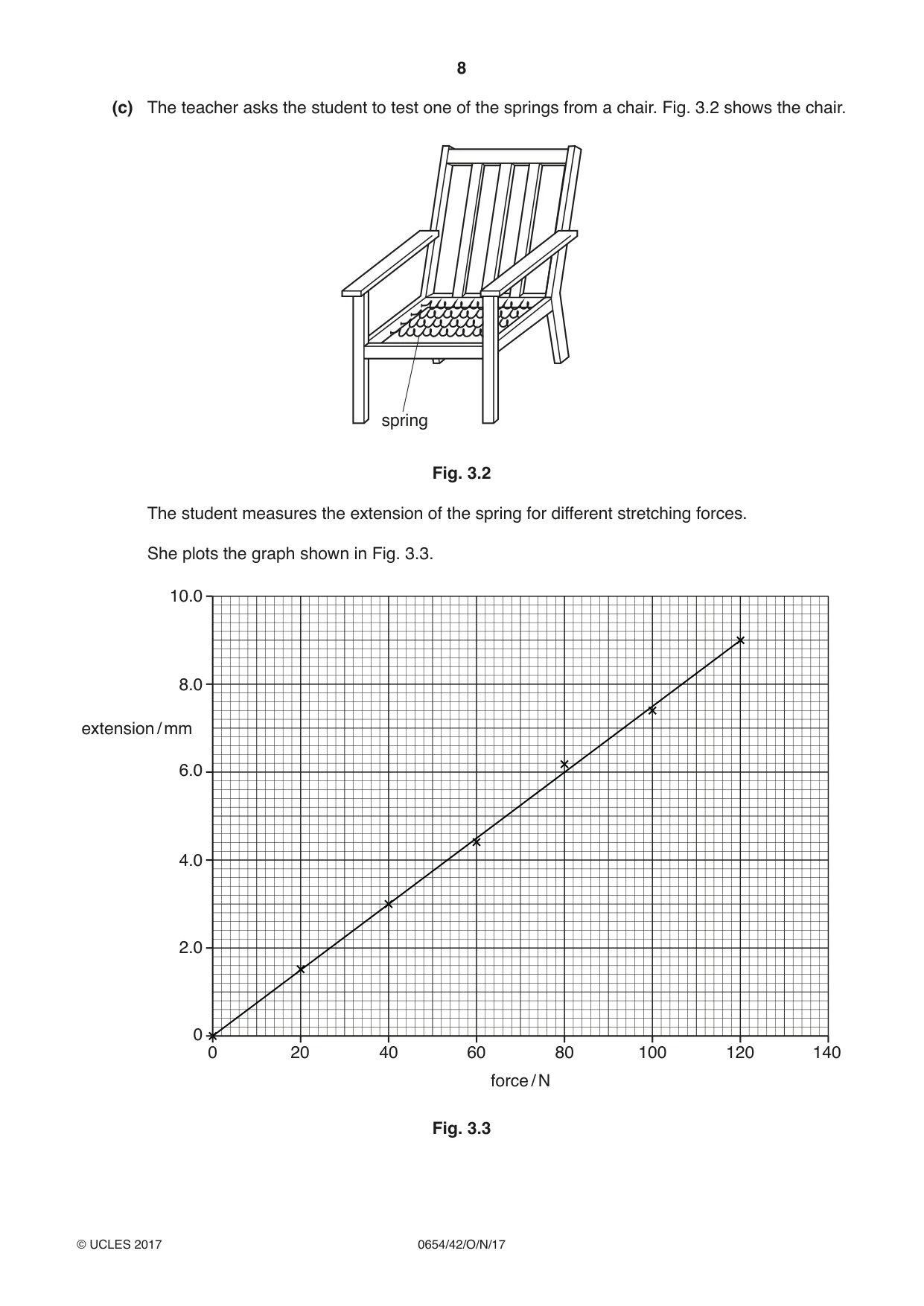
3 (a) A student is listening to music on her computer using headphones. (i) State the useful energy transformation that happens in the headphones. from ................................................. energy to ................................................. energy [1] (ii) Fig. 3.1 shows the heat sink on a computer chip. heat sink black metal fins computer chip Fig. 3.1 The heat sink allows unwanted thermal energy to be transferred away from the chip. Suggest two features of the heat sink that allow thermal energy to be transferred away from the chip. Explain why each feature transfers thermal energy efficiently. feature 1 ............................................................................................................................ because ............................................................................................................................. ........................................................................................................................................... feature 2 ............................................................................................................................ because ............................................................................................................................. ........................................................................................................................................... [2] (b) The student watches her teacher set up a radiation detector in the school science laboratory. A sealed radioactive source, strontium-90, is placed on the bench next to the radiation detector. Strontium-90 emits β-particles. A small count rate is measured. (i) When the teacher repeats the experiment a few minutes later, the count rate measured is slightly higher. Suggest one reason for this. ........................................................................................................................................... .......................................................................................................................................[1] (ii) Strontium-90 decays by beta (β) emission to produce an isotope of yttrium. Use the correct nuclide notation to complete the symbol equation for this decay process. ...... ...... 9038Sr ......Y + ......e [3] (c) The teacher asks the student to test one of the springs from a chair. Fig. 3.2 shows the chair. spring Fig. 3.2 The student measures the extension of the spring for different stretching forces. She plots the graph shown in Fig. 3.3. 10.0 8.0 extension / mm 6.0 4.0 2.0 0 0 20 40 60 80 100 120 140 force / N Fig. 3.3 (i) The force changes the shape of the spring. State one other effect that a force can have on a body. .......................................................................................................................................[1] (ii) Use Fig. 3.3 to predict the force needed to give an extension of 10.0 mm. ......................................................................N [1] (iii) State the assumption you have made to make your prediction in (ii). ........................................................................................................................................... ........................................................................................................................................... .......................................................................................................................................[1]
Mark scheme: 3(a)(i) electrical to sound ; 1 3(a)(ii) lots of fins – large surface area or large surface area – more, conduction / convection / radiation / transfer, of heat / energy ; black fins – black is a good emitter of radiation ; metal fins – metal is a good conductor of heat ; max 2 3(b)(i) decay is a random process / ref to background radiation ; 1 3(b)(ii) mass number correct ; atomic number correct ; both numbers correct ; 3 3(c)(i) change in, speed / direction, of motion ; 1 Question Answer Marks 3(c)(ii) 133 N ; 1 3(c)(iii) the force needed to extend a spring is directly proportional to the extension / elastic limit not exceeded ; 1
Q4 · MRSA is a bacterium that causes infection and has become resistant to many antibiotics
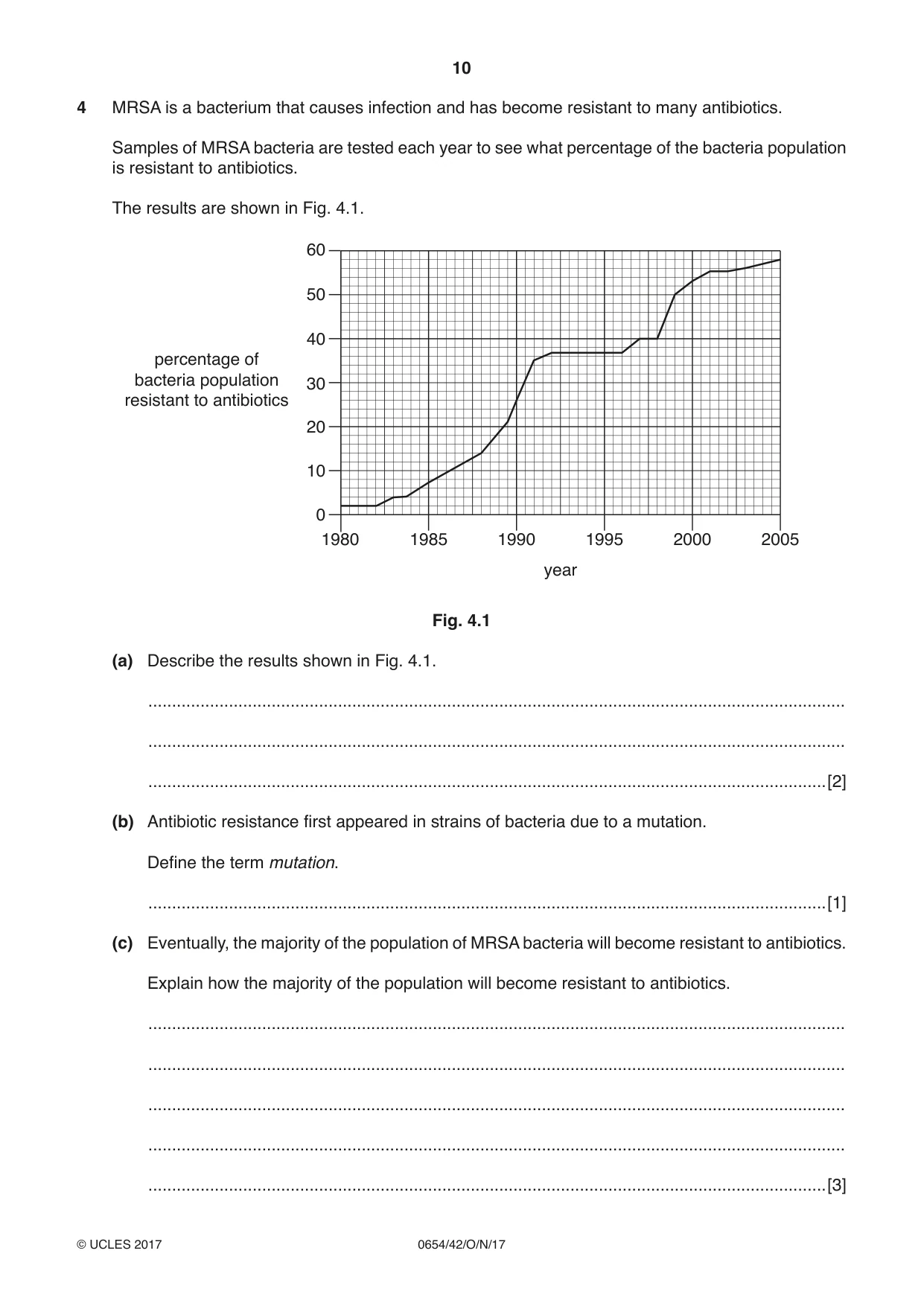
4 MRSA is a bacterium that causes infection and has become resistant to many antibiotics. Samples of MRSA bacteria are tested each year to see what percentage of the bacteria population is resistant to antibiotics. The results are shown in Fig. 4.1. 60 50 40 percentage of bacteria population 30 resistant to antibiotics 20 10 0 1980 1985 1990 1995 2000 2005 year Fig. 4.1 (a) Describe the results shown in Fig. 4.1. ................................................................................................................................................... ................................................................................................................................................... ...............................................................................................................................................[2] (b) Antibiotic resistance first appeared in strains of bacteria due to a mutation. Define the term mutation. ...............................................................................................................................................[1] (c) Eventually, the majority of the population of MRSA bacteria will become resistant to antibiotics. Explain how the majority of the population will become resistant to antibiotics. ................................................................................................................................................... ................................................................................................................................................... ................................................................................................................................................... ................................................................................................................................................... ...............................................................................................................................................[3]
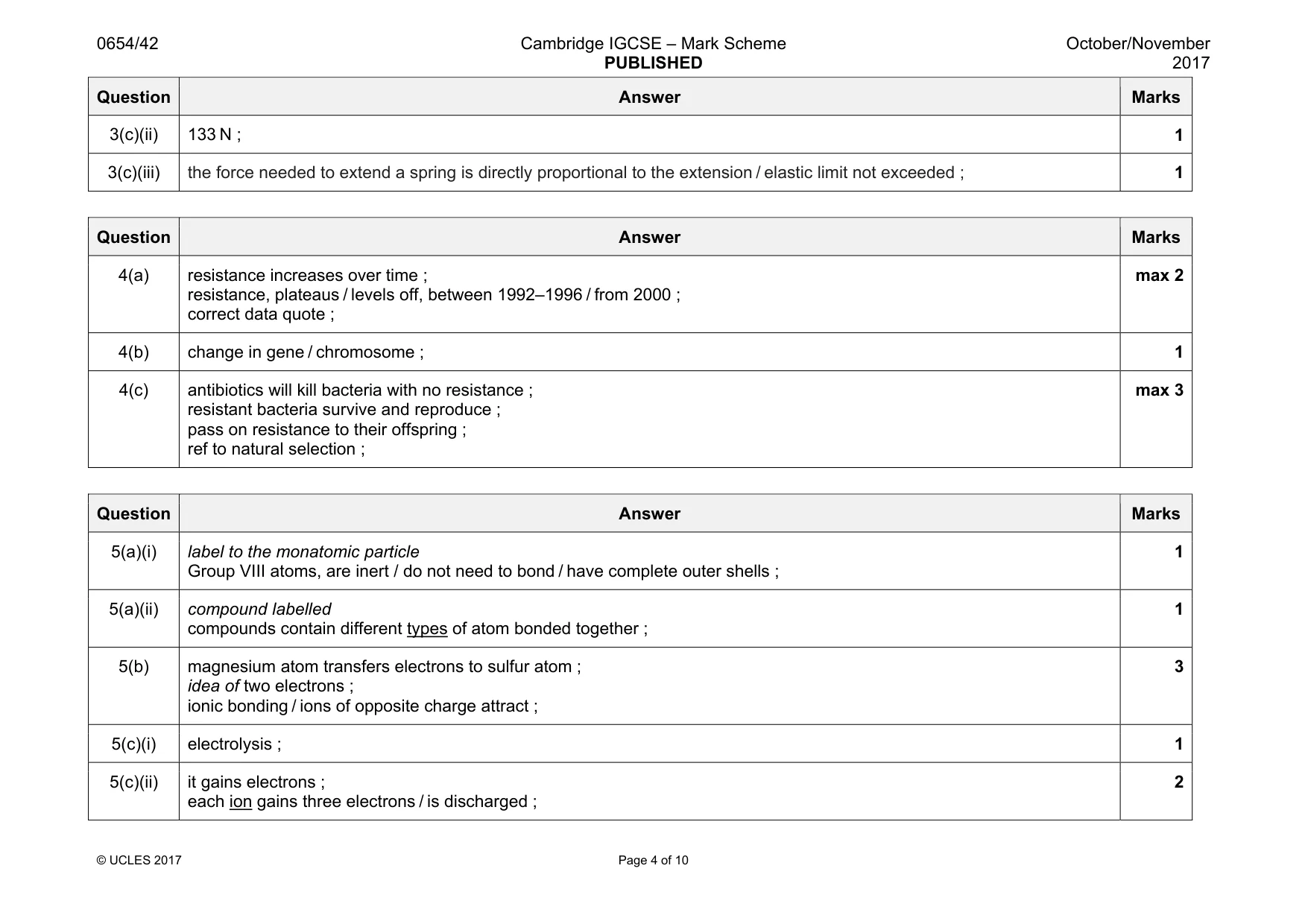
Mark scheme: 4(a) resistance increases over time ; resistance, plateaus / levels off, between 1992–1996 / from 2000 ; correct data quote ; max 2 4(b) change in gene / chromosome ; 1 4(c) antibiotics will kill bacteria with no resistance ; resistant bacteria survive and reproduce ; pass on resistance to their offspring ; ref to natural selection ; max 3
Q5 · Some particles in a mixture of gases
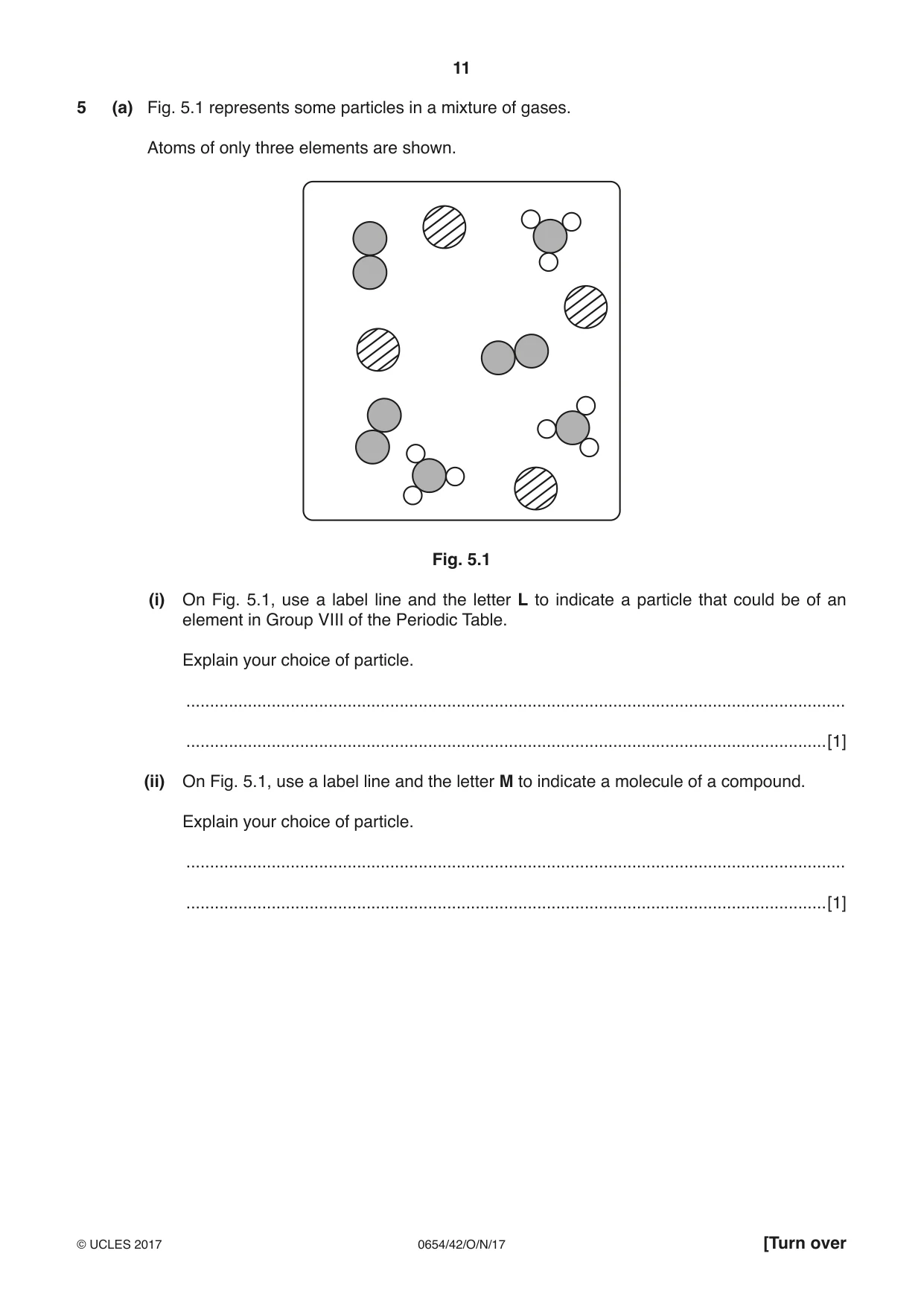
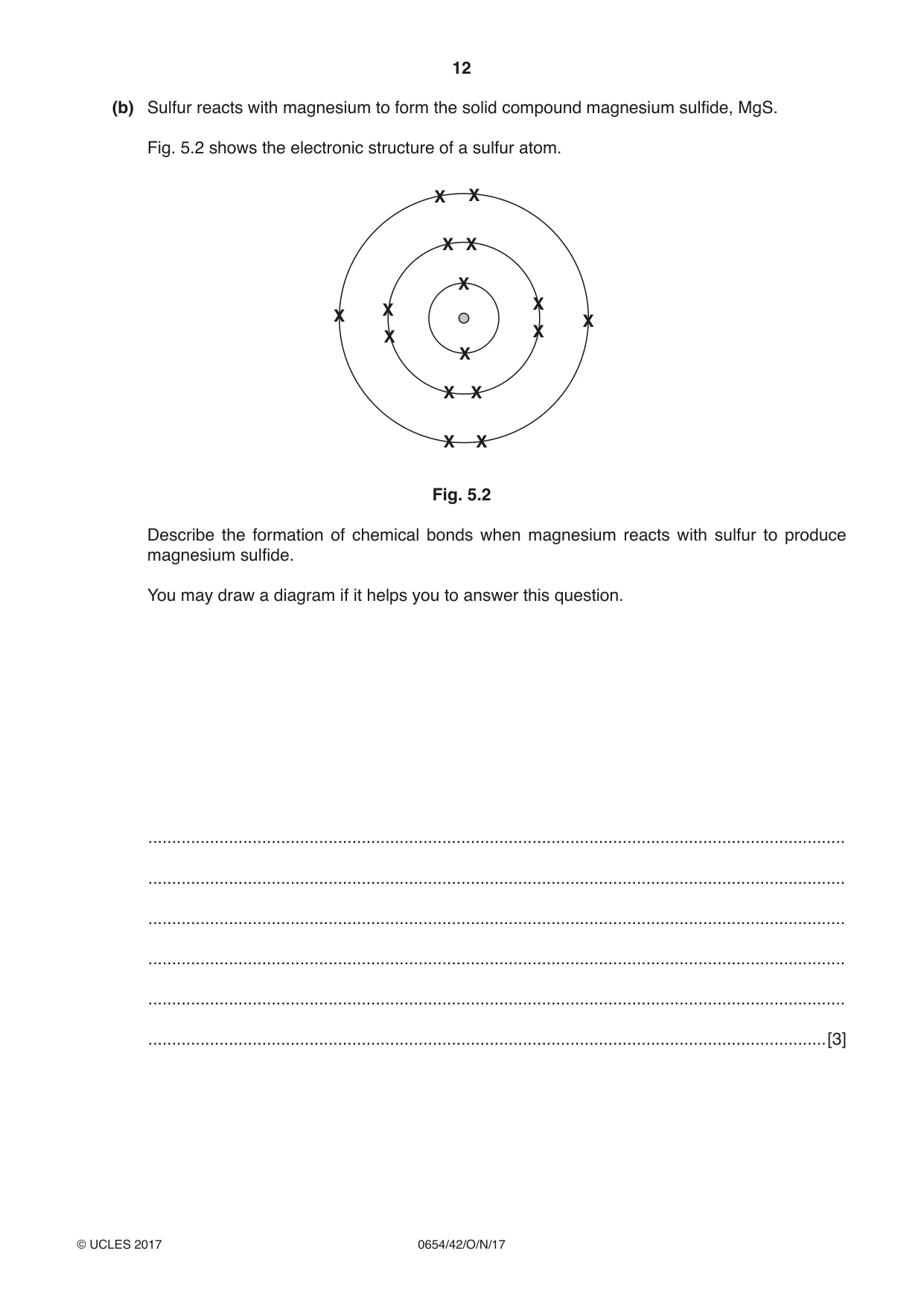
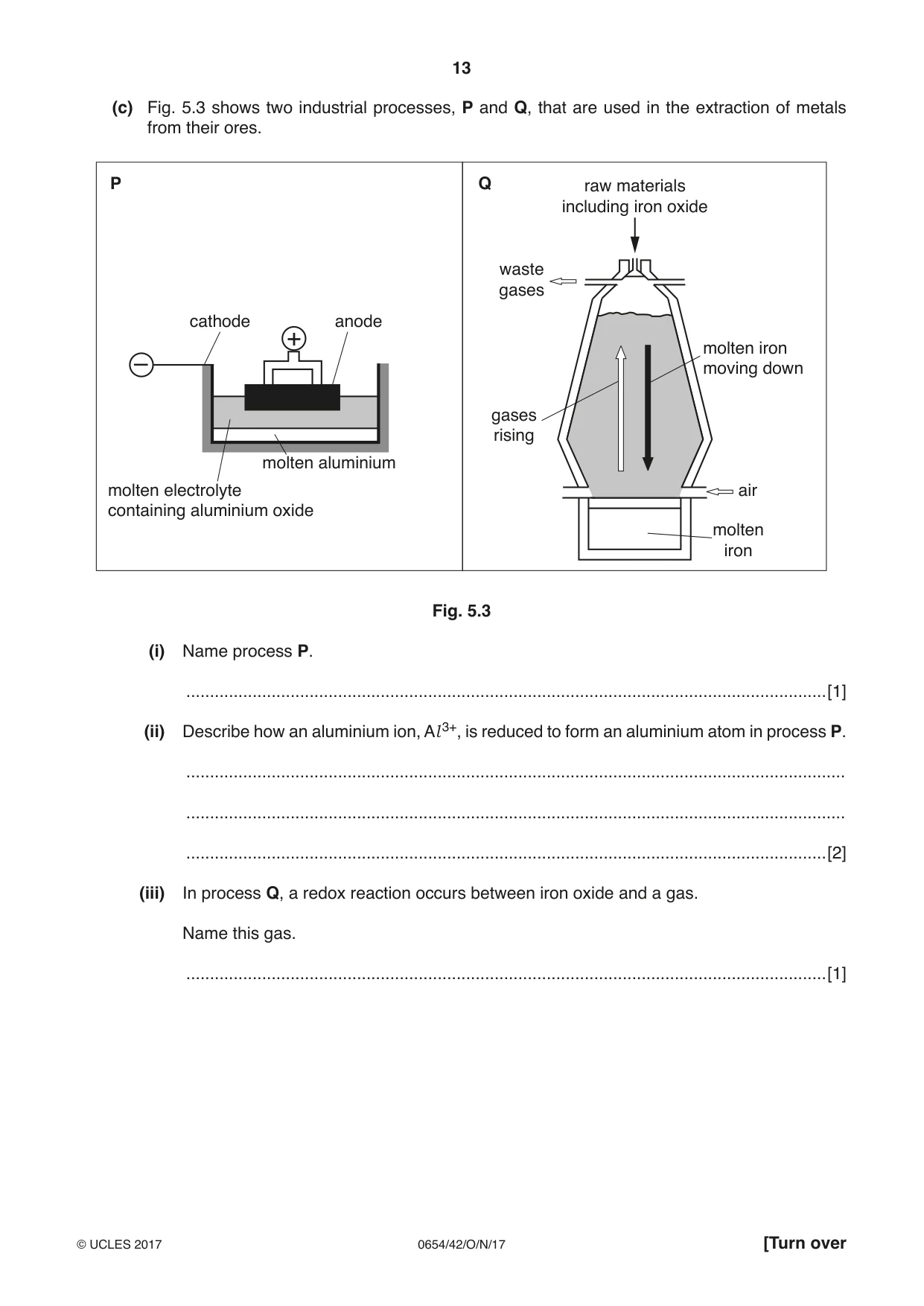
5 (a) Fig. 5.1 represents some particles in a mixture of gases. Atoms of only three elements are shown. Fig. 5.1 (i) On Fig. 5.1, use a label line and the letter L to indicate a particle that could be of an element in Group VIII of the Periodic Table. Explain your choice of particle. ........................................................................................................................................... .......................................................................................................................................[1] (ii) On Fig. 5.1, use a label line and the letter M to indicate a molecule of a compound. Explain your choice of particle. ........................................................................................................................................... .......................................................................................................................................[1] (b) Sulfur reacts with magnesium to form the solid compound magnesium sulfide, MgS. Fig. 5.2 shows the electronic structure of a sulfur atom. X X X X X X X X X X X X X X X X Fig. 5.2 Describe the formation of chemical bonds when magnesium reacts with sulfur to produce magnesium sulfide. You may draw a diagram if it helps you to answer this question. ................................................................................................................................................... ................................................................................................................................................... ................................................................................................................................................... ................................................................................................................................................... ................................................................................................................................................... ...............................................................................................................................................[3] (c) Fig. 5.3 shows two industrial processes, P and Q, that are used in the extraction of metals from their ores. P Q raw materials including iron oxide waste gases cathode anode + molten iron – moving down gases rising molten aluminium molten electrolyte air containing aluminium oxide molten iron Fig. 5.3 (i) Name process P. .......................................................................................................................................[1] (ii) Describe how an aluminium ion, Al 3+, is reduced to form an aluminium atom in process P. ........................................................................................................................................... ........................................................................................................................................... .......................................................................................................................................[2] (iii) In process Q, a redox reaction occurs between iron oxide and a gas. Name this gas. .......................................................................................................................................[1]
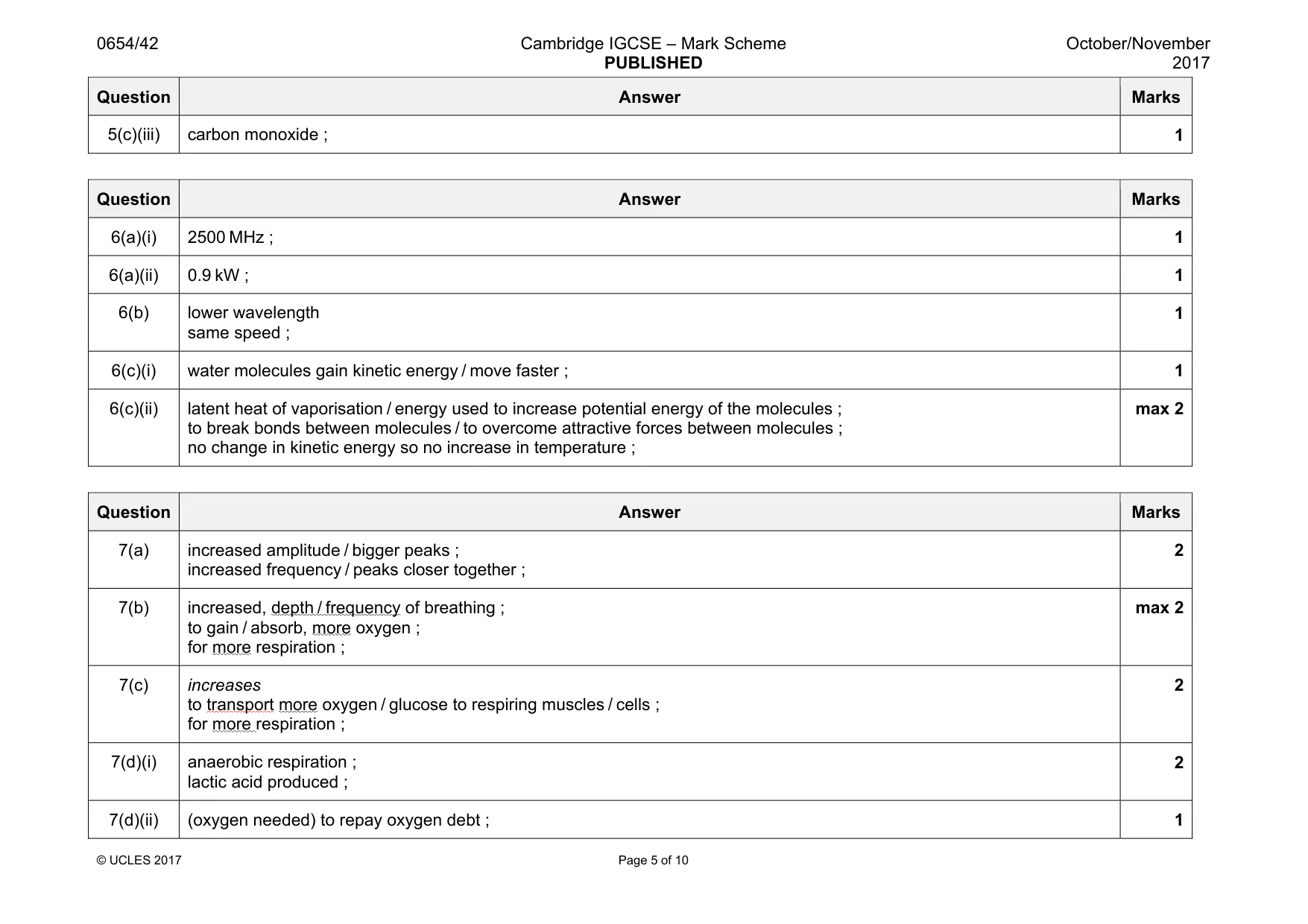
Mark scheme: 5(a)(i) label to the monatomic particle Group VIII atoms, are inert / do not need to bond / have complete outer shells ; 1 5(a)(ii) compound labelled compounds contain different types of atom bonded together ; 1 5(b) magnesium atom transfers electrons to sulfur atom ; idea of two electrons ; ionic bonding / ions of opposite charge attract ; 3 5(c)(i) electrolysis ; 1 5(c)(ii) it gains electrons ; each ion gains three electrons / is discharged ; 2 Question Answer Marks 5(c)(iii) carbon monoxide ; 1
Q6 · The information label found on the back of a microwave oven
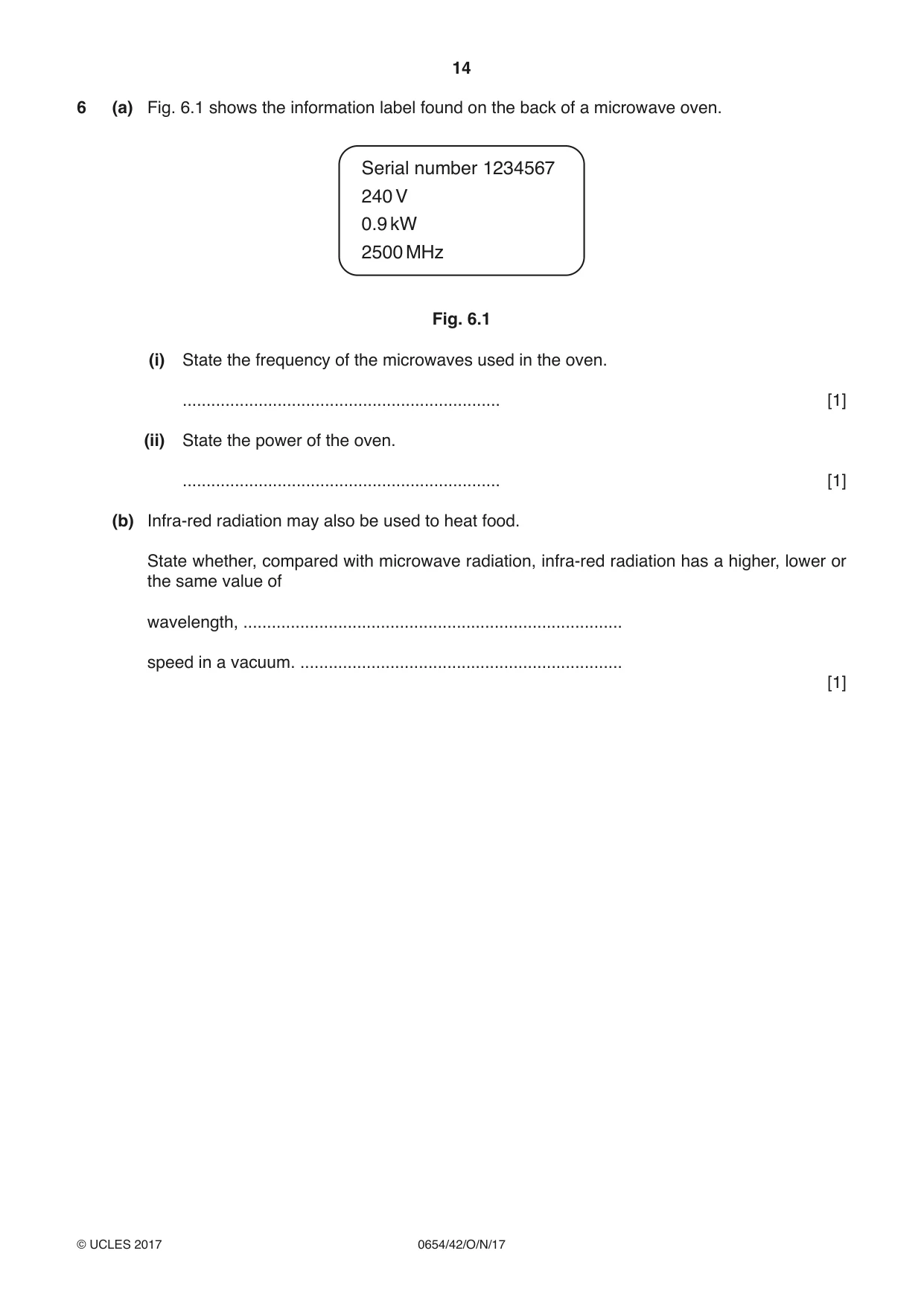
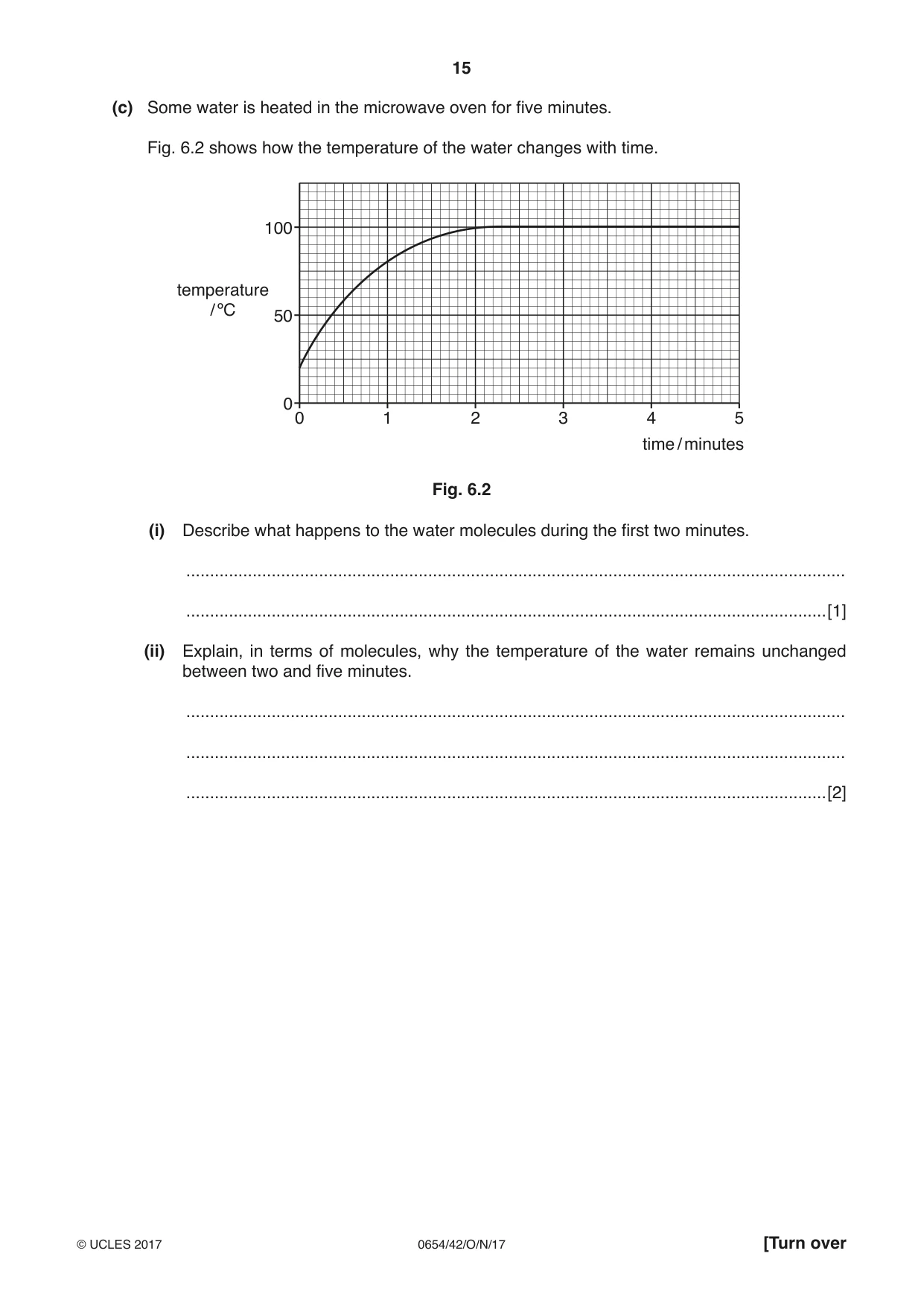
6 (a) Fig. 6.1 shows the information label found on the back of a microwave oven. Serial number 1234567 240 V 0.9 kW 2500 MHz Fig. 6.1 (i) State the frequency of the microwaves used in the oven. ................................................................... [1] (ii) State the power of the oven. ................................................................... [1] (b) Infra-red radiation may also be used to heat food. State whether, compared with microwave radiation, infra-red radiation has a higher, lower or the same value of wavelength, ................................................................................ speed in a vacuum. .................................................................... [1] (c) Some water is heated in the microwave oven for five minutes. Fig. 6.2 shows how the temperature of the water changes with time. 100 temperature / ºC 50 0 0 1 2 3 4 5 time / minutes Fig. 6.2 (i) Describe what happens to the water molecules during the first two minutes. ........................................................................................................................................... .......................................................................................................................................[1] (ii) Explain, in terms of molecules, why the temperature of the water remains unchanged between two and five minutes. ........................................................................................................................................... ........................................................................................................................................... .......................................................................................................................................[2]
Mark scheme: 6(a)(i) 2500 MHz ; 1 6(a)(ii) 0.9 kW ; 1 6(b) lower wavelength same speed ; 1 6(c)(i) water molecules gain kinetic energy / move faster ; 1 6(c)(ii) latent heat of vaporisation / energy used to increase potential energy of the molecules ; to break bonds between molecules / to overcome attractive forces between molecules ; no change in kinetic energy so no increase in temperature ; max 2
Q7 · The breathing rate of a student at rest is measured by measuring the volume of air in the…
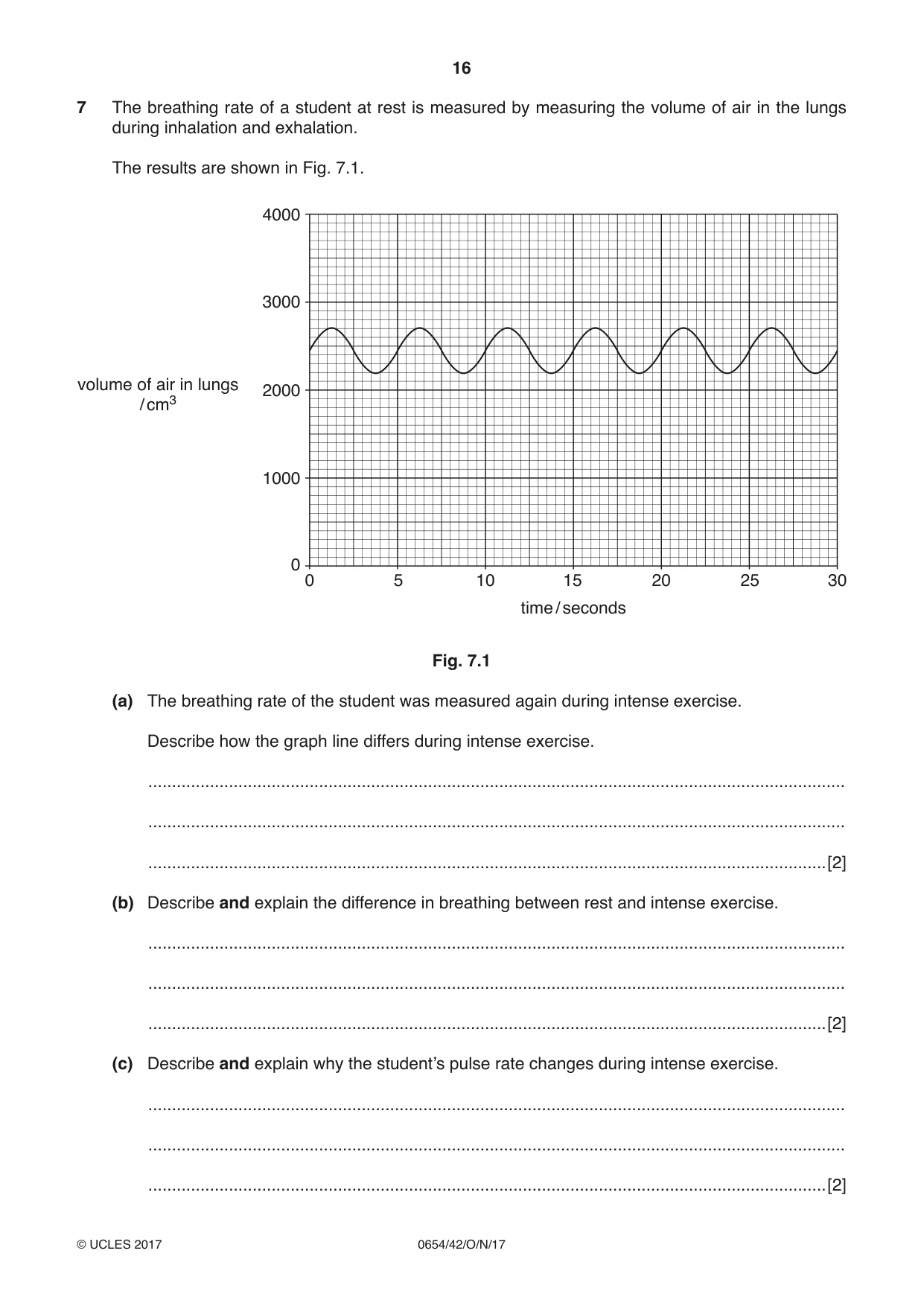
7 The breathing rate of a student at rest is measured by measuring the volume of air in the lungs during inhalation and exhalation. The results are shown in Fig. 7.1. 4000 3000 volume of air in lungs 2000 / cm3 1000 0 0 5 10 15 20 25 30 time / seconds Fig. 7.1 (a) The breathing rate of the student was measured again during intense exercise. Describe how the graph line differs during intense exercise. ................................................................................................................................................... ................................................................................................................................................... ...............................................................................................................................................[2] (b) Describe and explain the difference in breathing between rest and intense exercise. ................................................................................................................................................... ................................................................................................................................................... ...............................................................................................................................................[2] (c) Describe and explain why the student’s pulse rate changes during intense exercise. ................................................................................................................................................... ................................................................................................................................................... ...............................................................................................................................................[2] (d) After some time of intense exercise the student develops pain, called cramp, in the leg muscles. (i) Describe what happens to cause cramp. ........................................................................................................................................... ........................................................................................................................................... .......................................................................................................................................[2] (ii) Explain why the student’s breathing does not return to normal immediately after intense exercise. ........................................................................................................................................... .......................................................................................................................................[1]
Mark scheme: 7(a) increased amplitude / bigger peaks ; increased frequency / peaks closer together ; 2 7(b) increased, depth / frequency of breathing ; to gain / absorb, more oxygen ; for more respiration ; max 2 7(c) increases to transport more oxygen / glucose to respiring muscles / cells ; for more respiration ; 2 7(d)(i) anaerobic respiration ; lactic acid produced ; 2 7(d)(ii) (oxygen needed) to repay oxygen debt ; 1
Q8 · For each compound shown, predict whether it reacts with water to produce an acidic, an…
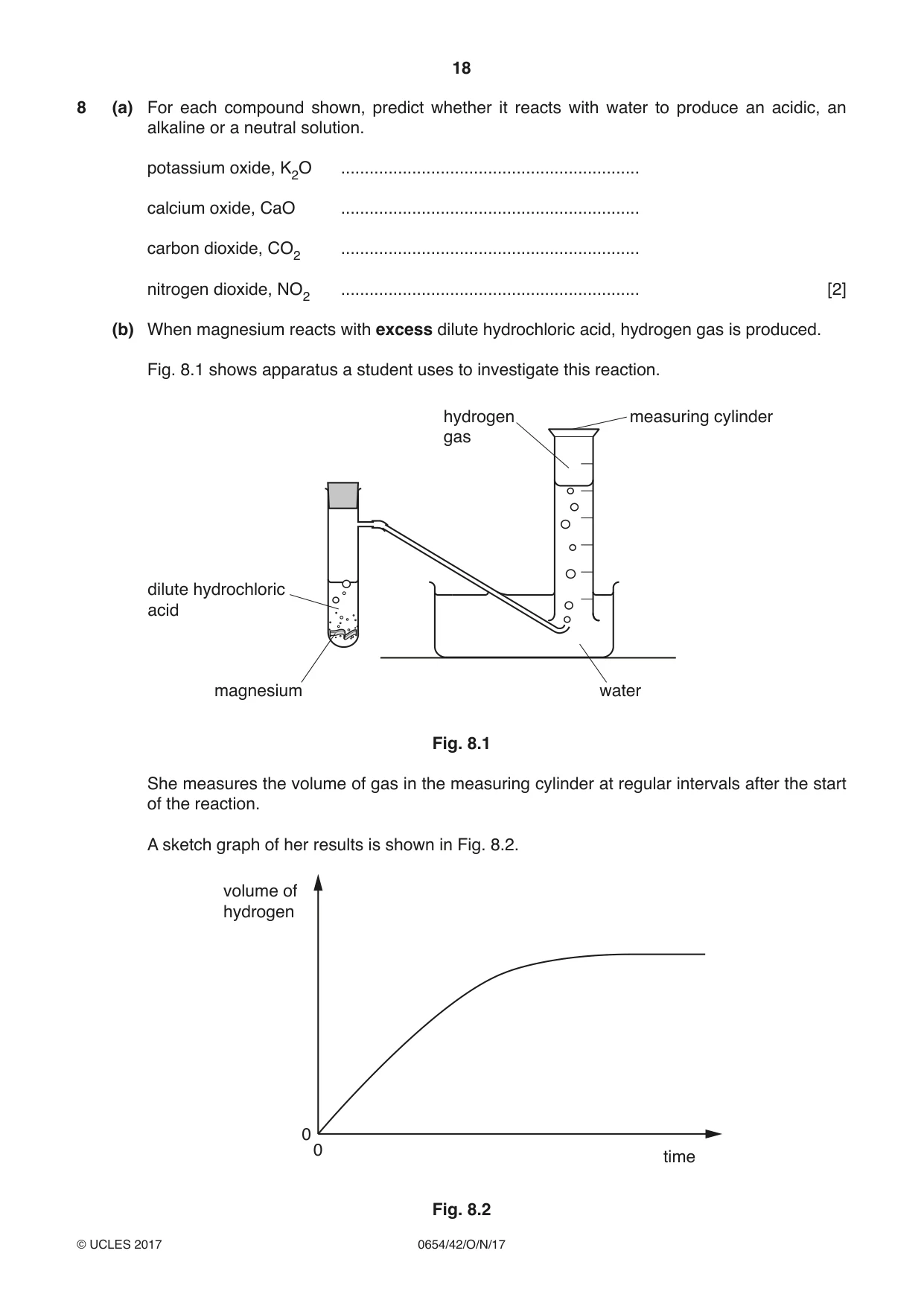
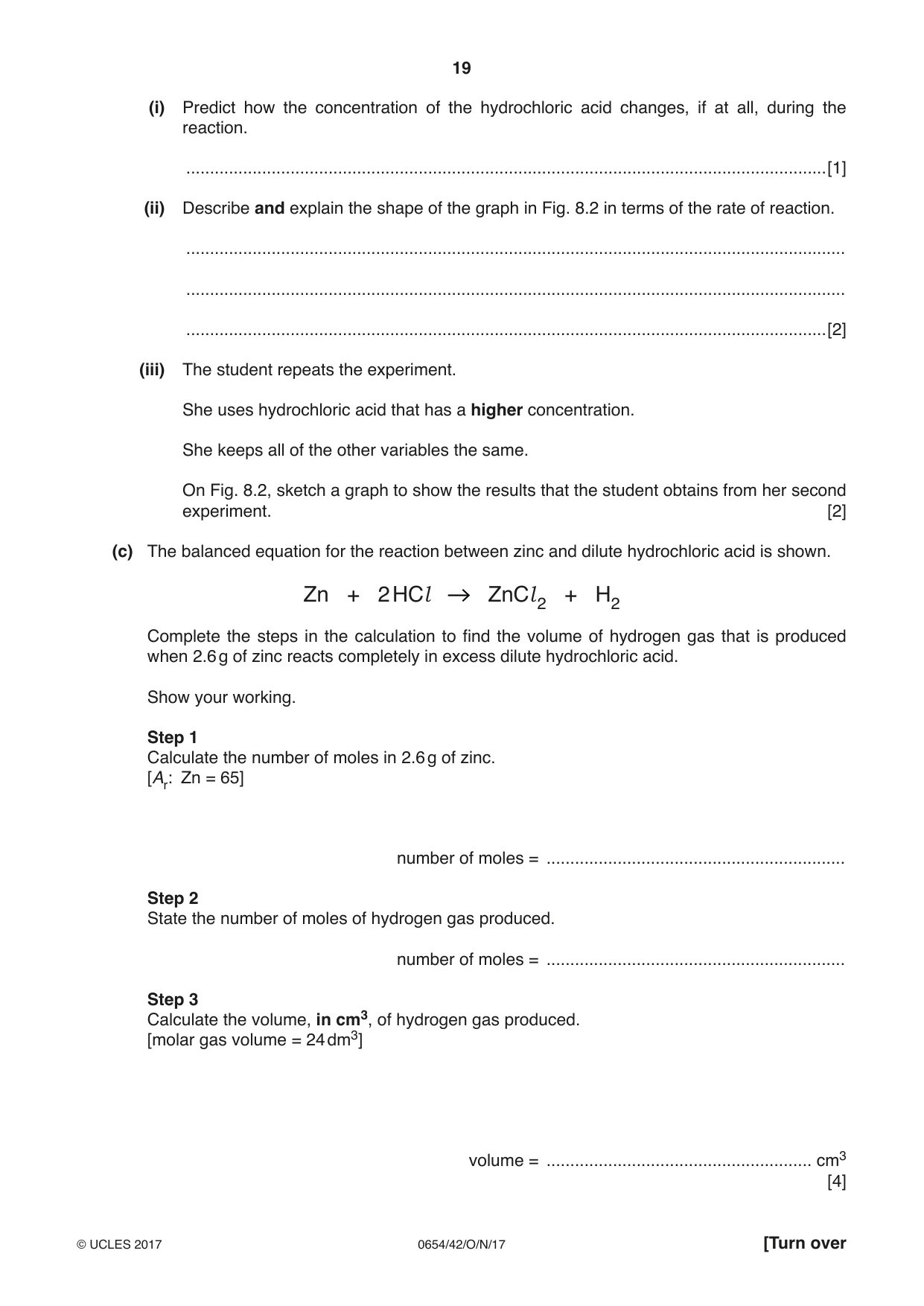
8 (a) For each compound shown, predict whether it reacts with water to produce an acidic, an alkaline or a neutral solution. potassium oxide, K2O ............................................................... calcium oxide, CaO ............................................................... carbon dioxide, CO2 ............................................................... nitrogen dioxide, NO2 ............................................................... [2] (b) When magnesium reacts with excess dilute hydrochloric acid, hydrogen gas is produced. Fig. 8.1 shows apparatus a student uses to investigate this reaction. hydrogen measuring cylinder gas dilute hydrochloric acid magnesium water Fig. 8.1 She measures the volume of gas in the measuring cylinder at regular intervals after the start of the reaction. A sketch graph of her results is shown in Fig. 8.2. volume of hydrogen 0 0 time Fig. 8.2 (i) Predict how the concentration of the hydrochloric acid changes, if at all, during the reaction. .......................................................................................................................................[1] (ii) Describe and explain the shape of the graph in Fig. 8.2 in terms of the rate of reaction. ........................................................................................................................................... ........................................................................................................................................... .......................................................................................................................................[2] (iii) The student repeats the experiment. She uses hydrochloric acid that has a higher concentration. She keeps all of the other variables the same. On Fig. 8.2, sketch a graph to show the results that the student obtains from her second experiment. [2] (c) The balanced equation for the reaction between zinc and dilute hydrochloric acid is shown. Zn + 2 HCl ZnCl + 2 H2 Complete the steps in the calculation to find the volume of hydrogen gas that is produced when 2.6 g of zinc reacts completely in excess dilute hydrochloric acid. Show your working. Step 1 Calculate the number of moles in 2.6 g of zinc. [Ar: Zn = 65] number of moles = ............................................................... Step 2 State the number of moles of hydrogen gas produced. number of moles = ............................................................... Step 3 Calculate the volume, in cm3, of hydrogen gas produced. [molar gas volume = 24 dm3] volume = ........................................................ cm3 [4]
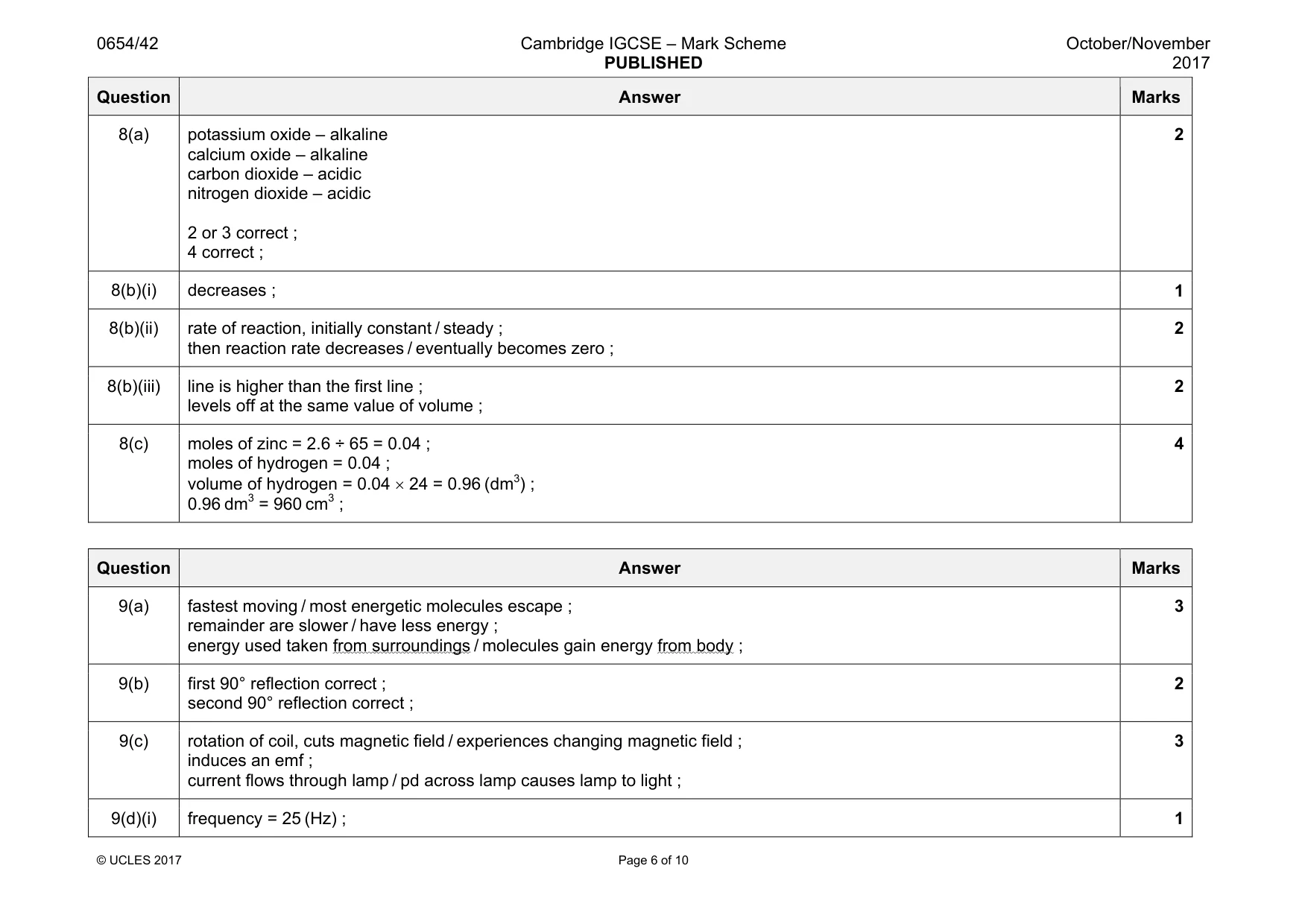
Mark scheme: 8(a) potassium oxide – alkaline calcium oxide – alkaline carbon dioxide – acidic nitrogen dioxide – acidic 2 or 3 correct ; 4 correct ; 2 8(b)(i) decreases ; 1 8(b)(ii) rate of reaction, initially constant / steady ; then reaction rate decreases / eventually becomes zero ; 2 8(b)(iii) line is higher than the first line ; levels off at the same value of volume ; 2 8(c) moles of zinc = 2.6 ÷ 65 = 0.04 ; moles of hydrogen = 0.04 ; volume of hydrogen = 0.04 × 24 = 0.96 (dm3) ; 0.96 dm3 = 960 cm3 ; 4
Q9 · A boy riding his bicycle is cooled by sweating
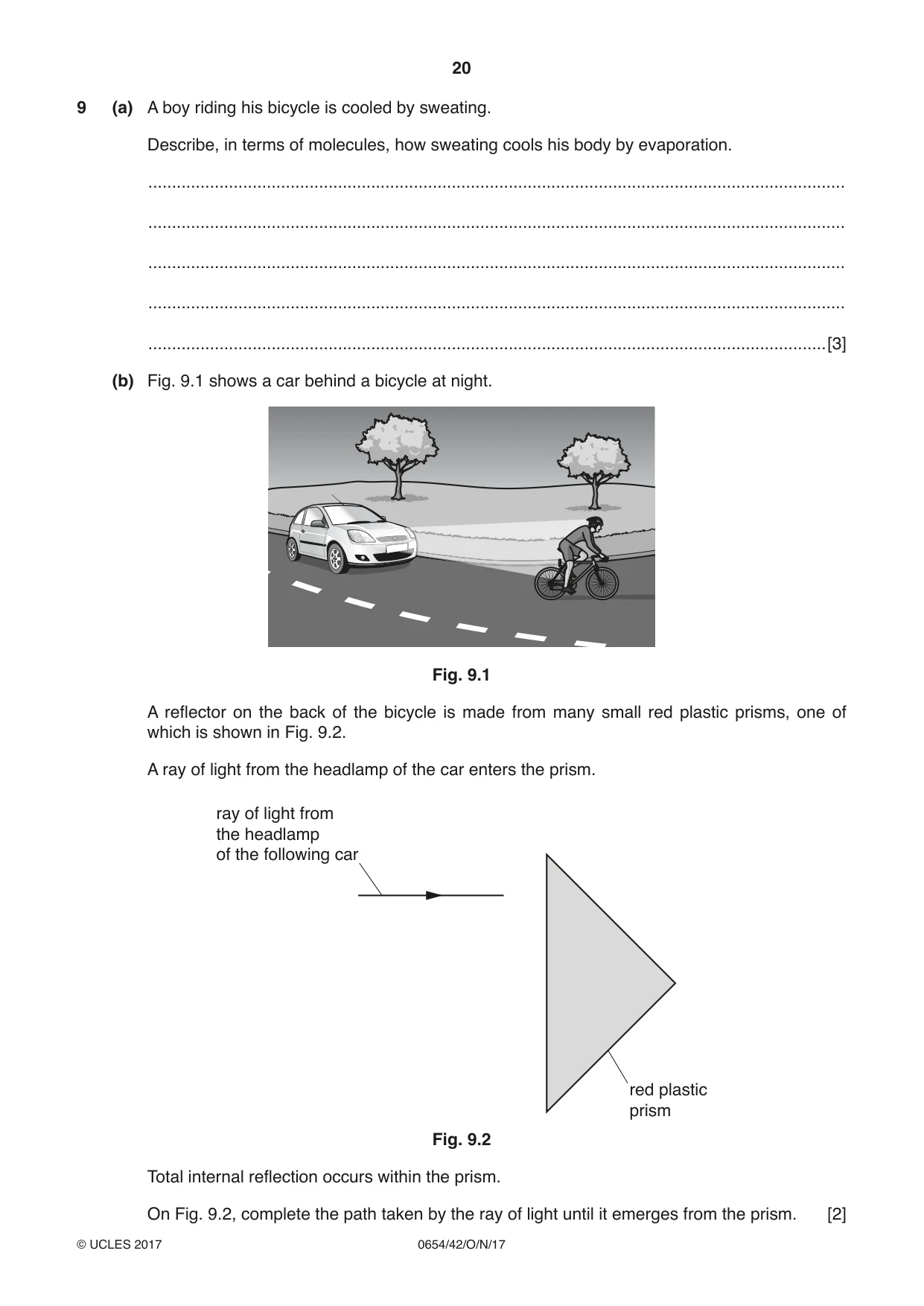
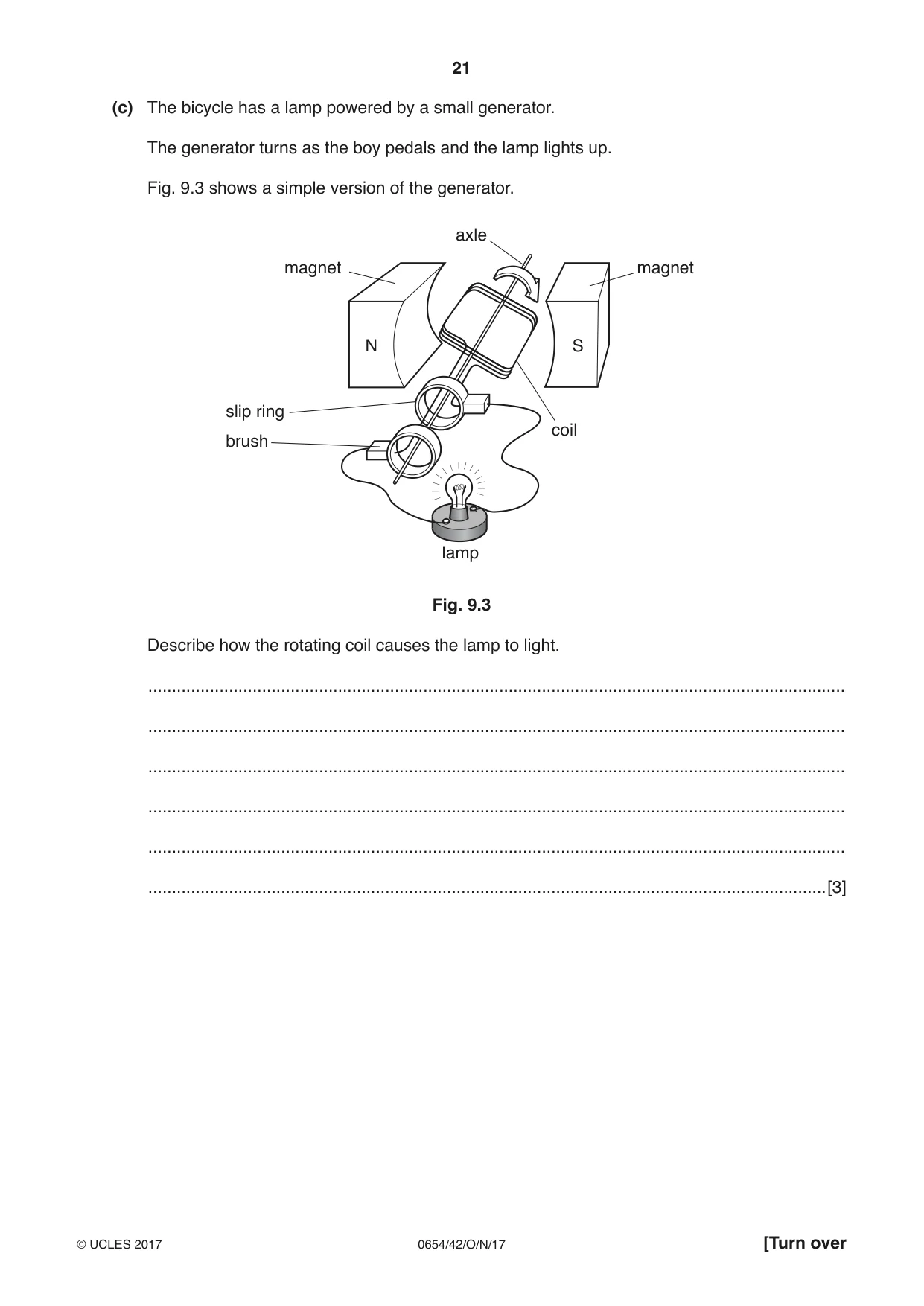
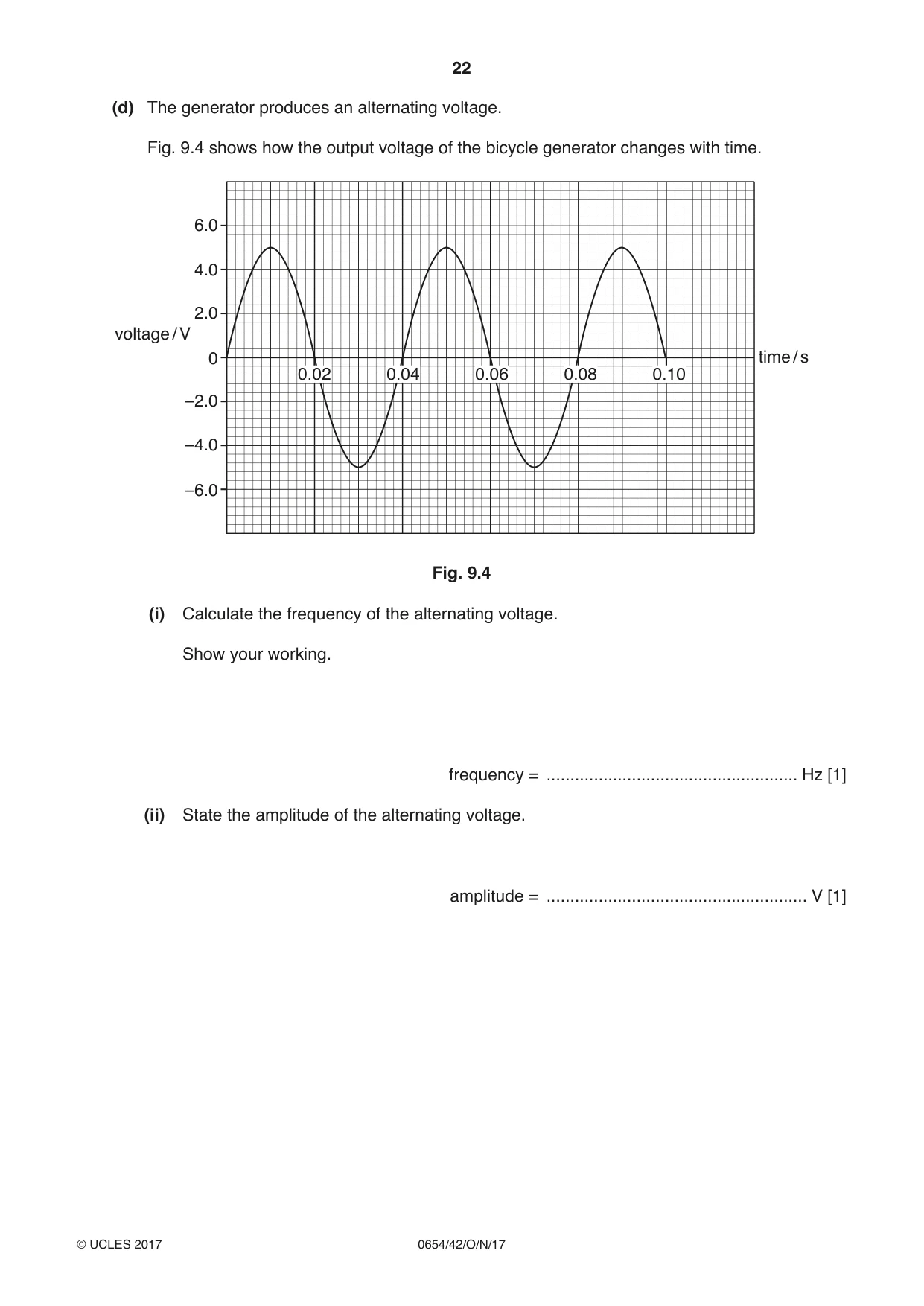
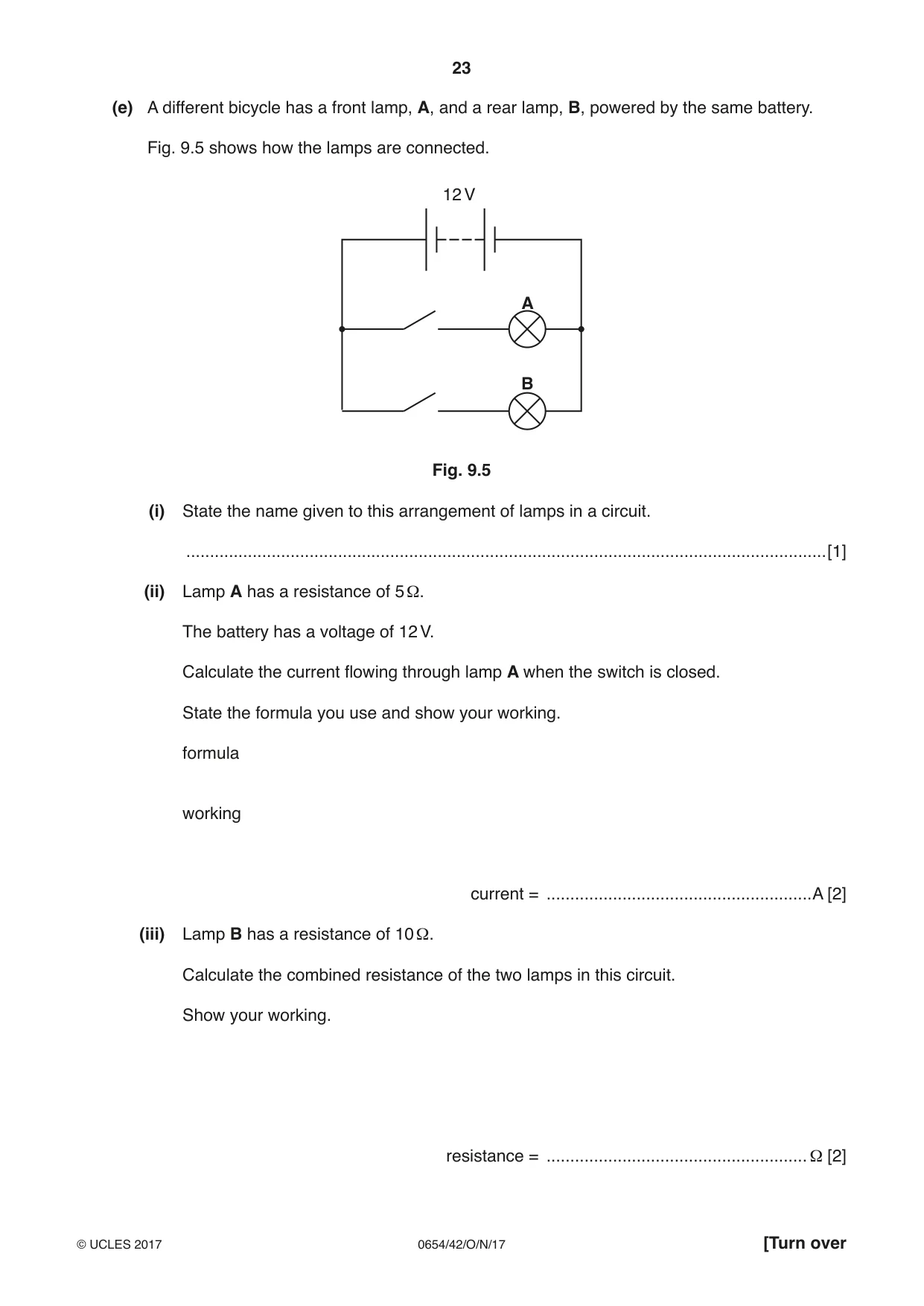
9 (a) A boy riding his bicycle is cooled by sweating. Describe, in terms of molecules, how sweating cools his body by evaporation. ................................................................................................................................................... ................................................................................................................................................... ................................................................................................................................................... ................................................................................................................................................... ...............................................................................................................................................[3] (b) Fig. 9.1 shows a car behind a bicycle at night. Fig. 9.1 A reflector on the back of the bicycle is made from many small red plastic prisms, one of which is shown in Fig. 9.2. A ray of light from the headlamp of the car enters the prism. ray of light from the headlamp of the following car red plastic prism Fig. 9.2 Total internal reflection occurs within the prism. On Fig. 9.2, complete the path taken by the ray of light until it emerges from the prism. [2] (c) The bicycle has a lamp powered by a small generator. The generator turns as the boy pedals and the lamp lights up. Fig. 9.3 shows a simple version of the generator. axle magnet magnet N S slip ring coil brush lamp Fig. 9.3 Describe how the rotating coil causes the lamp to light. ................................................................................................................................................... ................................................................................................................................................... ................................................................................................................................................... ................................................................................................................................................... ................................................................................................................................................... ...............................................................................................................................................[3] (d) The generator produces an alternating voltage. Fig. 9.4 shows how the output voltage of the bicycle generator changes with time. 6.0 4.0 2.0 voltage / V 0 time / s 0.02 0.04 0.06 0.08 0.10 –2.0 –4.0 –6.0 Fig. 9.4 (i) Calculate the frequency of the alternating voltage. Show your working. frequency = ..................................................... Hz [1] (ii) State the amplitude of the alternating voltage. amplitude = ....................................................... V [1] (e) A different bicycle has a front lamp, A, and a rear lamp, B, powered by the same battery. Fig. 9.5 shows how the lamps are connected. 12 V A B Fig. 9.5 (i) State the name given to this arrangement of lamps in a circuit. .......................................................................................................................................[1] (ii) Lamp A has a resistance of 5 Ω. The battery has a voltage of 12 V. Calculate the current flowing through lamp A when the switch is closed. State the formula you use and show your working. formula working current = ........................................................A [2] (iii) Lamp B has a resistance of 10 Ω. Calculate the combined resistance of the two lamps in this circuit. Show your working. resistance = .......................................................Ω [2]
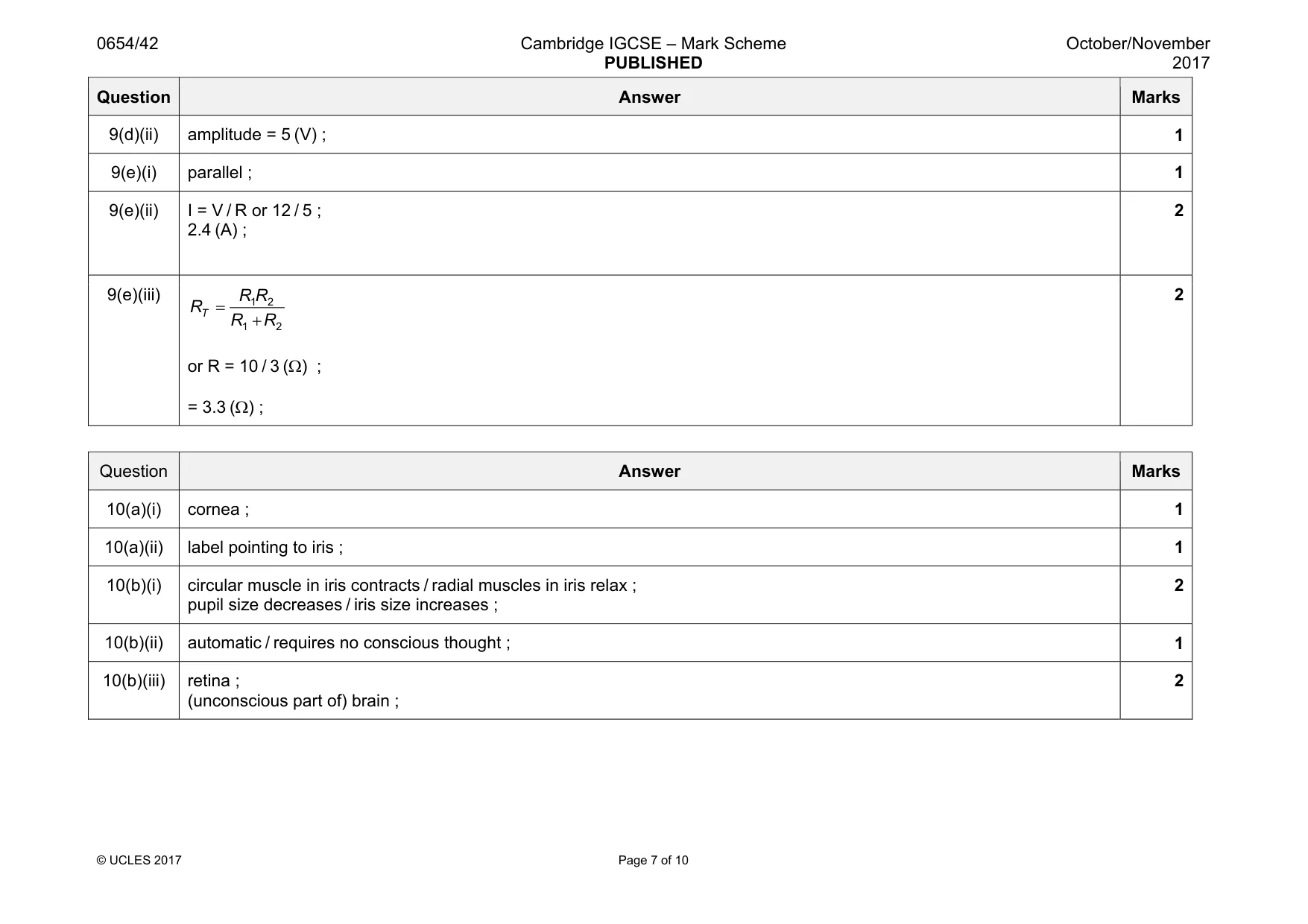
Mark scheme: 9(a) fastest moving / most energetic molecules escape ; remainder are slower / have less energy ; energy used taken from surroundings / molecules gain energy from body ; 3 9(b) first 90° reflection correct ; second 90° reflection correct ; 2 9(c) rotation of coil, cuts magnetic field / experiences changing magnetic field ; induces an emf ; current flows through lamp / pd across lamp causes lamp to light ; 3 9(d)(i) frequency = 25 (Hz) ; 1 Question Answer Marks 9(d)(ii) amplitude = 5 (V) ; 1 9(e)(i) parallel ; 1 9(e)(ii) I = V / R or 12 / 5 ; 2.4 (A) ; 2 9(e)(iii) 1 2 1 2 T R R R R R = + or R = 10 / 3 (Ω) ; = 3.3 (Ω) ; 2
Q10 · A diagram of a human eye
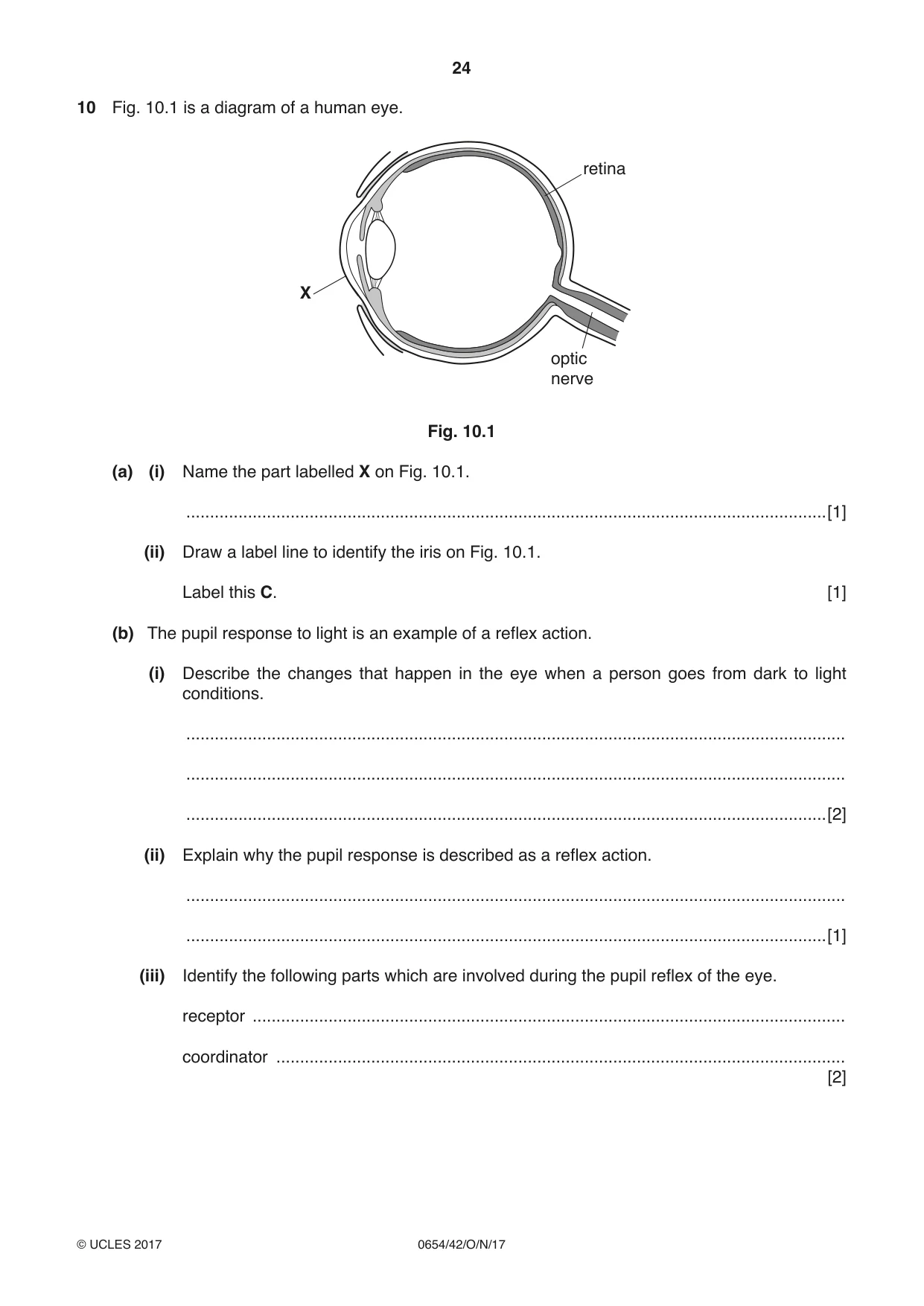
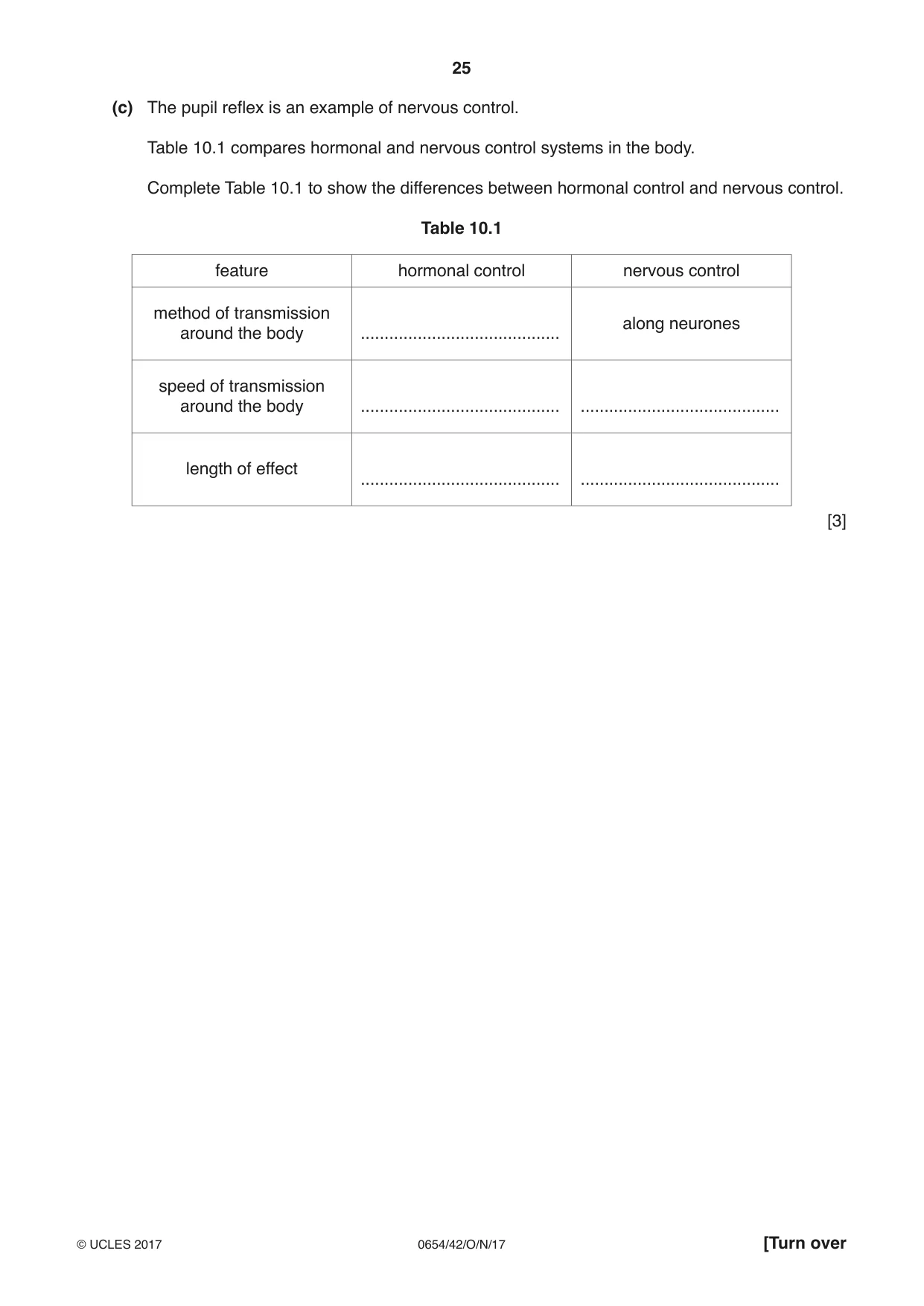
10 Fig. 10.1 is a diagram of a human eye. retina X optic nerve Fig. 10.1 (a) (i) Name the part labelled X on Fig. 10.1. .......................................................................................................................................[1] (ii) Draw a label line to identify the iris on Fig. 10.1. Label this C. [1] (b) The pupil response to light is an example of a reflex action. (i) Describe the changes that happen in the eye when a person goes from dark to light conditions. ........................................................................................................................................... ........................................................................................................................................... .......................................................................................................................................[2] (ii) Explain why the pupil response is described as a reflex action. ........................................................................................................................................... .......................................................................................................................................[1] (iii) Identify the following parts which are involved during the pupil reflex of the eye. receptor ............................................................................................................................. coordinator ........................................................................................................................ [2] (c) The pupil reflex is an example of nervous control. Table 10.1 compares hormonal and nervous control systems in the body. Complete Table 10.1 to show the differences between hormonal control and nervous control. Table 10.1 feature hormonal control nervous control method of transmission along neurones around the body .......................................... speed of transmission around the body .......................................... .......................................... length of effect .......................................... .......................................... [3]
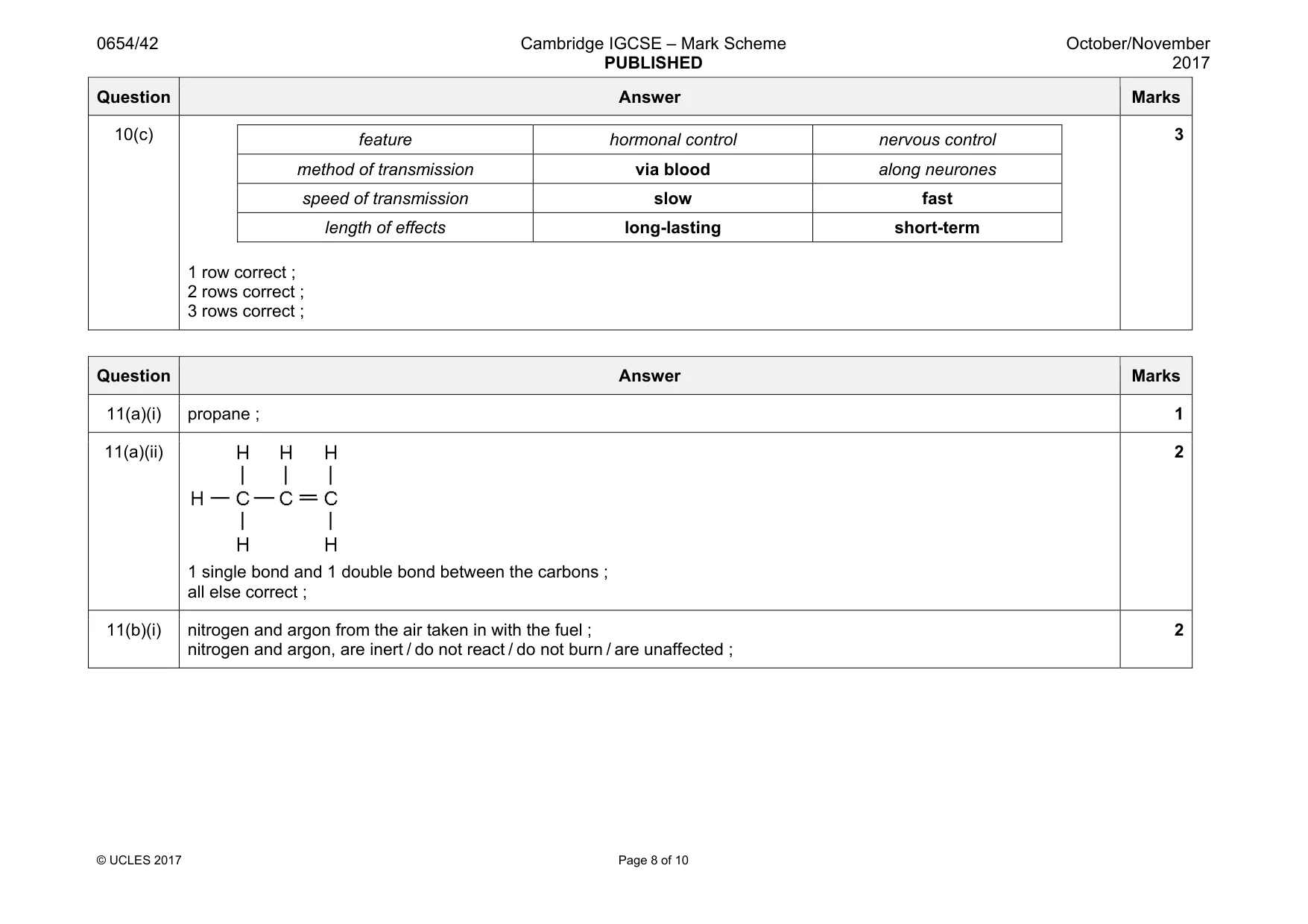
Mark scheme: 10(a)(i) cornea ; 1 10(a)(ii) label pointing to iris ; 1 10(b)(i) circular muscle in iris contracts / radial muscles in iris relax ; pupil size decreases / iris size increases ; 2 10(b)(ii) automatic / requires no conscious thought ; 1 10(b)(iii) retina ; (unconscious part of) brain ; 2 Question Answer Marks 10(c) feature hormonal control nervous control method of transmission via blood along neurones speed of transmission slow fast length of effects long-lasting short-term 1 row correct ; 2 rows correct ; 3 rows correct ; 3
Q11 · The structure of a molecule of an alkane
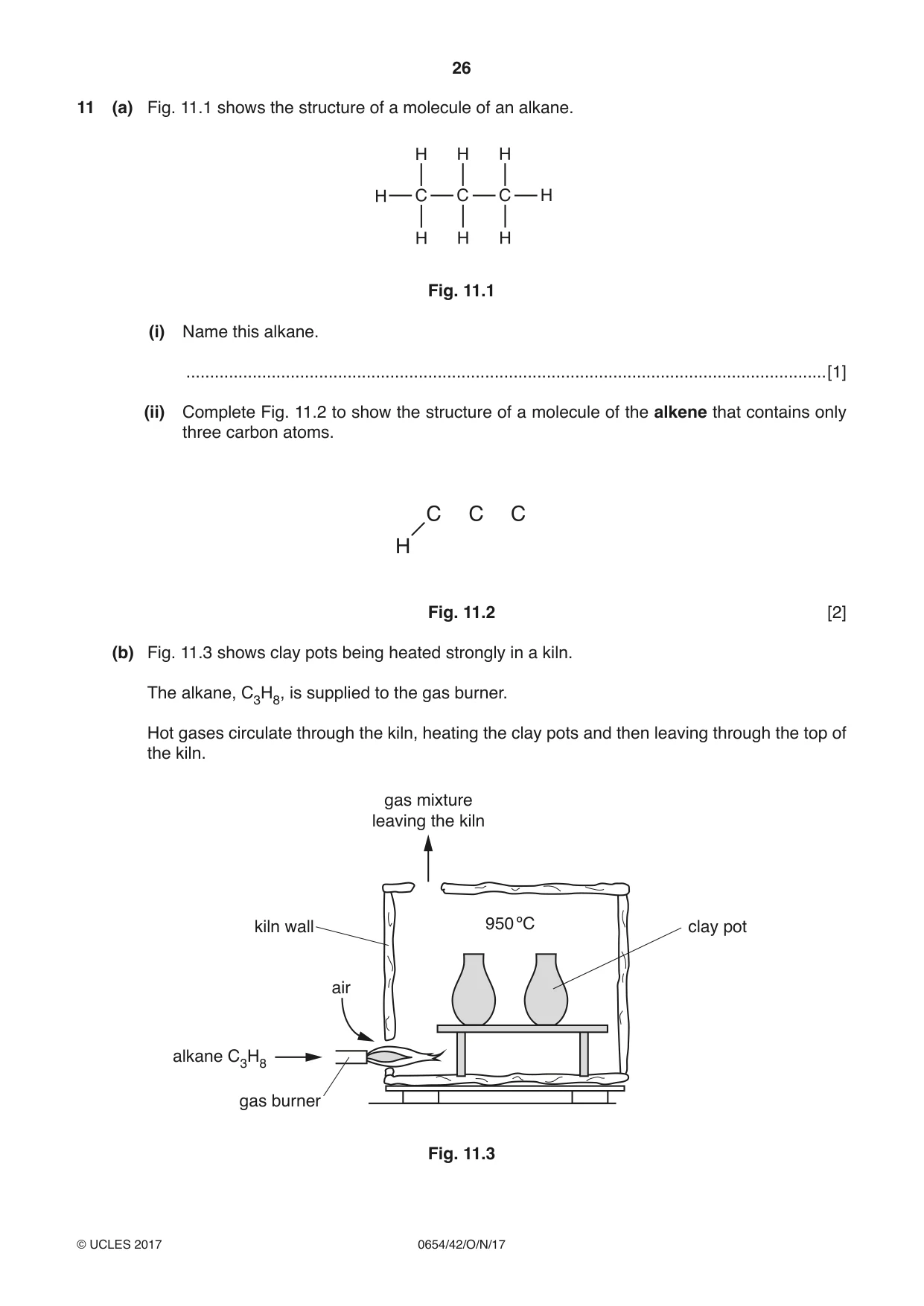
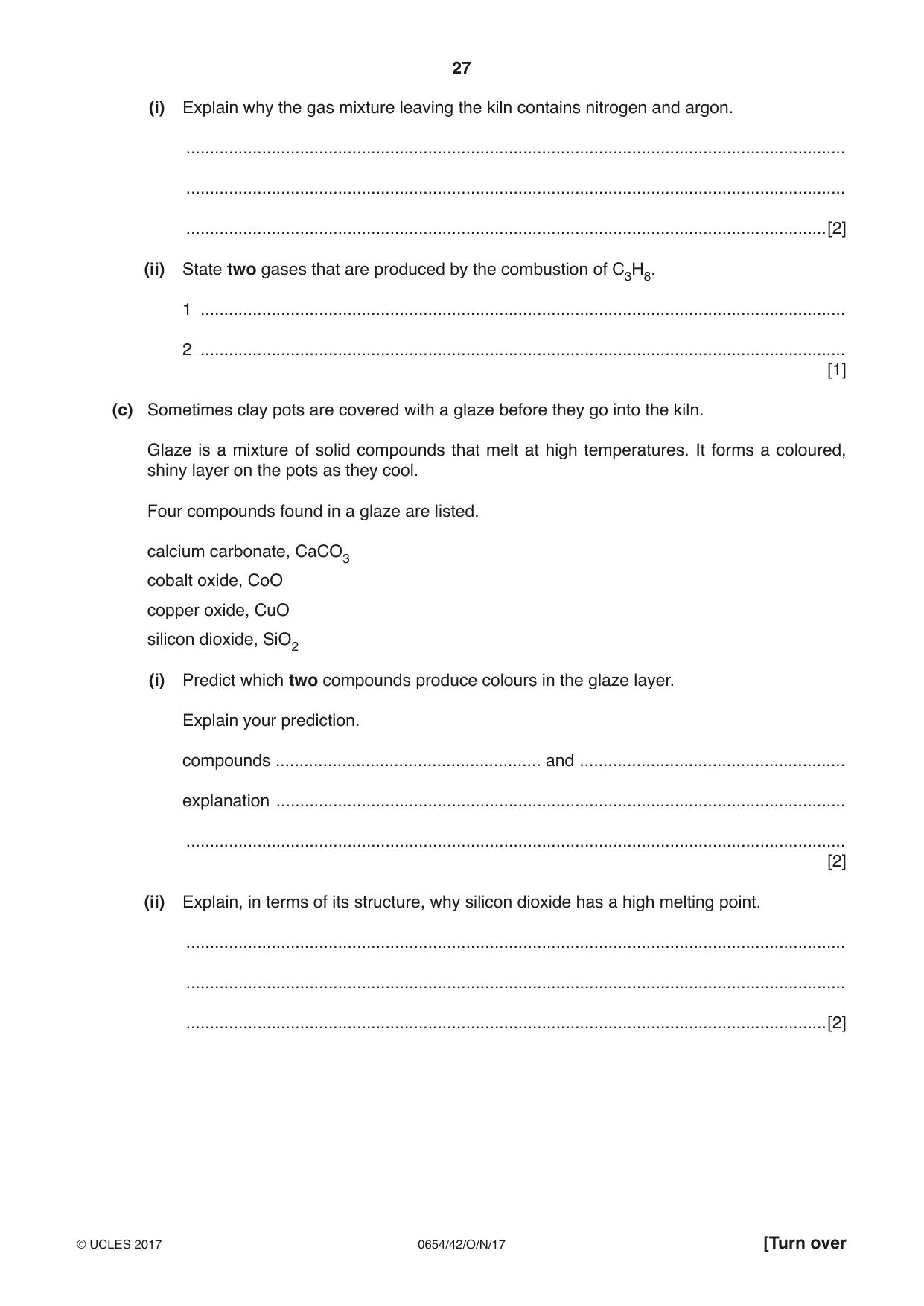
11 (a) Fig. 11.1 shows the structure of a molecule of an alkane. H H H H C C C H H H H Fig. 11.1 (i) Name this alkane. .......................................................................................................................................[1] (ii) Complete Fig. 11.2 to show the structure of a molecule of the alkene that contains only three carbon atoms. C C C H Fig. 11.2 [2] (b) Fig. 11.3 shows clay pots being heated strongly in a kiln. The alkane, C3H8, is supplied to the gas burner. Hot gases circulate through the kiln, heating the clay pots and then leaving through the top of the kiln. gas mixture leaving the kiln kiln wall 950 ºC clay pot air alkane C3H8 gas burner Fig. 11.3 (i) Explain why the gas mixture leaving the kiln contains nitrogen and argon. ........................................................................................................................................... ........................................................................................................................................... .......................................................................................................................................[2] (ii) State two gases that are produced by the combustion of C3H8. 1 ........................................................................................................................................ 2 ........................................................................................................................................ [1] (c) Sometimes clay pots are covered with a glaze before they go into the kiln. Glaze is a mixture of solid compounds that melt at high temperatures. It forms a coloured, shiny layer on the pots as they cool. Four compounds found in a glaze are listed. calcium carbonate, CaCO3 cobalt oxide, CoO copper oxide, CuO silicon dioxide, SiO2 (i) Predict which two compounds produce colours in the glaze layer. Explain your prediction. compounds ........................................................ and ........................................................ explanation ........................................................................................................................ ........................................................................................................................................... [2] (ii) Explain, in terms of its structure, why silicon dioxide has a high melting point. ........................................................................................................................................... ........................................................................................................................................... .......................................................................................................................................[2]
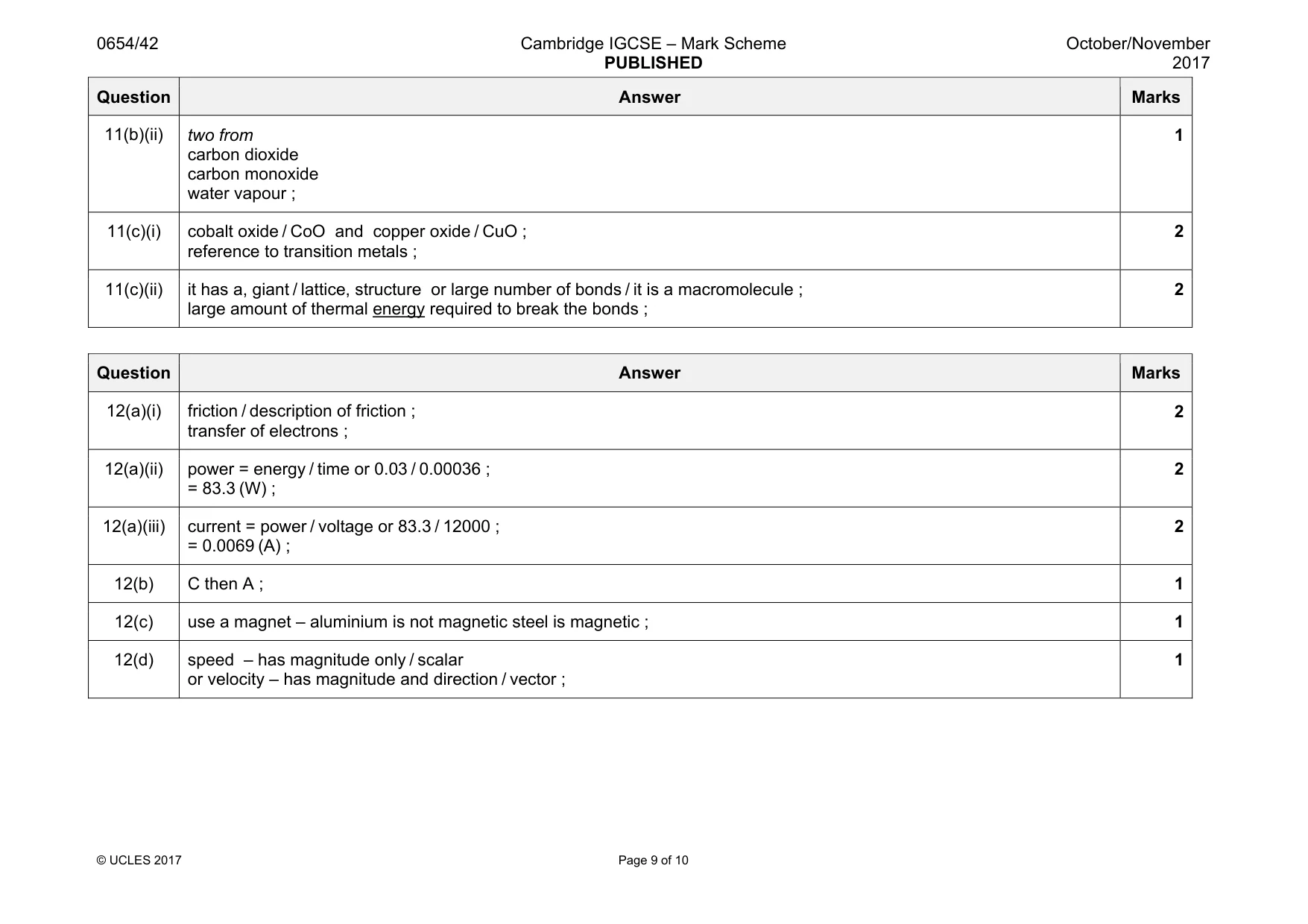
Mark scheme: 11(a)(i) propane ; 1 11(a)(ii) 1 single bond and 1 double bond between the carbons ; all else correct ; 2 11(b)(i) nitrogen and argon from the air taken in with the fuel ; nitrogen and argon, are inert / do not react / do not burn / are unaffected ; 2 Question Answer Marks 11(b)(ii) two from carbon dioxide carbon monoxide water vapour ; 1 11(c)(i) cobalt oxide / CoO and copper oxide / CuO ; reference to transition metals ; 2 11(c)(ii) it has a, giant / lattice, structure or large number of bonds / it is a macromolecule ; large amount of thermal energy required to break the bonds ; 2
Q12 · During car journeys, a car will often become electrostatically charged
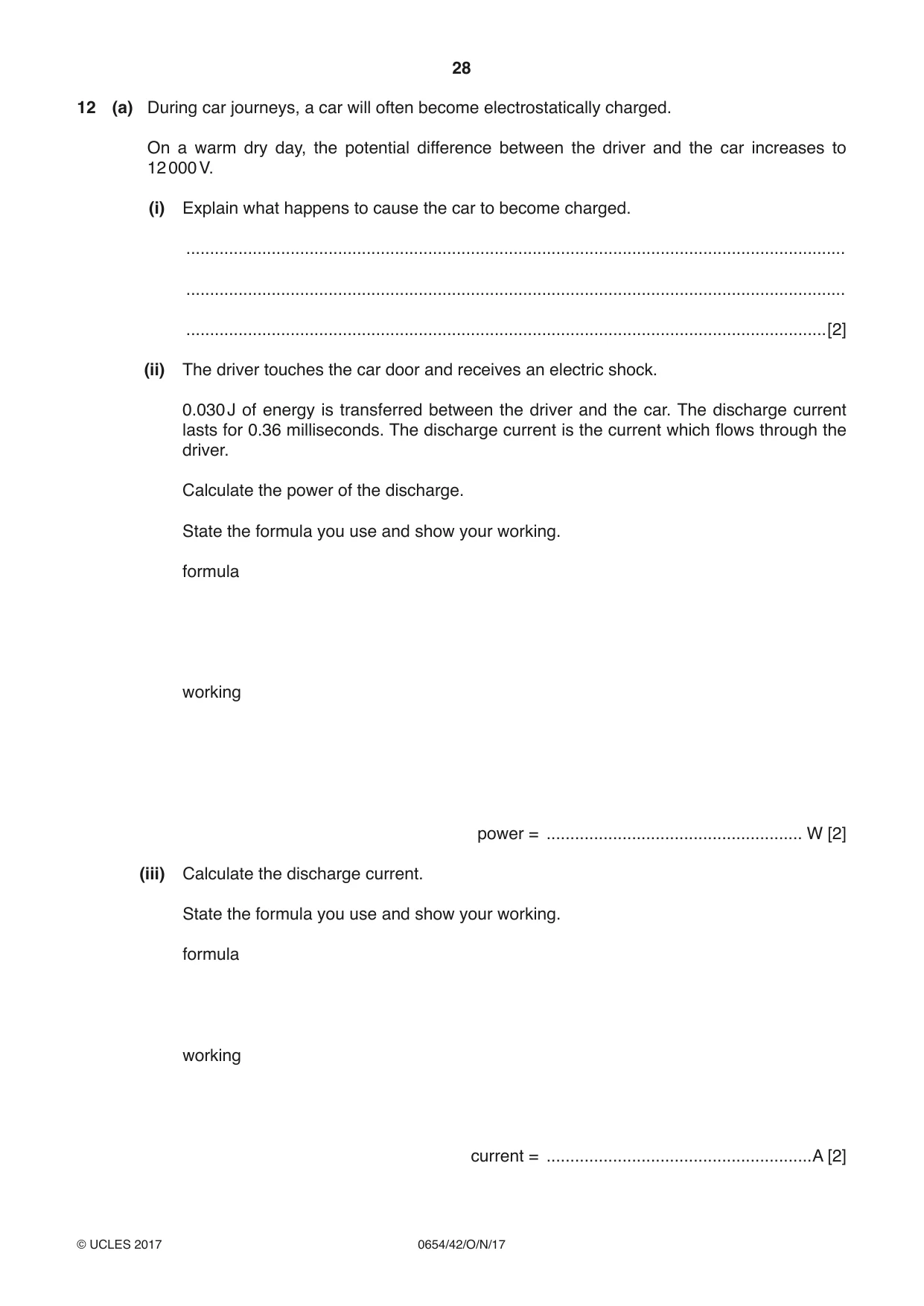
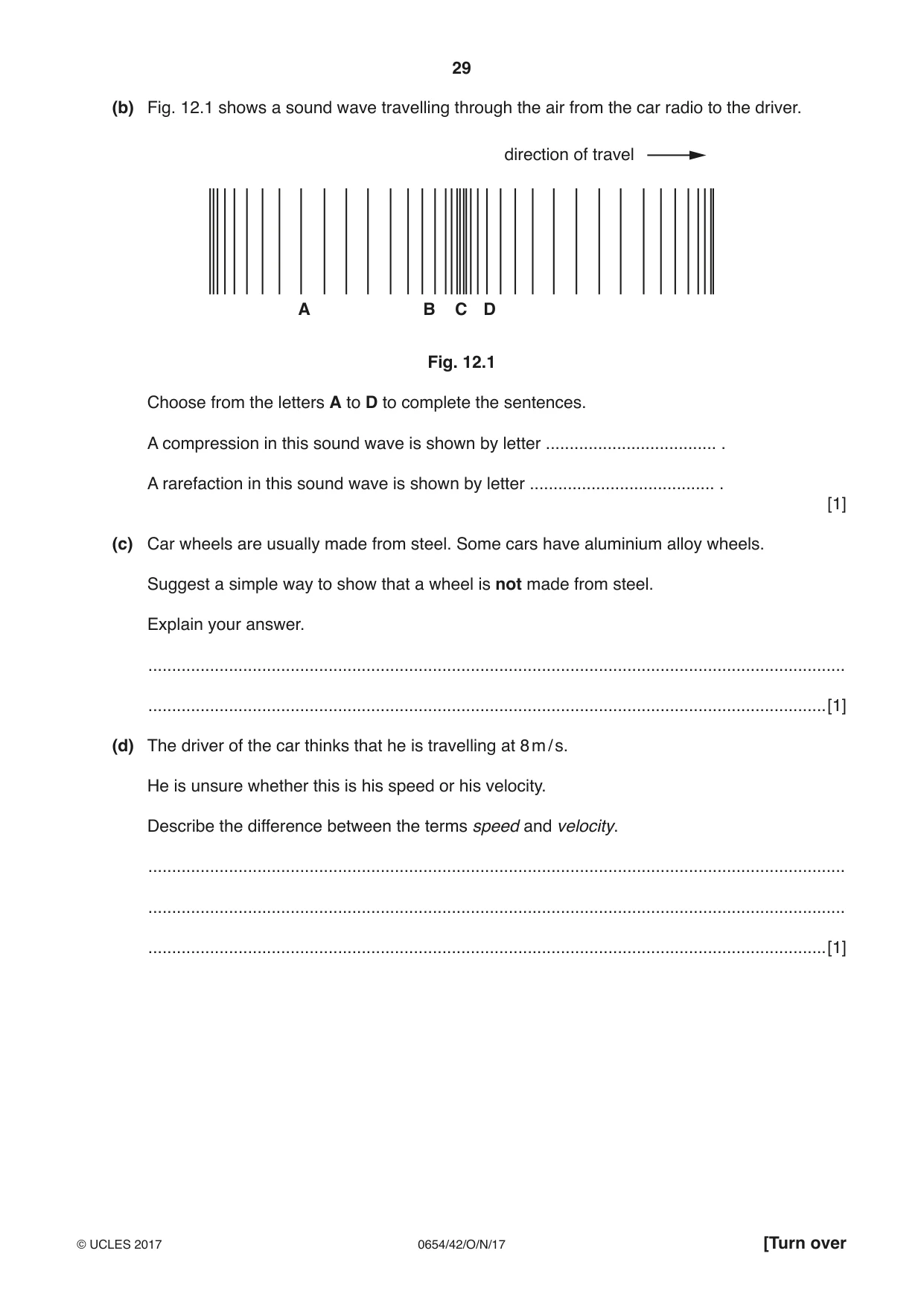
12 (a) During car journeys, a car will often become electrostatically charged. On a warm dry day, the potential difference between the driver and the car increases to 12 000 V. (i) Explain what happens to cause the car to become charged. ........................................................................................................................................... ........................................................................................................................................... .......................................................................................................................................[2] (ii) The driver touches the car door and receives an electric shock. 0.030 J of energy is transferred between the driver and the car. The discharge current lasts for 0.36 milliseconds. The discharge current is the current which flows through the driver. Calculate the power of the discharge. State the formula you use and show your working. formula working power = ...................................................... W [2] (iii) Calculate the discharge current. State the formula you use and show your working. formula working current = ........................................................A [2] (b) Fig. 12.1 shows a sound wave travelling through the air from the car radio to the driver. direction of travel A B C D Fig. 12.1 Choose from the letters A to D to complete the sentences. A compression in this sound wave is shown by letter .................................... . A rarefaction in this sound wave is shown by letter ....................................... . [1] (c) Car wheels are usually made from steel. Some cars have aluminium alloy wheels. Suggest a simple way to show that a wheel is not made from steel. Explain your answer. ................................................................................................................................................... ...............................................................................................................................................[1] (d) The driver of the car thinks that he is travelling at 8 m / s. He is unsure whether this is his speed or his velocity. Describe the difference between the terms speed and velocity. ................................................................................................................................................... ................................................................................................................................................... ...............................................................................................................................................[1]
Mark scheme: 12(a)(i) friction / description of friction ; transfer of electrons ; 2 12(a)(ii) power = energy / time or 0.03 / 0.00036 ; = 83.3 (W) ; 2 12(a)(iii) current = power / voltage or 83.3 / 12000 ; = 0.0069 (A) ; 2 12(b) C then A ; 1 12(c) use a magnet – aluminium is not magnetic steel is magnetic ; 1 12(d) speed – has magnitude only / scalar or velocity – has magnitude and direction / vector ; 1
Q13 · A simplified diagram of the carbon cycle
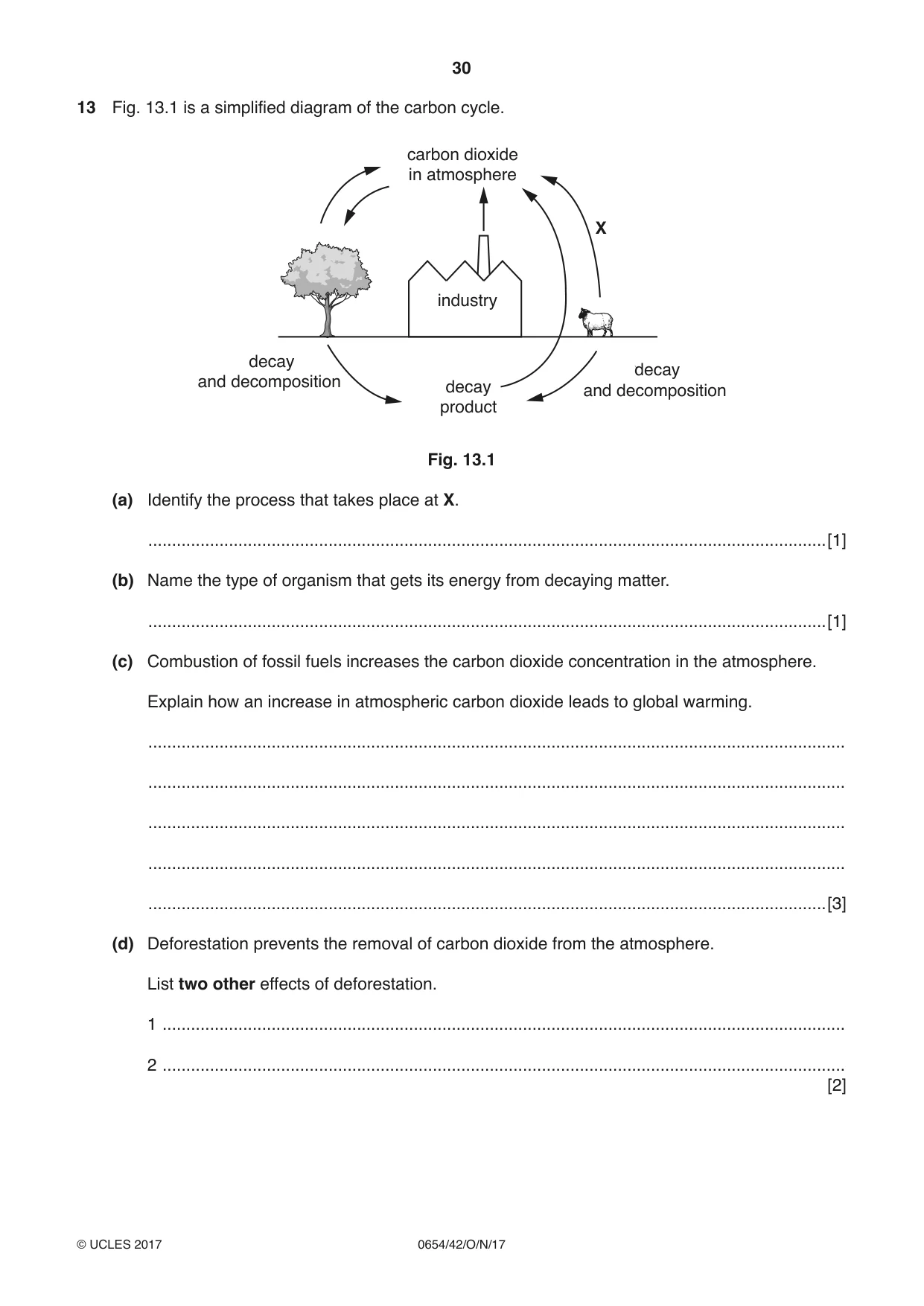
13 Fig. 13.1 is a simplified diagram of the carbon cycle. carbon dioxide in atmosphere X industry decay decay and decomposition decay and decomposition product Fig. 13.1 (a) Identify the process that takes place at X. ...............................................................................................................................................[1] (b) Name the type of organism that gets its energy from decaying matter. ...............................................................................................................................................[1] (c) Combustion of fossil fuels increases the carbon dioxide concentration in the atmosphere. Explain how an increase in atmospheric carbon dioxide leads to global warming. ................................................................................................................................................... ................................................................................................................................................... ................................................................................................................................................... ................................................................................................................................................... ...............................................................................................................................................[3] (d) Deforestation prevents the removal of carbon dioxide from the atmosphere. List two other effects of deforestation. 1 ................................................................................................................................................ 2 ................................................................................................................................................ [2]
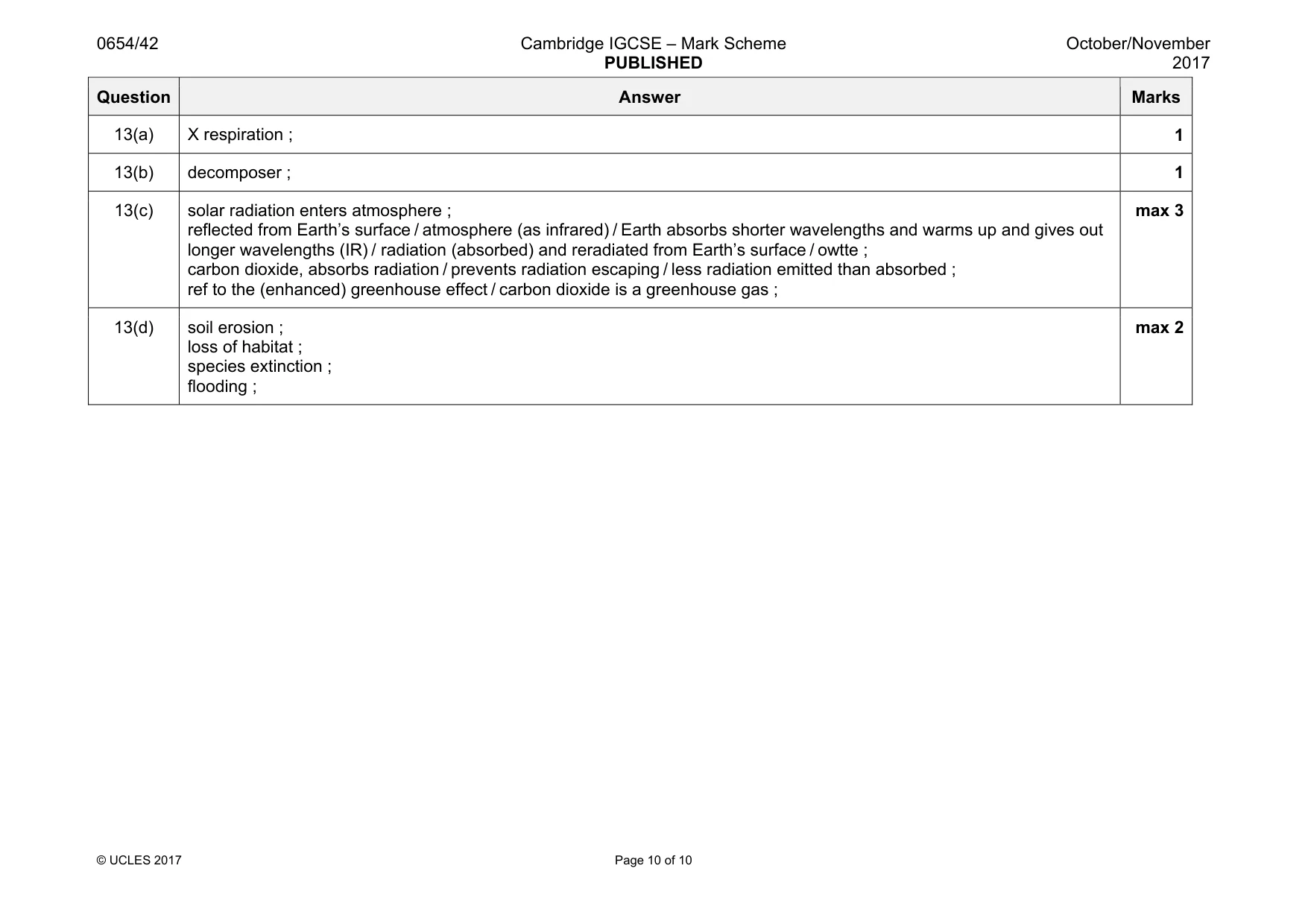
Mark scheme: 13(a) X respiration ; 1 13(b) decomposer ; 1 13(c) solar radiation enters atmosphere ; reflected from Earth’s surface / atmosphere (as infrared) / Earth absorbs shorter wavelengths and warms up and gives out longer wavelengths (IR) / radiation (absorbed) and reradiated from Earth’s surface / owtte ; carbon dioxide, absorbs radiation / prevents radiation escaping / less radiation emitted than absorbed ; ref to the (enhanced) greenhouse effect / carbon dioxide is a greenhouse gas ; max 3 13(d) soil erosion ; loss of habitat ; species extinction ; flooding ; max 2
What was in this paper
The subtopics covered by these 13 questions, and how many questions each got. Open one in a new tab to see every Cambridge question on it.
What you needed in this session
Cambridge’s own grade thresholds for 2017 Oct/Nov, Paper 4 · Variant 2. A higher threshold means an easier paper — the bar moves with how the cohort did.