Cambridge IGCSE Sciences - Co-ordinated (Double) 0654 — 2021 Feb/March Paper 4 · Variant 2
0654/42/F/M/21 · 12 questions · 120 marks · ≈135 min
The question paper and its mark scheme, free to read here and free to download. This is Cambridge’s own paper, exactly as it was sat.
Question paper28 pages

Mark scheme13 pages
Answers below. Sit the paper first if you are practising.
Questions as text
Q1 · State the balanced equation for photosynthesis
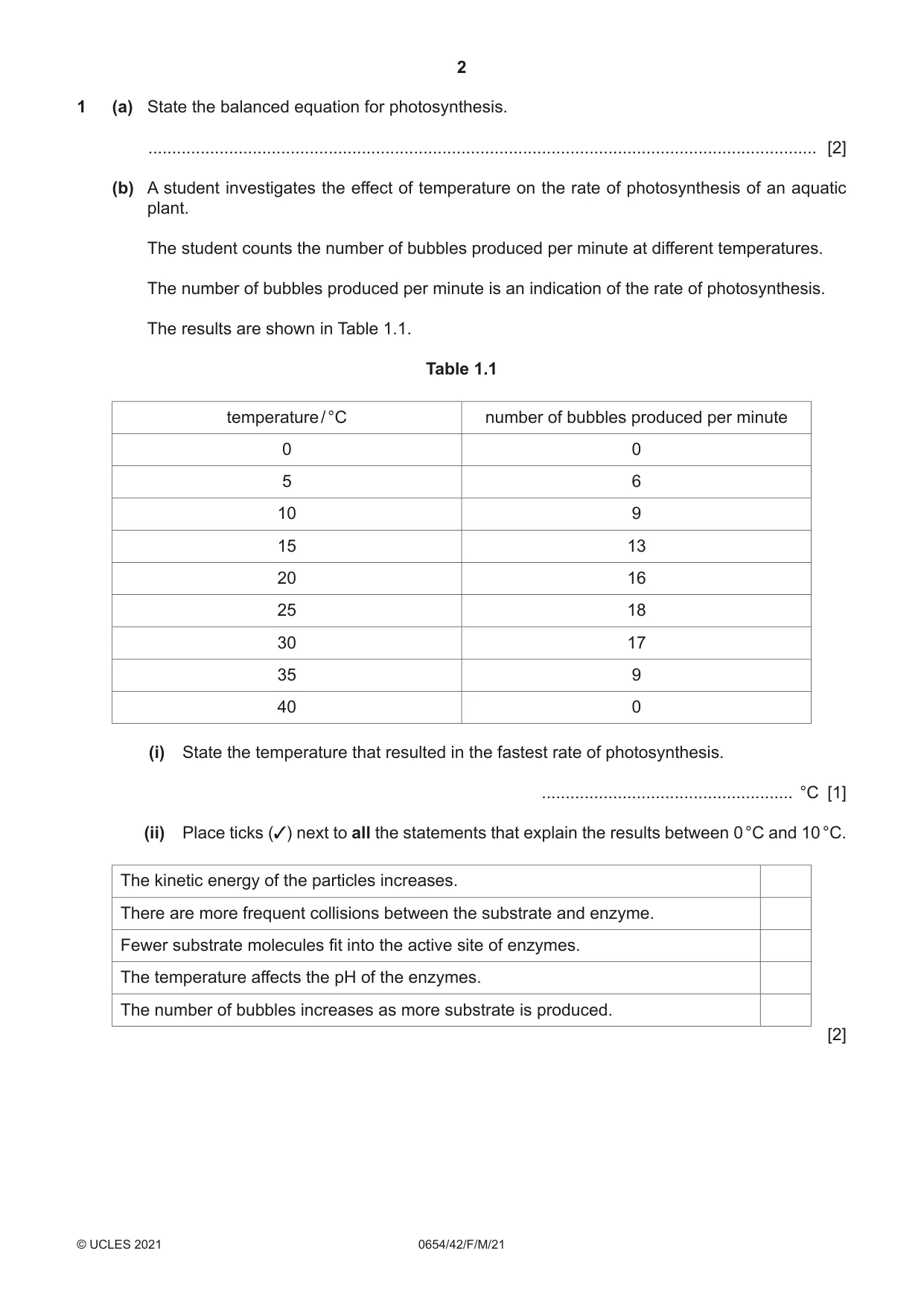
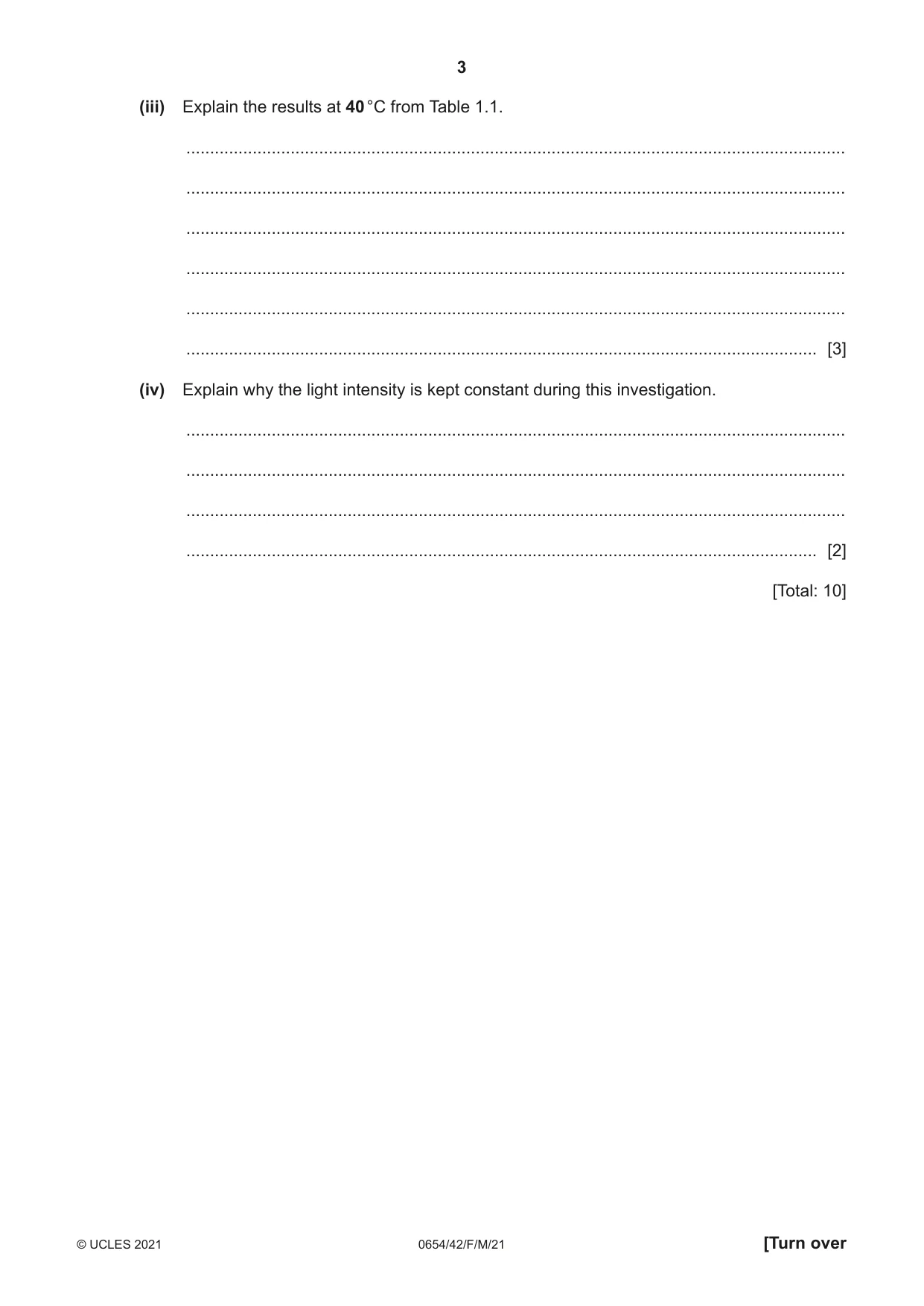
1 (a) State the balanced equation for photosynthesis. ............................................................................................................................................. [2] (b) A student investigates the effect of temperature on the rate of photosynthesis of an aquatic plant. The student counts the number of bubbles produced per minute at different temperatures. The number of bubbles produced per minute is an indication of the rate of photosynthesis. The results are shown in Table 1.1. Table 1.1 temperature / °C number of bubbles produced per minute 0 0 5 6 10 9 15 13 20 16 25 18 30 17 35 9 40 0 (i) State the temperature that resulted in the fastest rate of photosynthesis. ..................................................... °C [1] (ii) Place ticks (3) next to all the statements that explain the results between 0 °C and 10 °C. The kinetic energy of the particles increases. There are more frequent collisions between the substrate and enzyme. Fewer substrate molecules fit into the active site of enzymes. The temperature affects the pH of the enzymes. The number of bubbles increases as more substrate is produced. [2] (iii) Explain the results at 40 °C from Table 1.1. ........................................................................................................................................... ........................................................................................................................................... ........................................................................................................................................... ........................................................................................................................................... ........................................................................................................................................... ..................................................................................................................................... [3] (iv) Explain why the light intensity is kept constant during this investigation. ........................................................................................................................................... ........................................................................................................................................... ........................................................................................................................................... ..................................................................................................................................... [2] [Total: 10]
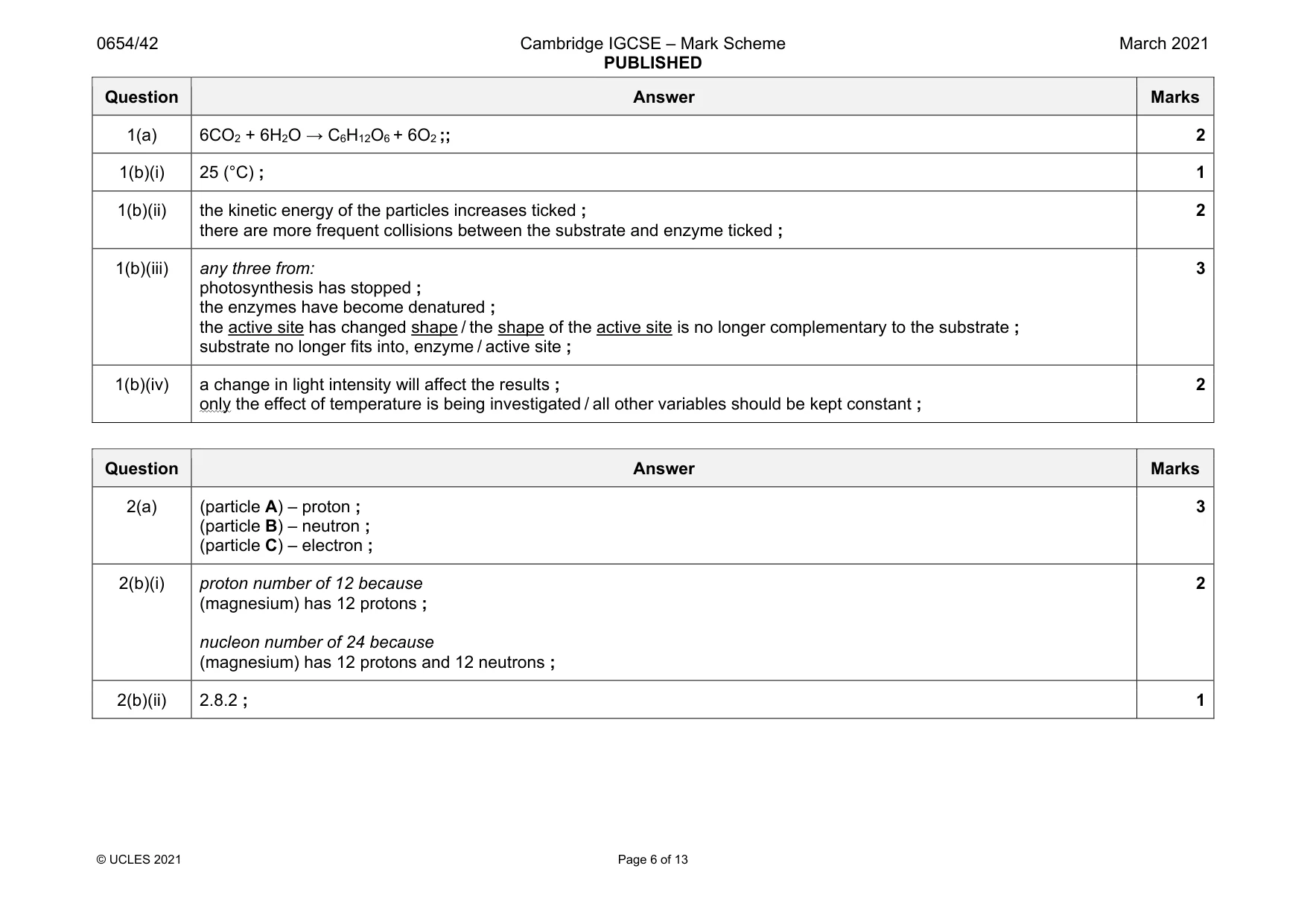
Mark scheme: 1(a) 6CO2 + 6H2O → C6H12O6 + 6O2 ;; 2 1(b)(i) 25 (°C) ; 1 1(b)(ii) the kinetic energy of the particles increases ticked ; there are more frequent collisions between the substrate and enzyme ticked ; 2 1(b)(iii) any three from: photosynthesis has stopped ; the enzymes have become denatured ; the active site has changed shape / the shape of the active site is no longer complementary to the substrate ; substrate no longer fits into, enzyme / active site ; 3 1(b)(iv) a change in light intensity will affect the results ; only the effect of temperature is being investigated / all other variables should be kept constant ; 2
Q2 · Some information about the charges and relative masses of three subatomic particles
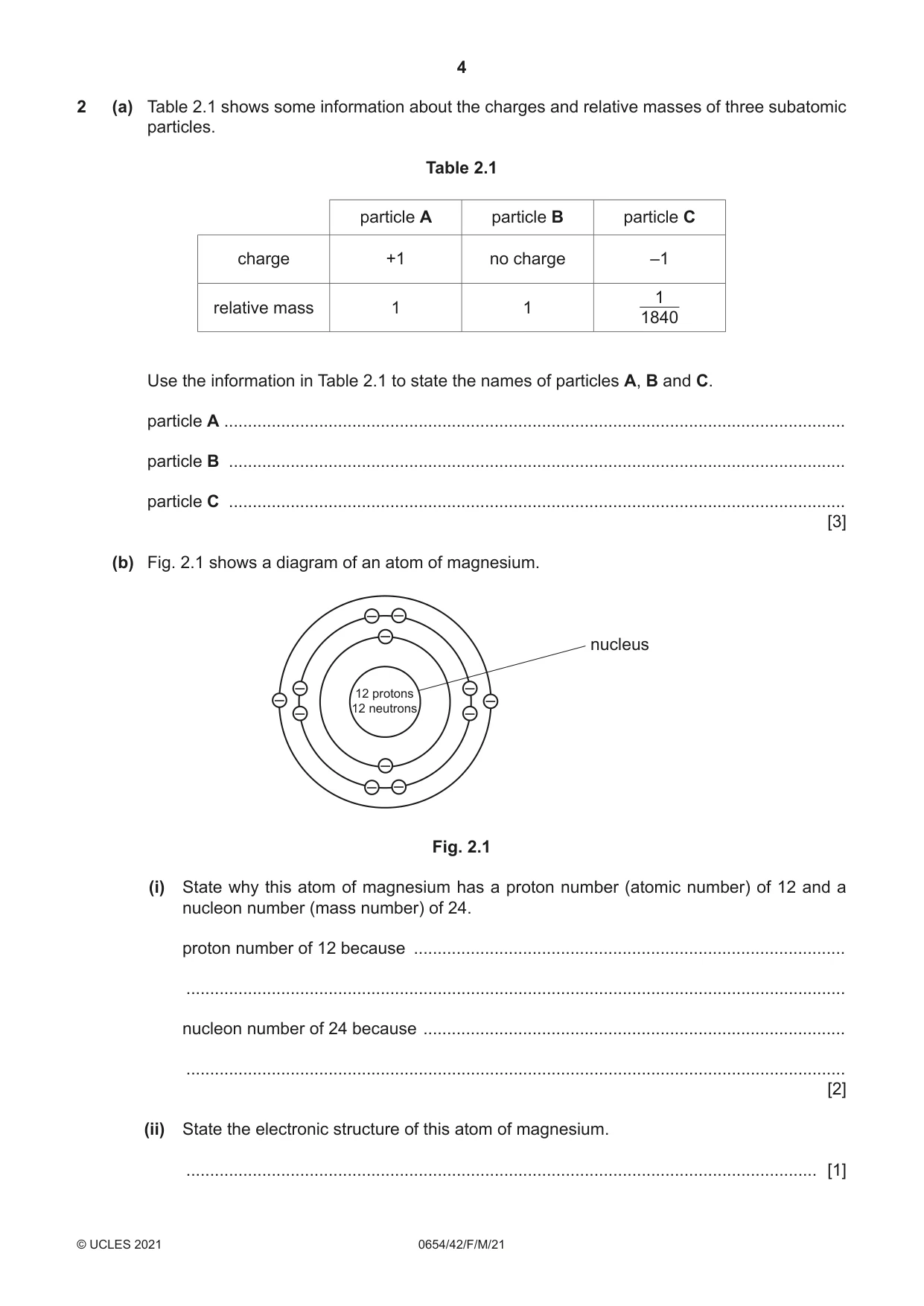
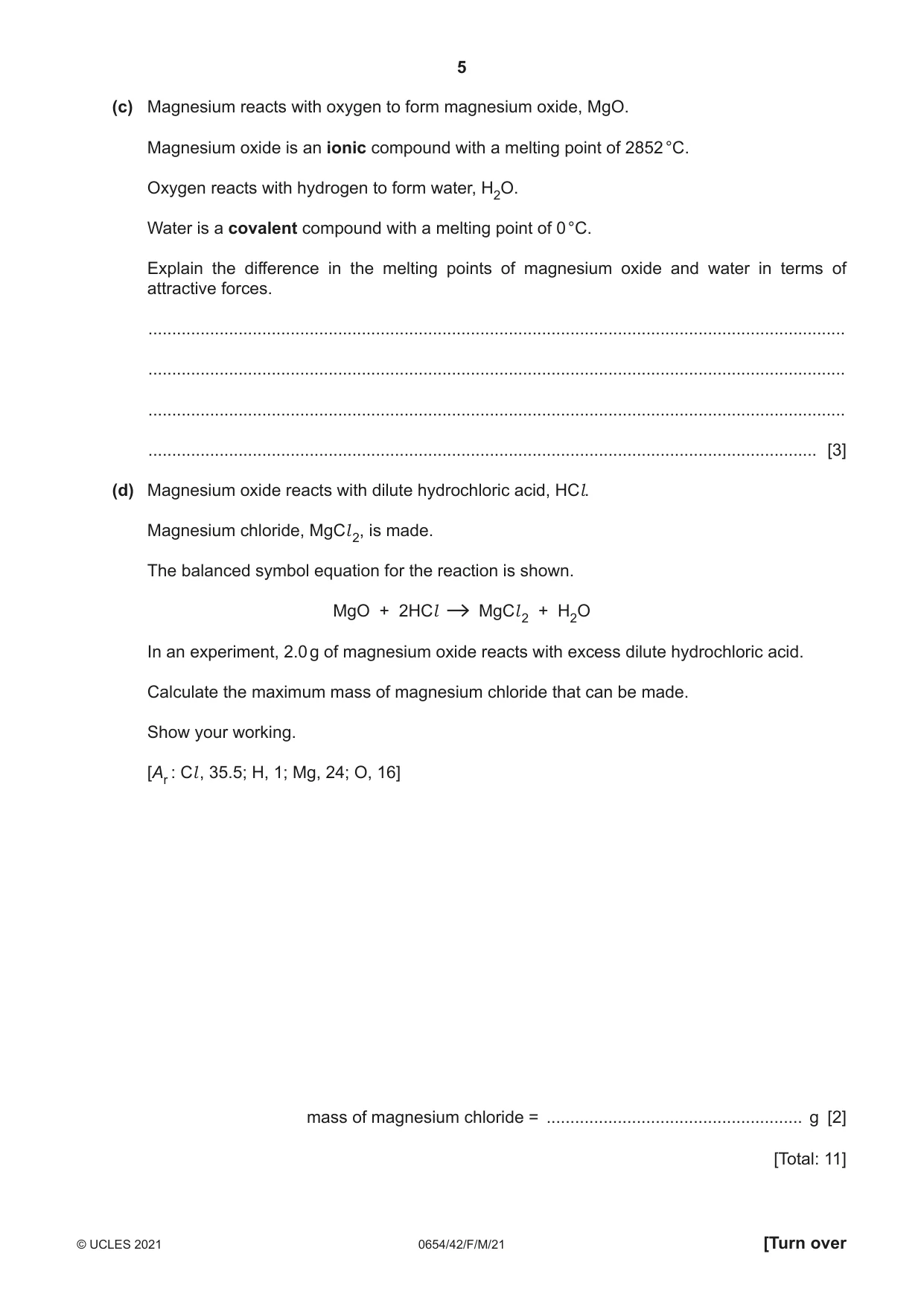
2 (a) Table 2.1 shows some information about the charges and relative masses of three subatomic particles. Table 2.1 particle A particle B particle C charge +1 no charge –1 1 relative mass 1 1 1840 Use the information in Table 2.1 to state the names of particles A, B and C. particle A ................................................................................................................................... particle B .................................................................................................................................. particle C .................................................................................................................................. [3] (b) Fig. 2.1 shows a diagram of an atom of magnesium. – – – nucleus – 12 protons – – – – 12 neutrons – – – – Fig. 2.1 (i) State why this atom of magnesium has a proton number (atomic number) of 12 and a nucleon number (mass number) of 24. proton number of 12 because ........................................................................................... ........................................................................................................................................... nucleon number of 24 because ......................................................................................... ........................................................................................................................................... [2] (ii) State the electronic structure of this atom of magnesium. ..................................................................................................................................... [1] (c) Magnesium reacts with oxygen to form magnesium oxide, MgO. Magnesium oxide is an ionic compound with a melting point of 2852 °C. Oxygen reacts with hydrogen to form water, H2O. Water is a covalent compound with a melting point of 0 °C. Explain the difference in the melting points of magnesium oxide and water in terms of attractive forces. ................................................................................................................................................... ................................................................................................................................................... ................................................................................................................................................... ............................................................................................................................................. [3] (d) Magnesium oxide reacts with dilute hydrochloric acid, HCl. Magnesium chloride, MgCl 2, is made. The balanced symbol equation for the reaction is shown. MgO + 2HCl MgCl 2 + H2O In an experiment, 2.0 g of magnesium oxide reacts with excess dilute hydrochloric acid. Calculate the maximum mass of magnesium chloride that can be made. Show your working. [Ar : Cl , 35.5; H, 1; Mg, 24; O, 16] mass of magnesium chloride = ...................................................... g [2] [Total: 11]
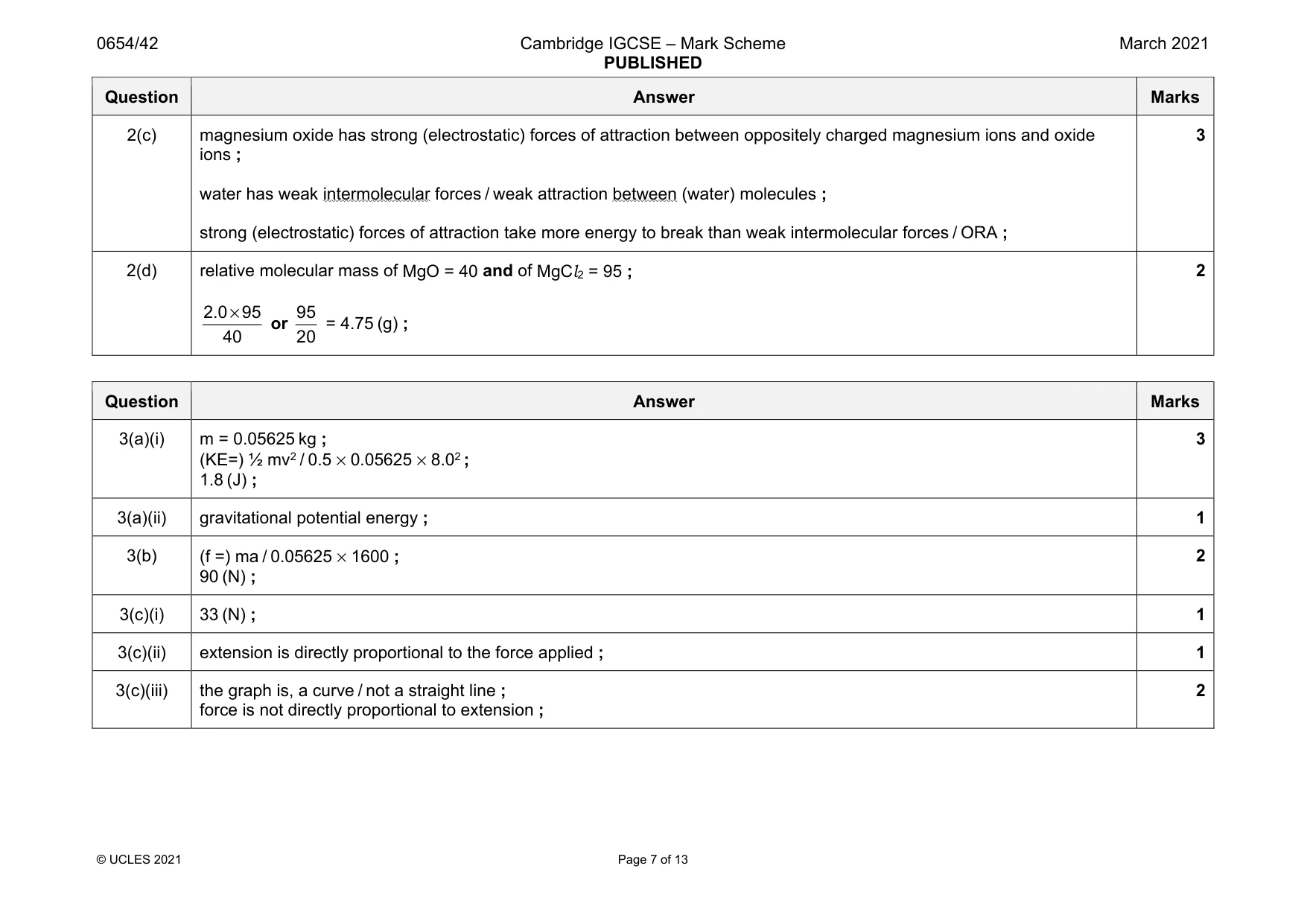
Mark scheme: 2(a) (particle A) – proton ; (particle B) – neutron ; (particle C) – electron ; 3 2(b)(i) proton number of 12 because (magnesium) has 12 protons ; nucleon number of 24 because (magnesium) has 12 protons and 12 neutrons ; 2 2(b)(ii) 2.8.2 ; 1 Question Answer Marks 2(c) magnesium oxide has strong (electrostatic) forces of attraction between oppositely charged magnesium ions and oxide ions ; water has weak intermolecular forces / weak attraction between (water) molecules ; strong (electrostatic) forces of attraction take more energy to break than weak intermolecular forces / ORA ; 3 2(d) relative molecular mass of MgO = 40 and of MgCl2 = 95 ; × 2.0 95 40 or 95 20 = 4.75 (g) ; 2
Q3 · A tennis player throwing a ball in the air before the player hits the ball
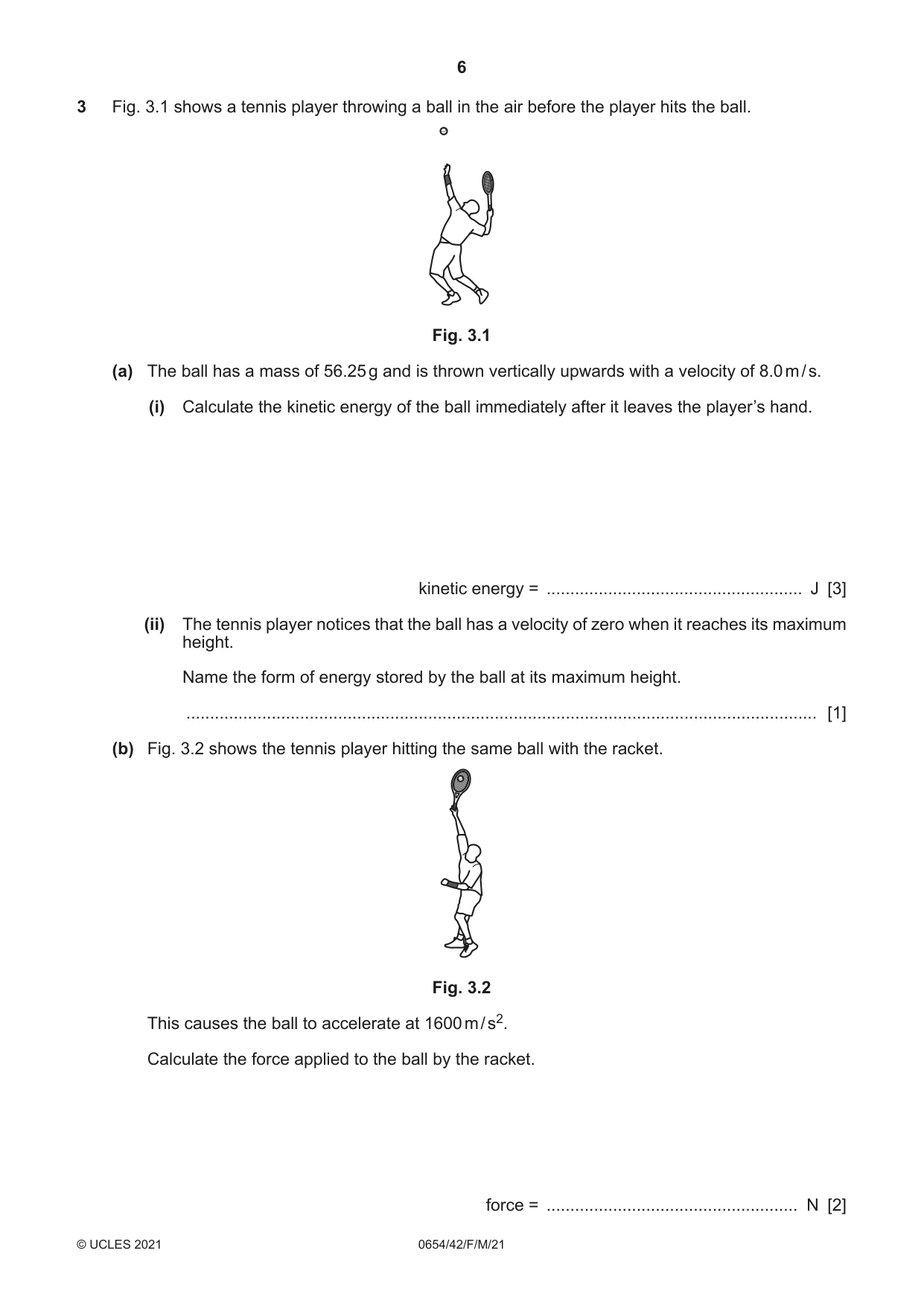
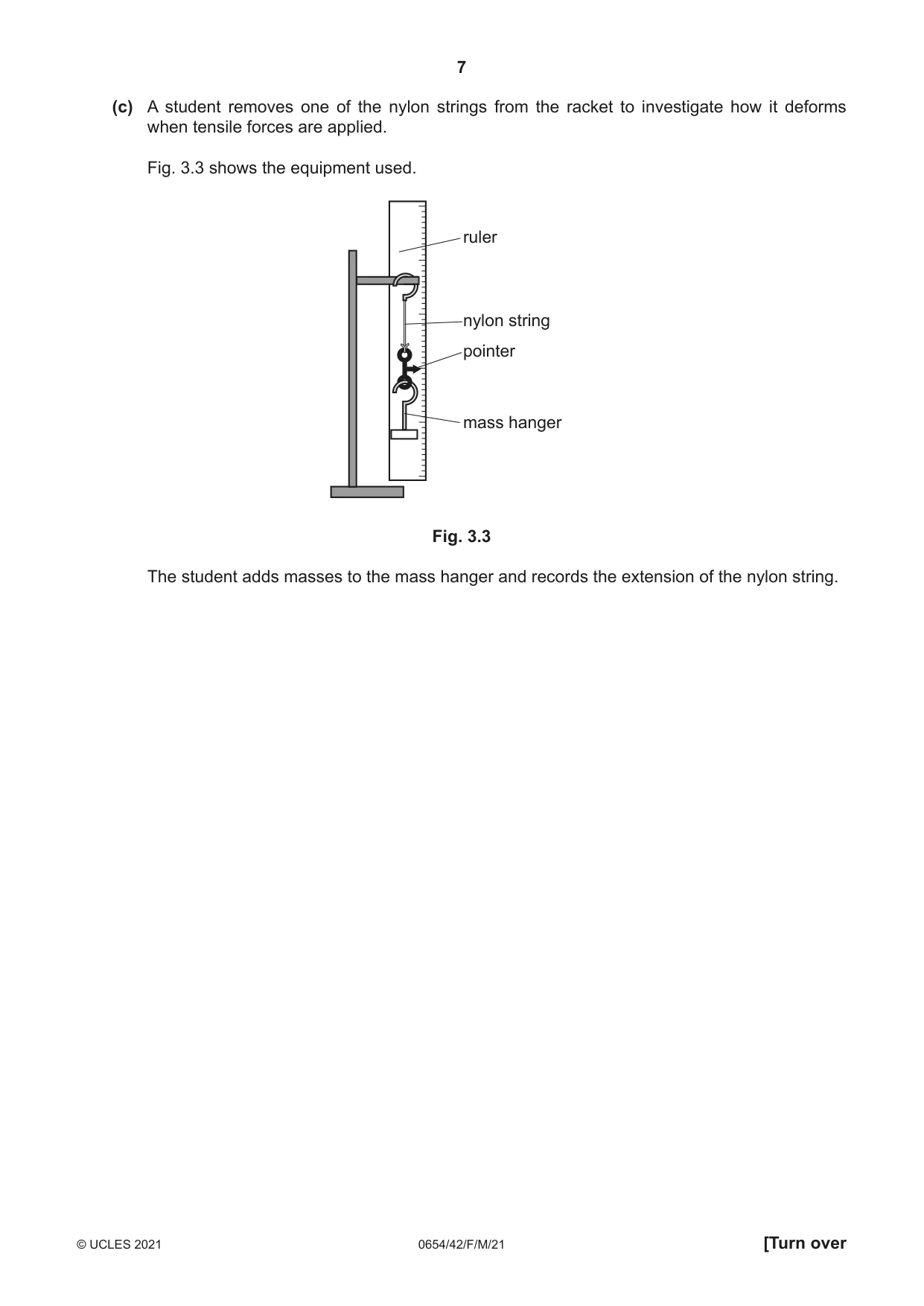
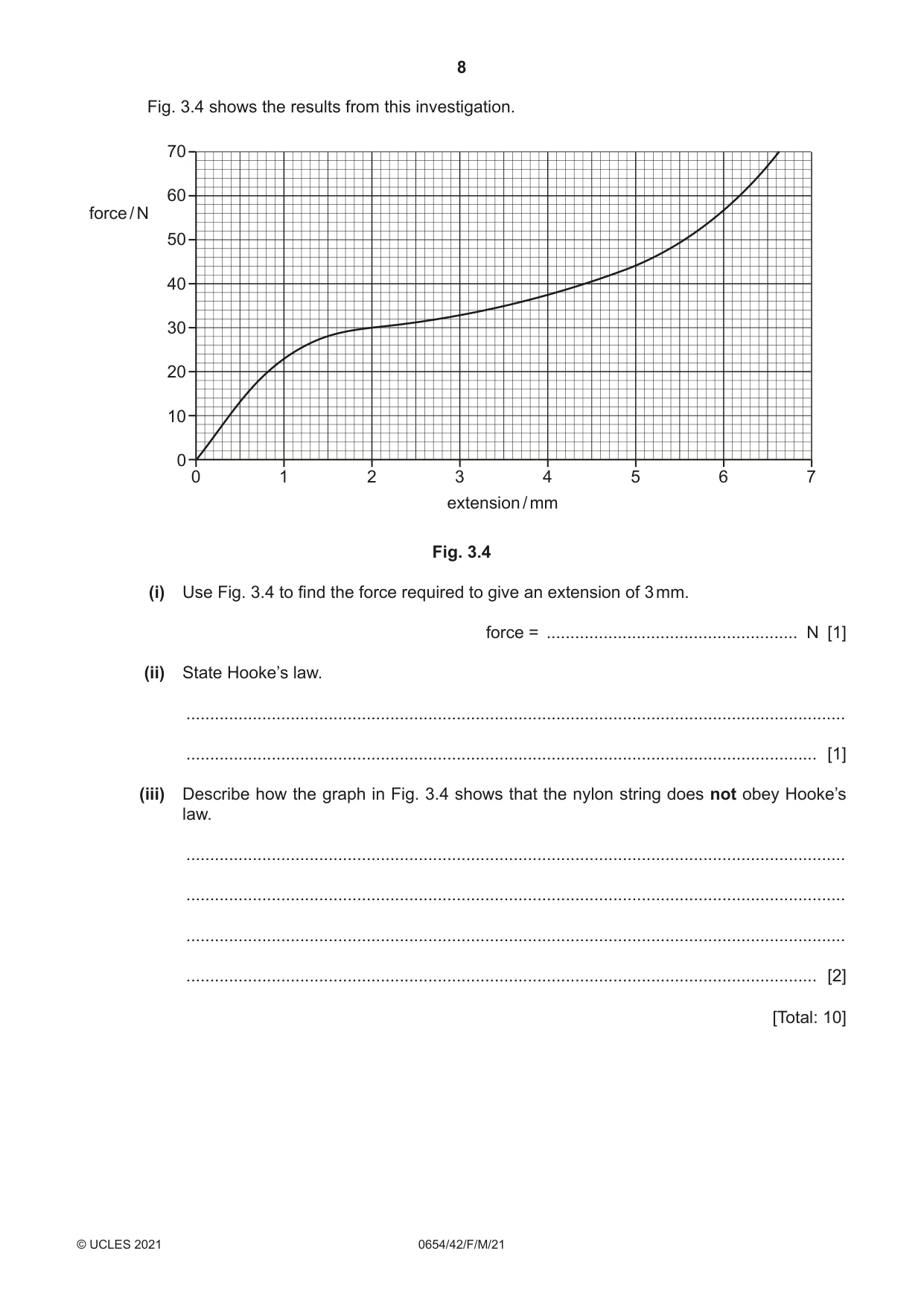
3 Fig. 3.1 shows a tennis player throwing a ball in the air before the player hits the ball. Fig. 3.1 (a) The ball has a mass of 56.25 g and is thrown vertically upwards with a velocity of 8.0 m / s. (i) Calculate the kinetic energy of the ball immediately after it leaves the player’s hand. kinetic energy = ...................................................... J [3] (ii) The tennis player notices that the ball has a velocity of zero when it reaches its maximum height. Name the form of energy stored by the ball at its maximum height. ..................................................................................................................................... [1] (b) Fig. 3.2 shows the tennis player hitting the same ball with the racket. Fig. 3.2 This causes the ball to accelerate at 1600 m / s2. Calculate the force applied to the ball by the racket. force = ..................................................... N [2] (c) A student removes one of the nylon strings from the racket to investigate how it deforms when tensile forces are applied. Fig. 3.3 shows the equipment used. ruler nylon string pointer mass hanger Fig. 3.3 The student adds masses to the mass hanger and records the extension of the nylon string. Fig. 3.4 shows the results from this investigation. 70 60 force / N 50 40 30 20 10 0 0 1 2 3 4 5 6 7 extension / mm Fig. 3.4 (i) Use Fig. 3.4 to find the force required to give an extension of 3 mm. force = ..................................................... N [1] (ii) State Hooke’s law. ........................................................................................................................................... ..................................................................................................................................... [1] (iii) Describe how the graph in Fig. 3.4 shows that the nylon string does not obey Hooke’s law. ........................................................................................................................................... ........................................................................................................................................... ........................................................................................................................................... ..................................................................................................................................... [2] [Total: 10]
Mark scheme: 3(a)(i) m = 0.05625 kg ; (KE=) ½ mv2 / 0.5 × 0.05625 × 8.02 ; 1.8 (J) ; 3 3(a)(ii) gravitational potential energy ; 1 3(b) (f =) ma / 0.05625 × 1600 ; 90 (N) ; 2 3(c)(i) 33 (N) ; 1 3(c)(ii) extension is directly proportional to the force applied ; 1 3(c)(iii) the graph is, a curve / not a straight line ; force is not directly proportional to extension ; 2
Q4 · A person monitored the concentration of glucose in their blood for 12 hours
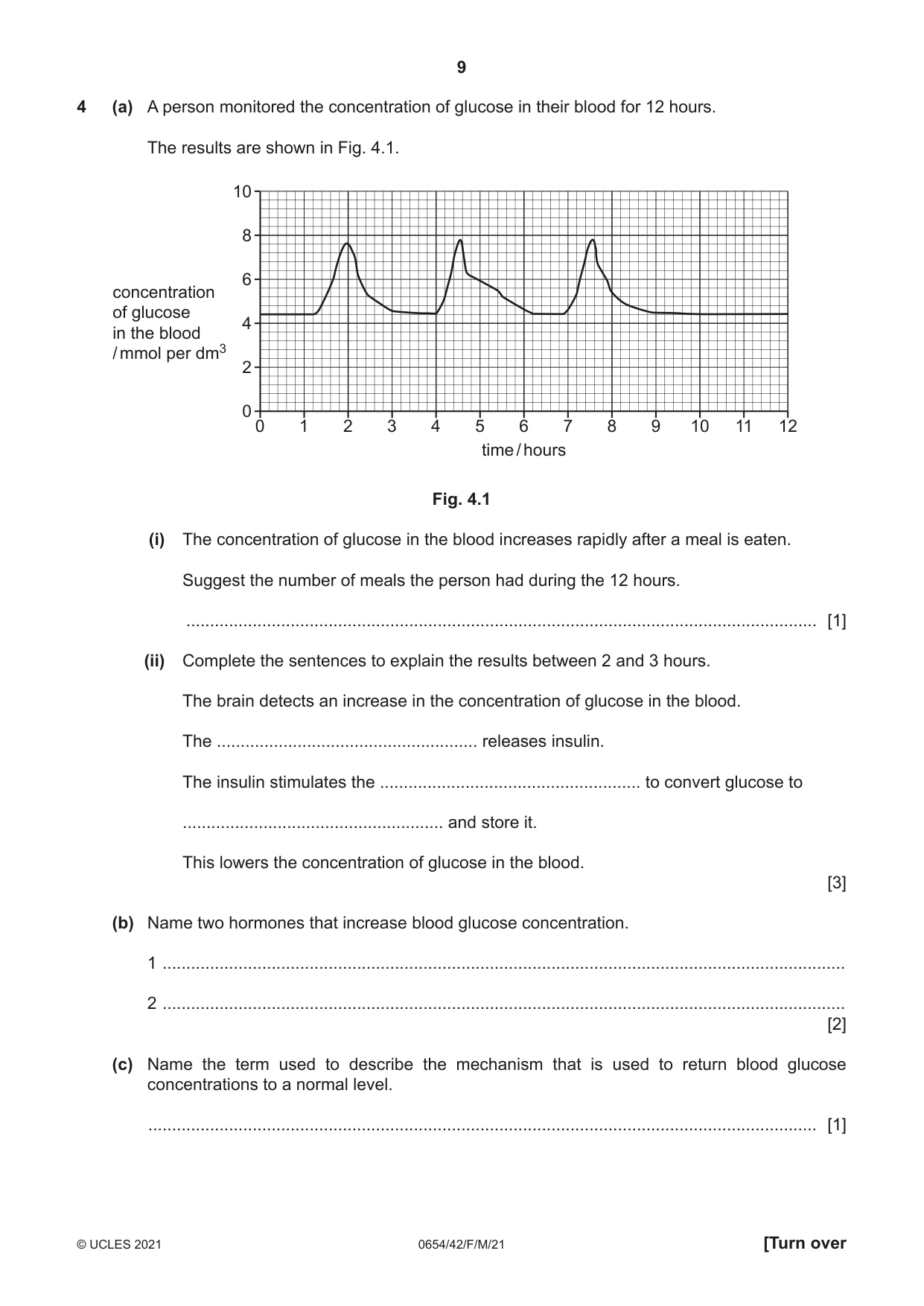
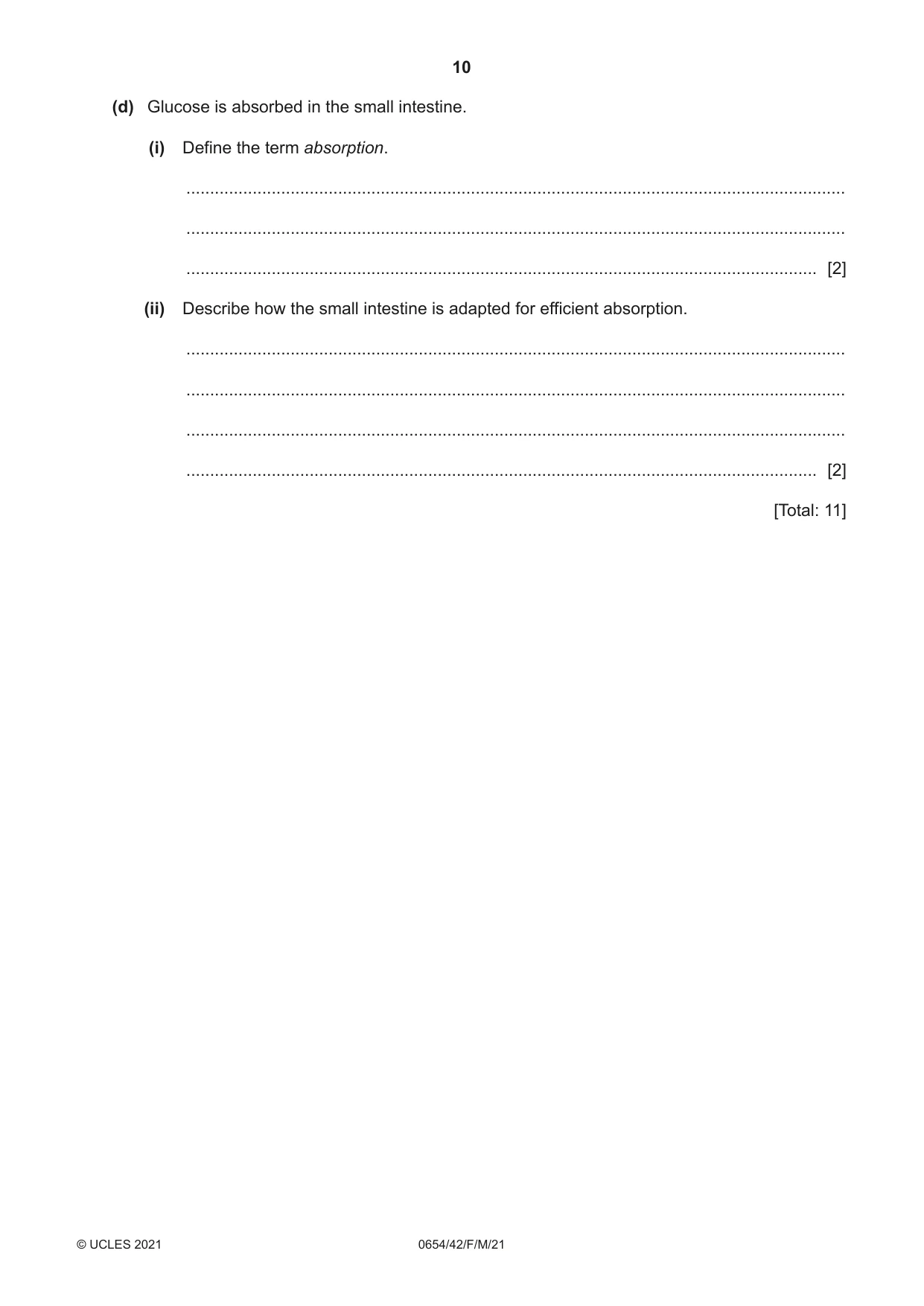
4 (a) A person monitored the concentration of glucose in their blood for 12 hours. The results are shown in Fig. 4.1. 10 8 6 concentration of glucose 4 in the blood / mmol per dm3 2 0 0 1 2 3 4 5 6 7 8 9 10 11 12 time / hours Fig. 4.1 (i) The concentration of glucose in the blood increases rapidly after a meal is eaten. Suggest the number of meals the person had during the 12 hours. ..................................................................................................................................... [1] (ii) Complete the sentences to explain the results between 2 and 3 hours. The brain detects an increase in the concentration of glucose in the blood. The ....................................................... releases insulin. The insulin stimulates the ....................................................... to convert glucose to ....................................................... and store it. This lowers the concentration of glucose in the blood. [3] (b) Name two hormones that increase blood glucose concentration. 1 ................................................................................................................................................ 2 ................................................................................................................................................ [2] (c) Name the term used to describe the mechanism that is used to return blood glucose concentrations to a normal level. ............................................................................................................................................. [1] (d) Glucose is absorbed in the small intestine. (i) Define the term absorption. ........................................................................................................................................... ........................................................................................................................................... ..................................................................................................................................... [2] (ii) Describe how the small intestine is adapted for efficient absorption. ........................................................................................................................................... ........................................................................................................................................... ........................................................................................................................................... ..................................................................................................................................... [2] [Total: 11]
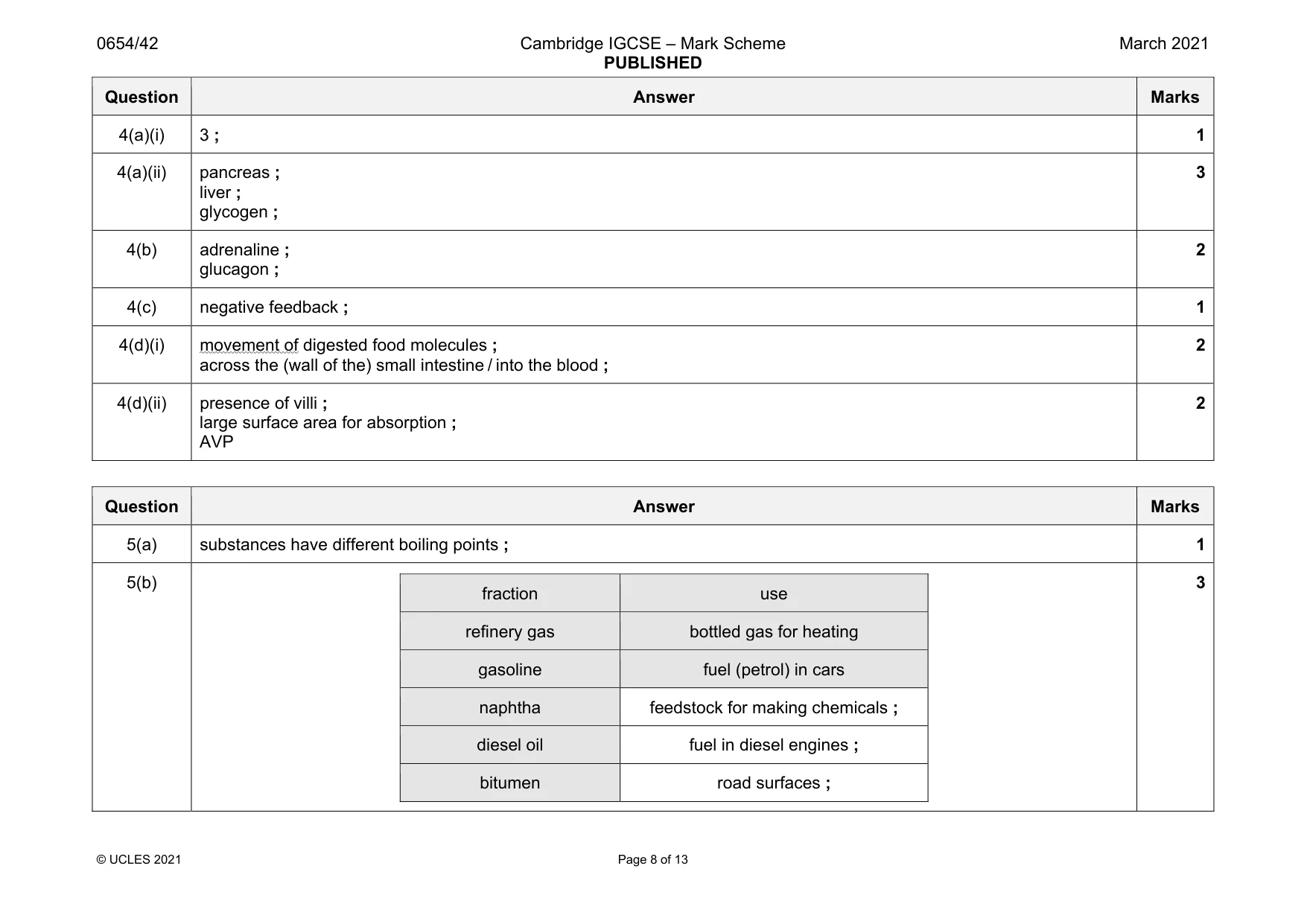
Mark scheme: 4(a)(i) 3 ; 1 4(a)(ii) pancreas ; liver ; glycogen ; 3 4(b) adrenaline ; glucagon ; 2 4(c) negative feedback ; 1 4(d)(i) movement of digested food molecules ; across the (wall of the) small intestine / into the blood ; 2 4(d)(ii) presence of villi ; large surface area for absorption ; AVP 2
Q5 · Petroleum is a fossil fuel
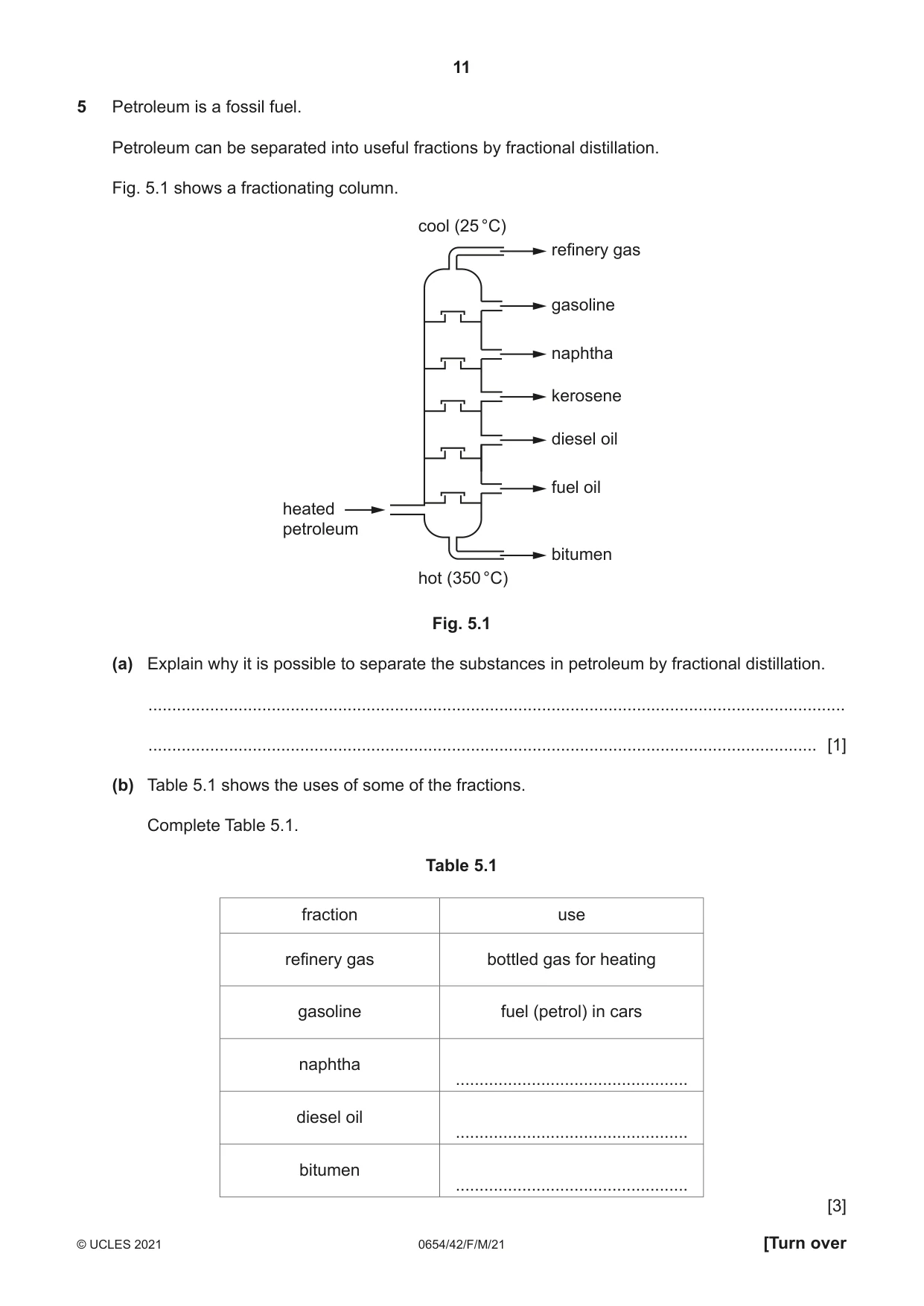
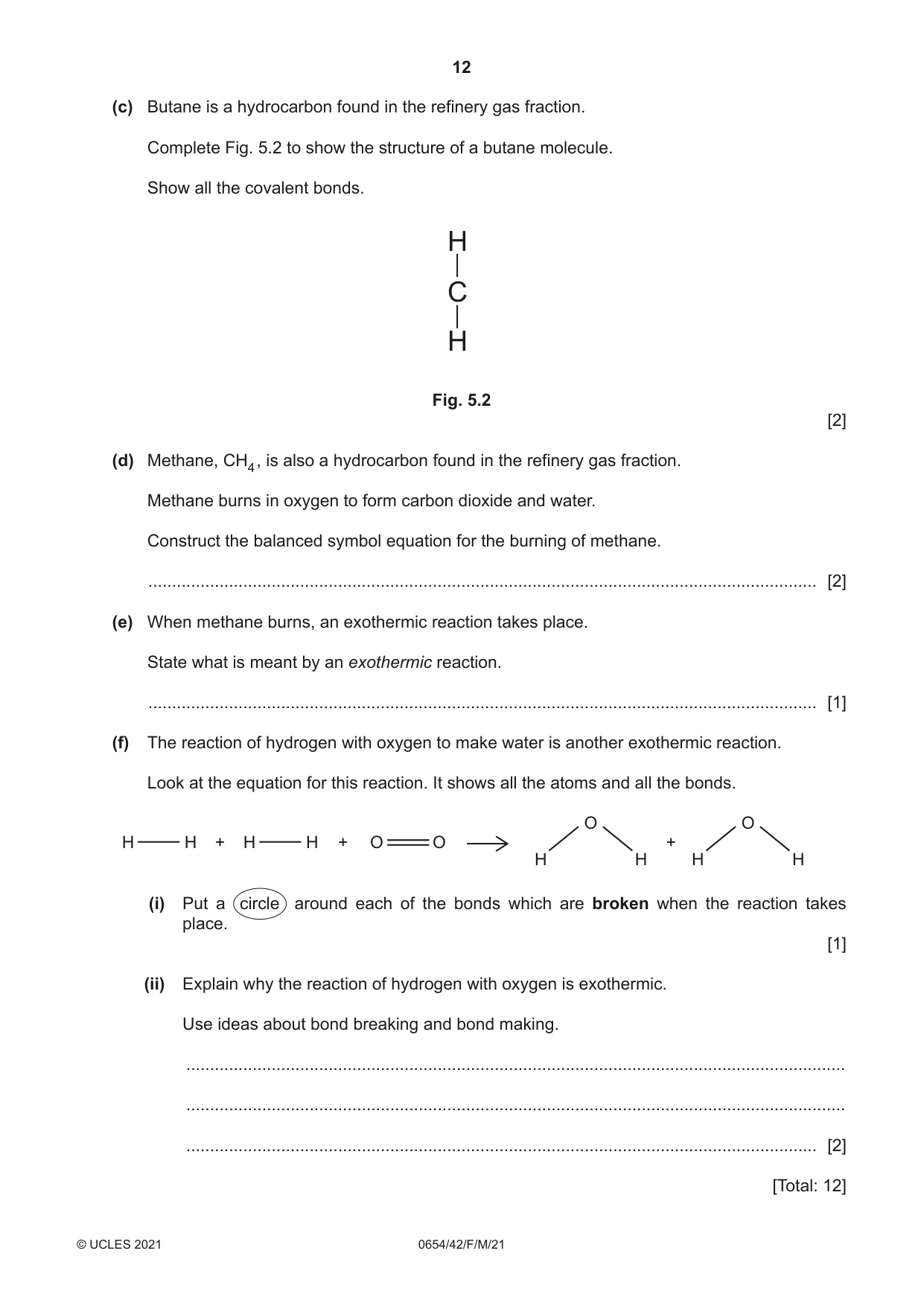
5 Petroleum is a fossil fuel. Petroleum can be separated into useful fractions by fractional distillation. Fig. 5.1 shows a fractionating column. cool (25 °C) refinery gas gasoline naphtha kerosene diesel oil fuel oil heated petroleum bitumen hot (350 °C) Fig. 5.1 (a) Explain why it is possible to separate the substances in petroleum by fractional distillation. ................................................................................................................................................... ............................................................................................................................................. [1] (b) Table 5.1 shows the uses of some of the fractions. Complete Table 5.1. Table 5.1 fraction use refinery gas bottled gas for heating gasoline fuel (petrol) in cars naphtha ................................................. diesel oil ................................................. bitumen ................................................. [3] (c) Butane is a hydrocarbon found in the refinery gas fraction. Complete Fig. 5.2 to show the structure of a butane molecule. Show all the covalent bonds. H C H Fig. 5.2 [2] (d) Methane, CH4 , is also a hydrocarbon found in the refinery gas fraction. Methane burns in oxygen to form carbon dioxide and water. Construct the balanced symbol equation for the burning of methane. ............................................................................................................................................. [2] (e) When methane burns, an exothermic reaction takes place. State what is meant by an exothermic reaction. ............................................................................................................................................. [1] (f) The reaction of hydrogen with oxygen to make water is another exothermic reaction. Look at the equation for this reaction. It shows all the atoms and all the bonds. O O H H + H H + O O + H H H H (i) Put a circle around each of the bonds which are broken when the reaction takes place. [1] (ii) Explain why the reaction of hydrogen with oxygen is exothermic. Use ideas about bond breaking and bond making. ........................................................................................................................................... ........................................................................................................................................... ..................................................................................................................................... [2] [Total: 12]
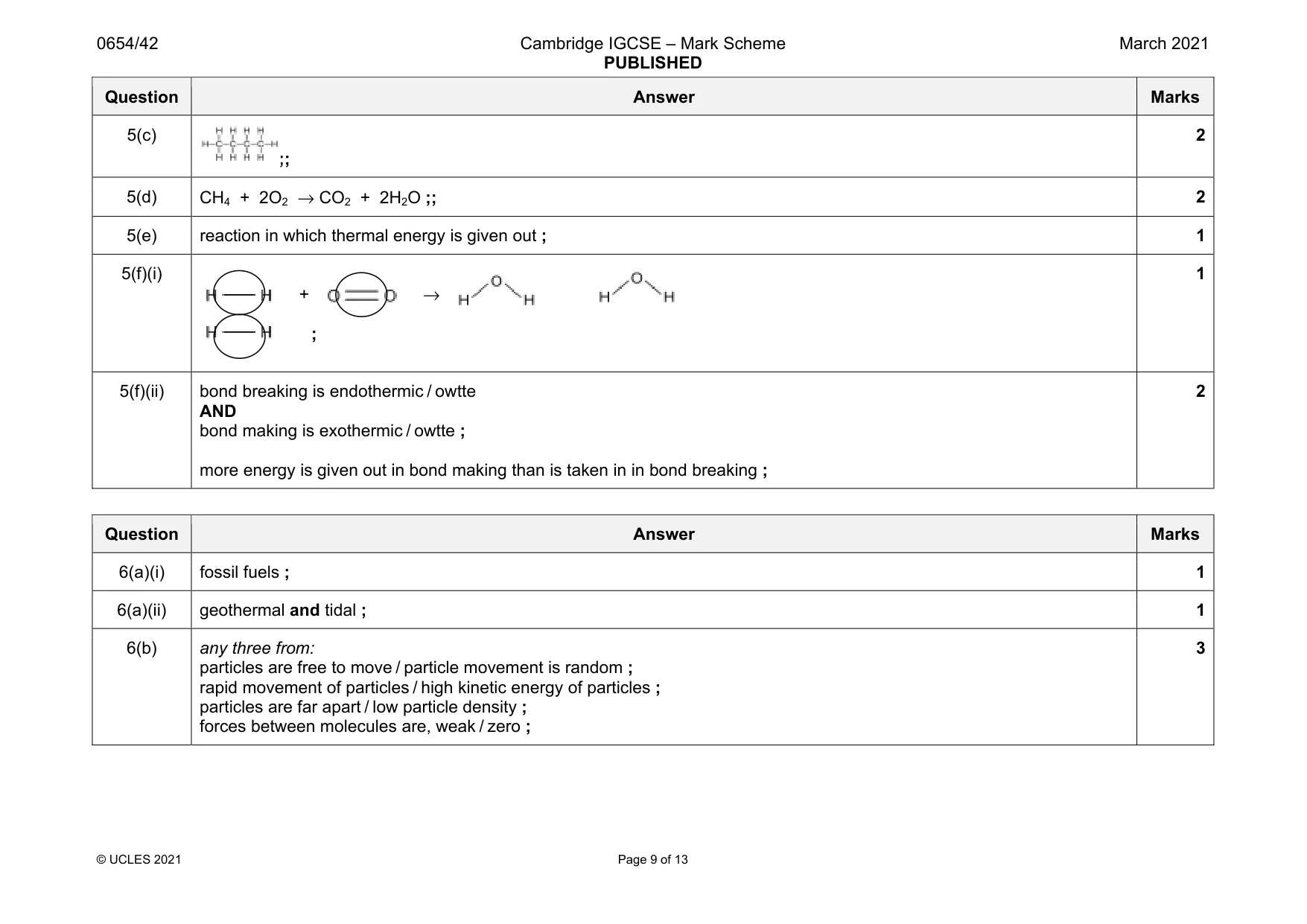
Mark scheme: 5(a) substances have different boiling points ; 1 5(b) fraction use refinery gas bottled gas for heating gasoline fuel (petrol) in cars naphtha feedstock for making chemicals ; diesel oil fuel in diesel engines ; bitumen road surfaces ; 3 Question Answer Marks 5(c) ;; 2 5(d) CH4 + 2O2 → CO2 + 2H2O ;; 2 5(e) reaction in which thermal energy is given out ; 1 5(f)(i) + → ; 1 5(f)(ii) bond breaking is endothermic / owtte AND bond making is exothermic / owtte ; more energy is given out in bond making than is taken in in bond breaking ; 2
Q6 · Electricity may be obtained using the sources listed
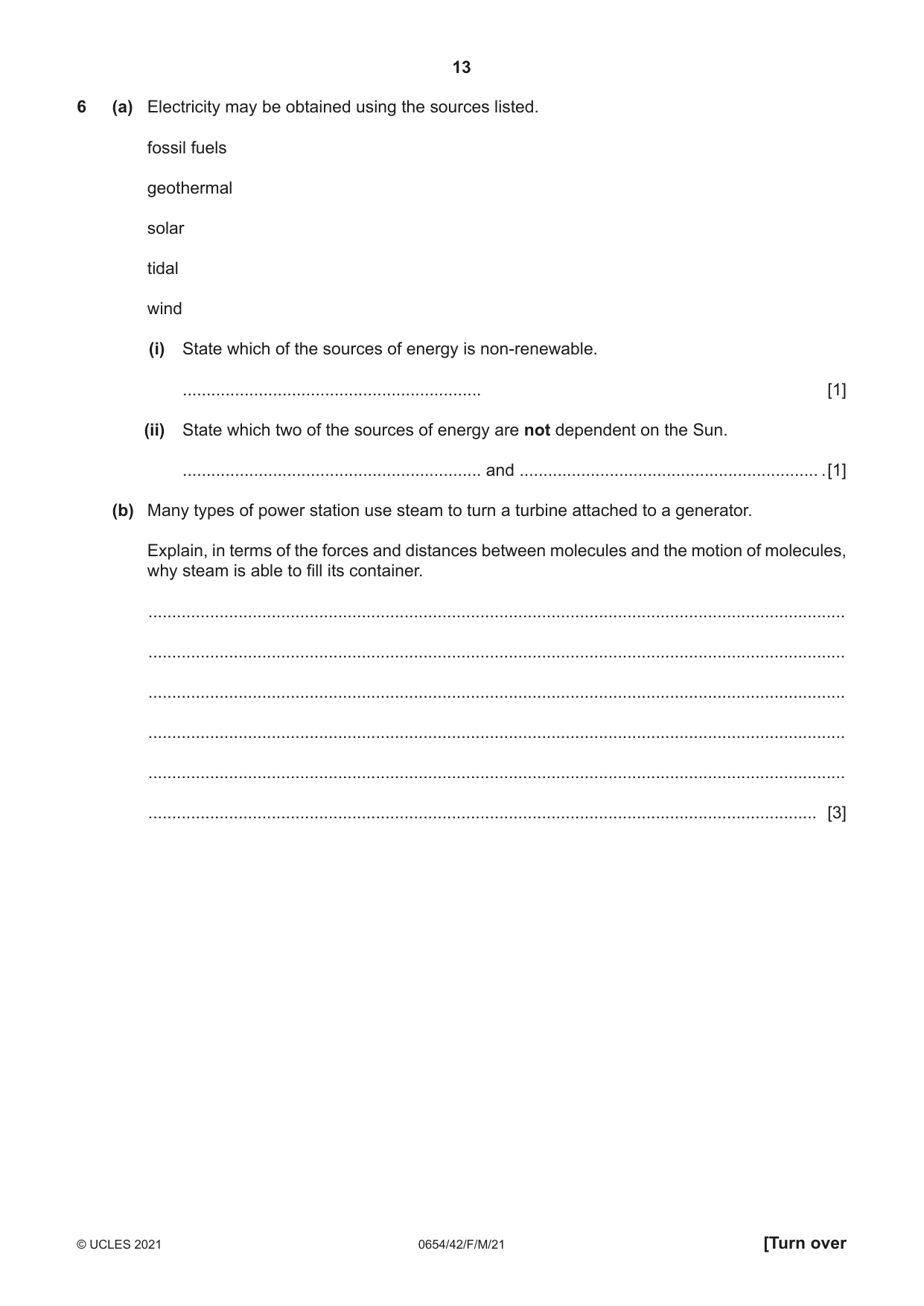
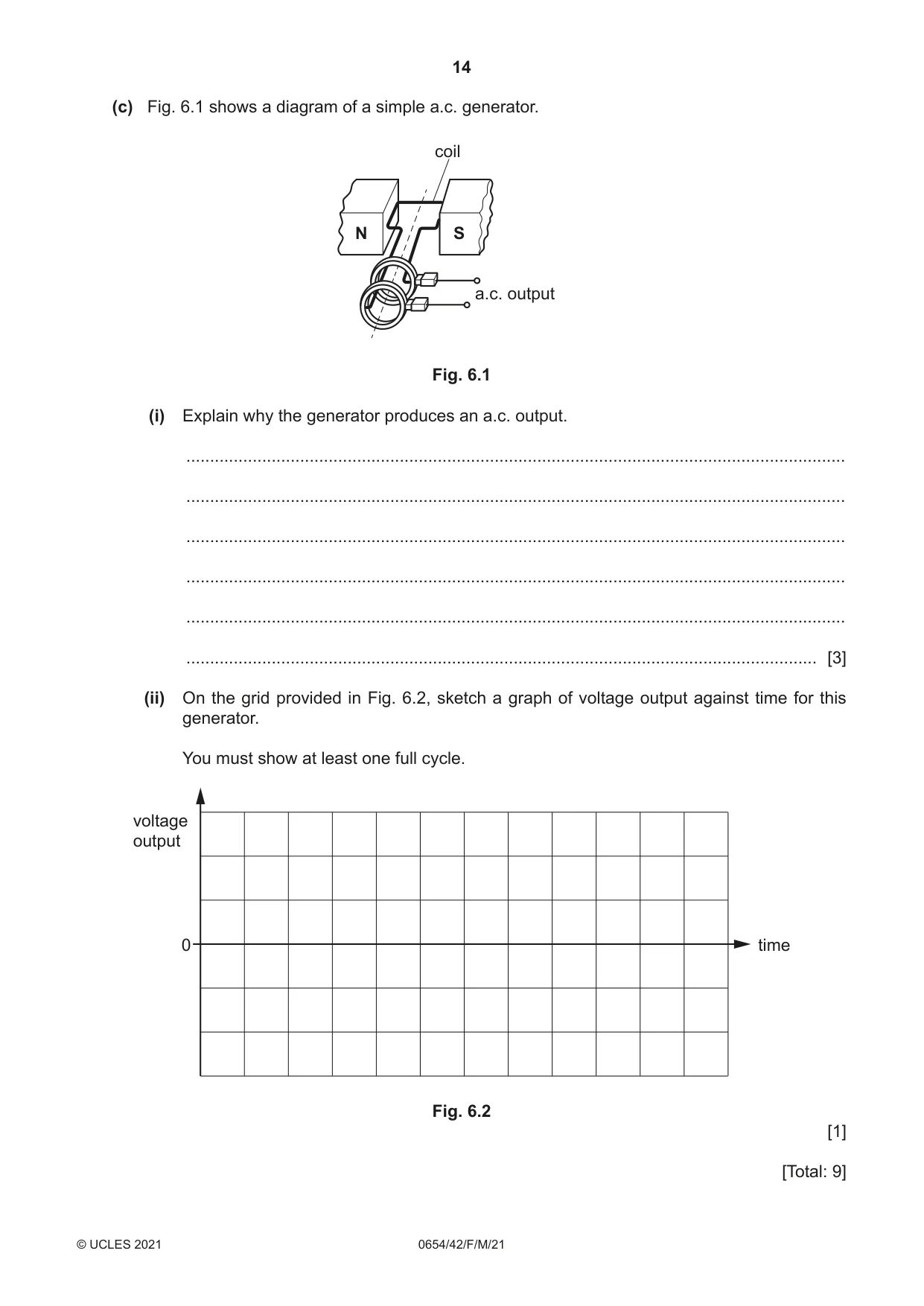
6 (a) Electricity may be obtained using the sources listed. fossil fuels geothermal solar tidal wind (i) State which of the sources of energy is non-renewable. ............................................................... [1] (ii) State which two of the sources of energy are not dependent on the Sun. ............................................................... and ............................................................... .[1] (b) Many types of power station use steam to turn a turbine attached to a generator. Explain, in terms of the forces and distances between molecules and the motion of molecules, why steam is able to fill its container. ................................................................................................................................................... ................................................................................................................................................... ................................................................................................................................................... ................................................................................................................................................... ................................................................................................................................................... ............................................................................................................................................. [3] (c) Fig. 6.1 shows a diagram of a simple a.c. generator. coil N S a.c. output Fig. 6.1 (i) Explain why the generator produces an a.c. output. ........................................................................................................................................... ........................................................................................................................................... ........................................................................................................................................... ........................................................................................................................................... ........................................................................................................................................... ..................................................................................................................................... [3] (ii) On the grid provided in Fig. 6.2, sketch a graph of voltage output against time for this generator. You must show at least one full cycle. voltage output 0 time Fig. 6.2 [1] [Total: 9]
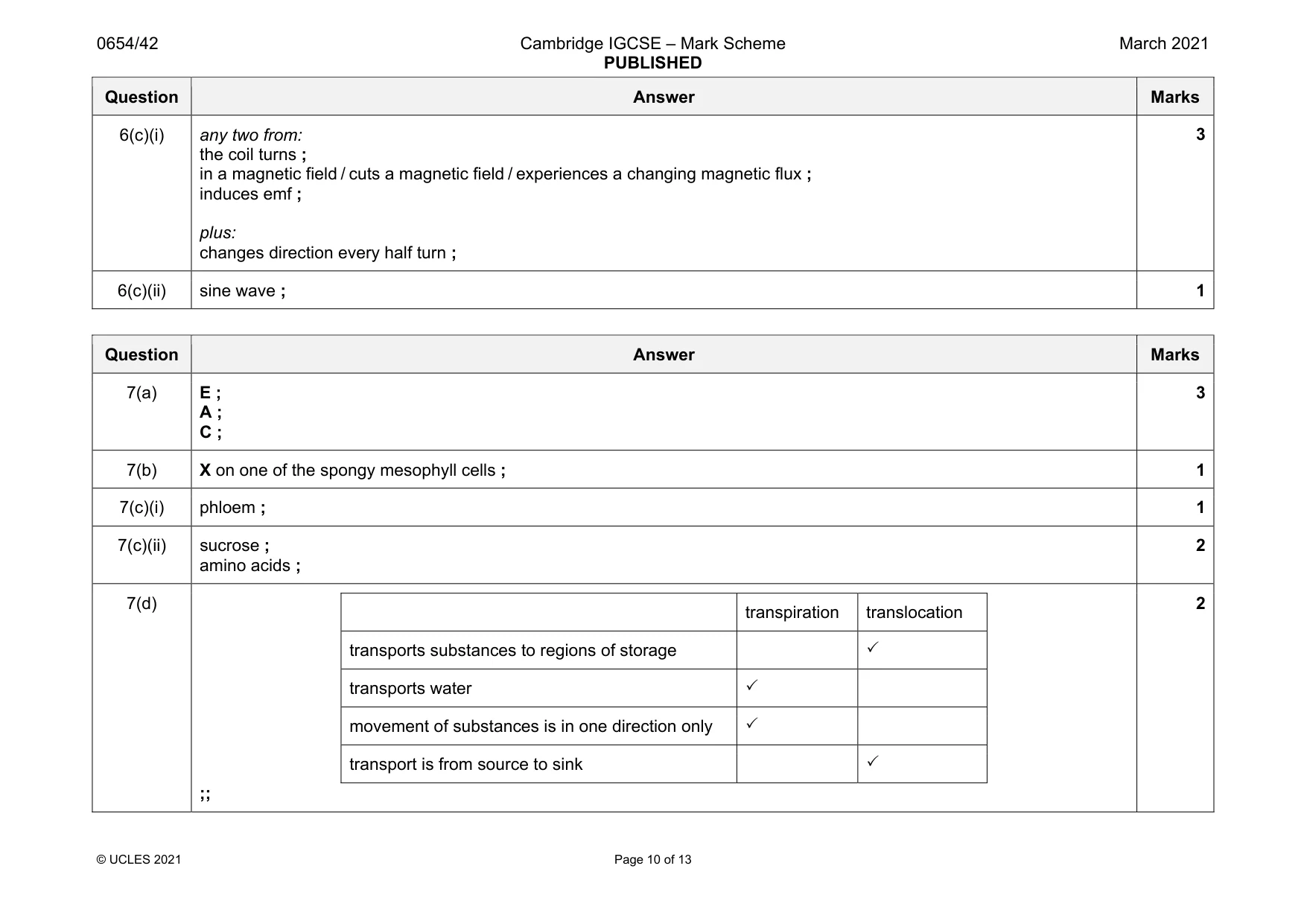
Mark scheme: 6(a)(i) fossil fuels ; 1 6(a)(ii) geothermal and tidal ; 1 6(b) any three from: particles are free to move / particle movement is random ; rapid movement of particles / high kinetic energy of particles ; particles are far apart / low particle density ; forces between molecules are, weak / zero ; 3 Question Answer Marks 6(c)(i) any two from: the coil turns ; in a magnetic field / cuts a magnetic field / experiences a changing magnetic flux ; induces emf ; plus: changes direction every half turn ; 3 6(c)(ii) sine wave ; 1
Q7 · A diagram of a cross-section of a leaf
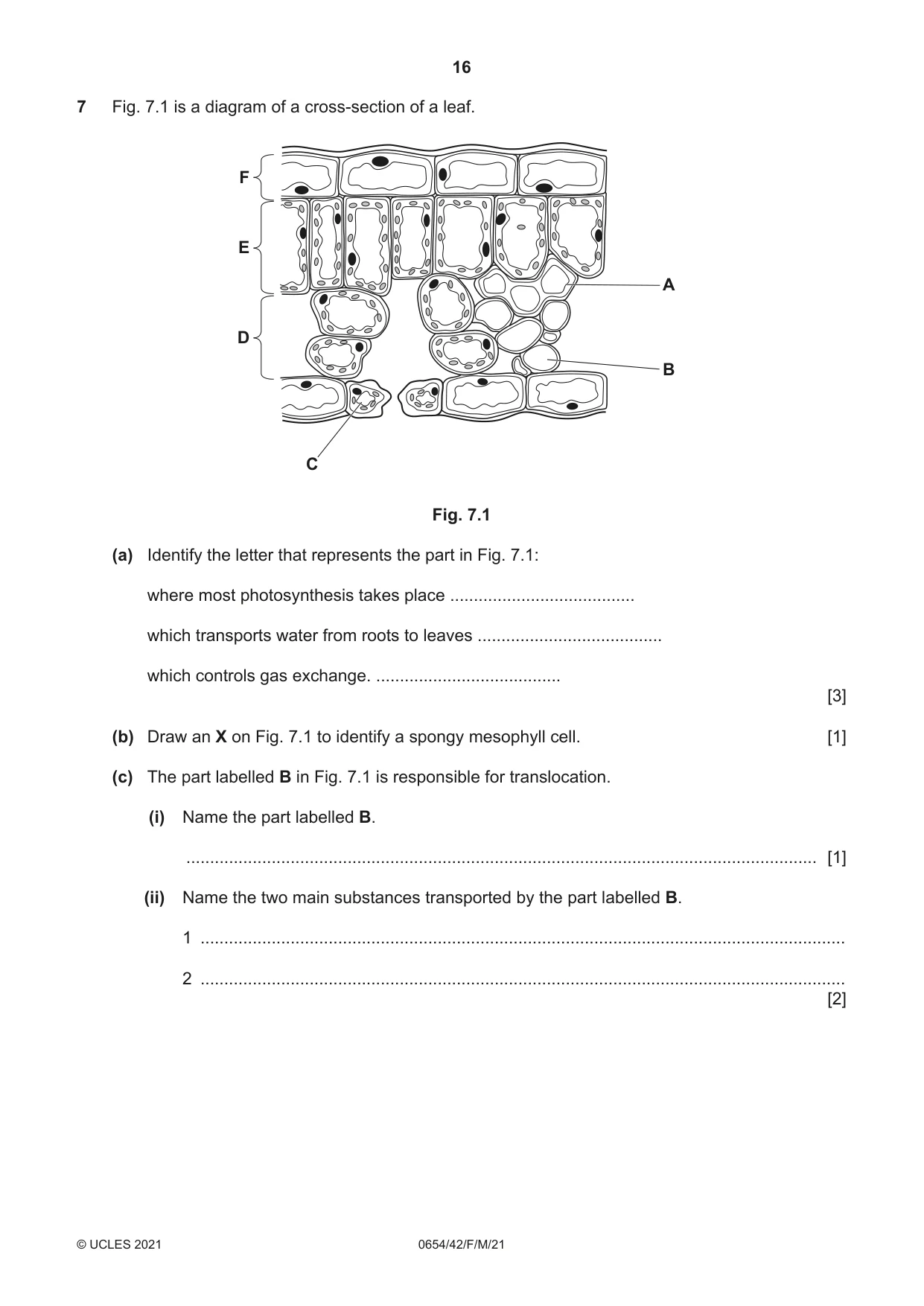
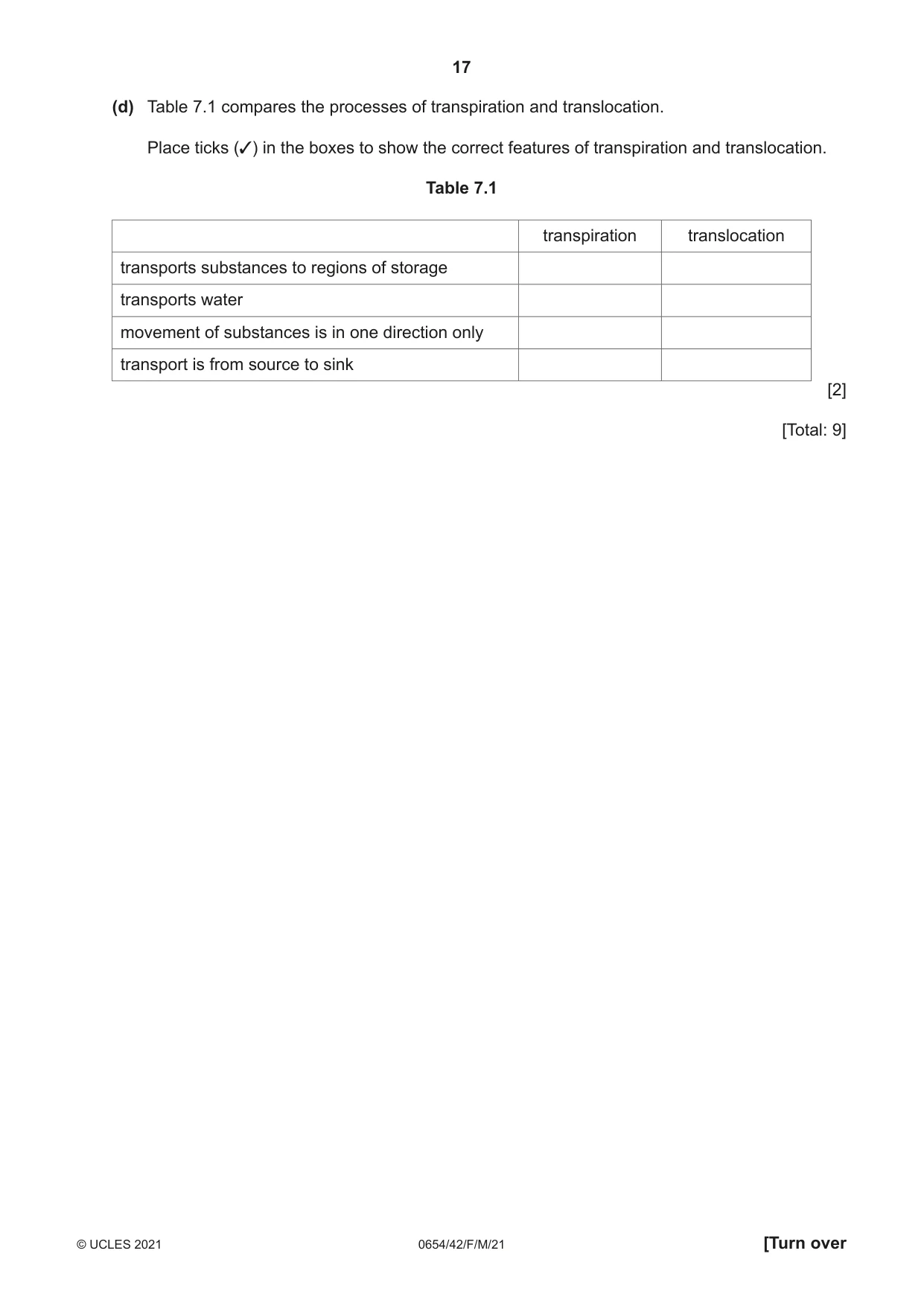
7 Fig. 7.1 is a diagram of a cross-section of a leaf. F E A D B C Fig. 7.1 (a) Identify the letter that represents the part in Fig. 7.1: where most photosynthesis takes place ....................................... which transports water from roots to leaves ....................................... which controls gas exchange. ....................................... [3] (b) Draw an X on Fig. 7.1 to identify a spongy mesophyll cell. [1] (c) The part labelled B in Fig. 7.1 is responsible for translocation. (i) Name the part labelled B. ..................................................................................................................................... [1] (ii) Name the two main substances transported by the part labelled B. 1 ........................................................................................................................................ 2 ........................................................................................................................................ [2] (d) Table 7.1 compares the processes of transpiration and translocation. Place ticks (3) in the boxes to show the correct features of transpiration and translocation. Table 7.1 transpiration translocation transports substances to regions of storage transports water movement of substances is in one direction only transport is from source to sink [2] [Total: 9]
Mark scheme: 7(a) E ; A ; C ; 3 7(b) X on one of the spongy mesophyll cells ; 1 7(c)(i) phloem ; 1 7(c)(ii) sucrose ; amino acids ; 2 7(d) transpiration translocation transports substances to regions of storage transports water movement of substances is in one direction only transport is from source to sink ;; 2
Q8 · A scientist investigates the reaction between marble chips (calcium carbonate) and dilute…
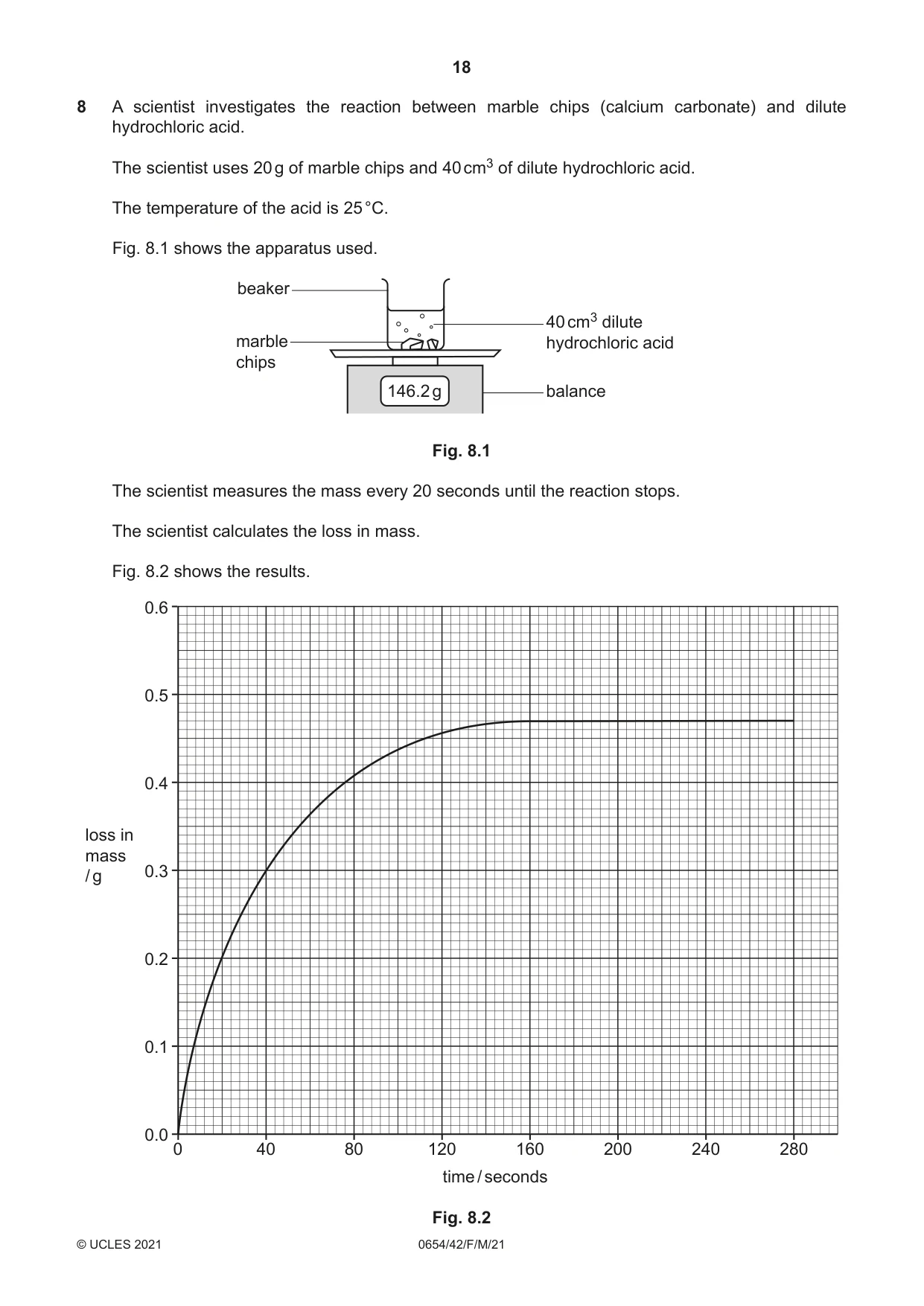
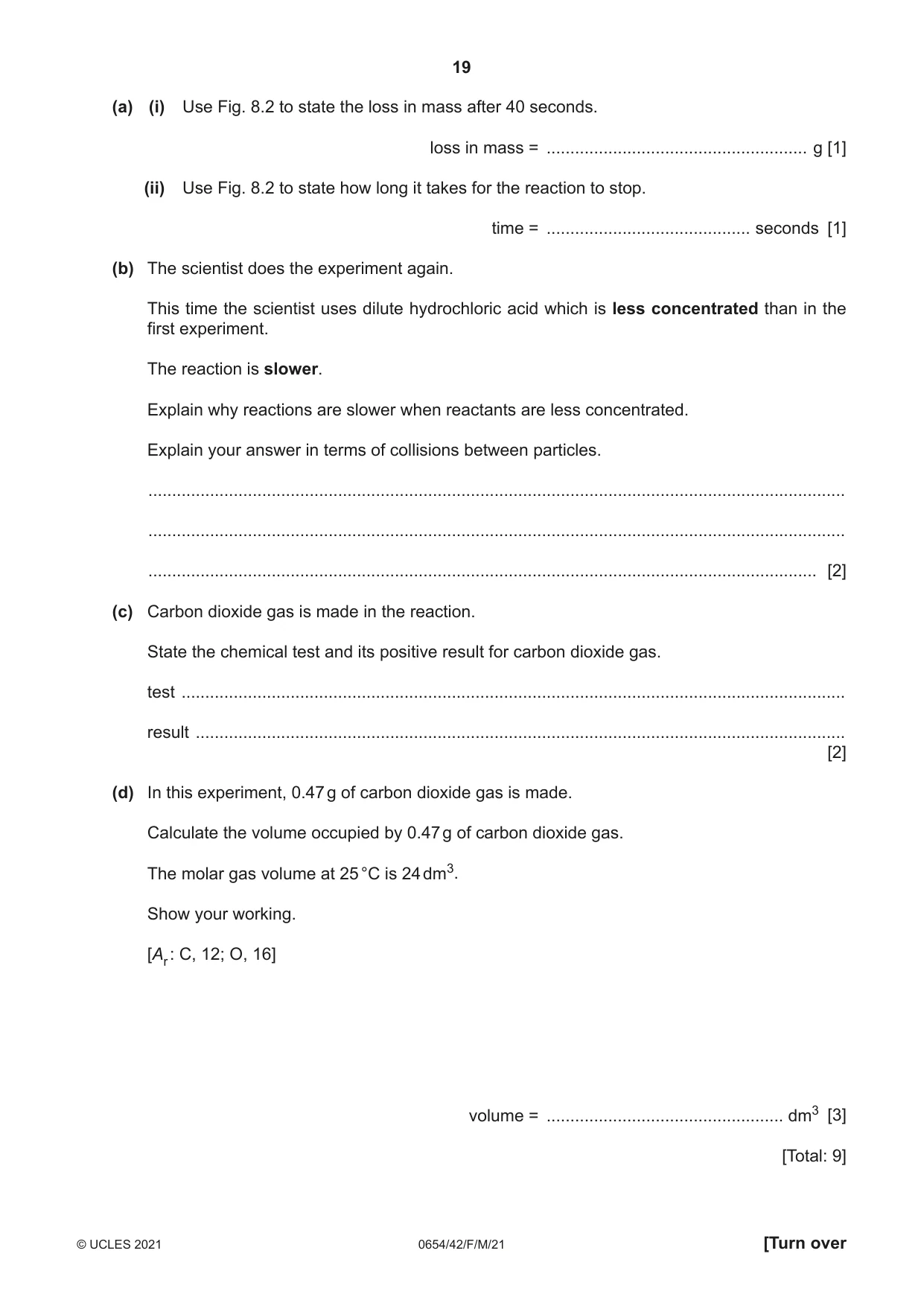
8 A scientist investigates the reaction between marble chips (calcium carbonate) and dilute hydrochloric acid. The scientist uses 20 g of marble chips and 40 cm3 of dilute hydrochloric acid. The temperature of the acid is 25 °C. Fig. 8.1 shows the apparatus used. beaker 40 cm3 dilute marble hydrochloric acid chips 146.2 g balance Fig. 8.1 The scientist measures the mass every 20 seconds until the reaction stops. The scientist calculates the loss in mass. Fig. 8.2 shows the results. 0.6 0.5 0.4 loss in mass 0.3 / g 0.2 0.1 0.0 0 40 80 120 160 200 240 280 time / seconds Fig. 8.2 (a) (i) Use Fig. 8.2 to state the loss in mass after 40 seconds. loss in mass = ....................................................... g [1] (ii) Use Fig. 8.2 to state how long it takes for the reaction to stop. time = ........................................... seconds [1] (b) The scientist does the experiment again. This time the scientist uses dilute hydrochloric acid which is less concentrated than in the first experiment. The reaction is slower. Explain why reactions are slower when reactants are less concentrated. Explain your answer in terms of collisions between particles. ................................................................................................................................................... ................................................................................................................................................... ............................................................................................................................................. [2] (c) Carbon dioxide gas is made in the reaction. State the chemical test and its positive result for carbon dioxide gas. test ............................................................................................................................................ result ......................................................................................................................................... [2] (d) In this experiment, 0.47 g of carbon dioxide gas is made. Calculate the volume occupied by 0.47 g of carbon dioxide gas. The molar gas volume at 25 °C is 24 dm3. Show your working. [Ar : C, 12; O, 16] volume = .................................................. dm3 [3] [Total: 9]
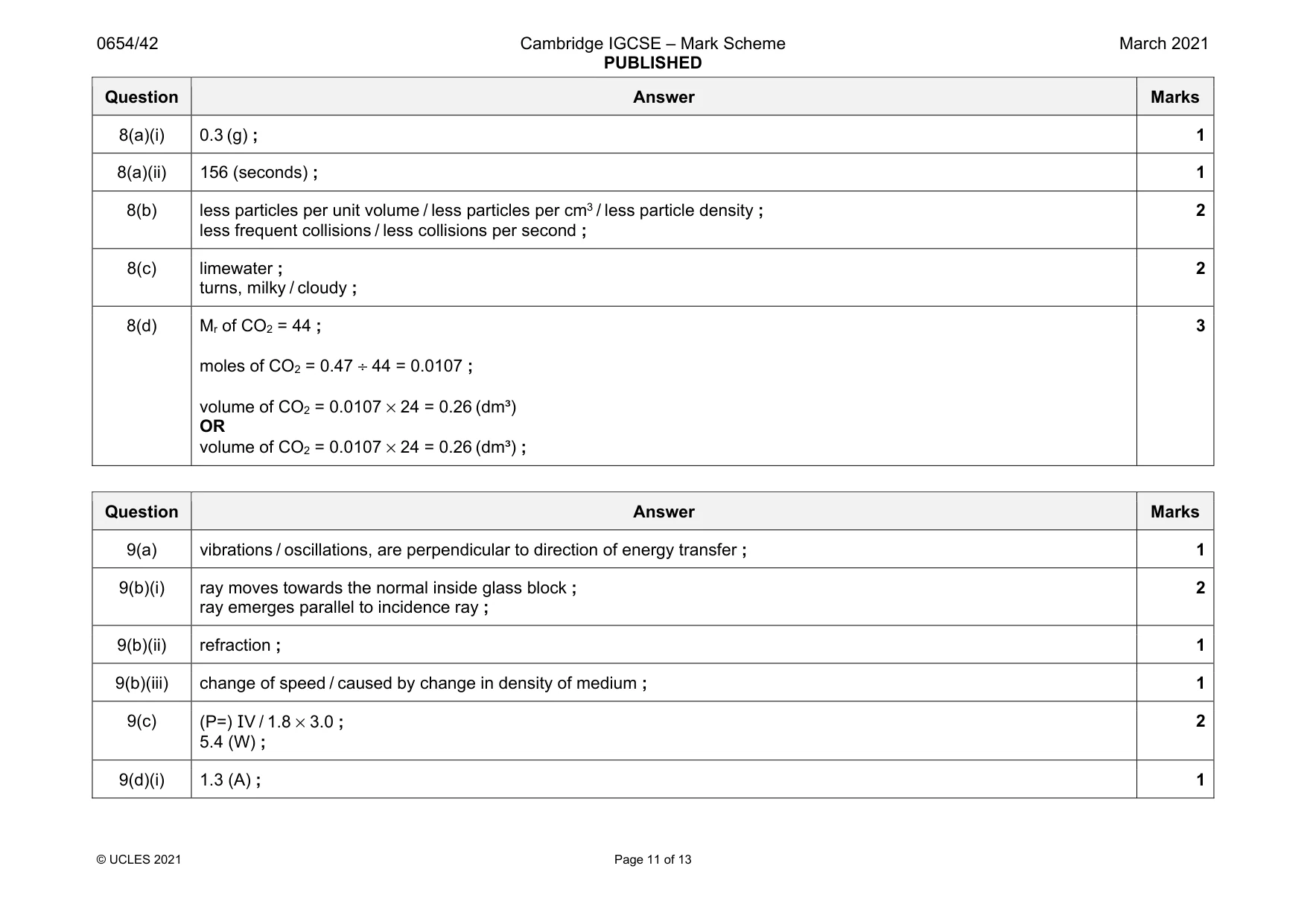
Mark scheme: 8(a)(i) 0.3 (g) ; 1 8(a)(ii) 156 (seconds) ; 1 8(b) less particles per unit volume / less particles per cm3 / less particle density ; less frequent collisions / less collisions per second ; 2 8(c) limewater ; turns, milky / cloudy ; 2 8(d) Mr of CO2 = 44 ; moles of CO2 = 0.47 ÷ 44 = 0.0107 ; volume of CO2 = 0.0107 × 24 = 0.26 (dm³) OR volume of CO2 = 0.0107 × 24 = 0.26 (dm³) ; 3
Q9 · Visible light is a transverse wave and is part of the electromagnetic spectrum
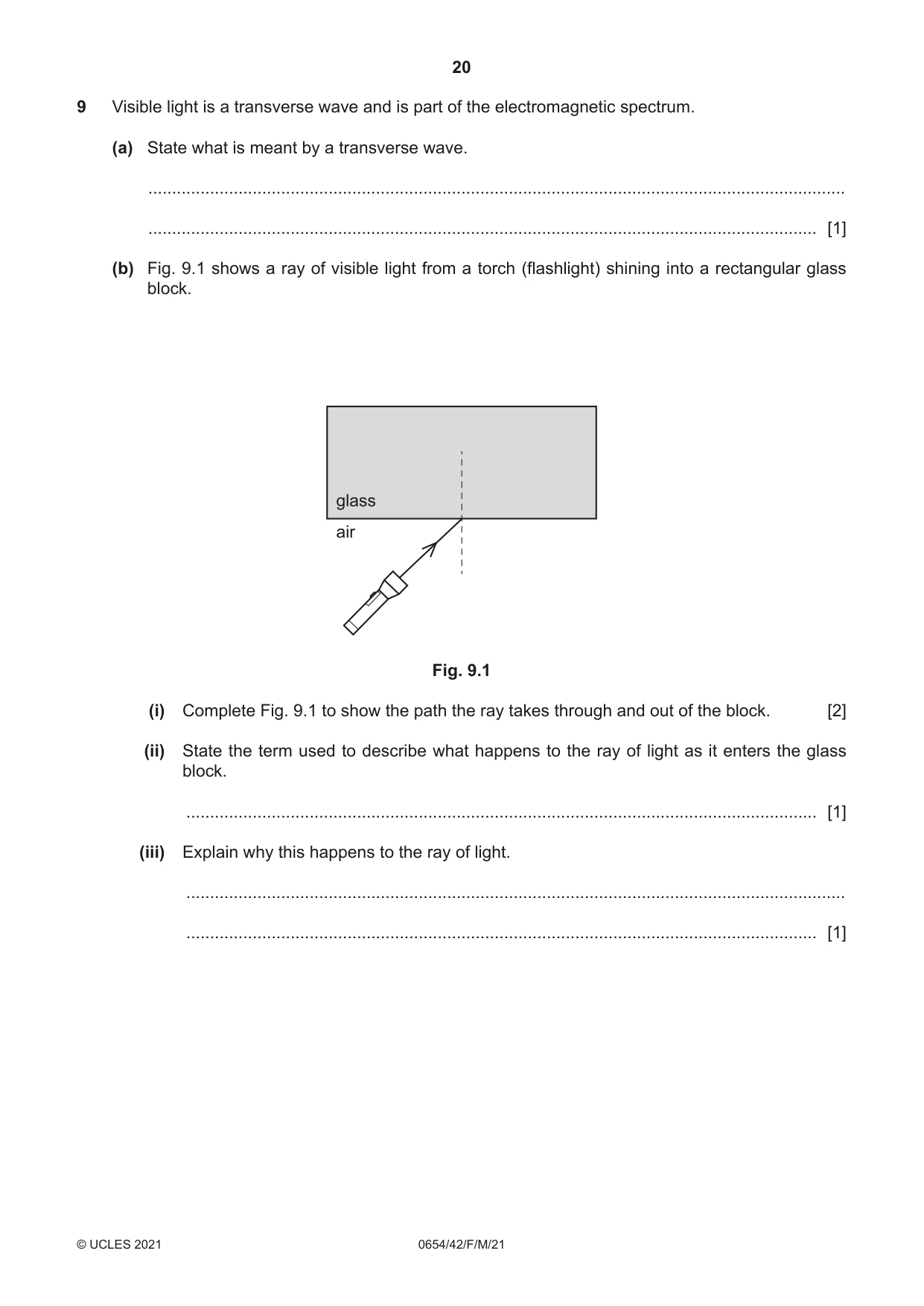
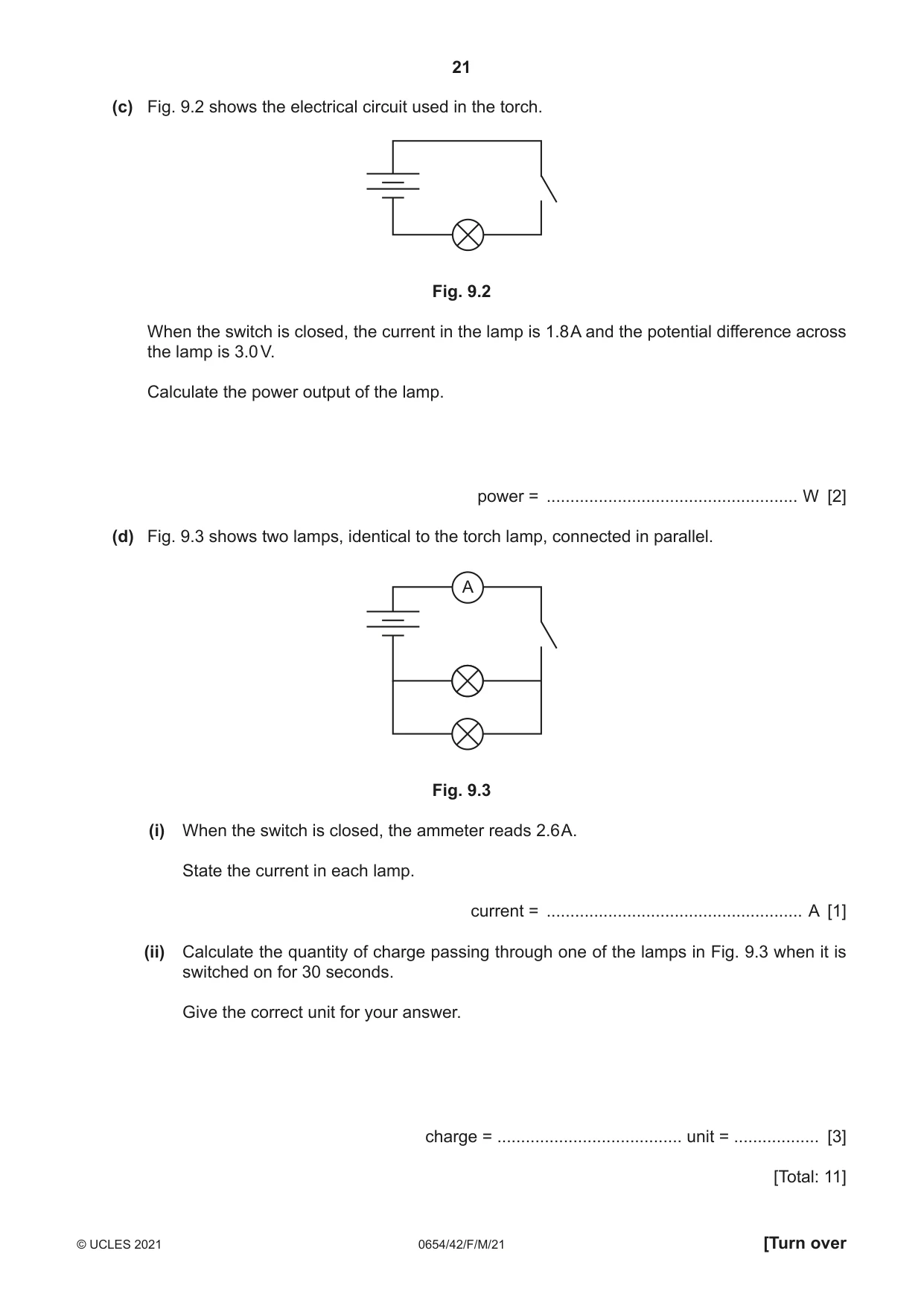
9 Visible light is a transverse wave and is part of the electromagnetic spectrum. (a) State what is meant by a transverse wave. ................................................................................................................................................... ............................................................................................................................................. [1] (b) Fig. 9.1 shows a ray of visible light from a torch (flashlight) shining into a rectangular glass block. glass air Fig. 9.1 (i) Complete Fig. 9.1 to show the path the ray takes through and out of the block. [2] (ii) State the term used to describe what happens to the ray of light as it enters the glass block. ..................................................................................................................................... [1] (iii) Explain why this happens to the ray of light. ........................................................................................................................................... ..................................................................................................................................... [1] (c) Fig. 9.2 shows the electrical circuit used in the torch. Fig. 9.2 When the switch is closed, the current in the lamp is 1.8 A and the potential difference across the lamp is 3.0 V. Calculate the power output of the lamp. power = ..................................................... W [2] (d) Fig. 9.3 shows two lamps, identical to the torch lamp, connected in parallel. A Fig. 9.3 (i) When the switch is closed, the ammeter reads 2.6 A. State the current in each lamp. current = ...................................................... A [1] (ii) Calculate the quantity of charge passing through one of the lamps in Fig. 9.3 when it is switched on for 30 seconds. Give the correct unit for your answer. charge = ....................................... unit = .................. [3] [Total: 11]
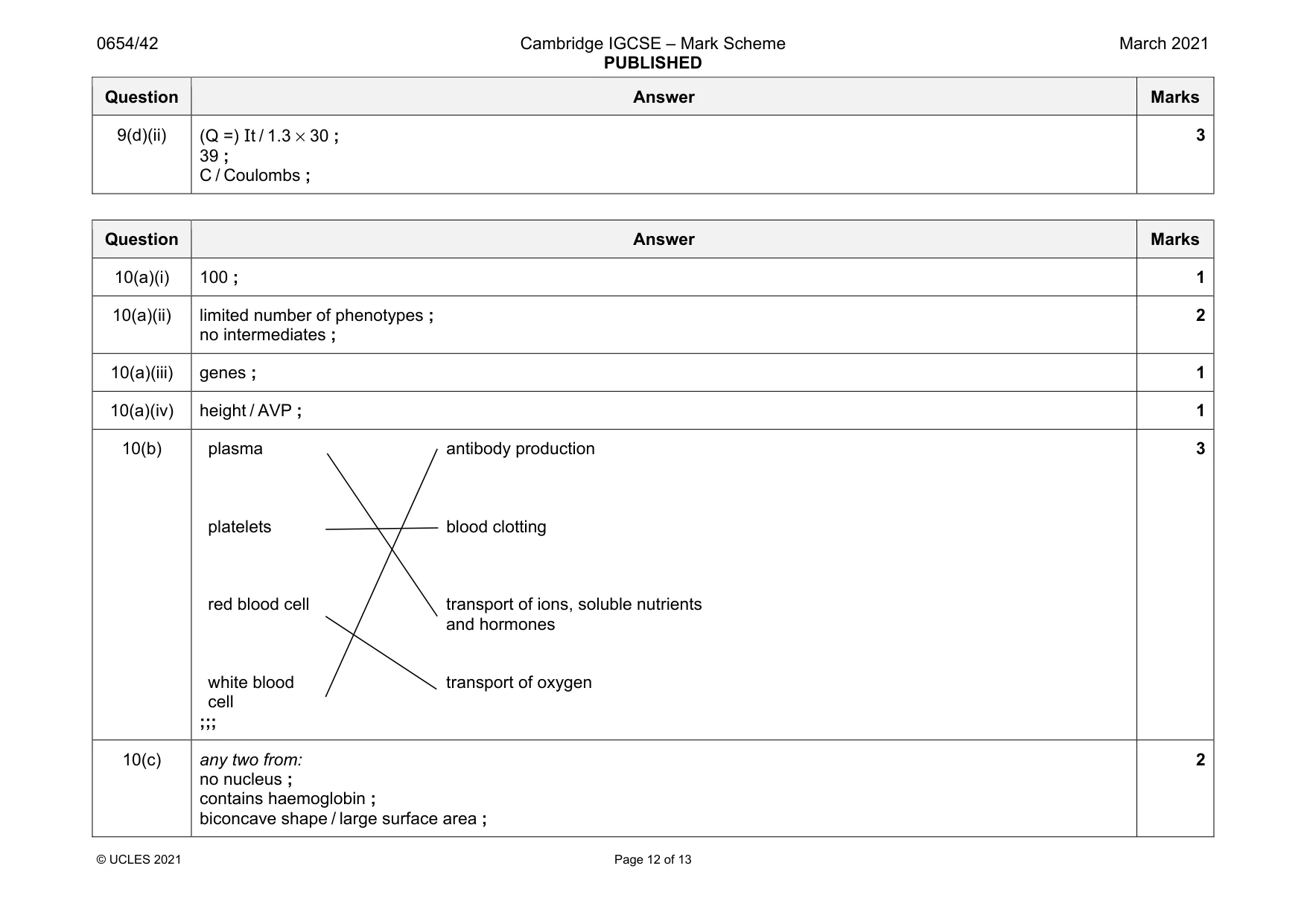
Mark scheme: 9(a) vibrations / oscillations, are perpendicular to direction of energy transfer ; 1 9(b)(i) ray moves towards the normal inside glass block ; ray emerges parallel to incidence ray ; 2 9(b)(ii) refraction ; 1 9(b)(iii) change of speed / caused by change in density of medium ; 1 9(c) (P=) IV / 1.8 × 3.0 ; 5.4 (W) ; 2 9(d)(i) 1.3 (A) ; 1 Question Answer Marks 9(d)(ii) (Q =) It / 1.3 × 30 ; 39 ; C / Coulombs ; 3
Q10 · The blood groups of some people are recorded
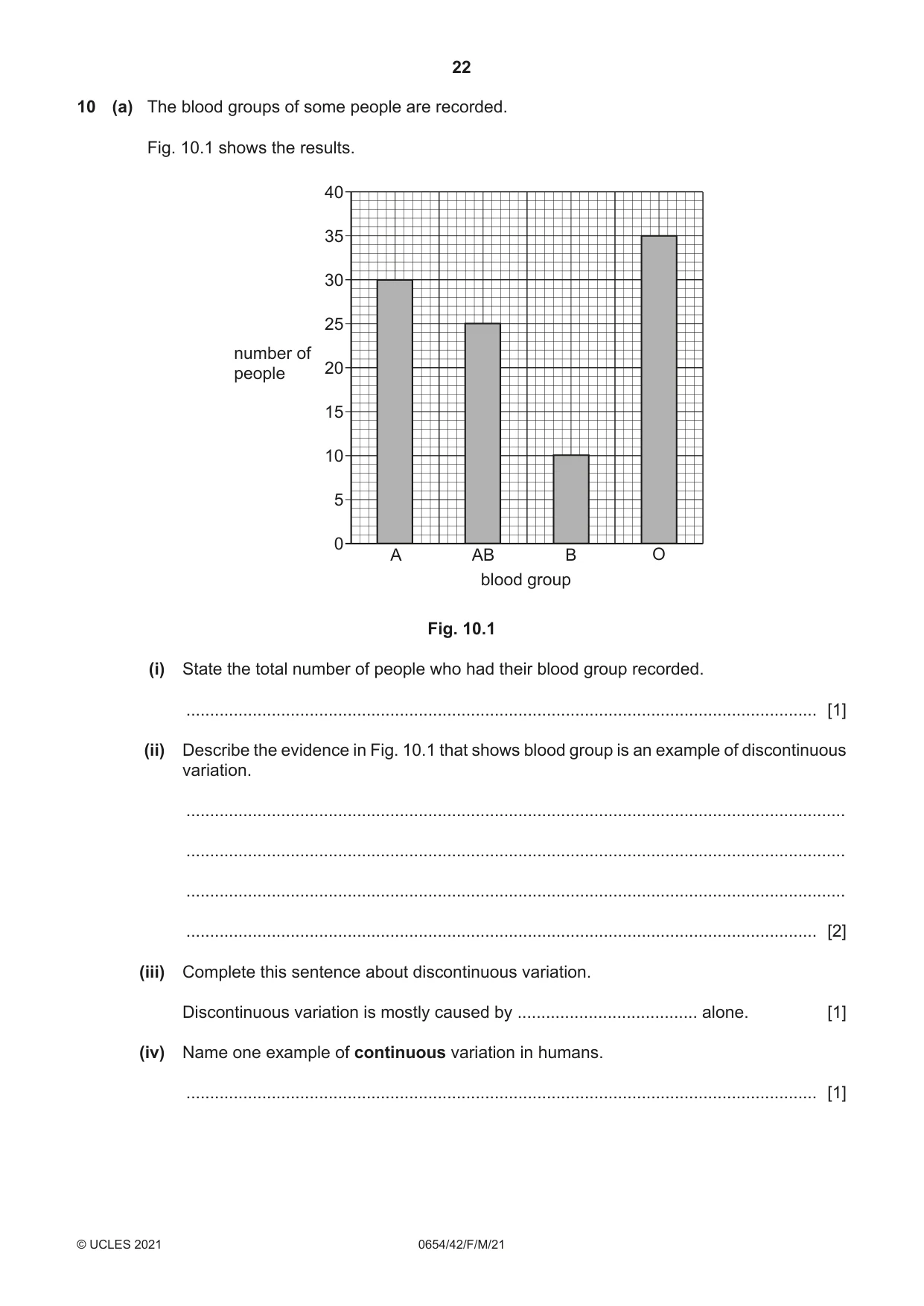
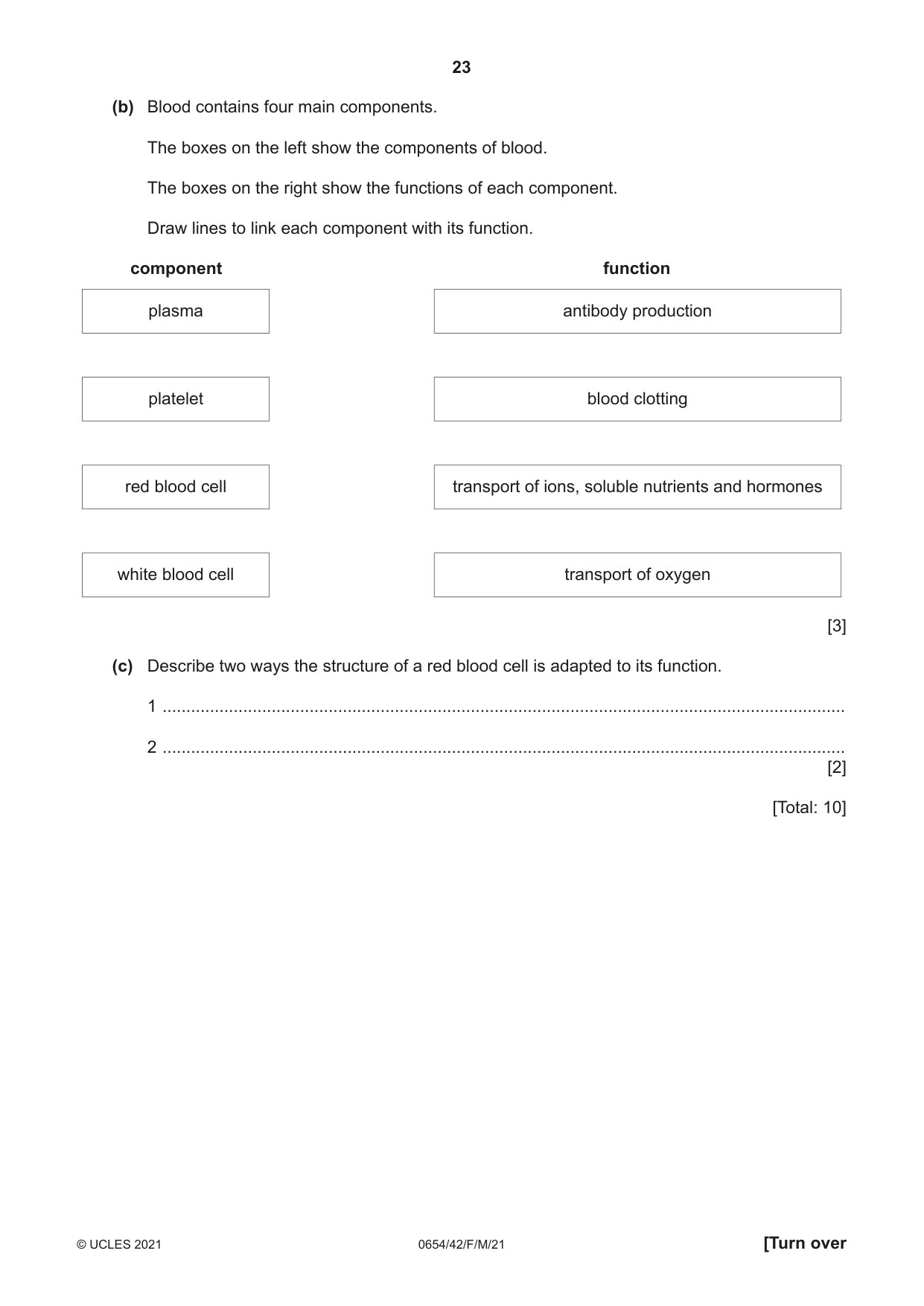
10 (a) The blood groups of some people are recorded. Fig. 10.1 shows the results. 40 35 30 25 number of 20 people 15 10 5 0 A AB B O blood group Fig. 10.1 (i) State the total number of people who had their blood group recorded. ..................................................................................................................................... [1] (ii) Describe the evidence in Fig. 10.1 that shows blood group is an example of discontinuous variation. ........................................................................................................................................... ........................................................................................................................................... ........................................................................................................................................... ..................................................................................................................................... [2] (iii) Complete this sentence about discontinuous variation. Discontinuous variation is mostly caused by ...................................... alone. [1] (iv) Name one example of continuous variation in humans. ..................................................................................................................................... [1] (b) Blood contains four main components. The boxes on the left show the components of blood. The boxes on the right show the functions of each component. Draw lines to link each component with its function. component function plasma antibody production platelet blood clotting red blood cell transport of ions, soluble nutrients and hormones white blood cell transport of oxygen [3] (c) Describe two ways the structure of a red blood cell is adapted to its function. 1 ................................................................................................................................................ 2 ................................................................................................................................................ [2] [Total: 10]
Mark scheme: 10(a)(i) 100 ; 1 10(a)(ii) limited number of phenotypes ; no intermediates ; 2 10(a)(iii) genes ; 1 10(a)(iv) height / AVP ; 1 10(b) plasma antibody production platelets blood clotting red blood cell transport of ions, soluble nutrients and hormones white blood cell transport of oxygen ;;; 3 10(c) any two from: no nucleus ; contains haemoglobin ; biconcave shape / large surface area ; 2
Q11 · Sodium, Na, is an element in Group I of the Periodic Table
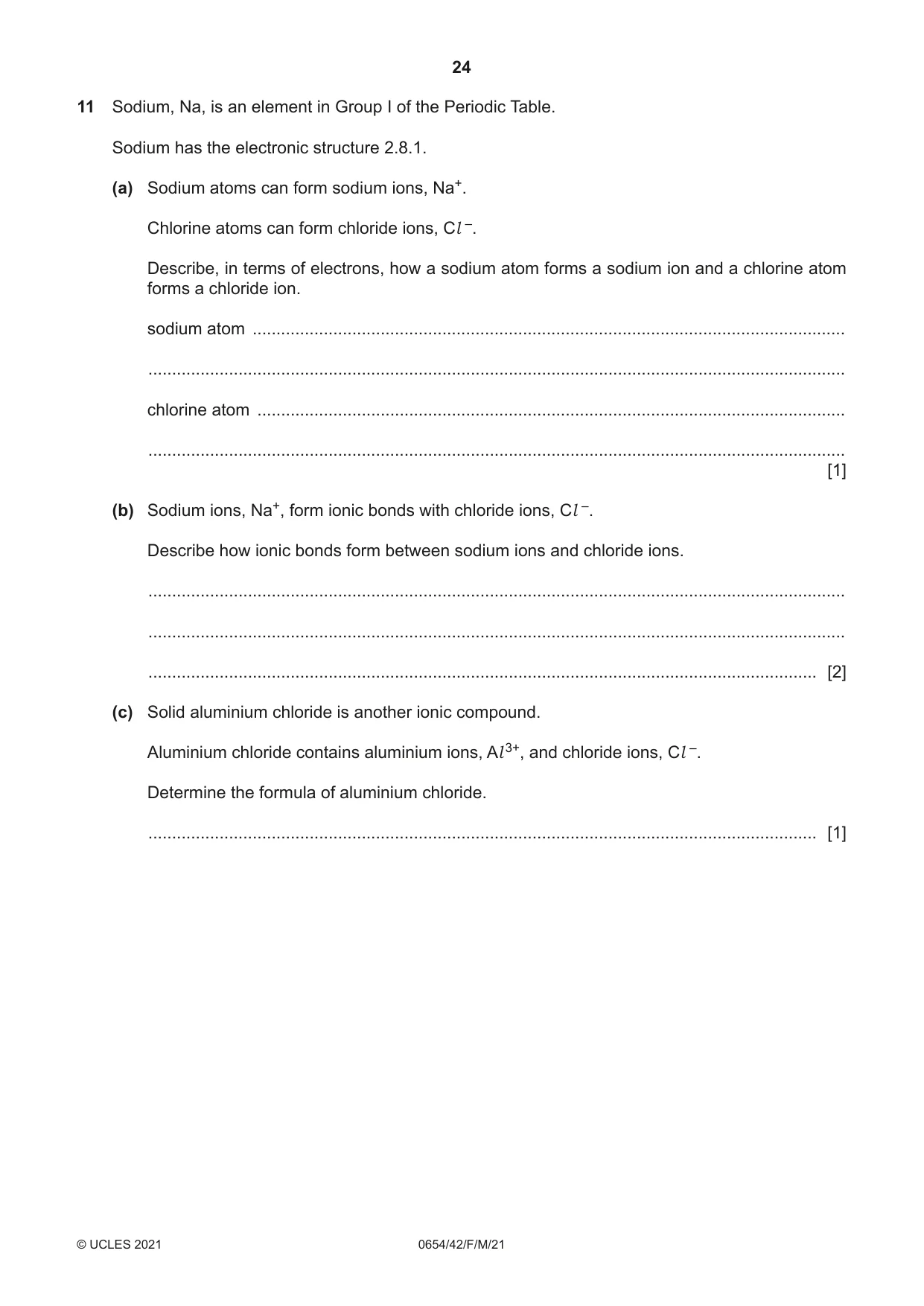
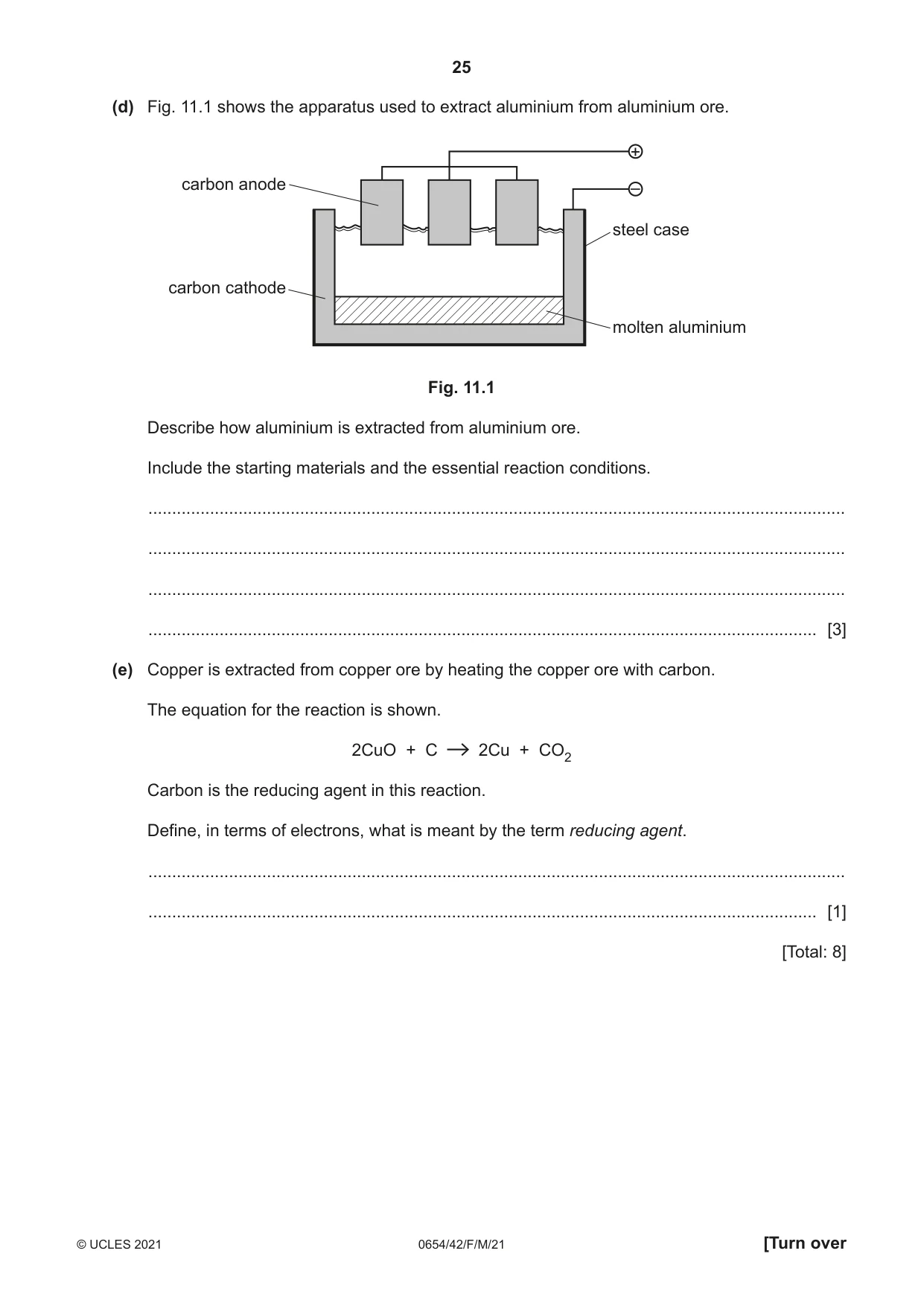
11 Sodium, Na, is an element in Group I of the Periodic Table. Sodium has the electronic structure 2.8.1. (a) Sodium atoms can form sodium ions, Na+. Chlorine atoms can form chloride ions, Cl –. Describe, in terms of electrons, how a sodium atom forms a sodium ion and a chlorine atom forms a chloride ion. sodium atom ............................................................................................................................. ................................................................................................................................................... chlorine atom ............................................................................................................................ ................................................................................................................................................... [1] (b) Sodium ions, Na+, form ionic bonds with chloride ions, Cl –. Describe how ionic bonds form between sodium ions and chloride ions. ................................................................................................................................................... ................................................................................................................................................... ............................................................................................................................................. [2] (c) Solid aluminium chloride is another ionic compound. Aluminium chloride contains aluminium ions, Al 3+, and chloride ions, Cl –. Determine the formula of aluminium chloride. ............................................................................................................................................. [1] (d) Fig. 11.1 shows the apparatus used to extract aluminium from aluminium ore. + carbon anode – steel case carbon cathode molten aluminium Fig. 11.1 Describe how aluminium is extracted from aluminium ore. Include the starting materials and the essential reaction conditions. ................................................................................................................................................... ................................................................................................................................................... ................................................................................................................................................... ............................................................................................................................................. [3] (e) Copper is extracted from copper ore by heating the copper ore with carbon. The equation for the reaction is shown. 2CuO + C 2Cu + CO2 Carbon is the reducing agent in this reaction. Define, in terms of electrons, what is meant by the term reducing agent. ................................................................................................................................................... ............................................................................................................................................. [1] [Total: 8]
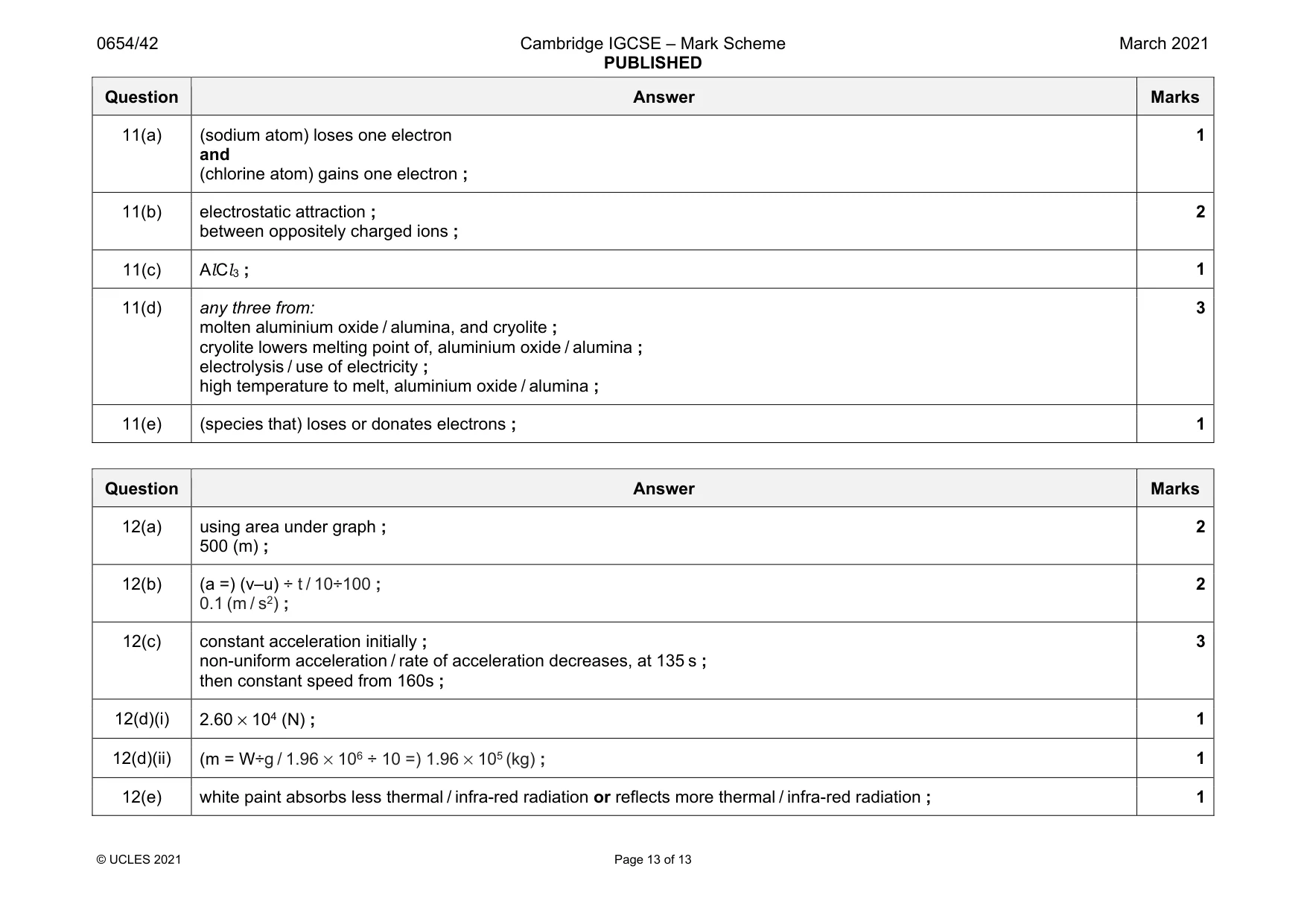
Mark scheme: 11(a) (sodium atom) loses one electron and (chlorine atom) gains one electron ; 1 11(b) electrostatic attraction ; between oppositely charged ions ; 2 11(c) AlCl3 ; 1 11(d) any three from: molten aluminium oxide / alumina, and cryolite ; cryolite lowers melting point of, aluminium oxide / alumina ; electrolysis / use of electricity ; high temperature to melt, aluminium oxide / alumina ; 3 11(e) (species that) loses or donates electrons ; 1
Q12 · A speed-time graph for a train
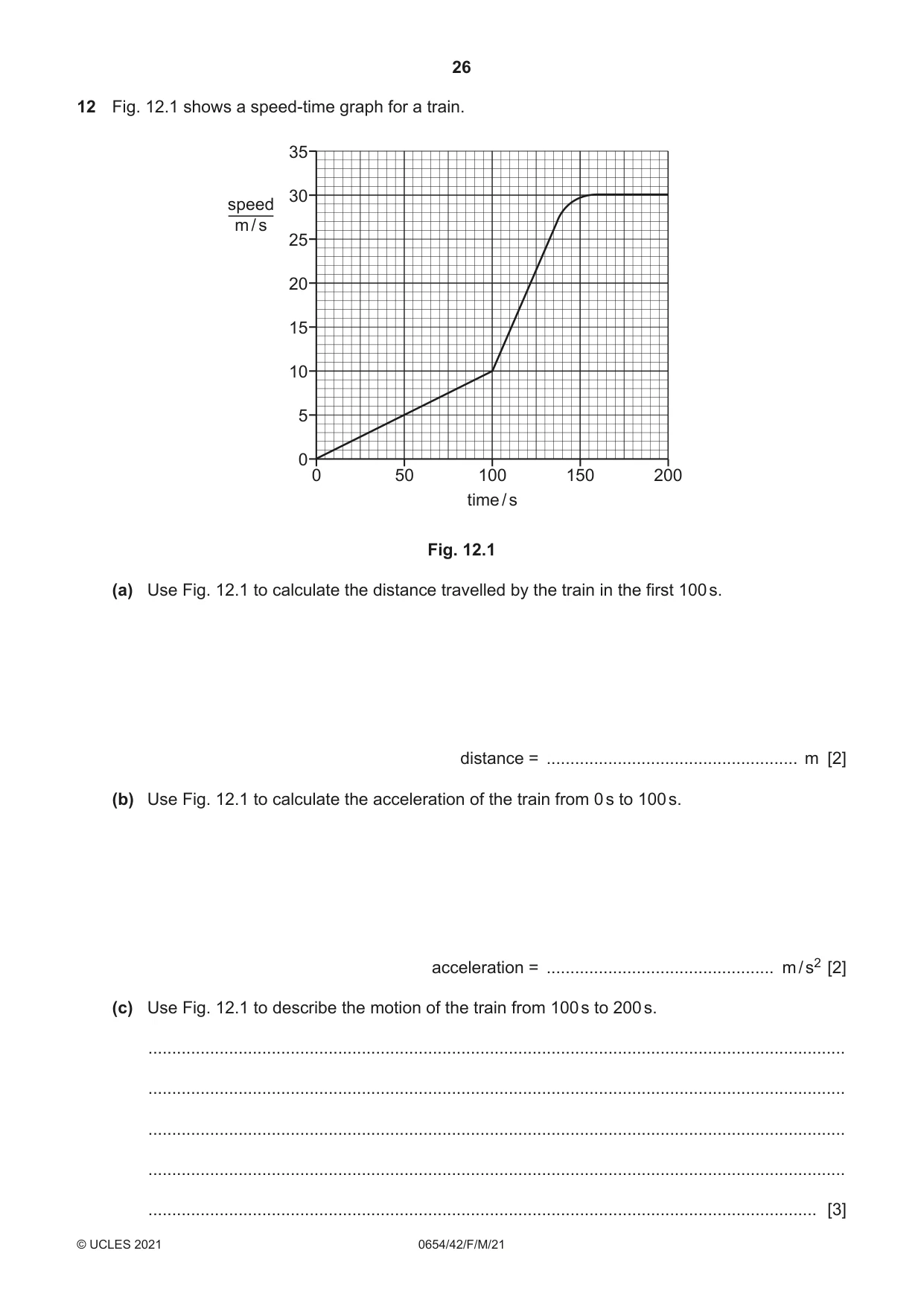
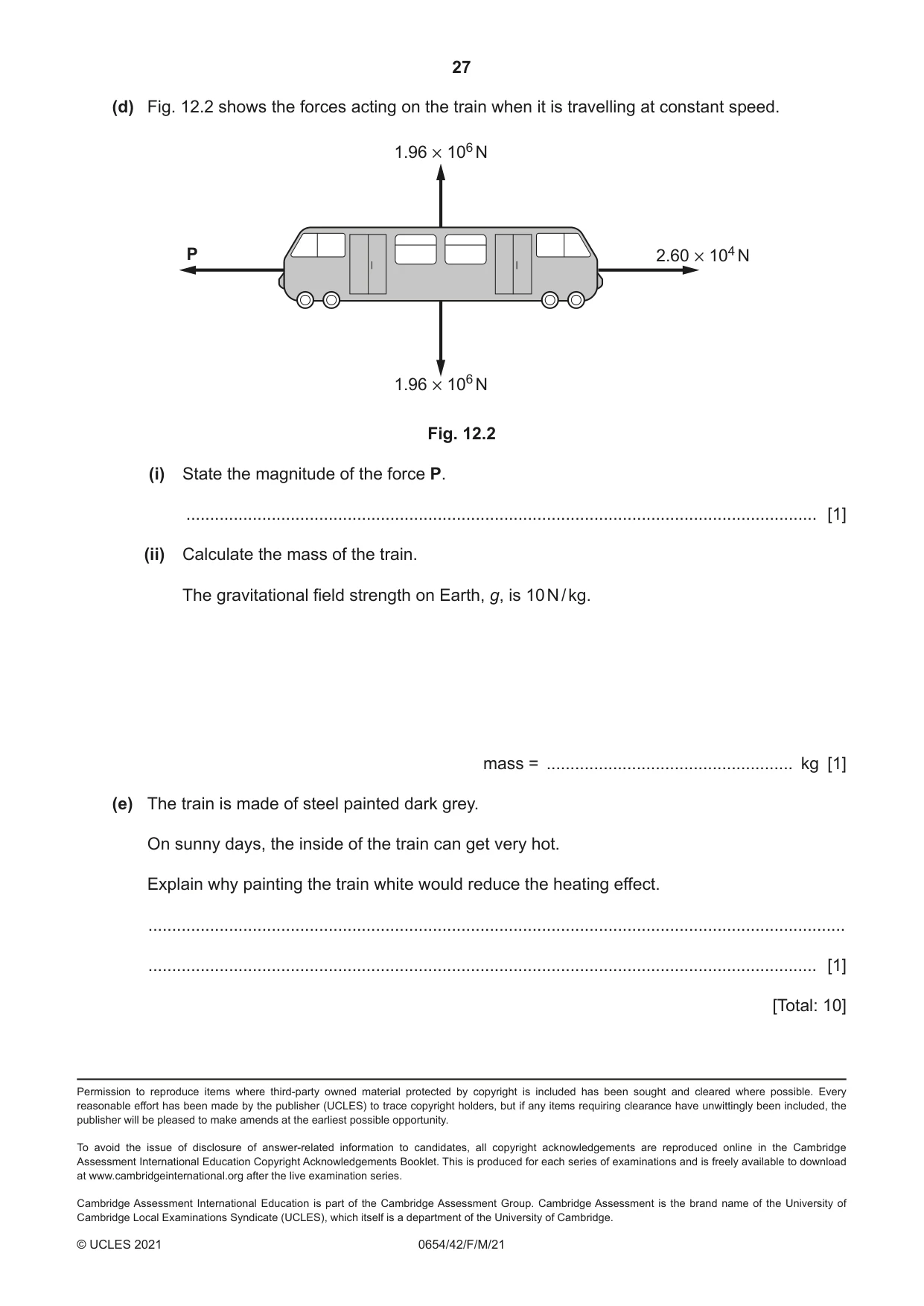
12 Fig. 12.1 shows a speed-time graph for a train. 35 30 speed m / s 25 20 15 10 5 0 0 50 100 150 200 time / s Fig. 12.1 (a) Use Fig. 12.1 to calculate the distance travelled by the train in the first 100 s. distance = ..................................................... m [2] (b) Use Fig. 12.1 to calculate the acceleration of the train from 0 s to 100 s. acceleration = ................................................ m / s2 [2] (c) Use Fig. 12.1 to describe the motion of the train from 100 s to 200 s. ................................................................................................................................................... ................................................................................................................................................... ................................................................................................................................................... ................................................................................................................................................... ............................................................................................................................................. [3] (d) Fig. 12.2 shows the forces acting on the train when it is travelling at constant speed. 1.96 × 10⁶ N P 2.60 × 10⁴ N 1.96 × 10⁶ N Fig. 12.2 (i) State the magnitude of the force P. ..................................................................................................................................... [1] (ii) Calculate the mass of the train. The gravitational field strength on Earth, g, is 10 N / kg. mass = .................................................... kg [1] (e) The train is made of steel painted dark grey. On sunny days, the inside of the train can get very hot. Explain why painting the train white would reduce the heating effect. ................................................................................................................................................... ............................................................................................................................................. [1] [Total: 10]
Mark scheme: 12(a) using area under graph ; 500 (m) ; 2 12(b) (a =) (v–u) ÷ t / 10÷100 ; 0.1 (m / s2) ; 2 12(c) constant acceleration initially ; non-uniform acceleration / rate of acceleration decreases, at 135 s ; then constant speed from 160s ; 3 12(d)(i) 2.60 × 10⁴ (N) ; 1 12(d)(ii) (m = W÷g / 1.96 × 10⁶ ÷ 10 =) 1.96 × 10⁵ (kg) ; 1 12(e) white paint absorbs less thermal / infra-red radiation or reflects more thermal / infra-red radiation ; 1
What was in this paper
The subtopics covered by these 12 questions, and how many questions each got. Open one in a new tab to see every Cambridge question on it.
What you needed in this session
Cambridge’s own grade thresholds for 2021 Feb/March, Paper 4 · Variant 2. A higher threshold means an easier paper — the bar moves with how the cohort did.