Cambridge IGCSE Sciences - Co-ordinated (Double) 0654 — 2021 May/June Paper 4 · Variant 1
0654/41/M/J/21 · 12 questions · 120 marks · ≈135 min
The question paper and its mark scheme, free to read here and free to download. This is Cambridge’s own paper, exactly as it was sat.
Question paper28 pages

Mark scheme12 pages
Answers below. Sit the paper first if you are practising.
Questions as text
Q1 · Some features of aerobic and anaerobic respiration
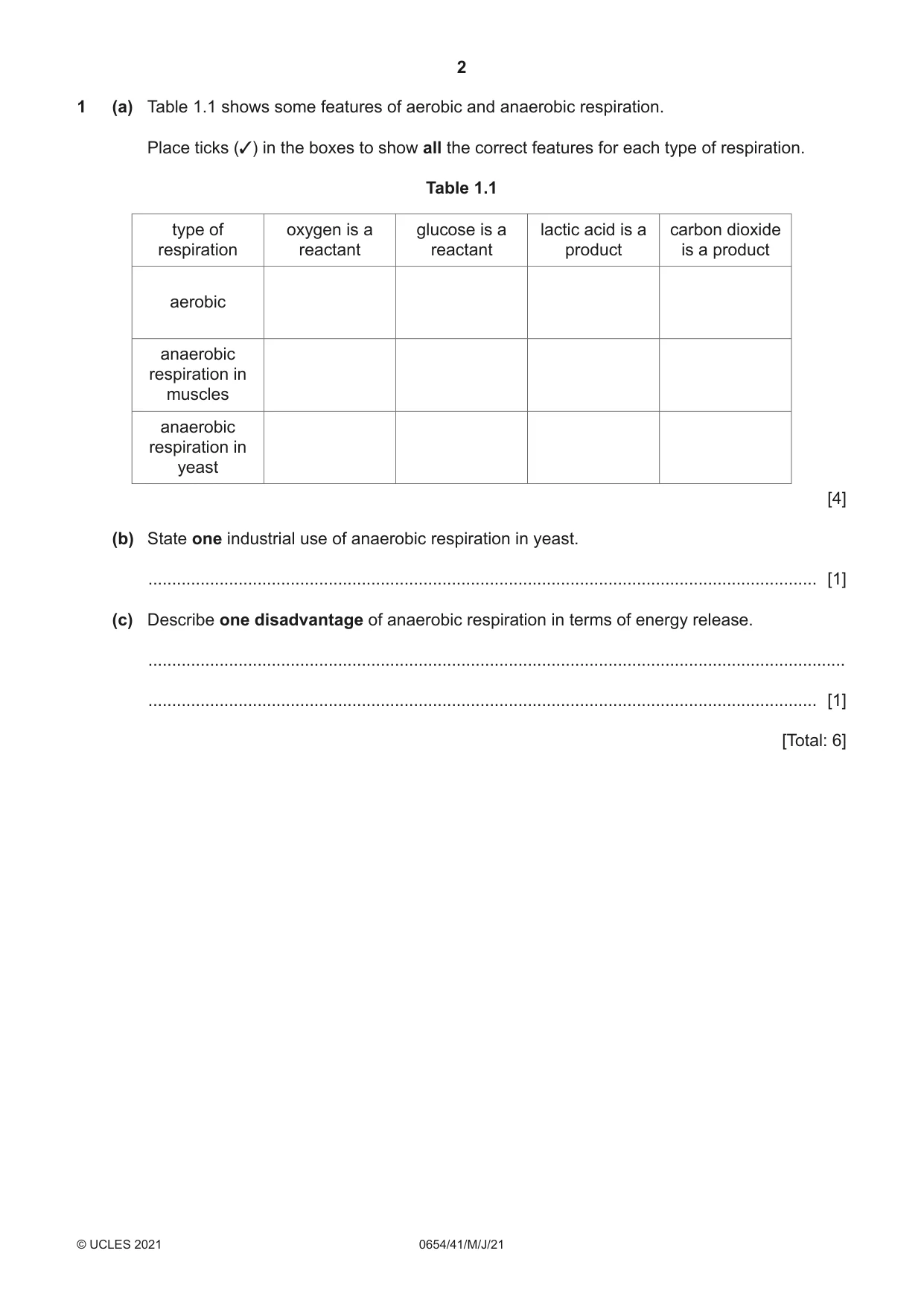
1 (a) Table 1.1 shows some features of aerobic and anaerobic respiration. Place ticks (3) in the boxes to show all the correct features for each type of respiration. Table 1.1 type of oxygen is a glucose is a lactic acid is a carbon dioxide respiration reactant reactant product is a product aerobic anaerobic respiration in muscles anaerobic respiration in yeast [4] (b) State one industrial use of anaerobic respiration in yeast. ............................................................................................................................................. [1] (c) Describe one disadvantage of anaerobic respiration in terms of energy release. ................................................................................................................................................... ............................................................................................................................................. [1] [Total: 6]
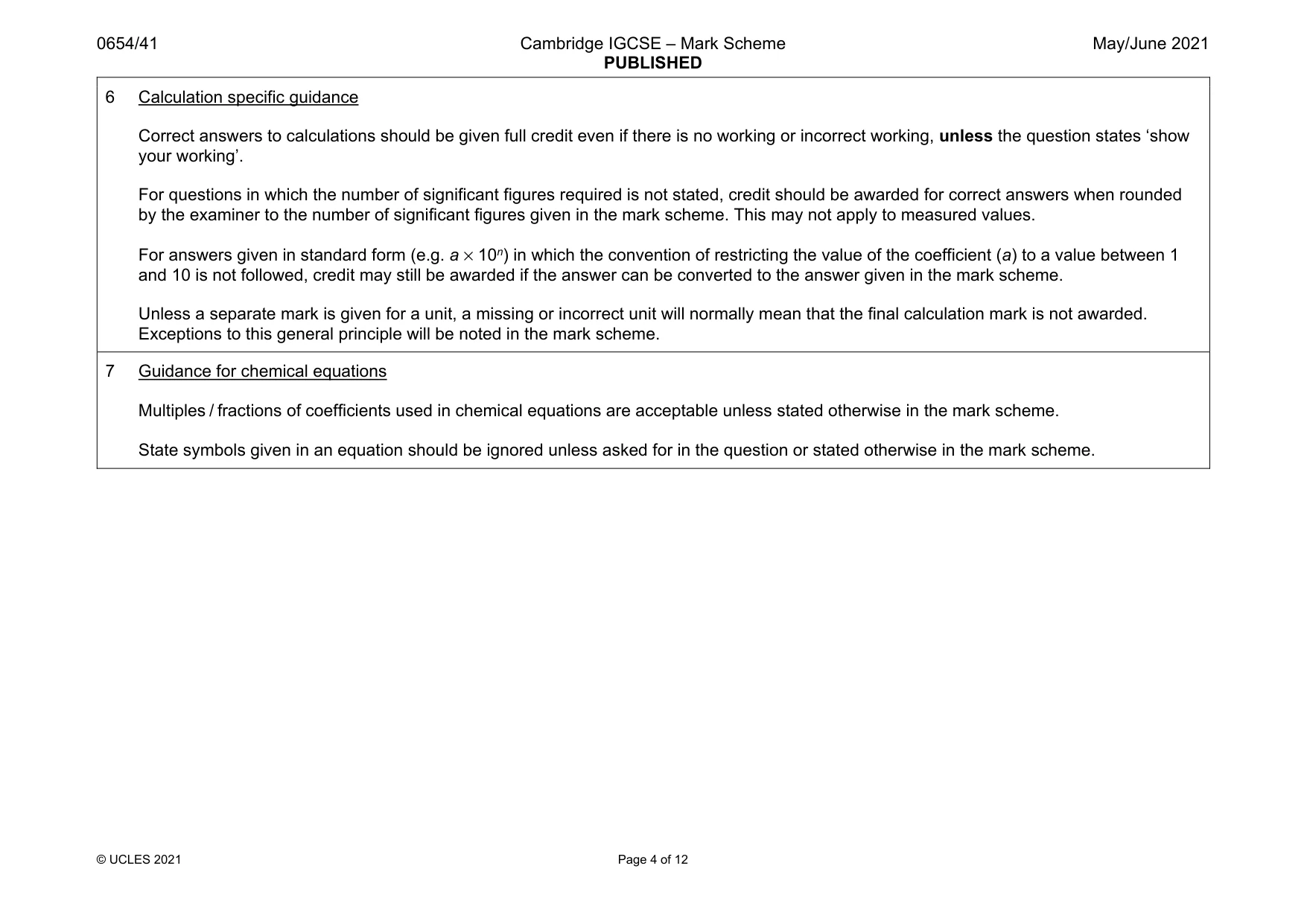
Mark scheme: 1(a) type of respiration oxygen is a reactant glucose is a reactant lactic acid is a product carbon dioxide is a product aerobic anaerobic respiration in muscles anaerobic respiration in yeast ;;;; 4 1(b) bread making / AVP ; 1 1(c) less energy is released per glucose molecule than aerobic respiration ; 1
Q2 · Mixtures of coloured substances can be separated by paper chromatography
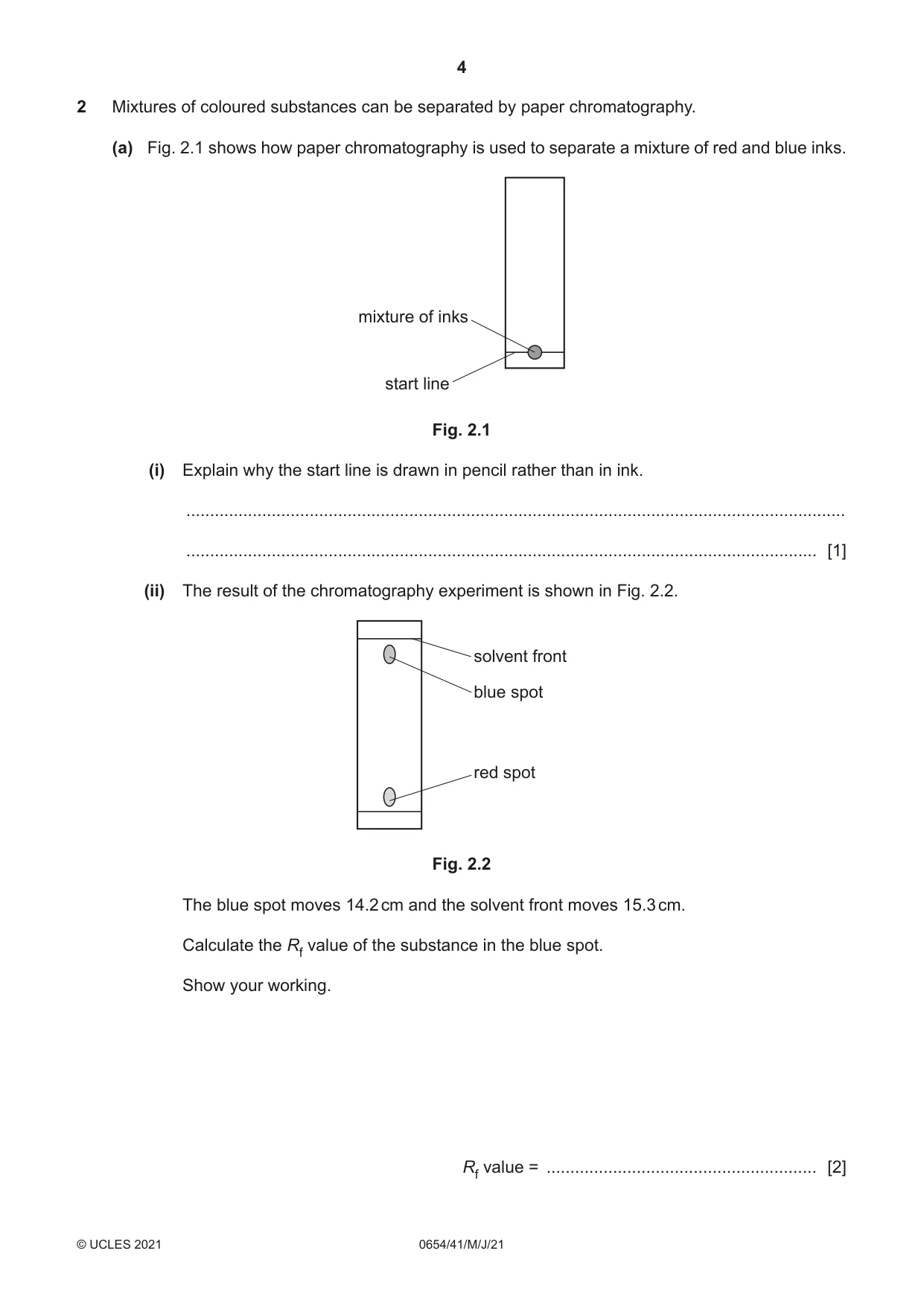
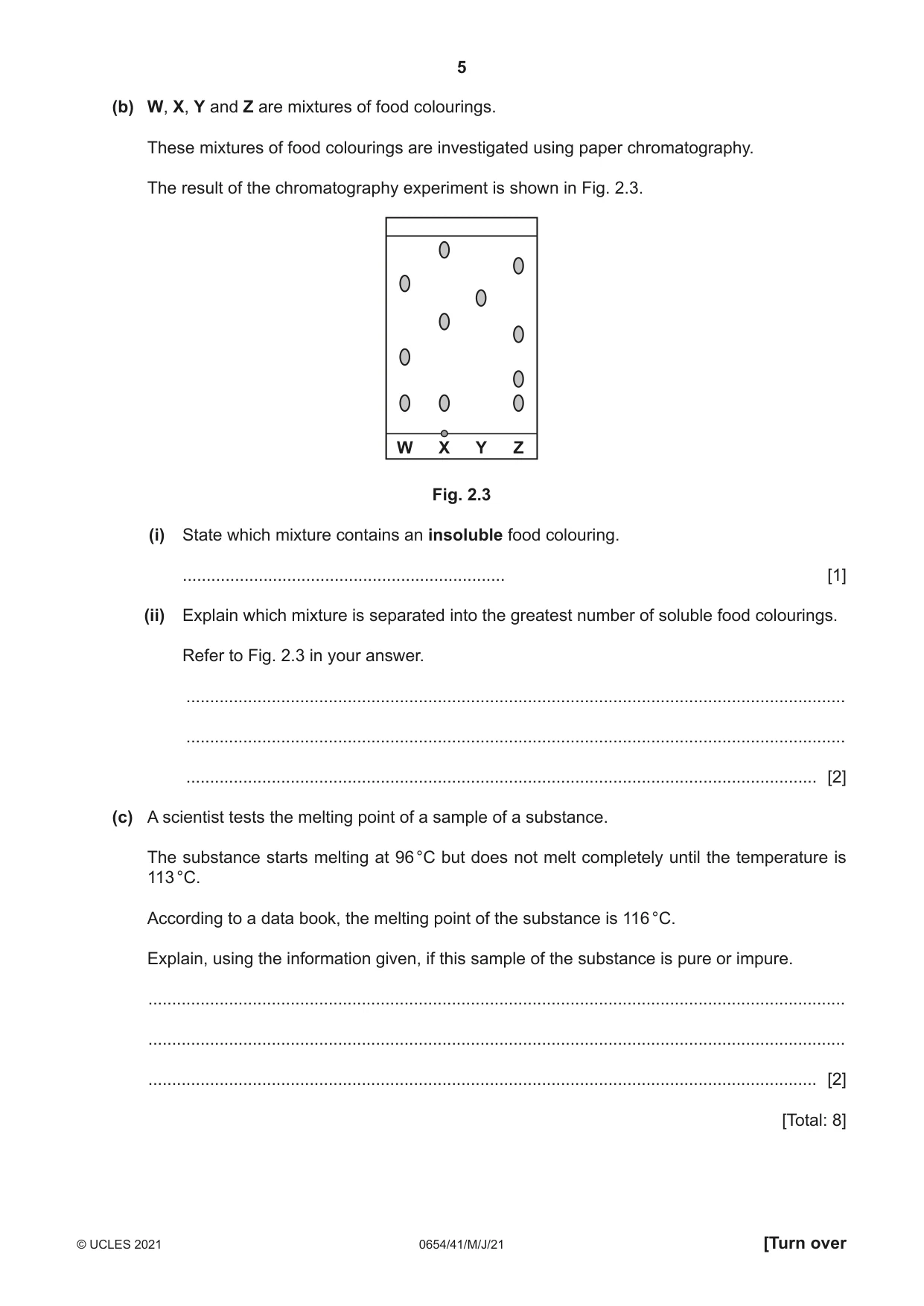
2 Mixtures of coloured substances can be separated by paper chromatography. (a) Fig. 2.1 shows how paper chromatography is used to separate a mixture of red and blue inks. mixture of inks start line Fig. 2.1 (i) Explain why the start line is drawn in pencil rather than in ink. ........................................................................................................................................... ..................................................................................................................................... [1] (ii) The result of the chromatography experiment is shown in Fig. 2.2. solvent front blue spot red spot Fig. 2.2 The blue spot moves 14.2 cm and the solvent front moves 15.3 cm. Calculate the Rf value of the substance in the blue spot. Show your working. Rf value = ......................................................... [2] (b) W, X, Y and Z are mixtures of food colourings. These mixtures of food colourings are investigated using paper chromatography. The result of the chromatography experiment is shown in Fig. 2.3. W X Y Z Fig. 2.3 (i) State which mixture contains an insoluble food colouring. .................................................................... [1] (ii) Explain which mixture is separated into the greatest number of soluble food colourings. Refer to Fig. 2.3 in your answer. ........................................................................................................................................... ........................................................................................................................................... ..................................................................................................................................... [2] (c) A scientist tests the melting point of a sample of a substance. The substance starts melting at 96 °C but does not melt completely until the temperature is 113 °C. According to a data book, the melting point of the substance is 116 °C. Explain, using the information given, if this sample of the substance is pure or impure. ................................................................................................................................................... ................................................................................................................................................... ............................................................................................................................................. [2] [Total: 8]
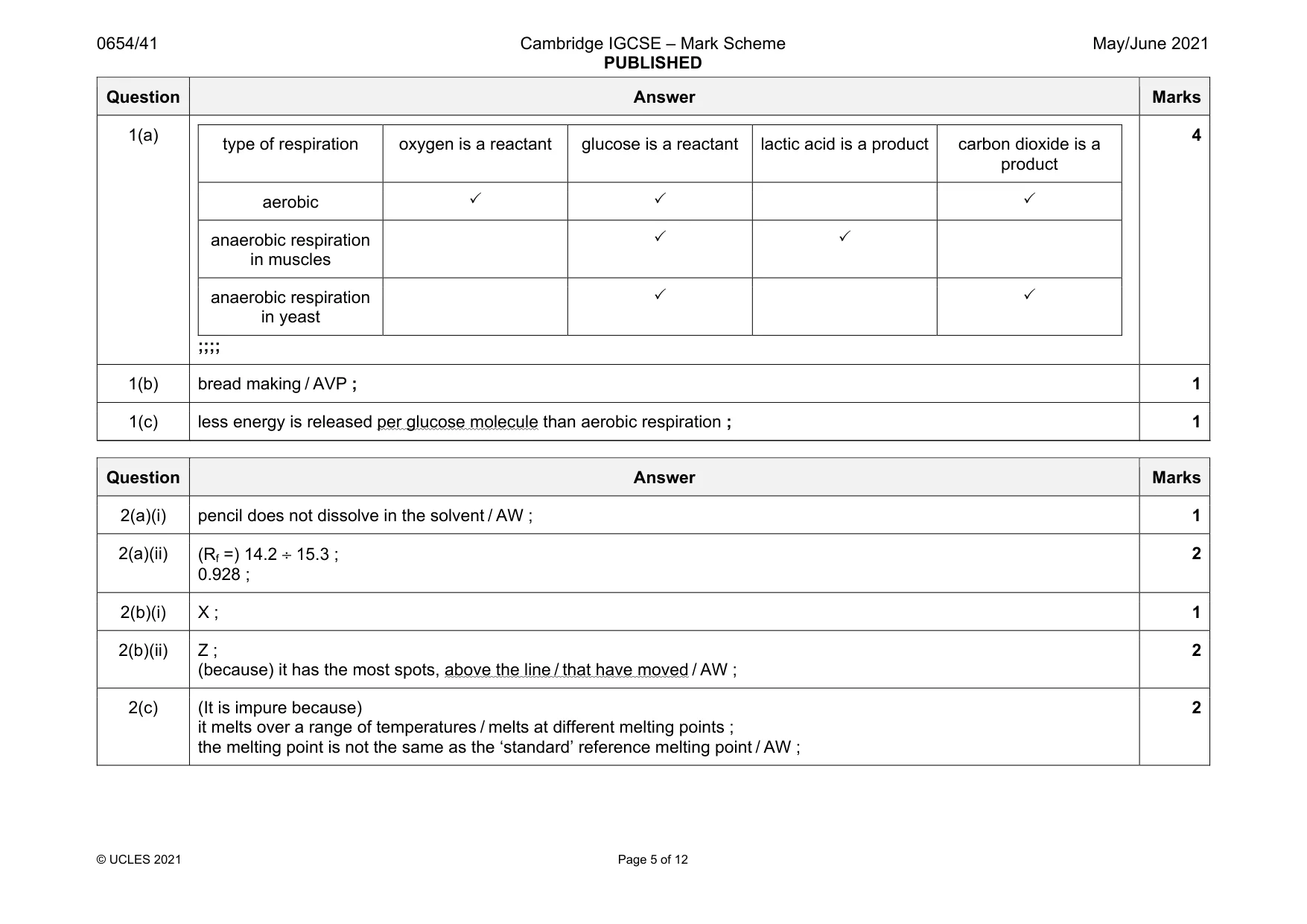
Mark scheme: 2(a)(i) pencil does not dissolve in the solvent / AW ; 1 2(a)(ii) (Rf =) 14.2 ÷ 15.3 ; 0.928 ; 2 2(b)(i) X ; 1 2(b)(ii) Z ; (because) it has the most spots, above the line / that have moved / AW ; 2 2(c) (It is impure because) it melts over a range of temperatures / melts at different melting points ; the melting point is not the same as the ‘standard’ reference melting point / AW ; 2
Q3 · A circuit used by a student to investigate the resistance of a metal wire
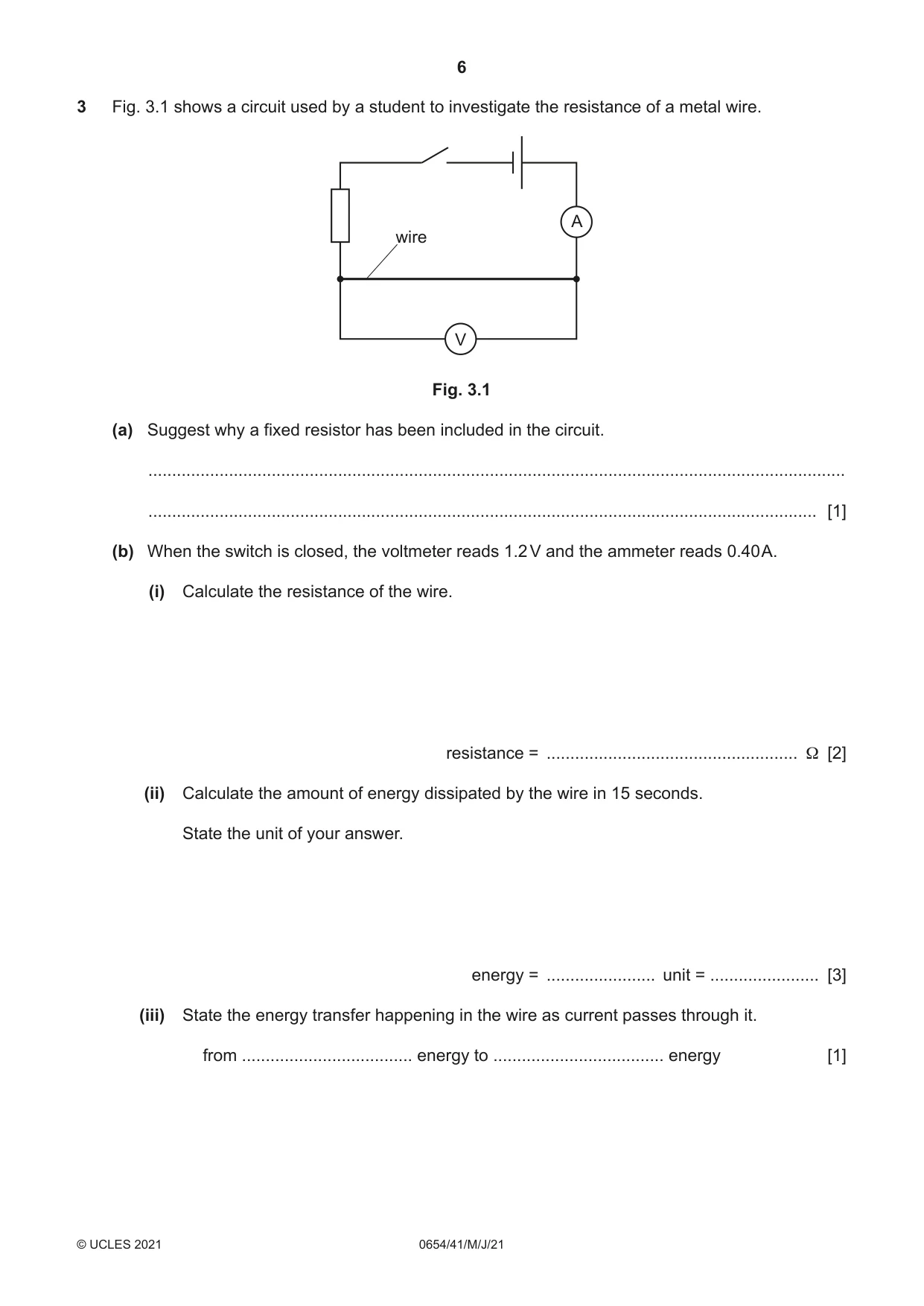
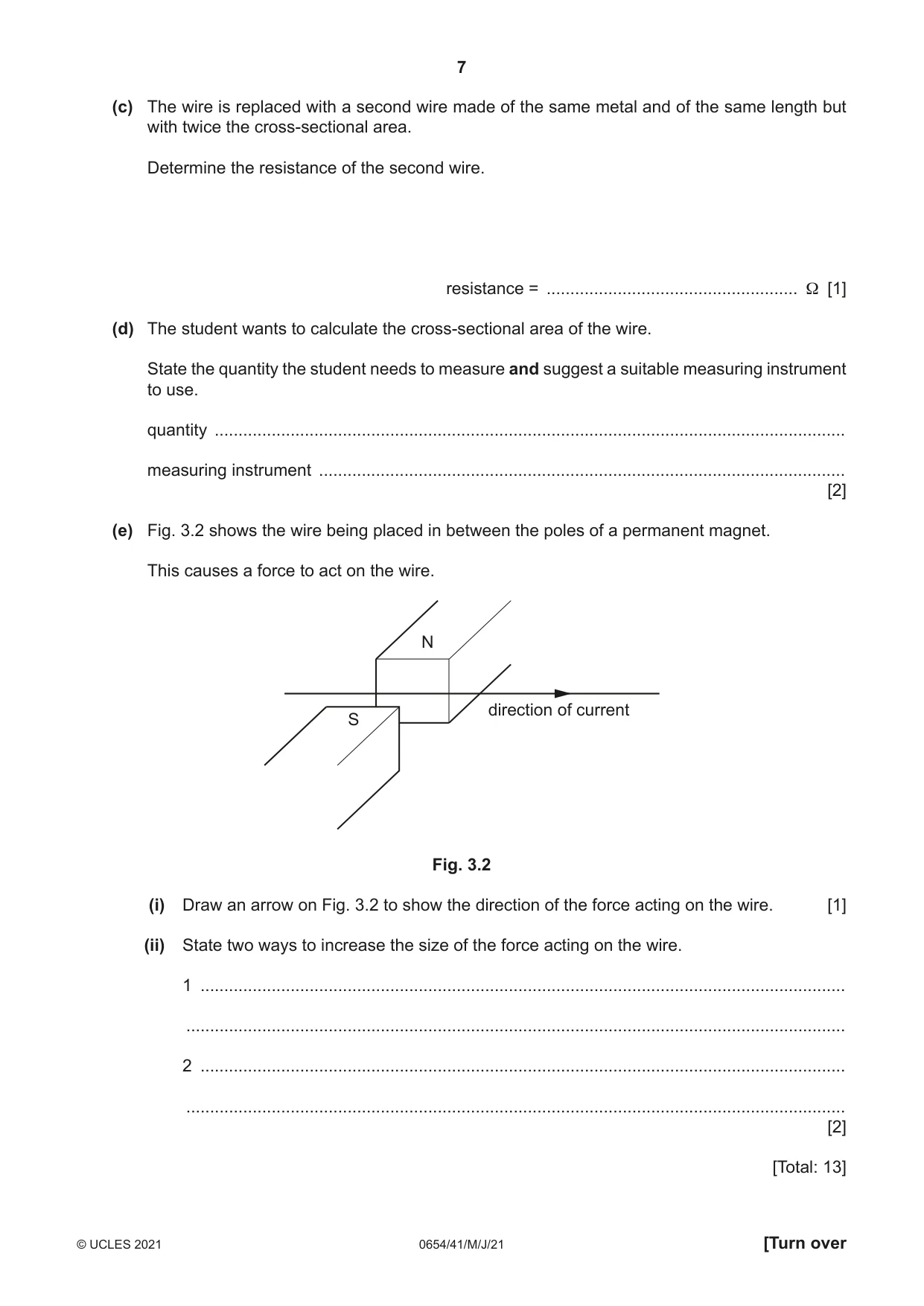
3 Fig. 3.1 shows a circuit used by a student to investigate the resistance of a metal wire. A wire V Fig. 3.1 (a) Suggest why a fixed resistor has been included in the circuit. ................................................................................................................................................... ............................................................................................................................................. [1] (b) When the switch is closed, the voltmeter reads 1.2 V and the ammeter reads 0.40 A. (i) Calculate the resistance of the wire. resistance = ..................................................... Ω [2] (ii) Calculate the amount of energy dissipated by the wire in 15 seconds. State the unit of your answer. energy = ....................... unit = ....................... [3] (iii) State the energy transfer happening in the wire as current passes through it. from .................................... energy to .................................... energy [1] (c) The wire is replaced with a second wire made of the same metal and of the same length but with twice the cross‑sectional area. Determine the resistance of the second wire. resistance = ..................................................... Ω [1] (d) The student wants to calculate the cross‑sectional area of the wire. State the quantity the student needs to measure and suggest a suitable measuring instrument to use. quantity ..................................................................................................................................... measuring instrument ............................................................................................................... [2] (e) Fig. 3.2 shows the wire being placed in between the poles of a permanent magnet. This causes a force to act on the wire. N direction of current S Fig. 3.2 (i) Draw an arrow on Fig. 3.2 to show the direction of the force acting on the wire. [1] (ii) State two ways to increase the size of the force acting on the wire. 1 ........................................................................................................................................ ........................................................................................................................................... 2 ........................................................................................................................................ ........................................................................................................................................... [2] [Total: 13]
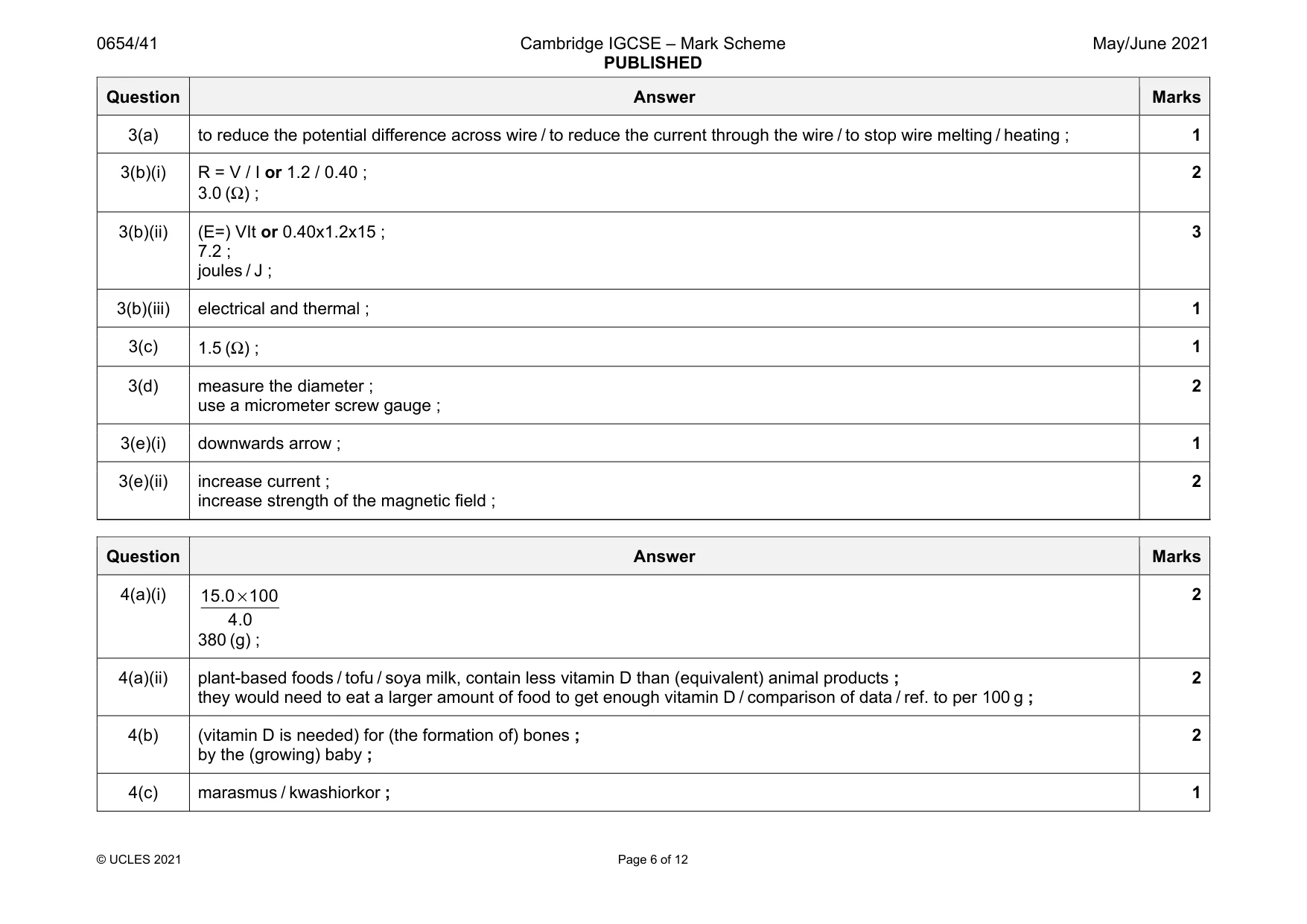
Mark scheme: 3(a) to reduce the potential difference across wire / to reduce the current through the wire / to stop wire melting / heating ; 1 3(b)(i) R = V / I or 1.2 / 0.40 ; 3.0 (Ω) ; 2 3(b)(ii) (E=) VIt or 0.40x1.2x15 ; 7.2 ; joules / J ; 3 3(b)(iii) electrical and thermal ; 1 3(c) 1.5 (Ω) ; 1 3(d) measure the diameter ; use a micrometer screw gauge ; 2 3(e)(i) downwards arrow ; 1 3(e)(ii) increase current ; increase strength of the magnetic field ; 2
Q4 · The vitamin D content in 100 g of different foods
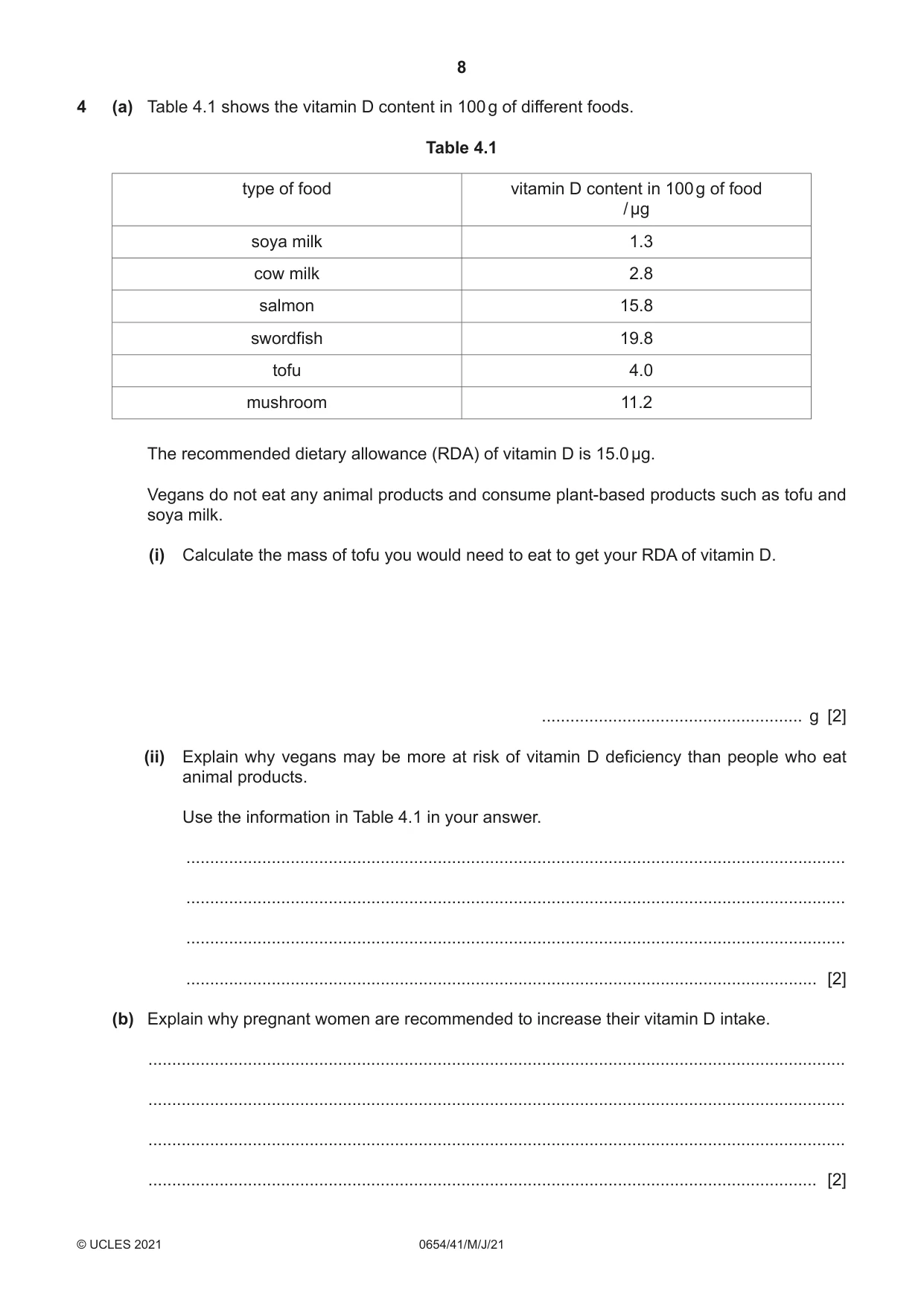
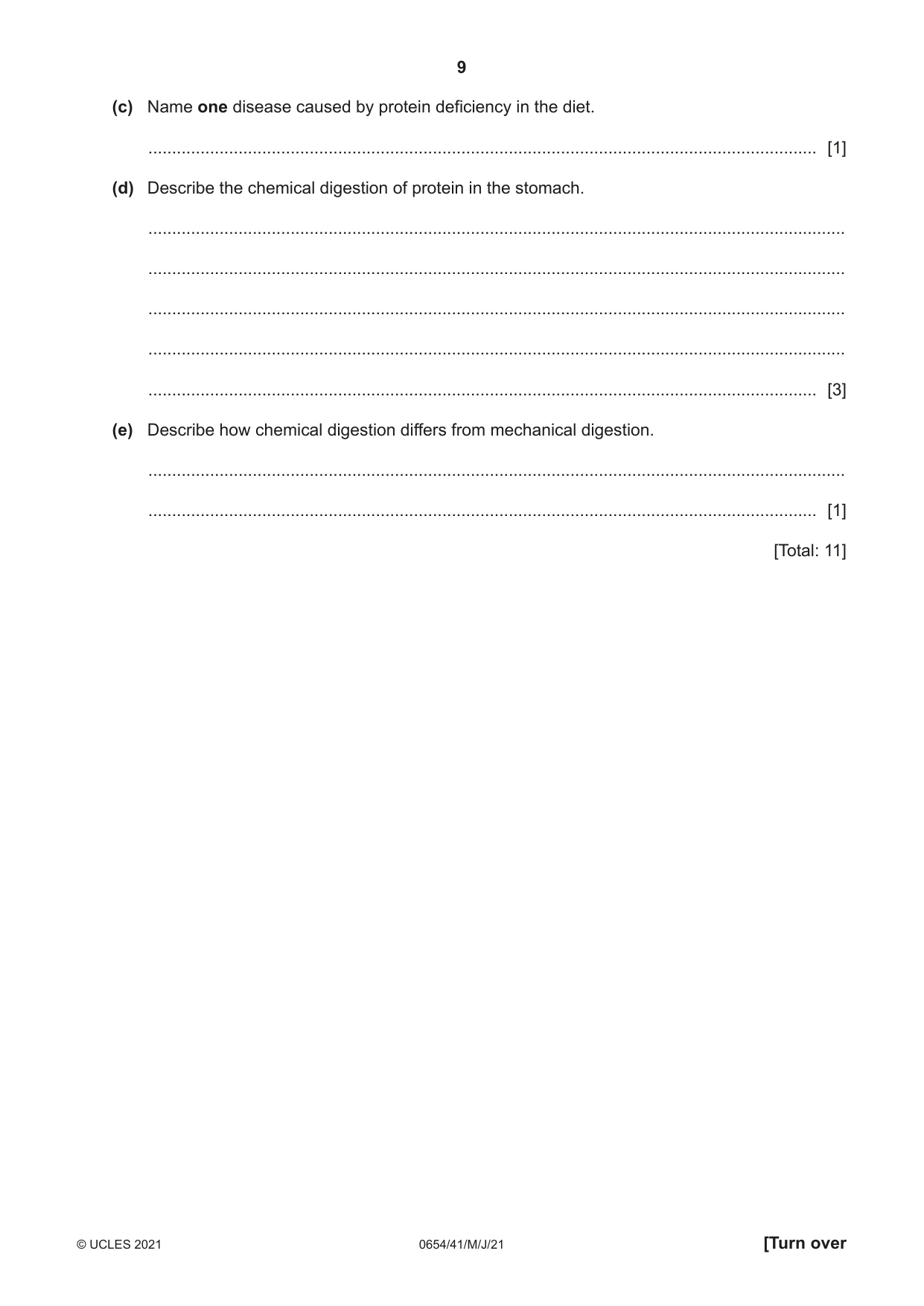
4 (a) Table 4.1 shows the vitamin D content in 100 g of different foods. Table 4.1 type of food vitamin D content in 100 g of food / µg soya milk 1.3 cow milk 2.8 salmon 15.8 swordfish 19.8 tofu 4.0 mushroom 11.2 The recommended dietary allowance (RDA) of vitamin D is 15.0 µg. Vegans do not eat any animal products and consume plant‑based products such as tofu and soya milk. (i) Calculate the mass of tofu you would need to eat to get your RDA of vitamin D. ....................................................... g [2] (ii) Explain why vegans may be more at risk of vitamin D deficiency than people who eat animal products. Use the information in Table 4.1 in your answer. ........................................................................................................................................... ........................................................................................................................................... ........................................................................................................................................... ..................................................................................................................................... [2] (b) Explain why pregnant women are recommended to increase their vitamin D intake. ................................................................................................................................................... ................................................................................................................................................... ................................................................................................................................................... ............................................................................................................................................. [2] (c) Name one disease caused by protein deficiency in the diet. ............................................................................................................................................. [1] (d) Describe the chemical digestion of protein in the stomach. ................................................................................................................................................... ................................................................................................................................................... ................................................................................................................................................... ................................................................................................................................................... ............................................................................................................................................. [3] (e) Describe how chemical digestion differs from mechanical digestion. ................................................................................................................................................... ............................................................................................................................................. [1] [Total: 11]
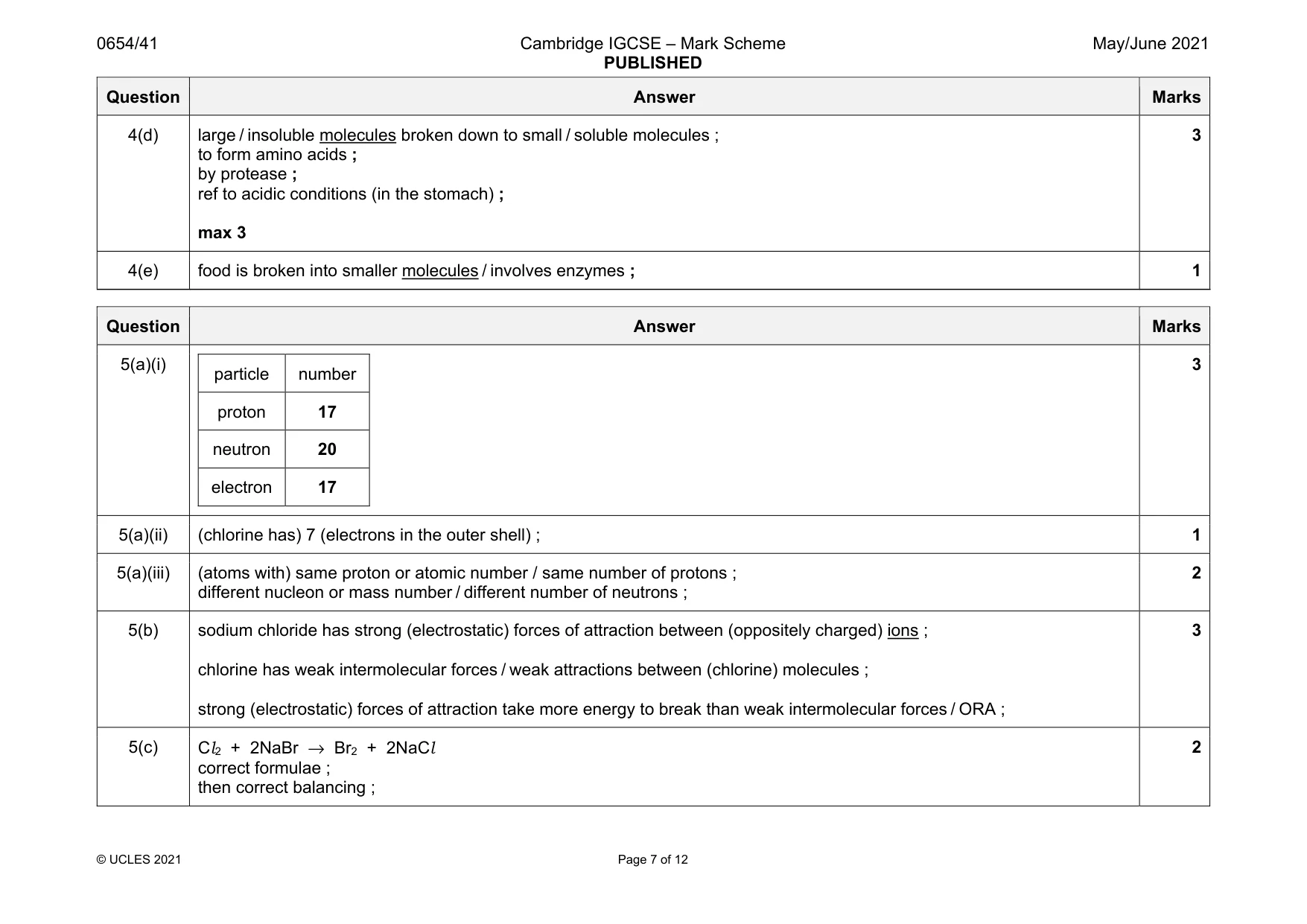
Mark scheme: 4(a)(i) 15.0 100 4.0 × 380 (g) ; 4(a)(ii) plant-based foods / tofu / soya milk, contain less vitamin D than (equivalent) animal products ; they would need to eat a larger amount of food to get enough vitamin D / comparison of data / ref. to per 100 g ; 2 4(b) (vitamin D is needed) for (the formation of) bones ; by the (growing) baby ; 2 4(c) marasmus / kwashiorkor ; 1 Question Answer Marks 4(d) large / insoluble molecules broken down to small / soluble molecules ; to form amino acids ; by protease ; ref to acidic conditions (in the stomach) ; max 3 3 4(e) food is broken into smaller molecules / involves enzymes ; 1
Q5 · An atom of chlorine has a proton number (atomic number) of 17 and a nucleon number (mass…
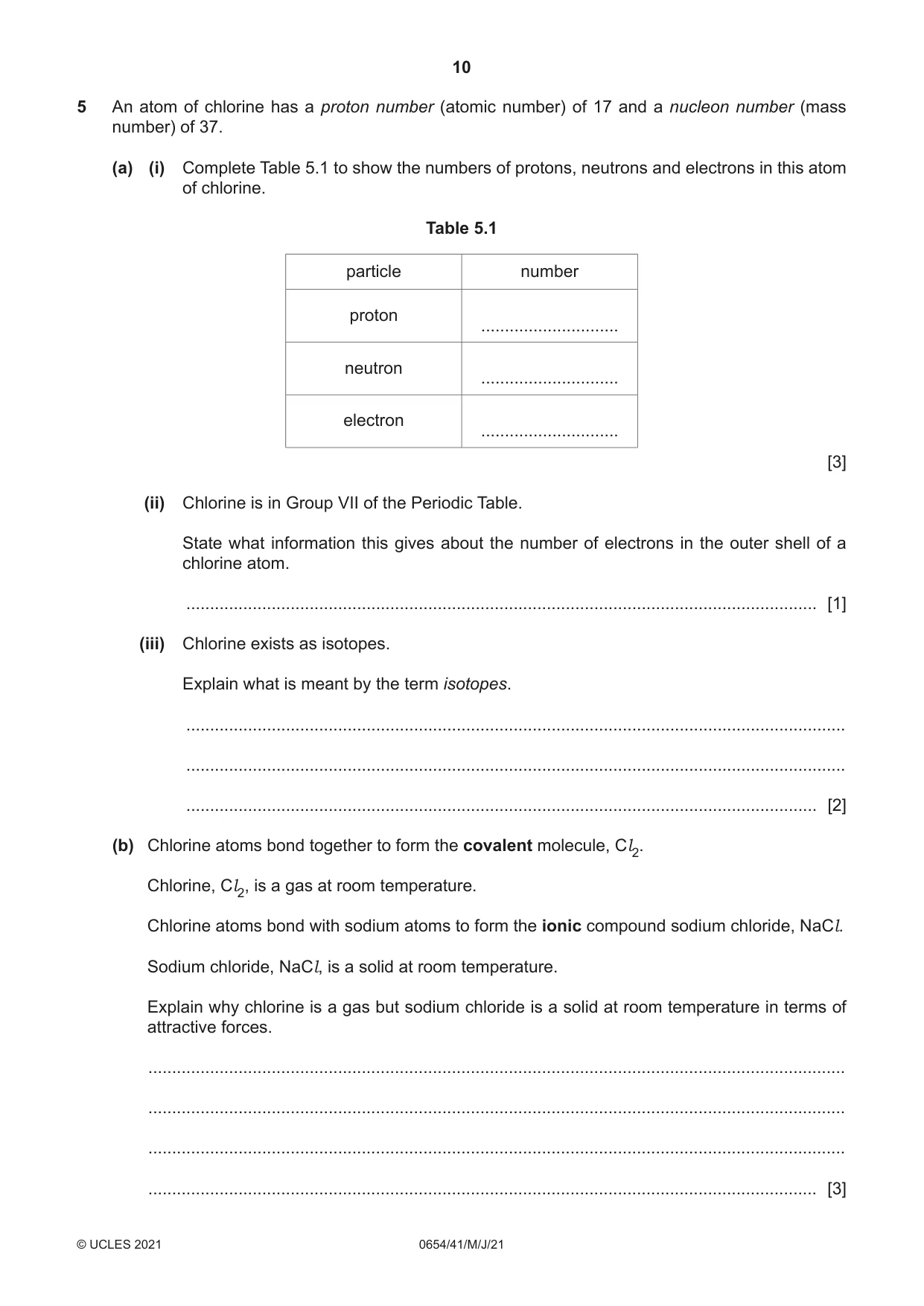
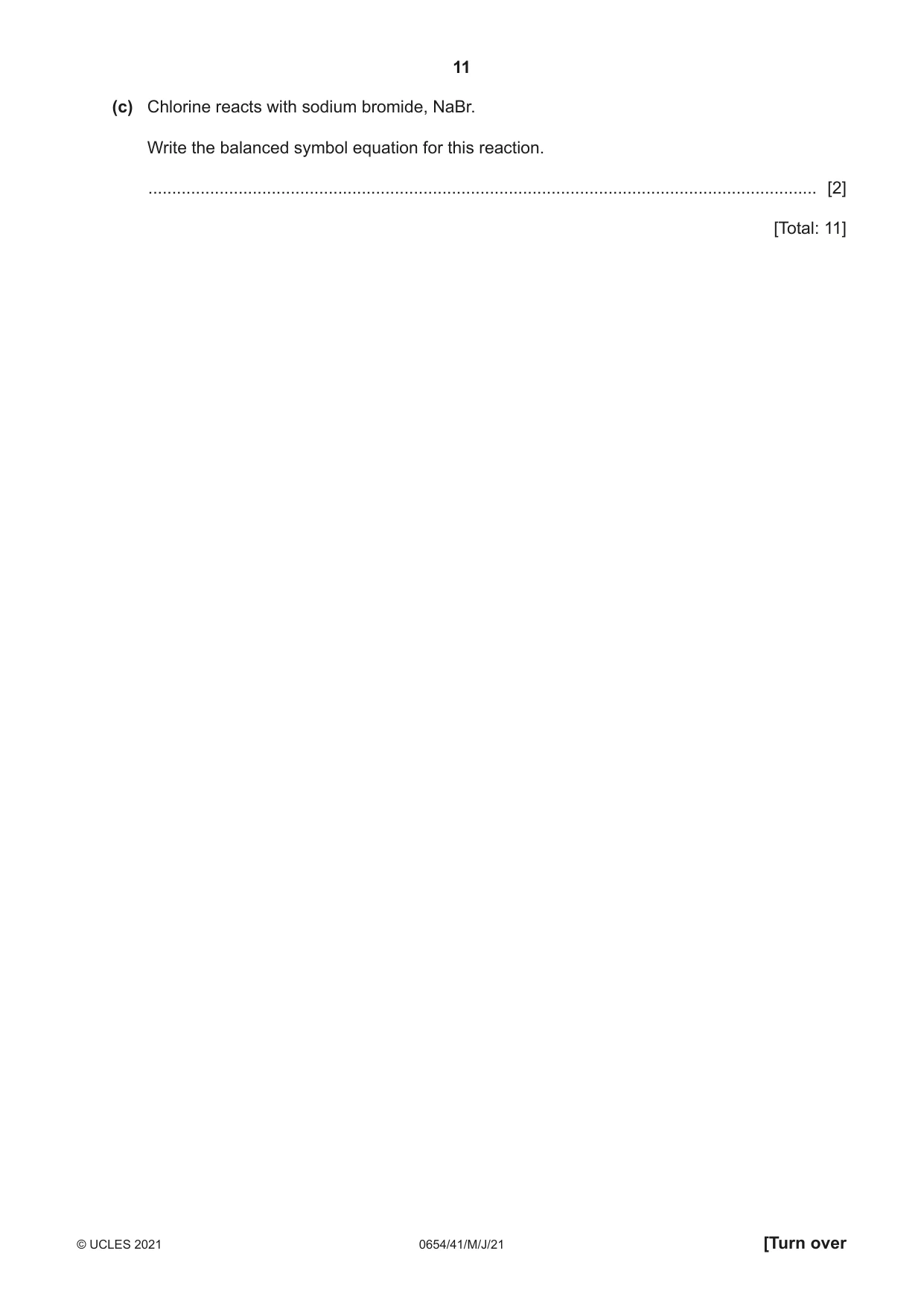
5 An atom of chlorine has a proton number (atomic number) of 17 and a nucleon number (mass number) of 37. (a) (i) Complete Table 5.1 to show the numbers of protons, neutrons and electrons in this atom of chlorine. Table 5.1 particle number proton ............................. neutron ............................. electron ............................. [3] (ii) Chlorine is in Group VII of the Periodic Table. State what information this gives about the number of electrons in the outer shell of a chlorine atom. ..................................................................................................................................... [1] (iii) Chlorine exists as isotopes. Explain what is meant by the term isotopes. ........................................................................................................................................... ........................................................................................................................................... ..................................................................................................................................... [2] (b) Chlorine atoms bond together to form the covalent molecule, Cl2. Chlorine, Cl2, is a gas at room temperature. Chlorine atoms bond with sodium atoms to form the ionic compound sodium chloride, NaCl. Sodium chloride, NaCl, is a solid at room temperature. Explain why chlorine is a gas but sodium chloride is a solid at room temperature in terms of attractive forces. ................................................................................................................................................... ................................................................................................................................................... ................................................................................................................................................... ............................................................................................................................................. [3] (c) Chlorine reacts with sodium bromide, NaBr. Write the balanced symbol equation for this reaction. ............................................................................................................................................. [2] [Total: 11]
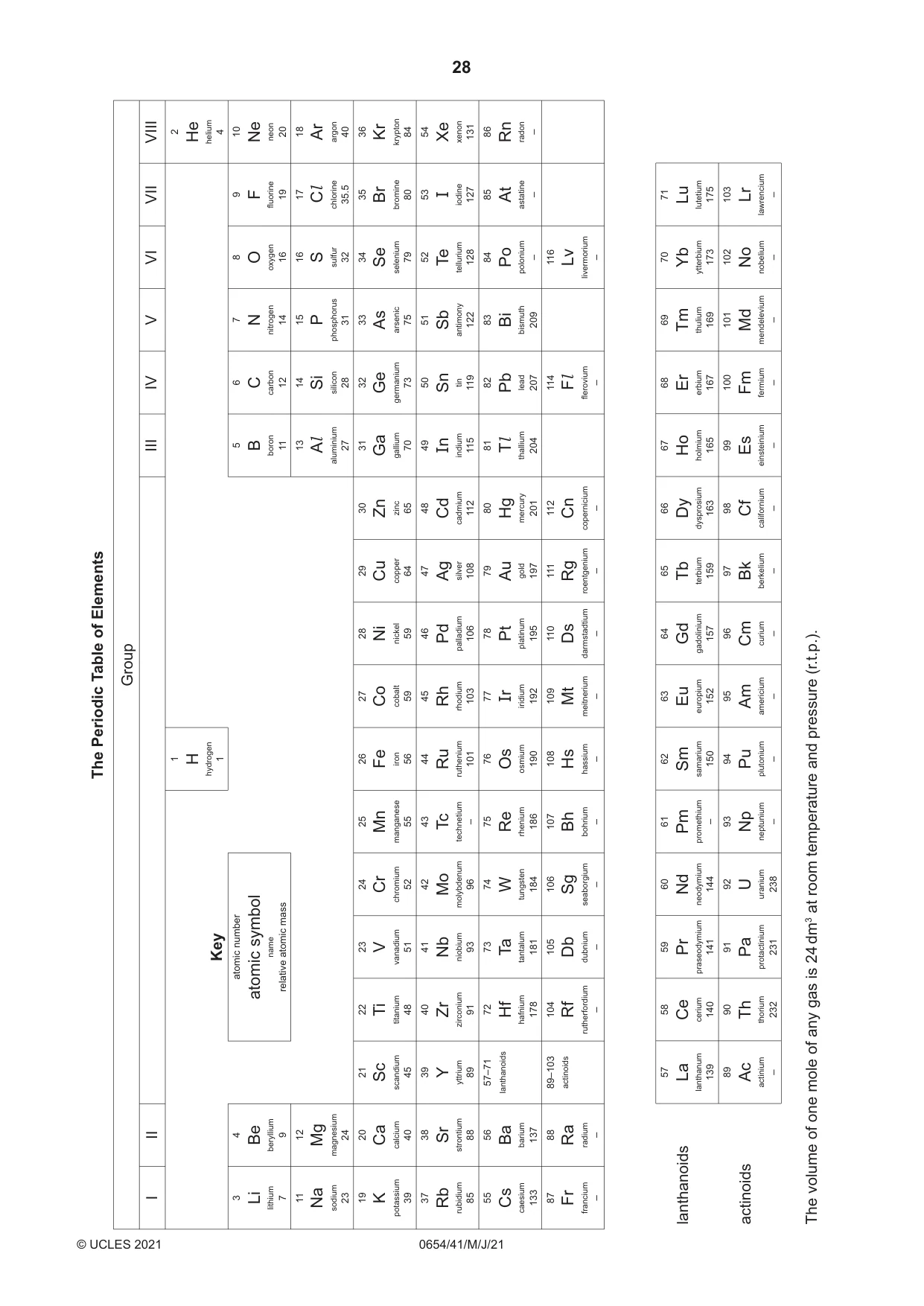
Mark scheme: 5(a)(i) particle number proton 17 neutron 20 electron 17 3 5(a)(ii) (chlorine has) 7 (electrons in the outer shell) ; 1 5(a)(iii) (atoms with) same proton or atomic number / same number of protons ; different nucleon or mass number / different number of neutrons ; 2 5(b) sodium chloride has strong (electrostatic) forces of attraction between (oppositely charged) ions ; chlorine has weak intermolecular forces / weak attractions between (chlorine) molecules ; strong (electrostatic) forces of attraction take more energy to break than weak intermolecular forces / ORA ; 3 5(c) Cl2 + 2NaBr → Br2 + 2NaCl correct formulae ; then correct balancing ; 2
Q6 · Strontium‑90 (90Sr) is a radioactive isotope
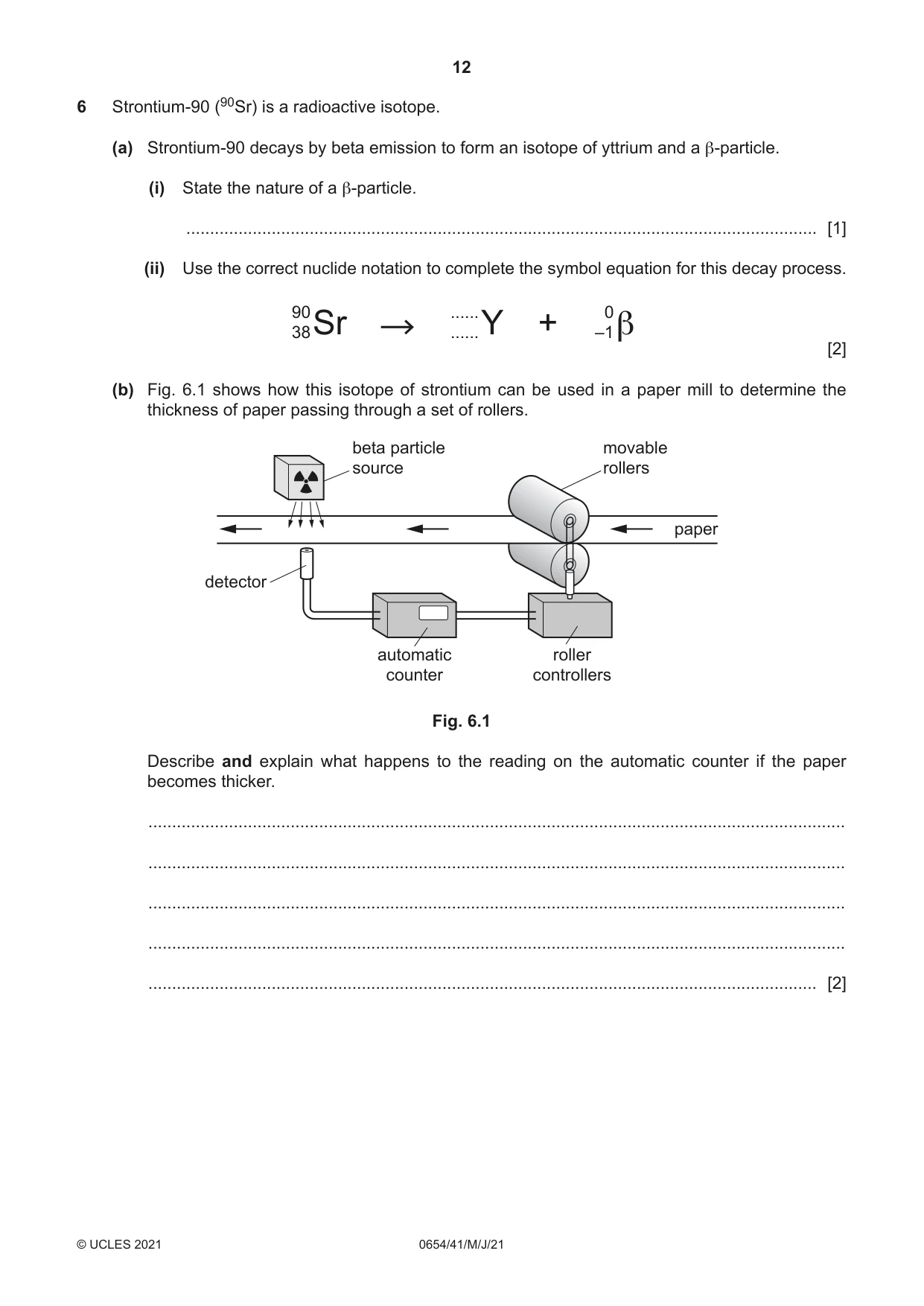
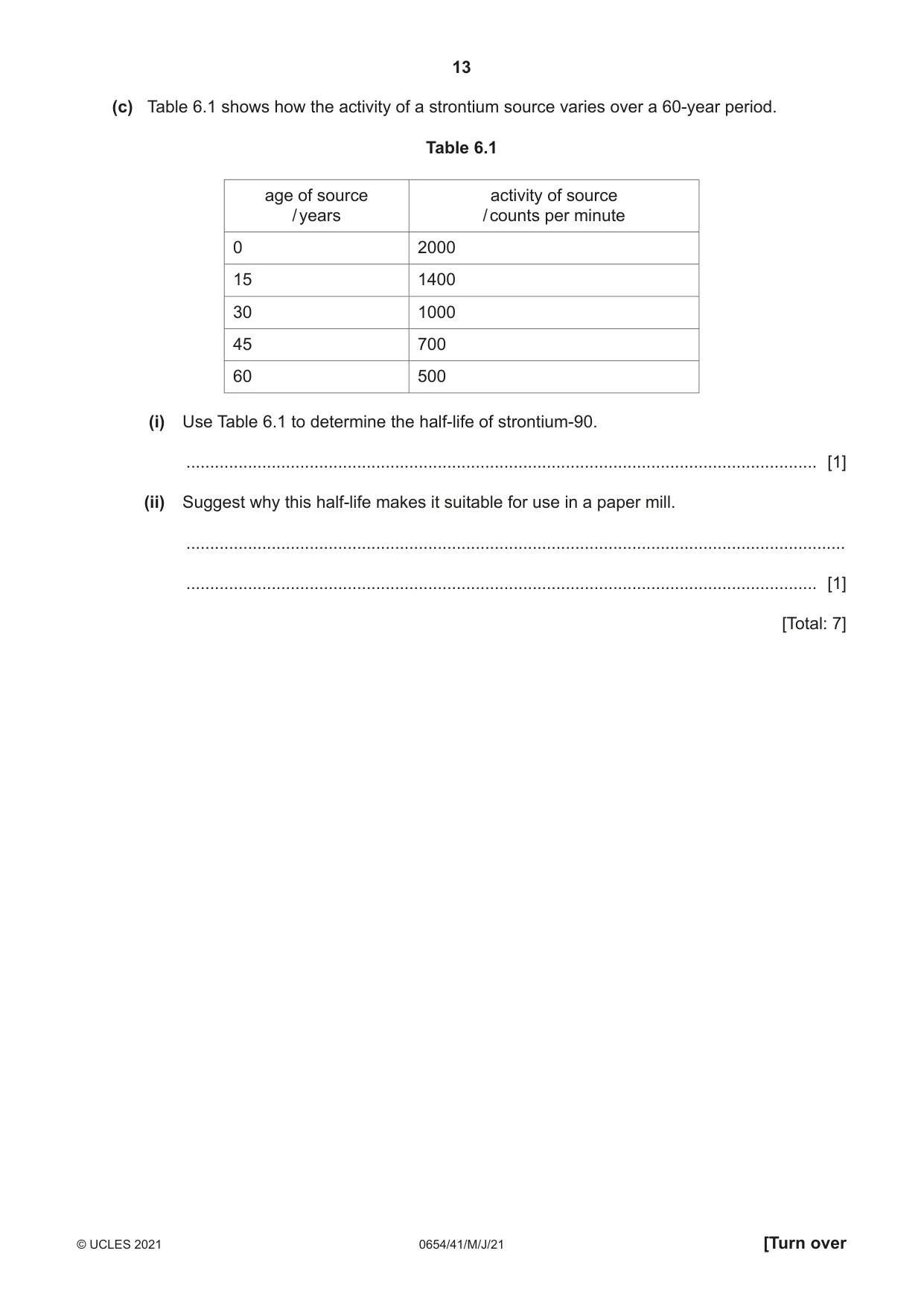
6 Strontium‑90 (90Sr) is a radioactive isotope. (a) Strontium‑90 decays by beta emission to form an isotope of yttrium and a β‑particle. (i) State the nature of a β‑particle. ..................................................................................................................................... [1] (ii) Use the correct nuclide notation to complete the symbol equation for this decay process. 90 ...... 0 38 Sr ...... Y + –1 β [2] (b) Fig. 6.1 shows how this isotope of strontium can be used in a paper mill to determine the thickness of paper passing through a set of rollers. beta particle movable source rollers paper detector automatic roller counter controllers Fig. 6.1 Describe and explain what happens to the reading on the automatic counter if the paper becomes thicker. ................................................................................................................................................... ................................................................................................................................................... ................................................................................................................................................... ................................................................................................................................................... ............................................................................................................................................. [2] (c) Table 6.1 shows how the activity of a strontium source varies over a 60‑year period. Table 6.1 age of source activity of source / years / counts per minute 0 2000 15 1400 30 1000 45 700 60 500 (i) Use Table 6.1 to determine the half‑life of strontium‑90. ..................................................................................................................................... [1] (ii) Suggest why this half‑life makes it suitable for use in a paper mill. ........................................................................................................................................... ..................................................................................................................................... [1] [Total: 7]
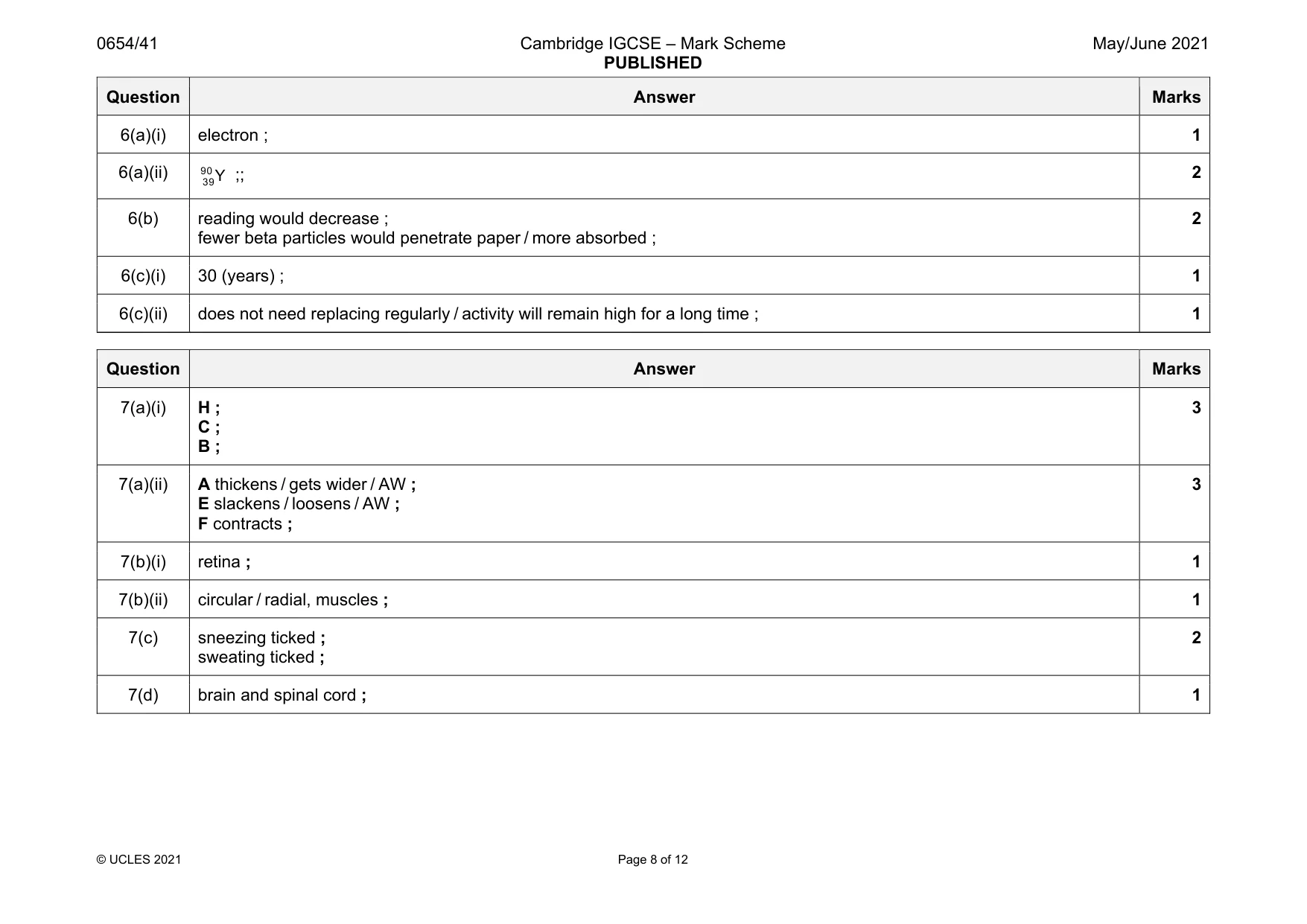
Mark scheme: 6(a)(i) electron ; 1 6(a)(ii) 90 39Y ;; 2 6(b) reading would decrease ; fewer beta particles would penetrate paper / more absorbed ; 2 6(c)(i) 30 (years) ; 1 6(c)(ii) does not need replacing regularly / activity will remain high for a long time ; 1
Q7 · A diagram of the human eye
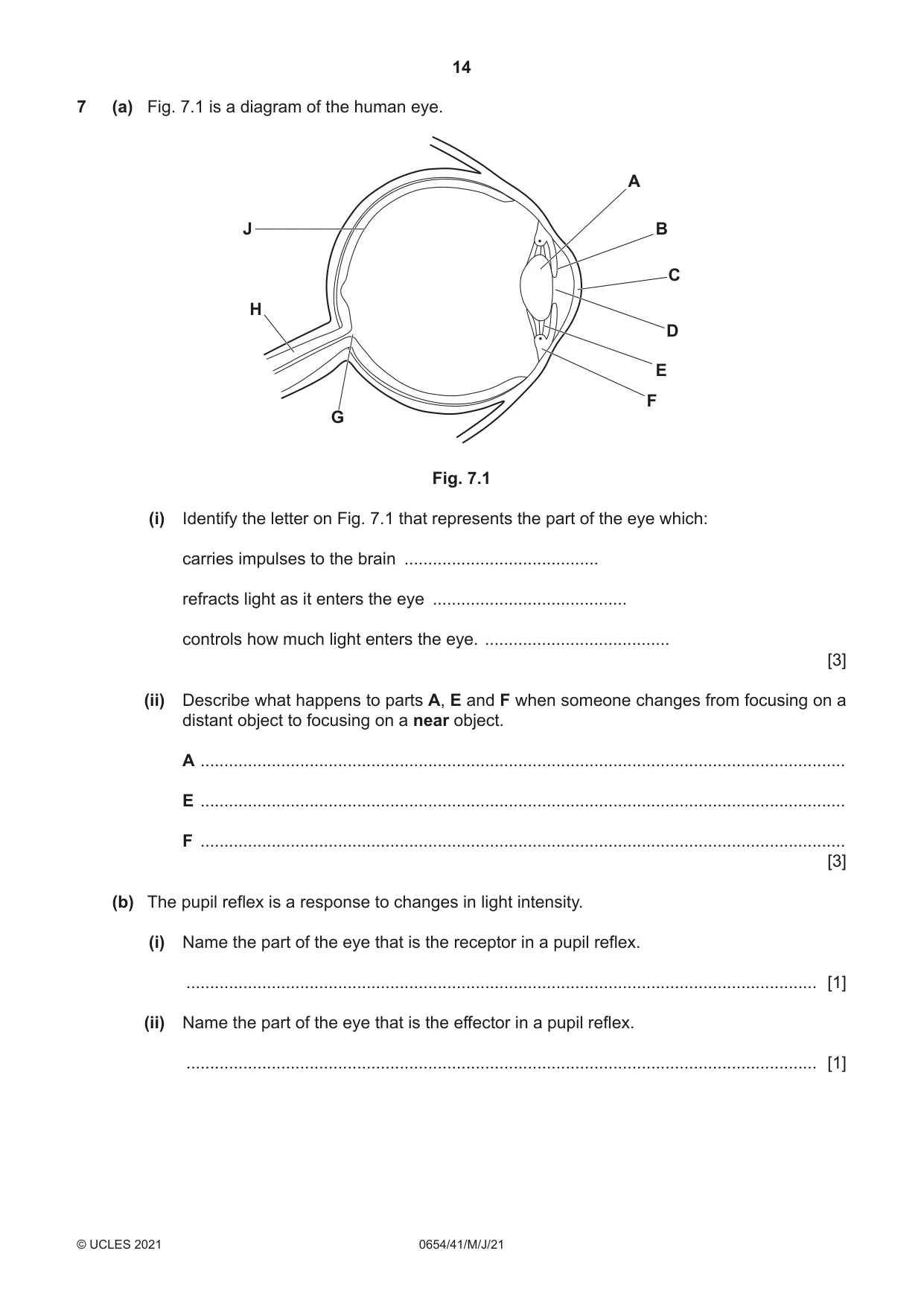
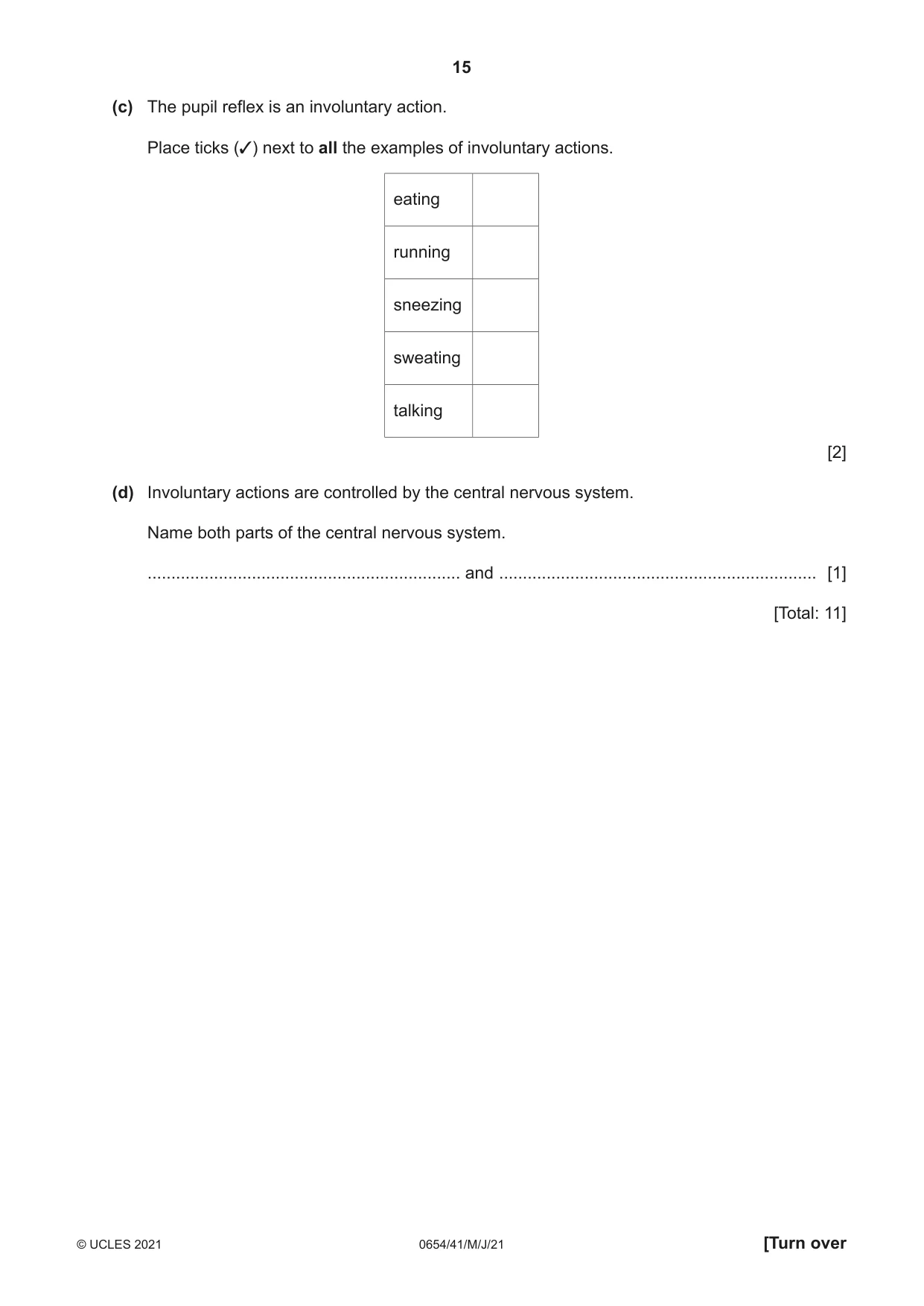
7 (a) Fig. 7.1 is a diagram of the human eye. A J B C H D E F G Fig. 7.1 (i) Identify the letter on Fig. 7.1 that represents the part of the eye which: carries impulses to the brain ......................................... refracts light as it enters the eye ......................................... controls how much light enters the eye. ....................................... [3] (ii) Describe what happens to parts A, E and F when someone changes from focusing on a distant object to focusing on a near object. A ........................................................................................................................................ E ........................................................................................................................................ F ........................................................................................................................................ [3] (b) The pupil reflex is a response to changes in light intensity. (i) Name the part of the eye that is the receptor in a pupil reflex. ..................................................................................................................................... [1] (ii) Name the part of the eye that is the effector in a pupil reflex. ..................................................................................................................................... [1] (c) The pupil reflex is an involuntary action. Place ticks (3) next to all the examples of involuntary actions. eating running sneezing sweating talking [2] (d) Involuntary actions are controlled by the central nervous system. Name both parts of the central nervous system. .................................................................. and ................................................................... [1] [Total: 11]
Mark scheme: 7(a)(i) H ; C ; B ; 3 7(a)(ii) A thickens / gets wider / AW ; E slackens / loosens / AW ; F contracts ; 3 7(b)(i) retina ; 1 7(b)(ii) circular / radial, muscles ; 1 7(c) sneezing ticked ; sweating ticked ; 2 7(d) brain and spinal cord ; 1
Q8 · Electrolysis is used to break down ionic compounds using electricity
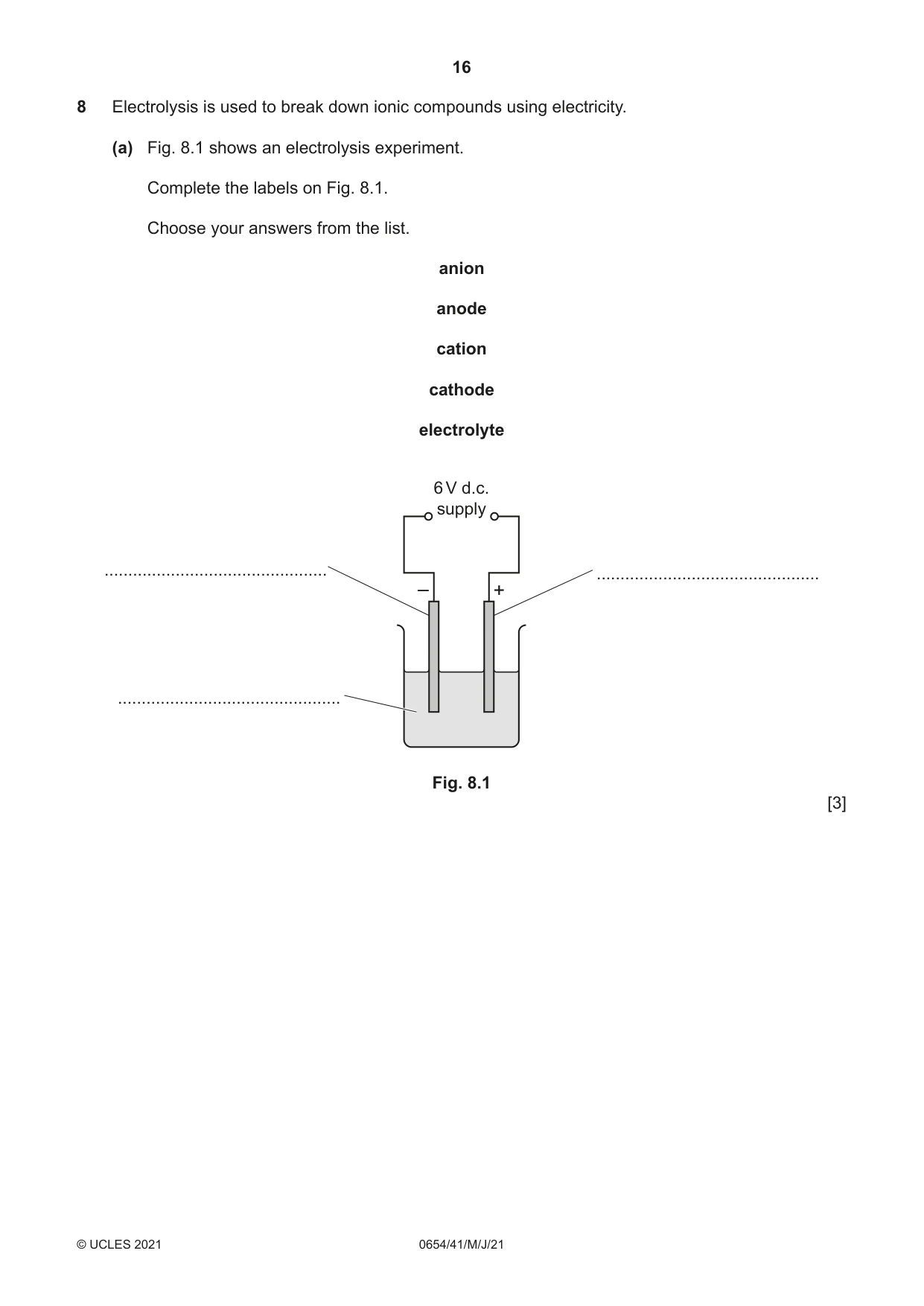
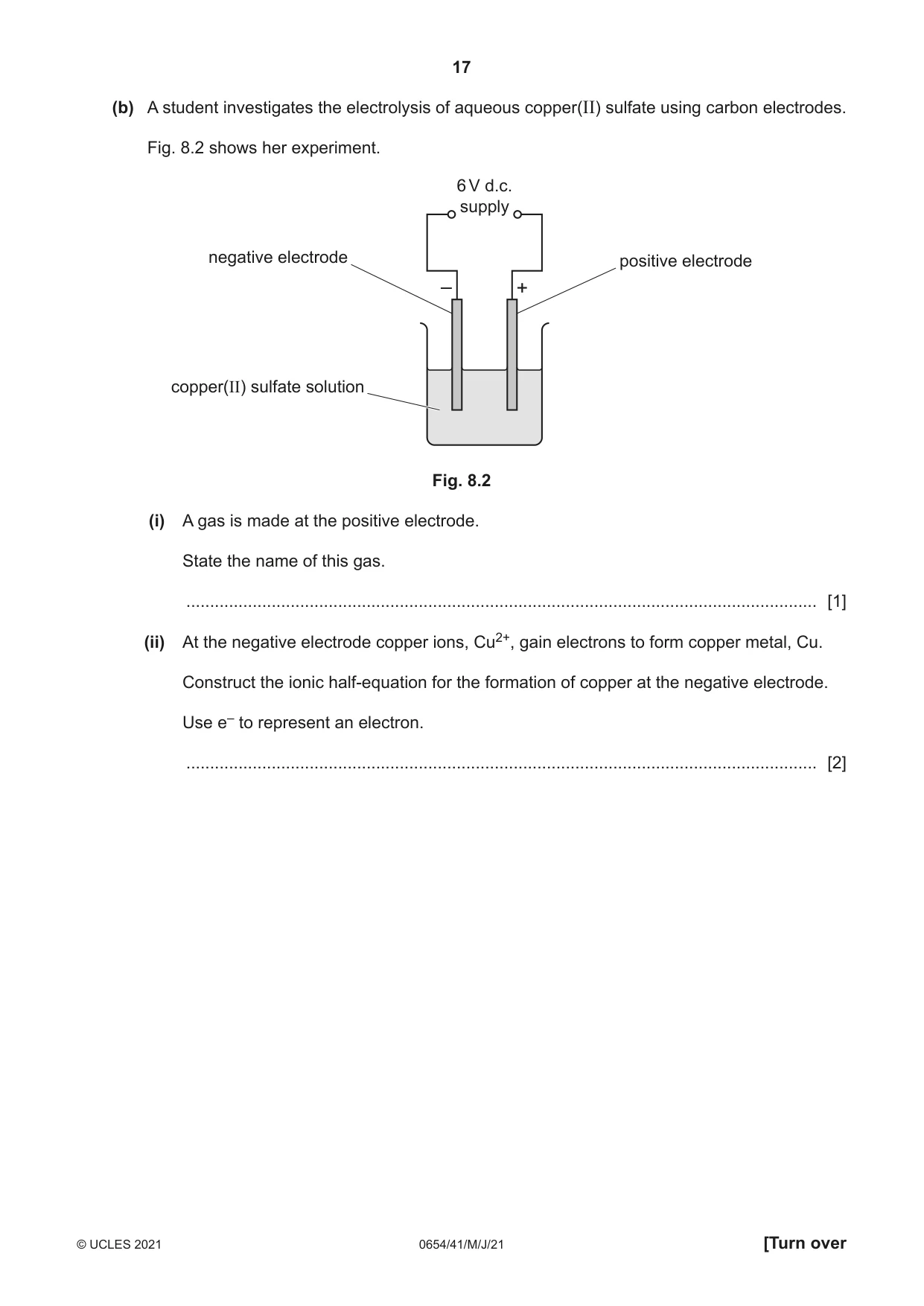
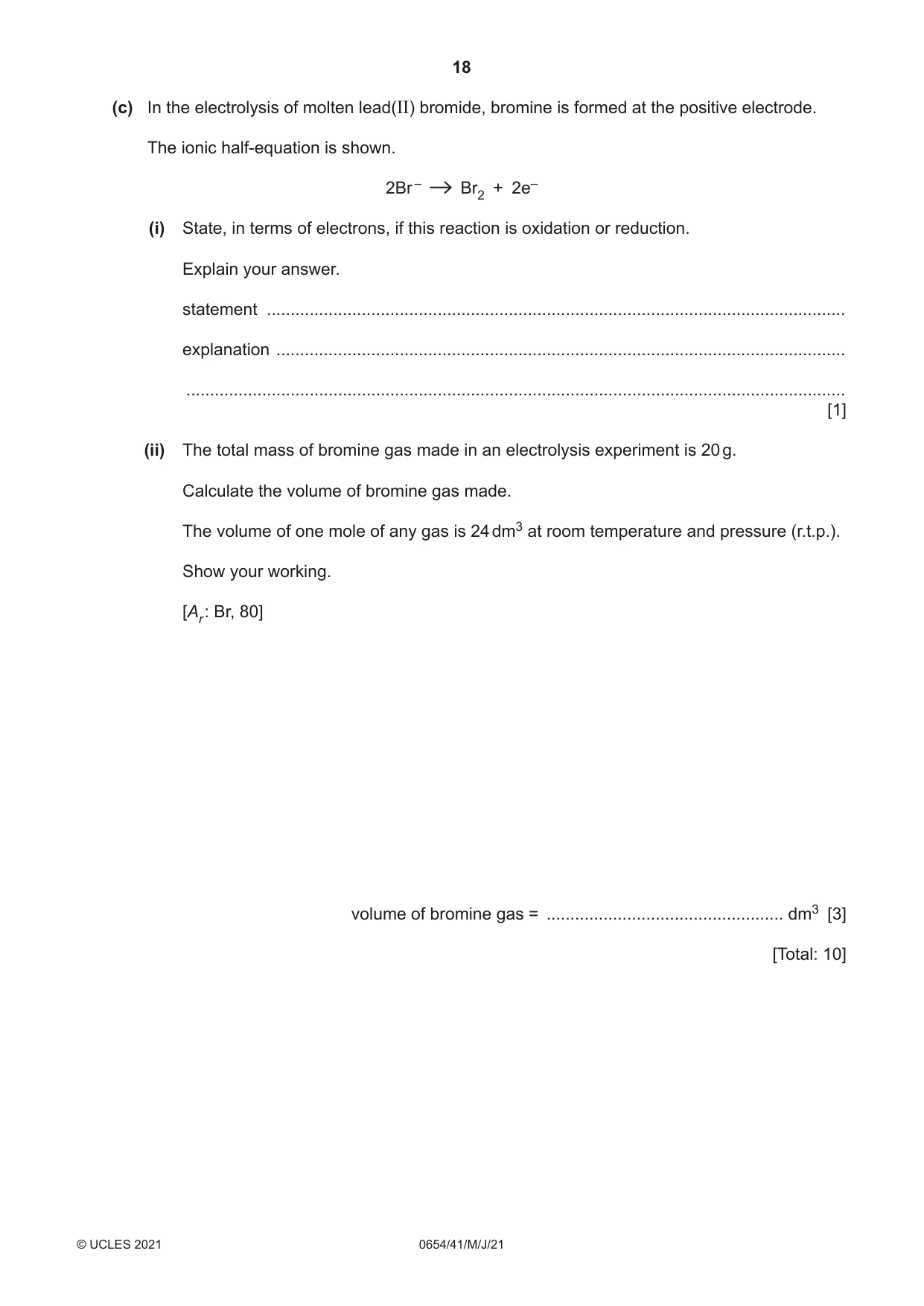
8 Electrolysis is used to break down ionic compounds using electricity. (a) Fig. 8.1 shows an electrolysis experiment. Complete the labels on Fig. 8.1. Choose your answers from the list. anion anode cation cathode electrolyte 6 V d.c. supply ............................................... ............................................... – + ............................................... Fig. 8.1 [3] (b) A student investigates the electrolysis of aqueous copper(II) sulfate using carbon electrodes. Fig. 8.2 shows her experiment. 6 V d.c. supply negative electrode positive electrode – + copper(II) sulfate solution Fig. 8.2 (i) A gas is made at the positive electrode. State the name of this gas. ..................................................................................................................................... [1] (ii) At the negative electrode copper ions, Cu2+, gain electrons to form copper metal, Cu. Construct the ionic half‑equation for the formation of copper at the negative electrode. Use e– to represent an electron. ..................................................................................................................................... [2] (c) In the electrolysis of molten lead(II) bromide, bromine is formed at the positive electrode. The ionic half‑equation is shown. 2Br – Br2 + 2e– (i) State, in terms of electrons, if this reaction is oxidation or reduction. Explain your answer. statement .......................................................................................................................... explanation ........................................................................................................................ ........................................................................................................................................... [1] (ii) The total mass of bromine gas made in an electrolysis experiment is 20 g. Calculate the volume of bromine gas made. The volume of one mole of any gas is 24 dm3 at room temperature and pressure (r.t.p.). Show your working. [Ar : Br, 80] volume of bromine gas = .................................................. dm3 [3] [Total: 10]
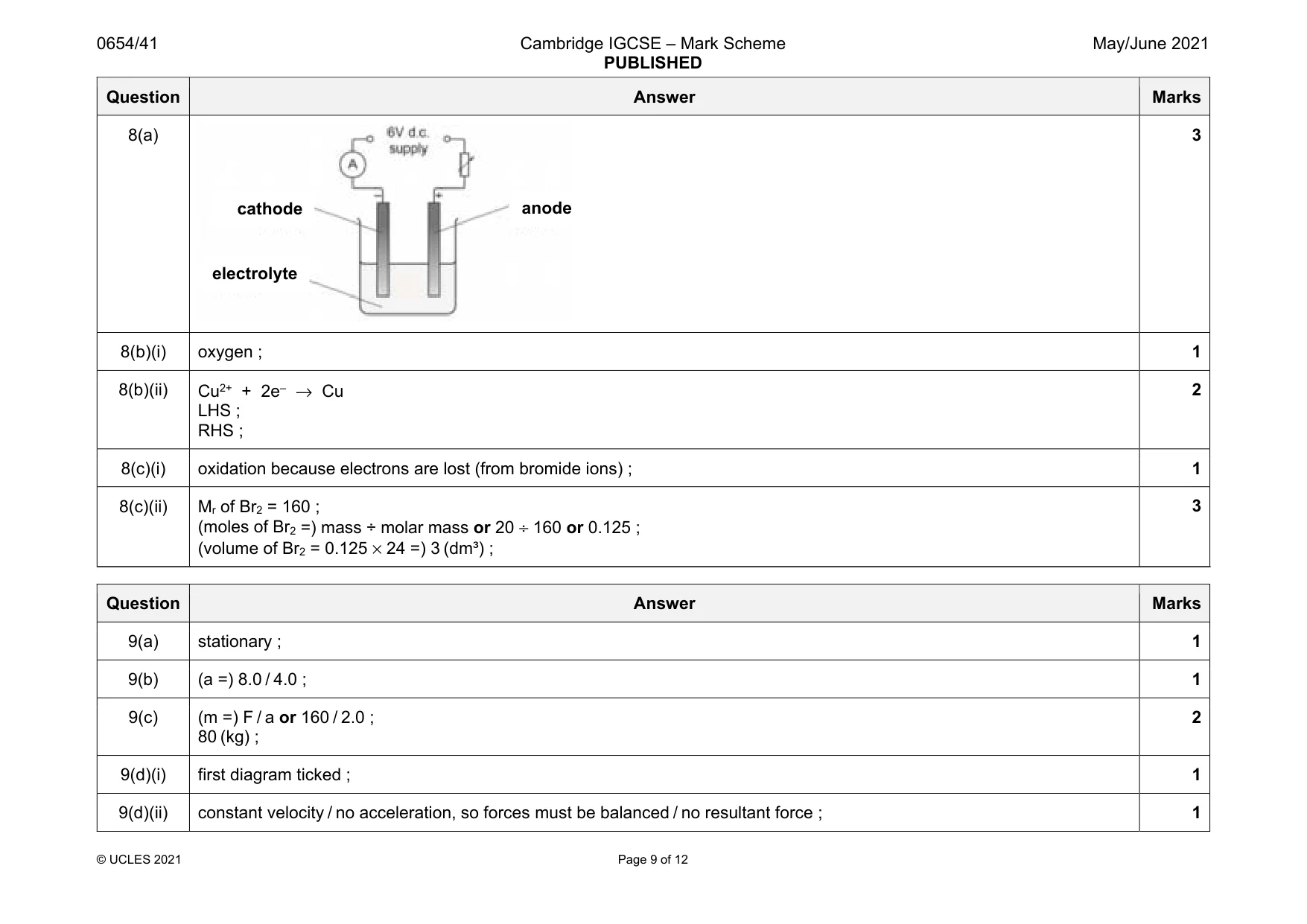
Mark scheme: 8(a) 3 8(b)(i) oxygen ; 1 8(b)(ii) Cu2+ + 2e– → Cu LHS ; RHS ; 2 8(c)(i) oxidation because electrons are lost (from bromide ions) ; 1 8(c)(ii) Mr of Br2 = 160 ; (moles of Br2 =) mass ÷ molar mass or 20 ÷ 160 or 0.125 ; (volume of Br2 = 0.125 × 24 =) 3 (dm³) ; 3 cathode electrolyte anode
Q9 · The motion of a sprinter running a race
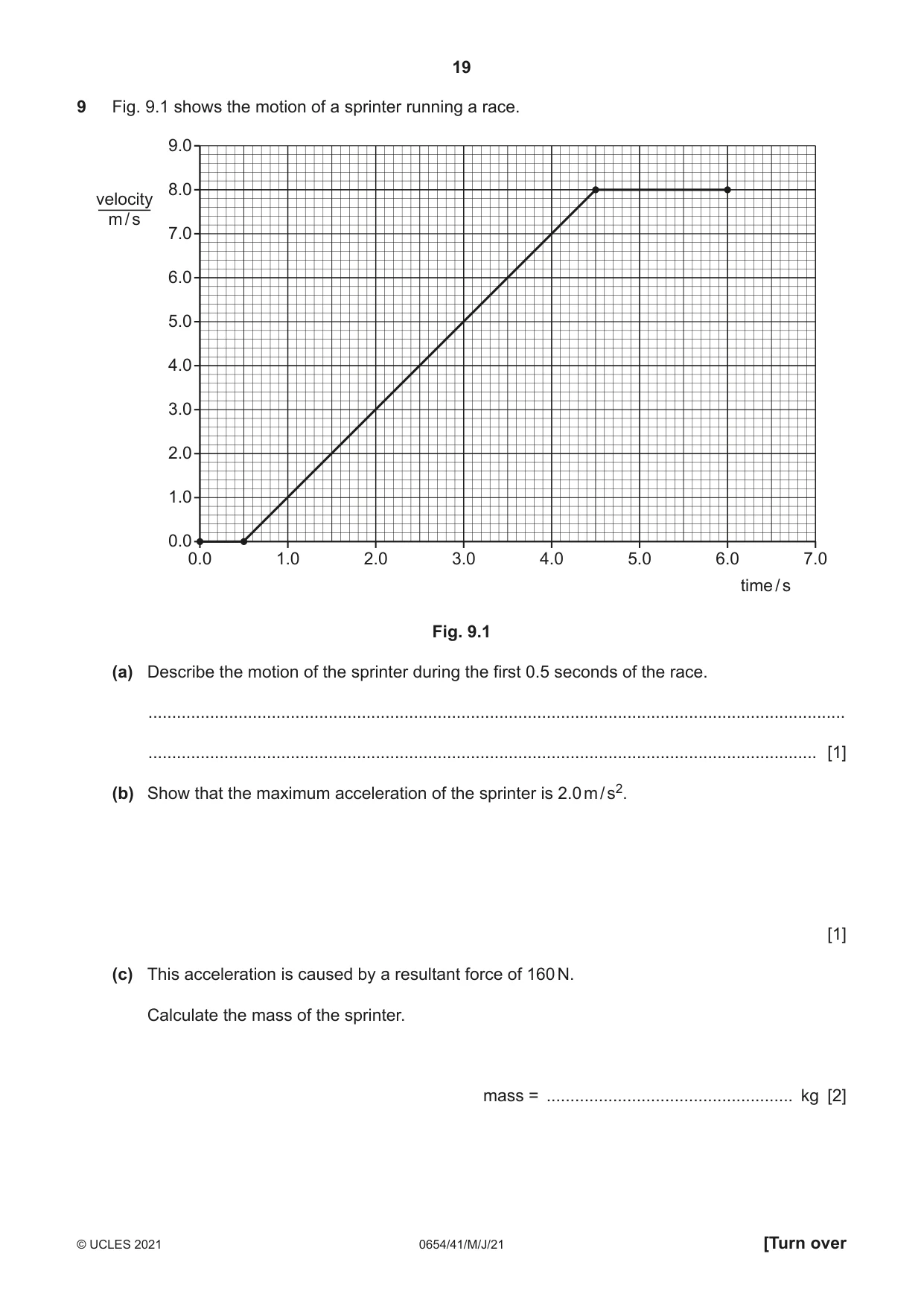
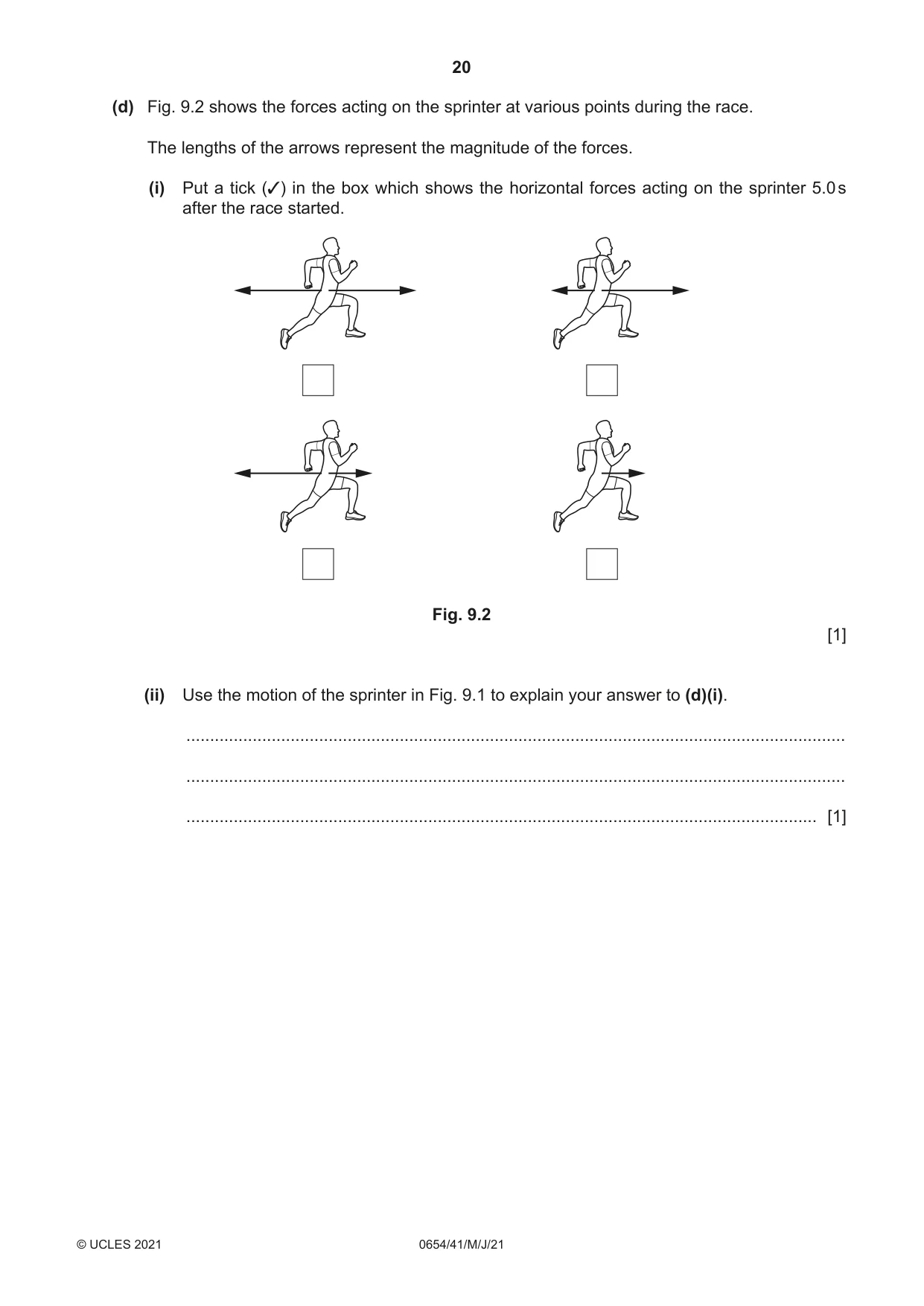
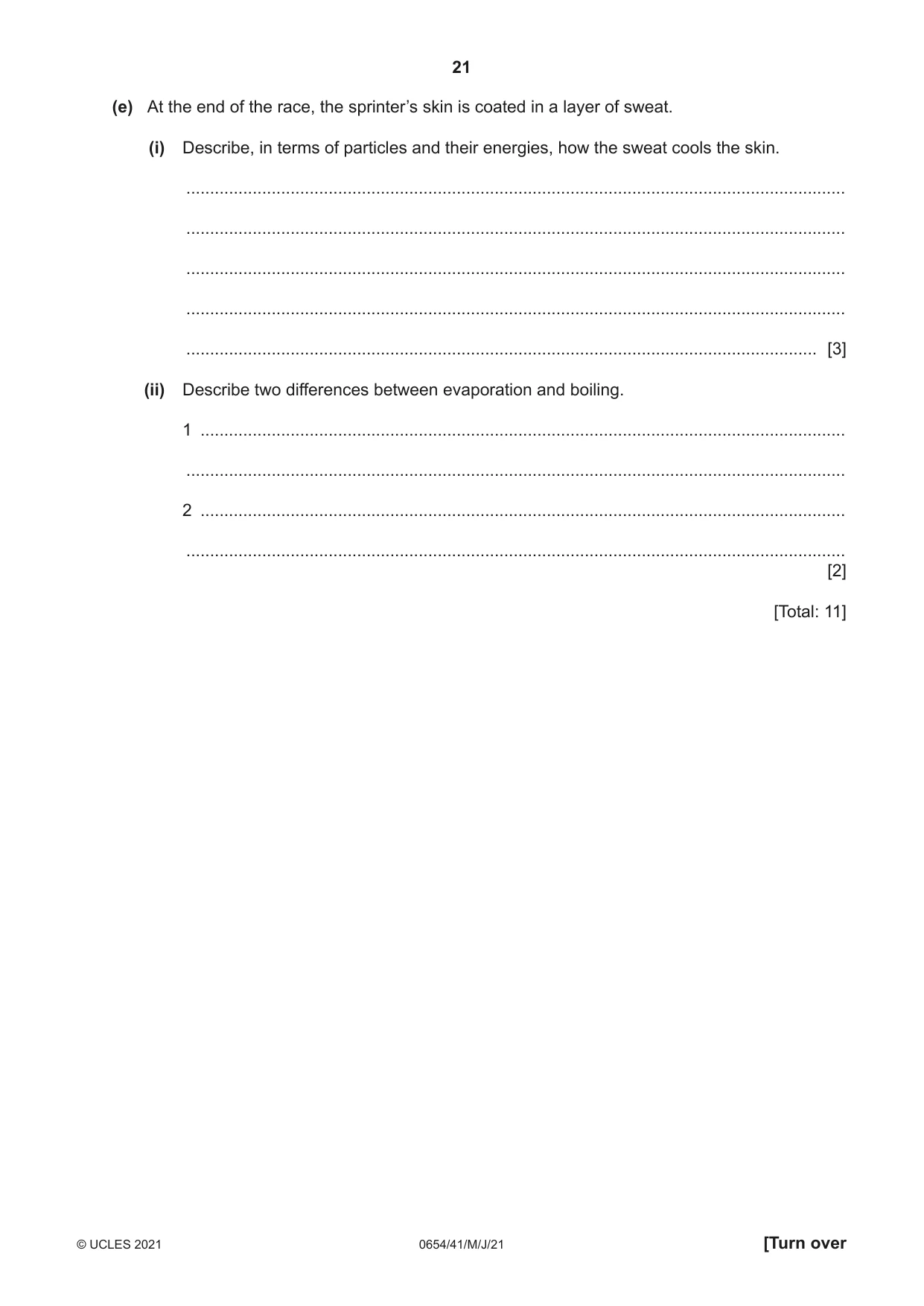
9 Fig. 9.1 shows the motion of a sprinter running a race. 9.0 8.0 velocity m / s 7.0 6.0 5.0 4.0 3.0 2.0 1.0 0.0 0.0 1.0 2.0 3.0 4.0 5.0 6.0 7.0 time / s Fig. 9.1 (a) Describe the motion of the sprinter during the first 0.5 seconds of the race. ................................................................................................................................................... ............................................................................................................................................. [1] (b) Show that the maximum acceleration of the sprinter is 2.0 m / s2. [1] (c) This acceleration is caused by a resultant force of 160 N. Calculate the mass of the sprinter. mass = .................................................... kg [2] (d) Fig. 9.2 shows the forces acting on the sprinter at various points during the race. The lengths of the arrows represent the magnitude of the forces. (i) Put a tick (3) in the box which shows the horizontal forces acting on the sprinter 5.0 s after the race started. Fig. 9.2 [1] (ii) Use the motion of the sprinter in Fig. 9.1 to explain your answer to (d)(i). ........................................................................................................................................... ........................................................................................................................................... ..................................................................................................................................... [1] (e) At the end of the race, the sprinter’s skin is coated in a layer of sweat. (i) Describe, in terms of particles and their energies, how the sweat cools the skin. ........................................................................................................................................... ........................................................................................................................................... ........................................................................................................................................... ........................................................................................................................................... ..................................................................................................................................... [3] (ii) Describe two differences between evaporation and boiling. 1 ........................................................................................................................................ ........................................................................................................................................... 2 ........................................................................................................................................ ........................................................................................................................................... [2] [Total: 11]
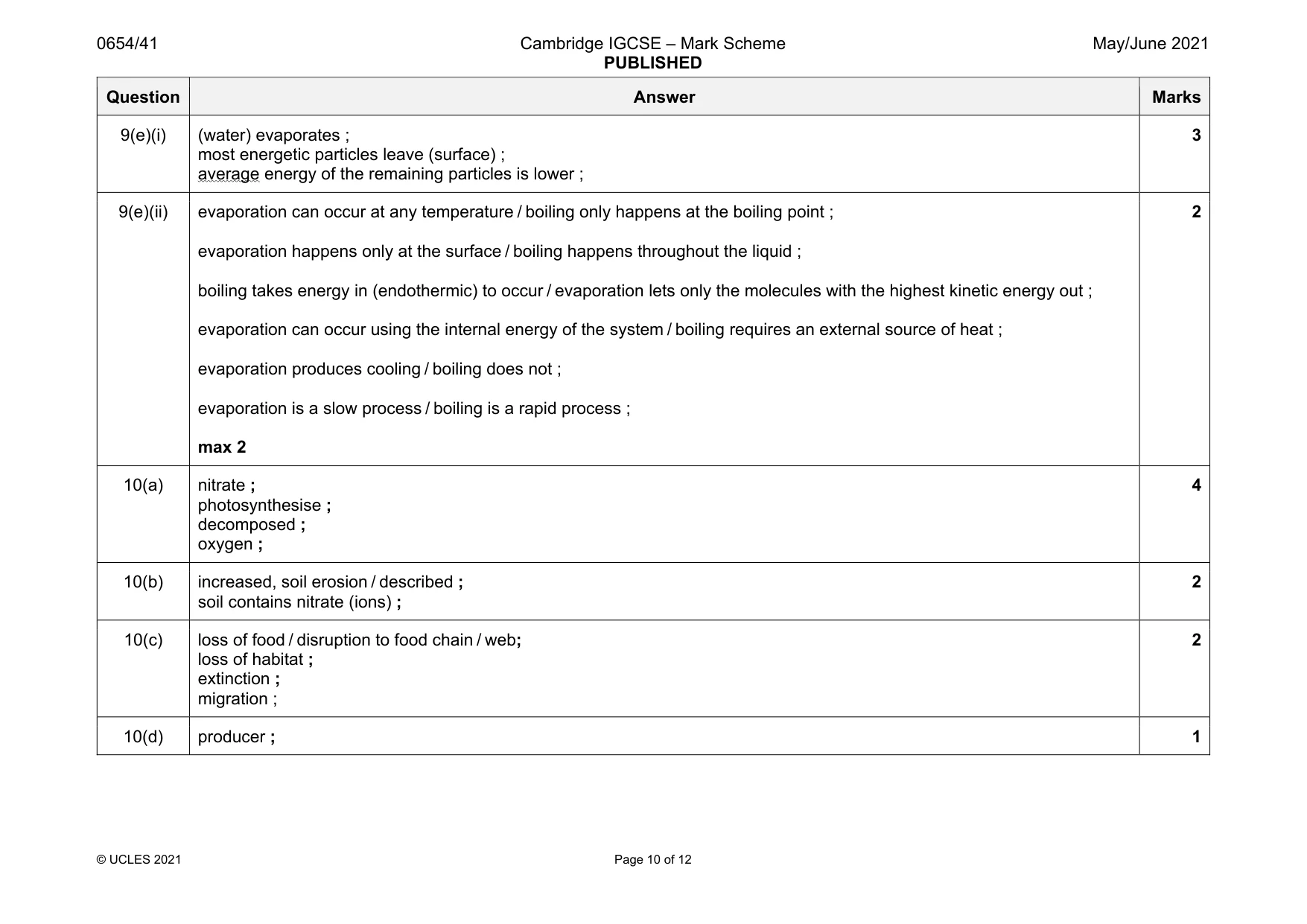
Mark scheme: 9(a) stationary ; 1 9(b) (a =) 8.0 / 4.0 ; 1 9(c) (m =) F / a or 160 / 2.0 ; 80 (kg) ; 2 9(d)(i) first diagram ticked ; 1 9(d)(ii) constant velocity / no acceleration, so forces must be balanced / no resultant force ; 1 Question Answer Marks 9(e)(i) (water) evaporates ; most energetic particles leave (surface) ; average energy of the remaining particles is lower ; 3 9(e)(ii) evaporation can occur at any temperature / boiling only happens at the boiling point ; evaporation happens only at the surface / boiling happens throughout the liquid ; boiling takes energy in (endothermic) to occur / evaporation lets only the molecules with the highest kinetic energy out ; evaporation can occur using the internal energy of the system / boiling requires an external source of heat ; evaporation produces cooling / boiling does not ; evaporation is a slow process / boiling is a rapid process ; max 2 2 4
Q10 · A flowchart showing the process of eutrophication
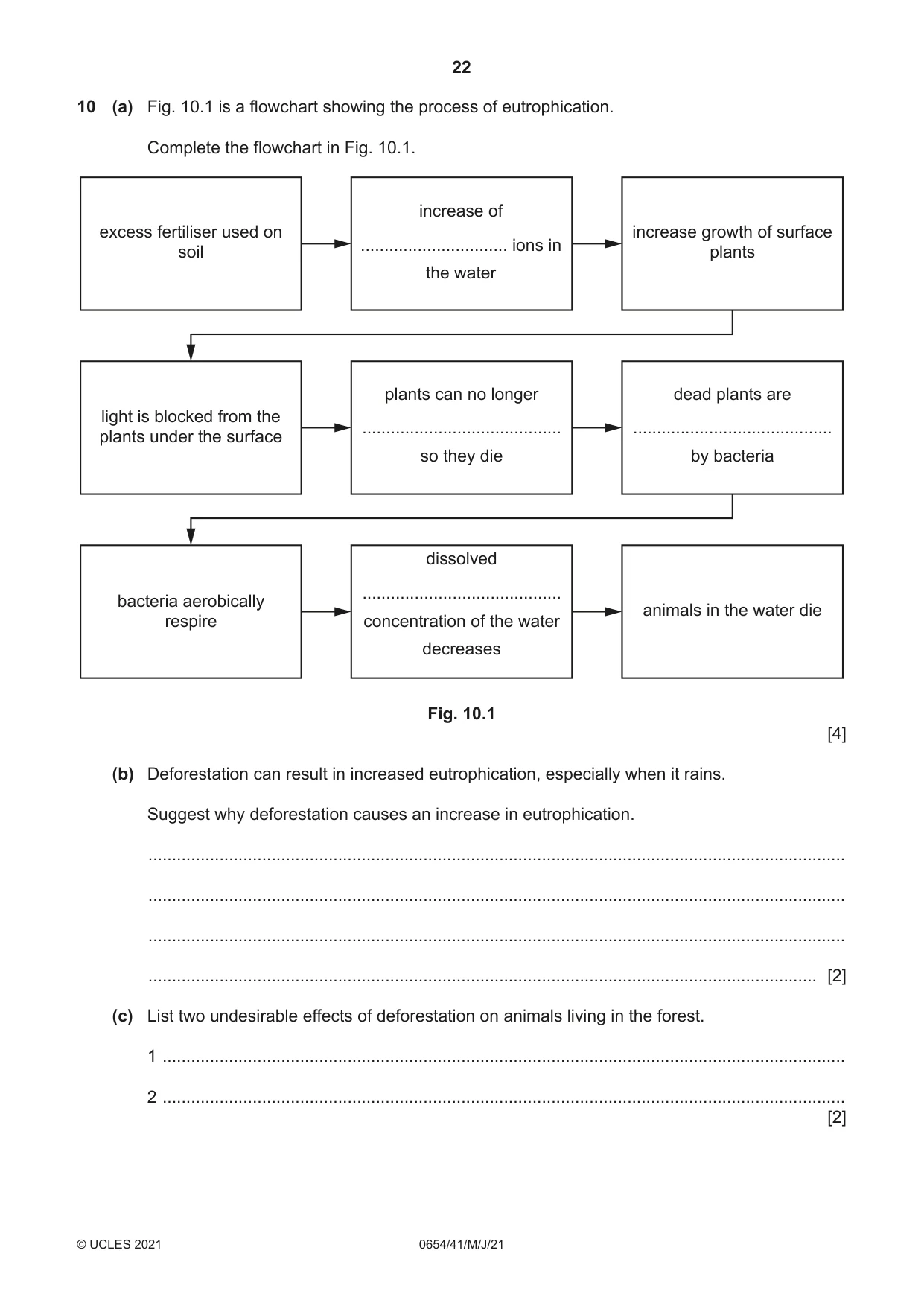
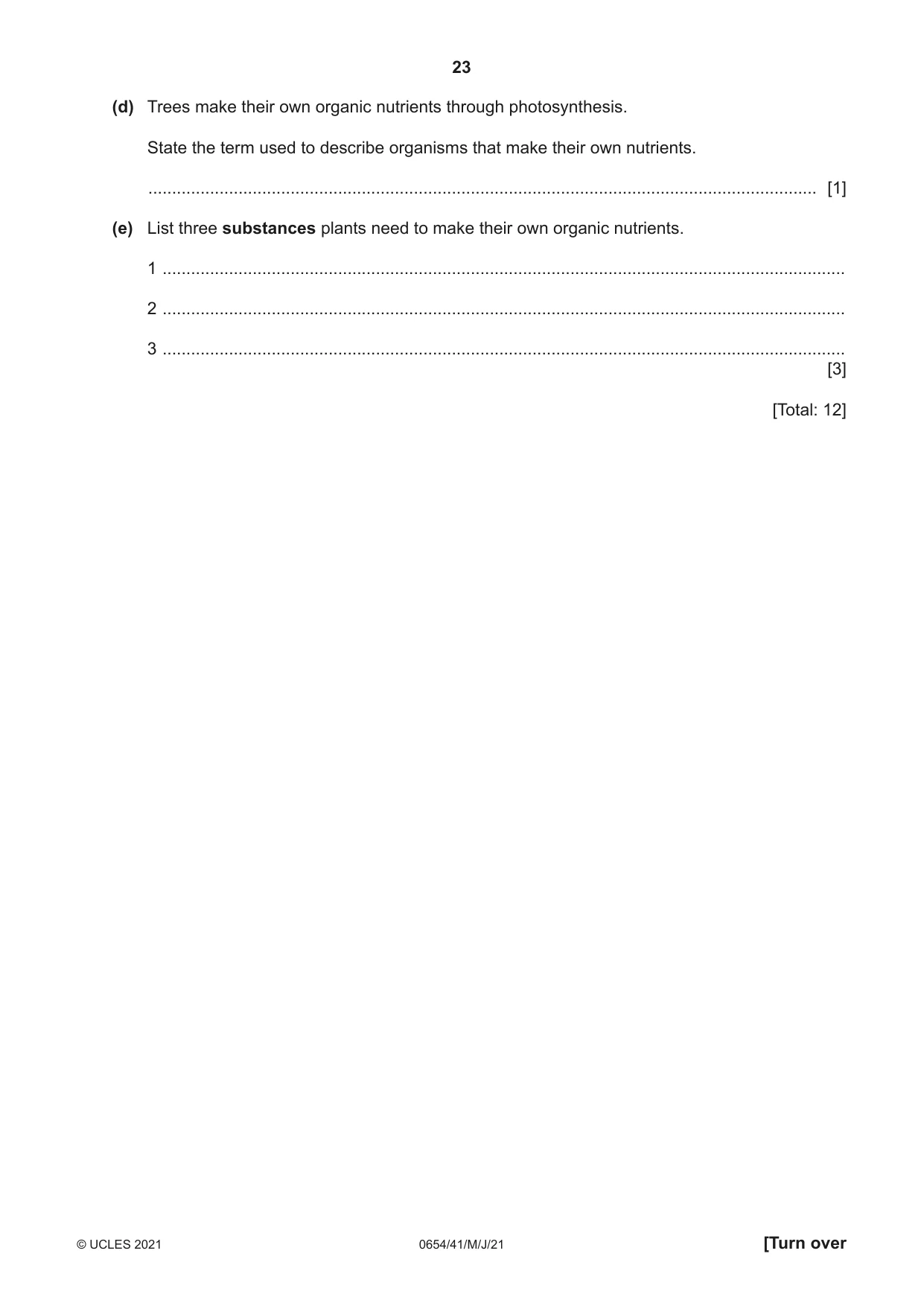
10 (a) Fig. 10.1 is a flowchart showing the process of eutrophication. Complete the flowchart in Fig. 10.1. increase of excess fertiliser used on increase growth of surface ............................... ions in soil plants the water plants can no longer dead plants are light is blocked from the .......................................... .......................................... plants under the surface so they die by bacteria dissolved .......................................... bacteria aerobically animals in the water die respire concentration of the water decreases Fig. 10.1 [4] (b) Deforestation can result in increased eutrophication, especially when it rains. Suggest why deforestation causes an increase in eutrophication. ................................................................................................................................................... ................................................................................................................................................... ................................................................................................................................................... ............................................................................................................................................. [2] (c) List two undesirable effects of deforestation on animals living in the forest. 1 ................................................................................................................................................ 2 ................................................................................................................................................ [2] (d) Trees make their own organic nutrients through photosynthesis. State the term used to describe organisms that make their own nutrients. ............................................................................................................................................. [1] (e) List three substances plants need to make their own organic nutrients. 1 ................................................................................................................................................ 2 ................................................................................................................................................ 3 ................................................................................................................................................ [3] [Total: 12]
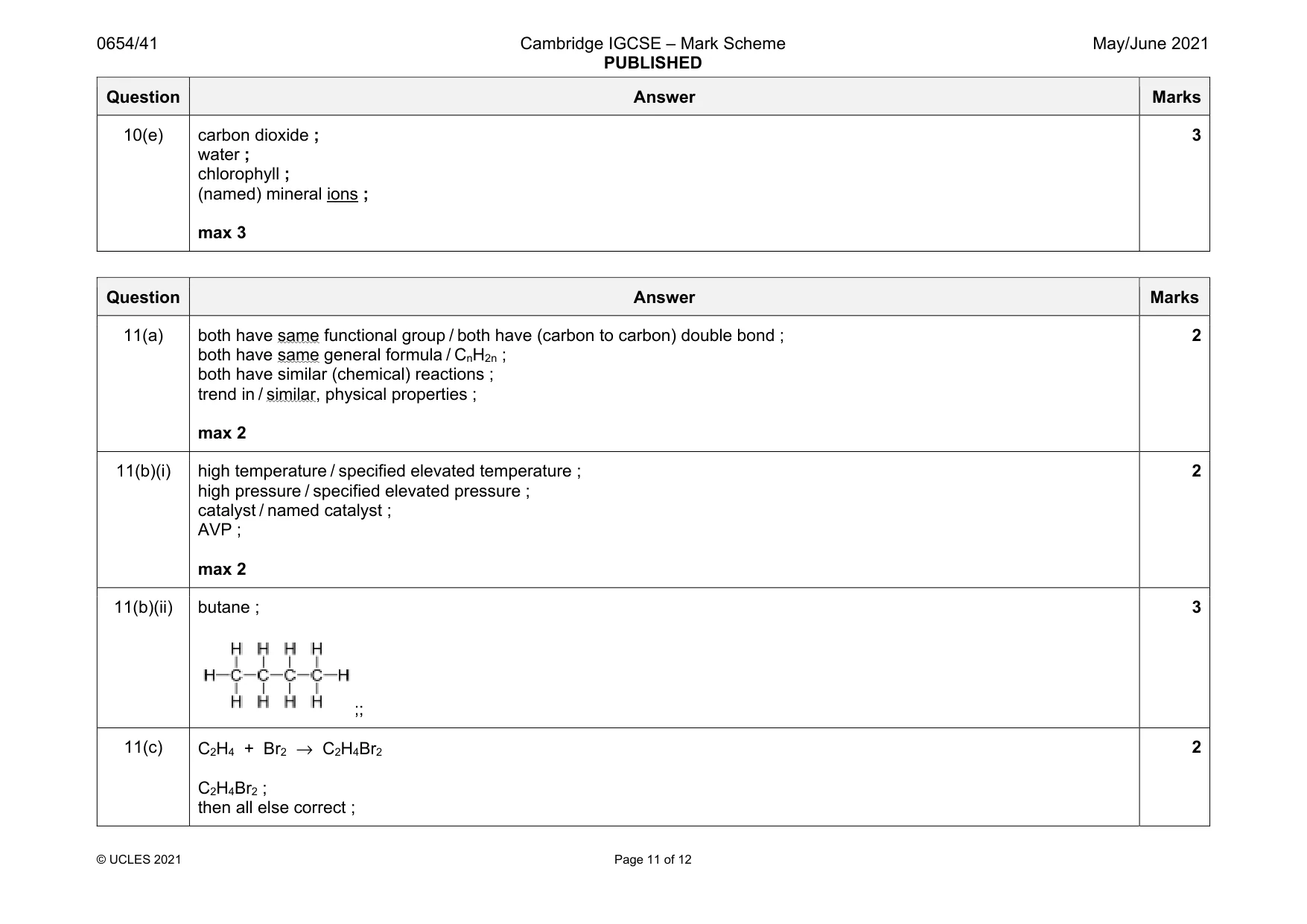
Mark scheme: 10(a) nitrate ; photosynthesise ; decomposed ; oxygen ; 10(b) increased, soil erosion / described ; soil contains nitrate (ions) ; 2 10(c) loss of food / disruption to food chain / web; loss of habitat ; extinction ; migration ; 2 10(d) producer ; 1 Question Answer Marks 10(e) carbon dioxide ; water ; chlorophyll ; (named) mineral ions ; max 3 3
Q11 · Ethene and propene are both members of the homologous series called the alkenes
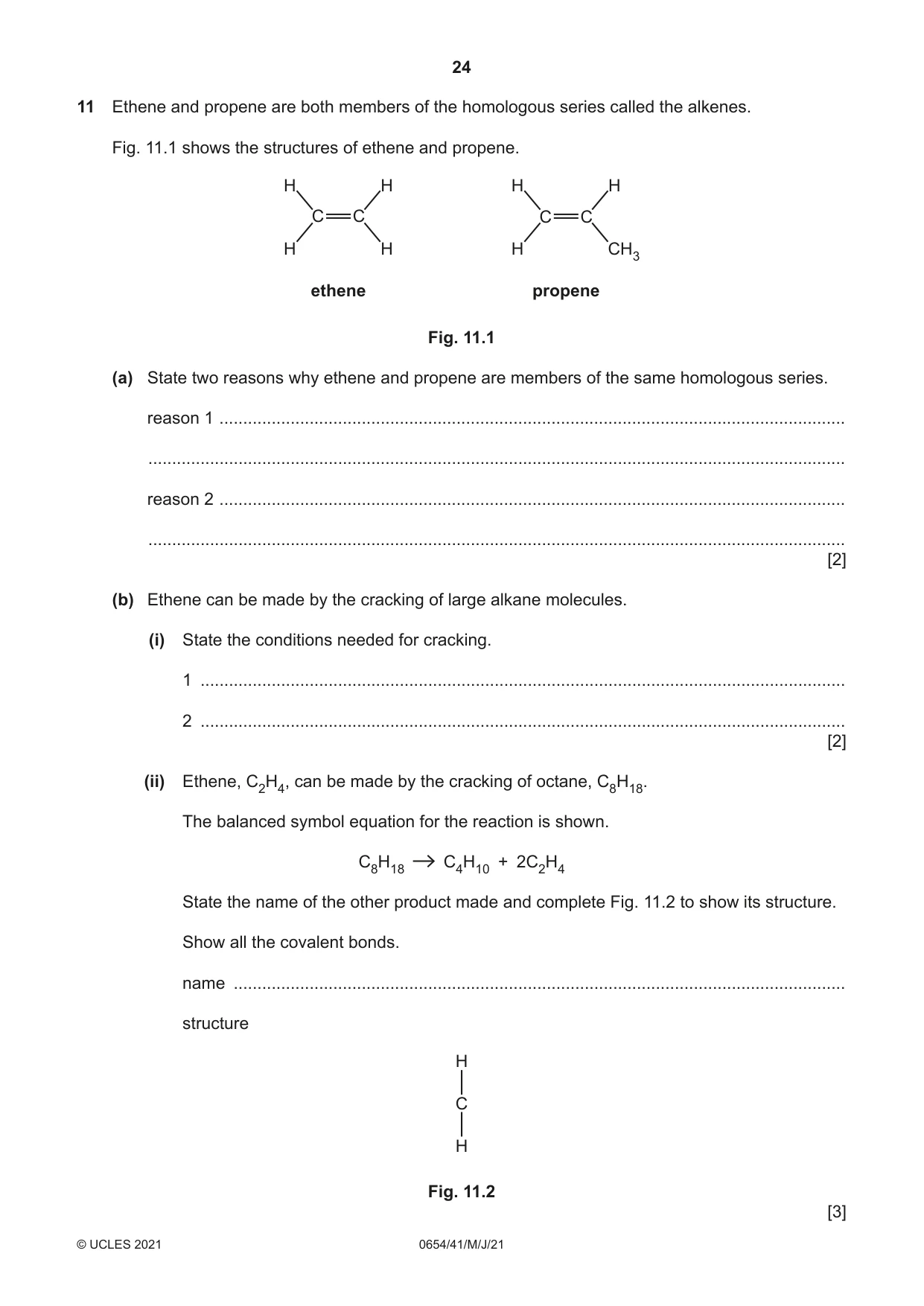
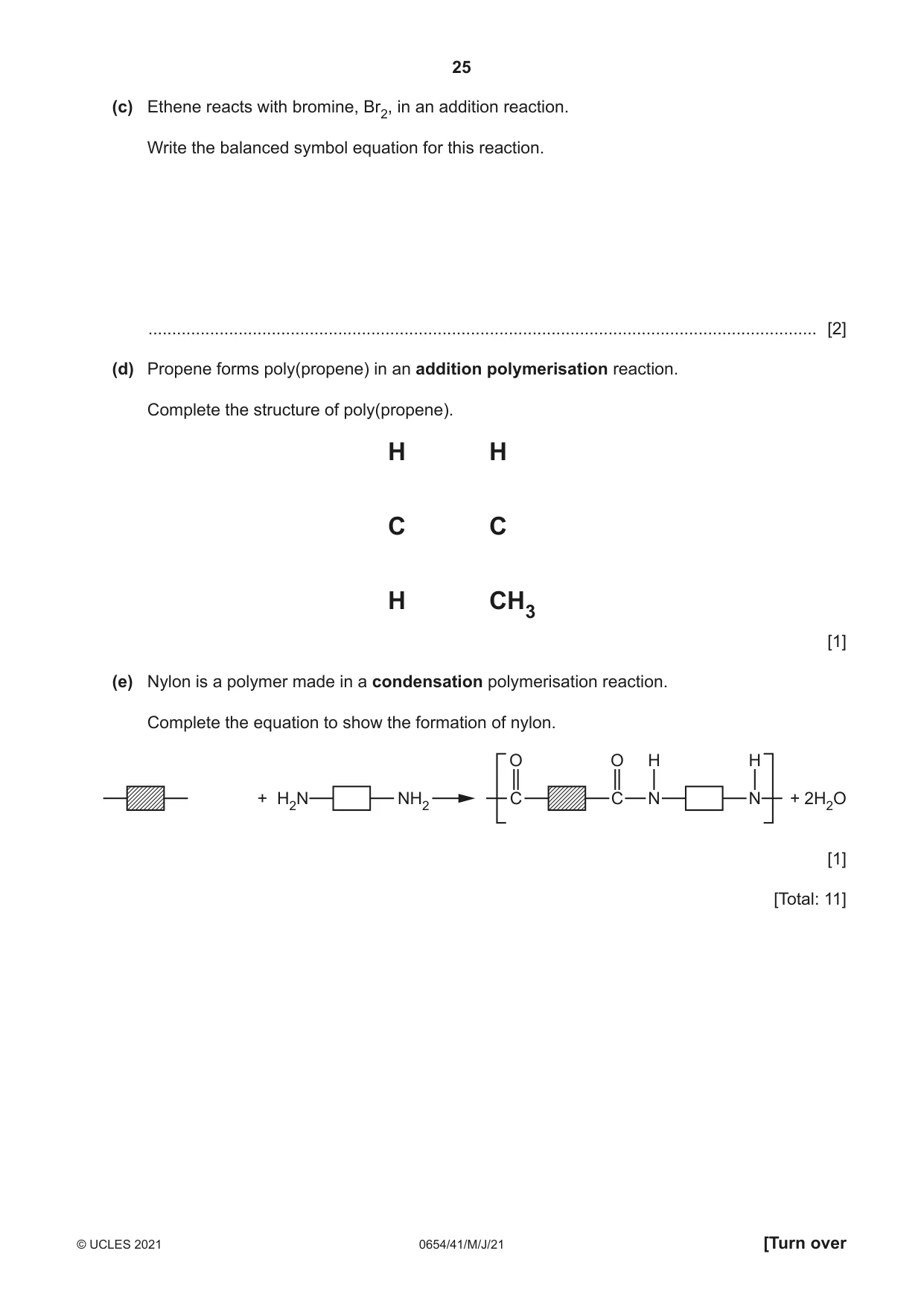
11 Ethene and propene are both members of the homologous series called the alkenes. Fig. 11.1 shows the structures of ethene and propene. H H H H C C C C H H H CH3 ethene propene Fig. 11.1 (a) State two reasons why ethene and propene are members of the same homologous series. reason 1 .................................................................................................................................... ................................................................................................................................................... reason 2 .................................................................................................................................... ................................................................................................................................................... [2] (b) Ethene can be made by the cracking of large alkane molecules. (i) State the conditions needed for cracking. 1 ........................................................................................................................................ 2 ........................................................................................................................................ [2] (ii) Ethene, C2H4, can be made by the cracking of octane, C8H18. The balanced symbol equation for the reaction is shown. C8H18 C4H10 + 2C2H4 State the name of the other product made and complete Fig. 11.2 to show its structure. Show all the covalent bonds. name ................................................................................................................................. structure H C H Fig. 11.2 [3] (c) Ethene reacts with bromine, Br2, in an addition reaction. Write the balanced symbol equation for this reaction. ............................................................................................................................................. [2] (d) Propene forms poly(propene) in an addition polymerisation reaction. Complete the structure of poly(propene). H H C C H CH3 [1] (e) Nylon is a polymer made in a condensation polymerisation reaction. Complete the equation to show the formation of nylon. O O H H + H2N NH2 C C N N + 2H2O [1] [Total: 11]
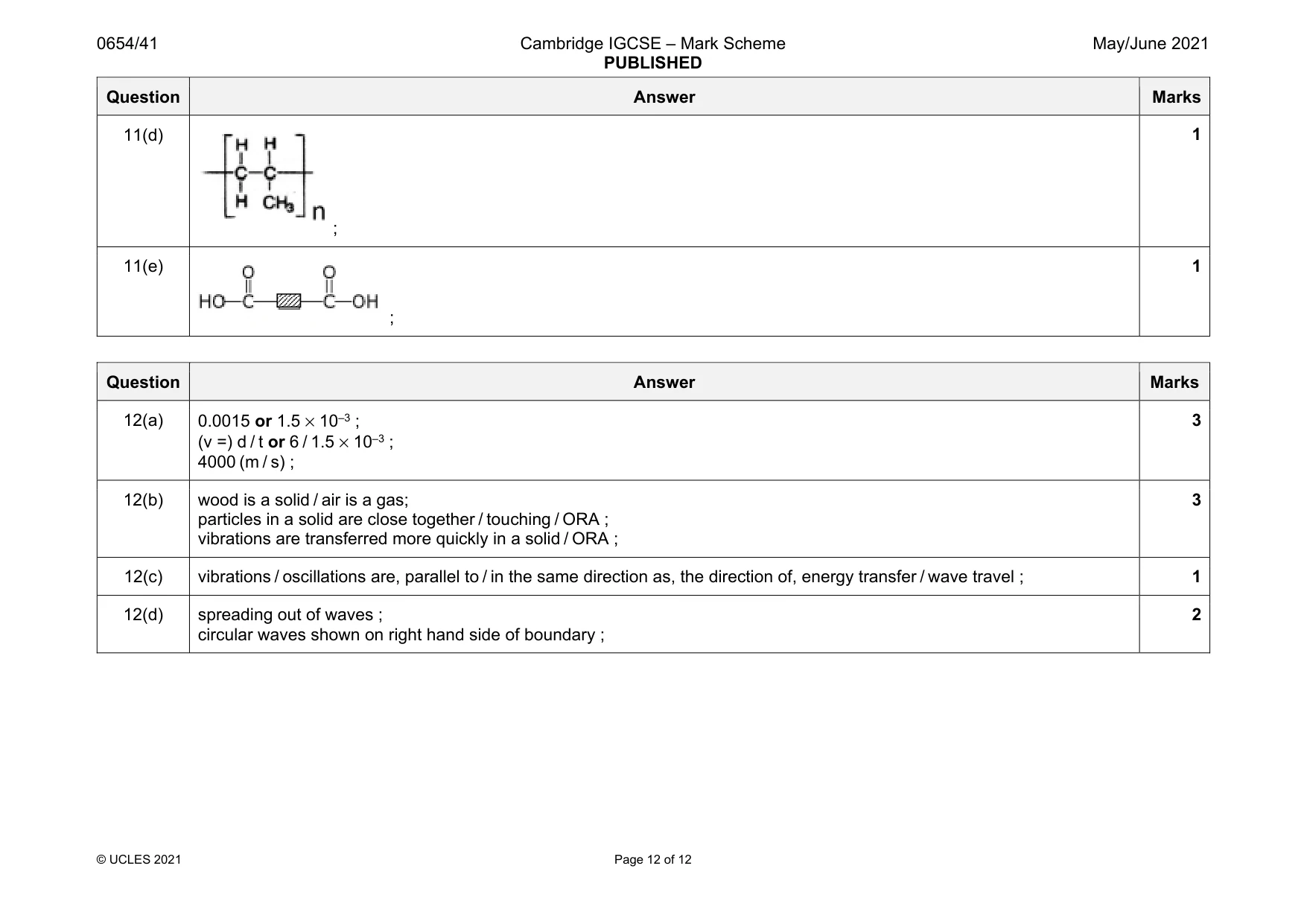
Mark scheme: 11(a) both have same functional group / both have (carbon to carbon) double bond ; both have same general formula / CnH2n ; both have similar (chemical) reactions ; trend in / similar, physical properties ; max 2 11(b)(i) high temperature / specified elevated temperature ; high pressure / specified elevated pressure ; catalyst / named catalyst ; AVP ; max 2 2 11(b)(ii) butane ; ;; 3 11(c) C2H4 + Br2 → C2H4Br2 C2H4Br2 ; then all else correct ; 2 Question Answer Marks 11(d) ; 1 11(e) ; 1
Q12 · A student plans to measure the speed of sound through wood
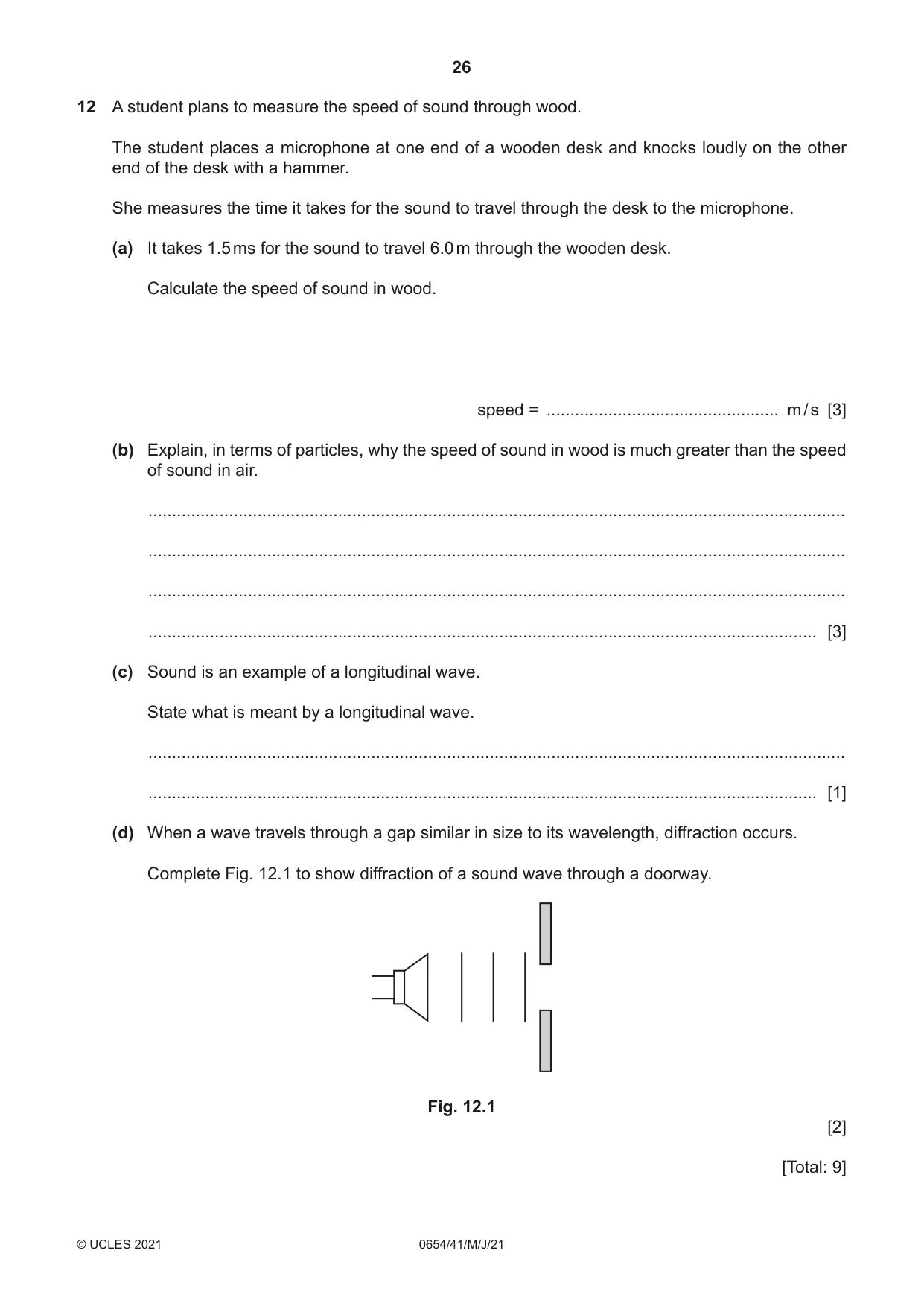
12 A student plans to measure the speed of sound through wood. The student places a microphone at one end of a wooden desk and knocks loudly on the other end of the desk with a hammer. She measures the time it takes for the sound to travel through the desk to the microphone. (a) It takes 1.5 ms for the sound to travel 6.0 m through the wooden desk. Calculate the speed of sound in wood. speed = ................................................. m / s [3] (b) Explain, in terms of particles, why the speed of sound in wood is much greater than the speed of sound in air. ................................................................................................................................................... ................................................................................................................................................... ................................................................................................................................................... ............................................................................................................................................. [3] (c) Sound is an example of a longitudinal wave. State what is meant by a longitudinal wave. ................................................................................................................................................... ............................................................................................................................................. [1] (d) When a wave travels through a gap similar in size to its wavelength, diffraction occurs. Complete Fig. 12.1 to show diffraction of a sound wave through a doorway. Fig. 12.1 [2] [Total: 9]
Mark scheme: 12(a) 0.0015 or 1.5 × 10⁻³ ; (v =) d / t or 6 / 1.5 × 10⁻³ ; 4000 (m / s) ; 12(b) wood is a solid / air is a gas; particles in a solid are close together / touching / ORA ; vibrations are transferred more quickly in a solid / ORA ; 3 12(c) vibrations / oscillations are, parallel to / in the same direction as, the direction of, energy transfer / wave travel ; 1 12(d) spreading out of waves ; circular waves shown on right hand side of boundary ; 2
What was in this paper
The subtopics covered by these 12 questions, and how many questions each got. Open one in a new tab to see every Cambridge question on it.
What you needed in this session
Cambridge’s own grade thresholds for 2021 May/June, Paper 4 · Variant 1. A higher threshold means an easier paper — the bar moves with how the cohort did.