Cambridge IGCSE Sciences - Co-ordinated (Double) 0654 — 2018 Oct/Nov Paper 4 · Variant 1
0654/41/O/N/18 · 13 questions · 120 marks · ≈135 min
The question paper and its mark scheme, free to read here and free to download. This is Cambridge’s own paper, exactly as it was sat.
Question paper28 pages


Mark scheme13 pages
Answers below. Sit the paper first if you are practising.
Questions as text
Q1 · A simplified diagram of the carbon cycle
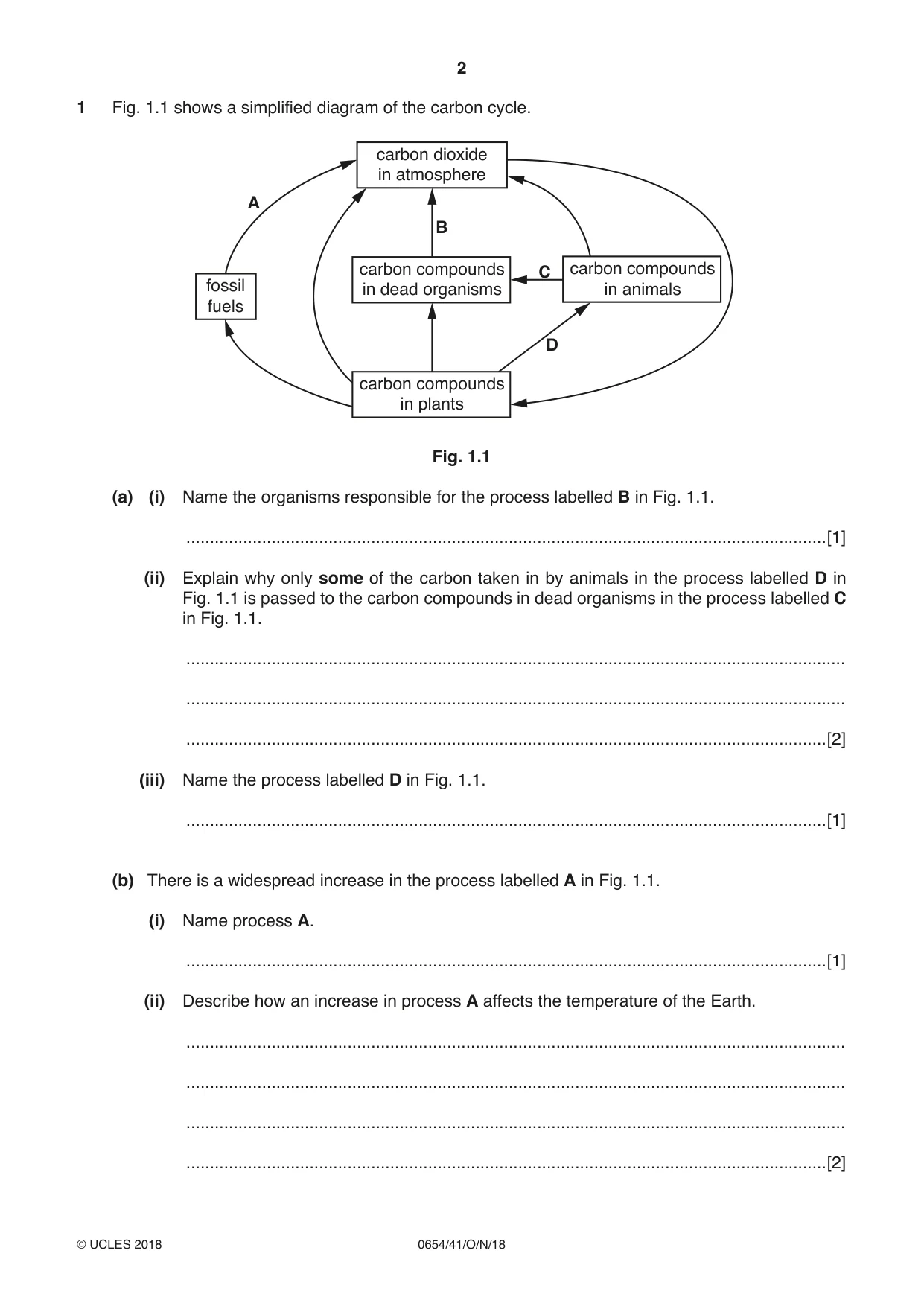
1 Fig. 1.1 shows a simplified diagram of the carbon cycle. carbon dioxide in atmosphere A B carbon compounds C carbon compounds fossil in dead organisms in animals fuels D carbon compounds in plants Fig. 1.1 (a) (i) Name the organisms responsible for the process labelled B in Fig. 1.1. .......................................................................................................................................[1] (ii) Explain why only some of the carbon taken in by animals in the process labelled D in Fig. 1.1 is passed to the carbon compounds in dead organisms in the process labelled C in Fig. 1.1. ........................................................................................................................................... ........................................................................................................................................... .......................................................................................................................................[2] (iii) Name the process labelled D in Fig. 1.1. .......................................................................................................................................[1] (b) There is a widespread increase in the process labelled A in Fig. 1.1. (i) Name process A. .......................................................................................................................................[1] (ii) Describe how an increase in process A affects the temperature of the Earth. ........................................................................................................................................... ........................................................................................................................................... ........................................................................................................................................... .......................................................................................................................................[2] (c) Suggest and explain one way to increase the removal of carbon dioxide from the atmosphere. ................................................................................................................................................... ................................................................................................................................................... ...............................................................................................................................................[2]
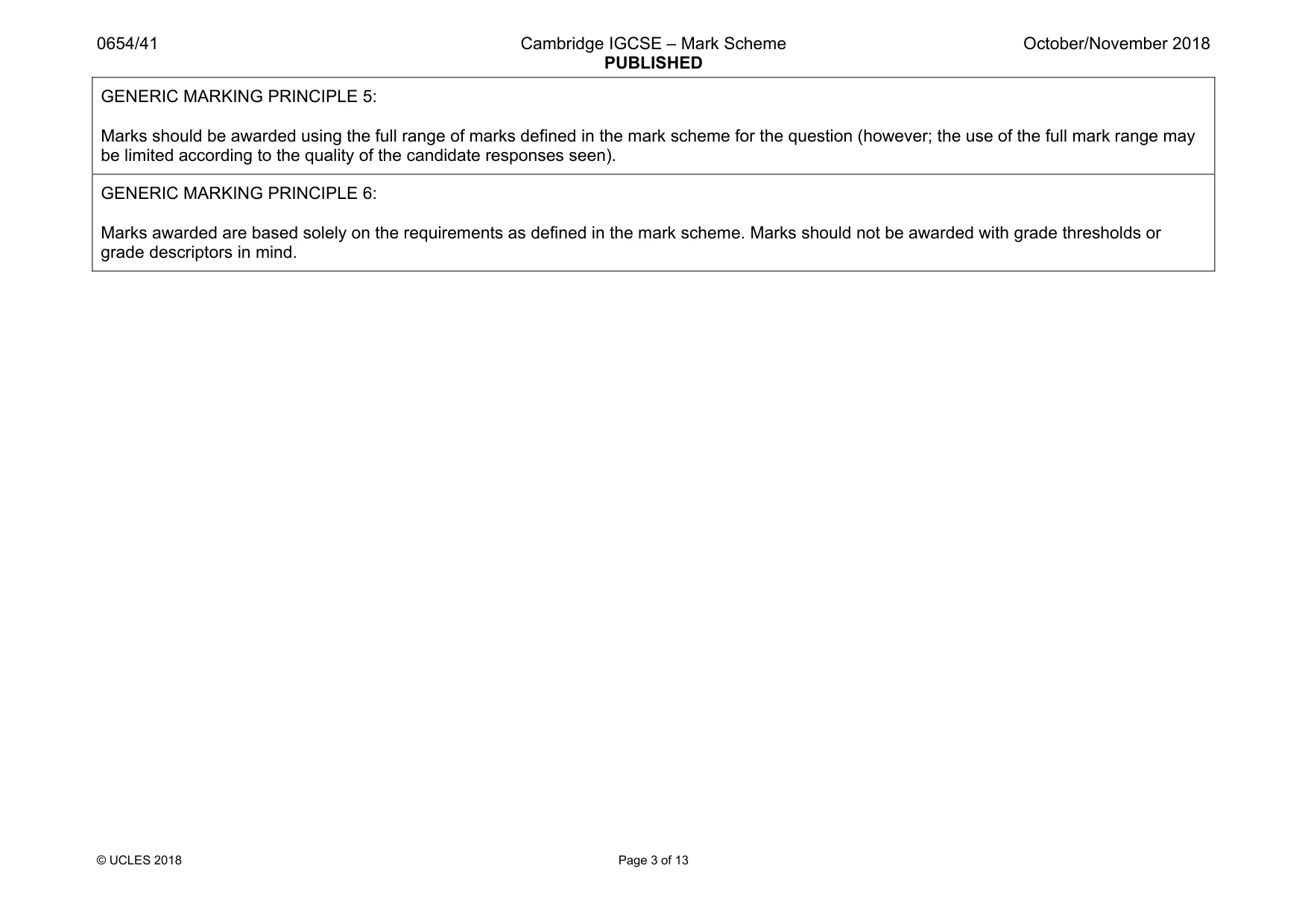
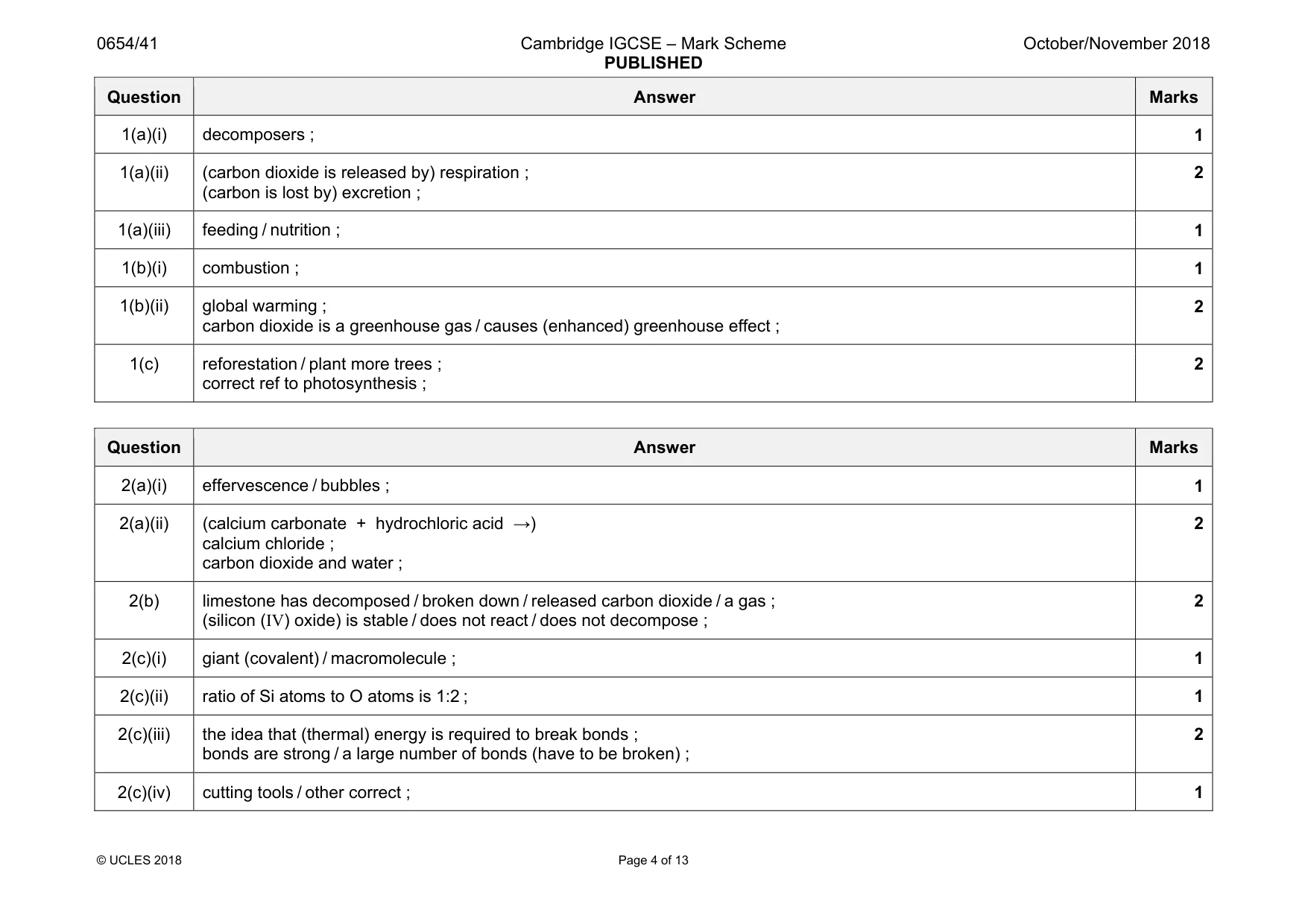
Mark scheme: 1(a)(i) decomposers ; 1 1(a)(ii) (carbon dioxide is released by) respiration ; (carbon is lost by) excretion ; 2 1(a)(iii) feeding / nutrition ; 1 1(b)(i) combustion ; 1 1(b)(ii) global warming ; carbon dioxide is a greenhouse gas / causes (enhanced) greenhouse effect ; 2 1(c) reforestation / plant more trees ; correct ref to photosynthesis ; 2
Q2 · Diamonds, limestone and sand are found in the Earth’s crust
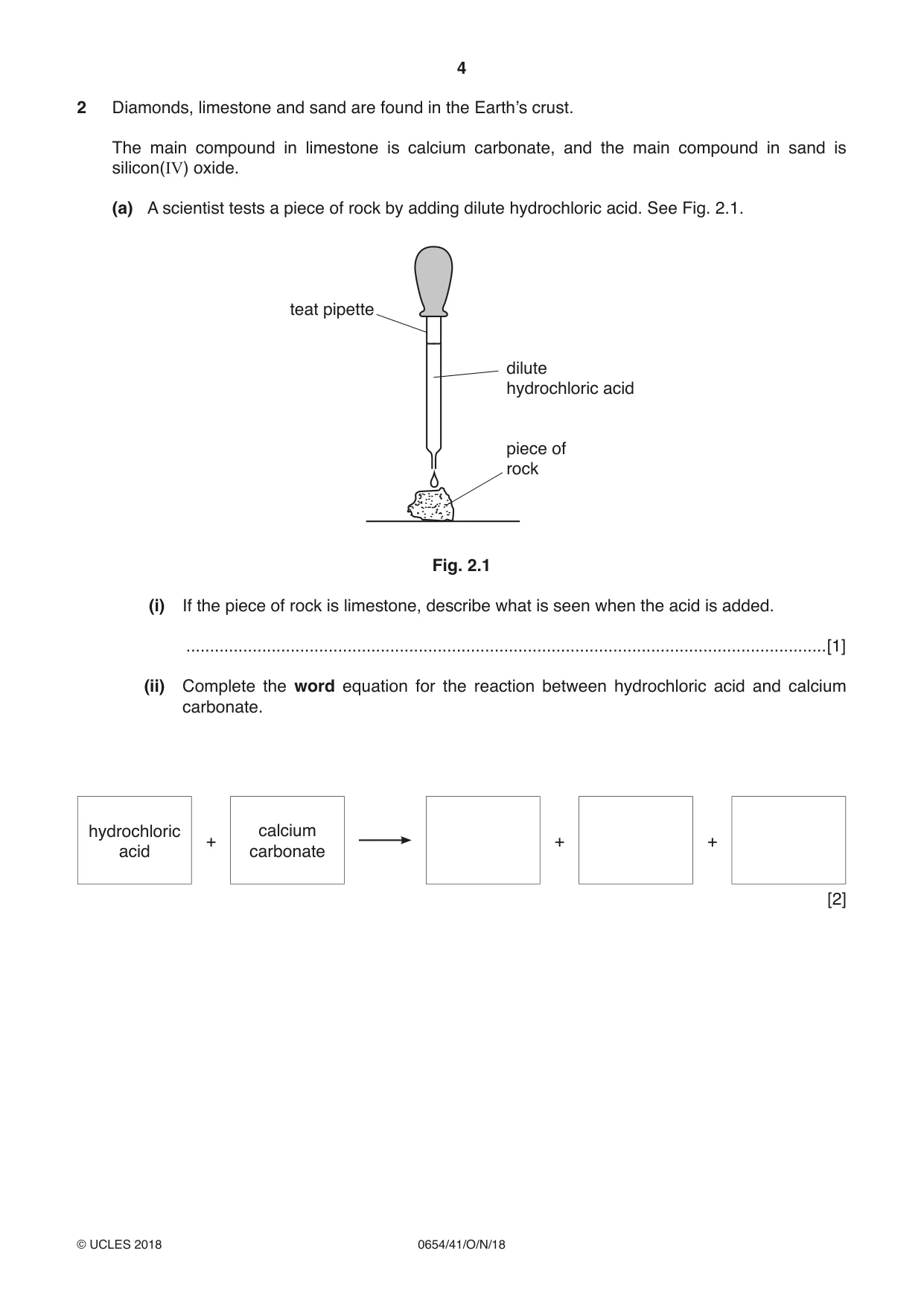
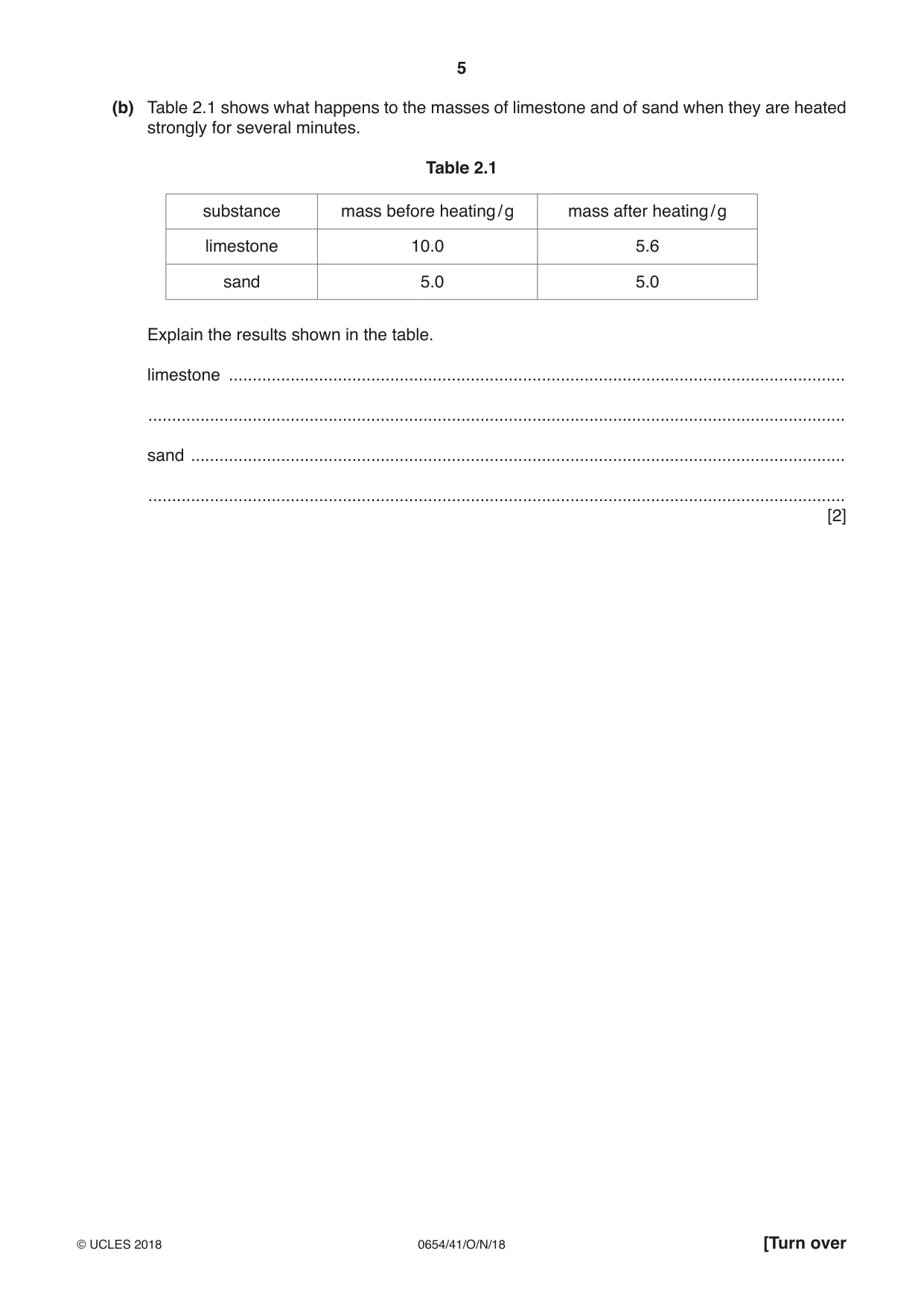
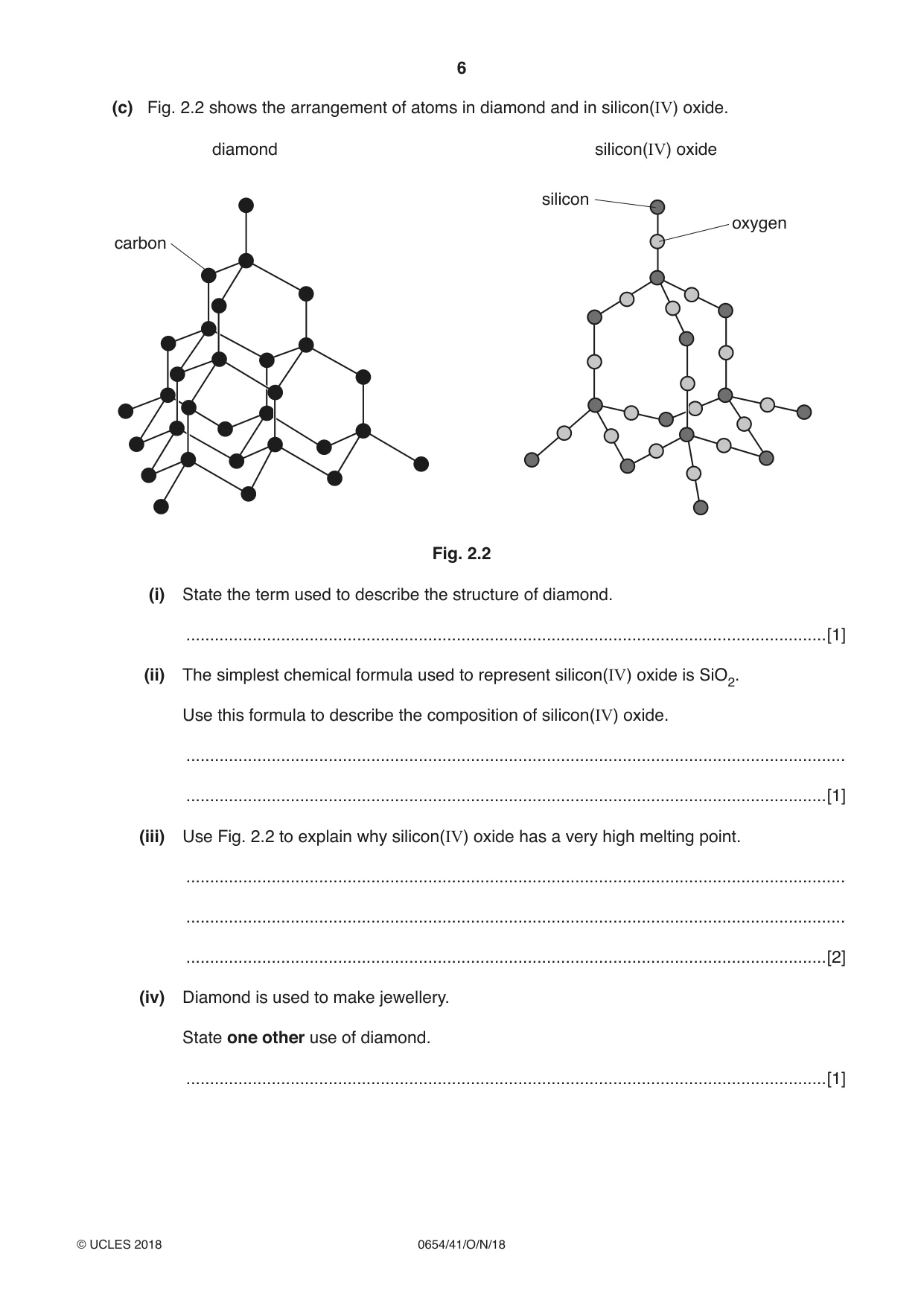
2 Diamonds, limestone and sand are found in the Earth’s crust. The main compound in limestone is calcium carbonate, and the main compound in sand is silicon(IV) oxide. (a) A scientist tests a piece of rock by adding dilute hydrochloric acid. See Fig. 2.1. teat pipette dilute hydrochloric acid piece of rock Fig. 2.1 (i) If the piece of rock is limestone, describe what is seen when the acid is added. .......................................................................................................................................[1] (ii) Complete the word equation for the reaction between hydrochloric acid and calcium carbonate. hydrochloric calcium + + + acid carbonate [2] (b) Table 2.1 shows what happens to the masses of limestone and of sand when they are heated strongly for several minutes. Table 2.1 substance mass before heating / g mass after heating / g limestone 10.0 5.6 sand 5.0 5.0 Explain the results shown in the table. limestone .................................................................................................................................. ................................................................................................................................................... sand .......................................................................................................................................... ................................................................................................................................................... [2] (c) Fig. 2.2 shows the arrangement of atoms in diamond and in silicon(IV) oxide. diamond silicon(IV) oxide silicon oxygen carbon Fig. 2.2 (i) State the term used to describe the structure of diamond. .......................................................................................................................................[1] (ii) The simplest chemical formula used to represent silicon(IV) oxide is SiO2. Use this formula to describe the composition of silicon(IV) oxide. ........................................................................................................................................... .......................................................................................................................................[1] (iii) Use Fig. 2.2 to explain why silicon(IV) oxide has a very high melting point. ........................................................................................................................................... ........................................................................................................................................... .......................................................................................................................................[2] (iv) Diamond is used to make jewellery. State one other use of diamond. .......................................................................................................................................[1]
Mark scheme: 2(a)(i) effervescence / bubbles ; 1 2(a)(ii) (calcium carbonate + hydrochloric acid →) calcium chloride ; carbon dioxide and water ; 2 2(b) limestone has decomposed / broken down / released carbon dioxide / a gas ; (silicon (IV) oxide) is stable / does not react / does not decompose ; 2 2(c)(i) giant (covalent) / macromolecule ; 1 2(c)(ii) ratio of Si atoms to O atoms is 1:2 ; 1 2(c)(iii) the idea that (thermal) energy is required to break bonds ; bonds are strong / a large number of bonds (have to be broken) ; 2 2(c)(iv) cutting tools / other correct ; 1
More questions on The characteristic properties of acids and bases
Q3 · A torch (flashlight) contains four cells connected in series and two lamps X and Y…
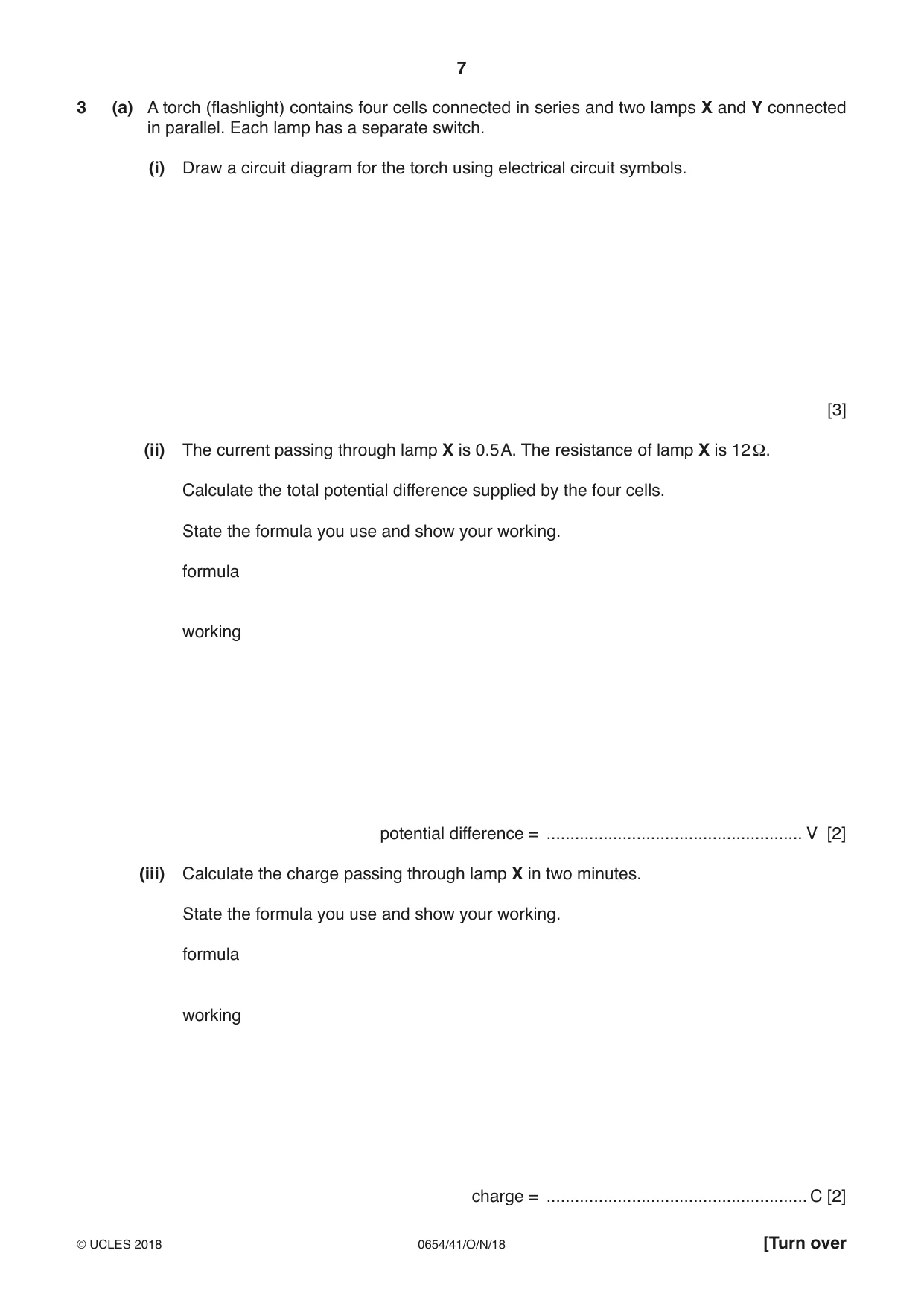
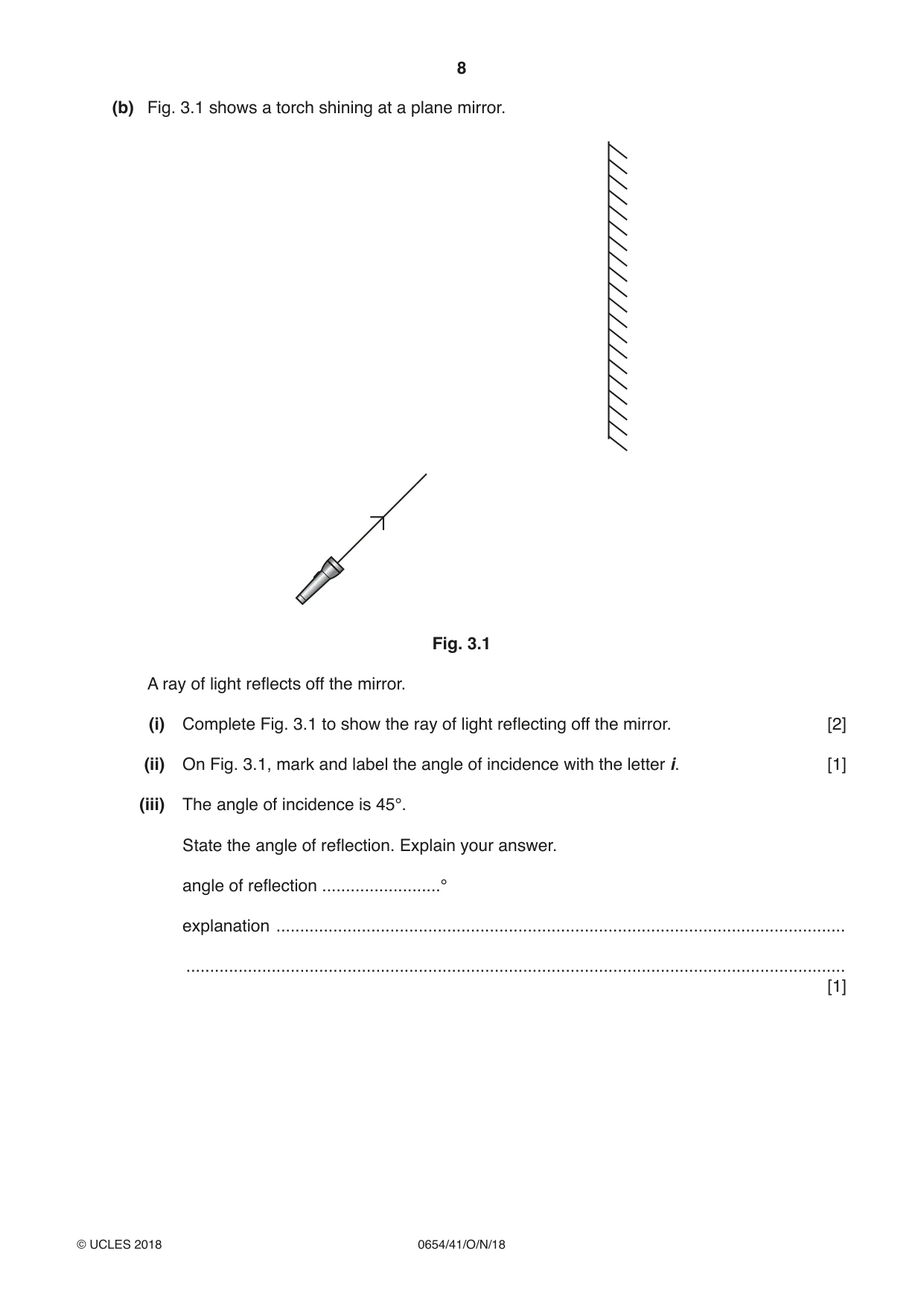
3 (a) A torch (flashlight) contains four cells connected in series and two lamps X and Y connected in parallel. Each lamp has a separate switch. (i) Draw a circuit diagram for the torch using electrical circuit symbols. [3] (ii) The current passing through lamp X is 0.5 A. The resistance of lamp X is 12 Ω. Calculate the total potential difference supplied by the four cells. State the formula you use and show your working. formula working potential difference = ...................................................... V [2] (iii) Calculate the charge passing through lamp X in two minutes. State the formula you use and show your working. formula working charge = ....................................................... C [2] (b) Fig. 3.1 shows a torch shining at a plane mirror. Fig. 3.1 A ray of light reflects off the mirror. (i) Complete Fig. 3.1 to show the ray of light reflecting off the mirror. [2] (ii) On Fig. 3.1, mark and label the angle of incidence with the letter i. [1] (iii) The angle of incidence is 45°. State the angle of reflection. Explain your answer. angle of reflection .........................° explanation ........................................................................................................................ ........................................................................................................................................... [1]
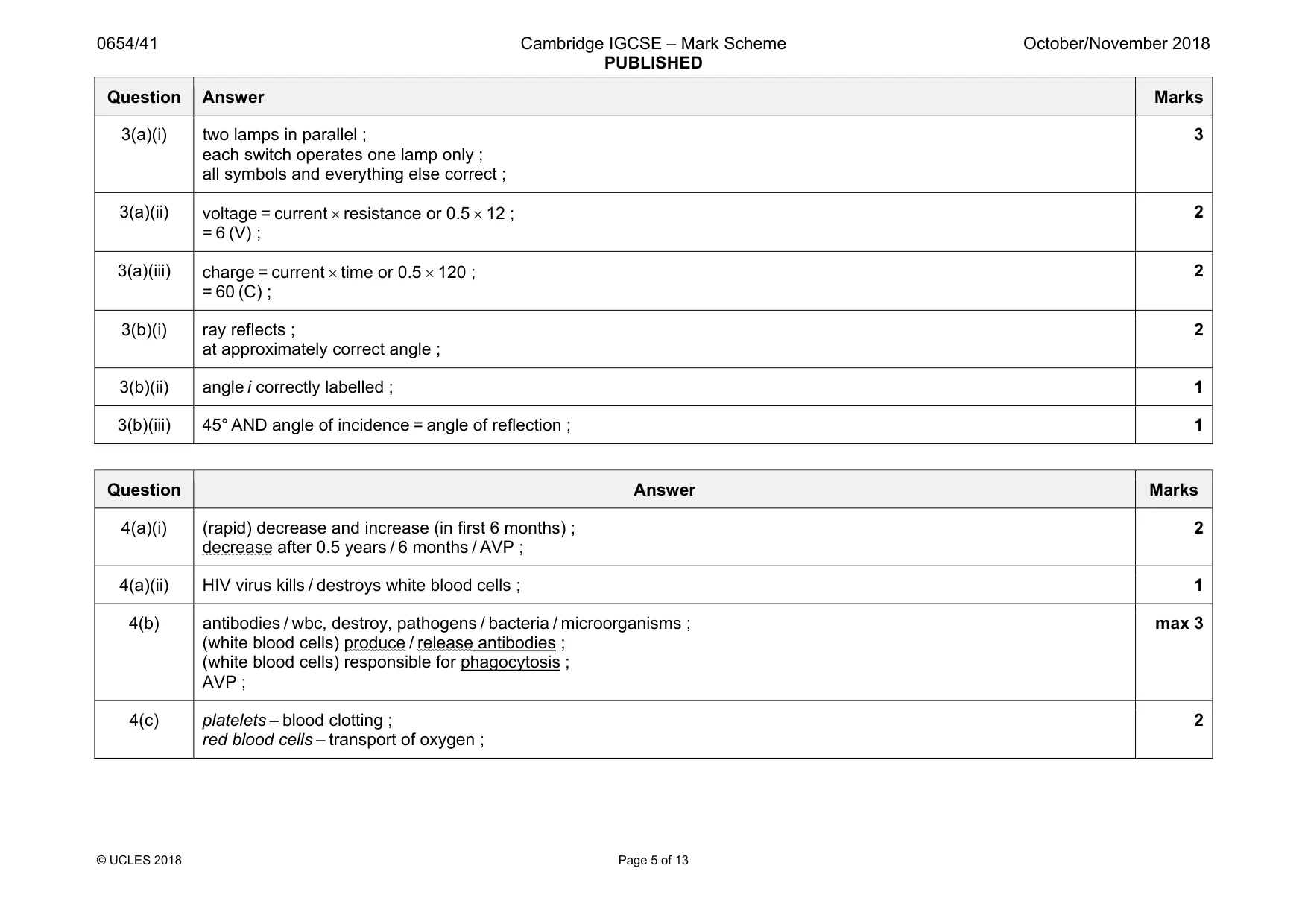
Mark scheme: 3(a)(i) two lamps in parallel ; each switch operates one lamp only ; all symbols and everything else correct ; 3 3(a)(ii) voltage = current × resistance or 0.5 × 12 ; = 6 (V) ; 2 3(a)(iii) charge = current × time or 0.5 × 120 ; = 60 (C) ; 2 3(b)(i) ray reflects ; at approximately correct angle ; 2 3(b)(ii) angle i correctly labelled ; 1 3(b)(iii) 45° AND angle of incidence = angle of reflection ; 1
Q4 · HIV is a sexually transmitted infection
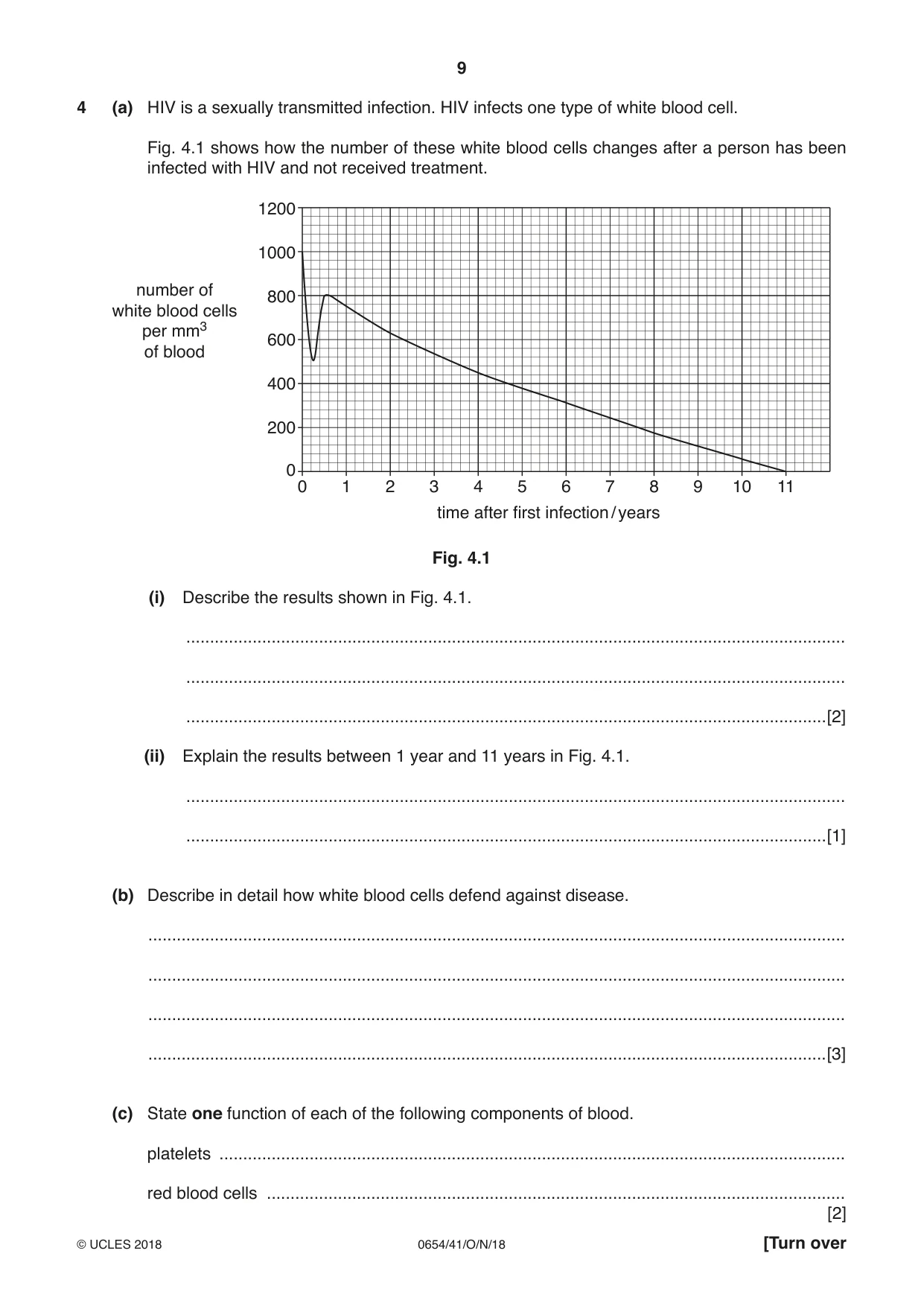
4 (a) HIV is a sexually transmitted infection. HIV infects one type of white blood cell. Fig. 4.1 shows how the number of these white blood cells changes after a person has been infected with HIV and not received treatment. 1200 1000 number of 800 white blood cells per mm3 600 of blood 400 200 0 0 1 2 3 4 5 6 7 8 9 10 11 time after first infection / years Fig. 4.1 (i) Describe the results shown in Fig. 4.1. ........................................................................................................................................... ........................................................................................................................................... .......................................................................................................................................[2] (ii) Explain the results between 1 year and 11 years in Fig. 4.1. ........................................................................................................................................... .......................................................................................................................................[1] (b) Describe in detail how white blood cells defend against disease. ................................................................................................................................................... ................................................................................................................................................... ................................................................................................................................................... ...............................................................................................................................................[3] (c) State one function of each of the following components of blood. platelets .................................................................................................................................... red blood cells .......................................................................................................................... [2]
Mark scheme: 4(a)(i) (rapid) decrease and increase (in first 6 months) ; decrease after 0.5 years / 6 months / AVP ; 2 4(a)(ii) HIV virus kills / destroys white blood cells ; 1 4(b) antibodies / wbc, destroy, pathogens / bacteria / microorganisms ; (white blood cells) produce / release antibodies ; (white blood cells) responsible for phagocytosis ; AVP ; max 3 4(c) platelets – blood clotting ; red blood cells – transport of oxygen ; 2
Q5 · Iodine is an element in Group VII of the Periodic Table
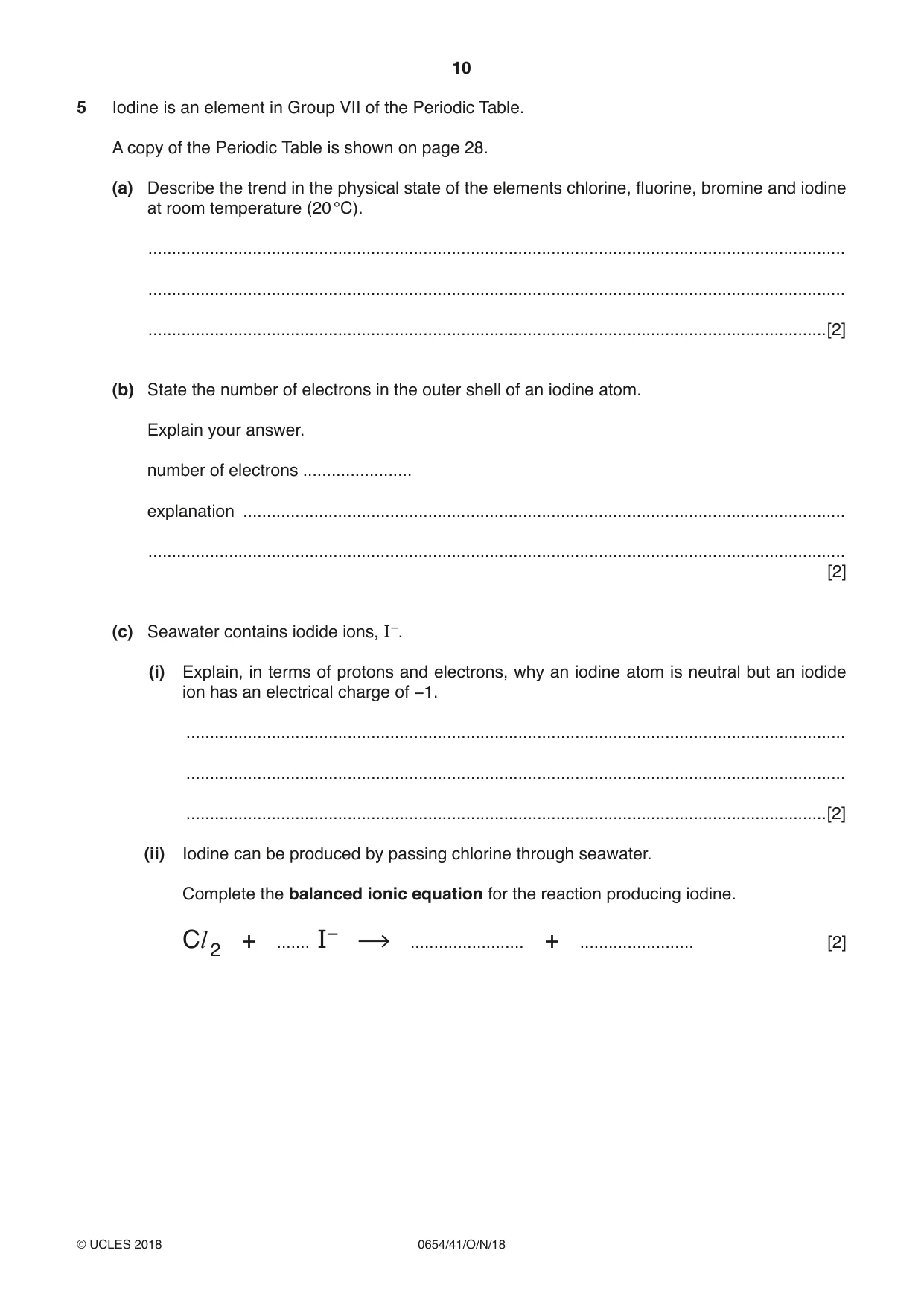
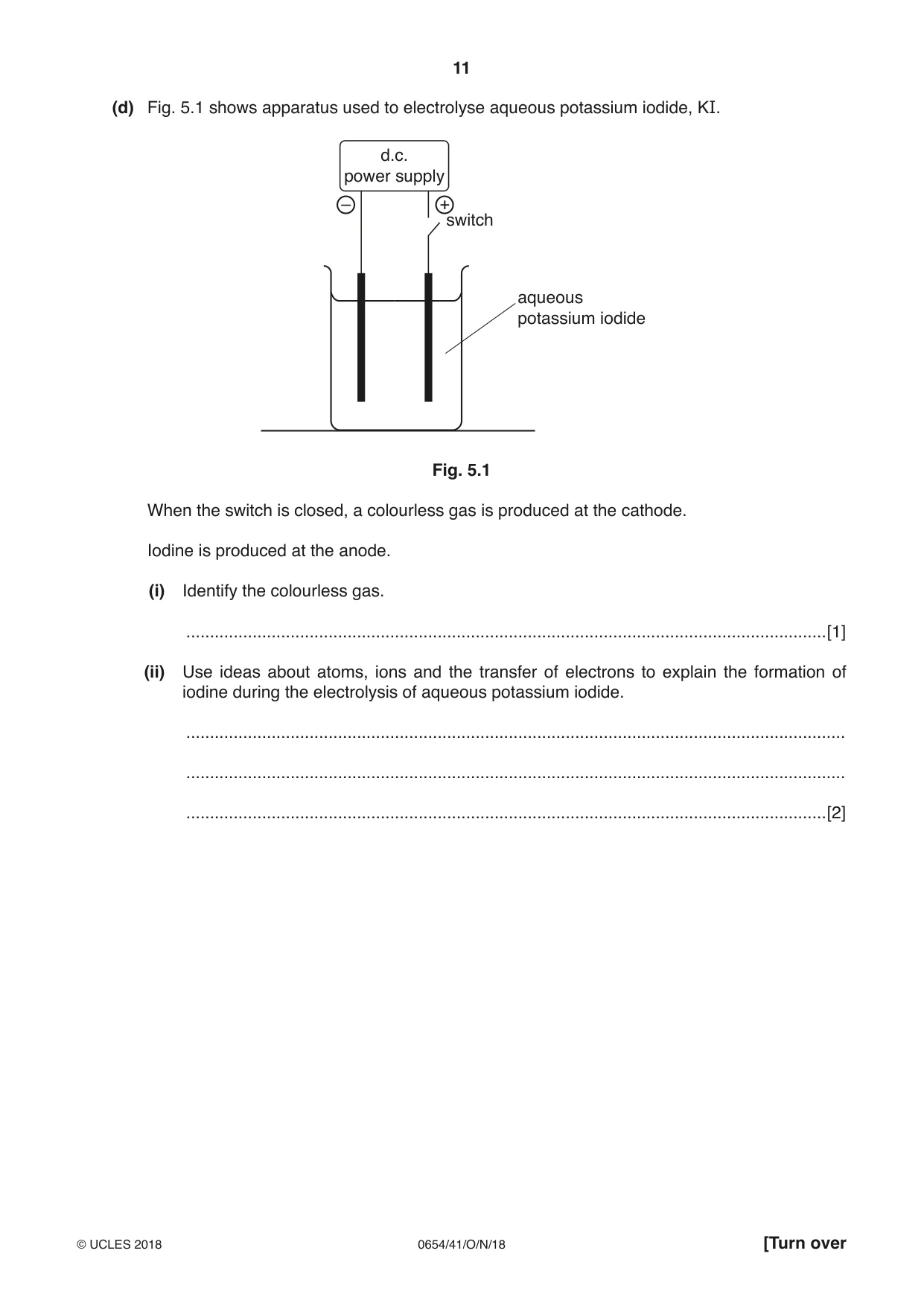
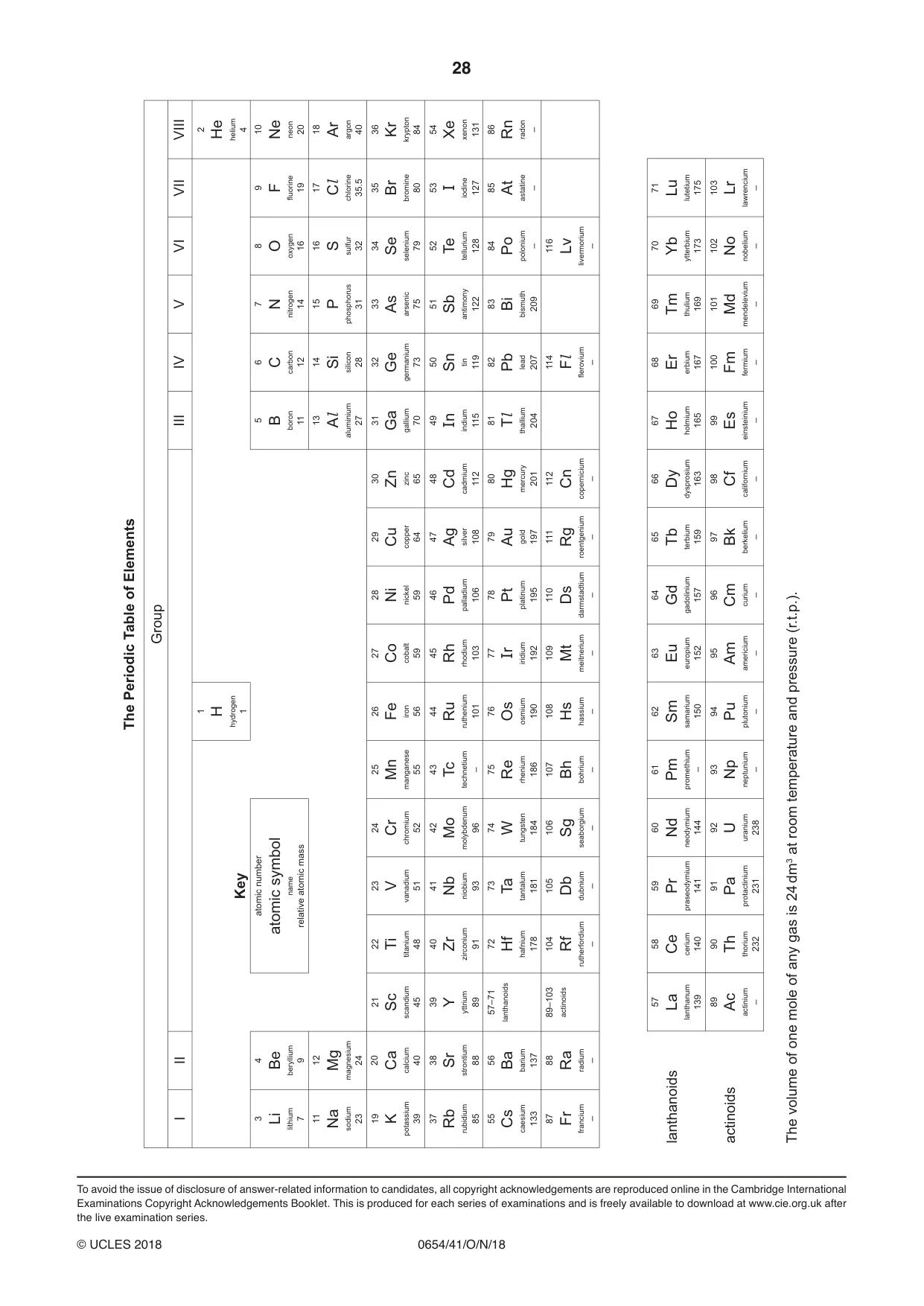
5 Iodine is an element in Group VII of the Periodic Table. A copy of the Periodic Table is shown on page 28. (a) Describe the trend in the physical state of the elements chlorine, fluorine, bromine and iodine at room temperature (20 °C). ................................................................................................................................................... ................................................................................................................................................... ...............................................................................................................................................[2] (b) State the number of electrons in the outer shell of an iodine atom. Explain your answer. number of electrons ....................... explanation ............................................................................................................................... ................................................................................................................................................... [2] (c) Seawater contains iodide ions, I−. (i) Explain, in terms of protons and electrons, why an iodine atom is neutral but an iodide ion has an electrical charge of −1. ........................................................................................................................................... ........................................................................................................................................... .......................................................................................................................................[2] (ii) Iodine can be produced by passing chlorine through seawater. Complete the balanced ionic equation for the reaction producing iodine. Cl + ....... I− ........................ + ........................ [2] 2 (d) Fig. 5.1 shows apparatus used to electrolyse aqueous potassium iodide, KI. d.c. power supply – + switch aqueous potassium iodide Fig. 5.1 When the switch is closed, a colourless gas is produced at the cathode. Iodine is produced at the anode. (i) Identify the colourless gas. .......................................................................................................................................[1] (ii) Use ideas about atoms, ions and the transfer of electrons to explain the formation of iodine during the electrolysis of aqueous potassium iodide. ........................................................................................................................................... ........................................................................................................................................... .......................................................................................................................................[2]
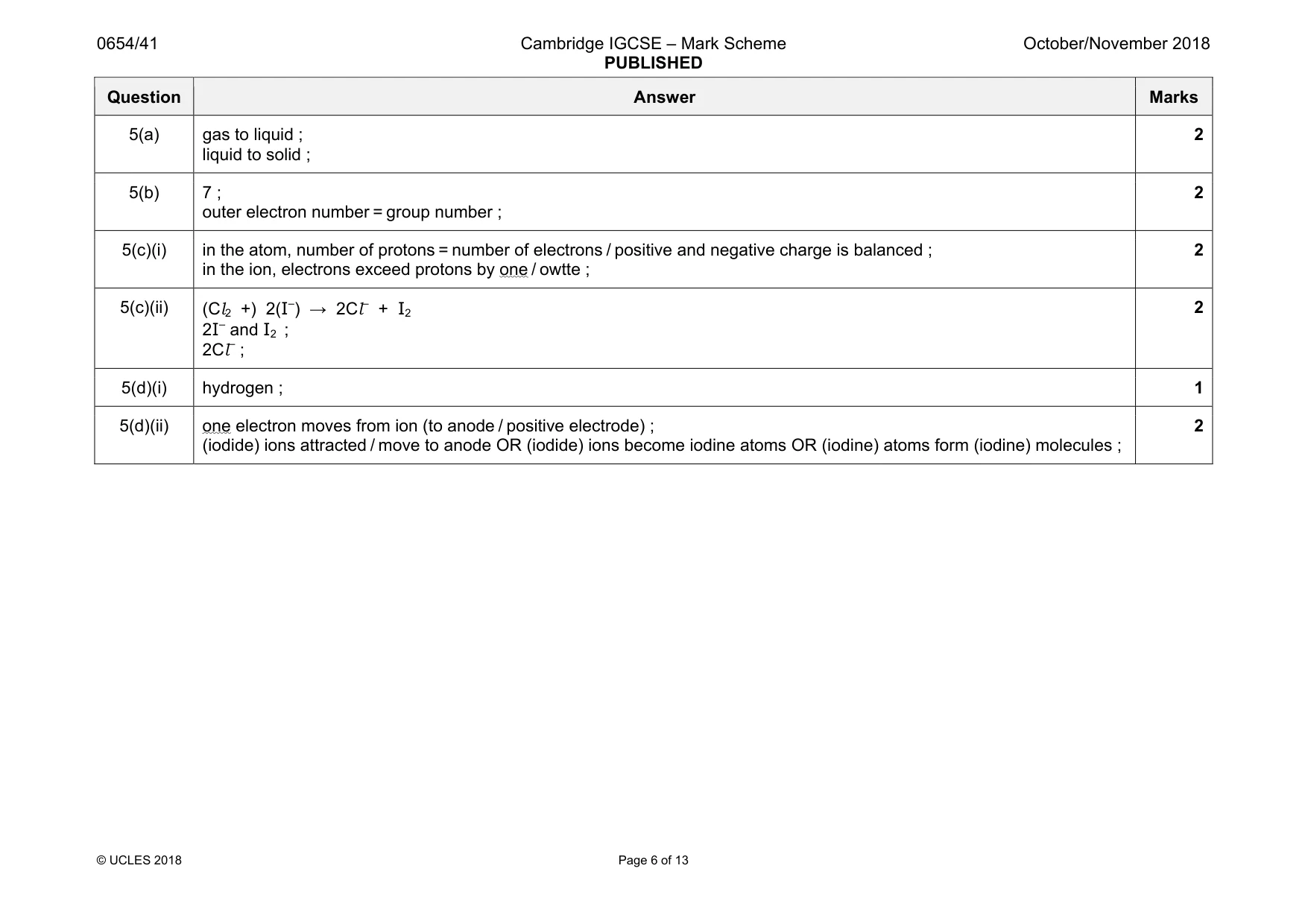
Mark scheme: 5(a) gas to liquid ; liquid to solid ; 2 5(b) 7 ; outer electron number = group number ; 2 5(c)(i) in the atom, number of protons = number of electrons / positive and negative charge is balanced ; in the ion, electrons exceed protons by one / owtte ; 2 5(c)(ii) (Cl2 +) 2(I–) → 2Cl– + I2 2I– and I2 ; 2Cl– ; 2 5(d)(i) hydrogen ; 1 5(d)(ii) one electron moves from ion (to anode / positive electrode) ; (iodide) ions attracted / move to anode OR (iodide) ions become iodine atoms OR (iodine) atoms form (iodine) molecules ; 2
Q6 · A bat emitting ultrasound waves to detect obstacles and prey
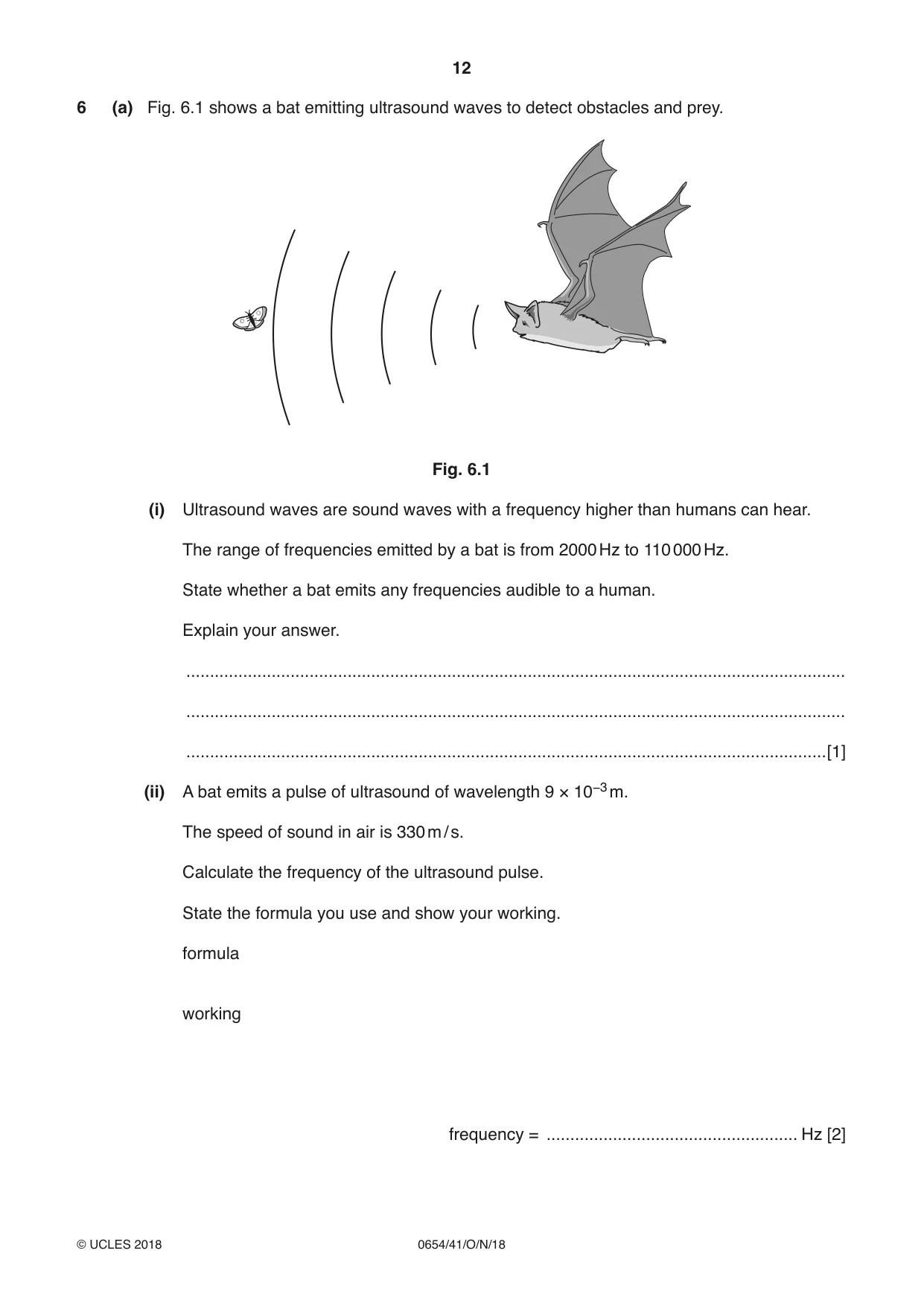
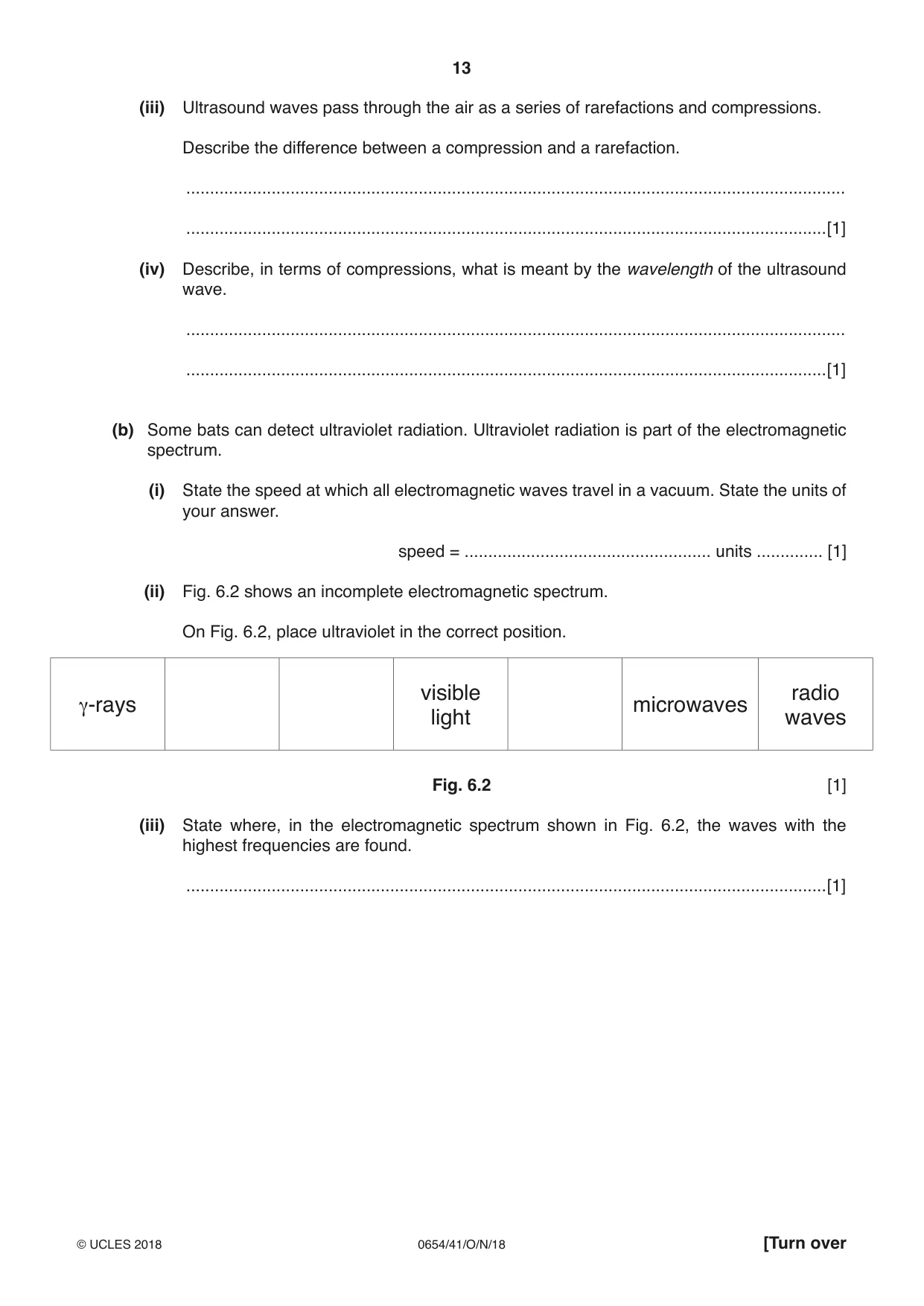
6 (a) Fig. 6.1 shows a bat emitting ultrasound waves to detect obstacles and prey. Fig. 6.1 (i) Ultrasound waves are sound waves with a frequency higher than humans can hear. The range of frequencies emitted by a bat is from 2000 Hz to 110 000 Hz. State whether a bat emits any frequencies audible to a human. Explain your answer. ........................................................................................................................................... ........................................................................................................................................... .......................................................................................................................................[1] (ii) A bat emits a pulse of ultrasound of wavelength 9 × 10⁻³ m. The speed of sound in air is 330 m / s. Calculate the frequency of the ultrasound pulse. State the formula you use and show your working. formula working frequency = ..................................................... Hz [2] (iii) Ultrasound waves pass through the air as a series of rarefactions and compressions. Describe the difference between a compression and a rarefaction. ........................................................................................................................................... .......................................................................................................................................[1] (iv) Describe, in terms of compressions, what is meant by the wavelength of the ultrasound wave. ........................................................................................................................................... .......................................................................................................................................[1] (b) Some bats can detect ultraviolet radiation. Ultraviolet radiation is part of the electromagnetic spectrum. (i) State the speed at which all electromagnetic waves travel in a vacuum. State the units of your answer. speed = .................................................... units .............. [1] (ii) Fig. 6.2 shows an incomplete electromagnetic spectrum. On Fig. 6.2, place ultraviolet in the correct position. visible radioγ-rays microwaves light waves Fig. 6.2 [1] (iii) State where, in the electromagnetic spectrum shown in Fig. 6.2, the waves with the highest frequencies are found. .......................................................................................................................................[1] (c) A bat flies at 9 m / s. (i) Calculate the time it takes the bat to fly 200 m at this speed. State the formula you use and show your working. formula working time = ........................................................s [2] (ii) The mass of the bat is 200 g. Calculate the kinetic energy of the bat when moving at 9 m / s. State the formula you use and show your working. formula working kinetic energy = ........................................................J [2]
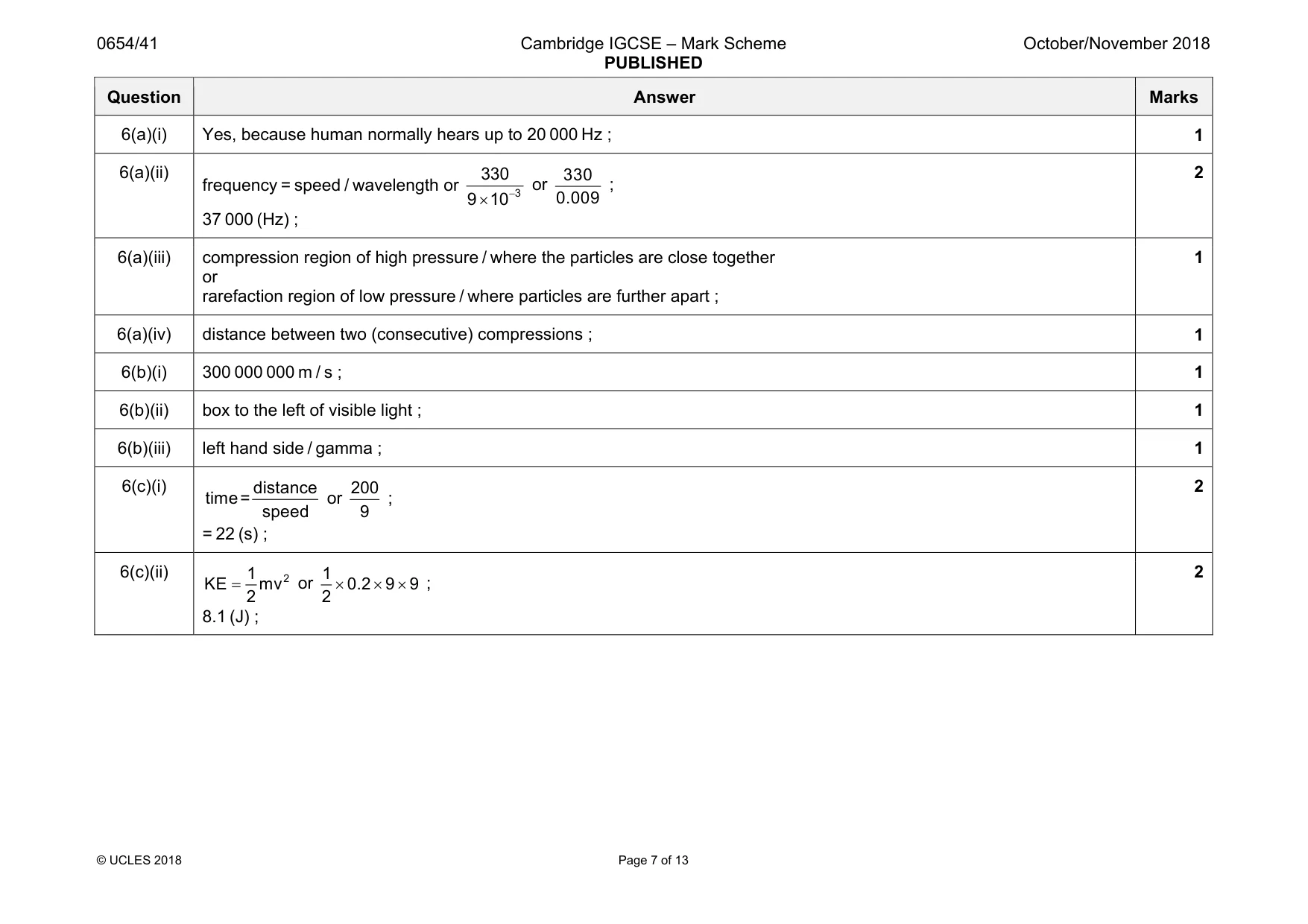
Mark scheme: 6(a)(i) Yes, because human normally hears up to 20 000 Hz ; 1 6(a)(ii) frequency = speed / wavelength or 3 330 9 10− × or 330 0.009 ; 37 000 (Hz) ; 2 6(a)(iii) compression region of high pressure / where the particles are close together or rarefaction region of low pressure / where particles are further apart ; 1 6(a)(iv) distance between two (consecutive) compressions ; 1 6(b)(i) 300 000 000 m / s ; 1 6(b)(ii) box to the left of visible light ; 1 6(b)(iii) left hand side / gamma ; 1 6(c)(i) distance time= speed or 200 9 ; = 22 (s) ; 2 6(c)(ii) 2 1 KE mv 2 = or 1 0.2 9 9 2 × × × ; 8.1 (J) ; 2
Q7 · Two plants, A and B, of the same species
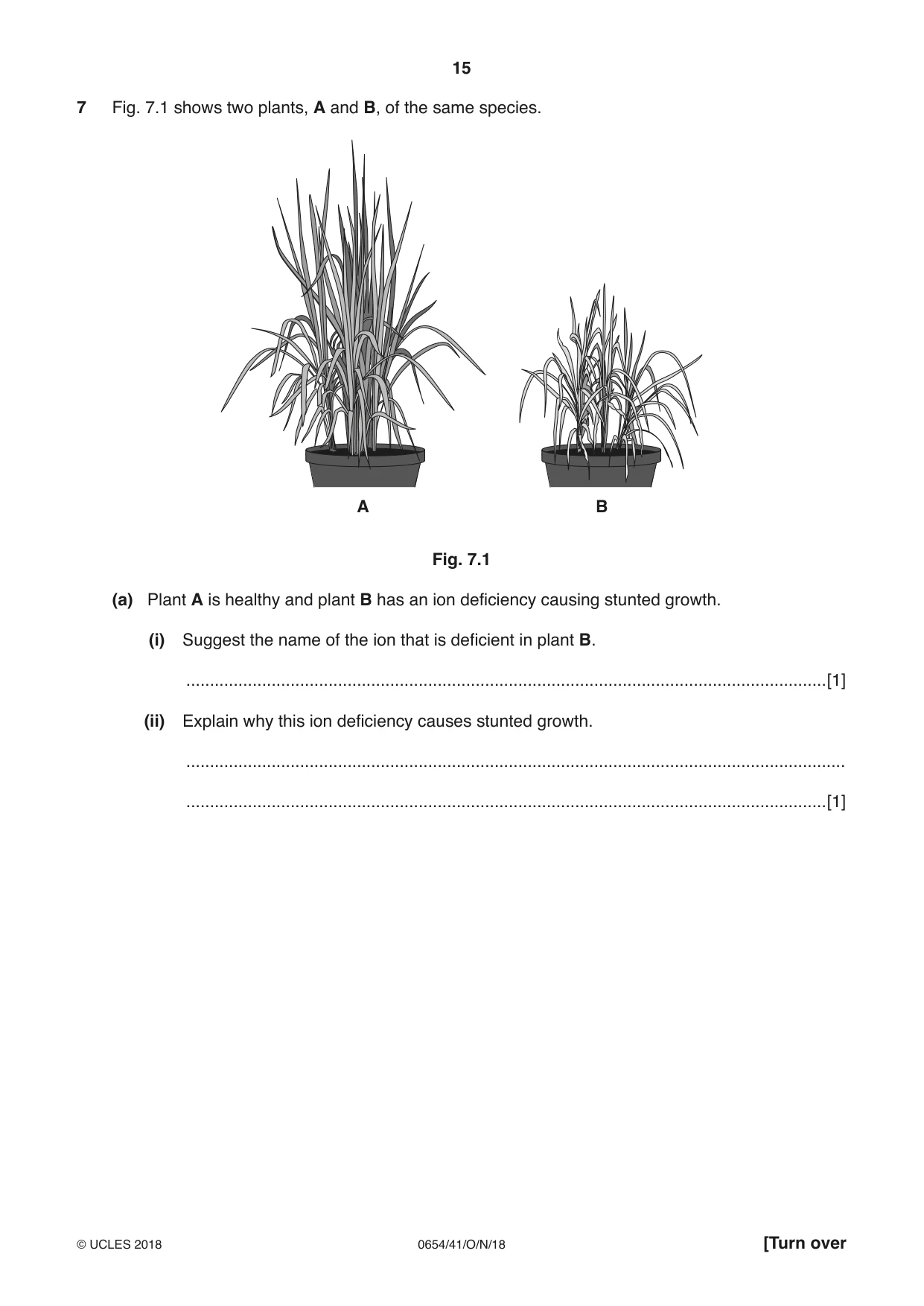
7 Fig. 7.1 shows two plants, A and B, of the same species. A B Fig. 7.1 (a) Plant A is healthy and plant B has an ion deficiency causing stunted growth. (i) Suggest the name of the ion that is deficient in plant B. .......................................................................................................................................[1] (ii) Explain why this ion deficiency causes stunted growth. ........................................................................................................................................... .......................................................................................................................................[1] (b) Fertilisers can prevent ion deficiencies in plants. Overuse of fertilisers can cause the eutrophication of bodies of water. Describe and explain the changes that occur during eutrophication to: (i) the plants on the surface of the water .......................................................................................................................................[1] (ii) the plants under the surface of the water ........................................................................................................................................... ........................................................................................................................................... .......................................................................................................................................[1] (iii) the bacteria in the water ........................................................................................................................................... ........................................................................................................................................... .......................................................................................................................................[1] (iv) the oxygen content of the water. ........................................................................................................................................... ........................................................................................................................................... .......................................................................................................................................[1] (c) Describe how plant roots obtain sugar from the leaves. ................................................................................................................................................... ................................................................................................................................................... ...............................................................................................................................................[2]
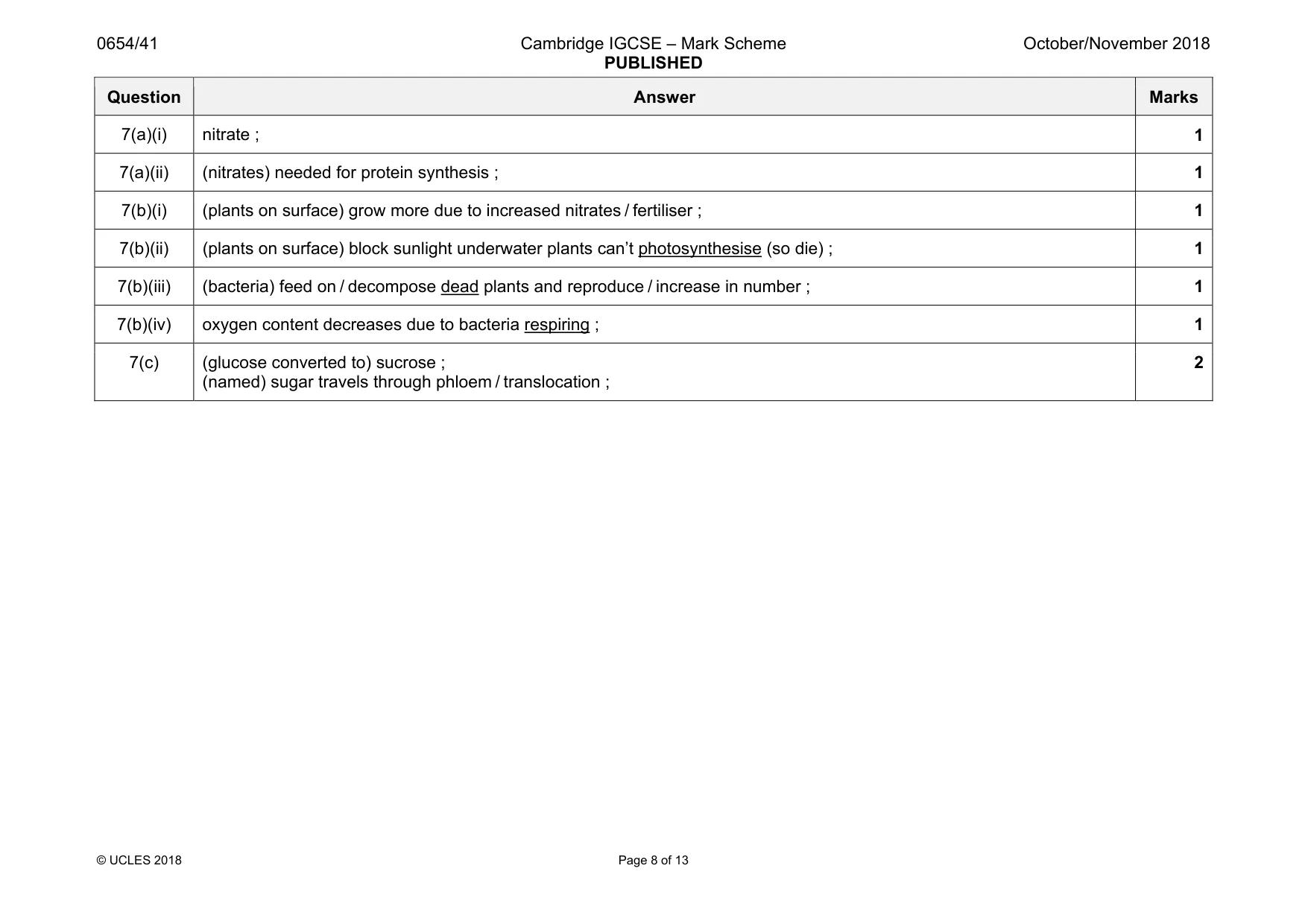
Mark scheme: 7(a)(i) nitrate ; 1 7(a)(ii) (nitrates) needed for protein synthesis ; 1 7(b)(i) (plants on surface) grow more due to increased nitrates / fertiliser ; 1 7(b)(ii) (plants on surface) block sunlight underwater plants can’t photosynthesise (so die) ; 1 7(b)(iii) (bacteria) feed on / decompose dead plants and reproduce / increase in number ; 1 7(b)(iv) oxygen content decreases due to bacteria respiring ; 1 7(c) (glucose converted to) sucrose ; (named) sugar travels through phloem / translocation ; 2
Q8 · Iron is a metal in the fourth period of the Periodic Table
8 (a) Iron is a metal in the fourth period of the Periodic Table. Name the collection of metals in the fourth period that contains iron. ...............................................................................................................................................[1] (b) Iron is a catalyst for the industrial process that produces ammonia. (i) Name the industrial process that produces ammonia. .......................................................................................................................................[1] (ii) State the gaseous elements that combine to make ammonia. ................................................................ and .............................................................. [1] (iii) Define the term catalyst. ........................................................................................................................................... .......................................................................................................................................[1] (c) Potassium oxide reacts with pure water. Iron oxide does not react with pure water. (i) Suggest the pH of the mixture formed after potassium oxide reacts with water. Explain your answer. pH ....................... explanation ........................................................................................................................ ........................................................................................................................................... [1] (ii) State the pH of the mixture of iron oxide and water. .......................................................................................................................................[1] (d) Polluted air can cause acid rain. (i) Name one gaseous oxide, other than carbon dioxide, that causes acid rain. .......................................................................................................................................[1] (ii) Acid rain reacts slowly with metals and with limestone. Suggest one reason for this low rate of reaction. Explain your answer using ideas about particles. reason ............................................................................................................................... ........................................................................................................................................... explanation ........................................................................................................................ ........................................................................................................................................... ........................................................................................................................................... [2]
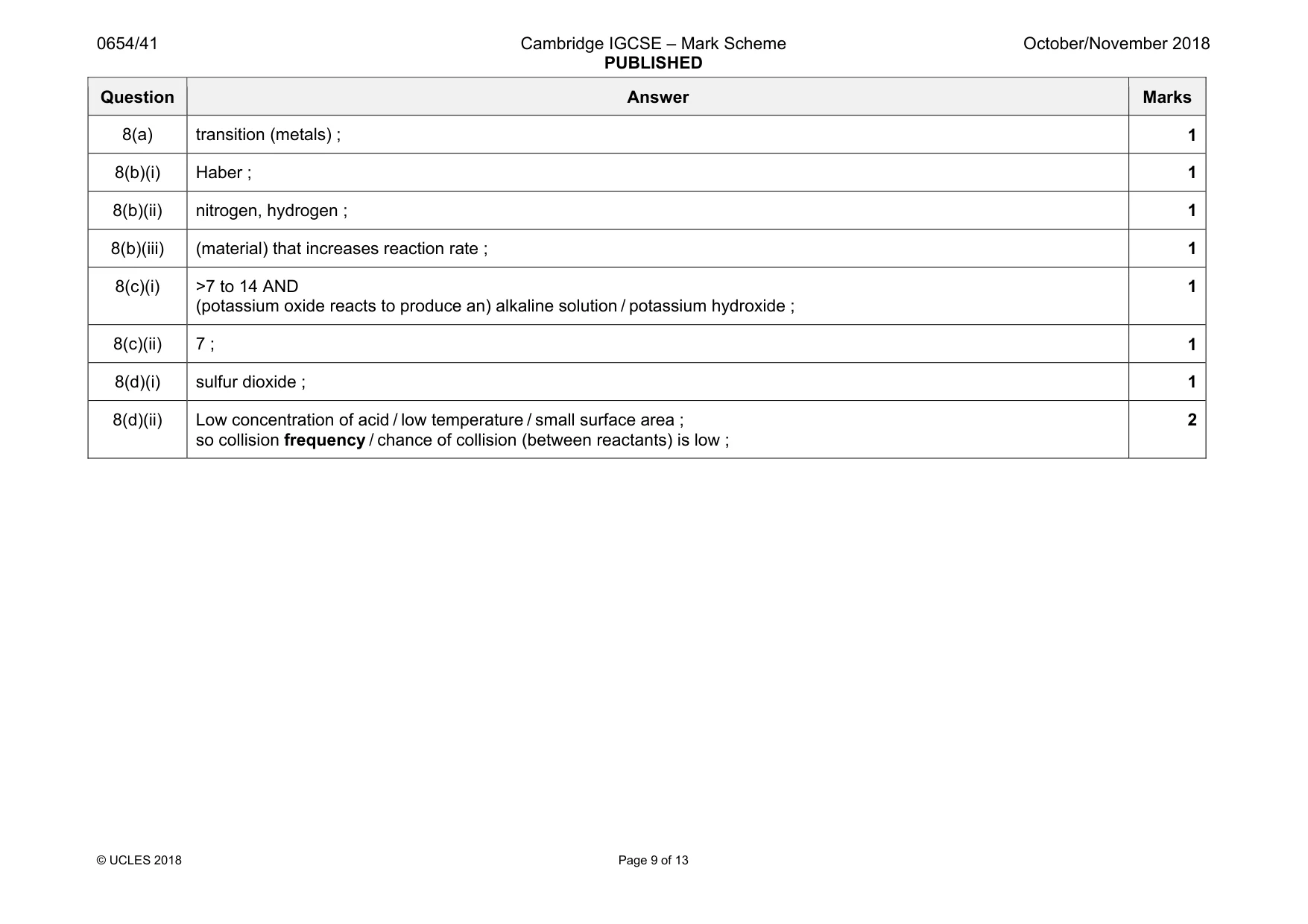
Mark scheme: 8(a) transition (metals) ; 1 8(b)(i) Haber ; 1 8(b)(ii) nitrogen, hydrogen ; 1 8(b)(iii) (material) that increases reaction rate ; 1 8(c)(i) >7 to 14 AND (potassium oxide reacts to produce an) alkaline solution / potassium hydroxide ; 1 8(c)(ii) 7 ; 1 8(d)(i) sulfur dioxide ; 1 8(d)(ii) Low concentration of acid / low temperature / small surface area ; so collision frequency / chance of collision (between reactants) is low ; 2
Q9 · The nuclear fuel used in a power station is plutonium-239
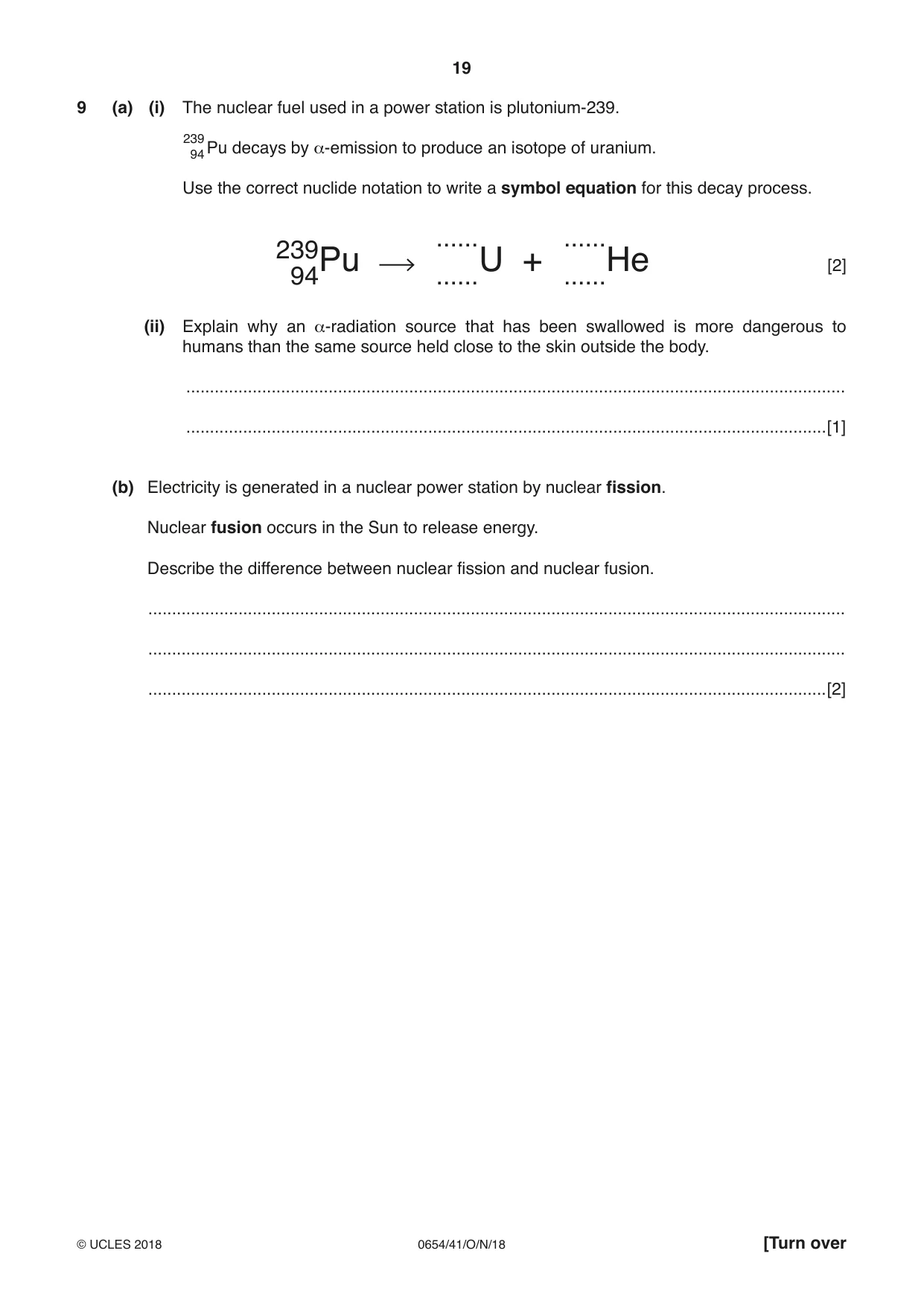
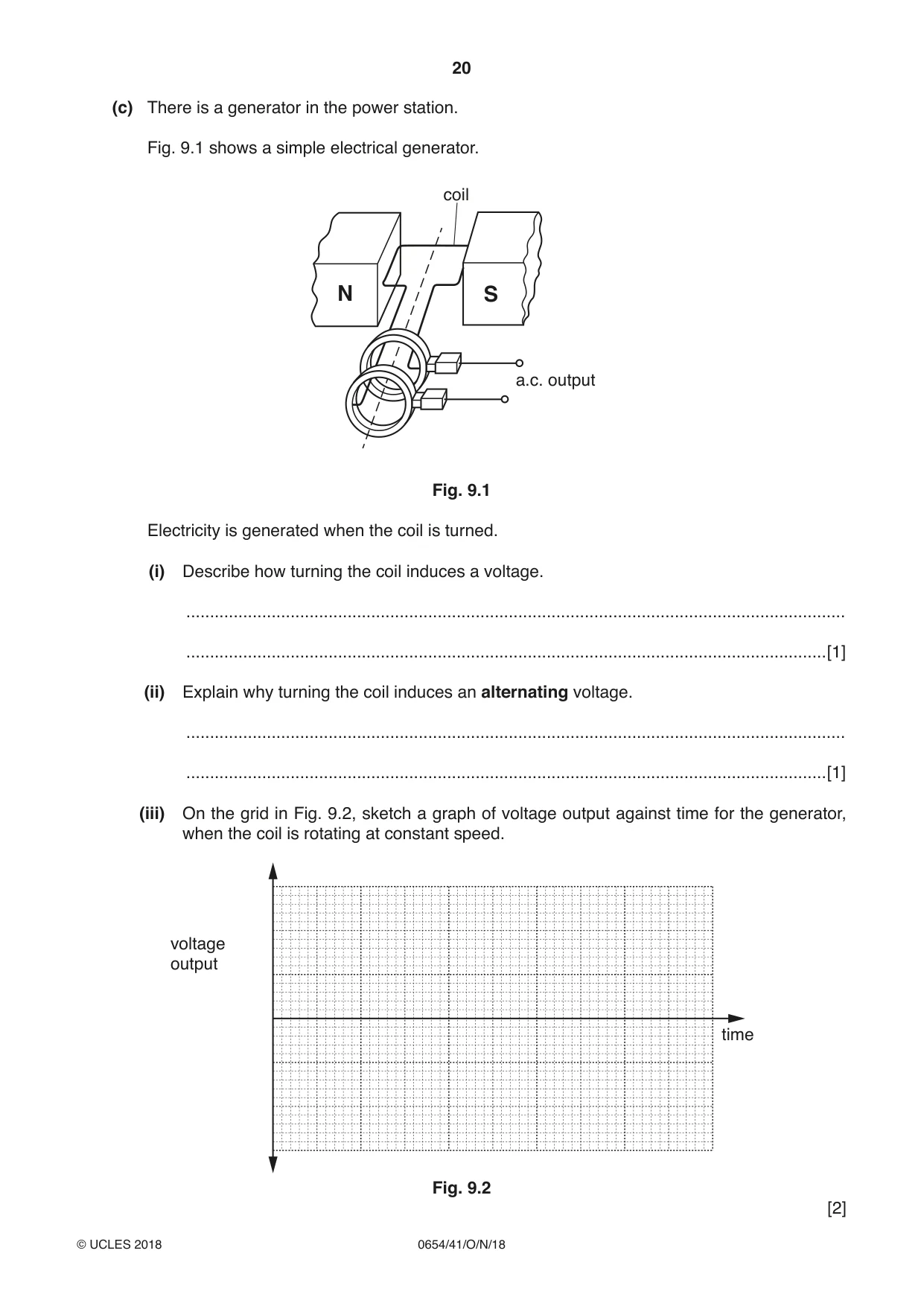
9 (a) (i) The nuclear fuel used in a power station is plutonium-239. 239 94 Pu decays by α-emission to produce an isotope of uranium. Use the correct nuclide notation to write a symbol equation for this decay process. ...... ...... 239 [2] 94Pu ......U + ......He (ii) Explain why an α-radiation source that has been swallowed is more dangerous to humans than the same source held close to the skin outside the body. ........................................................................................................................................... .......................................................................................................................................[1] (b) Electricity is generated in a nuclear power station by nuclear fission. Nuclear fusion occurs in the Sun to release energy. Describe the difference between nuclear fission and nuclear fusion. ................................................................................................................................................... ................................................................................................................................................... ...............................................................................................................................................[2] (c) There is a generator in the power station. Fig. 9.1 shows a simple electrical generator. coil N S a.c. output Fig. 9.1 Electricity is generated when the coil is turned. (i) Describe how turning the coil induces a voltage. ........................................................................................................................................... .......................................................................................................................................[1] (ii) Explain why turning the coil induces an alternating voltage. ........................................................................................................................................... .......................................................................................................................................[1] (iii) On the grid in Fig. 9.2, sketch a graph of voltage output against time for the generator, when the coil is rotating at constant speed. voltage output time Fig. 9.2 [2]
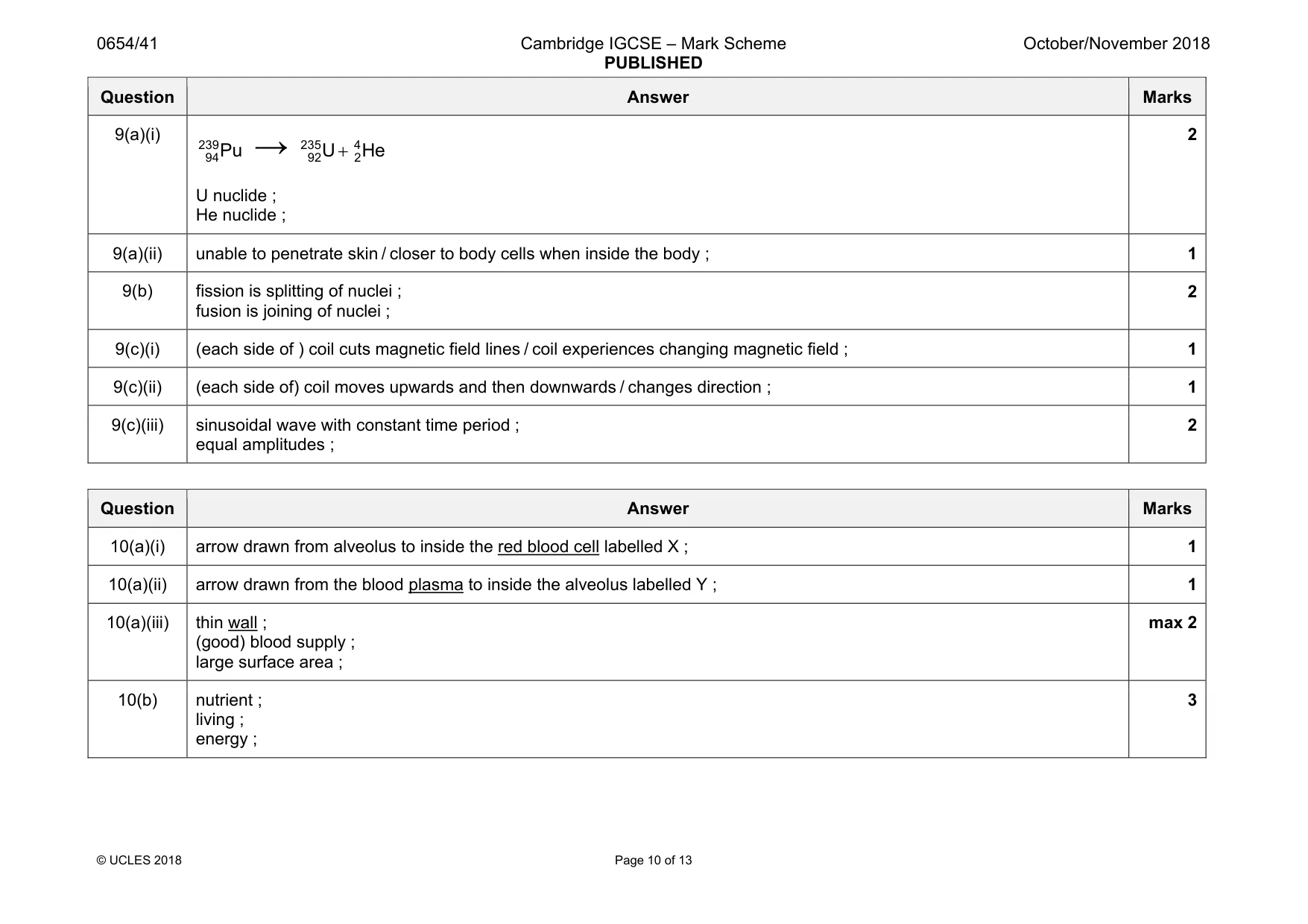
Mark scheme: 9(a)(i) 239 94Pu → 235 4 92 2 U He + U nuclide ; He nuclide ; 2 9(a)(ii) unable to penetrate skin / closer to body cells when inside the body ; 1 9(b) fission is splitting of nuclei ; fusion is joining of nuclei ; 2 9(c)(i) (each side of ) coil cuts magnetic field lines / coil experiences changing magnetic field ; 1 9(c)(ii) (each side of) coil moves upwards and then downwards / changes direction ; 1 9(c)(iii) sinusoidal wave with constant time period ; equal amplitudes ; 2
Q10 · A diagram of an alveolus with its blood capillary
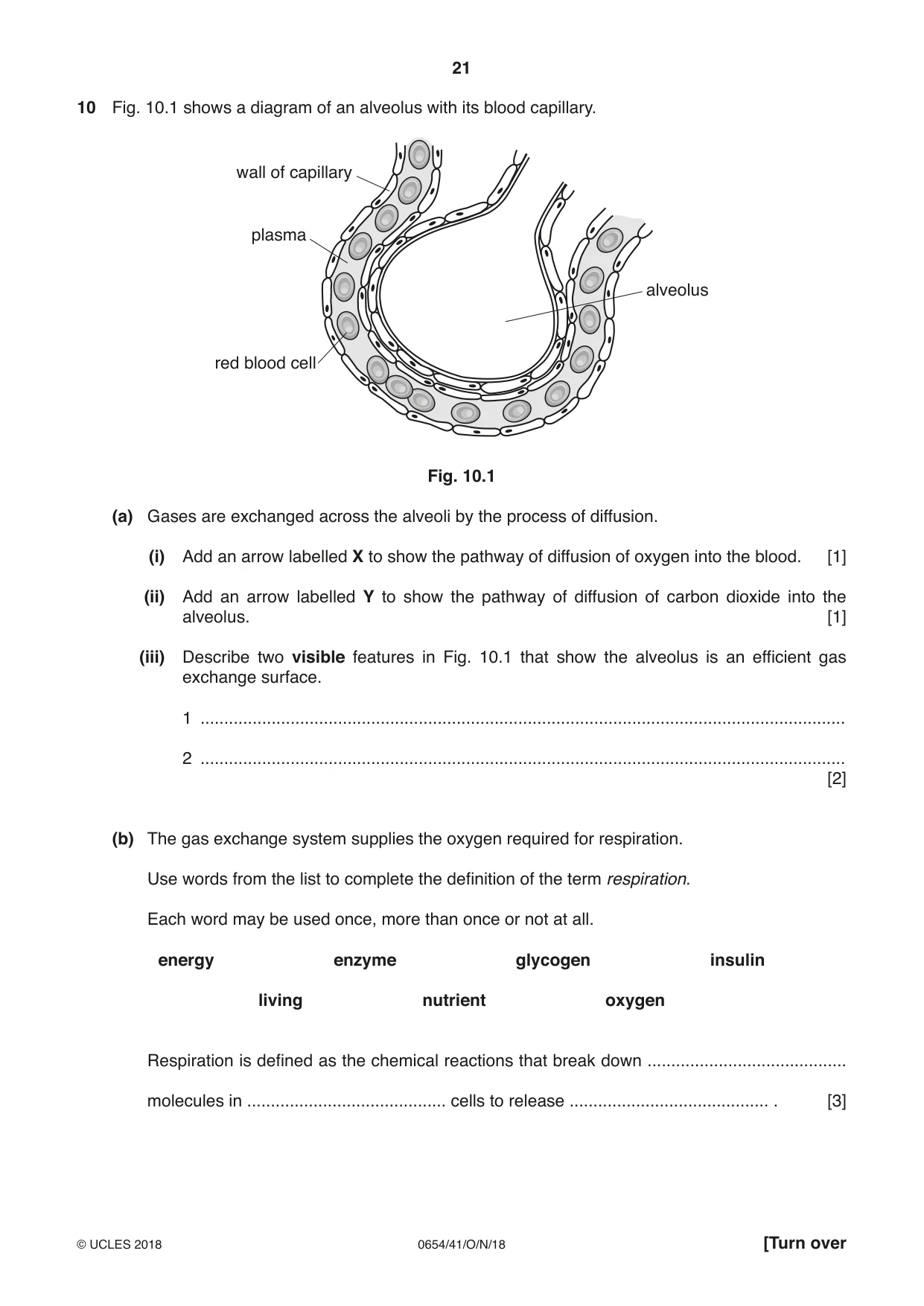
10 Fig. 10.1 shows a diagram of an alveolus with its blood capillary. wall of capillary plasma alveolus red blood cell Fig. 10.1 (a) Gases are exchanged across the alveoli by the process of diffusion. (i) Add an arrow labelled X to show the pathway of diffusion of oxygen into the blood. [1] (ii) Add an arrow labelled Y to show the pathway of diffusion of carbon dioxide into the alveolus. [1] (iii) Describe two visible features in Fig. 10.1 that show the alveolus is an efficient gas exchange surface. 1 ........................................................................................................................................ 2 ........................................................................................................................................ [2] (b) The gas exchange system supplies the oxygen required for respiration. Use words from the list to complete the definition of the term respiration. Each word may be used once, more than once or not at all. energy enzyme glycogen insulin living nutrient oxygen Respiration is defined as the chemical reactions that break down .......................................... molecules in .......................................... cells to release .......................................... . [3]
Mark scheme: 10(a)(i) arrow drawn from alveolus to inside the red blood cell labelled X ; 1 10(a)(ii) arrow drawn from the blood plasma to inside the alveolus labelled Y ; 1 10(a)(iii) thin wall ; (good) blood supply ; large surface area ; max 2 10(b) nutrient ; living ; energy ; 3
Question 11
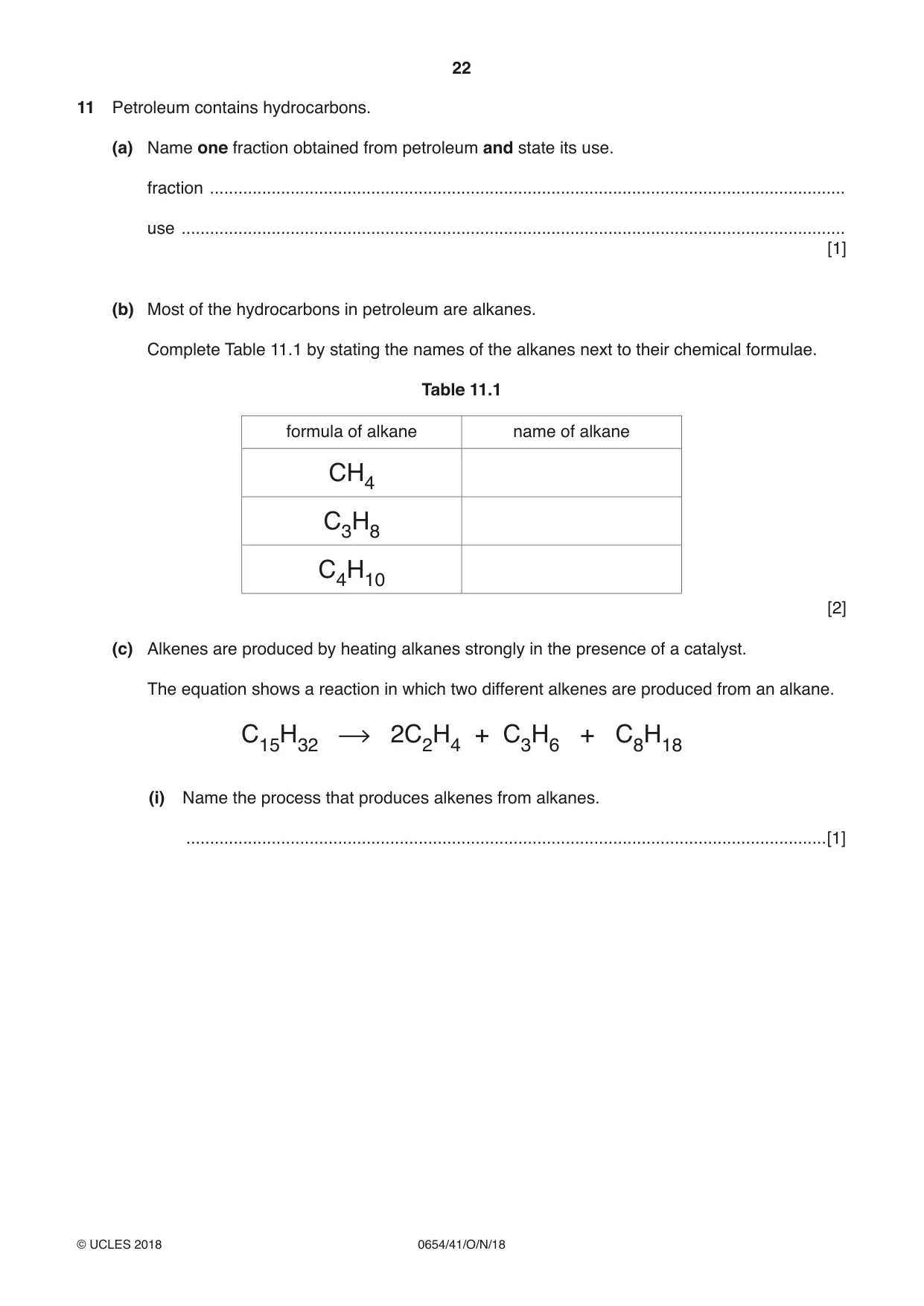
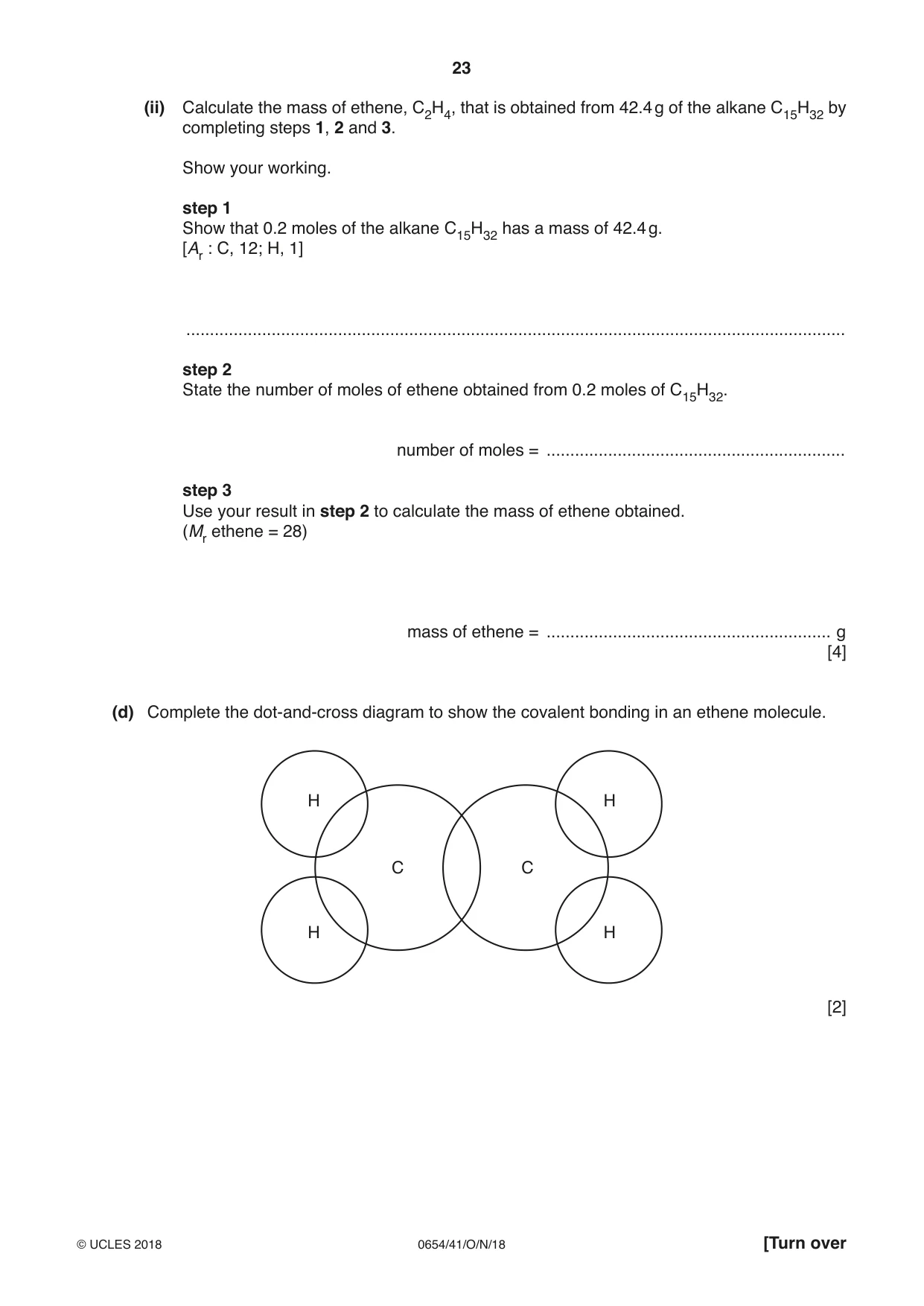
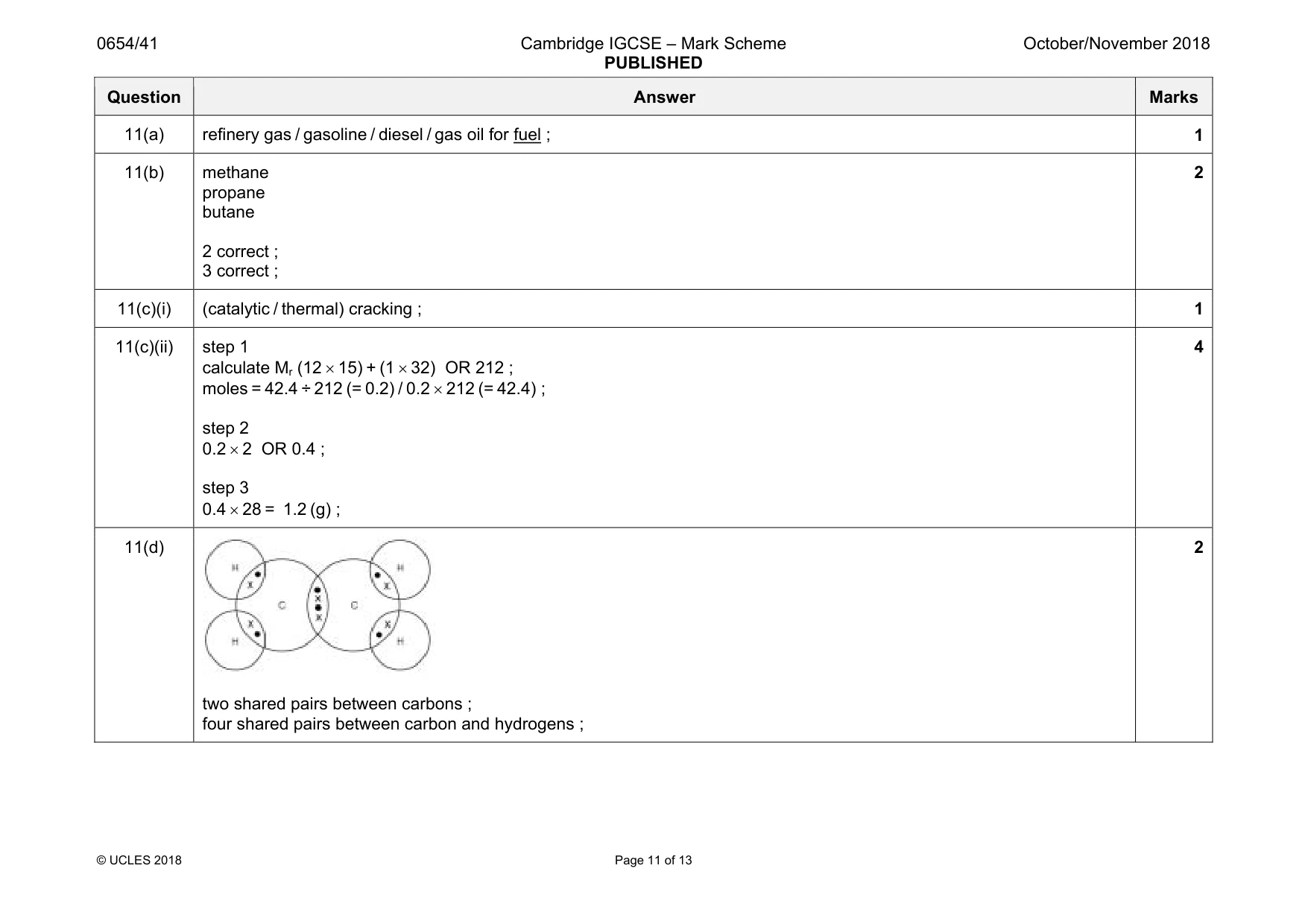
11 Petroleum contains hydrocarbons. (a) Name one fraction obtained from petroleum and state its use. fraction ...................................................................................................................................... use ............................................................................................................................................ [1] (b) Most of the hydrocarbons in petroleum are alkanes. Complete Table 11.1 by stating the names of the alkanes next to their chemical formulae. Table 11.1 formula of alkane name of alkane CH4 C3H8 C4H10 [2] (c) Alkenes are produced by heating alkanes strongly in the presence of a catalyst. The equation shows a reaction in which two different alkenes are produced from an alkane. C15H32 2C2H4 + C3H6 + C8H18 (i) Name the process that produces alkenes from alkanes. .......................................................................................................................................[1] (ii) Calculate the mass of ethene, C2H4, that is obtained from 42.4 g of the alkane C15H32 by completing steps 1, 2 and 3. Show your working. step 1 Show that 0.2 moles of the alkane C15H32 has a mass of 42.4 g. [Ar : C, 12; H, 1] ........................................................................................................................................... step 2 State the number of moles of ethene obtained from 0.2 moles of C15H32. number of moles = ............................................................... step 3 Use your result in step 2 to calculate the mass of ethene obtained. (Mr ethene = 28) mass of ethene = ............................................................ g [4] (d) Complete the dot-and-cross diagram to show the covalent bonding in an ethene molecule. H H C C H H [2]
Mark scheme: 11(a) refinery gas / gasoline / diesel / gas oil for fuel ; 1 11(b) methane propane butane 2 correct ; 3 correct ; 2 11(c)(i) (catalytic / thermal) cracking ; 1 11(c)(ii) step 1 calculate Mr (12 × 15) + (1 × 32) OR 212 ; moles = 42.4 ÷ 212 (= 0.2) / 0.2 × 212 (= 42.4) ; step 2 0.2 × 2 OR 0.4 ; step 3 0.4 × 28 = 1.2 (g) ; 4 11(d) two shared pairs between carbons ; four shared pairs between carbon and hydrogens ; 2
Q12 · Ice is made by freezing some water in the freezing compartment of a refrigerator
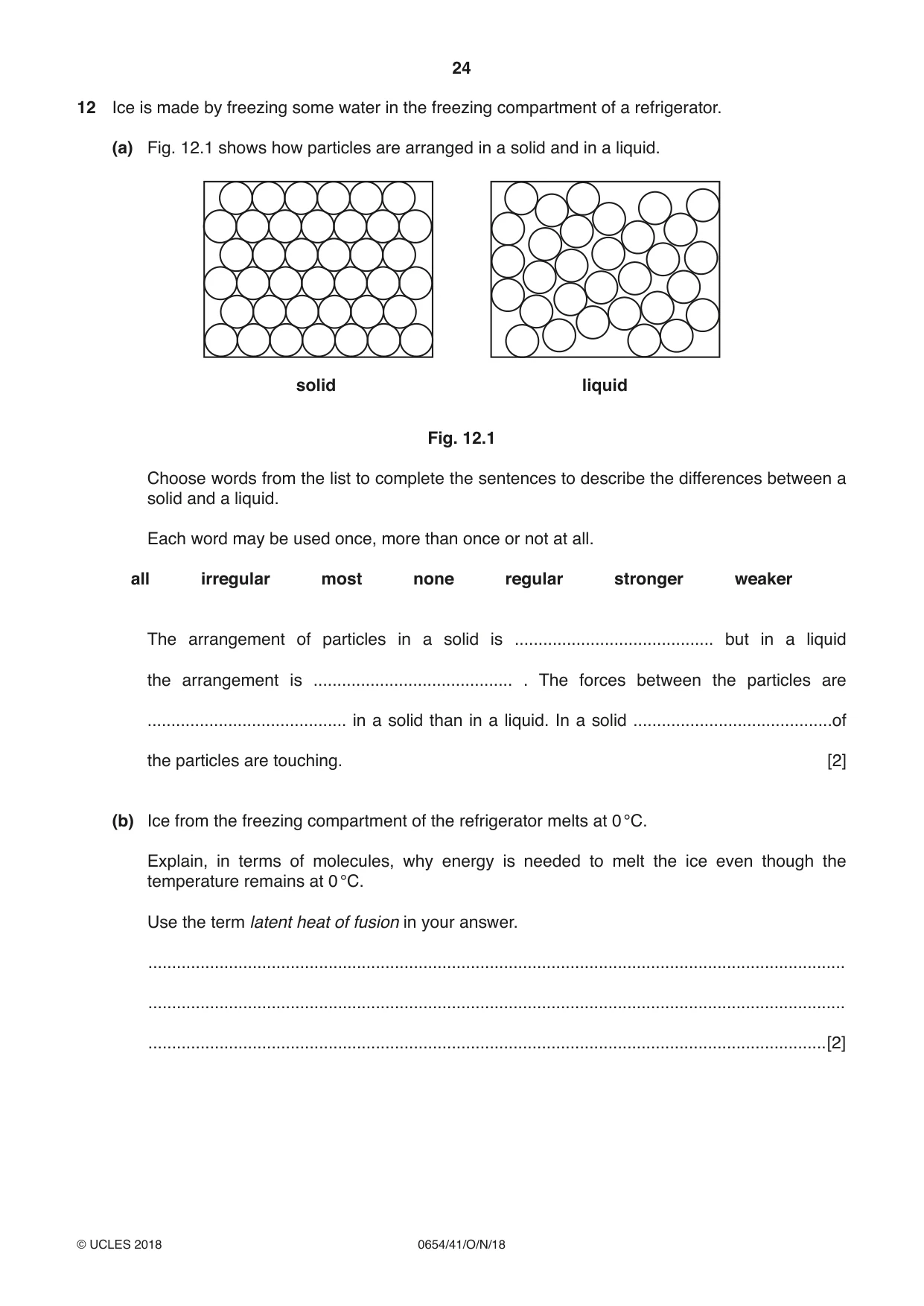
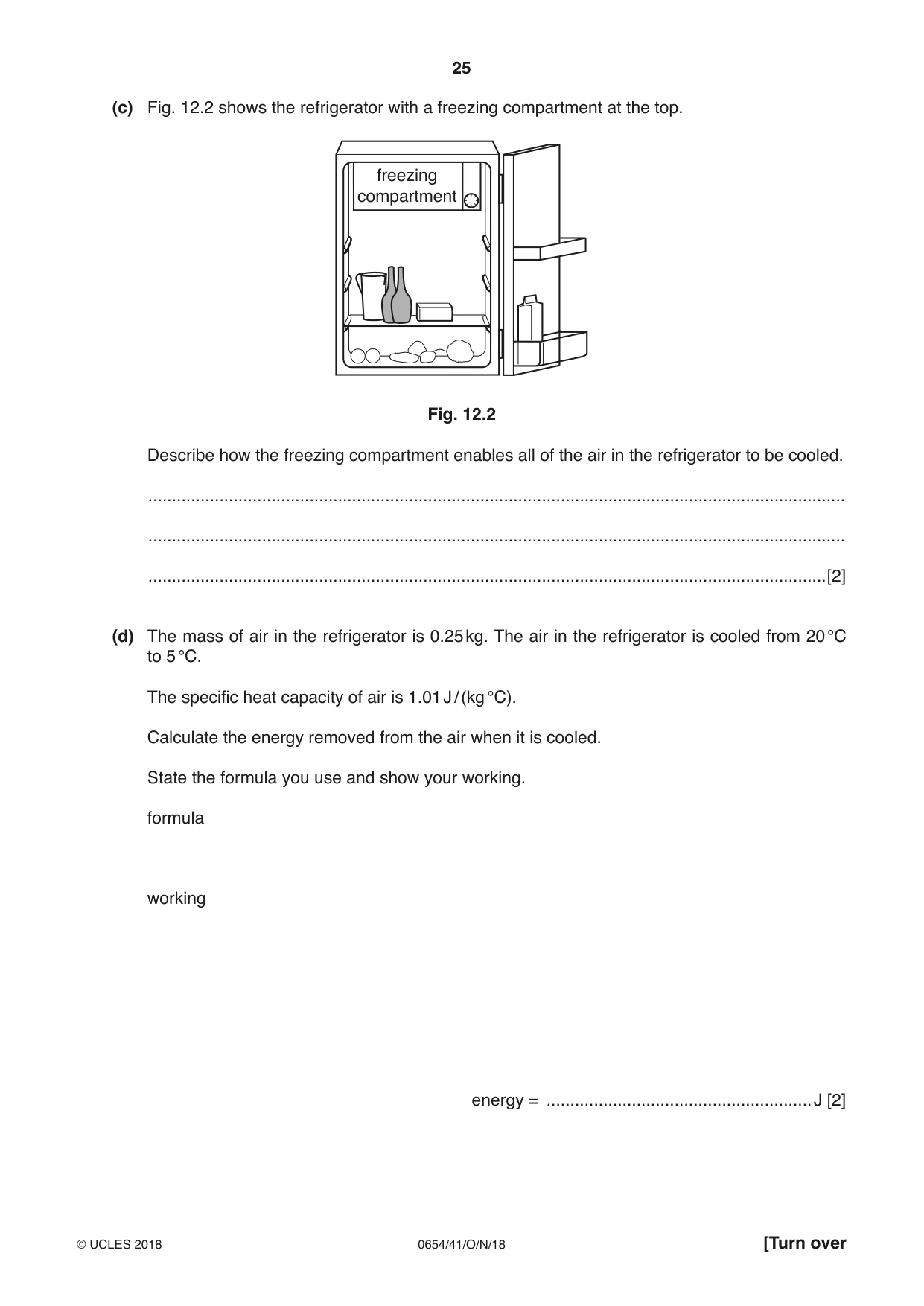
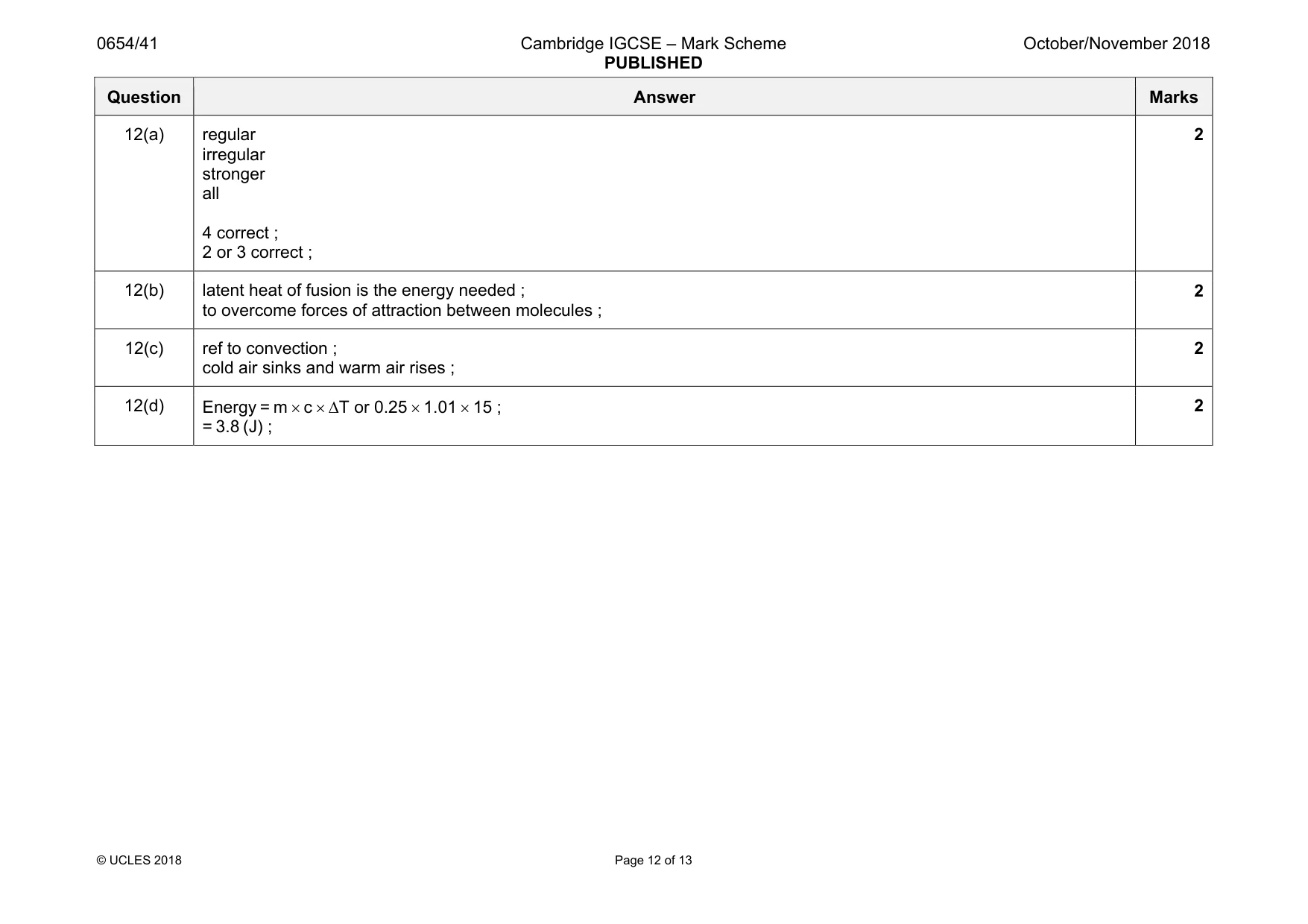
12 Ice is made by freezing some water in the freezing compartment of a refrigerator. (a) Fig. 12.1 shows how particles are arranged in a solid and in a liquid. solid liquid Fig. 12.1 Choose words from the list to complete the sentences to describe the differences between a solid and a liquid. Each word may be used once, more than once or not at all. all irregular most none regular stronger weaker The arrangement of particles in a solid is .......................................... but in a liquid the arrangement is .......................................... . The forces between the particles are .......................................... in a solid than in a liquid. In a solid ..........................................of the particles are touching. [2] (b) Ice from the freezing compartment of the refrigerator melts at 0 °C. Explain, in terms of molecules, why energy is needed to melt the ice even though the temperature remains at 0 °C. Use the term latent heat of fusion in your answer. ................................................................................................................................................... ................................................................................................................................................... ...............................................................................................................................................[2] (c) Fig. 12.2 shows the refrigerator with a freezing compartment at the top. freezing compartment Fig. 12.2 Describe how the freezing compartment enables all of the air in the refrigerator to be cooled. ................................................................................................................................................... ................................................................................................................................................... ...............................................................................................................................................[2] (d) The mass of air in the refrigerator is 0.25 kg. The air in the refrigerator is cooled from 20 °C to 5 °C. The specific heat capacity of air is 1.01 J / (kg °C). Calculate the energy removed from the air when it is cooled. State the formula you use and show your working. formula working energy = ........................................................J [2]
Mark scheme: 12(a) regular irregular stronger all 4 correct ; 2 or 3 correct ; 2 12(b) latent heat of fusion is the energy needed ; to overcome forces of attraction between molecules ; 2 12(c) ref to convection ; cold air sinks and warm air rises ; 2 12(d) Energy = m × c × ∆T or 0.25 × 1.01 × 15 ; = 3.8 (J) ; 2
Q13 · A comparison of nervous control with hormonal control
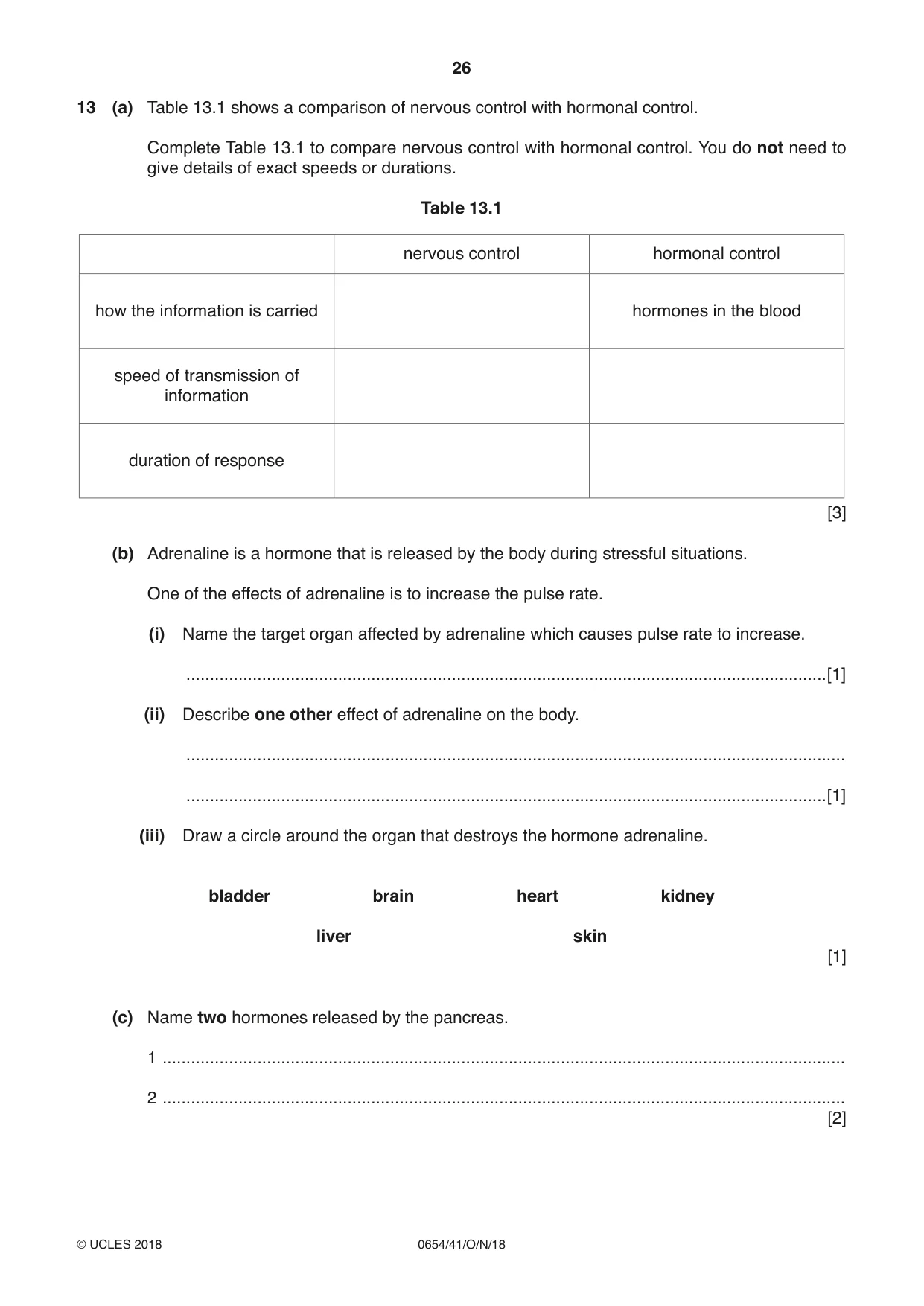
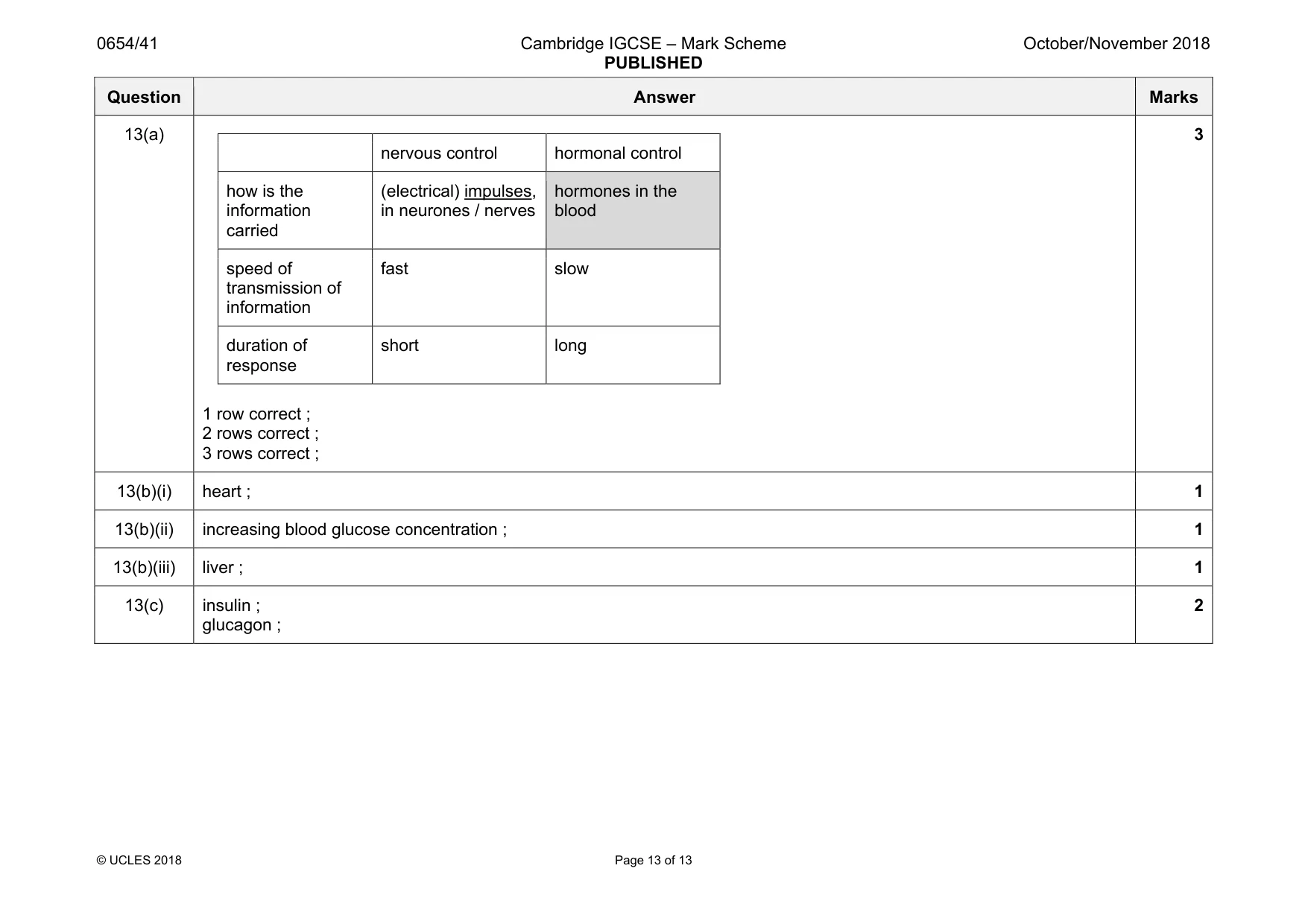
13 (a) Table 13.1 shows a comparison of nervous control with hormonal control. Complete Table 13.1 to compare nervous control with hormonal control. You do not need to give details of exact speeds or durations. Table 13.1 nervous control hormonal control how the information is carried hormones in the blood speed of transmission of information duration of response [3] (b) Adrenaline is a hormone that is released by the body during stressful situations. One of the effects of adrenaline is to increase the pulse rate. (i) Name the target organ affected by adrenaline which causes pulse rate to increase. .......................................................................................................................................[1] (ii) Describe one other effect of adrenaline on the body. ........................................................................................................................................... .......................................................................................................................................[1] (iii) Draw a circle around the organ that destroys the hormone adrenaline. bladder brain heart kidney liver skin [1] (c) Name two hormones released by the pancreas. 1 ................................................................................................................................................ 2 ................................................................................................................................................ [2]
Mark scheme: 13(a) nervous control hormonal control how is the information carried (electrical) impulses, in neurones / nerves hormones in the blood speed of transmission of information fast slow duration of response short long 1 row correct ; 2 rows correct ; 3 rows correct ; 3 13(b)(i) heart ; 1 13(b)(ii) increasing blood glucose concentration ; 1 13(b)(iii) liver ; 1 13(c) insulin ; glucagon ; 2
What was in this paper
The subtopics covered by these 13 questions, and how many questions each got. Open one in a new tab to see every Cambridge question on it.
What you needed in this session
Cambridge’s own grade thresholds for 2018 Oct/Nov, Paper 4 · Variant 1. A higher threshold means an easier paper — the bar moves with how the cohort did.