Cambridge IGCSE Sciences - Co-ordinated (Double) 0654 — 2023 Feb/March Paper 4 · Variant 2
0654/42/F/M/23 · 12 questions · 120 marks · ≈135 min
The question paper and its mark scheme, free to read here and free to download. This is Cambridge’s own paper, exactly as it was sat.
Question paper36 pages
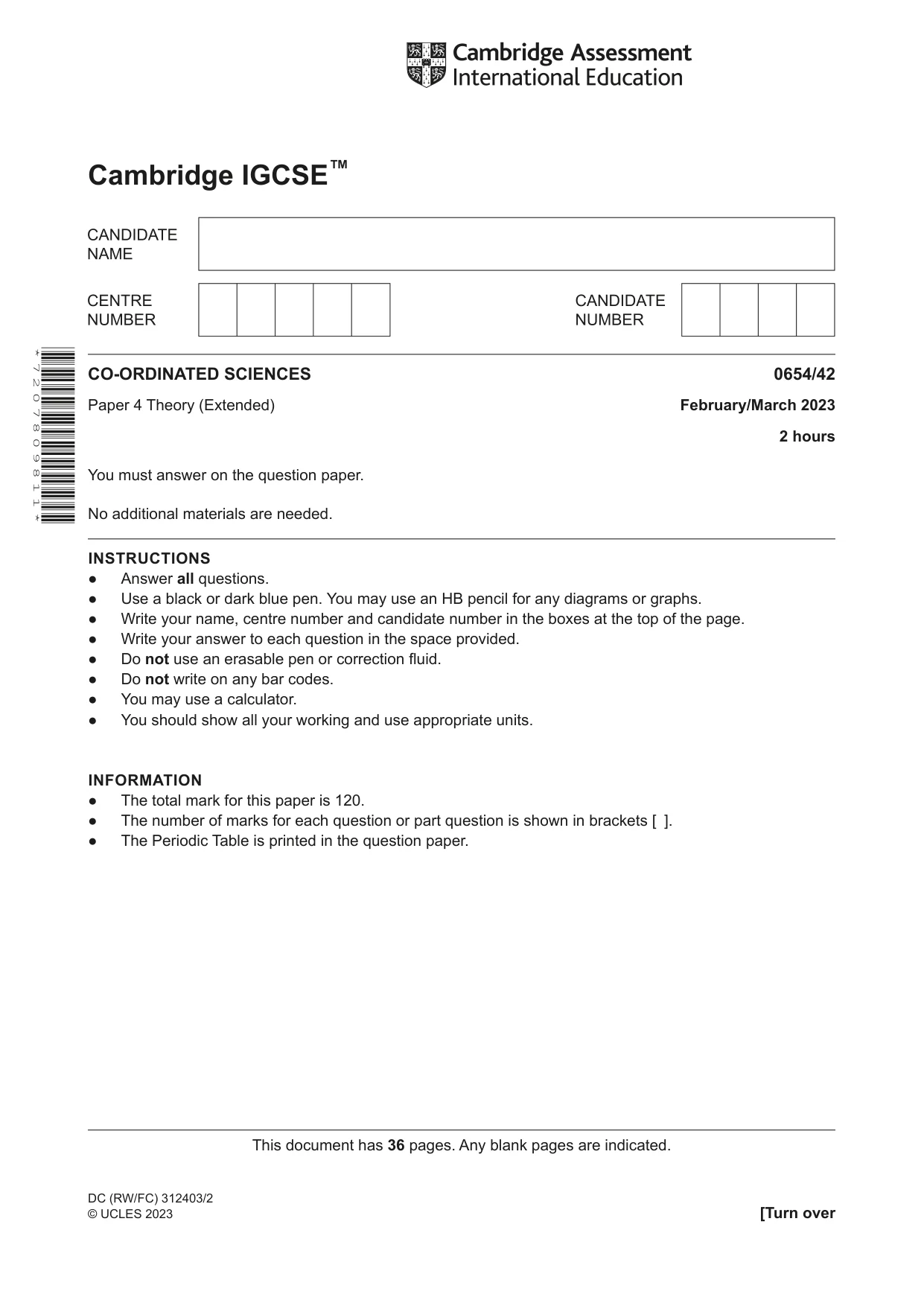


Mark scheme14 pages
Answers below. Sit the paper first if you are practising.
Questions as text
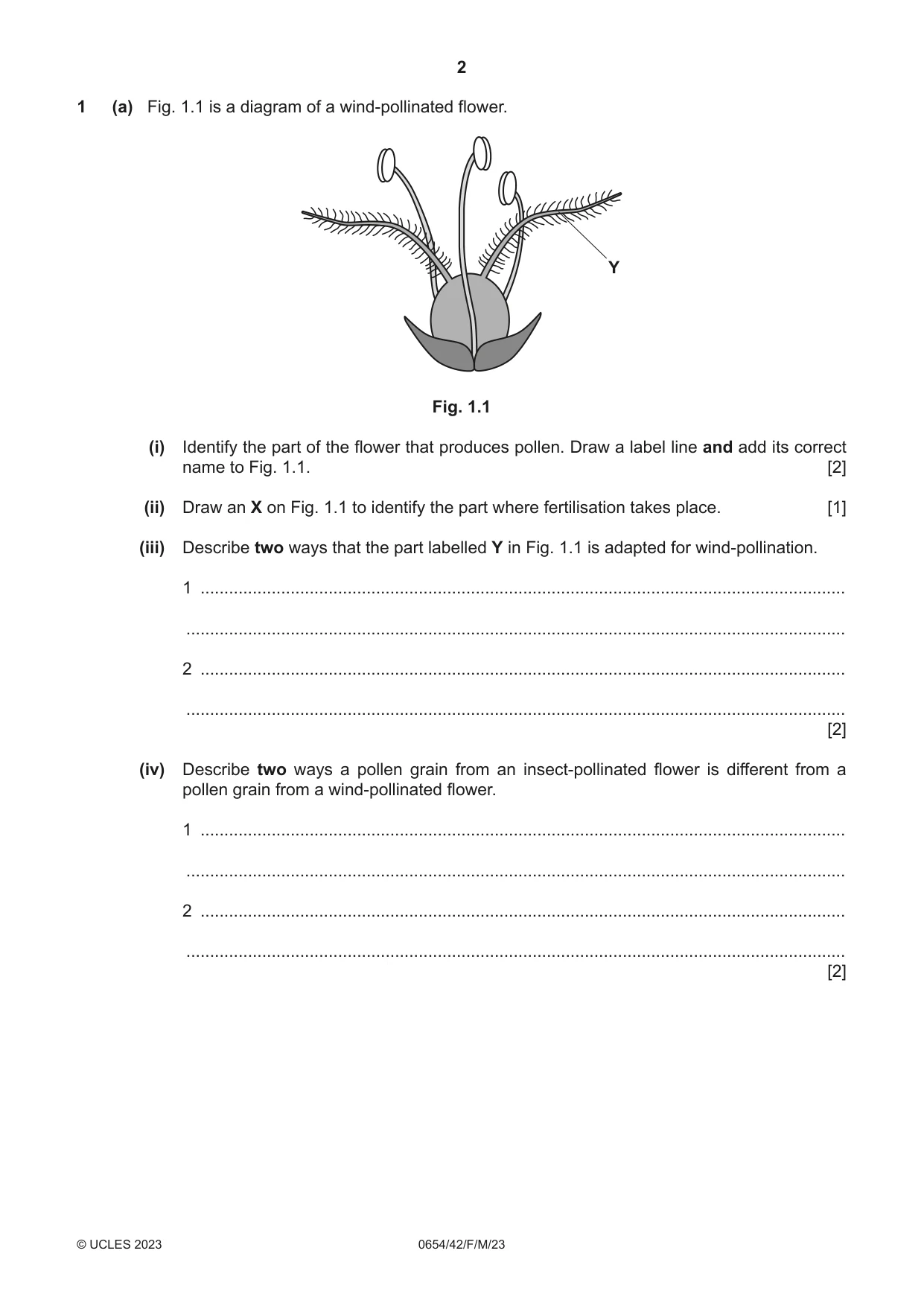
Q1 · A diagram of a wind‑pollinated flower
1 (a) Fig. 1.1 is a diagram of a wind‑pollinated flower. Y Fig. 1.1 (i) Identify the part of the flower that produces pollen. Draw a label line and add its correct name to Fig. 1.1. [2] (ii) Draw an X on Fig. 1.1 to identify the part where fertilisation takes place. [1] (iii) Describe two ways that the part labelled Y in Fig. 1.1 is adapted for wind‑pollination. 1 ........................................................................................................................................ ........................................................................................................................................... 2 ........................................................................................................................................ ........................................................................................................................................... [2] (iv) Describe two ways a pollen grain from an insect‑pollinated flower is different from a pollen grain from a wind‑pollinated flower. 1 ........................................................................................................................................ ........................................................................................................................................... 2 ........................................................................................................................................ ........................................................................................................................................... [2] (b) Some plants are able to reproduce asexually. Describe the disadvantages of asexual reproduction for plants in the wild. ................................................................................................................................................... ................................................................................................................................................... ................................................................................................................................................... ................................................................................................................................................... ............................................................................................................................................. [3] [Total: 10]
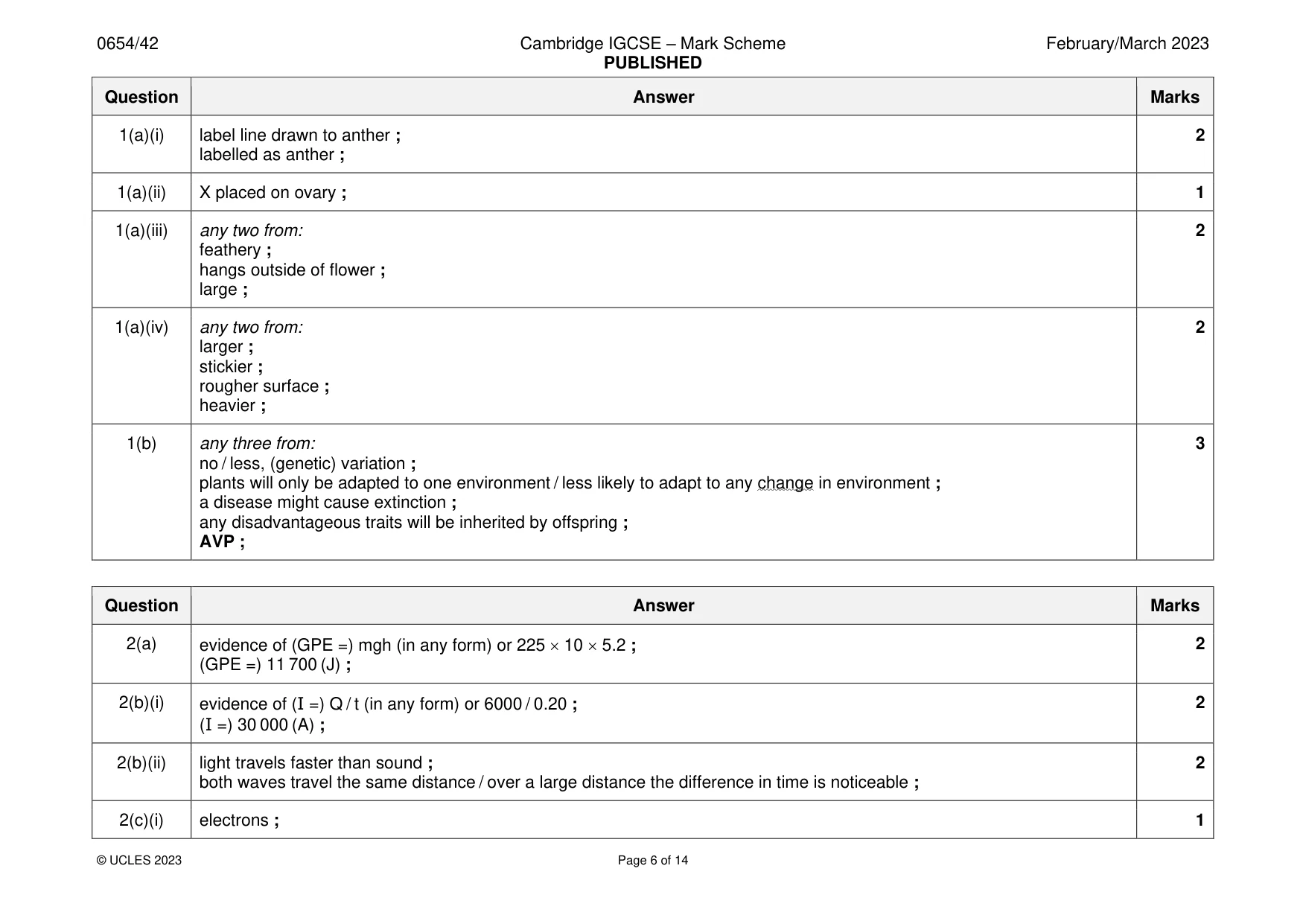
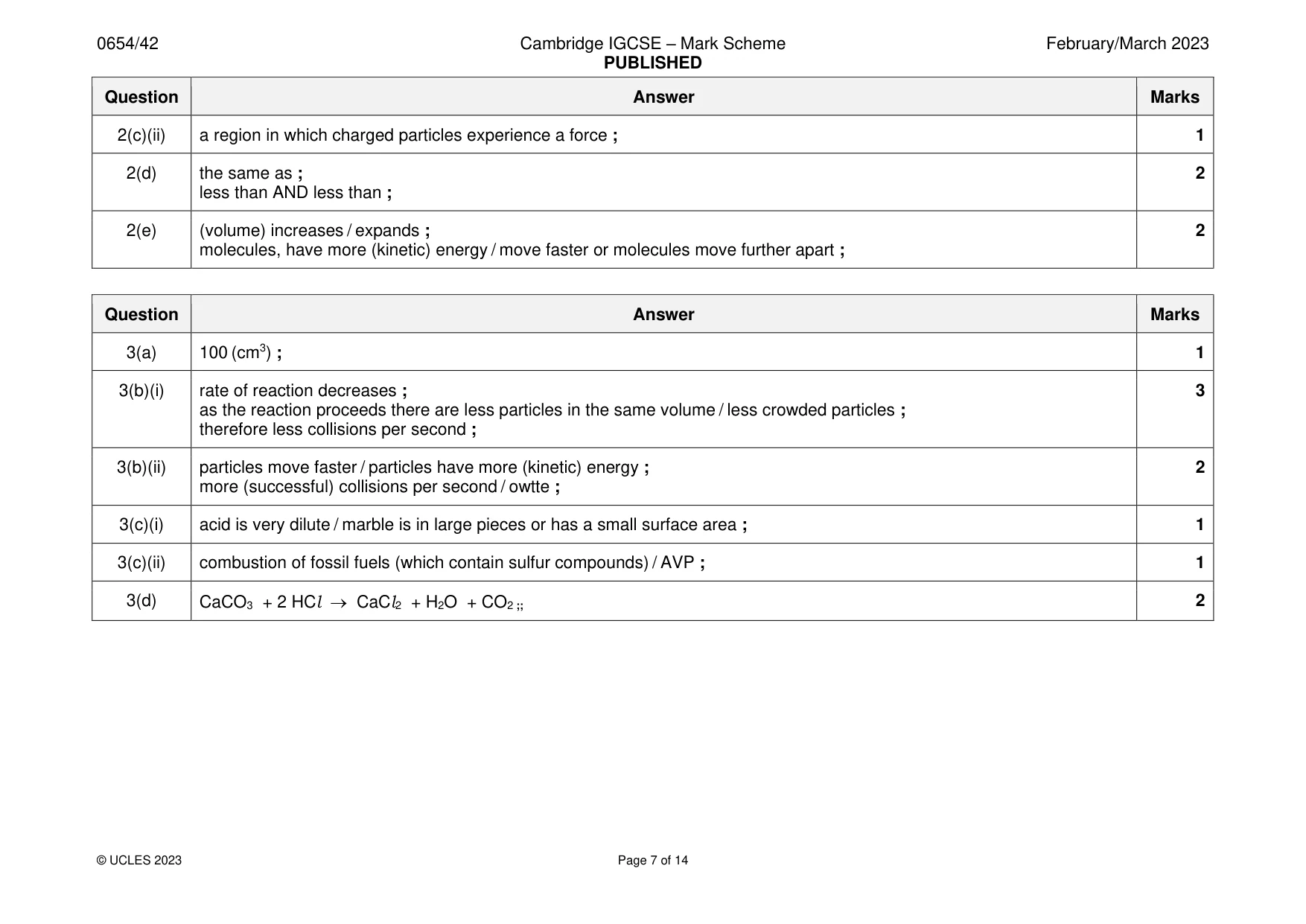
Mark scheme: Question Answer Marks 1(a)(i) label line drawn to anther ; 2 labelled as anther ; 1(a)(ii) X placed on ovary ; 1 1(a)(iii) any two from: 2 feathery ; hangs outside of flower ; large ; 1(a)(iv) any two from: 2 larger ; stickier ; rougher surface ; heavier ; 1(b) any three from: 3 no / less, (genetic) variation ; plants will only be adapted to one environment / less likely to adapt to any change in environment ; a disease might cause extinction ; any disadvantageous traits will be inherited by offspring ; AVP ;
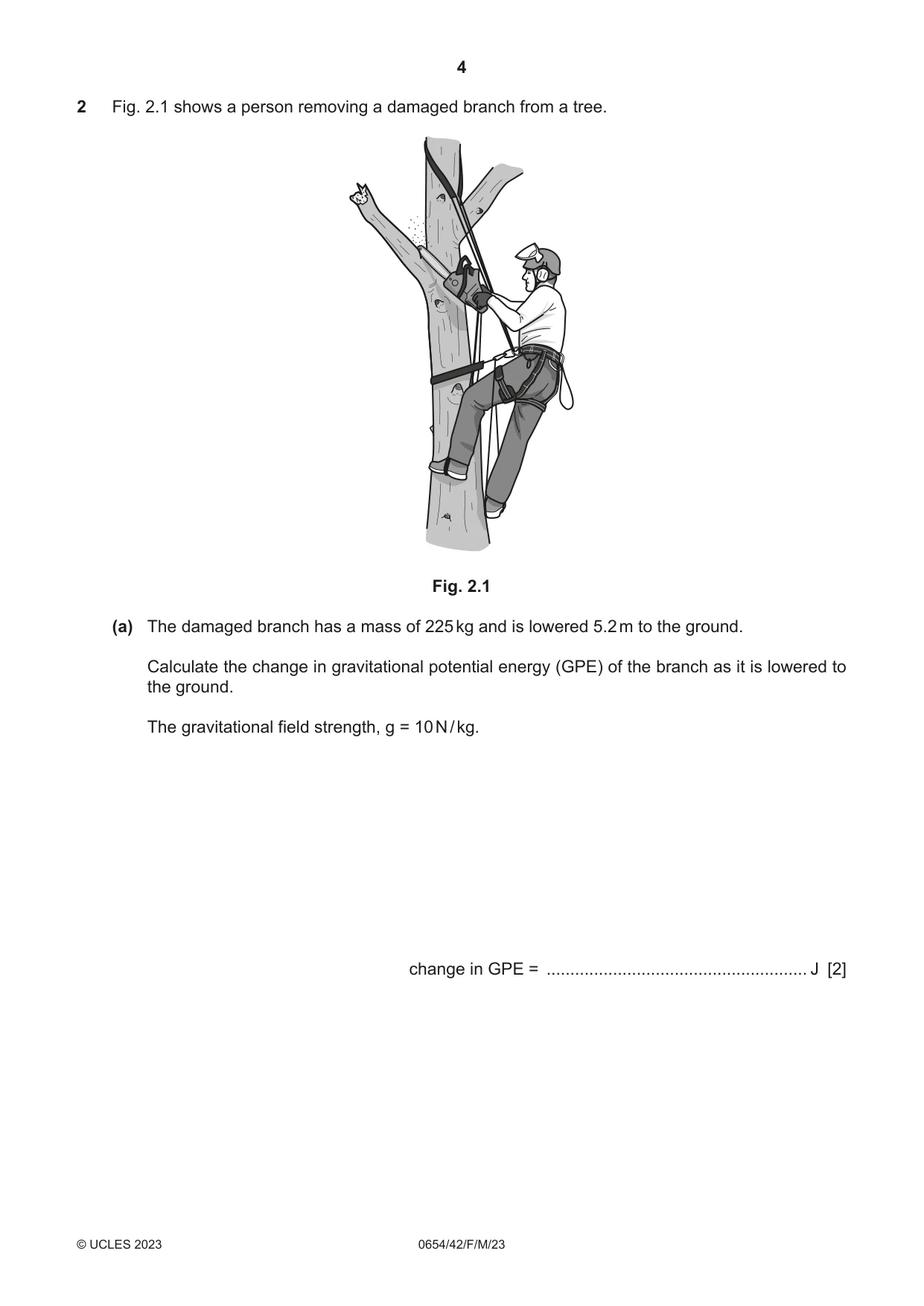
Q2 · A person removing a damaged branch from a tree
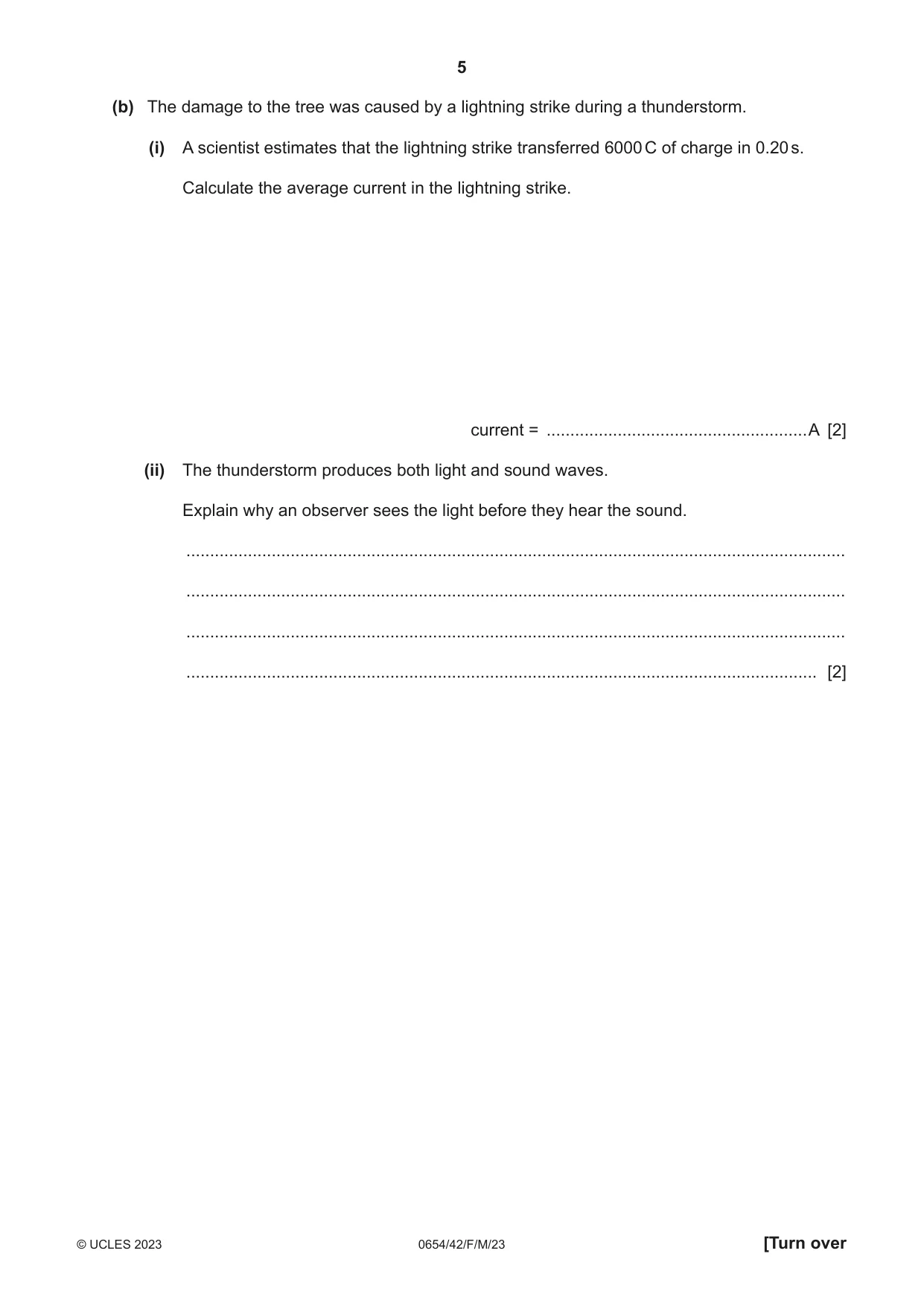
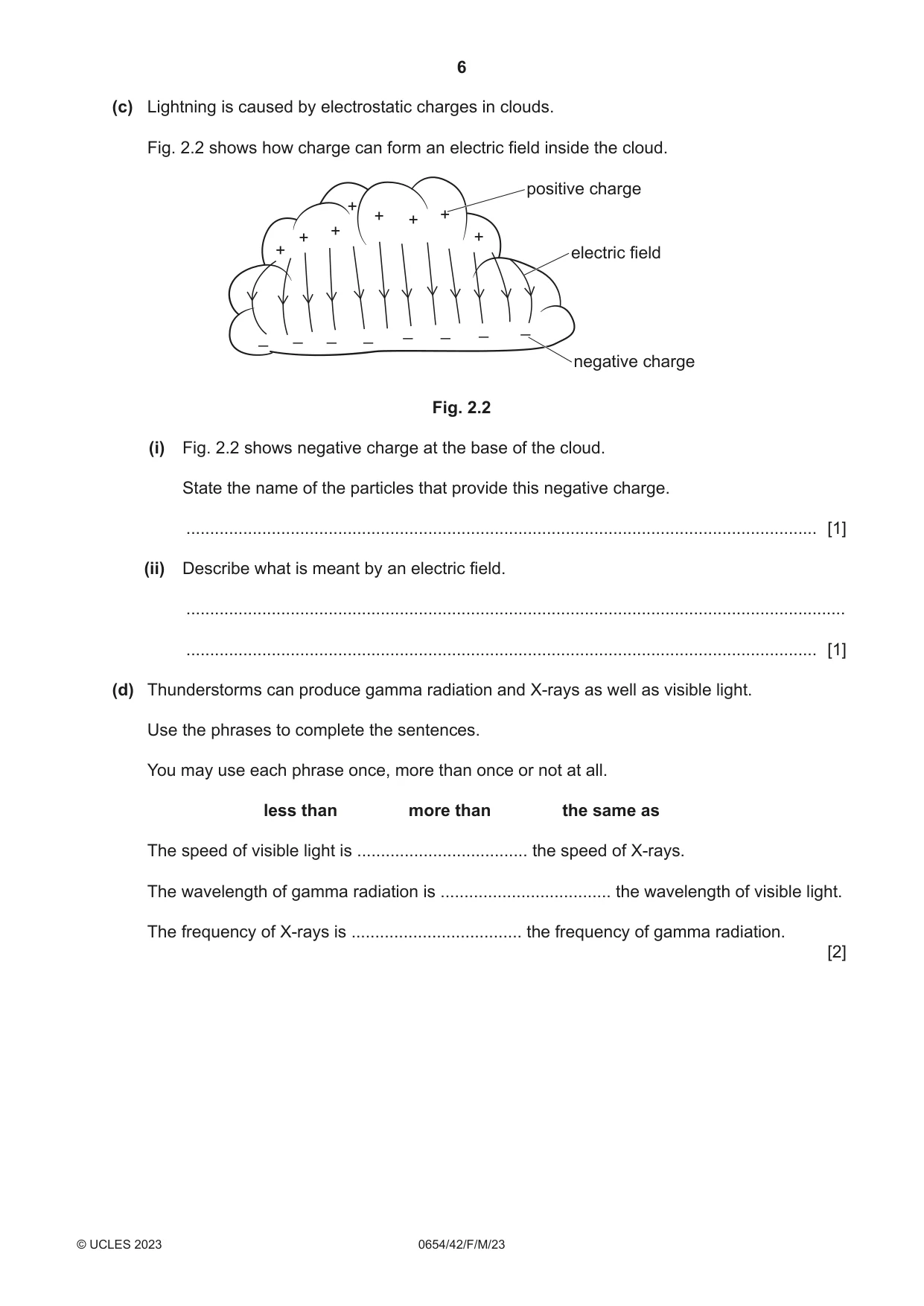
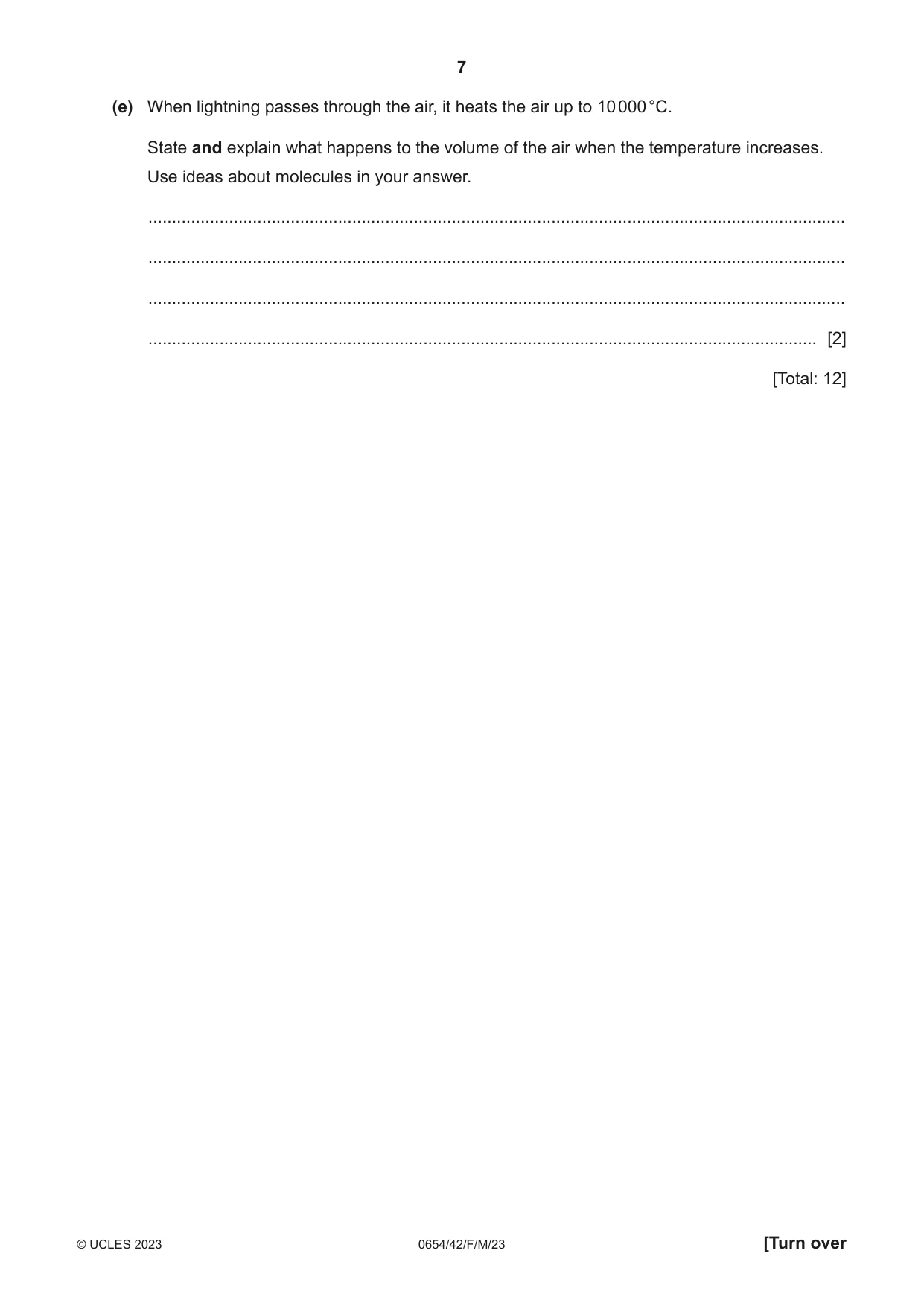
2 Fig. 2.1 shows a person removing a damaged branch from a tree. Fig. 2.1 (a) The damaged branch has a mass of 225 kg and is lowered 5.2 m to the ground. Calculate the change in gravitational potential energy (GPE) of the branch as it is lowered to the ground. The gravitational field strength, g = 10 N / kg. change in GPE = ....................................................... J [2] (b) The damage to the tree was caused by a lightning strike during a thunderstorm. (i) A scientist estimates that the lightning strike transferred 6000 C of charge in 0.20 s. Calculate the average current in the lightning strike. current = ....................................................... A [2] (ii) The thunderstorm produces both light and sound waves. Explain why an observer sees the light before they hear the sound. ........................................................................................................................................... ........................................................................................................................................... ........................................................................................................................................... ..................................................................................................................................... [2] (c) Lightning is caused by electrostatic charges in clouds. Fig. 2.2 shows how charge can form an electric field inside the cloud. positive charge + + + + + + + + electric field _ _ _ _ _ _ _ _ negative charge Fig. 2.2 (i) Fig. 2.2 shows negative charge at the base of the cloud. State the name of the particles that provide this negative charge. ..................................................................................................................................... [1] (ii) Describe what is meant by an electric field. ........................................................................................................................................... ..................................................................................................................................... [1] (d) Thunderstorms can produce gamma radiation and X‑rays as well as visible light. Use the phrases to complete the sentences. You may use each phrase once, more than once or not at all. less than more than the same as The speed of visible light is .................................... the speed of X‑rays. The wavelength of gamma radiation is .................................... the wavelength of visible light. The frequency of X‑rays is .................................... the frequency of gamma radiation. [2] (e) When lightning passes through the air, it heats the air up to 10 000 °C. State and explain what happens to the volume of the air when the temperature increases. Use ideas about molecules in your answer. ................................................................................................................................................... ................................................................................................................................................... ................................................................................................................................................... ............................................................................................................................................. [2] [Total: 12]
Mark scheme: 2(a) evidence of (GPE =) mgh (in any form) or 225 10 5.2 ; 2 (GPE =) 11 700 (J) ; 2(b)(i) evidence of (I =) Q / t (in any form) or 6000 / 0.20 ; 2 (I =) 30 000 (A) ; 2(b)(ii) light travels faster than sound ; 2 both waves travel the same distance / over a large distance the difference in time is noticeable ; 2(c)(i) electrons ; 1 2(c)(ii) a region in which charged particles experience a force ; 1 2(d) the same as ; 2 less than AND less than ; 2(e) (volume) increases / expands ; 2 molecules, have more (kinetic) energy / move faster or molecules move further apart ;
Q3 · A student reacts calcium carbonate with cold dilute hydrochloric acid
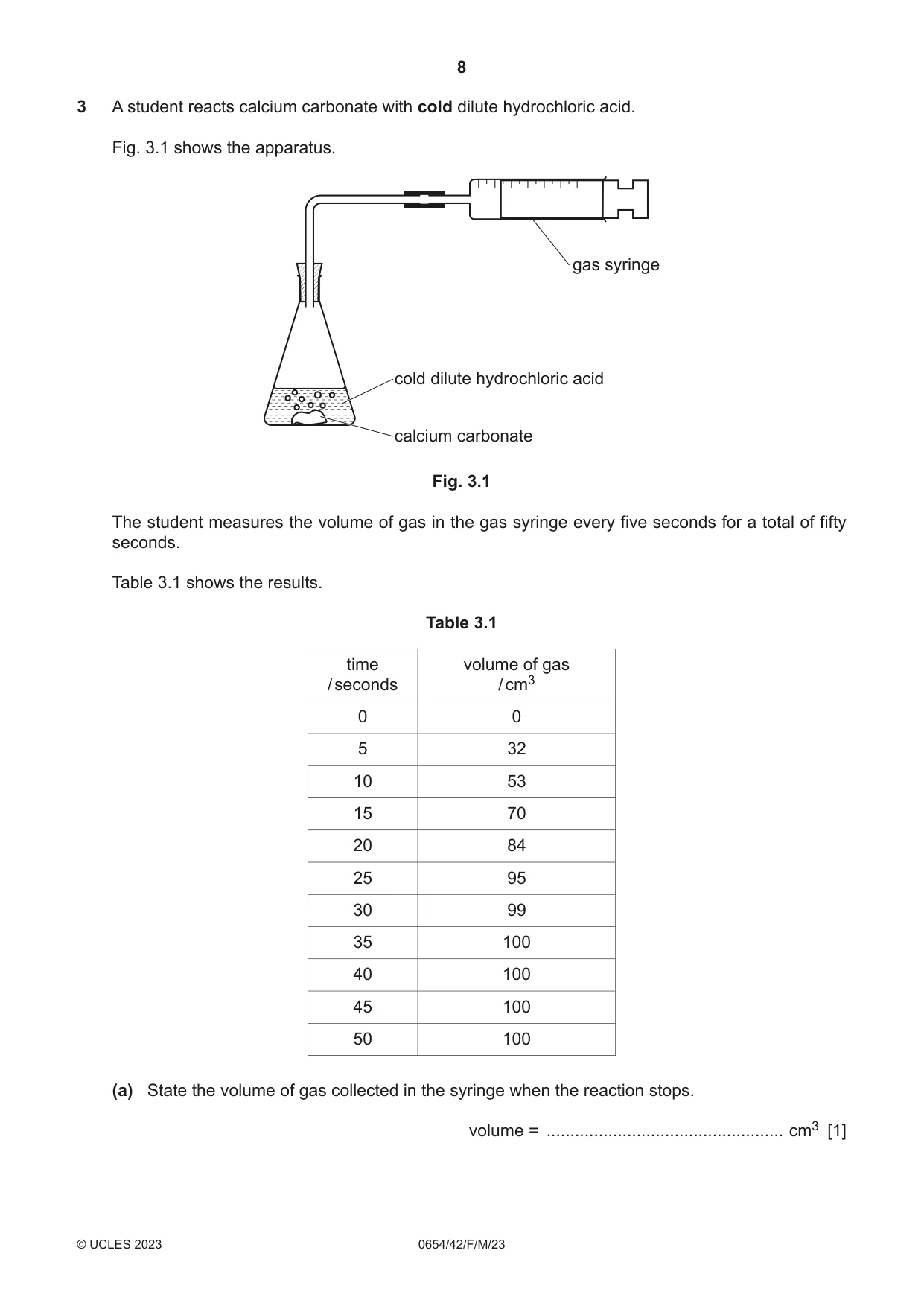
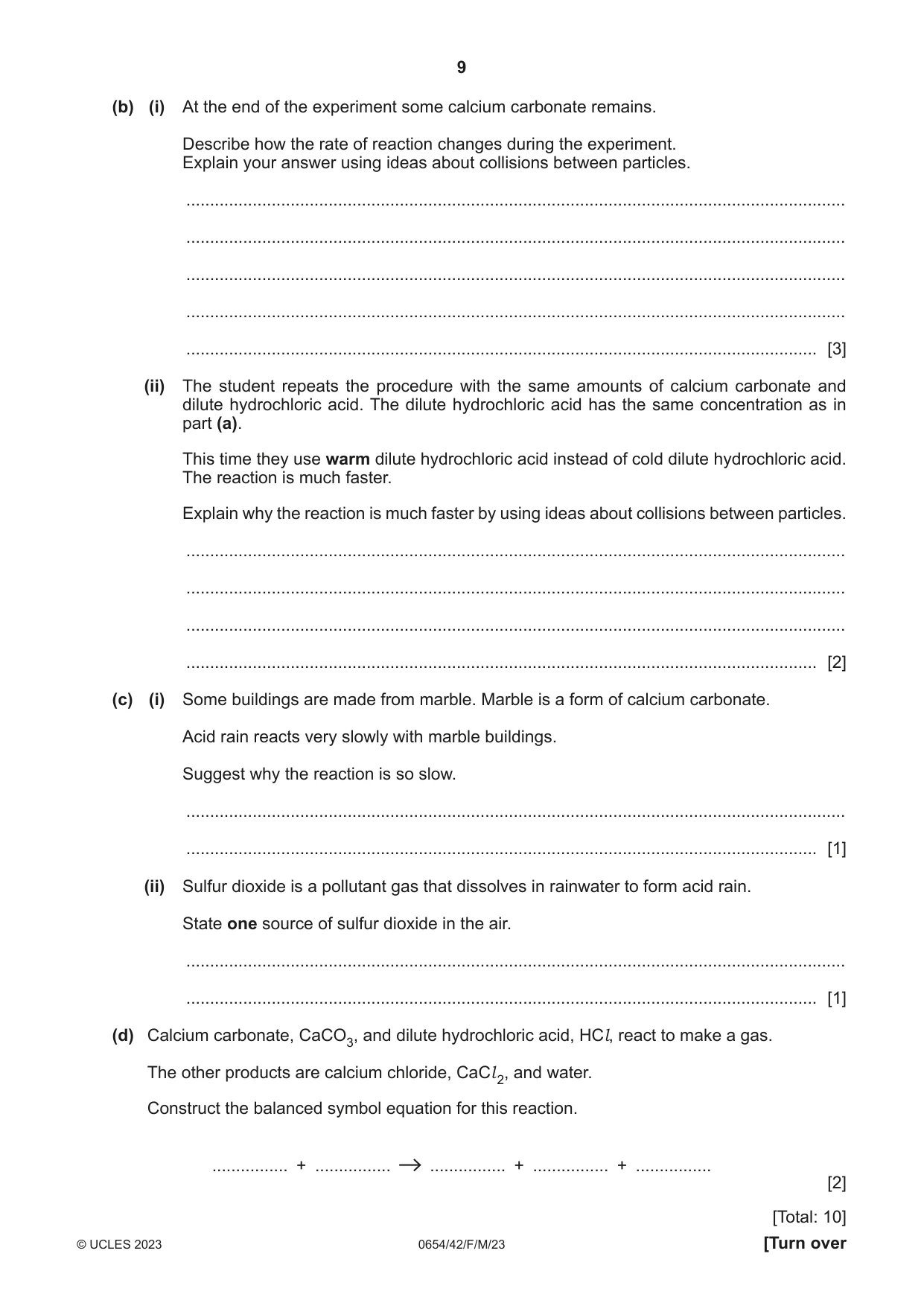
3 A student reacts calcium carbonate with cold dilute hydrochloric acid. Fig. 3.1 shows the apparatus. gas syringe cold dilute hydrochloric acid calcium carbonate Fig. 3.1 The student measures the volume of gas in the gas syringe every five seconds for a total of fifty seconds. Table 3.1 shows the results. Table 3.1 time volume of gas / seconds / cm3 0 0 5 32 10 53 15 70 20 84 25 95 30 99 35 100 40 100 45 100 50 100 (a) State the volume of gas collected in the syringe when the reaction stops. volume = .................................................. cm3 [1] (b) (i) At the end of the experiment some calcium carbonate remains. Describe how the rate of reaction changes during the experiment. Explain your answer using ideas about collisions between particles. ........................................................................................................................................... ........................................................................................................................................... ........................................................................................................................................... ........................................................................................................................................... ..................................................................................................................................... [3] (ii) The student repeats the procedure with the same amounts of calcium carbonate and dilute hydrochloric acid. The dilute hydrochloric acid has the same concentration as in part (a). This time they use warm dilute hydrochloric acid instead of cold dilute hydrochloric acid. The reaction is much faster. Explain why the reaction is much faster by using ideas about collisions between particles. ........................................................................................................................................... ........................................................................................................................................... ........................................................................................................................................... ..................................................................................................................................... [2] (c) (i) Some buildings are made from marble. Marble is a form of calcium carbonate. Acid rain reacts very slowly with marble buildings. Suggest why the reaction is so slow. ........................................................................................................................................... ..................................................................................................................................... [1] (ii) Sulfur dioxide is a pollutant gas that dissolves in rainwater to form acid rain. State one source of sulfur dioxide in the air. ........................................................................................................................................... ..................................................................................................................................... [1] (d) Calcium carbonate, CaCO3, and dilute hydrochloric acid, HCl, react to make a gas. The other products are calcium chloride, CaCl 2, and water. Construct the balanced symbol equation for this reaction. ................ + ................ ................ + ................ + ................ [2] [Total: 10]
Mark scheme: 3(a) 100 (cm3) ; 1 3(b)(i) rate of reaction decreases ; 3 as the reaction proceeds there are less particles in the same volume / less crowded particles ; therefore less collisions per second ; 3(b)(ii) particles move faster / particles have more (kinetic) energy ; 2 more (successful) collisions per second / owtte ; 3(c)(i) acid is very dilute / marble is in large pieces or has a small surface area ; 1 3(c)(ii) combustion of fossil fuels (which contain sulfur compounds) / AVP ; 1 3(d) CaCO3 + 2 HCl → CaCl2 + H2O + CO2 ;; 2
Q4 · A student measures their breathing rate at rest and during exercise
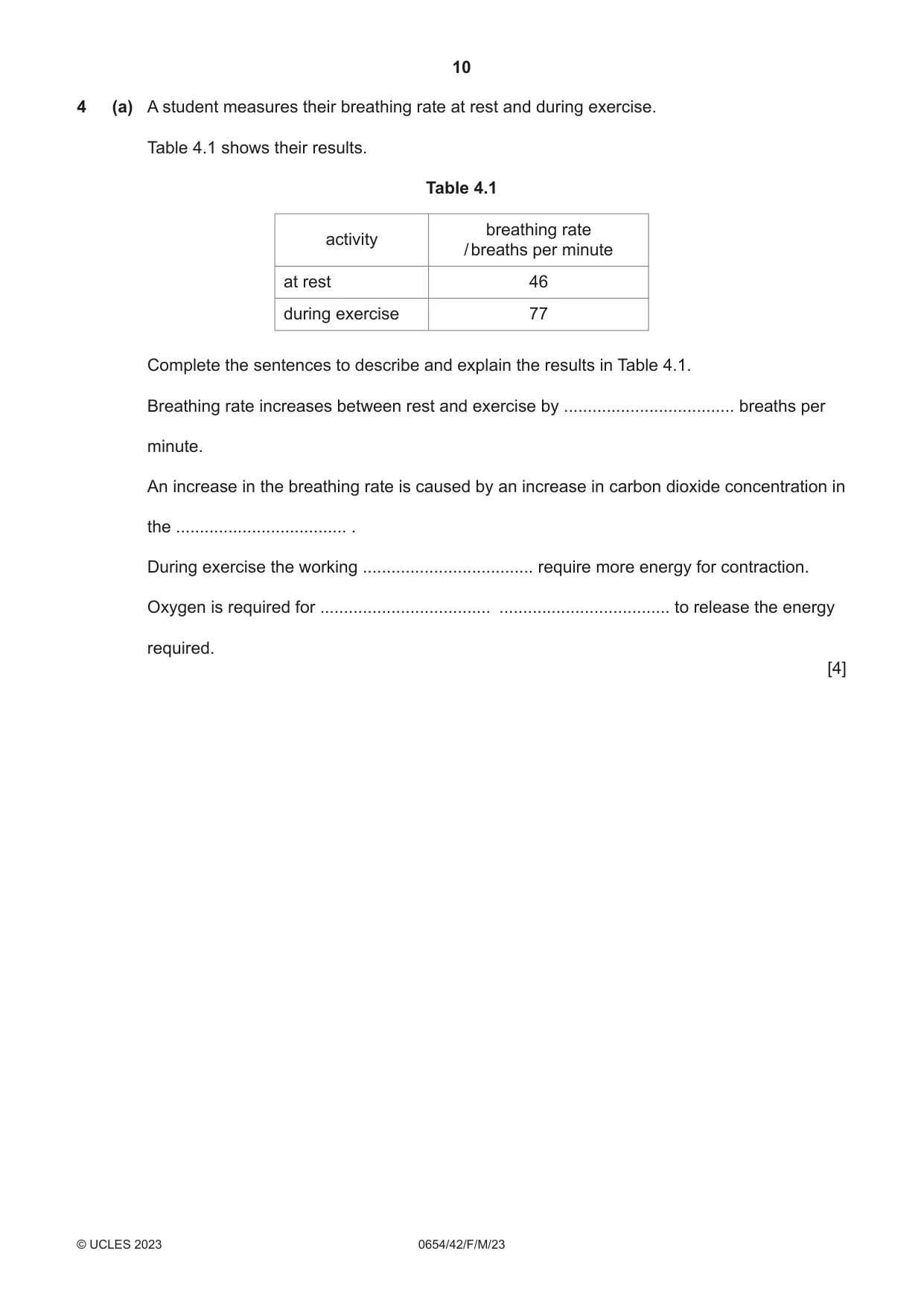
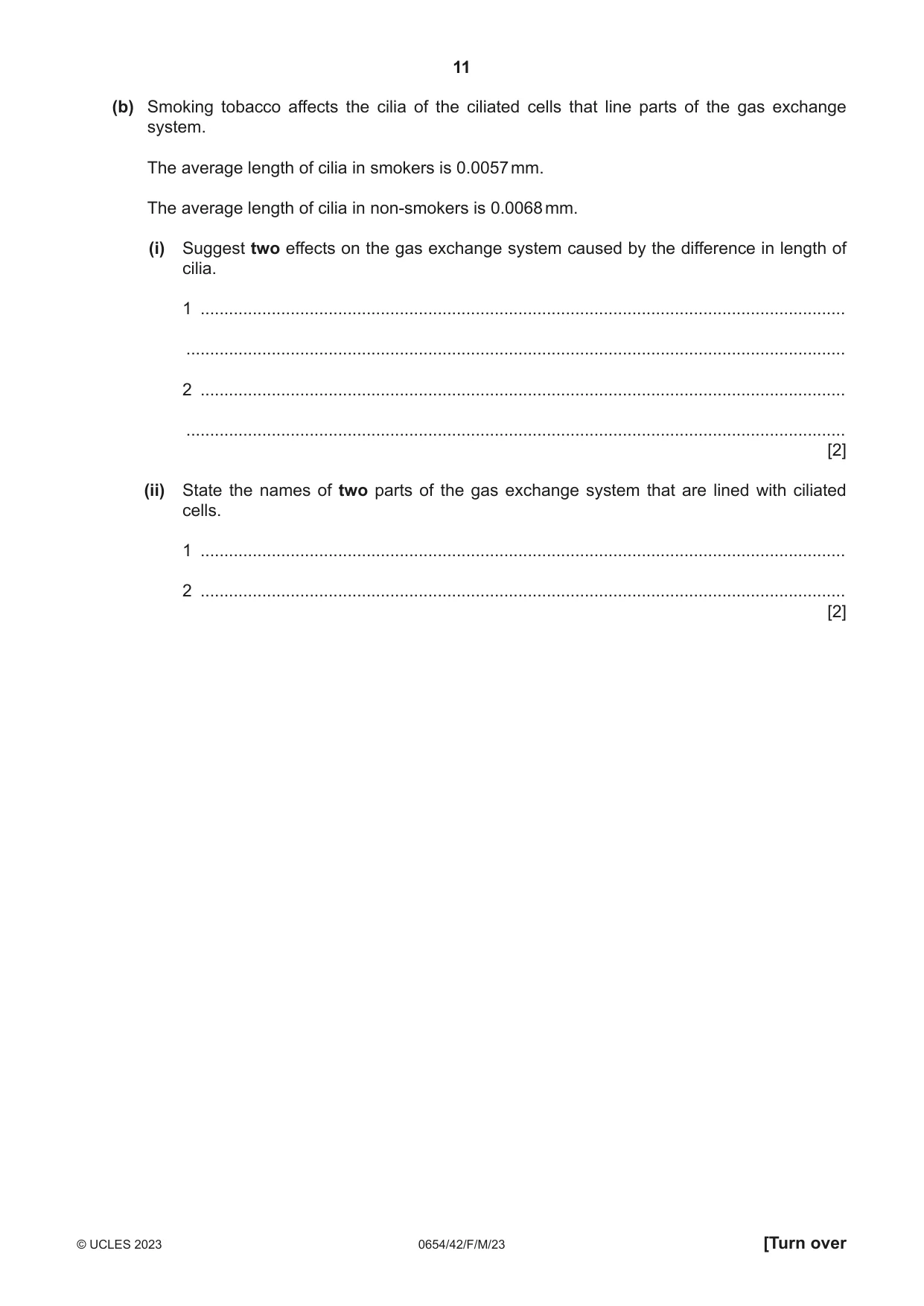
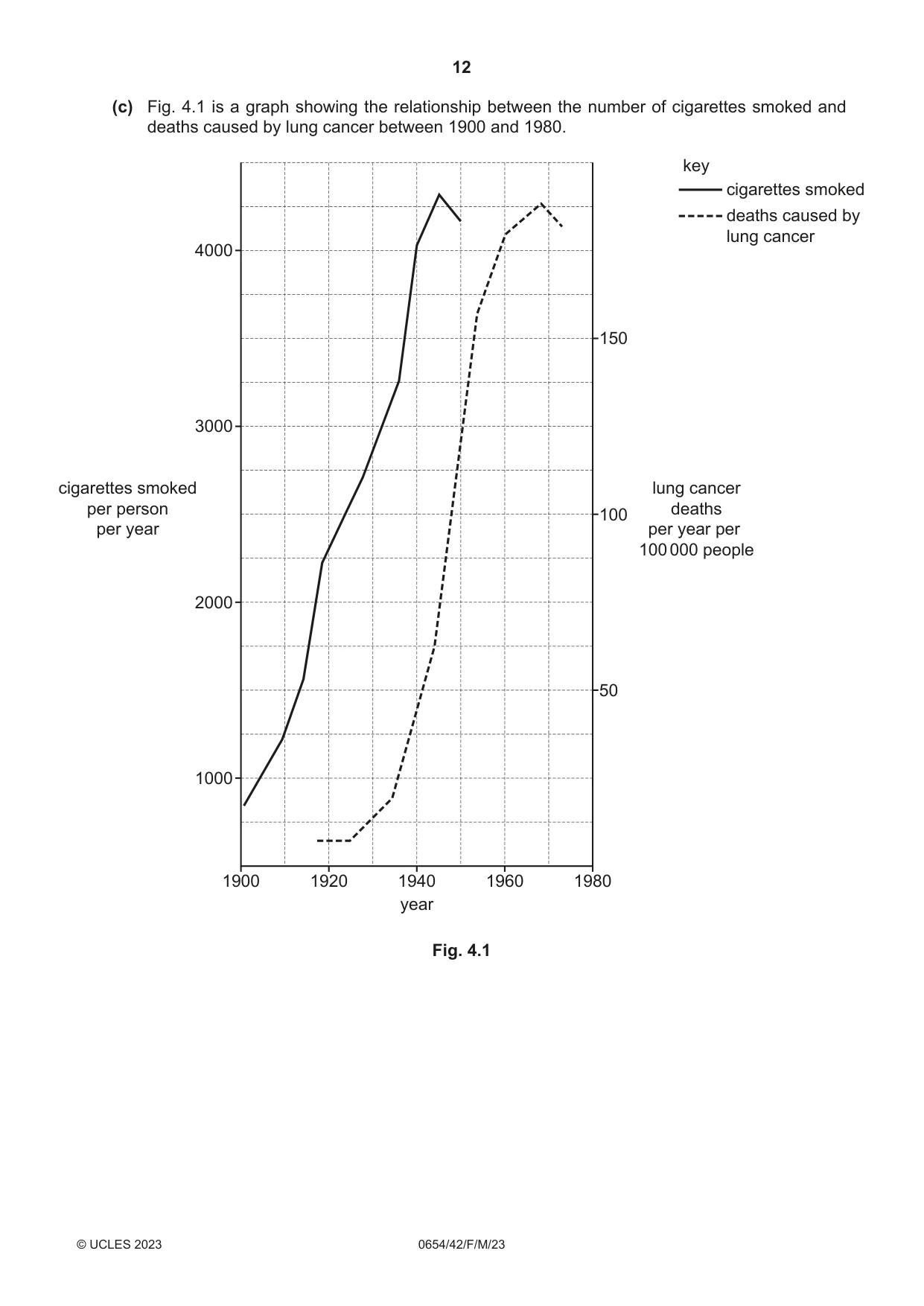
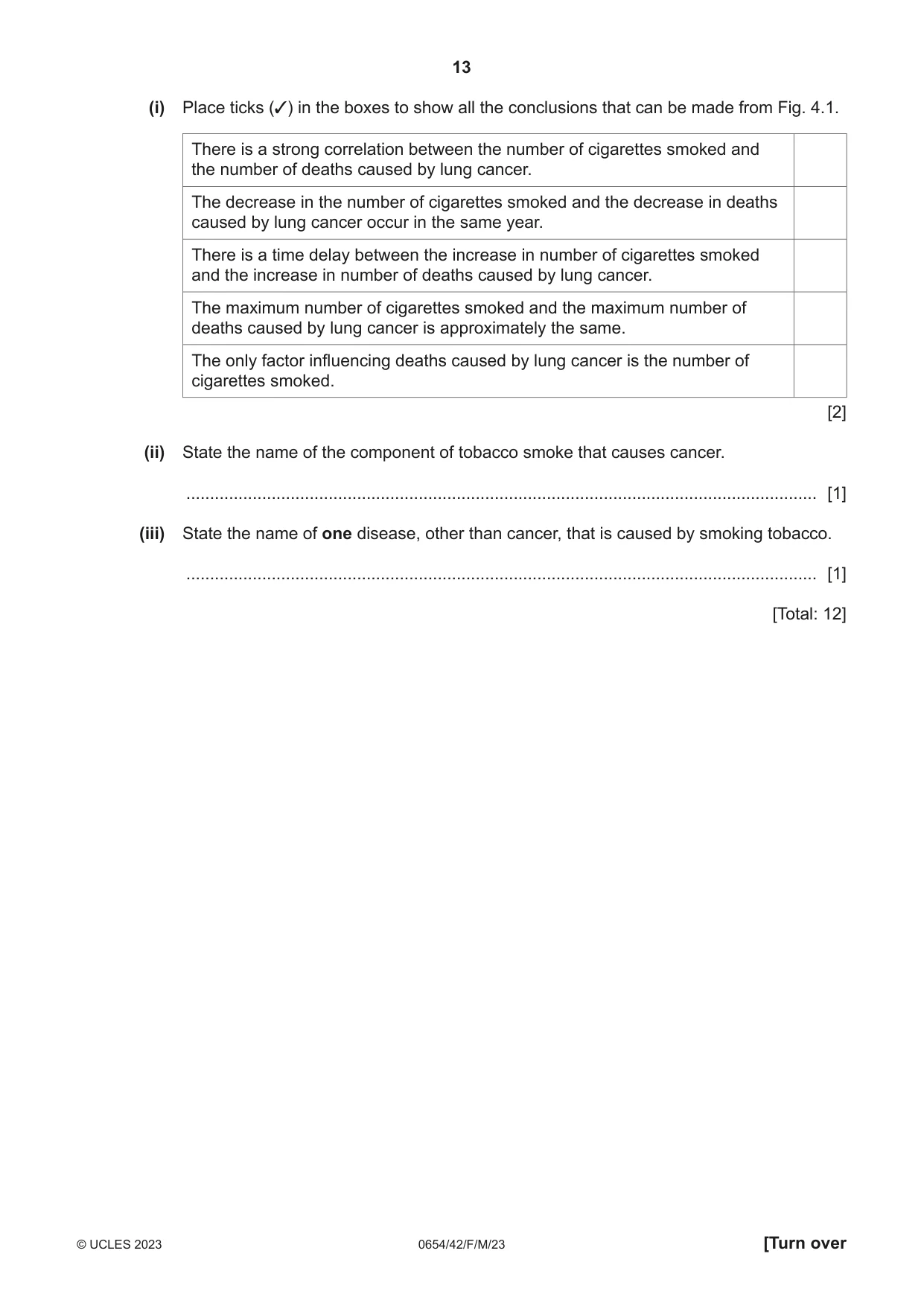
4 (a) A student measures their breathing rate at rest and during exercise. Table 4.1 shows their results. Table 4.1 breathing rate activity / breaths per minute at rest 46 during exercise 77 Complete the sentences to describe and explain the results in Table 4.1. Breathing rate increases between rest and exercise by .................................... breaths per minute. An increase in the breathing rate is caused by an increase in carbon dioxide concentration in the .................................... . During exercise the working .................................... require more energy for contraction. Oxygen is required for .................................... .................................... to release the energy required. [4] (b) Smoking tobacco affects the cilia of the ciliated cells that line parts of the gas exchange system. The average length of cilia in smokers is 0.0057 mm. The average length of cilia in non‑smokers is 0.0068 mm. (i) Suggest two effects on the gas exchange system caused by the difference in length of cilia. 1 ........................................................................................................................................ ........................................................................................................................................... 2 ........................................................................................................................................ ........................................................................................................................................... [2] (ii) State the names of two parts of the gas exchange system that are lined with ciliated cells. 1 ........................................................................................................................................ 2 ........................................................................................................................................ [2] (c) Fig. 4.1 is a graph showing the relationship between the number of cigarettes smoked and deaths caused by lung cancer between 1900 and 1980. key cigarettes smoked deaths caused by lung cancer 4000 150 3000 cigarettes smoked lung cancer per person deaths 100 per year per year per 100 000 people 2000 50 1000 1900 1920 1940 1960 1980 year Fig. 4.1 (i) Place ticks (3) in the boxes to show all the conclusions that can be made from Fig. 4.1. There is a strong correlation between the number of cigarettes smoked and the number of deaths caused by lung cancer. The decrease in the number of cigarettes smoked and the decrease in deaths caused by lung cancer occur in the same year. There is a time delay between the increase in number of cigarettes smoked and the increase in number of deaths caused by lung cancer. The maximum number of cigarettes smoked and the maximum number of deaths caused by lung cancer is approximately the same. The only factor influencing deaths caused by lung cancer is the number of cigarettes smoked. [2] (ii) State the name of the component of tobacco smoke that causes cancer. ..................................................................................................................................... [1] (iii) State the name of one disease, other than cancer, that is caused by smoking tobacco. ..................................................................................................................................... [1] [Total: 12]
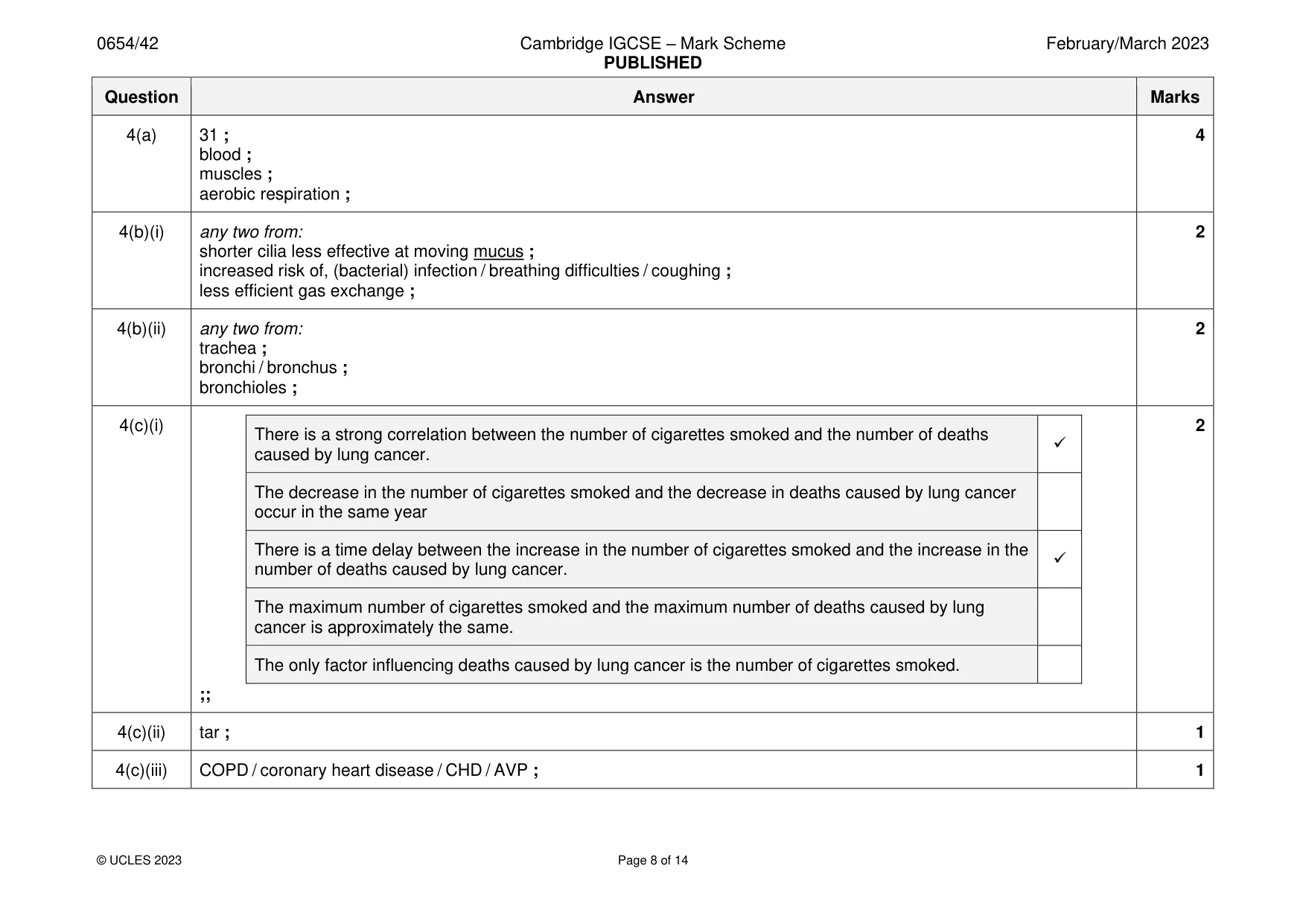
Mark scheme: 4(a) 31 ; 4 blood ; muscles ; aerobic respiration ; 4(b)(i) any two from: 2 shorter cilia less effective at moving mucus ; increased risk of, (bacterial) infection / breathing difficulties / coughing ; less efficient gas exchange ; 4(b)(ii) any two from: 2 trachea ; bronchi / bronchus ; bronchioles ; 4(c)(i) 2 There is a strong correlation between the number of cigarettes smoked and the number of deaths ✓ caused by lung cancer. The decrease in the number of cigarettes smoked and the decrease in deaths caused by lung cancer occur in the same year There is a time delay between the increase in the number of cigarettes smoked and the increase in the ✓ number of deaths caused by lung cancer. The maximum number of cigarettes smoked and the maximum number of deaths caused by lung cancer is approximately the same. The only factor influencing deaths caused by lung cancer is the number of cigarettes smoked. ;; 4(c)(ii) tar ; 1 4(c)(iii) COPD / coronary heart disease / CHD / AVP ; 1
Q5 · This question is about chemical bonding
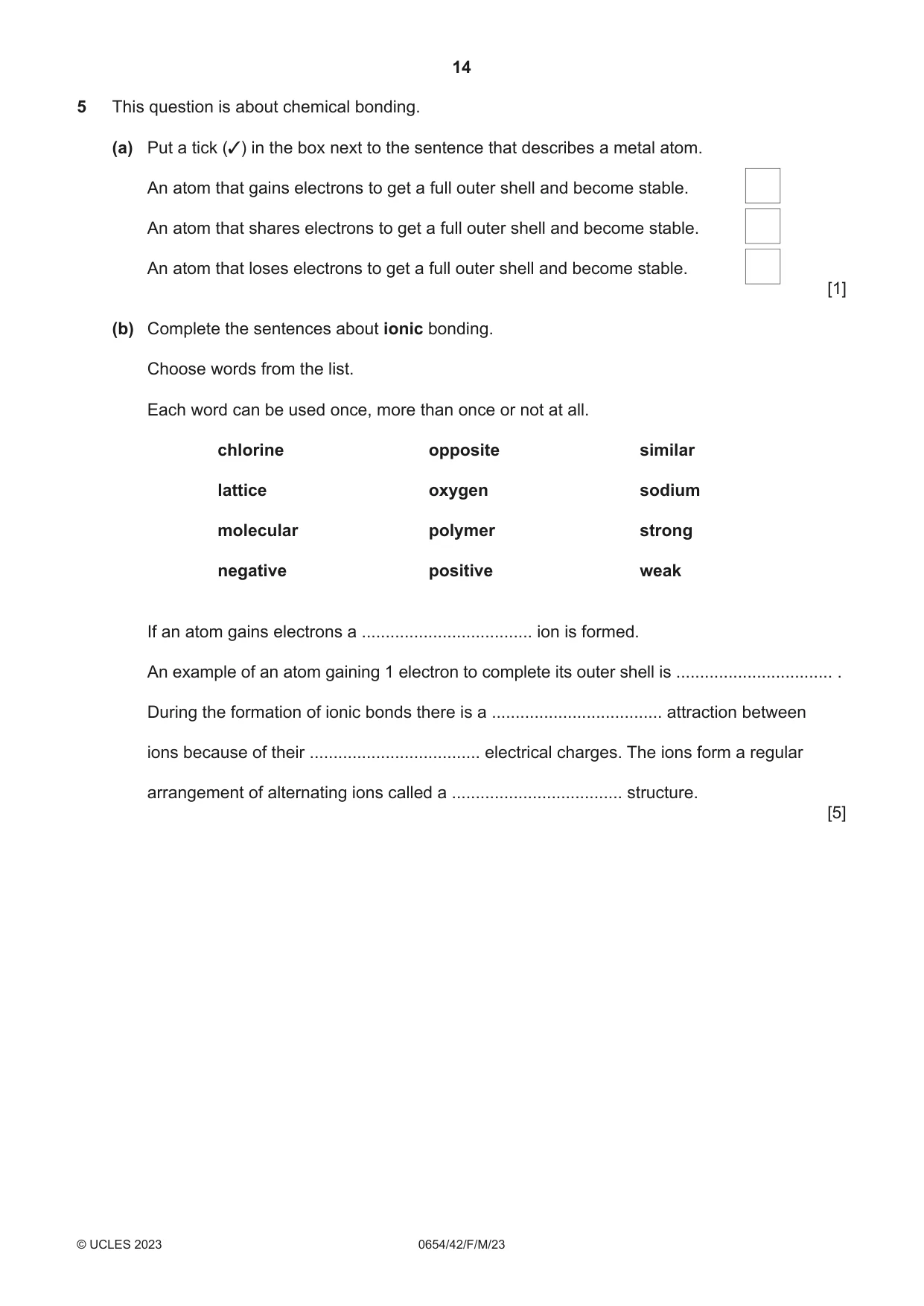
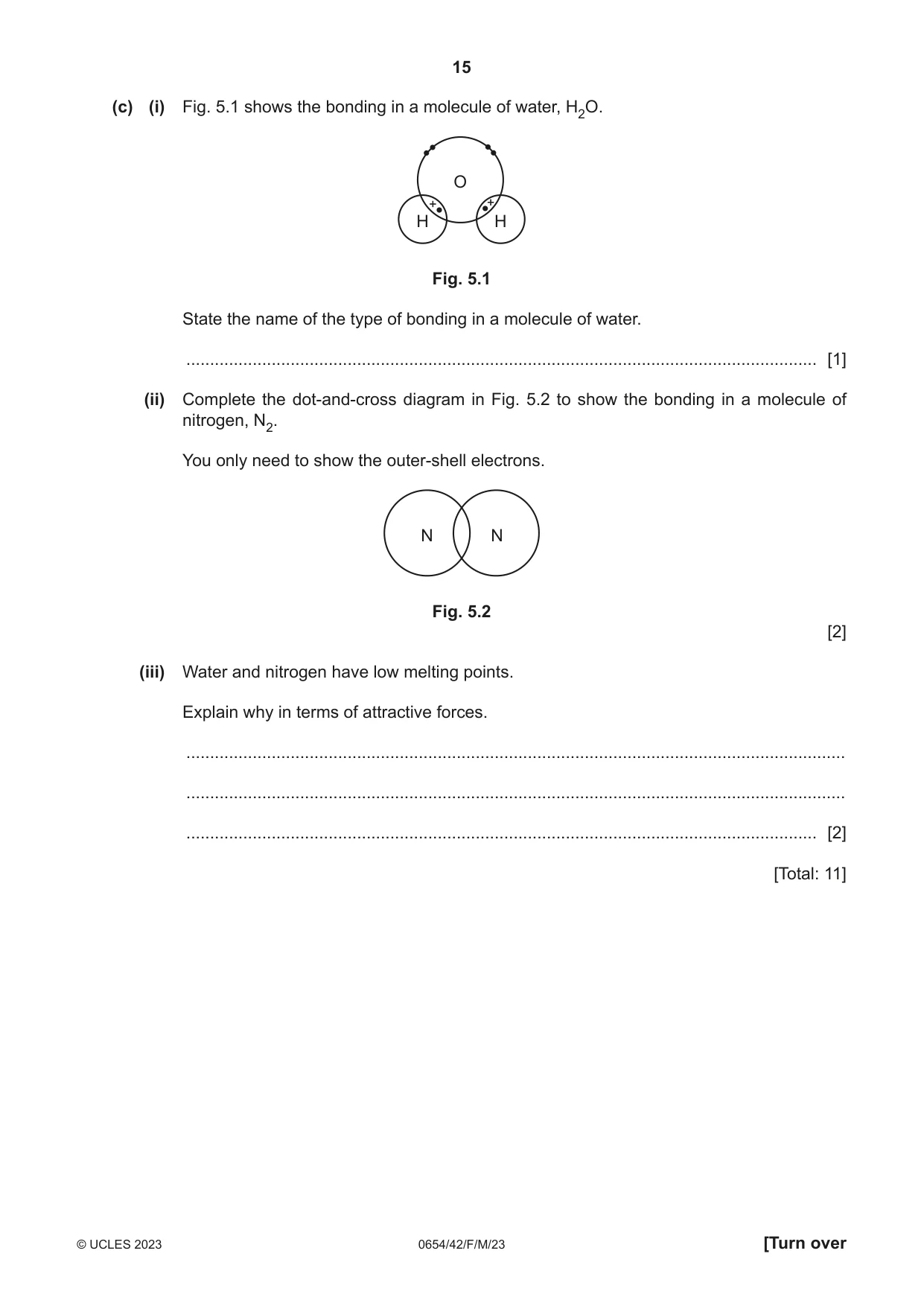
5 This question is about chemical bonding. (a) Put a tick (3) in the box next to the sentence that describes a metal atom. An atom that gains electrons to get a full outer shell and become stable. An atom that shares electrons to get a full outer shell and become stable. An atom that loses electrons to get a full outer shell and become stable. [1] (b) Complete the sentences about ionic bonding. Choose words from the list. Each word can be used once, more than once or not at all. chlorine opposite similar lattice oxygen sodium molecular polymer strong negative positive weak If an atom gains electrons a .................................... ion is formed. An example of an atom gaining 1 electron to complete its outer shell is ................................. . During the formation of ionic bonds there is a .................................... attraction between ions because of their .................................... electrical charges. The ions form a regular arrangement of alternating ions called a .................................... structure. [5] (c) (i) Fig. 5.1 shows the bonding in a molecule of water, H2O. O H H Fig. 5.1 State the name of the type of bonding in a molecule of water. ..................................................................................................................................... [1] (ii) Complete the dot‑and‑cross diagram in Fig. 5.2 to show the bonding in a molecule of nitrogen, N2. You only need to show the outer‑shell electrons. N N Fig. 5.2 [2] (iii) Water and nitrogen have low melting points. Explain why in terms of attractive forces. ........................................................................................................................................... ........................................................................................................................................... ..................................................................................................................................... [2] [Total: 11]
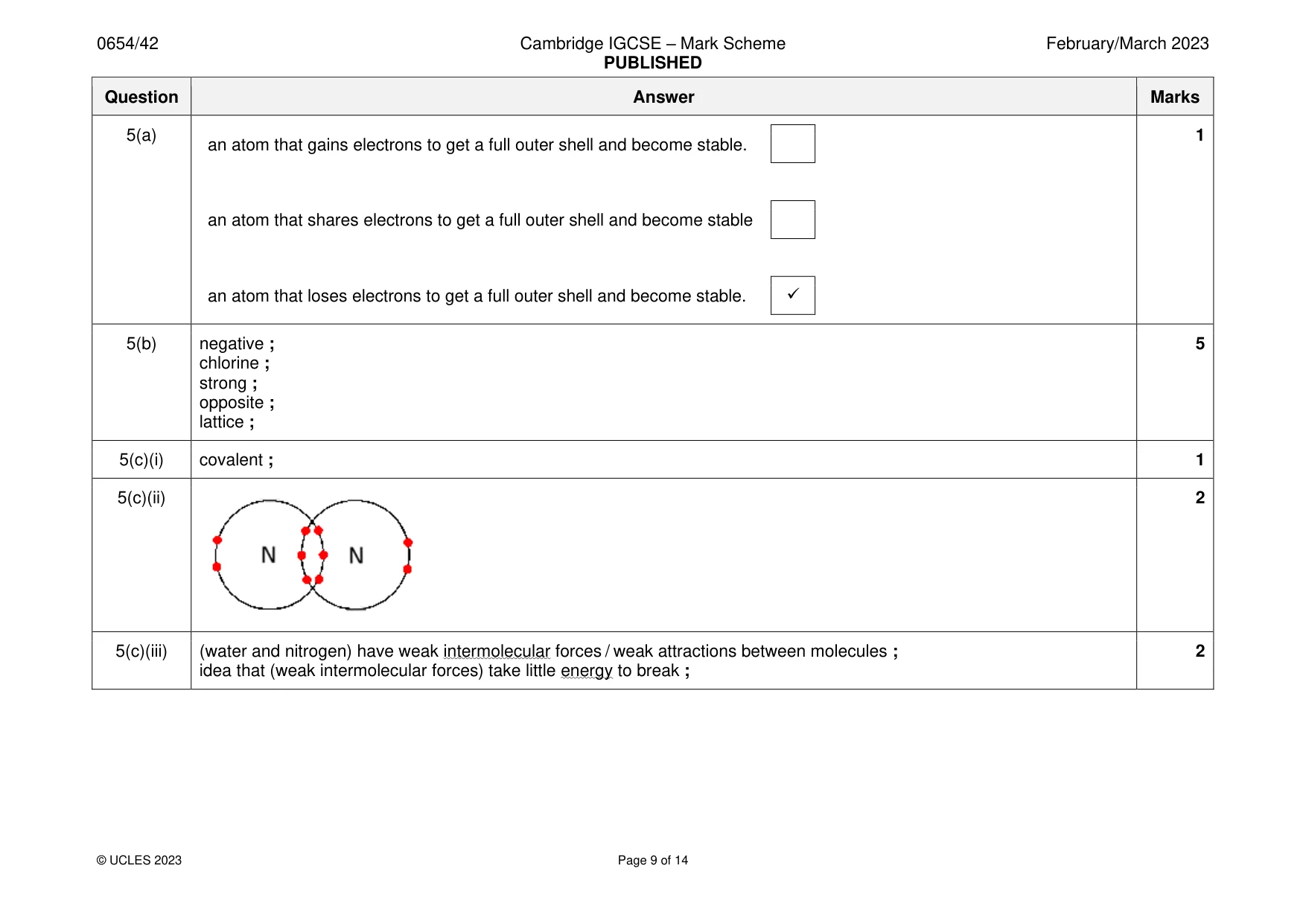
Mark scheme: 5(a) 1 an atom that gains electrons to get a full outer shell and become stable. an atom that shares electrons to get a full outer shell and become stable an atom that loses electrons to get a full outer shell and become stable. ✓ 5(b) negative ; 5 chlorine ; strong ; opposite ; lattice ; 5(c)(i) covalent ; 1 5(c)(ii) 2 5(c)(iii) (water and nitrogen) have weak intermolecular forces / weak attractions between molecules ; 2 idea that (weak intermolecular forces) take little energy to break ;
Q6 · A student investigates how different shaped objects fall
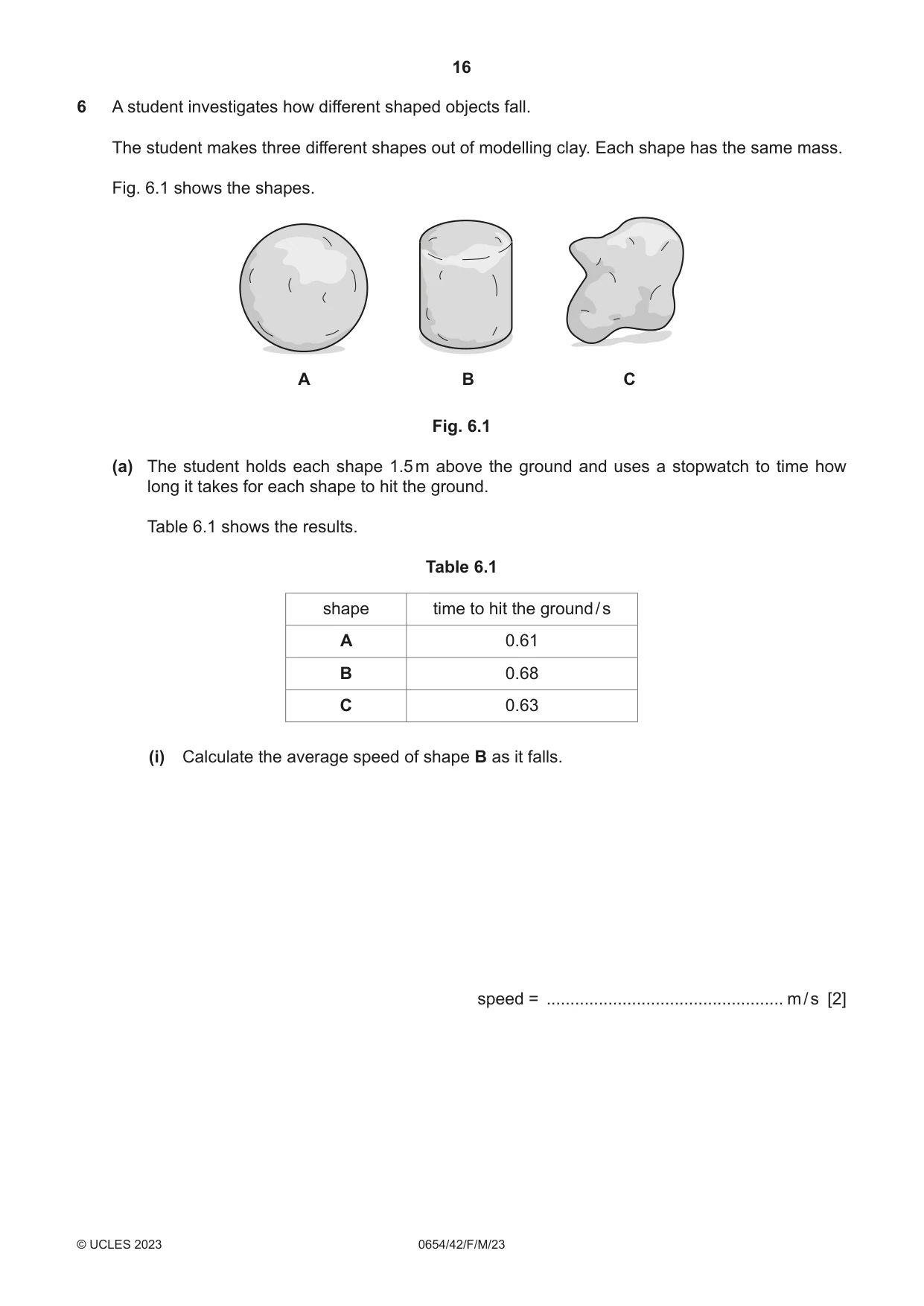
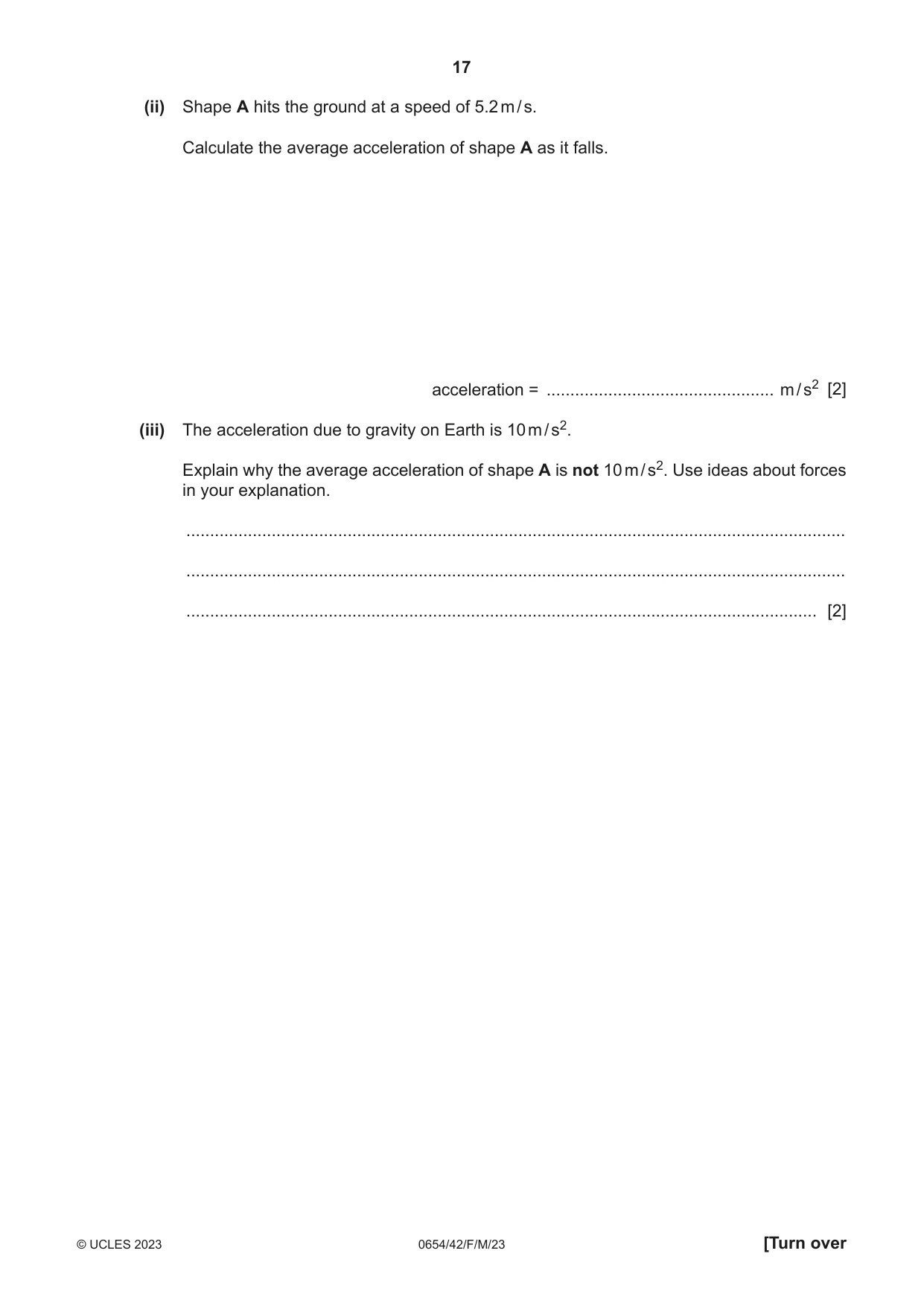
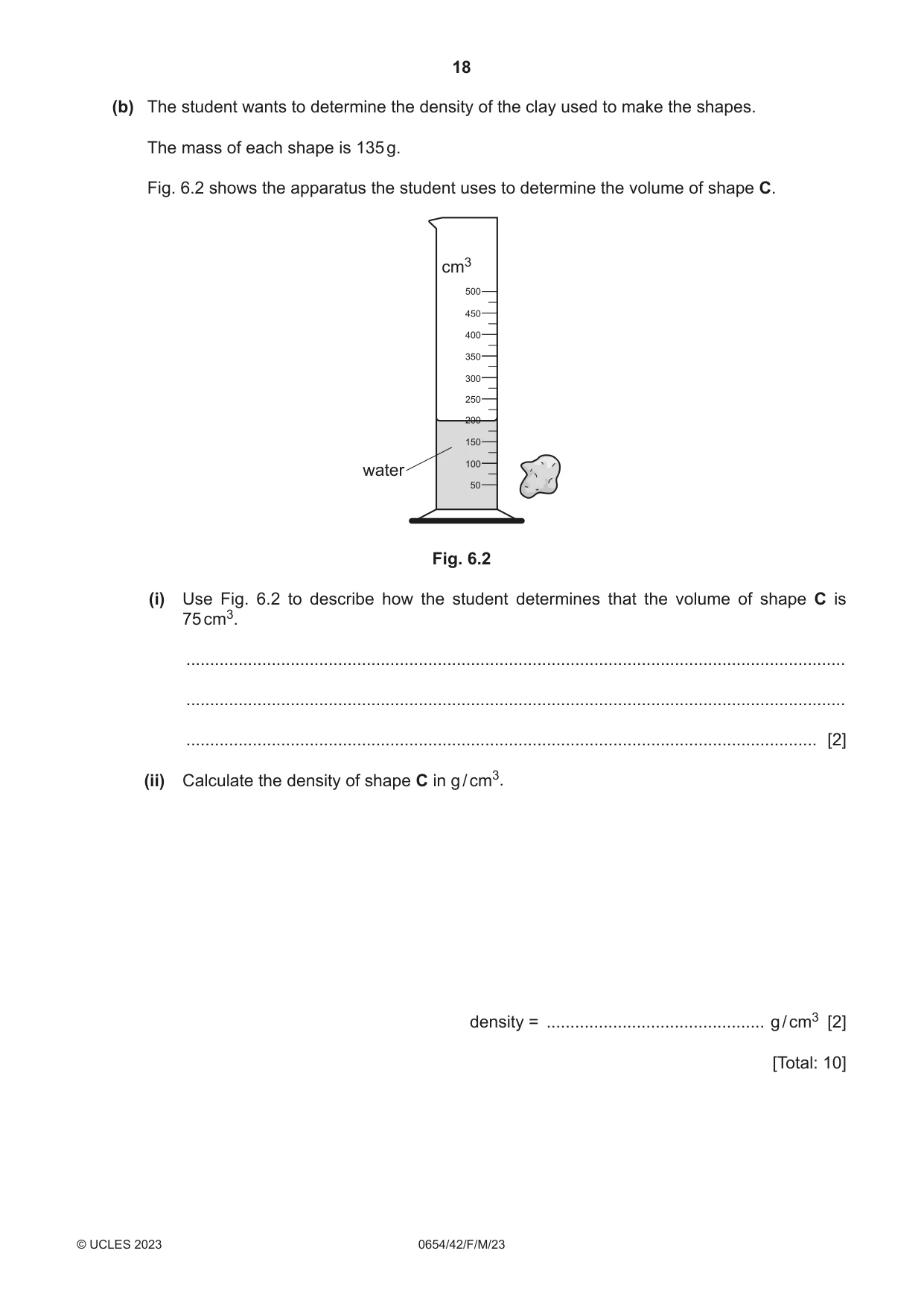
6 A student investigates how different shaped objects fall. The student makes three different shapes out of modelling clay. Each shape has the same mass. Fig. 6.1 shows the shapes. A B C Fig. 6.1 (a) The student holds each shape 1.5 m above the ground and uses a stopwatch to time how long it takes for each shape to hit the ground. Table 6.1 shows the results. Table 6.1 shape time to hit the ground / s A 0.61 B 0.68 C 0.63 (i) Calculate the average speed of shape B as it falls. speed = .................................................. m / s [2] (ii) Shape A hits the ground at a speed of 5.2 m / s. Calculate the average acceleration of shape A as it falls. acceleration = ................................................ m / s2 [2] (iii) The acceleration due to gravity on Earth is 10 m / s2. Explain why the average acceleration of shape A is not 10 m / s2. Use ideas about forces in your explanation. ........................................................................................................................................... ........................................................................................................................................... ..................................................................................................................................... [2] (b) The student wants to determine the density of the clay used to make the shapes. The mass of each shape is 135 g. Fig. 6.2 shows the apparatus the student uses to determine the volume of shape C. cm3 water Fig. 6.2 (i) Use Fig. 6.2 to describe how the student determines that the volume of shape C is 75 cm3. ........................................................................................................................................... ........................................................................................................................................... ..................................................................................................................................... [2] (ii) Calculate the density of shape C in g / cm3. density = .............................................. g / cm3 [2] [Total: 10]
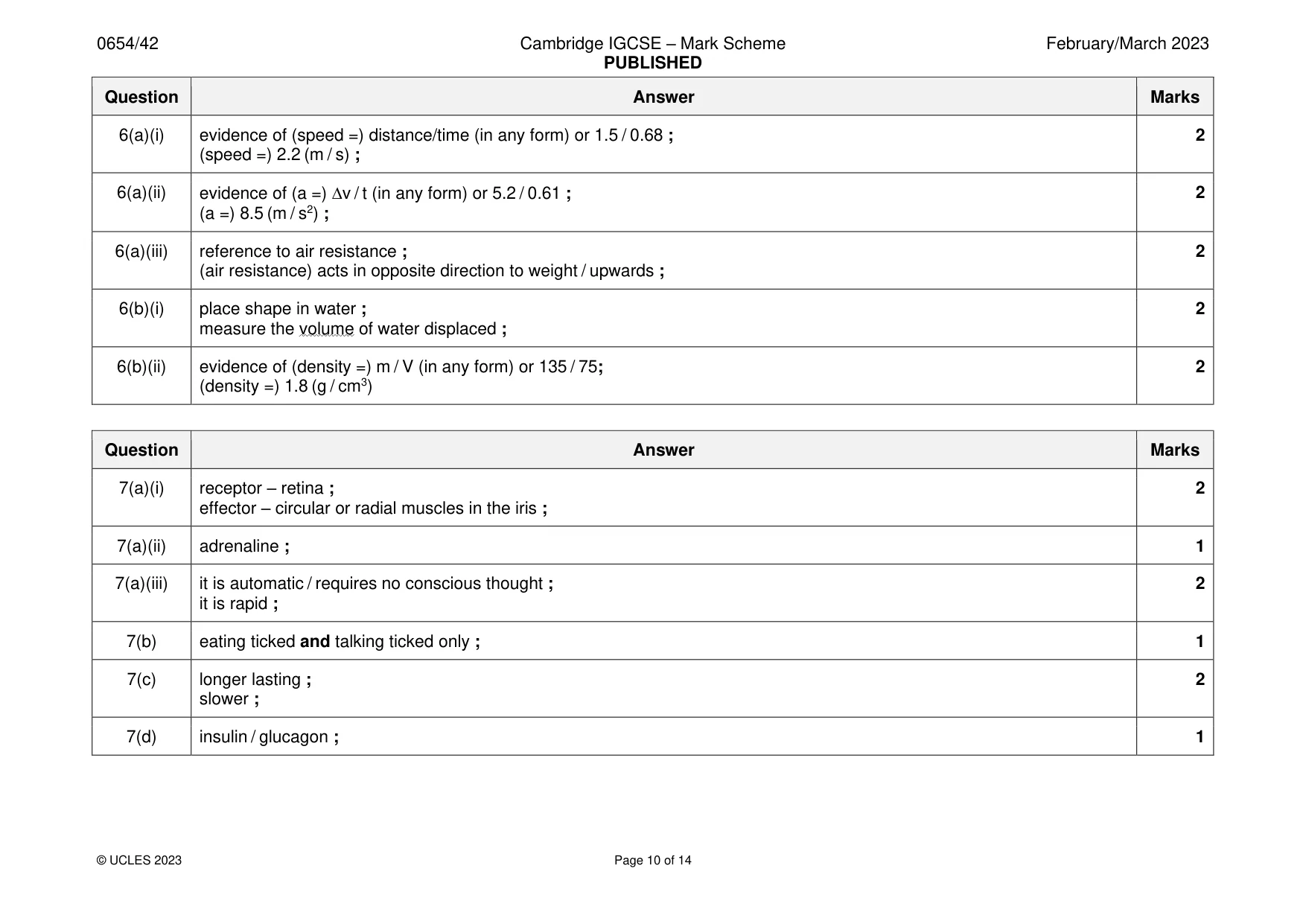
Mark scheme: 6(a)(i) evidence of (speed =) distance/time (in any form) or 1.5 / 0.68 ; 2 (speed =) 2.2 (m / s) ; 6(a)(ii) evidence of (a =) v / t (in any form) or 5.2 / 0.61 ; 2 (a =) 8.5 (m / s2) ; 6(a)(iii) reference to air resistance ; 2 (air resistance) acts in opposite direction to weight / upwards ; 6(b)(i) place shape in water ; 2 measure the volume of water displaced ; 6(b)(ii) evidence of (density =) m / V (in any form) or 135 / 75; 2 (density =) 1.8 (g / cm3)
Q7 · One cause of the pupil reflex is a change in light intensity
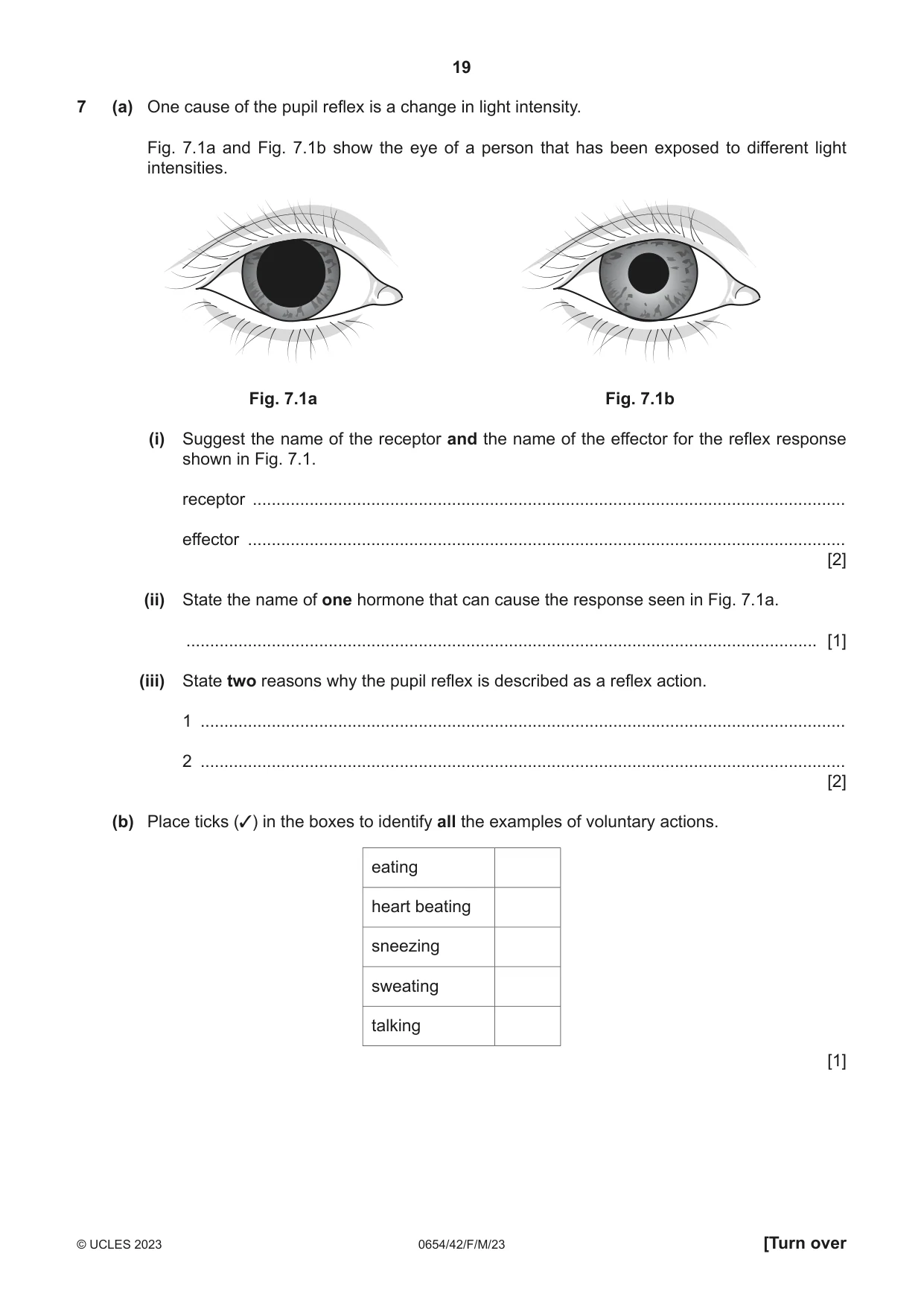
7 (a) One cause of the pupil reflex is a change in light intensity. Fig. 7.1a and Fig. 7.1b show the eye of a person that has been exposed to different light intensities. Fig. 7.1a Fig. 7.1b (i) Suggest the name of the receptor and the name of the effector for the reflex response shown in Fig. 7.1. receptor ............................................................................................................................. effector .............................................................................................................................. [2] (ii) State the name of one hormone that can cause the response seen in Fig. 7.1a. ..................................................................................................................................... [1] (iii) State two reasons why the pupil reflex is described as a reflex action. 1 ........................................................................................................................................ 2 ........................................................................................................................................ [2] (b) Place ticks (3) in the boxes to identify all the examples of voluntary actions. eating heart beating sneezing sweating talking [1] (c) Describe two ways the action of hormonal control systems is different from the action of nervous control systems. 1 ................................................................................................................................................ 2 ................................................................................................................................................ [2] (d) State the name of one hormone that is released from the pancreas and is involved in the control of blood glucose concentration. ............................................................................................................................................. [1] [Total: 9]
Mark scheme: 7(a)(i) receptor – retina ; 2 effector – circular or radial muscles in the iris ; 7(a)(ii) adrenaline ; 1 7(a)(iii) it is automatic / requires no conscious thought ; 2 it is rapid ; 7(b) eating ticked and talking ticked only ; 1 7(c) longer lasting ; 2 slower ; 7(d) insulin / glucagon ; 1
Q8 · Ammonium sulfate is used as a fertiliser
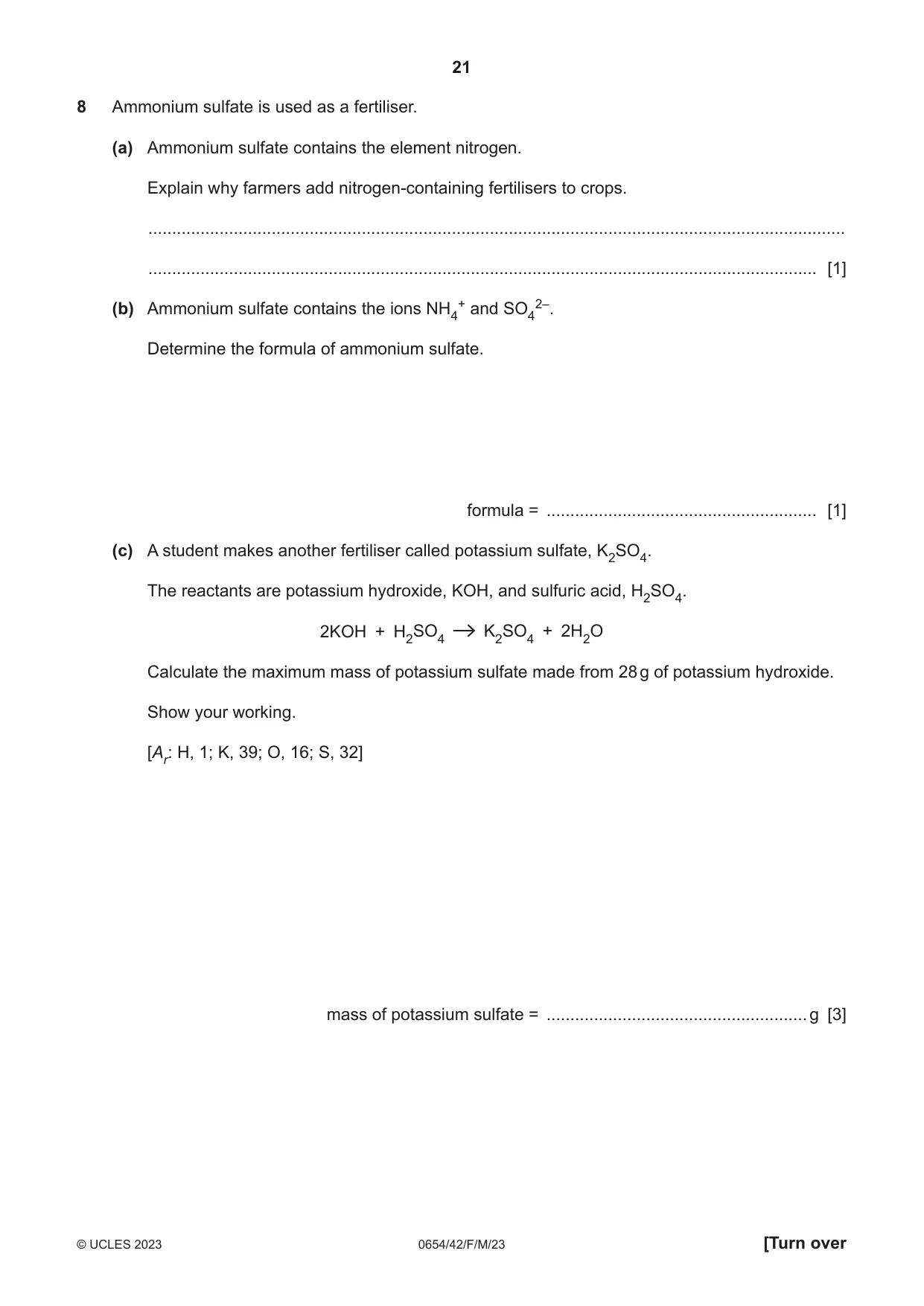
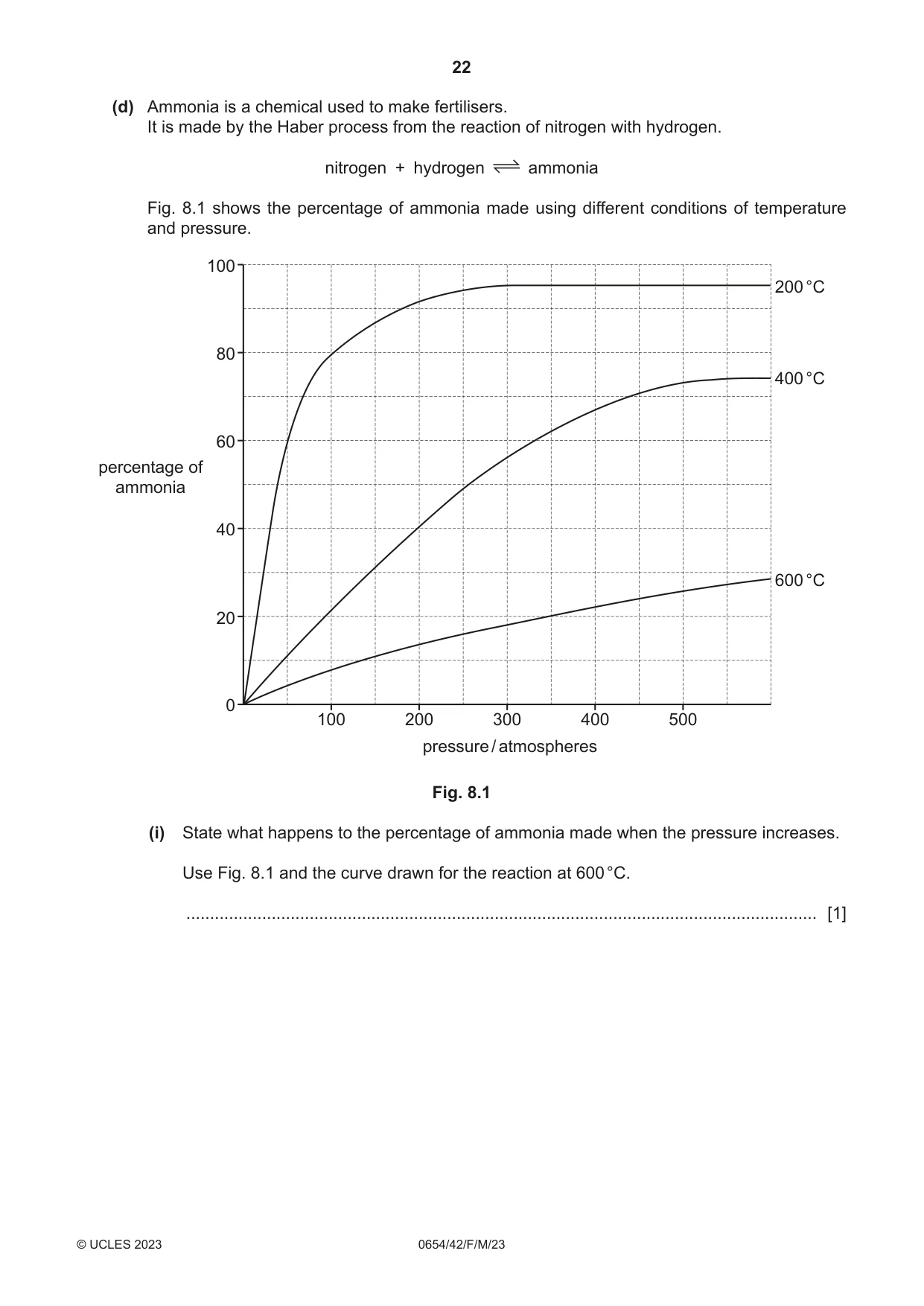
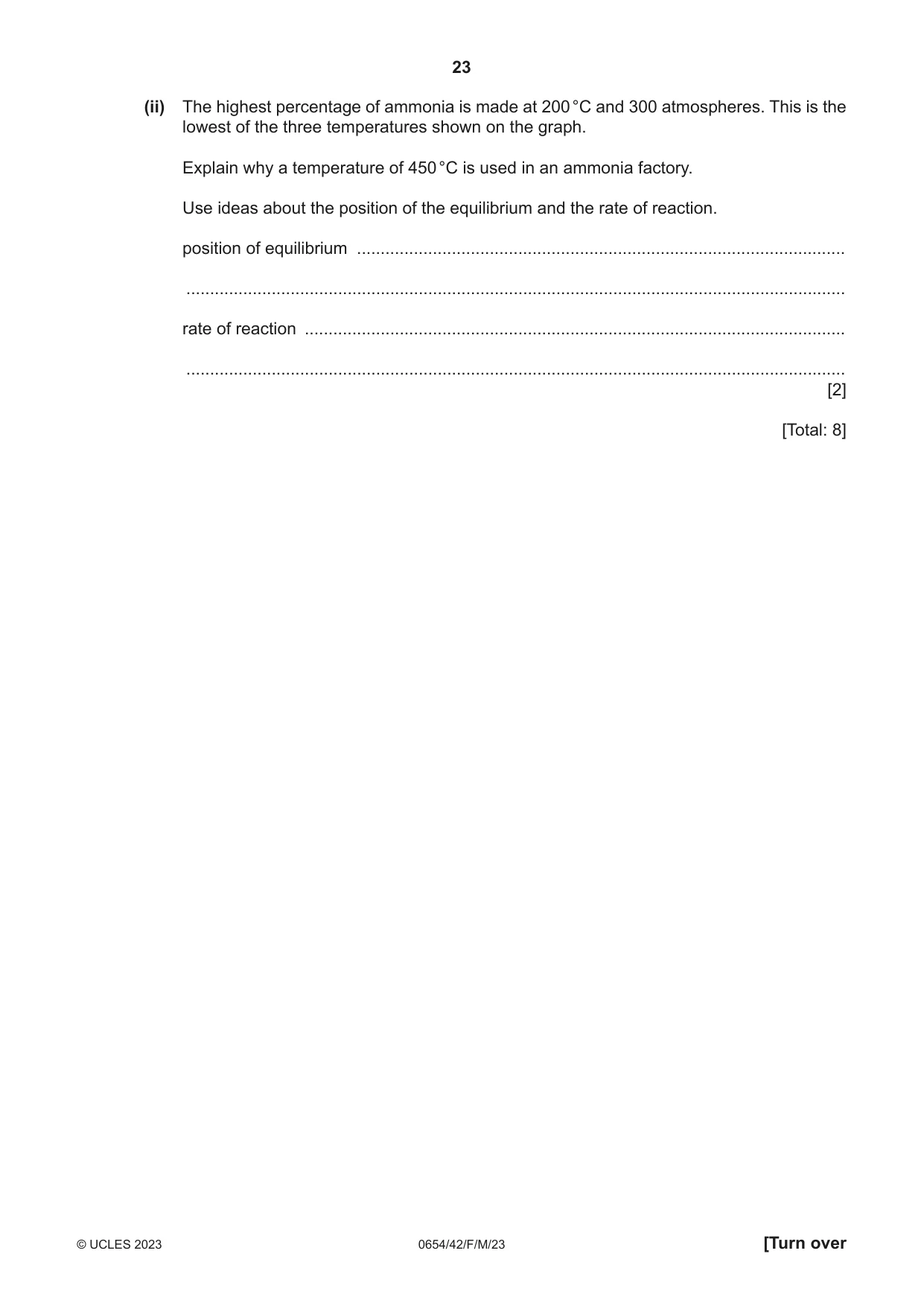
8 Ammonium sulfate is used as a fertiliser. (a) Ammonium sulfate contains the element nitrogen. Explain why farmers add nitrogen‑containing fertilisers to crops. ................................................................................................................................................... ............................................................................................................................................. [1] (b) Ammonium sulfate contains the ions NH4+ and SO42–. Determine the formula of ammonium sulfate. formula = ......................................................... [1] (c) A student makes another fertiliser called potassium sulfate, K2SO4. The reactants are potassium hydroxide, KOH, and sulfuric acid, H2SO4. 2KOH + H2SO4 K2SO4 + 2H2O Calculate the maximum mass of potassium sulfate made from 28 g of potassium hydroxide. Show your working. [Ar: H, 1; K, 39; O, 16; S, 32] mass of potassium sulfate = ....................................................... g [3] (d) Ammonia is a chemical used to make fertilisers. It is made by the Haber process from the reaction of nitrogen with hydrogen. nitrogen + hydrogen ammonia Fig. 8.1 shows the percentage of ammonia made using different conditions of temperature and pressure. 100 200 °C 80 400 °C 60 percentage of ammonia 40 600 °C 20 0 100 200 300 400 500 pressure / atmospheres Fig. 8.1 (i) State what happens to the percentage of ammonia made when the pressure increases. Use Fig. 8.1 and the curve drawn for the reaction at 600 °C. ..................................................................................................................................... [1] (ii) The highest percentage of ammonia is made at 200 °C and 300 atmospheres. This is the lowest of the three temperatures shown on the graph. Explain why a temperature of 450 °C is used in an ammonia factory. Use ideas about the position of the equilibrium and the rate of reaction. position of equilibrium ....................................................................................................... ........................................................................................................................................... rate of reaction .................................................................................................................. ........................................................................................................................................... [2] [Total: 8]
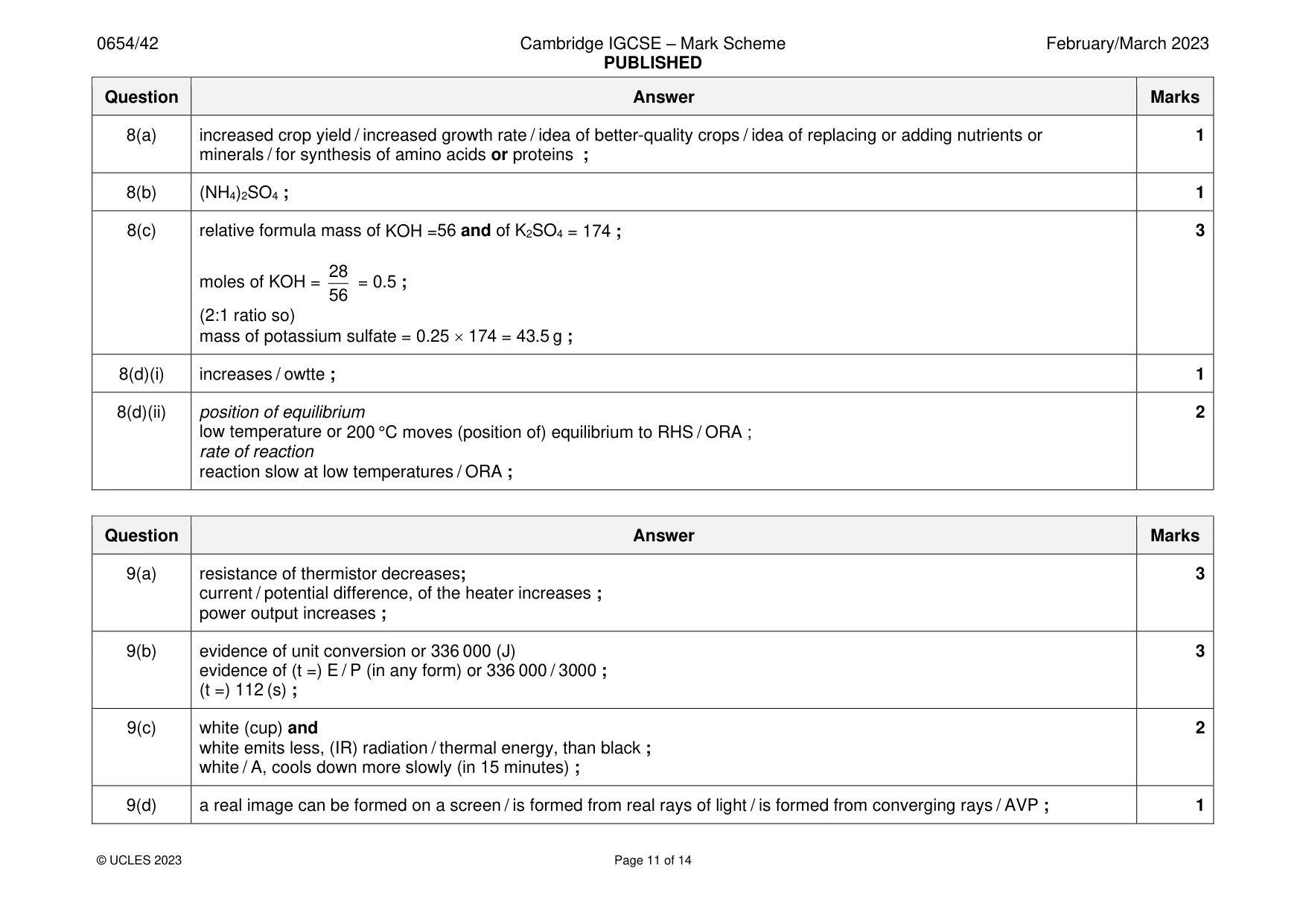
Mark scheme: 8(a) increased crop yield / increased growth rate / idea of better-quality crops / idea of replacing or adding nutrients or 1 minerals / for synthesis of amino acids or proteins ; 8(b) (NH4)2SO4 ; 1 8(c) relative formula mass of KOH =56 and of K2SO4 = 174 ; 3 28 moles of KOH = = 0.5 ; 56 (2:1 ratio so) mass of potassium sulfate = 0.25 174 = 43.5 g ; 8(d)(i) increases / owtte ; 1 8(d)(ii) position of equilibrium 2 low temperature or 200 °C moves (position of) equilibrium to RHS / ORA ; rate of reaction reaction slow at low temperatures / ORA ;
Q9 · A simple circuit containing a heater and a thermistor
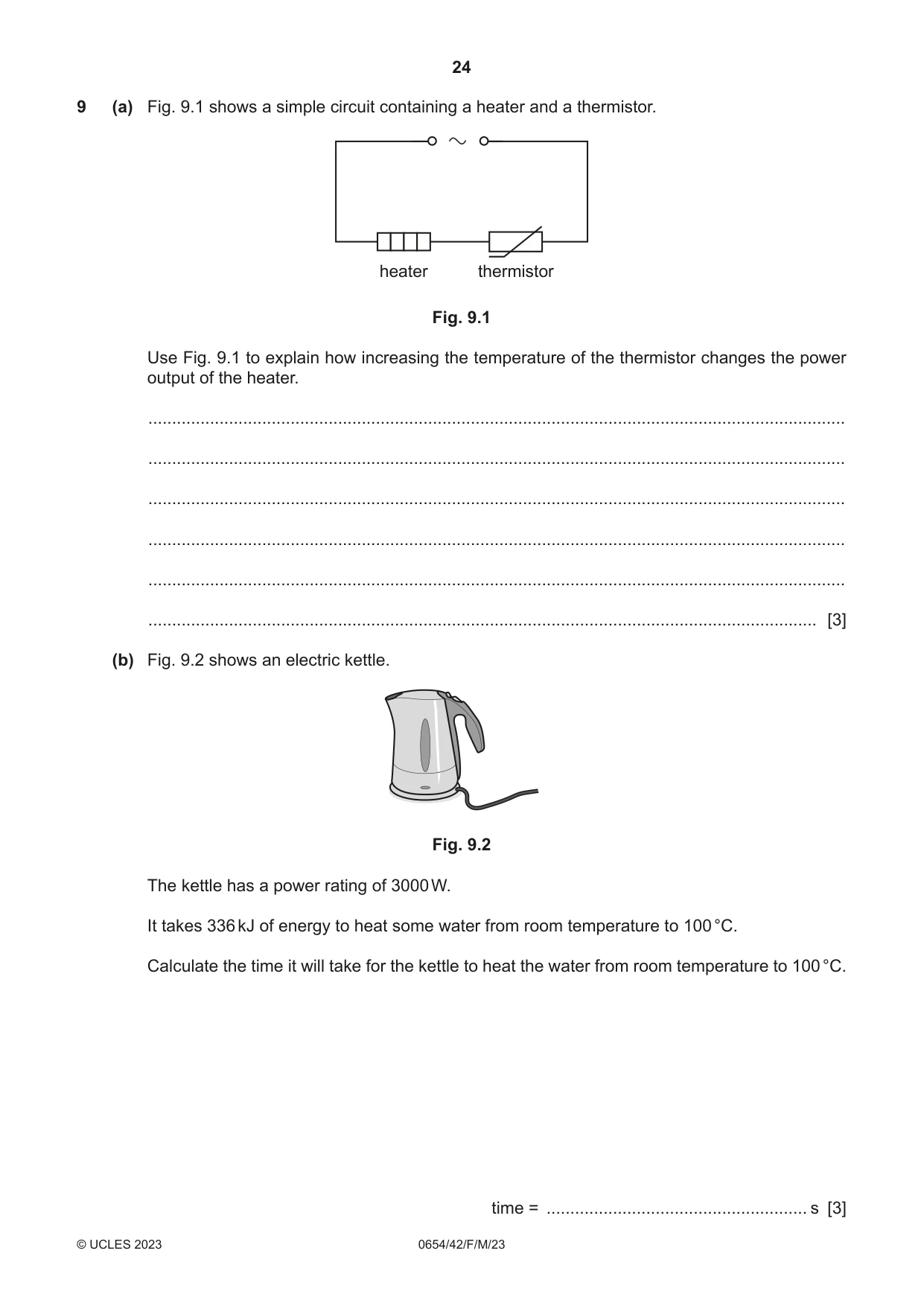
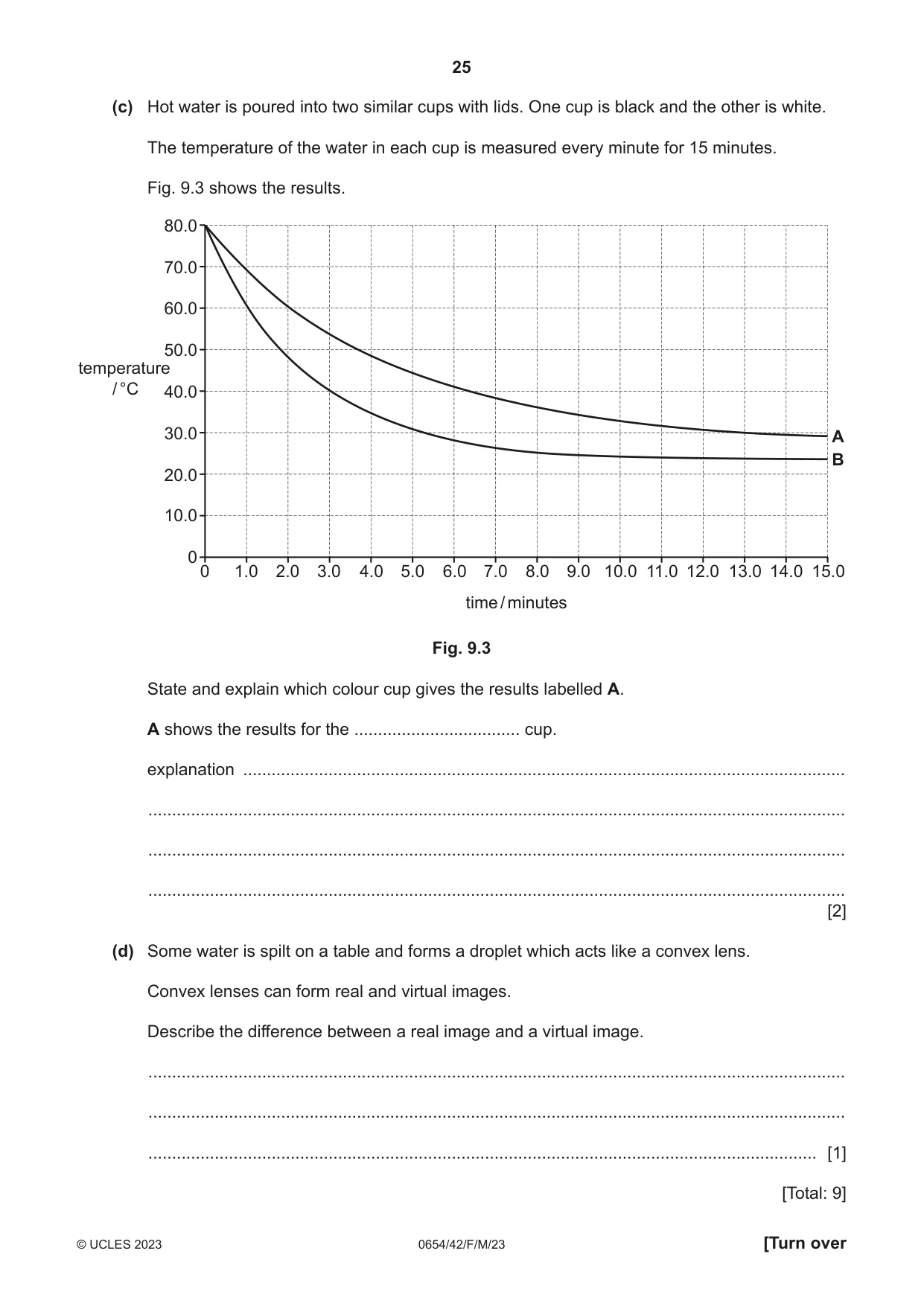
9 (a) Fig. 9.1 shows a simple circuit containing a heater and a thermistor. heater thermistor Fig. 9.1 Use Fig. 9.1 to explain how increasing the temperature of the thermistor changes the power output of the heater. ................................................................................................................................................... ................................................................................................................................................... ................................................................................................................................................... ................................................................................................................................................... ................................................................................................................................................... ............................................................................................................................................. [3] (b) Fig. 9.2 shows an electric kettle. Fig. 9.2 The kettle has a power rating of 3000 W. It takes 336 kJ of energy to heat some water from room temperature to 100 °C. Calculate the time it will take for the kettle to heat the water from room temperature to 100 °C. time = ....................................................... s [3] (c) Hot water is poured into two similar cups with lids. One cup is black and the other is white. The temperature of the water in each cup is measured every minute for 15 minutes. Fig. 9.3 shows the results. 80.0 70.0 60.0 50.0 temperature / °C 40.0 30.0 A B 20.0 10.0 0 0 1.0 2.0 3.0 4.0 5.0 6.0 7.0 8.0 9.0 10.0 11.0 12.0 13.0 14.0 15.0 time / minutes Fig. 9.3 State and explain which colour cup gives the results labelled A. A shows the results for the ................................... cup. explanation ............................................................................................................................... ................................................................................................................................................... ................................................................................................................................................... ................................................................................................................................................... [2] (d) Some water is spilt on a table and forms a droplet which acts like a convex lens. Convex lenses can form real and virtual images. Describe the difference between a real image and a virtual image. ................................................................................................................................................... ................................................................................................................................................... ............................................................................................................................................. [1] [Total: 9]
Mark scheme: 9(a) resistance of thermistor decreases; 3 current / potential difference, of the heater increases ; power output increases ; 9(b) evidence of unit conversion or 336 000 (J) 3 evidence of (t =) E / P (in any form) or 336 000 / 3000 ; (t =) 112 (s) ; 9(c) white (cup) and 2 white emits less, (IR) radiation / thermal energy, than black ; white / A, cools down more slowly (in 15 minutes) ; 9(d) a real image can be formed on a screen / is formed from real rays of light / is formed from converging rays / AVP ; 1
Q10 · The effect of pH on the activity of one digestive enzyme
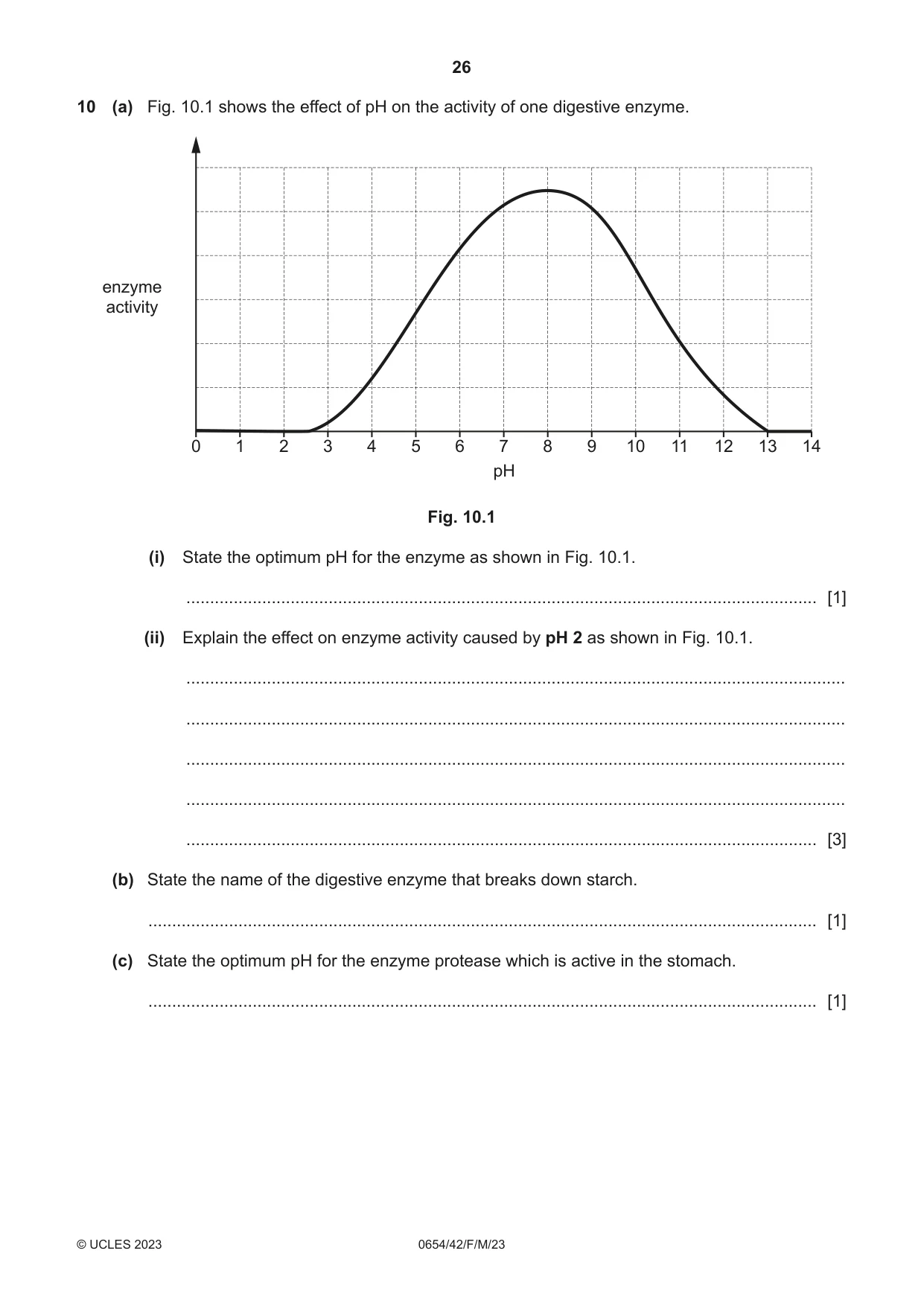
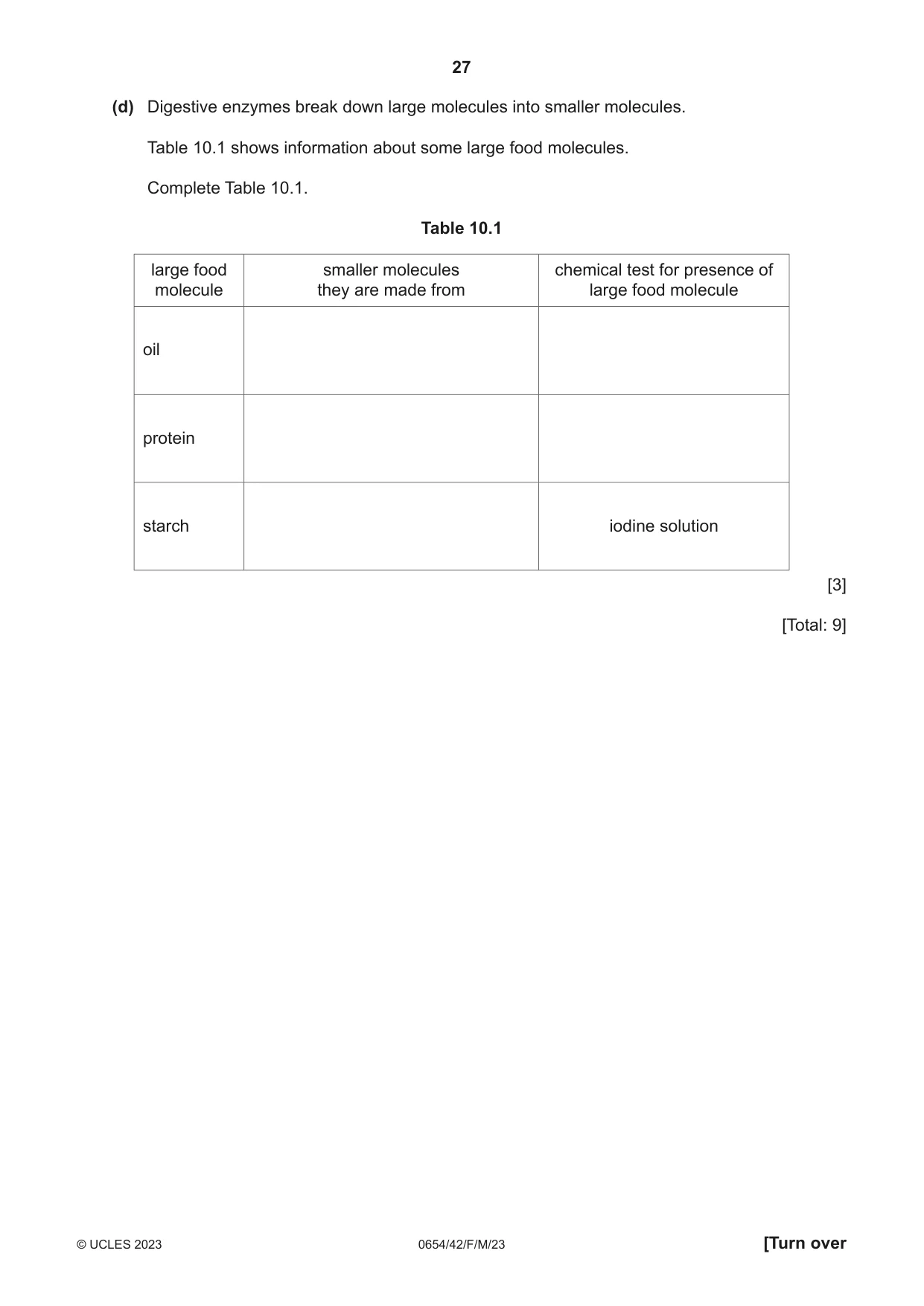
10 (a) Fig. 10.1 shows the effect of pH on the activity of one digestive enzyme. enzyme activity 0 1 2 3 4 5 6 7 8 9 10 11 12 13 14 pH Fig. 10.1 (i) State the optimum pH for the enzyme as shown in Fig. 10.1. ..................................................................................................................................... [1] (ii) Explain the effect on enzyme activity caused by pH 2 as shown in Fig. 10.1. ........................................................................................................................................... ........................................................................................................................................... ........................................................................................................................................... ........................................................................................................................................... ..................................................................................................................................... [3] (b) State the name of the digestive enzyme that breaks down starch. ............................................................................................................................................. [1] (c) State the optimum pH for the enzyme protease which is active in the stomach. ............................................................................................................................................. [1] (d) Digestive enzymes break down large molecules into smaller molecules. Table 10.1 shows information about some large food molecules. Complete Table 10.1. Table 10.1 large food smaller molecules chemical test for presence of molecule they are made from large food molecule oil protein starch iodine solution [3] [Total: 9]
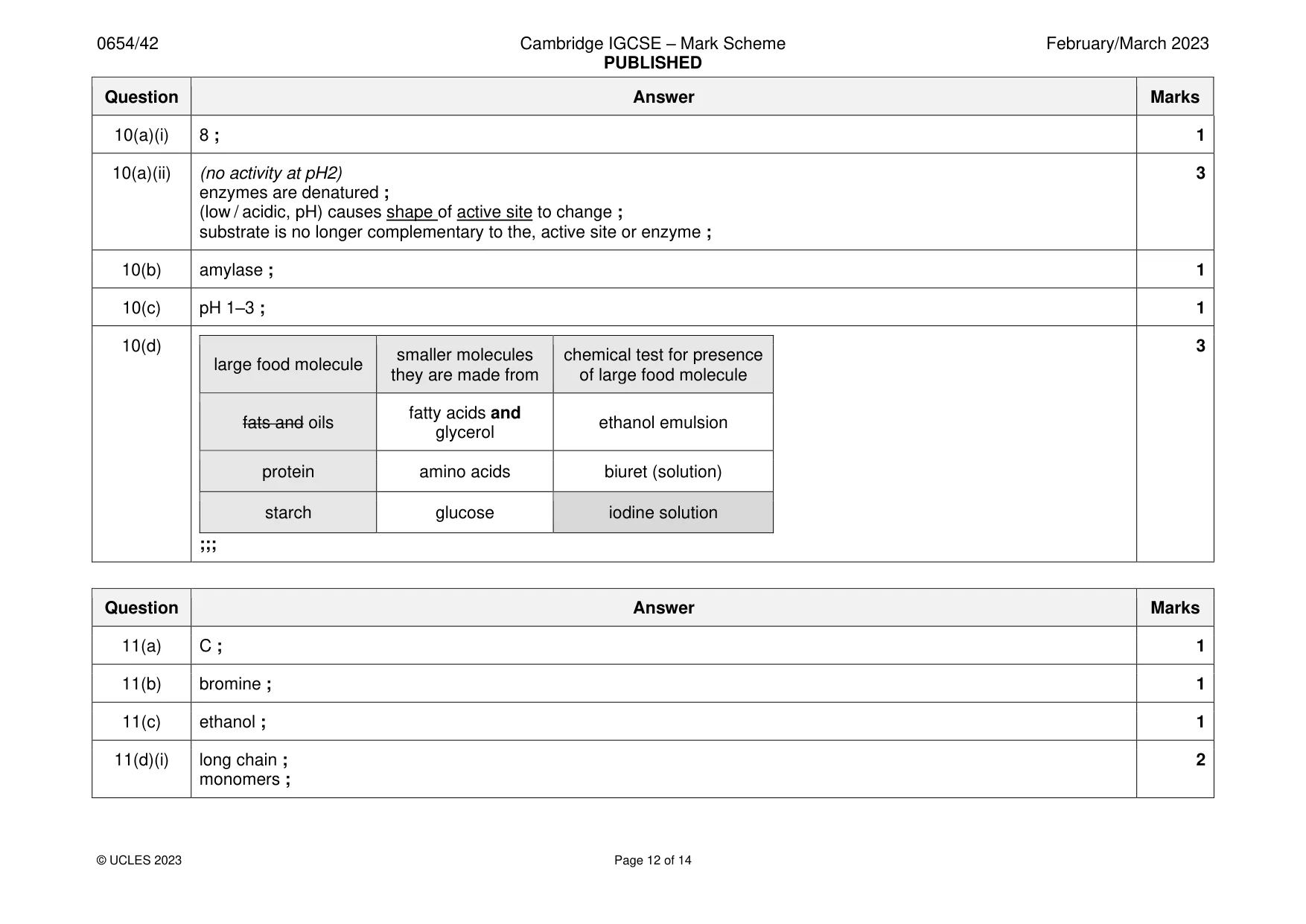
Mark scheme: 10(a)(i) 8 ; 1 10(a)(ii) (no activity at pH2) 3 enzymes are denatured ; (low / acidic, pH) causes shape of active site to change ; substrate is no longer complementary to the, active site or enzyme ; 10(b) amylase ; 1 10(c) pH 1–3 ; 1 10(d) 3 smaller molecules chemical test for presence large food molecule they are made from of large food molecule fatty acids and fats and oils ethanol emulsion glycerol protein amino acids biuret (solution) starch glucose iodine solution ;;;
Q11 · The structures of some compounds of carbon
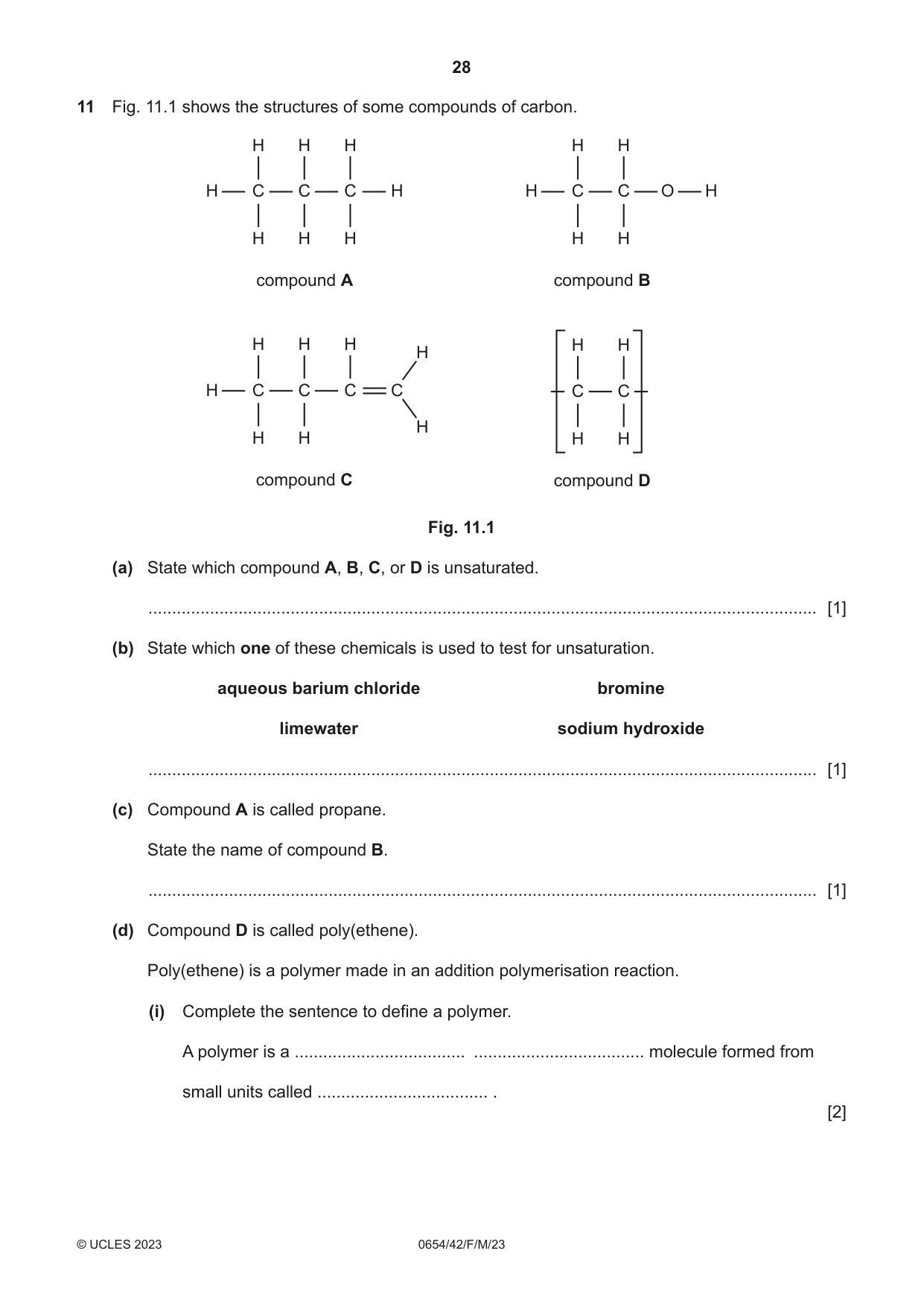
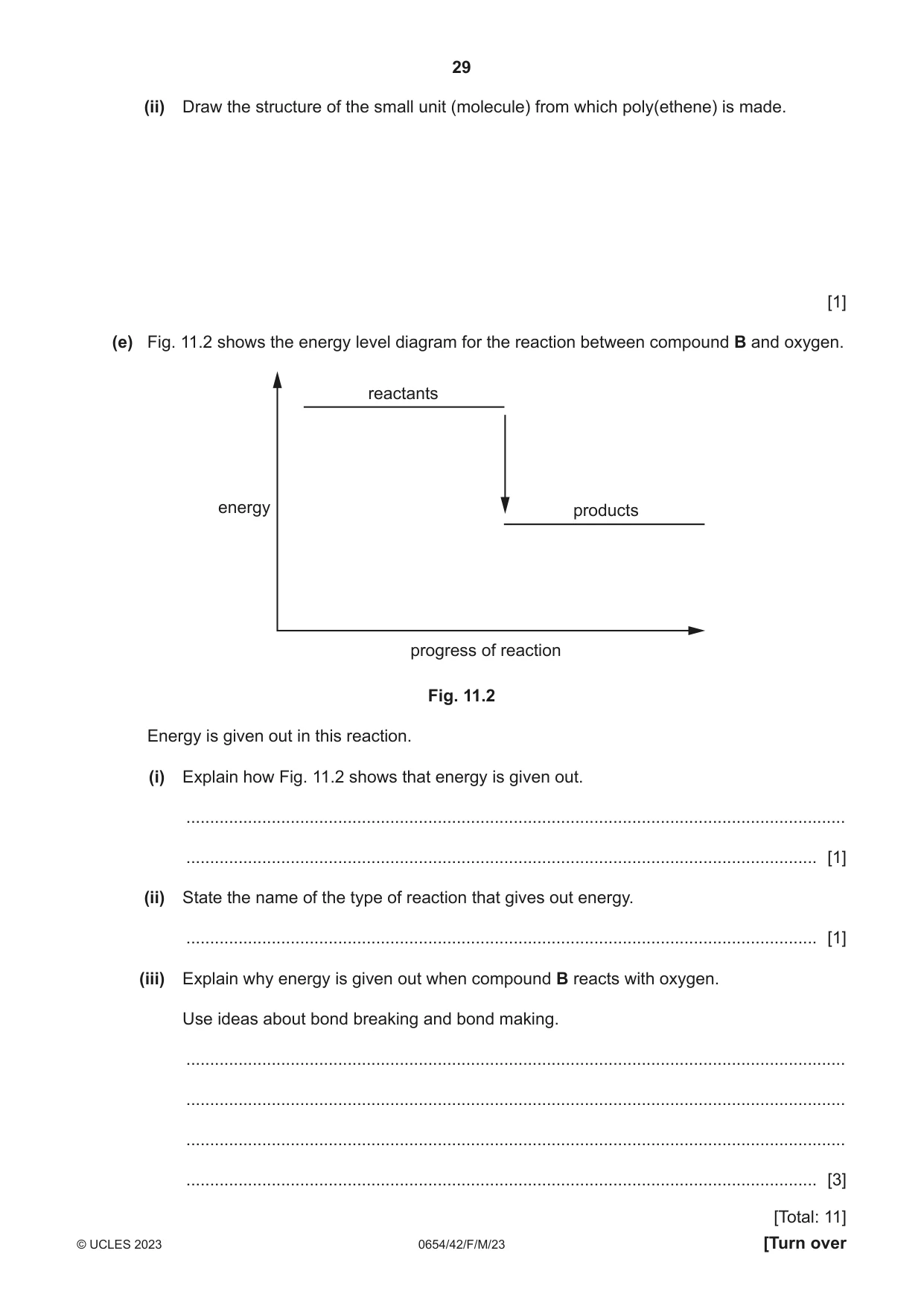
11 Fig. 11.1 shows the structures of some compounds of carbon. H H H H H H C C C H H C C O H H H H H H compound A compound B H H H H H H H C C C C C C H H H H H compound C compound D Fig. 11.1 (a) State which compound A, B, C, or D is unsaturated. ............................................................................................................................................. [1] (b) State which one of these chemicals is used to test for unsaturation. aqueous barium chloride bromine limewater sodium hydroxide ............................................................................................................................................. [1] (c) Compound A is called propane. State the name of compound B. ............................................................................................................................................. [1] (d) Compound D is called poly(ethene). Poly(ethene) is a polymer made in an addition polymerisation reaction. (i) Complete the sentence to define a polymer. A polymer is a .................................... .................................... molecule formed from small units called .................................... . [2] (ii) Draw the structure of the small unit (molecule) from which poly(ethene) is made. [1] (e) Fig. 11.2 shows the energy level diagram for the reaction between compound B and oxygen. reactants energy products progress of reaction Fig. 11.2 Energy is given out in this reaction. (i) Explain how Fig. 11.2 shows that energy is given out. ........................................................................................................................................... ..................................................................................................................................... [1] (ii) State the name of the type of reaction that gives out energy. ..................................................................................................................................... [1] (iii) Explain why energy is given out when compound B reacts with oxygen. Use ideas about bond breaking and bond making. ........................................................................................................................................... ........................................................................................................................................... ........................................................................................................................................... ..................................................................................................................................... [3] [Total: 11]
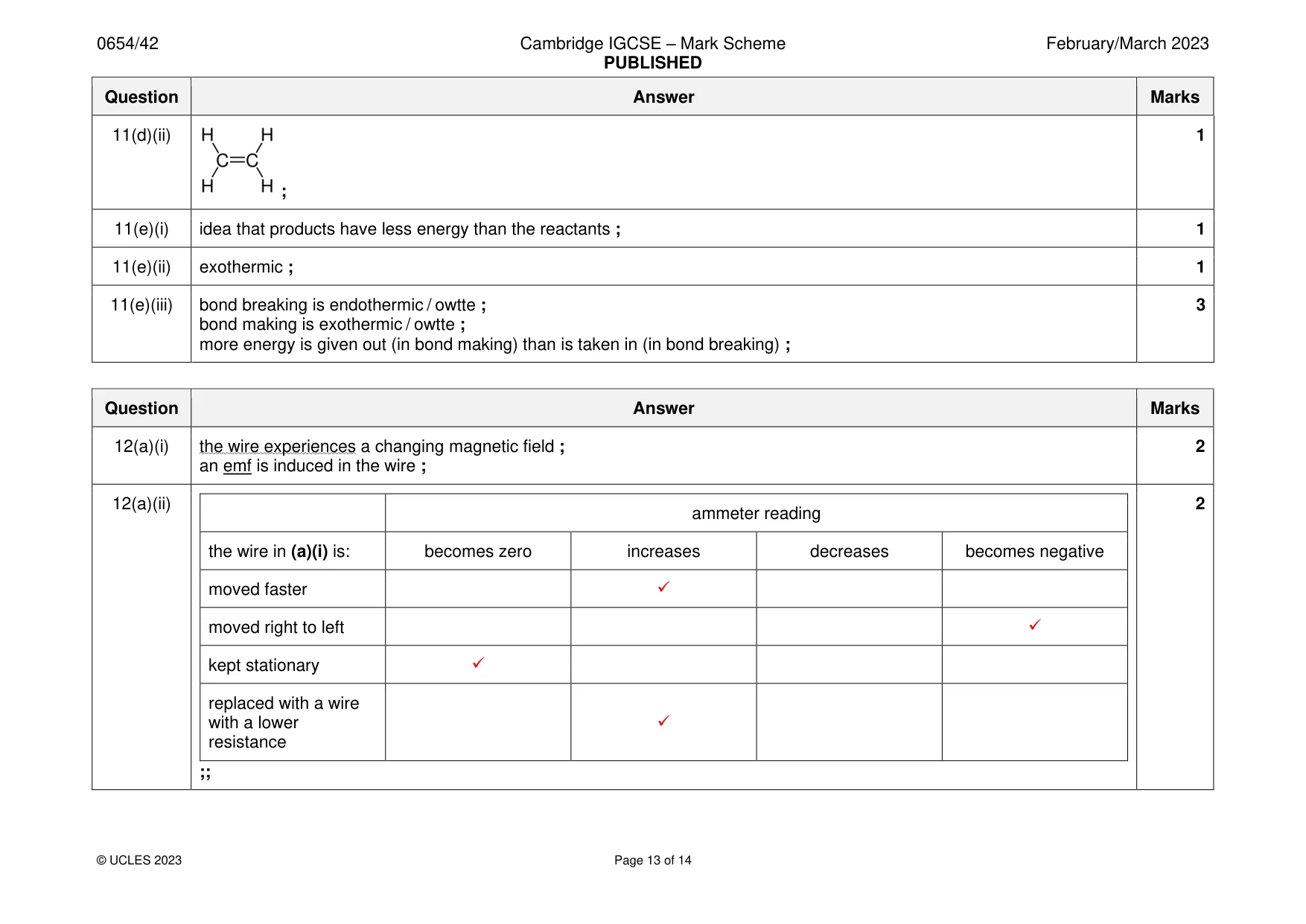
Mark scheme: 11(a) C ; 1 11(b) bromine ; 1 11(c) ethanol ; 1 11(d)(i) long chain ; 2 monomers ; 11(d)(ii) 1 ; 11(e)(i) idea that products have less energy than the reactants ; 1 11(e)(ii) exothermic ; 1 11(e)(iii) bond breaking is endothermic / owtte ; 3 bond making is exothermic / owtte ; more energy is given out (in bond making) than is taken in (in bond breaking) ;
Q12 · A wire being moved between the poles of a magnet
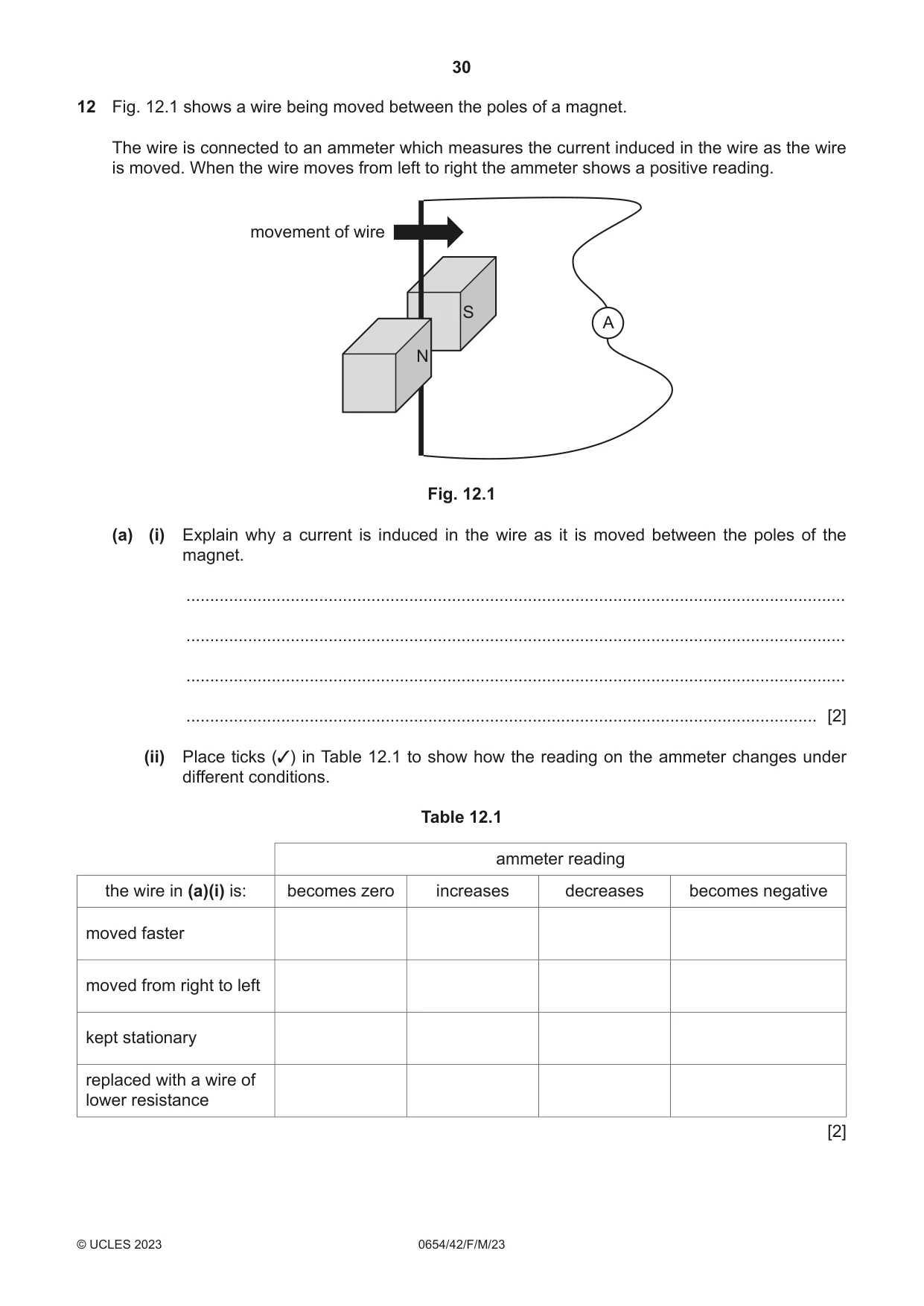
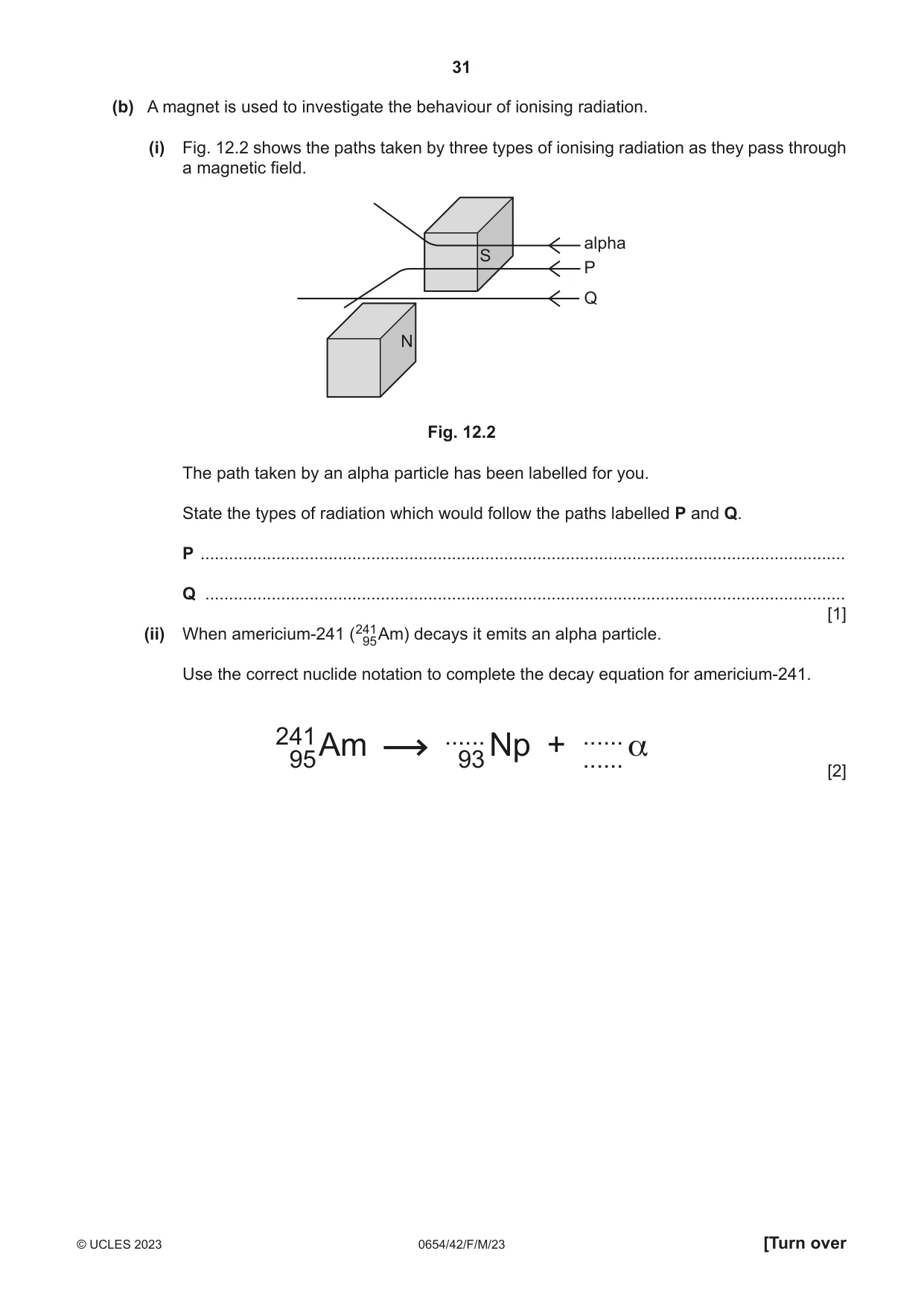
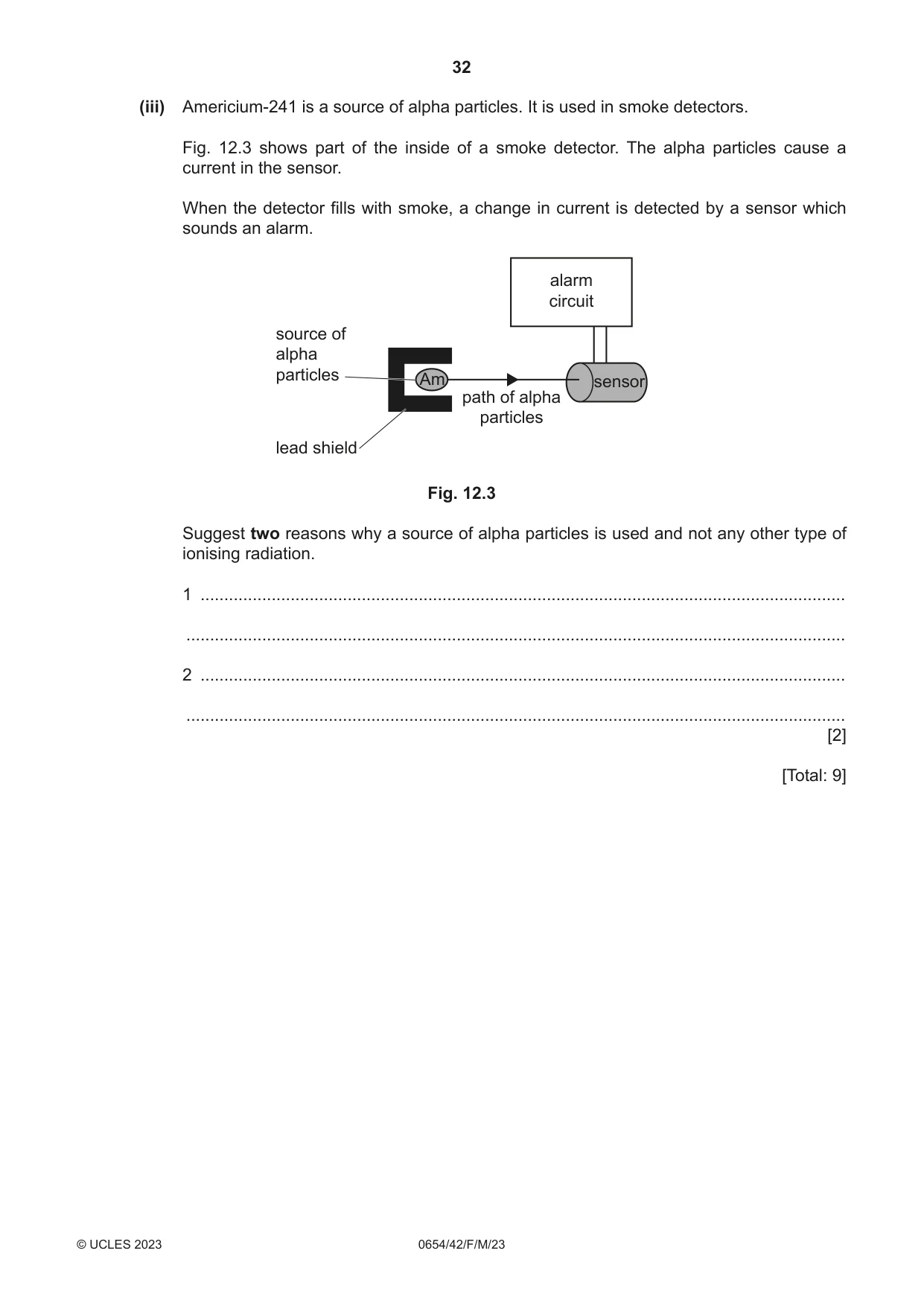
12 Fig. 12.1 shows a wire being moved between the poles of a magnet. The wire is connected to an ammeter which measures the current induced in the wire as the wire is moved. When the wire moves from left to right the ammeter shows a positive reading. movement of wire S A N Fig. 12.1 (a) (i) Explain why a current is induced in the wire as it is moved between the poles of the magnet. ........................................................................................................................................... ........................................................................................................................................... ........................................................................................................................................... ..................................................................................................................................... [2] (ii) Place ticks (3) in Table 12.1 to show how the reading on the ammeter changes under different conditions. Table 12.1 ammeter reading the wire in (a)(i) is: becomes zero increases decreases becomes negative moved faster moved from right to left kept stationary replaced with a wire of lower resistance [2] (b) A magnet is used to investigate the behaviour of ionising radiation. (i) Fig. 12.2 shows the paths taken by three types of ionising radiation as they pass through a magnetic field. alpha S P Q N Fig. 12.2 The path taken by an alpha particle has been labelled for you. State the types of radiation which would follow the paths labelled P and Q. P ........................................................................................................................................ Q ....................................................................................................................................... [1] (ii) When americium‑241 (24195 Am) decays it emits an alpha particle. Use the correct nuclide notation to complete the decay equation for americium‑241. 241 Am ...... Np + ...... α 95 93 ...... [2] (iii) Americium‑241 is a source of alpha particles. It is used in smoke detectors. Fig. 12.3 shows part of the inside of a smoke detector. The alpha particles cause a current in the sensor. When the detector fills with smoke, a change in current is detected by a sensor which sounds an alarm. alarm circuit source of alpha particles Am sensor path of alpha particles lead shield Fig. 12.3 Suggest two reasons why a source of alpha particles is used and not any other type of ionising radiation. 1 ........................................................................................................................................ ........................................................................................................................................... 2 ........................................................................................................................................ ........................................................................................................................................... [2] [Total: 9]
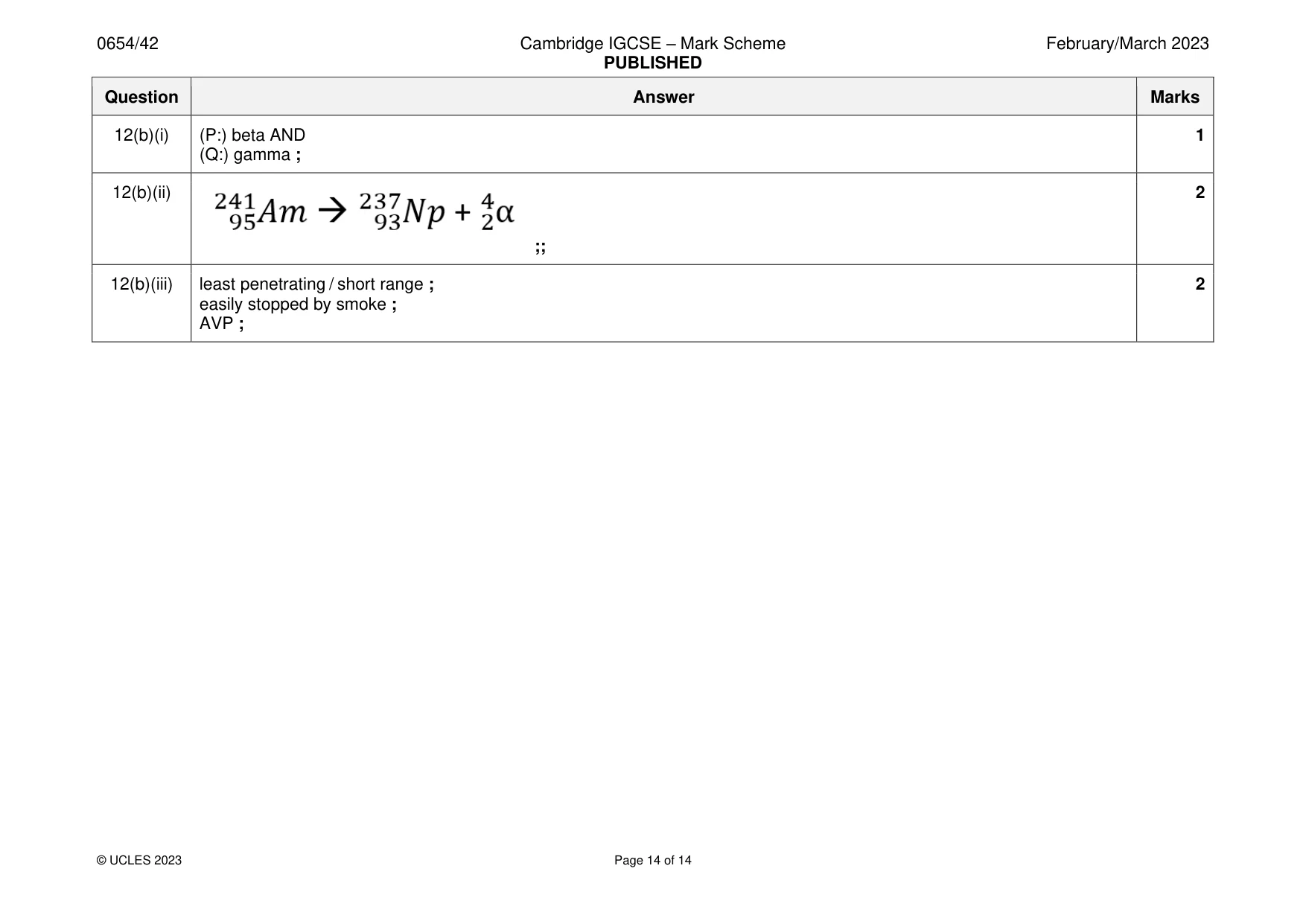
Mark scheme: 12(a)(i) the wire experiences a changing magnetic field ; 2 an emf is induced in the wire ; 12(a)(ii) 2 ammeter reading the wire in (a)(i) is: becomes zero increases decreases becomes negative moved faster ✓ moved right to left ✓ kept stationary ✓ replaced with a wire with a lower ✓ resistance ;; 12(b)(i) (P:) beta AND 1 (Q:) gamma ; 12(b)(ii) 2 ;; 12(b)(iii) least penetrating / short range ; 2 easily stopped by smoke ; AVP ;
What was in this paper
The subtopics covered by these 12 questions, and how many questions each got. Open one in a new tab to see every Cambridge question on it.
What you needed in this session
Cambridge’s own grade thresholds for 2023 Feb/March, Paper 4 · Variant 2. A higher threshold means an easier paper — the bar moves with how the cohort did.