Cambridge IGCSE Sciences - Co-ordinated (Double) 0654 — 2019 Oct/Nov Paper 4 · Variant 1
0654/41/O/N/19 · 12 questions · 120 marks · ≈135 min
The question paper and its mark scheme, free to read here and free to download. This is Cambridge’s own paper, exactly as it was sat.
Question paper32 pages


Mark scheme15 pages
Answers below. Sit the paper first if you are practising.
Questions as text
Q1 · Complete the sentence to define the term anaerobic respiration
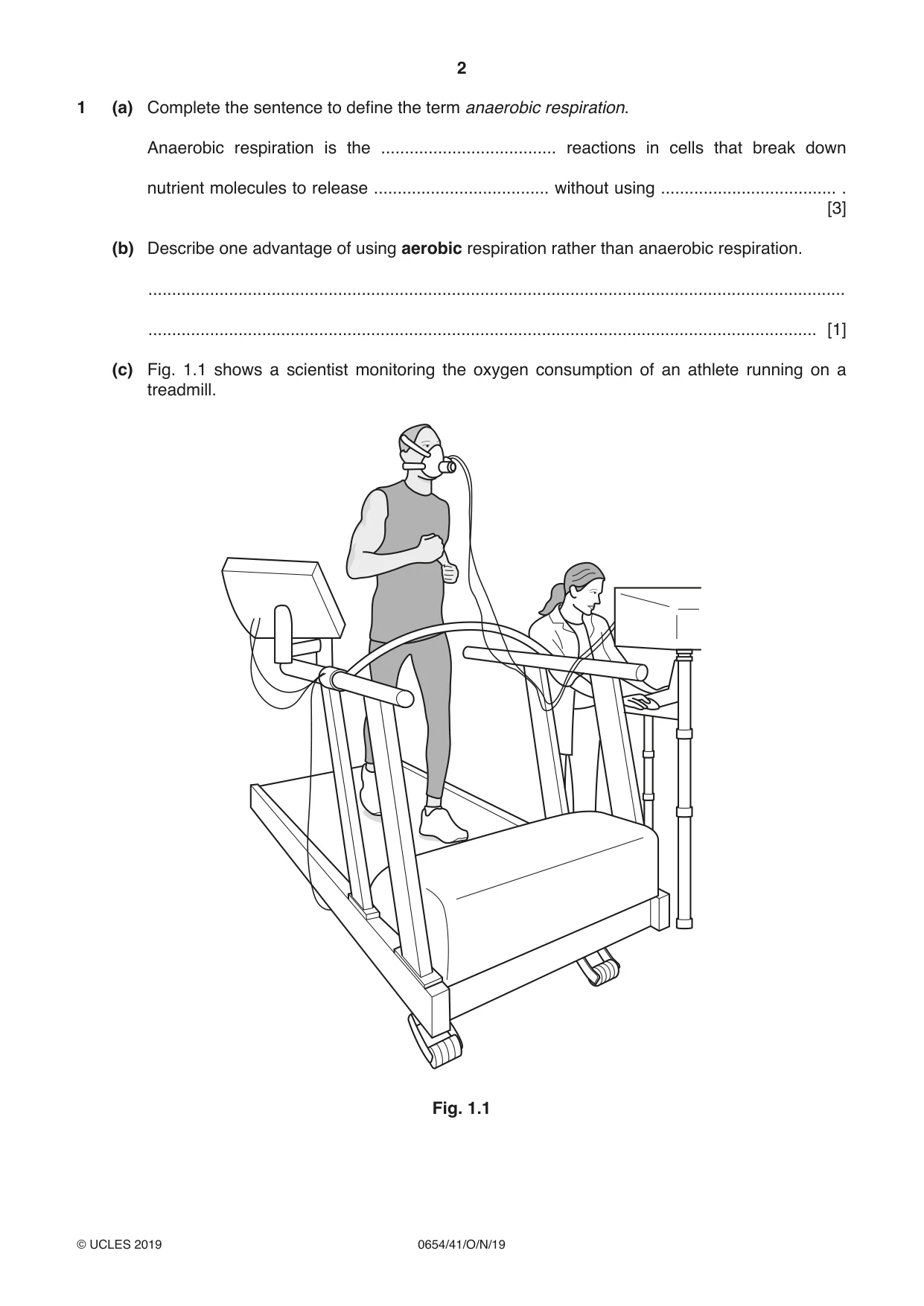
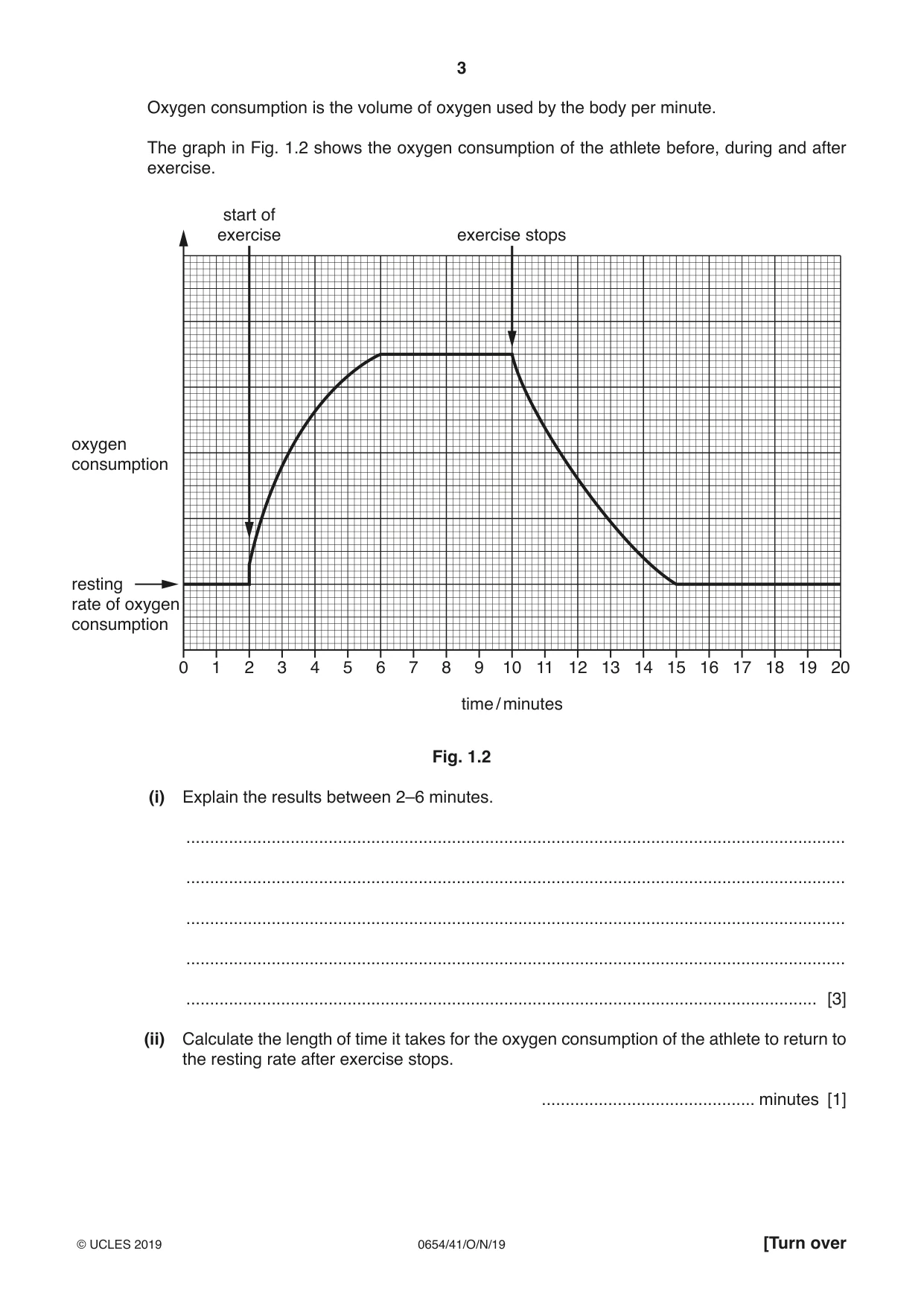
1 (a) Complete the sentence to define the term anaerobic respiration. Anaerobic respiration is the ..................................... reactions in cells that break down nutrient molecules to release ..................................... without using ..................................... . [3] (b) Describe one advantage of using aerobic respiration rather than anaerobic respiration. ................................................................................................................................................... ............................................................................................................................................. [1] (c) Fig. 1.1 shows a scientist monitoring the oxygen consumption of an athlete running on a treadmill. Fig. 1.1 Oxygen consumption is the volume of oxygen used by the body per minute. The graph in Fig. 1.2 shows the oxygen consumption of the athlete before, during and after exercise. start of exercise exercise stops oxygen consumption resting rate of oxygen consumption 0 1 2 3 4 5 6 7 8 9 10 11 12 13 14 15 16 17 18 19 20 time / minutes Fig. 1.2 (i) Explain the results between 2–6 minutes. ........................................................................................................................................... ........................................................................................................................................... ........................................................................................................................................... ........................................................................................................................................... ..................................................................................................................................... [3] (ii) Calculate the length of time it takes for the oxygen consumption of the athlete to return to the resting rate after exercise stops. ............................................. minutes [1] (iii) Explain why oxygen consumption does not return to resting rate immediately after exercise stops. ........................................................................................................................................... ........................................................................................................................................... ..................................................................................................................................... [2] [Total: 10]
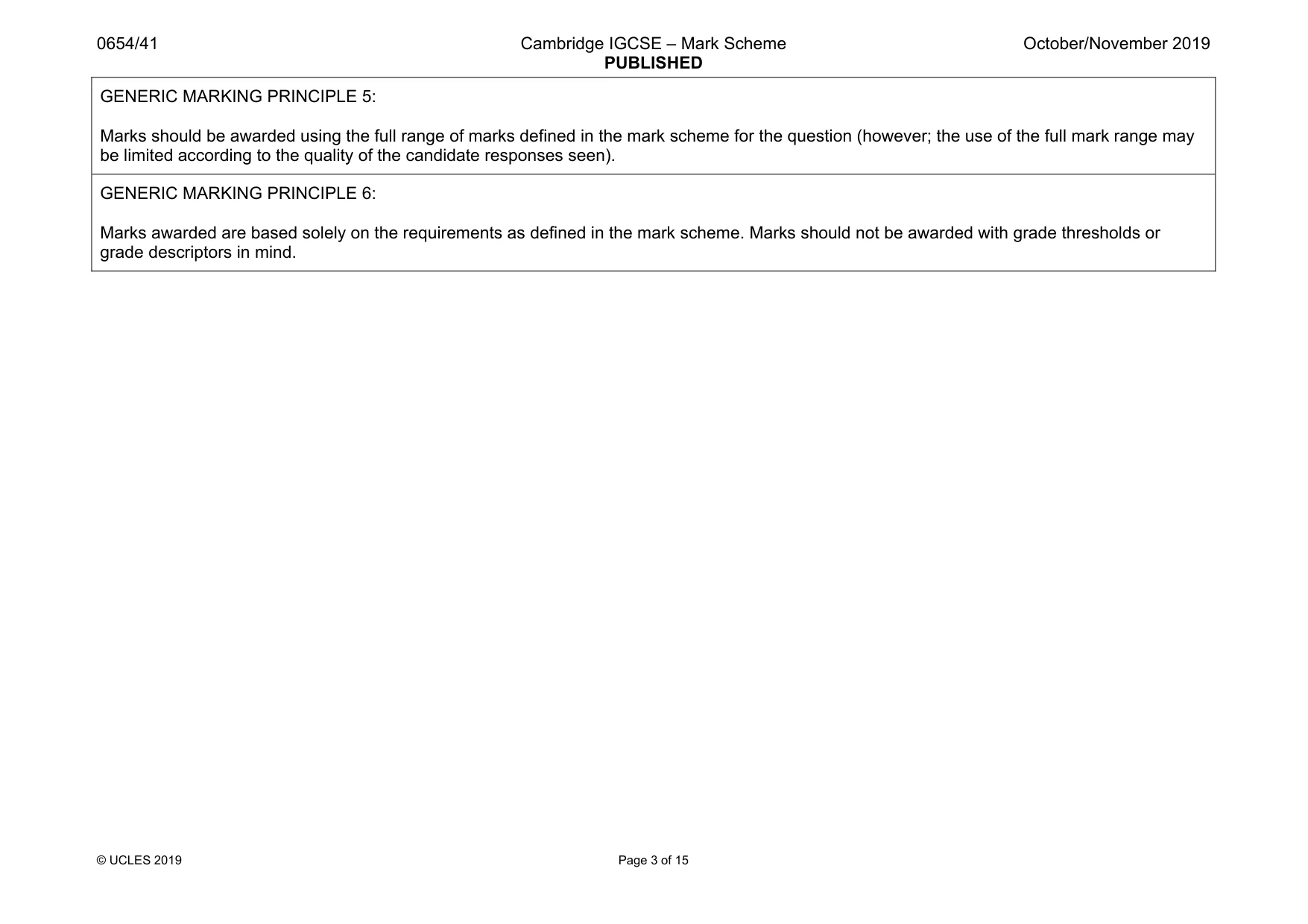
Mark scheme: 1(a) chemical ; energy ; oxygen ; 3 1(b) release more energy (per glucose molecule) / does not produce lactic acid ; 1 1(c)(i) increased breathing rate or depth ; increased respiration ; increased need for energy ; increased muscle contraction ; max 3 3 1(c)(ii) 5 (minutes) ; 1 1(c)(iii) anaerobic respiration has taken place ; needs to repay oxygen debt / to remove lactic acid ; 2
Q2 · A pie chart which shows the composition of clean air
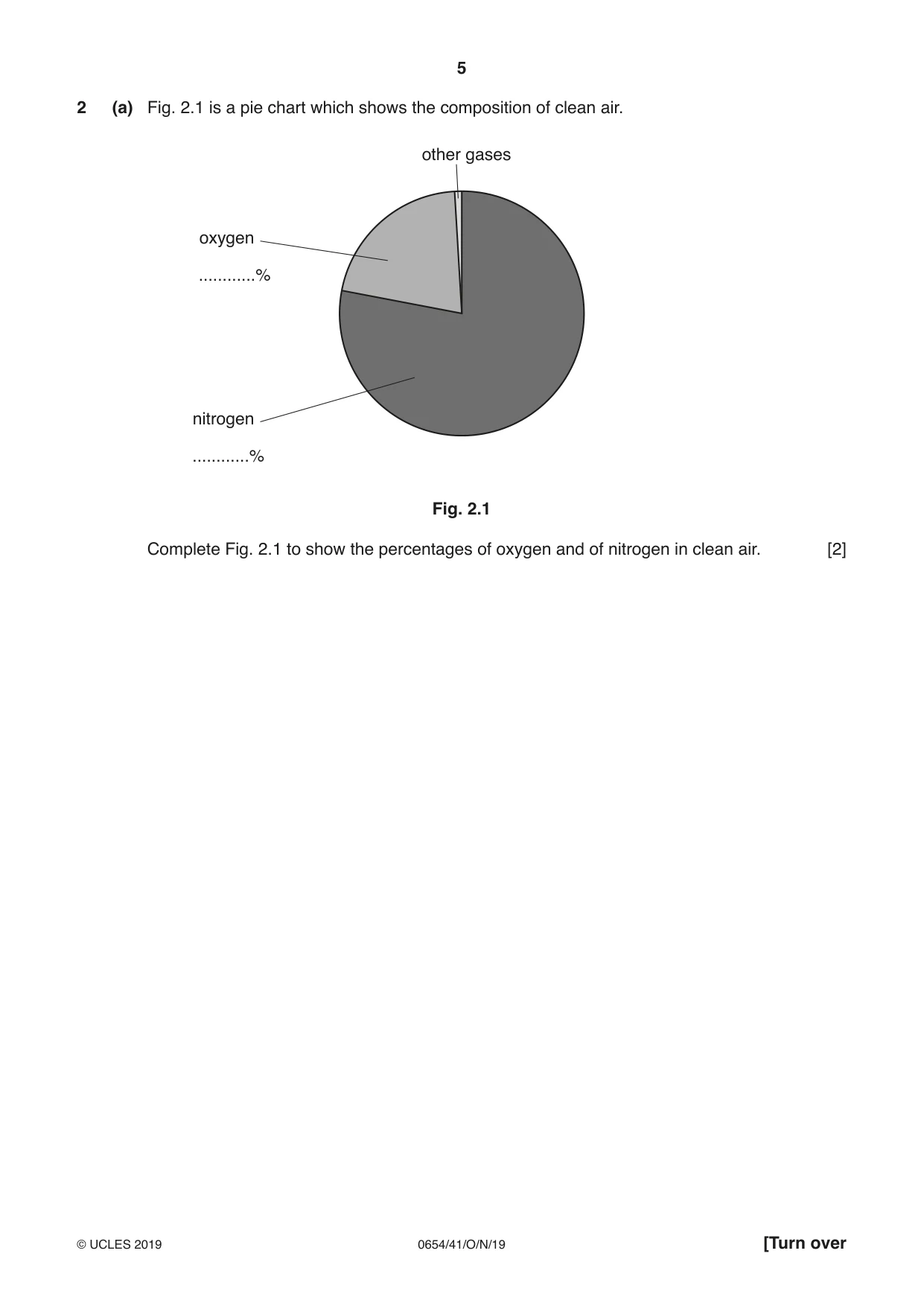
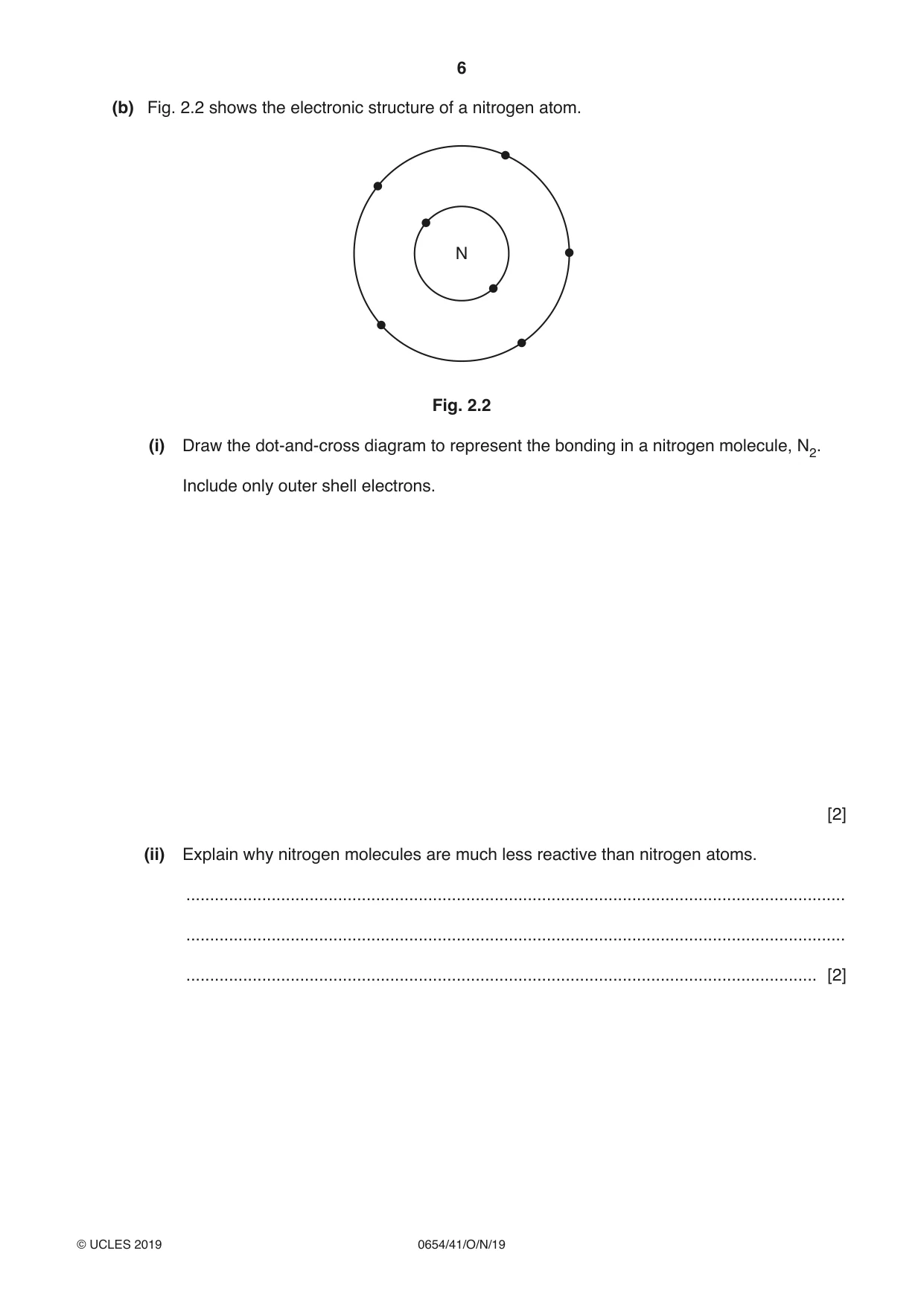
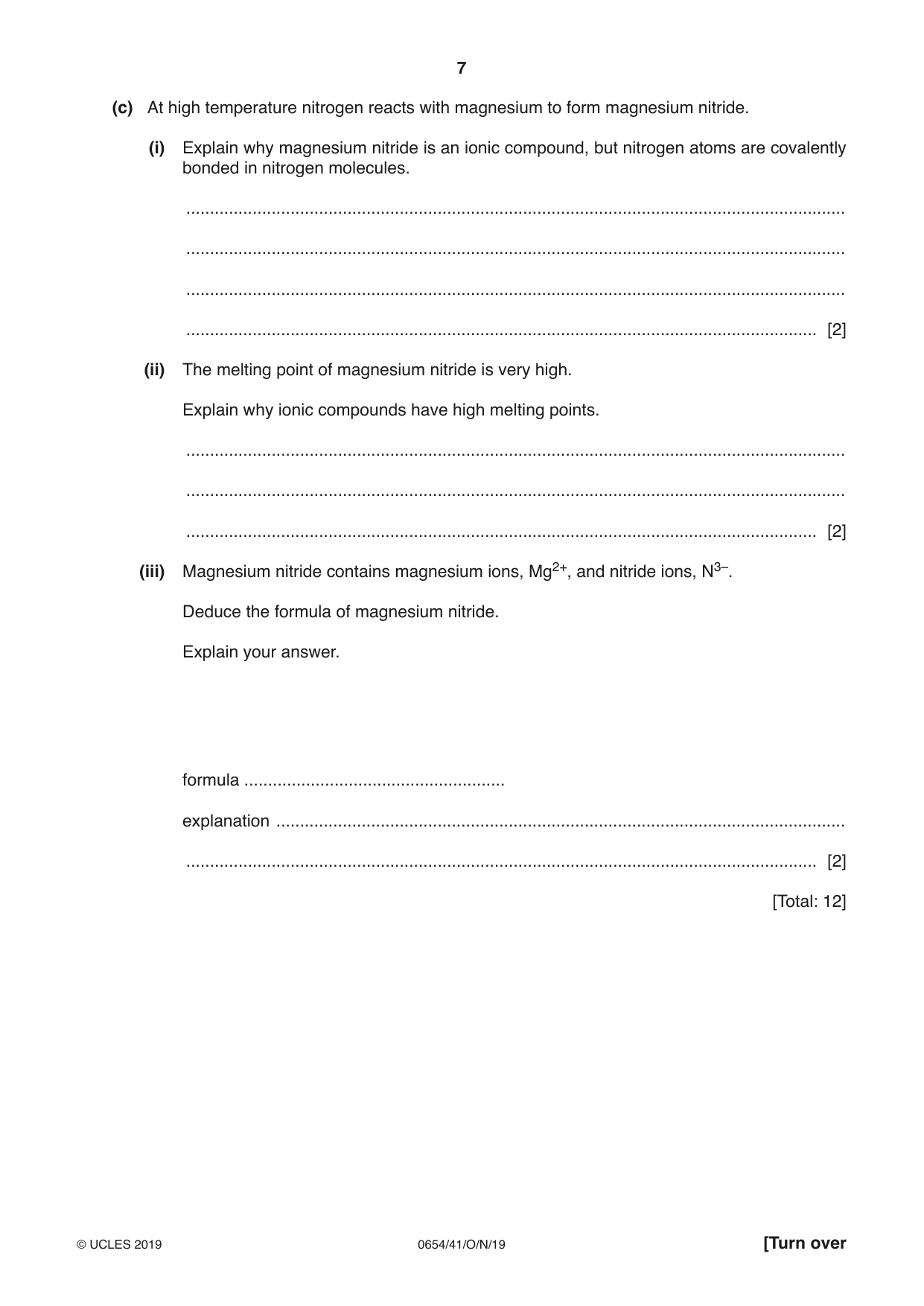
2 (a) Fig. 2.1 is a pie chart which shows the composition of clean air. other gases oxygen ............% nitrogen ............% Fig. 2.1 Complete Fig. 2.1 to show the percentages of oxygen and of nitrogen in clean air. [2] (b) Fig. 2.2 shows the electronic structure of a nitrogen atom. N Fig. 2.2 (i) Draw the dot-and-cross diagram to represent the bonding in a nitrogen molecule, N2. Include only outer shell electrons. [2] (ii) Explain why nitrogen molecules are much less reactive than nitrogen atoms. ........................................................................................................................................... ........................................................................................................................................... ..................................................................................................................................... [2] (c) At high temperature nitrogen reacts with magnesium to form magnesium nitride. (i) Explain why magnesium nitride is an ionic compound, but nitrogen atoms are covalently bonded in nitrogen molecules. ........................................................................................................................................... ........................................................................................................................................... ........................................................................................................................................... ..................................................................................................................................... [2] (ii) The melting point of magnesium nitride is very high. Explain why ionic compounds have high melting points. ........................................................................................................................................... ........................................................................................................................................... ..................................................................................................................................... [2] (iii) Magnesium nitride contains magnesium ions, Mg2+, and nitride ions, N3–. Deduce the formula of magnesium nitride. Explain your answer. formula ....................................................... explanation ........................................................................................................................ ..................................................................................................................................... [2] [Total: 12]
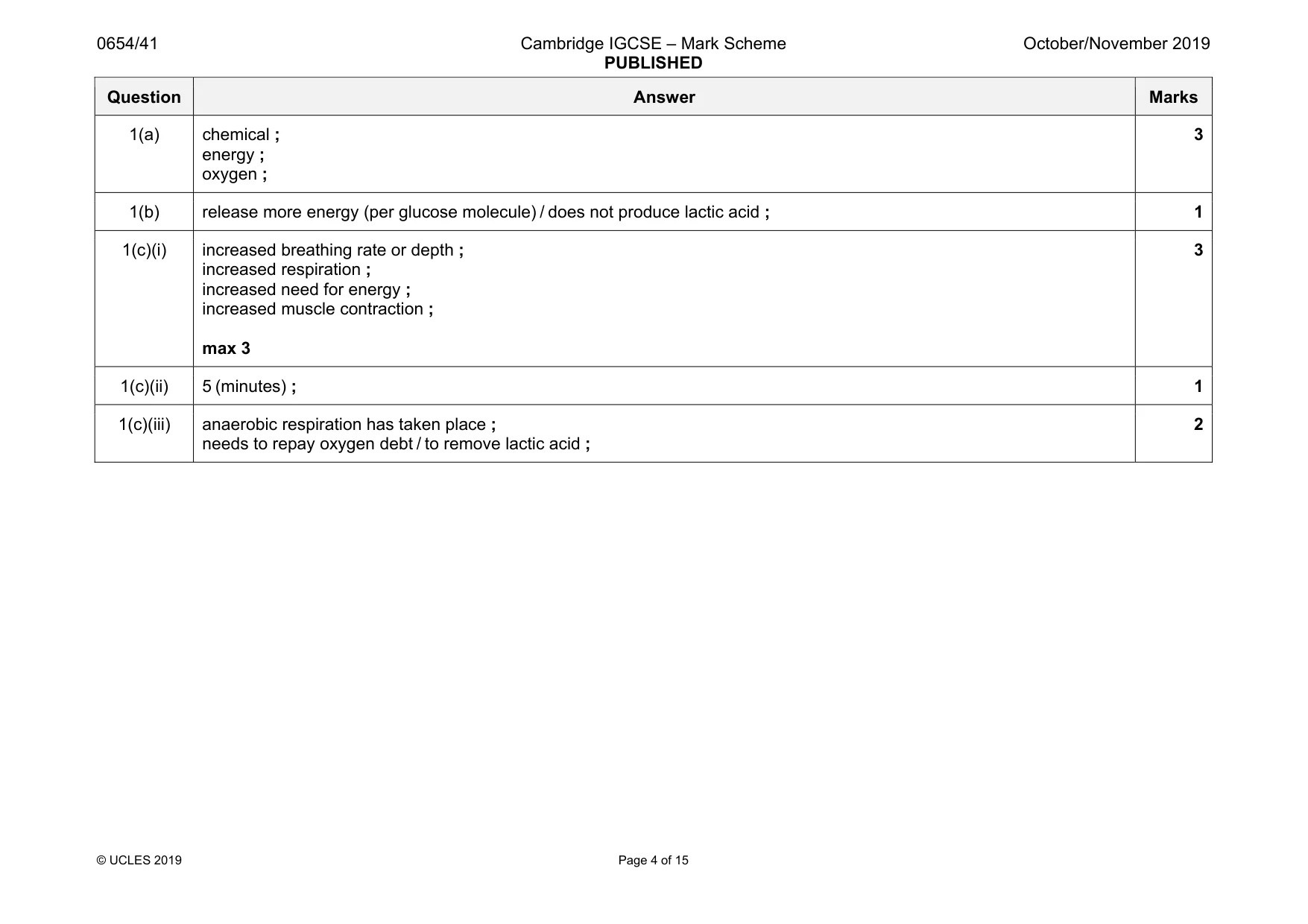
Mark scheme: 2(a) oxygen: 21 ; nitrogen: 78 ; 2 2(b)(i) 3 bonding pairs ; 2 lone pairs, all else correct ; 2 2(b)(ii) (molecule is unreactive because of) strong (covalent) bonding between atoms / triple bond ; (atom is reactive because) atom has high tendency to gain electrons / has incomplete electron shell / does not have noble gas structure / owtte ; 2 2(c)(i) ionic bonds between metallic and non-metallic elements ; covalent bonds between non-metallic elements / nitrogen is a non-metal (so covalently bonded) ; 2 2(c)(ii) attractive force between oppositely charged ions / strong force / bonds between ions / many forces / bonds between ions ; more energy required to overcome force / break bond ; 2 2(c)(iii) Mg3N2 ; idea of balanced charges ; 2
Q3 · A potato being baked in the oven of an electric cooker
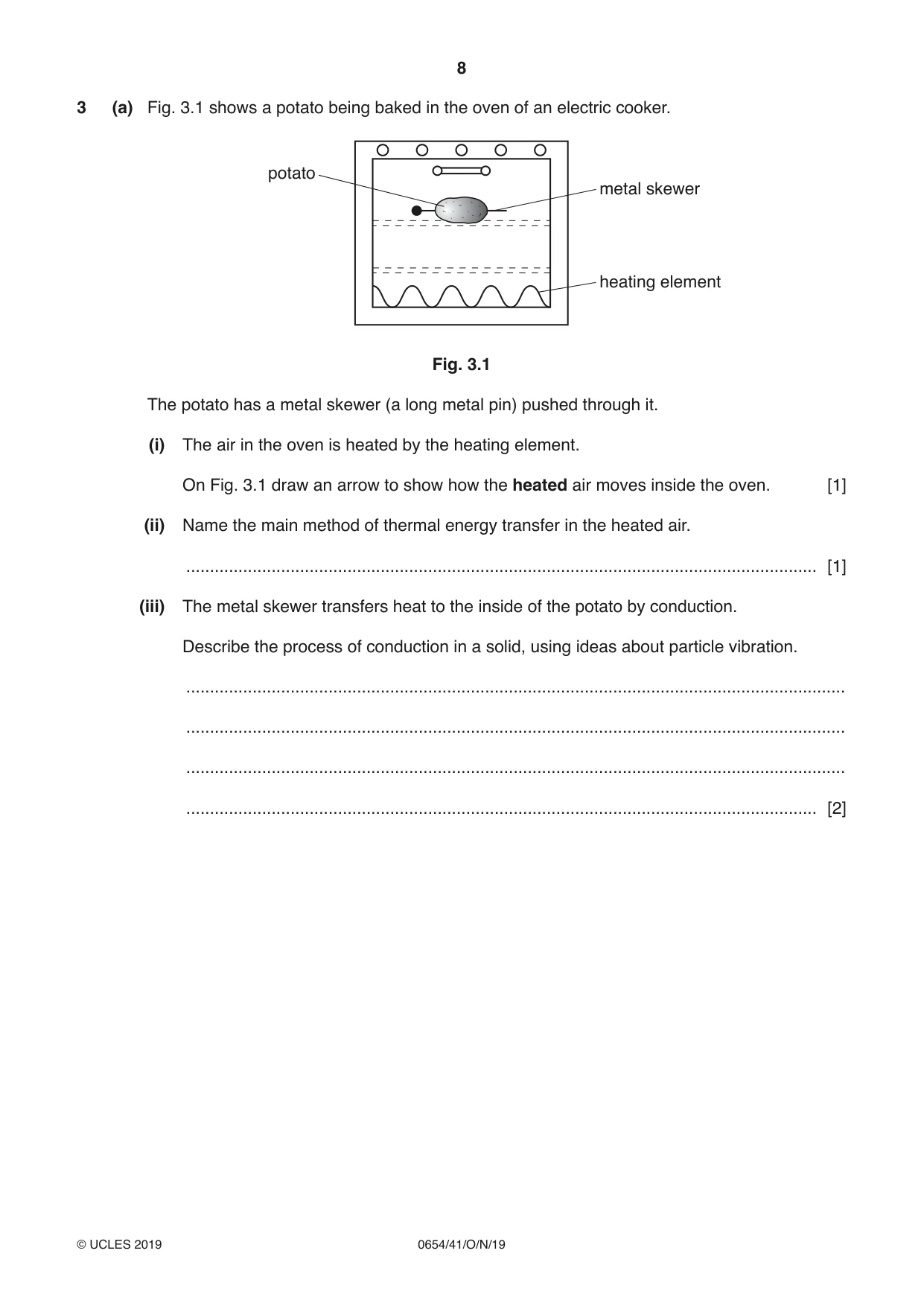
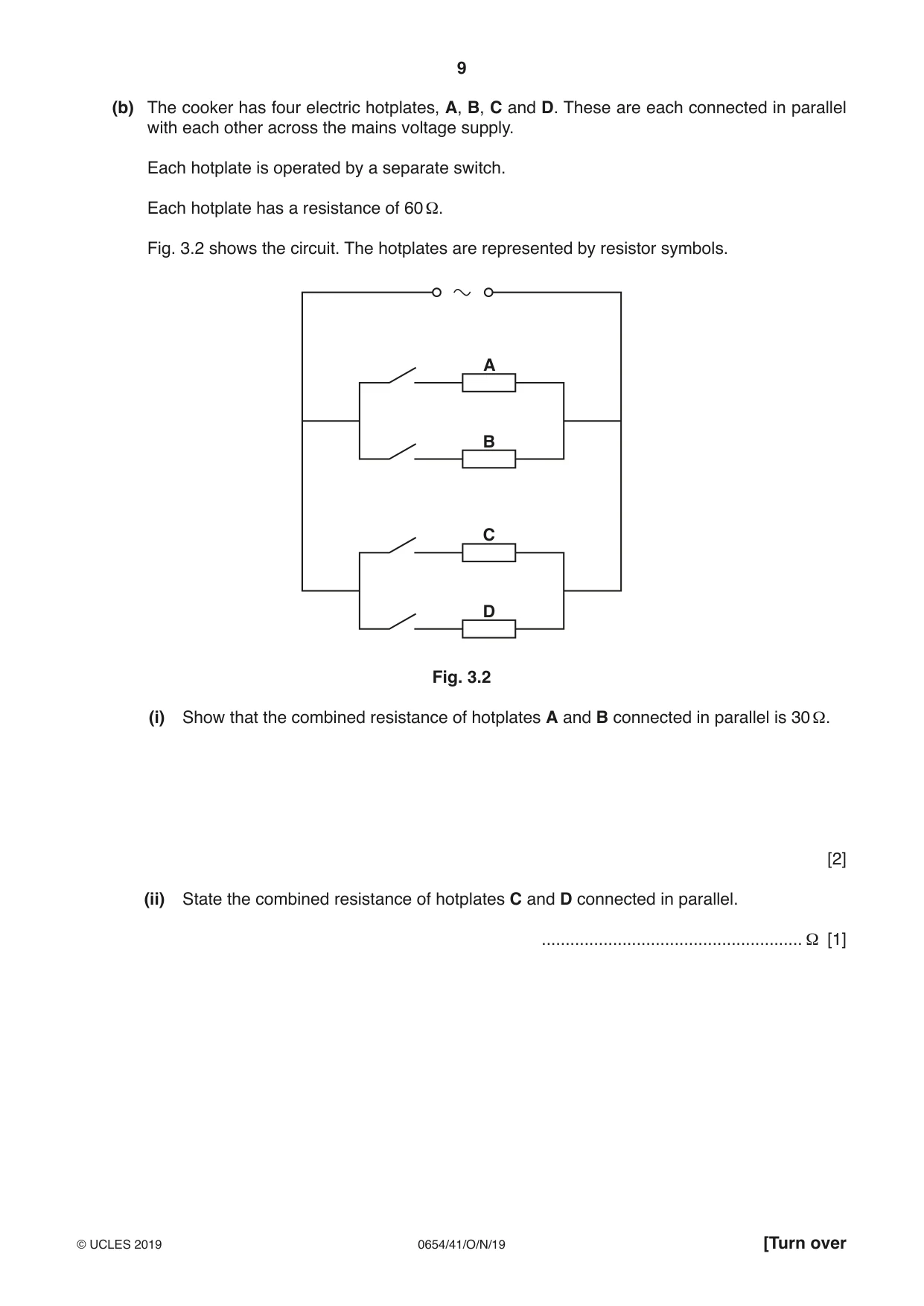
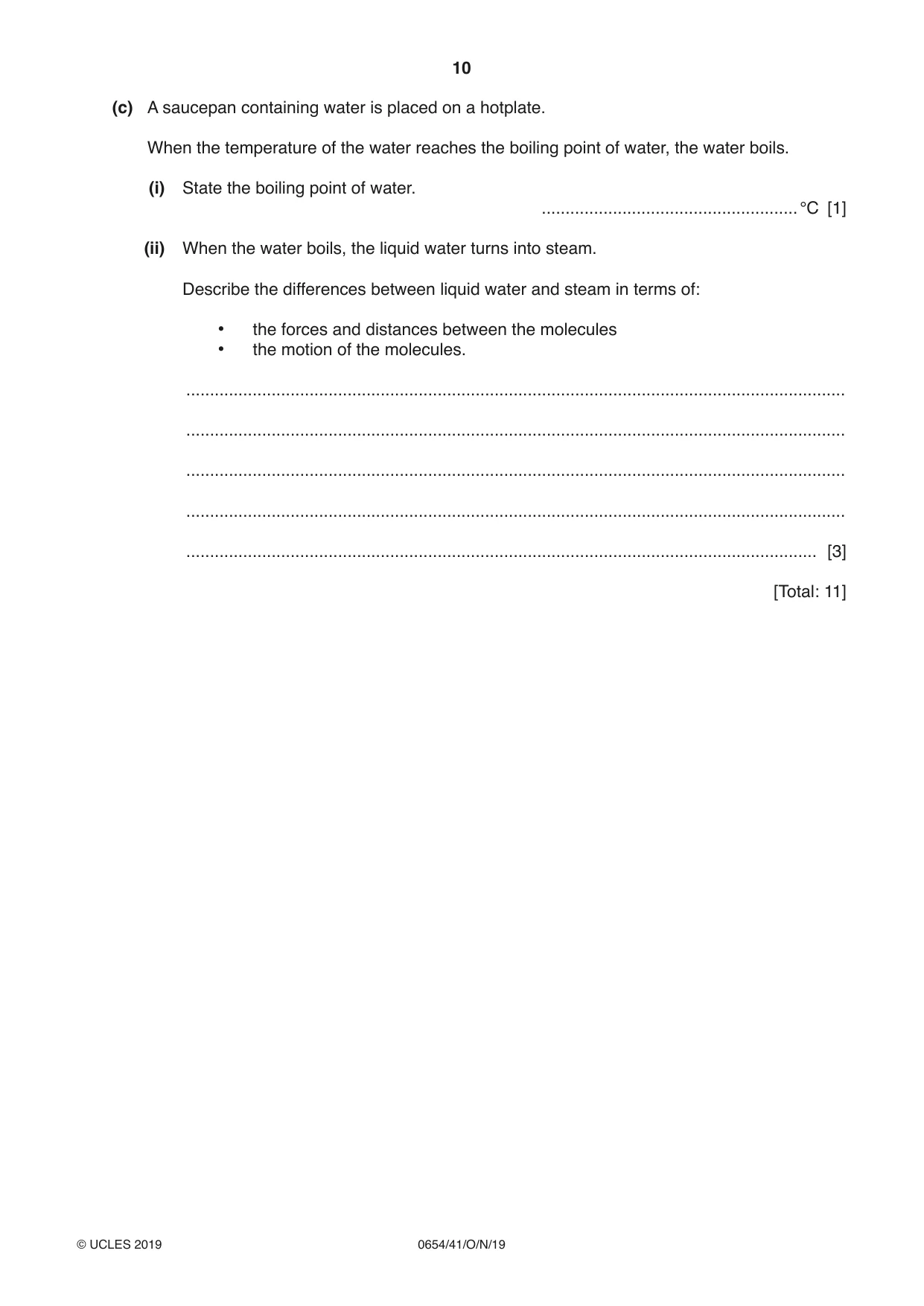
3 (a) Fig. 3.1 shows a potato being baked in the oven of an electric cooker. potato metal skewer heating element Fig. 3.1 The potato has a metal skewer (a long metal pin) pushed through it. (i) The air in the oven is heated by the heating element. On Fig. 3.1 draw an arrow to show how the heated air moves inside the oven. [1] (ii) Name the main method of thermal energy transfer in the heated air. ..................................................................................................................................... [1] (iii) The metal skewer transfers heat to the inside of the potato by conduction. Describe the process of conduction in a solid, using ideas about particle vibration. ........................................................................................................................................... ........................................................................................................................................... ........................................................................................................................................... ..................................................................................................................................... [2] (b) The cooker has four electric hotplates, A, B, C and D. These are each connected in parallel with each other across the mains voltage supply. Each hotplate is operated by a separate switch. Each hotplate has a resistance of 60 Ω. Fig. 3.2 shows the circuit. The hotplates are represented by resistor symbols. A B C D Fig. 3.2 (i) Show that the combined resistance of hotplates A and B connected in parallel is 30 Ω. [2] (ii) State the combined resistance of hotplates C and D connected in parallel. ....................................................... Ω [1] (c) A saucepan containing water is placed on a hotplate. When the temperature of the water reaches the boiling point of water, the water boils. (i) State the boiling point of water. ...................................................... °C [1] (ii) When the water boils, the liquid water turns into steam. Describe the differences between liquid water and steam in terms of: • the forces and distances between the molecules • the motion of the molecules. ........................................................................................................................................... ........................................................................................................................................... ........................................................................................................................................... ........................................................................................................................................... ..................................................................................................................................... [3] [Total: 11]
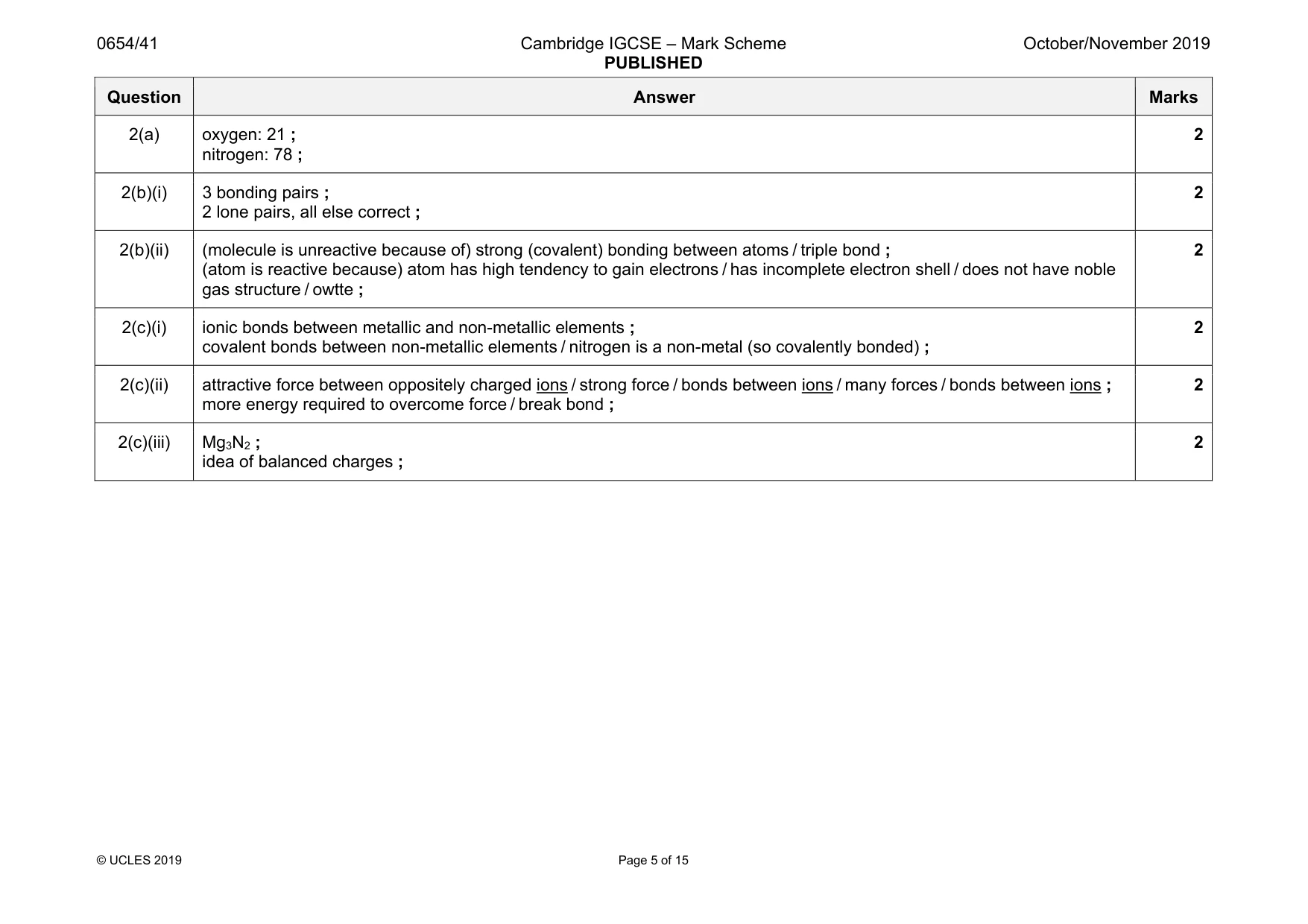
Mark scheme: 3(a)(i) arrow showing heated air rising ; 1 3(a)(ii) convection ; 1 3(a)(iii) particles vibrate more / gain energy ; this vibration is passed through metal ; 2 3(b)(i) use of correct formula ; evidence of correct working ; 2 3(b)(ii) 30 Ω ; 1 3(c)(i) 100 (°C) ; 1 3(c)(ii) stronger forces of attraction between water molecules in liquid ; water molecules are closer together in liquid ; water molecules have greater freedom of movement / collide less frequently in steam / owtte ; 3
Q4 · A section through the eye
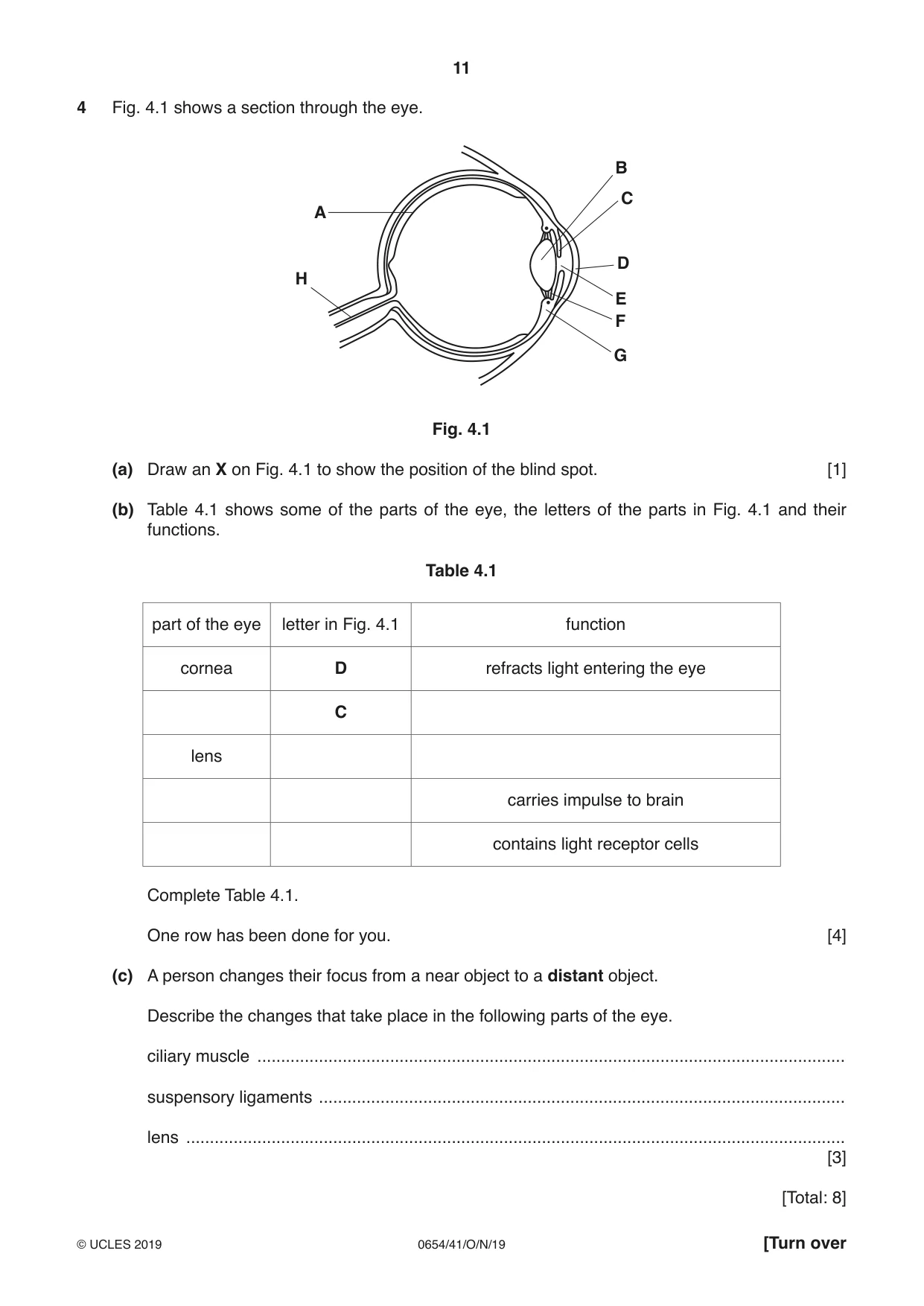
4 Fig. 4.1 shows a section through the eye. B C A D H E F G Fig. 4.1 (a) Draw an X on Fig. 4.1 to show the position of the blind spot. [1] (b) Table 4.1 shows some of the parts of the eye, the letters of the parts in Fig. 4.1 and their functions. Table 4.1 part of the eye letter in Fig. 4.1 function cornea D refracts light entering the eye C lens carries impulse to brain contains light receptor cells Complete Table 4.1. One row has been done for you. [4] (c) A person changes their focus from a near object to a distant object. Describe the changes that take place in the following parts of the eye. ciliary muscle ............................................................................................................................ suspensory ligaments ............................................................................................................... lens ........................................................................................................................................... [3] [Total: 8]
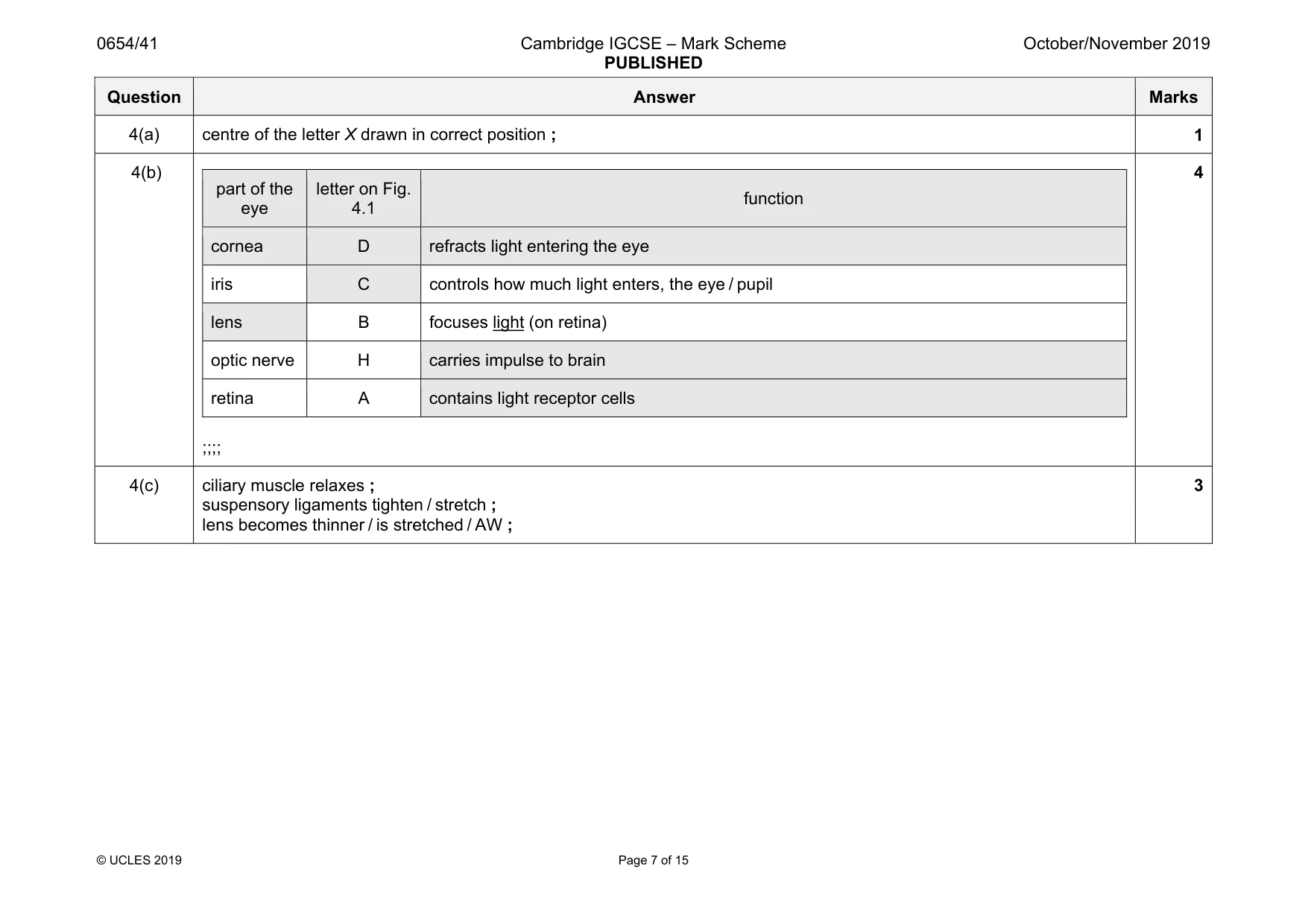
Mark scheme: 4(a) centre of the letter X drawn in correct position ; 1 4(b) ;;;; part of the eye letter on Fig. 4.1 function cornea D refracts light entering the eye iris C controls how much light enters, the eye / pupil lens B focuses light (on retina) optic nerve H carries impulse to brain retina A contains light receptor cells 4 4(c) ciliary muscle relaxes ; suspensory ligaments tighten / stretch ; lens becomes thinner / is stretched / AW ; 3
Q5 · Limestone consists mainly of calcium carbonate
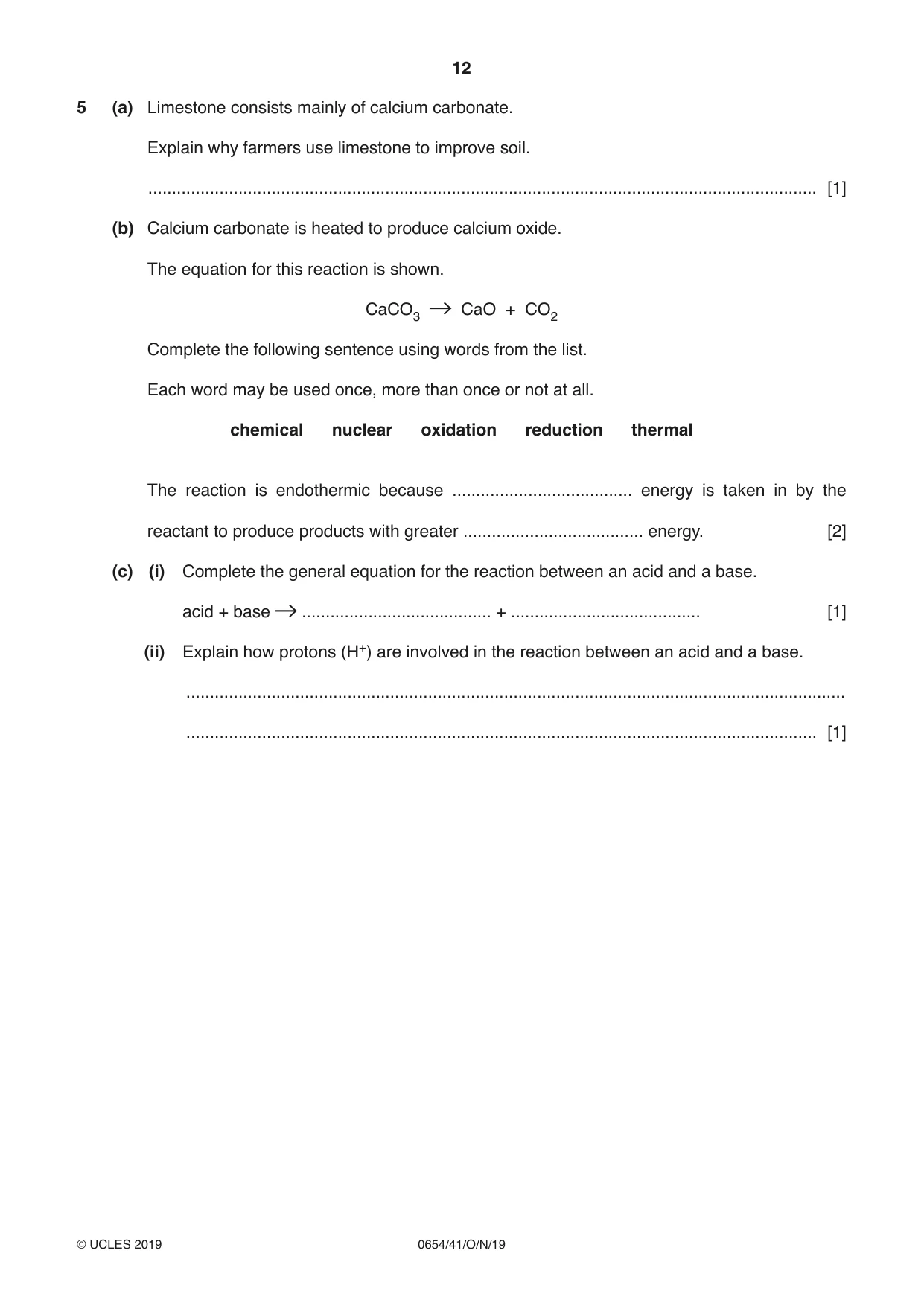
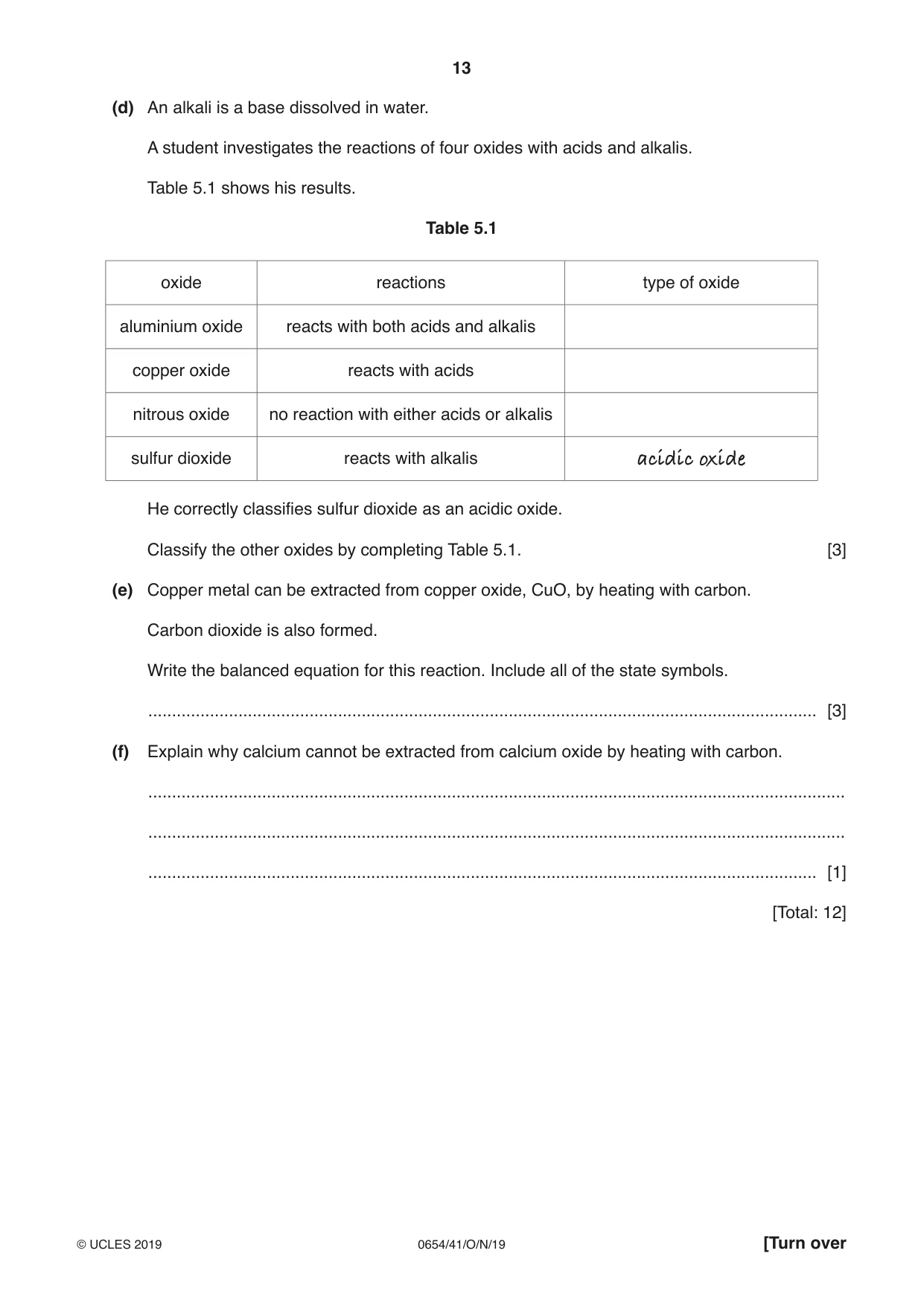
5 (a) Limestone consists mainly of calcium carbonate. Explain why farmers use limestone to improve soil. ............................................................................................................................................. [1] (b) Calcium carbonate is heated to produce calcium oxide. The equation for this reaction is shown. CaCO3 CaO + CO2 Complete the following sentence using words from the list. Each word may be used once, more than once or not at all. chemical nuclear oxidation reduction thermal The reaction is endothermic because ...................................... energy is taken in by the reactant to produce products with greater ...................................... energy. [2] (c) (i) Complete the general equation for the reaction between an acid and a base. acid + base ........................................ + ........................................ [1] (ii) Explain how protons (H+) are involved in the reaction between an acid and a base. ........................................................................................................................................... ..................................................................................................................................... [1] (d) An alkali is a base dissolved in water. A student investigates the reactions of four oxides with acids and alkalis. Table 5.1 shows his results. Table 5.1 oxide reactions type of oxide aluminium oxide reacts with both acids and alkalis copper oxide reacts with acids nitrous oxide no reaction with either acids or alkalis sulfur dioxide reacts with alkalis acidic oxide He correctly classifies sulfur dioxide as an acidic oxide. Classify the other oxides by completing Table 5.1. [3] (e) Copper metal can be extracted from copper oxide, CuO, by heating with carbon. Carbon dioxide is also formed. Write the balanced equation for this reaction. Include all of the state symbols. ............................................................................................................................................. [3] (f) Explain why calcium cannot be extracted from calcium oxide by heating with carbon. ................................................................................................................................................... ................................................................................................................................................... ............................................................................................................................................. [1] [Total: 12]
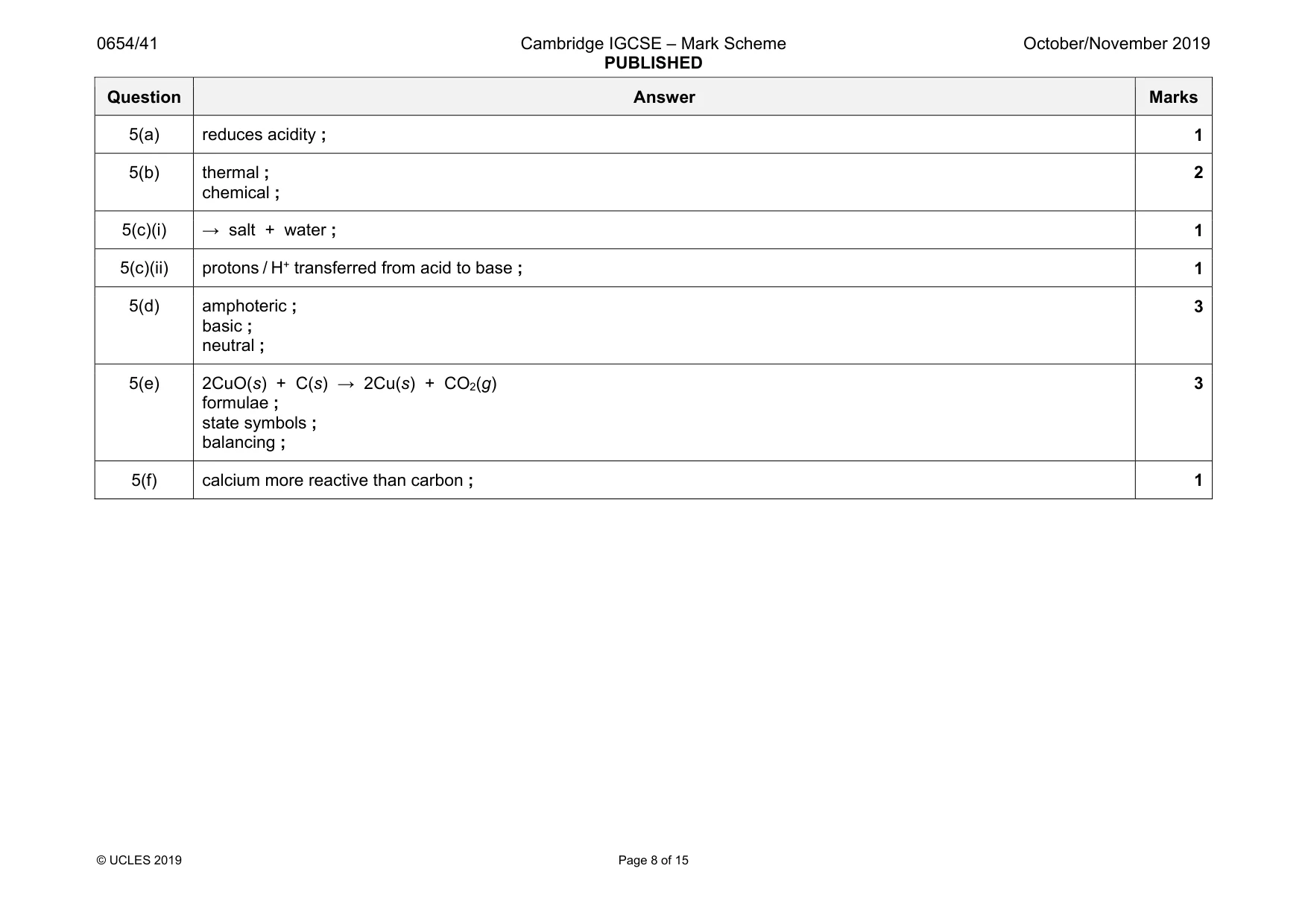
Mark scheme: 5(a) reduces acidity ; 1 5(b) thermal ; chemical ; 2 5(c)(i) → salt + water ; 1 5(c)(ii) protons / H+ transferred from acid to base ; 1 5(d) amphoteric ; basic ; neutral ; 3 5(e) 2CuO(s) + C(s) → 2Cu(s) + CO2(g) formulae ; state symbols ; balancing ; 3 5(f) calcium more reactive than carbon ; 1
More questions on The characteristic properties of acids and bases
Q6 · An iron magnet picks up two iron nails as shown in Fig
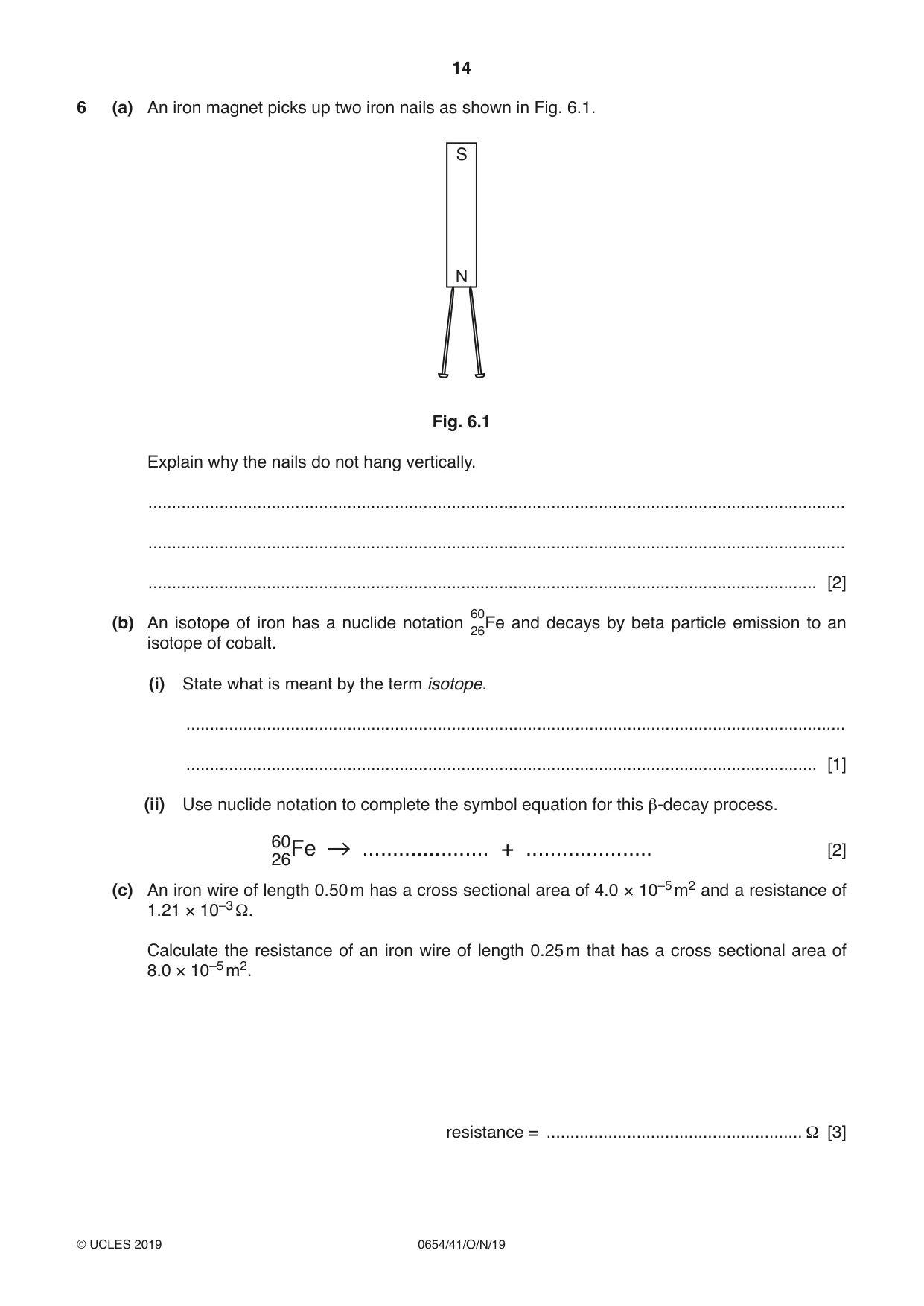
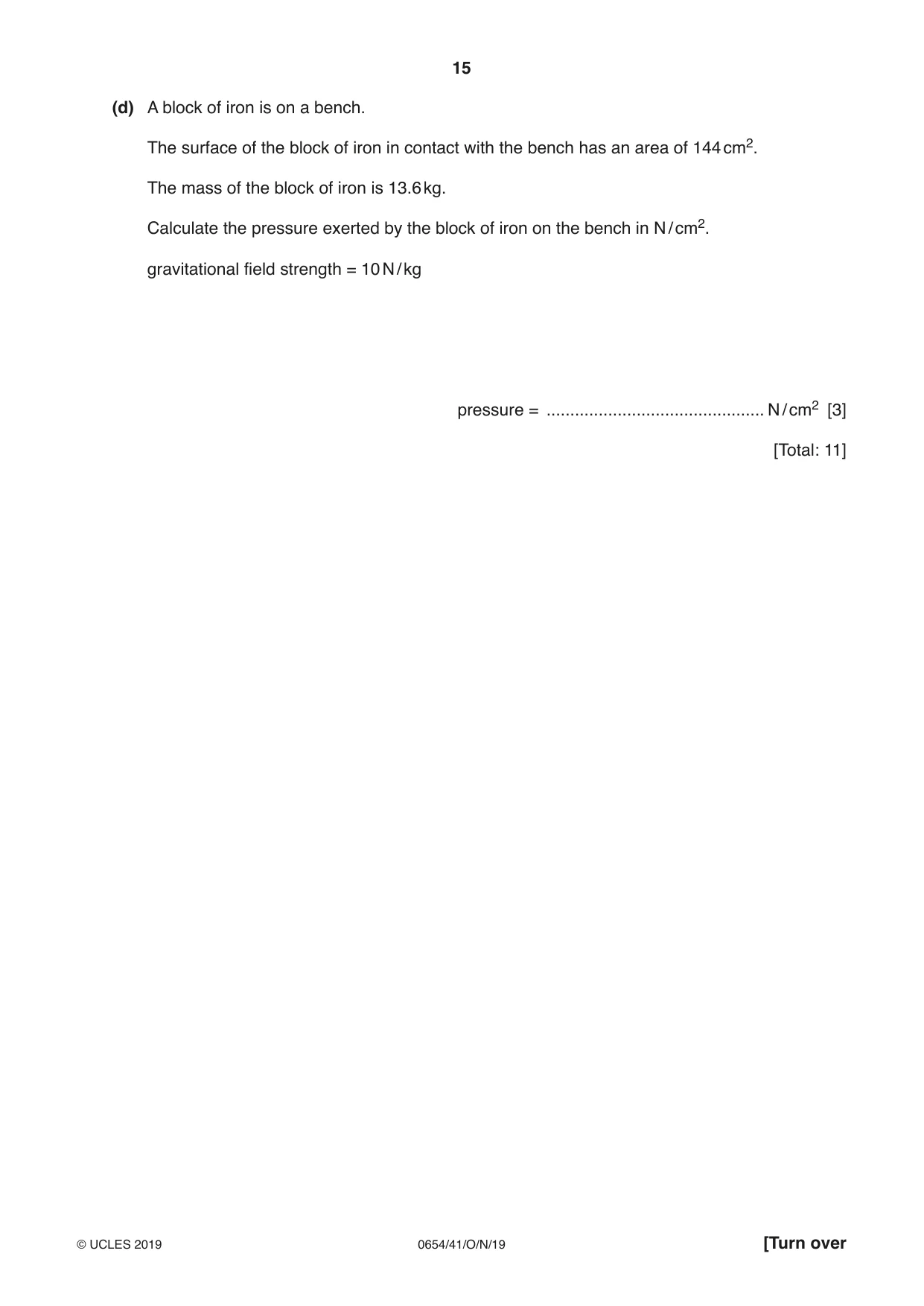
6 (a) An iron magnet picks up two iron nails as shown in Fig. 6.1. S N Fig. 6.1 Explain why the nails do not hang vertically. ................................................................................................................................................... ................................................................................................................................................... ............................................................................................................................................. [2] 60 (b) An isotope of iron has a nuclide notation 26Fe and decays by beta particle emission to an isotope of cobalt. (i) State what is meant by the term isotope. ........................................................................................................................................... ..................................................................................................................................... [1] (ii) Use nuclide notation to complete the symbol equation for this β-decay process. [2] 6026Fe ..................... + ..................... (c) An iron wire of length 0.50 m has a cross sectional area of 4.0 × 10⁻⁵ m2 and a resistance of 1.21 × 10⁻³ Ω. Calculate the resistance of an iron wire of length 0.25 m that has a cross sectional area of 8.0 × 10⁻⁵ m2. resistance = ...................................................... Ω [3] (d) A block of iron is on a bench. The surface of the block of iron in contact with the bench has an area of 144 cm2. The mass of the block of iron is 13.6 kg. Calculate the pressure exerted by the block of iron on the bench in N / cm2. gravitational field strength = 10 N / kg pressure = .............................................. N / cm2 [3] [Total: 11]
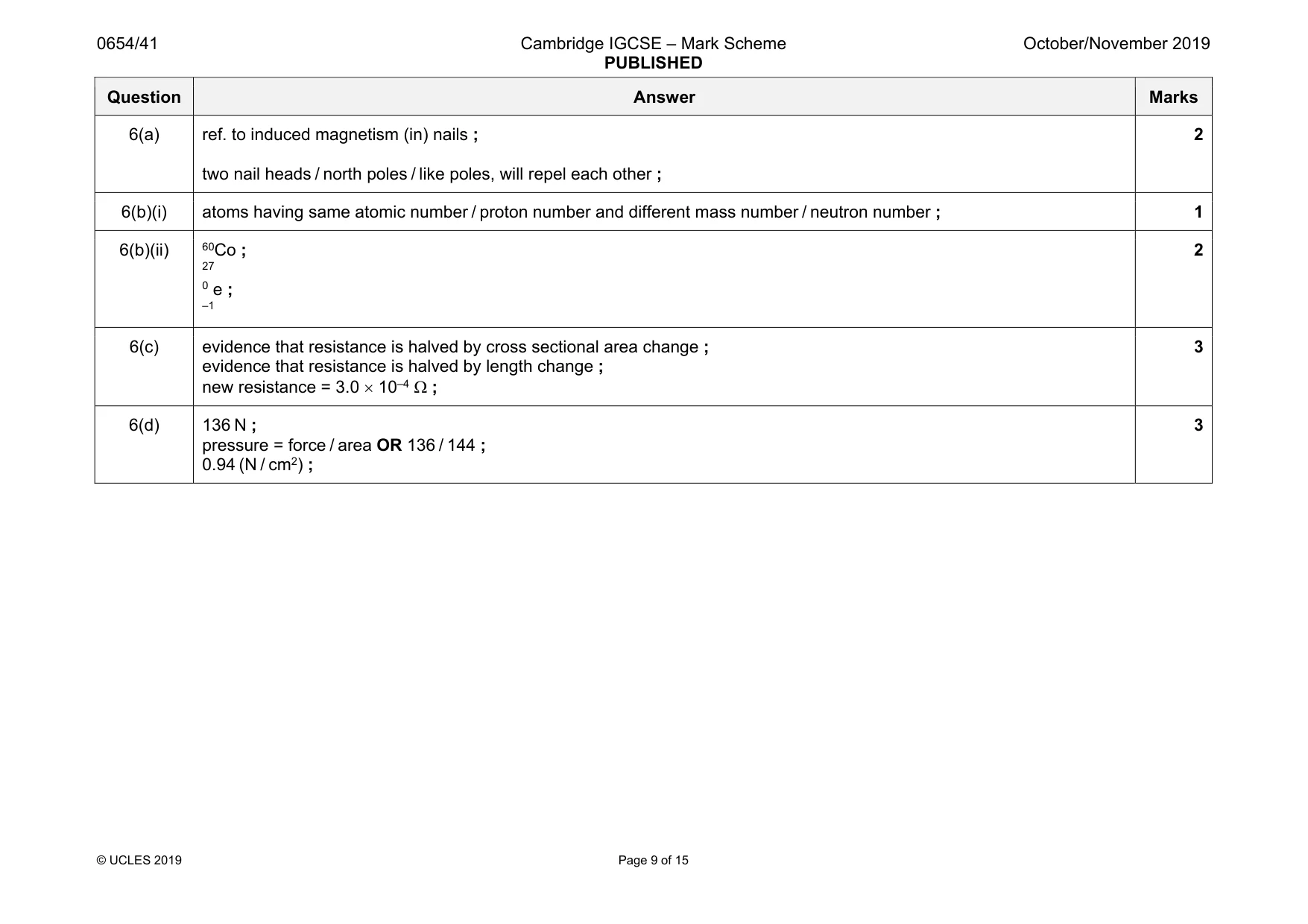
Mark scheme: 6(a) ref. to induced magnetism (in) nails ; two nail heads / north poles / like poles, will repel each other ; 2 6(b)(i) atoms having same atomic number / proton number and different mass number / neutron number ; 1 6(b)(ii) 60Co ; 27 0 e ; –1 2 6(c) evidence that resistance is halved by cross sectional area change ; evidence that resistance is halved by length change ; new resistance = 3.0 × 10⁻⁴ Ω ; 3 6(d) 136 N ; pressure = force / area OR 136 / 144 ; 0.94 (N / cm2) ; 3
Q7 · Lipase is a digestive enzyme
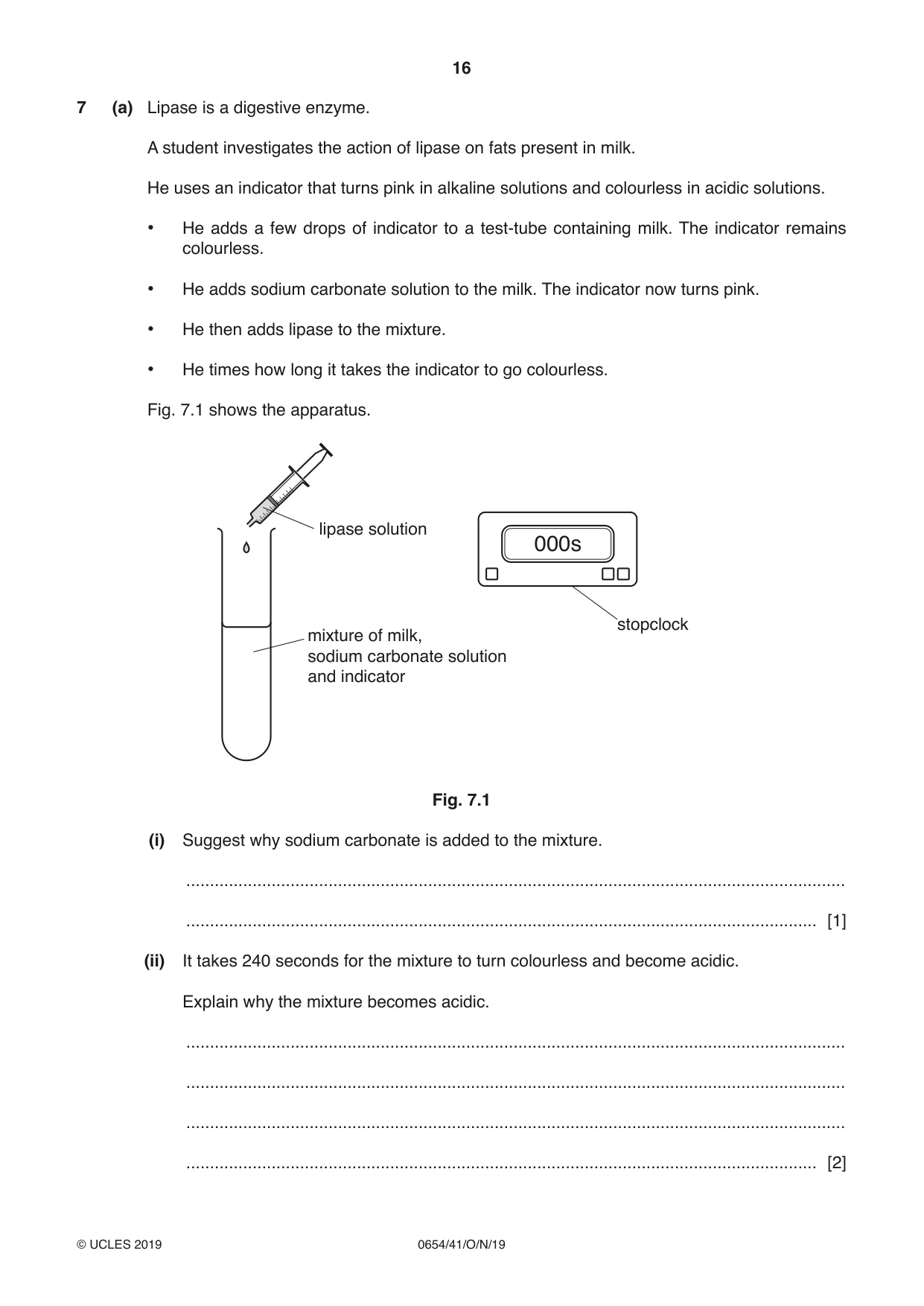
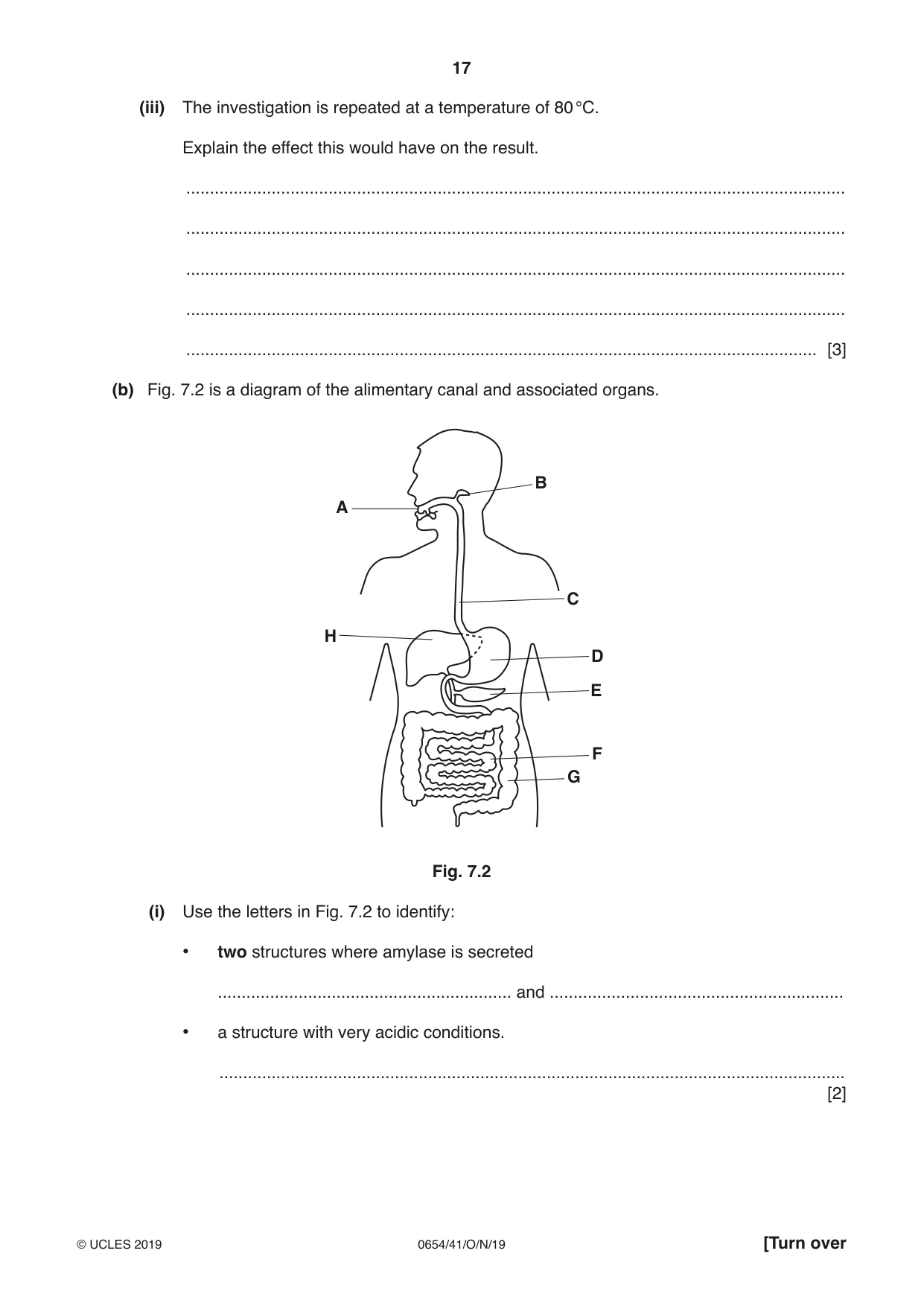
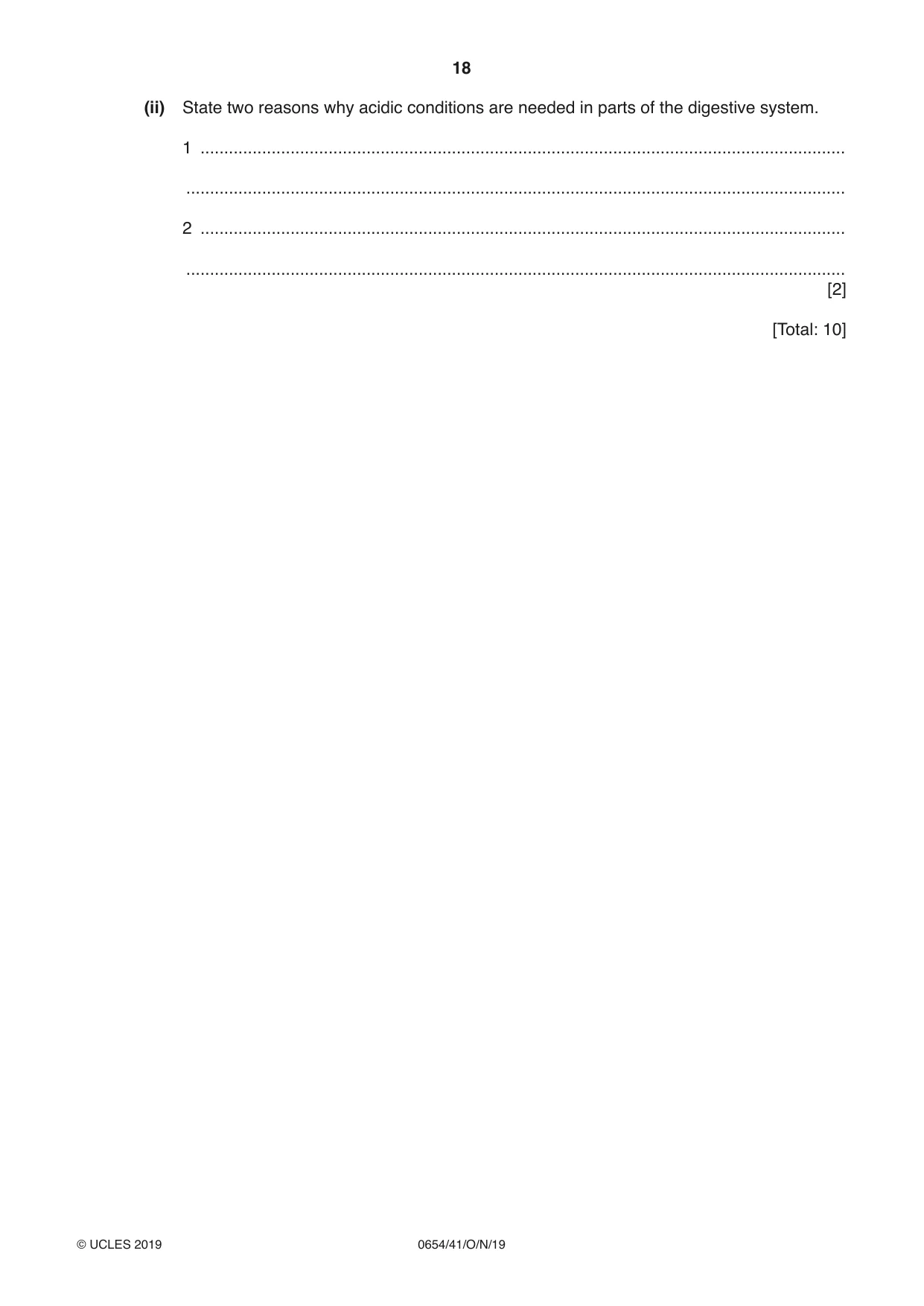
7 (a) Lipase is a digestive enzyme. A student investigates the action of lipase on fats present in milk. He uses an indicator that turns pink in alkaline solutions and colourless in acidic solutions. • He adds a few drops of indicator to a test-tube containing milk. The indicator remains colourless. • He adds sodium carbonate solution to the milk. The indicator now turns pink. • He then adds lipase to the mixture. • He times how long it takes the indicator to go colourless. Fig. 7.1 shows the apparatus. lipase solution 000s stopclock mixture of milk, sodium carbonate solution and indicator Fig. 7.1 (i) Suggest why sodium carbonate is added to the mixture. ........................................................................................................................................... ..................................................................................................................................... [1] (ii) It takes 240 seconds for the mixture to turn colourless and become acidic. Explain why the mixture becomes acidic. ........................................................................................................................................... ........................................................................................................................................... ........................................................................................................................................... ..................................................................................................................................... [2] (iii) The investigation is repeated at a temperature of 80 °C. Explain the effect this would have on the result. ........................................................................................................................................... ........................................................................................................................................... ........................................................................................................................................... ........................................................................................................................................... ..................................................................................................................................... [3] (b) Fig. 7.2 is a diagram of the alimentary canal and associated organs. B A C H D E F G Fig. 7.2 (i) Use the letters in Fig. 7.2 to identify: • two structures where amylase is secreted .............................................................. and .............................................................. • a structure with very acidic conditions. .................................................................................................................................... [2] (ii) State two reasons why acidic conditions are needed in parts of the digestive system. 1 ........................................................................................................................................ ........................................................................................................................................... 2 ........................................................................................................................................ ........................................................................................................................................... [2] [Total: 10]
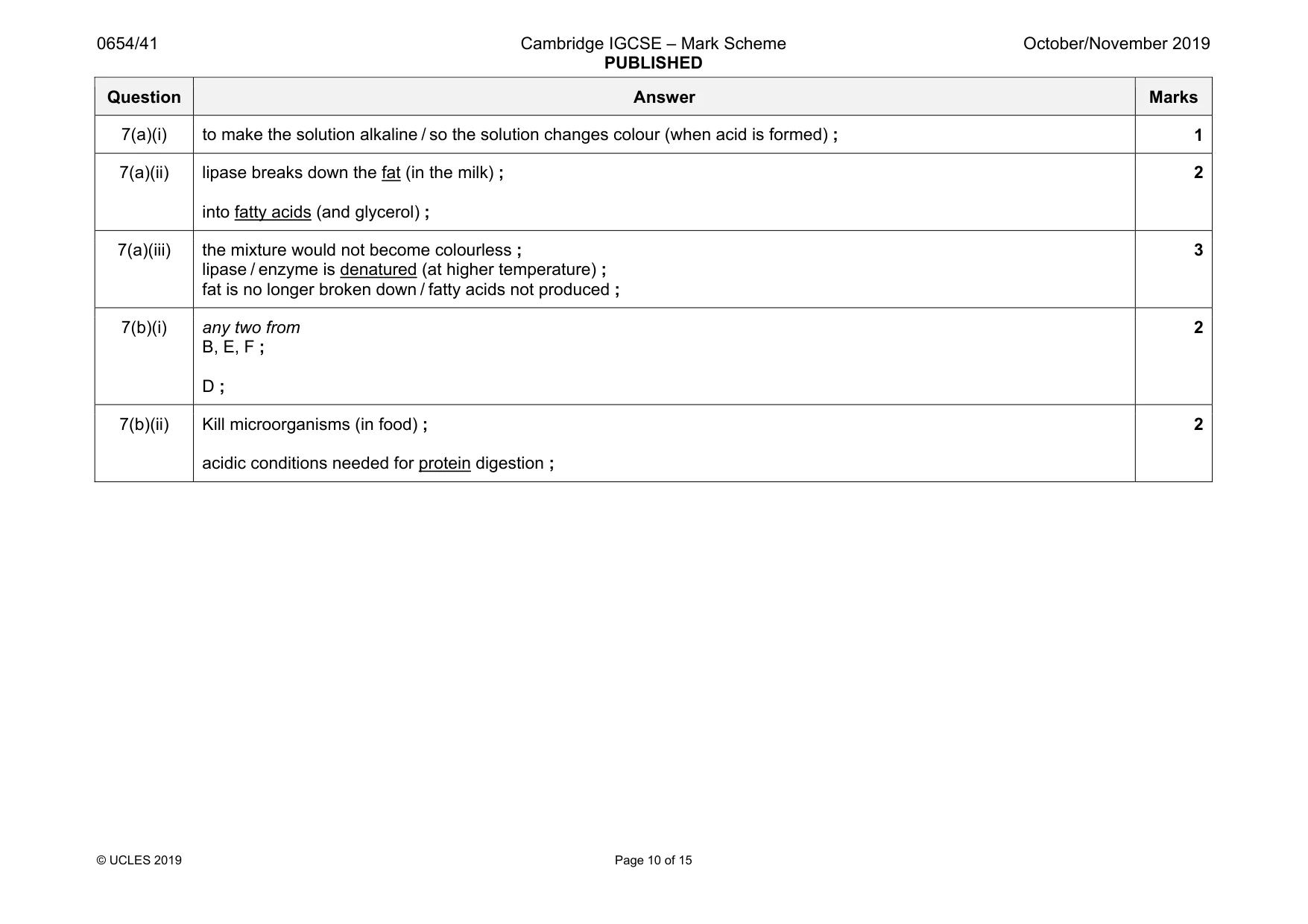
Mark scheme: 7(a)(i) to make the solution alkaline / so the solution changes colour (when acid is formed) ; 1 7(a)(ii) lipase breaks down the fat (in the milk) ; into fatty acids (and glycerol) ; 2 7(a)(iii) the mixture would not become colourless ; lipase / enzyme is denatured (at higher temperature) ; fat is no longer broken down / fatty acids not produced ; 3 7(b)(i) any two from B, E, F ; D ; 2 7(b)(ii) Kill microorganisms (in food) ; acidic conditions needed for protein digestion ; 2
Q8 · A petrol engine in a car uses a mixture of air and gasoline
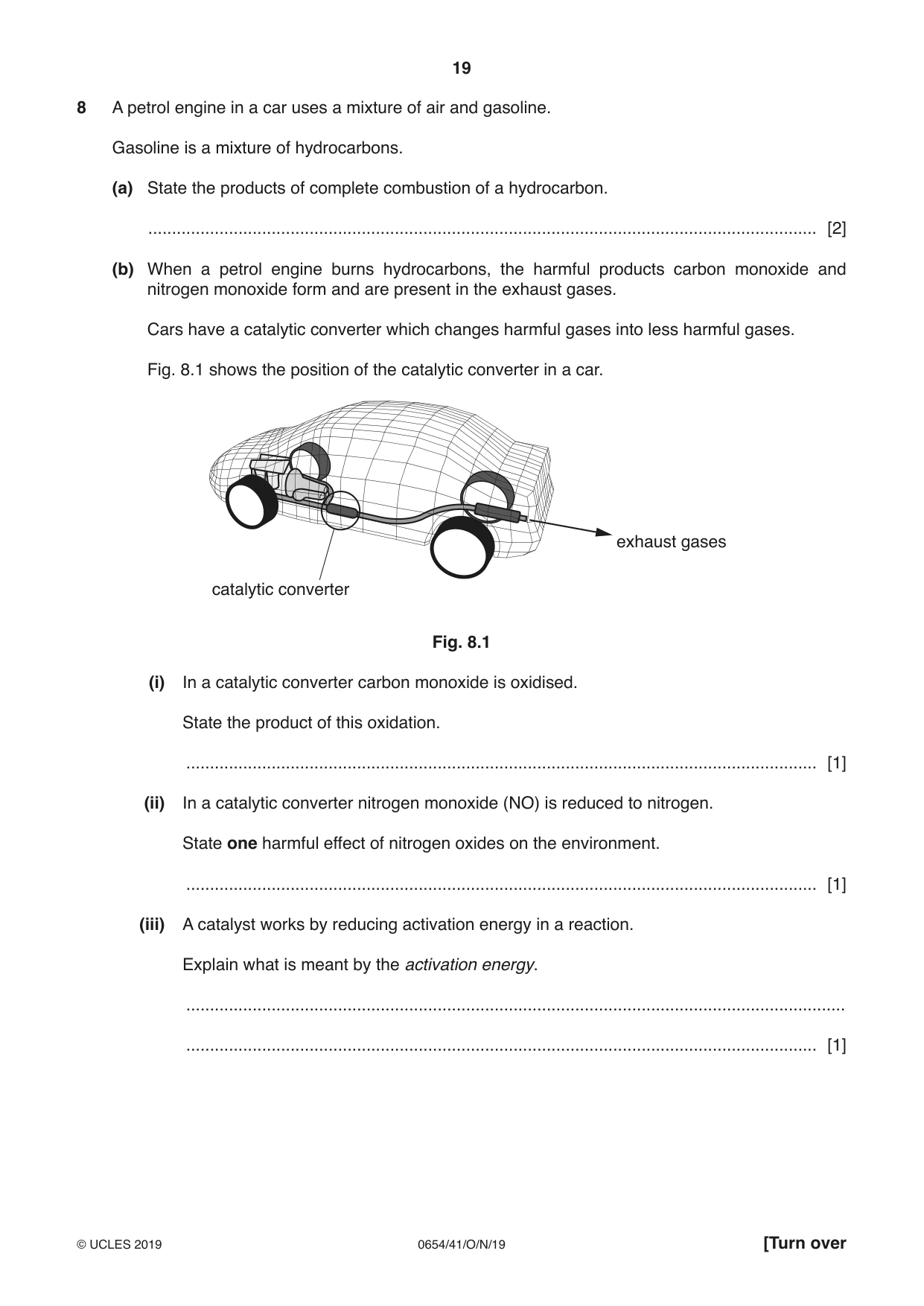
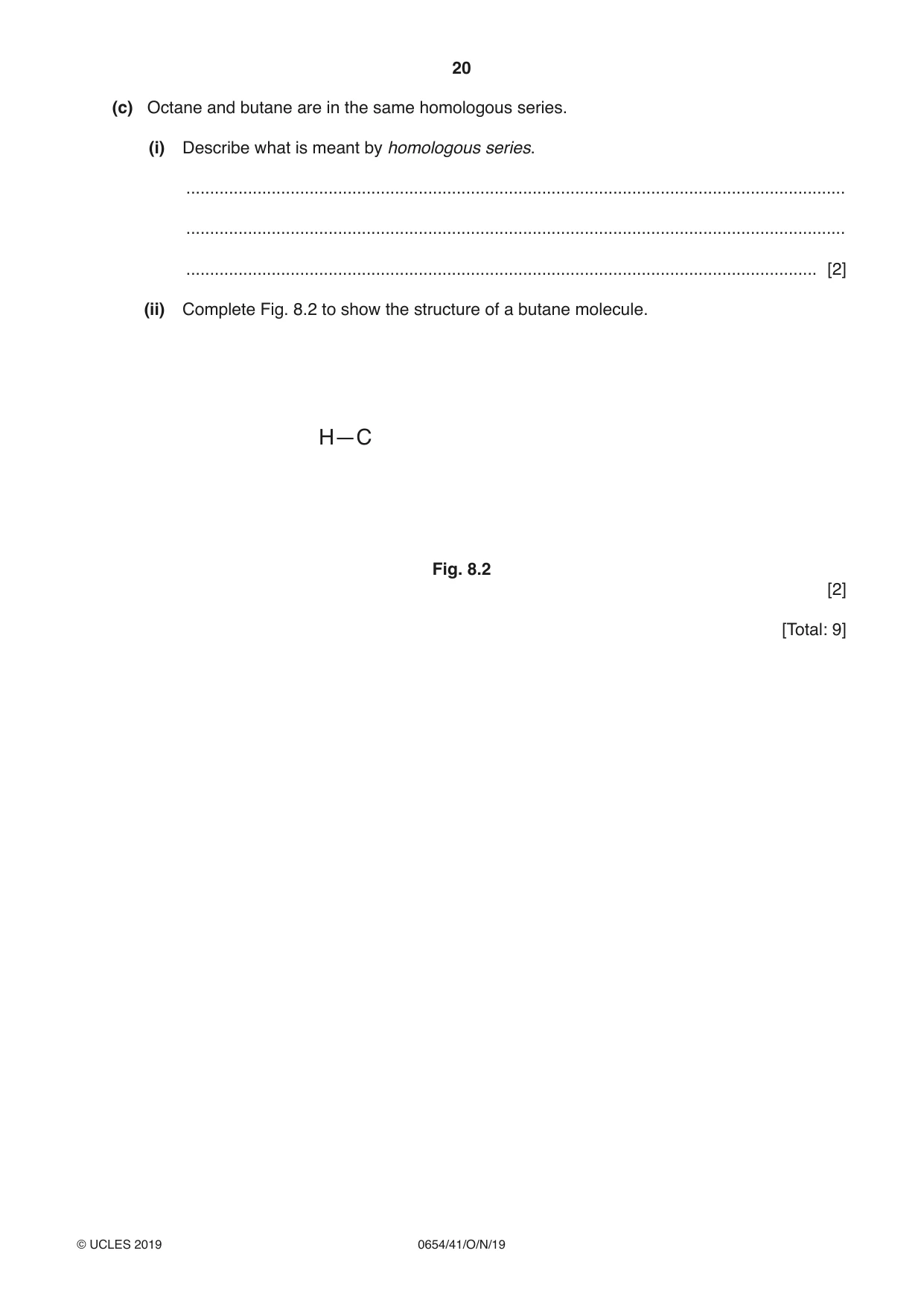
8 A petrol engine in a car uses a mixture of air and gasoline. Gasoline is a mixture of hydrocarbons. (a) State the products of complete combustion of a hydrocarbon. ............................................................................................................................................. [2] (b) When a petrol engine burns hydrocarbons, the harmful products carbon monoxide and nitrogen monoxide form and are present in the exhaust gases. Cars have a catalytic converter which changes harmful gases into less harmful gases. Fig. 8.1 shows the position of the catalytic converter in a car. exhaust gases catalytic converter Fig. 8.1 (i) In a catalytic converter carbon monoxide is oxidised. State the product of this oxidation. ..................................................................................................................................... [1] (ii) In a catalytic converter nitrogen monoxide (NO) is reduced to nitrogen. State one harmful effect of nitrogen oxides on the environment. ..................................................................................................................................... [1] (iii) A catalyst works by reducing activation energy in a reaction. Explain what is meant by the activation energy. ........................................................................................................................................... ..................................................................................................................................... [1] (c) Octane and butane are in the same homologous series. (i) Describe what is meant by homologous series. ........................................................................................................................................... ........................................................................................................................................... ..................................................................................................................................... [2] (ii) Complete Fig. 8.2 to show the structure of a butane molecule. H—C Fig. 8.2 [2] [Total: 9]
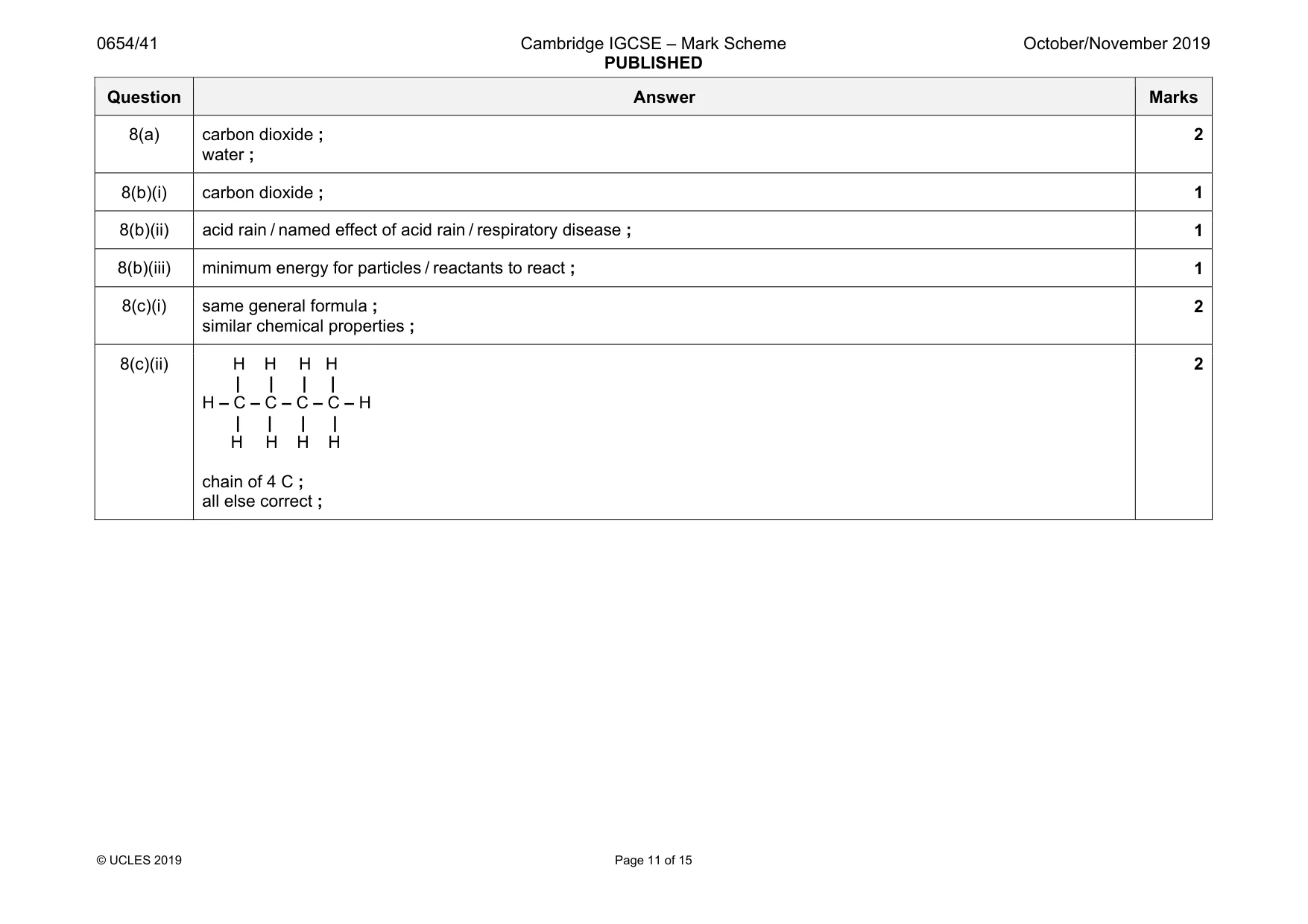
Mark scheme: 8(a) carbon dioxide ; water ; 2 8(b)(i) carbon dioxide ; 1 8(b)(ii) acid rain / named effect of acid rain / respiratory disease ; 1 8(b)(iii) minimum energy for particles / reactants to react ; 1 8(c)(i) same general formula ; similar chemical properties ; 2 8(c)(ii) H H H H | | | | H – C – C – C – C – H | | | | H H H H chain of 4 C ; all else correct ; 2
Q9 · An aircraft has a mass of 400 000 kg
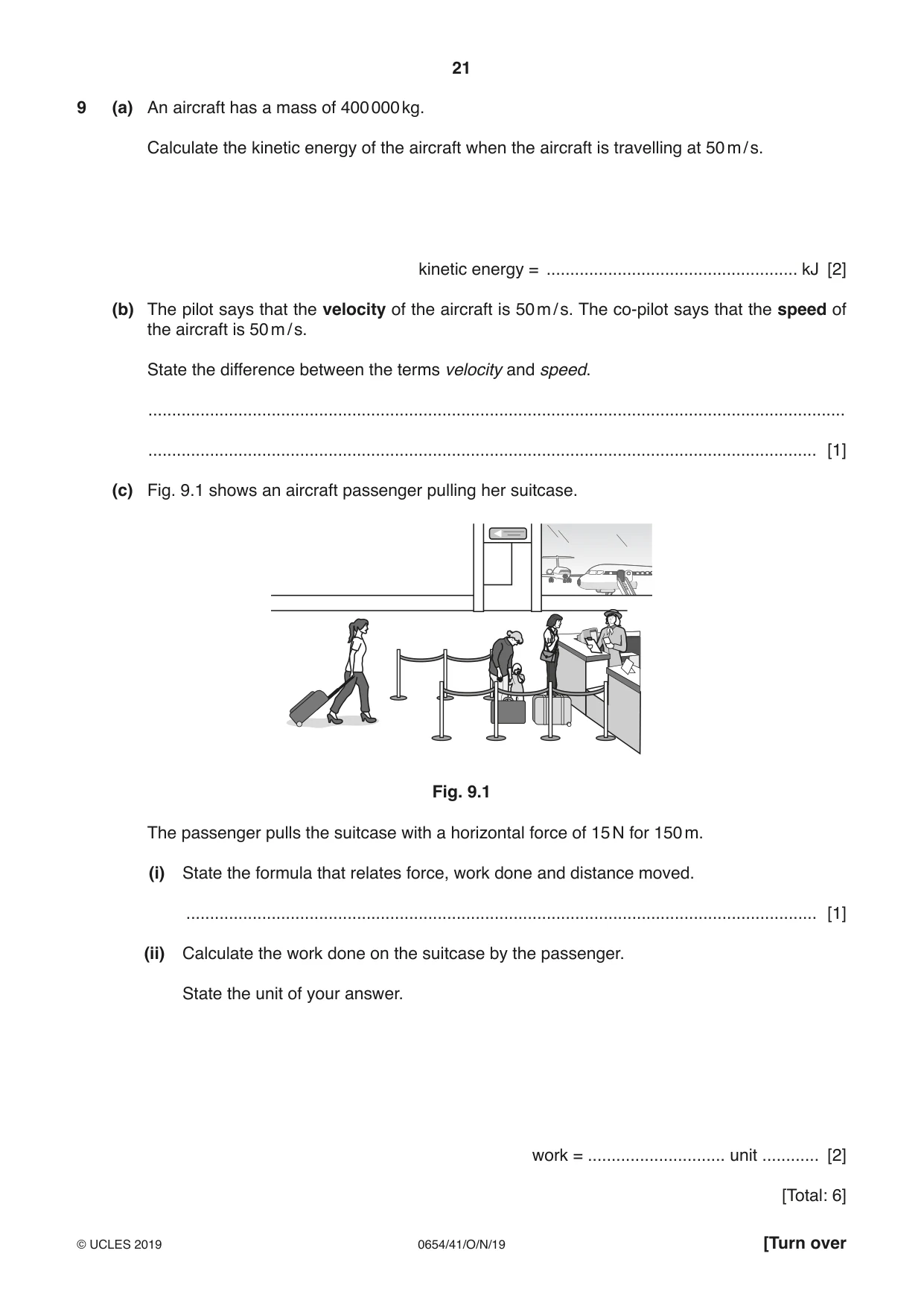
9 (a) An aircraft has a mass of 400 000 kg. Calculate the kinetic energy of the aircraft when the aircraft is travelling at 50 m / s. kinetic energy = ..................................................... kJ [2] (b) The pilot says that the velocity of the aircraft is 50 m / s. The co-pilot says that the speed of the aircraft is 50 m / s. State the difference between the terms velocity and speed. ................................................................................................................................................... ............................................................................................................................................. [1] (c) Fig. 9.1 shows an aircraft passenger pulling her suitcase. Fig. 9.1 The passenger pulls the suitcase with a horizontal force of 15 N for 150 m. (i) State the formula that relates force, work done and distance moved. ..................................................................................................................................... [1] (ii) Calculate the work done on the suitcase by the passenger. State the unit of your answer. work = ............................. unit ............ [2] [Total: 6]
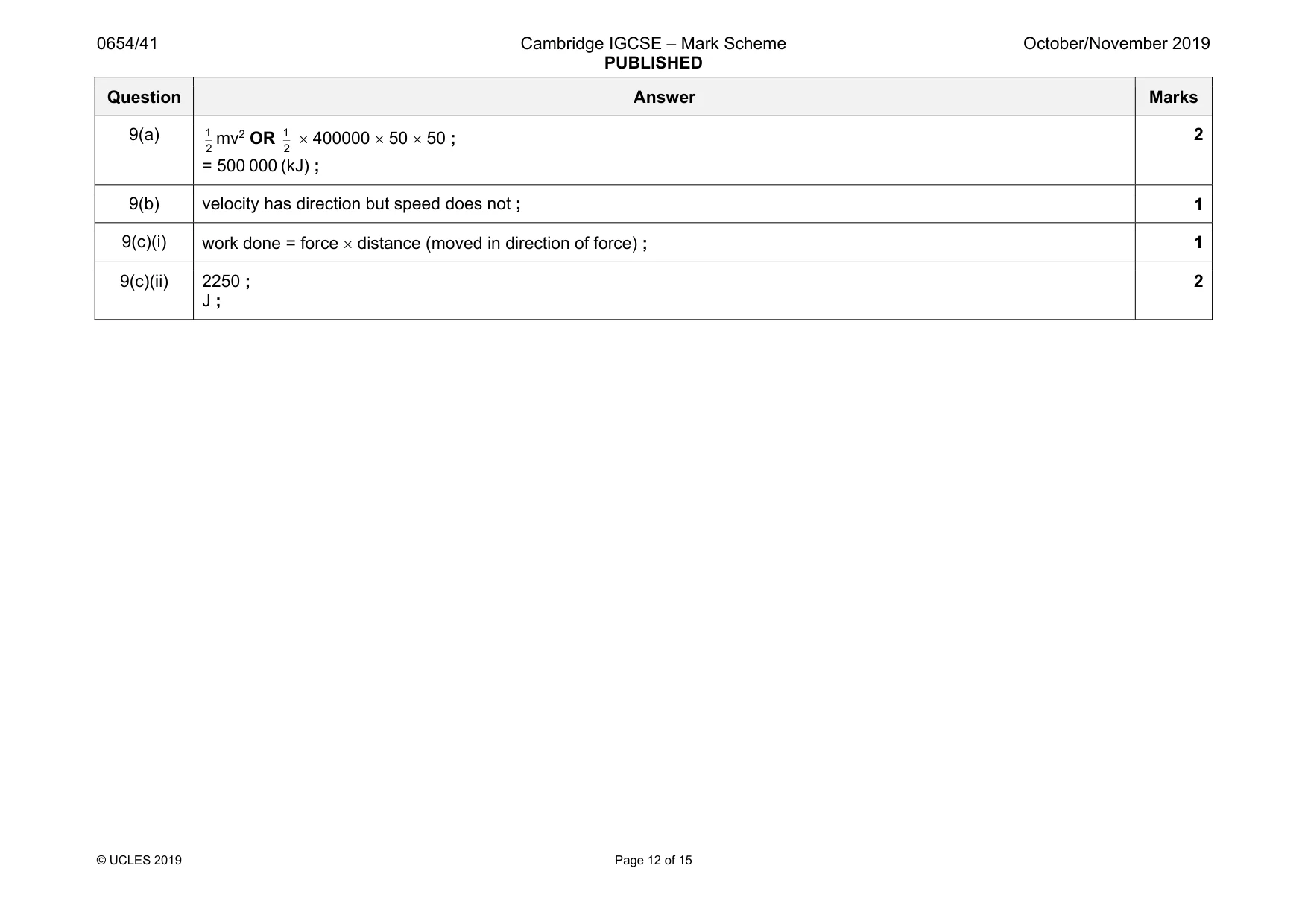
Mark scheme: 9(a) 1 2 mv2 OR 1 2 × 400000 × 50 × 50 ; = 500 000 (kJ) ; 2 9(b) velocity has direction but speed does not ; 1 9(c)(i) work done = force × distance (moved in direction of force) ; 1 9(c)(ii) 2250 ; J ; 2
Q10 · A student investigates the effect of temperature on the rate of transpiration
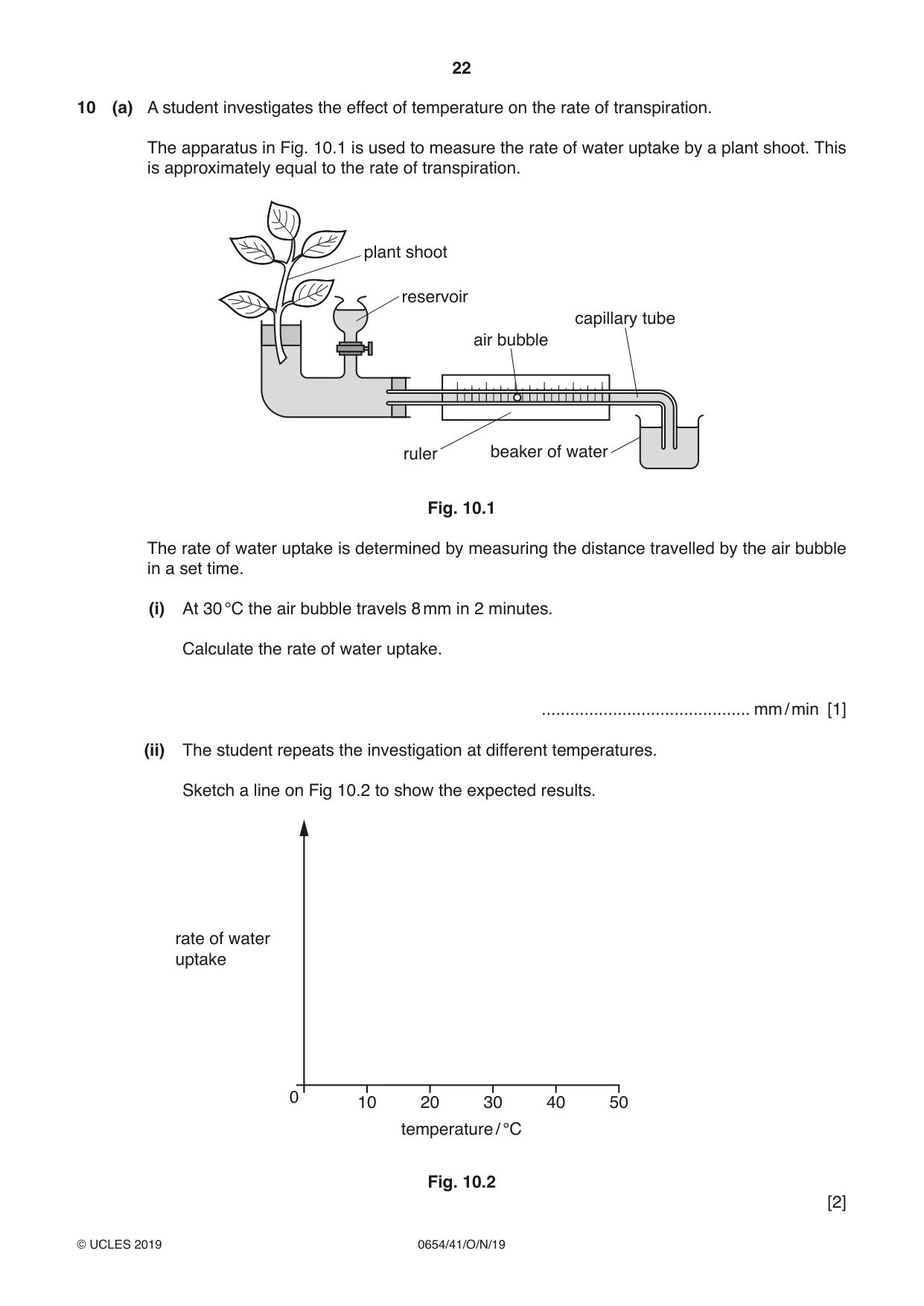
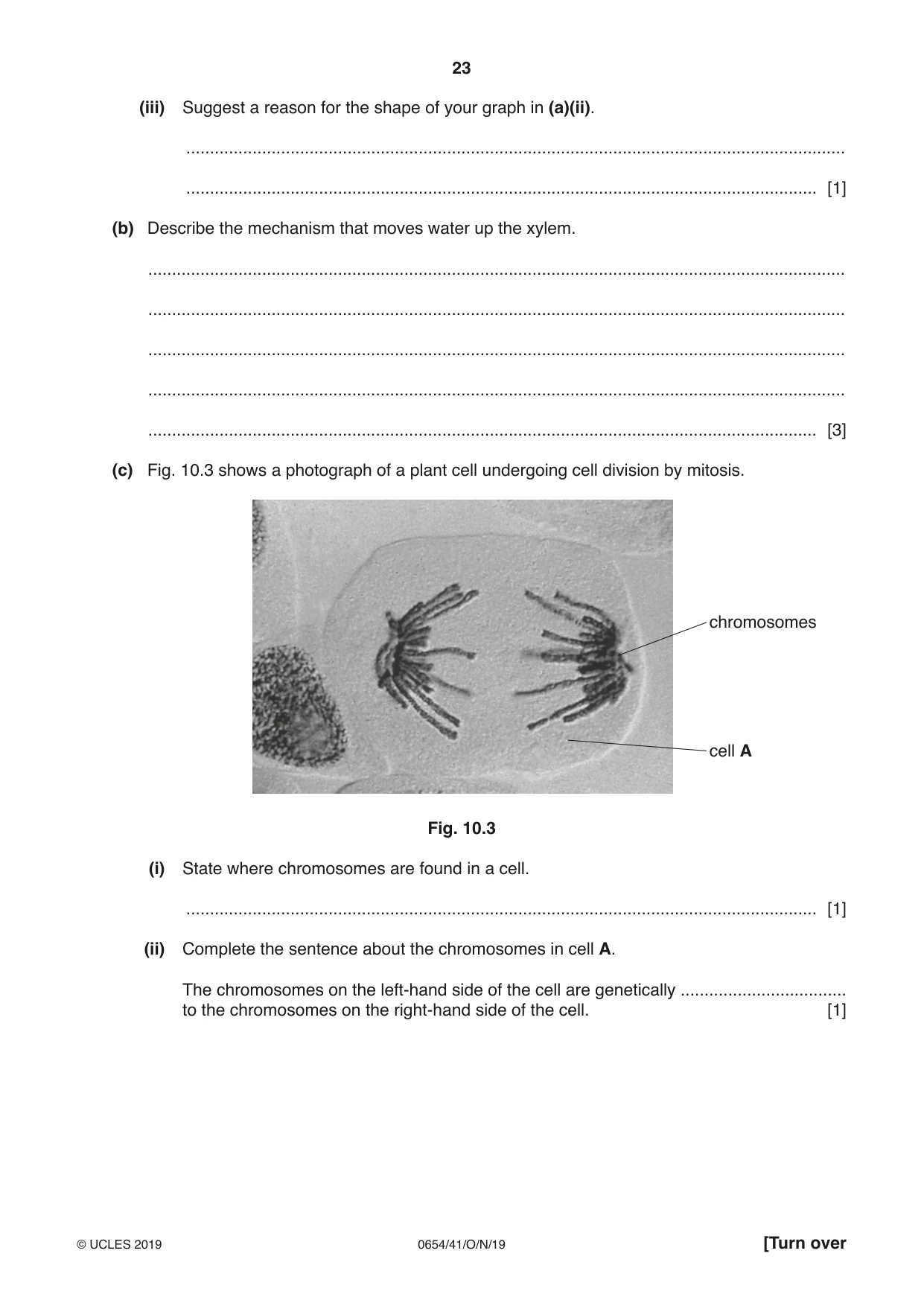
10 (a) A student investigates the effect of temperature on the rate of transpiration. The apparatus in Fig. 10.1 is used to measure the rate of water uptake by a plant shoot. This is approximately equal to the rate of transpiration. plant shoot reservoir capillary tube air bubble ruler beaker of water Fig. 10.1 The rate of water uptake is determined by measuring the distance travelled by the air bubble in a set time. (i) At 30 °C the air bubble travels 8 mm in 2 minutes. Calculate the rate of water uptake. ............................................ mm / min [1] (ii) The student repeats the investigation at different temperatures. Sketch a line on Fig 10.2 to show the expected results. rate of water uptake 0 10 20 30 40 50 temperature / °C Fig. 10.2 [2] (iii) Suggest a reason for the shape of your graph in (a)(ii). ........................................................................................................................................... ..................................................................................................................................... [1] (b) Describe the mechanism that moves water up the xylem. ................................................................................................................................................... ................................................................................................................................................... ................................................................................................................................................... ................................................................................................................................................... ............................................................................................................................................. [3] (c) Fig. 10.3 shows a photograph of a plant cell undergoing cell division by mitosis. chromosomes cell A Fig. 10.3 (i) State where chromosomes are found in a cell. ..................................................................................................................................... [1] (ii) Complete the sentence about the chromosomes in cell A. The chromosomes on the left-hand side of the cell are genetically ................................... to the chromosomes on the right-hand side of the cell. [1] (d) One of the roles of mitosis is growth. State two other roles of mitosis. 1 ................................................................................................................................................ ................................................................................................................................................... 2 ................................................................................................................................................ ................................................................................................................................................... [2] (e) State how the number of chromosomes in a cell produced by meiosis is different to the number of chromosomes in a cell produced by mitosis. ................................................................................................................................................... ............................................................................................................................................. [1] [Total: 12]
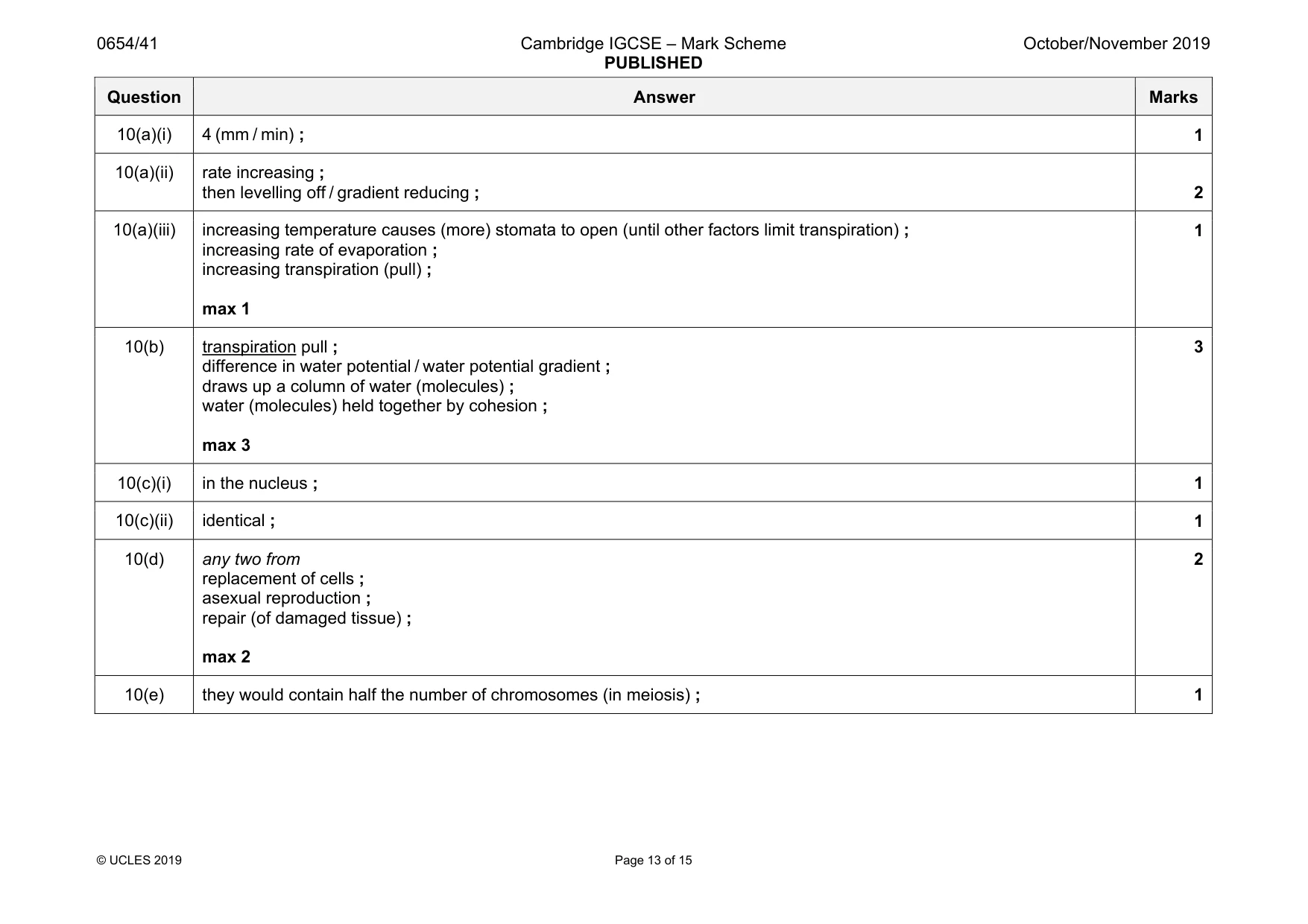
Mark scheme: 10(a)(i) 4 (mm / min) ; 1 10(a)(ii) rate increasing ; then levelling off / gradient reducing ; 2 10(a)(iii) increasing temperature causes (more) stomata to open (until other factors limit transpiration) ; increasing rate of evaporation ; increasing transpiration (pull) ; max 1 1 10(b) transpiration pull ; difference in water potential / water potential gradient ; draws up a column of water (molecules) ; water (molecules) held together by cohesion ; max 3 3 10(c)(i) in the nucleus ; 1 10(c)(ii) identical ; 1 10(d) any two from replacement of cells ; asexual reproduction ; repair (of damaged tissue) ; max 2 2 10(e) they would contain half the number of chromosomes (in meiosis) ; 1
Q11 · Table 11.1 contains data about some elements
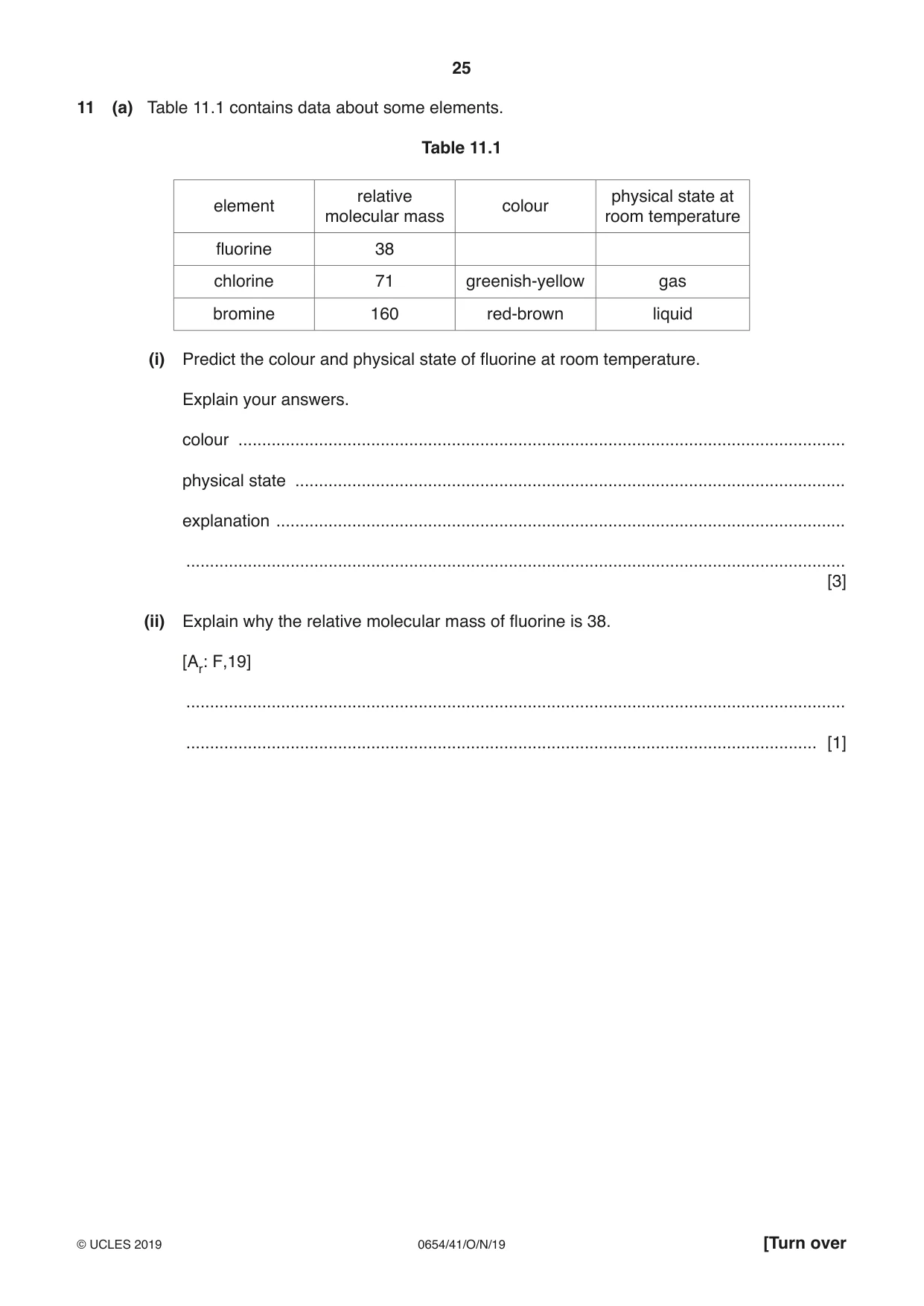
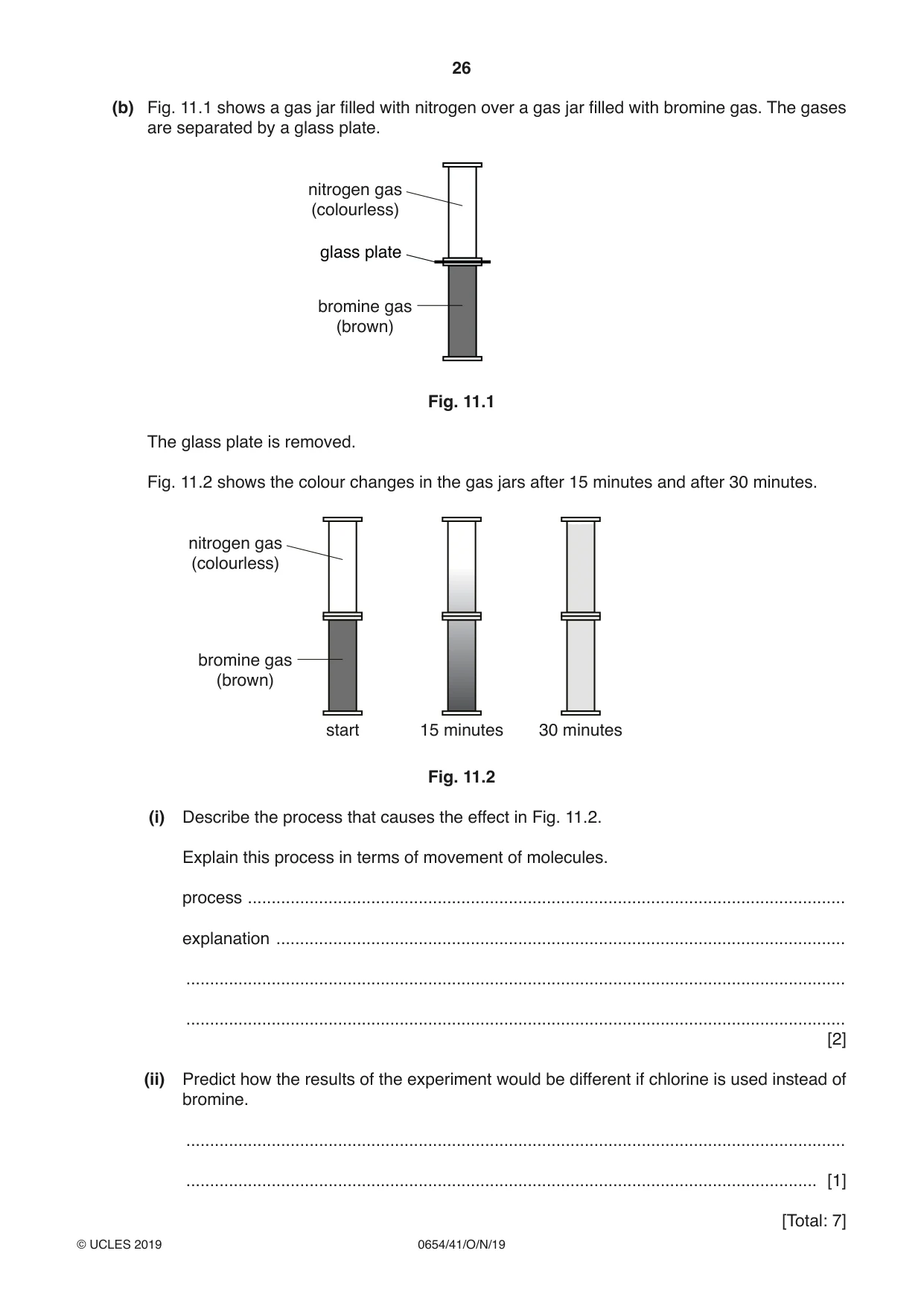
11 (a) Table 11.1 contains data about some elements. Table 11.1 relative physical state at element colour molecular mass room temperature fluorine 38 chlorine 71 greenish-yellow gas bromine 160 red-brown liquid (i) Predict the colour and physical state of fluorine at room temperature. Explain your answers. colour ................................................................................................................................ physical state .................................................................................................................... explanation ........................................................................................................................ ........................................................................................................................................... [3] (ii) Explain why the relative molecular mass of fluorine is 38. [Ar: F,19] ........................................................................................................................................... ..................................................................................................................................... [1] (b) Fig. 11.1 shows a gas jar filled with nitrogen over a gas jar filled with bromine gas. The gases are separated by a glass plate. nitrogen gas (colourless) glass plate bromine gas (brown) Fig. 11.1 The glass plate is removed. Fig. 11.2 shows the colour changes in the gas jars after 15 minutes and after 30 minutes. nitrogen gas (colourless) bromine gas (brown) start 15 minutes 30 minutes Fig. 11.2 (i) Describe the process that causes the effect in Fig. 11.2. Explain this process in terms of movement of molecules. process .............................................................................................................................. explanation ........................................................................................................................ ........................................................................................................................................... ........................................................................................................................................... [2] (ii) Predict how the results of the experiment would be different if chlorine is used instead of bromine. ........................................................................................................................................... ..................................................................................................................................... [1] [Total: 7]
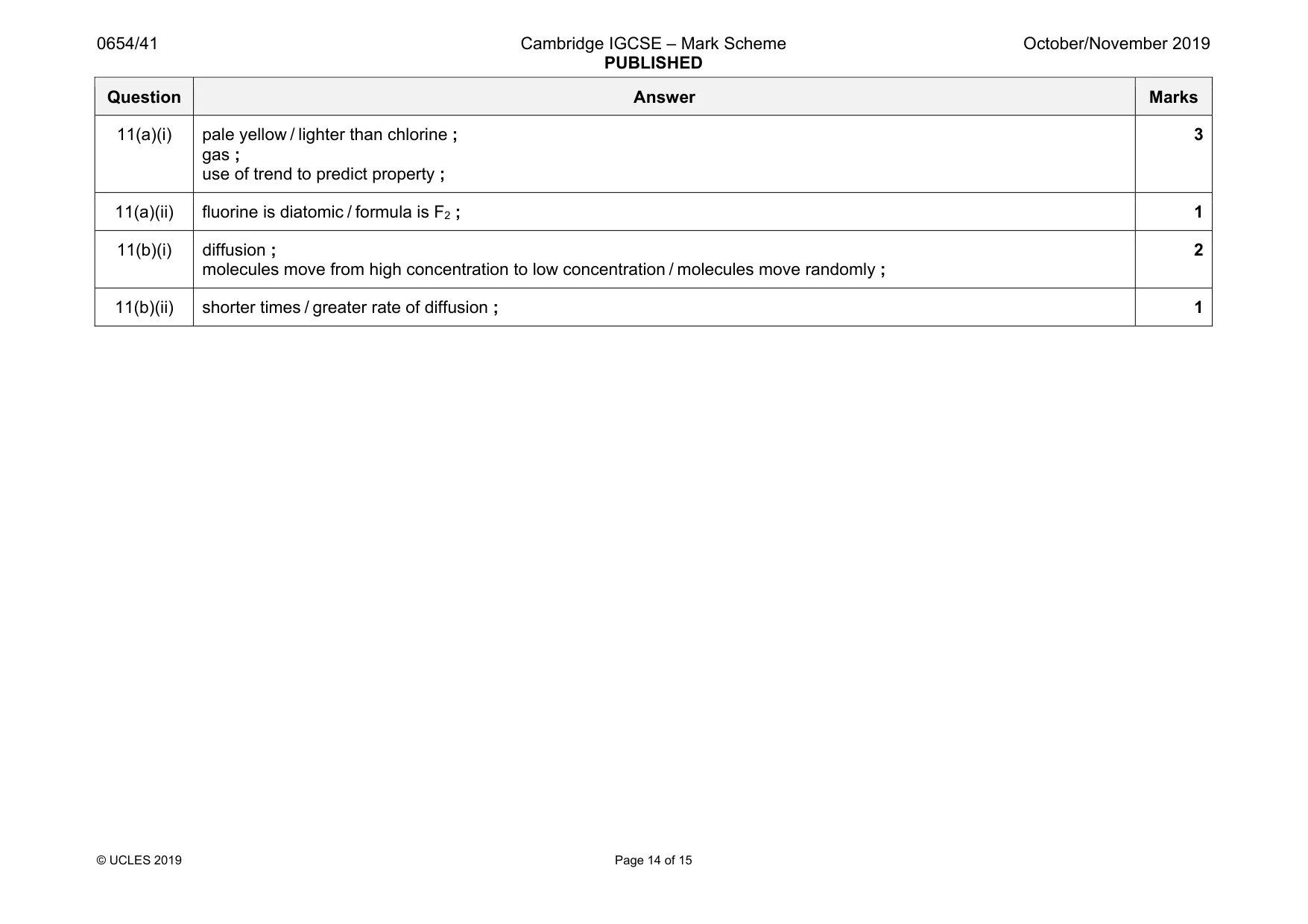
Mark scheme: 11(a)(i) pale yellow / lighter than chlorine ; gas ; use of trend to predict property ; 3 11(a)(ii) fluorine is diatomic / formula is F2 ; 1 11(b)(i) diffusion ; molecules move from high concentration to low concentration / molecules move randomly ; 2 11(b)(ii) shorter times / greater rate of diffusion ; 1
Q12 · Ultrasound is very high frequency sound
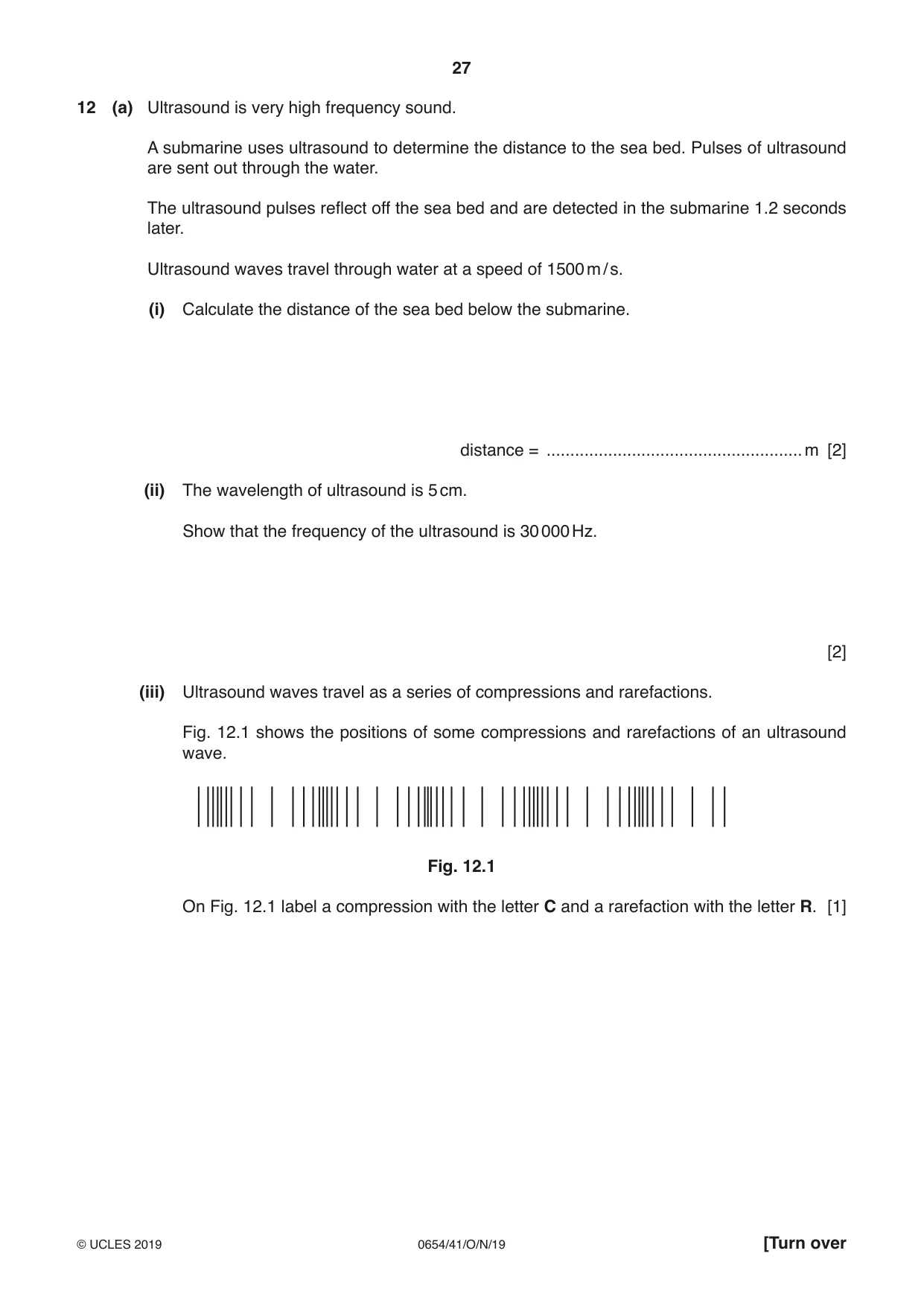
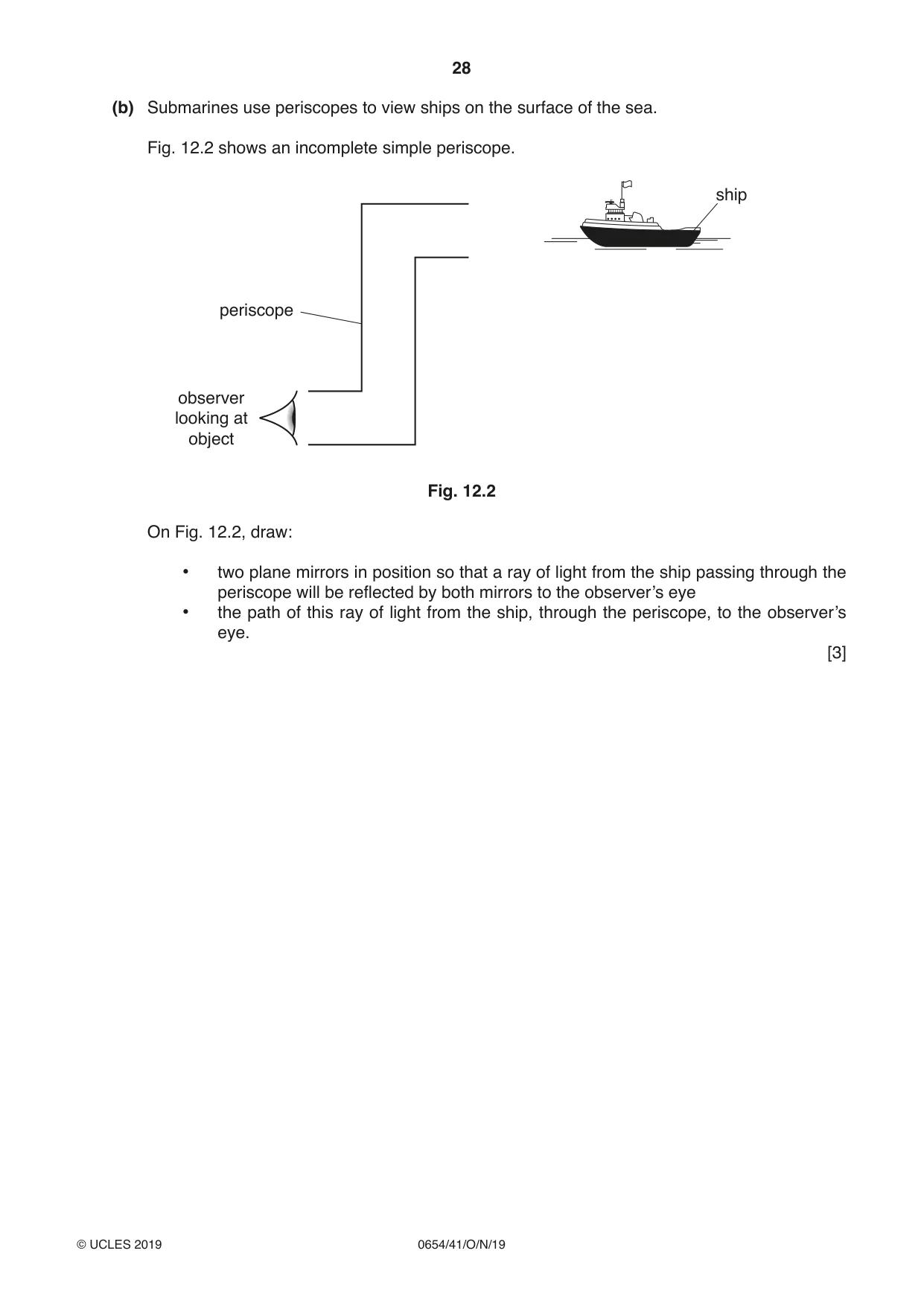
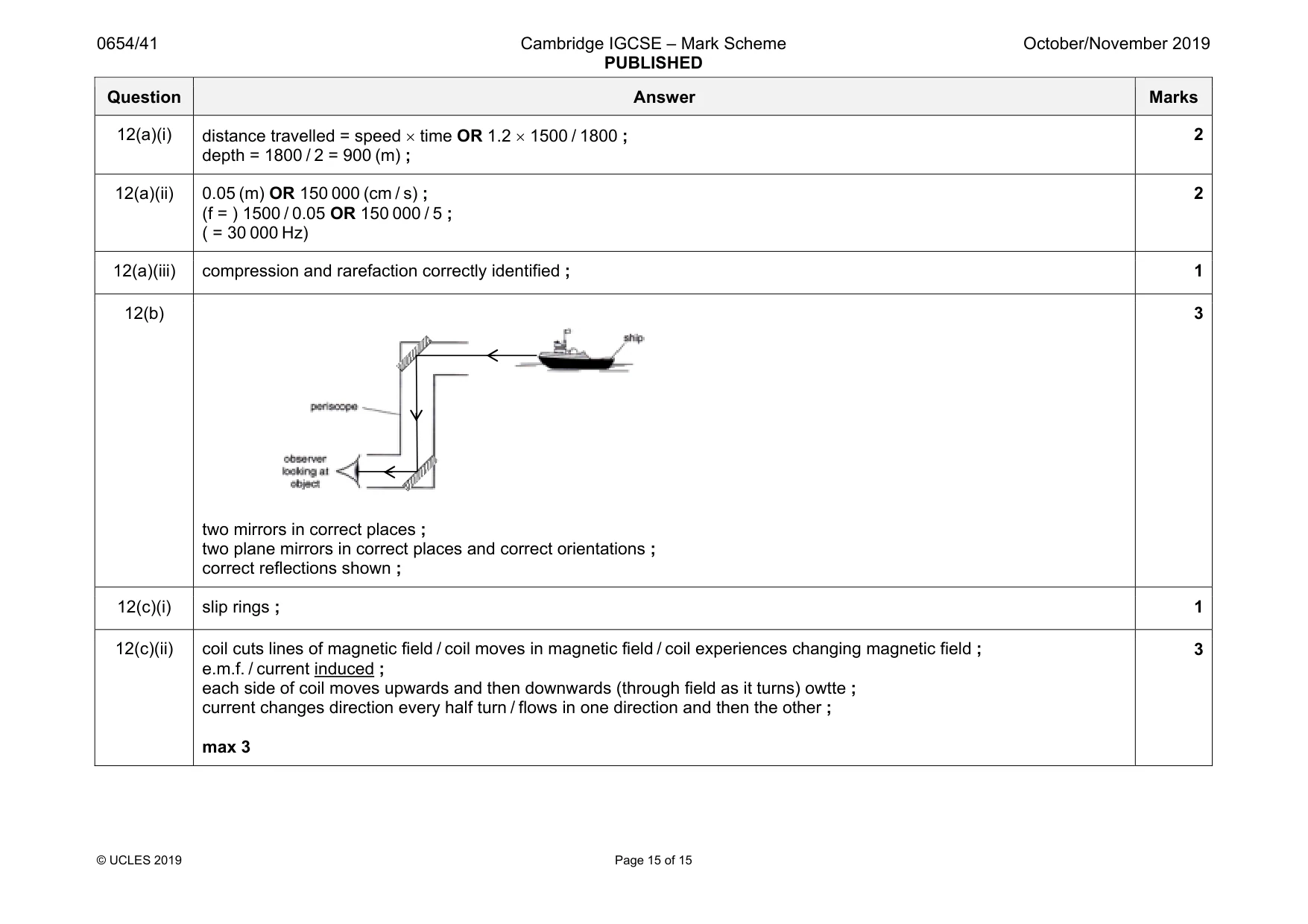
12 (a) Ultrasound is very high frequency sound. A submarine uses ultrasound to determine the distance to the sea bed. Pulses of ultrasound are sent out through the water. The ultrasound pulses reflect off the sea bed and are detected in the submarine 1.2 seconds later. Ultrasound waves travel through water at a speed of 1500 m / s. (i) Calculate the distance of the sea bed below the submarine. distance = ......................................................m [2] (ii) The wavelength of ultrasound is 5 cm. Show that the frequency of the ultrasound is 30 000 Hz. [2] (iii) Ultrasound waves travel as a series of compressions and rarefactions. Fig. 12.1 shows the positions of some compressions and rarefactions of an ultrasound wave. Fig. 12.1 On Fig. 12.1 label a compression with the letter C and a rarefaction with the letter R. [1] (b) Submarines use periscopes to view ships on the surface of the sea. Fig. 12.2 shows an incomplete simple periscope. ship periscope observer looking at object Fig. 12.2 On Fig. 12.2, draw: • two plane mirrors in position so that a ray of light from the ship passing through the periscope will be reflected by both mirrors to the observer’s eye • the path of this ray of light from the ship, through the periscope, to the observer’s eye. [3] (c) The submarine has a generator to generate electricity. Fig. 12.3 shows a simple generator. coil N S Z a.c. output Fig. 12.3 (i) Name the parts of the generator labelled Z on Fig. 12.3. ..................................................................................................................................... [1] (ii) Explain why a rotating-coil generator produces an alternating current. ........................................................................................................................................... ........................................................................................................................................... ........................................................................................................................................... ..................................................................................................................................... [3] [Total: 12]
Mark scheme: 12(a)(i) depth = 1800 / 2 = 900 (m) ; 2 12(a)(ii) 0.05 (m) OR 150 000 (cm / s) ; (f = ) 1500 / 0.05 OR 150 000 / 5 ; ( = 30 000 Hz) 2 12(a)(iii) compression and rarefaction correctly identified ; 1 12(b) two mirrors in correct places ; two plane mirrors in correct places and correct orientations ; correct reflections shown ; 3 12(c)(i) slip rings ; 1 12(c)(ii) coil cuts lines of magnetic field / coil moves in magnetic field / coil experiences changing magnetic field ; e.m.f. / current induced ; each side of coil moves upwards and then downwards (through field as it turns) owtte ; current changes direction every half turn / flows in one direction and then the other ; max 3 3
What was in this paper
The subtopics covered by these 12 questions, and how many questions each got. Open one in a new tab to see every Cambridge question on it.
What you needed in this session
Cambridge’s own grade thresholds for 2019 Oct/Nov, Paper 4 · Variant 1. A higher threshold means an easier paper — the bar moves with how the cohort did.