Cambridge IGCSE Sciences - Co-ordinated (Double) 0654 — 2023 Oct/Nov Paper 4 · Variant 3
0654/43/O/N/23 · 12 questions · 120 marks · ≈135 min
The question paper and its mark scheme, free to read here and free to download. This is Cambridge’s own paper, exactly as it was sat.
Question paper28 pages
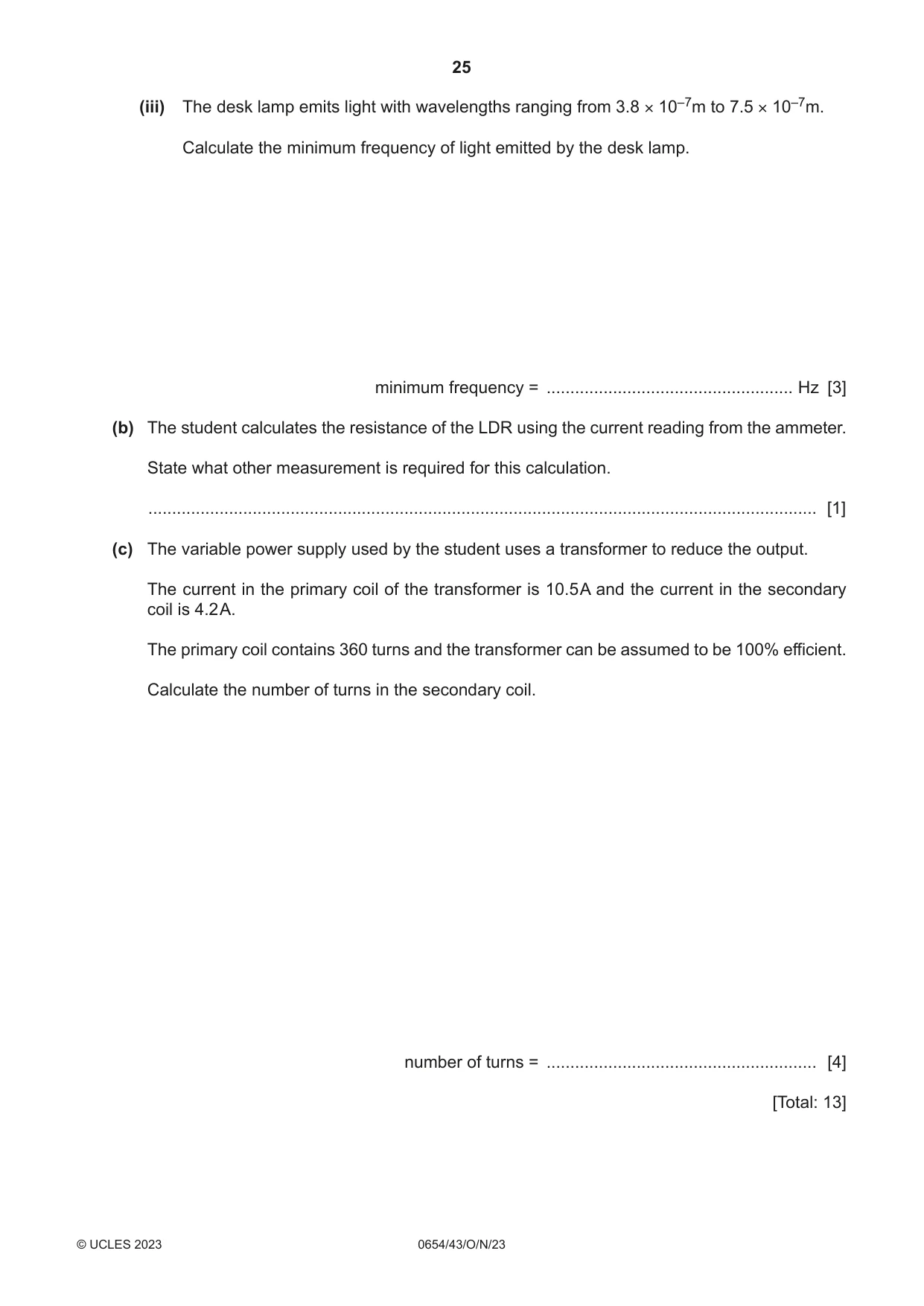

Mark scheme16 pages
Answers below. Sit the paper first if you are practising.
Questions as text
Q1 · Medical notes from a person at risk of developing coronary heart disease (CHD)
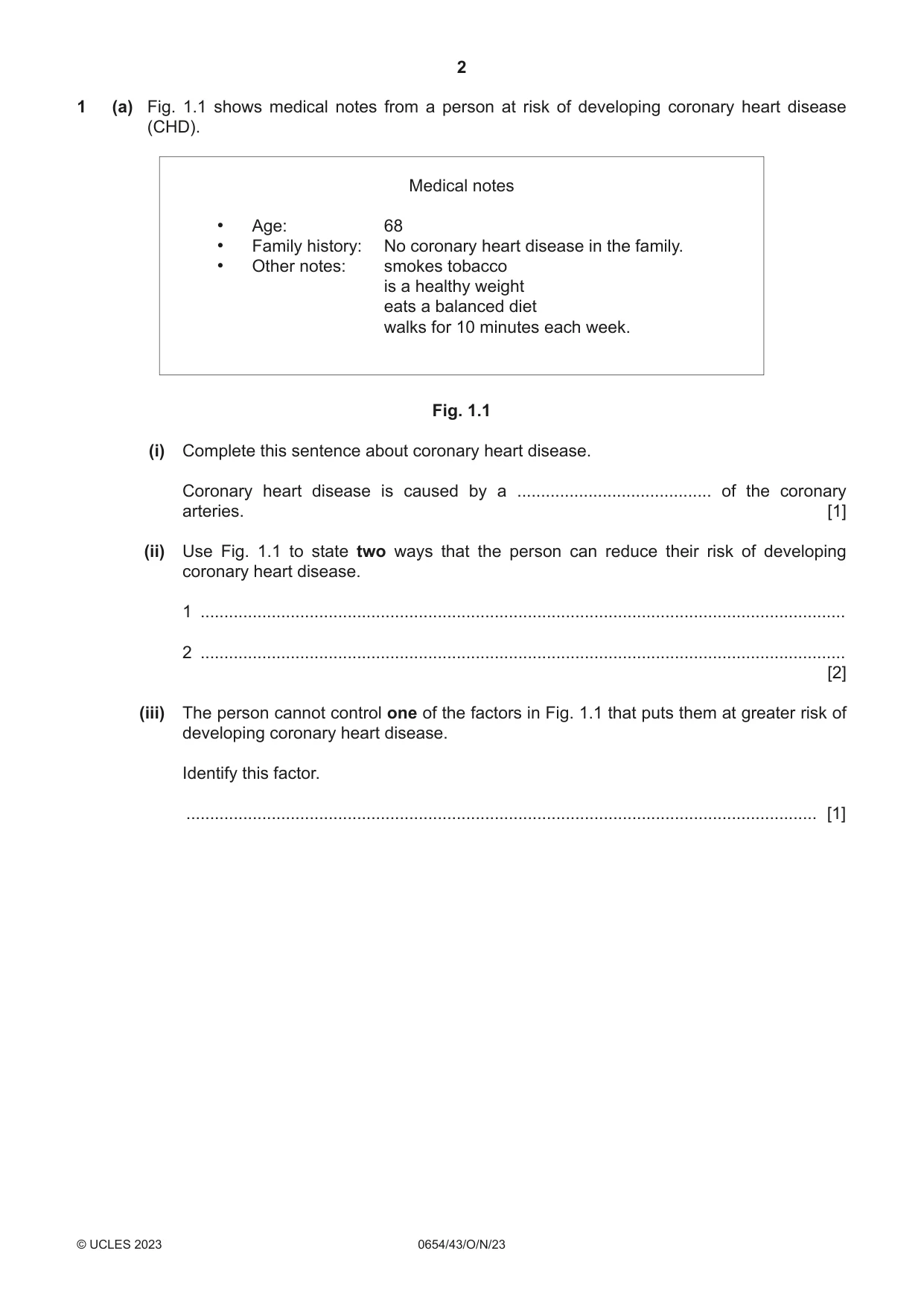
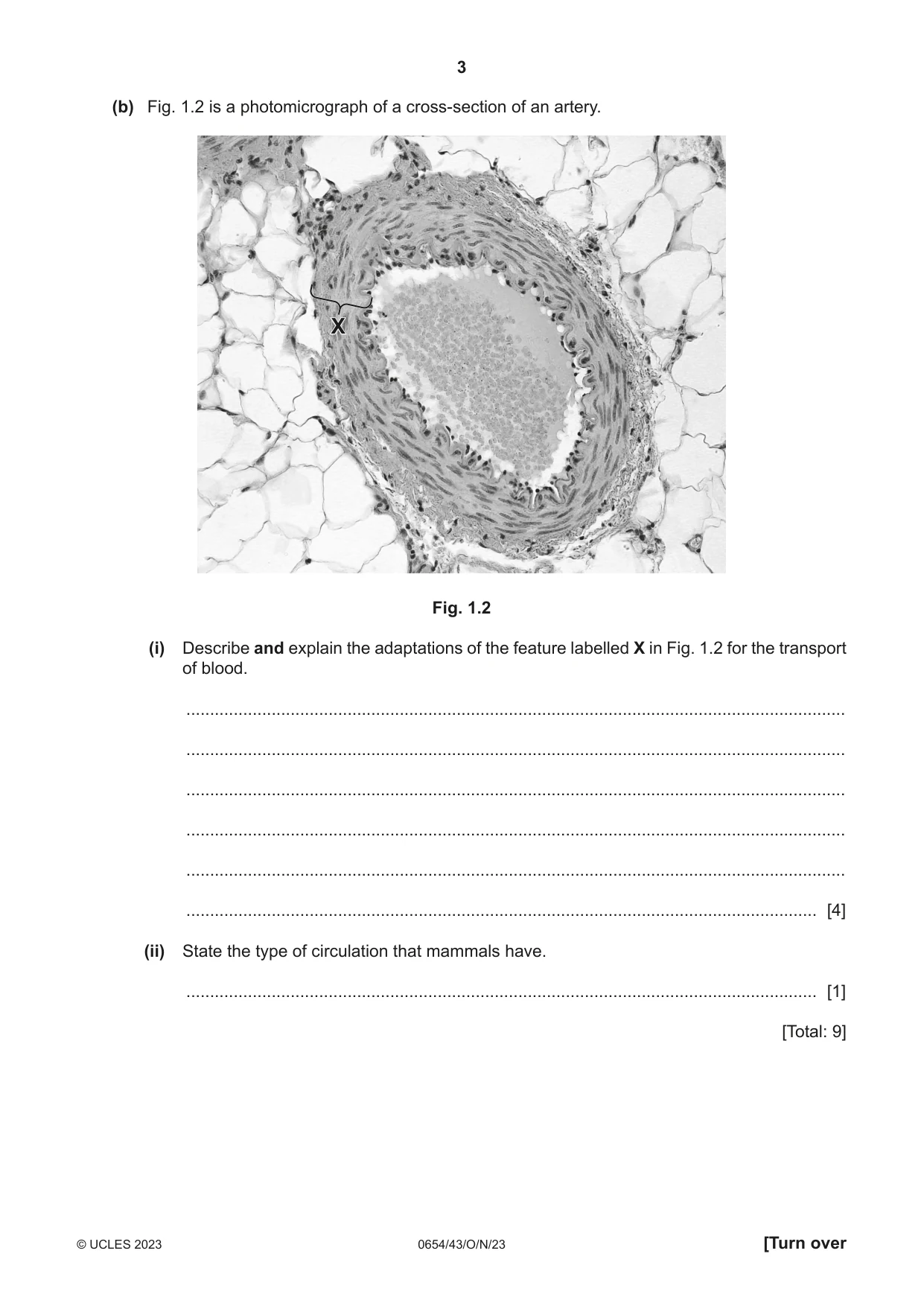
1 (a) Fig. 1.1 shows medical notes from a person at risk of developing coronary heart disease (CHD). Medical notes • Age: 68 • Family history: No coronary heart disease in the family. • Other notes: smokes tobacco is a healthy weight eats a balanced diet walks for 10 minutes each week. Fig. 1.1 (i) Complete this sentence about coronary heart disease. Coronary heart disease is caused by a ......................................... of the coronary arteries. [1] (ii) Use Fig. 1.1 to state two ways that the person can reduce their risk of developing coronary heart disease. 1 ........................................................................................................................................ 2 ........................................................................................................................................ [2] (iii) The person cannot control one of the factors in Fig. 1.1 that puts them at greater risk of developing coronary heart disease. Identify this factor. ..................................................................................................................................... [1] (b) Fig. 1.2 is a photomicrograph of a cross-section of an artery. X Fig. 1.2 (i) Describe and explain the adaptations of the feature labelled X in Fig. 1.2 for the transport of blood. ........................................................................................................................................... ........................................................................................................................................... ........................................................................................................................................... ........................................................................................................................................... ........................................................................................................................................... ..................................................................................................................................... [4] (ii) State the type of circulation that mammals have. ..................................................................................................................................... [1] [Total: 9]
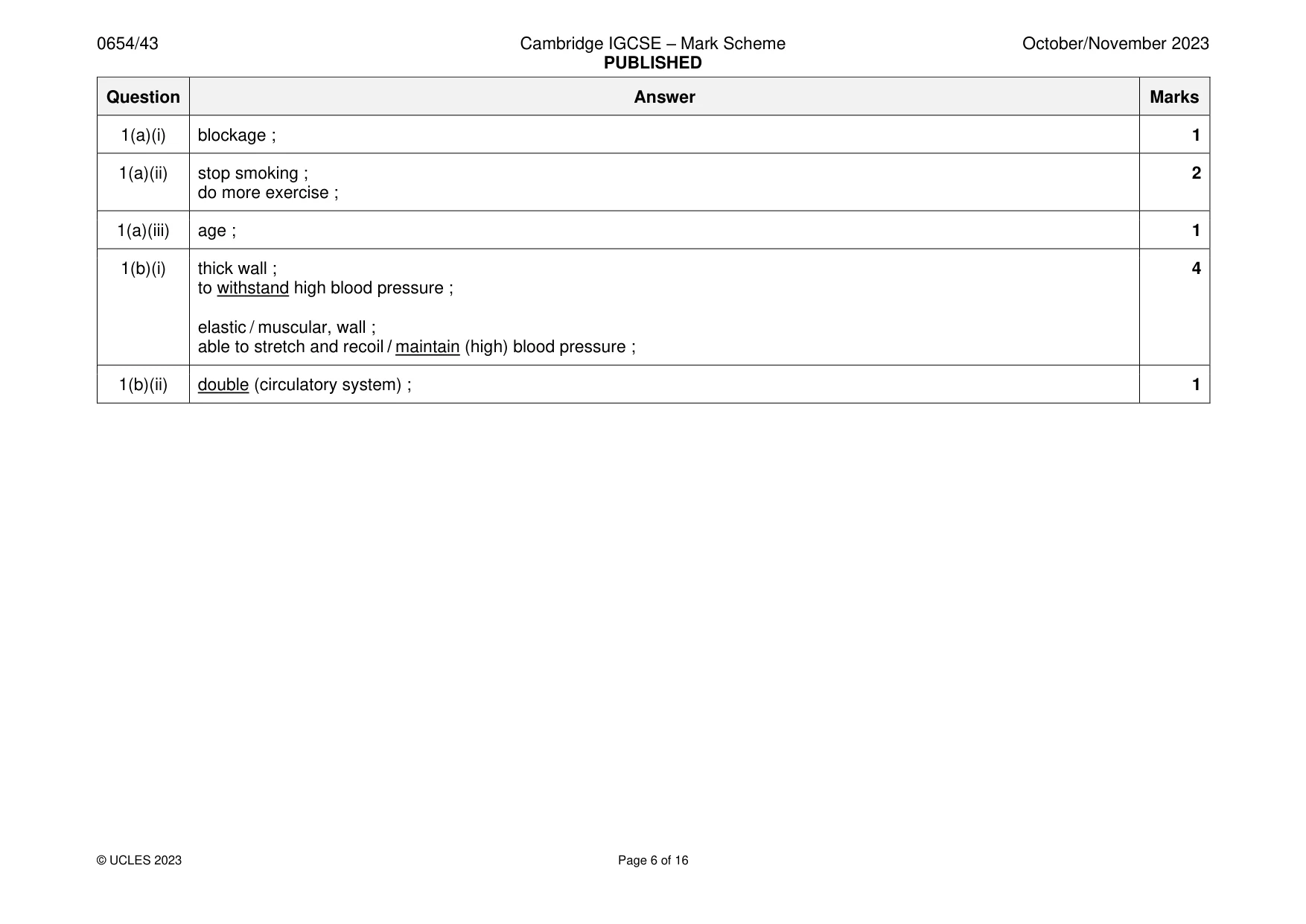
Mark scheme: Question Answer Marks 1(a)(i) blockage ; 1 1(a)(ii) stop smoking ; 2 do more exercise ; 1(a)(iii) age ; 1 1(b)(i) thick wall ; 4 to withstand high blood pressure ; elastic / muscular, wall ; able to stretch and recoil / maintain (high) blood pressure ; 1(b)(ii) double (circulatory system) ; 1
Q2 · This question is about metals
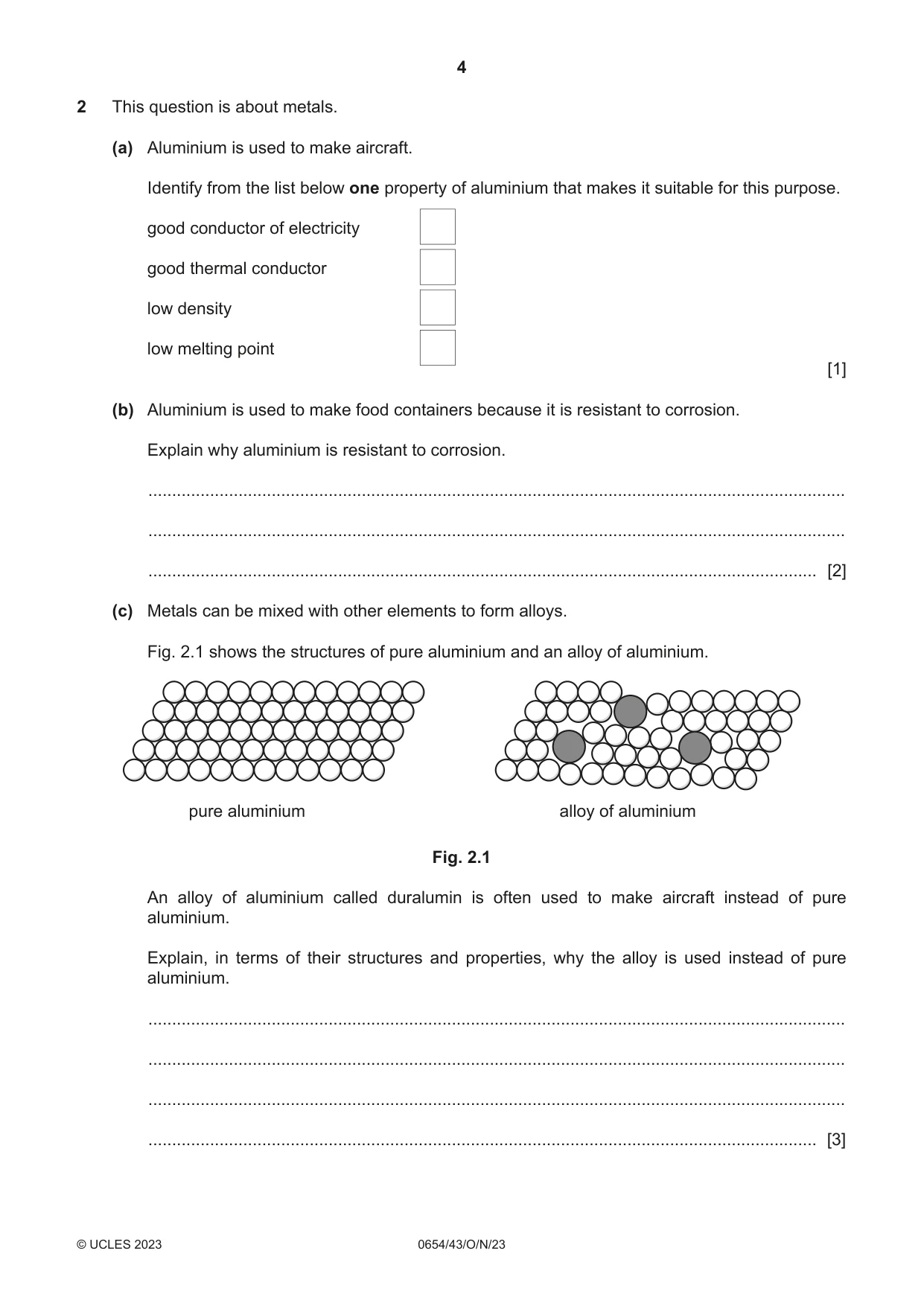
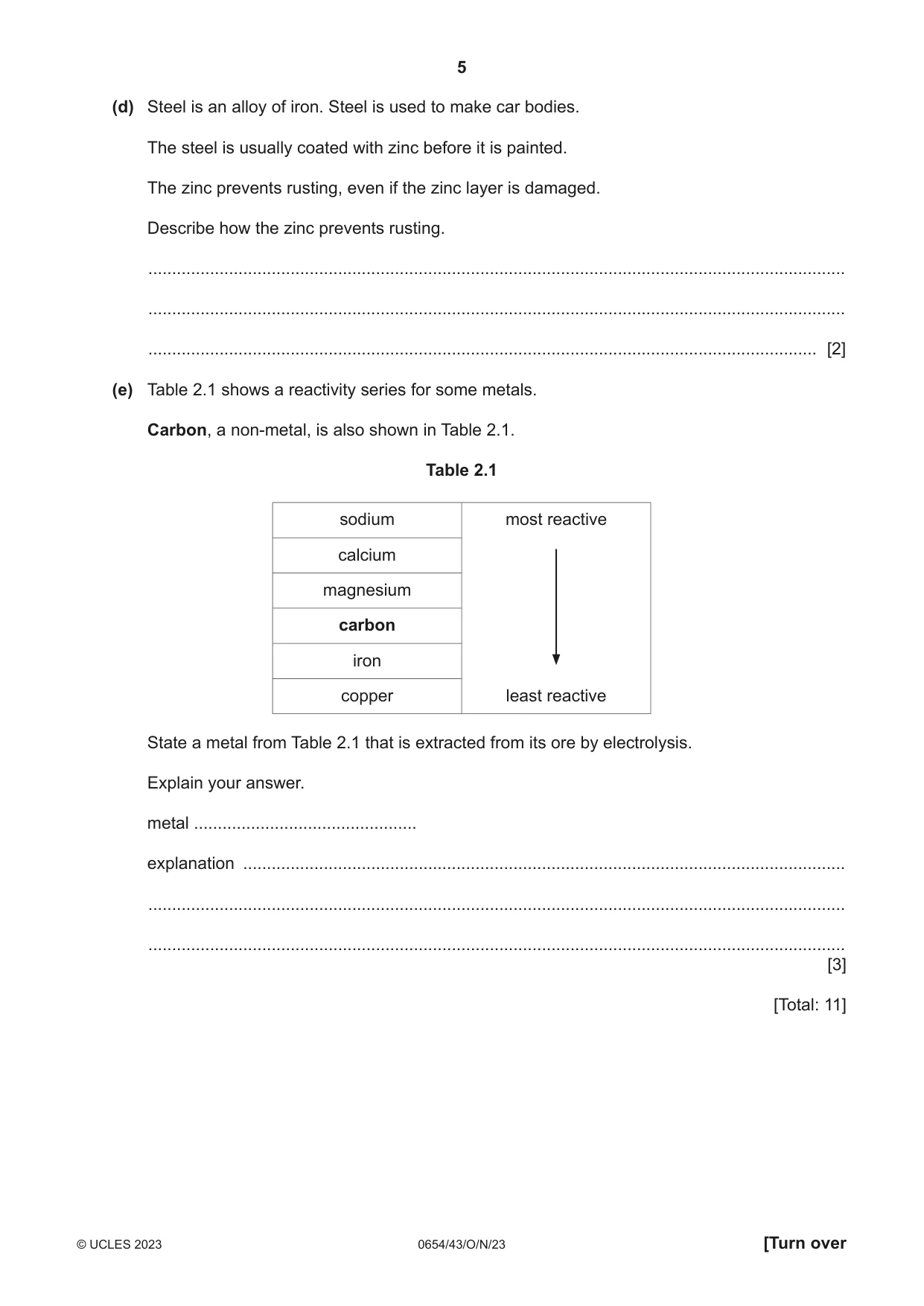
2 This question is about metals. (a) Aluminium is used to make aircraft. Identify from the list below one property of aluminium that makes it suitable for this purpose. good conductor of electricity good thermal conductor low density low melting point [1] (b) Aluminium is used to make food containers because it is resistant to corrosion. Explain why aluminium is resistant to corrosion. ................................................................................................................................................... ................................................................................................................................................... ............................................................................................................................................. [2] (c) Metals can be mixed with other elements to form alloys. Fig. 2.1 shows the structures of pure aluminium and an alloy of aluminium. pure aluminium alloy of aluminium Fig. 2.1 An alloy of aluminium called duralumin is often used to make aircraft instead of pure aluminium. Explain, in terms of their structures and properties, why the alloy is used instead of pure aluminium. ................................................................................................................................................... ................................................................................................................................................... ................................................................................................................................................... ............................................................................................................................................. [3] (d) Steel is an alloy of iron. Steel is used to make car bodies. The steel is usually coated with zinc before it is painted. The zinc prevents rusting, even if the zinc layer is damaged. Describe how the zinc prevents rusting. ................................................................................................................................................... ................................................................................................................................................... ............................................................................................................................................. [2] (e) Table 2.1 shows a reactivity series for some metals. Carbon, a non-metal, is also shown in Table 2.1. Table 2.1 sodium most reactive calcium magnesium carbon iron copper least reactive State a metal from Table 2.1 that is extracted from its ore by electrolysis. Explain your answer. metal ............................................... explanation ............................................................................................................................... ................................................................................................................................................... ................................................................................................................................................... [3] [Total: 11]
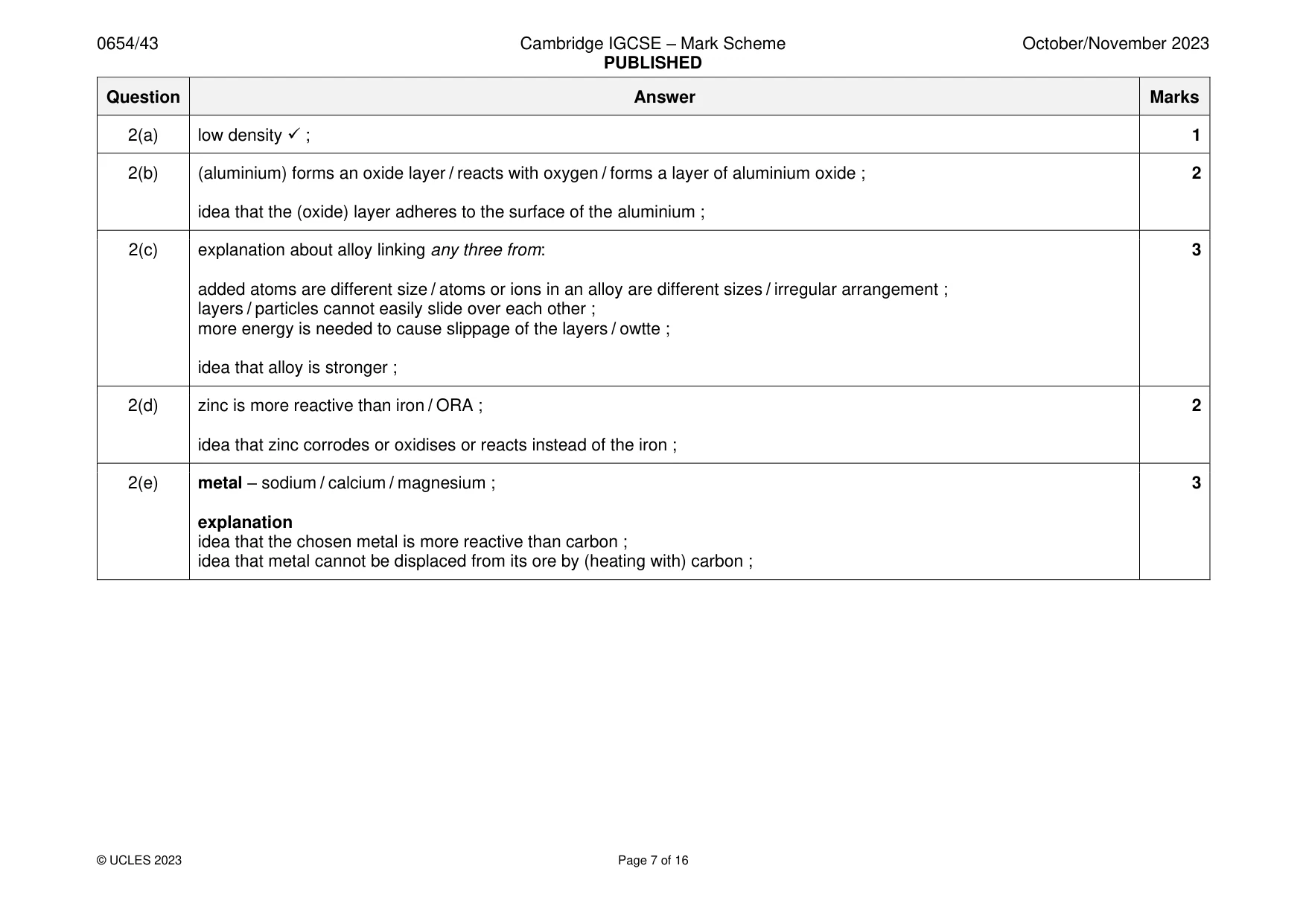
Mark scheme: 2(a) low density ✓ ; 1 2(b) (aluminium) forms an oxide layer / reacts with oxygen / forms a layer of aluminium oxide ; 2 idea that the (oxide) layer adheres to the surface of the aluminium ; 2(c) explanation about alloy linking any three from: 3 added atoms are different size / atoms or ions in an alloy are different sizes / irregular arrangement ; layers / particles cannot easily slide over each other ; more energy is needed to cause slippage of the layers / owtte ; idea that alloy is stronger ; 2(d) zinc is more reactive than iron / ORA ; 2 idea that zinc corrodes or oxidises or reacts instead of the iron ; 2(e) metal – sodium / calcium / magnesium ; 3 explanation idea that the chosen metal is more reactive than carbon ; idea that metal cannot be displaced from its ore by (heating with) carbon ;
Q3 · Meteoroids are lumps of rock which travel through space
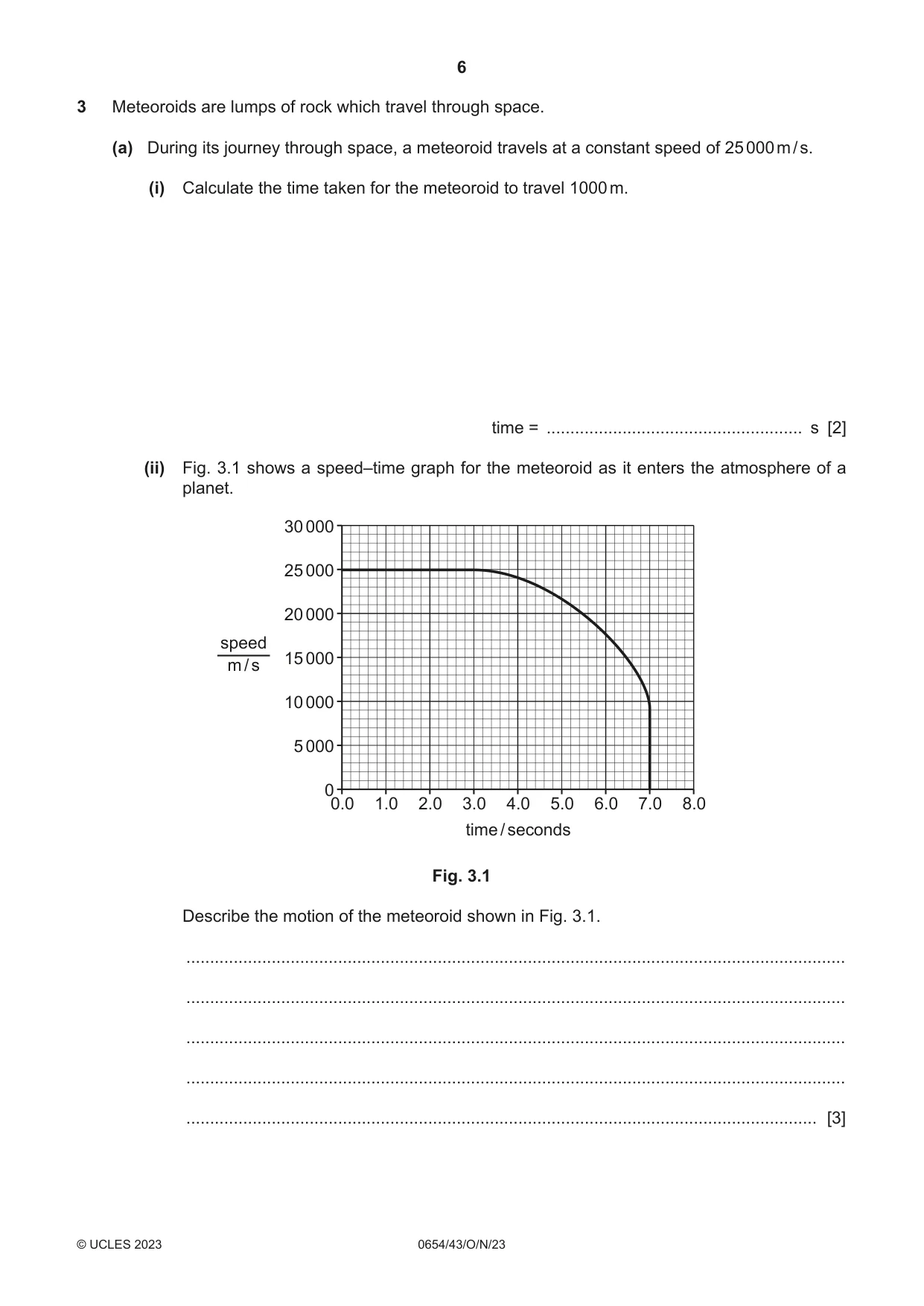
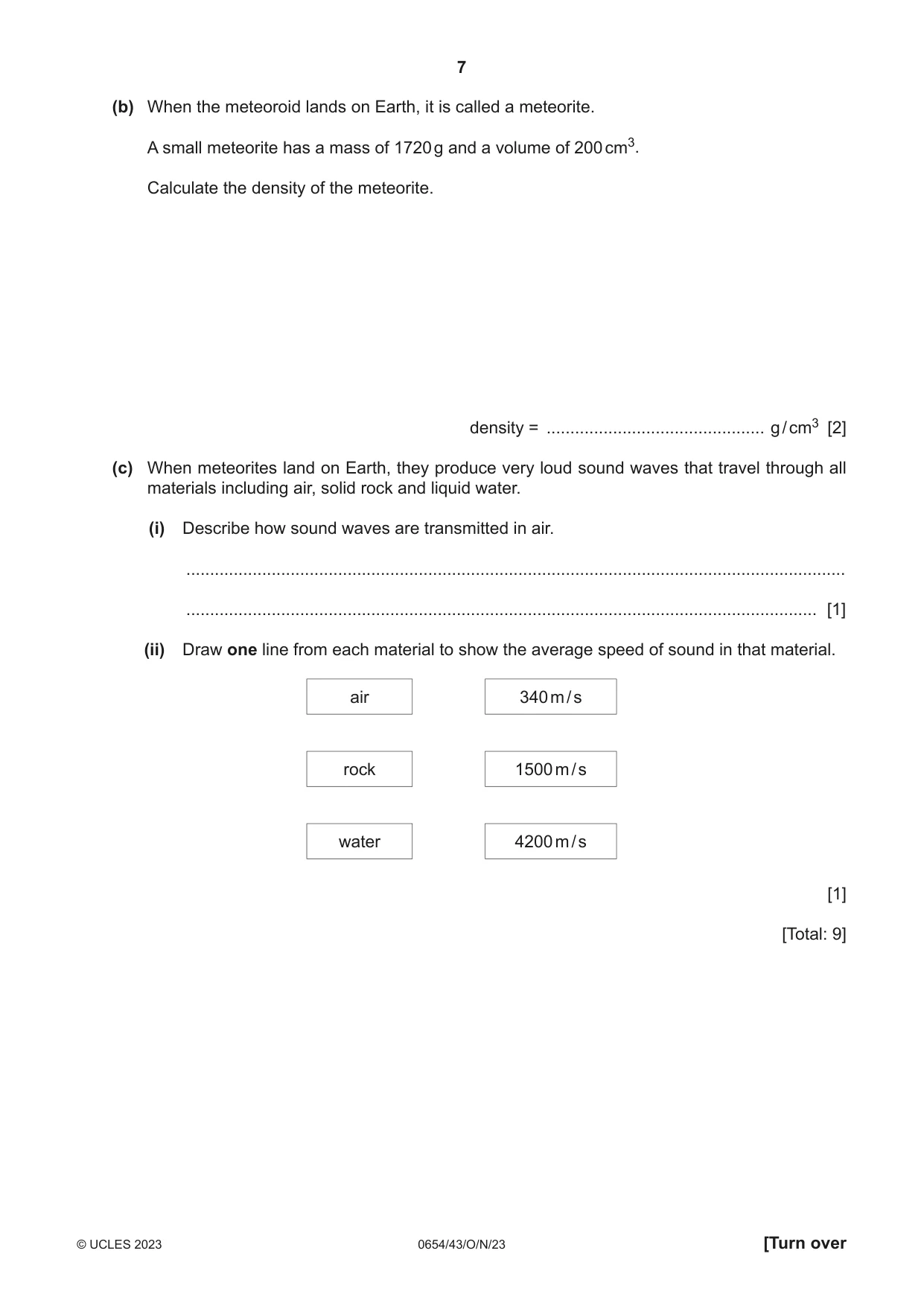
3 Meteoroids are lumps of rock which travel through space. (a) During its journey through space, a meteoroid travels at a constant speed of 25 000 m / s. (i) Calculate the time taken for the meteoroid to travel 1000 m. time = ...................................................... s [2] (ii) Fig. 3.1 shows a speed–time graph for the meteoroid as it enters the atmosphere of a planet. 30 000 25 000 20 000 speed 15 000 m / s 10 000 5 000 0 0.0 1.0 2.0 3.0 4.0 5.0 6.0 7.0 8.0 time / seconds Fig. 3.1 Describe the motion of the meteoroid shown in Fig. 3.1. ........................................................................................................................................... ........................................................................................................................................... ........................................................................................................................................... ........................................................................................................................................... ..................................................................................................................................... [3] (b) When the meteoroid lands on Earth, it is called a meteorite. A small meteorite has a mass of 1720 g and a volume of 200 cm3. Calculate the density of the meteorite. density = .............................................. g / cm3 [2] (c) When meteorites land on Earth, they produce very loud sound waves that travel through all materials including air, solid rock and liquid water. (i) Describe how sound waves are transmitted in air. ........................................................................................................................................... ..................................................................................................................................... [1] (ii) Draw one line from each material to show the average speed of sound in that material. air 340 m / s rock 1500 m / s water 4200 m / s [1] [Total: 9]
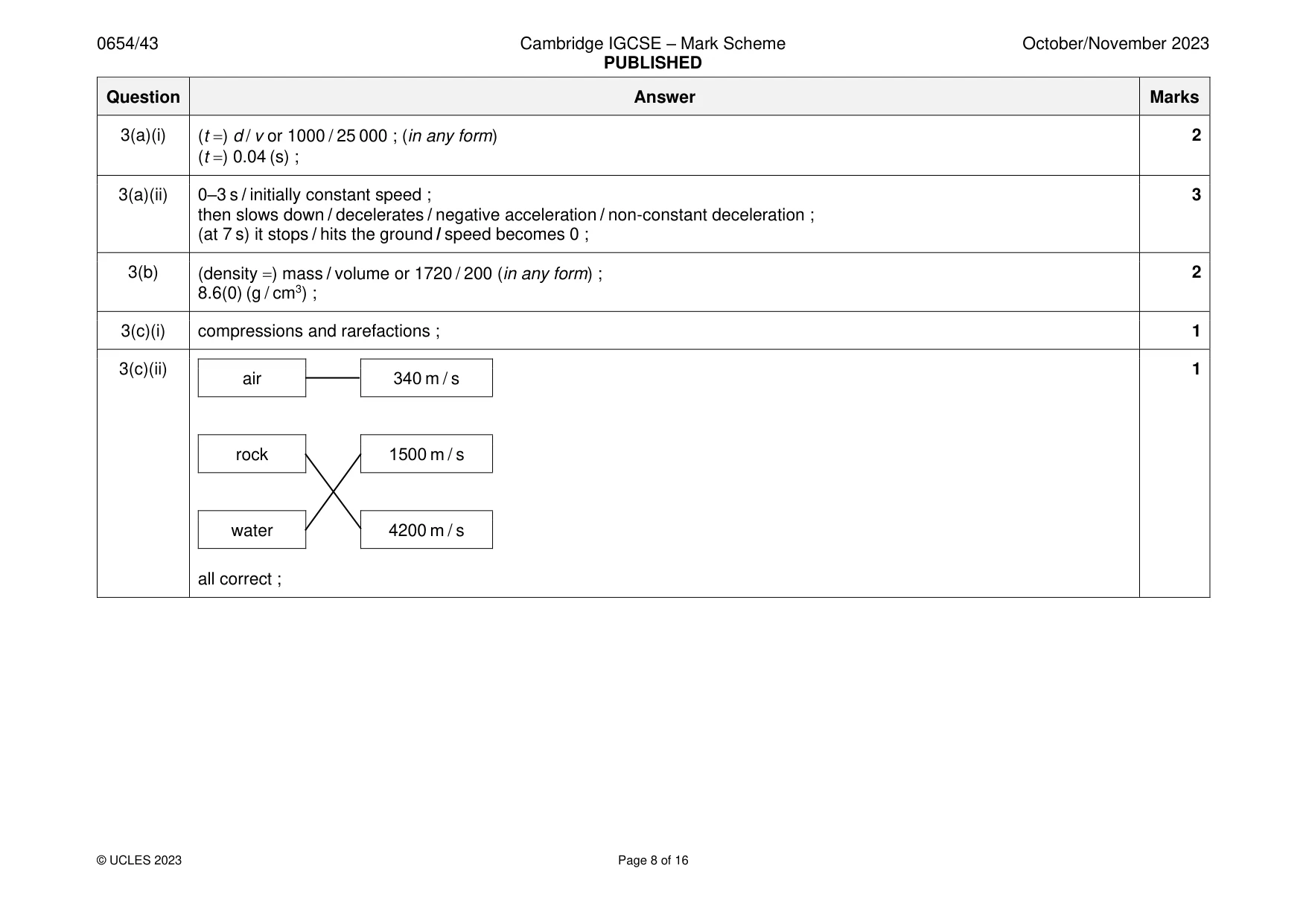
Mark scheme: 3(a)(i) (t =) d / v or 1000 / 25 000 ; (in any form) 2 (t =) 0.04 (s) ; 3(a)(ii) 0–3 s / initially constant speed ; 3 then slows down / decelerates / negative acceleration / non-constant deceleration ; (at 7 s) it stops / hits the ground / speed becomes 0 ; 3(b) (density =) mass / volume or 1720 / 200 (in any form) ; 2 8.6(0) (g / cm3) ; 3(c)(i) compressions and rarefactions ; 1 3(c)(ii) 1 air 340 m / s rock 1500 m / s water 4200 m / s all correct ;
Q4 · A scientist compares the relative concentrations of bacteria and dissolved oxygen in a…
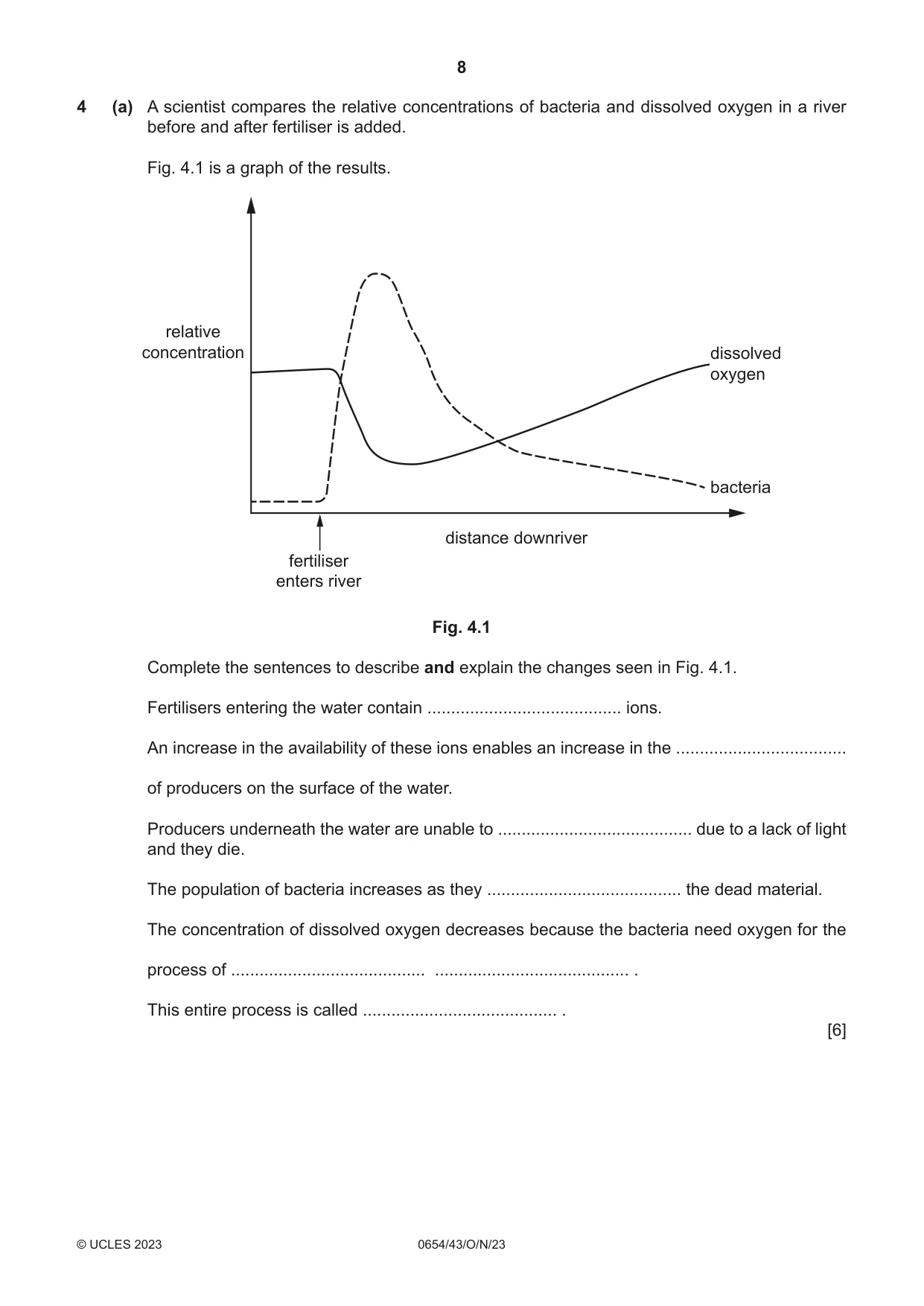
4 (a) A scientist compares the relative concentrations of bacteria and dissolved oxygen in a river before and after fertiliser is added. Fig. 4.1 is a graph of the results. relative concentration dissolved oxygen bacteria distance downriver fertiliser enters river Fig. 4.1 Complete the sentences to describe and explain the changes seen in Fig. 4.1. Fertilisers entering the water contain ......................................... ions. An increase in the availability of these ions enables an increase in the .................................... of producers on the surface of the water. Producers underneath the water are unable to ......................................... due to a lack of light and they die. The population of bacteria increases as they ......................................... the dead material. The concentration of dissolved oxygen decreases because the bacteria need oxygen for the process of ......................................... ......................................... . This entire process is called ......................................... . [6] (b) Bacteria reproduce by a type of asexual reproduction. (i) State the type of cell division used in asexual reproduction. ..................................................................................................................................... [1] (ii) Describe two ways that asexual reproduction is different from sexual reproduction. 1 ........................................................................................................................................ ........................................................................................................................................... 2 ........................................................................................................................................ ........................................................................................................................................... [2] (iii) State the name of one type of cell adapted for sexual reproduction in humans. ..................................................................................................................................... [1] [Total: 10]
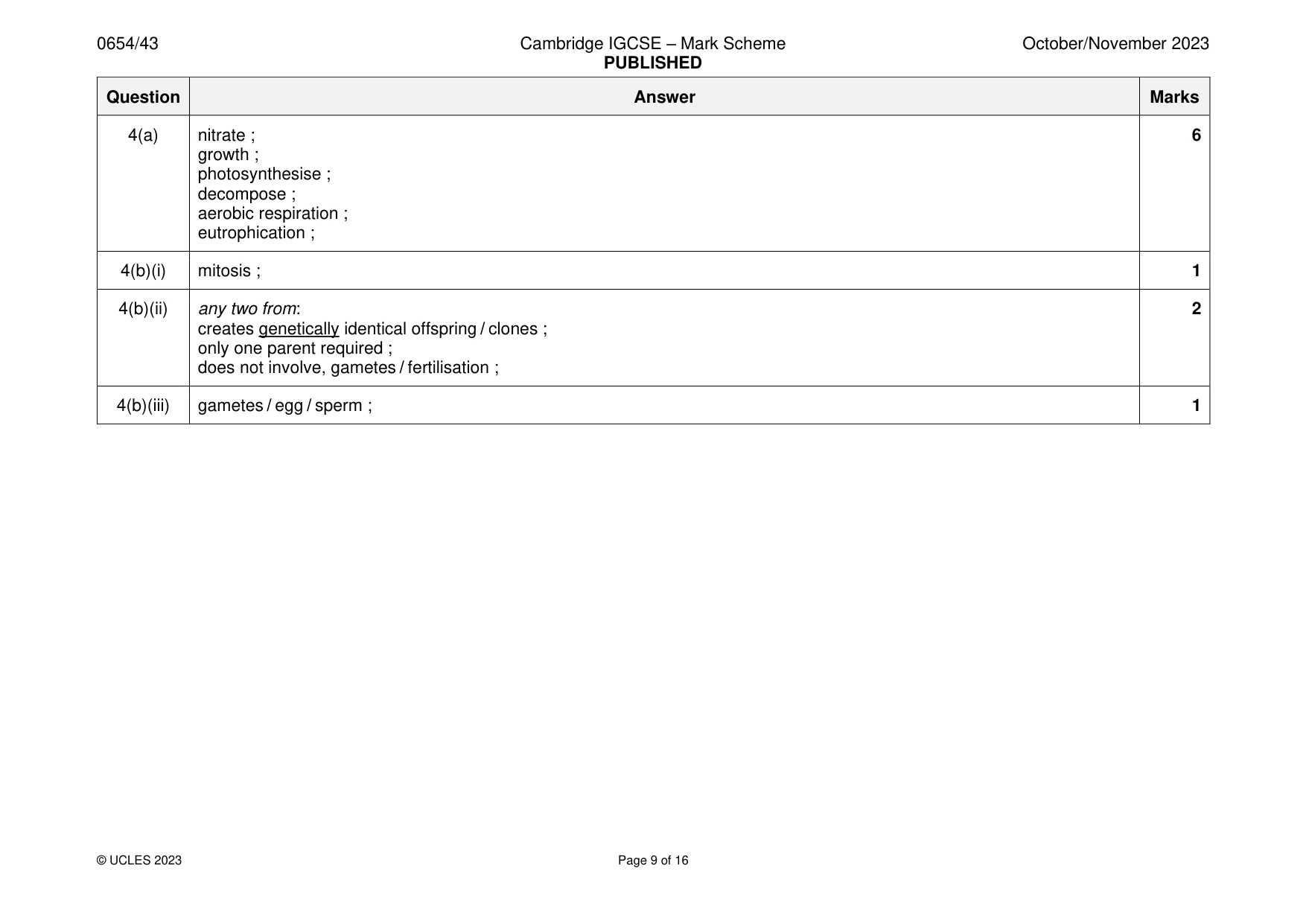
Mark scheme: 4(a) nitrate ; 6 growth ; photosynthesise ; decompose ; aerobic respiration ; eutrophication ; 4(b)(i) mitosis ; 1 4(b)(ii) any two from: 2 creates genetically identical offspring / clones ; only one parent required ; does not involve, gametes / fertilisation ; 4(b)(iii) gametes / egg / sperm ; 1
Q5 · Particles can be atoms, ions or molecules
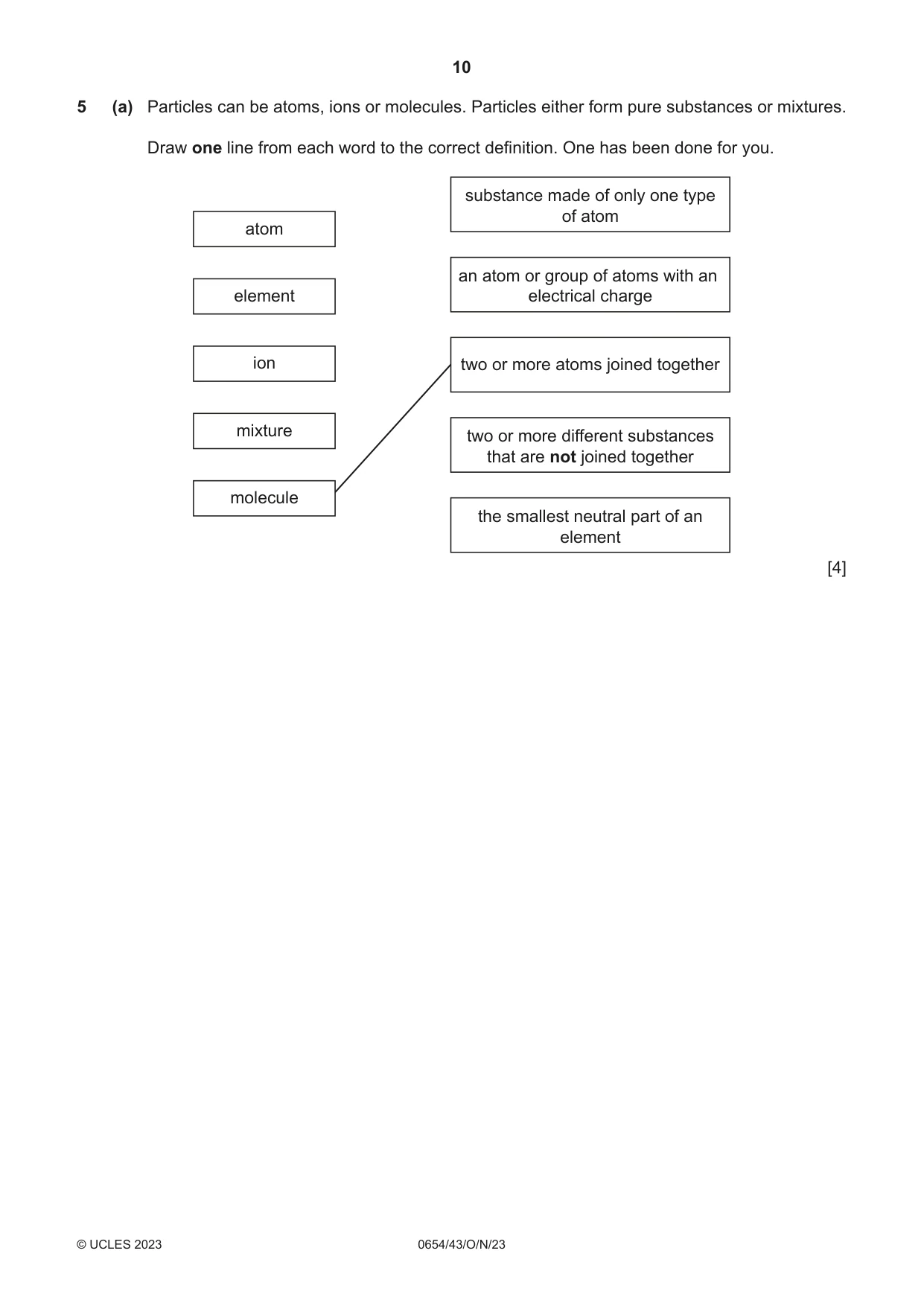
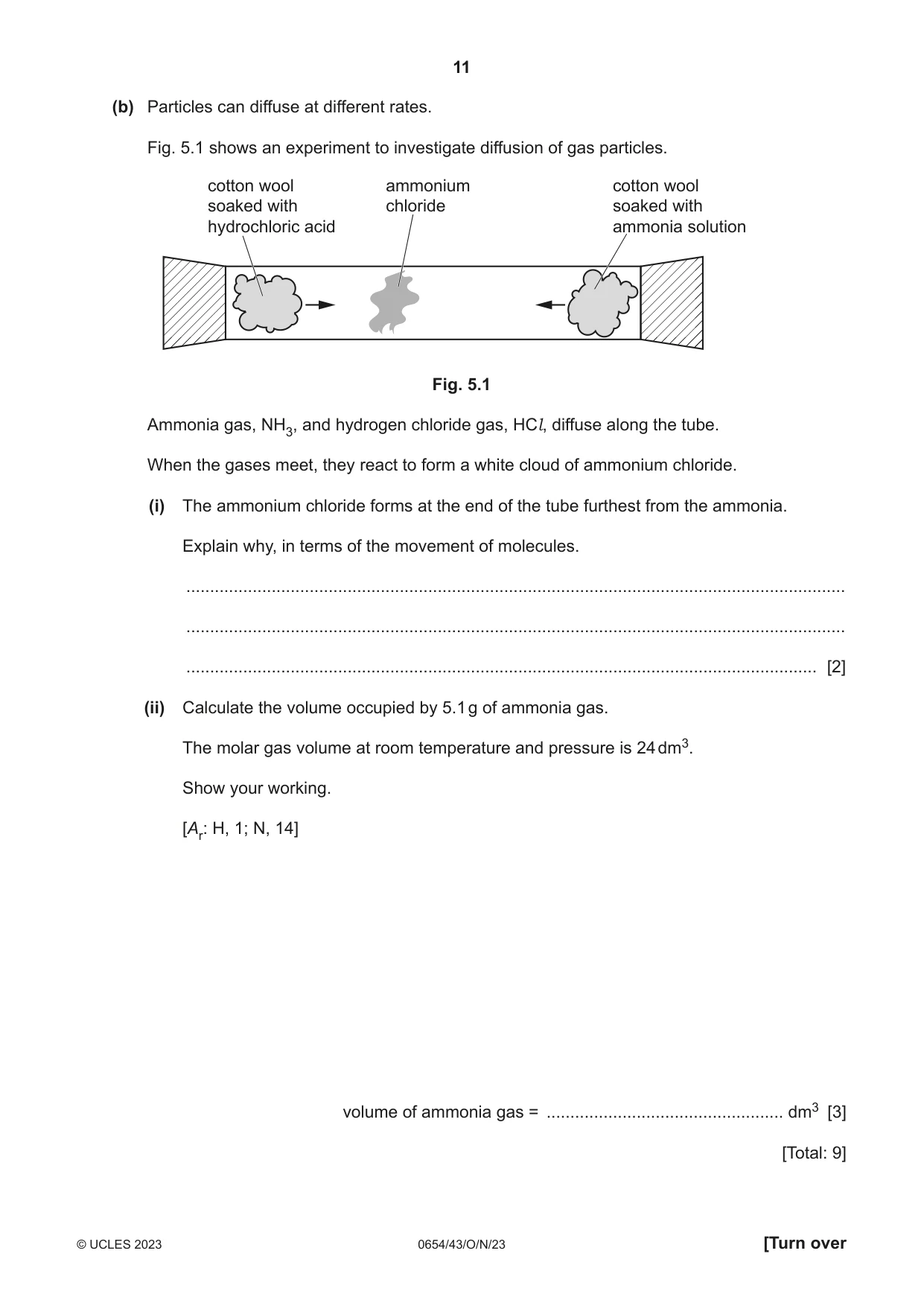
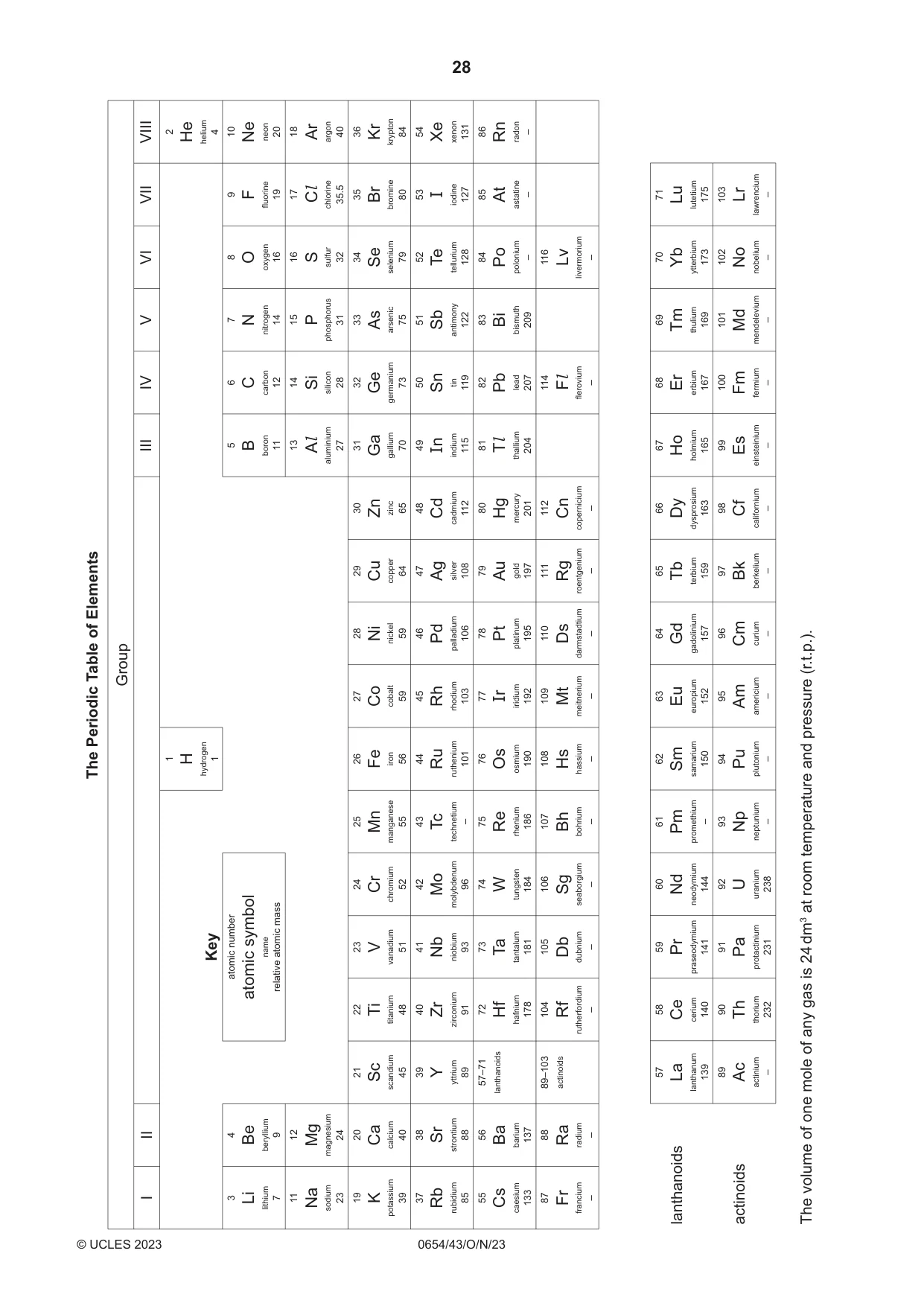
5 (a) Particles can be atoms, ions or molecules. Particles either form pure substances or mixtures. Draw one line from each word to the correct definition. One has been done for you. substance made of only one type of atom atom an atom or group of atoms with an element electrical charge ion two or more atoms joined together mixture two or more different substances that are not joined together molecule the smallest neutral part of an element [4] (b) Particles can diffuse at different rates. Fig. 5.1 shows an experiment to investigate diffusion of gas particles. cotton wool ammonium cotton wool soaked with chloride soaked with hydrochloric acid ammonia solution Fig. 5.1 Ammonia gas, NH3, and hydrogen chloride gas, HCl, diffuse along the tube. When the gases meet, they react to form a white cloud of ammonium chloride. (i) The ammonium chloride forms at the end of the tube furthest from the ammonia. Explain why, in terms of the movement of molecules. ........................................................................................................................................... ........................................................................................................................................... ..................................................................................................................................... [2] (ii) Calculate the volume occupied by 5.1 g of ammonia gas. The molar gas volume at room temperature and pressure is 24 dm3. Show your working. [Ar: H, 1; N, 14] volume of ammonia gas = .................................................. dm3 [3] [Total: 9]
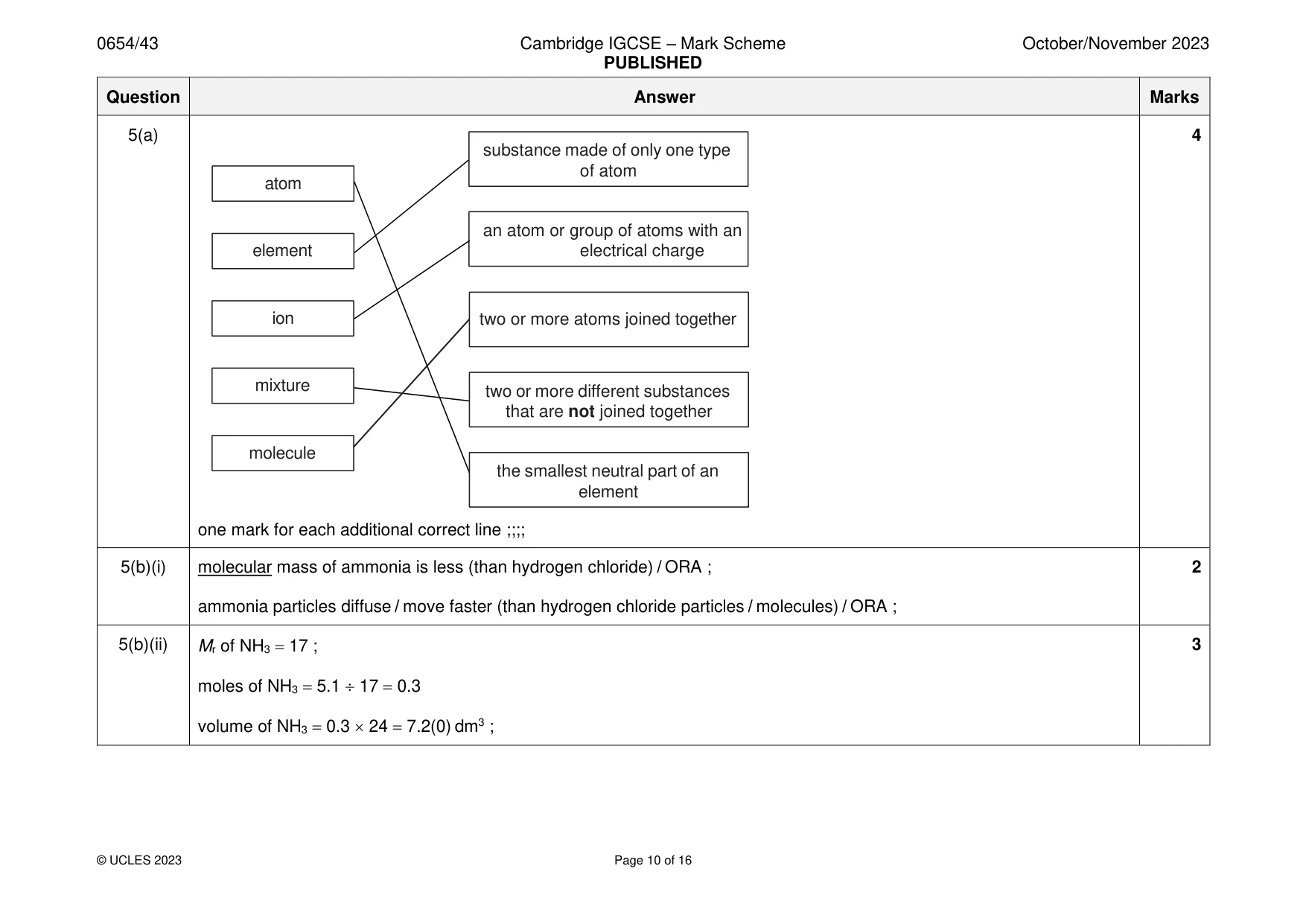
Mark scheme: 5(a) 4 substance made of only one type of atom atom an atom or group of atoms with an element electrical charge ion two or more atoms joined together mixture two or more different substances that are not joined together molecule the smallest neutral part of an element one mark for each additional correct line ;;;; 5(b)(i) molecular mass of ammonia is less (than hydrogen chloride) / ORA ; 2 ammonia particles diffuse / move faster (than hydrogen chloride particles / molecules) / ORA ; 5(b)(ii) Mr of NH3 = 17 ; 3 moles of NH3 = 5.1 17 = 0.3 volume of NH3 = 0.3 24 = 7.2(0) dm3 ;
Question 6
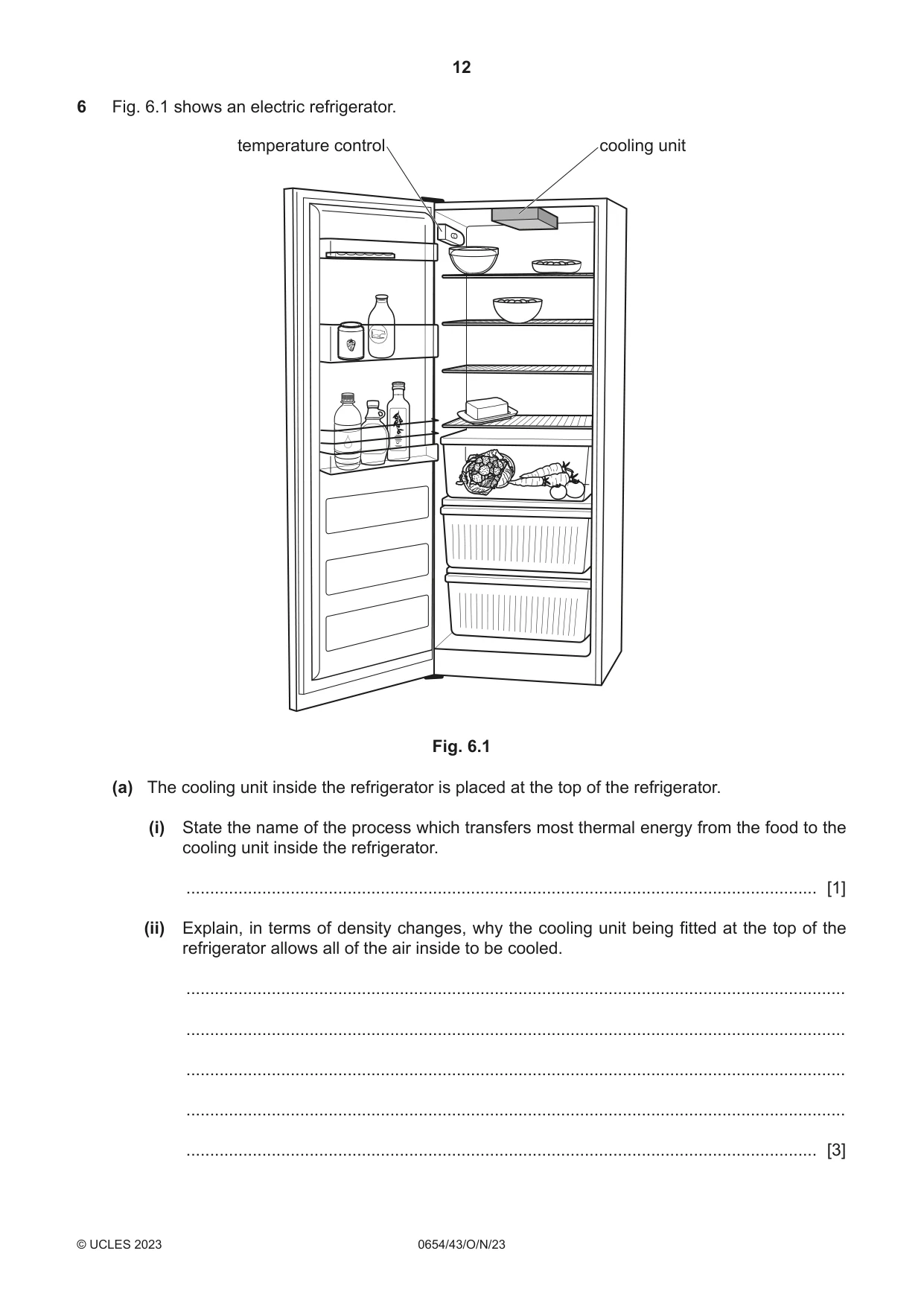
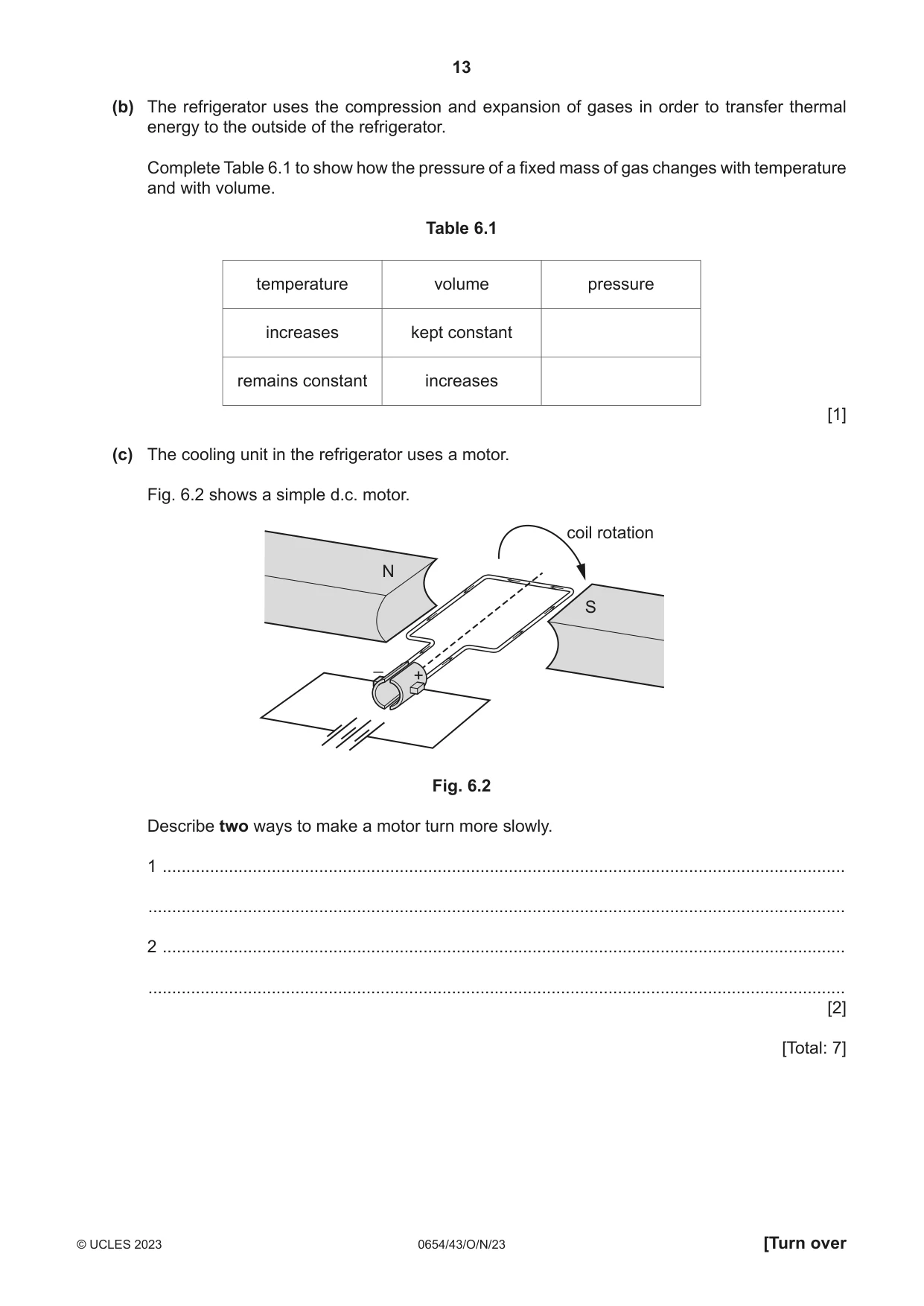
6 Fig. 6.1 shows an electric refrigerator. temperature control cooling unit Fig. 6.1 (a) The cooling unit inside the refrigerator is placed at the top of the refrigerator. (i) State the name of the process which transfers most thermal energy from the food to the cooling unit inside the refrigerator. ..................................................................................................................................... [1] (ii) Explain, in terms of density changes, why the cooling unit being fitted at the top of the refrigerator allows all of the air inside to be cooled. ........................................................................................................................................... ........................................................................................................................................... ........................................................................................................................................... ........................................................................................................................................... ..................................................................................................................................... [3] (b) The refrigerator uses the compression and expansion of gases in order to transfer thermal energy to the outside of the refrigerator. Complete Table 6.1 to show how the pressure of a fixed mass of gas changes with temperature and with volume. Table 6.1 temperature volume pressure increases kept constant remains constant increases [1] (c) The cooling unit in the refrigerator uses a motor. Fig. 6.2 shows a simple d.c. motor. coil rotation N S _ + Fig. 6.2 Describe two ways to make a motor turn more slowly. 1 ................................................................................................................................................ ................................................................................................................................................... 2 ................................................................................................................................................ ................................................................................................................................................... [2] [Total: 7]
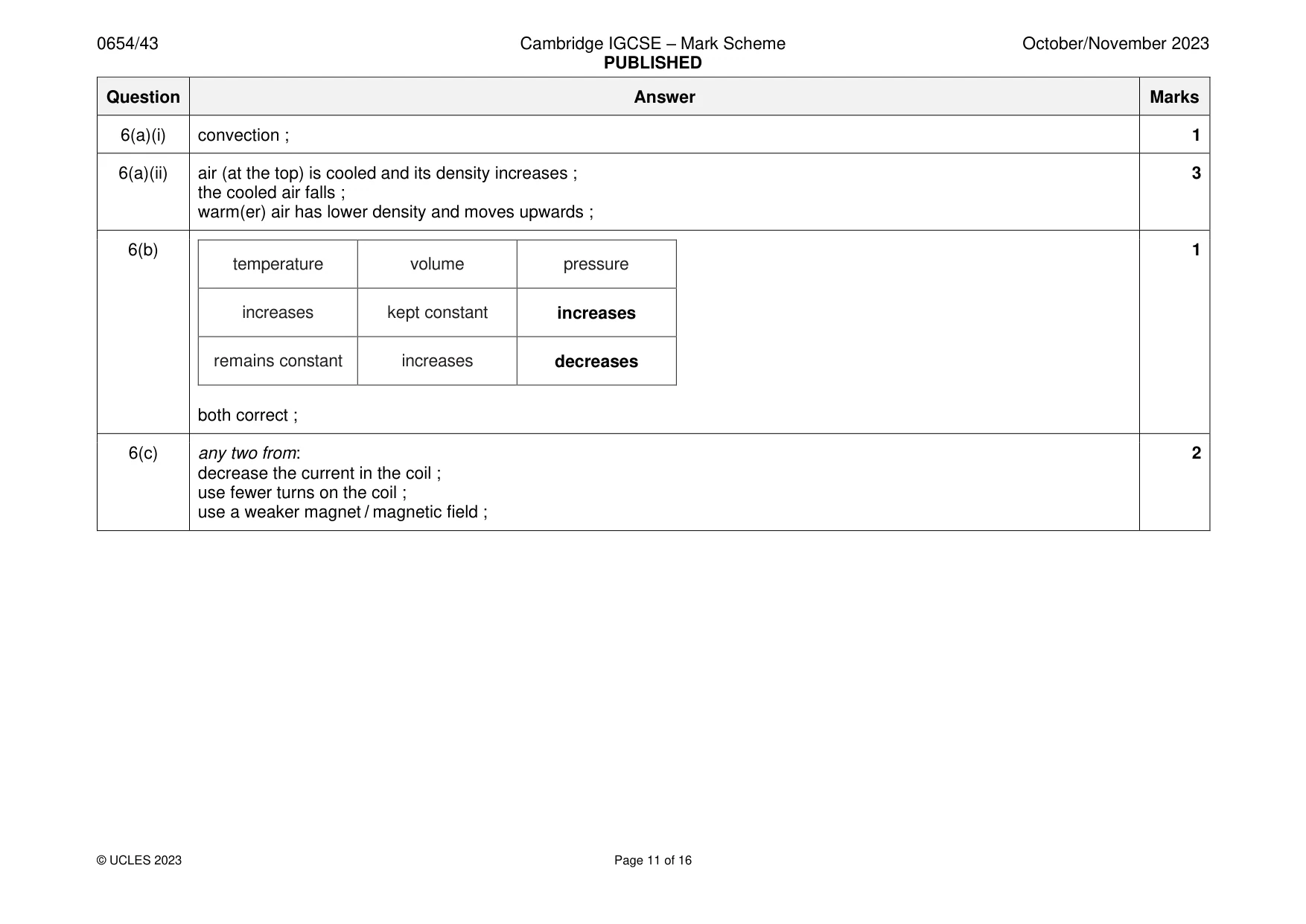
Mark scheme: 6(a)(i) convection ; 1 6(a)(ii) air (at the top) is cooled and its density increases ; 3 the cooled air falls ; warm(er) air has lower density and moves upwards ; 6(b) 1 temperature volume pressure increases kept constant increases remains constant increases decreases both correct ; 6(c) any two from: 2 decrease the current in the coil ; use fewer turns on the coil ; use a weaker magnet / magnetic field ;
Q7 · A diagram of a cross-section of a leaf
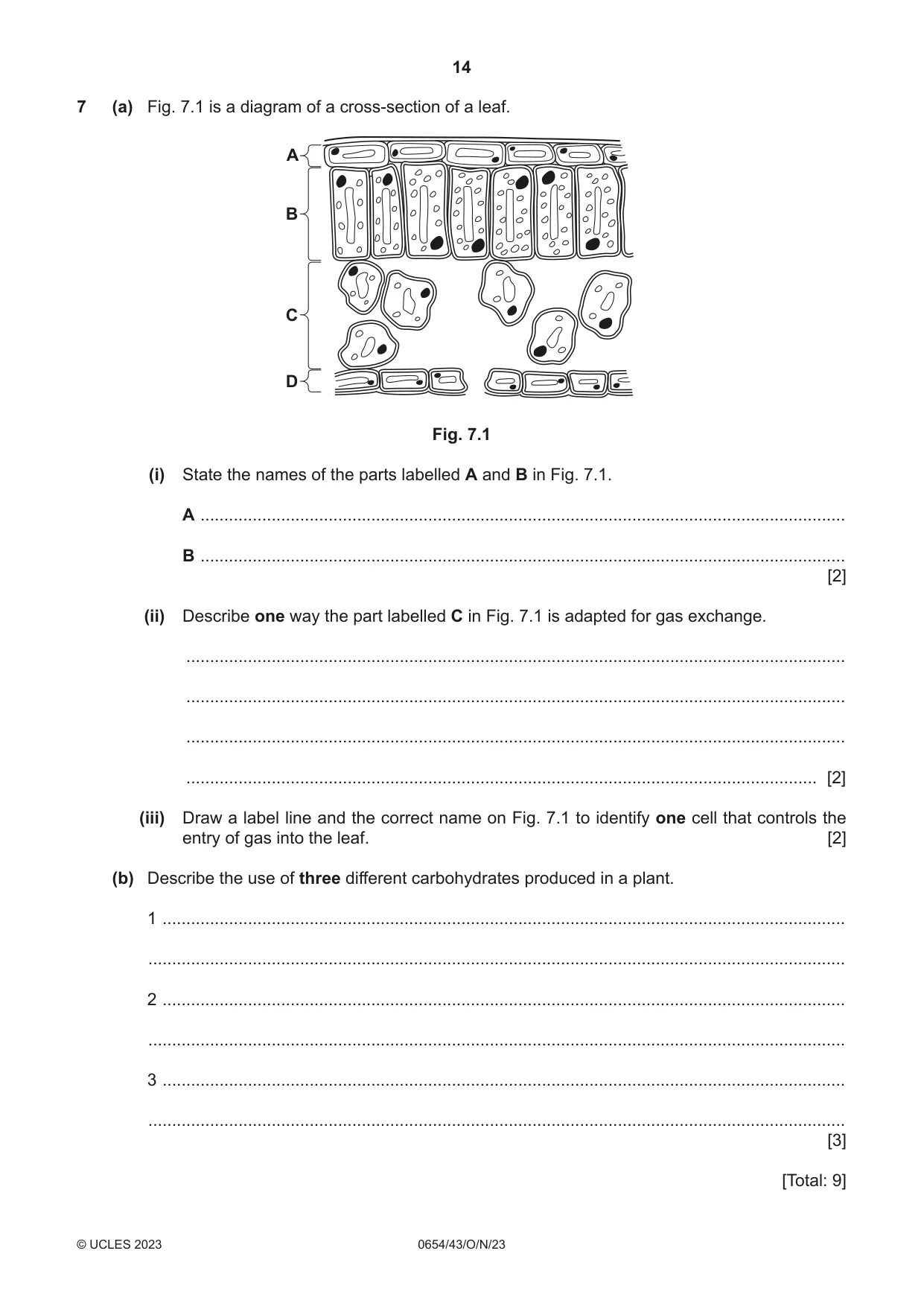
7 (a) Fig. 7.1 is a diagram of a cross-section of a leaf. A B C D Fig. 7.1 (i) State the names of the parts labelled A and B in Fig. 7.1. A ........................................................................................................................................ B ........................................................................................................................................ [2] (ii) Describe one way the part labelled C in Fig. 7.1 is adapted for gas exchange. ........................................................................................................................................... ........................................................................................................................................... ........................................................................................................................................... ..................................................................................................................................... [2] (iii) Draw a label line and the correct name on Fig. 7.1 to identify one cell that controls the entry of gas into the leaf. [2] (b) Describe the use of three different carbohydrates produced in a plant. 1 ................................................................................................................................................ ................................................................................................................................................... 2 ................................................................................................................................................ ................................................................................................................................................... 3 ................................................................................................................................................ ................................................................................................................................................... [3] [Total: 9]
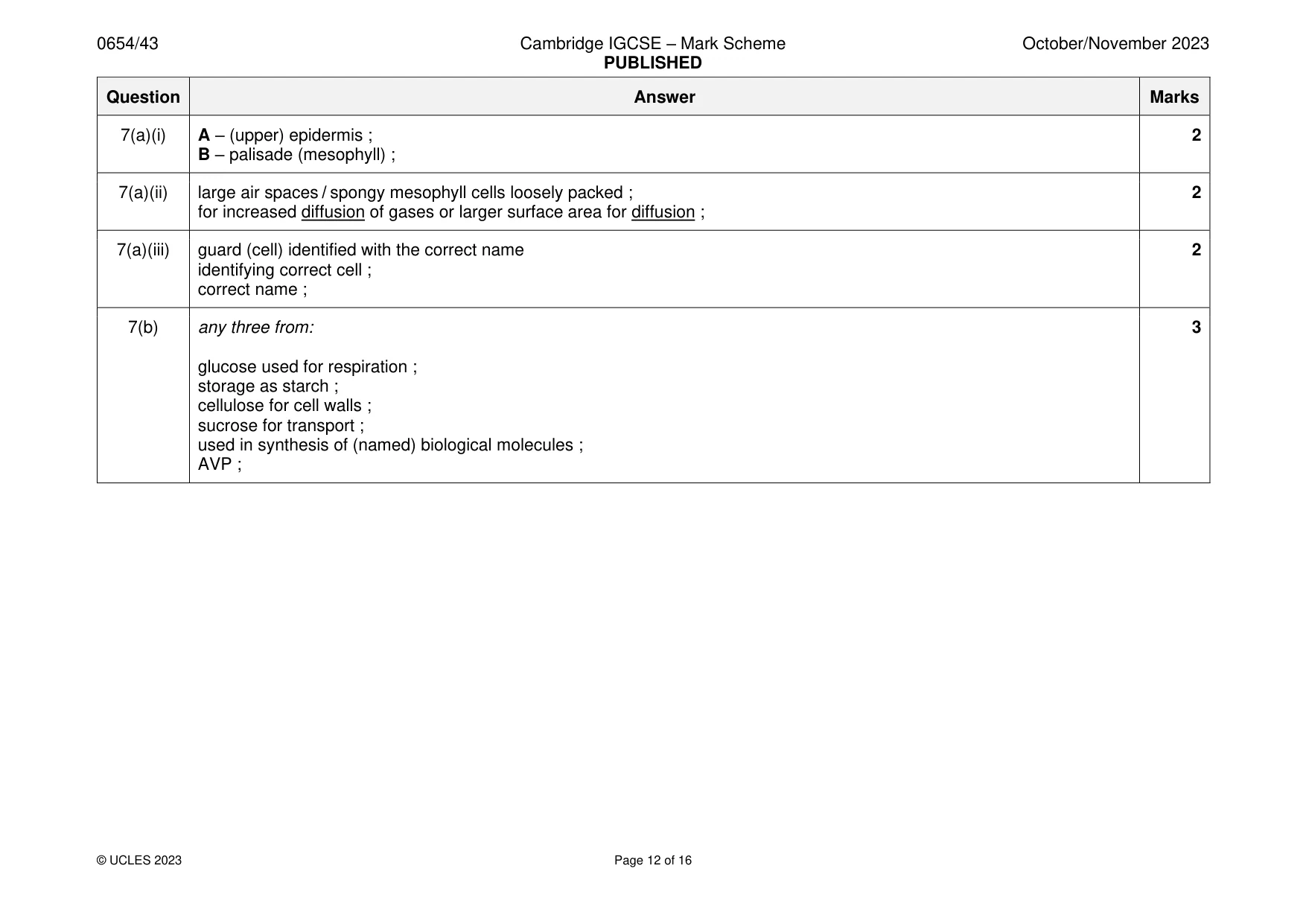
Mark scheme: 7(a)(i) A – (upper) epidermis ; 2 B – palisade (mesophyll) ; 7(a)(ii) large air spaces / spongy mesophyll cells loosely packed ; 2 for increased diffusion of gases or larger surface area for diffusion ; 7(a)(iii) guard (cell) identified with the correct name 2 identifying correct cell ; correct name ; 7(b) any three from: 3 glucose used for respiration ; storage as starch ; cellulose for cell walls ; sucrose for transport ; used in synthesis of (named) biological molecules ; AVP ;
Q8 · Electrolysis is used to break down ionic compounds
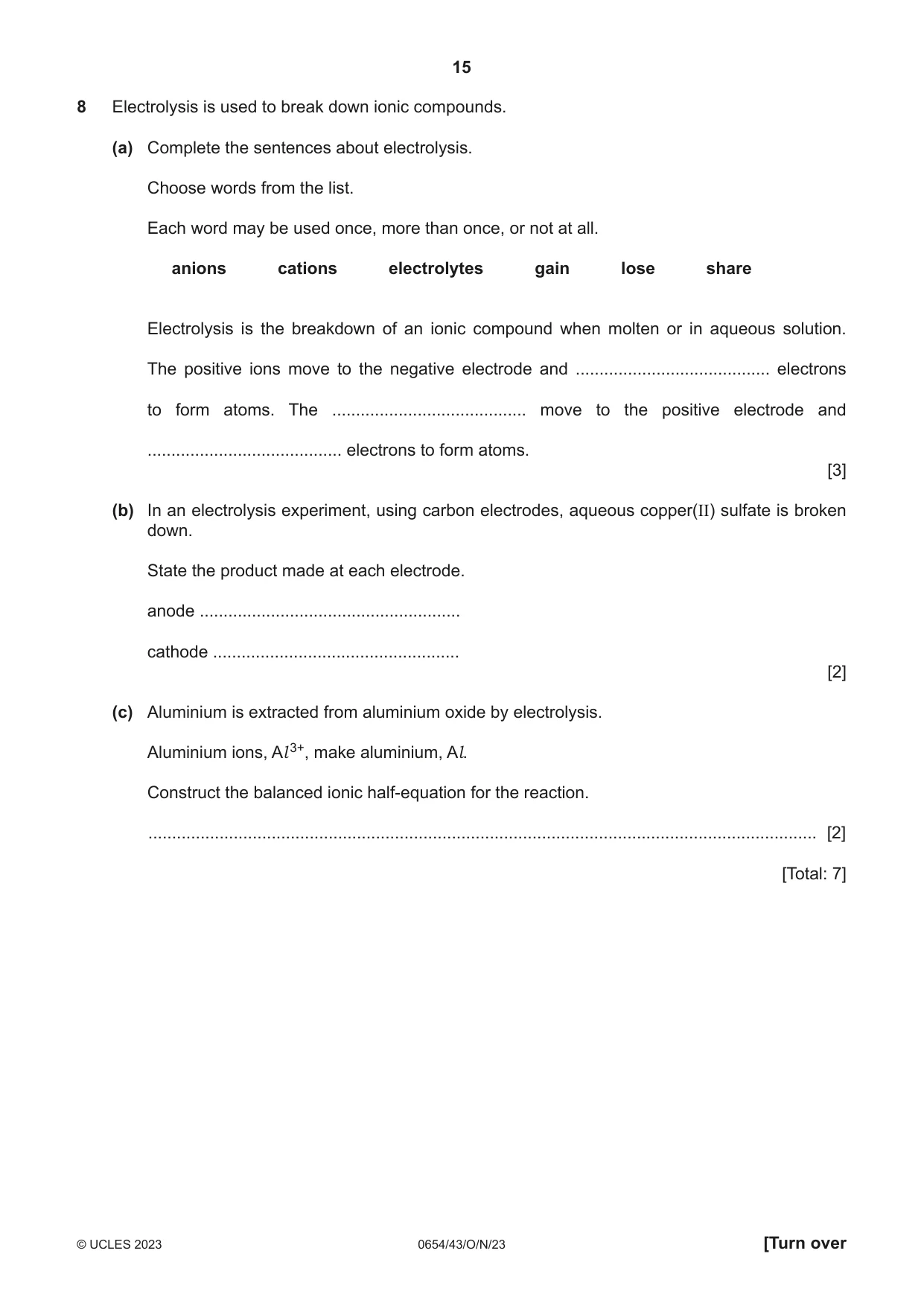
8 Electrolysis is used to break down ionic compounds. (a) Complete the sentences about electrolysis. Choose words from the list. Each word may be used once, more than once, or not at all. anions cations electrolytes gain lose share Electrolysis is the breakdown of an ionic compound when molten or in aqueous solution. The positive ions move to the negative electrode and ......................................... electrons to form atoms. The ......................................... move to the positive electrode and ......................................... electrons to form atoms. [3] (b) In an electrolysis experiment, using carbon electrodes, aqueous copper(II) sulfate is broken down. State the product made at each electrode. anode ....................................................... cathode .................................................... [2] (c) Aluminium is extracted from aluminium oxide by electrolysis. Aluminium ions, Al 3+, make aluminium, Al. Construct the balanced ionic half-equation for the reaction. ............................................................................................................................................. [2] [Total: 7]
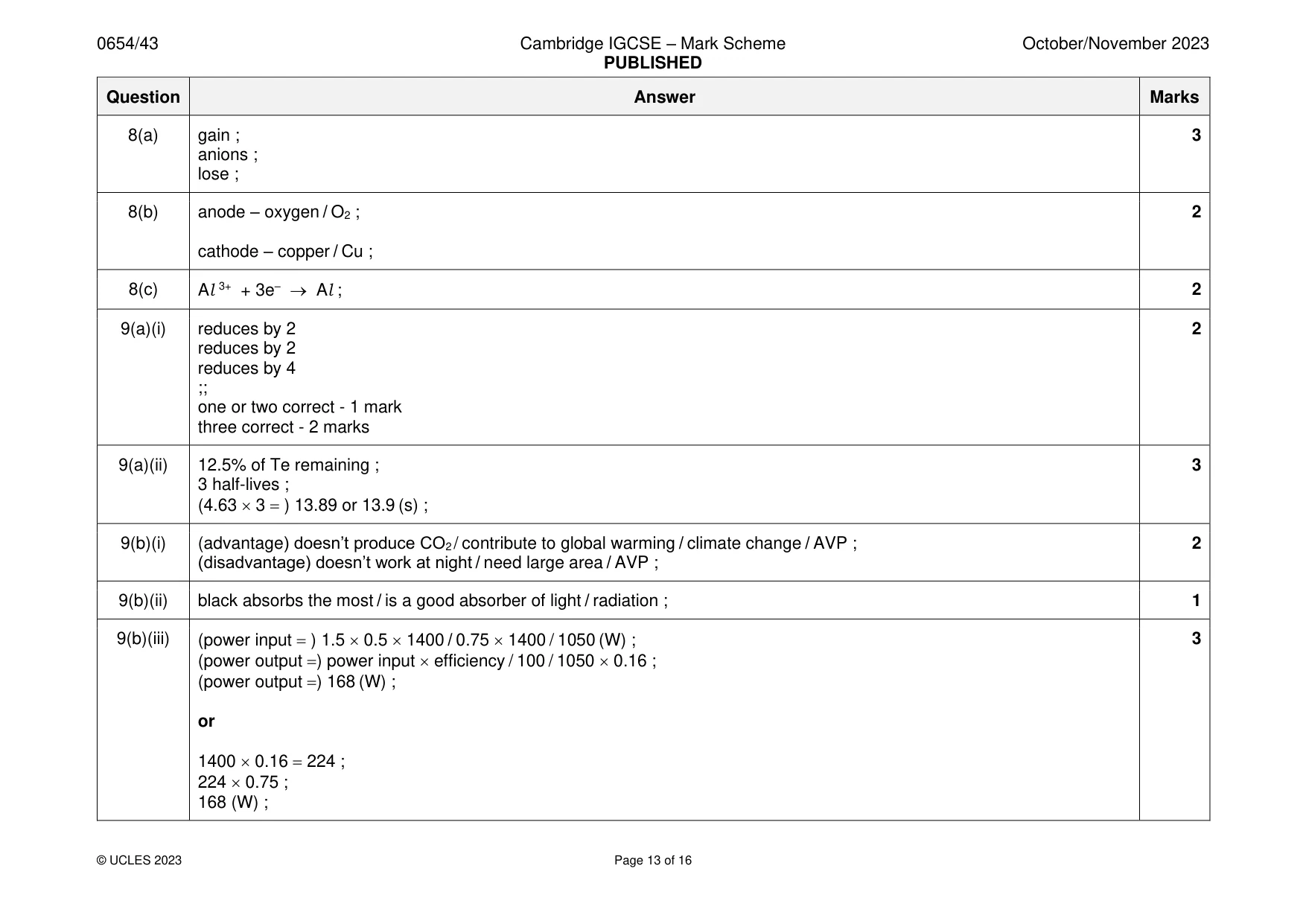
Mark scheme: 8(a) gain ; 3 anions ; lose ; 8(b) anode – oxygen / O2 ; 2 cathode – copper / Cu ; 8(c) Al 3+ + 3e– → Al ; 2
Q9 · Tellurium is a rare element which exists as several isotopes, some of which are unstable
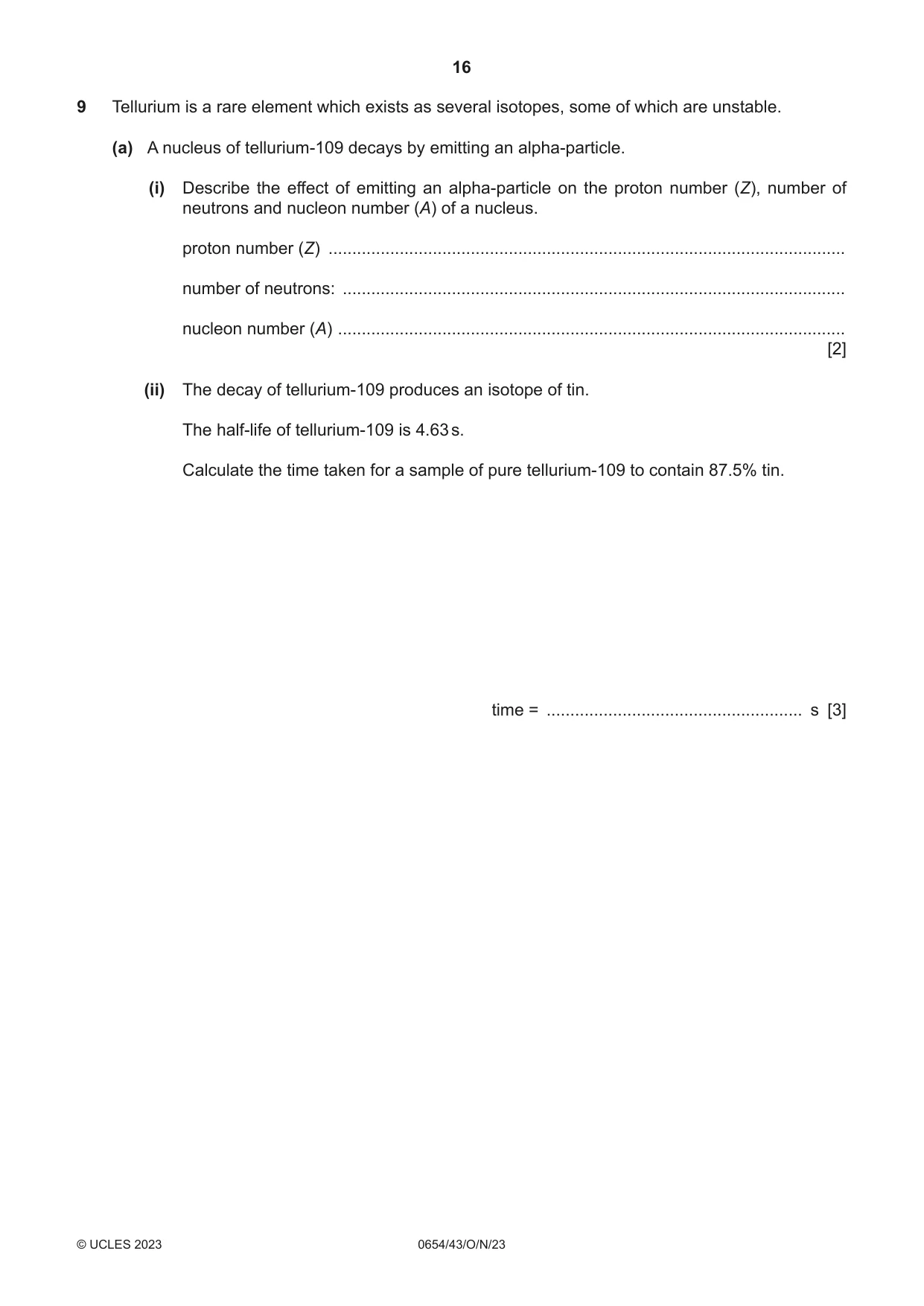
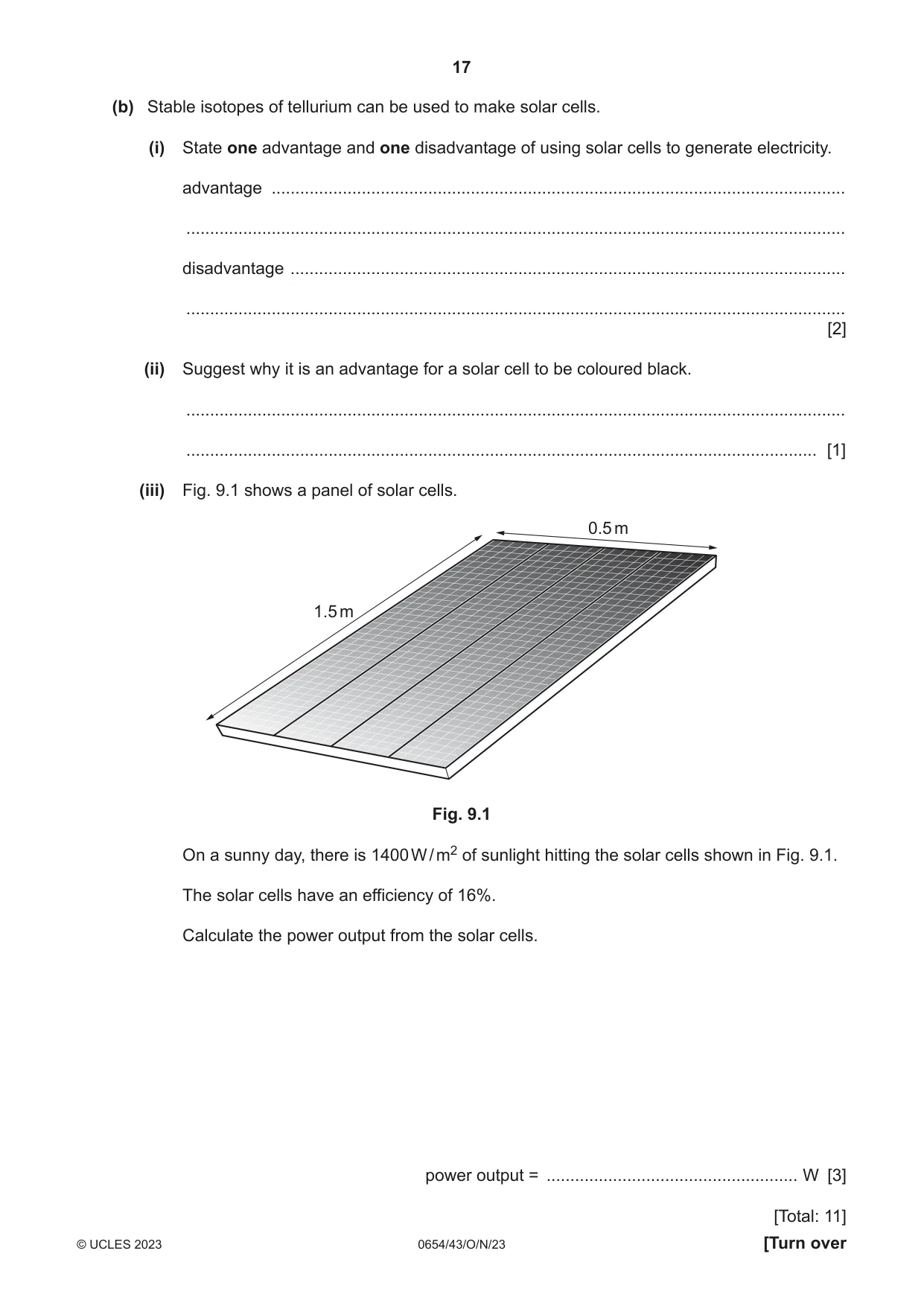
9 Tellurium is a rare element which exists as several isotopes, some of which are unstable. (a) A nucleus of tellurium-109 decays by emitting an alpha-particle. (i) Describe the effect of emitting an alpha-particle on the proton number (Z), number of neutrons and nucleon number (A) of a nucleus. proton number (Z) ............................................................................................................. number of neutrons: .......................................................................................................... nucleon number (A) ........................................................................................................... [2] (ii) The decay of tellurium-109 produces an isotope of tin. The half-life of tellurium-109 is 4.63 s. Calculate the time taken for a sample of pure tellurium-109 to contain 87.5% tin. time = ...................................................... s [3] (b) Stable isotopes of tellurium can be used to make solar cells. (i) State one advantage and one disadvantage of using solar cells to generate electricity. advantage ......................................................................................................................... ........................................................................................................................................... disadvantage ..................................................................................................................... ........................................................................................................................................... [2] (ii) Suggest why it is an advantage for a solar cell to be coloured black. ........................................................................................................................................... ..................................................................................................................................... [1] (iii) Fig. 9.1 shows a panel of solar cells. 0.5 m 1.5 m Fig. 9.1 On a sunny day, there is 1400 W / m2 of sunlight hitting the solar cells shown in Fig. 9.1. The solar cells have an efficiency of 16%. Calculate the power output from the solar cells. power output = ..................................................... W [3] [Total: 11]
Mark scheme: 9(a)(i) reduces by 2 2 reduces by 2 reduces by 4 ;; one or two correct - 1 mark three correct - 2 marks 9(a)(ii) 12.5% of Te remaining ; 3 3 half-lives ; (4.63 3 = ) 13.89 or 13.9 (s) ; 9(b)(i) (advantage) doesn’t produce CO2 / contribute to global warming / climate change / AVP ; 2 (disadvantage) doesn’t work at night / need large area / AVP ; 9(b)(ii) black absorbs the most / is a good absorber of light / radiation ; 1 9(b)(iii) (power input = ) 1.5 0.5 1400 / 0.75 1400 / 1050 (W) ; 3 (power output =) power input efficiency / 100 / 1050 0.16 ; (power output =) 168 (W) ; or 1400 0.16 = 224 ; 224 0.75 ; 168 (W) ;
Q10 · The effect of adrenaline on blood glucose concentration
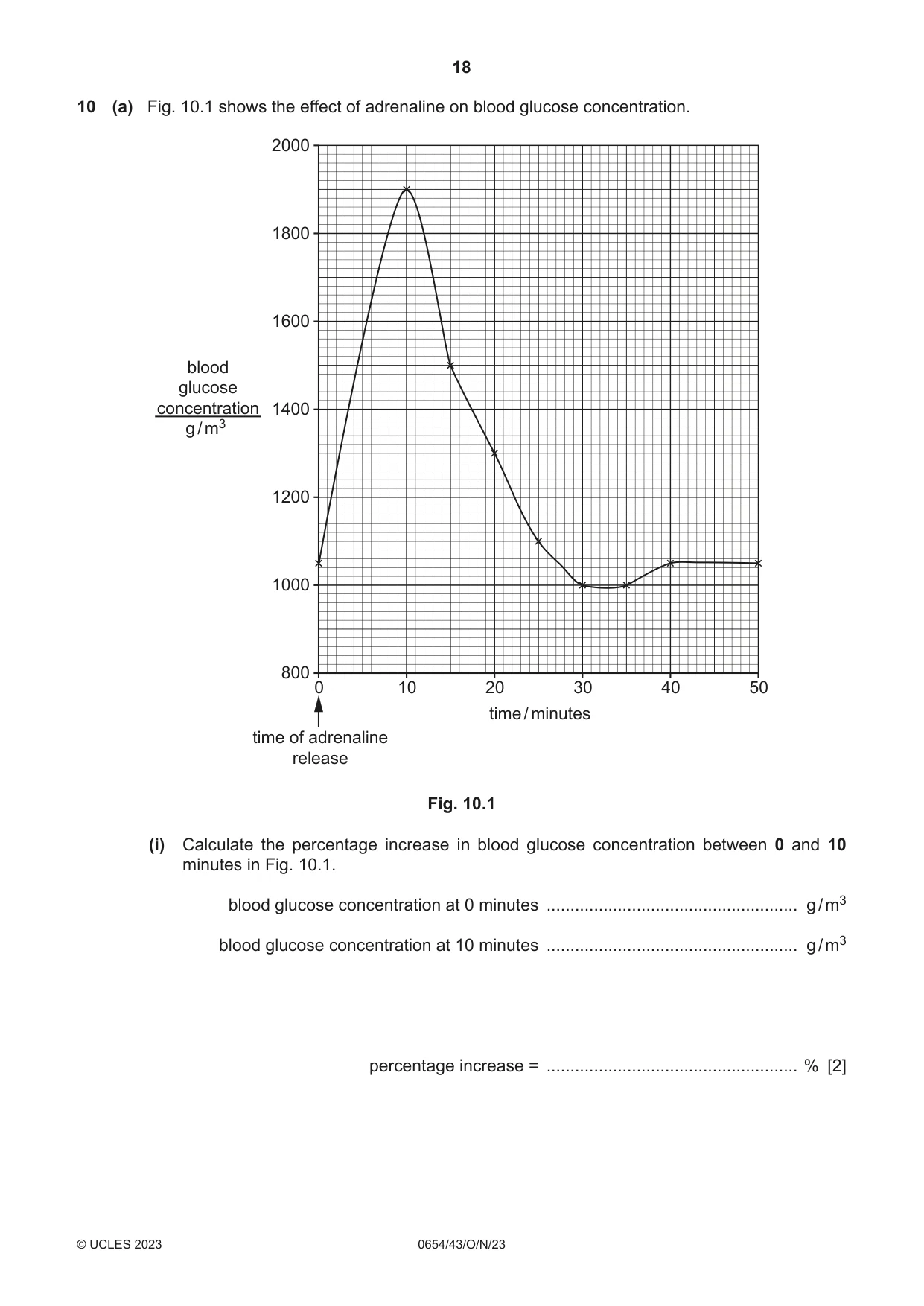
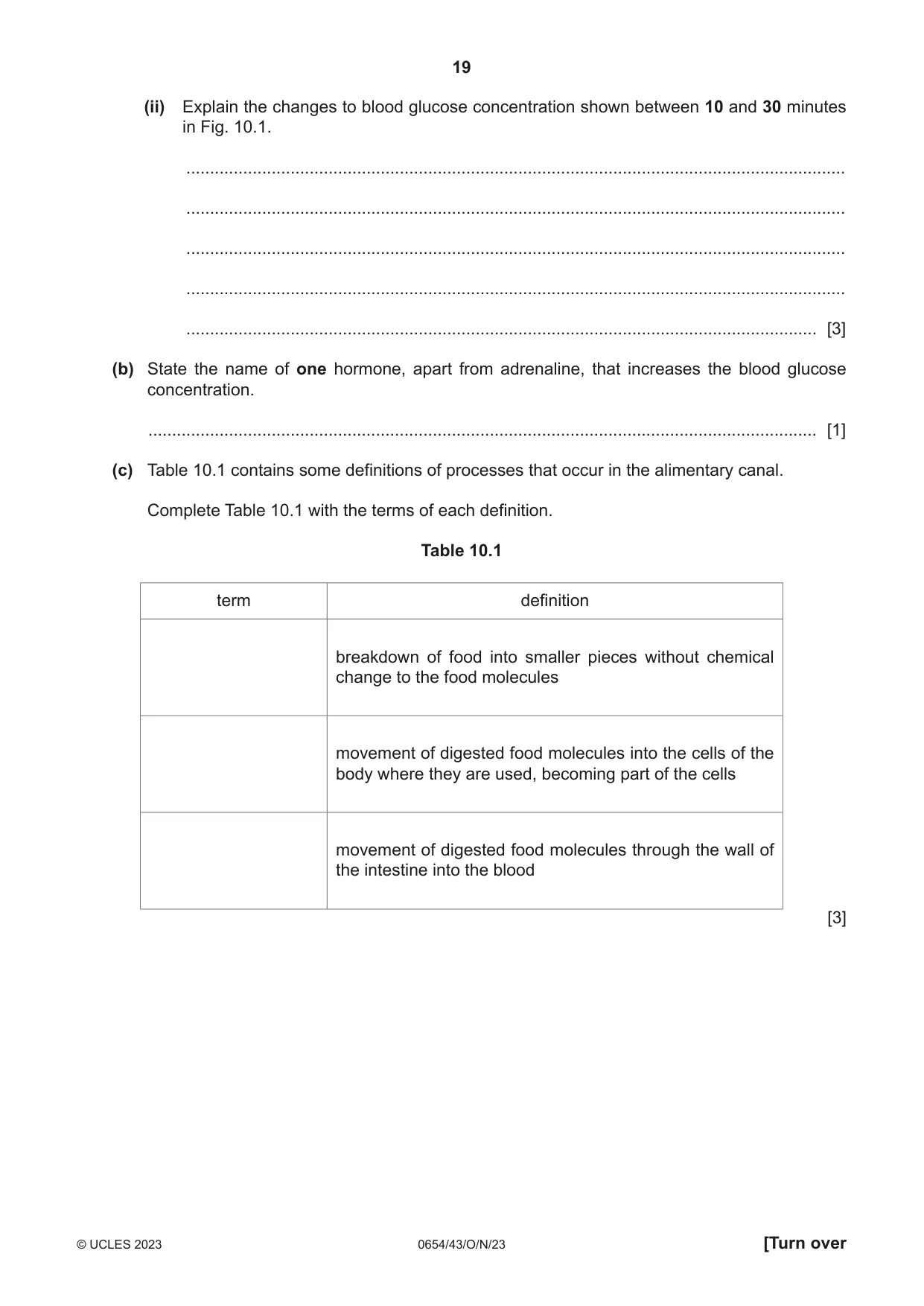
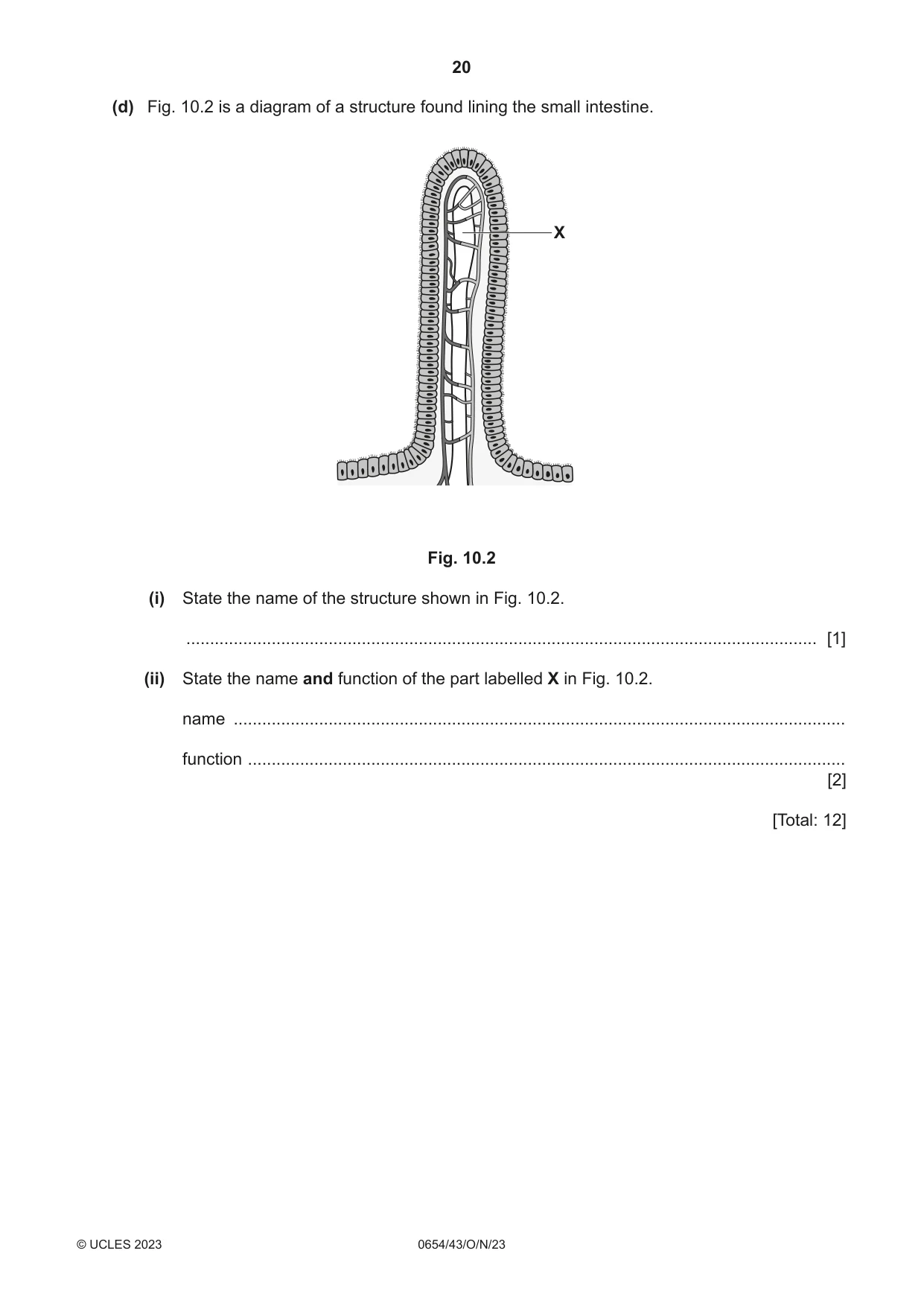
10 (a) Fig. 10.1 shows the effect of adrenaline on blood glucose concentration. 2000 1800 1600 blood glucose concentration 1400 g / m3 1200 1000 800 0 10 20 30 40 50 time / minutes time of adrenaline release Fig. 10.1 (i) Calculate the percentage increase in blood glucose concentration between 0 and 10 minutes in Fig. 10.1. blood glucose concentration at 0 minutes ..................................................... g / m3 blood glucose concentration at 10 minutes ..................................................... g / m3 percentage increase = ..................................................... % [2] (ii) Explain the changes to blood glucose concentration shown between 10 and 30 minutes in Fig. 10.1. ........................................................................................................................................... ........................................................................................................................................... ........................................................................................................................................... ........................................................................................................................................... ..................................................................................................................................... [3] (b) State the name of one hormone, apart from adrenaline, that increases the blood glucose concentration. ............................................................................................................................................. [1] (c) Table 10.1 contains some definitions of processes that occur in the alimentary canal. Complete Table 10.1 with the terms of each definition. Table 10.1 term definition breakdown of food into smaller pieces without chemical change to the food molecules movement of digested food molecules into the cells of the body where they are used, becoming part of the cells movement of digested food molecules through the wall of the intestine into the blood [3] (d) Fig. 10.2 is a diagram of a structure found lining the small intestine. X Fig. 10.2 (i) State the name of the structure shown in Fig. 10.2. ..................................................................................................................................... [1] (ii) State the name and function of the part labelled X in Fig. 10.2. name ................................................................................................................................. function .............................................................................................................................. [2] [Total: 12]
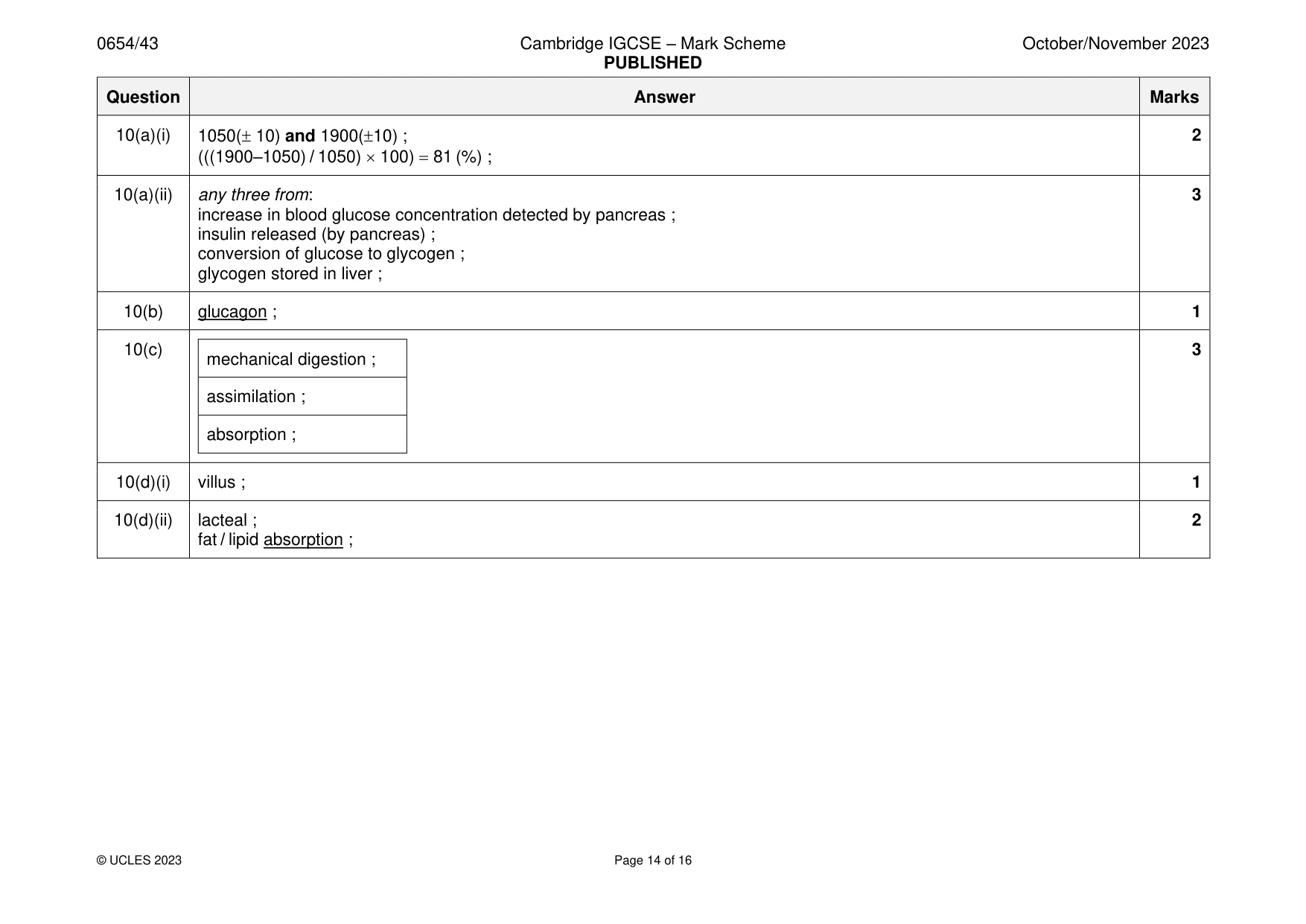
Mark scheme: 10(a)(i) 1050( 10) and 1900(10) ; 2 (((1900–1050) / 1050) 100) = 81 (%) ; 10(a)(ii) any three from: 3 increase in blood glucose concentration detected by pancreas ; insulin released (by pancreas) ; conversion of glucose to glycogen ; glycogen stored in liver ; 10(b) glucagon ; 1 10(c) 3 mechanical digestion ; assimilation ; absorption ; 10(d)(i) villus ; 1 10(d)(ii) lacteal ; 2 fat / lipid absorption ;
Q11 · An aqueous solution of dilute hydrochloric acid is acidic
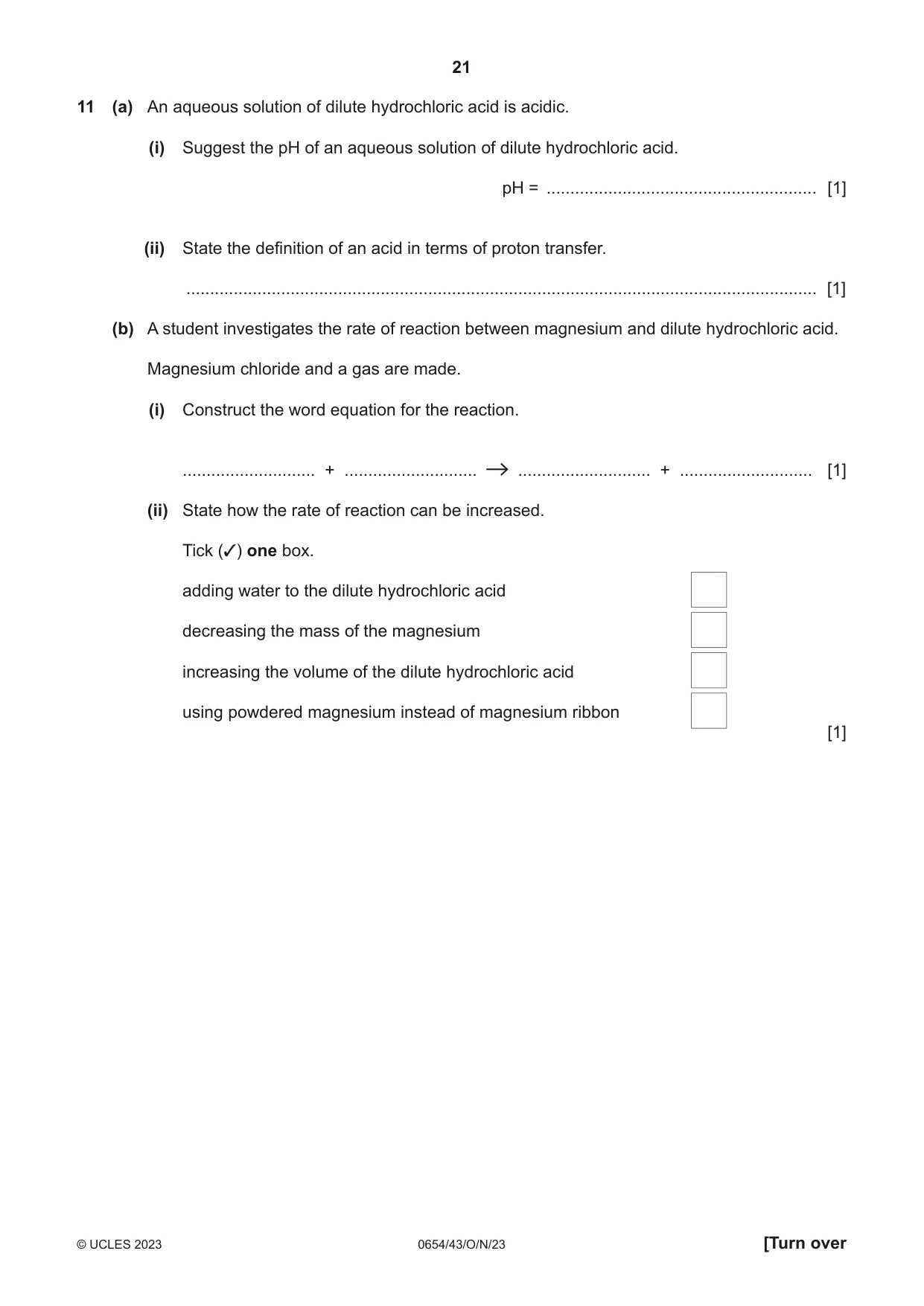
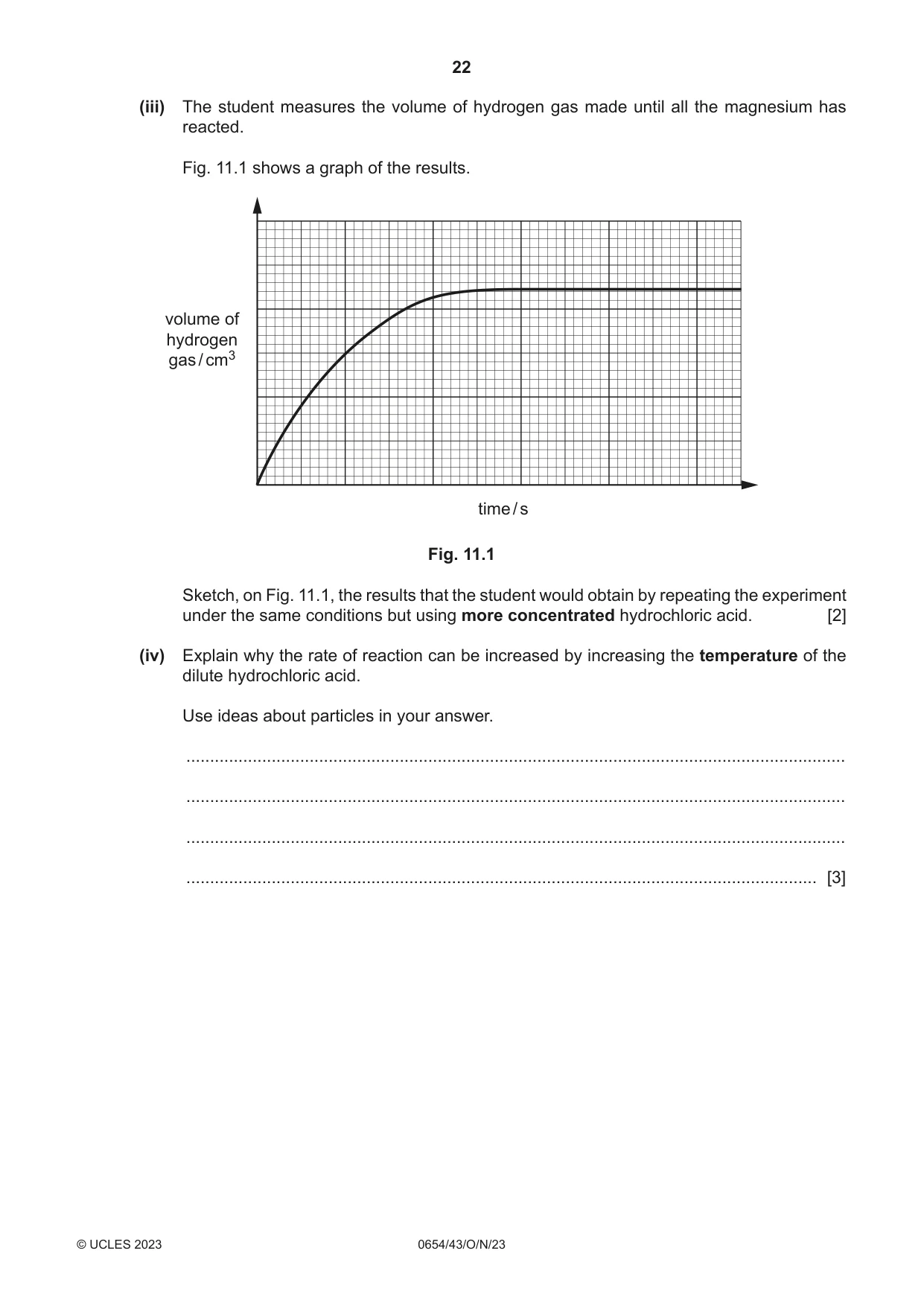
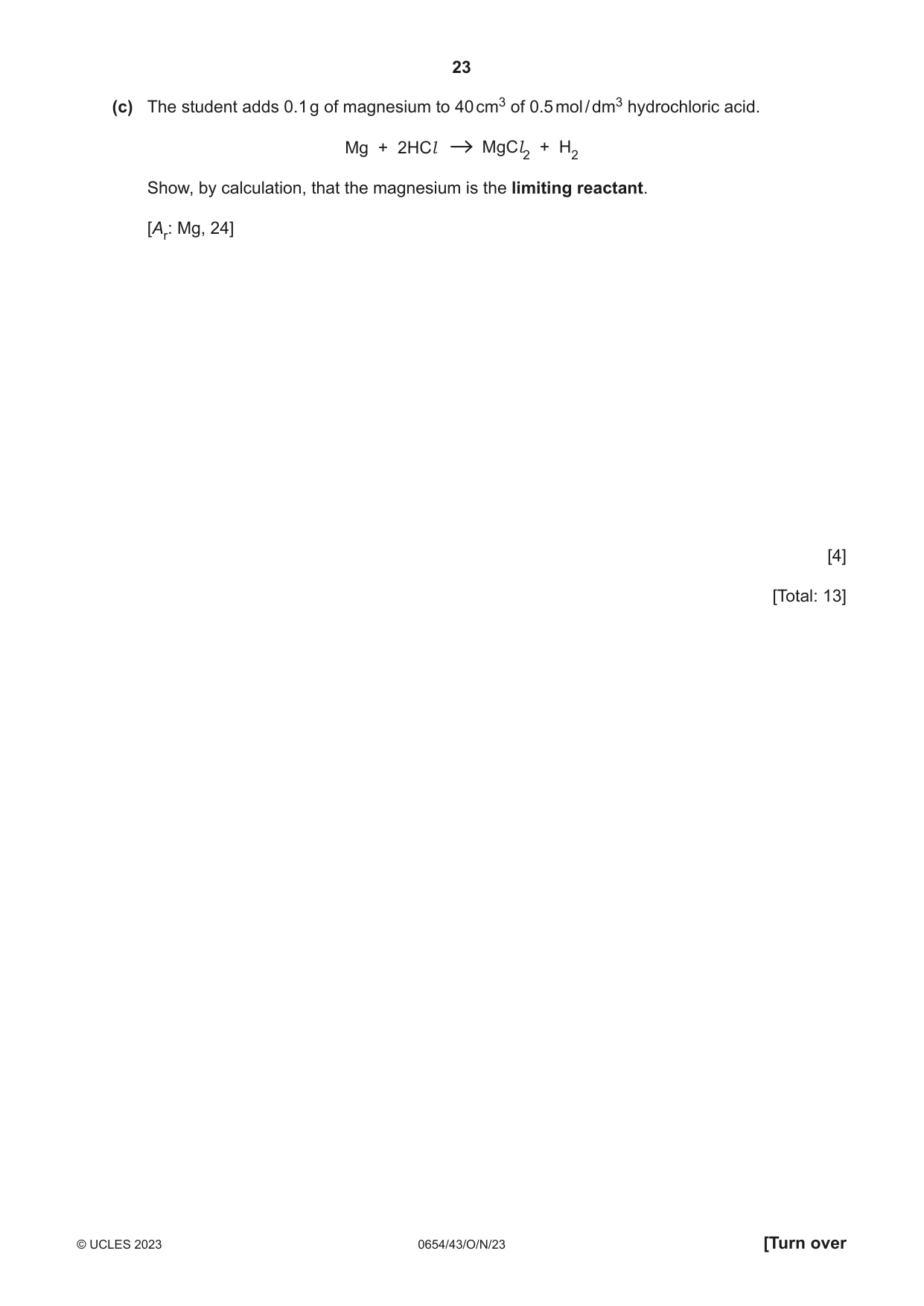
11 (a) An aqueous solution of dilute hydrochloric acid is acidic. (i) Suggest the pH of an aqueous solution of dilute hydrochloric acid. pH = ......................................................... [1] (ii) State the definition of an acid in terms of proton transfer. ..................................................................................................................................... [1] (b) A student investigates the rate of reaction between magnesium and dilute hydrochloric acid. Magnesium chloride and a gas are made. (i) Construct the word equation for the reaction. ............................ + ............................ ............................ + ............................ [1] (ii) State how the rate of reaction can be increased. Tick (3) one box. adding water to the dilute hydrochloric acid decreasing the mass of the magnesium increasing the volume of the dilute hydrochloric acid using powdered magnesium instead of magnesium ribbon [1] (iii) The student measures the volume of hydrogen gas made until all the magnesium has reacted. Fig. 11.1 shows a graph of the results. volume of hydrogen gas / cm3 time / s Fig. 11.1 Sketch, on Fig. 11.1, the results that the student would obtain by repeating the experiment under the same conditions but using more concentrated hydrochloric acid. [2] (iv) Explain why the rate of reaction can be increased by increasing the temperature of the dilute hydrochloric acid. Use ideas about particles in your answer. ........................................................................................................................................... ........................................................................................................................................... ........................................................................................................................................... ..................................................................................................................................... [3] (c) The student adds 0.1 g of magnesium to 40 cm3 of 0.5 mol / dm3 hydrochloric acid. Mg + 2HCl MgCl2 + H2 Show, by calculation, that the magnesium is the limiting reactant. [Ar: Mg, 24] [4] [Total: 13]
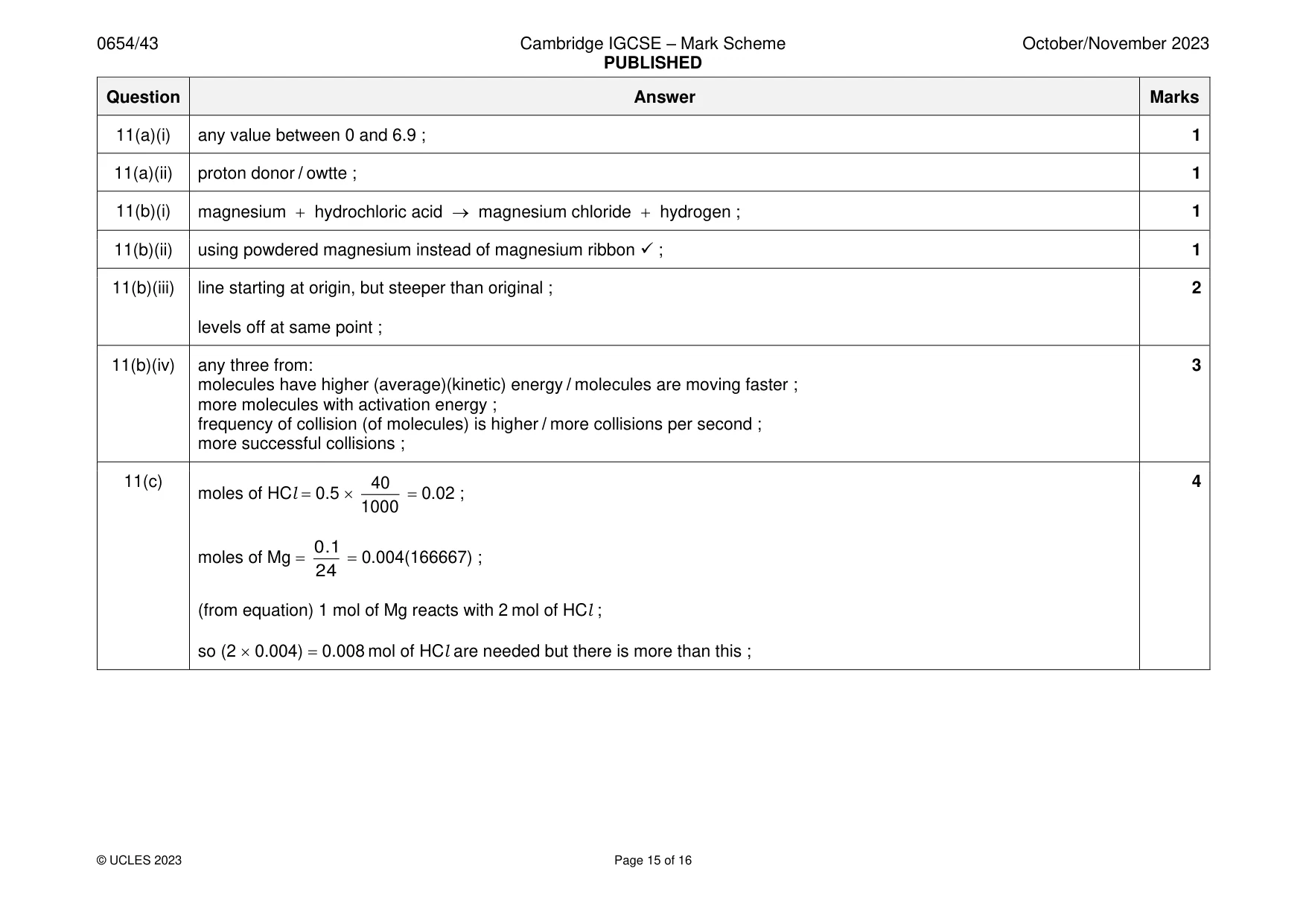
Mark scheme: 11(a)(i) any value between 0 and 6.9 ; 1 11(a)(ii) proton donor / owtte ; 1 11(b)(i) magnesium + hydrochloric acid → magnesium chloride + hydrogen ; 1 11(b)(ii) using powdered magnesium instead of magnesium ribbon ✓ ; 1 11(b)(iii) line starting at origin, but steeper than original ; 2 levels off at same point ; 11(b)(iv) any three from: 3 molecules have higher (average)(kinetic) energy / molecules are moving faster ; more molecules with activation energy ; frequency of collision (of molecules) is higher / more collisions per second ; more successful collisions ; 11(c) 40 4 moles of HCl = 0.5 = 0.02 ; 1000 0.1 moles of Mg = = 0.004(166667) ; 24 (from equation) 1 mol of Mg reacts with 2 mol of HCl ; so (2 0.004) = 0.008 mol of HCl are needed but there is more than this ;
More questions on The characteristic properties of acids and bases
Q12 · A student investigates light dependent resistors (LDRs)
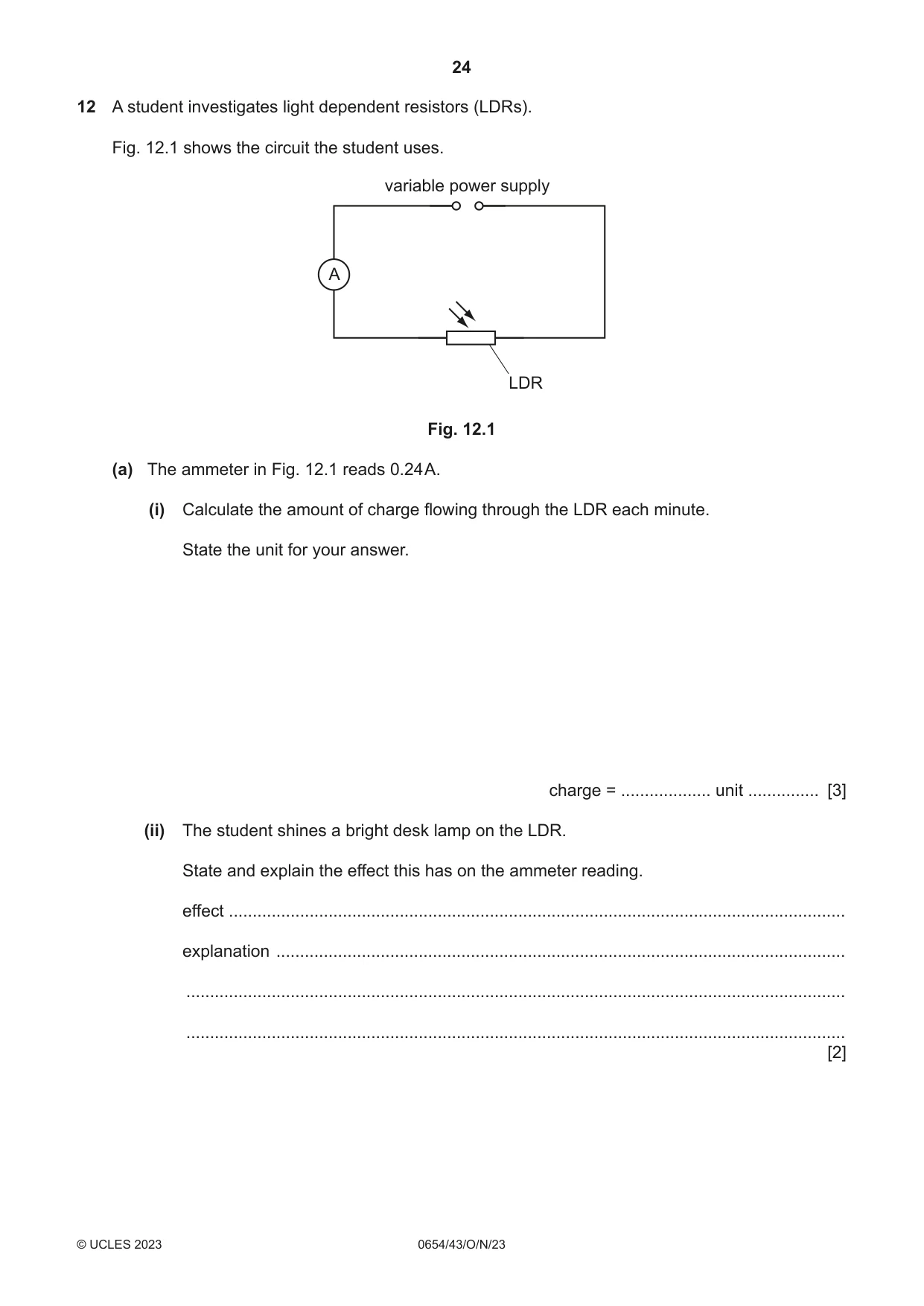
12 A student investigates light dependent resistors (LDRs). Fig. 12.1 shows the circuit the student uses. variable power supply A LDR Fig. 12.1 (a) The ammeter in Fig. 12.1 reads 0.24 A. (i) Calculate the amount of charge flowing through the LDR each minute. State the unit for your answer. charge = ................... unit ............... [3] (ii) The student shines a bright desk lamp on the LDR. State and explain the effect this has on the ammeter reading. effect .................................................................................................................................. explanation ........................................................................................................................ ........................................................................................................................................... ........................................................................................................................................... [2] (iii) The desk lamp emits light with wavelengths ranging from 3.8 × 10⁻⁷m to 7.5 × 10⁻⁷m. Calculate the minimum frequency of light emitted by the desk lamp. minimum frequency = .................................................... Hz [3] (b) The student calculates the resistance of the LDR using the current reading from the ammeter. State what other measurement is required for this calculation. ............................................................................................................................................. [1] (c) The variable power supply used by the student uses a transformer to reduce the output. The current in the primary coil of the transformer is 10.5 A and the current in the secondary coil is 4.2 A. The primary coil contains 360 turns and the transformer can be assumed to be 100% efficient. Calculate the number of turns in the secondary coil. number of turns = ......................................................... [4] [Total: 13]
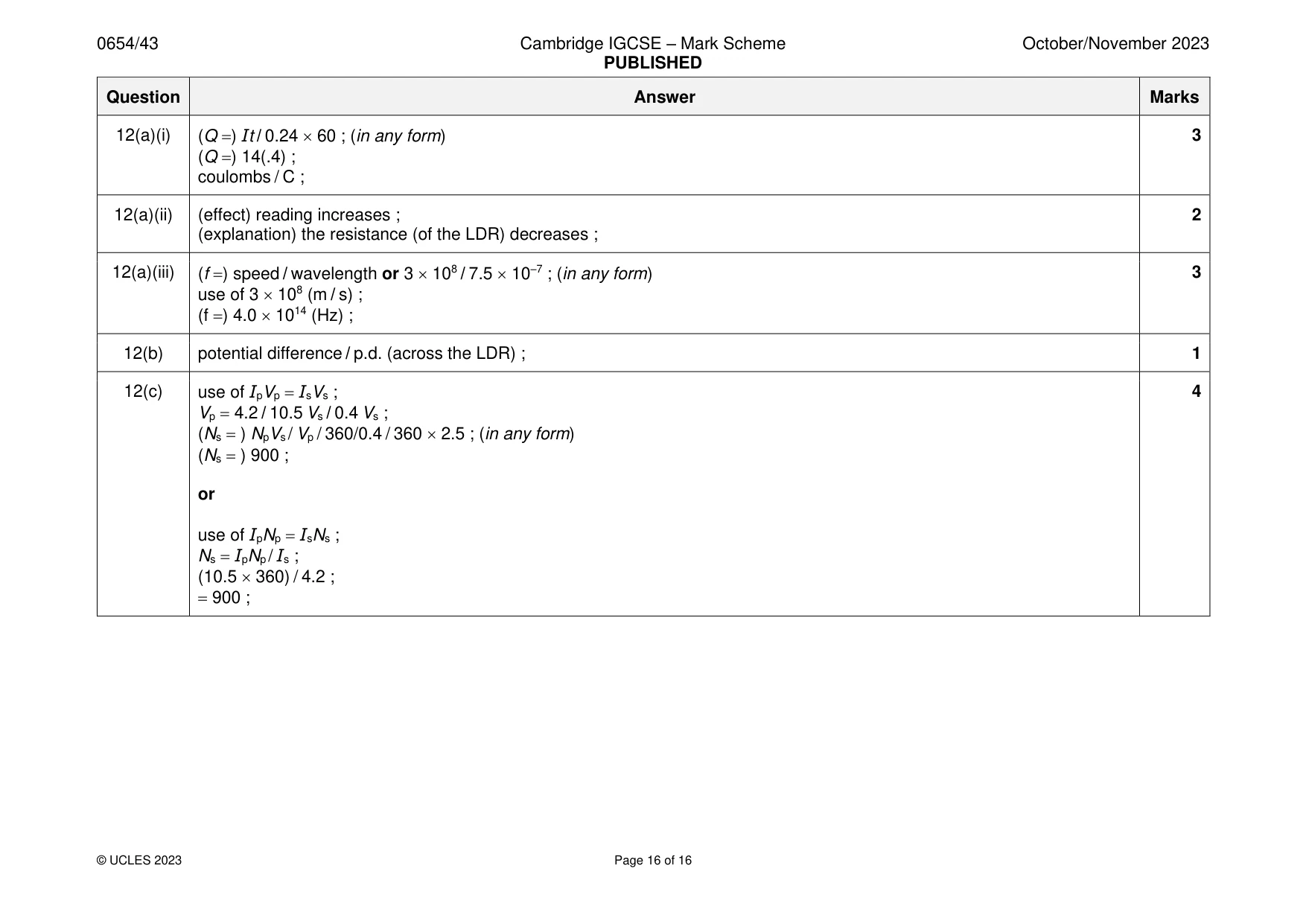
Mark scheme: 12(a)(i) (Q =) It / 0.24 60 ; (in any form) 3 (Q =) 14(.4) ; coulombs / C ; 12(a)(ii) (effect) reading increases ; 2 (explanation) the resistance (of the LDR) decreases ; 12(a)(iii) (f =) speed / wavelength or 3 108 / 7.5 10–7 ; (in any form) 3 use of 3 108 (m / s) ; (f =) 4.0 1014 (Hz) ; 12(b) potential difference / p.d. (across the LDR) ; 1 12(c) use of IpVp = IsVs ; 4 Vp = 4.2 / 10.5 Vs / 0.4 Vs ; (Ns = ) NpVs / Vp / 360/0.4 / 360 2.5 ; (in any form) (Ns = ) 900 ; or use of IpNp = IsNs ; Ns = IpNp / Is ; (10.5 360) / 4.2 ; = 900 ;
What was in this paper
The subtopics covered by these 12 questions, and how many questions each got. Open one in a new tab to see every Cambridge question on it.
What you needed in this session
Cambridge’s own grade thresholds for 2023 Oct/Nov, Paper 4 · Variant 3. A higher threshold means an easier paper — the bar moves with how the cohort did.