Cambridge IGCSE Sciences - Co-ordinated (Double) 0654 — 2019 Oct/Nov Paper 4 · Variant 3
0654/43/O/N/19 · 13 questions · 120 marks · ≈135 min
The question paper and its mark scheme, free to read here and free to download. This is Cambridge’s own paper, exactly as it was sat.
Question paper32 pages

Mark scheme16 pages
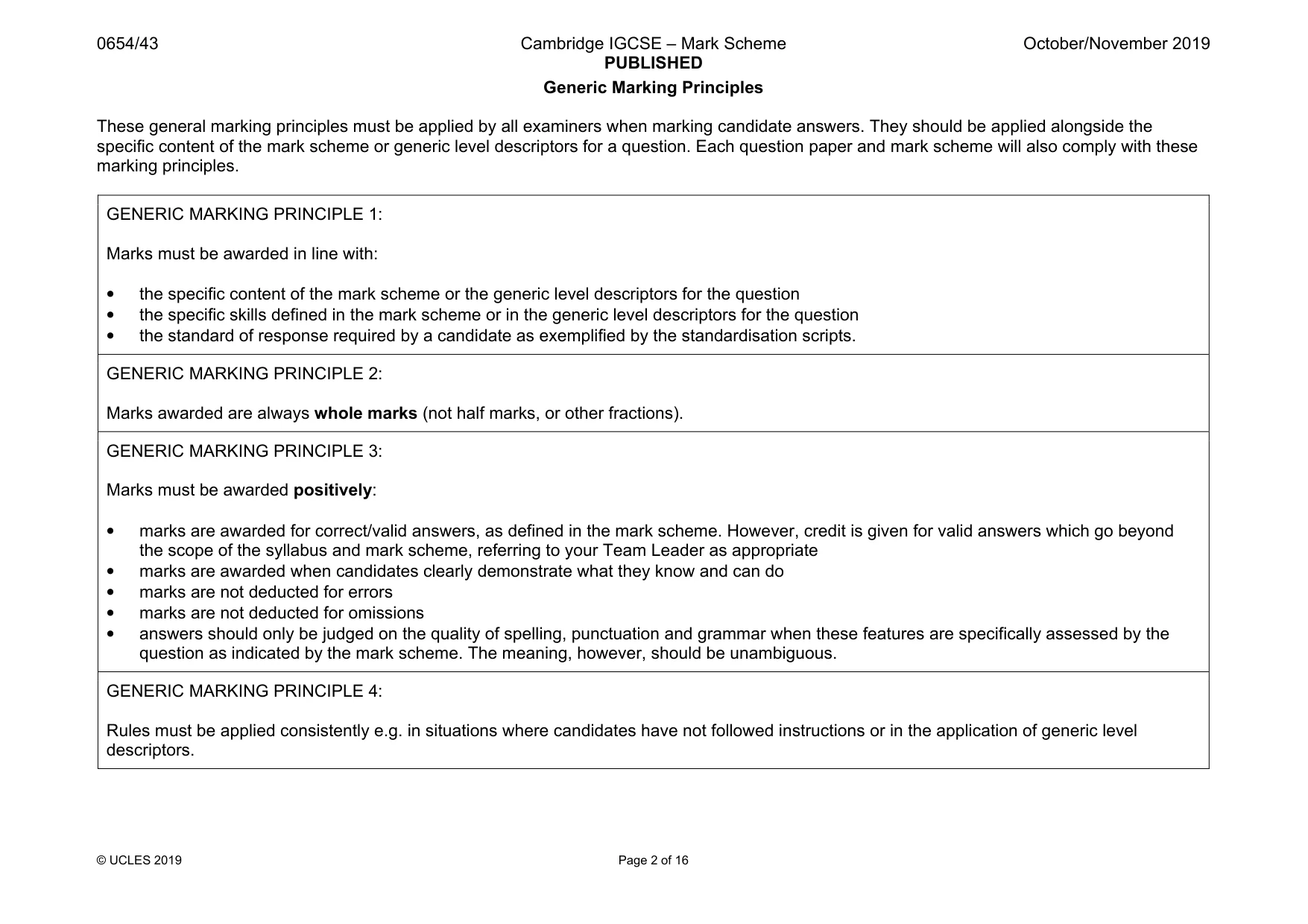
Answers below. Sit the paper first if you are practising.
Questions as text
Question 1
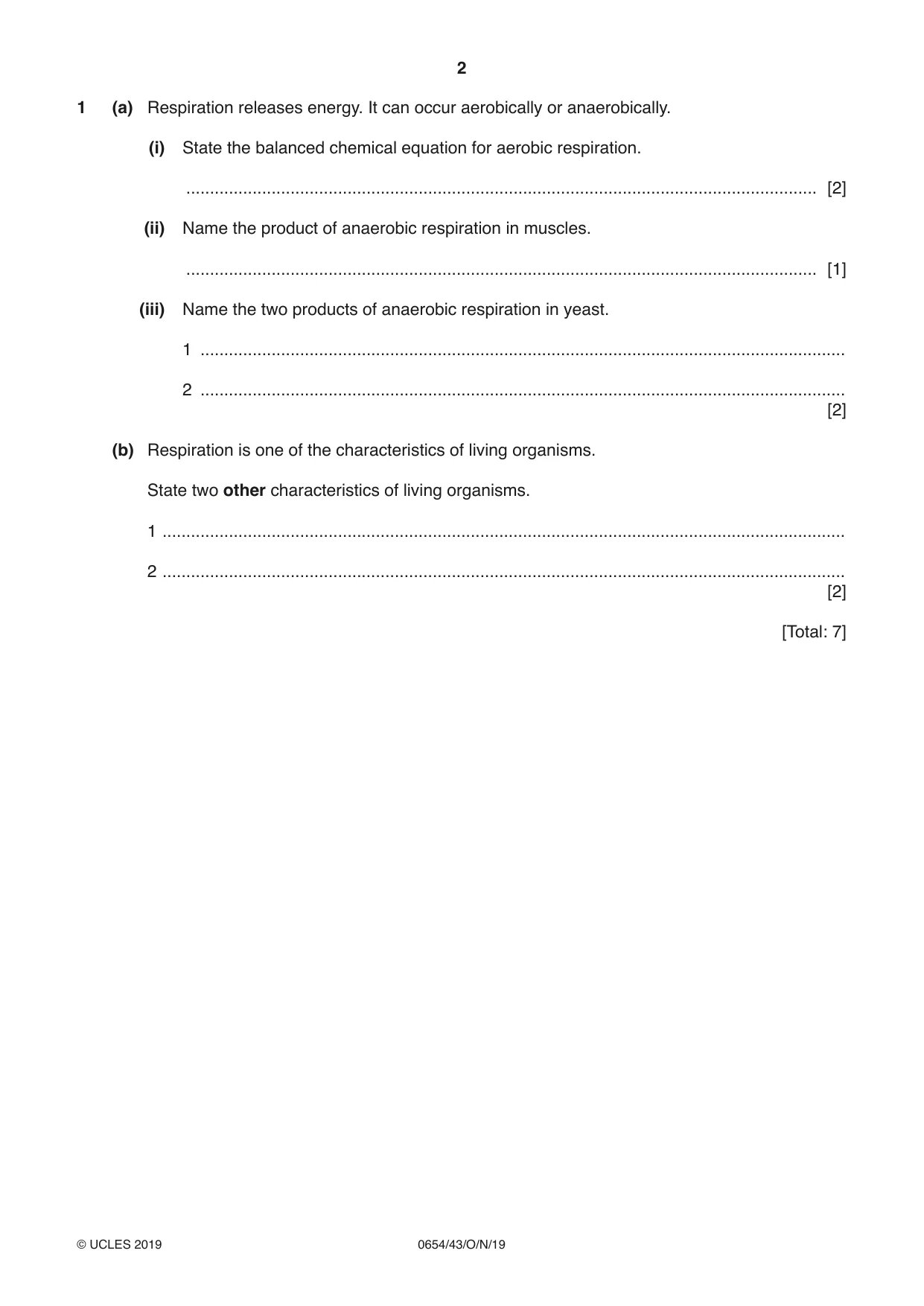
1 (a) Respiration releases energy. It can occur aerobically or anaerobically. (i) State the balanced chemical equation for aerobic respiration. ..................................................................................................................................... [2] (ii) Name the product of anaerobic respiration in muscles. ..................................................................................................................................... [1] (iii) Name the two products of anaerobic respiration in yeast. 1 ........................................................................................................................................ 2 ........................................................................................................................................ [2] (b) Respiration is one of the characteristics of living organisms. State two other characteristics of living organisms. 1 ................................................................................................................................................ 2 ................................................................................................................................................ [2] [Total: 7]
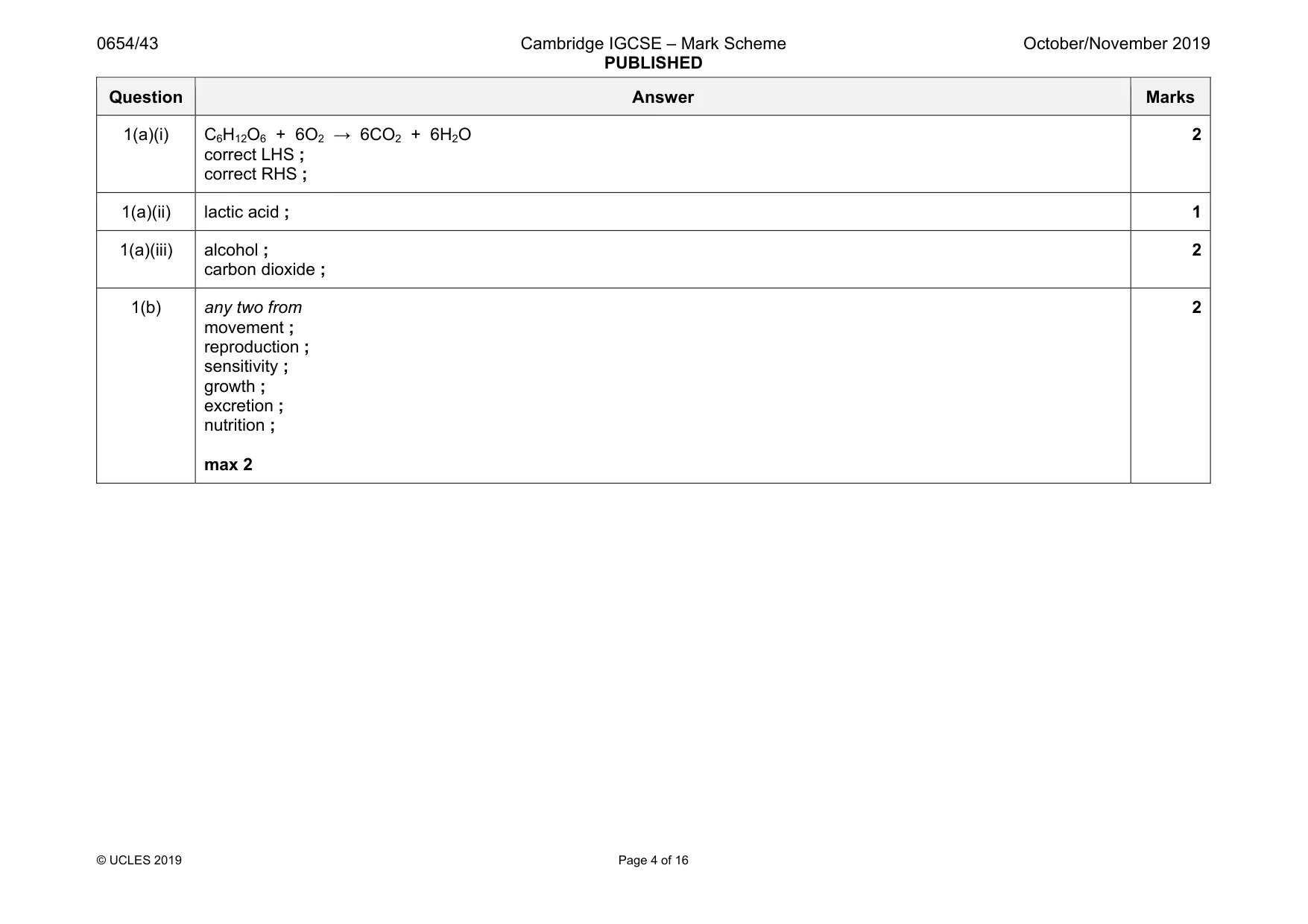
Mark scheme: 1(a)(i) C6H12O6 + 6O2 → 6CO2 + 6H2O correct LHS ; correct RHS ; 2 1(a)(ii) lactic acid ; 1 1(a)(iii) alcohol ; carbon dioxide ; 2 1(b) any two from movement ; reproduction ; sensitivity ; growth ; excretion ; nutrition ; max 2 2
Q2 · Ammonia, NH3, is made by the reaction between nitrogen gas and hydrogen gas in the Haber…
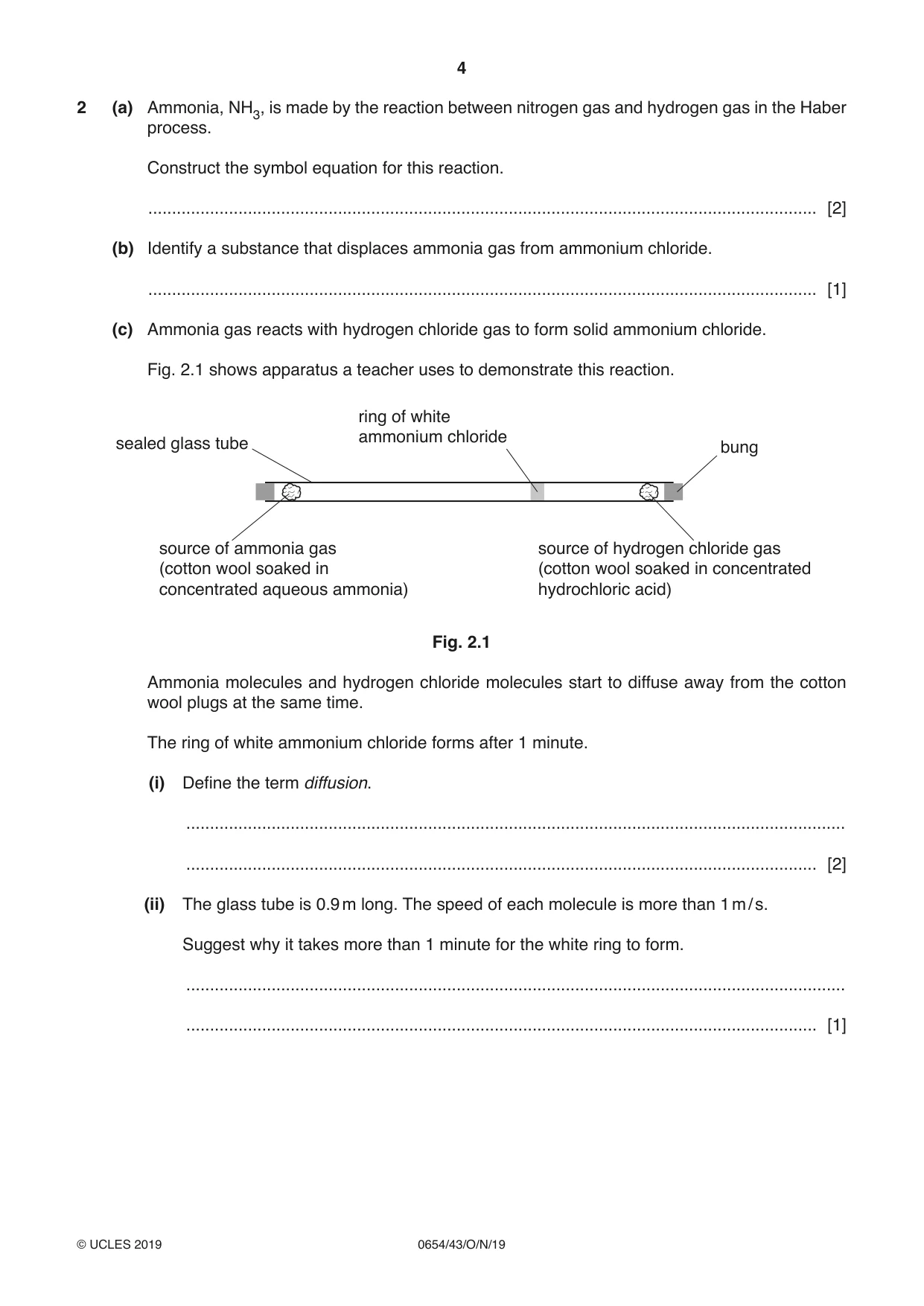
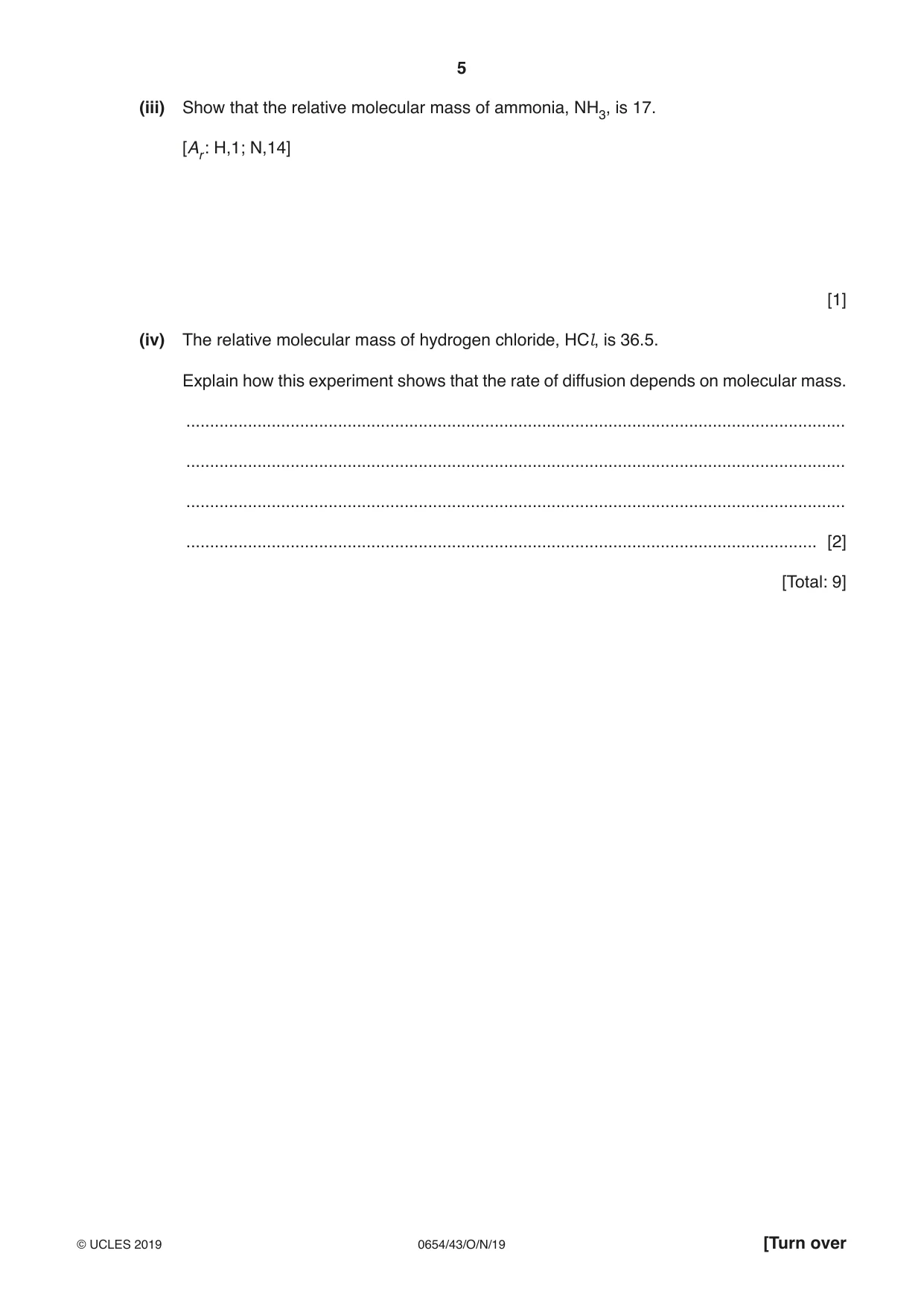
2 (a) Ammonia, NH3, is made by the reaction between nitrogen gas and hydrogen gas in the Haber process. Construct the symbol equation for this reaction. ............................................................................................................................................. [2] (b) Identify a substance that displaces ammonia gas from ammonium chloride. ............................................................................................................................................. [1] (c) Ammonia gas reacts with hydrogen chloride gas to form solid ammonium chloride. Fig. 2.1 shows apparatus a teacher uses to demonstrate this reaction. ring of white ammonium chloride sealed glass tube bung source of ammonia gas source of hydrogen chloride gas (cotton wool soaked in (cotton wool soaked in concentrated concentrated aqueous ammonia) hydrochloric acid) Fig. 2.1 Ammonia molecules and hydrogen chloride molecules start to diffuse away from the cotton wool plugs at the same time. The ring of white ammonium chloride forms after 1 minute. (i) Define the term diffusion. ........................................................................................................................................... ..................................................................................................................................... [2] (ii) The glass tube is 0.9 m long. The speed of each molecule is more than 1 m / s. Suggest why it takes more than 1 minute for the white ring to form. ........................................................................................................................................... ..................................................................................................................................... [1] (iii) Show that the relative molecular mass of ammonia, NH3, is 17. [Ar : H,1; N,14] [1] (iv) The relative molecular mass of hydrogen chloride, HCl, is 36.5. Explain how this experiment shows that the rate of diffusion depends on molecular mass. ........................................................................................................................................... ........................................................................................................................................... ........................................................................................................................................... ..................................................................................................................................... [2] [Total: 9]
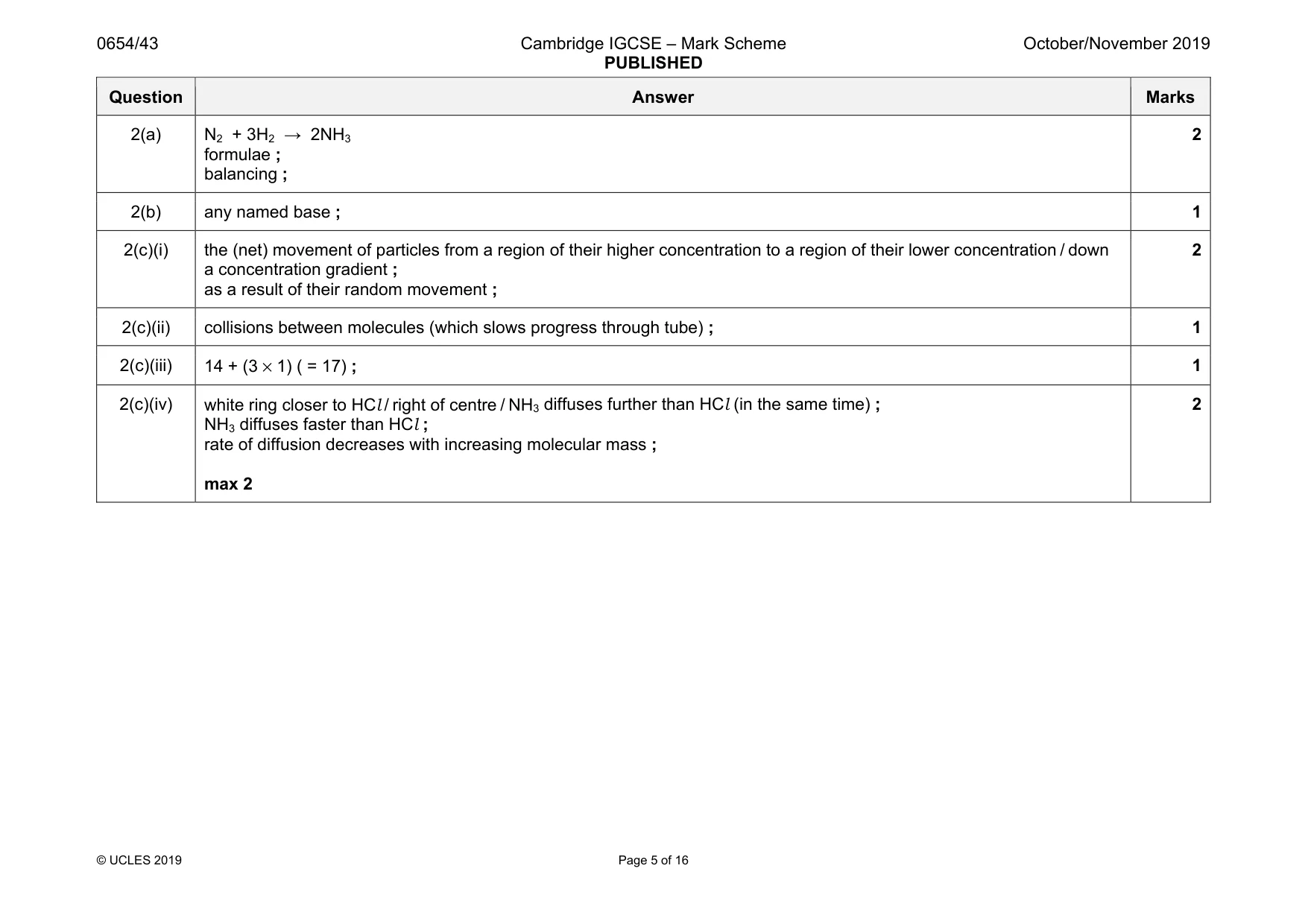
Mark scheme: 2(a) N2 + 3H2 → 2NH3 formulae ; balancing ; 2 2(b) any named base ; 1 2(c)(i) the (net) movement of particles from a region of their higher concentration to a region of their lower concentration / down a concentration gradient ; as a result of their random movement ; 2 2(c)(ii) collisions between molecules (which slows progress through tube) ; 1 2(c)(iii) 14 + (3 × 1) ( = 17) ; 1 2(c)(iv) white ring closer to HCl / right of centre / NH3 diffuses further than HCl (in the same time) ; NH3 diffuses faster than HCl ; rate of diffusion decreases with increasing molecular mass ; max 2 2
Q3 · A bar magnet suspended by a spring above a coil that is connected to a voltmeter
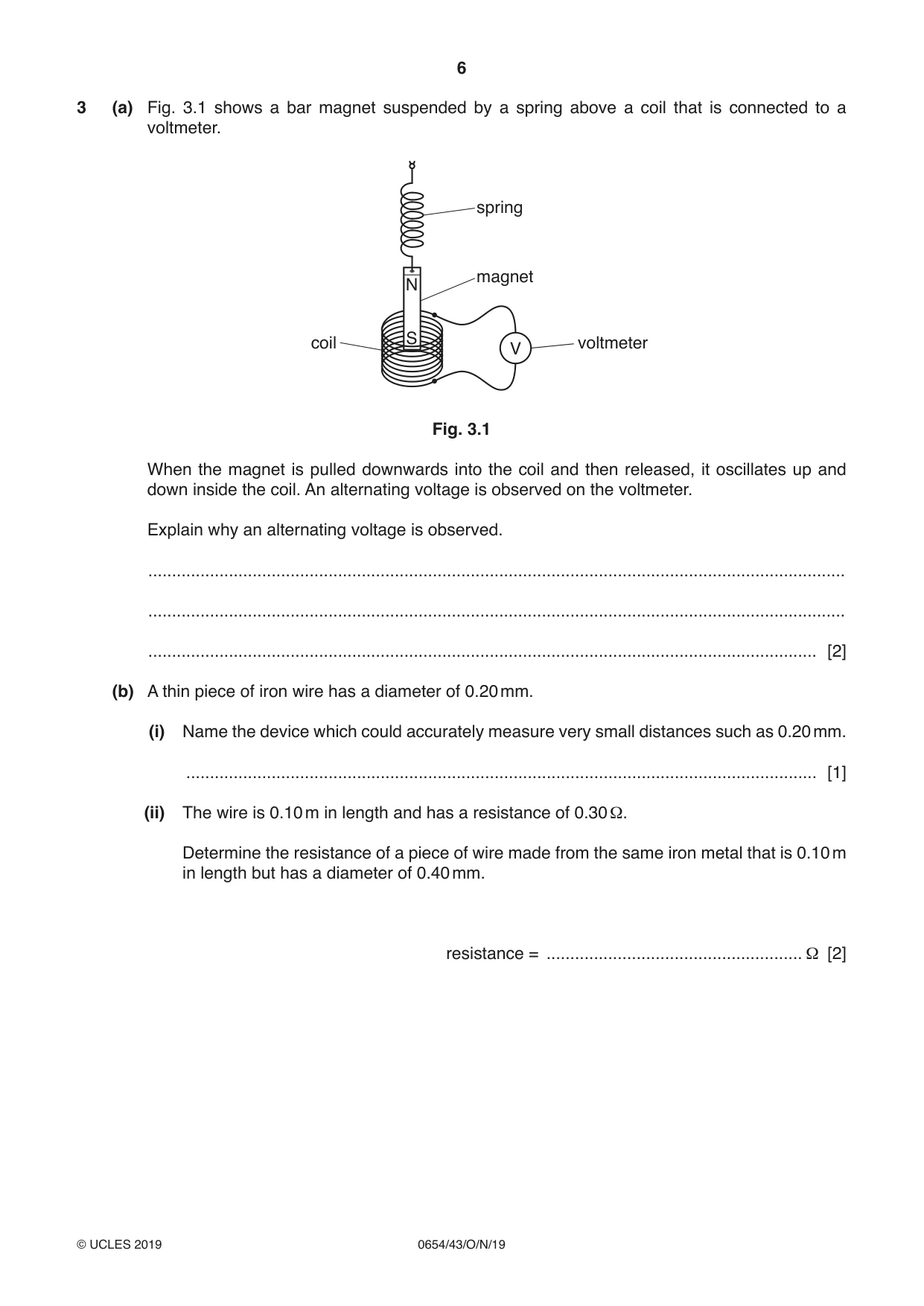
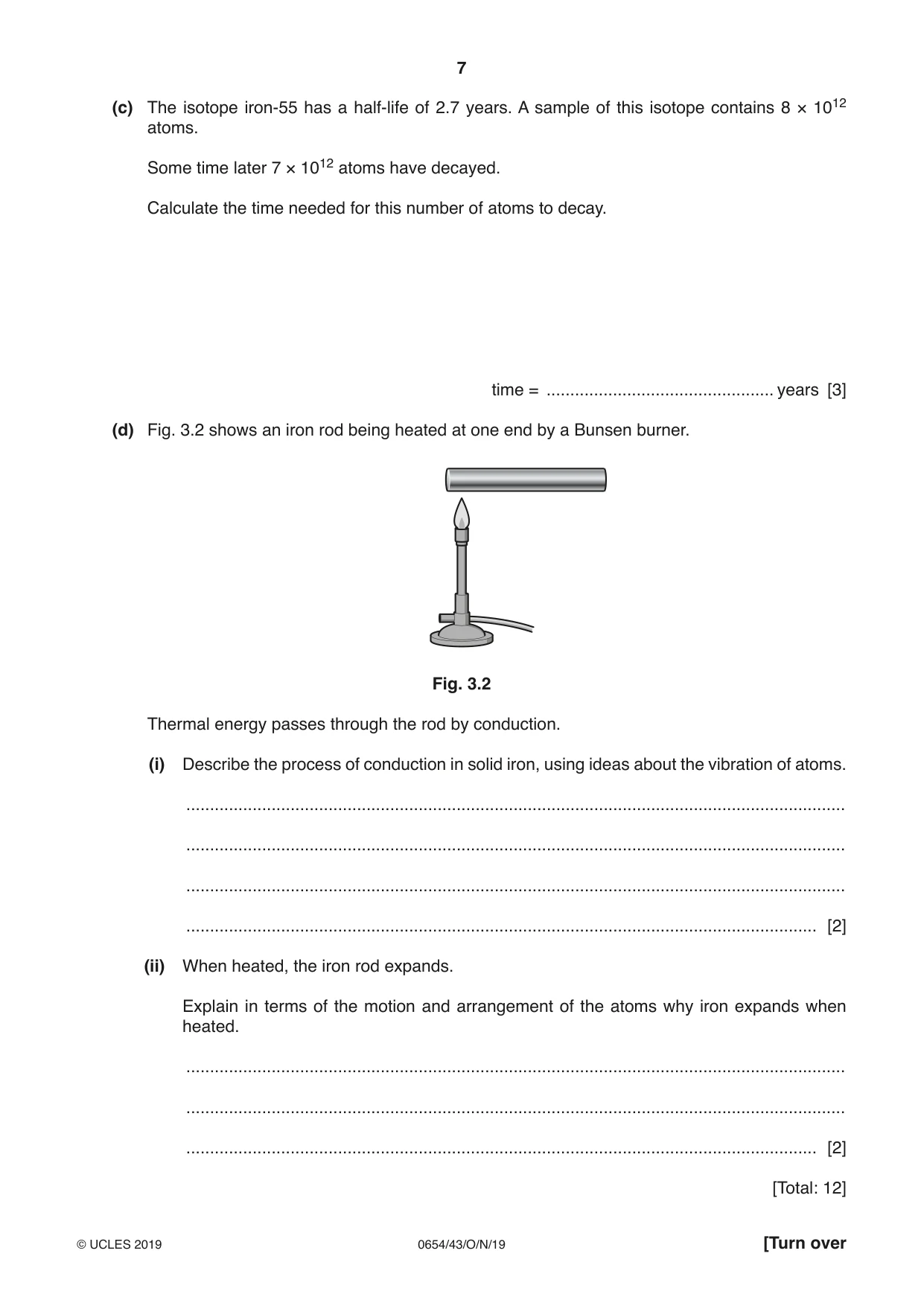
3 (a) Fig. 3.1 shows a bar magnet suspended by a spring above a coil that is connected to a voltmeter. spring magnet N coil S voltmeter V Fig. 3.1 When the magnet is pulled downwards into the coil and then released, it oscillates up and down inside the coil. An alternating voltage is observed on the voltmeter. Explain why an alternating voltage is observed. ................................................................................................................................................... ................................................................................................................................................... ............................................................................................................................................. [2] (b) A thin piece of iron wire has a diameter of 0.20 mm. (i) Name the device which could accurately measure very small distances such as 0.20 mm. ..................................................................................................................................... [1] (ii) The wire is 0.10 m in length and has a resistance of 0.30 Ω. Determine the resistance of a piece of wire made from the same iron metal that is 0.10 m in length but has a diameter of 0.40 mm. resistance = ...................................................... Ω [2] (c) The isotope iron-55 has a half-life of 2.7 years. A sample of this isotope contains 8 × 10¹² atoms. Some time later 7 × 10¹² atoms have decayed. Calculate the time needed for this number of atoms to decay. time = ................................................ years [3] (d) Fig. 3.2 shows an iron rod being heated at one end by a Bunsen burner. Fig. 3.2 Thermal energy passes through the rod by conduction. (i) Describe the process of conduction in solid iron, using ideas about the vibration of atoms. ........................................................................................................................................... ........................................................................................................................................... ........................................................................................................................................... ..................................................................................................................................... [2] (ii) When heated, the iron rod expands. Explain in terms of the motion and arrangement of the atoms why iron expands when heated. ........................................................................................................................................... ........................................................................................................................................... ..................................................................................................................................... [2] [Total: 12]
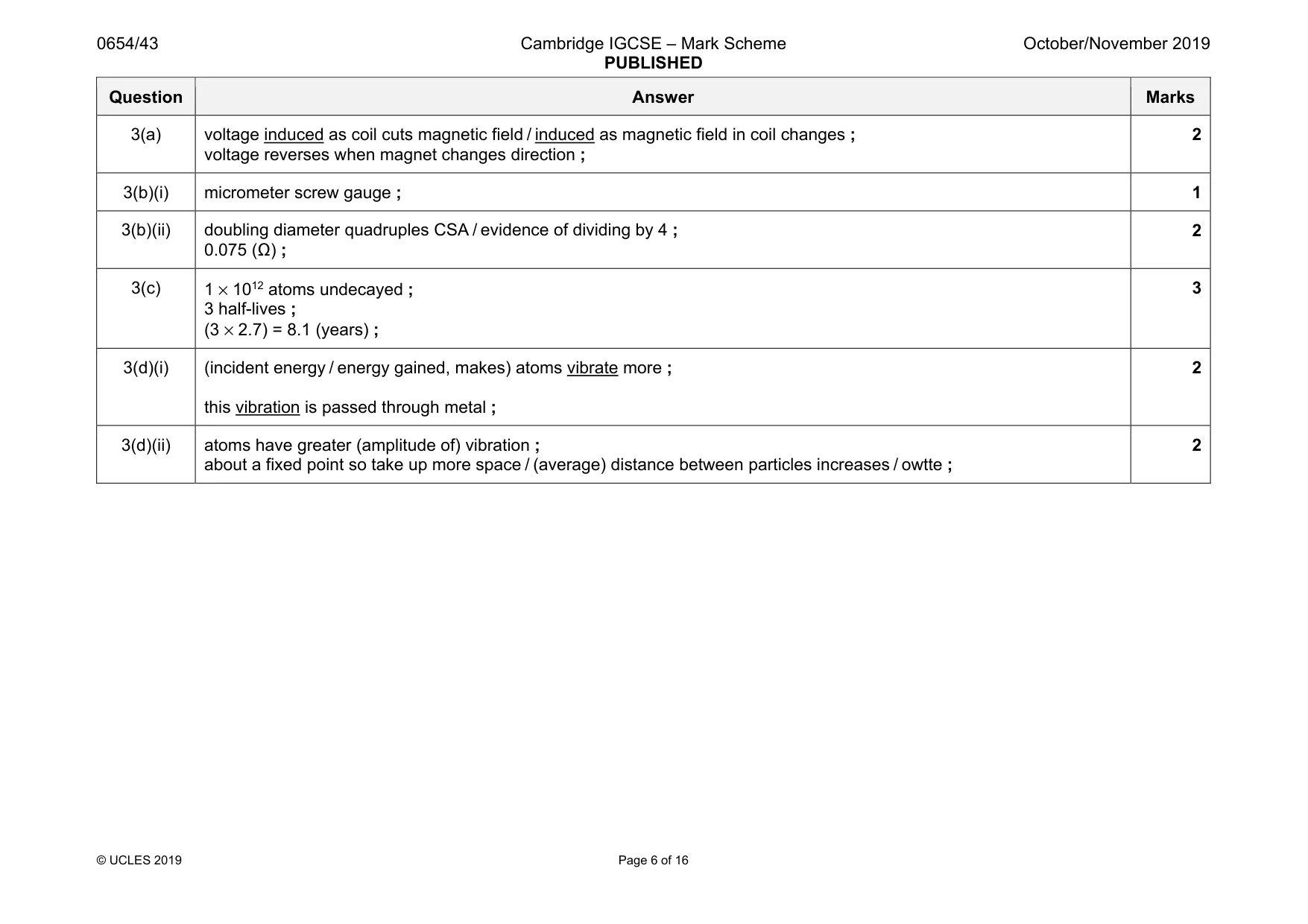
Mark scheme: 3(a) voltage induced as coil cuts magnetic field / induced as magnetic field in coil changes ; voltage reverses when magnet changes direction ; 2 3(b)(i) micrometer screw gauge ; 1 3(b)(ii) doubling diameter quadruples CSA / evidence of dividing by 4 ; 0.075 (Ω) ; 2 3(c) 1 × 10¹² atoms undecayed ; 3 half-lives ; (3 × 2.7) = 8.1 (years) ; 3 3(d)(i) (incident energy / energy gained, makes) atoms vibrate more ; this vibration is passed through metal ; 2 3(d)(ii) atoms have greater (amplitude of) vibration ; about a fixed point so take up more space / (average) distance between particles increases / owtte ; 2
Q4 · Scientists investigate where translocation and transpiration occur in a plant stem
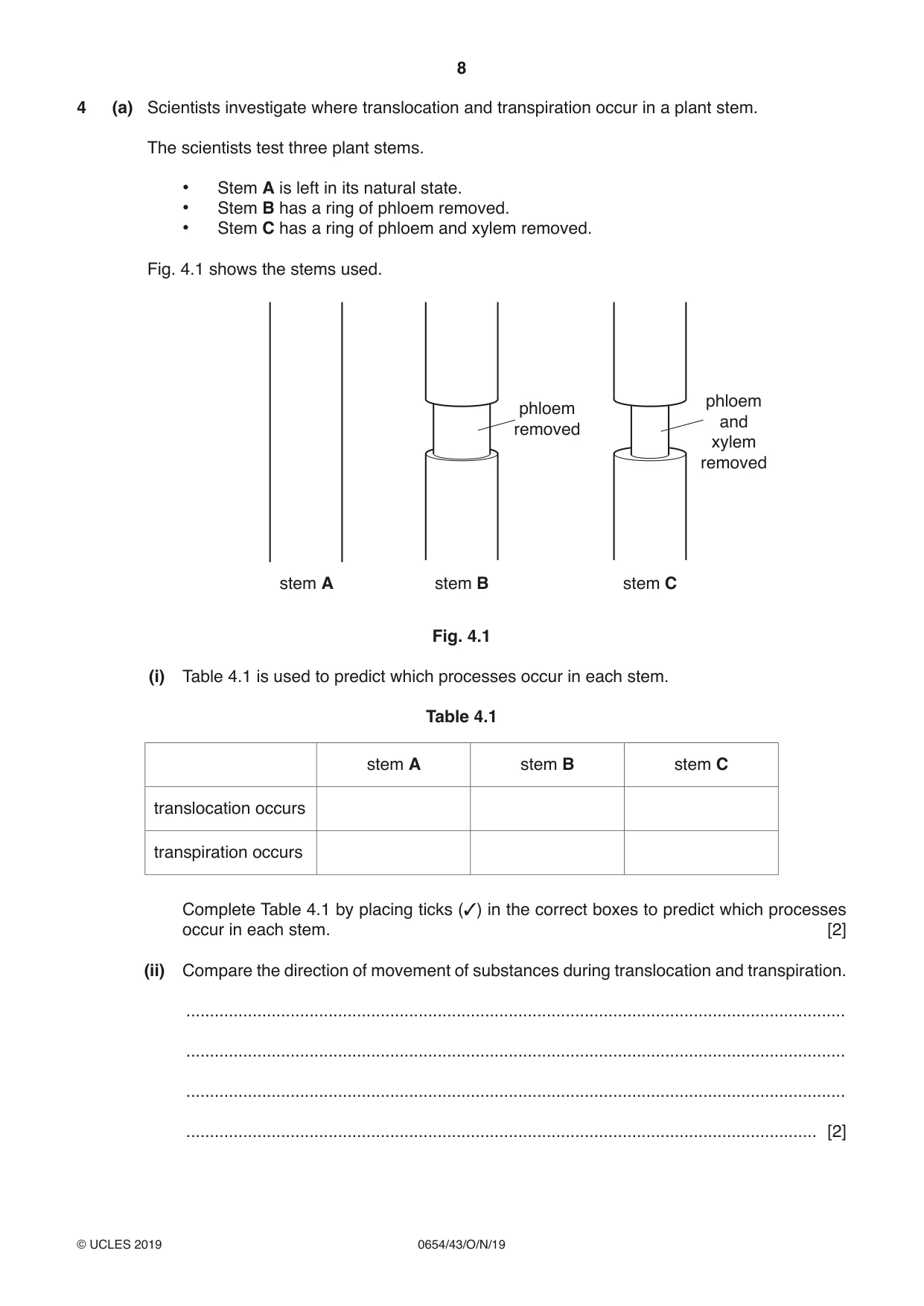
4 (a) Scientists investigate where translocation and transpiration occur in a plant stem. The scientists test three plant stems. • Stem A is left in its natural state. • Stem B has a ring of phloem removed. • Stem C has a ring of phloem and xylem removed. Fig. 4.1 shows the stems used. phloem phloem and removed xylem removed stem A stem B stem C Fig. 4.1 (i) Table 4.1 is used to predict which processes occur in each stem. Table 4.1 stem A stem B stem C translocation occurs transpiration occurs Complete Table 4.1 by placing ticks (✓) in the correct boxes to predict which processes occur in each stem. [2] (ii) Compare the direction of movement of substances during translocation and transpiration. ........................................................................................................................................... ........................................................................................................................................... ........................................................................................................................................... ..................................................................................................................................... [2] (b) Xylem and phloem are specialised to transport substances including water around the plant. (i) Name two other substances moved through the plant during translocation. 1 ........................................................................................................................................ 2 ........................................................................................................................................ [2] (ii) Describe one other function of xylem. ........................................................................................................................................... ..................................................................................................................................... [1] [Total: 7]
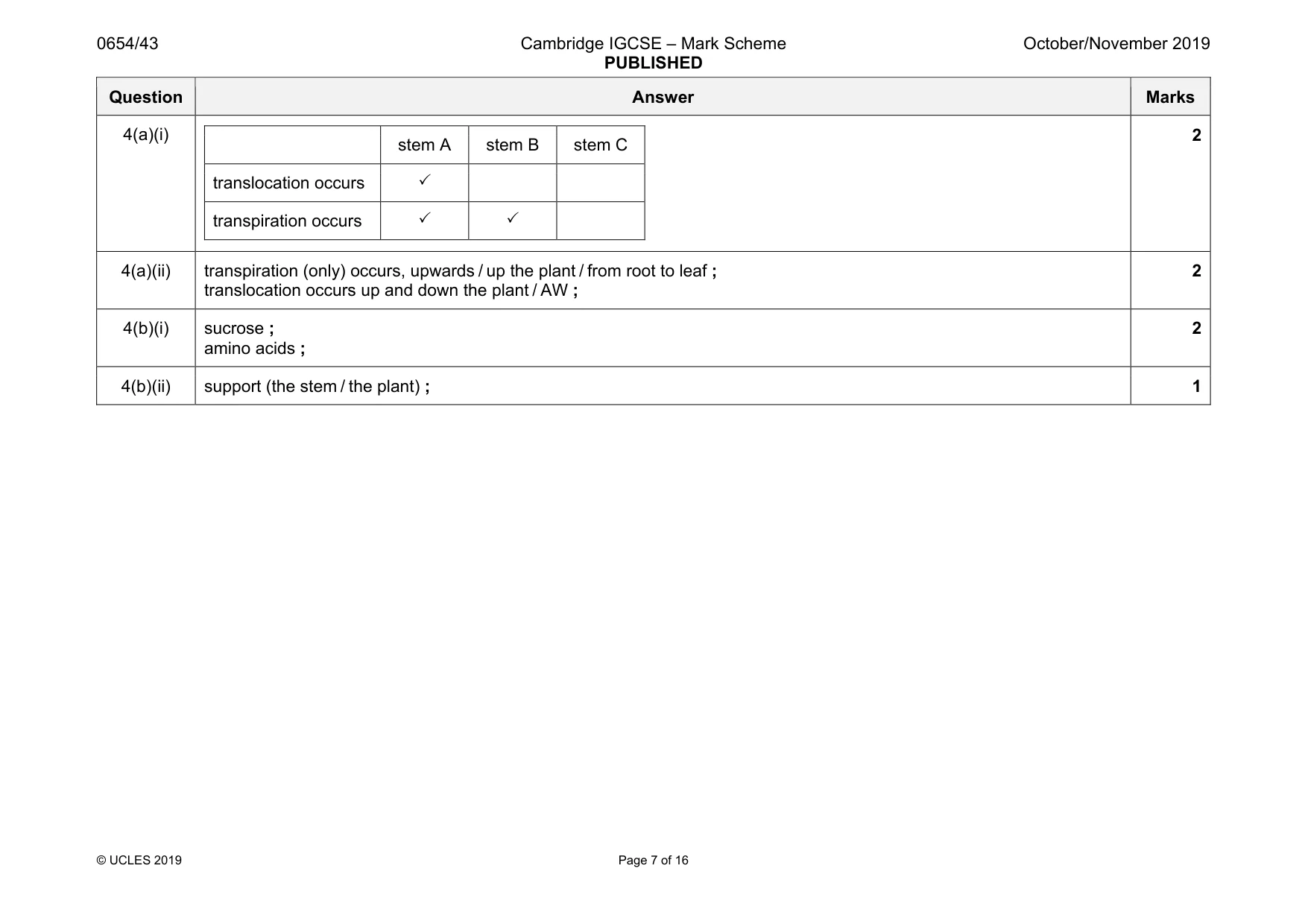
Mark scheme: 4(a)(i) stem A stem B stem C translocation occurs 3 transpiration occurs 3 3 2 4(a)(ii) transpiration (only) occurs, upwards / up the plant / from root to leaf ; translocation occurs up and down the plant / AW ; 2 4(b)(i) sucrose ; amino acids ; 2 4(b)(ii) support (the stem / the plant) ; 1
Q5 · What happens when a teacher ignites a mixture of hydrogen and air
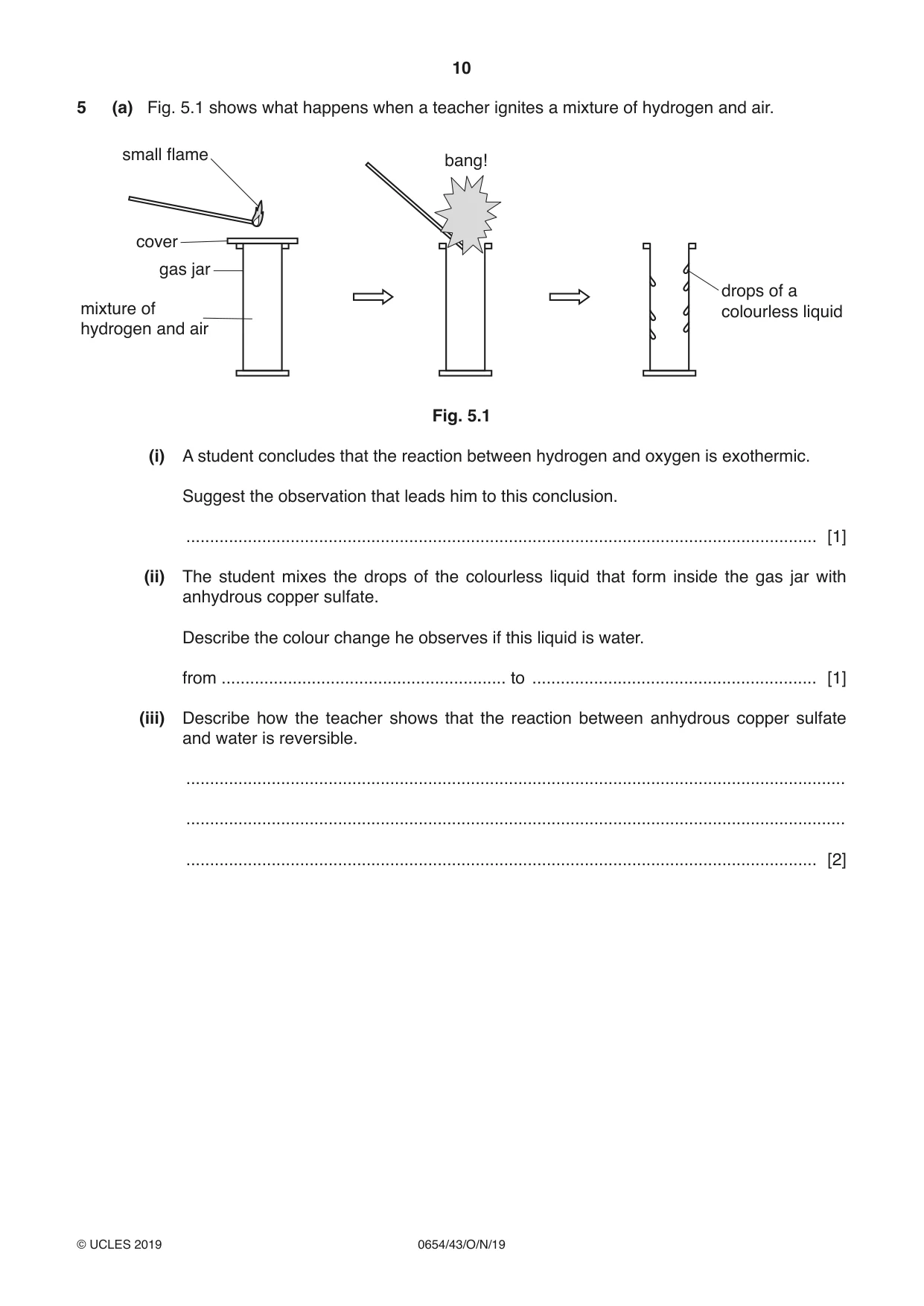
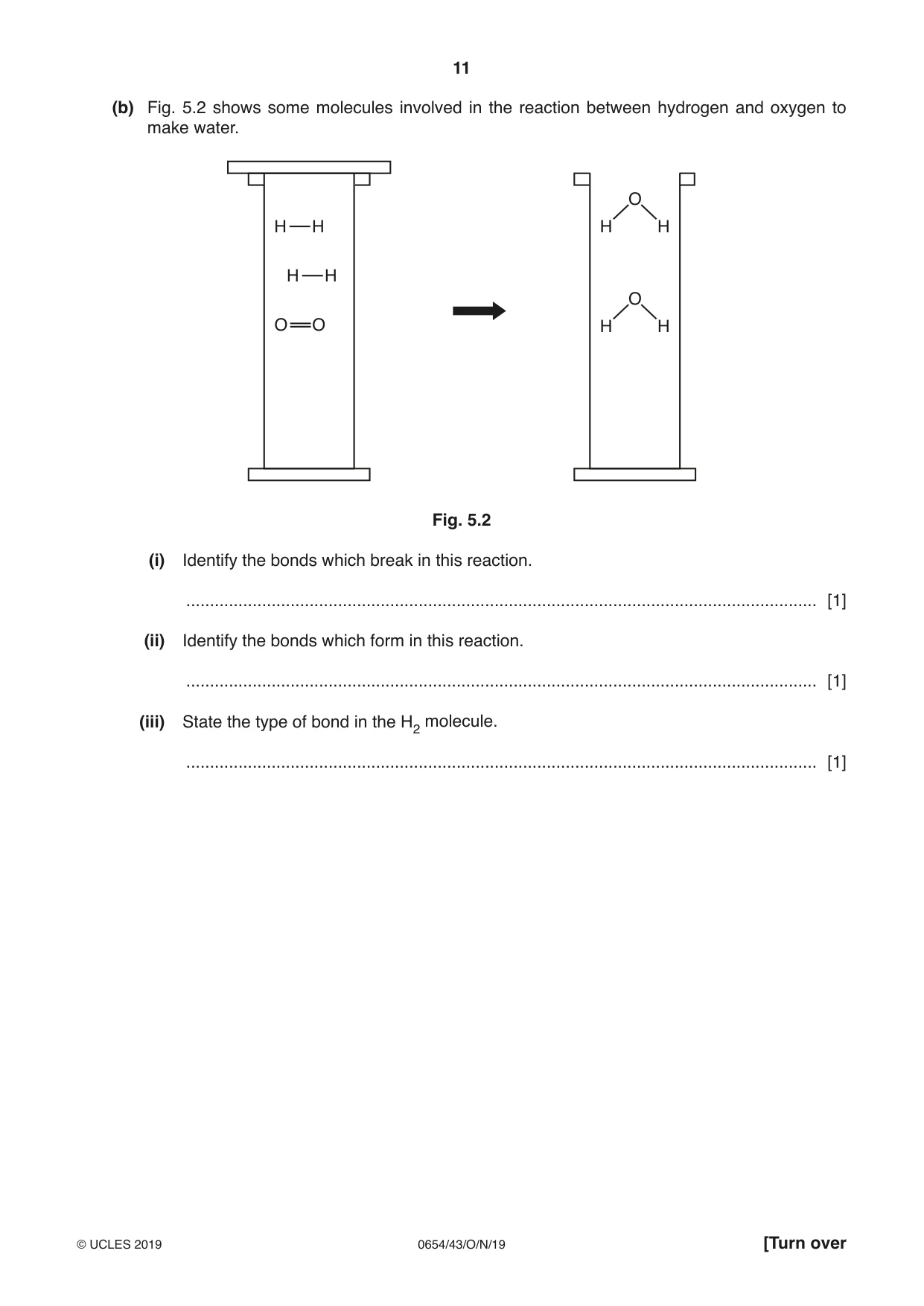
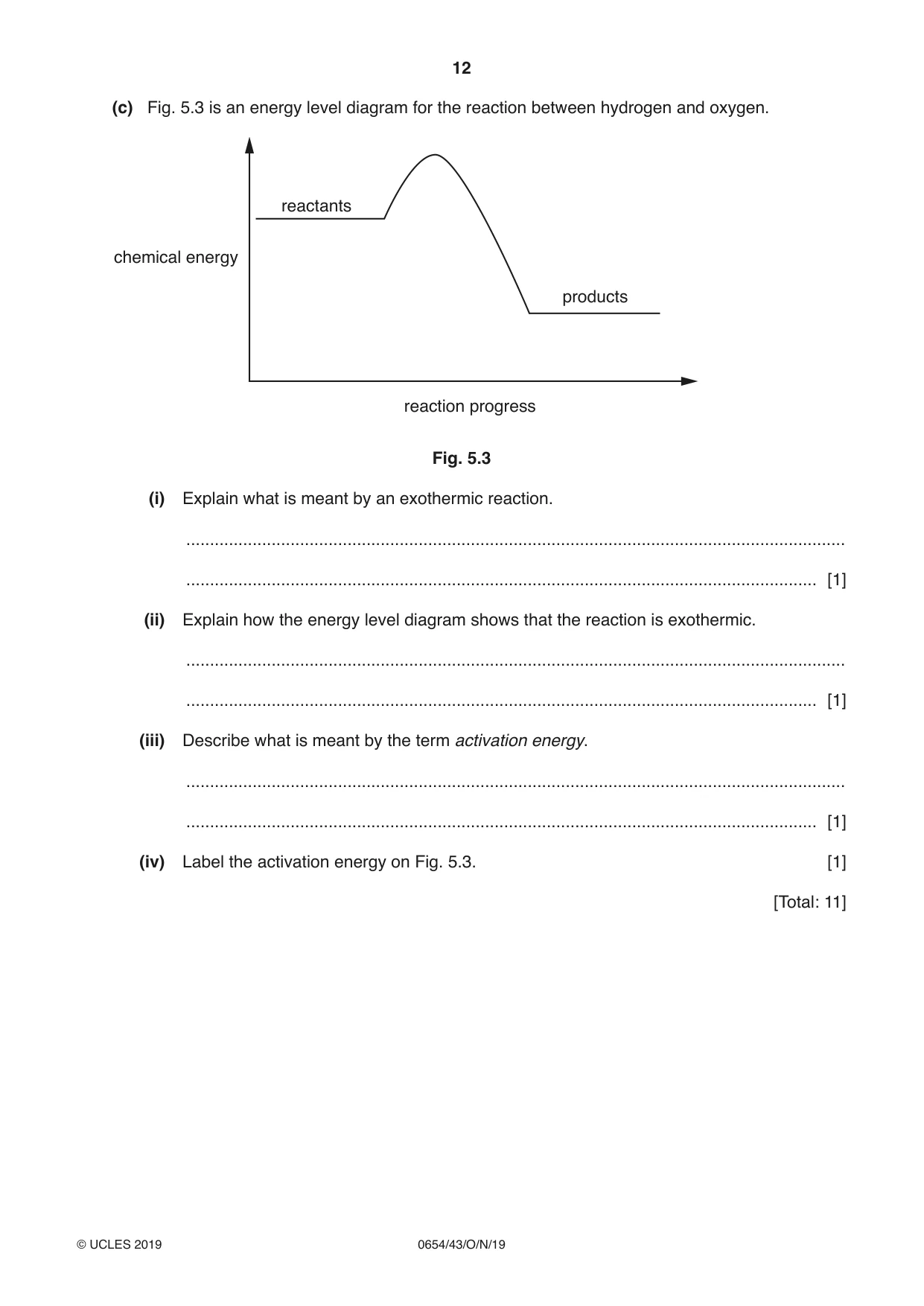
5 (a) Fig. 5.1 shows what happens when a teacher ignites a mixture of hydrogen and air. small flame bang! cover gas jar drops of a mixture of colourless liquid hydrogen and air Fig. 5.1 (i) A student concludes that the reaction between hydrogen and oxygen is exothermic. Suggest the observation that leads him to this conclusion. ..................................................................................................................................... [1] (ii) The student mixes the drops of the colourless liquid that form inside the gas jar with anhydrous copper sulfate. Describe the colour change he observes if this liquid is water. from ............................................................ to ............................................................ [1] (iii) Describe how the teacher shows that the reaction between anhydrous copper sulfate and water is reversible. ........................................................................................................................................... ........................................................................................................................................... ..................................................................................................................................... [2] (b) Fig. 5.2 shows some molecules involved in the reaction between hydrogen and oxygen to make water. O H H H H H H O O O H H Fig. 5.2 (i) Identify the bonds which break in this reaction. ..................................................................................................................................... [1] (ii) Identify the bonds which form in this reaction. ..................................................................................................................................... [1] (iii) State the type of bond in the H2 molecule. ..................................................................................................................................... [1] (c) Fig. 5.3 is an energy level diagram for the reaction between hydrogen and oxygen. reactants chemical energy products reaction progress Fig. 5.3 (i) Explain what is meant by an exothermic reaction. ........................................................................................................................................... ..................................................................................................................................... [1] (ii) Explain how the energy level diagram shows that the reaction is exothermic. ........................................................................................................................................... ..................................................................................................................................... [1] (iii) Describe what is meant by the term activation energy. ........................................................................................................................................... ..................................................................................................................................... [1] (iv) Label the activation energy on Fig. 5.3. [1] [Total: 11]
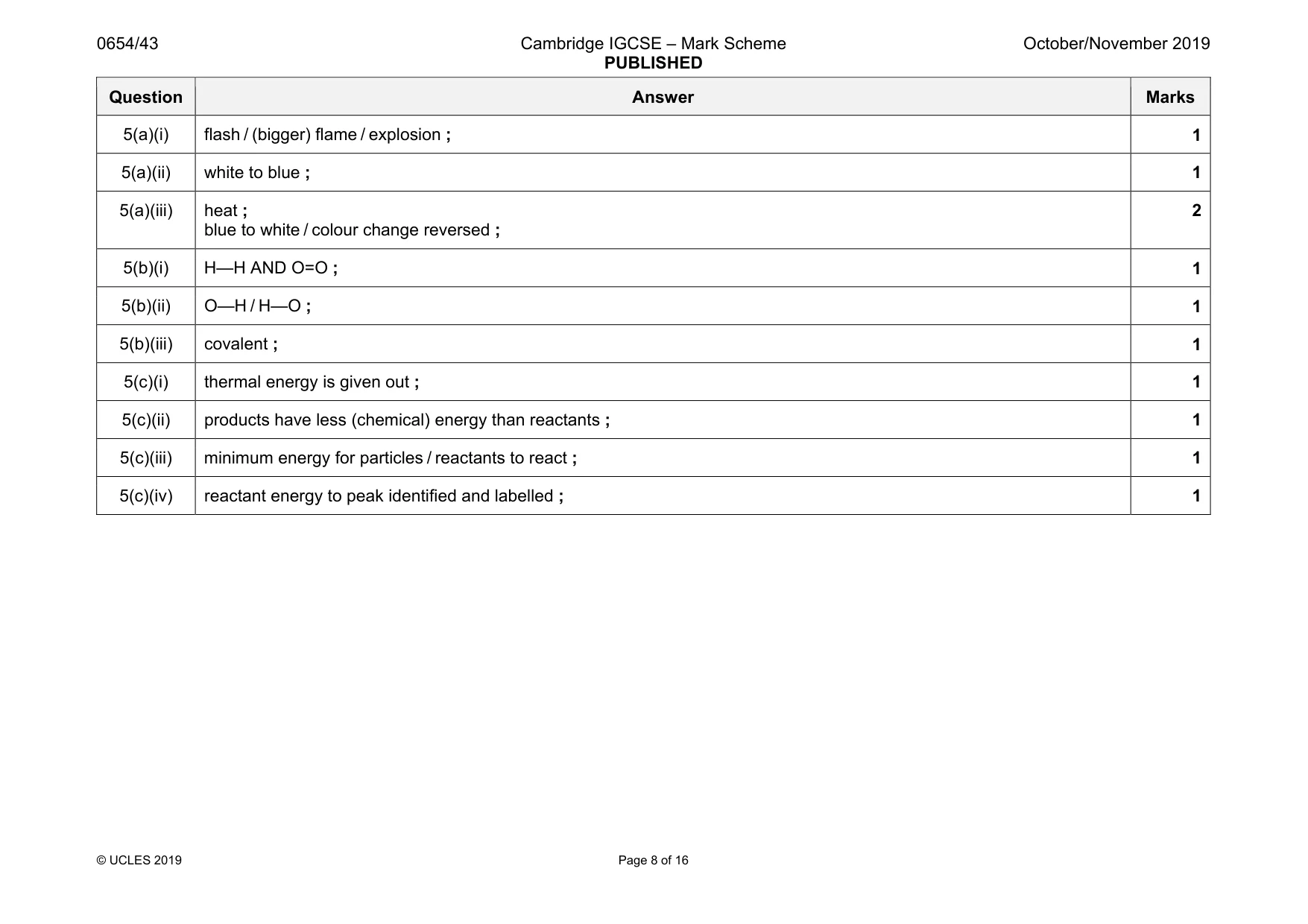
Mark scheme: 5(a)(i) flash / (bigger) flame / explosion ; 1 5(a)(ii) white to blue ; 1 5(a)(iii) heat ; blue to white / colour change reversed ; 2 5(b)(i) H—H AND O=O ; 1 5(b)(ii) O—H / H—O ; 1 5(b)(iii) covalent ; 1 5(c)(i) thermal energy is given out ; 1 5(c)(ii) products have less (chemical) energy than reactants ; 1 5(c)(iii) minimum energy for particles / reactants to react ; 1 5(c)(iv) reactant energy to peak identified and labelled ; 1
Q6 · In a cartoon, a mouse is being chased by a cat
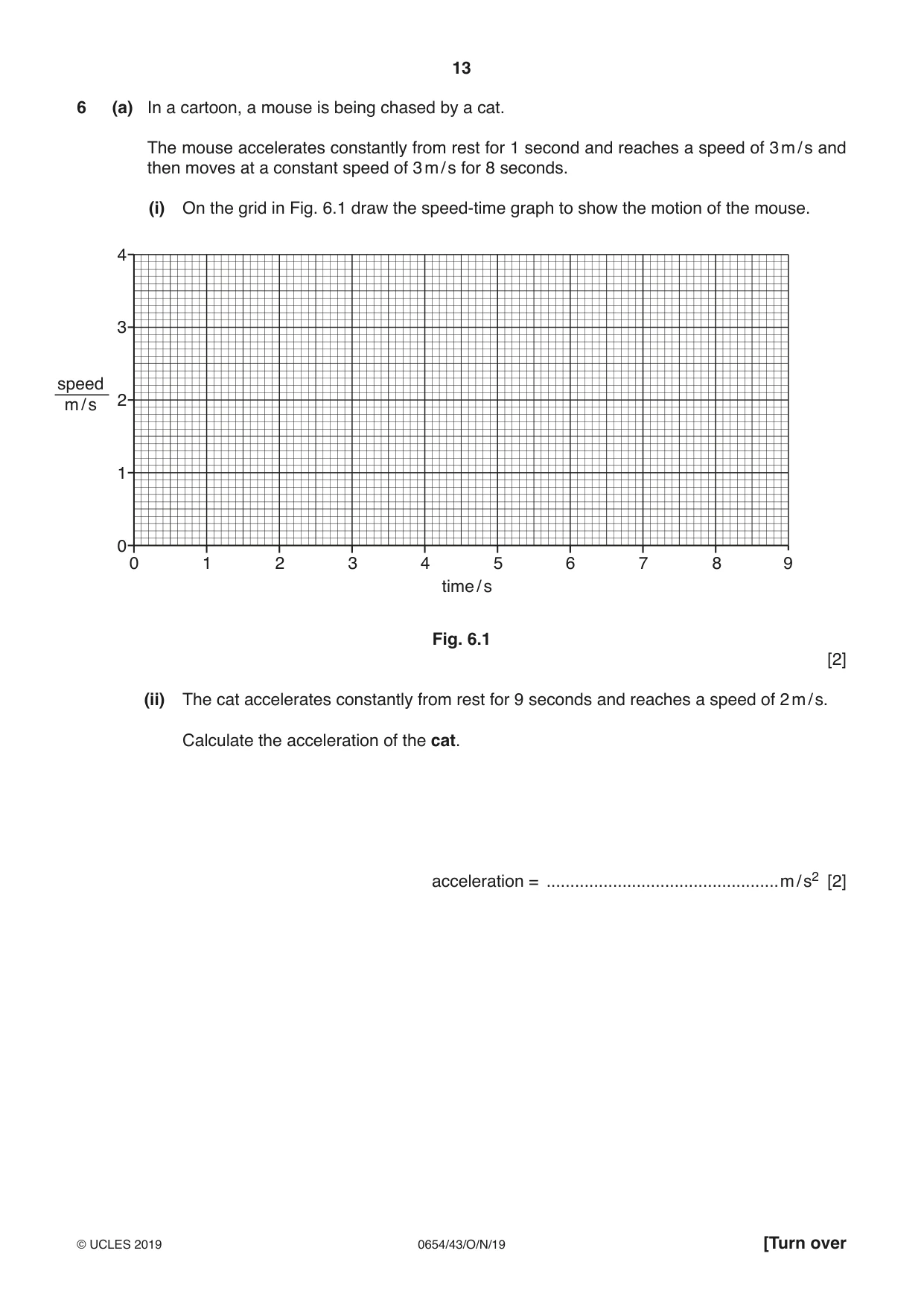
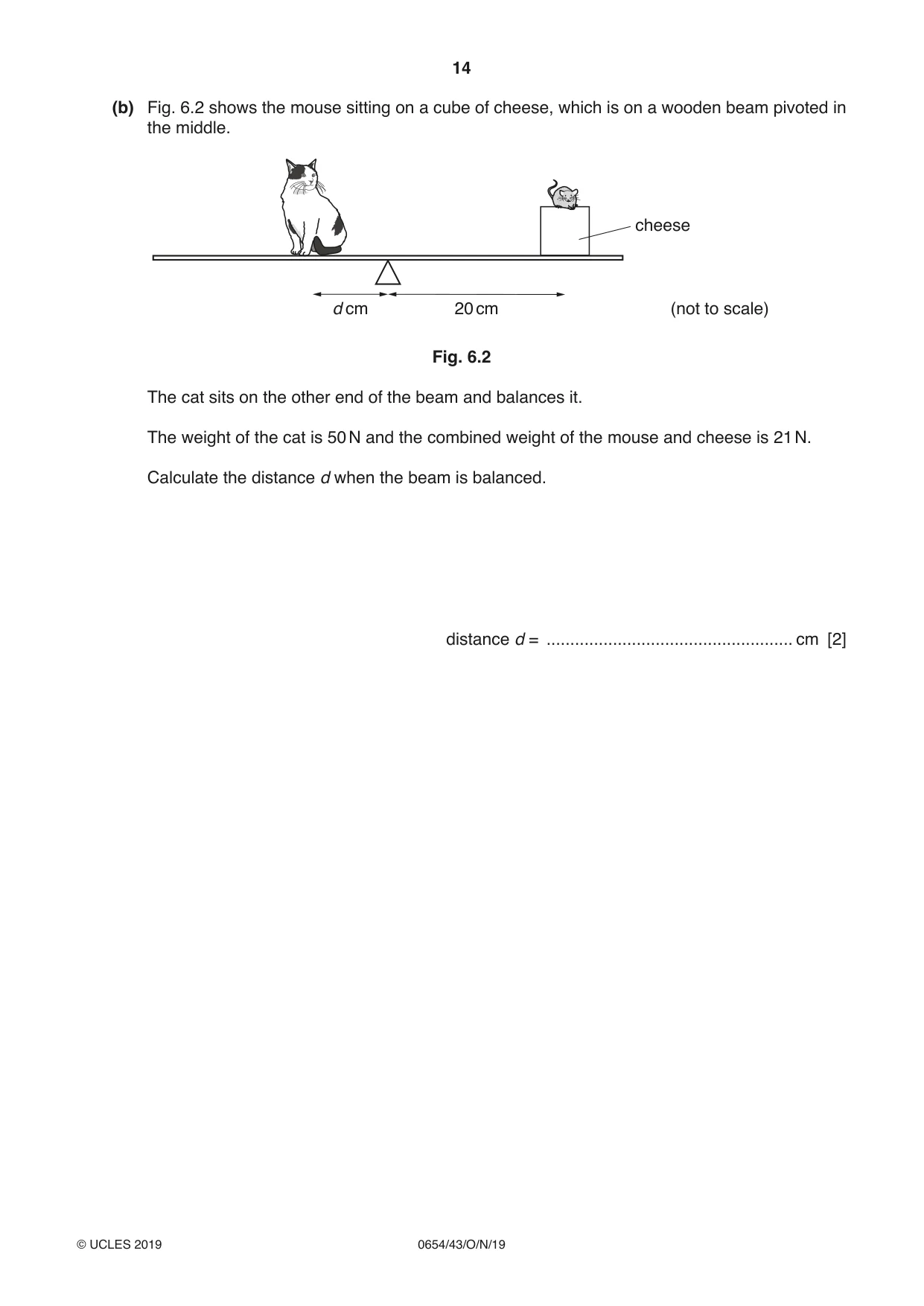
6 (a) In a cartoon, a mouse is being chased by a cat. The mouse accelerates constantly from rest for 1 second and reaches a speed of 3 m / s and then moves at a constant speed of 3 m / s for 8 seconds. (i) On the grid in Fig. 6.1 draw the speed-time graph to show the motion of the mouse. 4 3 speed m / s 2 1 0 0 1 2 3 4 5 6 7 8 9 time / s Fig. 6.1 [2] (ii) The cat accelerates constantly from rest for 9 seconds and reaches a speed of 2 m / s. Calculate the acceleration of the cat. acceleration = .................................................m / s2 [2] (b) Fig. 6.2 shows the mouse sitting on a cube of cheese, which is on a wooden beam pivoted in the middle. cheese d cm 20 cm (not to scale) Fig. 6.2 The cat sits on the other end of the beam and balances it. The weight of the cat is 50 N and the combined weight of the mouse and cheese is 21 N. Calculate the distance d when the beam is balanced. distance d = .................................................... cm [2] (c) Each side of the cube of cheese is 12 cm. The weight of the cube of cheese is 20.5 N. Calculate the density of the cube of cheese in g / cm3. gravitational field strength = 10 N / kg density = ...............................................g / cm3 [4] (d) Water evaporates from the cat’s bowl. Liquid water turns into water vapour when it evaporates. Water also turns into water vapour when water boils. State two differences between the processes of evaporation and boiling. 1 ................................................................................................................................................ ................................................................................................................................................... 2 ................................................................................................................................................ ................................................................................................................................................... [2] [Total: 12]
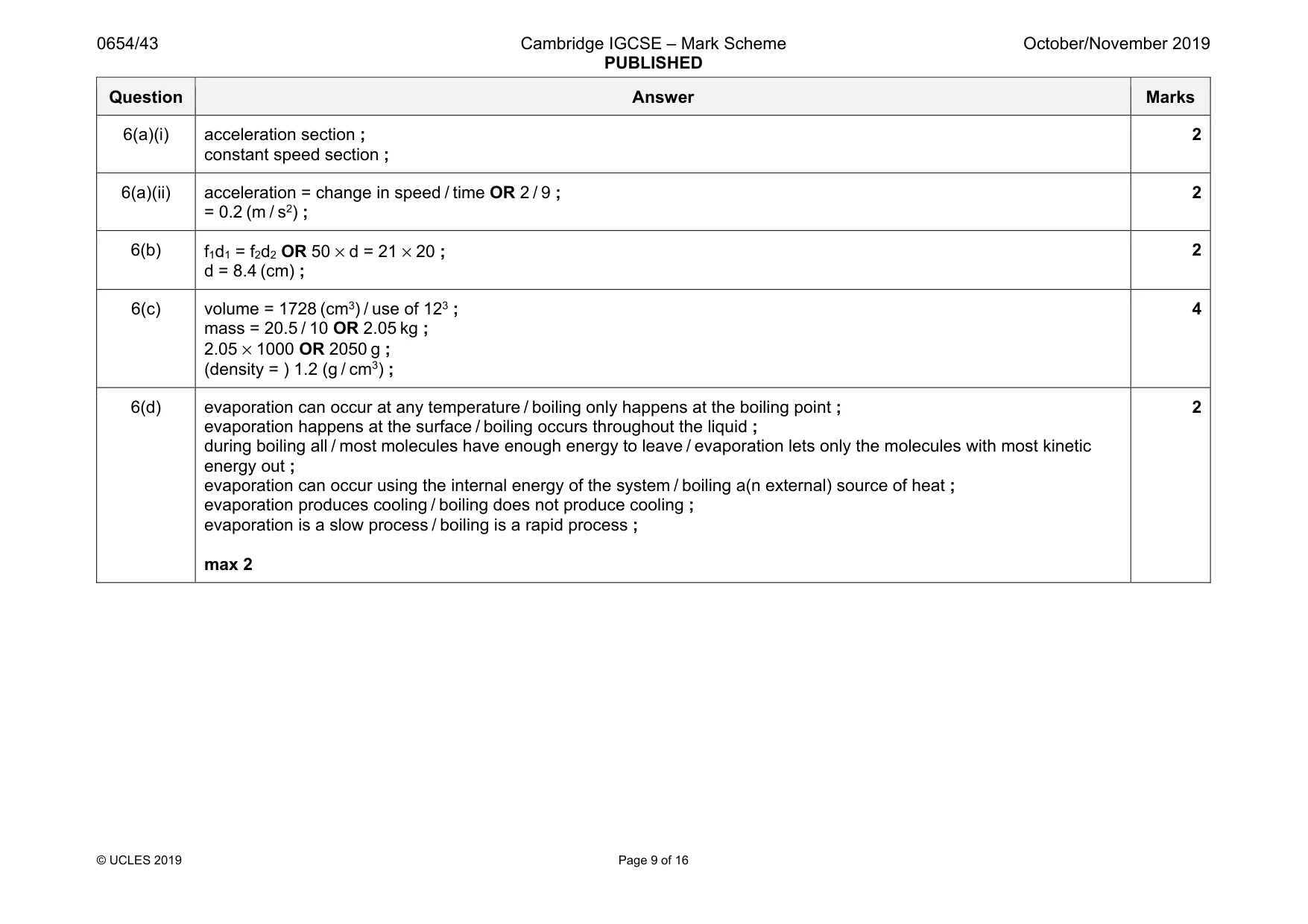
Mark scheme: 6(a)(i) acceleration section ; constant speed section ; 2 6(a)(ii) acceleration = change in speed / time OR 2 / 9 ; = 0.2 (m / s2) ; 2 6(b) f1d1 = f2d2 OR 50 × d = 21 × 20 ; d = 8.4 (cm) ; 2 6(c) volume = 1728 (cm3) / use of 123 ; mass = 20.5 / 10 OR 2.05 kg ; 2.05 × 1000 OR 2050 g ; (density = ) 1.2 (g / cm3) ; 4 6(d) evaporation can occur at any temperature / boiling only happens at the boiling point ; evaporation happens at the surface / boiling occurs throughout the liquid ; during boiling all / most molecules have enough energy to leave / evaporation lets only the molecules with most kinetic energy out ; evaporation can occur using the internal energy of the system / boiling a(n external) source of heat ; evaporation produces cooling / boiling does not produce cooling ; evaporation is a slow process / boiling is a rapid process ; max 2 2
Q7 · An X-ray of a molar tooth
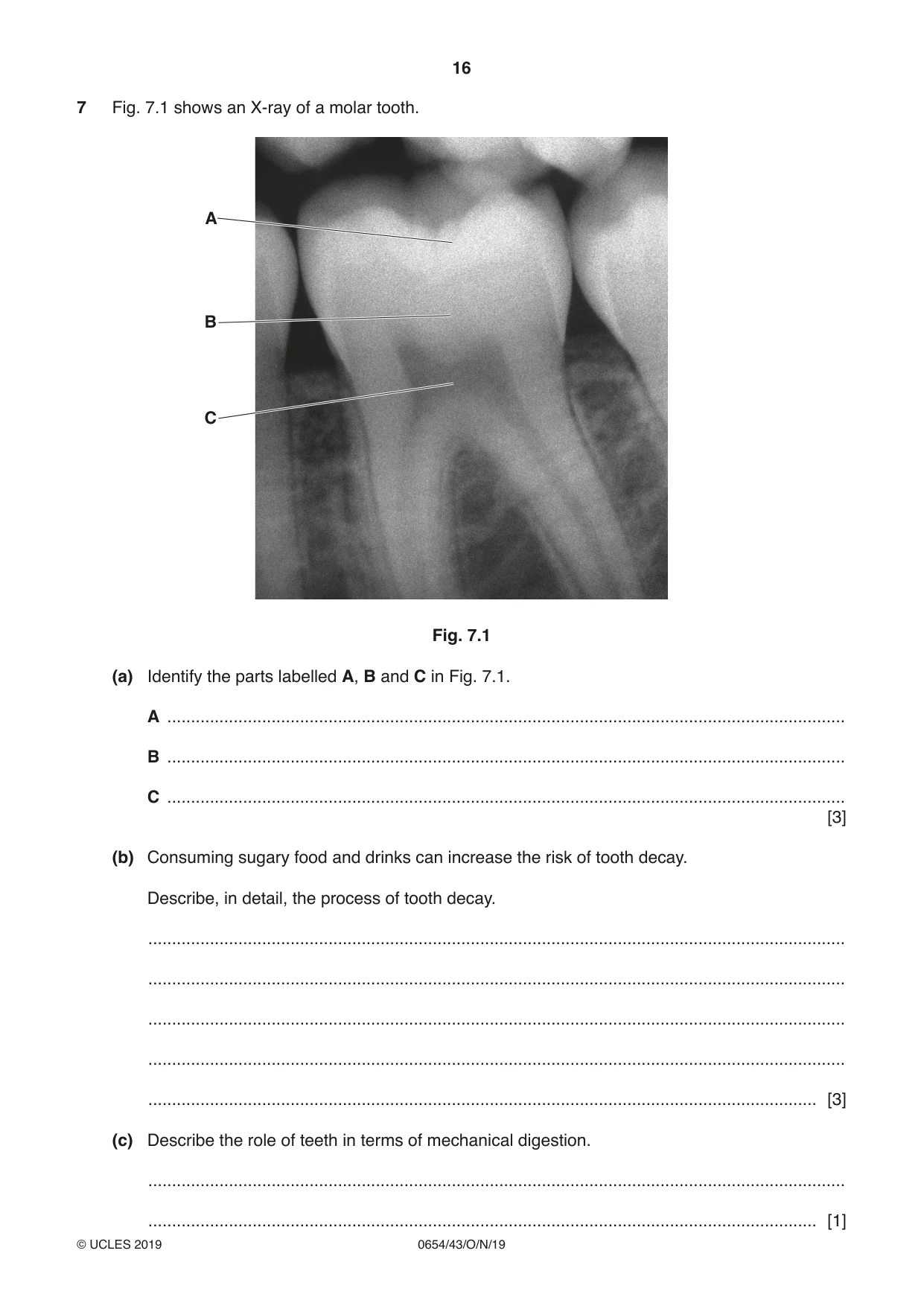
7 Fig. 7.1 shows an X-ray of a molar tooth. A B C Fig. 7.1 (a) Identify the parts labelled A, B and C in Fig. 7.1. A ............................................................................................................................................... B ............................................................................................................................................... C ............................................................................................................................................... [3] (b) Consuming sugary food and drinks can increase the risk of tooth decay. Describe, in detail, the process of tooth decay. ................................................................................................................................................... ................................................................................................................................................... ................................................................................................................................................... ................................................................................................................................................... ............................................................................................................................................. [3] (c) Describe the role of teeth in terms of mechanical digestion. ................................................................................................................................................... ............................................................................................................................................. [1] (d) Chemical digestion also occurs in the mouth. Describe the role of enzymes in the chemical digestion that occurs in the mouth. ................................................................................................................................................... ................................................................................................................................................... ................................................................................................................................................... ................................................................................................................................................... ............................................................................................................................................. [3] [Total: 10]
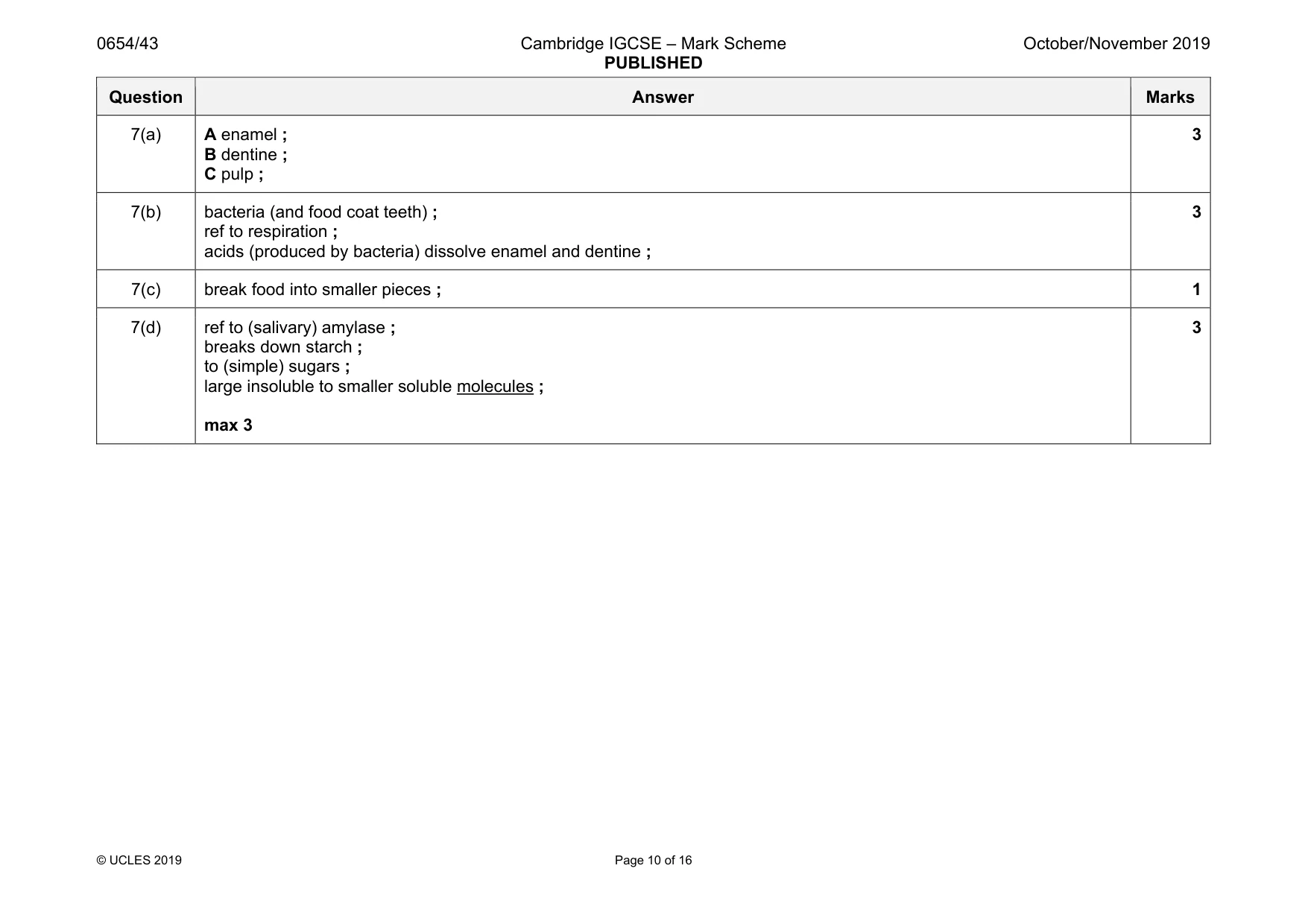
Mark scheme: 7(a) A enamel ; B dentine ; C pulp ; 3 7(b) bacteria (and food coat teeth) ; ref to respiration ; acids (produced by bacteria) dissolve enamel and dentine ; 3 7(c) break food into smaller pieces ; 1 7(d) ref to (salivary) amylase ; breaks down starch ; to (simple) sugars ; large insoluble to smaller soluble molecules ; max 3 3
Q8 · Group VII of the Periodic Table
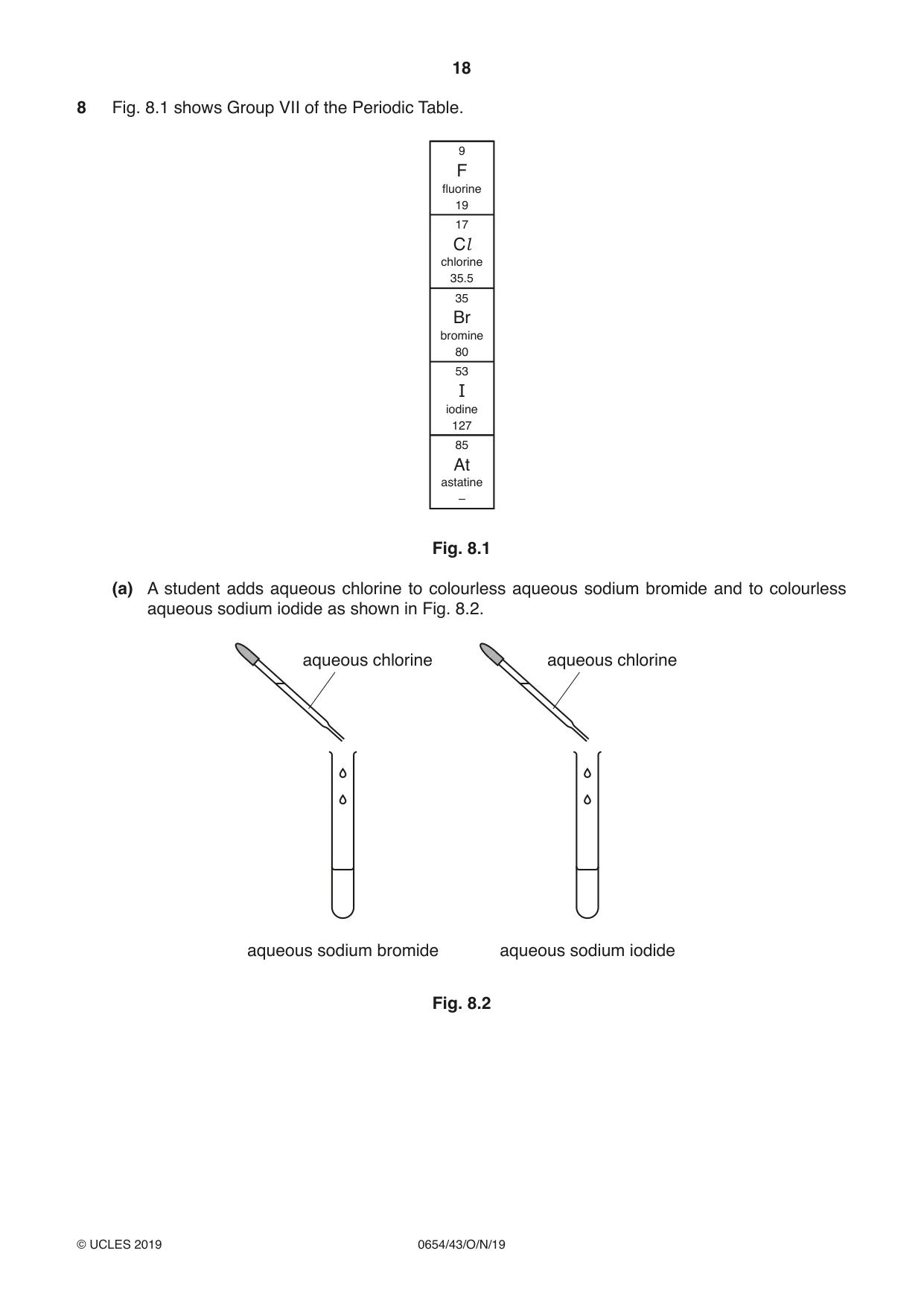
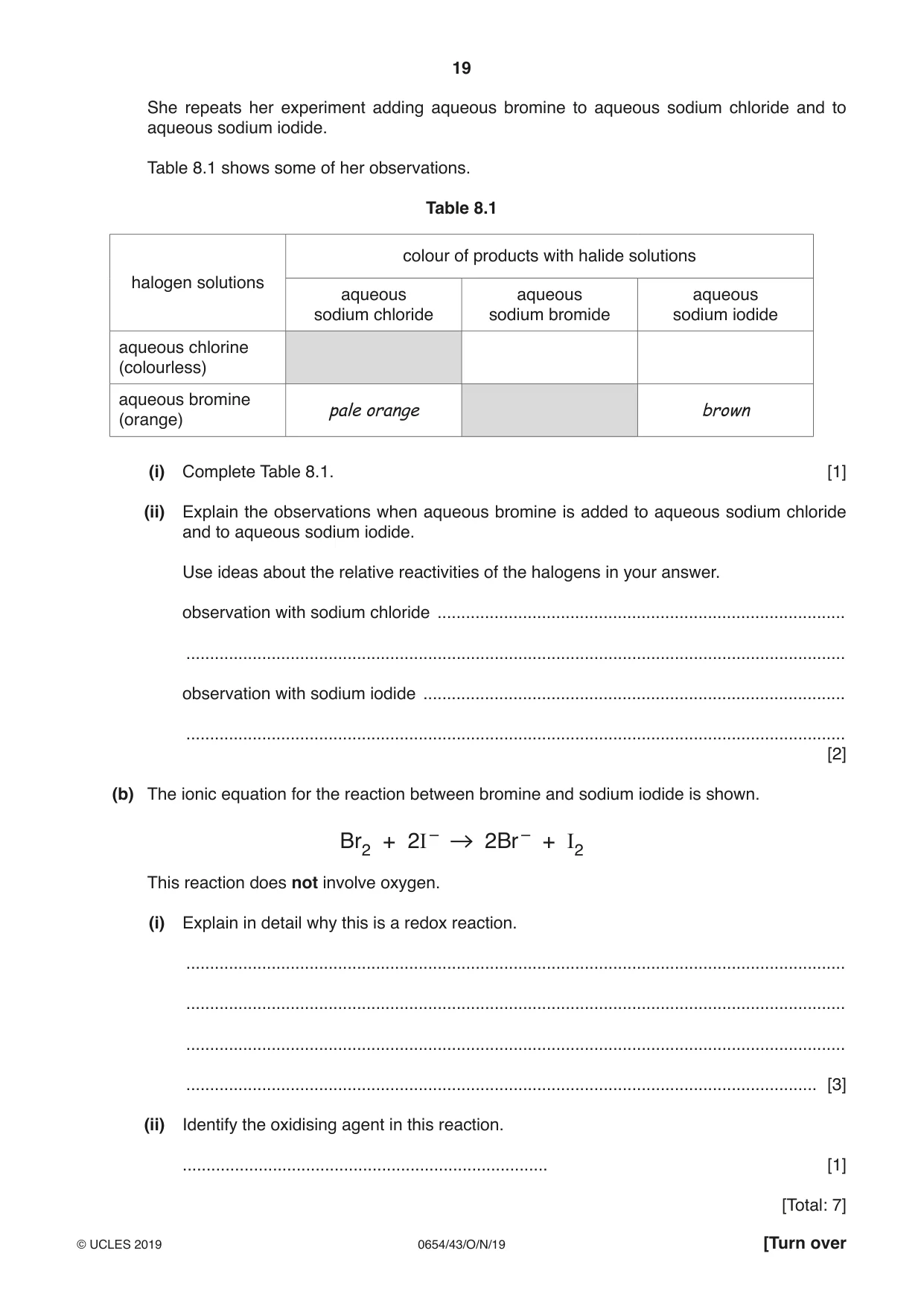
8 Fig. 8.1 shows Group VII of the Periodic Table. 9 F fluorine 19 17 Cl chlorine 35.5 35 Br bromine 80 53 I iodine 127 85 At astatine – Fig. 8.1 (a) A student adds aqueous chlorine to colourless aqueous sodium bromide and to colourless aqueous sodium iodide as shown in Fig. 8.2. aqueous chlorine aqueous chlorine aqueous sodium bromide aqueous sodium iodide Fig. 8.2 She repeats her experiment adding aqueous bromine to aqueous sodium chloride and to aqueous sodium iodide. Table 8.1 shows some of her observations. Table 8.1 colour of products with halide solutions halogen solutions aqueous aqueous aqueous sodium chloride sodium bromide sodium iodide aqueous chlorine (colourless) aqueous bromine paleorange brown (orange) (i) Complete Table 8.1. [1] (ii) Explain the observations when aqueous bromine is added to aqueous sodium chloride and to aqueous sodium iodide. Use ideas about the relative reactivities of the halogens in your answer. observation with sodium chloride ...................................................................................... ........................................................................................................................................... observation with sodium iodide ......................................................................................... ........................................................................................................................................... [2] (b) The ionic equation for the reaction between bromine and sodium iodide is shown. Br2 + 2I – 2Br – + I2 This reaction does not involve oxygen. (i) Explain in detail why this is a redox reaction. ........................................................................................................................................... ........................................................................................................................................... ........................................................................................................................................... ..................................................................................................................................... [3] (ii) Identify the oxidising agent in this reaction. ............................................................................. [1] [Total: 7]
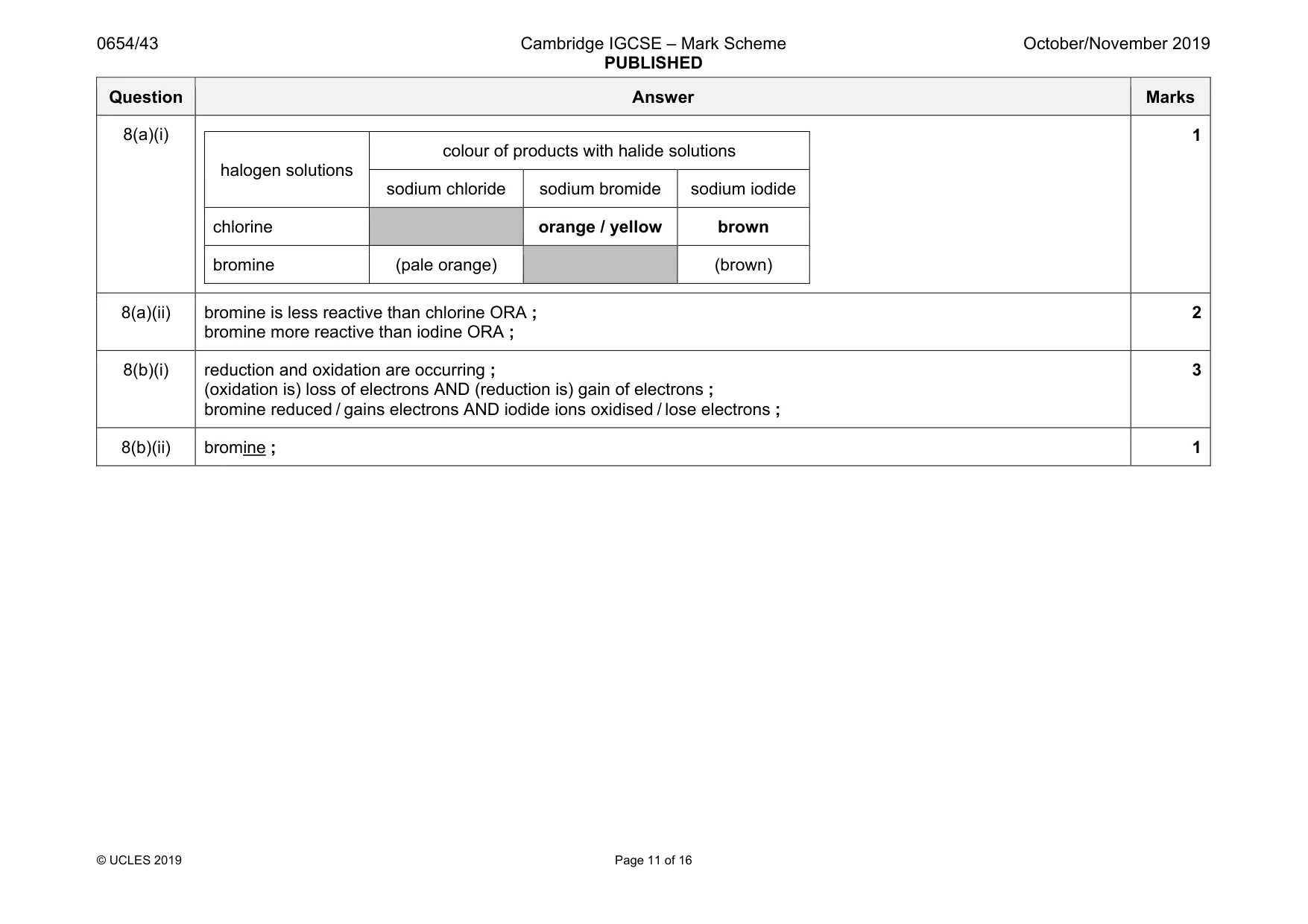
Mark scheme: 8(a)(i) halogen solutions colour of products with halide solutions sodium chloride sodium bromide sodium iodide chlorine orange / yellow brown bromine (pale orange) (brown) 1 8(a)(ii) bromine is less reactive than chlorine ORA ; bromine more reactive than iodine ORA ; 2 8(b)(i) reduction and oxidation are occurring ; (oxidation is) loss of electrons AND (reduction is) gain of electrons ; bromine reduced / gains electrons AND iodide ions oxidised / lose electrons ; 3 8(b)(ii) bromine ; 1
Q9 · A golf cart used to carry golfers and their golf clubs around a golf course
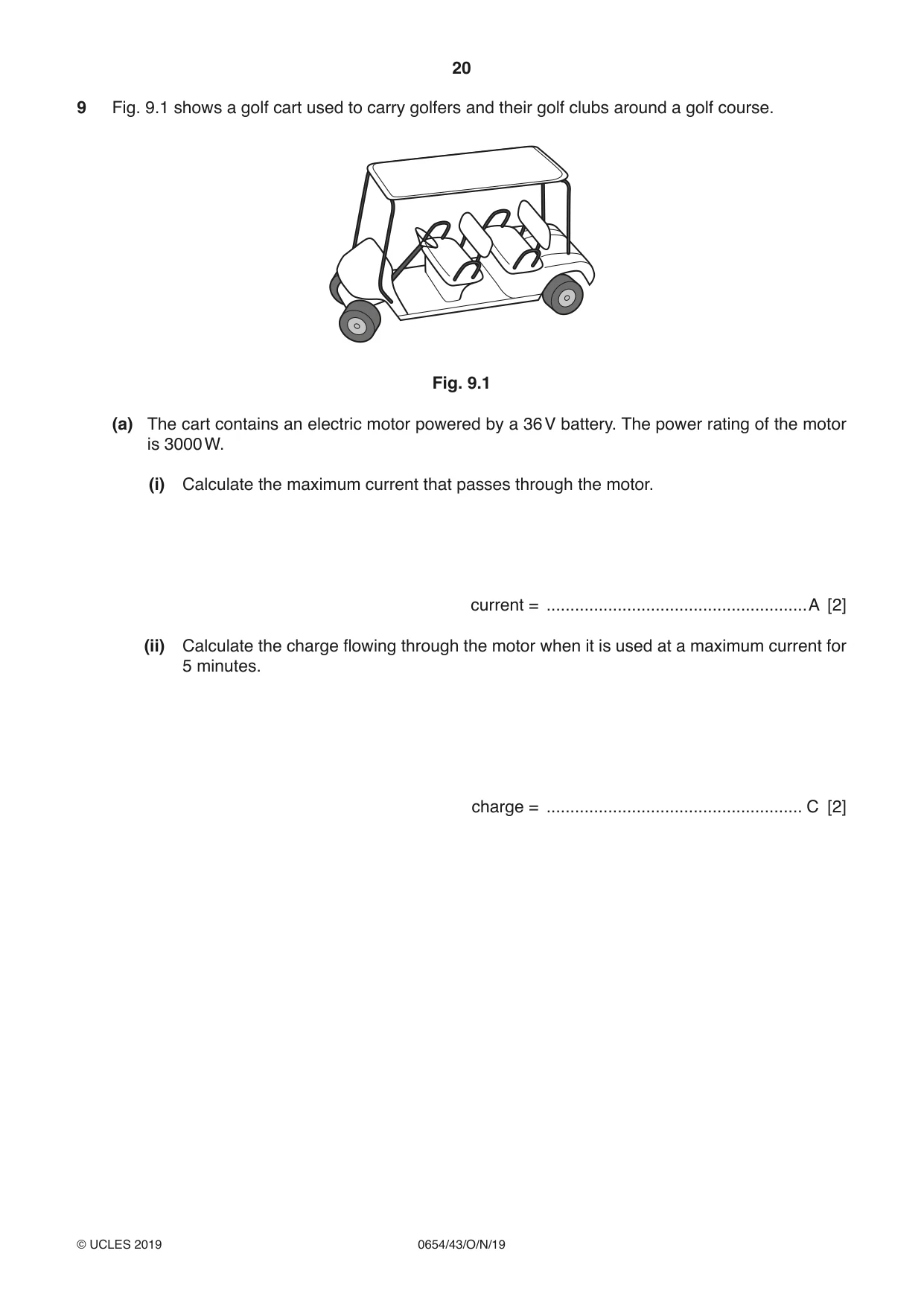
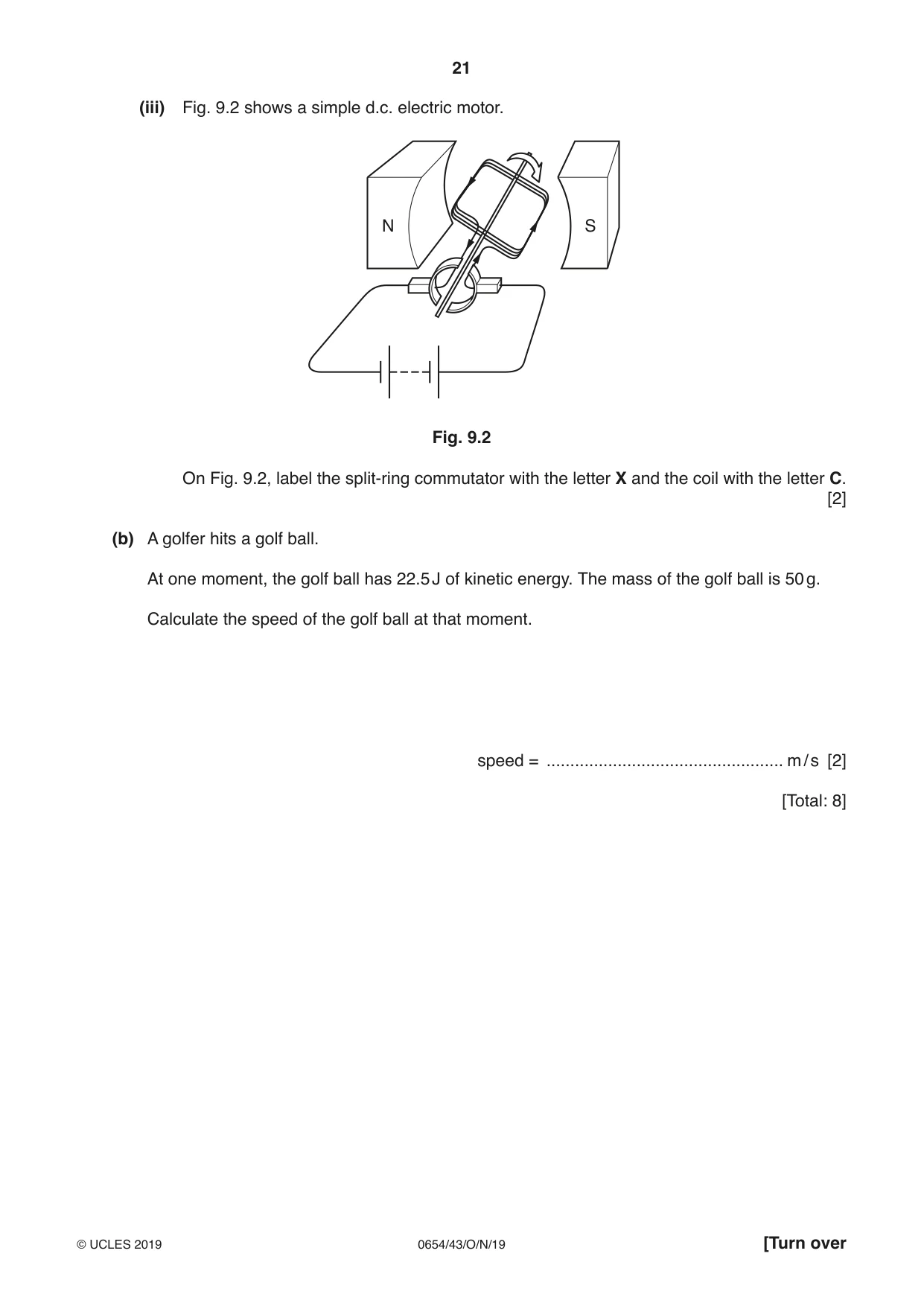
9 Fig. 9.1 shows a golf cart used to carry golfers and their golf clubs around a golf course. Fig. 9.1 (a) The cart contains an electric motor powered by a 36 V battery. The power rating of the motor is 3000 W. (i) Calculate the maximum current that passes through the motor. current = .......................................................A [2] (ii) Calculate the charge flowing through the motor when it is used at a maximum current for 5 minutes. charge = ...................................................... C [2] (iii) Fig. 9.2 shows a simple d.c. electric motor. N S Fig. 9.2 On Fig. 9.2, label the split-ring commutator with the letter X and the coil with the letter C. [2] (b) A golfer hits a golf ball. At one moment, the golf ball has 22.5 J of kinetic energy. The mass of the golf ball is 50 g. Calculate the speed of the golf ball at that moment. speed = .................................................. m / s [2] [Total: 8]
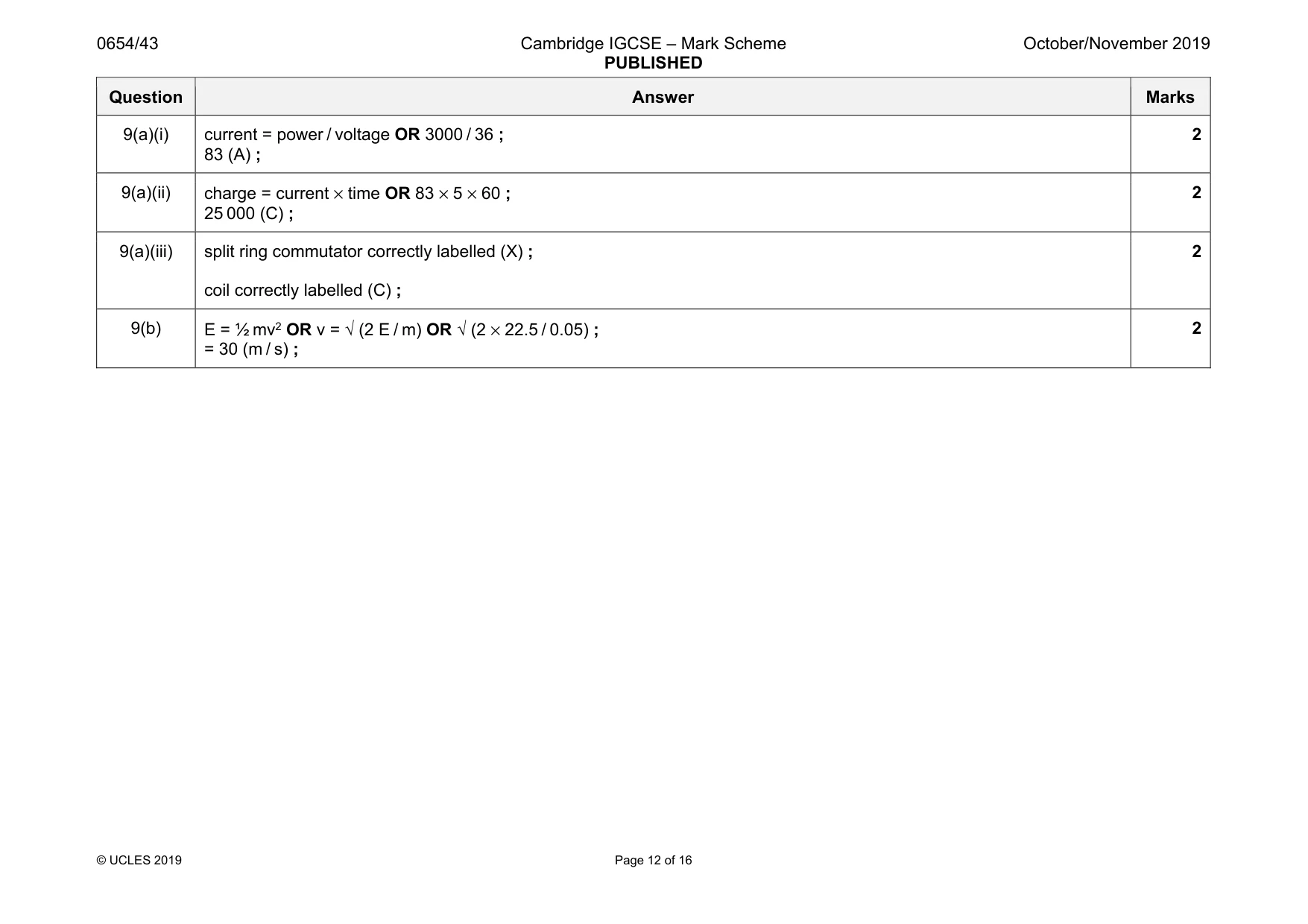
Mark scheme: 9(a)(i) current = power / voltage OR 3000 / 36 ; 83 (A) ; 2 9(a)(ii) charge = current × time OR 83 × 5 × 60 ; 25 000 (C) ; 2 9(a)(iii) split ring commutator correctly labelled (X) ; coil correctly labelled (C) ; 2 9(b) E = ½ mv2 OR v = √ (2 E / m) OR √ (2 × 22.5 / 0.05) ; = 30 (m / s) ; 2
Q10 · MRSA is a strain of bacteria that is resistant to antibiotics
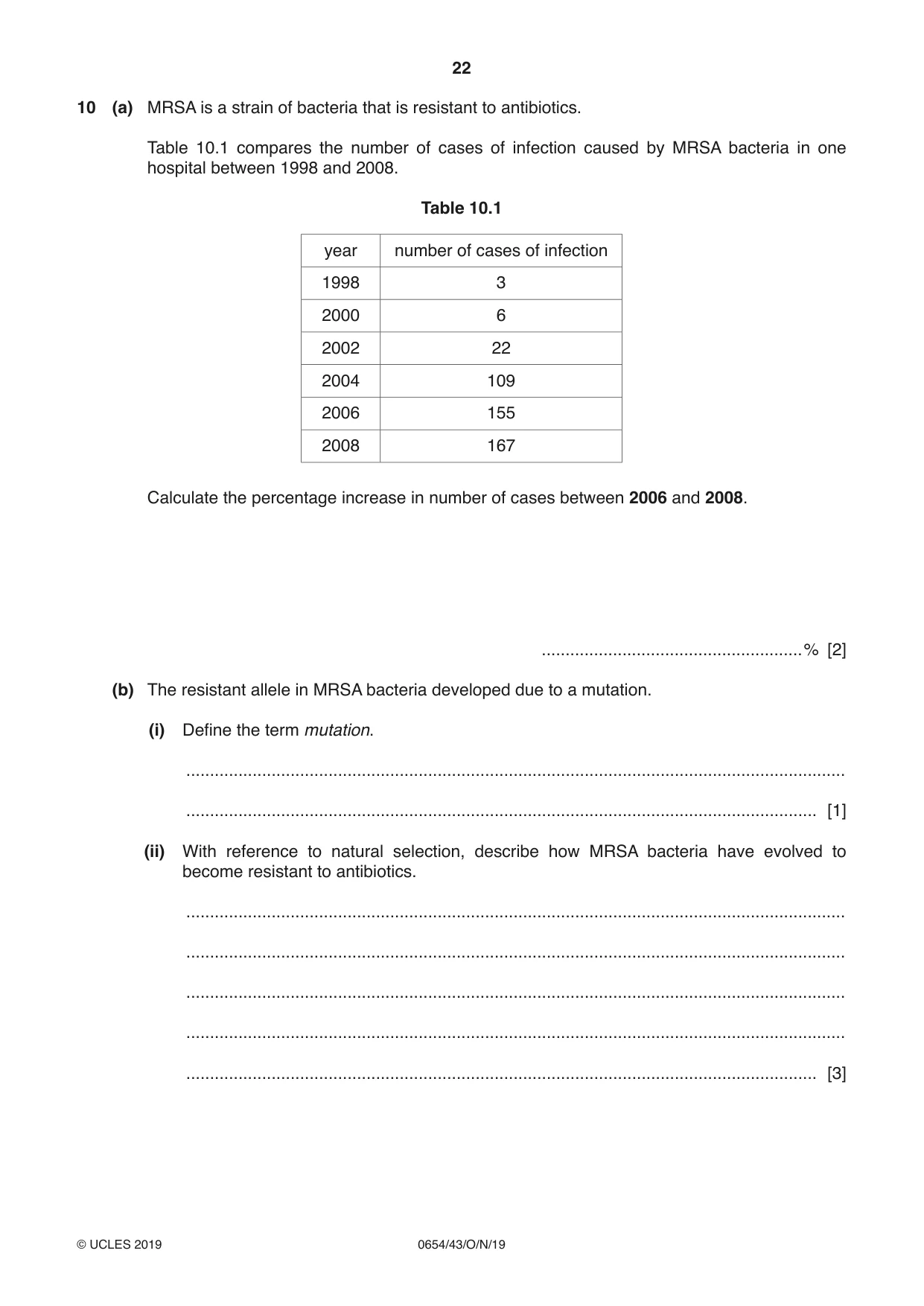
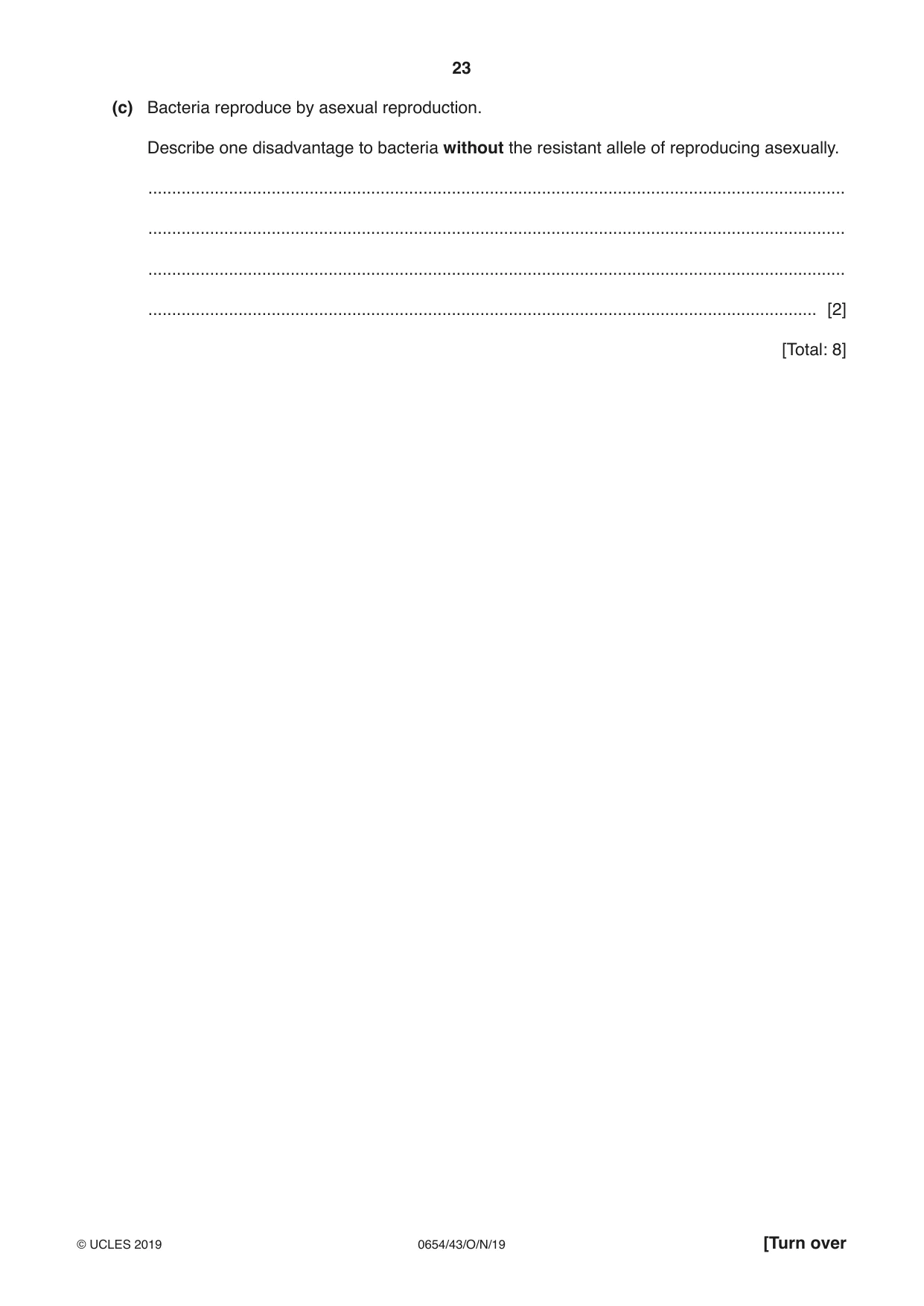
10 (a) MRSA is a strain of bacteria that is resistant to antibiotics. Table 10.1 compares the number of cases of infection caused by MRSA bacteria in one hospital between 1998 and 2008. Table 10.1 year number of cases of infection 1998 3 2000 6 2002 22 2004 109 2006 155 2008 167 Calculate the percentage increase in number of cases between 2006 and 2008. .......................................................% [2] (b) The resistant allele in MRSA bacteria developed due to a mutation. (i) Define the term mutation. ........................................................................................................................................... ..................................................................................................................................... [1] (ii) With reference to natural selection, describe how MRSA bacteria have evolved to become resistant to antibiotics. ........................................................................................................................................... ........................................................................................................................................... ........................................................................................................................................... ........................................................................................................................................... ..................................................................................................................................... [3] (c) Bacteria reproduce by asexual reproduction. Describe one disadvantage to bacteria without the resistant allele of reproducing asexually. ................................................................................................................................................... ................................................................................................................................................... ................................................................................................................................................... ............................................................................................................................................. [2] [Total: 8]
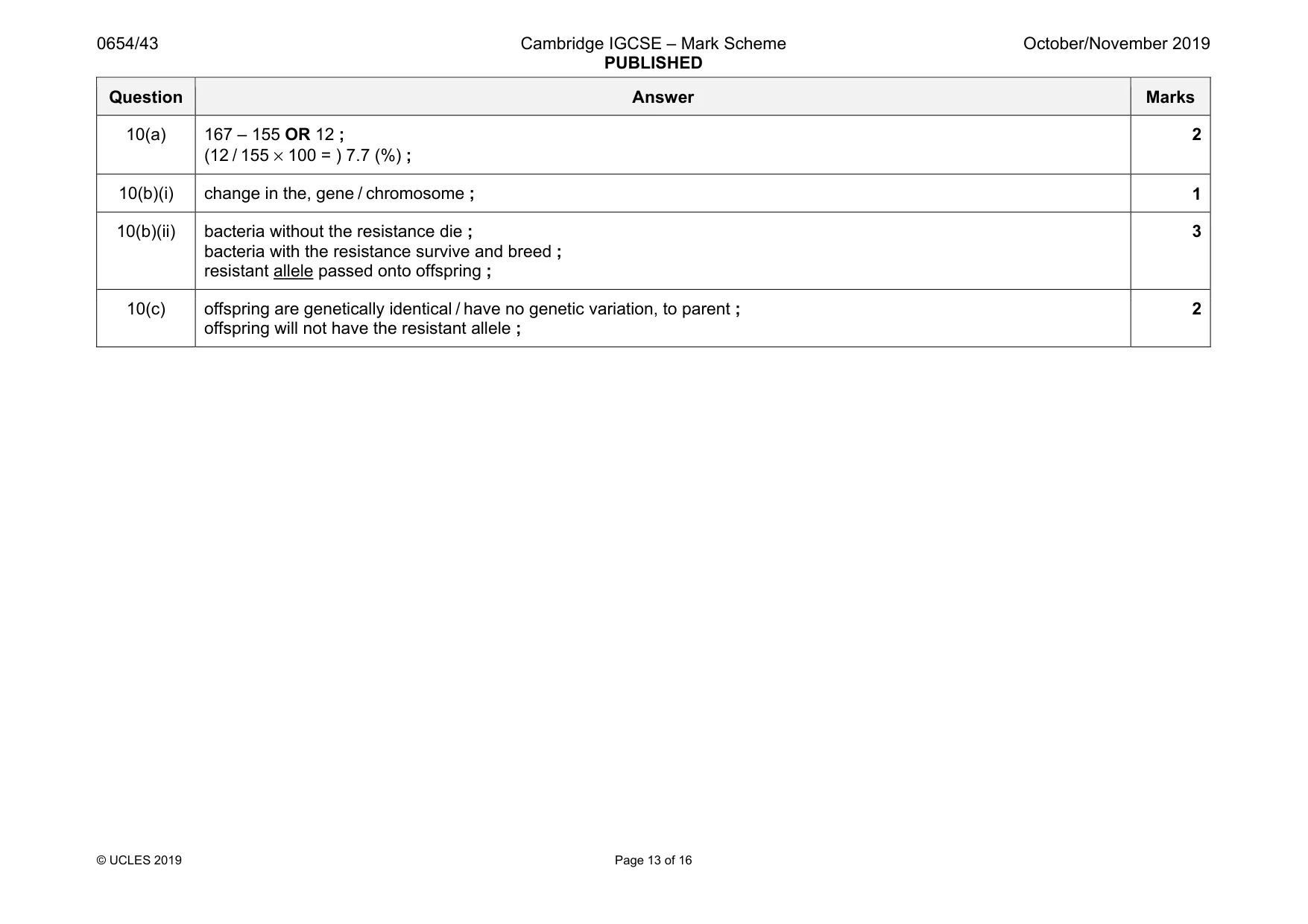
Mark scheme: 10(a) 167 – 155 OR 12 ; (12 / 155 × 100 = ) 7.7 (%) ; 2 10(b)(i) change in the, gene / chromosome ; 1 10(b)(ii) bacteria without the resistance die ; bacteria with the resistance survive and breed ; resistant allele passed onto offspring ; 3 10(c) offspring are genetically identical / have no genetic variation, to parent ; offspring will not have the resistant allele ; 2
Q11 · A homologous series is a family of compounds which have the same general formula and…
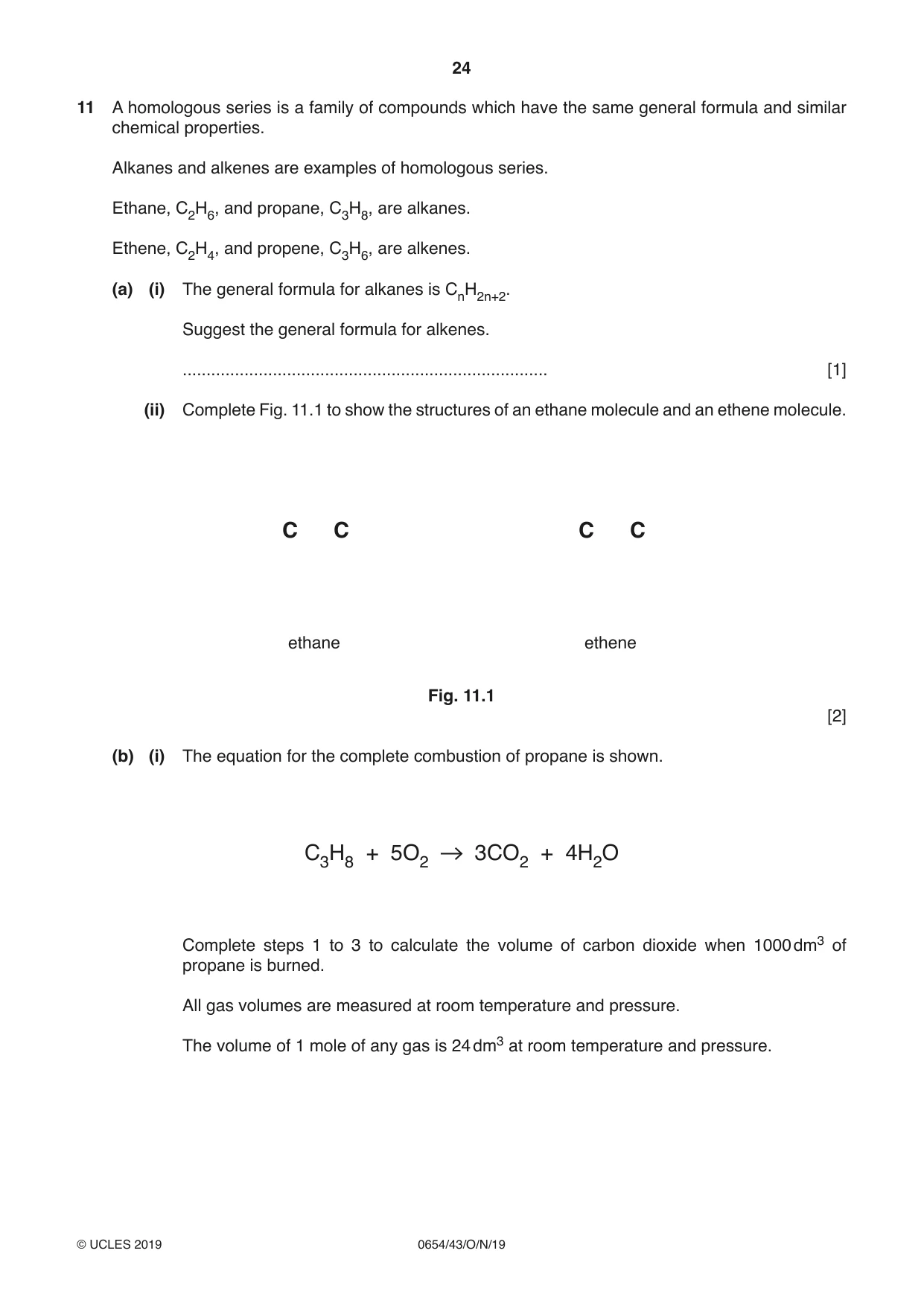
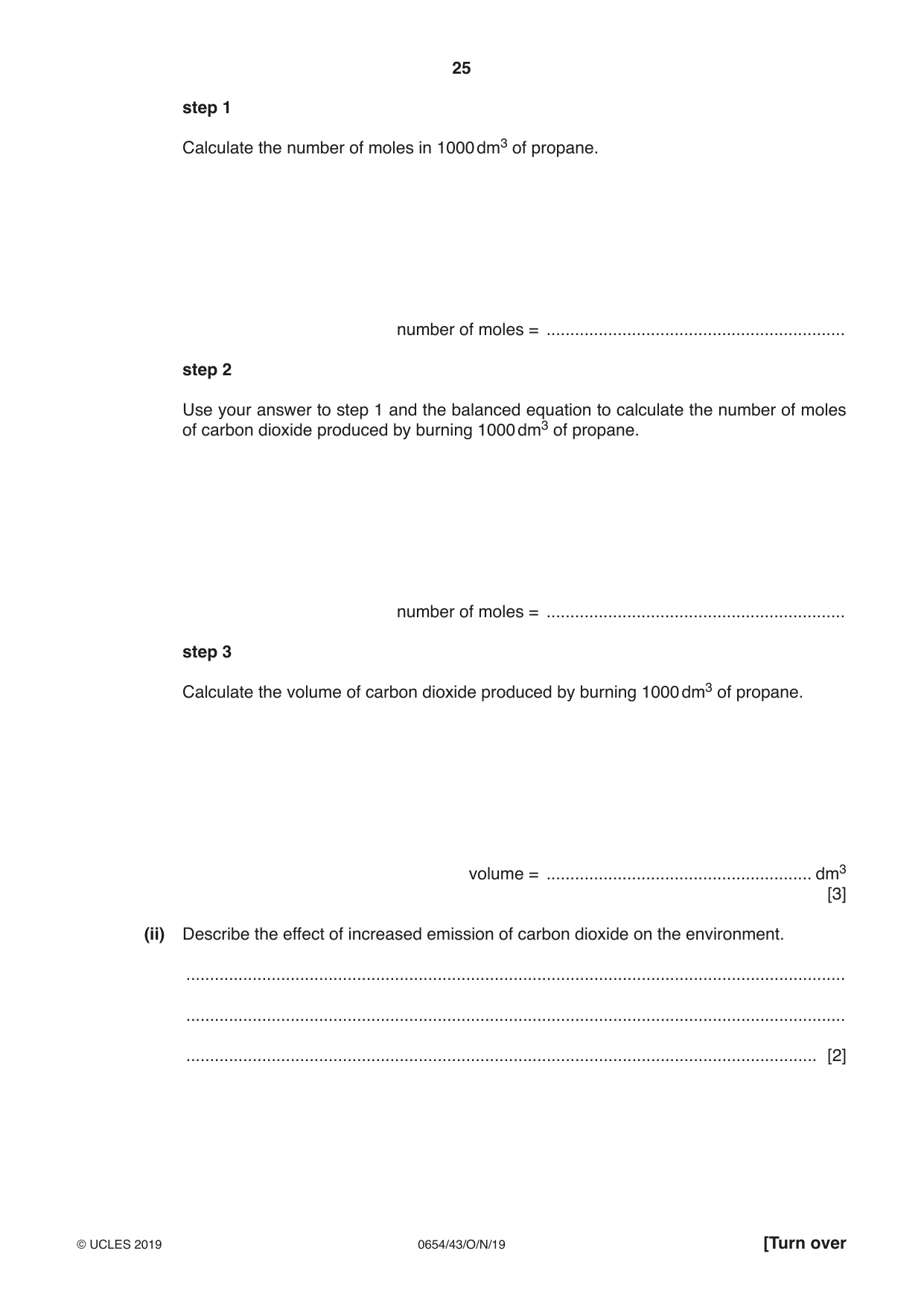
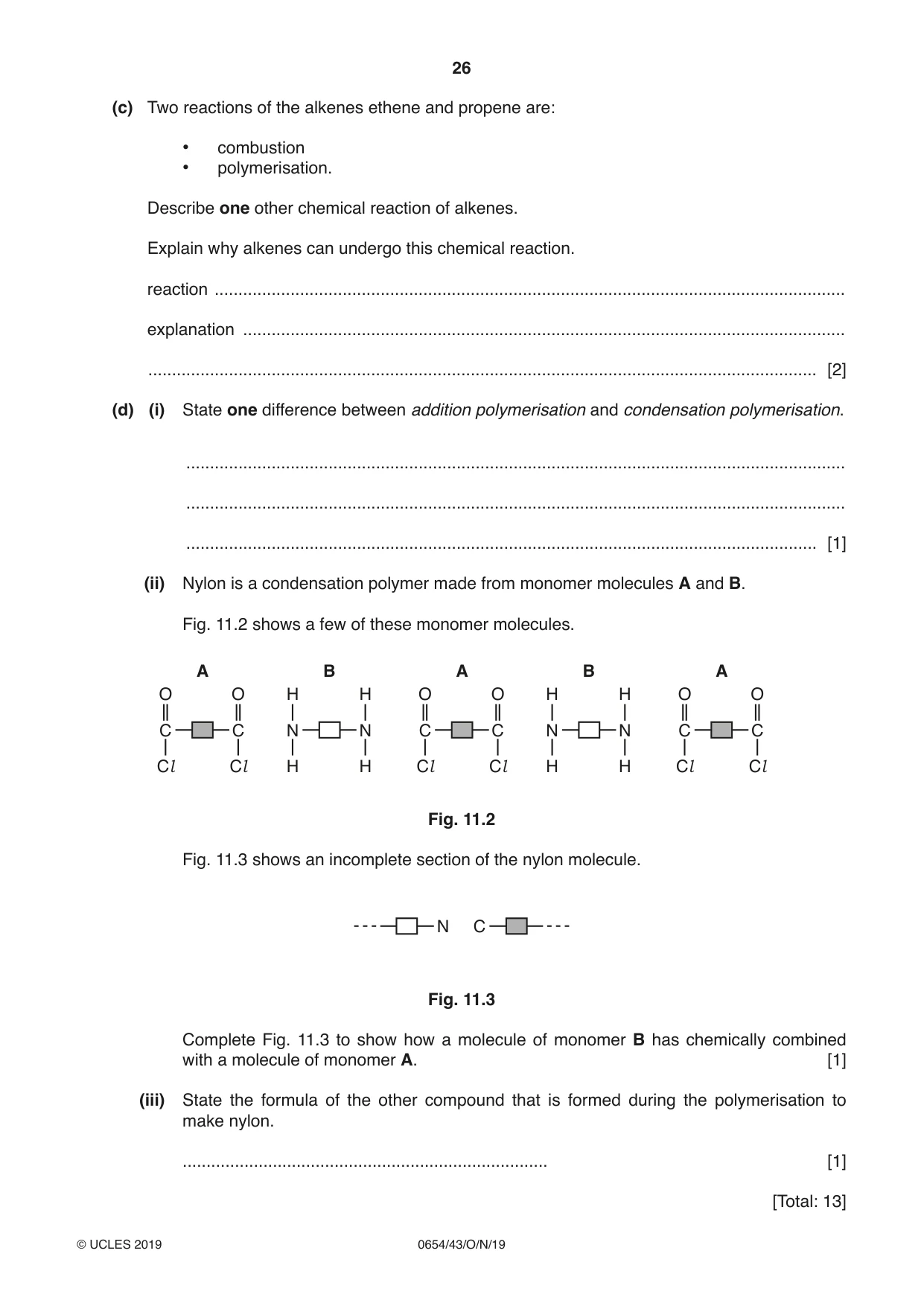
11 A homologous series is a family of compounds which have the same general formula and similar chemical properties. Alkanes and alkenes are examples of homologous series. Ethane, C2H6, and propane, C3H8, are alkanes. Ethene, C2H4, and propene, C3H6, are alkenes. (a) (i) The general formula for alkanes is CnH2n+2. Suggest the general formula for alkenes. ............................................................................. [1] (ii) Complete Fig. 11.1 to show the structures of an ethane molecule and an ethene molecule. C C C C ethane ethene Fig. 11.1 [2] (b) (i) The equation for the complete combustion of propane is shown. C3H8 + 5O2 3CO2 + 4H2O Complete steps 1 to 3 to calculate the volume of carbon dioxide when 1000 dm3 of propane is burned. All gas volumes are measured at room temperature and pressure. The volume of 1 mole of any gas is 24 dm3 at room temperature and pressure. step 1 Calculate the number of moles in 1000 dm3 of propane. number of moles = ............................................................... step 2 Use your answer to step 1 and the balanced equation to calculate the number of moles of carbon dioxide produced by burning 1000 dm3 of propane. number of moles = ............................................................... step 3 Calculate the volume of carbon dioxide produced by burning 1000 dm3 of propane. volume = ........................................................ dm3 [3] (ii) Describe the effect of increased emission of carbon dioxide on the environment. ........................................................................................................................................... ........................................................................................................................................... ..................................................................................................................................... [2] (c) Two reactions of the alkenes ethene and propene are: • combustion • polymerisation. Describe one other chemical reaction of alkenes. Explain why alkenes can undergo this chemical reaction. reaction ..................................................................................................................................... explanation ............................................................................................................................... ............................................................................................................................................. [2] (d) (i) State one difference between addition polymerisation and condensation polymerisation. ........................................................................................................................................... ........................................................................................................................................... ..................................................................................................................................... [1] (ii) Nylon is a condensation polymer made from monomer molecules A and B. Fig. 11.2 shows a few of these monomer molecules. A B A B A O O H H O O H H O O C C N N C C N N C C Cl Cl H H Cl Cl H H Cl Cl Fig. 11.2 Fig. 11.3 shows an incomplete section of the nylon molecule. N C Fig. 11.3 Complete Fig. 11.3 to show how a molecule of monomer B has chemically combined with a molecule of monomer A. [1] (iii) State the formula of the other compound that is formed during the polymerisation to make nylon. ............................................................................. [1] [Total: 13]
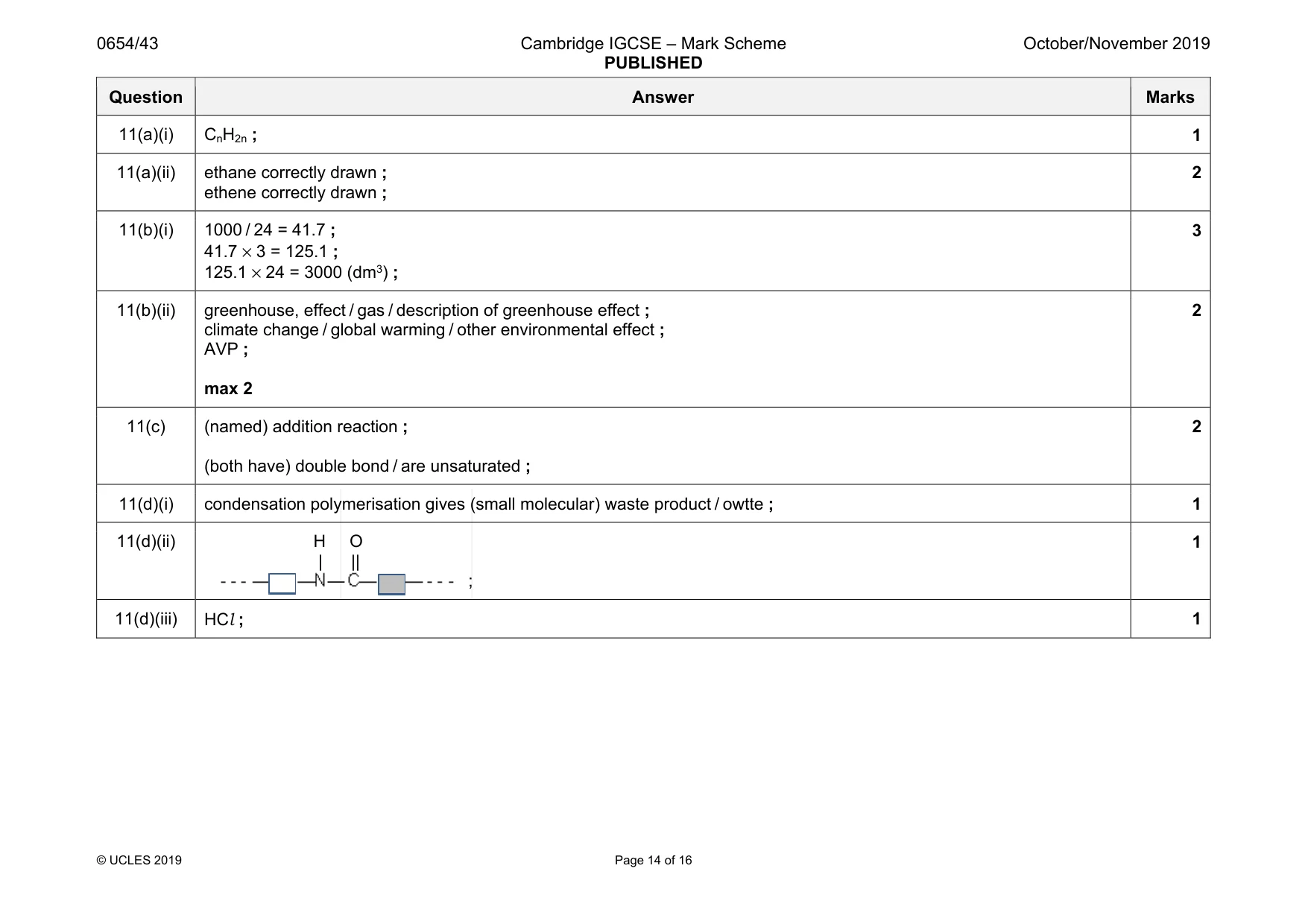
Mark scheme: 11(a)(i) CnH2n ; 1 11(a)(ii) ethane correctly drawn ; ethene correctly drawn ; 2 11(b)(i) 1000 / 24 = 41.7 ; 41.7 × 3 = 125.1 ; 125.1 × 24 = 3000 (dm3) ; 3 11(b)(ii) greenhouse, effect / gas / description of greenhouse effect ; climate change / global warming / other environmental effect ; AVP ; max 2 2 11(c) (named) addition reaction ; (both have) double bond / are unsaturated ; 2 11(d)(i) condensation polymerisation gives (small molecular) waste product / owtte ; 1 11(d)(ii) H O | || — ; 1 11(d)(iii) HCl ; 1
Q12 · A gardener cuts grass with an electric mower
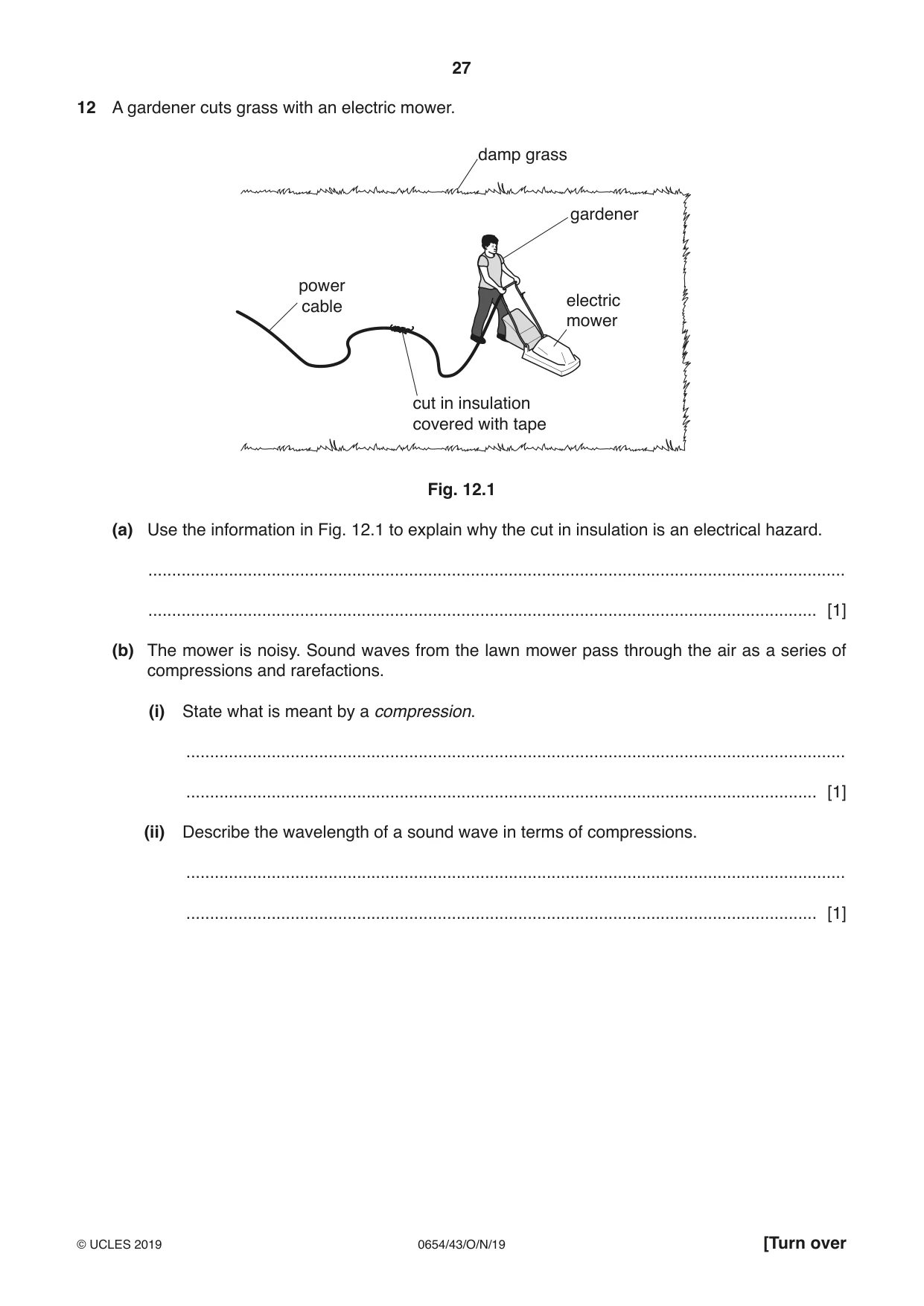
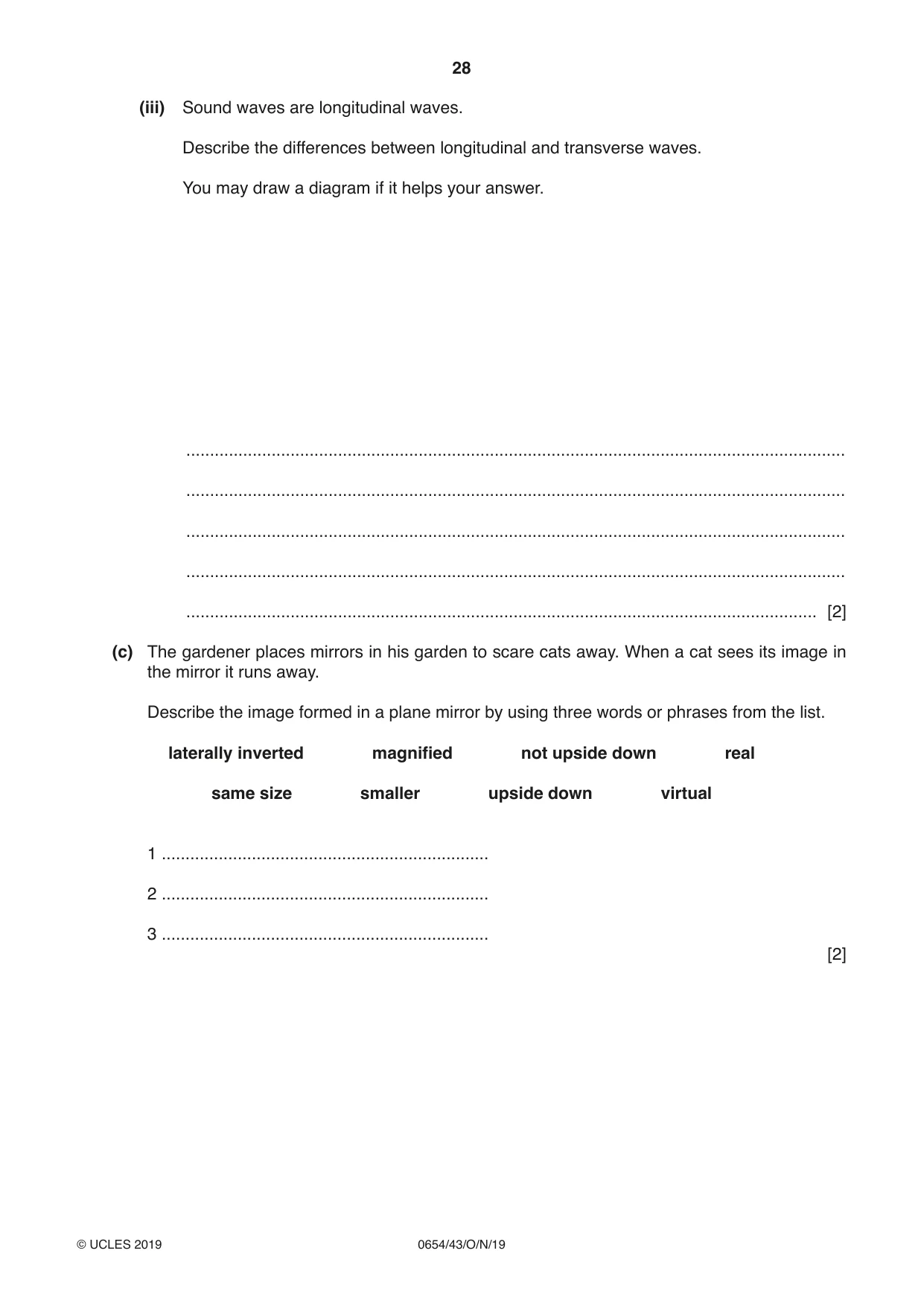
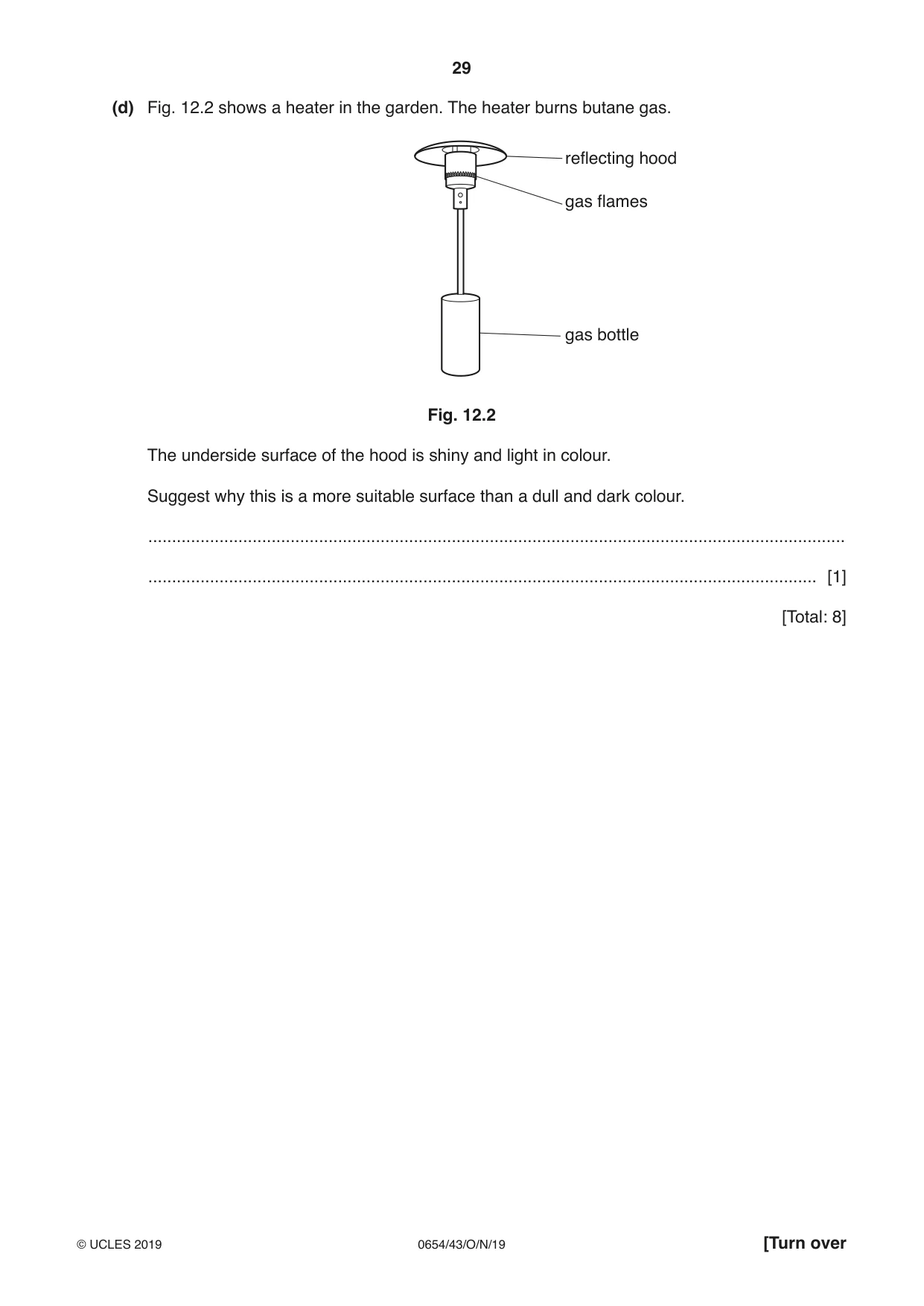
12 A gardener cuts grass with an electric mower. damp grass gardener power electric cable mower cut in insulation covered with tape Fig. 12.1 (a) Use the information in Fig. 12.1 to explain why the cut in insulation is an electrical hazard. ................................................................................................................................................... ............................................................................................................................................. [1] (b) The mower is noisy. Sound waves from the lawn mower pass through the air as a series of compressions and rarefactions. (i) State what is meant by a compression. ........................................................................................................................................... ..................................................................................................................................... [1] (ii) Describe the wavelength of a sound wave in terms of compressions. ........................................................................................................................................... ..................................................................................................................................... [1] (iii) Sound waves are longitudinal waves. Describe the differences between longitudinal and transverse waves. You may draw a diagram if it helps your answer. ........................................................................................................................................... ........................................................................................................................................... ........................................................................................................................................... ........................................................................................................................................... ..................................................................................................................................... [2] (c) The gardener places mirrors in his garden to scare cats away. When a cat sees its image in the mirror it runs away. Describe the image formed in a plane mirror by using three words or phrases from the list. laterally inverted magnified not upside down real same size smaller upside down virtual 1 ..................................................................... 2 ..................................................................... 3 ..................................................................... [2] (d) Fig. 12.2 shows a heater in the garden. The heater burns butane gas. reflecting hood gas flames gas bottle Fig. 12.2 The underside surface of the hood is shiny and light in colour. Suggest why this is a more suitable surface than a dull and dark colour. ................................................................................................................................................... ............................................................................................................................................. [1] [Total: 8]
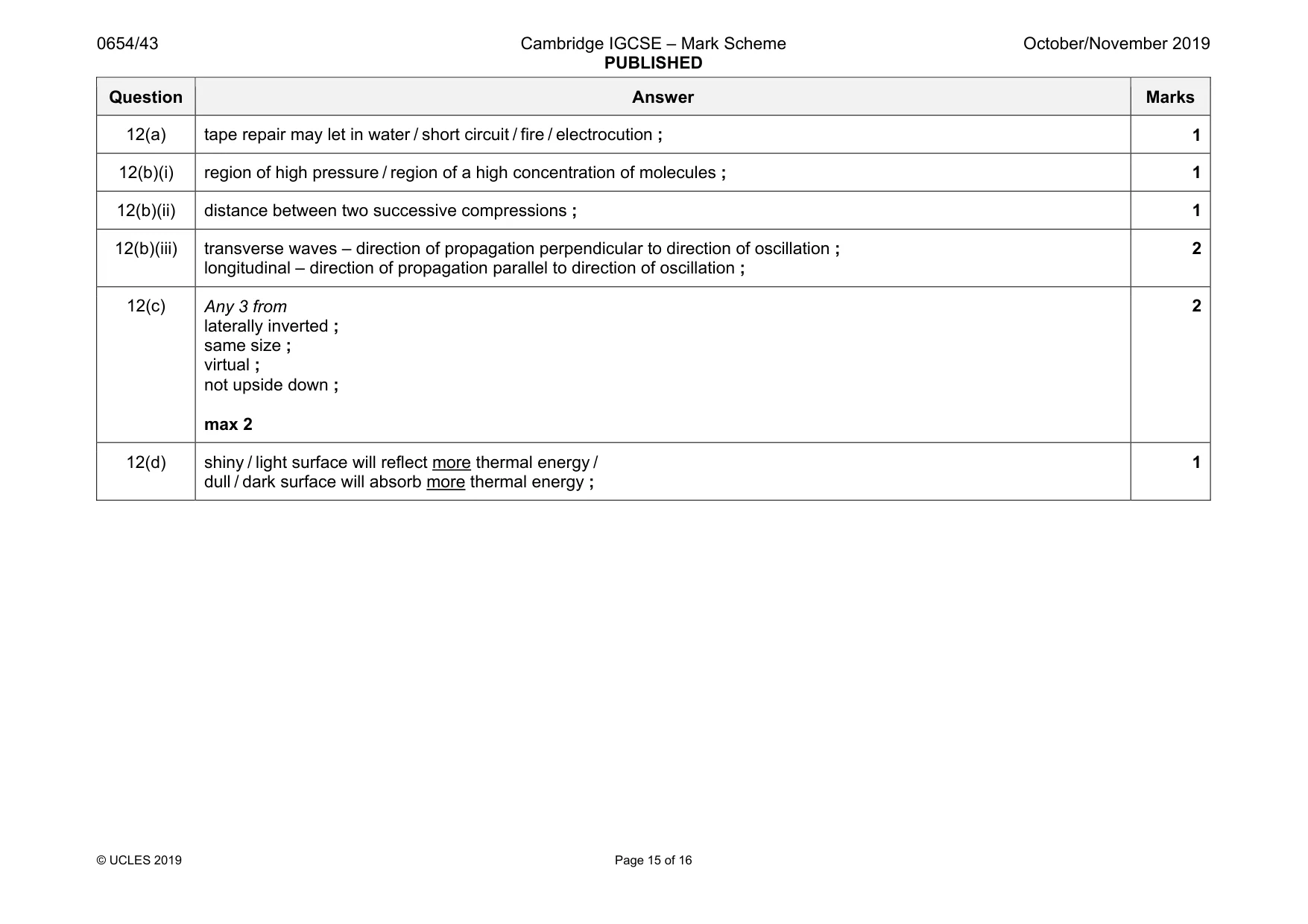
Mark scheme: 12(a) tape repair may let in water / short circuit / fire / electrocution ; 1 12(b)(i) region of high pressure / region of a high concentration of molecules ; 1 12(b)(ii) distance between two successive compressions ; 1 12(b)(iii) transverse waves – direction of propagation perpendicular to direction of oscillation ; longitudinal – direction of propagation parallel to direction of oscillation ; 2 12(c) Any 3 from laterally inverted ; same size ; virtual ; not upside down ; max 2 2 12(d) shiny / light surface will reflect more thermal energy / dull / dark surface will absorb more thermal energy ; 1
Q13 · The blood glucose concentration of a person is monitored for 180 minutes after eating a…
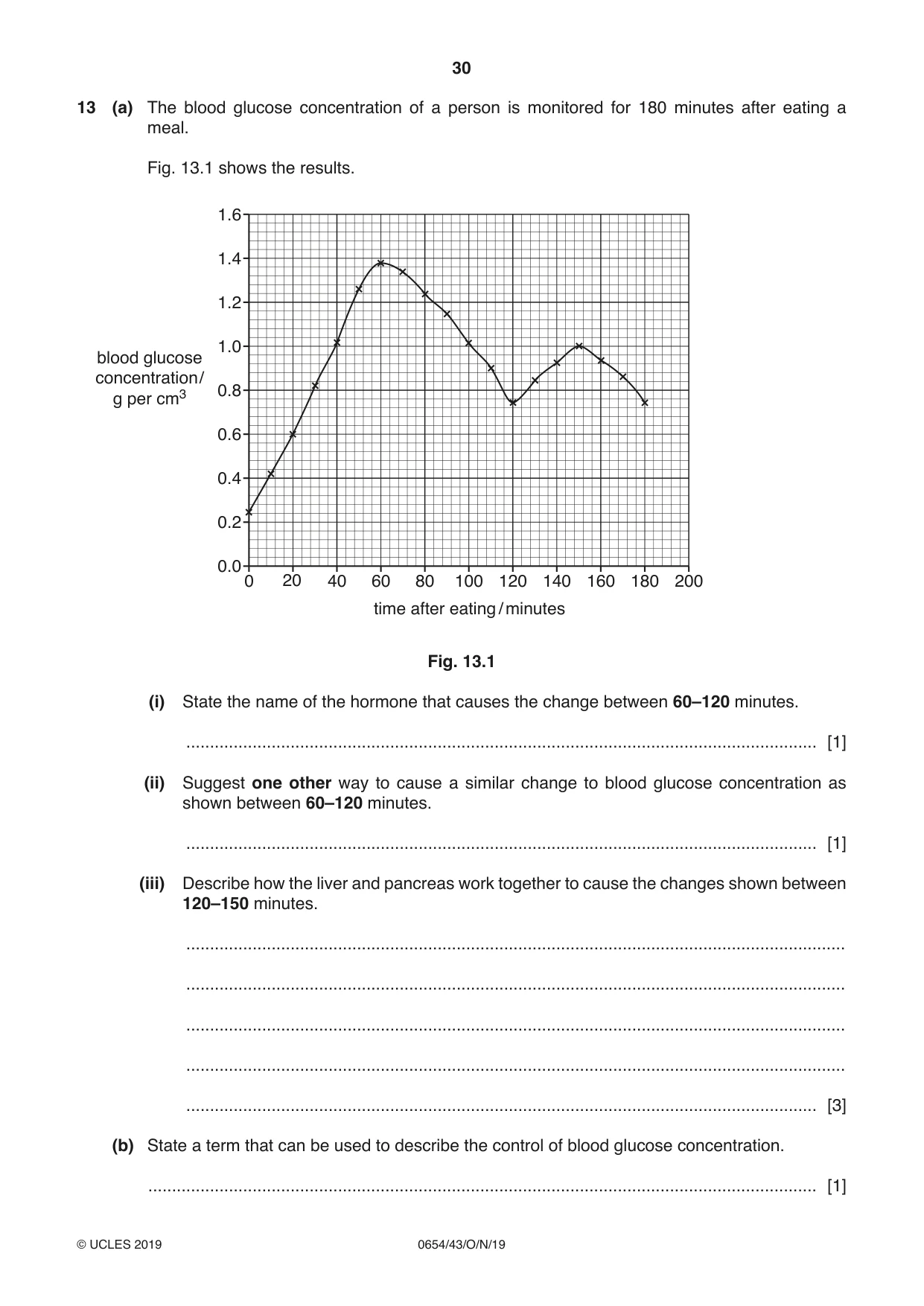
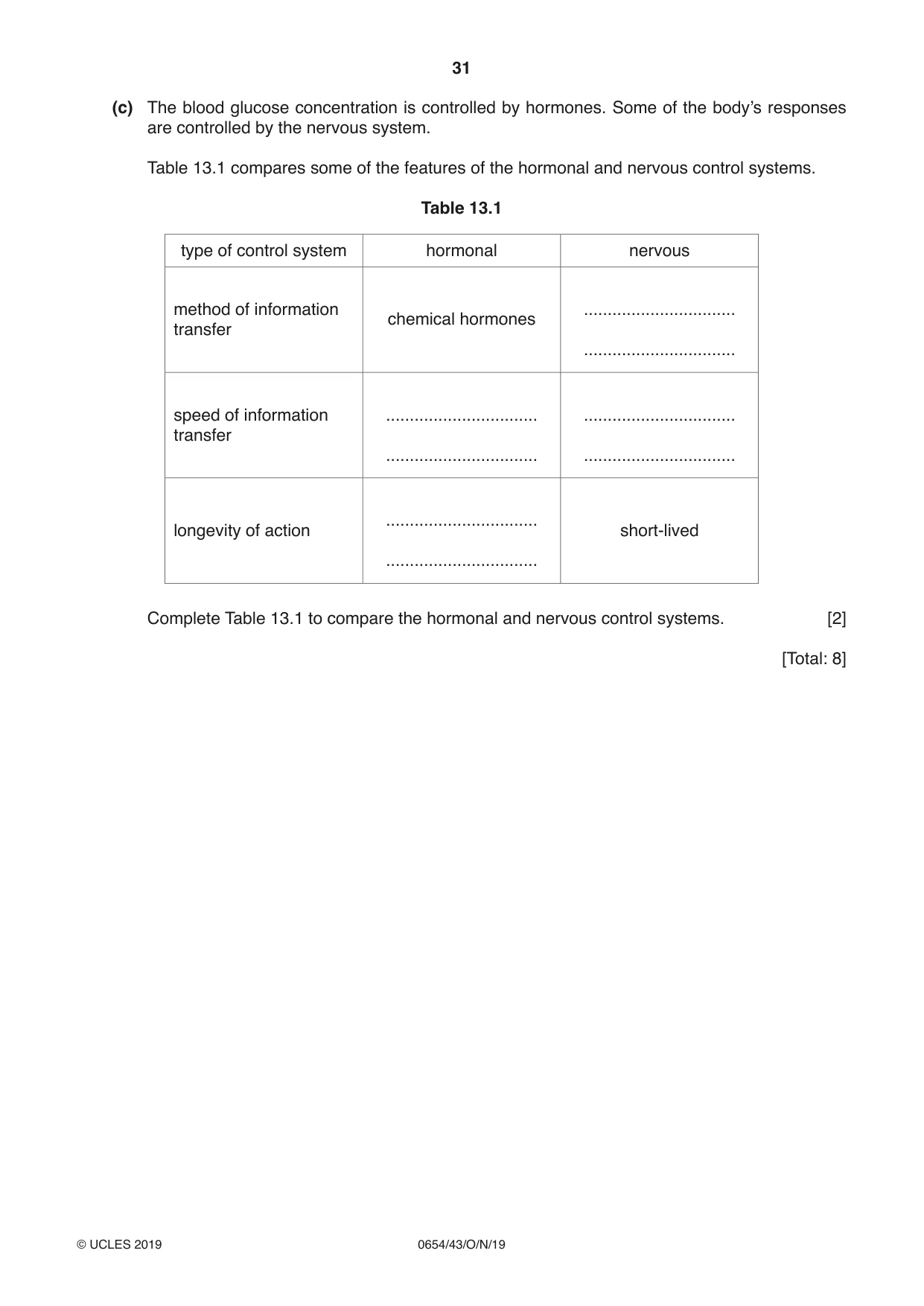
13 (a) The blood glucose concentration of a person is monitored for 180 minutes after eating a meal. Fig. 13.1 shows the results. 1.6 1.4 1.2 1.0 blood glucose concentration / 0.8 g per cm3 0.6 0.4 0.2 0.0 0 20 40 60 80 100 120 140 160 180 200 time after eating / minutes Fig. 13.1 (i) State the name of the hormone that causes the change between 60–120 minutes. ..................................................................................................................................... [1] (ii) Suggest one other way to cause a similar change to blood glucose concentration as shown between 60–120 minutes. ..................................................................................................................................... [1] (iii) Describe how the liver and pancreas work together to cause the changes shown between 120–150 minutes. ........................................................................................................................................... ........................................................................................................................................... ........................................................................................................................................... ........................................................................................................................................... ..................................................................................................................................... [3] (b) State a term that can be used to describe the control of blood glucose concentration. ............................................................................................................................................. [1] (c) The blood glucose concentration is controlled by hormones. Some of the body’s responses are controlled by the nervous system. Table 13.1 compares some of the features of the hormonal and nervous control systems. Table 13.1 type of control system hormonal nervous method of information ................................ chemical hormones transfer ................................ speed of information ................................ ................................ transfer ................................ ................................ ................................ longevity of action short-lived ................................ Complete Table 13.1 to compare the hormonal and nervous control systems. [2] [Total: 8]
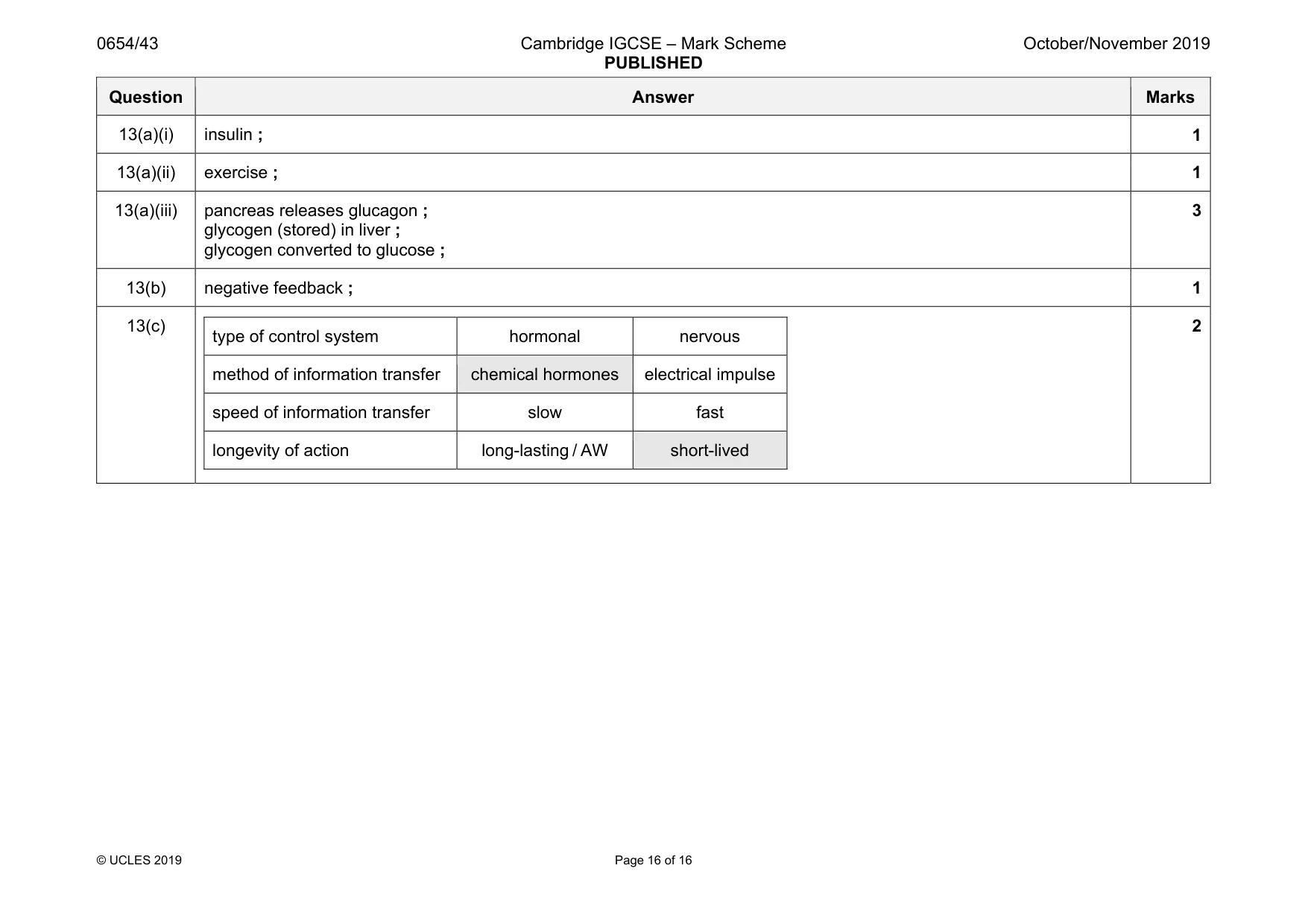
Mark scheme: 13(a)(i) insulin ; 1 13(a)(ii) exercise ; 1 13(a)(iii) pancreas releases glucagon ; glycogen (stored) in liver ; glycogen converted to glucose ; 3 13(b) negative feedback ; 1 13(c) type of control system hormonal nervous method of information transfer chemical hormones electrical impulse speed of information transfer slow fast longevity of action long-lasting / AW short-lived 2
What was in this paper
The subtopics covered by these 13 questions, and how many questions each got. Open one in a new tab to see every Cambridge question on it.
What you needed in this session
Cambridge’s own grade thresholds for 2019 Oct/Nov, Paper 4 · Variant 3. A higher threshold means an easier paper — the bar moves with how the cohort did.