Questions as text
Q1 · A wooden wheel can be strengthened by putting a tight circle of iron around it 0653/11 Oct/Nov 2007
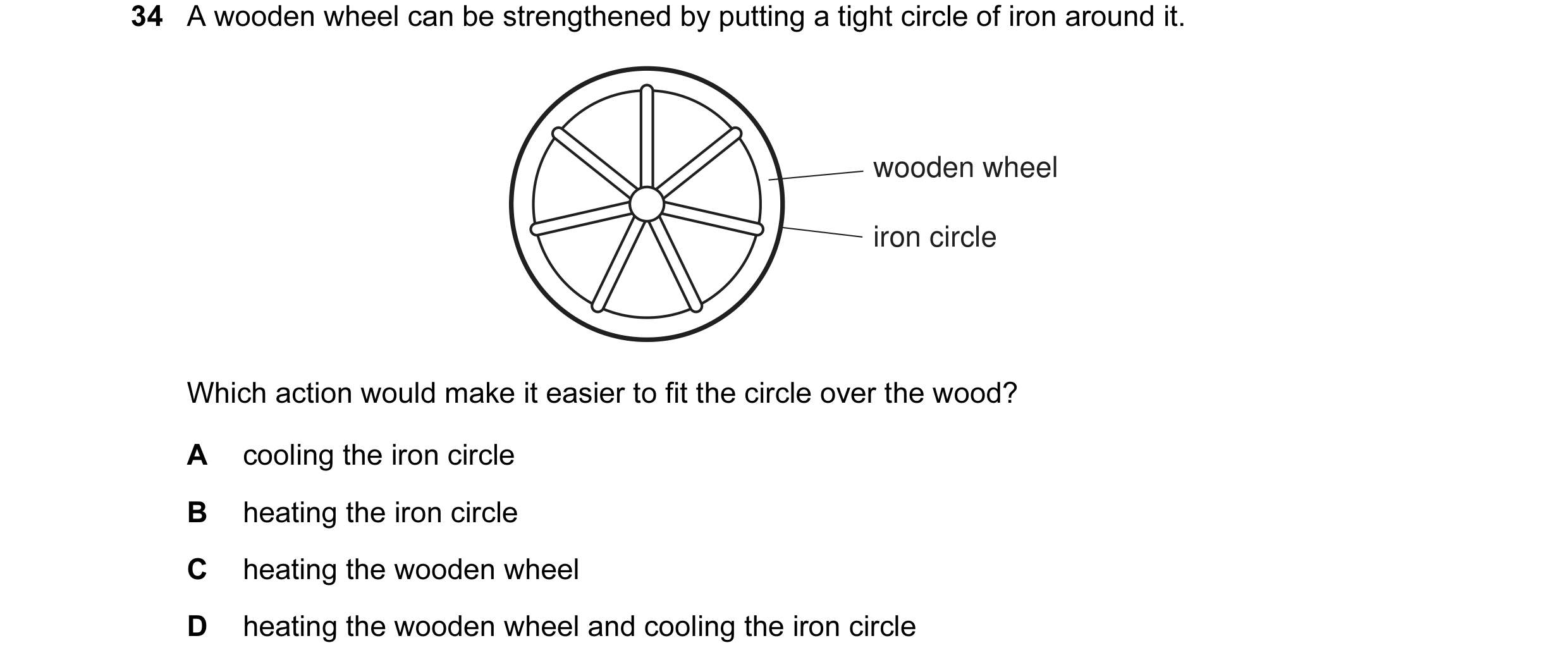
34 A wooden wheel can be strengthened by putting a tight circle of iron around it. wooden wheel iron circle Which action would make it easier to fit the circle over the wood? A cooling the iron circle B heating the iron circle C heating the wooden wheel D heating the wooden wheel and cooling the iron circle
1 marks
Answer: B
This question in 0653/11 Oct/Nov 2007
Q2 · Some liquid is heated in a flask 0653/11 May/June 2008
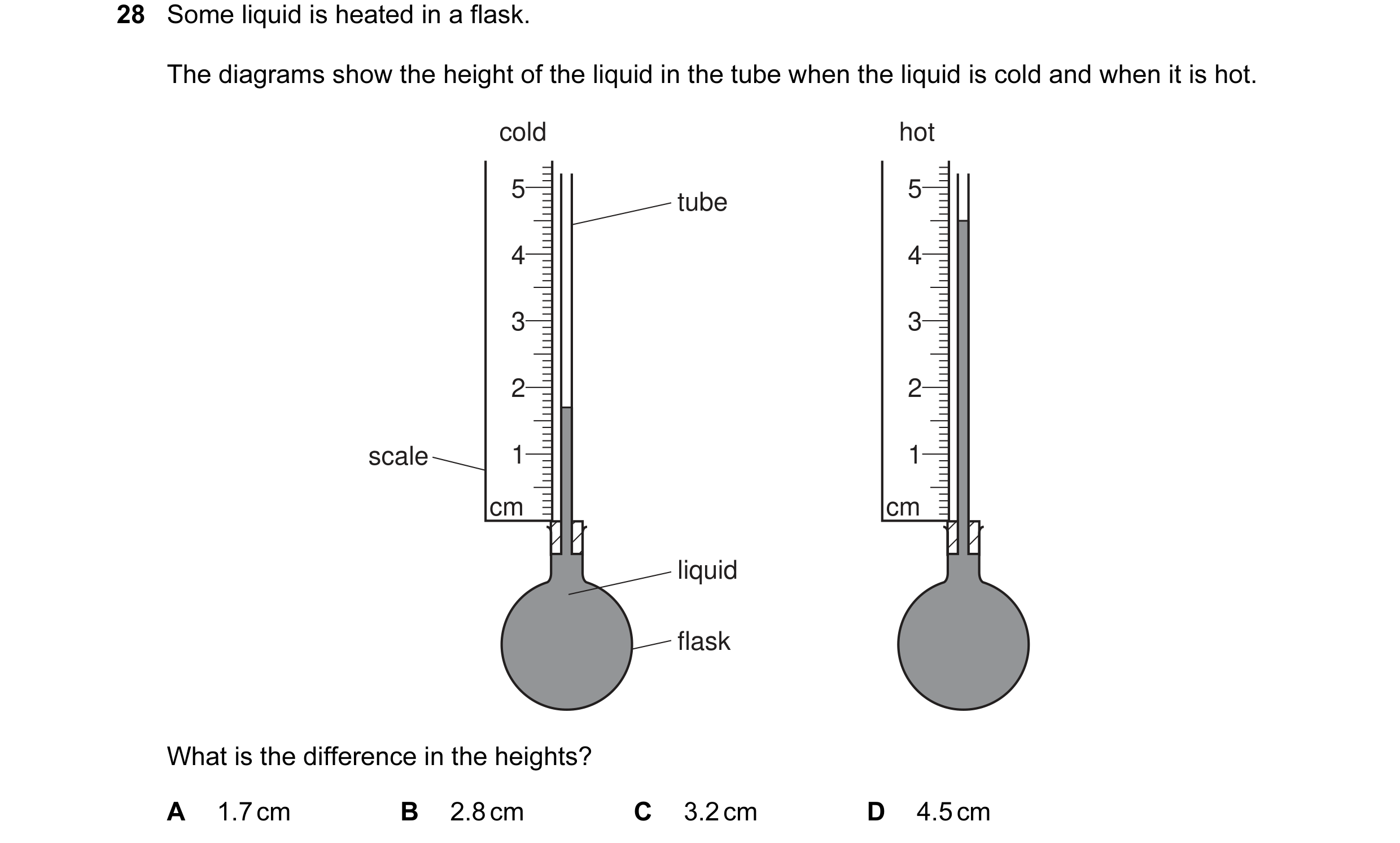
28 Some liquid is heated in a flask. The diagrams show the height of the liquid in the tube when the liquid is cold and when it is hot. cold hot 5 5 tube 4 4 3 3 2 2 scale 1 1 cm cm liquid flask What is the difference in the heights? A 1.7 cm B 2.8 cm C 3.2 cm D 4.5 cm
1 marks
Answer: B
This question in 0653/11 May/June 2008
Q3 · An engineer wants to fix a steel washer onto a steel rod 0653/11 Oct/Nov 2008
34 An engineer wants to fix a steel washer onto a steel rod. The rod is just too big to fit into the hole of the washer. steel steel rod washer How can the engineer fit the washer onto the rod? A Cool the washer and put it over the rod. B Cool the washer and rod to the same temperature and push them together. C Heat the rod and then place it in the hole. D Heat the washer and then place it over the rod.
1 marks
Answer: D
This question in 0653/11 Oct/Nov 2008
Q4 · Warm water in a bowl evaporates 0653/12 May/June 2012
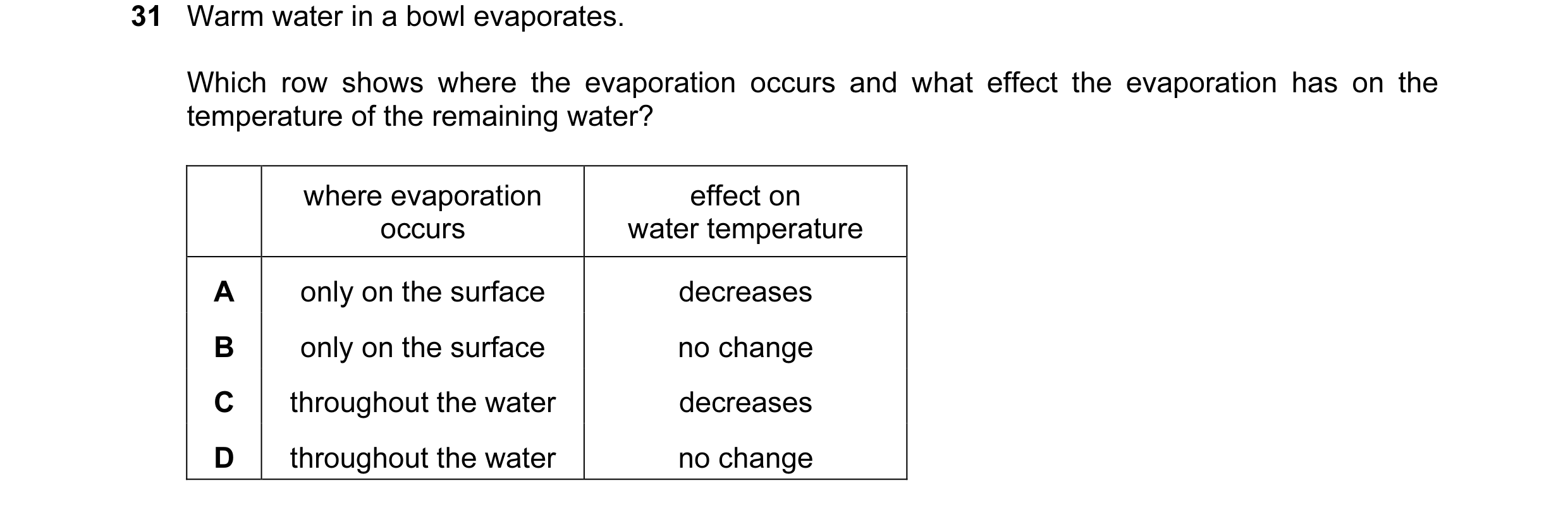
31 Warm water in a bowl evaporates. Which row shows where the evaporation occurs and what effect the evaporation has on the temperature of the remaining water? where evaporation effect on occurs water temperature A only on the surface decreases B only on the surface no change C throughout the water decreases D throughout the water no change
1 marks
Answer: A
This question in 0653/12 May/June 2012
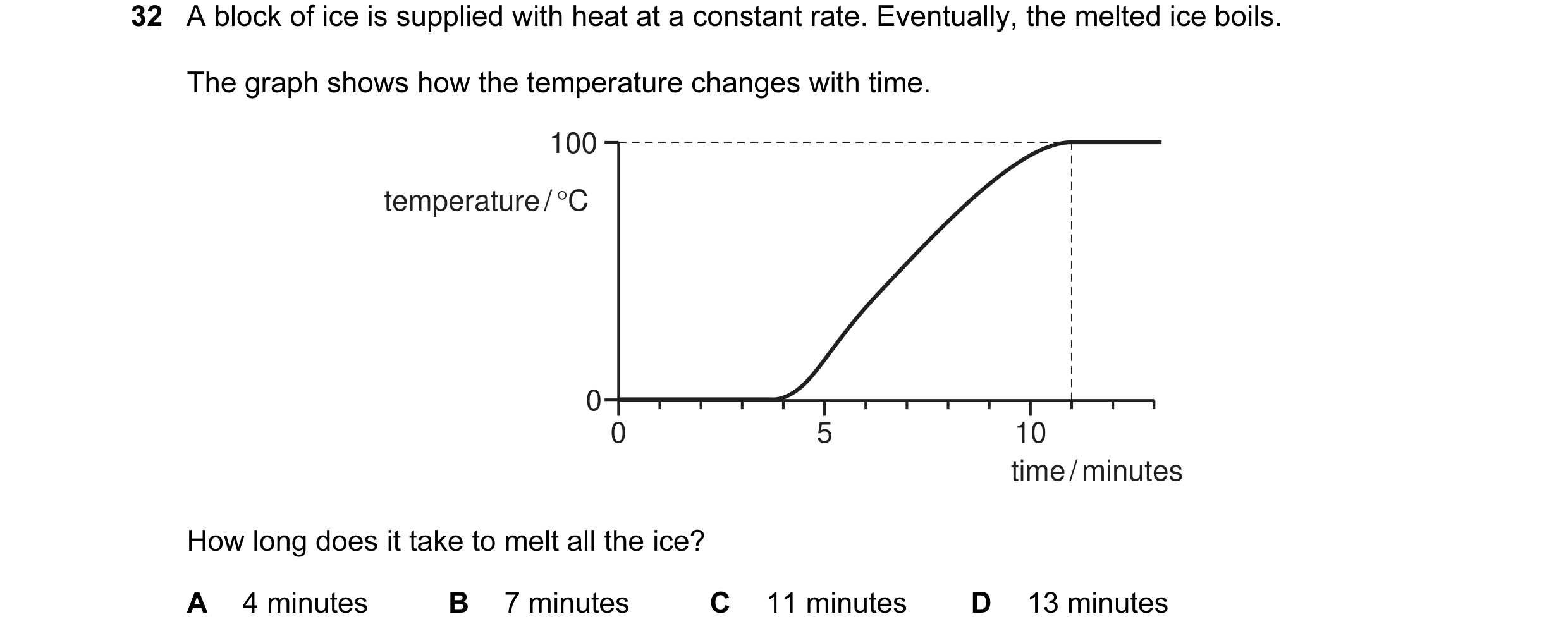
Q5 · A block of ice is supplied with heat at a constant rate 0653/12 May/June 2013
32 A block of ice is supplied with heat at a constant rate. Eventually, the melted ice boils. The graph shows how the temperature changes with time. 100 temperature / °C 0 0 5 10 time / minutes How long does it take to melt all the ice? A 4 minutes B 7 minutes C 11 minutes D 13 minutes
1 marks
Answer: A
This question in 0653/12 May/June 2013
Q6 · A block of ice is supplied with heat at a constant rate 0653/13 May/June 2013
33 A block of ice is supplied with heat at a constant rate. Eventually, the melted ice boils. The graph shows how the temperature changes with time. 100 temperature / °C 0 0 5 10 time / minutes How long does it take to melt all the ice? A 4 minutes B 7 minutes C 11 minutes D 13 minutes
1 marks
Answer: A
This question in 0653/13 May/June 2013
Q7 · Benzene and glycerine are two substances 0653/12 Oct/Nov 2013
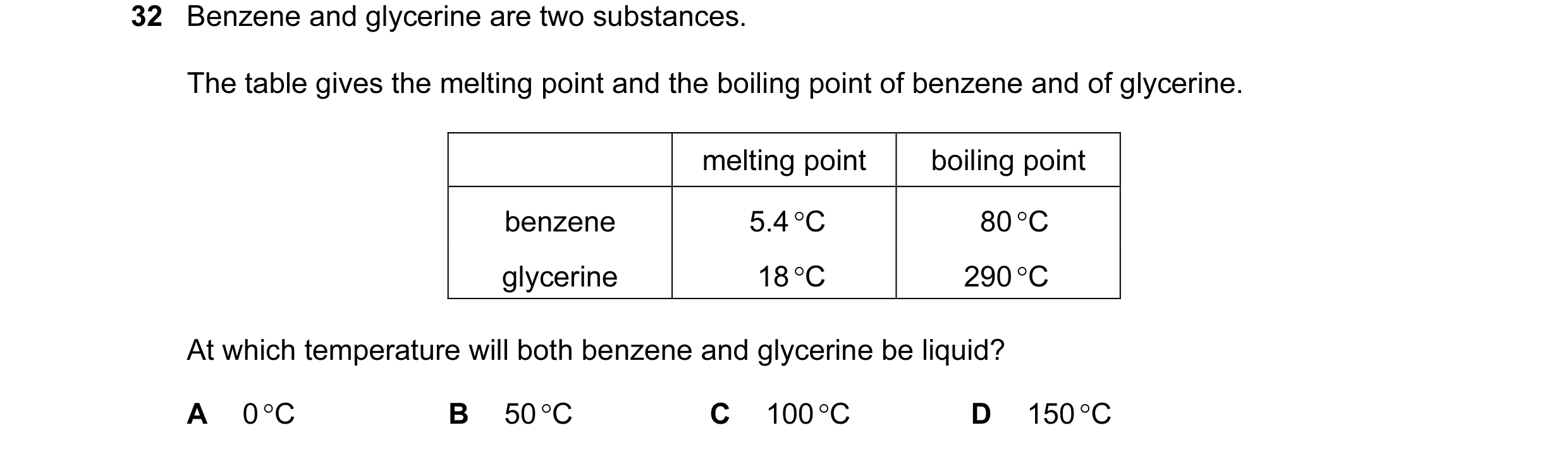
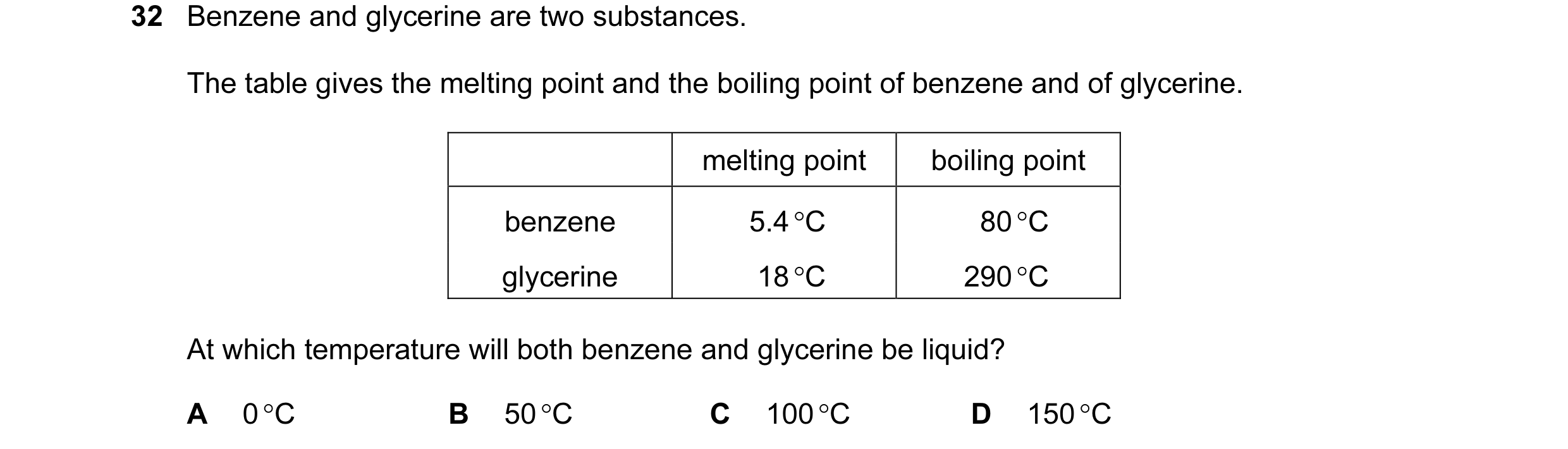
32 Benzene and glycerine are two substances. The table gives the melting point and the boiling point of benzene and of glycerine. melting point boiling point benzene 5.4 °C 80 °C glycerine 18 °C 290 °C At which temperature will both benzene and glycerine be liquid? A 0 °C B 50 °C C 100 °C D 150 °C
1 marks
Answer: B
This question in 0653/12 Oct/Nov 2013
Q8 · A drop of liquid falls on a student’s skin and evaporates quickly 0653/13 Oct/Nov 2013
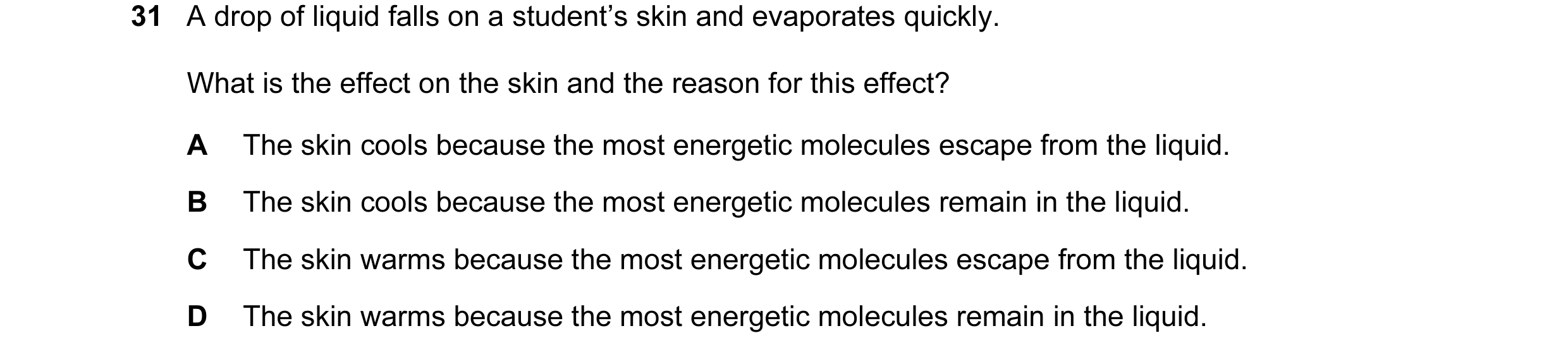
31 A drop of liquid falls on a student’s skin and evaporates quickly. What is the effect on the skin and the reason for this effect? A The skin cools because the most energetic molecules escape from the liquid. B The skin cools because the most energetic molecules remain in the liquid. C The skin warms because the most energetic molecules escape from the liquid. D The skin warms because the most energetic molecules remain in the liquid.
1 marks
Answer: A
This question in 0653/13 Oct/Nov 2013
Q9 · Benzene and glycerine are two substances 0653/13 Oct/Nov 2013
32 Benzene and glycerine are two substances. The table gives the melting point and the boiling point of benzene and of glycerine. melting point boiling point benzene 5.4 °C 80 °C glycerine 18 °C 290 °C At which temperature will both benzene and glycerine be liquid? A 0 °C B 50 °C C 100 °C D 150 °C
1 marks
Answer: B
This question in 0653/13 Oct/Nov 2013
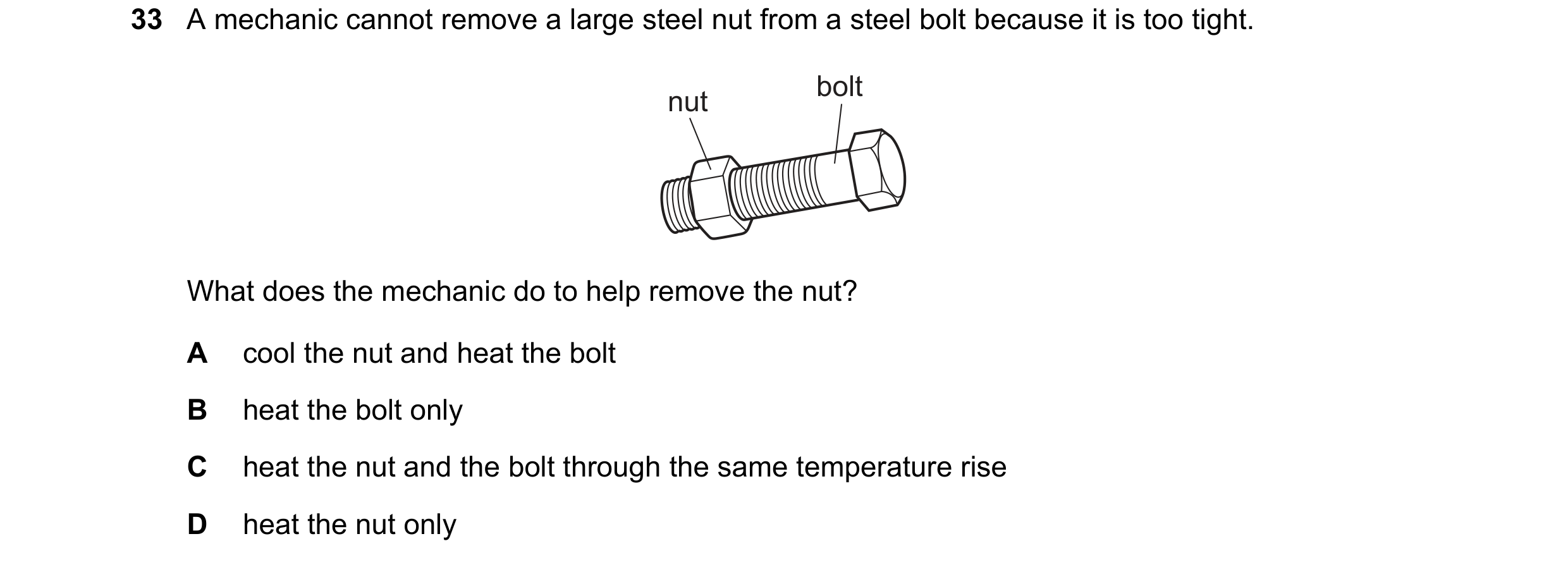
Q10 · A mechanic cannot remove a large steel nut from a steel bolt because it is too tight 0653/12 May/June 2014
32 A mechanic cannot remove a large steel nut from a steel bolt because it is too tight. bolt nut What could the mechanic do to help her remove the nut? A cool the nut and heat the bolt B heat the bolt only C heat the nut and the bolt through the same temperature rise D heat the nut only
1 marks
Answer: D
This question in 0653/12 May/June 2014
Q11 · A telephone engineer connects a wire between two poles on a very hot day in a desert 0653/12 Oct/Nov 2014
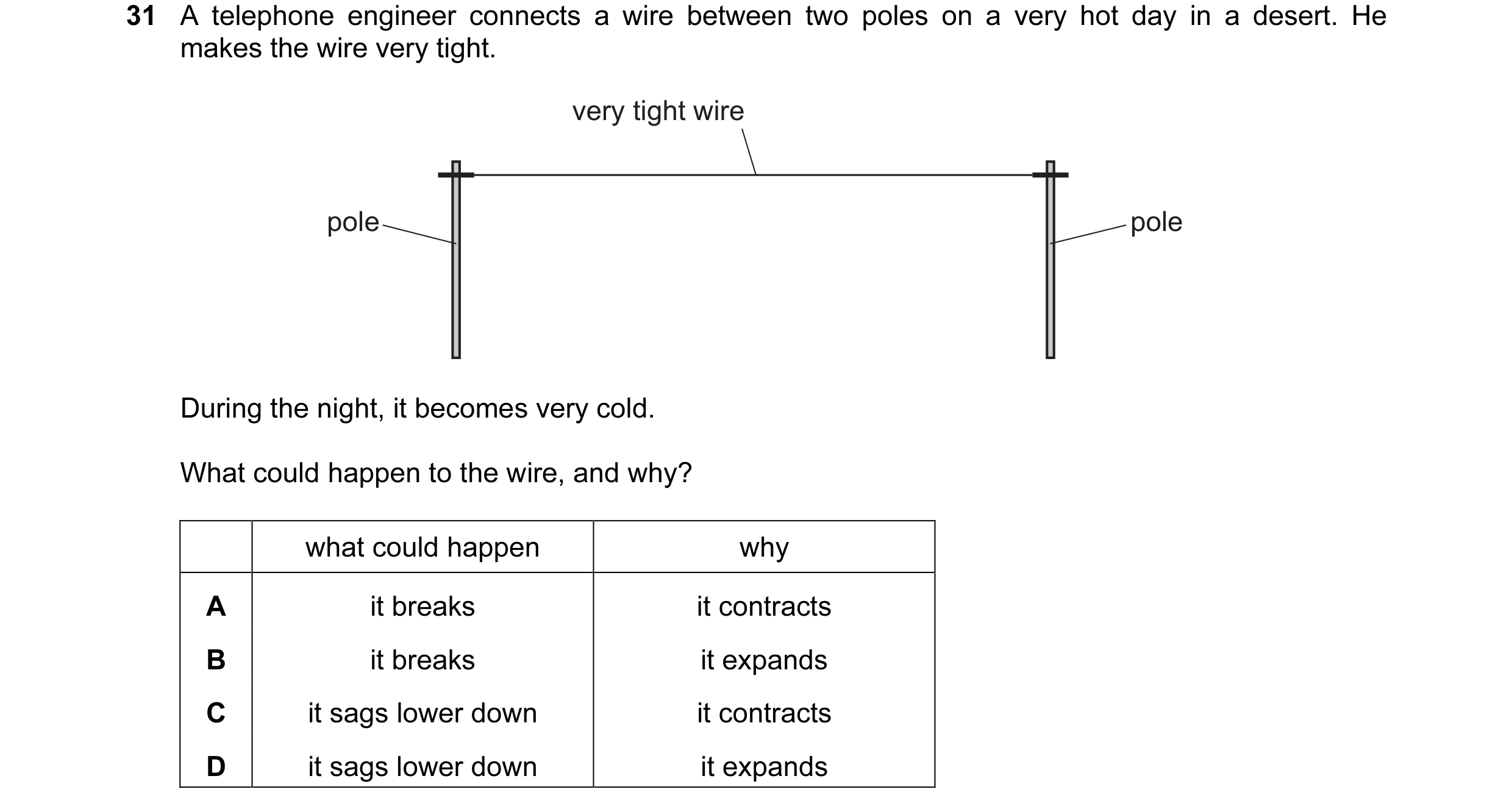
31 A telephone engineer connects a wire between two poles on a very hot day in a desert. He makes the wire very tight. very tight wire pole pole During the night, it becomes very cold. What could happen to the wire, and why? what could happen why A it breaks it contracts B it breaks it expands C it sags lower down it contracts D it sags lower down it expands
1 marks
Answer: A
This question in 0653/12 Oct/Nov 2014
Q12 · A badly designed railway line changes shape when the temperature of the air around it… 0653/13 Oct/Nov 2014
32 A badly designed railway line changes shape when the temperature of the air around it changes by a large amount. railway line before the temperature change railway line after the temperature change How has the temperature changed, and what change to the railway line has this caused? temperature change to change railway line A decreased contracted B decreased expanded C increased contracted D increased expanded
1 marks
Answer: D
This question in 0653/13 Oct/Nov 2014
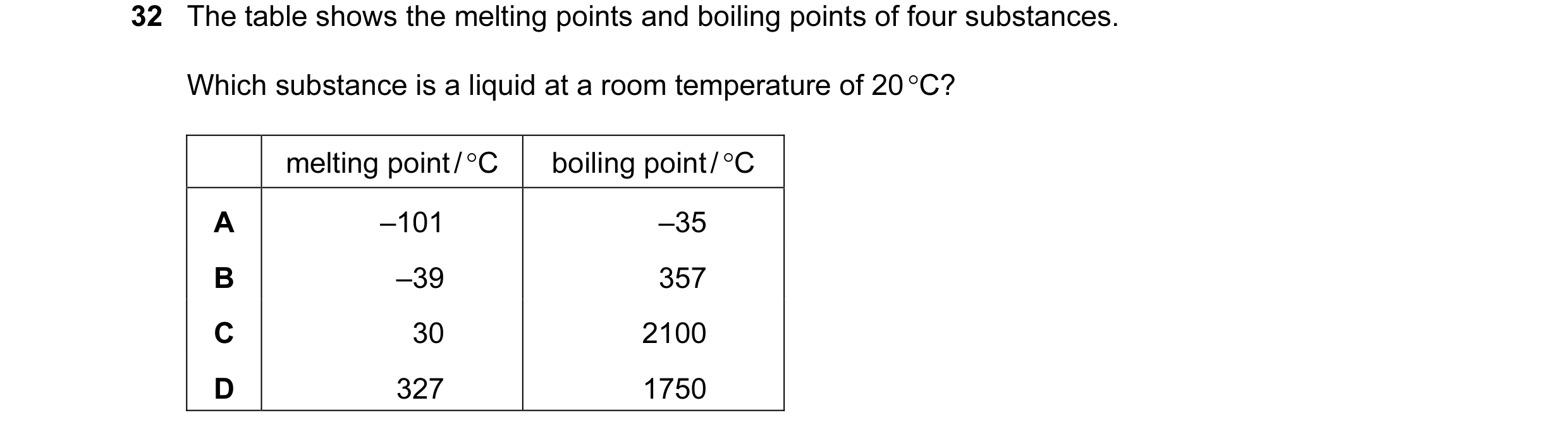
Q13 · The table shows the melting points and boiling points of four substances 0653/11 May/June 2015
32 The table shows the melting points and boiling points of four substances. Which substance is a liquid at a room temperature of 20 °C? melting point / °C boiling point / °C A –101 –35 B –39 357 C 30 2100 D 327 1750
1 marks
Answer: B
This question in 0653/11 May/June 2015
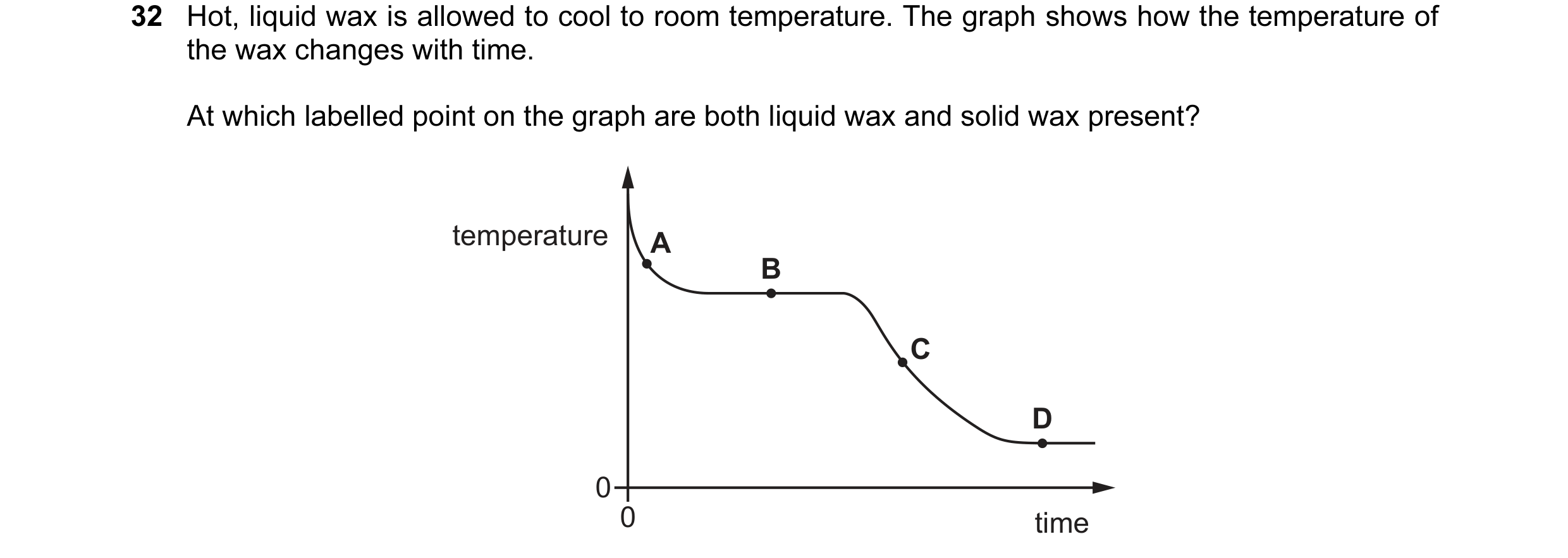
Q14 · Hot, liquid wax is allowed to cool to room temperature 0653/12 May/June 2015
32 Hot, liquid wax is allowed to cool to room temperature. The graph shows how the temperature of the wax changes with time. At which labelled point on the graph are both liquid wax and solid wax present? temperature A B C D 0 0 time
1 marks
Answer: B
This question in 0653/12 May/June 2015
Q15 · A container of milk is wrapped in a wet cloth 0653/13 May/June 2015
31 A container of milk is wrapped in a wet cloth. Air blows over the cloth. The temperature of the milk changes as the water in the cloth evaporates. Which statement is correct? A The temperature of the milk falls because the less energetic water molecules escape from the cloth. B The temperature of the milk falls because the more energetic water molecules escape from the cloth. C The temperature of the milk rises because the less energetic water molecules escape from the cloth. D The temperature of the milk rises because the more energetic water molecules escape from the cloth.
1 marks
Answer: B
This question in 0653/13 May/June 2015
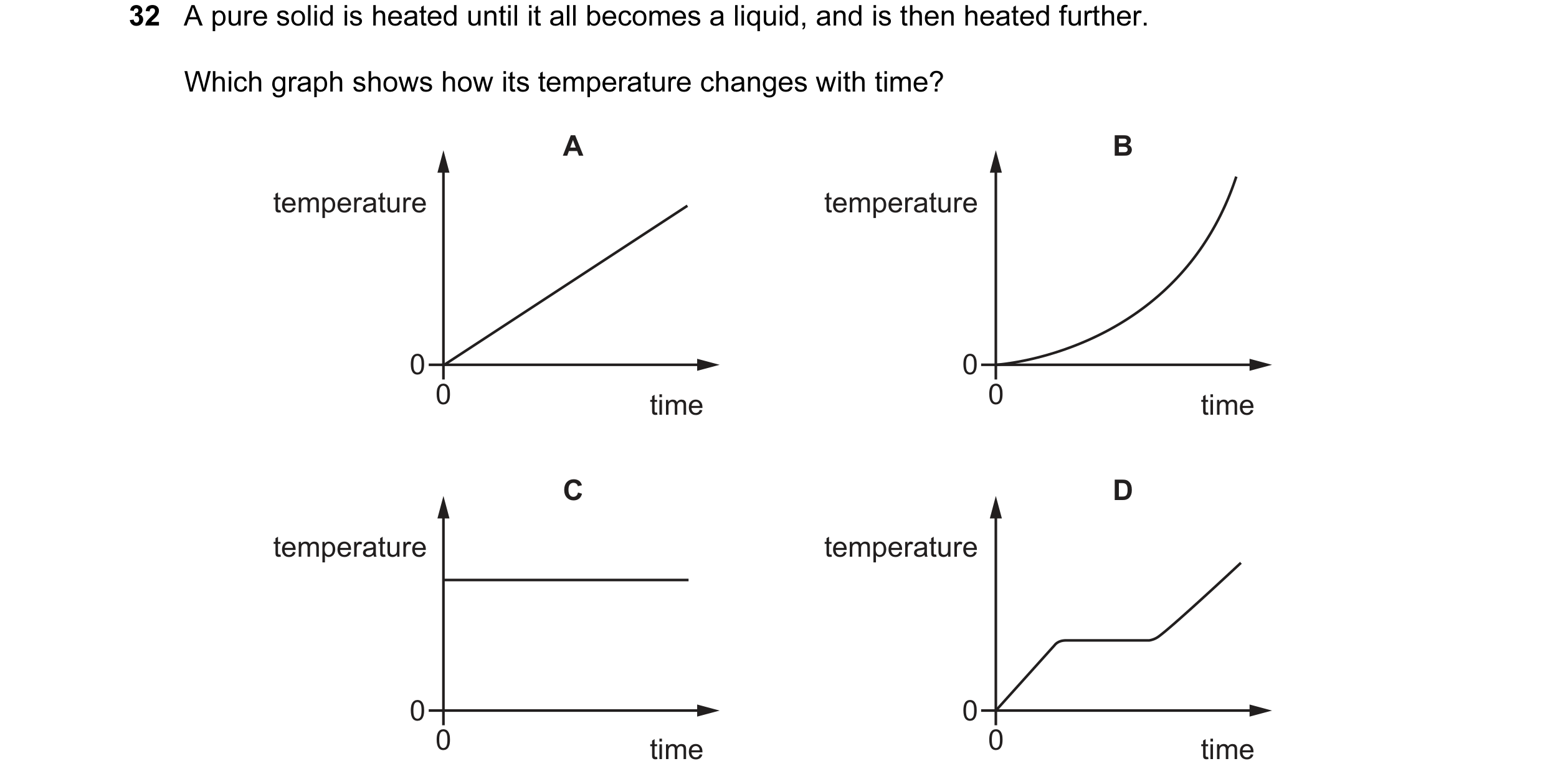
Q16 · A pure solid is heated until it all becomes a liquid, and is then heated further 0653/13 May/June 2015
32 A pure solid is heated until it all becomes a liquid, and is then heated further. Which graph shows how its temperature changes with time? A B temperature temperature 0 0 0 time 0 time C D temperature temperature 0 0 0 time 0 time
1 marks
Answer: D
This question in 0653/13 May/June 2015
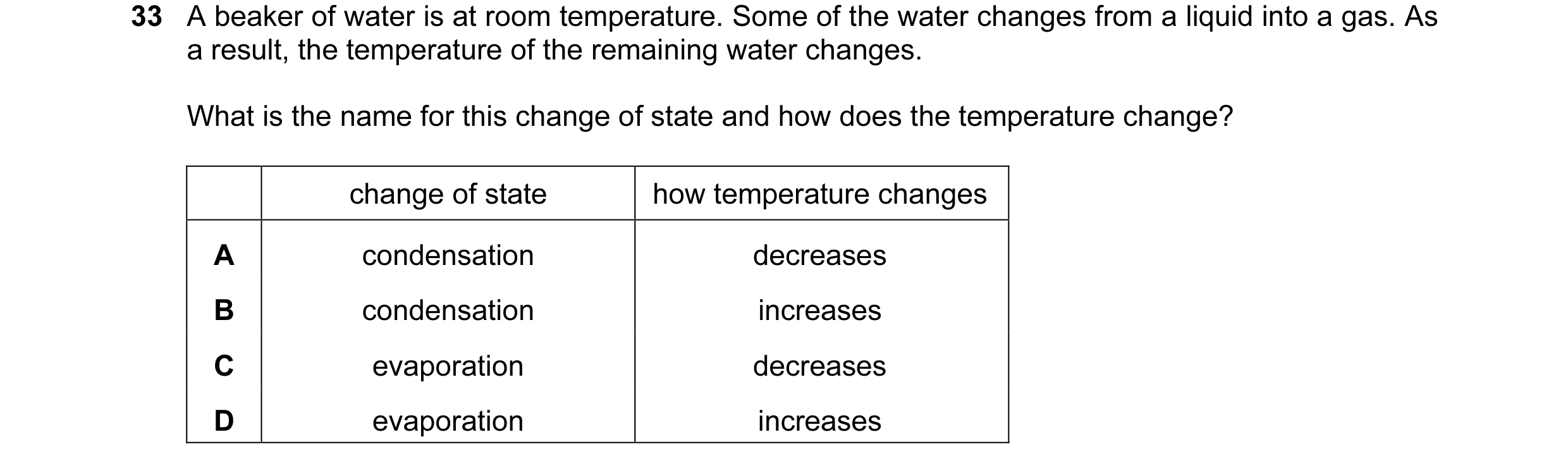
Q17 · A beaker of water is at room temperature 0653/11 Oct/Nov 2015
33 A beaker of water is at room temperature. Some of the water changes from a liquid into a gas. As a result, the temperature of the remaining water changes. What is the name for this change of state and how does the temperature change? change of state how temperature changes A condensation decreases B condensation increases C evaporation decreases D evaporation increases
1 marks
Answer: C
This question in 0653/11 Oct/Nov 2015
Q18 · Concrete roads are laid in sections and the gaps between sections are filled with soft tar 0653/11 Oct/Nov 2015
34 Concrete roads are laid in sections and the gaps between sections are filled with soft tar. concrete tar Why is this done? A to allow for expansion and contraction of the concrete B to allow the tar to radiate heat from the road C to increase the density of the concrete used D to reduce the mass of concrete used
1 marks
Answer: A
This question in 0653/11 Oct/Nov 2015
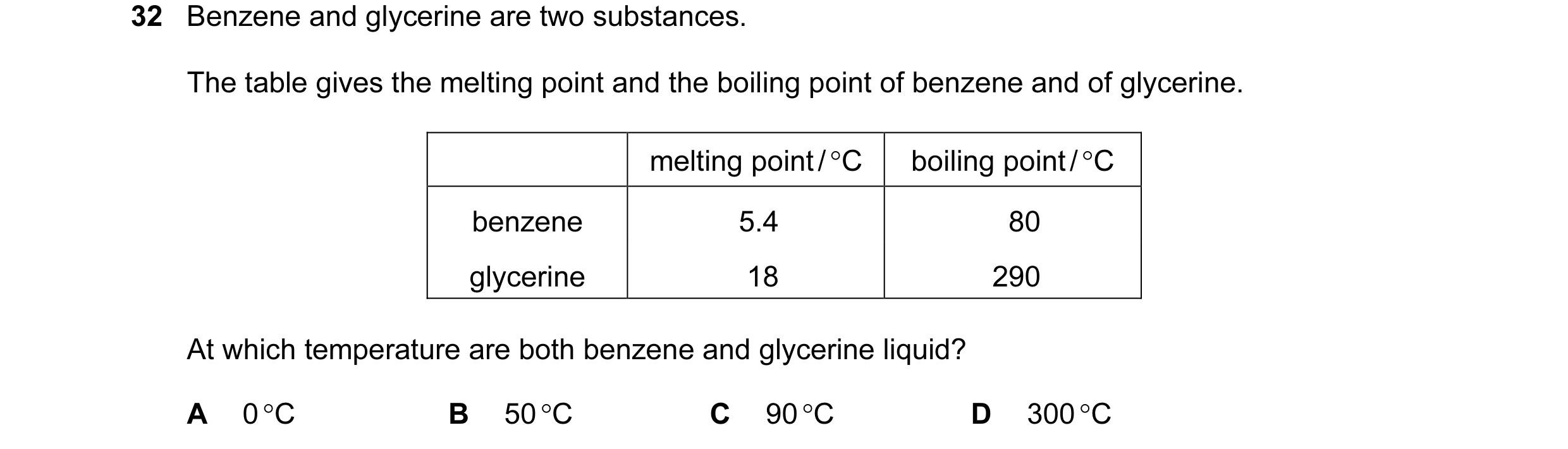
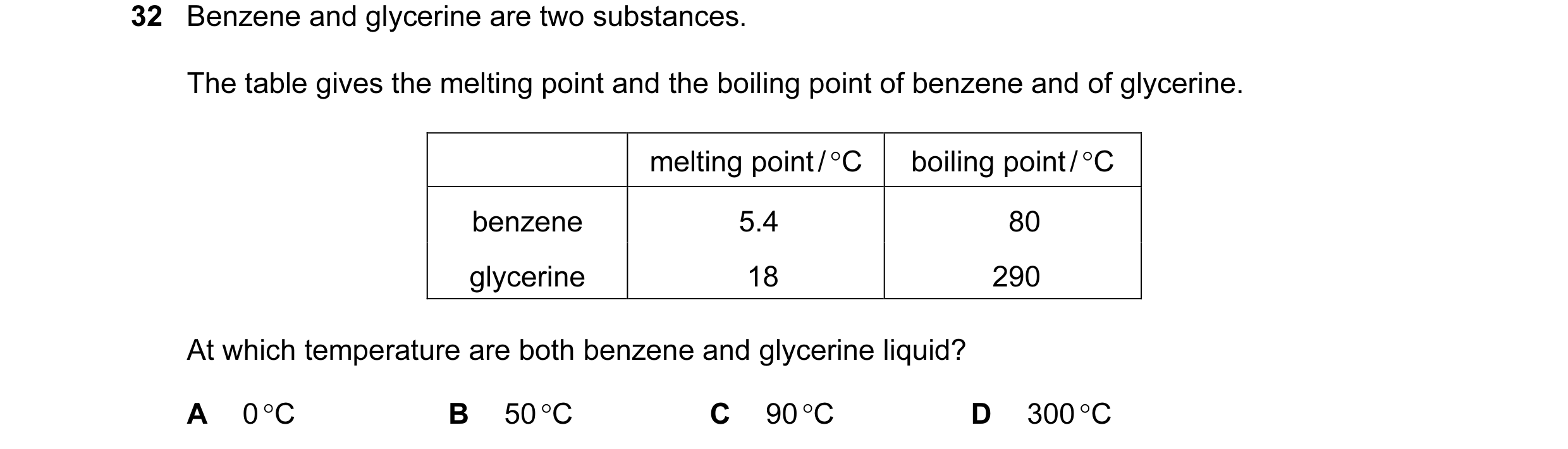
Q19 · Benzene and glycerine are two substances 0653/11 May/June 2016
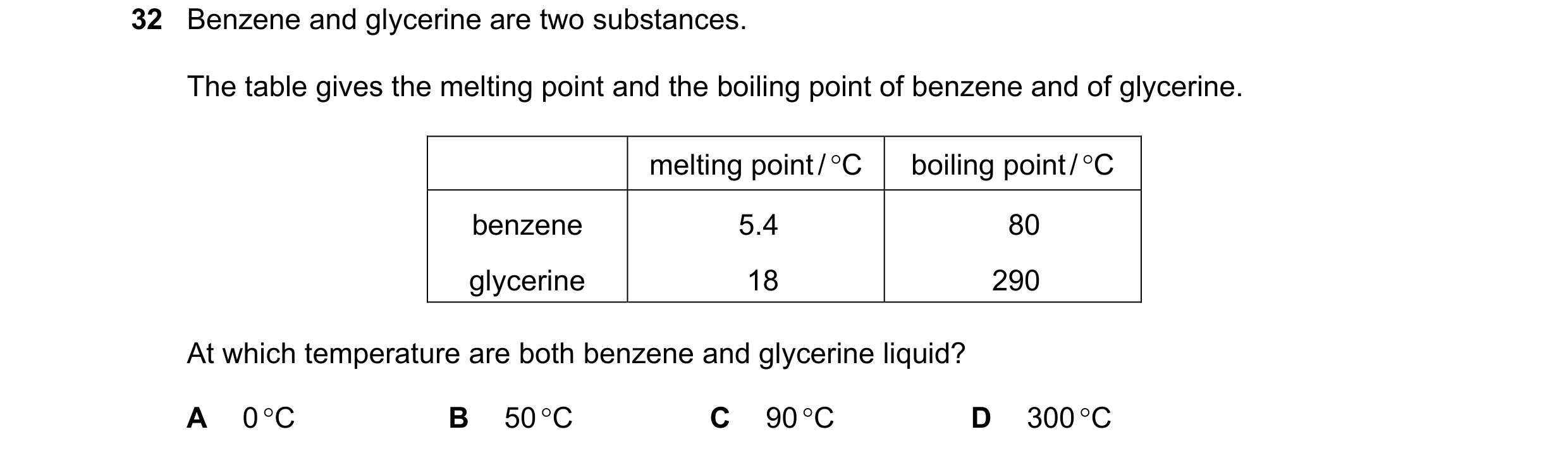
32 Benzene and glycerine are two substances. The table gives the melting point and the boiling point of benzene and of glycerine. melting point / °C boiling point / °C benzene 5.4 80 glycerine 18 290 At which temperature are both benzene and glycerine liquid? A 0 °C B 50 °C C 90 °C D 300 °C
1 marks
Answer: B
This question in 0653/11 May/June 2016
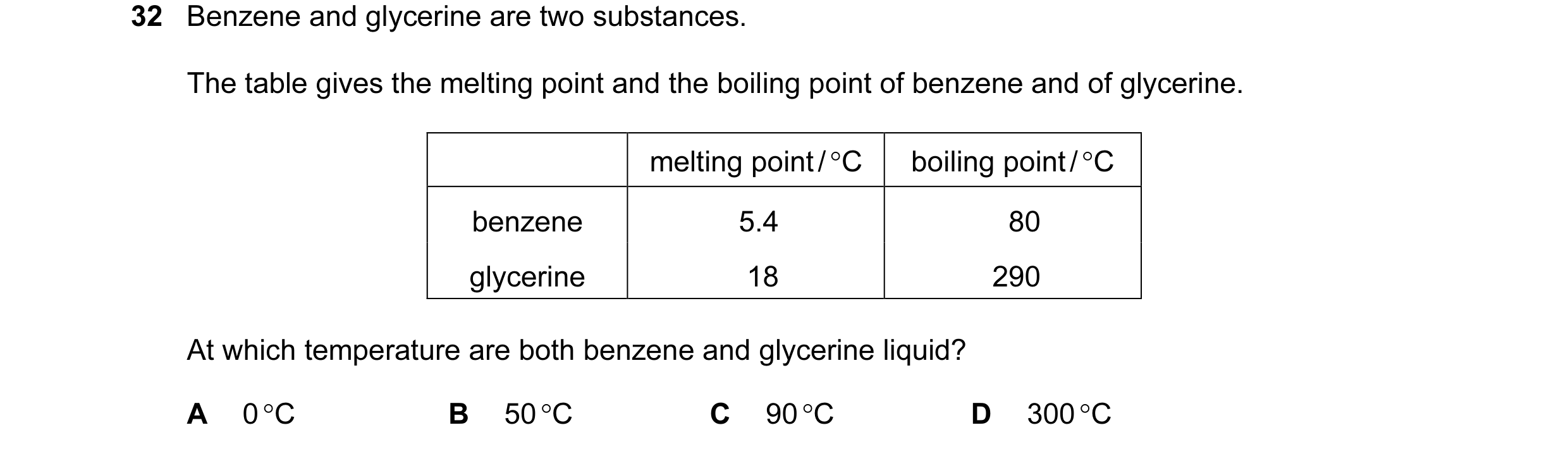
Q20 · Benzene and glycerine are two substances 0653/12 May/June 2016
32 Benzene and glycerine are two substances. The table gives the melting point and the boiling point of benzene and of glycerine. melting point / °C boiling point / °C benzene 5.4 80 glycerine 18 290 At which temperature are both benzene and glycerine liquid? A 0 °C B 50 °C C 90 °C D 300 °C
1 marks
Answer: B
This question in 0653/12 May/June 2016
Q21 · Benzene and glycerine are two substances 0653/13 May/June 2016
32 Benzene and glycerine are two substances. The table gives the melting point and the boiling point of benzene and of glycerine. melting point / °C boiling point / °C benzene 5.4 80 glycerine 18 290 At which temperature are both benzene and glycerine liquid? A 0 °C B 50 °C C 90 °C D 300 °C
1 marks
Answer: B
This question in 0653/13 May/June 2016
Q22 · An engineer wants to fix a steel washer on to a steel rod 0653/11 Oct/Nov 2016
32 An engineer wants to fix a steel washer on to a steel rod. The rod is slightly too big to fit into the hole in the washer. steel steel rod washer How can the engineer fit the washer on to the rod? A Cool the washer and push it over the rod. B Cool the washer and the rod to the same temperature and then push them together. C Heat the rod and then push it in the hole. D Heat the washer and then place it over the rod.
1 marks
Answer: D
This question in 0653/11 Oct/Nov 2016
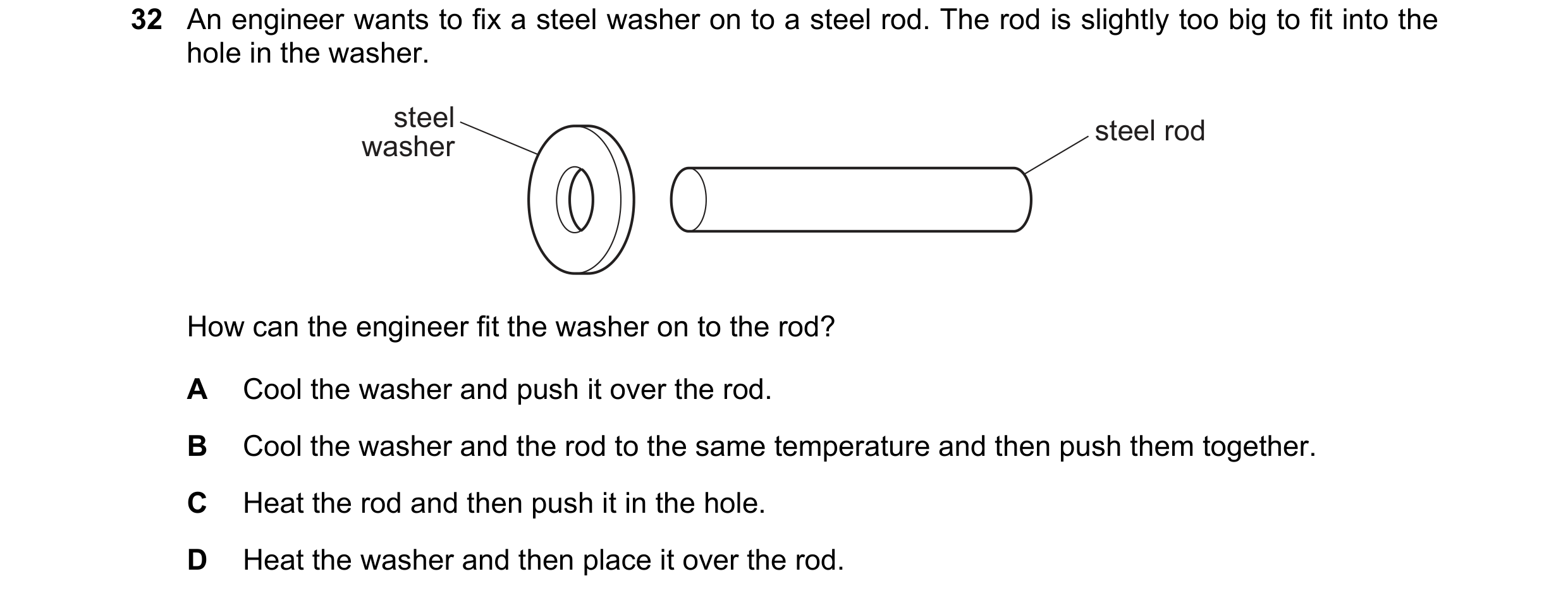
Q23 · An engineer wants to fix a steel washer on to a steel rod 0653/12 Oct/Nov 2016
32 An engineer wants to fix a steel washer on to a steel rod. The rod is slightly too big to fit into the hole in the washer. steel steel rod washer How can the engineer fit the washer on to the rod? A Cool the washer and push it over the rod. B Cool the washer and the rod to the same temperature and then push them together. C Heat the rod and then push it in the hole. D Heat the washer and then place it over the rod.
1 marks
Answer: D
This question in 0653/12 Oct/Nov 2016
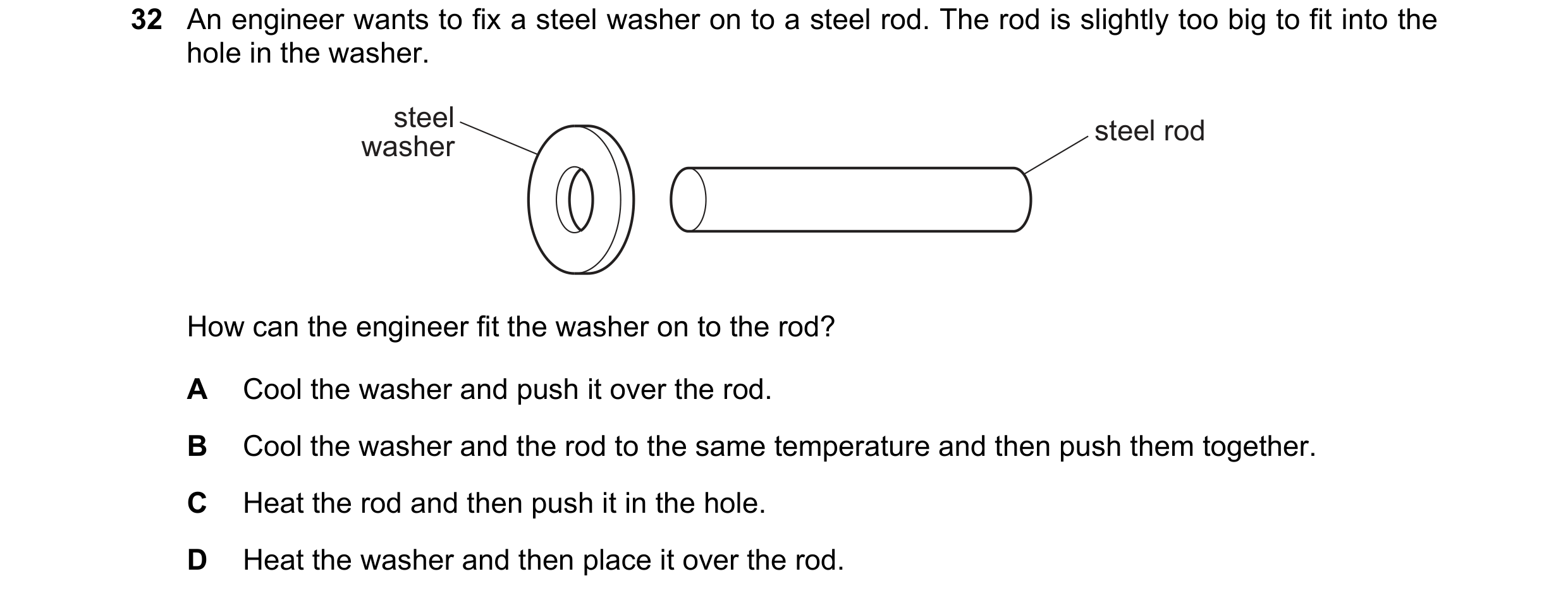
Q24 · An engineer wants to fix a steel washer on to a steel rod 0653/13 Oct/Nov 2016
32 An engineer wants to fix a steel washer on to a steel rod. The rod is slightly too big to fit into the hole in the washer. steel steel rod washer How can the engineer fit the washer on to the rod? A Cool the washer and push it over the rod. B Cool the washer and the rod to the same temperature and then push them together. C Heat the rod and then push it in the hole. D Heat the washer and then place it over the rod.
1 marks
Answer: D
This question in 0653/13 Oct/Nov 2016
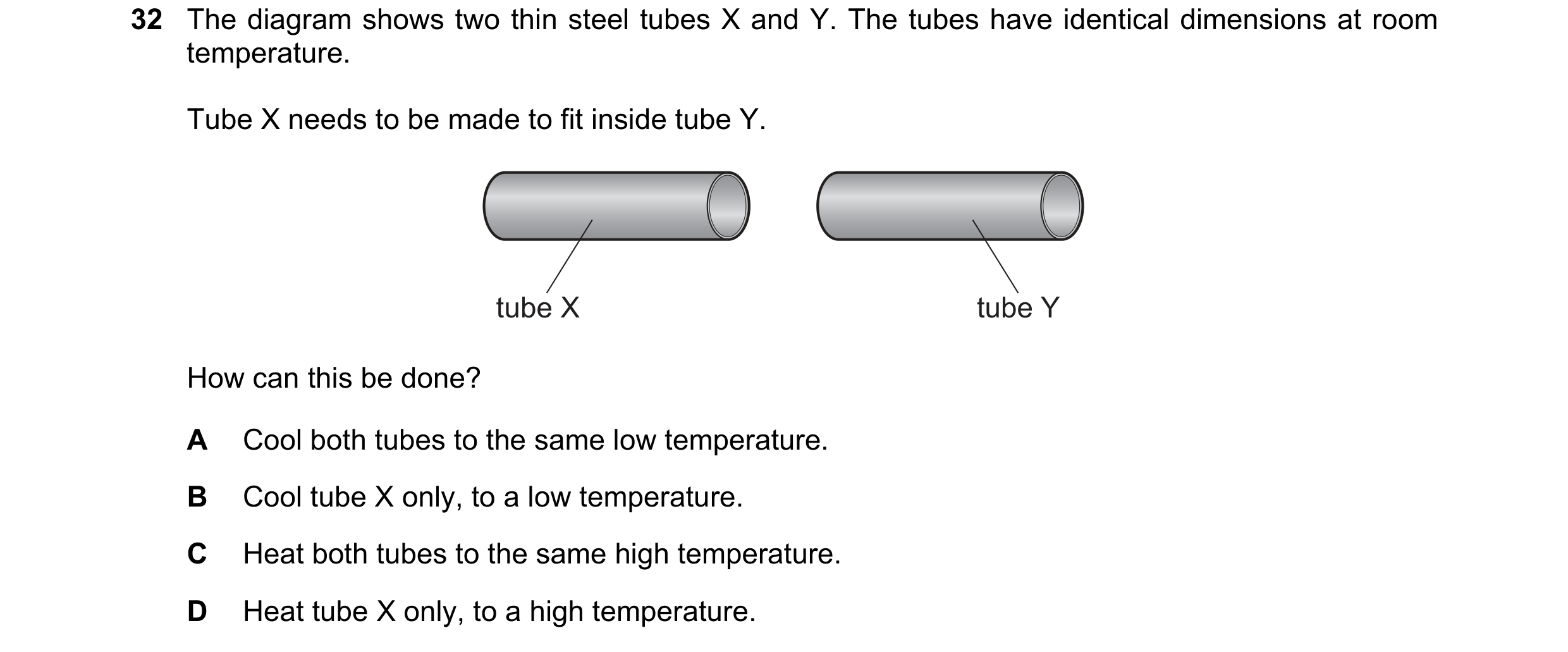
Q25 · The diagram shows two thin steel tubes X and Y 0653/12 May/June 2017
32 The diagram shows two thin steel tubes X and Y. The tubes have identical dimensions at room temperature. Tube X needs to be made to fit inside tube Y. tube X tube Y How can this be done? A Cool both tubes to the same low temperature. B Cool tube X only, to a low temperature. C Heat both tubes to the same high temperature. D Heat tube X only, to a high temperature.
1 marks
Answer: B
This question in 0653/12 May/June 2017
Q26 · The diagram shows two thin steel tubes X and Y 0653/13 May/June 2017
32 The diagram shows two thin steel tubes X and Y. The tubes have identical dimensions at room temperature. Tube X needs to be made to fit inside tube Y. tube X tube Y How can this be done? A Cool both tubes to the same low temperature. B Cool tube X only, to a low temperature. C Heat both tubes to the same high temperature. D Heat tube X only, to a high temperature.
1 marks
Answer: B
This question in 0653/13 May/June 2017
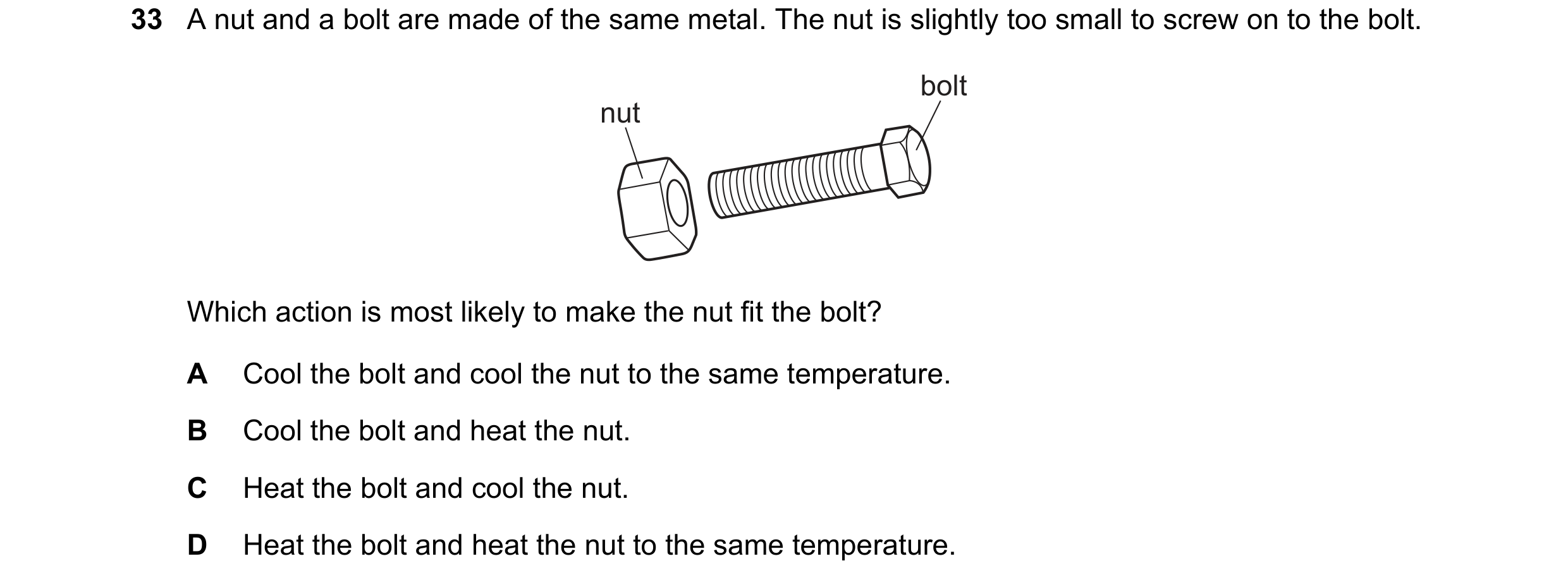
Q27 · A nut and a bolt are made of the same metal 0653/11 Oct/Nov 2017
33 A nut and a bolt are made of the same metal. The nut is slightly too small to screw on to the bolt. bolt nut Which action is most likely to make the nut fit the bolt? A Cool the bolt and cool the nut to the same temperature. B Cool the bolt and heat the nut. C Heat the bolt and cool the nut. D Heat the bolt and heat the nut to the same temperature.
1 marks
Answer: B
This question in 0653/11 Oct/Nov 2017
Q28 · The diagram shows a glass flask with a stopper 0653/12 Oct/Nov 2017
32 The diagram shows a glass flask with a stopper. A narrow glass tube passes through the stopper. The flask is full of a liquid. stopper liquid The flask is heated. Some liquid flows out of the top of the tube. Why does this happen? A The flask contracts. B The flask expands. C The liquid contracts. D The liquid expands.
1 marks
Answer: D
This question in 0653/12 Oct/Nov 2017
Q29 · A substance is a gas and loses energy thermally at a constant rate 0653/13 Oct/Nov 2017
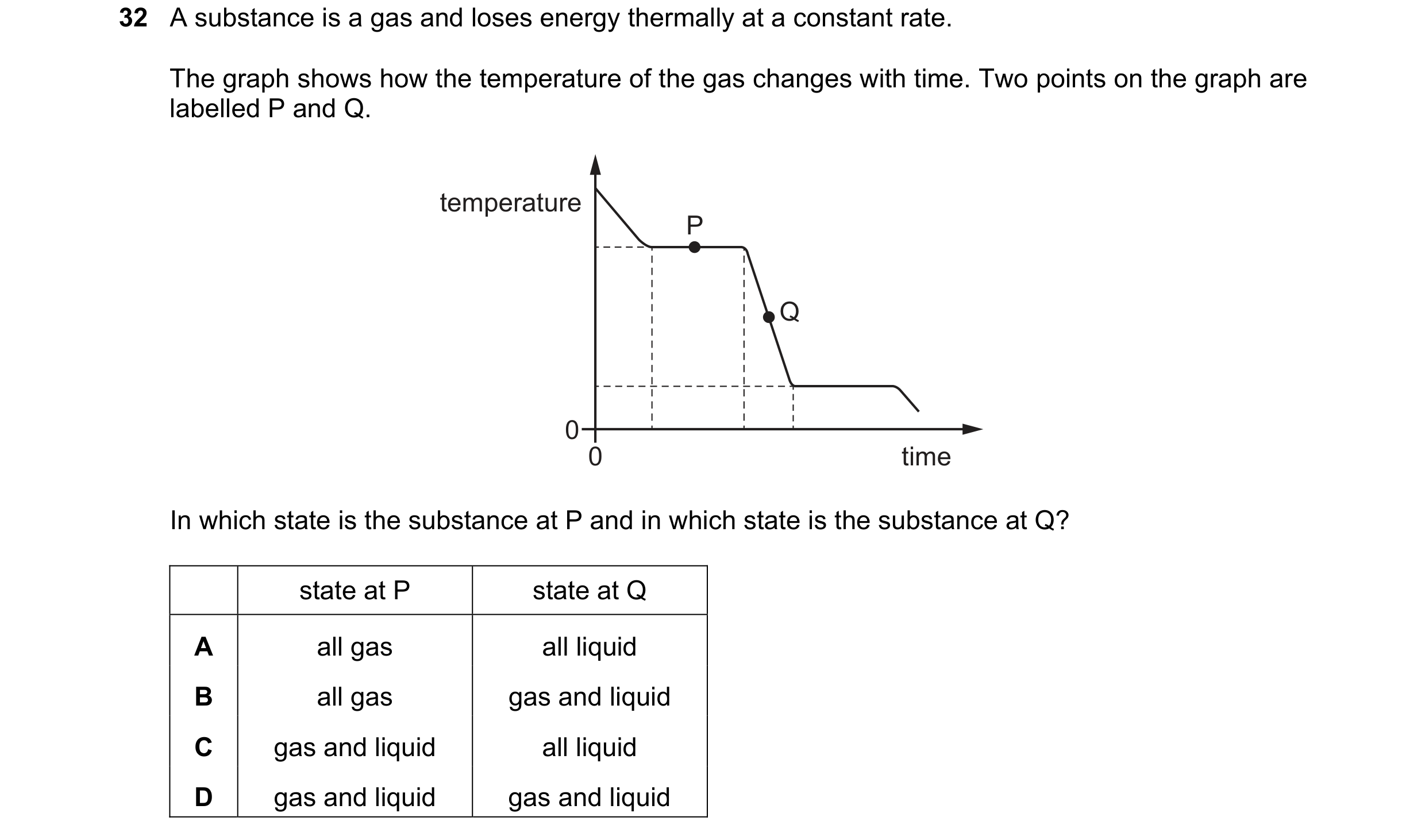
32 A substance is a gas and loses energy thermally at a constant rate. The graph shows how the temperature of the gas changes with time. Two points on the graph are labelled P and Q. temperature P Q 0 0 time In which state is the substance at P and in which state is the substance at Q? state at P state at Q A all gas all liquid B all gas gas and liquid C gas and liquid all liquid D gas and liquid gas and liquid
1 marks
Answer: C
This question in 0653/13 Oct/Nov 2017
Q30 · A liquid evaporates when molecules leave its surface 0653/11 Oct/Nov 2018
33 A liquid evaporates when molecules leave its surface. Which molecules leave the surface, and what happens to the temperature of the remaining liquid? A The more energetic molecules leave and the temperature falls. B The more energetic molecules leave and the temperature rises. C The less energetic molecules leave and the temperature falls. D The less energetic molecules leave and the temperature rises.
1 marks
Answer: A
This question in 0653/11 Oct/Nov 2018
Q31 · A liquid evaporates when molecules leave its surface 0653/12 Oct/Nov 2018
32 A liquid evaporates when molecules leave its surface. Which molecules leave the surface, and what happens to the temperature of the remaining liquid? A The more energetic molecules leave and the temperature falls. B The more energetic molecules leave and the temperature rises. C The less energetic molecules leave and the temperature falls. D The less energetic molecules leave and the temperature rises.
1 marks
Answer: A
This question in 0653/12 Oct/Nov 2018
Q32 · Benzene and glycerine are two substances 0653/13 May/June 2019
32 Benzene and glycerine are two substances. The table gives the melting point and the boiling point of benzene and of glycerine. melting point / °C boiling point / °C benzene 5.4 80 glycerine 18 290 At which temperature are both benzene and glycerine liquid? A 0 °C B 50 °C C 90 °C D 300 °C
1 marks
Answer: B
This question in 0653/13 May/June 2019
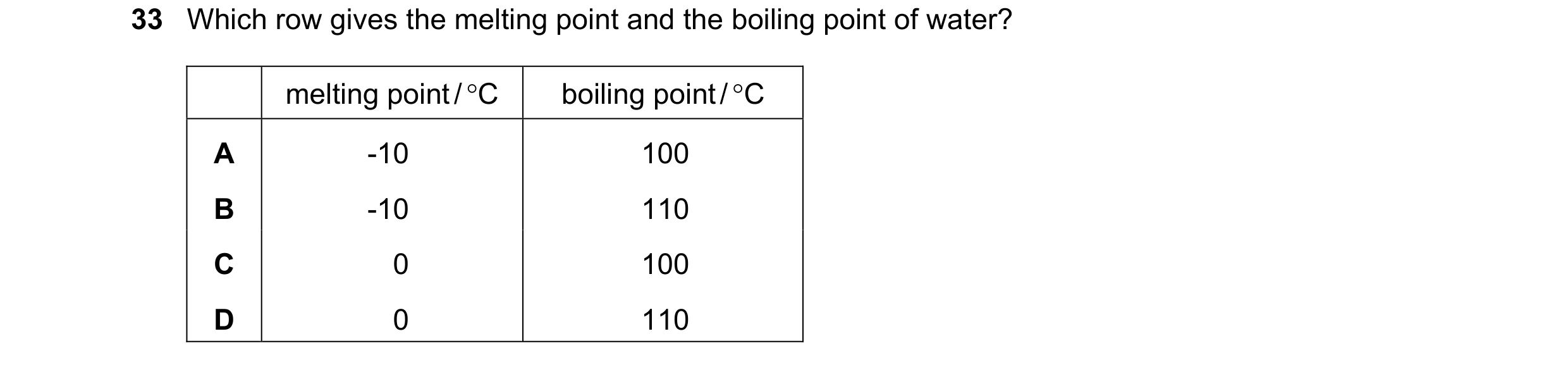
Q33 · Which row gives the melting point and the boiling point of water? 0653/12 Feb/March 2020
33 Which row gives the melting point and the boiling point of water? melting point / °C boiling point / °C A -10 100 B -10 110 C 0 100 D 0 110
1 marks
Answer: C
This question in 0653/12 Feb/March 2020
Q34 · What happens as a liquid starts to evaporate? 0653/11 Oct/Nov 2020
33 What happens as a liquid starts to evaporate? A The mass of the remaining liquid increases. B The mass of the remaining liquid is constant. C The temperature of the remaining liquid decreases. D The temperature of the remaining liquid increases.
1 marks
Answer: C
This question in 0653/11 Oct/Nov 2020
Q35 · The most energetic molecules of a liquid escape from its surface and the temperature of… 0653/11 Oct/Nov 2021
33 The most energetic molecules of a liquid escape from its surface and the temperature of the liquid decreases. Which process is occurring? A boiling B condensation C evaporation D melting
1 marks
Answer: C
This question in 0653/11 Oct/Nov 2021
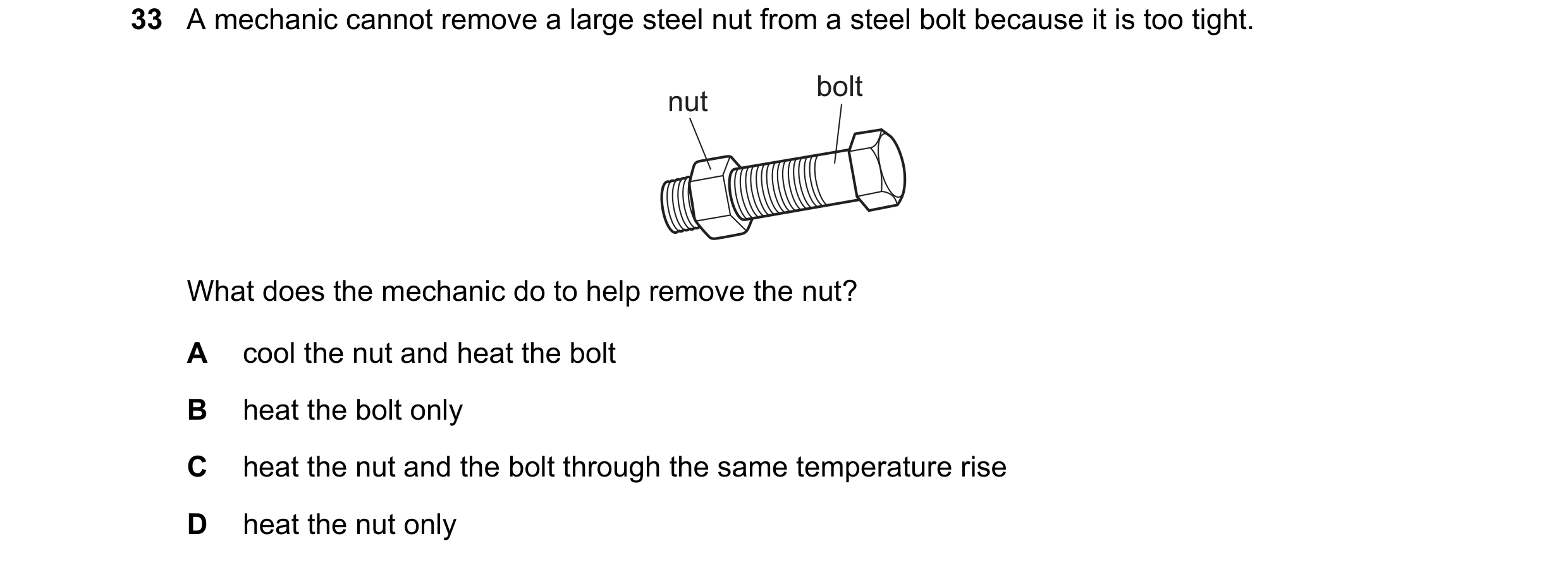
Q36 · A mechanic cannot remove a large steel nut from a steel bolt because it is too tight 0653/11 May/June 2022
33 A mechanic cannot remove a large steel nut from a steel bolt because it is too tight. bolt nut What does the mechanic do to help remove the nut? A cool the nut and heat the bolt B heat the bolt only C heat the nut and the bolt through the same temperature rise D heat the nut only
1 marks
Answer: D
This question in 0653/11 May/June 2022
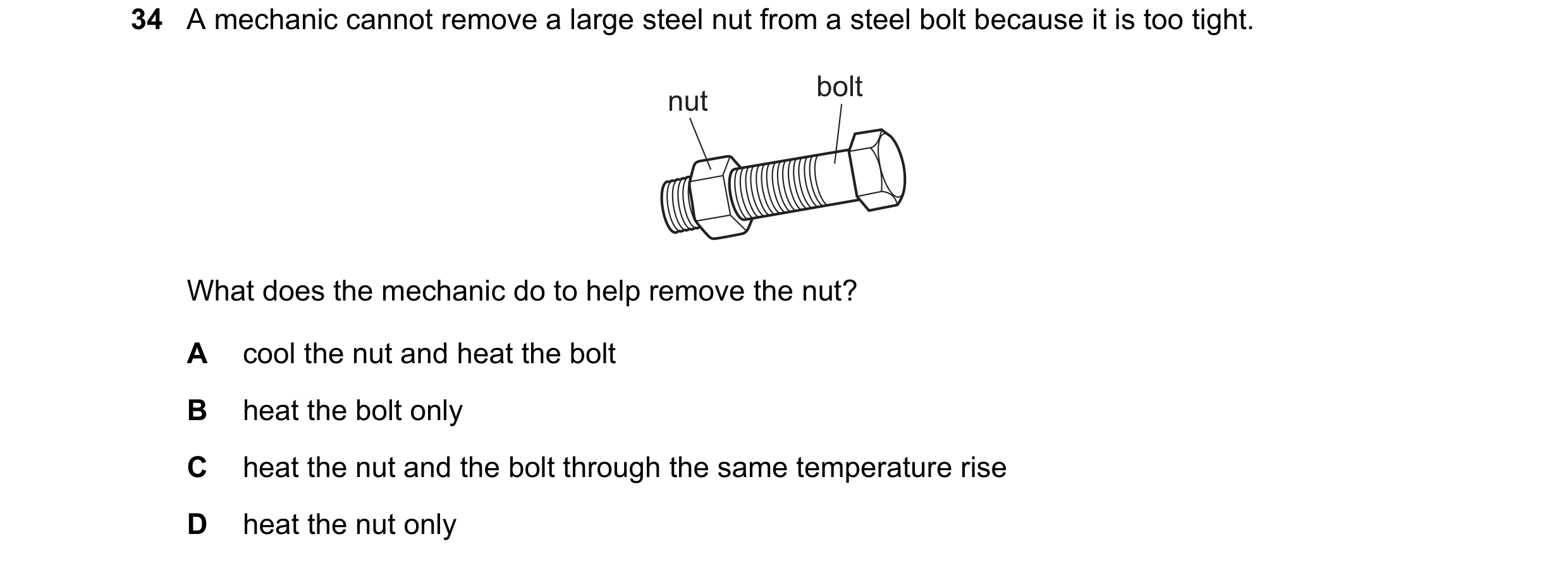
Q37 · A mechanic cannot remove a large steel nut from a steel bolt because it is too tight 0653/12 May/June 2022
34 A mechanic cannot remove a large steel nut from a steel bolt because it is too tight. bolt nut What does the mechanic do to help remove the nut? A cool the nut and heat the bolt B heat the bolt only C heat the nut and the bolt through the same temperature rise D heat the nut only
1 marks
Answer: D
This question in 0653/12 May/June 2022
Q38 · A mechanic cannot remove a large steel nut from a steel bolt because it is too tight 0653/13 May/June 2022
33 A mechanic cannot remove a large steel nut from a steel bolt because it is too tight. bolt nut What does the mechanic do to help remove the nut? A cool the nut and heat the bolt B heat the bolt only C heat the nut and the bolt through the same temperature rise D heat the nut only
1 marks
Answer: D
This question in 0653/13 May/June 2022
Q39 · Which statement about water is correct? 0653/12 Oct/Nov 2022
33 Which statement about water is correct? A It boils at 0 C and melts at 100 C. B It boils at 0 C and melts at –100 C. C It boils at 100 C and melts at –100 C. D It boils at 100 C and melts at 0 C.
1 marks
Answer: D
This question in 0653/12 Oct/Nov 2022
Q40 · Which statement about water is correct? 0653/13 Oct/Nov 2022
33 Which statement about water is correct? A It boils at 0 C and melts at 100 C. B It boils at 0 C and melts at –100 C. C It boils at 100 C and melts at –100 C. D It boils at 100 C and melts at 0 C.
1 marks
Answer: D
This question in 0653/13 Oct/Nov 2022
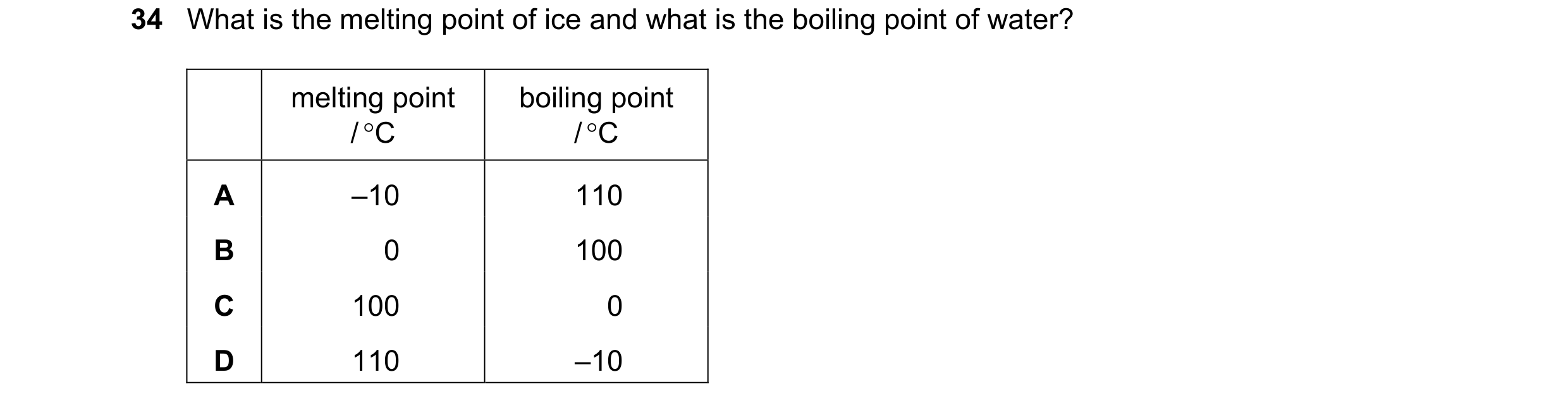
Q41 · What is the melting point of ice and what is the boiling point of water? 0653/11 May/June 2023
34 What is the melting point of ice and what is the boiling point of water? melting point boiling point / C / C A –10 110 B 0 100 C 100 0 D 110 –10
1 marks
Answer: B
This question in 0653/11 May/June 2023
Q42 · The metal lid on a glass jar is difficult to unscrew 0653/12 May/June 2023
34 The metal lid on a glass jar is difficult to unscrew. The lid is unscrewed more easily after it is held under hot water. What is the reason for this? A The jar contracts more than the lid. B The jar expands more than the lid. C The lid contracts more than the jar. D The lid expands more than the jar.
1 marks
Answer: D
This question in 0653/12 May/June 2023
Q43 · A strip of brass and a strip of steel are glued together to make a single strip 0653/13 May/June 2023
34 A strip of brass and a strip of steel are glued together to make a single strip. The diagrams show the strip at room temperature and at a high temperature. brass brass steel steel at room temperature at high temperature Which statement explains why the strip bends in this way when it is heated? A Brass does not expand but steel contracts. B Brass expands but steel contracts. C Brass expands less than steel expands. D Brass expands more than steel expands.
1 marks
Answer: D
This question in 0653/13 May/June 2023
Q44 · A glass bottle is half full of water 0653/12 May/June 2024
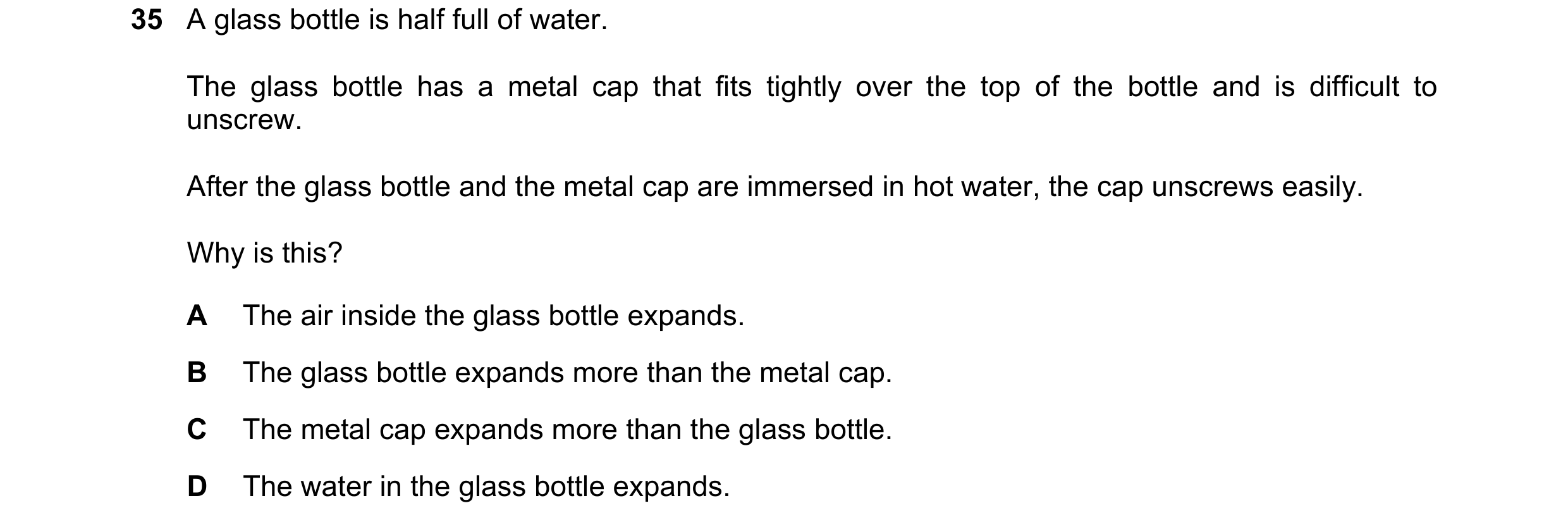
35 A glass bottle is half full of water. The glass bottle has a metal cap that fits tightly over the top of the bottle and is difficult to unscrew. After the glass bottle and the metal cap are immersed in hot water, the cap unscrews easily. Why is this? A The air inside the glass bottle expands. B The glass bottle expands more than the metal cap. C The metal cap expands more than the glass bottle. D The water in the glass bottle expands.
1 marks
Answer: C
This question in 0653/12 May/June 2024
Q45 · An iron rod fits tightly inside an aluminium cylinder 0653/11 Oct/Nov 2024
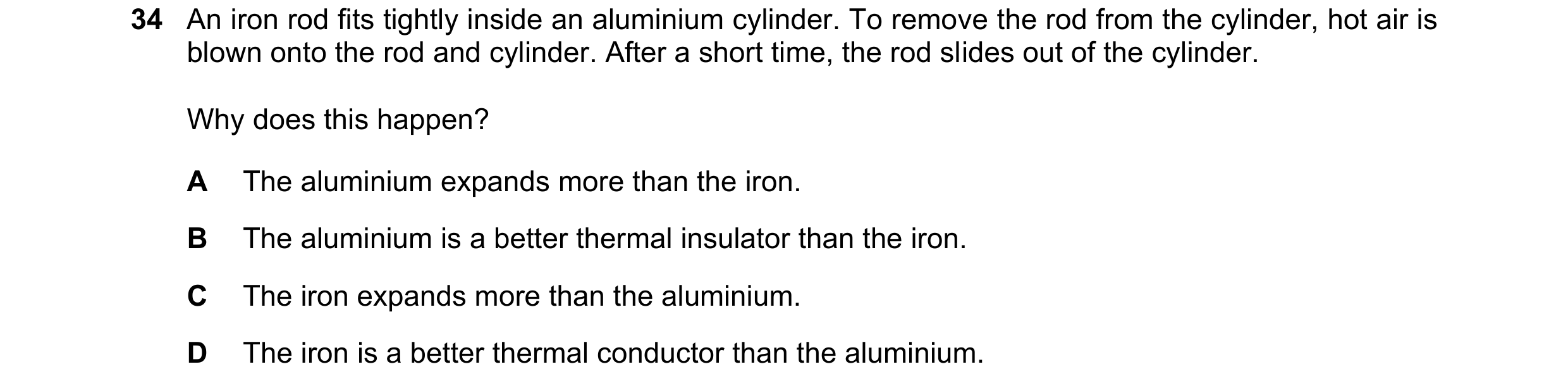
34 An iron rod fits tightly inside an aluminium cylinder. To remove the rod from the cylinder, hot air is blown onto the rod and cylinder. After a short time, the rod slides out of the cylinder. Why does this happen? A The aluminium expands more than the iron. B The aluminium is a better thermal insulator than the iron. C The iron expands more than the aluminium. D The iron is a better thermal conductor than the aluminium.
1 marks
Answer: A
This question in 0653/11 Oct/Nov 2024
Q46 · Which substances expand when heated? 0653/12 Oct/Nov 2024
34 Which substances expand when heated? A gases only B liquids only C solids only D solids, liquids and gases
1 marks
Answer: D
This question in 0653/12 Oct/Nov 2024
Q47 · Which substances expand when heated? 0653/13 Oct/Nov 2024
34 Which substances expand when heated? A gases only B liquids only C solids only D solids, liquids and gases
1 marks
Answer: D
This question in 0653/13 Oct/Nov 2024
Q48 · The diagram shows a glass flask with a stopper 0653/12 Feb/March 2025
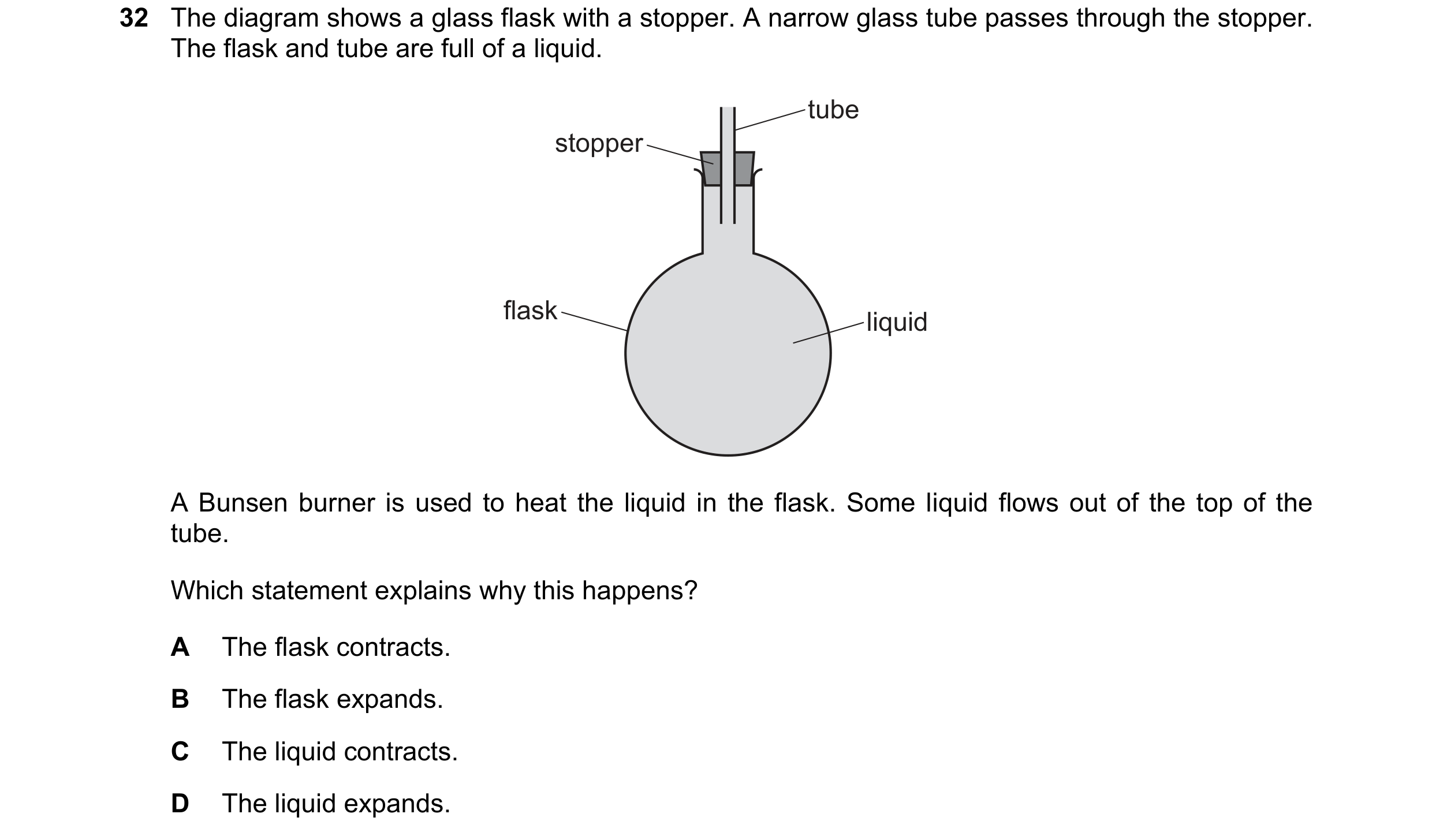
32 The diagram shows a glass flask with a stopper. A narrow glass tube passes through the stopper. The flask and tube are full of a liquid. tube stopper flask liquid A Bunsen burner is used to heat the liquid in the flask. Some liquid flows out of the top of the tube. Which statement explains why this happens? A The flask contracts. B The flask expands. C The liquid contracts. D The liquid expands.
1 marks
Answer: D
This question in 0653/12 Feb/March 2025
Q49 · A bowl contains warm water 0653/11 May/June 2025
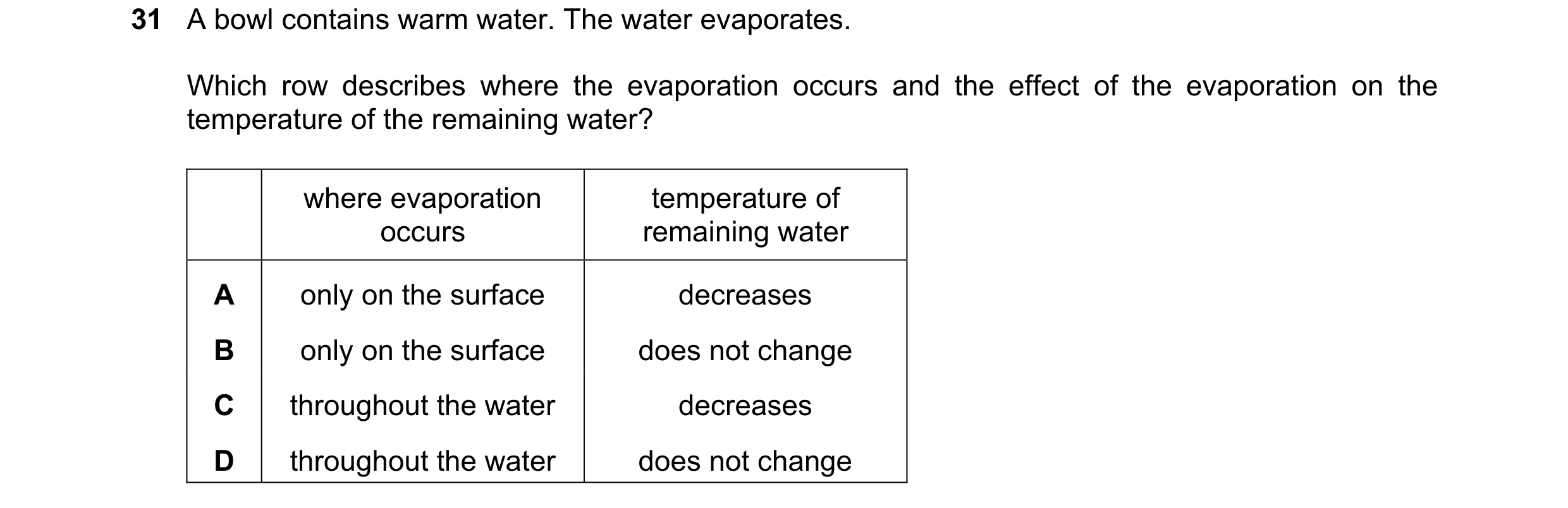
31 A bowl contains warm water. The water evaporates. Which row describes where the evaporation occurs and the effect of the evaporation on the temperature of the remaining water? where evaporation temperature of occurs remaining water A only on the surface decreases B only on the surface does not change C throughout the water decreases D throughout the water does not change
1 marks
Answer: A
This question in 0653/11 May/June 2025
Q50 · When a metal bar is heated, the separation of its particles increases and the bar becomes… 0653/12 May/June 2025
33 When a metal bar is heated, the separation of its particles increases and the bar becomes longer. What is this process called? A condensation B contraction C emission D expansion
1 marks
Answer: D
This question in 0653/12 May/June 2025
 1 / 15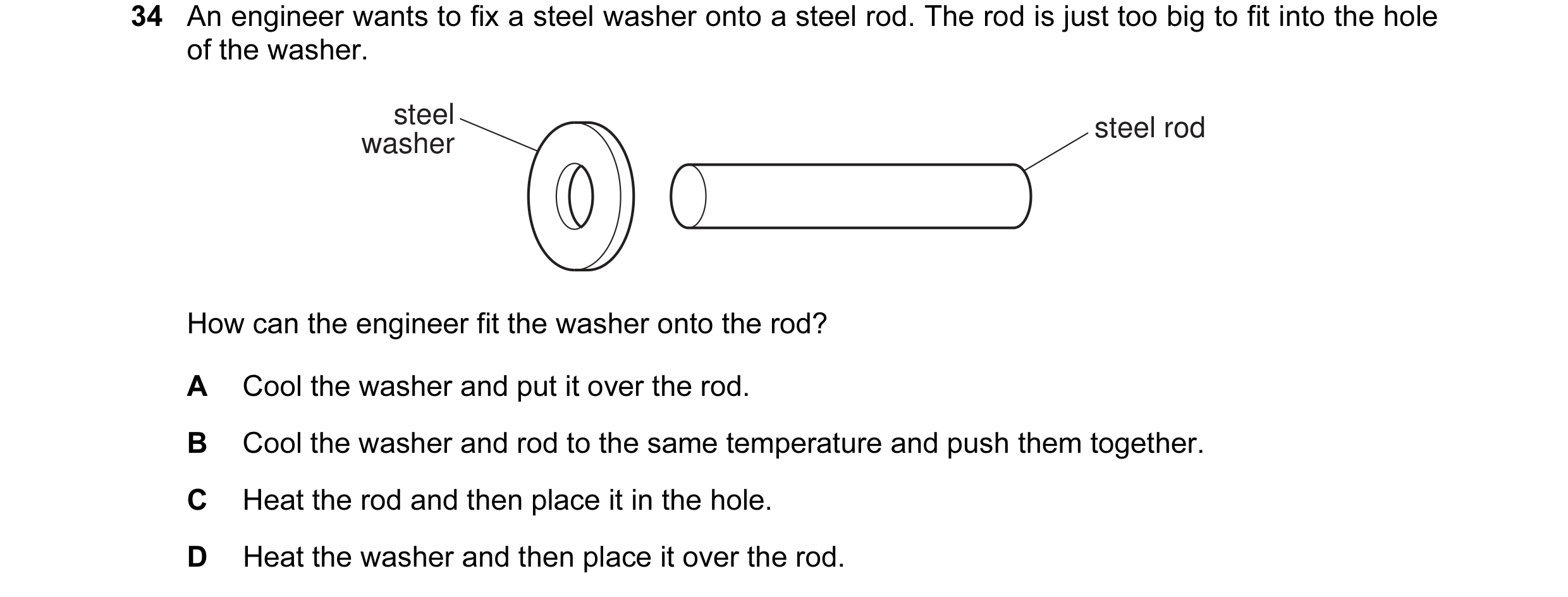
 2 / 15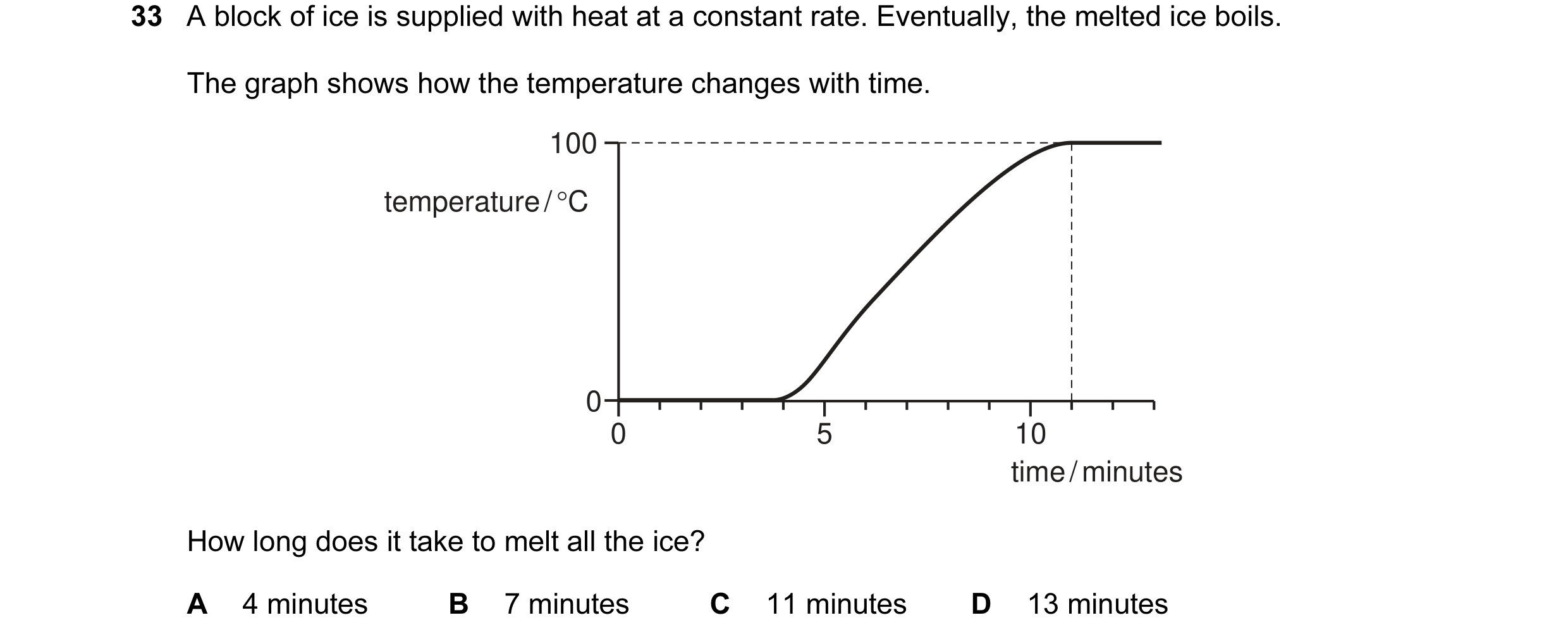
 3 / 15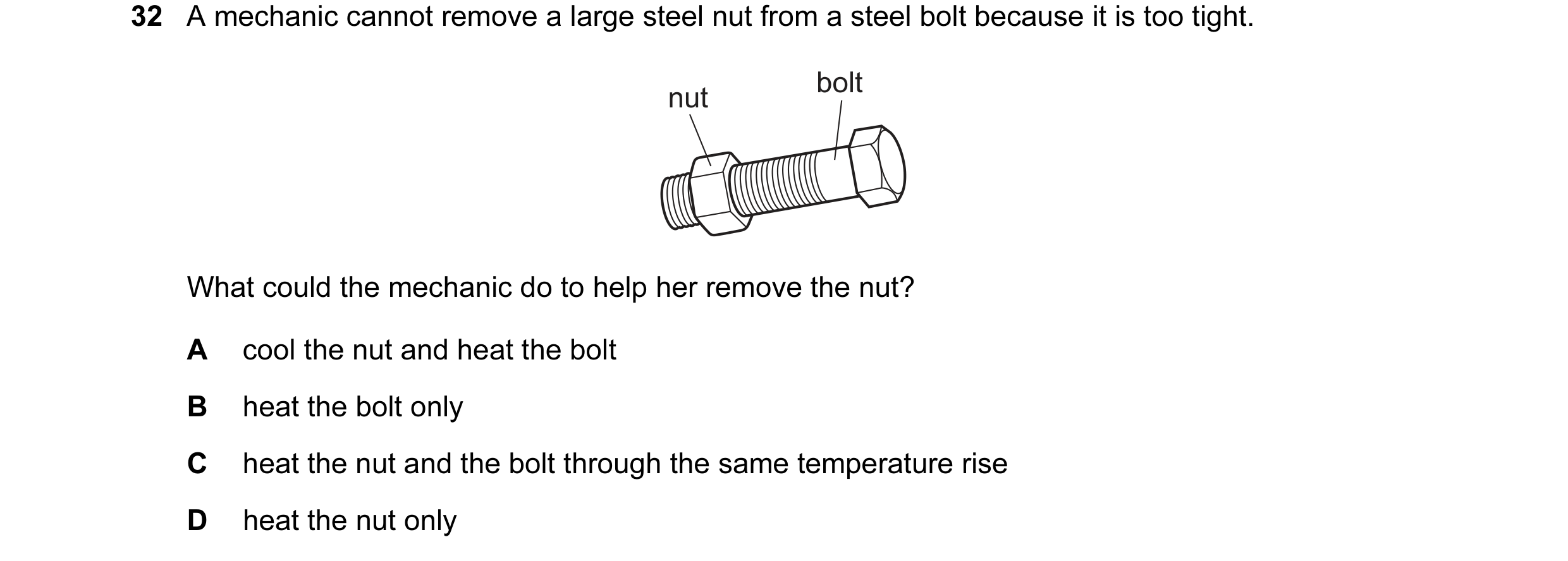
 4 / 15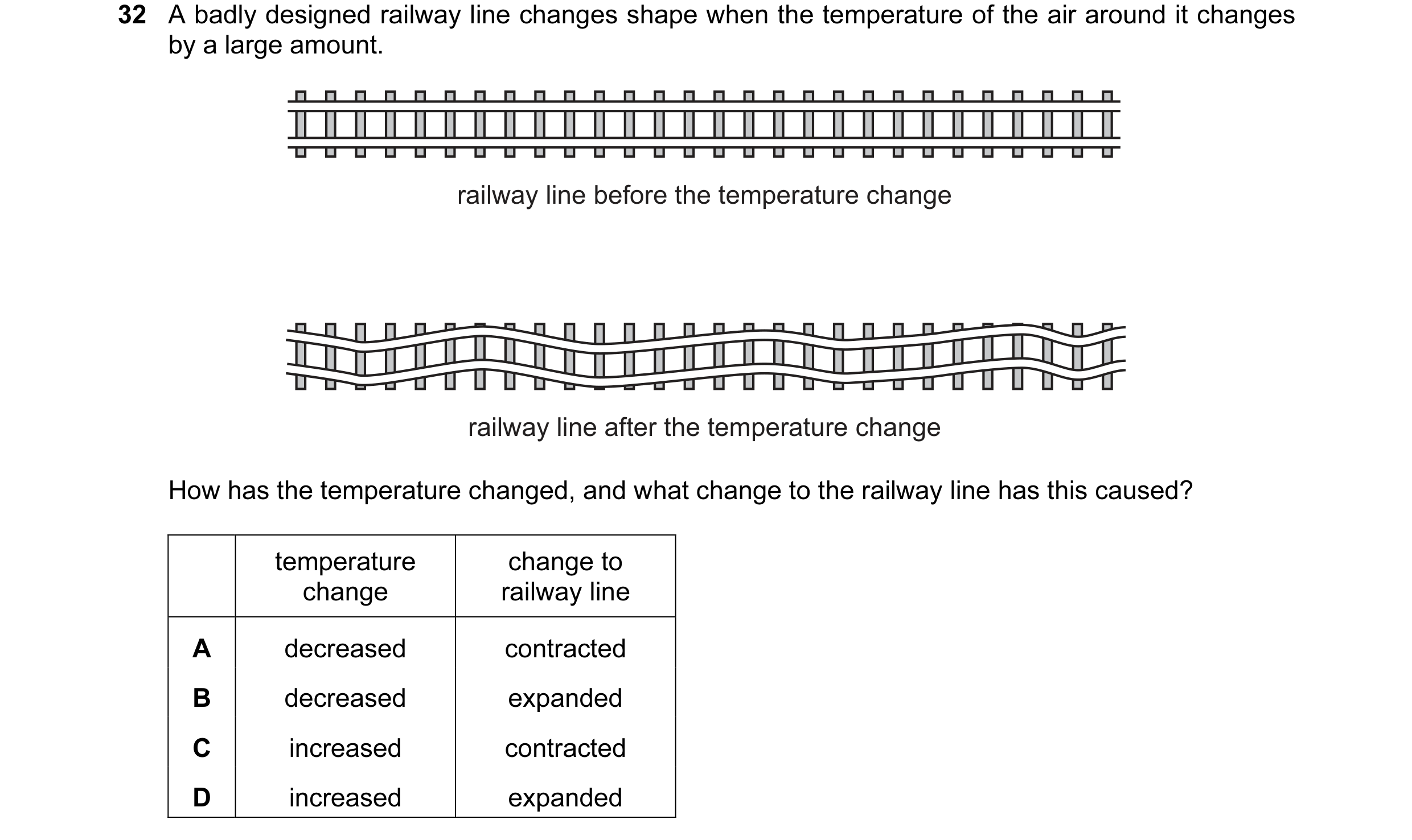
 5 / 15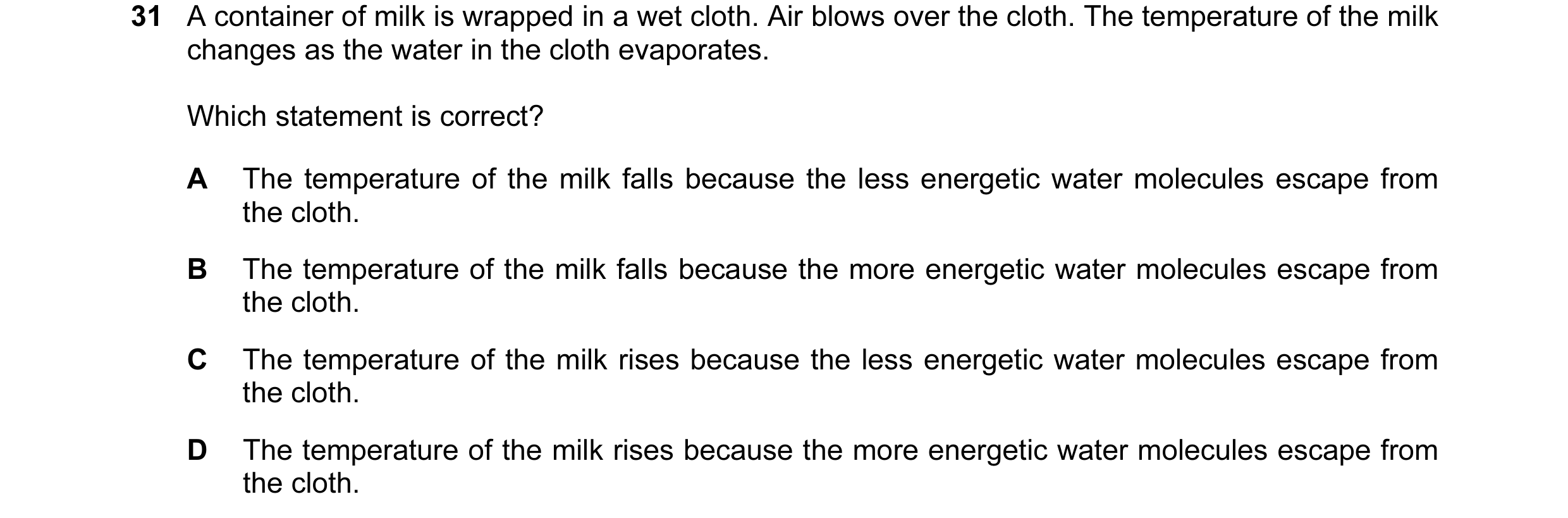
 6 / 15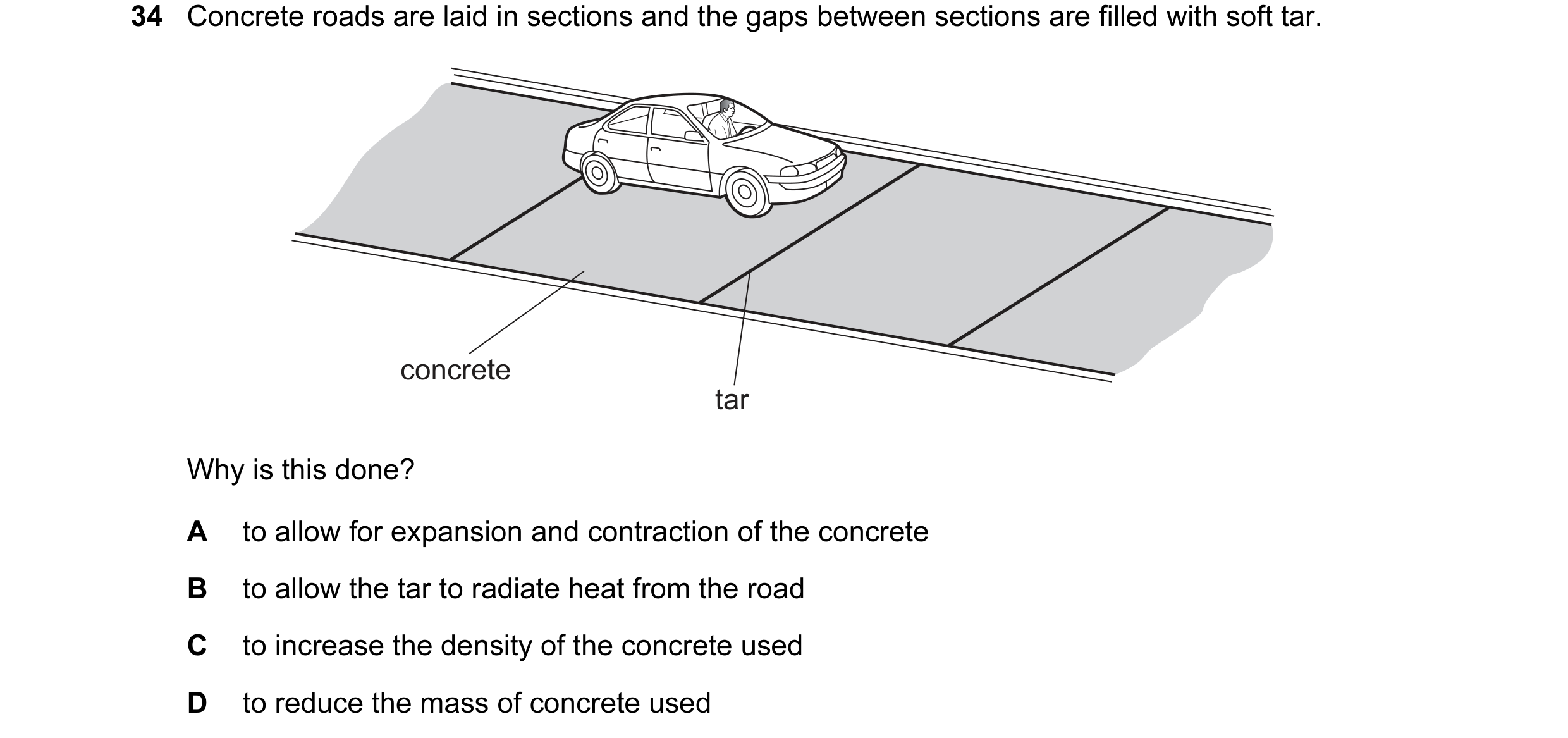
 7 / 15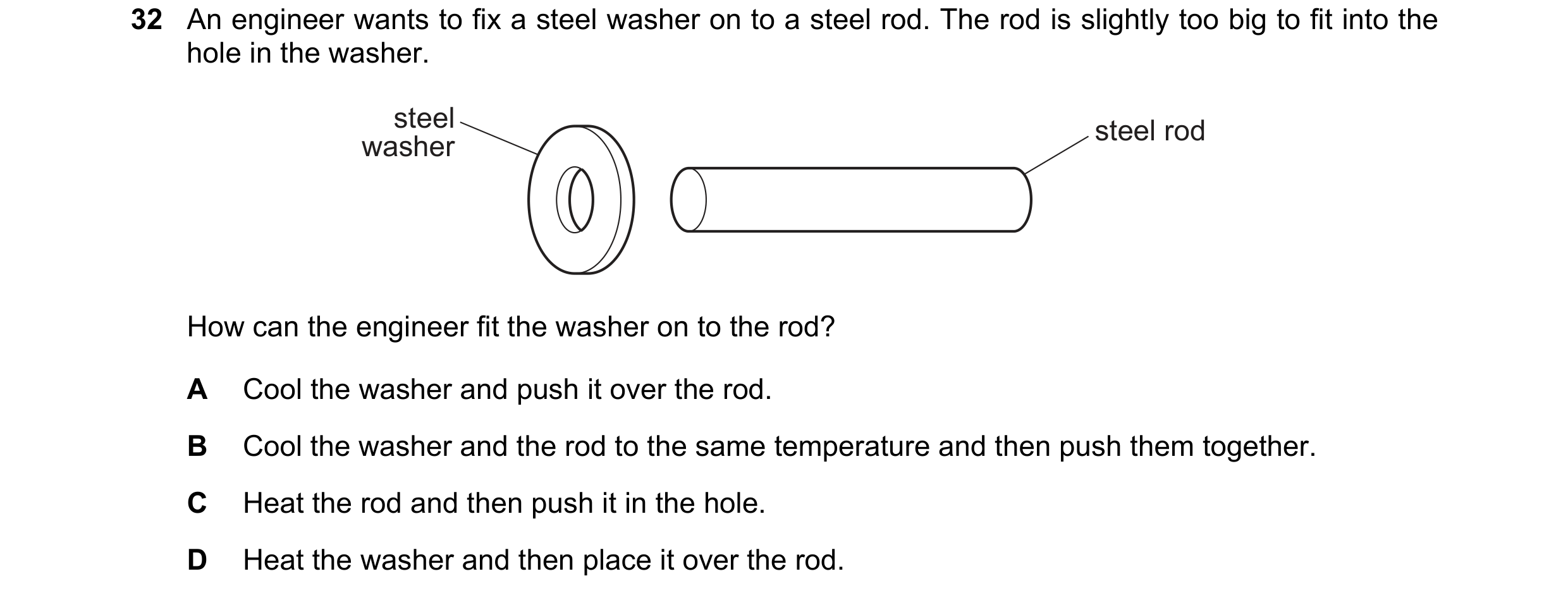
 8 / 15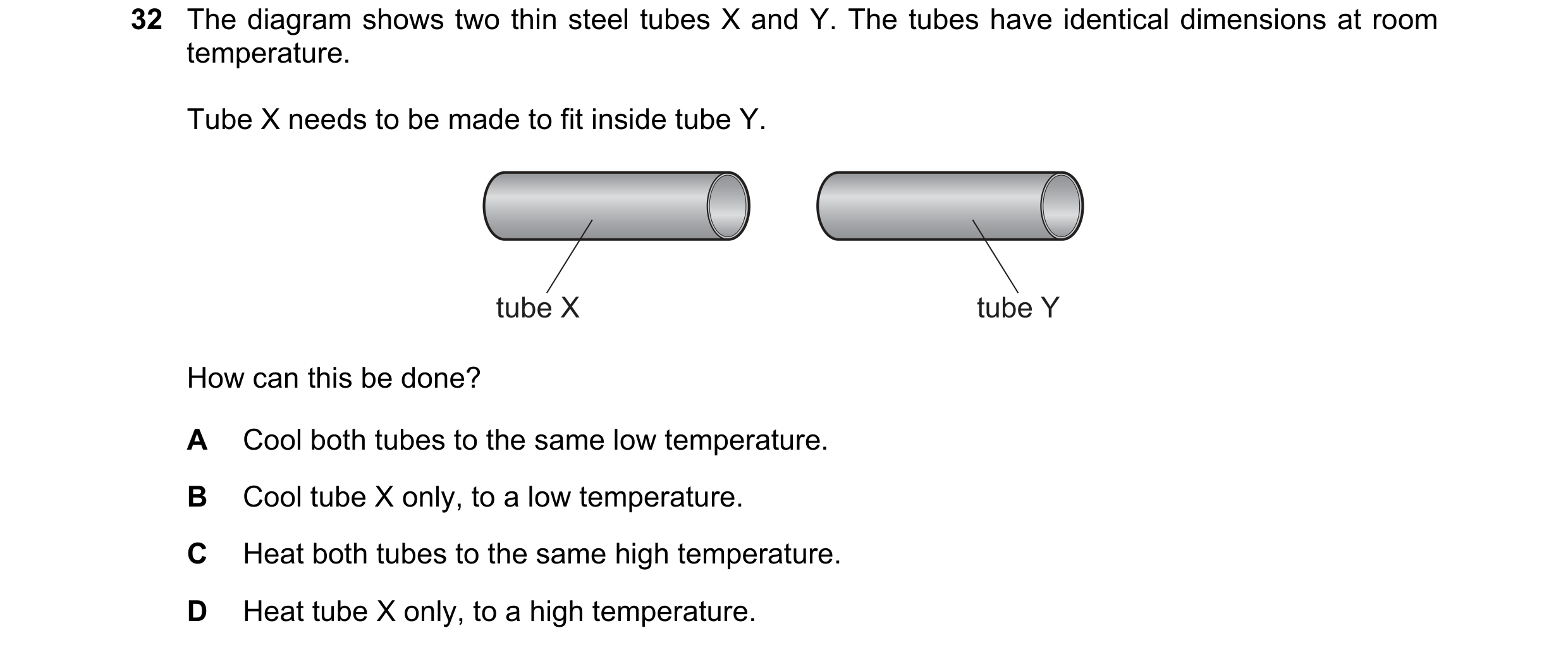
 9 / 15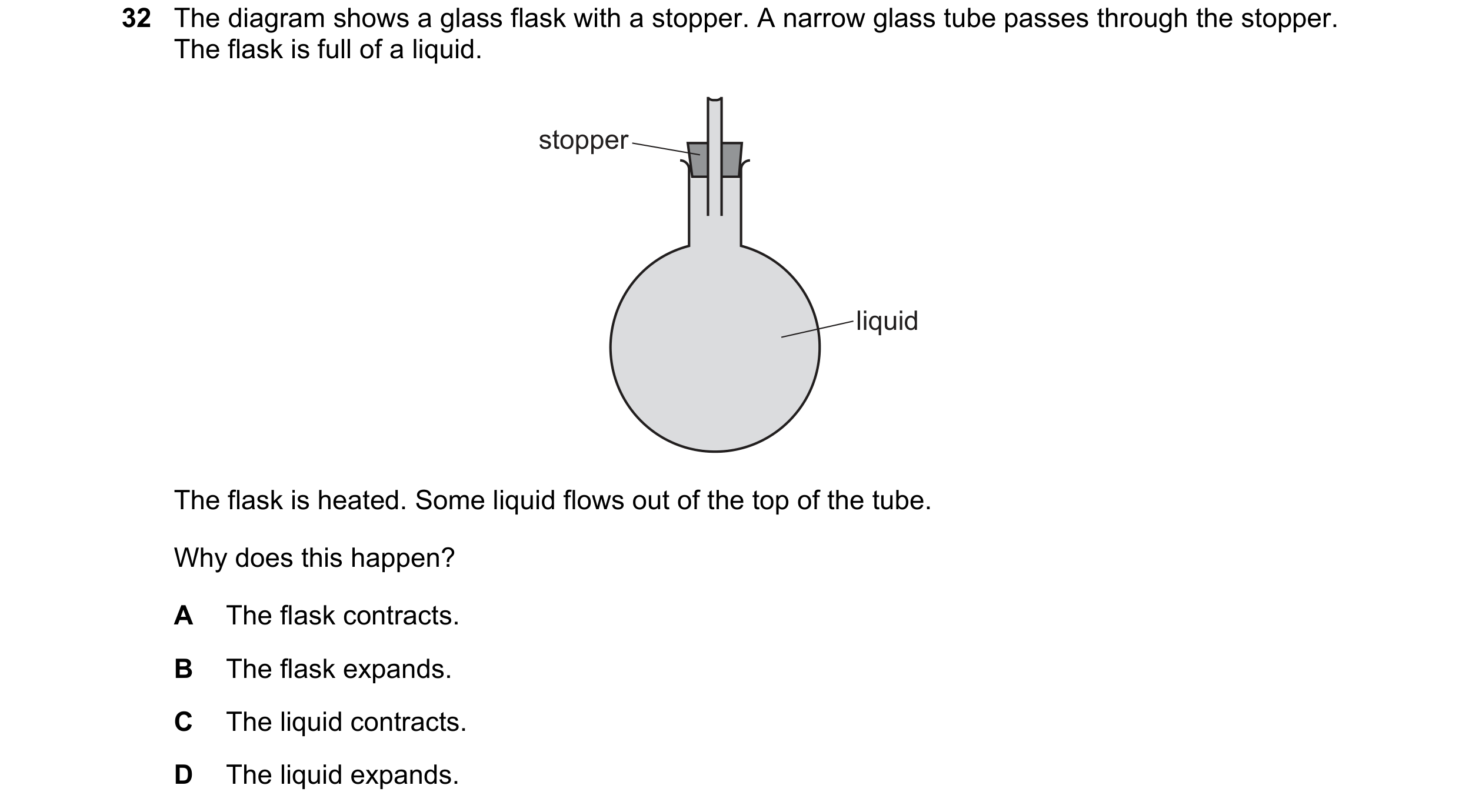
 10 / 15
 11 / 15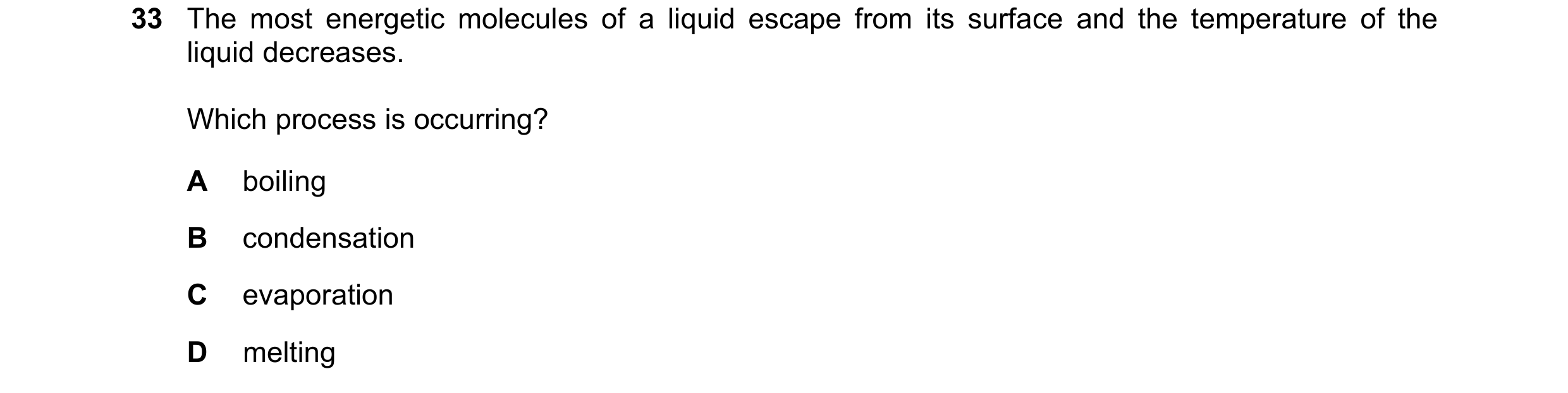
 12 / 15

 13 / 15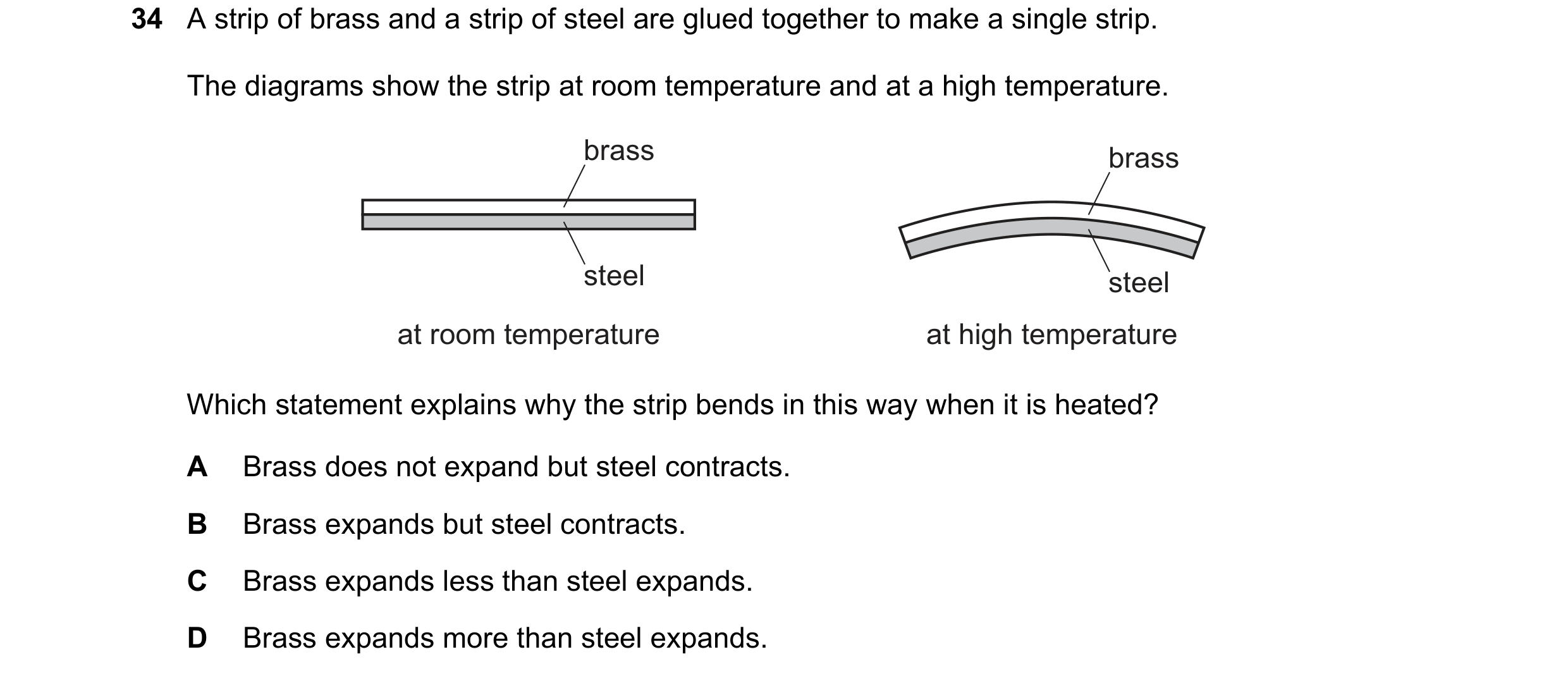
 14 / 15
 15 / 15