Questions as text
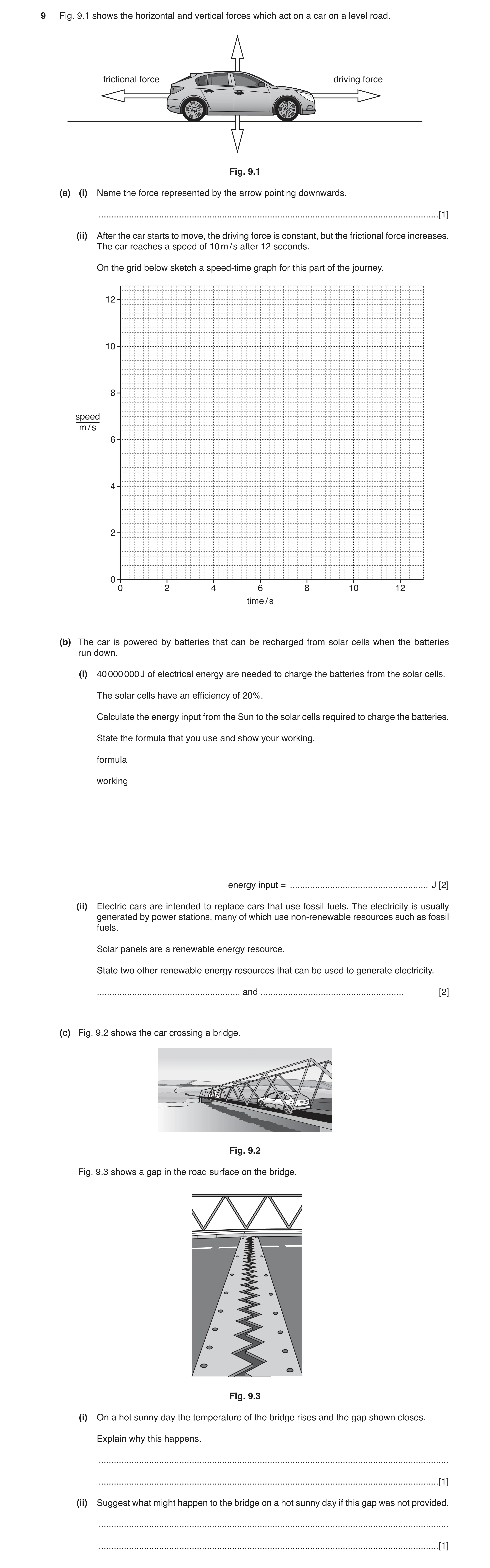
Q1 · The horizontal and vertical forces which act on a car on a level road 0653/41 Oct/Nov 2017
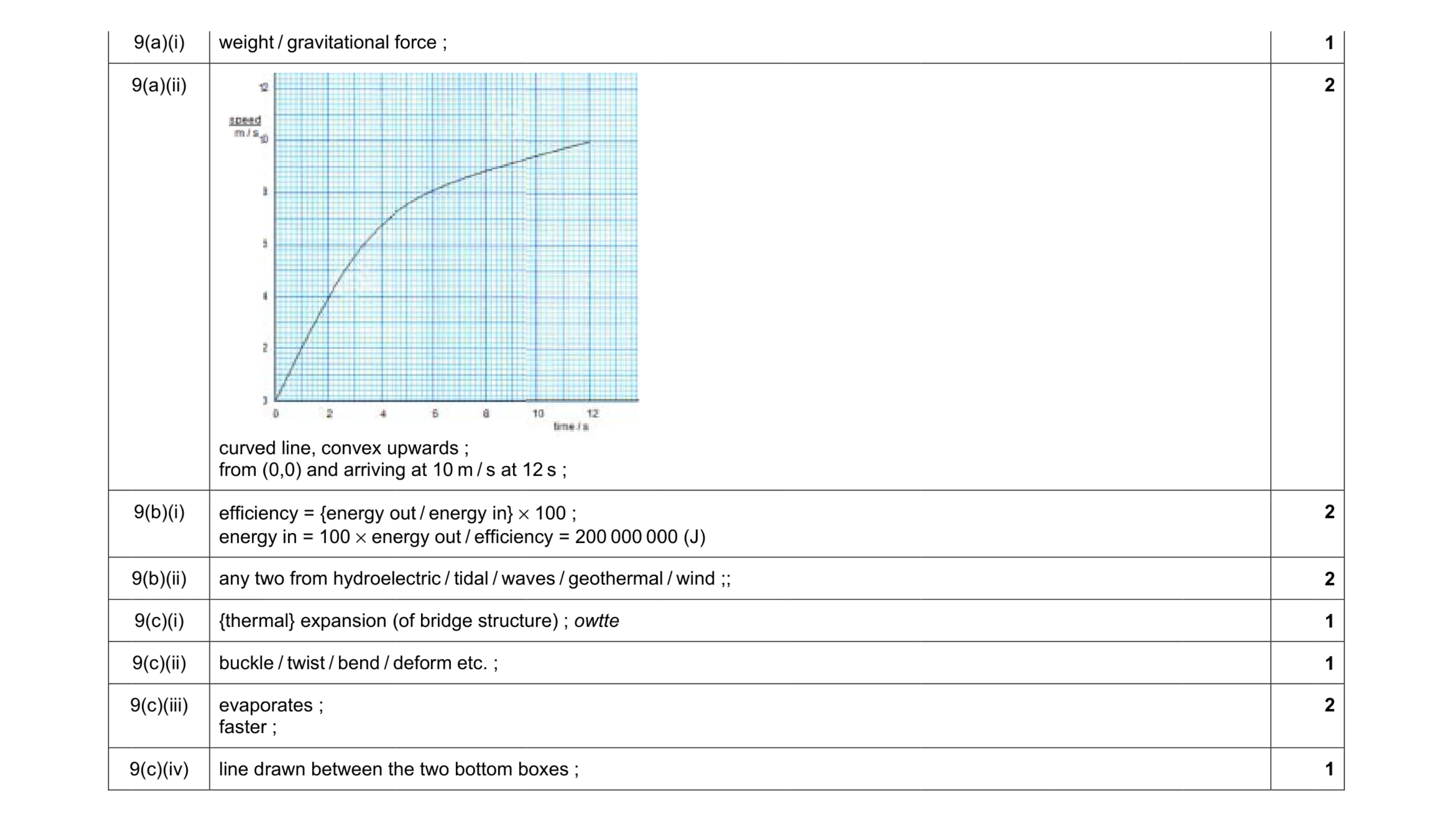
9 Fig. 9.1 shows the horizontal and vertical forces which act on a car on a level road. frictional force driving force Fig. 9.1 (a) (i) Name the force represented by the arrow pointing downwards. … [1] (ii) After the car starts to move, the driving force is constant, but the frictional force increases. The car reaches a speed of 10 m / s after 12 seconds. On the grid below sketch a speed-time graph for this part of the journey. 12 10 8 speed m / s 6 4 2 0 0 2 4 6 8 10 12 time / s (b) The car is powered by batteries that can be recharged from solar cells when the batteries run down. (i) 40 000 000 J of electrical energy are needed to charge the batteries from the solar cells. The solar cells have an efficiency of 20%. Calculate the energy input from the Sun to the solar cells required to charge the batteries. State the formula that you use and show your working. formula working energy input = … J [2] (ii) Electric cars are intended to replace cars that use fossil fuels. The electricity is usually generated by power stations, many of which use non-renewable resources such as fossil fuels. Solar panels are a renewable energy resource. State two other renewable energy resources that can be used to generate electricity. … and … [2] (c) Fig. 9.2 shows the car crossing a bridge. Fig. 9.2 Fig. 9.3 shows a gap in the road surface on the bridge. Fig. 9.3 (i) On a hot sunny day the temperature of the bridge rises and the gap shown closes. Explain why this happens. … … [1] (ii) Suggest what might happen to the bridge on a hot sunny day if this gap was not provided. … … [1]
9 marks
Mark scheme: 9 9 9 9 9(a)(i) weigh 9(a)(ii) curve from ( 9(b)(i) efficie energ 9(b)(ii) any tw 9(c)(i) {therm 9(c)(ii) buckl 9(c)(iii) evapo faster 9(c)(iv) line d ht / gravitational f ed line, convex u (0,0) and arrivin ency = {energy o gy in = 100 × ene wo from hydroel mal} expansion ( e / twist / bend / d orates ; r ; rawn between th force ; upwards ; g at 10 m / s at 1 out / energy in} × ergy out / efficien ectric / tidal / wav (of bridge structu deform etc. ; he two bottom b 12 s ; × 100 ; ncy = 200 000 00 ves / geotherma ure) ; owtte boxes ; 00 (J) al / wind ;; 1 2 2 2 1 1 2 1
This question in 0653/41 Oct/Nov 2017
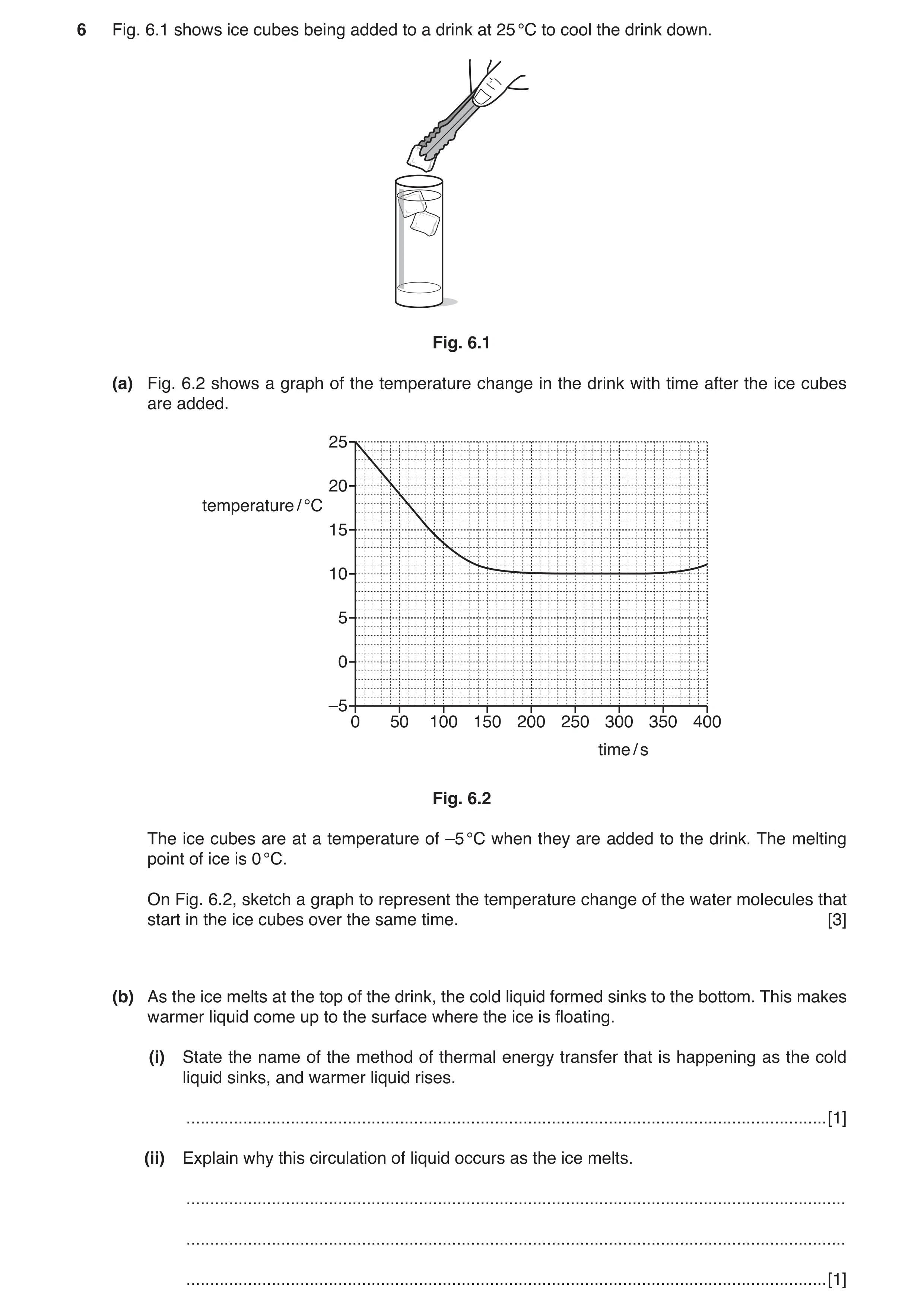
Q2 · Ice cubes being added to a drink at 25 °C to cool the drink down 0653/43 May/June 2018
6 Fig. 6.1 shows ice cubes being added to a drink at 25 °C to cool the drink down. Fig. 6.1 (a) Fig. 6.2 shows a graph of the temperature change in the drink with time after the ice cubes are added. 25 20 temperature / °C 15 10 5 0 –5 0 50 100 150 200 250 300 350 400 time / s Fig. 6.2 The ice cubes are at a temperature of –5 °C when they are added to the drink. The melting point of ice is 0 °C. On Fig. 6.2, sketch a graph to represent the temperature change of the water molecules that start in the ice cubes over the same time. [3] (b) As the ice melts at the top of the drink, the cold liquid formed sinks to the bottom. This makes warmer liquid come up to the surface where the ice is floating. (i) State the name of the method of thermal energy transfer that is happening as the cold liquid sinks, and warmer liquid rises. … [1] (ii) Explain why this circulation of liquid occurs as the ice melts. … … … [1]
5 marks
Mark scheme: 6(a) line starts from –5° ; line rises to meet cooling line ; curves meet at or after 200 seconds ; line matches cooling line and follows it as temp rises again at end ; Max 3 6(b)(i) convection ; 1 6(b)(ii) cold water denser than warm ( so sinks to bottom, displacing warmer water back to top) ; 1
This question in 0653/43 May/June 2018
Q3 · A liquid-in-glass thermometer at room temperature 0653/41 Oct/Nov 2018
6 Fig. 6.1 shows a liquid-in-glass thermometer at room temperature. –10 0 10 20 30 40 50 60 70 80 90 100 110 °C Fig. 6.1 (a) State the property of a liquid that is used in a thermometer when measuring temperature. … [1] (b) Table 6.1 gives a list of the melting points and boiling points of five substances that are used in liquid-in-glass thermometers. Table 6.1 melting point boiling point substance / °C / °C ethanol –114 78 gallium 30 2403 glycol –12 198 mercury –39 357 water 0 100 (i) Ammonia has a melting point of –78 °C and a boiling point of –33 °C. Explain why ethanol would be the most suitable for use in a liquid-in-glass thermometer to measure both the melting point and the boiling point of ammonia. … … [1] (ii) Explain why a thermometer that uses liquid gallium has to be kept in a warm container, well above room temperature. … … … [2] (c) An infra-red thermometer measures temperature in a different way. The wavelength of the infra-red radiation emitted by a hot body changes with temperature. An infra-red thermometer measures the wavelengths of infra-red radiation emitted and converts these to temperature readings. (i) The wavelength of the infra-red radiation emitted decreases as the temperature of the hot body increases. Predict what happens to the frequency of the infra-red radiation as the temperature of the hot body increases. Explain your answer. prediction … explanation … … [2] (ii) In the infra-red thermometer, the radiation is focused onto the detector by a thin converging lens. On Fig. 6.2 complete the ray diagram to show how this happens. infra-red lens radiation infra-red detector Fig. 6.2 [1]
7 marks
Mark scheme: 6(a) (thermal) expansion / expansion on heating / owtte ; 1 6(b)(i) only ethanol is a liquid at both these temperatures / both fixed points of ammonia / all others are solid at mpt of ammonia / at 78 °C ; 1 6(b)(ii) typical room temperature / 21 °C is below 30 °C / m.pt. of gallium ; gallium would be a solid at that temperature / (kept above 30 ) so it does not freeze / owtte ; 2 6(c)(i) (frequency will) increase ; use of f = v / λ to explain increase / as λ decreases frequency increases ; 2 6(c)(ii) all three rays extended to meet at the same point at the detector ; (arrows on refracted rays not essential) 1
This question in 0653/41 Oct/Nov 2018
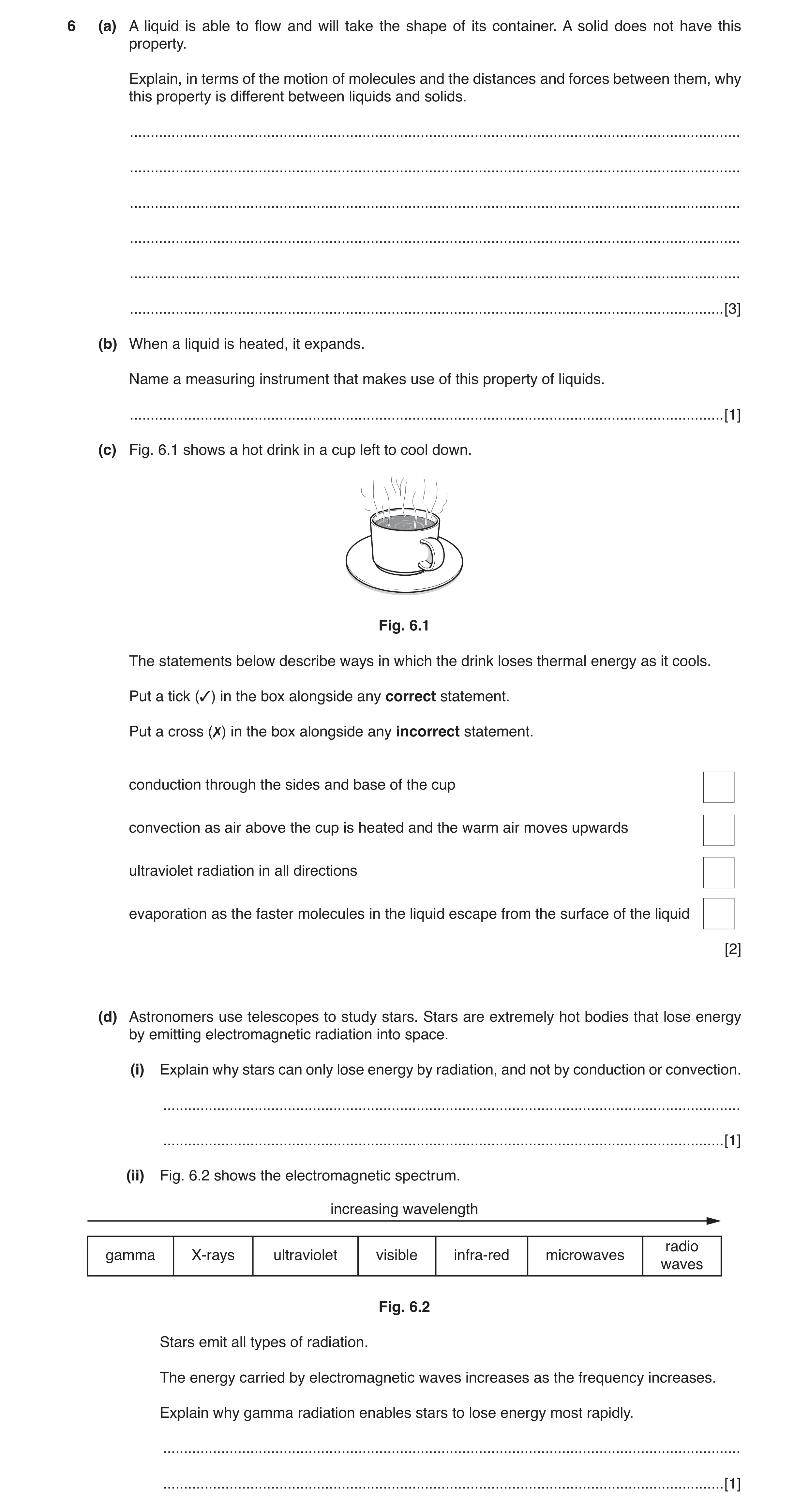
Q4 · A liquid is able to flow and will take the shape of its container 0653/42 Oct/Nov 2018
6 (a) A liquid is able to flow and will take the shape of its container. A solid does not have this property. Explain, in terms of the motion of molecules and the distances and forces between them, why this property is different between liquids and solids. … … … … … … [3] (b) When a liquid is heated, it expands. Name a measuring instrument that makes use of this property of liquids. … [1] (c) Fig. 6.1 shows a hot drink in a cup left to cool down. Fig. 6.1 The statements below describe ways in which the drink loses thermal energy as it cools. Put a tick (3) in the box alongside any correct statement. Put a cross (7) in the box alongside any incorrect statement. conduction through the sides and base of the cup convection as air above the cup is heated and the warm air moves upwards ultraviolet radiation in all directions evaporation as the faster molecules in the liquid escape from the surface of the liquid [2] (d) Astronomers use telescopes to study stars. Stars are extremely hot bodies that lose energy by emitting electromagnetic radiation into space. (i) Explain why stars can only lose energy by radiation, and not by conduction or convection. … … [1] (ii) Fig. 6.2 shows the electromagnetic spectrum. increasing wavelength radio gamma X-rays ultraviolet visible infra-red microwaves waves Fig. 6.2 Stars emit all types of radiation. The energy carried by electromagnetic waves increases as the frequency increases. Explain why gamma radiation enables stars to lose energy most rapidly. … … [1]
8 marks
Mark scheme: 6(a) In liquids: in liquids molecules further apart / not tightly packed / in solids molecules are tightly packed ; in liquids attractive forces are low / in solids attractive forces are high ; in liquids molecules are able to move around / slide past each other / in solids molecules (only) vibrate (around a fixed point) ; 3 6(b) thermometer ; 1 6(c) ticks in first, second, and fourth box, cross in 3rd box ; 2 6(d)(i) Conduction and convection require a medium / can’t travel though a vacuum / radiation can travel through a vacuum ; 1 6(d)(ii) highest frequency ; 1
This question in 0653/42 Oct/Nov 2018
Q5 · The density of water, a liquid, is very different from the density of steam, a gas 0653/43 Oct/Nov 2018
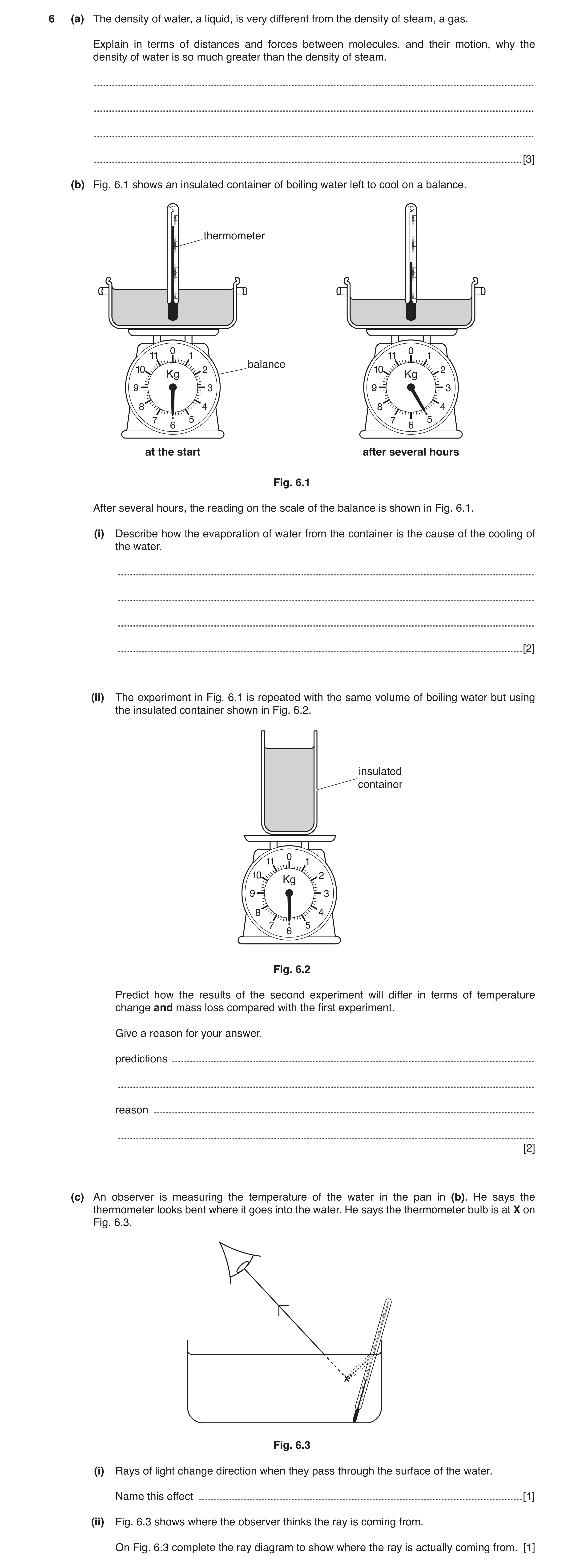
6 (a) The density of water, a liquid, is very different from the density of steam, a gas. Explain in terms of distances and forces between molecules, and their motion, why the density of water is so much greater than the density of steam. … … … … [3] (b) Fig. 6.1 shows an insulated container of boiling water left to cool on a balance. °C °C thermometer 0 0 11 1 11 1 balance 10 2 10 2 Kg Kg 9 3 9 3 8 4 8 4 7 5 7 5 6 6 at the start after several hours Fig. 6.1 After several hours, the reading on the scale of the balance is shown in Fig. 6.1. (i) Describe how the evaporation of water from the container is the cause of the cooling of the water. … … … … [2] (ii) The experiment in Fig. 6.1 is repeated with the same volume of boiling water but using the insulated container shown in Fig. 6.2. insulated container 0 11 1 10 2 Kg 9 3 8 4 7 5 6 Fig. 6.2 Predict how the results of the second experiment will differ in terms of temperature change and mass loss compared with the first experiment. Give a reason for your answer. predictions … … reason … … [2] (c) An observer is measuring the temperature of the water in the pan in (b). He says the thermometer looks bent where it goes into the water. He says the thermometer bulb is at X on Fig. 6.3. 5 Fig. 6.3 (i) Rays of light change direction when they pass through the surface of the water. Name this effect … [1] (ii) Fig. 6.3 shows where the observer thinks the ray is coming from. On Fig. 6.3 complete the ray diagram to show where the ray is actually coming from. [1]
9 marks
Mark scheme: 6(a) any three of distances between molecules greater / molecules further apart in gases molecules are closer together in liquids ; forces between molecules of gases are weaker / forces between molecules of a liquid are stronger ; molecules can move freely in gas / molecules rolling / sliding over each other in liquids ; gas volume greater for same mass / liquid volume is smaller for the same mass ; Max 3 3 6(b)(i) faster / more energetic molecules escape (from surface) ; average speed of remaining molecules less / water has less energy (leading to cooling) ; 2 Question Answer Marks 6(b)(ii) less / slower cooling and less / slower mass loss ; less surface area for evaporation ; 2 6(c)(i) refraction ; 1 6(c)(ii) ray from thermometer bulb to meet ray to eye at water surface; 1
This question in 0653/43 Oct/Nov 2018
Q6 · The bathroom in a house has electric heating under the floor 0653/42 Feb/March 2019
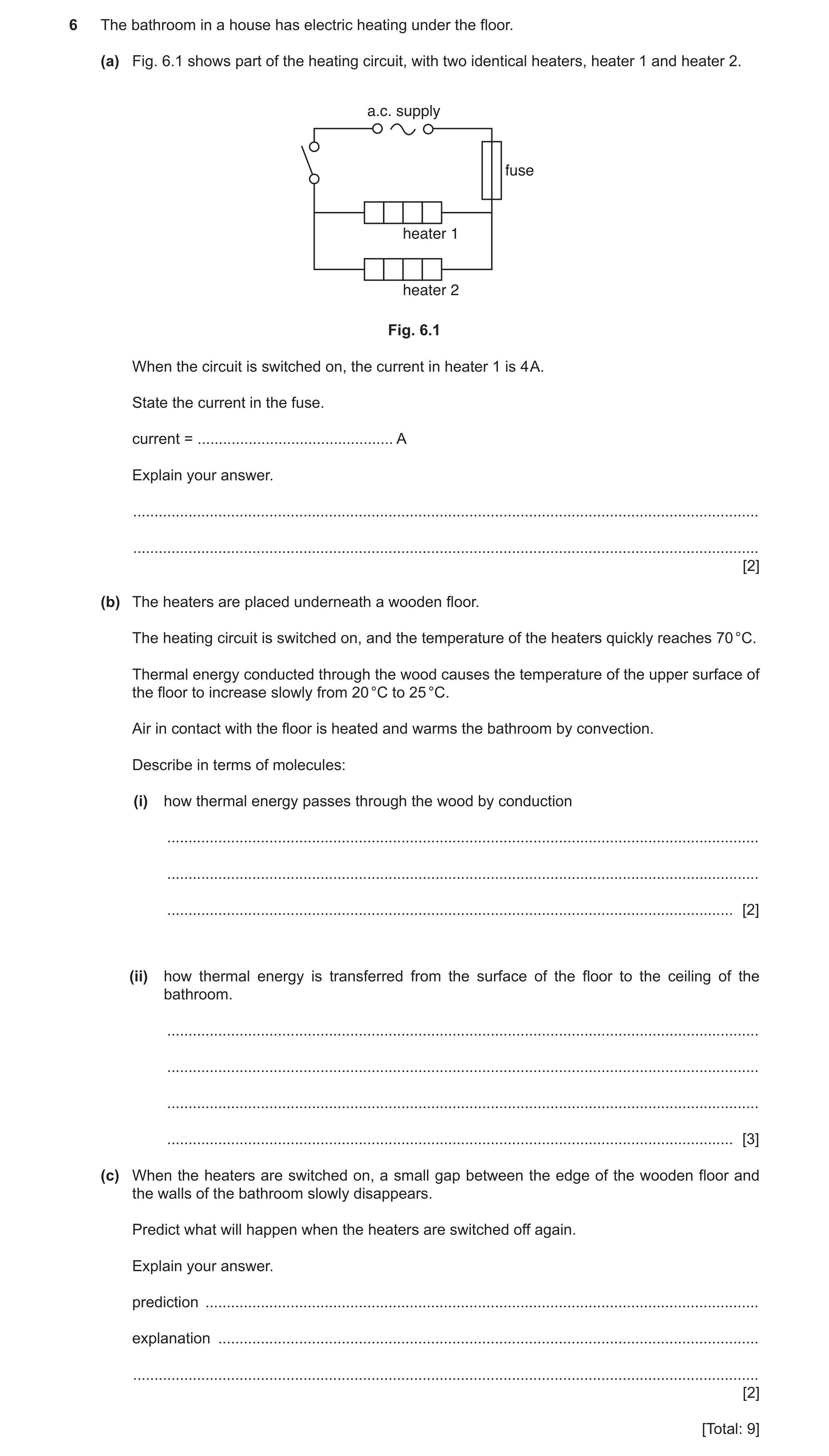
6 The bathroom in a house has electric heating under the floor. (a) Fig. 6.1 shows part of the heating circuit, with two identical heaters, heater 1 and heater 2. a.c. supply fuse heater 1 heater 2 Fig. 6.1 When the circuit is switched on, the current in heater 1 is 4 A. State the current in the fuse. current = … A Explain your answer. … … [2] (b) The heaters are placed underneath a wooden floor. The heating circuit is switched on, and the temperature of the heaters quickly reaches 70 °C. Thermal energy conducted through the wood causes the temperature of the upper surface of the floor to increase slowly from 20 °C to 25 °C. Air in contact with the floor is heated and warms the bathroom by convection. Describe in terms of molecules: (i) how thermal energy passes through the wood by conduction … … … [2] (ii) how thermal energy is transferred from the surface of the floor to the ceiling of the bathroom. … … … … [3] (c) When the heaters are switched on, a small gap between the edge of the wooden floor and the walls of the bathroom slowly disappears. Predict what will happen when the heaters are switched off again. Explain your answer. prediction … explanation … … [2] [Total: 9]
9 marks
Mark scheme: 6(a) 8 (A) ; 4 A in each identical heater in parallel adds to 8 A ; 2 6(b)(i) (warmer) molecules vibrate faster / gain kinetic energy ; the idea that energy is passed from molecule to molecule ; 2 6(b)(ii) molecules in air gain (kinetic) energy (from collisions with wood) ; (faster) molecules transfer energy to more molecules by collision ; (faster) molecules move further apart ; so (warmer) air has lower density ; max 3 6(c) gap opens again / re-appears ; solids contract on cooling / as temperature falls ; 2
This question in 0653/42 Feb/March 2019
Q7 · The heating element inside an electric kettle 0653/41 May/June 2019
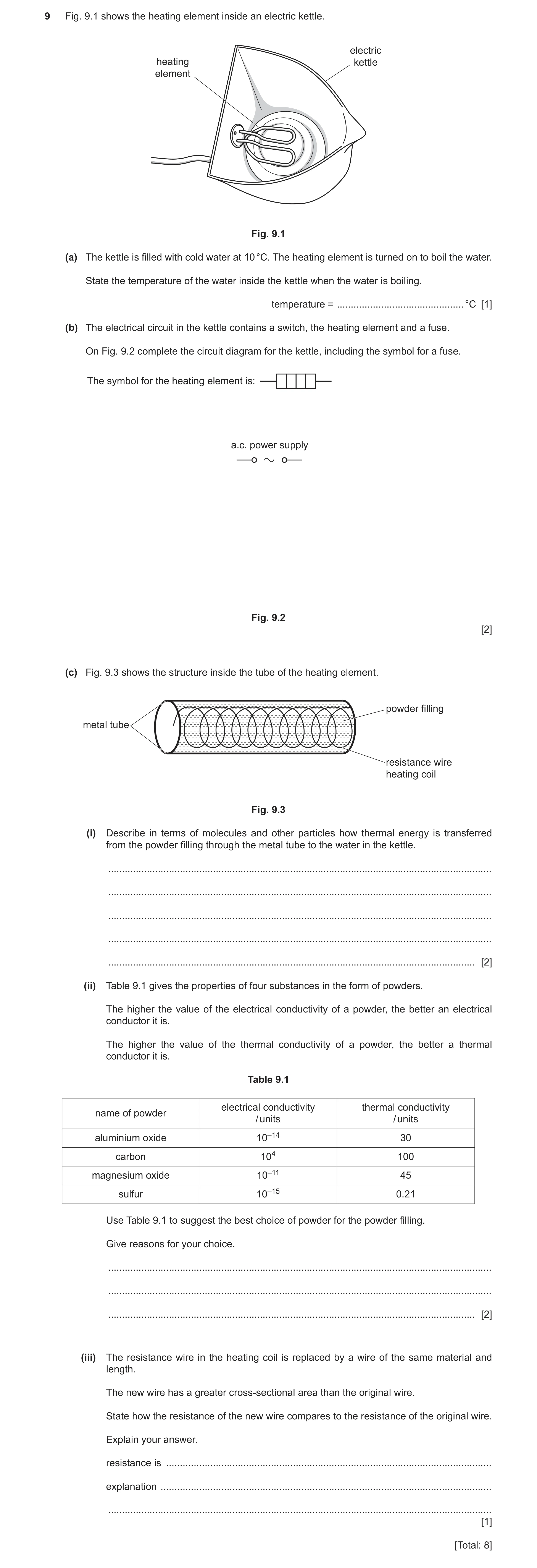
9 Fig. 9.1 shows the heating element inside an electric kettle. electric heating kettle element Fig. 9.1 (a) The kettle is filled with cold water at 10 °C. The heating element is turned on to boil the water. State the temperature of the water inside the kettle when the water is boiling. temperature = … °C [1] (b) The electrical circuit in the kettle contains a switch, the heating element and a fuse. On Fig. 9.2 complete the circuit diagram for the kettle, including the symbol for a fuse. The symbol for the heating element is: a.c. power supply Fig. 9.2 [2] (c) Fig. 9.3 shows the structure inside the tube of the heating element. powder filling metal tube resistance wire heating coil Fig. 9.3 (i) Describe in terms of molecules and other particles how thermal energy is transferred from the powder filling through the metal tube to the water in the kettle. … … … … … [2] (ii) Table 9.1 gives the properties of four substances in the form of powders. The higher the value of the electrical conductivity of a powder, the better an electrical conductor it is. The higher the value of the thermal conductivity of a powder, the better a thermal conductor it is. Table 9.1 electrical conductivity thermal conductivity name of powder / units / units aluminium oxide 10–14 30 carbon 104 100 magnesium oxide 10–11 45 sulfur 10–15 0.21 Use Table 9.1 to suggest the best choice of powder for the powder filling. Give reasons for your choice. … … … [2] (iii) The resistance wire in the heating coil is replaced by a wire of the same material and length. The new wire has a greater cross-sectional area than the original wire. State how the resistance of the new wire compares to the resistance of the original wire. Explain your answer. resistance is … explanation … … [1] [Total: 8]
8 marks
Mark scheme: 9(a) 100 °C ; 1 9(b) fuse symbol ; switch symbol + completed circuit ; 2 9(c)(i) transfer from powder to metal tube by molecular vibrations ; transfer through metal by mobile electrons ; transfer of molecular vibrations from metal tube to vibration / movement of water molecules ; reference to the transfer of energy through the water for example by particle collisions / or by convection ; max 2 Question Answer Marks 9(c)(ii) magnesium oxide or aluminium oxide ; the idea that these materials are poor electrical conductors and good thermal conductors / owtte ; 2 9(c)(iii) (less) resistance inversely proportional (to cross-sectional area) / the greater the cross section the lower the resistance ; 1
This question in 0653/41 May/June 2019
Q8 · An extractor fan in the wall of a bathroom 0653/43 Oct/Nov 2020
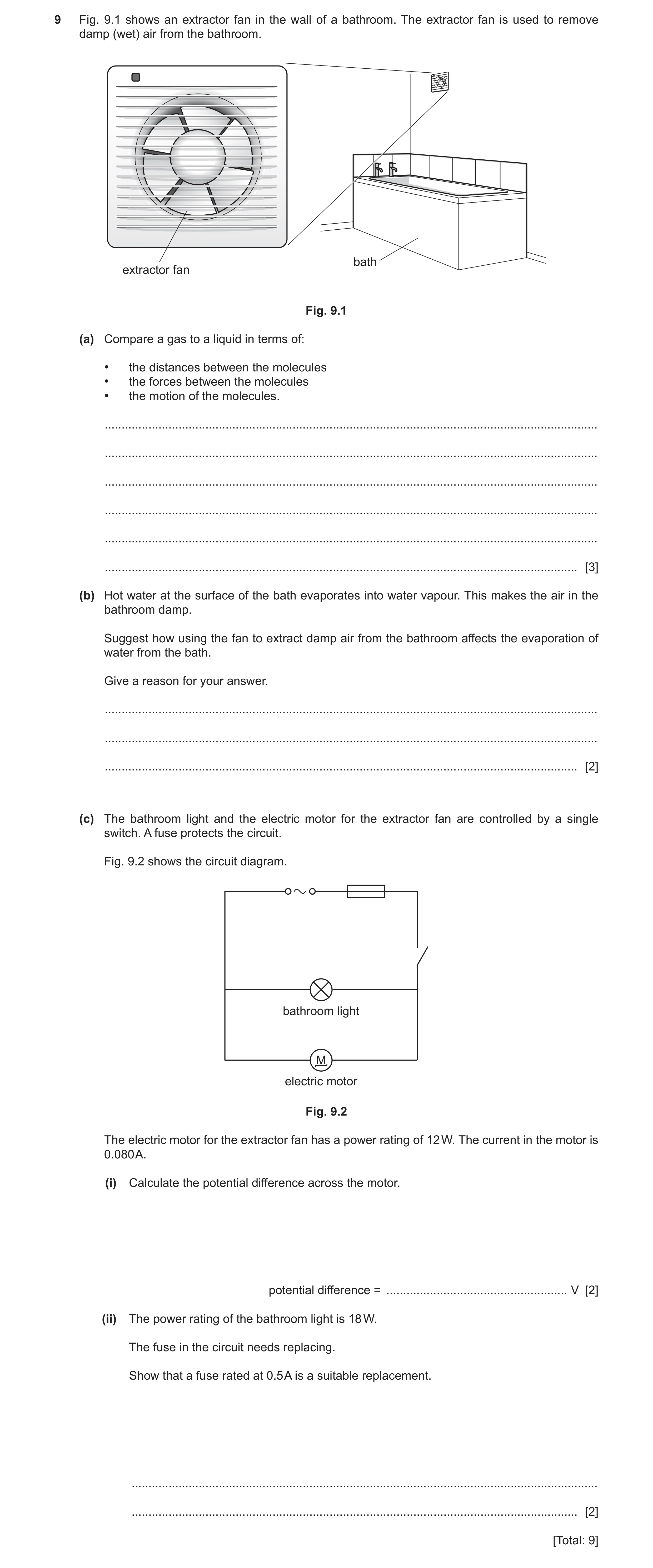
9 Fig. 9.1 shows an extractor fan in the wall of a bathroom. The extractor fan is used to remove damp (wet) air from the bathroom. bath extractor fan Fig. 9.1 (a) Compare a gas to a liquid in terms of: • the distances between the molecules • the forces between the molecules • the motion of the molecules. … … … … … … [3] (b) Hot water at the surface of the bath evaporates into water vapour. This makes the air in the bathroom damp. Suggest how using the fan to extract damp air from the bathroom affects the evaporation of water from the bath. Give a reason for your answer. … … … [2] (c) The bathroom light and the electric motor for the extractor fan are controlled by a single switch. A fuse protects the circuit. Fig. 9.2 shows the circuit diagram. bathroom light M electric motor Fig. 9.2 The electric motor for the extractor fan has a power rating of 12 W. The current in the motor is 0.080 A. (i) Calculate the potential difference across the motor. potential difference = … V [2] (ii) The power rating of the bathroom light is 18 W. The fuse in the circuit needs replacing. Show that a fuse rated at 0.5 A is a suitable replacement. … … [2] [Total: 9]
9 marks
Mark scheme: 9(a) (gas compared to a liquid) distances between molecules are larger ; forces between molecules are smaller ; molecules are faster-moving / molecules have more KE / move more freely ; 3 9(b) increases rate of evaporation ; water (vapour) molecules taken away from surface of bath (by moving air, preventing them returning to the bath water) ; 2 9(c)(i) P = IV in any form / 12 ÷ 0.080 ; 150 (V) ; 2 9(c)(ii) (I = P ÷ V = 18 ÷ 150 =) 0.12 A ; (current in main circuit = 0.12 + 0.080 =) 0.20 A (so 0.5 A fuse gives suitable margin) ; 2
This question in 0653/43 Oct/Nov 2020
Q9 · An electric kettle used to boil water 0653/42 Oct/Nov 2021
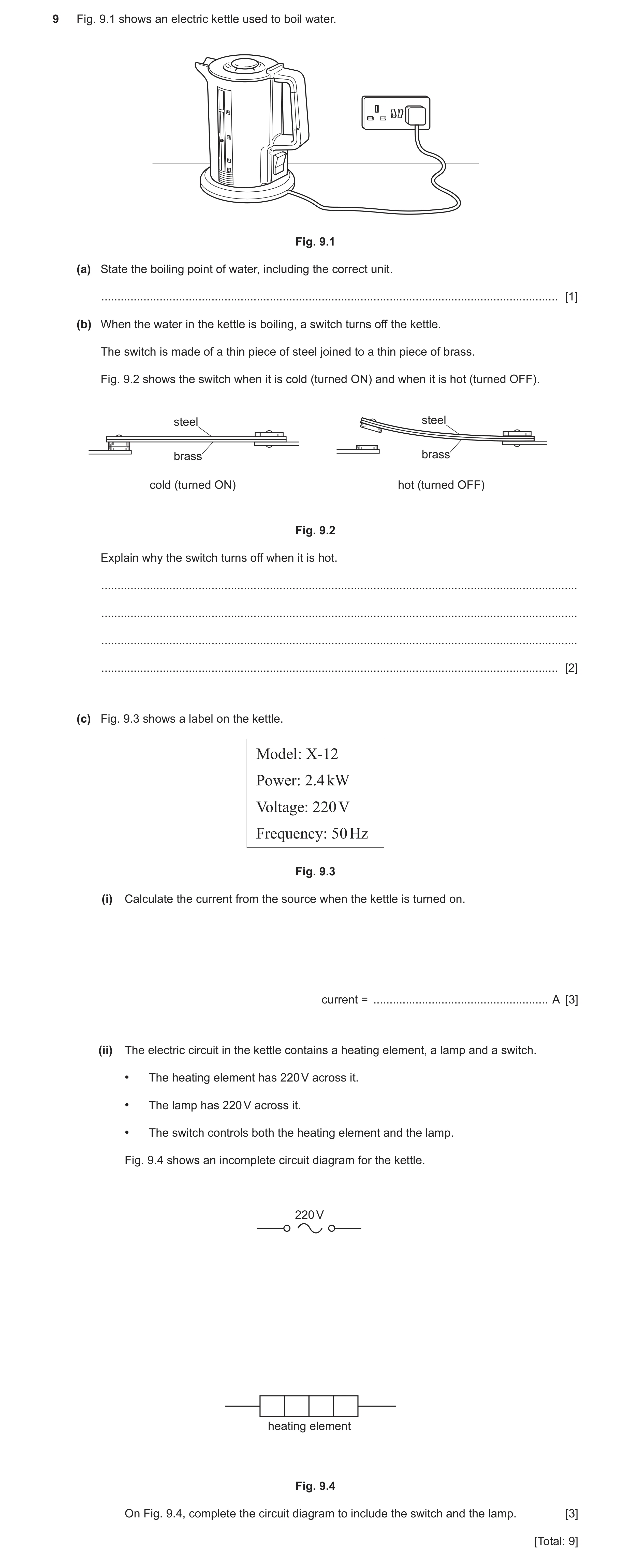
9 Fig. 9.1 shows an electric kettle used to boil water. Fig. 9.1 (a) State the boiling point of water, including the correct unit. … [1] (b) When the water in the kettle is boiling, a switch turns off the kettle. The switch is made of a thin piece of steel joined to a thin piece of brass. Fig. 9.2 shows the switch when it is cold (turned ON) and when it is hot (turned OFF). steel steel brass brass cold (turned ON) hot (turned OFF) Fig. 9.2 Explain why the switch turns off when it is hot. … … … … [2] (c) Fig. 9.3 shows a label on the kettle. Model: X-12 Power: 2.4 kW Voltage: 220 V Frequency: 50 Hz Fig. 9.3 (i) Calculate the current from the source when the kettle is turned on. current = … A [3] (ii) The electric circuit in the kettle contains a heating element, a lamp and a switch. • The heating element has 220 V across it. • The lamp has 220 V across it. • The switch controls both the heating element and the lamp. Fig. 9.4 shows an incomplete circuit diagram for the kettle. 220 V heating element Fig. 9.4 On Fig. 9.4, complete the circuit diagram to include the switch and the lamp. [3] [Total: 9]
9 marks
Mark scheme: 9(a) 100 °C ; 1 9(b) reference to (thermal) expansion (of metal) ; brass expands more (than steel causing the switch to bend / open) ; 2 9(c)(i) conversion of kW to W / 2400 ; P = IV in any form / 2400 ÷ 220 ; 11 (A) ; 3 9(c)(ii) correct symbols for lamp AND switch ; lamp in parallel with heating element ; switch controls both lamp and heater AND no short circuits, open circuits or additional components ; 3
This question in 0653/42 Oct/Nov 2021
Q10 · A liquid‑in‑glass thermometer without a scale 0653/42 May/June 2022
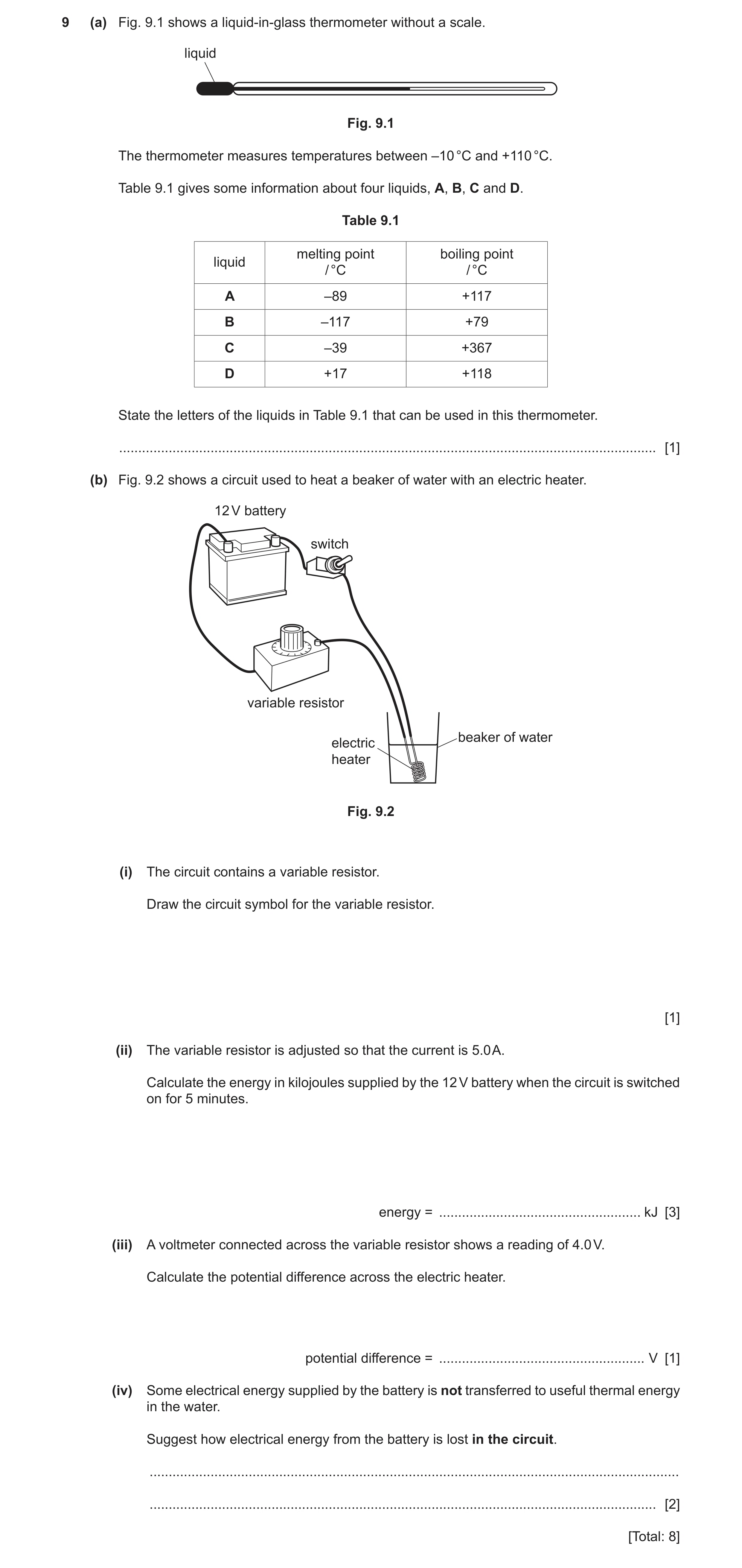
9 (a) Fig. 9.1 shows a liquid‑in‑glass thermometer without a scale. liquid Fig. 9.1 The thermometer measures temperatures between –10 °C and +110 °C. Table 9.1 gives some information about four liquids, A, B, C and D. Table 9.1 melting point boiling point liquid / °C / °C A –89 +117 B –117 +79 C –39 +367 D +17 +118 State the letters of the liquids in Table 9.1 that can be used in this thermometer. … [1] (b) Fig. 9.2 shows a circuit used to heat a beaker of water with an electric heater. 12 V battery switch variable resistor beaker of water electric heater Fig. 9.2 (i) The circuit contains a variable resistor. Draw the circuit symbol for the variable resistor. [1] (ii) The variable resistor is adjusted so that the current is 5.0 A. Calculate the energy in kilojoules supplied by the 12 V battery when the circuit is switched on for 5 minutes. energy = … kJ [3] (iii) A voltmeter connected across the variable resistor shows a reading of 4.0 V. Calculate the potential difference across the electric heater. potential difference = … V [1] (iv) Some electrical energy supplied by the battery is not transferred to useful thermal energy in the water. Suggest how electrical energy from the battery is lost in the circuit. … … [2] [Total: 8]
8 marks
Mark scheme: 9(a) A AND C ; 1 9(b)(i) ; 1 9(b)(ii) E = IVt (in any form) or 300 (s) ; 5 12 5 60 / 18 000 (J) ; 18 (kJ) ; 3 9(b)(iii) 8 (V) ; 1 9(b)(iv) (to) thermal energy ; due to resistance (in the circuit) ; 2
This question in 0653/42 May/June 2022
Q11 · A glacier is a very large area of ice that moves slowly down a slope or valley 0653/43 May/June 2022
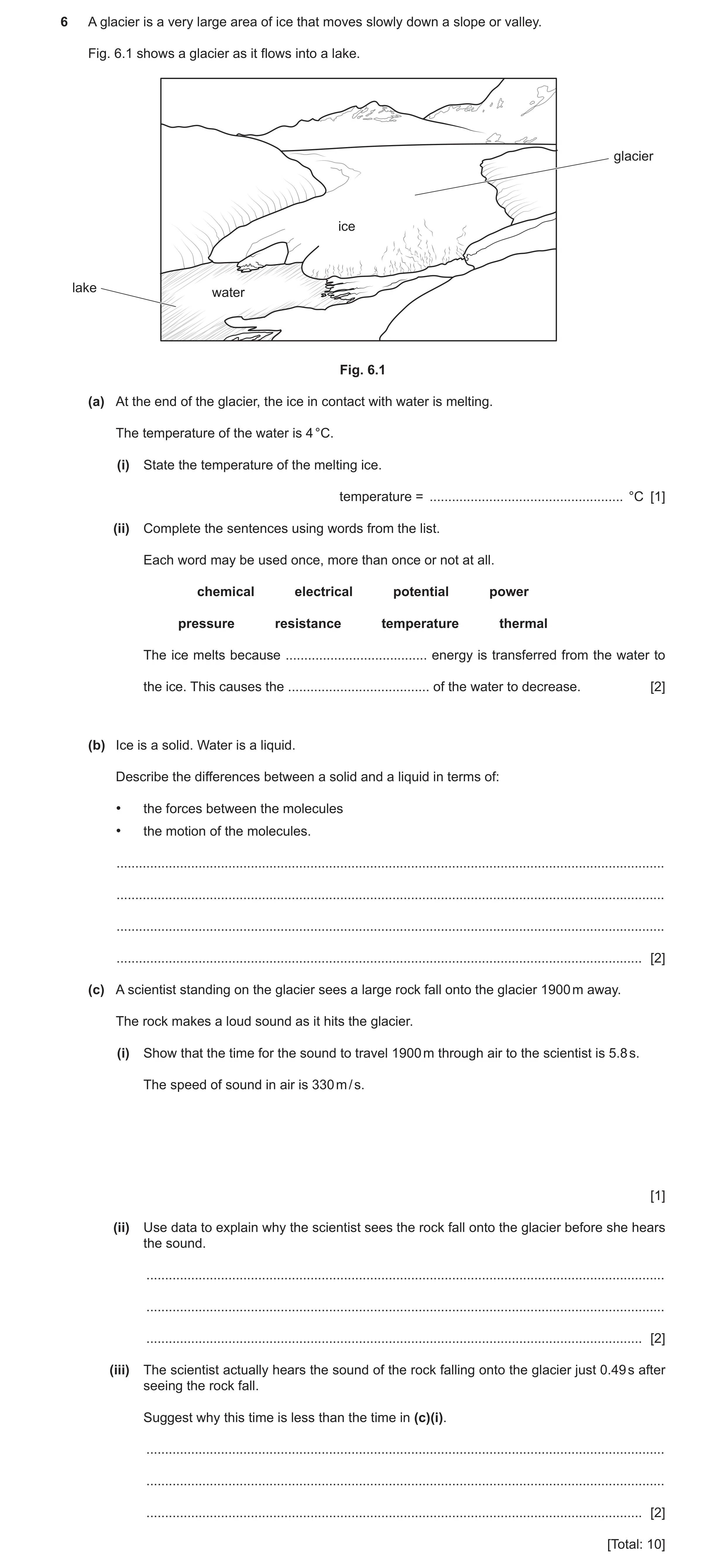
6 A glacier is a very large area of ice that moves slowly down a slope or valley. Fig. 6.1 shows a glacier as it flows into a lake. glacier ice lake water Fig. 6.1 (a) At the end of the glacier, the ice in contact with water is melting. The temperature of the water is 4 °C. (i) State the temperature of the melting ice. temperature = … °C [1] (ii) Complete the sentences using words from the list. Each word may be used once, more than once or not at all. chemical electrical potential power pressure resistance temperature thermal The ice melts because … energy is transferred from the water to the ice. This causes the … of the water to decrease. [2] (b) Ice is a solid. Water is a liquid. Describe the differences between a solid and a liquid in terms of: • the forces between the molecules • the motion of the molecules. … … … … [2] (c) A scientist standing on the glacier sees a large rock fall onto the glacier 1900 m away. The rock makes a loud sound as it hits the glacier. (i) Show that the time for the sound to travel 1900 m through air to the scientist is 5.8 s. The speed of sound in air is 330 m / s. [1] (ii) Use data to explain why the scientist sees the rock fall onto the glacier before she hears the sound. … … … [2] (iii) The scientist actually hears the sound of the rock falling onto the glacier just 0.49 s after seeing the rock fall. Suggest why this time is less than the time in (c)(i). … … … [2] [Total: 10]
10 marks
Mark scheme: 6(a)(i) 0 (° C) ; 1 6(a)(ii) thermal ; temperature ; 2 6(b) weaker forces between molecules in liquid than in solid ; molecules able to move around in liquid / not able to move around in solid ; 2 6(c)(i) (time = distance / speed =) 1900 / 330 = 5.76 s (= 5.8 s) ; 1 6(c)(ii) speed of light 3 108 m / s (greater than 330 m / s for sound) ; light travels faster than sound ORA ; 2 6(c)(iii) (takes less time) so (sound) travelled at a higher speed (than 330 m / s) ; (sound) travelled through ice ; 2
This question in 0653/43 May/June 2022
Q12 · A musical instrument called a glockenspiel 0653/41 Oct/Nov 2024
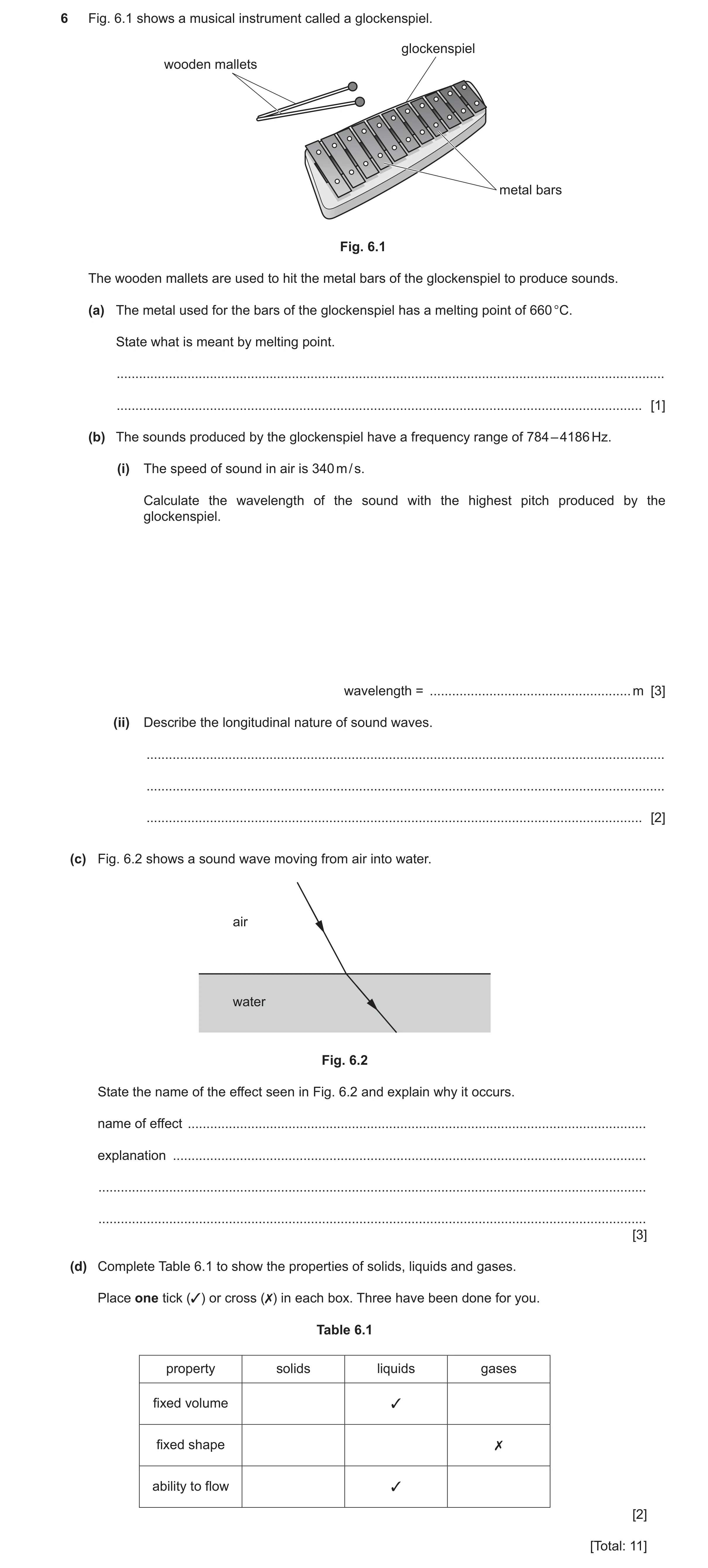
6 Fig. 6.1 shows a musical instrument called a glockenspiel. glockenspiel wooden mallets metal bars Fig. 6.1 The wooden mallets are used to hit the metal bars of the glockenspiel to produce sounds. (a) The metal used for the bars of the glockenspiel has a melting point of 660 °C. State what is meant by melting point. … … [1] (b) The sounds produced by the glockenspiel have a frequency range of 784 – 4186 Hz. (i) The speed of sound in air is 340 m / s. Calculate the wavelength of the sound with the highest pitch produced by the glockenspiel. wavelength = … m [3] (ii) Describe the longitudinal nature of sound waves. … … … [2] (c) Fig. 6.2 shows a sound wave moving from air into water. air water Fig. 6.2 State the name of the effect seen in Fig. 6.2 and explain why it occurs. name of effect … explanation … … … [3] (d) Complete Table 6.1 to show the properties of solids, liquids and gases. Place one tick (✓) or cross (✗) in each box. Three have been done for you. Table 6.1 property solids liquids gases fixed volume ✓ fixed shape ✗ ability to flow ✓ [2] [Total: 11]
11 marks
Mark scheme: 6(a) the temperature at which a substance changes state from solid to liquid / AW ; 1 6(b)(i) highest pitch = highest frequency / 4186 Hz ; 3 evidence of v = f / 340 ÷ 4186 ; 0.081(2) (m) ; 6(b)(ii) oscillations / vibrations (of the air / particles / molecules) ; 2 (motion of air / particles / molecules is) parallel to the direction of, energy transfer / travel / the wave ; 6(c) refraction ; 3 caused by change in speed / medium / density (of medium) ; sound wave moves faster in water / liquid / denser medium / ORA ; 6(d) 2 property solids liquids gases fixed volume ✓ (✓) × fixed shape ✓ × (✗) ability to flow × (✓) ✓ solids column correct ; liquids AND gases columns correct ;
This question in 0653/41 Oct/Nov 2024
 4 / 21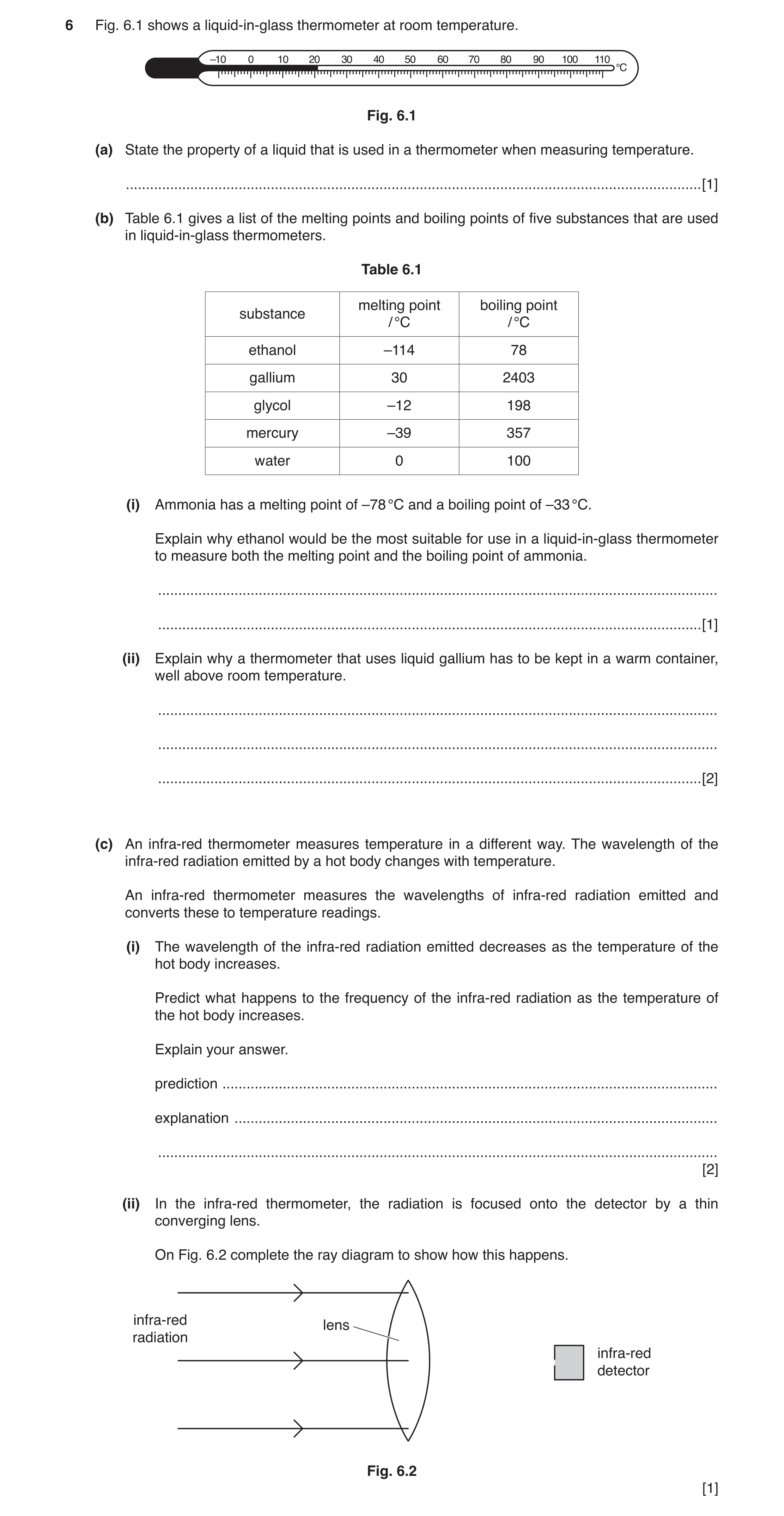
 9
9 5
5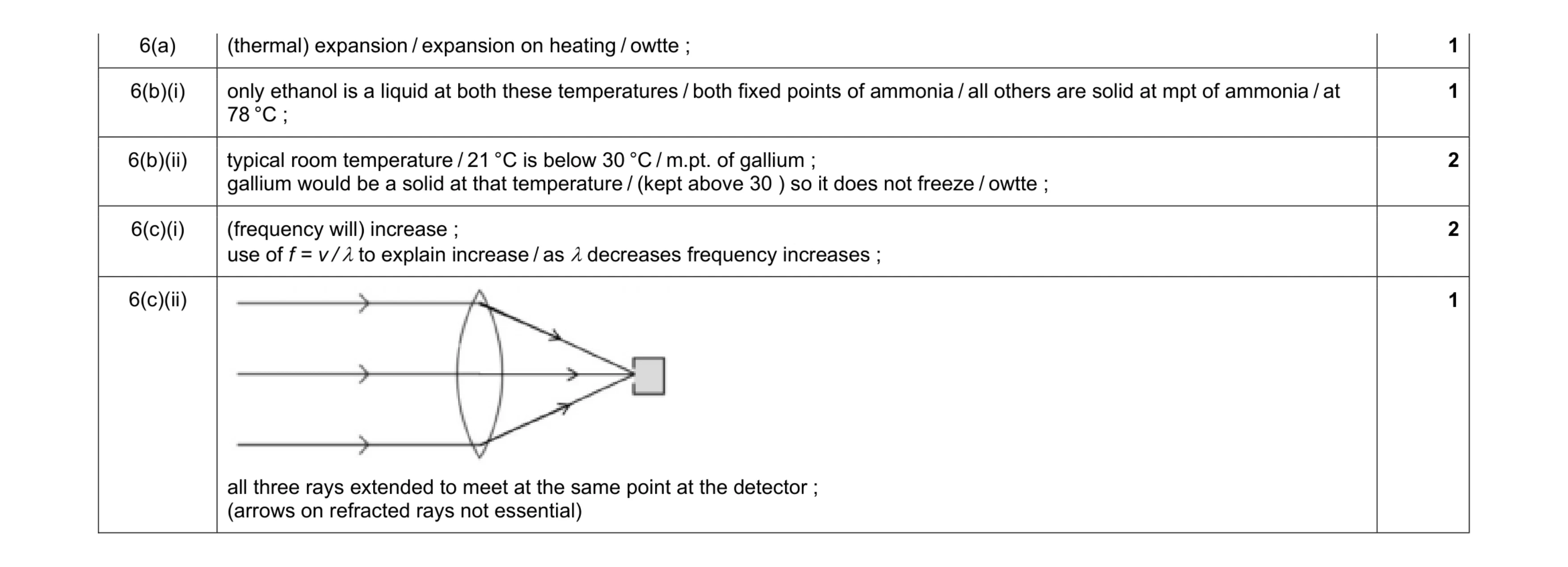 7
7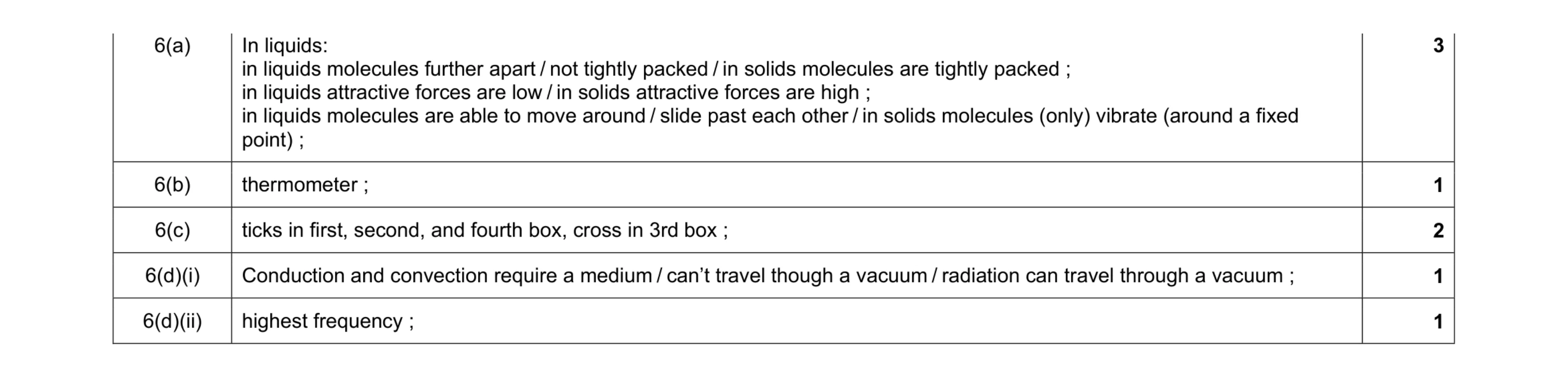 8
8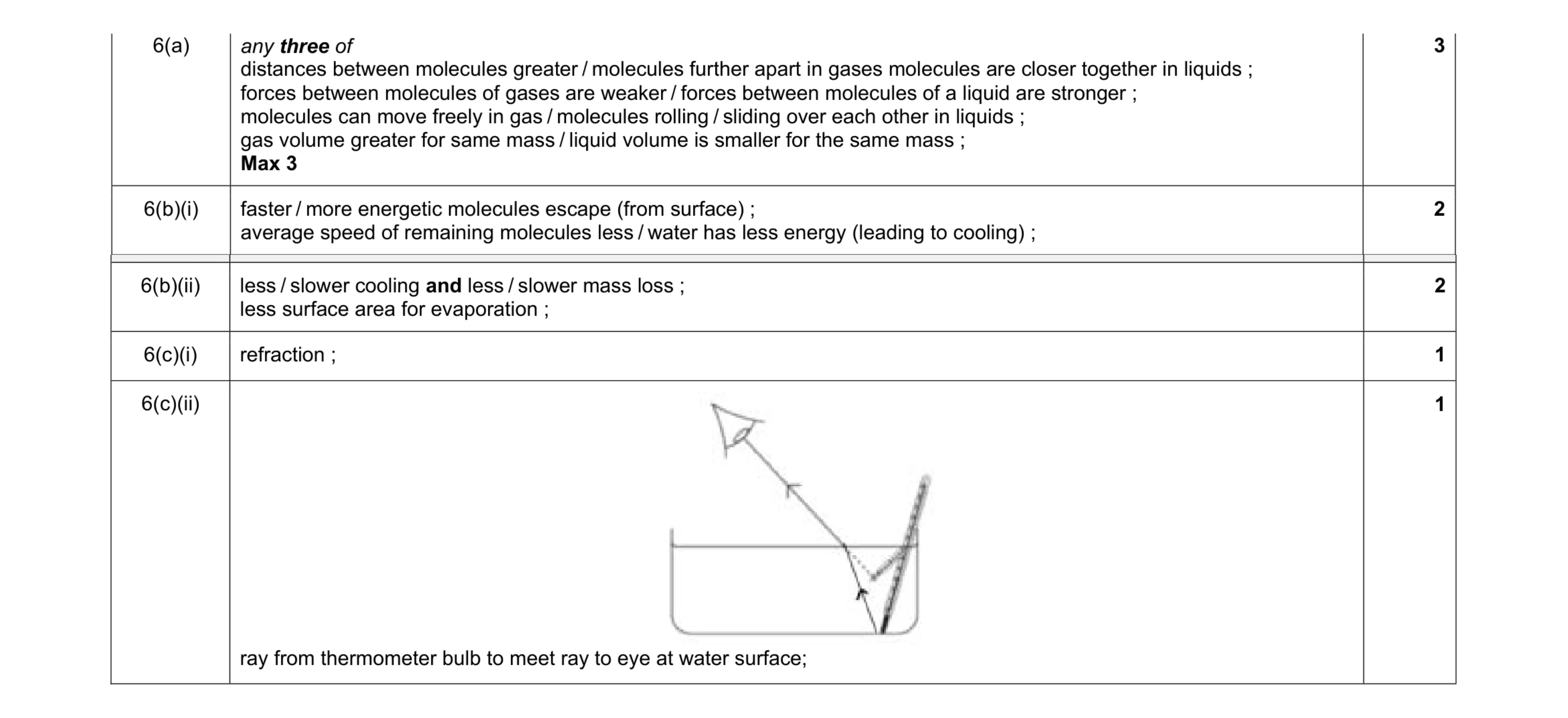 9
9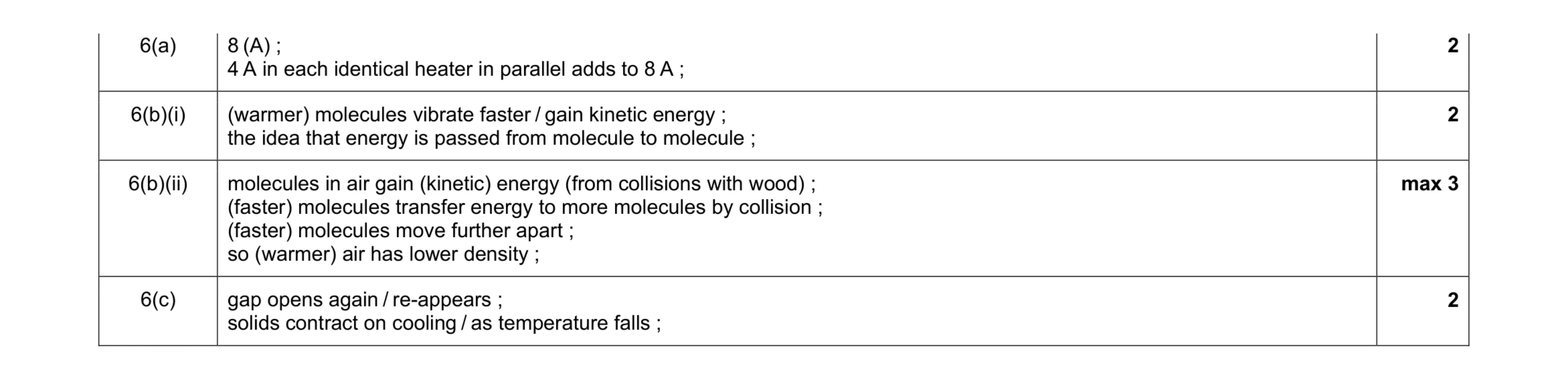 9
9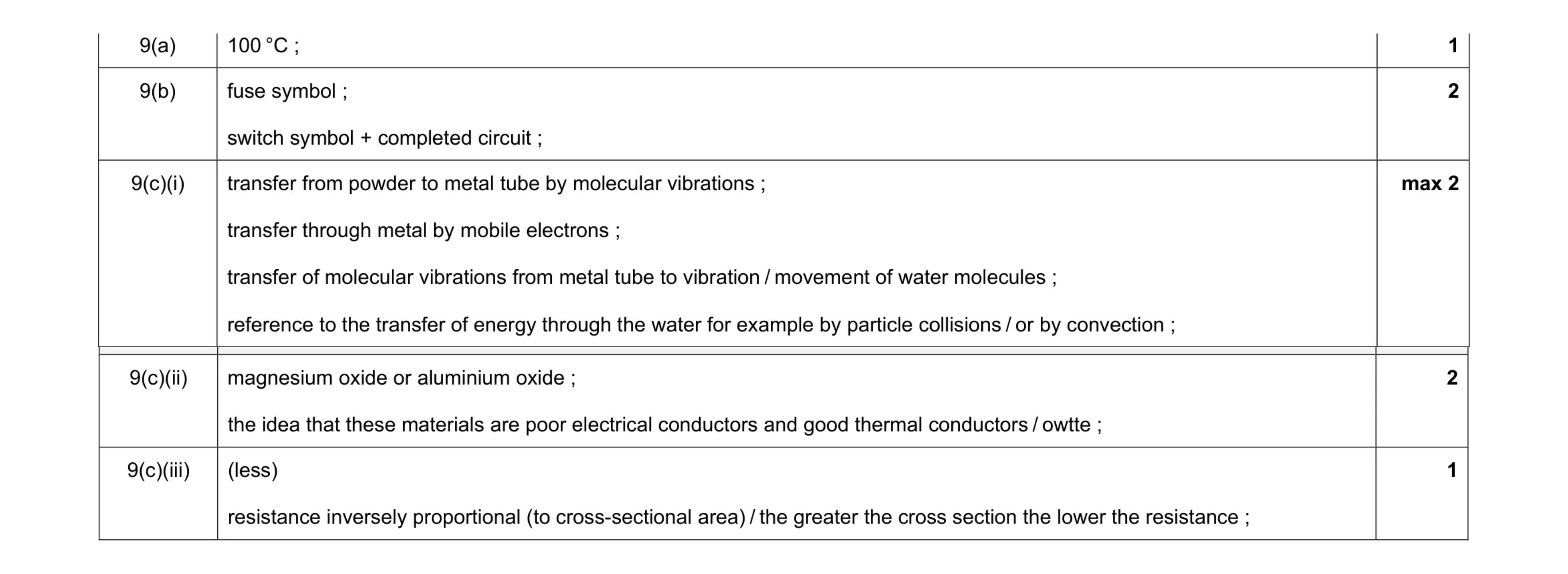 8
8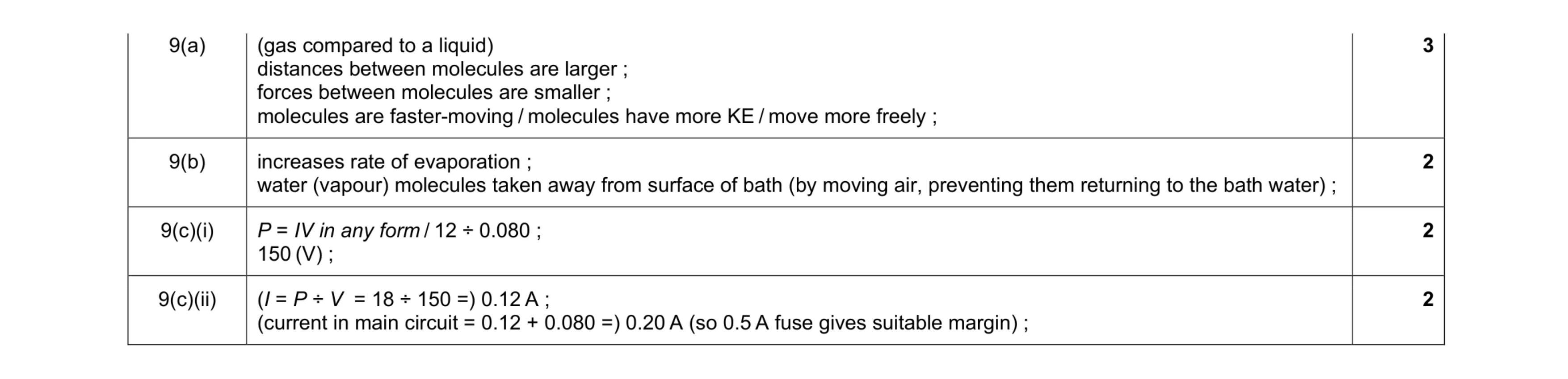 9
9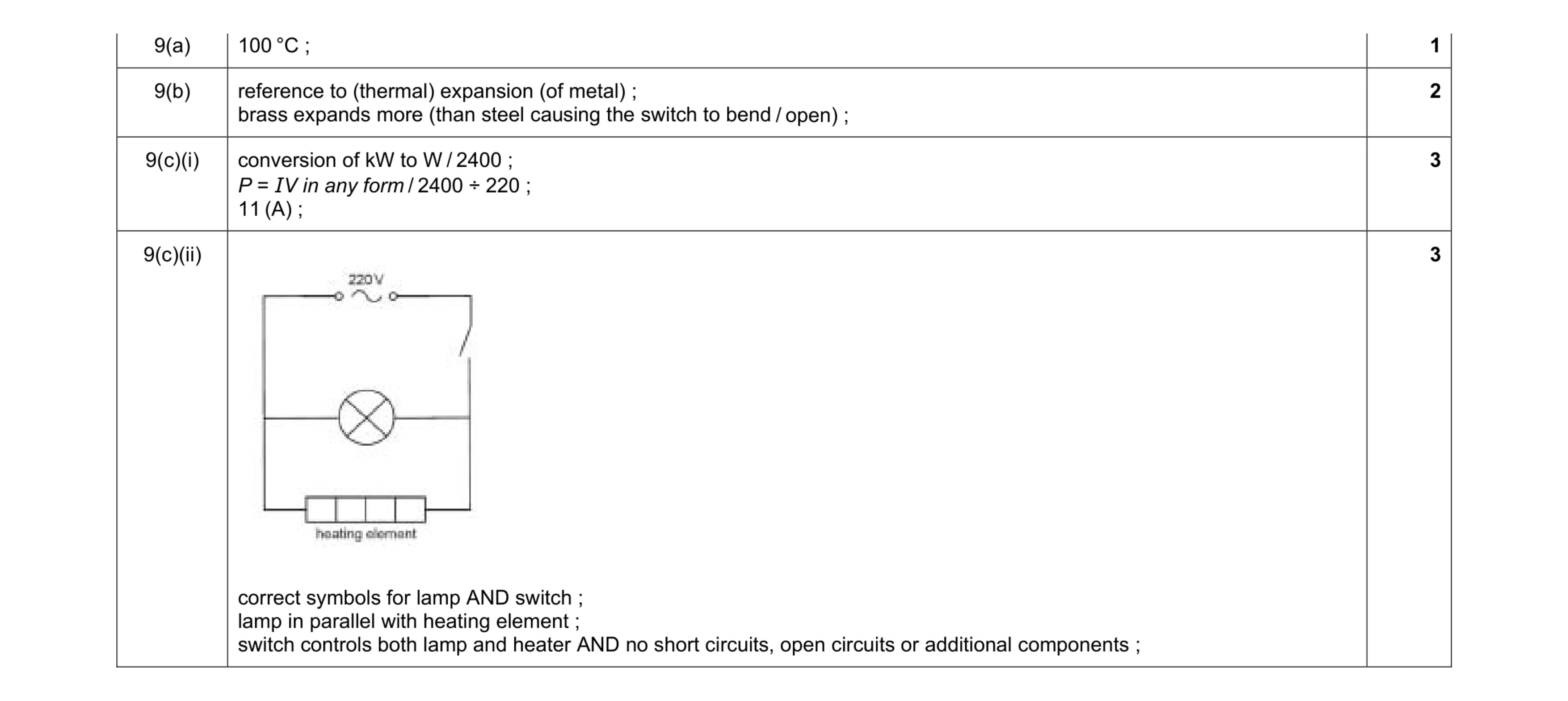 9
9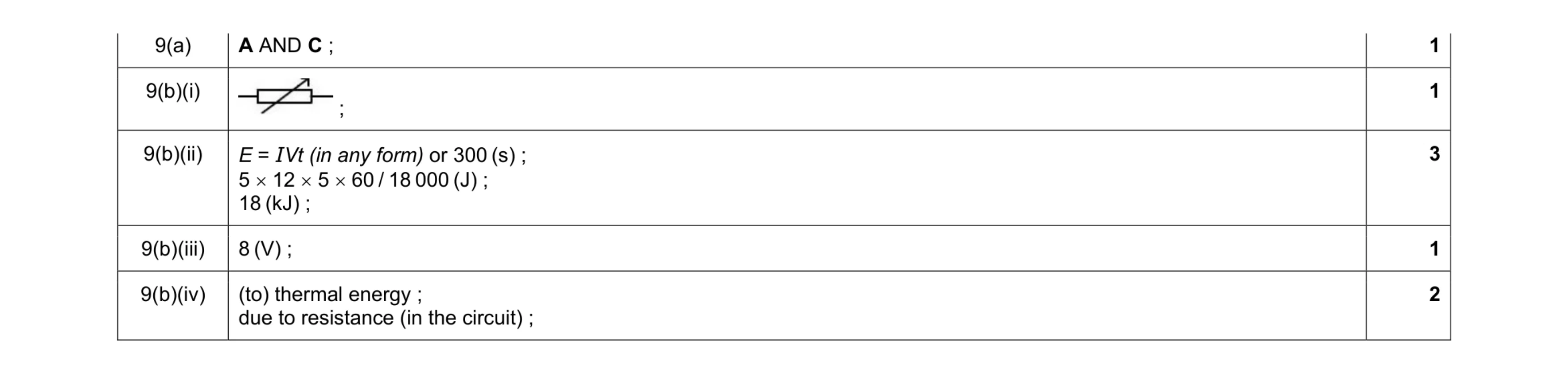 8
8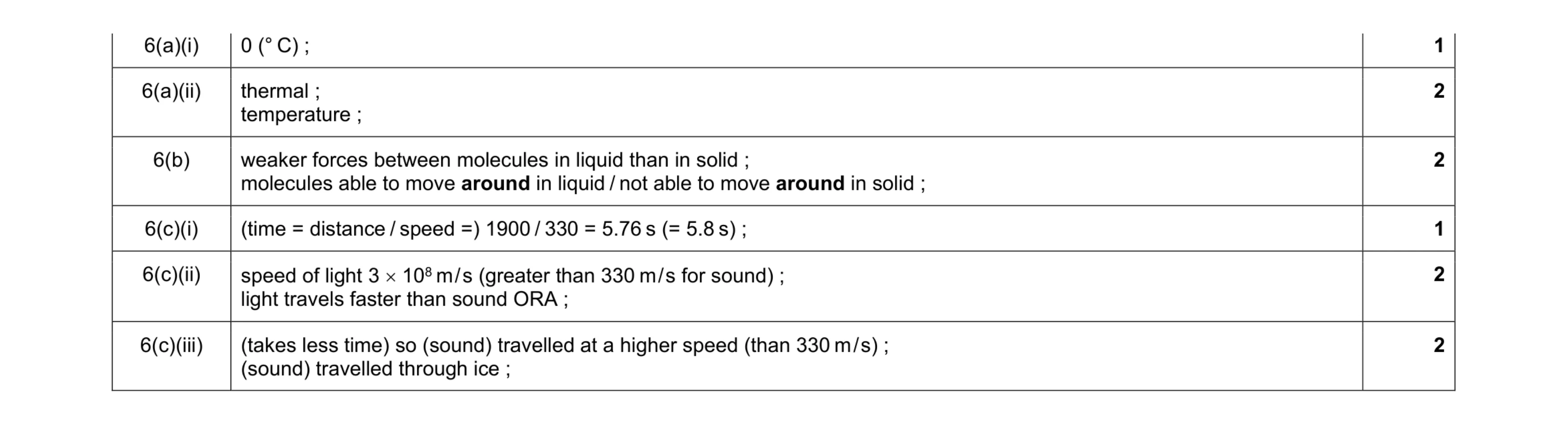 10
10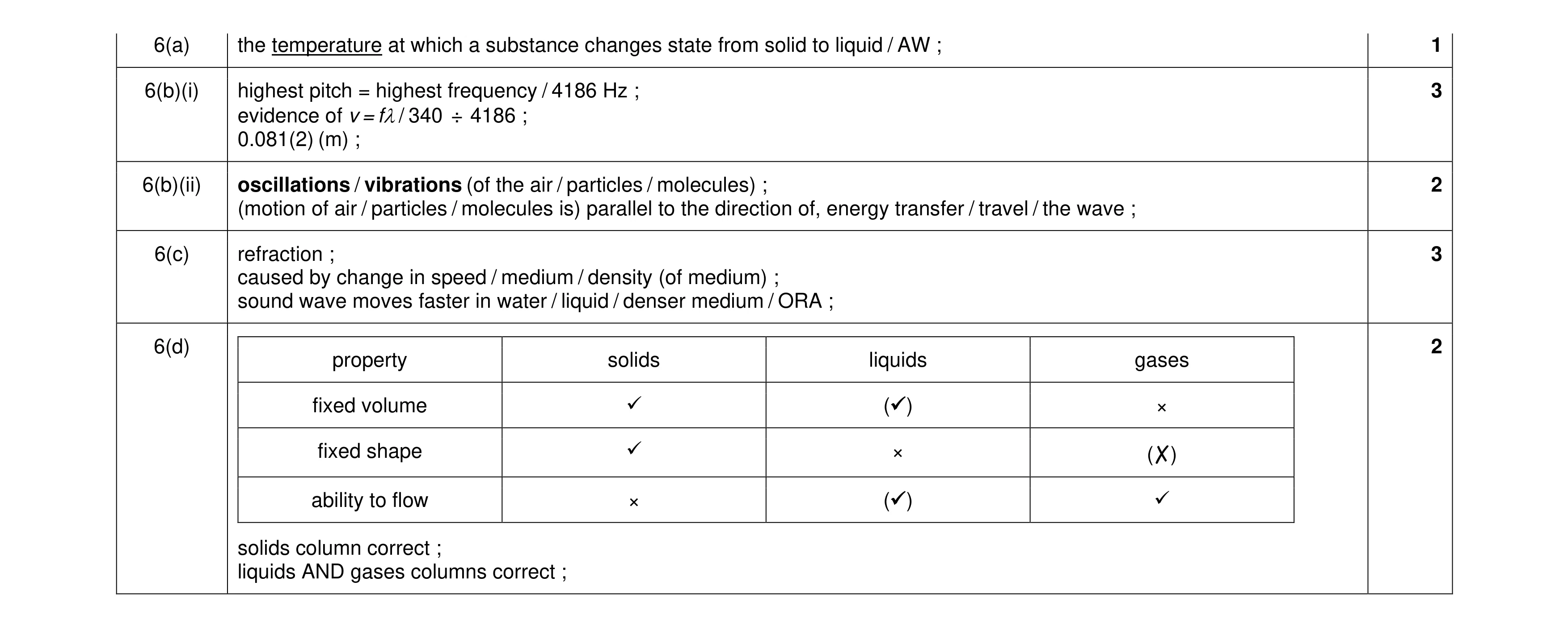 11
11