Questions as text
Question 1 0653/33 Oct/Nov 2017
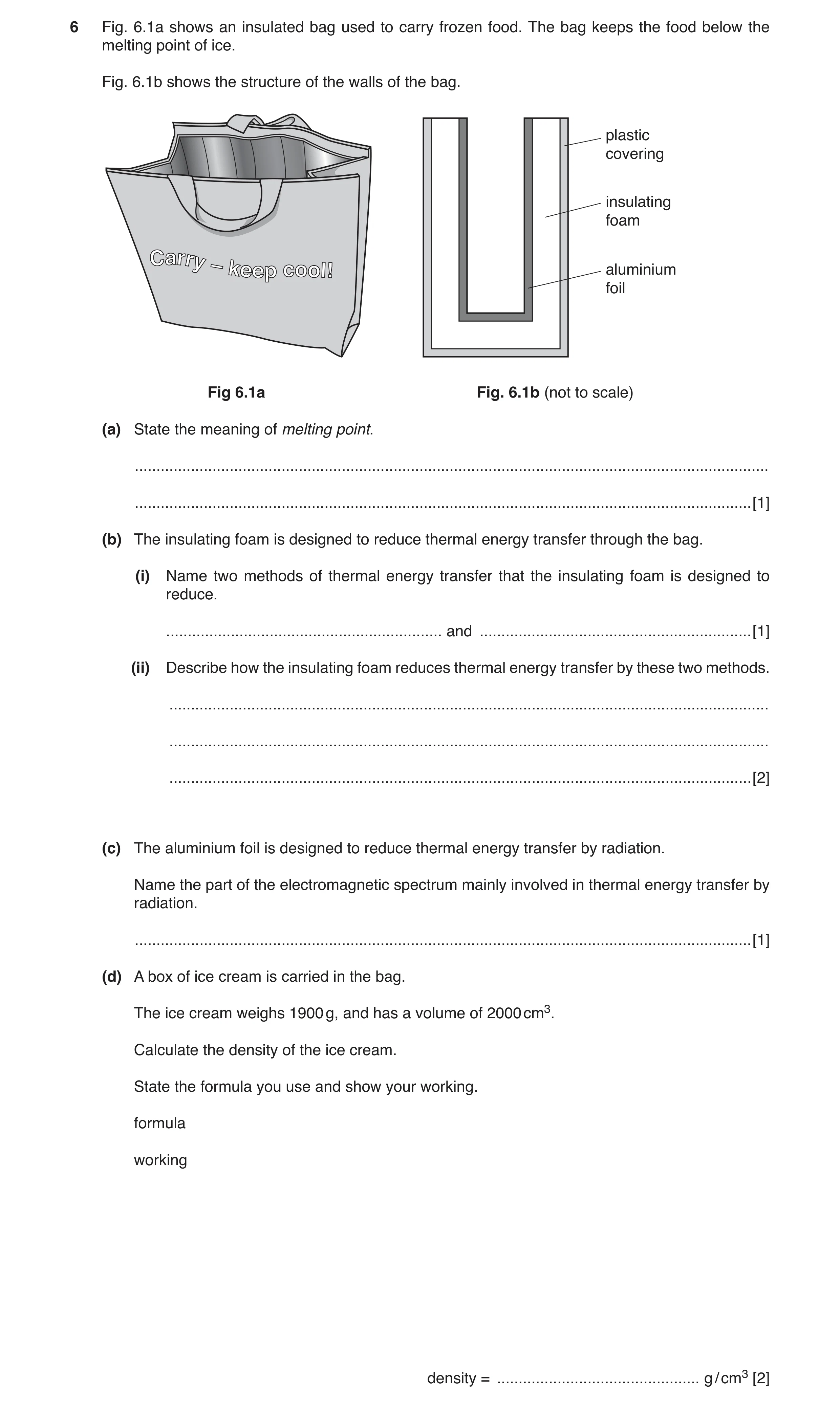
6 Fig. 6.1a shows an insulated bag used to carry frozen food. The bag keeps the food below the melting point of ice. Fig. 6.1b shows the structure of the walls of the bag. plastic covering insulating foam aluminium Carry– keep cool! foil Fig 6.1a Fig. 6.1b (not to scale) (a) State the meaning of melting point. … … [1] (b) The insulating foam is designed to reduce thermal energy transfer through the bag. (i) Name two methods of thermal energy transfer that the insulating foam is designed to reduce. … and … [1] (ii) Describe how the insulating foam reduces thermal energy transfer by these two methods. … … … [2] (c) The aluminium foil is designed to reduce thermal energy transfer by radiation. Name the part of the electromagnetic spectrum mainly involved in thermal energy transfer by radiation. … [1] (d) A box of ice cream is carried in the bag. The ice cream weighs 1900 g, and has a volume of 2000 cm3. Calculate the density of the ice cream. State the formula you use and show your working. formula working density = … g / cm3 [2]
7 marks
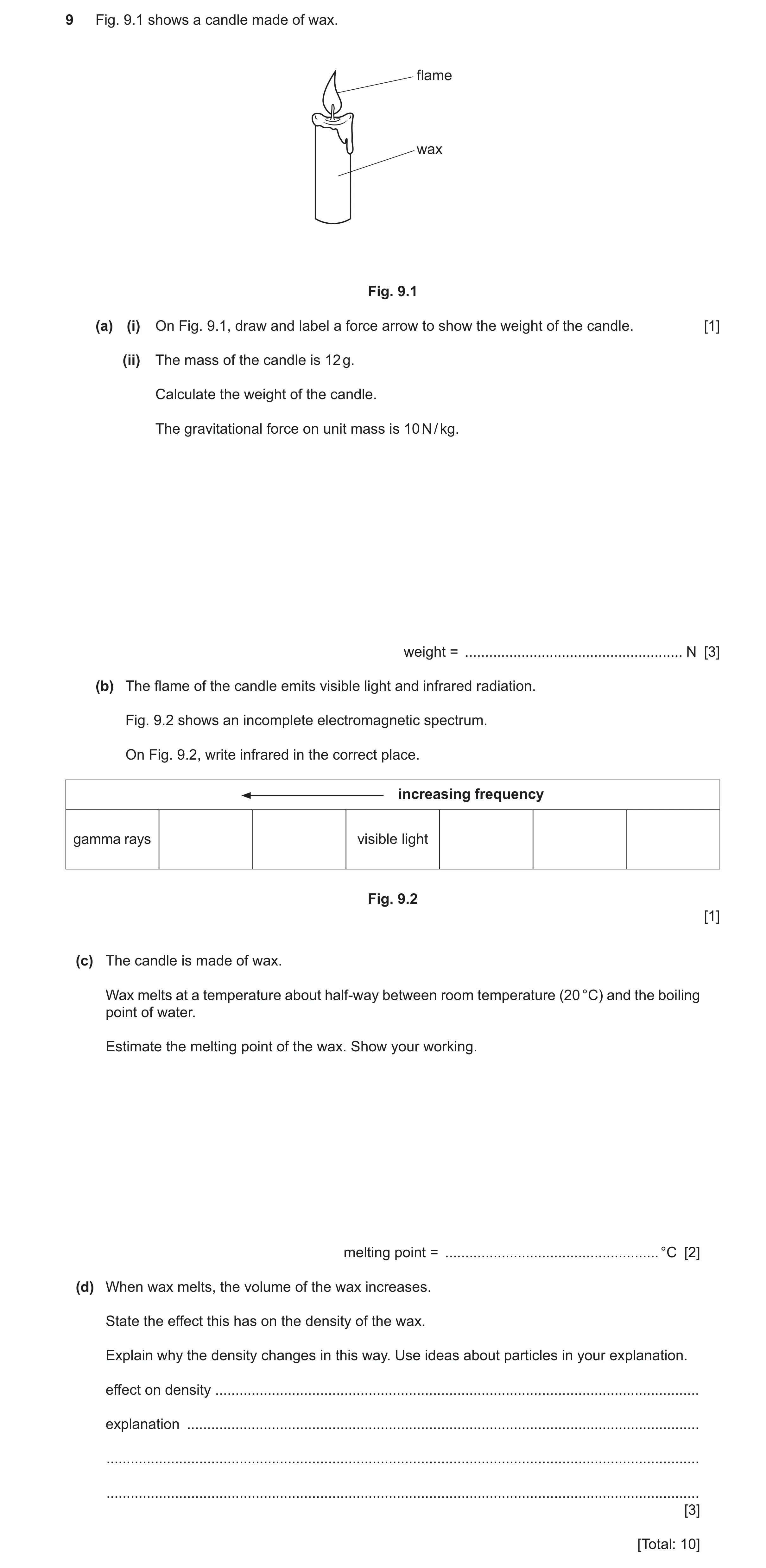
Mark scheme: 6(a) temperature at which a solid changes to a liquid owtte 1 6(b)(i) conduction and convection ; 1 6(b)(ii) (reduces convection) as no (gas) circulation (possible) owtte ; (reduces conduction) as foam is a bad conductor owtte ; 2 6(c) infra-red 1 6(d) d = m / V = (1900 / 2000) ; = 0.95 (g / cm3) ; 2
This question in 0653/33 Oct/Nov 2017
Q2 · A liquid-in-glass thermometer at room temperature 0653/31 Oct/Nov 2018
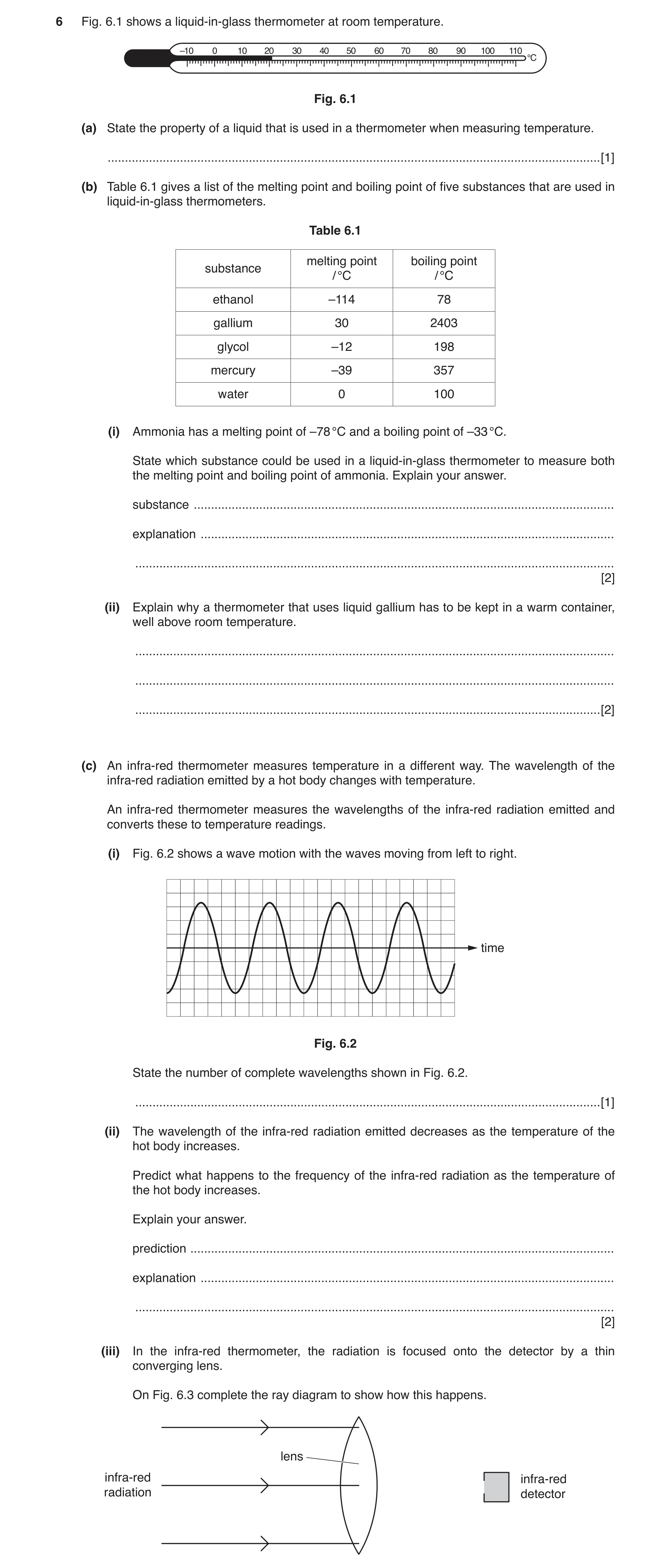
6 Fig. 6.1 shows a liquid-in-glass thermometer at room temperature. –10 0 10 20 30 40 50 60 70 80 90 100 110 °C Fig. 6.1 (a) State the property of a liquid that is used in a thermometer when measuring temperature. … [1] (b) Table 6.1 gives a list of the melting point and boiling point of five substances that are used in liquid-in-glass thermometers. Table 6.1 melting point boiling point substance / °C / °C ethanol –114 78 gallium 30 2403 glycol –12 198 mercury –39 357 water 0 100 (i) Ammonia has a melting point of –78 °C and a boiling point of –33 °C. State which substance could be used in a liquid-in-glass thermometer to measure both the melting point and boiling point of ammonia. Explain your answer. substance … explanation … … [2] (ii) Explain why a thermometer that uses liquid gallium has to be kept in a warm container, well above room temperature. … … … [2] (c) An infra-red thermometer measures temperature in a different way. The wavelength of the infra-red radiation emitted by a hot body changes with temperature. An infra-red thermometer measures the wavelengths of the infra-red radiation emitted and converts these to temperature readings. (i) Fig. 6.2 shows a wave motion with the waves moving from left to right. time Fig. 6.2 State the number of complete wavelengths shown in Fig. 6.2. … [1] (ii) The wavelength of the infra-red radiation emitted decreases as the temperature of the hot body increases. Predict what happens to the frequency of the infra-red radiation as the temperature of the hot body increases. Explain your answer. prediction … explanation … … [2] (iii) In the infra-red thermometer, the radiation is focused onto the detector by a thin converging lens. On Fig. 6.3 complete the ray diagram to show how this happens. lens infra-red infra-red radiation detector
9 marks
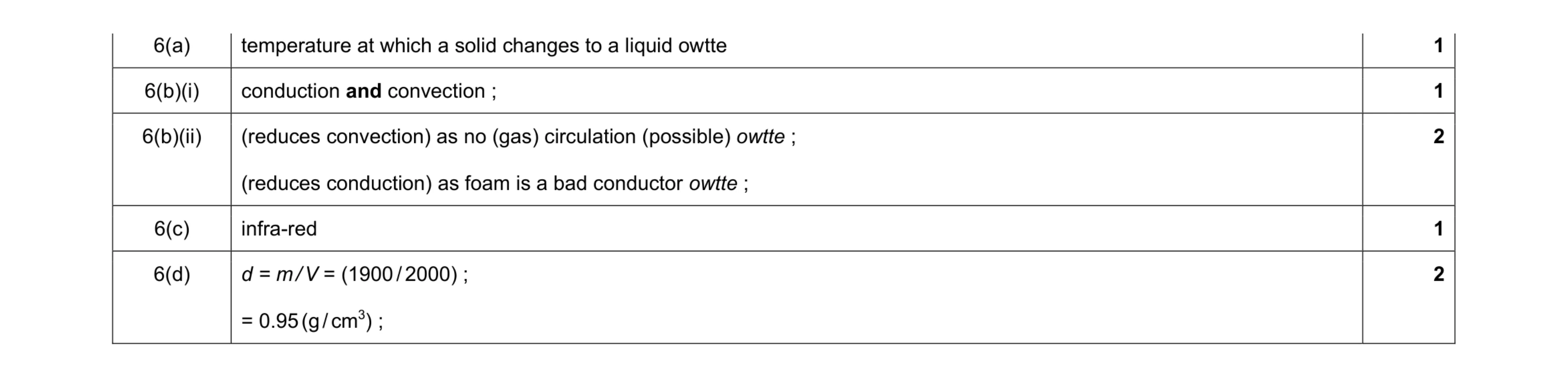
Mark scheme: 6(a) expansion (on heating) / (thermal) expansion ; 1 Question Answer Marks 6(b)(i) ethanol ; must be a liquid at both these temperatures / only ethanol is liquid at –78 °C ; 2 6(b)(ii) room temperature is below 30 °C / melting point of gallium ; gallium would be a solid at room temperature ; 2 6(c)(i) four / 4 ; 1 6(c)(ii) (frequency will) increase ; frequency increases as wavelength decreases ORA 2 6(c)(iii) all three rays extended to meet at the same point at the detector ; 1
This question in 0653/31 Oct/Nov 2018
Q3 · The bathroom in a house has an electric heater under the floor 0653/32 Feb/March 2019
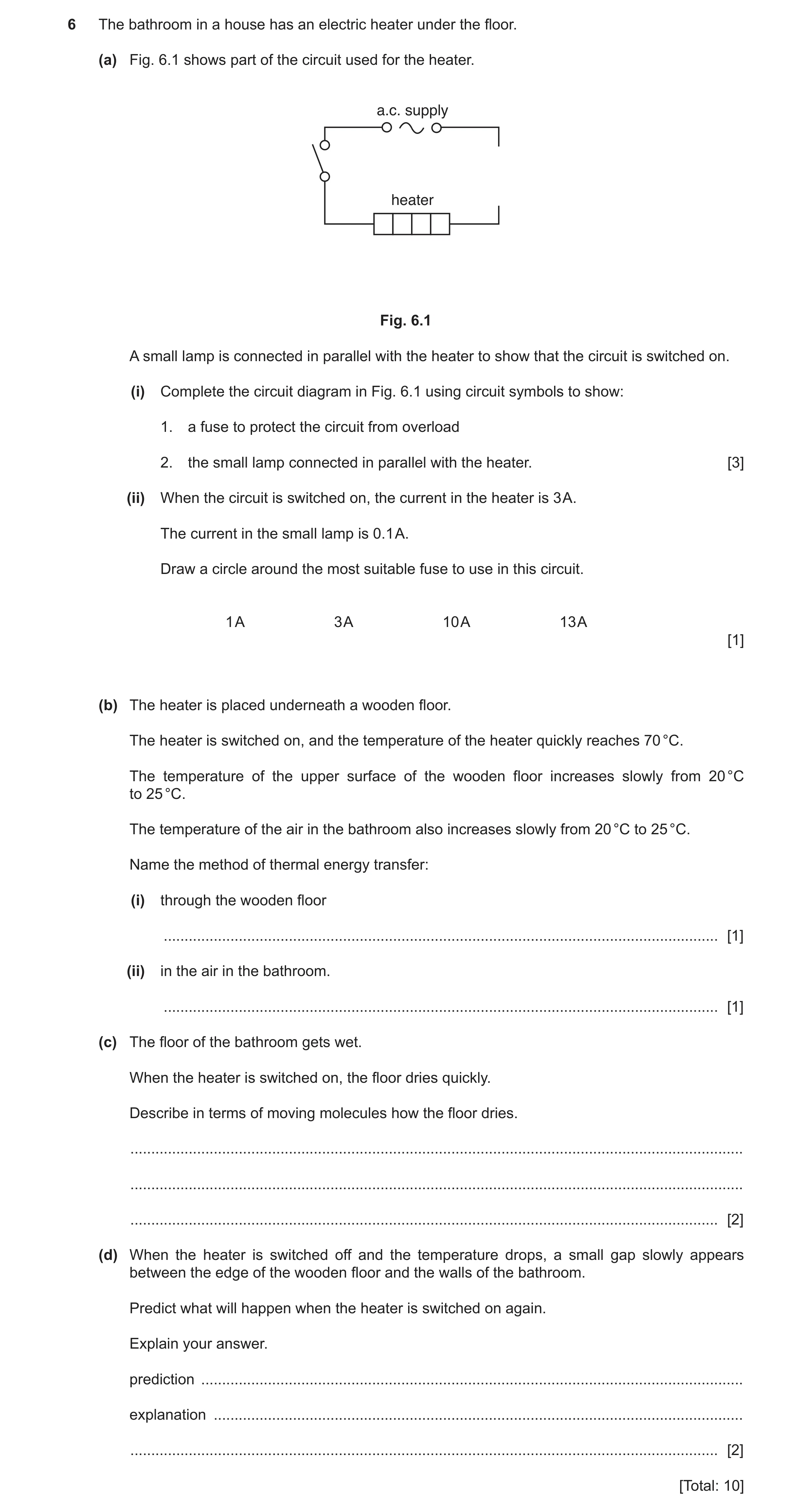
6 The bathroom in a house has an electric heater under the floor. (a) Fig. 6.1 shows part of the circuit used for the heater. a.c. supply heater Fig. 6.1 A small lamp is connected in parallel with the heater to show that the circuit is switched on. (i) Complete the circuit diagram in Fig. 6.1 using circuit symbols to show: 1. a fuse to protect the circuit from overload 2. the small lamp connected in parallel with the heater. [3] (ii) When the circuit is switched on, the current in the heater is 3 A. The current in the small lamp is 0.1 A. Draw a circle around the most suitable fuse to use in this circuit. 1 A 3 A 10 A 13 A [1] (b) The heater is placed underneath a wooden floor. The heater is switched on, and the temperature of the heater quickly reaches 70 °C. The temperature of the upper surface of the wooden floor increases slowly from 20 °C to 25 °C. The temperature of the air in the bathroom also increases slowly from 20 °C to 25 °C. Name the method of thermal energy transfer: (i) through the wooden floor … [1] (ii) in the air in the bathroom. … [1] (c) The floor of the bathroom gets wet. When the heater is switched on, the floor dries quickly. Describe in terms of moving molecules how the floor dries. … … … [2] (d) When the heater is switched off and the temperature drops, a small gap slowly appears between the edge of the wooden floor and the walls of the bathroom. Predict what will happen when the heater is switched on again. Explain your answer. prediction … explanation … … [2] [Total: 10]
10 marks
Mark scheme: 6(a)(i) correct symbols ; fuse in series ; lamp in parallel ; 3 6(a)(ii) 10 A ; 1 Question Answer Marks 6(b)(i) conduction ; 1 6(b)(ii) convection ; 1 6(c) faster moving molecules / molecules with greater kinetic energy ; escape surface / leave the liquid / reference to evaporation ; 2 6(d) gap closes (again) ; wooden floor / wood expands on heating ; 2
This question in 0653/32 Feb/March 2019
Q4 · The Celsius temperature scale from −273 °C up to 300 °C 0653/32 May/June 2019
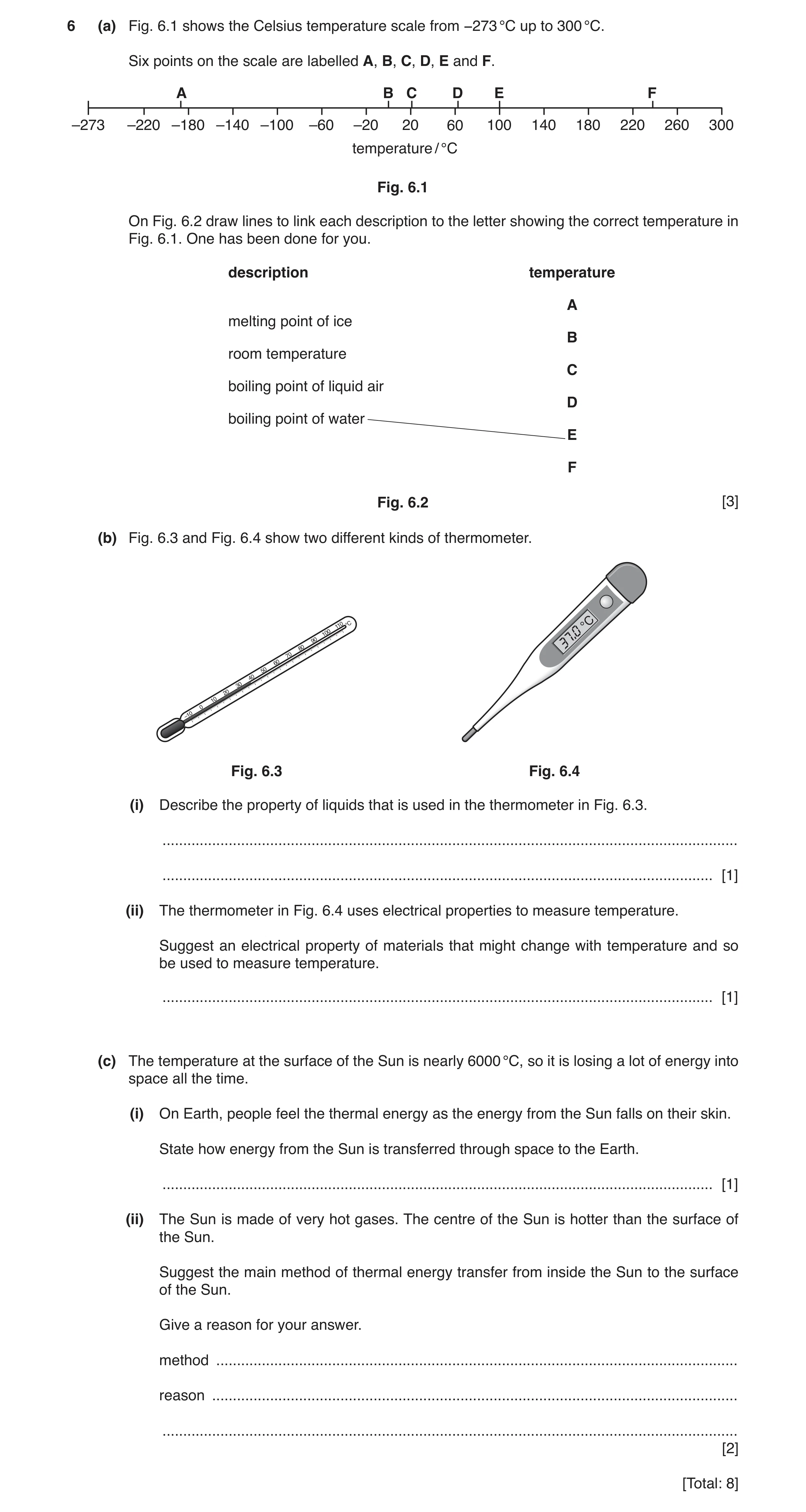
6 (a) Fig. 6.1 shows the Celsius temperature scale from −273 °C up to 300 °C. Six points on the scale are labelled A, B, C, D, E and F. A B C D E F –273 –220 –180 –140 –100 –60 –20 20 60 100 140 180 220 260 300 temperature / °C Fig. 6.1 On Fig. 6.2 draw lines to link each description to the letter showing the correct temperature in Fig. 6.1. One has been done for you. description temperature A melting point of ice B room temperature C boiling point of liquid air D boiling point of water E F Fig. 6.2 [3] (b) Fig. 6.3 and Fig. 6.4 show two different kinds of thermometer. 110°C °C 100 90 80 70 60 50 40 30 20 10 0 –10 Fig. 6.3 Fig. 6.4 (i) Describe the property of liquids that is used in the thermometer in Fig. 6.3. … … [1] (ii) The thermometer in Fig. 6.4 uses electrical properties to measure temperature. Suggest an electrical property of materials that might change with temperature and so be used to measure temperature. … [1] (c) The temperature at the surface of the Sun is nearly 6000 °C, so it is losing a lot of energy into space all the time. (i) On Earth, people feel the thermal energy as the energy from the Sun falls on their skin. State how energy from the Sun is transferred through space to the Earth. … [1] (ii) The Sun is made of very hot gases. The centre of the Sun is hotter than the surface of the Sun. Suggest the main method of thermal energy transfer from inside the Sun to the surface of the Sun. Give a reason for your answer. method … reason … … [2] [Total: 8]
8 marks
Mark scheme: 6(a) A melting point of ice B room temperature C boiling point of liquid air D boiling point of water E F 1 mark for each correct link ;;; 3 6(b)(i) thermal expansion (as temperature rises) ; 1 6(b)(ii) resistance ; 1 6(c)(i) radiation ; 1 6(c)(ii) convection ; hot gases rise / move out from the centre (to the surface) ; 2
This question in 0653/32 May/June 2019
Q5 · A bucket of crushed ice used to cool drinks 0653/31 May/June 2020
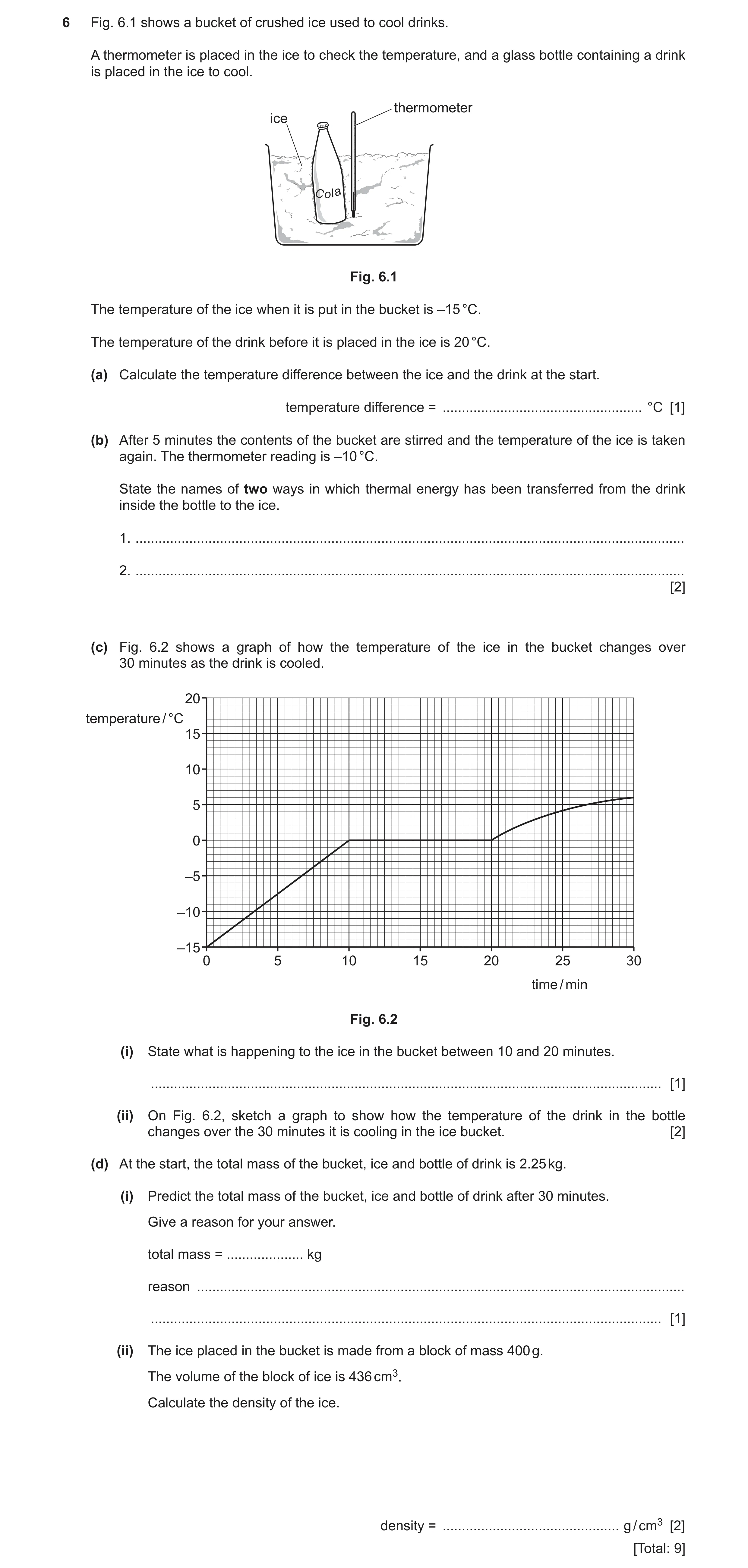
6 Fig. 6.1 shows a bucket of crushed ice used to cool drinks. A thermometer is placed in the ice to check the temperature, and a glass bottle containing a drink is placed in the ice to cool. thermometer ice Fig. 6.1 The temperature of the ice when it is put in the bucket is –15 °C. The temperature of the drink before it is placed in the ice is 20 °C. (a) Calculate the temperature difference between the ice and the drink at the start. temperature difference = … °C [1] (b) After 5 minutes the contents of the bucket are stirred and the temperature of the ice is taken again. The thermometer reading is –10 °C. State the names of two ways in which thermal energy has been transferred from the drink inside the bottle to the ice. 1. … 2. … [2] (c) Fig. 6.2 shows a graph of how the temperature of the ice in the bucket changes over 30 minutes as the drink is cooled. 20 temperature / °C 15 10 5 0 –5 –10 –15 0 5 10 15 20 25 30 time / min Fig. 6.2 (i) State what is happening to the ice in the bucket between 10 and 20 minutes. … [1] (ii) On Fig. 6.2, sketch a graph to show how the temperature of the drink in the bottle changes over the 30 minutes it is cooling in the ice bucket. [2] (d) At the start, the total mass of the bucket, ice and bottle of drink is 2.25 kg. (i) Predict the total mass of the bucket, ice and bottle of drink after 30 minutes. Give a reason for your answer. total mass = … kg reason … … [1] (ii) The ice placed in the bucket is made from a block of mass 400 g. The volume of the block of ice is 436 cm3. Calculate the density of the ice. density = … g / cm3 [2] [Total: 9]
9 marks
Mark scheme: 6(a) 35 (°C) ; 1 6(b) conduction (through glass and ice) ; convection (inside bottle) ; 2 6(c)(i) ice melting ; 1 6(c)(ii) 2 6(d)(i) (total mass = 2.25 kg – no mark) (reason) mass does not change with temperature ; 1 6(d)(ii) d = m / V (in any form) = 400 / 436 ; = 0.917 (g / cm3) ; 2 line starts at +20 °C, comes down ; continuous line from t = 0 to t = 30 and does not go below 6 °C ;
This question in 0653/31 May/June 2020
Q6 · A girl using a bicycle pump to add air to a bicycle tyre 0653/31 Oct/Nov 2020
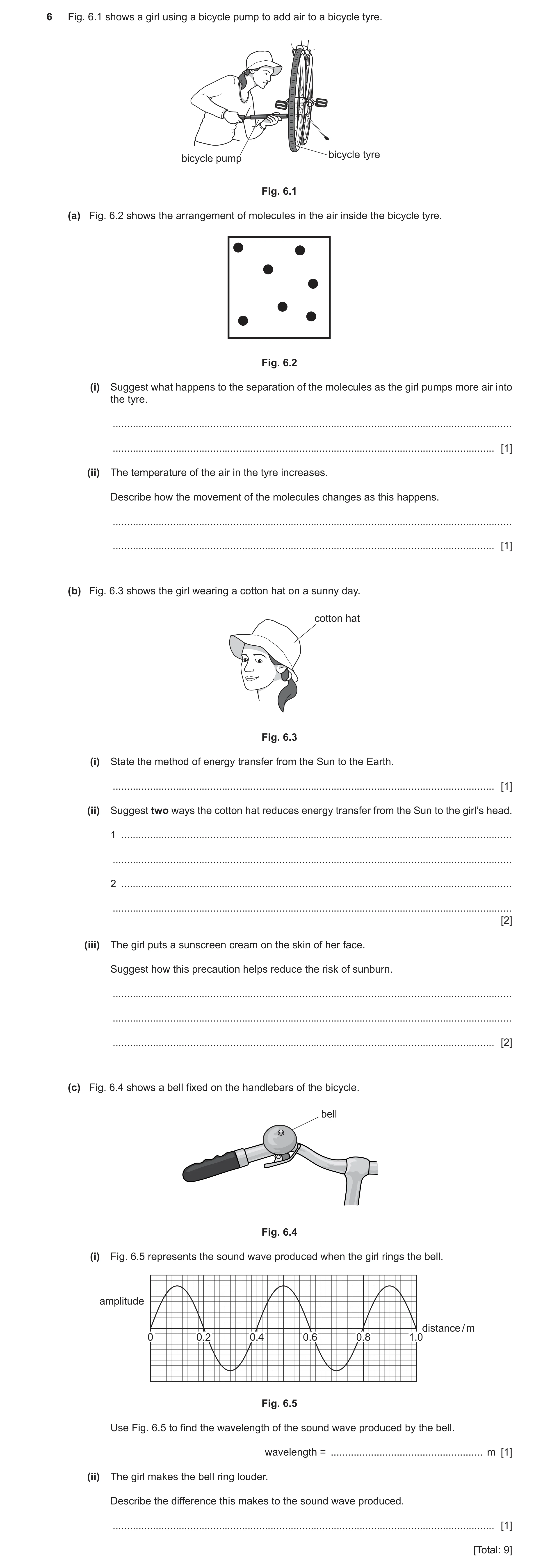
6 Fig. 6.1 shows a girl using a bicycle pump to add air to a bicycle tyre. bicycle tyre bicycle pump Fig. 6.1 (a) Fig. 6.2 shows the arrangement of molecules in the air inside the bicycle tyre. Fig. 6.2 (i) Suggest what happens to the separation of the molecules as the girl pumps more air into the tyre. … … [1] (ii) The temperature of the air in the tyre increases. Describe how the movement of the molecules changes as this happens. … … [1] (b) Fig. 6.3 shows the girl wearing a cotton hat on a sunny day. cotton hat Fig. 6.3 (i) State the method of energy transfer from the Sun to the Earth. … [1] (ii) Suggest two ways the cotton hat reduces energy transfer from the Sun to the girl’s head. 1 … … 2 … … [2] (iii) The girl puts a sunscreen cream on the skin of her face. Suggest how this precaution helps reduce the risk of sunburn. … … … [2] (c) Fig. 6.4 shows a bell fixed on the handlebars of the bicycle. bell Fig. 6.4 (i) Fig. 6.5 represents the sound wave produced when the girl rings the bell. amplitude distance / m 0 0.2 0.4 0.6 0.8 1.0 Fig. 6.5 Use Fig. 6.5 to find the wavelength of the sound wave produced by the bell. wavelength = … m [1] (ii) The girl makes the bell ring louder. Describe the difference this makes to the sound wave produced. … [1] [Total: 9]
9 marks
Mark scheme: 6(a)(i) (separation) decreases ; 1 6(a)(ii) (move) faster / speed up ; 1 6(b)(i) radiation ; 1 6(b)(ii) any two from: radiation reflected (off sun hat) ; cotton/hat is bad conductor / good insulator ; air (trapped) between hat and head is bad conductor / good insulator ; 2 6(b)(iii) ultraviolet / UV (radiation) (causes sunburn) ; (sunscreen,) filters out / reduces absorption (of UV) ; 2 6(c)(i) 0.4 (m) ; 1 6(c)(ii) larger amplitude / description of larger amplitude ; 1
This question in 0653/31 Oct/Nov 2020
Q7 · In the box in Fig 0653/33 Oct/Nov 2020
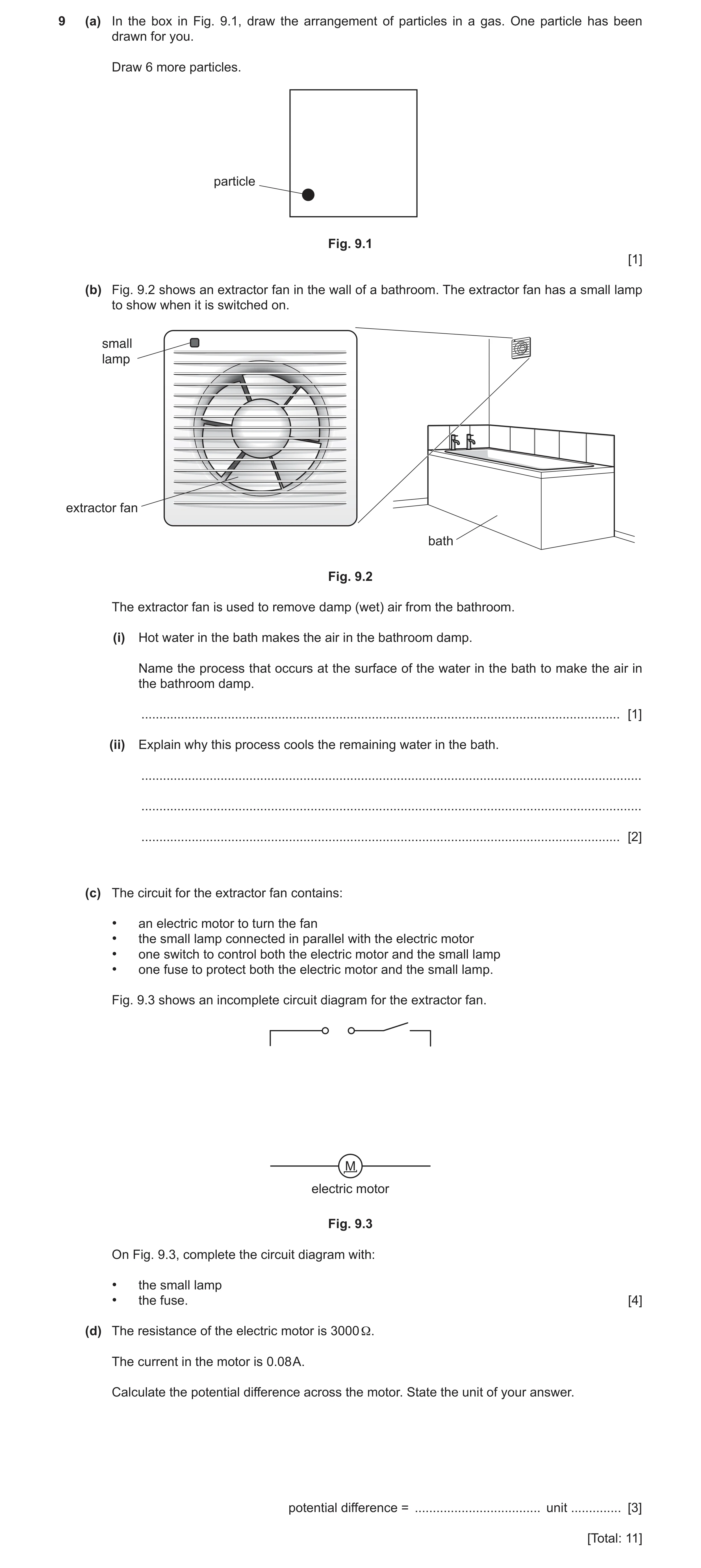
9 (a) In the box in Fig. 9.1, draw the arrangement of particles in a gas. One particle has been drawn for you. Draw 6 more particles. particle Fig. 9.1 [1] (b) Fig. 9.2 shows an extractor fan in the wall of a bathroom. The extractor fan has a small lamp to show when it is switched on. small lamp extractor fan bath Fig. 9.2 The extractor fan is used to remove damp (wet) air from the bathroom. (i) Hot water in the bath makes the air in the bathroom damp. Name the process that occurs at the surface of the water in the bath to make the air in the bathroom damp. … [1] (ii) Explain why this process cools the remaining water in the bath. … … … [2] (c) The circuit for the extractor fan contains: • an electric motor to turn the fan • the small lamp connected in parallel with the electric motor • one switch to control both the electric motor and the small lamp • one fuse to protect both the electric motor and the small lamp. Fig. 9.3 shows an incomplete circuit diagram for the extractor fan. M electric motor Fig. 9.3 On Fig. 9.3, complete the circuit diagram with: • the small lamp • the fuse. [4] (d) The resistance of the electric motor is 3000 Ω. The current in the motor is 0.08 A. Calculate the potential difference across the motor. State the unit of your answer. potential difference = … unit … [3] [Total: 11]
11 marks
Mark scheme: 9(a) random arrangement of 6 additional particles, far apart ; 1 9(b)(i) evaporation ; 1 9(b)(ii) faster / more-energetic, water molecules escape ; remaining molecules have less energy (so water is cooler) ; 2 9(c) correct symbol for lamp ; correct symbol for fuse ; lamp in parallel with motor ; fuse in main circuit ; 4 9(c) V = IR in any form / 0.080 × 3000 ; 240 ; V / volts ; 3
This question in 0653/33 Oct/Nov 2020
Q8 · Thermal energy being transferred to a beaker full of water 0653/32 May/June 2021
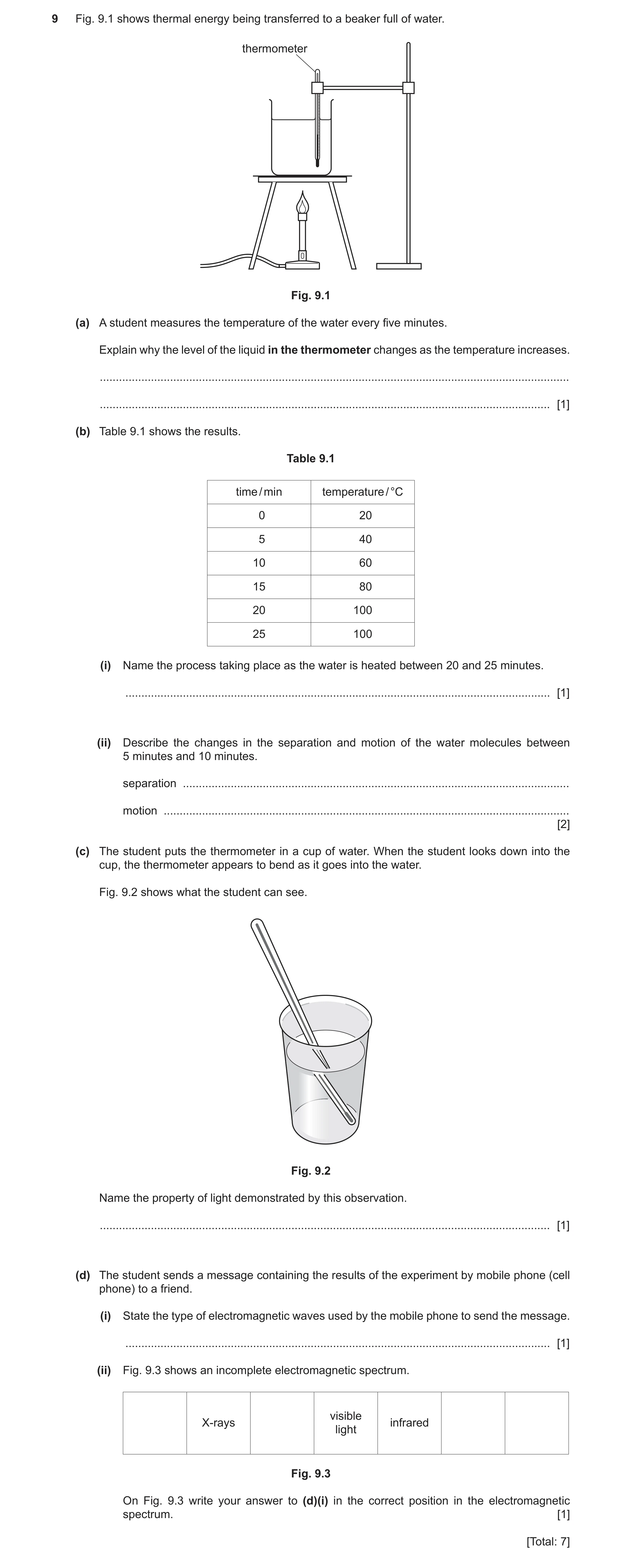
9 Fig. 9.1 shows thermal energy being transferred to a beaker full of water. thermometer Fig. 9.1 (a) A student measures the temperature of the water every five minutes. Explain why the level of the liquid in the thermometer changes as the temperature increases. … … [1] (b) Table 9.1 shows the results. Table 9.1 time / min temperature / °C 0 20 5 40 10 60 15 80 20 100 25 100 (i) Name the process taking place as the water is heated between 20 and 25 minutes. … [1] (ii) Describe the changes in the separation and motion of the water molecules between 5 minutes and 10 minutes. separation … motion … [2] (c) The student puts the thermometer in a cup of water. When the student looks down into the cup, the thermometer appears to bend as it goes into the water. Fig. 9.2 shows what the student can see. Fig. 9.2 Name the property of light demonstrated by this observation. … [1] (d) The student sends a message containing the results of the experiment by mobile phone (cell phone) to a friend. (i) State the type of electromagnetic waves used by the mobile phone to send the message. … [1] (ii) Fig. 9.3 shows an incomplete electromagnetic spectrum. visible X-rays infrared light Fig. 9.3 On Fig. 9.3 write your answer to (d)(i) in the correct position in the electromagnetic spectrum. [1] [Total: 7]
7 marks
Mark scheme: 9(a) liquids expand / volume increases (with temperature rise) ; 1 9(b)(i) boiling ; 1 9(b)(ii) separation: (molecules) further apart ; motion: (molecules) move faster ; 2 9(c) refraction ; 1 9(d)(i) radio waves / microwaves ; 1 9(d)(ii) gamma X-rays ultraviolet visible light infrared microwaves radio waves stated waves in (d)(i) in correct position ; 1
This question in 0653/32 May/June 2021
Q9 · The melting points and boiling points of six substances 0653/33 May/June 2021
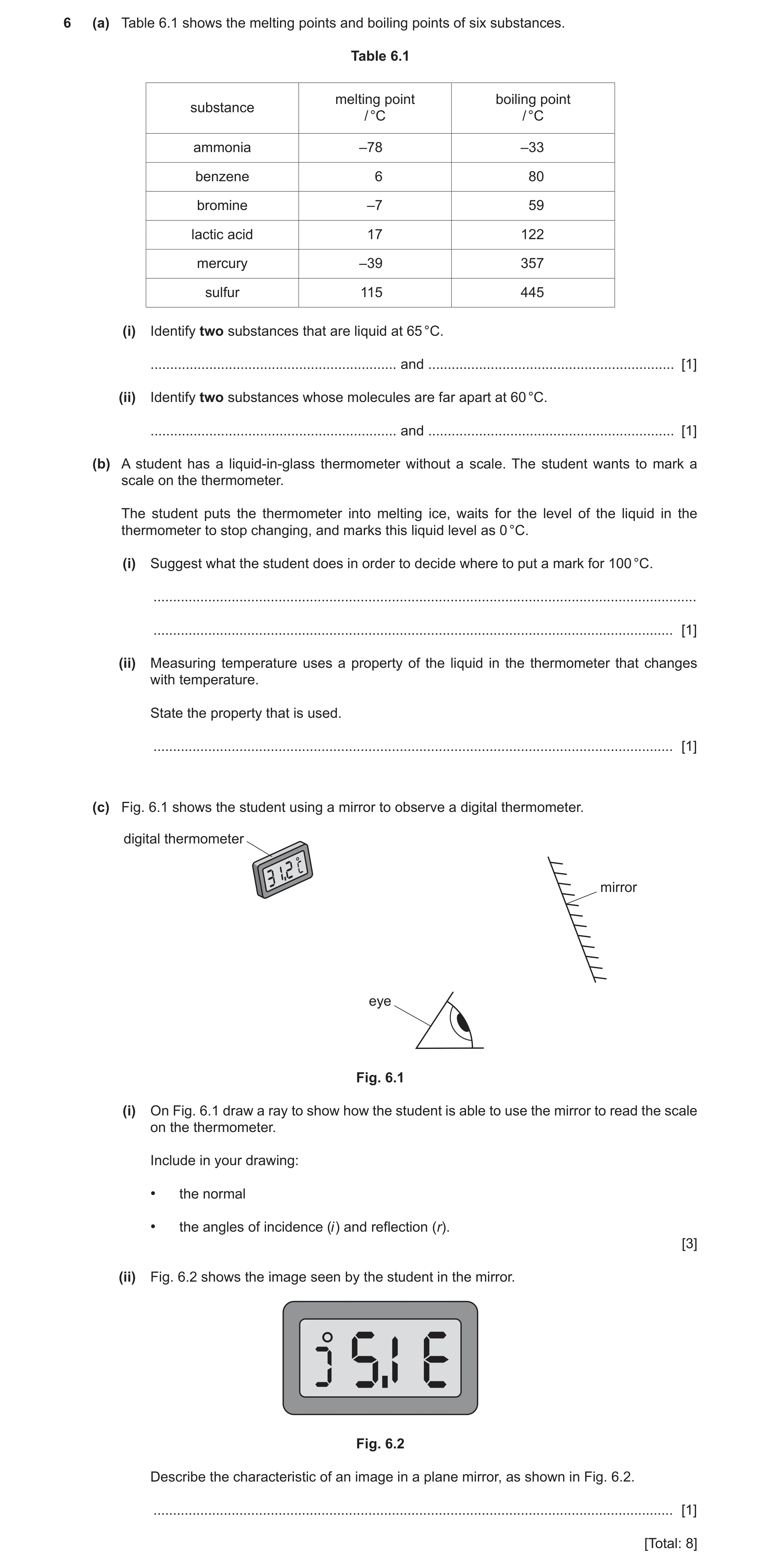
6 (a) Table 6.1 shows the melting points and boiling points of six substances. Table 6.1 melting point boiling point substance / °C / °C ammonia –78 –33 benzene 6 80 bromine –7 59 lactic acid 17 122 mercury –39 357 sulfur 115 445 (i) Identify two substances that are liquid at 65 °C. … and … [1] (ii) Identify two substances whose molecules are far apart at 60 °C. … and … [1] (b) A student has a liquid-in-glass thermometer without a scale. The student wants to mark a scale on the thermometer. The student puts the thermometer into melting ice, waits for the level of the liquid in the thermometer to stop changing, and marks this liquid level as 0 °C. (i) Suggest what the student does in order to decide where to put a mark for 100 °C. … … [1] (ii) Measuring temperature uses a property of the liquid in the thermometer that changes with temperature. State the property that is used. … [1] (c) Fig. 6.1 shows the student using a mirror to observe a digital thermometer. digital thermometer mirror eye Fig. 6.1 (i) On Fig. 6.1 draw a ray to show how the student is able to use the mirror to read the scale on the thermometer. Include in your drawing: • the normal • the angles of incidence (i) and reflection (r). [3] (ii) Fig. 6.2 shows the image seen by the student in the mirror. Fig. 6.2 Describe the characteristic of an image in a plane mirror, as shown in Fig. 6.2. … [1] [Total: 8]
8 marks
Mark scheme: 6(a)(i) any two for one mark: benzene / lactic acid / mercury ; 1 6(a)(ii) ammonia AND bromine ; 1 6(b)(i) hold bulb in boiling water / hold bulb in steam (above boiling water) ; 1 6(b)(ii) (thermal) expansion / increase in volume ; 1 Question Answer Marks 6(c)(i) ray from thermometer to mirror to eye, with at least one arrowhead ; normal drawn at mirror with equal angles (judged by eye) of incidence and reflection ; i and r correctly marked ; 3 6(c)(ii) laterally inverted OWTTE ; 1
This question in 0653/33 May/June 2021
Q10 · Some water is heated in a beaker using an electric heater 0653/32 May/June 2022
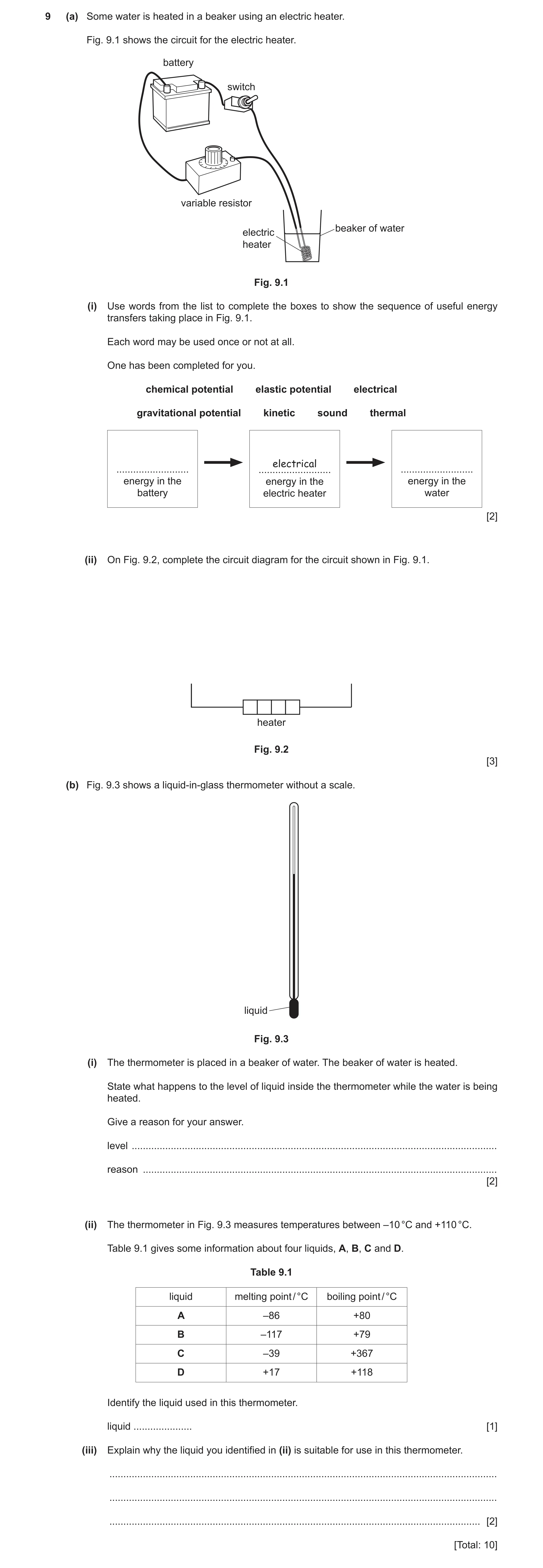
9 (a) Some water is heated in a beaker using an electric heater. Fig. 9.1 shows the circuit for the electric heater. battery switch variable resistor beaker of water electric heater Fig. 9.1 (i) Use words from the list to complete the boxes to show the sequence of useful energy transfers taking place in Fig. 9.1. Each word may be used once or not at all. One has been completed for you. chemical potential elastic potential electrical gravitational potential kinetic sound thermal electrical … … … energy in the energy in the energy in the battery electric heater water [2] (ii) On Fig. 9.2, complete the circuit diagram for the circuit shown in Fig. 9.1. heater Fig. 9.2 [3] (b) Fig. 9.3 shows a liquid-in-glass thermometer without a scale. liquid Fig. 9.3 (i) The thermometer is placed in a beaker of water. The beaker of water is heated. State what happens to the level of liquid inside the thermometer while the water is being heated. Give a reason for your answer. level … reason … [2] (ii) The thermometer in Fig. 9.3 measures temperatures between –10 °C and +110 °C. Table 9.1 gives some information about four liquids, A, B, C and D. Table 9.1 liquid melting point / °C boiling point / °C A –86 +80 B –117 +79 C –39 +367 D +17 +118 Identify the liquid used in this thermometer. liquid … [1] (iii) Explain why the liquid you identified in (ii) is suitable for use in this thermometer. … … … [2] [Total: 10]
10 marks
Mark scheme: 9(a)(i) chemical (potential) ; thermal ; 2 9(a)(ii) battery AND switch symbols ; variable resistor symbol ; complete circuit ; 3 9(b)(i) level, goes higher / goes up / increases ; (temperature increases) so liquid expands ; 2 9(b)(ii) (liquid) C ; 1 Question Answer Marks 9(b)(iii) (only liquid with both) melting point (freezing point) below –10 °C ; (and) boiling point above 110 °C ; 2
This question in 0653/32 May/June 2022
Q11 · A house in the Himalayas 0653/32 Feb/March 2023
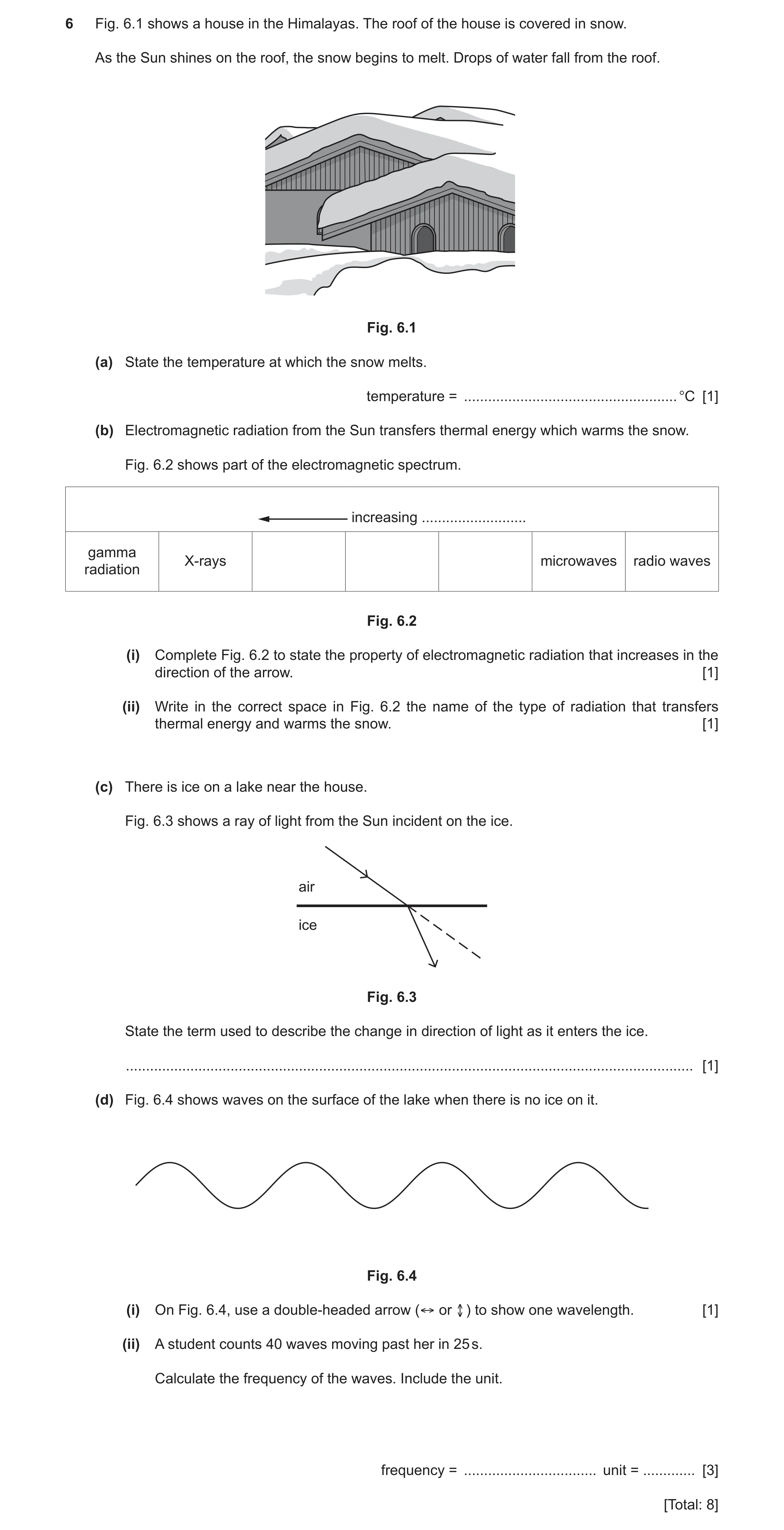
6 Fig. 6.1 shows a house in the Himalayas. The roof of the house is covered in snow. As the Sun shines on the roof, the snow begins to melt. Drops of water fall from the roof. Fig. 6.1 (a) State the temperature at which the snow melts. temperature = … °C [1] (b) Electromagnetic radiation from the Sun transfers thermal energy which warms the snow. Fig. 6.2 shows part of the electromagnetic spectrum. increasing … gamma X‑rays microwaves radio waves radiation Fig. 6.2 (i) Complete Fig. 6.2 to state the property of electromagnetic radiation that increases in the direction of the arrow. [1] (ii) Write in the correct space in Fig. 6.2 the name of the type of radiation that transfers thermal energy and warms the snow. [1] (c) There is ice on a lake near the house. Fig. 6.3 shows a ray of light from the Sun incident on the ice. air ice Fig. 6.3 State the term used to describe the change in direction of light as it enters the ice. … [1] (d) Fig. 6.4 shows waves on the surface of the lake when there is no ice on it. Fig. 6.4 (i) On Fig. 6.4, use a double‑headed arrow (↔ or↔) to show one wavelength. [1] (ii) A student counts 40 waves moving past her in 25 s. Calculate the frequency of the waves. Include the unit. frequency = … unit = … [3] [Total: 8]
8 marks
Mark scheme: 6(a) 0 (°C) ; 1 6(b)(i) 1 increasing frequency ; gamma radio X-rays microwaves radiation waves 6(b)(ii) 1 increasing frequency gamma radio X-rays infrared microwaves radiation waves infrared and in correct position ; 6(c) refraction ; 1 6(d)(i) horizontal arrow between two adjacent, peaks / troughs / other equivalent points on one oscillation ; 1 6(d)(ii) frequency = number of waves time ; 3 40 25 = 1.6 ; Hz ;
This question in 0653/32 Feb/March 2023
Q12 · A student measures the melting point of some salty water and some pure water 0653/31 May/June 2023
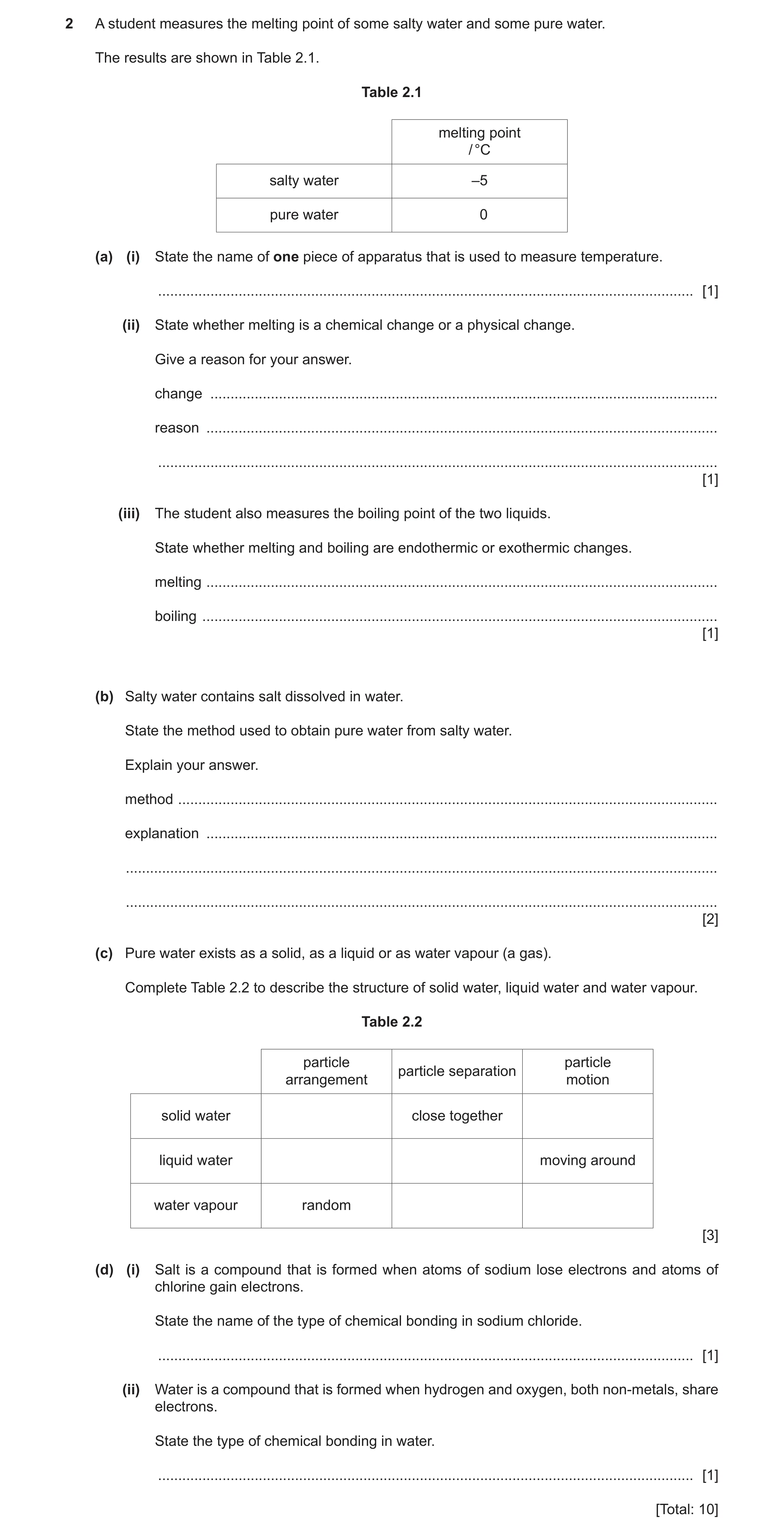
2 A student measures the melting point of some salty water and some pure water. The results are shown in Table 2.1. Table 2.1 melting point / °C salty water –5 pure water 0 (a) (i) State the name of one piece of apparatus that is used to measure temperature. … [1] (ii) State whether melting is a chemical change or a physical change. Give a reason for your answer. change … reason … … [1] (iii) The student also measures the boiling point of the two liquids. State whether melting and boiling are endothermic or exothermic changes. melting … boiling … [1] (b) Salty water contains salt dissolved in water. State the method used to obtain pure water from salty water. Explain your answer. method … explanation … … … [2] (c) Pure water exists as a solid, as a liquid or as water vapour (a gas). Complete Table 2.2 to describe the structure of solid water, liquid water and water vapour. Table 2.2 particle particle particle separation arrangement motion solid water close together liquid water moving around water vapour random [3] (d) (i) Salt is a compound that is formed when atoms of sodium lose electrons and atoms of chlorine gain electrons. State the name of the type of chemical bonding in sodium chloride. … [1] (ii) Water is a compound that is formed when hydrogen and oxygen, both non-metals, share electrons. State the type of chemical bonding in water. … [1] [Total: 10]
10 marks
Mark scheme: 2(a)(i) thermometer ; 1 2(a)(ii) (change) physical AND (reason) no new substance is made ; 1 2(a)(iii) (melting) endothermic AND (boiling) endothermic ; 1 2(b) (method) distillation ; (explanation) water evaporates and leaves the salt behind ; 2 Question Answer Marks 2(c) particle arrangement particle separation particle motion solid water regular / ordered close together vibrate / move about a fixed point liquid water random close together moving around water vapour random far apart / spread out moving rapidly ;;; 6 correct = 3 marks 3 – 5 correct = 2 marks 1 – 2 correct = 1 mark 3 2(d)(i) ionic ; 1 2(d)(ii) covalent ; 1
This question in 0653/31 May/June 2023
Q13 · A group of people keeping warm by a campfire and playing musical instruments 0653/31 May/June 2023
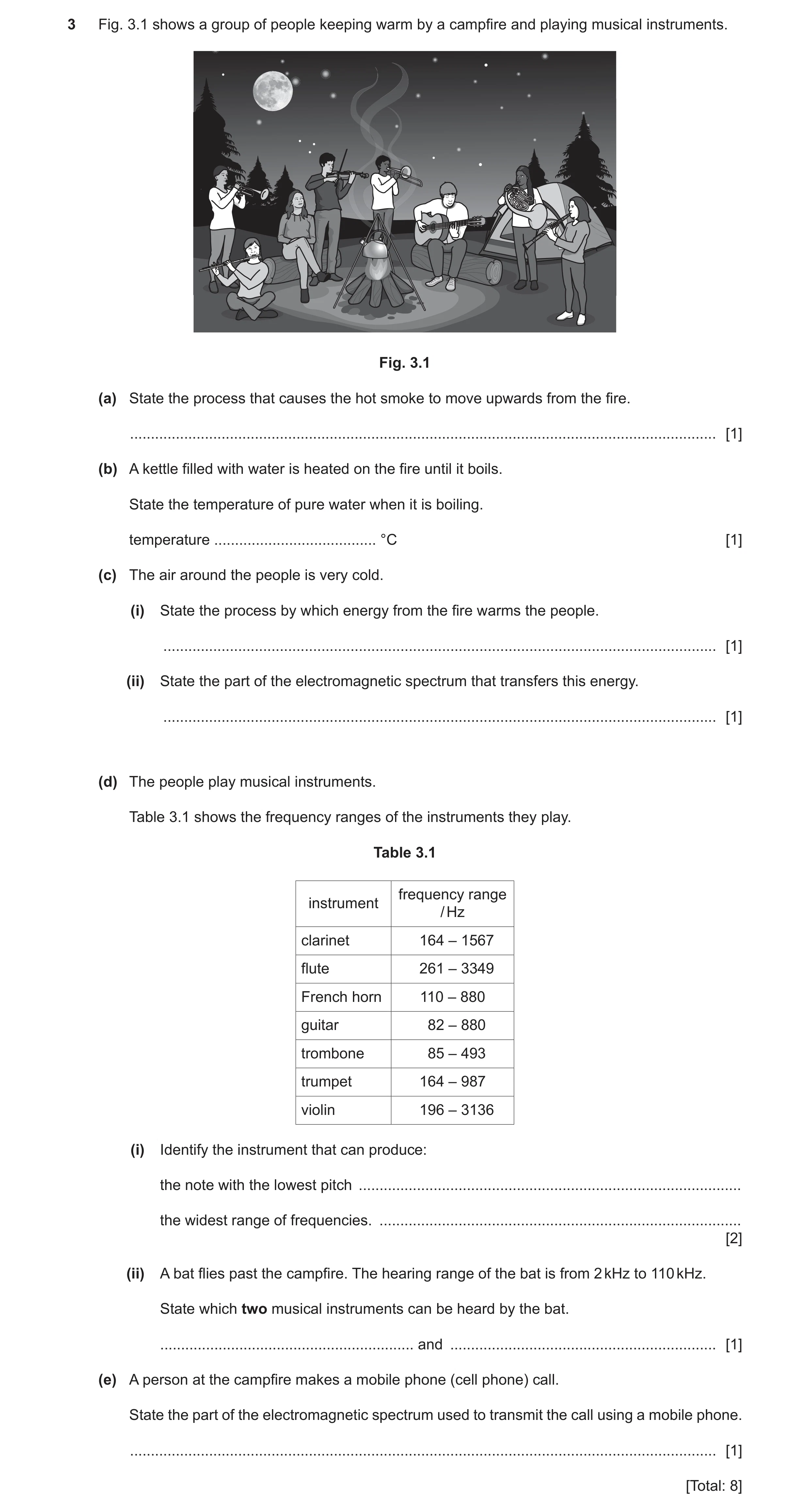
3 Fig. 3.1 shows a group of people keeping warm by a campfire and playing musical instruments. Fig. 3.1 (a) State the process that causes the hot smoke to move upwards from the fire. … [1] (b) A kettle filled with water is heated on the fire until it boils. State the temperature of pure water when it is boiling. temperature … °C [1] (c) The air around the people is very cold. (i) State the process by which energy from the fire warms the people. … [1] (ii) State the part of the electromagnetic spectrum that transfers this energy. … [1] (d) The people play musical instruments. Table 3.1 shows the frequency ranges of the instruments they play. Table 3.1 frequency range instrument / Hz clarinet 164 – 1567 flute 261 – 3349 French horn 110 – 880 guitar 82 – 880 trombone 85 – 493 trumpet 164 – 987 violin 196 – 3136 (i) Identify the instrument that can produce: the note with the lowest pitch … the widest range of frequencies. … [2] (ii) A bat flies past the campfire. The hearing range of the bat is from 2 kHz to 110 kHz. State which two musical instruments can be heard by the bat. … and … [1] (e) A person at the campfire makes a mobile phone (cell phone) call. State the part of the electromagnetic spectrum used to transmit the call using a mobile phone. … [1] [Total: 8]
8 marks
Mark scheme: 3(a) convection ; 1 3(b) 100 (°C) ; 1 3(c)(i) radiation ; 1 3(c)(ii) infrared ; 1 3(d)(i) in this order: guitar ; flute ; 2 3(d)(ii) violin AND flute ; 1 3(e) microwave ; 1
This question in 0653/31 May/June 2023
Q14 · A wind turbine used to generate electricity for the electrical system of a house 0653/32 Oct/Nov 2023
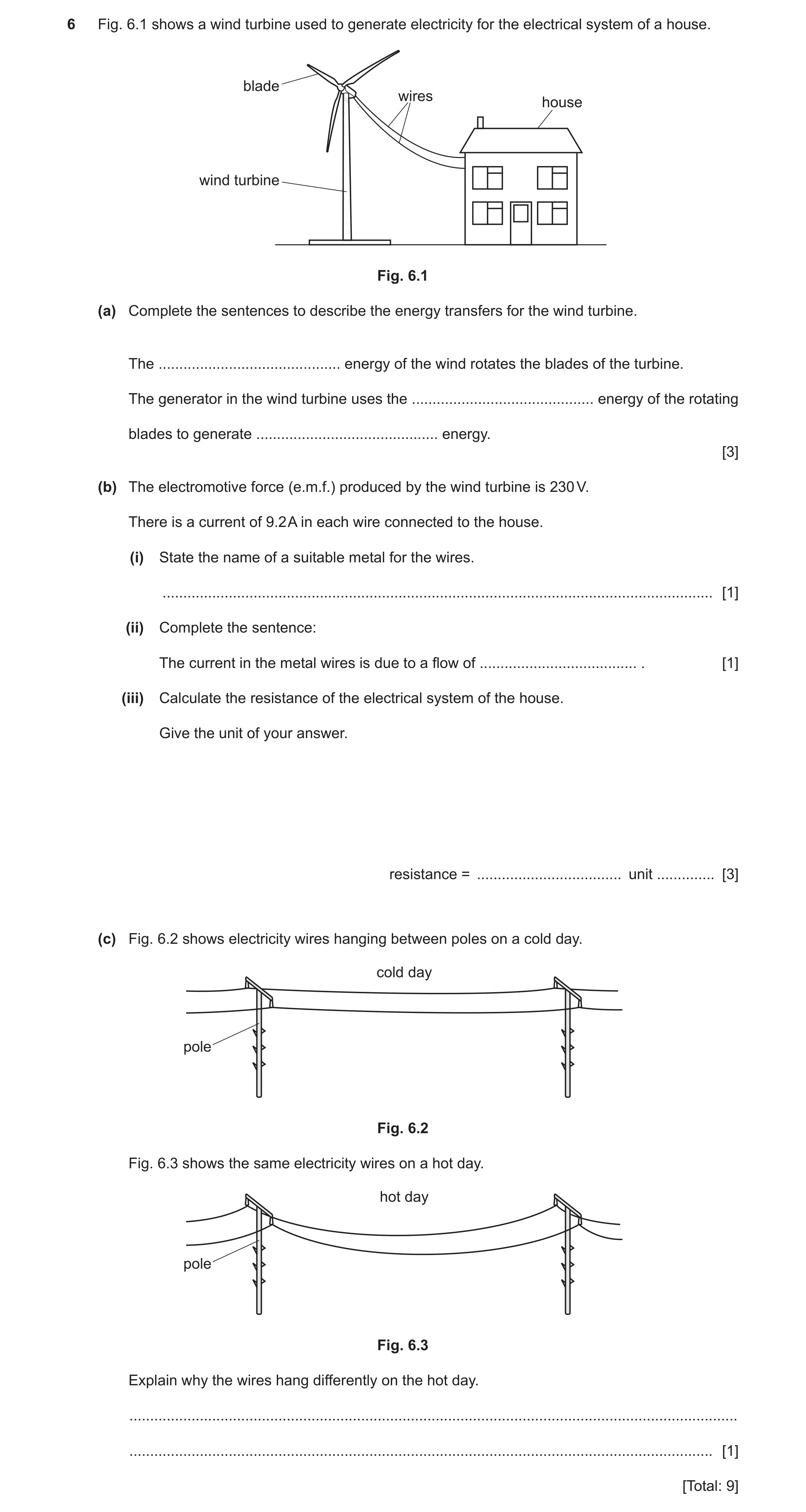
6 Fig. 6.1 shows a wind turbine used to generate electricity for the electrical system of a house. blade wires house wind turbine Fig. 6.1 (a) Complete the sentences to describe the energy transfers for the wind turbine. The … energy of the wind rotates the blades of the turbine. The generator in the wind turbine uses the … energy of the rotating blades to generate … energy. [3] (b) The electromotive force (e.m.f.) produced by the wind turbine is 230 V. There is a current of 9.2 A in each wire connected to the house. (i) State the name of a suitable metal for the wires. … [1] (ii) Complete the sentence: The current in the metal wires is due to a flow of … . [1] (iii) Calculate the resistance of the electrical system of the house. Give the unit of your answer. resistance = … unit … [3] (c) Fig. 6.2 shows electricity wires hanging between poles on a cold day. cold day pole Fig. 6.2 Fig. 6.3 shows the same electricity wires on a hot day. hot day pole Fig. 6.3 Explain why the wires hang differently on the hot day. … … [1] [Total: 9]
9 marks
Mark scheme: 6(a) kinetic ; 3 kinetic ; electrical ; 6(b)(i) copper ; 1 6(b)(ii) electrons ; 1 6(b)(iii) evidence of, R = V ÷ I / 230 ÷ 9.2 ; 3 25 ; / ohm(s) ; 6(c) idea of (thermal) expansion (with increase in temperature on hot day) ; 1
This question in 0653/32 Oct/Nov 2023
Q15 · A wind turbine used to generate electricity for the electrical system of a house 0653/33 Oct/Nov 2023
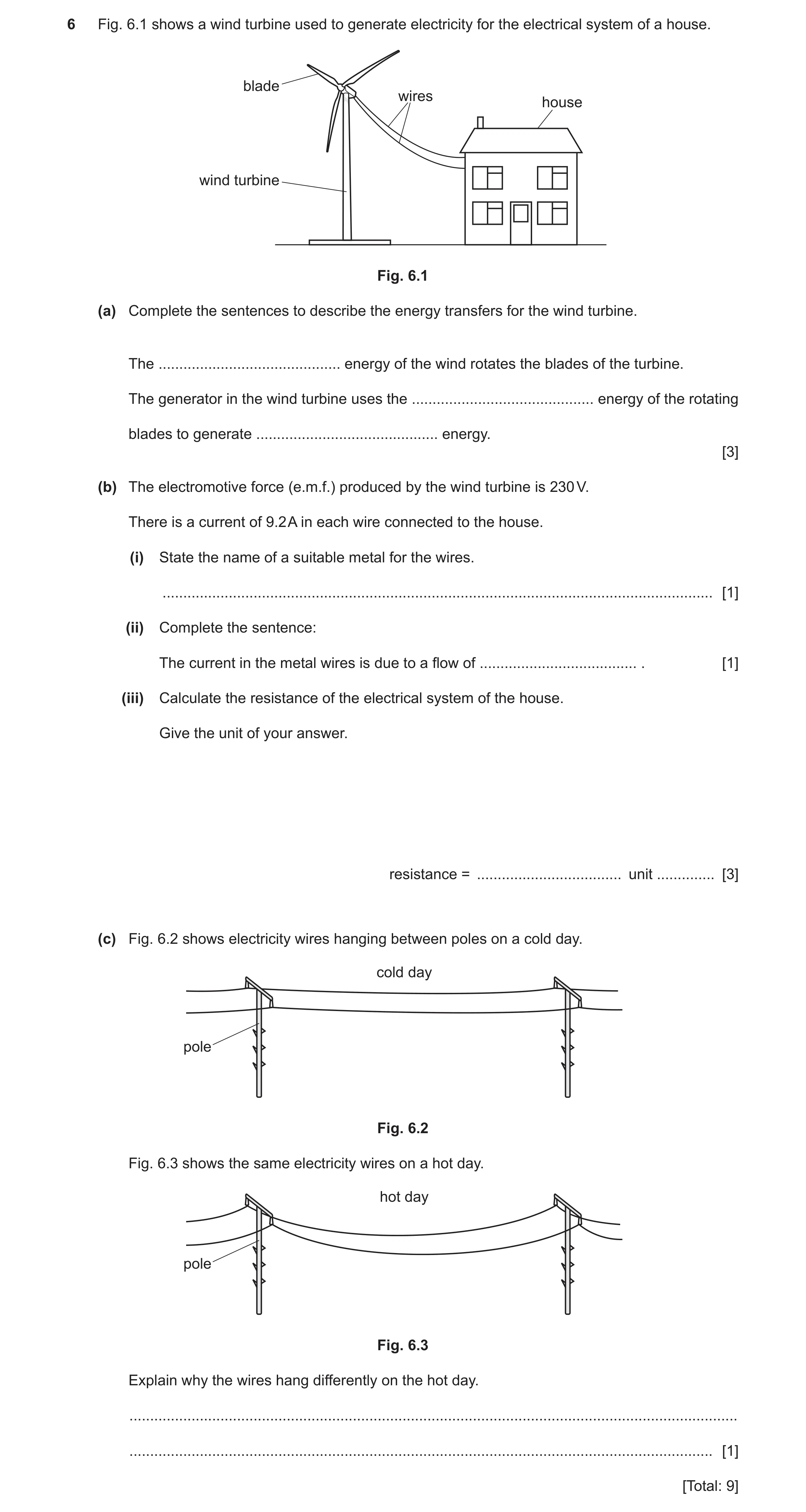
6 Fig. 6.1 shows a wind turbine used to generate electricity for the electrical system of a house. blade wires house wind turbine Fig. 6.1 (a) Complete the sentences to describe the energy transfers for the wind turbine. The … energy of the wind rotates the blades of the turbine. The generator in the wind turbine uses the … energy of the rotating blades to generate … energy. [3] (b) The electromotive force (e.m.f.) produced by the wind turbine is 230 V. There is a current of 9.2 A in each wire connected to the house. (i) State the name of a suitable metal for the wires. … [1] (ii) Complete the sentence: The current in the metal wires is due to a flow of … . [1] (iii) Calculate the resistance of the electrical system of the house. Give the unit of your answer. resistance = … unit … [3] (c) Fig. 6.2 shows electricity wires hanging between poles on a cold day. cold day pole Fig. 6.2 Fig. 6.3 shows the same electricity wires on a hot day. hot day pole Fig. 6.3 Explain why the wires hang differently on the hot day. … … [1] [Total: 9]
9 marks
Mark scheme: 6(a) kinetic ; 3 kinetic ; electrical ; 6(b)(i) copper ; 1 6(b)(ii) electrons ; 1 6(b)(iii) evidence of, R = V ÷ I / 230 ÷ 9.2 ; 3 25 ; / ohm(s) ; 6(c) idea of (thermal) expansion (with increase in temperature on hot day) ; 1
This question in 0653/33 Oct/Nov 2023
Q16 · A candle made of wax 0653/32 Oct/Nov 2024
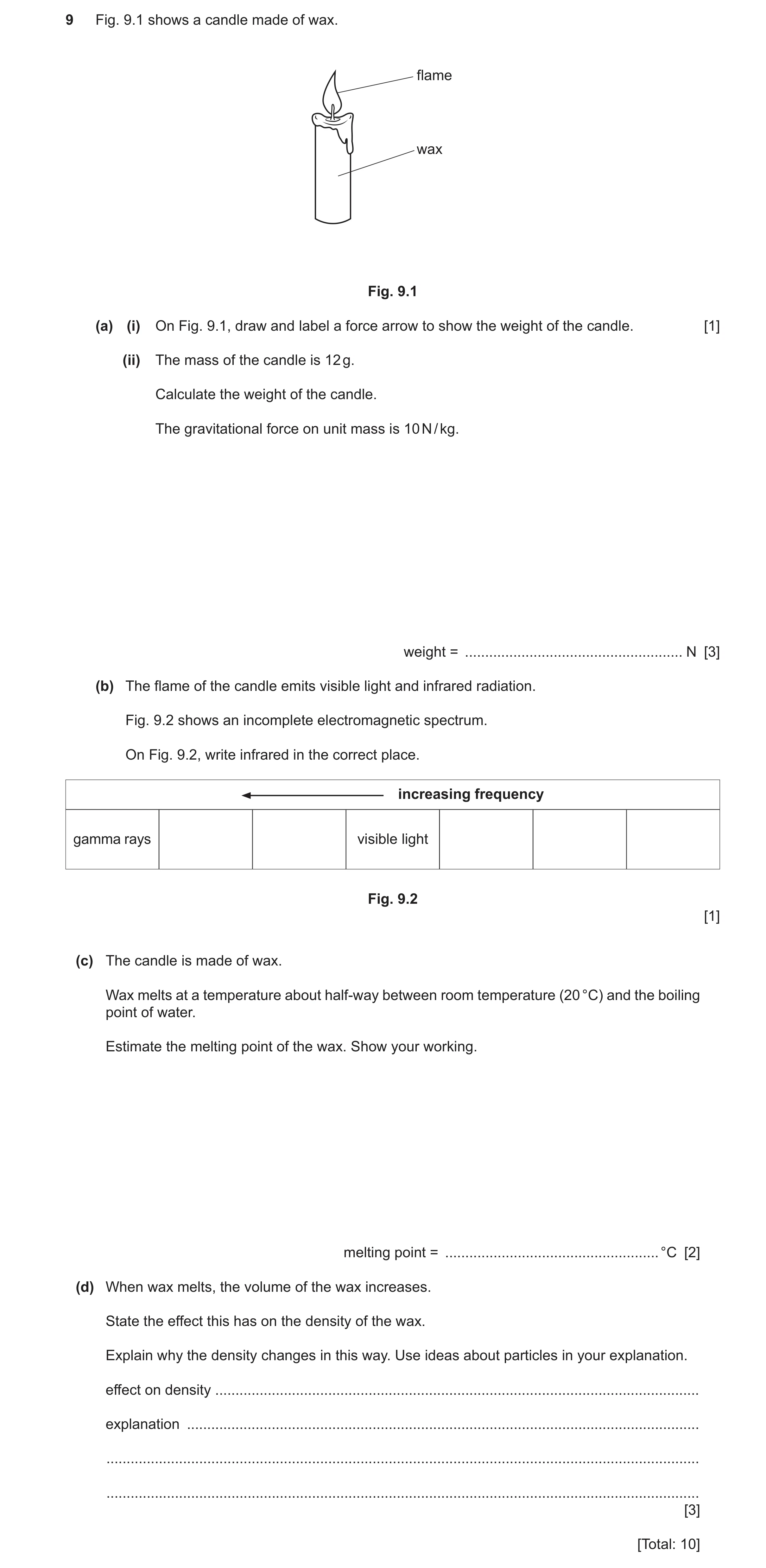
9 Fig. 9.1 shows a candle made of wax. flame wax Fig. 9.1 (a) (i) On Fig. 9.1, draw and label a force arrow to show the weight of the candle. [1] (ii) The mass of the candle is 12 g. Calculate the weight of the candle. The gravitational force on unit mass is 10 N / kg. weight = … N [3] (b) The flame of the candle emits visible light and infrared radiation. Fig. 9.2 shows an incomplete electromagnetic spectrum. On Fig. 9.2, write infrared in the correct place. increasing frequency gamma rays visible light Fig. 9.2 [1] (c) The candle is made of wax. Wax melts at a temperature about half-way between room temperature (20 °C) and the boiling point of water. Estimate the melting point of the wax. Show your working. melting point = … °C [2] (d) When wax melts, the volume of the wax increases. State the effect this has on the density of the wax. Explain why the density changes in this way. Use ideas about particles in your explanation. effect on density … explanation … … … [3] [Total: 10]
10 marks
Mark scheme: 9(a)(i) arrow labelled weight in contact with candle and pointing straight down; 1 9(a)(ii) correct unit conversion of g to kg seen ; 3 evidence of W = mg / 0.012 10 ; 0.12 (N) ; 9(b) 1 9(c) boiling point of water stated as 100 C ; 2 half-way between 20 and 100 C is 60 C ; 9(d) (density) decreases ; 3 particles, further apart in liquid (so volume increases) / AW ; mass is constant / reference to density = mass volume ;
This question in 0653/32 Oct/Nov 2024
Q17 · A candle made of wax 0653/33 Oct/Nov 2024
9 Fig. 9.1 shows a candle made of wax. flame wax Fig. 9.1 (a) (i) On Fig. 9.1, draw and label a force arrow to show the weight of the candle. [1] (ii) The mass of the candle is 12 g. Calculate the weight of the candle. The gravitational force on unit mass is 10 N / kg. weight = … N [3] (b) The flame of the candle emits visible light and infrared radiation. Fig. 9.2 shows an incomplete electromagnetic spectrum. On Fig. 9.2, write infrared in the correct place. increasing frequency gamma rays visible light Fig. 9.2 [1] (c) The candle is made of wax. Wax melts at a temperature about half-way between room temperature (20 °C) and the boiling point of water. Estimate the melting point of the wax. Show your working. melting point = … °C [2] (d) When wax melts, the volume of the wax increases. State the effect this has on the density of the wax. Explain why the density changes in this way. Use ideas about particles in your explanation. effect on density … explanation … … … [3] [Total: 10]
10 marks
Mark scheme: 9(a)(i) arrow labelled weight in contact with candle and pointing straight down; 1 9(a)(ii) correct unit conversion of g to kg seen ; 3 evidence of W = mg / 0.012 10 ; 0.12 (N) ; 9(b) 1 9(c) boiling point of water stated as 100 C ; 2 half-way between 20 and 100 C is 60 C ; 9(d) (density) decreases ; 3 particles, further apart in liquid (so volume increases) / AW ; mass is constant / reference to density = mass volume ;
This question in 0653/33 Oct/Nov 2024
 7
7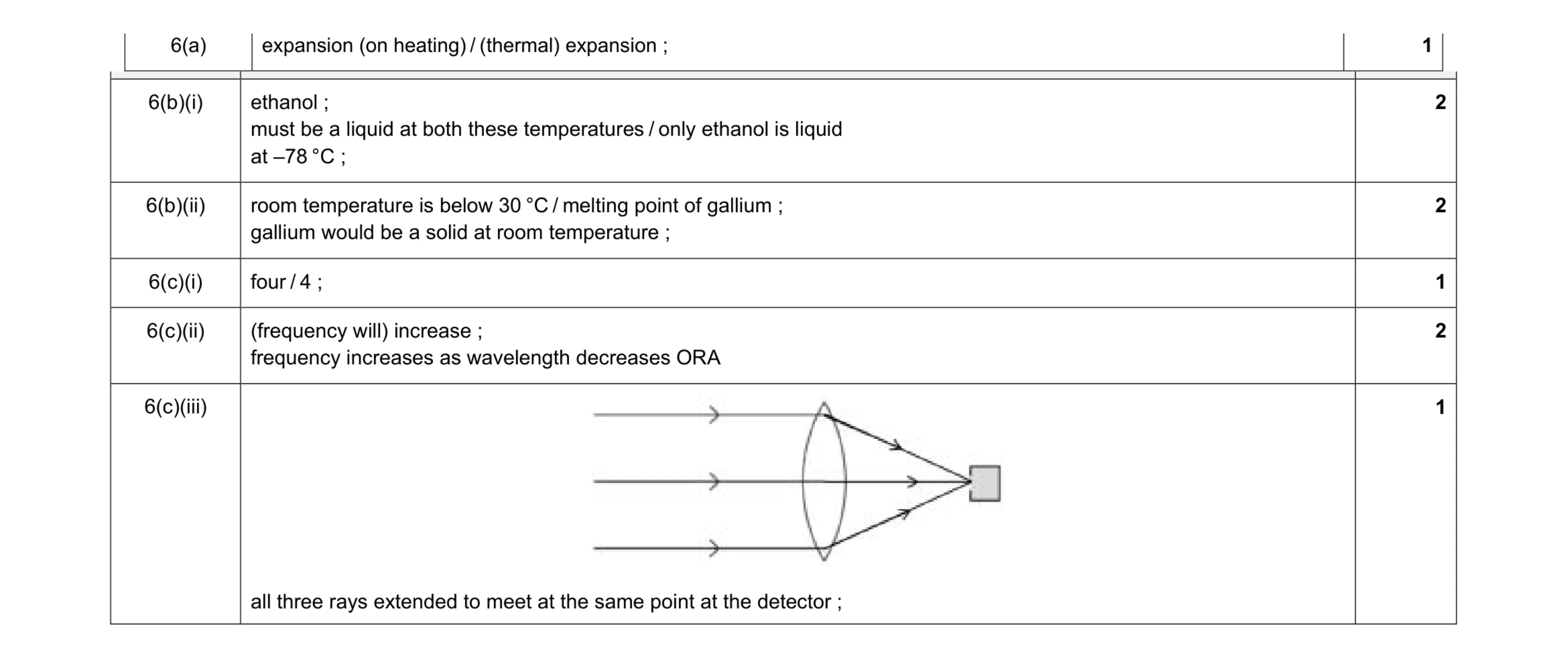 9
9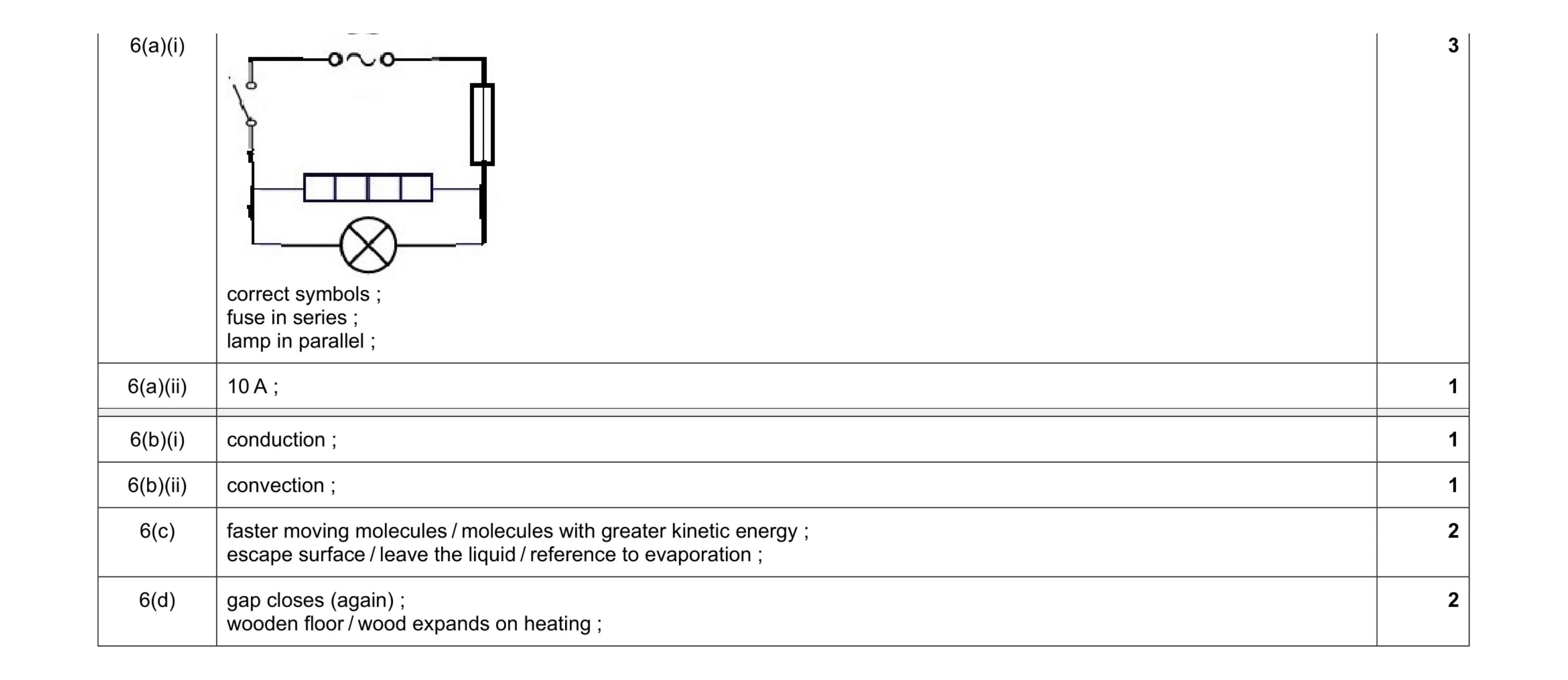 10
10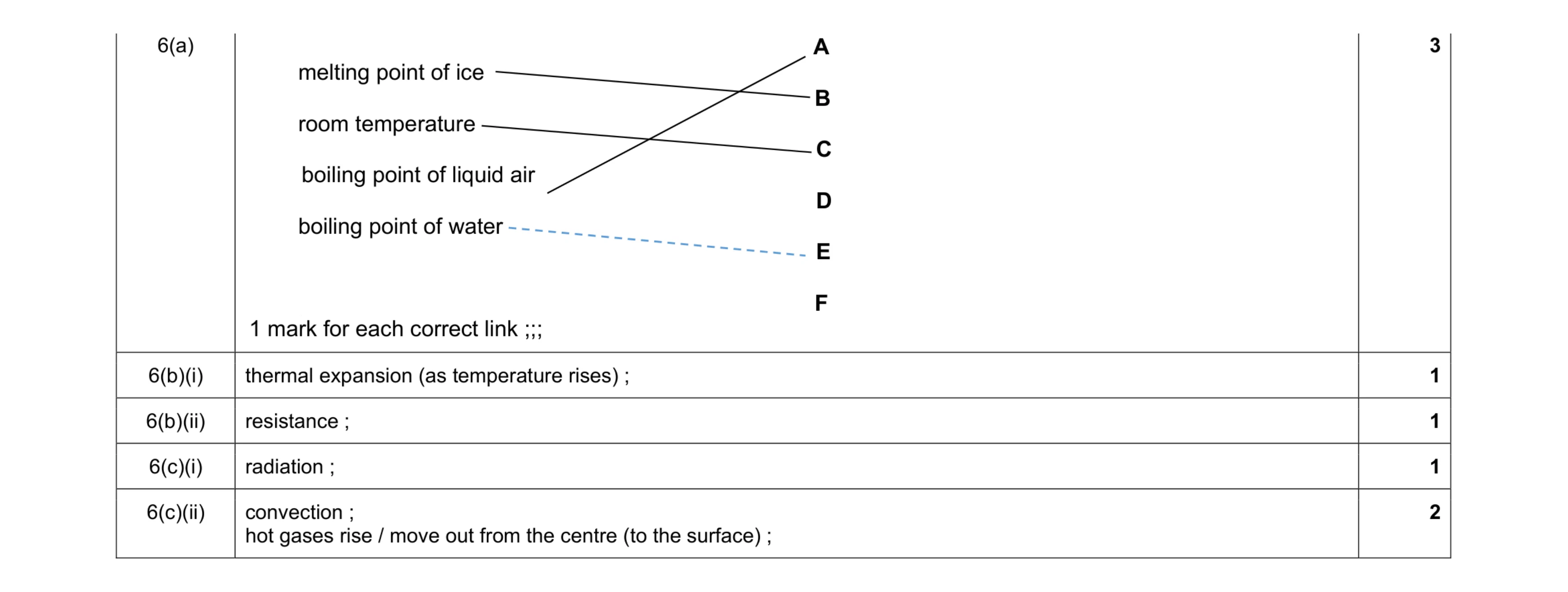 8
8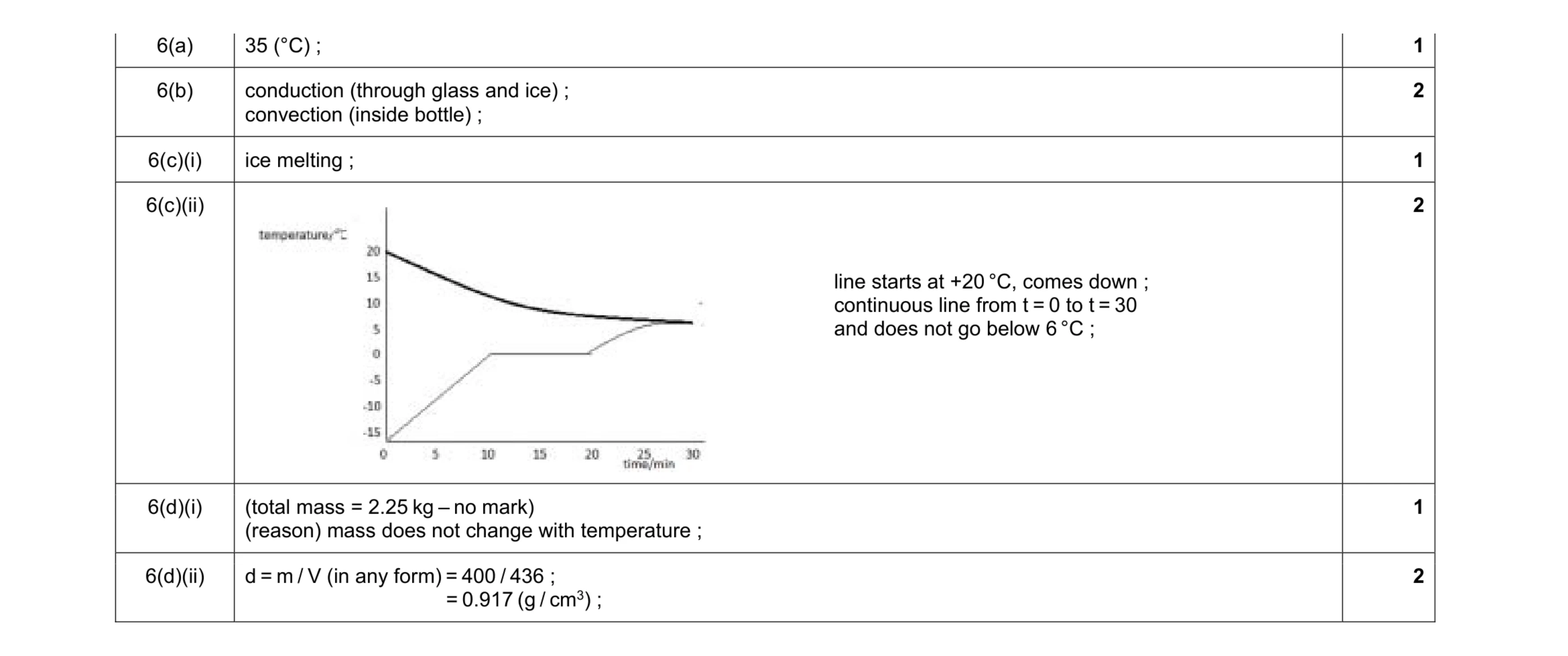 9
9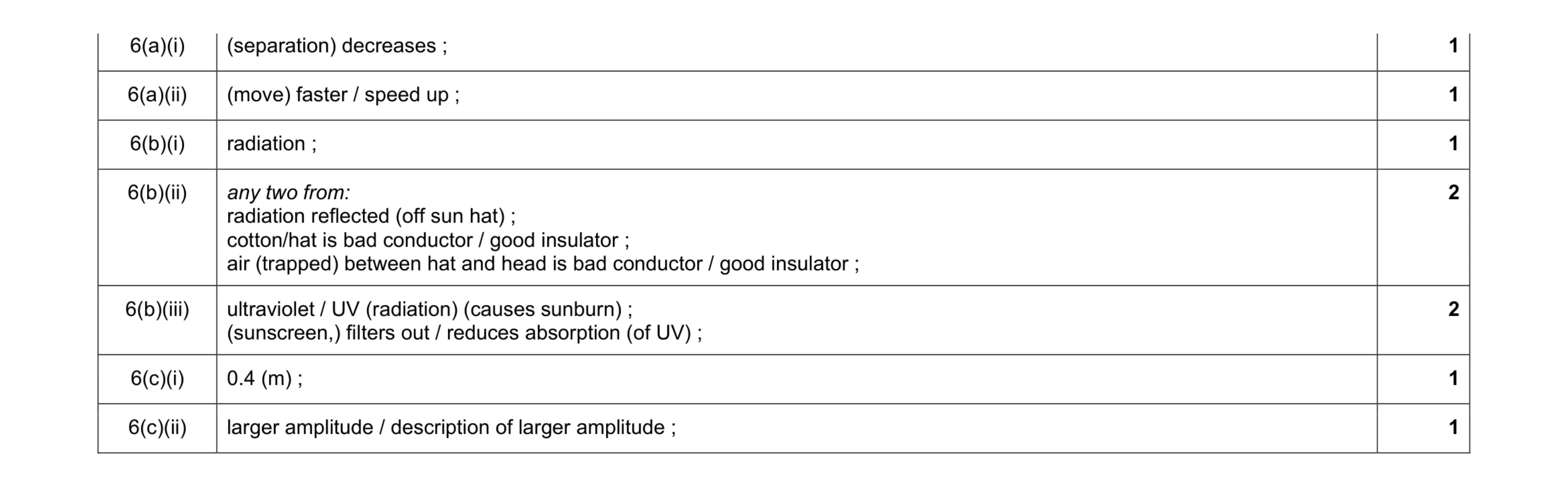 9
9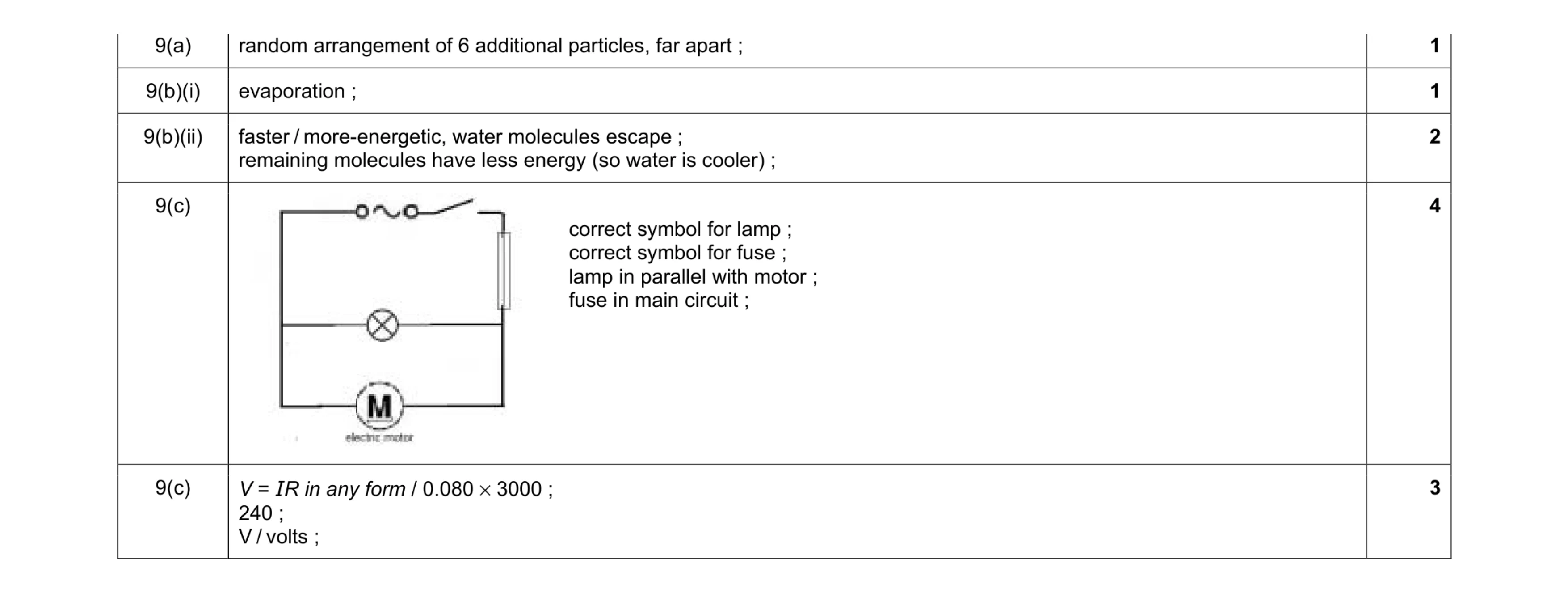 11
11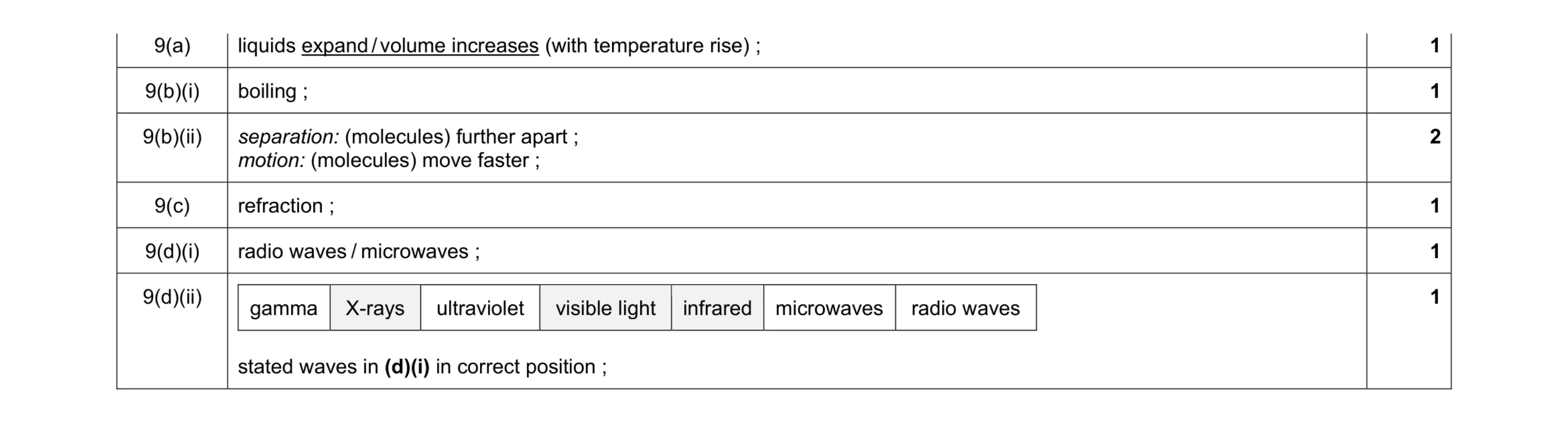 7
7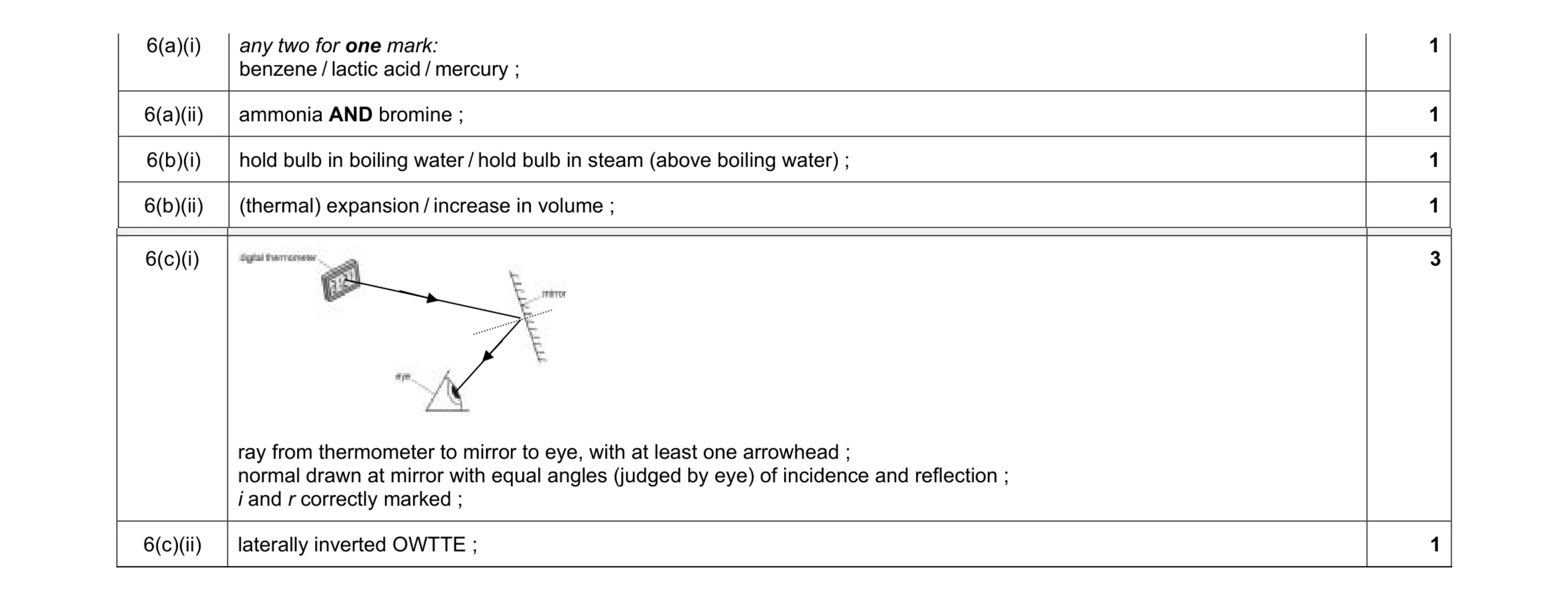 8
8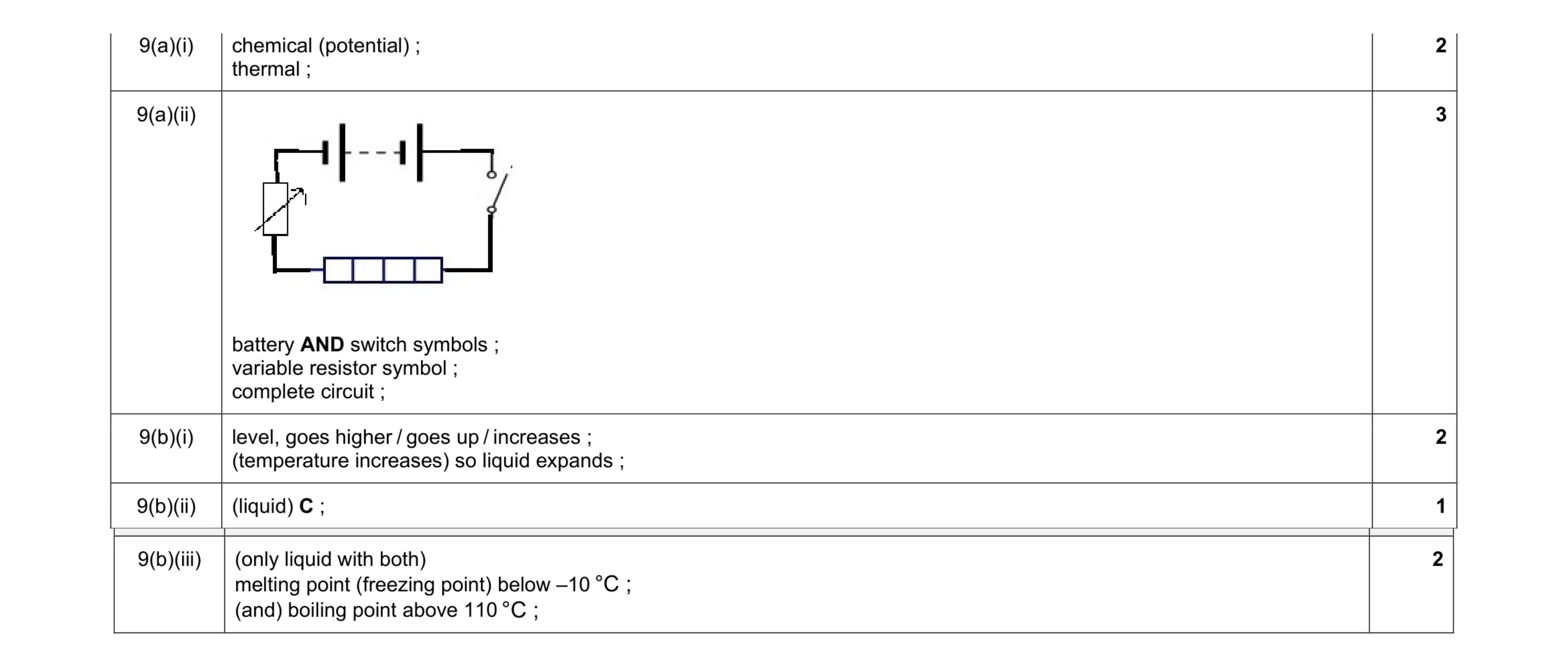 10
10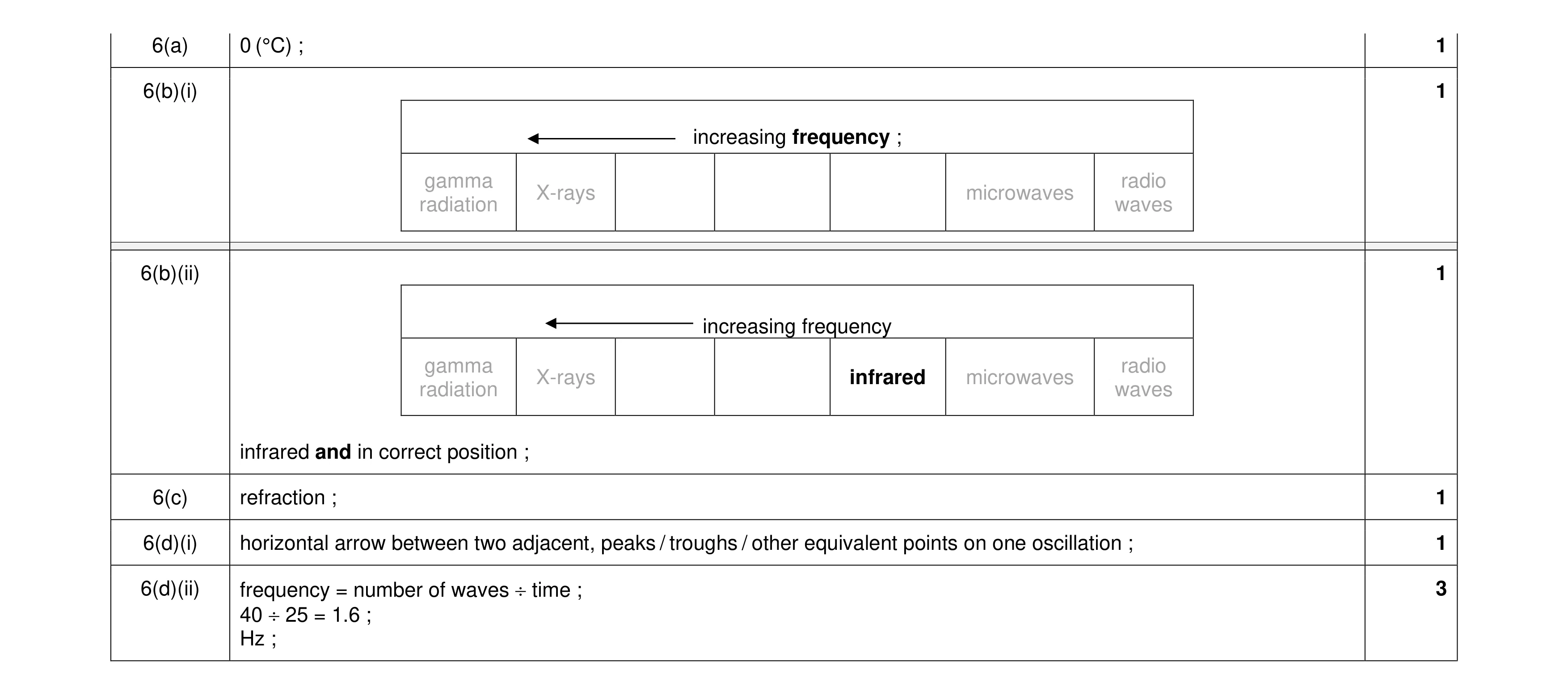 8
8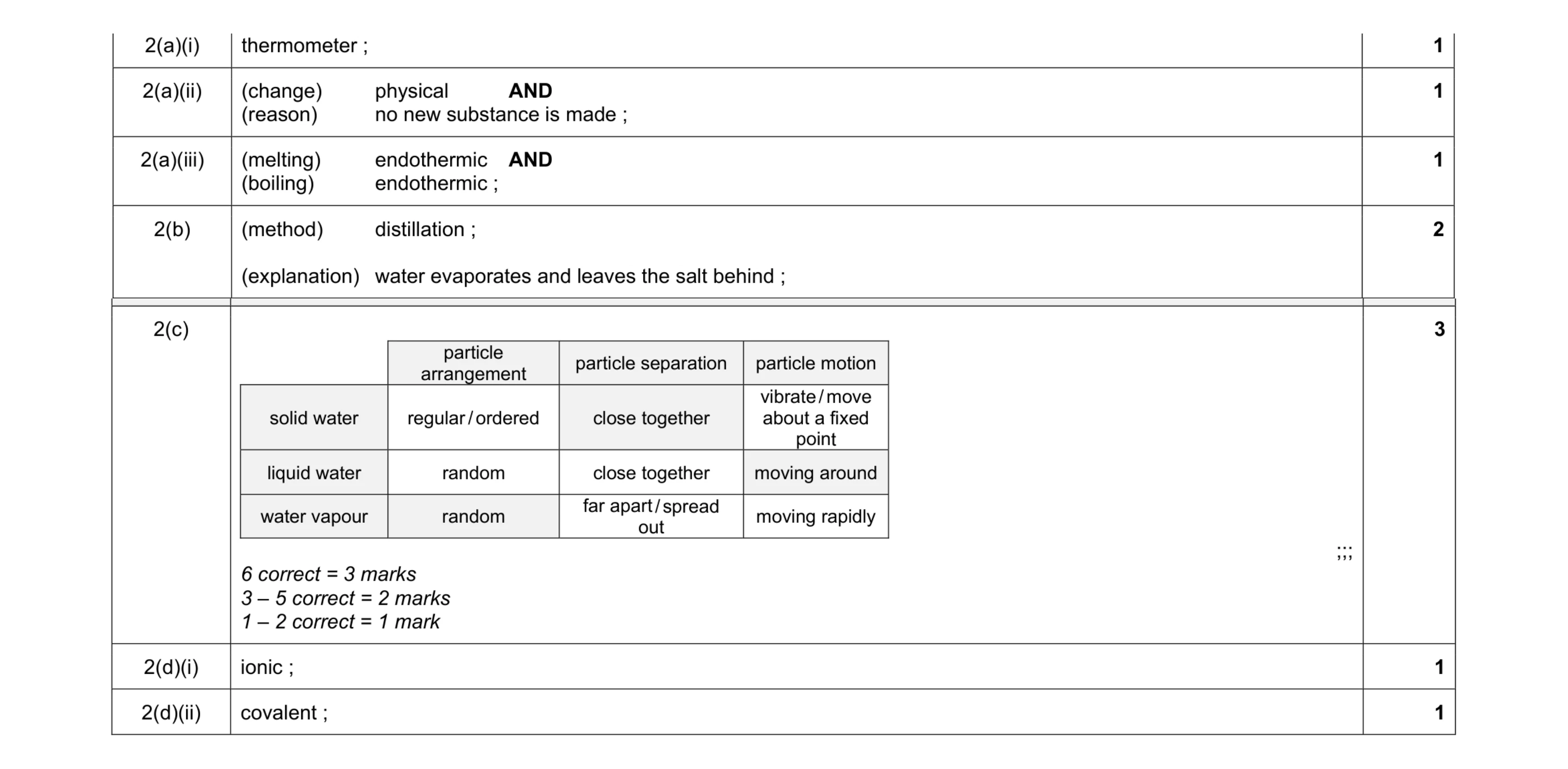 10
10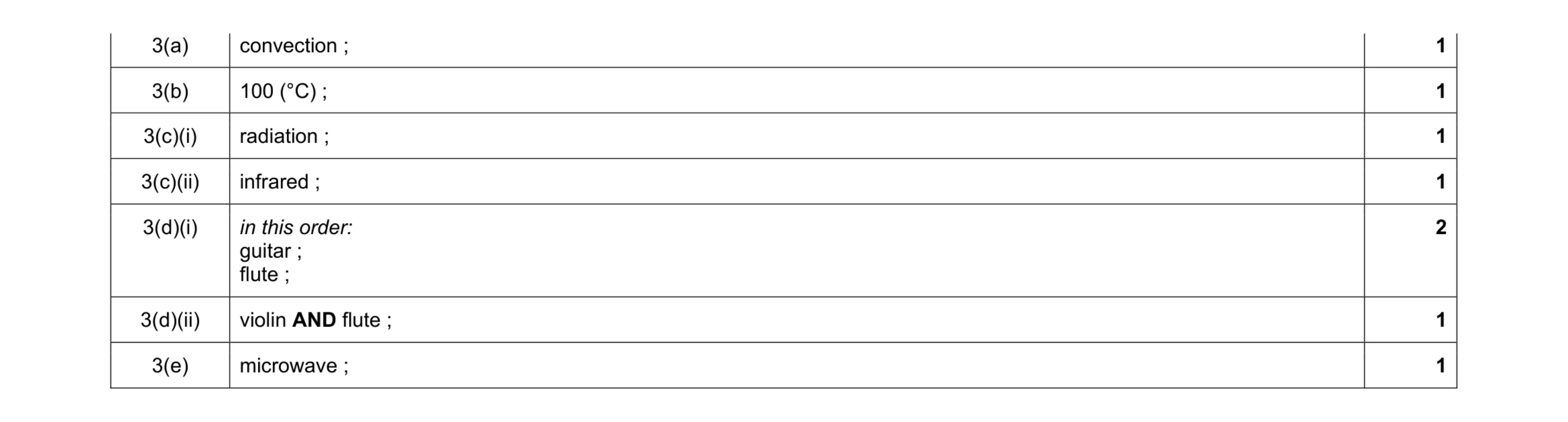 8
8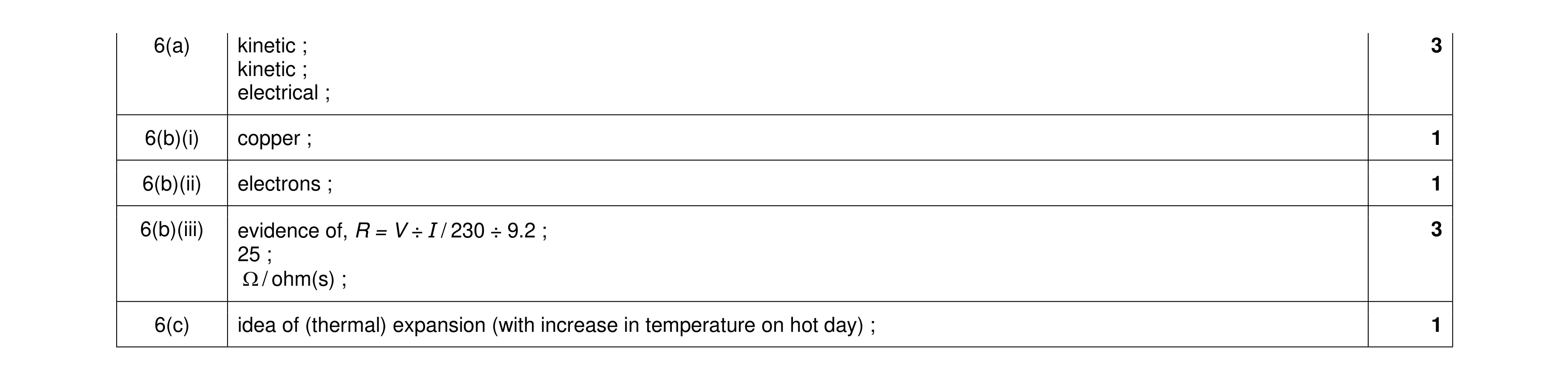 9
9 9
9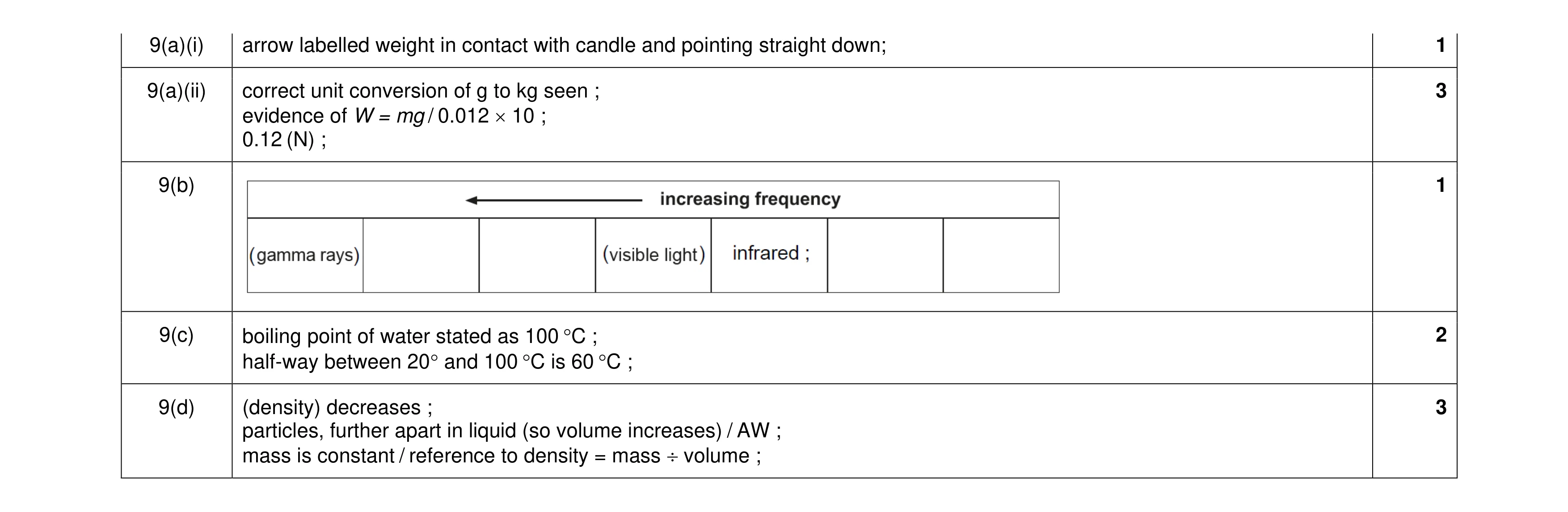 10
10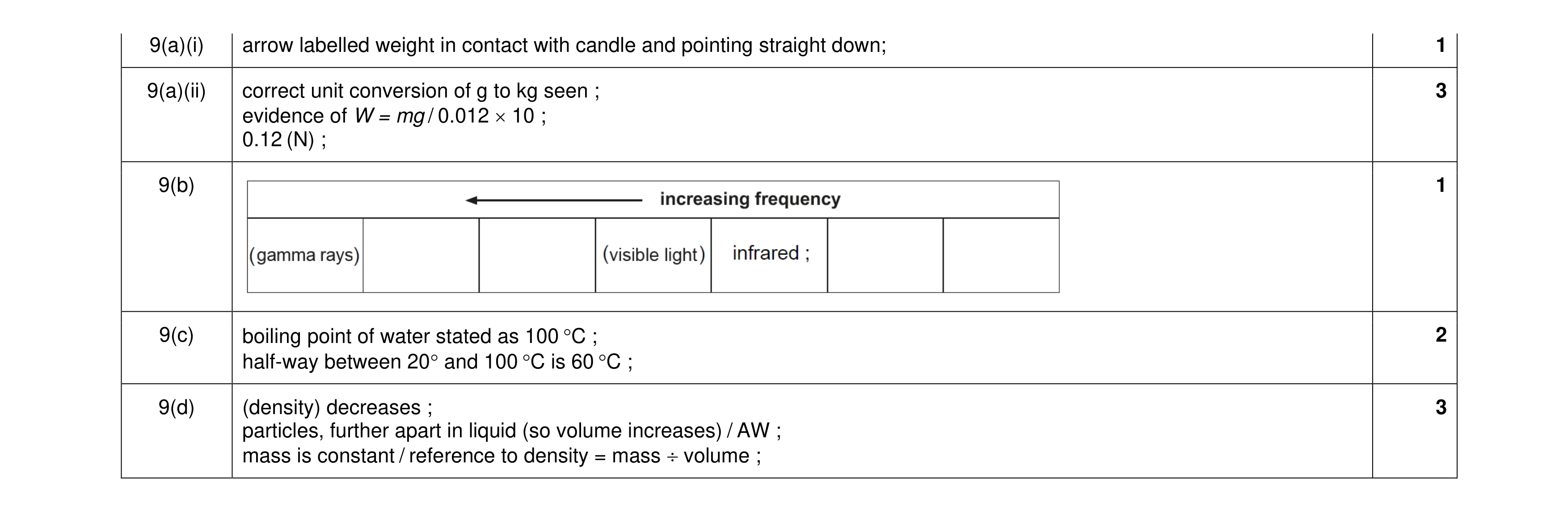 10
10