Questions as text
Q1 · Element X has a high melting point and forms a green chloride 0653/11 Oct/Nov 2005
18 Element X has a high melting point and forms a green chloride. Where in the Periodic Table is X most likely to be found? A Group O B Group I C Group VII D Transition elements
1 marks
Answer: D
This question in 0653/11 Oct/Nov 2005
Q2 · The positions of four elements are shown in the outline of the Periodic Table 0653/11 May/June 2006
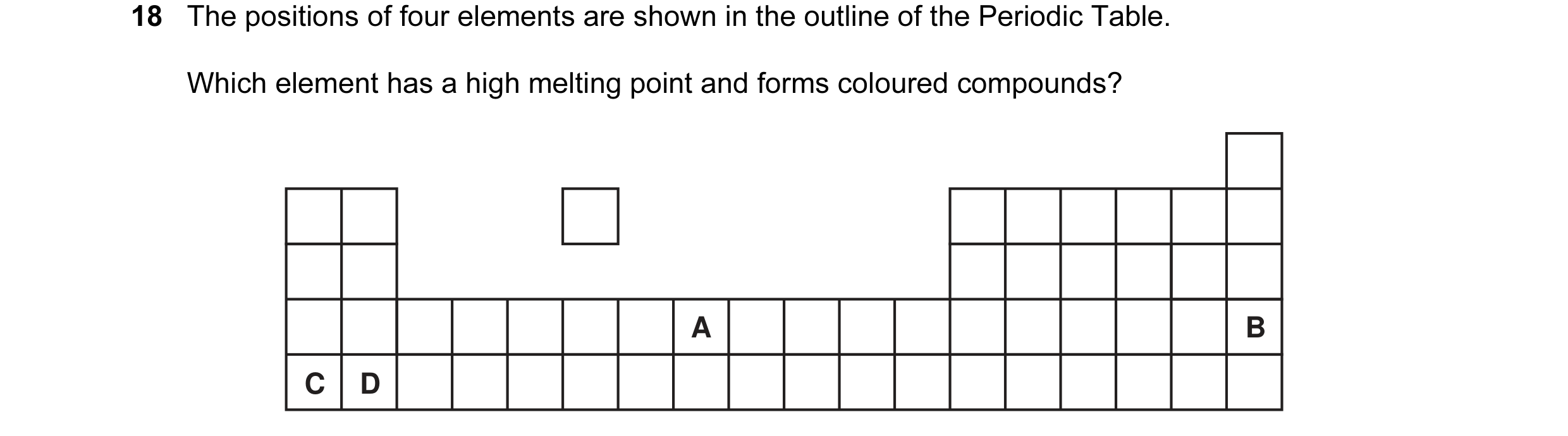
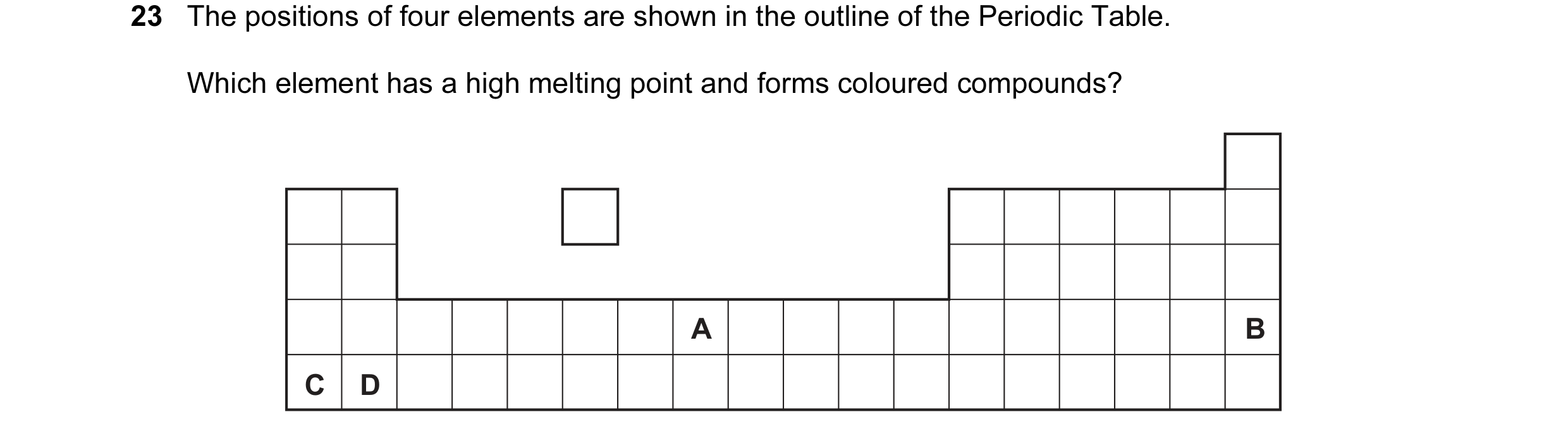
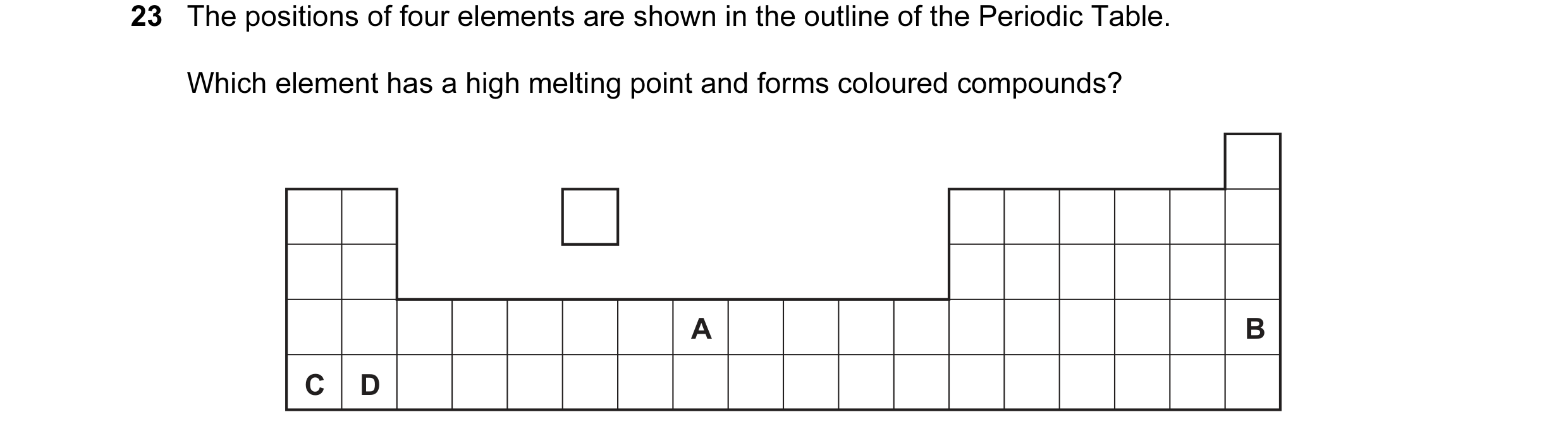
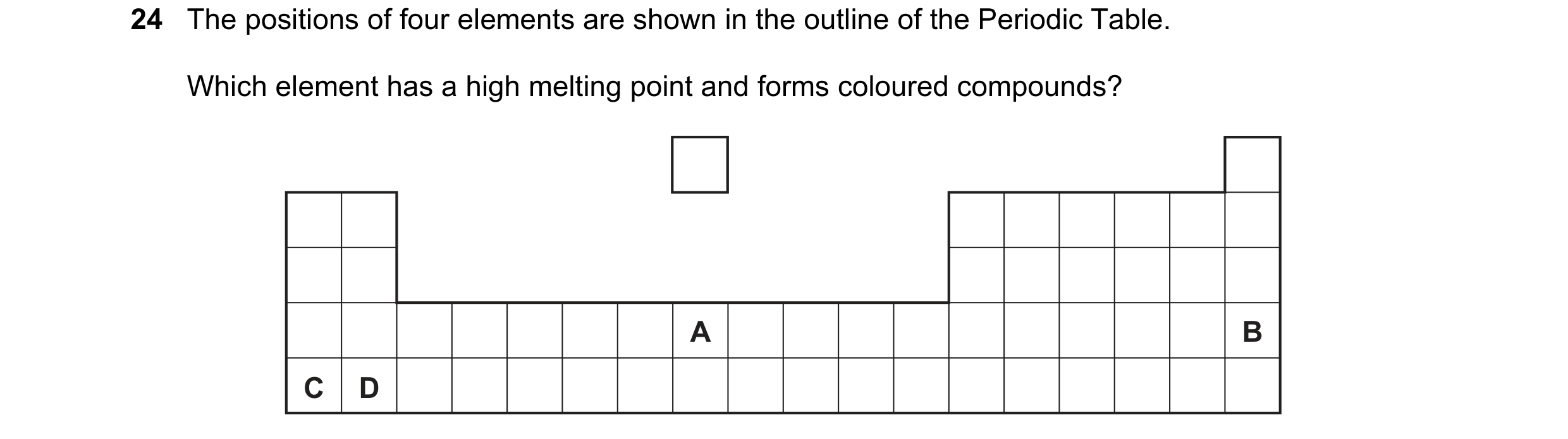
18 The positions of four elements are shown in the outline of the Periodic Table. Which element has a high melting point and forms coloured compounds? A B C D
1 marks
Answer: A
This question in 0653/11 May/June 2006
Q3 · The positions of four elements are shown in the outline of the Periodic Table 0653/11 May/June 2009
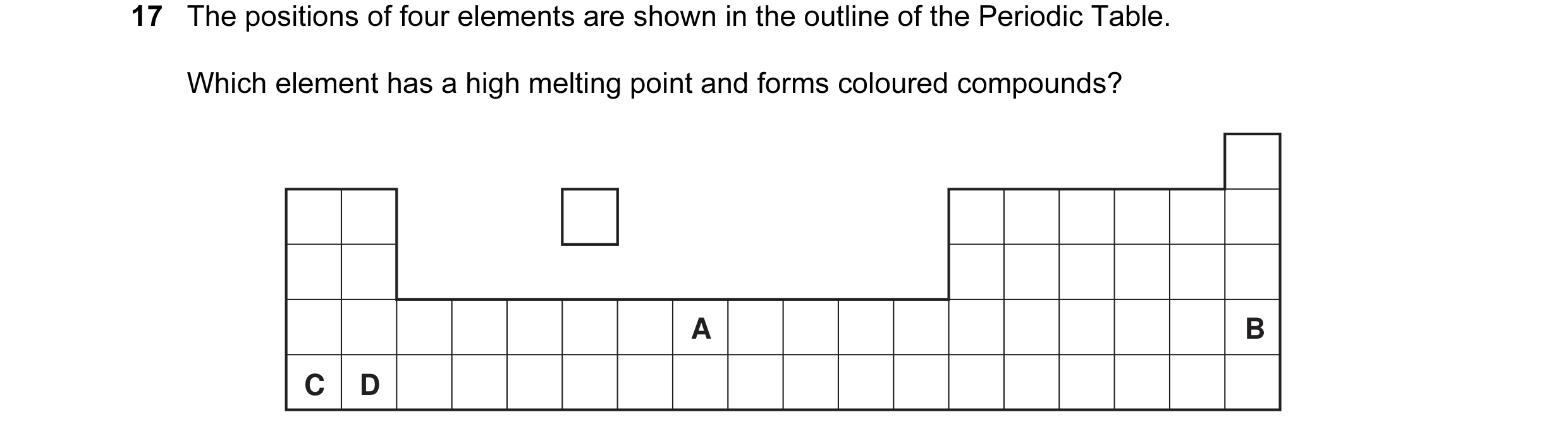
17 The positions of four elements are shown in the outline of the Periodic Table. Which element has a high melting point and forms coloured compounds? A B C D
1 marks
Answer: A
This question in 0653/11 May/June 2009
Q4 · Which three elements are all transition elements? 0653/11 Oct/Nov 2010
17 Which three elements are all transition elements? A chlorine, bromine and iodine B helium, neon and argon C iron, cobalt and nickel D lithium, sodium and potassium
1 marks
Answer: C
This question in 0653/11 Oct/Nov 2010
Q5 · Which three elements are all transition elements? 0653/12 Oct/Nov 2010
15 Which three elements are all transition elements? A chlorine, bromine and iodine B helium, neon and argon C iron, cobalt and nickel D lithium, sodium and potassium
1 marks
Answer: D
This question in 0653/12 Oct/Nov 2010
Q6 · Which three elements are all transition elements? 0653/13 Oct/Nov 2010
16 Which three elements are all transition elements? A chlorine, bromine and iodine B helium, neon and argon C iron, cobalt and nickel D lithium, sodium and potassium
1 marks
Answer: C
This question in 0653/13 Oct/Nov 2010
Q7 · The position in the Periodic Table of an element Q is shown 0653/11 May/June 2011
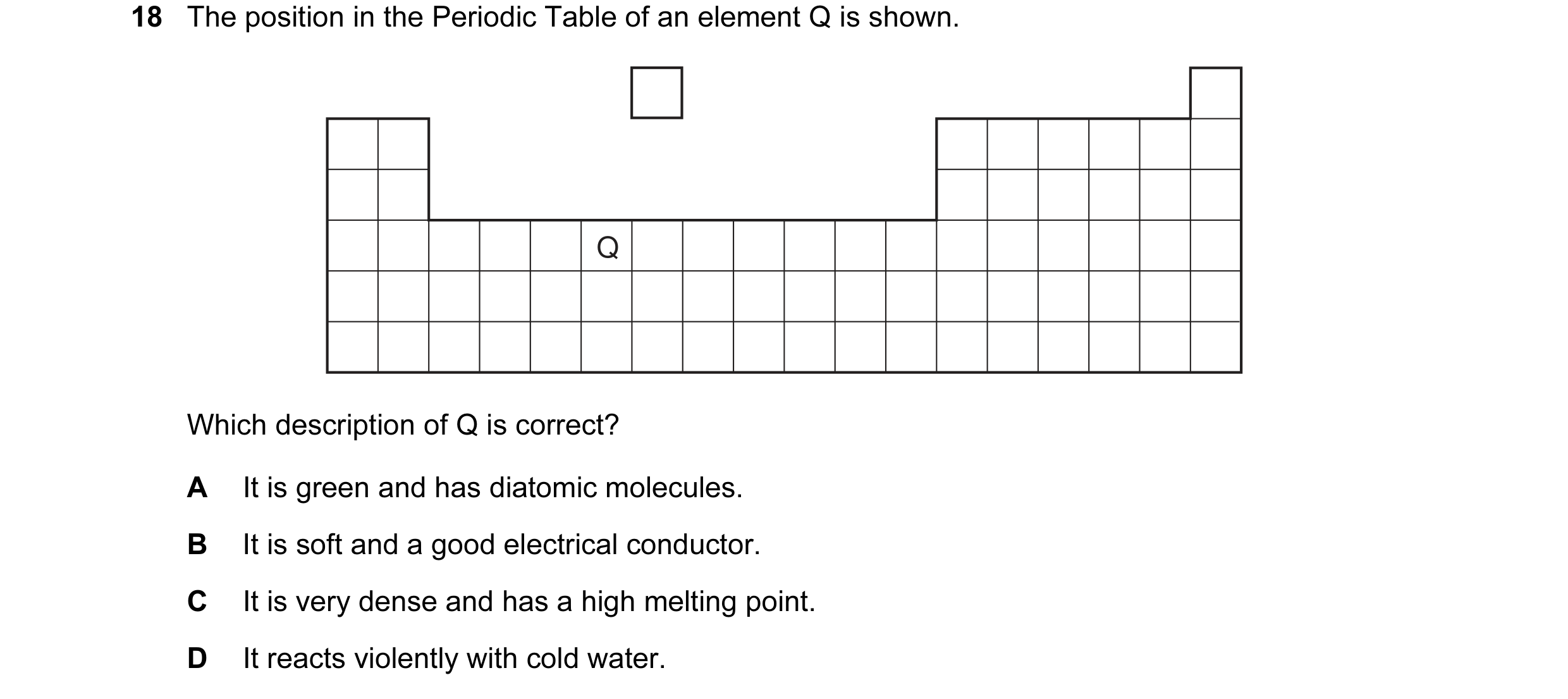
18 The position in the Periodic Table of an element Q is shown. Q Which description of Q is correct? A It is green and has diatomic molecules. B It is soft and a good electrical conductor. C It is very dense and has a high melting point. D It reacts violently with cold water.
1 marks
Answer: C
This question in 0653/11 May/June 2011
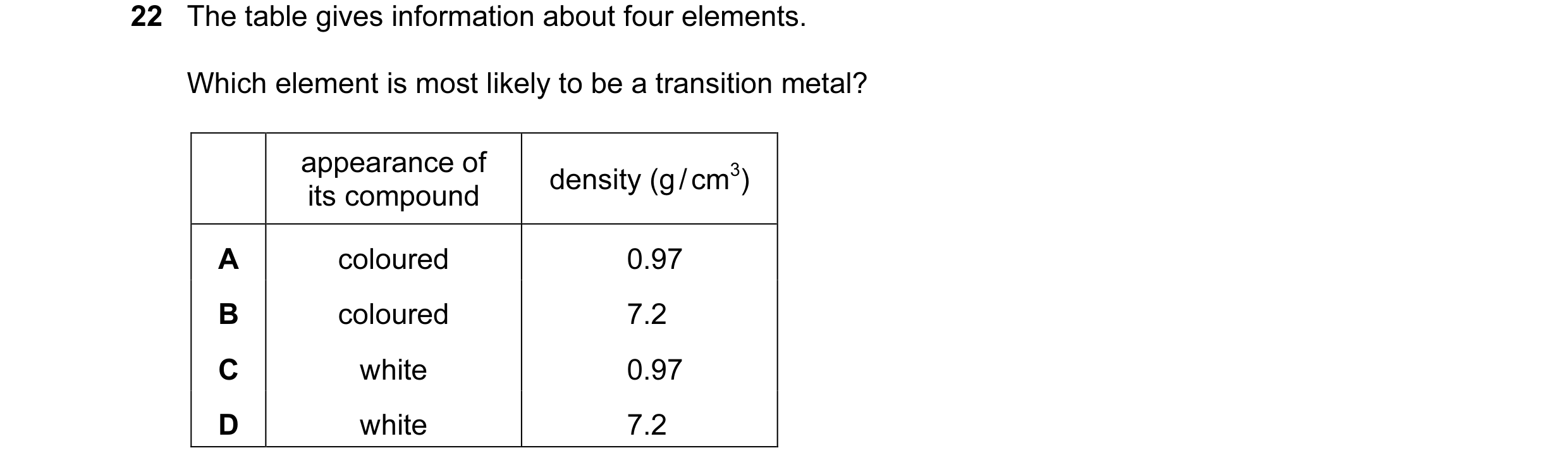
Q8 · The table gives information about four elements 0653/11 May/June 2012
22 The table gives information about four elements. Which element is most likely to be a transition metal? appearance of density (g / cm3) its compound A coloured 0.97 B coloured 7.2 C white 0.97 D white 7.2
1 marks
This question in 0653/11 May/June 2012
Q9 · The diagram shows elements in part of the Periodic Table 0653/12 May/June 2012
22 The diagram shows elements in part of the Periodic Table. The letters are not the actual symbols of the elements. I II III IV V VI VII 0 P S T Q U R Which statement about the elements shown is correct? A P and S are in the same group of the Periodic Table. B P is more reactive than Q. C R is likely to form coloured compounds. D T and U are halogens.
1 marks
Answer: C
This question in 0653/12 May/June 2012
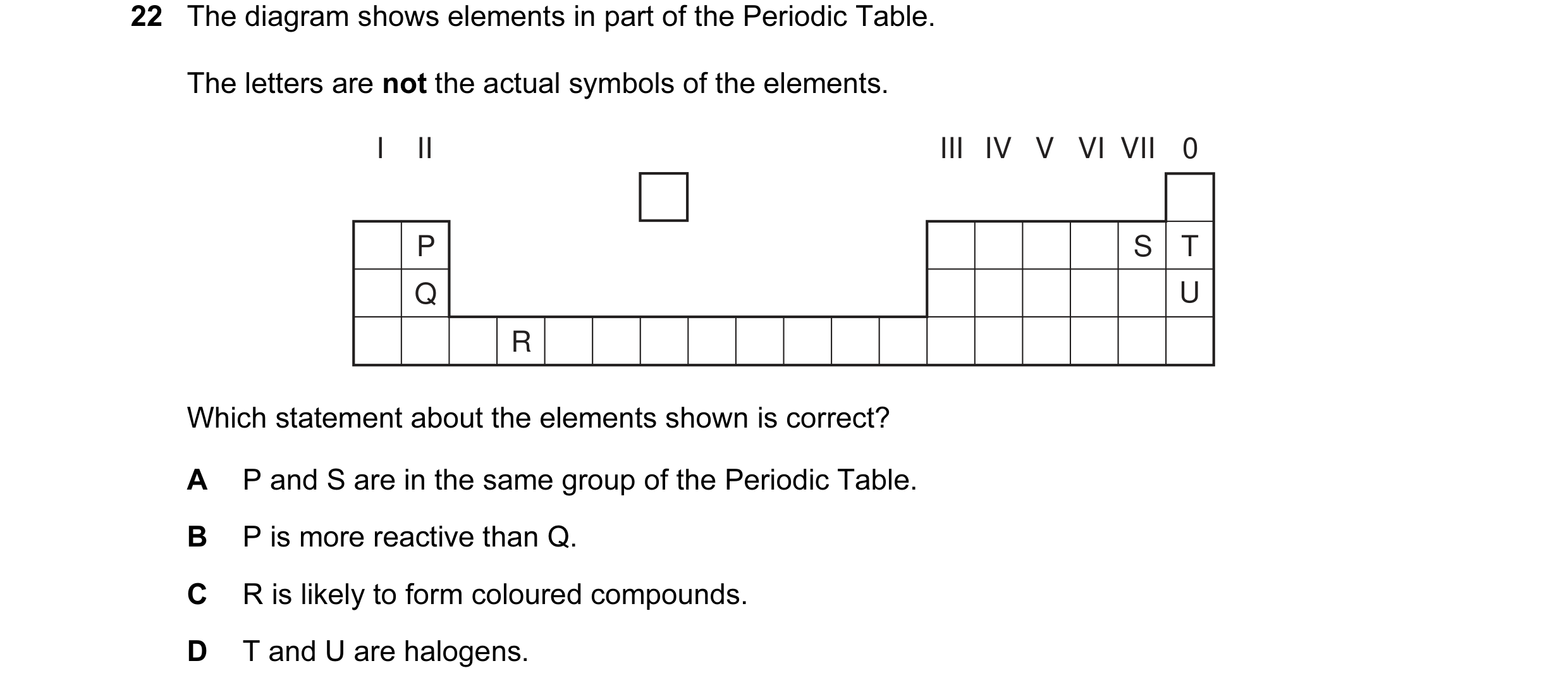
Q10 · The diagram shows elements in part of the Periodic Table 0653/13 May/June 2012
22 The diagram shows elements in part of the Periodic Table. The letters are not the actual symbols of the elements. I II III IV V VI VII 0 P S T Q U R Which statement about the elements shown is correct? A P and S are in the same group of the Periodic Table. B P is more reactive than Q. C R is likely to form coloured compounds. D T and U are halogens.
1 marks
Answer: C
This question in 0653/13 May/June 2012
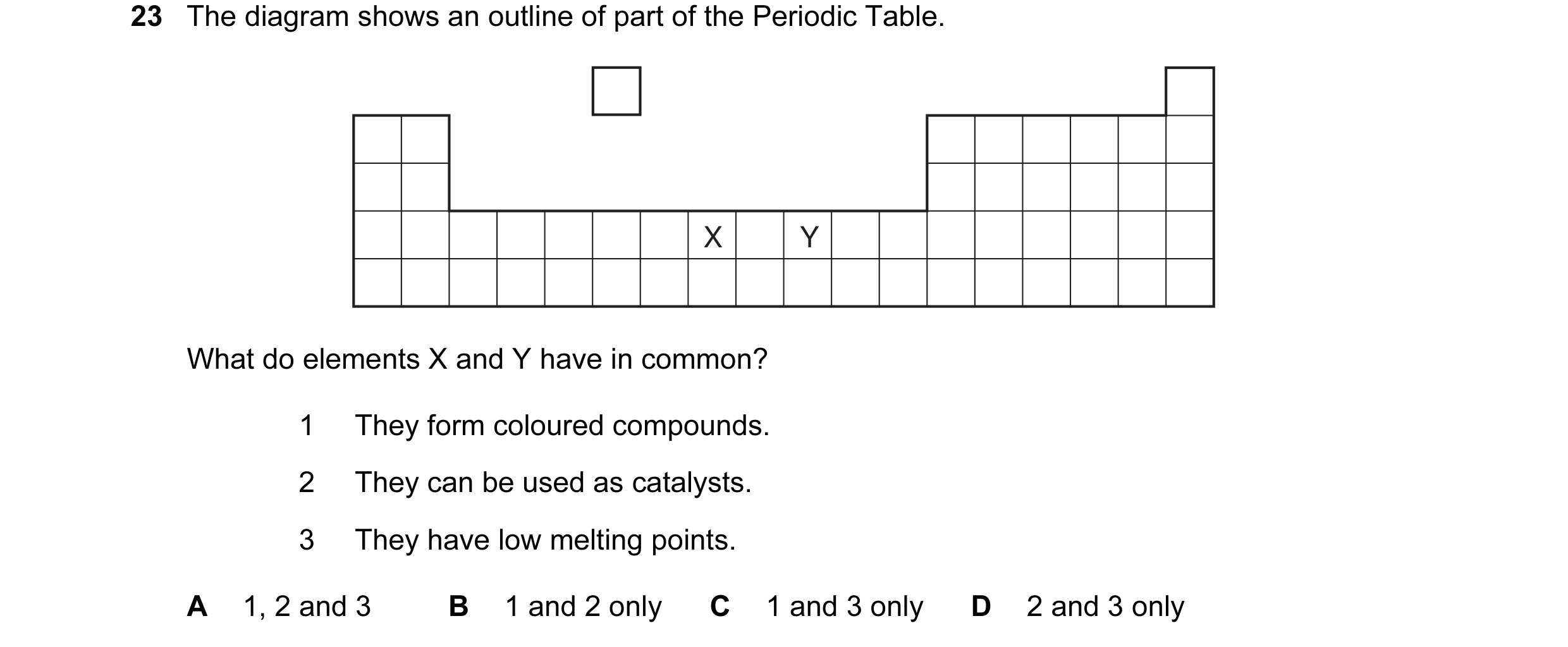
Q11 · The diagram shows an outline of part of the Periodic Table 0653/13 May/June 2013
23 The diagram shows an outline of part of the Periodic Table. X Y What do elements X and Y have in common? 1 They form coloured compounds. 2 They can be used as catalysts. 3 They have low melting points. A 1, 2 and 3 B 1 and 2 only C 1 and 3 only D 2 and 3 only
1 marks
Answer: B
This question in 0653/13 May/June 2013
Q12 · Element X reacts with chlorine to form a red-brown compound 0653/13 Oct/Nov 2013
25 Element X reacts with chlorine to form a red-brown compound. chlorine excess chlorine element X heat Which row describes element X and its melting point? type of element melting point of X A alkali metal high B alkali metal low C transition element high D transition element low
1 marks
Answer: C
This question in 0653/13 Oct/Nov 2013
Q13 · Which statement about transition metals is not correct? 0653/11 Oct/Nov 2014
23 Which statement about transition metals is not correct? A They are often used as catalysts. B They form colourless compounds. C They have high densities. D They have high melting points.
1 marks
Answer: B
This question in 0653/11 Oct/Nov 2014
Q14 · Which statement about transition metals is not correct? 0653/12 Oct/Nov 2014
24 Which statement about transition metals is not correct? A They are often used as catalysts. B They form colourless compounds. C They have high densities. D They have high melting points.
1 marks
Answer: B
This question in 0653/12 Oct/Nov 2014
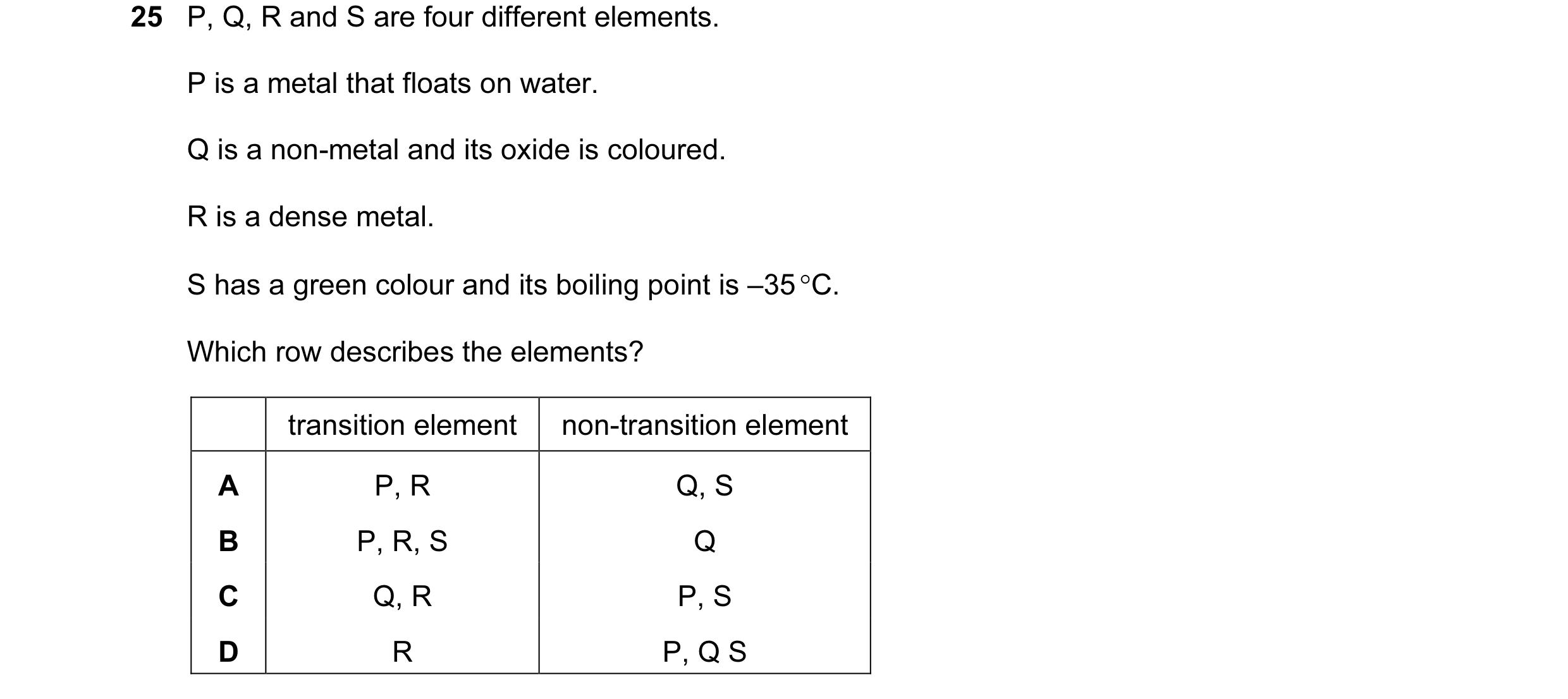
Q15 · P, Q, R and S are four different elements 0653/13 Oct/Nov 2014
25 P, Q, R and S are four different elements. P is a metal that floats on water. Q is a non-metal and its oxide is coloured. R is a dense metal. S has a green colour and its boiling point is –35 °C. Which row describes the elements? transition element non-transition element A P, R Q, S B P, R, S Q C Q, R P, S D R P, Q S
1 marks
Answer: D
This question in 0653/13 Oct/Nov 2014
Q16 · Chromium is a transition metal 0653/13 May/June 2015
23 Chromium is a transition metal.
Which properties are shown by chromium?
0 Oo WwW >
high
melting point
v
v
v
x
low
density
v
v
x
v
acts as
a catalyst
v
x
v
v
key
v/=yes
X =no
1 marks
Answer: C
This question in 0653/13 May/June 2015
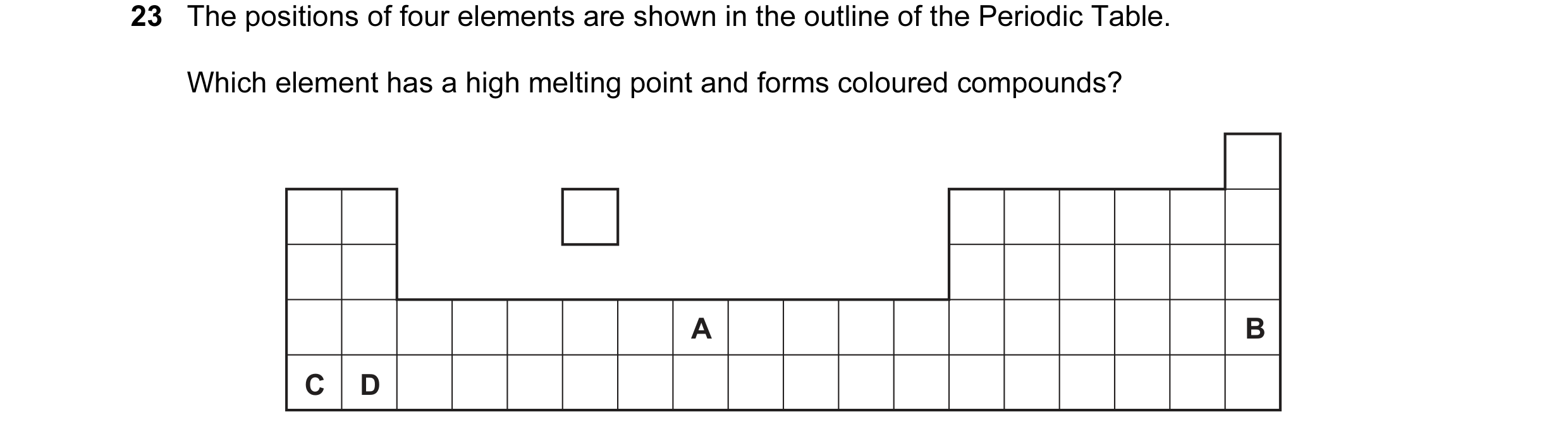
Q17 · The positions of four elements are shown in the outline of the Periodic Table 0653/11 Oct/Nov 2015
23 The positions of four elements are shown in the outline of the Periodic Table. Which element has a high melting point and forms coloured compounds? A B C D
1 marks
Answer: A
This question in 0653/11 Oct/Nov 2015
Q18 · The positions of four elements are shown in the outline of the Periodic Table 0653/12 Oct/Nov 2015
23 The positions of four elements are shown in the outline of the Periodic Table. Which element has a high melting point and forms coloured compounds? A B C D
1 marks
Answer: A
This question in 0653/12 Oct/Nov 2015
Q19 · The positions of four elements are shown in the outline of the Periodic Table 0653/13 Oct/Nov 2015
23 The positions of four elements are shown in the outline of the Periodic Table. Which element has a high melting point and forms coloured compounds? A B C D
1 marks
Answer: A
This question in 0653/13 Oct/Nov 2015
Q20 · Element X has a high density and is used as a catalyst 0653/13 Oct/Nov 2015
24 Element X has a high density and is used as a catalyst. What is X? A carbon B sodium C sulfur D vanadium
1 marks
Answer: D
This question in 0653/13 Oct/Nov 2015
Q21 · Which statement describes a transition element? 0653/11 May/June 2016
23 Which statement describes a transition element? A a metal that forms white compounds B a metal with a high melting point C a metal with a low density D a non-metal that forms coloured compounds
1 marks
Answer: B
This question in 0653/11 May/June 2016
Q22 · What are two properties of transition metals? 0653/12 May/June 2016
23 What are two properties of transition metals? A act as catalysts and form white compounds B high densities and low boiling points C high melting points and form coloured compounds D low densities and their compounds act as catalysts
1 marks
Answer: C
This question in 0653/12 May/June 2016
Q23 · W, X, Y and Z are four metals 0653/13 May/June 2016
23 W, X, Y and Z are four metals. W forms a compound that is used to speed up chemical reactions. X forms coloured compounds. Y has a high melting point. Z has a low density. Which metals are transition elements? A W, X and Y B W and X only C X, Y and Z D Y and Z only
1 marks
Answer: A
This question in 0653/13 May/June 2016
Q24 · What is not a property of transition elements? 0653/13 Oct/Nov 2017
24 What is not a property of transition elements? A conduct electricity B form coloured compounds C high melting point D low density
1 marks
Answer: D
This question in 0653/13 Oct/Nov 2017
Q25 · Which row describes the properties of a transition element? 0653/12 Feb/March 2018
23 Which row describes the properties of a transition element? melting electrical density point conductor A high high yes B high low no C low high no D low low yes
1 marks
Answer: A
This question in 0653/12 Feb/March 2018
Q26 · Which statement about transition metals is not correct? 0653/11 May/June 2018
24 Which statement about transition metals is not correct? A They are often used as catalysts. B They form colourless compounds. C They have high densities. D They have high melting points.
1 marks
Answer: B
This question in 0653/11 May/June 2018
Q27 · Which statement about transition metals is not correct? 0653/12 May/June 2018
24 Which statement about transition metals is not correct? A They are often used as catalysts. B They form colourless compounds. C They have high densities. D They have high melting points.
1 marks
Answer: B
This question in 0653/12 May/June 2018
Q28 · Which statement about transition metals is not correct? 0653/13 May/June 2018
24 Which statement about transition metals is not correct? A They are often used as catalysts. B They form colourless compounds. C They have high densities. D They have high melting points.
1 marks
Answer: B
This question in 0653/13 May/June 2018
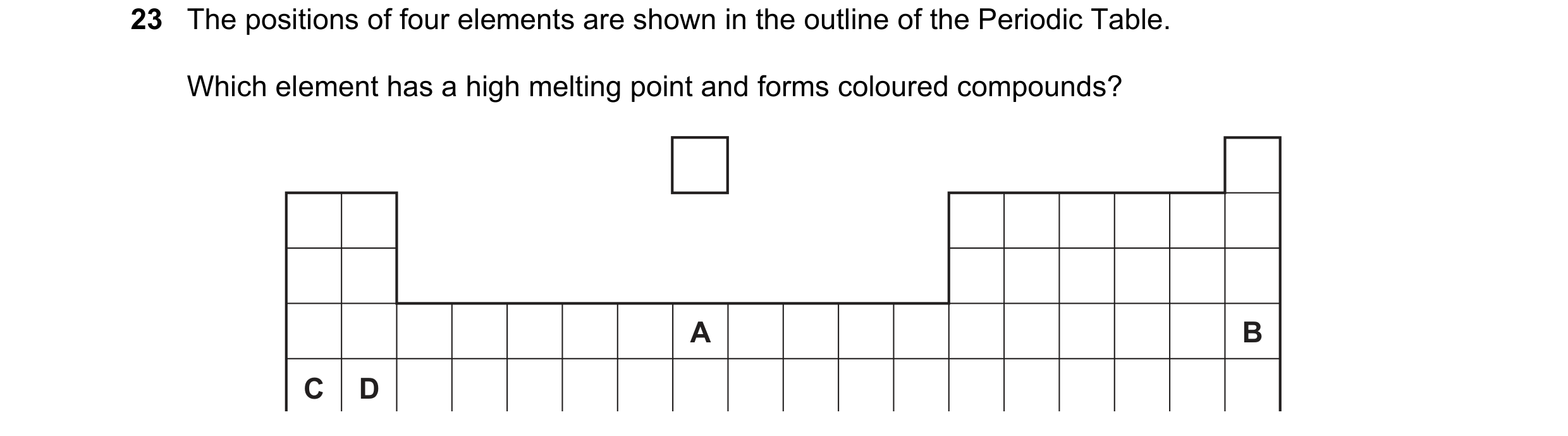
Q29 · The positions of four elements are shown in the outline of the Periodic Table 0653/11 Oct/Nov 2018
23 The positions of four elements are shown in the outline of the Periodic Table. Which element has a high melting point and forms coloured compounds? A B C D
1 marks
Answer: A
This question in 0653/11 Oct/Nov 2018
Q30 · Which bar chart shows the relative melting points of bromine, iron and potassium? 0653/12 Oct/Nov 2018
23 Which bar chart shows the relative melting points of bromine, iron and potassium? A B Br2 Fe relative Fe relative K melting melting point point Br2 K C D Fe K relative Br2 relative Fe melting melting point point Br2 K
1 marks
Answer: B
This question in 0653/12 Oct/Nov 2018
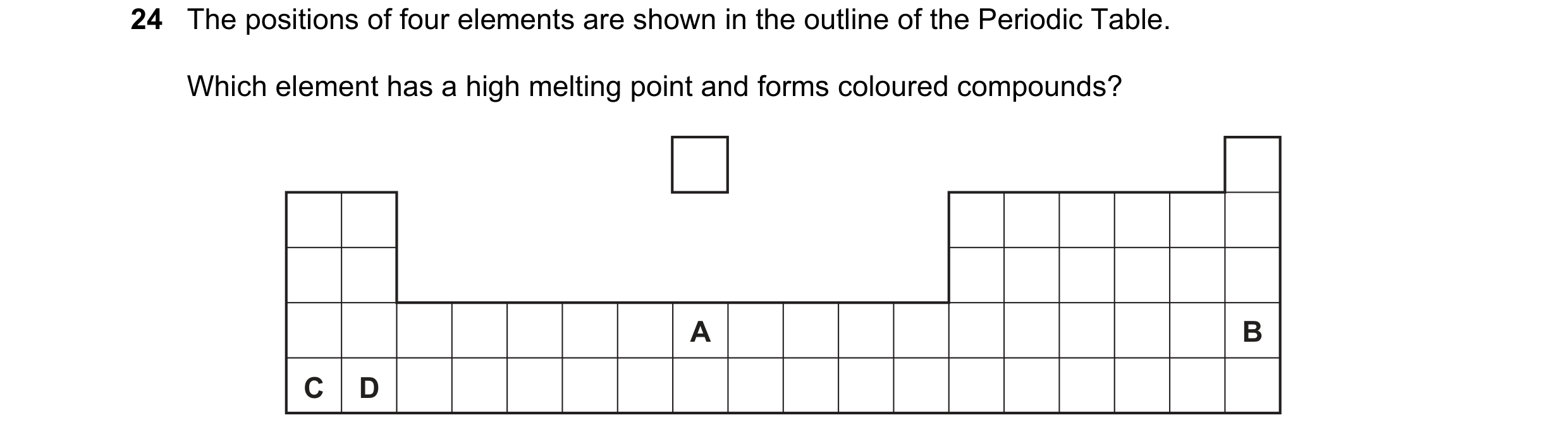
Q31 · The positions of four elements are shown in the outline of the Periodic Table 0653/12 Oct/Nov 2018
24 The positions of four elements are shown in the outline of the Periodic Table. Which element has a high melting point and forms coloured compounds? A B C D
1 marks
Answer: A
This question in 0653/12 Oct/Nov 2018
Q32 · The positions of four elements are shown in the outline of the Periodic Table 0653/13 Oct/Nov 2018
24 The positions of four elements are shown in the outline of the Periodic Table. Which element has a high melting point and forms coloured compounds? A B C D
1 marks
Answer: A
This question in 0653/13 Oct/Nov 2018
Q33 · Element R reacts with chlorine to form a coloured ionic compound with the formula RCl 3 0653/11 May/June 2020
24 Element R reacts with chlorine to form a coloured ionic compound with the formula RCl 3. RCl 3 acts as a catalyst in some reactions. Which statement about element R is correct? A It conducts electricity only when molten. B It is a transition element. C It has a low melting point. D It has a low density.
1 marks
Answer: B
This question in 0653/11 May/June 2020
Q34 · Ammonia, NH3, can be made by combining the gases nitrogen, N2, and hydrogen, H2 0653/11 Oct/Nov 2020
24 Ammonia, NH3, can be made by combining the gases nitrogen, N2, and hydrogen, H2. This reaction is slow. When element Y is added, the rate of reaction increases. What is Y? A Al B Fe C Rb D I2
1 marks
Answer: B
This question in 0653/11 Oct/Nov 2020
Q35 · Substance X is a coloured solid 0653/12 Oct/Nov 2020
24 Substance X is a coloured solid. Substance X acts as a catalyst for the reaction between zinc and dilute sulfuric acid. Molten X can be electrolysed. What is X? A a Group I compound B a Group I metal C a transition metal compound D a transition metal
1 marks
Answer: C
This question in 0653/12 Oct/Nov 2020
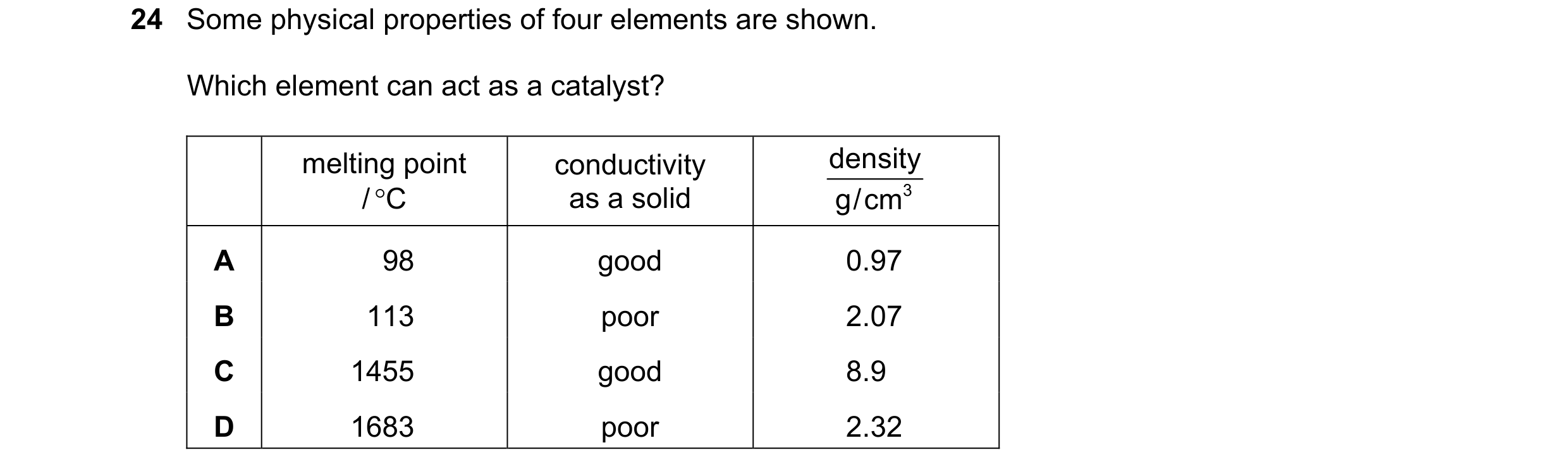
Q36 · Some physical properties of four elements are shown 0653/13 Oct/Nov 2020
24 Some physical properties of four elements are shown. Which element can act as a catalyst? melting point conductivity d ens ty i / C as a solid g / cm 3 A 98 good 0.97 B 113 poor 2.07 C 1455 good 8.9 D 1683 poor 2.32
1 marks
Answer: C
This question in 0653/13 Oct/Nov 2020
Q37 · What are properties of transition elements? 0653/11 May/June 2021
22 What are properties of transition elements? 1 They can act as catalysts. 2 They only form white compounds. 3 They have high densities. A 1 and 2 only B 1 and 3 only C 2 and 3 only D 1, 2 and 3
1 marks
Answer: B
This question in 0653/11 May/June 2021
Q38 · Which row shows the properties of a transition element? 0653/12 May/June 2021
22 Which row shows the properties of a transition element? melting electrical colour of catalytic point conductivity chloride properties A high high white no B high low white no C high high green yes D low low blue yes
1 marks
Answer: C
This question in 0653/12 May/June 2021
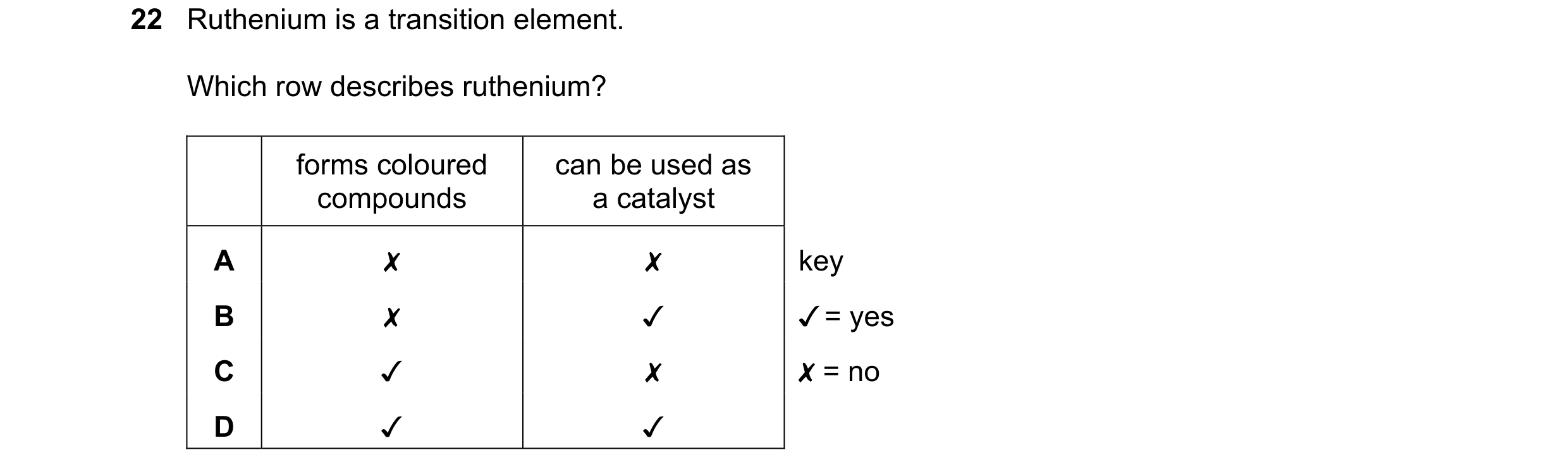
Q39 · Ruthenium is a transition element 0653/13 May/June 2021
22 Ruthenium is a transition element.
Which row describes ruthenium?
forms coloured
can be used as
compounds a catalyst
A x x
B x v
Cc v x
D Jv v
key
/=yes
X=n0o
1 marks
Answer: D
This question in 0653/13 May/June 2021
Q40 · Which part of the Periodic Table contains elements that are used as catalysts? 0653/11 Oct/Nov 2021
24 Which part of the Periodic Table contains elements that are used as catalysts? A Group I B Group VII C noble gases D transition metals
1 marks
Answer: D
This question in 0653/11 Oct/Nov 2021
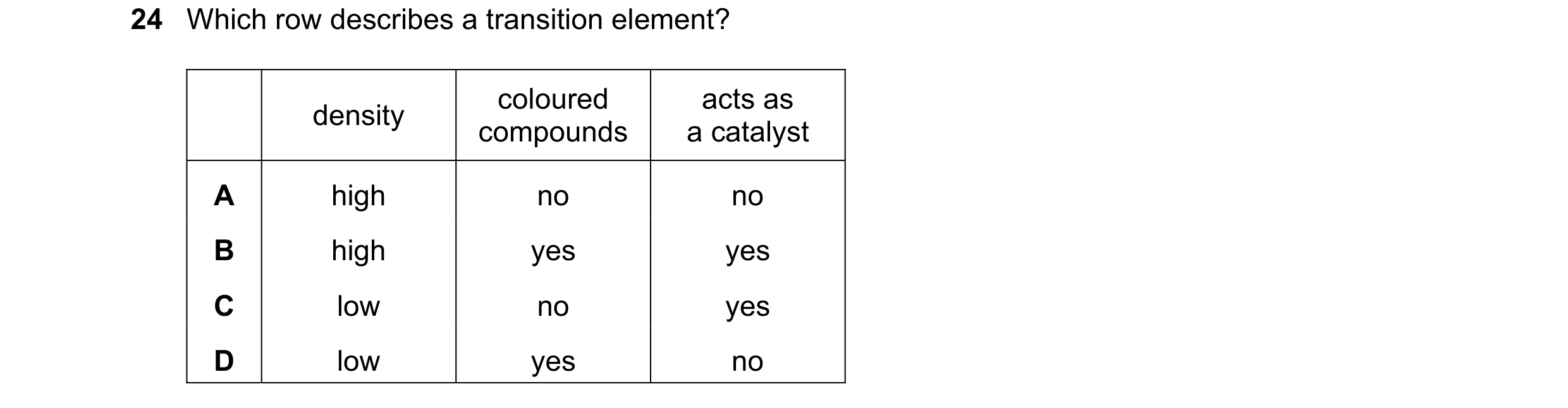
Q41 · Which row describes a transition element? 0653/11 May/June 2022
24 Which row describes a transition element? coloured acts as density compounds a catalyst A high no no B high yes yes C low no yes D low yes no
1 marks
Answer: B
This question in 0653/11 May/June 2022
Q42 · Which properties are shown by transition elements? 0653/11 Oct/Nov 2022
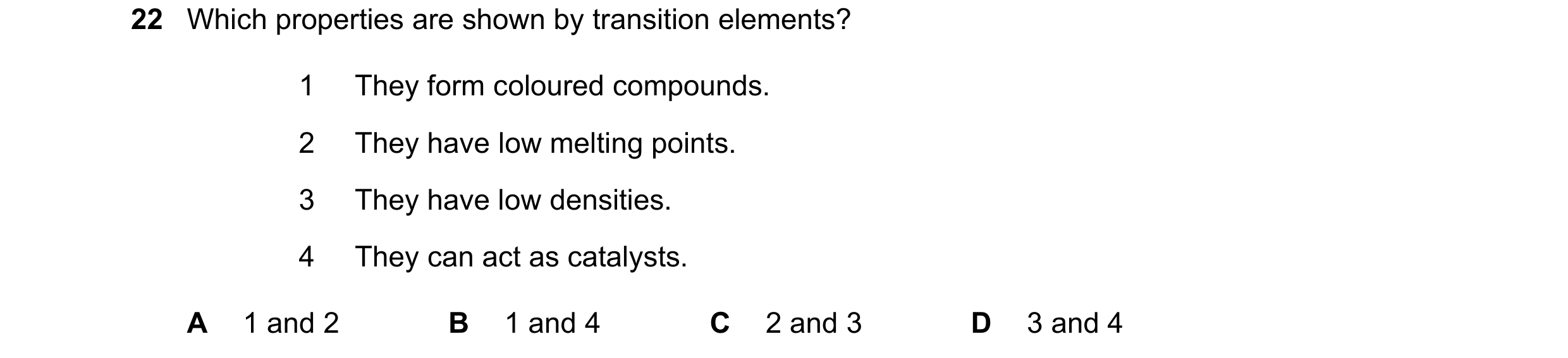
22 Which properties are shown by transition elements? 1 They form coloured compounds. 2 They have low melting points. 3 They have low densities. 4 They can act as catalysts. A 1 and 2 B 1 and 4 C 2 and 3 D 3 and 4
1 marks
Answer: B
This question in 0653/11 Oct/Nov 2022
Q43 · Element X has a high density and conducts electricity when solid and when molten 0653/12 Oct/Nov 2022
22 Element X has a high density and conducts electricity when solid and when molten. Where in the Periodic Table is element X placed? A Group 0 B Group I C halogens D transition elements
1 marks
Answer: D
This question in 0653/12 Oct/Nov 2022
Q44 · Element X has a high density and conducts electricity when solid and when molten 0653/13 Oct/Nov 2022
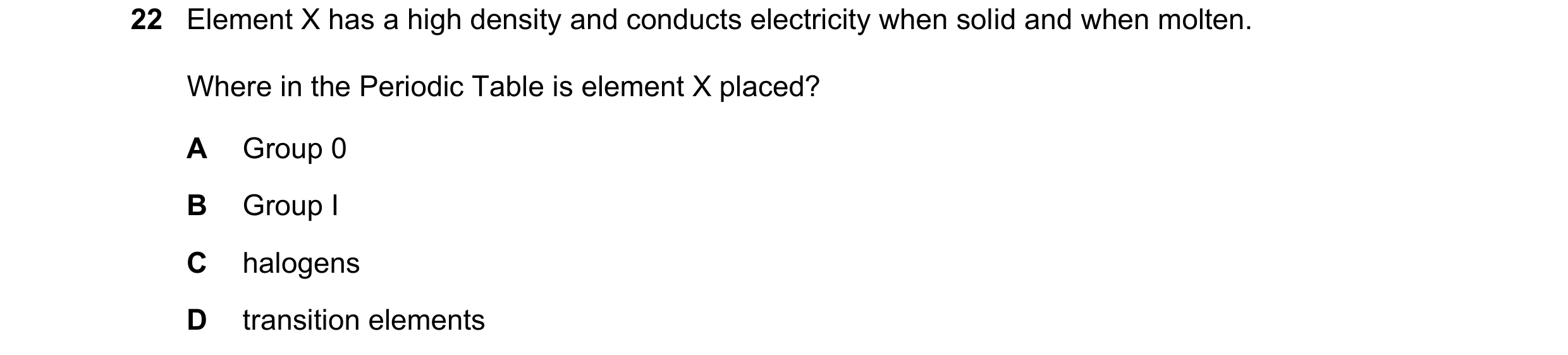
22 Element X has a high density and conducts electricity when solid and when molten. Where in the Periodic Table is element X placed? A Group 0 B Group I C halogens D transition elements
1 marks
Answer: D
This question in 0653/13 Oct/Nov 2022
Q45 · Cobalt is a transition element 0653/11 May/June 2023
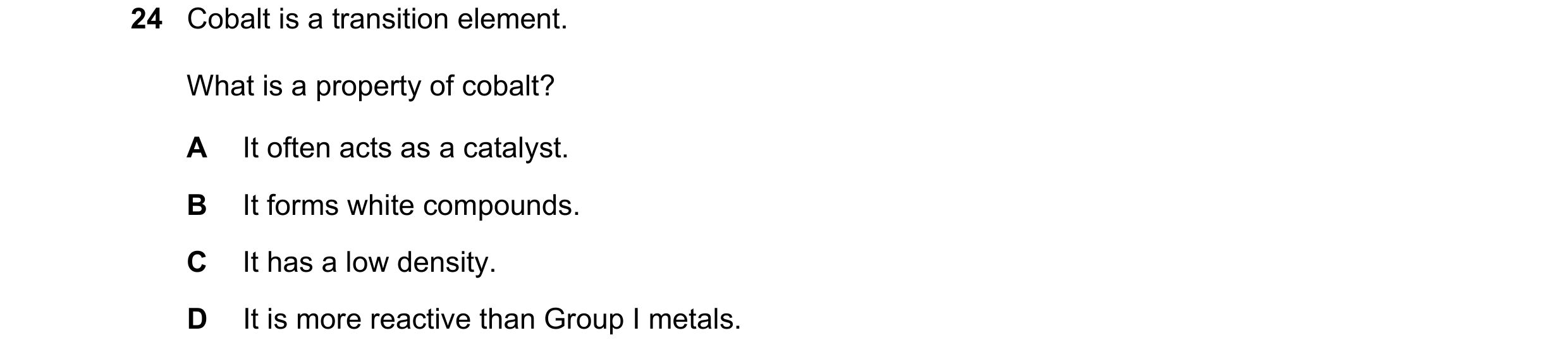
24 Cobalt is a transition element. What is a property of cobalt? A It often acts as a catalyst. B It forms white compounds. C It has a low density. D It is more reactive than Group I metals.
1 marks
Answer: A
This question in 0653/11 May/June 2023
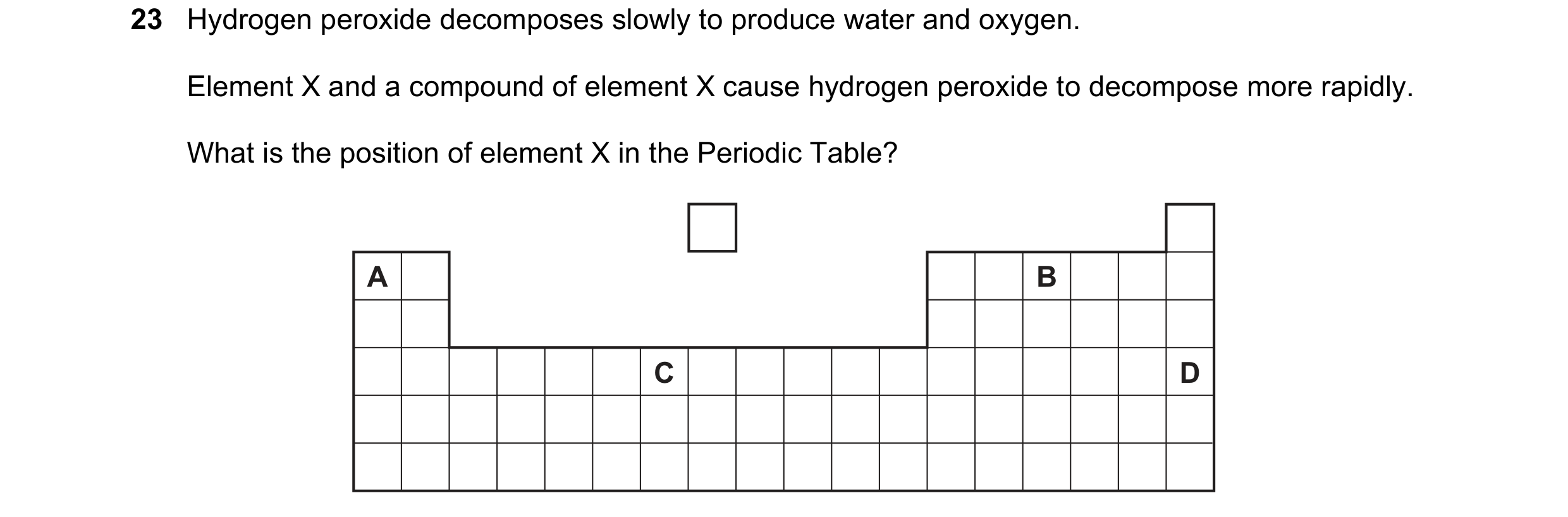
Q46 · Hydrogen peroxide decomposes slowly to produce water and oxygen 0653/12 Oct/Nov 2023
23 Hydrogen peroxide decomposes slowly to produce water and oxygen. Element X and a compound of element X cause hydrogen peroxide to decompose more rapidly. What is the position of element X in the Periodic Table? A B C D
1 marks
Answer: C
This question in 0653/12 Oct/Nov 2023
Q47 · Hydrogen peroxide decomposes slowly to produce water and oxygen 0653/13 Oct/Nov 2023
23 Hydrogen peroxide decomposes slowly to produce water and oxygen. Element X and a compound of element X cause hydrogen peroxide to decompose more rapidly. What is the position of element X in the Periodic Table? A B C D
1 marks
Answer: C
This question in 0653/13 Oct/Nov 2023
Q48 · What is a property of transition elements? 0653/12 Feb/March 2024
22 What is a property of transition elements? A form only white compounds B high melting point C low density D poor conductor of heat
1 marks
Answer: B
This question in 0653/12 Feb/March 2024
Q49 · Which statement about transition elements is correct? 0653/13 May/June 2024
24 Which statement about transition elements is correct? A Their compounds are generally colourless. B Their compounds often act as catalysts. C They are metals with low densities. D They are non-metals with high melting points.
1 marks
Answer: B
This question in 0653/13 May/June 2024
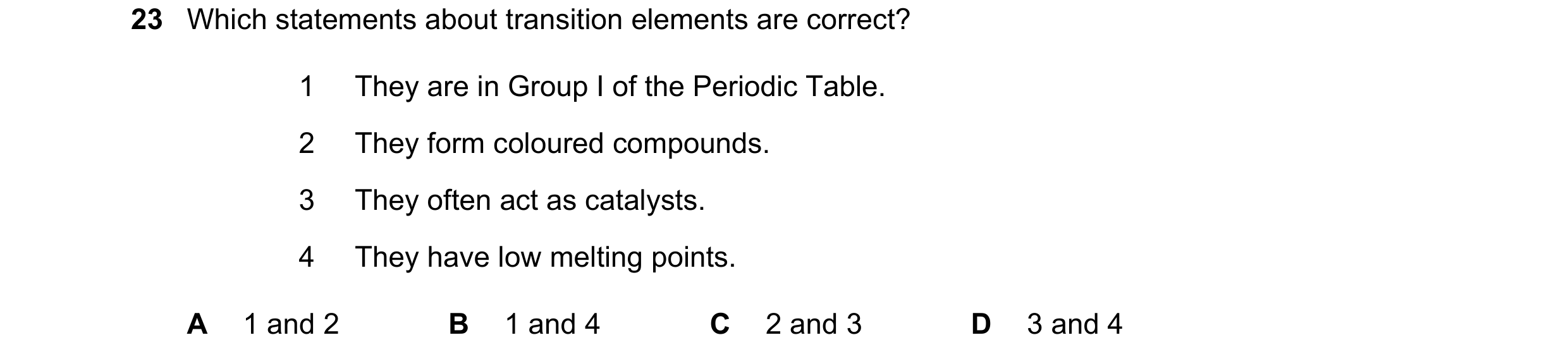
Q50 · Which statements about transition elements are correct? 0653/11 May/June 2025
23 Which statements about transition elements are correct? 1 They are in Group I of the Periodic Table. 2 They form coloured compounds. 3 They often act as catalysts. 4 They have low melting points. A 1 and 2 B 1 and 4 C 2 and 3 D 3 and 4
1 marks
Answer: C
This question in 0653/11 May/June 2025
Q51 · Which statement describes properties of a transition element? 0653/11 Oct/Nov 2025
18 Which statement describes properties of a transition element? A It has a high melting point, a high density and forms a blue-green chloride. B It has a high melting point, a low density and forms a white chloride. C It has a low melting point, a low density and forms a green chloride. D It has a low melting point, a high density and forms a white chloride.
1 marks
Answer: A
This question in 0653/11 Oct/Nov 2025

 1 / 12
 2 / 12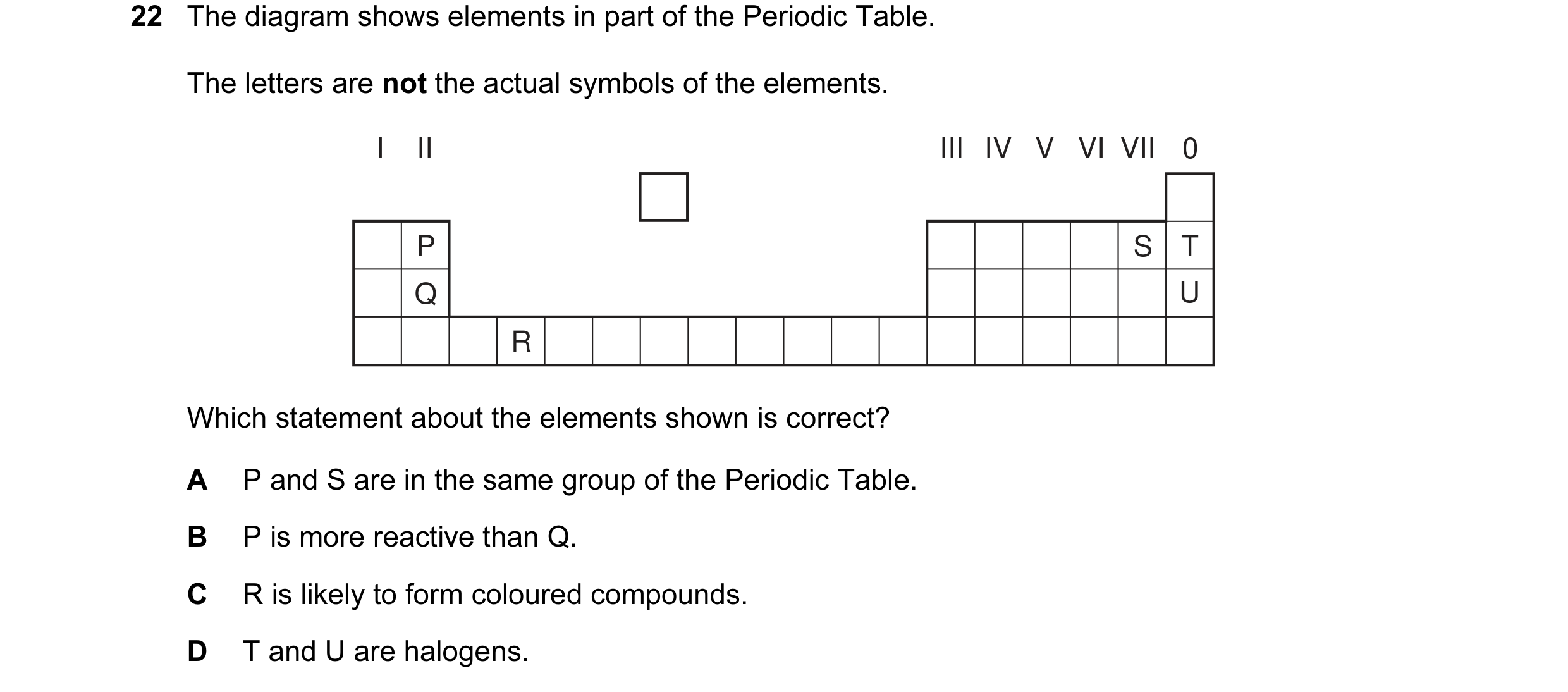
 3 / 12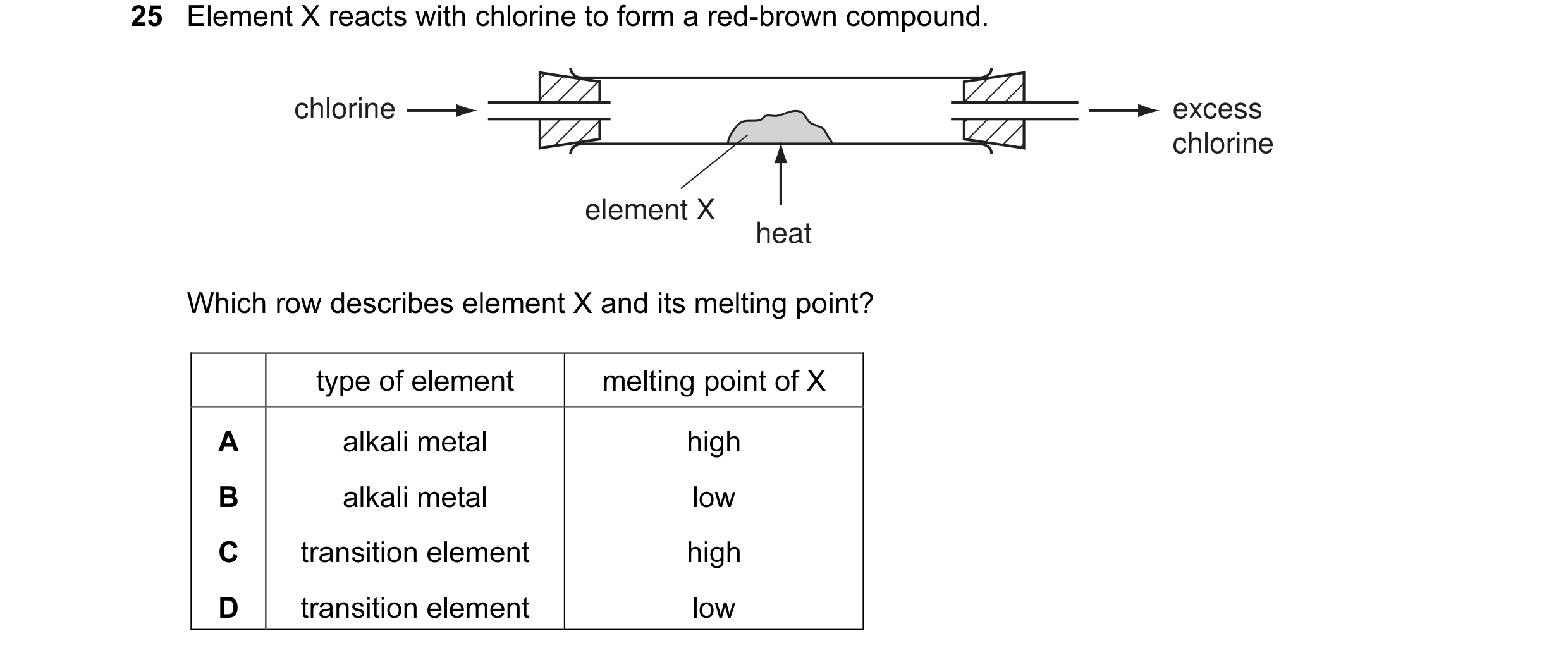


 4 / 12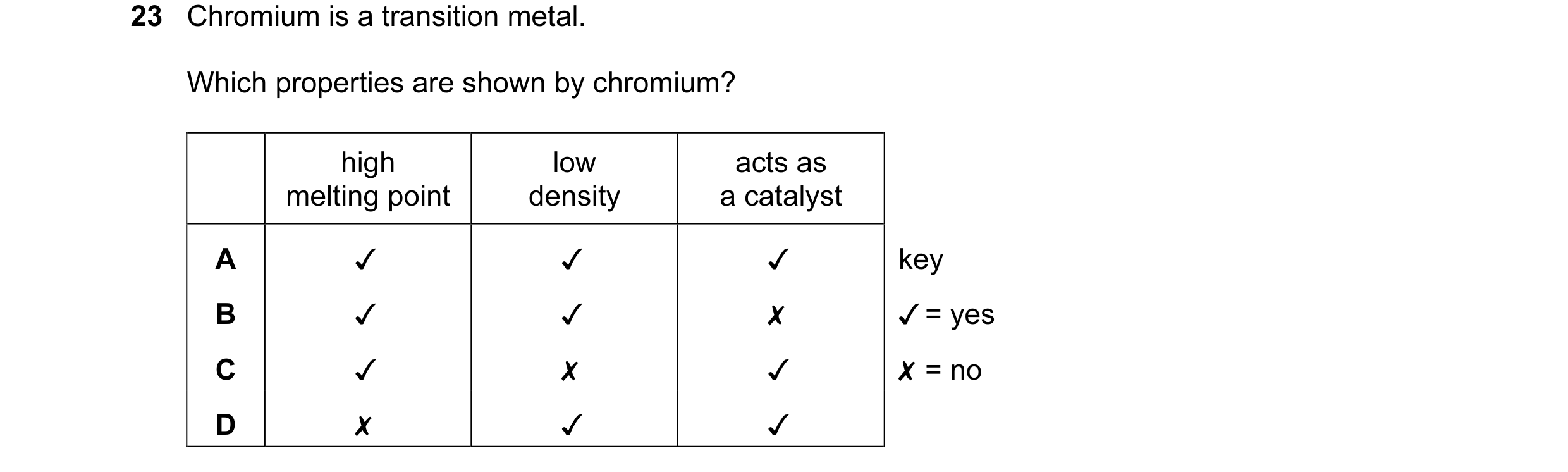
 5 / 12


 6 / 12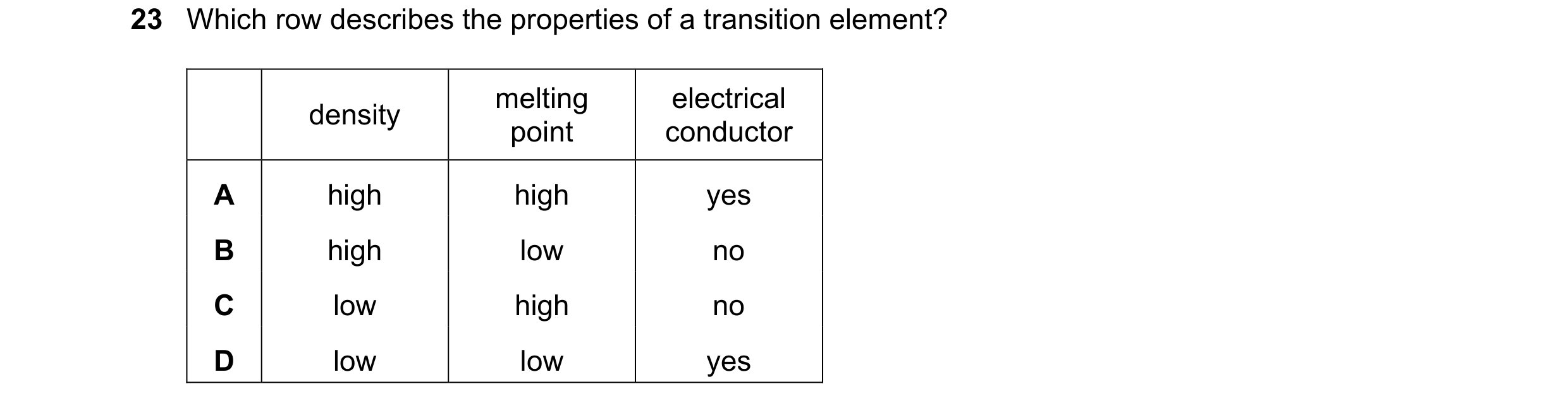



 7 / 12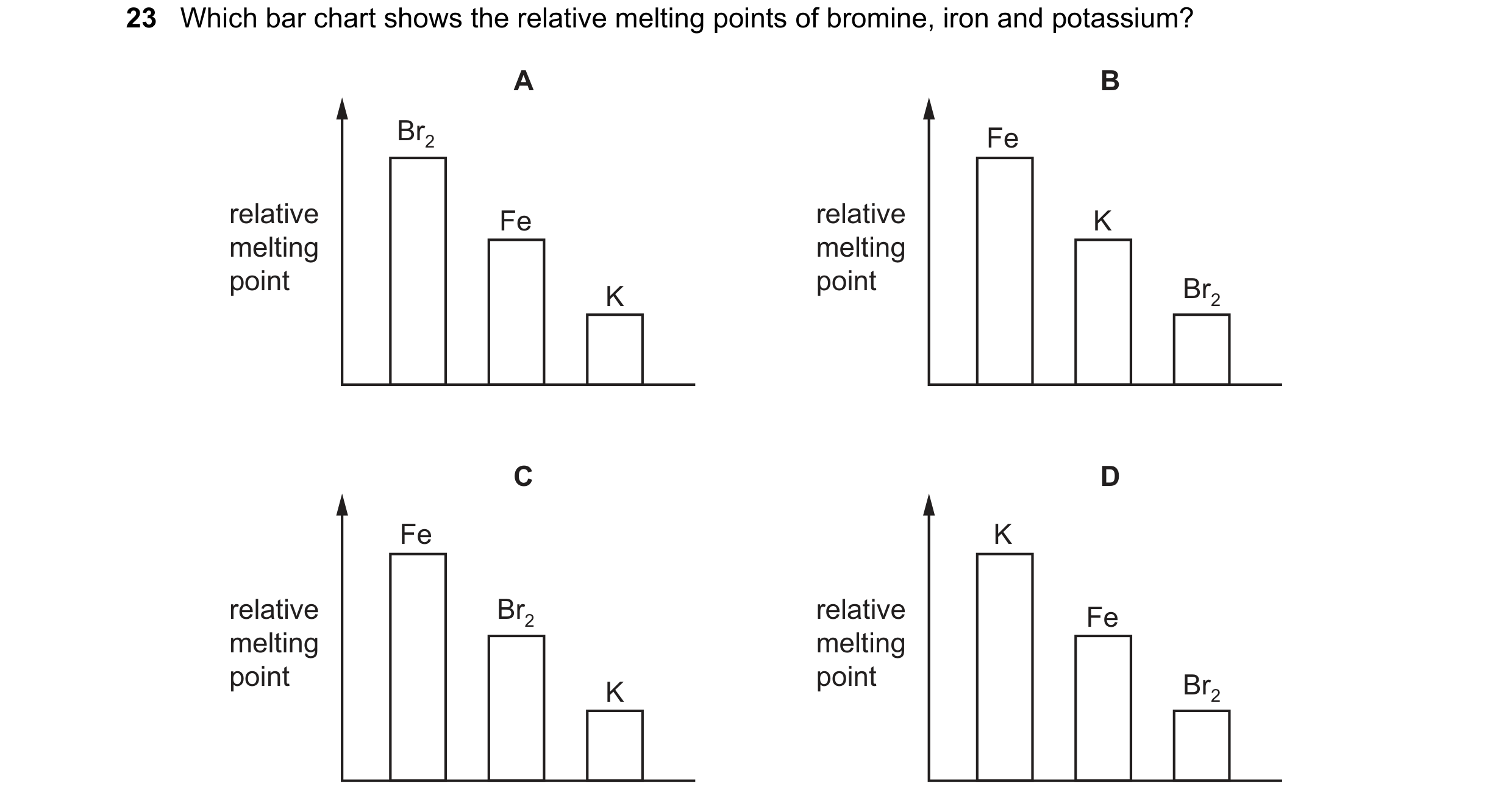
 8 / 12
 9 / 12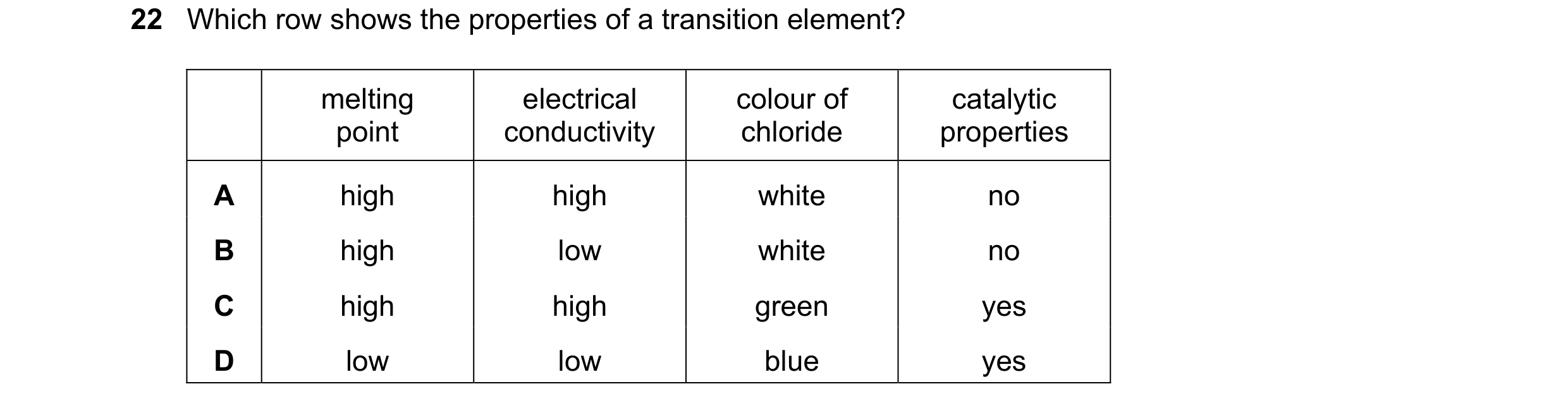

 10 / 12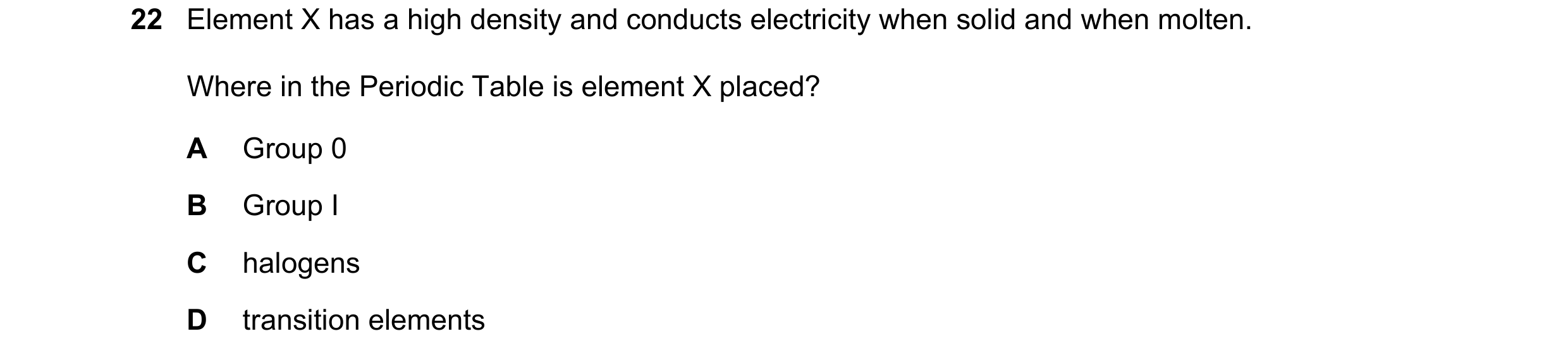
 11 / 12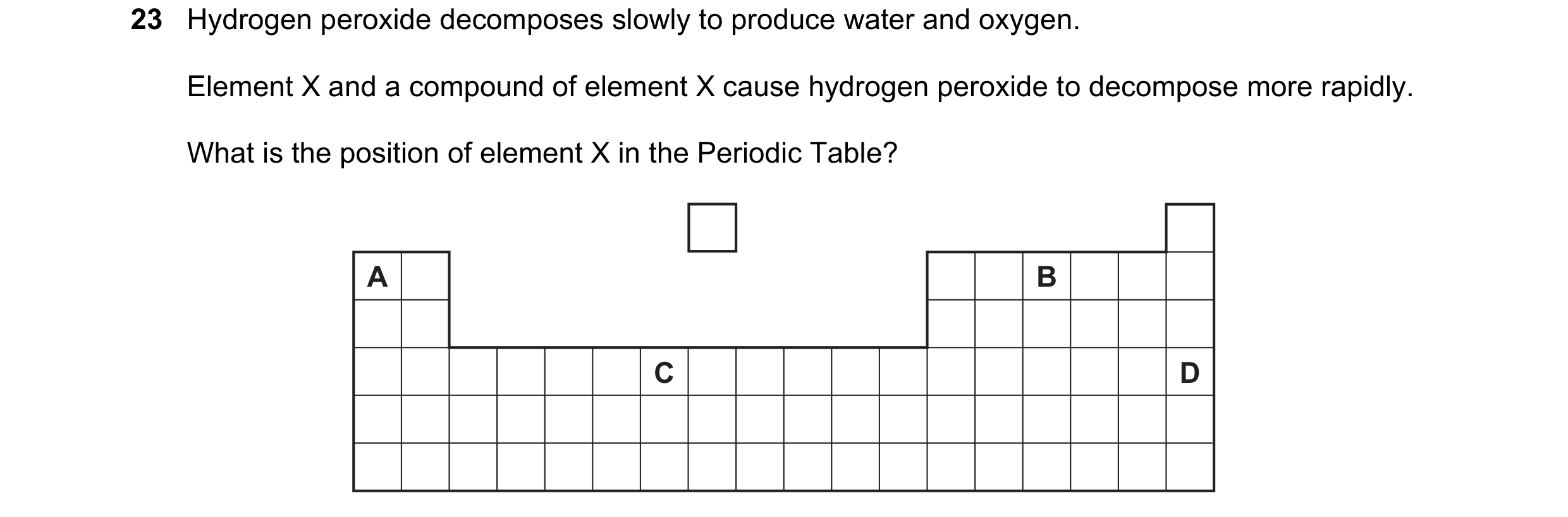


 12 / 12