Questions as text
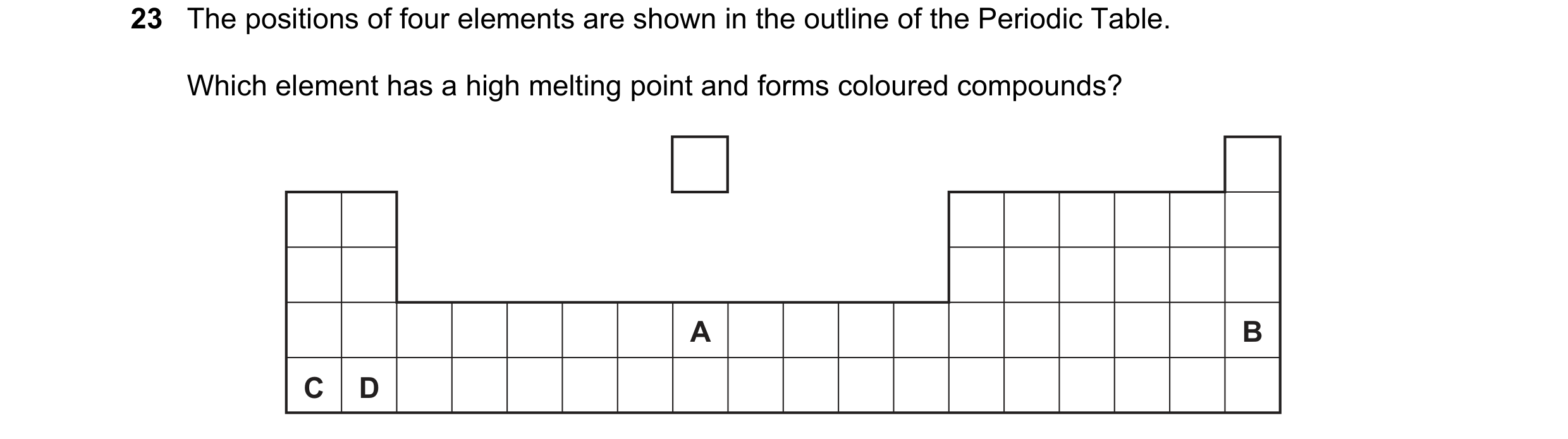
Q1 · The positions of four elements are shown in the outline of the Periodic Table 0653/21 Oct/Nov 2018
23 The positions of four elements are shown in the outline of the Periodic Table. Which element has a high melting point and forms coloured compounds? A B C D
1 marks
Answer: A
This question in 0653/21 Oct/Nov 2018
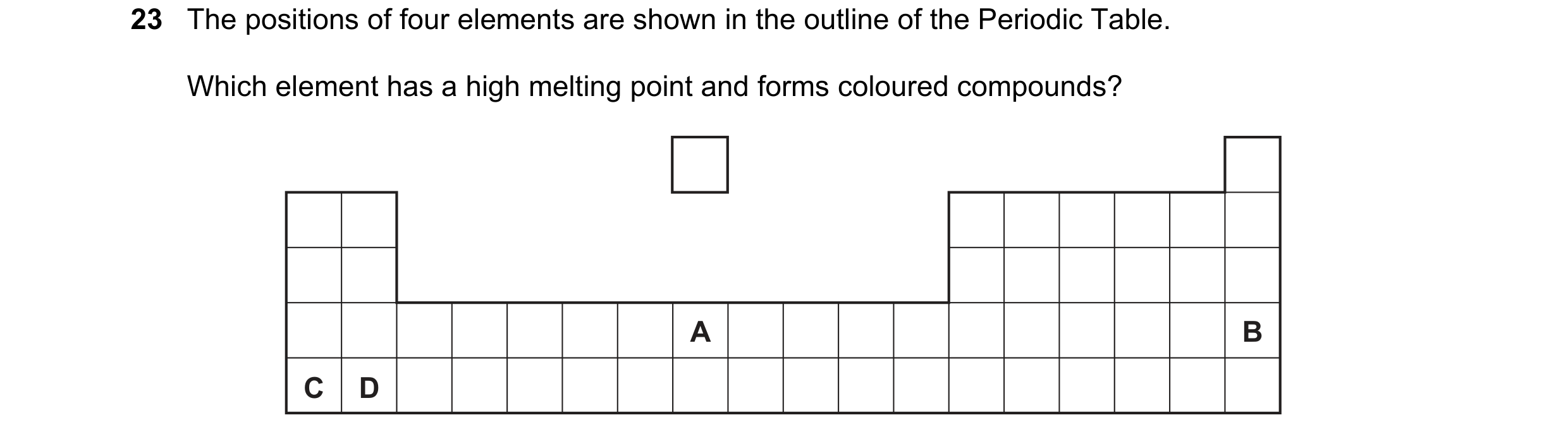
Q2 · The positions of four elements are shown in the outline of the Periodic Table 0653/22 Oct/Nov 2018
23 The positions of four elements are shown in the outline of the Periodic Table. Which element has a high melting point and forms coloured compounds? A B C D
1 marks
Answer: A
This question in 0653/22 Oct/Nov 2018
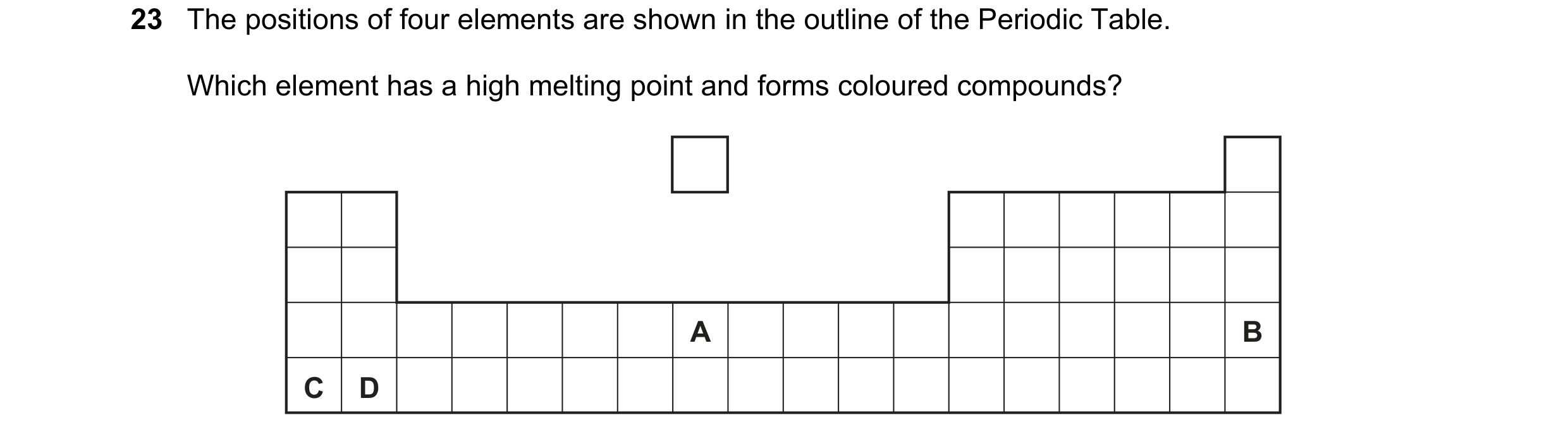
Q3 · The positions of four elements are shown in the outline of the Periodic Table 0653/23 Oct/Nov 2018
23 The positions of four elements are shown in the outline of the Periodic Table. Which element has a high melting point and forms coloured compounds? A B C D
1 marks
Answer: A
This question in 0653/23 Oct/Nov 2018
Q4 · Hydrogen reacts very slowly with nitrogen to form ammonia 0653/22 Feb/March 2019
22 Hydrogen reacts very slowly with nitrogen to form ammonia. Metal X is a catalyst for this reaction. What is another property of metal X? A It forms coloured compounds. B It forms covalent compounds. C It has a low density. D It has a low melting point.
1 marks
Answer: A
This question in 0653/22 Feb/March 2019
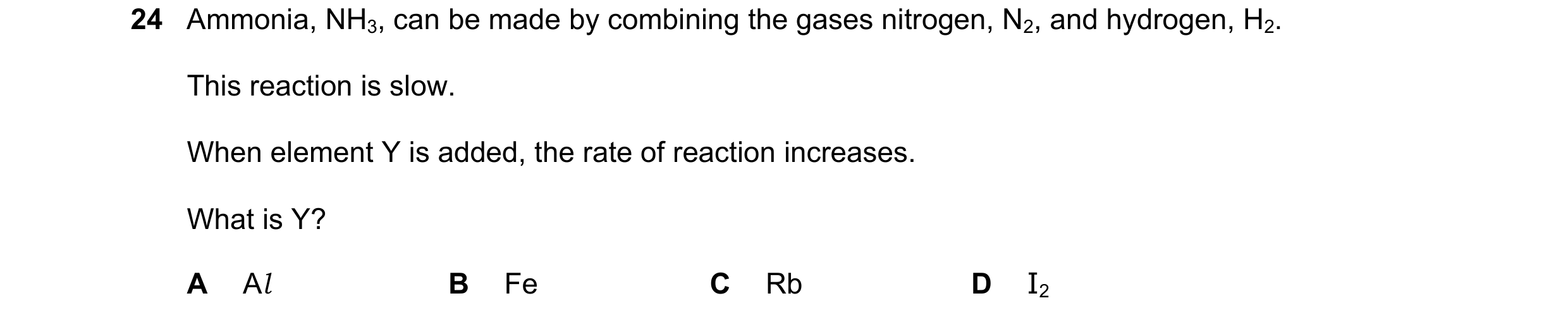
Q5 · Ammonia, NH3, can be made by combining the gases nitrogen, N2, and hydrogen, H2 0653/21 Oct/Nov 2020
24 Ammonia, NH3, can be made by combining the gases nitrogen, N2, and hydrogen, H2. This reaction is slow. When element Y is added, the rate of reaction increases. What is Y? A Al B Fe C Rb D I2
1 marks
Answer: B
This question in 0653/21 Oct/Nov 2020
Q6 · Substance X is a coloured solid 0653/22 Oct/Nov 2020
23 Substance X is a coloured solid. Substance X acts as a catalyst for the reaction between zinc and dilute sulfuric acid. Molten X can be electrolysed. What is X? A a Group I compound B a Group I metal C a transition metal compound D a transition metal
1 marks
Answer: C
This question in 0653/22 Oct/Nov 2020
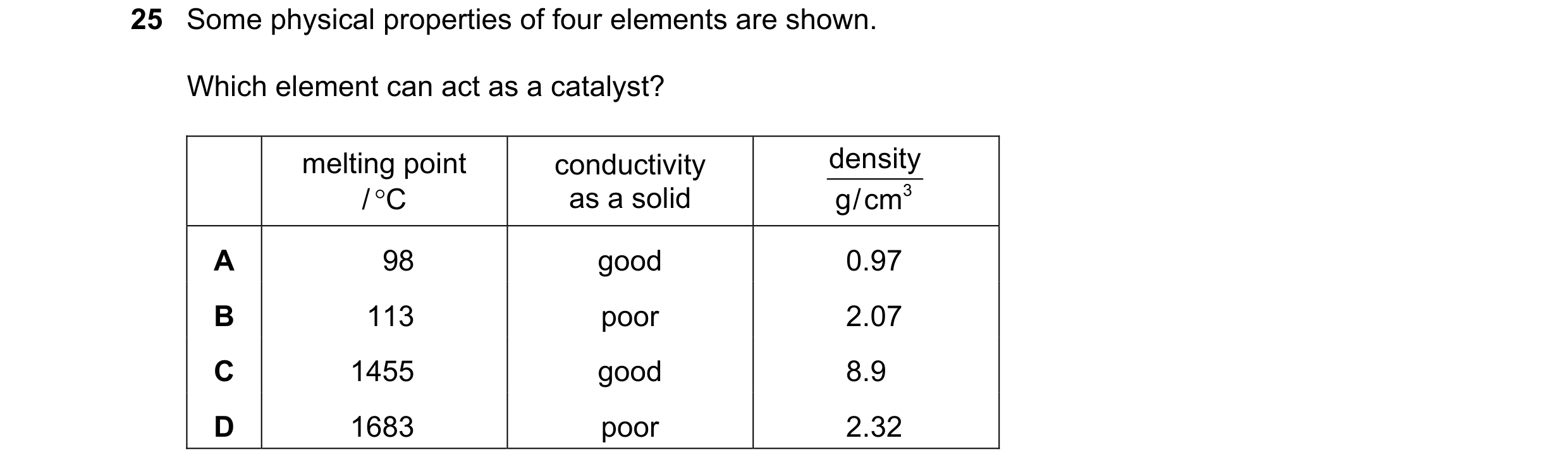
Q7 · Some physical properties of four elements are shown 0653/23 Oct/Nov 2020
25 Some physical properties of four elements are shown. Which element can act as a catalyst? melting point conductivity d ens ty i / C as a solid g / cm 3 A 98 good 0.97 B 113 poor 2.07 C 1455 good 8.9 D 1683 poor 2.32
1 marks
Answer: C
This question in 0653/23 Oct/Nov 2020
Q8 · Which part of the Periodic Table contains elements that are used as catalysts? 0653/21 Oct/Nov 2021
22 Which part of the Periodic Table contains elements that are used as catalysts? A Group I B Group VII C noble gases D transition metals
1 marks
Answer: D
This question in 0653/21 Oct/Nov 2021
Q9 · Which statement about transition elements is not correct? 0653/22 Oct/Nov 2021
22 Which statement about transition elements is not correct? A They can act as catalysts. B They can be metals or non-metals. C They have high densities. D They have high melting points.
1 marks
Answer: B
This question in 0653/22 Oct/Nov 2021
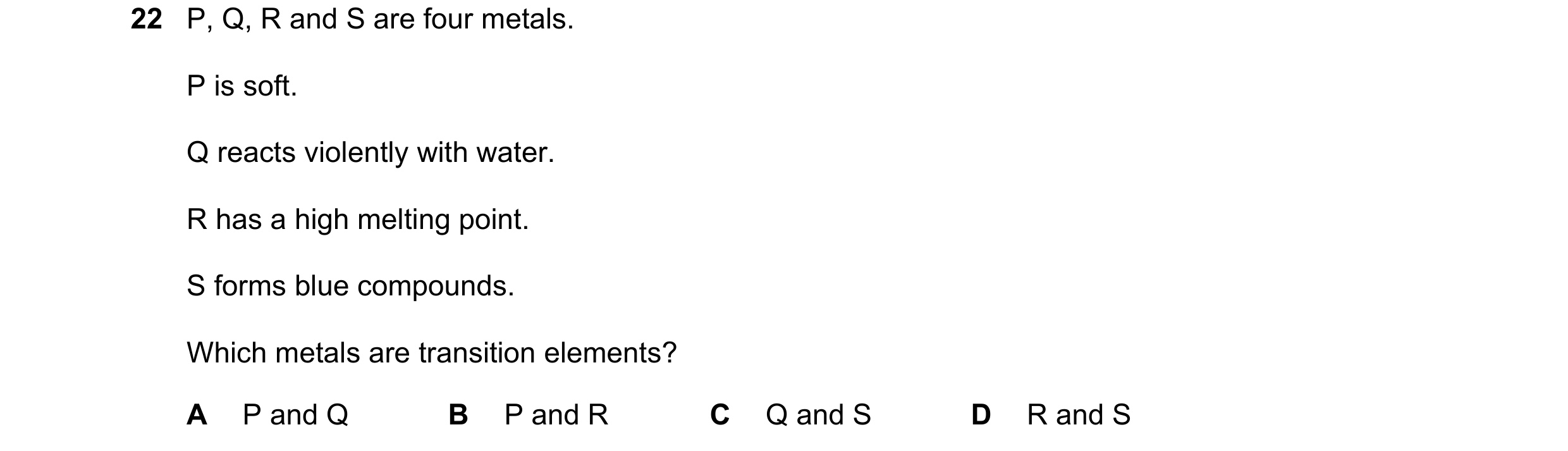
Q10 · P, Q, R and S are four metals 0653/23 Oct/Nov 2021
22 P, Q, R and S are four metals. P is soft. Q reacts violently with water. R has a high melting point. S forms blue compounds. Which metals are transition elements? A P and Q B P and R C Q and S D R and S
1 marks
Answer: D
This question in 0653/23 Oct/Nov 2021
Q11 · Which properties are shown by transition elements? 0653/21 Oct/Nov 2022
22 Which properties are shown by transition elements? 1 They form coloured compounds. 2 They have low melting points. 3 They have low densities. 4 They can act as catalysts. A 1 and 2 B 1 and 4 C 2 and 3 D 3 and 4
1 marks
Answer: B
This question in 0653/21 Oct/Nov 2022
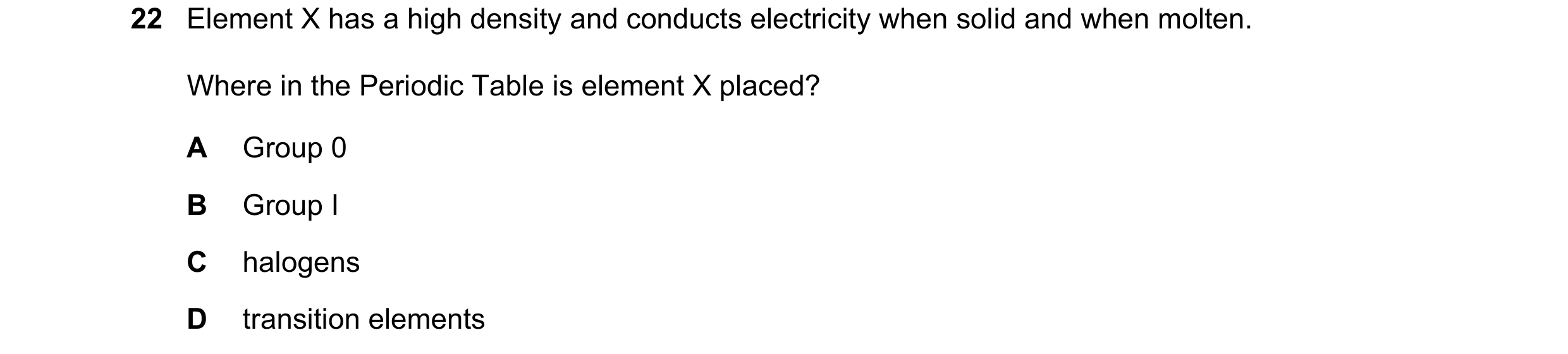
Q12 · Element X has a high density and conducts electricity when solid and when molten 0653/22 Oct/Nov 2022
22 Element X has a high density and conducts electricity when solid and when molten. Where in the Periodic Table is element X placed? A Group 0 B Group I C halogens D transition elements
1 marks
Answer: D
This question in 0653/22 Oct/Nov 2022
Q13 · What is not a property of transition elements? 0653/22 Oct/Nov 2025
24 What is not a property of transition elements? A form coloured compounds B good electrical conductivity C high melting point D low density
1 marks
Answer: D
This question in 0653/22 Oct/Nov 2025
 1 / 3
1 / 3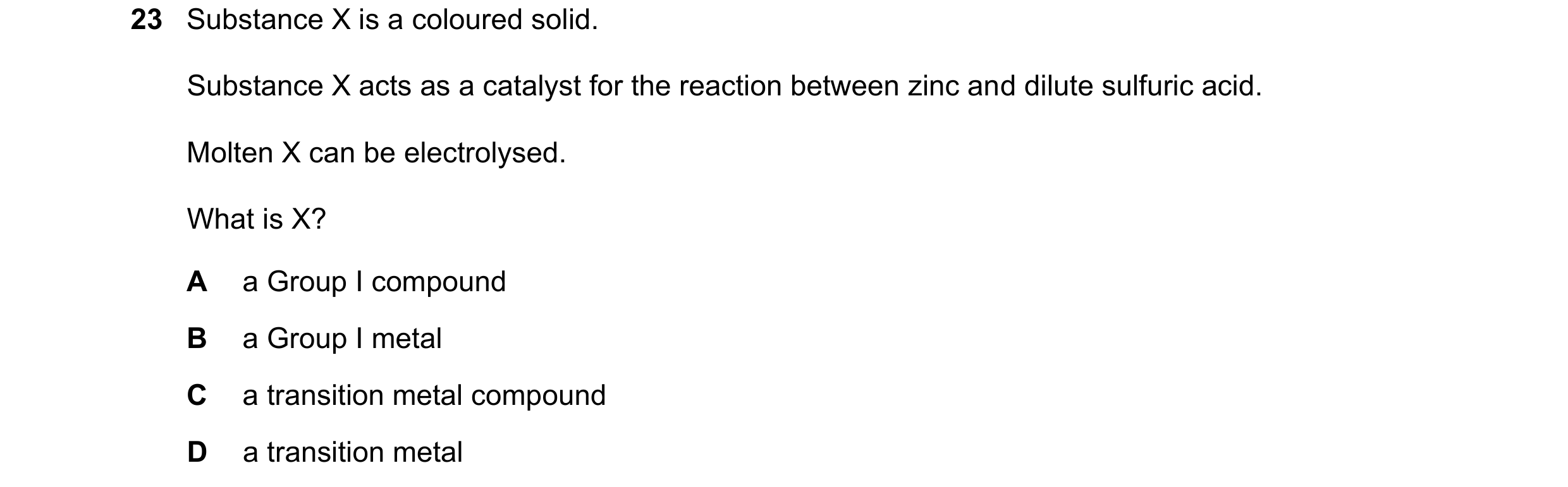


 2 / 3
2 / 3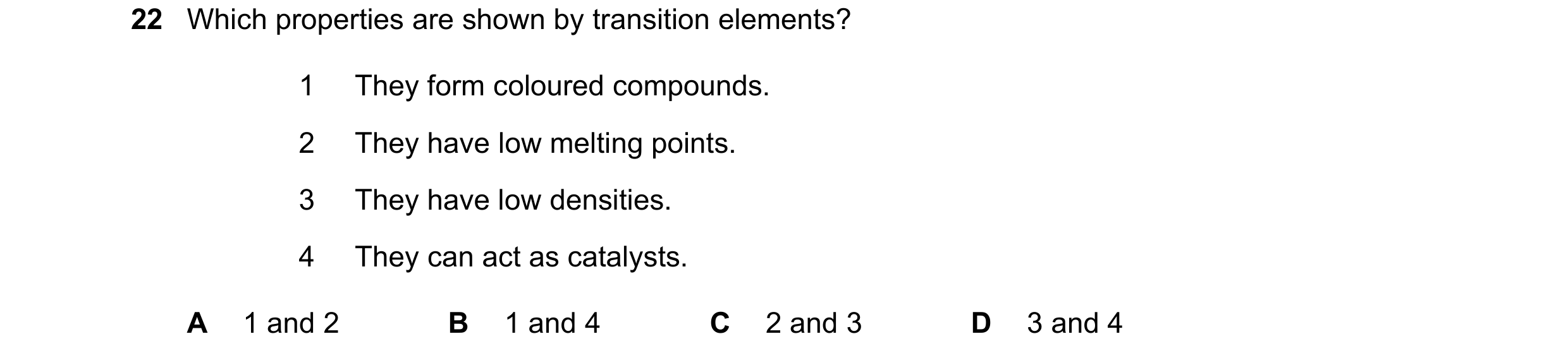
 3 / 3
3 / 3