Questions as text
Q1 · Copper is extracted from molten copper chloride using electrolysis 0653/42 Feb/March 2018
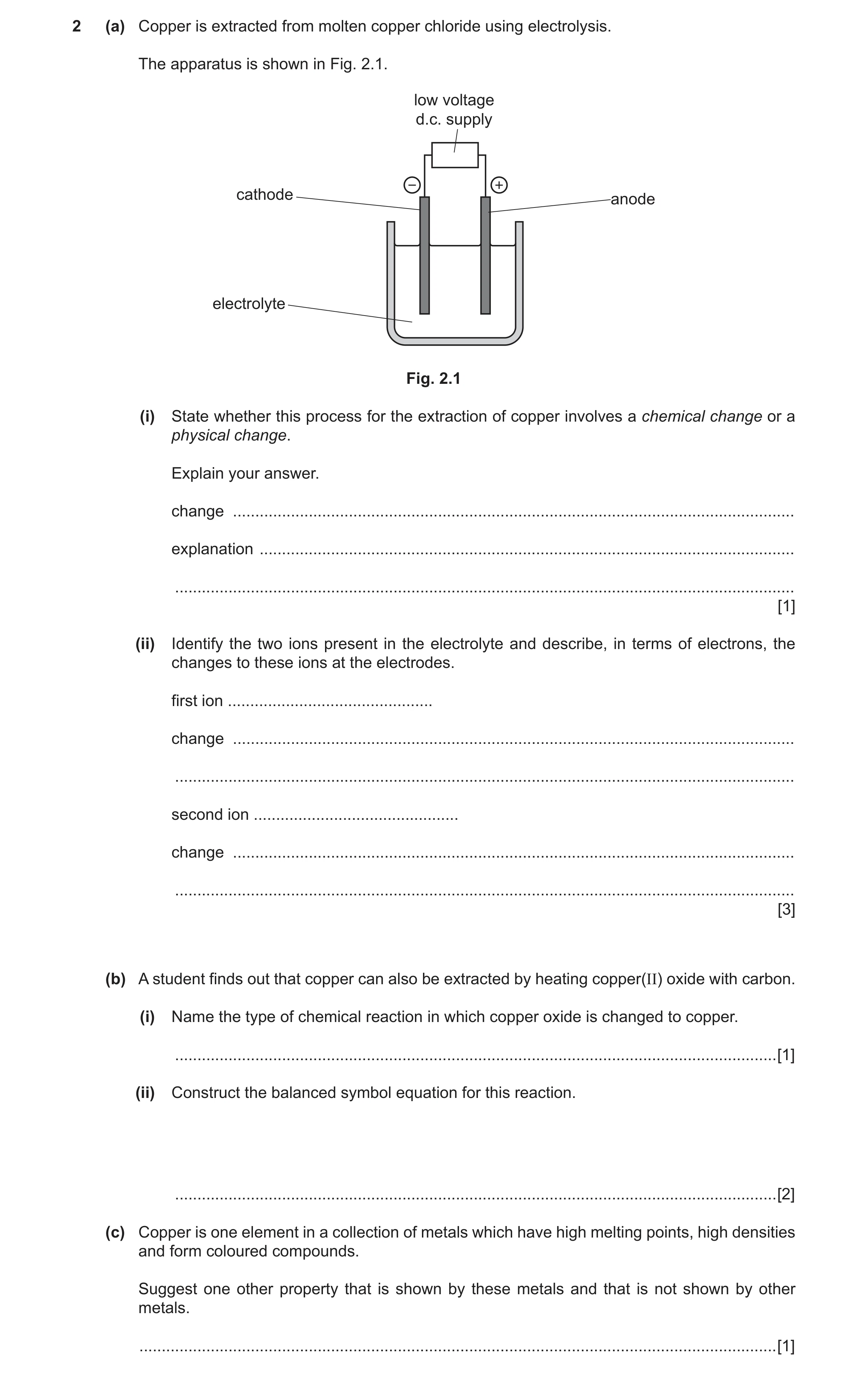
2 (a) Copper is extracted from molten copper chloride using electrolysis. The apparatus is shown in Fig. 2.1. low voltage d.c. supply − + cathode anode electrolyte Fig. 2.1 (i) State whether this process for the extraction of copper involves a chemical change or a physical change. Explain your answer. change … explanation … … [1] (ii) Identify the two ions present in the electrolyte and describe, in terms of electrons, the changes to these ions at the electrodes. first ion … change … … second ion … change … … [3] (b) A student finds out that copper can also be extracted by heating copper(II) oxide with carbon. (i) Name the type of chemical reaction in which copper oxide is changed to copper. … [1] (ii) Construct the balanced symbol equation for this reaction. … [2] (c) Copper is one element in a collection of metals which have high melting points, high densities and form coloured compounds. Suggest one other property that is shown by these metals and that is not shown by other metals. … [1]
8 marks
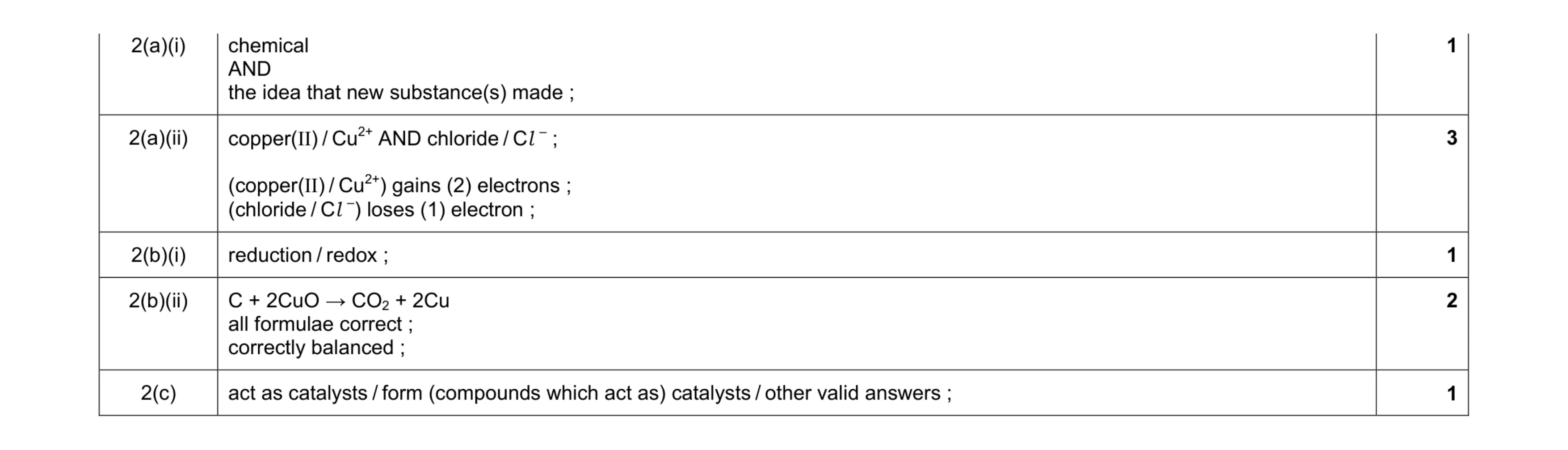
Mark scheme: 2(a)(i) chemical AND the idea that new substance(s) made ; 1 2(a)(ii) copper(II) / Cu2+ AND chloride / Cl – ; (copper(II) / Cu2+) gains (2) electrons ; (chloride / Cl –) loses (1) electron ; 3 2(b)(i) reduction / redox ; 1 2(b)(ii) C + 2CuO → CO2 + 2Cu all formulae correct ; correctly balanced ; 2 2(c) act as catalysts / form (compounds which act as) catalysts / other valid answers ; 1
This question in 0653/42 Feb/March 2018
Q2 · A student tries to make lead from a sample of solid lead(II) bromide using the… 0653/41 May/June 2018
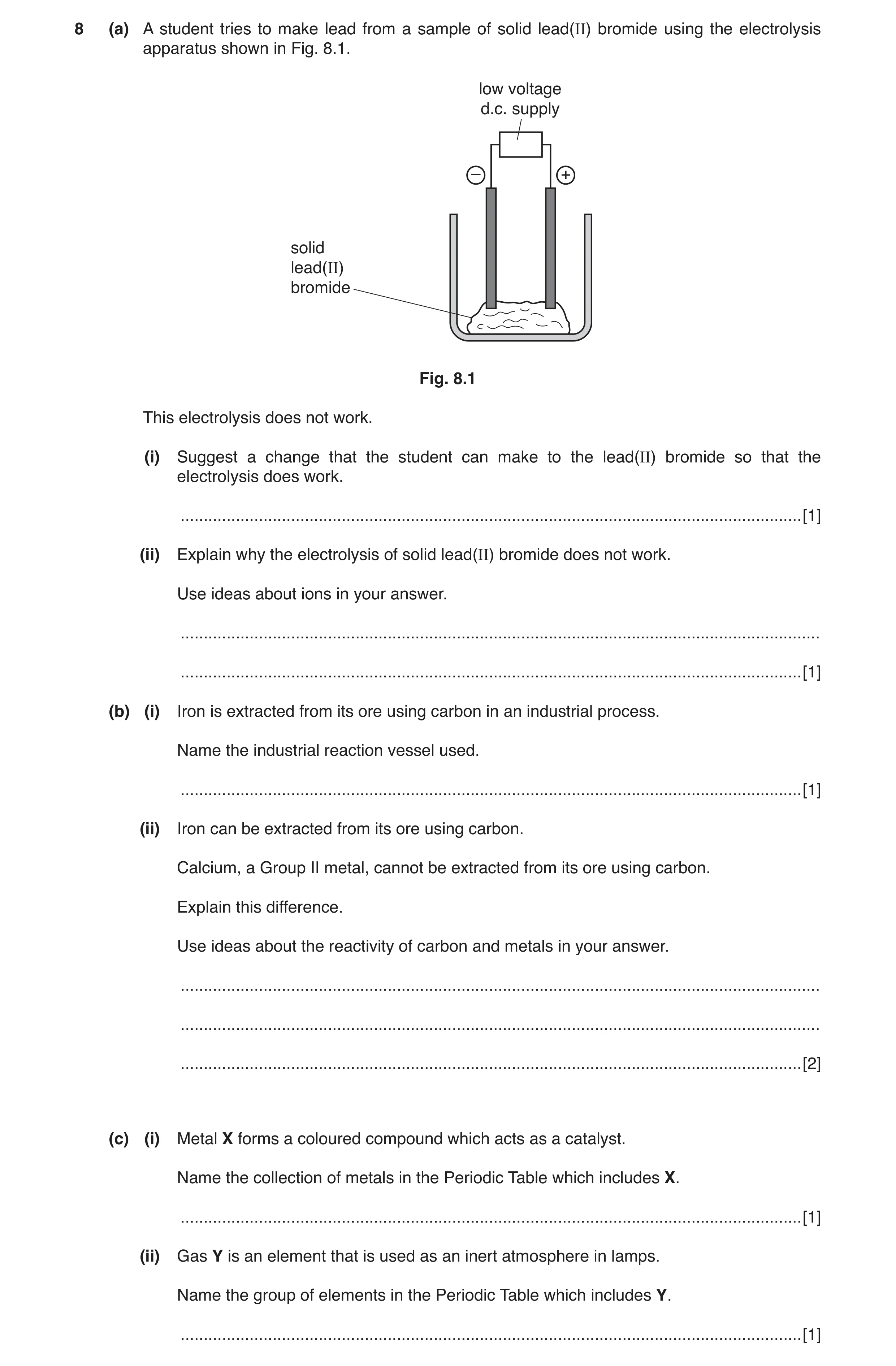
8 (a) A student tries to make lead from a sample of solid lead(II) bromide using the electrolysis apparatus shown in Fig. 8.1. low voltage d.c. supply – + solid lead(II) bromide Fig. 8.1 This electrolysis does not work. (i) Suggest a change that the student can make to the lead(II) bromide so that the electrolysis does work. … [1] (ii) Explain why the electrolysis of solid lead(II) bromide does not work. Use ideas about ions in your answer. … … [1] (b) (i) Iron is extracted from its ore using carbon in an industrial process. Name the industrial reaction vessel used. … [1] (ii) Iron can be extracted from its ore using carbon. Calcium, a Group II metal, cannot be extracted from its ore using carbon. Explain this difference. Use ideas about the reactivity of carbon and metals in your answer. … … … [2] (c) (i) Metal X forms a coloured compound which acts as a catalyst. Name the collection of metals in the Periodic Table which includes X. … [1] (ii) Gas Y is an element that is used as an inert atmosphere in lamps. Name the group of elements in the Periodic Table which includes Y. … [1]
7 marks
Mark scheme: 8(a)(i) melt / make it molten / convert it into a liquid form ; 1 8(a)(ii) ions not mobile / the idea that ions need to (be able to) move ; 1 8(b)(i) blast furnace ; 1 8(b)(ii) carbon is more reactive than iron ; group II metals / calcium are more reactive than carbon ; 2 8(c)(i) transition (elements / metals) ; 1 8(c)(ii) noble (gases) / Group VIII ; 1 Que estion Answer Ma arks
This question in 0653/41 May/June 2018
Q3 · A teacher tries to use the apparatus shown in Fig 0653/42 Oct/Nov 2018
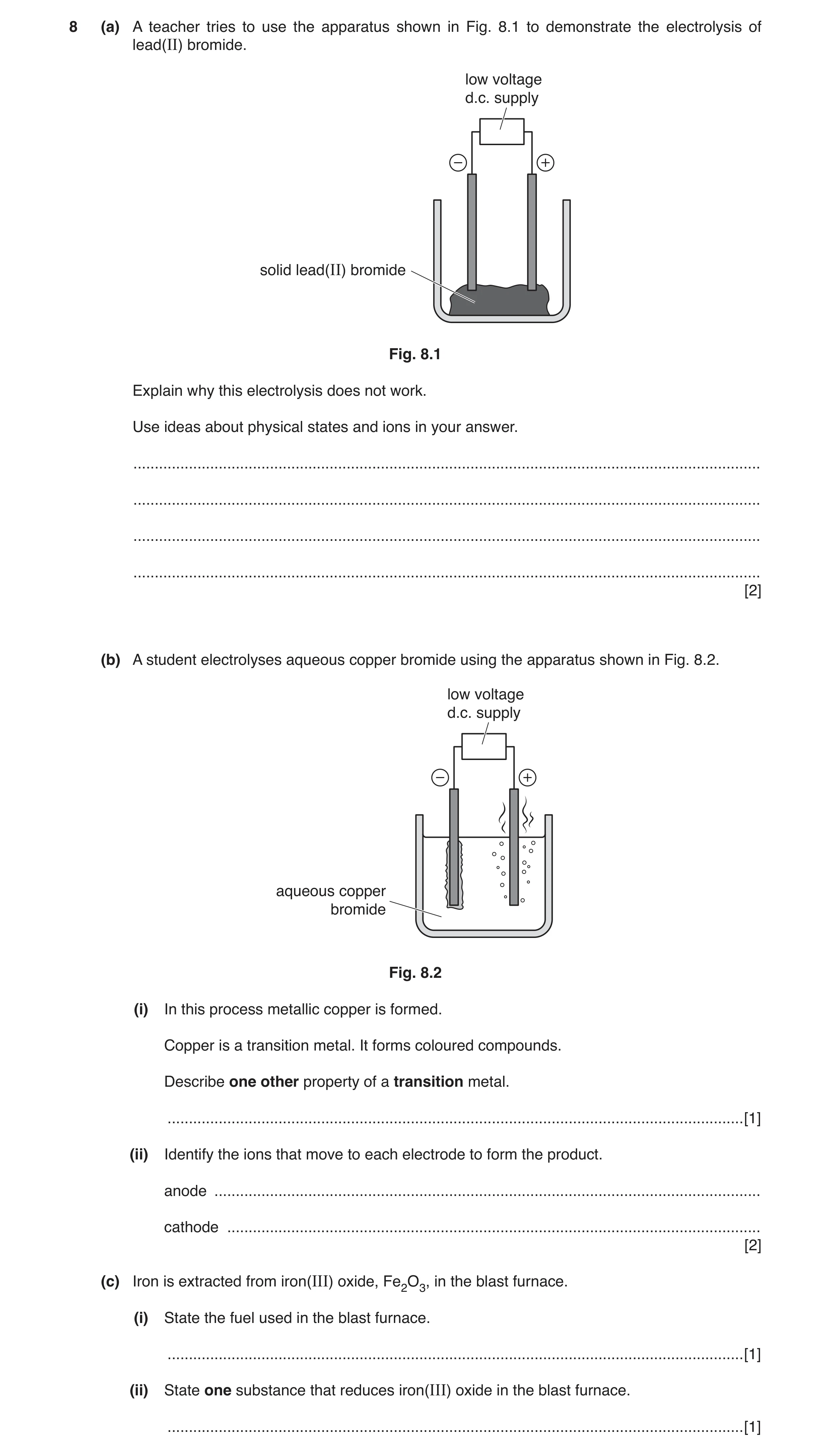
8 (a) A teacher tries to use the apparatus shown in Fig. 8.1 to demonstrate the electrolysis of lead(II) bromide. low voltage d.c. supply solid lead(II) bromide Fig. 8.1 Explain why this electrolysis does not work. Use ideas about physical states and ions in your answer. … … … … [2] (b) A student electrolyses aqueous copper bromide using the apparatus shown in Fig. 8.2. low voltage d.c. supply aqueous copper bromide Fig. 8.2 (i) In this process metallic copper is formed. Copper is a transition metal. It forms coloured compounds. Describe one other property of a transition metal. … [1] (ii) Identify the ions that move to each electrode to form the product. anode … cathode … [2] (c) Iron is extracted from iron(III) oxide, Fe2O3, in the blast furnace. (i) State the fuel used in the blast furnace. … [1] (ii) State one substance that reduces iron(III) oxide in the blast furnace. … [1]
7 marks
Mark scheme: 8(a) lead bromide is solid / needs to be molten / liquid ; so that ions are mobile / can move ; 2 8(b)(i) high density / high melting point / (element or compound) act as catalysts ; 1 8(b)(ii) (to the anode) bromide / Br– ; (to the cathode) copper(II) / Cu2+ ; 2 8(c)(i) carbon / C / coke ; 1 8(c)(ii) carbon monoxide / CO / carbon / C ; 1
This question in 0653/42 Oct/Nov 2018
Q4 · Iron is an element in Period 4 of the Periodic Table shown on page 24 0653/42 Feb/March 2019
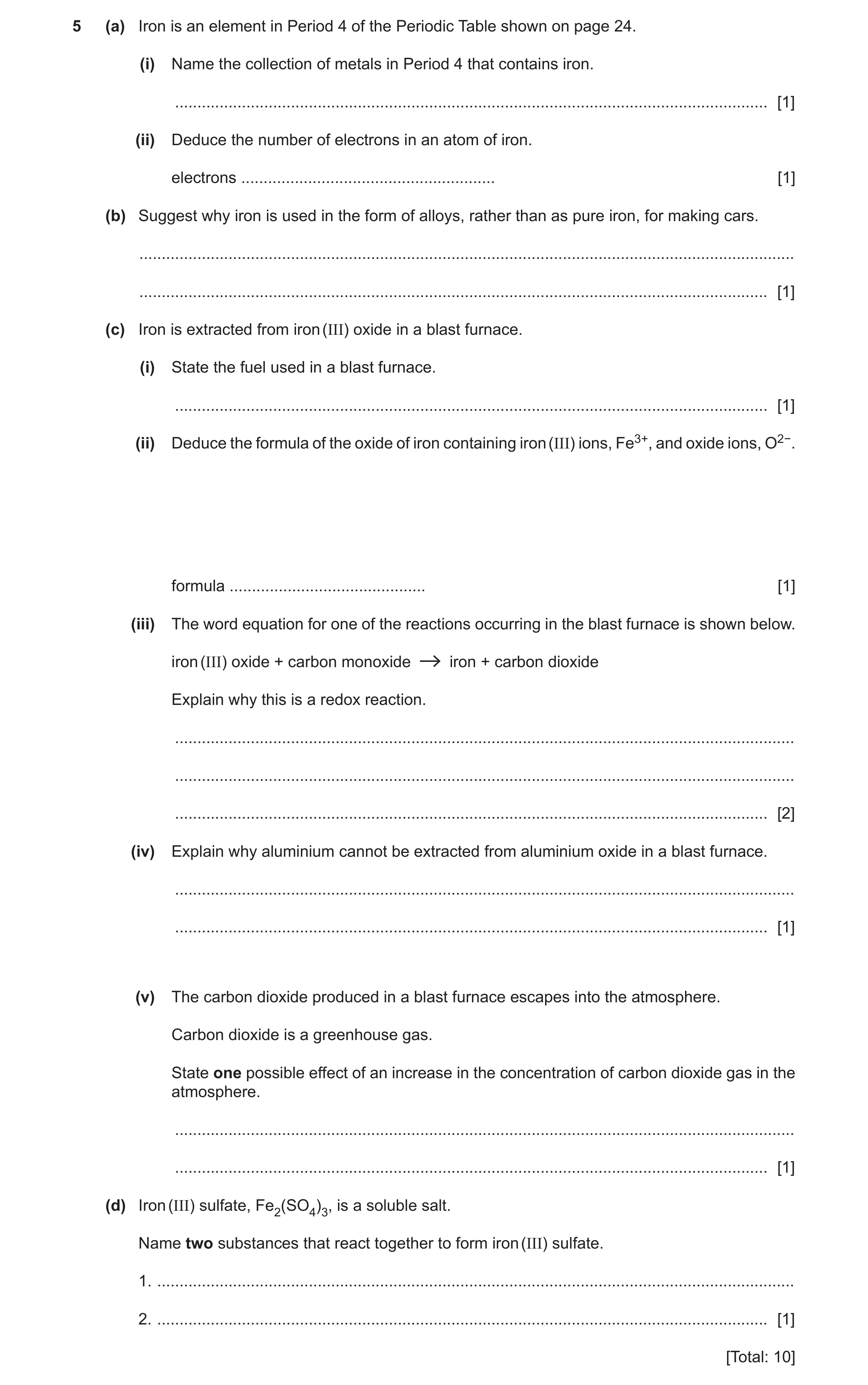
5 (a) Iron is an element in Period 4 of the Periodic Table shown on page 24. (i) Name the collection of metals in Period 4 that contains iron. … [1] (ii) Deduce the number of electrons in an atom of iron. electrons … [1] (b) Suggest why iron is used in the form of alloys, rather than as pure iron, for making cars. … … [1] (c) Iron is extracted from iron (III) oxide in a blast furnace. (i) State the fuel used in a blast furnace. … [1] (ii) Deduce the formula of the oxide of iron containing iron (III) ions, Fe3+, and oxide ions, O2−. formula … [1] (iii) The word equation for one of the reactions occurring in the blast furnace is shown below. iron (III) oxide + carbon monoxide iron + carbon dioxide Explain why this is a redox reaction. … … … [2] (iv) Explain why aluminium cannot be extracted from aluminium oxide in a blast furnace. … … [1] (v) The carbon dioxide produced in a blast furnace escapes into the atmosphere. Carbon dioxide is a greenhouse gas. State one possible effect of an increase in the concentration of carbon dioxide gas in the atmosphere. … … [1] (d) Iron (III) sulfate, Fe2(SO4)3, is a soluble salt. Name two substances that react together to form iron (III) sulfate. 1. … 2. … [1] [Total: 10]
10 marks
Mark scheme: 5(a)(i) transition metals / elements ; 1 5(a)(ii) electrons = 26 ; 1 5(b) stronger more resistant to corrosion ; 1 5(c)(i) coke / carbon ; 1 5(c)(ii) Fe2O3 ; 1 5(c)(iii) iron oxide / Fe3+ reduced ; carbon monoxide oxidised ; 2 5(c)(iv) aluminium is too reactive / aluminium is above carbon in reactivity series ; 1 5(c)(v) (increases) global warming / climate change / consequence of climate change described ; 1 5(d) iron and sulfuric acid ; or iron oxide / iron (III) oxide and (dilute) sulfuric acid ; 1
This question in 0653/42 Feb/March 2019
Q5 · A scientist analyses solution Q using chromatography 0653/42 May/June 2019
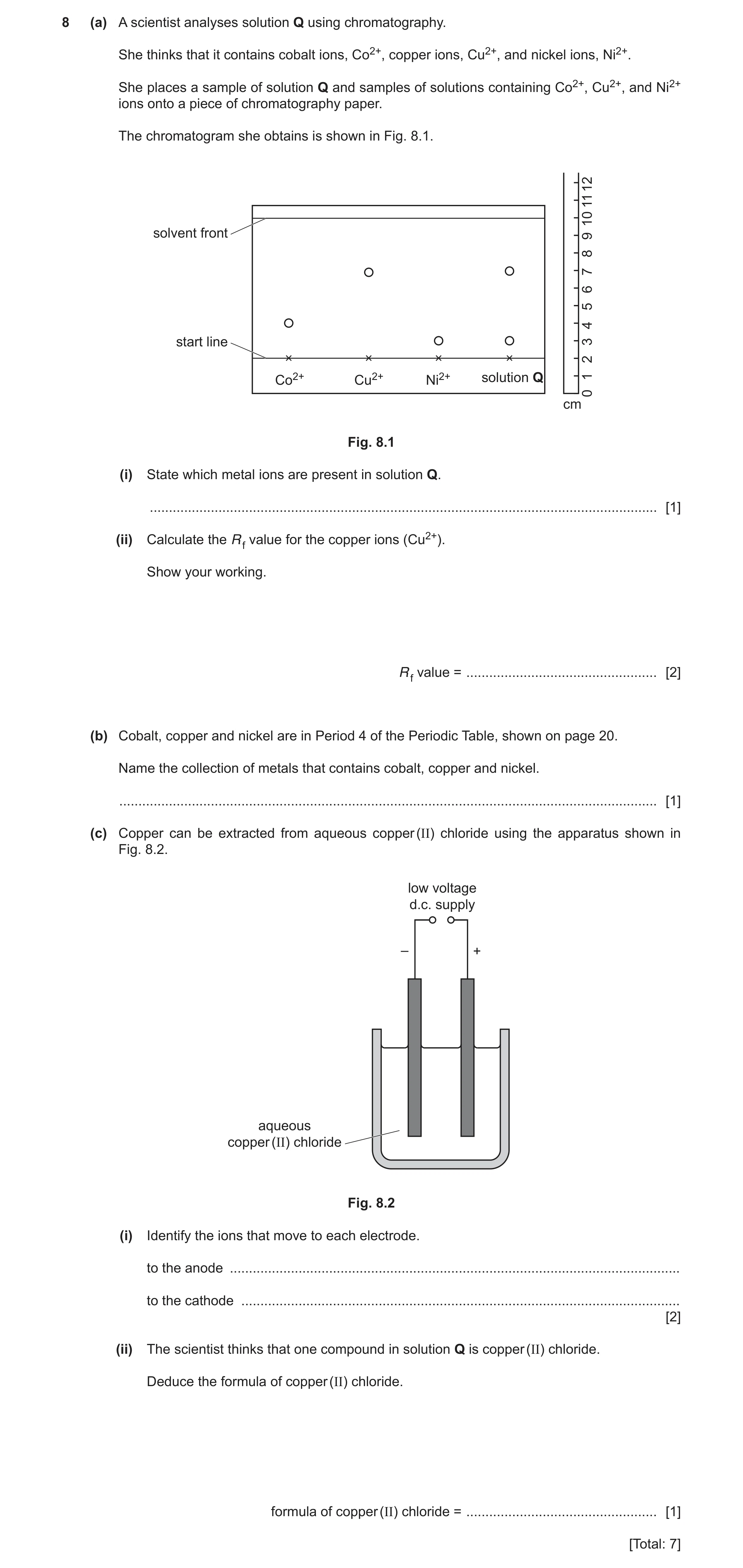
8 (a) A scientist analyses solution Q using chromatography. She thinks that it contains cobalt ions, Co2+, copper ions, Cu2+, and nickel ions, Ni2+. She places a sample of solution Q and samples of solutions containing Co2+, Cu2+, and Ni2+ ions onto a piece of chromatography paper. The chromatogram she obtains is shown in Fig. 8.1. 1112 10 solvent front 9 8 7 6 5 4 3 start line 2 Co2+ Cu2+ Ni2+ solution Q 1 0 cm Fig. 8.1 (i) State which metal ions are present in solution Q. … [1] (ii) Calculate the R f value for the copper ions (Cu2+). Show your working. R f value = … [2] (b) Cobalt, copper and nickel are in Period 4 of the Periodic Table, shown on page 20. Name the collection of metals that contains cobalt, copper and nickel. … [1] (c) Copper can be extracted from aqueous copper (II) chloride using the apparatus shown in Fig. 8.2. low voltage d.c. supply – + aqueous copper (II) chloride Fig. 8.2 (i) Identify the ions that move to each electrode. to the anode … to the cathode … [2] (ii) The scientist thinks that one compound in solution Q is copper (II) chloride. Deduce the formula of copper (II) chloride. formula of copper (II) chloride = … [1] [Total: 7]
7 marks
Mark scheme: 8(a)(i) nickel ions and copper ions ; 1 8(a)(ii) (7 – 2) ÷ (10 – 2) or 5 ÷ 8 ; = 0.6(25) ; 2 8(b) transition metals / elements ; 1 8(c)(i) chloride / Cl– ; copper / Cu2+ ; 2 8(c)(ii) CuCl2 ; 1
This question in 0653/42 May/June 2019
Q6 · Aluminium is a Group III metal 0653/41 Oct/Nov 2019
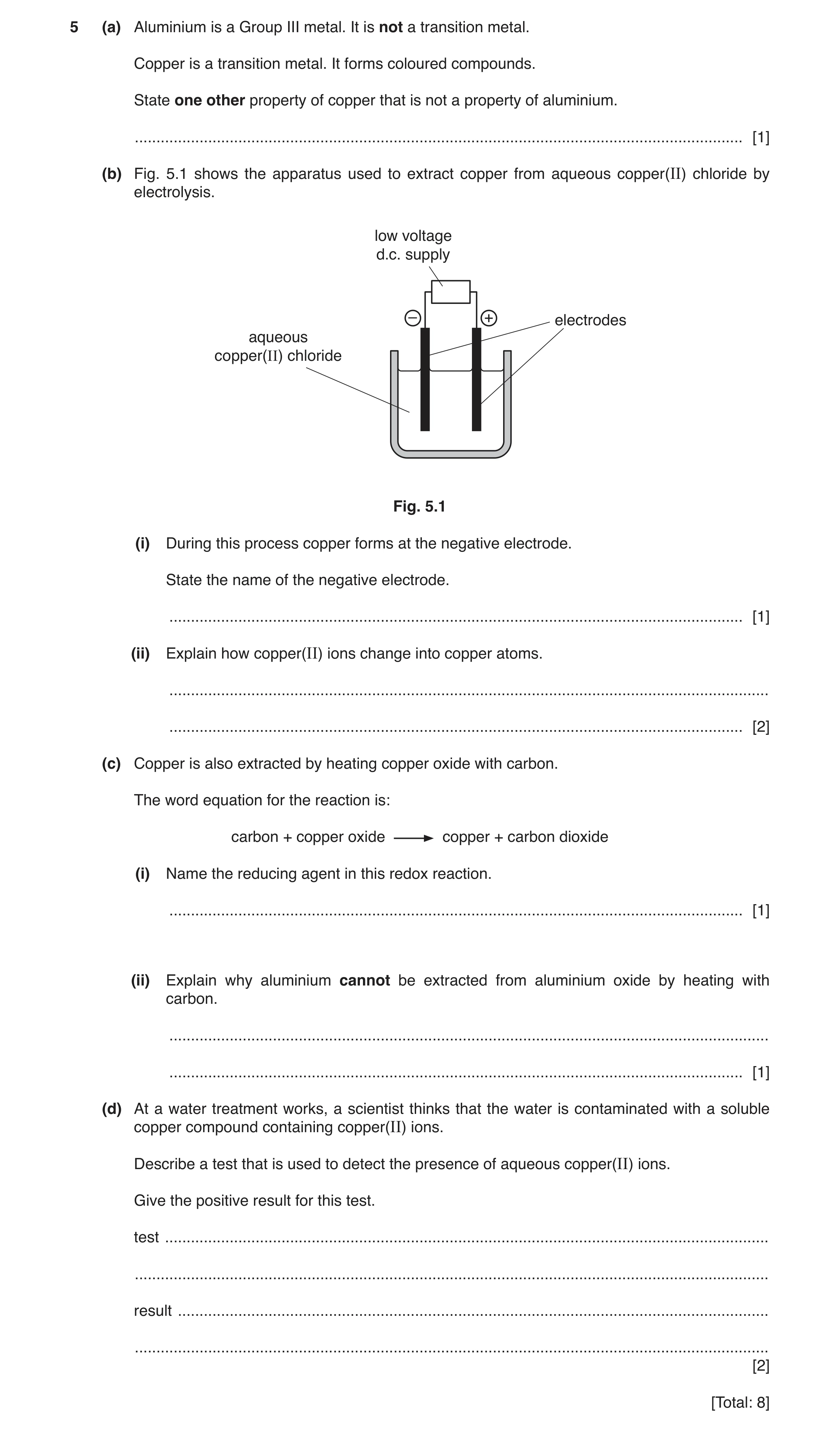
5 (a) Aluminium is a Group III metal. It is not a transition metal. Copper is a transition metal. It forms coloured compounds. State one other property of copper that is not a property of aluminium. … [1] (b) Fig. 5.1 shows the apparatus used to extract copper from aqueous copper(II) chloride by electrolysis. low voltage d.c. supply – + electrodes aqueous copper(II) chloride Fig. 5.1 (i) During this process copper forms at the negative electrode. State the name of the negative electrode. … [1] (ii) Explain how copper(II) ions change into copper atoms. … … [2] (c) Copper is also extracted by heating copper oxide with carbon. The word equation for the reaction is: carbon + copper oxide copper + carbon dioxide (i) Name the reducing agent in this redox reaction. … [1] (ii) Explain why aluminium cannot be extracted from aluminium oxide by heating with carbon. … … [1] (d) At a water treatment works, a scientist thinks that the water is contaminated with a soluble copper compound containing copper(II) ions. Describe a test that is used to detect the presence of aqueous copper(II) ions. Give the positive result for this test. test … … result … … [2] [Total: 8]
8 marks
Mark scheme: 5(a) high density / high melting point / acts as catalyst ; 1 5(b)(i) cathode ; 1 5(b)(ii) gains electrons ; two electrons ; 2 5(c)(i) carbon ; 1 5(c)(ii) aluminium is too reactive / aluminium more reactive than carbon ; 1 5(d) (aqueous) sodium hydroxide ; (pale) blue ppt ; or flame test ; blue–green / turquoise colour ; 2
This question in 0653/41 Oct/Nov 2019
Q7 · Iron is a transition element 0653/41 May/June 2020
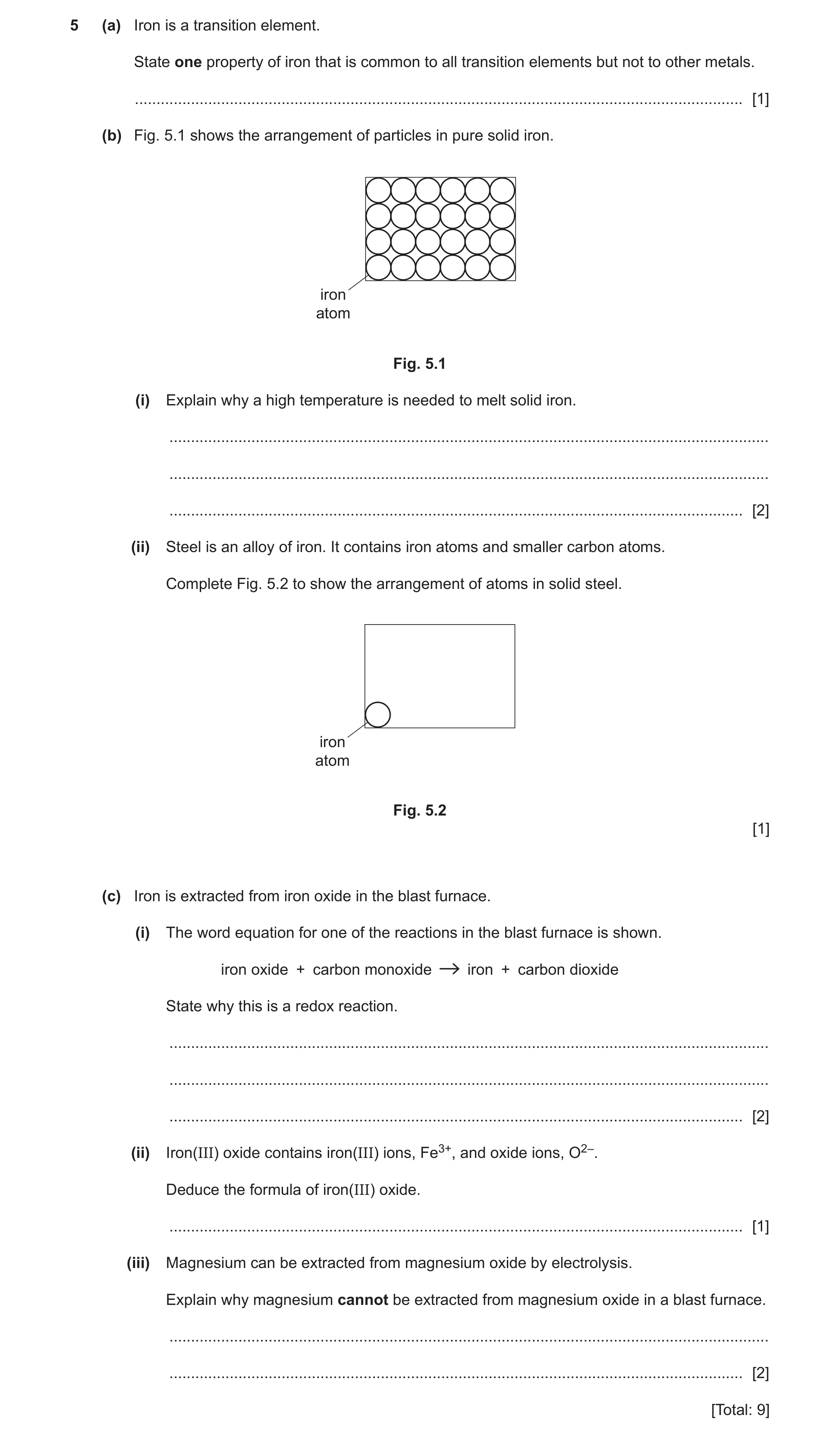
5 (a) Iron is a transition element. State one property of iron that is common to all transition elements but not to other metals. … [1] (b) Fig. 5.1 shows the arrangement of particles in pure solid iron. iron atom Fig. 5.1 (i) Explain why a high temperature is needed to melt solid iron. … … … [2] (ii) Steel is an alloy of iron. It contains iron atoms and smaller carbon atoms. Complete Fig. 5.2 to show the arrangement of atoms in solid steel. iron atom Fig. 5.2 [1] (c) Iron is extracted from iron oxide in the blast furnace. (i) The word equation for one of the reactions in the blast furnace is shown. iron oxide + carbon monoxide iron + carbon dioxide State why this is a redox reaction. … … … [2] (ii) Iron(III) oxide contains iron(III) ions, Fe3+, and oxide ions, O2–. Deduce the formula of iron(III) oxide. … [1] (iii) Magnesium can be extracted from magnesium oxide by electrolysis. Explain why magnesium cannot be extracted from magnesium oxide in a blast furnace. … … [2] [Total: 9]
9 marks
Mark scheme: 5(a) forms coloured compounds / has high melting point / has high density / catalyst ; 1 5(b)(i) (to provide) energy ; (energy) needed, for work to be done against attractive forces / to break interatomic ‘bonds’ / for particles to break free from solid state ; 2 Question Answer Marks 5(b)(ii) two different atoms and semi-regular / most touching ; 1 5(c)(i) iron oxide is reduced / iron oxide loses oxygen ; carbon monoxide is oxidised / carbon monoxide gains oxygen ; 2 5(c)(ii) Fe2O3 ; 1 5(c)(iii) magnesium is too reactive ; above carbon in reactivity series ; 2
This question in 0653/41 May/June 2020
Q8 · Copper is a transition metal 0653/42 May/June 2020
8 (a) Copper is a transition metal. State two properties of copper that are not properties of Group I metals. 1. … 2. … [2] (b) Zinc is extracted from zinc oxide, ZnO. (i) The formula of an oxide ion is O2–. Deduce the charge of a zinc ion. Explain your answer. charge … explanation … … [2] (ii) Explain why zinc can be extracted from zinc oxide by reduction with carbon. Use ideas about the reactivity series in your answer. … … [1] (c) Molten sodium chloride can be electrolysed. (i) Explain why energy is needed to melt sodium chloride. … … [1] (ii) Explain why sodium chloride must be molten, and not solid, during electrolysis. … … [1] (iii) Predict the products of this electrolysis at the anode and at the cathode. anode … cathode … [2] [Total: 9]
9 marks
Mark scheme: 8(a) forms coloured compounds ; has high melting point ; has high density ; 2 8(b)(i) (charge) 2+ ; (explanation) 2+ to balance 2– on oxide ion ; 2 8(b)(ii) carbon, above zinc in reactivity series / more reactive than zinc ; 1 8(c)(i) energy needed, for work to be done against attractive forces / to break interatomic ‘bonds’ / for particles to break free, from solid state ; 1 8(c)(ii) ions must be mobile ; 1 8(c)(iii) (anode) chlorine ; (cathode) sodium ; 2
This question in 0653/42 May/June 2020
Q9 · Copper chloride is produced when dilute hydrochloric acid reacts with copper carbonate 0653/41 Oct/Nov 2020
8 Copper chloride is produced when dilute hydrochloric acid reacts with copper carbonate. (a) State one other substance that reacts with dilute hydrochloric acid to produce copper chloride. … [1] (b) Copper is a transition element. Potassium is a Group I element. (i) State one property of copper that is also a property of potassium. … … [1] (ii) State one property of copper compounds that is not a property of potassium compounds. … … [1] (c) Copper is extracted by heating copper oxide with carbon. A redox reaction occurs. The equation for this reaction is shown. copper oxide + carbon copper + carbon dioxide. Explain, in detail, why this reaction is a redox reaction. … … … … [3] (d) Fig. 8.1 shows the arrangement of copper atoms and zinc atoms in a sample of brass. Key zinc copper Fig. 8.1 Circle words from the list that can be used to describe brass. alloy compound element mixture molecule [1] [Total: 7]
7 marks
Mark scheme: 8(a) copper oxide / copper sulfide ; 1 8(b)(i) solid (at RT) / high density / malleable / ductile / shiny / (good) conductor of, heat / electricity ; 1 8(b)(ii) coloured (other than white) / reference to catalysis ; 1 8(c) reduction and oxidation both occur (redox) ; copper oxide is reduced / carbon is oxidised ; copper oxide loses oxygen / carbon gains oxygen ; 3 8(d) alloy AND mixture both circled ; 1
This question in 0653/41 Oct/Nov 2020
Q10 · Iron is extracted from iron oxide in a blast furnace 0653/42 Oct/Nov 2020
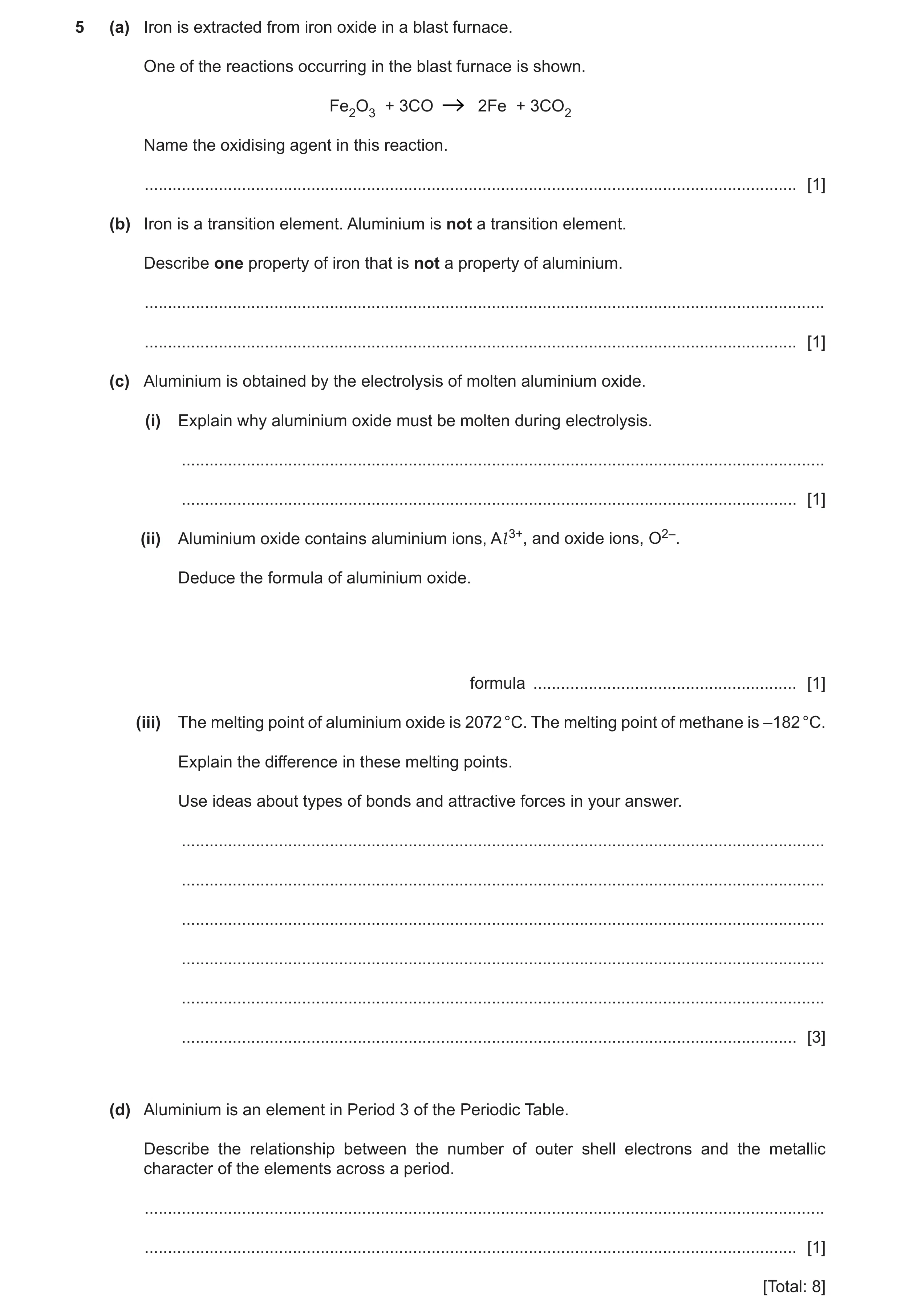
5 (a) Iron is extracted from iron oxide in a blast furnace. One of the reactions occurring in the blast furnace is shown. Fe2O3 + 3CO 2Fe + 3CO2 Name the oxidising agent in this reaction. … [1] (b) Iron is a transition element. Aluminium is not a transition element. Describe one property of iron that is not a property of aluminium. … … [1] (c) Aluminium is obtained by the electrolysis of molten aluminium oxide. (i) Explain why aluminium oxide must be molten during electrolysis. … … [1] (ii) Aluminium oxide contains aluminium ions, Al 3+, and oxide ions, O2–. Deduce the formula of aluminium oxide. formula … [1] (iii) The melting point of aluminium oxide is 2072 °C. The melting point of methane is –182 °C. Explain the difference in these melting points. Use ideas about types of bonds and attractive forces in your answer. … … … … … … [3] (d) Aluminium is an element in Period 3 of the Periodic Table. Describe the relationship between the number of outer shell electrons and the metallic character of the elements across a period. … … [1] [Total: 8]
8 marks
Mark scheme: 5(a) iron oxide ; 1 5(b) any one from: forms coloured compounds ; has high melting point ; has high density ; reference to use as a catalyst ; 1 5(c)(i) ions must be mobile ; 1 5(c)(ii) Al2O3 ; 1 5(c)(iii) (type of bonding) aluminium oxide is ionic AND methane is covalent ; stronger forces of attraction (between oppositely charged ions) in aluminium oxide / weaker forces of attraction (between molecules) in methane ; so more energy needed to separate particles / overcome attraction (hence higher melting point) / ora ; 3 5(d) as number of (outer shell) electrons increases, element changes from metallic to non-metallic ; 1
This question in 0653/42 Oct/Nov 2020
Q11 · Copper chloride is made when copper oxide reacts with dilute hydrochloric acid 0653/43 Oct/Nov 2020
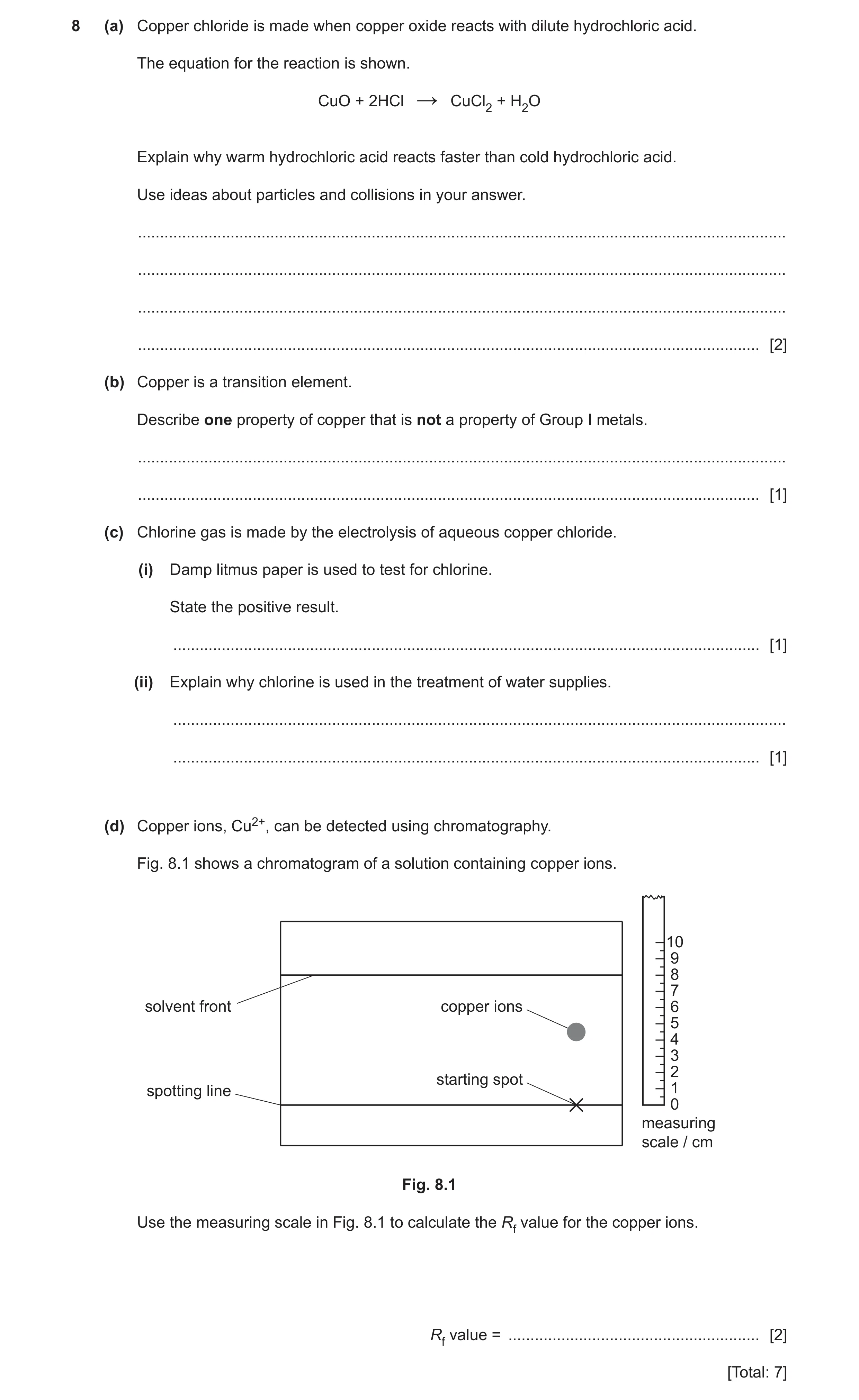
8 (a) Copper chloride is made when copper oxide reacts with dilute hydrochloric acid. The equation for the reaction is shown. CuO + 2HCl CuCl2 + H2O → Explain why warm hydrochloric acid reacts faster than cold hydrochloric acid. Use ideas about particles and collisions in your answer. … … … … [2] (b) Copper is a transition element. Describe one property of copper that is not a property of Group I metals. … … [1] (c) Chlorine gas is made by the electrolysis of aqueous copper chloride. (i) Damp litmus paper is used to test for chlorine. State the positive result. … [1] (ii) Explain why chlorine is used in the treatment of water supplies. … … [1] (d) Copper ions, Cu2+, can be detected using chromatography. Fig. 8.1 shows a chromatogram of a solution containing copper ions. 10 9 8 7 solvent front copper ions 6 5 4 3 2 starting spot spotting line 1 0 measuring scale / cm Fig. 8.1 Use the measuring scale in Fig. 8.1 to calculate the Rf value for the copper ions. Rf value = … [2] [Total: 7]
7 marks
Mark scheme: 8(a) warm hydrochloric acid particles have more kinetic energy ; more successful collisions / more frequent collisions ; 2 8(b) hard / dense / high melting point / acts as a catalyst / forms coloured compounds ; 1 8(c)(i) bleaches (damp litmus paper) ; 1 8(c)(ii) sterilises water / kills microbes / kills bacteria ; 1 8(d) copper ions = 4.5 (cm) AND solvent front = 8 (cm) (from diagram) ; (4.5 ÷ 8.0 =) 0.56 ; 2
This question in 0653/43 Oct/Nov 2020
Q12 · Concentrated aqueous sodium chloride is electrolysed using platinum electrodes, as shown… 0653/42 May/June 2023
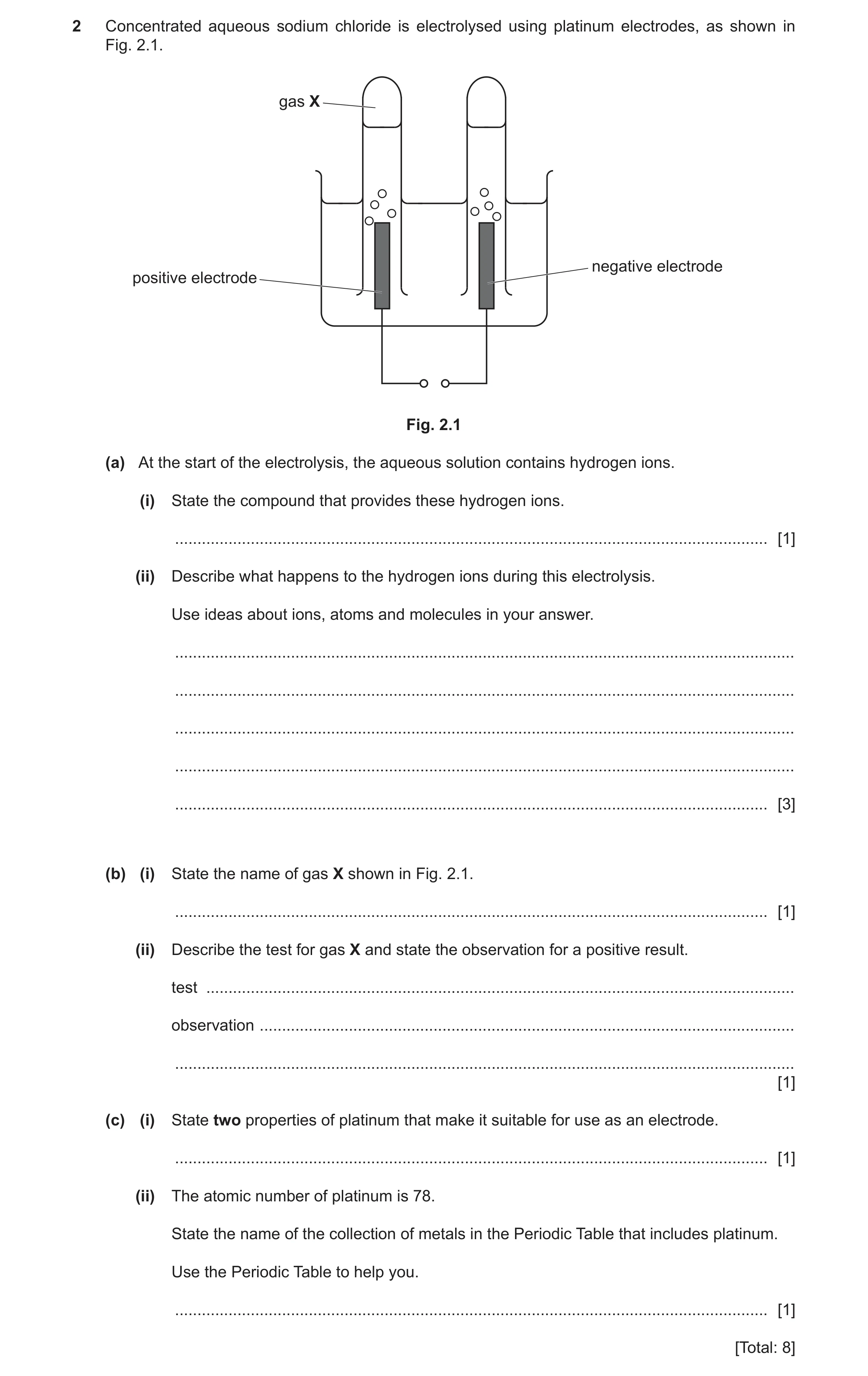
2 Concentrated aqueous sodium chloride is electrolysed using platinum electrodes, as shown in Fig. 2.1. gas X negative electrode positive electrode Fig. 2.1 (a) At the start of the electrolysis, the aqueous solution contains hydrogen ions. (i) State the compound that provides these hydrogen ions. … [1] (ii) Describe what happens to the hydrogen ions during this electrolysis. Use ideas about ions, atoms and molecules in your answer. … … … … … [3] (b) (i) State the name of gas X shown in Fig. 2.1. … [1] (ii) Describe the test for gas X and state the observation for a positive result. test … observation … … [1] (c) (i) State two properties of platinum that make it suitable for use as an electrode. … [1] (ii) The atomic number of platinum is 78. State the name of the collection of metals in the Periodic Table that includes platinum. Use the Periodic Table to help you. … [1] [Total: 8]
8 marks
Mark scheme: 2(a)(i) water ; 1 2(a)(ii) hydrogen ions attracted to / move to, cathode / negative electrode ; reference to gain of electrons ; (two) hydrogen atoms join to form a molecule (of hydrogen gas) ; 3 2(b)(i) chlorine ; 1 Question Answer Marks 2(b)(ii) (damp) litmus (paper) and bleached / goes white ; 1 2(c)(i) is inert / is unreactive and conducts (electricity) ; 1 2(c)(ii) transition (elements / metals) ; 1
This question in 0653/42 May/June 2023
Q13 · The electrolysis of concentrated aqueous sodium chloride using platinum electrodes 0653/43 Oct/Nov 2023
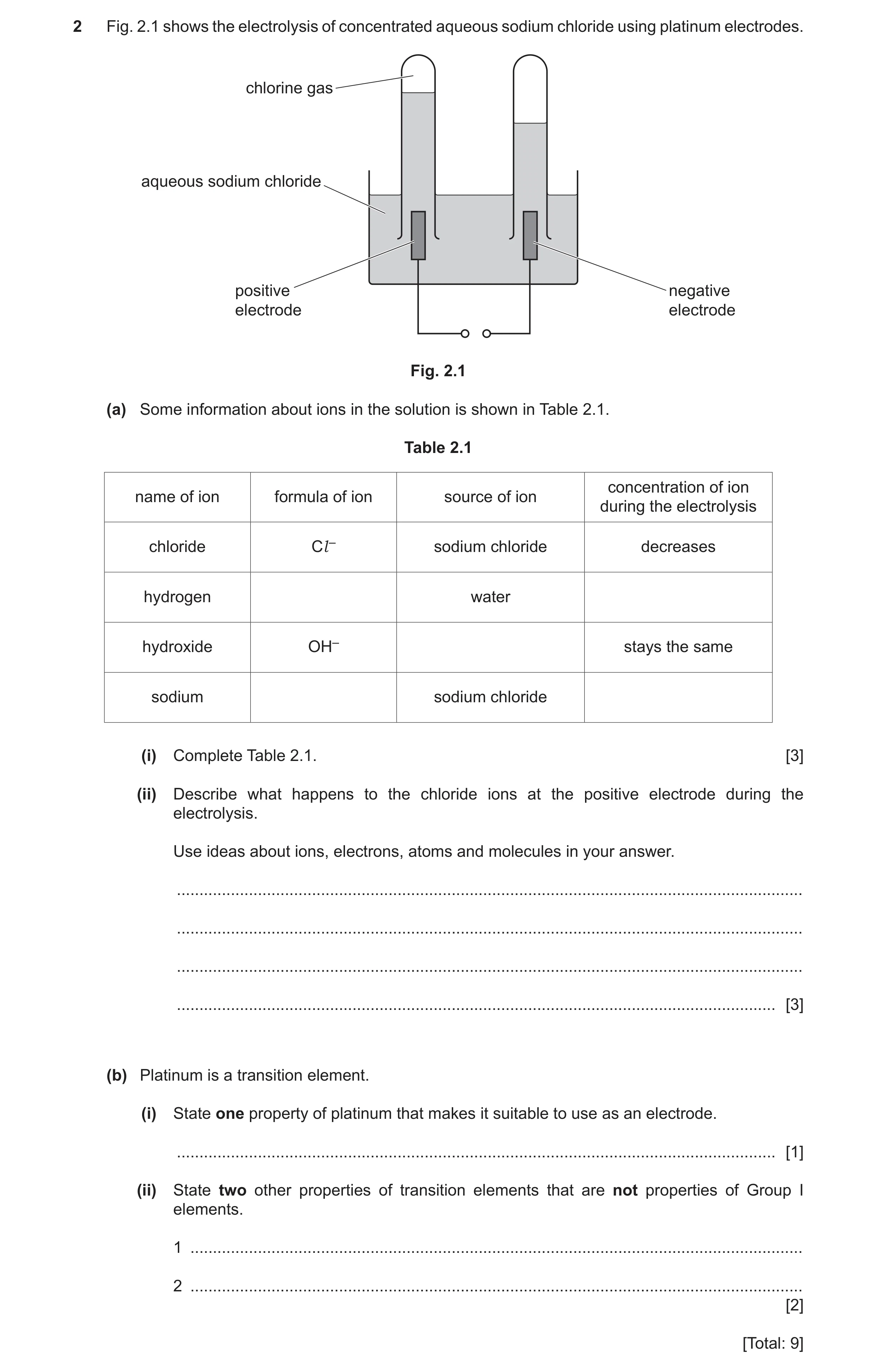
2 Fig. 2.1 shows the electrolysis of concentrated aqueous sodium chloride using platinum electrodes. chlorine gas aqueous sodium chloride positive negative electrode electrode Fig. 2.1 (a) Some information about ions in the solution is shown in Table 2.1. Table 2.1 concentration of ion name of ion formula of ion source of ion during the electrolysis chloride Cl – sodium chloride decreases hydrogen water hydroxide OH– stays the same sodium sodium chloride (i) Complete Table 2.1. [3] (ii) Describe what happens to the chloride ions at the positive electrode during the electrolysis. Use ideas about ions, electrons, atoms and molecules in your answer. … … … … [3] (b) Platinum is a transition element. (i) State one property of platinum that makes it suitable to use as an electrode. … [1] (ii) State two other properties of transition elements that are not properties of Group I elements. 1 … 2 … [2] [Total: 9]
9 marks
Mark scheme: 2(a)(i) hydrogen H+ AND decreases ; 3 hydroxide water ; sodium Na+ AND stays the same ; 2(a)(ii) (each) chloride ion loses (one) electron ; 3 chlorine atoms (form) ; two atoms join together to form a molecule (of chlorine gas) ; 2(b)(i) conducts electricity / inert / unreactive ; 1 2(b)(ii) any two from: 2 high melting point ; high density ; forms coloured compounds ; acts as a catalyst ; AVP ;
This question in 0653/43 Oct/Nov 2023
Q14 · The position of an element in the Periodic Table is related to its atomic structure 0653/41 Oct/Nov 2024
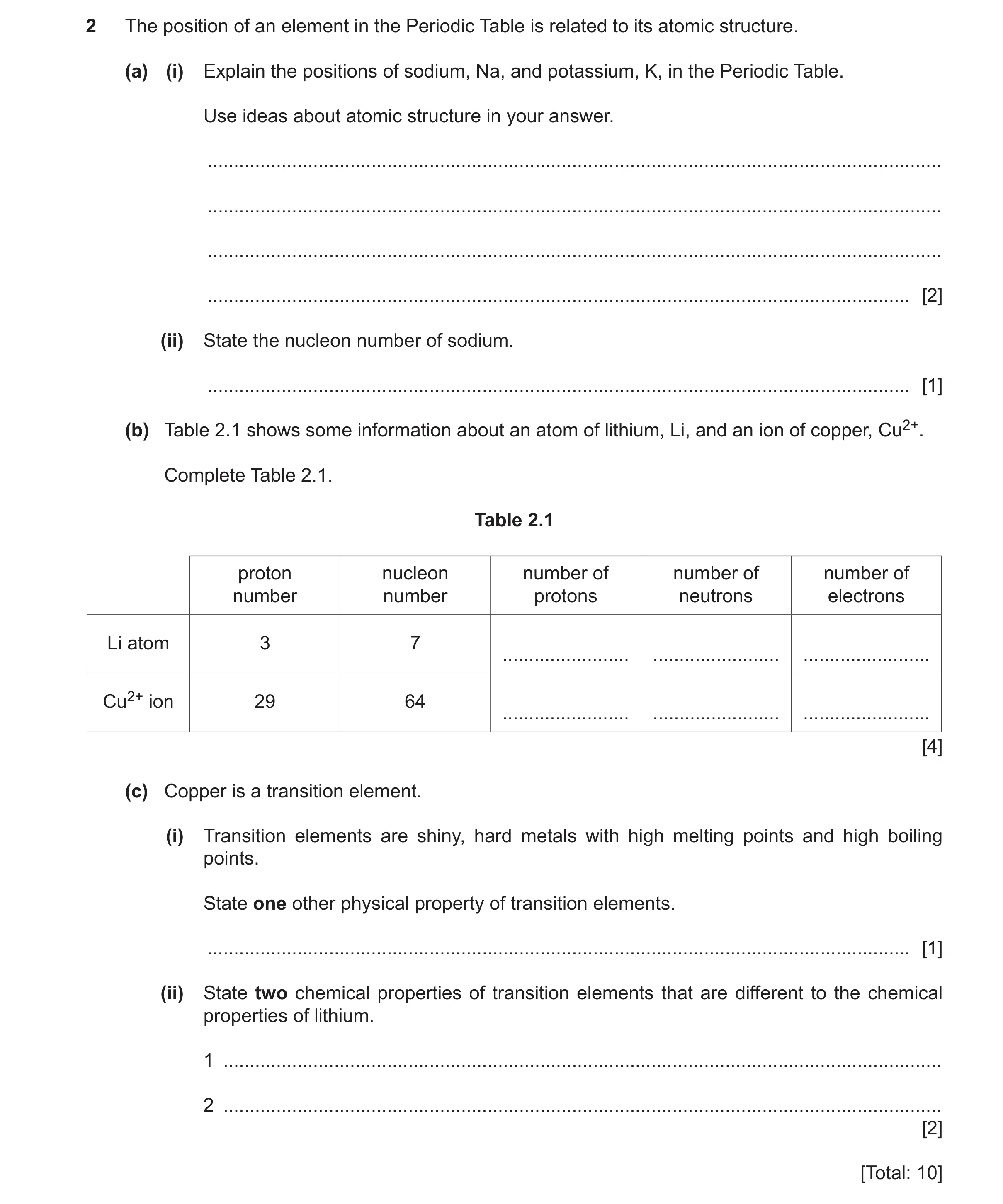
2 The position of an element in the Periodic Table is related to its atomic structure. (a) (i) Explain the positions of sodium, Na, and potassium, K, in the Periodic Table. Use ideas about atomic structure in your answer. … … … … [2] (ii) State the nucleon number of sodium. … [1] (b) Table 2.1 shows some information about an atom of lithium, Li, and an ion of copper, Cu2+. Complete Table 2.1. Table 2.1 proton nucleon number of number of number of number number protons neutrons electrons Li atom 3 7 … … … Cu2+ ion 29 64 … … … [4] (c) Copper is a transition element. (i) Transition elements are shiny, hard metals with high melting points and high boiling points. State one other physical property of transition elements. … [1] (ii) State two chemical properties of transition elements that are different to the chemical properties of lithium. 1 … 2 … [2] [Total: 10]
10 marks
Mark scheme: 2(a)(i) idea that: 2 both have one electron in their outer shell so are in Group 1 ; K is lower in group because it has one more electron shell than Na ; 2(a)(ii) 23 ; 1 2(b) 4 proton number nucleon number number of protons number of number of neutrons electrons Li atom 3 7 3 4 3 Cu2+ ion 29 64 29 35 27 number of protons column correct ; number of neutrons column correct ; number of electrons for Li atom correct ; number of electrons for Cu2+ ion correct ; 2(c)(i) high density / malleable / good conductors of heat / good conductors of electricity ; 1 2(c)(ii) form coloured compounds ; 2 act as catalysts ;
This question in 0653/41 Oct/Nov 2024
 11 / 18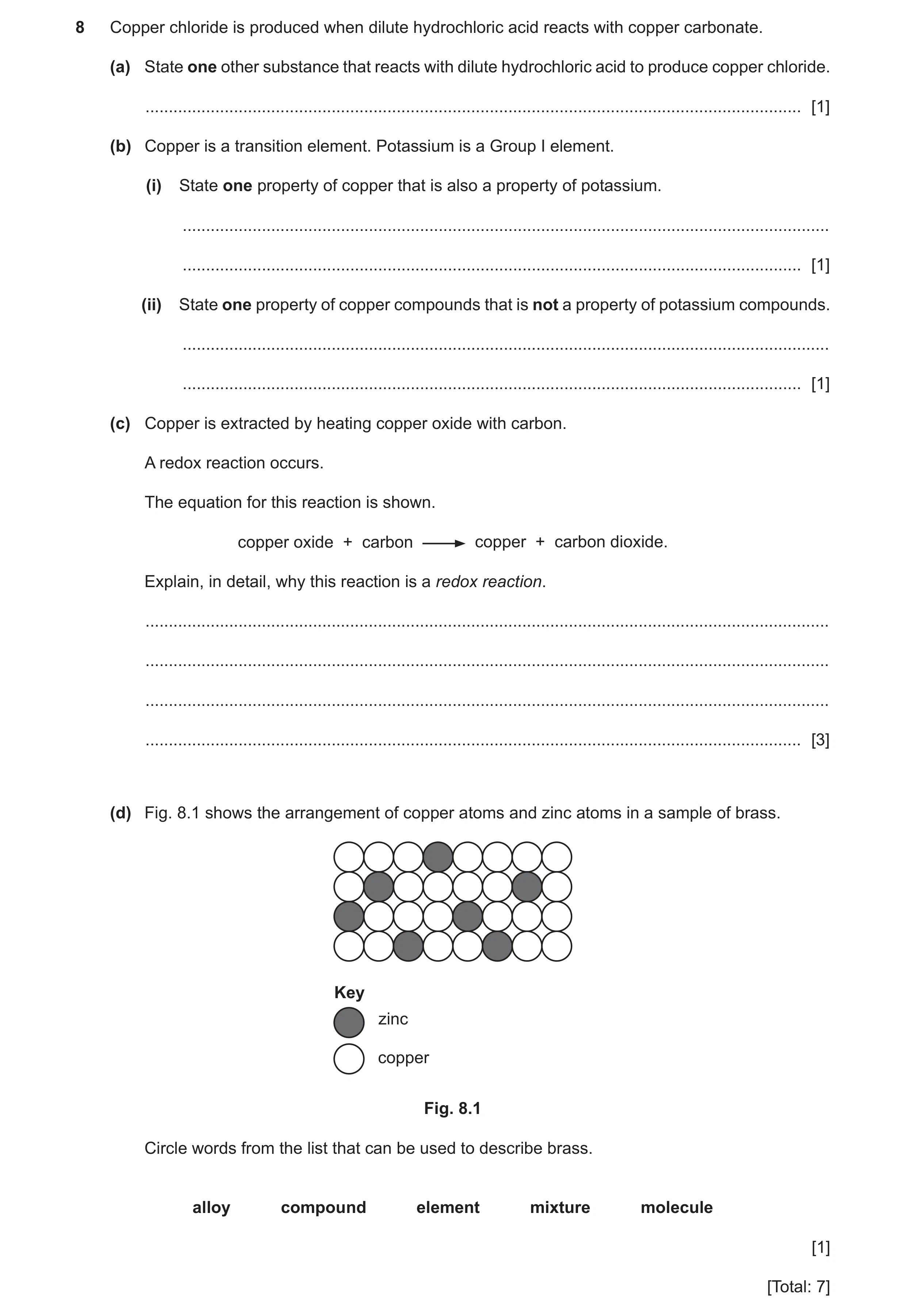
 18 / 18
 8
8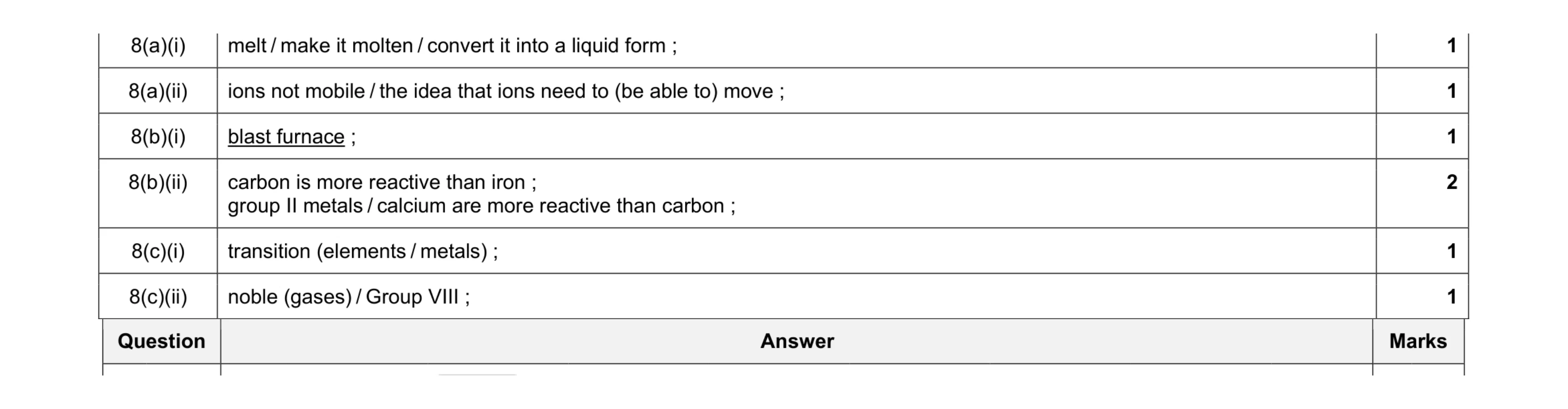 7
7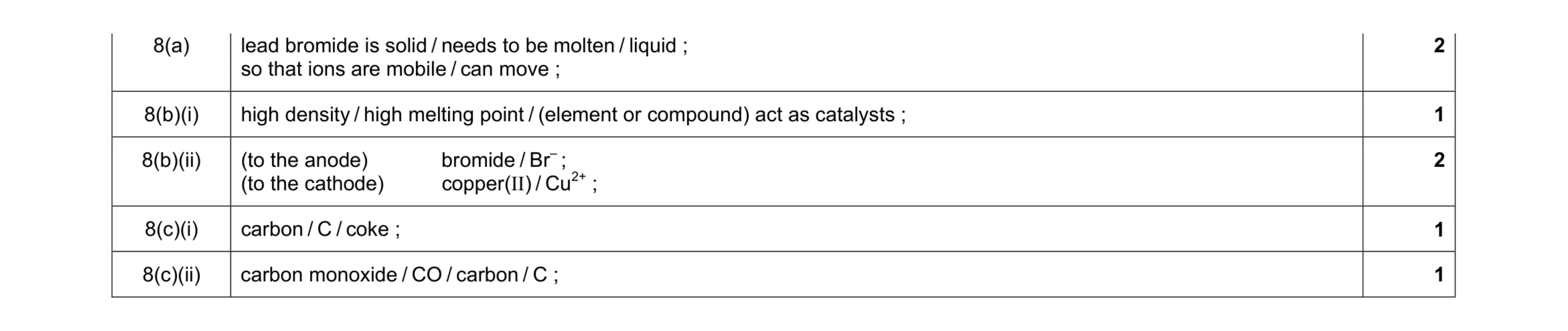 7
7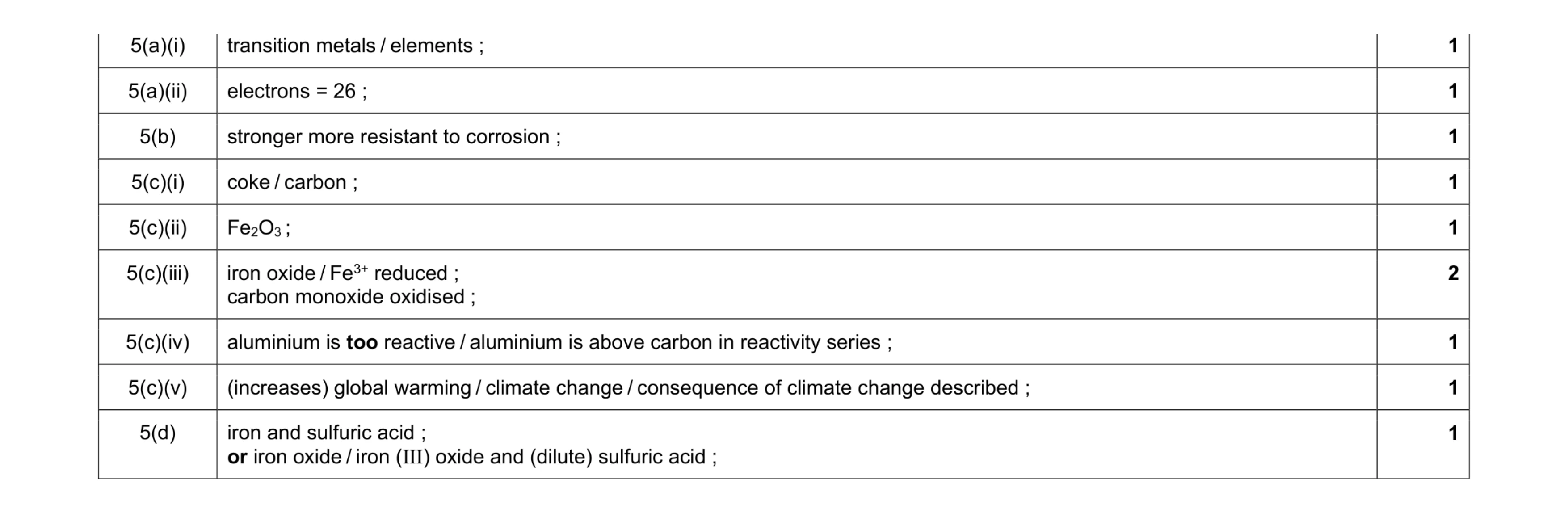 10
10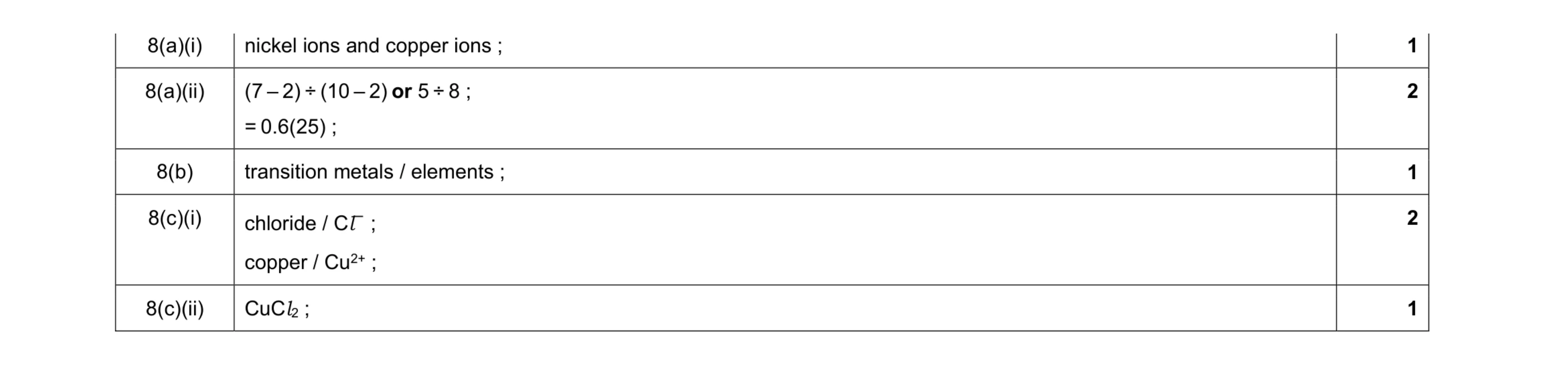 7
7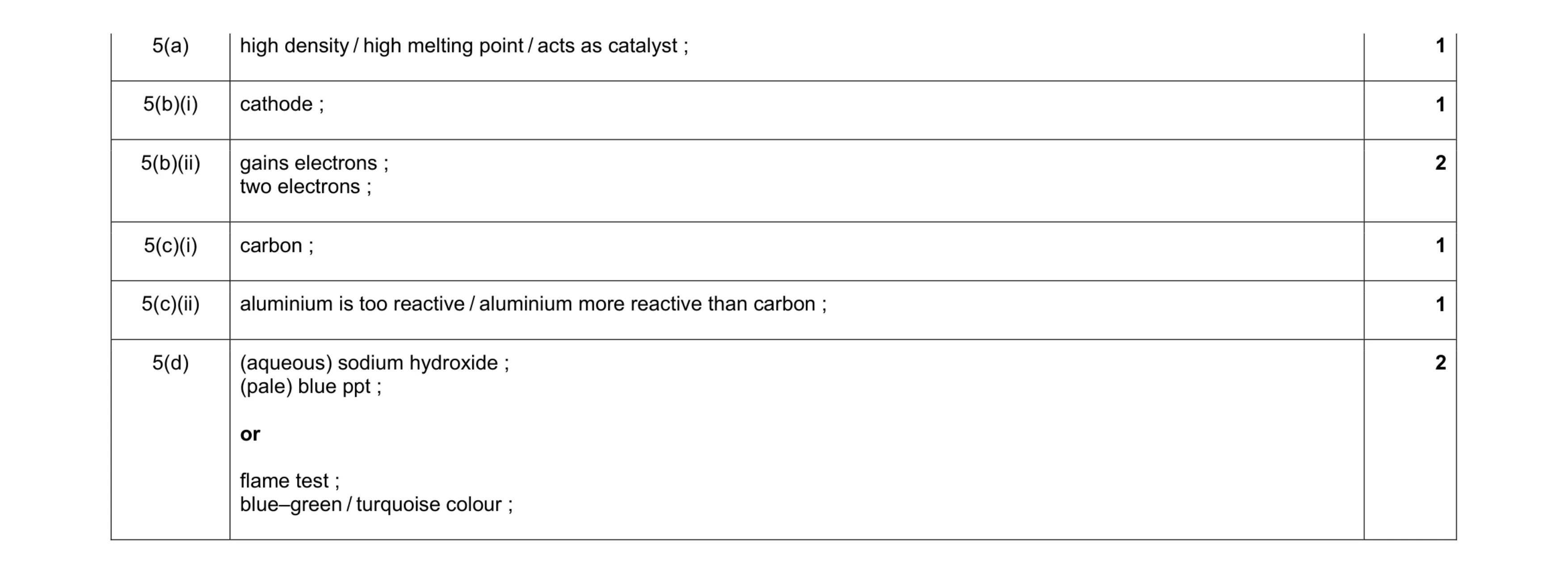 8
8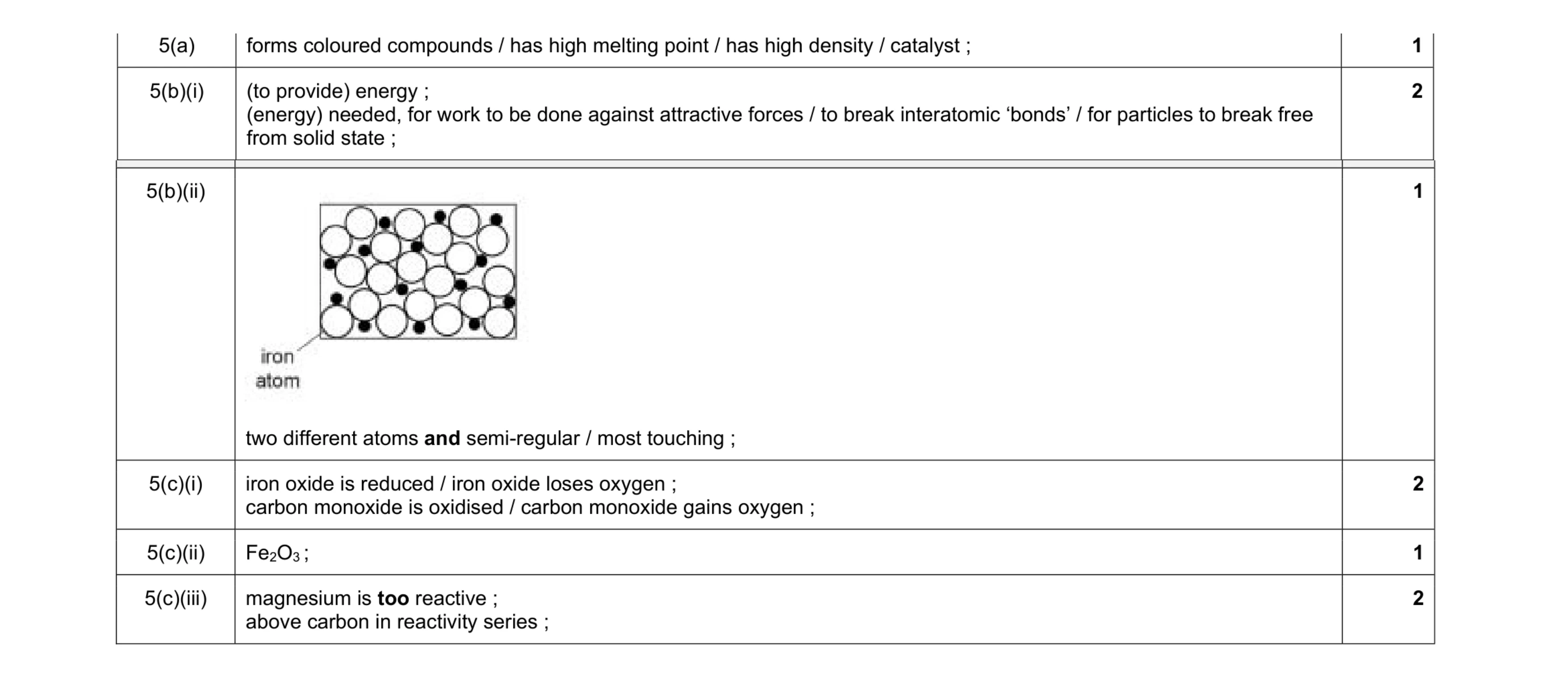 9
9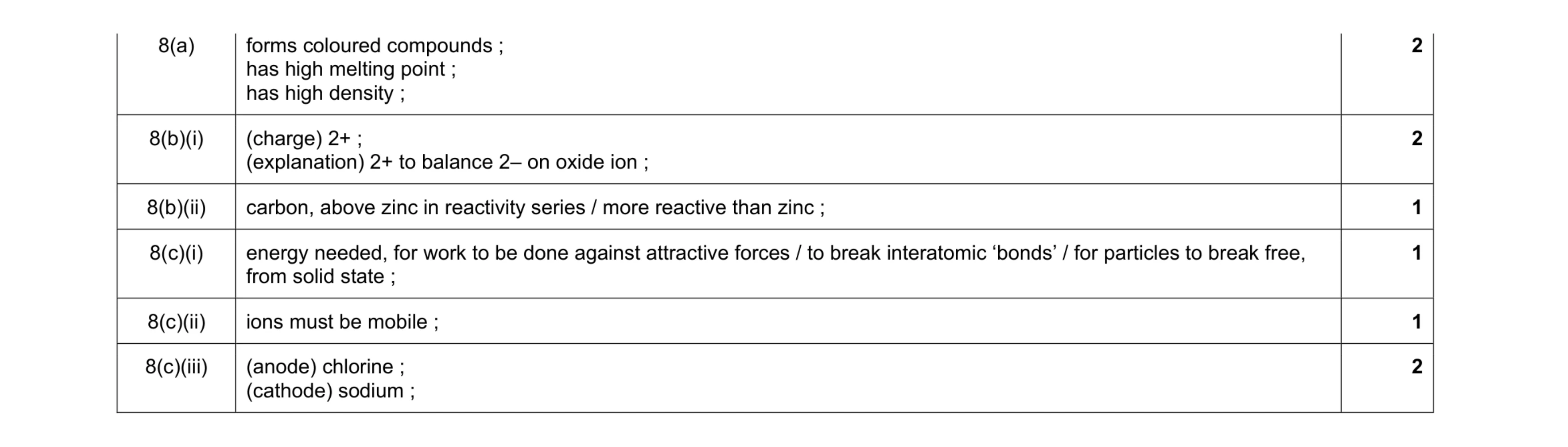 9
9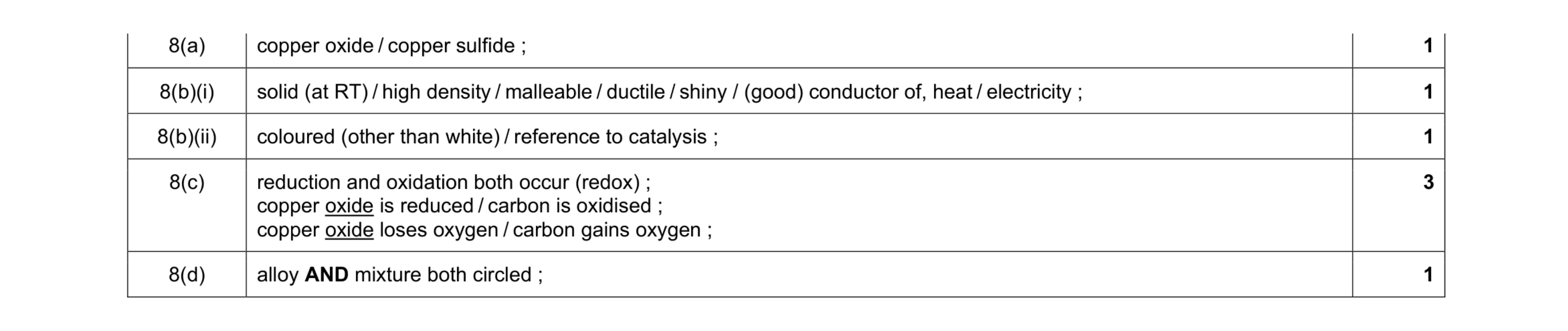 7
7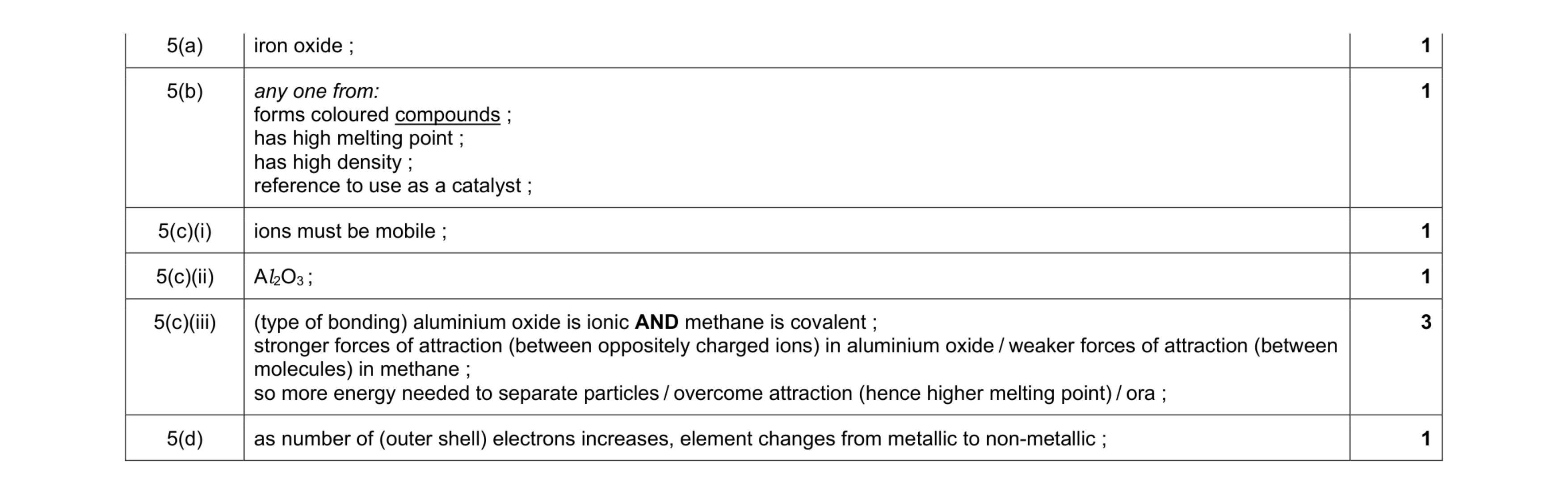 8
8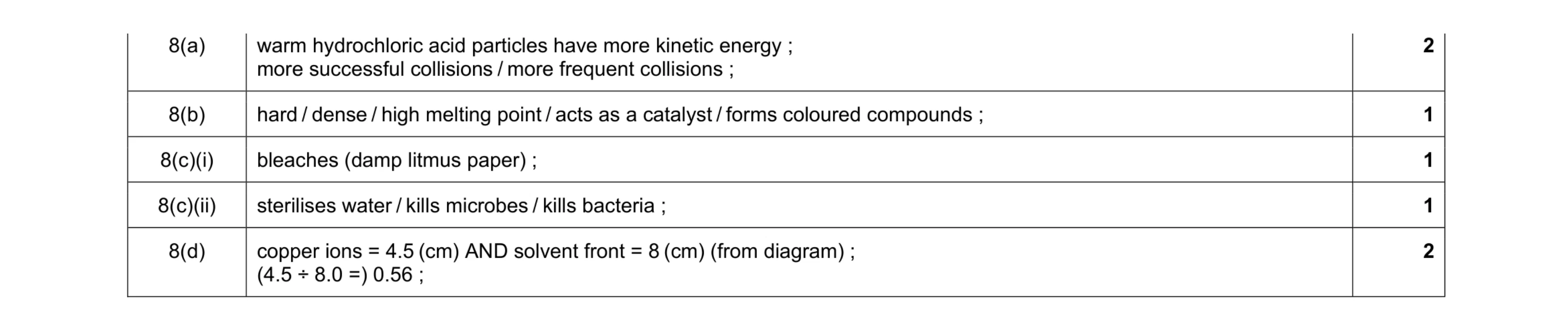 7
7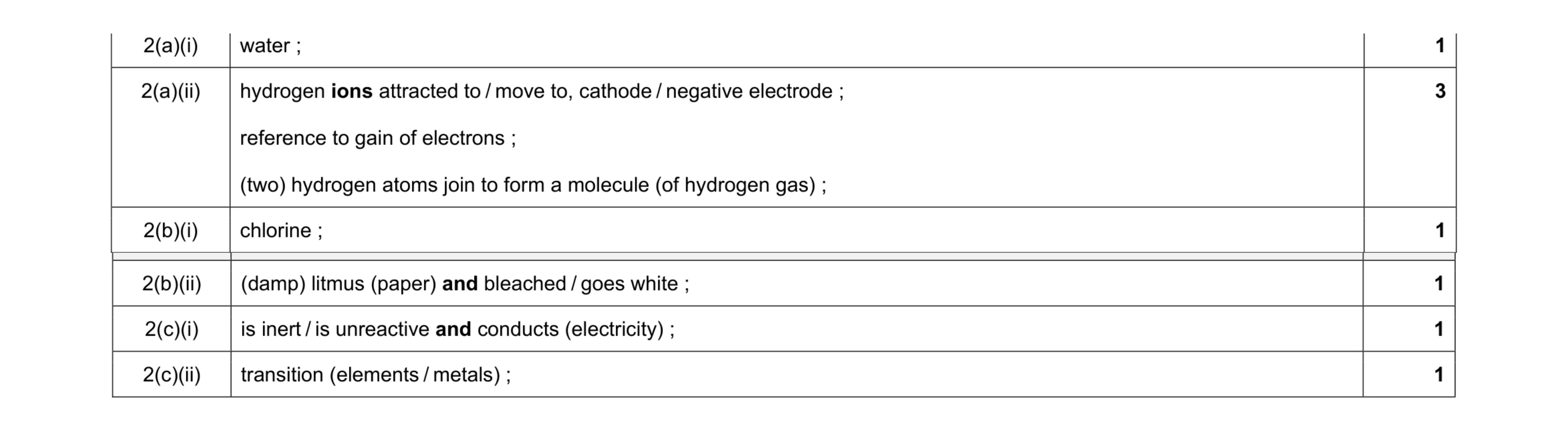 8
8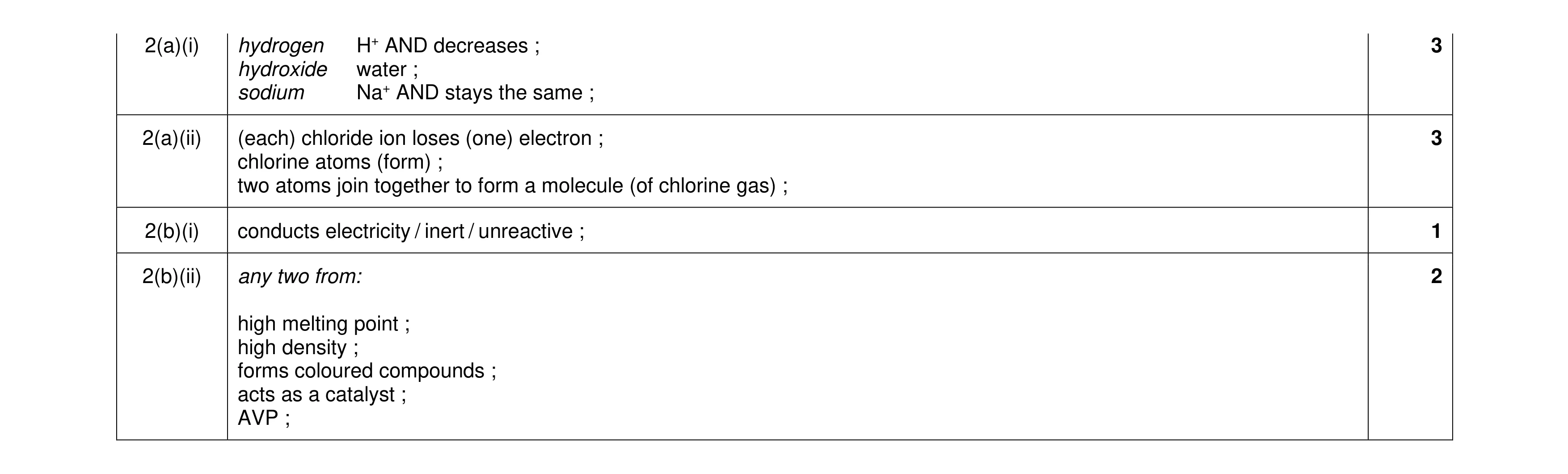 9
9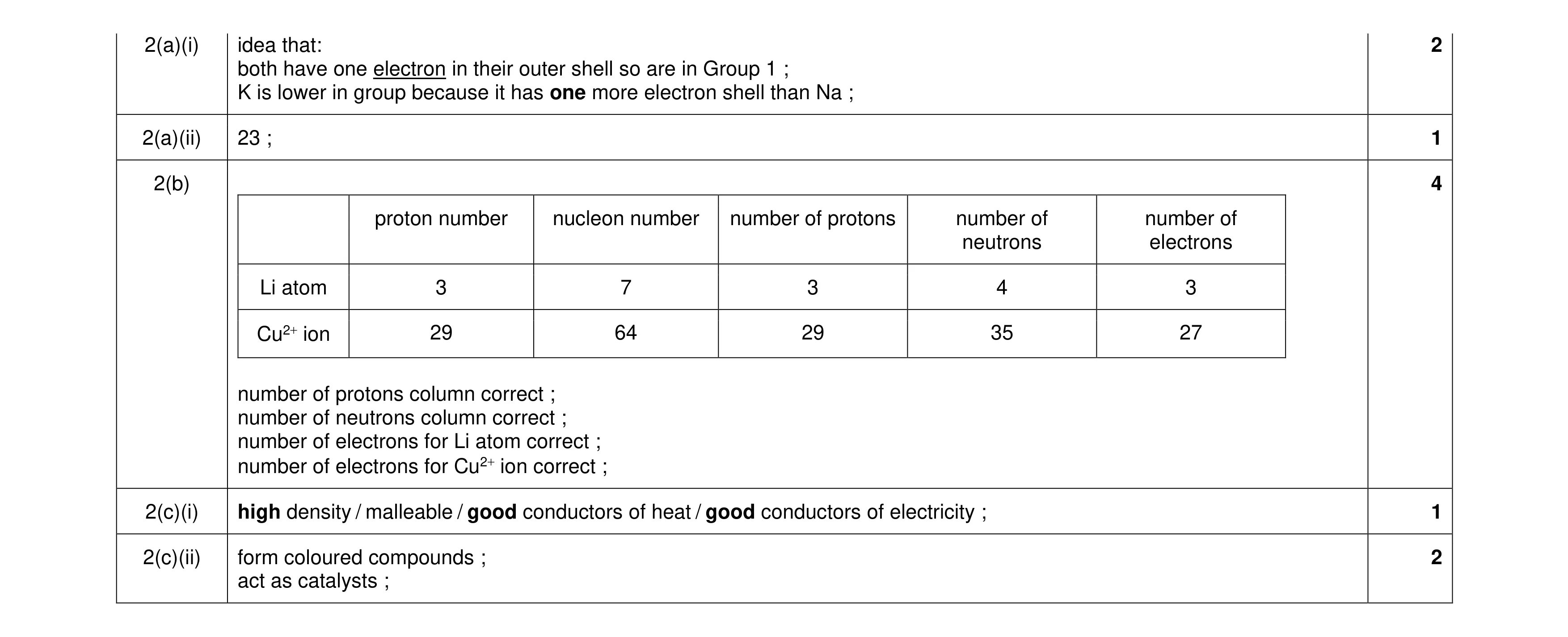 10
10