Cambridge IGCSE Science - Combined 0653 — 2024 May/June Paper 4 · Variant 1
0653/41/M/J/24 · 9 questions · 80 marks · ≈90 min
The question paper and its mark scheme, free to read here and free to download. This is Cambridge’s own paper, exactly as it was sat.
Question paper24 pages



Mark scheme10 pages
Answers below. Sit the paper first if you are practising.
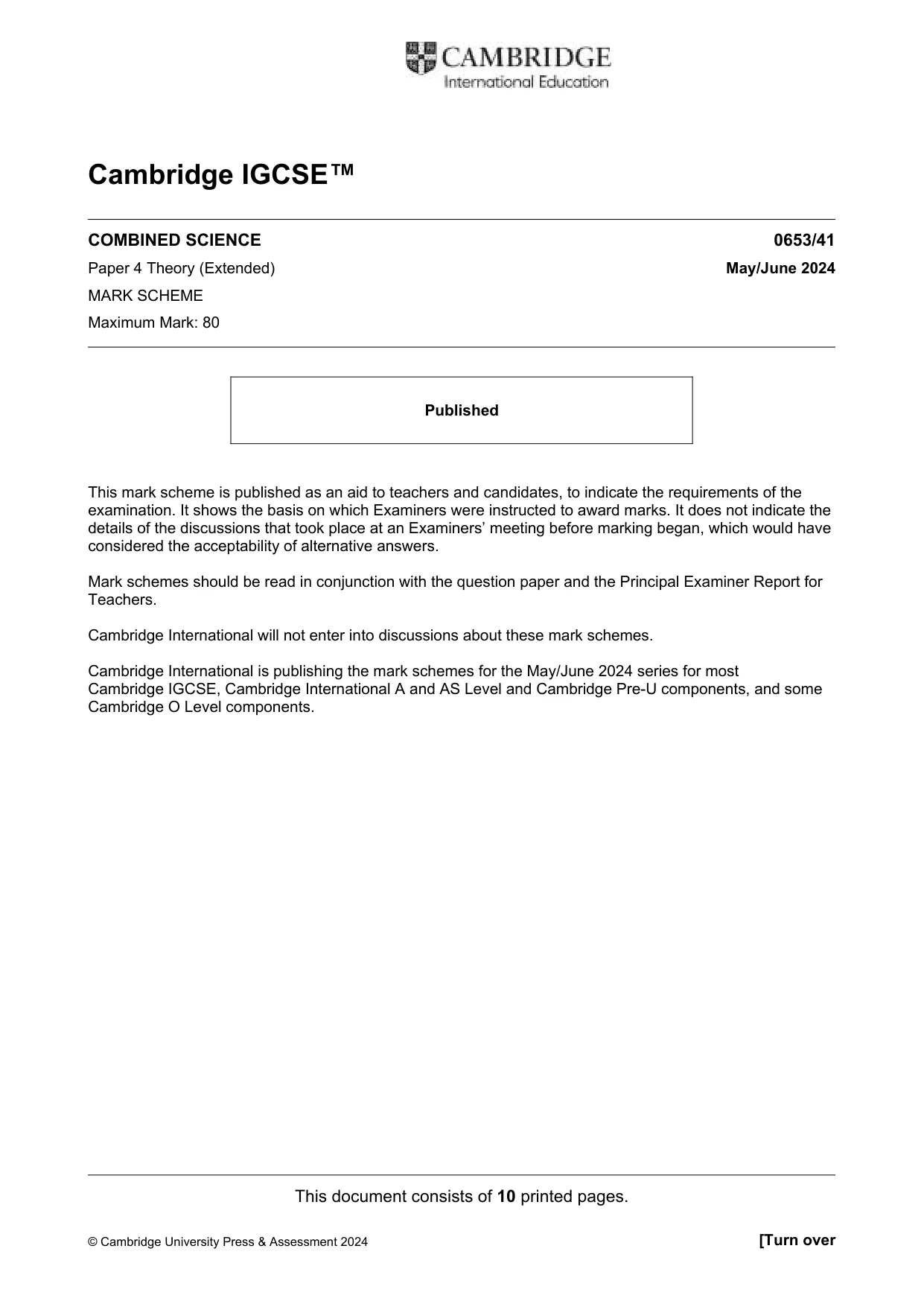
Questions as text
Q1 · The structure of the human heart
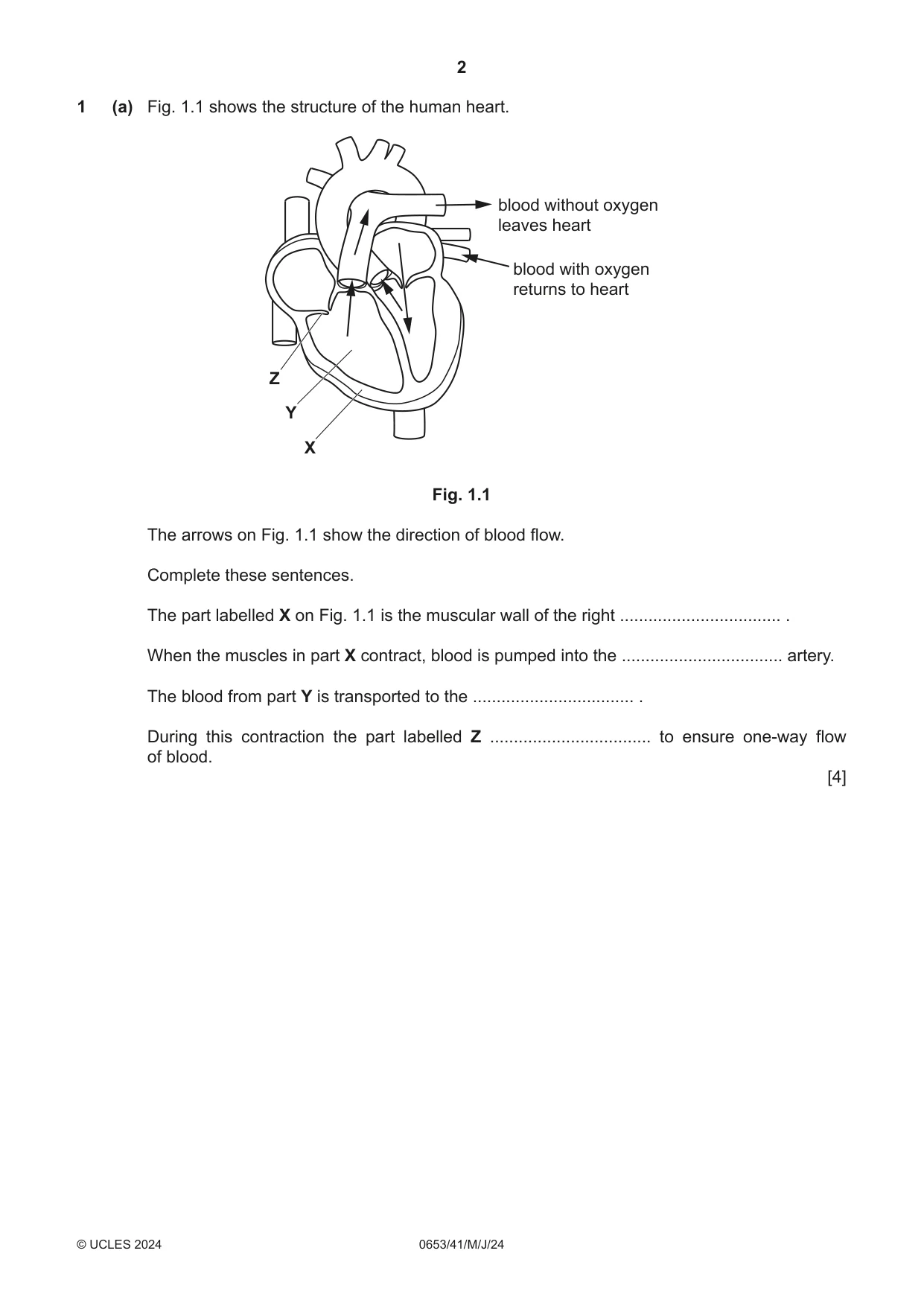
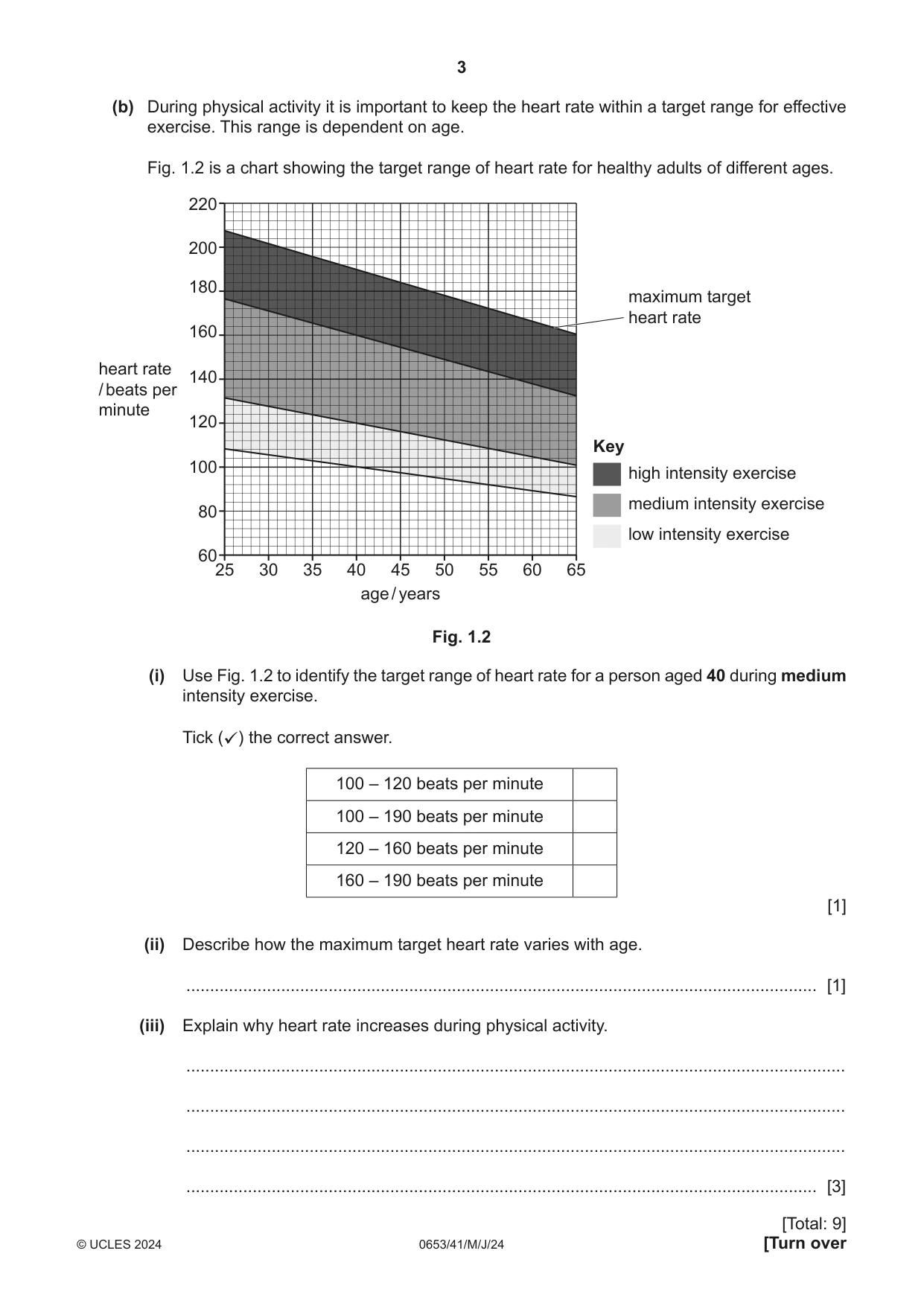
1 (a) Fig. 1.1 shows the structure of the human heart. blood without oxygen leaves heart blood with oxygen returns to heart Z Y X Fig. 1.1 The arrows on Fig. 1.1 show the direction of blood flow. Complete these sentences. The part labelled X on Fig. 1.1 is the muscular wall of the right .................................. . When the muscles in part X contract, blood is pumped into the .................................. artery. The blood from part Y is transported to the .................................. . During this contraction the part labelled Z .................................. to ensure one‑way flow of blood. [4] (b) During physical activity it is important to keep the heart rate within a target range for effective exercise. This range is dependent on age. Fig. 1.2 is a chart showing the target range of heart rate for healthy adults of different ages. 220 200 180 maximum target heart rate 160 heart rate 140 / beats per minute 120 Key 100 high intensity exercise medium intensity exercise 80 low intensity exercise 60 25 30 35 40 45 50 55 60 65 age / years Fig. 1.2 (i) Use Fig. 1.2 to identify the target range of heart rate for a person aged 40 during medium intensity exercise. Tick (ü) the correct answer. 100 – 120 beats per minute 100 – 190 beats per minute 120 – 160 beats per minute 160 – 190 beats per minute [1] (ii) Describe how the maximum target heart rate varies with age. ..................................................................................................................................... [1] (iii) Explain why heart rate increases during physical activity. ........................................................................................................................................... ........................................................................................................................................... ........................................................................................................................................... ..................................................................................................................................... [3]
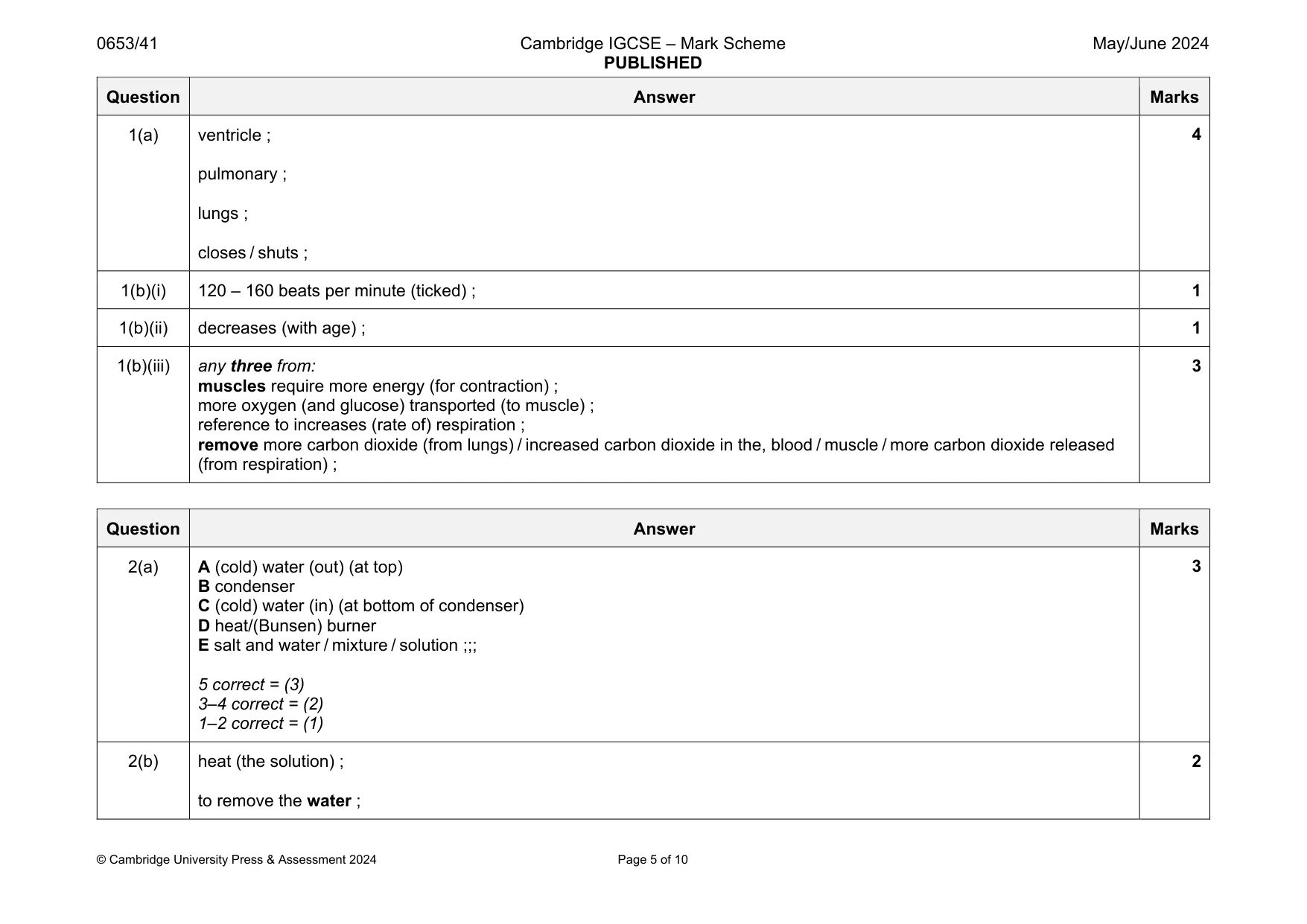
Mark scheme: 1(a) ventricle ; pulmonary ; lungs ; closes / shuts ; 1(b)(i) 120 – 160 beats per minute (ticked) ; 1 1(b)(ii) decreases (with age) ; 1 1(b)(iii) any three from: muscles require more energy (for contraction) ; more oxygen (and glucose) transported (to muscle) ; reference to increases (rate of) respiration ; remove more carbon dioxide (from lungs) / increased carbon dioxide in the, blood / muscle / more carbon dioxide released (from respiration) ; 3
Q2 · Different methods of separation are used for different types of mixtures
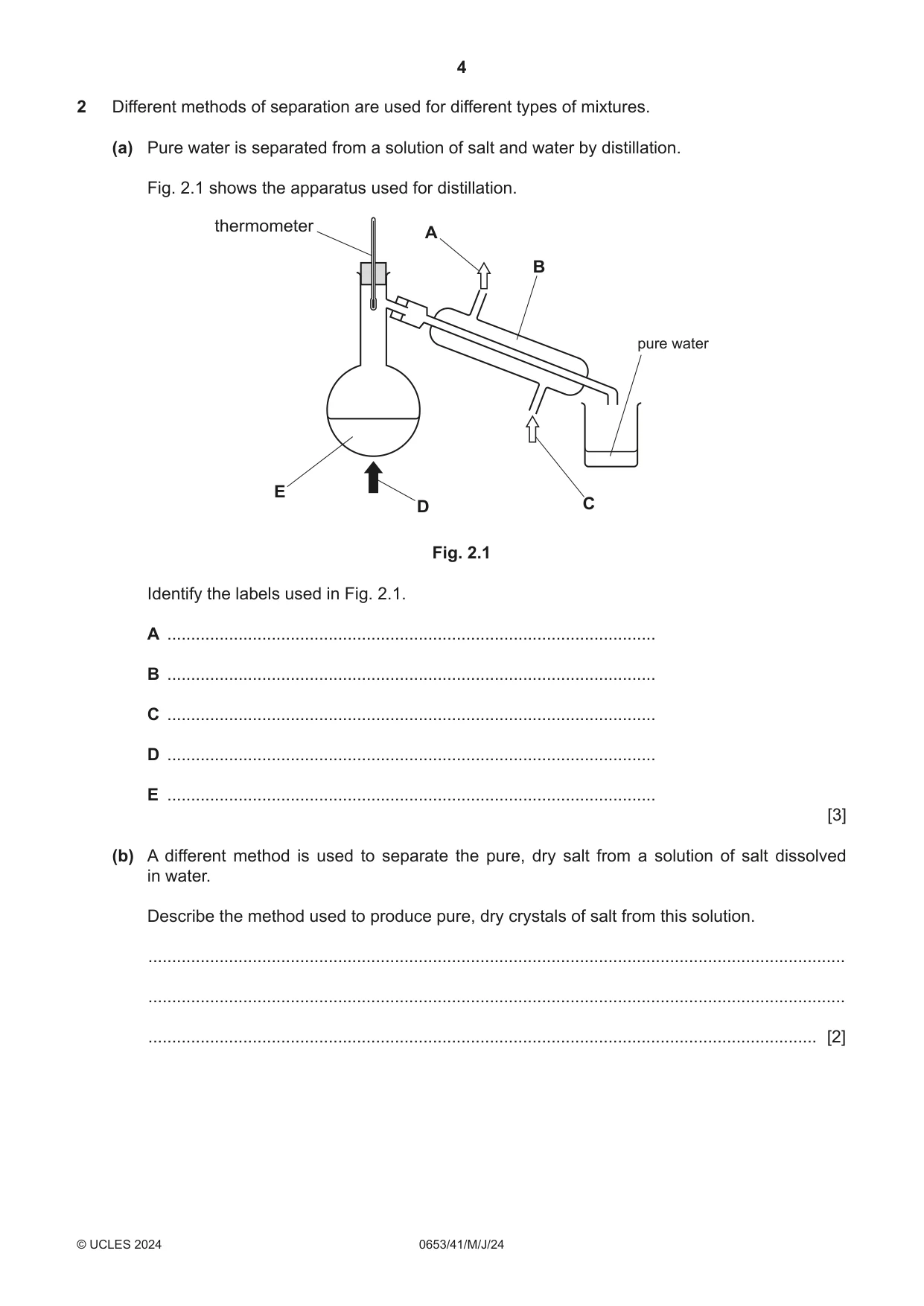
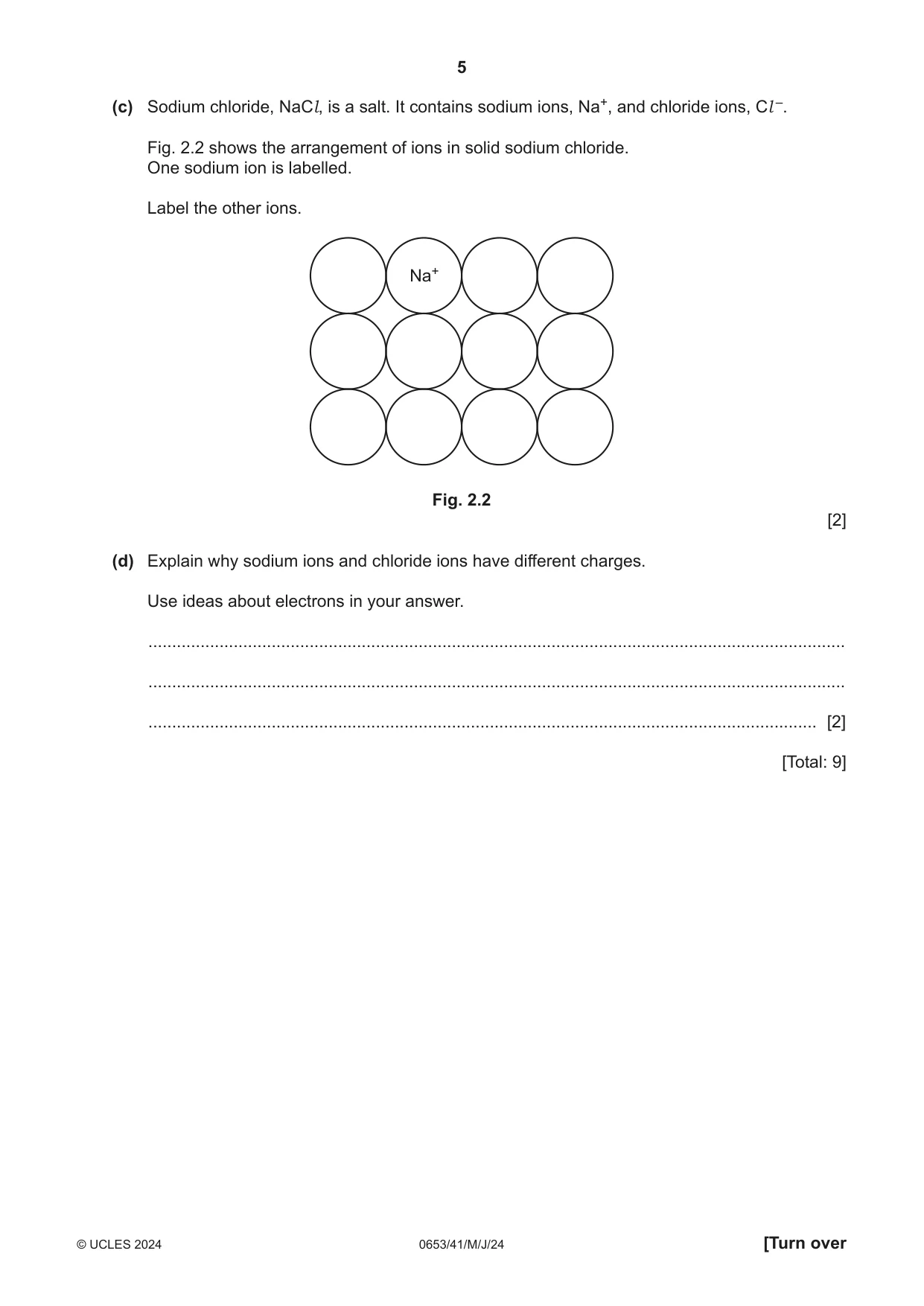
2 Different methods of separation are used for different types of mixtures. (a) Pure water is separated from a solution of salt and water by distillation. Fig. 2.1 shows the apparatus used for distillation. thermometer A B pure water E D C Fig. 2.1 Identify the labels used in Fig. 2.1. A ....................................................................................................... B ....................................................................................................... C ....................................................................................................... D ....................................................................................................... E ....................................................................................................... [3] (b) A different method is used to separate the pure, dry salt from a solution of salt dissolved in water. Describe the method used to produce pure, dry crystals of salt from this solution. ................................................................................................................................................... ................................................................................................................................................... ............................................................................................................................................. [2] (c) Sodium chloride, NaCl, is a salt. It contains sodium ions, Na+, and chloride ions, Cl –. Fig. 2.2 shows the arrangement of ions in solid sodium chloride. One sodium ion is labelled. Label the other ions. Na+ Fig. 2.2 [2] (d) Explain why sodium ions and chloride ions have different charges. Use ideas about electrons in your answer. ................................................................................................................................................... ................................................................................................................................................... ............................................................................................................................................. [2] [Total: 9]
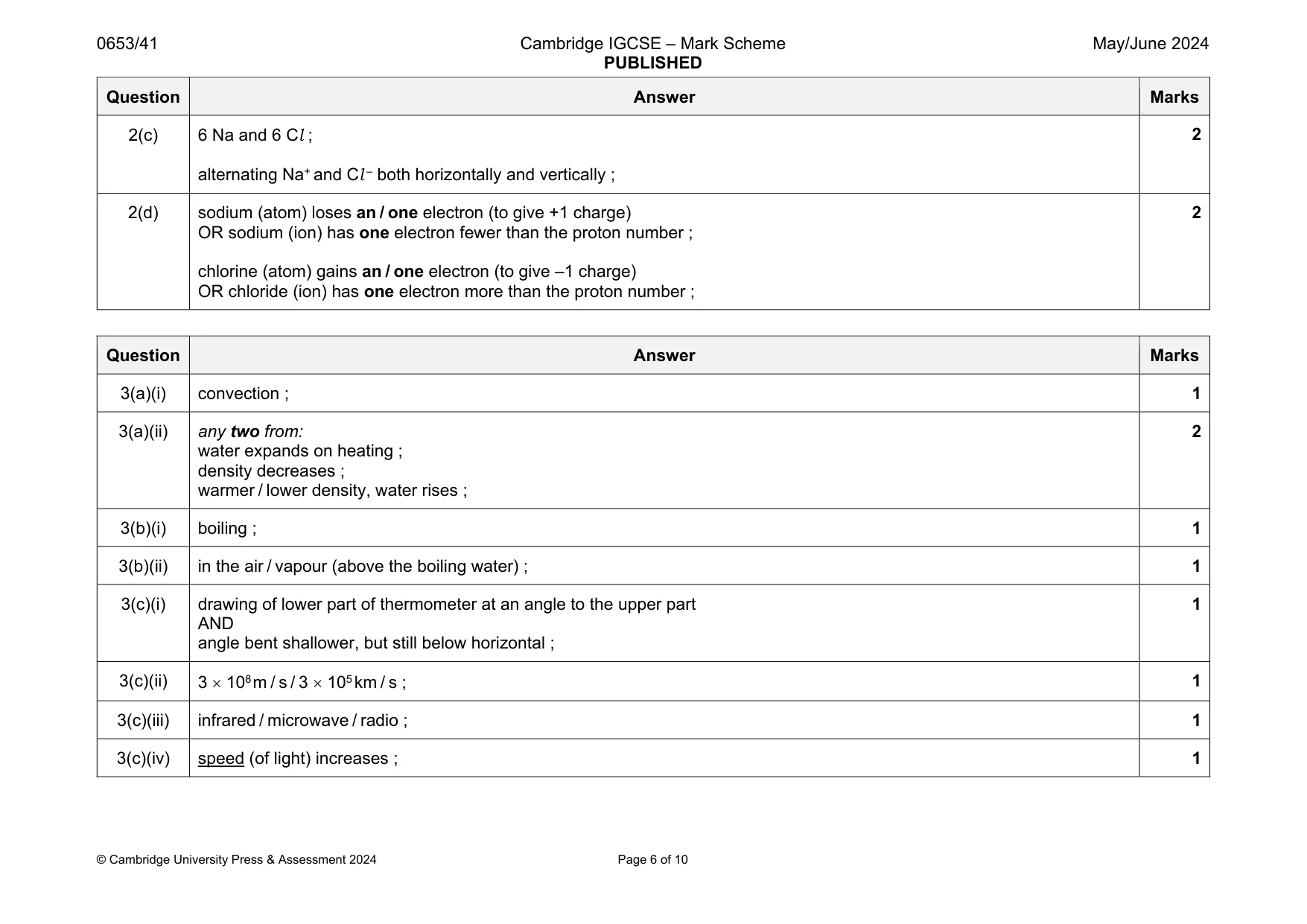
Mark scheme: 2(a) A (cold) water (out) (at top) B condenser C (cold) water (in) (at bottom of condenser) D heat/(Bunsen) burner E salt and water / mixture / solution ;;; 5 correct = (3) 3–4 correct = (2) 1–2 correct = (1) 2(b) heat (the solution) ; to remove the water ; 2 Question Answer Marks 2(c) 6 Na and 6 Cl ; alternating Na+ and Cl – both horizontally and vertically ; 2 2(d) sodium (atom) loses an / one electron (to give +1 charge) OR sodium (ion) has one electron fewer than the proton number ; chlorine (atom) gains an / one electron (to give –1 charge) OR chloride (ion) has one electron more than the proton number ; 2
Q3 · A pan of water heated on a cooker
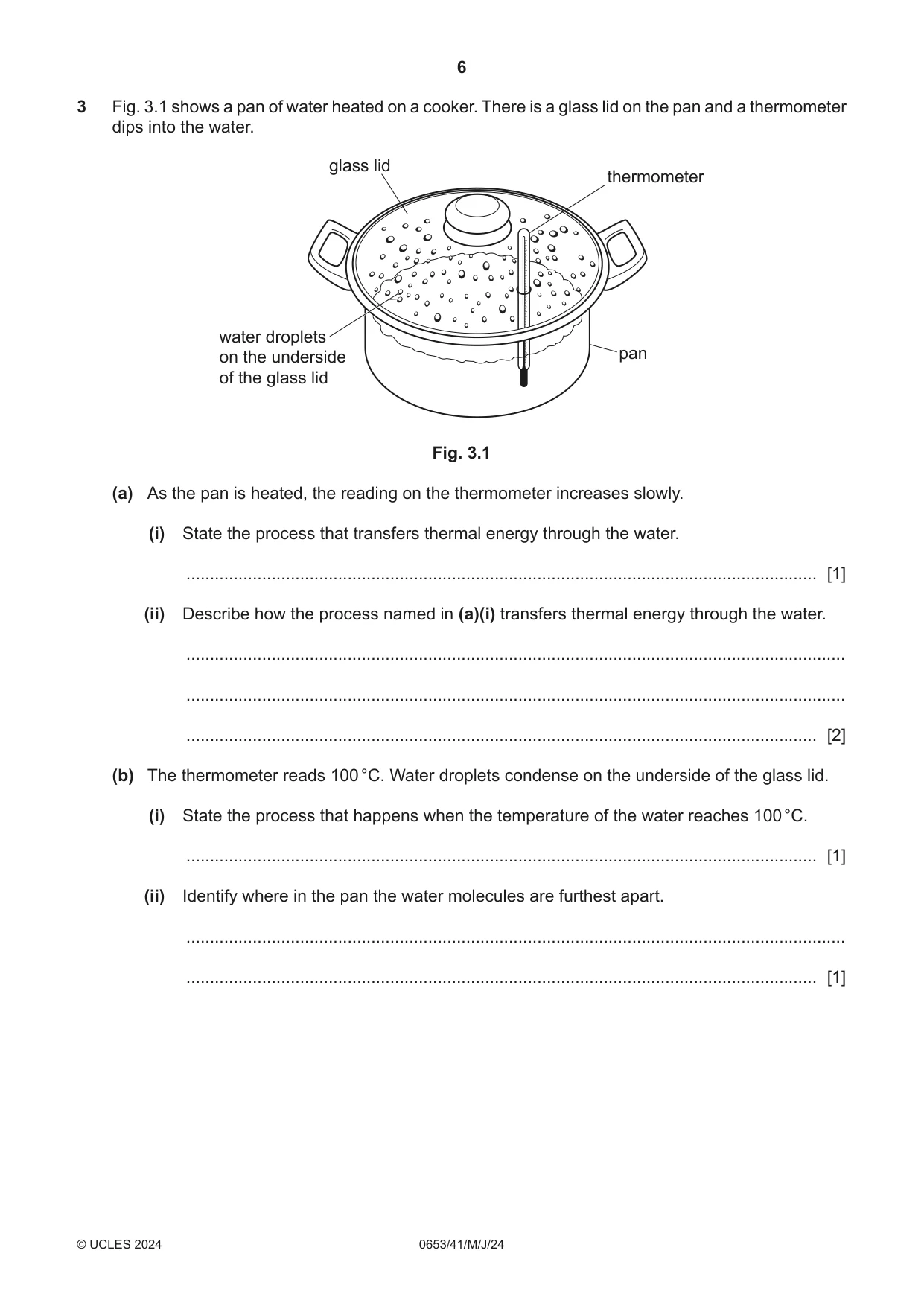
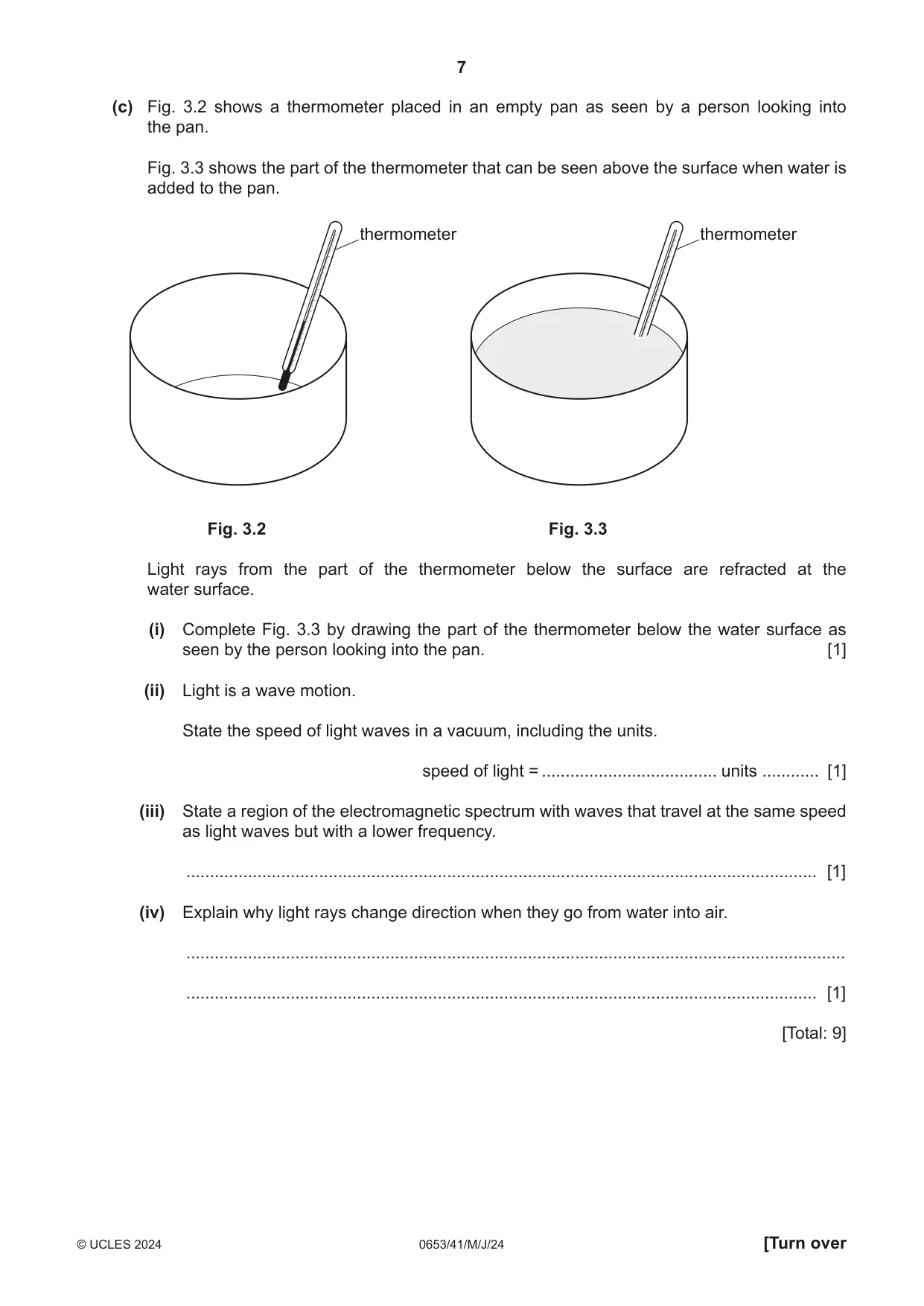
3 Fig. 3.1 shows a pan of water heated on a cooker. There is a glass lid on the pan and a thermometer dips into the water. glass lid thermometer water droplets on the underside pan of the glass lid Fig. 3.1 (a) As the pan is heated, the reading on the thermometer increases slowly. (i) State the process that transfers thermal energy through the water. ..................................................................................................................................... [1] (ii) Describe how the process named in (a)(i) transfers thermal energy through the water. ........................................................................................................................................... ........................................................................................................................................... ..................................................................................................................................... [2] (b) The thermometer reads 100 °C. Water droplets condense on the underside of the glass lid. (i) State the process that happens when the temperature of the water reaches 100 °C. ..................................................................................................................................... [1] (ii) Identify where in the pan the water molecules are furthest apart. ........................................................................................................................................... ..................................................................................................................................... [1] (c) Fig. 3.2 shows a thermometer placed in an empty pan as seen by a person looking into the pan. Fig. 3.3 shows the part of the thermometer that can be seen above the surface when water is added to the pan. thermometer thermometer Fig. 3.2 Fig. 3.3 Light rays from the part of the thermometer below the surface are refracted at the water surface. (i) Complete Fig. 3.3 by drawing the part of the thermometer below the water surface as seen by the person looking into the pan. [1] (ii) Light is a wave motion. State the speed of light waves in a vacuum, including the units. speed of light = ..................................... units ............ [1] (iii) State a region of the electromagnetic spectrum with waves that travel at the same speed as light waves but with a lower frequency. ..................................................................................................................................... [1] (iv) Explain why light rays change direction when they go from water into air. ........................................................................................................................................... ..................................................................................................................................... [1] [Total: 9]
Mark scheme: 3(a)(i) convection ; 1 3(a)(ii) any two from: water expands on heating ; density decreases ; warmer / lower density, water rises ; 2 3(b)(i) boiling ; 1 3(b)(ii) in the air / vapour (above the boiling water) ; 1 3(c)(i) drawing of lower part of thermometer at an angle to the upper part AND angle bent shallower, but still below horizontal ; 1 3(c)(ii) 3 108 m / s / 3 105 km / s ; 1 3(c)(iii) infrared / microwave / radio ; 1 3(c)(iv) speed (of light) increases ; 1
Q4 · The male reproductive system in humans
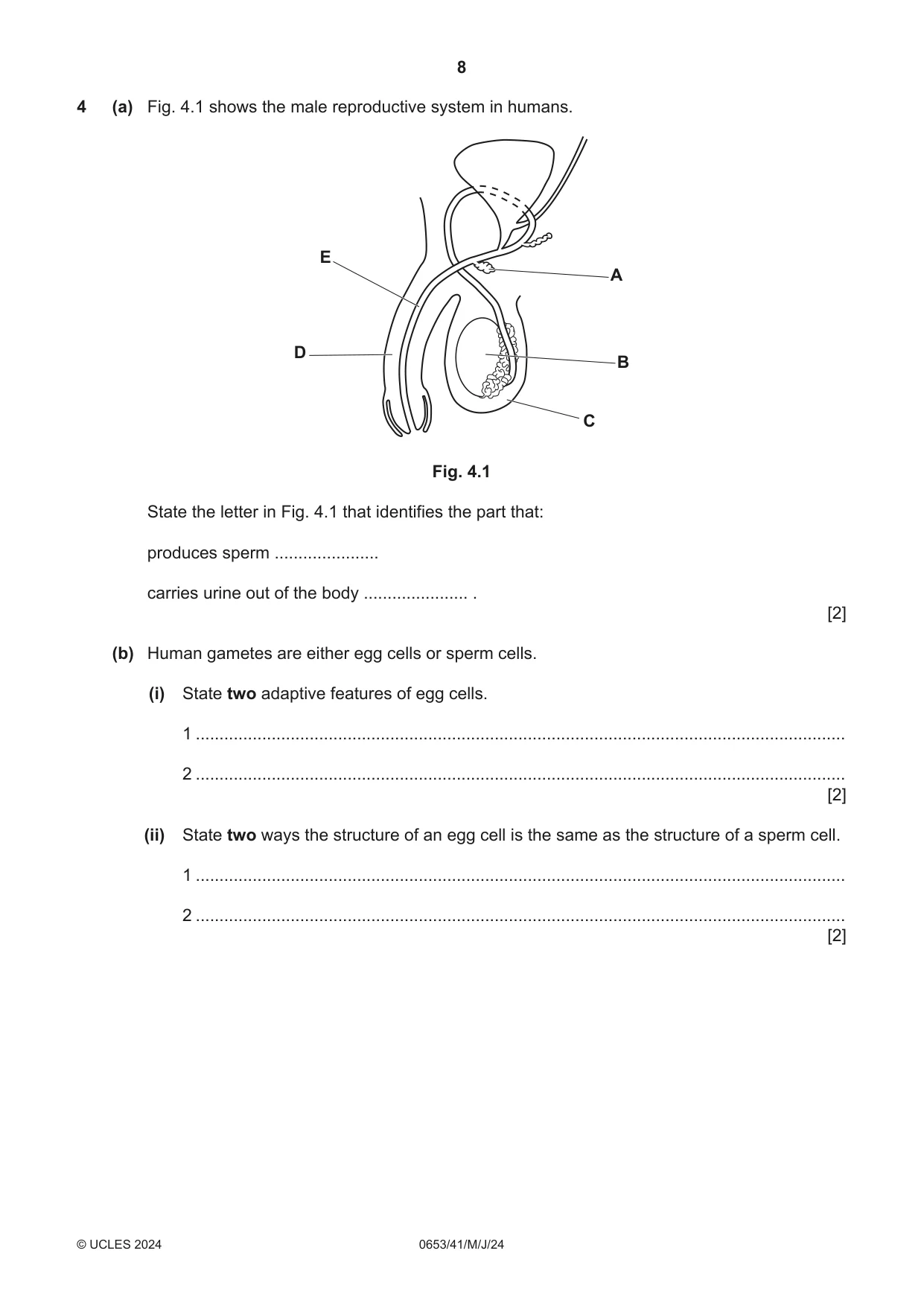
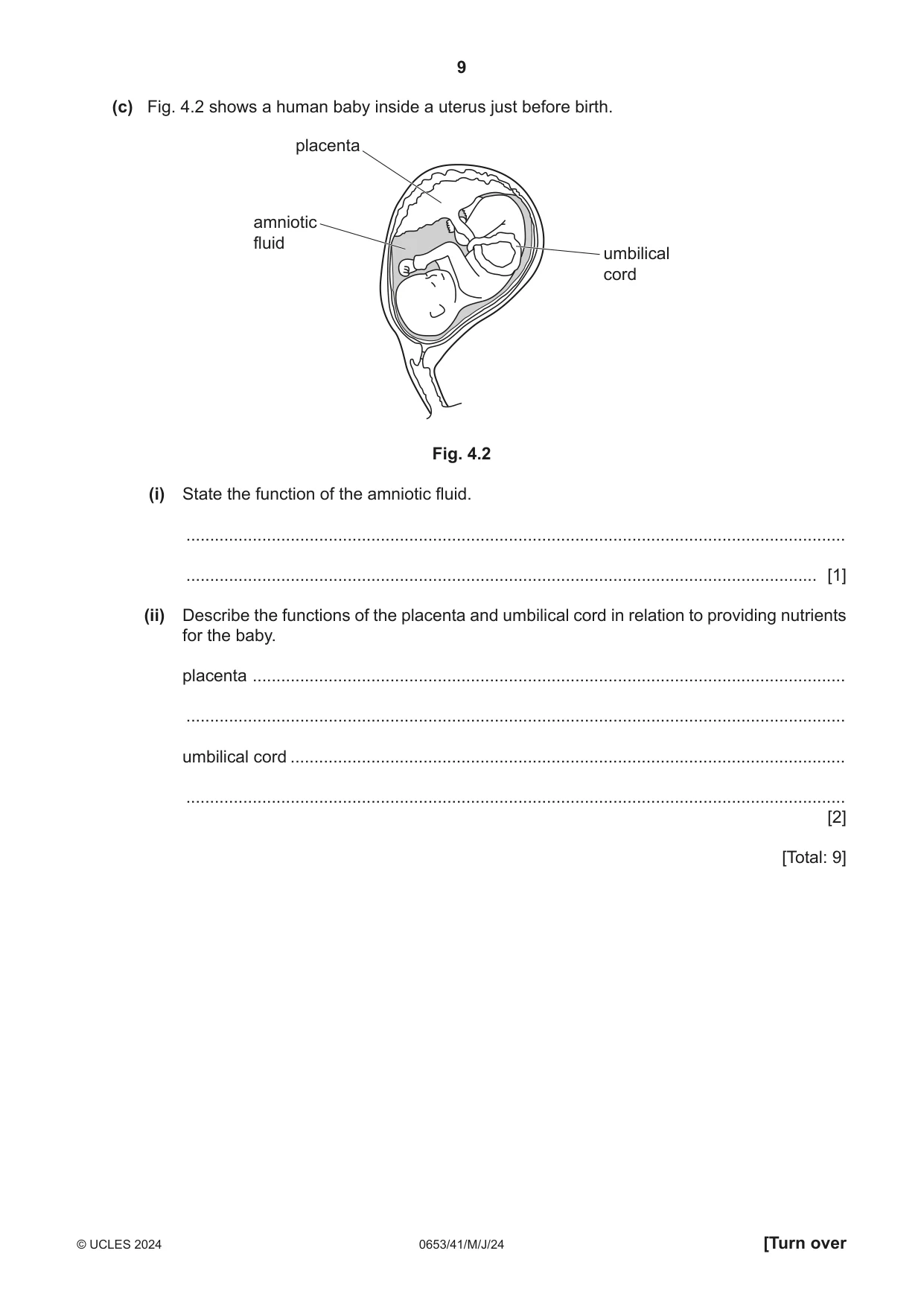
4 (a) Fig. 4.1 shows the male reproductive system in humans. E A D B C Fig. 4.1 State the letter in Fig. 4.1 that identifies the part that: produces sperm ...................... carries urine out of the body ...................... . [2] (b) Human gametes are either egg cells or sperm cells. (i) State two adaptive features of egg cells. 1 ......................................................................................................................................... 2 ......................................................................................................................................... [2] (ii) State two ways the structure of an egg cell is the same as the structure of a sperm cell. 1 ......................................................................................................................................... 2 ......................................................................................................................................... [2] (c) Fig. 4.2 shows a human baby inside a uterus just before birth. placenta amniotic fluid umbilical cord Fig. 4.2 (i) State the function of the amniotic fluid. ........................................................................................................................................... ..................................................................................................................................... [1] (ii) Describe the functions of the placenta and umbilical cord in relation to providing nutrients for the baby. placenta ............................................................................................................................. ........................................................................................................................................... umbilical cord ..................................................................................................................... ........................................................................................................................................... [2] [Total: 9]
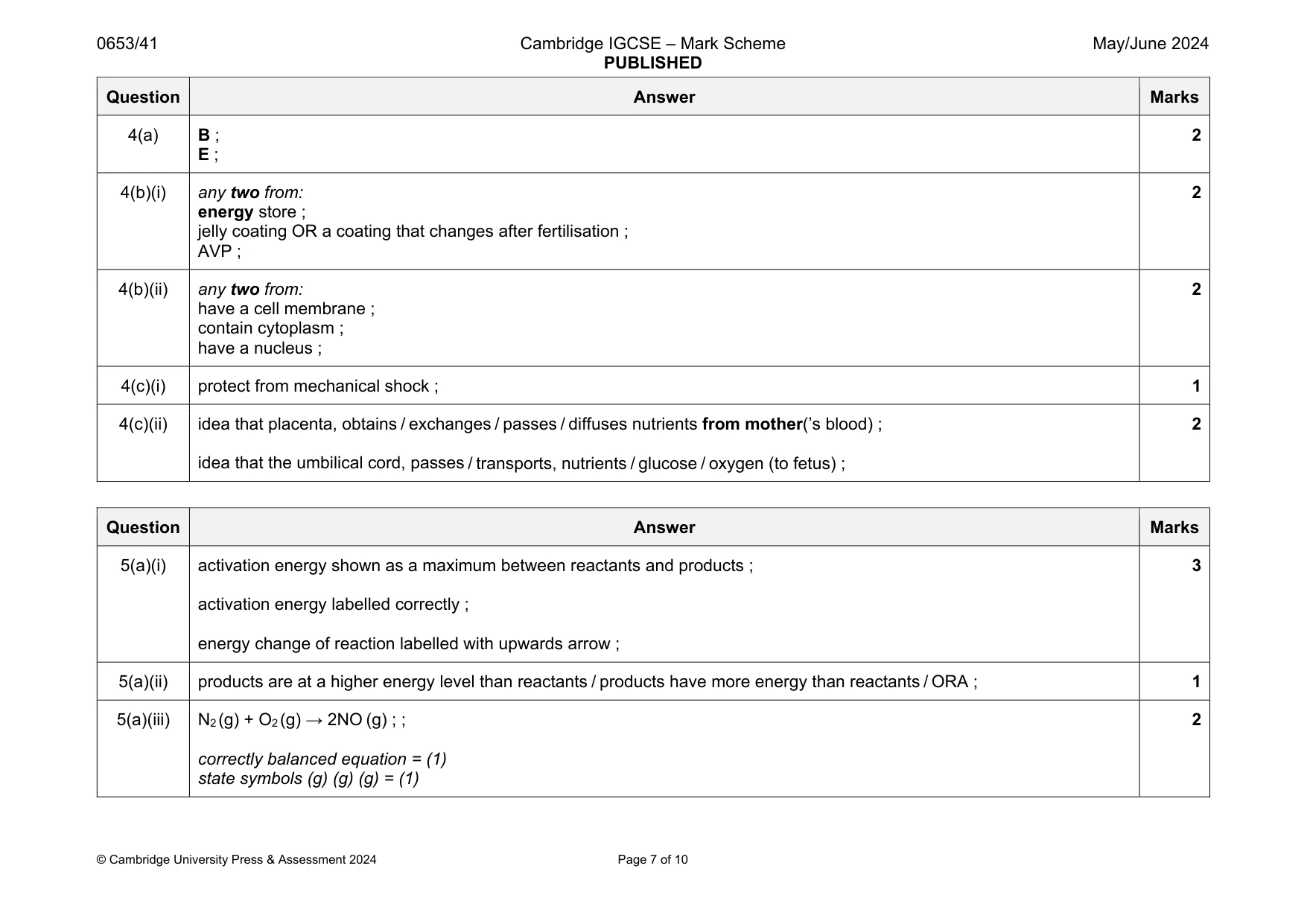
Mark scheme: 4(a) B ; E ; 2 4(b)(i) any two from: energy store ; jelly coating OR a coating that changes after fertilisation ; AVP ; 2 4(b)(ii) any two from: have a cell membrane ; contain cytoplasm ; have a nucleus ; 2 4(c)(i) protect from mechanical shock ; 1 4(c)(ii) idea that placenta, obtains / exchanges / passes / diffuses nutrients from mother(’s blood) ; idea that the umbilical cord, passes / transports, nutrients / glucose / oxygen (to fetus) ; 2
Q5 · Nitrogen and oxygen react together in a car engine to make nitrogen monoxide, NO
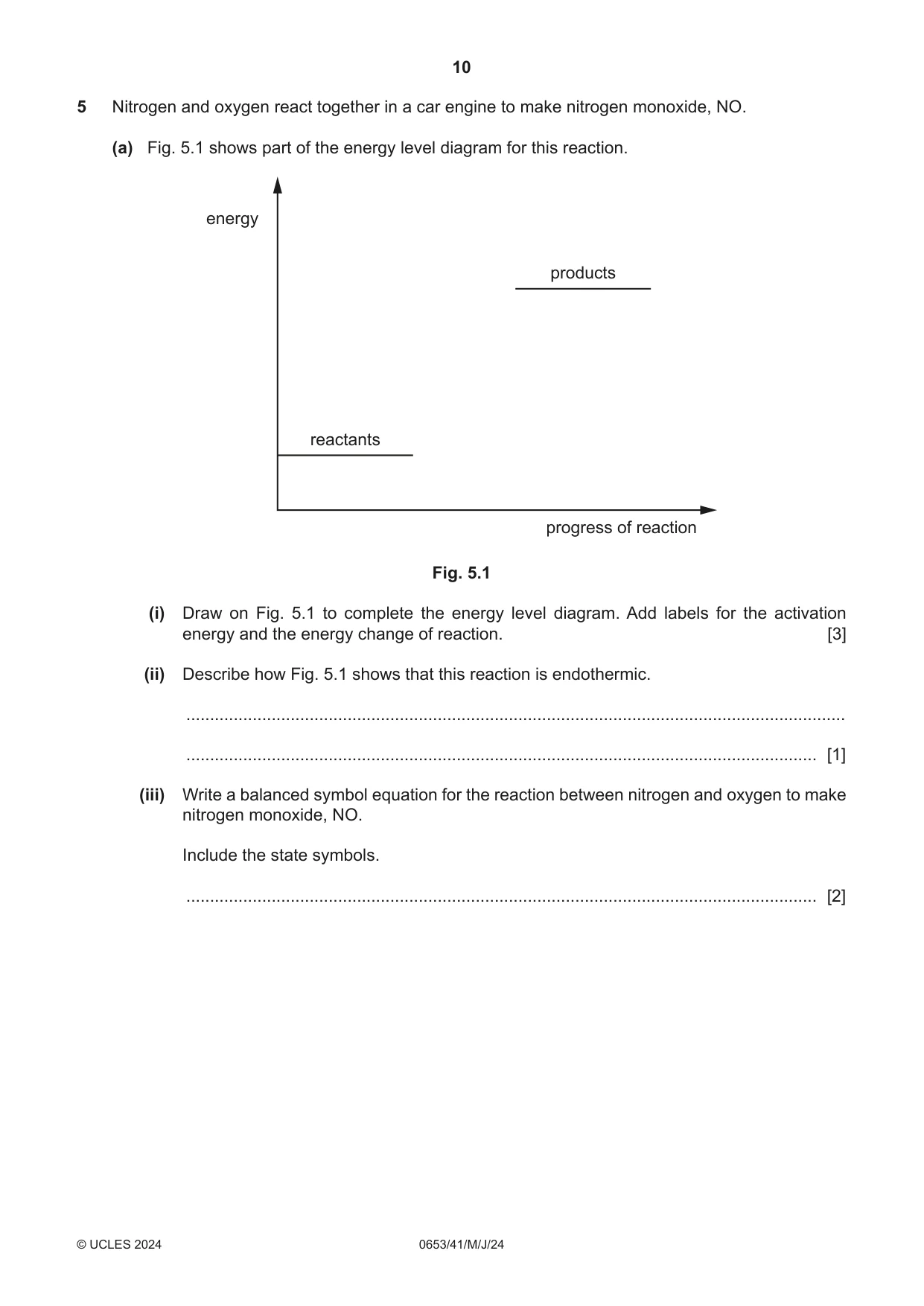
5 Nitrogen and oxygen react together in a car engine to make nitrogen monoxide, NO. (a) Fig. 5.1 shows part of the energy level diagram for this reaction. energy products reactants progress of reaction Fig. 5.1 (i) Draw on Fig. 5.1 to complete the energy level diagram. Add labels for the activation energy and the energy change of reaction. [3] (ii) Describe how Fig. 5.1 shows that this reaction is endothermic. ........................................................................................................................................... ..................................................................................................................................... [1] (iii) Write a balanced symbol equation for the reaction between nitrogen and oxygen to make nitrogen monoxide, NO. Include the state symbols. ..................................................................................................................................... [2] (b) Nitrogen monoxide produced in car engines is an oxide of nitrogen. Oxides of nitrogen are pollutants when released into the air. State the adverse effect of oxides of nitrogen on buildings and on human health. buildings .................................................................................................................................... ................................................................................................................................................... health ........................................................................................................................................ ................................................................................................................................................... [2] [Total: 8]
Mark scheme: 5(a)(i) activation energy shown as a maximum between reactants and products ; activation energy labelled correctly ; energy change of reaction labelled with upwards arrow ; 5(a)(ii) products are at a higher energy level than reactants / products have more energy than reactants / ORA ; 1 5(a)(iii) N2 (g) + O2 (g) → 2NO (g) ; ; correctly balanced equation = (1) state symbols (g) (g) (g) = (1) 2 Question Answer Marks 5(b) buildings: the idea of (chemical) reaction with, metal / building materials ; health: adverse effect on, heart / lungs / breathing ; 2
Q6 · A mechanical crane using force P to lift a box from the ground to the top of a building
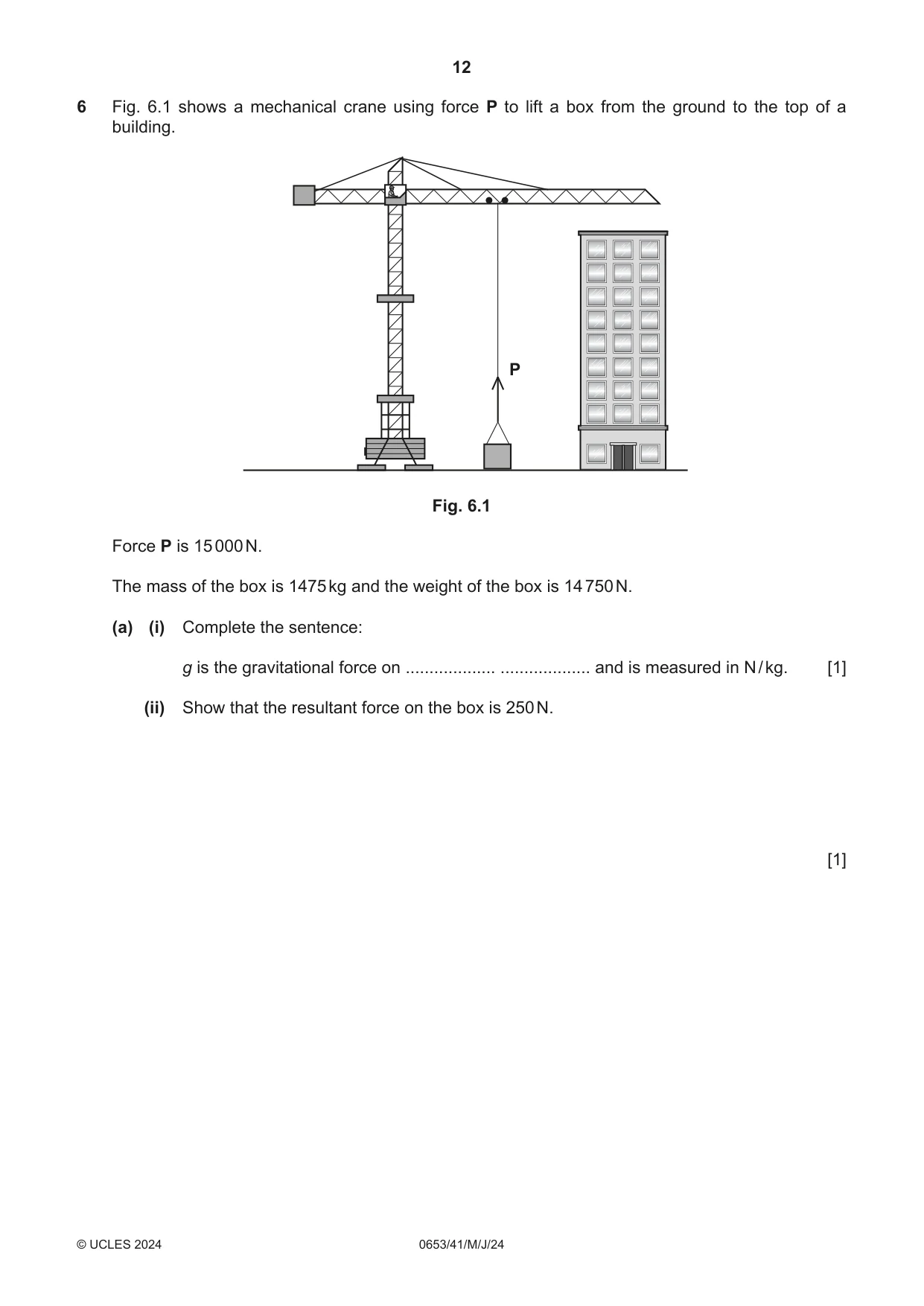
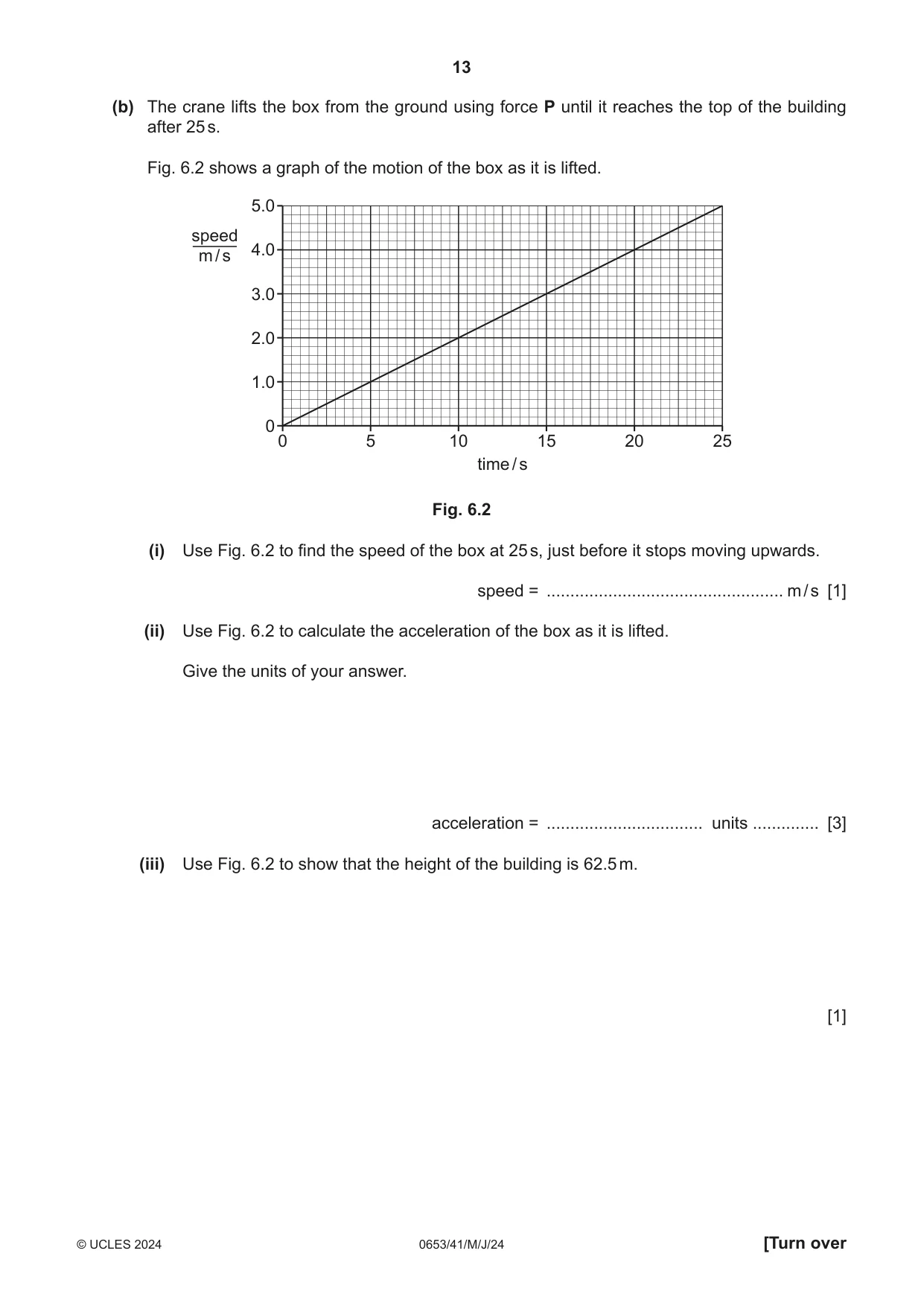
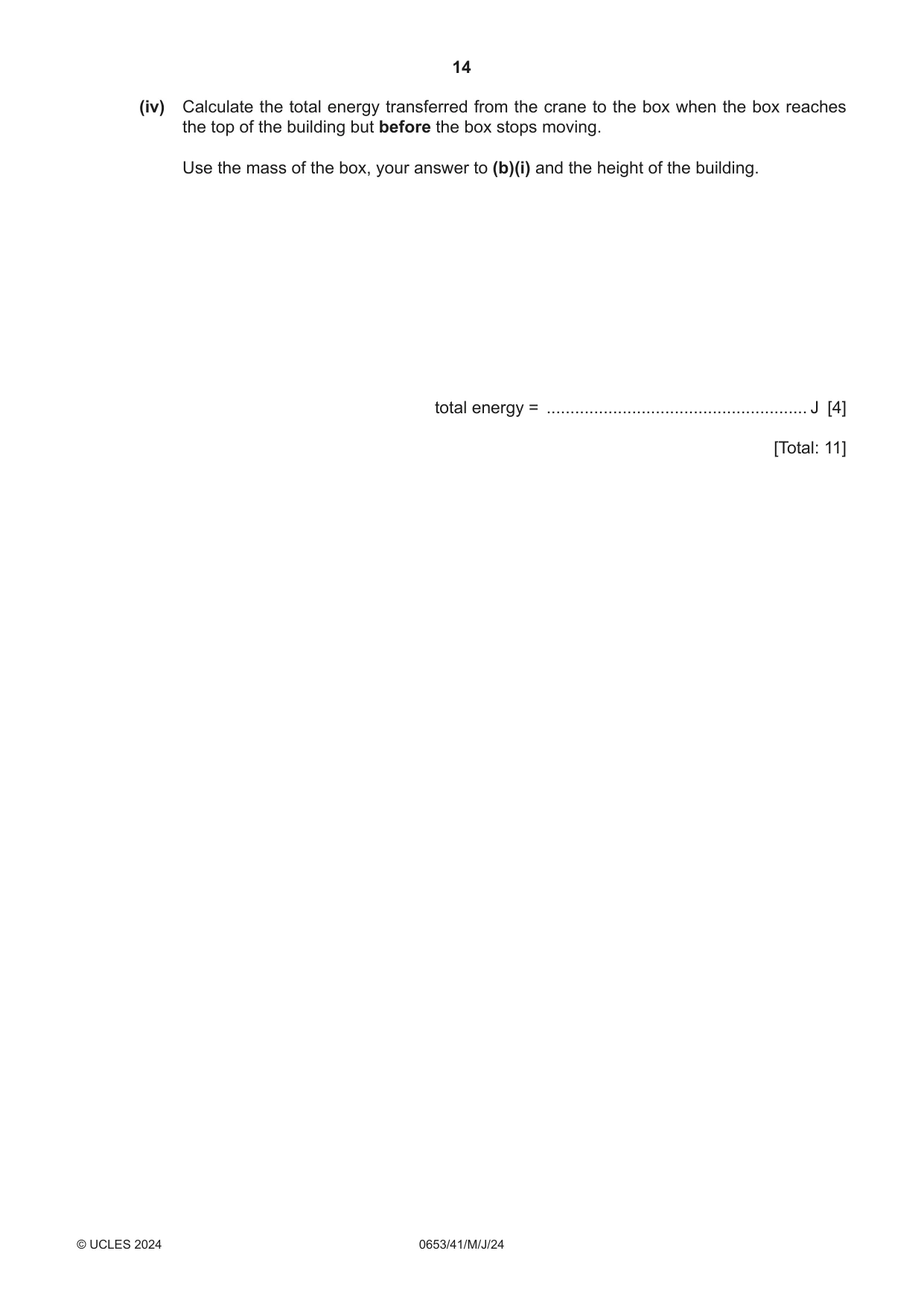
6 Fig. 6.1 shows a mechanical crane using force P to lift a box from the ground to the top of a building. P Fig. 6.1 Force P is 15 000 N. The mass of the box is 1475 kg and the weight of the box is 14 750 N. (a) (i) Complete the sentence: g is the gravitational force on ................... ................... and is measured in N / kg. [1] (ii) Show that the resultant force on the box is 250 N. [1] (b) The crane lifts the box from the ground using force P until it reaches the top of the building after 25 s. Fig. 6.2 shows a graph of the motion of the box as it is lifted. 5.0 speed 4.0 m / s 3.0 2.0 1.0 0 0 5 10 15 20 25 time / s Fig. 6.2 (i) Use Fig. 6.2 to find the speed of the box at 25 s, just before it stops moving upwards. speed = .................................................. m / s [1] (ii) Use Fig. 6.2 to calculate the acceleration of the box as it is lifted. Give the units of your answer. acceleration = ................................. units .............. [3] (iii) Use Fig. 6.2 to show that the height of the building is 62.5 m. [1] (iv) Calculate the total energy transferred from the crane to the box when the box reaches the top of the building but before the box stops moving. Use the mass of the box, your answer to (b)(i) and the height of the building. total energy = ....................................................... J [4] [Total: 11]
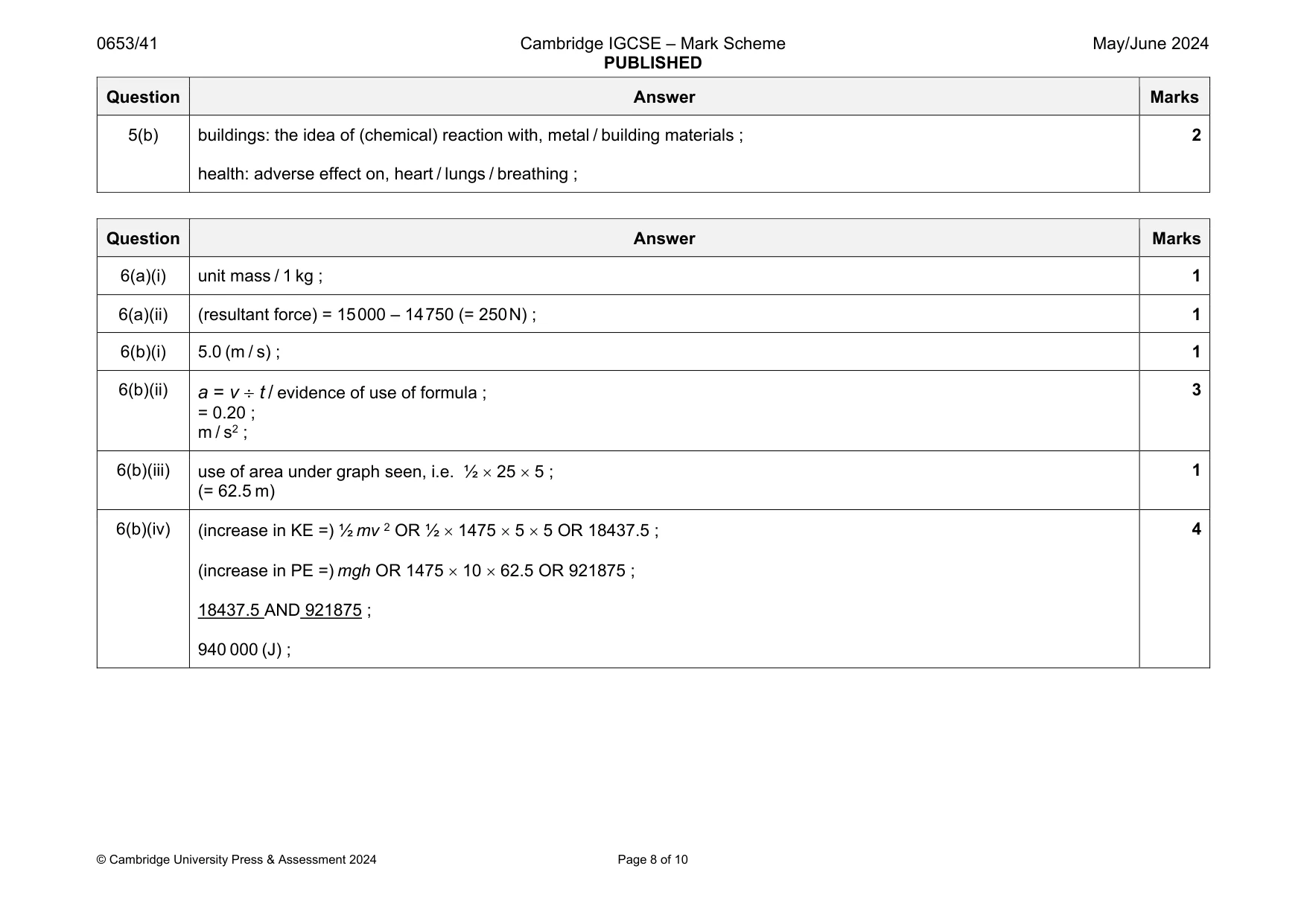
Mark scheme: 6(a)(i) unit mass / 1 kg ; 1 6(a)(ii) (resultant force) = 15 000 – 14 750 (= 250 N) ; 1 6(b)(i) 5.0 (m / s) ; 1 6(b)(ii) a = v t / evidence of use of formula ; = 0.20 ; m / s2 ; 3 6(b)(iii) use of area under graph seen, i.e. ½ 25 5 ; (= 62.5 m) 1 6(b)(iv) (increase in KE =) ½ mv 2 OR ½ 1475 5 5 OR 18437.5 ; (increase in PE =) mgh OR 1475 10 62.5 OR 921875 ; 18437.5 AND 921875 ; 940 000 (J) ; 4
Q7 · The pathway taken by water through a plant
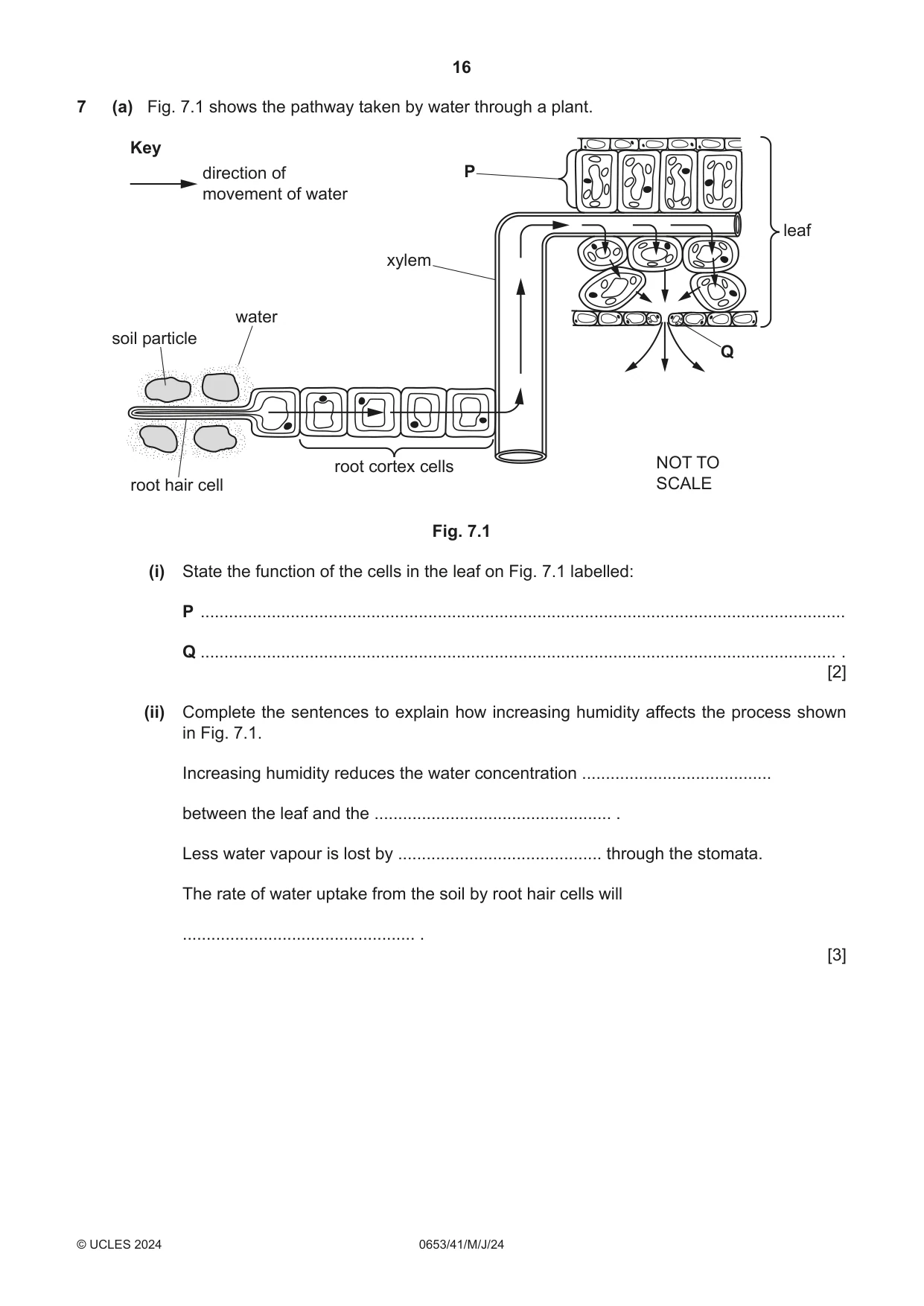
7 (a) Fig. 7.1 shows the pathway taken by water through a plant. Key direction of P movement of water leaf xylem water soil particle Q root cortex cells NOT TO root hair cell SCALE Fig. 7.1 (i) State the function of the cells in the leaf on Fig. 7.1 labelled: P ........................................................................................................................................ Q ...................................................................................................................................... . [2] (ii) Complete the sentences to explain how increasing humidity affects the process shown in Fig. 7.1. Increasing humidity reduces the water concentration ........................................ between the leaf and the .................................................. . Less water vapour is lost by ........................................... through the stomata. The rate of water uptake from the soil by root hair cells will ................................................. . [3] (b) Plants are the producers in a food chain. (i) State the trophic level that plants occupy in a food chain. ..................................................................................................................................... [1] (ii) Vultures are birds that are quaternary consumers in some food chains. Explain why it is not usual to have a quaternary consumer in a food chain. ........................................................................................................................................... ........................................................................................................................................... ........................................................................................................................................... ..................................................................................................................................... [3] [Total: 9]
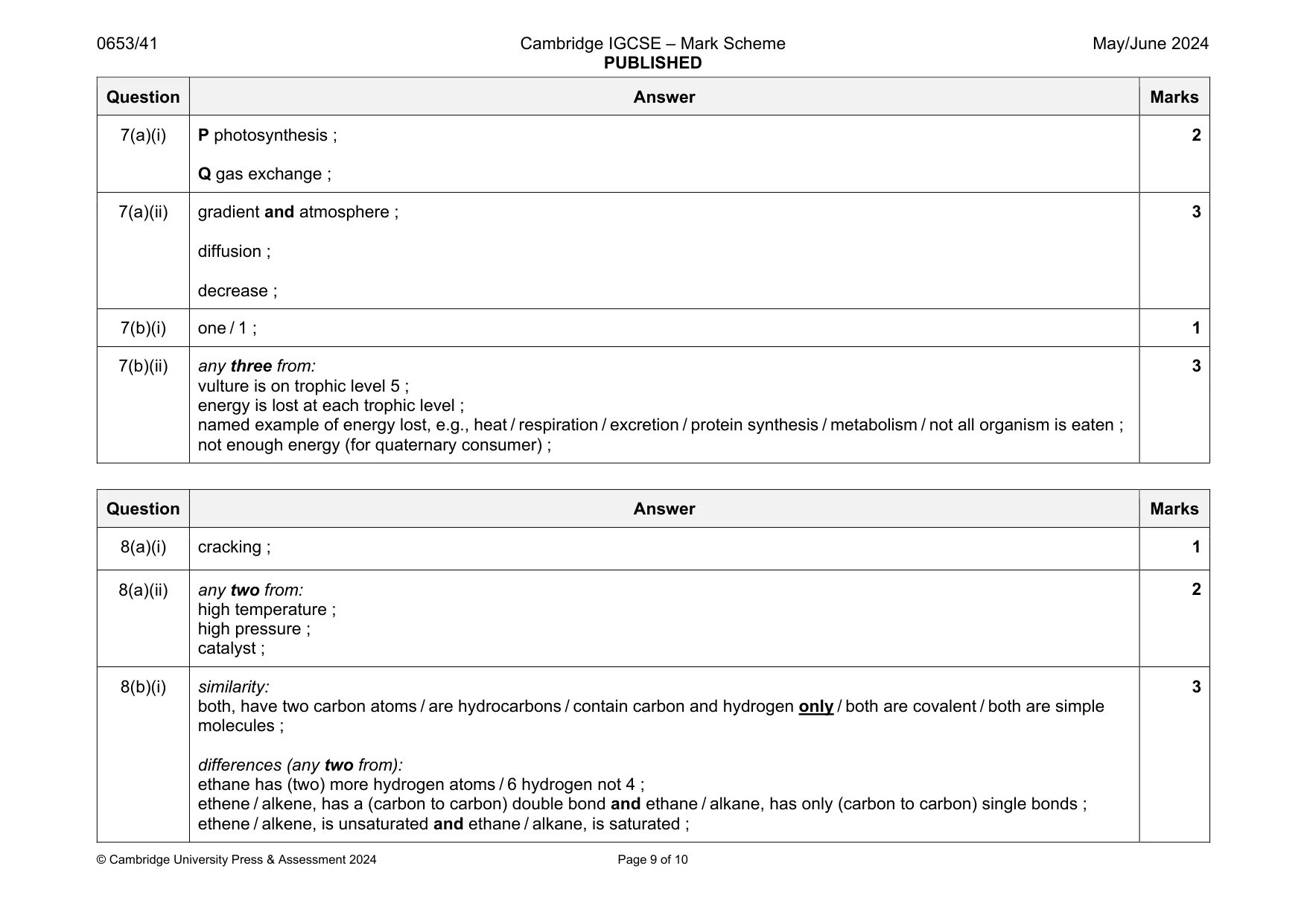
Mark scheme: 7(a)(i) P photosynthesis ; Q gas exchange ; 2 7(a)(ii) gradient and atmosphere ; diffusion ; decrease ; 3 7(b)(i) one / 1 ; 1 7(b)(ii) any three from: vulture is on trophic level 5 ; energy is lost at each trophic level ; named example of energy lost, e.g., heat / respiration / excretion / protein synthesis / metabolism / not all organism is eaten ; not enough energy (for quaternary consumer) ; 3
Q8 · Ethene, C2H4, is an alkene
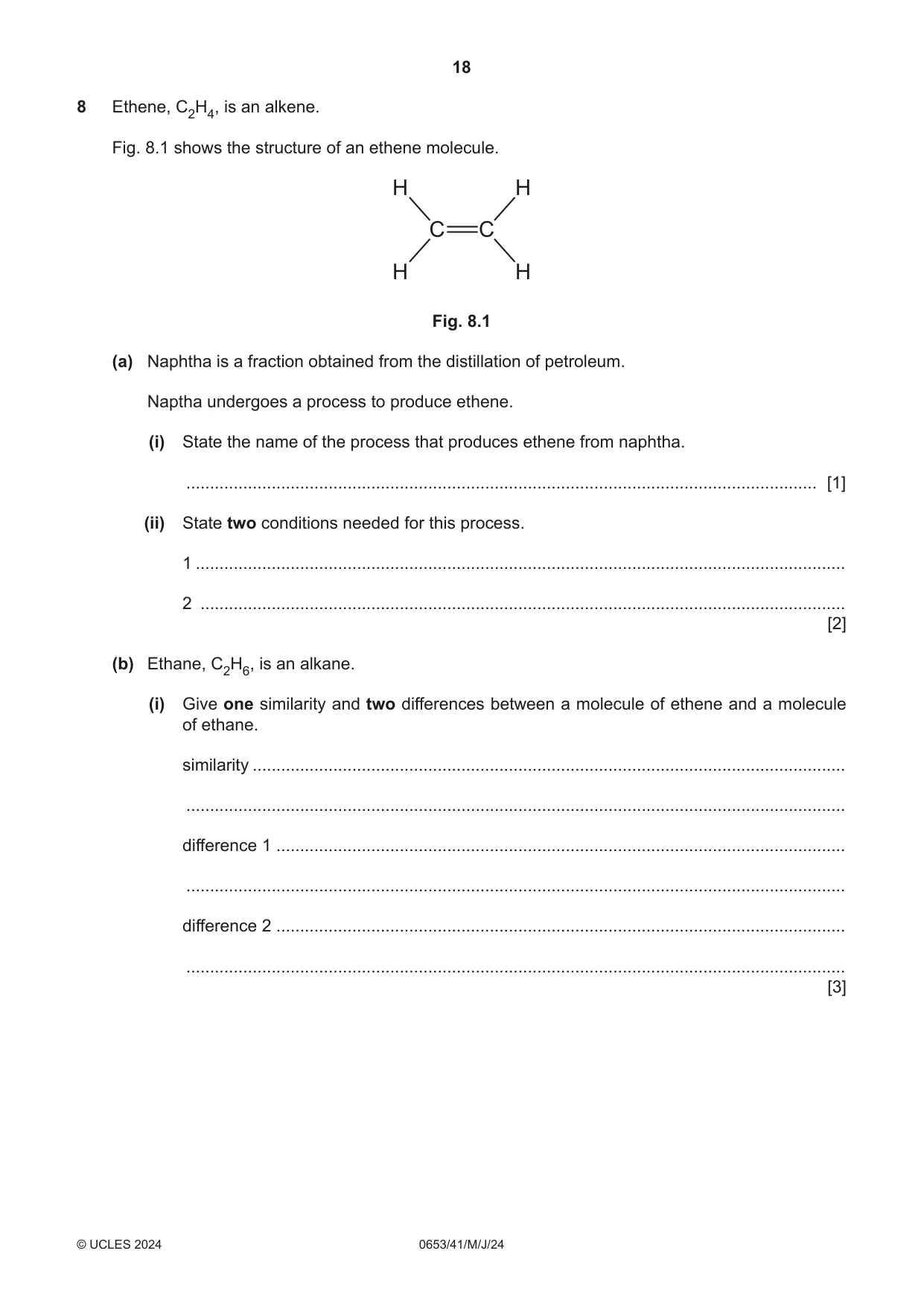
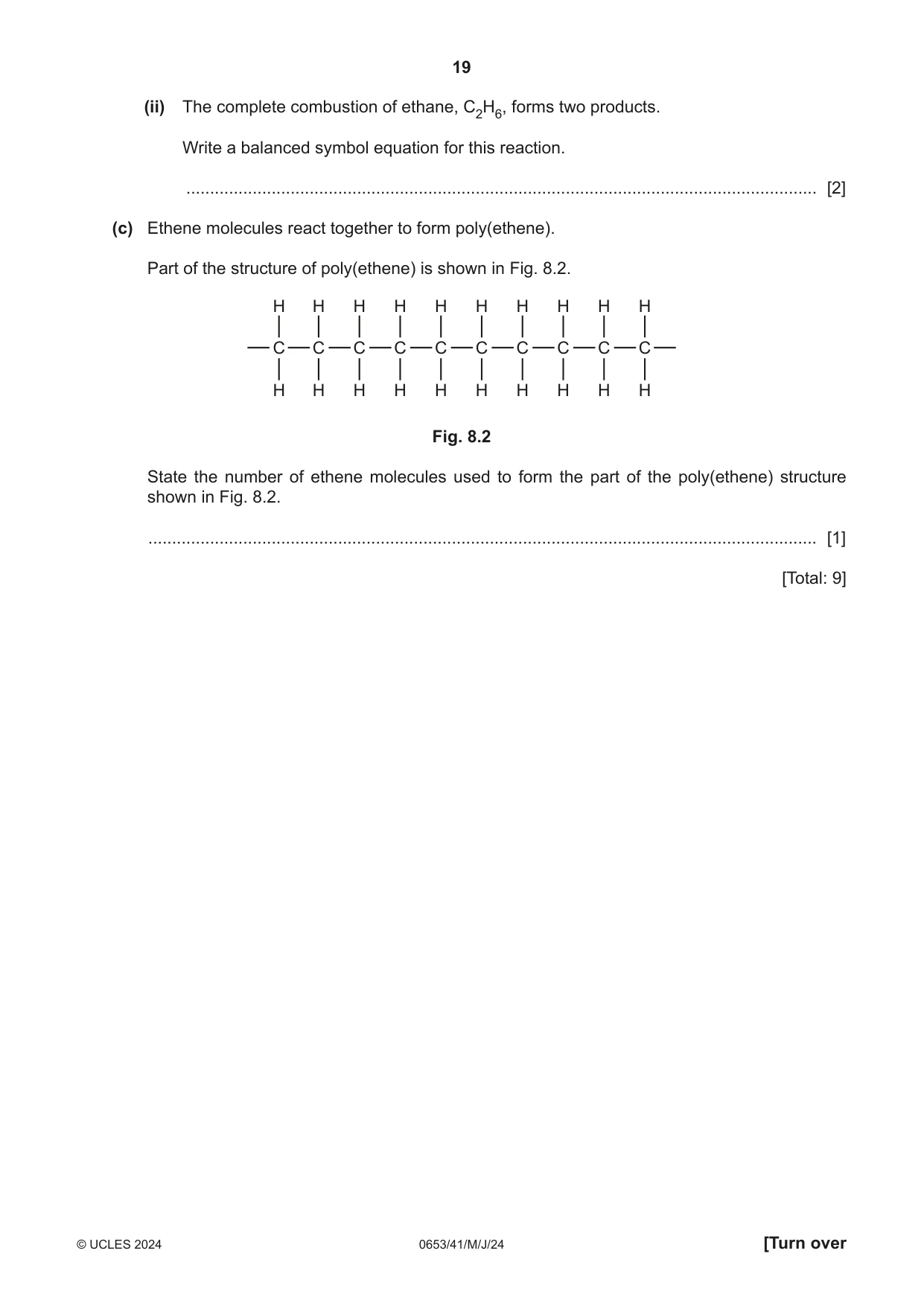
8 Ethene, C2H4, is an alkene. Fig. 8.1 shows the structure of an ethene molecule. H H C C H H Fig. 8.1 (a) Naphtha is a fraction obtained from the distillation of petroleum. Naptha undergoes a process to produce ethene. (i) State the name of the process that produces ethene from naphtha. ..................................................................................................................................... [1] (ii) State two conditions needed for this process. 1 ......................................................................................................................................... 2 ........................................................................................................................................ [2] (b) Ethane, C2H6, is an alkane. (i) Give one similarity and two differences between a molecule of ethene and a molecule of ethane. similarity ............................................................................................................................. ........................................................................................................................................... difference 1 ........................................................................................................................ ........................................................................................................................................... difference 2 ........................................................................................................................ ........................................................................................................................................... [3] (ii) The complete combustion of ethane, C2H6, forms two products. Write a balanced symbol equation for this reaction. ..................................................................................................................................... [2] (c) Ethene molecules react together to form poly(ethene). Part of the structure of poly(ethene) is shown in Fig. 8.2. H H H H H H H H H H C C C C C C C C C C H H H H H H H H H H Fig. 8.2 State the number of ethene molecules used to form the part of the poly(ethene) structure shown in Fig. 8.2. ............................................................................................................................................. [1] [Total: 9]
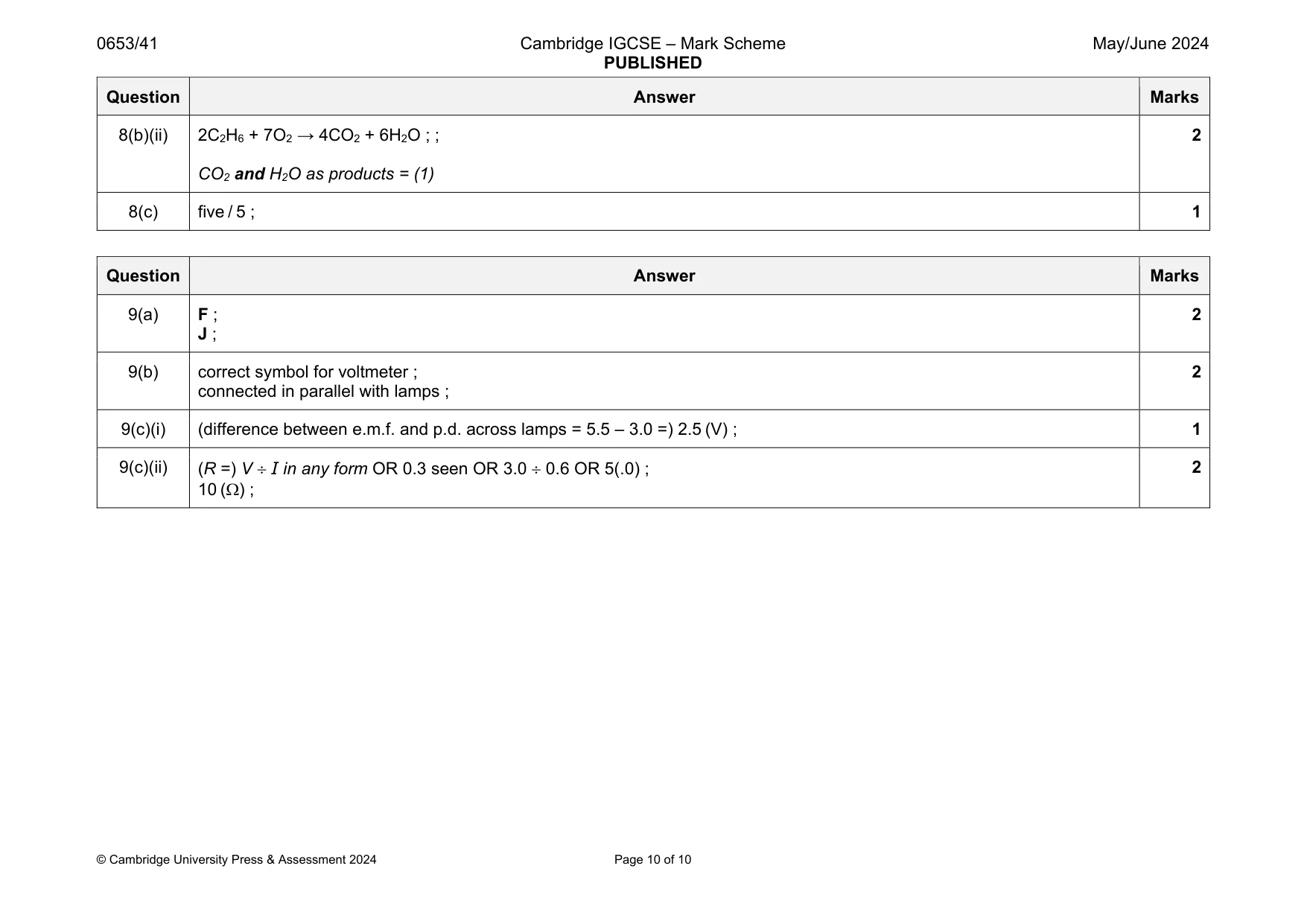
Mark scheme: 8(a)(i) cracking ; 1 8(a)(ii) any two from: high temperature ; high pressure ; catalyst ; 2 8(b)(i) similarity: both, have two carbon atoms / are hydrocarbons / contain carbon and hydrogen only / both are covalent / both are simple molecules ; differences (any two from): ethane has (two) more hydrogen atoms / 6 hydrogen not 4 ; ethene / alkene, has a (carbon to carbon) double bond and ethane / alkane, has only (carbon to carbon) single bonds ; ethene / alkene, is unsaturated and ethane / alkane, is saturated ; 3 Question Answer Marks 8(b)(ii) 2C2H6 + 7O2 → 4CO2 + 6H2O ; ; CO2 and H2O as products = (1) 2 8(c) five / 5 ; 1
Q9 · An electrical circuit with components labelled E, F, G, H and J
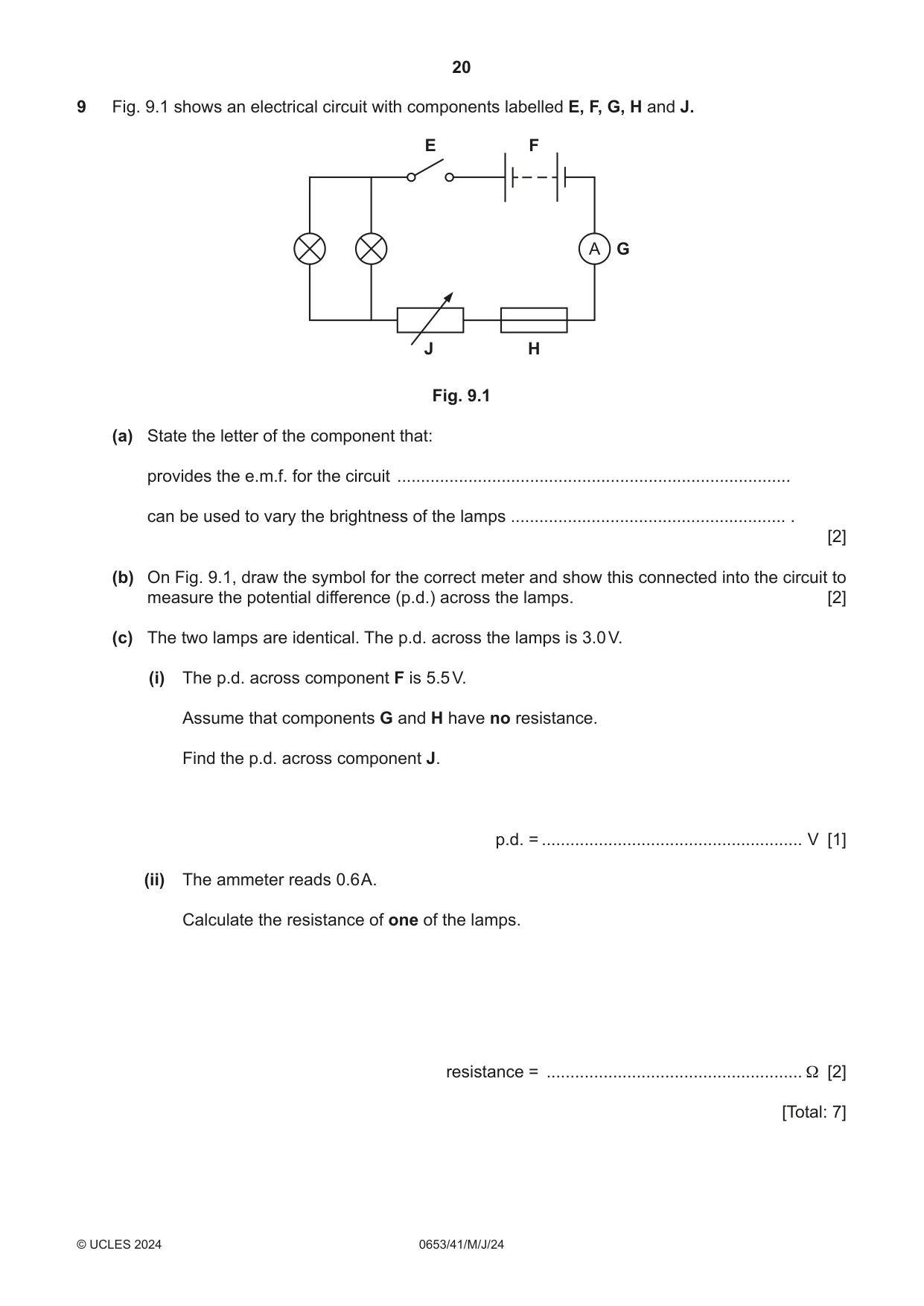
9 Fig. 9.1 shows an electrical circuit with components labelled E, F, G, H and J. E F A G J H Fig. 9.1 (a) State the letter of the component that: provides the e.m.f. for the circuit ................................................................................... can be used to vary the brightness of the lamps .......................................................... . [2] (b) On Fig. 9.1, draw the symbol for the correct meter and show this connected into the circuit to measure the potential difference (p.d.) across the lamps. [2] (c) The two lamps are identical. The p.d. across the lamps is 3.0 V. (i) The p.d. across component F is 5.5 V. Assume that components G and H have no resistance. Find the p.d. across component J. p.d. = ....................................................... V [1] (ii) The ammeter reads 0.6 A. Calculate the resistance of one of the lamps. resistance = ...................................................... Ω [2] [Total: 7]
Mark scheme: 9(a) F ; J ; 2 9(b) correct symbol for voltmeter ; connected in parallel with lamps ; 2 9(c)(i) (difference between e.m.f. and p.d. across lamps = 5.5 – 3.0 =) 2.5 (V) ; 1 9(c)(ii) (R =) V I in any form OR 0.3 seen OR 3.0 0.6 OR 5(.0) ; 10 () ; 2
What was in this paper
The subtopics covered by these 9 questions, and how many questions each got. Open one in a new tab to see every Cambridge question on it.
What you needed in this session
Cambridge’s own grade thresholds for 2024 May/June, Paper 4 · Variant 1. A higher threshold means an easier paper — the bar moves with how the cohort did.