Cambridge IGCSE Science - Combined 0653 — 2021 May/June Paper 4 · Variant 3
0653/43/M/J/21 · 9 questions · 80 marks · ≈90 min
The question paper and its mark scheme, free to read here and free to download. This is Cambridge’s own paper, exactly as it was sat.
Question paper20 pages
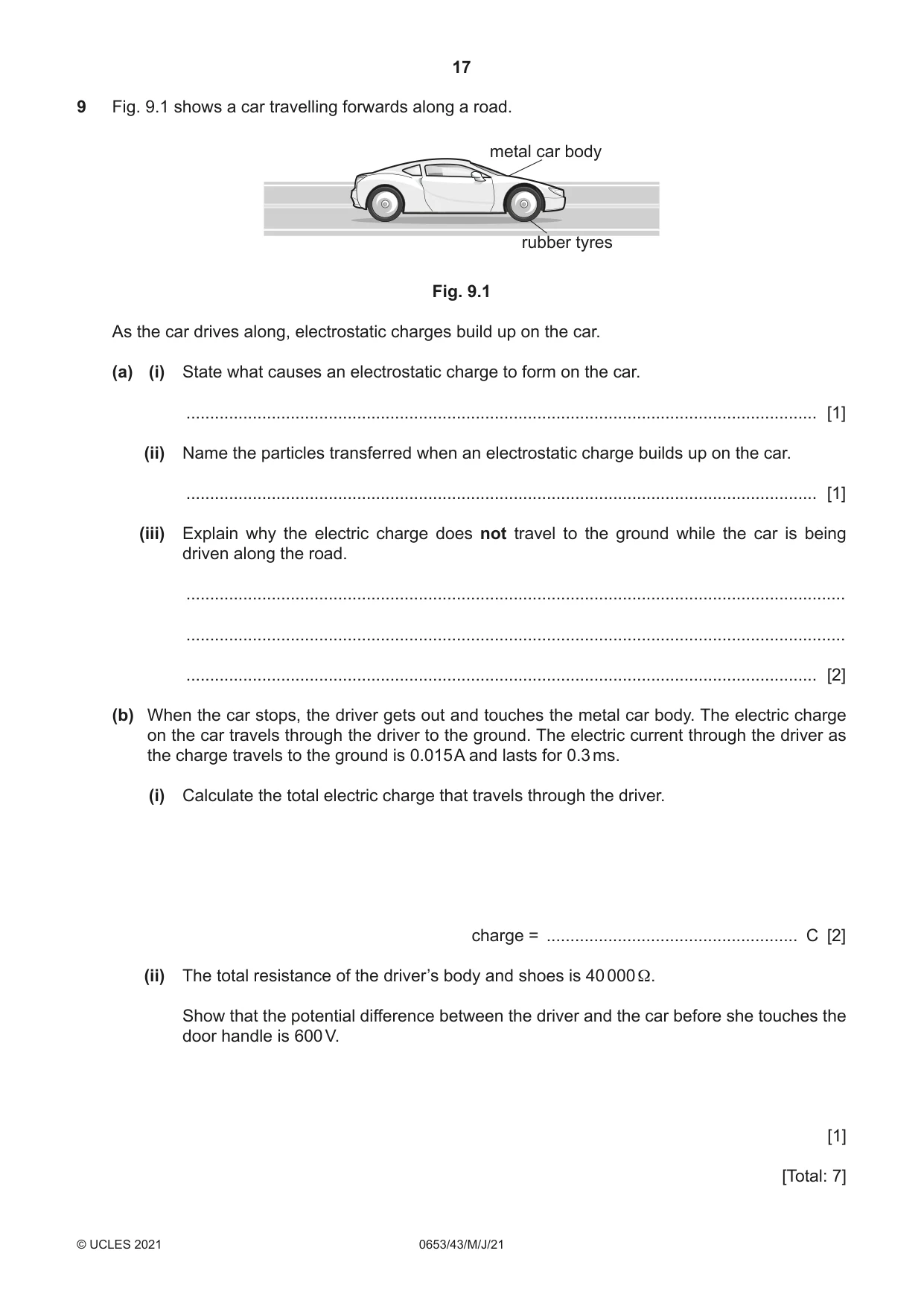


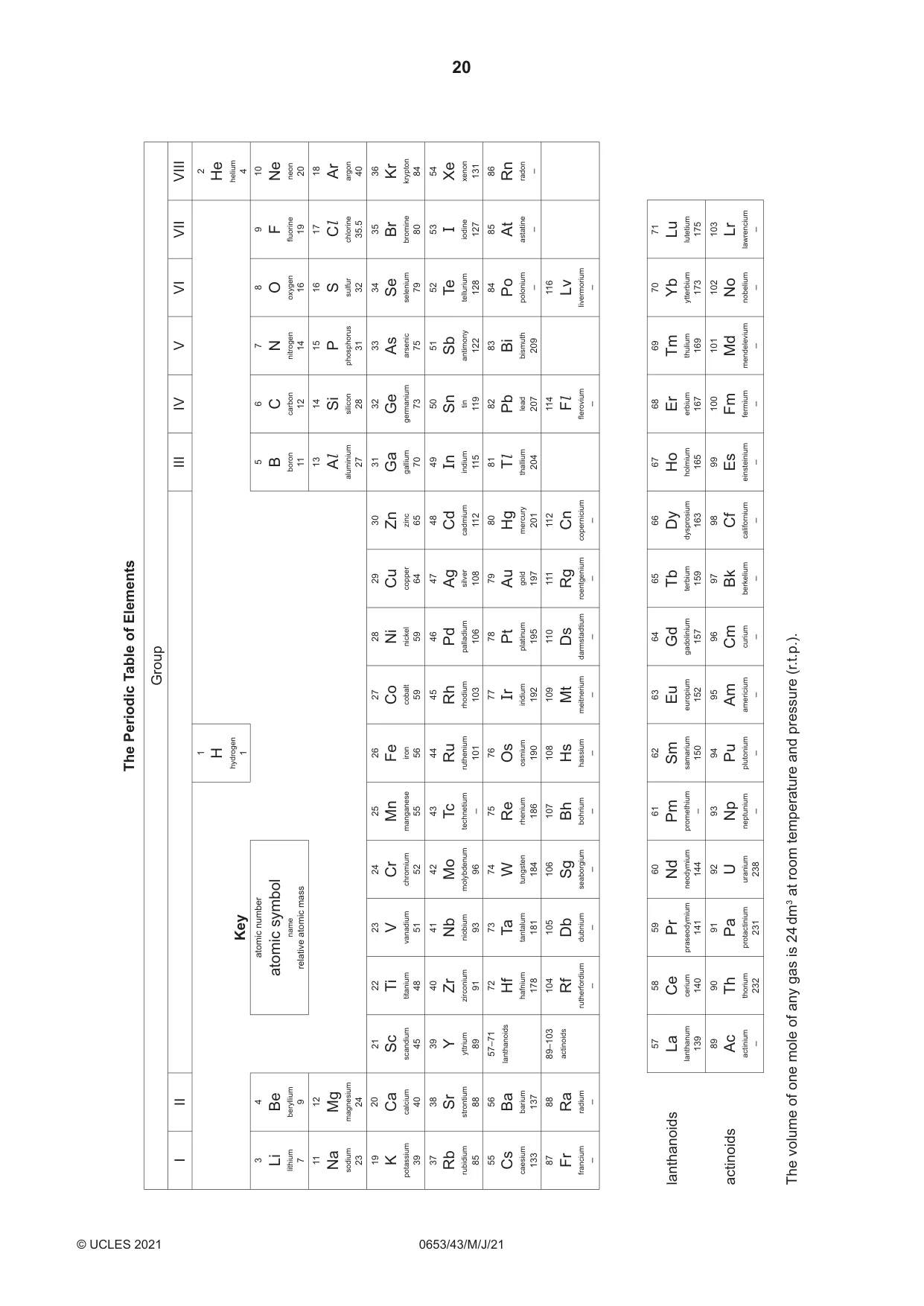
Mark scheme9 pages
Answers below. Sit the paper first if you are practising.
Questions as text
Q1 · The flowers of a wind-pollinated plant
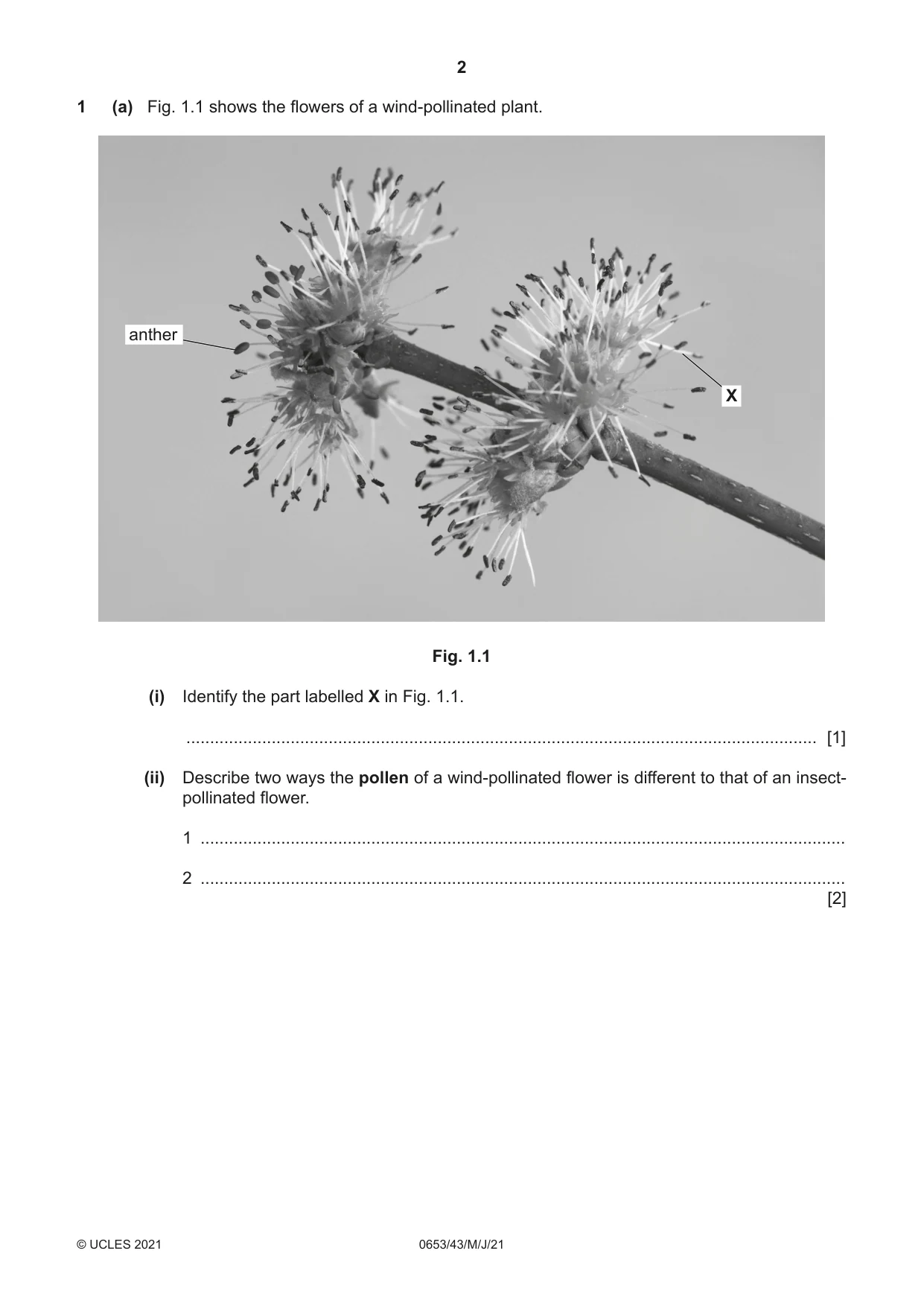
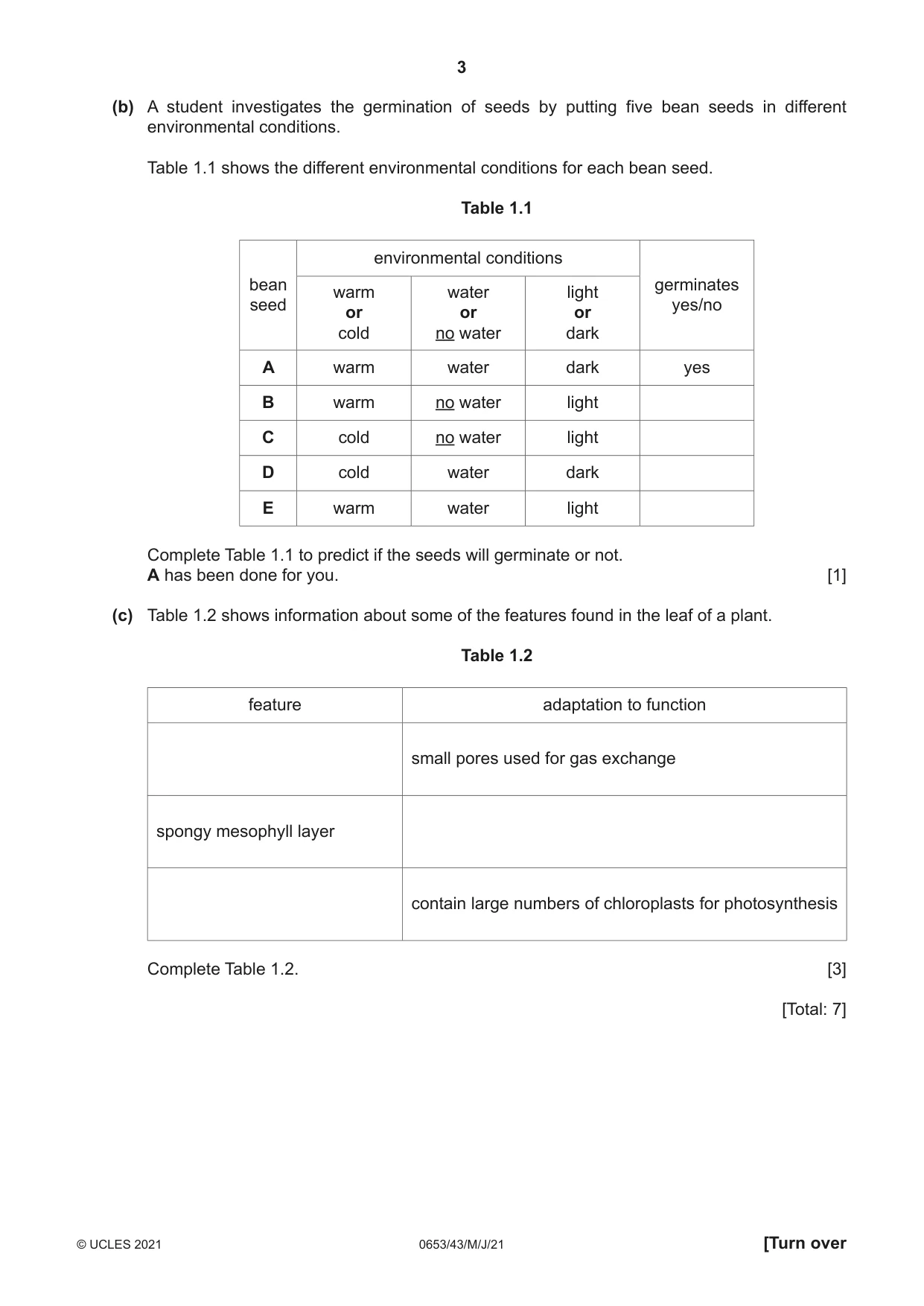
1 (a) Fig. 1.1 shows the flowers of a wind-pollinated plant. antheranther X Fig. 1.1 (i) Identify the part labelled X in Fig. 1.1. ..................................................................................................................................... [1] (ii) Describe two ways the pollen of a wind-pollinated flower is different to that of an insect- pollinated flower. 1 ........................................................................................................................................ 2 ........................................................................................................................................ [2] (b) A student investigates the germination of seeds by putting five bean seeds in different environmental conditions. Table 1.1 shows the different environmental conditions for each bean seed. Table 1.1 environmental conditions bean germinates warm water light seed yes/no or or or cold no water dark A warm water dark yes B warm no water light C cold no water light D cold water dark E warm water light Complete Table 1.1 to predict if the seeds will germinate or not. A has been done for you. [1] (c) Table 1.2 shows information about some of the features found in the leaf of a plant. Table 1.2 feature adaptation to function small pores used for gas exchange spongy mesophyll layer contain large numbers of chloroplasts for photosynthesis Complete Table 1.2. [3] [Total: 7]
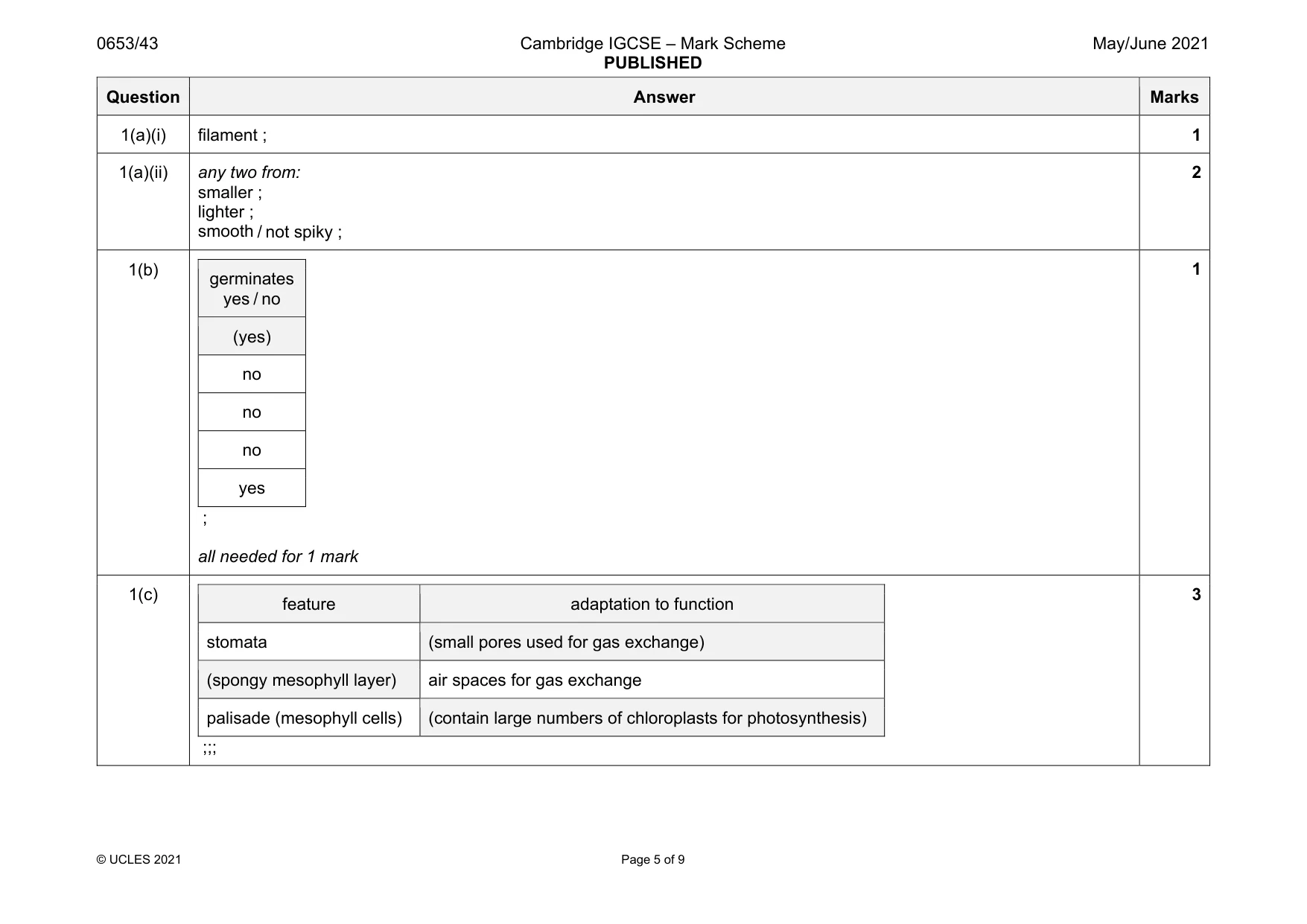
Mark scheme: 1(a)(i) filament ; 1 1(a)(ii) any two from: smaller ; lighter ; smooth / not spiky ; 2 1(b) germinates yes / no (yes) no no no yes ; all needed for 1 mark 1 1(c) feature adaptation to function stomata (small pores used for gas exchange) (spongy mesophyll layer) air spaces for gas exchange palisade (mesophyll cells) (contain large numbers of chloroplasts for photosynthesis) ;;; 3
Q2 · Apparatus used for the electrolysis of molten lead(II) bromide is shown in Fig
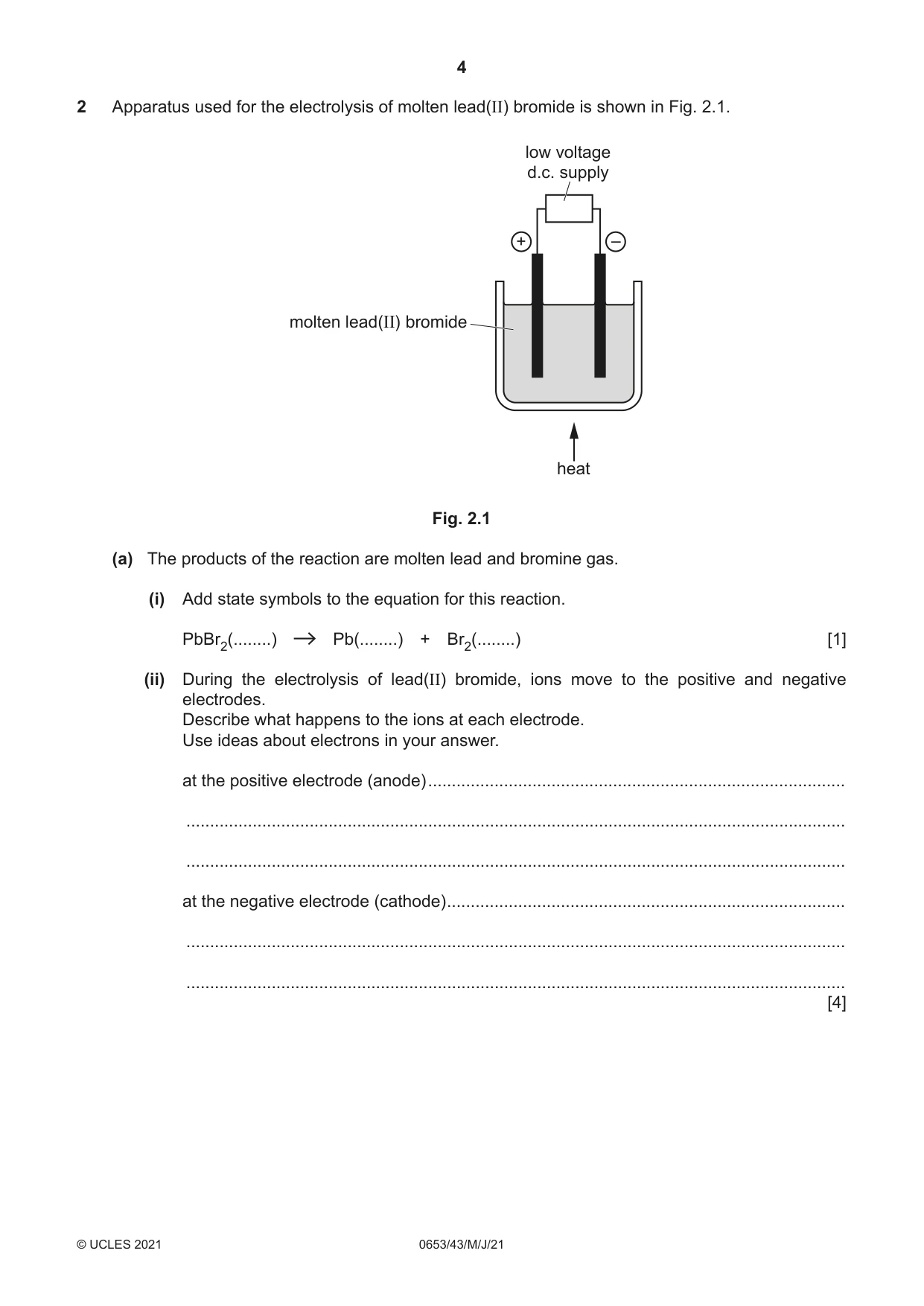
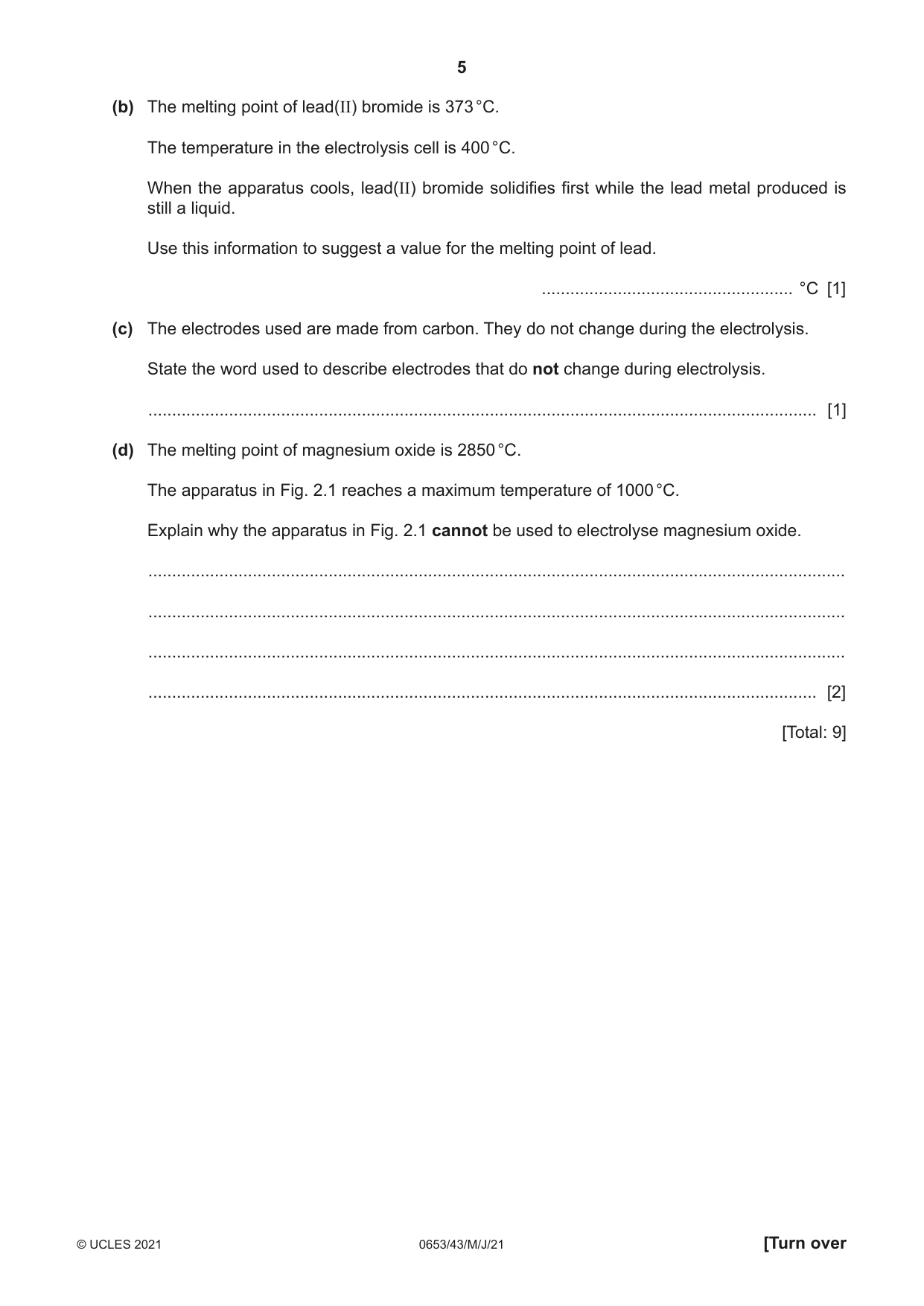
2 Apparatus used for the electrolysis of molten lead(II) bromide is shown in Fig. 2.1. low voltage d.c. supply + – molten lead(II) bromide heat Fig. 2.1 (a) The products of the reaction are molten lead and bromine gas. (i) Add state symbols to the equation for this reaction. PbBr2(........) Pb(........) + Br2(........) [1] (ii) During the electrolysis of lead(II) bromide, ions move to the positive and negative electrodes. Describe what happens to the ions at each electrode. Use ideas about electrons in your answer. at the positive electrode (anode) ........................................................................................ ........................................................................................................................................... ........................................................................................................................................... at the negative electrode (cathode) .................................................................................... ........................................................................................................................................... ........................................................................................................................................... [4] (b) The melting point of lead(II) bromide is 373 °C. The temperature in the electrolysis cell is 400 °C. When the apparatus cools, lead(II) bromide solidifies first while the lead metal produced is still a liquid. Use this information to suggest a value for the melting point of lead. ..................................................... °C [1] (c) The electrodes used are made from carbon. They do not change during the electrolysis. State the word used to describe electrodes that do not change during electrolysis. ............................................................................................................................................. [1] (d) The melting point of magnesium oxide is 2850 °C. The apparatus in Fig. 2.1 reaches a maximum temperature of 1000 °C. Explain why the apparatus in Fig. 2.1 cannot be used to electrolyse magnesium oxide. ................................................................................................................................................... ................................................................................................................................................... ................................................................................................................................................... ............................................................................................................................................. [2] [Total: 9]
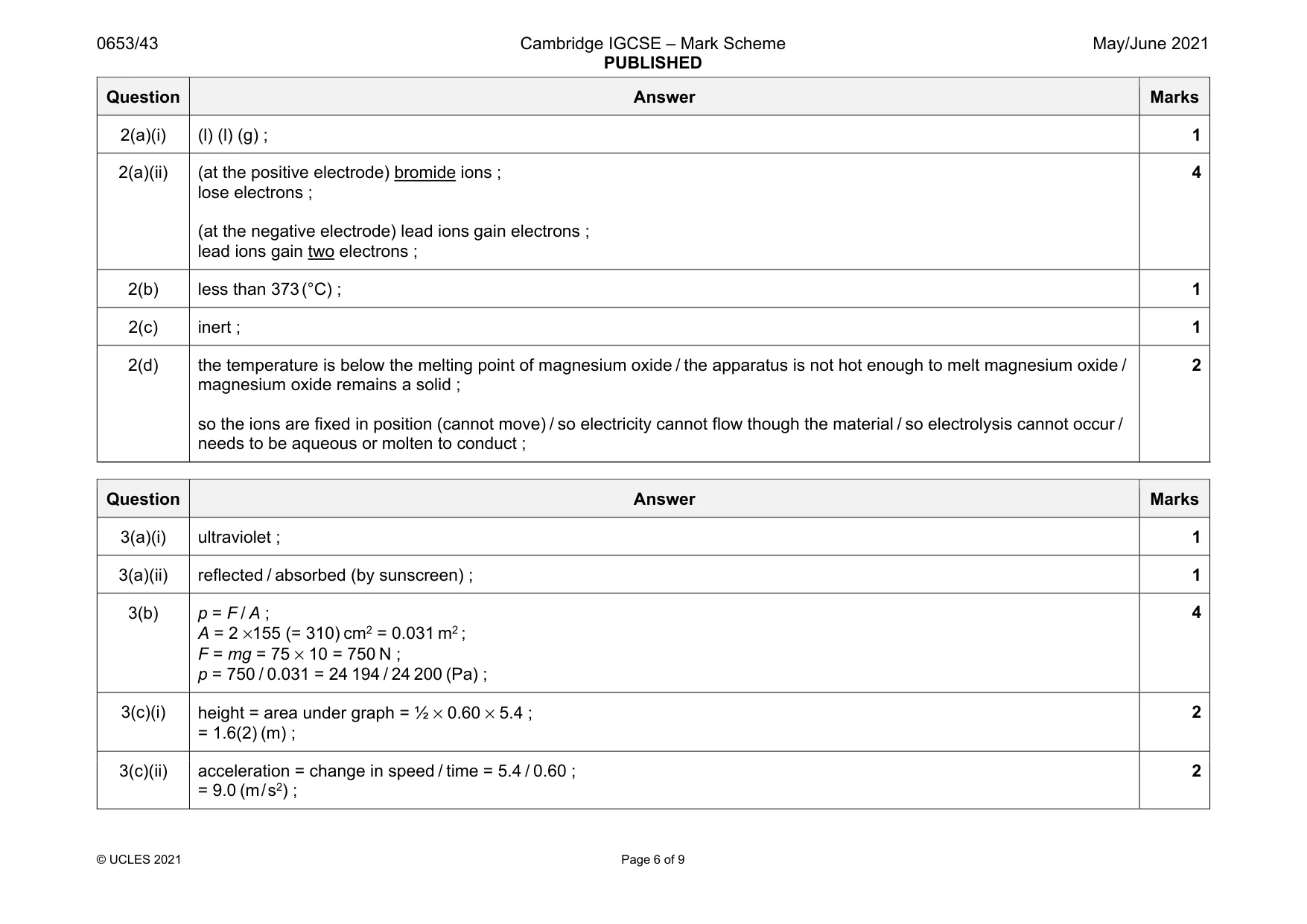
Mark scheme: 2(a)(i) (l) (l) (g) ; 1 2(a)(ii) (at the positive electrode) bromide ions ; lose electrons ; (at the negative electrode) lead ions gain electrons ; lead ions gain two electrons ; 4 2(b) less than 373 (°C) ; 1 2(c) inert ; 1 2(d) the temperature is below the melting point of magnesium oxide / the apparatus is not hot enough to melt magnesium oxide / magnesium oxide remains a solid ; so the ions are fixed in position (cannot move) / so electricity cannot flow though the material / so electrolysis cannot occur / needs to be aqueous or molten to conduct ; 2
Q3 · A man lying down on a sandy beach on a sunny day
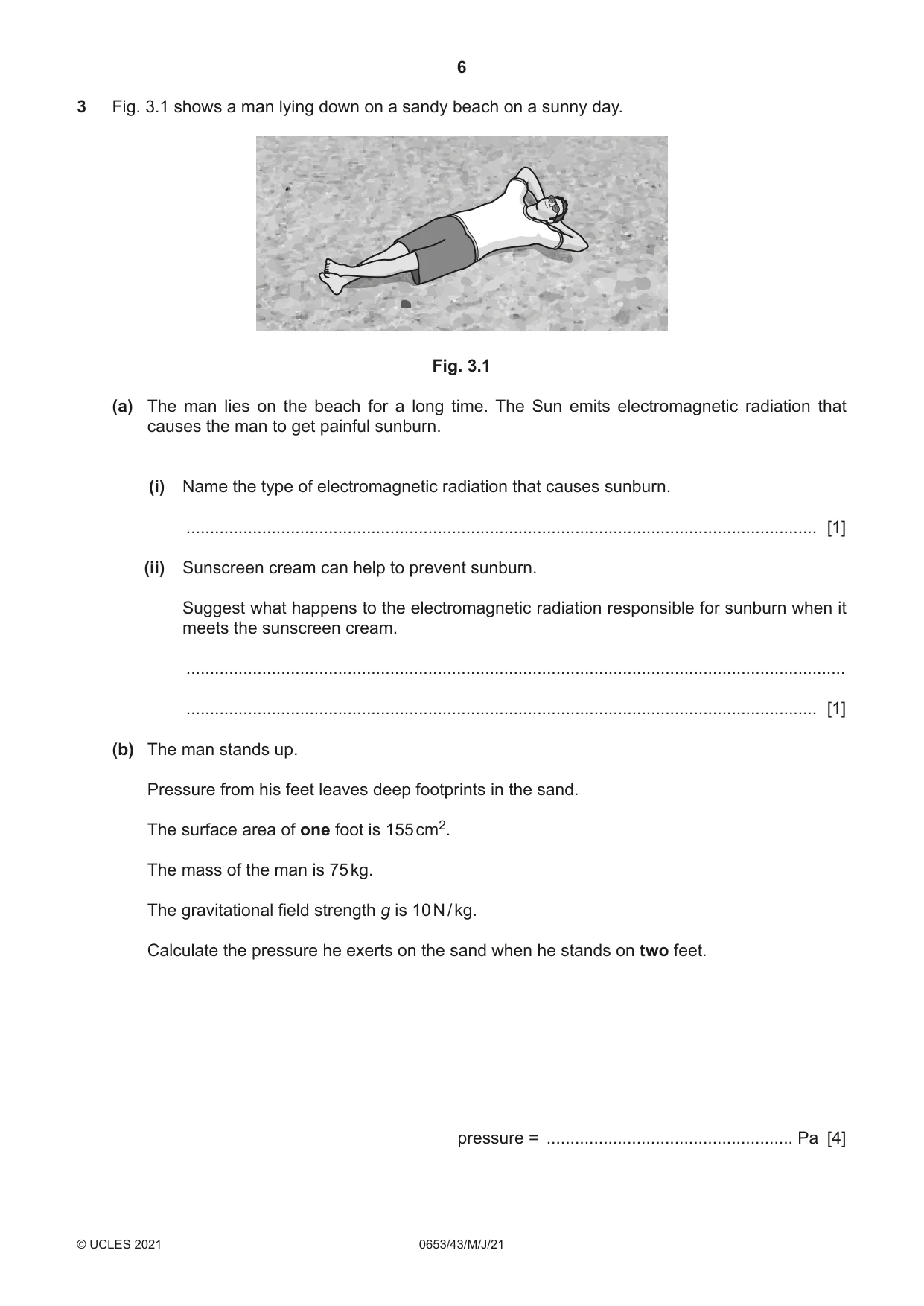
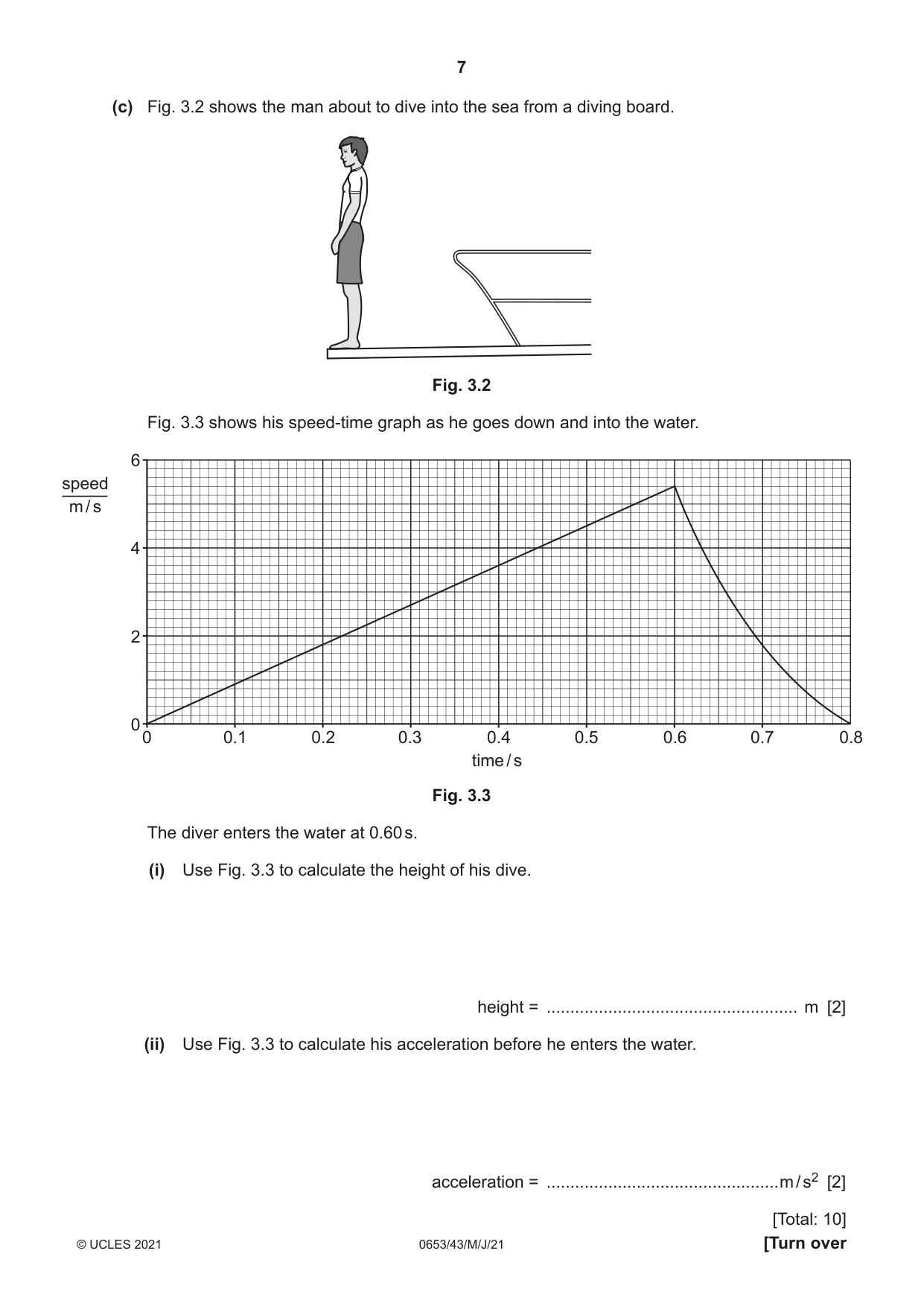
3 Fig. 3.1 shows a man lying down on a sandy beach on a sunny day. Fig. 3.1 (a) The man lies on the beach for a long time. The Sun emits electromagnetic radiation that causes the man to get painful sunburn. (i) Name the type of electromagnetic radiation that causes sunburn. ..................................................................................................................................... [1] (ii) Sunscreen cream can help to prevent sunburn. Suggest what happens to the electromagnetic radiation responsible for sunburn when it meets the sunscreen cream. ........................................................................................................................................... ..................................................................................................................................... [1] (b) The man stands up. Pressure from his feet leaves deep footprints in the sand. The surface area of one foot is 155 cm2. The mass of the man is 75 kg. The gravitational field strength g is 10 N / kg. Calculate the pressure he exerts on the sand when he stands on two feet. pressure = .................................................... Pa [4] (c) Fig. 3.2 shows the man about to dive into the sea from a diving board. Fig. 3.2 Fig. 3.3 shows his speed-time graph as he goes down and into the water. 6 speed m / s 4 2 0 0 0.1 0.2 0.3 0.4 0.5 0.6 0.7 0.8 time / s Fig. 3.3 The diver enters the water at 0.60 s. (i) Use Fig. 3.3 to calculate the height of his dive. height = ..................................................... m [2] (ii) Use Fig. 3.3 to calculate his acceleration before he enters the water. acceleration = .................................................m / s2 [2] [Total: 10]
Mark scheme: 3(a)(i) ultraviolet ; 1 3(a)(ii) reflected / absorbed (by sunscreen) ; 1 3(b) p = F / A ; A = 2 ×155 (= 310) cm2 = 0.031 m2 ; F = mg = 75 × 10 = 750 N ; p = 750 / 0.031 = 24 194 / 24 200 (Pa) ; 4 3(c)(i) height = area under graph = ½ × 0.60 × 5.4 ; = 1.6(2) (m) ; 2 3(c)(ii) acceleration = change in speed / time = 5.4 / 0.60 ; = 9.0 (m / s2) ; 2
Q4 · A diagram of a section through a human heart
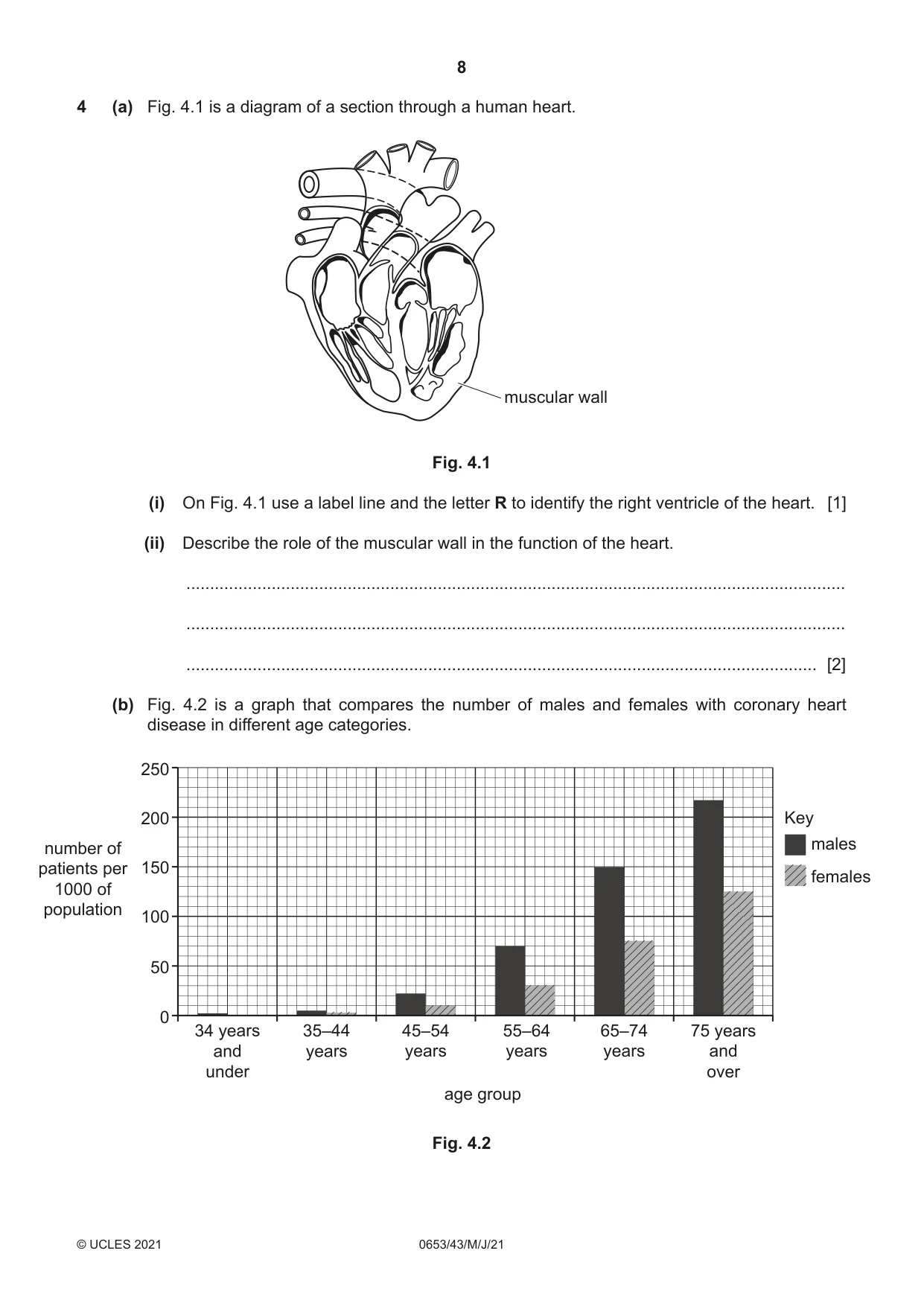
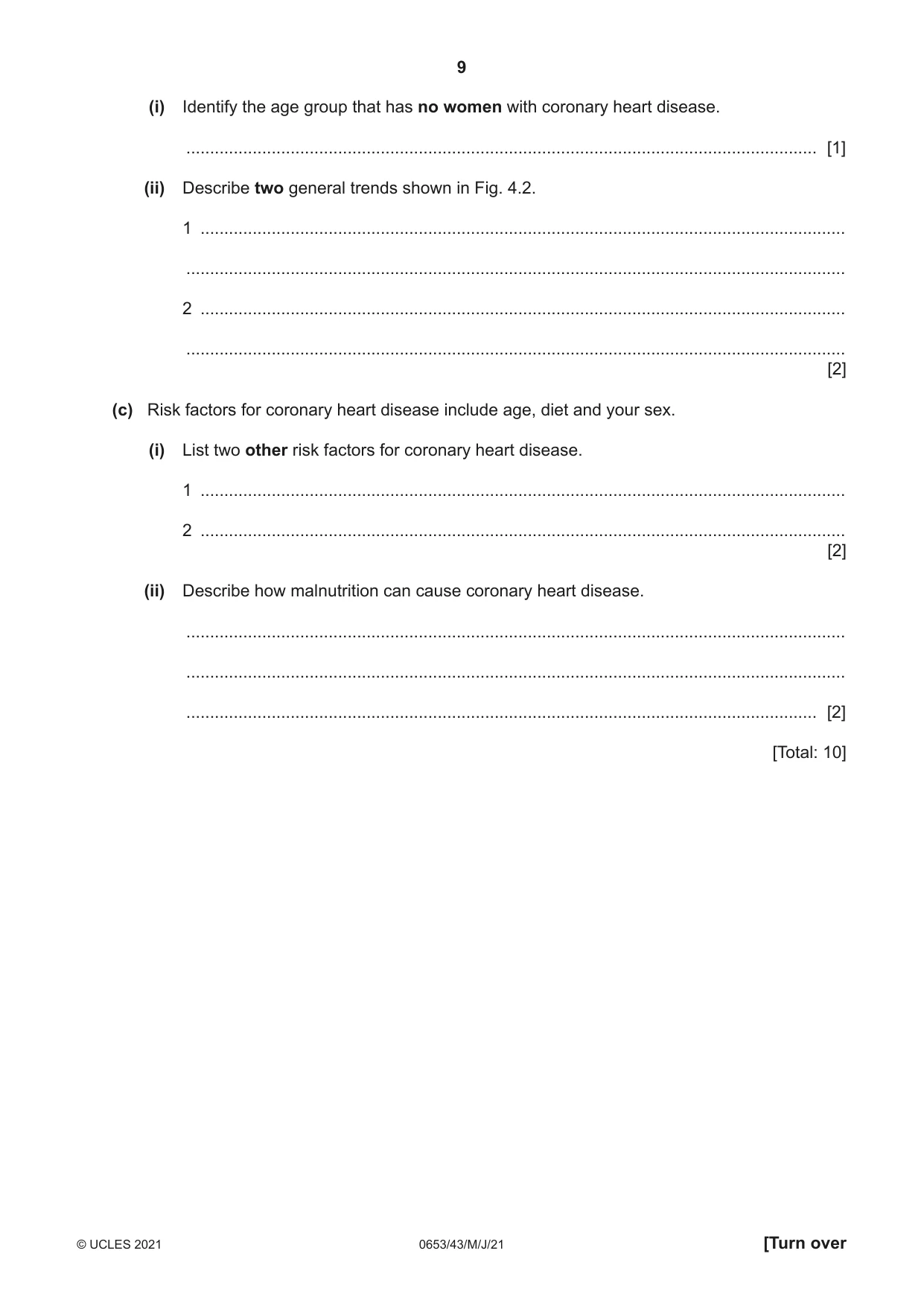
4 (a) Fig. 4.1 is a diagram of a section through a human heart. muscular wall Fig. 4.1 (i) On Fig. 4.1 use a label line and the letter R to identify the right ventricle of the heart. [1] (ii) Describe the role of the muscular wall in the function of the heart. ........................................................................................................................................... ........................................................................................................................................... ..................................................................................................................................... [2] (b) Fig. 4.2 is a graph that compares the number of males and females with coronary heart disease in different age categories. 250 200 Key number of males patients per 150 females 1000 of population 100 50 0 34 years 35–44 45–54 55–64 65–74 75 years and years years years years and under over age group Fig. 4.2 (i) Identify the age group that has no women with coronary heart disease. ..................................................................................................................................... [1] (ii) Describe two general trends shown in Fig. 4.2. 1 ........................................................................................................................................ ........................................................................................................................................... 2 ........................................................................................................................................ ........................................................................................................................................... [2] (c) Risk factors for coronary heart disease include age, diet and your sex. (i) List two other risk factors for coronary heart disease. 1 ........................................................................................................................................ 2 ........................................................................................................................................ [2] (ii) Describe how malnutrition can cause coronary heart disease. ........................................................................................................................................... ........................................................................................................................................... ..................................................................................................................................... [2] [Total: 10]
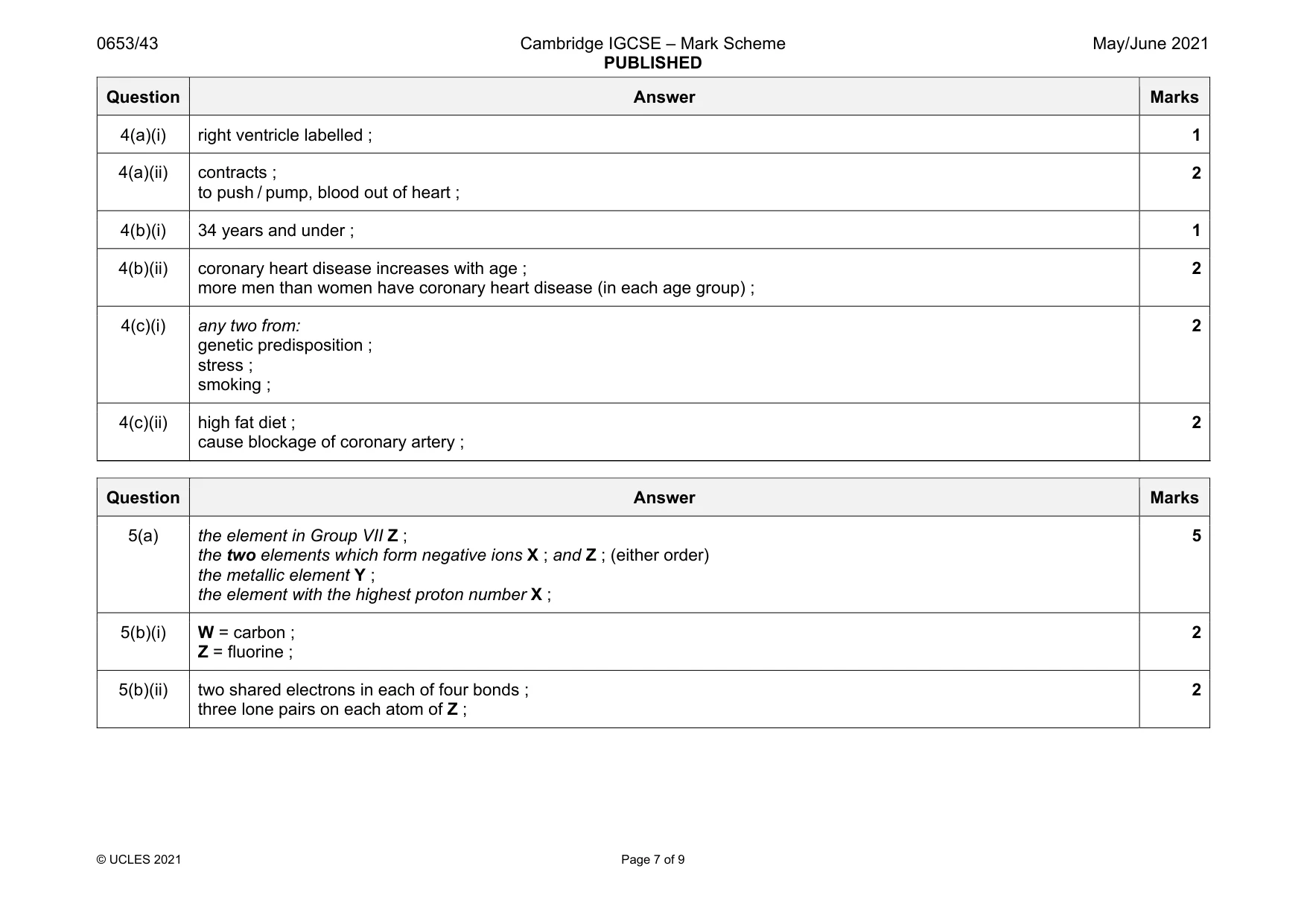
Mark scheme: 4(a)(i) right ventricle labelled ; 1 4(a)(ii) contracts ; to push / pump, blood out of heart ; 2 4(b)(i) 34 years and under ; 1 4(b)(ii) coronary heart disease increases with age ; more men than women have coronary heart disease (in each age group) ; 2 4(c)(i) any two from: genetic predisposition ; stress ; smoking ; 2 4(c)(ii) high fat diet ; cause blockage of coronary artery ; 2
Q5 · Information about the electrons in atoms of elements V, W, X, Y and Z
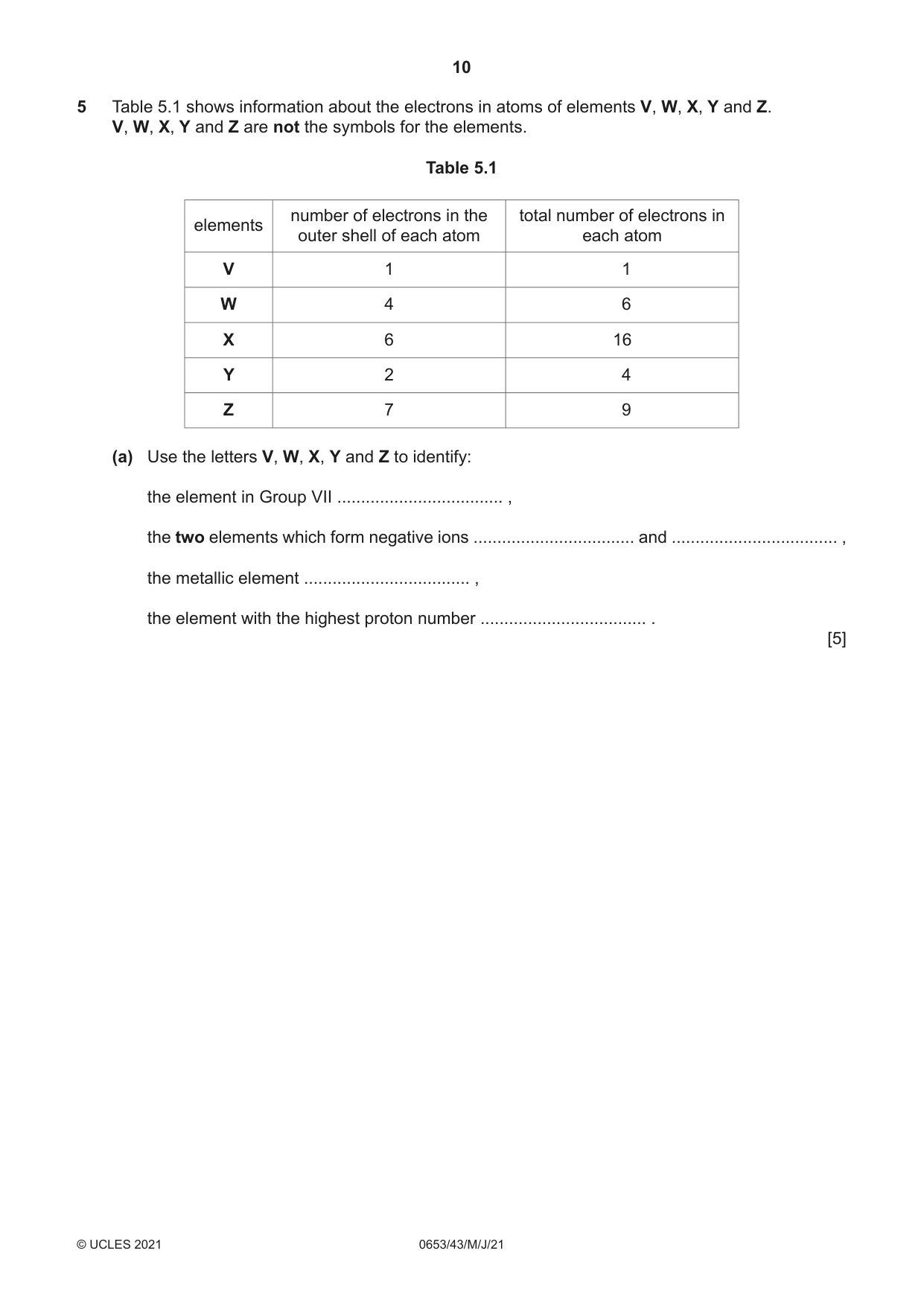
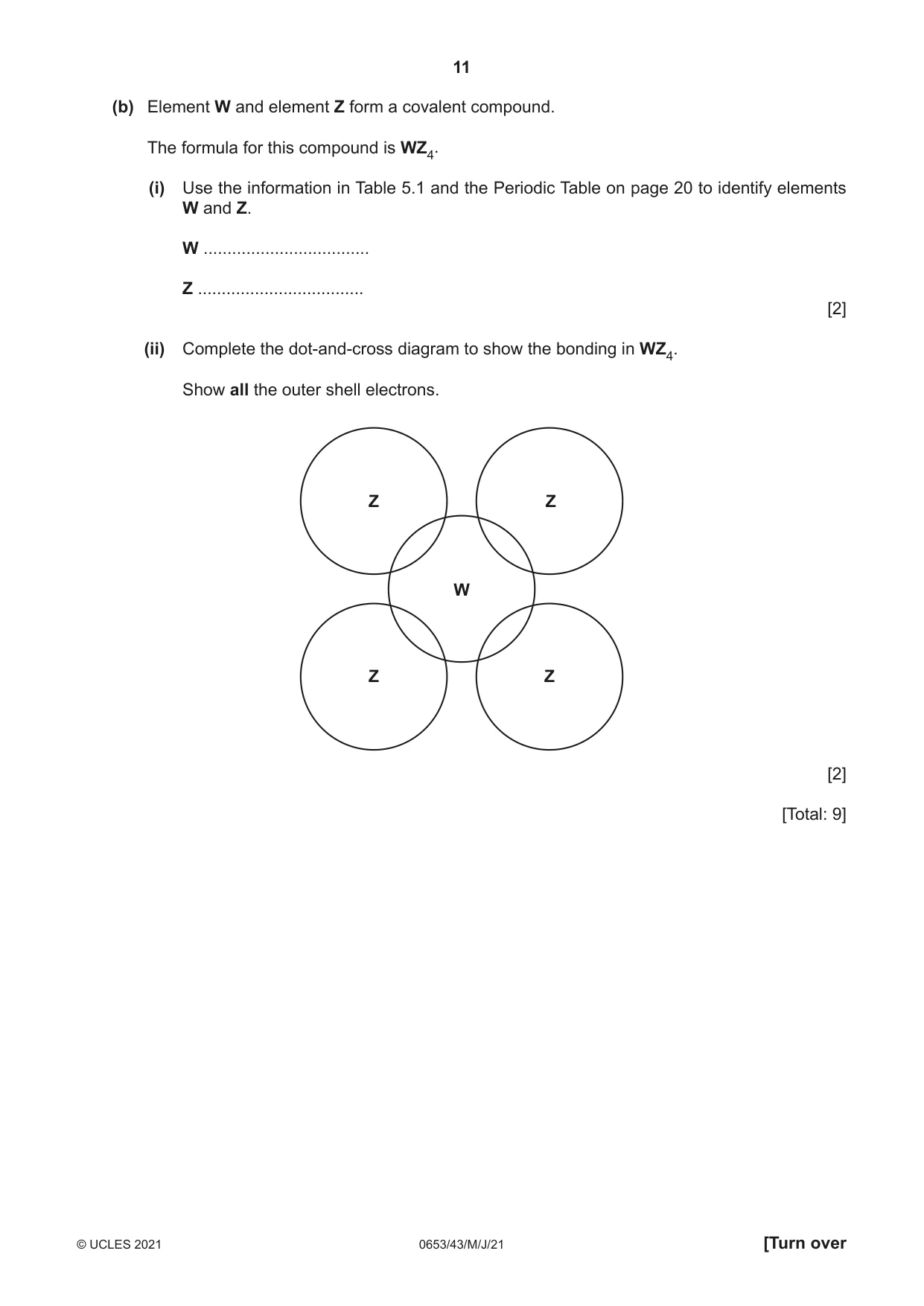
5 Table 5.1 shows information about the electrons in atoms of elements V, W, X, Y and Z. V, W, X, Y and Z are not the symbols for the elements. Table 5.1 number of electrons in the total number of electrons in elements outer shell of each atom each atom V 1 1 W 4 6 X 6 16 Y 2 4 Z 7 9 (a) Use the letters V, W, X, Y and Z to identify: the element in Group VII ................................... , the two elements which form negative ions .................................. and ................................... , the metallic element ................................... , the element with the highest proton number ................................... . [5] (b) Element W and element Z form a covalent compound. The formula for this compound is WZ4. (i) Use the information in Table 5.1 and the Periodic Table on page 20 to identify elements W and Z. W ................................... Z ................................... [2] (ii) Complete the dot-and-cross diagram to show the bonding in WZ4. Show all the outer shell electrons. Z Z W Z Z [2] [Total: 9]
Mark scheme: 5(a) the element in Group VII Z ; the two elements which form negative ions X ; and Z ; (either order) the metallic element Y ; the element with the highest proton number X ; 5(b)(i) W = carbon ; Z = fluorine ; 2 5(b)(ii) two shared electrons in each of four bonds ; three lone pairs on each atom of Z ; 2
Q6 · The melting and boiling points of six substances
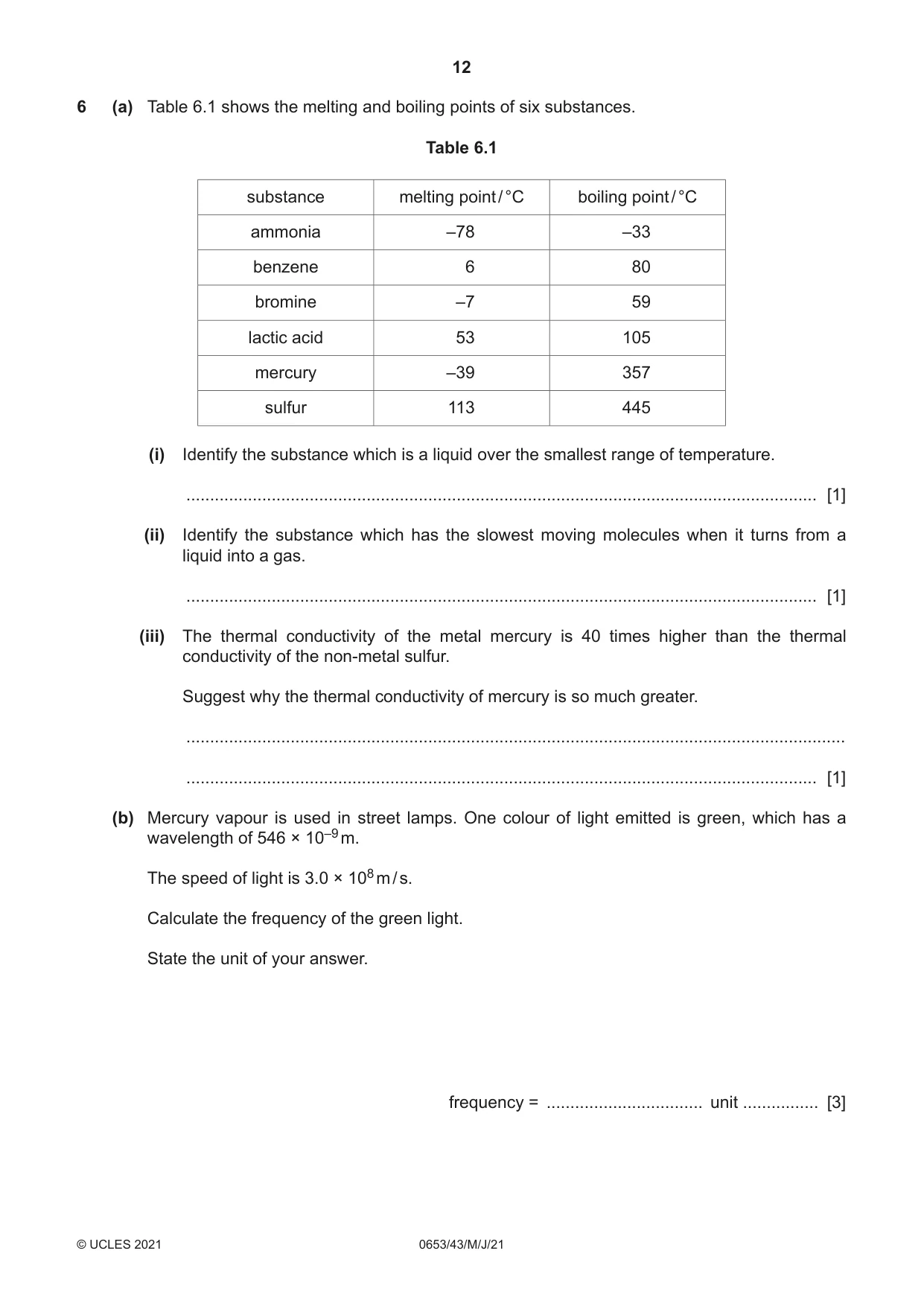
6 (a) Table 6.1 shows the melting and boiling points of six substances. Table 6.1 substance melting point / °C boiling point / °C ammonia –78 –33 benzene 6 80 bromine –7 59 lactic acid 53 105 mercury –39 357 sulfur 113 445 (i) Identify the substance which is a liquid over the smallest range of temperature. ..................................................................................................................................... [1] (ii) Identify the substance which has the slowest moving molecules when it turns from a liquid into a gas. ..................................................................................................................................... [1] (iii) The thermal conductivity of the metal mercury is 40 times higher than the thermal conductivity of the non-metal sulfur. Suggest why the thermal conductivity of mercury is so much greater. ........................................................................................................................................... ..................................................................................................................................... [1] (b) Mercury vapour is used in street lamps. One colour of light emitted is green, which has a wavelength of 546 × 10–9 m. The speed of light is 3.0 × 10⁸ m / s. Calculate the frequency of the green light. State the unit of your answer. frequency = ................................. unit ................ [3] (c) A street lamp requires a power input of 175 W from the electricity supply. (i) Only 20% of the energy input is emitted as light. Suggest the form of energy output for the remaining 80% of the input. ..................................................................................................................................... [1] (ii) The street lamp is used for 8 hours. Calculate the total energy input. energy = ...................................................... J [3] [Total: 10]
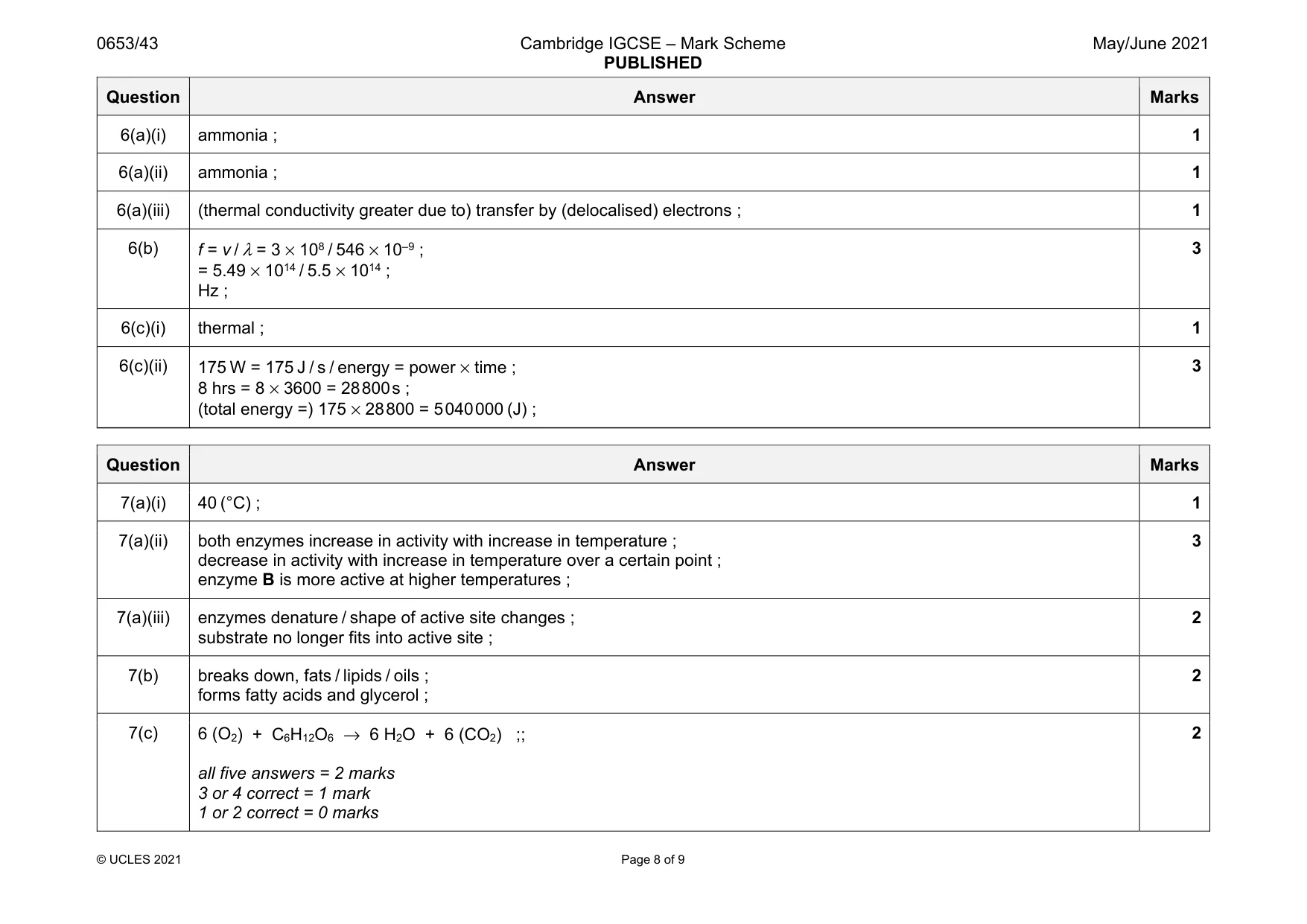
Mark scheme: 6(a)(i) ammonia ; 1 6(a)(ii) ammonia ; 1 6(a)(iii) (thermal conductivity greater due to) transfer by (delocalised) electrons ; 1 6(b) f = v / λ = 3 × 10⁸ / 546 × 10–9 ; = 5.49 × 10¹⁴ / 5.5 × 10¹⁴ ; Hz ; 3 6(c)(i) thermal ; 1 6(c)(ii) 175 W = 175 J / s / energy = power × time ; 8 hrs = 8 × 3600 = 28 800 s ; (total energy =) 175 × 28 800 = 5 040 000 (J) ; 3
Q7 · A graph showing the effect of temperature on two different enzymes, A and B
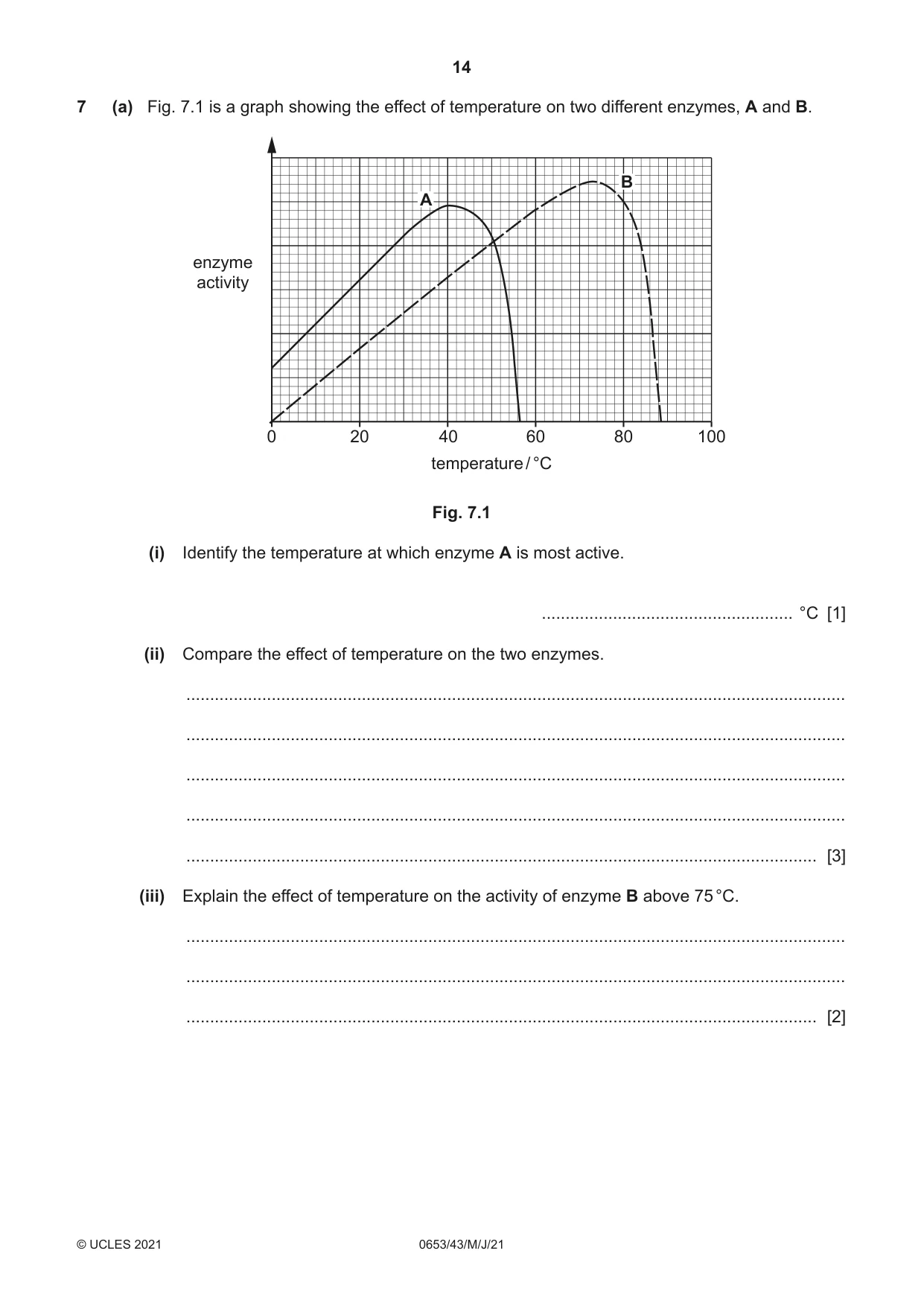
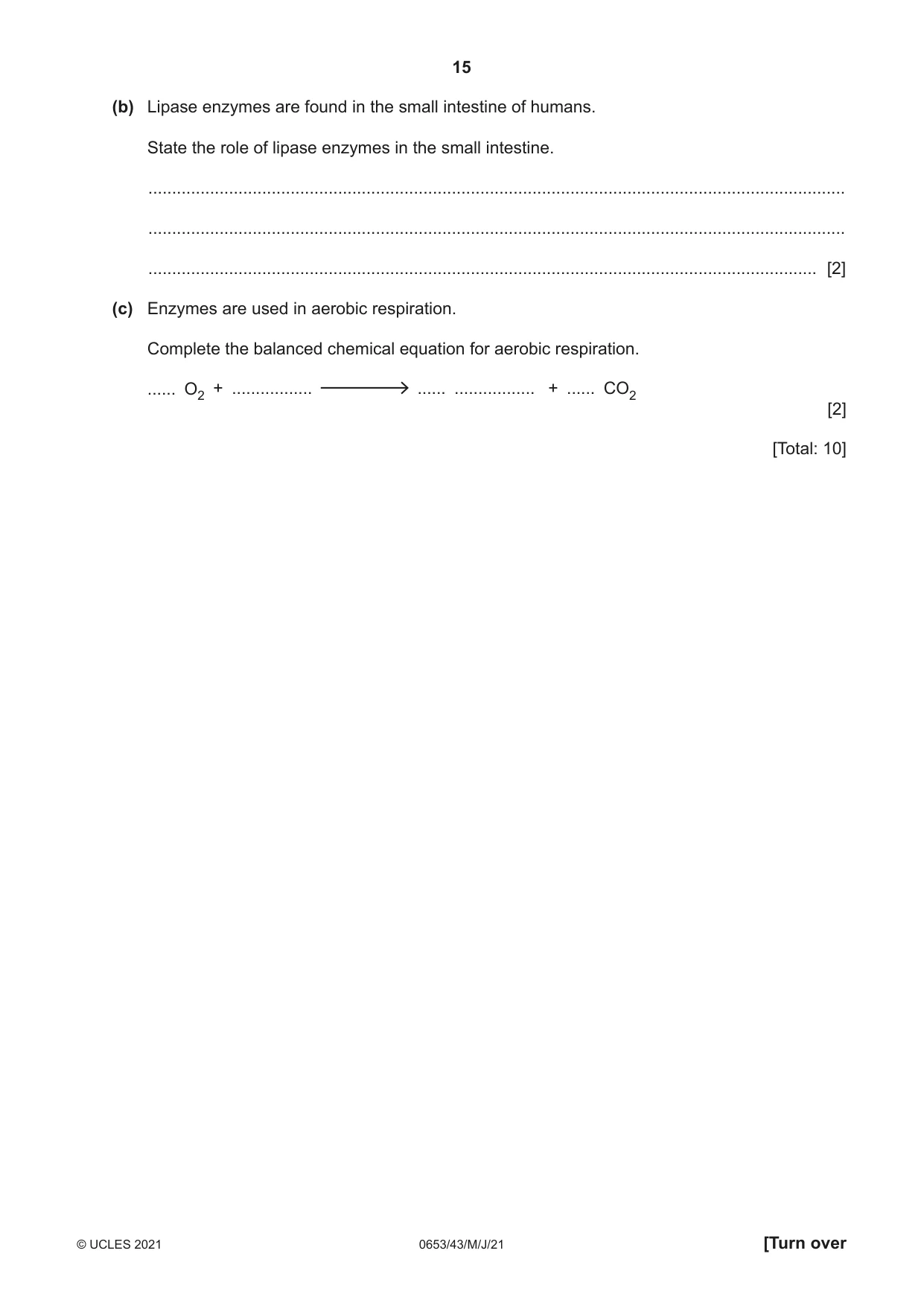
7 (a) Fig. 7.1 is a graph showing the effect of temperature on two different enzymes, A and B. B A enzyme activity 0 20 40 60 80 100 temperature / °C Fig. 7.1 (i) Identify the temperature at which enzyme A is most active. ..................................................... °C [1] (ii) Compare the effect of temperature on the two enzymes. ........................................................................................................................................... ........................................................................................................................................... ........................................................................................................................................... ........................................................................................................................................... ..................................................................................................................................... [3] (iii) Explain the effect of temperature on the activity of enzyme B above 75 °C. ........................................................................................................................................... ........................................................................................................................................... ..................................................................................................................................... [2] (b) Lipase enzymes are found in the small intestine of humans. State the role of lipase enzymes in the small intestine. ................................................................................................................................................... ................................................................................................................................................... ............................................................................................................................................. [2] (c) Enzymes are used in aerobic respiration. Complete the balanced chemical equation for aerobic respiration. ...... O2 + ................. ...... ................. + ...... CO2 [2] [Total: 10]
Mark scheme: 7(a)(i) 40 (°C) ; 1 7(a)(ii) both enzymes increase in activity with increase in temperature ; decrease in activity with increase in temperature over a certain point ; enzyme B is more active at higher temperatures ; 3 7(a)(iii) enzymes denature / shape of active site changes ; substrate no longer fits into active site ; 2 7(b) breaks down, fats / lipids / oils ; forms fatty acids and glycerol ; 2 7(c) 6 (O2) + C6H12O6 → 6 H2O + 6 (CO2) ;; all five answers = 2 marks 3 or 4 correct = 1 mark 1 or 2 correct = 0 marks 2
Q8 · The structures of ethane and ethene
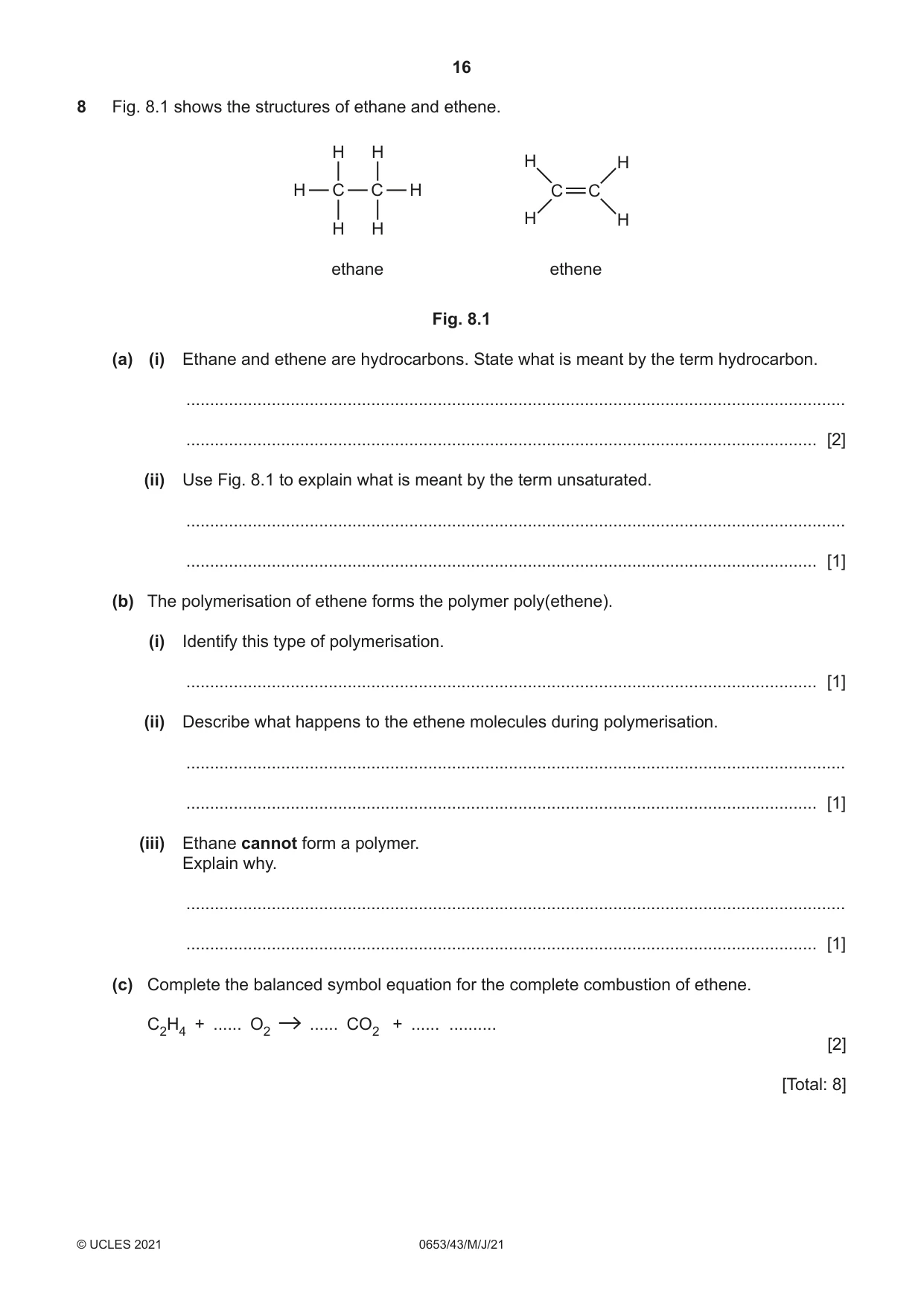
8 Fig. 8.1 shows the structures of ethane and ethene. H H H H H C C H C C H H H H ethane ethene Fig. 8.1 (a) (i) Ethane and ethene are hydrocarbons. State what is meant by the term hydrocarbon. ........................................................................................................................................... ..................................................................................................................................... [2] (ii) Use Fig. 8.1 to explain what is meant by the term unsaturated. ........................................................................................................................................... ..................................................................................................................................... [1] (b) The polymerisation of ethene forms the polymer poly(ethene). (i) Identify this type of polymerisation. ..................................................................................................................................... [1] (ii) Describe what happens to the ethene molecules during polymerisation. ........................................................................................................................................... ..................................................................................................................................... [1] (iii) Ethane cannot form a polymer. Explain why. ........................................................................................................................................... ..................................................................................................................................... [1] (c) Complete the balanced symbol equation for the complete combustion of ethene. C2H4 + ...... O2 ...... CO2 + ...... .......... [2] [Total: 8]
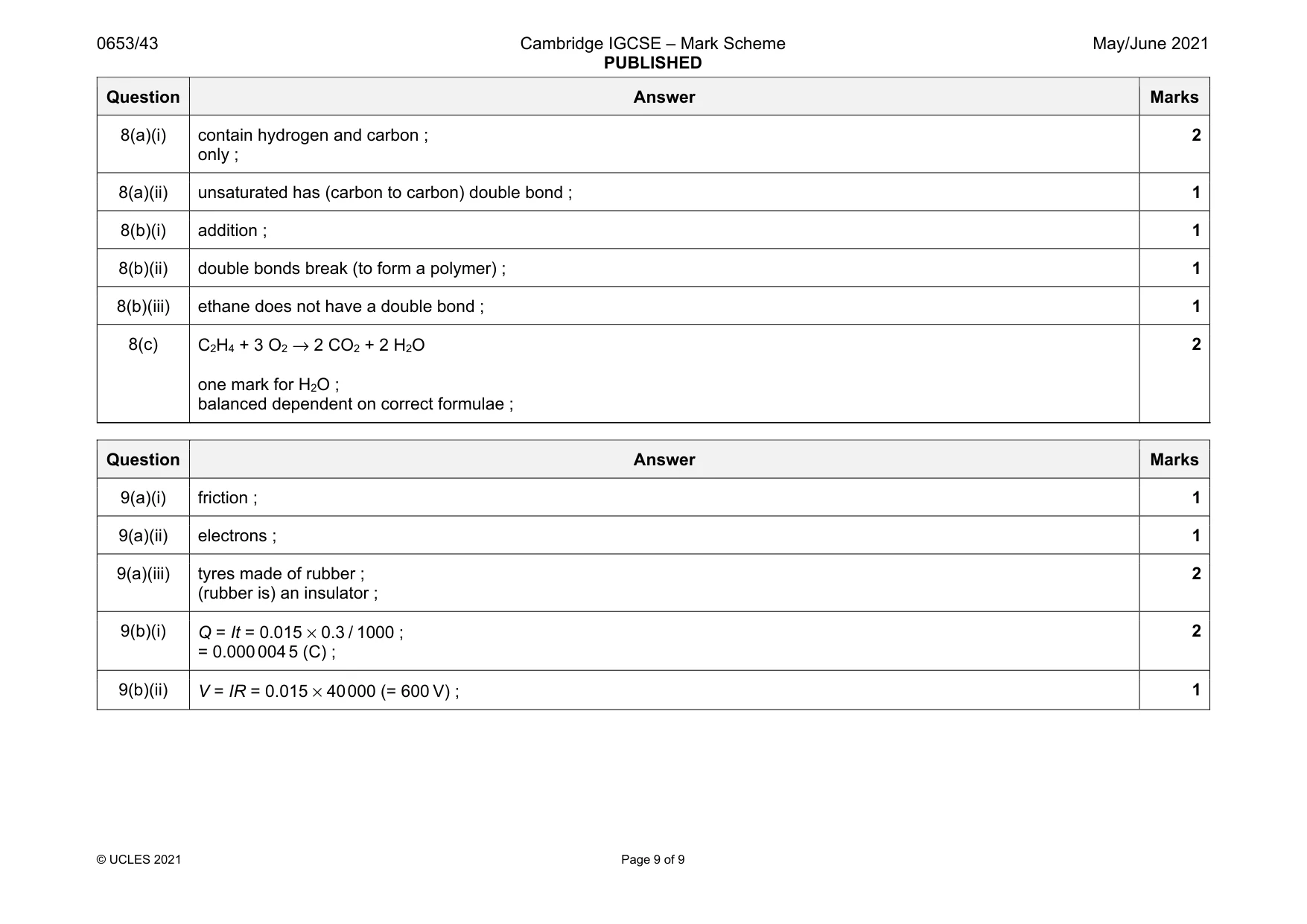
Mark scheme: 8(a)(i) contain hydrogen and carbon ; only ; 2 8(a)(ii) unsaturated has (carbon to carbon) double bond ; 1 8(b)(i) addition ; 1 8(b)(ii) double bonds break (to form a polymer) ; 1 8(b)(iii) ethane does not have a double bond ; 1 8(c) C2H4 + 3 O2 → 2 CO2 + 2 H2O one mark for H2O ; balanced dependent on correct formulae ; 2
Q9 · A car travelling forwards along a road
9 Fig. 9.1 shows a car travelling forwards along a road. metal car body rubber tyres Fig. 9.1 As the car drives along, electrostatic charges build up on the car. (a) (i) State what causes an electrostatic charge to form on the car. ..................................................................................................................................... [1] (ii) Name the particles transferred when an electrostatic charge builds up on the car. ..................................................................................................................................... [1] (iii) Explain why the electric charge does not travel to the ground while the car is being driven along the road. ........................................................................................................................................... ........................................................................................................................................... ..................................................................................................................................... [2] (b) When the car stops, the driver gets out and touches the metal car body. The electric charge on the car travels through the driver to the ground. The electric current through the driver as the charge travels to the ground is 0.015 A and lasts for 0.3 ms. (i) Calculate the total electric charge that travels through the driver. charge = ..................................................... C [2] (ii) The total resistance of the driver’s body and shoes is 40 000 Ω. Show that the potential difference between the driver and the car before she touches the door handle is 600 V. [1] [Total: 7]
Mark scheme: 9(a)(i) friction ; 1 9(a)(ii) electrons ; 1 9(a)(iii) tyres made of rubber ; (rubber is) an insulator ; 2 9(b)(i) Q = It = 0.015 × 0.3 / 1000 ; = 0.000 004 5 (C) ; 2 9(b)(ii) V = IR = 0.015 × 40 000 (= 600 V) ; 1
What was in this paper
The subtopics covered by these 9 questions, and how many questions each got. Open one in a new tab to see every Cambridge question on it.
What you needed in this session
Cambridge’s own grade thresholds for 2021 May/June, Paper 4 · Variant 3. A higher threshold means an easier paper — the bar moves with how the cohort did.