Cambridge IGCSE Science - Combined 0653 — 2020 May/June Paper 4 · Variant 2
0653/42/M/J/20 · 9 questions · 80 marks · ≈90 min
The question paper and its mark scheme, free to read here and free to download. This is Cambridge’s own paper, exactly as it was sat.
Question paper20 pages

Mark scheme11 pages
Answers below. Sit the paper first if you are practising.
Questions as text
Question 1
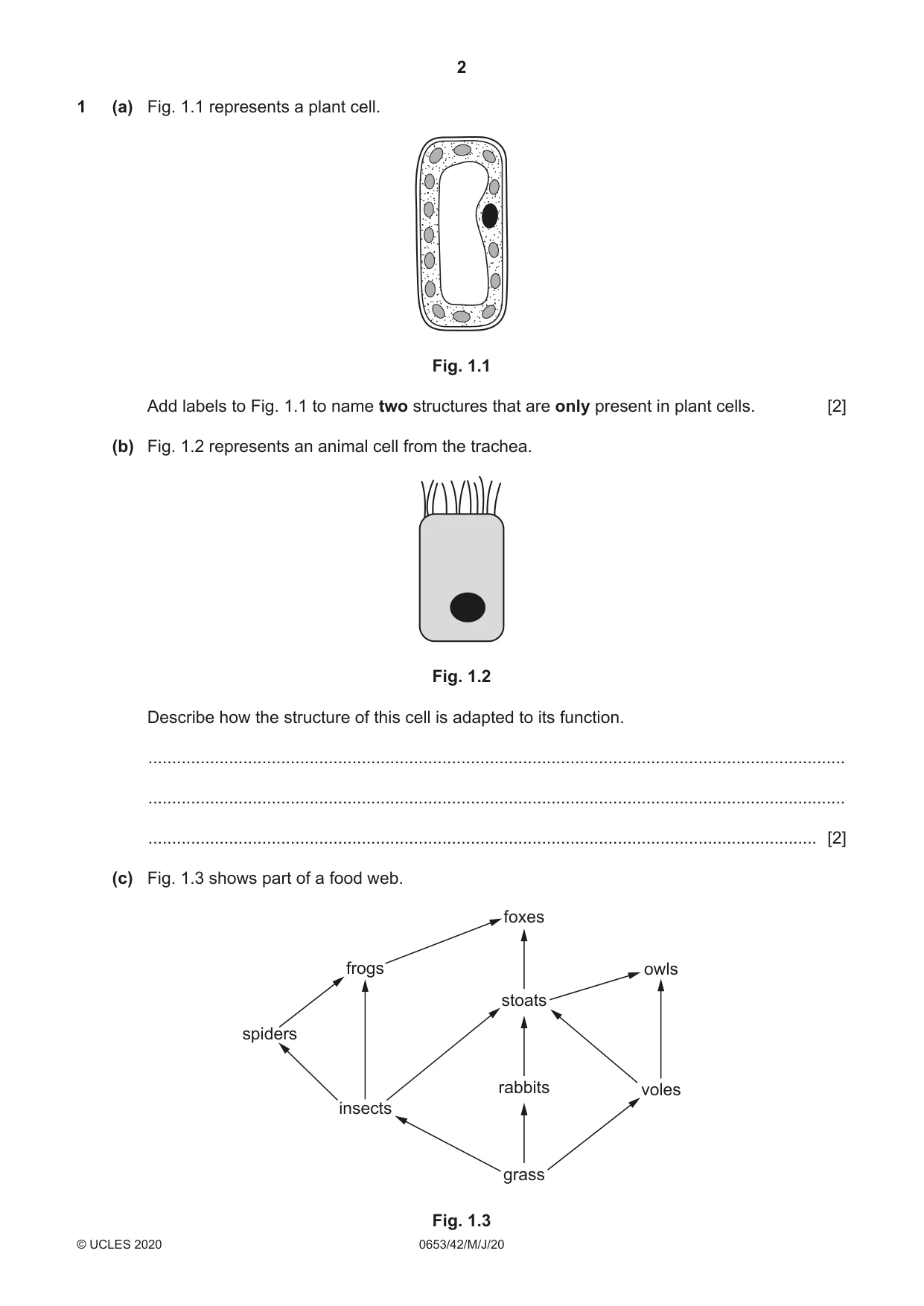
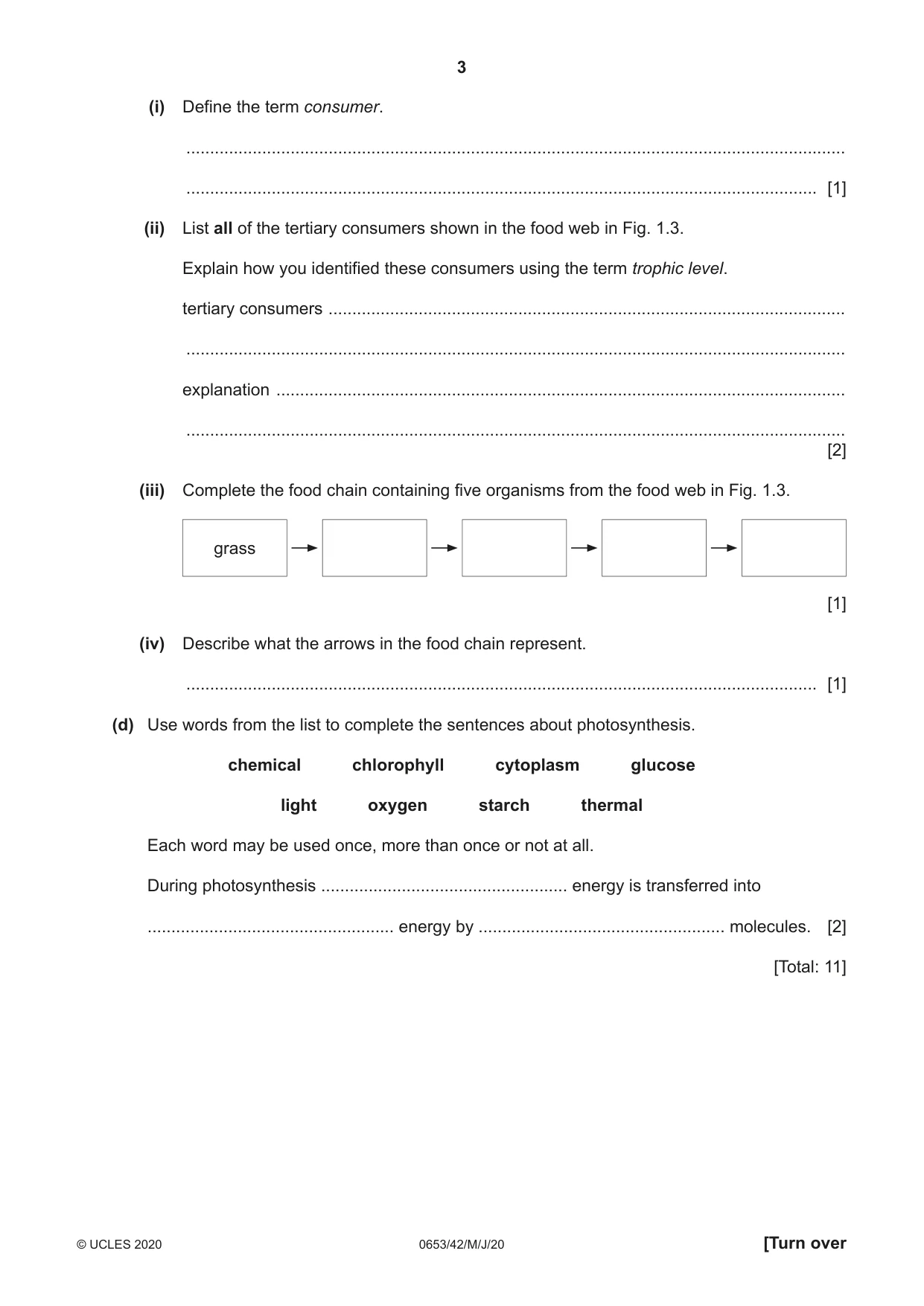
1 (a) Fig. 1.1 represents a plant cell. Fig. 1.1 Add labels to Fig. 1.1 to name two structures that are only present in plant cells. [2] (b) Fig. 1.2 represents an animal cell from the trachea. Fig. 1.2 Describe how the structure of this cell is adapted to its function. ................................................................................................................................................... ................................................................................................................................................... ............................................................................................................................................. [2] (c) Fig. 1.3 shows part of a food web. foxes frogs owls stoats spiders rabbits voles insects grass Fig. 1.3 (i) Define the term consumer. ........................................................................................................................................... ..................................................................................................................................... [1] (ii) List all of the tertiary consumers shown in the food web in Fig. 1.3. Explain how you identified these consumers using the term trophic level. tertiary consumers ............................................................................................................. ........................................................................................................................................... explanation ........................................................................................................................ ........................................................................................................................................... [2] (iii) Complete the food chain containing five organisms from the food web in Fig. 1.3. grass [1] (iv) Describe what the arrows in the food chain represent. ..................................................................................................................................... [1] (d) Use words from the list to complete the sentences about photosynthesis. chemical chlorophyll cytoplasm glucose light oxygen starch thermal Each word may be used once, more than once or not at all. During photosynthesis .................................................... energy is transferred into .................................................... energy by .................................................... molecules. [2] [Total: 11]
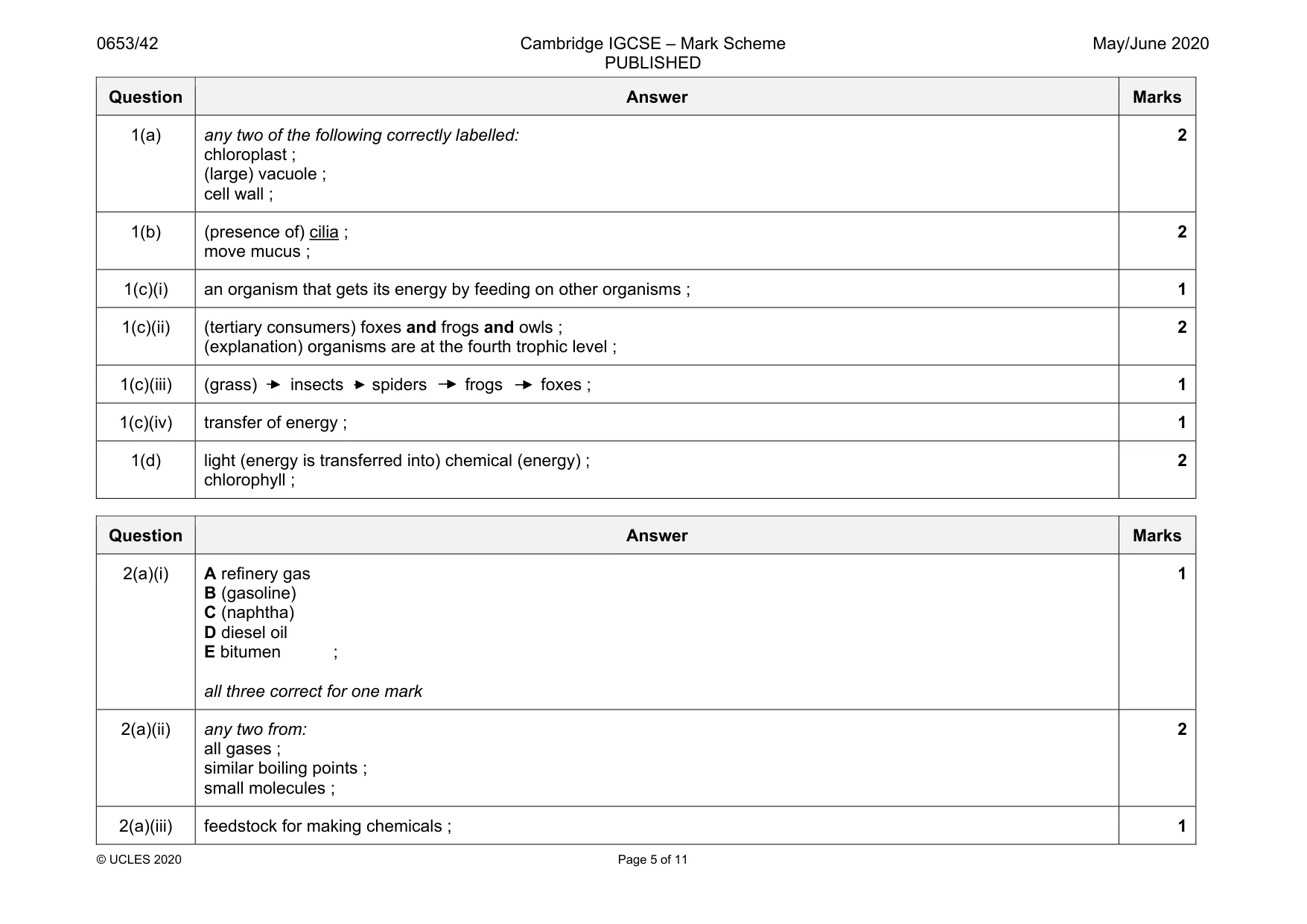
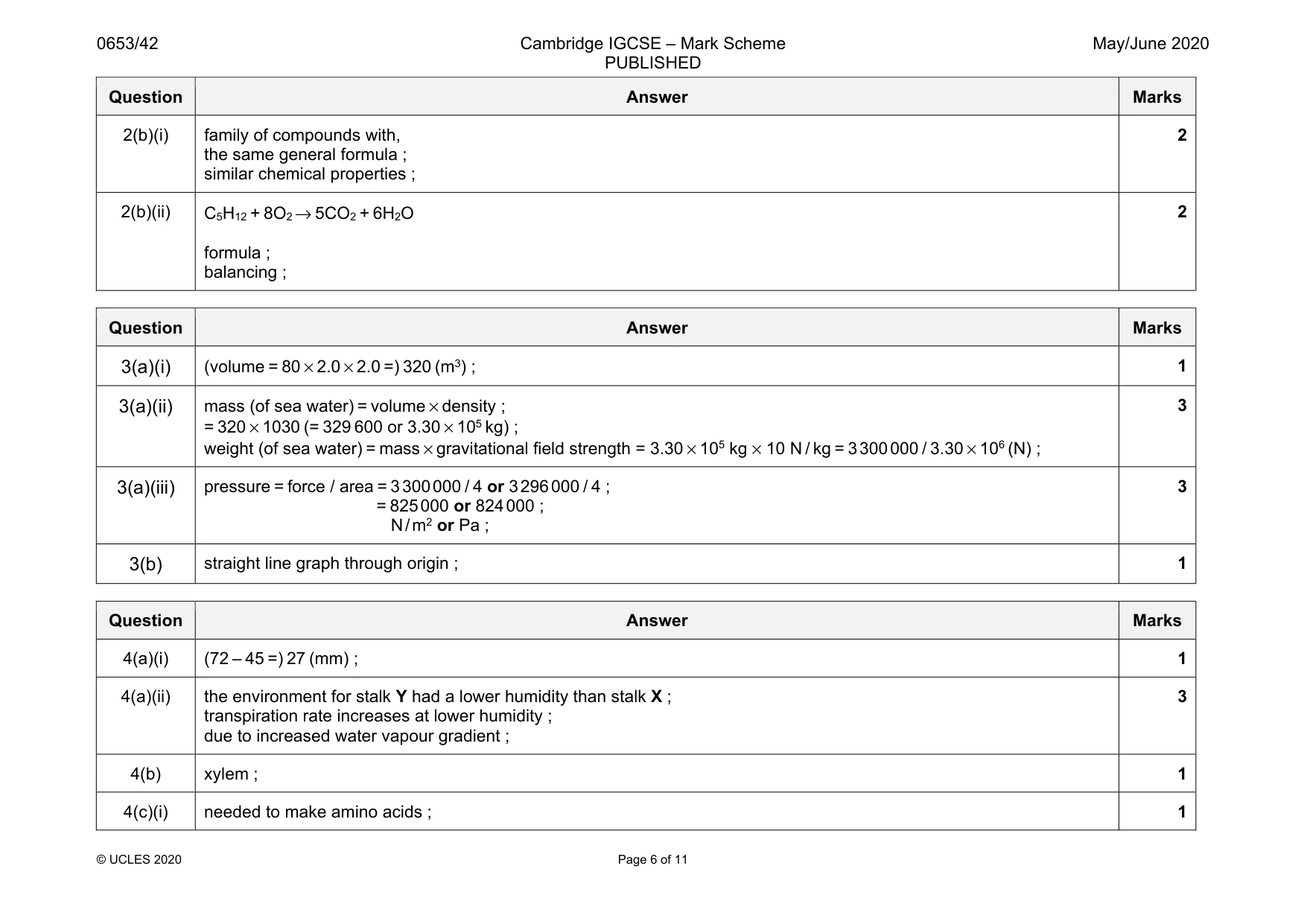
Mark scheme: 1(a) any two of the following correctly labelled: chloroplast ; (large) vacuole ; cell wall ; 2 1(b) (presence of) cilia ; move mucus ; 2 1(c)(i) an organism that gets its energy by feeding on other organisms ; 1 1(c)(ii) (tertiary consumers) foxes and frogs and owls ; (explanation) organisms are at the fourth trophic level ; 2 1(c)(iii) (grass) insects spiders frogs foxes ; 1 1(c)(iv) transfer of energy ; 1 1(d) light (energy is transferred into) chemical (energy) ; chlorophyll ; 2
Q2 · The fractional distillation of petroleum is shown in Fig
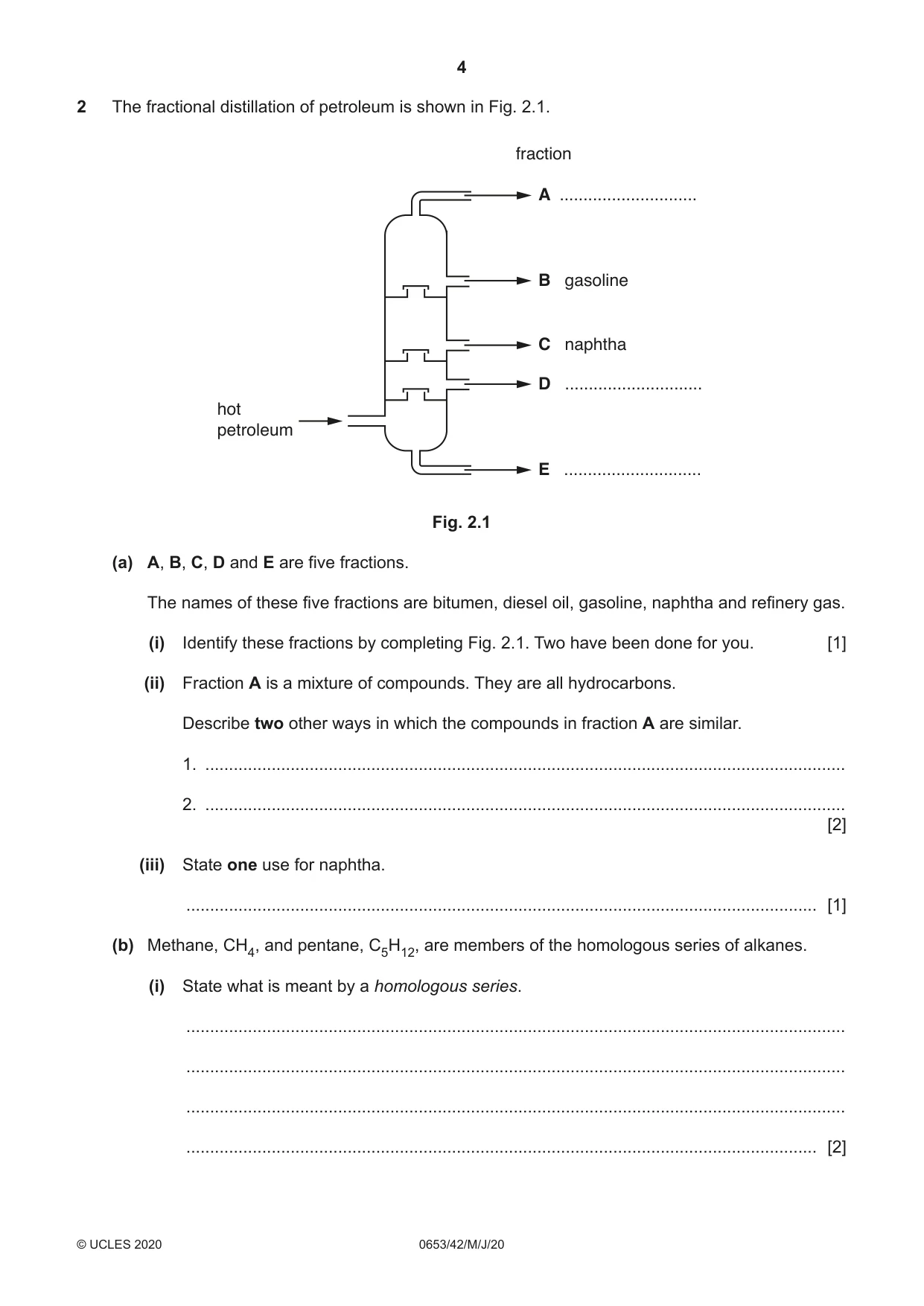
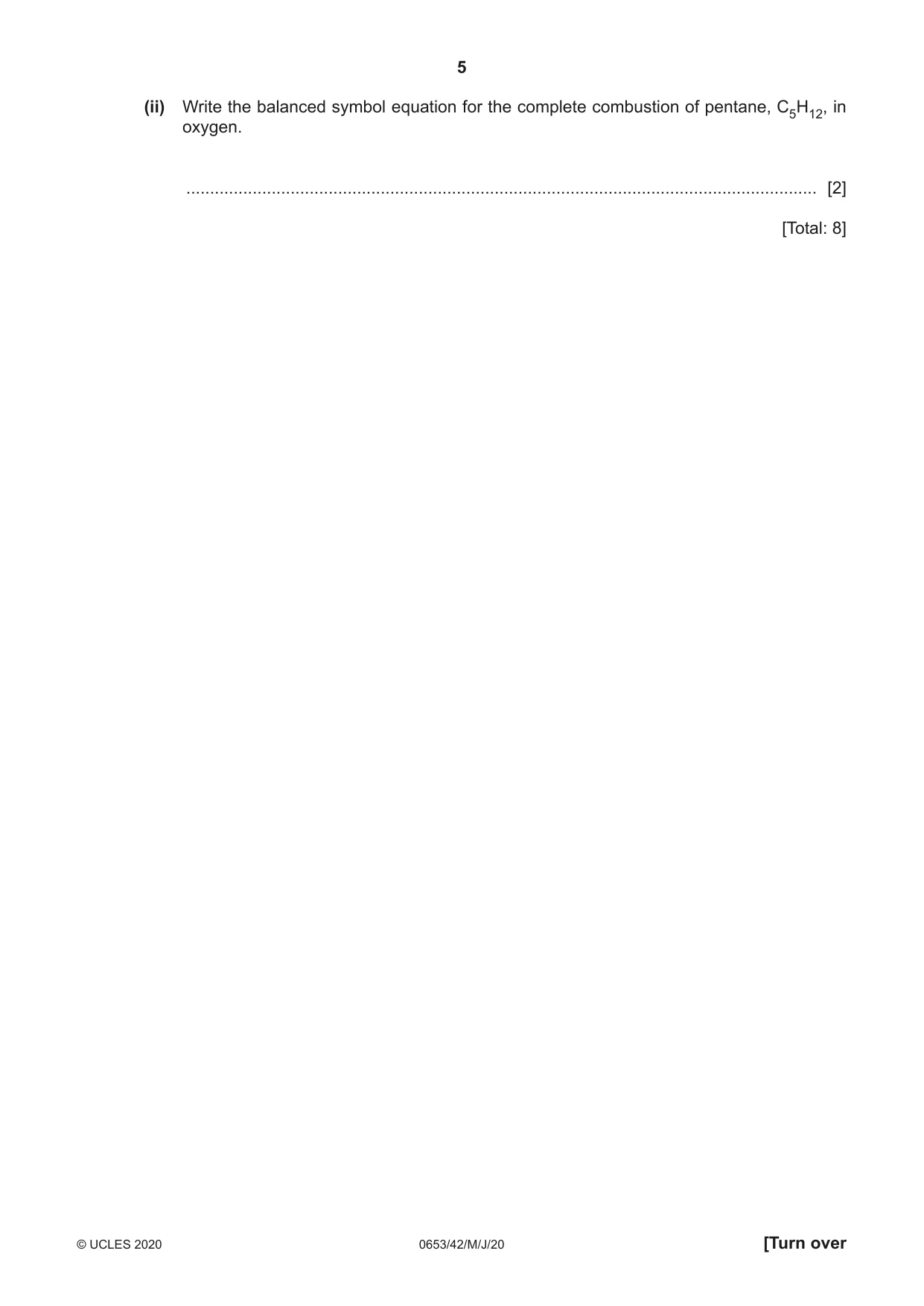
2 The fractional distillation of petroleum is shown in Fig. 2.1. fraction A ............................. B gasoline C naphtha D ............................. hot petroleum E ............................. Fig. 2.1 (a) A, B, C, D and E are five fractions. The names of these five fractions are bitumen, diesel oil, gasoline, naphtha and refinery gas. (i) Identify these fractions by completing Fig. 2.1. Two have been done for you. [1] (ii) Fraction A is a mixture of compounds. They are all hydrocarbons. Describe two other ways in which the compounds in fraction A are similar. 1. ....................................................................................................................................... 2. ....................................................................................................................................... [2] (iii) State one use for naphtha. ..................................................................................................................................... [1] (b) Methane, CH4, and pentane, C5H12, are members of the homologous series of alkanes. (i) State what is meant by a homologous series. ........................................................................................................................................... ........................................................................................................................................... ........................................................................................................................................... ..................................................................................................................................... [2] (ii) Write the balanced symbol equation for the complete combustion of pentane, C5H12, in oxygen. ..................................................................................................................................... [2] [Total: 8]
Mark scheme: 2(a)(i) A refinery gas B (gasoline) C (naphtha) D diesel oil E bitumen ; all three correct for one mark 2(a)(ii) any two from: all gases ; similar boiling points ; small molecules ; 2 2(a)(iii) feedstock for making chemicals ; 1 Question Answer Marks 2(b)(i) family of compounds with, the same general formula ; similar chemical properties ; 2 2(b)(ii) C5H12 + 8O2 → 5CO2 + 6H2O formula ; balancing ; 2
Q3 · A sheet of metal on the sea floor
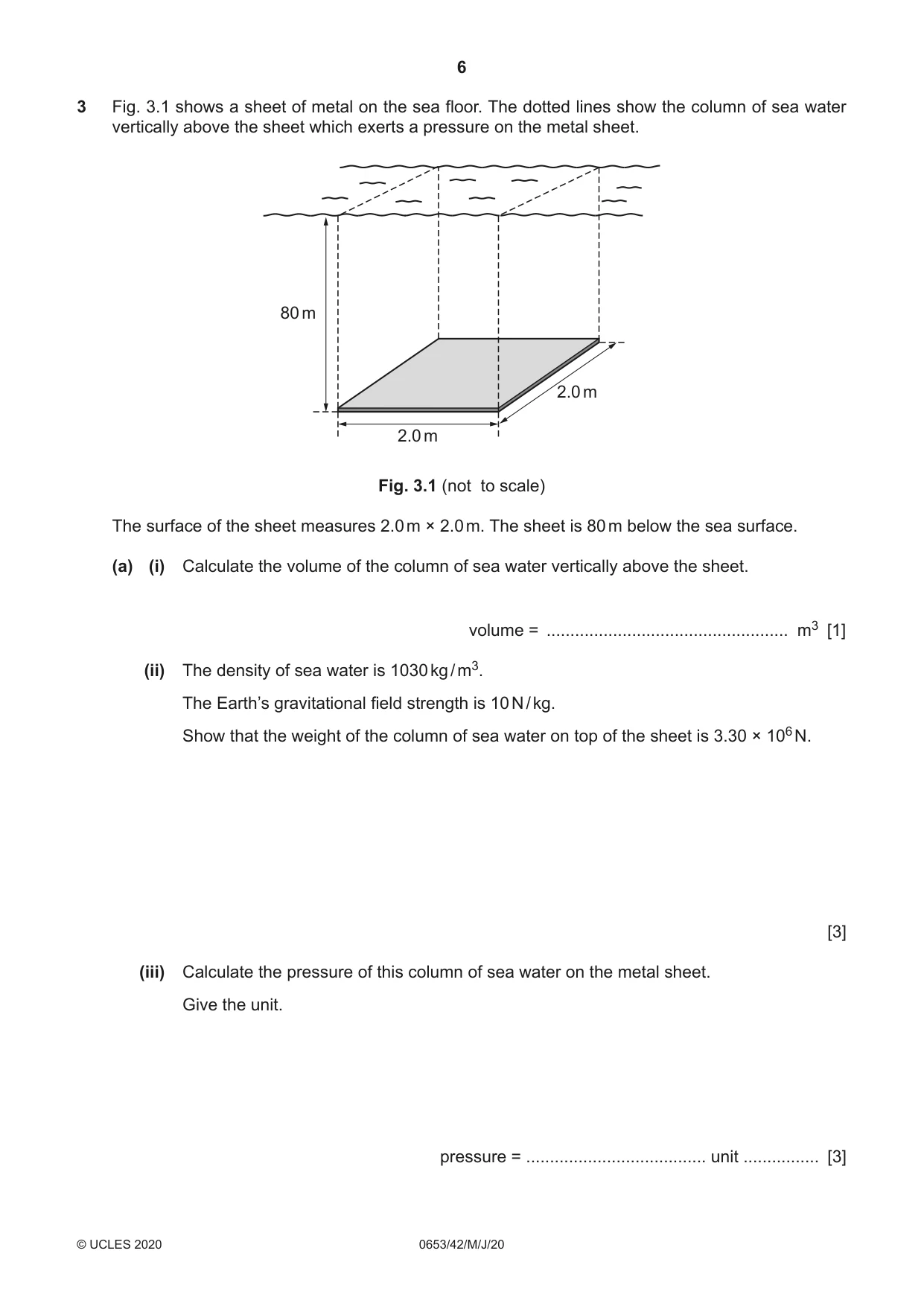
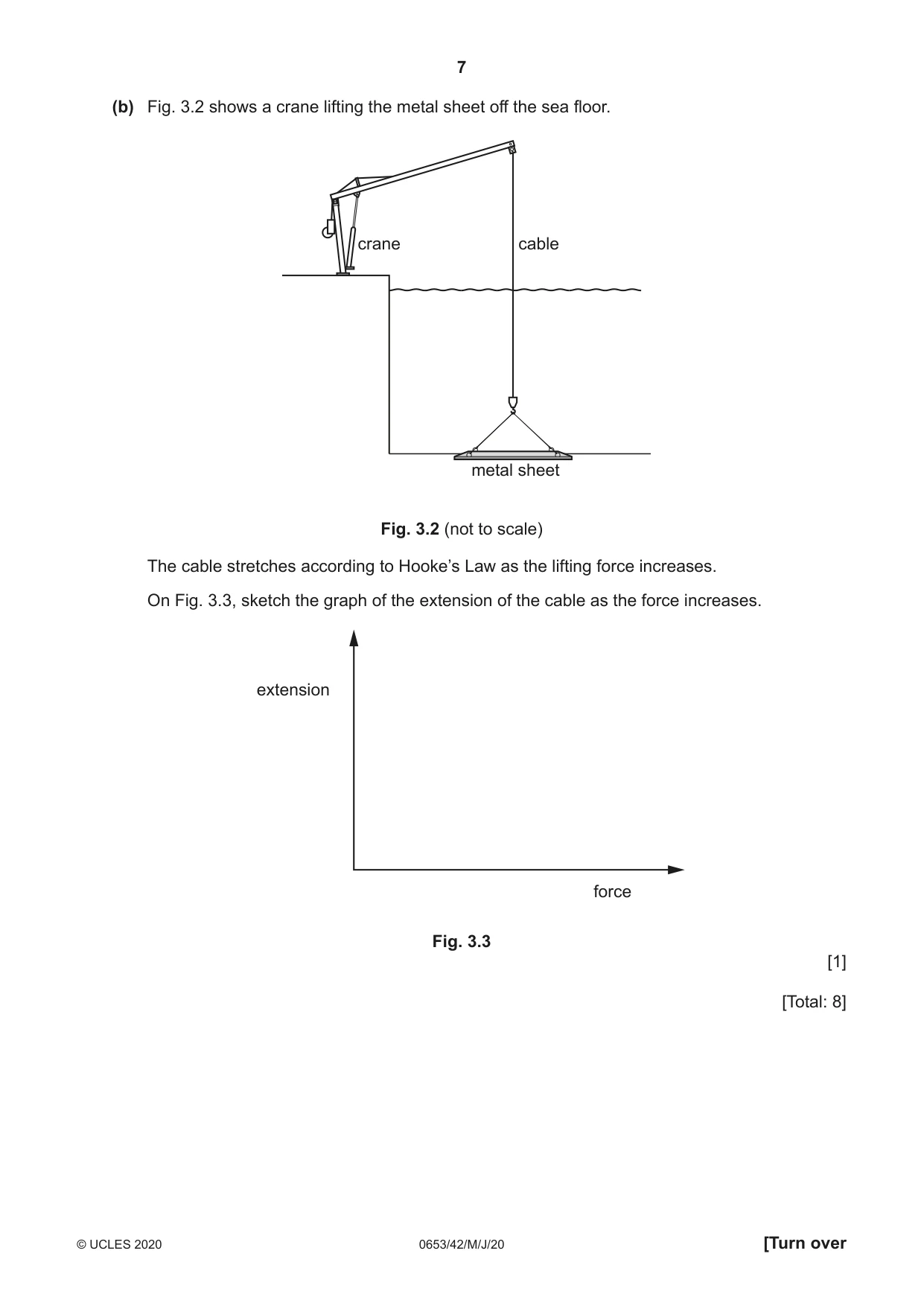
3 Fig. 3.1 shows a sheet of metal on the sea floor. The dotted lines show the column of sea water vertically above the sheet which exerts a pressure on the metal sheet. 80 m 2.0 m 2.0 m Fig. 3.1 (not to scale) The surface of the sheet measures 2.0 m × 2.0 m. The sheet is 80 m below the sea surface. (a) (i) Calculate the volume of the column of sea water vertically above the sheet. volume = ................................................... m3 [1] (ii) The density of sea water is 1030 kg / m3. The Earth’s gravitational field strength is 10 N / kg. Show that the weight of the column of sea water on top of the sheet is 3.30 × 10⁶ N. [3] (iii) Calculate the pressure of this column of sea water on the metal sheet. Give the unit. pressure = ...................................... unit ................ [3] (b) Fig. 3.2 shows a crane lifting the metal sheet off the sea floor. crane cable metal sheet Fig. 3.2 (not to scale) The cable stretches according to Hooke’s Law as the lifting force increases. On Fig. 3.3, sketch the graph of the extension of the cable as the force increases. extension force Fig. 3.3 [1] [Total: 8]
Mark scheme: 3(a)(i) (volume = 80 × 2.0 × 2.0 =) 320 (m3) ; 3(a)(ii) mass (of sea water) = volume × density ; = 320 × 1030 (= 329 600 or 3.30 × 10⁵ kg) ; weight (of sea water) = mass × gravitational field strength = 3.30 × 105 kg × 10 N / kg = 3300000 / 3.30 × 10⁶ (N) ; 3 3(a)(iii) pressure = force / area = 3 300 000 / 4 or 3 296 000 / 4 ; = 825 000 or 824 000 ; N/m2 or Pa ; 3 3(b) straight line graph through origin ; 1
Q4 · Two similar stalks of celery, X and Y
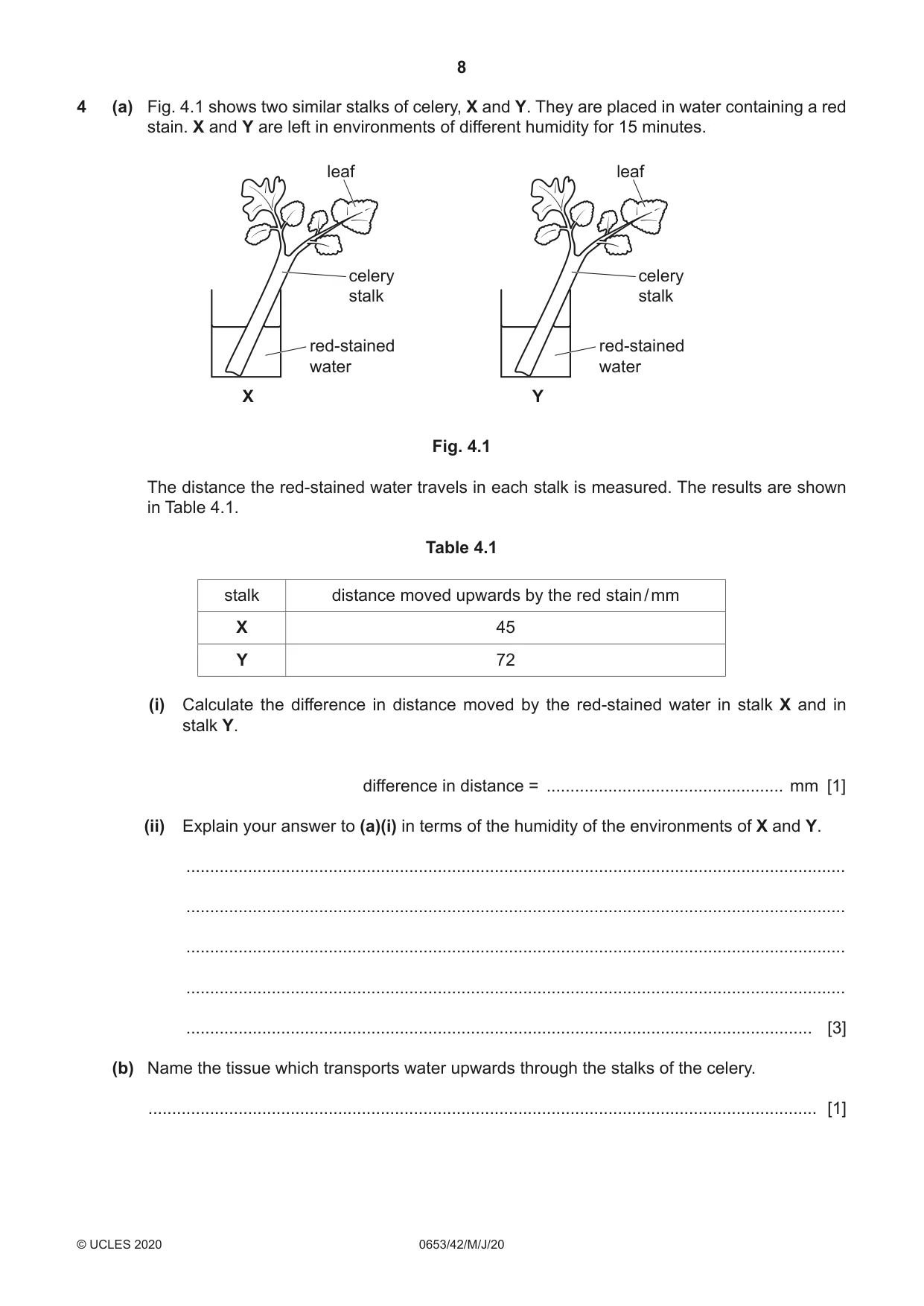
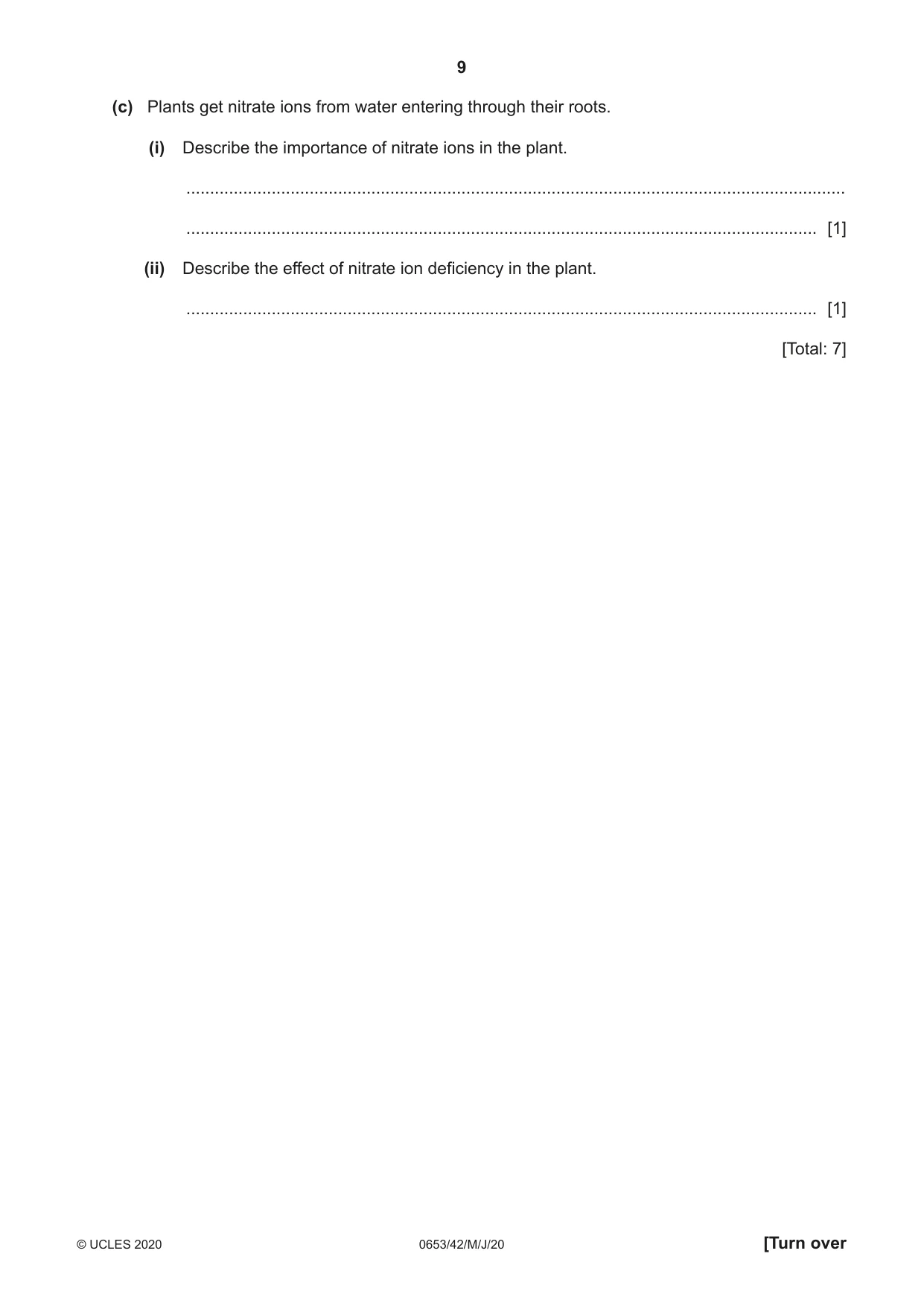
4 (a) Fig. 4.1 shows two similar stalks of celery, X and Y. They are placed in water containing a red stain. X and Y are left in environments of different humidity for 15 minutes. leaf leaf celery celery stalk stalk red-stained red-stained water water X Y Fig. 4.1 The distance the red-stained water travels in each stalk is measured. The results are shown in Table 4.1. Table 4.1 stalk distance moved upwards by the red stain / mm X 45 Y 72 (i) Calculate the difference in distance moved by the red-stained water in stalk X and in stalk Y. difference in distance = .................................................. mm [1] (ii) Explain your answer to (a)(i) in terms of the humidity of the environments of X and Y. ........................................................................................................................................... ........................................................................................................................................... ........................................................................................................................................... ........................................................................................................................................... .................................................................................................................................... [3] (b) Name the tissue which transports water upwards through the stalks of the celery. ............................................................................................................................................. [1] (c) Plants get nitrate ions from water entering through their roots. (i) Describe the importance of nitrate ions in the plant. ........................................................................................................................................... ..................................................................................................................................... [1] (ii) Describe the effect of nitrate ion deficiency in the plant. ..................................................................................................................................... [1] [Total: 7]
Mark scheme: 4(a)(i) (72 – 45 =) 27 (mm) ; 1 4(a)(ii) the environment for stalk Y had a lower humidity than stalk X ; transpiration rate increases at lower humidity ; due to increased water vapour gradient ; 3 4(b) xylem ; 1 4(c)(i) needed to make amino acids ; 1 Question Answer Marks 4(c)(ii) poor growth ; 1
Q5 · The equation for the reaction between magnesium carbonate and dilute hydrochloric acid is…
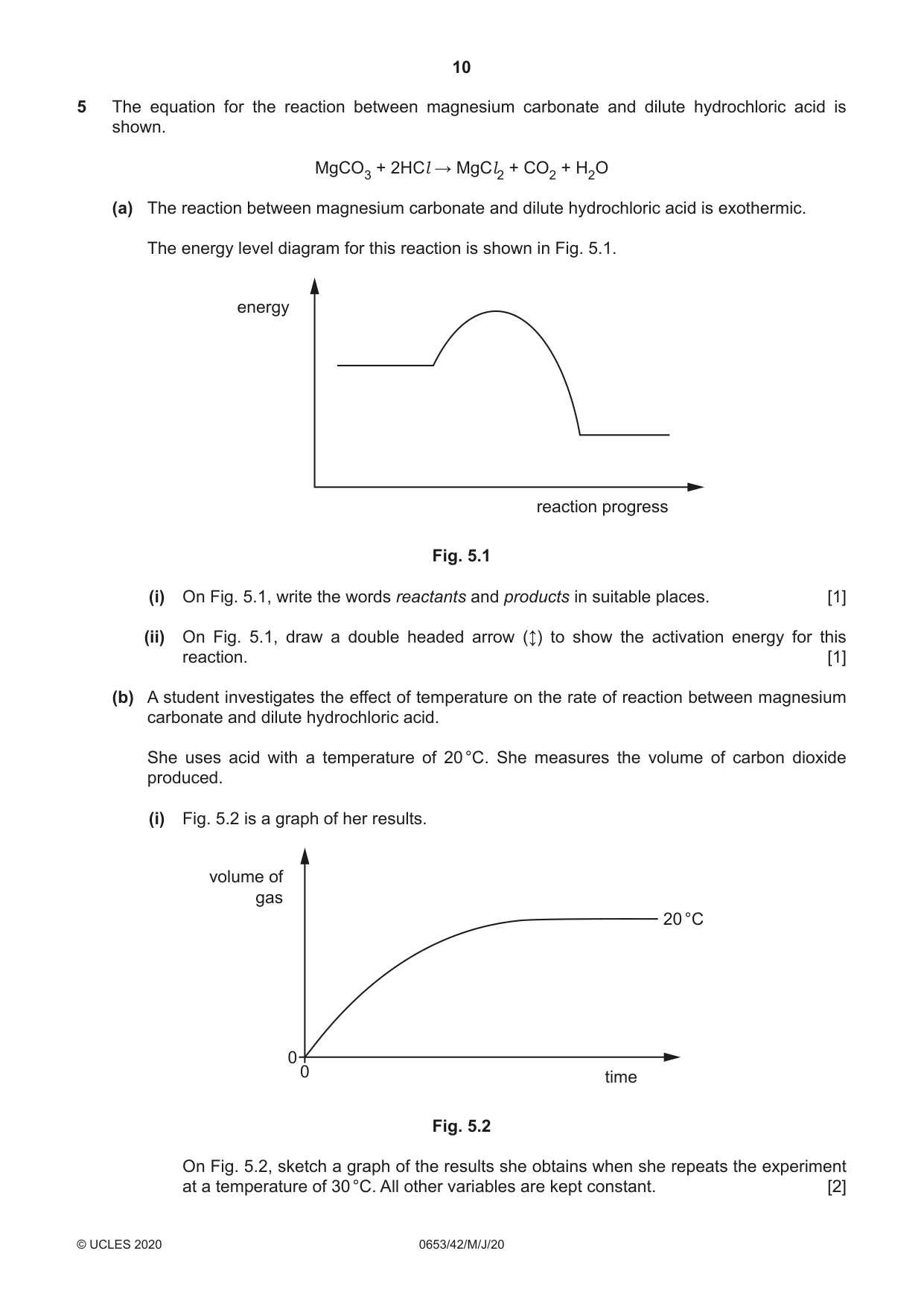
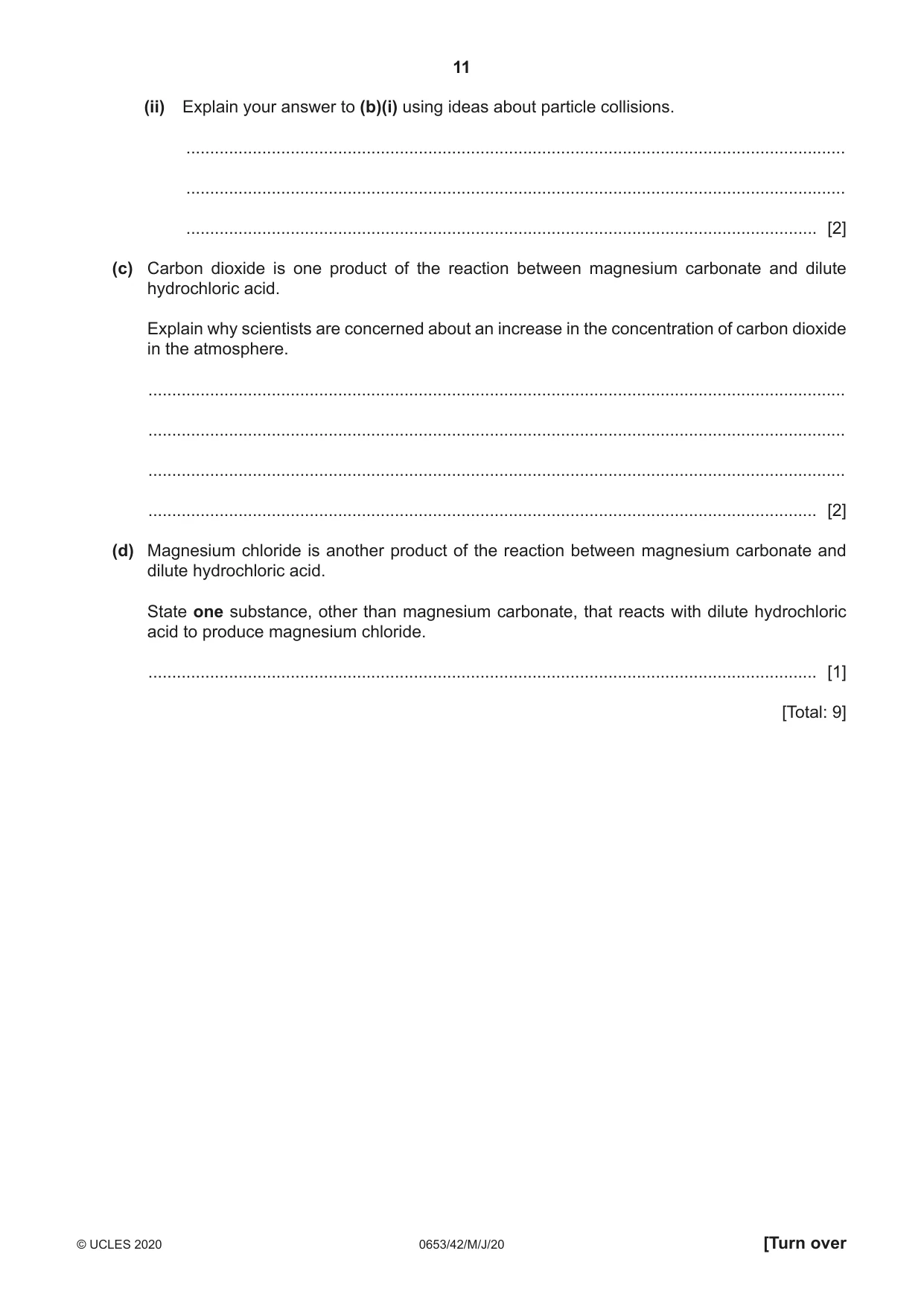
5 The equation for the reaction between magnesium carbonate and dilute hydrochloric acid is shown. MgCO3 + 2HCl → MgCl2 + CO2 + H2O (a) The reaction between magnesium carbonate and dilute hydrochloric acid is exothermic. The energy level diagram for this reaction is shown in Fig. 5.1. energy reaction progress Fig. 5.1 (i) On Fig. 5.1, write the words reactants and products in suitable places. [1] (ii) On Fig. 5.1, draw a double headed arrow (↕) to show the activation energy for this reaction. [1] (b) A student investigates the effect of temperature on the rate of reaction between magnesium carbonate and dilute hydrochloric acid. She uses acid with a temperature of 20 °C. She measures the volume of carbon dioxide produced. (i) Fig. 5.2 is a graph of her results. volume of gas 20 °C 0 0 time Fig. 5.2 On Fig. 5.2, sketch a graph of the results she obtains when she repeats the experiment at a temperature of 30 °C. All other variables are kept constant. [2] (ii) Explain your answer to (b)(i) using ideas about particle collisions. ........................................................................................................................................... ........................................................................................................................................... ..................................................................................................................................... [2] (c) Carbon dioxide is one product of the reaction between magnesium carbonate and dilute hydrochloric acid. Explain why scientists are concerned about an increase in the concentration of carbon dioxide in the atmosphere. ................................................................................................................................................... ................................................................................................................................................... ................................................................................................................................................... ............................................................................................................................................. [2] (d) Magnesium chloride is another product of the reaction between magnesium carbonate and dilute hydrochloric acid. State one substance, other than magnesium carbonate, that reacts with dilute hydrochloric acid to produce magnesium chloride. ............................................................................................................................................. [1] [Total: 9]
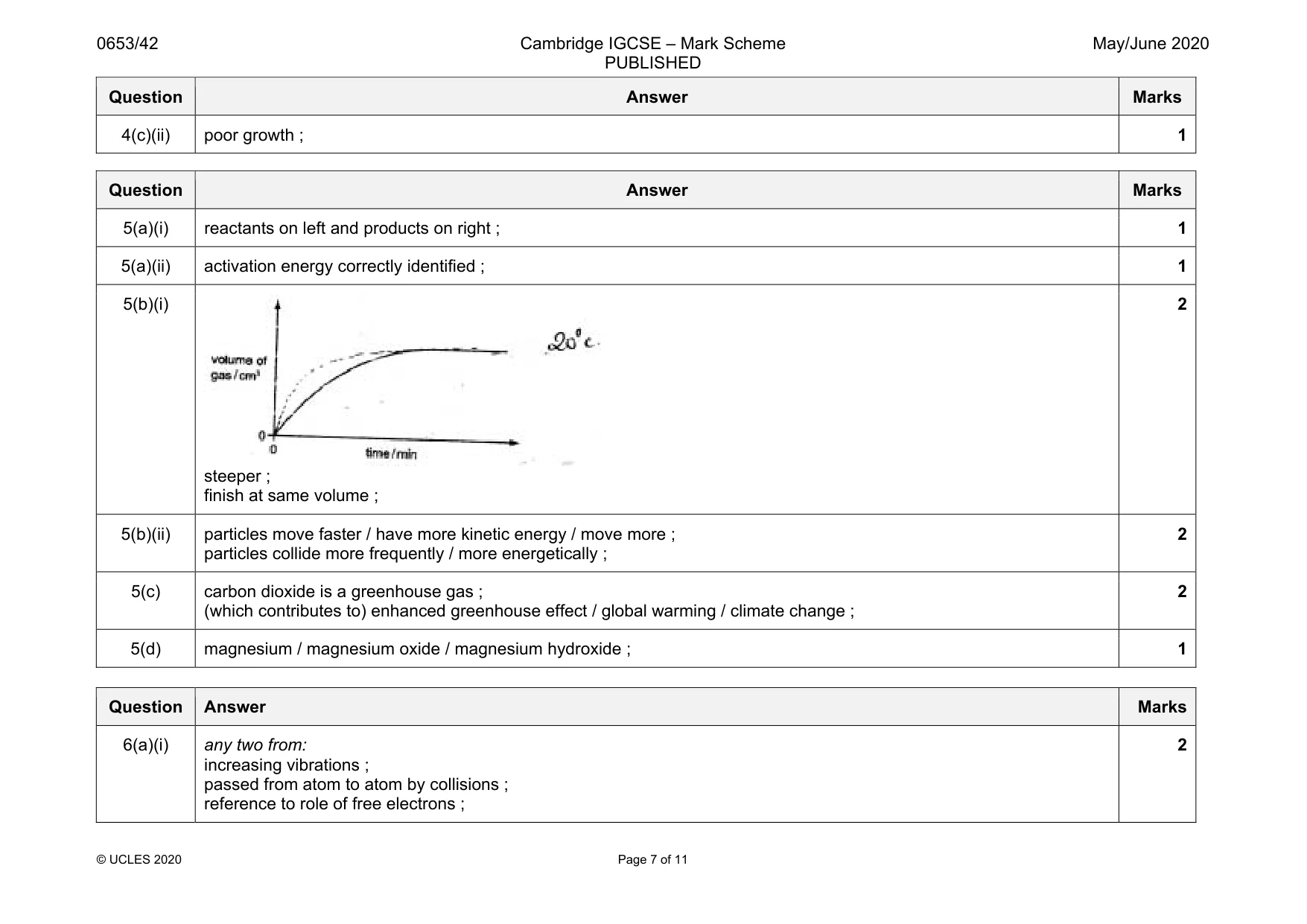
Mark scheme: 5(a)(i) reactants on left and products on right ; 1 5(a)(ii) activation energy correctly identified ; 1 5(b)(i) steeper ; finish at same volume ; 2 5(b)(ii) particles move faster / have more kinetic energy / move more ; particles collide more frequently / more energetically ; 2 5(c) carbon dioxide is a greenhouse gas ; (which contributes to) enhanced greenhouse effect / global warming / climate change ; 2 5(d) magnesium / magnesium oxide / magnesium hydroxide ; 1
Q6 · A man’s hand holding a metal rod in a hot flame
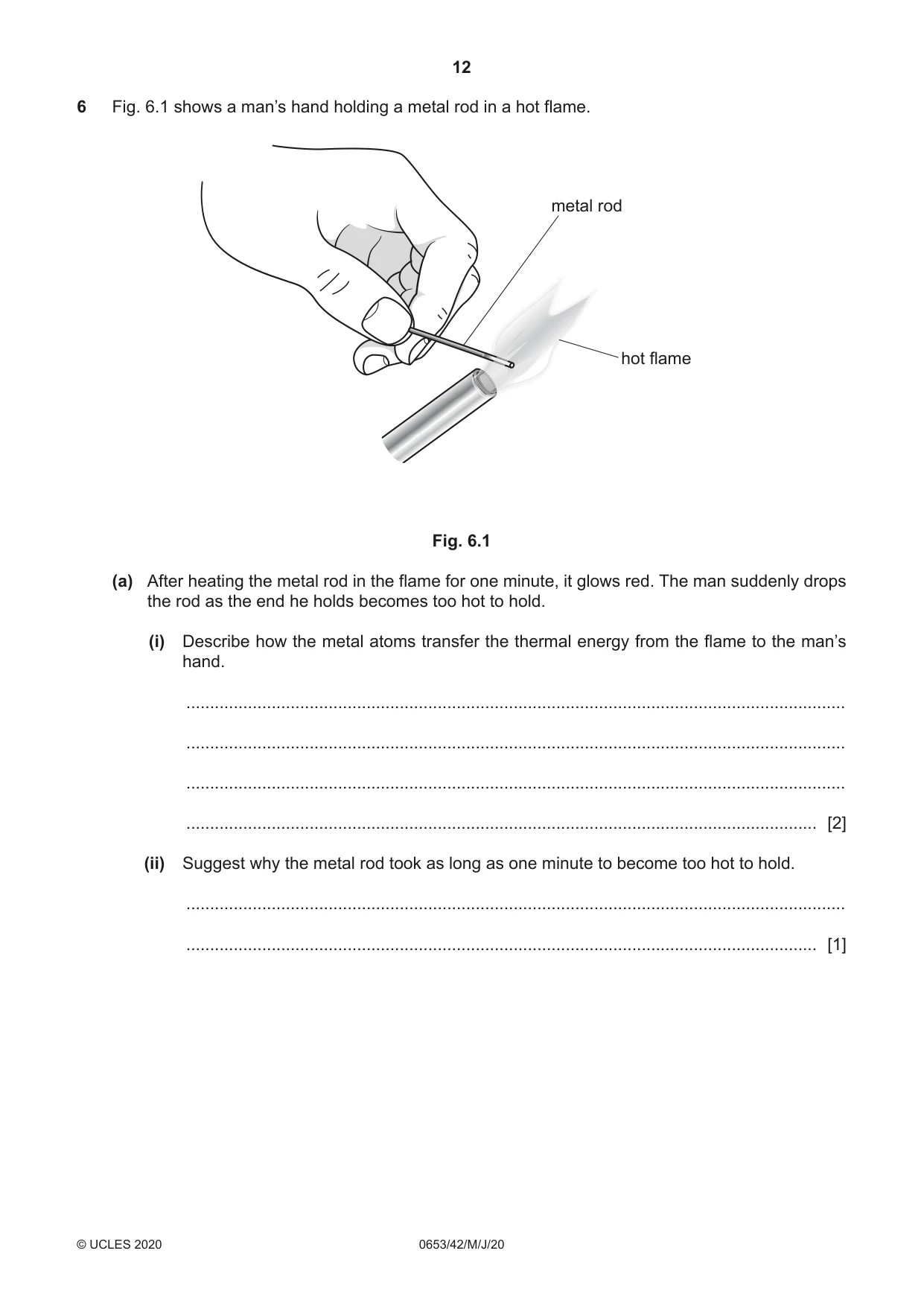
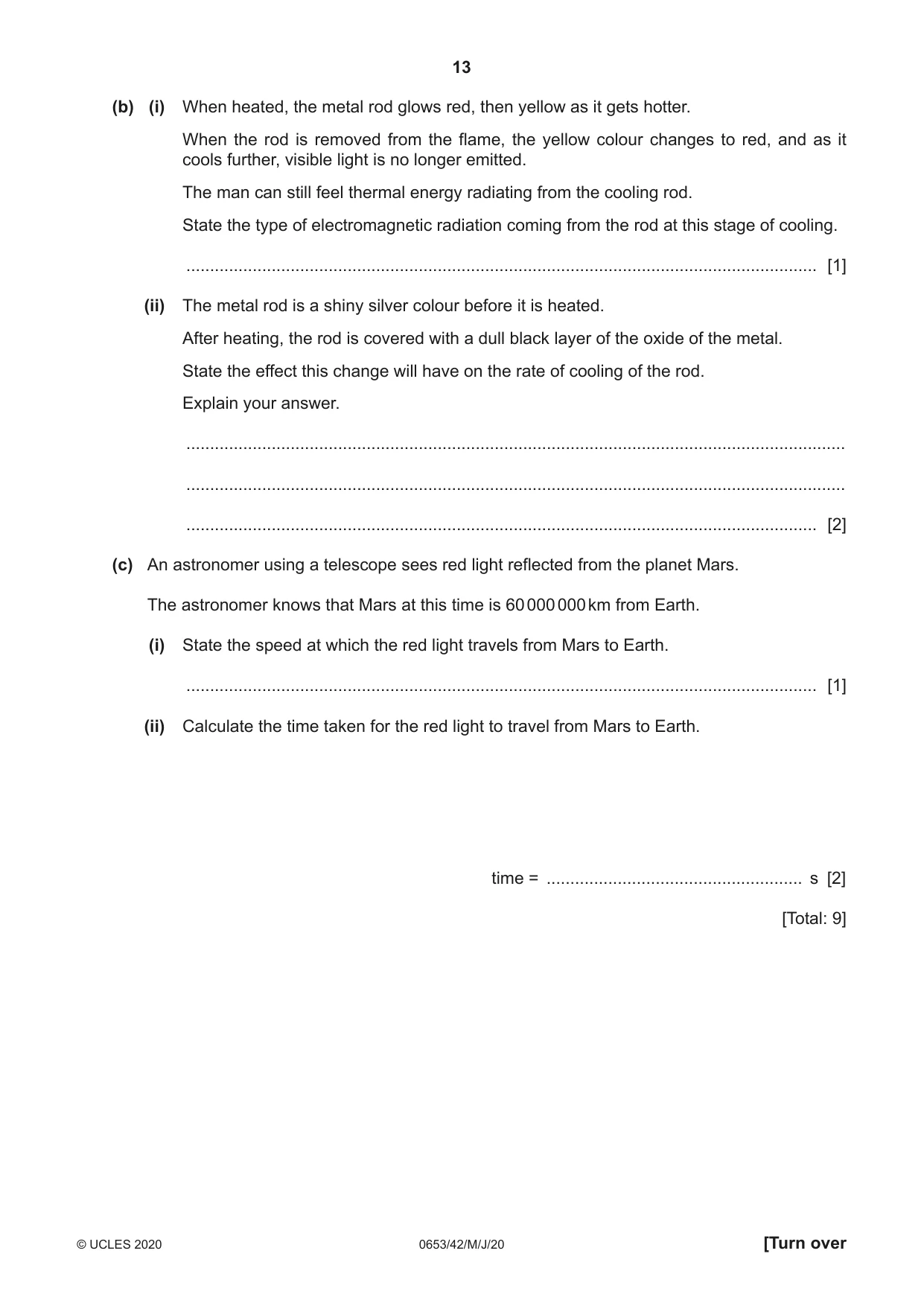
6 Fig. 6.1 shows a man’s hand holding a metal rod in a hot flame. metal rod hot flame Fig. 6.1 (a) After heating the metal rod in the flame for one minute, it glows red. The man suddenly drops the rod as the end he holds becomes too hot to hold. (i) Describe how the metal atoms transfer the thermal energy from the flame to the man’s hand. ........................................................................................................................................... ........................................................................................................................................... ........................................................................................................................................... ..................................................................................................................................... [2] (ii) Suggest why the metal rod took as long as one minute to become too hot to hold. ........................................................................................................................................... ..................................................................................................................................... [1] (b) (i) When heated, the metal rod glows red, then yellow as it gets hotter. When the rod is removed from the flame, the yellow colour changes to red, and as it cools further, visible light is no longer emitted. The man can still feel thermal energy radiating from the cooling rod. State the type of electromagnetic radiation coming from the rod at this stage of cooling. ..................................................................................................................................... [1] (ii) The metal rod is a shiny silver colour before it is heated. After heating, the rod is covered with a dull black layer of the oxide of the metal. State the effect this change will have on the rate of cooling of the rod. Explain your answer. ........................................................................................................................................... ........................................................................................................................................... ..................................................................................................................................... [2] (c) An astronomer using a telescope sees red light reflected from the planet Mars. The astronomer knows that Mars at this time is 60 000 000 km from Earth. (i) State the speed at which the red light travels from Mars to Earth. ..................................................................................................................................... [1] (ii) Calculate the time taken for the red light to travel from Mars to Earth. time = ...................................................... s [2] [Total: 9]
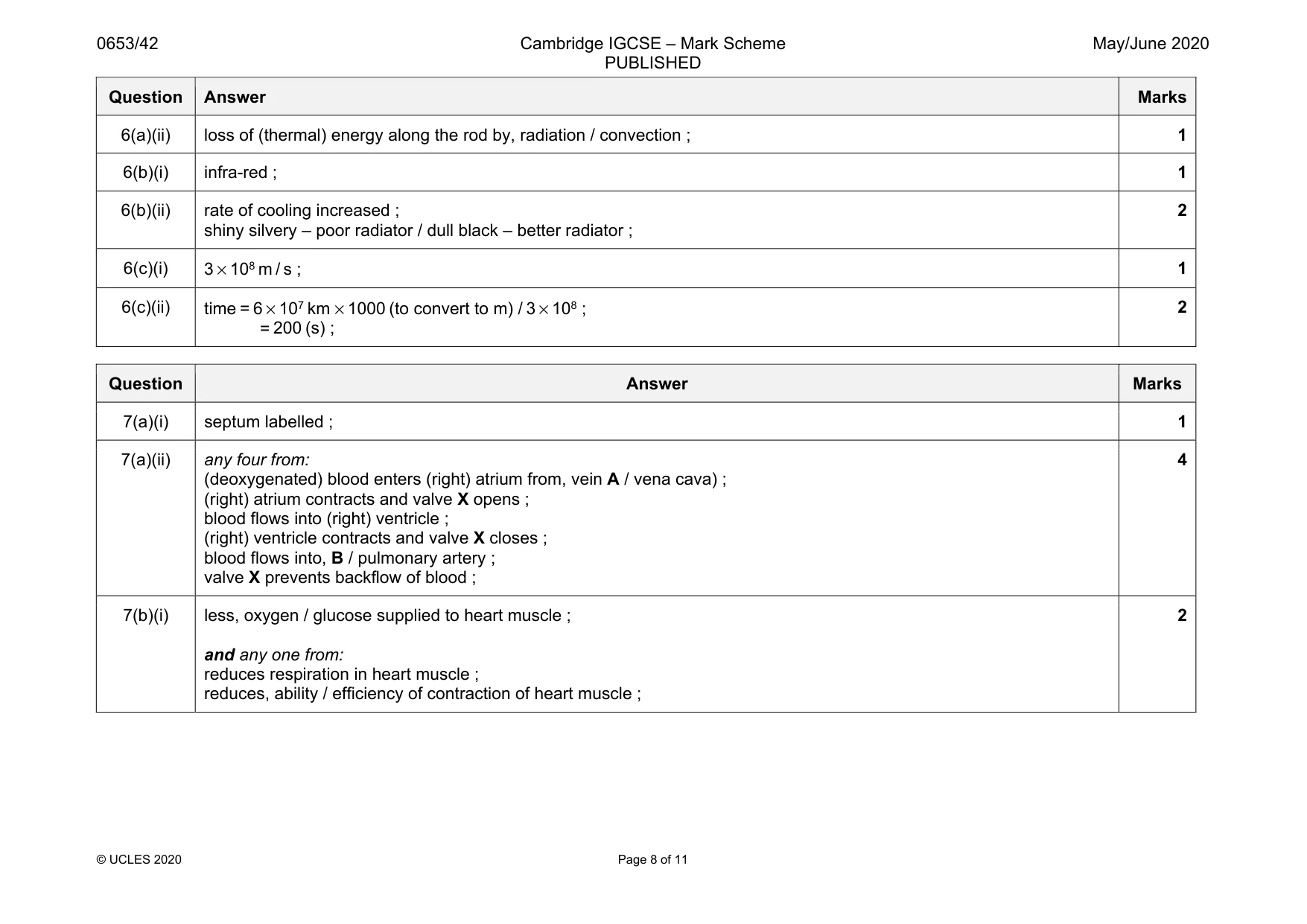
Mark scheme: 6(a)(i) any two from: increasing vibrations ; passed from atom to atom by collisions ; reference to role of free electrons ; Question Answer Marks 6(a)(ii) loss of (thermal) energy along the rod by, radiation / convection ; 1 6(b)(i) infra-red ; 1 6(b)(ii) rate of cooling increased ; shiny silvery – poor radiator / dull black – better radiator ; 2 6(c)(i) 3 × 10⁸ m / s ; 1 6(c)(ii) time = 6 × 107 km × 1000 (to convert to m) / 3 × 10⁸ ; = 200 (s) ; 2
Q7 · A diagram of the internal structure of the heart and the blood vessels to and from the…
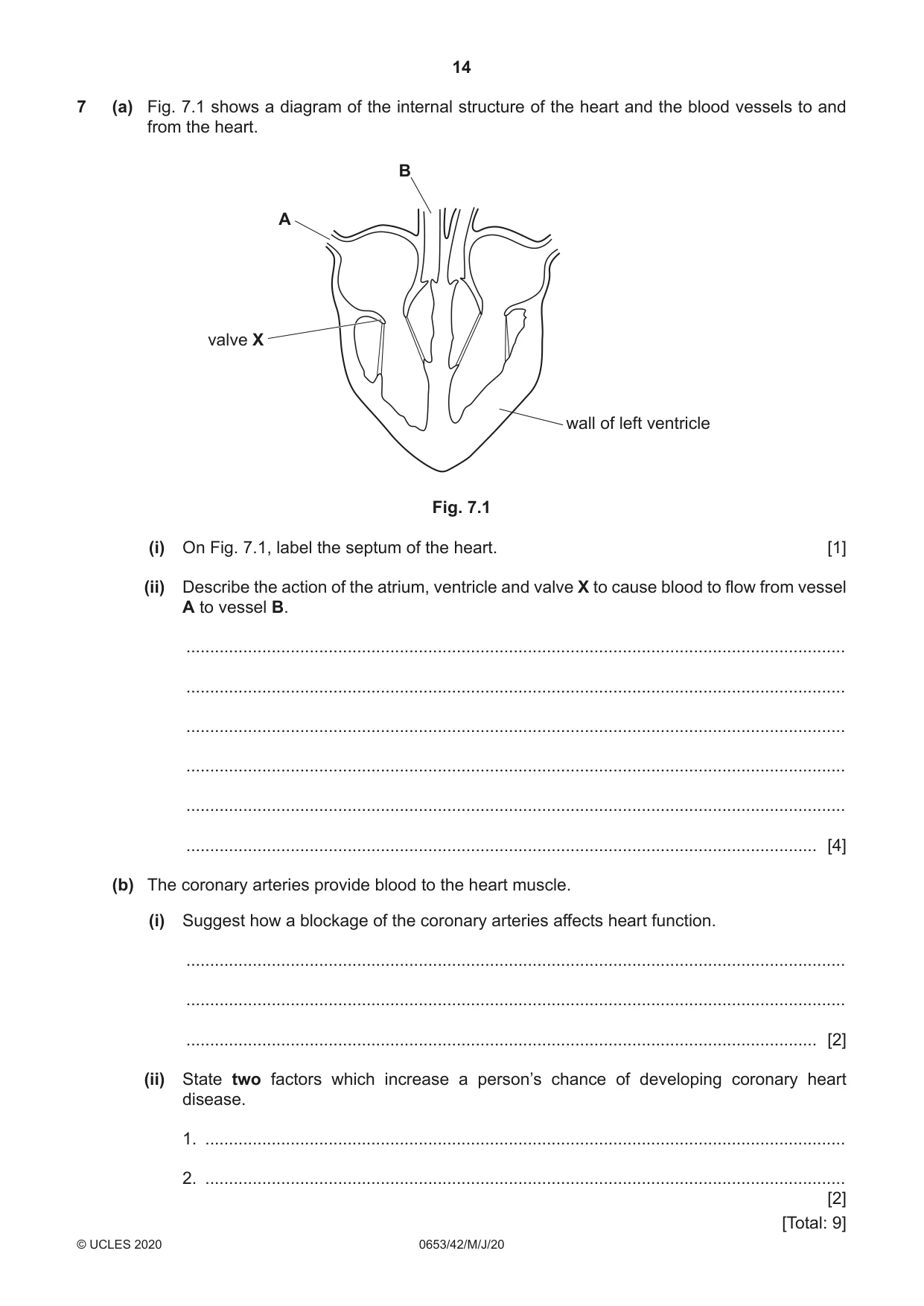
7 (a) Fig. 7.1 shows a diagram of the internal structure of the heart and the blood vessels to and from the heart. B A valve X wall of left ventricle Fig. 7.1 (i) On Fig. 7.1, label the septum of the heart. [1] (ii) Describe the action of the atrium, ventricle and valve X to cause blood to flow from vessel A to vessel B. ........................................................................................................................................... ........................................................................................................................................... ........................................................................................................................................... ........................................................................................................................................... ........................................................................................................................................... ..................................................................................................................................... [4] (b) The coronary arteries provide blood to the heart muscle. (i) Suggest how a blockage of the coronary arteries affects heart function. ........................................................................................................................................... ........................................................................................................................................... ..................................................................................................................................... [2] (ii) State two factors which increase a person’s chance of developing coronary heart disease. 1. ....................................................................................................................................... 2. ....................................................................................................................................... [2] [Total: 9]
Mark scheme: 7(a)(i) septum labelled ; 1 7(a)(ii) any four from: (deoxygenated) blood enters (right) atrium from, vein A / vena cava) ; (right) atrium contracts and valve X opens ; blood flows into (right) ventricle ; (right) ventricle contracts and valve X closes ; blood flows into, B / pulmonary artery ; valve X prevents backflow of blood ; 4 7(b)(i) less, oxygen / glucose supplied to heart muscle ; and any one from: reduces respiration in heart muscle ; reduces, ability / efficiency of contraction of heart muscle ; 2 Question Answer Marks 7(b)(ii) any two from: poor diet ; stress ; smoking ; genetic predisposition ; (increasing risk with) age ; sex / males more likely to get CHD ; AVP, e.g. lack of exercise / overweight ; 2
Q8 · Copper is a transition metal
8 (a) Copper is a transition metal. State two properties of copper that are not properties of Group I metals. 1. ............................................................................................................................................... 2. ............................................................................................................................................... [2] (b) Zinc is extracted from zinc oxide, ZnO. (i) The formula of an oxide ion is O2–. Deduce the charge of a zinc ion. Explain your answer. charge ........................... explanation ........................................................................................................................ ........................................................................................................................................... [2] (ii) Explain why zinc can be extracted from zinc oxide by reduction with carbon. Use ideas about the reactivity series in your answer. ........................................................................................................................................... ..................................................................................................................................... [1] (c) Molten sodium chloride can be electrolysed. (i) Explain why energy is needed to melt sodium chloride. ........................................................................................................................................... ..................................................................................................................................... [1] (ii) Explain why sodium chloride must be molten, and not solid, during electrolysis. ........................................................................................................................................... ..................................................................................................................................... [1] (iii) Predict the products of this electrolysis at the anode and at the cathode. anode ................................................................................................................................ cathode ............................................................................................................................. [2] [Total: 9]
Mark scheme: 8(a) forms coloured compounds ; has high melting point ; has high density ; 2 8(b)(i) (charge) 2+ ; (explanation) 2+ to balance 2– on oxide ion ; 2 8(b)(ii) carbon, above zinc in reactivity series / more reactive than zinc ; 1 8(c)(i) energy needed, for work to be done against attractive forces / to break interatomic ‘bonds’ / for particles to break free, from solid state ; 1 8(c)(ii) ions must be mobile ; 1 8(c)(iii) (anode) chlorine ; (cathode) sodium ; 2
Question 9
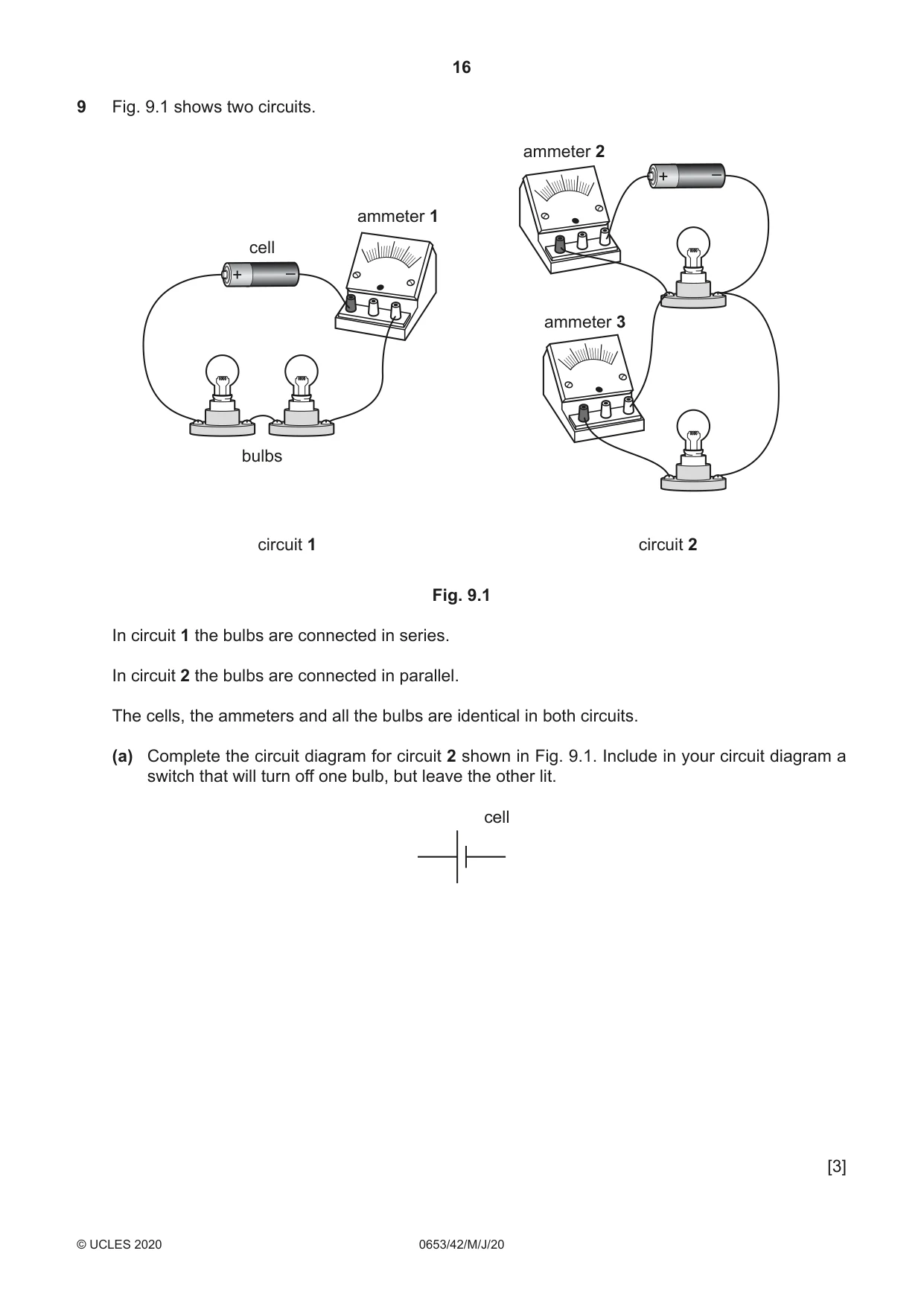
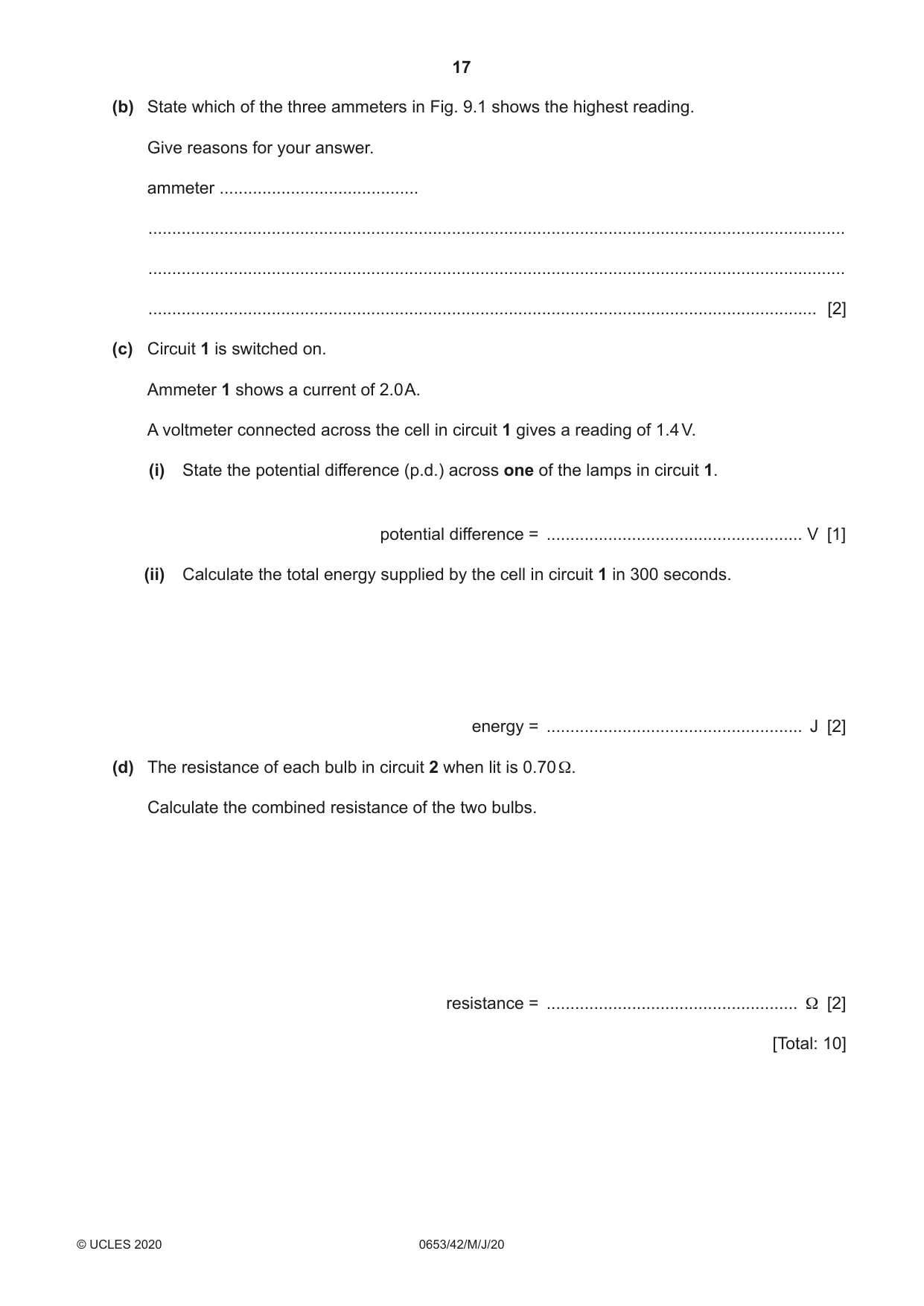
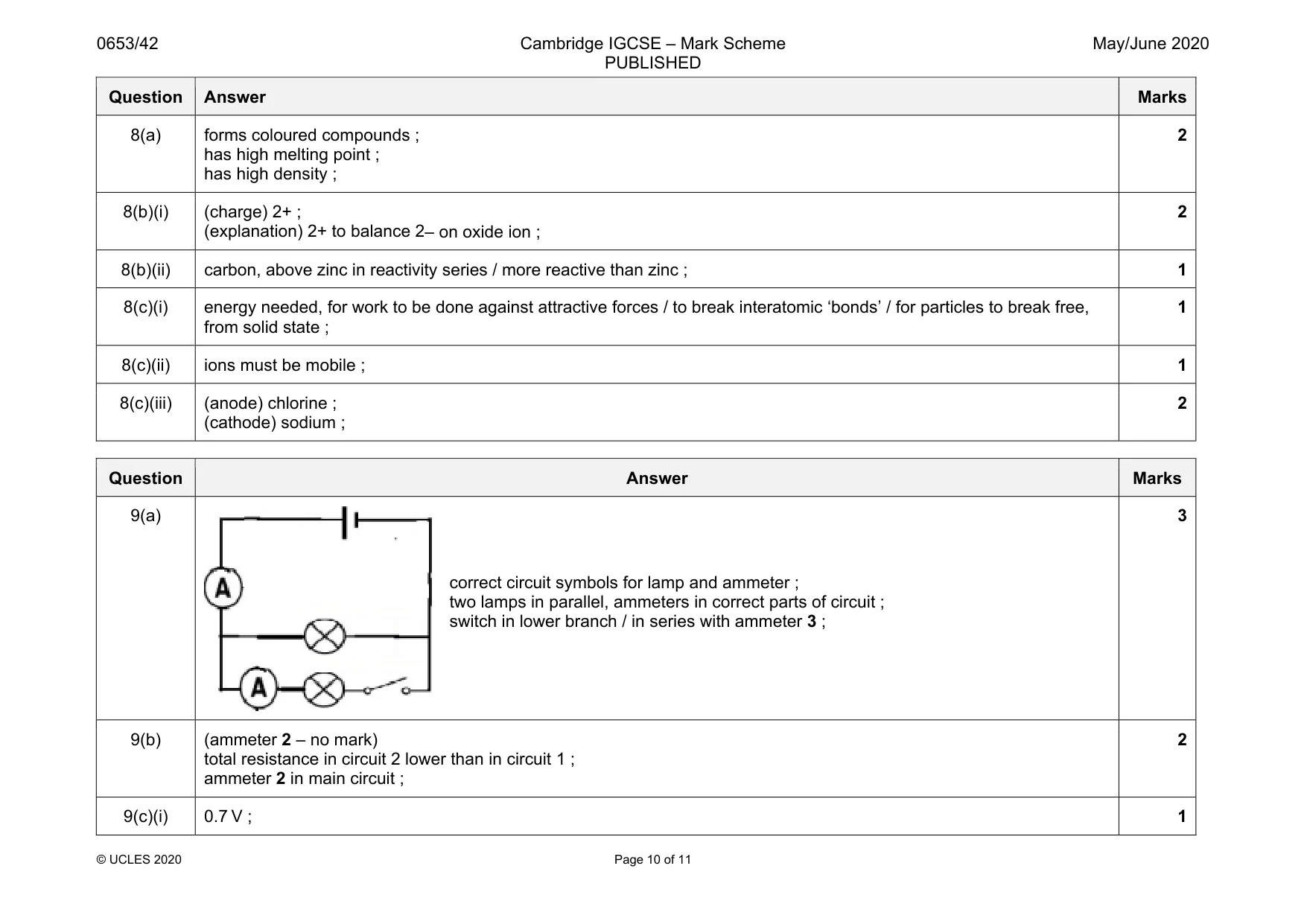
9 Fig. 9.1 shows two circuits. ammeter 2 + – ammeter 1 cell + – ammeter 3 bulbs circuit 1 circuit 2 Fig. 9.1 In circuit 1 the bulbs are connected in series. In circuit 2 the bulbs are connected in parallel. The cells, the ammeters and all the bulbs are identical in both circuits. (a) Complete the circuit diagram for circuit 2 shown in Fig. 9.1. Include in your circuit diagram a switch that will turn off one bulb, but leave the other lit. cell [3] (b) State which of the three ammeters in Fig. 9.1 shows the highest reading. Give reasons for your answer. ammeter .......................................... ................................................................................................................................................... ................................................................................................................................................... ............................................................................................................................................. [2] (c) Circuit 1 is switched on. Ammeter 1 shows a current of 2.0 A. A voltmeter connected across the cell in circuit 1 gives a reading of 1.4 V. (i) State the potential difference (p.d.) across one of the lamps in circuit 1. potential difference = ...................................................... V [1] (ii) Calculate the total energy supplied by the cell in circuit 1 in 300 seconds. energy = ...................................................... J [2] (d) The resistance of each bulb in circuit 2 when lit is 0.70 Ω. Calculate the combined resistance of the two bulbs. resistance = ..................................................... Ω [2] [Total: 10]
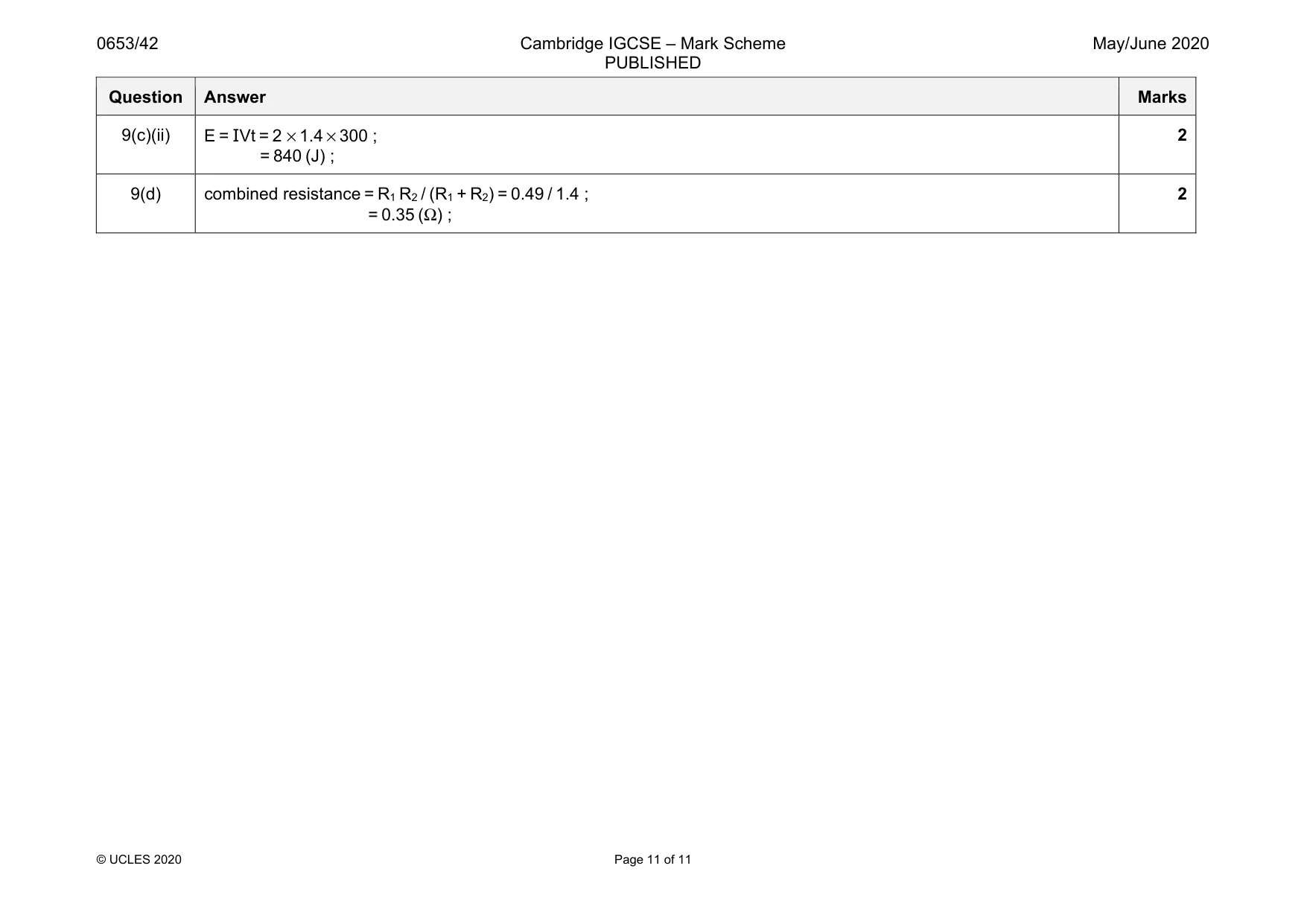
Mark scheme: 9(a) 9(b) (ammeter 2 – no mark) total resistance in circuit 2 lower than in circuit 1 ; ammeter 2 in main circuit ; 2 9(c)(i) 0.7 V ; 1 correct circuit symbols for lamp and ammeter ; two lamps in parallel, ammeters in correct parts of circuit ; switch in lower branch / in series with ammeter 3 ; Question Answer Marks 9(c)(ii) E = IVt = 2 × 1.4 × 300 ; = 840 (J) ; 2 9(d) combined resistance = R1 R2 / (R1 + R2) = 0.49 / 1.4 ; = 0.35 (Ω) ; 2
What was in this paper
The subtopics covered by these 9 questions, and how many questions each got. Open one in a new tab to see every Cambridge question on it.