Cambridge IGCSE Science - Combined 0653 — 2022 Oct/Nov Paper 4 · Variant 2
0653/42/O/N/22 · 9 questions · 80 marks · ≈90 min
The question paper and its mark scheme, free to read here and free to download. This is Cambridge’s own paper, exactly as it was sat.
Question paper20 pages
Mark scheme12 pages
Answers below. Sit the paper first if you are practising.
Questions as text
Q1 · A diagram of the human heart
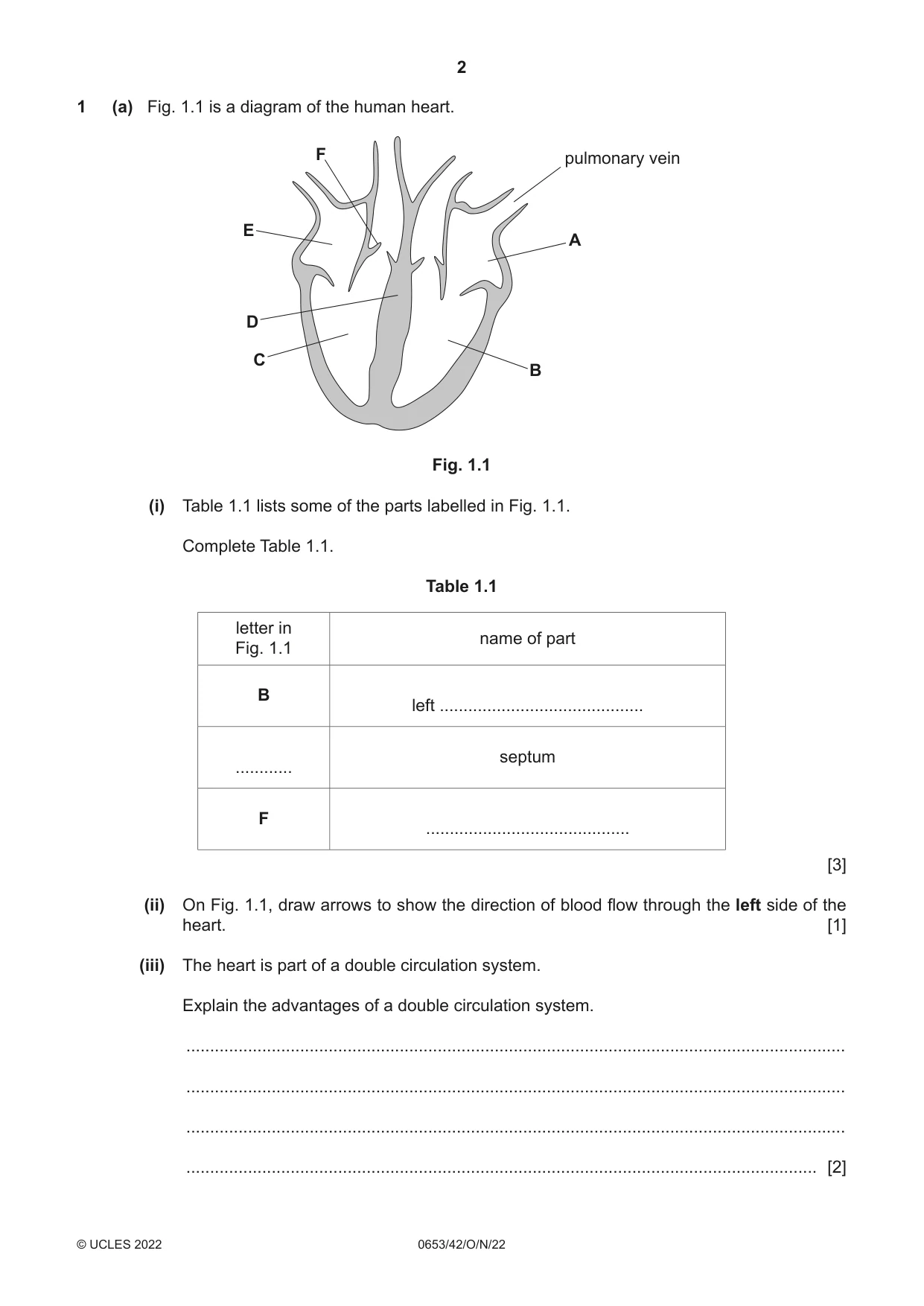
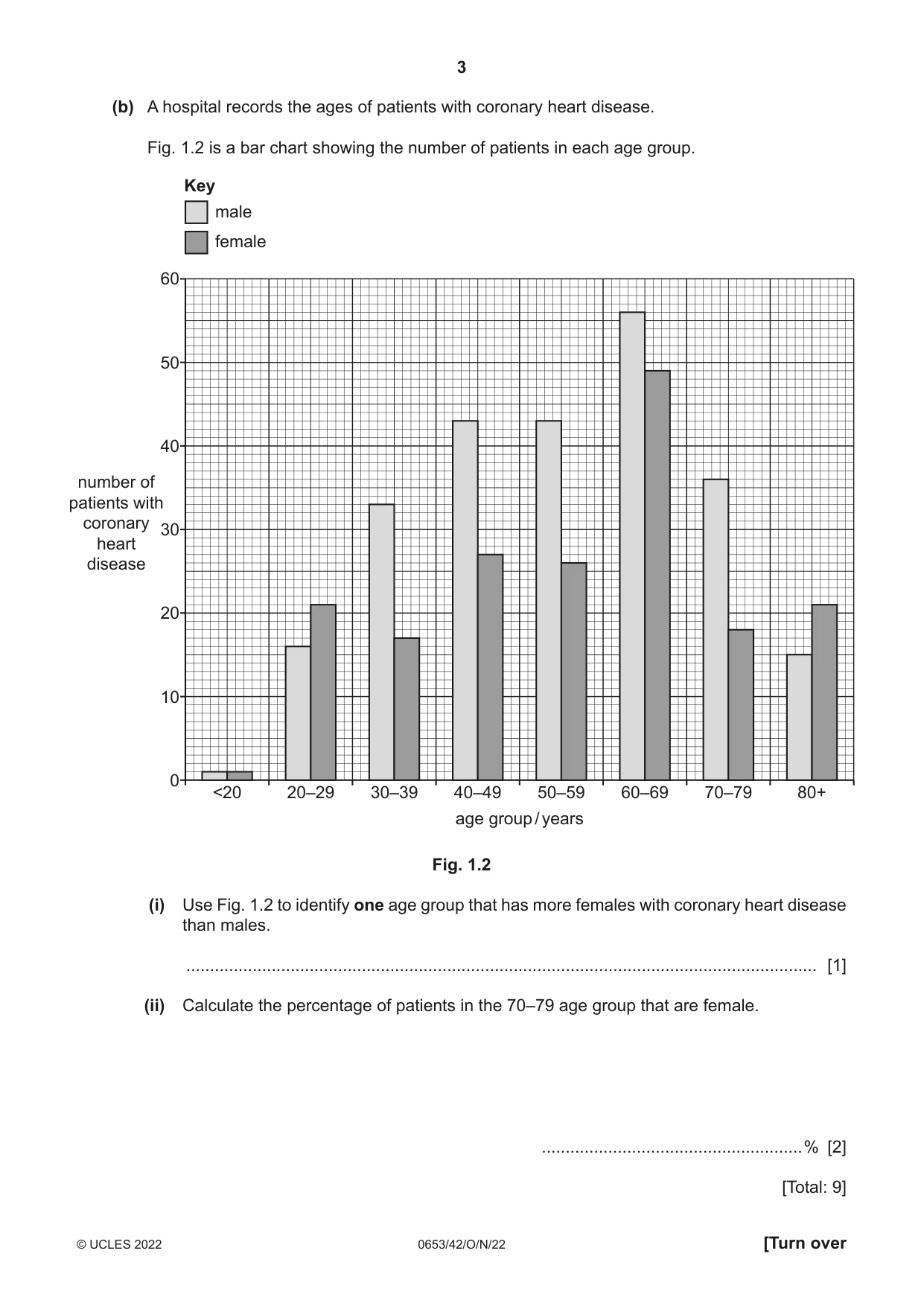
1 (a) Fig. 1.1 is a diagram of the human heart. F pulmonary vein E A D C B Fig. 1.1 (i) Table 1.1 lists some of the parts labelled in Fig. 1.1. Complete Table 1.1. Table 1.1 letter in name of part Fig. 1.1 B left ........................................... septum ............ F ........................................... [3] (ii) On Fig. 1.1, draw arrows to show the direction of blood flow through the left side of the heart. [1] (iii) The heart is part of a double circulation system. Explain the advantages of a double circulation system. ........................................................................................................................................... ........................................................................................................................................... ........................................................................................................................................... ..................................................................................................................................... [2] (b) A hospital records the ages of patients with coronary heart disease. Fig. 1.2 is a bar chart showing the number of patients in each age group. Key male female 60 50 40 number of patients with coronary 30 heart disease 20 10 0 <20 20–29 30–39 40–49 50–59 60–69 70–79 80+ age group / years Fig. 1.2 (i) Use Fig. 1.2 to identify one age group that has more females with coronary heart disease than males. ..................................................................................................................................... [1] (ii) Calculate the percentage of patients in the 70–79 age group that are female. .......................................................% [2] [Total: 9]
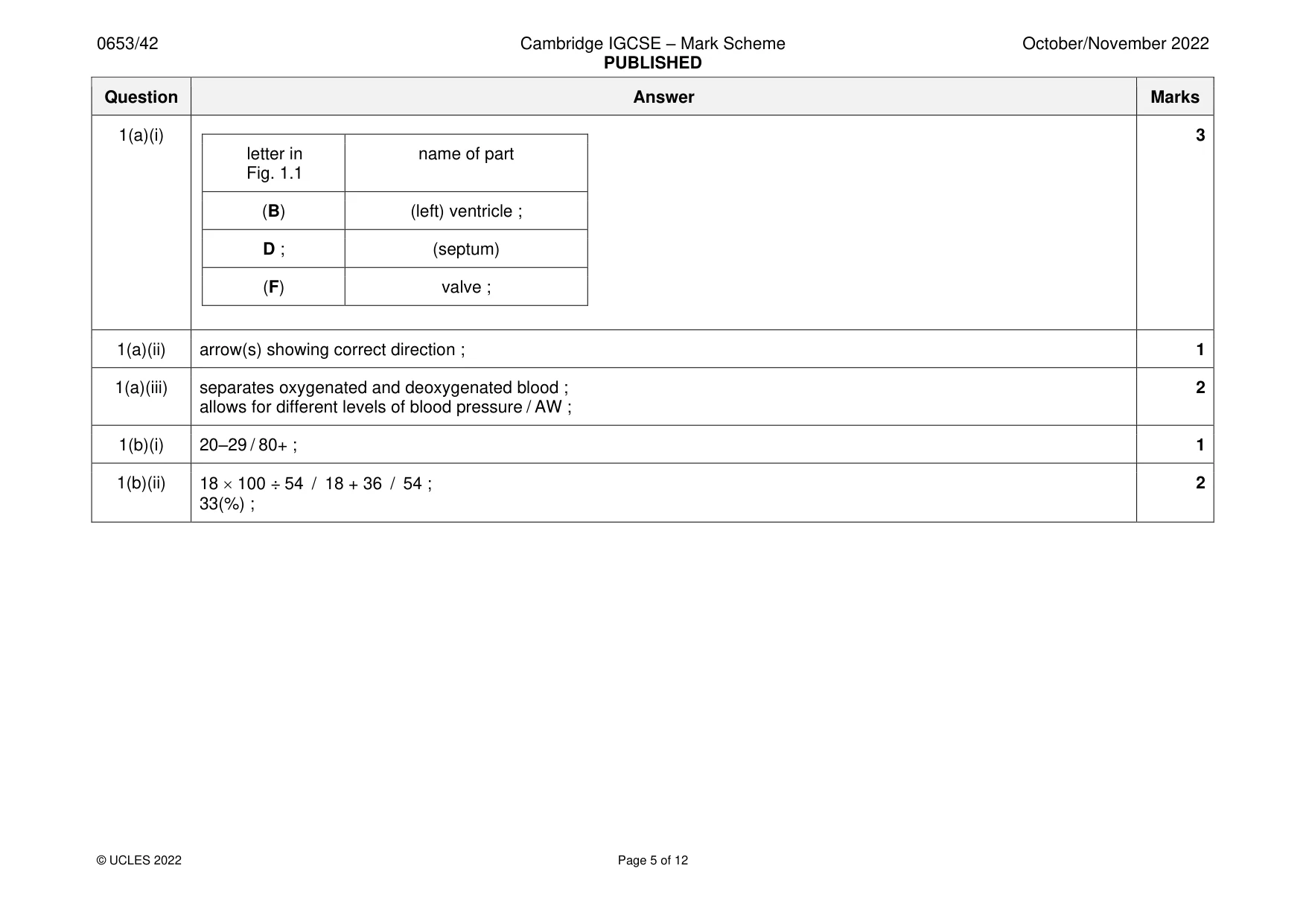
Mark scheme: Question Answer Marks 1(a)(i) 3 letter in name of part Fig. 1.1 (B) (left) ventricle ; D ; (septum) (F) valve ; 1(a)(ii) arrow(s) showing correct direction ; 1 1(a)(iii) separates oxygenated and deoxygenated blood ; 2 allows for different levels of blood pressure / AW ; 1(b)(i) 20–29 / 80+ ; 1 1(b)(ii) 18 100 ÷ 54 / 18 + 36 / 54 ; 2 33(%) ;
Q2 · Iron is extracted from hematite in the blast furnace
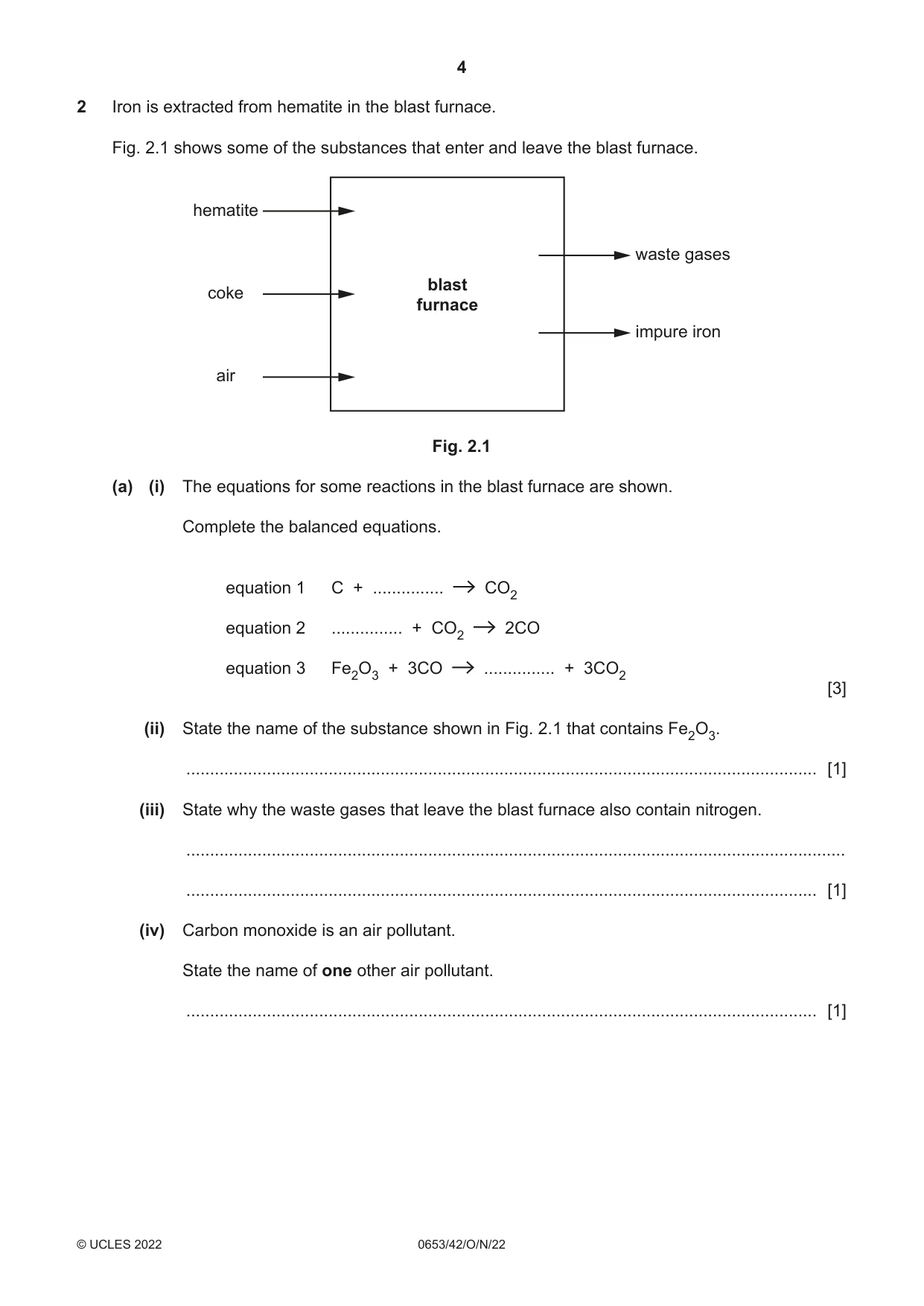
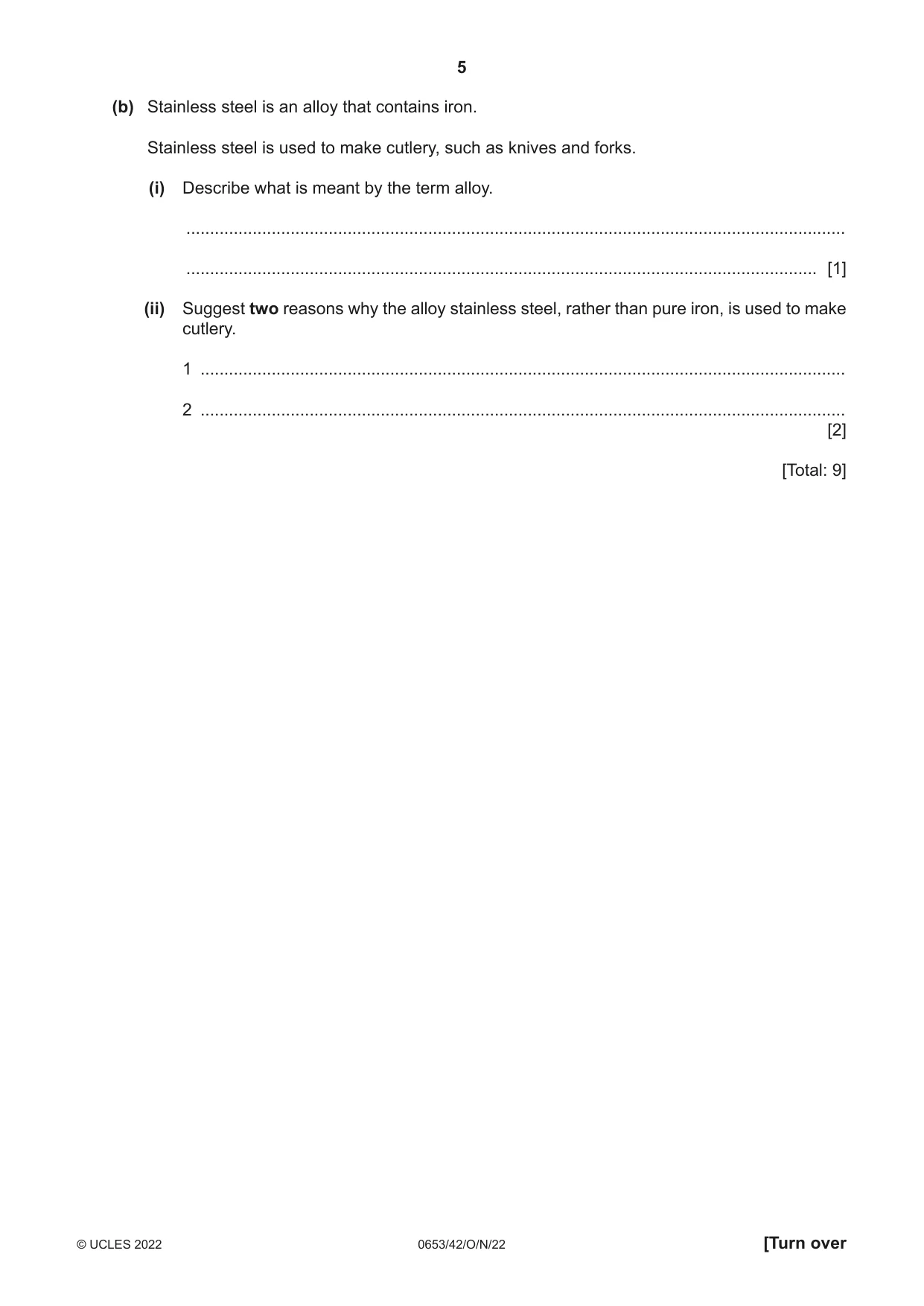
2 Iron is extracted from hematite in the blast furnace. Fig. 2.1 shows some of the substances that enter and leave the blast furnace. hematite waste gases blast coke furnace impure iron air Fig. 2.1 (a) (i) The equations for some reactions in the blast furnace are shown. Complete the balanced equations. equation 1 C + ............... CO2 equation 2 ............... + CO2 2CO equation 3 Fe2O3 + 3CO ............... + 3CO2 [3] (ii) State the name of the substance shown in Fig. 2.1 that contains Fe2O3. ..................................................................................................................................... [1] (iii) State why the waste gases that leave the blast furnace also contain nitrogen. ........................................................................................................................................... ..................................................................................................................................... [1] (iv) Carbon monoxide is an air pollutant. State the name of one other air pollutant. ..................................................................................................................................... [1] (b) Stainless steel is an alloy that contains iron. Stainless steel is used to make cutlery, such as knives and forks. (i) Describe what is meant by the term alloy. ........................................................................................................................................... ..................................................................................................................................... [1] (ii) Suggest two reasons why the alloy stainless steel, rather than pure iron, is used to make cutlery. 1 ........................................................................................................................................ 2 ........................................................................................................................................ [2] [Total: 9]
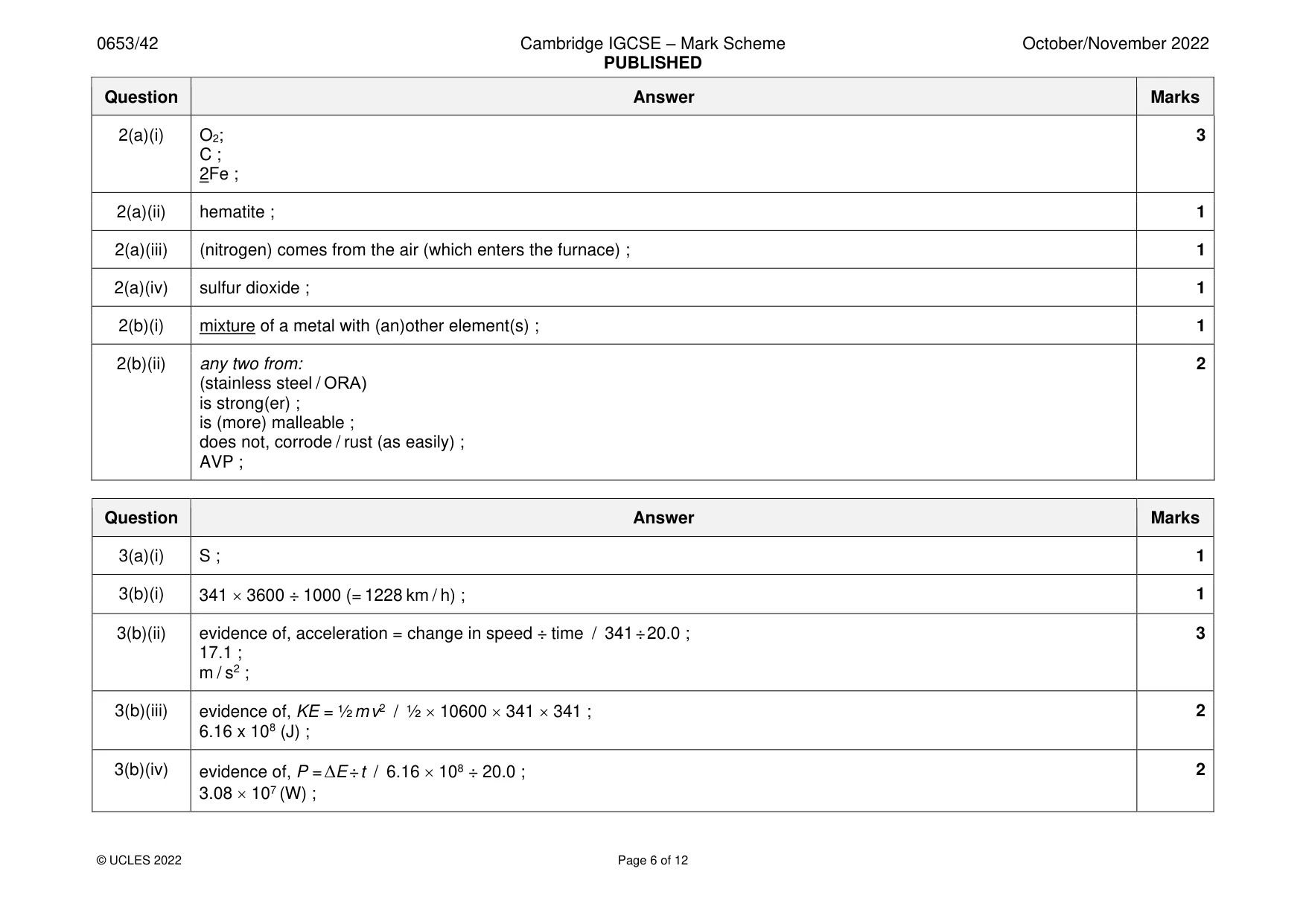
Mark scheme: 2(a)(i) O2; 3 C ; 2Fe ; 2(a)(ii) hematite ; 1 2(a)(iii) (nitrogen) comes from the air (which enters the furnace) ; 1 2(a)(iv) sulfur dioxide ; 1 2(b)(i) mixture of a metal with (an)other element(s) ; 1 2(b)(ii) any two from: 2 (stainless steel / ORA) is strong(er) ; is (more) malleable ; does not, corrode / rust (as easily) ; AVP ;
Q3 · In 1997, the Thrust Supersonic Car set a world land speed record
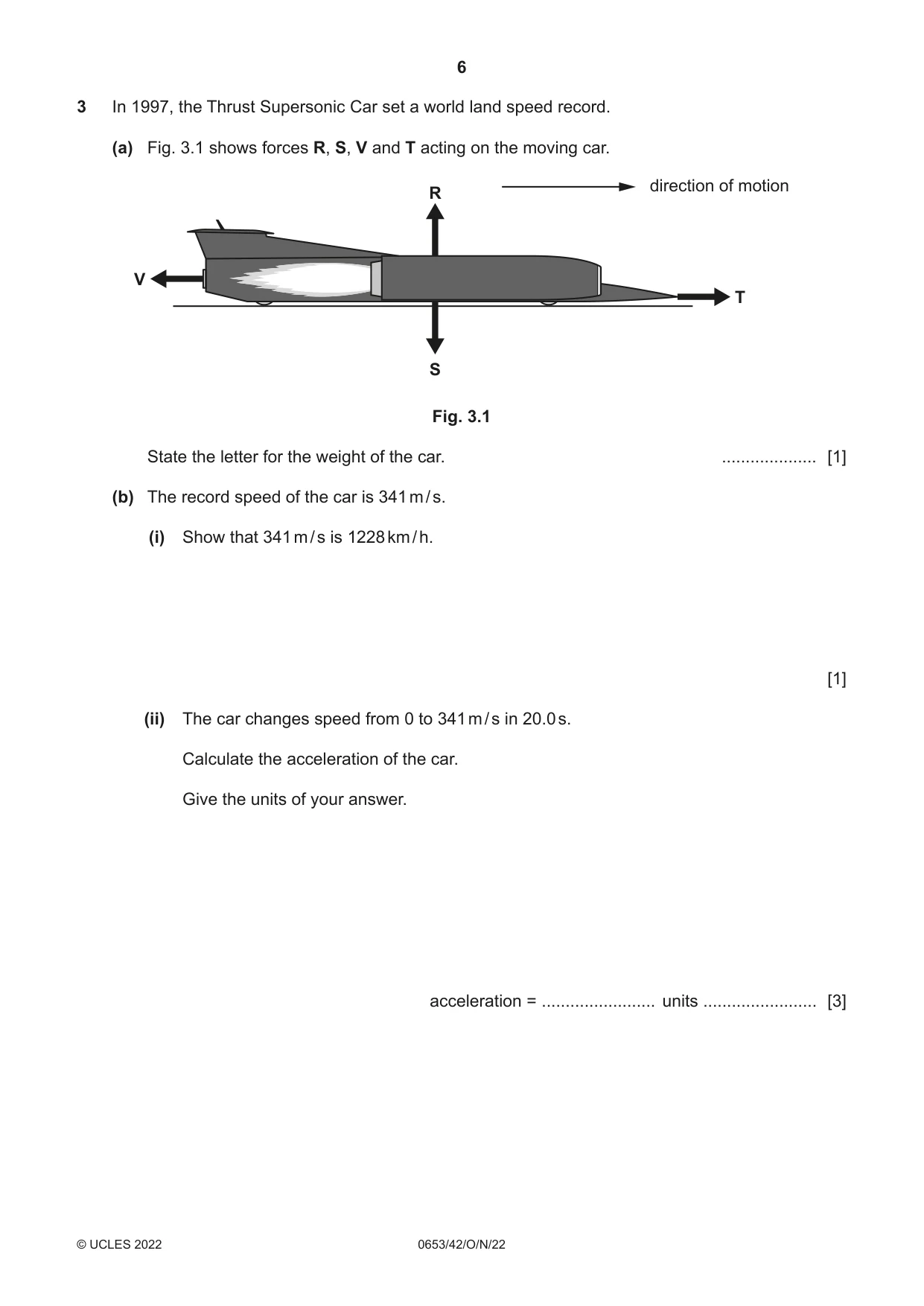
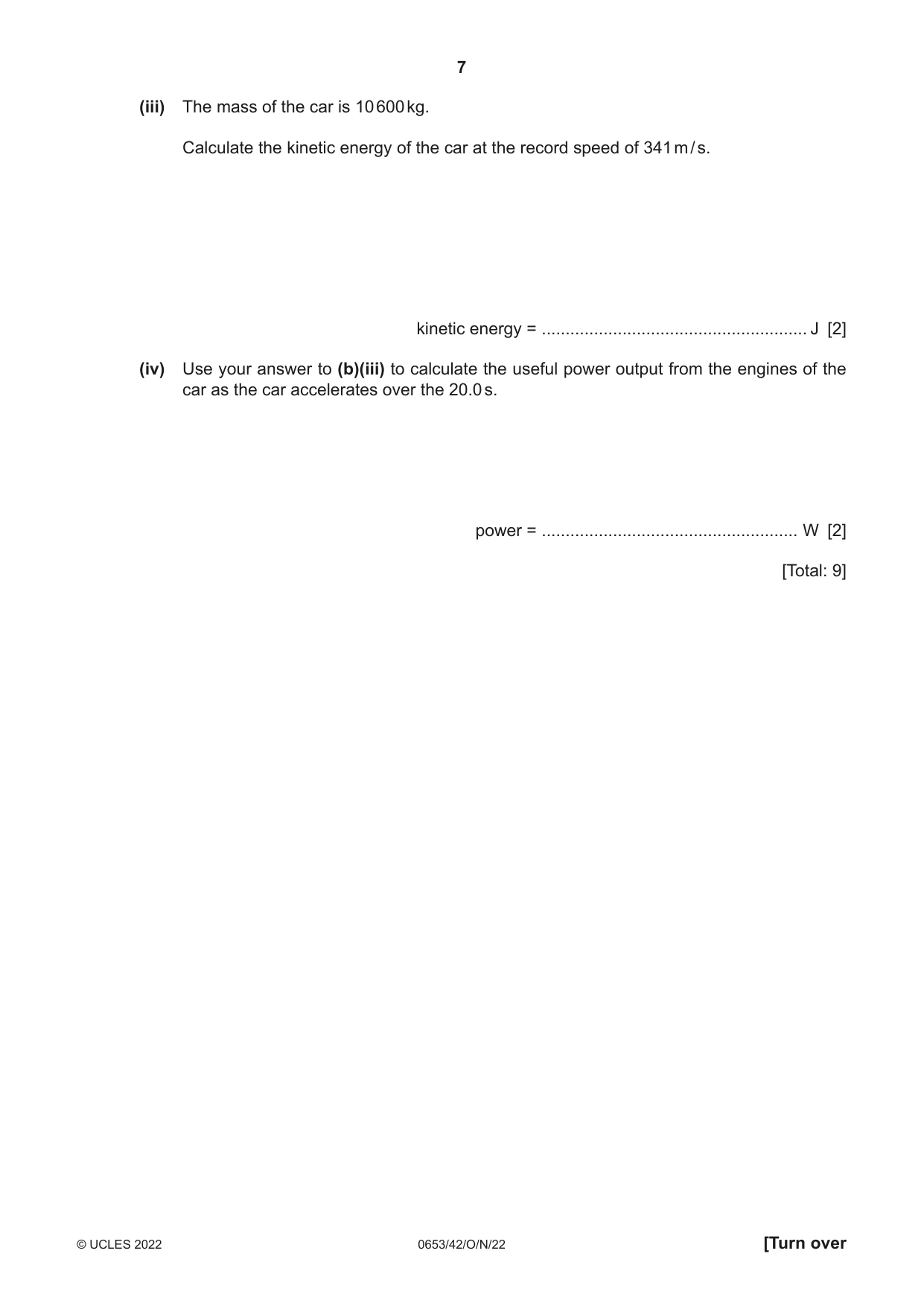
3 In 1997, the Thrust Supersonic Car set a world land speed record. (a) Fig. 3.1 shows forces R, S, V and T acting on the moving car. direction of motion R V T S Fig. 3.1 State the letter for the weight of the car. .................... [1] (b) The record speed of the car is 341 m / s. (i) Show that 341 m / s is 1228 km / h. [1] (ii) The car changes speed from 0 to 341 m / s in 20.0 s. Calculate the acceleration of the car. Give the units of your answer. acceleration = ........................ units ........................ [3] (iii) The mass of the car is 10 600 kg. Calculate the kinetic energy of the car at the record speed of 341 m / s. kinetic energy = ........................................................ J [2] (iv) Use your answer to (b)(iii) to calculate the useful power output from the engines of the car as the car accelerates over the 20.0 s. power = ...................................................... W [2] [Total: 9]
Mark scheme: 3(a)(i) S ; 1 3(b)(i) 341 3600 ÷ 1000 (= 1228 km / h) ; 1 3(b)(ii) evidence of, acceleration = change in speed ÷ time / 341 ÷ 20.0 ; 3 17.1 ; m / s2 ; 3(b)(iii) evidence of, KE = ½ m v2 / ½ 10600 341 341 ; 2 6.16 x 10⁸ (J) ; 3(b)(iv) evidence of, P = E ÷ t / 6.16 108 ÷ 20.0 ; 2 3.08 107 (W) ;
More questions on Physical quantities and measurement techniques
Q4 · Water moves from the roots of a plant through the stem to the leaves
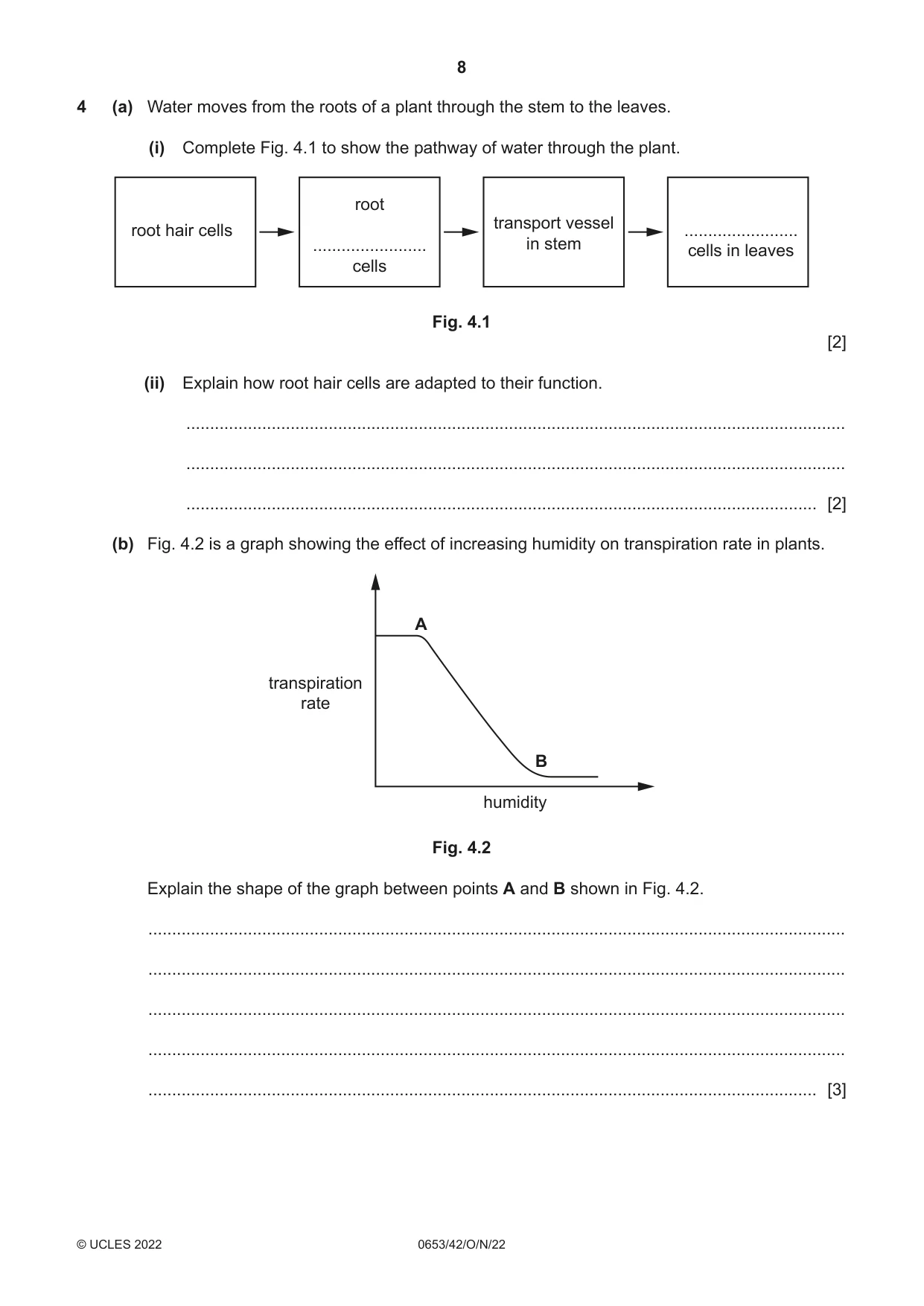
4 (a) Water moves from the roots of a plant through the stem to the leaves. (i) Complete Fig. 4.1 to show the pathway of water through the plant. root transport vessel root hair cells ........................ ........................ in stem cells in leaves cells Fig. 4.1 [2] (ii) Explain how root hair cells are adapted to their function. ........................................................................................................................................... ........................................................................................................................................... ..................................................................................................................................... [2] (b) Fig. 4.2 is a graph showing the effect of increasing humidity on transpiration rate in plants. A transpiration rate B humidity Fig. 4.2 Explain the shape of the graph between points A and B shown in Fig. 4.2. ................................................................................................................................................... ................................................................................................................................................... ................................................................................................................................................... ................................................................................................................................................... ............................................................................................................................................. [3] (c) Describe two differences between the pollen from insect‑pollinated flowers and the pollen from wind‑pollinated flowers. 1 ................................................................................................................................................ ................................................................................................................................................... 2 ................................................................................................................................................ ................................................................................................................................................... [2] [Total: 9]
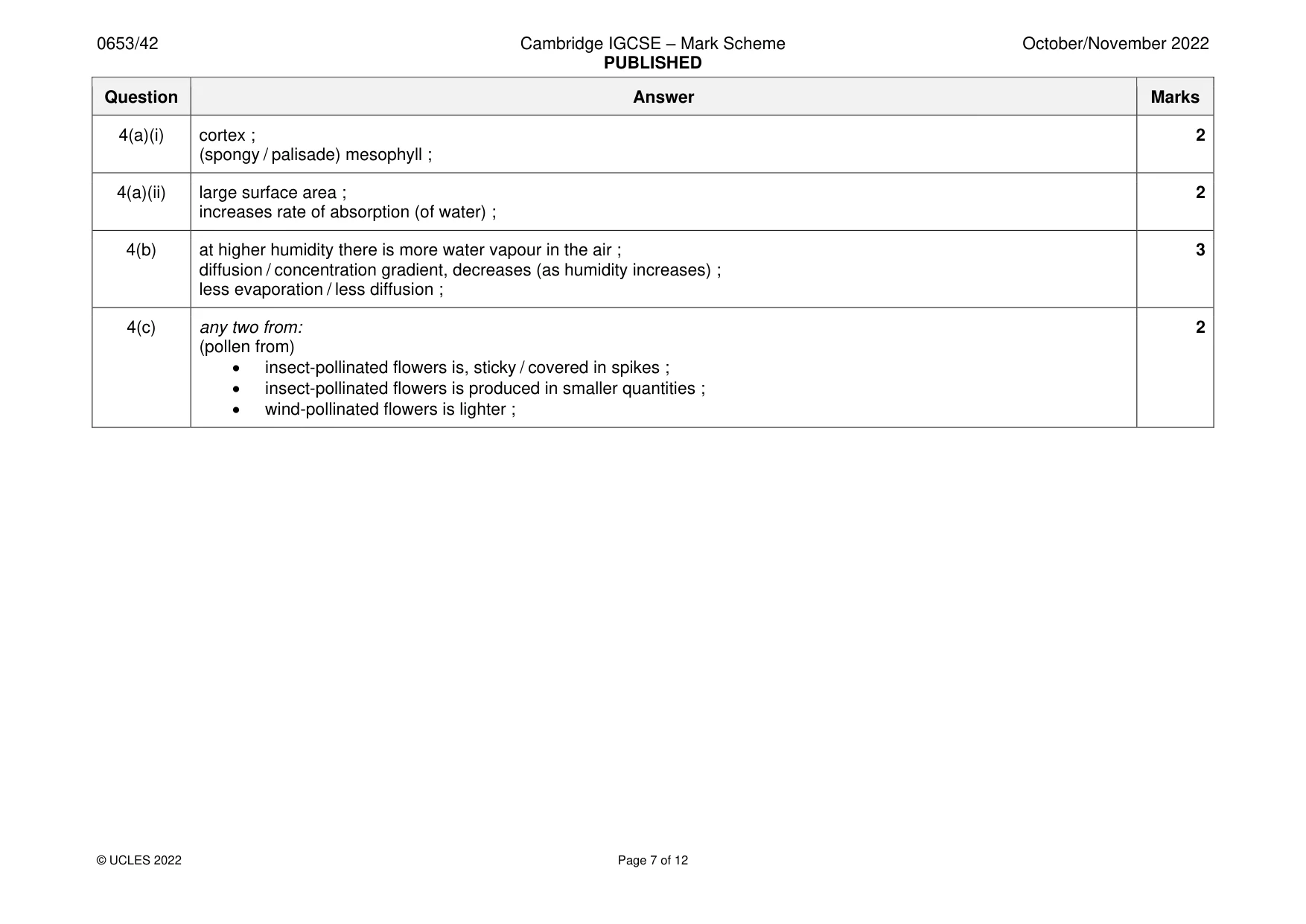
Mark scheme: 4(a)(i) cortex ; 2 (spongy / palisade) mesophyll ; 4(a)(ii) large surface area ; 2 increases rate of absorption (of water) ; 4(b) at higher humidity there is more water vapour in the air ; 3 diffusion / concentration gradient, decreases (as humidity increases) ; less evaporation / less diffusion ; 4(c) any two from: 2 (pollen from) • insect-pollinated flowers is, sticky / covered in spikes ; • insect-pollinated flowers is produced in smaller quantities ; • wind-pollinated flowers is lighter ;
Q5 · The structures of ethane and ethene are shown in Fig
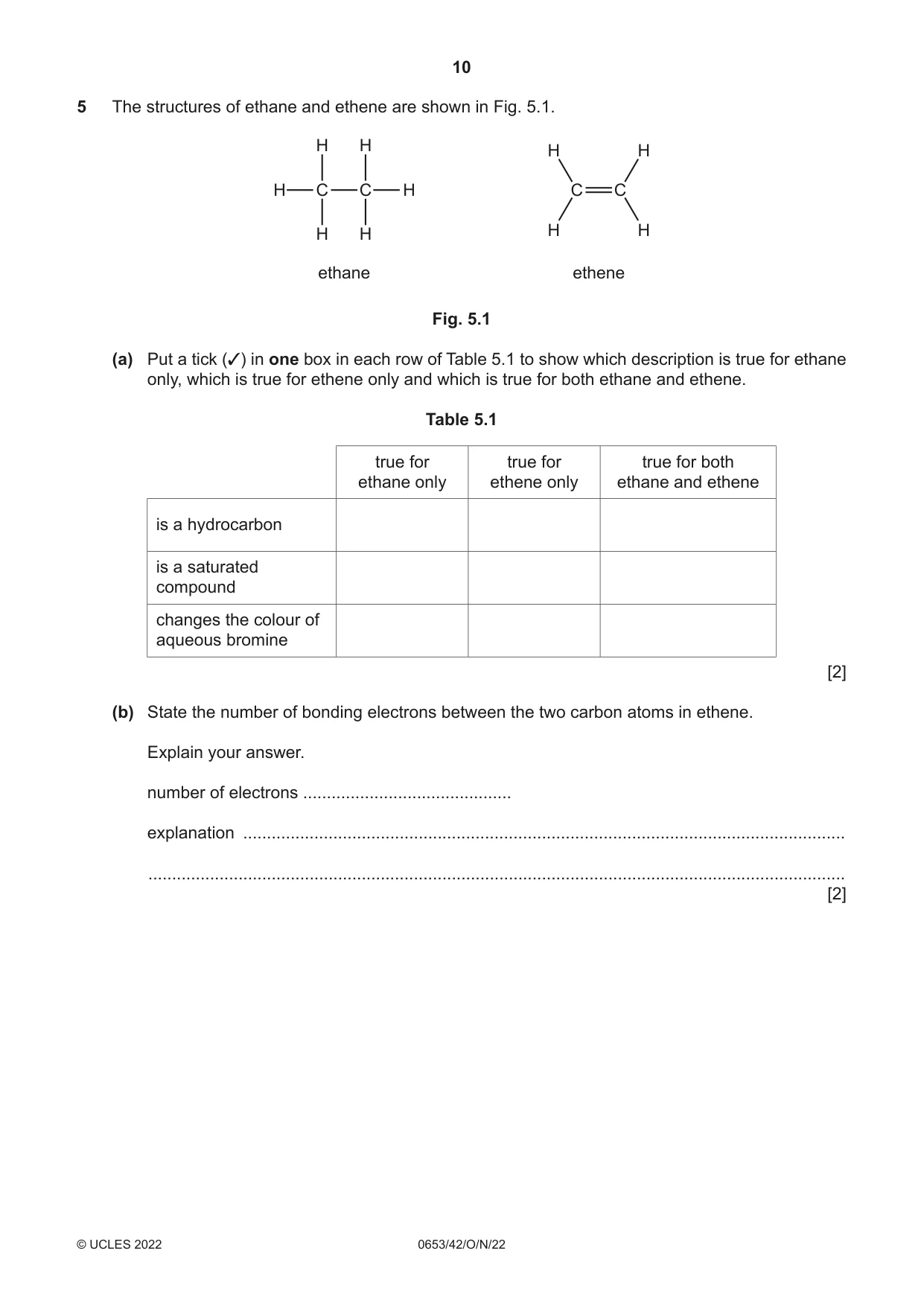
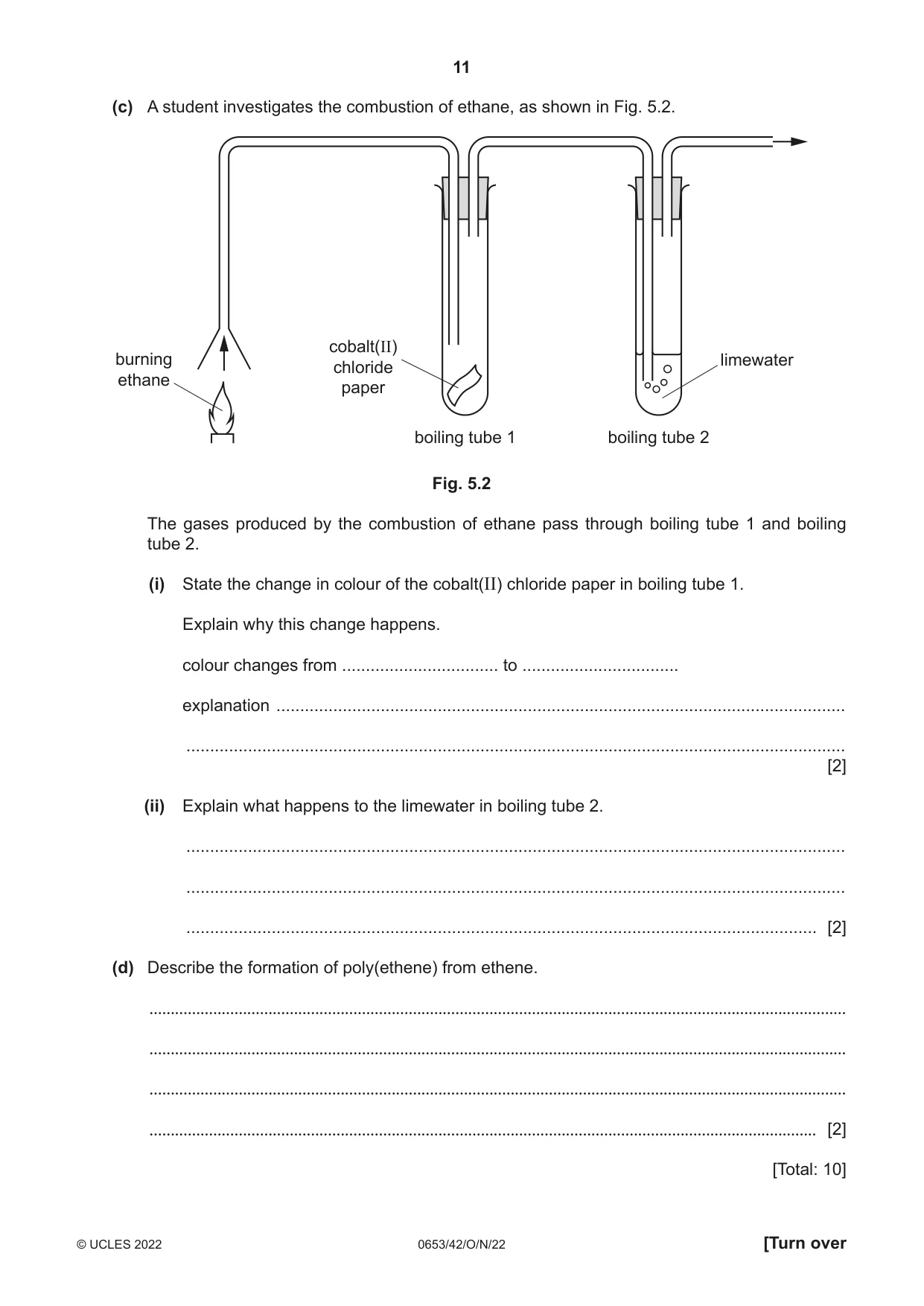
5 The structures of ethane and ethene are shown in Fig. 5.1. H H H H H C C H C C H H H H ethane ethene Fig. 5.1 (a) Put a tick (✓) in one box in each row of Table 5.1 to show which description is true for ethane only, which is true for ethene only and which is true for both ethane and ethene. Table 5.1 true for true for true for both ethane only ethene only ethane and ethene is a hydrocarbon is a saturated compound changes the colour of aqueous bromine [2] (b) State the number of bonding electrons between the two carbon atoms in ethene. Explain your answer. number of electrons ............................................ explanation ............................................................................................................................... ................................................................................................................................................... [2] (c) A student investigates the combustion of ethane, as shown in Fig. 5.2. cobalt(II) burning limewater chloride ethane paper boiling tube 1 boiling tube 2 Fig. 5.2 The gases produced by the combustion of ethane pass through boiling tube 1 and boiling tube 2. (i) State the change in colour of the cobalt(II) chloride paper in boiling tube 1. Explain why this change happens. colour changes from ................................. to ................................. explanation ........................................................................................................................ ........................................................................................................................................... [2] (ii) Explain what happens to the limewater in boiling tube 2. ........................................................................................................................................... ........................................................................................................................................... ..................................................................................................................................... [2] (d) Describe the formation of poly(ethene) from ethene. .................................................................................................................................................................... .................................................................................................................................................................... .................................................................................................................................................................... ............................................................................................................................................................. [2] [Total: 10]
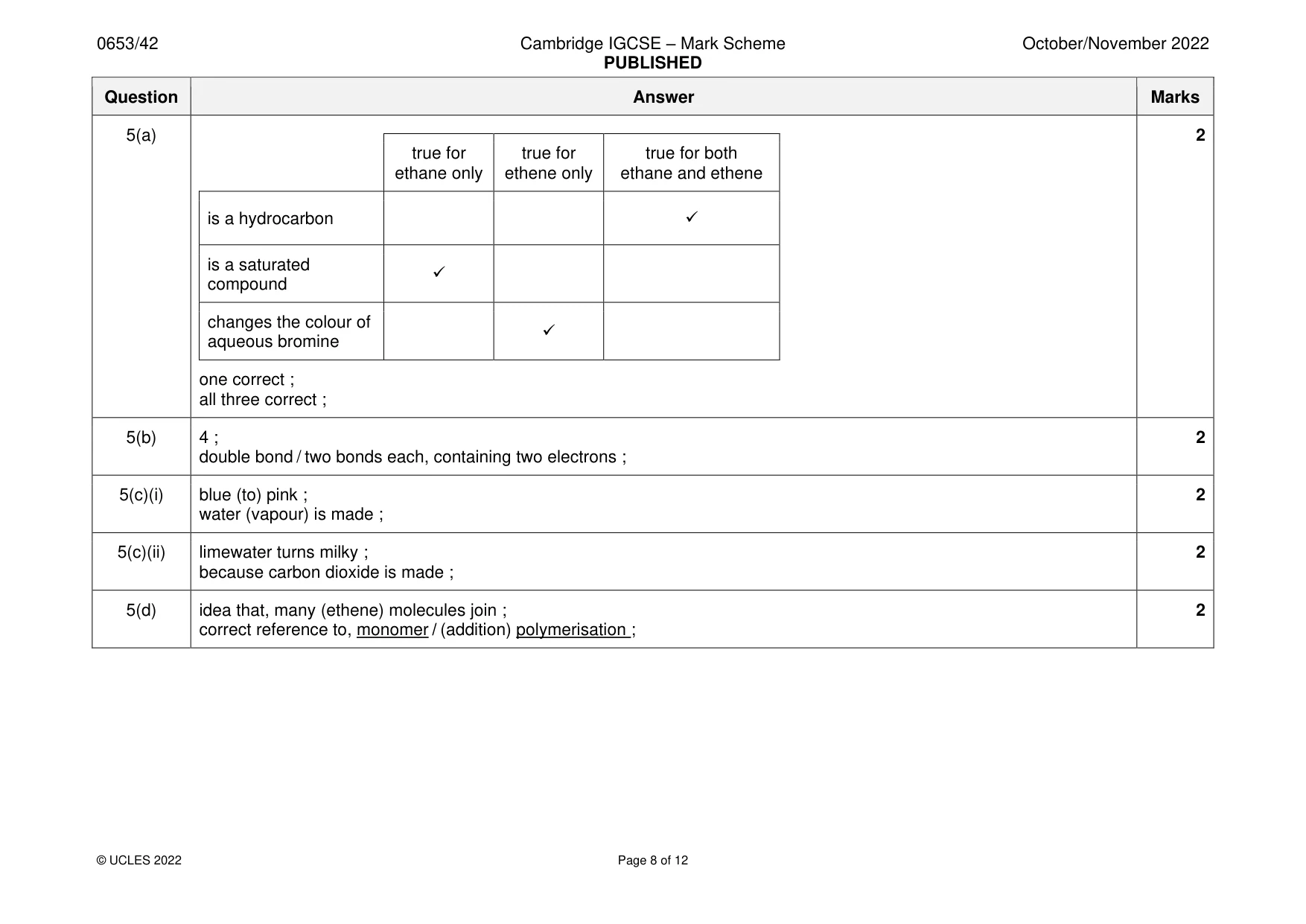
Mark scheme: 5(a) 2 true for true for true for both ethane only ethene only ethane and ethene is a hydrocarbon ✓ is a saturated ✓ compound changes the colour of ✓ aqueous bromine one correct ; all three correct ; 5(b) 4 ; 2 double bond / two bonds each, containing two electrons ; 5(c)(i) blue (to) pink ; 2 water (vapour) is made ; 5(c)(ii) limewater turns milky ; 2 because carbon dioxide is made ; 5(d) idea that, many (ethene) molecules join ; 2 correct reference to, monomer / (addition) polymerisation ;
Q6 · An electric heater with two heating elements connected to a 240 V supply
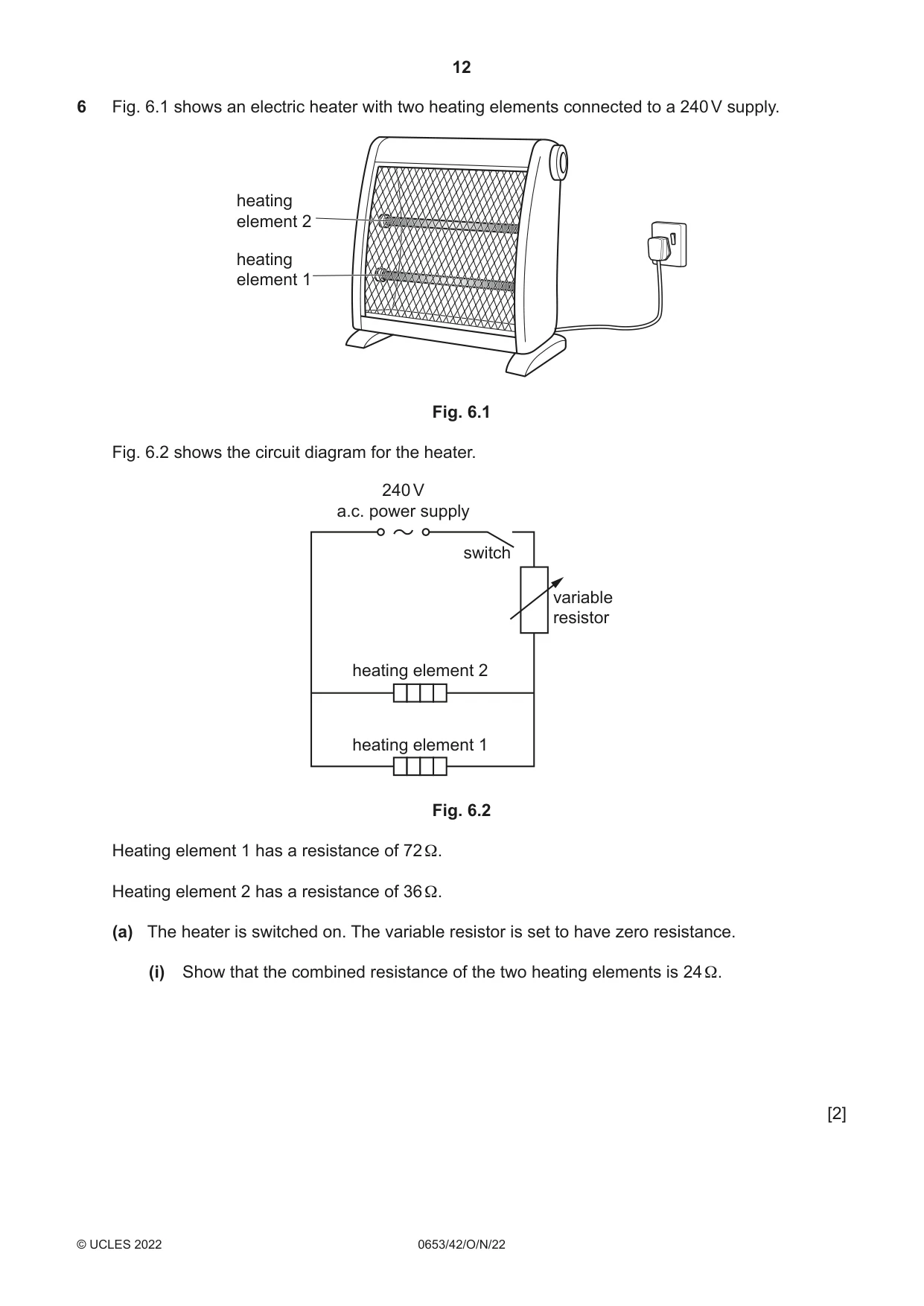
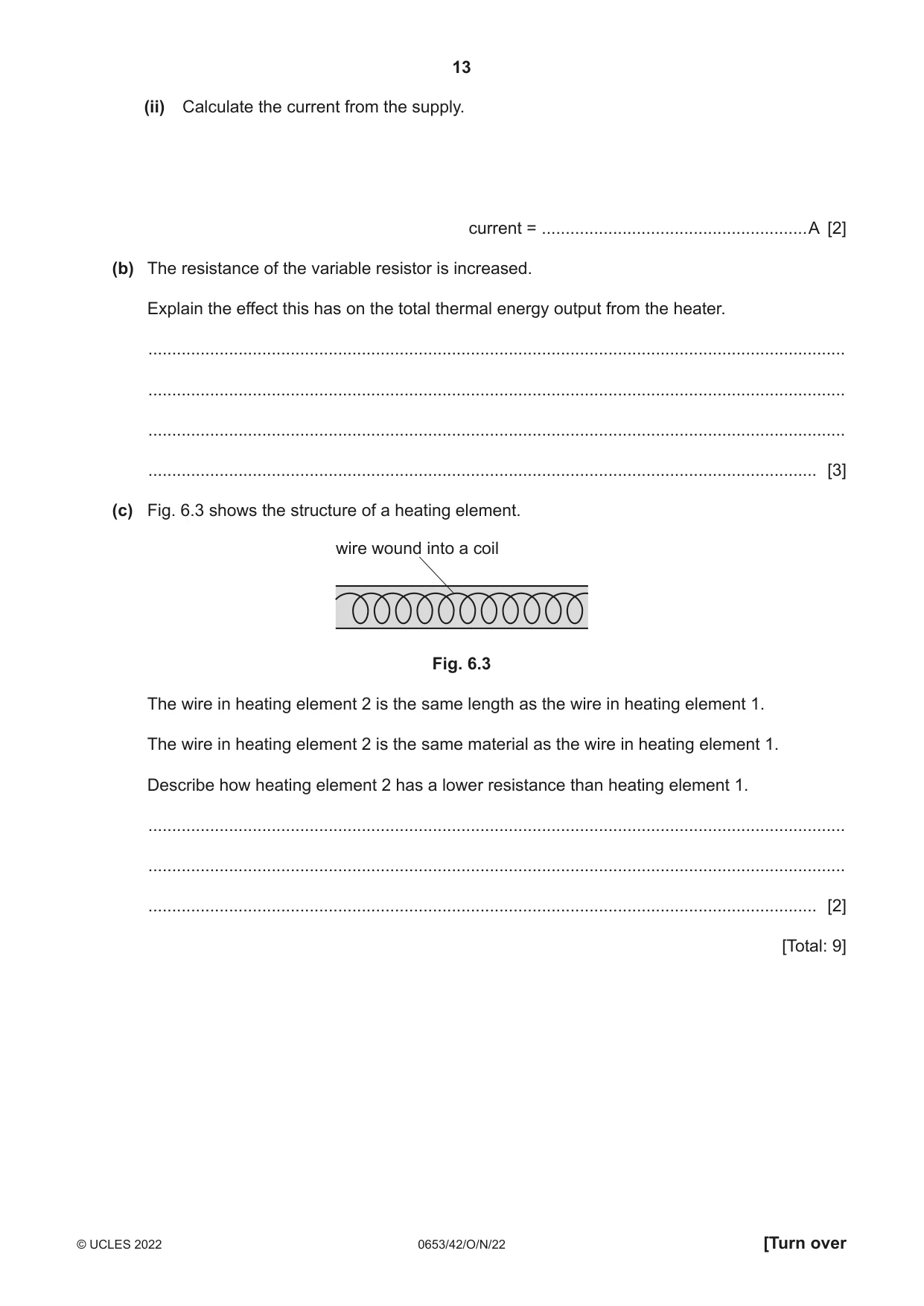
6 Fig. 6.1 shows an electric heater with two heating elements connected to a 240 V supply. heating element 2 heating element 1 Fig. 6.1 Fig. 6.2 shows the circuit diagram for the heater. 240 V a.c. power supply switch variable resistor heating element 2 heating element 1 Fig. 6.2 Heating element 1 has a resistance of 72 Ω. Heating element 2 has a resistance of 36 Ω. (a) The heater is switched on. The variable resistor is set to have zero resistance. (i) Show that the combined resistance of the two heating elements is 24 Ω. [2] (ii) Calculate the current from the supply. current = ........................................................ A [2] (b) The resistance of the variable resistor is increased. Explain the effect this has on the total thermal energy output from the heater. ................................................................................................................................................... ................................................................................................................................................... ................................................................................................................................................... ............................................................................................................................................. [3] (c) Fig. 6.3 shows the structure of a heating element. wire wound into a coil Fig. 6.3 The wire in heating element 2 is the same length as the wire in heating element 1. The wire in heating element 2 is the same material as the wire in heating element 1. Describe how heating element 2 has a lower resistance than heating element 1. ................................................................................................................................................... ................................................................................................................................................... ............................................................................................................................................. [2] [Total: 9]
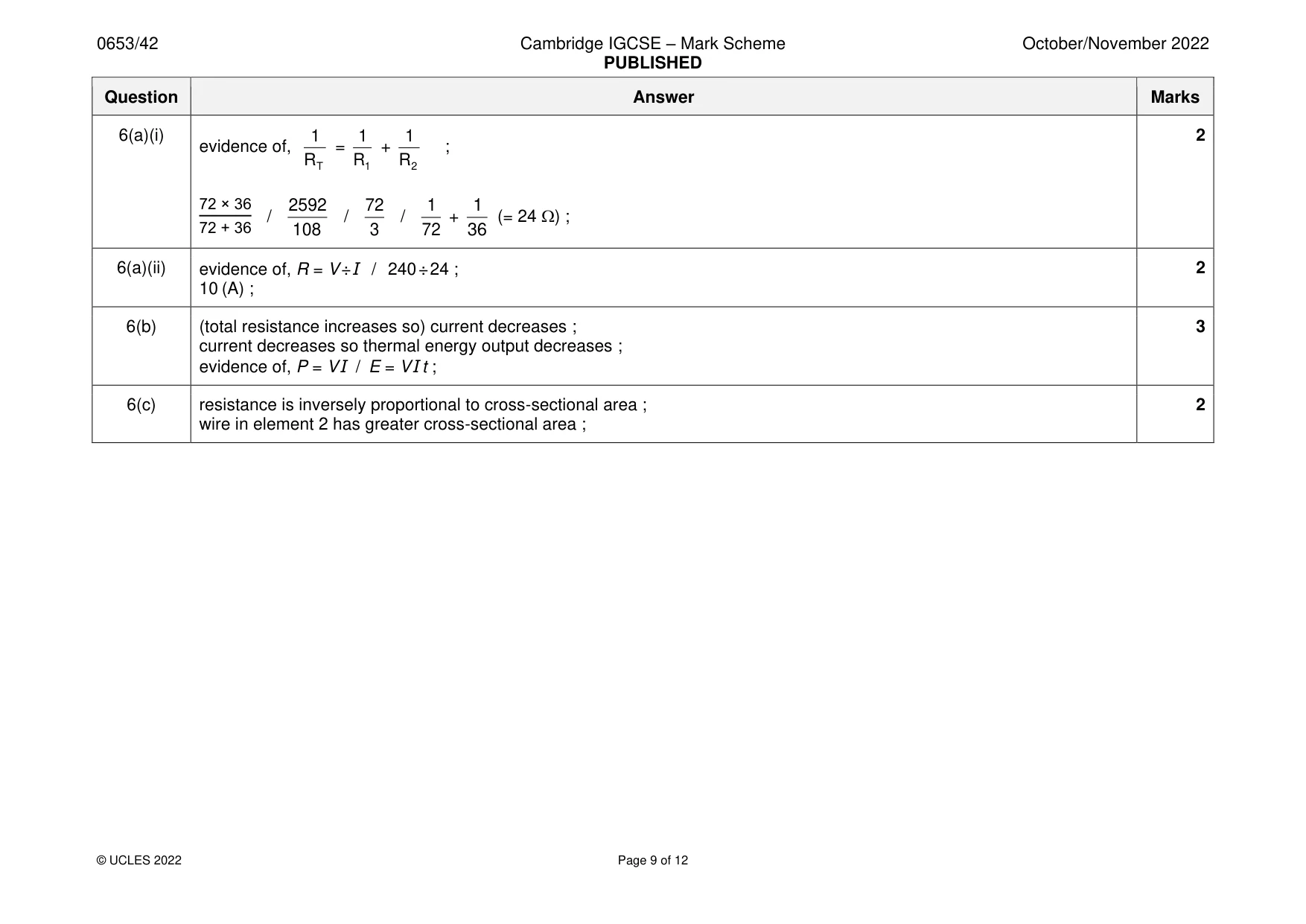
Mark scheme: 6(a)(i) 1 1 1 2 evidence of, = + ; R T R1 R 2 72 × 36 2592 72 1 1 / / / + (= 24 ) ; 72 + 36 108 3 72 36 6(a)(ii) evidence of, R = V ÷ I / 240 ÷ 24 ; 2 10 (A) ; 6(b) (total resistance increases so) current decreases ; 3 current decreases so thermal energy output decreases ; evidence of, P = V I / E = V I t ; 6(c) resistance is inversely proportional to cross-sectional area ; 2 wire in element 2 has greater cross-sectional area ;
Q7 · Chemical digestion and mechanical digestion take place in the alimentary canal
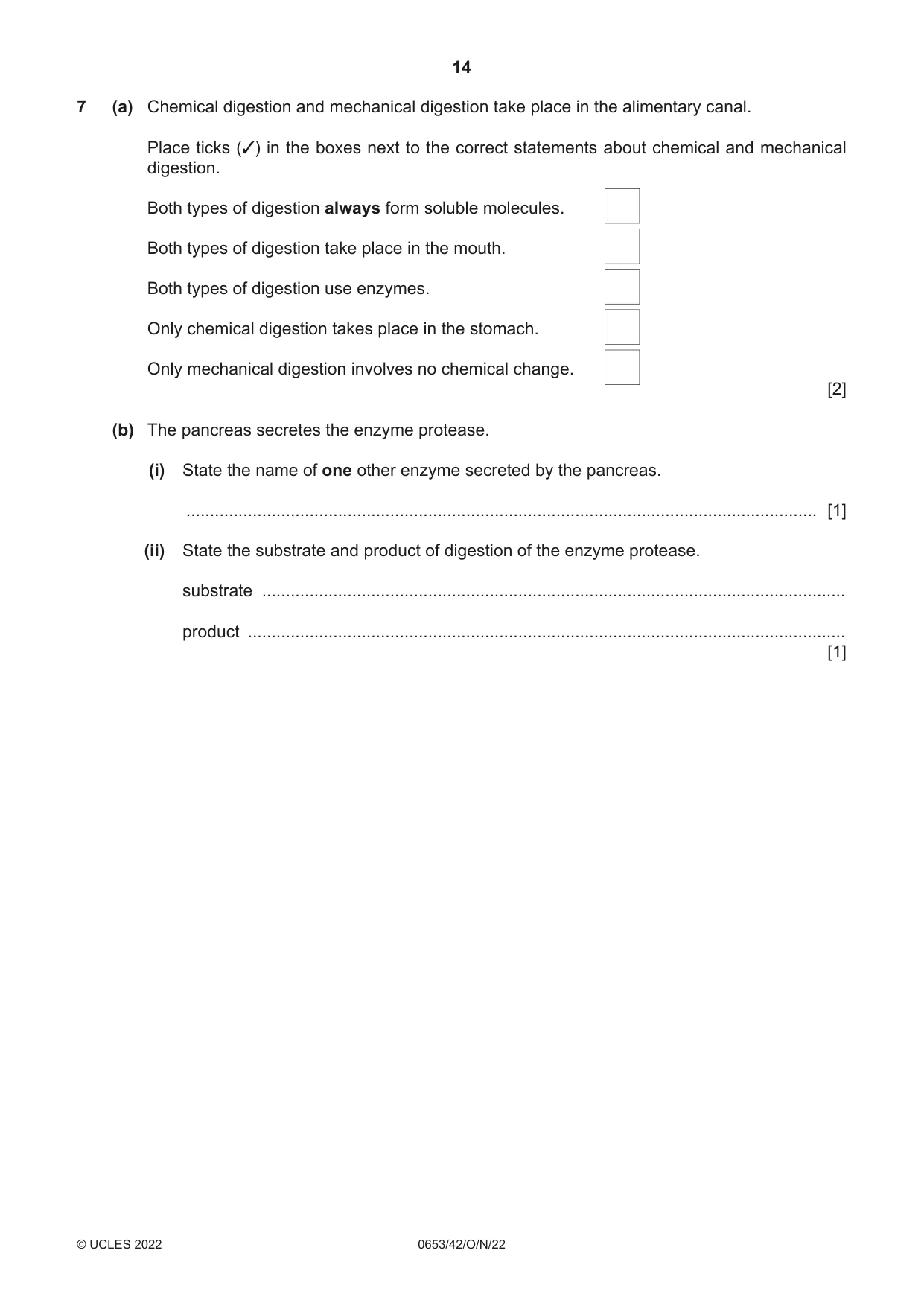
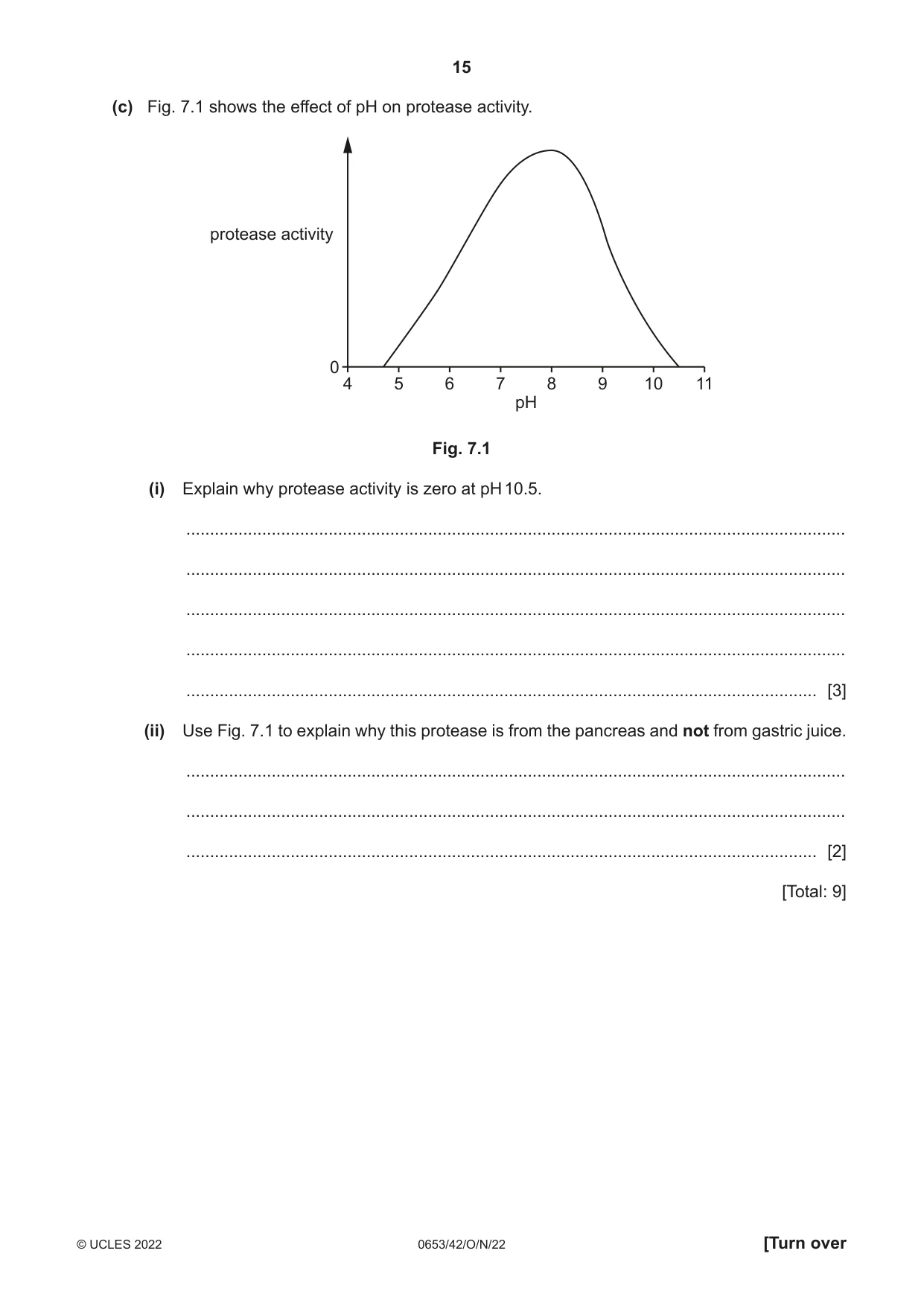
7 (a) Chemical digestion and mechanical digestion take place in the alimentary canal. Place ticks (✓) in the boxes next to the correct statements about chemical and mechanical digestion. Both types of digestion always form soluble molecules. Both types of digestion take place in the mouth. Both types of digestion use enzymes. Only chemical digestion takes place in the stomach. Only mechanical digestion involves no chemical change. [2] (b) The pancreas secretes the enzyme protease. (i) State the name of one other enzyme secreted by the pancreas. ..................................................................................................................................... [1] (ii) State the substrate and product of digestion of the enzyme protease. substrate ........................................................................................................................... product .............................................................................................................................. [1] (c) Fig. 7.1 shows the effect of pH on protease activity. protease activity 0 4 5 6 7 8 9 10 11 pH Fig. 7.1 (i) Explain why protease activity is zero at pH 10.5. ........................................................................................................................................... ........................................................................................................................................... ........................................................................................................................................... ........................................................................................................................................... ..................................................................................................................................... [3] (ii) Use Fig. 7.1 to explain why this protease is from the pancreas and not from gastric juice. ........................................................................................................................................... ........................................................................................................................................... ..................................................................................................................................... [2] [Total: 9]
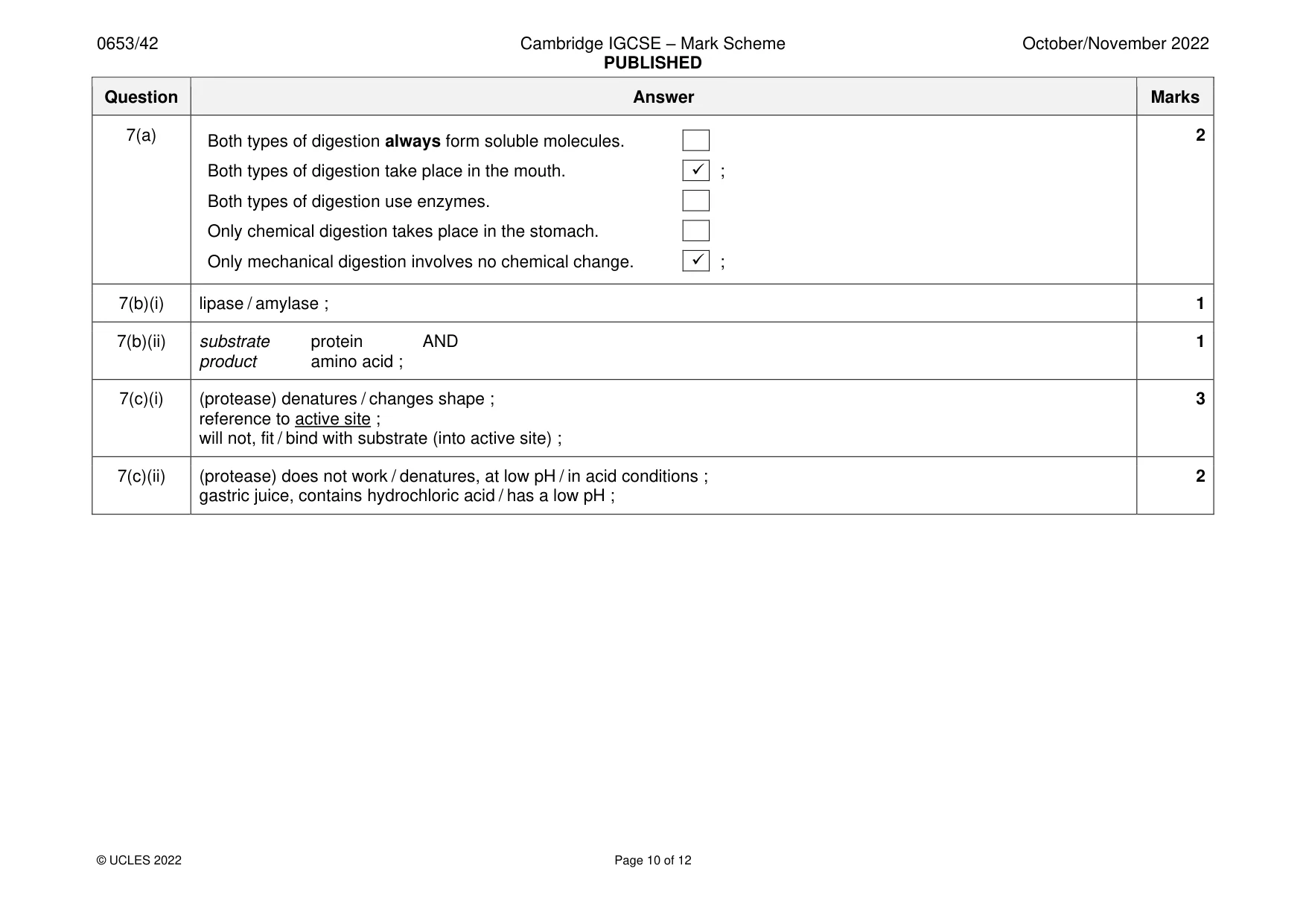
Mark scheme: 7(a) 2 Both types of digestion always form soluble molecules. Both types of digestion take place in the mouth. ✓ ; Both types of digestion use enzymes. Only chemical digestion takes place in the stomach. Only mechanical digestion involves no chemical change. ✓ ; 7(b)(i) lipase / amylase ; 1 7(b)(ii) substrate protein AND 1 product amino acid ; 7(c)(i) (protease) denatures / changes shape ; 3 reference to active site ; will not, fit / bind with substrate (into active site) ; 7(c)(ii) (protease) does not work / denatures, at low pH / in acid conditions ; 2 gastric juice, contains hydrochloric acid / has a low pH ;
Q8 · Lead(II) bromide is electrolysed using inert electrodes, as shown in Fig
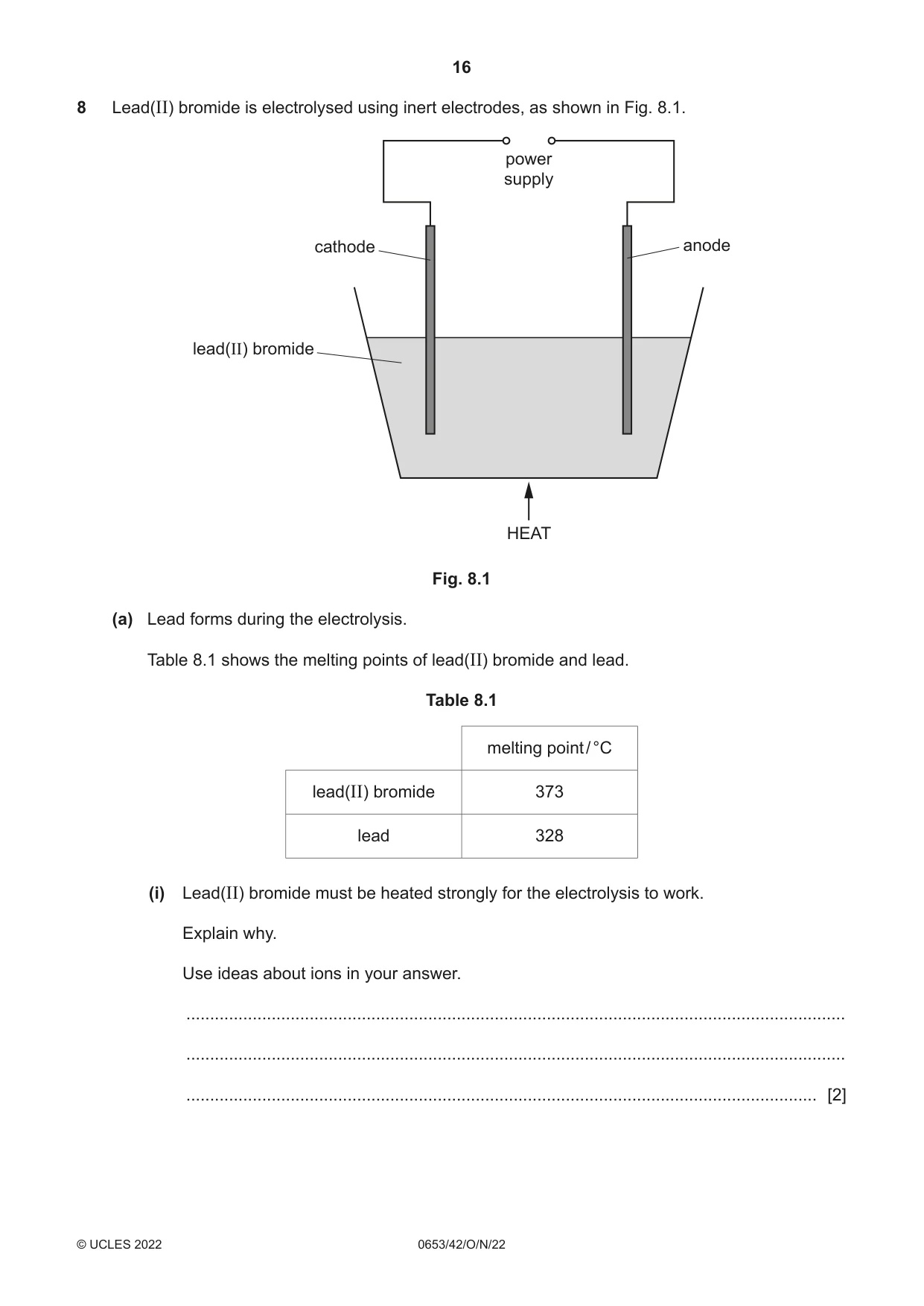
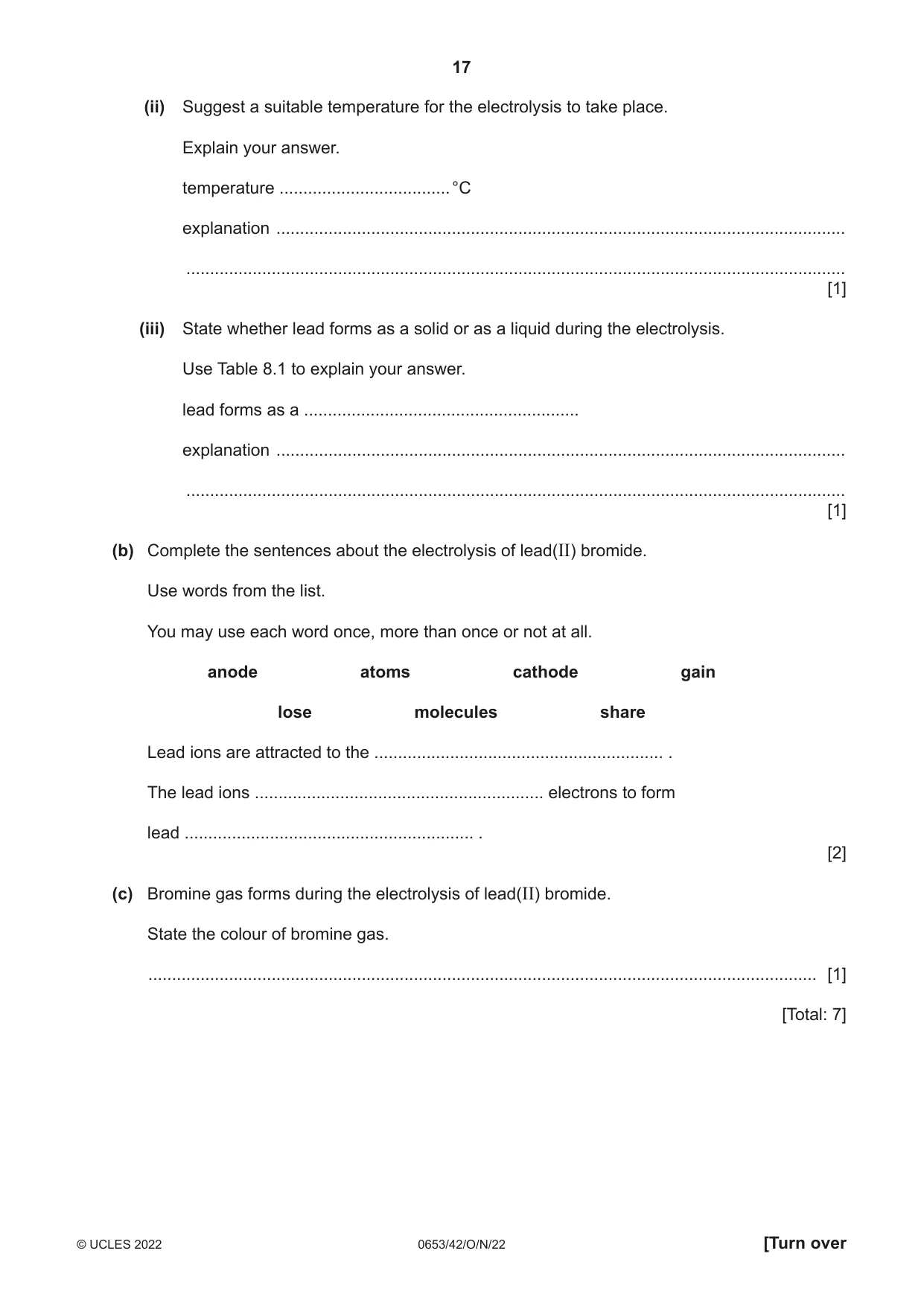
8 Lead(II) bromide is electrolysed using inert electrodes, as shown in Fig. 8.1. power supply cathode anode lead(II) bromide HEAT Fig. 8.1 (a) Lead forms during the electrolysis. Table 8.1 shows the melting points of lead(II) bromide and lead. Table 8.1 melting point / °C lead(II) bromide 373 lead 328 (i) Lead(II) bromide must be heated strongly for the electrolysis to work. Explain why. Use ideas about ions in your answer. ........................................................................................................................................... ........................................................................................................................................... ..................................................................................................................................... [2] (ii) Suggest a suitable temperature for the electrolysis to take place. Explain your answer. temperature .................................... °C explanation ........................................................................................................................ ........................................................................................................................................... [1] (iii) State whether lead forms as a solid or as a liquid during the electrolysis. Use Table 8.1 to explain your answer. lead forms as a .......................................................... explanation ........................................................................................................................ ........................................................................................................................................... [1] (b) Complete the sentences about the electrolysis of lead(II) bromide. Use words from the list. You may use each word once, more than once or not at all. anode atoms cathode gain lose molecules share Lead ions are attracted to the ............................................................. . The lead ions ............................................................. electrons to form lead ............................................................. . [2] (c) Bromine gas forms during the electrolysis of lead(II) bromide. State the colour of bromine gas. ............................................................................................................................................. [1] [Total: 7]
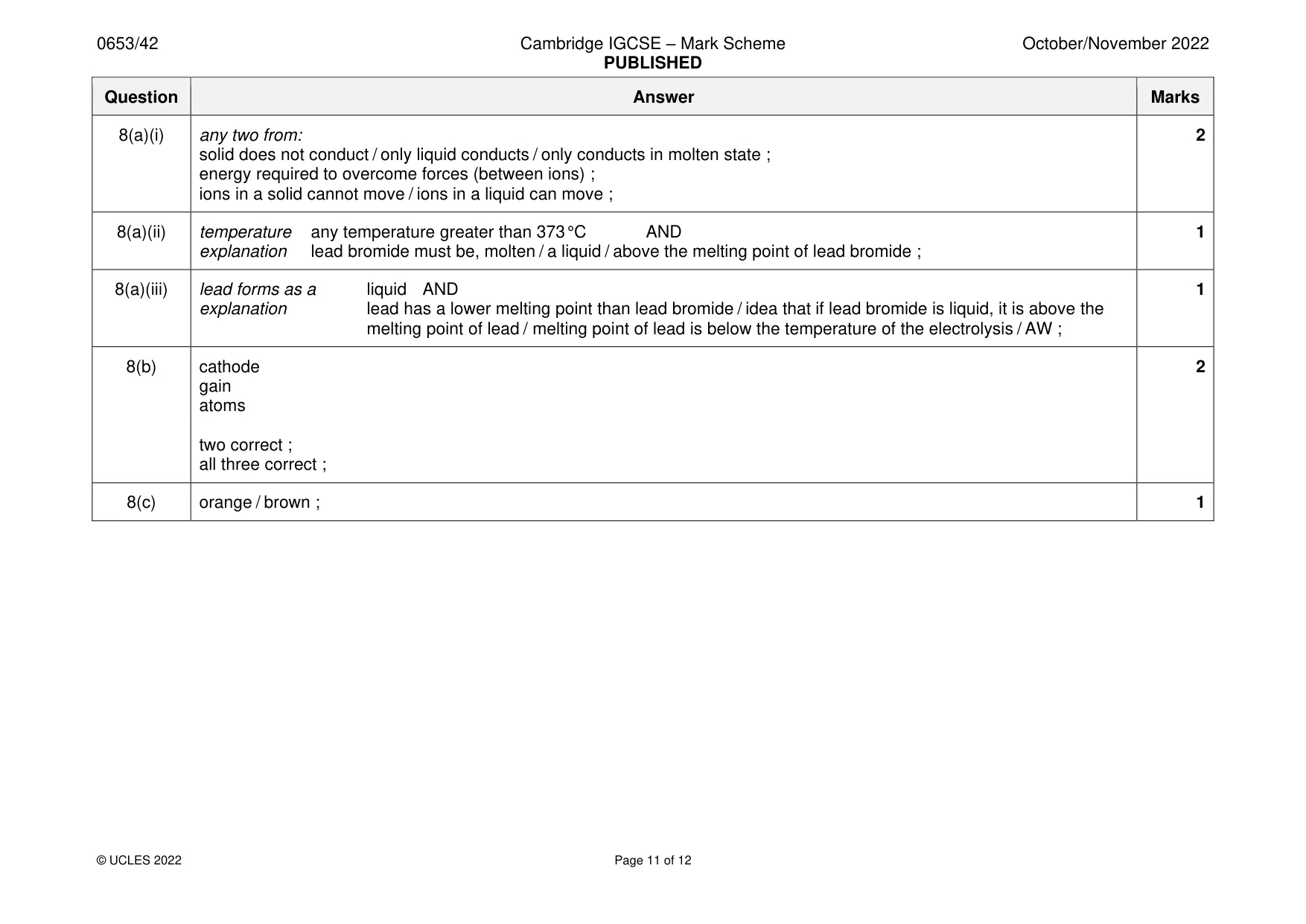
Mark scheme: 8(a)(i) any two from: 2 solid does not conduct / only liquid conducts / only conducts in molten state ; energy required to overcome forces (between ions) ; ions in a solid cannot move / ions in a liquid can move ; 8(a)(ii) temperature any temperature greater than 373 °C AND 1 explanation lead bromide must be, molten / a liquid / above the melting point of lead bromide ; 8(a)(iii) lead forms as a liquid AND 1 explanation lead has a lower melting point than lead bromide / idea that if lead bromide is liquid, it is above the melting point of lead / melting point of lead is below the temperature of the electrolysis / AW ; 8(b) cathode 2 gain atoms two correct ; all three correct ; 8(c) orange / brown ; 1
Q9 · The electromagnetic spectrum has seven different regions, including microwaves and X‑rays
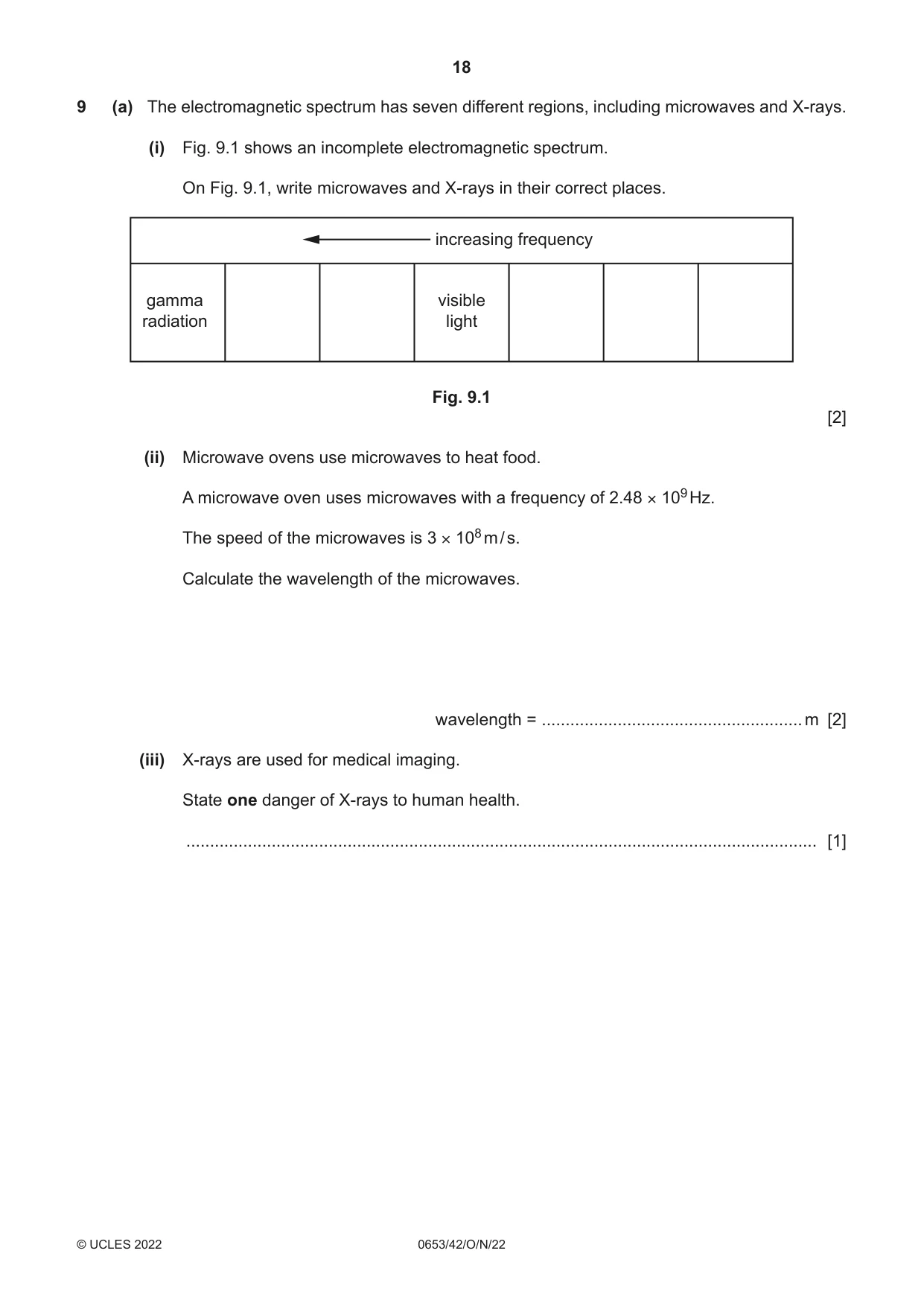
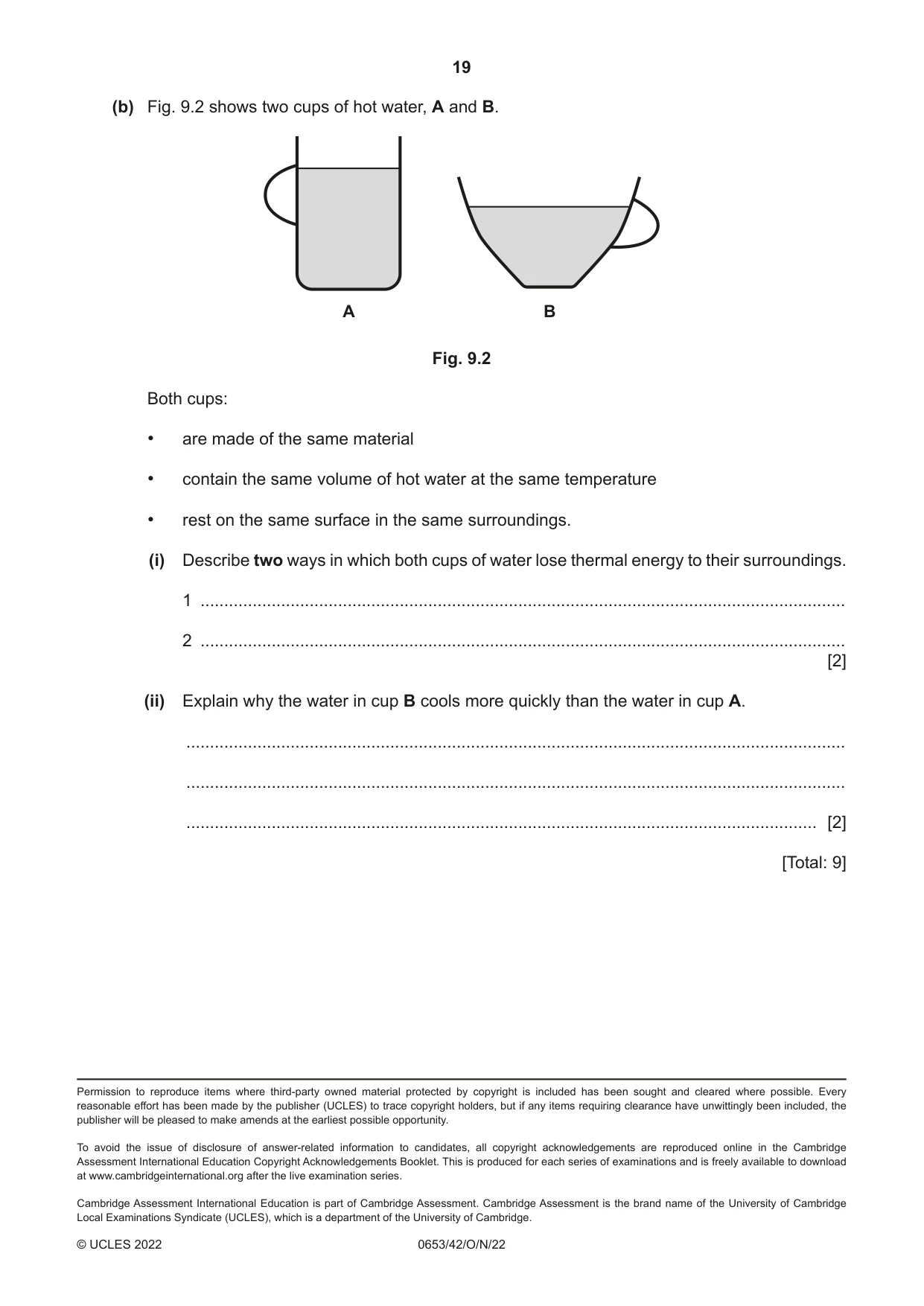
9 (a) The electromagnetic spectrum has seven different regions, including microwaves and X‑rays. (i) Fig. 9.1 shows an incomplete electromagnetic spectrum. On Fig. 9.1, write microwaves and X‑rays in their correct places. increasing frequency gamma visible radiation light Fig. 9.1 [2] (ii) Microwave ovens use microwaves to heat food. A microwave oven uses microwaves with a frequency of 2.48 × 10⁹ Hz. The speed of the microwaves is 3 × 10⁸ m / s. Calculate the wavelength of the microwaves. wavelength = ....................................................... m [2] (iii) X‑rays are used for medical imaging. State one danger of X‑rays to human health. ..................................................................................................................................... [1] (b) Fig. 9.2 shows two cups of hot water, A and B. A B Fig. 9.2 Both cups: • are made of the same material • contain the same volume of hot water at the same temperature • rest on the same surface in the same surroundings. (i) Describe two ways in which both cups of water lose thermal energy to their surroundings. 1 ........................................................................................................................................ 2 ........................................................................................................................................ [2] (ii) Explain why the water in cup B cools more quickly than the water in cup A. ........................................................................................................................................... ........................................................................................................................................... ..................................................................................................................................... [2] [Total: 9]
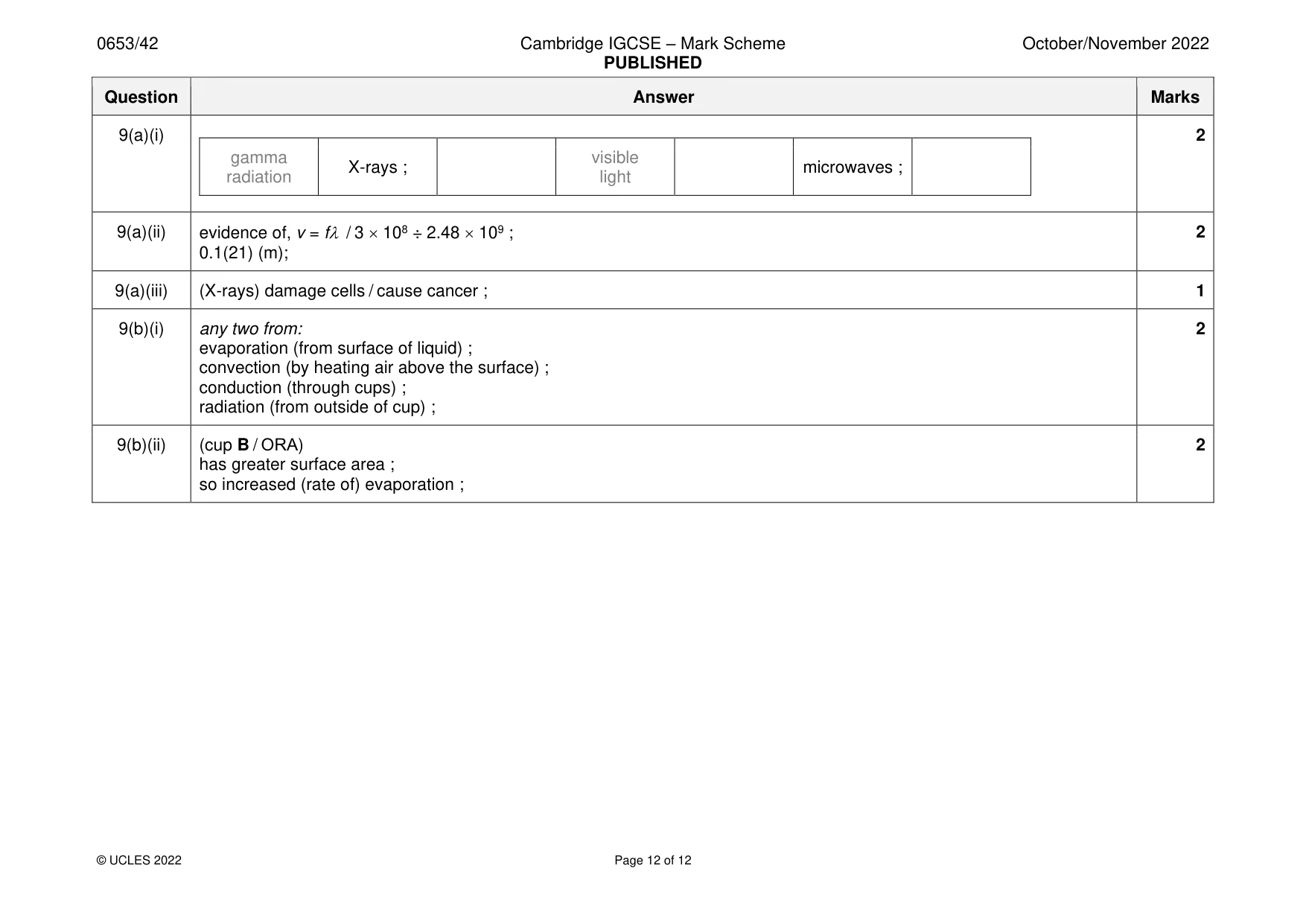
Mark scheme: 9(a)(i) 2 gamma visible X-rays ; microwaves ; radiation light 9(a)(ii) evidence of, v = f / 3 108 ÷ 2.48 109 ; 2 0.1(21) (m); 9(a)(iii) (X-rays) damage cells / cause cancer ; 1 9(b)(i) any two from: 2 evaporation (from surface of liquid) ; convection (by heating air above the surface) ; conduction (through cups) ; radiation (from outside of cup) ; 9(b)(ii) (cup B / ORA) 2 has greater surface area ; so increased (rate of) evaporation ;
What was in this paper
The subtopics covered by these 9 questions, and how many questions each got. Open one in a new tab to see every Cambridge question on it.
What you needed in this session
Cambridge’s own grade thresholds for 2022 Oct/Nov, Paper 4 · Variant 2. A higher threshold means an easier paper — the bar moves with how the cohort did.