Cambridge IGCSE Science - Combined 0653 — 2021 Oct/Nov Paper 4 · Variant 3
0653/43/O/N/21 · 9 questions · 80 marks · ≈90 min
The question paper and its mark scheme, free to read here and free to download. This is Cambridge’s own paper, exactly as it was sat.
Question paper24 pages



Mark scheme10 pages
Answers below. Sit the paper first if you are practising.
Questions as text
Q1 · A diagram of a fetus inside the uterus
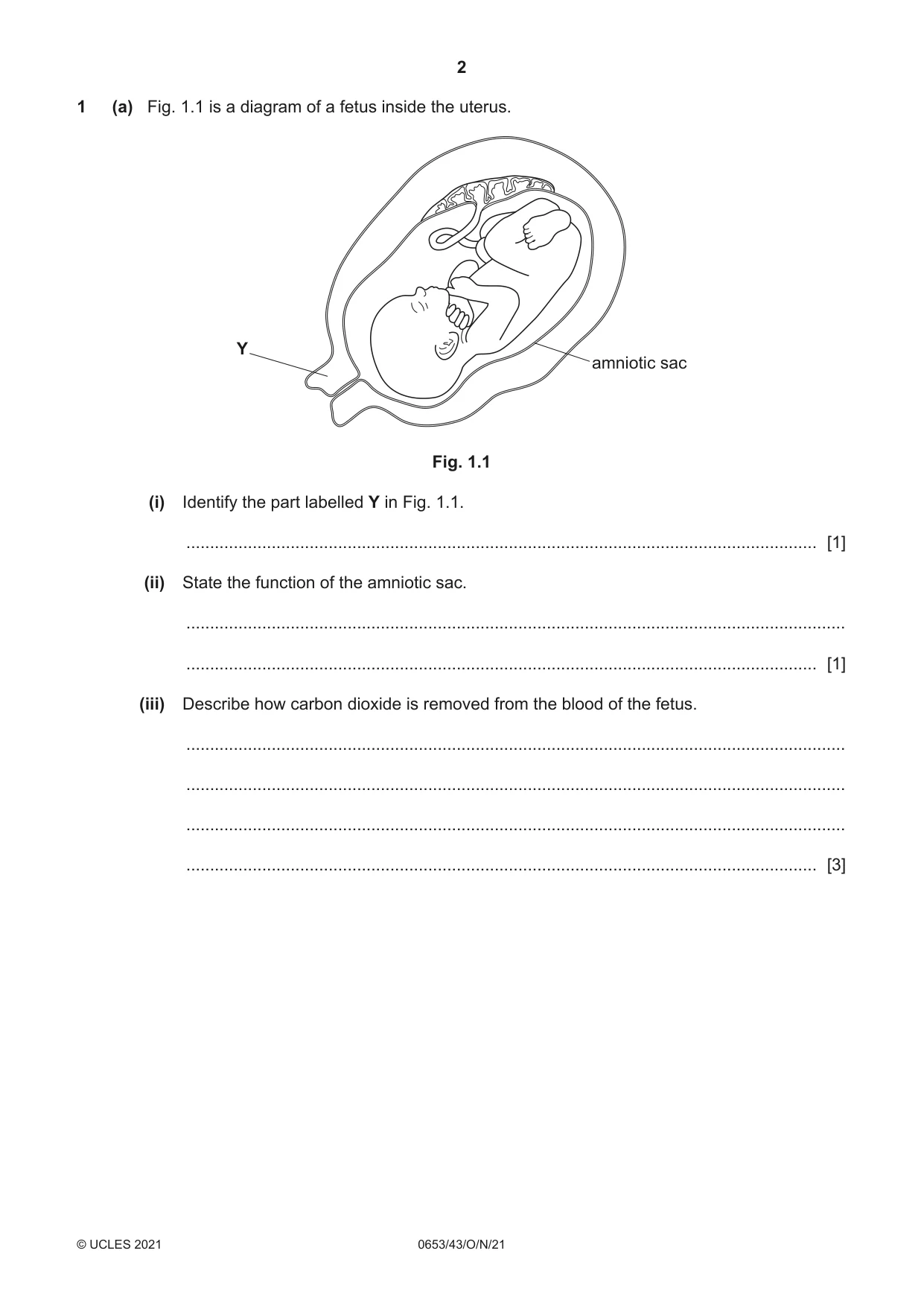
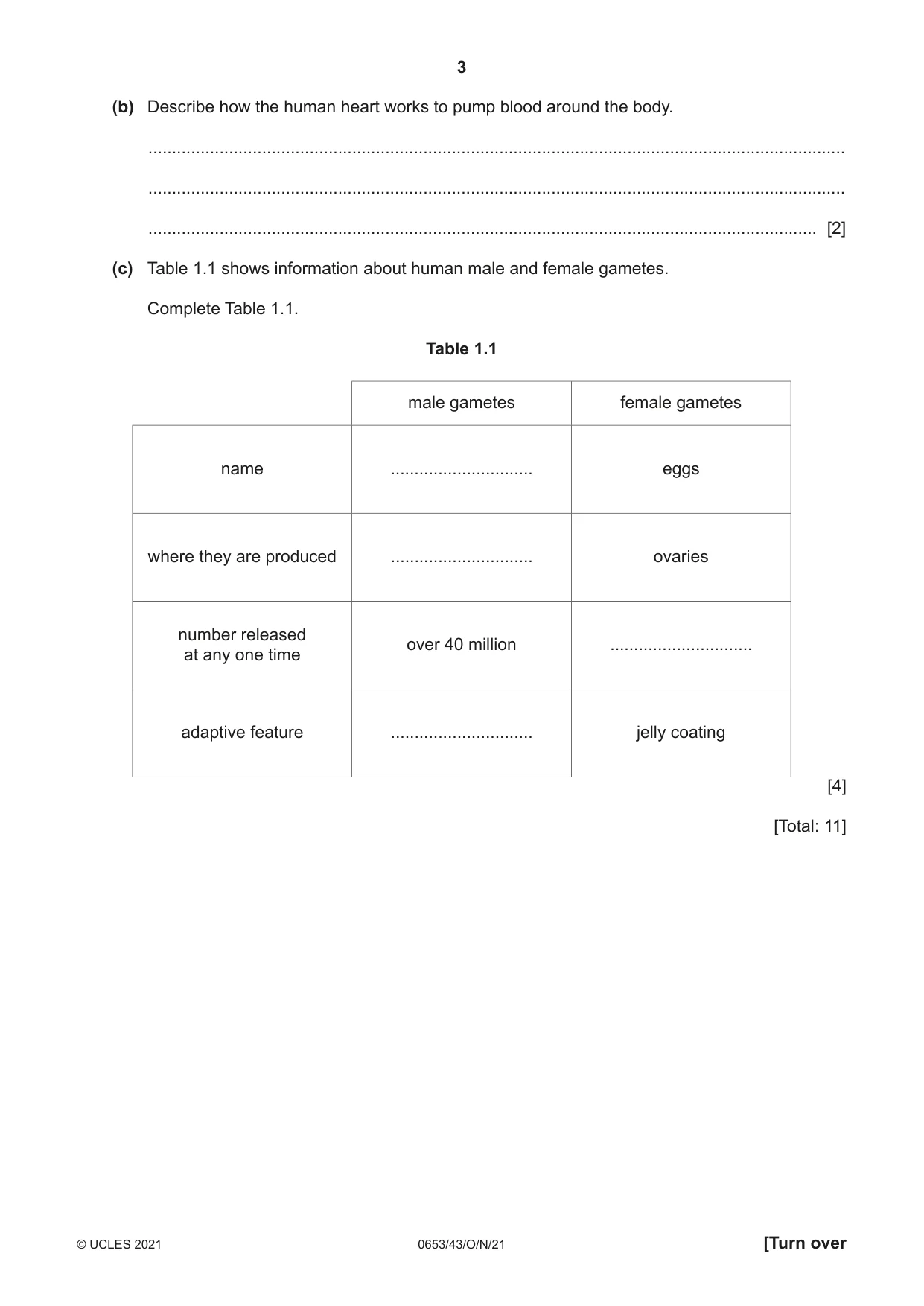
1 (a) Fig. 1.1 is a diagram of a fetus inside the uterus. Y amniotic sac Fig. 1.1 (i) Identify the part labelled Y in Fig. 1.1. ..................................................................................................................................... [1] (ii) State the function of the amniotic sac. ........................................................................................................................................... ..................................................................................................................................... [1] (iii) Describe how carbon dioxide is removed from the blood of the fetus. ........................................................................................................................................... ........................................................................................................................................... ........................................................................................................................................... ..................................................................................................................................... [3] (b) Describe how the human heart works to pump blood around the body. ................................................................................................................................................... ................................................................................................................................................... ............................................................................................................................................. [2] (c) Table 1.1 shows information about human male and female gametes. Complete Table 1.1. Table 1.1 male gametes female gametes name .............................. eggs where they are produced .............................. ovaries number released over 40 million .............................. at any one time adaptive feature .............................. jelly coating [4] [Total: 11]
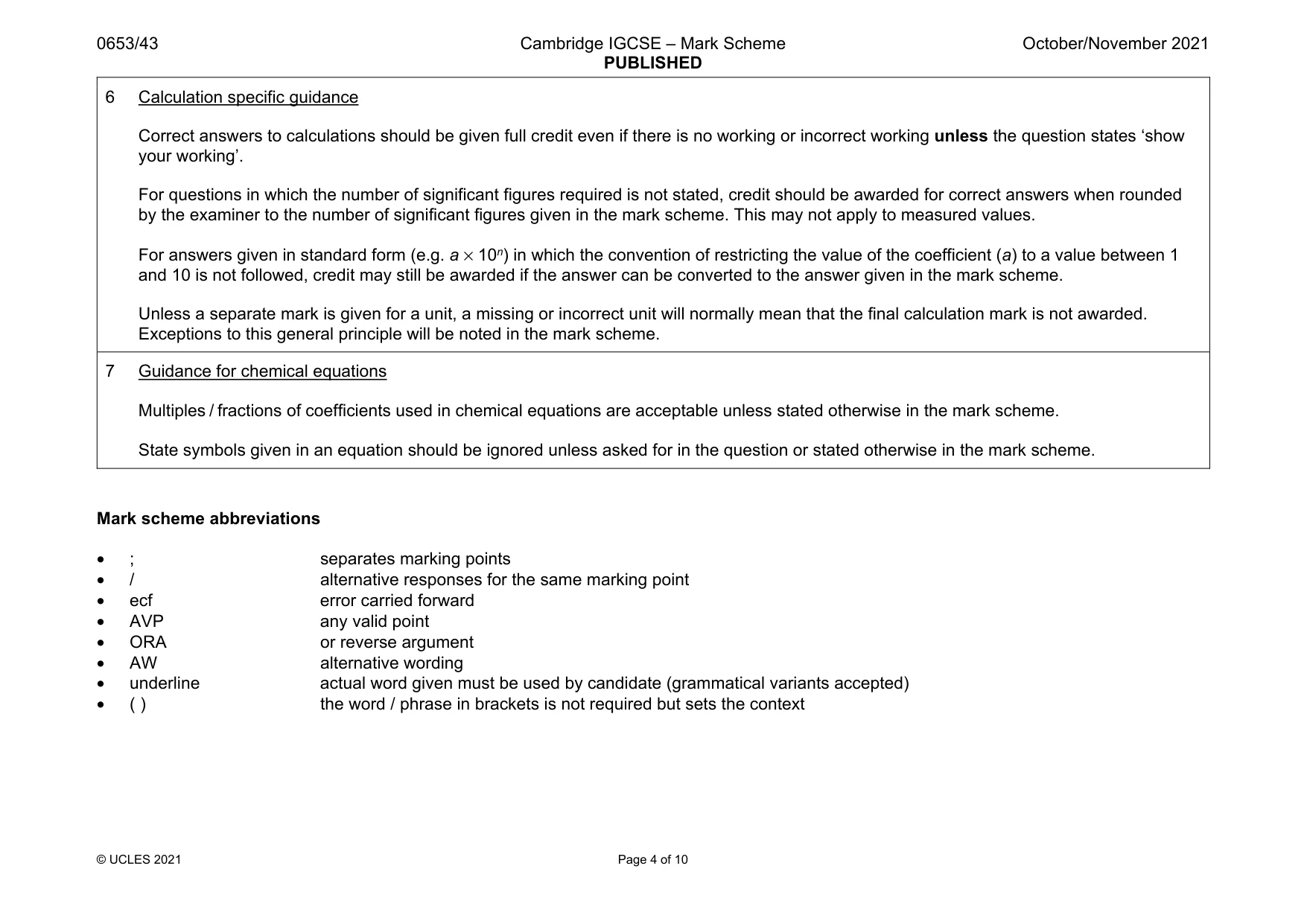
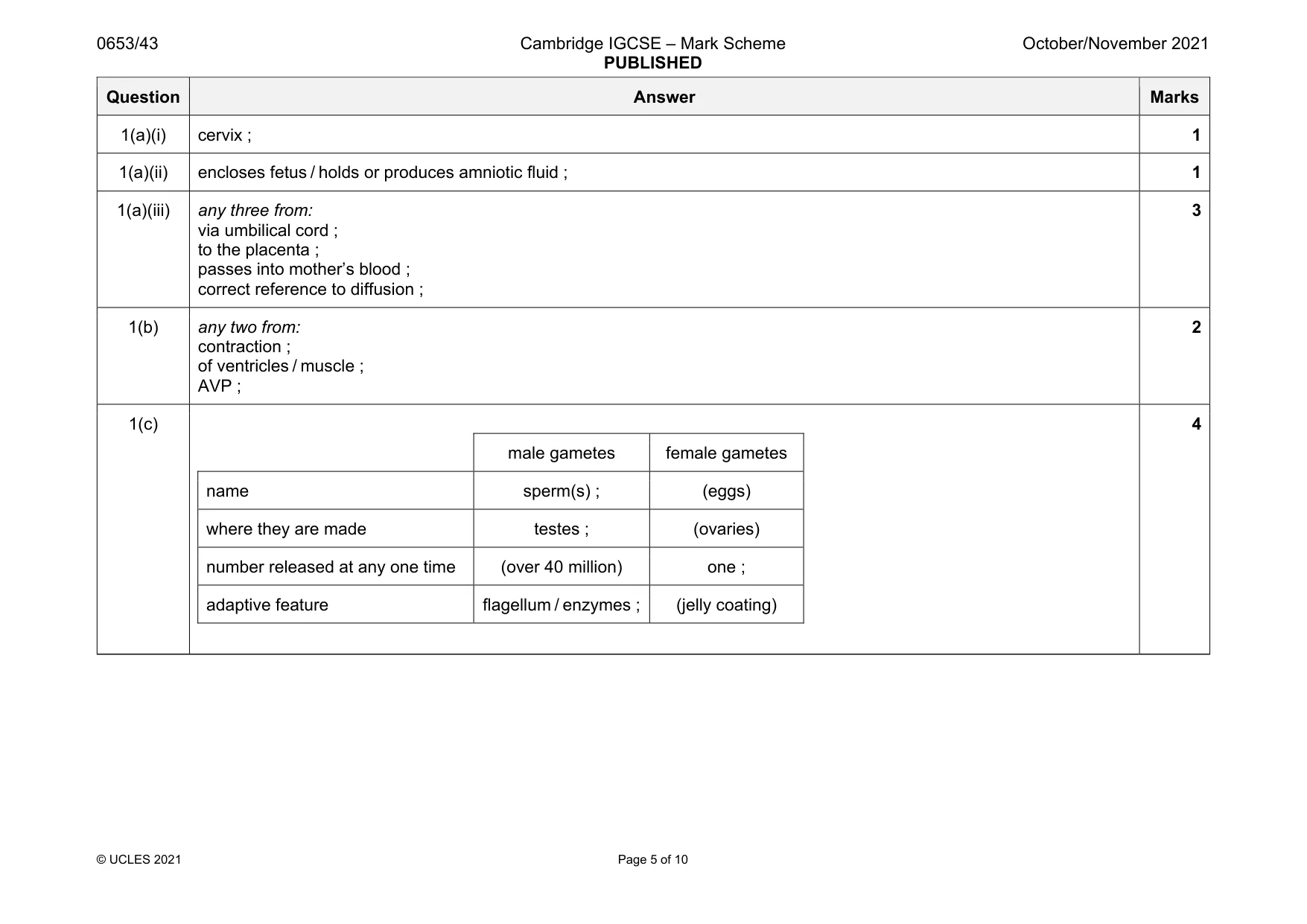
Mark scheme: 1(a)(i) cervix ; 1 1(a)(ii) encloses fetus / holds or produces amniotic fluid ; 1 1(a)(iii) any three from: via umbilical cord ; to the placenta ; passes into mother’s blood ; correct reference to diffusion ; 3 1(b) any two from: contraction ; of ventricles / muscle ; AVP ; 2 1(c) male gametes female gametes name sperm(s) ; (eggs) where they are made testes ; (ovaries) number released at any one time (over 40 million) one ; adaptive feature flagellum / enzymes ; (jelly coating) 4
Q2 · The energy level diagrams for four different compounds dissolving in water
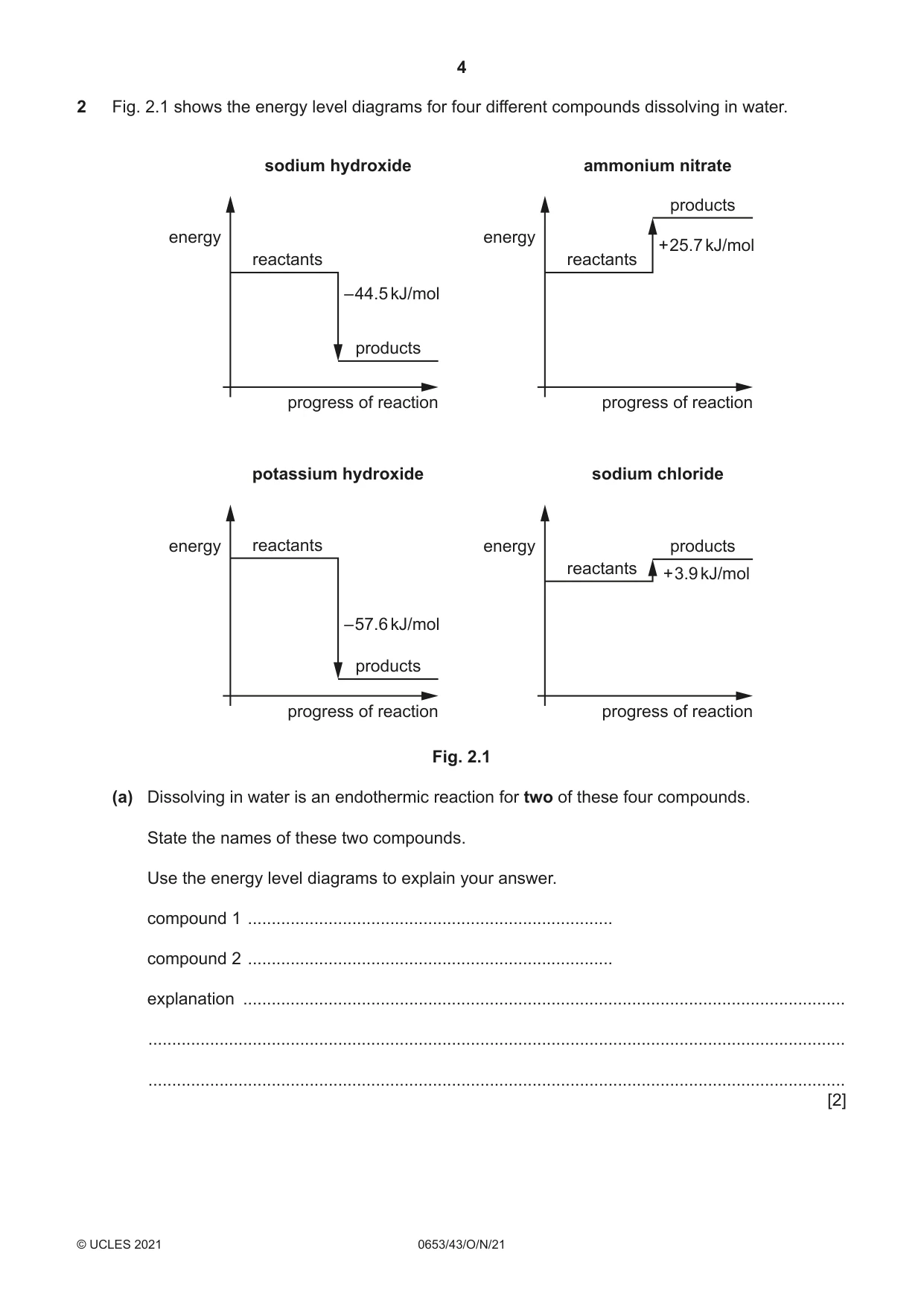
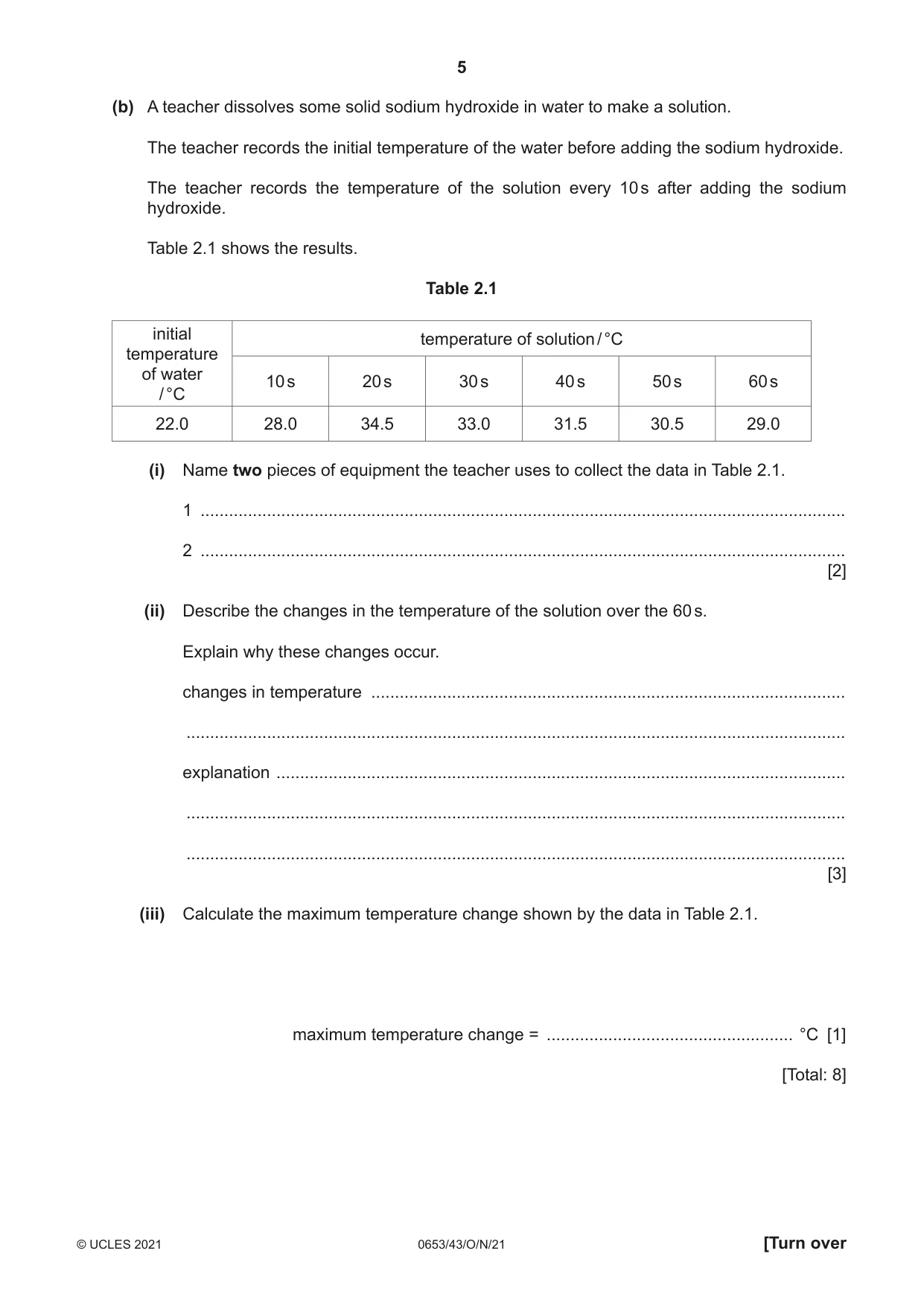
2 Fig. 2.1 shows the energy level diagrams for four different compounds dissolving in water. sodium hydroxide ammonium nitrate products energy energy + 25.7 kJ/mol reactants reactants – 44.5 kJ/mol products progress of reaction progress of reaction potassium hydroxide sodium chloride energy reactants energy products reactants + 3.9 kJ/mol – 57.6 kJ/mol products progress of reaction progress of reaction Fig. 2.1 (a) Dissolving in water is an endothermic reaction for two of these four compounds. State the names of these two compounds. Use the energy level diagrams to explain your answer. compound 1 ............................................................................. compound 2 ............................................................................. explanation ............................................................................................................................... ................................................................................................................................................... ................................................................................................................................................... [2] (b) A teacher dissolves some solid sodium hydroxide in water to make a solution. The teacher records the initial temperature of the water before adding the sodium hydroxide. The teacher records the temperature of the solution every 10 s after adding the sodium hydroxide. Table 2.1 shows the results. Table 2.1 initial temperature of solution / °C temperature of water 10 s 20 s 30 s 40 s 50 s 60 s / °C 22.0 28.0 34.5 33.0 31.5 30.5 29.0 (i) Name two pieces of equipment the teacher uses to collect the data in Table 2.1. 1 ........................................................................................................................................ 2 ........................................................................................................................................ [2] (ii) Describe the changes in the temperature of the solution over the 60 s. Explain why these changes occur. changes in temperature .................................................................................................... ........................................................................................................................................... explanation ........................................................................................................................ ........................................................................................................................................... ........................................................................................................................................... [3] (iii) Calculate the maximum temperature change shown by the data in Table 2.1. maximum temperature change = .................................................... °C [1] [Total: 8]
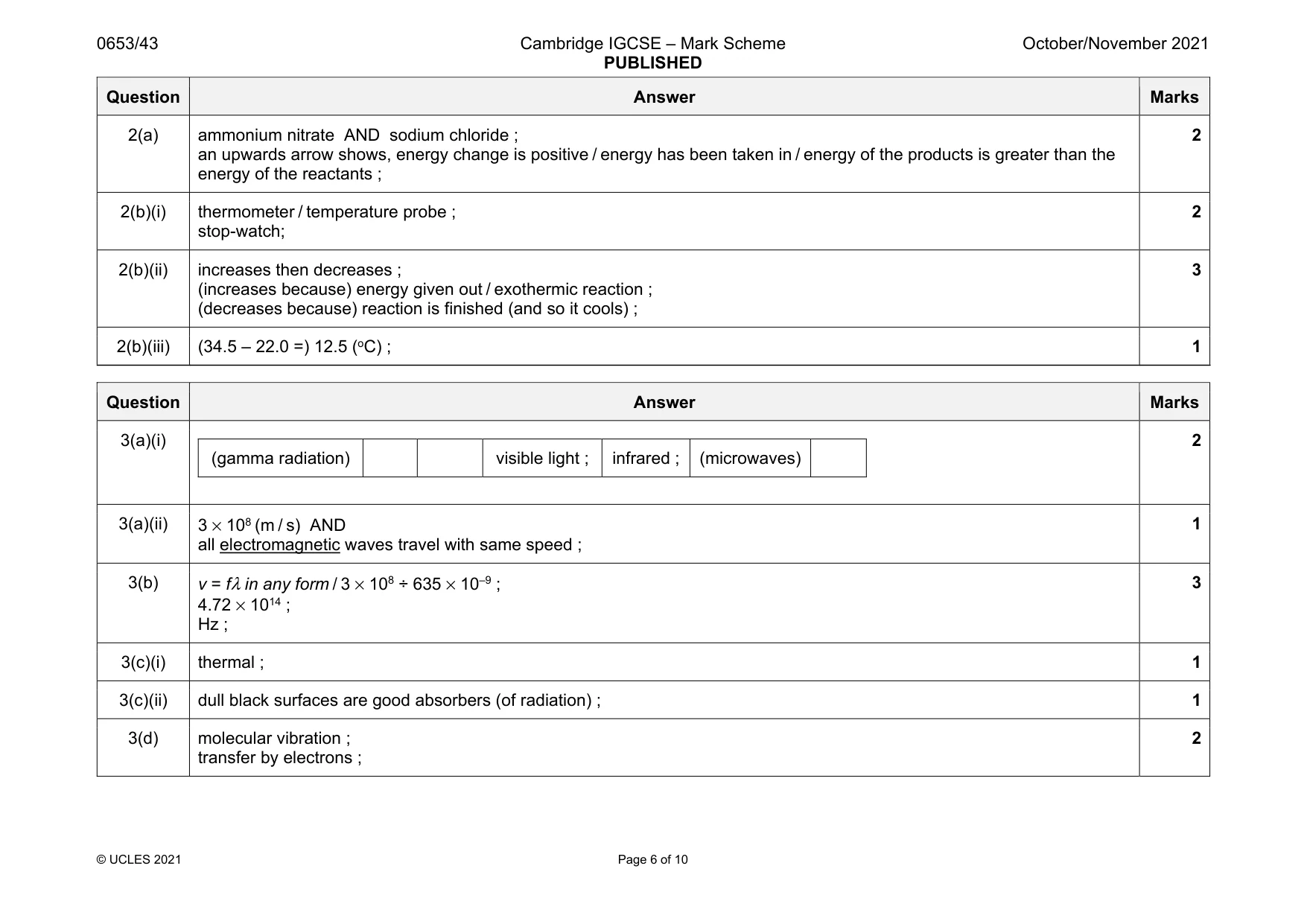
Mark scheme: 2(a) ammonium nitrate AND sodium chloride ; an upwards arrow shows, energy change is positive / energy has been taken in / energy of the products is greater than the energy of the reactants ; 2 2(b)(i) thermometer / temperature probe ; stop-watch; 2 2(b)(ii) increases then decreases ; (increases because) energy given out / exothermic reaction ; (decreases because) reaction is finished (and so it cools) ; 3 2(b)(iii) (34.5 – 22.0 =) 12.5 (oC) ; 1
Q3 · A laser is a device that emits a beam of electromagnetic radiation
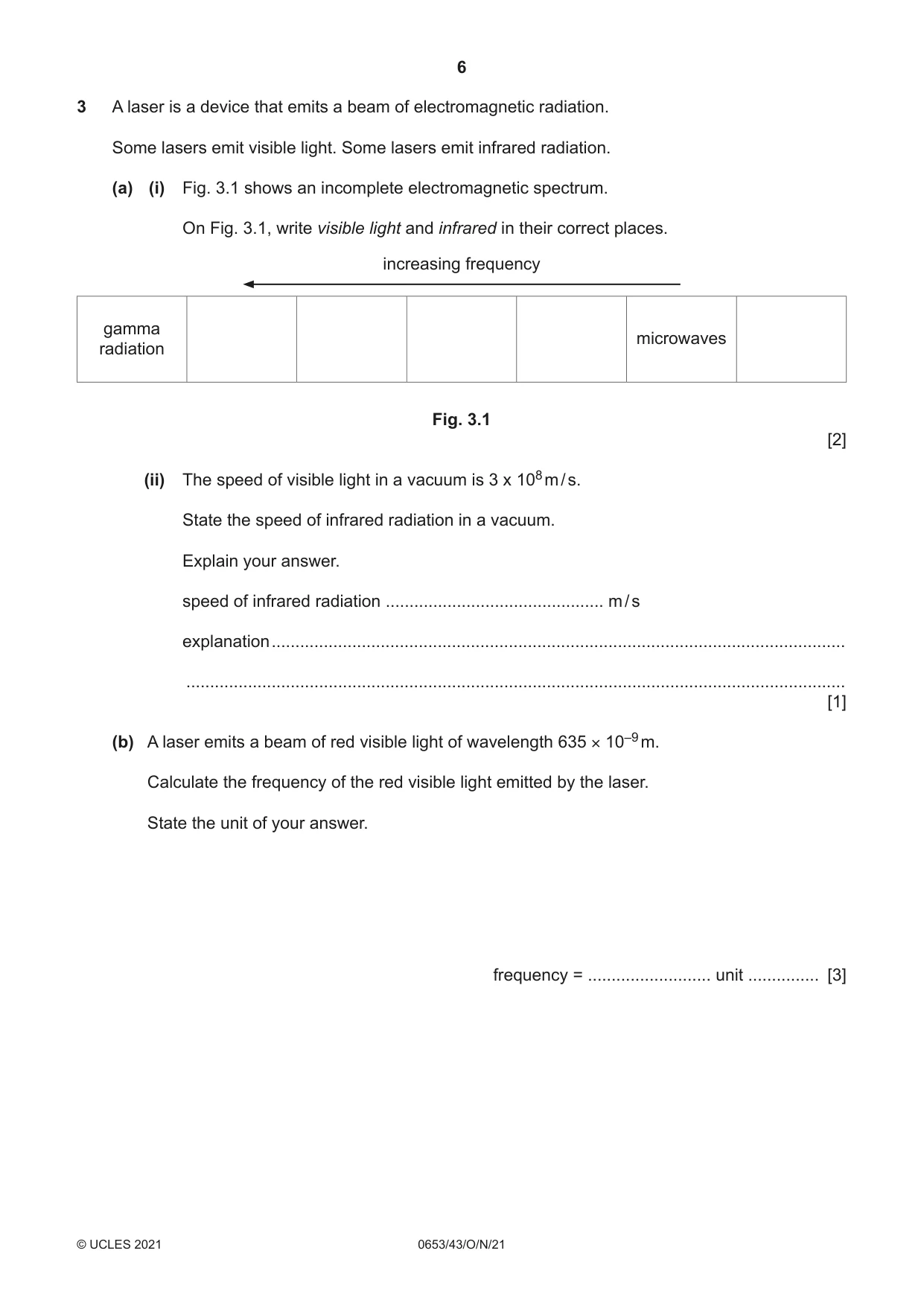
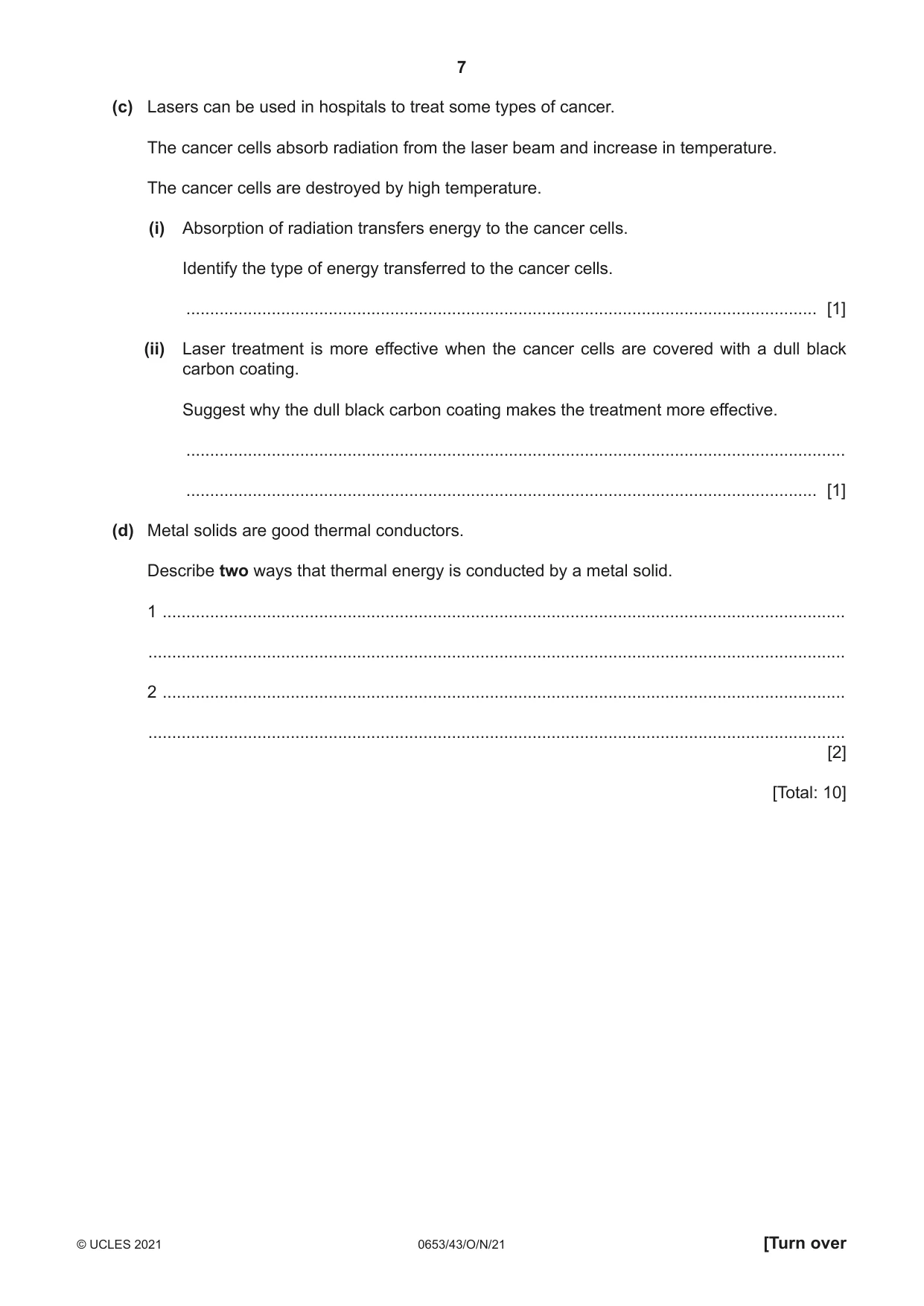
3 A laser is a device that emits a beam of electromagnetic radiation. Some lasers emit visible light. Some lasers emit infrared radiation. (a) (i) Fig. 3.1 shows an incomplete electromagnetic spectrum. On Fig. 3.1, write visible light and infrared in their correct places. increasing frequency gamma microwaves radiation Fig. 3.1 [2] (ii) The speed of visible light in a vacuum is 3 x 10⁸ m / s. State the speed of infrared radiation in a vacuum. Explain your answer. speed of infrared radiation .............................................. m / s explanation ......................................................................................................................... ........................................................................................................................................... [1] (b) A laser emits a beam of red visible light of wavelength 635 × 10–9 m. Calculate the frequency of the red visible light emitted by the laser. State the unit of your answer. frequency = .......................... unit ............... [3] (c) Lasers can be used in hospitals to treat some types of cancer. The cancer cells absorb radiation from the laser beam and increase in temperature. The cancer cells are destroyed by high temperature. (i) Absorption of radiation transfers energy to the cancer cells. Identify the type of energy transferred to the cancer cells. ..................................................................................................................................... [1] (ii) Laser treatment is more effective when the cancer cells are covered with a dull black carbon coating. Suggest why the dull black carbon coating makes the treatment more effective. ........................................................................................................................................... ..................................................................................................................................... [1] (d) Metal solids are good thermal conductors. Describe two ways that thermal energy is conducted by a metal solid. 1 ................................................................................................................................................ ................................................................................................................................................... 2 ................................................................................................................................................ ................................................................................................................................................... [2] [Total: 10]
Mark scheme: 3(a)(i) (gamma radiation) visible light ; infrared ; (microwaves) 2 3(a)(ii) 3 × 10⁸ (m / s) AND all electromagnetic waves travel with same speed ; 1 3(b) v = fλ in any form / 3 × 10⁸ ÷ 635 × 10–9 ; 4.72 × 10¹⁴ ; Hz ; 3 3(c)(i) thermal ; 1 3(c)(ii) dull black surfaces are good absorbers (of radiation) ; 1 3(d) molecular vibration ; transfer by electrons ; 2
Q4 · Part of a food web
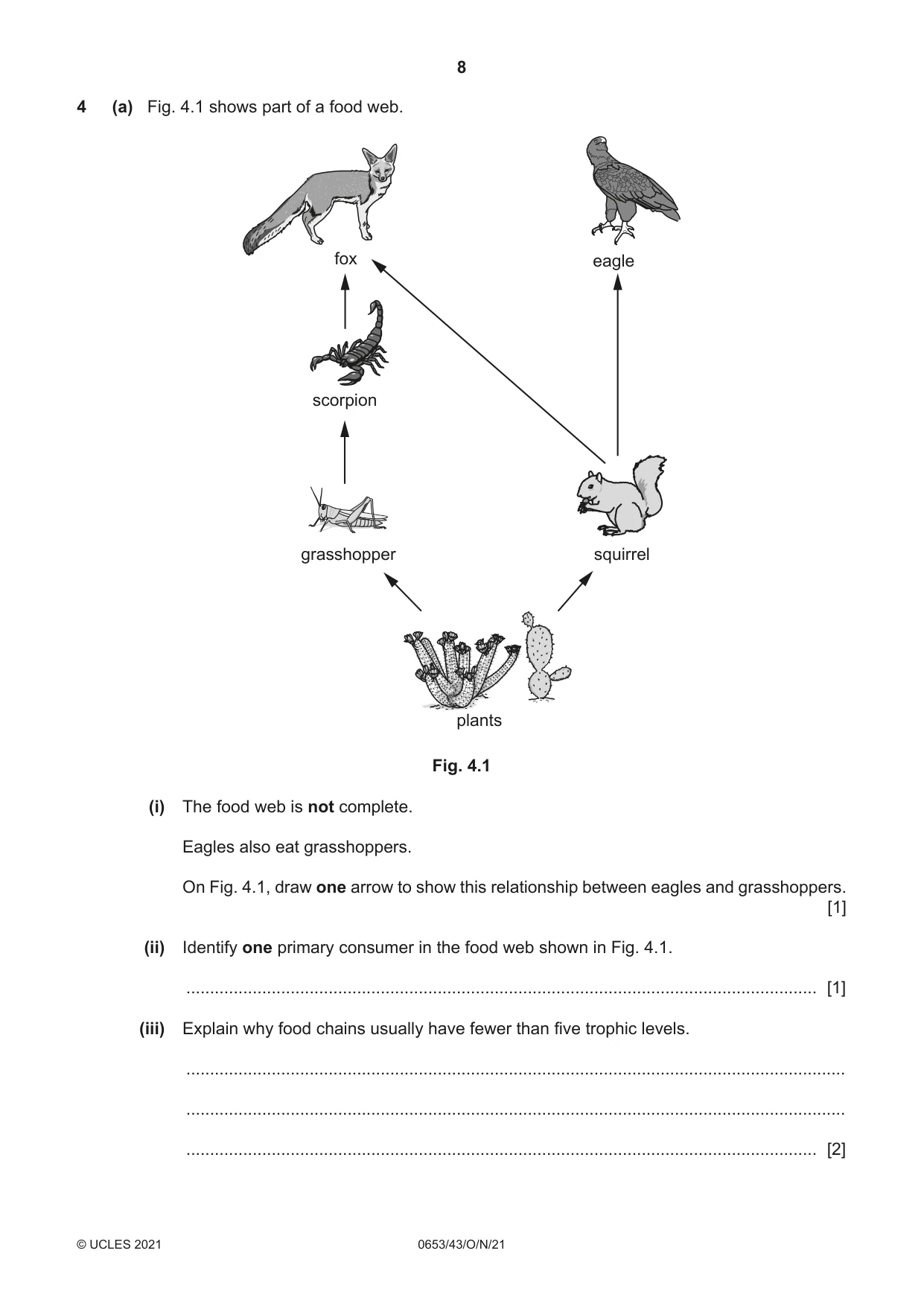
4 (a) Fig. 4.1 shows part of a food web. fox eagle scorpion grasshopper squirrel plants Fig. 4.1 (i) The food web is not complete. Eagles also eat grasshoppers. On Fig. 4.1, draw one arrow to show this relationship between eagles and grasshoppers. [1] (ii) Identify one primary consumer in the food web shown in Fig. 4.1. ..................................................................................................................................... [1] (iii) Explain why food chains usually have fewer than five trophic levels. ........................................................................................................................................... ........................................................................................................................................... ..................................................................................................................................... [2] (b) The roots of plants take in water. Explain how water moves from the soil into the root hair cells of a plant. Use ideas about water potential in your answer. ................................................................................................................................................... ................................................................................................................................................... ................................................................................................................................................... ............................................................................................................................................. [3] [Total: 7]
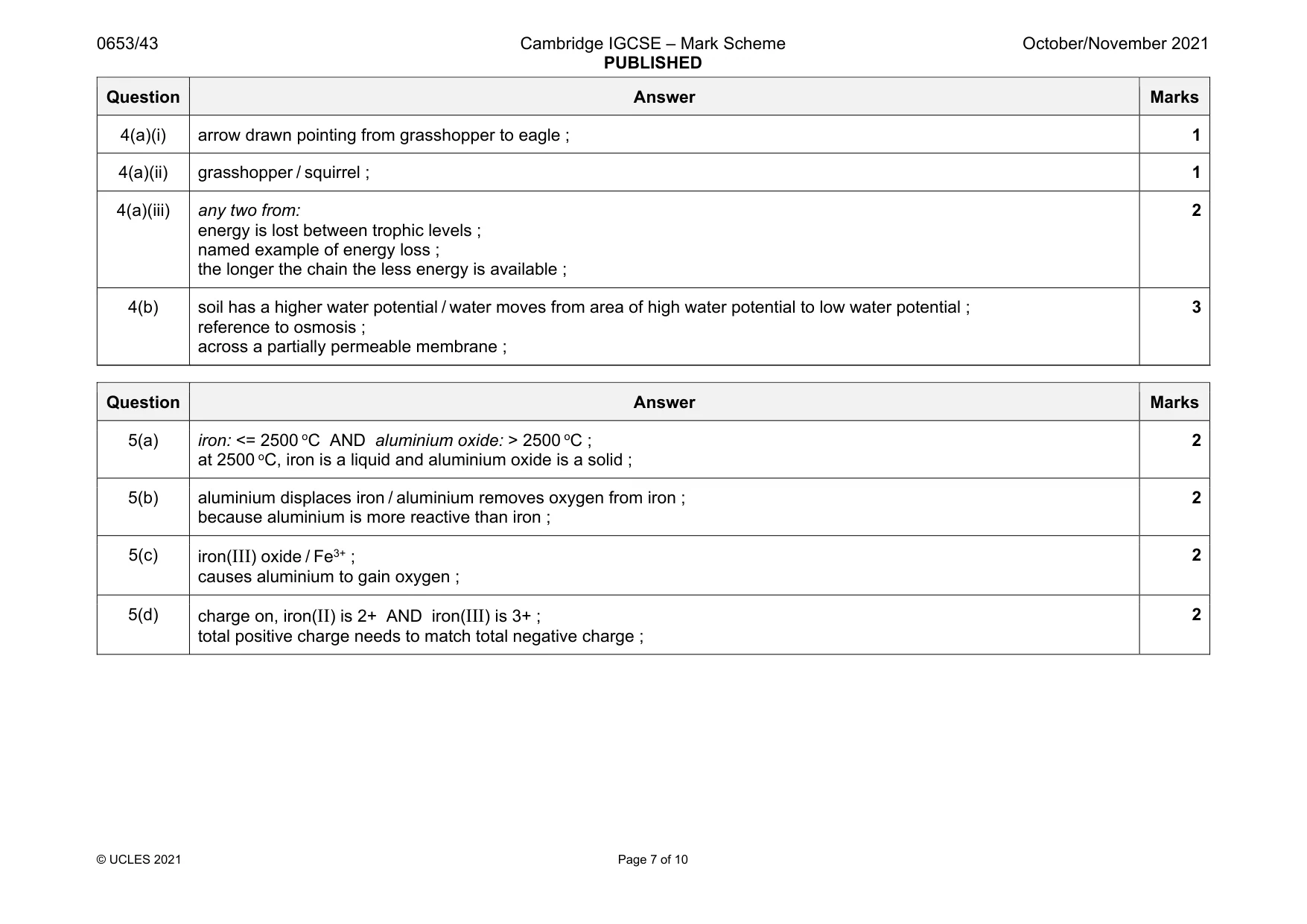
Mark scheme: 4(a)(i) arrow drawn pointing from grasshopper to eagle ; 1 4(a)(ii) grasshopper / squirrel ; 1 4(a)(iii) any two from: energy is lost between trophic levels ; named example of energy loss ; the longer the chain the less energy is available ; 2 4(b) soil has a higher water potential / water moves from area of high water potential to low water potential ; reference to osmosis ; across a partially permeable membrane ; 3
Q5 · How molten iron is used to join railway tracks together
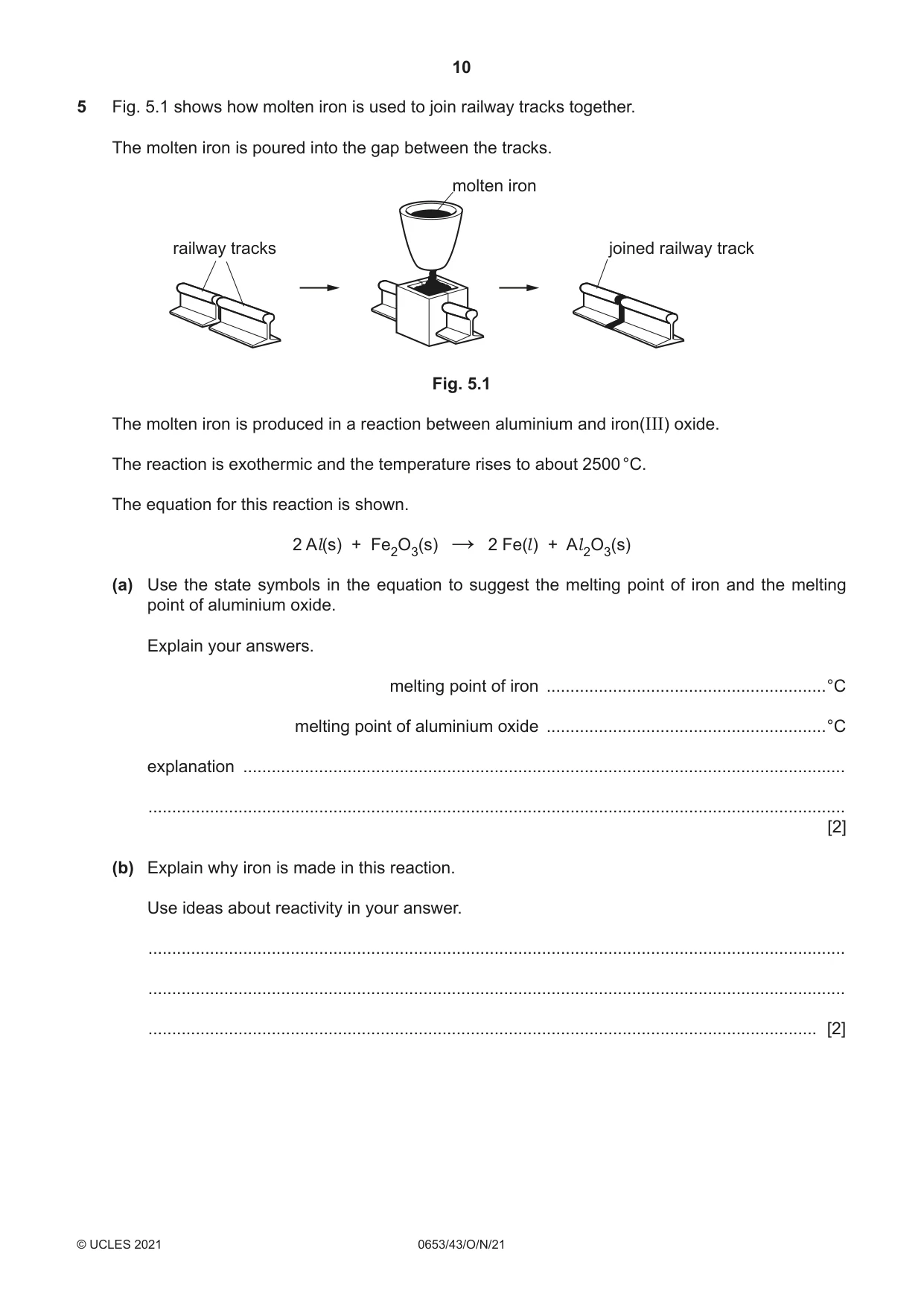
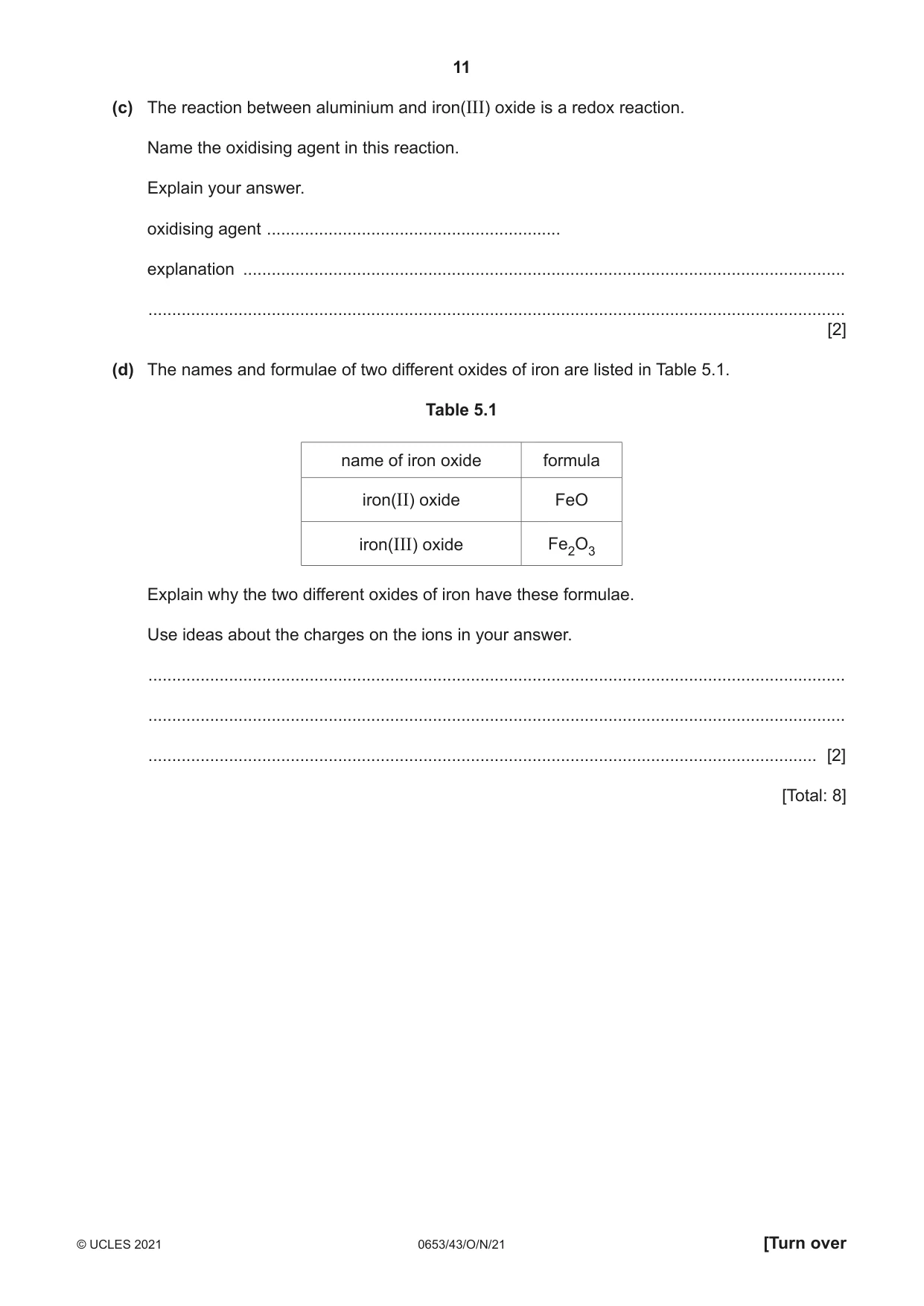
5 Fig. 5.1 shows how molten iron is used to join railway tracks together. The molten iron is poured into the gap between the tracks. molten iron railway tracks joined railway track Fig. 5.1 The molten iron is produced in a reaction between aluminium and iron(III) oxide. The reaction is exothermic and the temperature rises to about 2500 °C. The equation for this reaction is shown. 2 Al(s) + Fe2O3(s) 2 Fe(l) + Al2O3(s) → (a) Use the state symbols in the equation to suggest the melting point of iron and the melting point of aluminium oxide. Explain your answers. melting point of iron ...........................................................°C melting point of aluminium oxide ...........................................................°C explanation ............................................................................................................................... ................................................................................................................................................... [2] (b) Explain why iron is made in this reaction. Use ideas about reactivity in your answer. ................................................................................................................................................... ................................................................................................................................................... ............................................................................................................................................. [2] (c) The reaction between aluminium and iron(III) oxide is a redox reaction. Name the oxidising agent in this reaction. Explain your answer. oxidising agent .............................................................. explanation ............................................................................................................................... ................................................................................................................................................... [2] (d) The names and formulae of two different oxides of iron are listed in Table 5.1. Table 5.1 name of iron oxide formula iron(II) oxide FeO iron(III) oxide Fe2O3 Explain why the two different oxides of iron have these formulae. Use ideas about the charges on the ions in your answer. ................................................................................................................................................... ................................................................................................................................................... ............................................................................................................................................. [2] [Total: 8]
Mark scheme: 5(a) iron: <= 2500 oC AND aluminium oxide: > 2500 oC ; at 2500 oC, iron is a liquid and aluminium oxide is a solid ; 2 5(b) aluminium displaces iron / aluminium removes oxygen from iron ; because aluminium is more reactive than iron ; 2 5(c) iron(III) oxide / Fe3+ ; causes aluminium to gain oxygen ; 2 5(d) charge on, iron(II) is 2+ AND iron(III) is 3+ ; total positive charge needs to match total negative charge ; 2
Q6 · A dinosaur called Tyrannosaurus Rex (T-Rex)
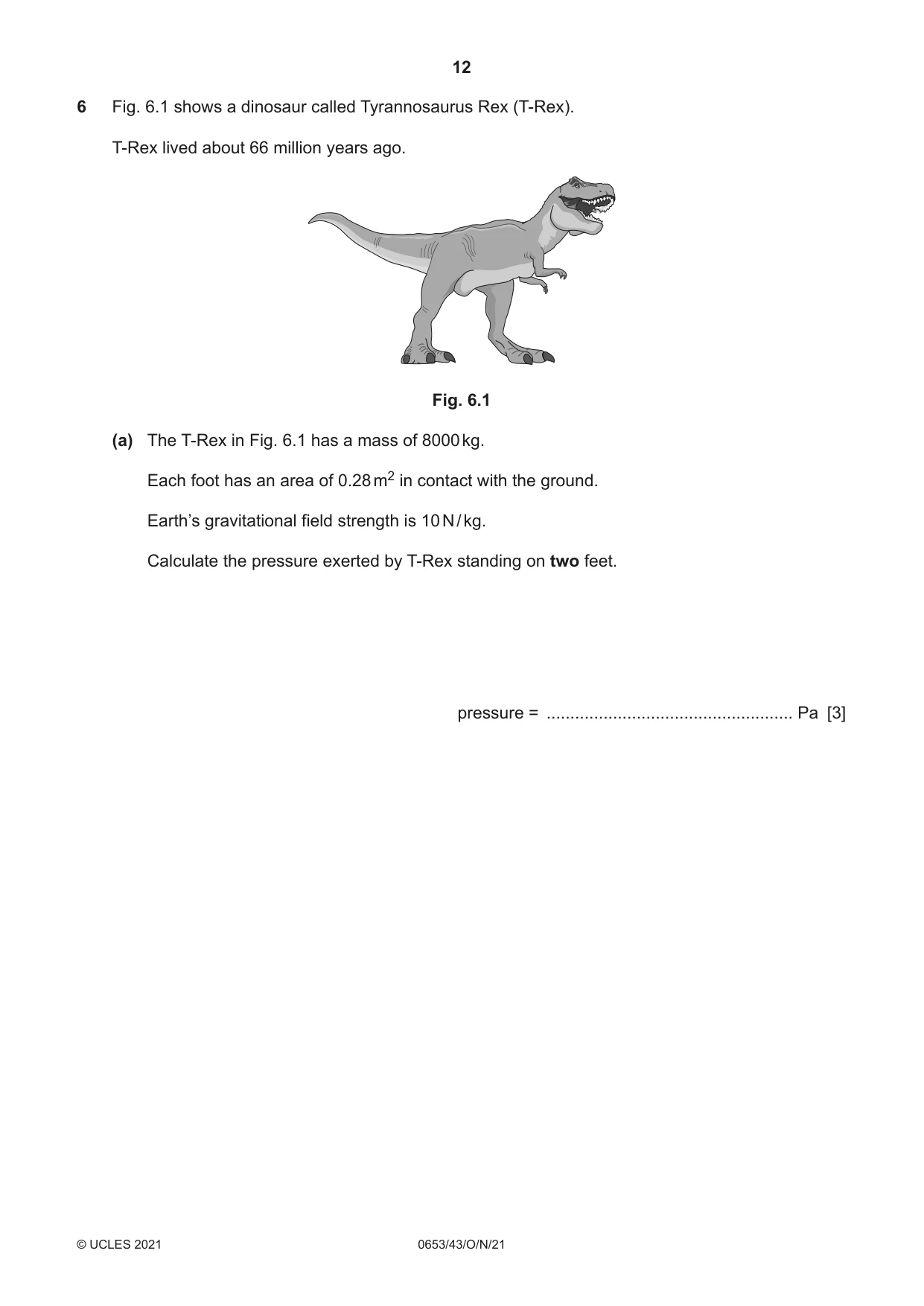
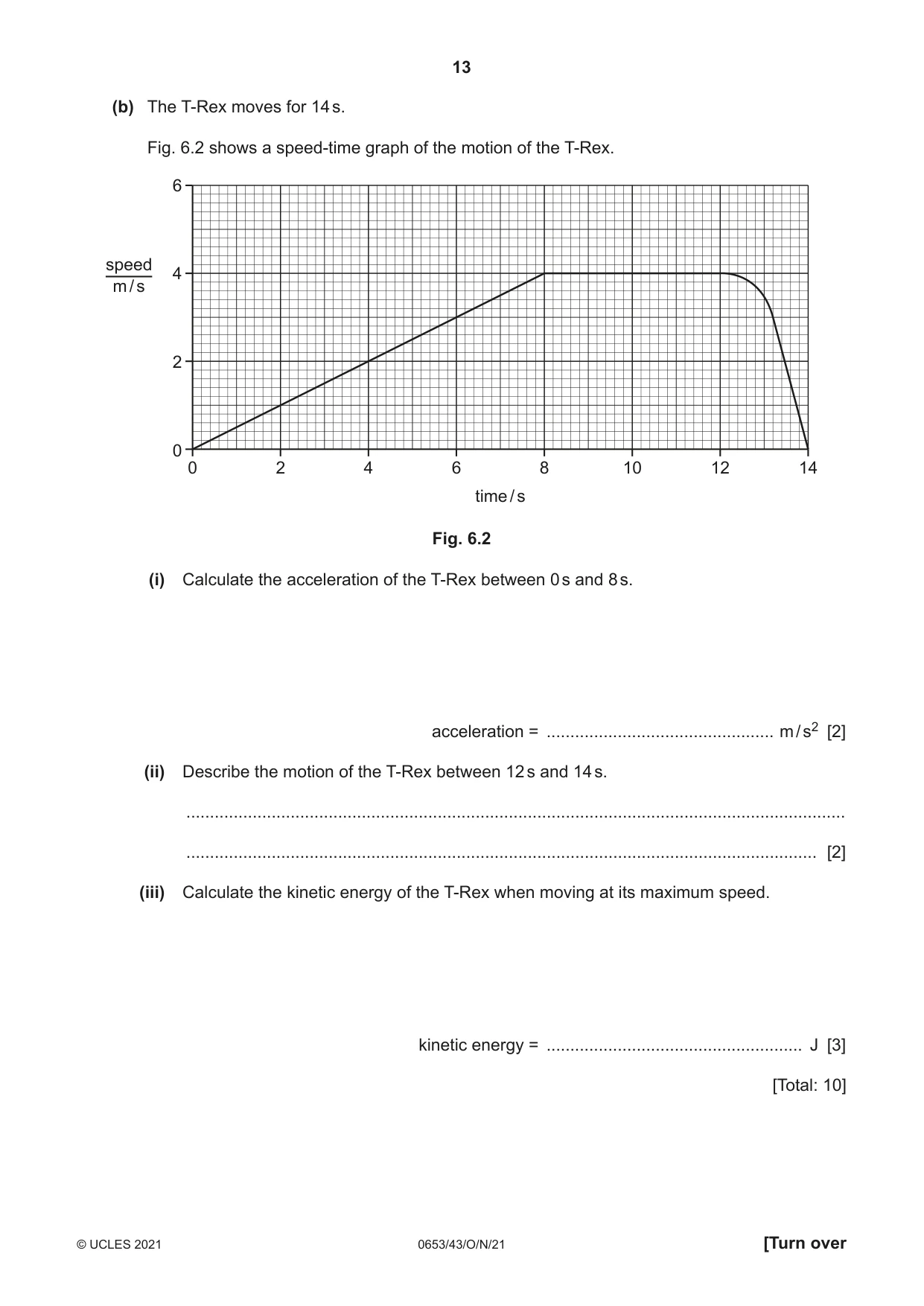
6 Fig. 6.1 shows a dinosaur called Tyrannosaurus Rex (T-Rex). T-Rex lived about 66 million years ago. Fig. 6.1 (a) The T-Rex in Fig. 6.1 has a mass of 8000 kg. Each foot has an area of 0.28 m2 in contact with the ground. Earth’s gravitational field strength is 10 N / kg. Calculate the pressure exerted by T-Rex standing on two feet. pressure = .................................................... Pa [3] (b) The T-Rex moves for 14 s. Fig. 6.2 shows a speed-time graph of the motion of the T-Rex. 6 speed 4 m / s 2 0 0 2 4 6 8 10 12 14 time / s Fig. 6.2 (i) Calculate the acceleration of the T-Rex between 0 s and 8 s. acceleration = ................................................ m / s2 [2] (ii) Describe the motion of the T-Rex between 12 s and 14 s. ........................................................................................................................................... ..................................................................................................................................... [2] (iii) Calculate the kinetic energy of the T-Rex when moving at its maximum speed. kinetic energy = ...................................................... J [3] [Total: 10]
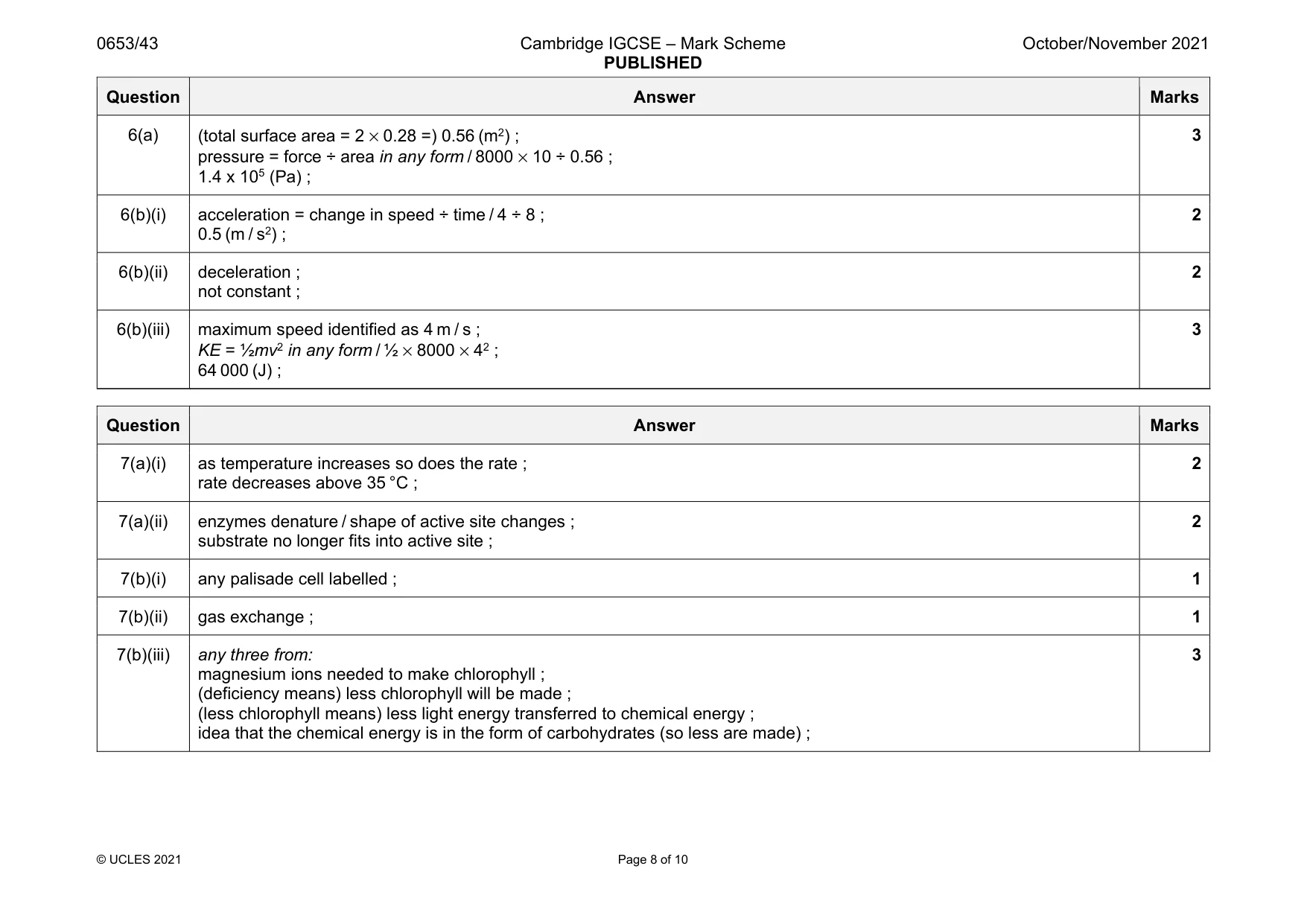
Mark scheme: 6(a) (total surface area = 2 × 0.28 =) 0.56 (m2) ; pressure = force ÷ area in any form / 8000 × 10 ÷ 0.56 ; 1.4 x 10⁵ (Pa) ; 3 6(b)(i) acceleration = change in speed ÷ time / 4 ÷ 8 ; 0.5 (m / s2) ; 2 6(b)(ii) deceleration ; not constant ; 2 6(b)(iii) maximum speed identified as 4 m / s ; KE = ½mv2 in any form / ½ × 8000 × 42 ; 64 000 (J) ; 3
Q7 · A student uses the apparatus in Fig
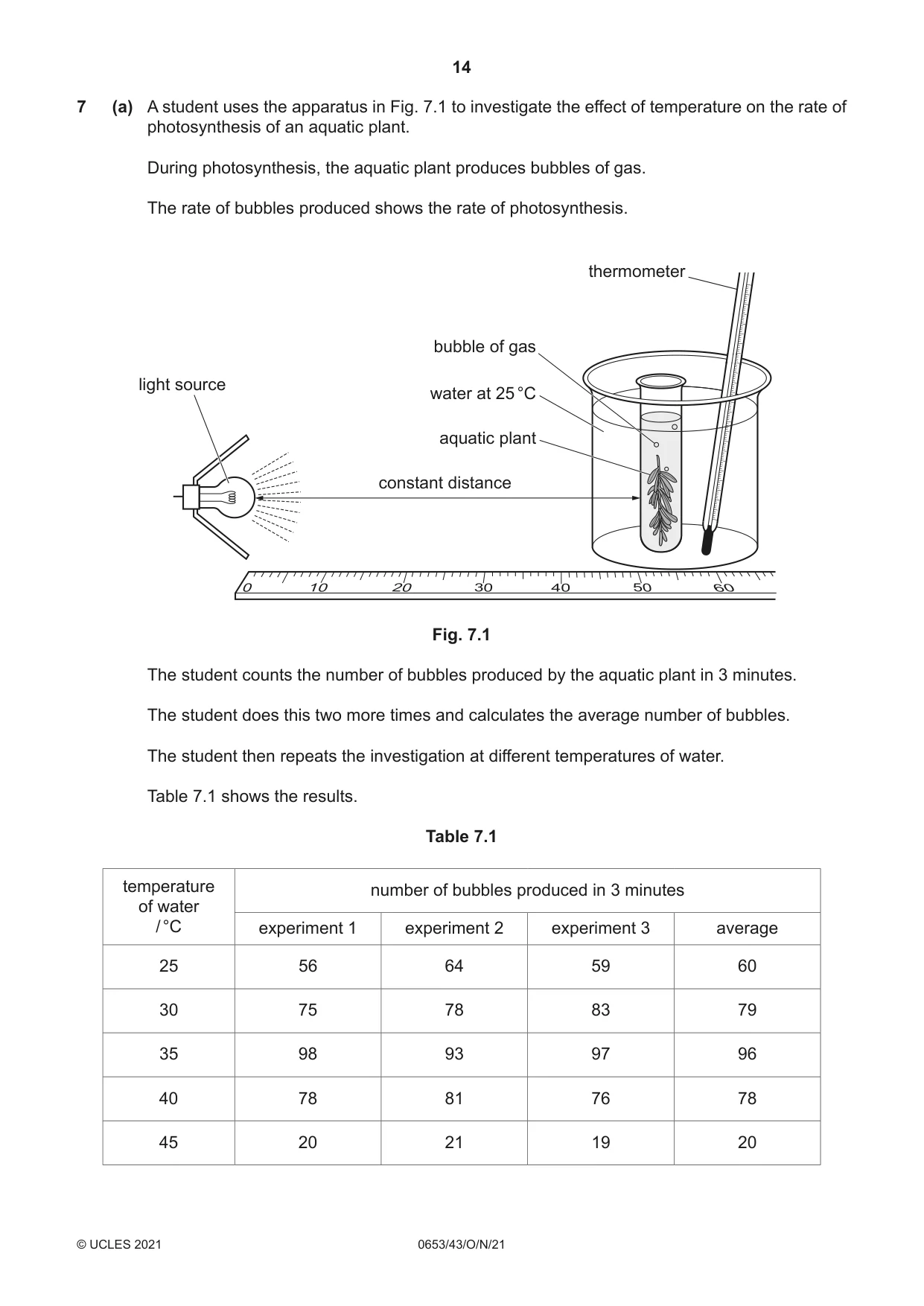
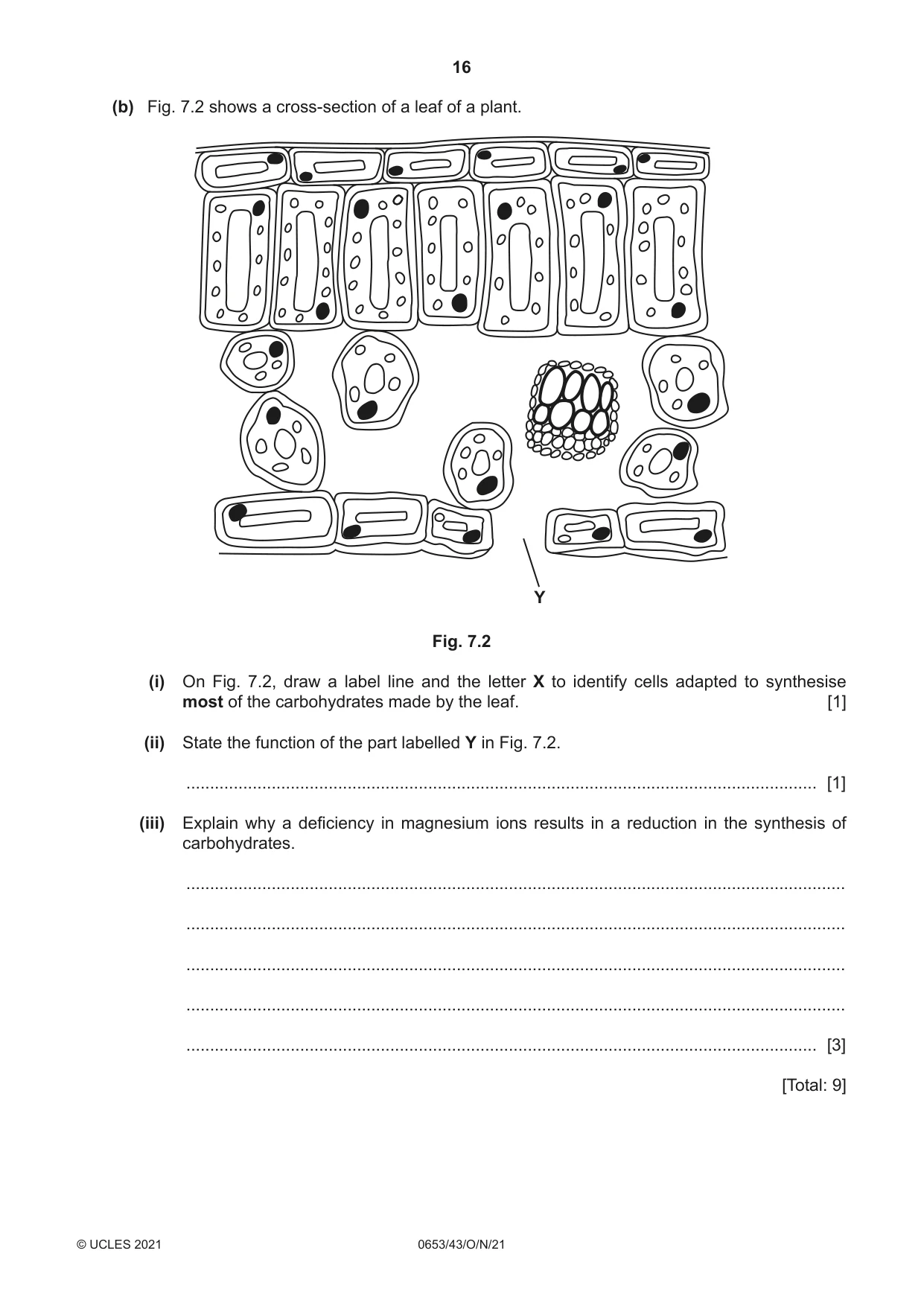
7 (a) A student uses the apparatus in Fig. 7.1 to investigate the effect of temperature on the rate of photosynthesis of an aquatic plant. During photosynthesis, the aquatic plant produces bubbles of gas. The rate of bubbles produced shows the rate of photosynthesis. thermometer bubble of gas light source water at 25 °C aquatic plant constant distance 0 10 20 30 40 50 60 Fig. 7.1 The student counts the number of bubbles produced by the aquatic plant in 3 minutes. The student does this two more times and calculates the average number of bubbles. The student then repeats the investigation at different temperatures of water. Table 7.1 shows the results. Table 7.1 temperature number of bubbles produced in 3 minutes of water / °C experiment 1 experiment 2 experiment 3 average 25 56 64 59 60 30 75 78 83 79 35 98 93 97 96 40 78 81 76 78 45 20 21 19 20 (i) Describe the effect of temperature on the rate of photosynthesis shown by the results in Table 7.1. ........................................................................................................................................... ........................................................................................................................................... ..................................................................................................................................... [2] (ii) The process of photosynthesis is controlled by enzymes. Explain the result at 45 °C in Table 7.1. Use ideas about enzymes in your answer. ........................................................................................................................................... ........................................................................................................................................... ..................................................................................................................................... [2] (b) Fig. 7.2 shows a cross-section of a leaf of a plant. Y Fig. 7.2 (i) On Fig. 7.2, draw a label line and the letter X to identify cells adapted to synthesise most of the carbohydrates made by the leaf. [1] (ii) State the function of the part labelled Y in Fig. 7.2. ..................................................................................................................................... [1] (iii) Explain why a deficiency in magnesium ions results in a reduction in the synthesis of carbohydrates. ........................................................................................................................................... ........................................................................................................................................... ........................................................................................................................................... ........................................................................................................................................... ..................................................................................................................................... [3] [Total: 9]
Mark scheme: 7(a)(i) as temperature increases so does the rate ; rate decreases above 35 °C ; 2 7(a)(ii) enzymes denature / shape of active site changes ; substrate no longer fits into active site ; 2 7(b)(i) any palisade cell labelled ; 1 7(b)(ii) gas exchange ; 1 7(b)(iii) any three from: magnesium ions needed to make chlorophyll ; (deficiency means) less chlorophyll will be made ; (less chlorophyll means) less light energy transferred to chemical energy ; idea that the chemical energy is in the form of carbohydrates (so less are made) ; 3
Q8 · Some properties of three elements in Group VII of the Periodic Table
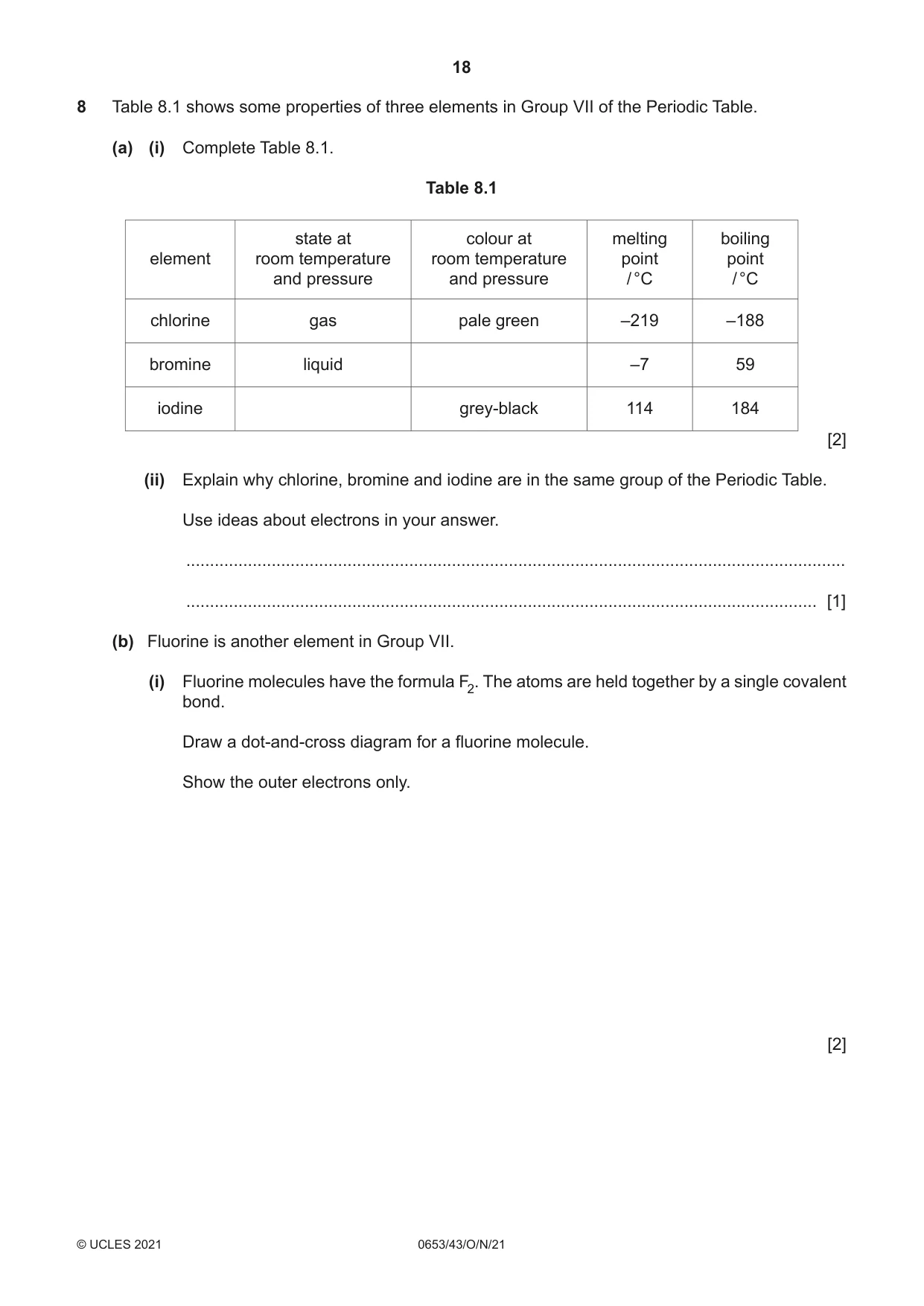
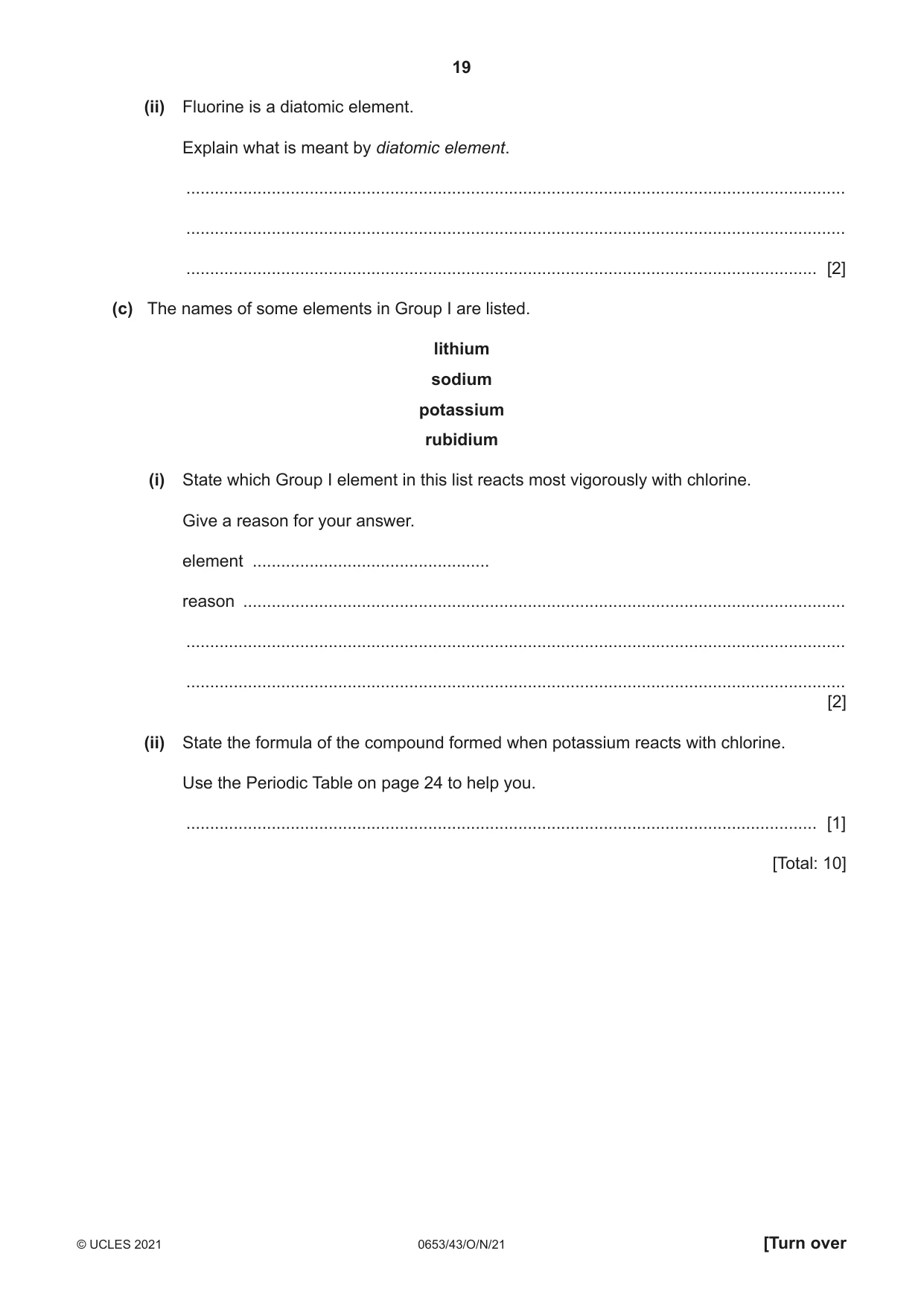
8 Table 8.1 shows some properties of three elements in Group VII of the Periodic Table. (a) (i) Complete Table 8.1. Table 8.1 state at colour at melting boiling element room temperature room temperature point point and pressure and pressure / °C / °C chlorine gas pale green –219 –188 bromine liquid –7 59 iodine grey-black 114 184 [2] (ii) Explain why chlorine, bromine and iodine are in the same group of the Periodic Table. Use ideas about electrons in your answer. ........................................................................................................................................... ..................................................................................................................................... [1] (b) Fluorine is another element in Group VII. (i) Fluorine molecules have the formula F2. The atoms are held together by a single covalent bond. Draw a dot-and-cross diagram for a fluorine molecule. Show the outer electrons only. [2] (ii) Fluorine is a diatomic element. Explain what is meant by diatomic element. ........................................................................................................................................... ........................................................................................................................................... ..................................................................................................................................... [2] (c) The names of some elements in Group I are listed. lithium sodium potassium rubidium (i) State which Group I element in this list reacts most vigorously with chlorine. Give a reason for your answer. element .................................................. reason ............................................................................................................................... ........................................................................................................................................... ........................................................................................................................................... [2] (ii) State the formula of the compound formed when potassium reacts with chlorine. Use the Periodic Table on page 24 to help you. ..................................................................................................................................... [1] [Total: 10]
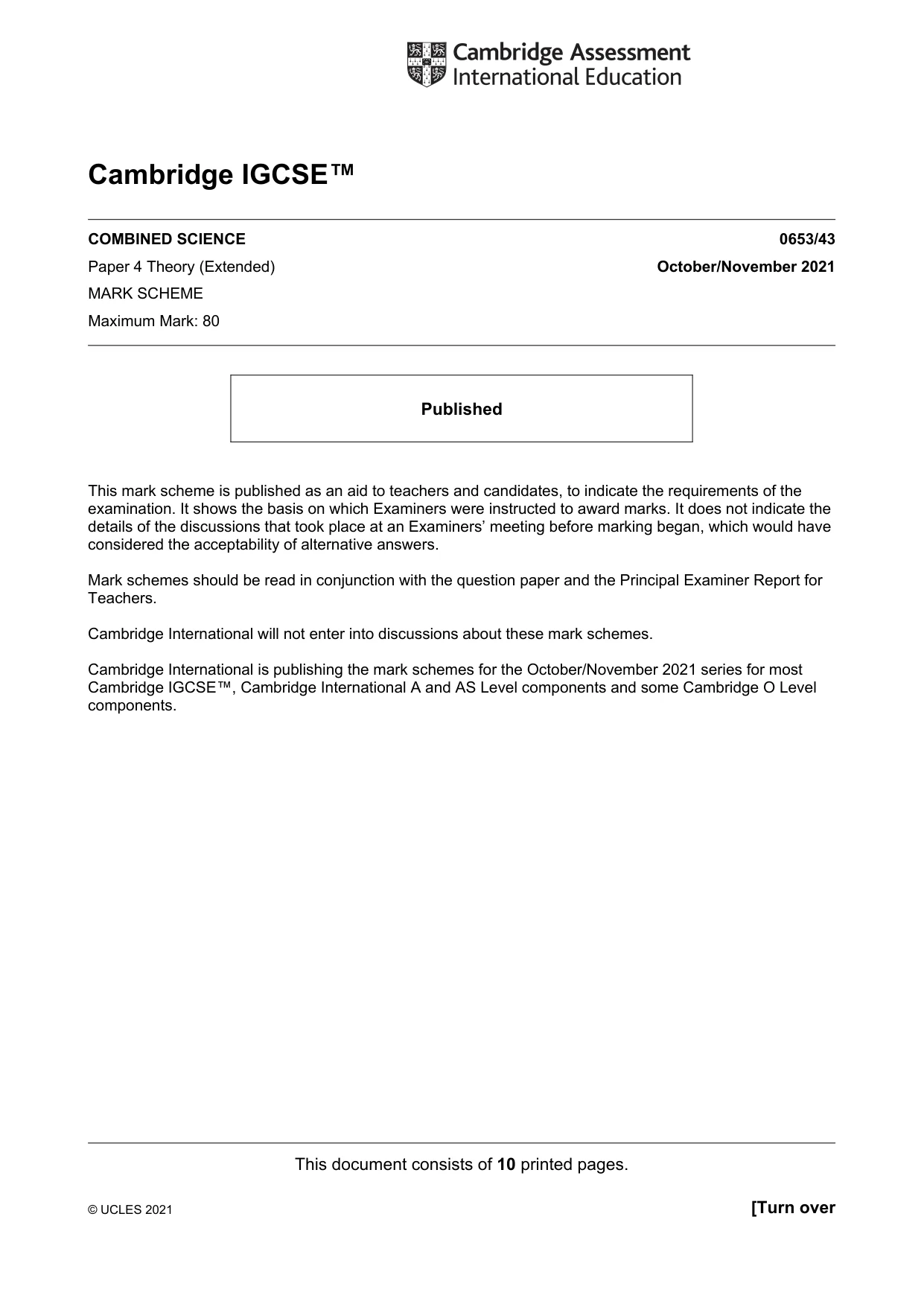
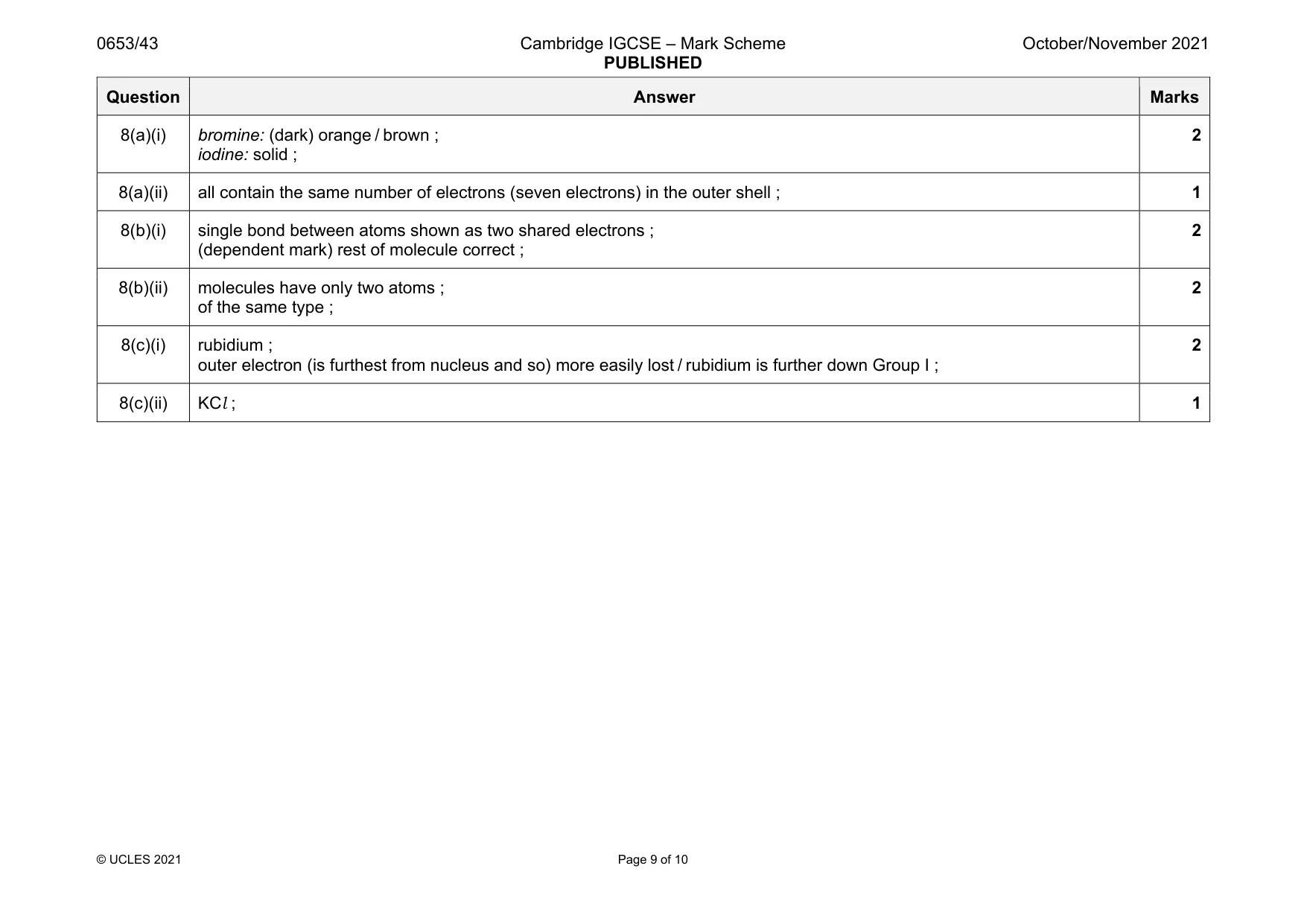
Mark scheme: 8(a)(i) bromine: (dark) orange / brown ; iodine: solid ; 2 8(a)(ii) all contain the same number of electrons (seven electrons) in the outer shell ; 1 8(b)(i) single bond between atoms shown as two shared electrons ; (dependent mark) rest of molecule correct ; 2 8(b)(ii) molecules have only two atoms ; of the same type ; 2 8(c)(i) rubidium ; outer electron (is furthest from nucleus and so) more easily lost / rubidium is further down Group I ; 2 8(c)(ii) KCl ; 1
Q9 · Some electrical components of a car
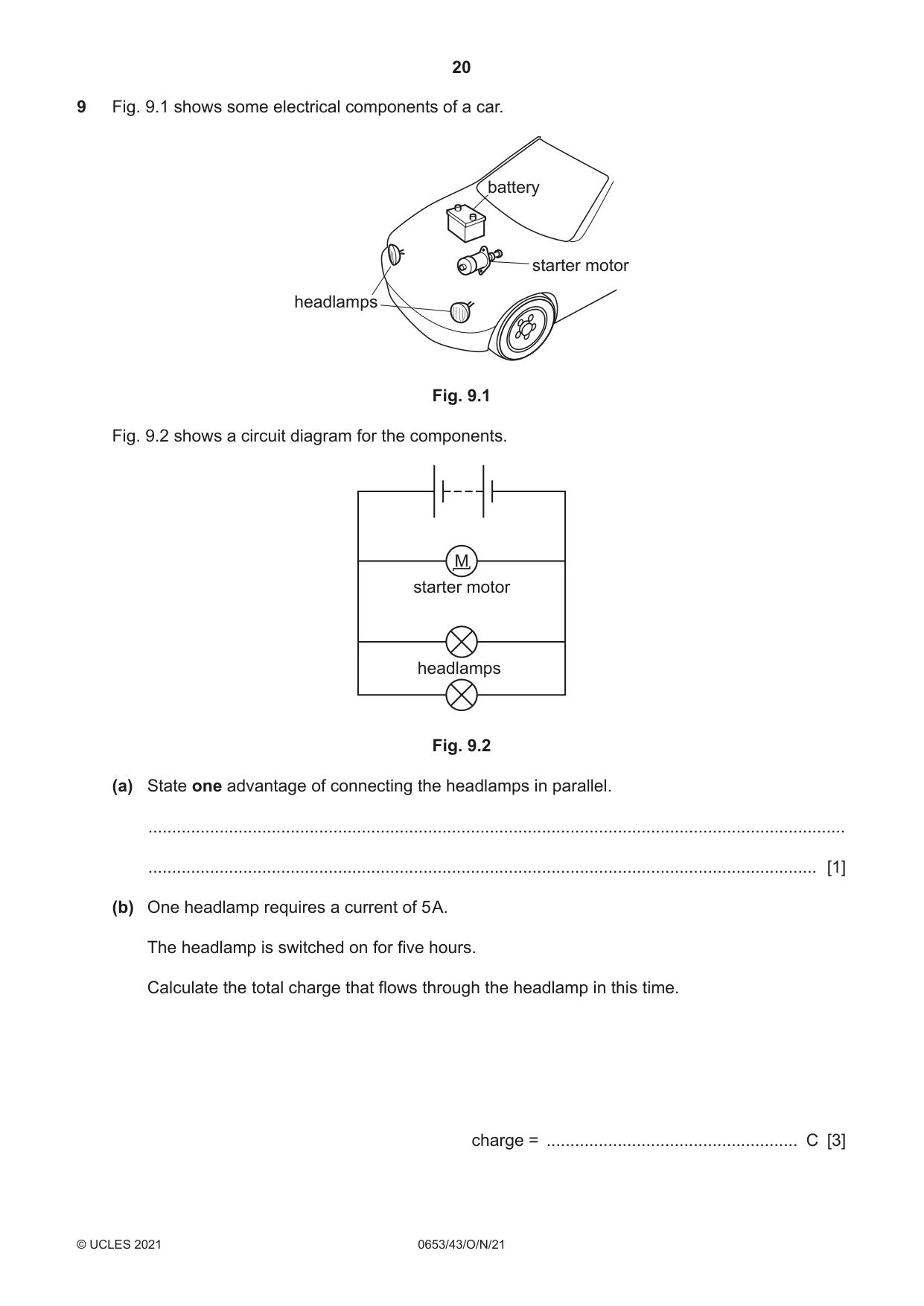
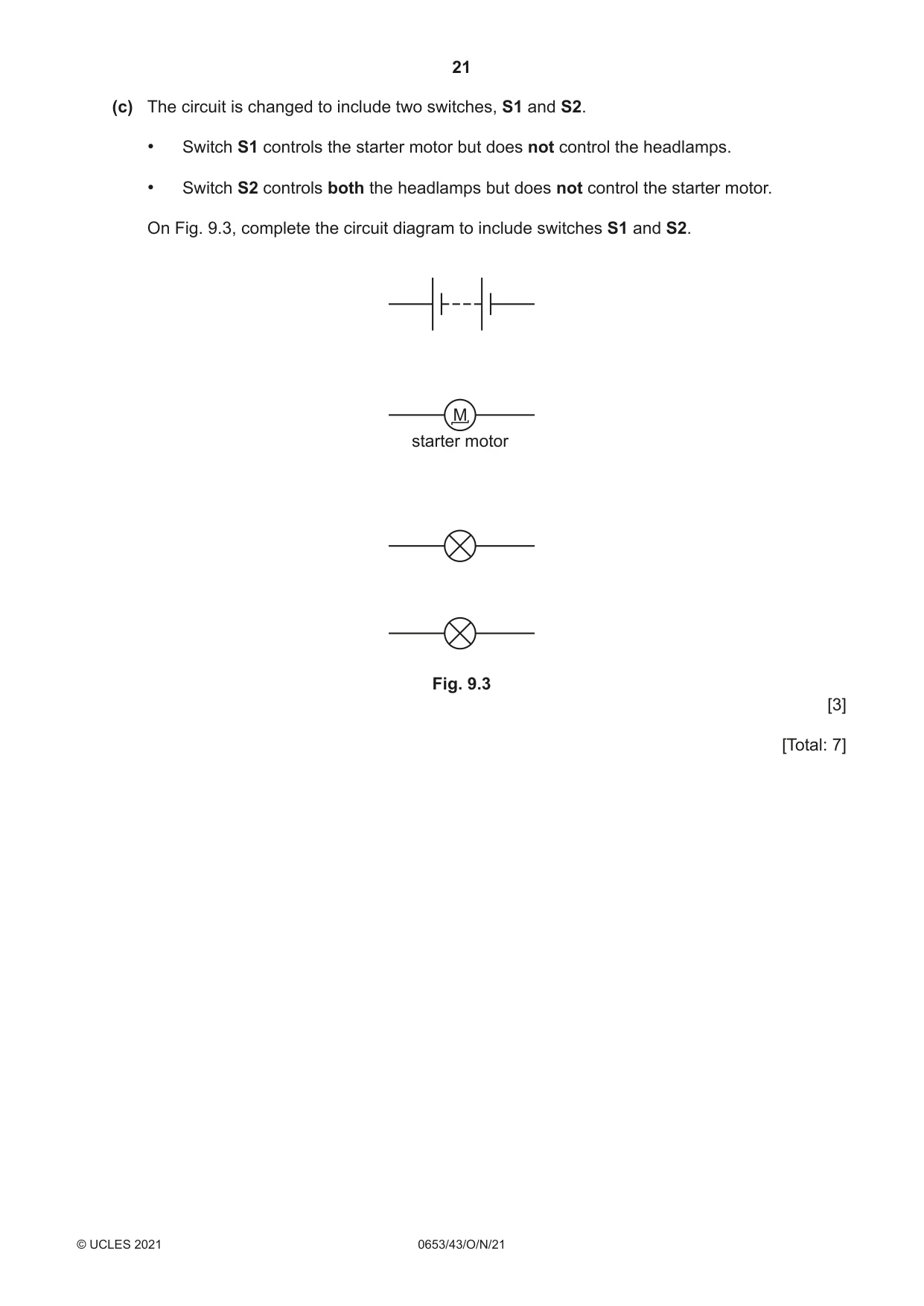
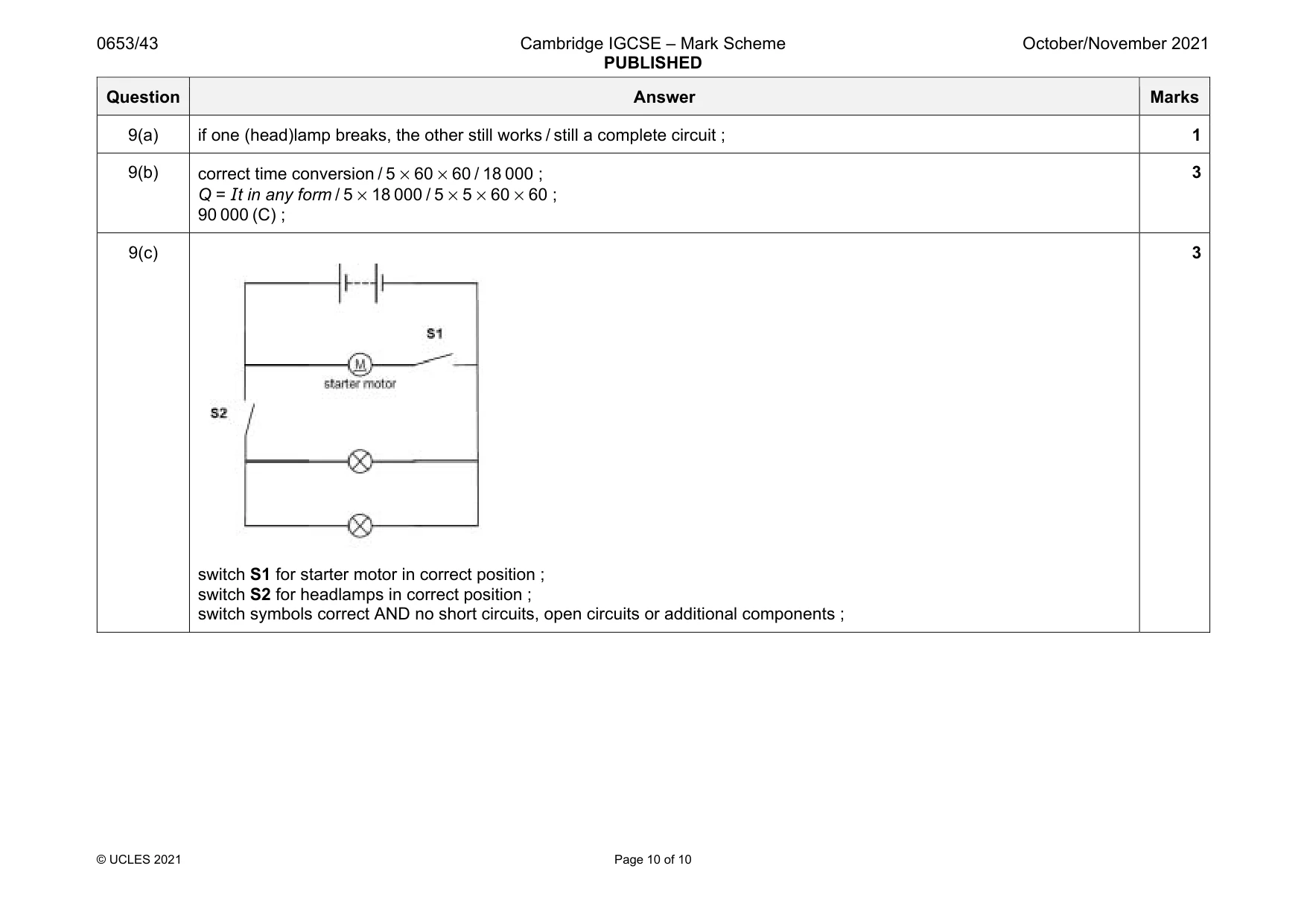
9 Fig. 9.1 shows some electrical components of a car. battery starter motor headlamps Fig. 9.1 Fig. 9.2 shows a circuit diagram for the components. M starter motor headlamps Fig. 9.2 (a) State one advantage of connecting the headlamps in parallel. ................................................................................................................................................... ............................................................................................................................................. [1] (b) One headlamp requires a current of 5 A. The headlamp is switched on for five hours. Calculate the total charge that flows through the headlamp in this time. charge = ..................................................... C [3] (c) The circuit is changed to include two switches, S1 and S2. • Switch S1 controls the starter motor but does not control the headlamps. • Switch S2 controls both the headlamps but does not control the starter motor. On Fig. 9.3, complete the circuit diagram to include switches S1 and S2. M starter motor Fig. 9.3 [3] [Total: 7]
Mark scheme: 9(a) if one (head)lamp breaks, the other still works / still a complete circuit ; 1 9(b) correct time conversion / 5 × 60 × 60 / 18 000 ; Q = It in any form / 5 × 18 000 / 5 × 5 × 60 × 60 ; 90 000 (C) ; 3 9(c) switch S1 for starter motor in correct position ; switch S2 for headlamps in correct position ; switch symbols correct AND no short circuits, open circuits or additional components ; 3
What was in this paper
The subtopics covered by these 9 questions, and how many questions each got. Open one in a new tab to see every Cambridge question on it.
What you needed in this session
Cambridge’s own grade thresholds for 2021 Oct/Nov, Paper 4 · Variant 3. A higher threshold means an easier paper — the bar moves with how the cohort did.