Cambridge IGCSE Science - Combined 0653 — 2022 Oct/Nov Paper 4 · Variant 3
0653/43/O/N/22 · 9 questions · 80 marks · ≈90 min
The question paper and its mark scheme, free to read here and free to download. This is Cambridge’s own paper, exactly as it was sat.
Question paper20 pages
Mark scheme12 pages
Answers below. Sit the paper first if you are practising.
Questions as text
Q1 · A diagram of a wind-pollinated flower
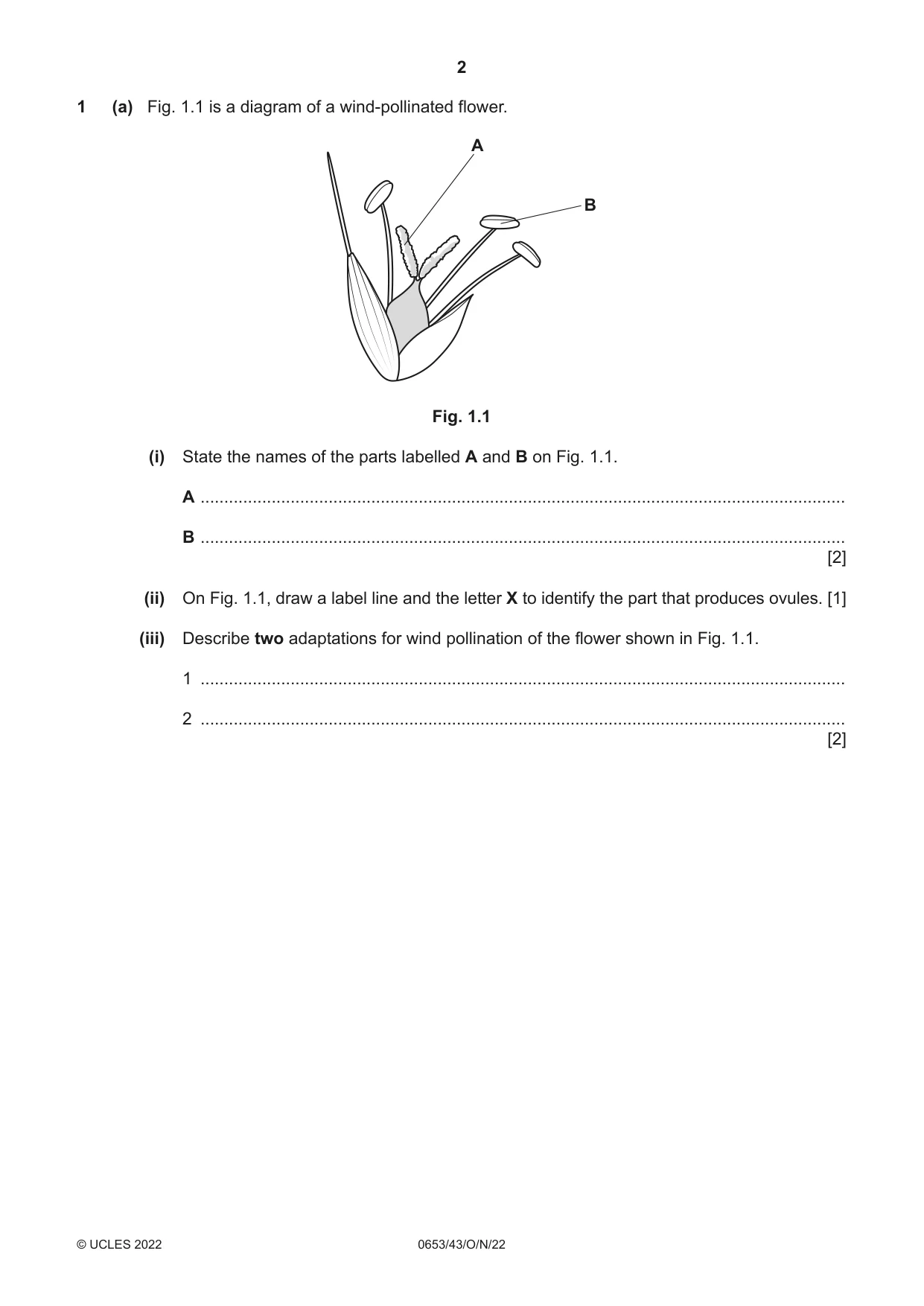
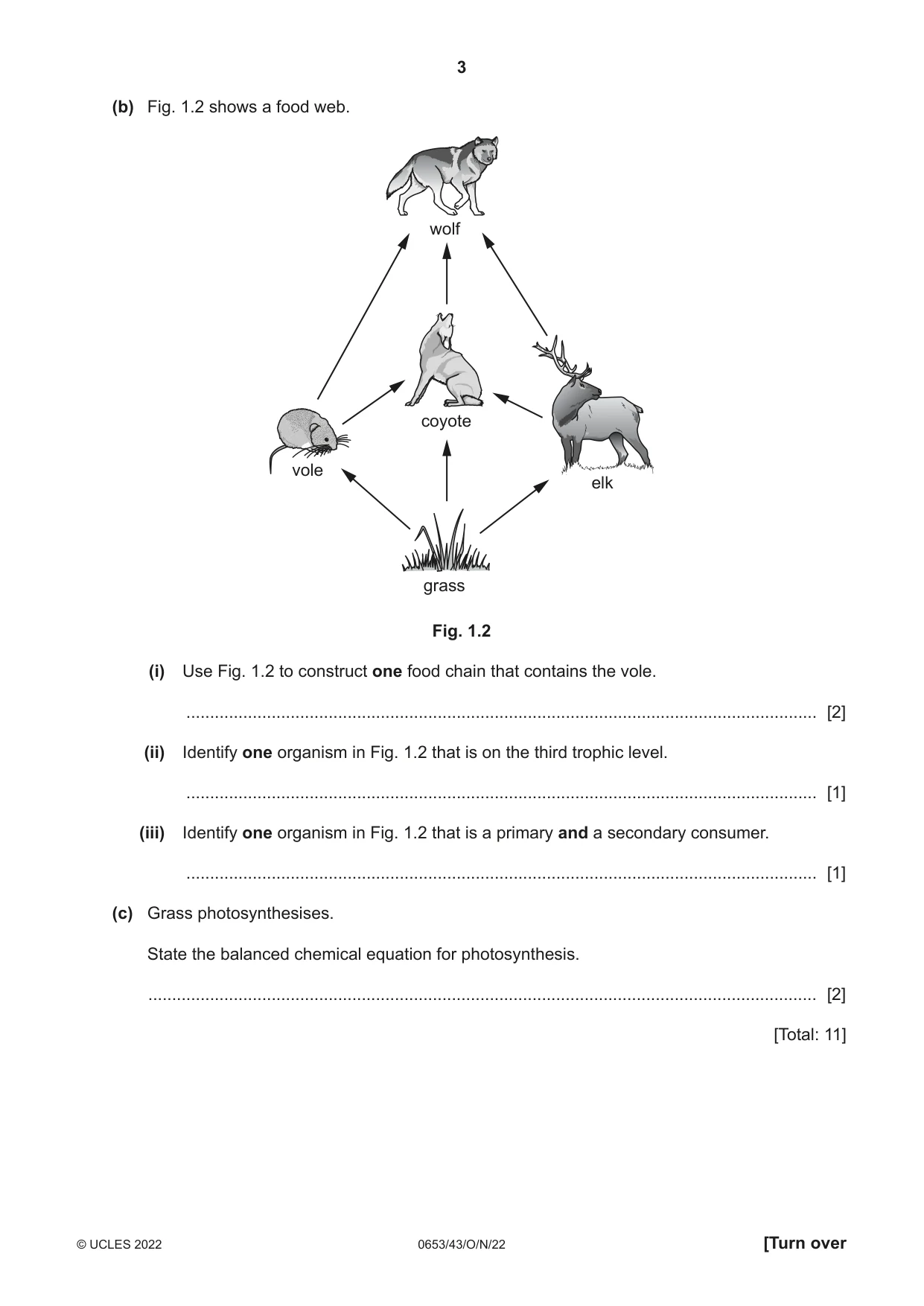
1 (a) Fig. 1.1 is a diagram of a wind-pollinated flower. A B Fig. 1.1 (i) State the names of the parts labelled A and B on Fig. 1.1. A ........................................................................................................................................ B ........................................................................................................................................ [2] (ii) On Fig. 1.1, draw a label line and the letter X to identify the part that produces ovules. [1] (iii) Describe two adaptations for wind pollination of the flower shown in Fig. 1.1. 1 ........................................................................................................................................ 2 ........................................................................................................................................ [2] (b) Fig. 1.2 shows a food web. wolf coyote vole elk grass Fig. 1.2 (i) Use Fig. 1.2 to construct one food chain that contains the vole. ..................................................................................................................................... [2] (ii) Identify one organism in Fig. 1.2 that is on the third trophic level. ..................................................................................................................................... [1] (iii) Identify one organism in Fig. 1.2 that is a primary and a secondary consumer. ..................................................................................................................................... [1] (c) Grass photosynthesises. State the balanced chemical equation for photosynthesis. ............................................................................................................................................. [2] [Total: 11]
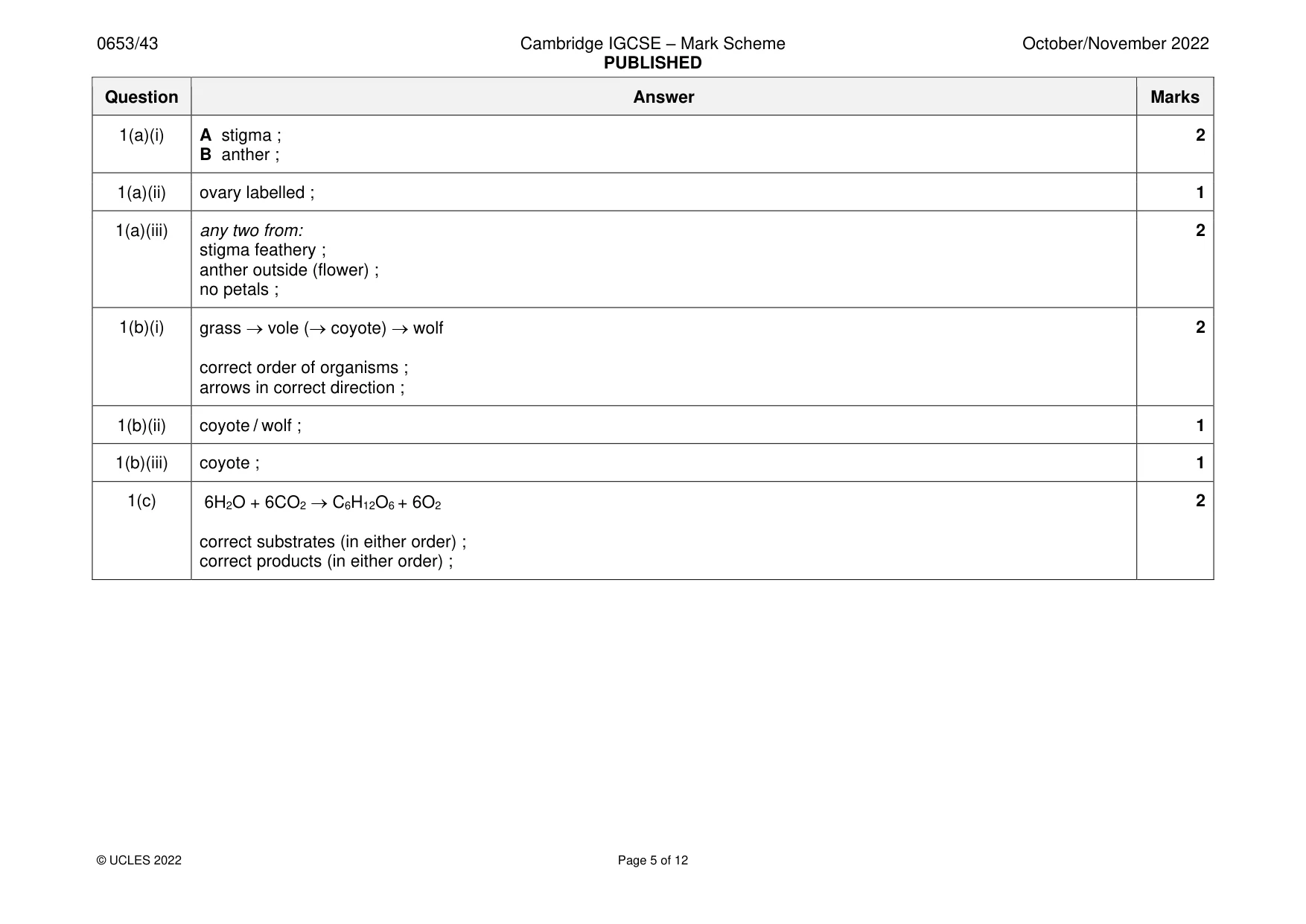
Mark scheme: Question Answer Marks 1(a)(i) A stigma ; 2 B anther ; 1(a)(ii) ovary labelled ; 1 1(a)(iii) any two from: 2 stigma feathery ; anther outside (flower) ; no petals ; 1(b)(i) grass → vole (→ coyote) → wolf 2 correct order of organisms ; arrows in correct direction ; 1(b)(ii) coyote / wolf ; 1 1(b)(iii) coyote ; 1 1(c) 6H2O + 6CO2 → C6H12O6 + 6O2 2 correct substrates (in either order) ; correct products (in either order) ;
Q2 · The electronic structures of a chlorine atom and a chloride ion are shown in Fig
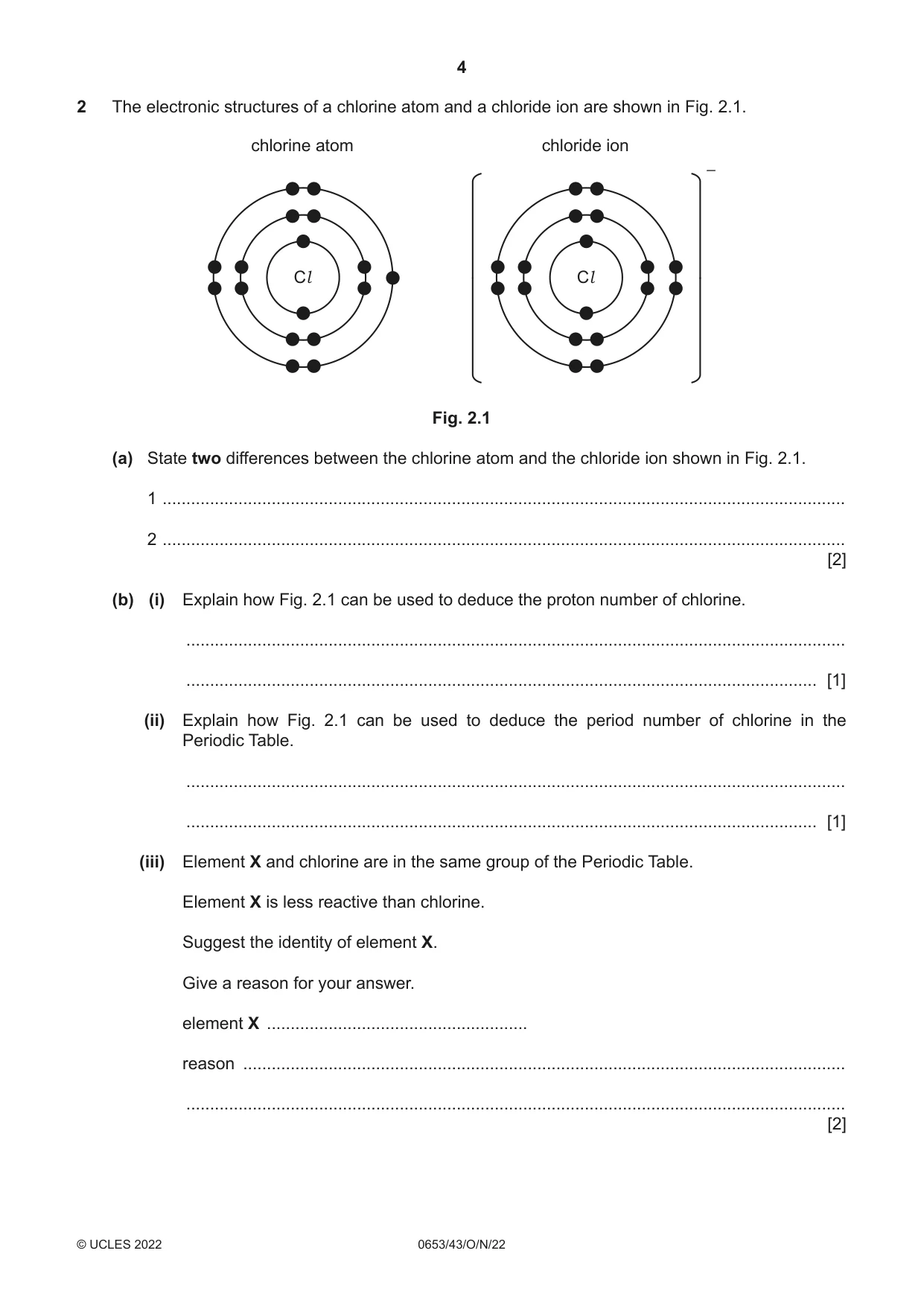
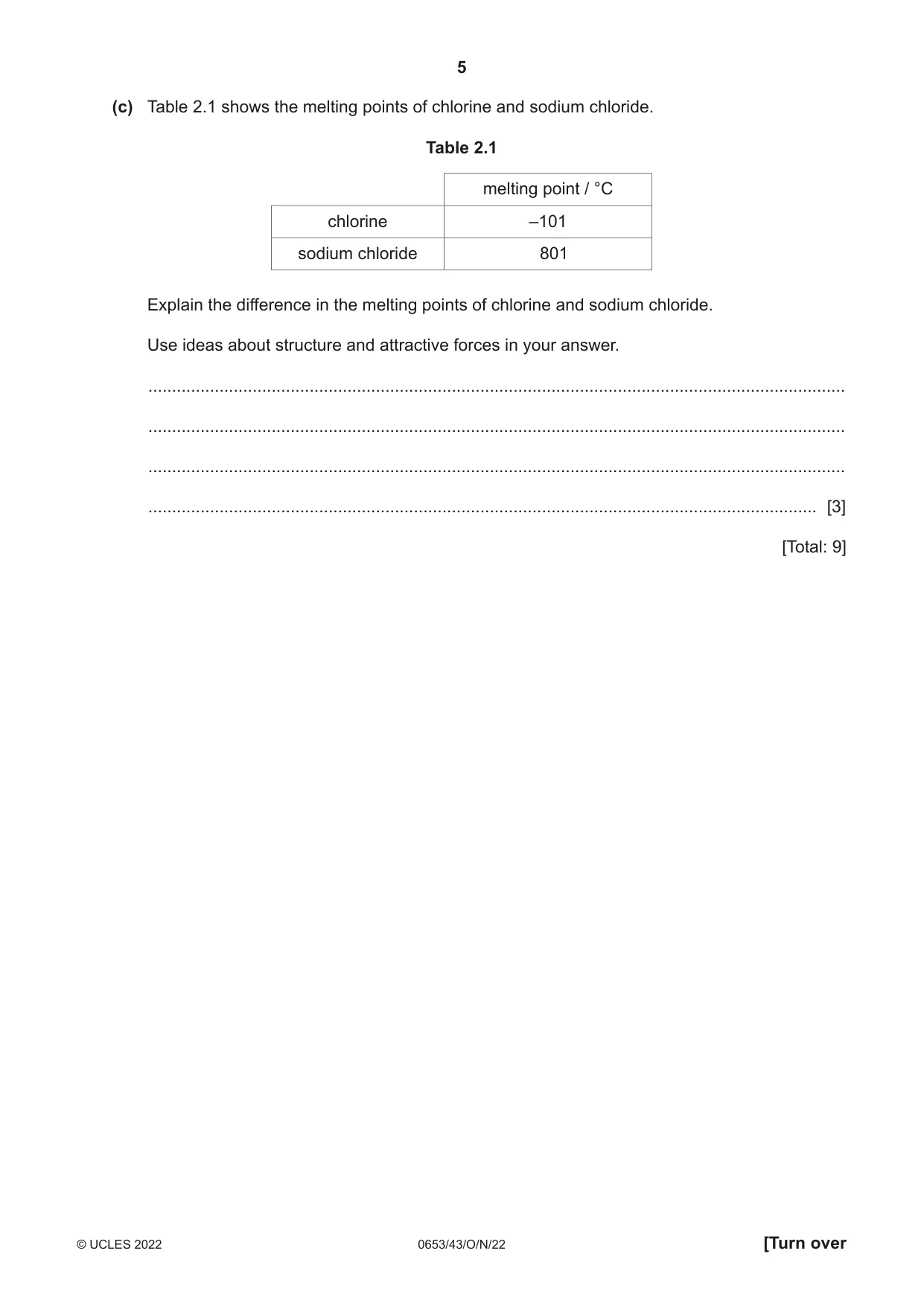
2 The electronic structures of a chlorine atom and a chloride ion are shown in Fig. 2.1. chlorine atom chloride ion – Cl Cl Fig. 2.1 (a) State two differences between the chlorine atom and the chloride ion shown in Fig. 2.1. 1 ................................................................................................................................................ 2 ................................................................................................................................................ [2] (b) (i) Explain how Fig. 2.1 can be used to deduce the proton number of chlorine. ........................................................................................................................................... ..................................................................................................................................... [1] (ii) Explain how Fig. 2.1 can be used to deduce the period number of chlorine in the Periodic Table. ........................................................................................................................................... ..................................................................................................................................... [1] (iii) Element X and chlorine are in the same group of the Periodic Table. Element X is less reactive than chlorine. Suggest the identity of element X. Give a reason for your answer. element X ....................................................... reason ............................................................................................................................... ........................................................................................................................................... [2] (c) Table 2.1 shows the melting points of chlorine and sodium chloride. Table 2.1 melting point / °C chlorine –101 sodium chloride 801 Explain the difference in the melting points of chlorine and sodium chloride. Use ideas about structure and attractive forces in your answer. ................................................................................................................................................... ................................................................................................................................................... ................................................................................................................................................... ............................................................................................................................................. [3] [Total: 9]
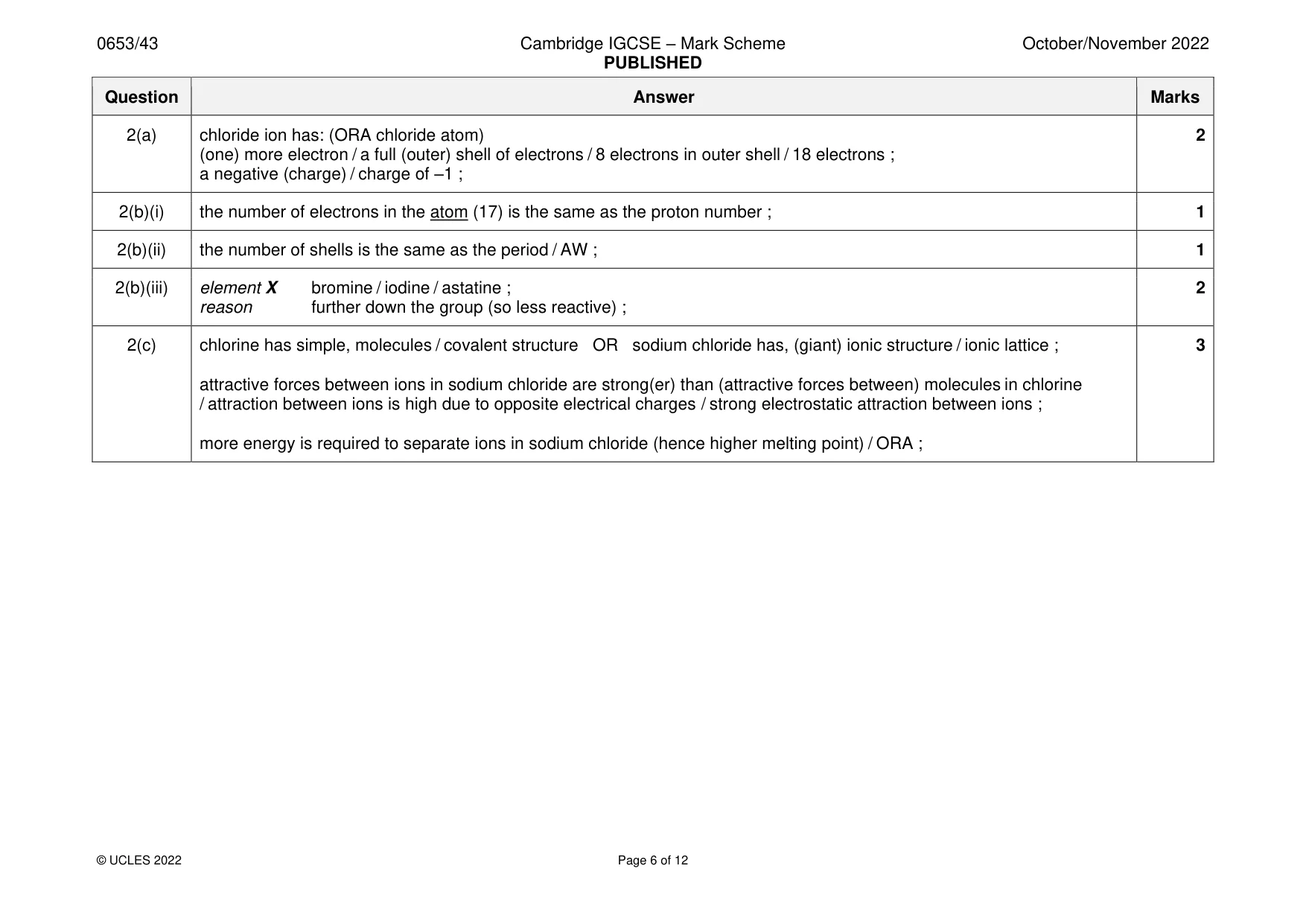
Mark scheme: 2(a) chloride ion has: (ORA chloride atom) 2 (one) more electron / a full (outer) shell of electrons / 8 electrons in outer shell / 18 electrons ; a negative (charge) / charge of –1 ; 2(b)(i) the number of electrons in the atom (17) is the same as the proton number ; 1 2(b)(ii) the number of shells is the same as the period / AW ; 1 2(b)(iii) element X bromine / iodine / astatine ; 2 reason further down the group (so less reactive) ; 2(c) chlorine has simple, molecules / covalent structure OR sodium chloride has, (giant) ionic structure / ionic lattice ; 3 attractive forces between ions in sodium chloride are strong(er) than (attractive forces between) molecules in chlorine / attraction between ions is high due to opposite electrical charges / strong electrostatic attraction between ions ; more energy is required to separate ions in sodium chloride (hence higher melting point) / ORA ;
Q3 · A new world water speed record was set in 1978 by a specially designed speed boat
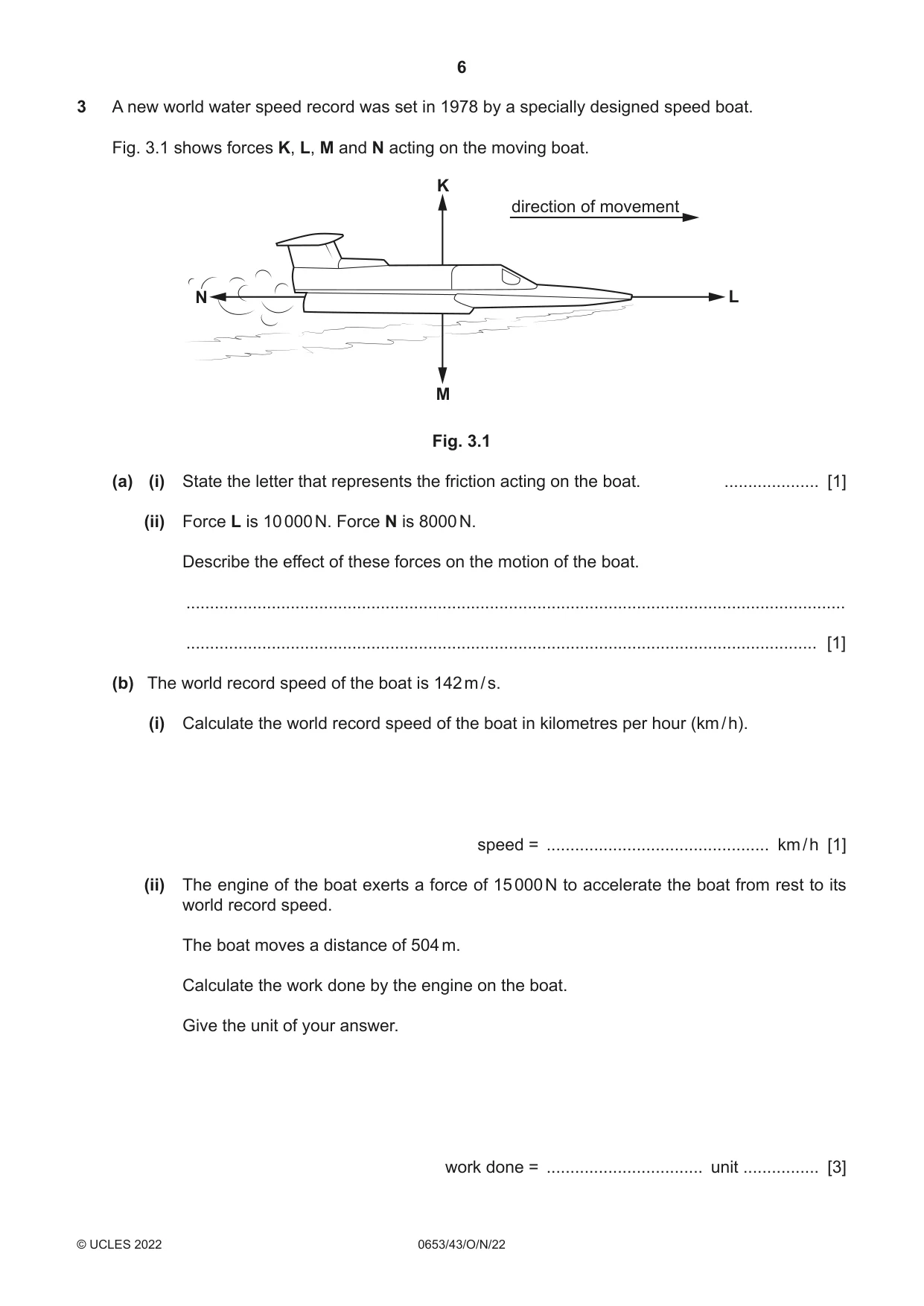
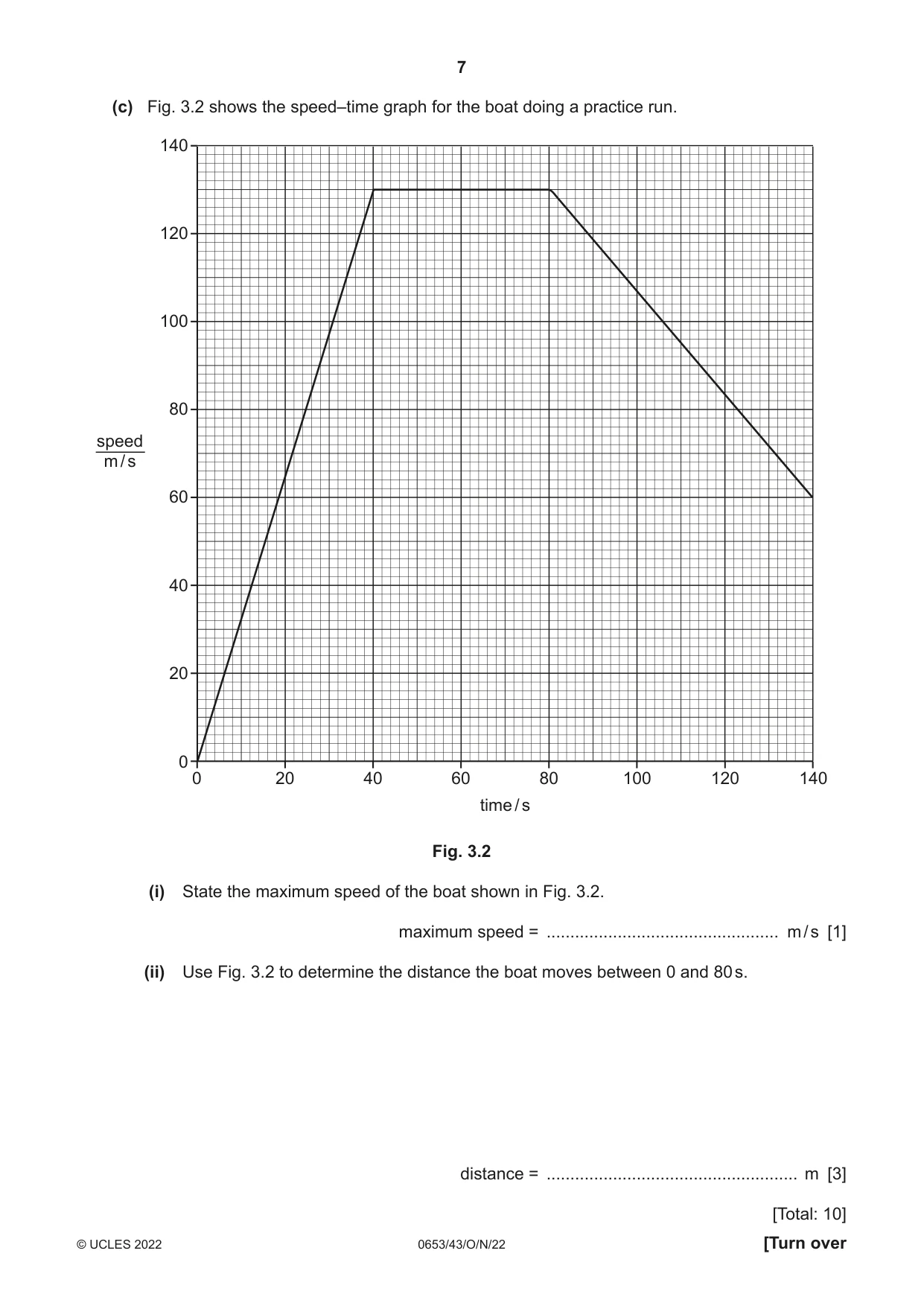
3 A new world water speed record was set in 1978 by a specially designed speed boat. Fig. 3.1 shows forces K, L, M and N acting on the moving boat. K direction of movement N L M Fig. 3.1 (a) (i) State the letter that represents the friction acting on the boat. .................... [1] (ii) Force L is 10 000 N. Force N is 8000 N. Describe the effect of these forces on the motion of the boat. ........................................................................................................................................... ..................................................................................................................................... [1] (b) The world record speed of the boat is 142 m / s. (i) Calculate the world record speed of the boat in kilometres per hour (km / h). speed = ............................................... km / h [1] (ii) The engine of the boat exerts a force of 15 000 N to accelerate the boat from rest to its world record speed. The boat moves a distance of 504 m. Calculate the work done by the engine on the boat. Give the unit of your answer. work done = ................................. unit ................ [3] (c) Fig. 3.2 shows the speed–time graph for the boat doing a practice run. 140 120 100 80 speed m / s 60 40 20 0 0 20 40 60 80 100 120 140 time / s Fig. 3.2 (i) State the maximum speed of the boat shown in Fig. 3.2. maximum speed = ................................................. m / s [1] (ii) Use Fig. 3.2 to determine the distance the boat moves between 0 and 80 s. distance = ..................................................... m [3] [Total: 10]
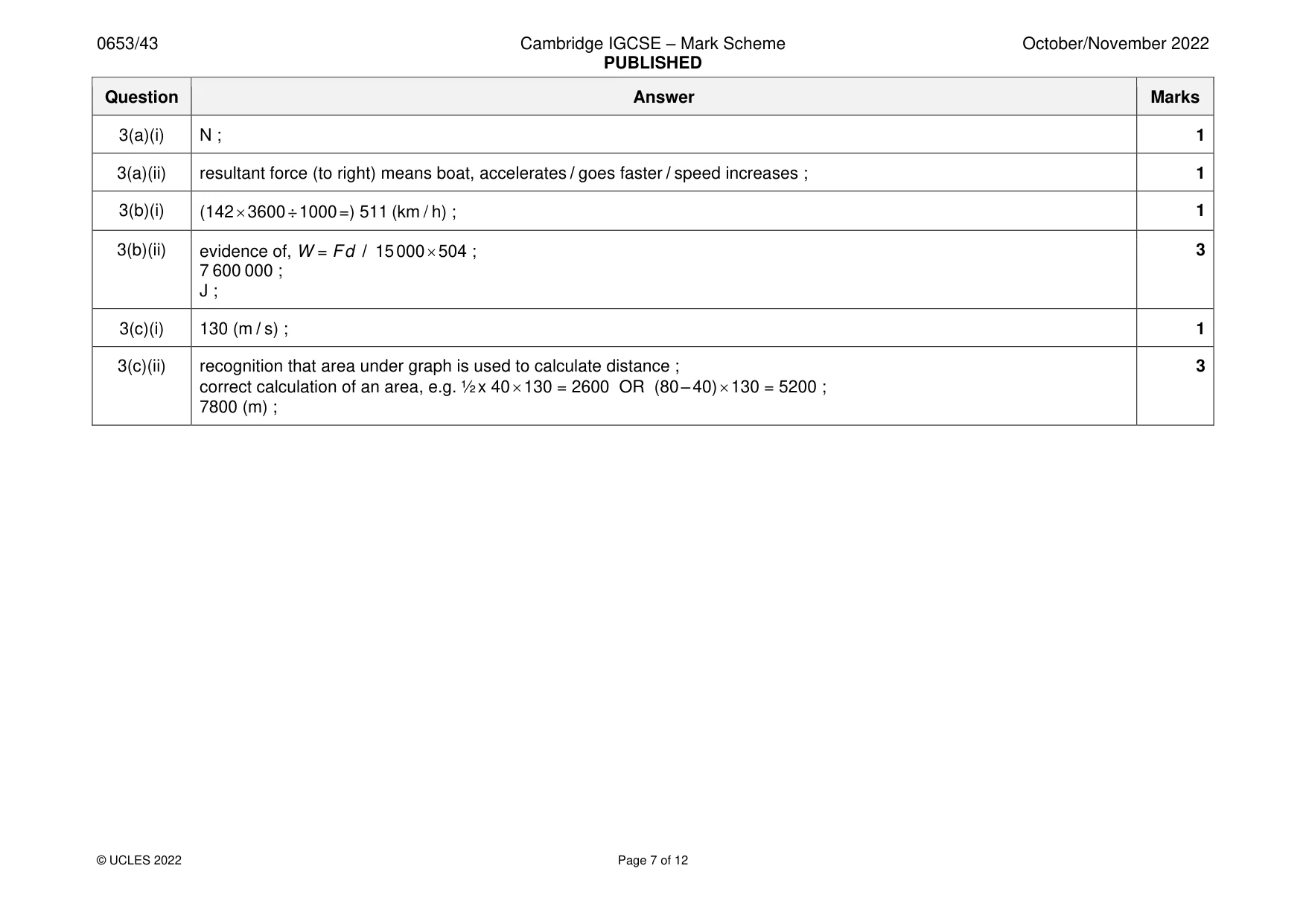
Mark scheme: 3(a)(i) N ; 1 3(a)(ii) resultant force (to right) means boat, accelerates / goes faster / speed increases ; 1 3(b)(i) (142 3600 ÷ 1000 =) 511 (km / h) ; 1 3(b)(ii) evidence of, W = F d / 15 000 504 ; 3 7 600 000 ; J ; 3(c)(i) 130 (m / s) ; 1 3(c)(ii) recognition that area under graph is used to calculate distance ; 3 correct calculation of an area, e.g. ½ x 40 130 = 2600 OR (80 – 40) 130 = 5200 ; 7800 (m) ;
Q4 · A diagram of a human heart
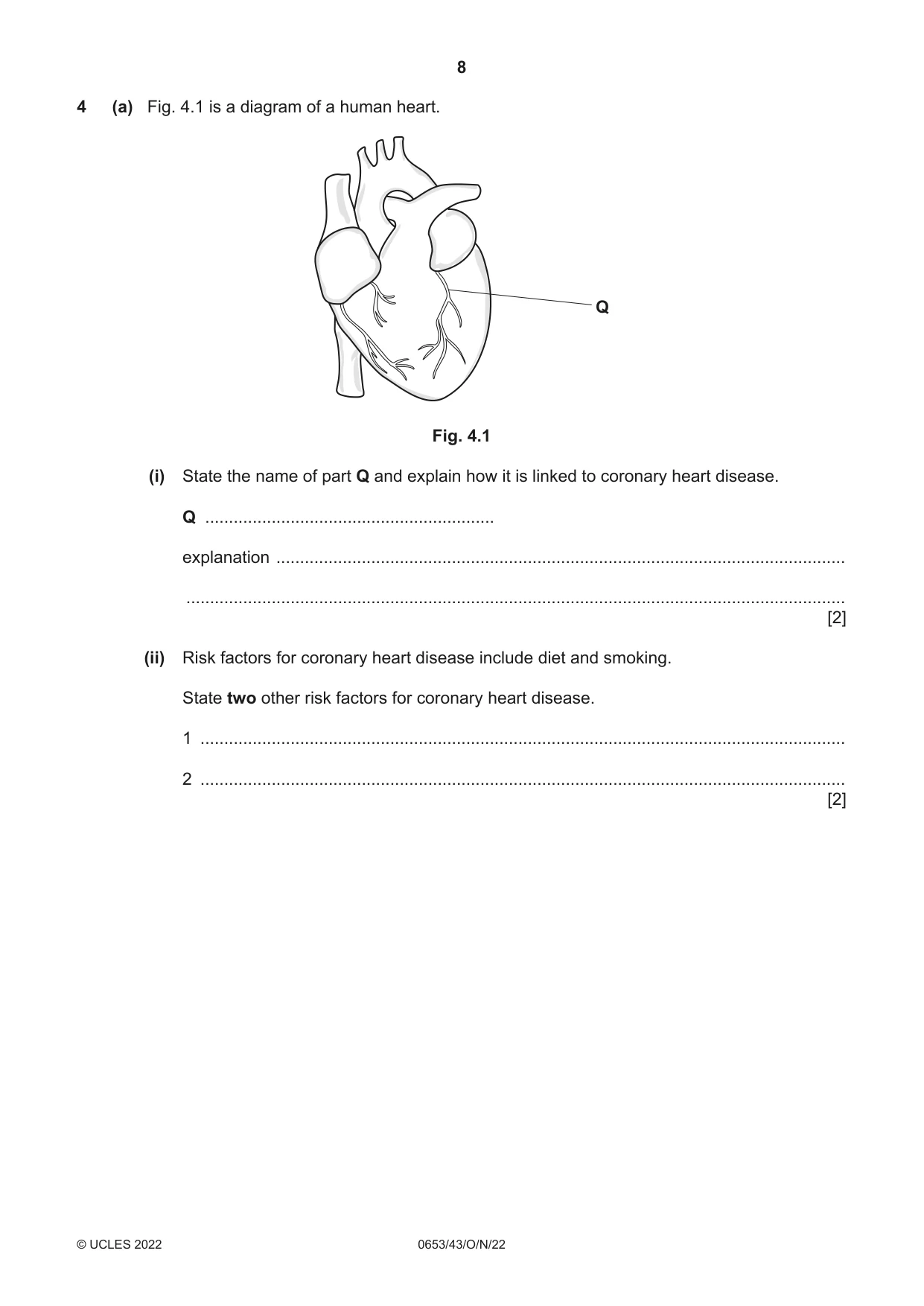
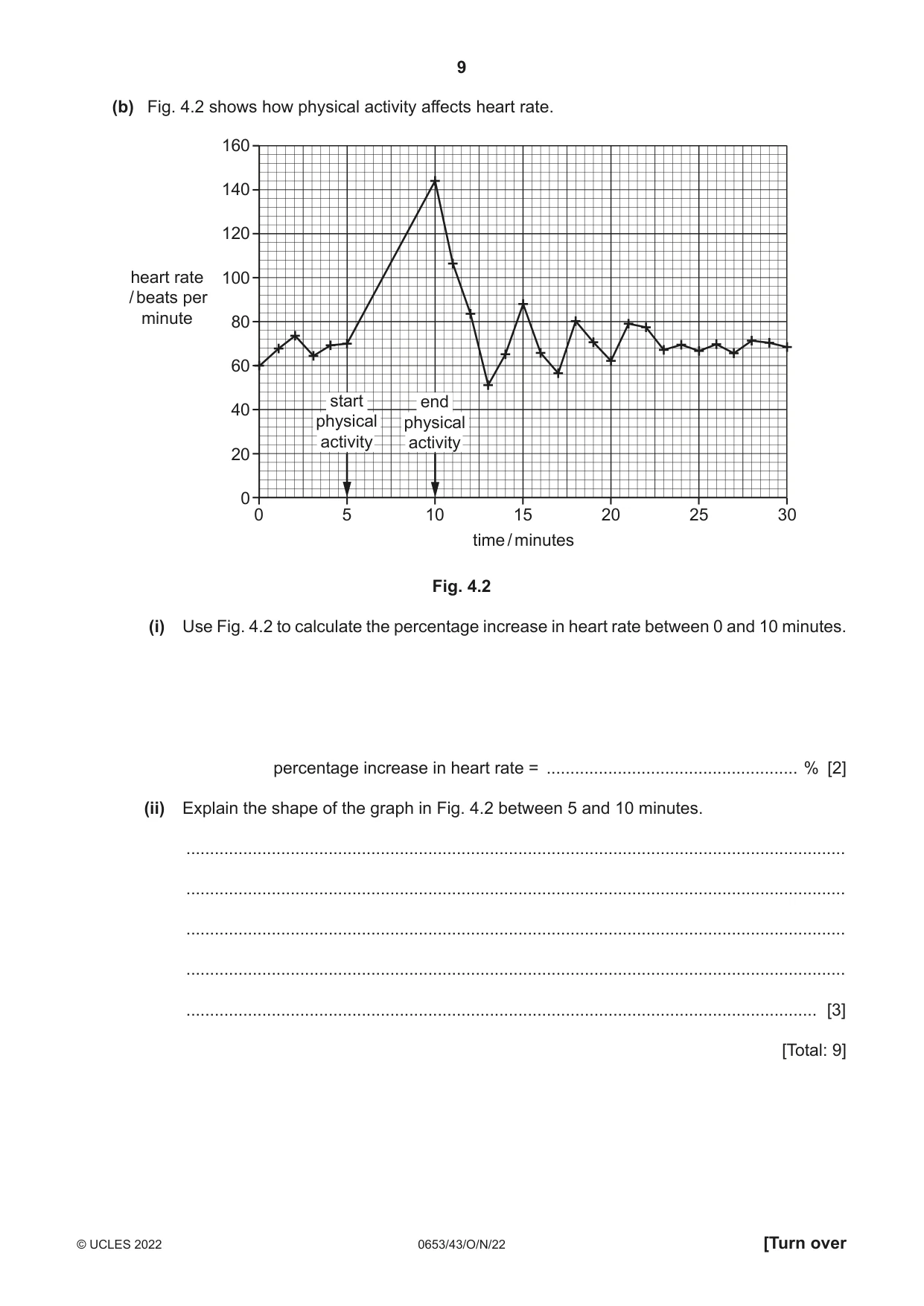
4 (a) Fig. 4.1 is a diagram of a human heart. Q Fig. 4.1 (i) State the name of part Q and explain how it is linked to coronary heart disease. Q ............................................................. explanation ........................................................................................................................ ........................................................................................................................................... [2] (ii) Risk factors for coronary heart disease include diet and smoking. State two other risk factors for coronary heart disease. 1 ........................................................................................................................................ 2 ........................................................................................................................................ [2] (b) Fig. 4.2 shows how physical activity affects heart rate. 160 140 120 heart rate 100 / beats per minute 80 60 start end 40 physical physical activity activity 20 0 0 5 10 15 20 25 30 time / minutes Fig. 4.2 (i) Use Fig. 4.2 to calculate the percentage increase in heart rate between 0 and 10 minutes. percentage increase in heart rate = ..................................................... % [2] (ii) Explain the shape of the graph in Fig. 4.2 between 5 and 10 minutes. ........................................................................................................................................... ........................................................................................................................................... ........................................................................................................................................... ........................................................................................................................................... ..................................................................................................................................... [3] [Total: 9]
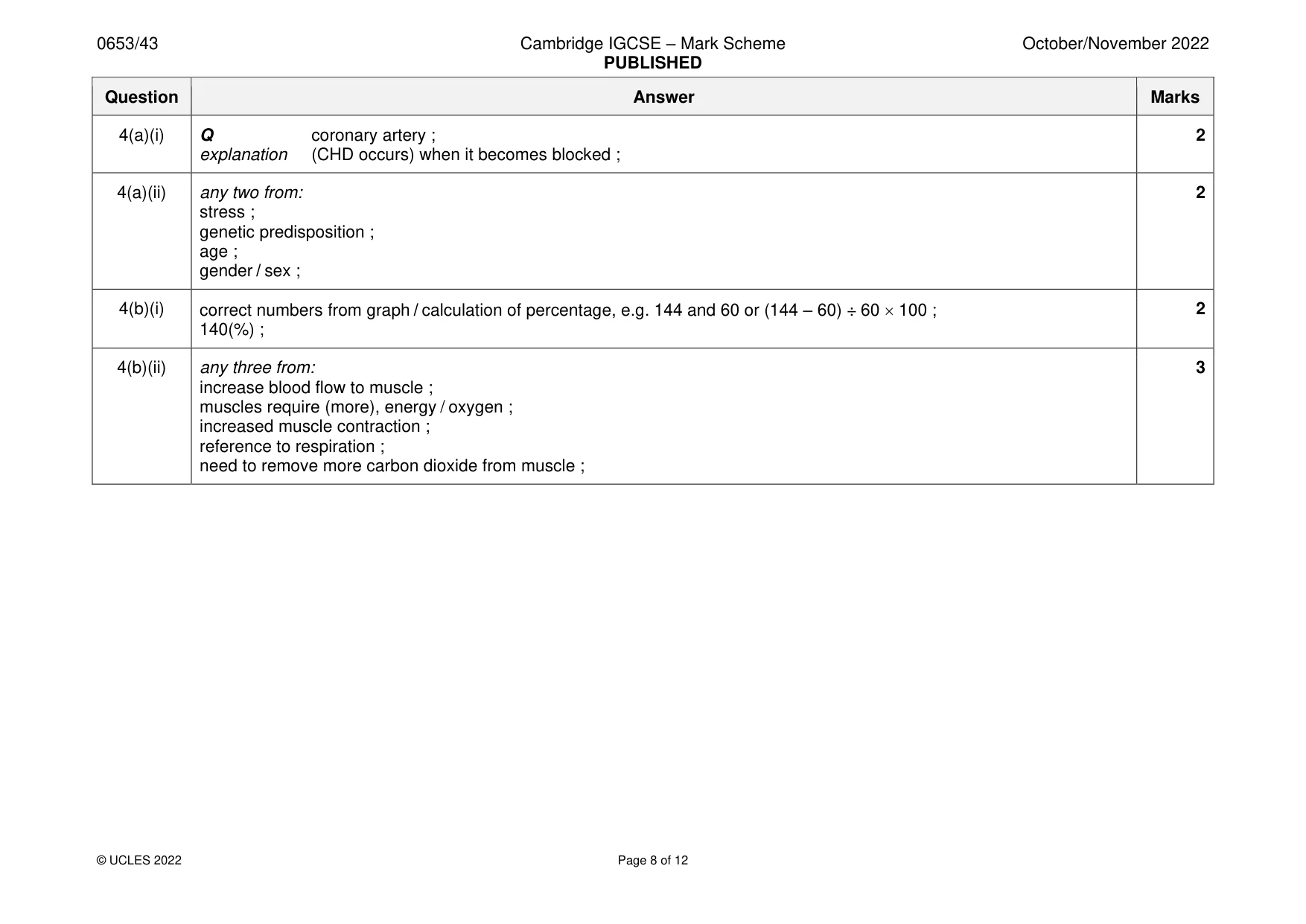
Mark scheme: 4(a)(i) Q coronary artery ; 2 explanation (CHD occurs) when it becomes blocked ; 4(a)(ii) any two from: 2 stress ; genetic predisposition ; age ; gender / sex ; 4(b)(i) correct numbers from graph / calculation of percentage, e.g. 144 and 60 or (144 – 60) ÷ 60 100 ; 2 140(%) ; 4(b)(ii) any three from: 3 increase blood flow to muscle ; muscles require (more), energy / oxygen ; increased muscle contraction ; reference to respiration ; need to remove more carbon dioxide from muscle ;
Q5 · Iron is extracted from hematite in the blast furnace
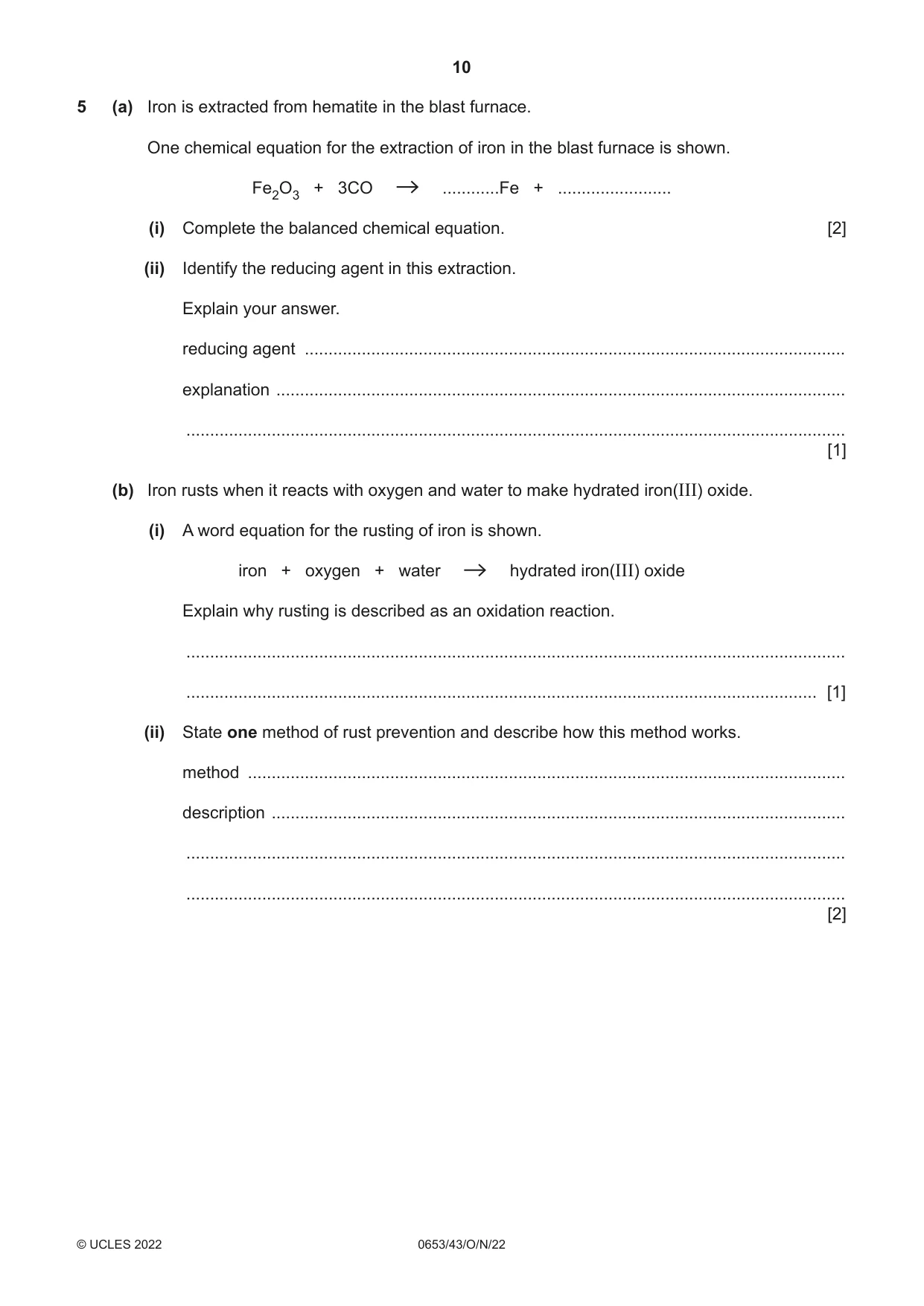
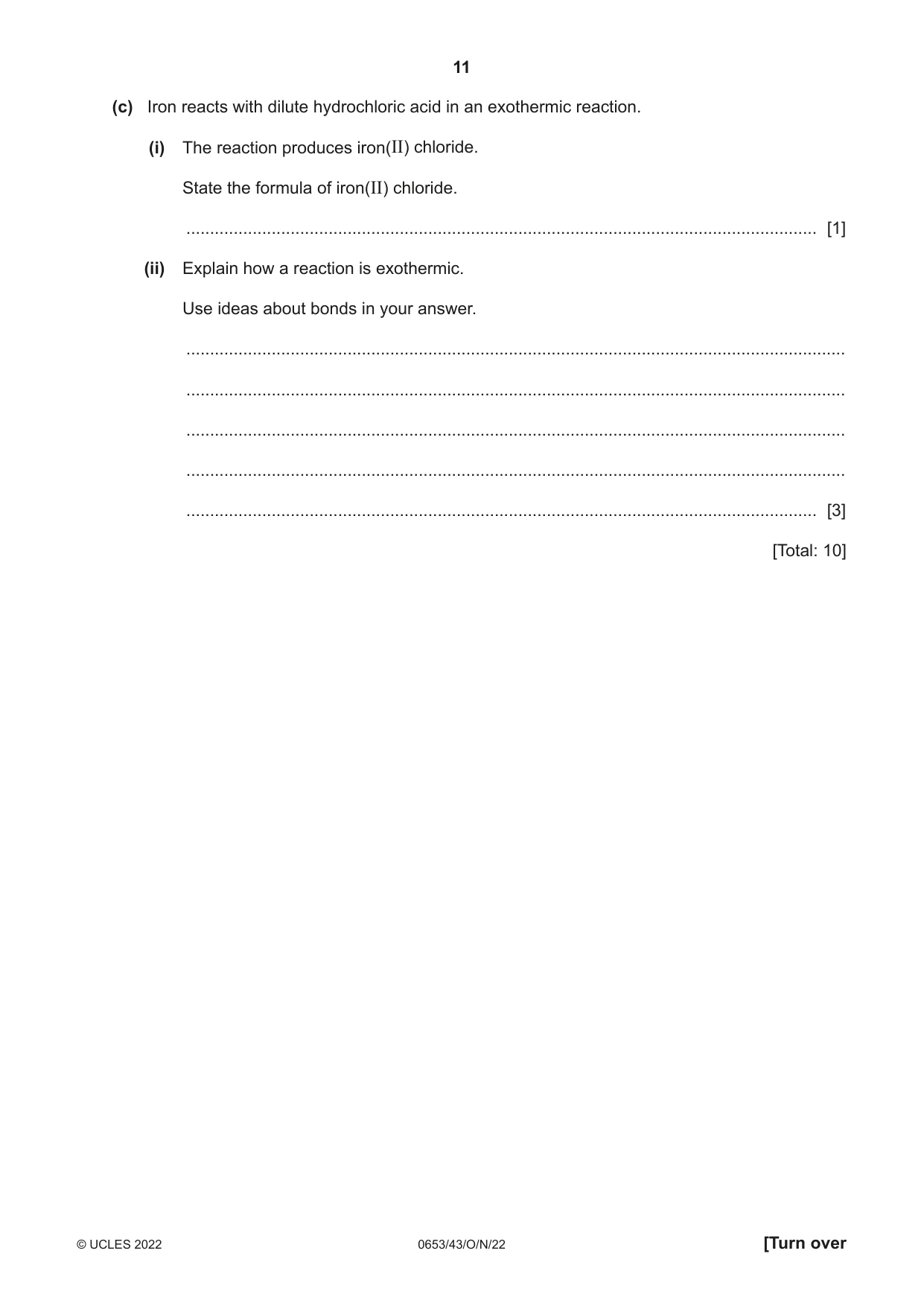
5 (a) Iron is extracted from hematite in the blast furnace. One chemical equation for the extraction of iron in the blast furnace is shown. Fe2O3 + 3CO ............Fe + ........................ (i) Complete the balanced chemical equation. [2] (ii) Identify the reducing agent in this extraction. Explain your answer. reducing agent .................................................................................................................. explanation ........................................................................................................................ ........................................................................................................................................... [1] (b) Iron rusts when it reacts with oxygen and water to make hydrated iron(III) oxide. (i) A word equation for the rusting of iron is shown. iron + oxygen + water hydrated iron(III) oxide Explain why rusting is described as an oxidation reaction. ........................................................................................................................................... ..................................................................................................................................... [1] (ii) State one method of rust prevention and describe how this method works. method .............................................................................................................................. description ......................................................................................................................... ........................................................................................................................................... ........................................................................................................................................... [2] (c) Iron reacts with dilute hydrochloric acid in an exothermic reaction. (i) The reaction produces iron(II) chloride. State the formula of iron(II) chloride. ..................................................................................................................................... [1] (ii) Explain how a reaction is exothermic. Use ideas about bonds in your answer. ........................................................................................................................................... ........................................................................................................................................... ........................................................................................................................................... ........................................................................................................................................... ..................................................................................................................................... [3] [Total: 10]
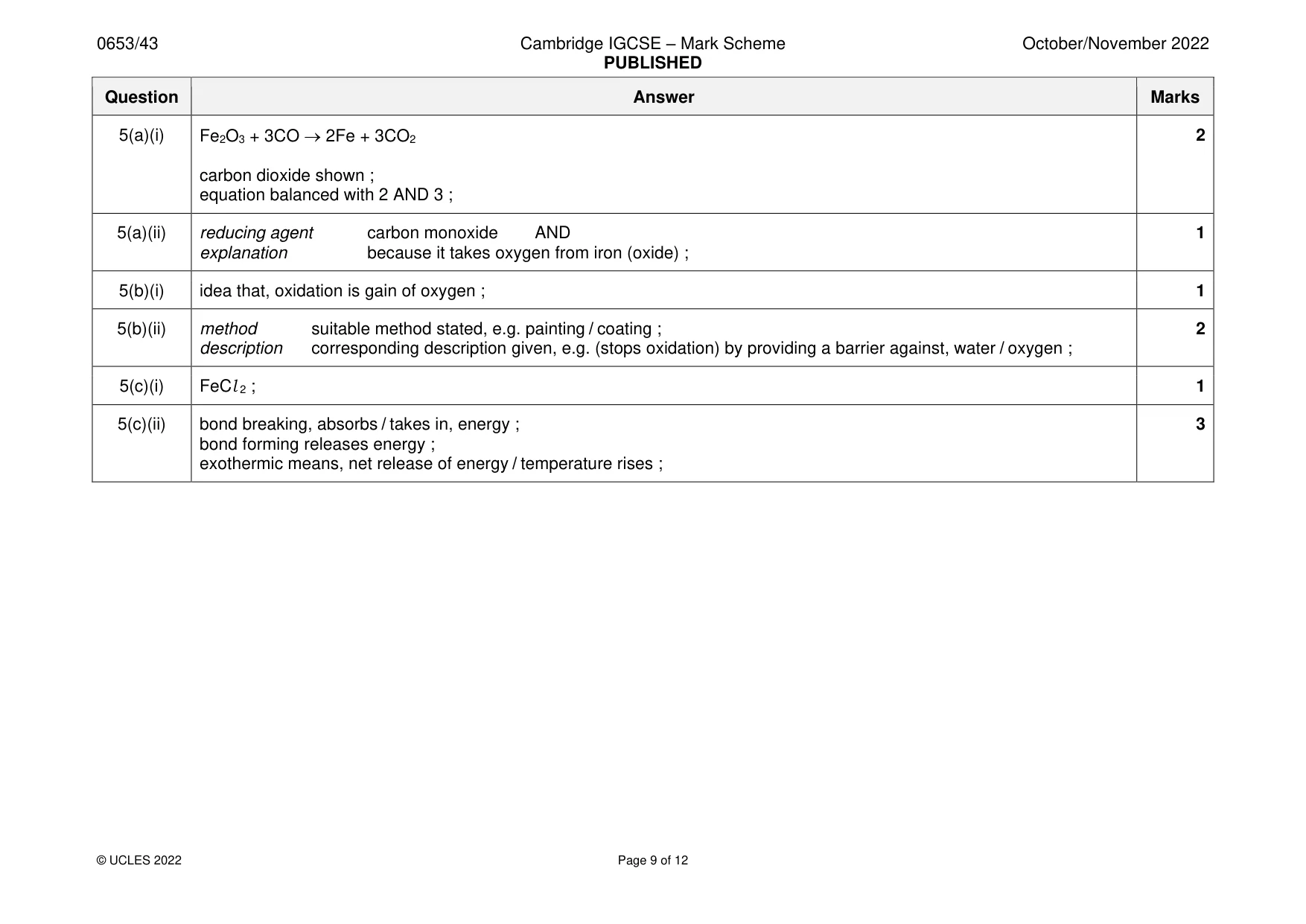
Mark scheme: 5(a)(i) Fe2O3 + 3CO → 2Fe + 3CO2 2 carbon dioxide shown ; equation balanced with 2 AND 3 ; 5(a)(ii) reducing agent carbon monoxide AND 1 explanation because it takes oxygen from iron (oxide) ; 5(b)(i) idea that, oxidation is gain of oxygen ; 1 5(b)(ii) method suitable method stated, e.g. painting / coating ; 2 description corresponding description given, e.g. (stops oxidation) by providing a barrier against, water / oxygen ; 5(c)(i) FeCl 2 ; 1 5(c)(ii) bond breaking, absorbs / takes in, energy ; 3 bond forming releases energy ; exothermic means, net release of energy / temperature rises ;
Q6 · An electric toaster used to toast one slice of bread
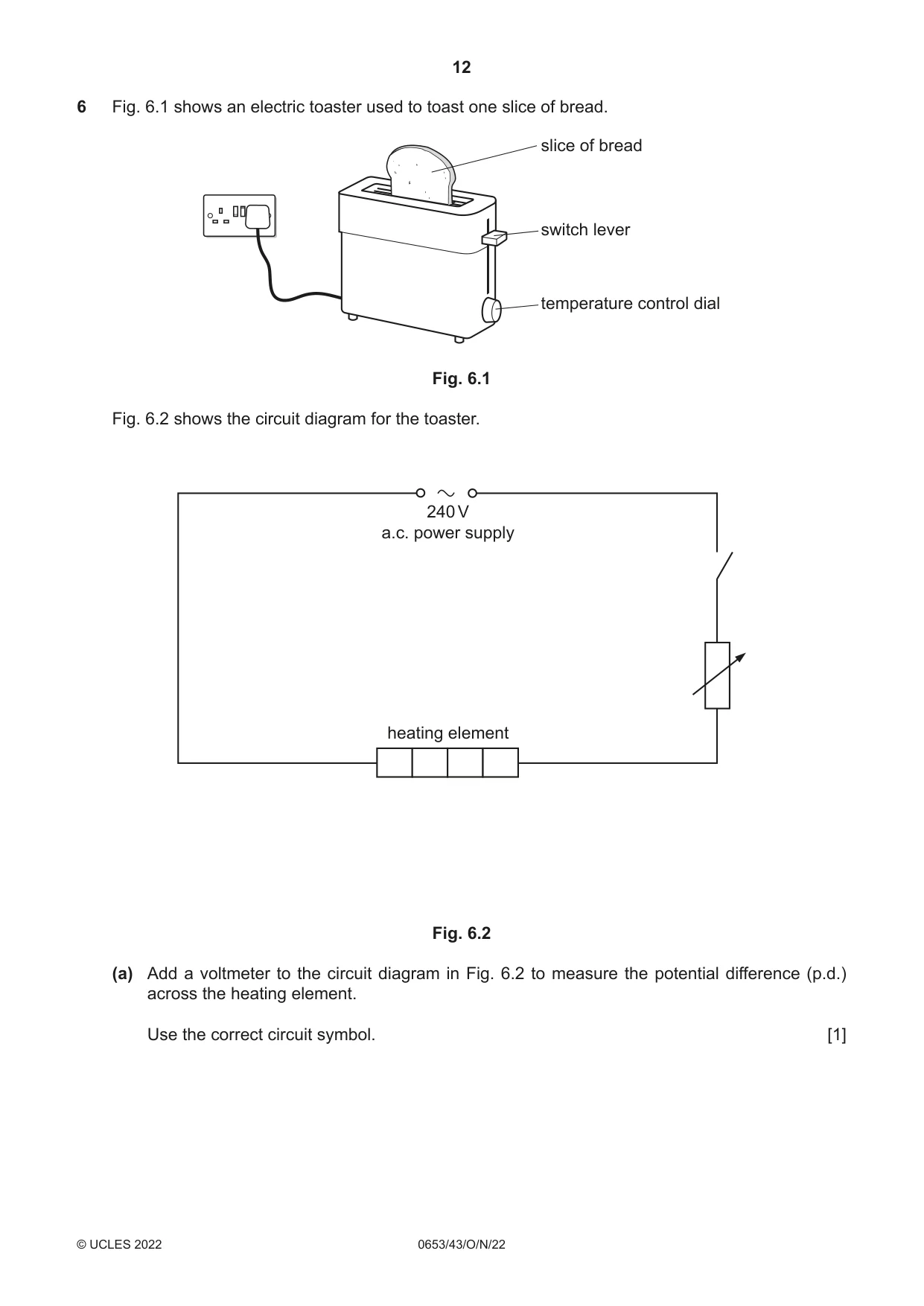
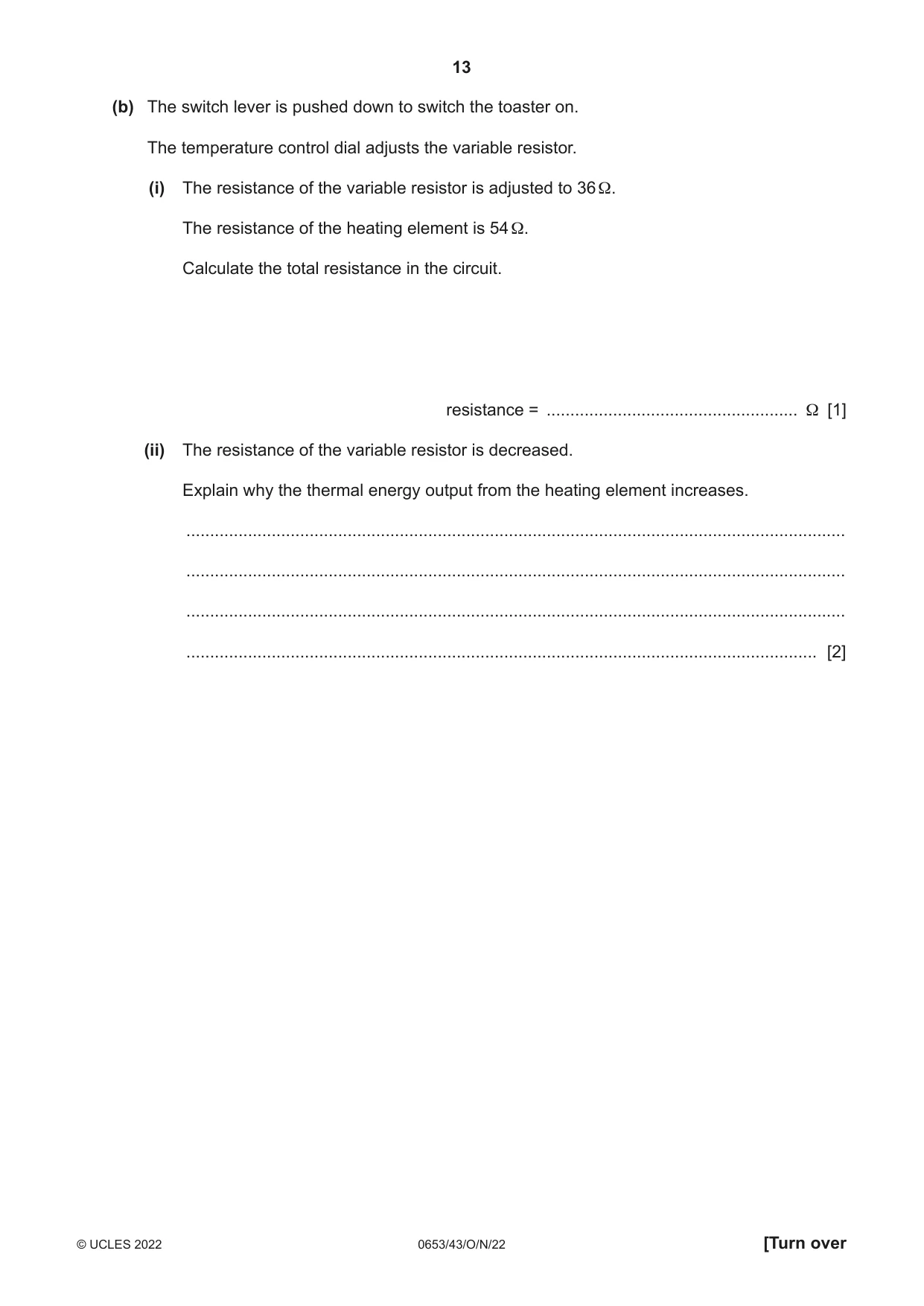
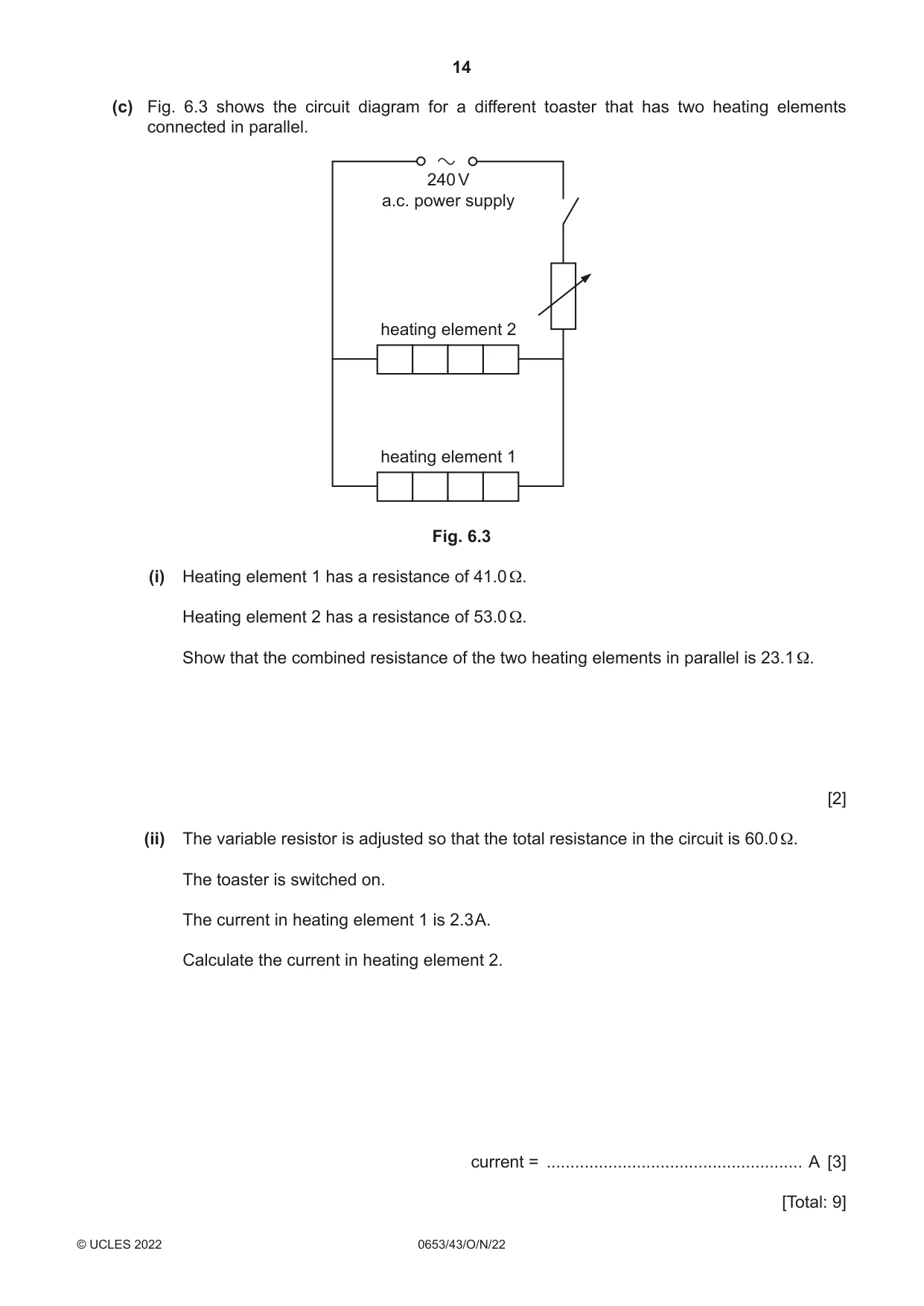
6 Fig. 6.1 shows an electric toaster used to toast one slice of bread. slice of bread switch lever temperature control dial Fig. 6.1 Fig. 6.2 shows the circuit diagram for the toaster. 240 V a.c. power supply heating element Fig. 6.2 (a) Add a voltmeter to the circuit diagram in Fig. 6.2 to measure the potential difference (p.d.) across the heating element. Use the correct circuit symbol. [1] (b) The switch lever is pushed down to switch the toaster on. The temperature control dial adjusts the variable resistor. (i) The resistance of the variable resistor is adjusted to 36 Ω. The resistance of the heating element is 54 Ω. Calculate the total resistance in the circuit. resistance = ..................................................... Ω [1] (ii) The resistance of the variable resistor is decreased. Explain why the thermal energy output from the heating element increases. ........................................................................................................................................... ........................................................................................................................................... ........................................................................................................................................... ..................................................................................................................................... [2] (c) Fig. 6.3 shows the circuit diagram for a different toaster that has two heating elements connected in parallel. 240 V a.c. power supply heating element 2 heating element 1 Fig. 6.3 (i) Heating element 1 has a resistance of 41.0 Ω. Heating element 2 has a resistance of 53.0 Ω. Show that the combined resistance of the two heating elements in parallel is 23.1 Ω. [2] (ii) The variable resistor is adjusted so that the total resistance in the circuit is 60.0 Ω. The toaster is switched on. The current in heating element 1 is 2.3 A. Calculate the current in heating element 2. current = ...................................................... A [3] [Total: 9]
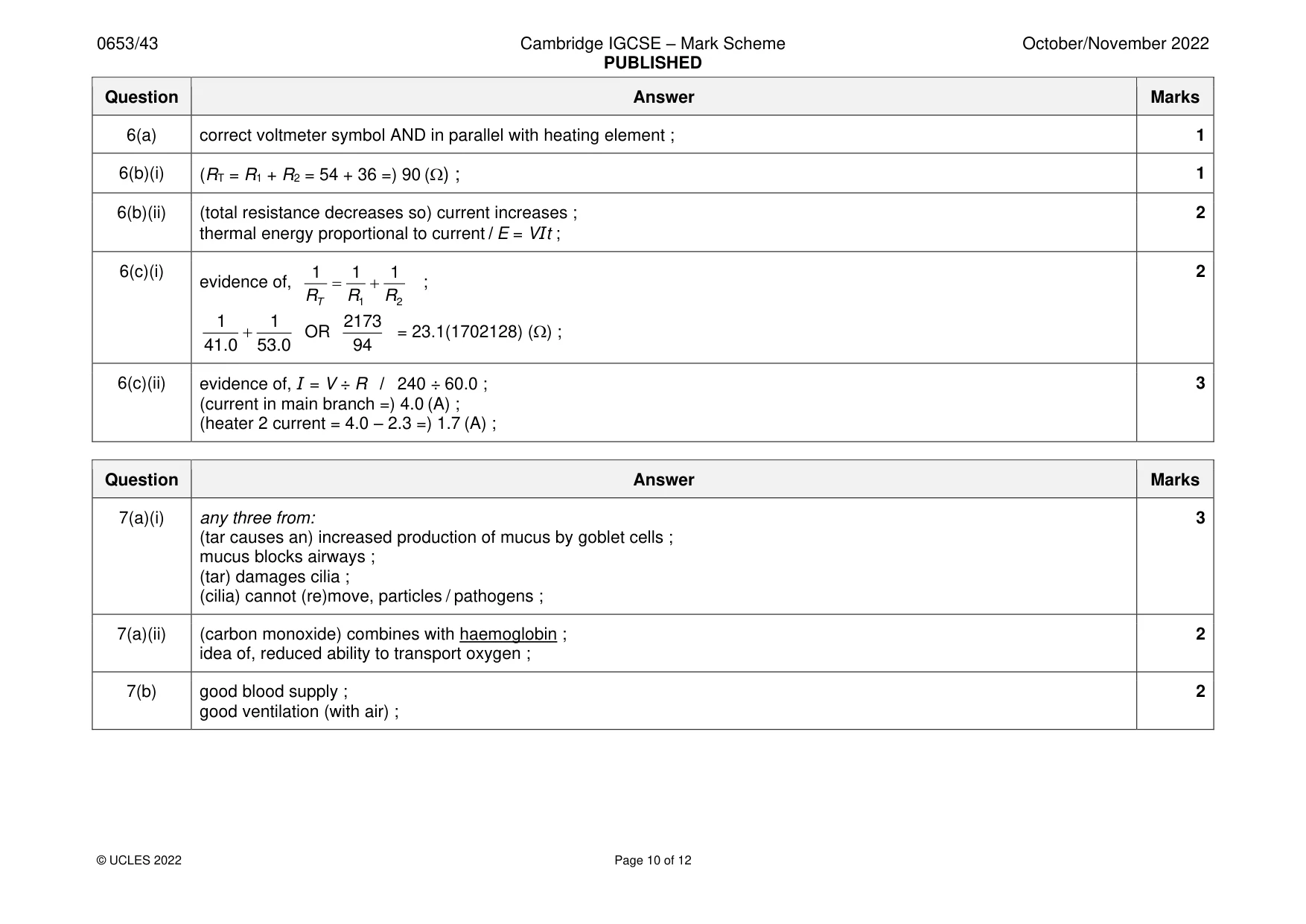
Mark scheme: 6(a) correct voltmeter symbol AND in parallel with heating element ; 1 6(b)(i) (RT = R1 + R2 = 54 + 36 =) 90 () ; 1 6(b)(ii) (total resistance decreases so) current increases ; 2 thermal energy proportional to current / E = VIt ; 6(c)(i) 1 1 1 2 evidence of, = + ; RT R1 R2 1 1 2173 + OR = 23.1(1702128) () ; 41.0 53.0 94 6(c)(ii) evidence of, I = V ÷ R / 240 ÷ 60.0 ; 3 (current in main branch =) 4.0 (A) ; (heater 2 current = 4.0 – 2.3 =) 1.7 (A) ;
Q7 · Cells that line the gas exchange system of humans
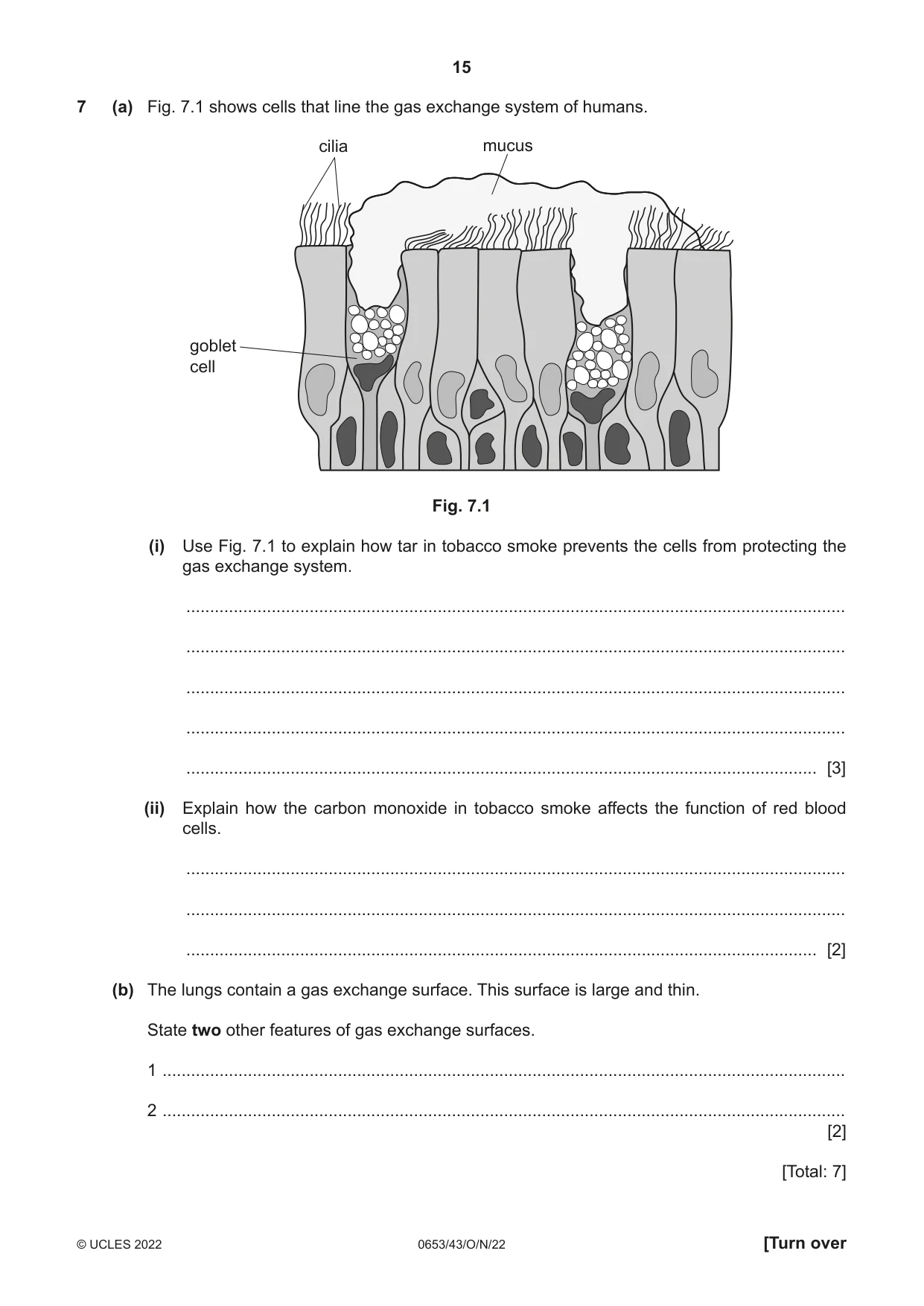
7 (a) Fig. 7.1 shows cells that line the gas exchange system of humans. cilia mucus goblet cell Fig. 7.1 (i) Use Fig. 7.1 to explain how tar in tobacco smoke prevents the cells from protecting the gas exchange system. ........................................................................................................................................... ........................................................................................................................................... ........................................................................................................................................... ........................................................................................................................................... ..................................................................................................................................... [3] (ii) Explain how the carbon monoxide in tobacco smoke affects the function of red blood cells. ........................................................................................................................................... ........................................................................................................................................... ..................................................................................................................................... [2] (b) The lungs contain a gas exchange surface. This surface is large and thin. State two other features of gas exchange surfaces. 1 ................................................................................................................................................ 2 ................................................................................................................................................ [2] [Total: 7]
Mark scheme: 7(a)(i) any three from: 3 (tar causes an) increased production of mucus by goblet cells ; mucus blocks airways ; (tar) damages cilia ; (cilia) cannot (re)move, particles / pathogens ; 7(a)(ii) (carbon monoxide) combines with haemoglobin ; 2 idea of, reduced ability to transport oxygen ; 7(b) good blood supply ; 2 good ventilation (with air) ;
Q8 · Car engines take in air
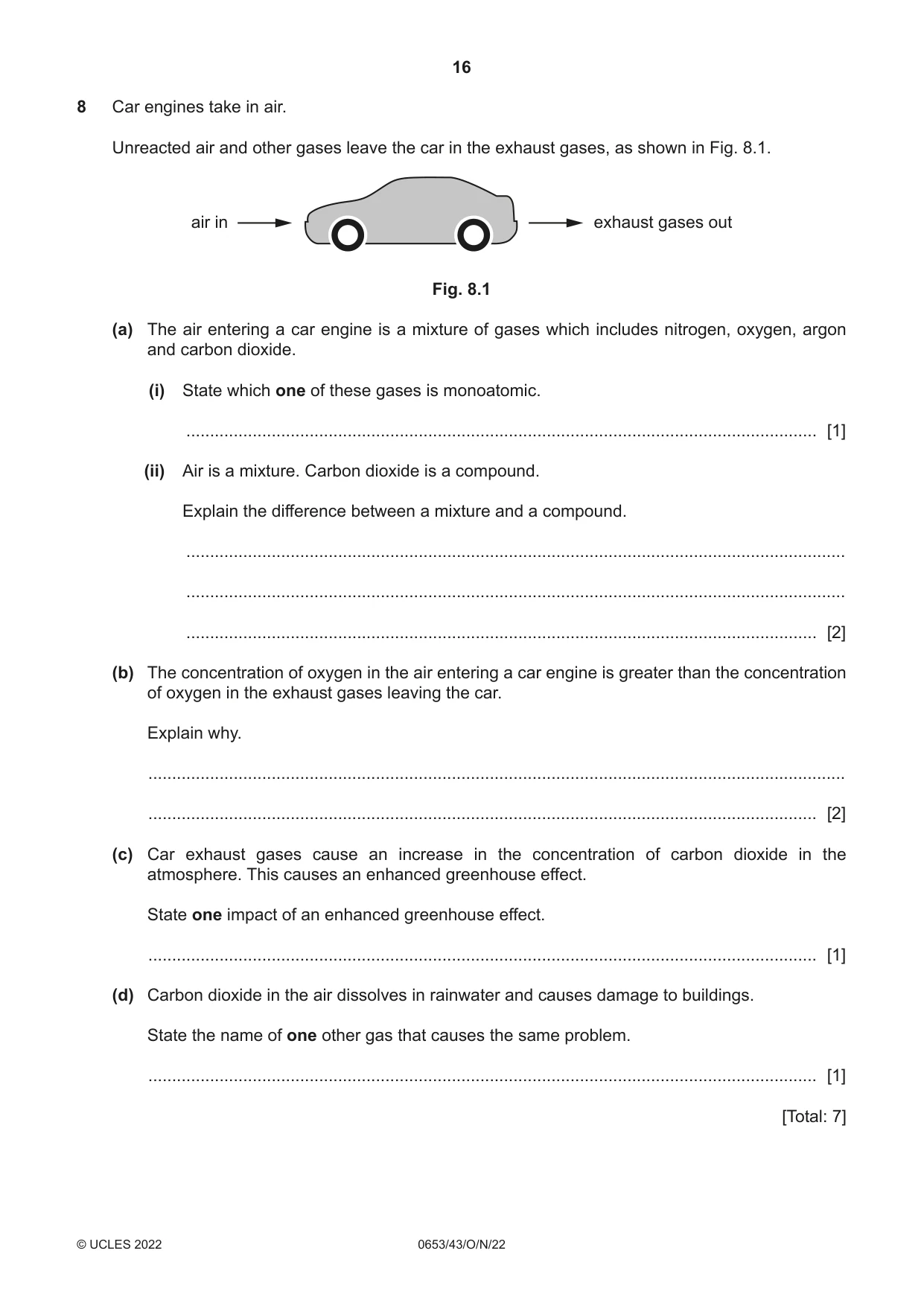
8 Car engines take in air. Unreacted air and other gases leave the car in the exhaust gases, as shown in Fig. 8.1. air in exhaust gases out Fig. 8.1 (a) The air entering a car engine is a mixture of gases which includes nitrogen, oxygen, argon and carbon dioxide. (i) State which one of these gases is monoatomic. ..................................................................................................................................... [1] (ii) Air is a mixture. Carbon dioxide is a compound. Explain the difference between a mixture and a compound. ........................................................................................................................................... ........................................................................................................................................... ..................................................................................................................................... [2] (b) The concentration of oxygen in the air entering a car engine is greater than the concentration of oxygen in the exhaust gases leaving the car. Explain why. ................................................................................................................................................... ............................................................................................................................................. [2] (c) Car exhaust gases cause an increase in the concentration of carbon dioxide in the atmosphere. This causes an enhanced greenhouse effect. State one impact of an enhanced greenhouse effect. ............................................................................................................................................. [1] (d) Carbon dioxide in the air dissolves in rainwater and causes damage to buildings. State the name of one other gas that causes the same problem. ............................................................................................................................................. [1] [Total: 7]
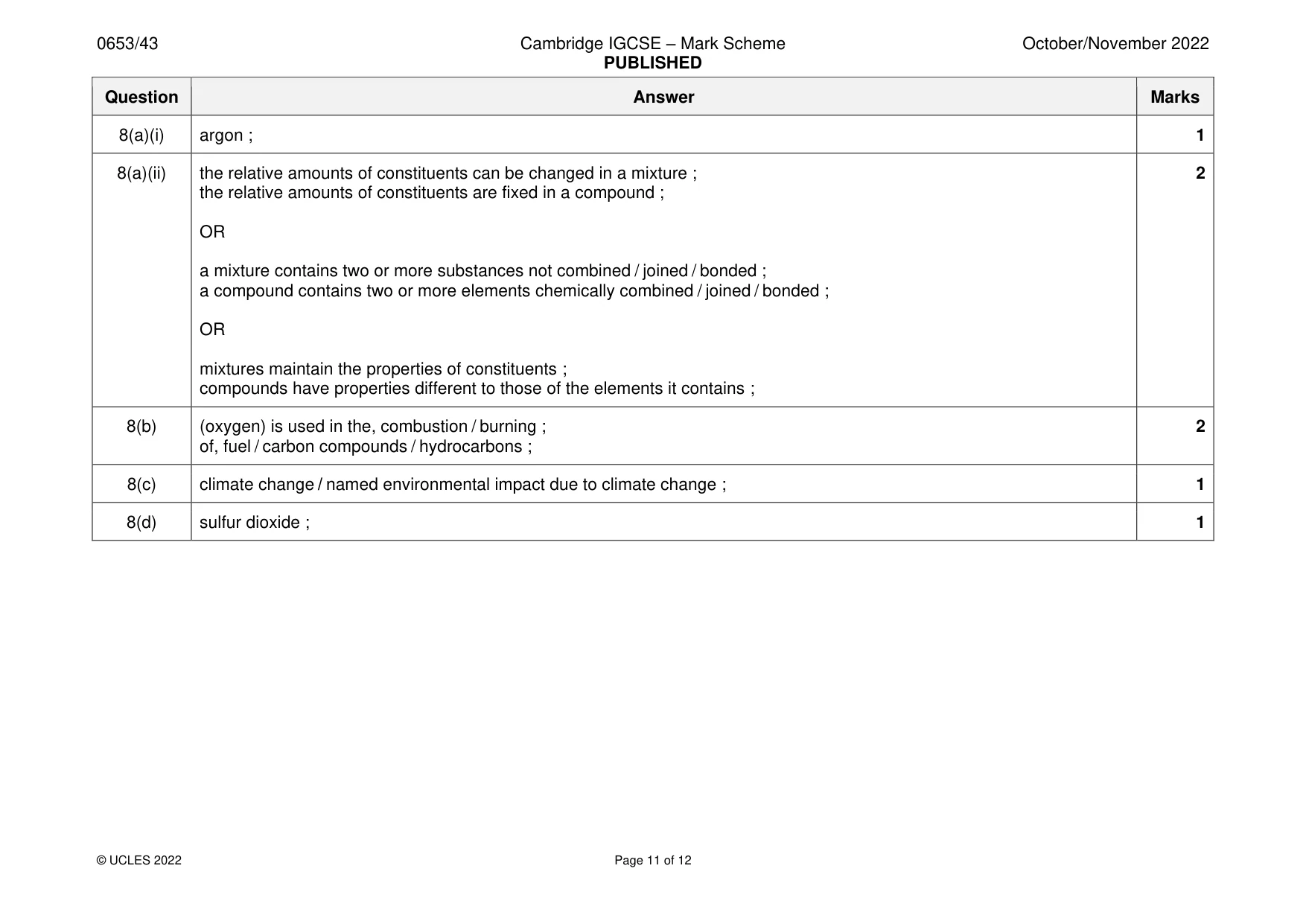
Mark scheme: 8(a)(i) argon ; 1 8(a)(ii) the relative amounts of constituents can be changed in a mixture ; 2 the relative amounts of constituents are fixed in a compound ; OR a mixture contains two or more substances not combined / joined / bonded ; a compound contains two or more elements chemically combined / joined / bonded ; OR mixtures maintain the properties of constituents ; compounds have properties different to those of the elements it contains ; 8(b) (oxygen) is used in the, combustion / burning ; 2 of, fuel / carbon compounds / hydrocarbons ; 8(c) climate change / named environmental impact due to climate change ; 1 8(d) sulfur dioxide ; 1
Q9 · An incomplete electromagnetic spectrum
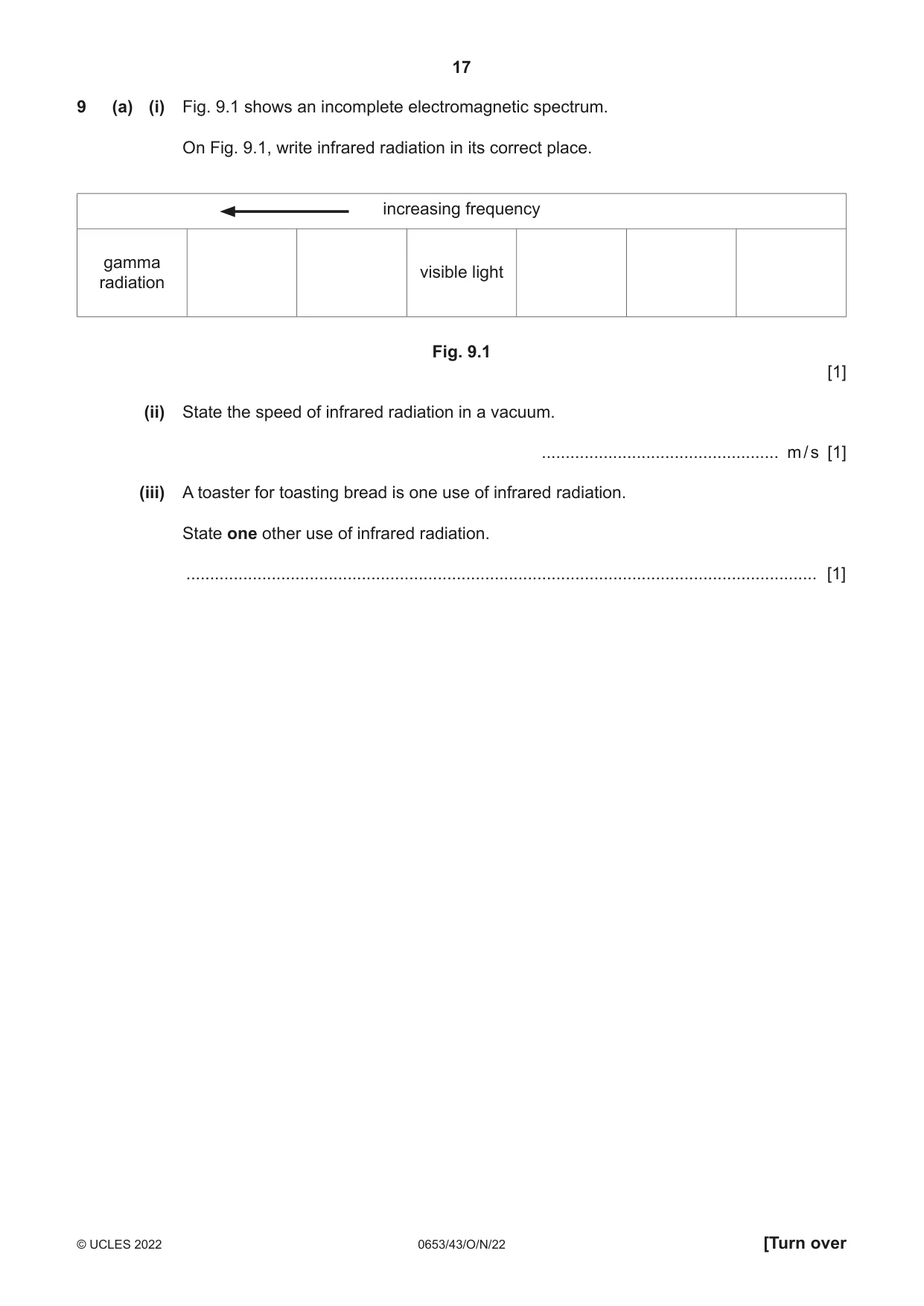
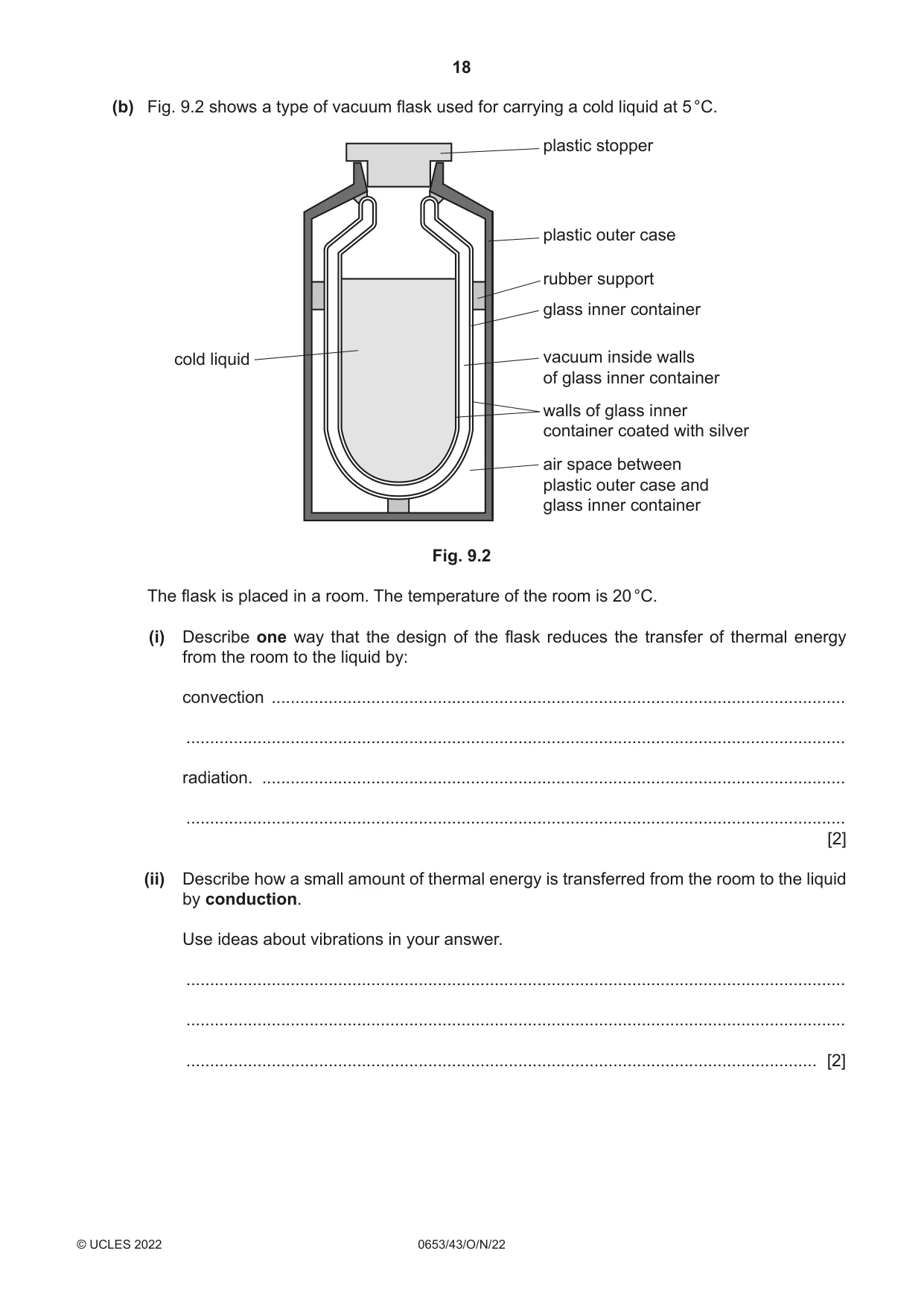
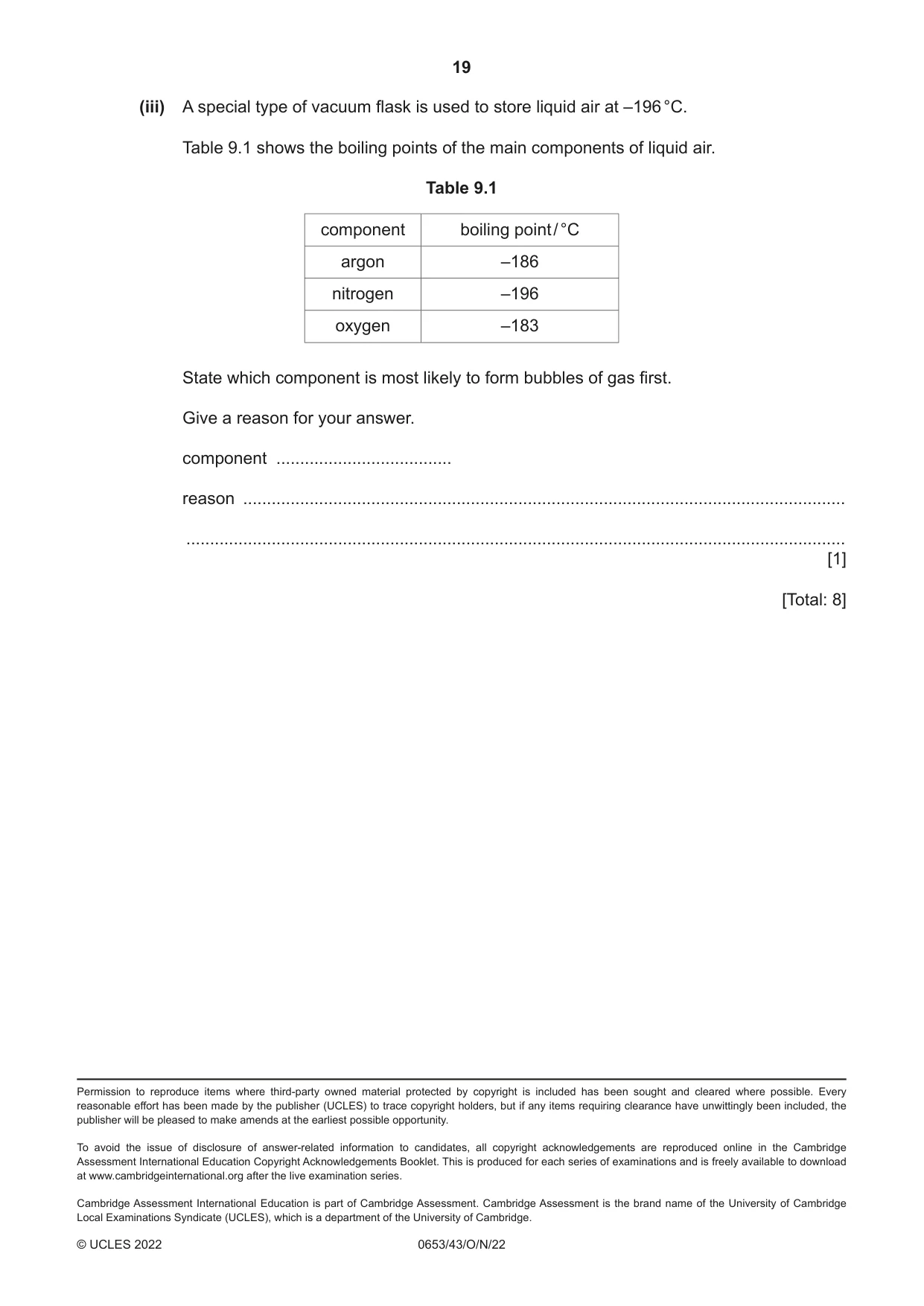
9 (a) (i) Fig. 9.1 shows an incomplete electromagnetic spectrum. On Fig. 9.1, write infrared radiation in its correct place. increasing frequency gamma visible light radiation Fig. 9.1 [1] (ii) State the speed of infrared radiation in a vacuum. .................................................. m / s [1] (iii) A toaster for toasting bread is one use of infrared radiation. State one other use of infrared radiation. ..................................................................................................................................... [1] (b) Fig. 9.2 shows a type of vacuum flask used for carrying a cold liquid at 5 °C. plastic stopper plastic outer case rubber support glass inner container cold liquid vacuum inside walls of glass inner container walls of glass inner container coated with silver air space between plastic outer case and glass inner container Fig. 9.2 The flask is placed in a room. The temperature of the room is 20 °C. (i) Describe one way that the design of the flask reduces the transfer of thermal energy from the room to the liquid by: convection ......................................................................................................................... ........................................................................................................................................... radiation. ........................................................................................................................... ........................................................................................................................................... [2] (ii) Describe how a small amount of thermal energy is transferred from the room to the liquid by conduction. Use ideas about vibrations in your answer. ........................................................................................................................................... ........................................................................................................................................... ..................................................................................................................................... [2] (iii) A special type of vacuum flask is used to store liquid air at –196 °C. Table 9.1 shows the boiling points of the main components of liquid air. Table 9.1 component boiling point / °C argon –186 nitrogen –196 oxygen –183 State which component is most likely to form bubbles of gas first. Give a reason for your answer. component ..................................... reason ............................................................................................................................... ........................................................................................................................................... [1] [Total: 8]
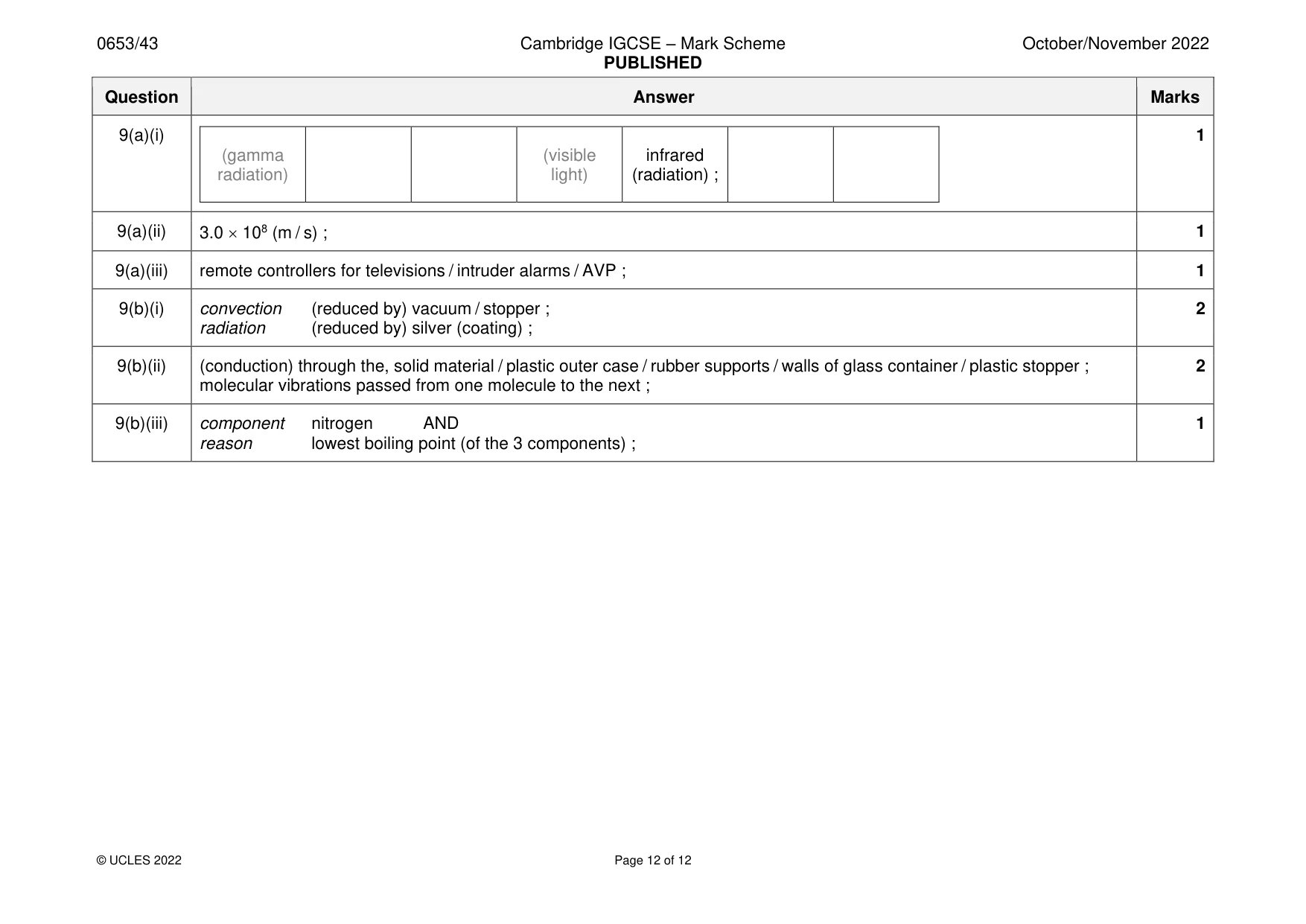
Mark scheme: 9(a)(i) 1 (gamma (visible infrared radiation) light) (radiation) ; 9(a)(ii) 3.0 108 (m / s) ; 1 9(a)(iii) remote controllers for televisions / intruder alarms / AVP ; 1 9(b)(i) convection (reduced by) vacuum / stopper ; 2 radiation (reduced by) silver (coating) ; 9(b)(ii) (conduction) through the, solid material / plastic outer case / rubber supports / walls of glass container / plastic stopper ; 2 molecular vibrations passed from one molecule to the next ; 9(b)(iii) component nitrogen AND 1 reason lowest boiling point (of the 3 components) ;
What was in this paper
The subtopics covered by these 9 questions, and how many questions each got. Open one in a new tab to see every Cambridge question on it.
What you needed in this session
Cambridge’s own grade thresholds for 2022 Oct/Nov, Paper 4 · Variant 3. A higher threshold means an easier paper — the bar moves with how the cohort did.