Cambridge IGCSE Science - Combined 0653 — 2017 Oct/Nov Paper 4 · Variant 3
0653/43/O/N/17 · 9 questions · 80 marks · ≈90 min
The question paper and its mark scheme, free to read here and free to download. This is Cambridge’s own paper, exactly as it was sat.
Question paper24 pages


Mark scheme10 pages
Answers below. Sit the paper first if you are practising.
Questions as text
Q1 · Use the following words or phrases to complete the flow chart about the structures the…
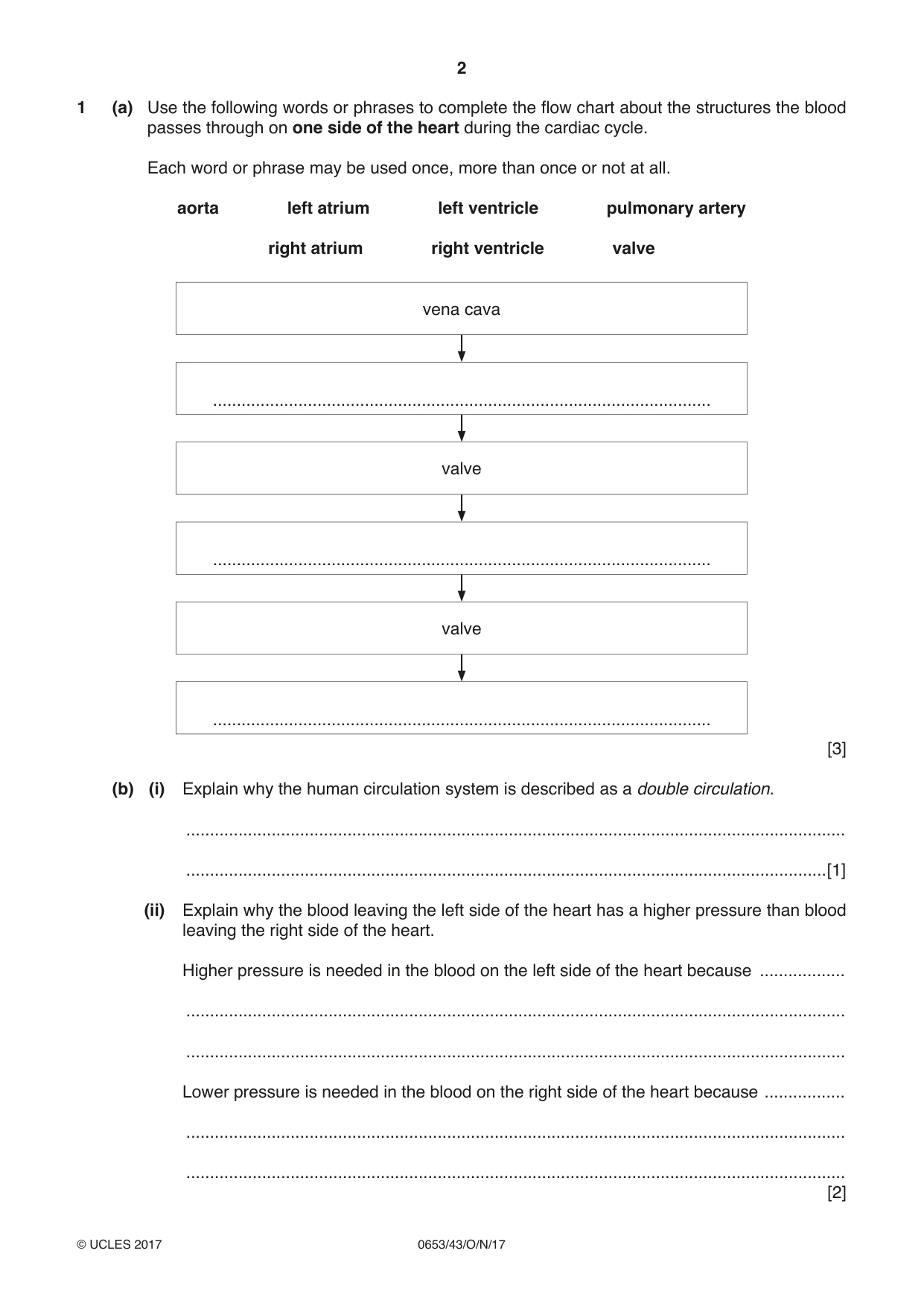
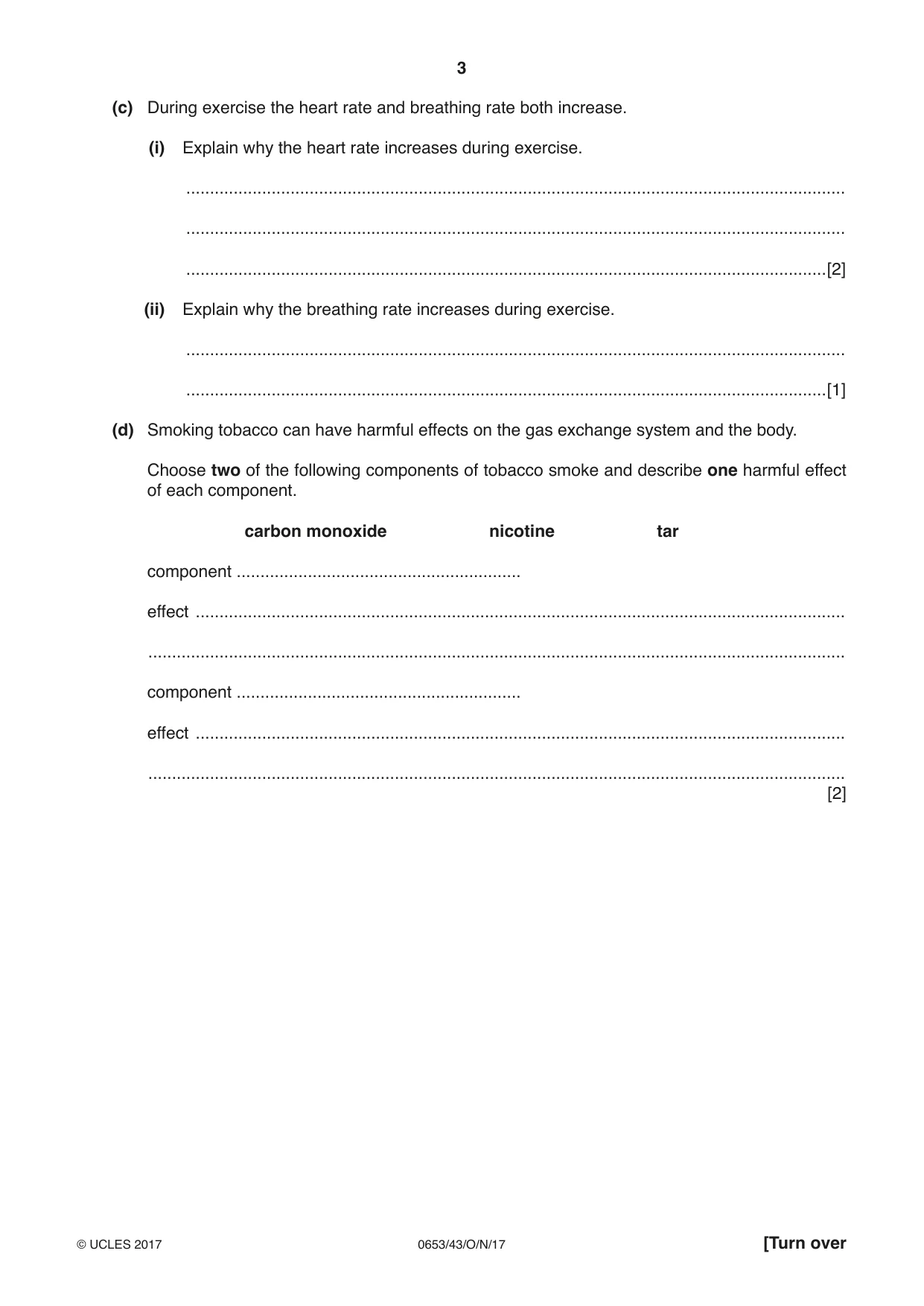
1 (a) Use the following words or phrases to complete the flow chart about the structures the blood passes through on one side of the heart during the cardiac cycle. Each word or phrase may be used once, more than once or not at all. aorta left atrium left ventricle pulmonary artery right atrium right ventricle valve vena cava ......................................................................................................... valve ......................................................................................................... valve ......................................................................................................... [3] (b) (i) Explain why the human circulation system is described as a double circulation. ........................................................................................................................................... .......................................................................................................................................[1] (ii) Explain why the blood leaving the left side of the heart has a higher pressure than blood leaving the right side of the heart. Higher pressure is needed in the blood on the left side of the heart because .................. ........................................................................................................................................... ........................................................................................................................................... Lower pressure is needed in the blood on the right side of the heart because ................. ........................................................................................................................................... ........................................................................................................................................... [2] (c) During exercise the heart rate and breathing rate both increase. (i) Explain why the heart rate increases during exercise. ........................................................................................................................................... ........................................................................................................................................... .......................................................................................................................................[2] (ii) Explain why the breathing rate increases during exercise. ........................................................................................................................................... .......................................................................................................................................[1] (d) Smoking tobacco can have harmful effects on the gas exchange system and the body. Choose two of the following components of tobacco smoke and describe one harmful effect of each component. carbon monoxide nicotine tar component ............................................................ effect ......................................................................................................................................... ................................................................................................................................................... component ............................................................ effect ......................................................................................................................................... ................................................................................................................................................... [2]
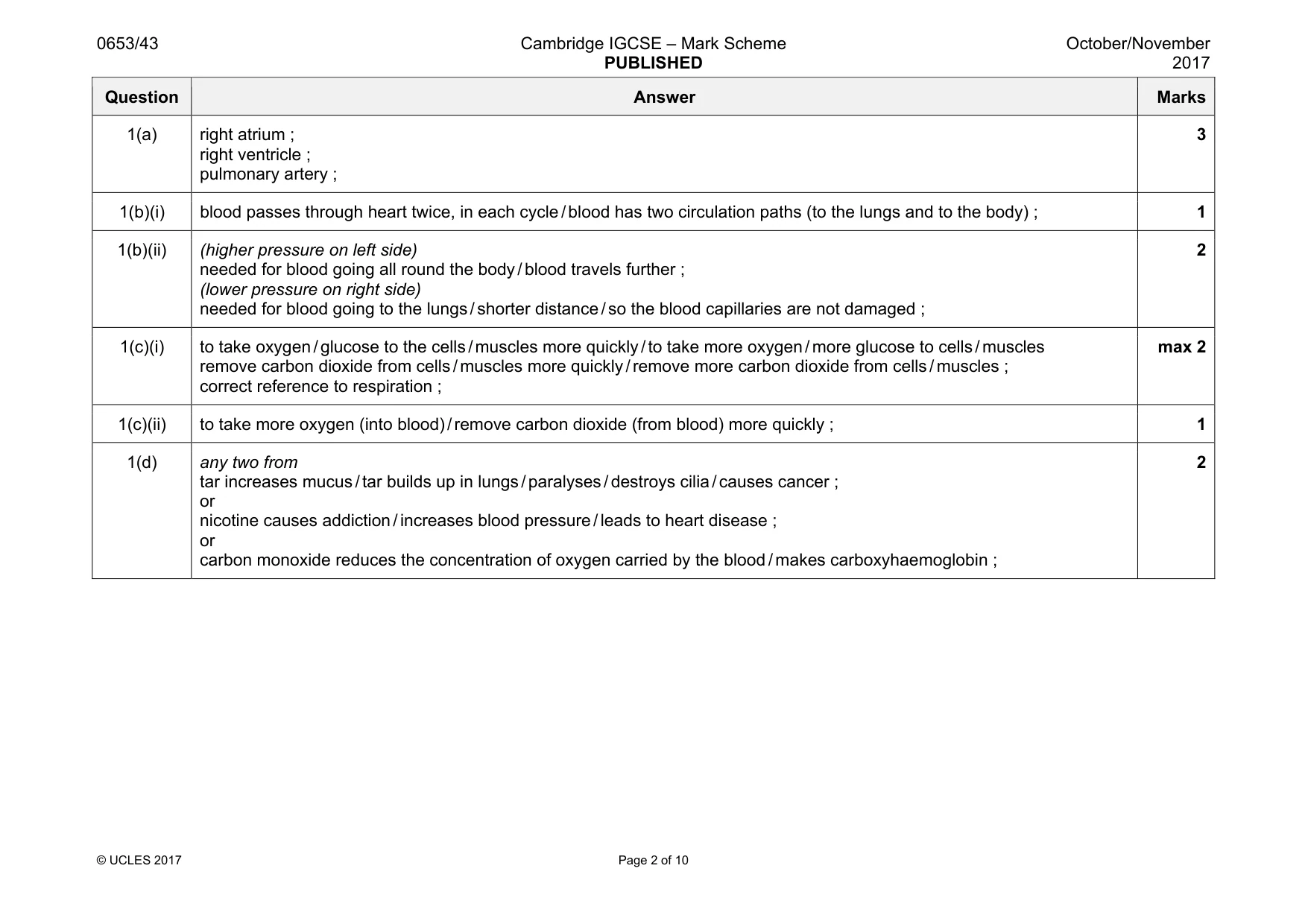
Mark scheme: 1(a) right atrium ; right ventricle ; pulmonary artery ; 3 1(b)(i) blood passes through heart twice, in each cycle / blood has two circulation paths (to the lungs and to the body) ; 1 1(b)(ii) (higher pressure on left side) needed for blood going all round the body / blood travels further ; (lower pressure on right side) needed for blood going to the lungs / shorter distance / so the blood capillaries are not damaged ; 2 1(c)(i) to take oxygen / glucose to the cells / muscles more quickly / to take more oxygen / more glucose to cells / muscles remove carbon dioxide from cells / muscles more quickly / remove more carbon dioxide from cells / muscles ; correct reference to respiration ; max 2 1(c)(ii) to take more oxygen (into blood) / remove carbon dioxide (from blood) more quickly ; 1 1(d) any two from tar increases mucus / tar builds up in lungs / paralyses / destroys cilia / causes cancer ; or nicotine causes addiction / increases blood pressure / leads to heart disease ; or carbon monoxide reduces the concentration of oxygen carried by the blood / makes carboxyhaemoglobin ; 2
Q2 · The arrangements of particles in four substances are shown in Fig
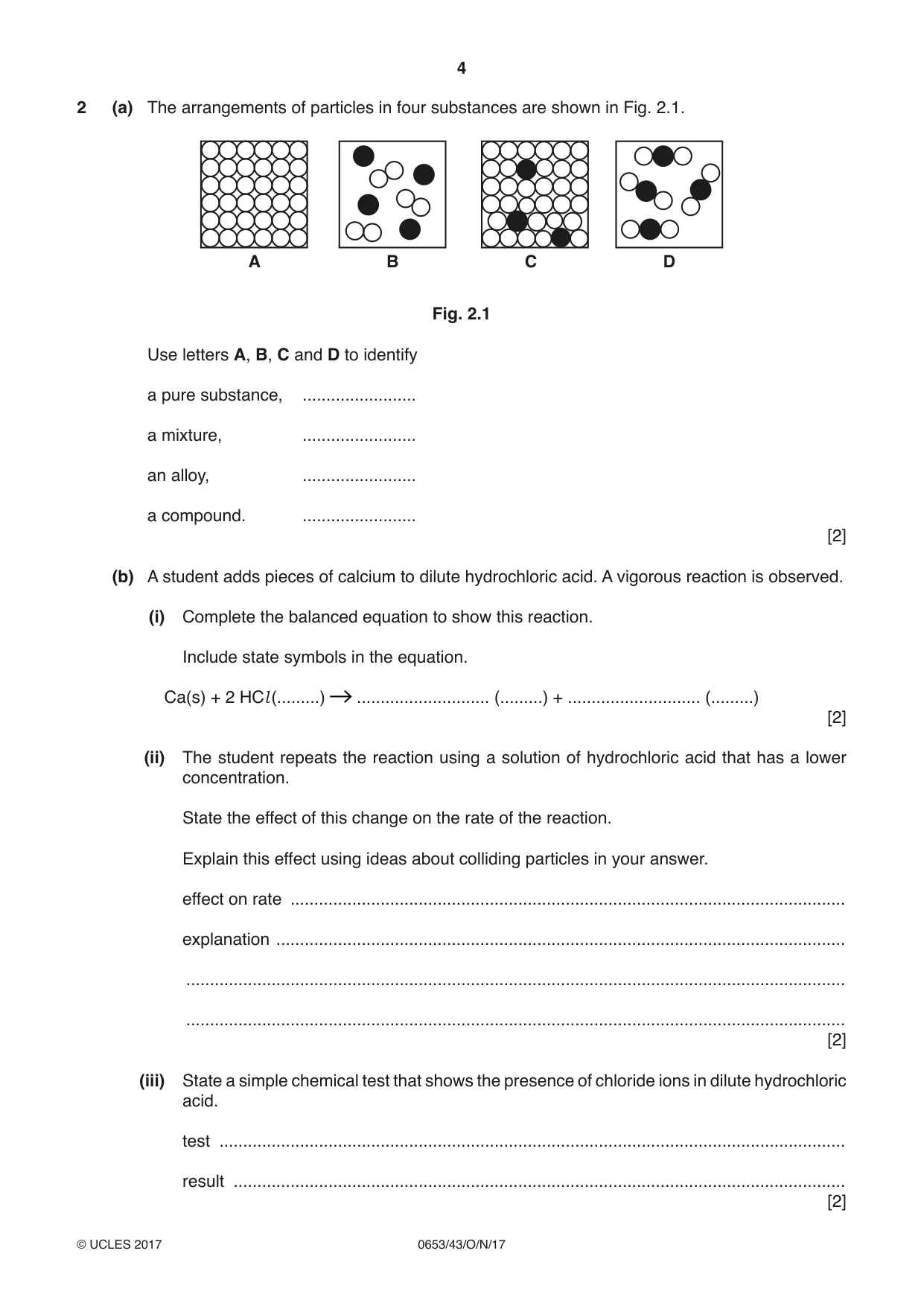
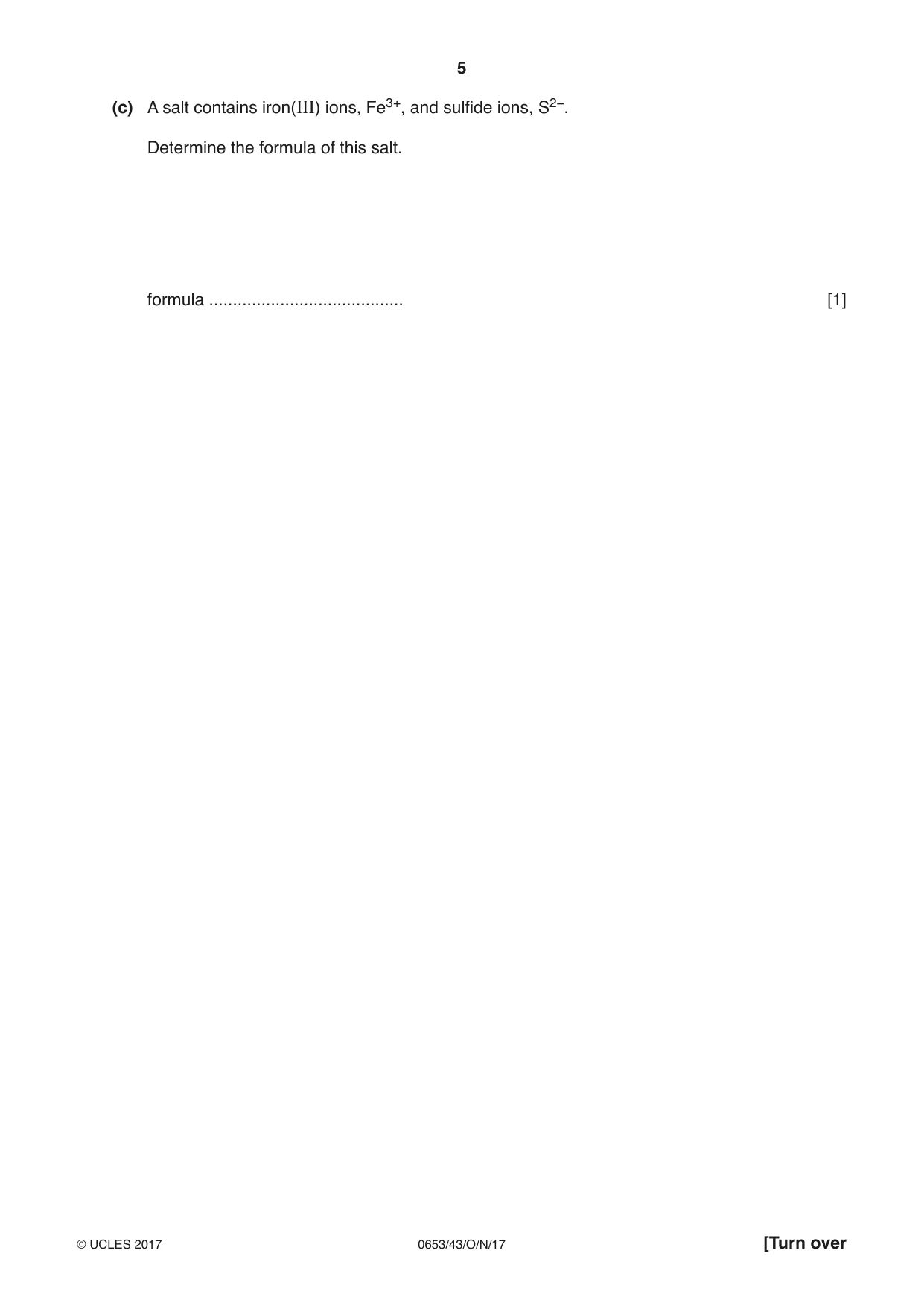
2 (a) The arrangements of particles in four substances are shown in Fig. 2.1. A B C D Fig. 2.1 Use letters A, B, C and D to identify a pure substance, ........................ a mixture, ........................ an alloy, ........................ a compound. ........................ [2] (b) A student adds pieces of calcium to dilute hydrochloric acid. A vigorous reaction is observed. (i) Complete the balanced equation to show this reaction. Include state symbols in the equation. Ca(s) + 2 HCl (.........) ............................ (.........) + ............................ (.........) [2] (ii) The student repeats the reaction using a solution of hydrochloric acid that has a lower concentration. State the effect of this change on the rate of the reaction. Explain this effect using ideas about colliding particles in your answer. effect on rate ..................................................................................................................... explanation ........................................................................................................................ ........................................................................................................................................... ........................................................................................................................................... [2] (iii) State a simple chemical test that shows the presence of chloride ions in dilute hydrochloric acid. test .................................................................................................................................... result ................................................................................................................................. [2] (c) A salt contains iron(III) ions, Fe3+, and sulfide ions, S2−. Determine the formula of this salt. formula ......................................... [1]
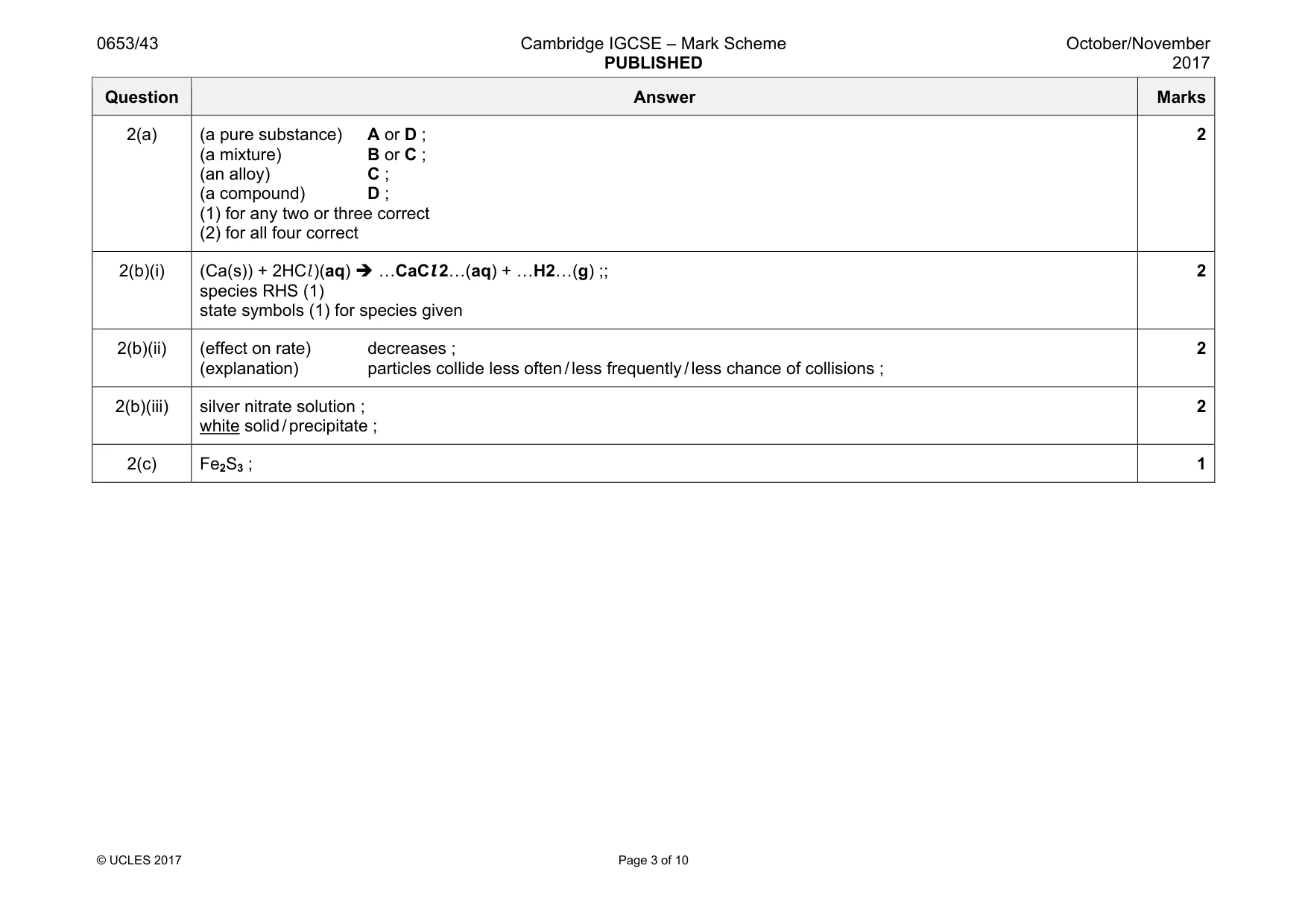
Mark scheme: 2(a) (a pure substance) A or D ; (a mixture) B or C ; (an alloy) C ; (a compound) D ; (1) for any two or three correct (2) for all four correct 2 2(b)(i) (Ca(s)) + 2HCl )(aq) Î «CaCl 2«(aq) + «H2«(g) ;; species RHS (1) state symbols (1) for species given 2 2(b)(ii) (effect on rate) decreases ; (explanation) particles collide less often / less frequently / less chance of collisions ; 2 2(b)(iii) silver nitrate solution ; white solid / precipitate ; 2 2(c) Fe2S3 ; 1
Q3 · A toy car powered by batteries
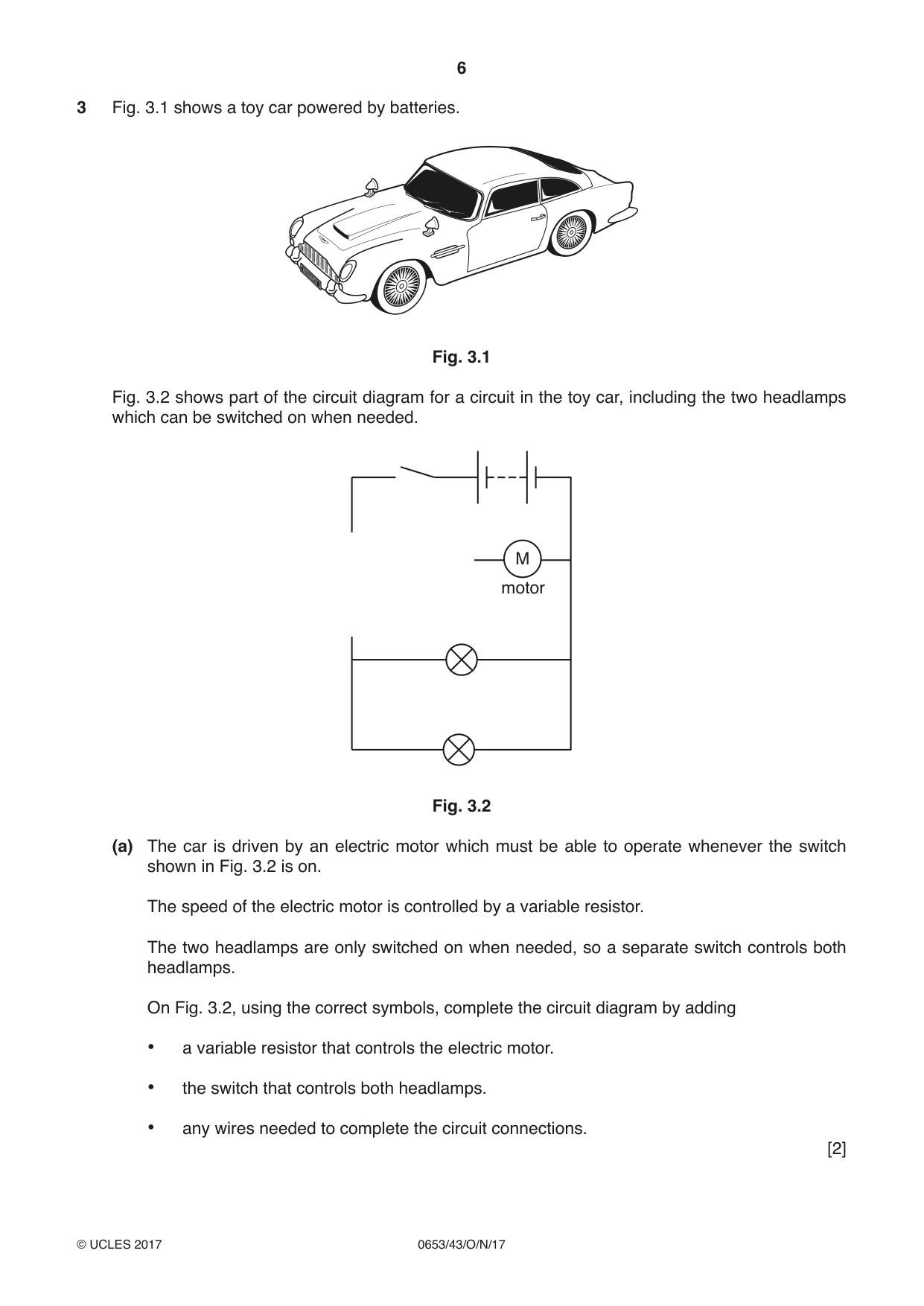
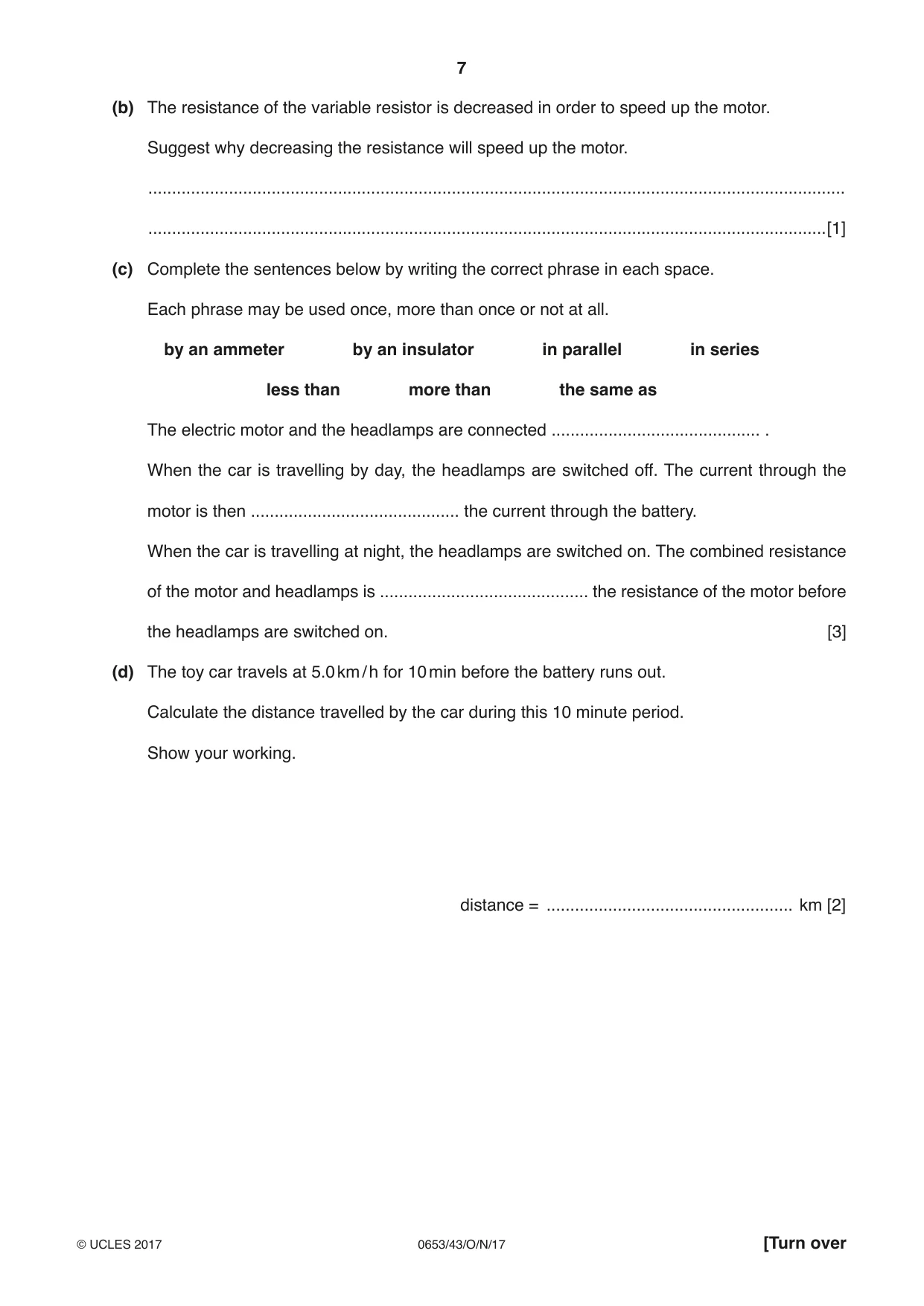
3 Fig. 3.1 shows a toy car powered by batteries. Fig. 3.1 Fig. 3.2 shows part of the circuit diagram for a circuit in the toy car, including the two headlamps which can be switched on when needed. M motor Fig. 3.2 (a) The car is driven by an electric motor which must be able to operate whenever the switch shown in Fig. 3.2 is on. The speed of the electric motor is controlled by a variable resistor. The two headlamps are only switched on when needed, so a separate switch controls both headlamps. On Fig. 3.2, using the correct symbols, complete the circuit diagram by adding • a variable resistor that controls the electric motor. • the switch that controls both headlamps. • any wires needed to complete the circuit connections. [2] (b) The resistance of the variable resistor is decreased in order to speed up the motor. Suggest why decreasing the resistance will speed up the motor. ................................................................................................................................................... ...............................................................................................................................................[1] (c) Complete the sentences below by writing the correct phrase in each space. Each phrase may be used once, more than once or not at all. by an ammeter by an insulator in parallel in series less than more than the same as The electric motor and the headlamps are connected ............................................ . When the car is travelling by day, the headlamps are switched off. The current through the motor is then ............................................ the current through the battery. When the car is travelling at night, the headlamps are switched on. The combined resistance of the motor and headlamps is ............................................ the resistance of the motor before the headlamps are switched on. [3] (d) The toy car travels at 5.0 km / h for 10 min before the battery runs out. Calculate the distance travelled by the car during this 10 minute period. Show your working. distance = .................................................... km [2]
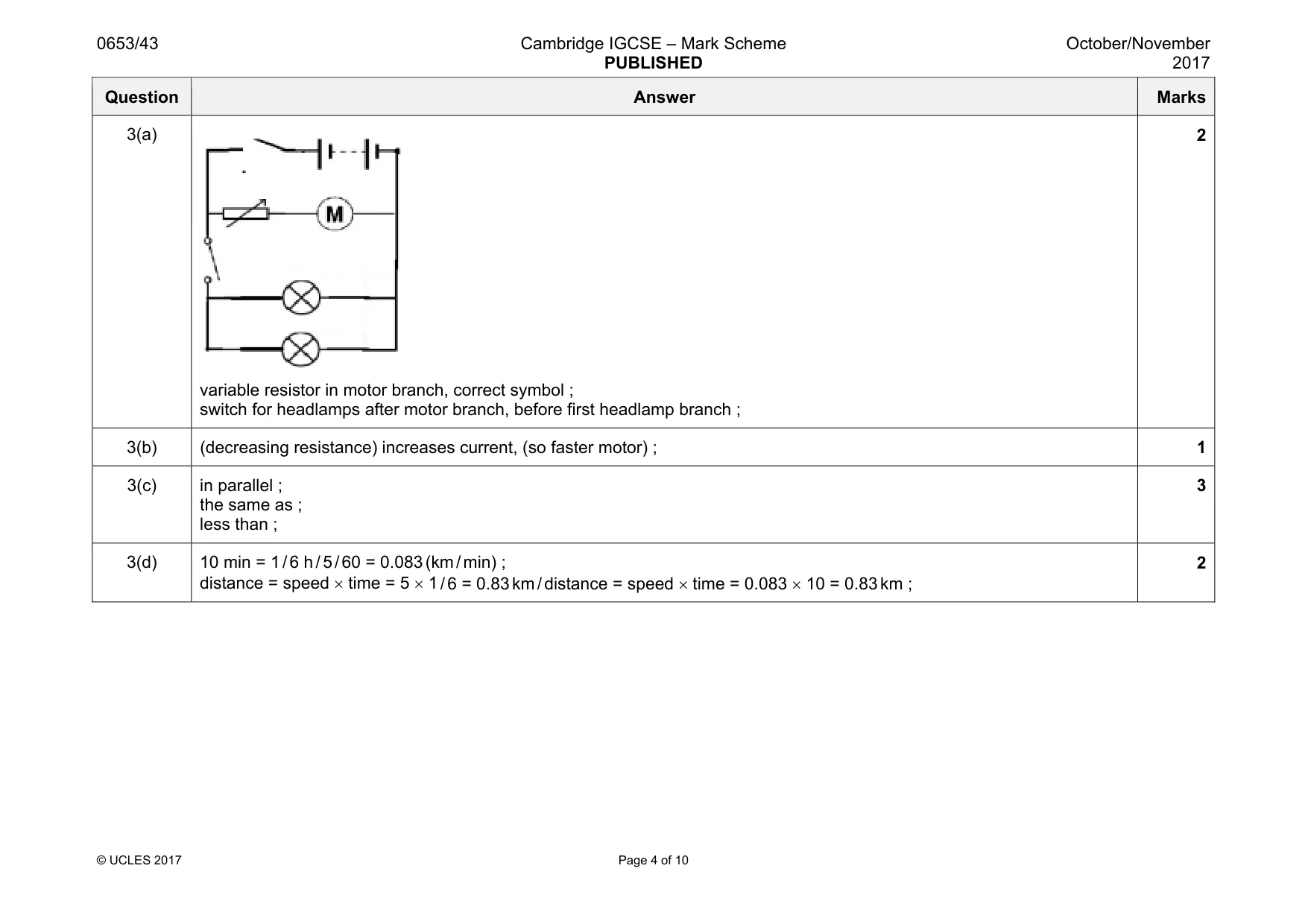
Mark scheme: 3(a) variable resistor in motor branch, correct symbol ; switch for headlamps after motor branch, before first headlamp branch ; 2 3(b) (decreasing resistance) increases current, (so faster motor) ; 1 3(c) in parallel ; the same as ; less than ; 3 3(d) 10 min = 1 / 6 h / 5 / 60 = 0.083 (km / min) ; distance = speed × time = 5 × 1 / 6 = 0.83 km / distance = speed × time = 0.083 × 10 = 0.83 km ; 2
Q4 · A diagram of the alimentary canal
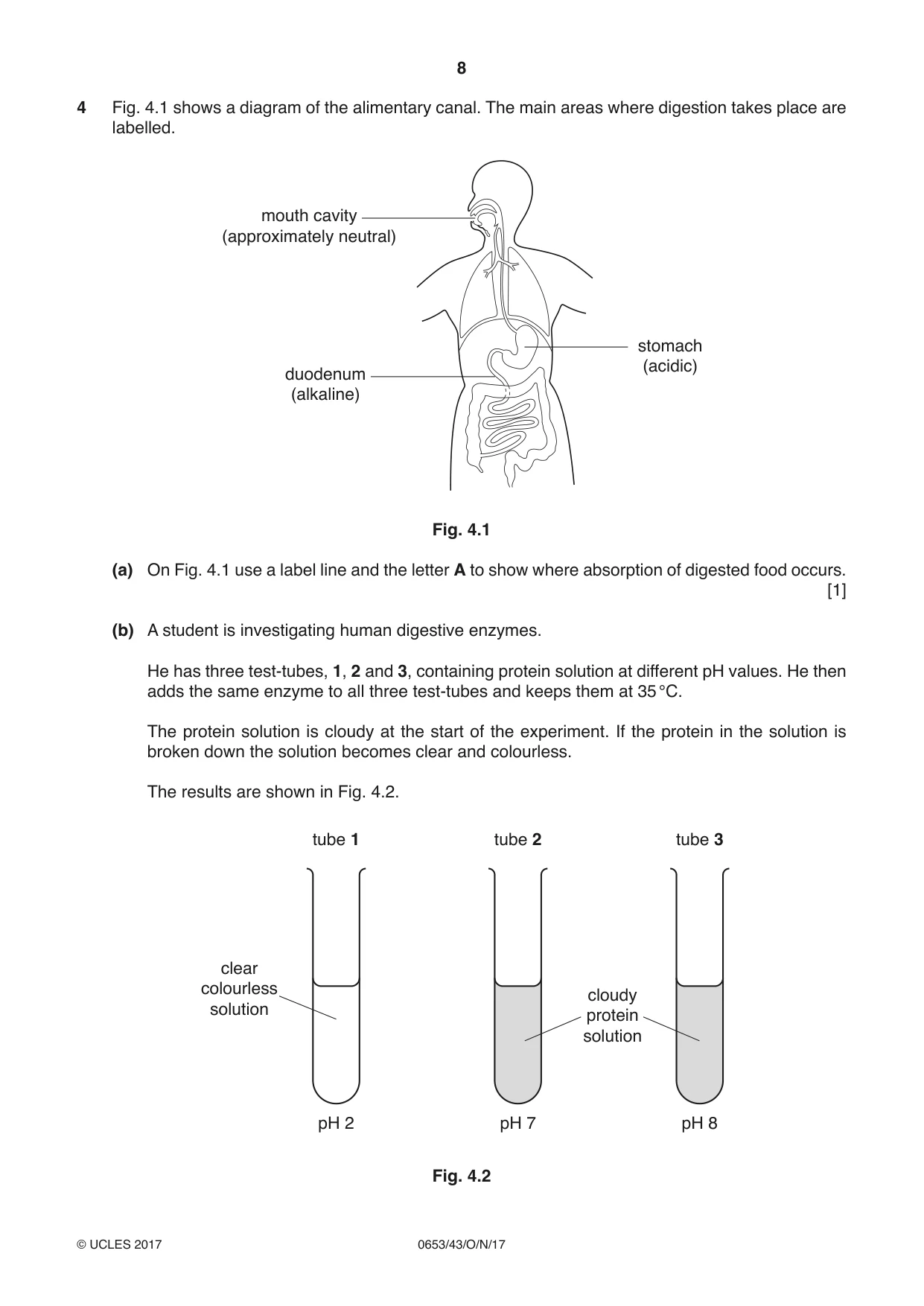
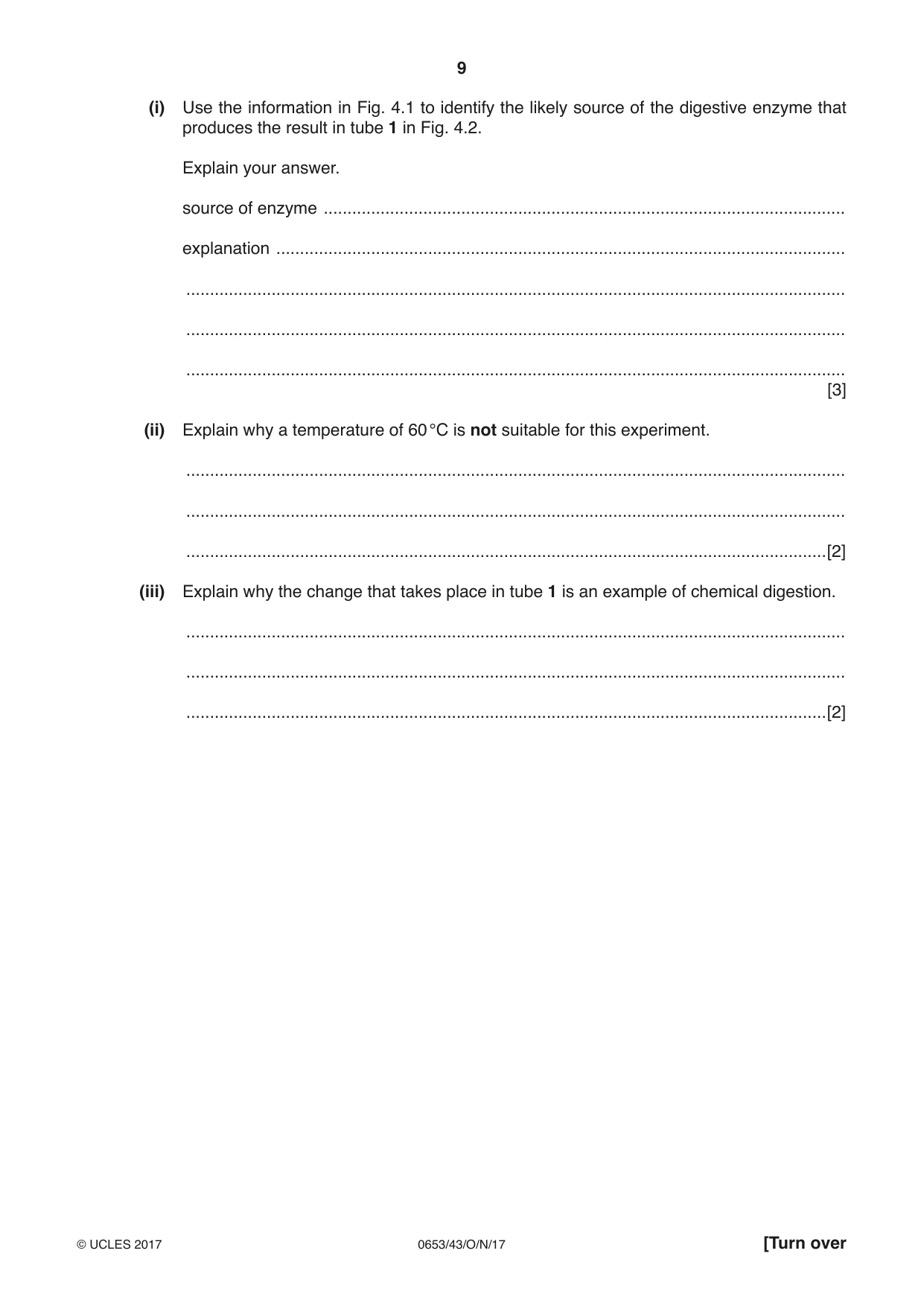
4 Fig. 4.1 shows a diagram of the alimentary canal. The main areas where digestion takes place are labelled. mouth cavity (approximately neutral) stomach (acidic) duodenum (alkaline) Fig. 4.1 (a) On Fig. 4.1 use a label line and the letter A to show where absorption of digested food occurs. [1] (b) A student is investigating human digestive enzymes. He has three test-tubes, 1, 2 and 3, containing protein solution at different pH values. He then adds the same enzyme to all three test-tubes and keeps them at 35 °C. The protein solution is cloudy at the start of the experiment. If the protein in the solution is broken down the solution becomes clear and colourless. The results are shown in Fig. 4.2. tube 1 tube 2 tube 3 clear colourless cloudy solution protein solution pH 2 pH 7 pH 8 Fig. 4.2 (i) Use the information in Fig. 4.1 to identify the likely source of the digestive enzyme that produces the result in tube 1 in Fig. 4.2. Explain your answer. source of enzyme .............................................................................................................. explanation ........................................................................................................................ ........................................................................................................................................... ........................................................................................................................................... ........................................................................................................................................... [3] (ii) Explain why a temperature of 60 °C is not suitable for this experiment. ........................................................................................................................................... ........................................................................................................................................... .......................................................................................................................................[2] (iii) Explain why the change that takes place in tube 1 is an example of chemical digestion. ........................................................................................................................................... ........................................................................................................................................... .......................................................................................................................................[2]
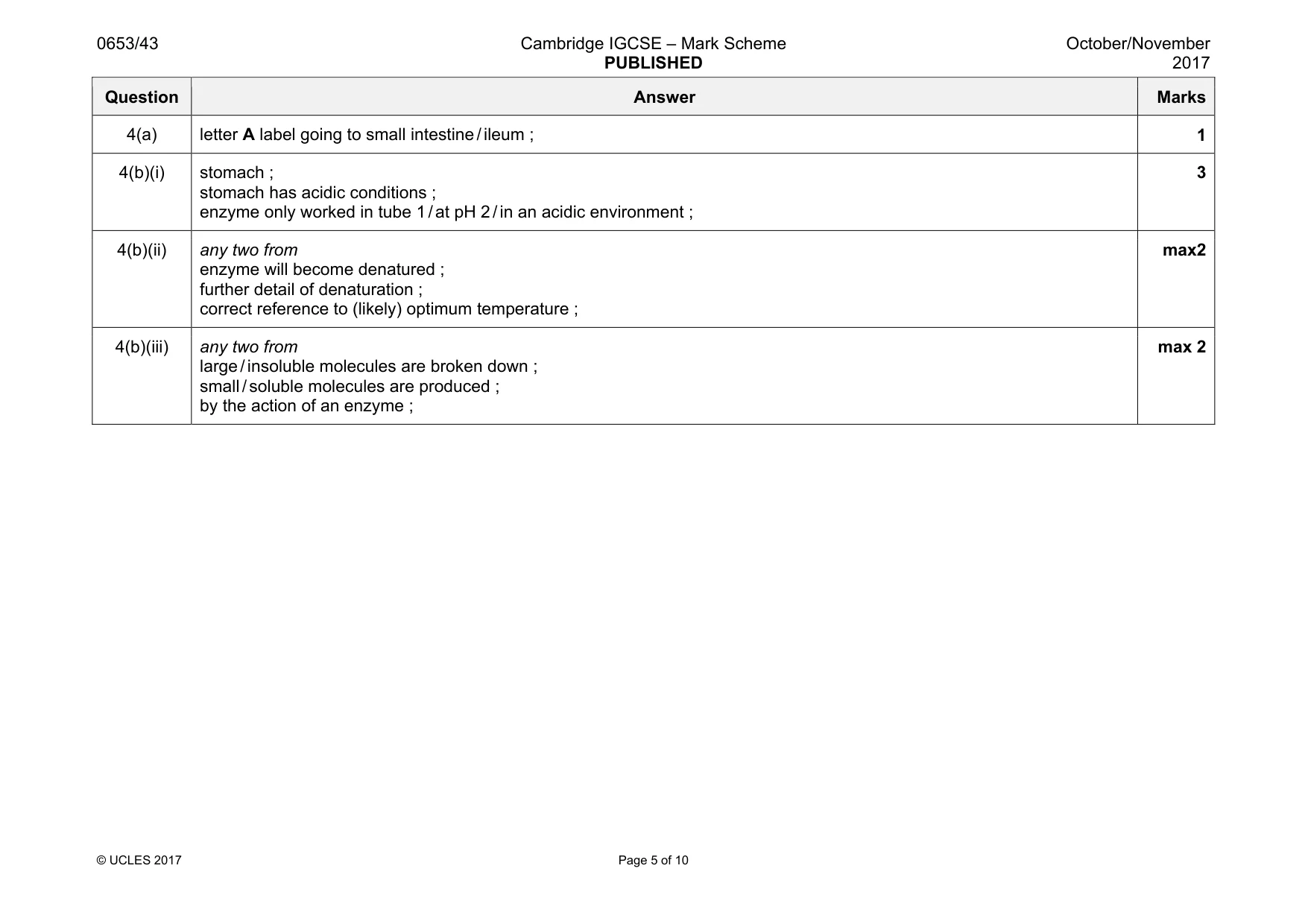
Mark scheme: 4(a) letter A label going to small intestine / ileum ; 1 4(b)(i) stomach ; stomach has acidic conditions ; enzyme only worked in tube 1 / at pH 2 / in an acidic environment ; 3 4(b)(ii) any two from enzyme will become denatured ; further detail of denaturation ; correct reference to (likely) optimum temperature ; max2 4(b)(iii) any two from large / insoluble molecules are broken down ; small / soluble molecules are produced ; by the action of an enzyme ; max 2
Q5 · Fractional distillation of petroleum produces fractions containing different compounds
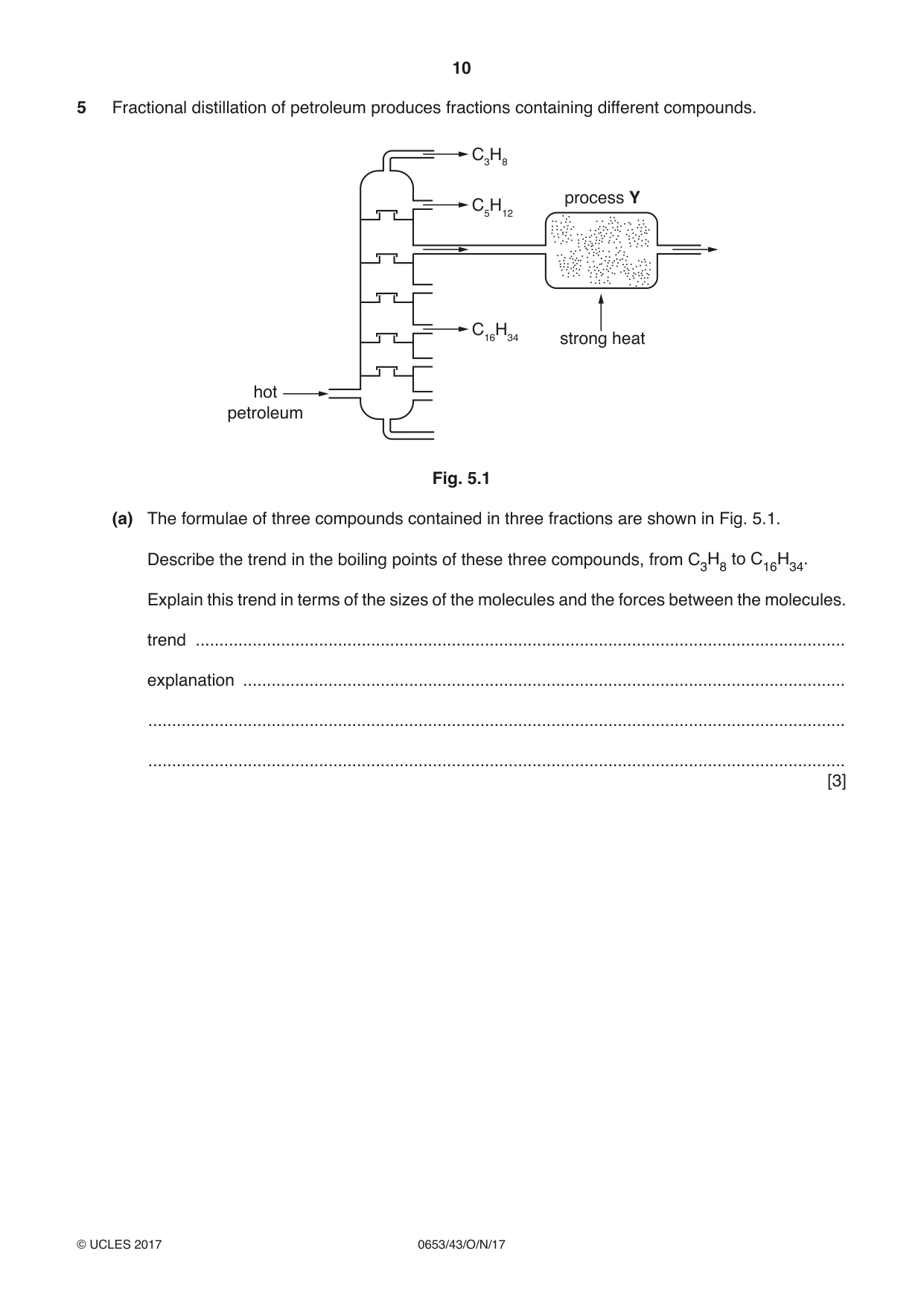
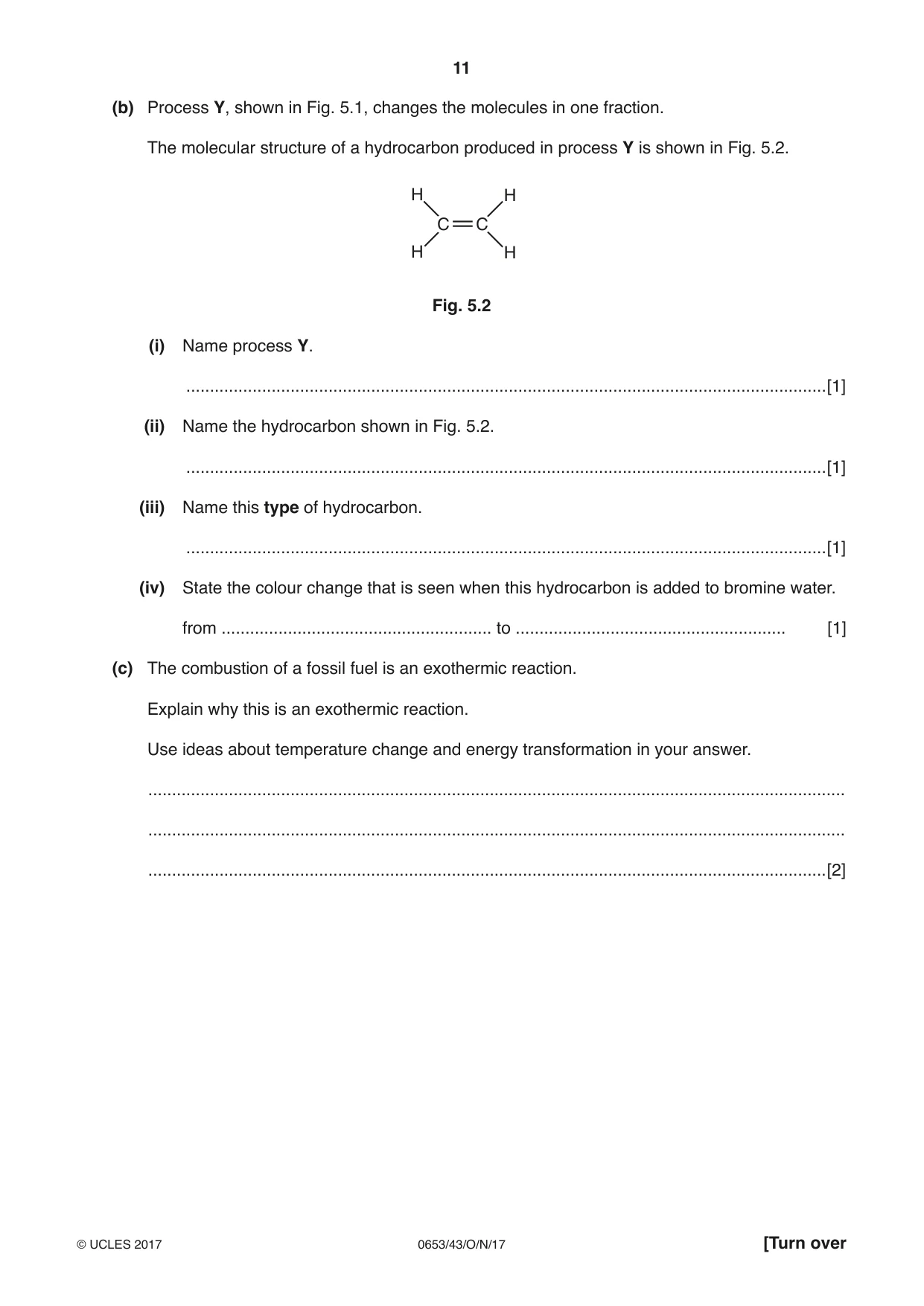
5 Fractional distillation of petroleum produces fractions containing different compounds. C3H8 process Y C5H12 C16H34 strong heat hot petroleum Fig. 5.1 (a) The formulae of three compounds contained in three fractions are shown in Fig. 5.1. Describe the trend in the boiling points of these three compounds, from C3H8 to C16H34. Explain this trend in terms of the sizes of the molecules and the forces between the molecules. trend ......................................................................................................................................... explanation ............................................................................................................................... ................................................................................................................................................... ................................................................................................................................................... [3] (b) Process Y, shown in Fig. 5.1, changes the molecules in one fraction. The molecular structure of a hydrocarbon produced in process Y is shown in Fig. 5.2. H H C C H H Fig. 5.2 (i) Name process Y. .......................................................................................................................................[1] (ii) Name the hydrocarbon shown in Fig. 5.2. .......................................................................................................................................[1] (iii) Name this type of hydrocarbon. .......................................................................................................................................[1] (iv) State the colour change that is seen when this hydrocarbon is added to bromine water. from ......................................................... to ......................................................... [1] (c) The combustion of a fossil fuel is an exothermic reaction. Explain why this is an exothermic reaction. Use ideas about temperature change and energy transformation in your answer. ................................................................................................................................................... ................................................................................................................................................... ...............................................................................................................................................[2]
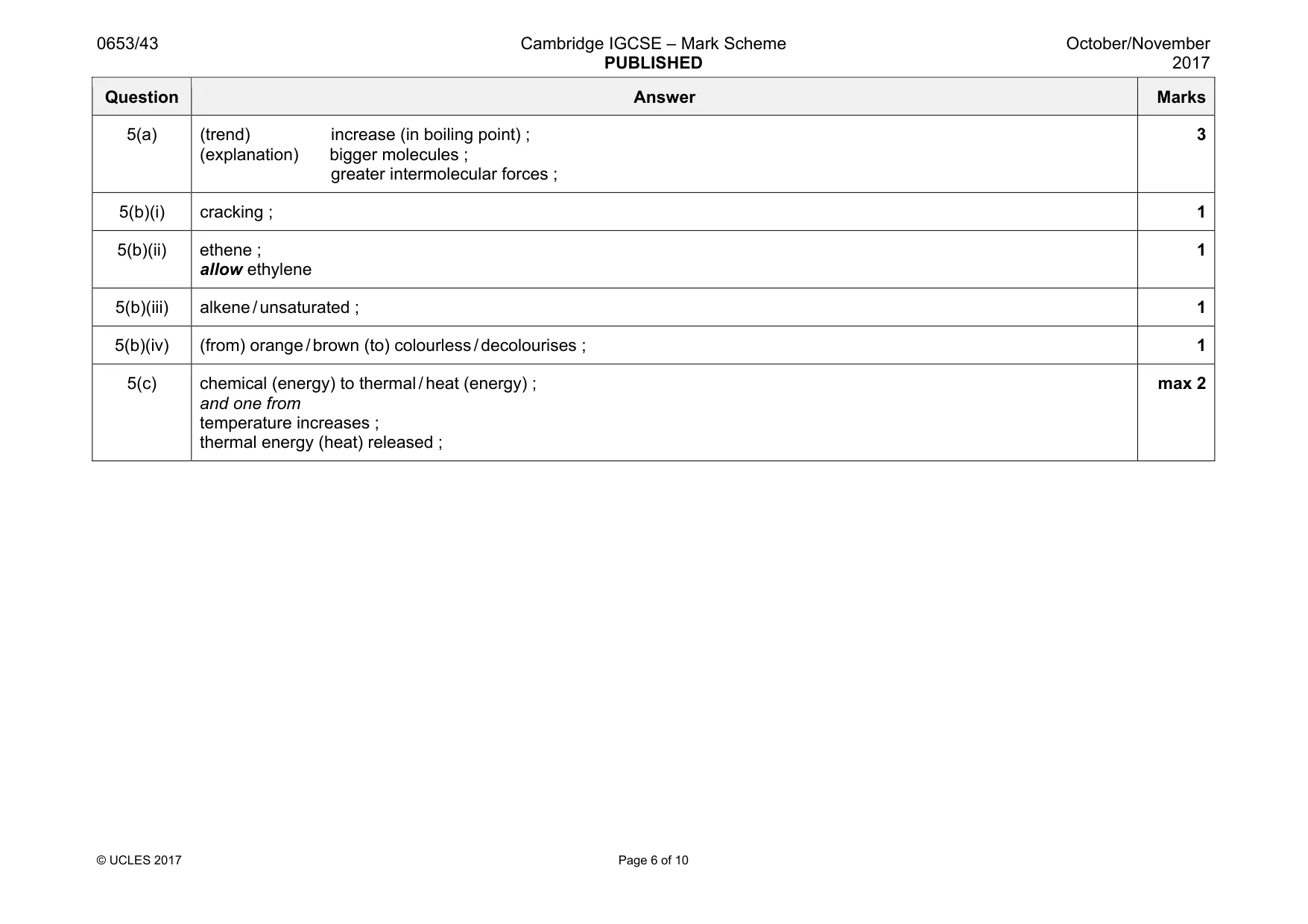
Mark scheme: 5(a) (trend) increase (in boiling point) ; (explanation) bigger molecules ; greater intermolecular forces ; 3 5(b)(i) cracking ; 1 5(b)(ii) ethene ; allow ethylene 1 5(b)(iii) alkene / unsaturated ; 1 5(b)(iv) (from) orange / brown (to) colourless / decolourises ; 1 5(c) chemical (energy) to thermal / heat (energy) ; and one from temperature increases ; thermal energy (heat) released ; max 2
Question 6
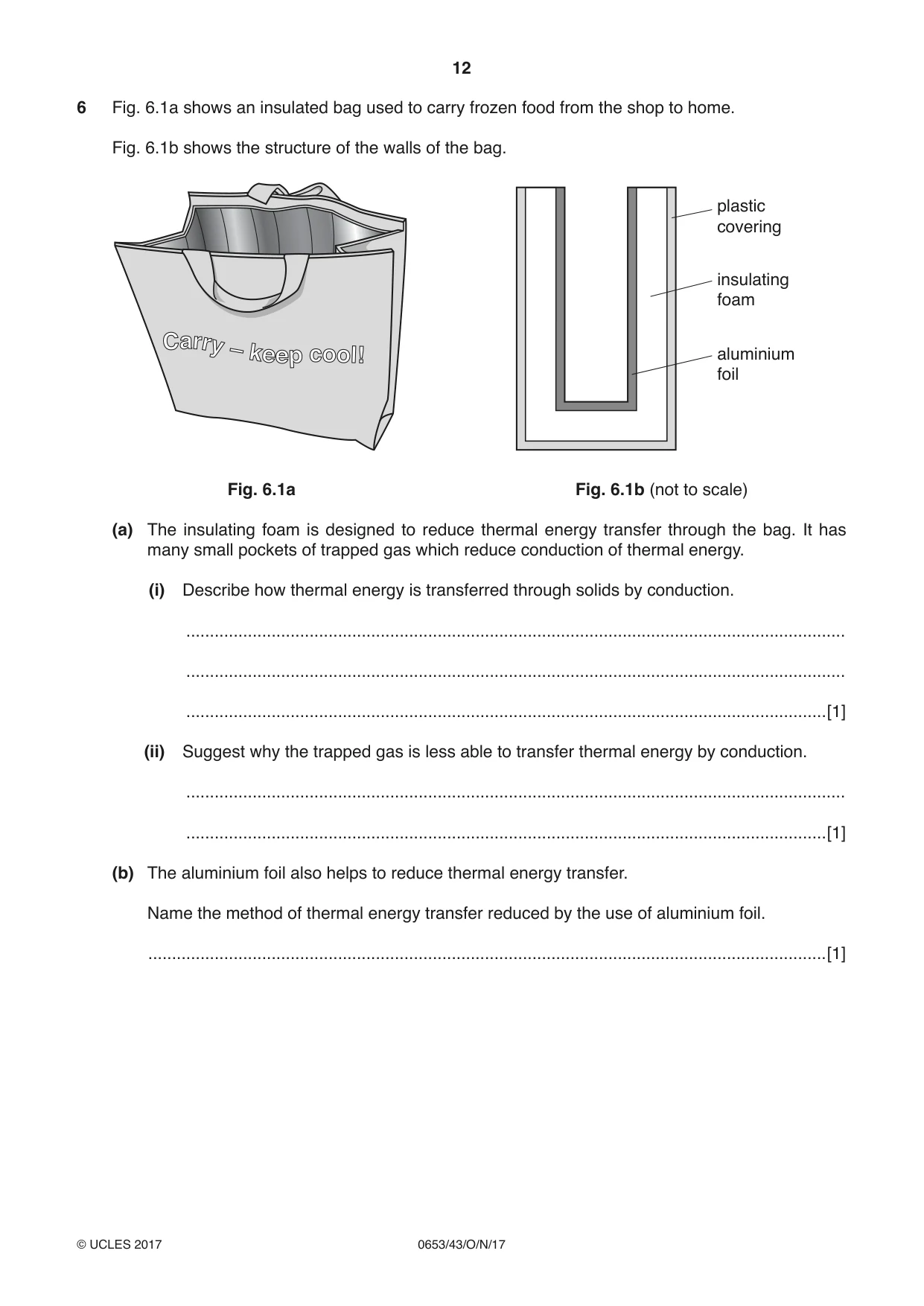
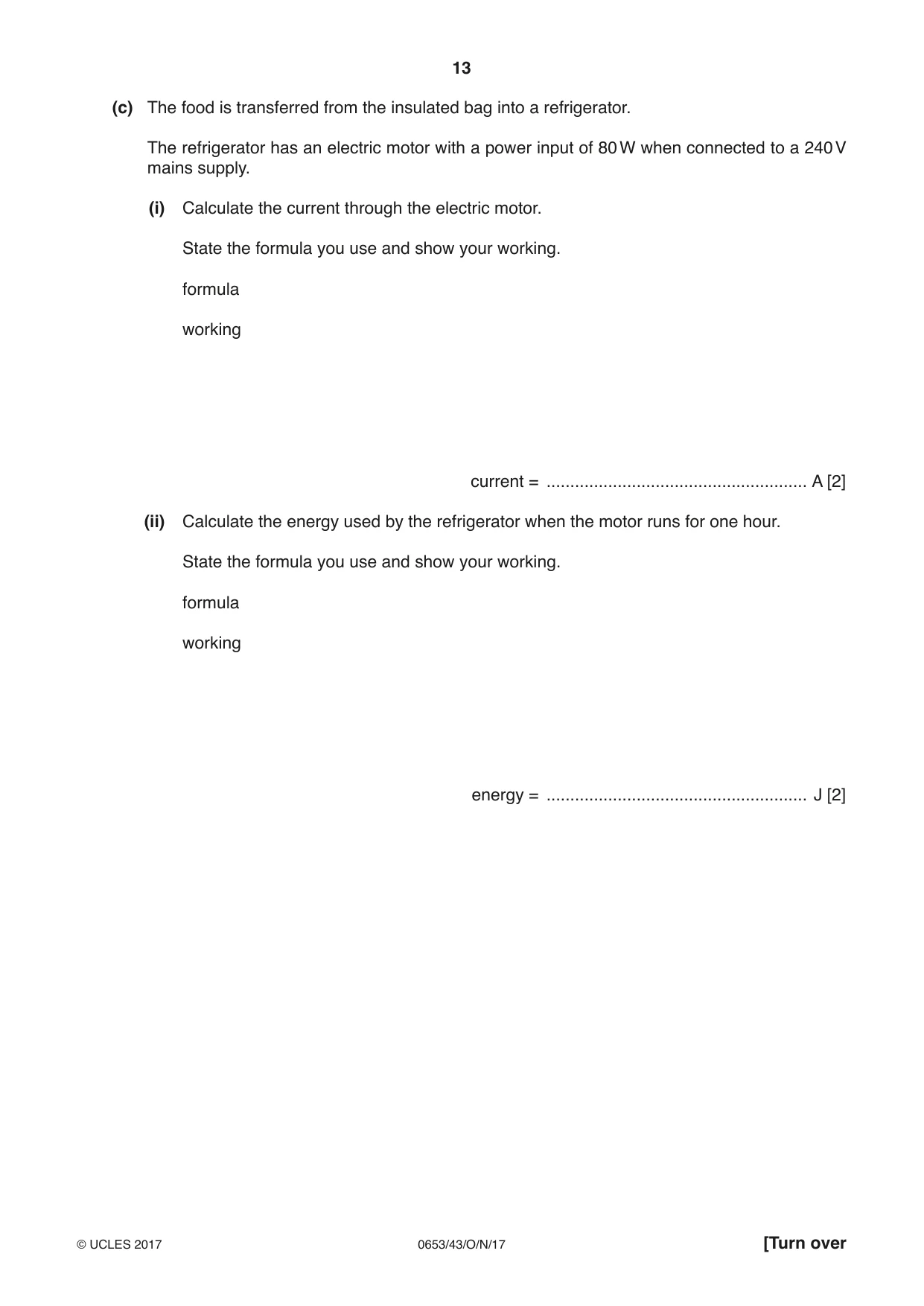
6 Fig. 6.1a shows an insulated bag used to carry frozen food from the shop to home. Fig. 6.1b shows the structure of the walls of the bag. plastic covering insulating foam aluminium Carry– keep cool! foil Fig. 6.1a Fig. 6.1b (not to scale) (a) The insulating foam is designed to reduce thermal energy transfer through the bag. It has many small pockets of trapped gas which reduce conduction of thermal energy. (i) Describe how thermal energy is transferred through solids by conduction. ........................................................................................................................................... ........................................................................................................................................... .......................................................................................................................................[1] (ii) Suggest why the trapped gas is less able to transfer thermal energy by conduction. ........................................................................................................................................... .......................................................................................................................................[1] (b) The aluminium foil also helps to reduce thermal energy transfer. Name the method of thermal energy transfer reduced by the use of aluminium foil. ...............................................................................................................................................[1] (c) The food is transferred from the insulated bag into a refrigerator. The refrigerator has an electric motor with a power input of 80 W when connected to a 240 V mains supply. (i) Calculate the current through the electric motor. State the formula you use and show your working. formula working current = ....................................................... A [2] (ii) Calculate the energy used by the refrigerator when the motor runs for one hour. State the formula you use and show your working. formula working energy = ....................................................... J [2]
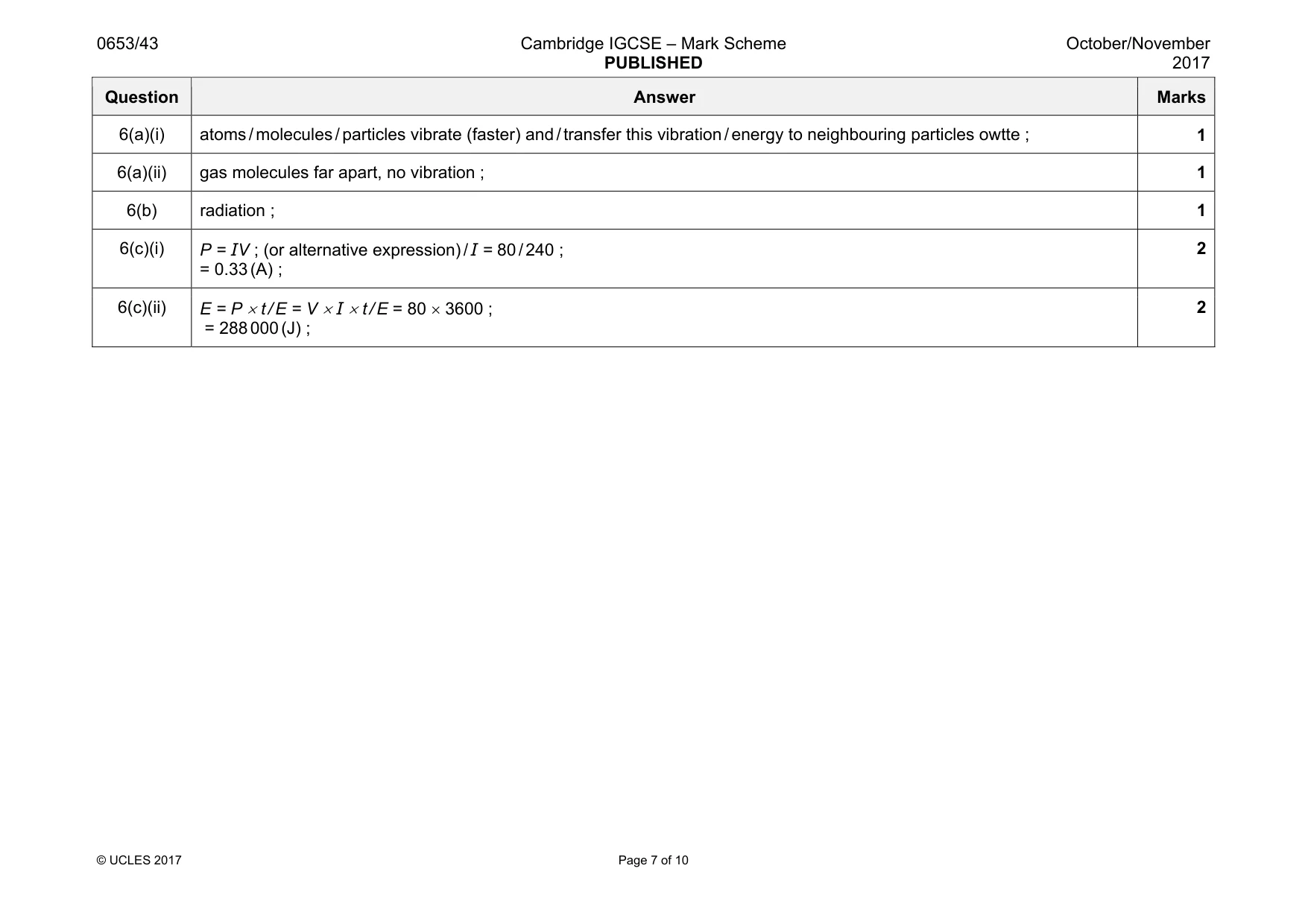
Mark scheme: 6(a)(i) atoms / molecules / particles vibrate (faster) and / transfer this vibration / energy to neighbouring particles owtte ; 1 6(a)(ii) gas molecules far apart, no vibration ; 1 6(b) radiation ; 1 6(c)(i) P = IV ; (or alternative expression) / I = 80 / 240 ; = 0.33 (A) ; 2 6(c)(ii) E = P × t / E = V × I × t / E = 80 × 3600 ; = 288 000 (J) ; 2
Q7 · Some processes occurring in a forest
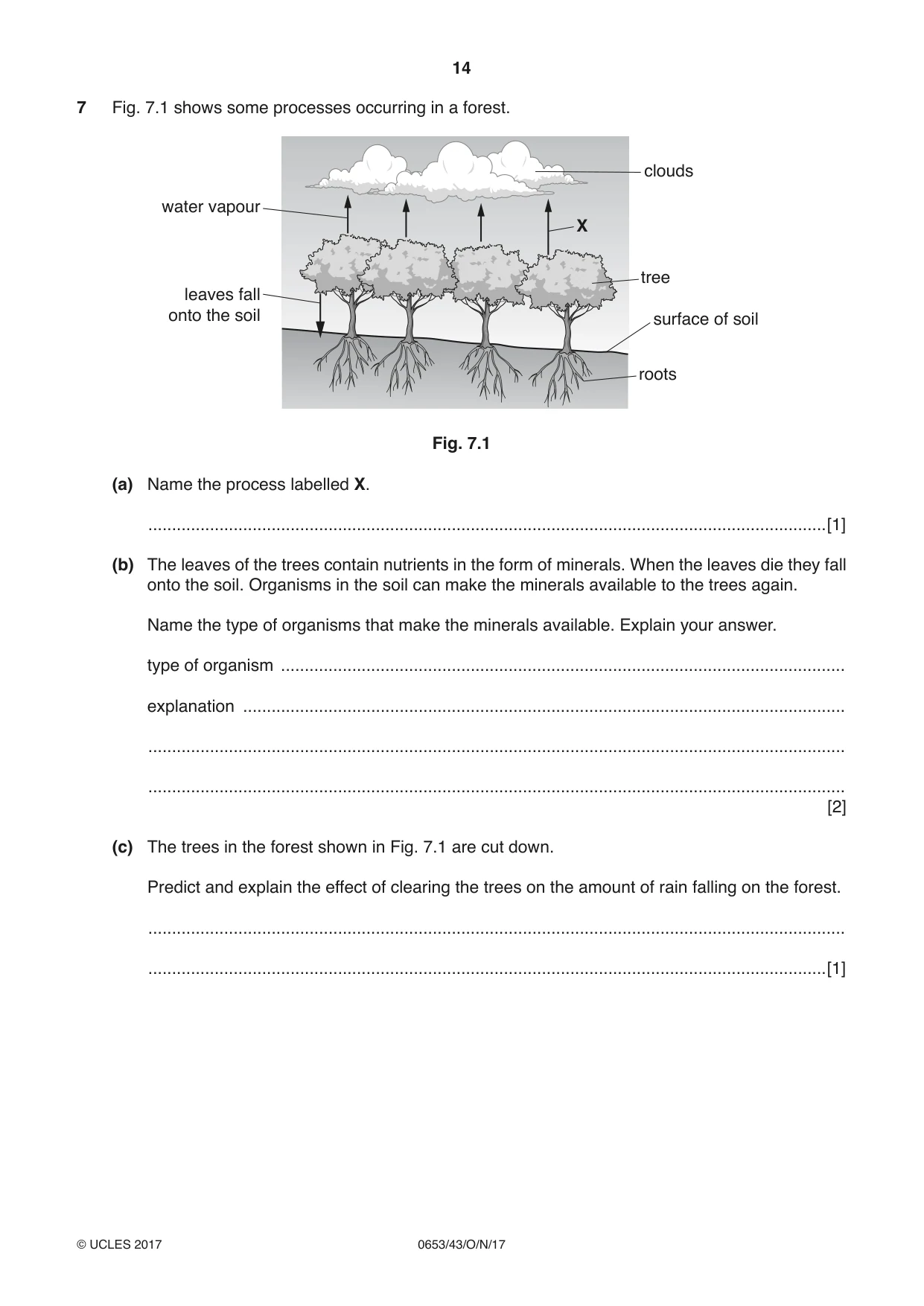
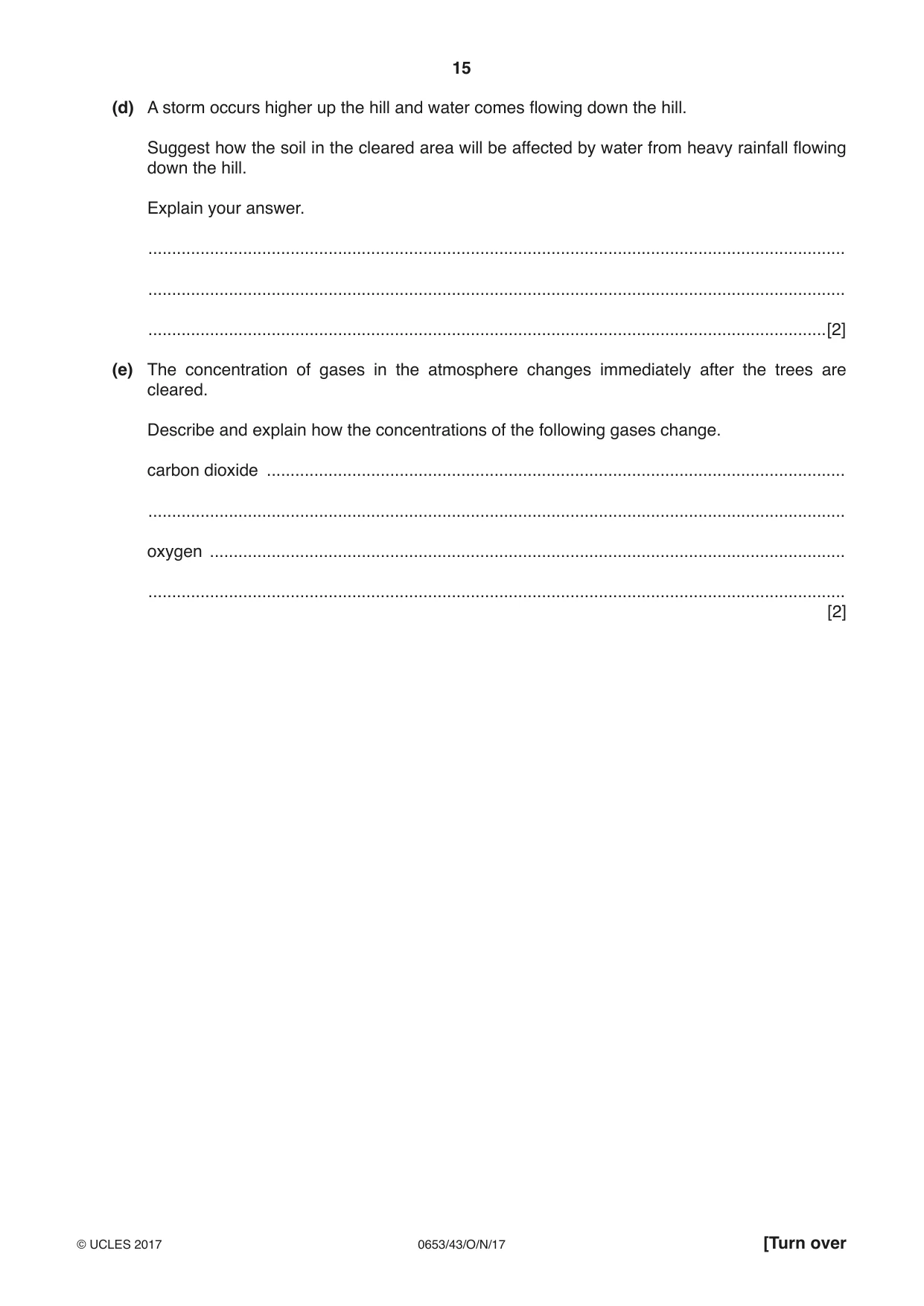
7 Fig. 7.1 shows some processes occurring in a forest. clouds water vapour X tree leaves fall onto the soil surface of soil roots Fig. 7.1 (a) Name the process labelled X. ...............................................................................................................................................[1] (b) The leaves of the trees contain nutrients in the form of minerals. When the leaves die they fall onto the soil. Organisms in the soil can make the minerals available to the trees again. Name the type of organisms that make the minerals available. Explain your answer. type of organism ....................................................................................................................... explanation ............................................................................................................................... ................................................................................................................................................... ................................................................................................................................................... [2] (c) The trees in the forest shown in Fig. 7.1 are cut down. Predict and explain the effect of clearing the trees on the amount of rain falling on the forest. ................................................................................................................................................... ...............................................................................................................................................[1] (d) A storm occurs higher up the hill and water comes flowing down the hill. Suggest how the soil in the cleared area will be affected by water from heavy rainfall flowing down the hill. Explain your answer. ................................................................................................................................................... ................................................................................................................................................... ...............................................................................................................................................[2] (e) The concentration of gases in the atmosphere changes immediately after the trees are cleared. Describe and explain how the concentrations of the following gases change. carbon dioxide .......................................................................................................................... ................................................................................................................................................... oxygen ...................................................................................................................................... ................................................................................................................................................... [2]
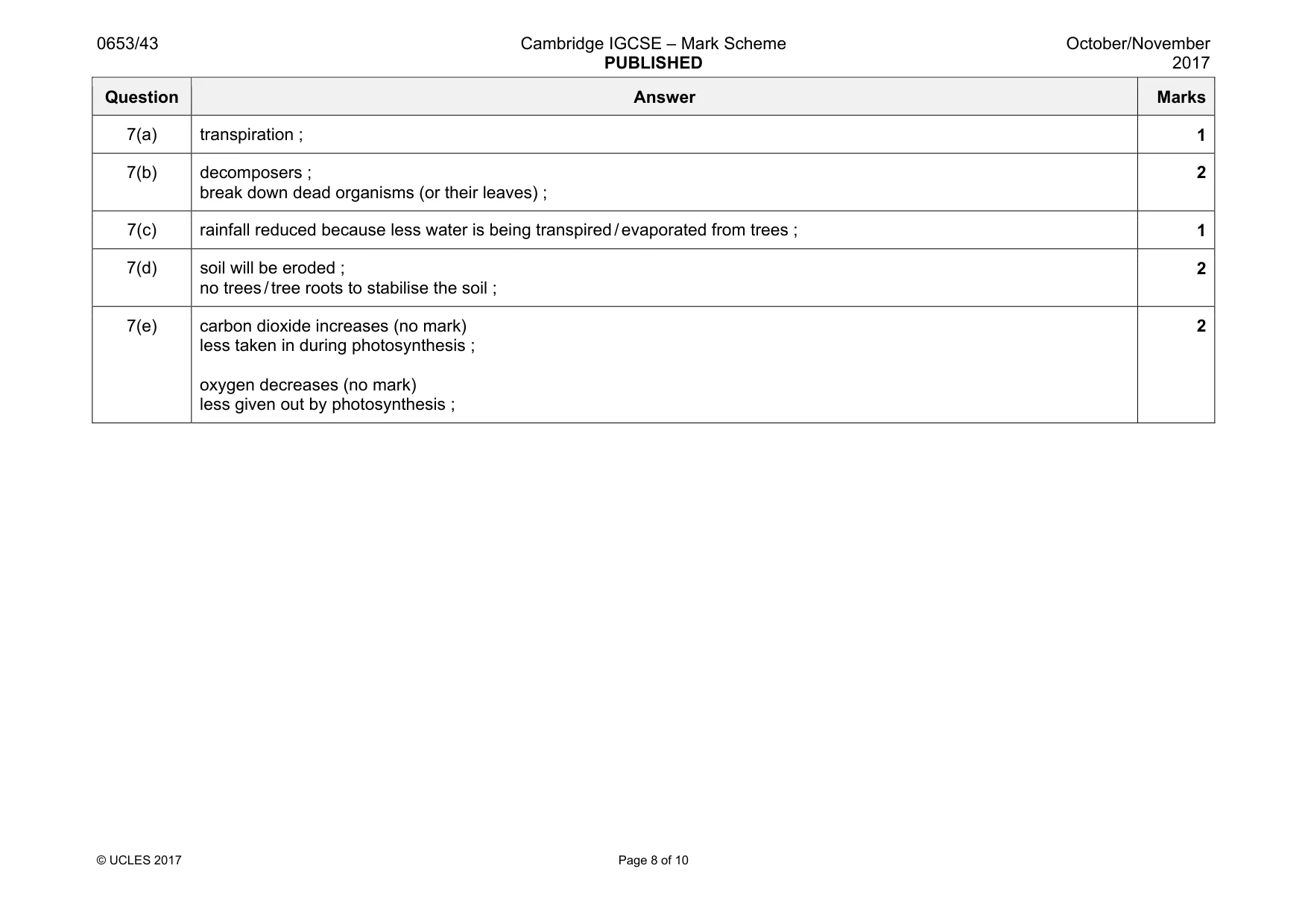
Mark scheme: 7(a) transpiration ; 1 7(b) decomposers ; break down dead organisms (or their leaves) ; 2 7(c) rainfall reduced because less water is being transpired / evaporated from trees ; 1 7(d) soil will be eroded ; no trees / tree roots to stabilise the soil ; 2 7(e) carbon dioxide increases (no mark) less taken in during photosynthesis ; oxygen decreases (no mark) less given out by photosynthesis ; 2
Q8 · The atomic number of oxygen is 8
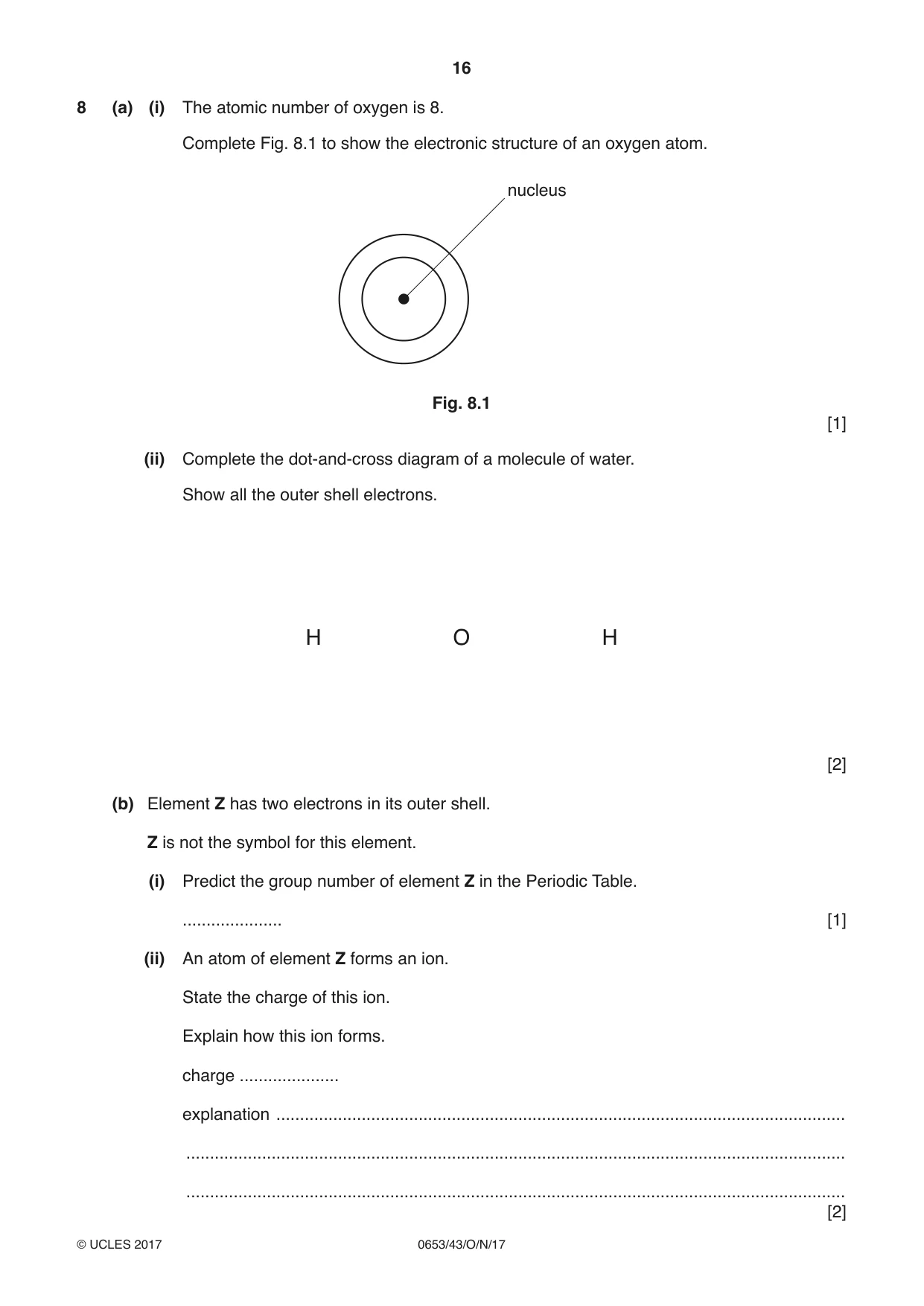
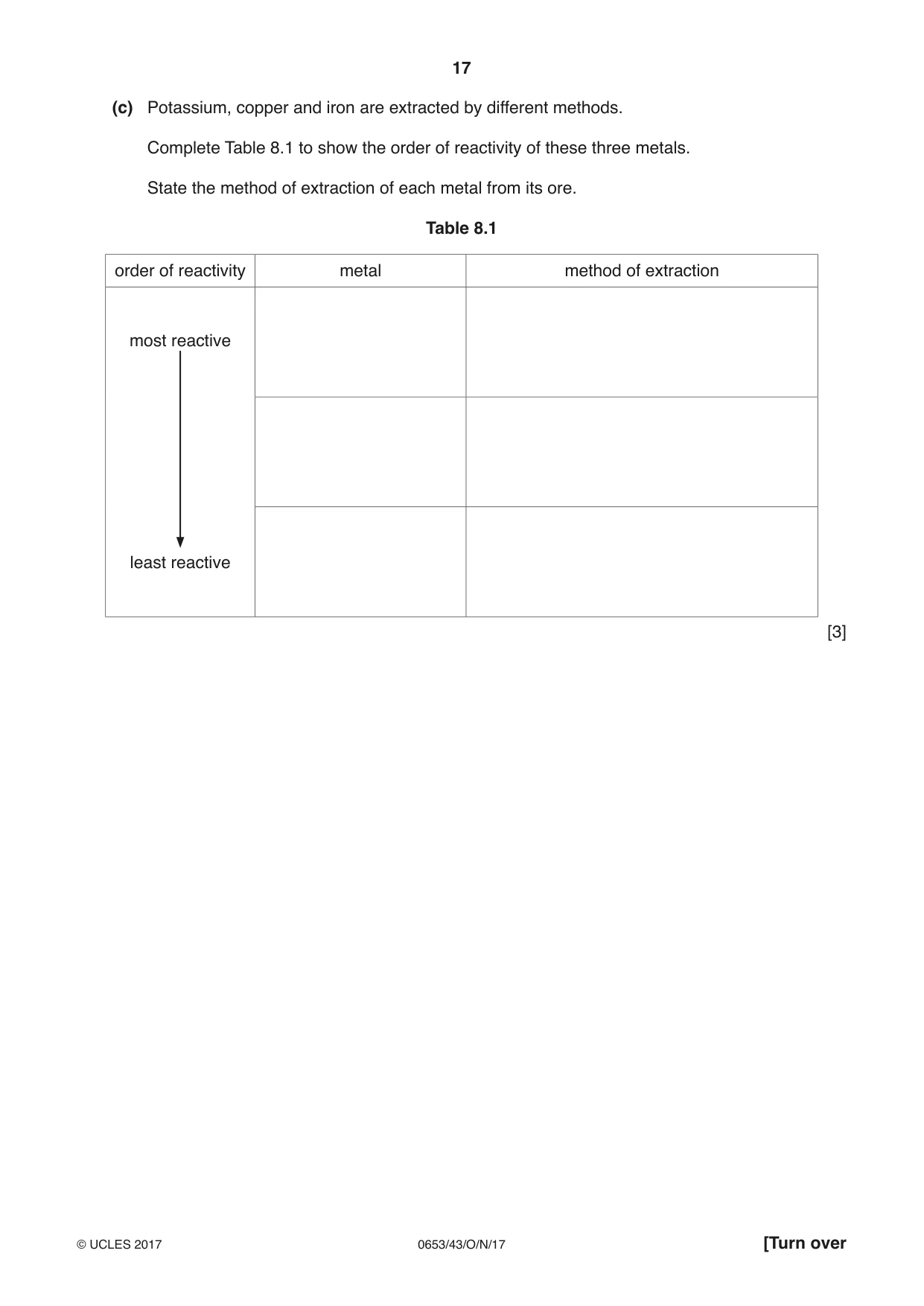
8 (a) (i) The atomic number of oxygen is 8. Complete Fig. 8.1 to show the electronic structure of an oxygen atom. nucleus Fig. 8.1 [1] (ii) Complete the dot-and-cross diagram of a molecule of water. Show all the outer shell electrons. H O H [2] (b) Element Z has two electrons in its outer shell. Z is not the symbol for this element. (i) Predict the group number of element Z in the Periodic Table. ..................... [1] (ii) An atom of element Z forms an ion. State the charge of this ion. Explain how this ion forms. charge ..................... explanation ........................................................................................................................ ........................................................................................................................................... ........................................................................................................................................... [2] (c) Potassium, copper and iron are extracted by different methods. Complete Table 8.1 to show the order of reactivity of these three metals. State the method of extraction of each metal from its ore. Table 8.1 order of reactivity metal method of extraction most reactive least reactive [3]
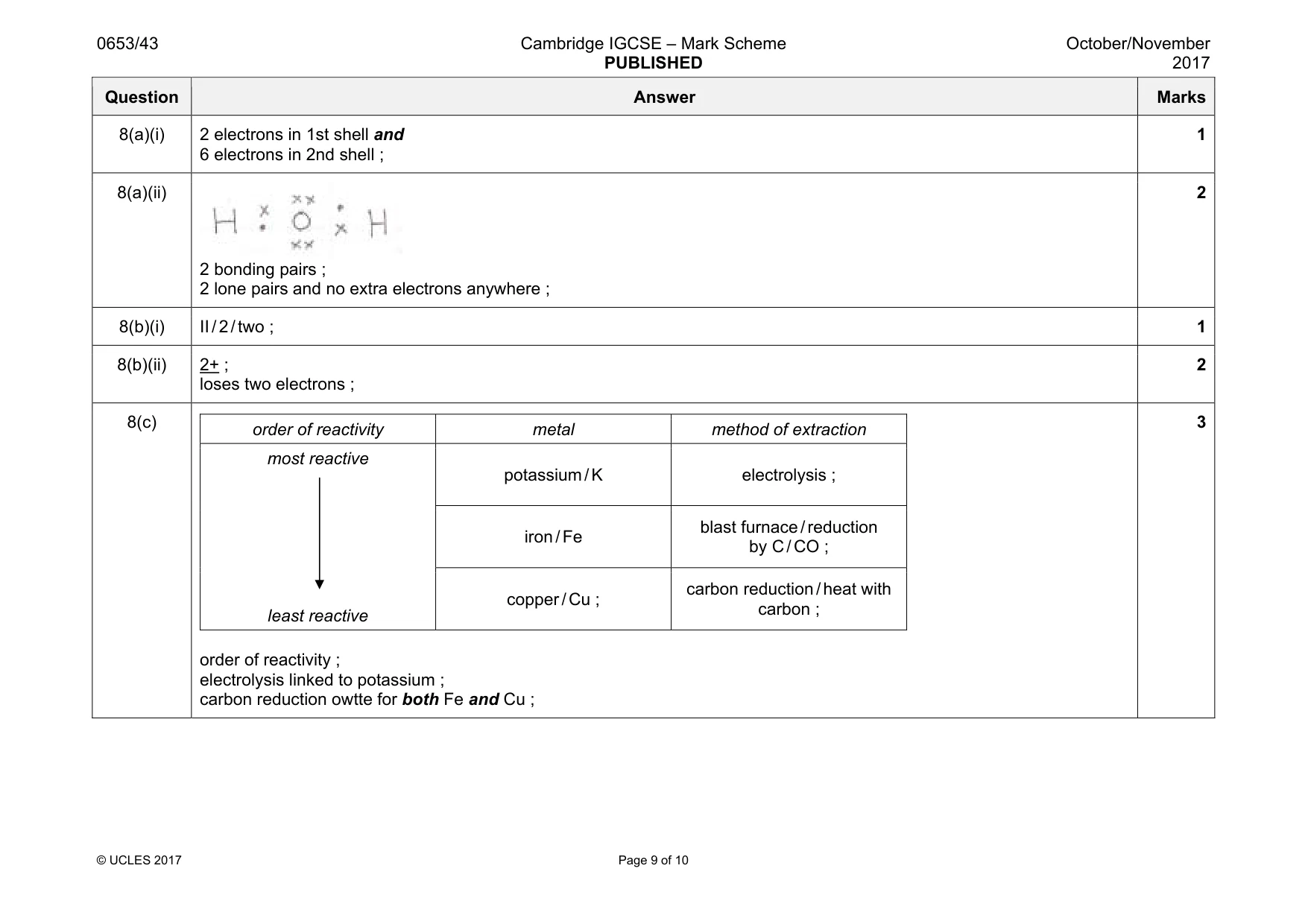
Mark scheme: 8(a)(i) 2 electrons in 1st shell and 6 electrons in 2nd shell ; 1 8(a)(ii) 2 bonding pairs ; 2 lone pairs and no extra electrons anywhere ; 2 8(b)(i) II / 2 / two ; 1 8(b)(ii) 2+ ; loses two electrons ; 2 8(c) order of reactivity metal method of extraction most reactive least reactive potassium / K electrolysis ; iron / Fe blast furnace / reduction by C / CO ; copper / Cu ; carbon reduction / heat with carbon ; order of reactivity ; electrolysis linked to potassium ; carbon reduction owtte for both Fe and Cu ; 3
Q9 · Four forces, P, Q, R and S, acting on a submarine travelling underwater
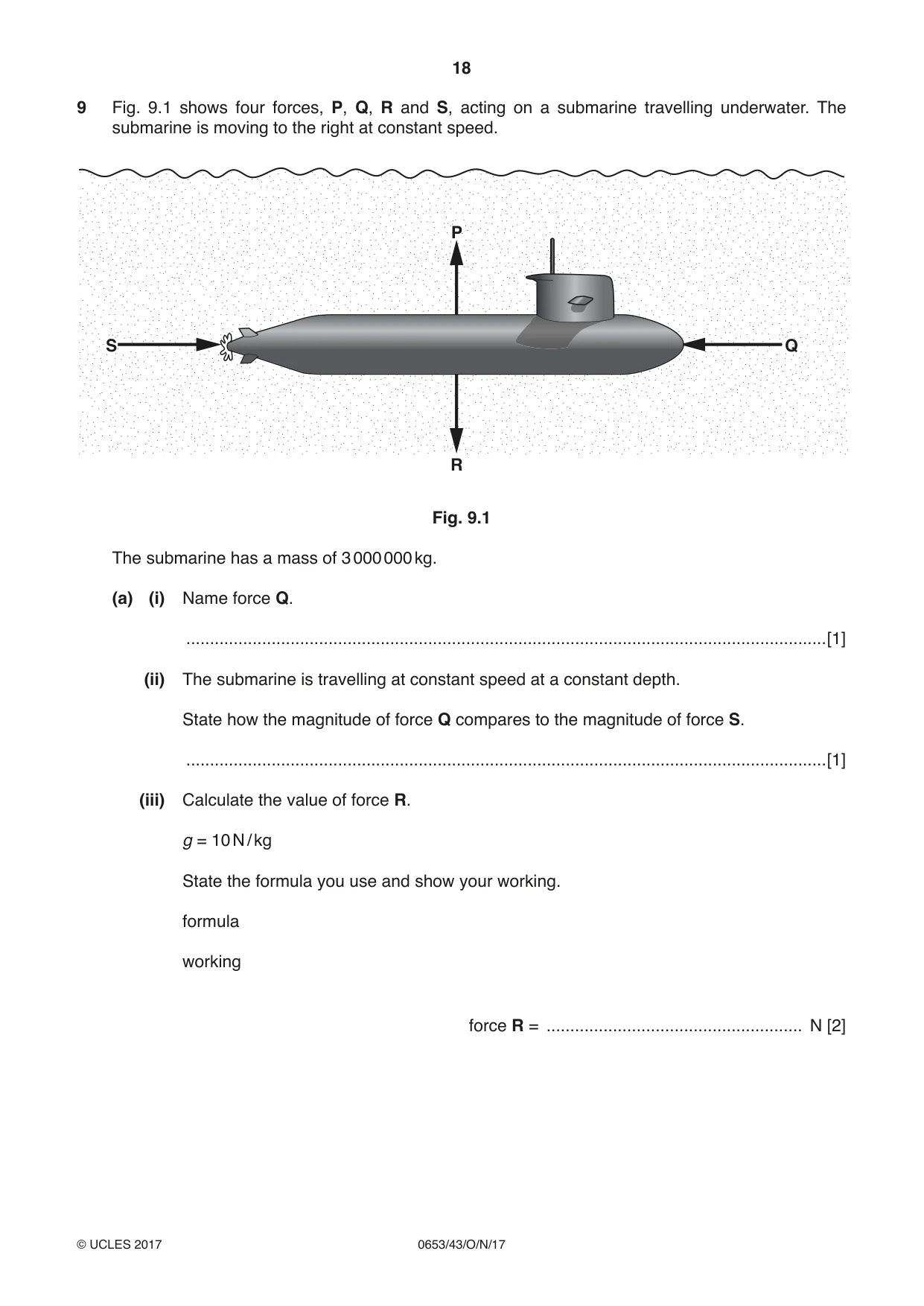
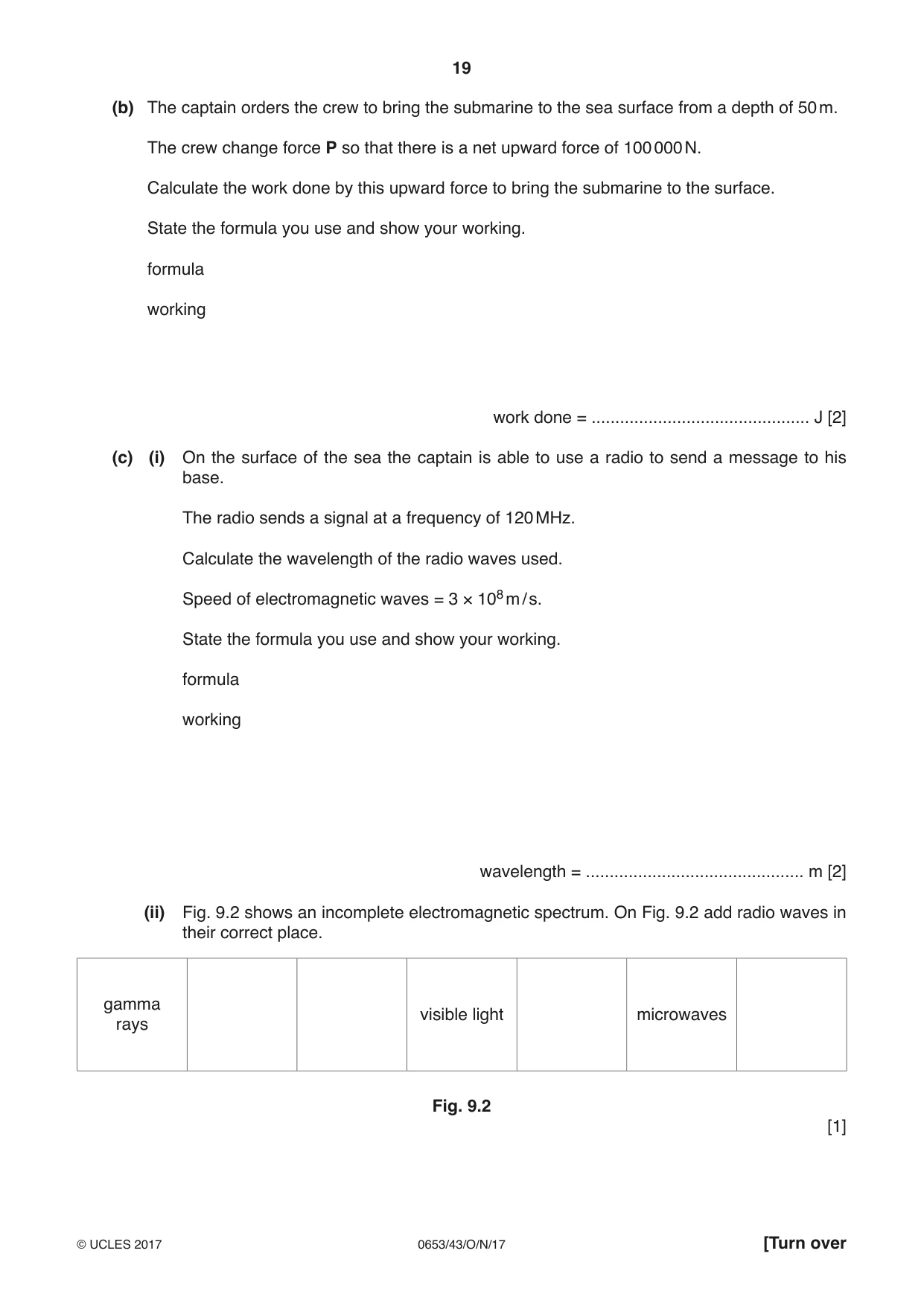
9 Fig. 9.1 shows four forces, P, Q, R and S, acting on a submarine travelling underwater. The submarine is moving to the right at constant speed. P S Q R Fig. 9.1 The submarine has a mass of 3 000 000 kg. (a) (i) Name force Q. .......................................................................................................................................[1] (ii) The submarine is travelling at constant speed at a constant depth. State how the magnitude of force Q compares to the magnitude of force S. .......................................................................................................................................[1] (iii) Calculate the value of force R. g = 10 N / kg State the formula you use and show your working. formula working force R = ...................................................... N [2] (b) The captain orders the crew to bring the submarine to the sea surface from a depth of 50 m. The crew change force P so that there is a net upward force of 100 000 N. Calculate the work done by this upward force to bring the submarine to the surface. State the formula you use and show your working. formula working work done = .............................................. J [2] (c) (i) On the surface of the sea the captain is able to use a radio to send a message to his base. The radio sends a signal at a frequency of 120 MHz. Calculate the wavelength of the radio waves used. Speed of electromagnetic waves = 3 × 10⁸ m / s. State the formula you use and show your working. formula working wavelength = .............................................. m [2] (ii) Fig. 9.2 shows an incomplete electromagnetic spectrum. On Fig. 9.2 add radio waves in their correct place. gamma visible light microwaves rays Fig. 9.2 [1] (iii) Radio waves do not travel through sea water. But when submerged, submarines can receive sound signals from sound sources placed on the sea floor. Sound is transmitted through water in the same way that it is transmitted through air. Suggest how sound waves are transmitted through water. You should say how water molecules are involved, and you may wish to draw a diagram as part of your answer. ........................................................................................................................................... ........................................................................................................................................... .......................................................................................................................................[2]
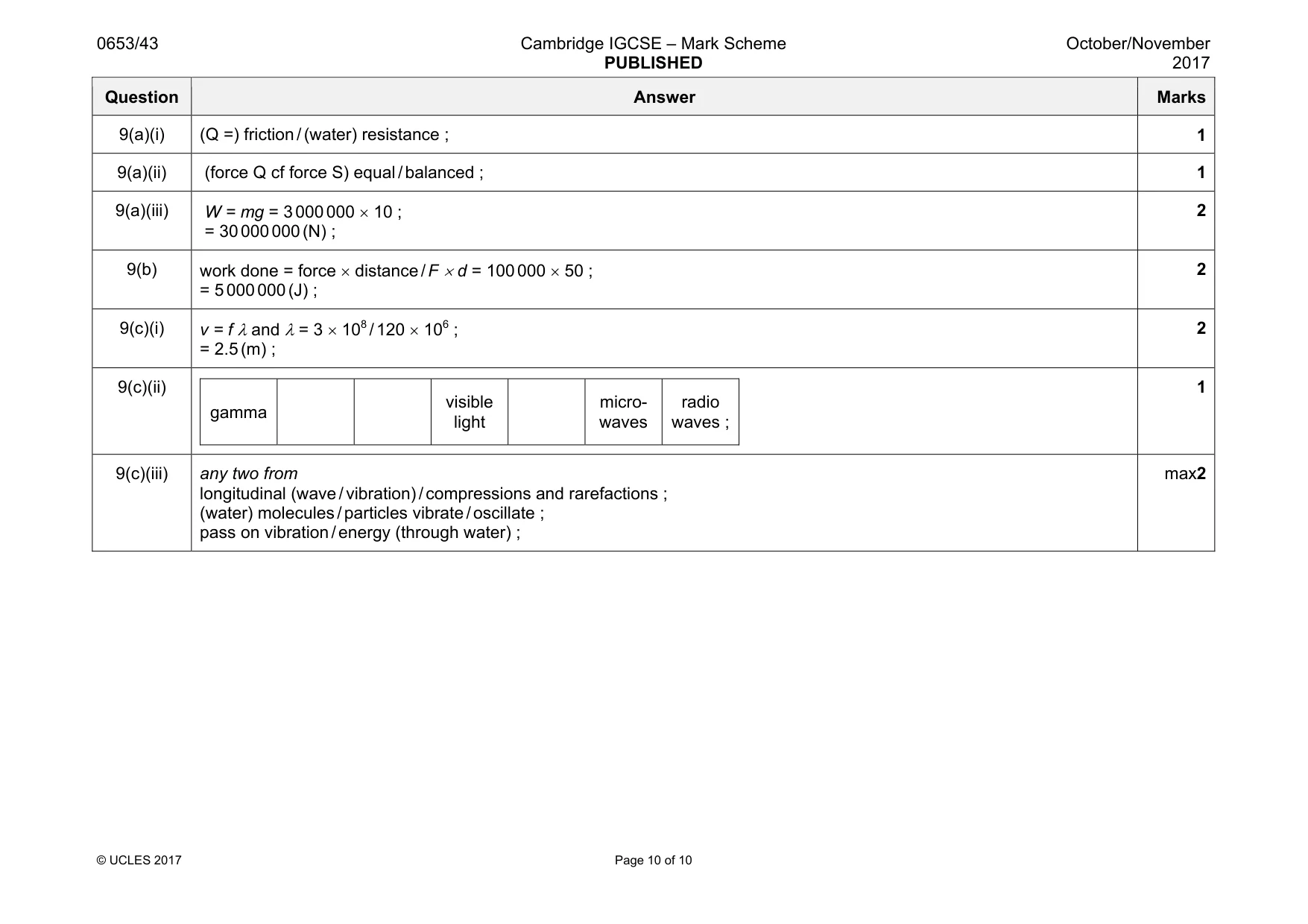
Mark scheme: 9(a)(i) (Q =) friction / (water) resistance ; 1 9(a)(ii) (force Q cf force S) equal / balanced ; 1 9(a)(iii) W = mg = 3 000 000 × 10 ; = 30 000 000 (N) ; 2 9(b) work done = force × distance / F × d = 100 000 × 50 ; = 5 000 000 (J) ; 2 9(c)(i) v = f λ and λ = 3 × 10⁸ / 120 × 106 ; = 2.5 (m) ; 2 9(c)(ii) gamma visible light micro- waves radio waves ; 1 9(c)(iii) any two from longitudinal (wave / vibration) / compressions and rarefactions ; (water) molecules / particles vibrate / oscillate ; pass on vibration / energy (through water) ; max2
What was in this paper
The subtopics covered by these 9 questions, and how many questions each got. Open one in a new tab to see every Cambridge question on it.
What you needed in this session
Cambridge’s own grade thresholds for 2017 Oct/Nov, Paper 4 · Variant 3. A higher threshold means an easier paper — the bar moves with how the cohort did.