Cambridge IGCSE Science - Combined 0653 — 2019 May/June Paper 4 · Variant 1
0653/41/M/J/19 · 9 questions · 80 marks · ≈90 min
The question paper and its mark scheme, free to read here and free to download. This is Cambridge’s own paper, exactly as it was sat.
Question paper24 pages



Mark scheme10 pages
Answers below. Sit the paper first if you are practising.
Questions as text
Q1 · A bag containing sucrose solution placed in a beaker of water for 20 minutes
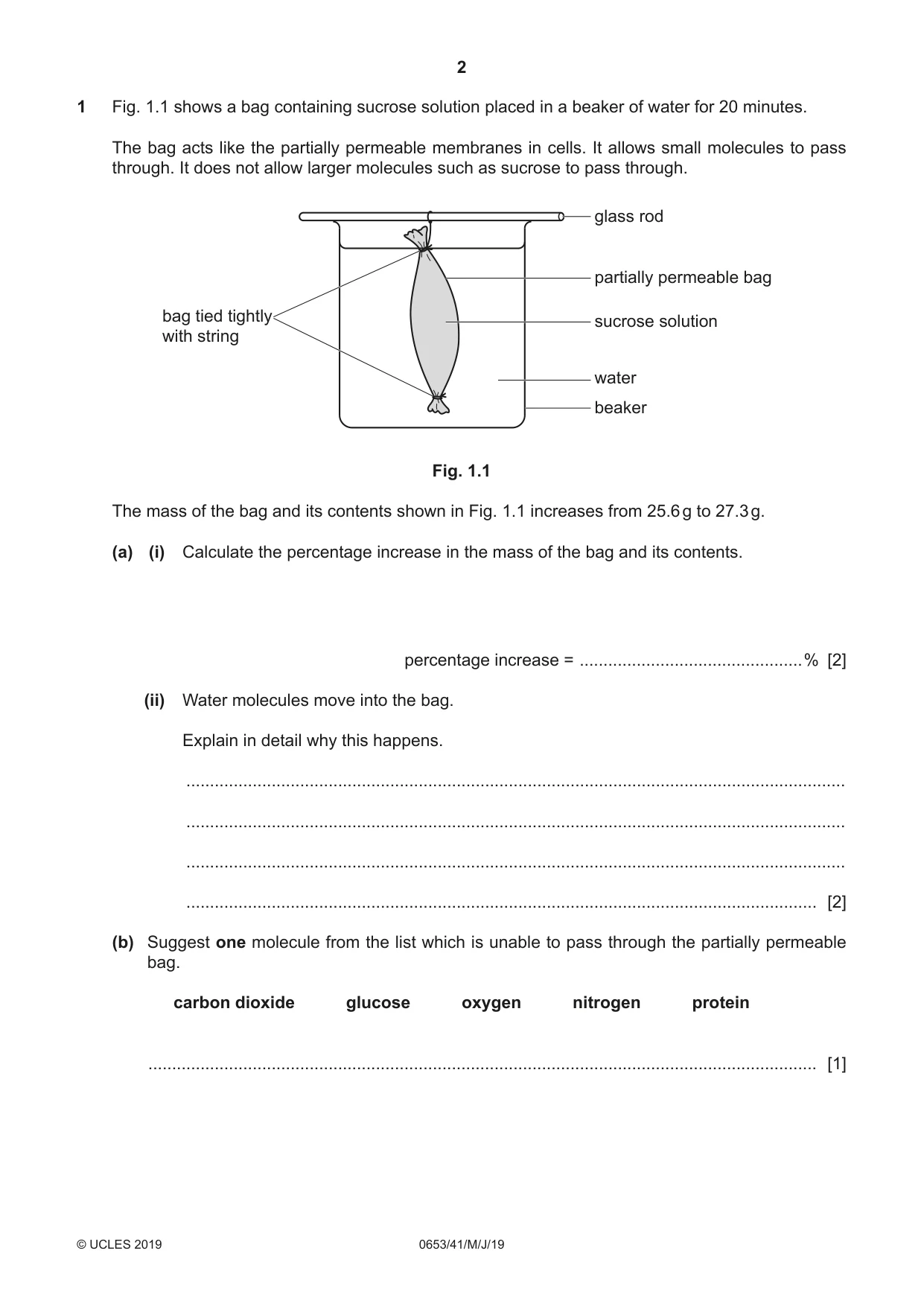
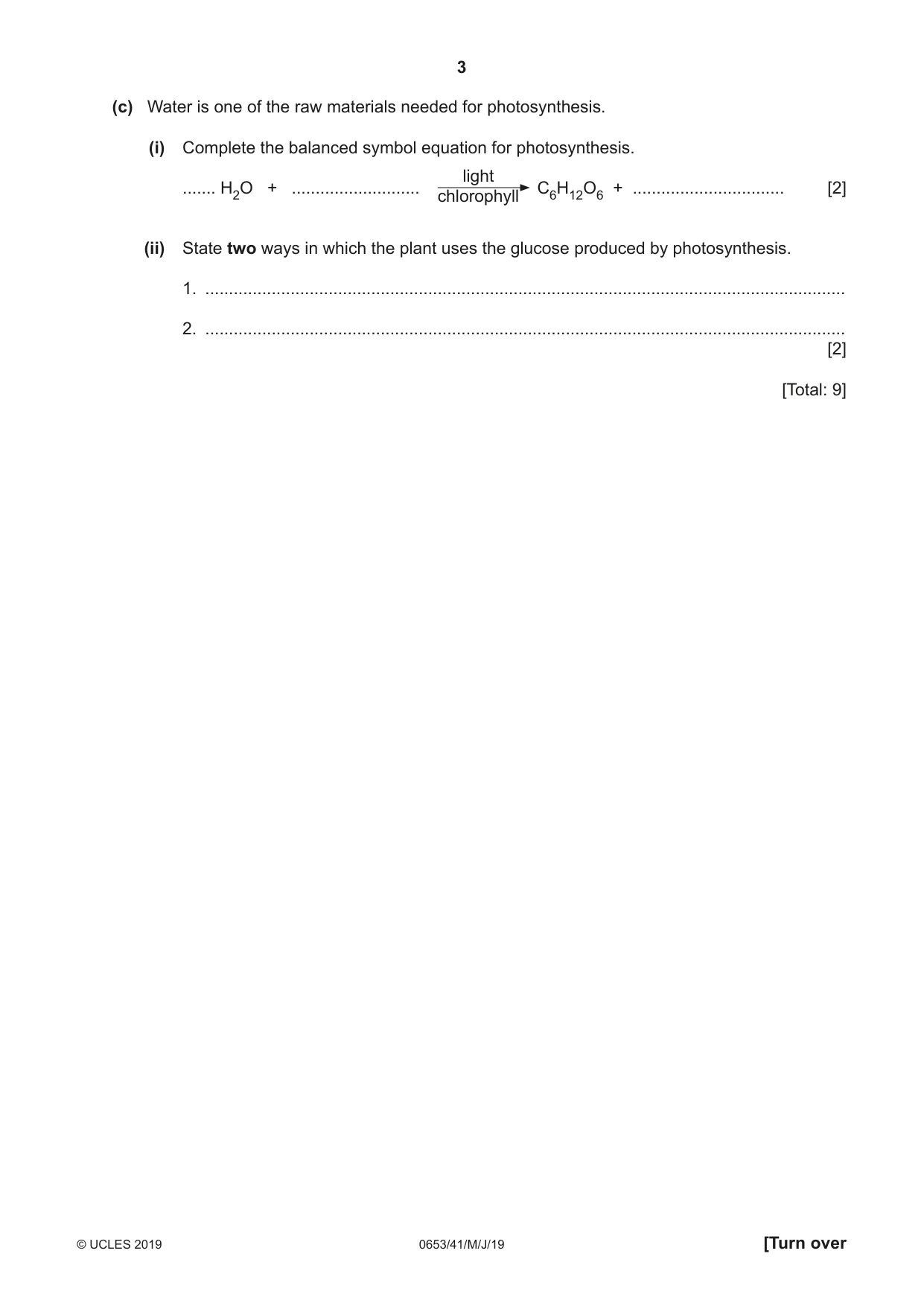
1 Fig. 1.1 shows a bag containing sucrose solution placed in a beaker of water for 20 minutes. The bag acts like the partially permeable membranes in cells. It allows small molecules to pass through. It does not allow larger molecules such as sucrose to pass through. glass rod partially permeable bag bag tied tightly sucrose solution with string water beaker Fig. 1.1 The mass of the bag and its contents shown in Fig. 1.1 increases from 25.6 g to 27.3 g. (a) (i) Calculate the percentage increase in the mass of the bag and its contents. percentage increase = ...............................................% [2] (ii) Water molecules move into the bag. Explain in detail why this happens. ........................................................................................................................................... ........................................................................................................................................... ........................................................................................................................................... ..................................................................................................................................... [2] (b) Suggest one molecule from the list which is unable to pass through the partially permeable bag. carbon dioxide glucose oxygen nitrogen protein ............................................................................................................................................. [1] (c) Water is one of the raw materials needed for photosynthesis. (i) Complete the balanced symbol equation for photosynthesis. light ....... H2O + ........................... chlorophyll C6H12O6 + ................................ [2] (ii) State two ways in which the plant uses the glucose produced by photosynthesis. 1. ....................................................................................................................................... 2. ....................................................................................................................................... [2] [Total: 9]
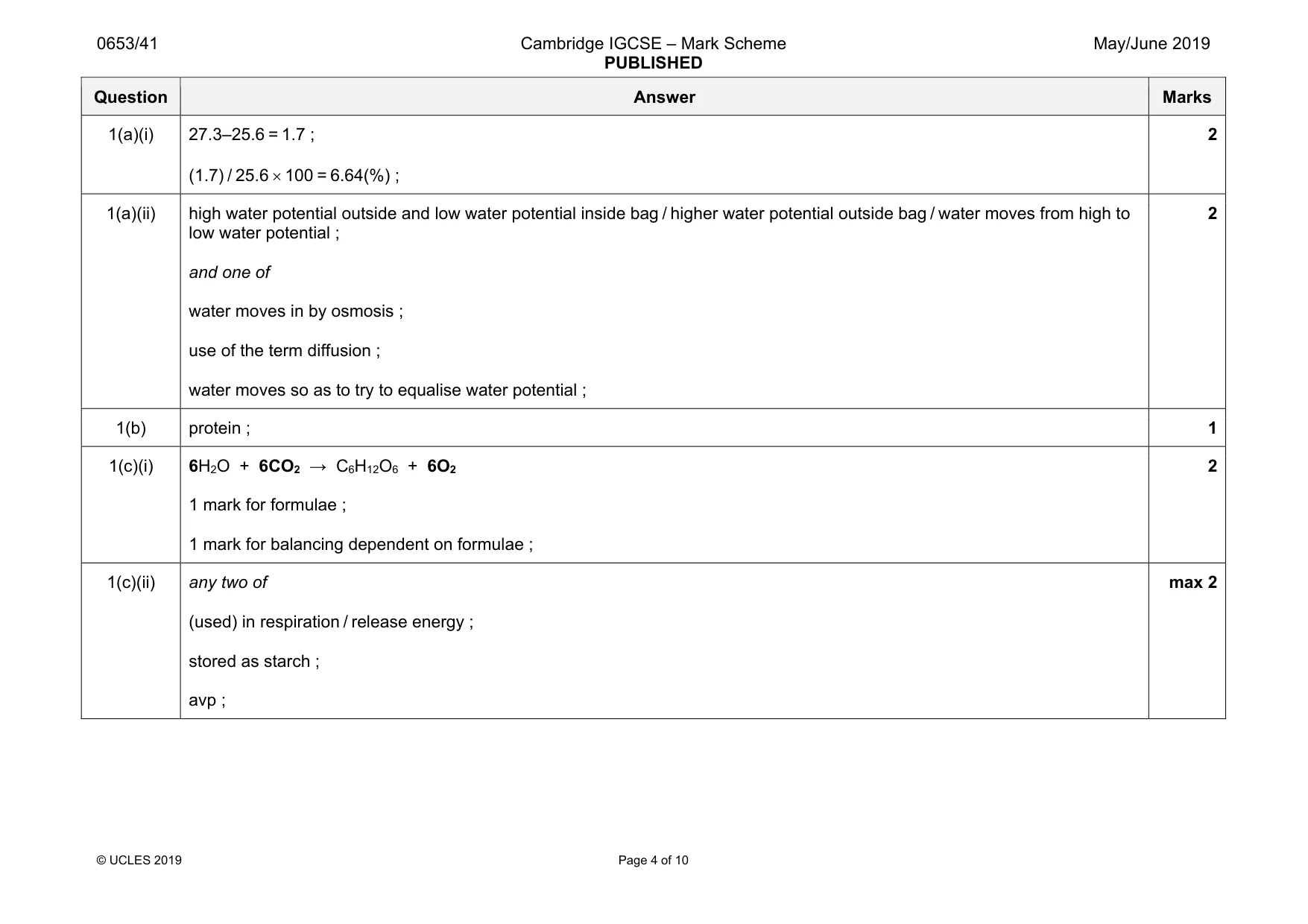
Mark scheme: 1(a)(i) 27.3–25.6 = 1.7 ; (1.7) / 25.6 × 100 = 6.64(%) ; 2 1(a)(ii) high water potential outside and low water potential inside bag / higher water potential outside bag / water moves from high to low water potential ; and one of water moves in by osmosis ; use of the term diffusion ; water moves so as to try to equalise water potential ; 2 1(b) protein ; 1 1(c)(i) 6H2O + 6CO2 → C6H12O6 + 6O2 1 mark for formulae ; 1 mark for balancing dependent on formulae ; 2 1(c)(ii) any two of (used) in respiration / release energy ; stored as starch ; avp ; max 2
Q2 · When large hydrocarbon molecules are cracked, they break down into smaller hydrocarbon…
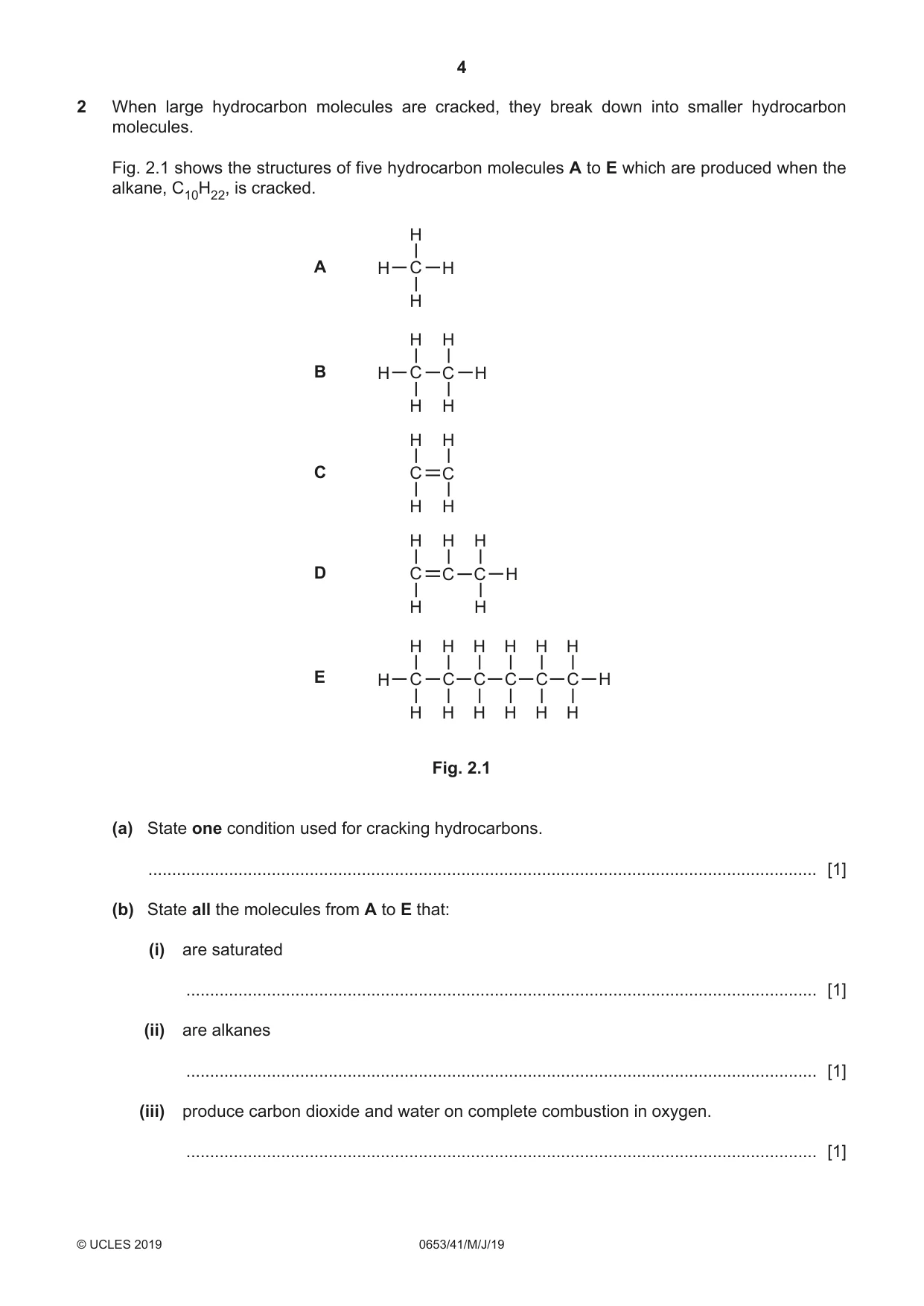
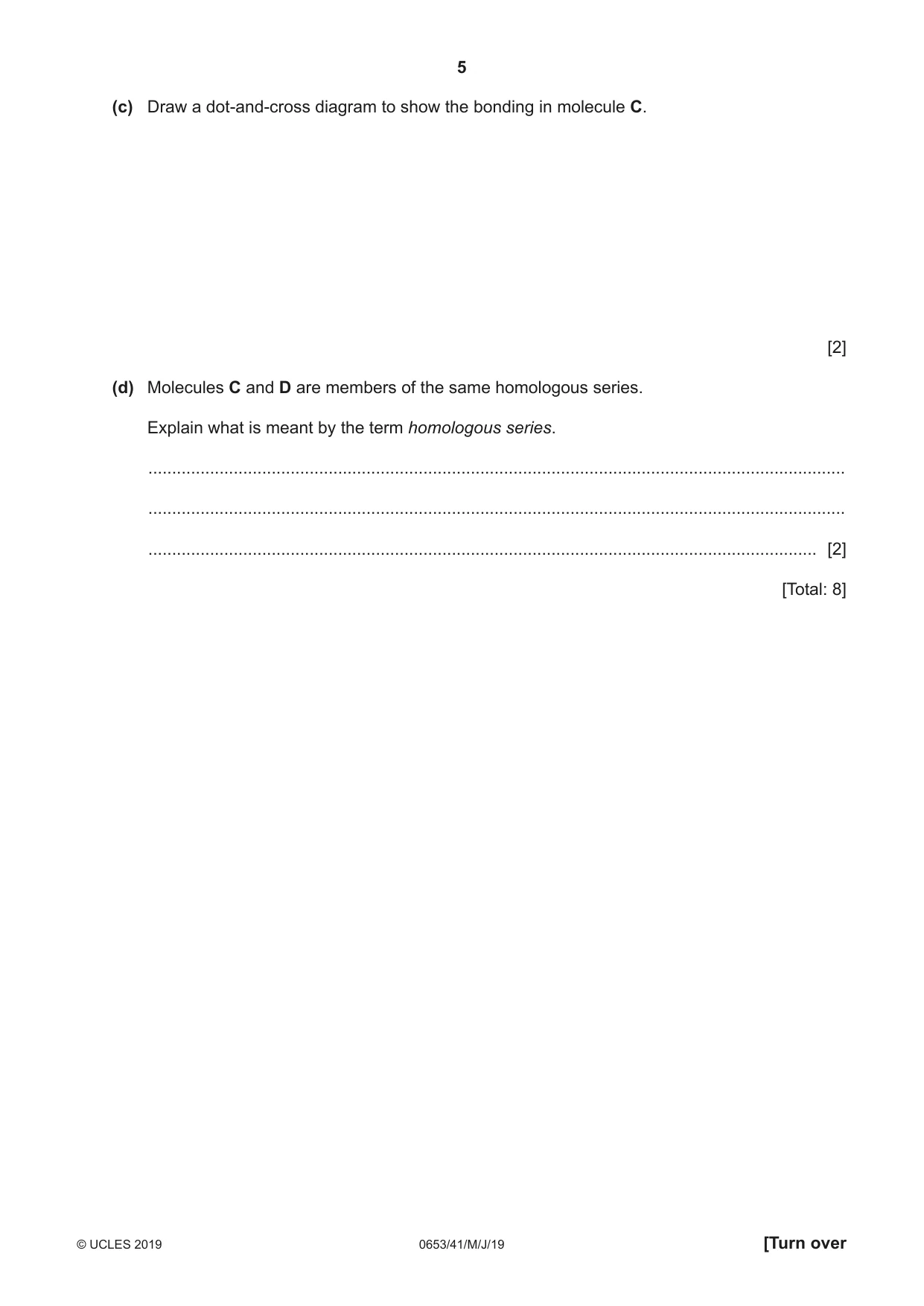
2 When large hydrocarbon molecules are cracked, they break down into smaller hydrocarbon molecules. Fig. 2.1 shows the structures of five hydrocarbon molecules A to E which are produced when the alkane, C10H22, is cracked. H A H C H H H H B H C C H H H H H C C C H H H H H D C C C H H H H H H H H H E H C C C C C C H H H H H H H Fig. 2.1 (a) State one condition used for cracking hydrocarbons. ............................................................................................................................................. [1] (b) State all the molecules from A to E that: (i) are saturated ..................................................................................................................................... [1] (ii) are alkanes ..................................................................................................................................... [1] (iii) produce carbon dioxide and water on complete combustion in oxygen. ..................................................................................................................................... [1] (c) Draw a dot-and-cross diagram to show the bonding in molecule C. [2] (d) Molecules C and D are members of the same homologous series. Explain what is meant by the term homologous series. ................................................................................................................................................... ................................................................................................................................................... ............................................................................................................................................. [2] [Total: 8]
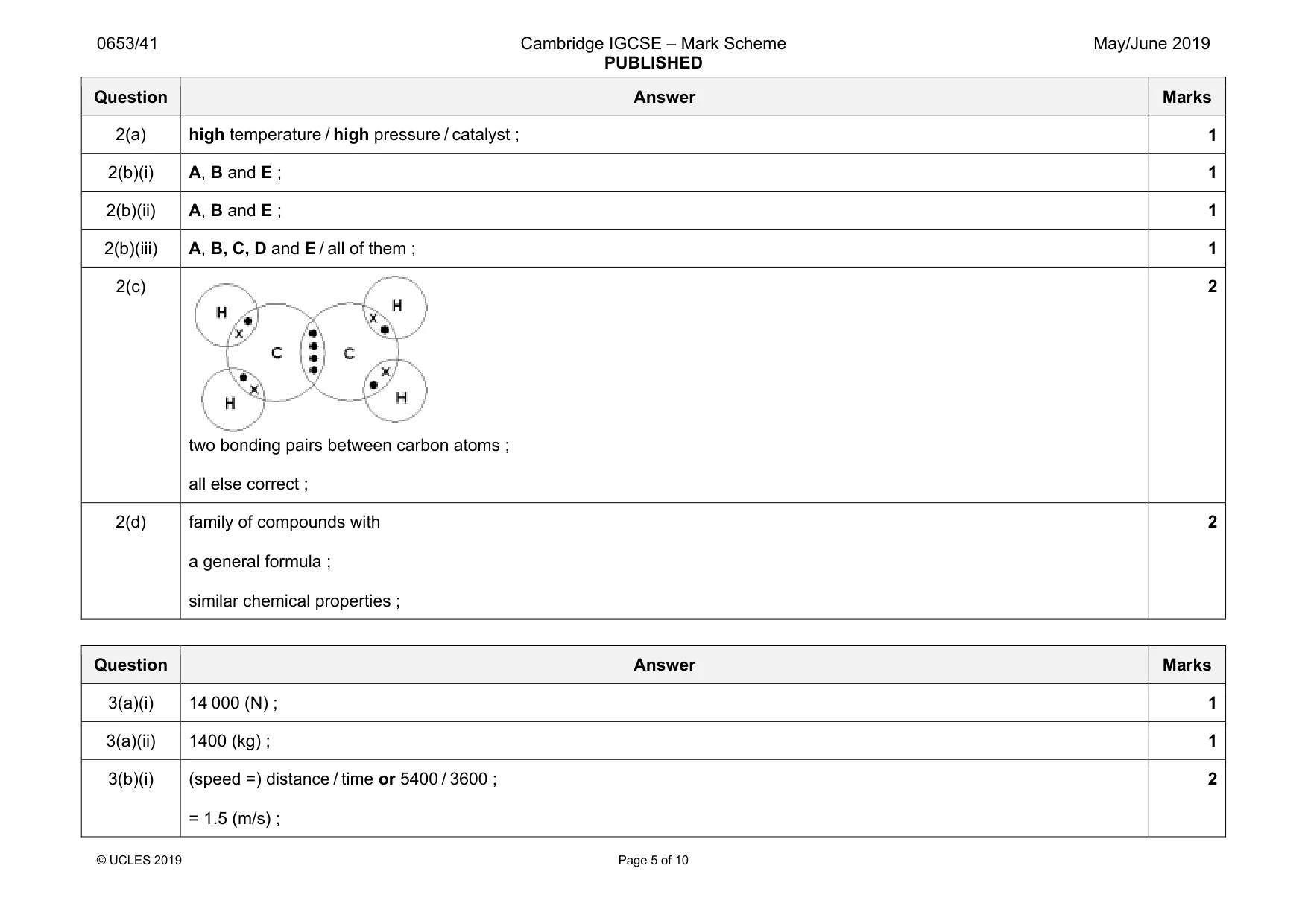
Mark scheme: 2(a) high temperature / high pressure / catalyst ; 1 2(b)(i) A, B and E ; 1 2(b)(ii) A, B and E ; 1 2(b)(iii) A, B, C, D and E / all of them ; 1 2(c) two bonding pairs between carbon atoms ; all else correct ; 2 2(d) family of compounds with a general formula ; similar chemical properties ; 2
Q3 · A whale swimming underwater
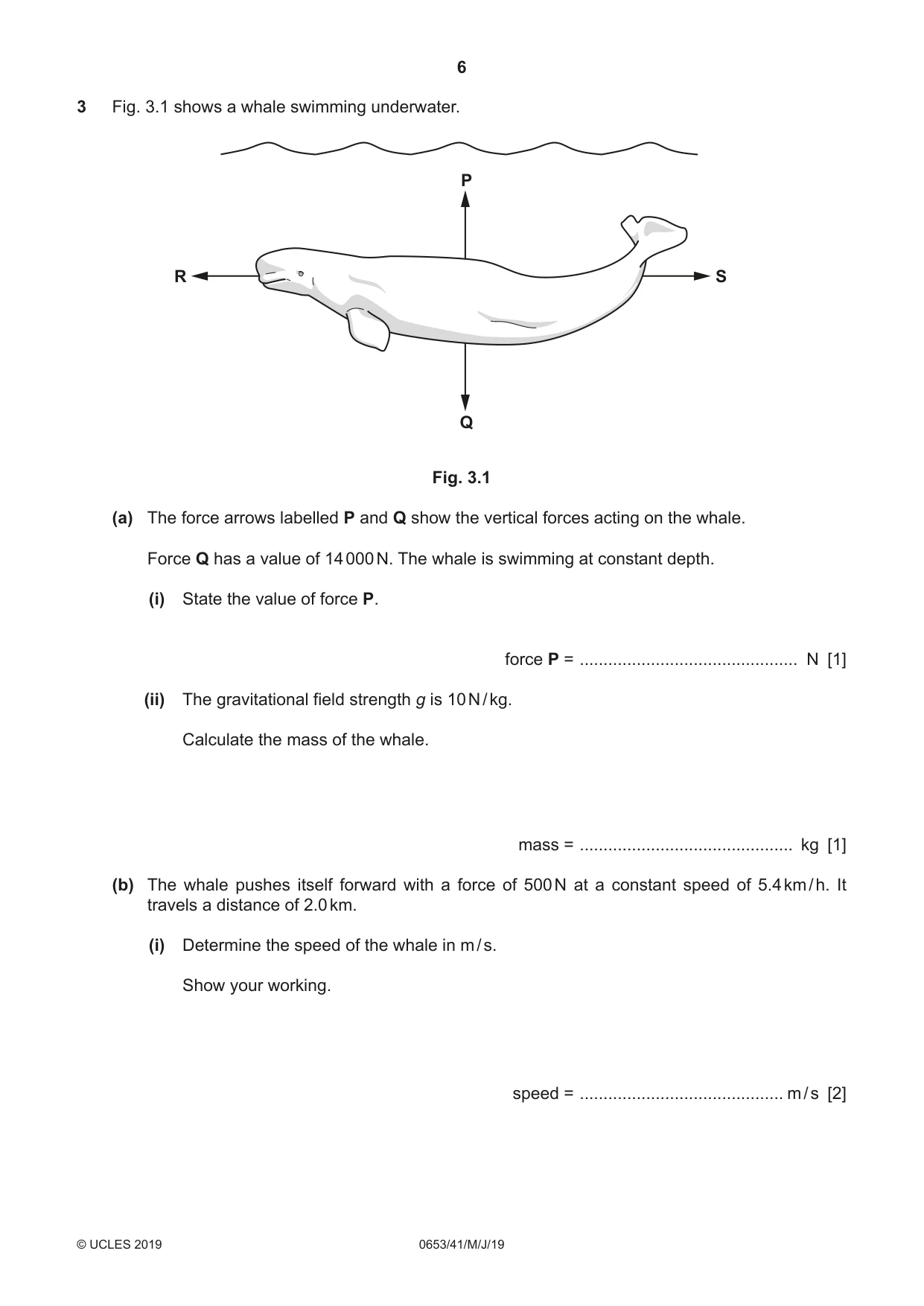
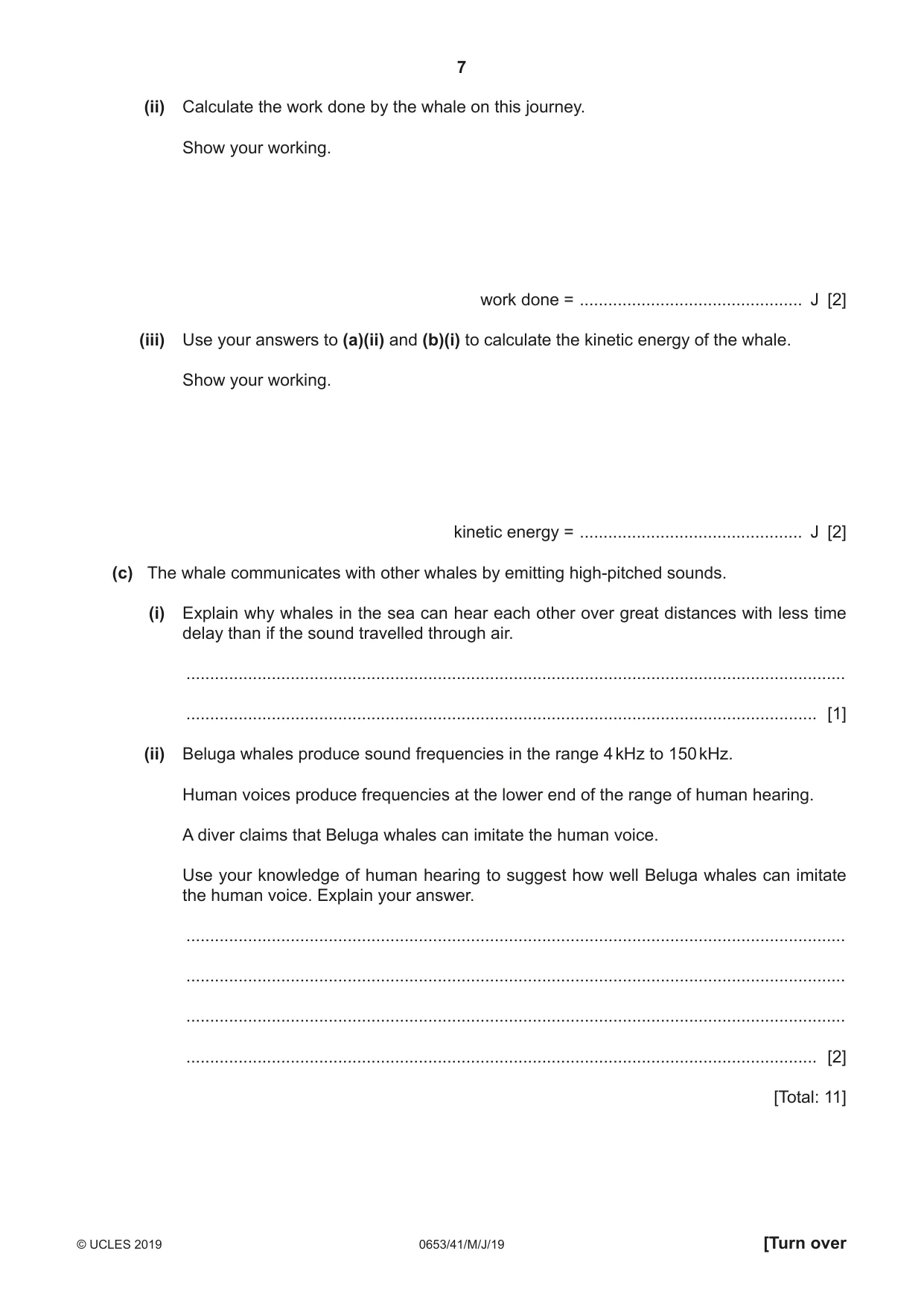
3 Fig. 3.1 shows a whale swimming underwater. P R S Q Fig. 3.1 (a) The force arrows labelled P and Q show the vertical forces acting on the whale. Force Q has a value of 14 000 N. The whale is swimming at constant depth. (i) State the value of force P. force P = .............................................. N [1] (ii) The gravitational field strength g is 10 N / kg. Calculate the mass of the whale. mass = ............................................. kg [1] (b) The whale pushes itself forward with a force of 500 N at a constant speed of 5.4 km / h. It travels a distance of 2.0 km. (i) Determine the speed of the whale in m / s. Show your working. speed = ........................................... m / s [2] (ii) Calculate the work done by the whale on this journey. Show your working. work done = ............................................... J [2] (iii) Use your answers to (a)(ii) and (b)(i) to calculate the kinetic energy of the whale. Show your working. kinetic energy = ............................................... J [2] (c) The whale communicates with other whales by emitting high-pitched sounds. (i) Explain why whales in the sea can hear each other over great distances with less time delay than if the sound travelled through air. ........................................................................................................................................... ..................................................................................................................................... [1] (ii) Beluga whales produce sound frequencies in the range 4 kHz to 150 kHz. Human voices produce frequencies at the lower end of the range of human hearing. A diver claims that Beluga whales can imitate the human voice. Use your knowledge of human hearing to suggest how well Beluga whales can imitate the human voice. Explain your answer. ........................................................................................................................................... ........................................................................................................................................... ........................................................................................................................................... ..................................................................................................................................... [2] [Total: 11]
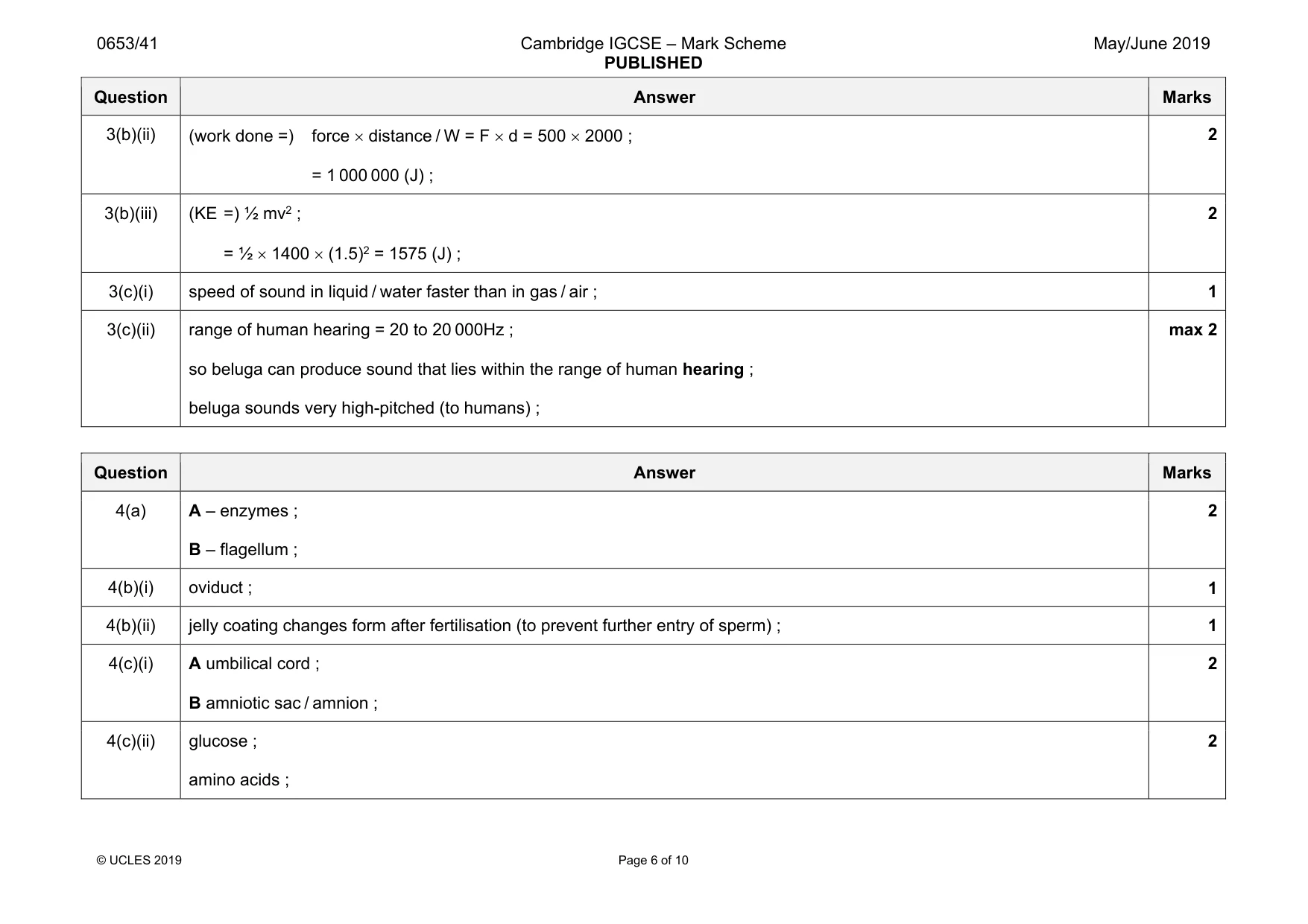
Mark scheme: 3(a)(i) 14 000 (N) ; 1 3(a)(ii) 1400 (kg) ; 1 3(b)(i) (speed =) distance / time or 5400 / 3600 ; = 1.5 (m/s) ; 2 Question Answer Marks 3(b)(ii) (work done =) force × distance / W = F × d = 500 × 2000 ; = 1 000 000 (J) ; 2 3(b)(iii) (KE =) ½ mv2 ; = ½ × 1400 × (1.5)2 = 1575 (J) ; 2 3(c)(i) speed of sound in liquid / water faster than in gas / air ; 1 3(c)(ii) range of human hearing = 20 to 20 000Hz ; so beluga can produce sound that lies within the range of human hearing ; beluga sounds very high-pitched (to humans) ; max 2
Q4 · A diagram of a sperm cell showing its adaptive features
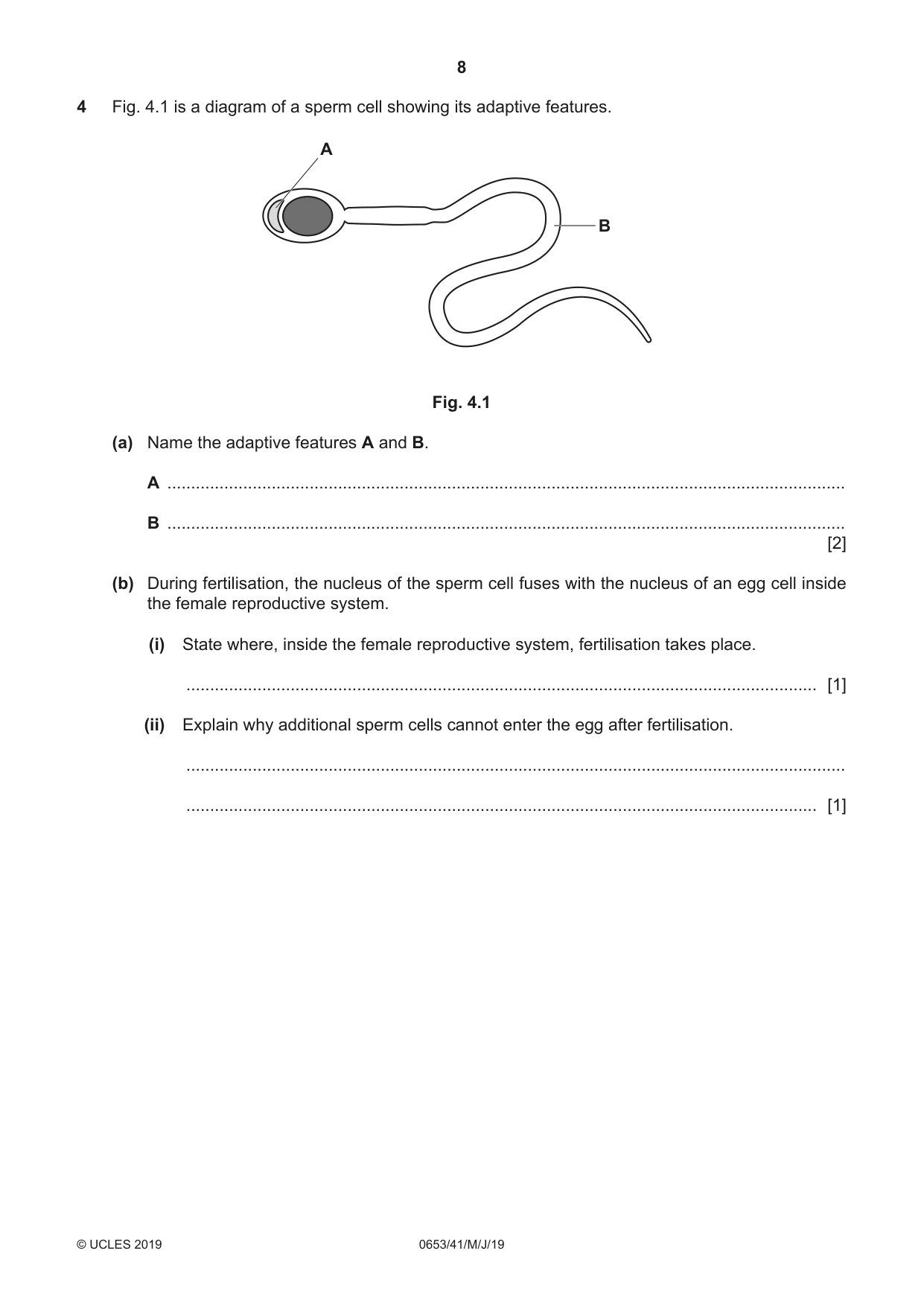
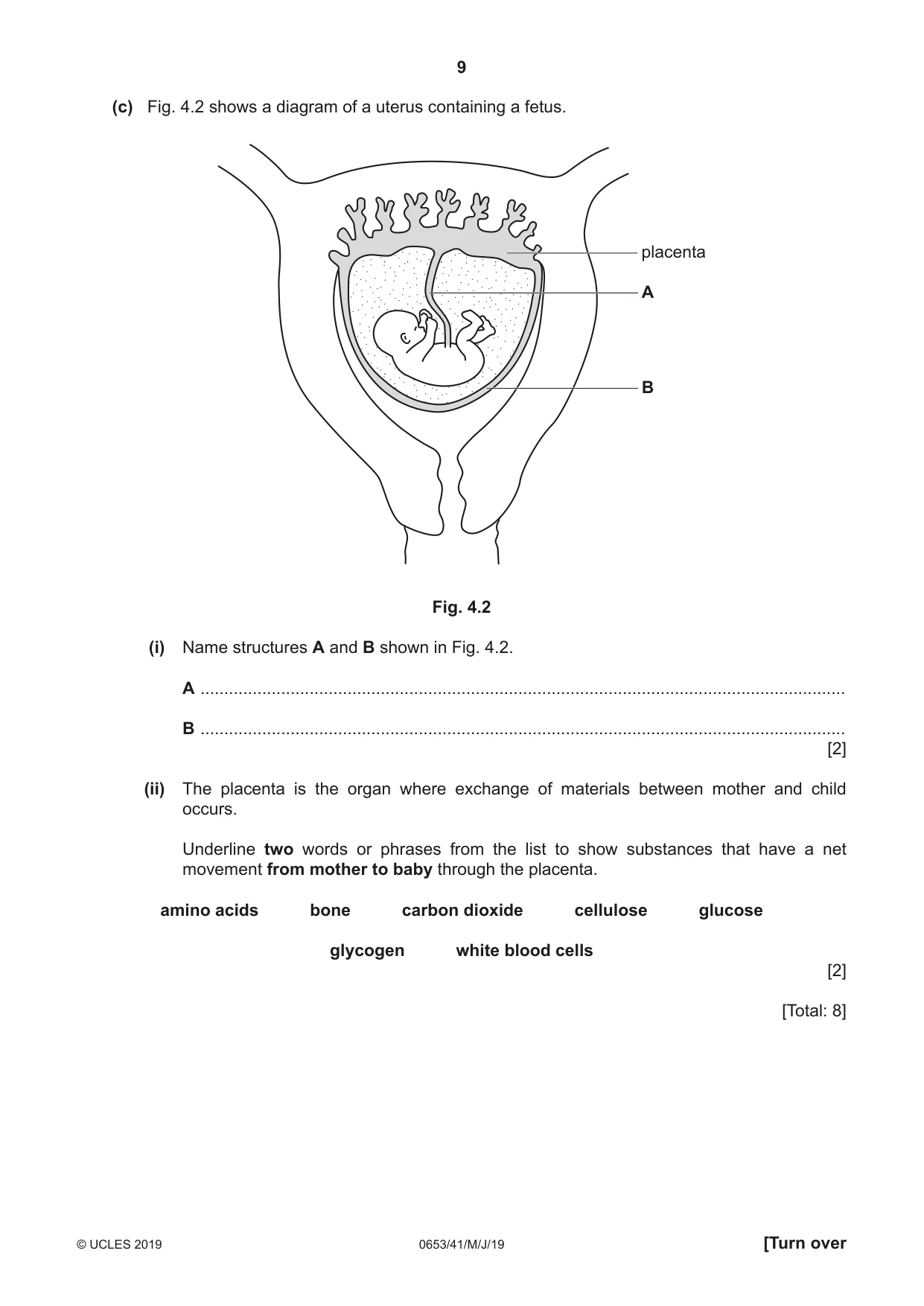
4 Fig. 4.1 is a diagram of a sperm cell showing its adaptive features. A B Fig. 4.1 (a) Name the adaptive features A and B. A ............................................................................................................................................... B ............................................................................................................................................... [2] (b) During fertilisation, the nucleus of the sperm cell fuses with the nucleus of an egg cell inside the female reproductive system. (i) State where, inside the female reproductive system, fertilisation takes place. ..................................................................................................................................... [1] (ii) Explain why additional sperm cells cannot enter the egg after fertilisation. ........................................................................................................................................... ..................................................................................................................................... [1] (c) Fig. 4.2 shows a diagram of a uterus containing a fetus. placenta A B Fig. 4.2 (i) Name structures A and B shown in Fig. 4.2. A ........................................................................................................................................ B ........................................................................................................................................ [2] (ii) The placenta is the organ where exchange of materials between mother and child occurs. Underline two words or phrases from the list to show substances that have a net movement from mother to baby through the placenta. amino acids bone carbon dioxide cellulose glucose glycogen white blood cells [2] [Total: 8]
Mark scheme: 4(a) A – enzymes ; B – flagellum ; 2 4(b)(i) oviduct ; 1 4(b)(ii) jelly coating changes form after fertilisation (to prevent further entry of sperm) ; 1 4(c)(i) A umbilical cord ; B amniotic sac / amnion ; 2 4(c)(ii) glucose ; amino acids ; 2
Q5 · Sodium burns in oxygen to produce sodium oxide, an ionic compound
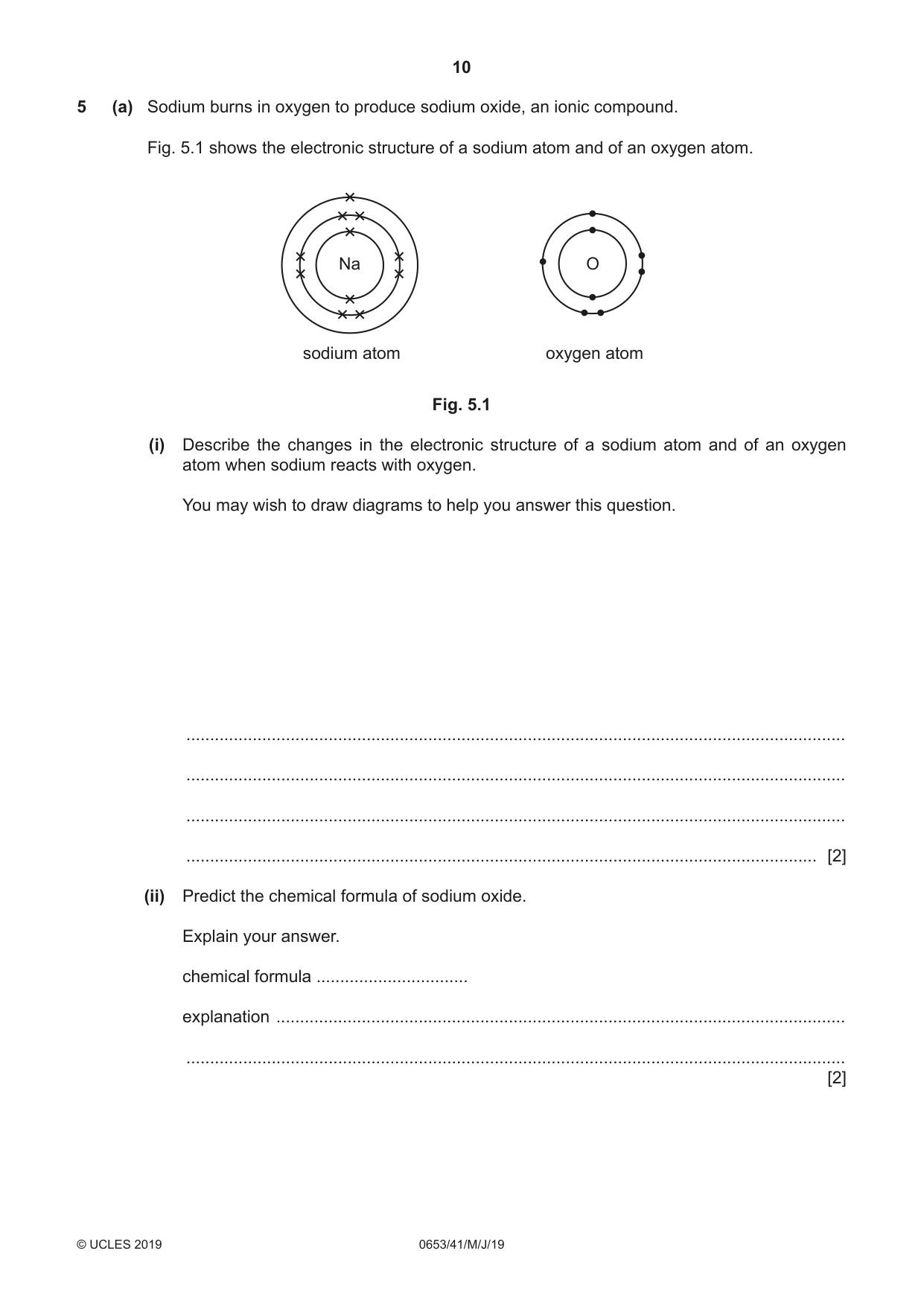
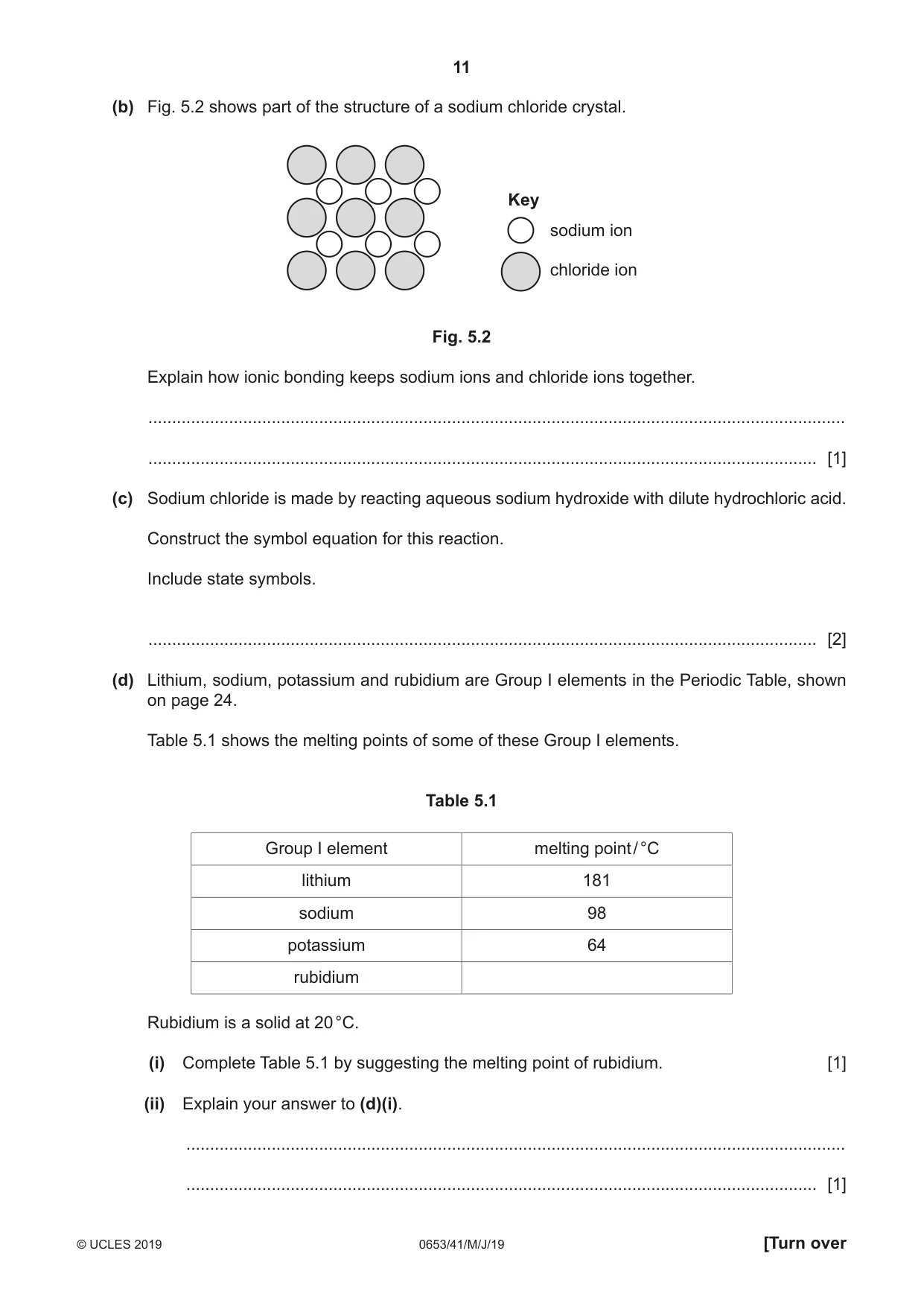
5 (a) Sodium burns in oxygen to produce sodium oxide, an ionic compound. Fig. 5.1 shows the electronic structure of a sodium atom and of an oxygen atom. Na O sodium atom oxygen atom Fig. 5.1 (i) Describe the changes in the electronic structure of a sodium atom and of an oxygen atom when sodium reacts with oxygen. You may wish to draw diagrams to help you answer this question. ........................................................................................................................................... ........................................................................................................................................... ........................................................................................................................................... ..................................................................................................................................... [2] (ii) Predict the chemical formula of sodium oxide. Explain your answer. chemical formula ................................ explanation ........................................................................................................................ ........................................................................................................................................... [2] (b) Fig. 5.2 shows part of the structure of a sodium chloride crystal. Key sodium ion chloride ion Fig. 5.2 Explain how ionic bonding keeps sodium ions and chloride ions together. ................................................................................................................................................... ............................................................................................................................................. [1] (c) Sodium chloride is made by reacting aqueous sodium hydroxide with dilute hydrochloric acid. Construct the symbol equation for this reaction. Include state symbols. ............................................................................................................................................. [2] (d) Lithium, sodium, potassium and rubidium are Group I elements in the Periodic Table, shown on page 24. Table 5.1 shows the melting points of some of these Group I elements. Table 5.1 Group I element melting point / °C lithium 181 sodium 98 potassium 64 rubidium Rubidium is a solid at 20 °C. (i) Complete Table 5.1 by suggesting the melting point of rubidium. [1] (ii) Explain your answer to (d)(i). ........................................................................................................................................... ..................................................................................................................................... [1] (iii) Explain why these Group I metals cannot be extracted from their ores by heating the ores with carbon. ........................................................................................................................................... ..................................................................................................................................... [1] [Total: 10]
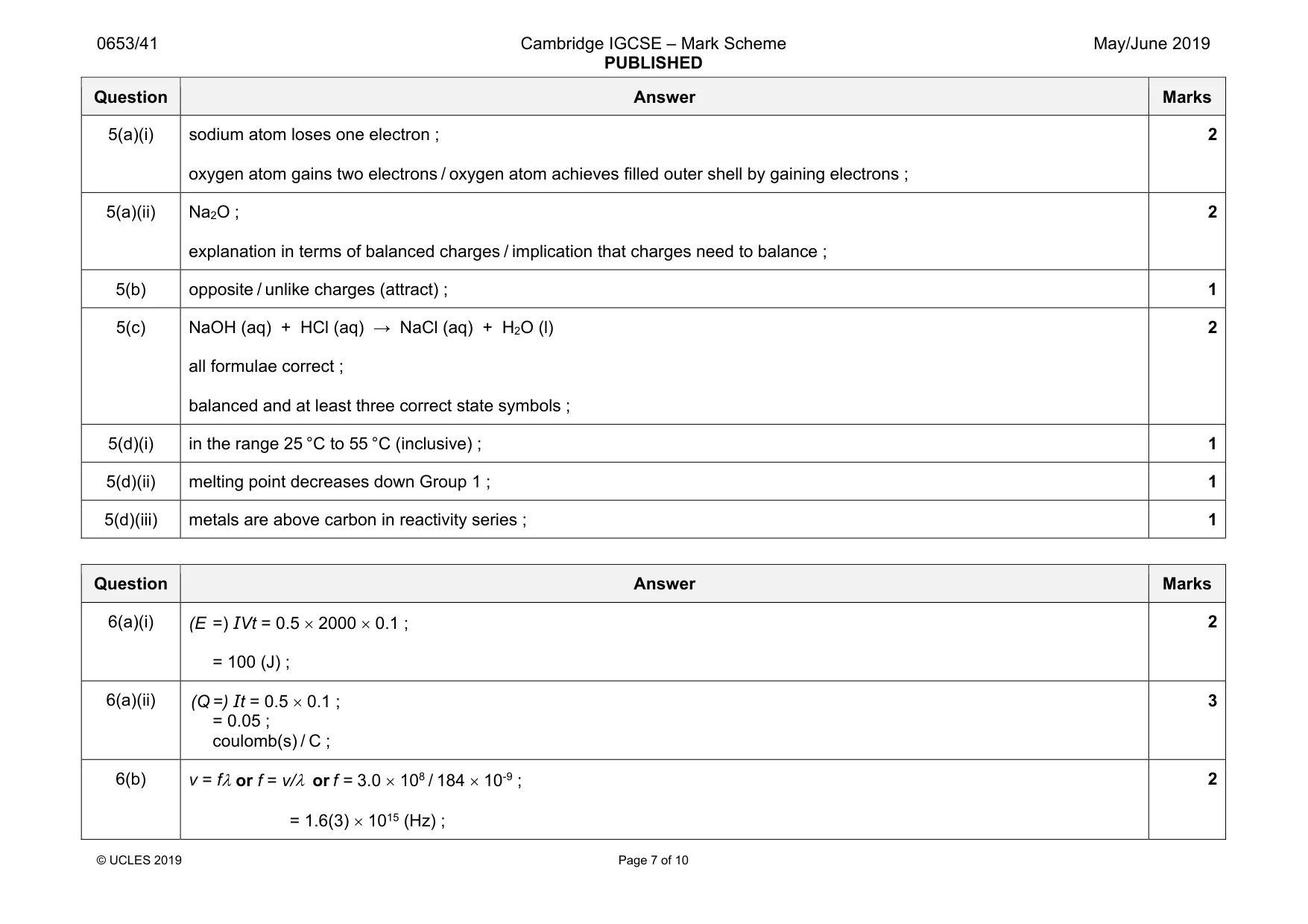
Mark scheme: 5(a)(i) sodium atom loses one electron ; oxygen atom gains two electrons / oxygen atom achieves filled outer shell by gaining electrons ; 2 5(a)(ii) Na2O ; explanation in terms of balanced charges / implication that charges need to balance ; 2 5(b) opposite / unlike charges (attract) ; 1 5(c) NaOH (aq) + HCl (aq) → NaCl (aq) + H2O (l) all formulae correct ; balanced and at least three correct state symbols ; 2 5(d)(i) in the range 25 °C to 55 °C (inclusive) ; 1 5(d)(ii) melting point decreases down Group 1 ; 1 5(d)(iii) metals are above carbon in reactivity series ; 1
Q6 · An electrical device used in kitchens to kill insects
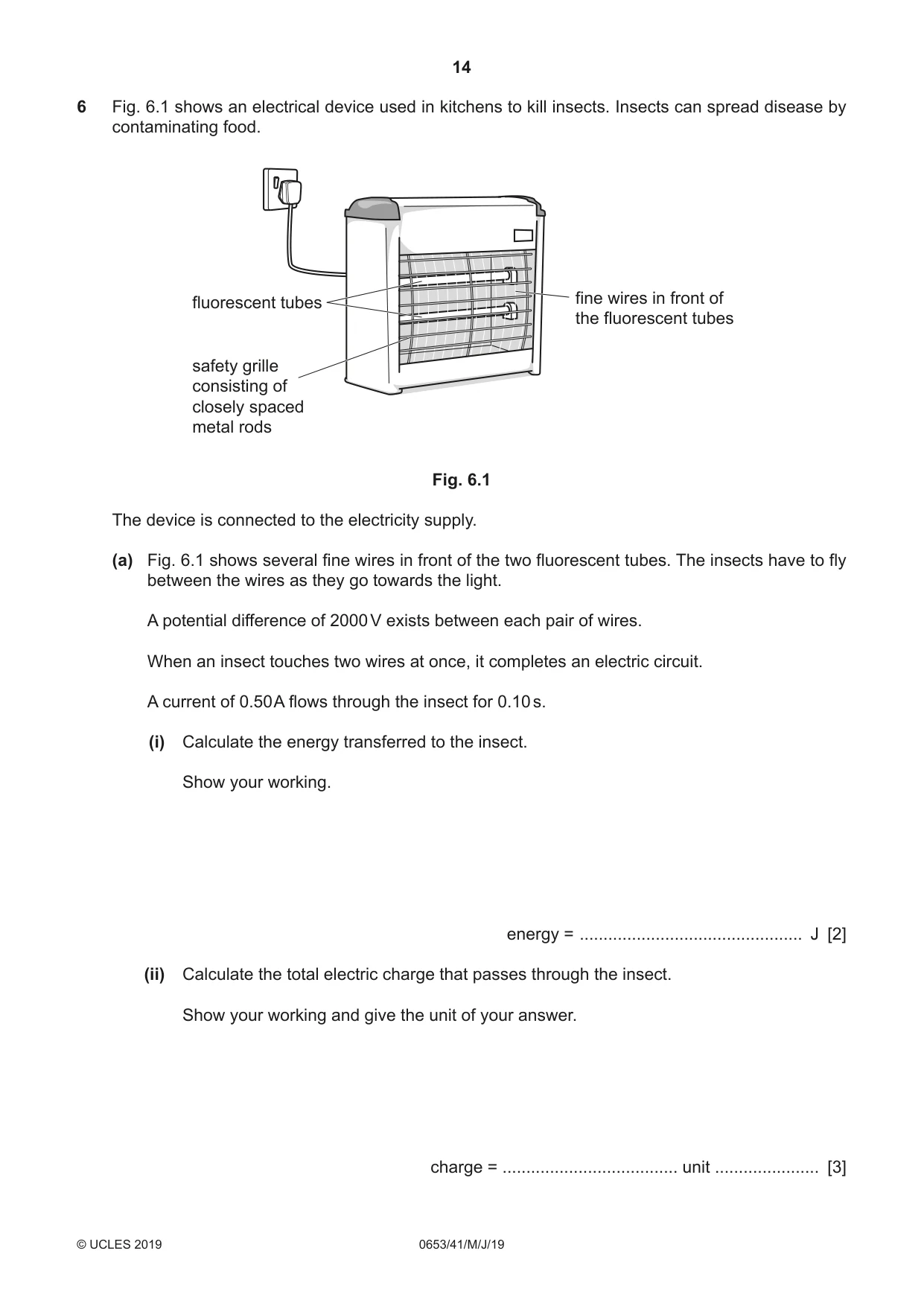
6 Fig. 6.1 shows an electrical device used in kitchens to kill insects. Insects can spread disease by contaminating food. fine wires in front of fluorescent tubes the fluorescent tubes safety grille consisting of closely spaced metal rods Fig. 6.1 The device is connected to the electricity supply. (a) Fig. 6.1 shows several fine wires in front of the two fluorescent tubes. The insects have to fly between the wires as they go towards the light. A potential difference of 2000 V exists between each pair of wires. When an insect touches two wires at once, it completes an electric circuit. A current of 0.50 A flows through the insect for 0.10 s. (i) Calculate the energy transferred to the insect. Show your working. energy = ............................................... J [2] (ii) Calculate the total electric charge that passes through the insect. Show your working and give the unit of your answer. charge = ..................................... unit ...................... [3] (b) The fluorescent tubes emit ultraviolet radiation that can be seen by many insects. This attracts them to the device. The wavelength of the ultraviolet radiation is 184 × 10–9 m. The speed of electromagnetic radiation is 3.0 × 10⁸ m / s. Calculate the frequency of the ultraviolet radiation emitted. Show your working. frequency = ............................................. Hz [2] (c) Suggest why a grille of metal rods is placed across the front of the device. ................................................................................................................................................... ............................................................................................................................................. [1] [Total: 8]
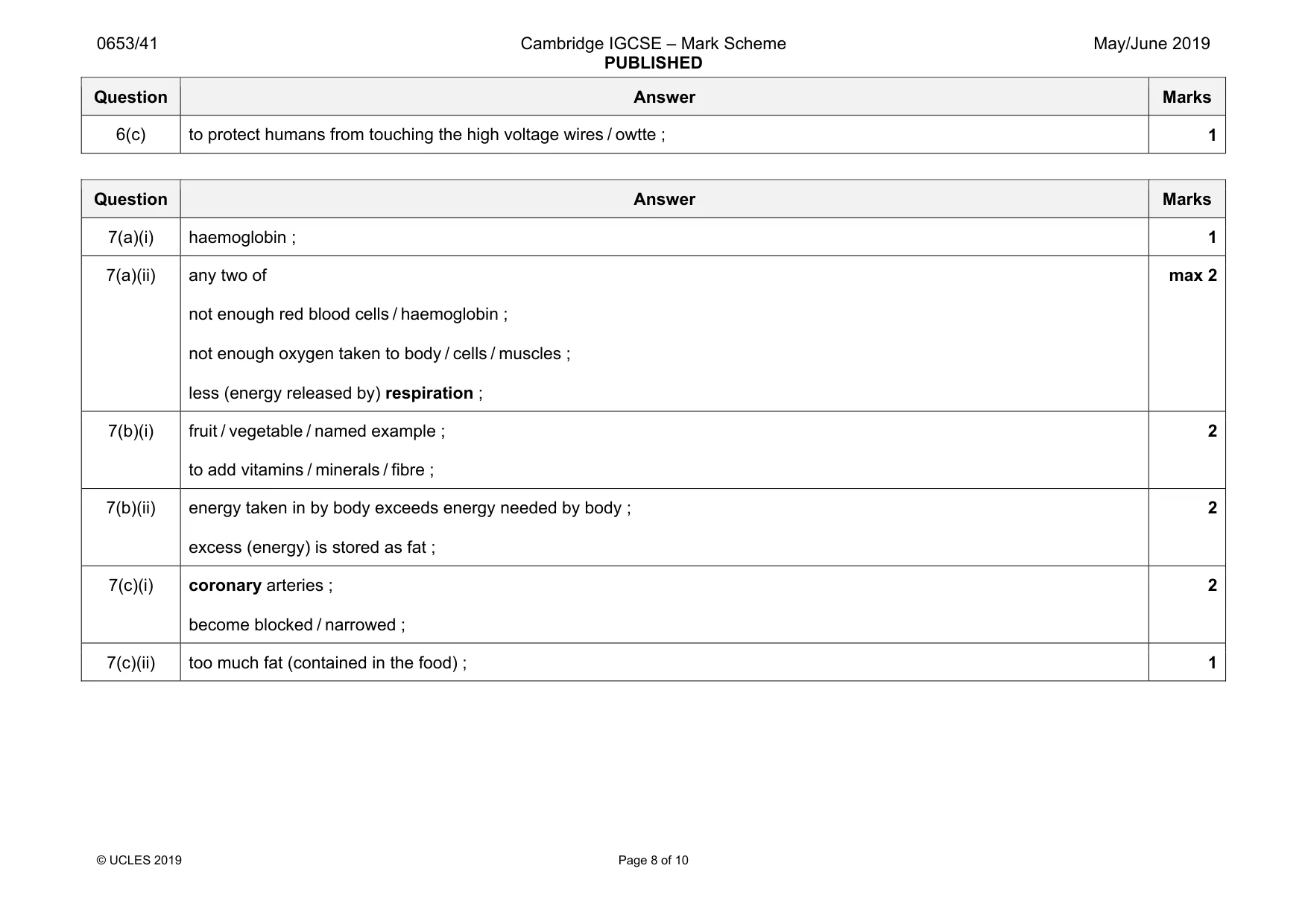
Mark scheme: 6(a)(i) = 100 (J) ; 2 6(a)(ii) (Q =) It = 0.5 × 0.1 ; = 0.05 ; coulomb(s) / C ; 3 6(b) v = fλ or f = v/λ or f = 3.0 × 10⁸ / 184 × 10-9 ; = 1.6(3) × 1015 (Hz) ; 2 Question Answer Marks 6(c) to protect humans from touching the high voltage wires / owtte ; 1
Q7 · A balanced diet for a person contains all nutrients in the correct amounts for their needs
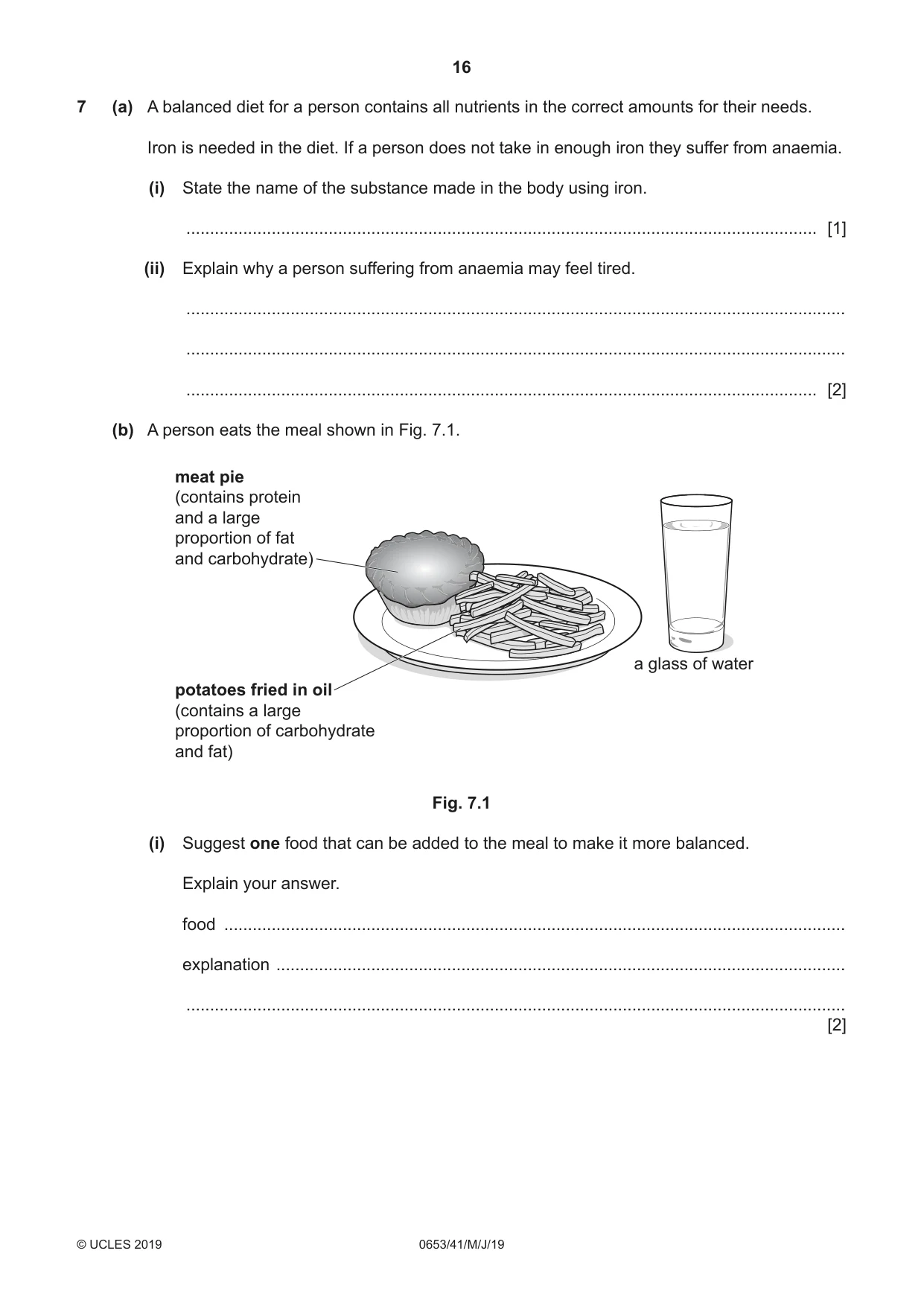
7 (a) A balanced diet for a person contains all nutrients in the correct amounts for their needs. Iron is needed in the diet. If a person does not take in enough iron they suffer from anaemia. (i) State the name of the substance made in the body using iron. ..................................................................................................................................... [1] (ii) Explain why a person suffering from anaemia may feel tired. ........................................................................................................................................... ........................................................................................................................................... ..................................................................................................................................... [2] (b) A person eats the meal shown in Fig. 7.1. meat pie (contains protein and a large proportion of fat and carbohydrate) a glass of water potatoes fried in oil (contains a large proportion of carbohydrate and fat) Fig. 7.1 (i) Suggest one food that can be added to the meal to make it more balanced. Explain your answer. food ................................................................................................................................... explanation ........................................................................................................................ ........................................................................................................................................... [2] (ii) Explain why regularly eating meals similar to the one shown in Fig. 7.1 can lead to obesity. Use ideas about the energy requirements of the body in your answer. ........................................................................................................................................... ........................................................................................................................................... ..................................................................................................................................... [2] (c) If the person eats meals similar to the one shown in Fig. 7.1 over a long period they increase their risk of developing coronary heart disease. (i) Explain what is meant by coronary heart disease. ........................................................................................................................................... ........................................................................................................................................... ..................................................................................................................................... [2] (ii) Suggest why regularly eating meals similar to the one shown in Fig. 7.1 increases the person’s risk of developing coronary heart disease. ........................................................................................................................................... ..................................................................................................................................... [1] [Total: 10]
Mark scheme: 7(a)(i) haemoglobin ; 1 7(a)(ii) any two of not enough red blood cells / haemoglobin ; not enough oxygen taken to body / cells / muscles ; less (energy released by) respiration ; max 2 7(b)(i) fruit / vegetable / named example ; to add vitamins / minerals / fibre ; 2 7(b)(ii) energy taken in by body exceeds energy needed by body ; excess (energy) is stored as fat ; 2 7(c)(i) coronary arteries ; become blocked / narrowed ; 2 7(c)(ii) too much fat (contained in the food) ; 1
Q8 · Use the Periodic Table on page 24 to deduce the electronic structure of a calcium atom
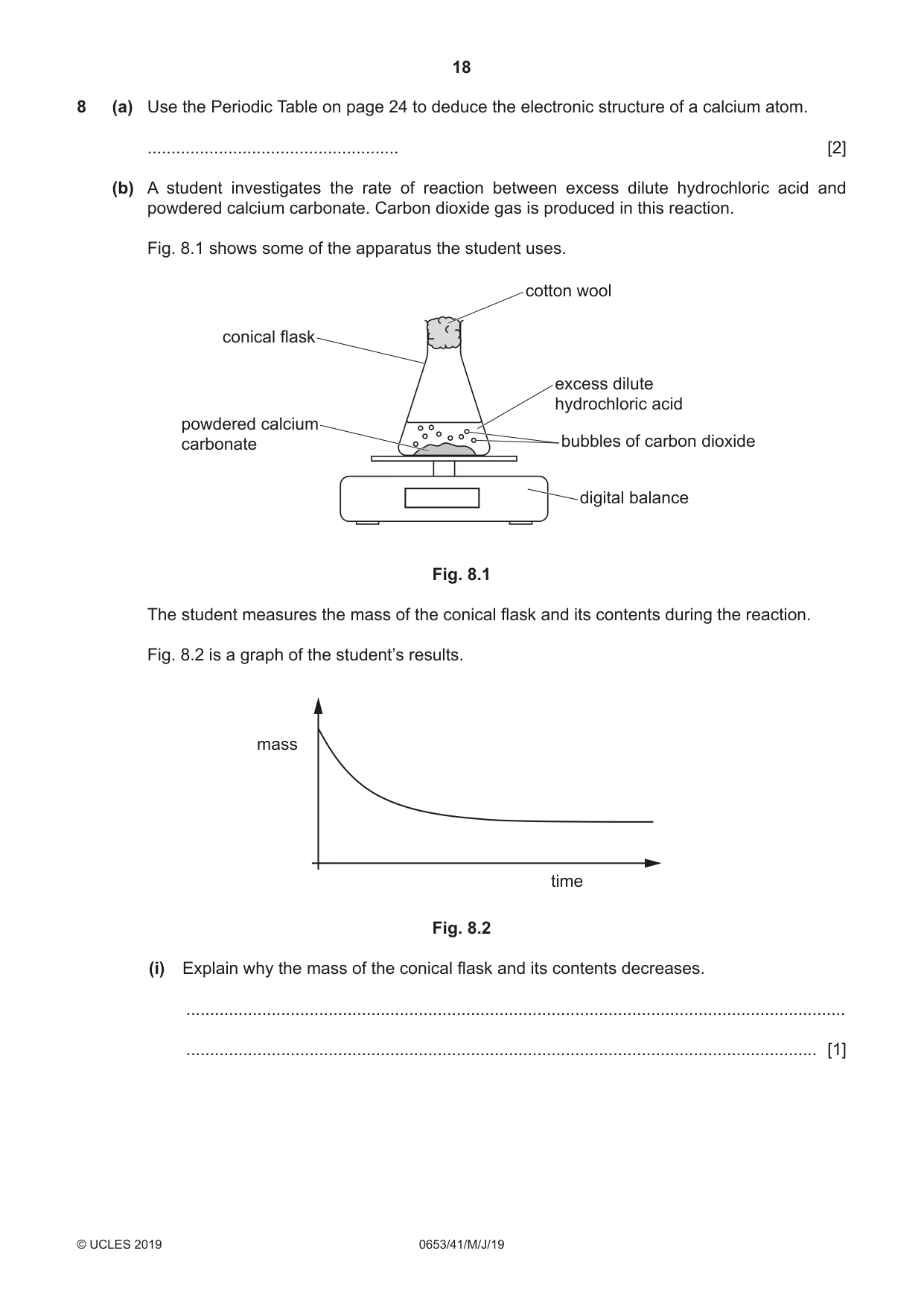
8 (a) Use the Periodic Table on page 24 to deduce the electronic structure of a calcium atom. ..................................................... [2] (b) A student investigates the rate of reaction between excess dilute hydrochloric acid and powdered calcium carbonate. Carbon dioxide gas is produced in this reaction. Fig. 8.1 shows some of the apparatus the student uses. cotton wool conical flask excess dilute hydrochloric acid powdered calcium carbonate bubbles of carbon dioxide digital balance Fig. 8.1 The student measures the mass of the conical flask and its contents during the reaction. Fig. 8.2 is a graph of the student’s results. mass time Fig. 8.2 (i) Explain why the mass of the conical flask and its contents decreases. ........................................................................................................................................... ..................................................................................................................................... [1] (ii) Explain, in terms of particle collisions, the effect of a higher temperature on the rate of a chemical reaction. ........................................................................................................................................... ........................................................................................................................................... ........................................................................................................................................... ..................................................................................................................................... [2] (iii) The student repeats the experiment at a higher temperature. On Fig. 8.2, sketch a line to show the results. [2] (c) Calcium chloride is produced during the reaction between calcium carbonate and dilute hydrochloric acid. Name one other substance that reacts with dilute hydrochloric acid to produce calcium chloride. ............................................................................................................................................. [1] [Total: 8]
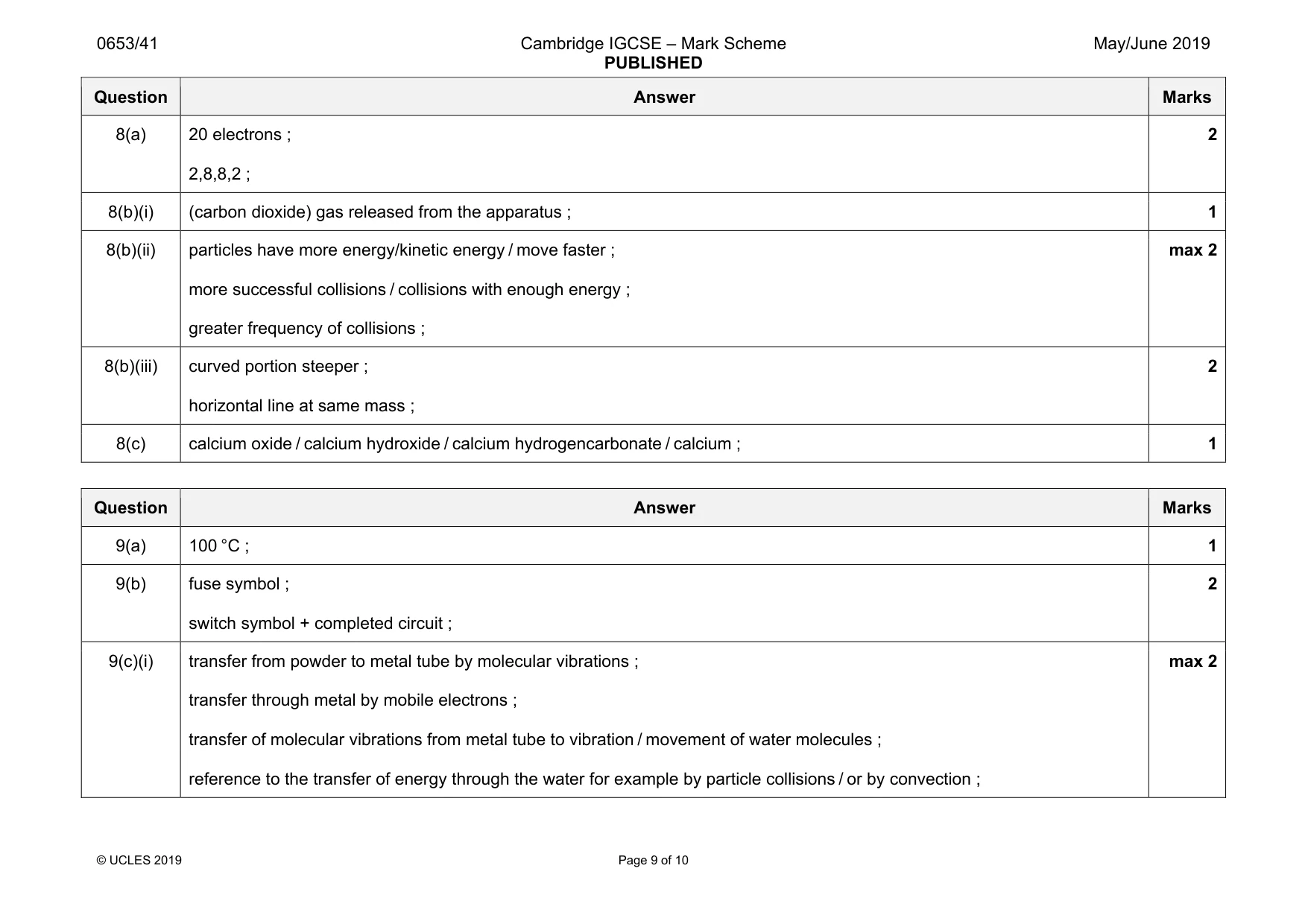
Mark scheme: 8(a) 20 electrons ; 2,8,8,2 ; 2 8(b)(i) (carbon dioxide) gas released from the apparatus ; 1 8(b)(ii) particles have more energy/kinetic energy / move faster ; more successful collisions / collisions with enough energy ; greater frequency of collisions ; max 2 8(b)(iii) curved portion steeper ; horizontal line at same mass ; 2 8(c) calcium oxide / calcium hydroxide / calcium hydrogencarbonate / calcium ; 1
Q9 · The heating element inside an electric kettle
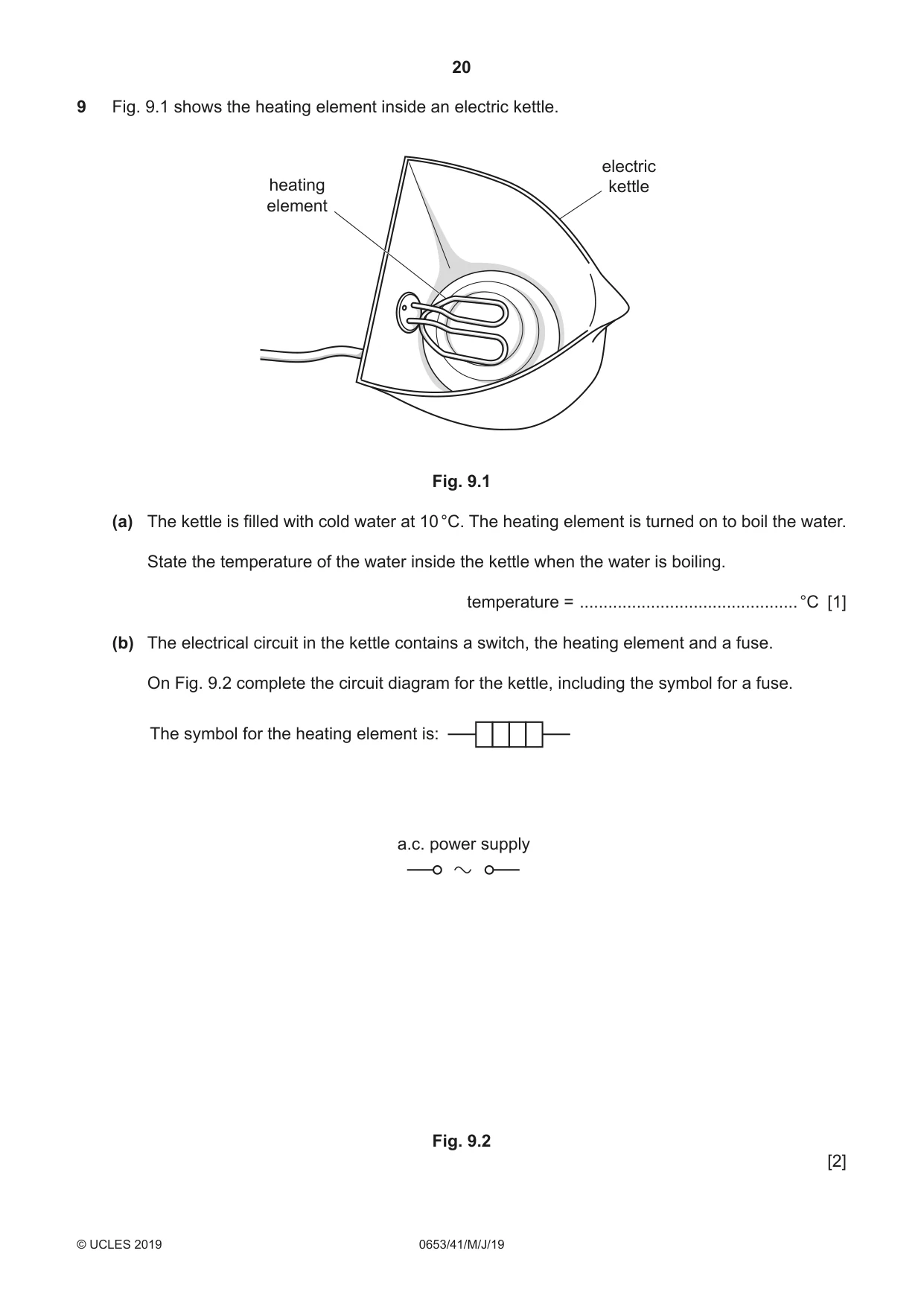
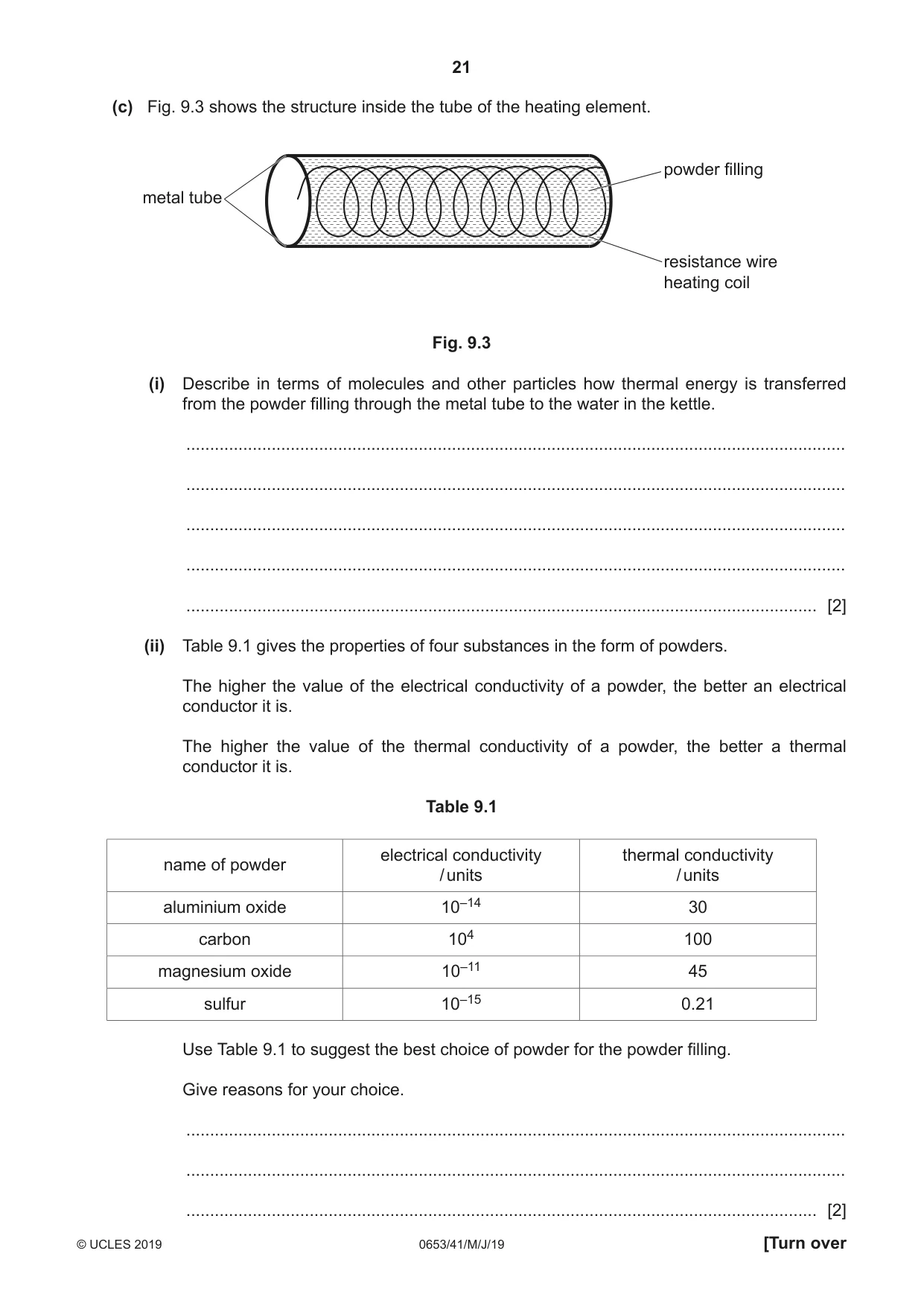
9 Fig. 9.1 shows the heating element inside an electric kettle. electric heating kettle element Fig. 9.1 (a) The kettle is filled with cold water at 10 °C. The heating element is turned on to boil the water. State the temperature of the water inside the kettle when the water is boiling. temperature = ..............................................°C [1] (b) The electrical circuit in the kettle contains a switch, the heating element and a fuse. On Fig. 9.2 complete the circuit diagram for the kettle, including the symbol for a fuse. The symbol for the heating element is: a.c. power supply Fig. 9.2 [2] (c) Fig. 9.3 shows the structure inside the tube of the heating element. powder filling metal tube resistance wire heating coil Fig. 9.3 (i) Describe in terms of molecules and other particles how thermal energy is transferred from the powder filling through the metal tube to the water in the kettle. ........................................................................................................................................... ........................................................................................................................................... ........................................................................................................................................... ........................................................................................................................................... ..................................................................................................................................... [2] (ii) Table 9.1 gives the properties of four substances in the form of powders. The higher the value of the electrical conductivity of a powder, the better an electrical conductor it is. The higher the value of the thermal conductivity of a powder, the better a thermal conductor it is. Table 9.1 electrical conductivity thermal conductivity name of powder / units / units aluminium oxide 10–14 30 carbon 104 100 magnesium oxide 10–11 45 sulfur 10–15 0.21 Use Table 9.1 to suggest the best choice of powder for the powder filling. Give reasons for your choice. ........................................................................................................................................... ........................................................................................................................................... ..................................................................................................................................... [2] (iii) The resistance wire in the heating coil is replaced by a wire of the same material and length. The new wire has a greater cross-sectional area than the original wire. State how the resistance of the new wire compares to the resistance of the original wire. Explain your answer. resistance is ...................................................................................................................... explanation ........................................................................................................................ ........................................................................................................................................... [1] [Total: 8]
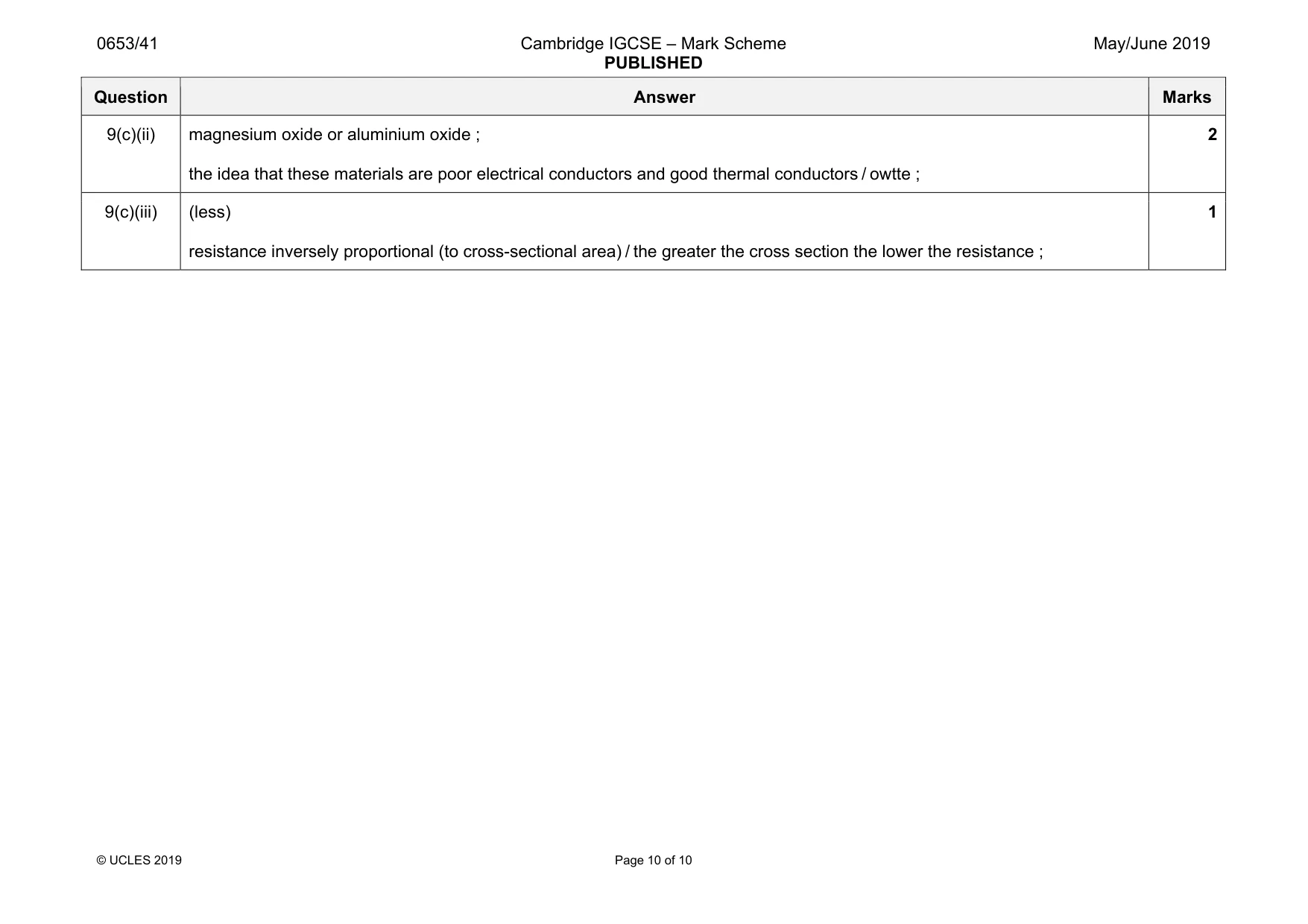
Mark scheme: 9(a) 100 °C ; 1 9(b) fuse symbol ; switch symbol + completed circuit ; 2 9(c)(i) transfer from powder to metal tube by molecular vibrations ; transfer through metal by mobile electrons ; transfer of molecular vibrations from metal tube to vibration / movement of water molecules ; reference to the transfer of energy through the water for example by particle collisions / or by convection ; max 2 Question Answer Marks 9(c)(ii) magnesium oxide or aluminium oxide ; the idea that these materials are poor electrical conductors and good thermal conductors / owtte ; 2 9(c)(iii) (less) resistance inversely proportional (to cross-sectional area) / the greater the cross section the lower the resistance ; 1
What was in this paper
The subtopics covered by these 9 questions, and how many questions each got. Open one in a new tab to see every Cambridge question on it.
What you needed in this session
Cambridge’s own grade thresholds for 2019 May/June, Paper 4 · Variant 1. A higher threshold means an easier paper — the bar moves with how the cohort did.