Cambridge IGCSE Science - Combined 0653 — 2022 May/June Paper 4 · Variant 3
0653/43/M/J/22 · 9 questions · 80 marks · ≈90 min
The question paper and its mark scheme, free to read here and free to download. This is Cambridge’s own paper, exactly as it was sat.
Question paper24 pages


Mark scheme11 pages
Answers below. Sit the paper first if you are practising.
Questions as text
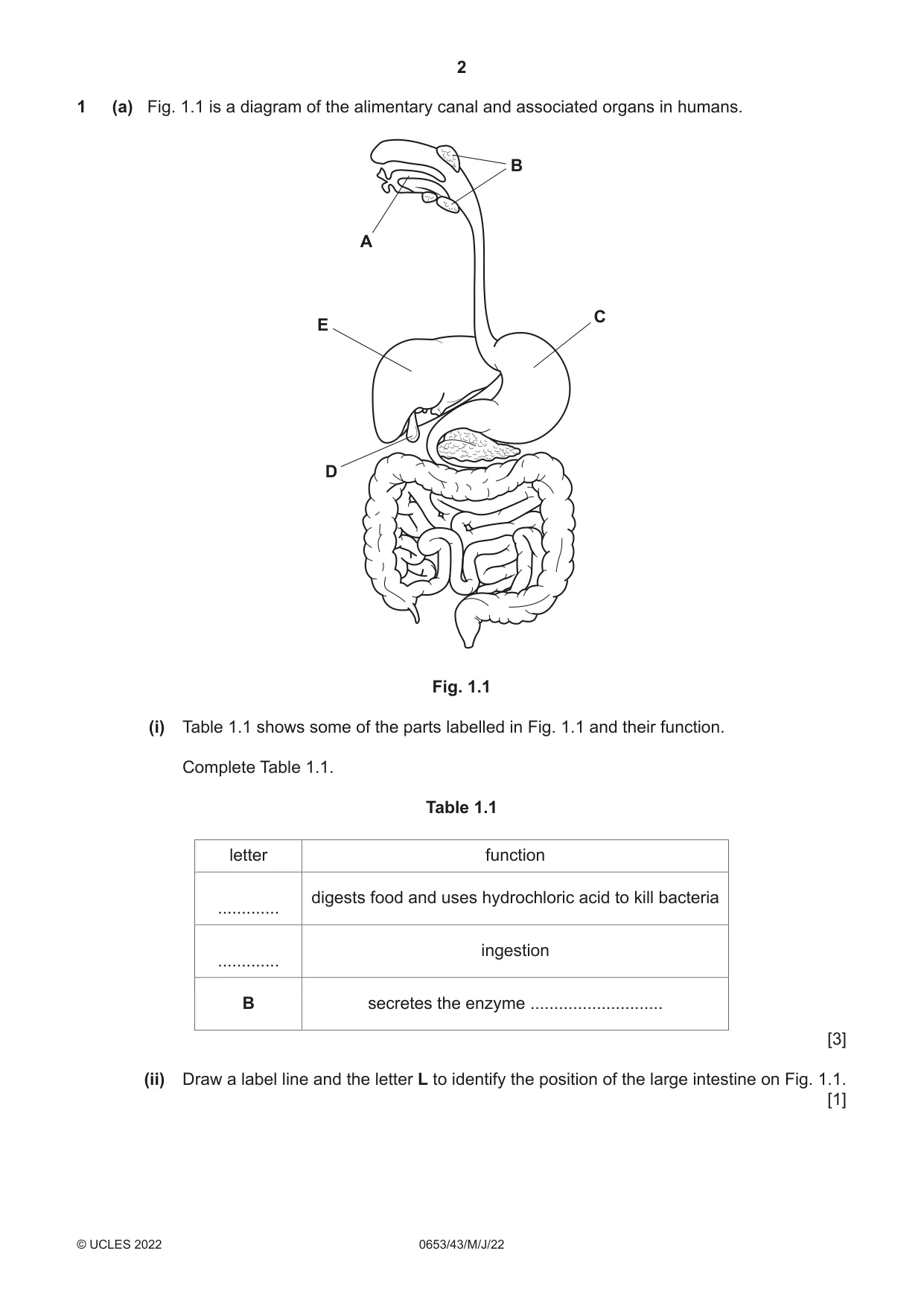
Q1 · A diagram of the alimentary canal and associated organs in humans
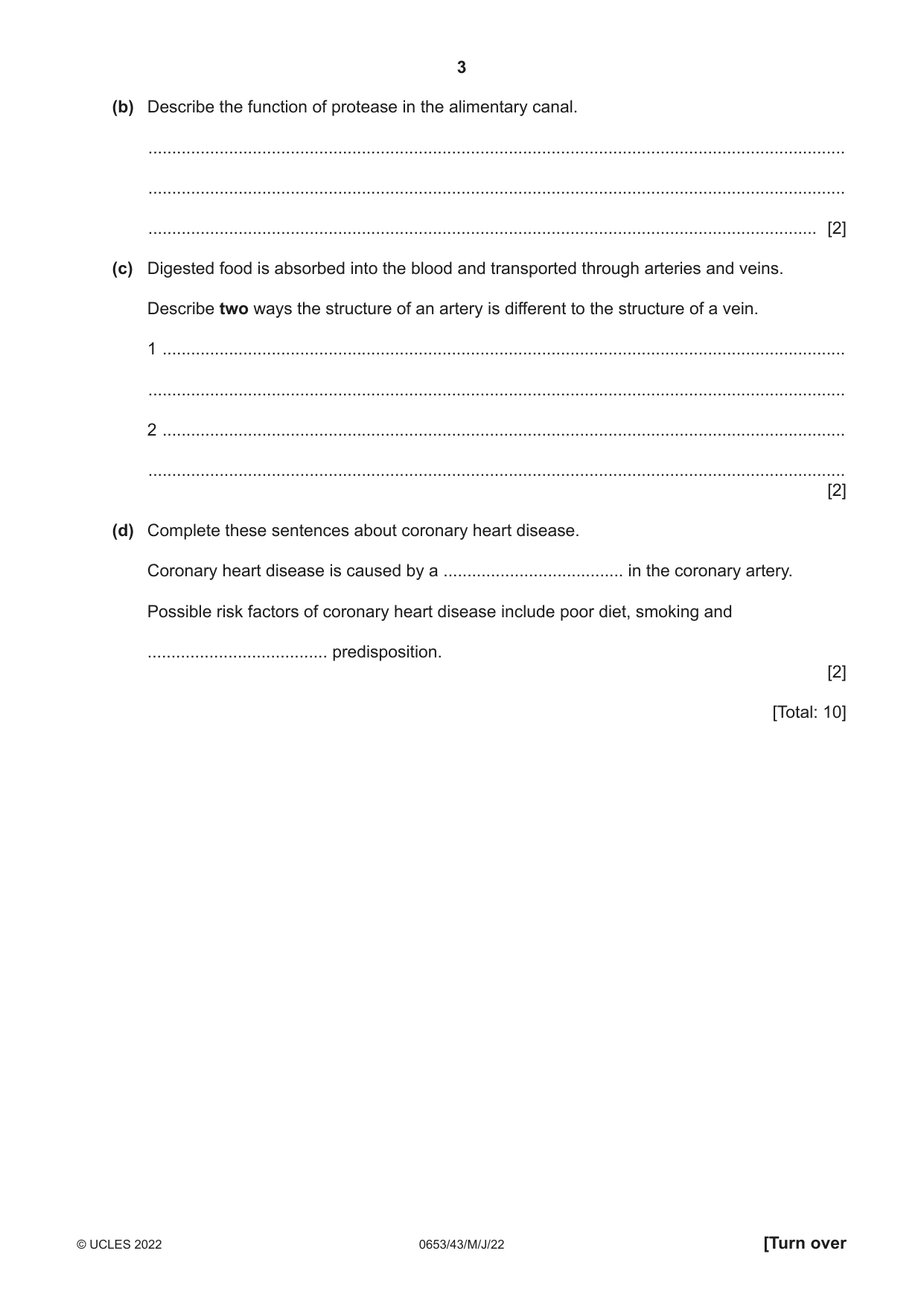
1 (a) Fig. 1.1 is a diagram of the alimentary canal and associated organs in humans. B A C E D Fig. 1.1 (i) Table 1.1 shows some of the parts labelled in Fig. 1.1 and their function. Complete Table 1.1. Table 1.1 letter function digests food and uses hydrochloric acid to kill bacteria ............. ingestion ............. B secretes the enzyme ............................ [3] (ii) Draw a label line and the letter L to identify the position of the large intestine on Fig. 1.1. [1] (b) Describe the function of protease in the alimentary canal. ................................................................................................................................................... ................................................................................................................................................... ............................................................................................................................................. [2] (c) Digested food is absorbed into the blood and transported through arteries and veins. Describe two ways the structure of an artery is different to the structure of a vein. 1 ................................................................................................................................................ ................................................................................................................................................... 2 ................................................................................................................................................ ................................................................................................................................................... [2] (d) Complete these sentences about coronary heart disease. Coronary heart disease is caused by a ...................................... in the coronary artery. Possible risk factors of coronary heart disease include poor diet, smoking and ...................................... predisposition. [2] [Total: 10]
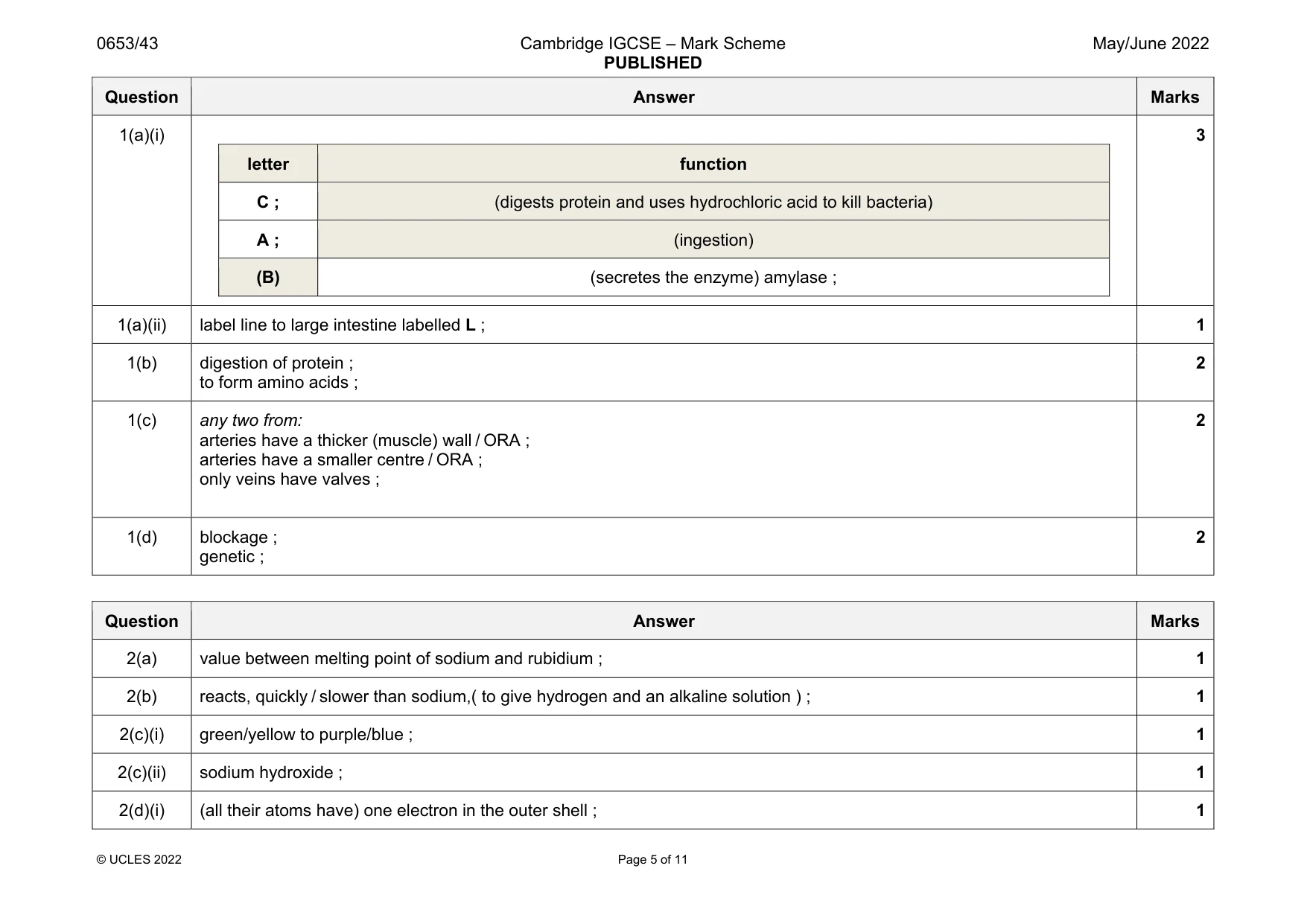
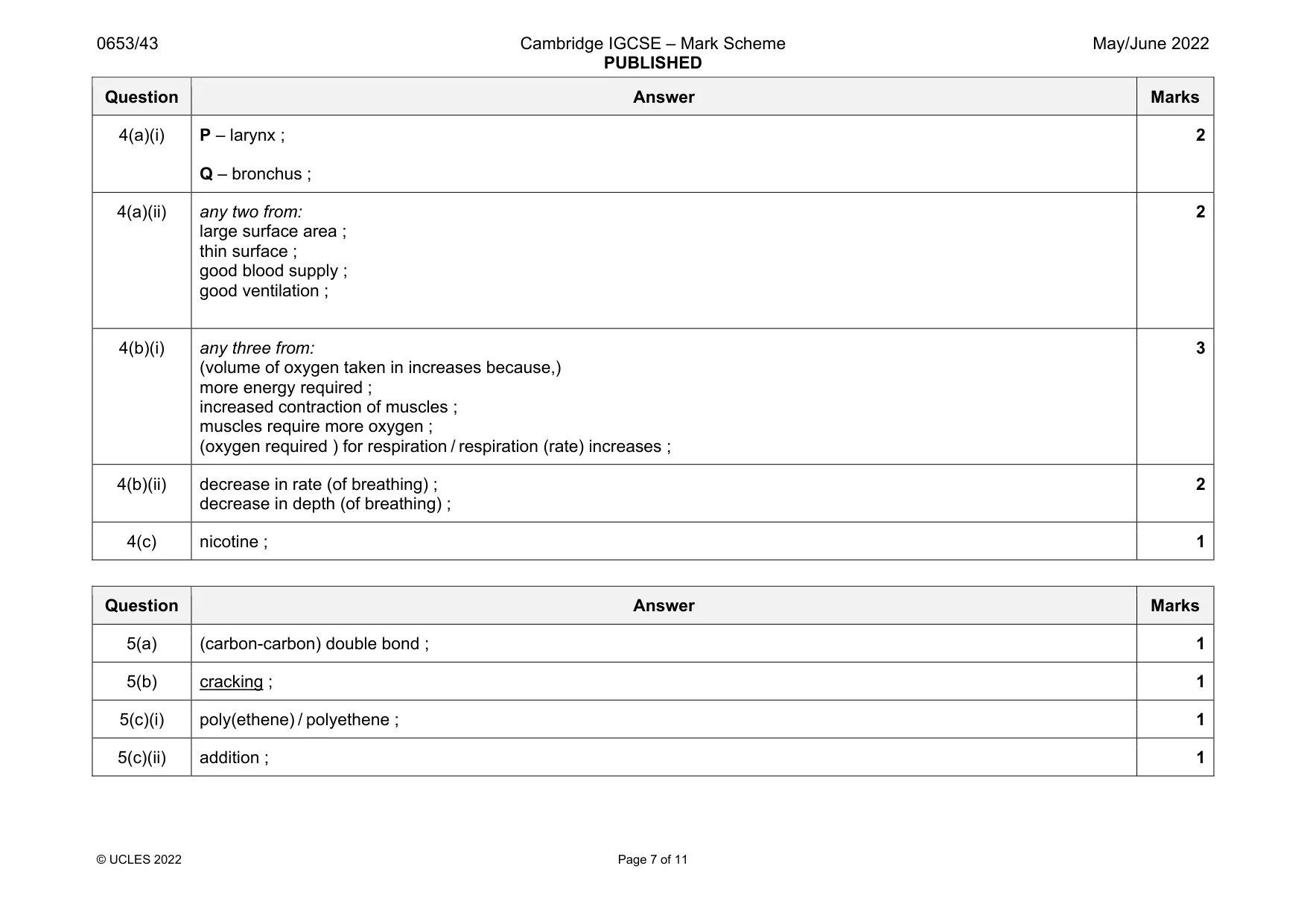
Mark scheme: 1(a)(i) letter function C ; (digests protein and uses hydrochloric acid to kill bacteria) A ; (ingestion) (B) (secretes the enzyme) amylase ; 3 1(a)(ii) label line to large intestine labelled L ; 1 1(b) digestion of protein ; to form amino acids ; 2 1(c) any two from: arteries have a thicker (muscle) wall / ORA ; arteries have a smaller centre / ORA ; only veins have valves ; 2 1(d) blockage ; genetic ; 2
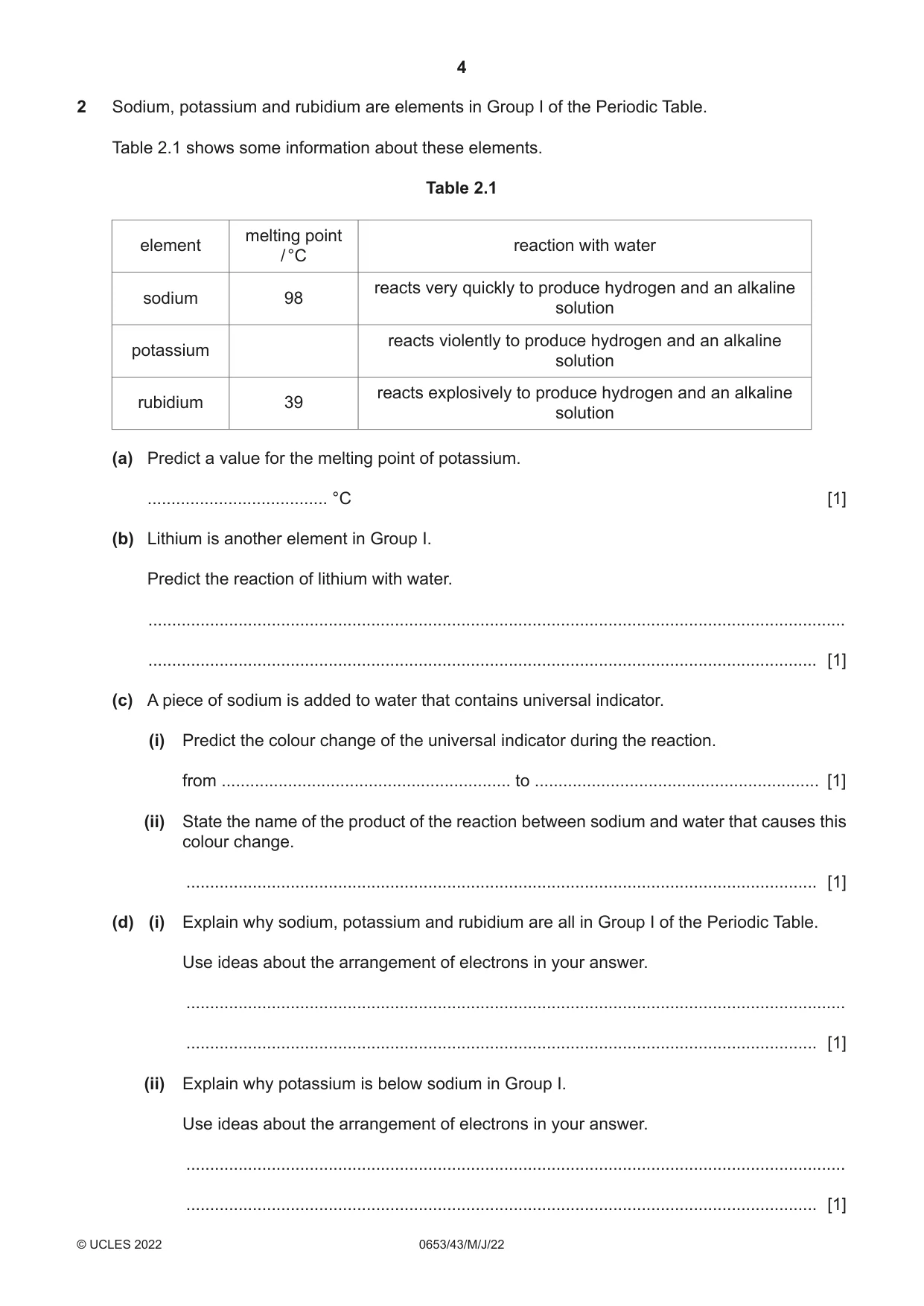
Q2 · Sodium, potassium and rubidium are elements in Group I of the Periodic Table
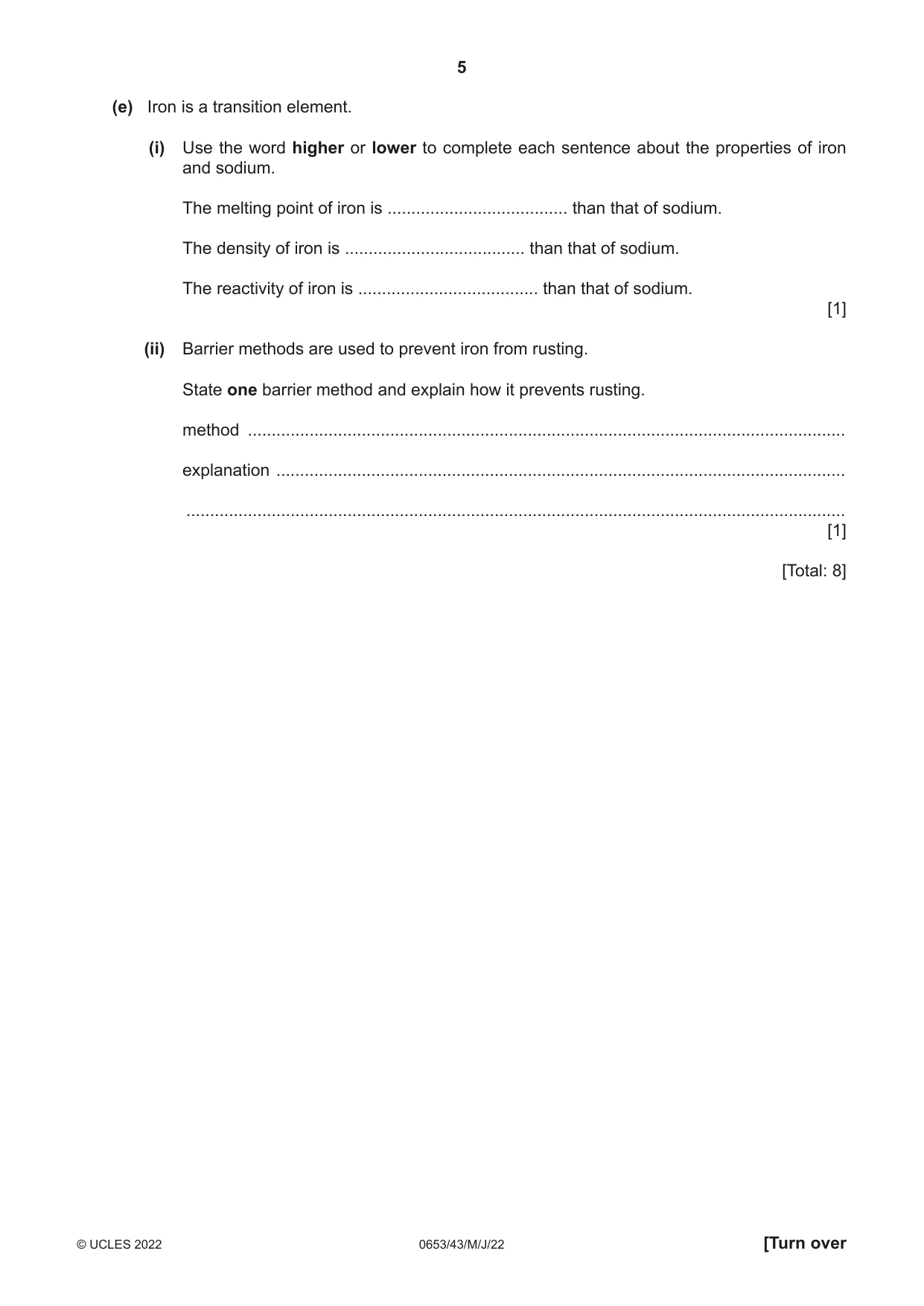
2 Sodium, potassium and rubidium are elements in Group I of the Periodic Table. Table 2.1 shows some information about these elements. Table 2.1 melting point element reaction with water / °C reacts very quickly to produce hydrogen and an alkaline sodium 98 solution reacts violently to produce hydrogen and an alkaline potassium solution reacts explosively to produce hydrogen and an alkaline rubidium 39 solution (a) Predict a value for the melting point of potassium. ...................................... °C [1] (b) Lithium is another element in Group I. Predict the reaction of lithium with water. ................................................................................................................................................... ............................................................................................................................................. [1] (c) A piece of sodium is added to water that contains universal indicator. (i) Predict the colour change of the universal indicator during the reaction. from ............................................................. to ............................................................ [1] (ii) State the name of the product of the reaction between sodium and water that causes this colour change. ..................................................................................................................................... [1] (d) (i) Explain why sodium, potassium and rubidium are all in Group I of the Periodic Table. Use ideas about the arrangement of electrons in your answer. ........................................................................................................................................... ..................................................................................................................................... [1] (ii) Explain why potassium is below sodium in Group I. Use ideas about the arrangement of electrons in your answer. ........................................................................................................................................... ..................................................................................................................................... [1] (e) Iron is a transition element. (i) Use the word higher or lower to complete each sentence about the properties of iron and sodium. The melting point of iron is ...................................... than that of sodium. The density of iron is ...................................... than that of sodium. The reactivity of iron is ...................................... than that of sodium. [1] (ii) Barrier methods are used to prevent iron from rusting. State one barrier method and explain how it prevents rusting. method .............................................................................................................................. explanation ........................................................................................................................ ........................................................................................................................................... [1] [Total: 8]
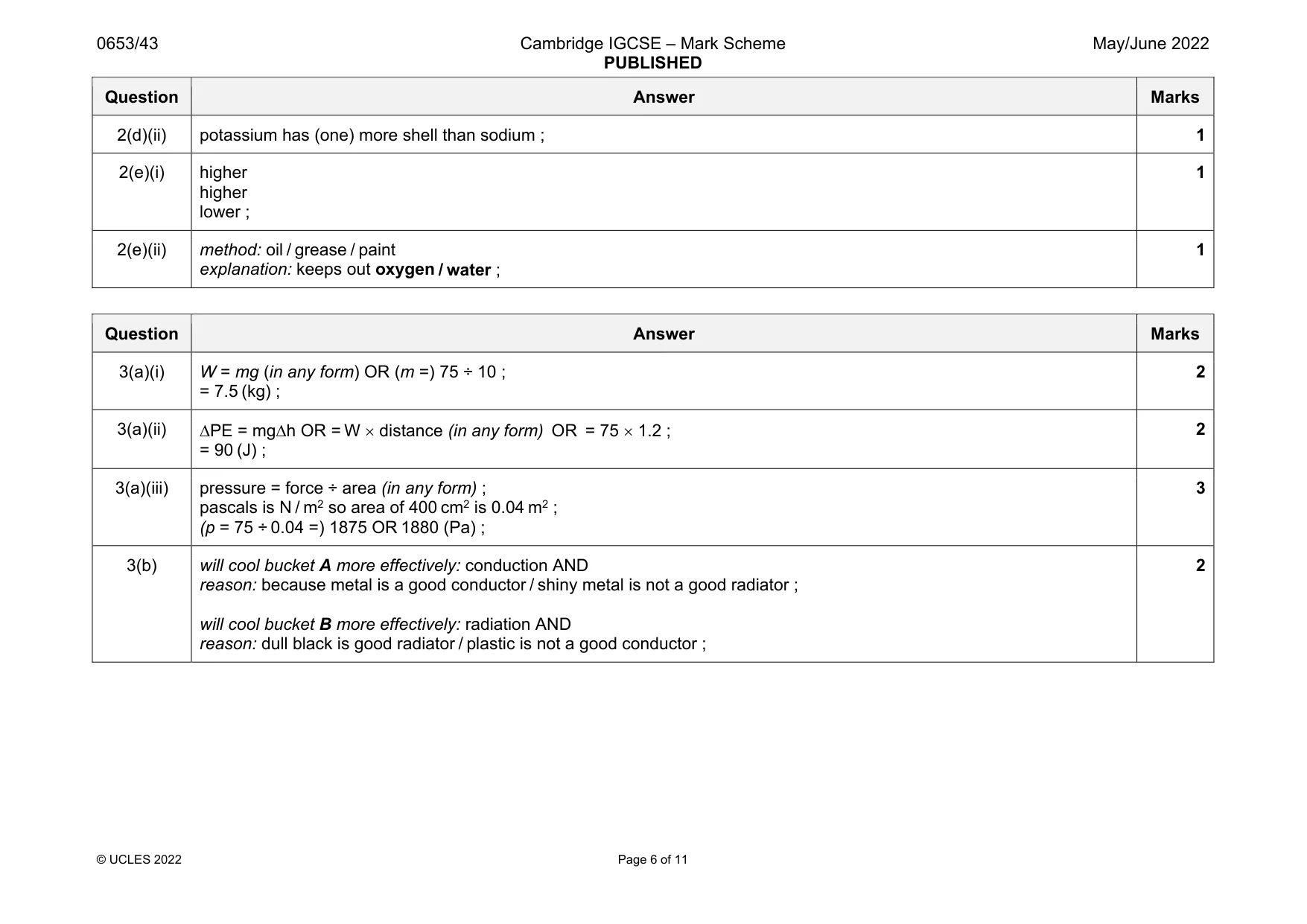
Mark scheme: 2(a) value between melting point of sodium and rubidium ; 1 2(b) reacts, quickly / slower than sodium,( to give hydrogen and an alkaline solution ) ; 1 2(c)(i) green/yellow to purple/blue ; 1 2(c)(ii) sodium hydroxide ; 1 2(d)(i) (all their atoms have) one electron in the outer shell ; 1 Question Answer Marks 2(d)(ii) potassium has (one) more shell than sodium ; 1 2(e)(i) higher higher lower ; 1 2(e)(ii) method: oil / grease / paint explanation: keeps out oxygen / water ; 1
Q3 · A man standing still and holding a bucket filled with water
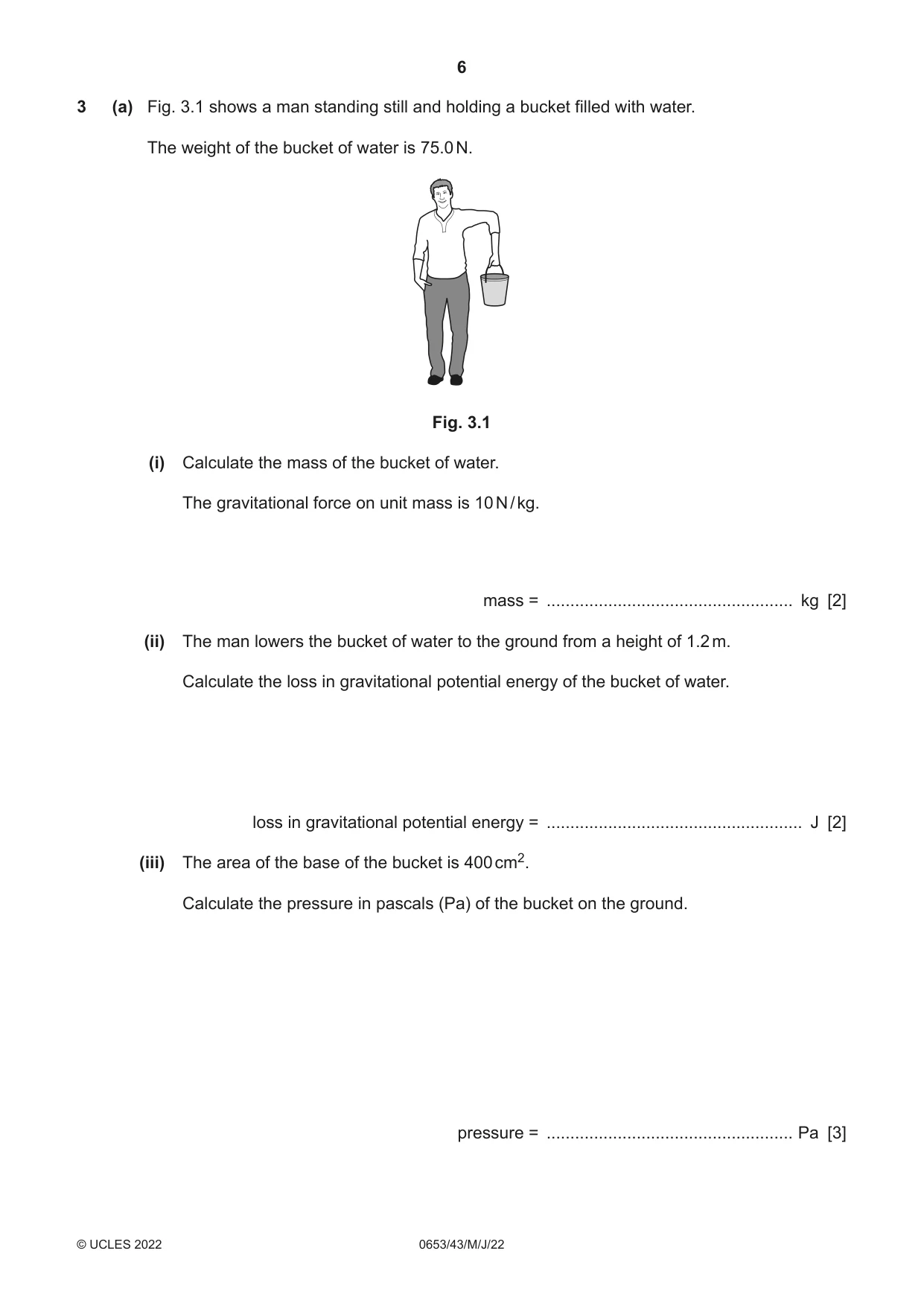
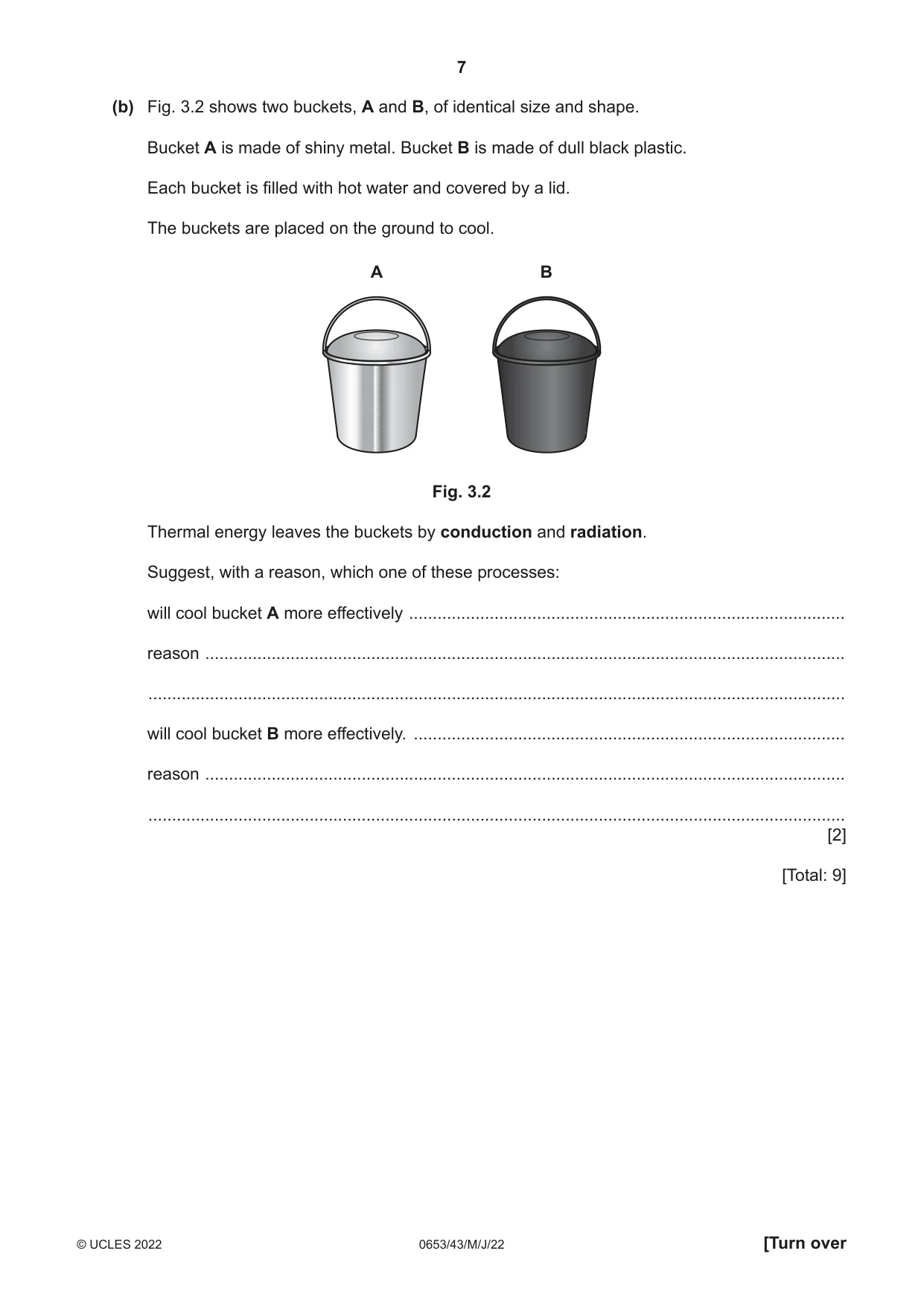
3 (a) Fig. 3.1 shows a man standing still and holding a bucket filled with water. The weight of the bucket of water is 75.0 N. Fig. 3.1 (i) Calculate the mass of the bucket of water. The gravitational force on unit mass is 10 N / kg. mass = .................................................... kg [2] (ii) The man lowers the bucket of water to the ground from a height of 1.2 m. Calculate the loss in gravitational potential energy of the bucket of water. loss in gravitational potential energy = ...................................................... J [2] (iii) The area of the base of the bucket is 400 cm2. Calculate the pressure in pascals (Pa) of the bucket on the ground. pressure = .................................................... Pa [3] (b) Fig. 3.2 shows two buckets, A and B, of identical size and shape. Bucket A is made of shiny metal. Bucket B is made of dull black plastic. Each bucket is filled with hot water and covered by a lid. The buckets are placed on the ground to cool. A B Fig. 3.2 Thermal energy leaves the buckets by conduction and radiation. Suggest, with a reason, which one of these processes: will cool bucket A more effectively ............................................................................................ reason ....................................................................................................................................... ................................................................................................................................................... will cool bucket B more effectively. ........................................................................................... reason ....................................................................................................................................... ................................................................................................................................................... [2] [Total: 9]
Mark scheme: 3(a)(i) W = mg (in any form) OR (m =) 75 ÷ 10 ; = 7.5 (kg) ; 2 3(a)(ii) PE = mgh OR = W distance (in any form) OR = 75 1.2 ; = 90 (J) ; 2 3(a)(iii) pressure = force ÷ area (in any form) ; pascals is N / m2 so area of 400 cm2 is 0.04 m2 ; (p = 75 ÷ 0.04 =) 1875 OR 1880 (Pa) ; 3 3(b) will cool bucket A more effectively: conduction AND reason: because metal is a good conductor / shiny metal is not a good radiator ; will cool bucket B more effectively: radiation AND reason: dull black is good radiator / plastic is not a good conductor ; 2
Q4 · A diagram of the gas exchange system in humans
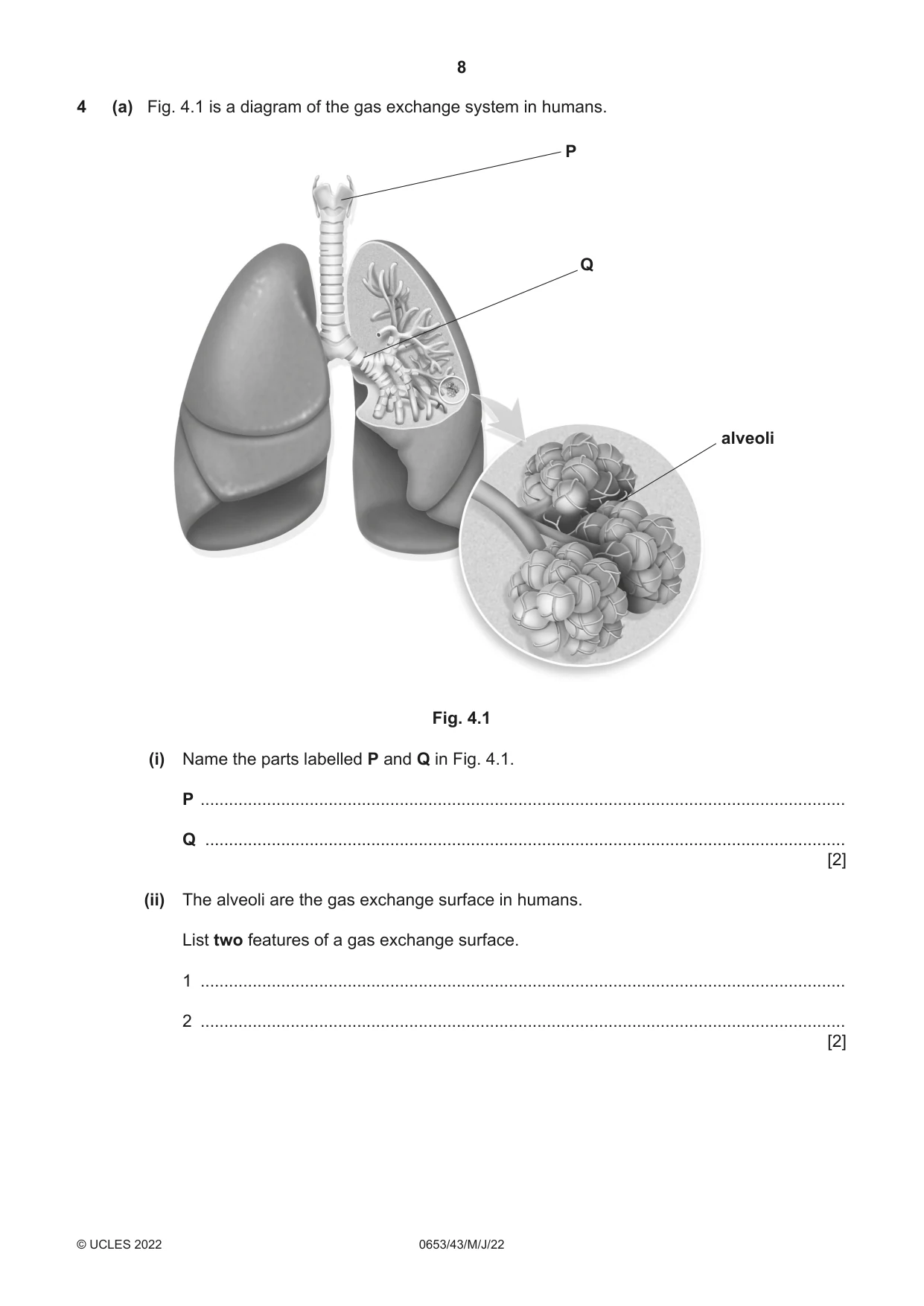
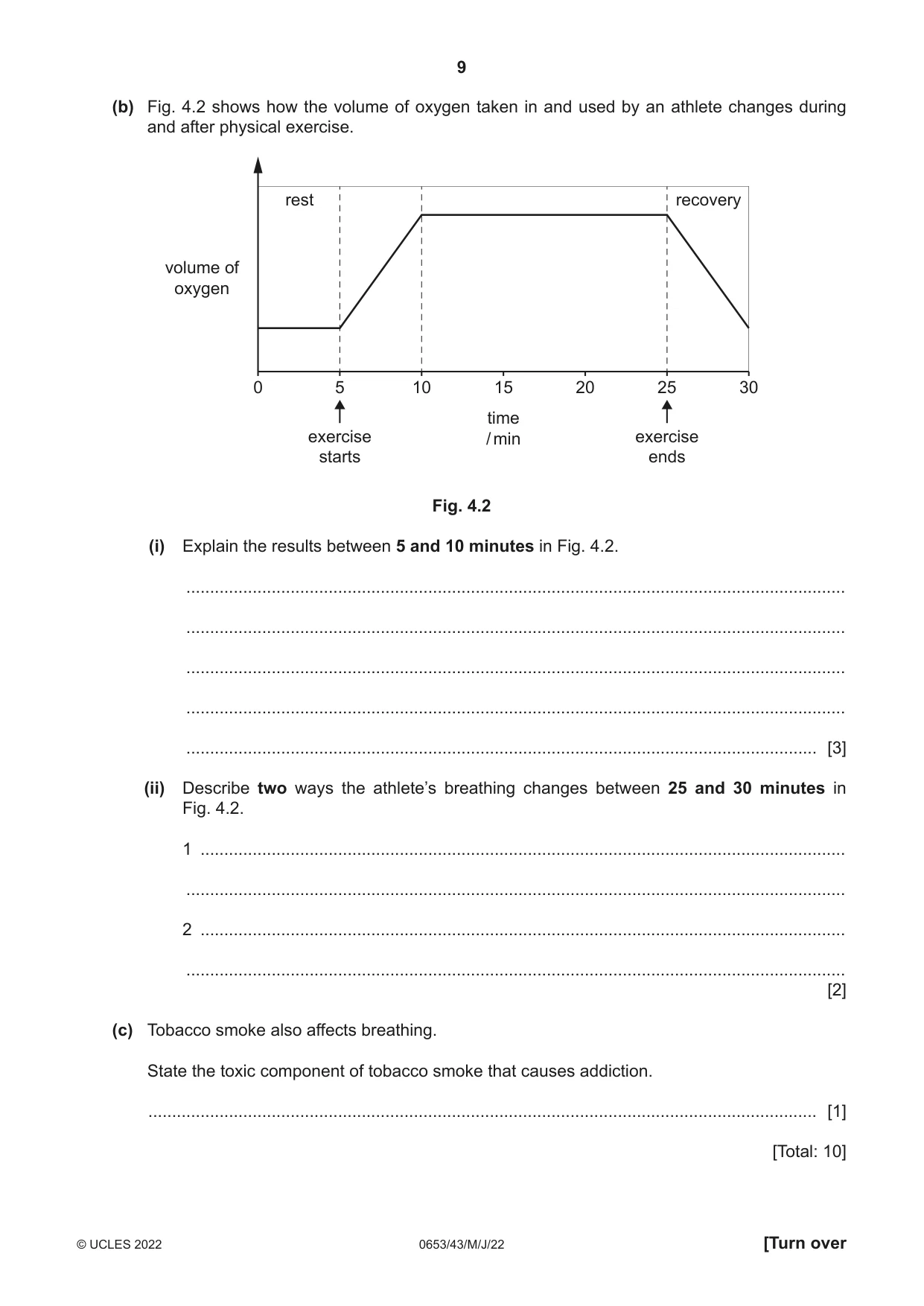
4 (a) Fig. 4.1 is a diagram of the gas exchange system in humans. P Q alveoli Fig. 4.1 (i) Name the parts labelled P and Q in Fig. 4.1. P ........................................................................................................................................ Q ....................................................................................................................................... [2] (ii) The alveoli are the gas exchange surface in humans. List two features of a gas exchange surface. 1 ........................................................................................................................................ 2 ........................................................................................................................................ [2] (b) Fig. 4.2 shows how the volume of oxygen taken in and used by an athlete changes during and after physical exercise. rest recovery volume of oxygen 0 5 10 15 20 25 30 time exercise / min exercise starts ends Fig. 4.2 (i) Explain the results between 5 and 10 minutes in Fig. 4.2. ........................................................................................................................................... ........................................................................................................................................... ........................................................................................................................................... ........................................................................................................................................... ..................................................................................................................................... [3] (ii) Describe two ways the athlete’s breathing changes between 25 and 30 minutes in Fig. 4.2. 1 ........................................................................................................................................ ........................................................................................................................................... 2 ........................................................................................................................................ ........................................................................................................................................... [2] (c) Tobacco smoke also affects breathing. State the toxic component of tobacco smoke that causes addiction. ............................................................................................................................................. [1] [Total: 10]
Mark scheme: 4(a)(i) P – larynx ; Q – bronchus ; 2 4(a)(ii) any two from: large surface area ; thin surface ; good blood supply ; good ventilation ; 2 4(b)(i) any three from: (volume of oxygen taken in increases because,) more energy required ; increased contraction of muscles ; muscles require more oxygen ; (oxygen required ) for respiration / respiration (rate) increases ; 3 4(b)(ii) decrease in rate (of breathing) ; decrease in depth (of breathing) ; 2 4(c) nicotine ; 1
Q5 · The structure of a molecule of ethene is shown in Fig
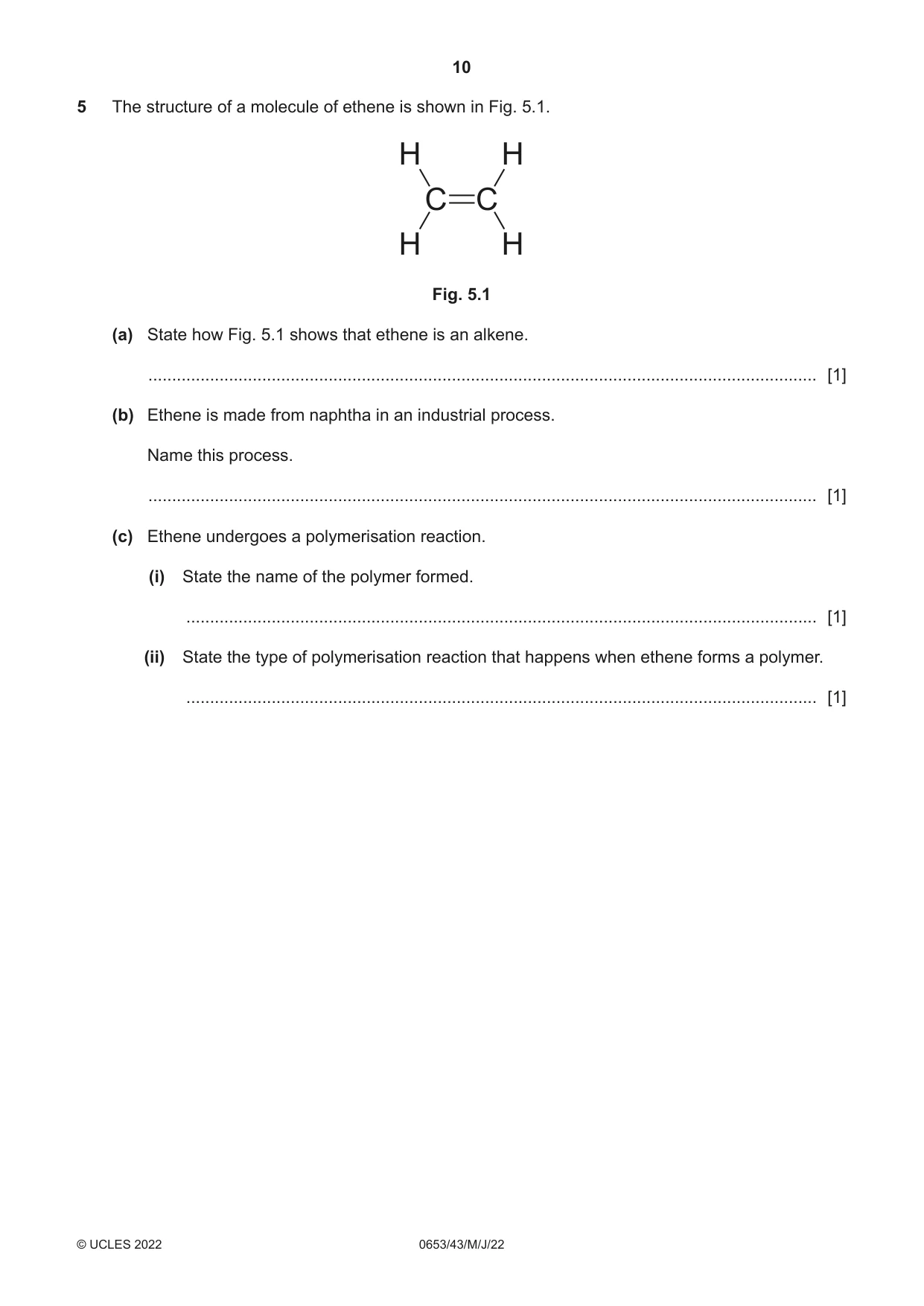
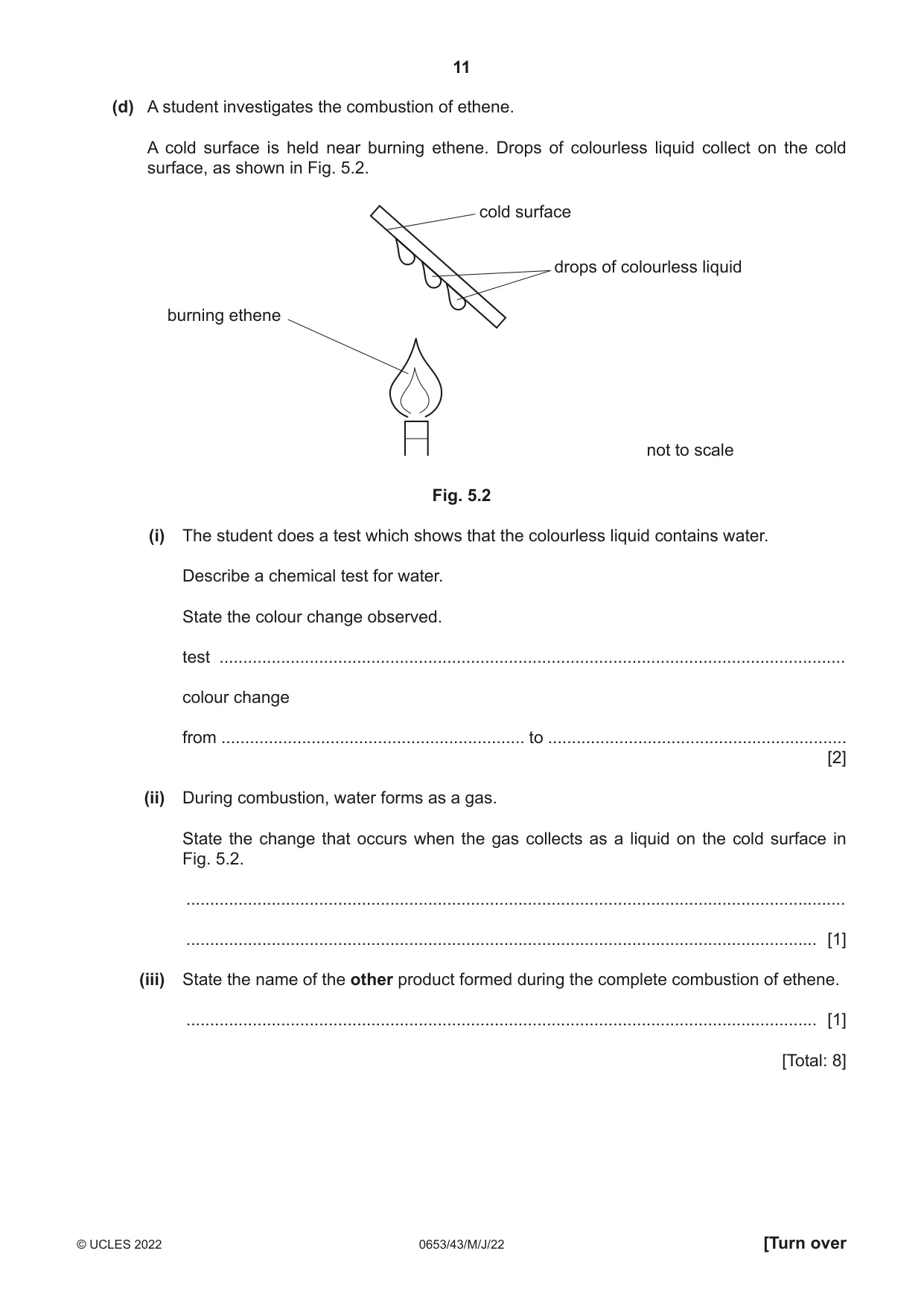
5 The structure of a molecule of ethene is shown in Fig. 5.1. H H C C H H Fig. 5.1 (a) State how Fig. 5.1 shows that ethene is an alkene. ............................................................................................................................................. [1] (b) Ethene is made from naphtha in an industrial process. Name this process. ............................................................................................................................................. [1] (c) Ethene undergoes a polymerisation reaction. (i) State the name of the polymer formed. ..................................................................................................................................... [1] (ii) State the type of polymerisation reaction that happens when ethene forms a polymer. ..................................................................................................................................... [1] (d) A student investigates the combustion of ethene. A cold surface is held near burning ethene. Drops of colourless liquid collect on the cold surface, as shown in Fig. 5.2. cold surface drops of colourless liquid burning ethene not to scale Fig. 5.2 (i) The student does a test which shows that the colourless liquid contains water. Describe a chemical test for water. State the colour change observed. test .................................................................................................................................... colour change from ................................................................ to ............................................................... [2] (ii) During combustion, water forms as a gas. State the change that occurs when the gas collects as a liquid on the cold surface in Fig. 5.2. ........................................................................................................................................... ..................................................................................................................................... [1] (iii) State the name of the other product formed during the complete combustion of ethene. ..................................................................................................................................... [1] [Total: 8]
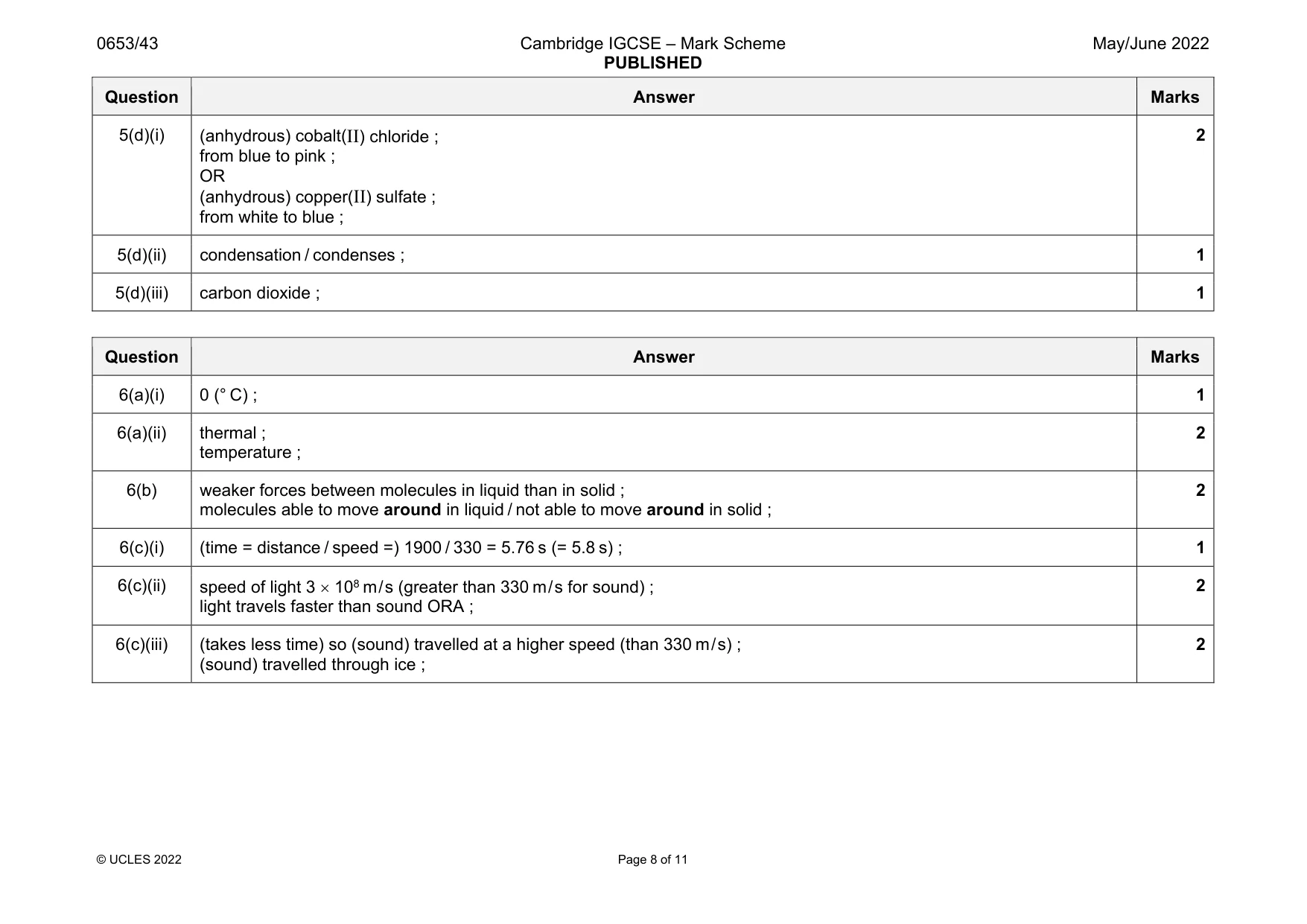
Mark scheme: 5(a) (carbon-carbon) double bond ; 1 5(b) cracking ; 1 5(c)(i) poly(ethene) / polyethene ; 1 5(c)(ii) addition ; 1 Question Answer Marks 5(d)(i) (anhydrous) cobalt(II) chloride ; from blue to pink ; OR (anhydrous) copper(II) sulfate ; from white to blue ; 2 5(d)(ii) condensation / condenses ; 1 5(d)(iii) carbon dioxide ; 1
Q6 · A glacier is a very large area of ice that moves slowly down a slope or valley
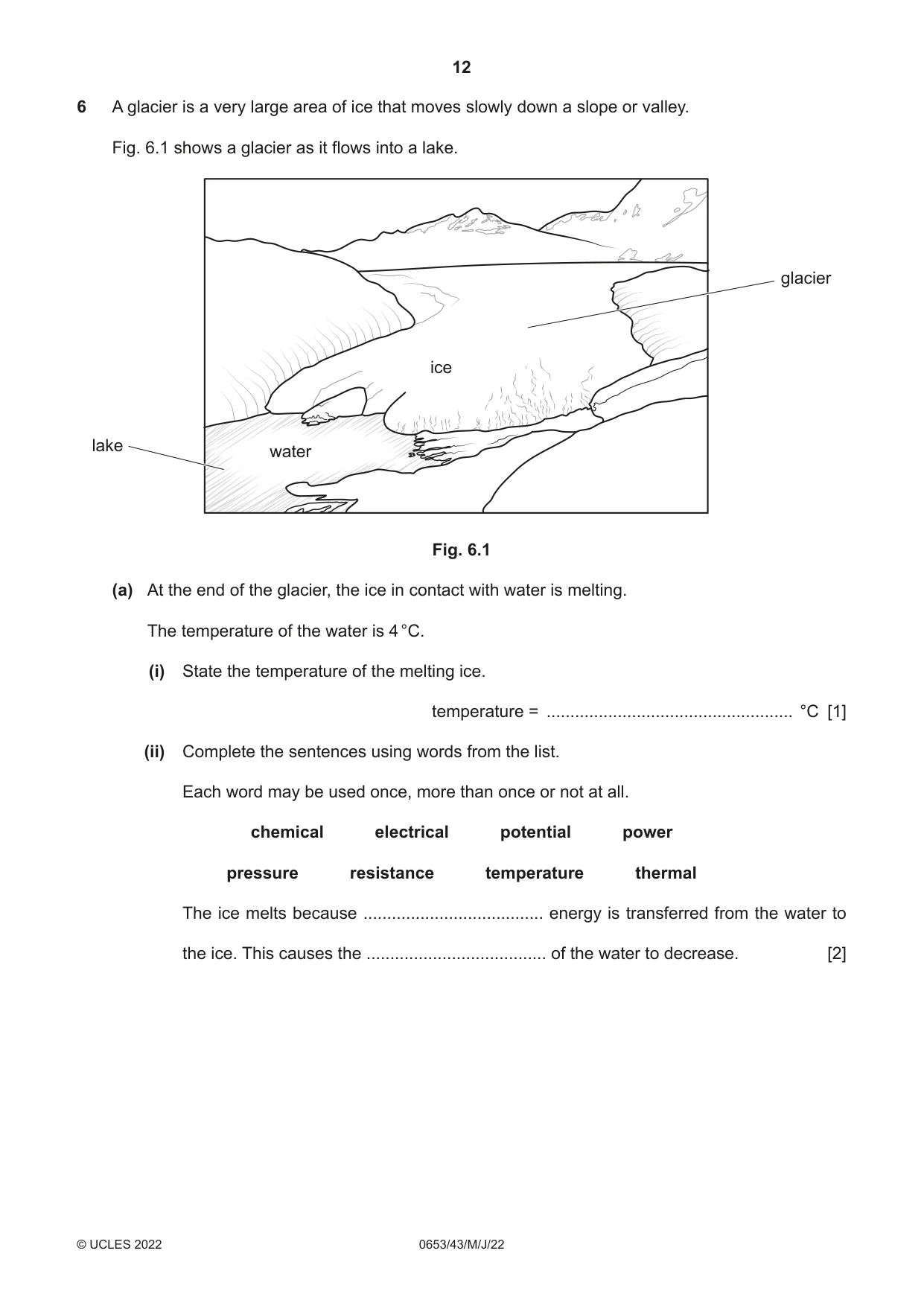
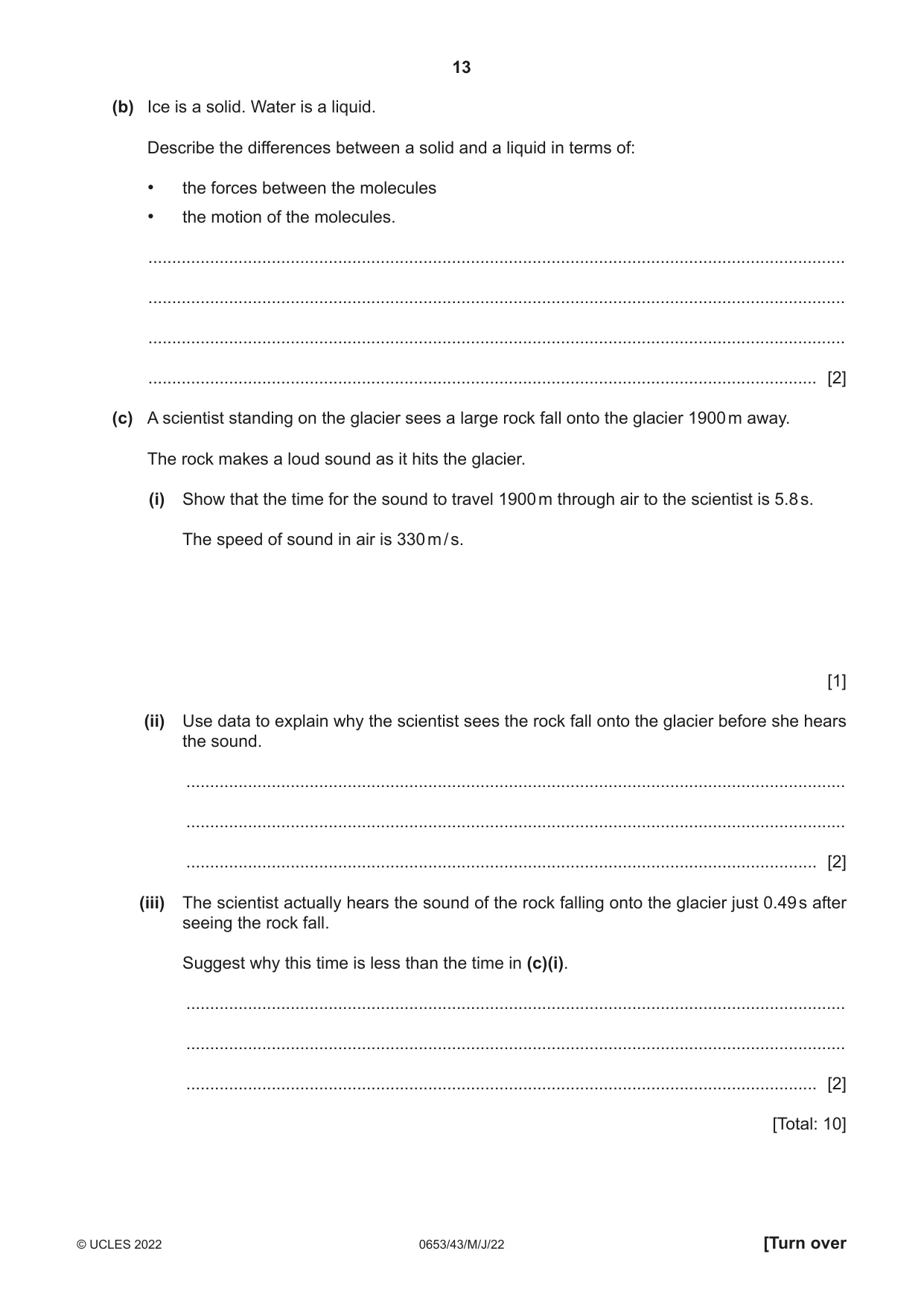
6 A glacier is a very large area of ice that moves slowly down a slope or valley. Fig. 6.1 shows a glacier as it flows into a lake. glacier ice lake water Fig. 6.1 (a) At the end of the glacier, the ice in contact with water is melting. The temperature of the water is 4 °C. (i) State the temperature of the melting ice. temperature = .................................................... °C [1] (ii) Complete the sentences using words from the list. Each word may be used once, more than once or not at all. chemical electrical potential power pressure resistance temperature thermal The ice melts because ...................................... energy is transferred from the water to the ice. This causes the ...................................... of the water to decrease. [2] (b) Ice is a solid. Water is a liquid. Describe the differences between a solid and a liquid in terms of: • the forces between the molecules • the motion of the molecules. ................................................................................................................................................... ................................................................................................................................................... ................................................................................................................................................... ............................................................................................................................................. [2] (c) A scientist standing on the glacier sees a large rock fall onto the glacier 1900 m away. The rock makes a loud sound as it hits the glacier. (i) Show that the time for the sound to travel 1900 m through air to the scientist is 5.8 s. The speed of sound in air is 330 m / s. [1] (ii) Use data to explain why the scientist sees the rock fall onto the glacier before she hears the sound. ........................................................................................................................................... ........................................................................................................................................... ..................................................................................................................................... [2] (iii) The scientist actually hears the sound of the rock falling onto the glacier just 0.49 s after seeing the rock fall. Suggest why this time is less than the time in (c)(i). ........................................................................................................................................... ........................................................................................................................................... ..................................................................................................................................... [2] [Total: 10]
Mark scheme: 6(a)(i) 0 (° C) ; 1 6(a)(ii) thermal ; temperature ; 2 6(b) weaker forces between molecules in liquid than in solid ; molecules able to move around in liquid / not able to move around in solid ; 2 6(c)(i) (time = distance / speed =) 1900 / 330 = 5.76 s (= 5.8 s) ; 1 6(c)(ii) speed of light 3 108 m / s (greater than 330 m / s for sound) ; light travels faster than sound ORA ; 2 6(c)(iii) (takes less time) so (sound) travelled at a higher speed (than 330 m / s) ; (sound) travelled through ice ; 2
Q7 · A food chain from a pond
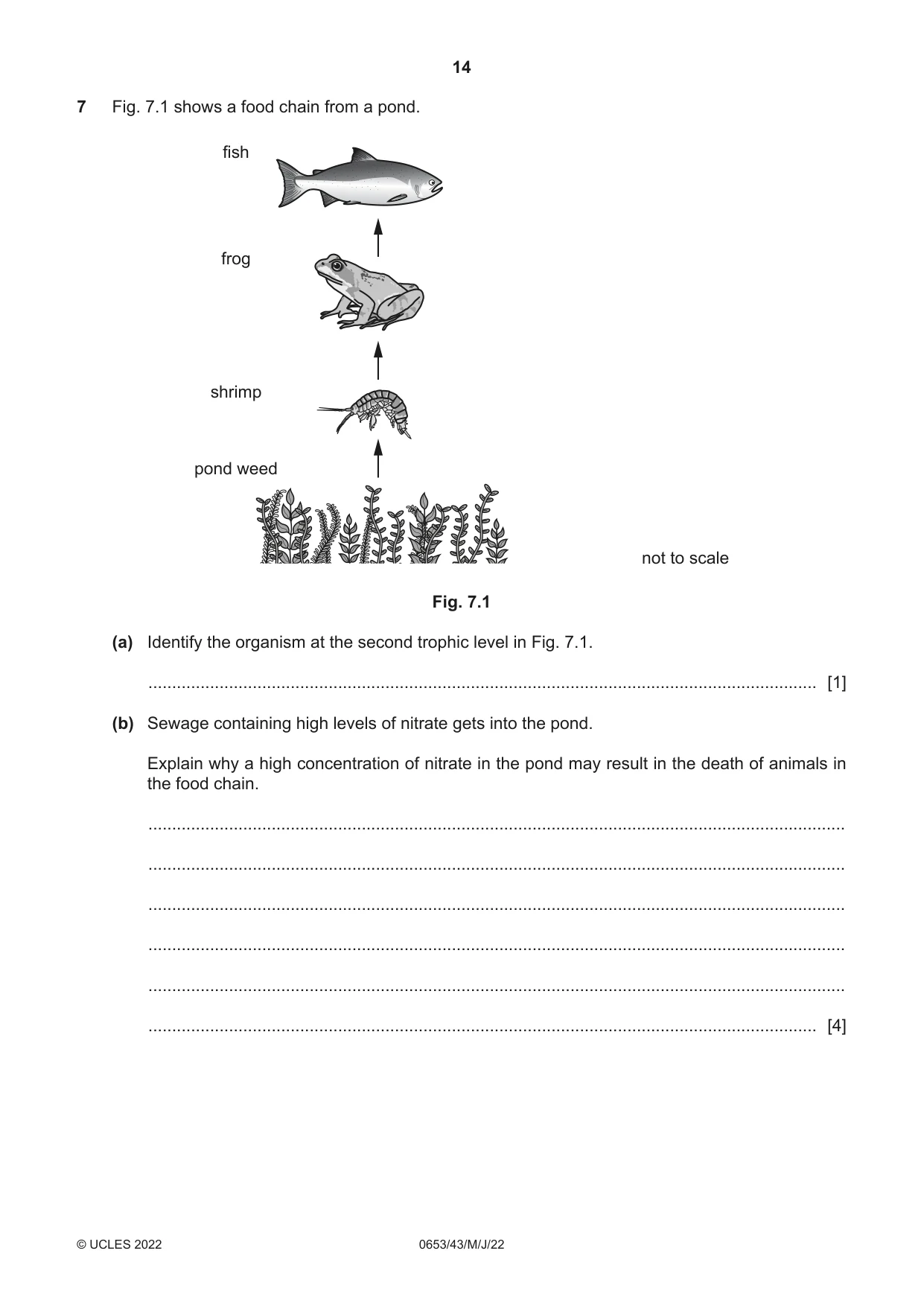
7 Fig. 7.1 shows a food chain from a pond. fish frog shrimp pond weed not to scale Fig. 7.1 (a) Identify the organism at the second trophic level in Fig. 7.1. ............................................................................................................................................. [1] (b) Sewage containing high levels of nitrate gets into the pond. Explain why a high concentration of nitrate in the pond may result in the death of animals in the food chain. ................................................................................................................................................... ................................................................................................................................................... ................................................................................................................................................... ................................................................................................................................................... ................................................................................................................................................... ............................................................................................................................................. [4] (c) Sewage damages the ecosystem. Increasing carbon dioxide concentration in the atmosphere also damages ecosystems. Explain why planting more trees reduces the carbon dioxide concentration in the atmosphere. ................................................................................................................................................... ................................................................................................................................................... ............................................................................................................................................. [2] [Total: 7]
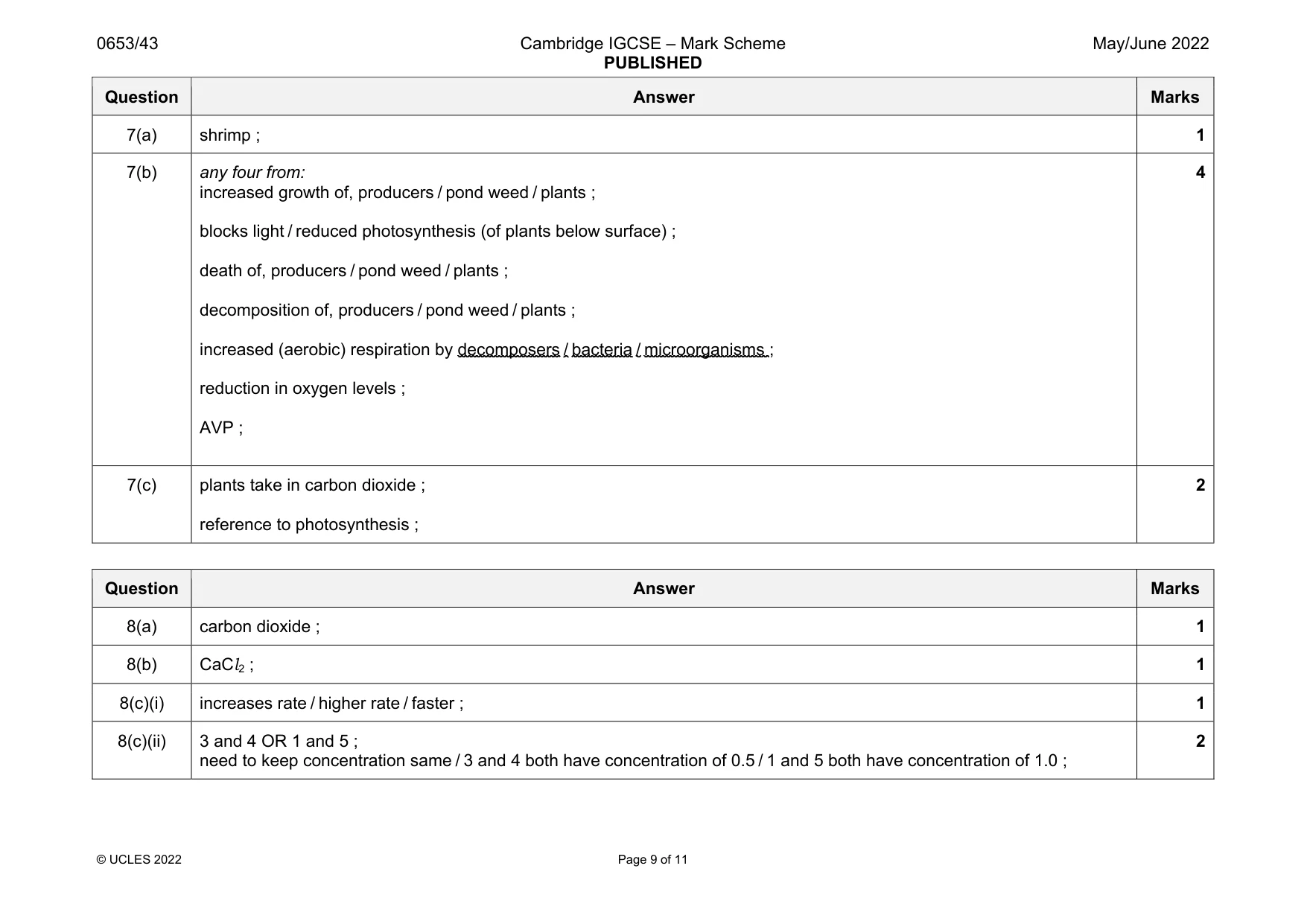
Mark scheme: 7(a) shrimp ; 1 7(b) any four from: increased growth of, producers / pond weed / plants ; blocks light / reduced photosynthesis (of plants below surface) ; death of, producers / pond weed / plants ; decomposition of, producers / pond weed / plants ; increased (aerobic) respiration by decomposers / bacteria / microorganisms ; reduction in oxygen levels ; AVP ; 4 7(c) plants take in carbon dioxide ; reference to photosynthesis ; 2
Q8 · Calcium carbonate reacts with dilute hydrochloric acid to produce a gas
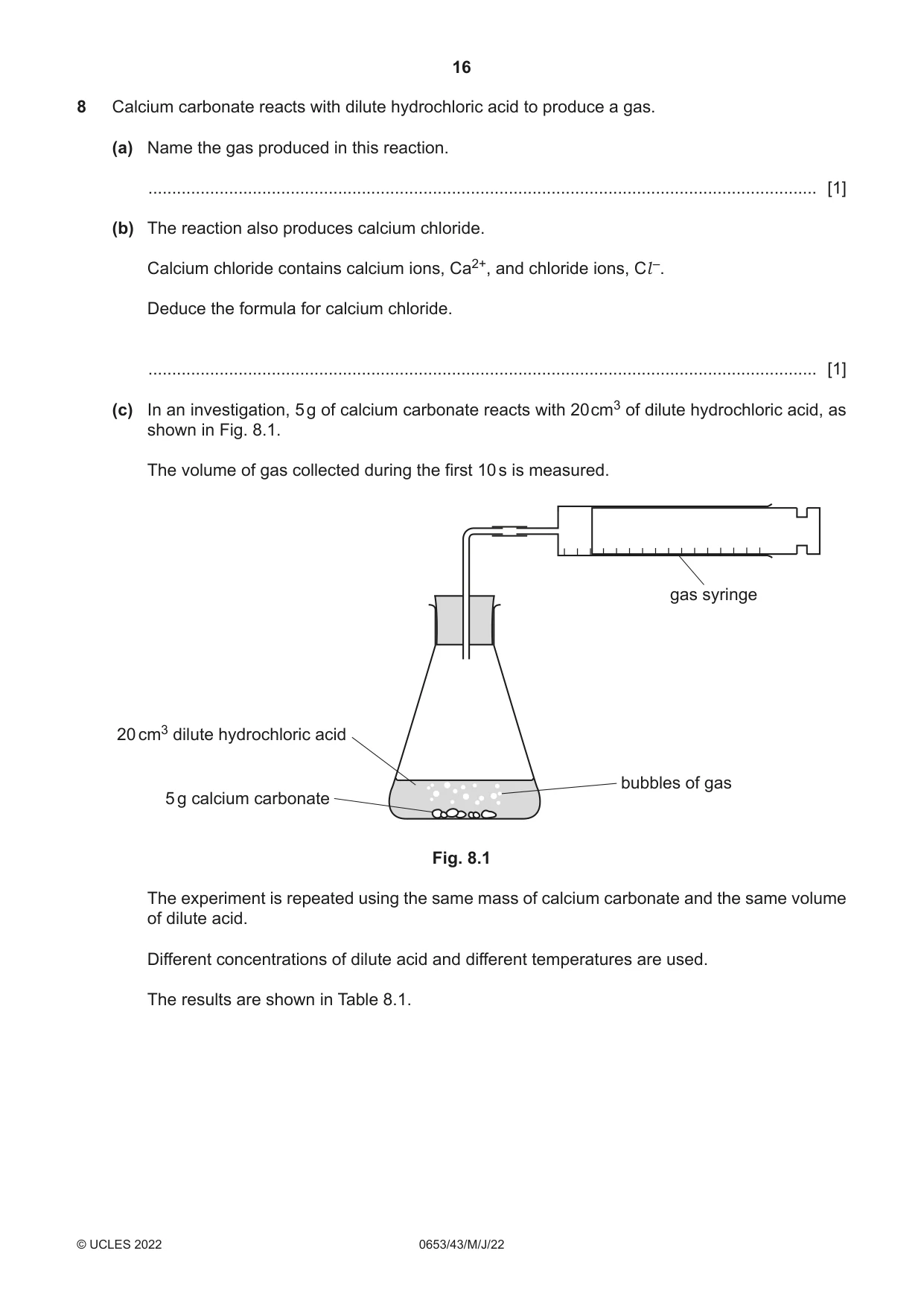
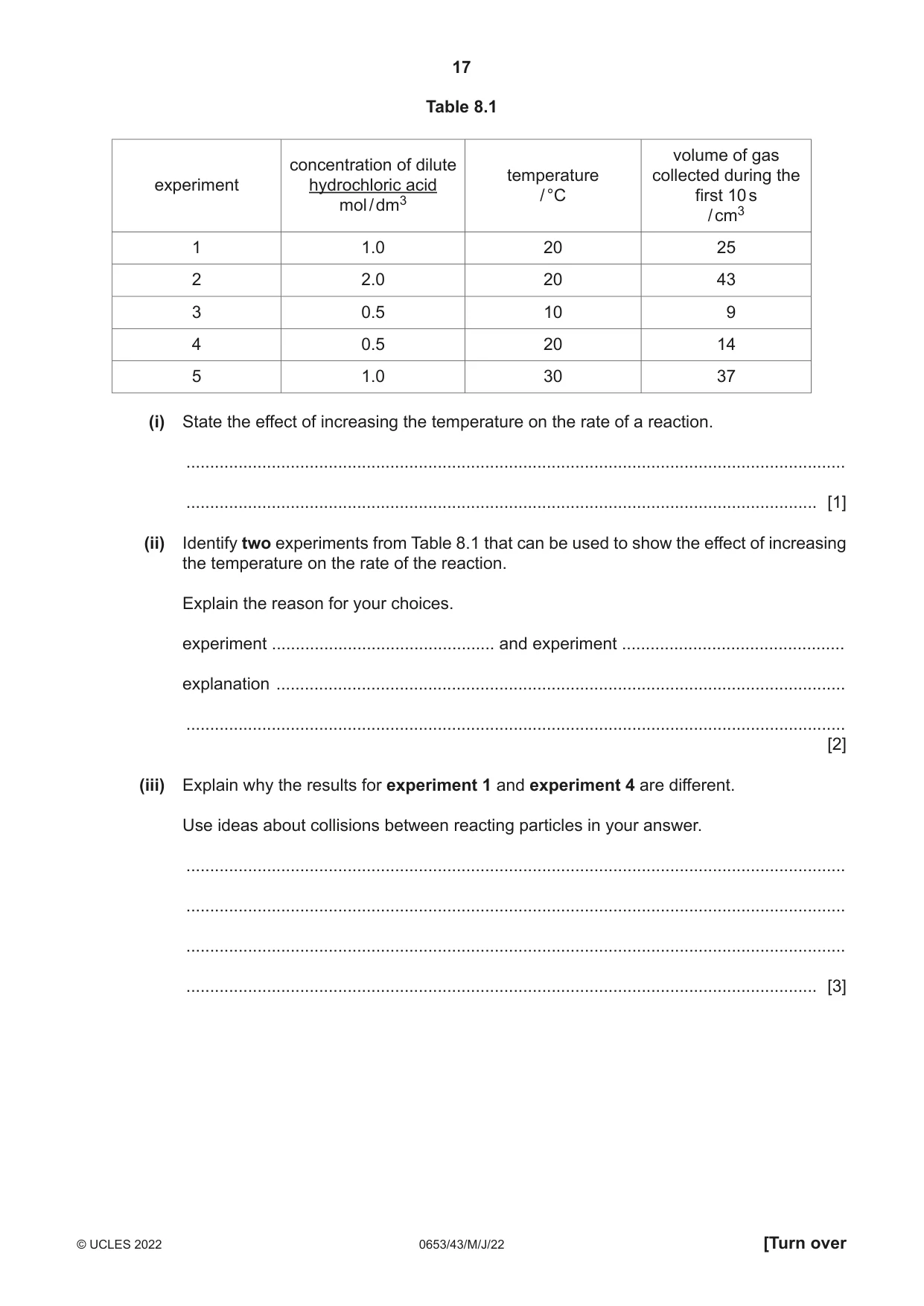
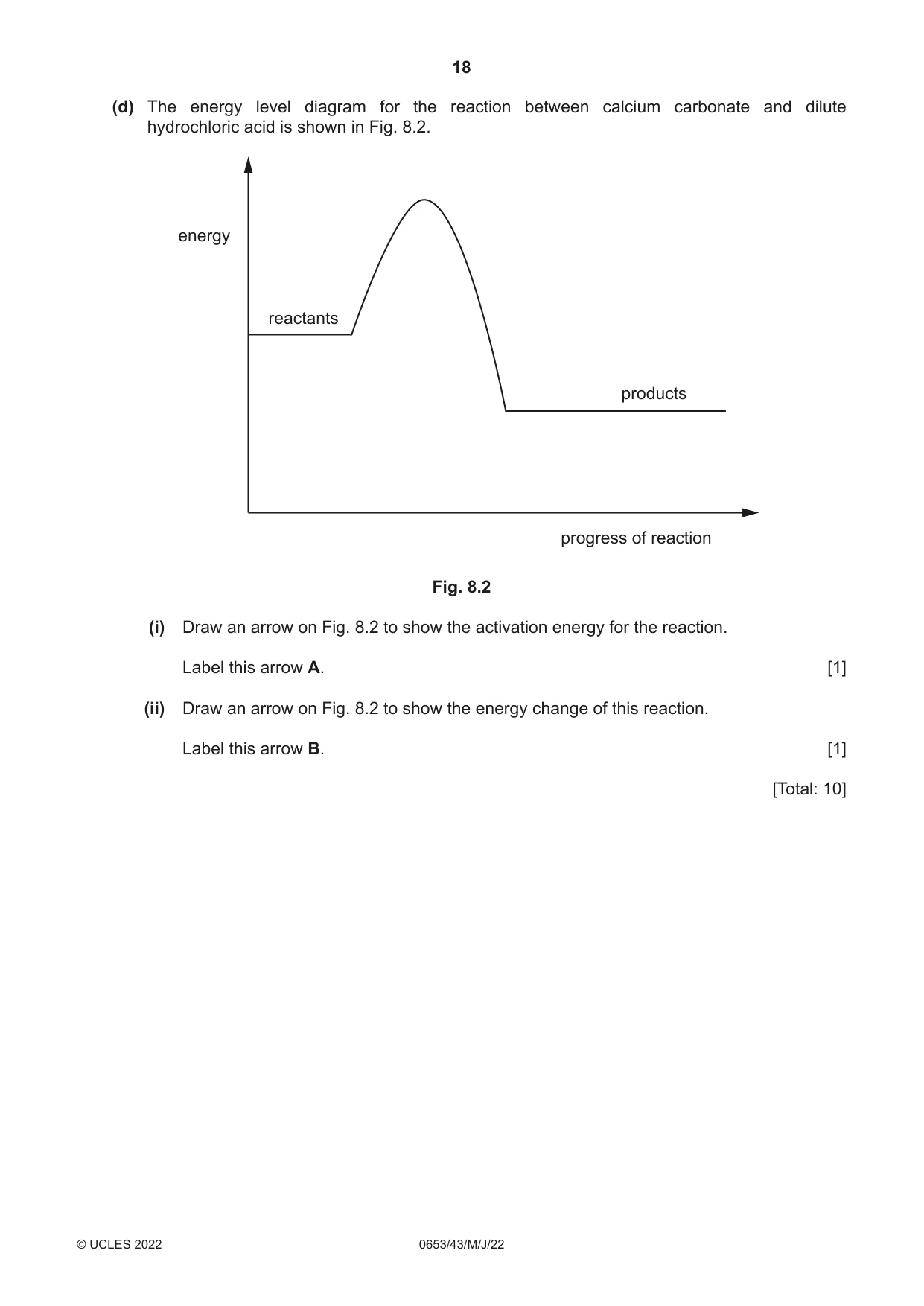
8 Calcium carbonate reacts with dilute hydrochloric acid to produce a gas. (a) Name the gas produced in this reaction. ............................................................................................................................................. [1] (b) The reaction also produces calcium chloride. Calcium chloride contains calcium ions, Ca2+, and chloride ions, Cl –. Deduce the formula for calcium chloride. ............................................................................................................................................. [1] (c) In an investigation, 5 g of calcium carbonate reacts with 20 cm3 of dilute hydrochloric acid, as shown in Fig. 8.1. The volume of gas collected during the first 10 s is measured. gas syringe 20 cm3 dilute hydrochloric acid bubbles of gas 5 g calcium carbonate Fig. 8.1 The experiment is repeated using the same mass of calcium carbonate and the same volume of dilute acid. Different concentrations of dilute acid and different temperatures are used. The results are shown in Table 8.1. Table 8.1 volume of gas concentration of dilute temperature collected during the experiment hydrochloric acid / °C first 10 s mol / dm3 / cm3 1 1.0 20 25 2 2.0 20 43 3 0.5 10 9 4 0.5 20 14 5 1.0 30 37 (i) State the effect of increasing the temperature on the rate of a reaction. ........................................................................................................................................... ..................................................................................................................................... [1] (ii) Identify two experiments from Table 8.1 that can be used to show the effect of increasing the temperature on the rate of the reaction. Explain the reason for your choices. experiment ............................................... and experiment ............................................... explanation ........................................................................................................................ ........................................................................................................................................... [2] (iii) Explain why the results for experiment 1 and experiment 4 are different. Use ideas about collisions between reacting particles in your answer. ........................................................................................................................................... ........................................................................................................................................... ........................................................................................................................................... ..................................................................................................................................... [3] (d) The energy level diagram for the reaction between calcium carbonate and dilute hydrochloric acid is shown in Fig. 8.2. energy reactants products progress of reaction Fig. 8.2 (i) Draw an arrow on Fig. 8.2 to show the activation energy for the reaction. Label this arrow A. [1] (ii) Draw an arrow on Fig. 8.2 to show the energy change of this reaction. Label this arrow B. [1] [Total: 10]
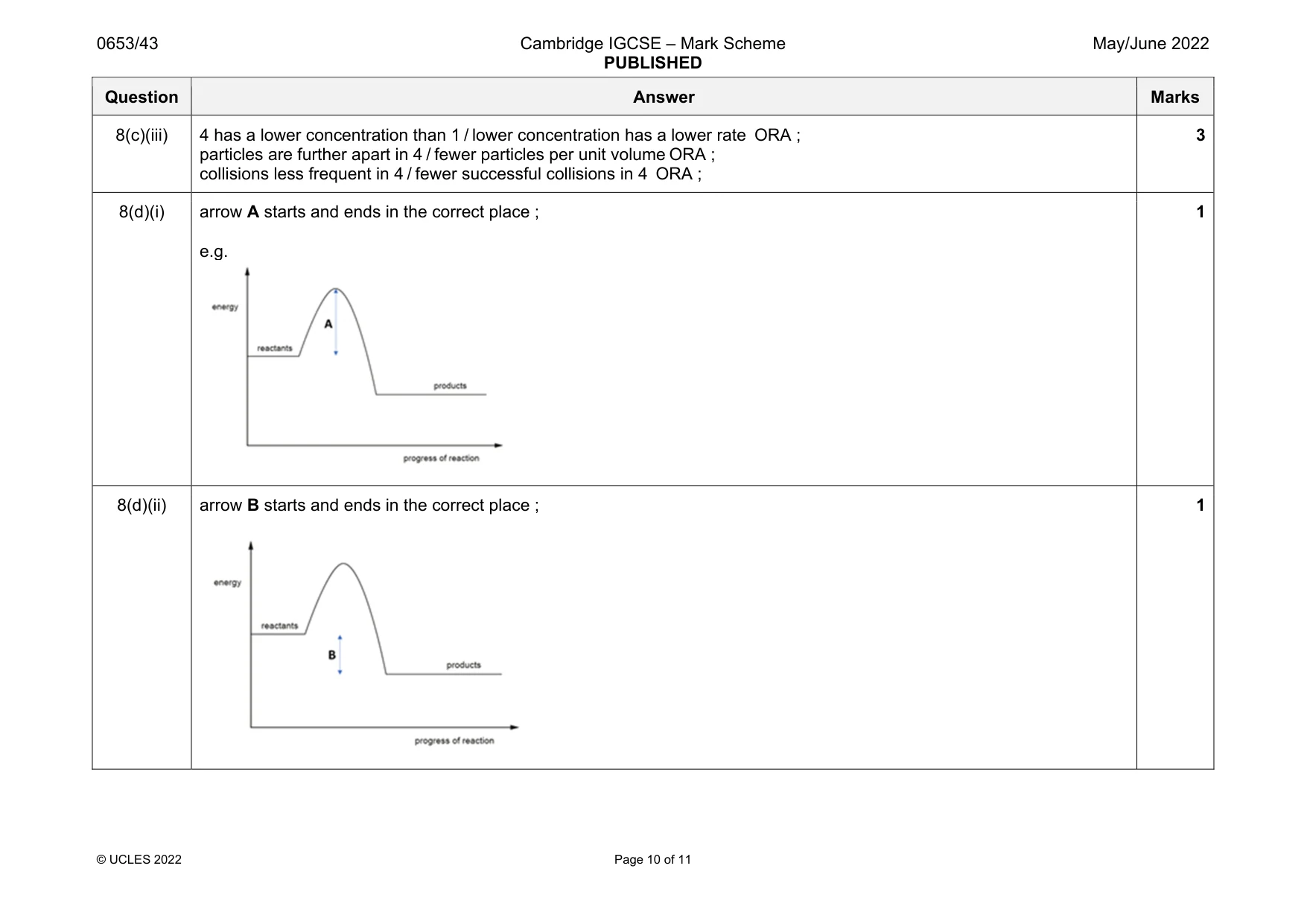
Mark scheme: 8(a) carbon dioxide ; 1 8(b) CaCl2 ; 1 8(c)(i) increases rate / higher rate / faster ; 1 8(c)(ii) 3 and 4 OR 1 and 5 ; need to keep concentration same / 3 and 4 both have concentration of 0.5 / 1 and 5 both have concentration of 1.0 ; 2 Question Answer Marks 8(c)(iii) 4 has a lower concentration than 1 / lower concentration has a lower rate ORA ; particles are further apart in 4 / fewer particles per unit volume ORA ; collisions less frequent in 4 / fewer successful collisions in 4 ORA ; 3 8(d)(i) arrow A starts and ends in the correct place ; e.g. 1 8(d)(ii) arrow B starts and ends in the correct place ; 1
Question 9
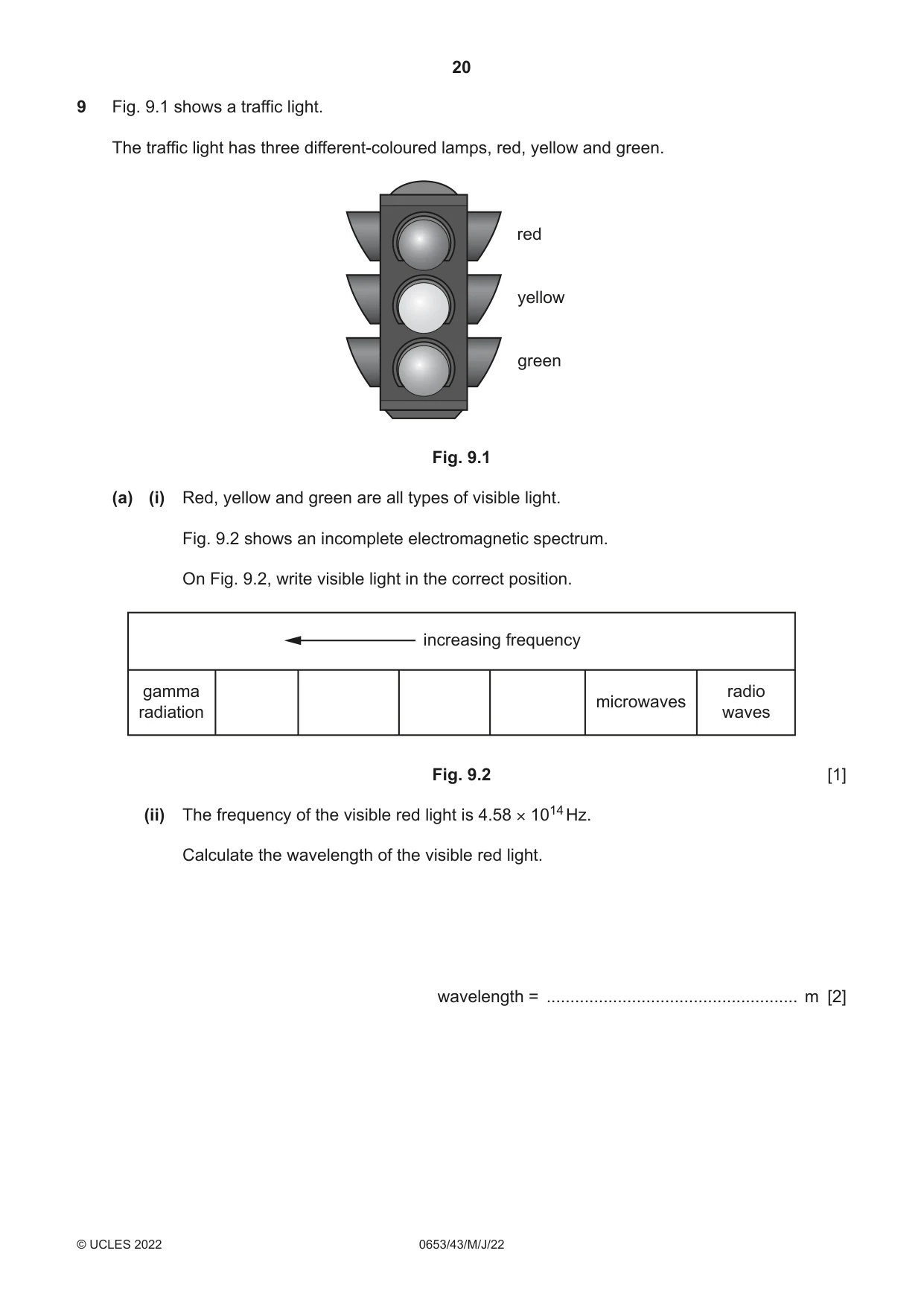
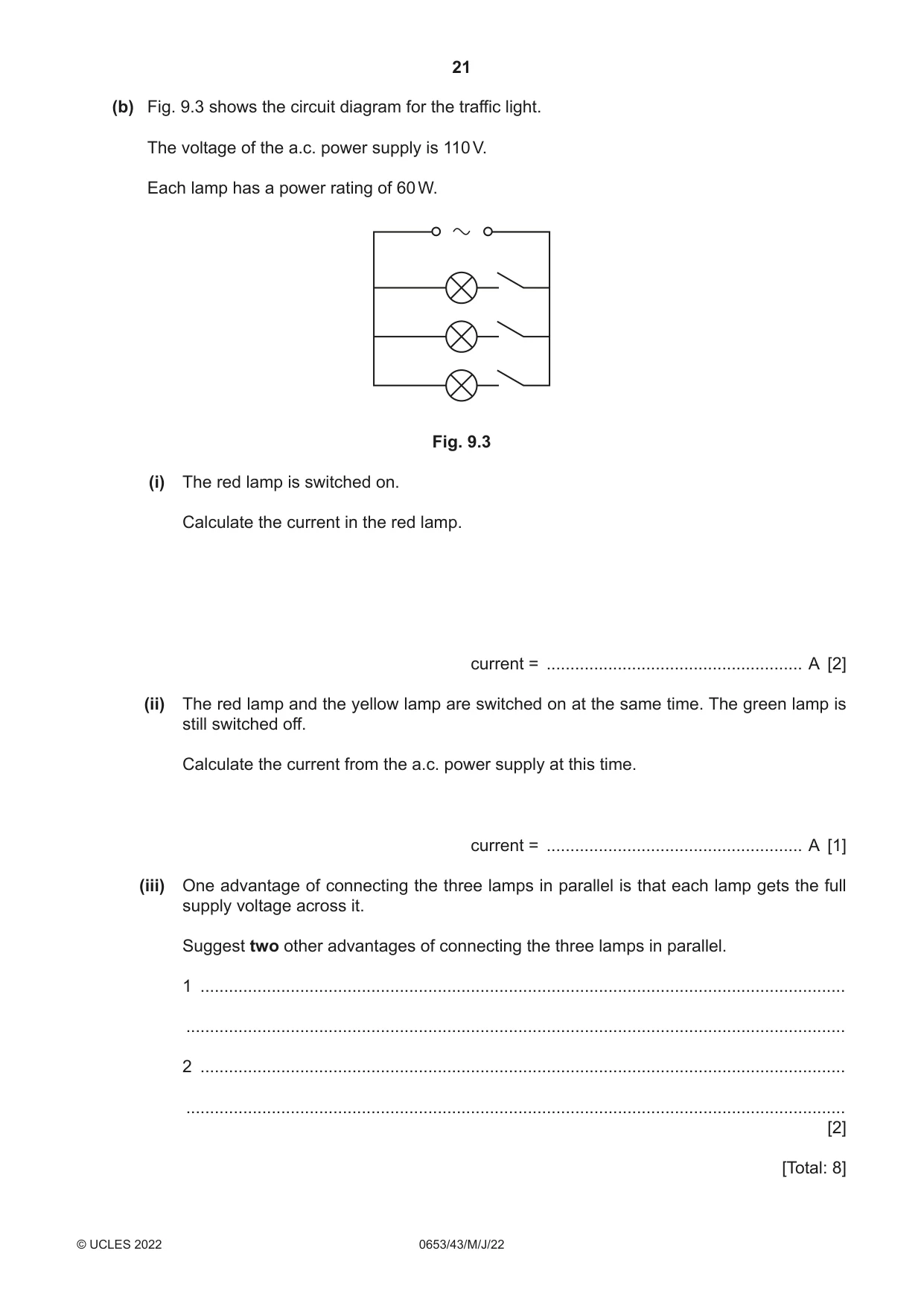
9 Fig. 9.1 shows a traffic light. The traffic light has three different-coloured lamps, red, yellow and green. red yellow green Fig. 9.1 (a) (i) Red, yellow and green are all types of visible light. Fig. 9.2 shows an incomplete electromagnetic spectrum. On Fig. 9.2, write visible light in the correct position. increasing frequency gamma radio microwaves radiation waves Fig. 9.2 [1] (ii) The frequency of the visible red light is 4.58 × 10¹⁴ Hz. Calculate the wavelength of the visible red light. wavelength = ..................................................... m [2] (b) Fig. 9.3 shows the circuit diagram for the traffic light. The voltage of the a.c. power supply is 110 V. Each lamp has a power rating of 60 W. Fig. 9.3 (i) The red lamp is switched on. Calculate the current in the red lamp. current = ...................................................... A [2] (ii) The red lamp and the yellow lamp are switched on at the same time. The green lamp is still switched off. Calculate the current from the a.c. power supply at this time. current = ...................................................... A [1] (iii) One advantage of connecting the three lamps in parallel is that each lamp gets the full supply voltage across it. Suggest two other advantages of connecting the three lamps in parallel. 1 ........................................................................................................................................ ........................................................................................................................................... 2 ........................................................................................................................................ ........................................................................................................................................... [2] [Total: 8]
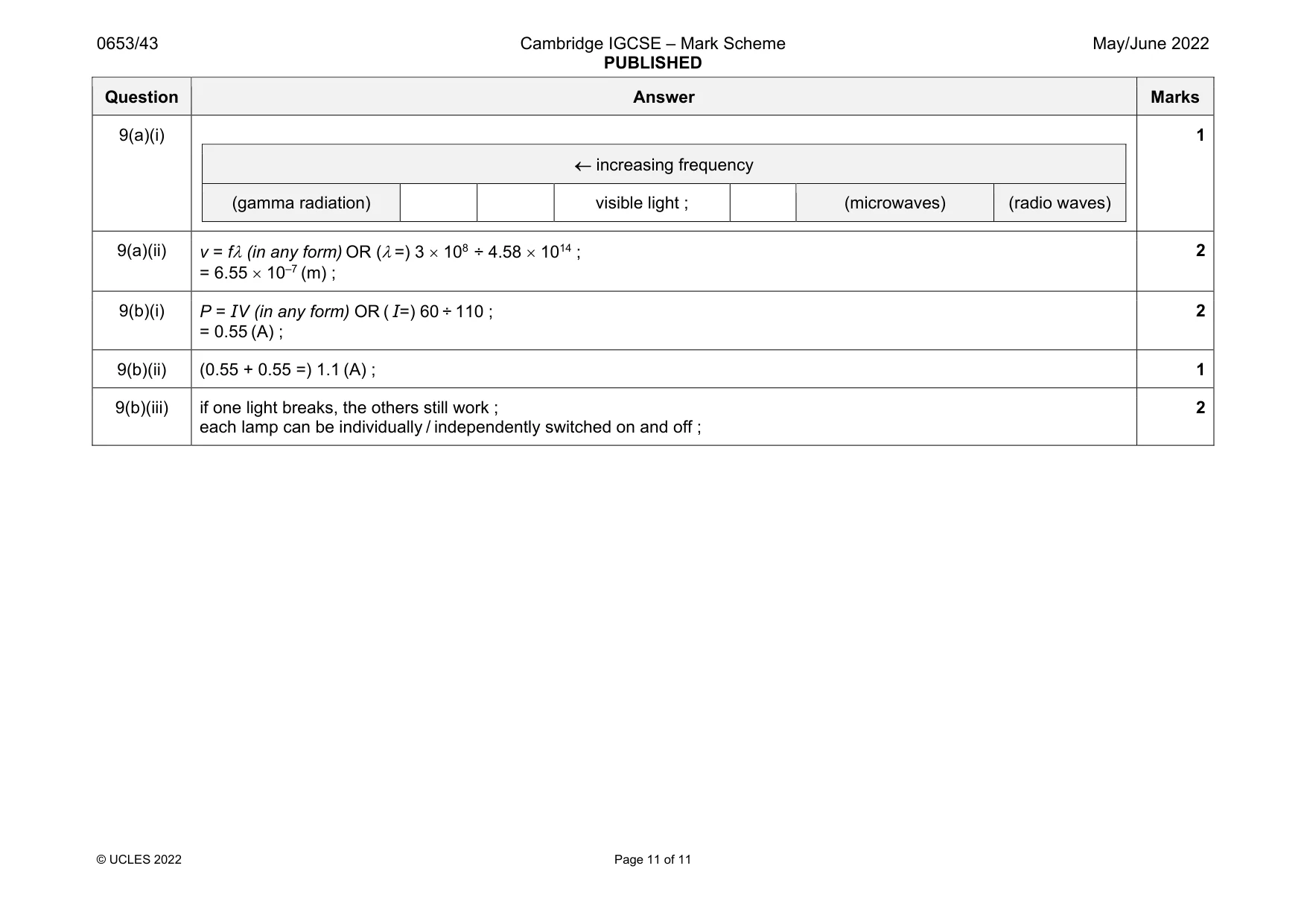
Mark scheme: 9(a)(i) increasing frequency (gamma radiation) visible light ; (microwaves) (radio waves) 1 9(a)(ii) v = f (in any form) OR ( =) 3 108 ÷ 4.58 1014 ; = 6.55 10–7 (m) ; 2 9(b)(i) P = IV (in any form) OR ( I=) 60 ÷ 110 ; = 0.55 (A) ; 2 9(b)(ii) (0.55 + 0.55 =) 1.1 (A) ; 1 9(b)(iii) if one light breaks, the others still work ; each lamp can be individually / independently switched on and off ; 2
What was in this paper
The subtopics covered by these 9 questions, and how many questions each got. Open one in a new tab to see every Cambridge question on it.
What you needed in this session
Cambridge’s own grade thresholds for 2022 May/June, Paper 4 · Variant 3. A higher threshold means an easier paper — the bar moves with how the cohort did.