Cambridge IGCSE Science - Combined 0653 — 2025 May/June Paper 4 · Variant 2
0653/42/M/J/25 · 9 questions · 80 marks · 75 min
The question paper and its mark scheme, free to read here and free to download. This is Cambridge’s own paper, exactly as it was sat.
Question paper20 pages

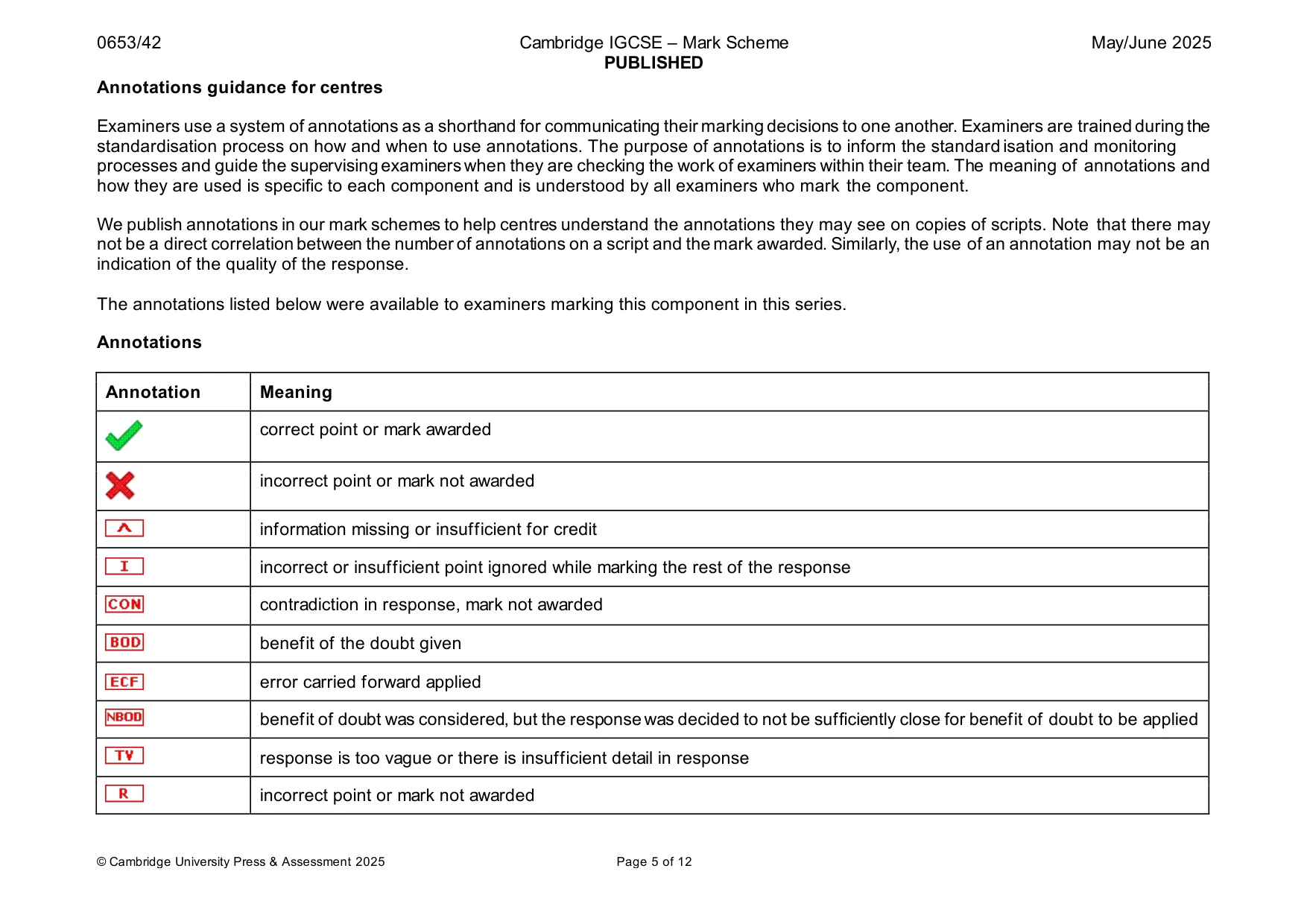
Mark scheme12 pages
Answers below. Sit the paper first if you are practising.
Questions as text
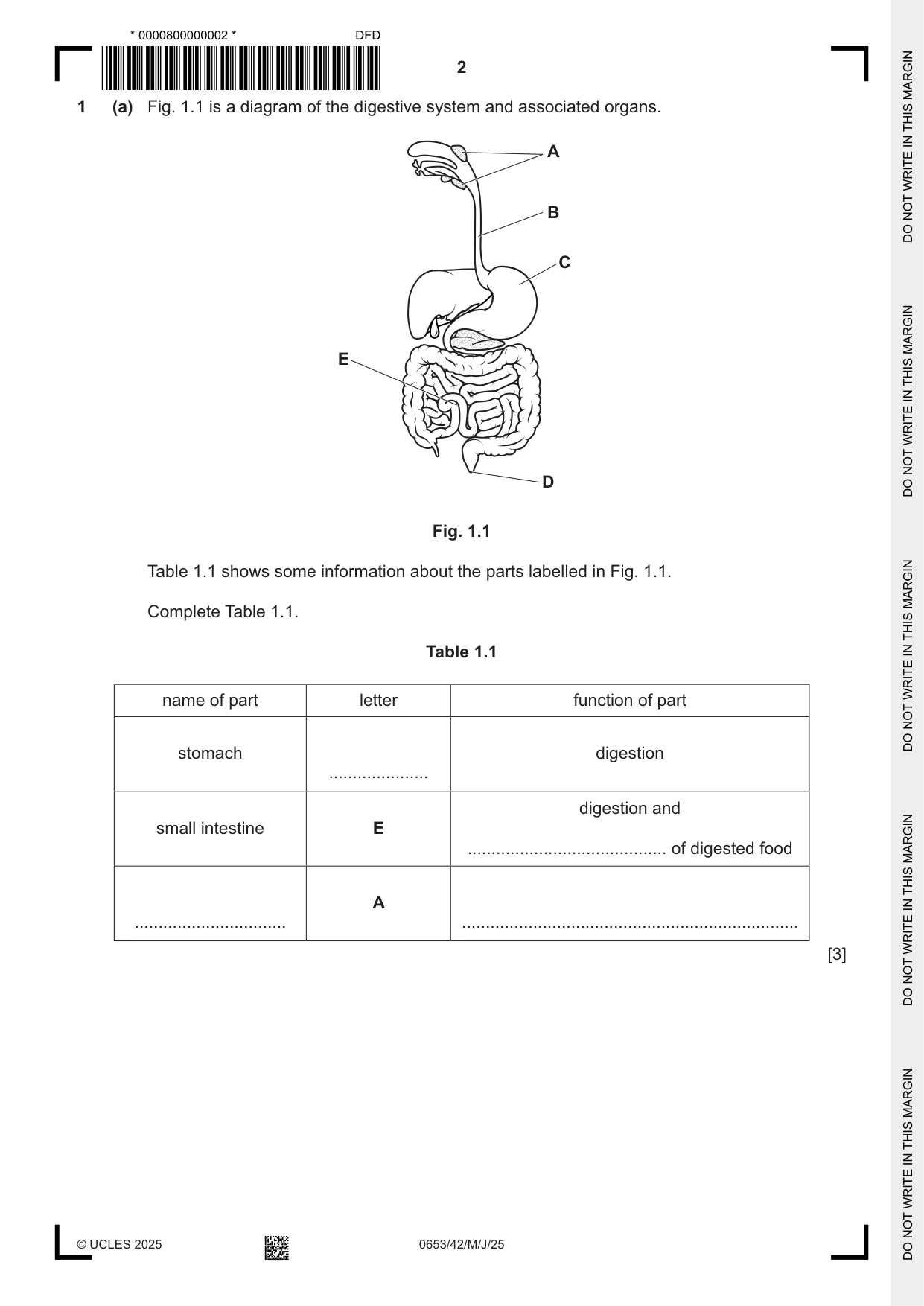
Q1 · A diagram of the digestive system and associated organs
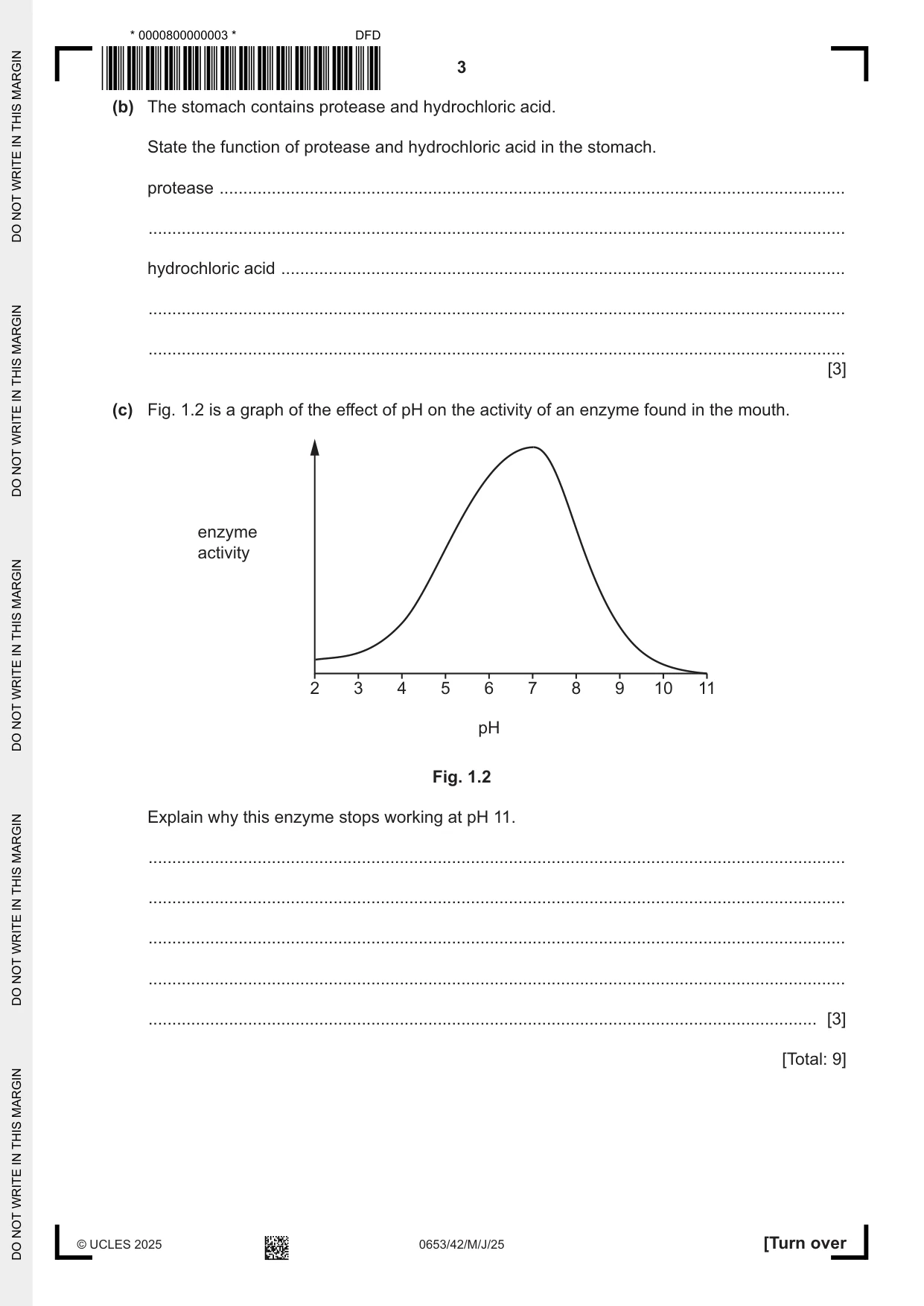
1 (a) Fig. 1.1 is a diagram of the digestive system and associated organs. A B C E D Fig. 1.1 Table 1.1 shows some information about the parts labelled in Fig. 1.1. Complete Table 1.1. Table 1.1 name of part letter function of part stomach digestion ..................... digestion and small intestine E .......................................... of digested food A ................................ ....................................................................... [3] (b) The stomach contains protease and hydrochloric acid. State the function of protease and hydrochloric acid in the stomach. protease .................................................................................................................................... ................................................................................................................................................... hydrochloric acid ....................................................................................................................... ................................................................................................................................................... ................................................................................................................................................... [3] (c) Fig. 1.2 is a graph of the effect of pH on the activity of an enzyme found in the mouth. enzyme activity 2 3 4 5 6 7 8 9 10 11 pH Fig. 1.2 Explain why this enzyme stops working at pH 11. ................................................................................................................................................... ................................................................................................................................................... ................................................................................................................................................... ................................................................................................................................................... ............................................................................................................................................. [3] [Total: 9]
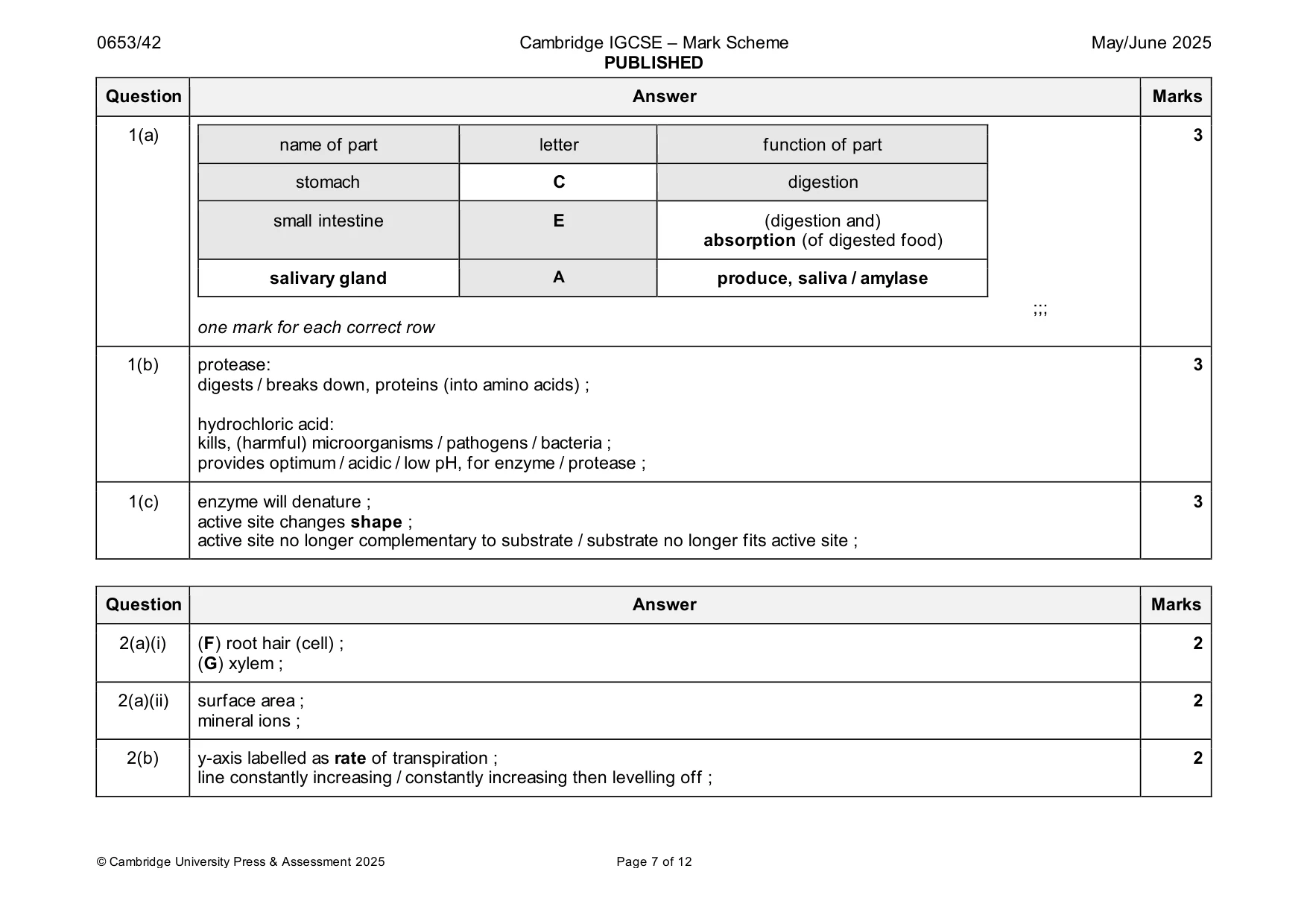
Mark scheme: Question Answer Marks 1(a) 3 name of part letter function of part stomach C digestion small intestine E (digestion and) absorption (of digested food) salivary gland A produce, saliva / amylase ;;; one mark for each correct row 1(b) protease: 3 digests / breaks down, proteins (into amino acids) ; hydrochloric acid: kills, (harmful) microorganisms / pathogens / bacteria ; provides optimum / acidic / low pH, for enzyme / protease ; 1(c) enzyme will denature ; 3 active site changes shape ; active site no longer complementary to substrate / substrate no longer fits active site ;
Q2 · The structure of a plant root
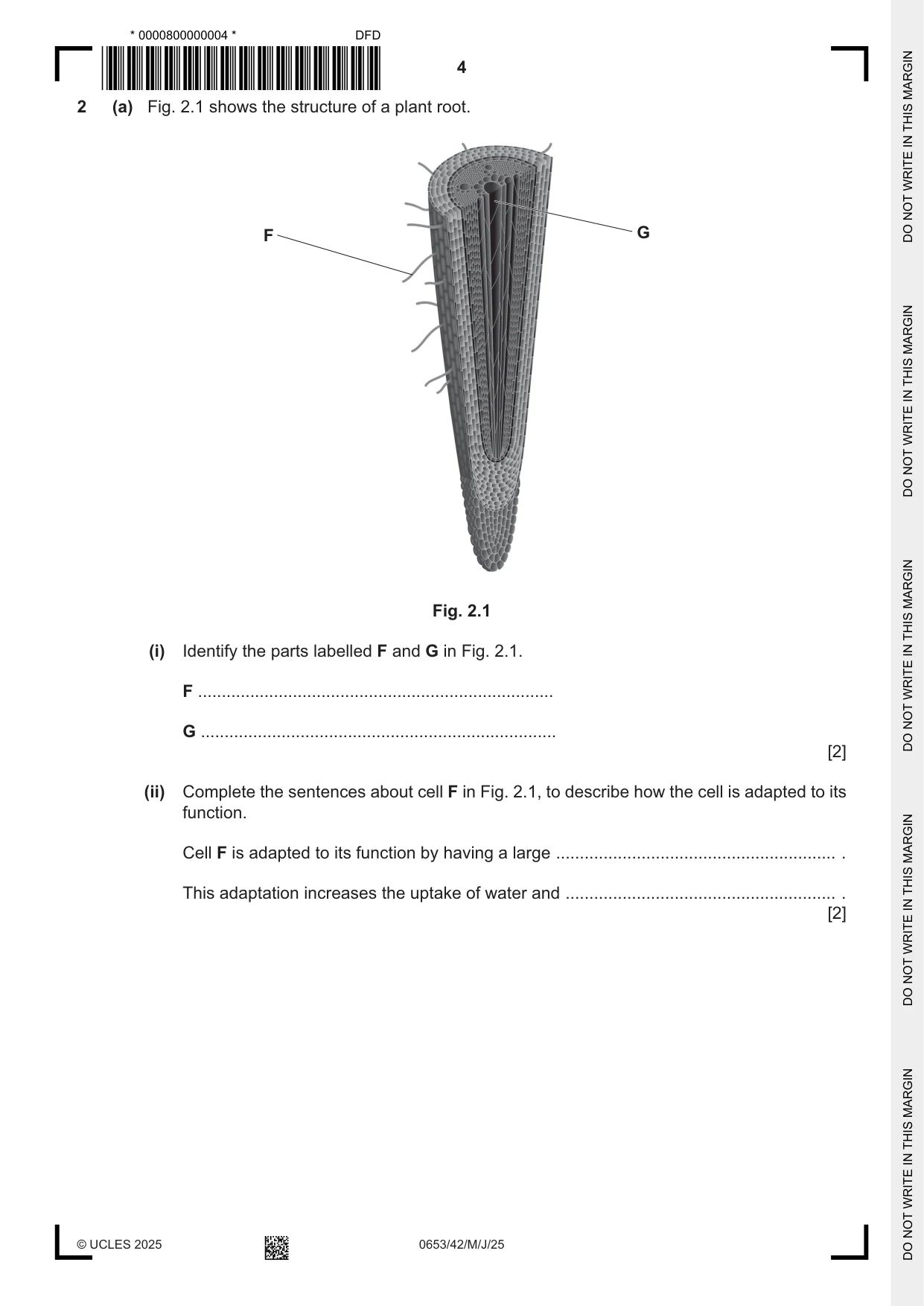
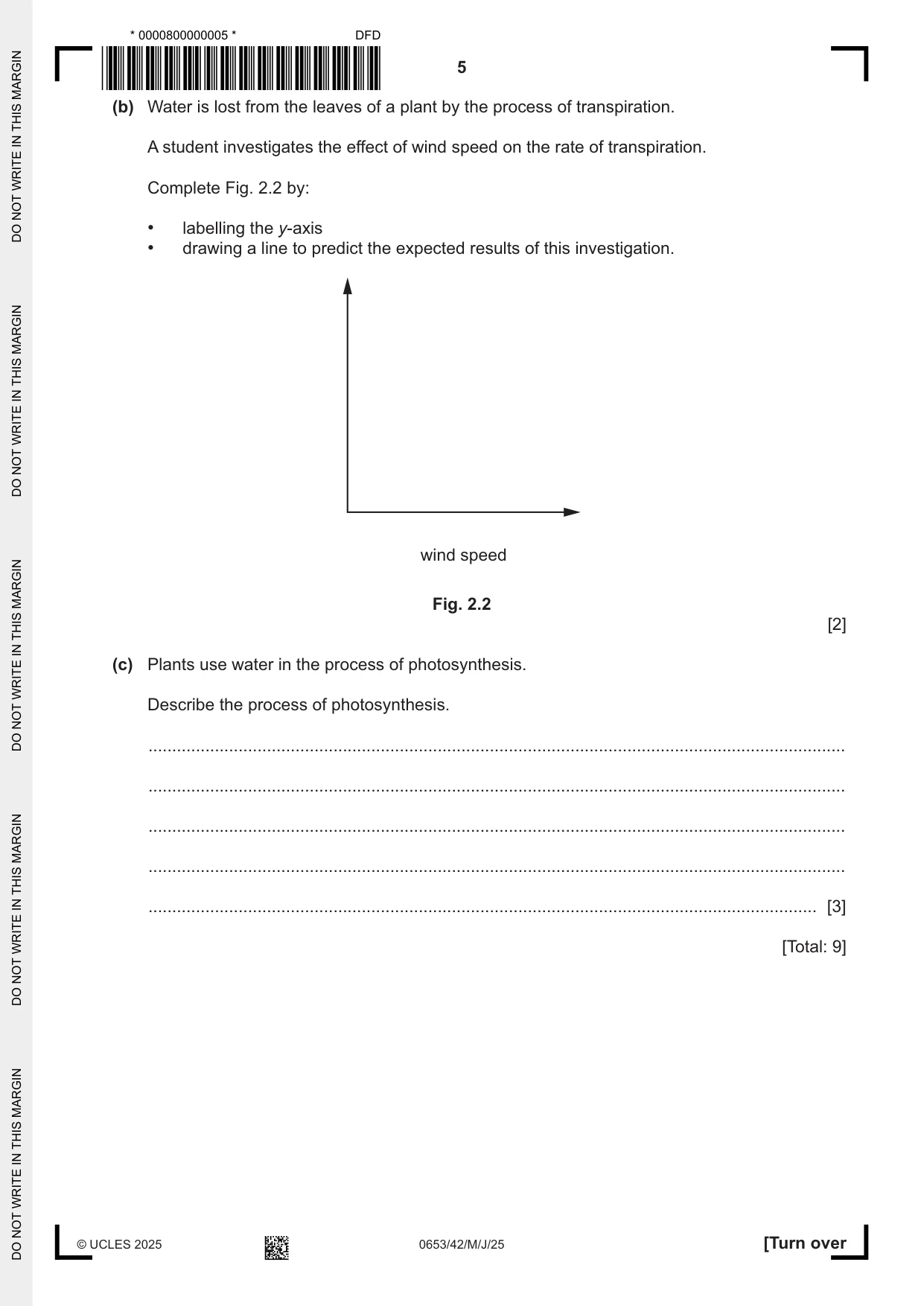
2 (a) Fig. 2.1 shows the structure of a plant root. F G Fig. 2.1 (i) Identify the parts labelled F and G in Fig. 2.1. F ........................................................................... G ........................................................................... [2] (ii) Complete the sentences about cell F in Fig. 2.1, to describe how the cell is adapted to its function. Cell F is adapted to its function by having a large ........................................................... . This adaptation increases the uptake of water and ......................................................... . [2] (b) Water is lost from the leaves of a plant by the process of transpiration. A student investigates the effect of wind speed on the rate of transpiration. Complete Fig. 2.2 by: • labelling the y-axis • drawing a line to predict the expected results of this investigation. wind speed Fig. 2.2 [2] (c) Plants use water in the process of photosynthesis. Describe the process of photosynthesis. ................................................................................................................................................... ................................................................................................................................................... ................................................................................................................................................... ................................................................................................................................................... ............................................................................................................................................. [3] [Total: 9]
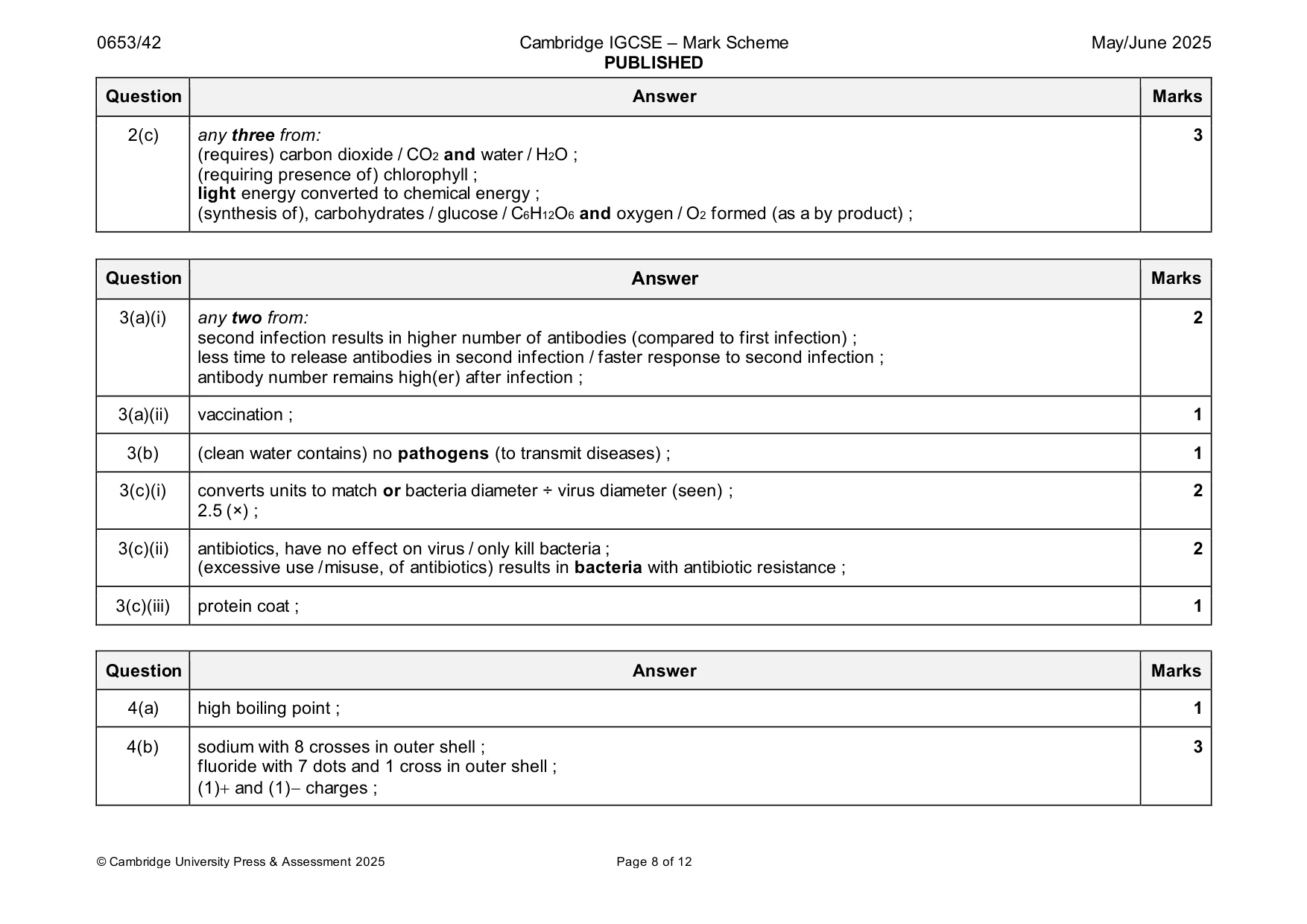
Mark scheme: 2(a)(i) (F) root hair (cell) ; 2 (G) xylem ; 2(a)(ii) surface area ; 2 mineral ions ; 2(b) y-axis labelled as rate of transpiration ; 2 line constantly increasing / constantly increasing then levelling off ; 2(c) any three from: 3 (requires) carbon dioxide / CO2 and water / H2O ; (requiring presence of) chlorophyll ; light energy converted to chemical energy ; (synthesis of), carbohydrates / glucose / C6H12O6 and oxygen / O2 formed (as a by product) ;
Q3 · A person is infected by a pathogen
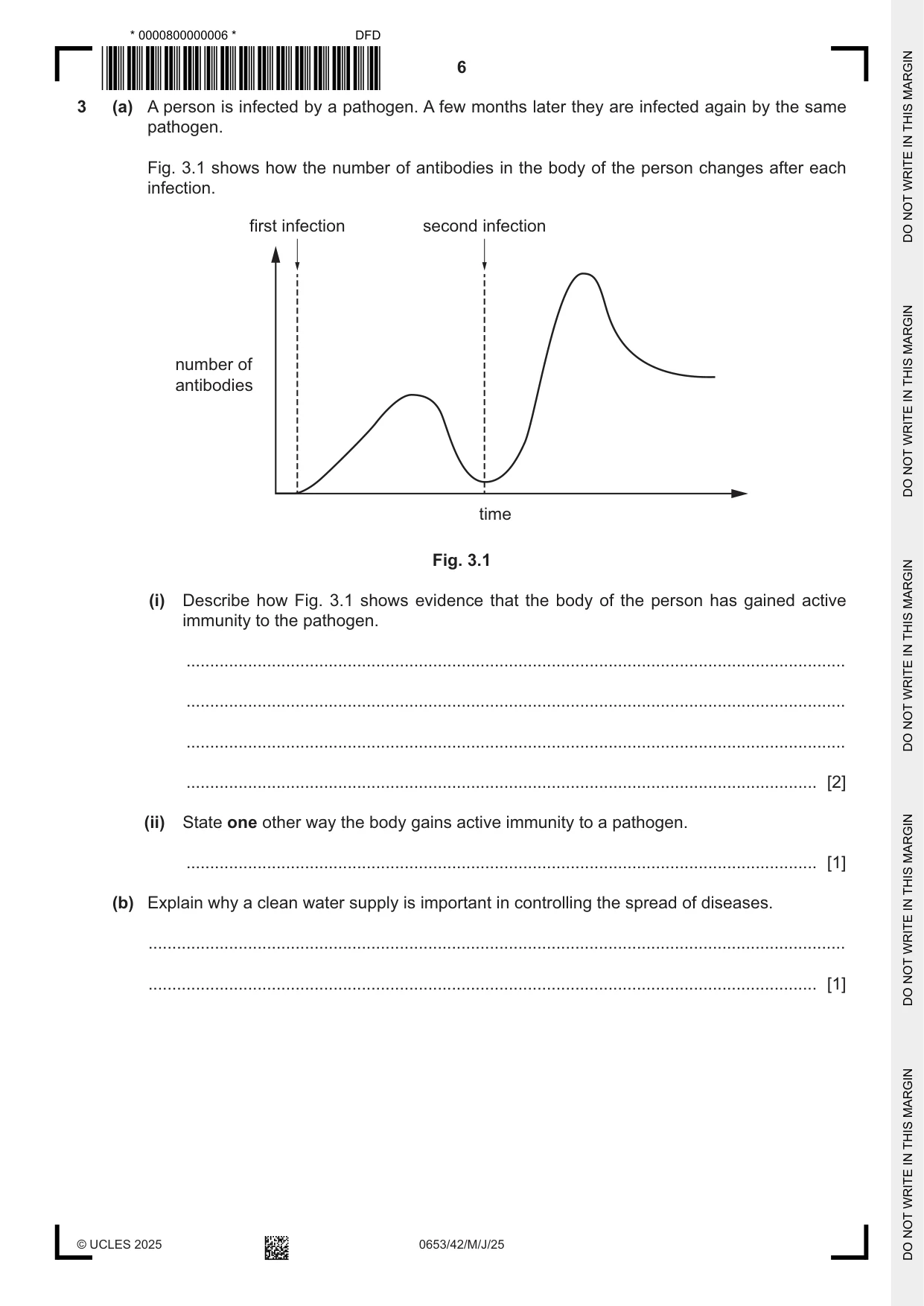
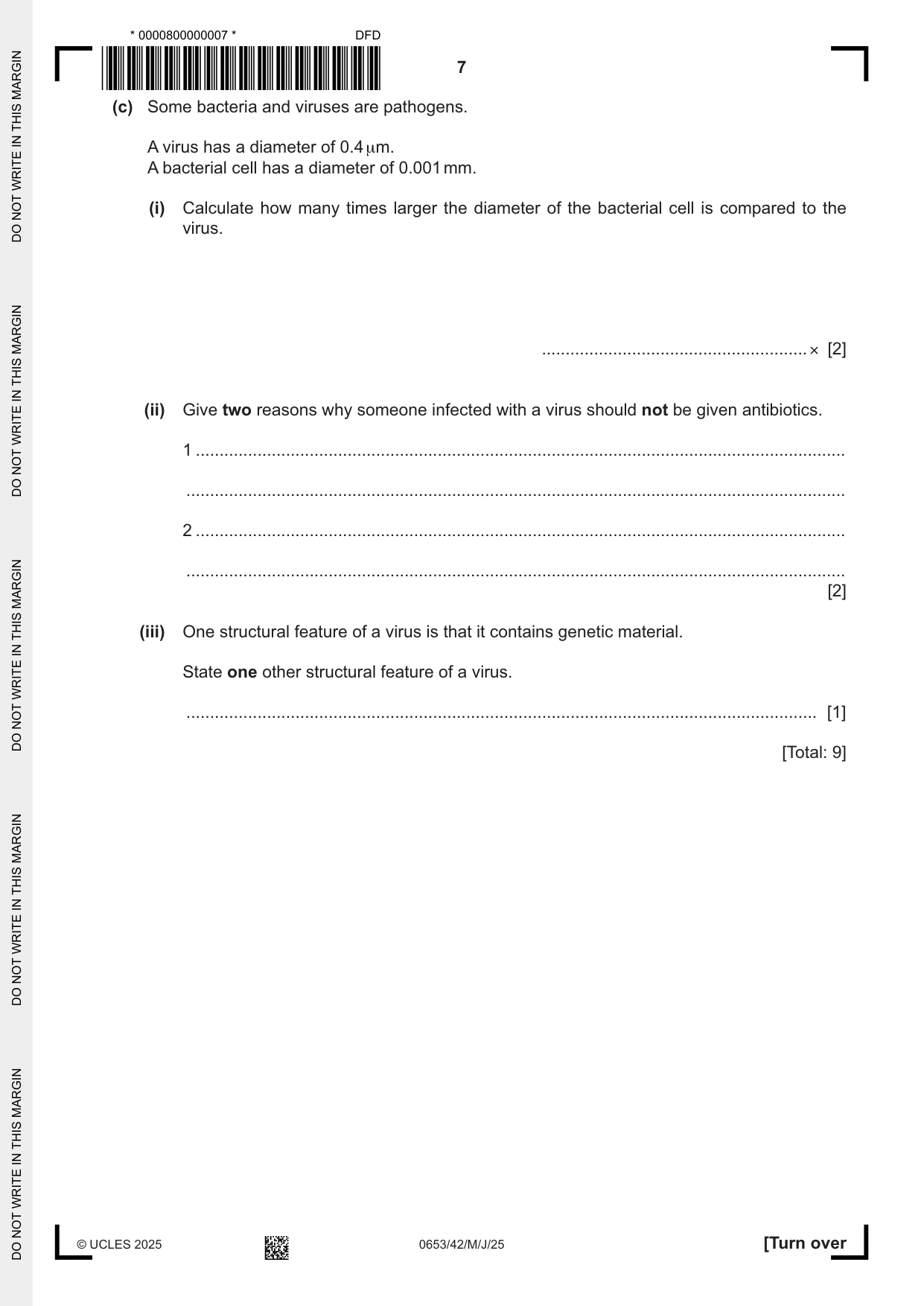
3 (a) A person is infected by a pathogen. A few months later they are infected again by the same pathogen. Fig. 3.1 shows how the number of antibodies in the body of the person changes after each infection. first infection second infection number of antibodies time Fig. 3.1 (i) Describe how Fig. 3.1 shows evidence that the body of the person has gained active immunity to the pathogen. ........................................................................................................................................... ........................................................................................................................................... ........................................................................................................................................... ..................................................................................................................................... [2] (ii) State one other way the body gains active immunity to a pathogen. ..................................................................................................................................... [1] (b) Explain why a clean water supply is important in controlling the spread of diseases. ................................................................................................................................................... ............................................................................................................................................. [1] (c) Some bacteria and viruses are pathogens. A virus has a diameter of 0.4 µm. A bacterial cell has a diameter of 0.001 mm. (i) Calculate how many times larger the diameter of the bacterial cell is compared to the virus. ........................................................× [2] (ii) Give two reasons why someone infected with a virus should not be given antibiotics. 1 ......................................................................................................................................... ........................................................................................................................................... 2 ......................................................................................................................................... ........................................................................................................................................... [2] (iii) One structural feature of a virus is that it contains genetic material. State one other structural feature of a virus. ..................................................................................................................................... [1] [Total: 9]
Mark scheme: 3(a)(i) any two from: 2 second infection results in higher number of antibodies (compared to first infection) ; less time to release antibodies in second infection / faster response to second infection ; antibody number remains high(er) after infection ; 3(a)(ii) vaccination ; 1 3(b) (clean water contains) no pathogens (to transmit diseases) ; 1 3(c)(i) converts units to match or bacteria diameter ÷ virus diameter (seen) ; 2 2.5 (×) ; 3(c)(ii) antibiotics, have no effect on virus / only kill bacteria ; 2 (excessive use / misuse, of antibiotics) results in bacteria with antibiotic resistance ; 3(c)(iii) protein coat ; 1
Q4 · Sodium fluoride, NaF, is an ionic compound
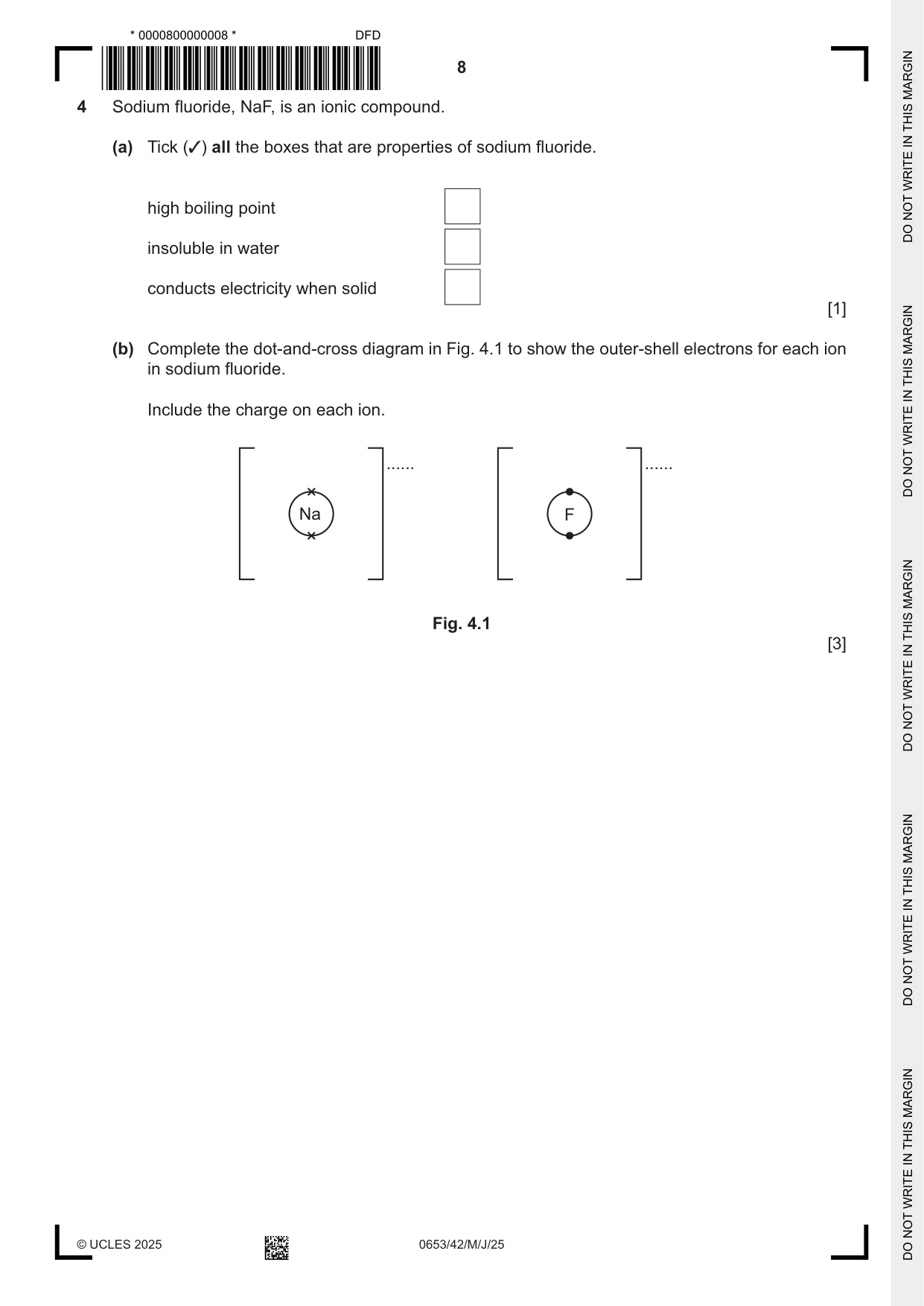
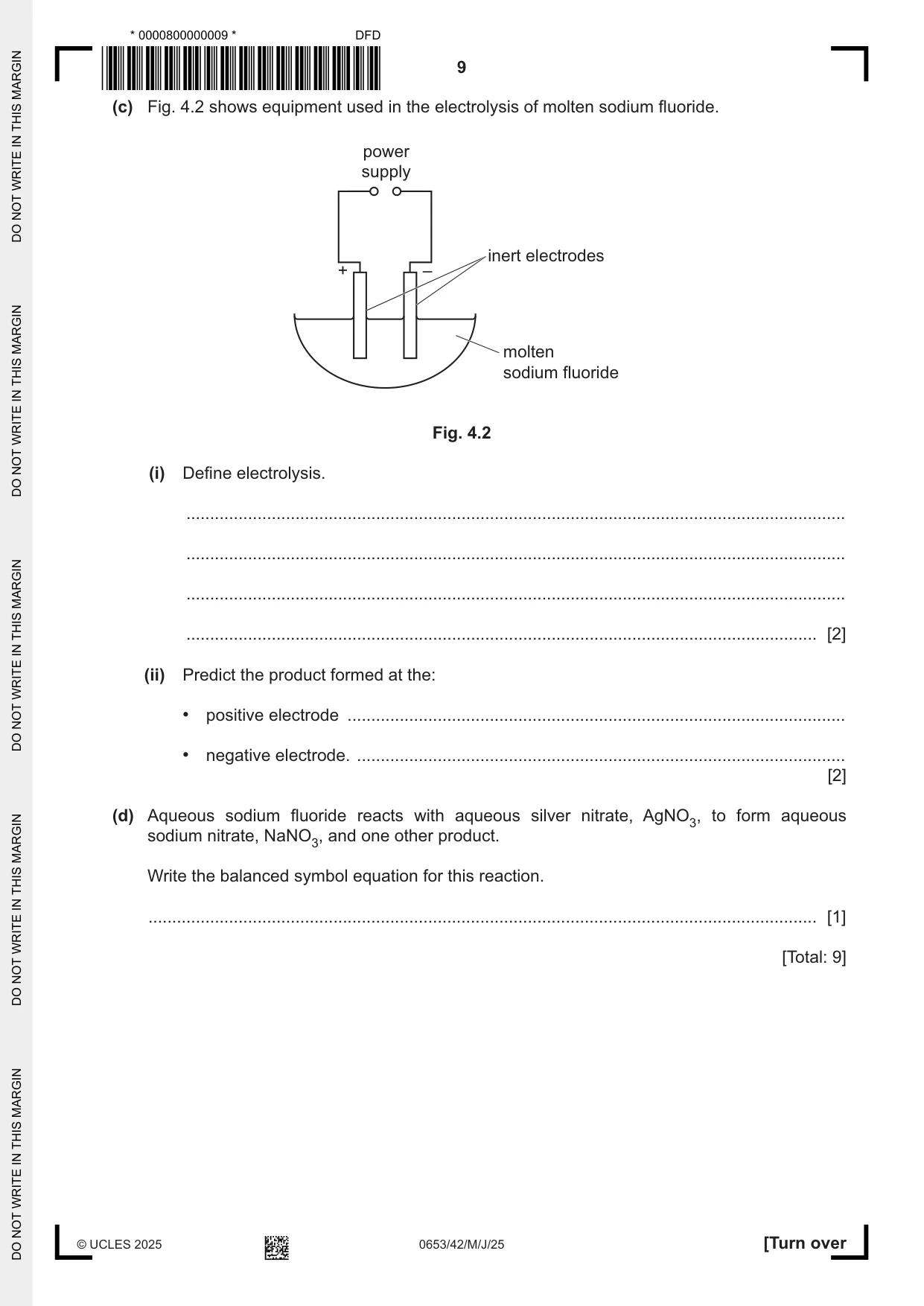
4 Sodium fluoride, NaF, is an ionic compound. (a) Tick (3) all the boxes that are properties of sodium fluoride. high boiling point insoluble in water conducts electricity when solid [1] (b) Complete the dot-and-cross diagram in Fig. 4.1 to show the outer-shell electrons for each ion in sodium fluoride. Include the charge on each ion. ...... ...... Na F Fig. 4.1 [3] (c) Fig. 4.2 shows equipment used in the electrolysis of molten sodium fluoride. power supply inert electrodes + – molten sodium fluoride Fig. 4.2 (i) Define electrolysis. ........................................................................................................................................... ........................................................................................................................................... ........................................................................................................................................... ..................................................................................................................................... [2] (ii) Predict the product formed at the: • positive electrode ......................................................................................................... • negative electrode. ....................................................................................................... [2] (d) Aqueous sodium fluoride reacts with aqueous silver nitrate, AgNO3, to form aqueous sodium nitrate, NaNO3, and one other product. Write the balanced symbol equation for this reaction. ............................................................................................................................................. [1] [Total: 9]
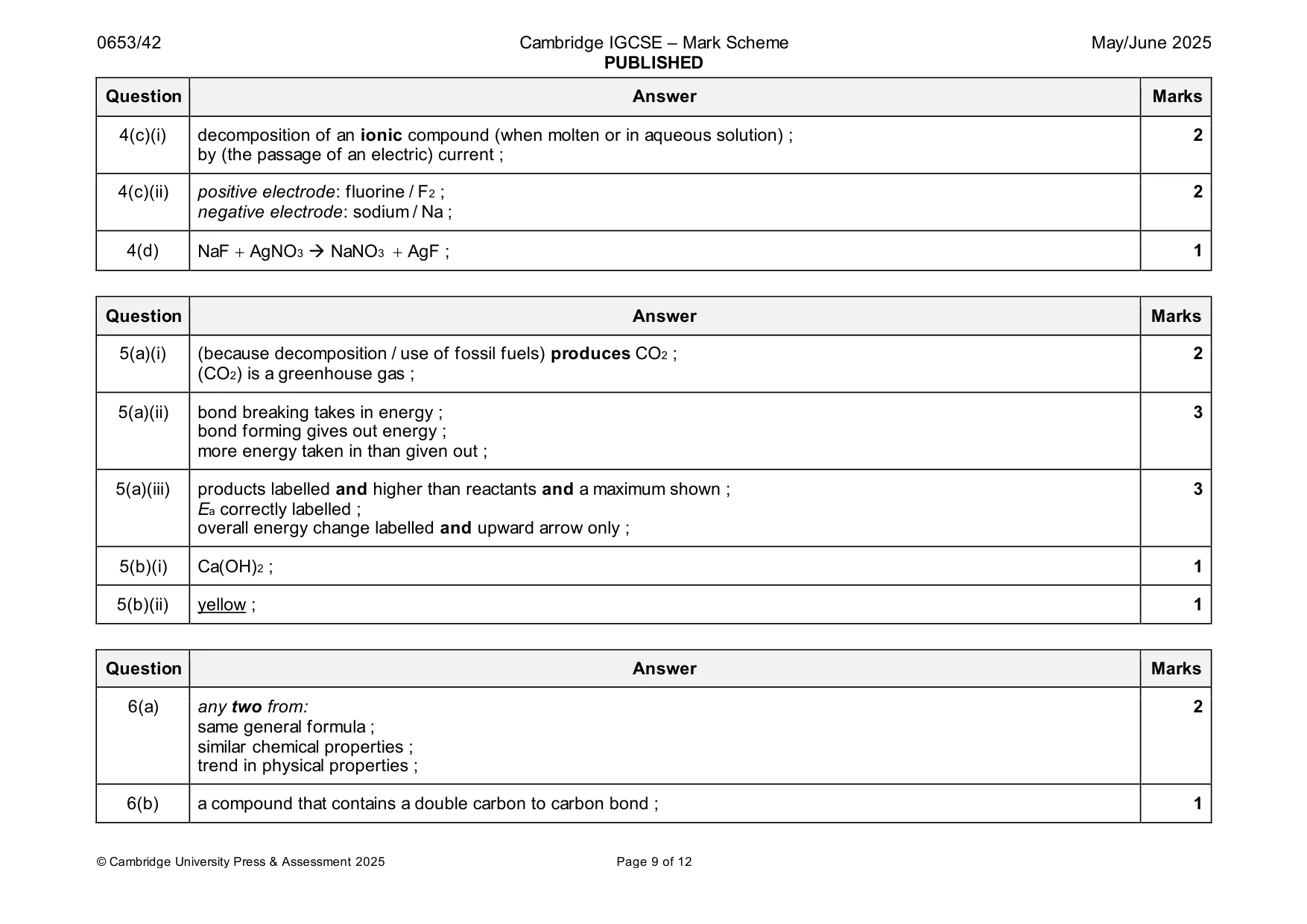
Mark scheme: 4(a) high boiling point ; 1 4(b) sodium with 8 crosses in outer shell ; 3 fluoride with 7 dots and 1 cross in outer shell ; (1)+ and (1)− charges ; 4(c)(i) decomposition of an ionic compound (when molten or in aqueous solution) ; 2 by (the passage of an electric) current ; 4(c)(ii) positive electrode: fluorine / F2 ; 2 negative electrode: sodium / Na ; 4(d) NaF + AgNO3 → NaNO3 + AgF ; 1
Q5 · Calcium oxide, CaO, is used to make cement
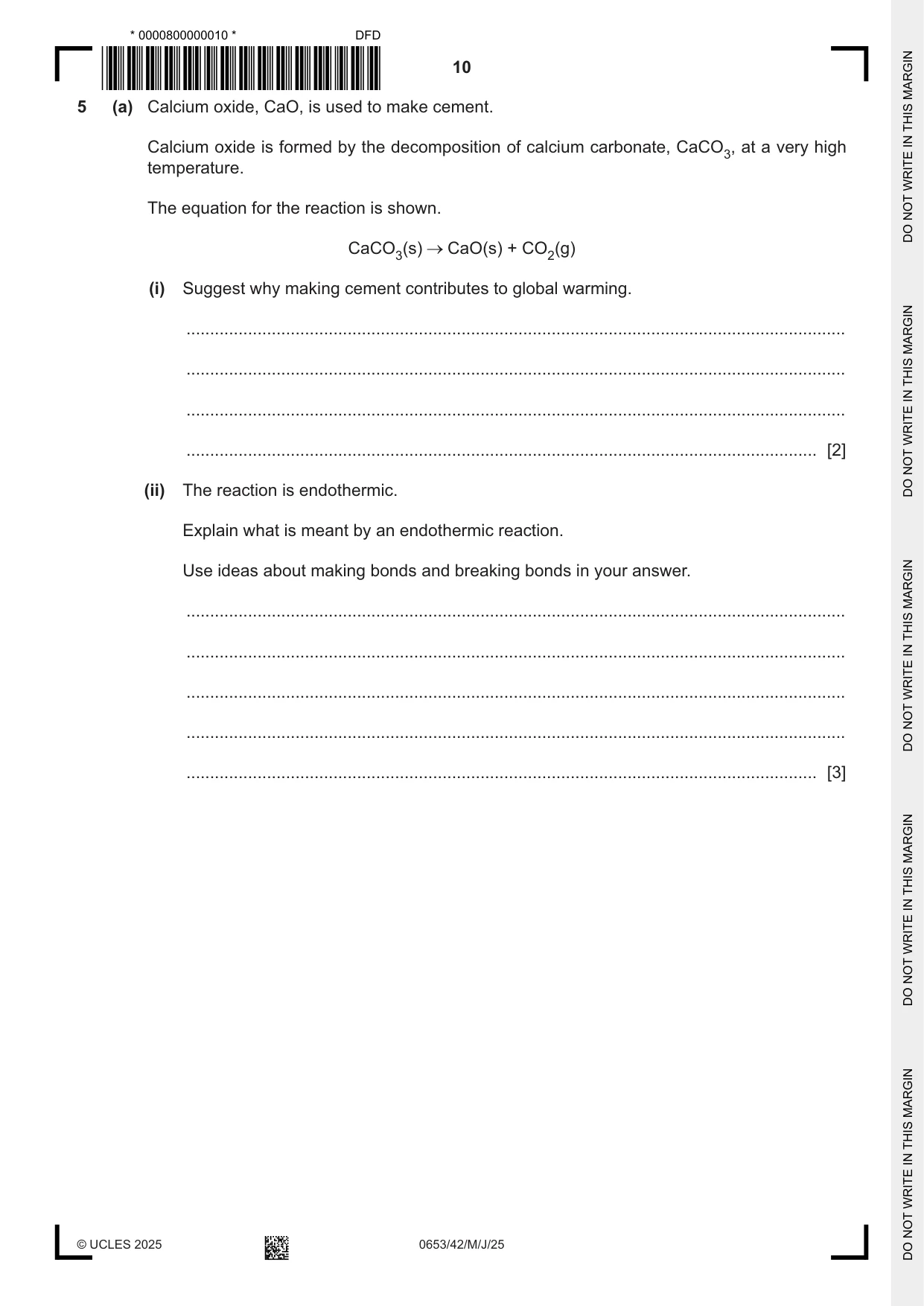
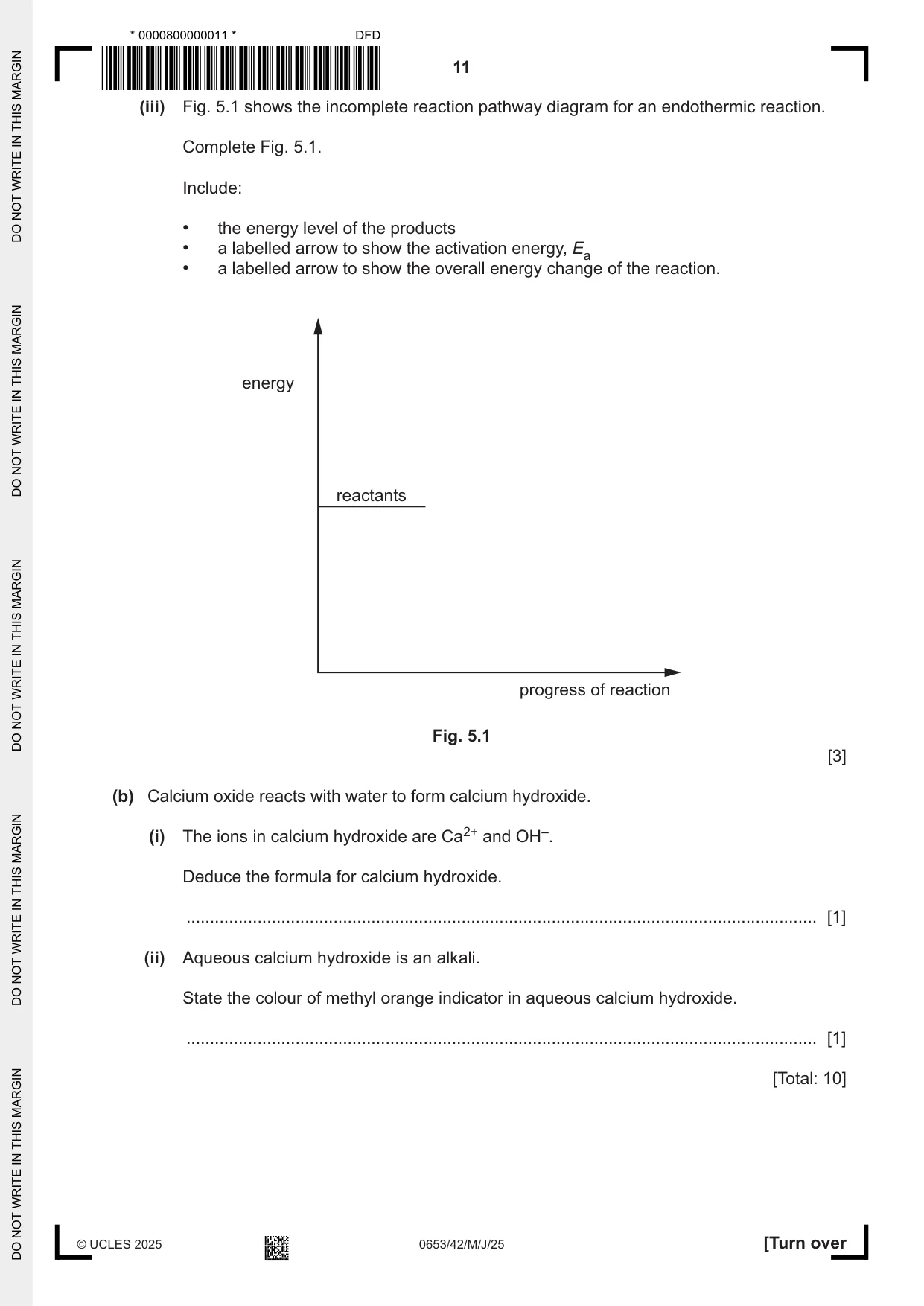
5 (a) Calcium oxide, CaO, is used to make cement. Calcium oxide is formed by the decomposition of calcium carbonate, CaCO3, at a very high temperature. The equation for the reaction is shown. CaCO3(s) CaO(s) + CO2(g) (i) Suggest why making cement contributes to global warming. ........................................................................................................................................... ........................................................................................................................................... ........................................................................................................................................... ..................................................................................................................................... [2] (ii) The reaction is endothermic. Explain what is meant by an endothermic reaction. Use ideas about making bonds and breaking bonds in your answer. ........................................................................................................................................... ........................................................................................................................................... ........................................................................................................................................... ........................................................................................................................................... ..................................................................................................................................... [3] (iii) Fig. 5.1 shows the incomplete reaction pathway diagram for an endothermic reaction. Complete Fig. 5.1. Include: • the energy level of the products • a labelled arrow to show the activation energy, Ea • a labelled arrow to show the overall energy change of the reaction. energy reactants progress of reaction Fig. 5.1 [3] (b) Calcium oxide reacts with water to form calcium hydroxide. (i) The ions in calcium hydroxide are Ca2+ and OH–. Deduce the formula for calcium hydroxide. ..................................................................................................................................... [1] (ii) Aqueous calcium hydroxide is an alkali. State the colour of methyl orange indicator in aqueous calcium hydroxide. ..................................................................................................................................... [1] [Total: 10]
Mark scheme: 5(a)(i) (because decomposition / use of fossil fuels) produces CO2 ; 2 (CO2) is a greenhouse gas ; 5(a)(ii) bond breaking takes in energy ; 3 bond forming gives out energy ; more energy taken in than given out ; 5(a)(iii) products labelled and higher than reactants and a maximum shown ; 3 Ea correctly labelled ; overall energy change labelled and upward arrow only ; 5(b)(i) Ca(OH)2 ; 1 5(b)(ii) yellow ; 1
Q6 · Alkanes and alkenes are two different homologous series
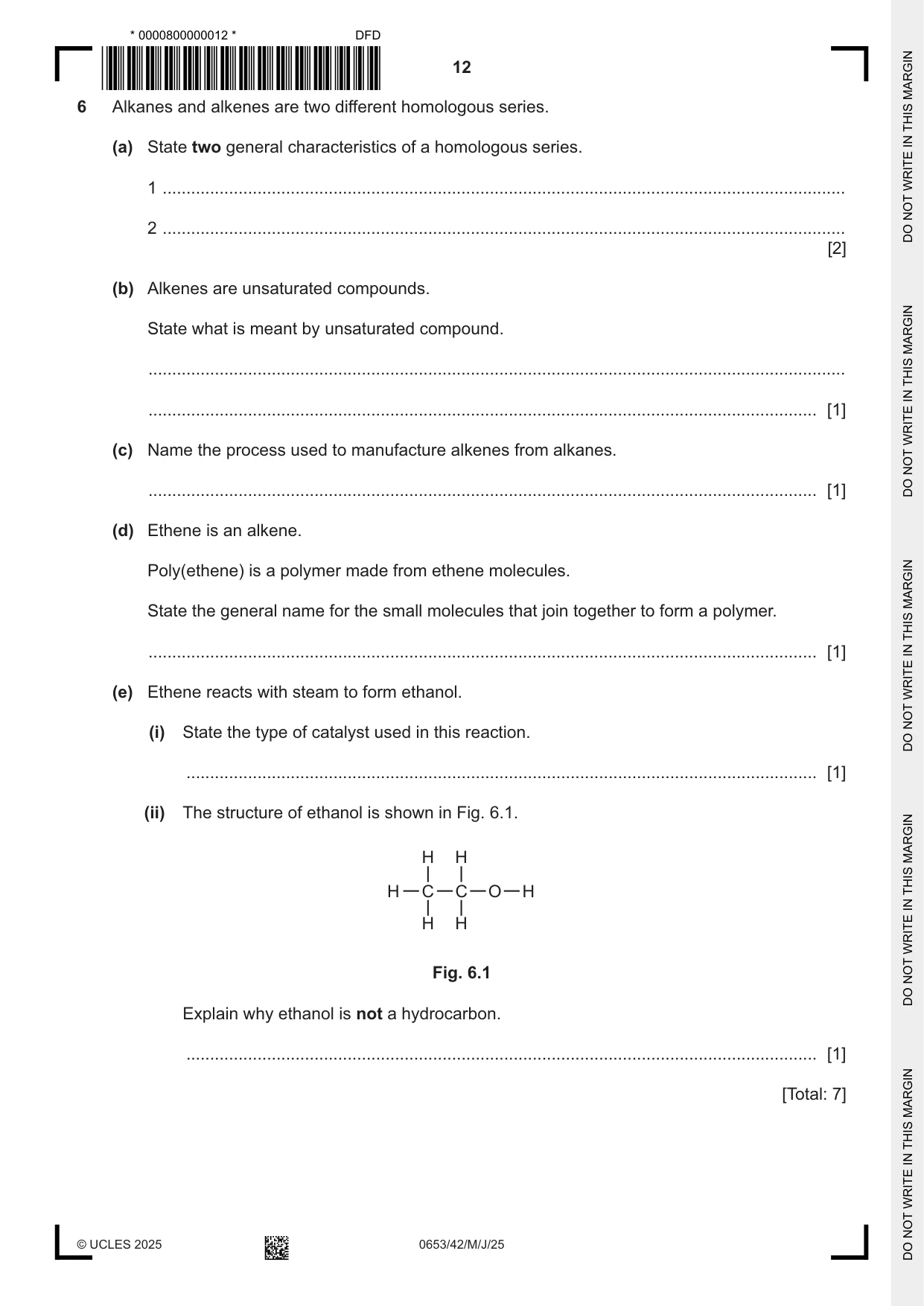
6 Alkanes and alkenes are two different homologous series. (a) State two general characteristics of a homologous series. 1 ................................................................................................................................................ 2 ................................................................................................................................................ [2] (b) Alkenes are unsaturated compounds. State what is meant by unsaturated compound. ................................................................................................................................................... ............................................................................................................................................. [1] (c) Name the process used to manufacture alkenes from alkanes. ............................................................................................................................................. [1] (d) Ethene is an alkene. Poly(ethene) is a polymer made from ethene molecules. State the general name for the small molecules that join together to form a polymer. ............................................................................................................................................. [1] (e) Ethene reacts with steam to form ethanol. (i) State the type of catalyst used in this reaction. ..................................................................................................................................... [1] (ii) The structure of ethanol is shown in Fig. 6.1. H H H C C O H H H Fig. 6.1 Explain why ethanol is not a hydrocarbon. ..................................................................................................................................... [1] [Total: 7]
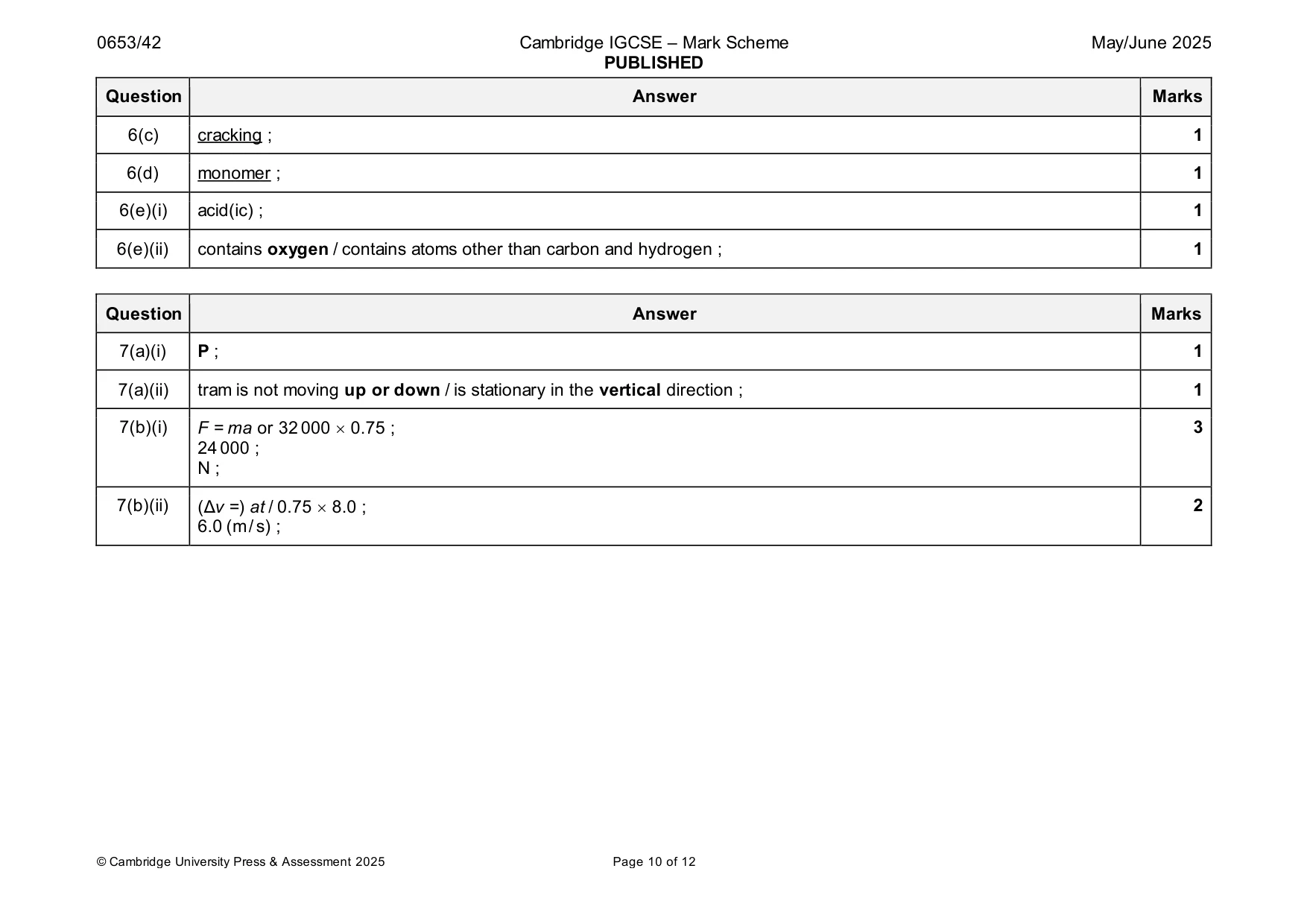
Mark scheme: 6(a) any two from: 2 same general formula ; similar chemical properties ; trend in physical properties ; 6(b) a compound that contains a double carbon to carbon bond ; 1 6(c) cracking ; 1 6(d) monomer ; 1 6(e)(i) acid(ic) ; 1 6(e)(ii) contains oxygen / contains atoms other than carbon and hydrogen ; 1
Q7 · A tram powered by electricity supplied through overhead cables
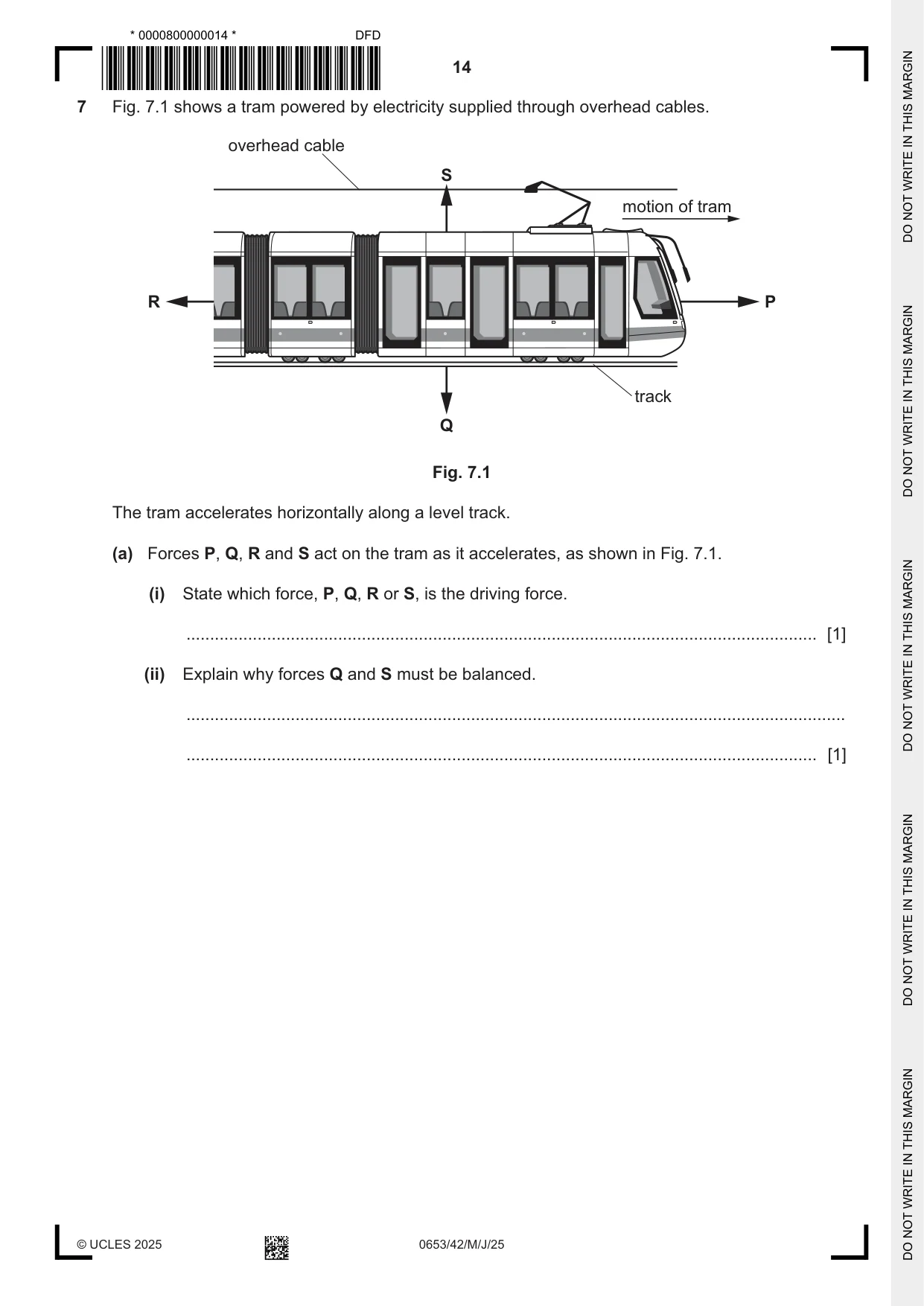
7 Fig. 7.1 shows a tram powered by electricity supplied through overhead cables. overhead cable S motion of tram R P track Q Fig. 7.1 The tram accelerates horizontally along a level track. (a) Forces P, Q, R and S act on the tram as it accelerates, as shown in Fig. 7.1. (i) State which force, P, Q, R or S, is the driving force. ..................................................................................................................................... [1] (ii) Explain why forces Q and S must be balanced. ........................................................................................................................................... ..................................................................................................................................... [1] (b) The mass of the tram is 32 000 kg. The tram accelerates horizontally at 0.75 m / s2 for 8.0 s. The speed of the tram increases. (i) Calculate the resultant force acting on the tram. Include the unit in your answer. force = ....................................... unit .......... [3] (ii) Calculate the increase in speed of the tram. increase in speed = ................................................. m / s [2] (iii) Calculate the power required for this increase in speed. power = ..................................................... W [3] [Total: 10]
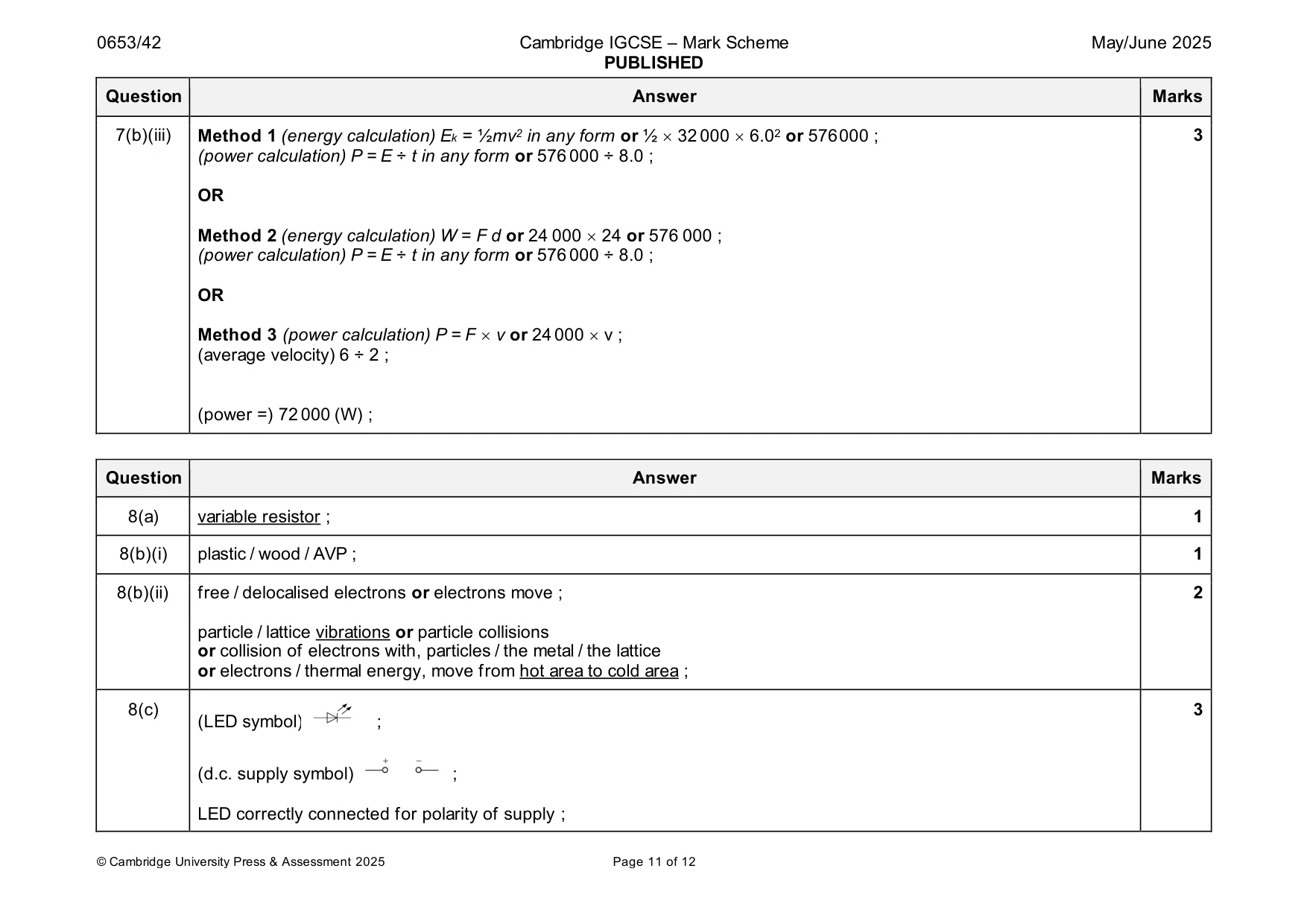
Mark scheme: 7(a)(i) P ; 1 7(a)(ii) tram is not moving up or down / is stationary in the vertical direction ; 1 7(b)(i) F = ma or 32 000 0.75 ; 3 24 000 ; N ; 7(b)(ii) (Δv =) at / 0.75 8.0 ; 2 6.0 (m / s) ; 7(b)(iii) Method 1 (energy calculation) Ek = ½mv2 in any form or ½ 32 000 6.02 or 576 000 ; 3 (power calculation) P = E ÷ t in any form or 576 000 ÷ 8.0 ; OR Method 2 (energy calculation) W = F d or 24 000 24 or 576 000 ; (power calculation) P = E ÷ t in any form or 576 000 ÷ 8.0 ; OR Method 3 (power calculation) P = F v or 24 000 v ; (average velocity) 6 ÷ 2 ; (power =) 72 000 (W) ;
Q8 · A student constructs an electrical circuit containing a metal heating element
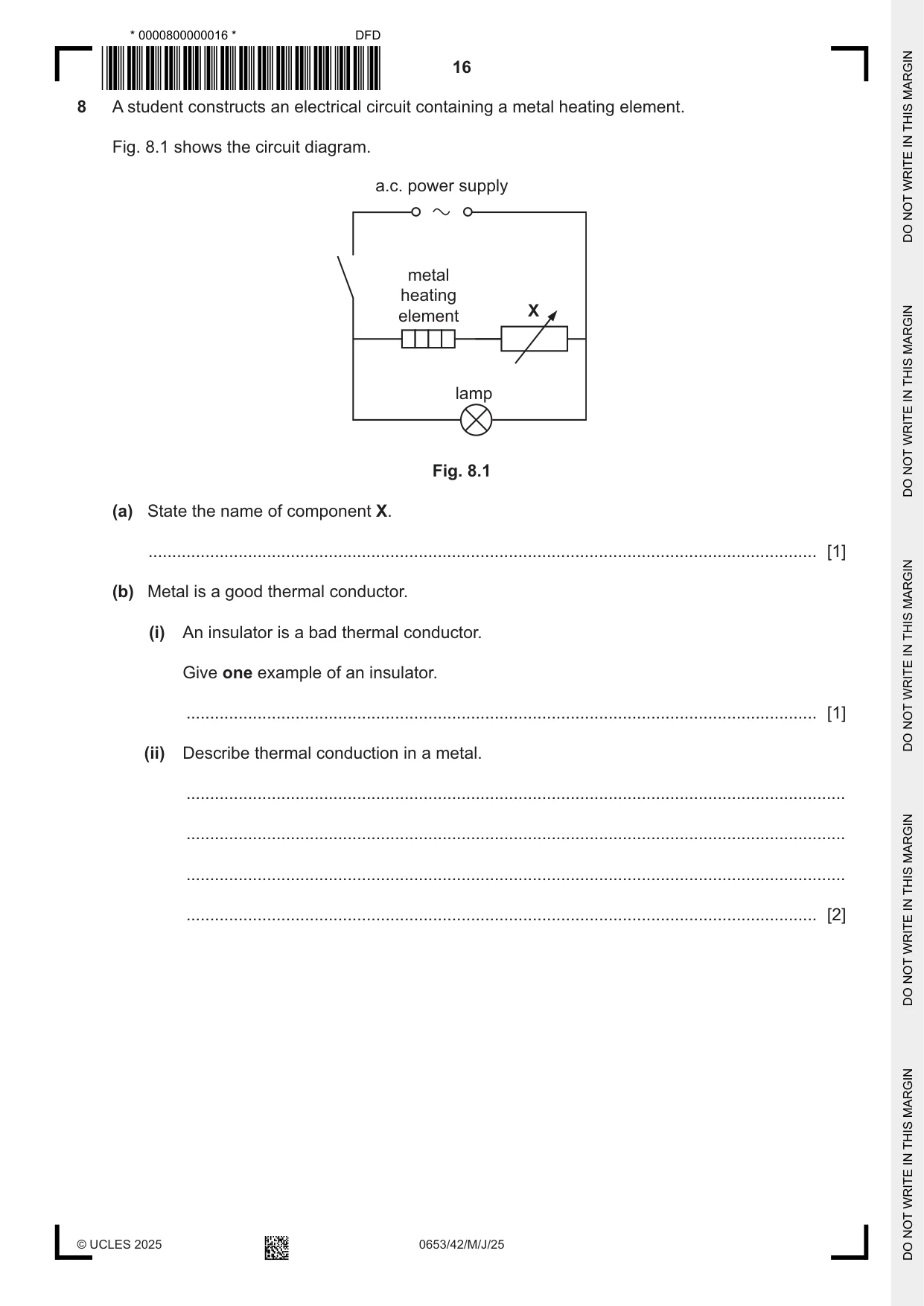
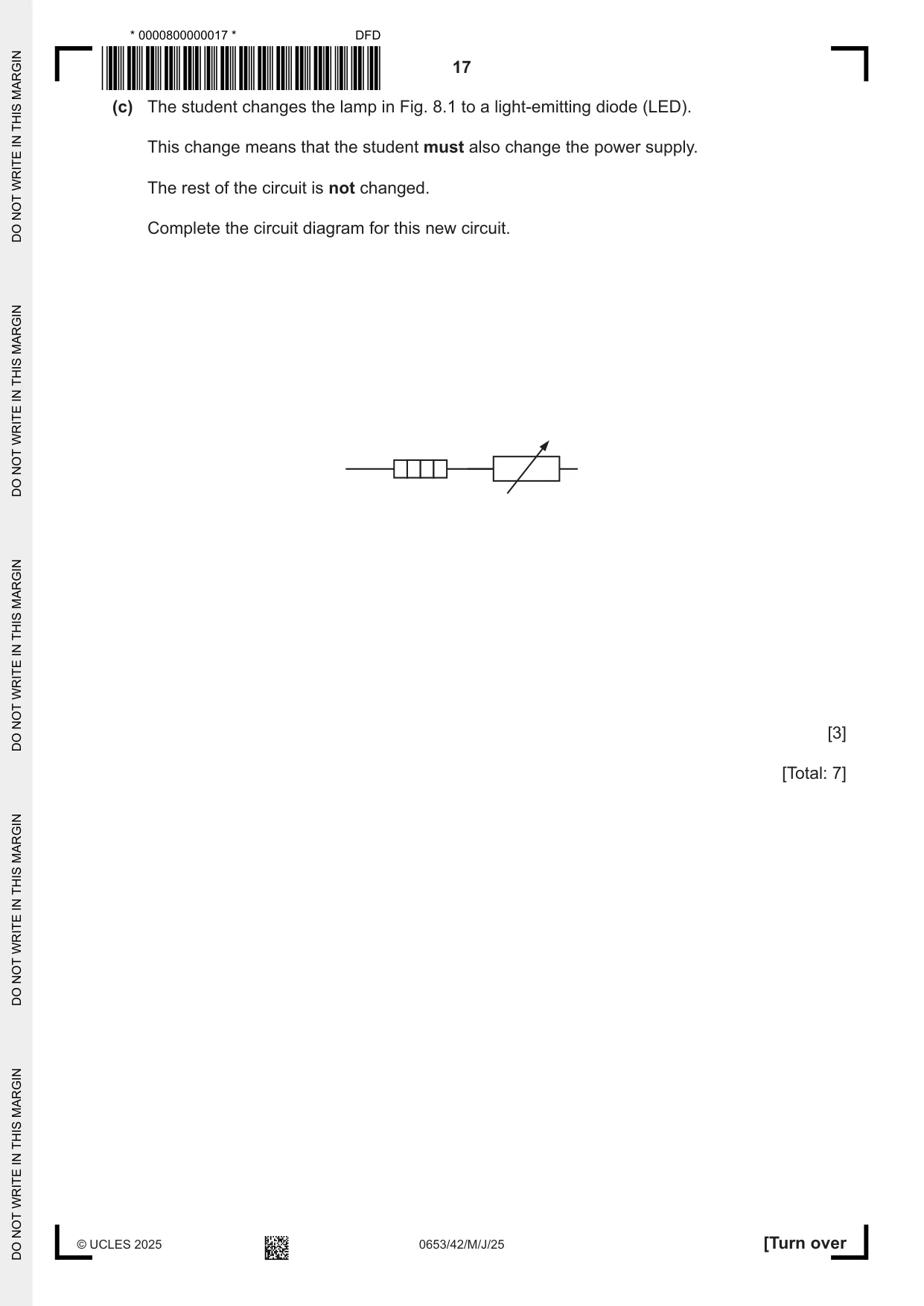
8 A student constructs an electrical circuit containing a metal heating element. Fig. 8.1 shows the circuit diagram. a.c. power supply metal heating X element lamp Fig. 8.1 (a) State the name of component X. ............................................................................................................................................. [1] (b) Metal is a good thermal conductor. (i) An insulator is a bad thermal conductor. Give one example of an insulator. ..................................................................................................................................... [1] (ii) Describe thermal conduction in a metal. ........................................................................................................................................... ........................................................................................................................................... ........................................................................................................................................... ..................................................................................................................................... [2] (c) The student changes the lamp in Fig. 8.1 to a light-emitting diode (LED). This change means that the student must also change the power supply. The rest of the circuit is not changed. Complete the circuit diagram for this new circuit. [3] [Total: 7]
Mark scheme: 8(a) variable resistor ; 1 8(b)(i) plastic / wood / AVP ; 1 8(b)(ii) free / delocalised electrons or electrons move ; 2 particle / lattice vibrations or particle collisions or collision of electrons with, particles / the metal / the lattice or electrons / thermal energy, move from hot area to cold area ; 8(c) 3 (LED symbol) ; (d.c. supply symbol) ; LED correctly connected for polarity of supply ;
Q9 · Complete the sentence about the Solar System
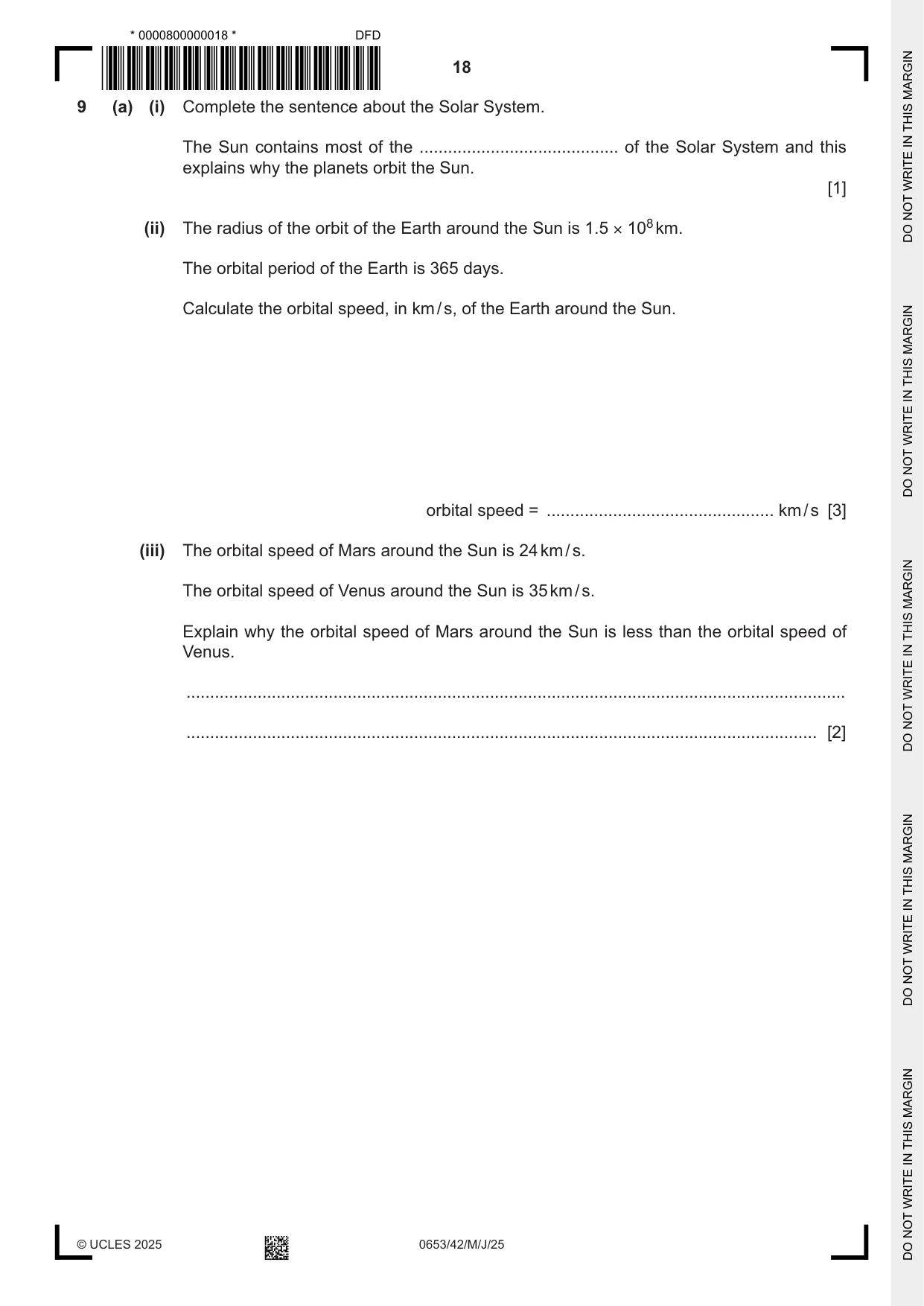
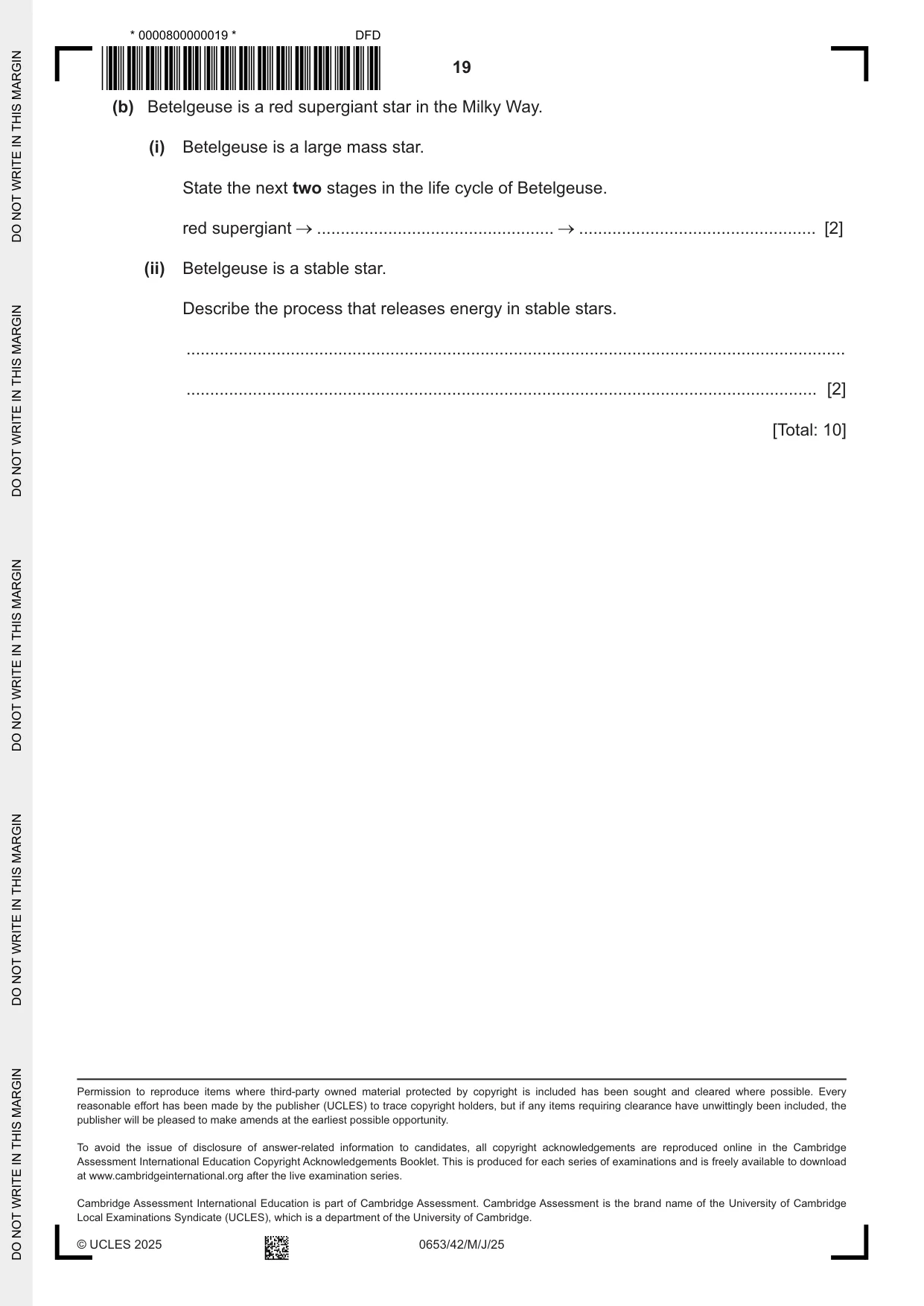
9 (a) (i) Complete the sentence about the Solar System. The Sun contains most of the .......................................... of the Solar System and this explains why the planets orbit the Sun. [1] (ii) The radius of the orbit of the Earth around the Sun is 1.5 × 10⁸ km. The orbital period of the Earth is 365 days. Calculate the orbital speed, in km / s, of the Earth around the Sun. orbital speed = ................................................ km / s [3] (iii) The orbital speed of Mars around the Sun is 24 km / s. The orbital speed of Venus around the Sun is 35 km / s. Explain why the orbital speed of Mars around the Sun is less than the orbital speed of Venus. ........................................................................................................................................... ..................................................................................................................................... [2] (b) Betelgeuse is a red supergiant star in the Milky Way. (i) Betelgeuse is a large mass star. State the next two stages in the life cycle of Betelgeuse. red supergiant .................................................. .................................................. [2] (ii) Betelgeuse is a stable star. Describe the process that releases energy in stable stars. ........................................................................................................................................... ..................................................................................................................................... [2] [Total: 10]
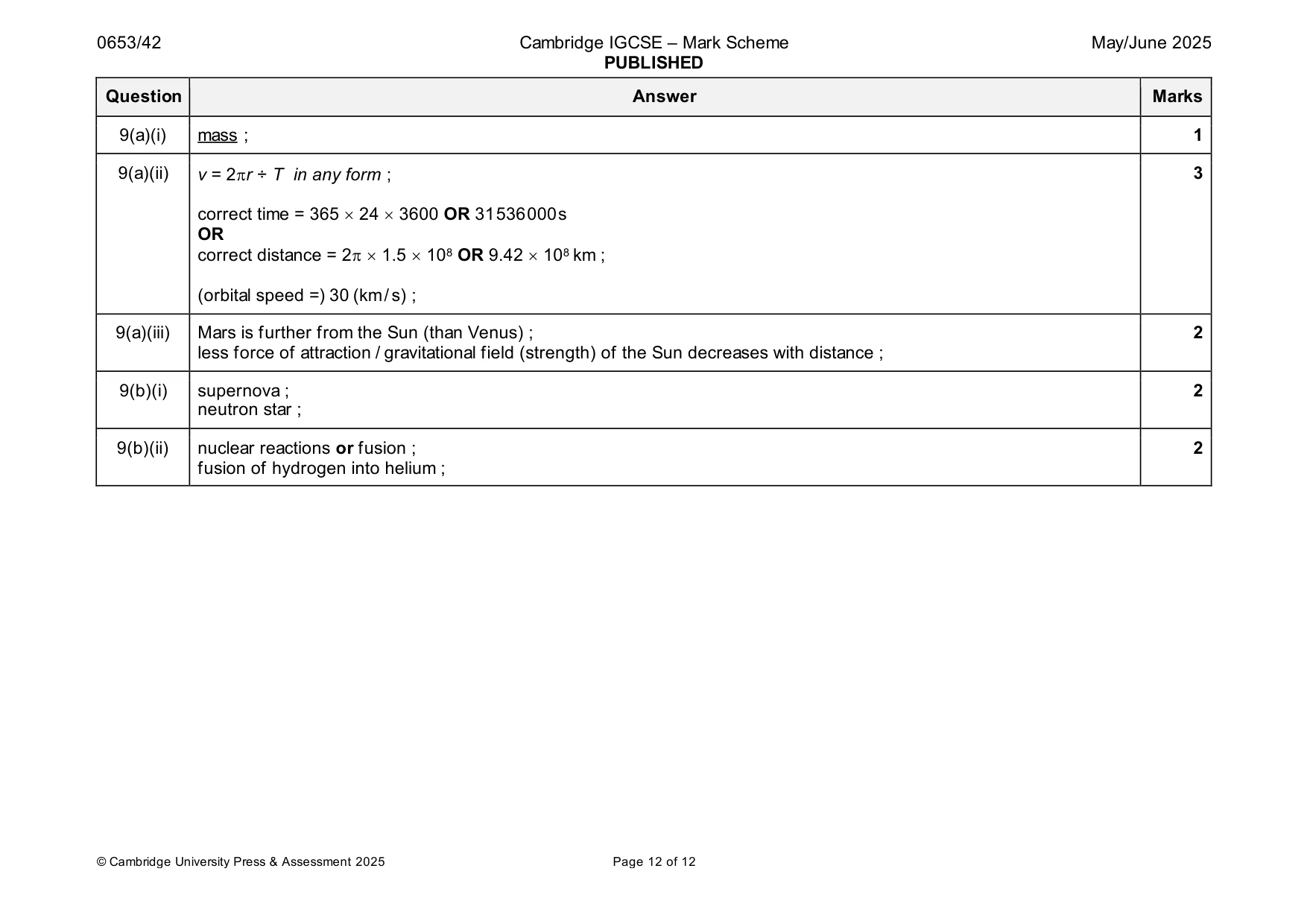
Mark scheme: 9(a)(i) mass ; 1 9(a)(ii) v = 2r ÷ T in any form ; 3 correct time = 365 24 3600 OR 31 536 000 s OR correct distance = 2 1.5 108 OR 9.42 108 km ; (orbital speed =) 30 (km / s) ; 9(a)(iii) Mars is further from the Sun (than Venus) ; 2 less force of attraction / gravitational field (strength) of the Sun decreases with distance ; 9(b)(i) supernova ; 2 neutron star ; 9(b)(ii) nuclear reactions or fusion ; 2 fusion of hydrogen into helium ;
What was in this paper
The subtopics covered by these 9 questions, and how many questions each got. Open one in a new tab to see every Cambridge question on it.
What you needed in this session
Cambridge’s own grade thresholds for 2025 May/June, Paper 4 · Variant 2. A higher threshold means an easier paper — the bar moves with how the cohort did.