Cambridge IGCSE Science - Combined 0653 — 2023 Oct/Nov Paper 4 · Variant 3
0653/43/O/N/23 · 9 questions · 80 marks · ≈90 min
The question paper and its mark scheme, free to read here and free to download. This is Cambridge’s own paper, exactly as it was sat.
Question paper24 pages



Mark scheme12 pages
Answers below. Sit the paper first if you are practising.
Questions as text
Q1 · Part of the breathing system in humans
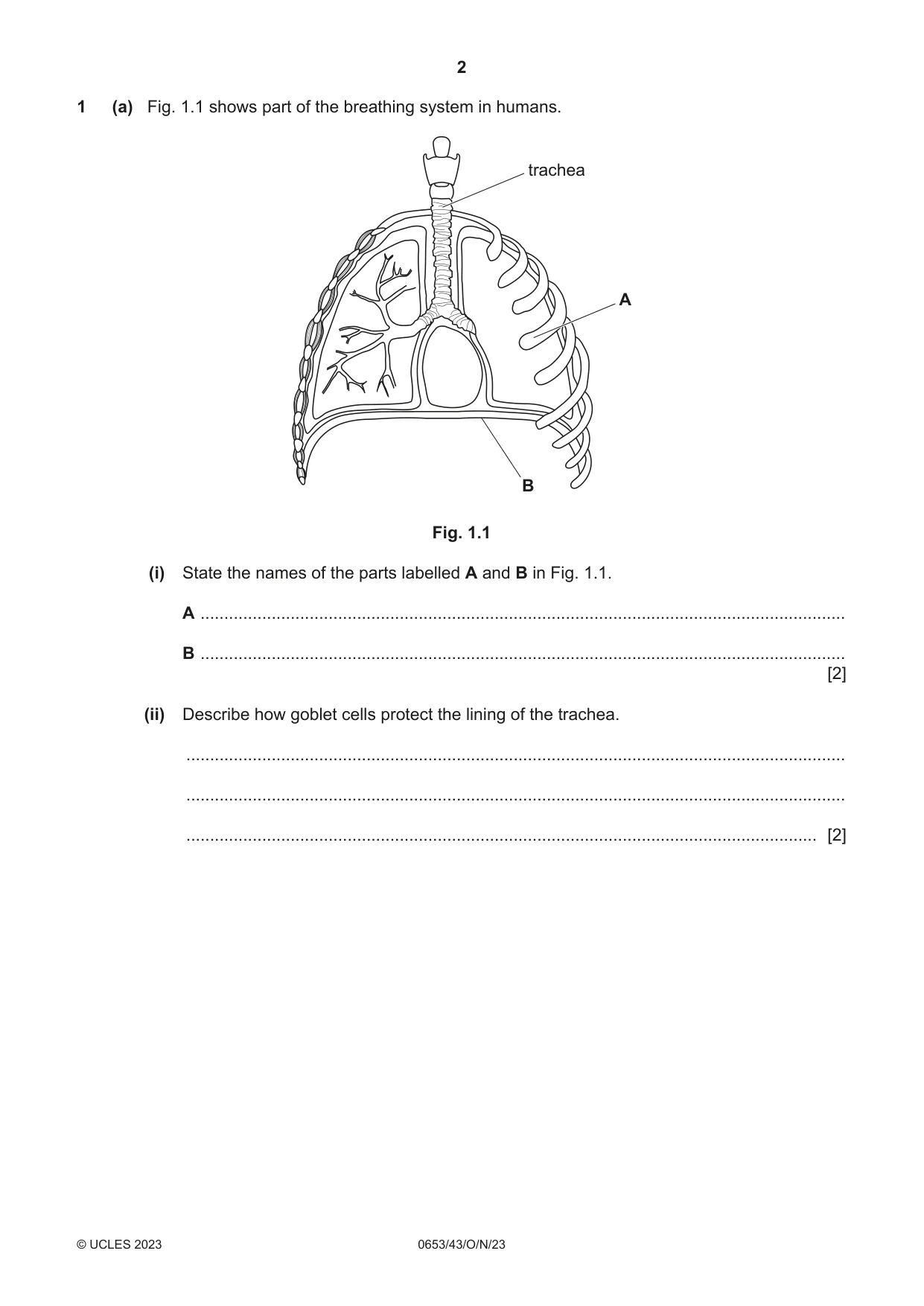
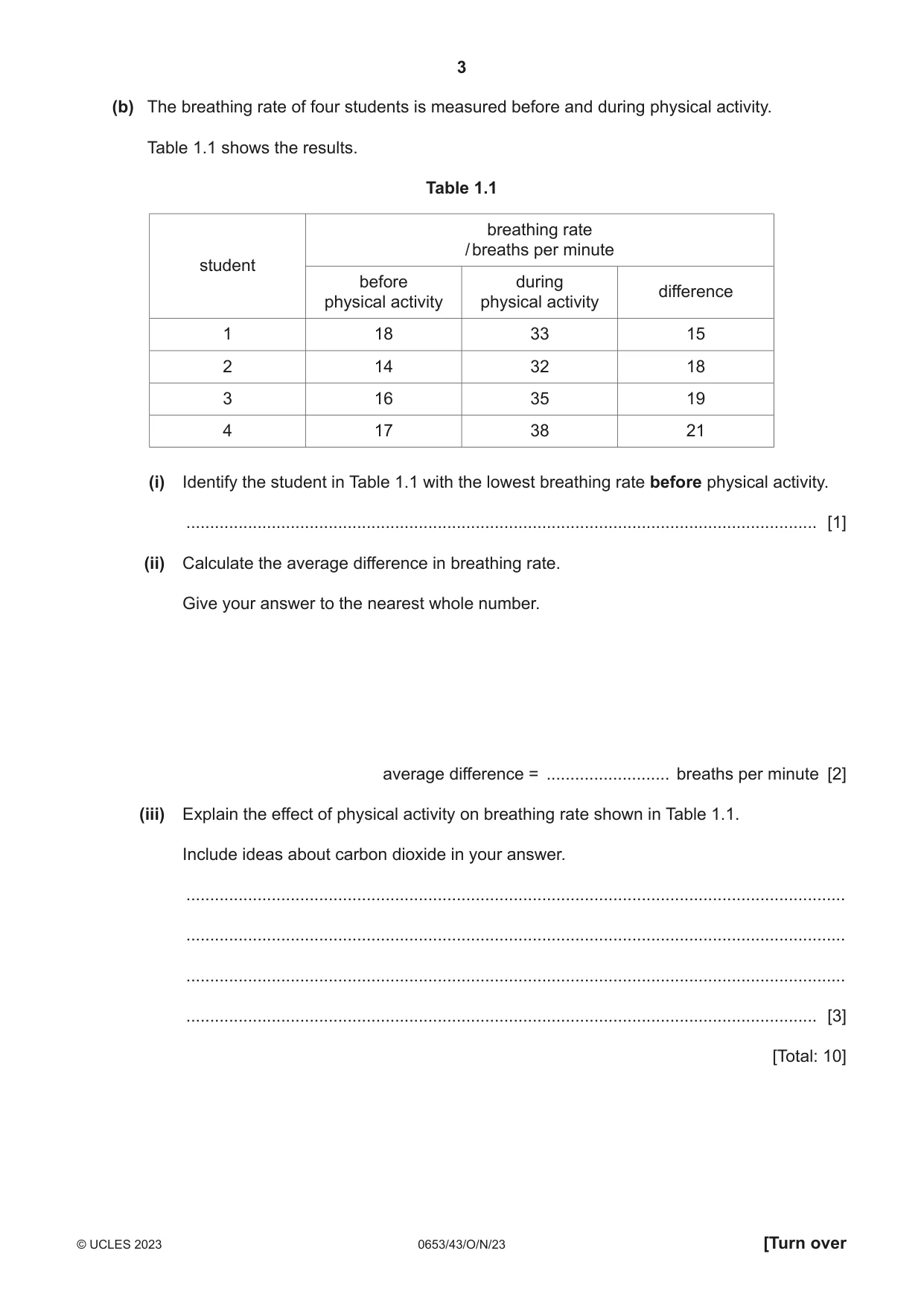
1 (a) Fig. 1.1 shows part of the breathing system in humans. trachea A B Fig. 1.1 (i) State the names of the parts labelled A and B in Fig. 1.1. A ........................................................................................................................................ B ........................................................................................................................................ [2] (ii) Describe how goblet cells protect the lining of the trachea. ........................................................................................................................................... ........................................................................................................................................... ..................................................................................................................................... [2] (b) The breathing rate of four students is measured before and during physical activity. Table 1.1 shows the results. Table 1.1 breathing rate / breaths per minute student before during difference physical activity physical activity 1 18 33 15 2 14 32 18 3 16 35 19 4 17 38 21 (i) Identify the student in Table 1.1 with the lowest breathing rate before physical activity. ..................................................................................................................................... [1] (ii) Calculate the average difference in breathing rate. Give your answer to the nearest whole number. average difference = .......................... breaths per minute [2] (iii) Explain the effect of physical activity on breathing rate shown in Table 1.1. Include ideas about carbon dioxide in your answer. ........................................................................................................................................... ........................................................................................................................................... ........................................................................................................................................... ..................................................................................................................................... [3] [Total: 10]
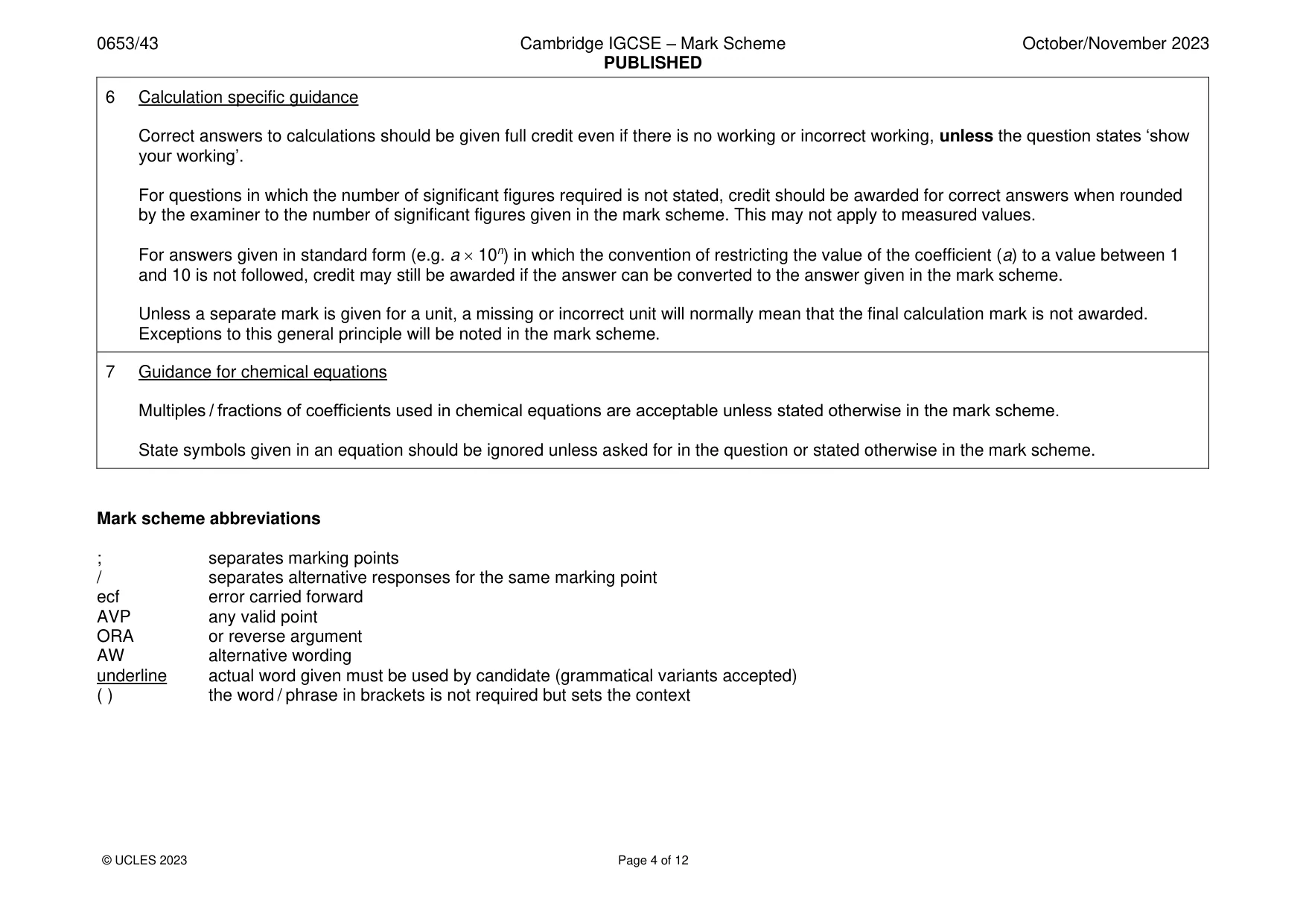
Mark scheme: Question Answer Marks 1(a)(i) A rib ; 2 B diaphragm ; 1(a)(ii) produce mucus ; 2 (mucus) traps, pathogens / particulates ; 1(b)(i) (student) 2 ; 1 1(b)(ii) 73 ÷ 4 / 18.25 ; 2 18 ; 1(b)(iii) (increased) respiration ; 3 (idea that respiration) produces carbon dioxide ; increase in carbon dioxide (concentration) in the blood (causes increase in breathing rate) ;
Q2 · The electrolysis of concentrated aqueous sodium chloride using platinum electrodes
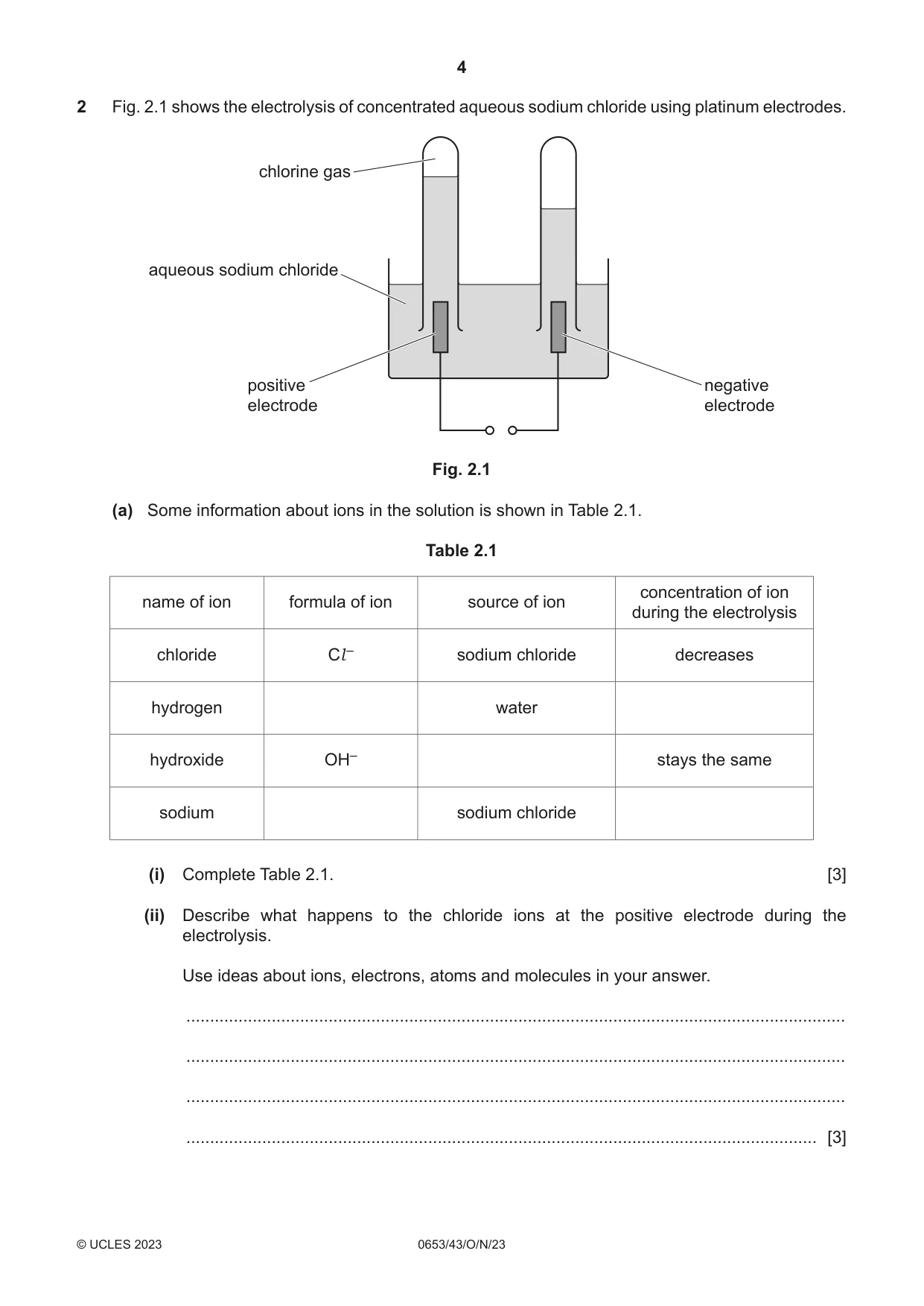
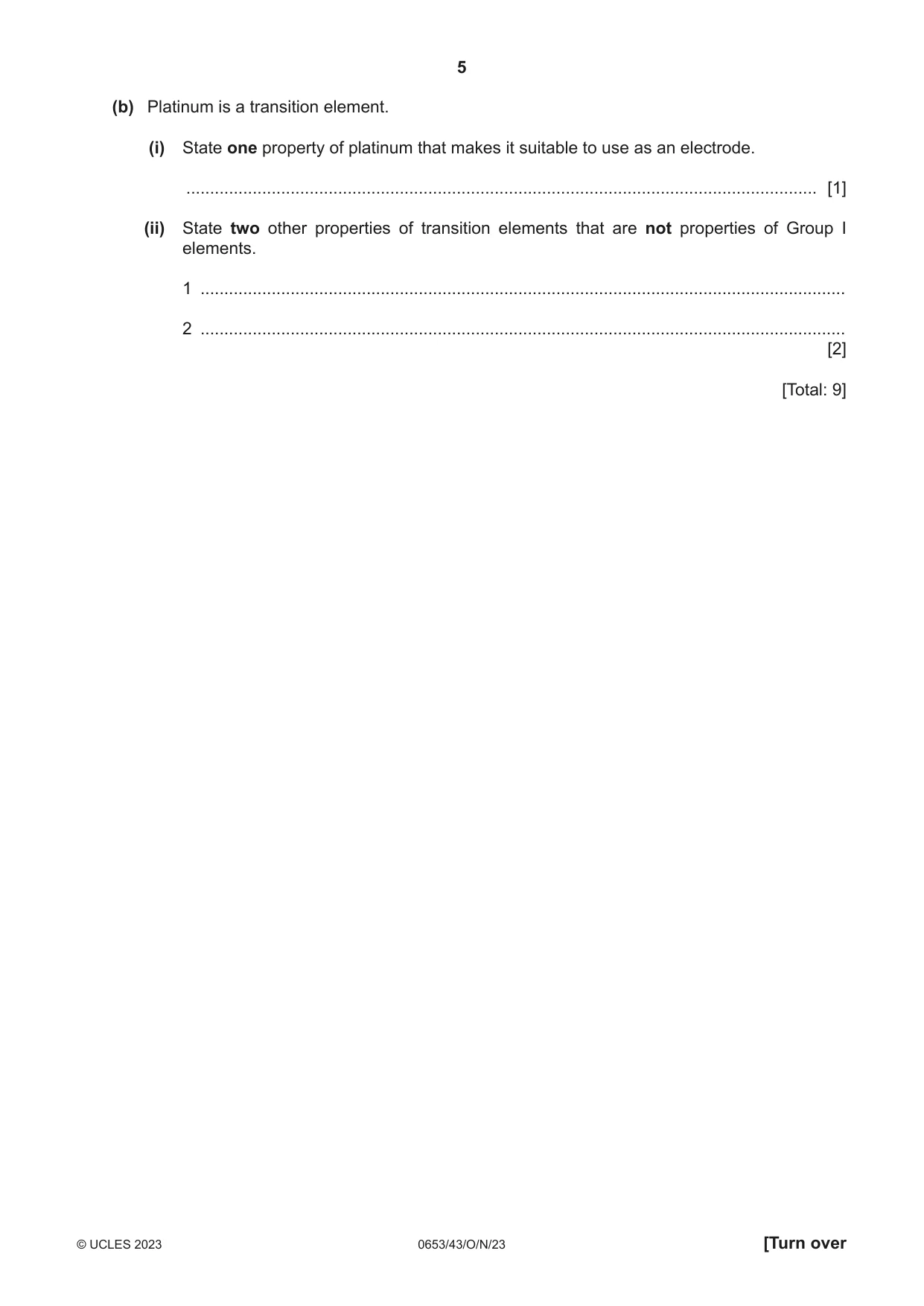
2 Fig. 2.1 shows the electrolysis of concentrated aqueous sodium chloride using platinum electrodes. chlorine gas aqueous sodium chloride positive negative electrode electrode Fig. 2.1 (a) Some information about ions in the solution is shown in Table 2.1. Table 2.1 concentration of ion name of ion formula of ion source of ion during the electrolysis chloride Cl – sodium chloride decreases hydrogen water hydroxide OH– stays the same sodium sodium chloride (i) Complete Table 2.1. [3] (ii) Describe what happens to the chloride ions at the positive electrode during the electrolysis. Use ideas about ions, electrons, atoms and molecules in your answer. ........................................................................................................................................... ........................................................................................................................................... ........................................................................................................................................... ..................................................................................................................................... [3] (b) Platinum is a transition element. (i) State one property of platinum that makes it suitable to use as an electrode. ..................................................................................................................................... [1] (ii) State two other properties of transition elements that are not properties of Group I elements. 1 ........................................................................................................................................ 2 ........................................................................................................................................ [2] [Total: 9]
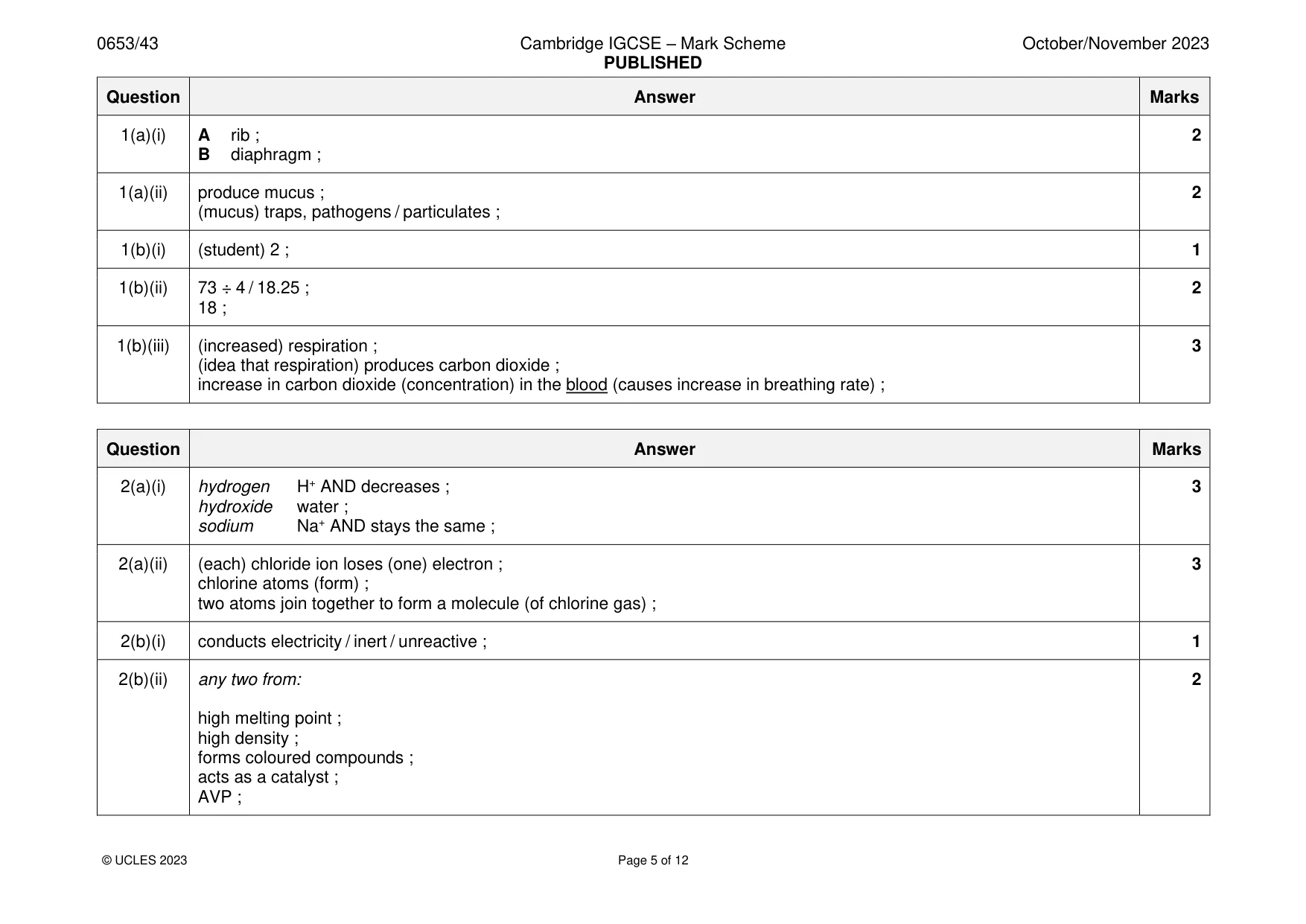
Mark scheme: 2(a)(i) hydrogen H+ AND decreases ; 3 hydroxide water ; sodium Na+ AND stays the same ; 2(a)(ii) (each) chloride ion loses (one) electron ; 3 chlorine atoms (form) ; two atoms join together to form a molecule (of chlorine gas) ; 2(b)(i) conducts electricity / inert / unreactive ; 1 2(b)(ii) any two from: 2 high melting point ; high density ; forms coloured compounds ; acts as a catalyst ; AVP ;
Q3 · A firefighter standing next to a fire engine
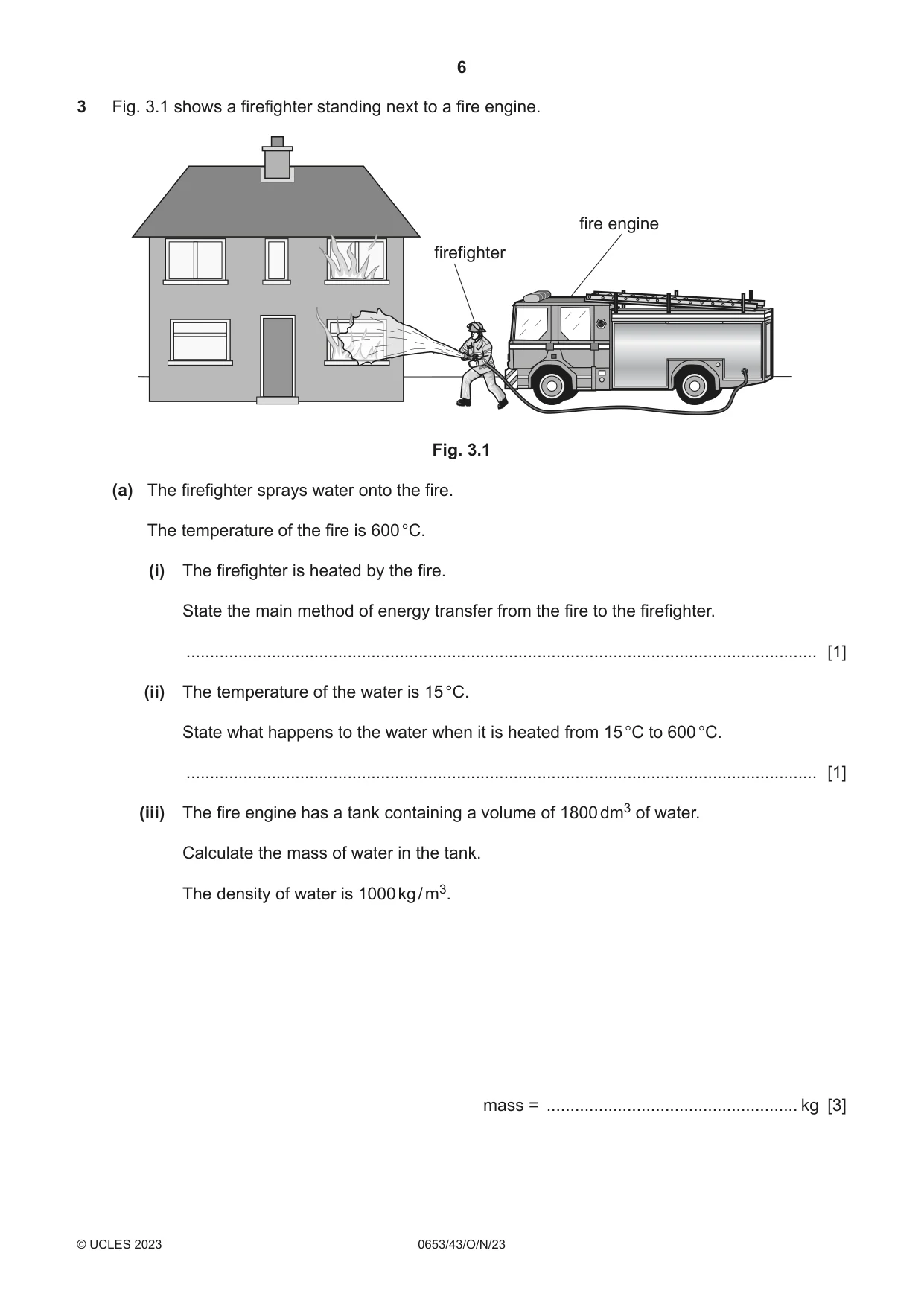
3 Fig. 3.1 shows a firefighter standing next to a fire engine. fire engine firefighter Fig. 3.1 (a) The firefighter sprays water onto the fire. The temperature of the fire is 600 °C. (i) The firefighter is heated by the fire. State the main method of energy transfer from the fire to the firefighter. ..................................................................................................................................... [1] (ii) The temperature of the water is 15 °C. State what happens to the water when it is heated from 15 °C to 600 °C. ..................................................................................................................................... [1] (iii) The fire engine has a tank containing a volume of 1800 dm3 of water. Calculate the mass of water in the tank. The density of water is 1000 kg / m3. mass = ..................................................... kg [3] (b) The fire engine has a weight of 140 000 N. (i) Calculate the mass of the fire engine. The gravitational force on unit mass g is 10 N / kg. mass = ..................................................... kg [2] (ii) The fire engine has a total area of 0.56 m2 in contact with the ground. Calculate the pressure exerted by the fire engine on the ground. Give the unit of your answer. pressure = .............................. unit ................... [3] [Total: 10]
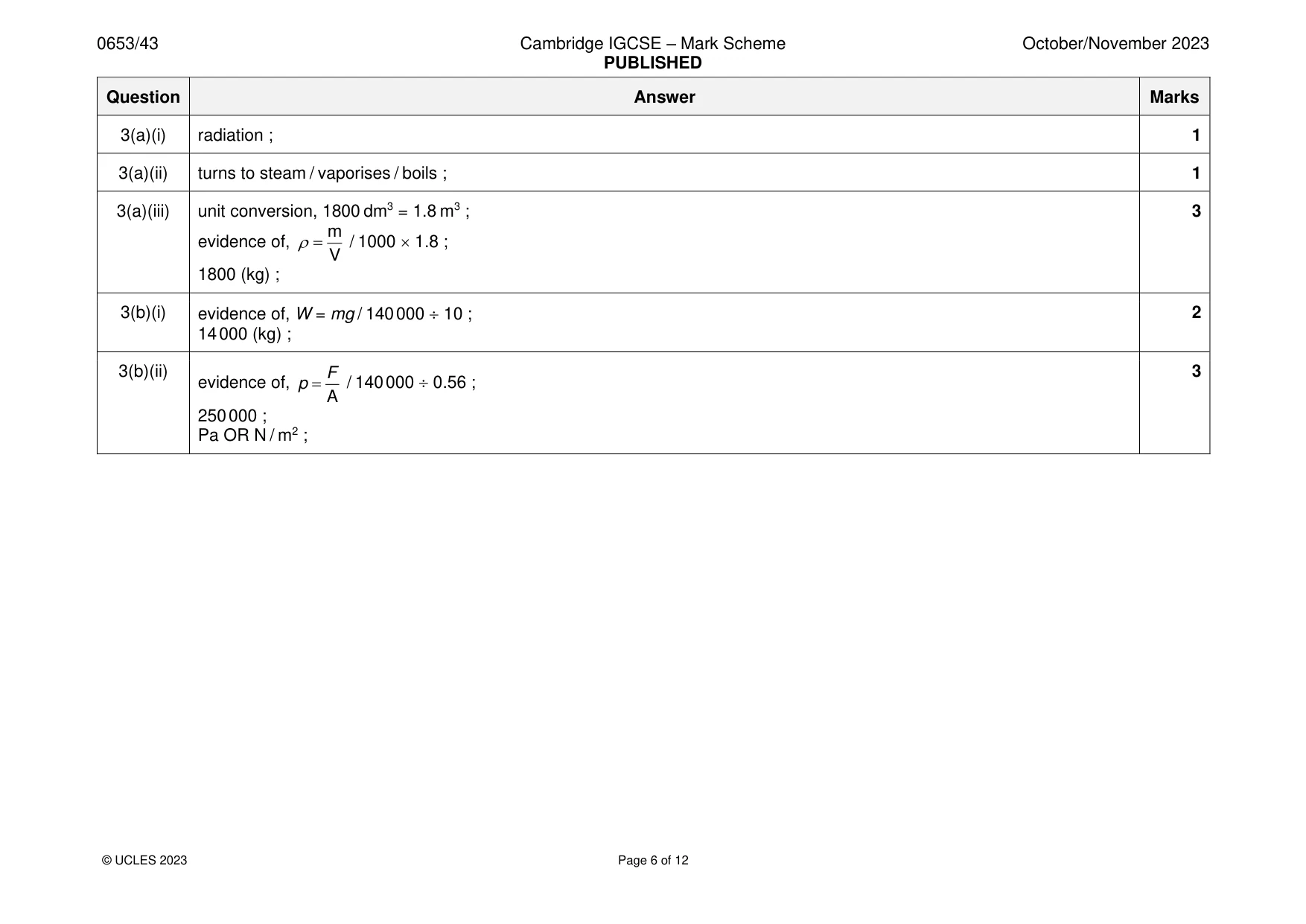
Mark scheme: 3(a)(i) radiation ; 1 3(a)(ii) turns to steam / vaporises / boils ; 1 3(a)(iii) unit conversion, 1800 dm3 = 1.8 m3 ; 3 m evidence of, = / 1000 1.8 ; V 1800 (kg) ; 3(b)(i) evidence of, W = mg / 140 000 10 ; 2 14 000 (kg) ; 3(b)(ii) F 3 evidence of, p = / 140 000 0.56 ; A 250 000 ; Pa OR N / m2 ;
Q4 · Part of the human alimentary canal and associated organs
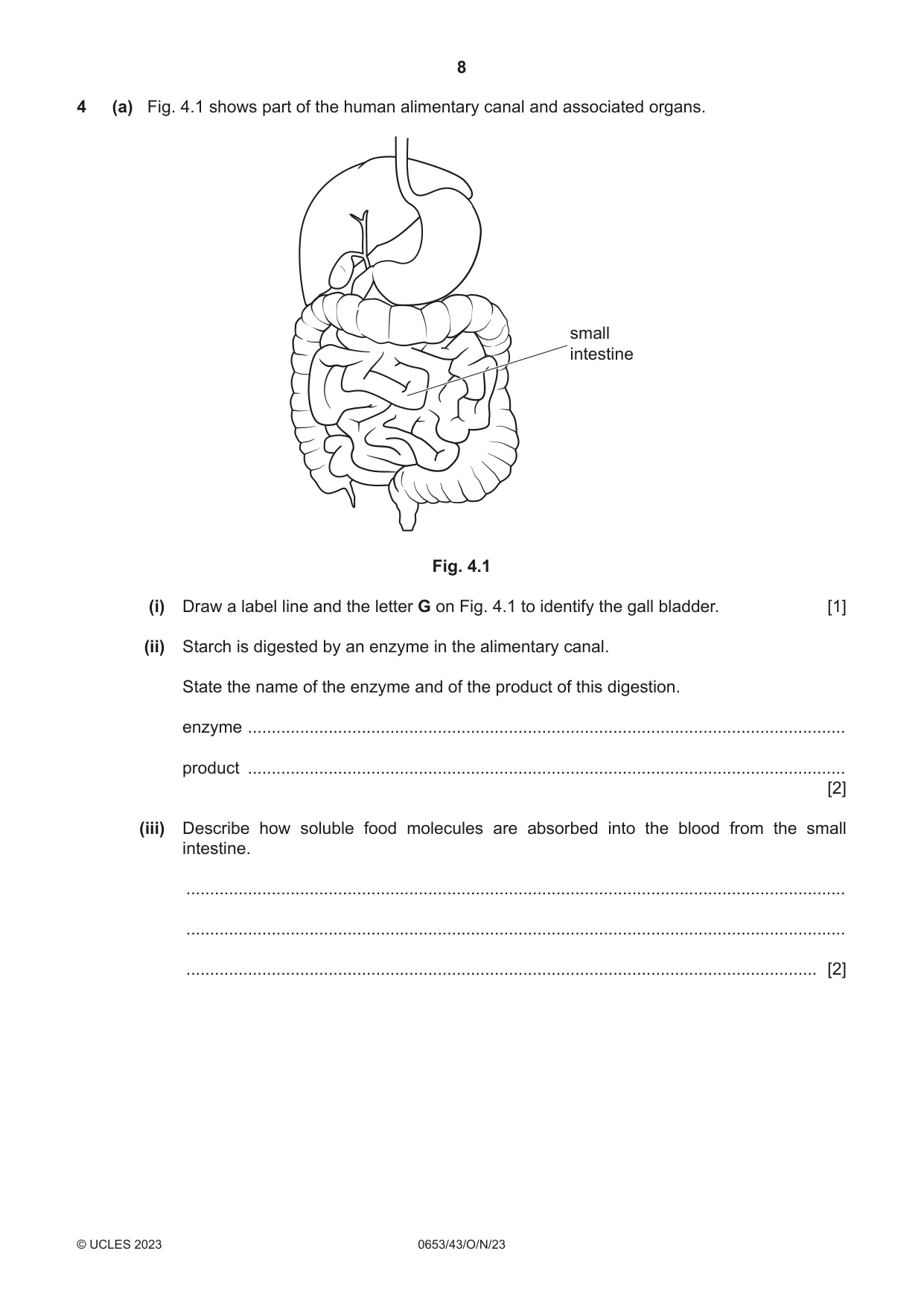
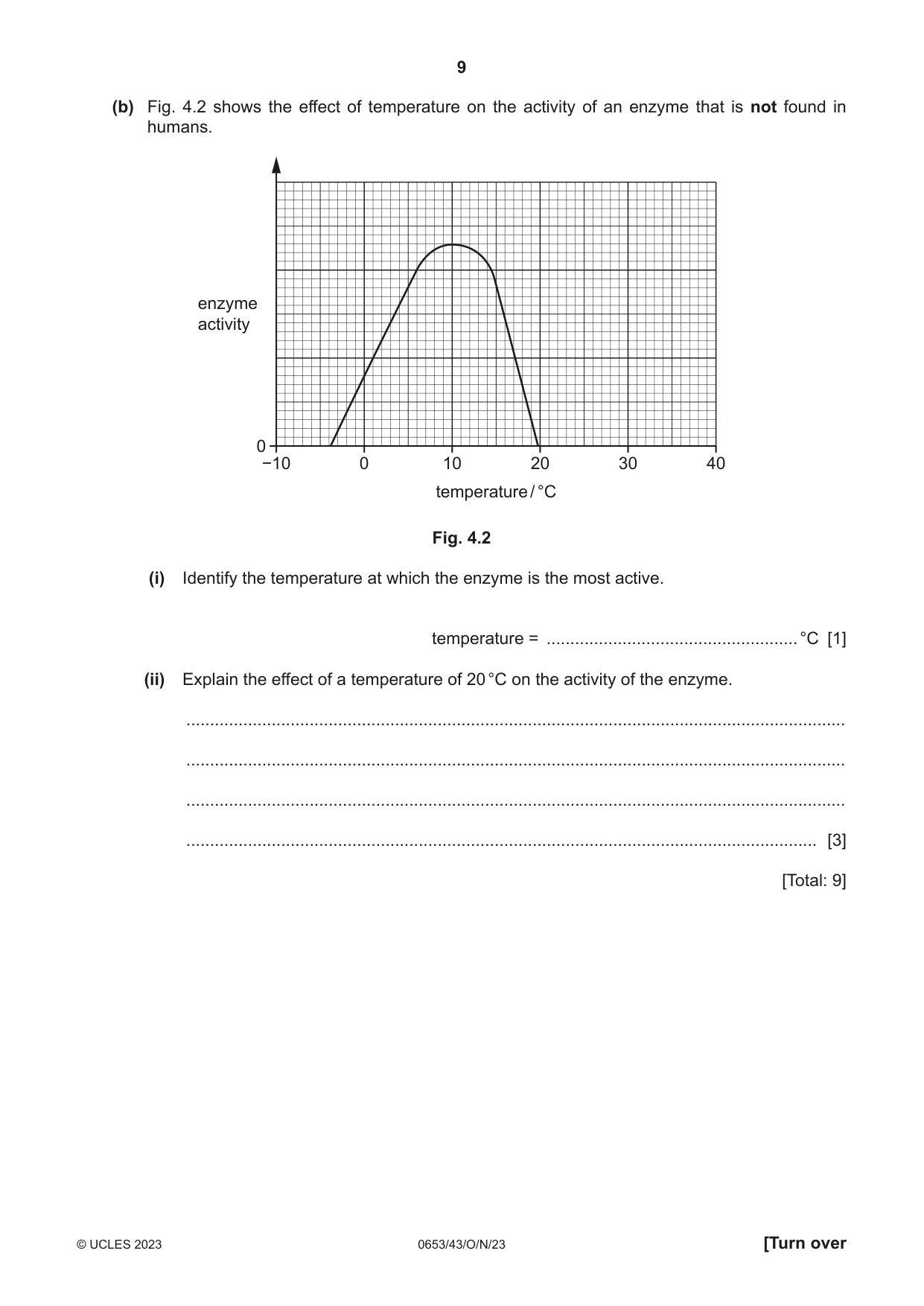
4 (a) Fig. 4.1 shows part of the human alimentary canal and associated organs. small intestine Fig. 4.1 (i) Draw a label line and the letter G on Fig. 4.1 to identify the gall bladder. [1] (ii) Starch is digested by an enzyme in the alimentary canal. State the name of the enzyme and of the product of this digestion. enzyme .............................................................................................................................. product .............................................................................................................................. [2] (iii) Describe how soluble food molecules are absorbed into the blood from the small intestine. ........................................................................................................................................... ........................................................................................................................................... ..................................................................................................................................... [2] (b) Fig. 4.2 shows the effect of temperature on the activity of an enzyme that is not found in humans. enzyme activity 0 −10 0 10 20 30 40 temperature / °C Fig. 4.2 (i) Identify the temperature at which the enzyme is the most active. temperature = ..................................................... °C [1] (ii) Explain the effect of a temperature of 20 °C on the activity of the enzyme. ........................................................................................................................................... ........................................................................................................................................... ........................................................................................................................................... ..................................................................................................................................... [3] [Total: 9]
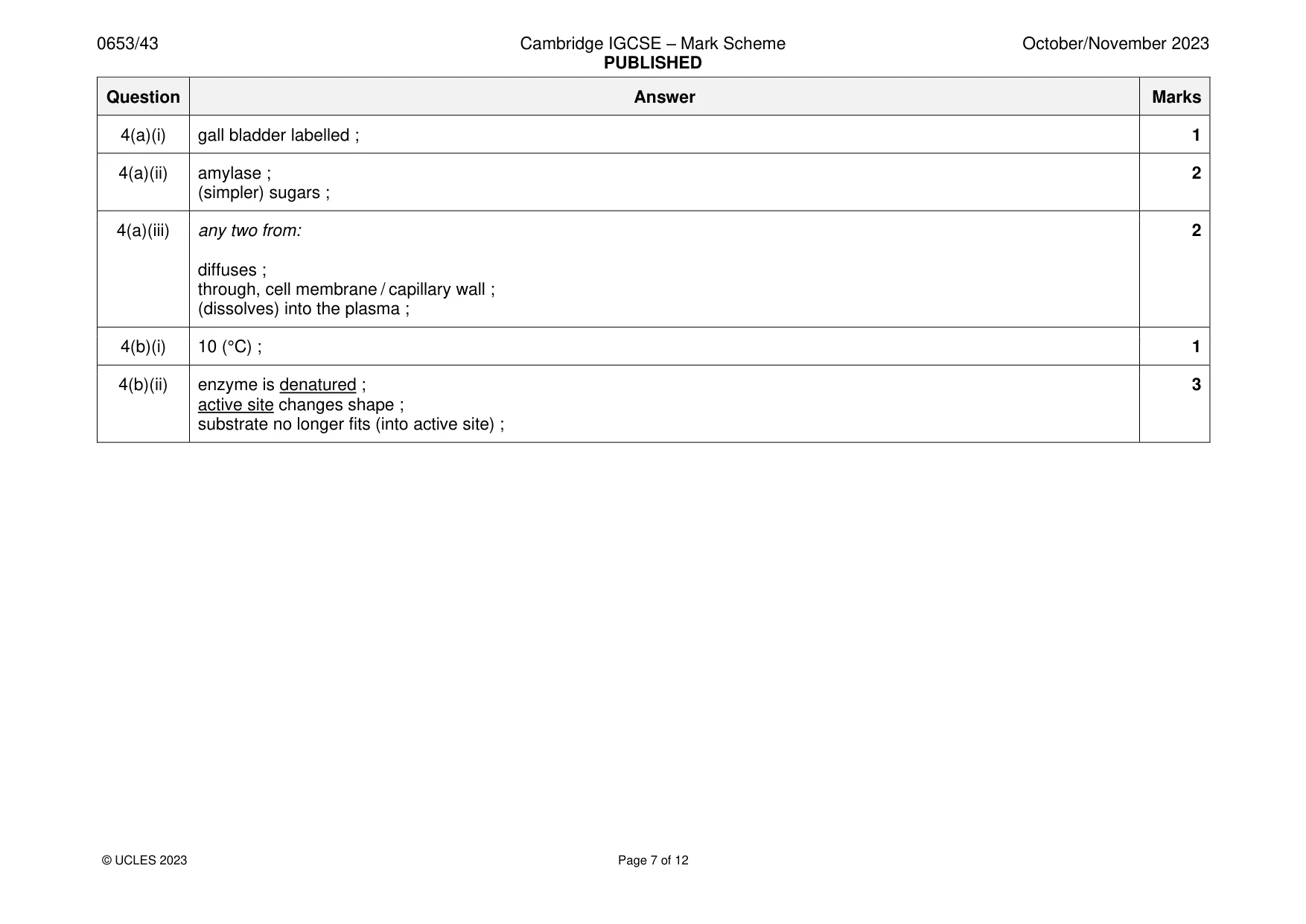
Mark scheme: 4(a)(i) gall bladder labelled ; 1 4(a)(ii) amylase ; 2 (simpler) sugars ; 4(a)(iii) any two from: 2 diffuses ; through, cell membrane / capillary wall ; (dissolves) into the plasma ; 4(b)(i) 10 (°C) ; 1 4(b)(ii) enzyme is denatured ; 3 active site changes shape ; substrate no longer fits (into active site) ;
Q5 · Information on the percentage composition of the atmosphere of the planet Mars
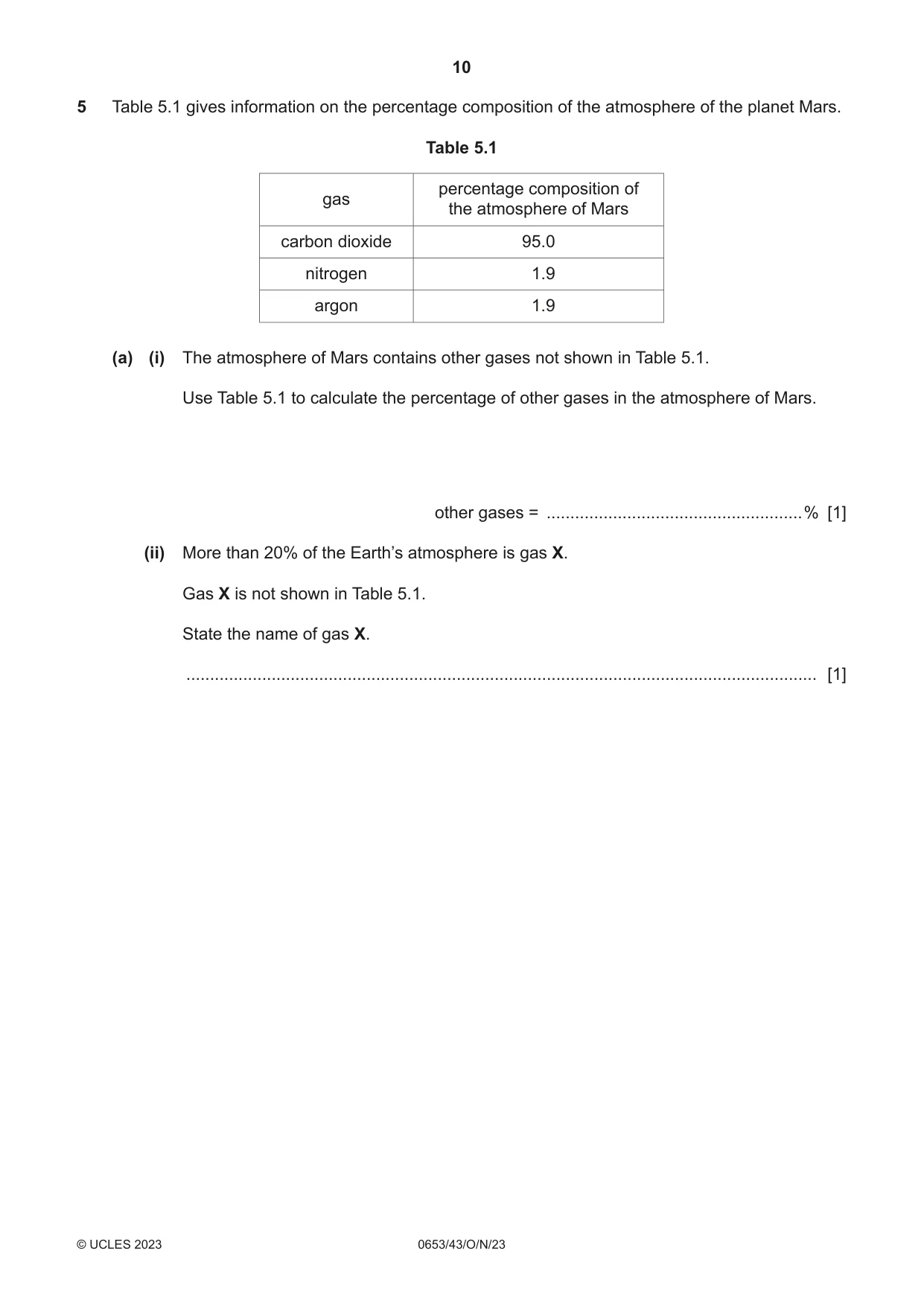
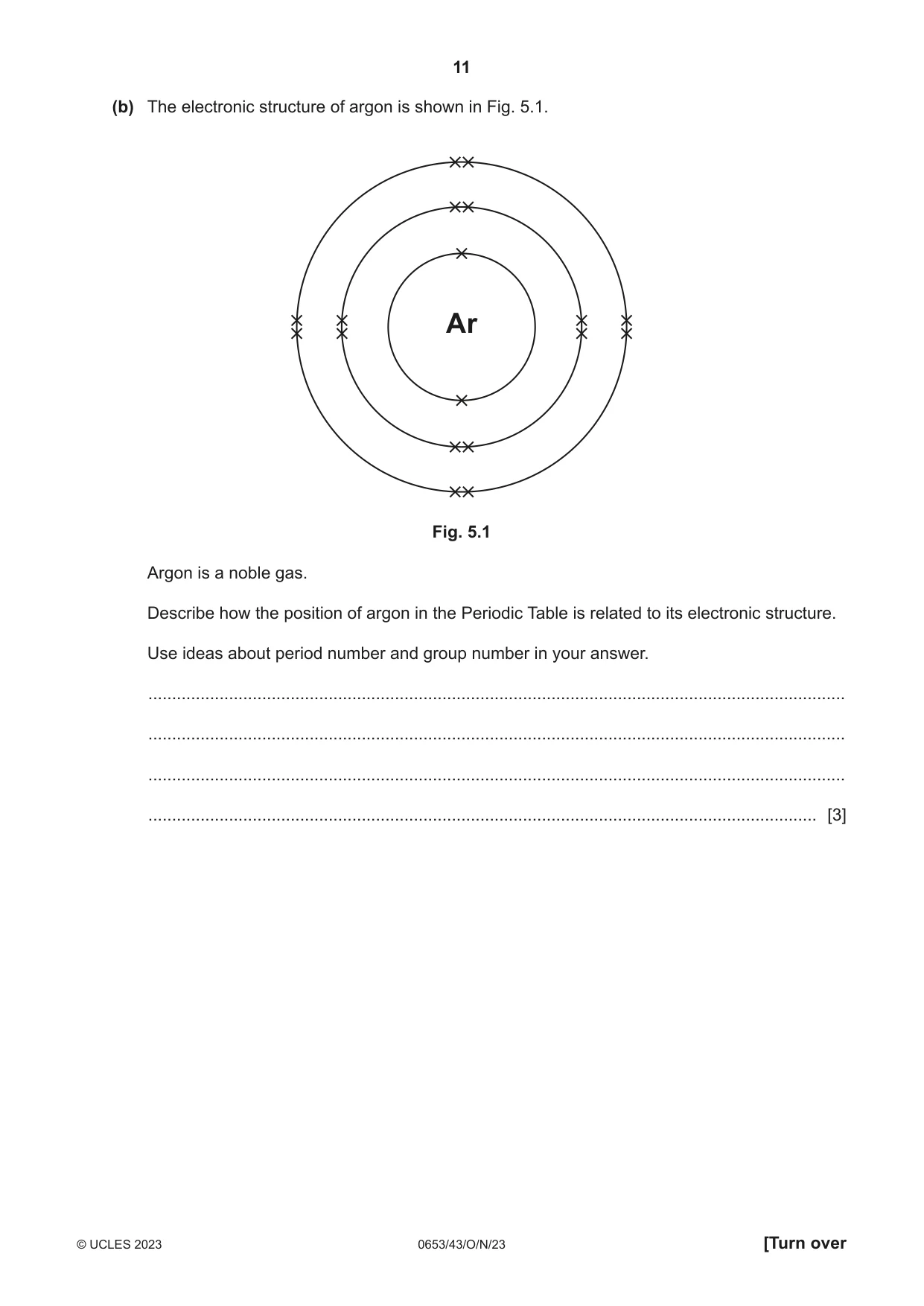
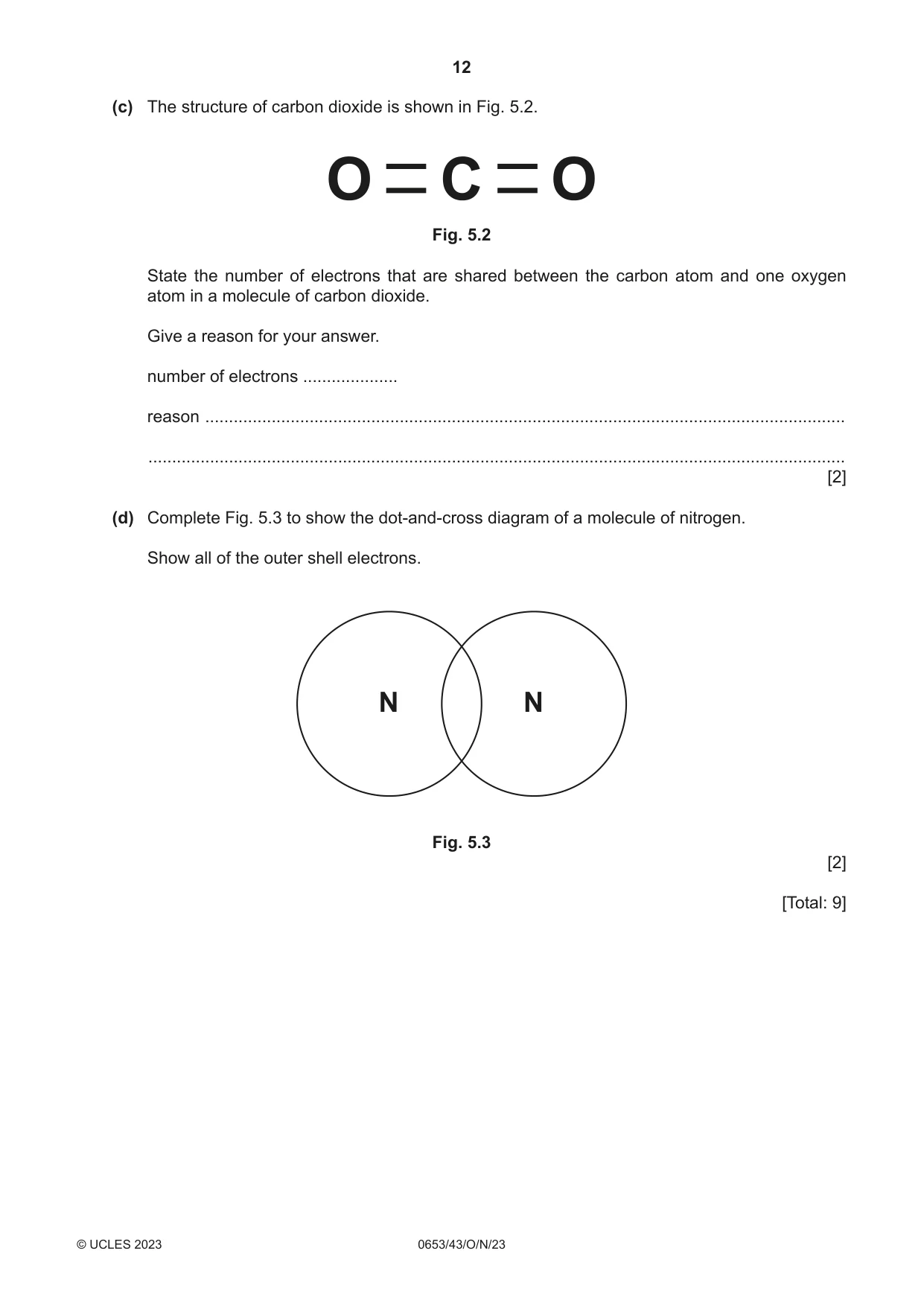
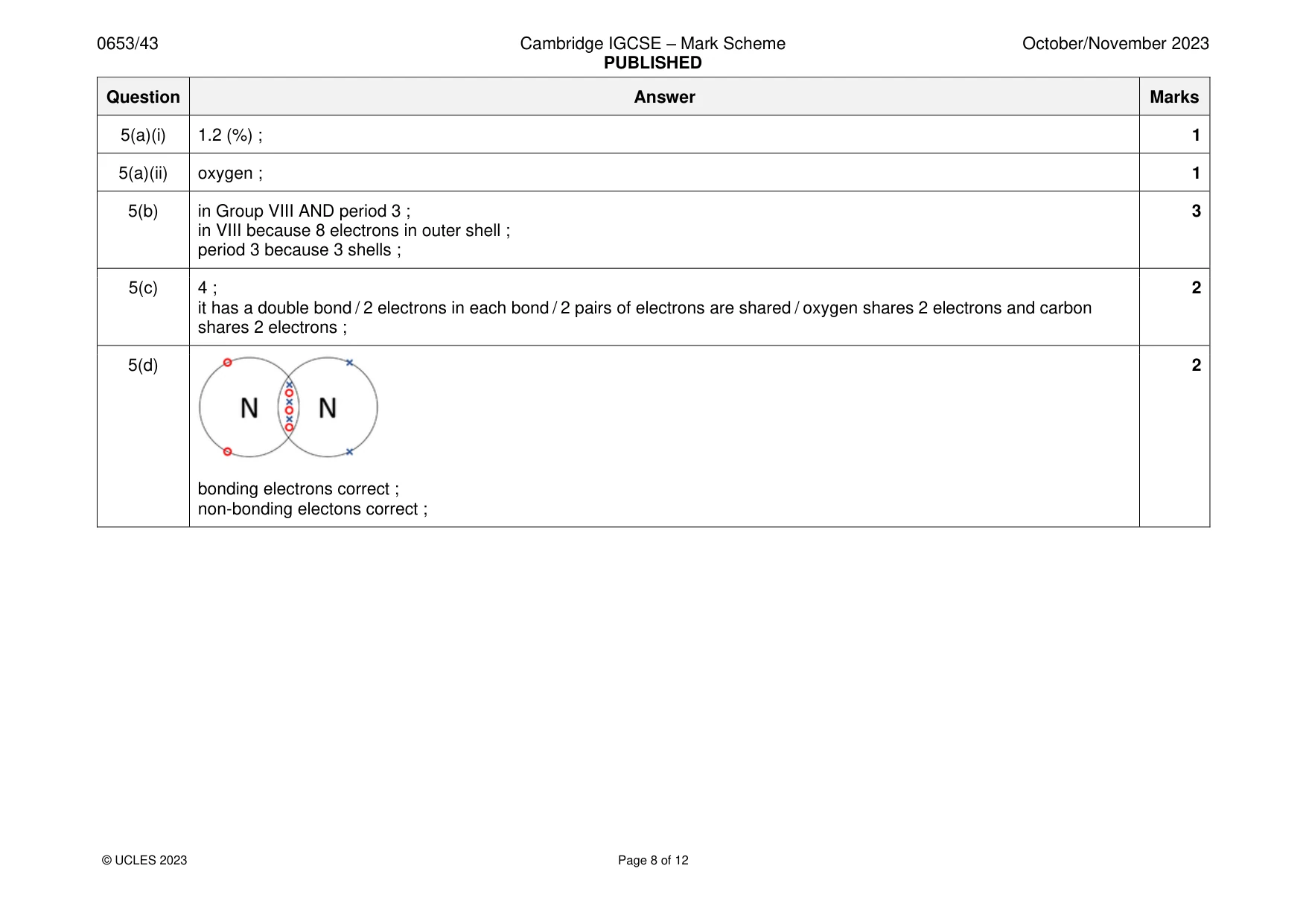
5 Table 5.1 gives information on the percentage composition of the atmosphere of the planet Mars. Table 5.1 percentage composition of gas the atmosphere of Mars carbon dioxide 95.0 nitrogen 1.9 argon 1.9 (a) (i) The atmosphere of Mars contains other gases not shown in Table 5.1. Use Table 5.1 to calculate the percentage of other gases in the atmosphere of Mars. other gases = ......................................................% [1] (ii) More than 20% of the Earth’s atmosphere is gas X. Gas X is not shown in Table 5.1. State the name of gas X. ..................................................................................................................................... [1] (b) The electronic structure of argon is shown in Fig. 5.1. Ar Fig. 5.1 Argon is a noble gas. Describe how the position of argon in the Periodic Table is related to its electronic structure. Use ideas about period number and group number in your answer. ................................................................................................................................................... ................................................................................................................................................... ................................................................................................................................................... ............................................................................................................................................. [3] (c) The structure of carbon dioxide is shown in Fig. 5.2. Fig. 5.2 State the number of electrons that are shared between the carbon atom and one oxygen atom in a molecule of carbon dioxide. Give a reason for your answer. number of electrons .................... reason ....................................................................................................................................... ................................................................................................................................................... [2] (d) Complete Fig. 5.3 to show the dot‑and‑cross diagram of a molecule of nitrogen. Show all of the outer shell electrons. N N Fig. 5.3 [2] [Total: 9]
Mark scheme: 5(a)(i) 1.2 (%) ; 1 5(a)(ii) oxygen ; 1 5(b) in Group VIII AND period 3 ; 3 in VIII because 8 electrons in outer shell ; period 3 because 3 shells ; 5(c) 4 ; 2 it has a double bond / 2 electrons in each bond / 2 pairs of electrons are shared / oxygen shares 2 electrons and carbon shares 2 electrons ; 5(d) 2 bonding electrons correct ; non-bonding electons correct ;
Q6 · A spring has an original length of 10.0 cm
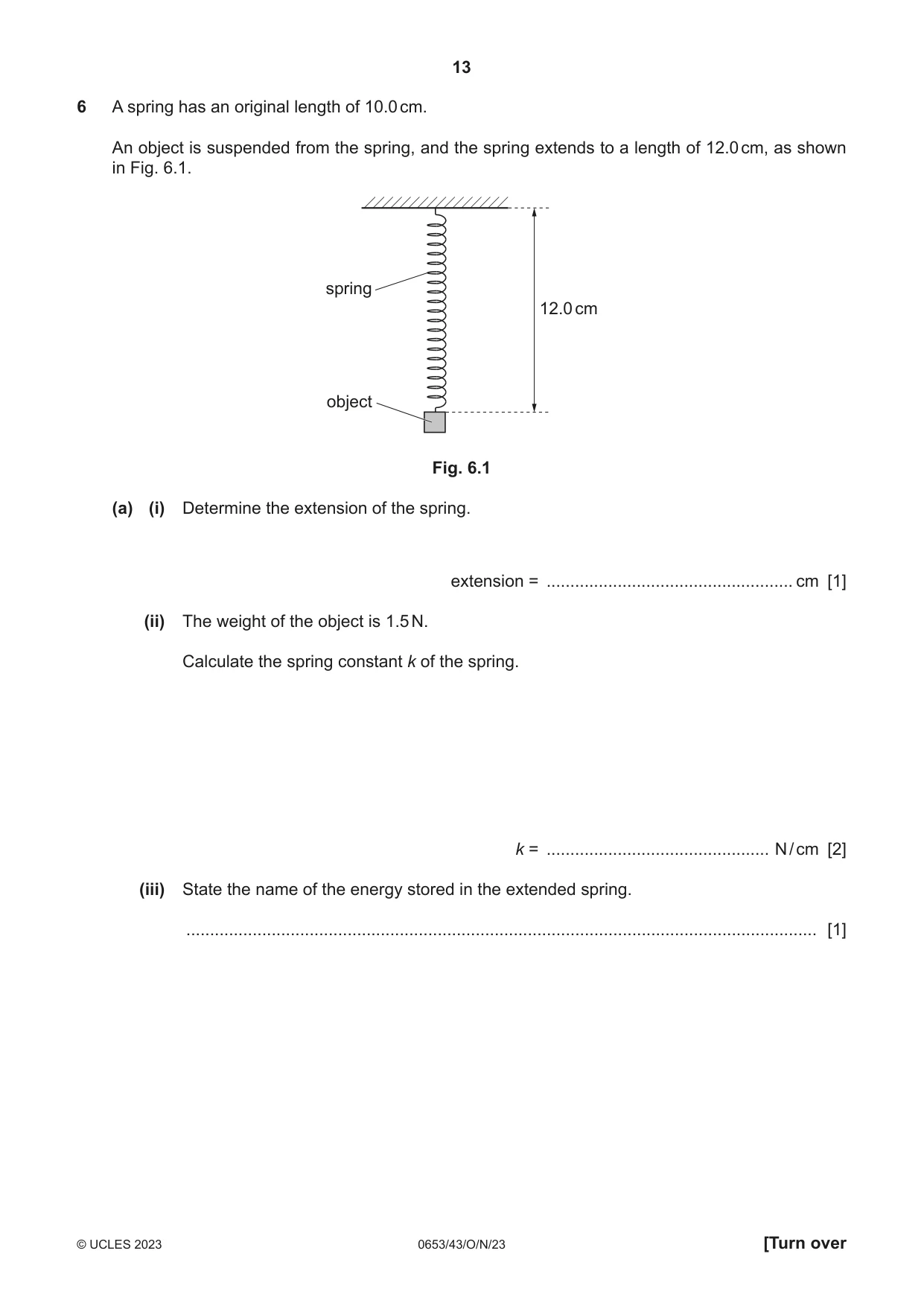
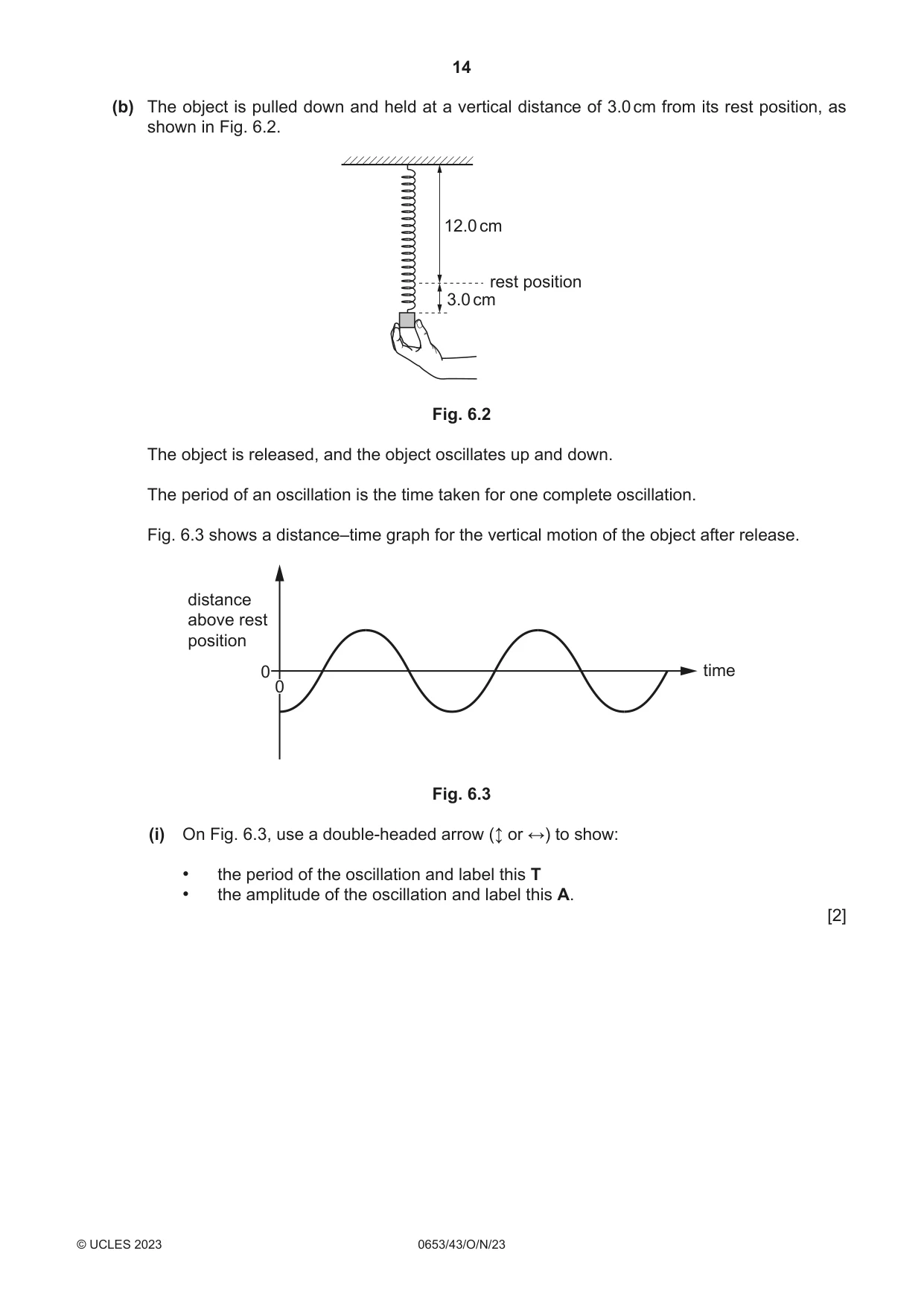
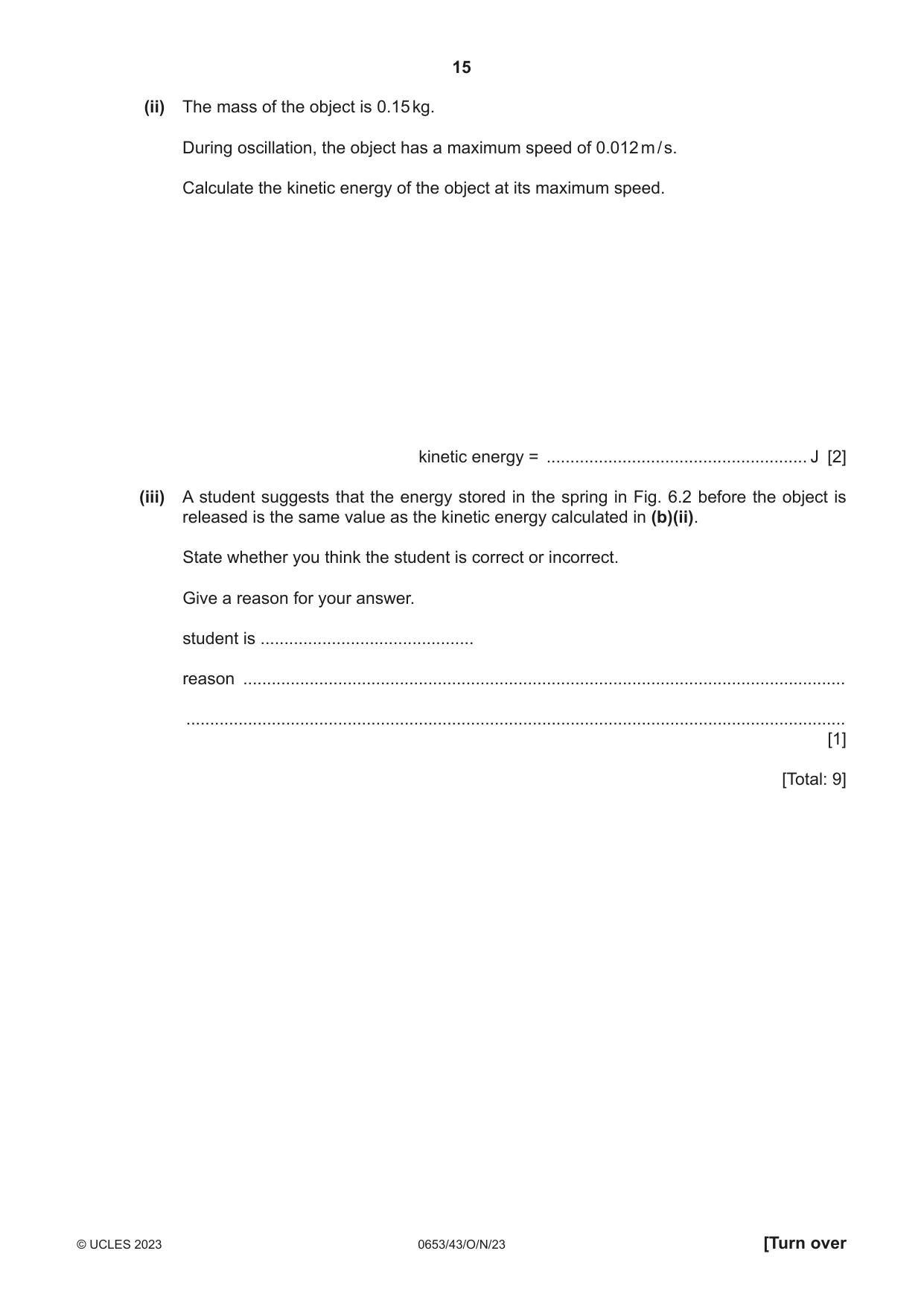
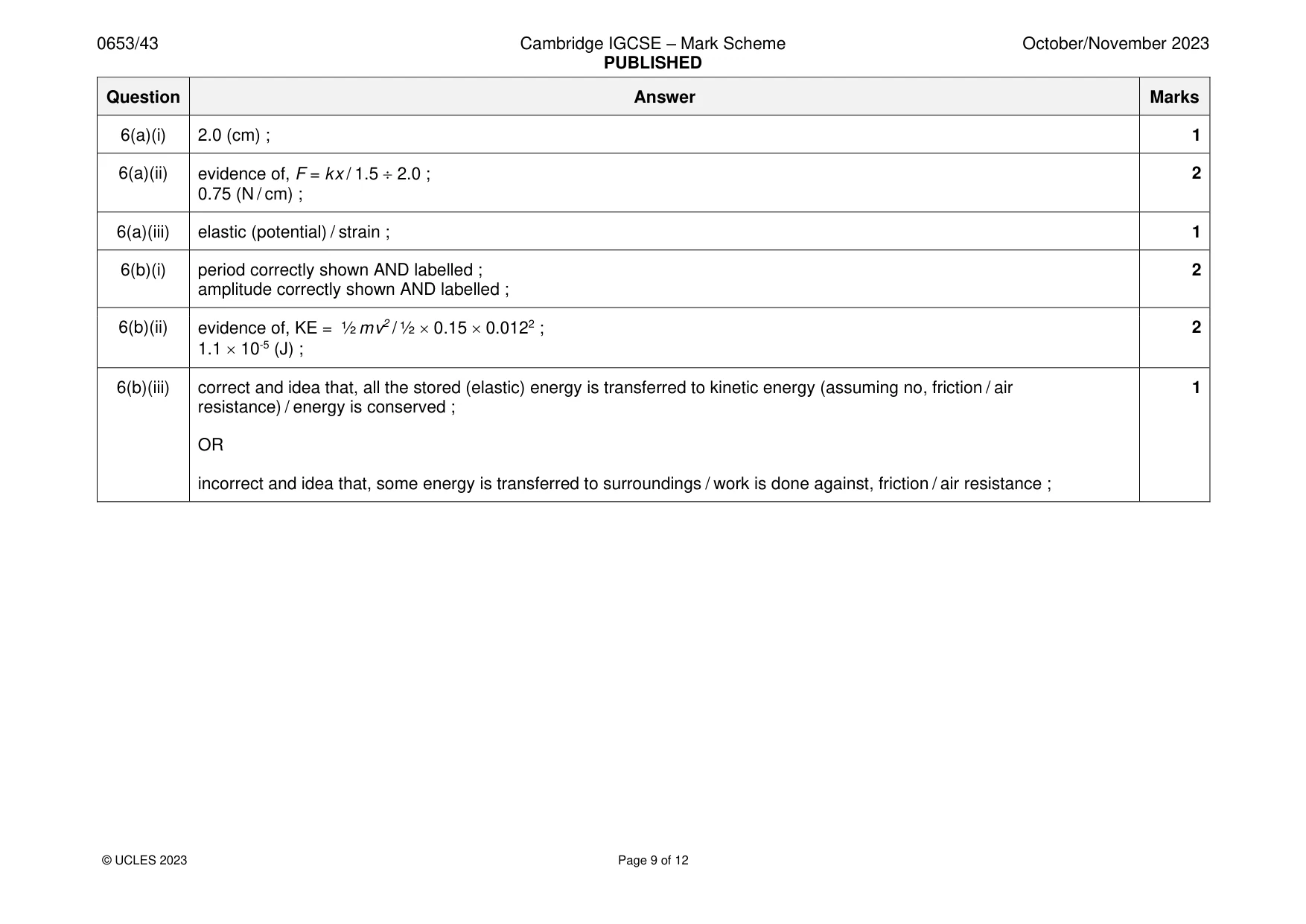
6 A spring has an original length of 10.0 cm. An object is suspended from the spring, and the spring extends to a length of 12.0 cm, as shown in Fig. 6.1. spring 12.0 cm object Fig. 6.1 (a) (i) Determine the extension of the spring. extension = .................................................... cm [1] (ii) The weight of the object is 1.5 N. Calculate the spring constant k of the spring. k = ............................................... N / cm [2] (iii) State the name of the energy stored in the extended spring. ..................................................................................................................................... [1] (b) The object is pulled down and held at a vertical distance of 3.0 cm from its rest position, as shown in Fig. 6.2. 12.0 cm rest position 3.0 cm Fig. 6.2 The object is released, and the object oscillates up and down. The period of an oscillation is the time taken for one complete oscillation. Fig. 6.3 shows a distance–time graph for the vertical motion of the object after release. distance above rest position 0 time 0 Fig. 6.3 (i) On Fig. 6.3, use a double‑headed arrow (↕ or ↔) to show: • the period of the oscillation and label this T • the amplitude of the oscillation and label this A. [2] (ii) The mass of the object is 0.15 kg. During oscillation, the object has a maximum speed of 0.012 m / s. Calculate the kinetic energy of the object at its maximum speed. kinetic energy = ....................................................... J [2] (iii) A student suggests that the energy stored in the spring in Fig. 6.2 before the object is released is the same value as the kinetic energy calculated in (b)(ii). State whether you think the student is correct or incorrect. Give a reason for your answer. student is ............................................. reason ............................................................................................................................... ........................................................................................................................................... [1] [Total: 9]
Mark scheme: 6(a)(i) 2.0 (cm) ; 1 6(a)(ii) evidence of, F = k x / 1.5 2.0 ; 2 0.75 (N / cm) ; 6(a)(iii) elastic (potential) / strain ; 1 6(b)(i) period correctly shown AND labelled ; 2 amplitude correctly shown AND labelled ; 6(b)(ii) evidence of, KE = ½ m v2 / ½ 0.15 0.0122 ; 2 1.1 10-5 (J) ; 6(b)(iii) correct and idea that, all the stored (elastic) energy is transferred to kinetic energy (assuming no, friction / air 1 resistance) / energy is conserved ; OR incorrect and idea that, some energy is transferred to surroundings / work is done against, friction / air resistance ;
Q7 · The drawing of a cross‑section through a root
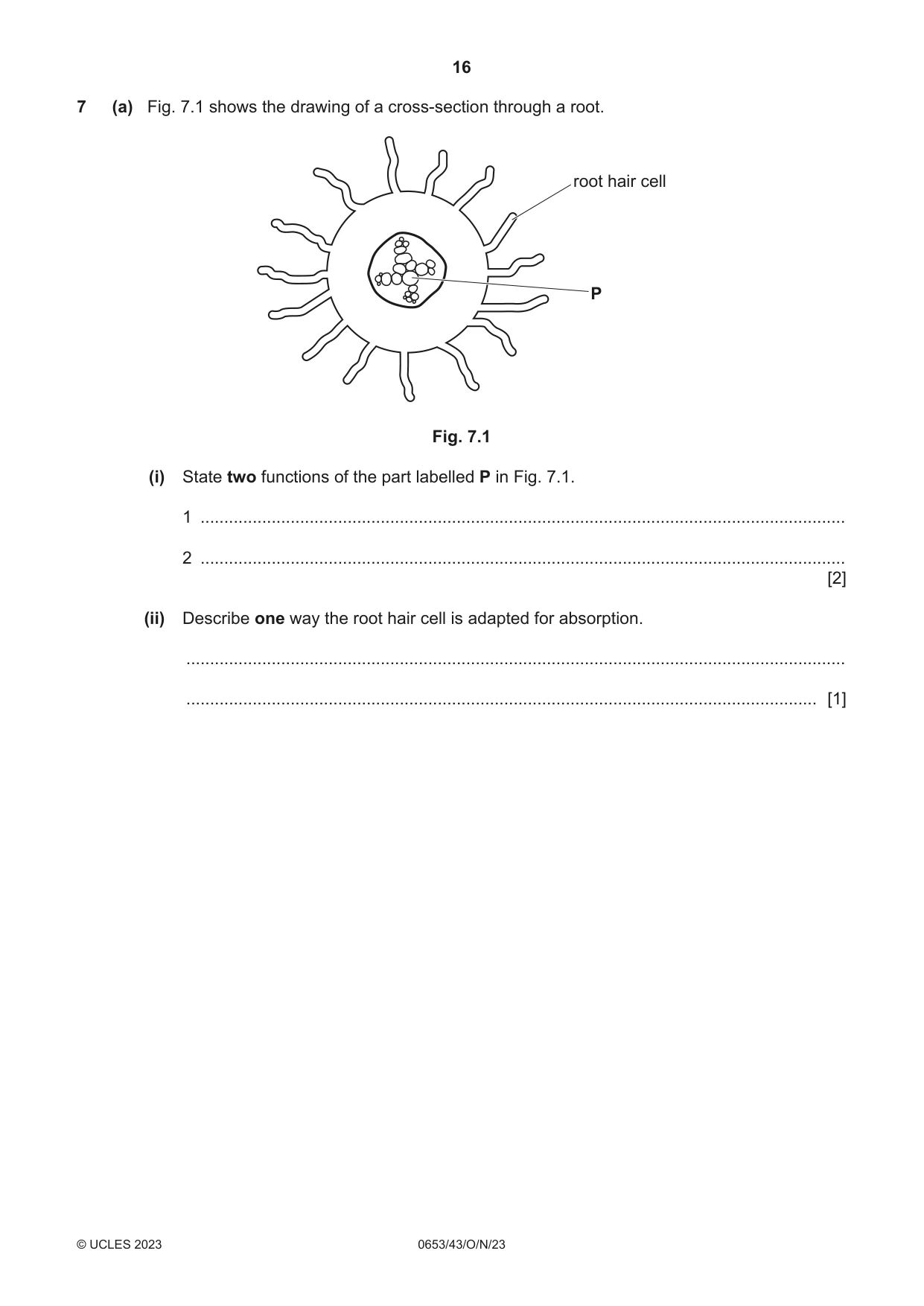
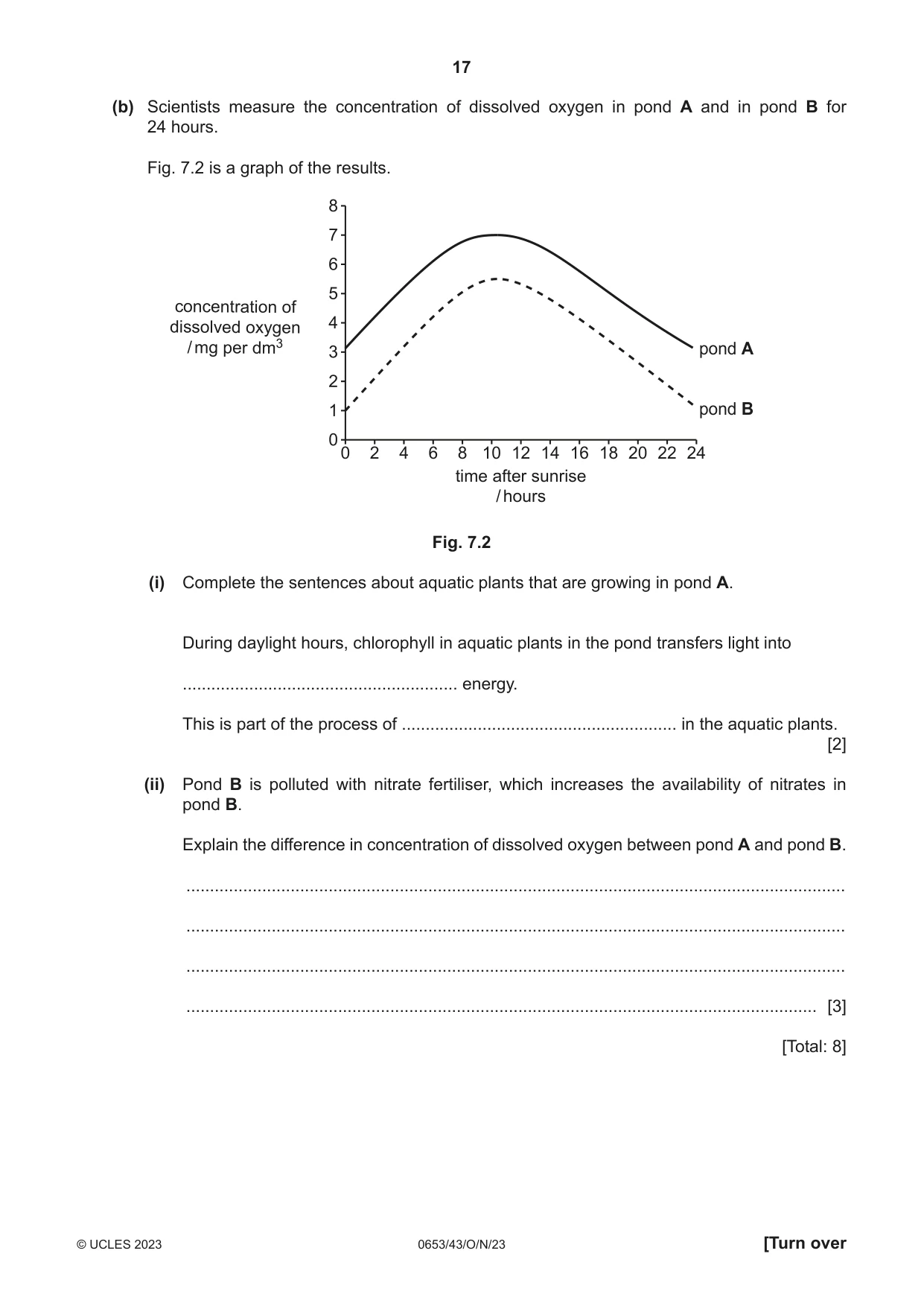
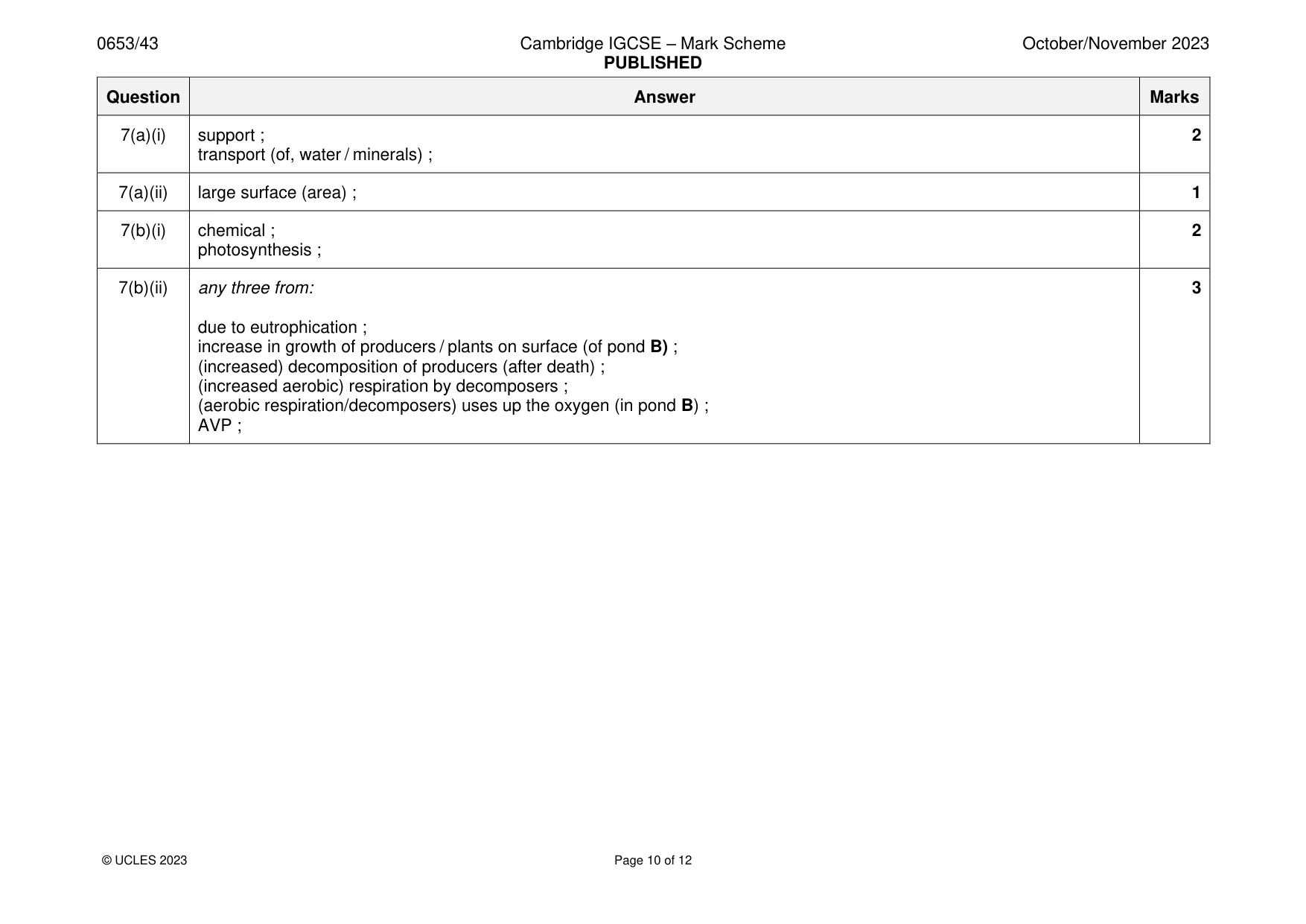
7 (a) Fig. 7.1 shows the drawing of a cross‑section through a root. root hair cell P Fig. 7.1 (i) State two functions of the part labelled P in Fig. 7.1. 1 ........................................................................................................................................ 2 ........................................................................................................................................ [2] (ii) Describe one way the root hair cell is adapted for absorption. ........................................................................................................................................... ..................................................................................................................................... [1] (b) Scientists measure the concentration of dissolved oxygen in pond A and in pond B for 24 hours. Fig. 7.2 is a graph of the results. 8 7 6 5 concentration of dissolved oxygen 4 / mg per dm3 3 pond A 2 1 pond B 0 0 2 4 6 8 10 12 14 16 18 20 22 24 time after sunrise / hours Fig. 7.2 (i) Complete the sentences about aquatic plants that are growing in pond A. During daylight hours, chlorophyll in aquatic plants in the pond transfers light into .......................................................... energy. This is part of the process of .......................................................... in the aquatic plants. [2] (ii) Pond B is polluted with nitrate fertiliser, which increases the availability of nitrates in pond B. Explain the difference in concentration of dissolved oxygen between pond A and pond B. ........................................................................................................................................... ........................................................................................................................................... ........................................................................................................................................... ..................................................................................................................................... [3] [Total: 8]
Mark scheme: 7(a)(i) support ; 2 transport (of, water / minerals) ; 7(a)(ii) large surface (area) ; 1 7(b)(i) chemical ; 2 photosynthesis ; 7(b)(ii) any three from: 3 due to eutrophication ; increase in growth of producers / plants on surface (of pond B) ; (increased) decomposition of producers (after death) ; (increased aerobic) respiration by decomposers ; (aerobic respiration/decomposers) uses up the oxygen (in pond B) ; AVP ;
Q8 · Some information about some alkanes and alkenes
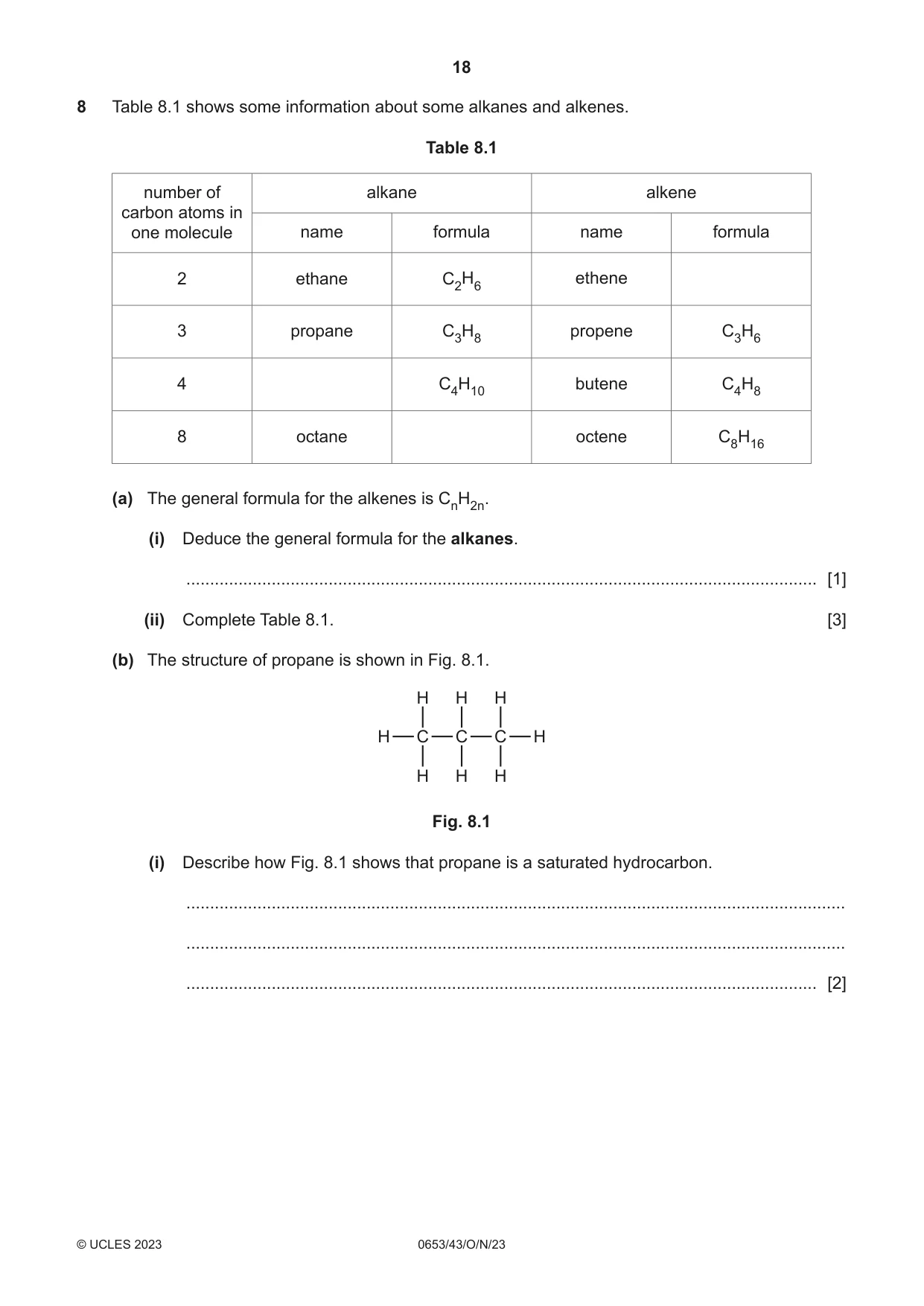
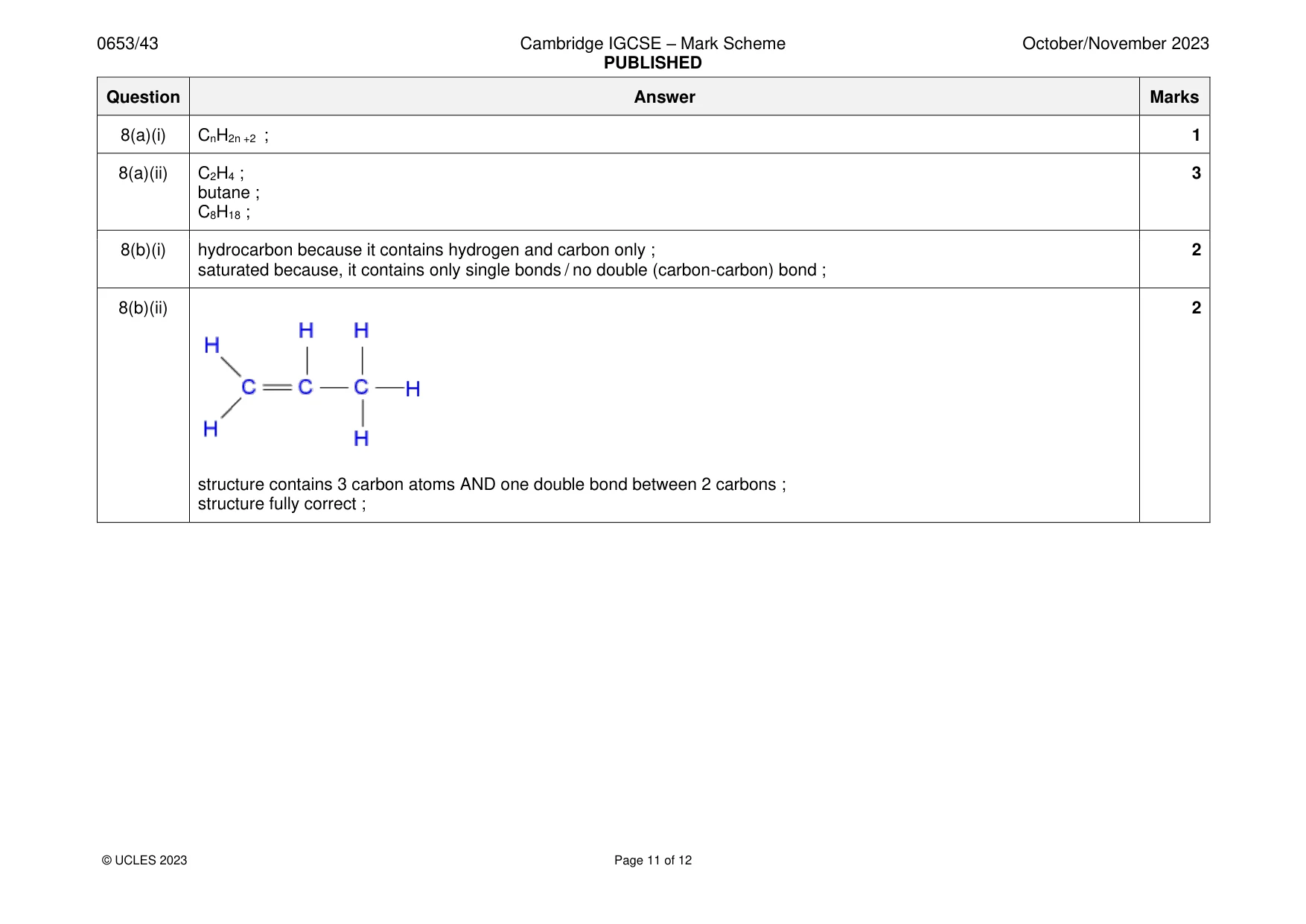
8 Table 8.1 shows some information about some alkanes and alkenes. Table 8.1 number of alkane alkene carbon atoms in one molecule name formula name formula 2 ethane C2H6 ethene 3 propane C3H8 propene C3H6 4 C4H10 butene C4H8 8 octane octene C8H16 (a) The general formula for the alkenes is CnH2n. (i) Deduce the general formula for the alkanes. ..................................................................................................................................... [1] (ii) Complete Table 8.1. [3] (b) The structure of propane is shown in Fig. 8.1. H H H H C C C H H H H Fig. 8.1 (i) Describe how Fig. 8.1 shows that propane is a saturated hydrocarbon. ........................................................................................................................................... ........................................................................................................................................... ..................................................................................................................................... [2] (ii) Draw a diagram, similar to Fig. 8.1, to show the structure of propene. [2] [Total: 8]
Mark scheme: 8(a)(i) CnH2n +2 ; 1 8(a)(ii) C2H4 ; 3 butane ; C8H18 ; 8(b)(i) hydrocarbon because it contains hydrogen and carbon only ; 2 saturated because, it contains only single bonds / no double (carbon-carbon) bond ; 8(b)(ii) 2 structure contains 3 carbon atoms AND one double bond between 2 carbons ; structure fully correct ;
Q9 · An ultraviolet torch used to kill bacteria and viruses on surfaces
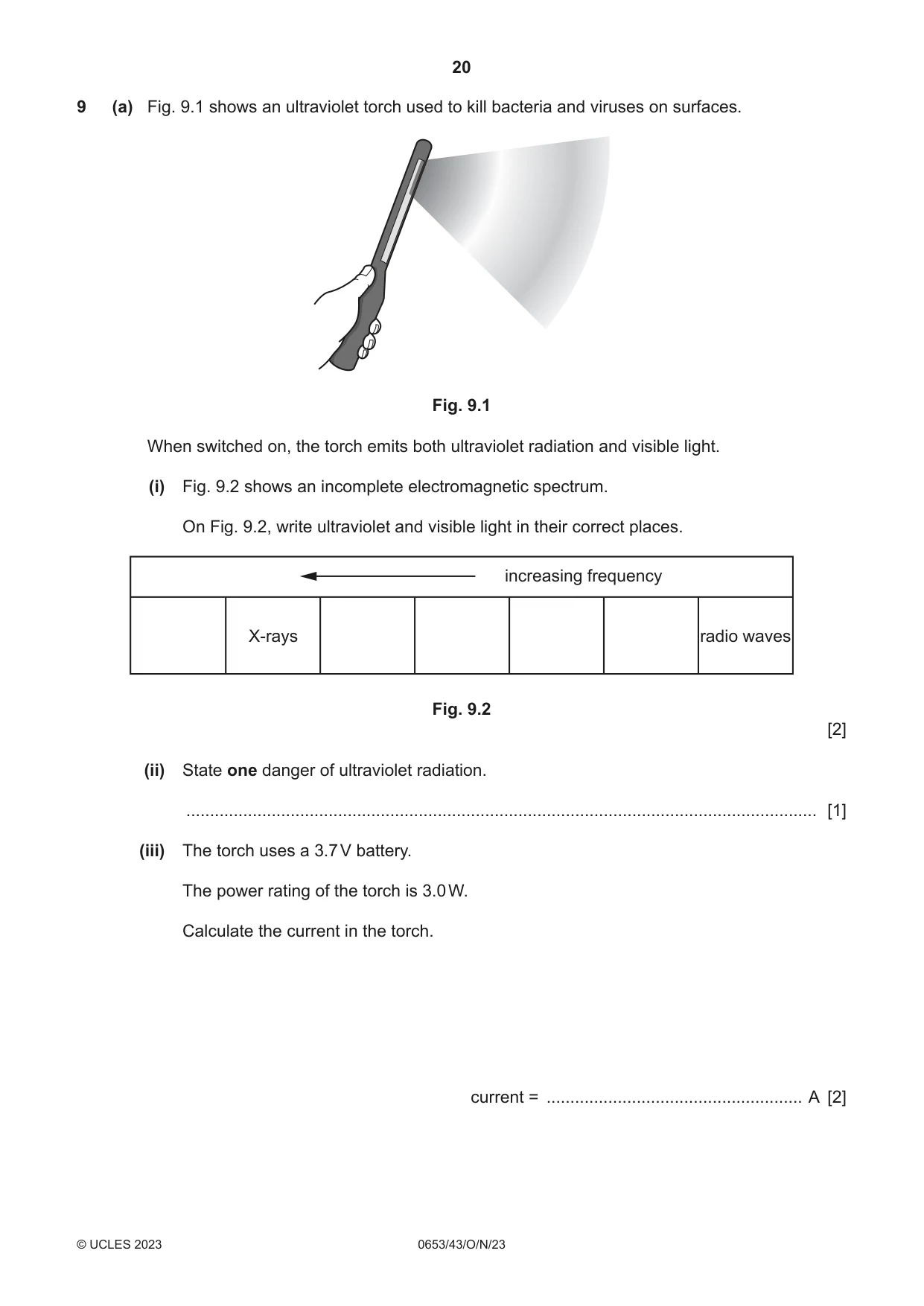
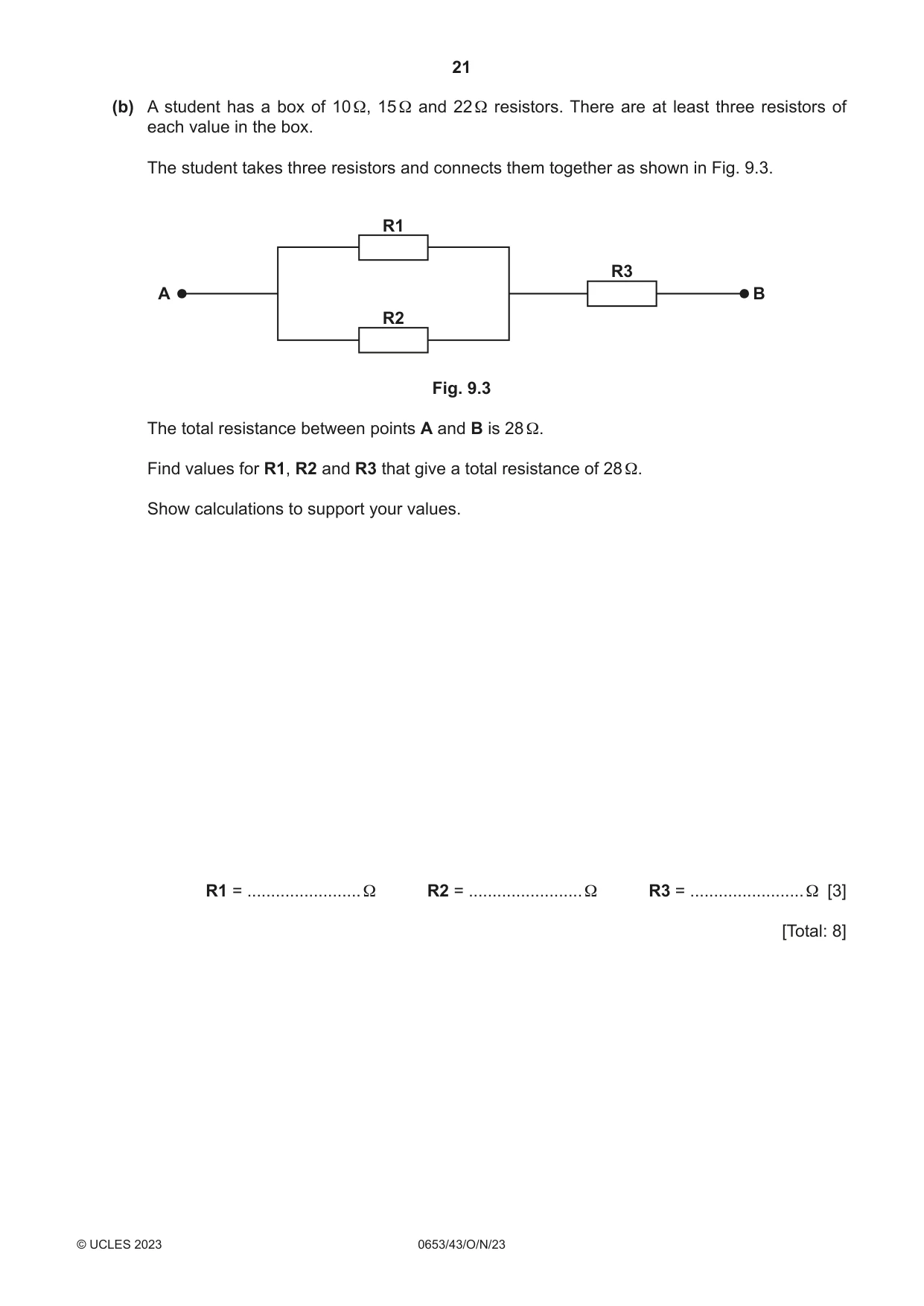
9 (a) Fig. 9.1 shows an ultraviolet torch used to kill bacteria and viruses on surfaces. Fig. 9.1 When switched on, the torch emits both ultraviolet radiation and visible light. (i) Fig. 9.2 shows an incomplete electromagnetic spectrum. On Fig. 9.2, write ultraviolet and visible light in their correct places. increasing frequency X-rays radio waves Fig. 9.2 [2] (ii) State one danger of ultraviolet radiation. ..................................................................................................................................... [1] (iii) The torch uses a 3.7 V battery. The power rating of the torch is 3.0 W. Calculate the current in the torch. current = ...................................................... A [2] (b) A student has a box of 10 Ω, 15 Ω and 22 Ω resistors. There are at least three resistors of each value in the box. The student takes three resistors and connects them together as shown in Fig. 9.3. R1 R3 A B R2 Fig. 9.3 The total resistance between points A and B is 28 Ω. Find values for R1, R2 and R3 that give a total resistance of 28 Ω. Show calculations to support your values. R1 = ........................ Ω R2 = ........................ Ω R3 = ........................ Ω [3] [Total: 8]
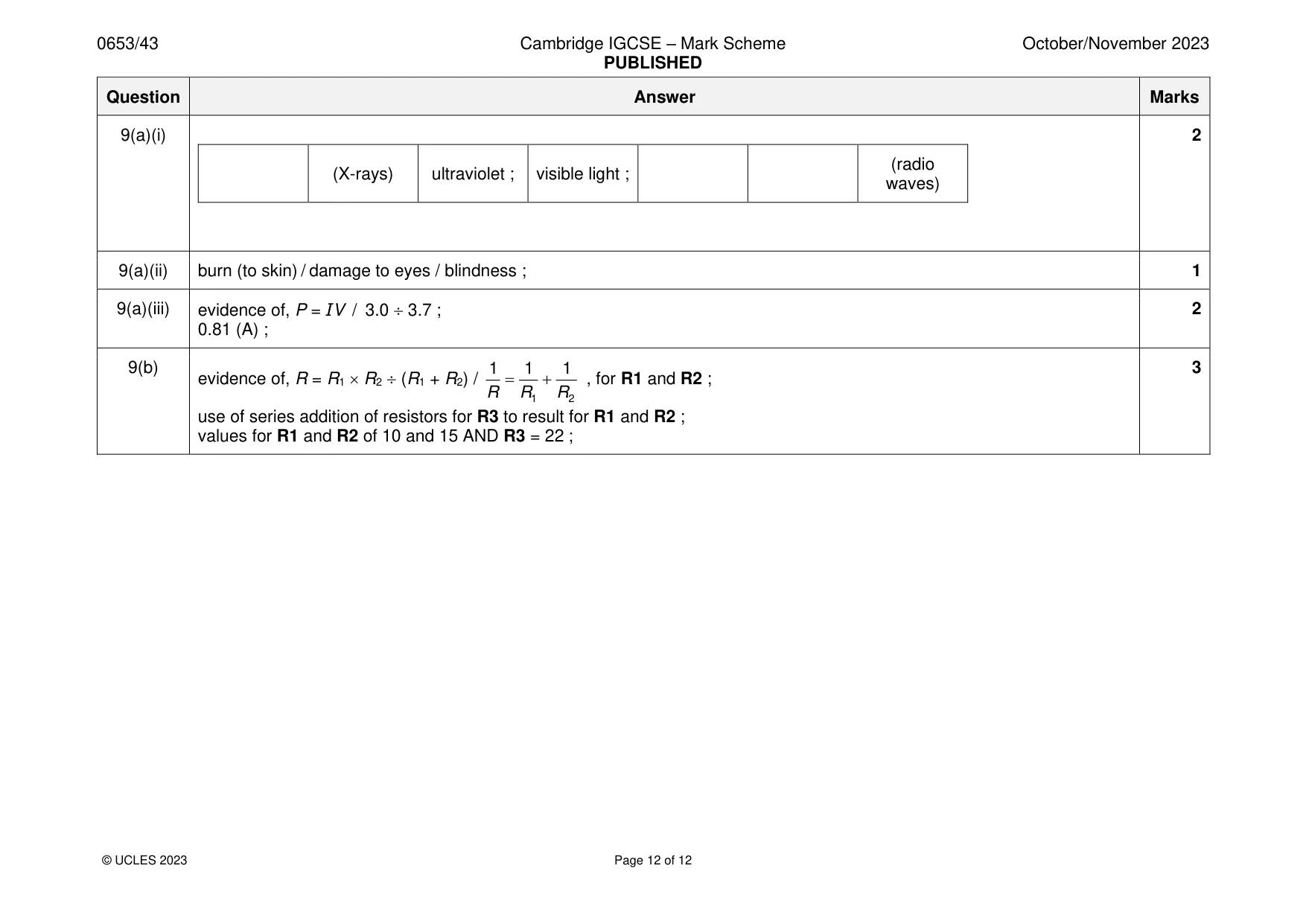
Mark scheme: 9(a)(i) 2 (radio (X-rays) ultraviolet ; visible light ; waves) 9(a)(ii) burn (to skin) / damage to eyes / blindness ; 1 9(a)(iii) evidence of, P = IV / 3.0 3.7 ; 2 0.81 (A) ; 9(b) 1 1 1 3 evidence of, R = R1 R2 (R1 + R2) / = + , for R1 and R2 ; R R1 R2 use of series addition of resistors for R3 to result for R1 and R2 ; values for R1 and R2 of 10 and 15 AND R3 = 22 ;
What was in this paper
The subtopics covered by these 9 questions, and how many questions each got. Open one in a new tab to see every Cambridge question on it.
What you needed in this session
Cambridge’s own grade thresholds for 2023 Oct/Nov, Paper 4 · Variant 3. A higher threshold means an easier paper — the bar moves with how the cohort did.