Cambridge IGCSE Science - Combined 0653 — 2018 May/June Paper 4 · Variant 1
0653/41/M/J/18 · 9 questions · 80 marks · ≈90 min
The question paper and its mark scheme, free to read here and free to download. This is Cambridge’s own paper, exactly as it was sat.
Question paper20 pages
Mark scheme11 pages
Answers below. Sit the paper first if you are practising.
Questions as text
Q1 · Four substances found in food, and elements they may contain
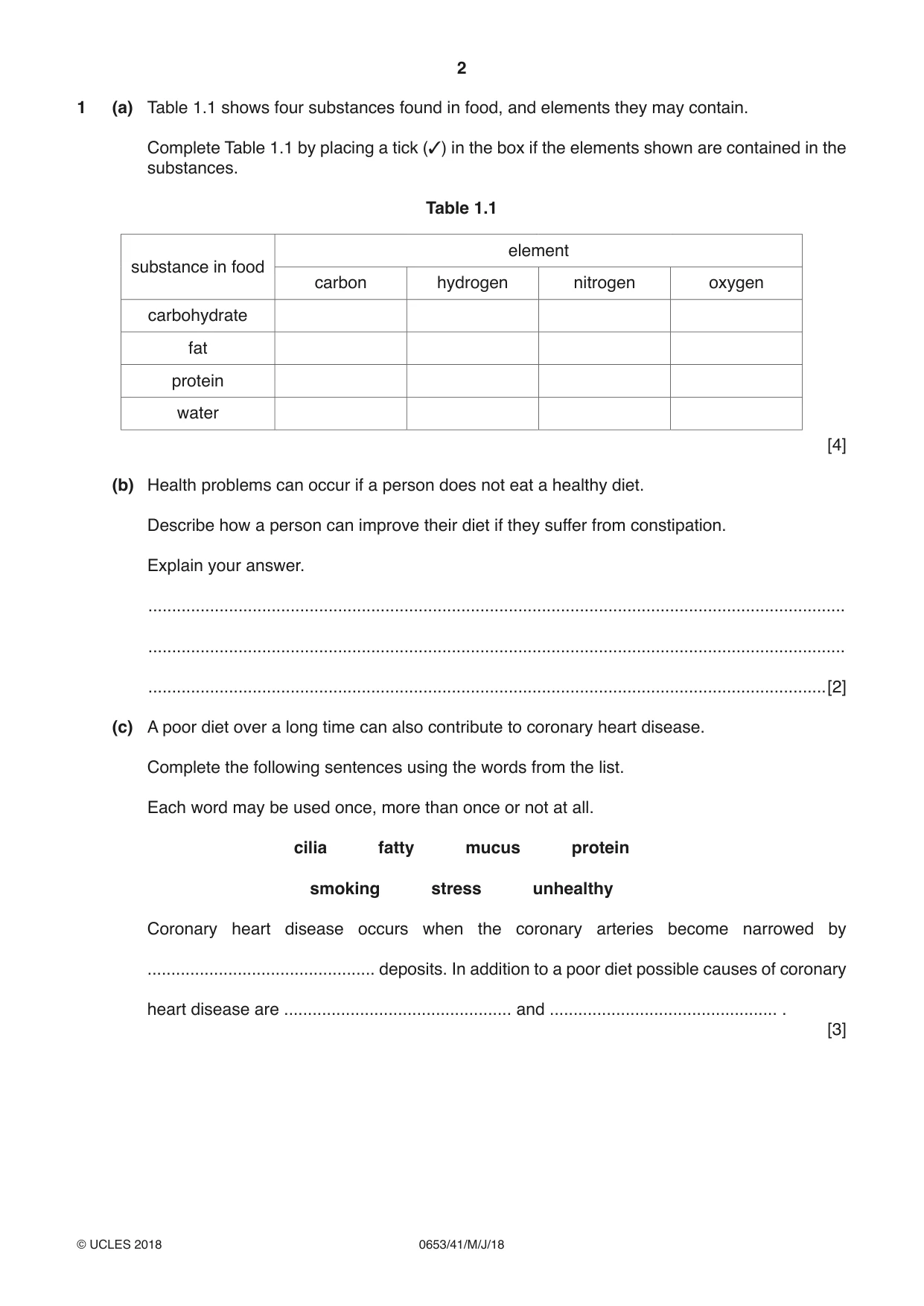
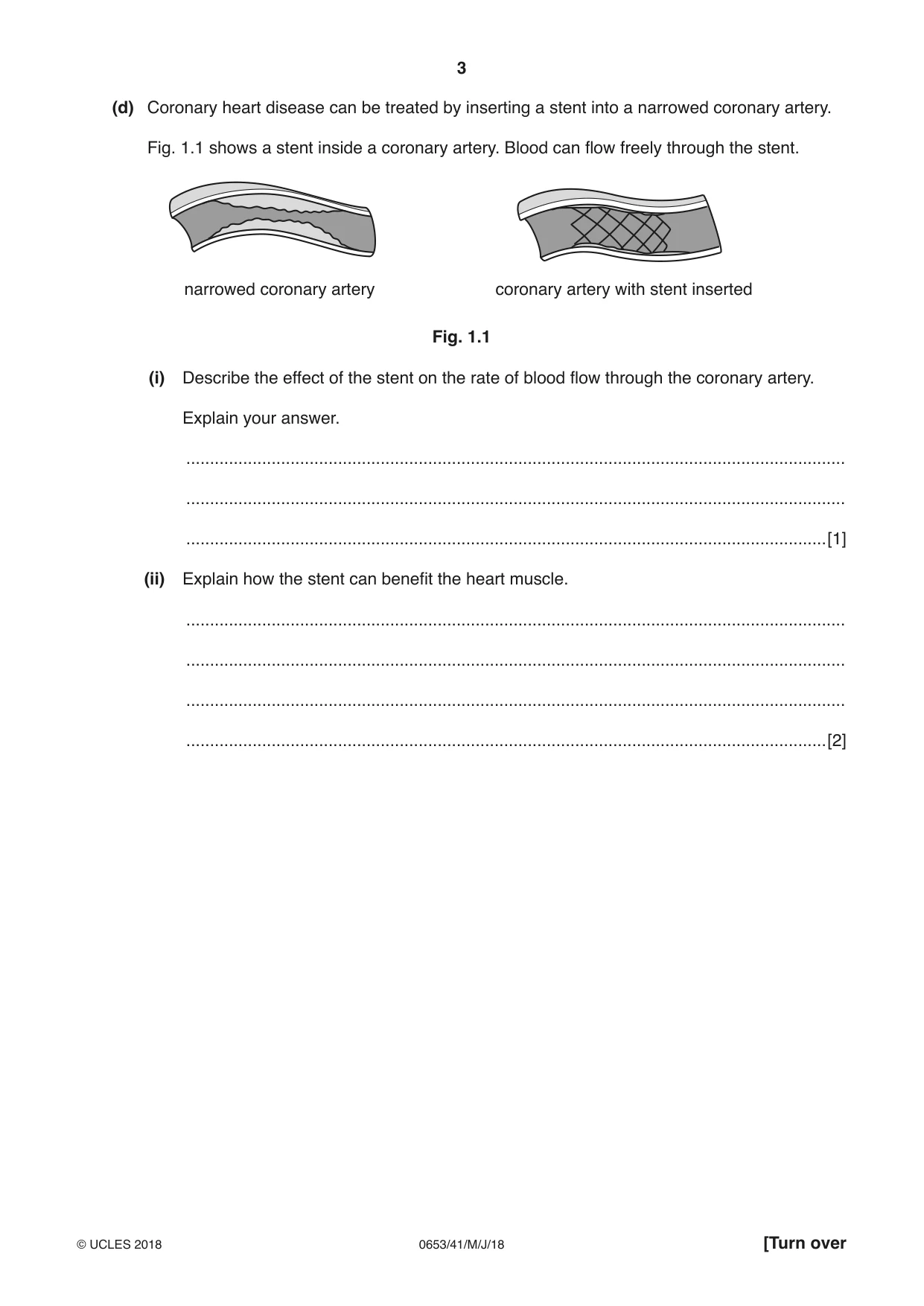
1 (a) Table 1.1 shows four substances found in food, and elements they may contain. Complete Table 1.1 by placing a tick (3) in the box if the elements shown are contained in the substances. Table 1.1 element substance in food carbon hydrogen nitrogen oxygen carbohydrate fat protein water [4] (b) Health problems can occur if a person does not eat a healthy diet. Describe how a person can improve their diet if they suffer from constipation. Explain your answer. ................................................................................................................................................... ................................................................................................................................................... ...............................................................................................................................................[2] (c) A poor diet over a long time can also contribute to coronary heart disease. Complete the following sentences using the words from the list. Each word may be used once, more than once or not at all. cilia fatty mucus protein smoking stress unhealthy Coronary heart disease occurs when the coronary arteries become narrowed by ................................................ deposits. In addition to a poor diet possible causes of coronary heart disease are ................................................ and ................................................ . [3] (d) Coronary heart disease can be treated by inserting a stent into a narrowed coronary artery. Fig. 1.1 shows a stent inside a coronary artery. Blood can flow freely through the stent. narrowed coronary artery coronary artery with stent inserted Fig. 1.1 (i) Describe the effect of the stent on the rate of blood flow through the coronary artery. Explain your answer. ........................................................................................................................................... ........................................................................................................................................... .......................................................................................................................................[1] (ii) Explain how the stent can benefit the heart muscle. ........................................................................................................................................... ........................................................................................................................................... ........................................................................................................................................... .......................................................................................................................................[2]
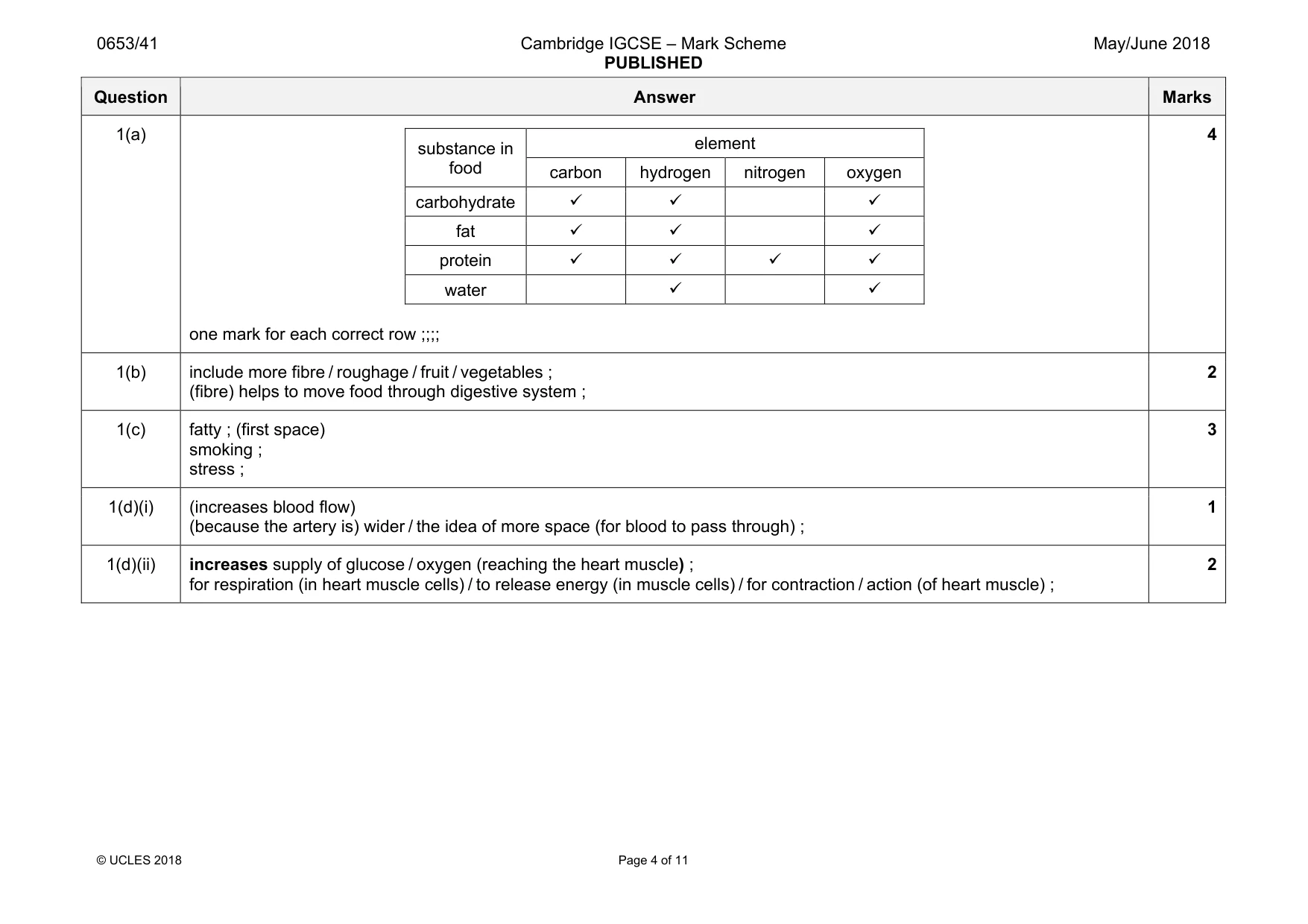
Mark scheme: 1(a) substance in food element carbon hydrogen nitrogen oxygen carbohydrate 9 9 9 fat 9 9 9 protein 9 9 9 9 water 9 9 one mark for each correct row ;;;; 4 1(b) include more fibre / roughage / fruit / vegetables ; (fibre) helps to move food through digestive system ; 2 1(c) fatty ; (first space) smoking ; stress ; 3 1(d)(i) (increases blood flow) (because the artery is) wider / the idea of more space (for blood to pass through) ; 1 1(d)(ii) increases supply of glucose / oxygen (reaching the heart muscle) ; for respiration (in heart muscle cells) / to release energy (in muscle cells) / for contraction / action (of heart muscle) ; 2
Q2 · A student investigates the relative reactivity of different metals
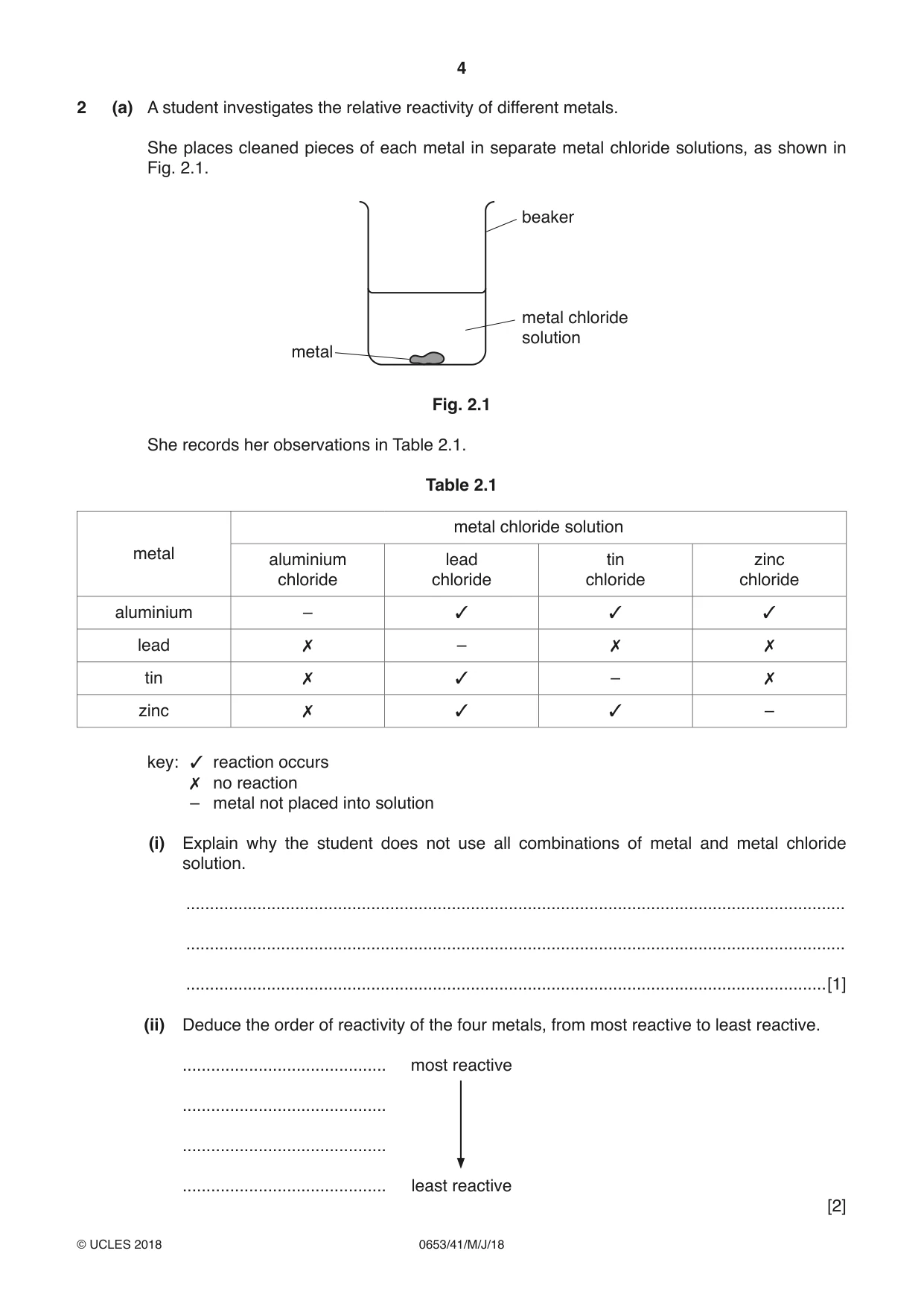
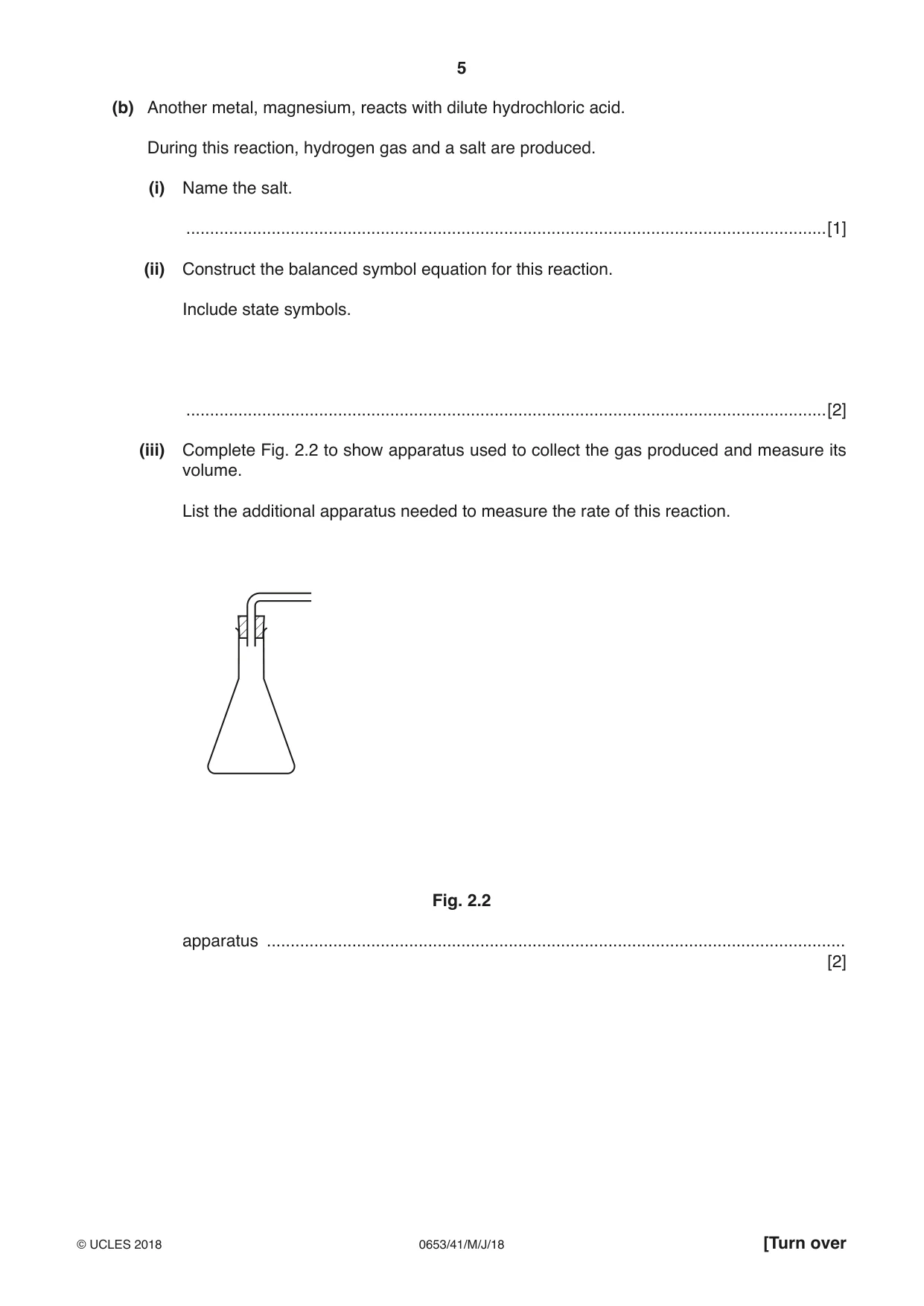
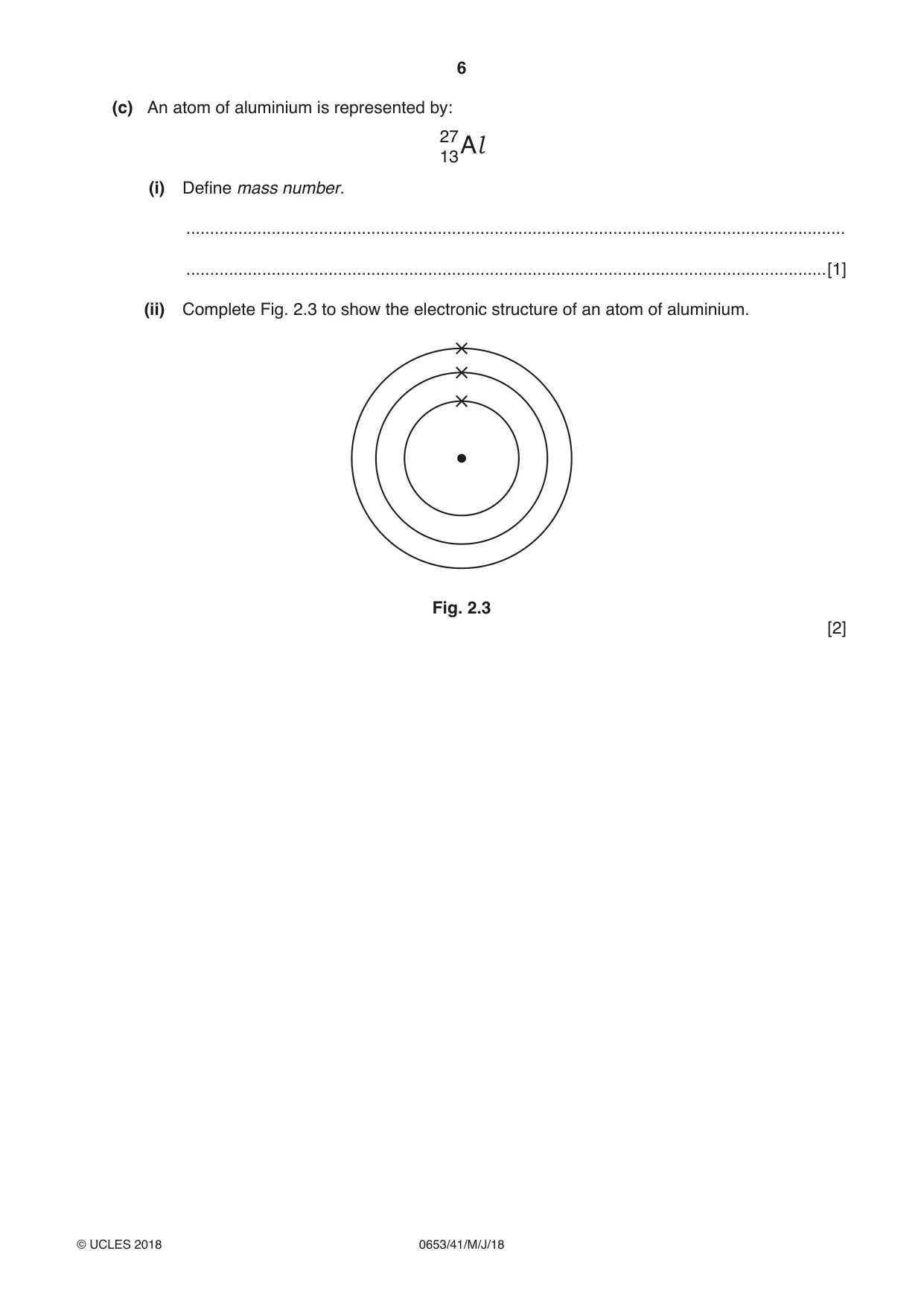
2 (a) A student investigates the relative reactivity of different metals. She places cleaned pieces of each metal in separate metal chloride solutions, as shown in Fig. 2.1. beaker metal chloride solution metal Fig. 2.1 She records her observations in Table 2.1. Table 2.1 metal chloride solution metal aluminium lead tin zinc chloride chloride chloride chloride 3 3 3 aluminium – 7 7 7 lead – 7 3 7 tin – 7 3 3 zinc – key: 3 reaction occurs 7 no reaction – metal not placed into solution (i) Explain why the student does not use all combinations of metal and metal chloride solution. ........................................................................................................................................... ........................................................................................................................................... .......................................................................................................................................[1] (ii) Deduce the order of reactivity of the four metals, from most reactive to least reactive. ........................................... most reactive ........................................... ........................................... ........................................... least reactive [2] (b) Another metal, magnesium, reacts with dilute hydrochloric acid. During this reaction, hydrogen gas and a salt are produced. (i) Name the salt. .......................................................................................................................................[1] (ii) Construct the balanced symbol equation for this reaction. Include state symbols. .......................................................................................................................................[2] (iii) Complete Fig. 2.2 to show apparatus used to collect the gas produced and measure its volume. List the additional apparatus needed to measure the rate of this reaction. Fig. 2.2 apparatus .......................................................................................................................... [2] (c) An atom of aluminium is represented by: 2713Al (i) Define mass number. ........................................................................................................................................... .......................................................................................................................................[1] (ii) Complete Fig. 2.3 to show the electronic structure of an atom of aluminium. Fig. 2.3 [2]
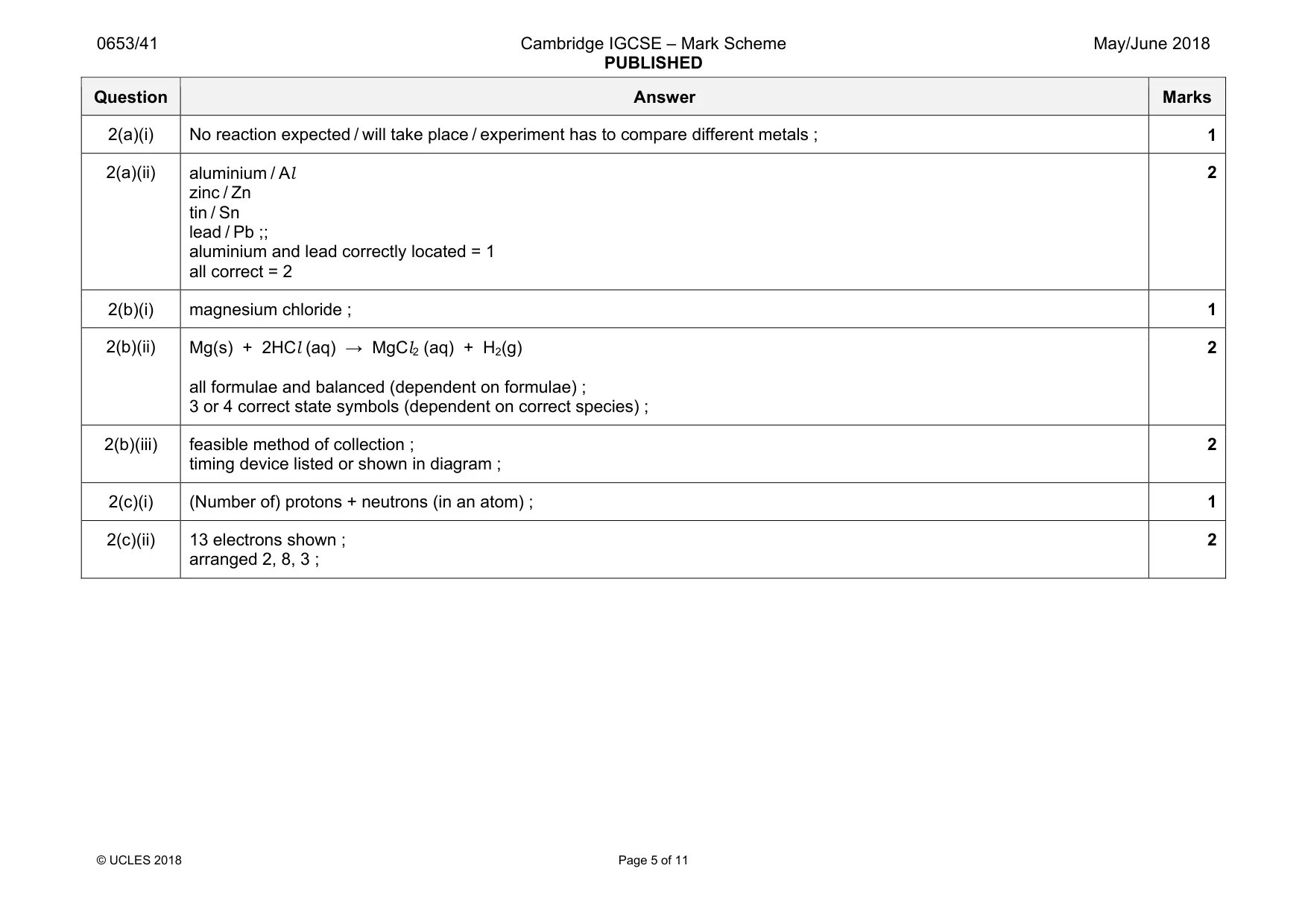
Mark scheme: 2(a)(i) No reaction expected / will take place / experiment has to compare different metals ; 1 2(a)(ii) aluminium / Al zinc / Zn tin / Sn lead / Pb ;; aluminium and lead correctly located = 1 all correct = 2 2 2(b)(i) magnesium chloride ; 1 2(b)(ii) Mg(s) + 2HCl (aq) → MgCl2 (aq) + H2(g) all formulae and balanced (dependent on formulae) ; 3 or 4 correct state symbols (dependent on correct species) ; 2 2(b)(iii) feasible method of collection ; timing device listed or shown in diagram ; 2 2(c)(i) (Number of) protons + neutrons (in an atom) ; 1 2(c)(ii) 13 electrons shown ; arranged 2, 8, 3 ; 2
Q3 · An airship carrying a load of weight W
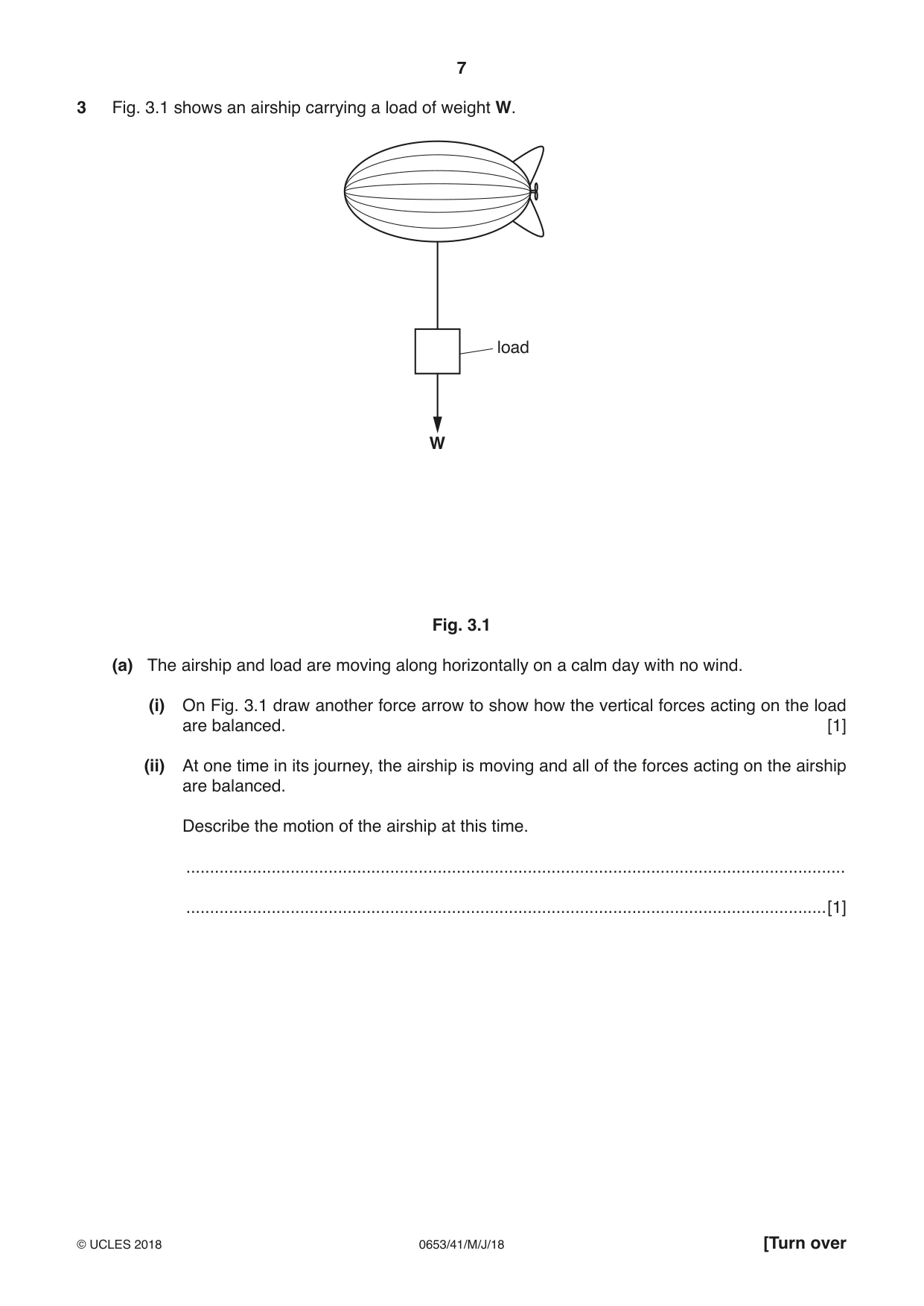
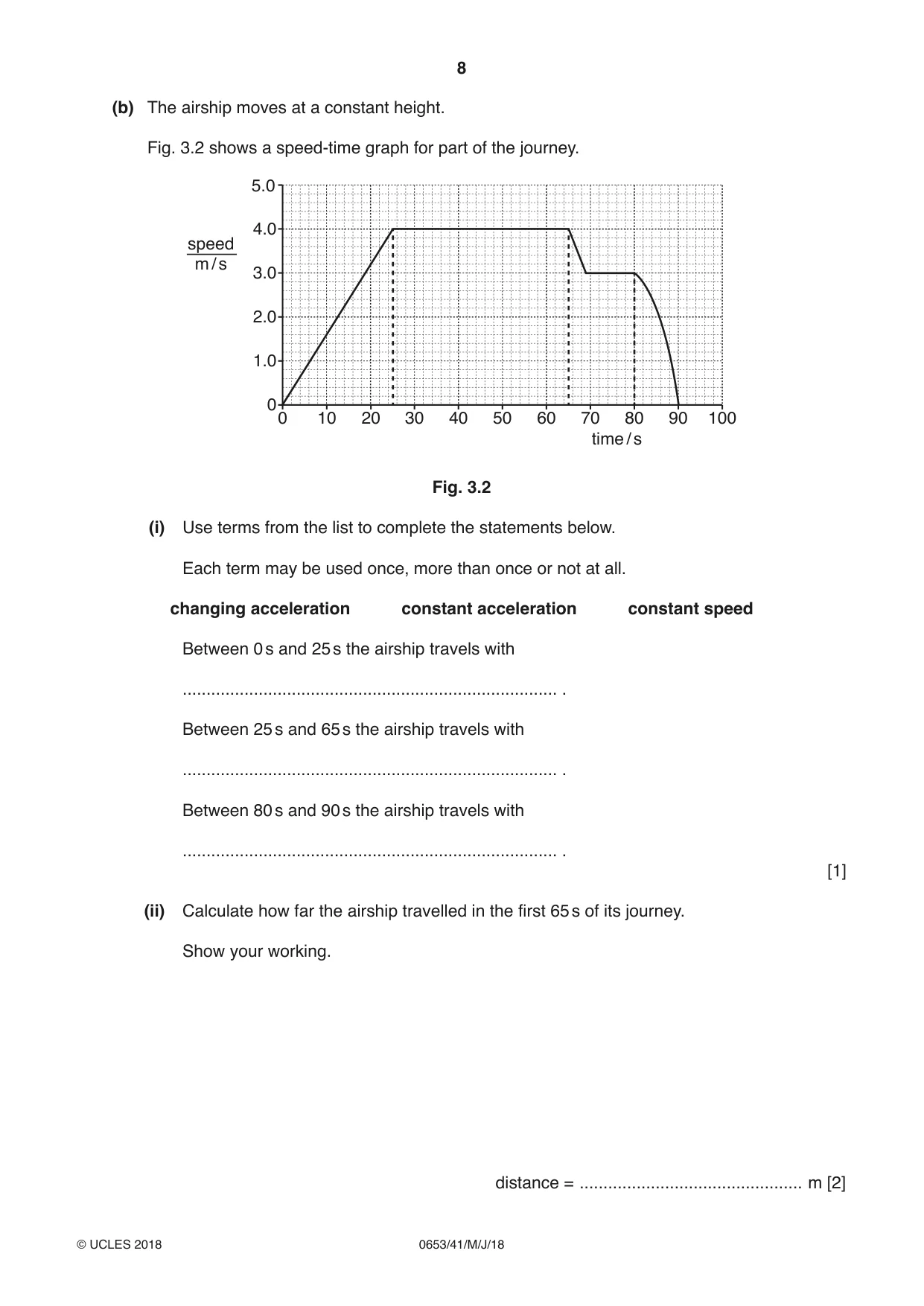
3 Fig. 3.1 shows an airship carrying a load of weight W. load W Fig. 3.1 (a) The airship and load are moving along horizontally on a calm day with no wind. (i) On Fig. 3.1 draw another force arrow to show how the vertical forces acting on the load are balanced. [1] (ii) At one time in its journey, the airship is moving and all of the forces acting on the airship are balanced. Describe the motion of the airship at this time. ........................................................................................................................................... .......................................................................................................................................[1] (b) The airship moves at a constant height. Fig. 3.2 shows a speed-time graph for part of the journey. 5.0 4.0 speed m / s 3.0 2.0 1.0 00 10 20 30 40 50 60 70 80 90 100 time / s Fig. 3.2 (i) Use terms from the list to complete the statements below. Each term may be used once, more than once or not at all. changing acceleration constant acceleration constant speed Between 0 s and 25 s the airship travels with ............................................................................... . Between 25 s and 65 s the airship travels with ............................................................................... . Between 80 s and 90 s the airship travels with ............................................................................... . [1] (ii) Calculate how far the airship travelled in the first 65 s of its journey. Show your working. distance = ............................................... m [2] (c) The load is a solid metal cube of density 7000 kg / m3. Each side of the cube measures 2.0 m. Calculate the mass of the metal cube. State any formula you use and show your working. mass = ...............................................kg [3]
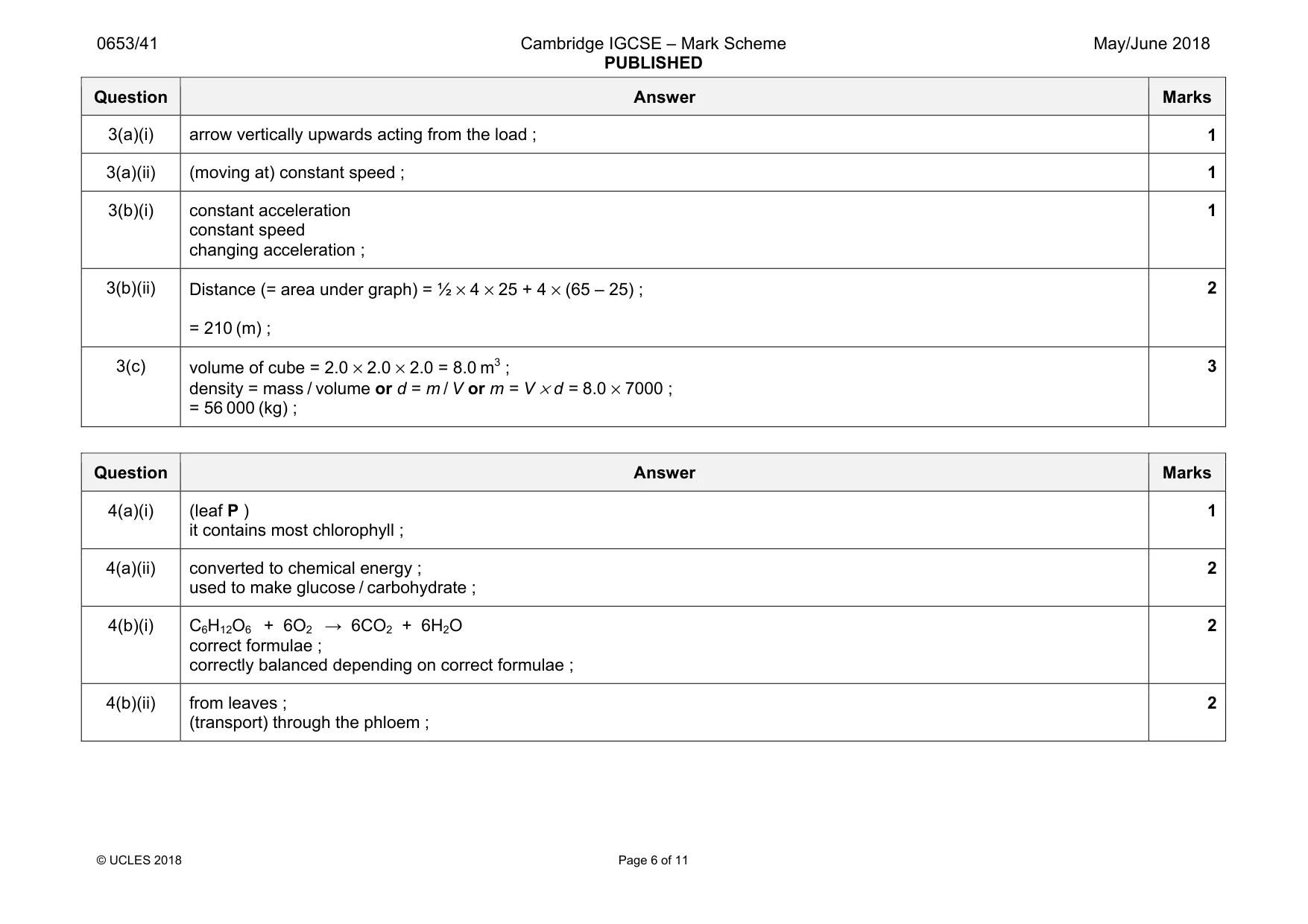
Mark scheme: 3(a)(i) arrow vertically upwards acting from the load ; 1 3(a)(ii) (moving at) constant speed ; 1 3(b)(i) constant acceleration constant speed changing acceleration ; 1 3(b)(ii) Distance (= area under graph) = ½ × 4 × 25 + 4 × (65 – 25) ; = 210 (m) ; 2 3(c) volume of cube = 2.0 × 2.0 × 2.0 = 8.0 m3 ; density = mass / volume or d = m / V or m = V × d = 8.0 × 7000 ; = 56 000 (kg) ; 3
Q4 · Three leaves P, Q and R
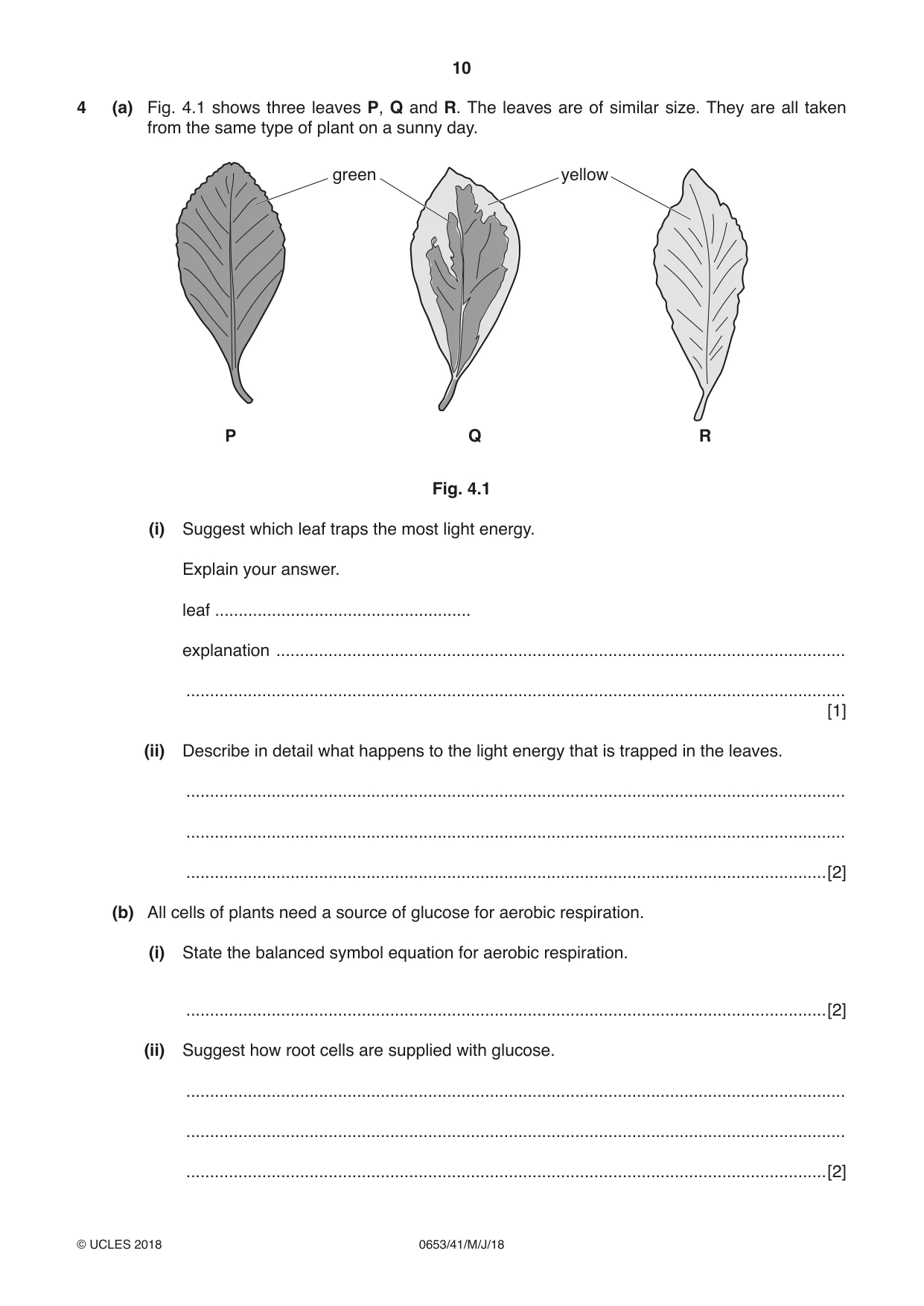
4 (a) Fig. 4.1 shows three leaves P, Q and R. The leaves are of similar size. They are all taken from the same type of plant on a sunny day. green yellow P Q R Fig. 4.1 (i) Suggest which leaf traps the most light energy. Explain your answer. leaf ...................................................... explanation ........................................................................................................................ ........................................................................................................................................... [1] (ii) Describe in detail what happens to the light energy that is trapped in the leaves. ........................................................................................................................................... ........................................................................................................................................... .......................................................................................................................................[2] (b) All cells of plants need a source of glucose for aerobic respiration. (i) State the balanced symbol equation for aerobic respiration. .......................................................................................................................................[2] (ii) Suggest how root cells are supplied with glucose. ........................................................................................................................................... ........................................................................................................................................... .......................................................................................................................................[2]
Mark scheme: 4(a)(i) (leaf P ) it contains most chlorophyll ; 1 4(a)(ii) converted to chemical energy ; used to make glucose / carbohydrate ; 2 4(b)(i) C6H12O6 + 6O2 → 6CO2 + 6H2O correct formulae ; correctly balanced depending on correct formulae ; 2 4(b)(ii) from leaves ; (transport) through the phloem ; 2
Q5 · Ethene is manufactured by cracking larger hydrocarbon molecules
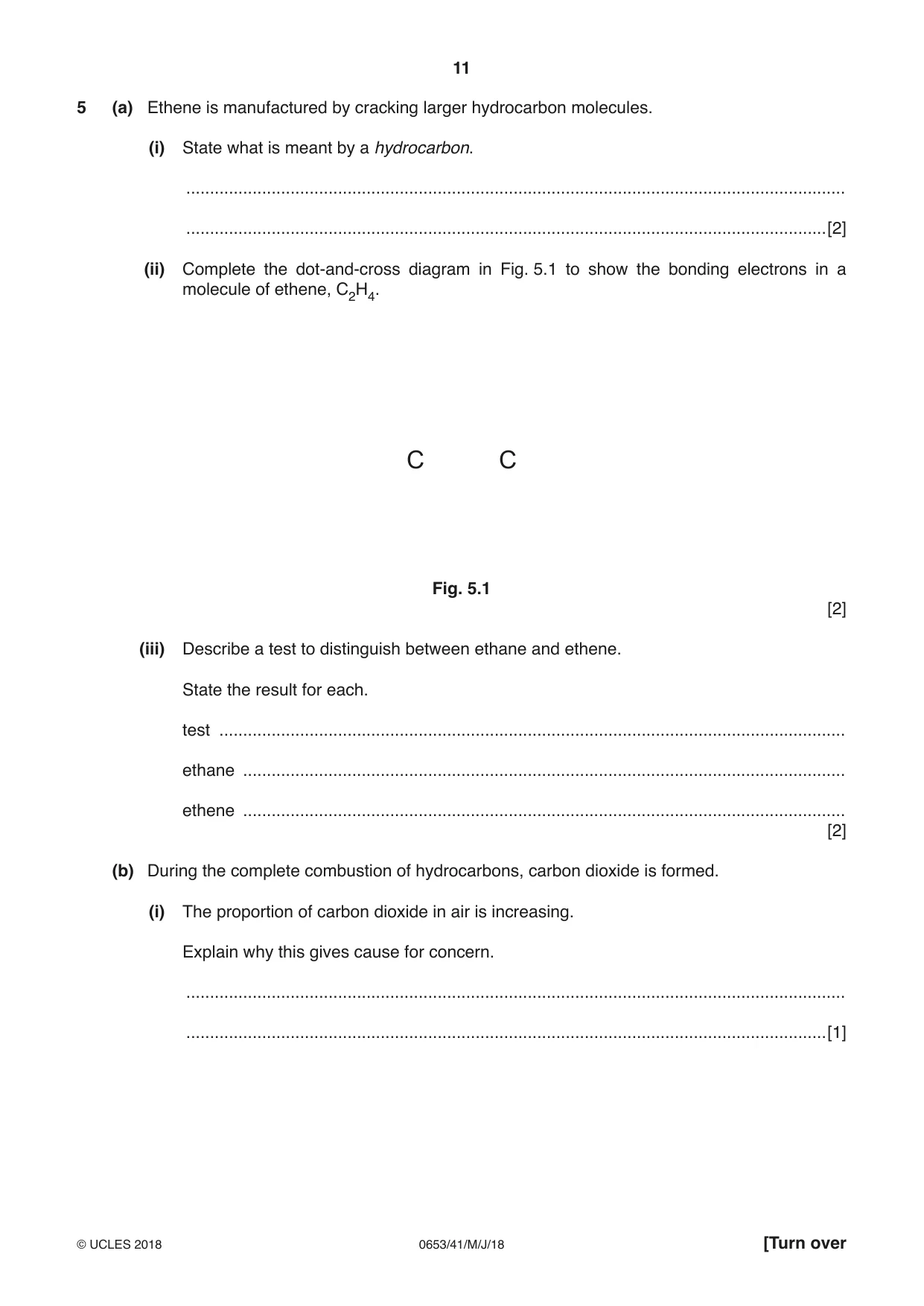
5 (a) Ethene is manufactured by cracking larger hydrocarbon molecules. (i) State what is meant by a hydrocarbon. ........................................................................................................................................... .......................................................................................................................................[2] (ii) Complete the dot-and-cross diagram in Fig. 5.1 to show the bonding electrons in a molecule of ethene, C2H4. C C Fig. 5.1 [2] (iii) Describe a test to distinguish between ethane and ethene. State the result for each. test .................................................................................................................................... ethane ............................................................................................................................... ethene ............................................................................................................................... [2] (b) During the complete combustion of hydrocarbons, carbon dioxide is formed. (i) The proportion of carbon dioxide in air is increasing. Explain why this gives cause for concern. ........................................................................................................................................... .......................................................................................................................................[1] (ii) The combustion of hydrocarbons is an exothermic change. Explain what is meant by exothermic. Use ideas about energy transformations in your answer. ........................................................................................................................................... ........................................................................................................................................... .......................................................................................................................................[2]
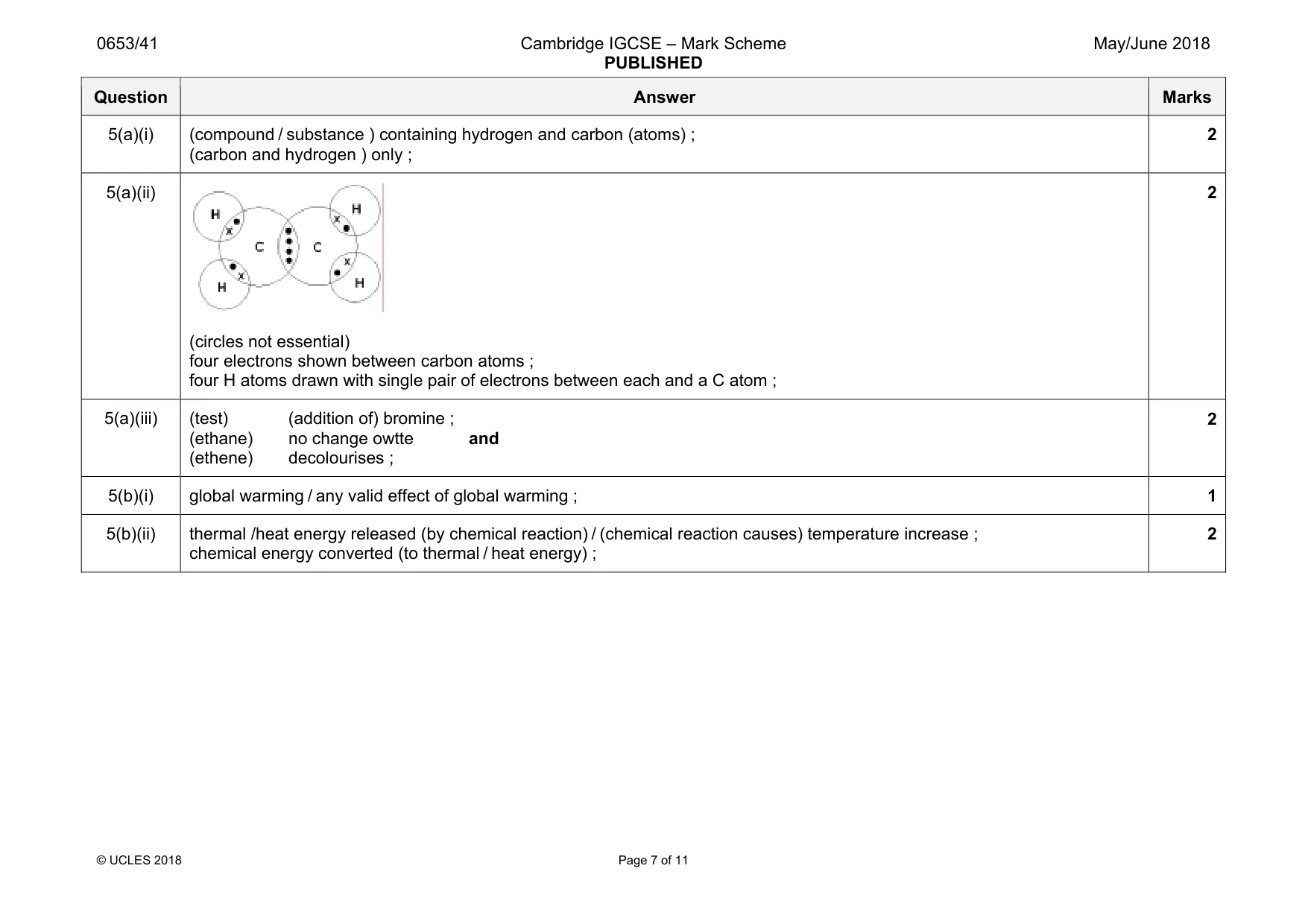
Mark scheme: 5(a)(i) (compound / substance ) containing hydrogen and carbon (atoms) ; (carbon and hydrogen ) only ; 2 5(a)(ii) (circles not essential) four electrons shown between carbon atoms ; four H atoms drawn with single pair of electrons between each and a C atom ; 2 5(a)(iii) (test) (addition of) bromine ; (ethane) no change owtte and (ethene) decolourises ; 2 5(b)(i) global warming / any valid effect of global warming ; 1 5(b)(ii) thermal /heat energy released (by chemical reaction) / (chemical reaction causes) temperature increase ; chemical energy converted (to thermal / heat energy) ; 2
Q6 · A man watching television
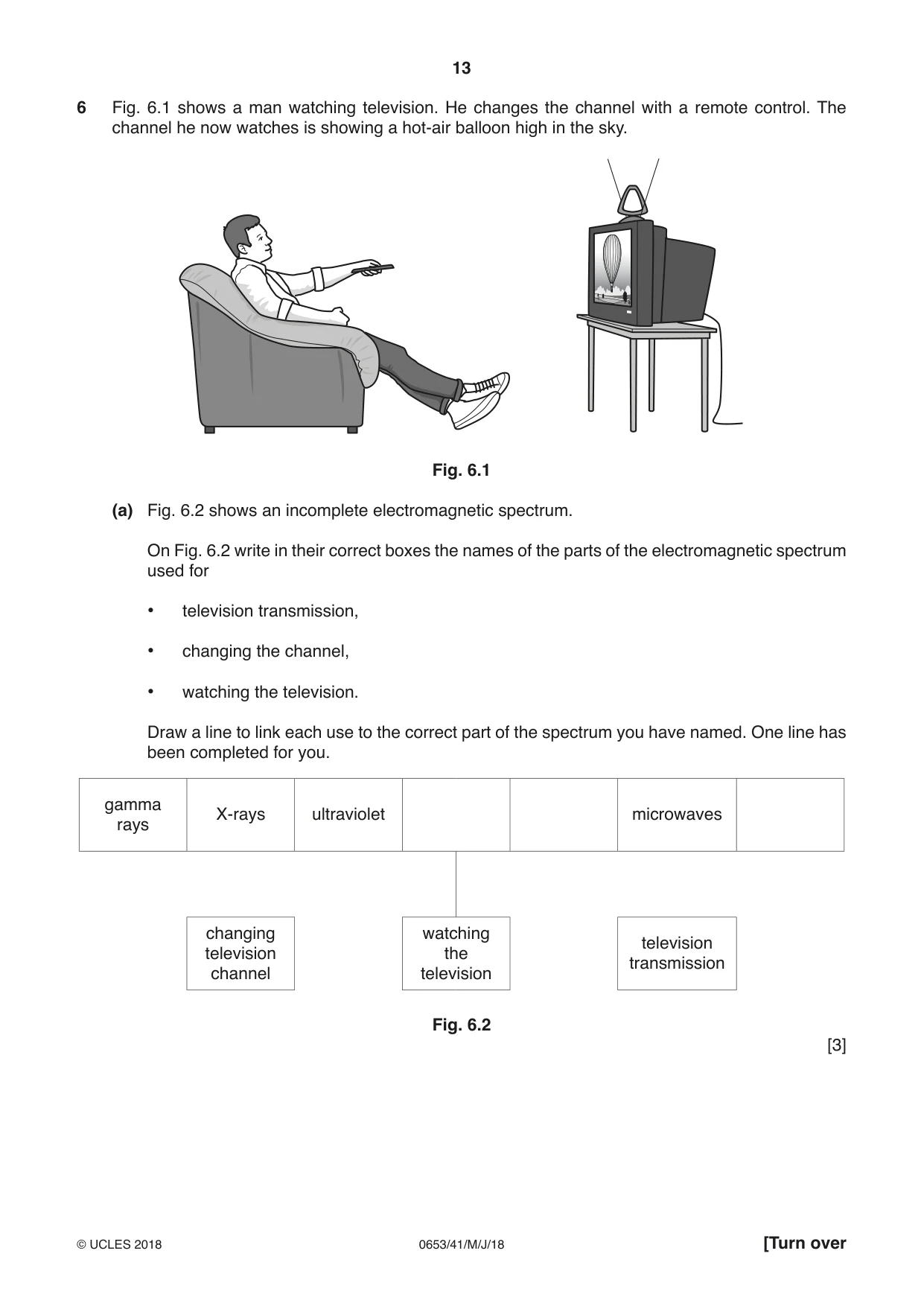
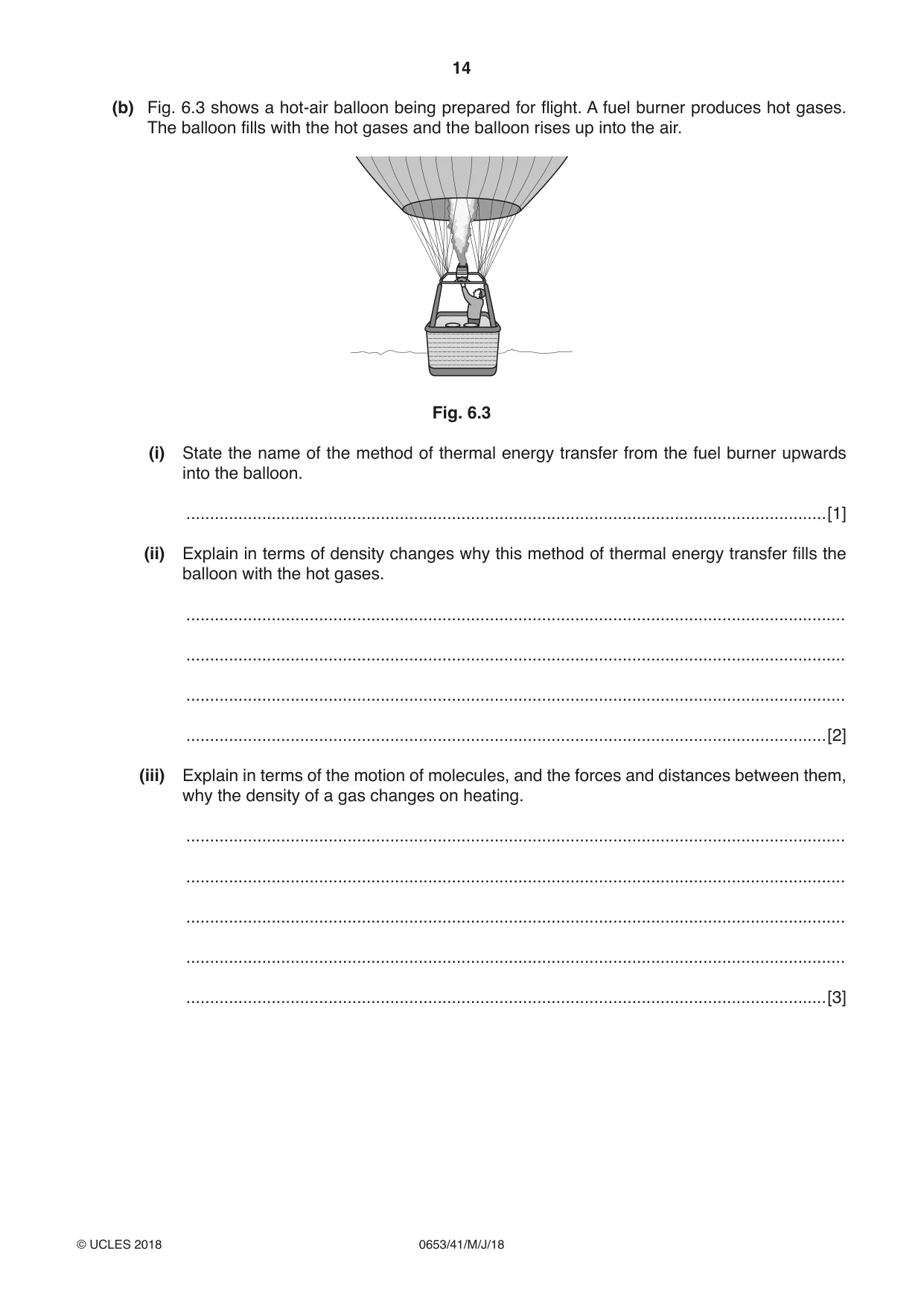
6 Fig. 6.1 shows a man watching television. He changes the channel with a remote control. The channel he now watches is showing a hot-air balloon high in the sky. Fig. 6.1 (a) Fig. 6.2 shows an incomplete electromagnetic spectrum. On Fig. 6.2 write in their correct boxes the names of the parts of the electromagnetic spectrum used for • television transmission, • changing the channel, • watching the television. Draw a line to link each use to the correct part of the spectrum you have named. One line has been completed for you. gamma X-rays ultraviolet microwaves rays changing watching television television the transmission channel television Fig. 6.2 [3] (b) Fig. 6.3 shows a hot-air balloon being prepared for flight. A fuel burner produces hot gases. The balloon fills with the hot gases and the balloon rises up into the air. Fig. 6.3 (i) State the name of the method of thermal energy transfer from the fuel burner upwards into the balloon. .......................................................................................................................................[1] (ii) Explain in terms of density changes why this method of thermal energy transfer fills the balloon with the hot gases. ........................................................................................................................................... ........................................................................................................................................... ........................................................................................................................................... .......................................................................................................................................[2] (iii) Explain in terms of the motion of molecules, and the forces and distances between them, why the density of a gas changes on heating. ........................................................................................................................................... ........................................................................................................................................... ........................................................................................................................................... ........................................................................................................................................... .......................................................................................................................................[3]
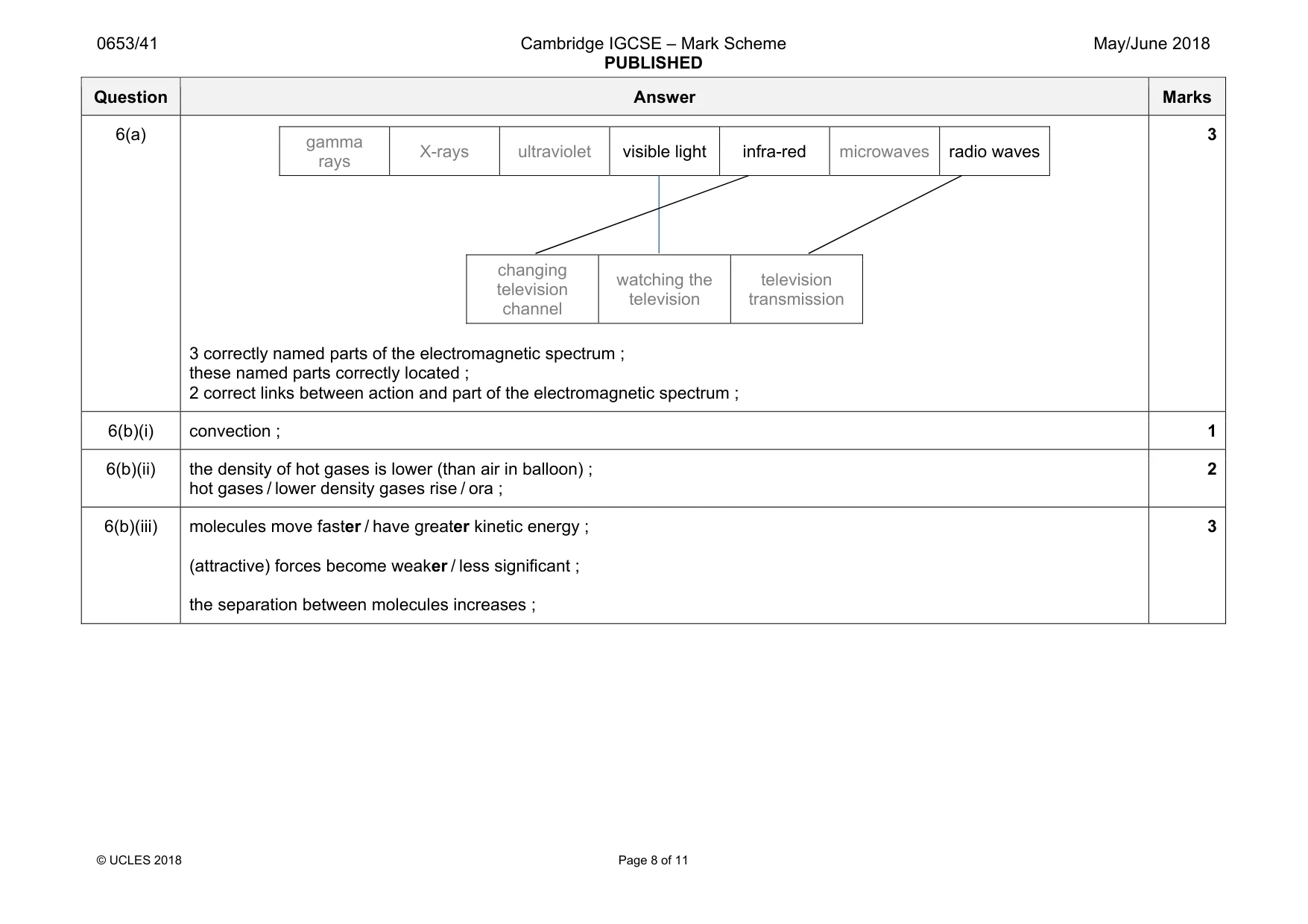
Mark scheme: 6(a) gamma rays X-rays ultraviolet visible light infra-red microwaves radio waves changing television channel watching the television television transmission 3 correctly named parts of the electromagnetic spectrum ; these named parts correctly located ; 2 correct links between action and part of the electromagnetic spectrum ; 3 6(b)(i) convection ; 1 6(b)(ii) the density of hot gases is lower (than air in balloon) ; hot gases / lower density gases rise / ora ; 2 6(b)(iii) molecules move faster / have greater kinetic energy ; (attractive) forces become weaker / less significant ; the separation between molecules increases ; 3
Q7 · A food web in a garden
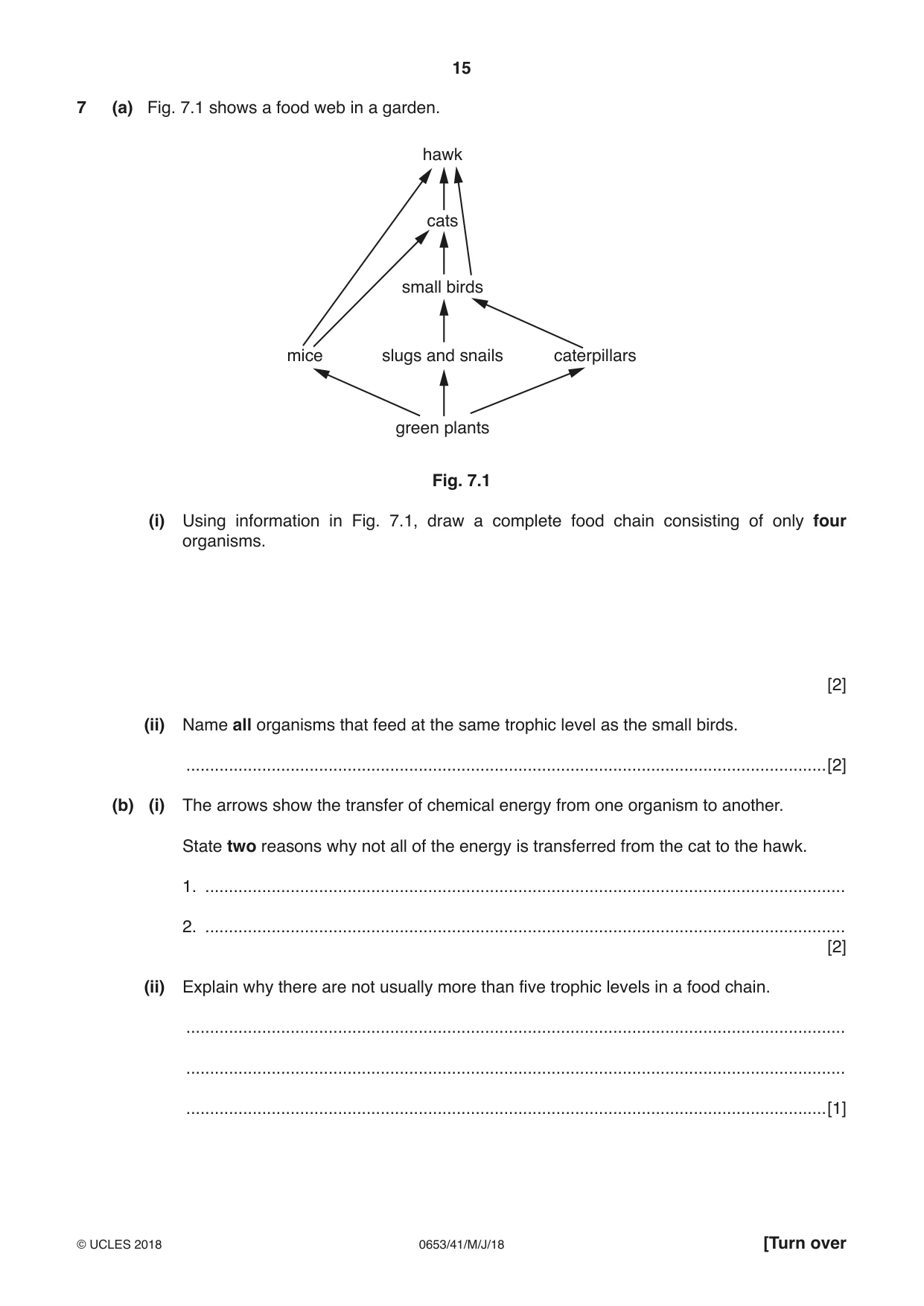
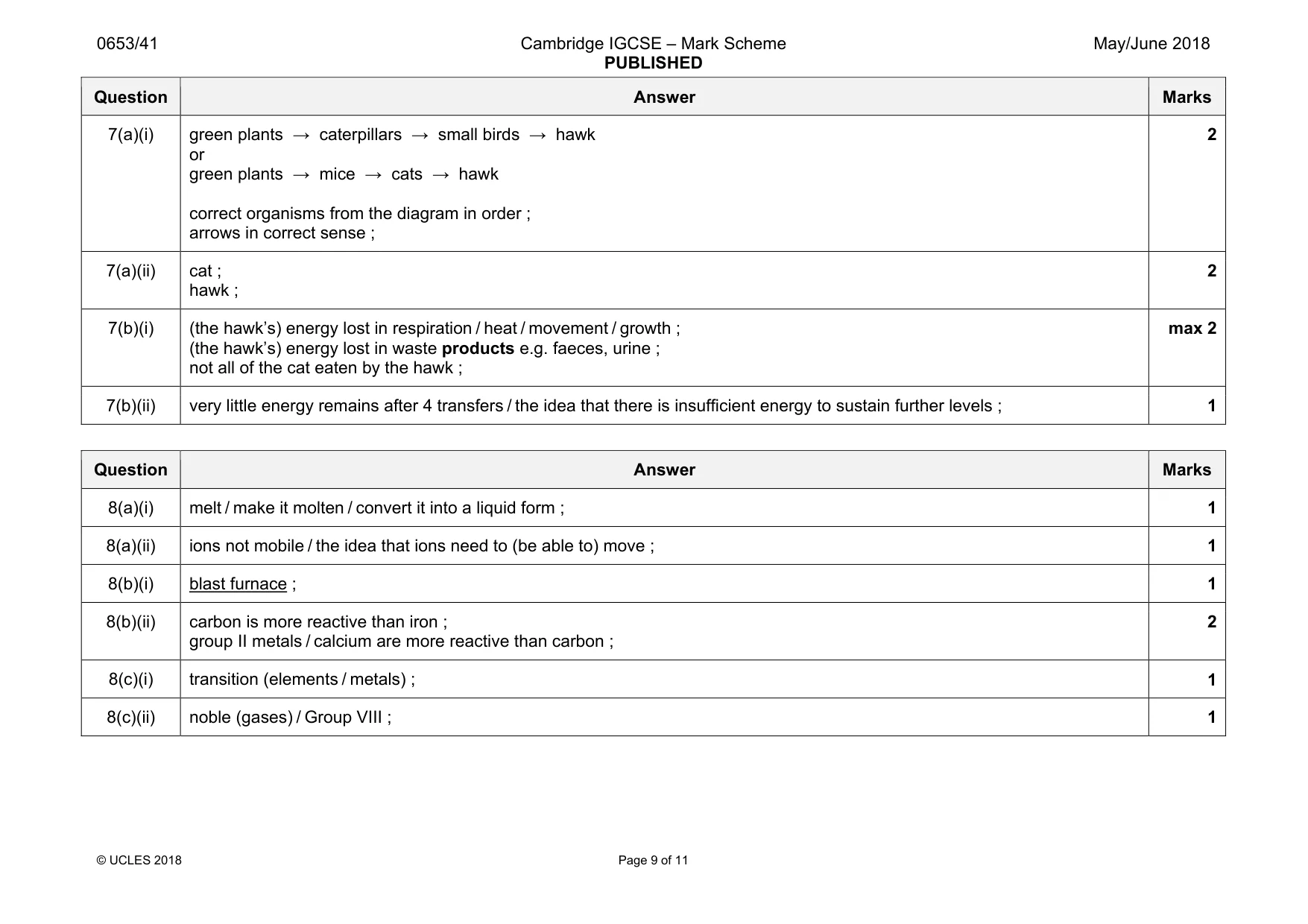
7 (a) Fig. 7.1 shows a food web in a garden. hawk cats small birds mice slugs and snails caterpillars green plants Fig. 7.1 (i) Using information in Fig. 7.1, draw a complete food chain consisting of only four organisms. [2] (ii) Name all organisms that feed at the same trophic level as the small birds. .......................................................................................................................................[2] (b) (i) The arrows show the transfer of chemical energy from one organism to another. State two reasons why not all of the energy is transferred from the cat to the hawk. 1. ....................................................................................................................................... 2. ....................................................................................................................................... [2] (ii) Explain why there are not usually more than five trophic levels in a food chain. ........................................................................................................................................... ........................................................................................................................................... .......................................................................................................................................[1]
Mark scheme: 7(a)(i) green plants → caterpillars → small birds → hawk or green plants → mice → cats → hawk correct organisms from the diagram in order ; arrows in correct sense ; 2 7(a)(ii) cat ; hawk ; 2 7(b)(i) (the hawk’s) energy lost in respiration / heat / movement / growth ; (the hawk’s) energy lost in waste products e.g. faeces, urine ; not all of the cat eaten by the hawk ; max 2 7(b)(ii) very little energy remains after 4 transfers / the idea that there is insufficient energy to sustain further levels ; 1
Q8 · A student tries to make lead from a sample of solid lead(II) bromide using the…
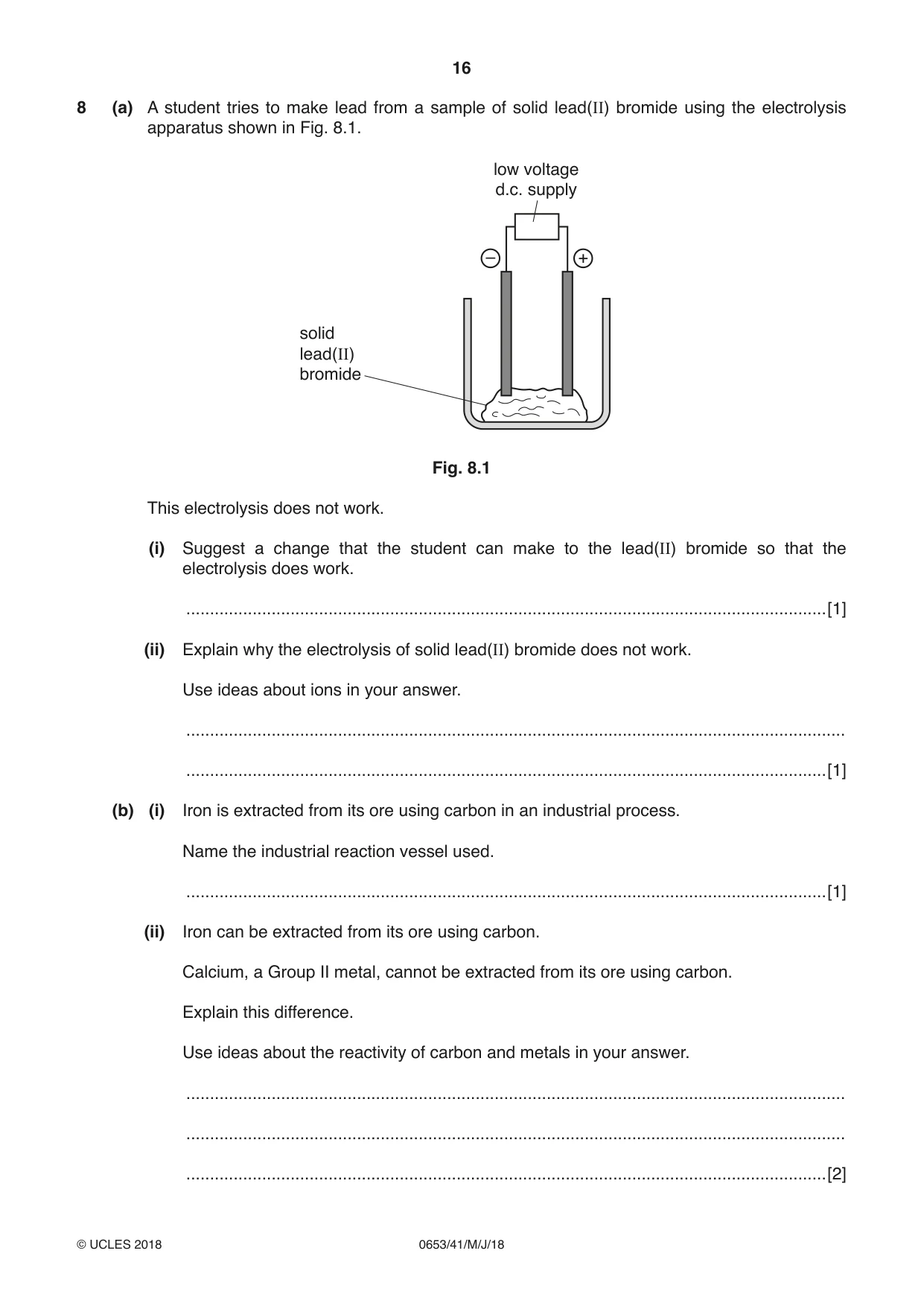
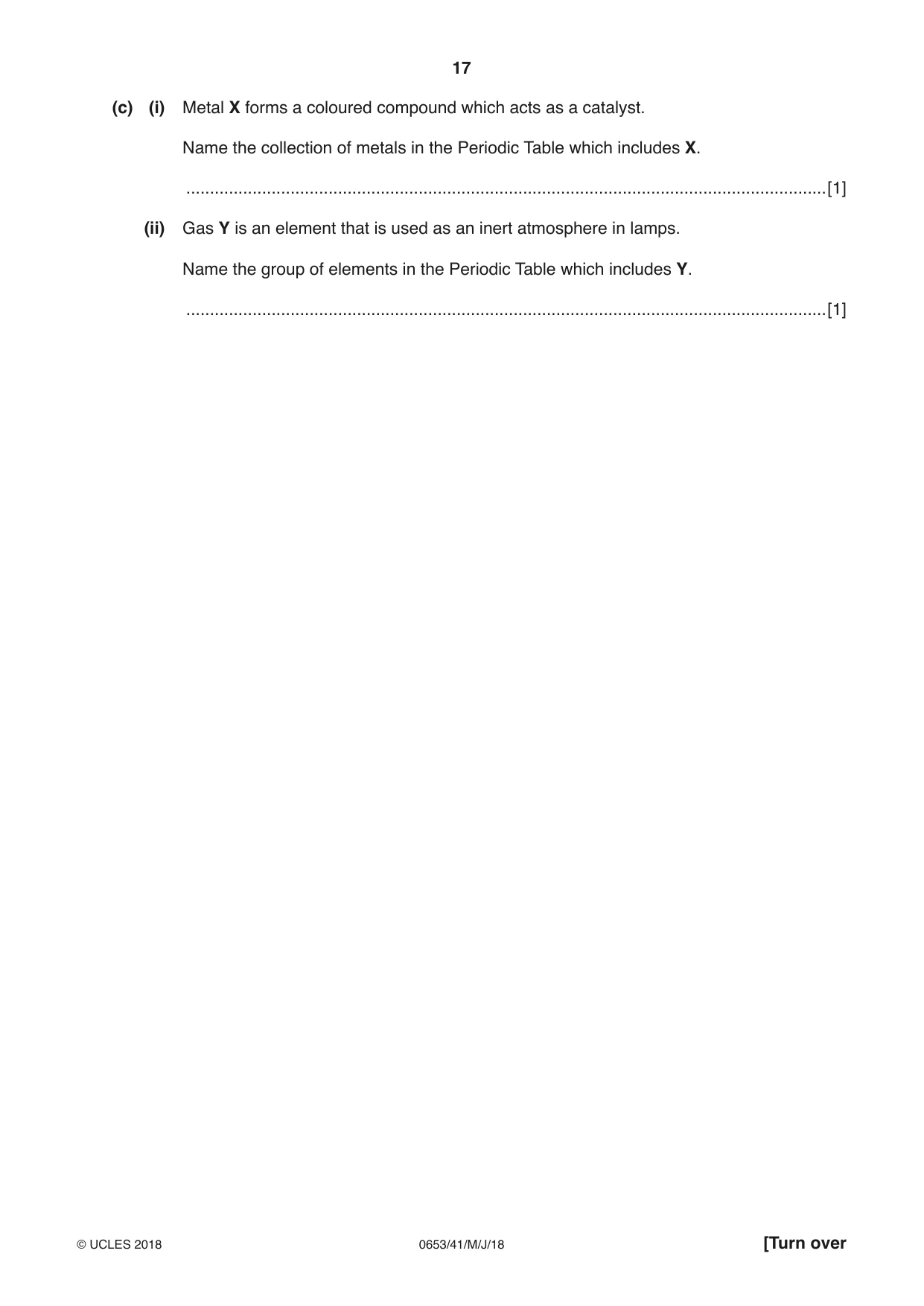
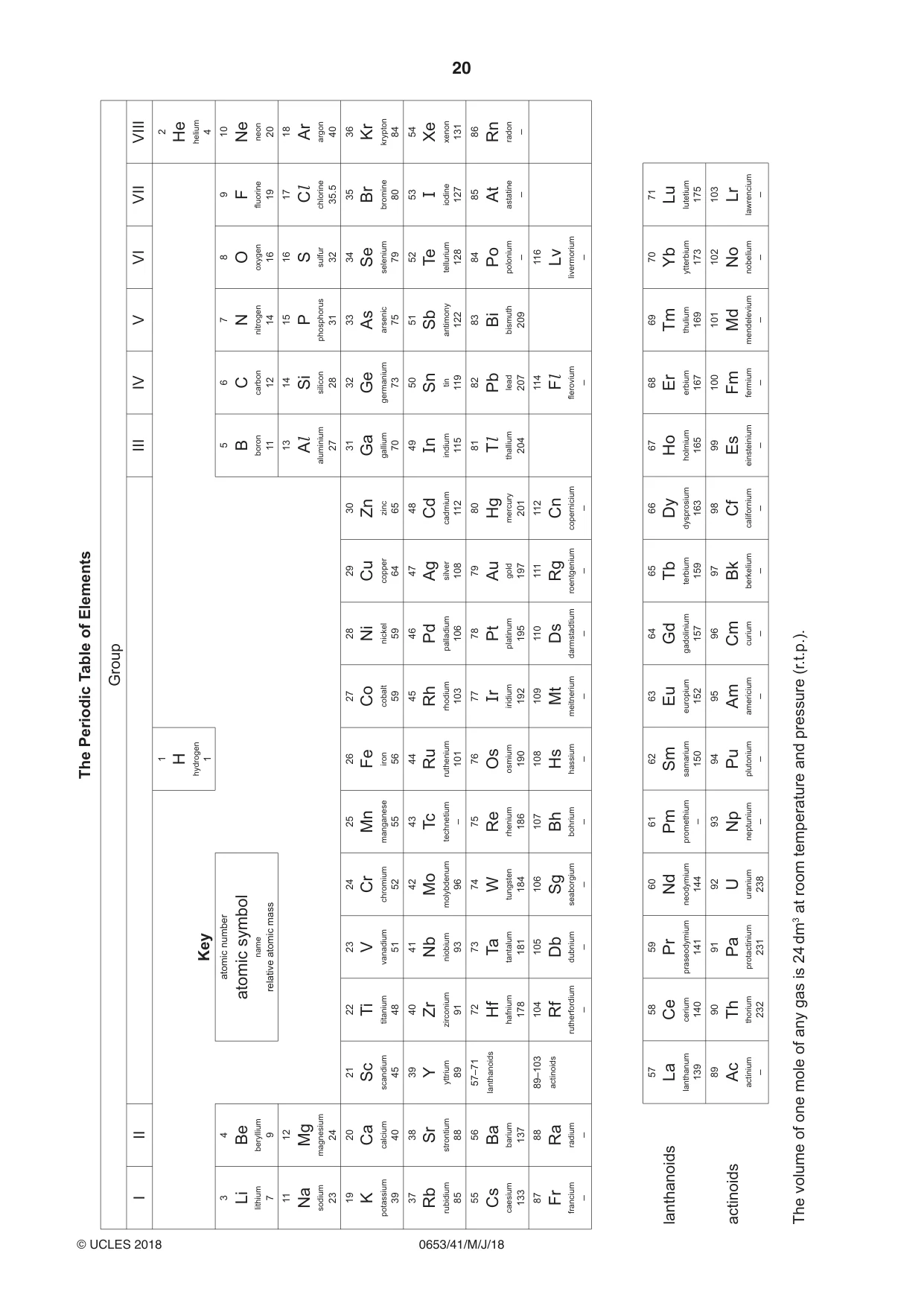
8 (a) A student tries to make lead from a sample of solid lead(II) bromide using the electrolysis apparatus shown in Fig. 8.1. low voltage d.c. supply – + solid lead(II) bromide Fig. 8.1 This electrolysis does not work. (i) Suggest a change that the student can make to the lead(II) bromide so that the electrolysis does work. .......................................................................................................................................[1] (ii) Explain why the electrolysis of solid lead(II) bromide does not work. Use ideas about ions in your answer. ........................................................................................................................................... .......................................................................................................................................[1] (b) (i) Iron is extracted from its ore using carbon in an industrial process. Name the industrial reaction vessel used. .......................................................................................................................................[1] (ii) Iron can be extracted from its ore using carbon. Calcium, a Group II metal, cannot be extracted from its ore using carbon. Explain this difference. Use ideas about the reactivity of carbon and metals in your answer. ........................................................................................................................................... ........................................................................................................................................... .......................................................................................................................................[2] (c) (i) Metal X forms a coloured compound which acts as a catalyst. Name the collection of metals in the Periodic Table which includes X. .......................................................................................................................................[1] (ii) Gas Y is an element that is used as an inert atmosphere in lamps. Name the group of elements in the Periodic Table which includes Y. .......................................................................................................................................[1]
Mark scheme: 8(a)(i) melt / make it molten / convert it into a liquid form ; 1 8(a)(ii) ions not mobile / the idea that ions need to (be able to) move ; 1 8(b)(i) blast furnace ; 1 8(b)(ii) carbon is more reactive than iron ; group II metals / calcium are more reactive than carbon ; 2 8(c)(i) transition (elements / metals) ; 1 8(c)(ii) noble (gases) / Group VIII ; 1 Que estion Answer Ma arks
Q9 · A small electric cooker with two hot plates
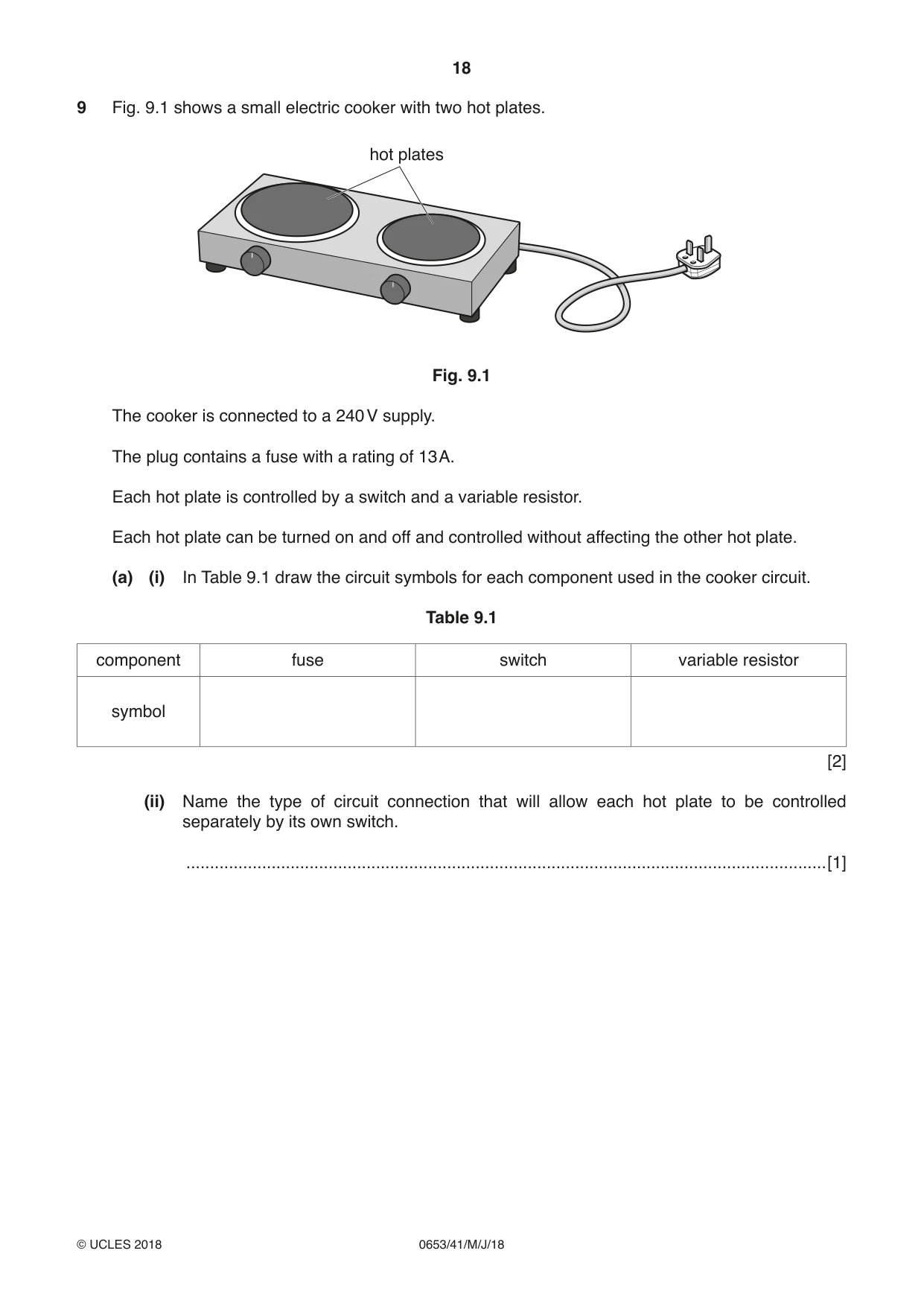
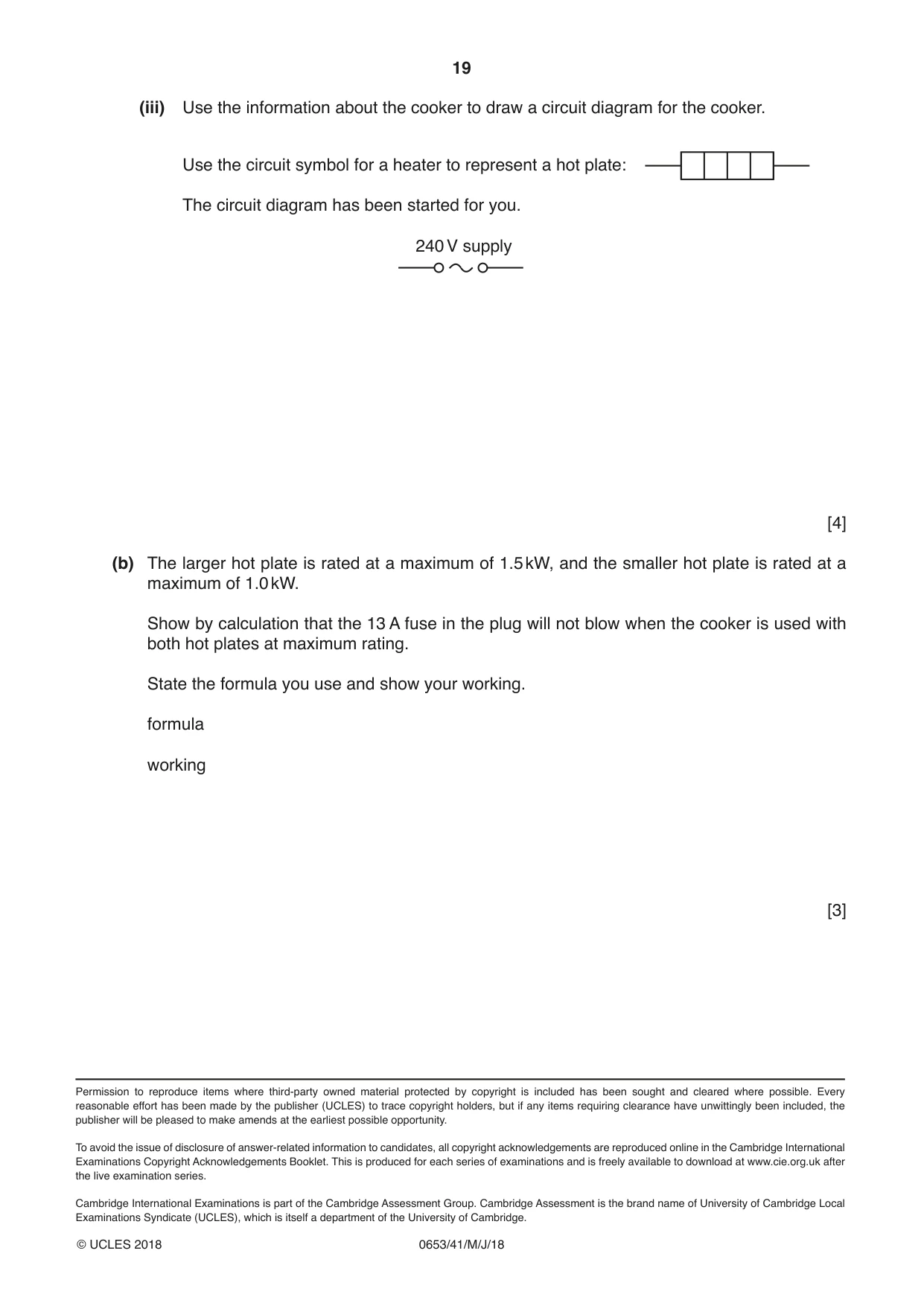
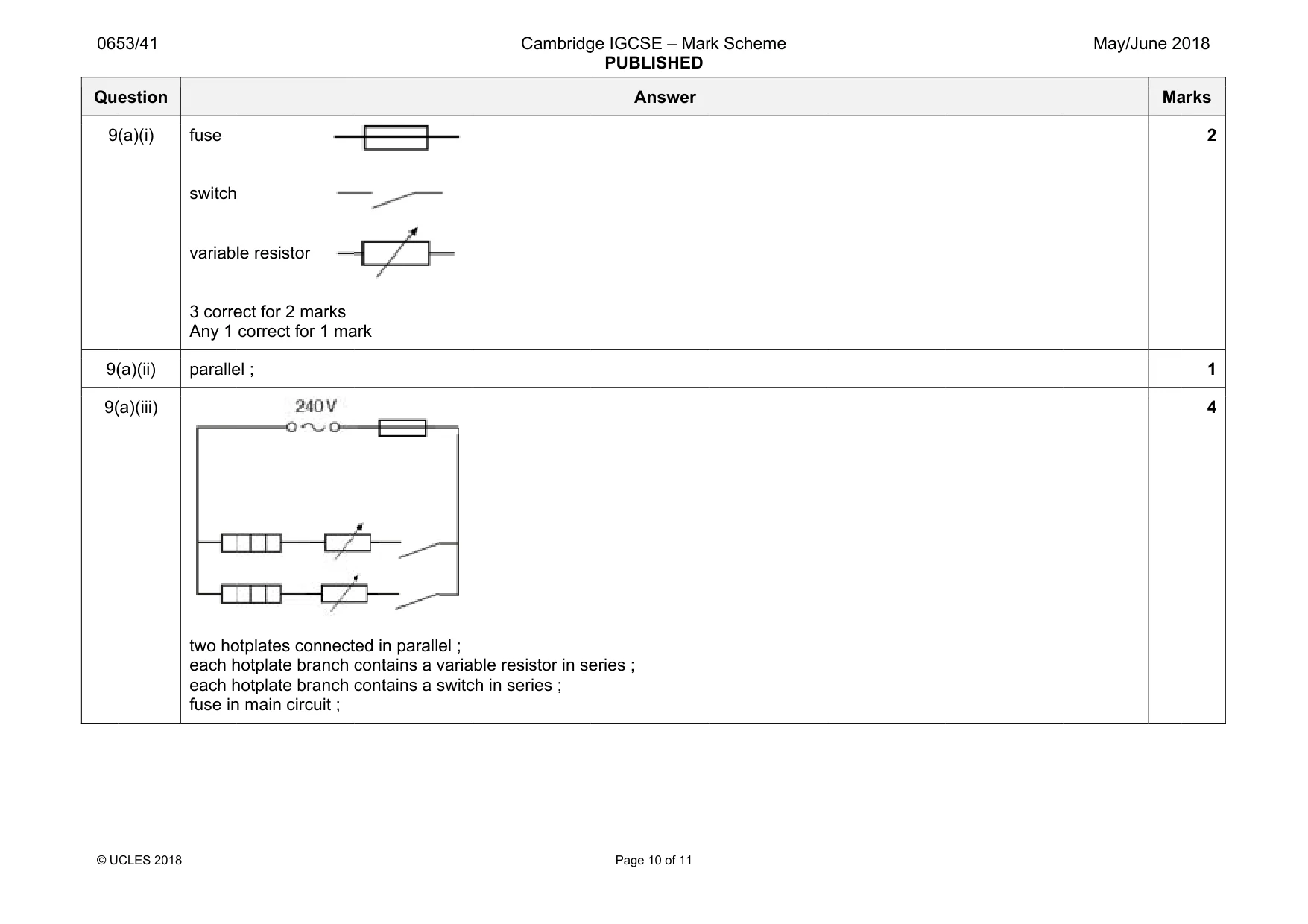
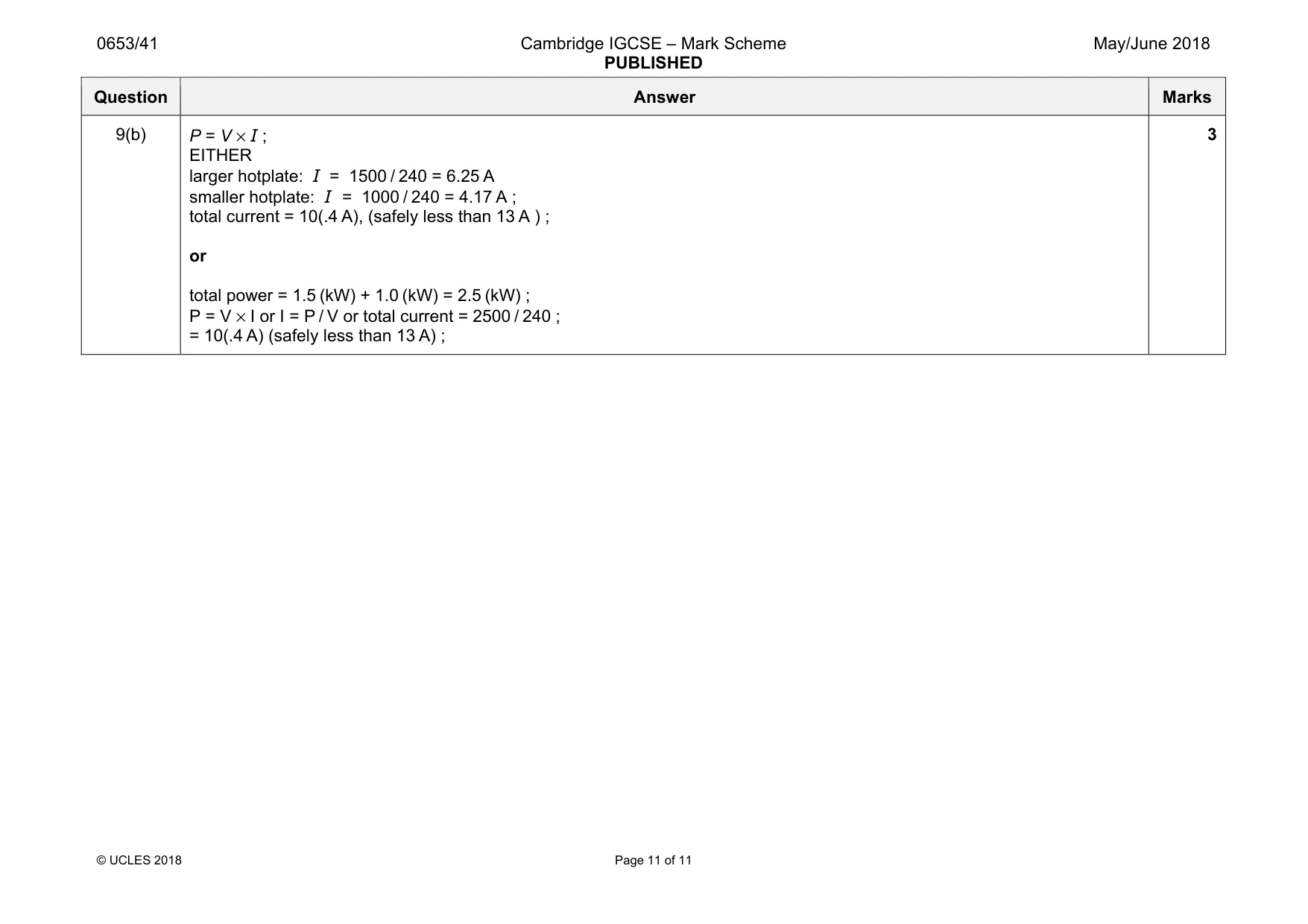
9 Fig. 9.1 shows a small electric cooker with two hot plates. hot plates Fig. 9.1 The cooker is connected to a 240 V supply. The plug contains a fuse with a rating of 13 A. Each hot plate is controlled by a switch and a variable resistor. Each hot plate can be turned on and off and controlled without affecting the other hot plate. (a) (i) In Table 9.1 draw the circuit symbols for each component used in the cooker circuit. Table 9.1 component fuse switch variable resistor symbol [2] (ii) Name the type of circuit connection that will allow each hot plate to be controlled separately by its own switch. .......................................................................................................................................[1] (iii) Use the information about the cooker to draw a circuit diagram for the cooker. Use the circuit symbol for a heater to represent a hot plate: The circuit diagram has been started for you. 240 V supply [4] (b) The larger hot plate is rated at a maximum of 1.5 kW, and the smaller hot plate is rated at a maximum of 1.0 kW. Show by calculation that the 13 A fuse in the plug will not blow when the cooker is used with both hot plates at maximum rating. State the formula you use and show your working. formula working [3]
Mark scheme: 9 9( 9( (a)(i) fuse switch variab 3 corre Any 1 (a)(ii) paralle (a)(iii) two ho each h each h fuse in le resistor ect for 2 marks correct for 1 ma el ; otplates connect hotplate branch hotplate branch n main circuit ; ark ted in parallel ; contains a varia contains a switc able resistor in se ch in series ; eries ; 2 1 4 Question Answer Marks 9(b) P = V × I ; EITHER larger hotplate: I = 1500 / 240 = 6.25 A smaller hotplate: I = 1000 / 240 = 4.17 A ; total current = 10(.4 A), (safely less than 13 A ) ; or total power = 1.5 (kW) + 1.0 (kW) = 2.5 (kW) ; P = V × I or I = P / V or total current = 2500 / 240 ; = 10(.4 A) (safely less than 13 A) ; 3
What was in this paper
The subtopics covered by these 9 questions, and how many questions each got. Open one in a new tab to see every Cambridge question on it.
What you needed in this session
Cambridge’s own grade thresholds for 2018 May/June, Paper 4 · Variant 1. A higher threshold means an easier paper — the bar moves with how the cohort did.