Questions as text
Q1 · An elevator (lift) which takes people to different floors in a tall building 0653/42 Feb/March 2017
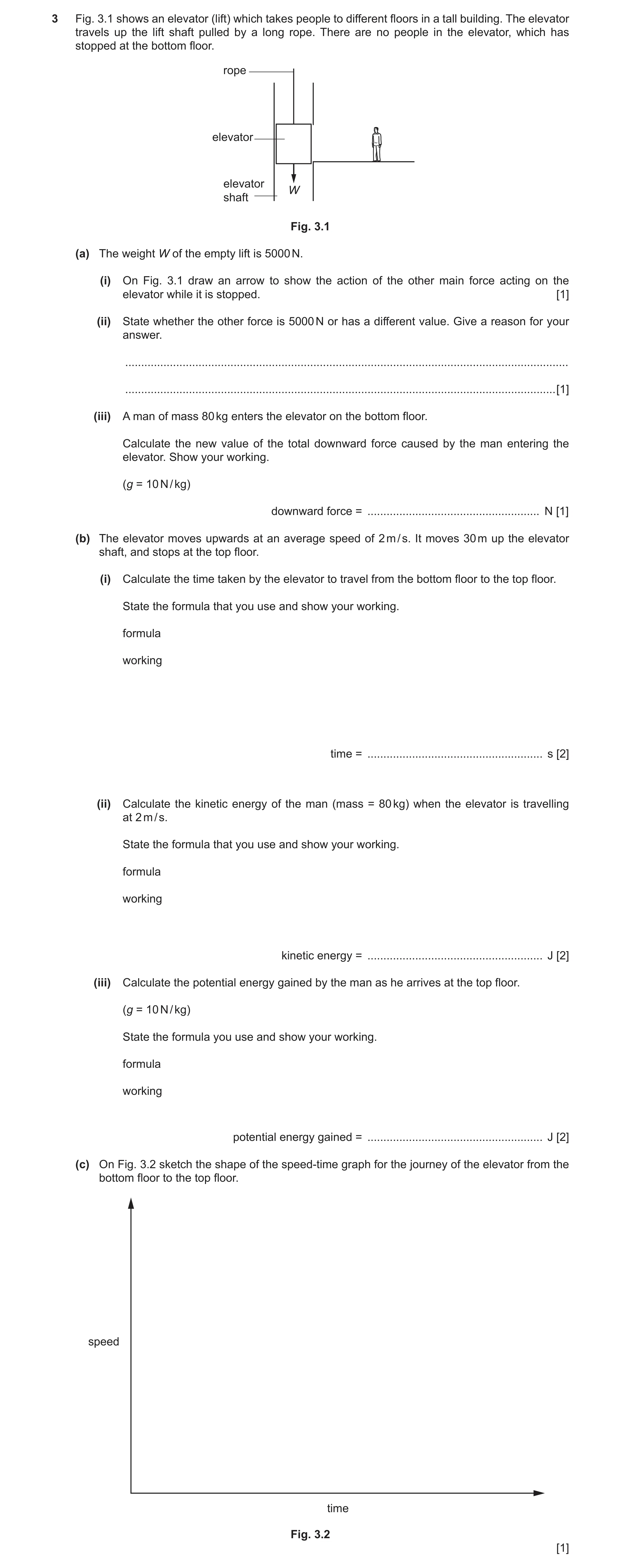
3 Fig. 3.1 shows an elevator (lift) which takes people to different floors in a tall building. The elevator travels up the lift shaft pulled by a long rope. There are no people in the elevator, which has stopped at the bottom floor. rope elevator elevator W shaft Fig. 3.1 (a) The weight W of the empty lift is 5000 N. (i) On Fig. 3.1 draw an arrow to show the action of the other main force acting on the elevator while it is stopped. [1] (ii) State whether the other force is 5000 N or has a different value. Give a reason for your answer. … … [1] (iii) A man of mass 80 kg enters the elevator on the bottom floor. Calculate the new value of the total downward force caused by the man entering the elevator. Show your working. (g = 10 N / kg) downward force = … N [1] (b) The elevator moves upwards at an average speed of 2 m / s. It moves 30 m up the elevator shaft, and stops at the top floor. (i) Calculate the time taken by the elevator to travel from the bottom floor to the top floor. State the formula that you use and show your working. formula working time = … s [2] (ii) Calculate the kinetic energy of the man (mass = 80 kg) when the elevator is travelling at 2 m / s. State the formula that you use and show your working. formula working kinetic energy = … J [2] (iii) Calculate the potential energy gained by the man as he arrives at the top floor. (g = 10 N / kg) State the formula you use and show your working. formula working potential energy gained = … J [2] (c) On Fig. 3.2 sketch the shape of the speed-time graph for the journey of the elevator from the bottom floor to the top floor. speed time Fig. 3.2 [1]
10 marks
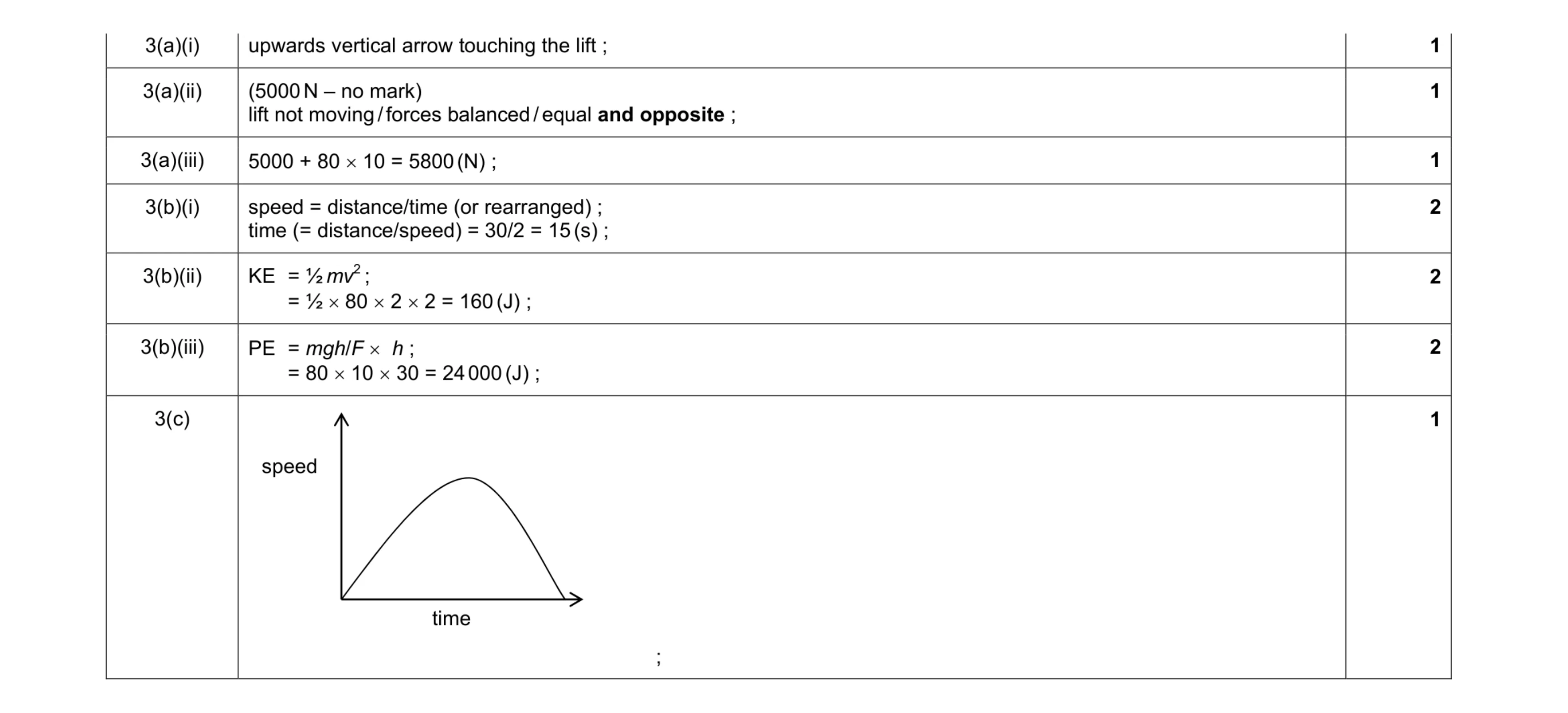
Mark scheme: 3(a)(i) upwards vertical arrow touching the lift ; 1 3(a)(ii) (5000 N – no mark) lift not moving / forces balanced / equal and opposite ; 1 3(a)(iii) 5000 + 80 × 10 = 5800 (N) ; 1 3(b)(i) speed = distance/time (or rearranged) ; time (= distance/speed) = 30/2 = 15 (s) ; 2 3(b)(ii) KE = ½ mv2 ; = ½ × 80 × 2 × 2 = 160 (J) ; 2 3(b)(iii) PE = mgh/F × h ; = 80 × 10 × 30 = 24 000 (J) ; 2 3(c) ; 1 time speed
This question in 0653/42 Feb/March 2017
Q2 · A wind surfer on a surf board, driven by the wind, sailing at a constant speed across the… 0653/41 May/June 2017
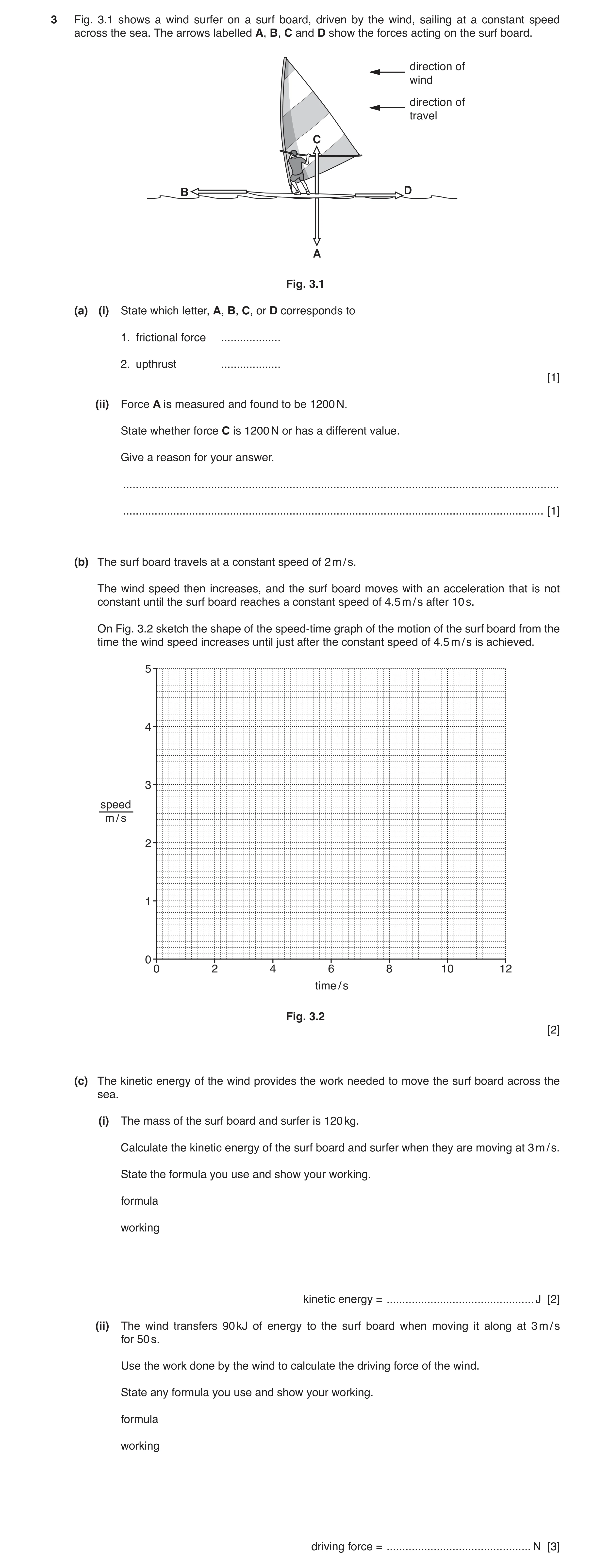
3 Fig. 3.1 shows a wind surfer on a surf board, driven by the wind, sailing at a constant speed across the sea. The arrows labelled A, B, C and D show the forces acting on the surf board. direction of wind direction of travel C B D A Fig. 3.1 (a) (i) State which letter, A, B, C, or D corresponds to 1. frictional force … 2. upthrust … [1] (ii) Force A is measured and found to be 1200 N. State whether force C is 1200 N or has a different value. Give a reason for your answer. … … [1] (b) The surf board travels at a constant speed of 2 m / s. The wind speed then increases, and the surf board moves with an acceleration that is not constant until the surf board reaches a constant speed of 4.5 m / s after 10 s. On Fig. 3.2 sketch the shape of the speed-time graph of the motion of the surf board from the time the wind speed increases until just after the constant speed of 4.5 m / s is achieved. 5 4 3 speed m / s 2 1 0 0 2 4 6 8 10 12 time / s Fig. 3.2 [2] (c) The kinetic energy of the wind provides the work needed to move the surf board across the sea. (i) The mass of the surf board and surfer is 120 kg. Calculate the kinetic energy of the surf board and surfer when they are moving at 3 m / s. State the formula you use and show your working. formula working kinetic energy = … J [2] (ii) The wind transfers 90 kJ of energy to the surf board when moving it along at 3 m / s for 50 s. Use the work done by the wind to calculate the driving force of the wind. State any formula you use and show your working. formula working driving force = … N [3]
9 marks
Mark scheme: 3(a)(i) D C 1 3(a)(ii) (Force C is 1200 N) no mark no vertical motion / forces (A and C) are balanced ; 1 3(b) line starts along the speed = 2 m / s horizontal, levelling off at speed = 4.5 m / s and 10 mins ; any curved line between these points, then level after (10,4.5) ; 2 3(c)(i) KE = ½ m v2 / ½ × 120 × 3 × 3 ; = 540 (J) ; 2 3(c)(ii) (90 kJ =) 90 000 J (= work done = energy transferred) ; distance moved = 3 (m / s) × 50 (s) = 150 m ; force = work done ÷ distance / 90 000 ÷ 150 / = 600 (N) ; 3
This question in 0653/41 May/June 2017
Q3 · A cyclist riding her bicycle at a constant speed along a road 0653/43 May/June 2017
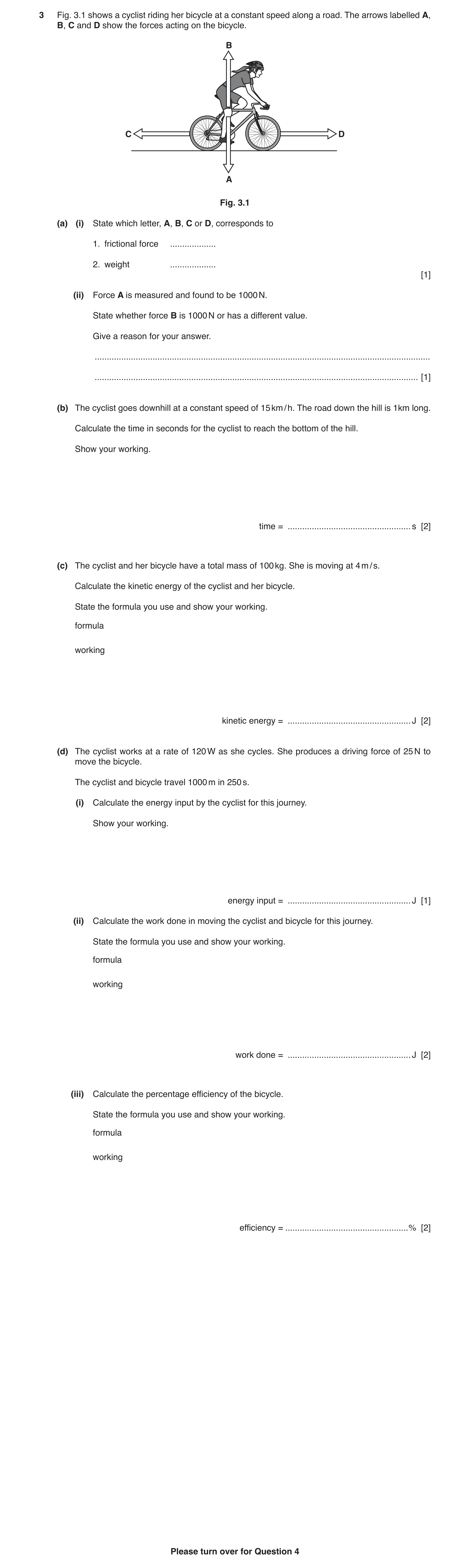
3 Fig. 3.1 shows a cyclist riding her bicycle at a constant speed along a road. The arrows labelled A, B, C and D show the forces acting on the bicycle. B C D A Fig. 3.1 (a) (i) State which letter, A, B, C or D, corresponds to 1. frictional force … 2. weight … [1] (ii) Force A is measured and found to be 1000 N. State whether force B is 1000 N or has a different value. Give a reason for your answer. … … [1] (b) The cyclist goes downhill at a constant speed of 15 km / h. The road down the hill is 1 km long. Calculate the time in seconds for the cyclist to reach the bottom of the hill. Show your working. time = … s [2] (c) The cyclist and her bicycle have a total mass of 100 kg. She is moving at 4 m / s. Calculate the kinetic energy of the cyclist and her bicycle. State the formula you use and show your working. formula working kinetic energy = … J [2] (d) The cyclist works at a rate of 120 W as she cycles. She produces a driving force of 25 N to move the bicycle. The cyclist and bicycle travel 1000 m in 250 s. (i) Calculate the energy input by the cyclist for this journey. Show your working. energy input = … J [1] (ii) Calculate the work done in moving the cyclist and bicycle for this journey. State the formula you use and show your working. formula working work done = … J [2] (iii) Calculate the percentage efficiency of the bicycle. State the formula you use and show your working. formula working efficiency = … % [2] Please turn over for Question 4
11 marks
Mark scheme: 3(a)(i) C A 1 3(a)(ii) (Force B is 1000 N) no vertical motion / forces (A and B) are balanced ; 1 3(b) 1 km at 15 km / h Æ 1 / 15 h / 0.067 h ; 1 / 15 h = 3 600 × 1 / 15 = 240 (s) ; 2 3(c) KE = ½ mv2 = ½ × 100 × 4 × 4 = 800 (J) ; 2 3(d)(i) energy input = 120 × 250 = 30 000 (J) ; 1 3(d)(ii) work done = force × distance (moved) / F × d ; = 25 × 1 000 = 25 000 (J) ; 2 3(d)(iii) efficiency (%) = (work got out ÷ work put in) × 100 / (equivalent wording ) ; = (25 000 / 30 000) × 100 = 83.3 (%) ; 2
This question in 0653/43 May/June 2017
Question 4 0653/41 Oct/Nov 2017
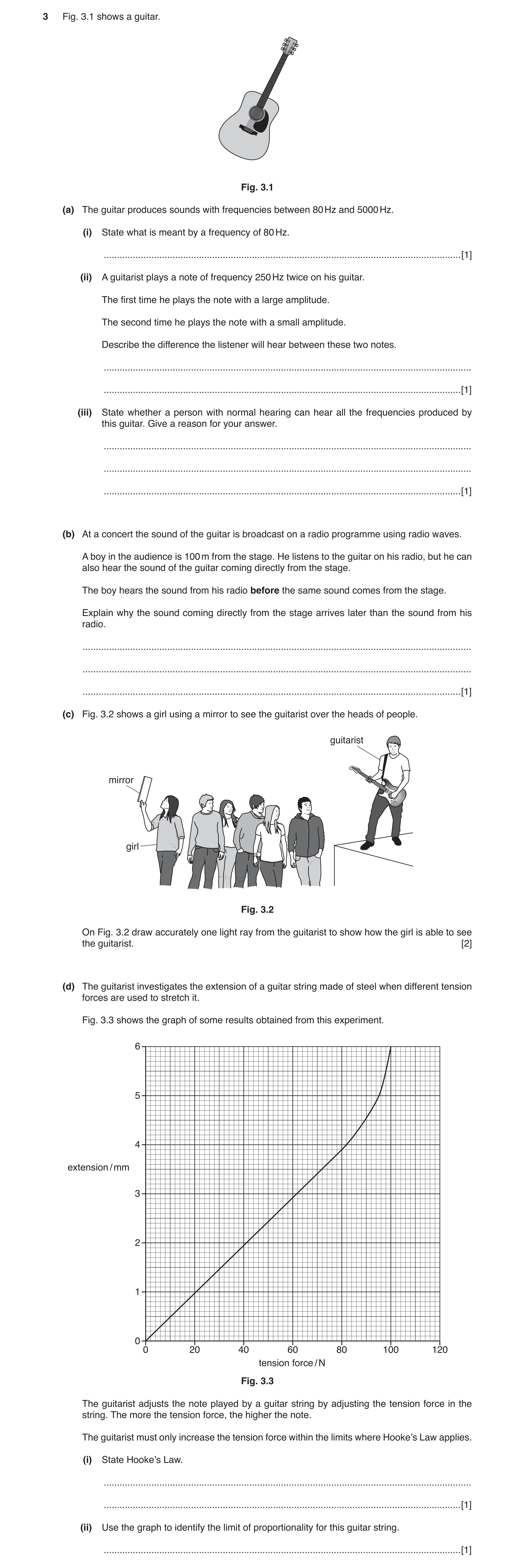
3 Fig. 3.1 shows a guitar. Fig. 3.1 (a) The guitar produces sounds with frequencies between 80 Hz and 5000 Hz. (i) State what is meant by a frequency of 80 Hz. … [1] (ii) A guitarist plays a note of frequency 250 Hz twice on his guitar. The first time he plays the note with a large amplitude. The second time he plays the note with a small amplitude. Describe the difference the listener will hear between these two notes. … … [1] (iii) State whether a person with normal hearing can hear all the frequencies produced by this guitar. Give a reason for your answer. … … … [1] (b) At a concert the sound of the guitar is broadcast on a radio programme using radio waves. A boy in the audience is 100 m from the stage. He listens to the guitar on his radio, but he can also hear the sound of the guitar coming directly from the stage. The boy hears the sound from his radio before the same sound comes from the stage. Explain why the sound coming directly from the stage arrives later than the sound from his radio. … … … [1] (c) Fig. 3.2 shows a girl using a mirror to see the guitarist over the heads of people. guitarist mirror girl Fig. 3.2 On Fig. 3.2 draw accurately one light ray from the guitarist to show how the girl is able to see the guitarist. [2] (d) The guitarist investigates the extension of a guitar string made of steel when different tension forces are used to stretch it. Fig. 3.3 shows the graph of some results obtained from this experiment. 6 5 4 extension / mm 3 2 1 0 0 20 40 60 80 100 120 tension force / N Fig. 3.3 The guitarist adjusts the note played by a guitar string by adjusting the tension force in the string. The more the tension force, the higher the note. The guitarist must only increase the tension force within the limits where Hooke’s Law applies. (i) State Hooke’s Law. … … [1] (ii) Use the graph to identify the limit of proportionality for this guitar string. … [1]
8 marks
Mark scheme: 3(a)(i) 80 cycles / vibrations / oscillations per second ; 1 3(a)(ii) first note louder than second note ; 1 3(a)(iii) yes (no mark) frequency range lies within frequency range of normal human hearing ; 1 3(b) radio / electromagnetic waves travel (much) faster than sound waves / ora ; 1 3(c) both rays shown as continuous straight lines, being reflected from and touching the mirror ; angles of incidence and reflection the same by inspection and at least one arrow in the correct direction ; 2 3(d)(i) extension / deformation is proportional to the load / cause / force = a constant × extension / F = kx ; 1 Question Answer Marks 3(d)(ii) tension in the range 80 to 84 N ; 1
This question in 0653/41 Oct/Nov 2017
Q5 · A helicopter hovering above the ground 0653/42 Oct/Nov 2017
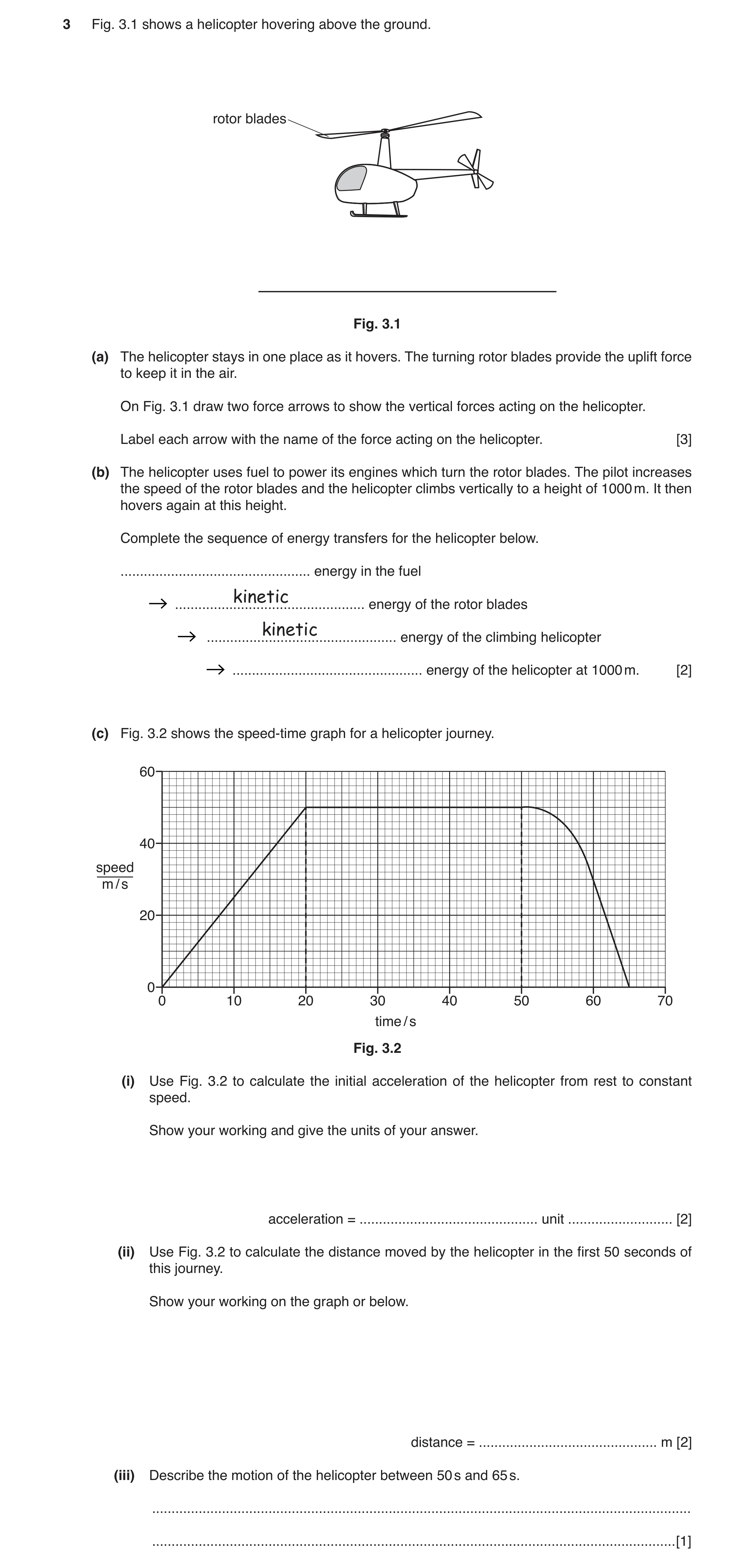
3 Fig. 3.1 shows a helicopter hovering above the ground. rotor blades Fig. 3.1 (a) The helicopter stays in one place as it hovers. The turning rotor blades provide the uplift force to keep it in the air. On Fig. 3.1 draw two force arrows to show the vertical forces acting on the helicopter. Label each arrow with the name of the force acting on the helicopter. [3] (b) The helicopter uses fuel to power its engines which turn the rotor blades. The pilot increases the speed of the rotor blades and the helicopter climbs vertically to a height of 1000 m. It then hovers again at this height. Complete the sequence of energy transfers for the helicopter below. … energy in the fuel kinetic … energy of the rotor blades kinetic … energy of the climbing helicopter … energy of the helicopter at 1000 m. [2] (c) Fig. 3.2 shows the speed-time graph for a helicopter journey. 60 40 speed m / s 20 0 0 10 20 30 40 50 60 70 time / s Fig. 3.2 (i) Use Fig. 3.2 to calculate the initial acceleration of the helicopter from rest to constant speed. Show your working and give the units of your answer. acceleration = … unit … [2] (ii) Use Fig. 3.2 to calculate the distance moved by the helicopter in the first 50 seconds of this journey. Show your working on the graph or below. distance = … m [2] (iii) Describe the motion of the helicopter between 50 s and 65 s. … … [1]
10 marks
Mark scheme: 3(a) force arrow vertically upward labelled ‘uplift’ ; force arrow vertically downward labelled weight / gravitational force / gravity ; the two vertical force arrows in contact with helicopter / or the vertical arrows of approximately equal length by inspection ; 3 3(b) chemical ; gravitational / potential ; 2 3(c)(i) acceleration = (change of speed / time = 50 / 20 ) = 2.5 ; m / s2 ; 2 3(c)(ii) ½ × 50 × 20 / 500 (m) / 50 × (50 – 20) / 1500 (m) seen ; = 2000 (m) ; (also by using the formula for the area of the trapezium, ½ (30 + 50) × 50 ) 2 3(c)(iii) non-constant deceleration / acceleration owtte ; 1
This question in 0653/42 Oct/Nov 2017
Q6 · Four forces, P, Q, R and S, acting on a submarine travelling underwater 0653/43 Oct/Nov 2017
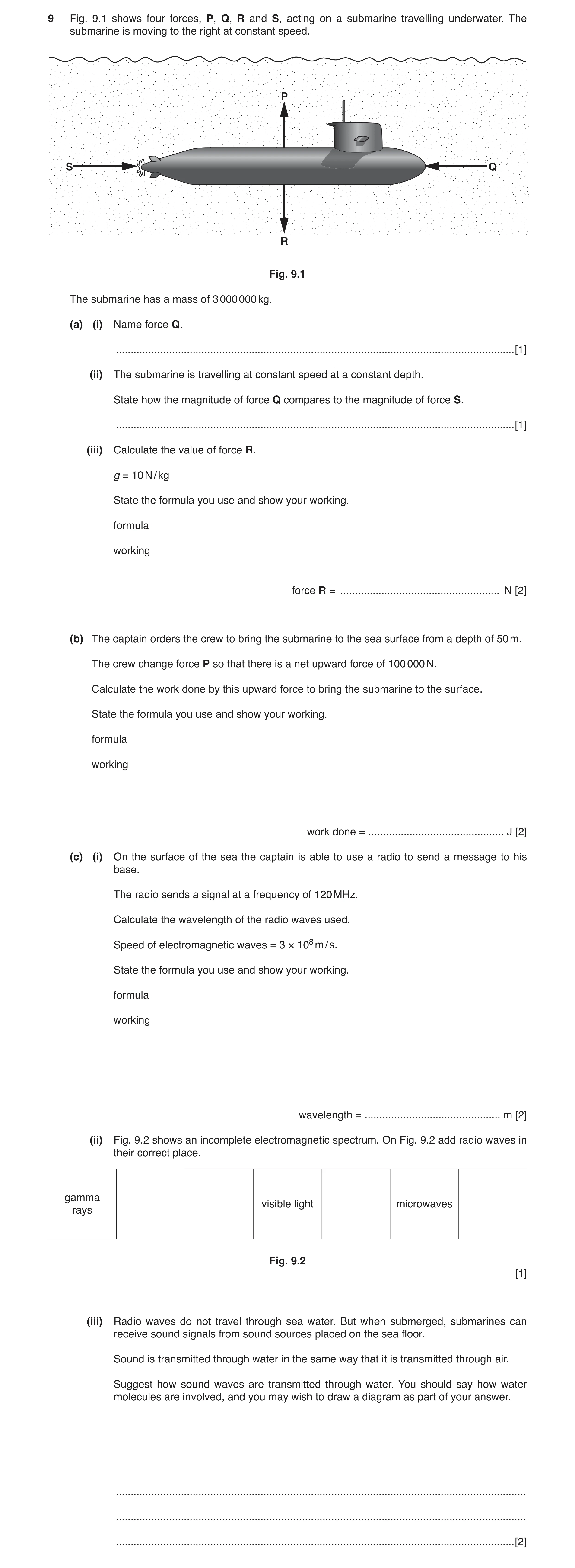
9 Fig. 9.1 shows four forces, P, Q, R and S, acting on a submarine travelling underwater. The submarine is moving to the right at constant speed. P S Q R Fig. 9.1 The submarine has a mass of 3 000 000 kg. (a) (i) Name force Q. … [1] (ii) The submarine is travelling at constant speed at a constant depth. State how the magnitude of force Q compares to the magnitude of force S. … [1] (iii) Calculate the value of force R. g = 10 N / kg State the formula you use and show your working. formula working force R = … N [2] (b) The captain orders the crew to bring the submarine to the sea surface from a depth of 50 m. The crew change force P so that there is a net upward force of 100 000 N. Calculate the work done by this upward force to bring the submarine to the surface. State the formula you use and show your working. formula working work done = … J [2] (c) (i) On the surface of the sea the captain is able to use a radio to send a message to his base. The radio sends a signal at a frequency of 120 MHz. Calculate the wavelength of the radio waves used. Speed of electromagnetic waves = 3 × 10⁸ m / s. State the formula you use and show your working. formula working wavelength = … m [2] (ii) Fig. 9.2 shows an incomplete electromagnetic spectrum. On Fig. 9.2 add radio waves in their correct place. gamma visible light microwaves rays Fig. 9.2 [1] (iii) Radio waves do not travel through sea water. But when submerged, submarines can receive sound signals from sound sources placed on the sea floor. Sound is transmitted through water in the same way that it is transmitted through air. Suggest how sound waves are transmitted through water. You should say how water molecules are involved, and you may wish to draw a diagram as part of your answer. … … … [2]
11 marks
Mark scheme: 9(a)(i) (Q =) friction / (water) resistance ; 1 9(a)(ii) (force Q cf force S) equal / balanced ; 1 9(a)(iii) W = mg = 3 000 000 × 10 ; = 30 000 000 (N) ; 2 9(b) work done = force × distance / F × d = 100 000 × 50 ; = 5 000 000 (J) ; 2 9(c)(i) v = f λ and λ = 3 × 10⁸ / 120 × 106 ; = 2.5 (m) ; 2 9(c)(ii) gamma visible light micro- waves radio waves ; 1 9(c)(iii) any two from longitudinal (wave / vibration) / compressions and rarefactions ; (water) molecules / particles vibrate / oscillate ; pass on vibration / energy (through water) ; max2
This question in 0653/43 Oct/Nov 2017
Q7 · A crane carrying a load 0653/42 May/June 2018
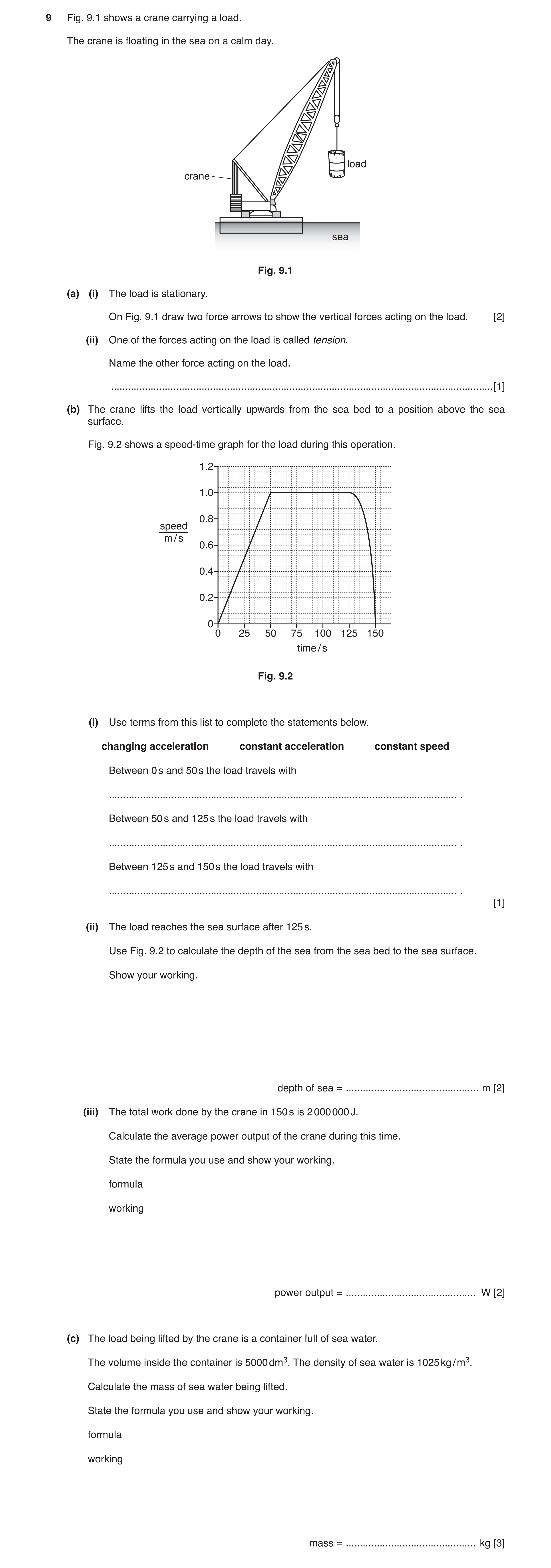
9 Fig. 9.1 shows a crane carrying a load. The crane is floating in the sea on a calm day. load crane sea Fig. 9.1 (a) (i) The load is stationary. On Fig. 9.1 draw two force arrows to show the vertical forces acting on the load. [2] (ii) One of the forces acting on the load is called tension. Name the other force acting on the load. … [1] (b) The crane lifts the load vertically upwards from the sea bed to a position above the sea surface. Fig. 9.2 shows a speed-time graph for the load during this operation. 1.2 1.0 0.8 speed m / s 0.6 0.4 0.2 0 0 25 50 75 100 125 150 time / s Fig. 9.2 (i) Use terms from this list to complete the statements below. changing acceleration constant acceleration constant speed Between 0 s and 50 s the load travels with … . Between 50 s and 125 s the load travels with … . Between 125 s and 150 s the load travels with … . [1] (ii) The load reaches the sea surface after 125 s. Use Fig. 9.2 to calculate the depth of the sea from the sea bed to the sea surface. Show your working. depth of sea = … m [2] (iii) The total work done by the crane in 150 s is 2 000 000 J. Calculate the average power output of the crane during this time. State the formula you use and show your working. formula working power output = … W [2] (c) The load being lifted by the crane is a container full of sea water. The volume inside the container is 5000 dm3. The density of sea water is 1025 kg / m3. Calculate the mass of sea water being lifted. State the formula you use and show your working. formula working mass = … kg [3]
11 marks
Mark scheme: 9(a)(i) two opposite vertical force arrows ; both arrows from the load ; 2 9(a)(ii) weight / gravitational force ; 1 9(b)(i) constant acceleration constant speed changing acceleration (in this order) ; 1 9(b)(ii) selection of area under graph as method ; calculation of area: ½ × 50 × 1 + (125 – 50) × 1 = 100 m ; 2 9(b)(iii) (P =) E / t or W / t or (P =) 2 000 000 ÷ 150 ; = 13 300 (W) / 13 000 (W) ; 2 9(c) density = mass / volume ; unit change noted: 5000 dm3 = 5 m3 ; mass (= volume x density) = 5 × 1025 = 5125 (kg) ; 3
This question in 0653/42 May/June 2018
Q8 · A small quadcopter (drone with four rotors) being operated by radio control 0653/43 May/June 2018
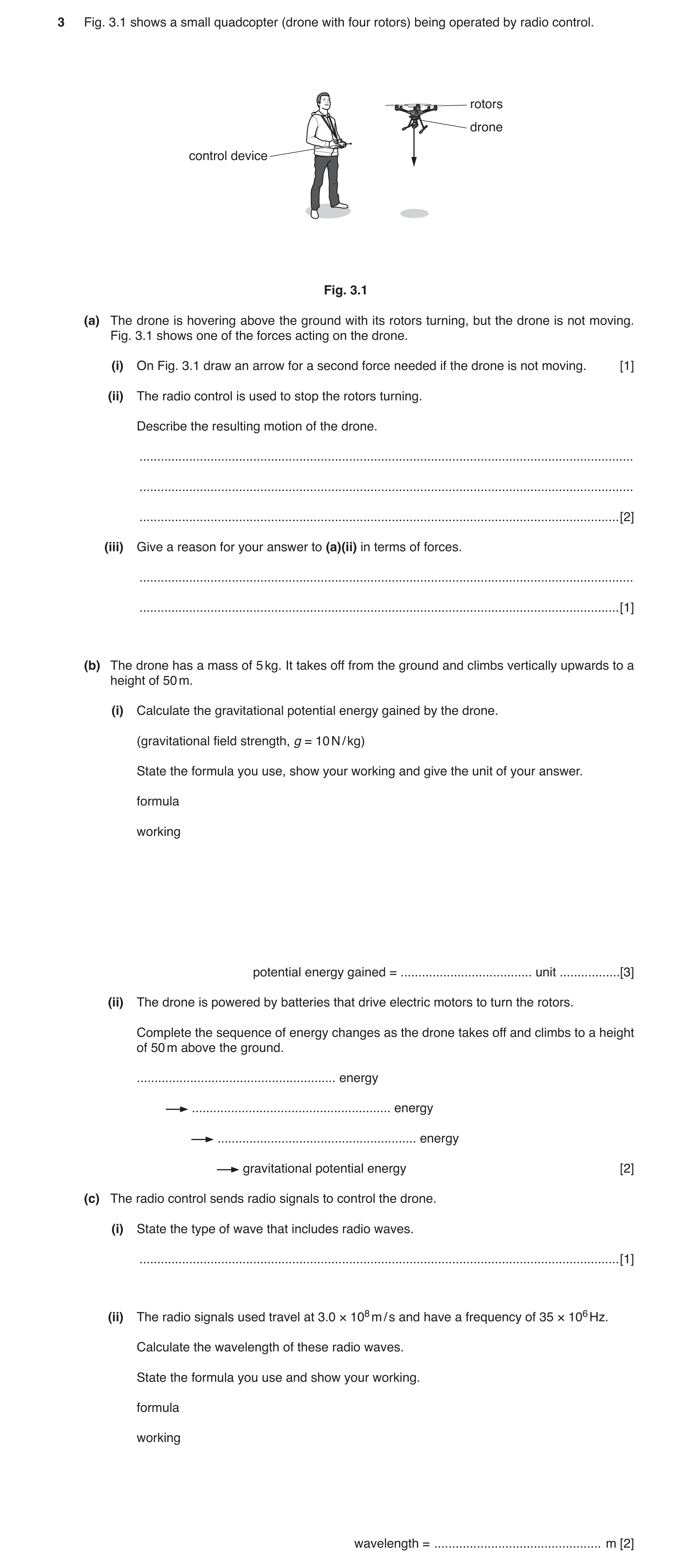
3 Fig. 3.1 shows a small quadcopter (drone with four rotors) being operated by radio control. rotors drone control device Fig. 3.1 (a) The drone is hovering above the ground with its rotors turning, but the drone is not moving. Fig. 3.1 shows one of the forces acting on the drone. (i) On Fig. 3.1 draw an arrow for a second force needed if the drone is not moving. [1] (ii) The radio control is used to stop the rotors turning. Describe the resulting motion of the drone. … … … [2] (iii) Give a reason for your answer to (a)(ii) in terms of forces. … … [1] (b) The drone has a mass of 5 kg. It takes off from the ground and climbs vertically upwards to a height of 50 m. (i) Calculate the gravitational potential energy gained by the drone. (gravitational field strength, g = 10 N / kg) State the formula you use, show your working and give the unit of your answer. formula working potential energy gained = … unit … [3] (ii) The drone is powered by batteries that drive electric motors to turn the rotors. Complete the sequence of energy changes as the drone takes off and climbs to a height of 50 m above the ground. … energy … energy … energy gravitational potential energy [2] (c) The radio control sends radio signals to control the drone. (i) State the type of wave that includes radio waves. … [1] (ii) The radio signals used travel at 3.0 × 10⁸ m / s and have a frequency of 35 × 106 Hz. Calculate the wavelength of these radio waves. State the formula you use and show your working. formula working wavelength = … m [2]
12 marks
Mark scheme: 3(a)(i) upward vertical force arrow acting on the drone at any point ; 1 Question Answer Marks 3(a)(ii) falls to ground ; accelerates ; 2 3(a)(iii) (moves / accelerates due to) unbalanced forces / weight / gravitational force ; 1 3(b)(i) PE gained = mgh = 5 × 10 × 50 ; = 2500 ; joules / J ; 3 3(b)(ii) chemical > electrical > kinetic > (grav PE) ;; all 3 correct for 2 marks; any 2 correct for 1 2 3(c)(i) electromagnetic waves ; 1 3(c)(ii) v = f λ OR rearranged / λ = 3.0 × 10⁸/ 35 × 106; = 8.6 m ; 2
This question in 0653/43 May/June 2018
Q9 · A train made up of a steam engine and a passenger coach 0653/41 Oct/Nov 2018
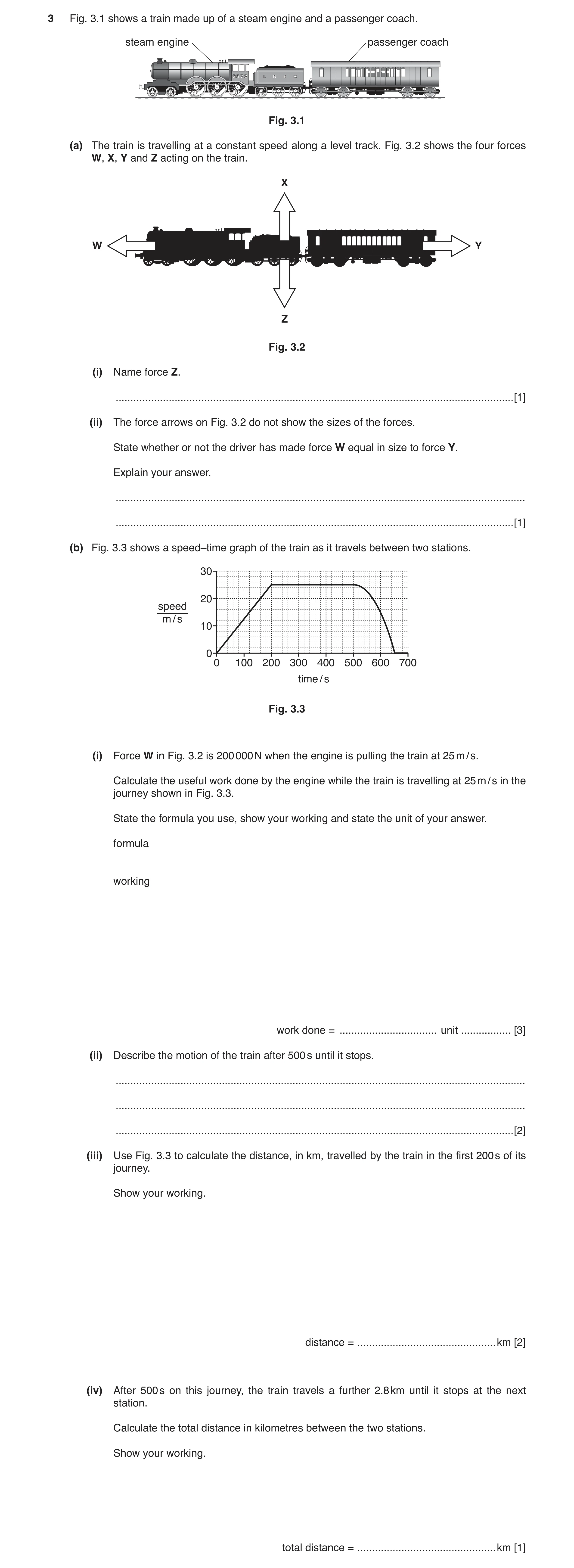
3 Fig. 3.1 shows a train made up of a steam engine and a passenger coach. steam engine passenger coach Fig. 3.1 (a) The train is travelling at a constant speed along a level track. Fig. 3.2 shows the four forces W, X, Y and Z acting on the train. X W Y Z Fig. 3.2 (i) Name force Z. … [1] (ii) The force arrows on Fig. 3.2 do not show the sizes of the forces. State whether or not the driver has made force W equal in size to force Y. Explain your answer. … … [1] (b) Fig. 3.3 shows a speed–time graph of the train as it travels between two stations. 30 20 speed m / s 10 0 0 100 200 300 400 500 600 700 time / s Fig. 3.3 (i) Force W in Fig. 3.2 is 200 000 N when the engine is pulling the train at 25 m / s. Calculate the useful work done by the engine while the train is travelling at 25 m / s in the journey shown in Fig. 3.3. State the formula you use, show your working and state the unit of your answer. formula working work done = … unit … [3] (ii) Describe the motion of the train after 500 s until it stops. … … … [2] (iii) Use Fig. 3.3 to calculate the distance, in km, travelled by the train in the first 200 s of its journey. Show your working. distance = … km [2] (iv) After 500 s on this journey, the train travels a further 2.8 km until it stops at the next station. Calculate the total distance in kilometres between the two stations. Show your working. total distance = … km [1]
10 marks
Mark scheme: 3(a)(i) weight / gravitational (force) ; 1 3(a)(ii) yes (no mark) constant speed / no acceleration, (so forces must balance) ; 1 Question Answer Marks 3(b)(i) distance = speed × time and / or work done = force × distance or d = s × t and / or w = F × d or 200 000 × 25 × (500 – 200) ; = 1 500 000 000 ; J / joules ; 3 3(b)(ii) (negative) acceleration / deceleration ; not constant (deceleration) / increasing deceleration (becoming constant deceleration) ; 2 3(b)(iii) evidence of area under graph calculated up to 200 s / 1 2 × 200 × 25 ; 2.5 km ; 2 3(b)(iv) total distance = 2.5 + (500–200) × 0.025 + 2.8 = 12.8 km ; 1
This question in 0653/41 Oct/Nov 2018
Q10 · A man pushing a shopping trolley 0653/43 Oct/Nov 2018
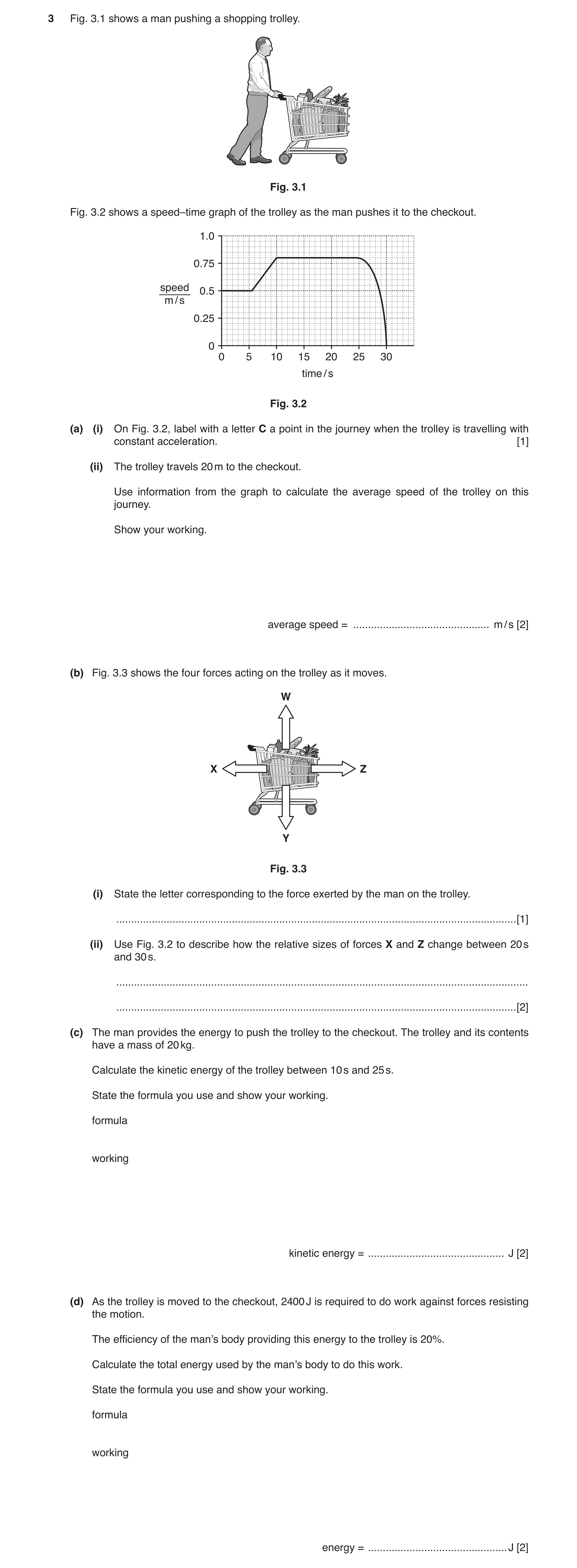
3 Fig. 3.1 shows a man pushing a shopping trolley. Fig. 3.1 Fig. 3.2 shows a speed–time graph of the trolley as the man pushes it to the checkout. 1.0 0.75 speed 0.5 m / s 0.25 0 0 5 10 15 20 25 30 time / s Fig. 3.2 (a) (i) On Fig. 3.2, label with a letter C a point in the journey when the trolley is travelling with constant acceleration. [1] (ii) The trolley travels 20 m to the checkout. Use information from the graph to calculate the average speed of the trolley on this journey. Show your working. average speed = … m / s [2] (b) Fig. 3.3 shows the four forces acting on the trolley as it moves. W X Z Y Fig. 3.3 (i) State the letter corresponding to the force exerted by the man on the trolley. … [1] (ii) Use Fig. 3.2 to describe how the relative sizes of forces X and Z change between 20 s and 30 s. … … [2] (c) The man provides the energy to push the trolley to the checkout. The trolley and its contents have a mass of 20 kg. Calculate the kinetic energy of the trolley between 10 s and 25 s. State the formula you use and show your working. formula working kinetic energy = … J [2] (d) As the trolley is moved to the checkout, 2400 J is required to do work against forces resisting the motion. The efficiency of the man’s body providing this energy to the trolley is 20%. Calculate the total energy used by the man’s body to do this work. State the formula you use and show your working. formula working energy = … J [2]
10 marks
Mark scheme: 3(a)(i) C at any point on graph line between 5.7 and 10 s ; 1 3(a)(ii) average speed = total distance / total time = 20 / 30 ; = 0.67 (m / s) ; 2 3(b)(i) Z ; 1 3(b)(ii) X and Z equal / same (20–25) s ; X > Z for (25–30) s ; 2 3(c) KE = ½ mv2 / ½ × 20 × 0.82 ; = 6.4 J ; 2 3(d) efficiency = [energy out / energy in] (× 100%) or energy in = energy out / 0.2 or 2400 / 0.2 / energy in = 2400 × 100 / 20 ; = 12 000 (J) ; 2
This question in 0653/43 Oct/Nov 2018
Q11 · A girl throwing a beach ball up in the air 0653/42 Feb/March 2019
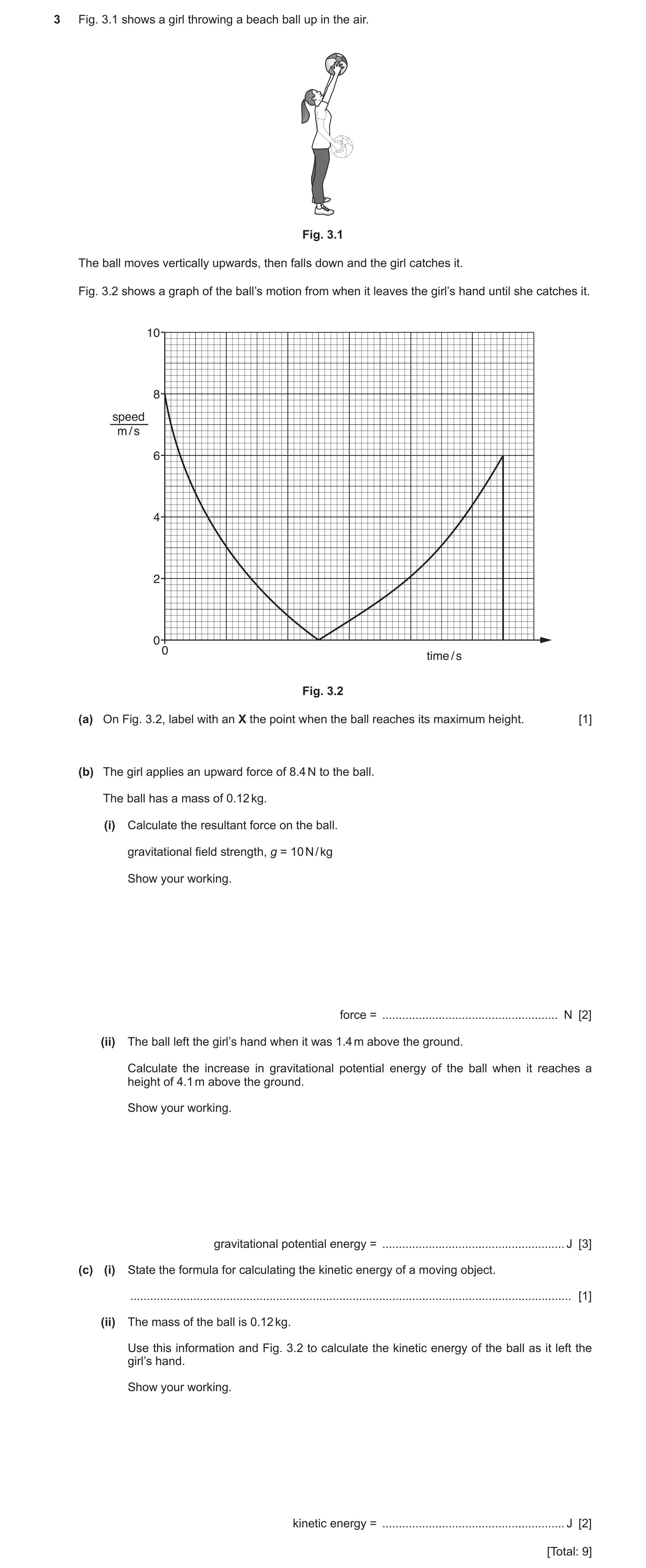
3 Fig. 3.1 shows a girl throwing a beach ball up in the air. Fig. 3.1 The ball moves vertically upwards, then falls down and the girl catches it. Fig. 3.2 shows a graph of the ball’s motion from when it leaves the girl’s hand until she catches it. 10 8 speed m / s 6 4 2 0 0 time / s Fig. 3.2 (a) On Fig. 3.2, label with an X the point when the ball reaches its maximum height. [1] (b) The girl applies an upward force of 8.4 N to the ball. The ball has a mass of 0.12 kg. (i) Calculate the resultant force on the ball. gravitational field strength, g = 10 N / kg Show your working. force = … N [2] (ii) The ball left the girl’s hand when it was 1.4 m above the ground. Calculate the increase in gravitational potential energy of the ball when it reaches a height of 4.1 m above the ground. Show your working. gravitational potential energy = … J [3] (c) (i) State the formula for calculating the kinetic energy of a moving object. … [1] (ii) The mass of the ball is 0.12 kg. Use this information and Fig. 3.2 to calculate the kinetic energy of the ball as it left the girl’s hand. Show your working. kinetic energy = … J [2] [Total: 9]
9 marks
Mark scheme: 3(a) X at point where curve touches x axis the first time ; 1 3(b)(i) weight of ball = force downwards = 0.12 × 10 = 1.2 N ; resultant force = 8.4 – 1.2 = 7.2 N ; 2 3(b)(ii) gain in height by ball = 4.1 – 1.4 = 2.7 m ; gain in PE = mgh = 0.12 × 10 × 2.7 ; = 3.24 (J) ; 3 3(c)(i) ½ mv2 ; 1 3(c)(ii) (½ mv2) = ½ × 0.12 × 82; = 3.84 (J) ; 2
This question in 0653/42 Feb/March 2019
Q12 · A whale swimming underwater 0653/41 May/June 2019
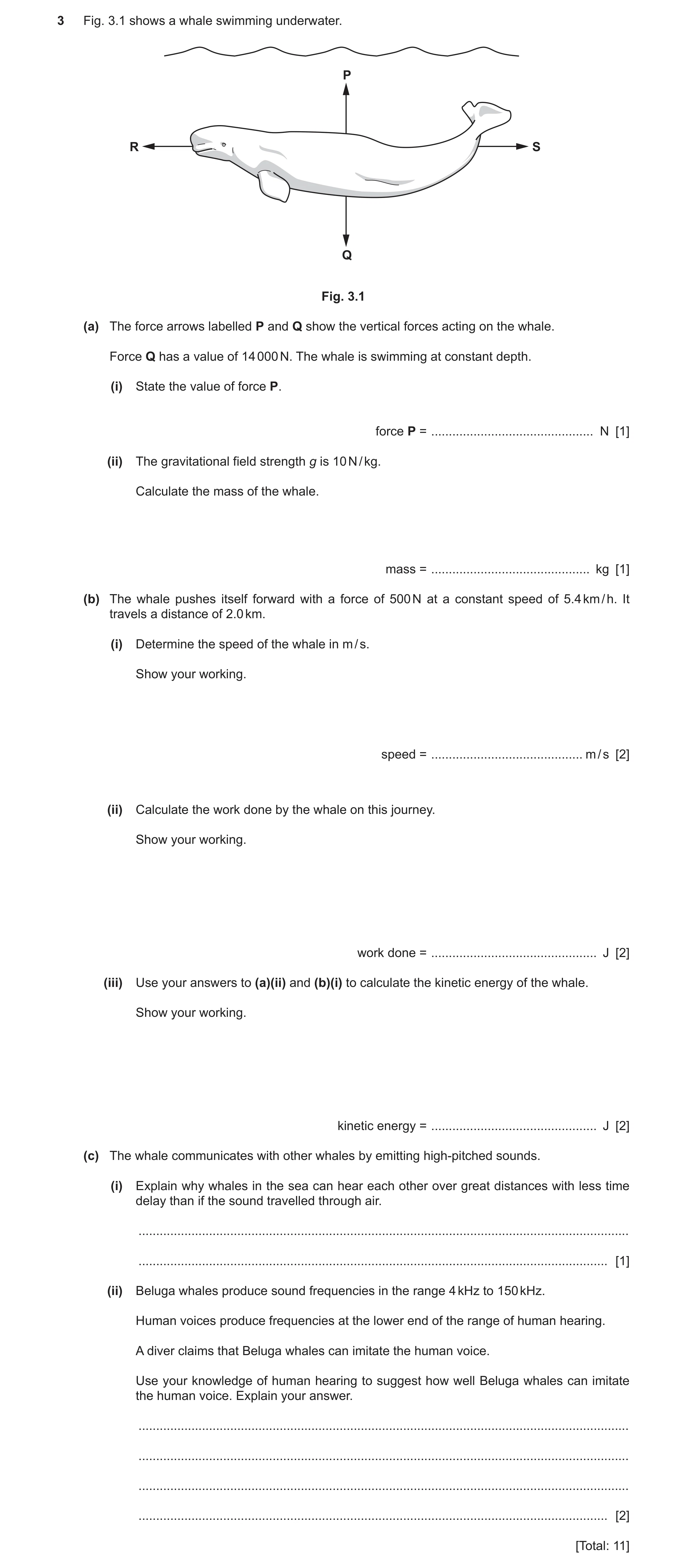
3 Fig. 3.1 shows a whale swimming underwater. P R S Q Fig. 3.1 (a) The force arrows labelled P and Q show the vertical forces acting on the whale. Force Q has a value of 14 000 N. The whale is swimming at constant depth. (i) State the value of force P. force P = … N [1] (ii) The gravitational field strength g is 10 N / kg. Calculate the mass of the whale. mass = … kg [1] (b) The whale pushes itself forward with a force of 500 N at a constant speed of 5.4 km / h. It travels a distance of 2.0 km. (i) Determine the speed of the whale in m / s. Show your working. speed = … m / s [2] (ii) Calculate the work done by the whale on this journey. Show your working. work done = … J [2] (iii) Use your answers to (a)(ii) and (b)(i) to calculate the kinetic energy of the whale. Show your working. kinetic energy = … J [2] (c) The whale communicates with other whales by emitting high-pitched sounds. (i) Explain why whales in the sea can hear each other over great distances with less time delay than if the sound travelled through air. … … [1] (ii) Beluga whales produce sound frequencies in the range 4 kHz to 150 kHz. Human voices produce frequencies at the lower end of the range of human hearing. A diver claims that Beluga whales can imitate the human voice. Use your knowledge of human hearing to suggest how well Beluga whales can imitate the human voice. Explain your answer. … … … … [2] [Total: 11]
11 marks
Mark scheme: 3(a)(i) 14 000 (N) ; 1 3(a)(ii) 1400 (kg) ; 1 3(b)(i) (speed =) distance / time or 5400 / 3600 ; = 1.5 (m/s) ; 2 Question Answer Marks 3(b)(ii) (work done =) force × distance / W = F × d = 500 × 2000 ; = 1 000 000 (J) ; 2 3(b)(iii) (KE =) ½ mv2 ; = ½ × 1400 × (1.5)2 = 1575 (J) ; 2 3(c)(i) speed of sound in liquid / water faster than in gas / air ; 1 3(c)(ii) range of human hearing = 20 to 20 000Hz ; so beluga can produce sound that lies within the range of human hearing ; beluga sounds very high-pitched (to humans) ; max 2
This question in 0653/41 May/June 2019
Q13 · A forklift truck moving a large heavy box towards a shelf 0653/42 May/June 2019
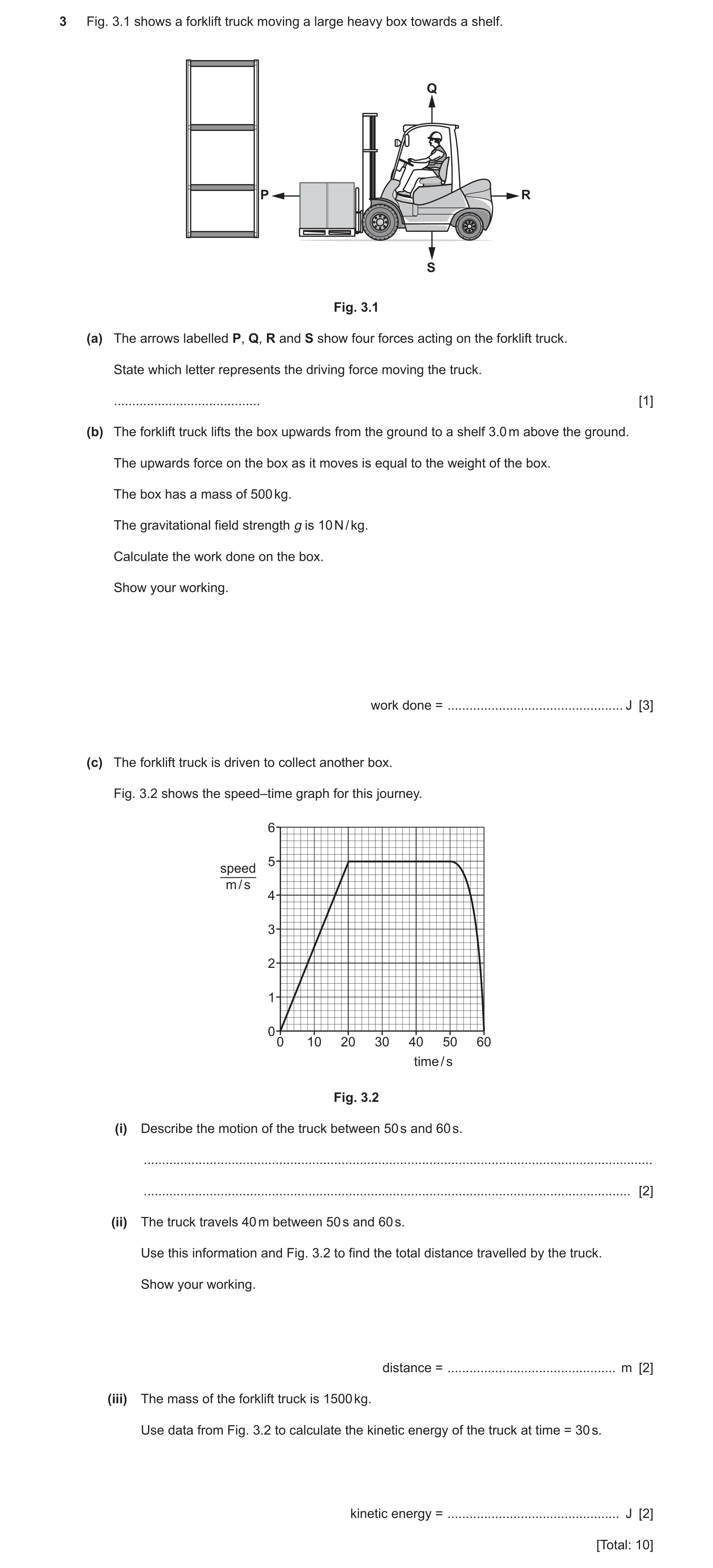
3 Fig. 3.1 shows a forklift truck moving a large heavy box towards a shelf. Q P R S Fig. 3.1 (a) The arrows labelled P, Q, R and S show four forces acting on the forklift truck. State which letter represents the driving force moving the truck. … [1] (b) The forklift truck lifts the box upwards from the ground to a shelf 3.0 m above the ground. The upwards force on the box as it moves is equal to the weight of the box. The box has a mass of 500 kg. The gravitational field strength g is 10 N / kg. Calculate the work done on the box. Show your working. work done = … J [3] (c) The forklift truck is driven to collect another box. Fig. 3.2 shows the speed–time graph for this journey. 6 5 speed m / s 4 3 2 1 0 0 10 20 30 40 50 60 time / s Fig. 3.2 (i) Describe the motion of the truck between 50 s and 60 s. … … [2] (ii) The truck travels 40 m between 50 s and 60 s. Use this information and Fig. 3.2 to find the total distance travelled by the truck. Show your working. distance = … m [2] (iii) The mass of the forklift truck is 1500 kg. Use data from Fig. 3.2 to calculate the kinetic energy of the truck at time = 30 s. kinetic energy = … J [2] [Total: 10]
10 marks
Mark scheme: 3(a) P ; 1 3(b) weight of box = 500 × 10 = 5000 (N) ; work done = force × distance moved / F × d ; = 5000 × 3 = 15 000 (J) ; 3 3(c)(i) decelerating / slowing down to a stop ; deceleration changing / not constant ; 2 3(c)(ii) distance = area under graph or 0.5 × 20 × 5 + (50 – 20) × 5 (+ 40) or (0.5 × (50 + (50 – 20)) × 5)(+ 40) ; = 240 (m) ; 2 3(c)(iii) KE = 2 1 2 mv or KE = 0.5 × 1500 × 52 ; = 18 750 J 2
This question in 0653/42 May/June 2019
Q14 · A boy swimming in a swimming pool 0653/43 May/June 2019
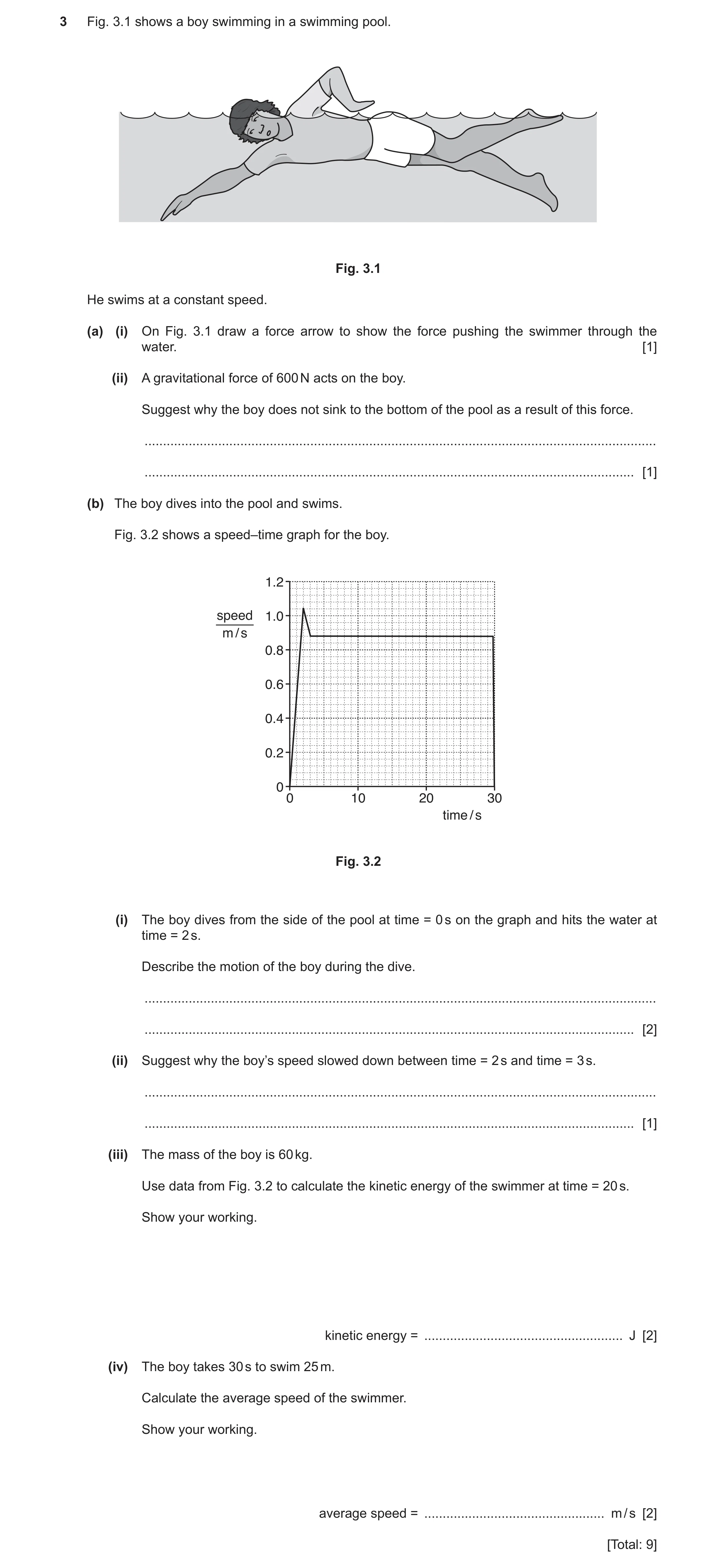
3 Fig. 3.1 shows a boy swimming in a swimming pool. Fig. 3.1 He swims at a constant speed. (a) (i) On Fig. 3.1 draw a force arrow to show the force pushing the swimmer through the water. [1] (ii) A gravitational force of 600 N acts on the boy. Suggest why the boy does not sink to the bottom of the pool as a result of this force. … … [1] (b) The boy dives into the pool and swims. Fig. 3.2 shows a speed–time graph for the boy. 1.2 speed 1.0 m / s 0.8 0.6 0.4 0.2 0 0 10 20 30 time / s Fig. 3.2 (i) The boy dives from the side of the pool at time = 0 s on the graph and hits the water at time = 2 s. Describe the motion of the boy during the dive. … … [2] (ii) Suggest why the boy’s speed slowed down between time = 2 s and time = 3 s. … … [1] (iii) The mass of the boy is 60 kg. Use data from Fig. 3.2 to calculate the kinetic energy of the swimmer at time = 20 s. Show your working. kinetic energy = … J [2] (iv) The boy takes 30 s to swim 25 m. Calculate the average speed of the swimmer. Show your working. average speed = … m / s [2] [Total: 9]
9 marks
Mark scheme: 3(a)(i) arrow pointing from right to left ; 1 3(a)(ii) has to be an (equal and) opposite upward force / owtte ; 1 3(b)(i) acceleration ; constant ; 2 3(b)(ii) water friction / resistance (much higher than air resistance) ; 1 3(b)(iii) working mark from one or more of : speed at 20 s = 0.88 m/s (KE =) ½ mv2 (KE =) ½ x 60 × 0.882 ; = 23.2(3) (J) ; 2 Question Answer Marks 3(b)(iv) (average speed =) distance ÷ time or 25 ÷ 30 ; = 0.83 (m/s) ; 2
This question in 0653/43 May/June 2019
Q15 · How a spring is stretched when a force is applied to one end 0653/42 Oct/Nov 2019
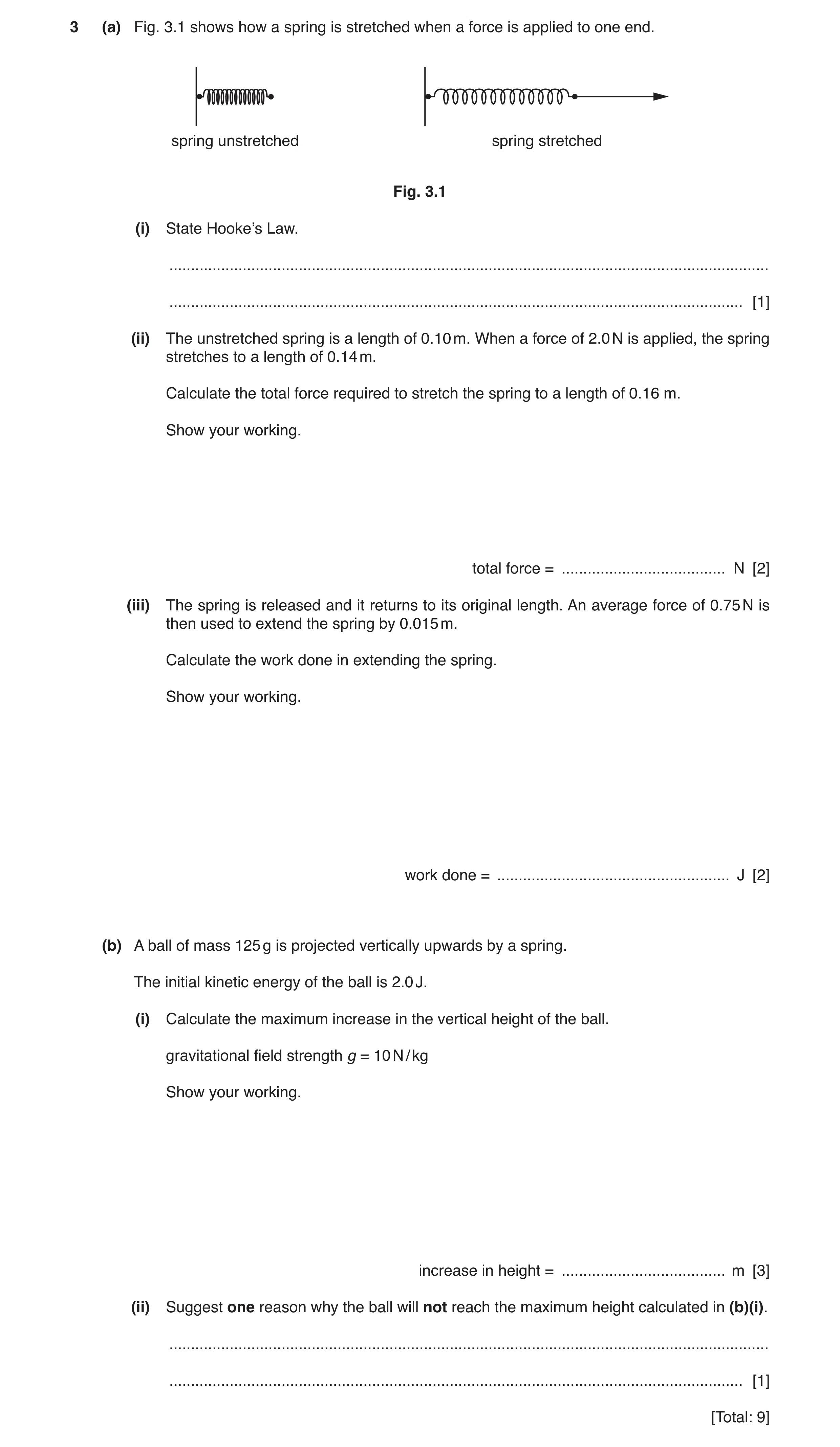
3 (a) Fig. 3.1 shows how a spring is stretched when a force is applied to one end. spring unstretched spring stretched Fig. 3.1 (i) State Hooke’s Law. … … [1] (ii) The unstretched spring is a length of 0.10 m. When a force of 2.0 N is applied, the spring stretches to a length of 0.14 m. Calculate the total force required to stretch the spring to a length of 0.16 m. Show your working. total force = … N [2] (iii) The spring is released and it returns to its original length. An average force of 0.75 N is then used to extend the spring by 0.015 m. Calculate the work done in extending the spring. Show your working. work done = … J [2] (b) A ball of mass 125 g is projected vertically upwards by a spring. The initial kinetic energy of the ball is 2.0 J. (i) Calculate the maximum increase in the vertical height of the ball. gravitational field strength g = 10 N / kg Show your working. increase in height = … m [3] (ii) Suggest one reason why the ball will not reach the maximum height calculated in (b)(i). … … [1] [Total: 9]
9 marks
Mark scheme: 3(a)(i) The extension (of an elastic object) is (directly) proportional to the force (applied to it) ; 1 3(a)(ii) correct calculation of extension x = 0.04 or spring constant k = 50 ; (F= k x = 50 × 0.06) = 3.0 (N) ; 2 3(a)(iii) use of work done = force × distance ; (W = F x = 0.75 × 0.015) = 0.011 (J) ; 2 3(b)(i) use of conservation of energy (mgh = KE = 2) ; 0.125 × 10 × h = 2 ; = 1.6 (m) ; 3 3(b)(ii) friction / air resistance ; 1
This question in 0653/42 Oct/Nov 2019
Q16 · A sheet of metal on the sea floor 0653/42 May/June 2020
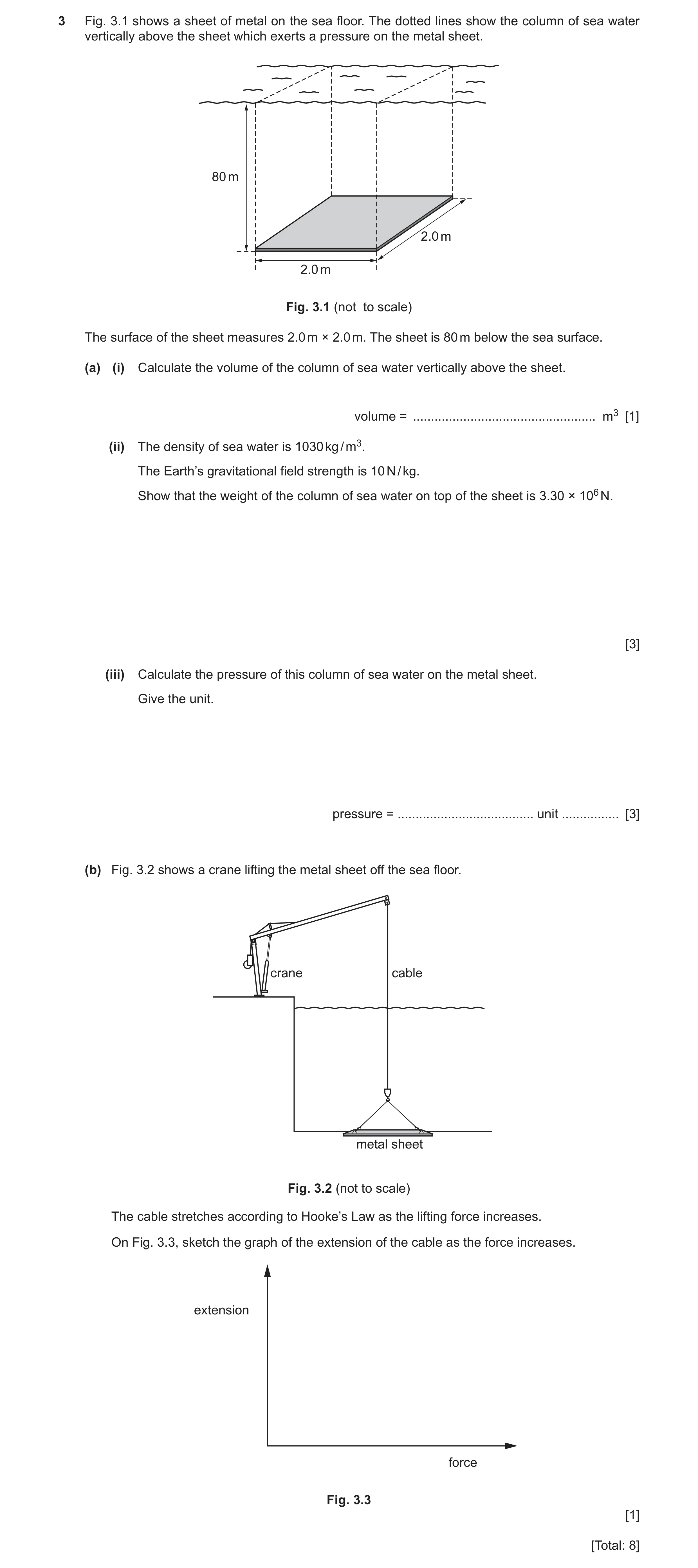
3 Fig. 3.1 shows a sheet of metal on the sea floor. The dotted lines show the column of sea water vertically above the sheet which exerts a pressure on the metal sheet. 80 m 2.0 m 2.0 m Fig. 3.1 (not to scale) The surface of the sheet measures 2.0 m × 2.0 m. The sheet is 80 m below the sea surface. (a) (i) Calculate the volume of the column of sea water vertically above the sheet. volume = … m3 [1] (ii) The density of sea water is 1030 kg / m3. The Earth’s gravitational field strength is 10 N / kg. Show that the weight of the column of sea water on top of the sheet is 3.30 × 10⁶ N. [3] (iii) Calculate the pressure of this column of sea water on the metal sheet. Give the unit. pressure = … unit … [3] (b) Fig. 3.2 shows a crane lifting the metal sheet off the sea floor. crane cable metal sheet Fig. 3.2 (not to scale) The cable stretches according to Hooke’s Law as the lifting force increases. On Fig. 3.3, sketch the graph of the extension of the cable as the force increases. extension force Fig. 3.3 [1] [Total: 8]
8 marks
Mark scheme: 3(a)(i) (volume = 80 × 2.0 × 2.0 =) 320 (m3) ; 3(a)(ii) mass (of sea water) = volume × density ; = 320 × 1030 (= 329 600 or 3.30 × 10⁵ kg) ; weight (of sea water) = mass × gravitational field strength = 3.30 × 105 kg × 10 N / kg = 3300000 / 3.30 × 10⁶ (N) ; 3 3(a)(iii) pressure = force / area = 3 300 000 / 4 or 3 296 000 / 4 ; = 825 000 or 824 000 ; N/m2 or Pa ; 3 3(b) straight line graph through origin ; 1
This question in 0653/42 May/June 2020
Q17 · The forces acting on a truck full of sand as it is pulled along level ground at constant… 0653/42 Oct/Nov 2020
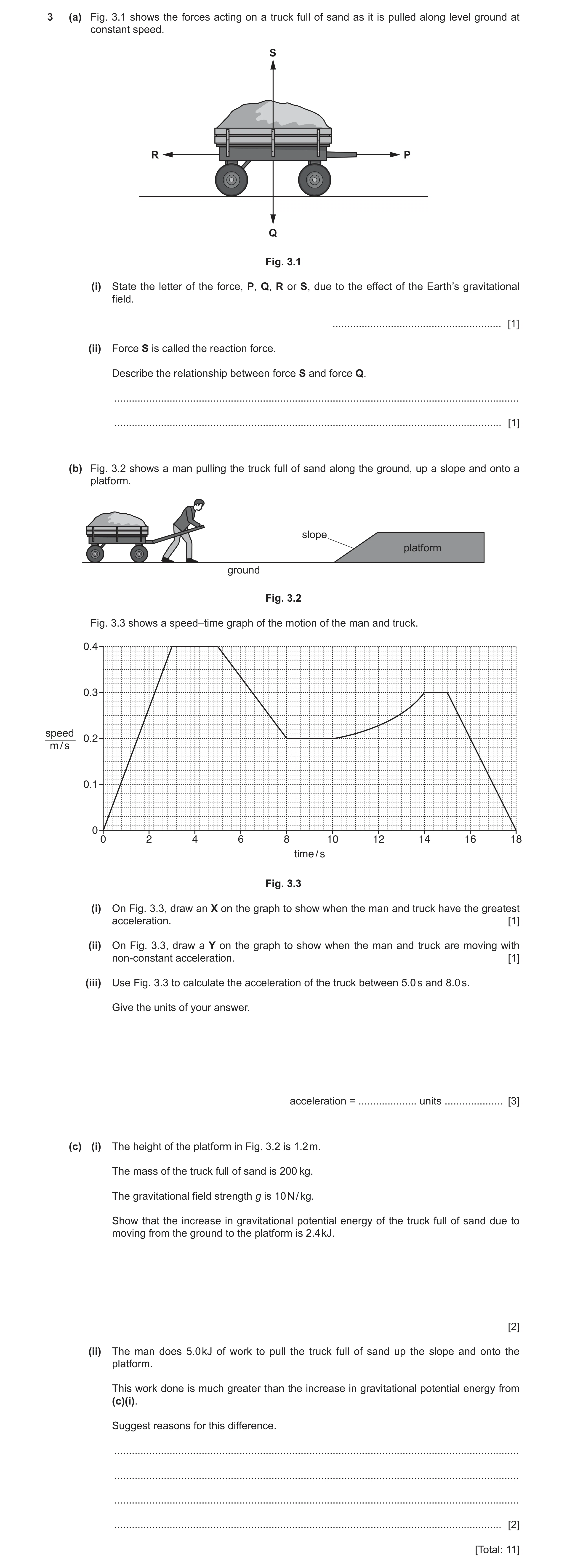
3 (a) Fig. 3.1 shows the forces acting on a truck full of sand as it is pulled along level ground at constant speed. S R P Q Fig. 3.1 (i) State the letter of the force, P, Q, R or S, due to the effect of the Earth’s gravitational field. … [1] (ii) Force S is called the reaction force. Describe the relationship between force S and force Q. … … [1] (b) Fig. 3.2 shows a man pulling the truck full of sand along the ground, up a slope and onto a platform. slope platform ground Fig. 3.2 Fig. 3.3 shows a speed–time graph of the motion of the man and truck. 0.4 0.3 speed 0.2 m / s 0.1 0 0 2 4 6 8 10 12 14 16 18 time / s Fig. 3.3 (i) On Fig. 3.3, draw an X on the graph to show when the man and truck have the greatest acceleration. [1] (ii) On Fig. 3.3, draw a Y on the graph to show when the man and truck are moving with non-constant acceleration. [1] (iii) Use Fig. 3.3 to calculate the acceleration of the truck between 5.0 s and 8.0 s. Give the units of your answer. acceleration = … units … [3] (c) (i) The height of the platform in Fig. 3.2 is 1.2 m. The mass of the truck full of sand is 200 kg. The gravitational field strength g is 10 N / kg. Show that the increase in gravitational potential energy of the truck full of sand due to moving from the ground to the platform is 2.4 kJ. [2] (ii) The man does 5.0 kJ of work to pull the truck full of sand up the slope and onto the platform. This work done is much greater than the increase in gravitational potential energy from (c)(i). Suggest reasons for this difference. … … … … [2] [Total: 11]
11 marks
Mark scheme: 3(a)(i) Q ; 1 3(a)(ii) equal (magnitude) AND opposite (direction) ; 1 3(b)(i) X drawn to show region between (0,0) and (3,0.4) ; 1 3(b)(ii) Y drawn to show region between (10,0.2) and (14,0.3) ; 1 3(b)(iii) acceleration = change of speed ÷ time / –0.2 ÷ 3 ; –0.07 ; m / s2 ; 3 3(c)(i) ΔG.P.E. = mgΔh in any form / 200 × 10 × 1.2 ; 2400 J (= 2.4 kJ) ; 2 3(c)(ii) any two from: thermal energy lost to surroundings / work done against friction ; man also has to gain PE going up onto the platform ; kinetic energy transferred / work also done in moving the man (and load) forward ; 2
This question in 0653/42 Oct/Nov 2020
Q18 · A climber using a safety rope to climb a rock face 0653/43 Oct/Nov 2020
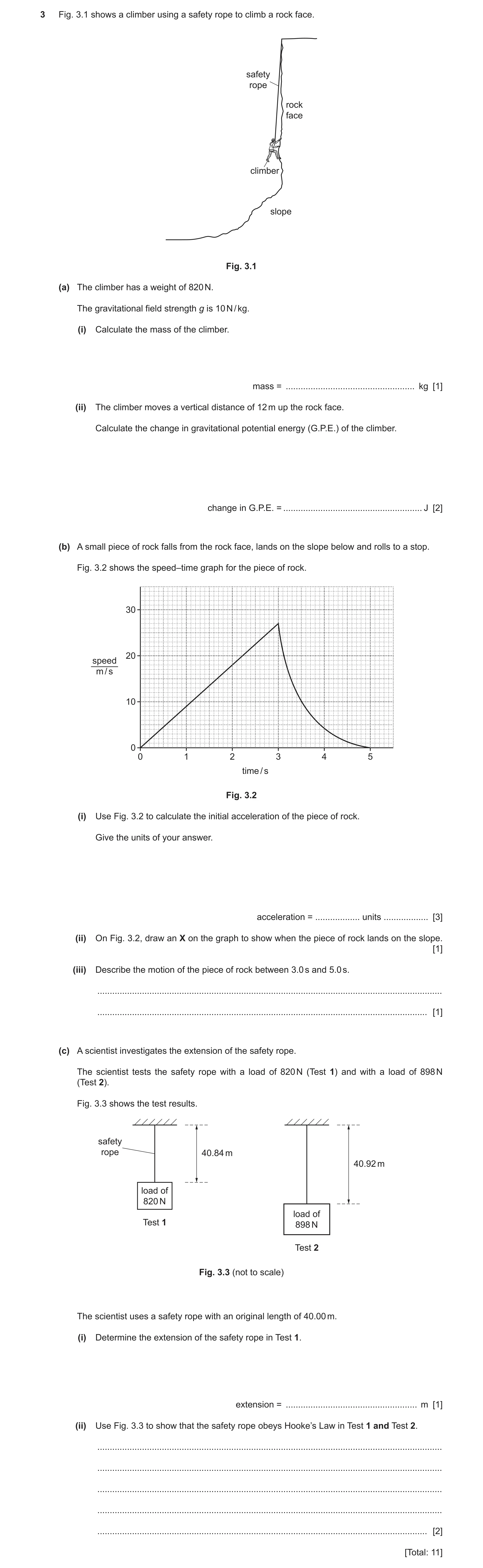
3 Fig. 3.1 shows a climber using a safety rope to climb a rock face. safety rope rock face climber slope Fig. 3.1 (a) The climber has a weight of 820 N. The gravitational field strength g is 10 N / kg. (i) Calculate the mass of the climber. mass = … kg [1] (ii) The climber moves a vertical distance of 12 m up the rock face. Calculate the change in gravitational potential energy (G.P.E.) of the climber. change in G.P.E. = … J [2] (b) A small piece of rock falls from the rock face, lands on the slope below and rolls to a stop. Fig. 3.2 shows the speed–time graph for the piece of rock. 30 20 speed m / s 10 0 0 1 2 3 4 5 time / s Fig. 3.2 (i) Use Fig. 3.2 to calculate the initial acceleration of the piece of rock. Give the units of your answer. acceleration = … units … [3] (ii) On Fig. 3.2, draw an X on the graph to show when the piece of rock lands on the slope. [1] (iii) Describe the motion of the piece of rock between 3.0 s and 5.0 s. … … [1] (c) A scientist investigates the extension of the safety rope. The scientist tests the safety rope with a load of 820 N (Test 1) and with a load of 898 N (Test 2). Fig. 3.3 shows the test results. safety rope 40.84 m 40.92 m load of 820 N load of Test 1 898 N Test 2 Fig. 3.3 (not to scale) The scientist uses a safety rope with an original length of 40.00 m. (i) Determine the extension of the safety rope in Test 1. extension = … m [1] (ii) Use Fig. 3.3 to show that the safety rope obeys Hooke’s Law in Test 1 and Test 2. … … … … … [2] [Total: 11]
11 marks
Mark scheme: 3(a)(i) (m = W ÷ g = 820 ÷ 10 =) 82 (kg) ; 1 3(a)(ii) ΔG.P.E. = mgΔh / ΔG.P.E. = wΔh / 82 × 10 × 12 ; 9840 (J) ; 2 3(b)(i) use of acceleration = change in speed ÷ time / 27 ÷ 3.0 ; 9.0 ; m / s2 ; 3 3(b)(ii) X marked at time = 3 s ; 1 3(b)(iii) non-constant, deceleration / acceleration (until it comes to rest) ; 1 3(c)(i) (extension = 40.84 – 40.00 =) 0.84 (m) ; 1 3(c)(ii) calculation of k OR 1 / k for one test ; calculation of k OR 1 / k for second test AND shown to be the same ; 2
This question in 0653/43 Oct/Nov 2020
Q19 · A car moving forward along a level road before the road goes over a hill 0653/42 Feb/March 2021
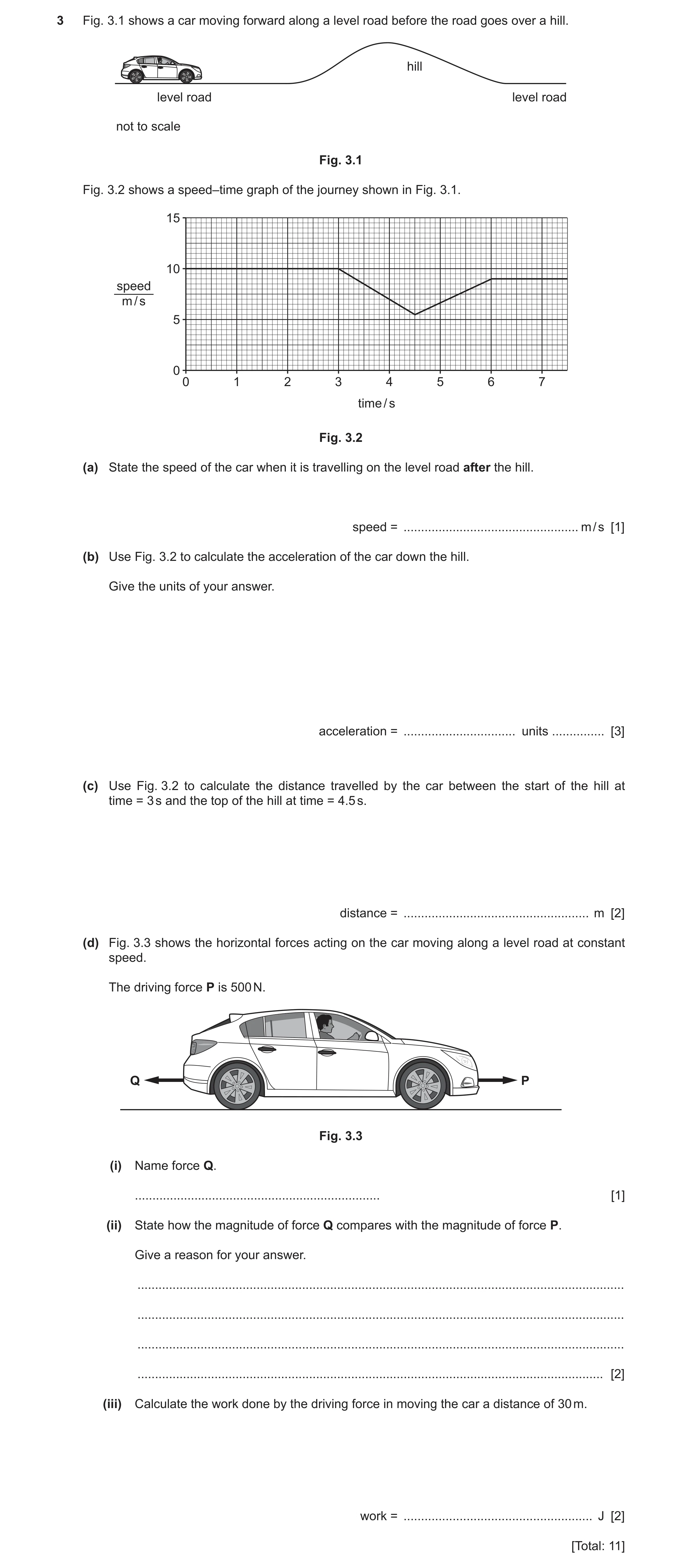
3 Fig. 3.1 shows a car moving forward along a level road before the road goes over a hill. hill level road level road not to scale Fig. 3.1 Fig. 3.2 shows a speed–time graph of the journey shown in Fig. 3.1. 15 10 speed m / s 5 0 0 1 2 3 4 5 6 7 time / s Fig. 3.2 (a) State the speed of the car when it is travelling on the level road after the hill. speed = … m / s [1] (b) Use Fig. 3.2 to calculate the acceleration of the car down the hill. Give the units of your answer. acceleration = … units … [3] (c) Use Fig. 3.2 to calculate the distance travelled by the car between the start of the hill at time = 3 s and the top of the hill at time = 4.5 s. distance = … m [2] (d) Fig. 3.3 shows the horizontal forces acting on the car moving along a level road at constant speed. The driving force P is 500 N. Q P Fig. 3.3 (i) Name force Q. … [1] (ii) State how the magnitude of force Q compares with the magnitude of force P. Give a reason for your answer. … … … … [2] (iii) Calculate the work done by the driving force in moving the car a distance of 30 m. work = … J [2] [Total: 11]
11 marks
Mark scheme: 3(a) 9 (m / s) ; 1 3(b) use of gradient of line / use of v = u + at ; (9.0 – 5.5) ÷ (6.0 – 4.5) = 2.3(3) ; m / s2 ; 3 3(c) use of area under graph / 5.5 × (4.5 – 3.0) + ½ × (10.0 – 5.5) × (4.5 – 3.0) ; = 11.6(25) (m) ; 2 3(d)(i) air resistance / friction / AVP, e.g. drag ; 1 3(d)(ii) 500 N / equal (and opposite so balanced) ; (because) speed is constant / there is no resultant force ; 2 3(d)(iii) work done = force × distance / W = F × d / 500 × 30 ; = 15 000 (J) ; 2
This question in 0653/42 Feb/March 2021
Q20 · A motor boat moving forward across the sea 0653/41 May/June 2021
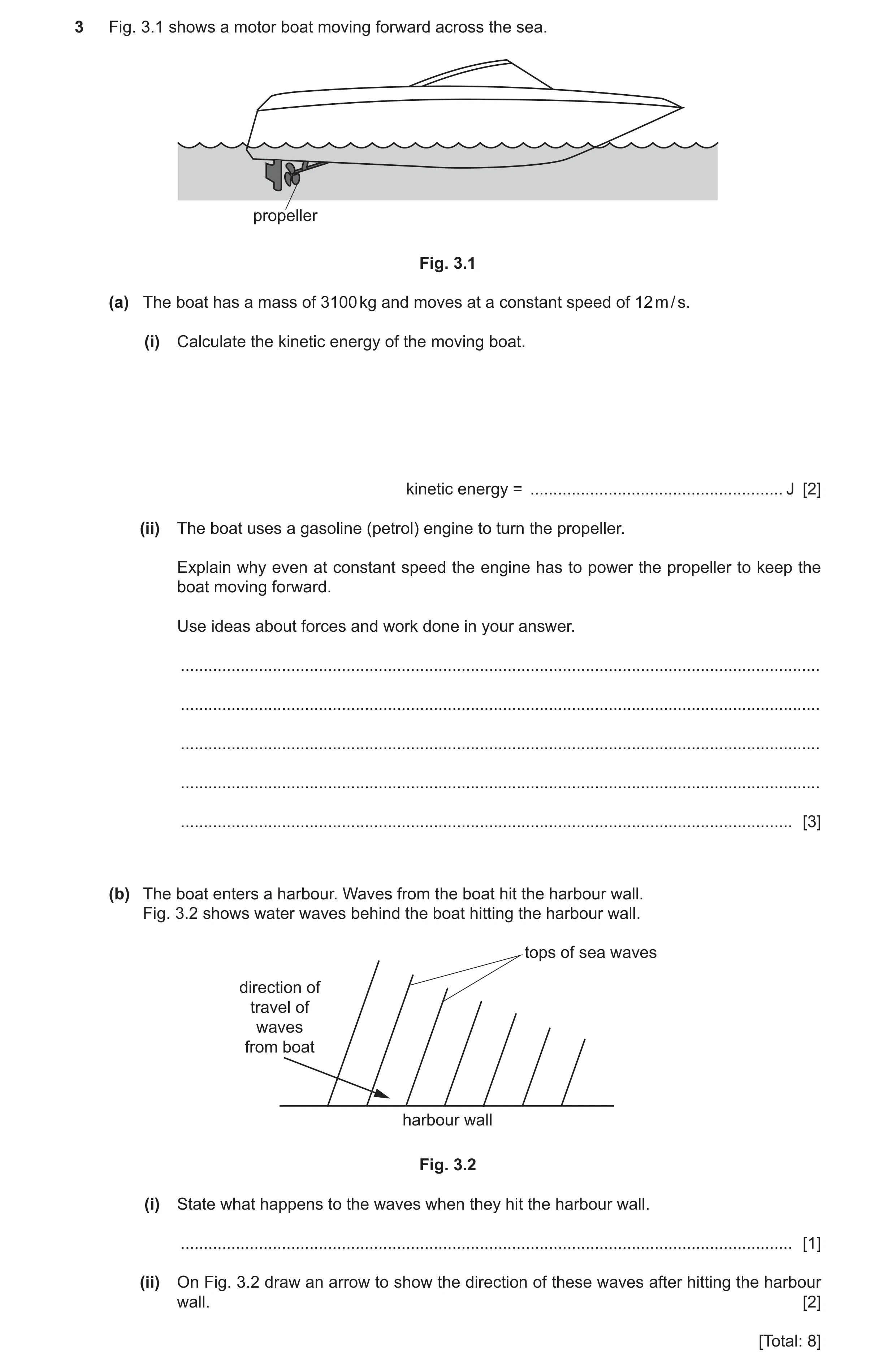
3 Fig. 3.1 shows a motor boat moving forward across the sea. propeller Fig. 3.1 (a) The boat has a mass of 3100 kg and moves at a constant speed of 12 m / s. (i) Calculate the kinetic energy of the moving boat. kinetic energy = … J [2] (ii) The boat uses a gasoline (petrol) engine to turn the propeller. Explain why even at constant speed the engine has to power the propeller to keep the boat moving forward. Use ideas about forces and work done in your answer. … … … … … [3] (b) The boat enters a harbour. Waves from the boat hit the harbour wall. Fig. 3.2 shows water waves behind the boat hitting the harbour wall. tops of sea waves direction of travel of waves from boat harbour wall Fig. 3.2 (i) State what happens to the waves when they hit the harbour wall. … [1] (ii) On Fig. 3.2 draw an arrow to show the direction of these waves after hitting the harbour wall. [2] [Total: 8]
8 marks
Mark scheme: 3(a)(i) KE = ½ mv2 / ½ × 3100 × 12 × 12 ; (=) 223 200 / 223 000 (J) ; 2 3(a)(ii) any three from: friction / resistance (force) ; balanced force needed (for constant speed) ; energy required for work done against friction ; the idea that energy (chemical, kinetic) is, transferred / lost as thermal energy (heat) ; energy input from gasoline turned into mechanical work by engine ; 3 3(b)(i) reflection ; 1 3(b)(ii) arrow shown reflected from wall (example above) ; at approximately the correct angle as seen by eye ; 2
This question in 0653/41 May/June 2021
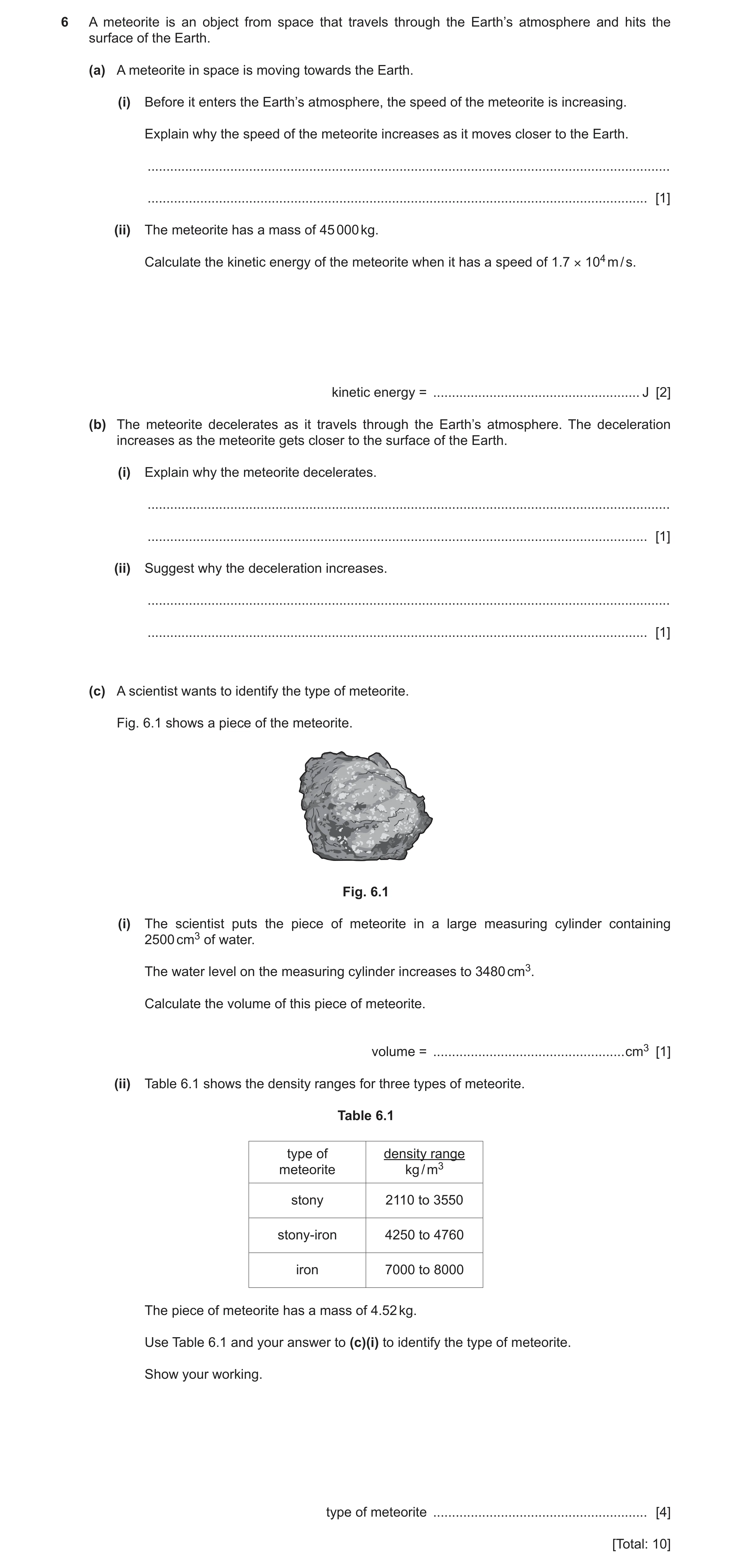
Q21 · A meteorite is an object from space that travels through the Earth’s atmosphere and hits… 0653/42 Oct/Nov 2021
6 A meteorite is an object from space that travels through the Earth’s atmosphere and hits the surface of the Earth. (a) A meteorite in space is moving towards the Earth. (i) Before it enters the Earth’s atmosphere, the speed of the meteorite is increasing. Explain why the speed of the meteorite increases as it moves closer to the Earth. … … [1] (ii) The meteorite has a mass of 45 000 kg. Calculate the kinetic energy of the meteorite when it has a speed of 1.7 × 10⁴ m / s. kinetic energy = … J [2] (b) The meteorite decelerates as it travels through the Earth’s atmosphere. The deceleration increases as the meteorite gets closer to the surface of the Earth. (i) Explain why the meteorite decelerates. … … [1] (ii) Suggest why the deceleration increases. … … [1] (c) A scientist wants to identify the type of meteorite. Fig. 6.1 shows a piece of the meteorite. Fig. 6.1 (i) The scientist puts the piece of meteorite in a large measuring cylinder containing 2500 cm3 of water. The water level on the measuring cylinder increases to 3480 cm3. Calculate the volume of this piece of meteorite. volume = … cm3 [1] (ii) Table 6.1 shows the density ranges for three types of meteorite. Table 6.1 type of density range meteorite kg / m3 stony 2110 to 3550 stony-iron 4250 to 4760 iron 7000 to 8000 The piece of meteorite has a mass of 4.52 kg. Use Table 6.1 and your answer to (c)(i) to identify the type of meteorite. Show your working. type of meteorite … [4] [Total: 10]
10 marks
Mark scheme: 6(a)(i) force due to Earth’s gravitational field accelerates meteorite / energy is transferred from GPE store to KE store ; 1 6(a)(ii) KE = ½mv2 in any form / ½ × 45 000 × (1.7 × 104)2 ; 6.5 × 10¹² (J) ; 2 6(b)(i) (resultant opposing force of) air resistance / friction ; 1 6(b)(ii) (opposing) force increases / atmosphere becomes denser ; 1 6(c)(i) (volume = 3480 – 2500 =) 980 (cm3) ; 1 6(c)(ii) unit conversion / 980 × 10–6 (m3) ; density = m ÷ V in any form / 4.52 ÷ 980 × 10–6 ; 4610 (kg / m3) ; so must be stony-iron meteorite / identification of type of meteorite matched with density calculation ; 4
This question in 0653/42 Oct/Nov 2021
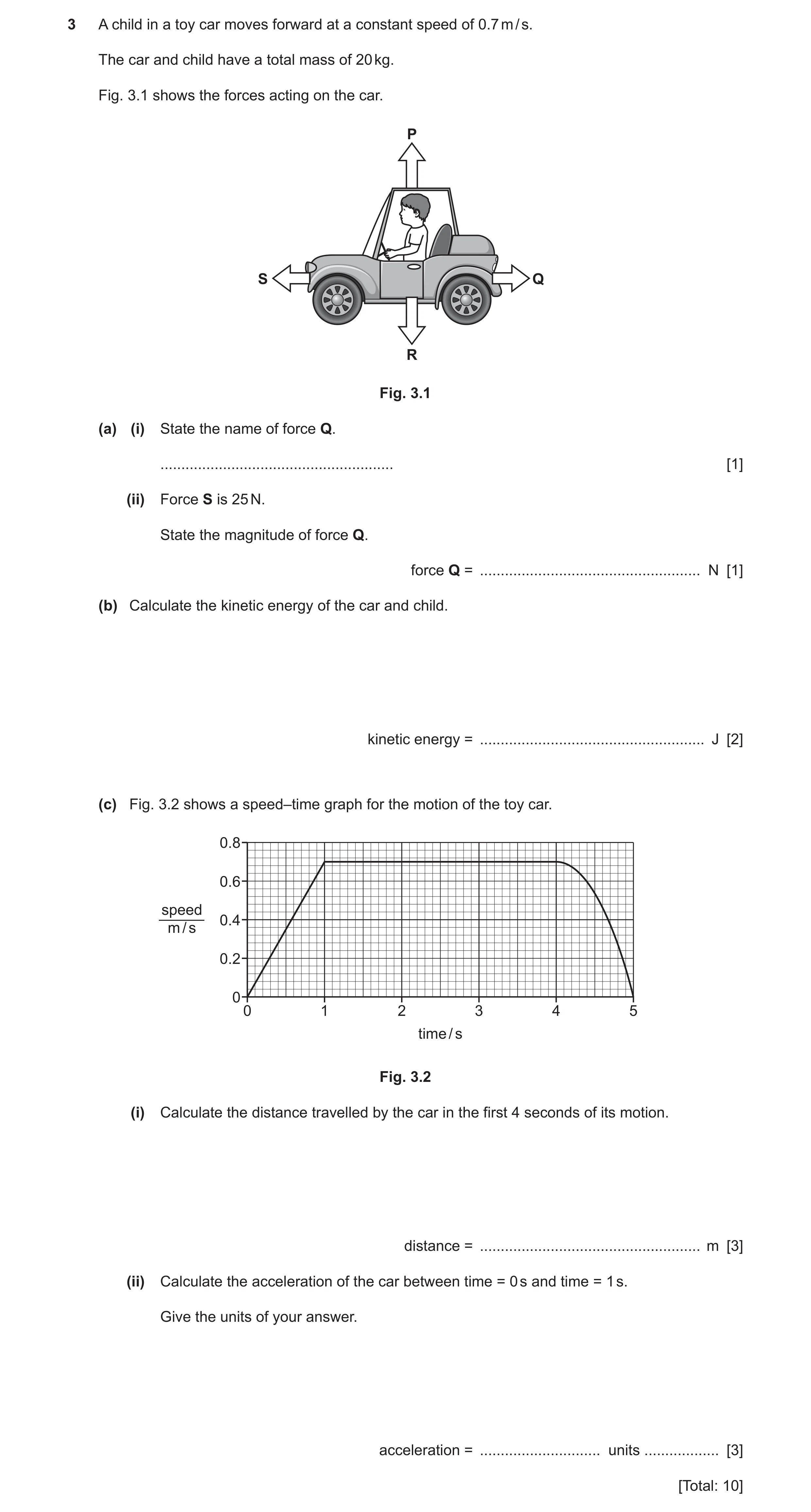
Q22 · A child in a toy car moves forward at a constant speed of 0.7 m / s 0653/42 Feb/March 2022
3 A child in a toy car moves forward at a constant speed of 0.7 m / s. The car and child have a total mass of 20 kg. Fig. 3.1 shows the forces acting on the car. P S Q R Fig. 3.1 (a) (i) State the name of force Q. … [1] (ii) Force S is 25 N. State the magnitude of force Q. force Q = … N [1] (b) Calculate the kinetic energy of the car and child. kinetic energy = … J [2] (c) Fig. 3.2 shows a speed–time graph for the motion of the toy car. 0.8 0.6 speed 0.4 m / s 0.2 0 0 1 2 3 4 5 time / s Fig. 3.2 (i) Calculate the distance travelled by the car in the first 4 seconds of its motion. distance = … m [3] (ii) Calculate the acceleration of the car between time = 0 s and time = 1 s. Give the units of your answer. acceleration = … units … [3] [Total: 10]
10 marks
Mark scheme: 3(a)(i) friction ; 1 3(a)(ii) 25 (N) ; 1 Question Answer Marks 3(b) KE = ½mv2 (in any form) / ½ × 20 × 0.7 × 0.7 ; 4.9 (J) ; 2 3(c)(i) use of area under curve ; calculation of one area e.g., distance = (½ × 1 × 0.7 = 0.35) / (3 × 0.7 = 2.1) ; (= 0.35 + 2.1 =) 2.45 (m) ; 3 3(c)(ii) acceleration = change in speed ÷ time (in any form) / 0.7 ÷ 1 ; 0.7 ; m / s2 ; 3
This question in 0653/42 Feb/March 2022
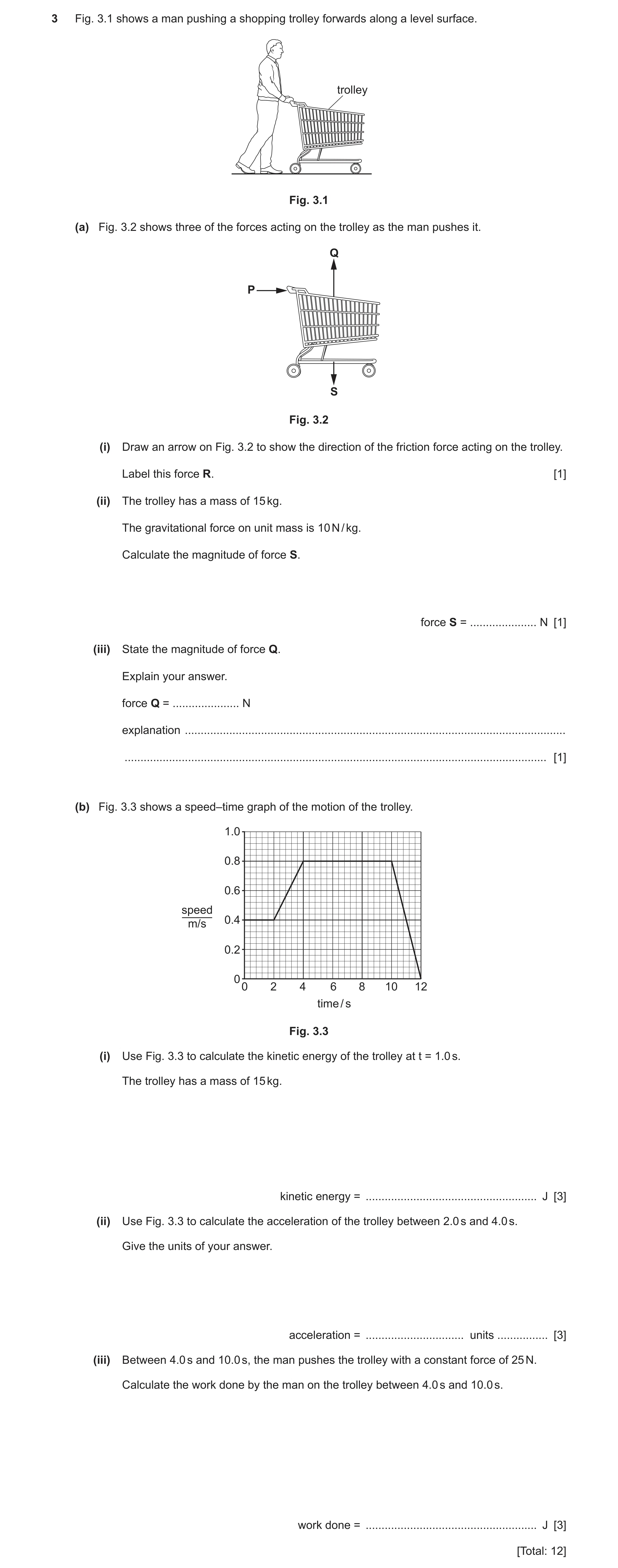
Q23 · A man pushing a shopping trolley forwards along a level surface 0653/41 May/June 2022
3 Fig. 3.1 shows a man pushing a shopping trolley forwards along a level surface. trolley Fig. 3.1 (a) Fig. 3.2 shows three of the forces acting on the trolley as the man pushes it. Q P S Fig. 3.2 (i) Draw an arrow on Fig. 3.2 to show the direction of the friction force acting on the trolley. Label this force R. [1] (ii) The trolley has a mass of 15 kg. The gravitational force on unit mass is 10 N / kg. Calculate the magnitude of force S. force S = … N [1] (iii) State the magnitude of force Q. Explain your answer. force Q = … N explanation … … [1] (b) Fig. 3.3 shows a speed–time graph of the motion of the trolley. 1.0 0.8 0.6 speed 0.4 m/s 0.2 00 2 4 6 8 10 12 time / s Fig. 3.3 (i) Use Fig. 3.3 to calculate the kinetic energy of the trolley at t = 1.0 s. The trolley has a mass of 15 kg. kinetic energy = … J [3] (ii) Use Fig. 3.3 to calculate the acceleration of the trolley between 2.0 s and 4.0 s. Give the units of your answer. acceleration = … units … [3] (iii) Between 4.0 s and 10.0 s, the man pushes the trolley with a constant force of 25 N. Calculate the work done by the man on the trolley between 4.0 s and 10.0 s. work done = … J [3] [Total: 12]
12 marks
Mark scheme: 3(a)(i) arrow pointing to left with label R ; 1 3(a)(ii) (S =) 150 (N) ; 1 3(a)(iii) (Q =) 150 (N) AND no vertical movement, (so forces must be equal and opposite) ; 1 3(b)(i) reading 0.4 for speed from graph ; KE = ½ mv2 (in any form) / = ½ x 15 0.4 0.4 ; 1.2 (J) ; 3 3(b)(ii) acceleration = change in speed ÷ time / = (0.8 – 0.4) ÷ 2 ; 0.2 ; m / s2 ; 3 3(b)(iii) work done = F d (in any form) ; distance travelled = area under graph between 4 s and 10 s / (0.8 6) ; (= (0.8 6) 25 =) 120 (J); 3 R
This question in 0653/41 May/June 2022
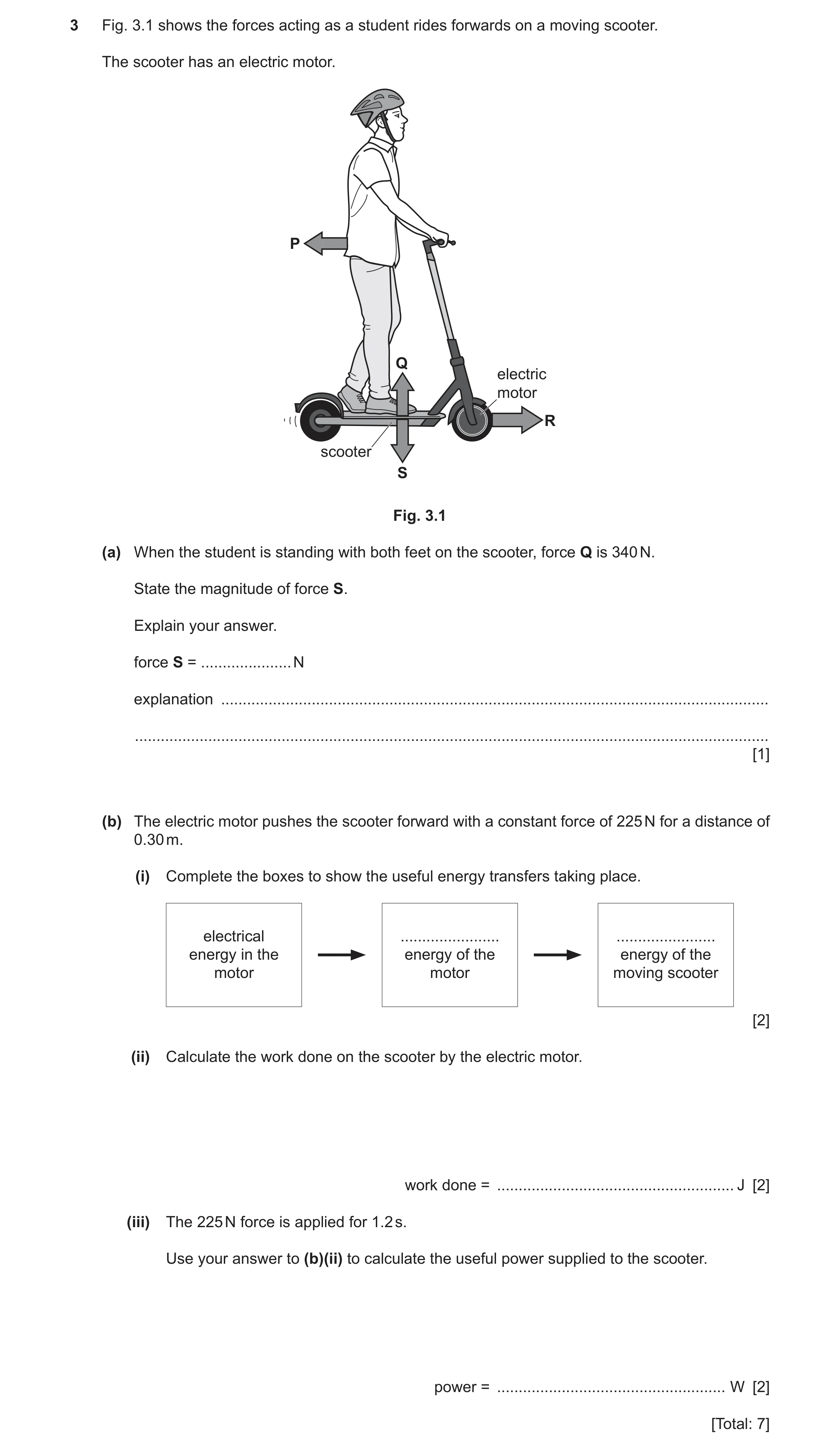
Q24 · The forces acting as a student rides forwards on a moving scooter 0653/42 May/June 2022
3 Fig. 3.1 shows the forces acting as a student rides forwards on a moving scooter. The scooter has an electric motor. P Q electric motor R scooter S Fig. 3.1 (a) When the student is standing with both feet on the scooter, force Q is 340 N. State the magnitude of force S. Explain your answer. force S = … N explanation … … [1] (b) The electric motor pushes the scooter forward with a constant force of 225 N for a distance of 0.30 m. (i) Complete the boxes to show the useful energy transfers taking place. electrical … … energy in the energy of the energy of the motor motor moving scooter [2] (ii) Calculate the work done on the scooter by the electric motor. work done = … J [2] (iii) The 225 N force is applied for 1.2 s. Use your answer to (b)(ii) to calculate the useful power supplied to the scooter. power = … W [2] [Total: 7]
7 marks
Mark scheme: 3(a) (S =) 340 (N) AND no vertical movement, (so forces must be equal and opposite) ; 1 3(b)(i) kinetic ; kinetic ; 2 3(b)(ii) W = F d (in any form) / = 225 0.30 ; 67.5 (J) ; 2 3(b)(iii) power = work done ÷ time OR change in energy ÷ time OR = 67.5 ÷ 1.2 ; 56 (W) ; 2
This question in 0653/42 May/June 2022
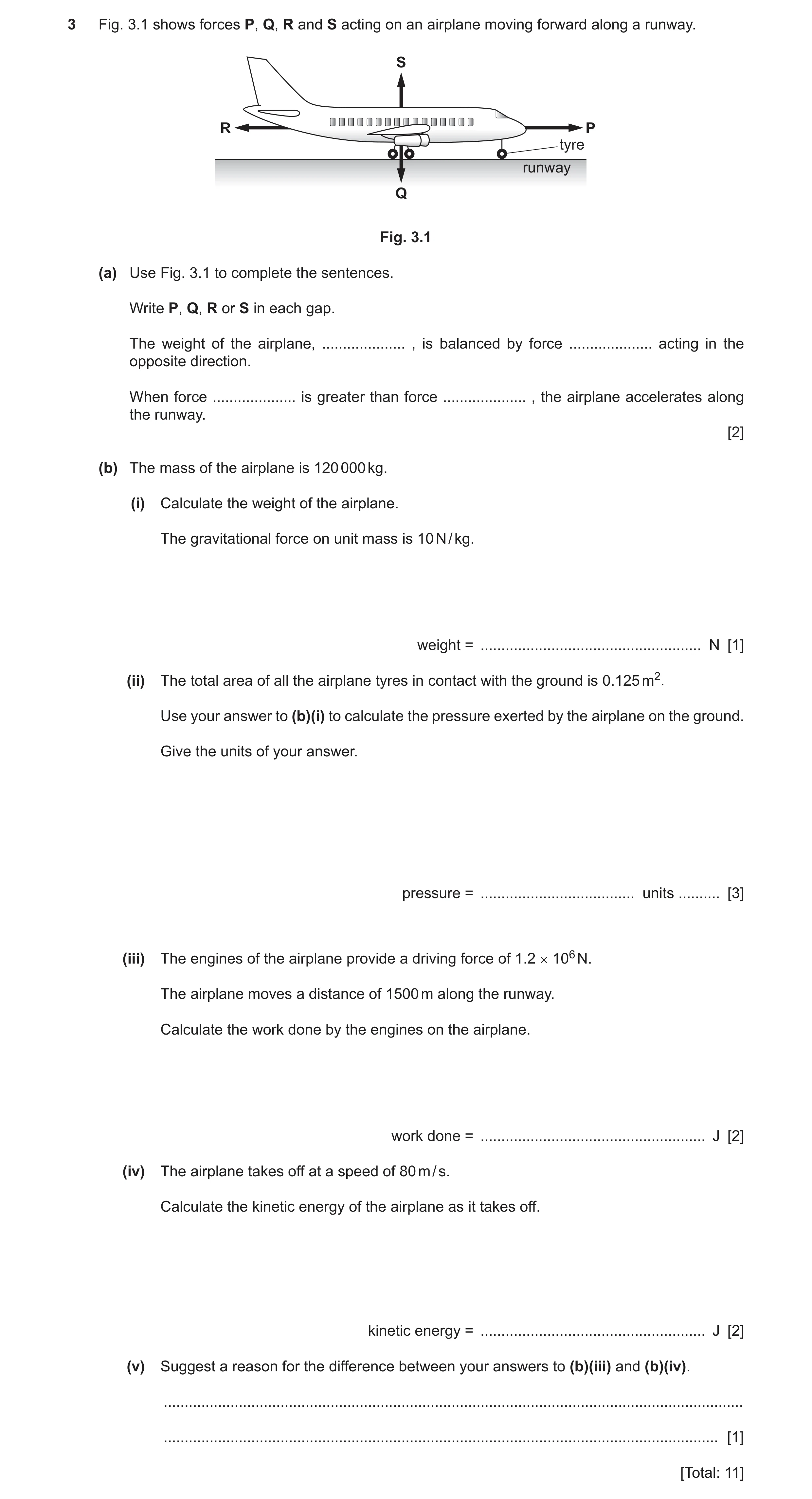
Q25 · Forces P, Q, R and S acting on an airplane moving forward along a runway 0653/41 Oct/Nov 2022
3 Fig. 3.1 shows forces P, Q, R and S acting on an airplane moving forward along a runway. S R P tyre runway Q Fig. 3.1 (a) Use Fig. 3.1 to complete the sentences. Write P, Q, R or S in each gap. The weight of the airplane, … , is balanced by force … acting in the opposite direction. When force … is greater than force … , the airplane accelerates along the runway. [2] (b) The mass of the airplane is 120 000 kg. (i) Calculate the weight of the airplane. The gravitational force on unit mass is 10 N / kg. weight = … N [1] (ii) The total area of all the airplane tyres in contact with the ground is 0.125 m2. Use your answer to (b)(i) to calculate the pressure exerted by the airplane on the ground. Give the units of your answer. pressure = … units … [3] (iii) The engines of the airplane provide a driving force of 1.2 × 10⁶ N. The airplane moves a distance of 1500 m along the runway. Calculate the work done by the engines on the airplane. work done = … J [2] (iv) The airplane takes off at a speed of 80 m / s. Calculate the kinetic energy of the airplane as it takes off. kinetic energy = … J [2] (v) Suggest a reason for the difference between your answers to (b)(iii) and (b)(iv). … … [1] [Total: 11]
11 marks
Mark scheme: 3(a) Q, S ; 2 P, R ; 3(b)(i) 1 200 000 (N) ; 1 3(b)(ii) evidence of, p = F ÷ A / 1 200 000 ÷ 0.125 ; 3 9 600 000 ; Pa OR N / m2 ; 3(b)(iii) evidence of, W = F d / 1.2 106 1500 ; 2 1.8 109 / 1 800 000 000 (J) ; 3(b)(iv) evidence of, KE = ½ m v2 / ½ 120 000 802 ; 2 3.8(4) 108 / 380 000 000 (J) ; 3(b)(v) (work done against) friction / air resistance ; 1
This question in 0653/41 Oct/Nov 2022
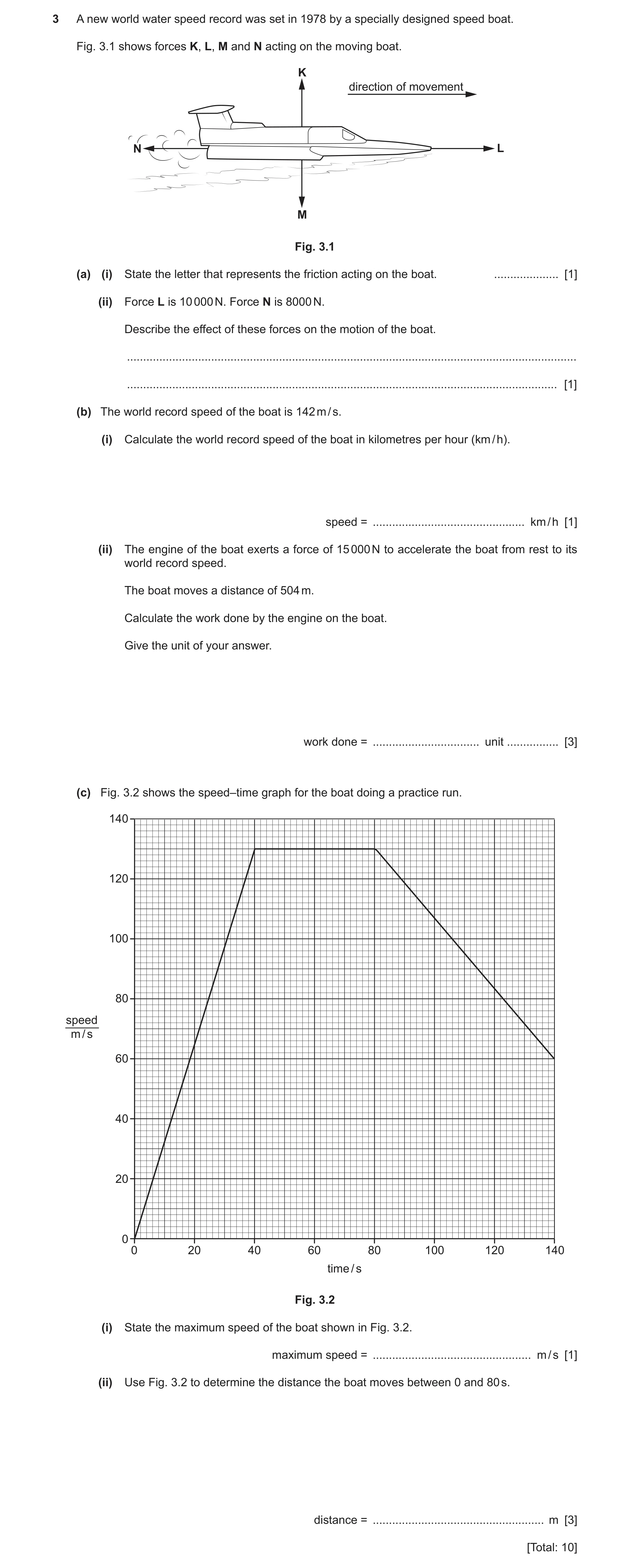
Q26 · A new world water speed record was set in 1978 by a specially designed speed boat 0653/43 Oct/Nov 2022
3 A new world water speed record was set in 1978 by a specially designed speed boat. Fig. 3.1 shows forces K, L, M and N acting on the moving boat. K direction of movement N L M Fig. 3.1 (a) (i) State the letter that represents the friction acting on the boat. … [1] (ii) Force L is 10 000 N. Force N is 8000 N. Describe the effect of these forces on the motion of the boat. … … [1] (b) The world record speed of the boat is 142 m / s. (i) Calculate the world record speed of the boat in kilometres per hour (km / h). speed = … km / h [1] (ii) The engine of the boat exerts a force of 15 000 N to accelerate the boat from rest to its world record speed. The boat moves a distance of 504 m. Calculate the work done by the engine on the boat. Give the unit of your answer. work done = … unit … [3] (c) Fig. 3.2 shows the speed–time graph for the boat doing a practice run. 140 120 100 80 speed m / s 60 40 20 0 0 20 40 60 80 100 120 140 time / s Fig. 3.2 (i) State the maximum speed of the boat shown in Fig. 3.2. maximum speed = … m / s [1] (ii) Use Fig. 3.2 to determine the distance the boat moves between 0 and 80 s. distance = … m [3] [Total: 10]
10 marks
Mark scheme: 3(a)(i) N ; 1 3(a)(ii) resultant force (to right) means boat, accelerates / goes faster / speed increases ; 1 3(b)(i) (142 3600 ÷ 1000 =) 511 (km / h) ; 1 3(b)(ii) evidence of, W = F d / 15 000 504 ; 3 7 600 000 ; J ; 3(c)(i) 130 (m / s) ; 1 3(c)(ii) recognition that area under graph is used to calculate distance ; 3 correct calculation of an area, e.g. ½ x 40 130 = 2600 OR (80 – 40) 130 = 5200 ; 7800 (m) ;
This question in 0653/43 Oct/Nov 2022
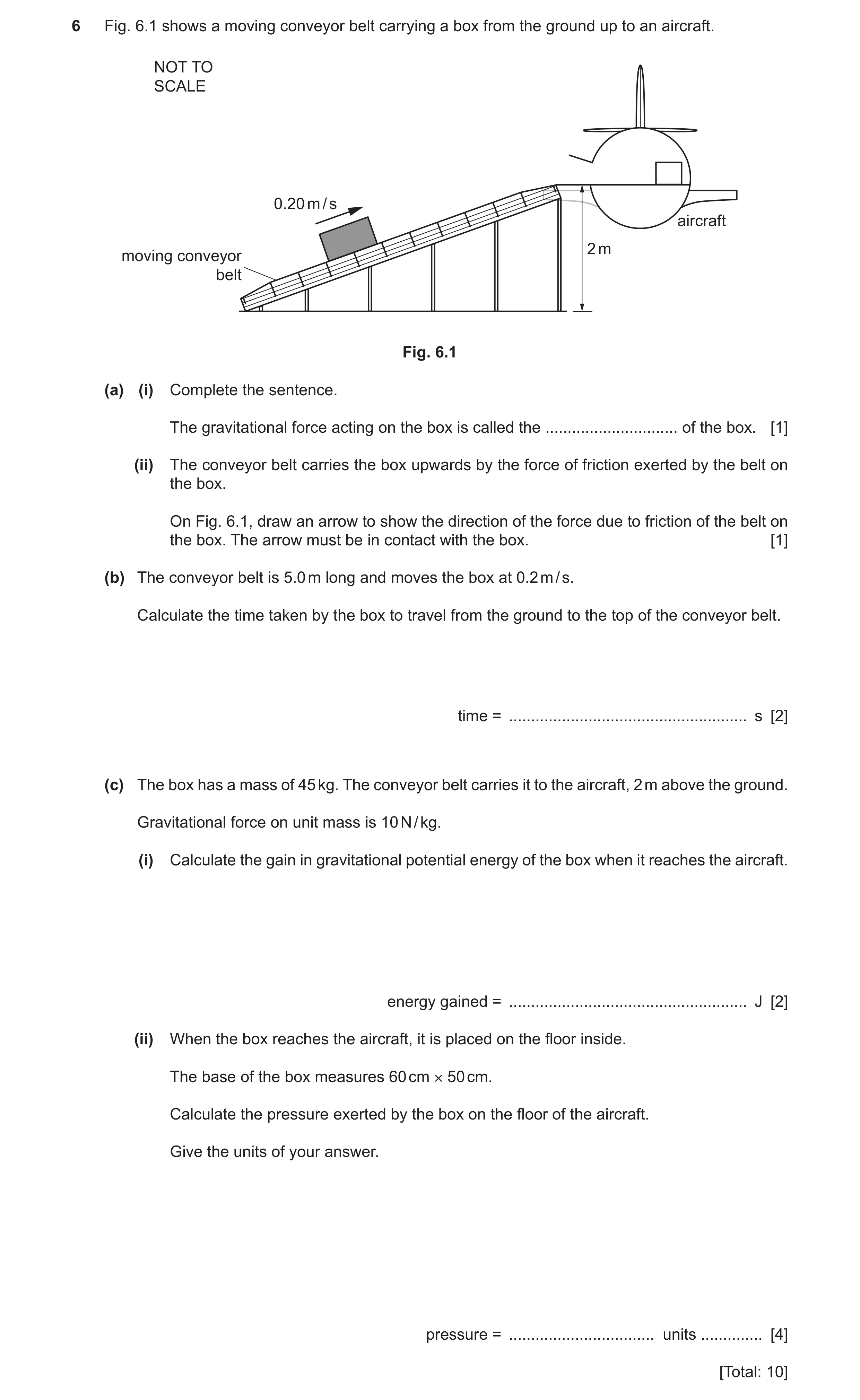
Q27 · A moving conveyor belt carrying a box from the ground up to an aircraft 0653/41 May/June 2023
6 Fig. 6.1 shows a moving conveyor belt carrying a box from the ground up to an aircraft. NOT TO SCALE 0.20 m / s aircraft 2 m moving conveyor belt Fig. 6.1 (a) (i) Complete the sentence. The gravitational force acting on the box is called the … of the box. [1] (ii) The conveyor belt carries the box upwards by the force of friction exerted by the belt on the box. On Fig. 6.1, draw an arrow to show the direction of the force due to friction of the belt on the box. The arrow must be in contact with the box. [1] (b) The conveyor belt is 5.0 m long and moves the box at 0.2 m / s. Calculate the time taken by the box to travel from the ground to the top of the conveyor belt. time = … s [2] (c) The box has a mass of 45 kg. The conveyor belt carries it to the aircraft, 2 m above the ground. Gravitational force on unit mass is 10 N / kg. (i) Calculate the gain in gravitational potential energy of the box when it reaches the aircraft. energy gained = … J [2] (ii) When the box reaches the aircraft, it is placed on the floor inside. The base of the box measures 60 cm × 50 cm. Calculate the pressure exerted by the box on the floor of the aircraft. Give the units of your answer. pressure = … units … [4] [Total: 10]
10 marks
Mark scheme: 6(a)(i) weight ; 1 6(a)(ii) force arrow parallel to belt in contact with box pointing up the belt ; 1 6(b) time = distance speed (stated or evidence of use) / (time = ) 5 0.2 ; 25 (s) ; 2 6(c)(i) (gain in GPE = ) mgh (stated or evidence of use) / 45 10 2 ; 900 (J) ; 2 6(c)(ii) pressure = force area (in any form) ; = 450 ÷ 3 000 OR 450 ÷ 0.3 ; (pressure = ) 0.15 (N / cm2) OR 1 500 (N / m2 or Pa) ; N / cm2 OR N / m2 OR Pa (to match numerical answer) ; 4
This question in 0653/41 May/June 2023
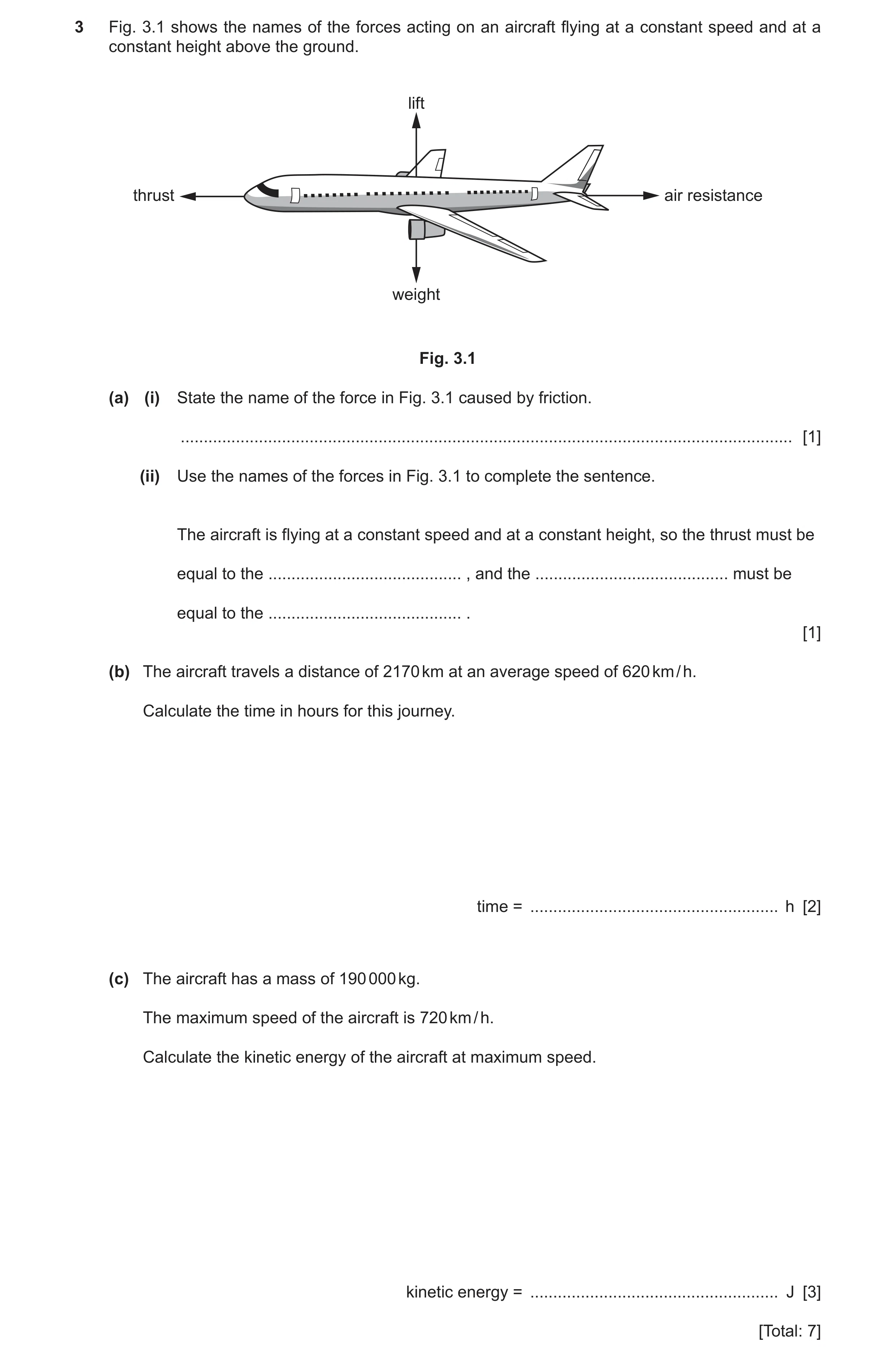
Q28 · The names of the forces acting on an aircraft flying at a constant speed and at a… 0653/41 Oct/Nov 2023
3 Fig. 3.1 shows the names of the forces acting on an aircraft flying at a constant speed and at a constant height above the ground. lift thrust air resistance weight Fig. 3.1 (a) (i) State the name of the force in Fig. 3.1 caused by friction. … [1] (ii) Use the names of the forces in Fig. 3.1 to complete the sentence. The aircraft is flying at a constant speed and at a constant height, so the thrust must be equal to the … , and the … must be equal to the … . [1] (b) The aircraft travels a distance of 2170 km at an average speed of 620 km / h. Calculate the time in hours for this journey. time = … h [2] (c) The aircraft has a mass of 190 000 kg. The maximum speed of the aircraft is 720 km / h. Calculate the kinetic energy of the aircraft at maximum speed. kinetic energy = … J [3] [Total: 7]
7 marks
Mark scheme: 3(a)(i) air resistance ; 1 3(a)(ii) air resistance, lift, weight (all required) ; 1 3(b) evidence of, speed = distance time / 2170 620 ; 2 3.5 (h) ; 3(c) unit conversion, 720 000 3600 / 200 (m / s) ; 3 evidence of, KE = ½ m v 2 / ½ 190 000 200 200 ; 3.8 109 / 3 800 000 000 (J) ;
This question in 0653/41 Oct/Nov 2023
Q29 · A spring has an original length of 10.0 cm 0653/43 Oct/Nov 2023
6 A spring has an original length of 10.0 cm. An object is suspended from the spring, and the spring extends to a length of 12.0 cm, as shown in Fig. 6.1. spring 12.0 cm object Fig. 6.1 (a) (i) Determine the extension of the spring. extension = … cm [1] (ii) The weight of the object is 1.5 N. Calculate the spring constant k of the spring. k = … N / cm [2] (iii) State the name of the energy stored in the extended spring. … [1] (b) The object is pulled down and held at a vertical distance of 3.0 cm from its rest position, as shown in Fig. 6.2. 12.0 cm rest position 3.0 cm Fig. 6.2 The object is released, and the object oscillates up and down. The period of an oscillation is the time taken for one complete oscillation. Fig. 6.3 shows a distance–time graph for the vertical motion of the object after release. distance above rest position 0 time 0 Fig. 6.3 (i) On Fig. 6.3, use a double‑headed arrow (↕ or ↔) to show: • the period of the oscillation and label this T • the amplitude of the oscillation and label this A. [2] (ii) The mass of the object is 0.15 kg. During oscillation, the object has a maximum speed of 0.012 m / s. Calculate the kinetic energy of the object at its maximum speed. kinetic energy = … J [2] (iii) A student suggests that the energy stored in the spring in Fig. 6.2 before the object is released is the same value as the kinetic energy calculated in (b)(ii). State whether you think the student is correct or incorrect. Give a reason for your answer. student is … reason … … [1] [Total: 9]
9 marks
Mark scheme: 6(a)(i) 2.0 (cm) ; 1 6(a)(ii) evidence of, F = k x / 1.5 2.0 ; 2 0.75 (N / cm) ; 6(a)(iii) elastic (potential) / strain ; 1 6(b)(i) period correctly shown AND labelled ; 2 amplitude correctly shown AND labelled ; 6(b)(ii) evidence of, KE = ½ m v2 / ½ 0.15 0.0122 ; 2 1.1 10-5 (J) ; 6(b)(iii) correct and idea that, all the stored (elastic) energy is transferred to kinetic energy (assuming no, friction / air 1 resistance) / energy is conserved ; OR incorrect and idea that, some energy is transferred to surroundings / work is done against, friction / air resistance ;
This question in 0653/43 Oct/Nov 2023
Q30 · The forces P, Q, R and S acting on a boat at sea 0653/42 Feb/March 2024
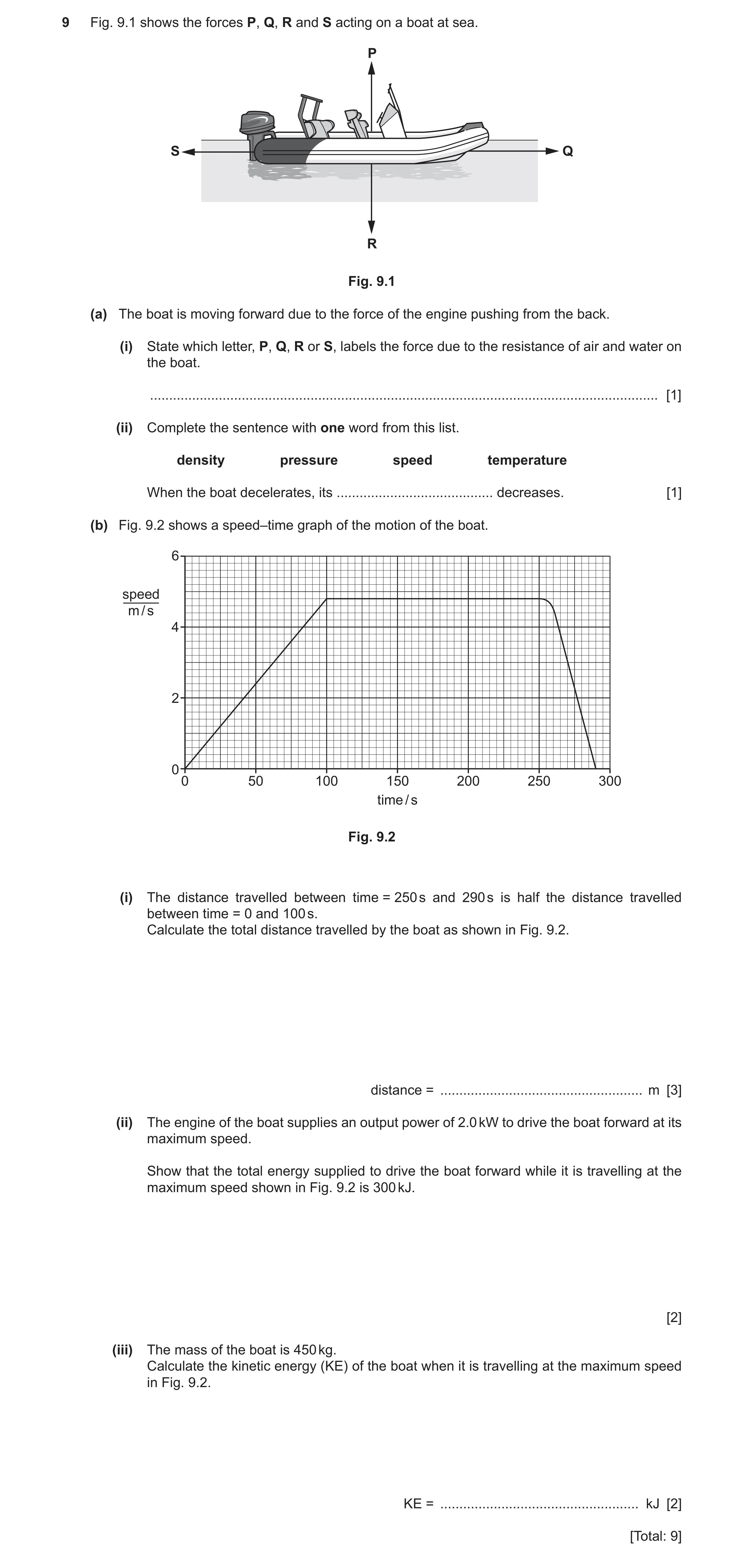
9 Fig. 9.1 shows the forces P, Q, R and S acting on a boat at sea. P S Q R Fig. 9.1 (a) The boat is moving forward due to the force of the engine pushing from the back. (i) State which letter, P, Q, R or S, labels the force due to the resistance of air and water on the boat. … [1] (ii) Complete the sentence with one word from this list. density pressure speed temperature When the boat decelerates, its … decreases. [1] (b) Fig. 9.2 shows a speed–time graph of the motion of the boat. 6 speed m / s 4 2 0 0 50 100 150 200 250 300 time / s Fig. 9.2 (i) The distance travelled between time = 250 s and 290 s is half the distance travelled between time = 0 and 100 s. Calculate the total distance travelled by the boat as shown in Fig. 9.2. distance = … m [3] (ii) The engine of the boat supplies an output power of 2.0 kW to drive the boat forward at its maximum speed. Show that the total energy supplied to drive the boat forward while it is travelling at the maximum speed shown in Fig. 9.2 is 300 kJ. [2] (iii) The mass of the boat is 450 kg. Calculate the kinetic energy (KE) of the boat when it is travelling at the maximum speed in Fig. 9.2. KE = … kJ [2] [Total: 9]
9 marks
Mark scheme: 9(a)(i) S ; 1 9(a)(ii) speed ; 1 9(b)(i) reference to the need to calculate the area under graph OR one area calculated ; 3 (calculation of area under graph t = 0 to t = 250 s) ½ 100 4.8 + 150 4.8 / 960 ; (add in ½ (½ 100 4.8) / 120 for area under curve) total = 1100 / 1080 (m) ; 9(b)(ii) time at max. speed of 4.8 m / s = 150 s ; 2 and E = 2.0 150 ; (300 kJ) 9(b)(iii) KE of boat = ½ mv2 in any form ; 2 KE = ½ 450 4.82 = 5200 (J) = 5.2 (kJ) ;
This question in 0653/42 Feb/March 2024
Q31 · A mechanical crane using force P to lift a box from the ground to the top of a building 0653/41 May/June 2024
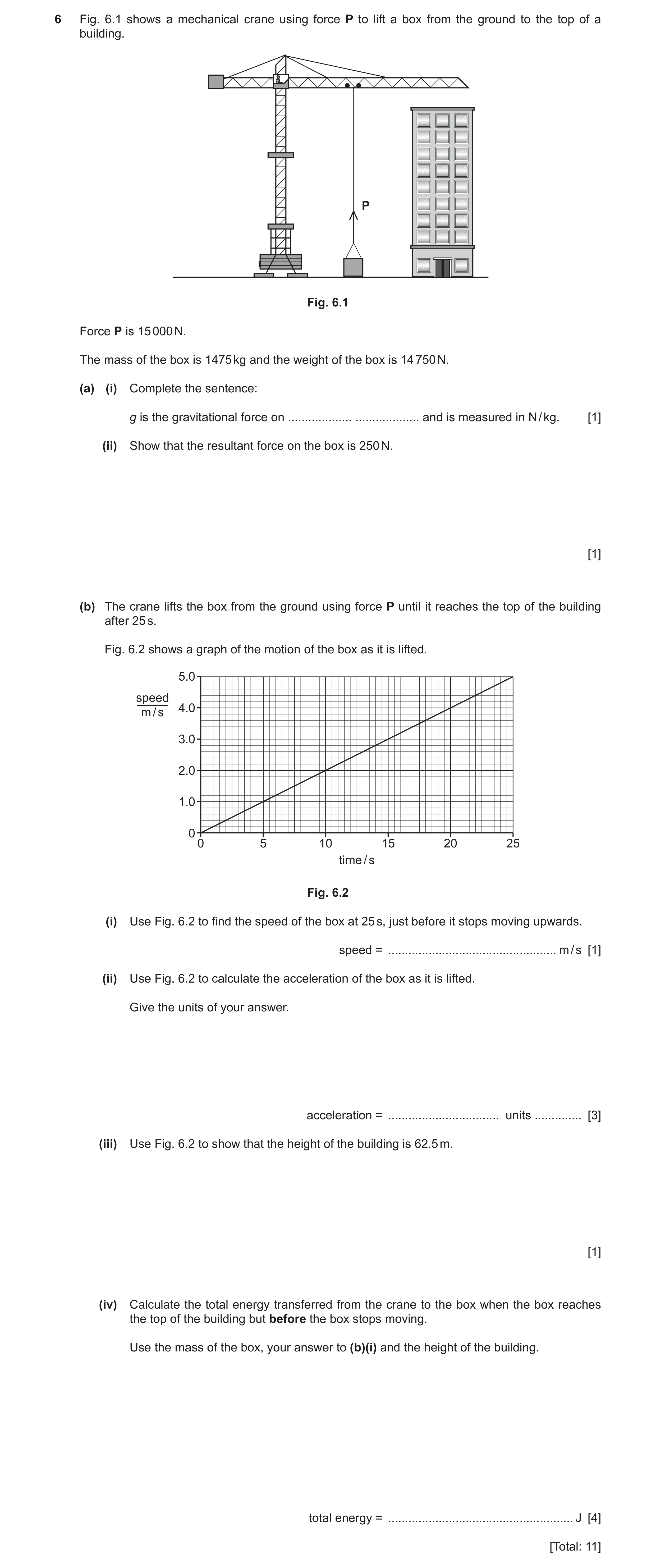
6 Fig. 6.1 shows a mechanical crane using force P to lift a box from the ground to the top of a building. P Fig. 6.1 Force P is 15 000 N. The mass of the box is 1475 kg and the weight of the box is 14 750 N. (a) (i) Complete the sentence: g is the gravitational force on … … and is measured in N / kg. [1] (ii) Show that the resultant force on the box is 250 N. [1] (b) The crane lifts the box from the ground using force P until it reaches the top of the building after 25 s. Fig. 6.2 shows a graph of the motion of the box as it is lifted. 5.0 speed 4.0 m / s 3.0 2.0 1.0 0 0 5 10 15 20 25 time / s Fig. 6.2 (i) Use Fig. 6.2 to find the speed of the box at 25 s, just before it stops moving upwards. speed = … m / s [1] (ii) Use Fig. 6.2 to calculate the acceleration of the box as it is lifted. Give the units of your answer. acceleration = … units … [3] (iii) Use Fig. 6.2 to show that the height of the building is 62.5 m. [1] (iv) Calculate the total energy transferred from the crane to the box when the box reaches the top of the building but before the box stops moving. Use the mass of the box, your answer to (b)(i) and the height of the building. total energy = … J [4] [Total: 11]
11 marks
Mark scheme: 6(a)(i) unit mass / 1 kg ; 1 6(a)(ii) (resultant force) = 15 000 – 14 750 (= 250 N) ; 1 6(b)(i) 5.0 (m / s) ; 1 6(b)(ii) a = v t / evidence of use of formula ; = 0.20 ; m / s2 ; 3 6(b)(iii) use of area under graph seen, i.e. ½ 25 5 ; (= 62.5 m) 1 6(b)(iv) (increase in KE =) ½ mv 2 OR ½ 1475 5 5 OR 18437.5 ; (increase in PE =) mgh OR 1475 10 62.5 OR 921875 ; 18437.5 AND 921875 ; 940 000 (J) ; 4
This question in 0653/41 May/June 2024
Q32 · Three forces, Q, R and P, acting on a bus moving along a level road at constant speed 0653/43 May/June 2024
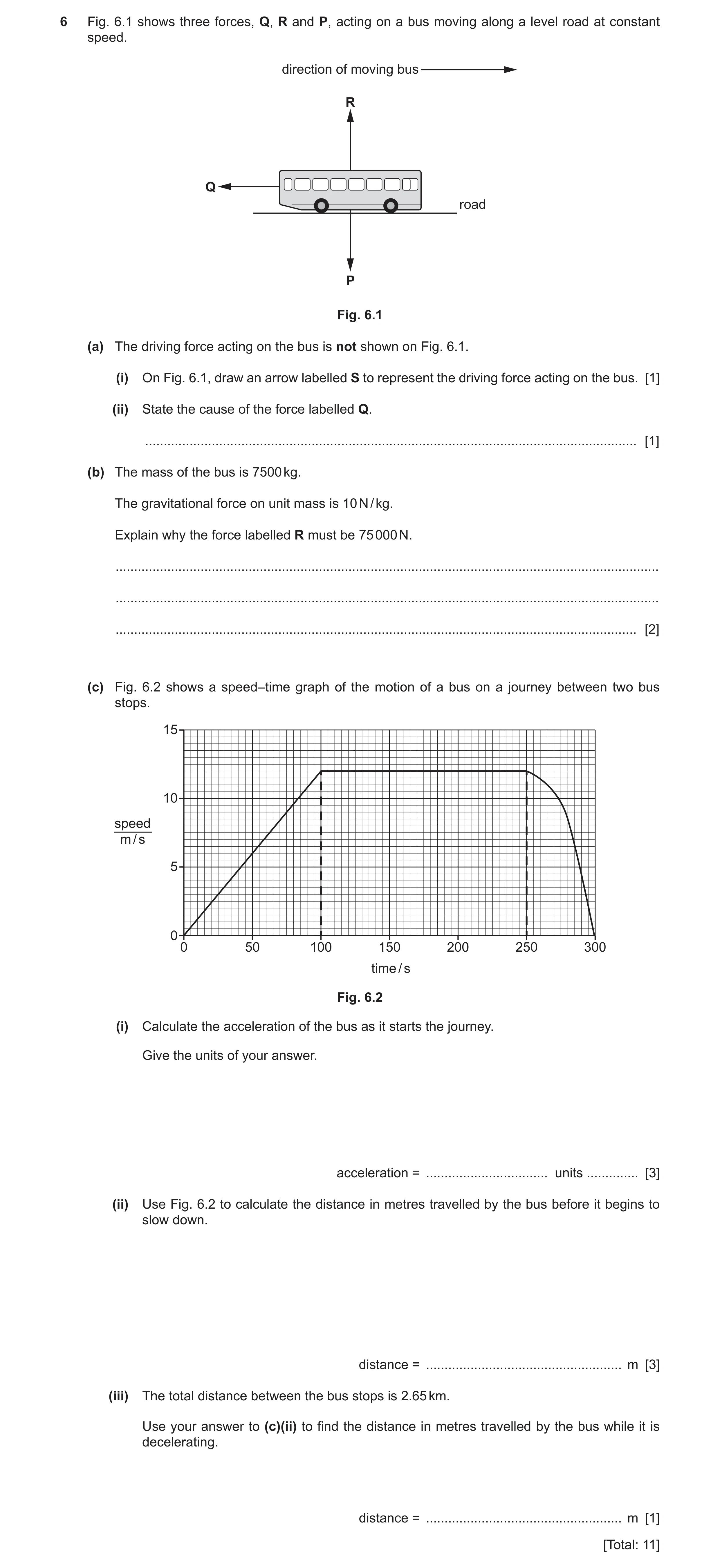
6 Fig. 6.1 shows three forces, Q, R and P, acting on a bus moving along a level road at constant speed. direction of moving bus R Q road P Fig. 6.1 (a) The driving force acting on the bus is not shown on Fig. 6.1. (i) On Fig. 6.1, draw an arrow labelled S to represent the driving force acting on the bus. [1] (ii) State the cause of the force labelled Q. … [1] (b) The mass of the bus is 7500 kg. The gravitational force on unit mass is 10 N / kg. Explain why the force labelled R must be 75 000 N. … … … [2] (c) Fig. 6.2 shows a speed–time graph of the motion of a bus on a journey between two bus stops. 15 10 speed m / s 5 0 0 50 100 150 200 250 300 time / s Fig. 6.2 (i) Calculate the acceleration of the bus as it starts the journey. Give the units of your answer. acceleration = … units … [3] (ii) Use Fig. 6.2 to calculate the distance in metres travelled by the bus before it begins to slow down. distance = … m [3] (iii) The total distance between the bus stops is 2.65 km. Use your answer to (c)(ii) to find the distance in metres travelled by the bus while it is decelerating. distance = … m [1] [Total: 11]
11 marks
Mark scheme: 6(a)(i) arrow pointing to right, touching bus and same length as arrow Q ; 1 6(a)(ii) friction / air resistance ; 1 6(b) force P = 75 000 N or weight of bus = 75 000 N ; no vertical motion / arrow R is same length as arrow P / no resultant force / R and P are balanced forces ; 2 6(c)(i) acceleration = initial slope of graph OR 12 / 100 ; 0.12 ; m / s2 ; 3 6(c)(ii) distance while accelerating = ½ 100 12 OR 600 (m) ; distance at constant speed = 150 12 OR 1800 (m) ; total distance = (1800 + 600) = 2400 (m) ; 3 6(c)(iii) (distance = 2650 – 2400 =) 250 (m) ; 1
This question in 0653/43 May/June 2024
Question 33 0653/41 May/June 2025
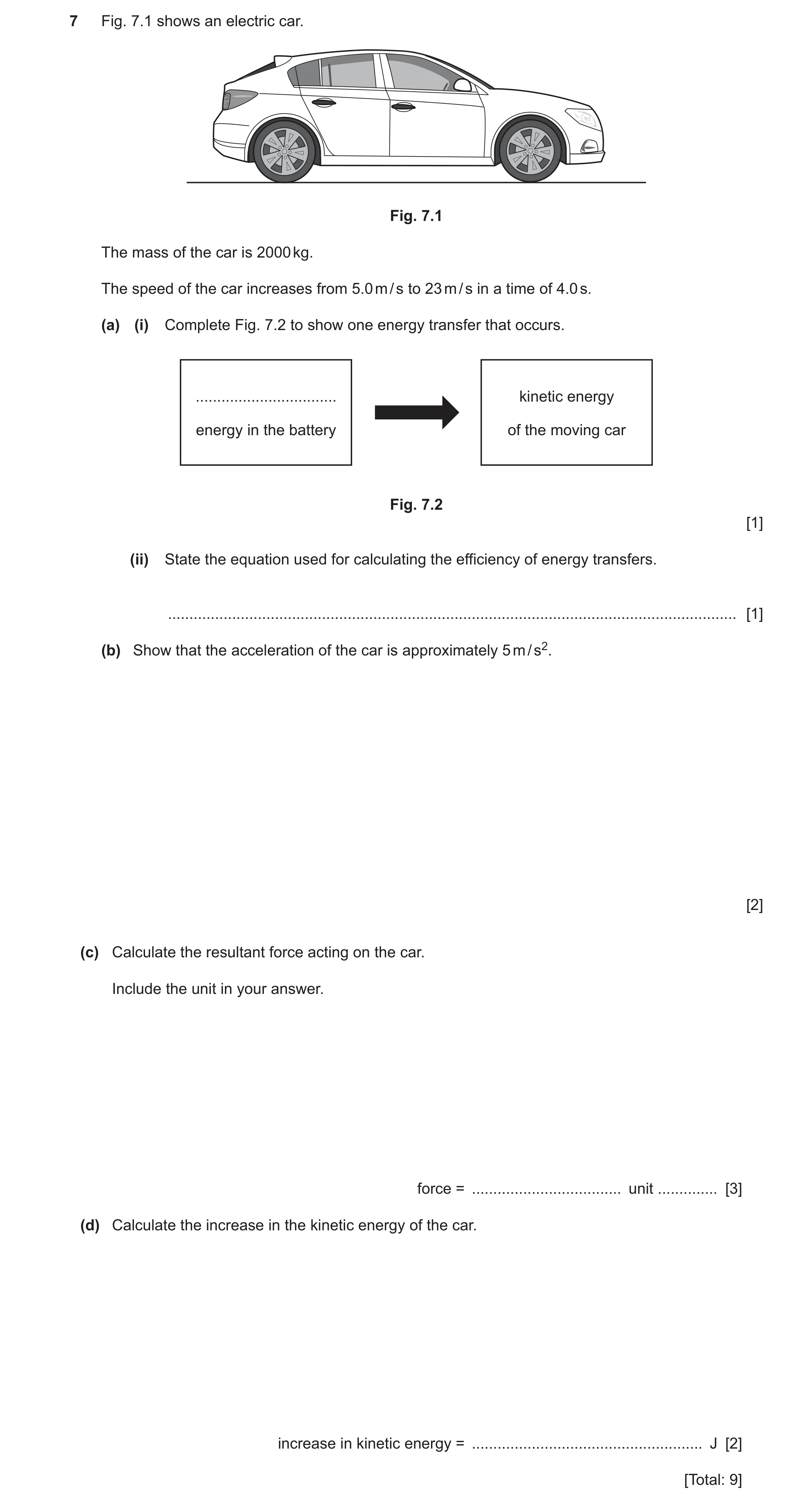
7 Fig. 7.1 shows an electric car. Fig. 7.1 The mass of the car is 2000 kg. The speed of the car increases from 5.0 m / s to 23 m / s in a time of 4.0 s. (a) (i) Complete Fig. 7.2 to show one energy transfer that occurs. … kinetic energy energy in the battery of the moving car Fig. 7.2 [1] (ii) State the equation used for calculating the efficiency of energy transfers. … [1] (b) Show that the acceleration of the car is approximately 5 m / s2. [2] (c) Calculate the resultant force acting on the car. Include the unit in your answer. force = … unit … [3] (d) Calculate the increase in the kinetic energy of the car. increase in kinetic energy = … J [2] [Total: 9]
9 marks
Mark scheme: 7(a)(i) chemical ; 1 7(a)(ii) useful (energy) output 1 efficiency =) ( 100%) total (energy) input ; 7(b) a = v ÷ t / 18 ÷ 4.0 ; 2 4.5 (= ~5 m / s2)_; 7(c) F = ma / 2000 4.5 ; 3 9000 ; N ; 7(d) EK = ½ mv2 / ½ 2000 (232 – 5.02) / 529 000 or 25 000 (evidence of use of formula) ; 2 504 000 (J) ;
This question in 0653/41 May/June 2025
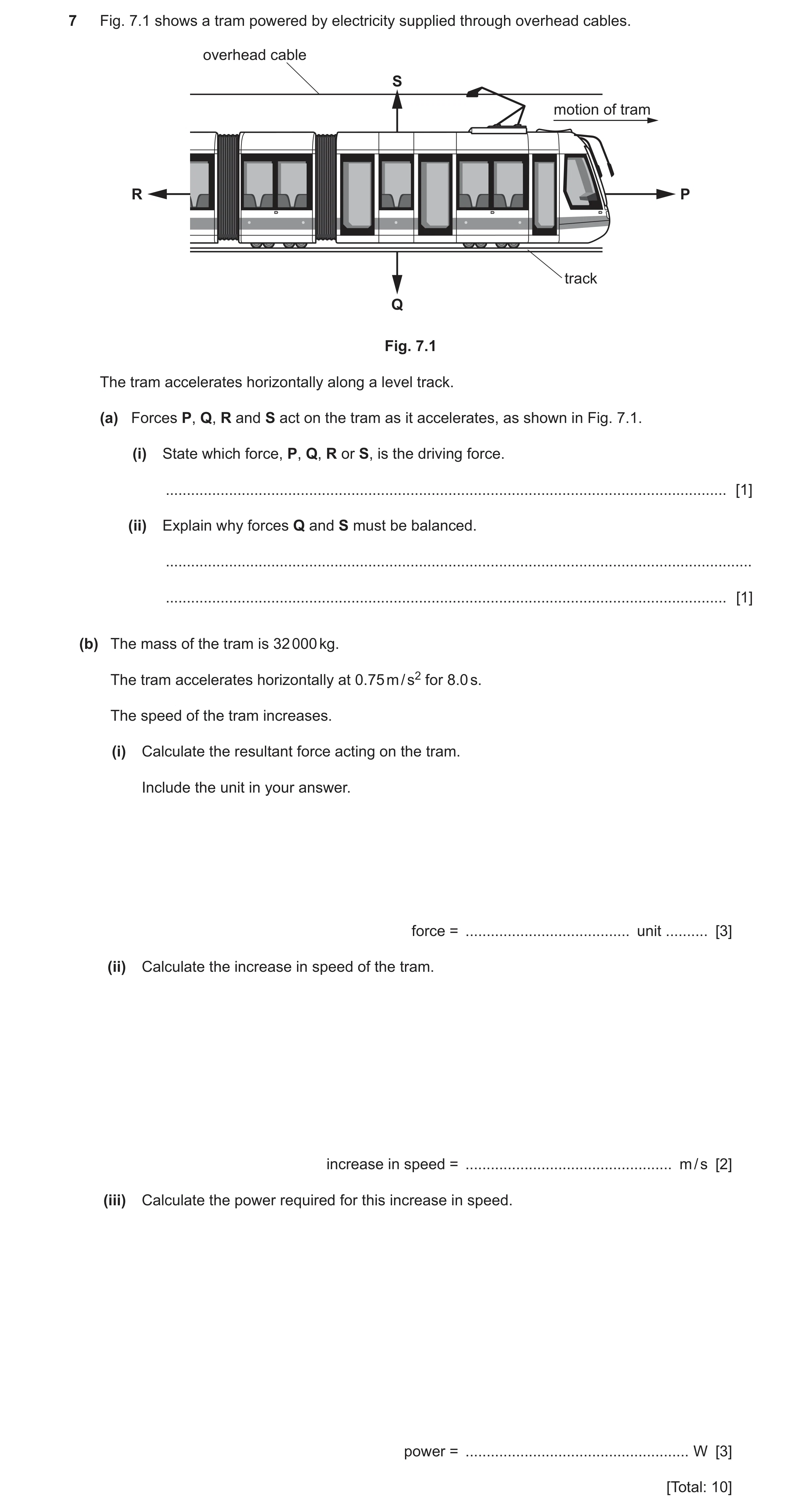
Q34 · A tram powered by electricity supplied through overhead cables 0653/42 May/June 2025
7 Fig. 7.1 shows a tram powered by electricity supplied through overhead cables. overhead cable S motion of tram R P track Q Fig. 7.1 The tram accelerates horizontally along a level track. (a) Forces P, Q, R and S act on the tram as it accelerates, as shown in Fig. 7.1. (i) State which force, P, Q, R or S, is the driving force. … [1] (ii) Explain why forces Q and S must be balanced. … … [1] (b) The mass of the tram is 32 000 kg. The tram accelerates horizontally at 0.75 m / s2 for 8.0 s. The speed of the tram increases. (i) Calculate the resultant force acting on the tram. Include the unit in your answer. force = … unit … [3] (ii) Calculate the increase in speed of the tram. increase in speed = … m / s [2] (iii) Calculate the power required for this increase in speed. power = … W [3] [Total: 10]
10 marks
Mark scheme: 7(a)(i) P ; 1 7(a)(ii) tram is not moving up or down / is stationary in the vertical direction ; 1 7(b)(i) F = ma or 32 000 0.75 ; 3 24 000 ; N ; 7(b)(ii) (Δv =) at / 0.75 8.0 ; 2 6.0 (m / s) ; 7(b)(iii) Method 1 (energy calculation) Ek = ½mv2 in any form or ½ 32 000 6.02 or 576 000 ; 3 (power calculation) P = E ÷ t in any form or 576 000 ÷ 8.0 ; OR Method 2 (energy calculation) W = F d or 24 000 24 or 576 000 ; (power calculation) P = E ÷ t in any form or 576 000 ÷ 8.0 ; OR Method 3 (power calculation) P = F v or 24 000 v ; (average velocity) 6 ÷ 2 ; (power =) 72 000 (W) ;
This question in 0653/42 May/June 2025
Q35 · A toy car, powered by a battery 0653/43 May/June 2025
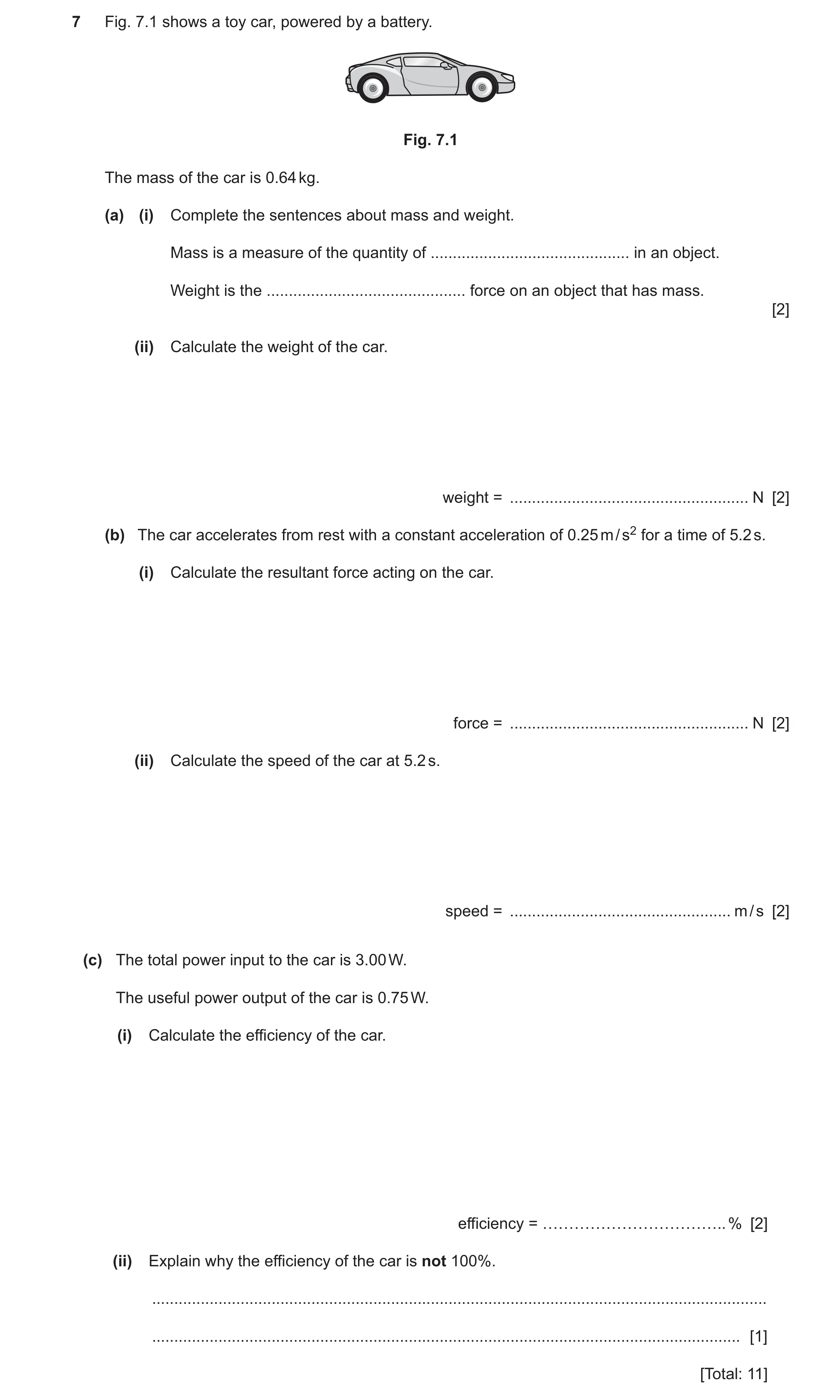
7 Fig. 7.1 shows a toy car, powered by a battery. Fig. 7.1 The mass of the car is 0.64 kg. (a) (i) Complete the sentences about mass and weight. Mass is a measure of the quantity of … in an object. Weight is the … force on an object that has mass. [2] (ii) Calculate the weight of the car. weight = … N [2] (b) The car accelerates from rest with a constant acceleration of 0.25 m / s2 for a time of 5.2 s. (i) Calculate the resultant force acting on the car. force = … N [2] (ii) Calculate the speed of the car at 5.2 s. speed = … m / s [2] (c) The total power input to the car is 3.00 W. The useful power output of the car is 0.75 W. (i) Calculate the efficiency of the car. efficiency = …………………………….. % [2] (ii) Explain why the efficiency of the car is not 100%. … … [1] [Total: 11]
11 marks
Mark scheme: 7(a)(i) matter; 2 gravitational ; 7(a)(ii) W = mg / 0.64 × 9.8 ; 2 6.3 (N) ; 7(b)(i) F = ma / 0.64 × 0.25 ; 2 0.16 (N) ; 7(b)(ii) (v =) a × t or 0.25 × 5.2 ; 2 1.3 (m / s) ; 7(c)(i) 2 power output 0.75 efficiency = 100 OR ×100 ; power input 3.00 25 (%) ; 7(c)(ii) energy transfer, to surroundings / internal energy of car / thermal energy of tyres, etc. 1 or (by) work done against, friction / air resistance ;
This question in 0653/43 May/June 2025
Q36 · A motor and an object at rest on the ground 0653/43 Oct/Nov 2025
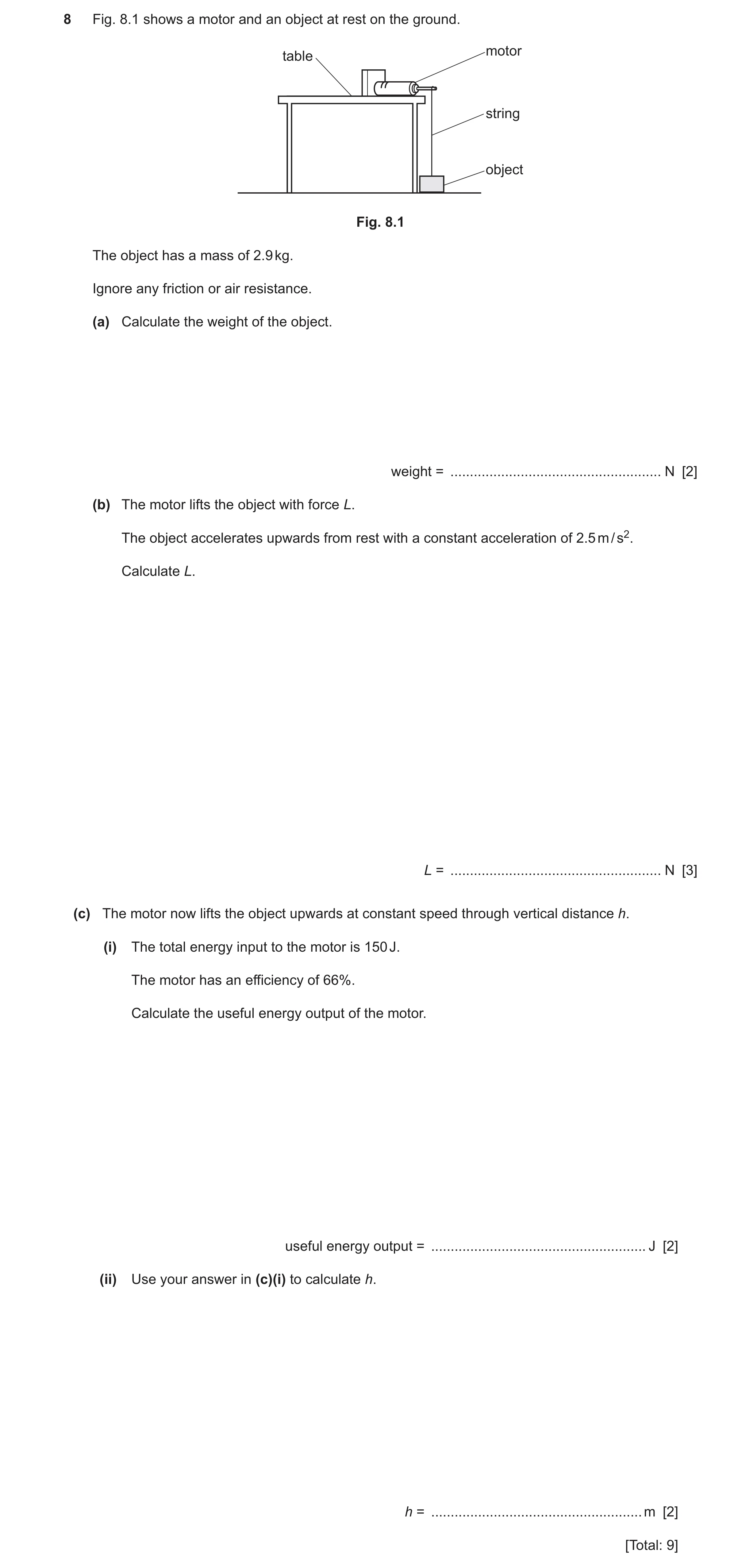
8 Fig. 8.1 shows a motor and an object at rest on the ground. motor table string object Fig. 8.1 The object has a mass of 2.9 kg. Ignore any friction or air resistance. (a) Calculate the weight of the object. weight = … N [2] (b) The motor lifts the object with force L. The object accelerates upwards from rest with a constant acceleration of 2.5 m / s2. Calculate L. L = … N [3] (c) The motor now lifts the object upwards at constant speed through vertical distance h. (i) The total energy input to the motor is 150 J. The motor has an efficiency of 66%. Calculate the useful energy output of the motor. useful energy output = … J [2] (ii) Use your answer in (c)(i) to calculate h. h = … m [2] [Total: 9]
9 marks
Mark scheme: 8(a) W = mg / 2.9 9.8 ; 2 28 (N) ; 8(b) F = ma / 2.9 2.5 / 7.25 ; 3 L = F + W / (L = ) 28.42 + 7.25 / (L = ) 35.67 ; 36 (N) ; 8(c)(i) useful energy output = efficiency total energy input / 0.66 150 ; 2 99 (J) ; 8(c)(ii) ΔEp = mgΔh 2 or 99 = 2.9 9.8 h or 99 = 28.42 h 99 or h = ; 2.9 9.8 3.5 (m) ;
This question in 0653/43 Oct/Nov 2025
 10
10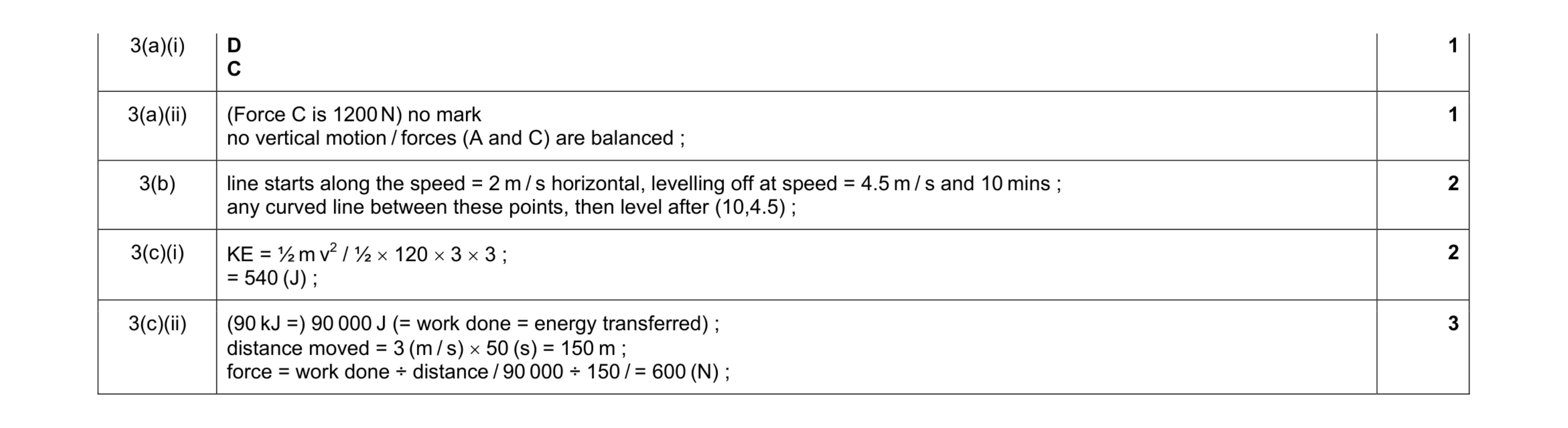 9
9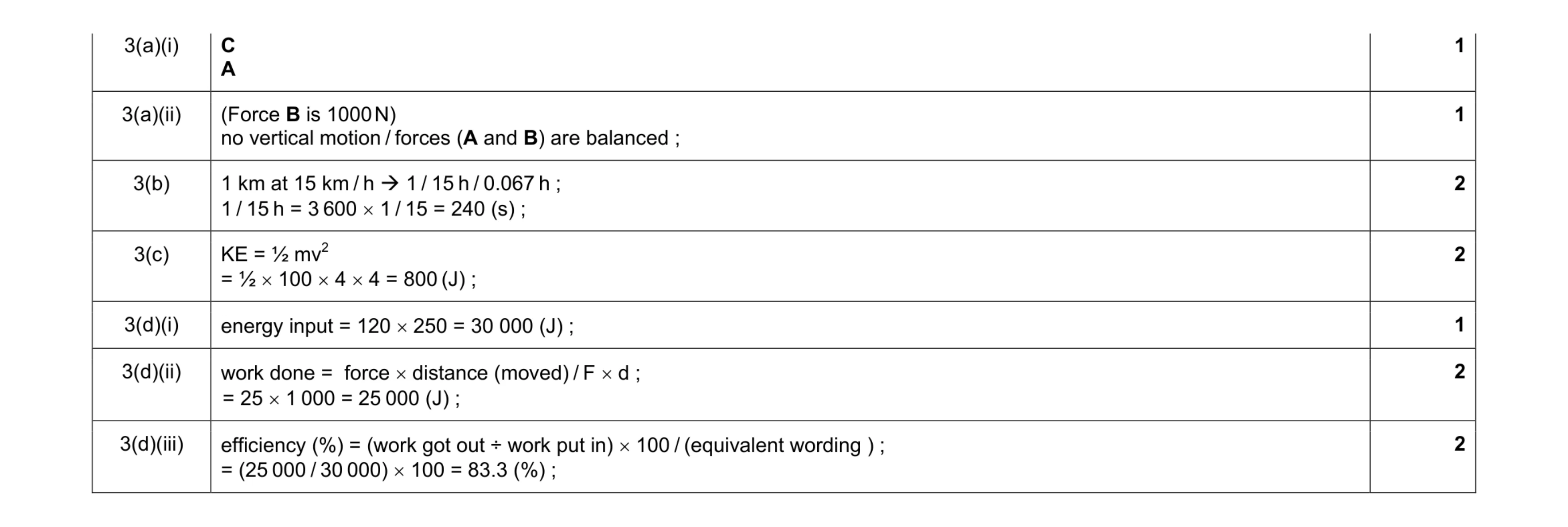 11
11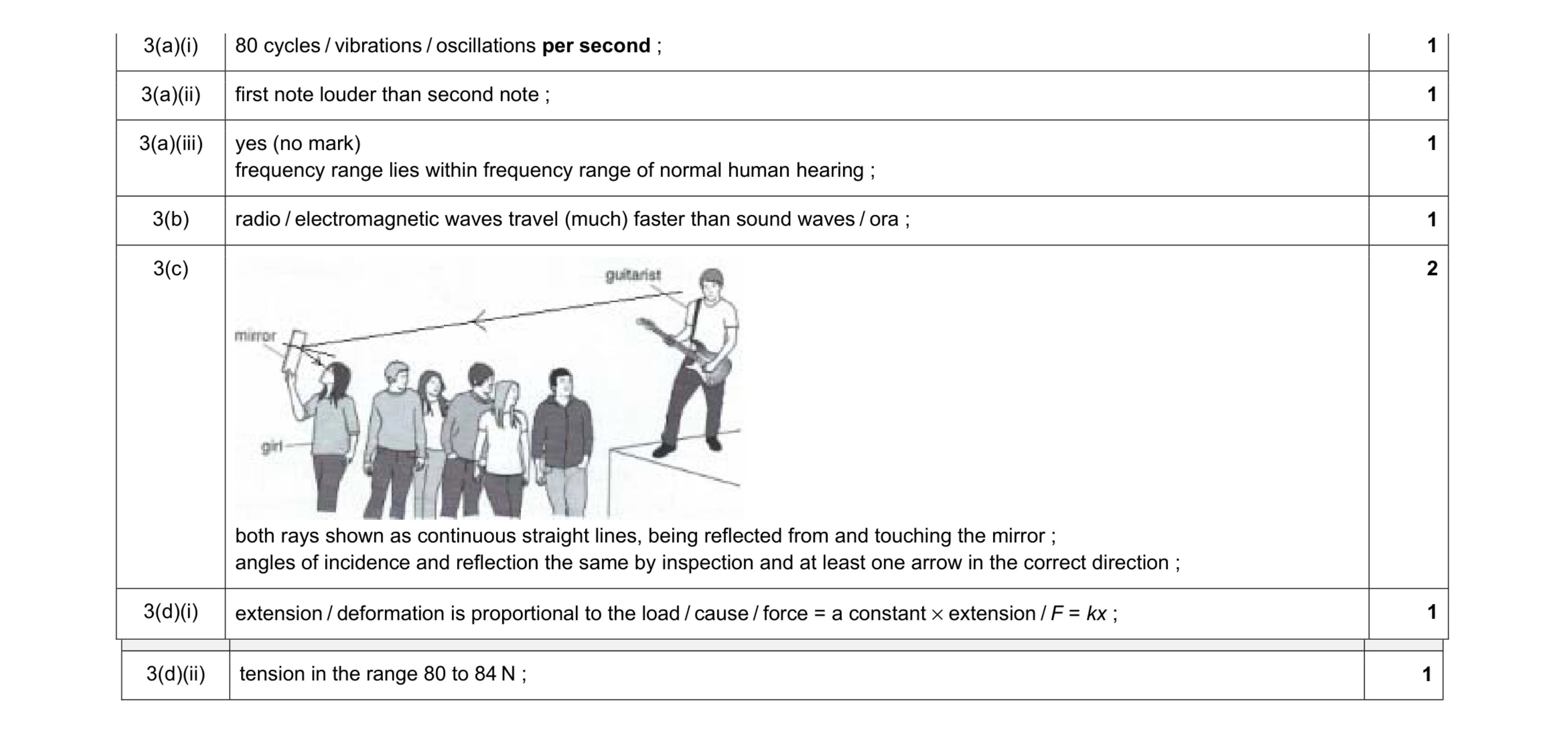 8
8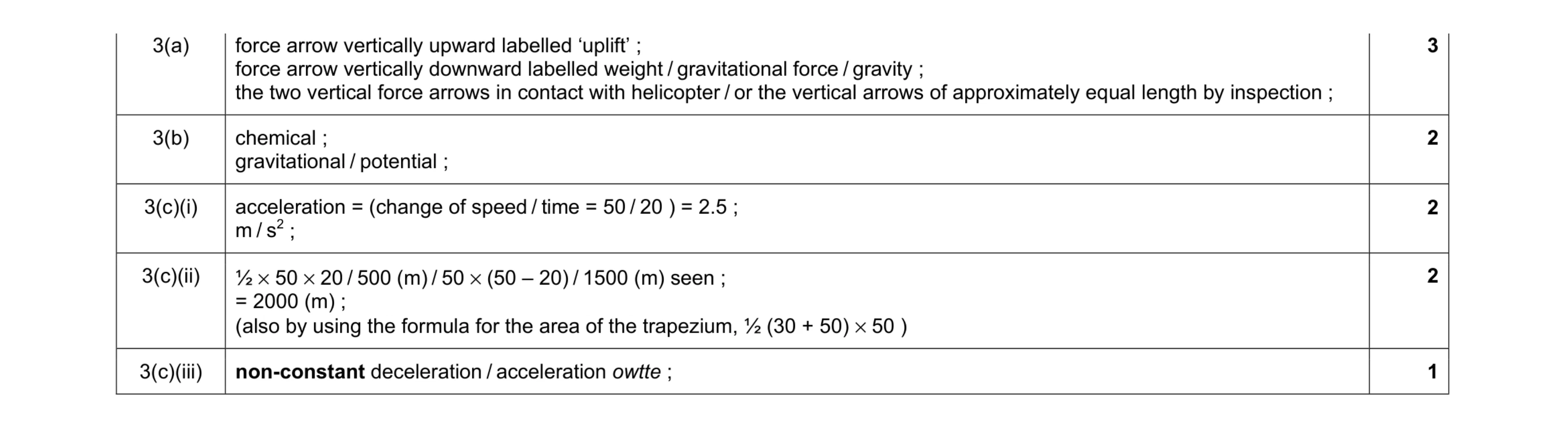 10
10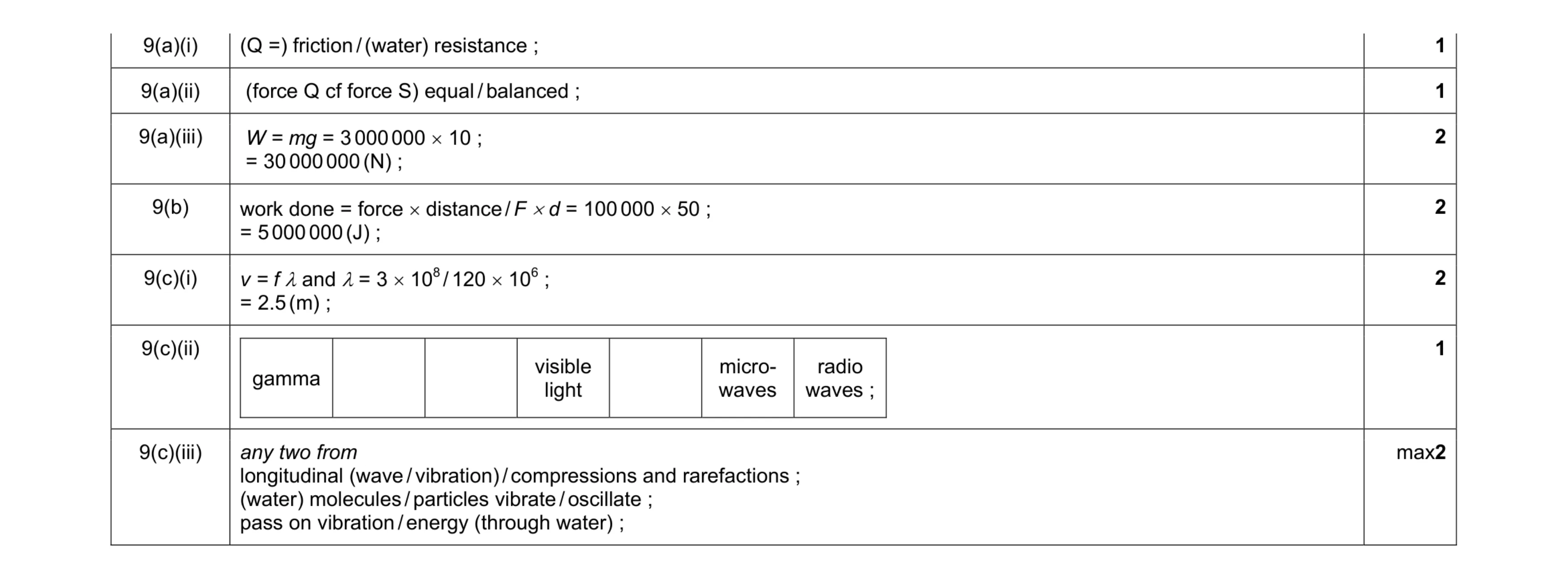 11
11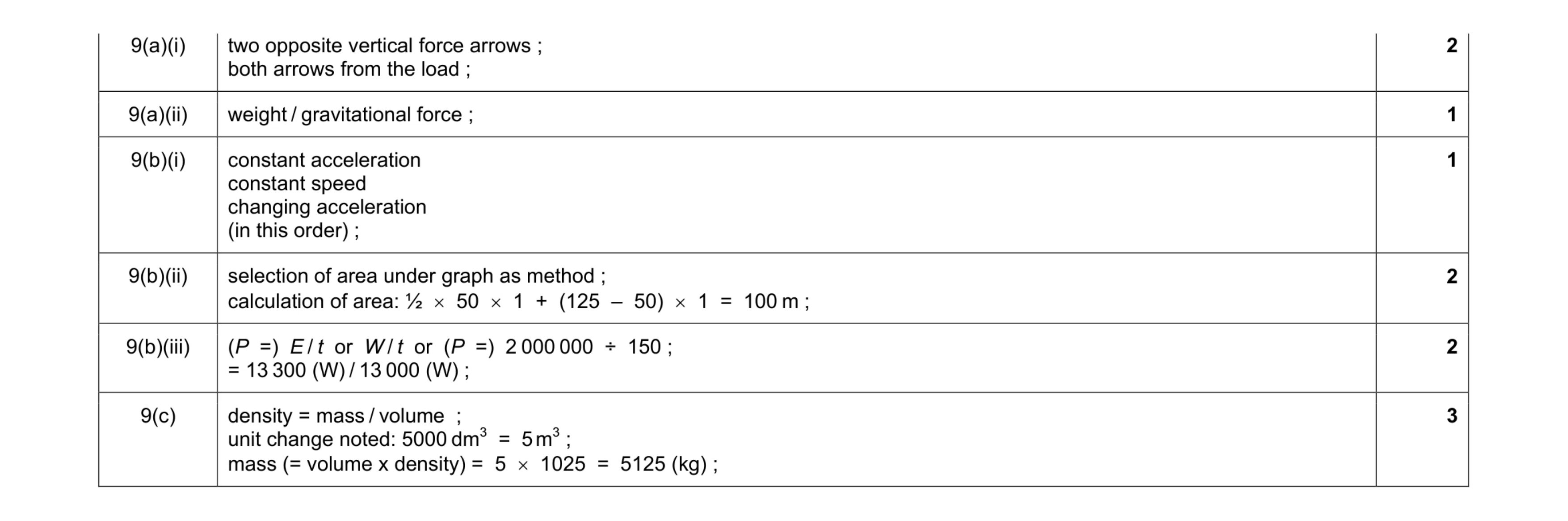 11
11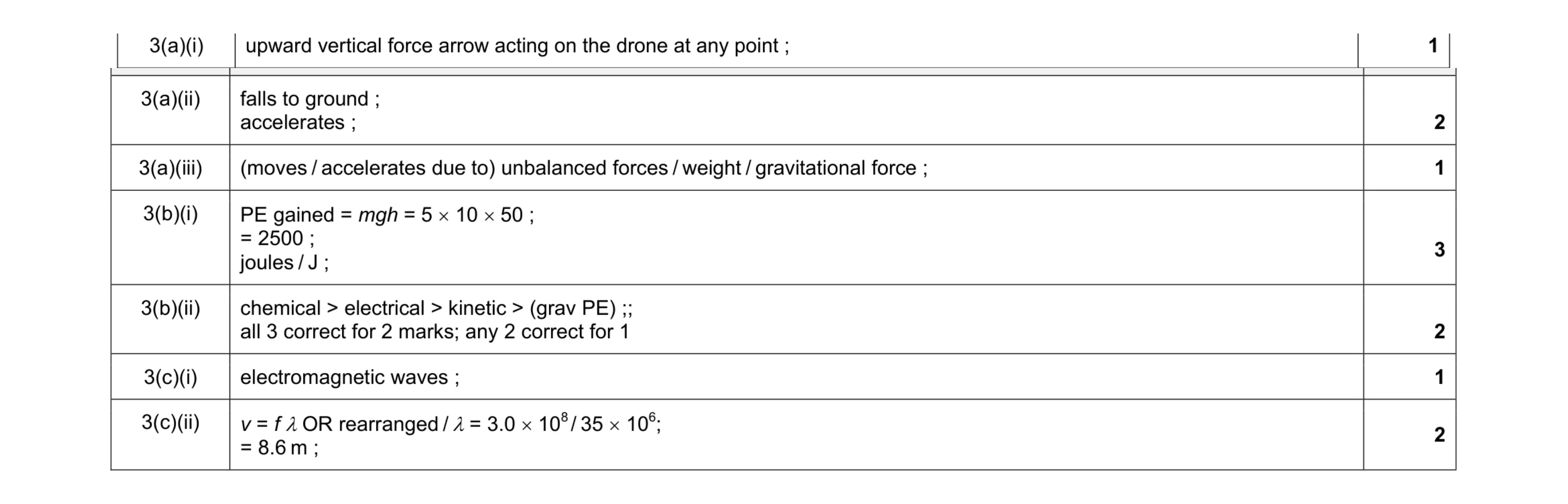 12
12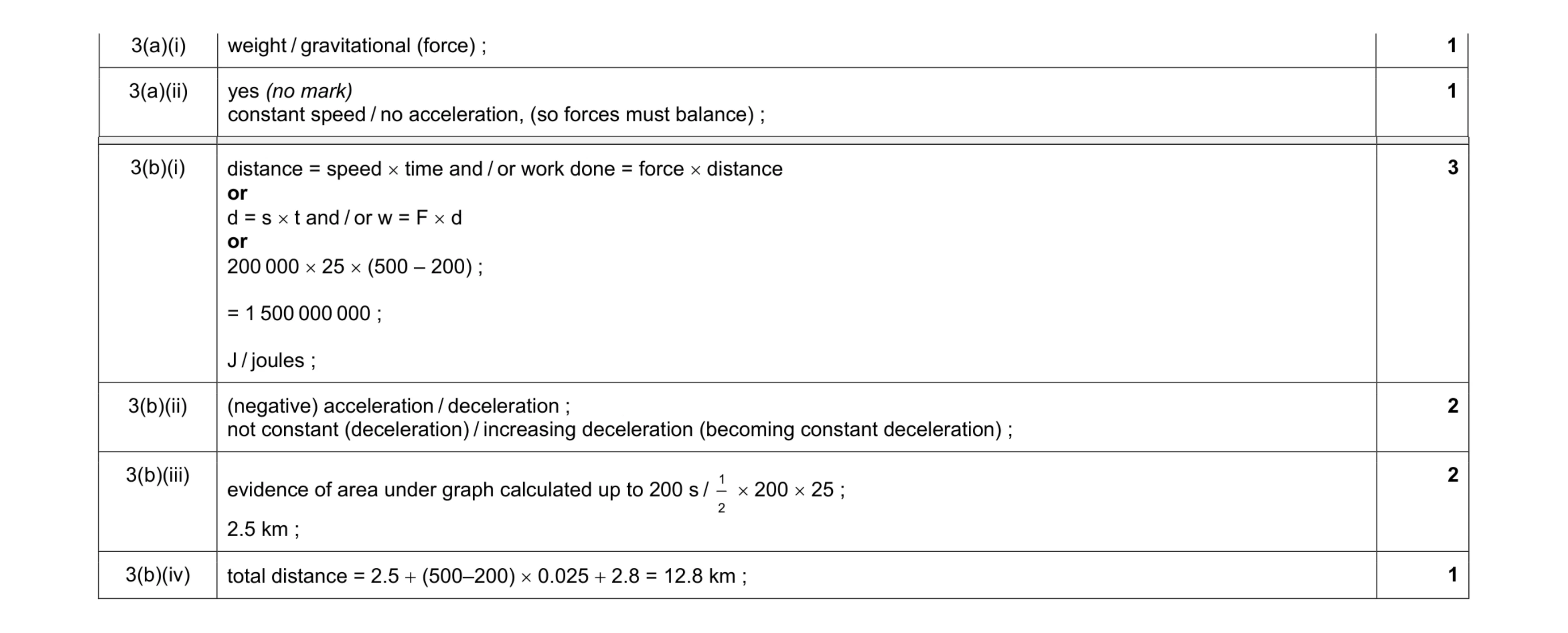 10
10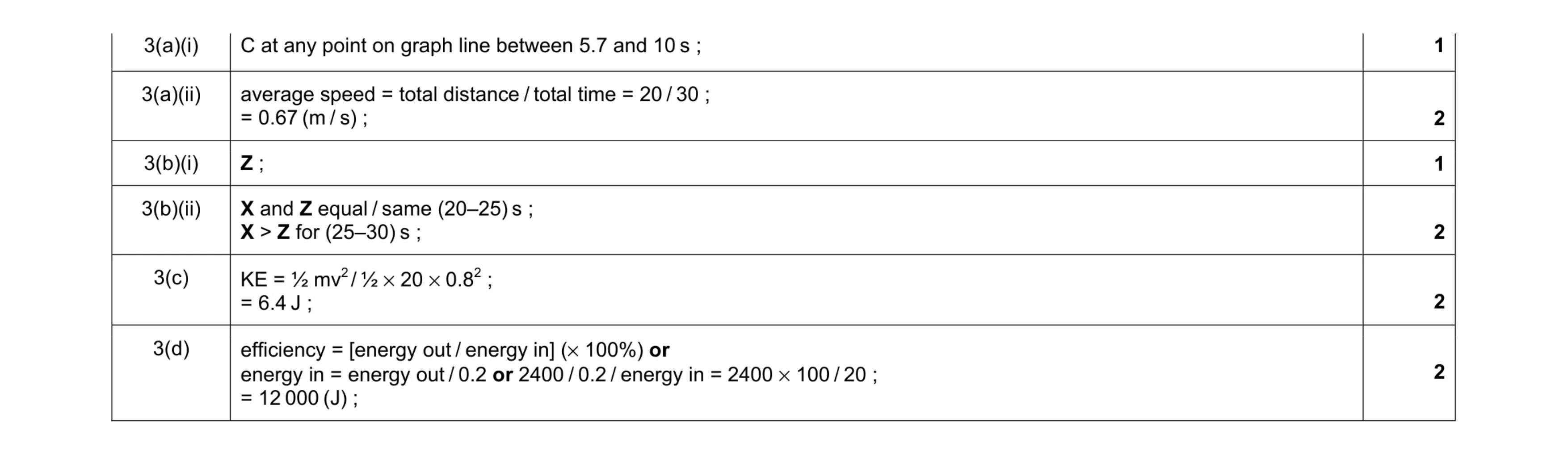 10
10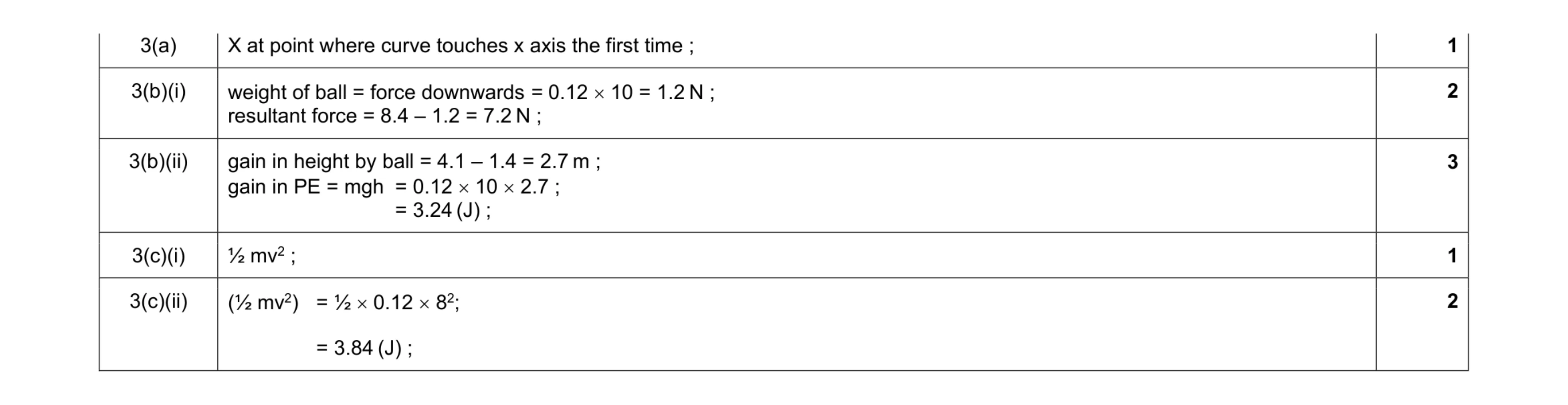 9
9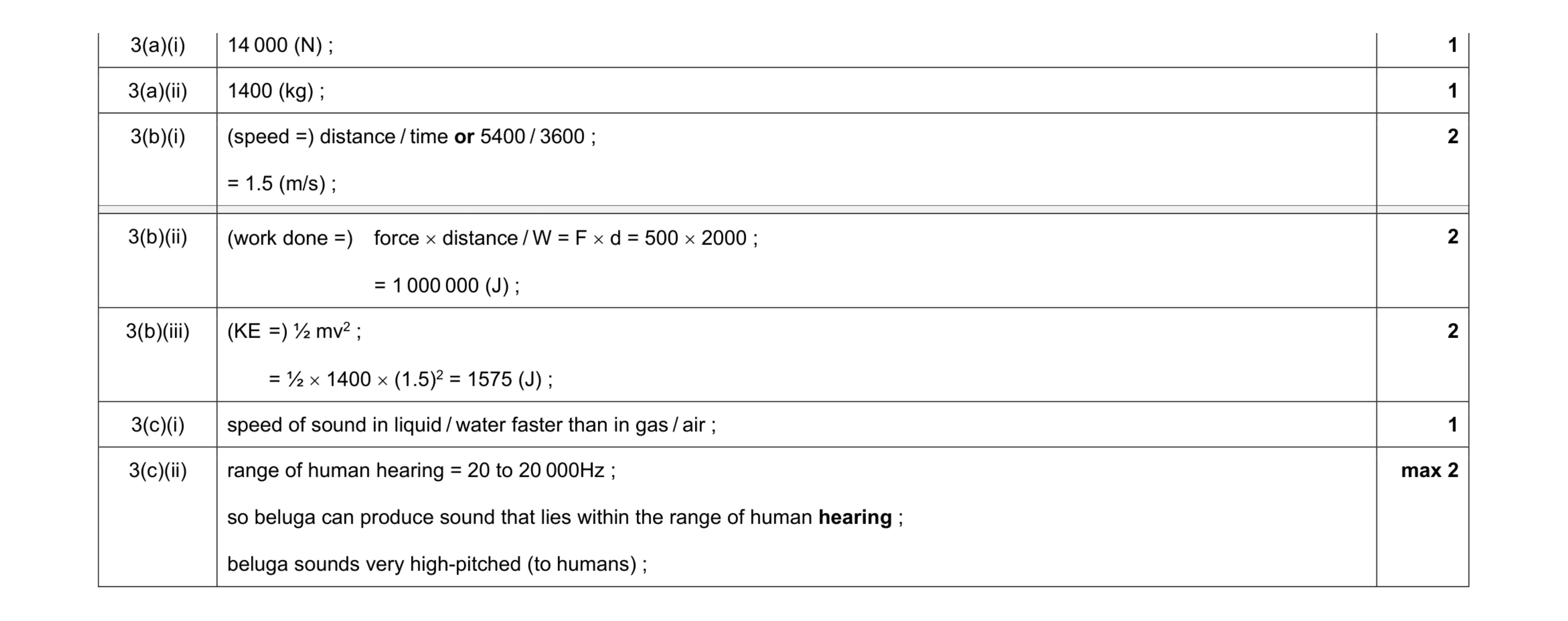 11
11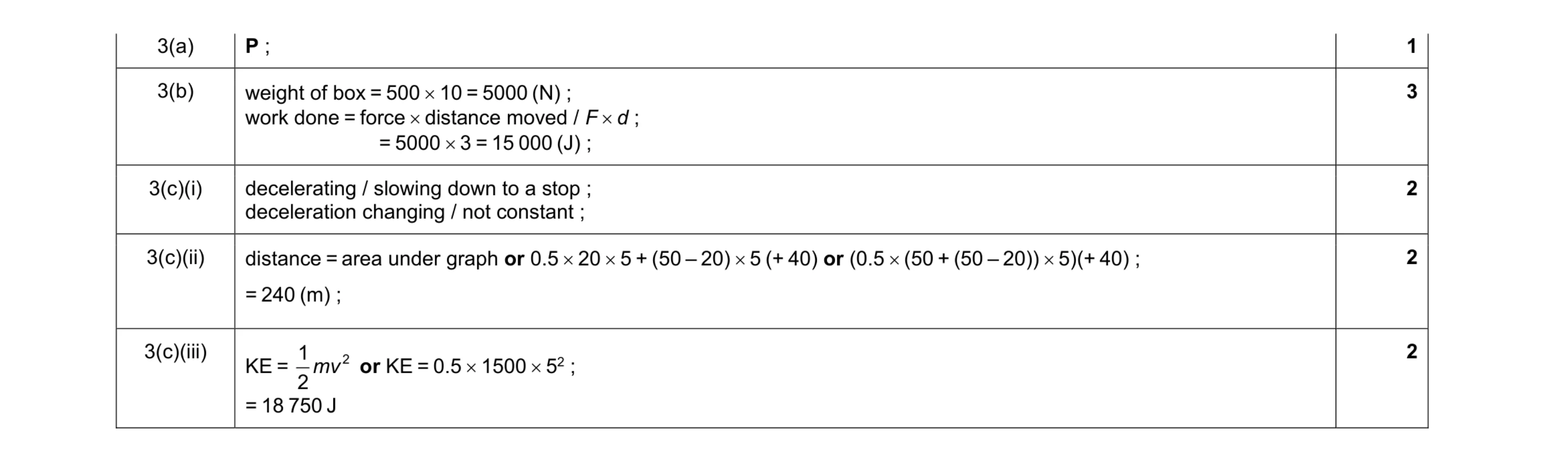 10
10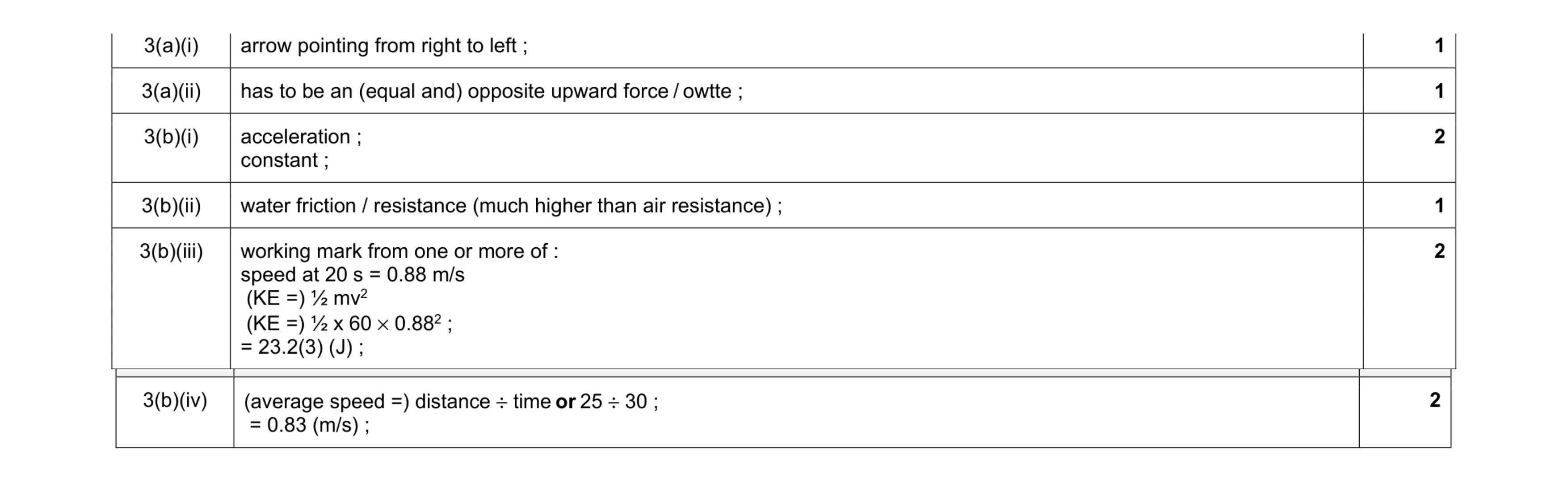 9
9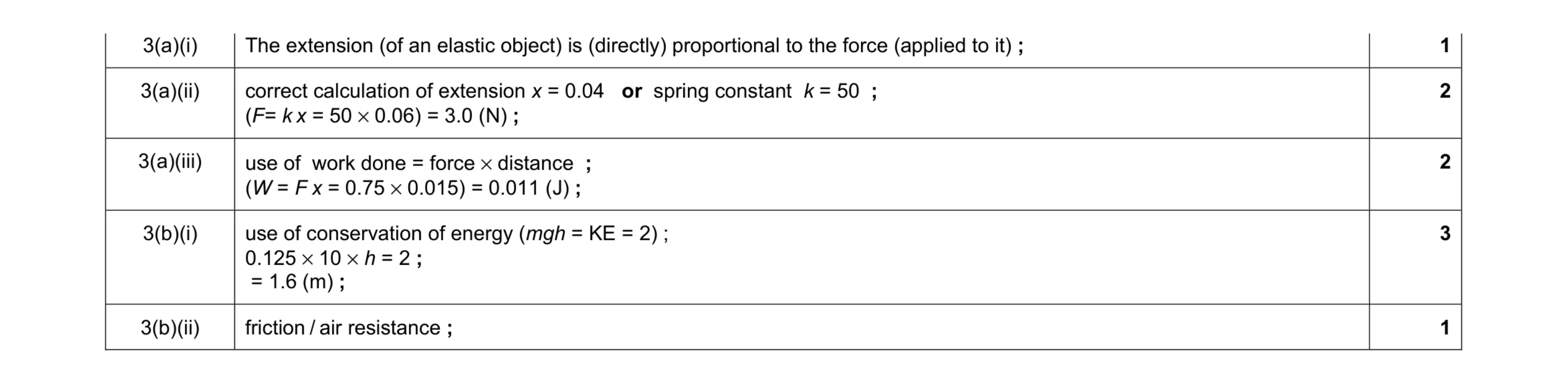 9
9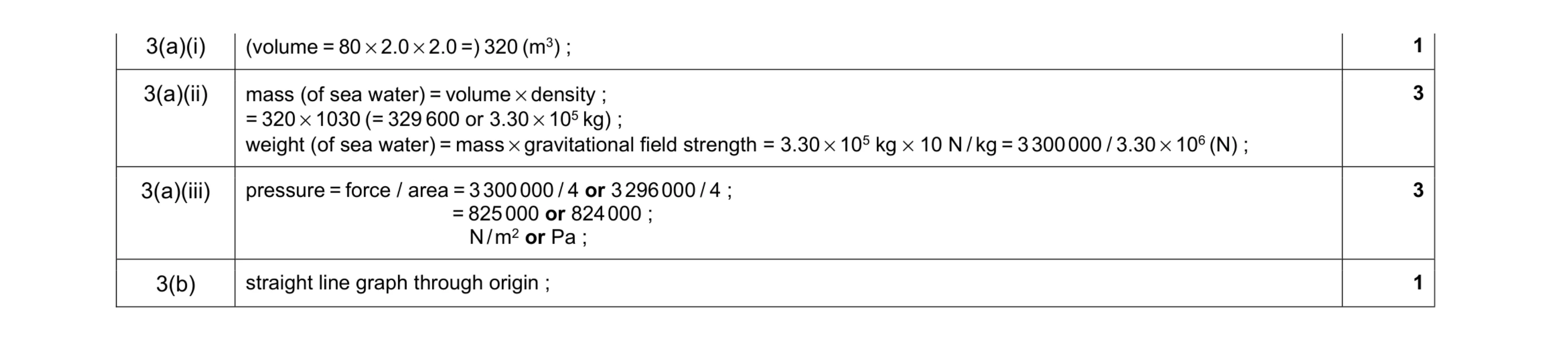 8
8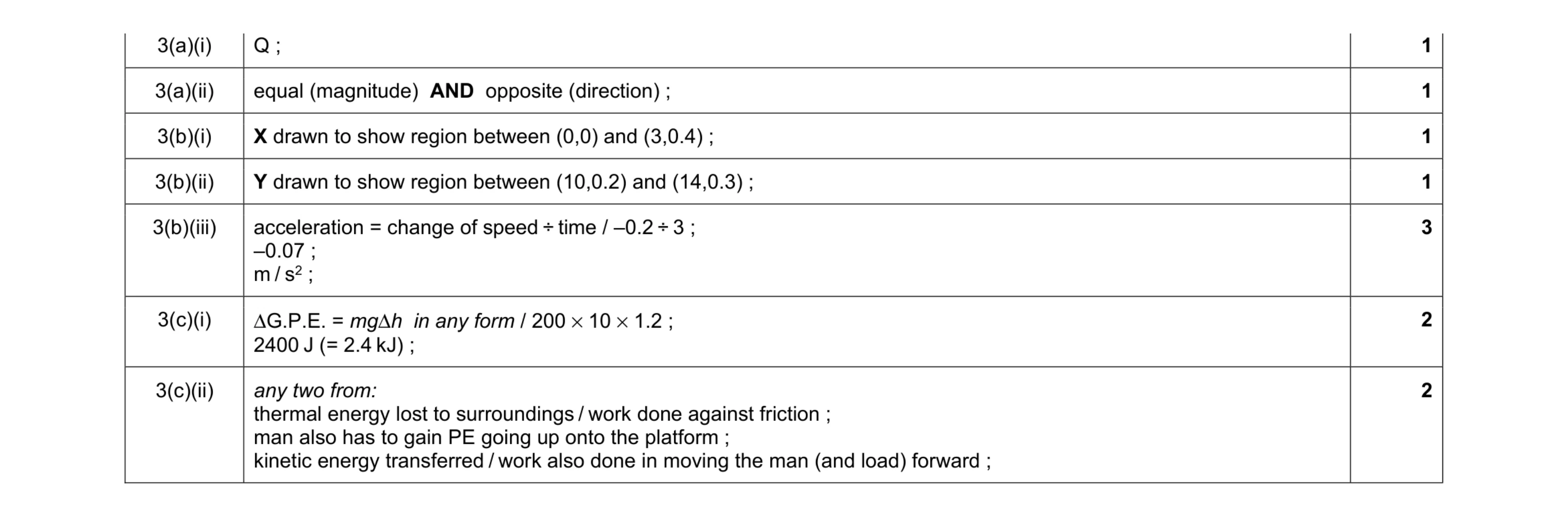 11
11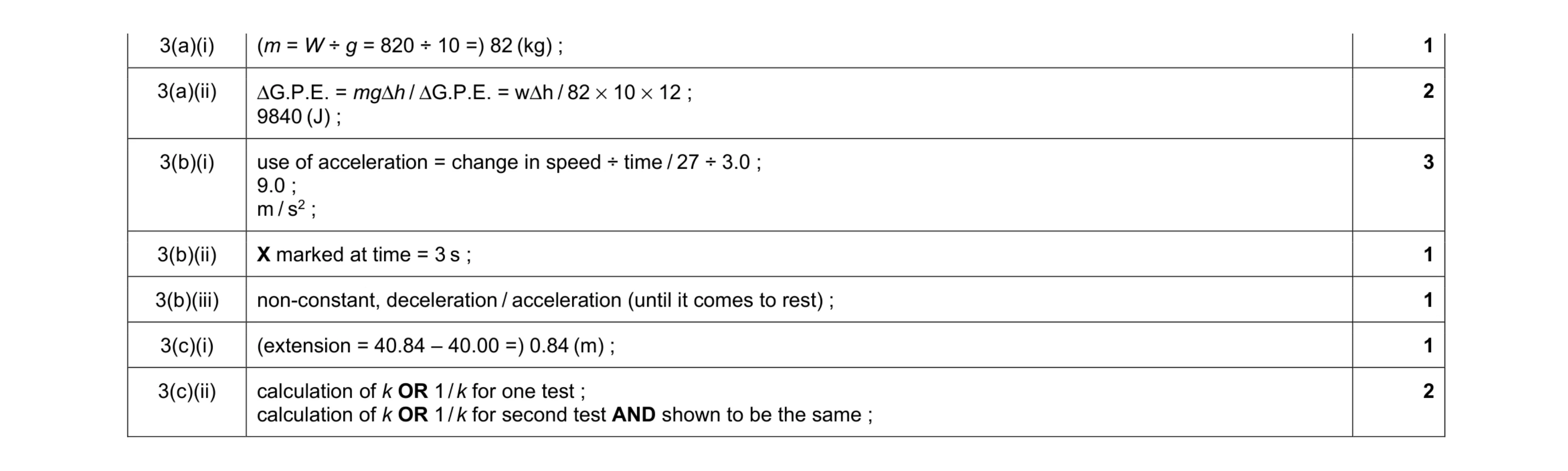 11
11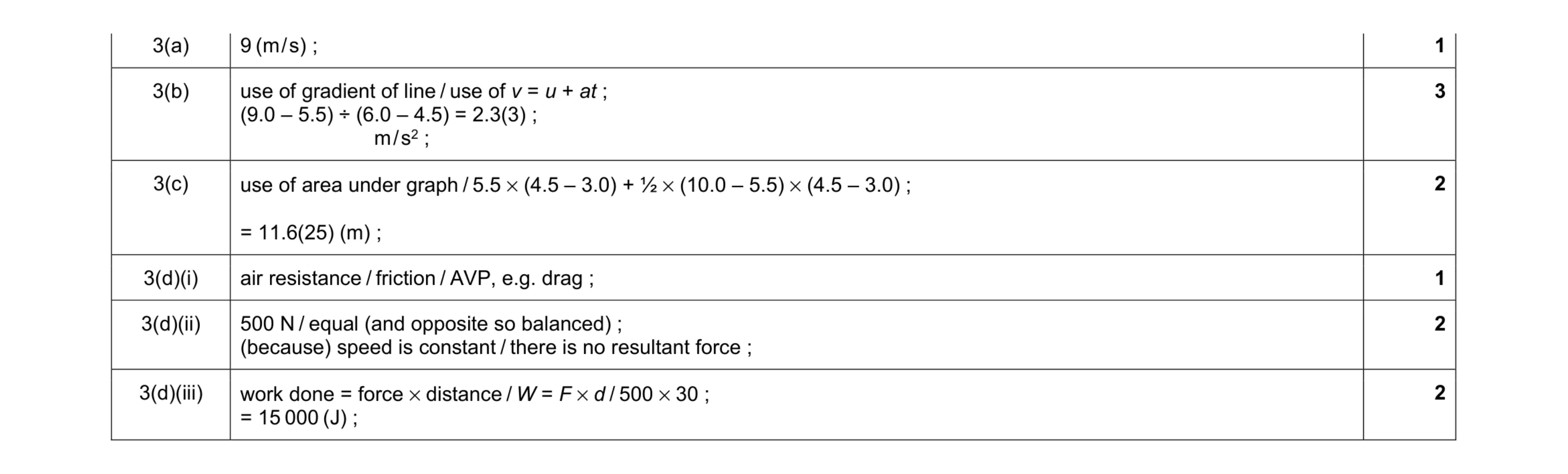 11
11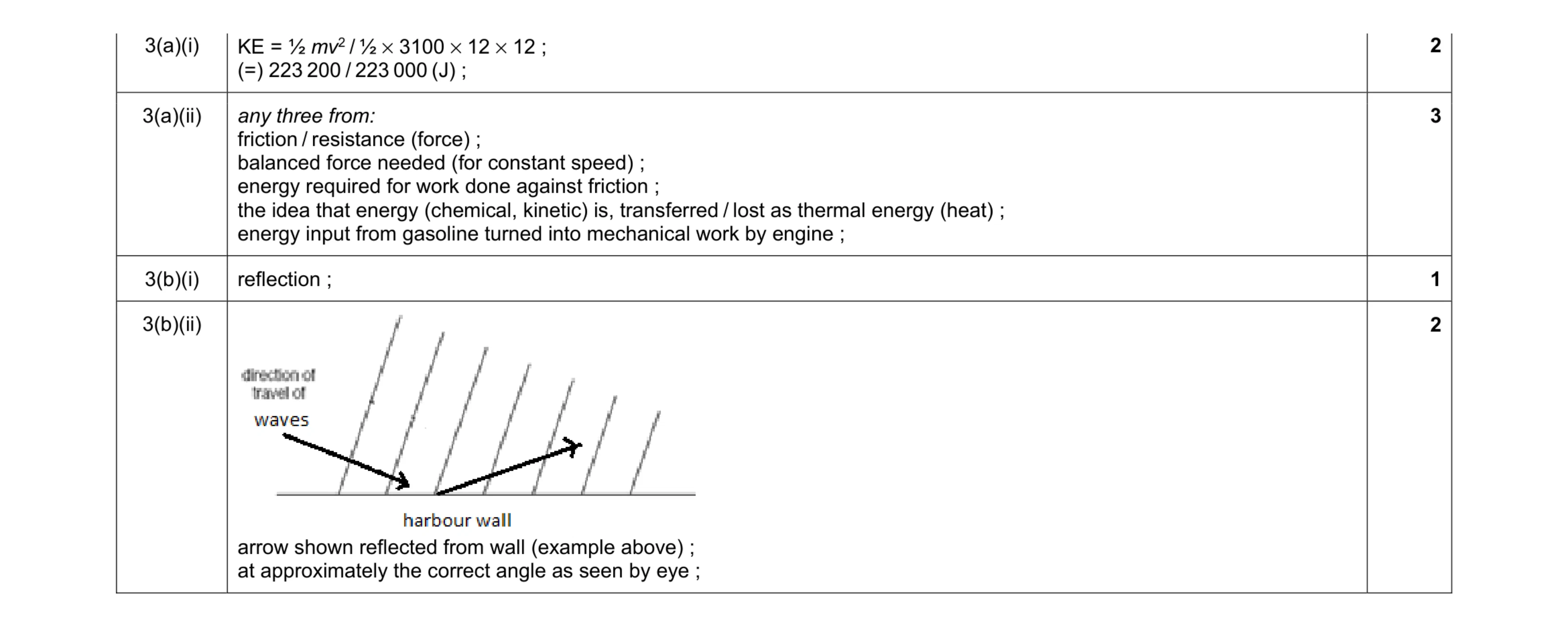 8
8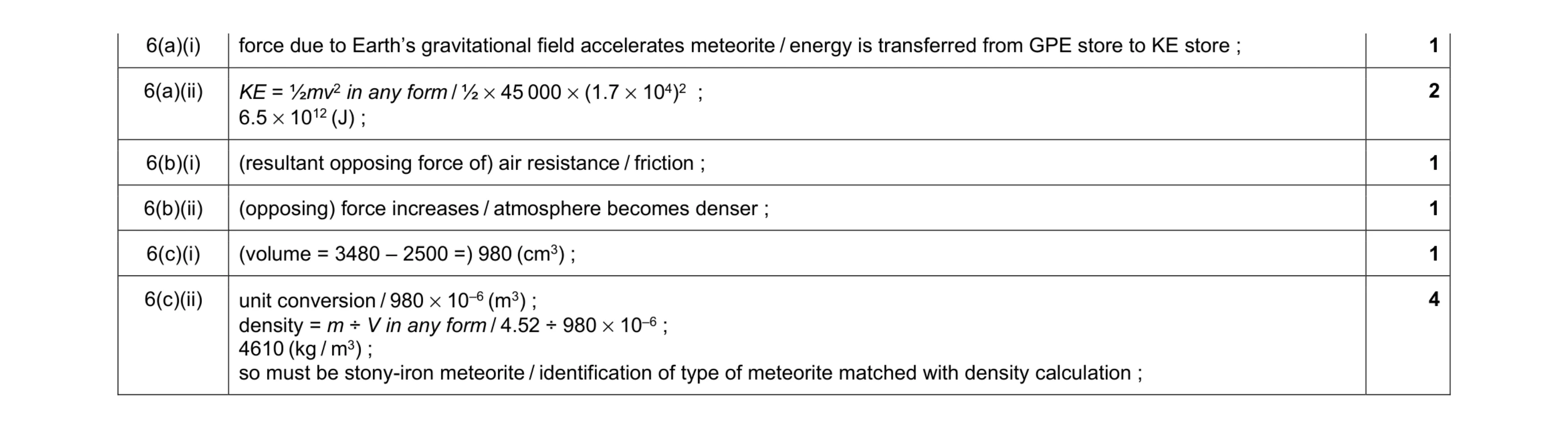 10
10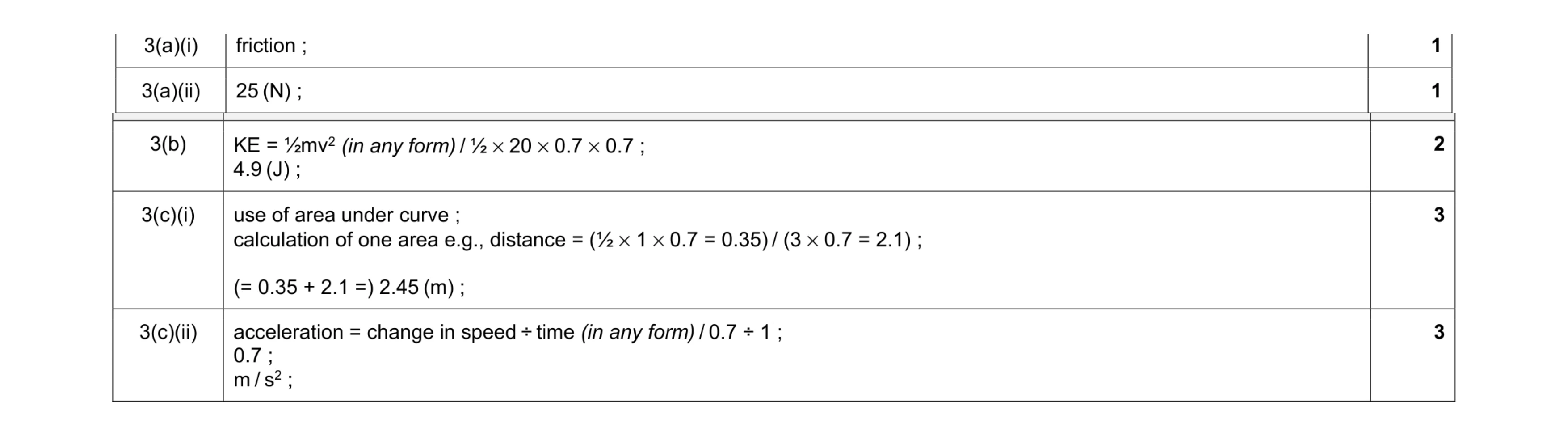 10
10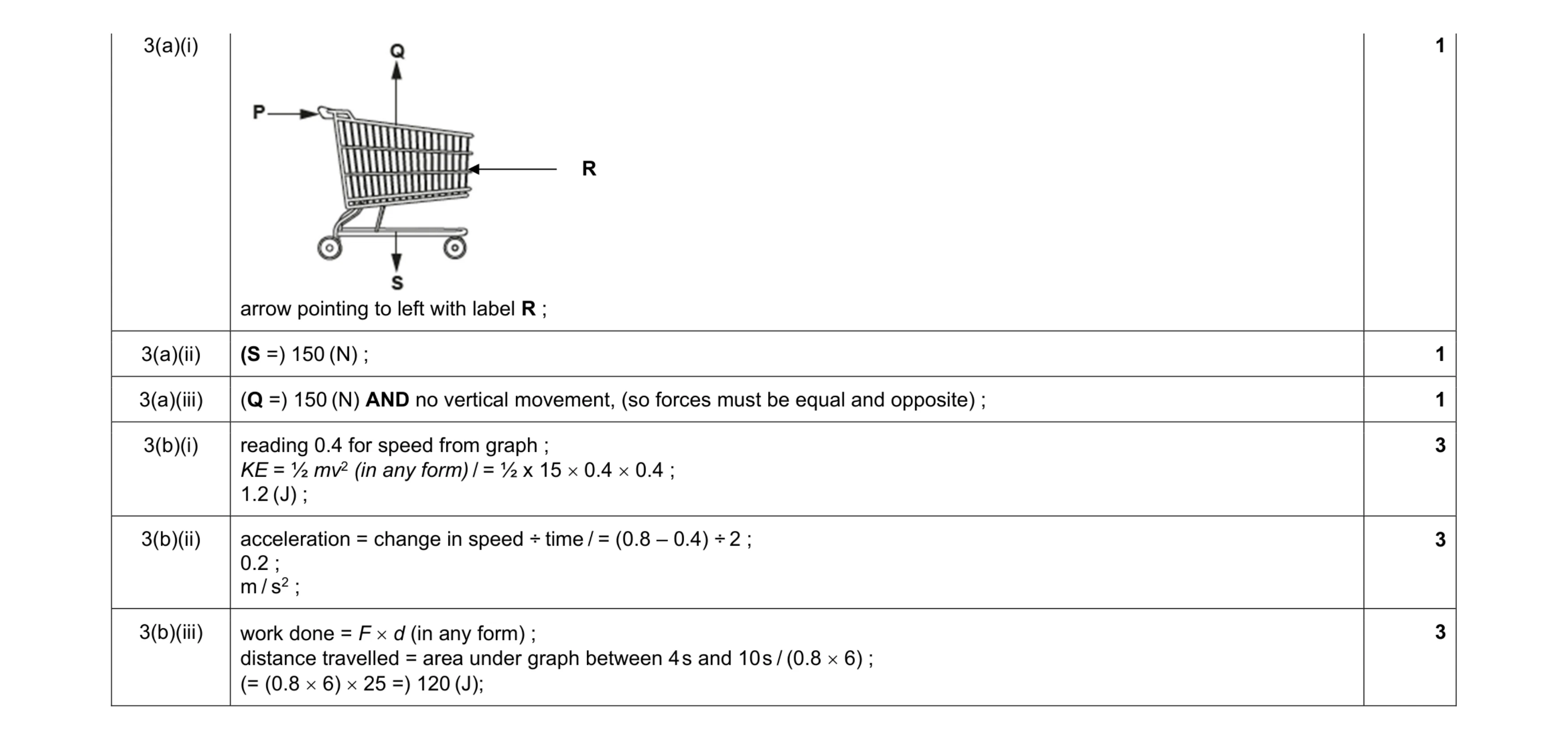 12
12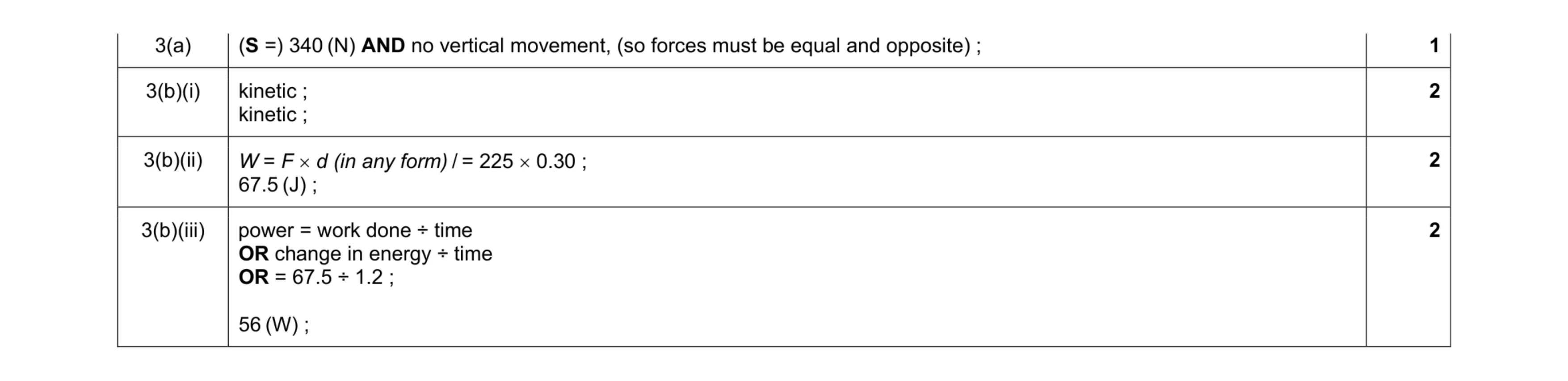 7
7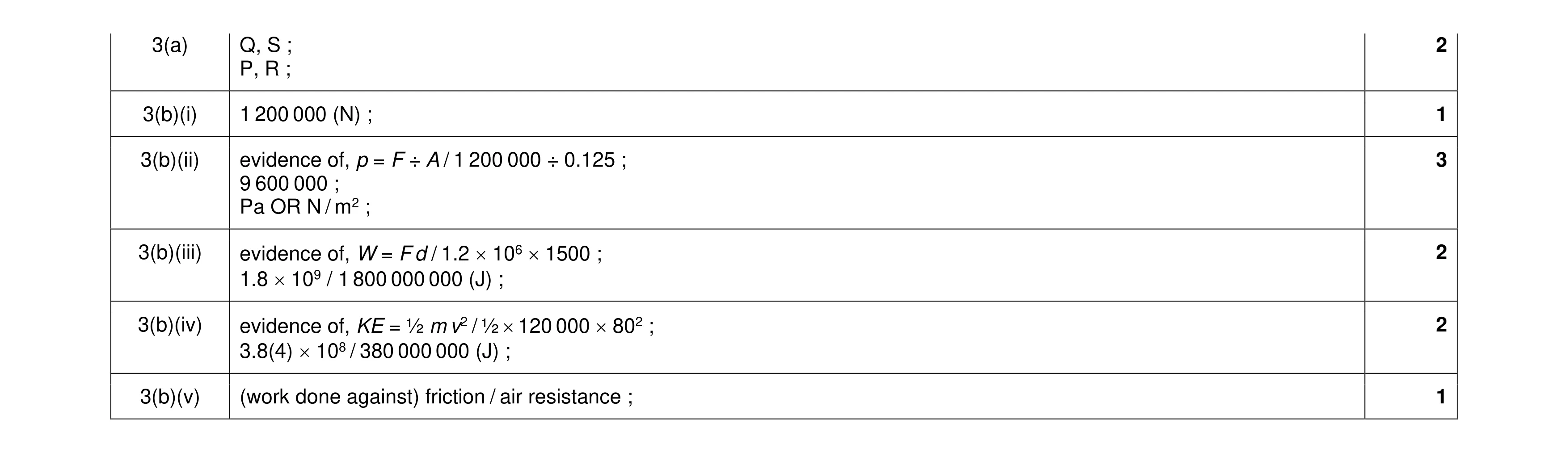 11
11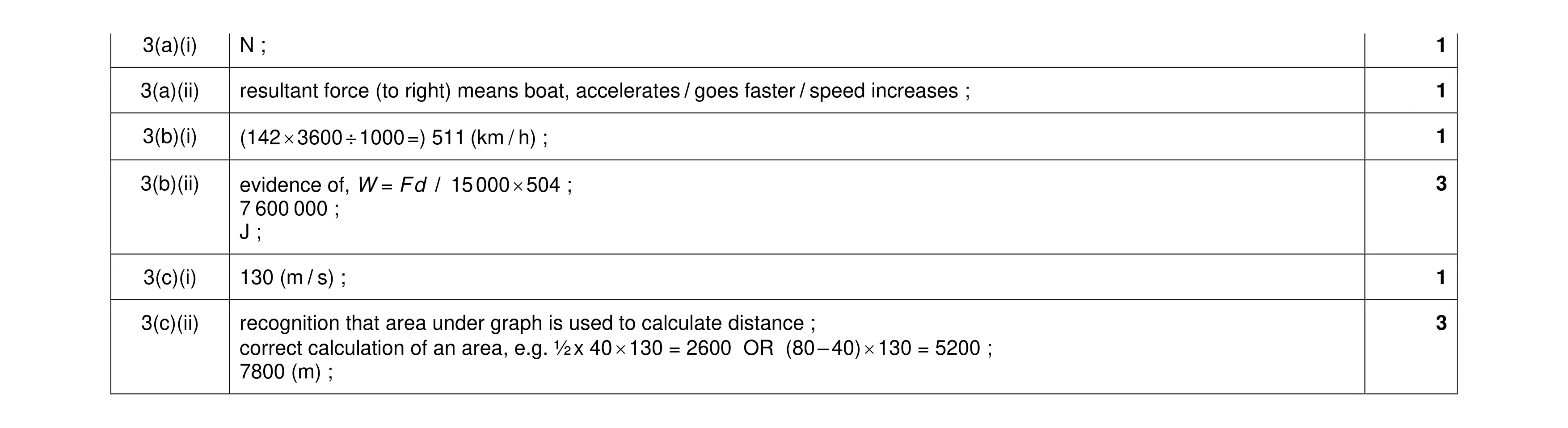 10
10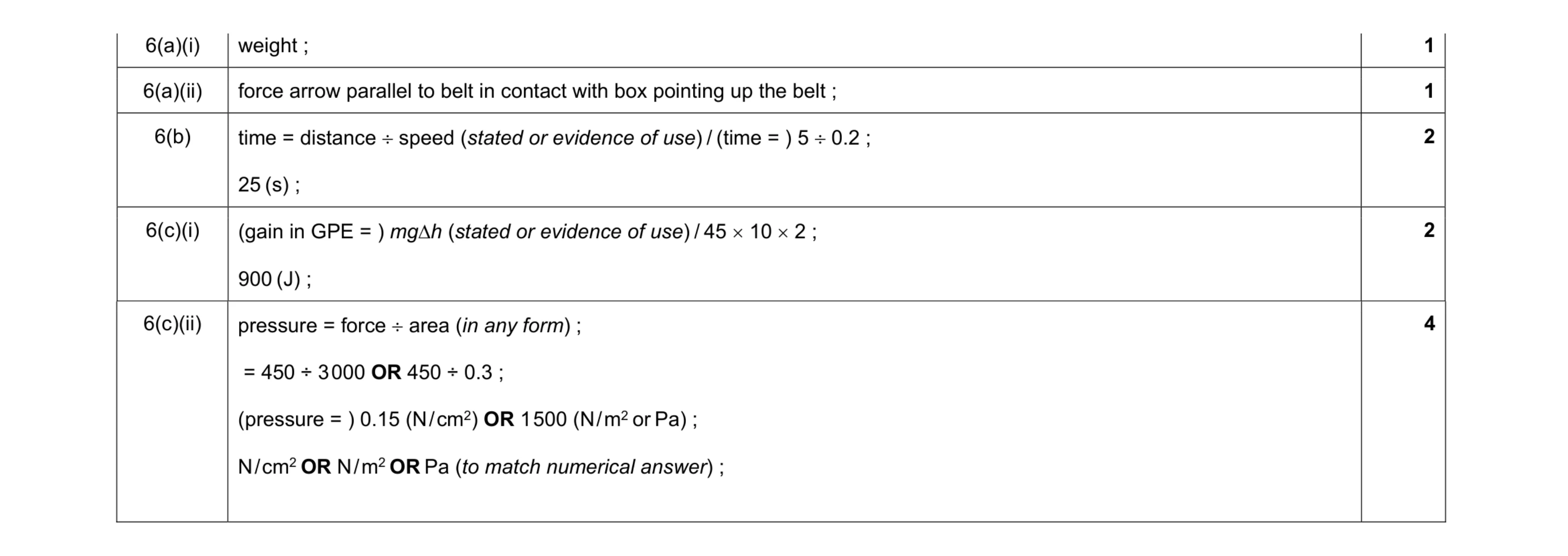 10
10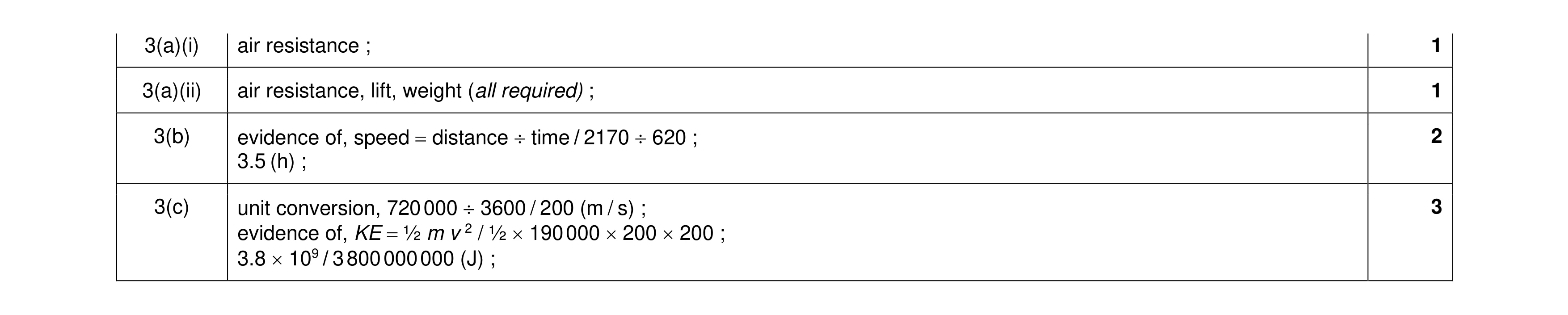 7
7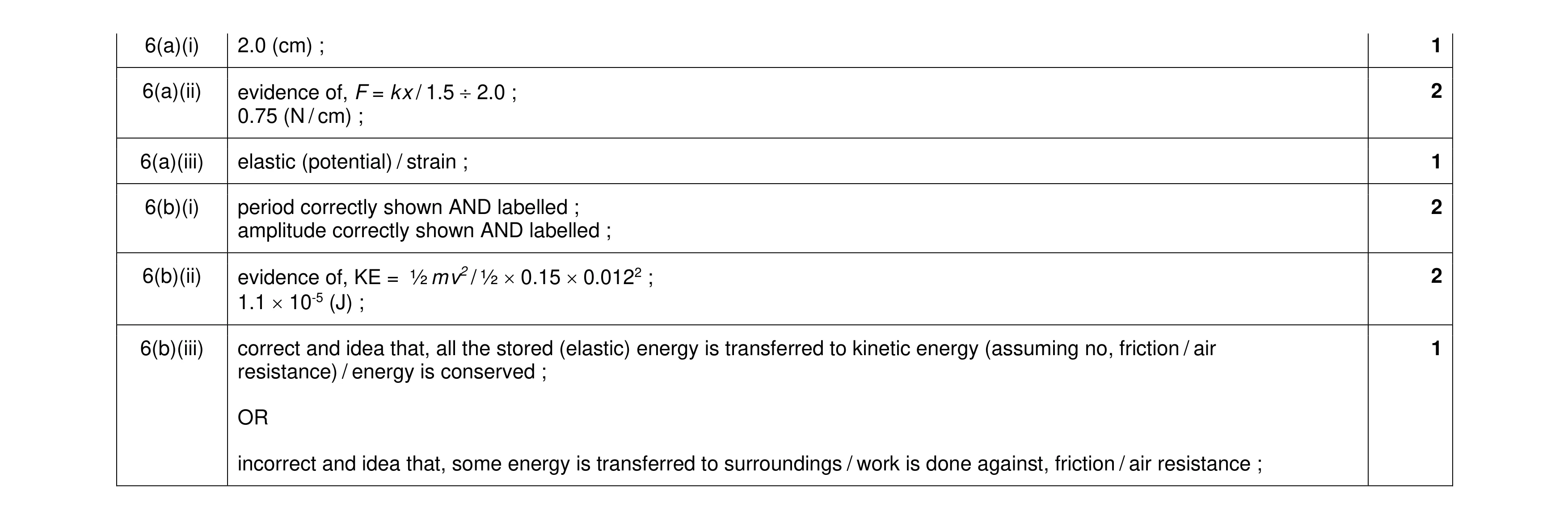 9
9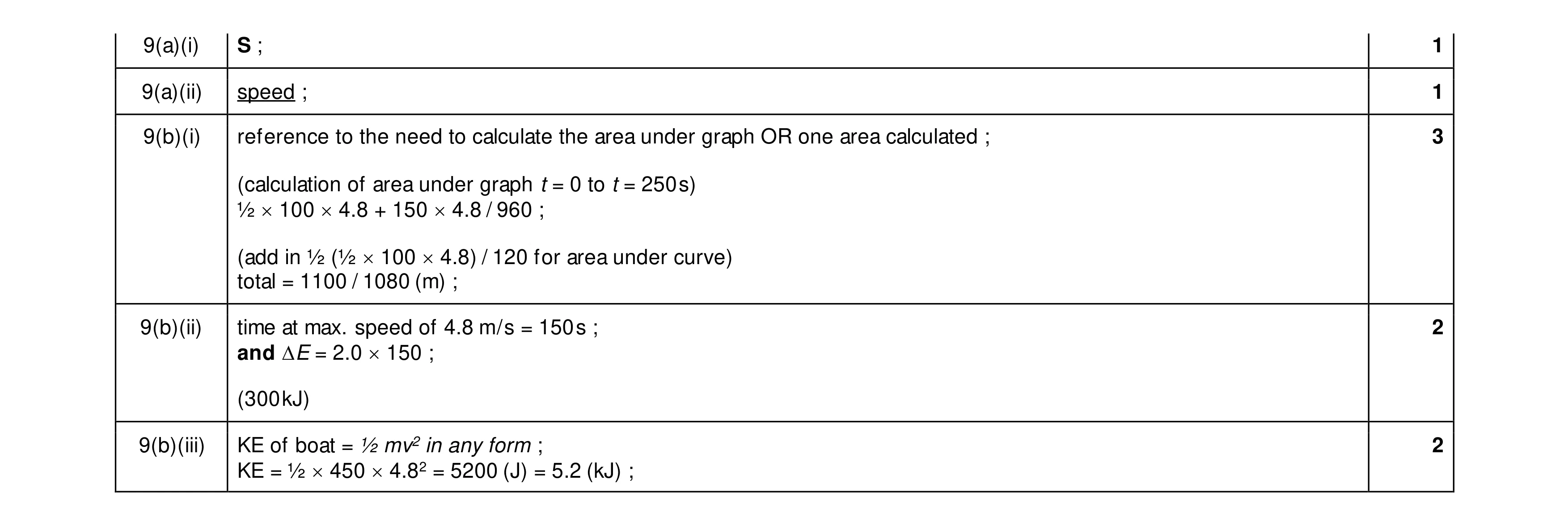 9
9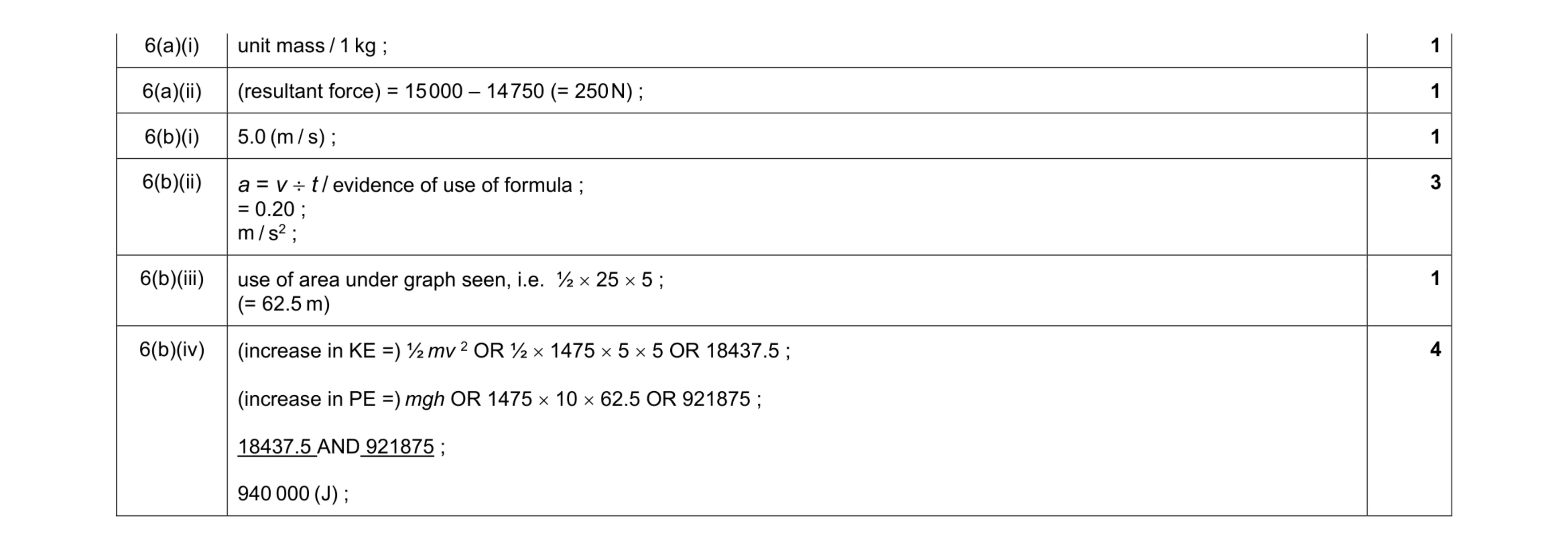 11
11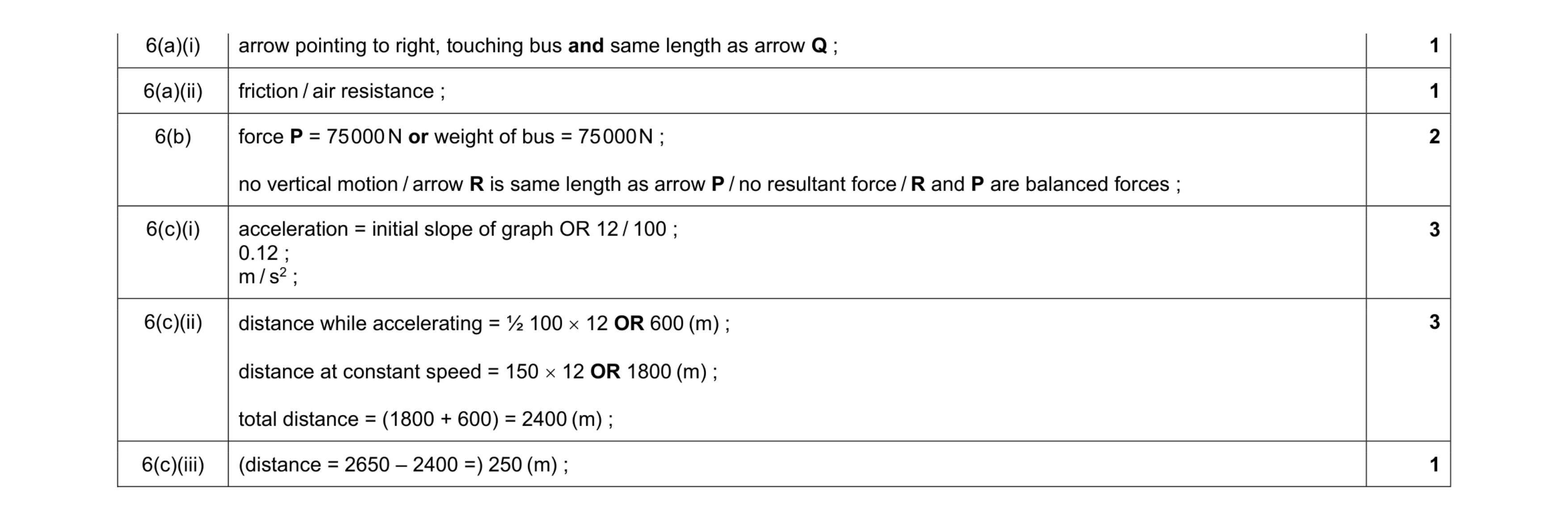 11
11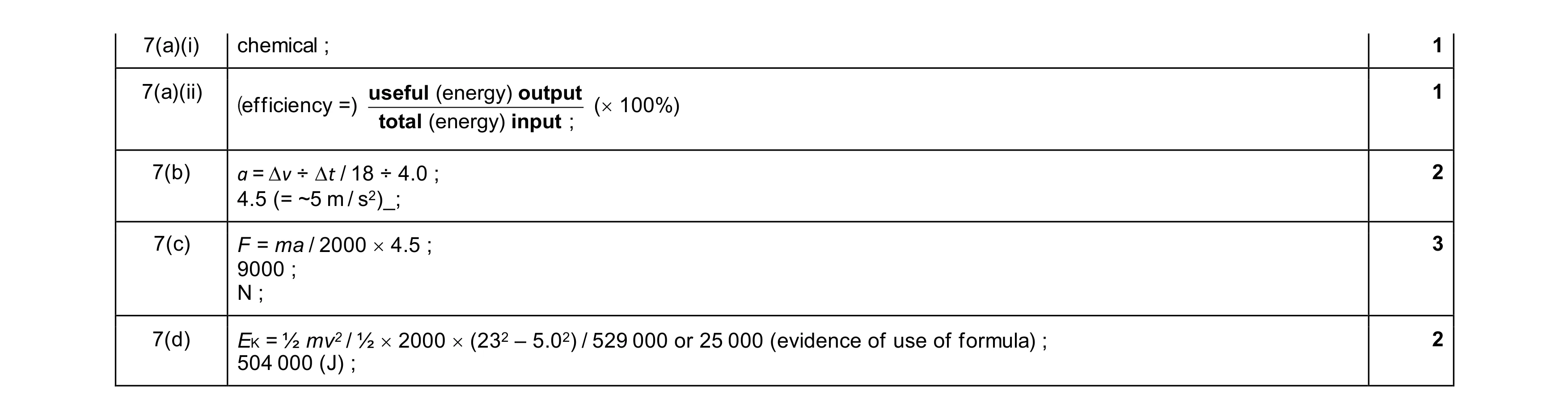 9
9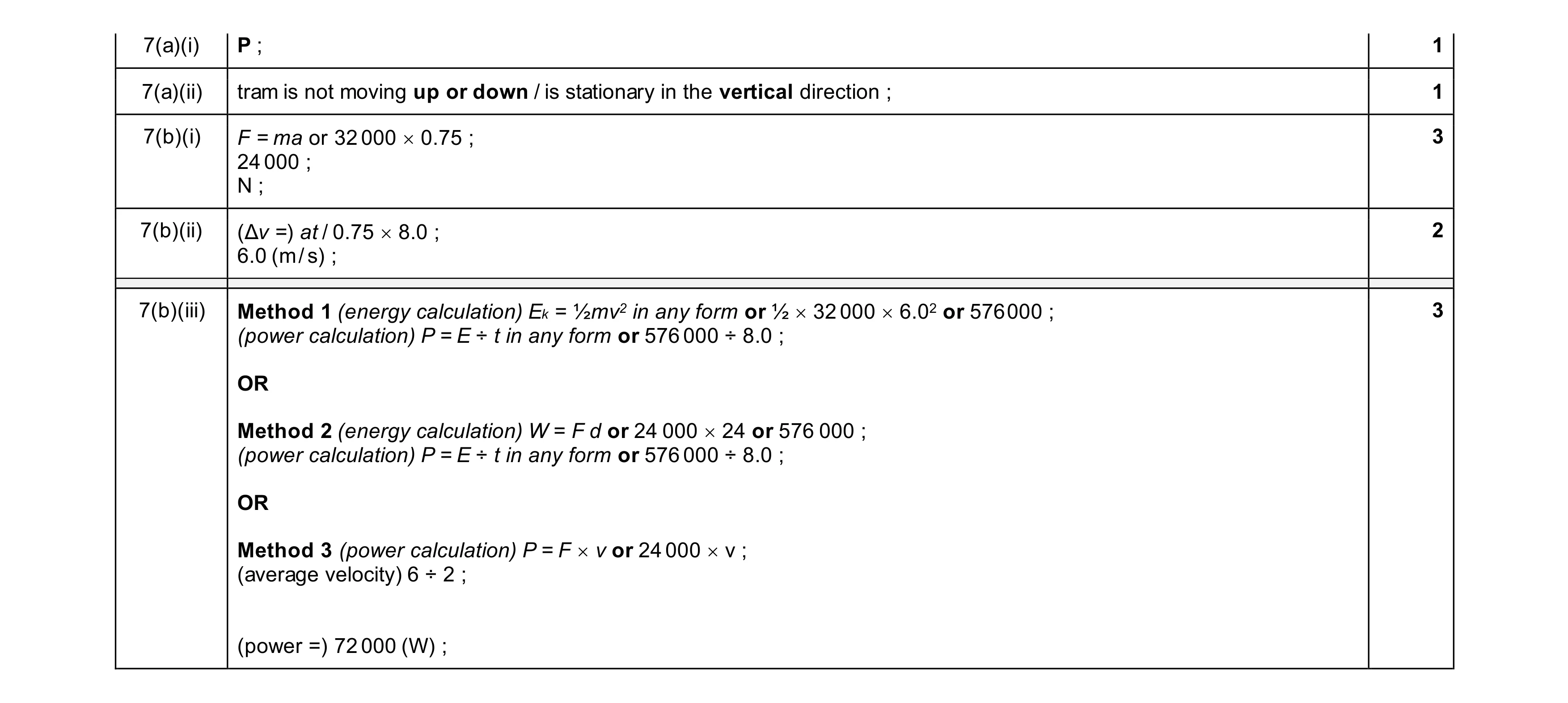 10
10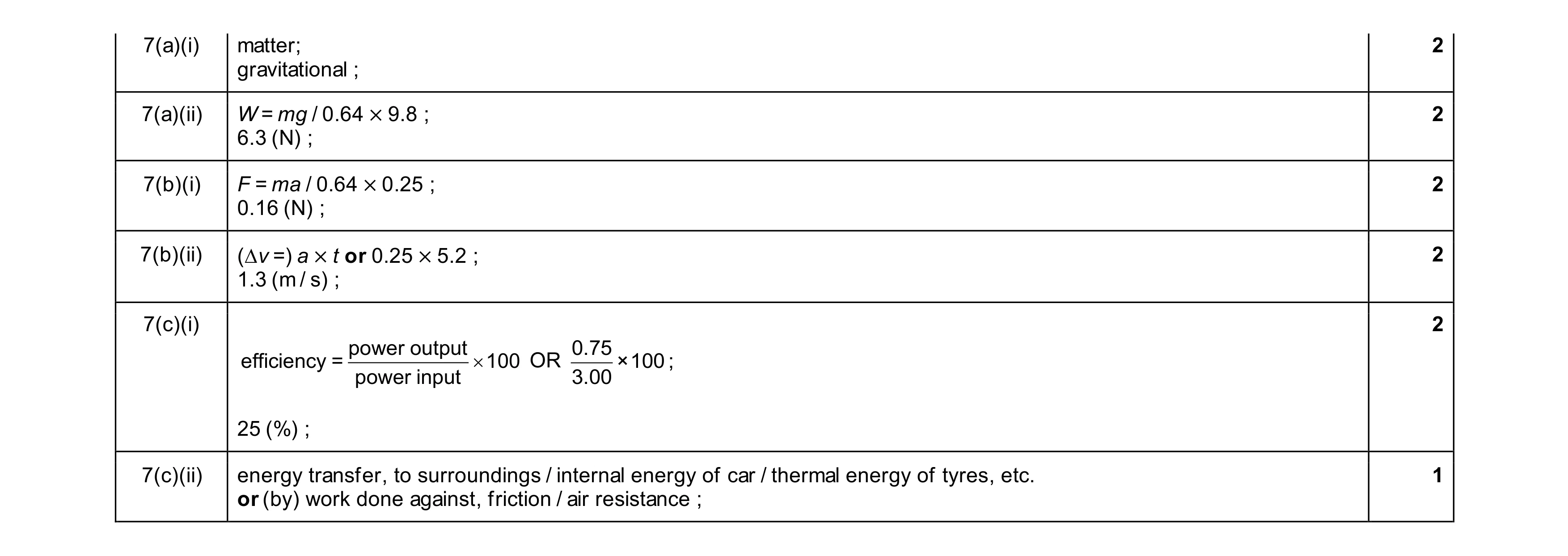 11
11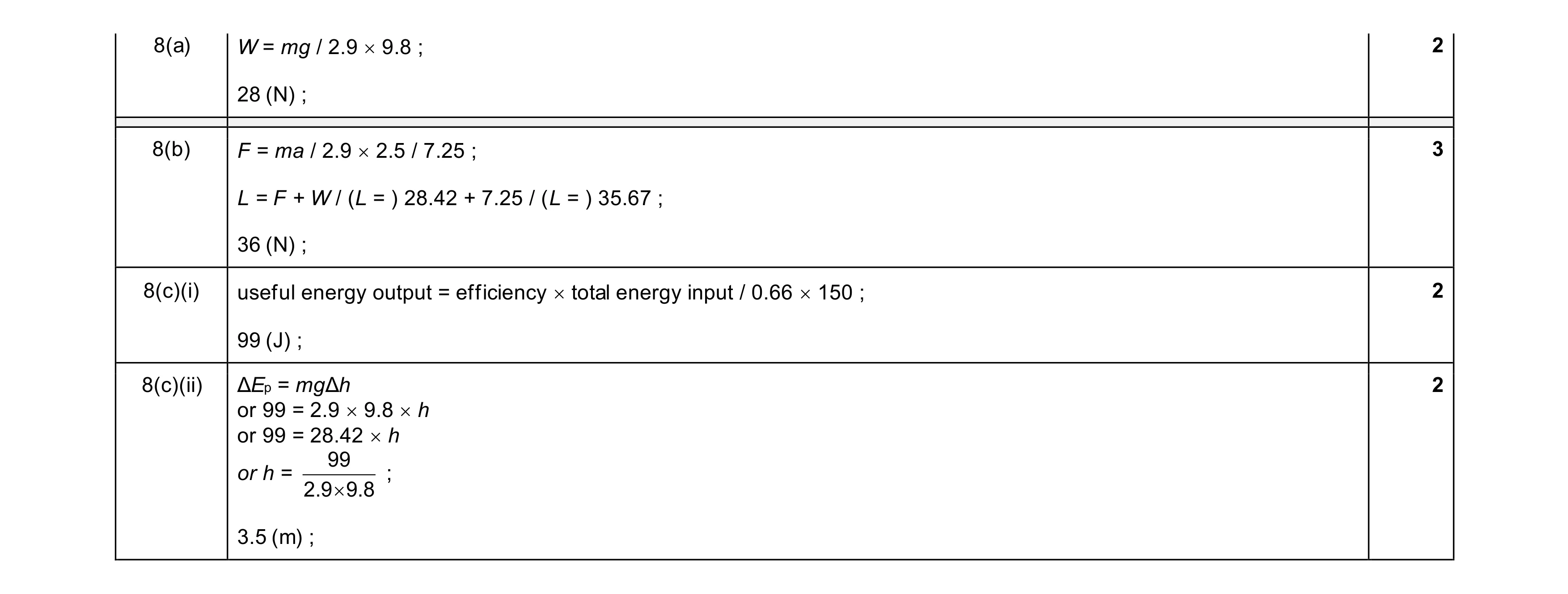 9
9