Cambridge IGCSE Science - Combined 0653 — 2021 Oct/Nov Paper 4 · Variant 2
0653/42/O/N/21 · 9 questions · 80 marks · ≈90 min
The question paper and its mark scheme, free to read here and free to download. This is Cambridge’s own paper, exactly as it was sat.
Question paper24 pages


Mark scheme12 pages
Answers below. Sit the paper first if you are practising.
Questions as text
Q1 · A diagram of a fetus inside the uterus
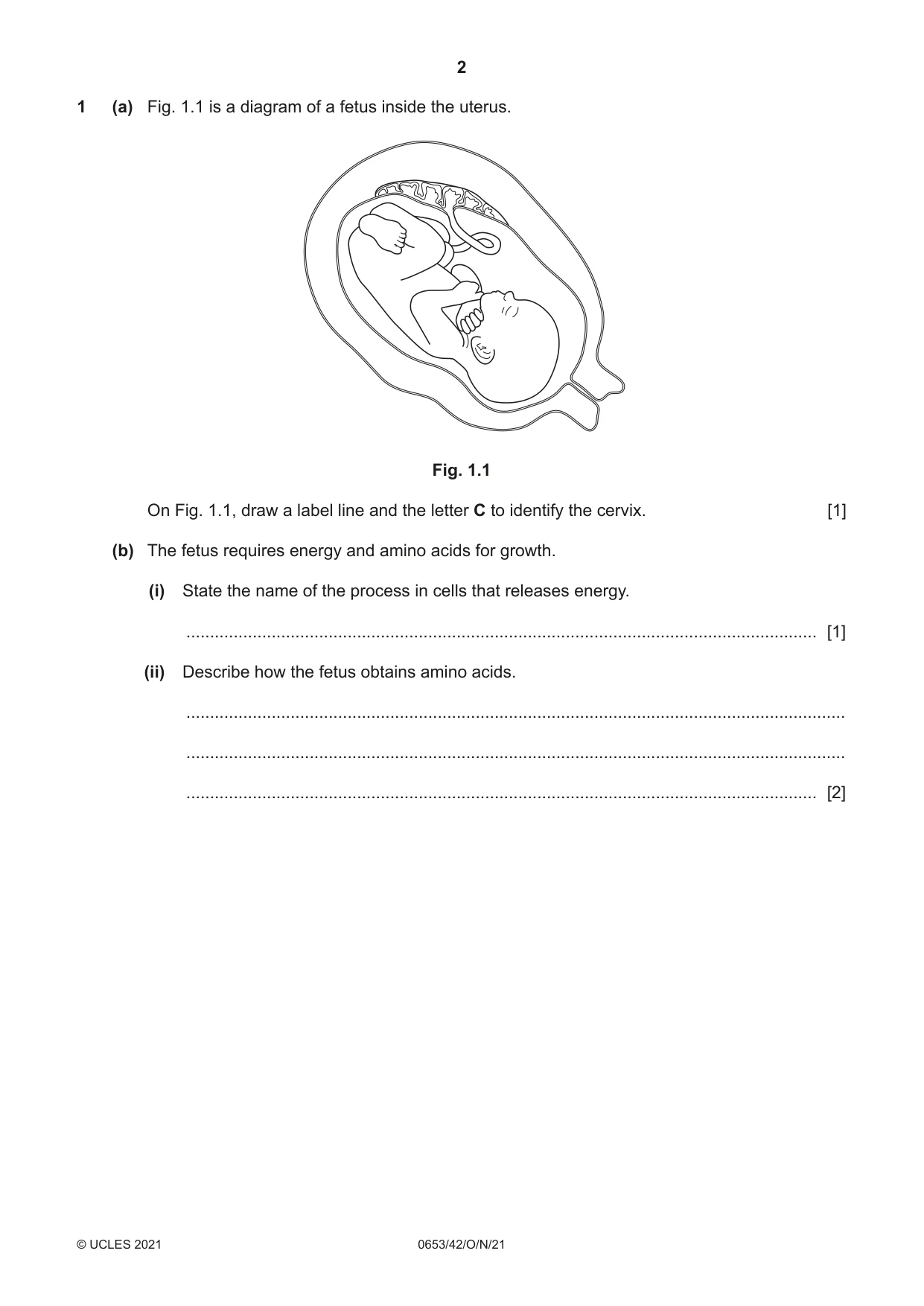
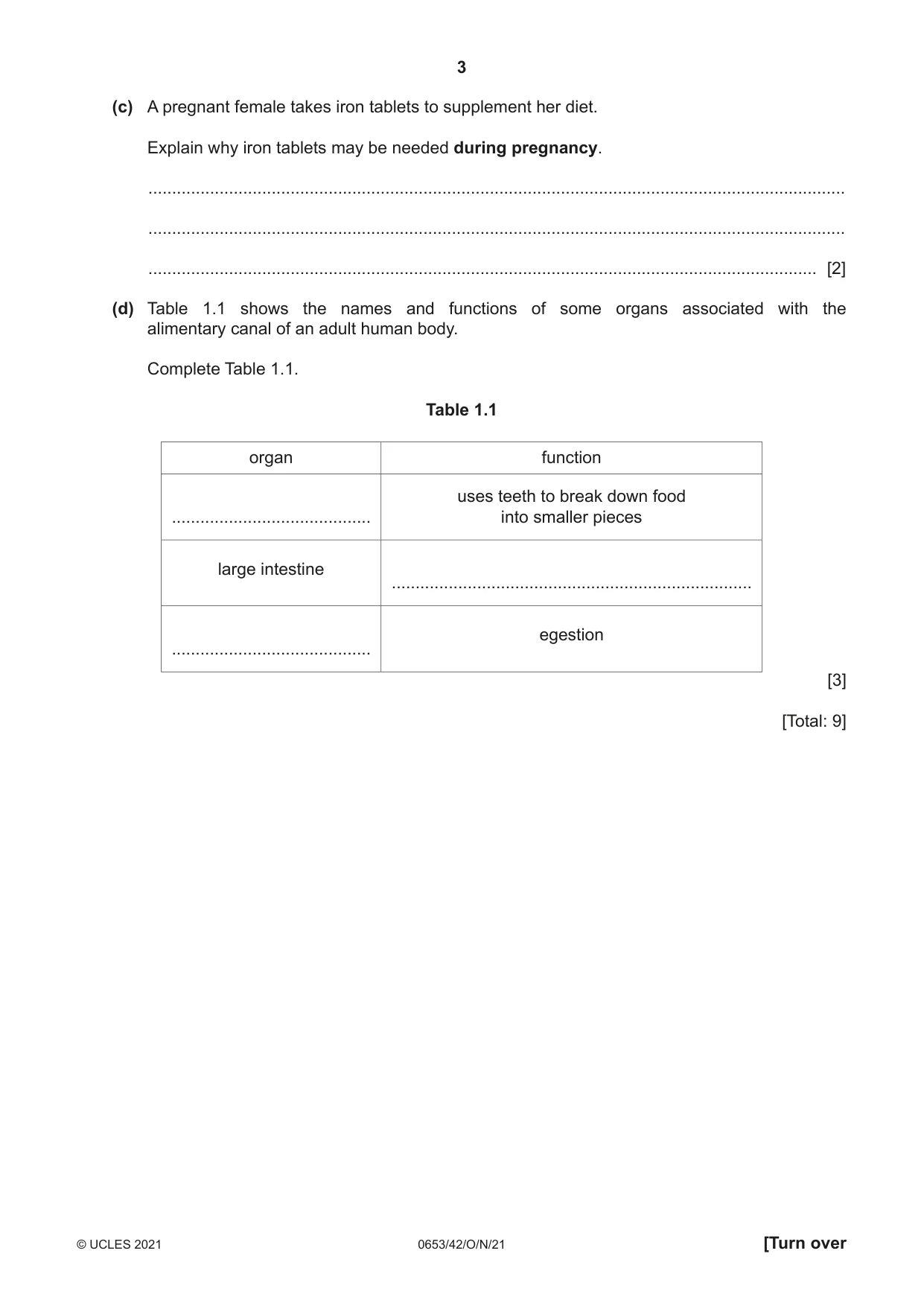
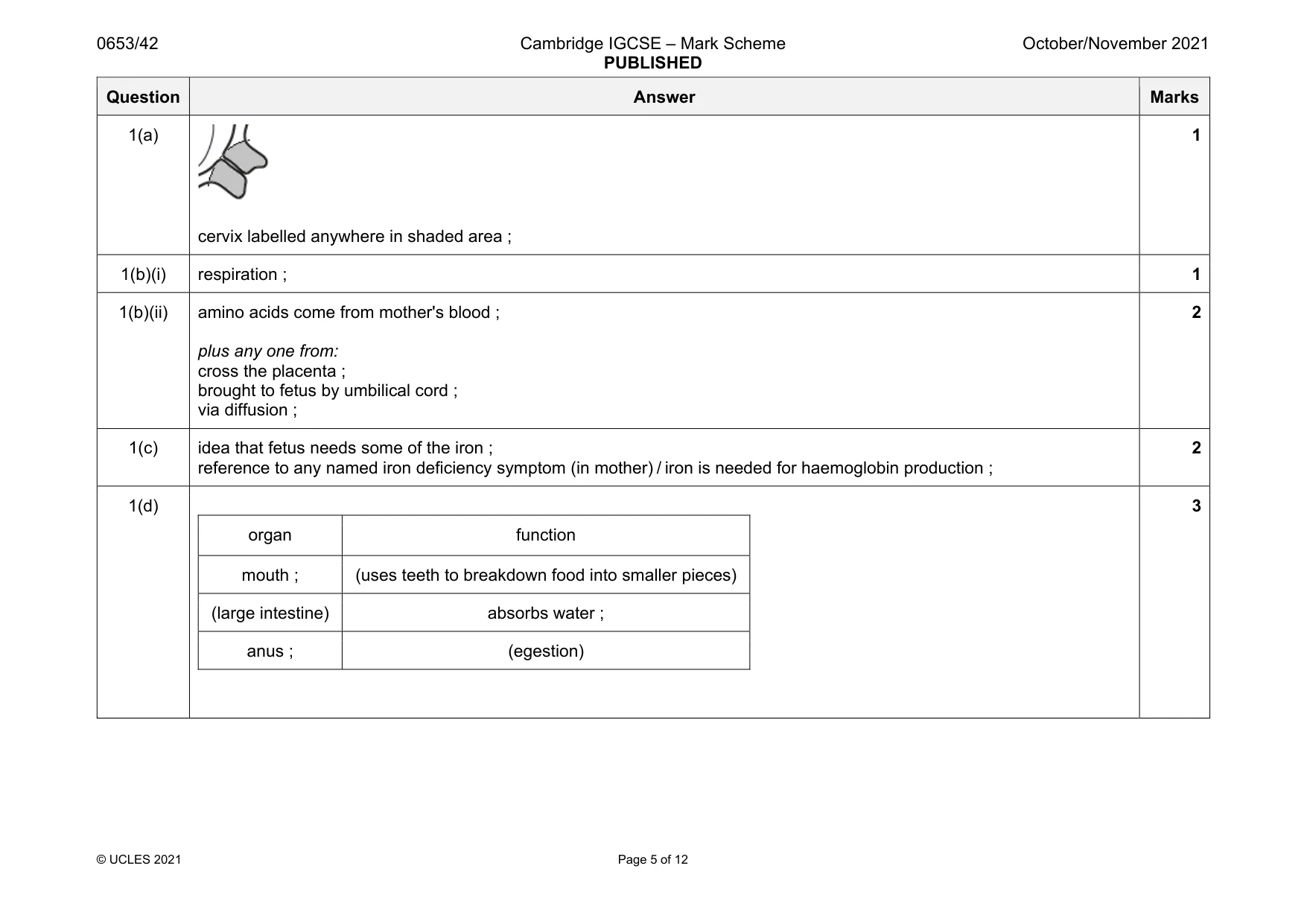
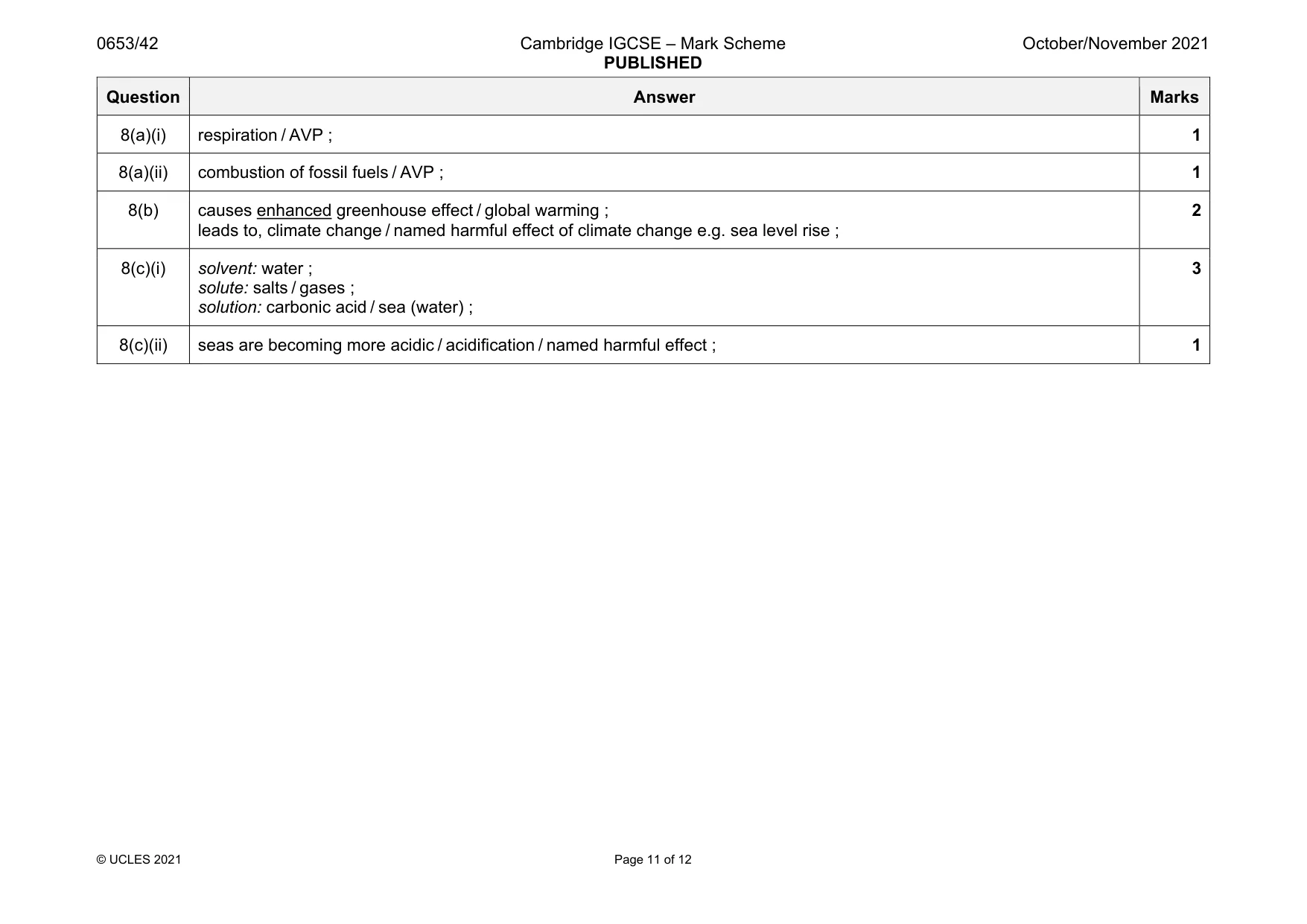
1 (a) Fig. 1.1 is a diagram of a fetus inside the uterus. Fig. 1.1 On Fig. 1.1, draw a label line and the letter C to identify the cervix. [1] (b) The fetus requires energy and amino acids for growth. (i) State the name of the process in cells that releases energy. ..................................................................................................................................... [1] (ii) Describe how the fetus obtains amino acids. ........................................................................................................................................... ........................................................................................................................................... ..................................................................................................................................... [2] (c) A pregnant female takes iron tablets to supplement her diet. Explain why iron tablets may be needed during pregnancy. ................................................................................................................................................... ................................................................................................................................................... ............................................................................................................................................. [2] (d) Table 1.1 shows the names and functions of some organs associated with the alimentary canal of an adult human body. Complete Table 1.1. Table 1.1 organ function uses teeth to break down food .......................................... into smaller pieces large intestine ............................................................................ egestion .......................................... [3] [Total: 9]
Mark scheme: 1(a) cervix labelled anywhere in shaded area ; 1 1(b)(i) respiration ; 1 1(b)(ii) amino acids come from mother's blood ; plus any one from: cross the placenta ; brought to fetus by umbilical cord ; via diffusion ; 2 1(c) idea that fetus needs some of the iron ; reference to any named iron deficiency symptom (in mother) / iron is needed for haemoglobin production ; 2 1(d) organ function mouth ; (uses teeth to breakdown food into smaller pieces) (large intestine) absorbs water ; anus ; (egestion) 3
Q2 · A student uses inert electrodes for the electrolysis of dilute aqueous sodium chloride…
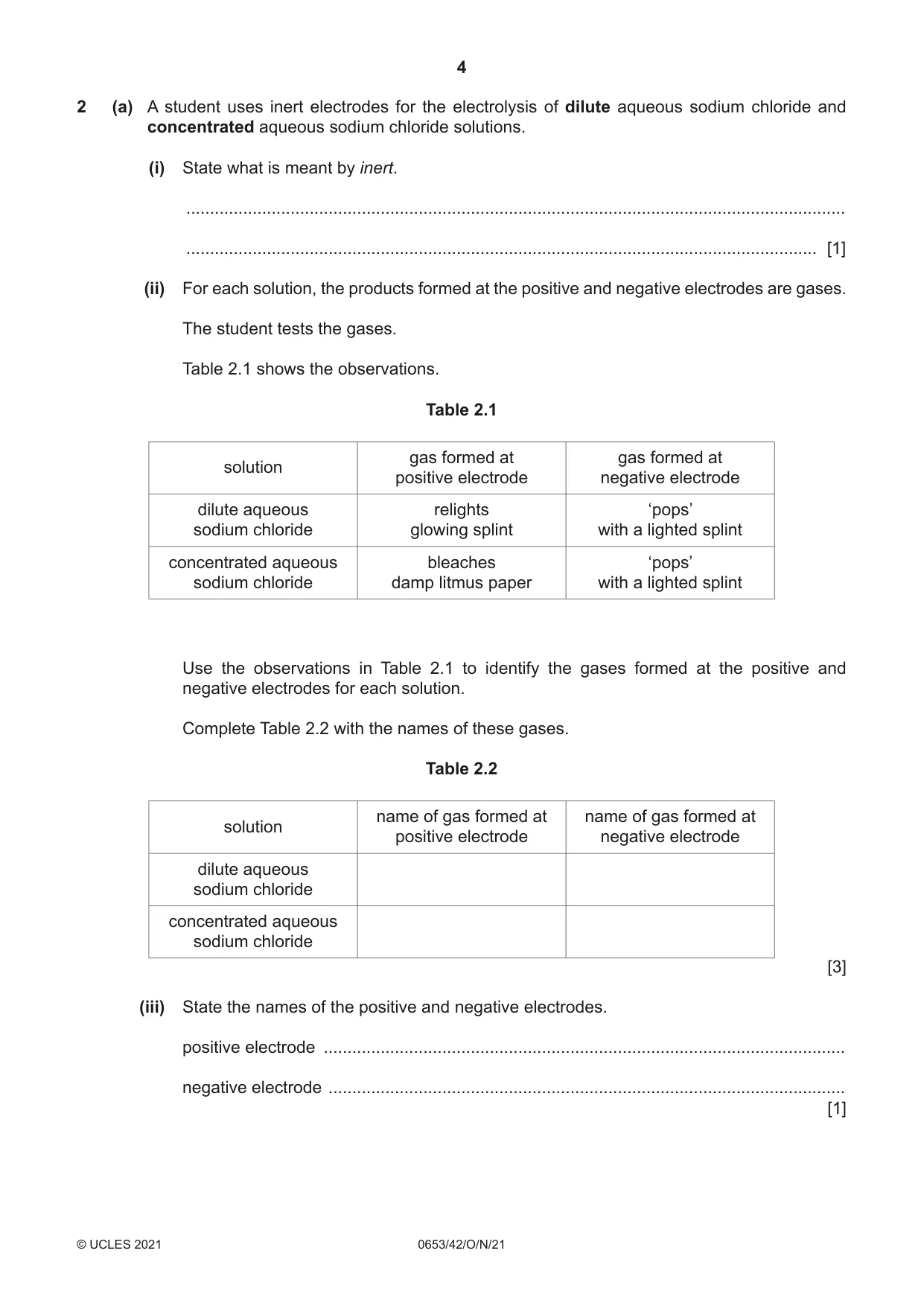
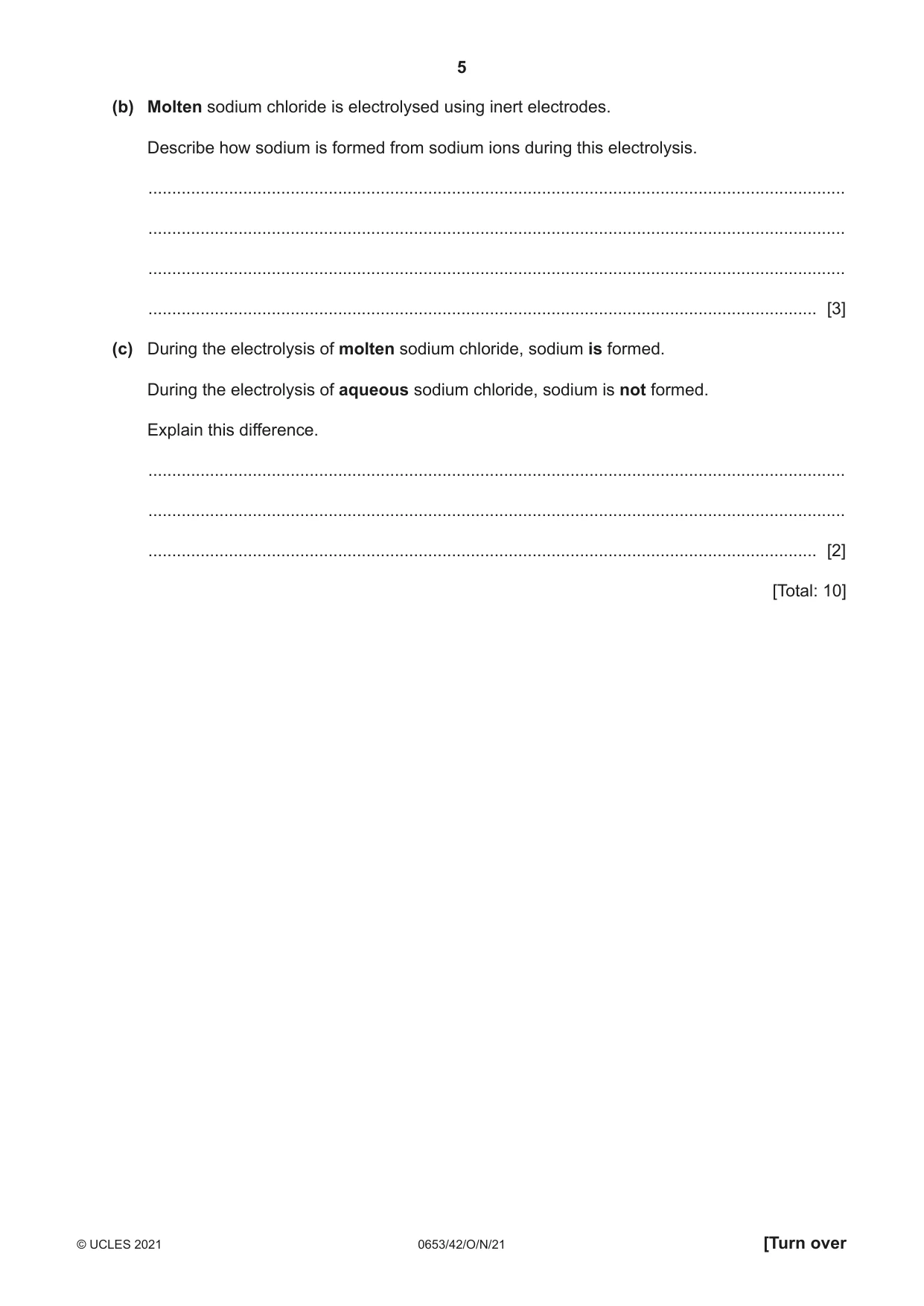
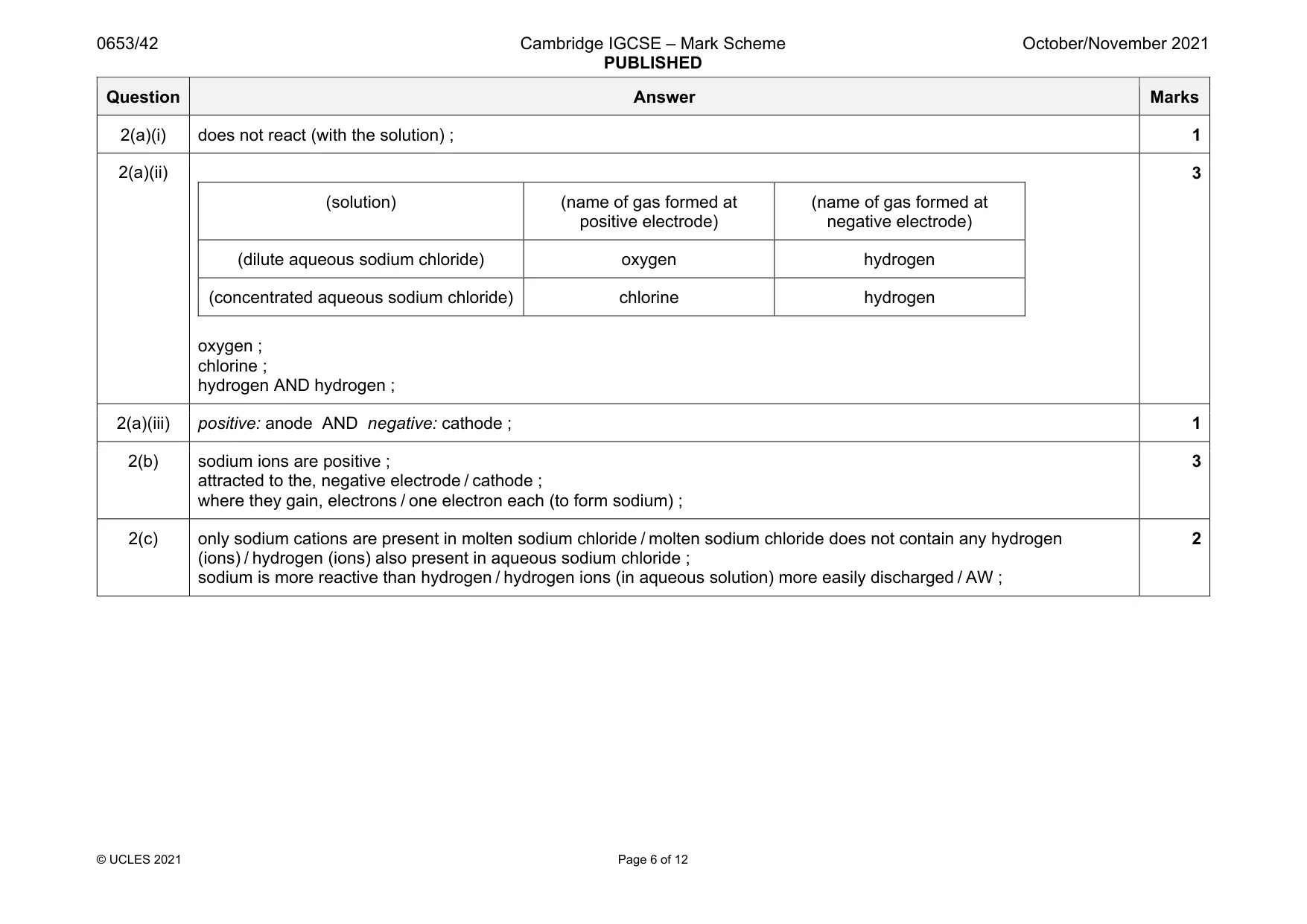
2 (a) A student uses inert electrodes for the electrolysis of dilute aqueous sodium chloride and concentrated aqueous sodium chloride solutions. (i) State what is meant by inert. ........................................................................................................................................... ..................................................................................................................................... [1] (ii) For each solution, the products formed at the positive and negative electrodes are gases. The student tests the gases. Table 2.1 shows the observations. Table 2.1 gas formed at gas formed at solution positive electrode negative electrode dilute aqueous relights ‘pops’ sodium chloride glowing splint with a lighted splint concentrated aqueous bleaches ‘pops’ sodium chloride damp litmus paper with a lighted splint Use the observations in Table 2.1 to identify the gases formed at the positive and negative electrodes for each solution. Complete Table 2.2 with the names of these gases. Table 2.2 name of gas formed at name of gas formed at solution positive electrode negative electrode dilute aqueous sodium chloride concentrated aqueous sodium chloride [3] (iii) State the names of the positive and negative electrodes. positive electrode .............................................................................................................. negative electrode ............................................................................................................. [1] (b) Molten sodium chloride is electrolysed using inert electrodes. Describe how sodium is formed from sodium ions during this electrolysis. ................................................................................................................................................... ................................................................................................................................................... ................................................................................................................................................... ............................................................................................................................................. [3] (c) During the electrolysis of molten sodium chloride, sodium is formed. During the electrolysis of aqueous sodium chloride, sodium is not formed. Explain this difference. ................................................................................................................................................... ................................................................................................................................................... ............................................................................................................................................. [2] [Total: 10]
Mark scheme: 2(a)(i) does not react (with the solution) ; 1 2(a)(ii) (solution) (name of gas formed at positive electrode) (name of gas formed at negative electrode) (dilute aqueous sodium chloride) oxygen hydrogen (concentrated aqueous sodium chloride) chlorine hydrogen oxygen ; chlorine ; hydrogen AND hydrogen ; 3 2(a)(iii) positive: anode AND negative: cathode ; 1 2(b) sodium ions are positive ; attracted to the, negative electrode / cathode ; where they gain, electrons / one electron each (to form sodium) ; 3 2(c) only sodium cations are present in molten sodium chloride / molten sodium chloride does not contain any hydrogen (ions) / hydrogen (ions) also present in aqueous sodium chloride ; sodium is more reactive than hydrogen / hydrogen ions (in aqueous solution) more easily discharged / AW ; 2
Q3 · Two beach balls are floating in the sea
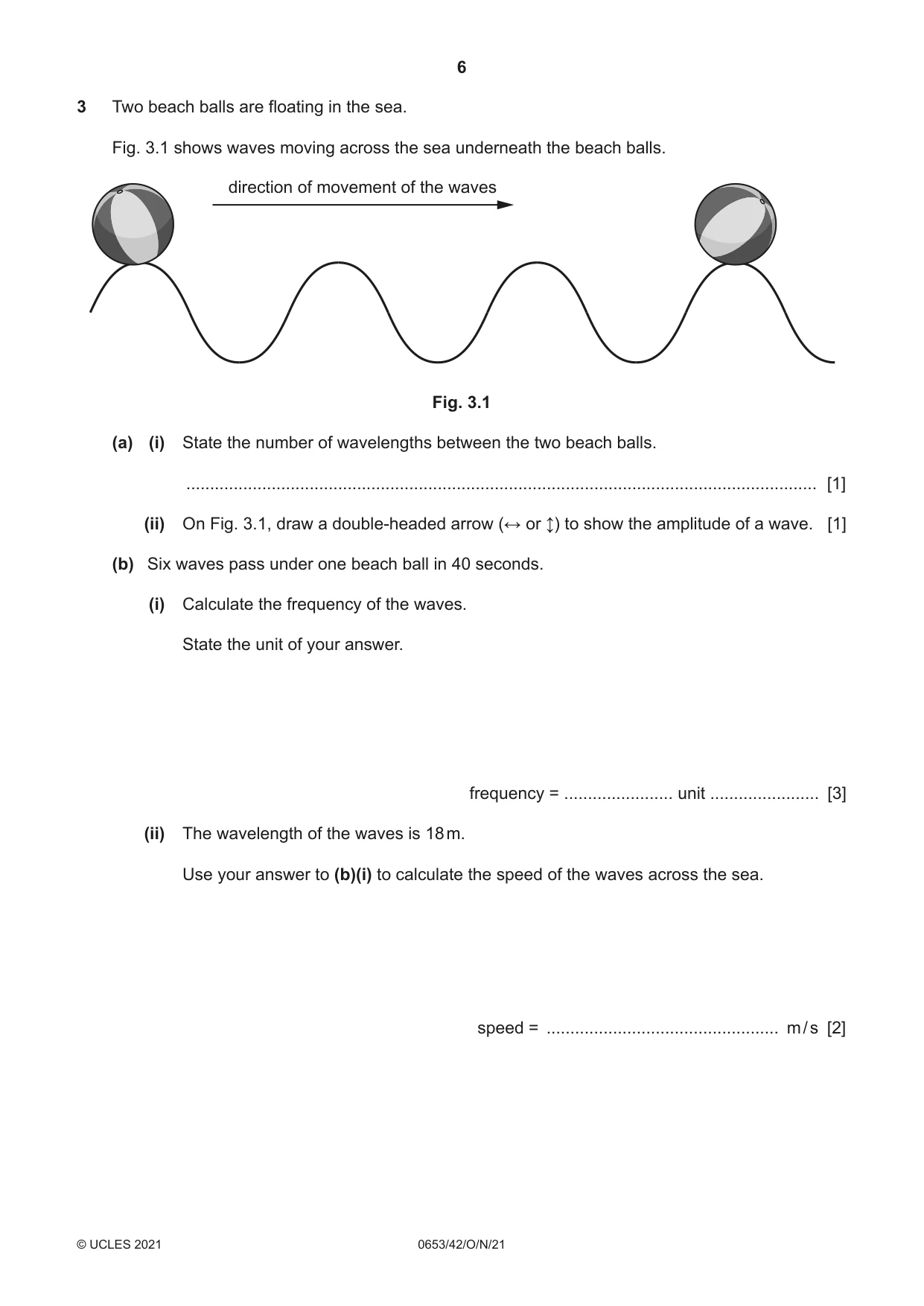
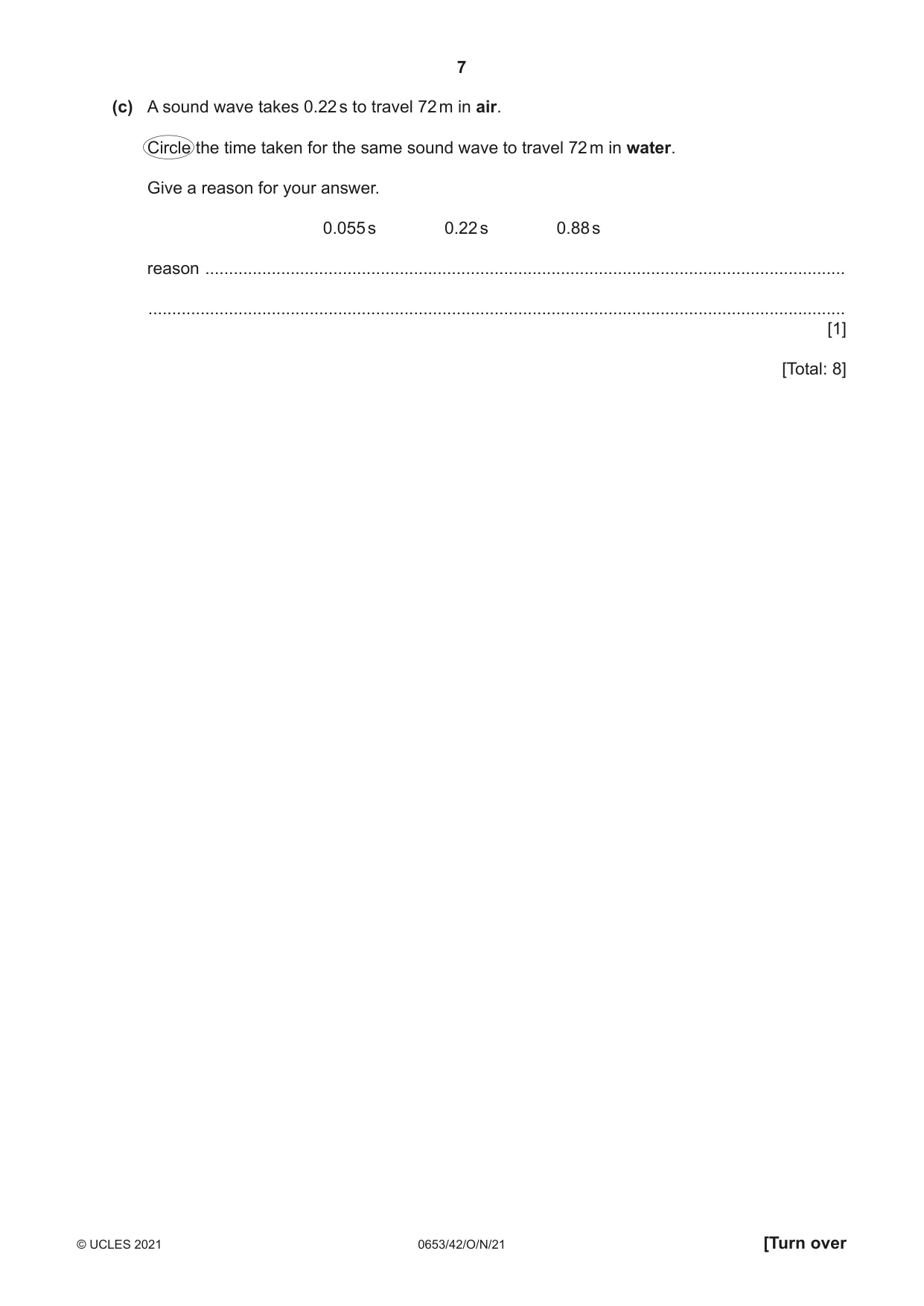
3 Two beach balls are floating in the sea. Fig. 3.1 shows waves moving across the sea underneath the beach balls. direction of movement of the waves Fig. 3.1 (a) (i) State the number of wavelengths between the two beach balls. ..................................................................................................................................... [1] (ii) On Fig. 3.1, draw a double-headed arrow (↔ or ↕) to show the amplitude of a wave. [1] (b) Six waves pass under one beach ball in 40 seconds. (i) Calculate the frequency of the waves. State the unit of your answer. frequency = ....................... unit ....................... [3] (ii) The wavelength of the waves is 18 m. Use your answer to (b)(i) to calculate the speed of the waves across the sea. speed = ................................................. m / s [2] (c) A sound wave takes 0.22 s to travel 72 m in air. Circle the time taken for the same sound wave to travel 72 m in water. Give a reason for your answer. 0.055 s 0.22 s 0.88 s reason ....................................................................................................................................... ................................................................................................................................................... [1] [Total: 8]
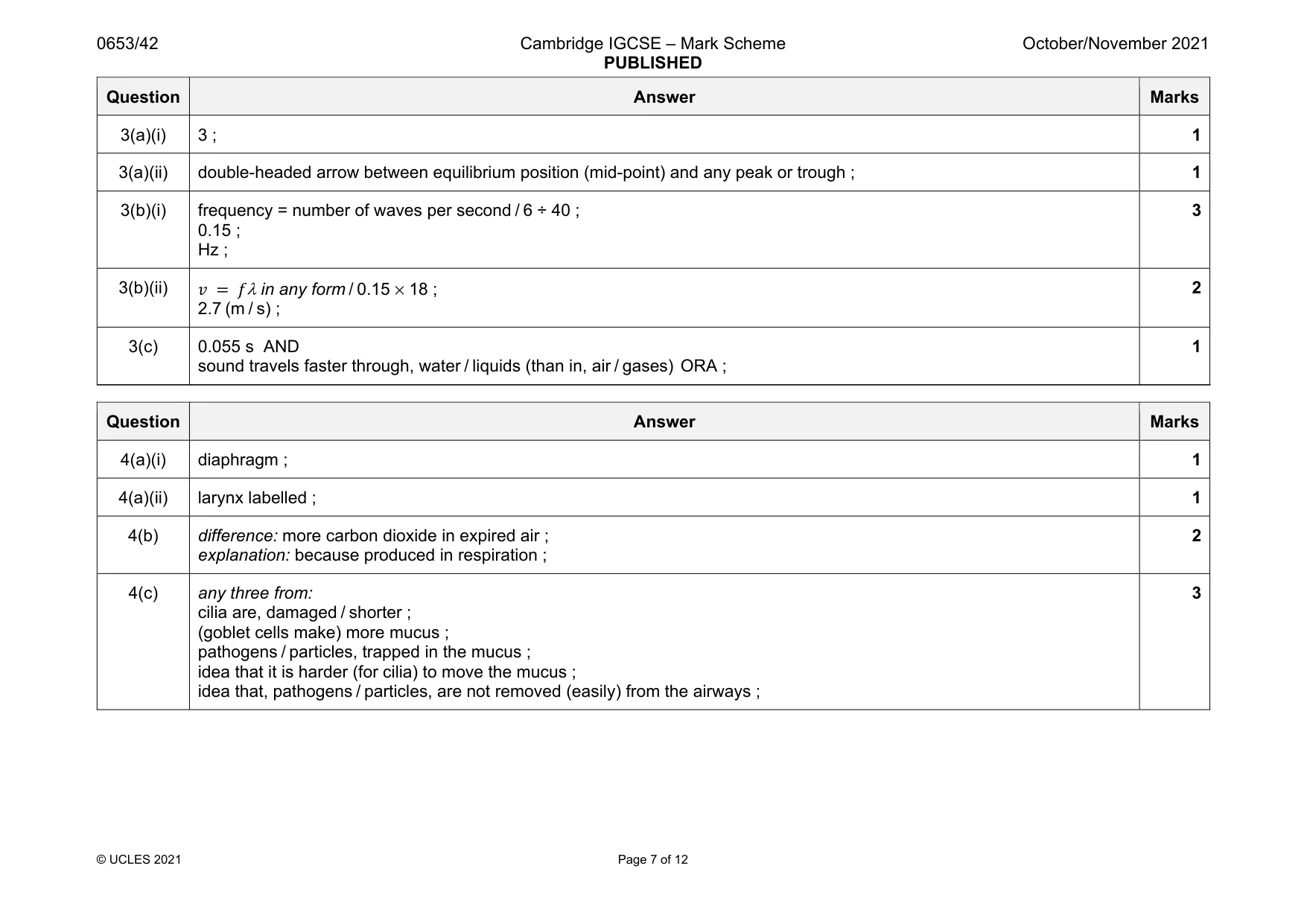
Mark scheme: 3(a)(i) 3 ; 1 3(a)(ii) double-headed arrow between equilibrium position (mid-point) and any peak or trough ; 1 3(b)(i) frequency = number of waves per second / 6 ÷ 40 ; 0.15 ; Hz ; 3 3(b)(ii) 𝑣 = 𝑓 in any form / 0.15 × 18 ; 2.7 (m / s) ; 2 3(c) 0.055 s AND sound travels faster through, water / liquids (than in, air / gases) ORA ; 1
Q4 · A diagram of the gas exchange system in a human
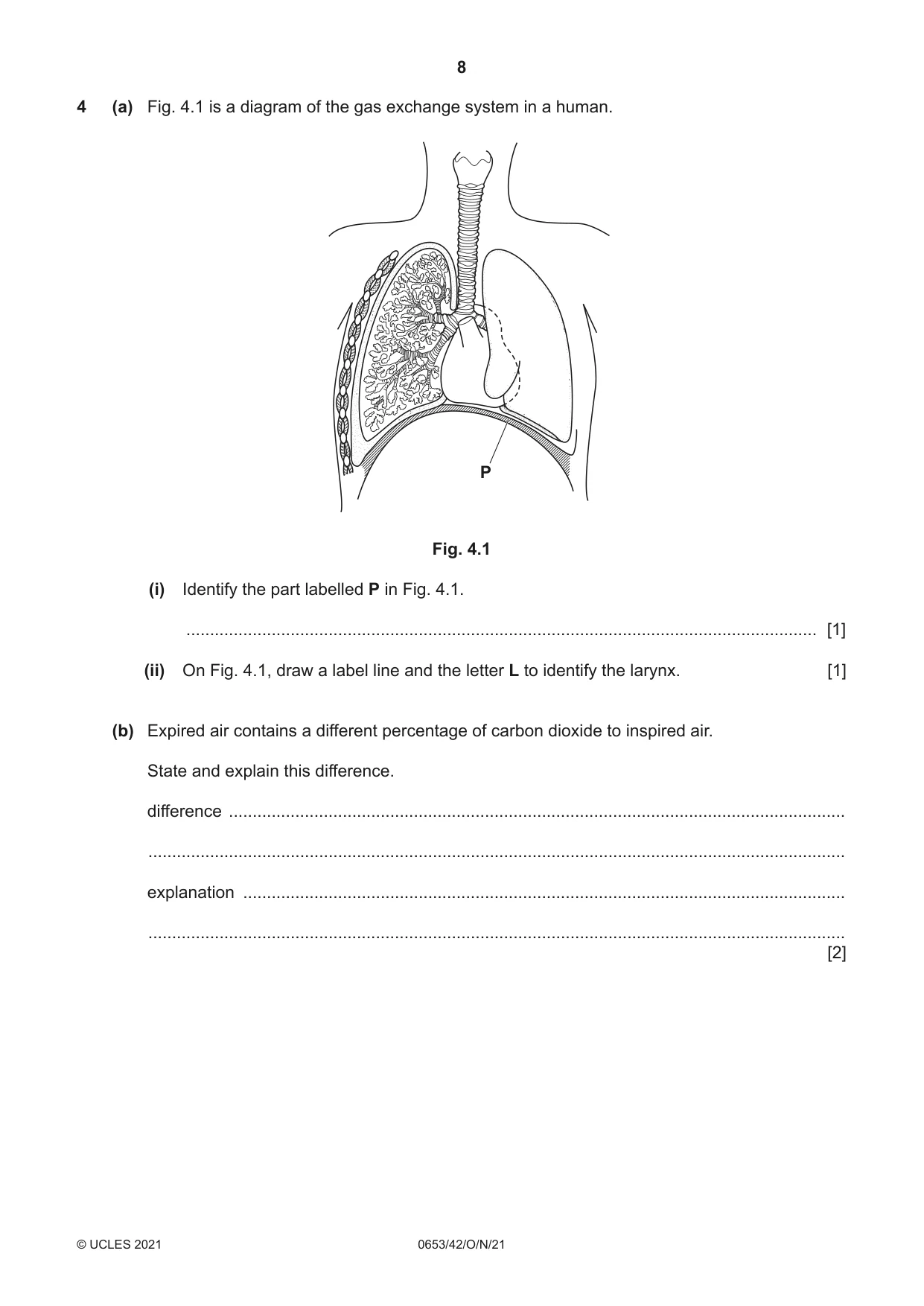
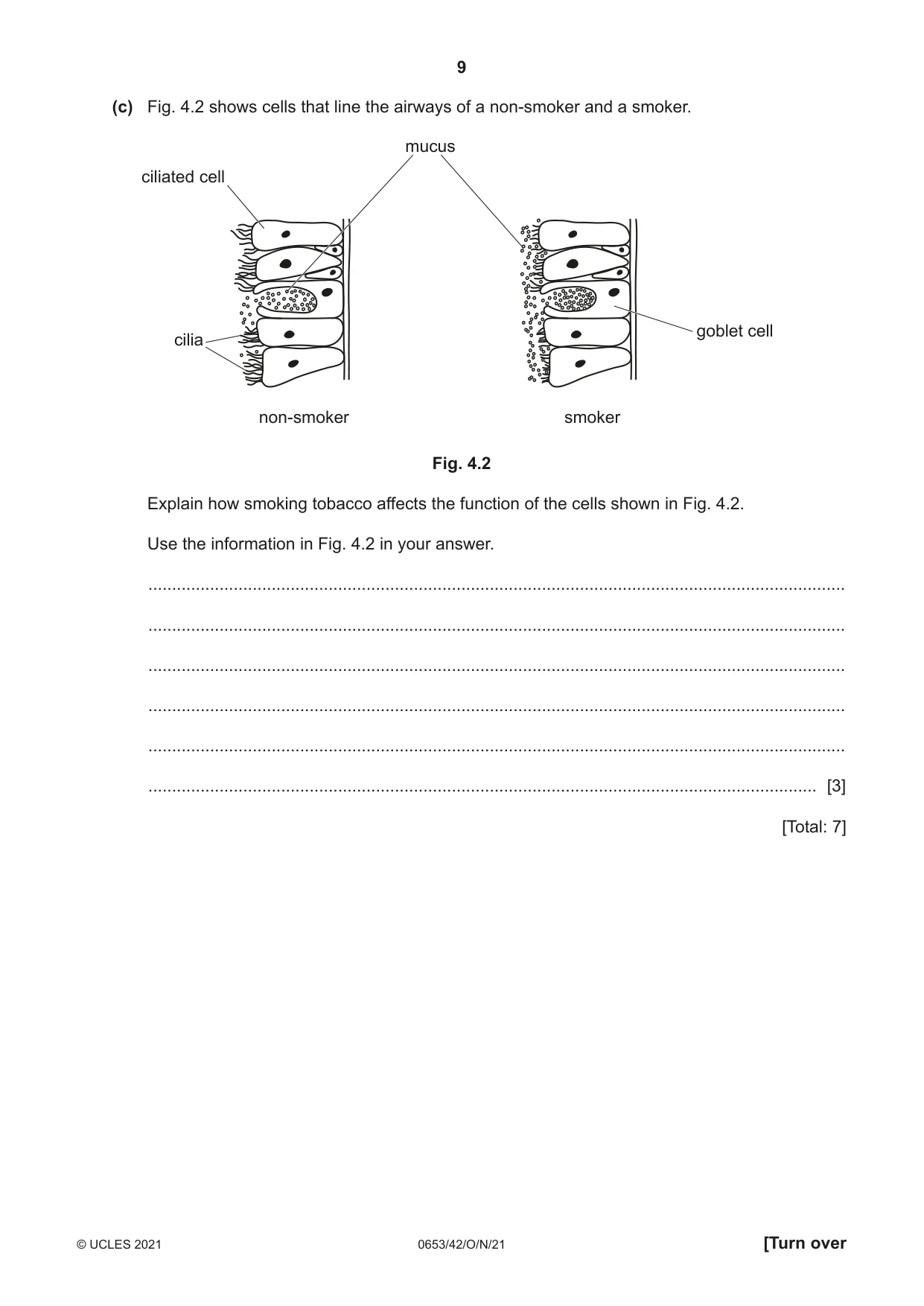
4 (a) Fig. 4.1 is a diagram of the gas exchange system in a human. P Fig. 4.1 (i) Identify the part labelled P in Fig. 4.1. ..................................................................................................................................... [1] (ii) On Fig. 4.1, draw a label line and the letter L to identify the larynx. [1] (b) Expired air contains a different percentage of carbon dioxide to inspired air. State and explain this difference. difference .................................................................................................................................. ................................................................................................................................................... explanation ............................................................................................................................... ................................................................................................................................................... [2] (c) Fig. 4.2 shows cells that line the airways of a non-smoker and a smoker. mucus ciliated cell goblet cell cilia non-smoker smoker Fig. 4.2 Explain how smoking tobacco affects the function of the cells shown in Fig. 4.2. Use the information in Fig. 4.2 in your answer. ................................................................................................................................................... ................................................................................................................................................... ................................................................................................................................................... ................................................................................................................................................... ................................................................................................................................................... ............................................................................................................................................. [3] [Total: 7]
Mark scheme: 4(a)(i) diaphragm ; 1 4(a)(ii) larynx labelled ; 1 4(b) difference: more carbon dioxide in expired air ; explanation: because produced in respiration ; 2 4(c) any three from: cilia are, damaged / shorter ; (goblet cells make) more mucus ; pathogens / particles, trapped in the mucus ; idea that it is harder (for cilia) to move the mucus ; idea that, pathogens / particles, are not removed (easily) from the airways ; 3
Q5 · The pH values of four aqueous salt solutions are listed in Table 5.1
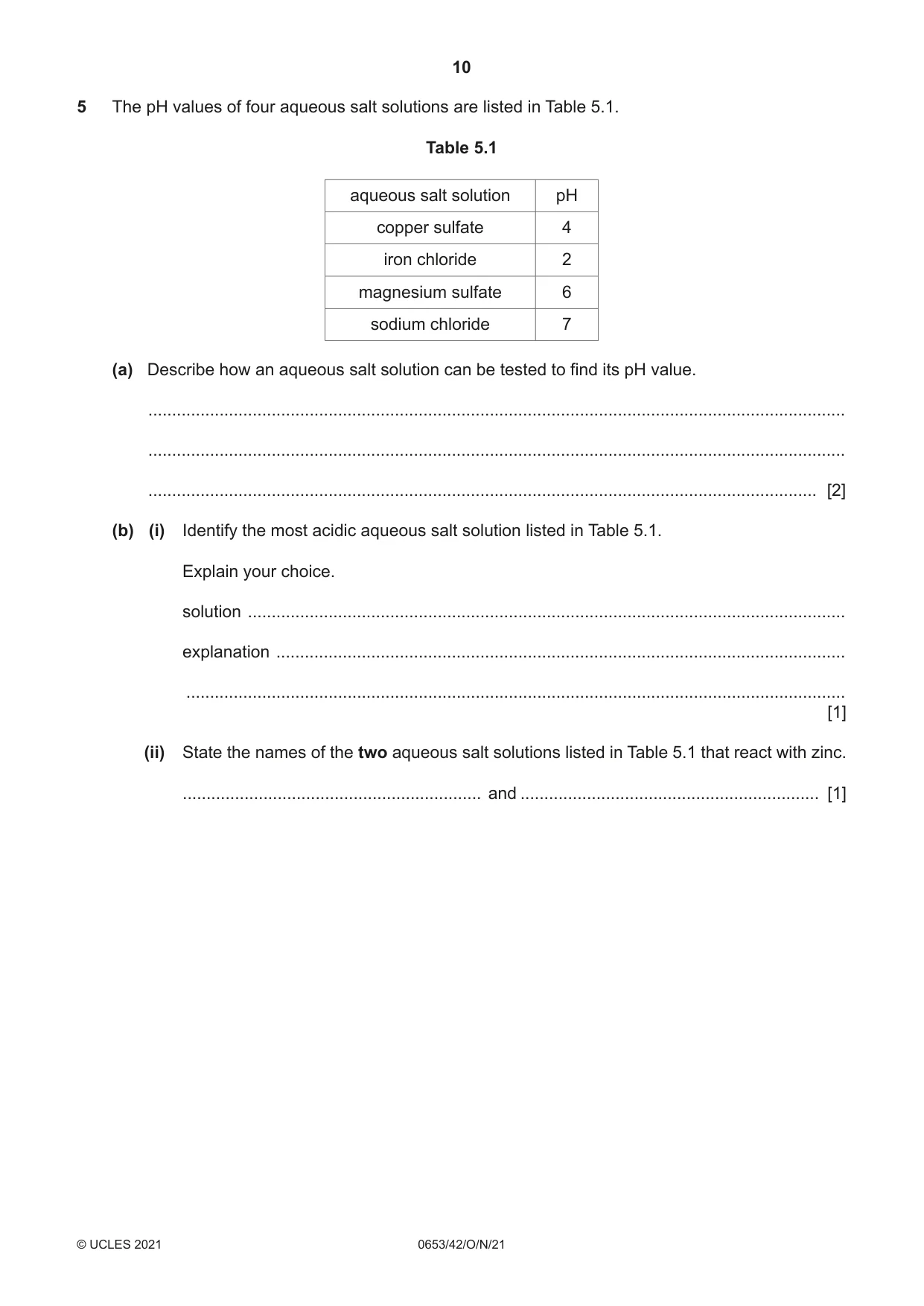
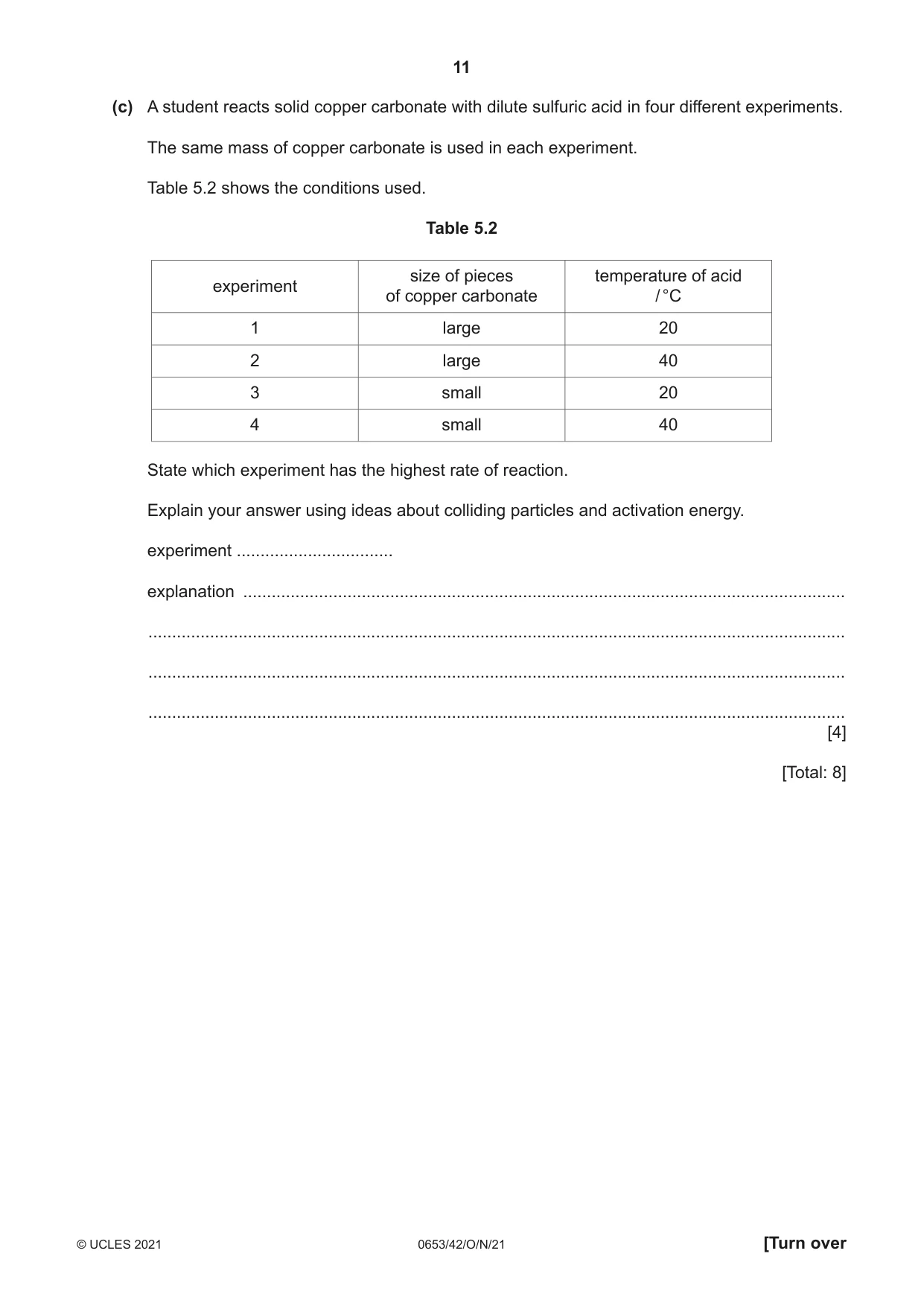
5 The pH values of four aqueous salt solutions are listed in Table 5.1. Table 5.1 aqueous salt solution pH copper sulfate 4 iron chloride 2 magnesium sulfate 6 sodium chloride 7 (a) Describe how an aqueous salt solution can be tested to find its pH value. ................................................................................................................................................... ................................................................................................................................................... ............................................................................................................................................. [2] (b) (i) Identify the most acidic aqueous salt solution listed in Table 5.1. Explain your choice. solution .............................................................................................................................. explanation ........................................................................................................................ ........................................................................................................................................... [1] (ii) State the names of the two aqueous salt solutions listed in Table 5.1 that react with zinc. ............................................................... and ............................................................... [1] (c) A student reacts solid copper carbonate with dilute sulfuric acid in four different experiments. The same mass of copper carbonate is used in each experiment. Table 5.2 shows the conditions used. Table 5.2 size of pieces temperature of acid experiment of copper carbonate / °C 1 large 20 2 large 40 3 small 20 4 small 40 State which experiment has the highest rate of reaction. Explain your answer using ideas about colliding particles and activation energy. experiment ................................. explanation ............................................................................................................................... ................................................................................................................................................... ................................................................................................................................................... ................................................................................................................................................... [4] [Total: 8]
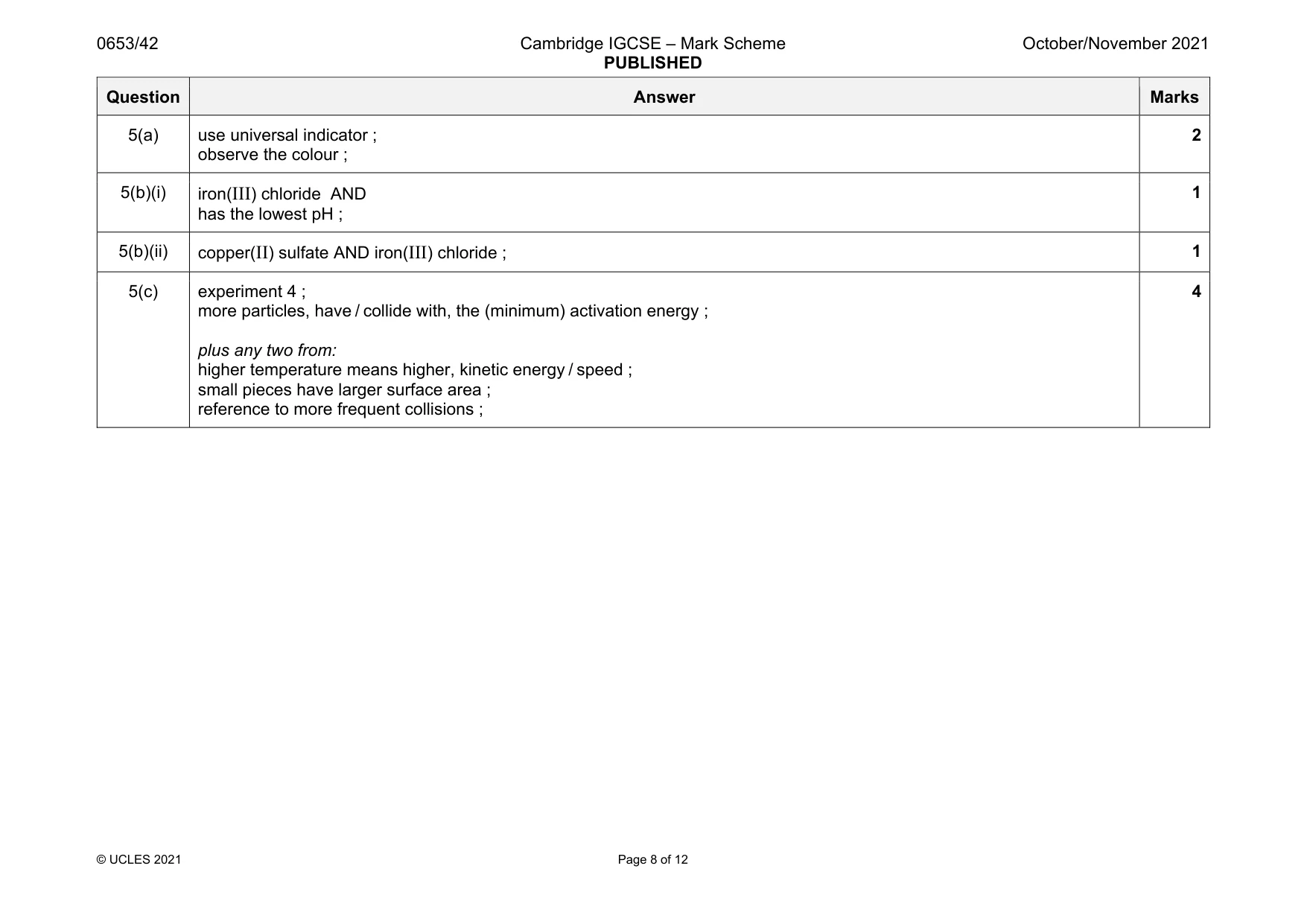
Mark scheme: 5(a) use universal indicator ; observe the colour ; 2 5(b)(i) iron(III) chloride AND has the lowest pH ; 1 5(b)(ii) copper(II) sulfate AND iron(III) chloride ; 1 5(c) experiment 4 ; more particles, have / collide with, the (minimum) activation energy ; plus any two from: higher temperature means higher, kinetic energy / speed ; small pieces have larger surface area ; reference to more frequent collisions ; 4
More questions on The characteristic properties of acids and bases
Q6 · A meteorite is an object from space that travels through the Earth’s atmosphere and hits…
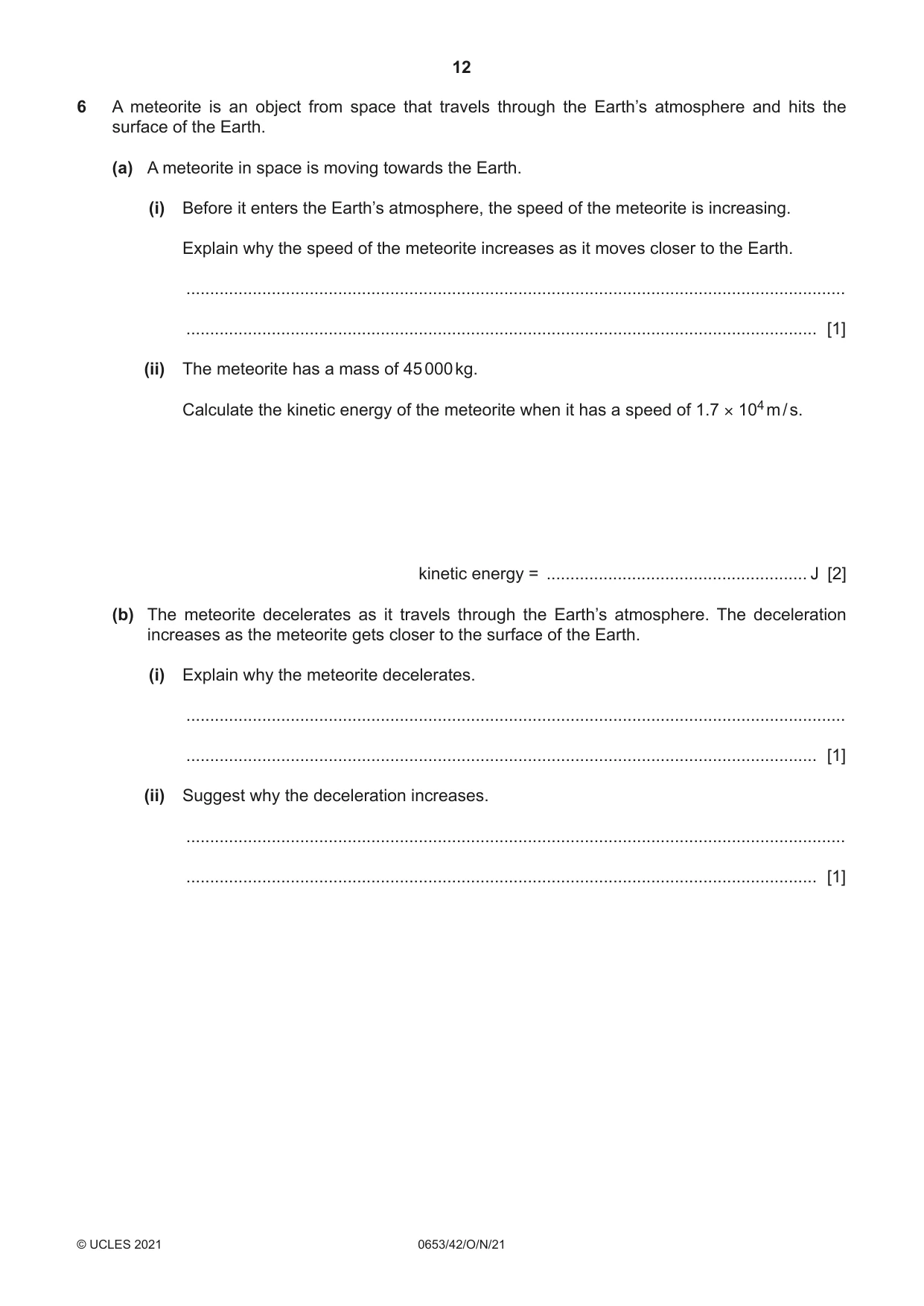
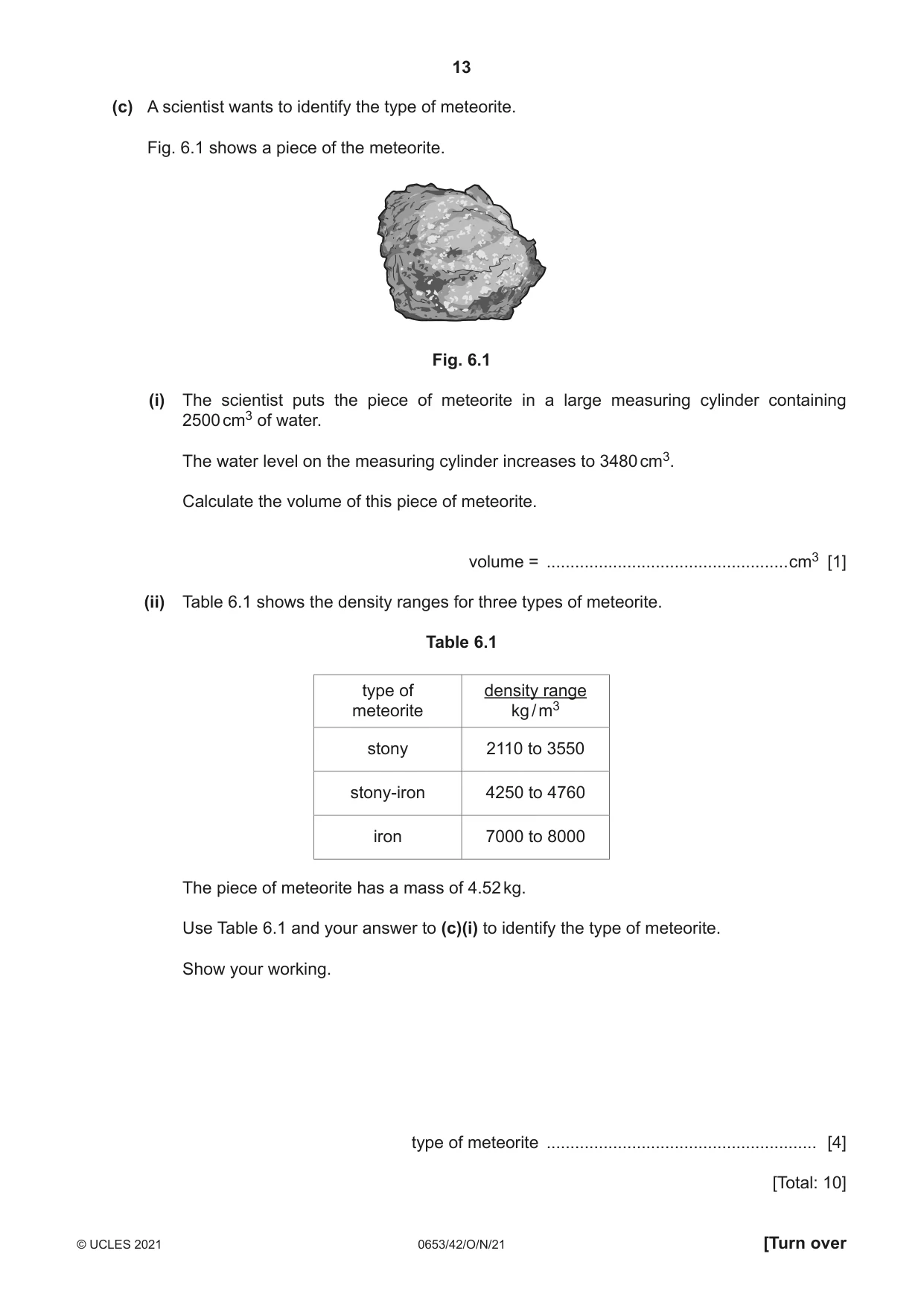
6 A meteorite is an object from space that travels through the Earth’s atmosphere and hits the surface of the Earth. (a) A meteorite in space is moving towards the Earth. (i) Before it enters the Earth’s atmosphere, the speed of the meteorite is increasing. Explain why the speed of the meteorite increases as it moves closer to the Earth. ........................................................................................................................................... ..................................................................................................................................... [1] (ii) The meteorite has a mass of 45 000 kg. Calculate the kinetic energy of the meteorite when it has a speed of 1.7 × 10⁴ m / s. kinetic energy = ....................................................... J [2] (b) The meteorite decelerates as it travels through the Earth’s atmosphere. The deceleration increases as the meteorite gets closer to the surface of the Earth. (i) Explain why the meteorite decelerates. ........................................................................................................................................... ..................................................................................................................................... [1] (ii) Suggest why the deceleration increases. ........................................................................................................................................... ..................................................................................................................................... [1] (c) A scientist wants to identify the type of meteorite. Fig. 6.1 shows a piece of the meteorite. Fig. 6.1 (i) The scientist puts the piece of meteorite in a large measuring cylinder containing 2500 cm3 of water. The water level on the measuring cylinder increases to 3480 cm3. Calculate the volume of this piece of meteorite. volume = ...................................................cm3 [1] (ii) Table 6.1 shows the density ranges for three types of meteorite. Table 6.1 type of density range meteorite kg / m3 stony 2110 to 3550 stony-iron 4250 to 4760 iron 7000 to 8000 The piece of meteorite has a mass of 4.52 kg. Use Table 6.1 and your answer to (c)(i) to identify the type of meteorite. Show your working. type of meteorite ......................................................... [4] [Total: 10]
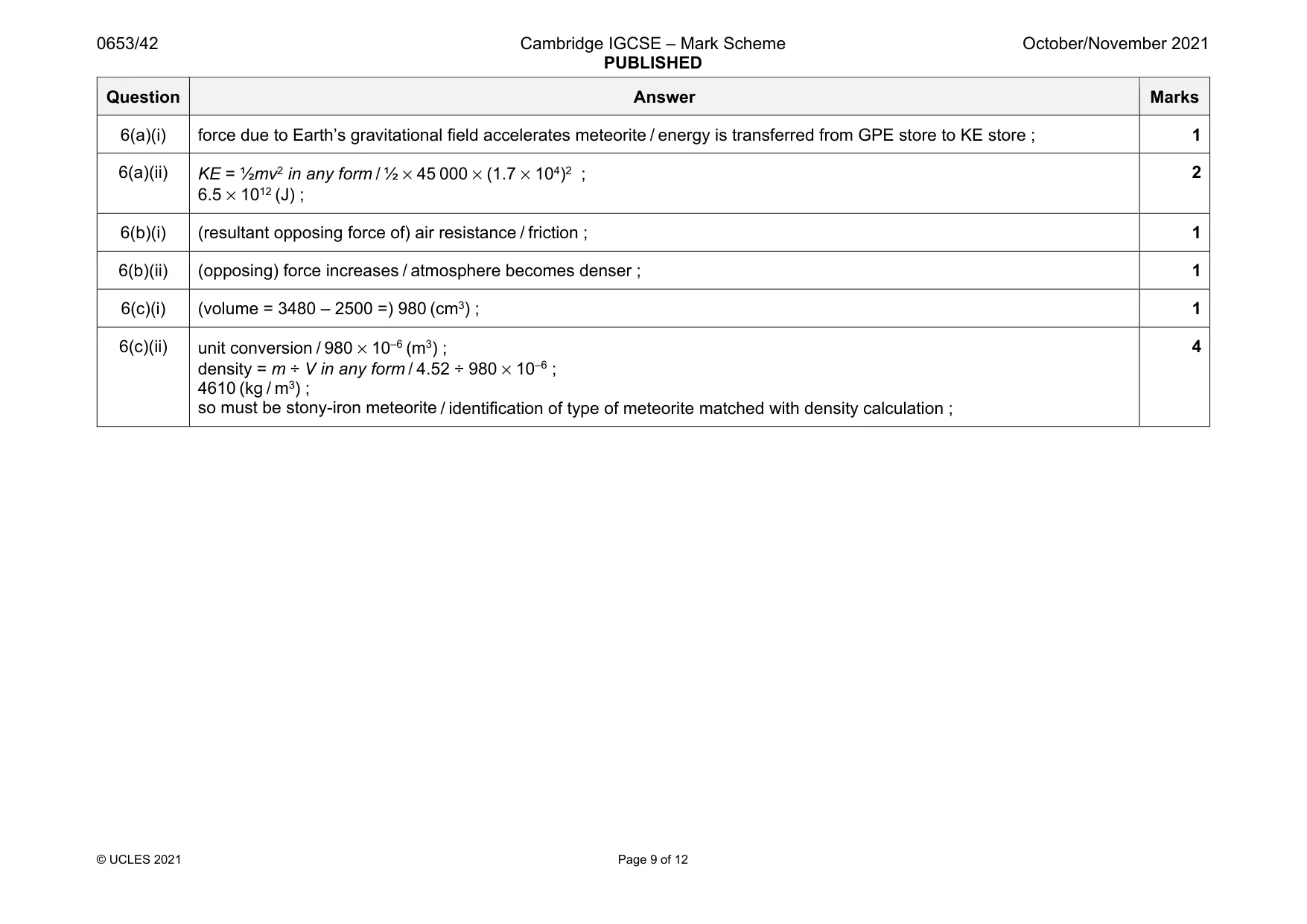
Mark scheme: 6(a)(i) force due to Earth’s gravitational field accelerates meteorite / energy is transferred from GPE store to KE store ; 1 6(a)(ii) KE = ½mv2 in any form / ½ × 45 000 × (1.7 × 104)2 ; 6.5 × 10¹² (J) ; 2 6(b)(i) (resultant opposing force of) air resistance / friction ; 1 6(b)(ii) (opposing) force increases / atmosphere becomes denser ; 1 6(c)(i) (volume = 3480 – 2500 =) 980 (cm3) ; 1 6(c)(ii) unit conversion / 980 × 10–6 (m3) ; density = m ÷ V in any form / 4.52 ÷ 980 × 10–6 ; 4610 (kg / m3) ; so must be stony-iron meteorite / identification of type of meteorite matched with density calculation ; 4
Q7 · A student investigates the effect of light intensity on the rate of photosynthesis of an…
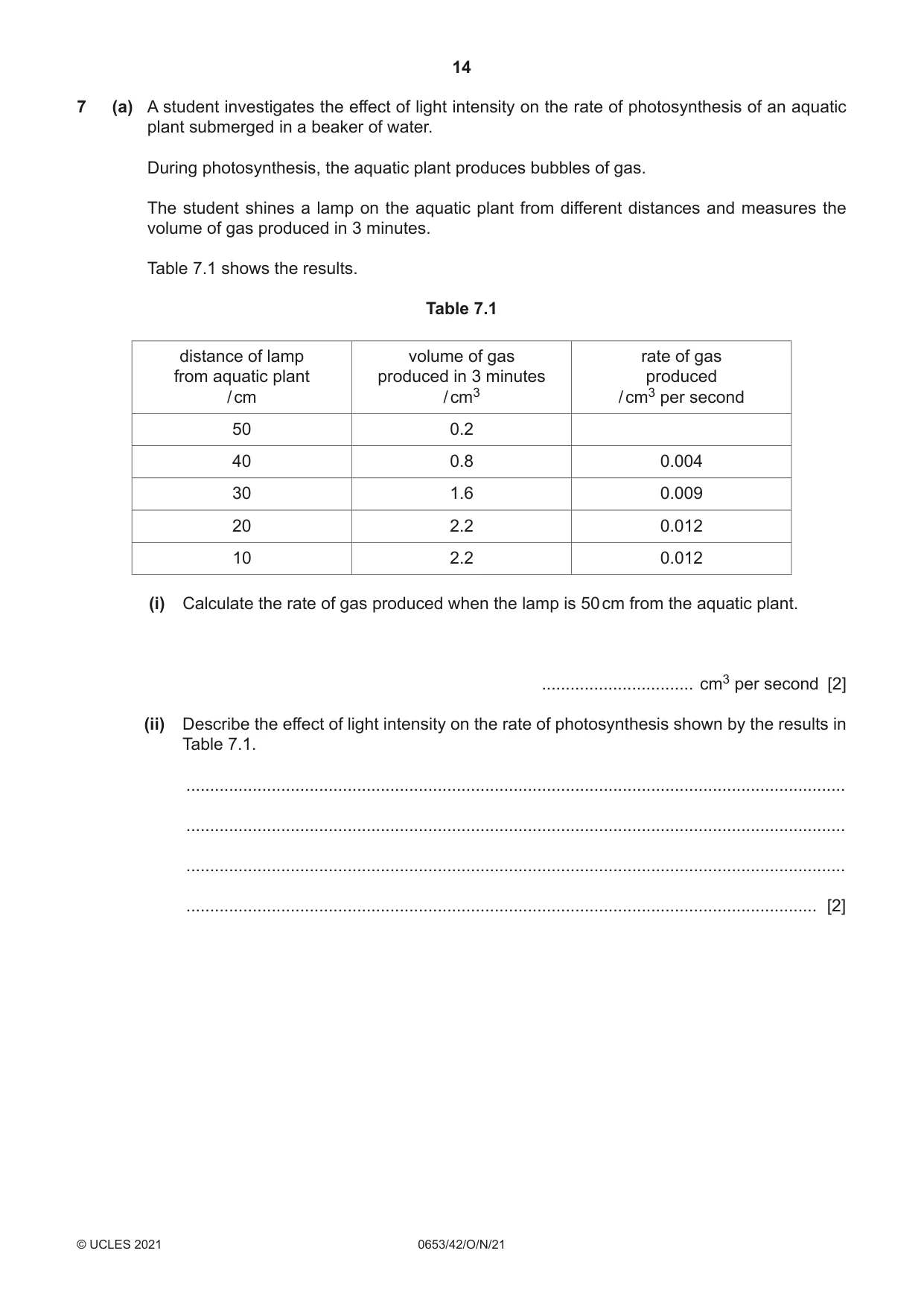
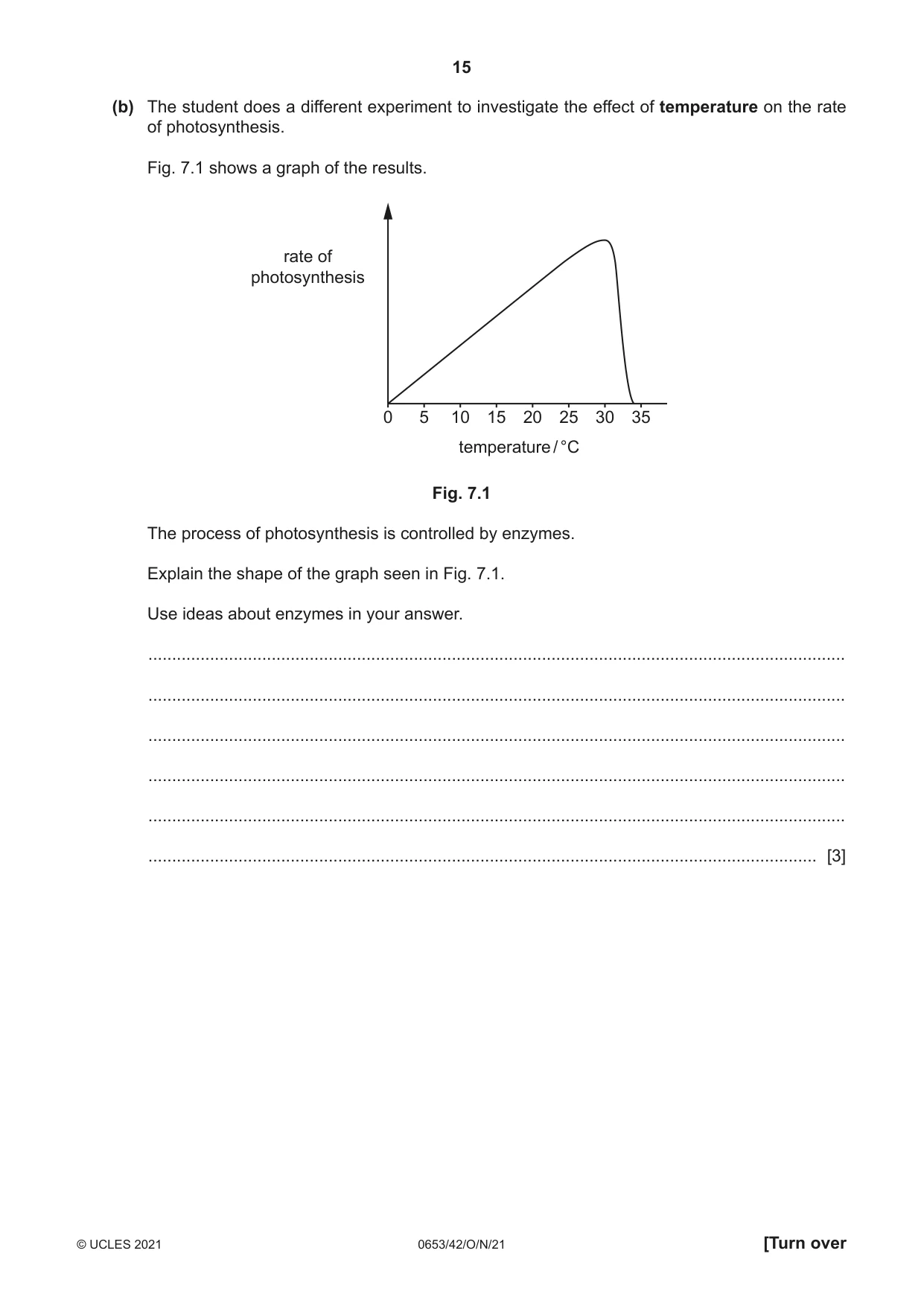
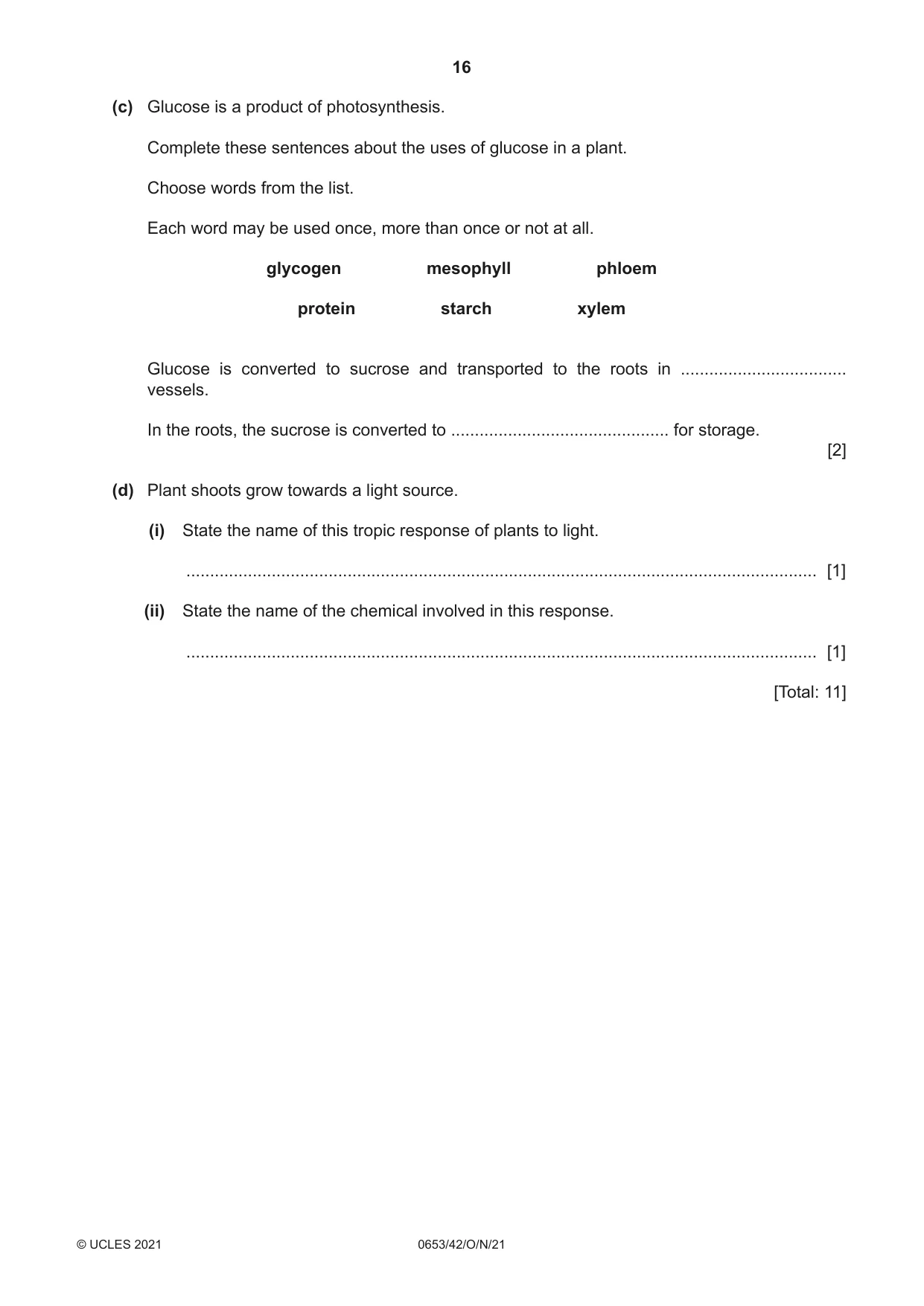
7 (a) A student investigates the effect of light intensity on the rate of photosynthesis of an aquatic plant submerged in a beaker of water. During photosynthesis, the aquatic plant produces bubbles of gas. The student shines a lamp on the aquatic plant from different distances and measures the volume of gas produced in 3 minutes. Table 7.1 shows the results. Table 7.1 distance of lamp volume of gas rate of gas from aquatic plant produced in 3 minutes produced / cm / cm3 / cm3 per second 50 0.2 40 0.8 0.004 30 1.6 0.009 20 2.2 0.012 10 2.2 0.012 (i) Calculate the rate of gas produced when the lamp is 50 cm from the aquatic plant. ................................ cm3 per second [2] (ii) Describe the effect of light intensity on the rate of photosynthesis shown by the results in Table 7.1. ........................................................................................................................................... ........................................................................................................................................... ........................................................................................................................................... ..................................................................................................................................... [2] (b) The student does a different experiment to investigate the effect of temperature on the rate of photosynthesis. Fig. 7.1 shows a graph of the results. rate of photosynthesis 0 5 10 15 20 25 30 35 temperature / °C Fig. 7.1 The process of photosynthesis is controlled by enzymes. Explain the shape of the graph seen in Fig. 7.1. Use ideas about enzymes in your answer. ................................................................................................................................................... ................................................................................................................................................... ................................................................................................................................................... ................................................................................................................................................... ................................................................................................................................................... ............................................................................................................................................. [3] (c) Glucose is a product of photosynthesis. Complete these sentences about the uses of glucose in a plant. Choose words from the list. Each word may be used once, more than once or not at all. glycogen mesophyll phloem protein starch xylem Glucose is converted to sucrose and transported to the roots in ................................... vessels. In the roots, the sucrose is converted to .............................................. for storage. [2] (d) Plant shoots grow towards a light source. (i) State the name of this tropic response of plants to light. ..................................................................................................................................... [1] (ii) State the name of the chemical involved in this response. ..................................................................................................................................... [1] [Total: 11]
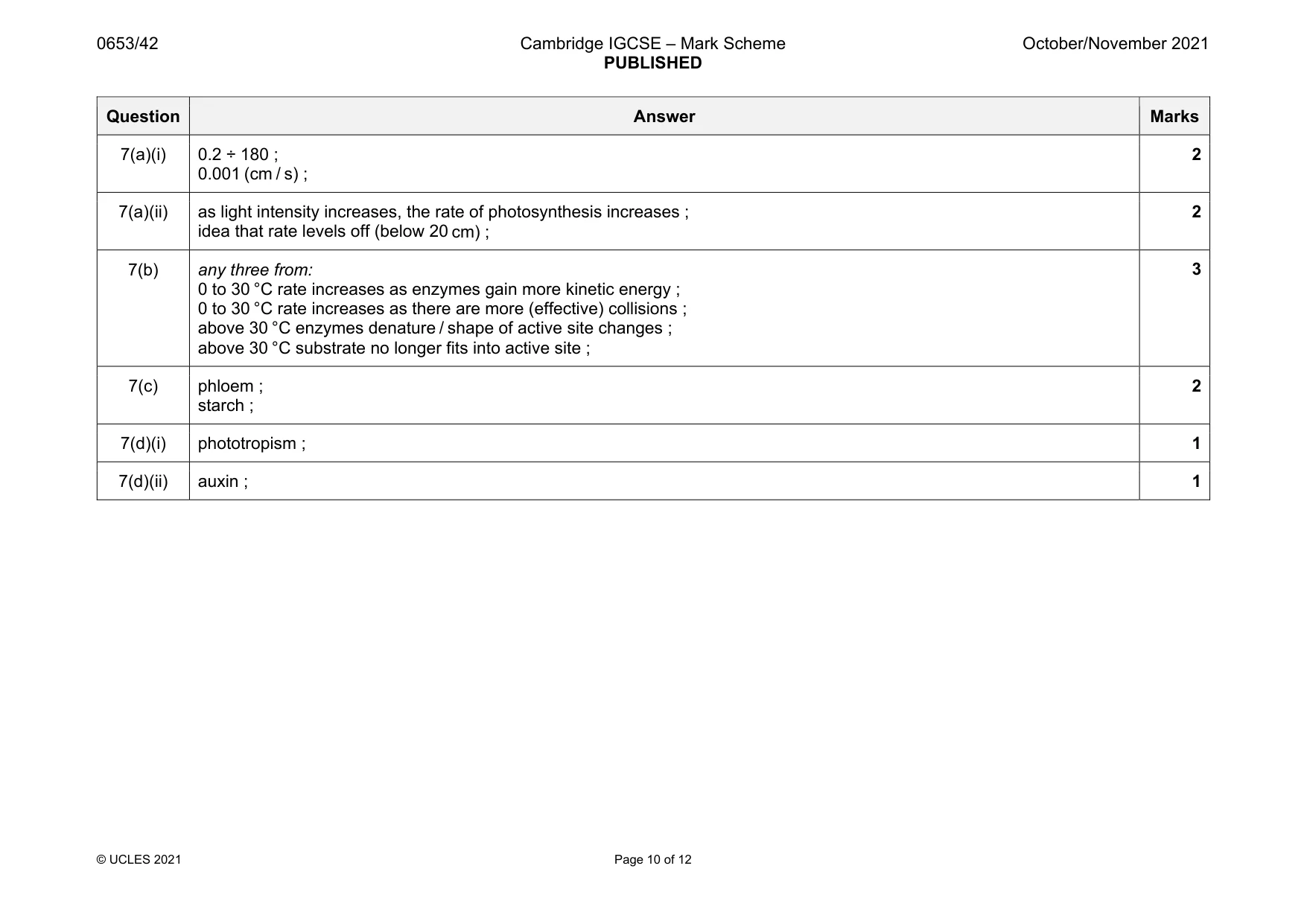
Mark scheme: 7(a)(i) 0.2 ÷ 180 ; 0.001 (cm / s) ; 2 7(a)(ii) as light intensity increases, the rate of photosynthesis increases ; idea that rate levels off (below 20 cm) ; 2 7(b) any three from: 0 to 30 °C rate increases as enzymes gain more kinetic energy ; 0 to 30 °C rate increases as there are more (effective) collisions ; above 30 °C enzymes denature / shape of active site changes ; above 30 °C substrate no longer fits into active site ; 3 7(c) phloem ; starch ; 2 7(d)(i) phototropism ; 1 7(d)(ii) auxin ; 1
Q8 · There has been a large increase in the concentration of carbon dioxide in the atmosphere…
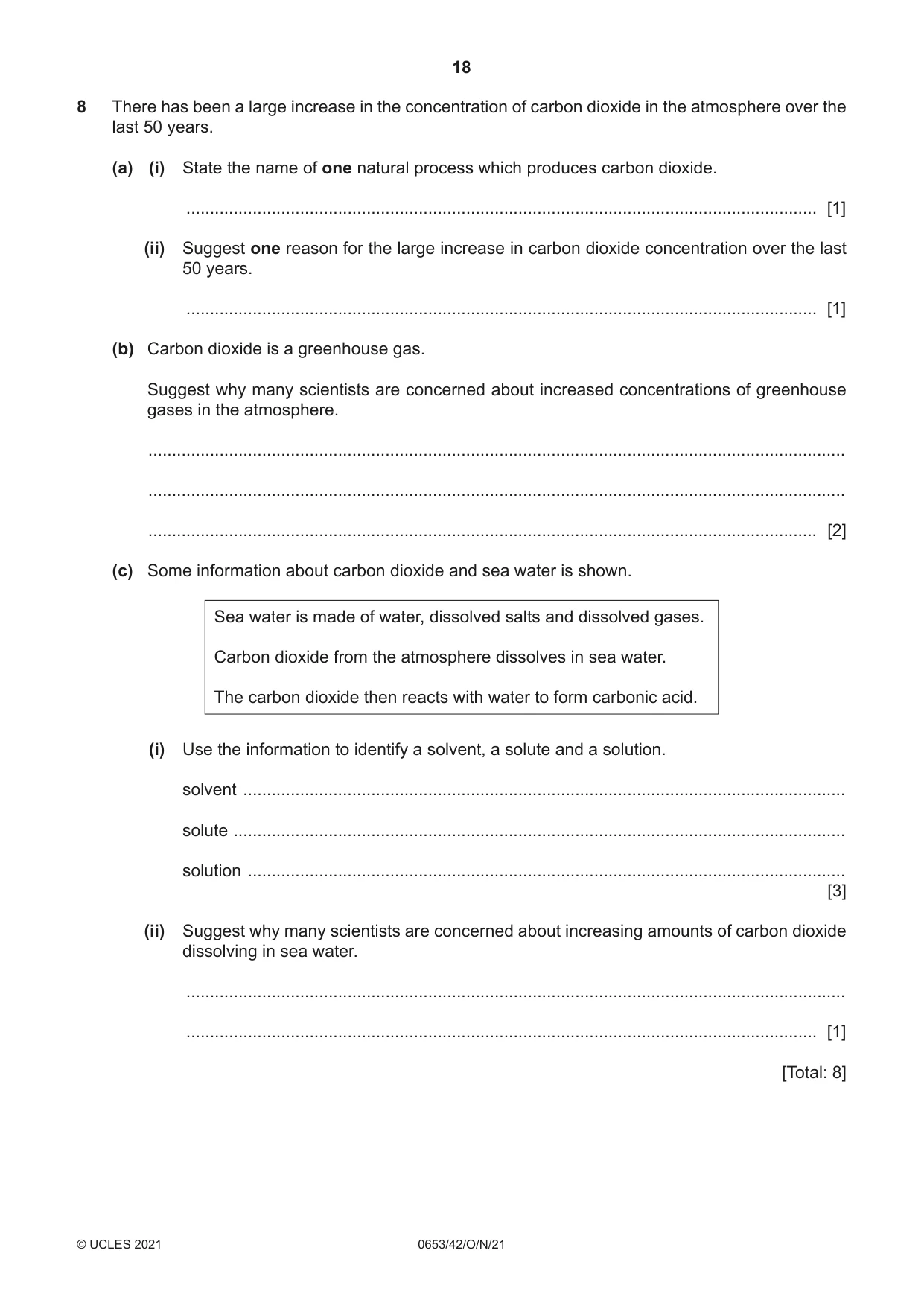
8 There has been a large increase in the concentration of carbon dioxide in the atmosphere over the last 50 years. (a) (i) State the name of one natural process which produces carbon dioxide. ..................................................................................................................................... [1] (ii) Suggest one reason for the large increase in carbon dioxide concentration over the last 50 years. ..................................................................................................................................... [1] (b) Carbon dioxide is a greenhouse gas. Suggest why many scientists are concerned about increased concentrations of greenhouse gases in the atmosphere. ................................................................................................................................................... ................................................................................................................................................... ............................................................................................................................................. [2] (c) Some information about carbon dioxide and sea water is shown. Sea water is made of water, dissolved salts and dissolved gases. Carbon dioxide from the atmosphere dissolves in sea water. The carbon dioxide then reacts with water to form carbonic acid. (i) Use the information to identify a solvent, a solute and a solution. solvent ............................................................................................................................... solute ................................................................................................................................. solution .............................................................................................................................. [3] (ii) Suggest why many scientists are concerned about increasing amounts of carbon dioxide dissolving in sea water. ........................................................................................................................................... ..................................................................................................................................... [1] [Total: 8]
Mark scheme: 8(a)(i) respiration / AVP ; 1 8(a)(ii) combustion of fossil fuels / AVP ; 1 8(b) causes enhanced greenhouse effect / global warming ; leads to, climate change / named harmful effect of climate change e.g. sea level rise ; 2 8(c)(i) solvent: water ; solute: salts / gases ; solution: carbonic acid / sea (water) ; 3 8(c)(ii) seas are becoming more acidic / acidification / named harmful effect ; 1
Q9 · An electric kettle used to boil water
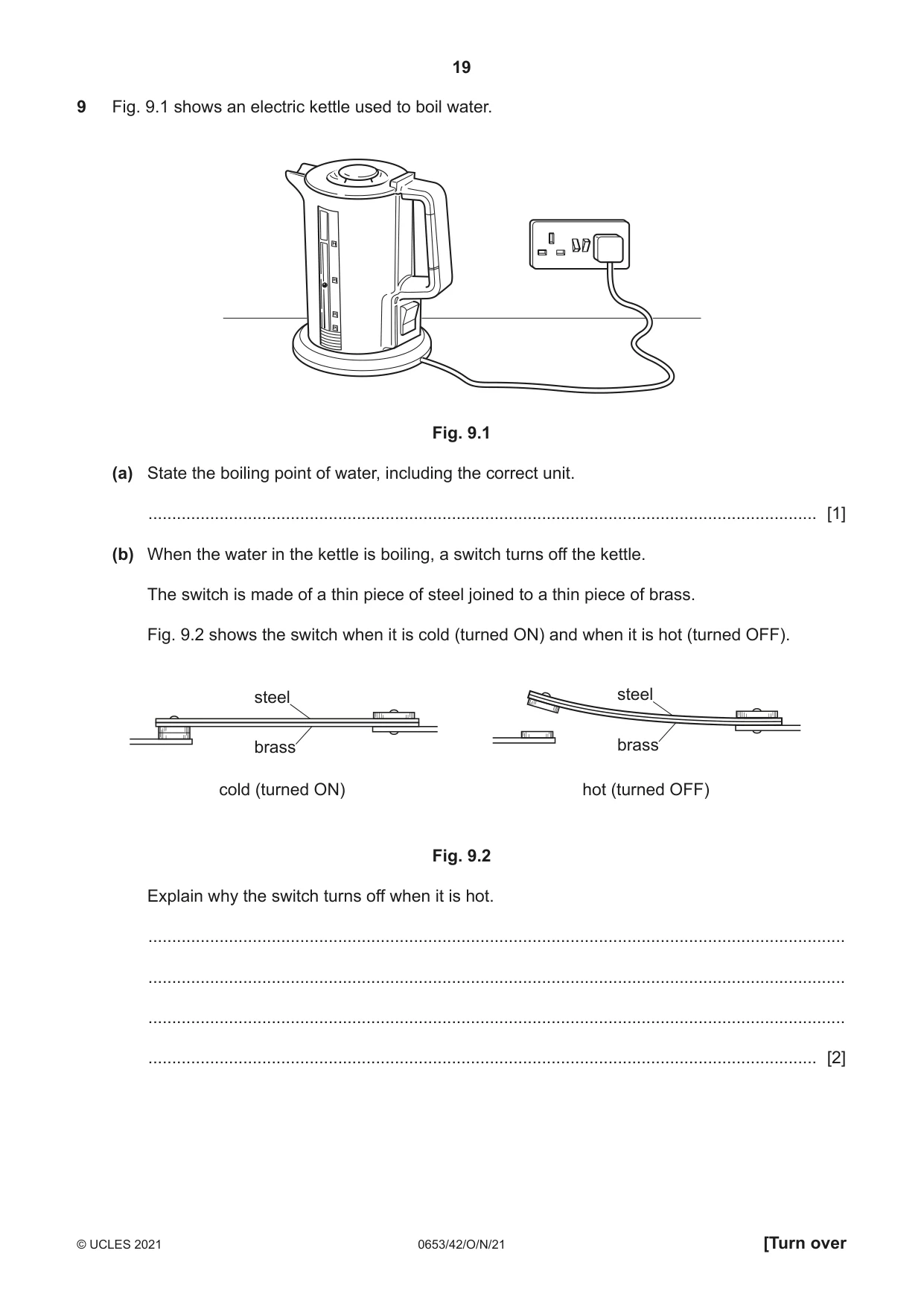
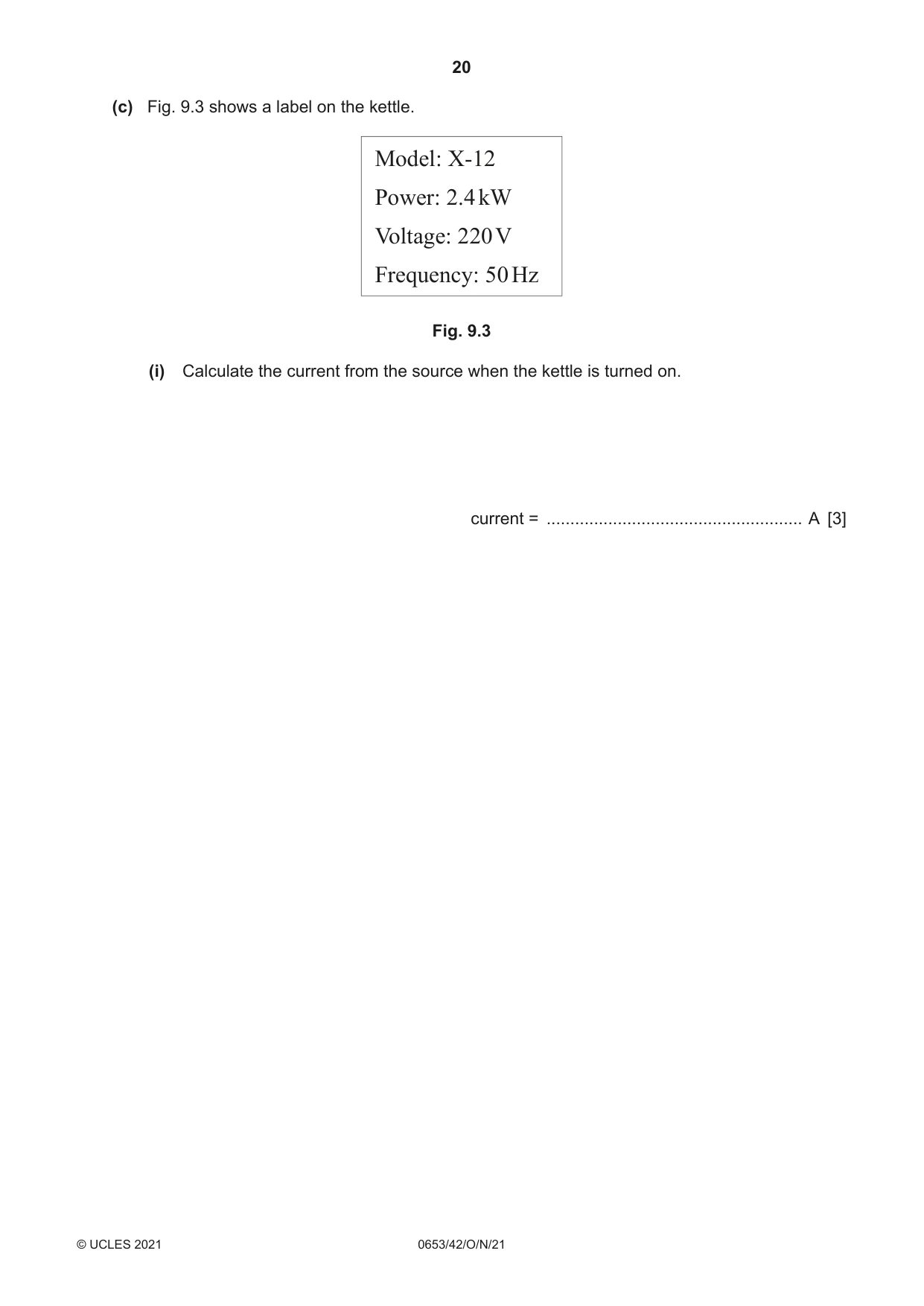
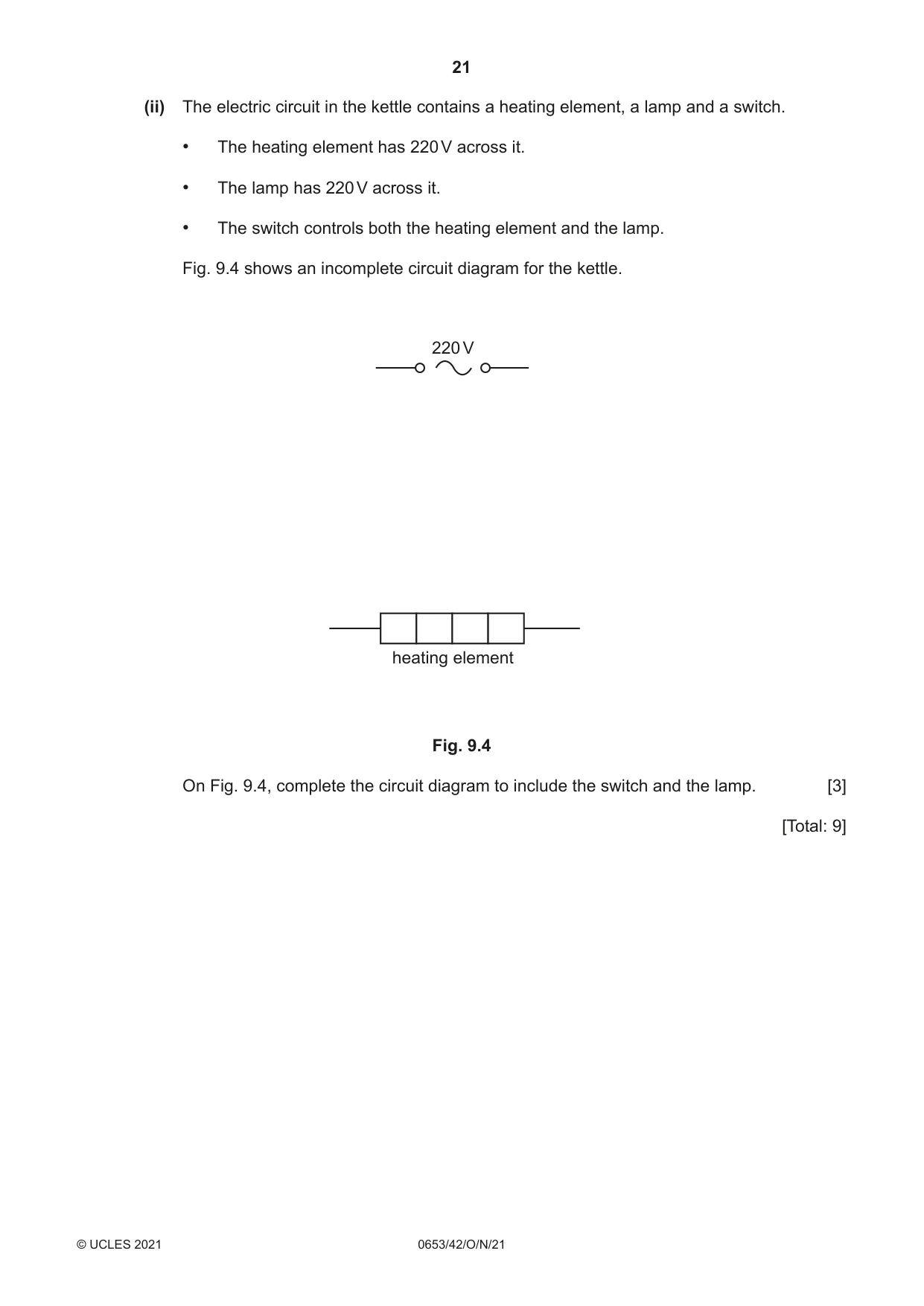
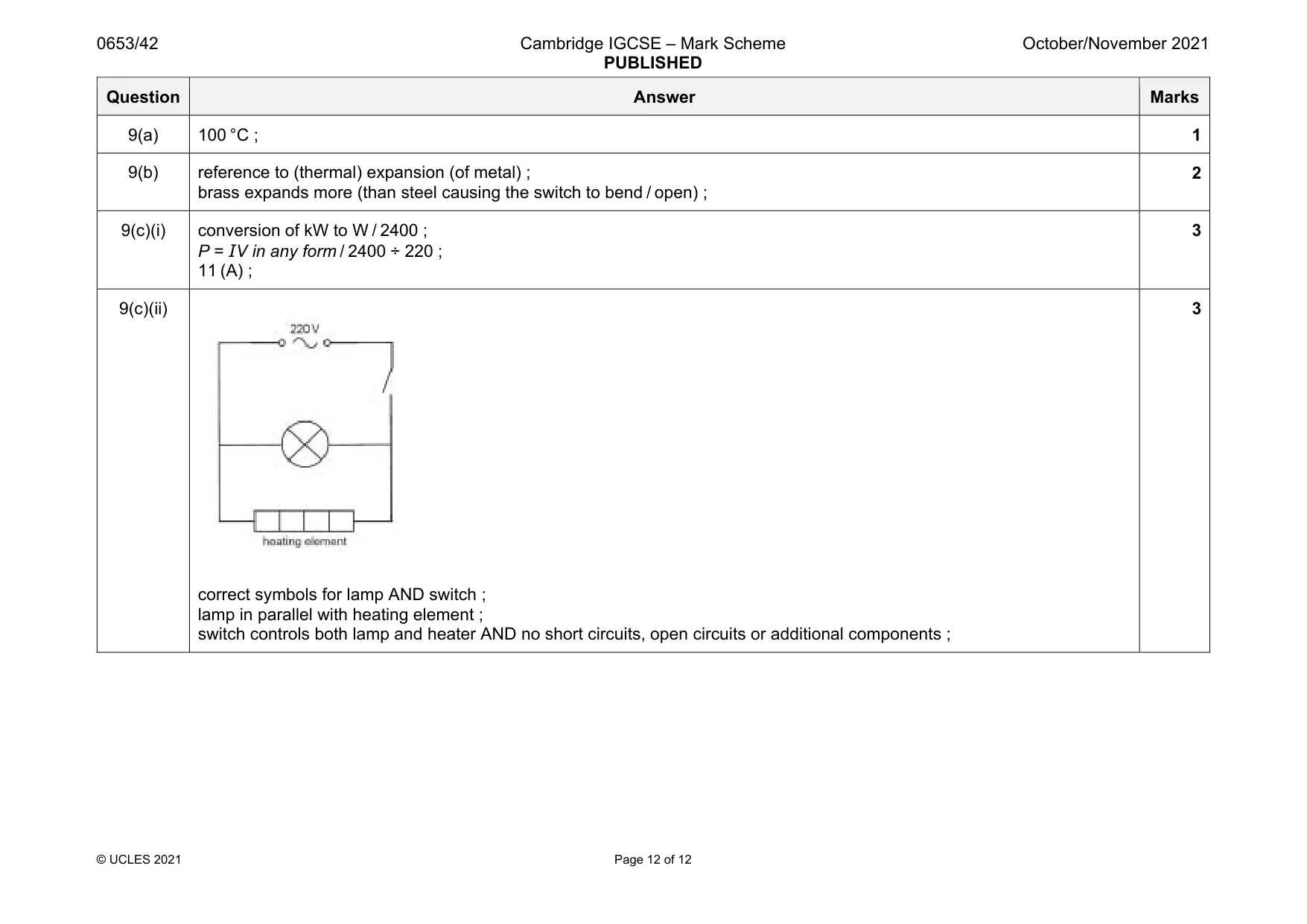
9 Fig. 9.1 shows an electric kettle used to boil water. Fig. 9.1 (a) State the boiling point of water, including the correct unit. ............................................................................................................................................. [1] (b) When the water in the kettle is boiling, a switch turns off the kettle. The switch is made of a thin piece of steel joined to a thin piece of brass. Fig. 9.2 shows the switch when it is cold (turned ON) and when it is hot (turned OFF). steel steel brass brass cold (turned ON) hot (turned OFF) Fig. 9.2 Explain why the switch turns off when it is hot. ................................................................................................................................................... ................................................................................................................................................... ................................................................................................................................................... ............................................................................................................................................. [2] (c) Fig. 9.3 shows a label on the kettle. Model: X-12 Power: 2.4 kW Voltage: 220 V Frequency: 50 Hz Fig. 9.3 (i) Calculate the current from the source when the kettle is turned on. current = ...................................................... A [3] (ii) The electric circuit in the kettle contains a heating element, a lamp and a switch. • The heating element has 220 V across it. • The lamp has 220 V across it. • The switch controls both the heating element and the lamp. Fig. 9.4 shows an incomplete circuit diagram for the kettle. 220 V heating element Fig. 9.4 On Fig. 9.4, complete the circuit diagram to include the switch and the lamp. [3] [Total: 9]
Mark scheme: 9(a) 100 °C ; 1 9(b) reference to (thermal) expansion (of metal) ; brass expands more (than steel causing the switch to bend / open) ; 2 9(c)(i) conversion of kW to W / 2400 ; P = IV in any form / 2400 ÷ 220 ; 11 (A) ; 3 9(c)(ii) correct symbols for lamp AND switch ; lamp in parallel with heating element ; switch controls both lamp and heater AND no short circuits, open circuits or additional components ; 3
What was in this paper
The subtopics covered by these 9 questions, and how many questions each got. Open one in a new tab to see every Cambridge question on it.
What you needed in this session
Cambridge’s own grade thresholds for 2021 Oct/Nov, Paper 4 · Variant 2. A higher threshold means an easier paper — the bar moves with how the cohort did.