Cambridge IGCSE Science - Combined 0653 — 2018 Oct/Nov Paper 4 · Variant 1
0653/41/O/N/18 · 9 questions · 80 marks · ≈90 min
The question paper and its mark scheme, free to read here and free to download. This is Cambridge’s own paper, exactly as it was sat.
Question paper20 pages
Mark scheme10 pages
Answers below. Sit the paper first if you are practising.
Questions as text
Q1 · A diagram of an alveolus
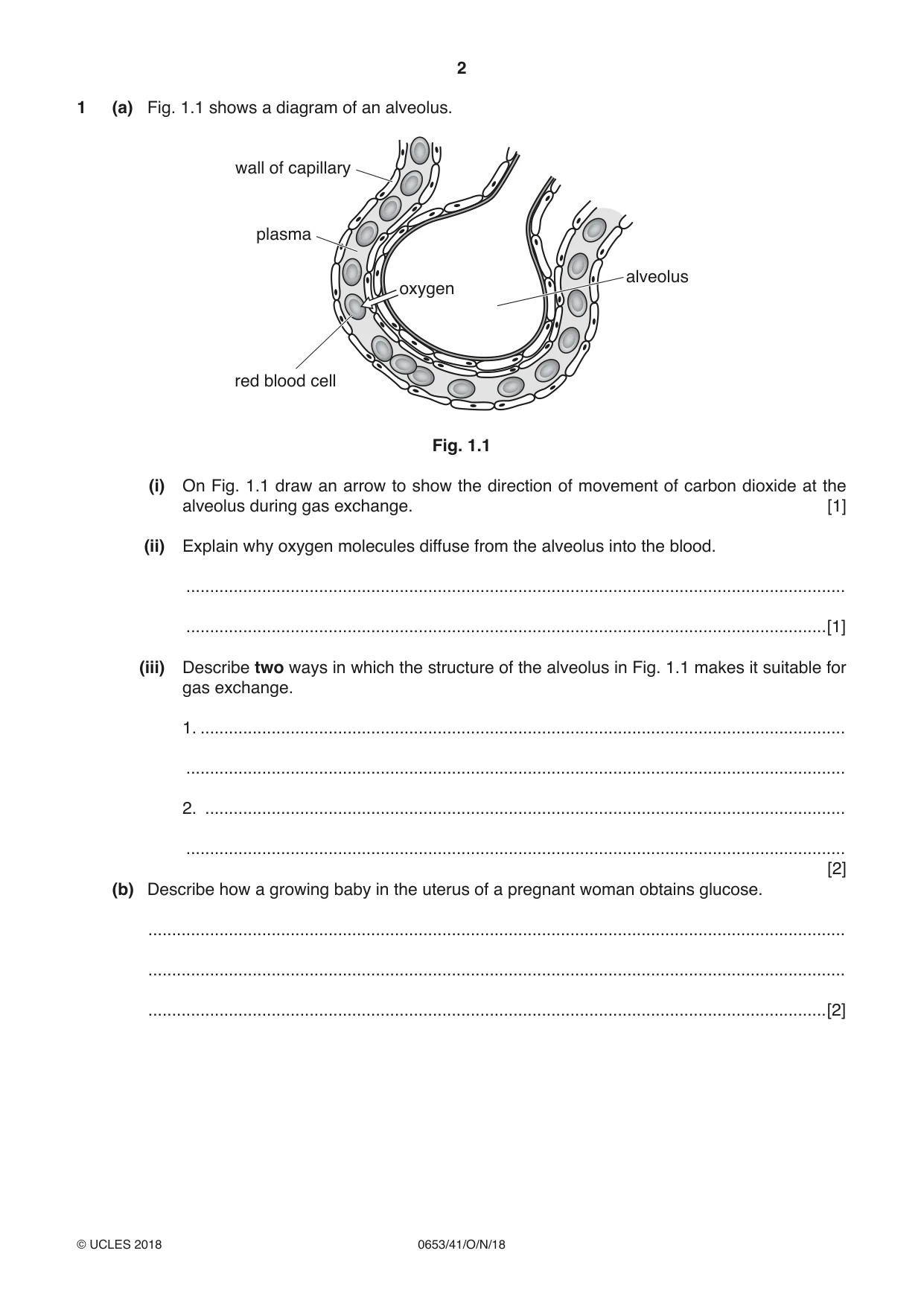
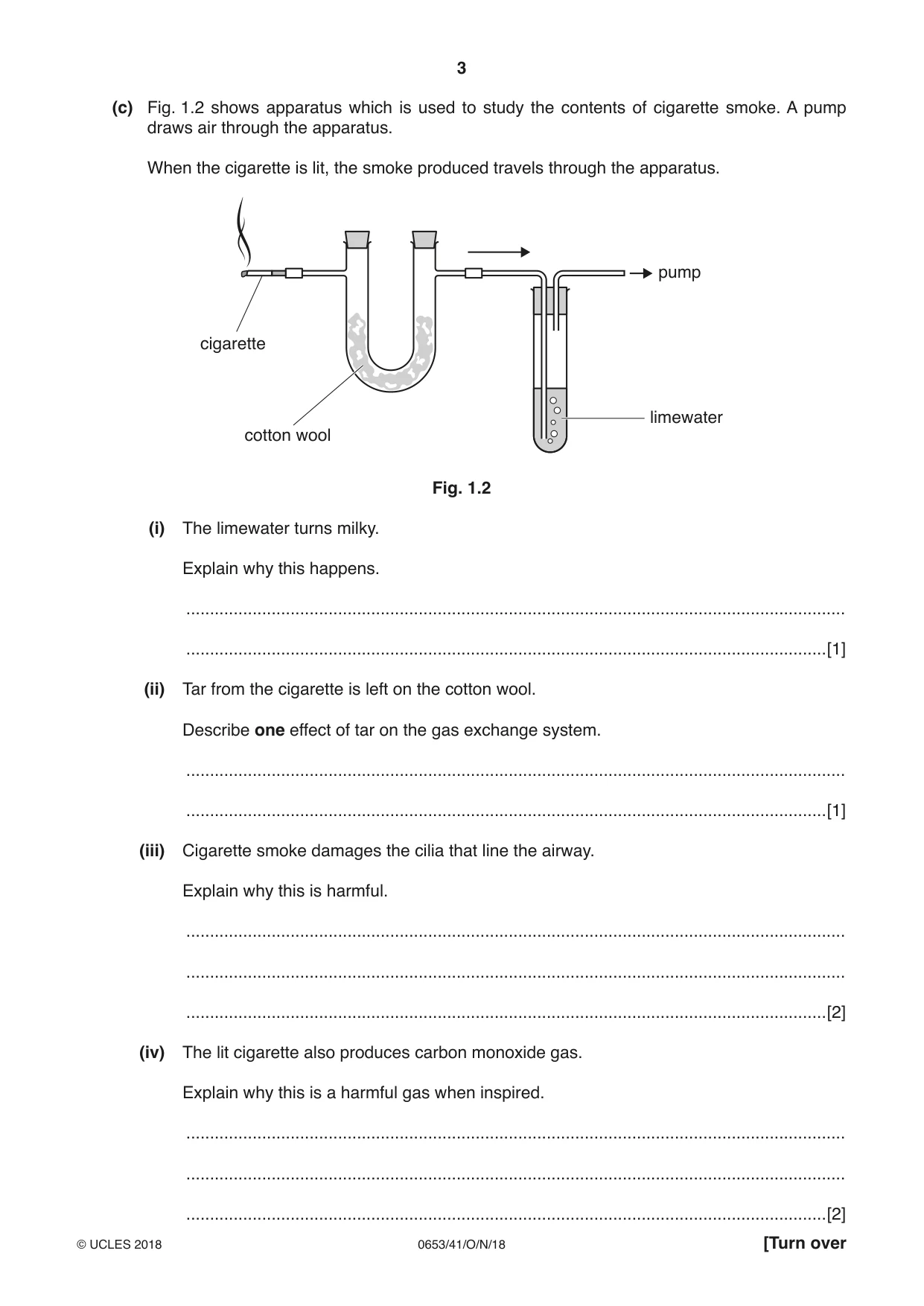
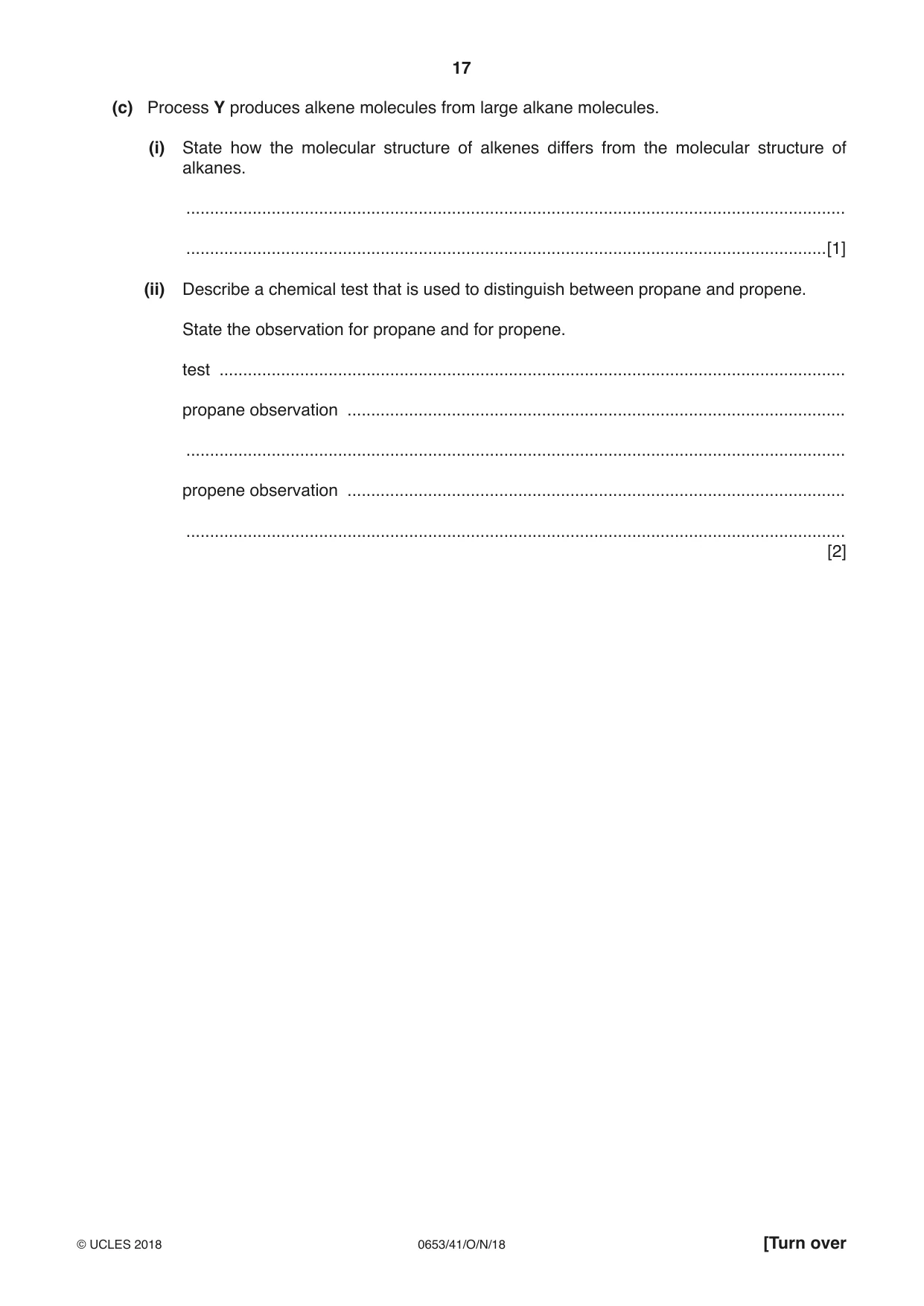
1 (a) Fig. 1.1 shows a diagram of an alveolus. wall of capillary plasma alveolus oxygen red blood cell Fig. 1.1 (i) On Fig. 1.1 draw an arrow to show the direction of movement of carbon dioxide at the alveolus during gas exchange. [1] (ii) Explain why oxygen molecules diffuse from the alveolus into the blood. ........................................................................................................................................... .......................................................................................................................................[1] (iii) Describe two ways in which the structure of the alveolus in Fig. 1.1 makes it suitable for gas exchange. 1. ........................................................................................................................................ ........................................................................................................................................... 2. ....................................................................................................................................... ........................................................................................................................................... [2] (b) Describe how a growing baby in the uterus of a pregnant woman obtains glucose. ................................................................................................................................................... ................................................................................................................................................... ...............................................................................................................................................[2] (c) Fig. 1.2 shows apparatus which is used to study the contents of cigarette smoke. A pump draws air through the apparatus. When the cigarette is lit, the smoke produced travels through the apparatus. pump cigarette limewater cotton wool Fig. 1.2 (i) The limewater turns milky. Explain why this happens. ........................................................................................................................................... .......................................................................................................................................[1] (ii) Tar from the cigarette is left on the cotton wool. Describe one effect of tar on the gas exchange system. ........................................................................................................................................... .......................................................................................................................................[1] (iii) Cigarette smoke damages the cilia that line the airway. Explain why this is harmful. ........................................................................................................................................... ........................................................................................................................................... .......................................................................................................................................[2] (iv) The lit cigarette also produces carbon monoxide gas. Explain why this is a harmful gas when inspired. ........................................................................................................................................... ........................................................................................................................................... .......................................................................................................................................[2]
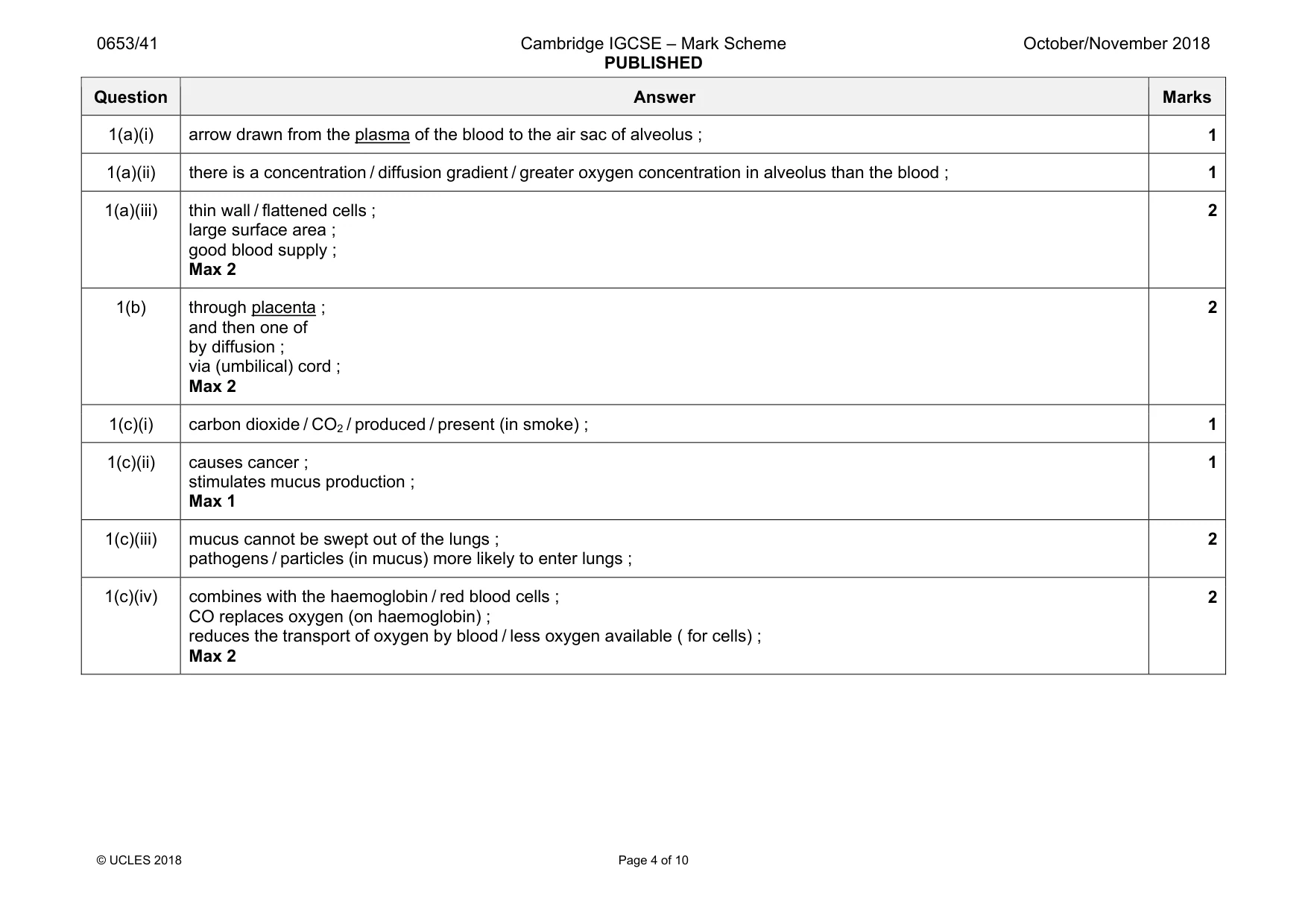
Mark scheme: 1(a)(i) arrow drawn from the plasma of the blood to the air sac of alveolus ; 1 1(a)(ii) there is a concentration / diffusion gradient / greater oxygen concentration in alveolus than the blood ; 1 1(a)(iii) thin wall / flattened cells ; large surface area ; good blood supply ; Max 2 2 1(b) through placenta ; and then one of by diffusion ; via (umbilical) cord ; Max 2 2 1(c)(i) carbon dioxide / CO2 / produced / present (in smoke) ; 1 1(c)(ii) causes cancer ; stimulates mucus production ; Max 1 1 1(c)(iii) mucus cannot be swept out of the lungs ; pathogens / particles (in mucus) more likely to enter lungs ; 2 1(c)(iv) combines with the haemoglobin / red blood cells ; CO replaces oxygen (on haemoglobin) ; reduces the transport of oxygen by blood / less oxygen available ( for cells) ; Max 2 2
Q2 · Name the type of bonding in a water molecule
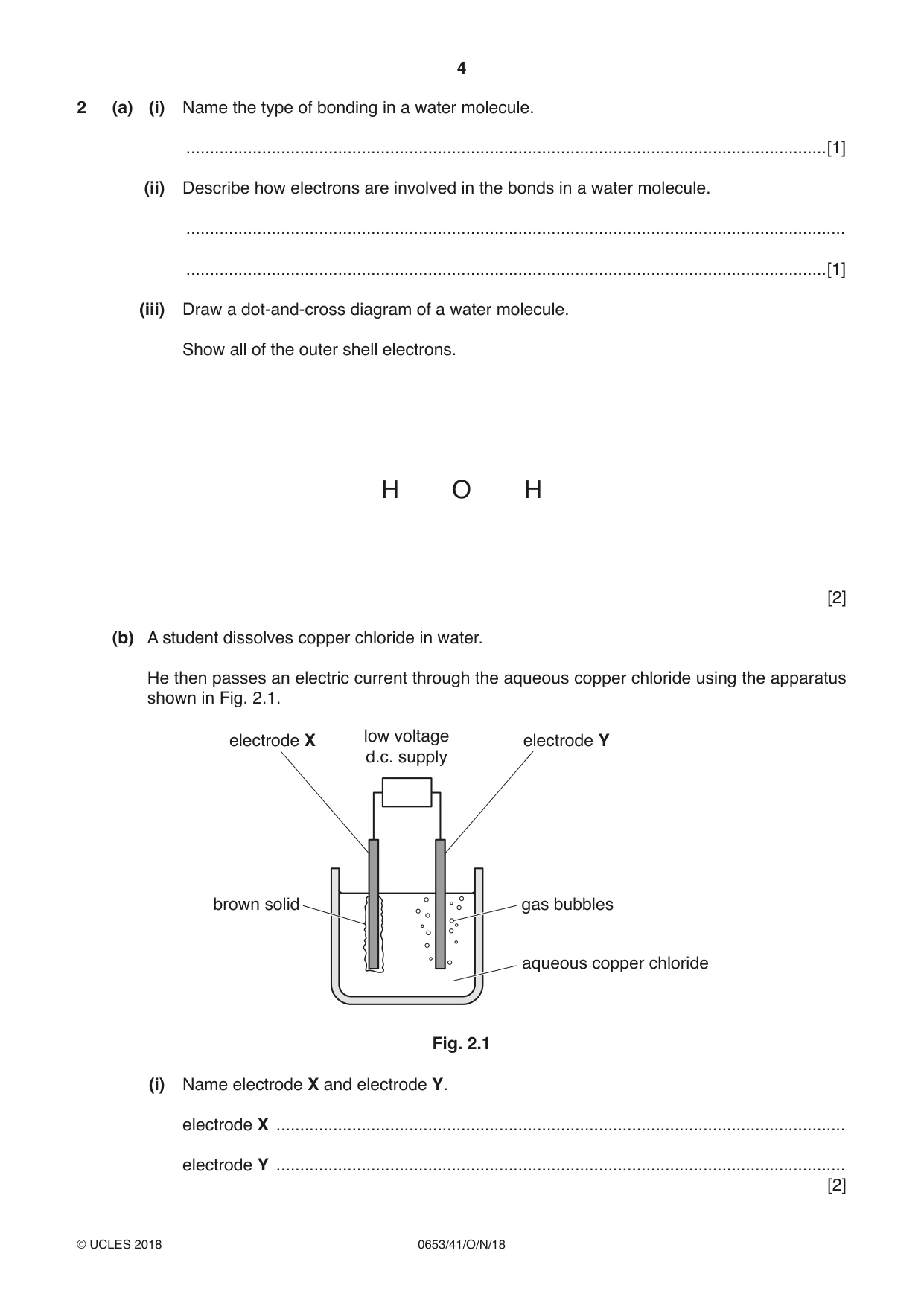
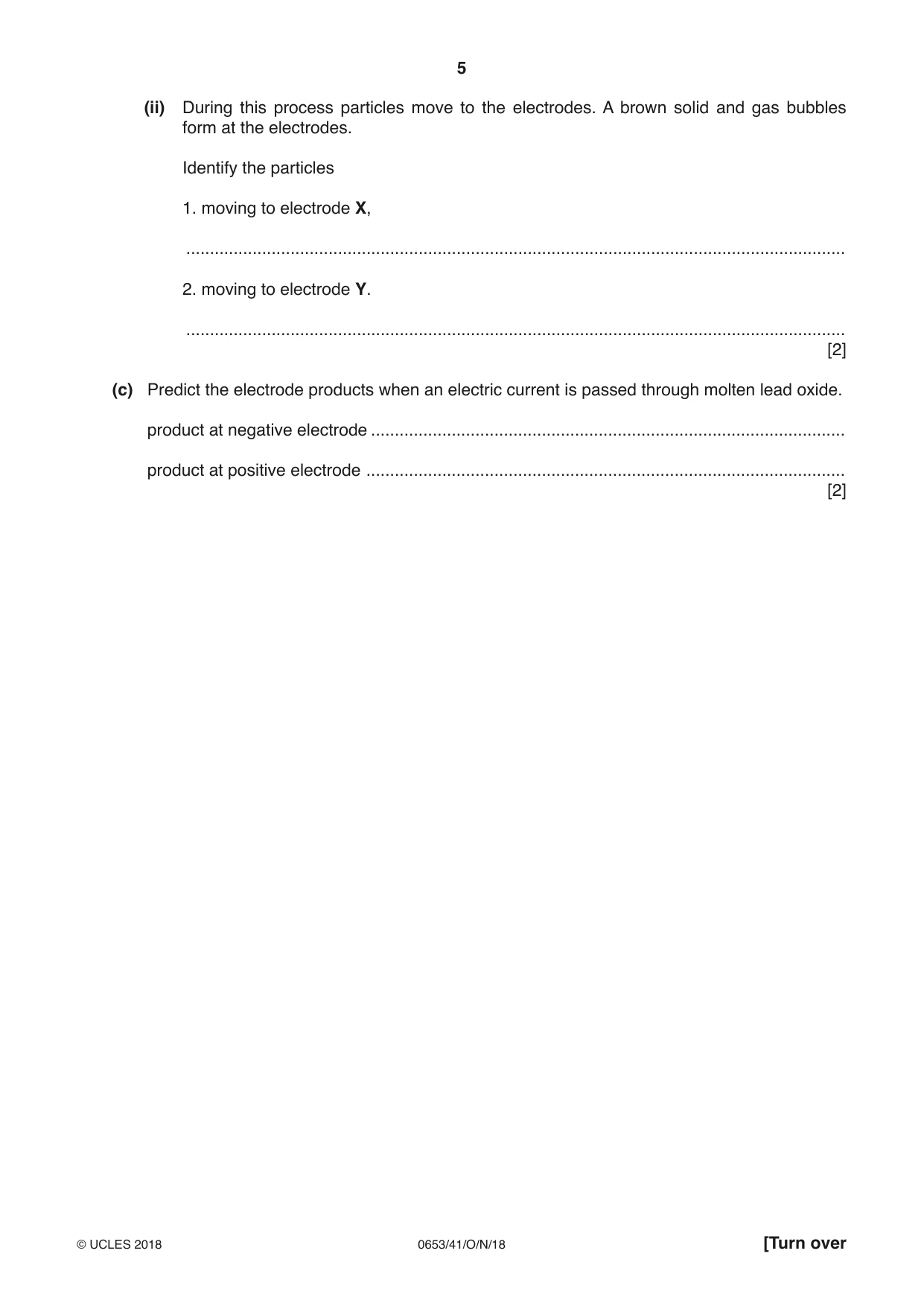
2 (a) (i) Name the type of bonding in a water molecule. .......................................................................................................................................[1] (ii) Describe how electrons are involved in the bonds in a water molecule. ........................................................................................................................................... .......................................................................................................................................[1] (iii) Draw a dot-and-cross diagram of a water molecule. Show all of the outer shell electrons. H O H [2] (b) A student dissolves copper chloride in water. He then passes an electric current through the aqueous copper chloride using the apparatus shown in Fig. 2.1. electrode X low voltage electrode Y d.c. supply brown solid gas bubbles aqueous copper chloride Fig. 2.1 (i) Name electrode X and electrode Y. electrode X ........................................................................................................................ electrode Y ........................................................................................................................ [2] (ii) During this process particles move to the electrodes. A brown solid and gas bubbles form at the electrodes. Identify the particles 1. moving to electrode X, ........................................................................................................................................... 2. moving to electrode Y. ........................................................................................................................................... [2] (c) Predict the electrode products when an electric current is passed through molten lead oxide. product at negative electrode .................................................................................................... product at positive electrode ..................................................................................................... [2]
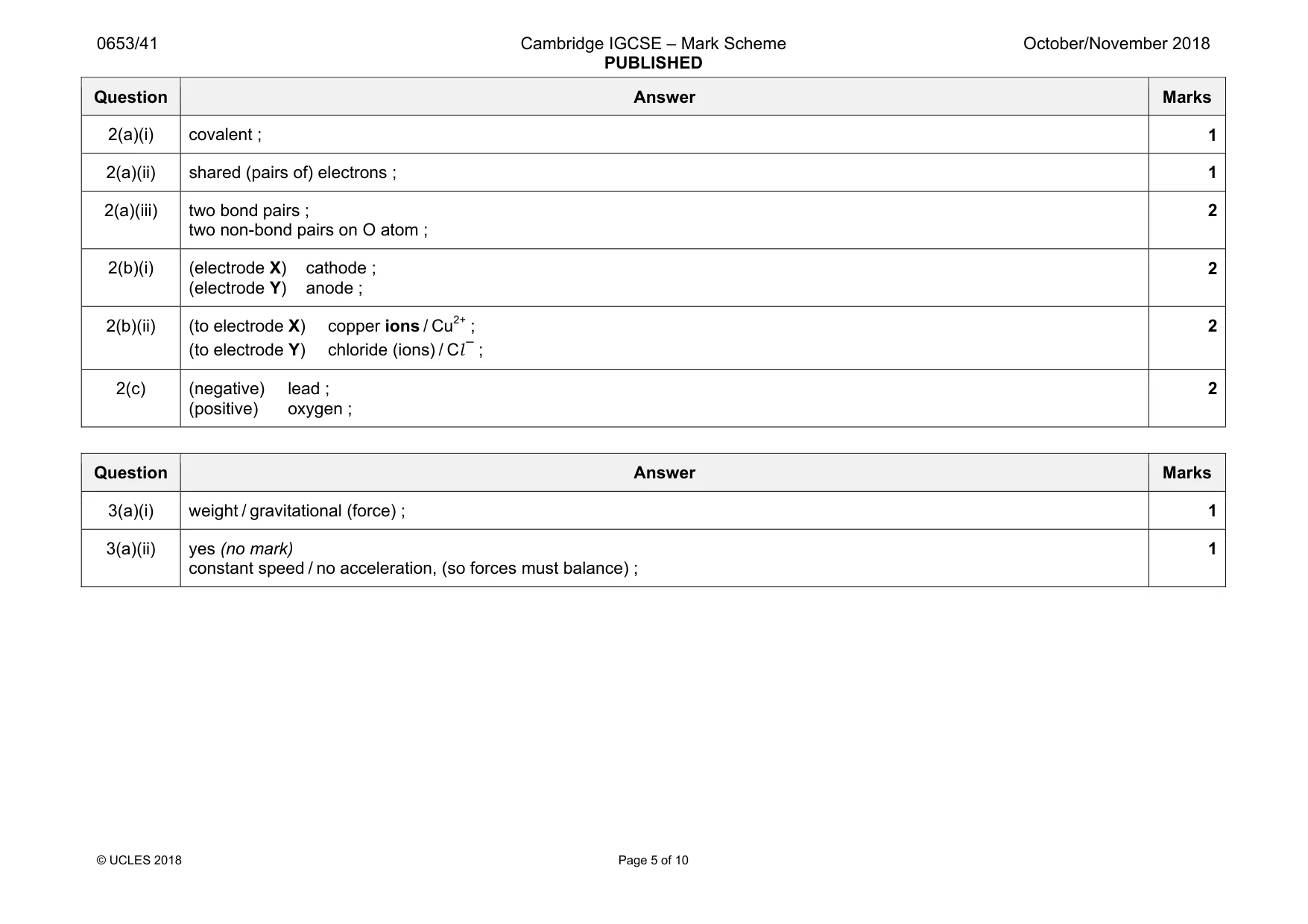
Mark scheme: 2(a)(i) covalent ; 1 2(a)(ii) shared (pairs of) electrons ; 1 2(a)(iii) two bond pairs ; two non-bond pairs on O atom ; 2 2(b)(i) (electrode X) cathode ; (electrode Y) anode ; 2 2(b)(ii) (to electrode X) copper ions / Cu2+ ; (to electrode Y) chloride (ions) / Cl – ; 2 2(c) (negative) lead ; (positive) oxygen ; 2
Q3 · A train made up of a steam engine and a passenger coach
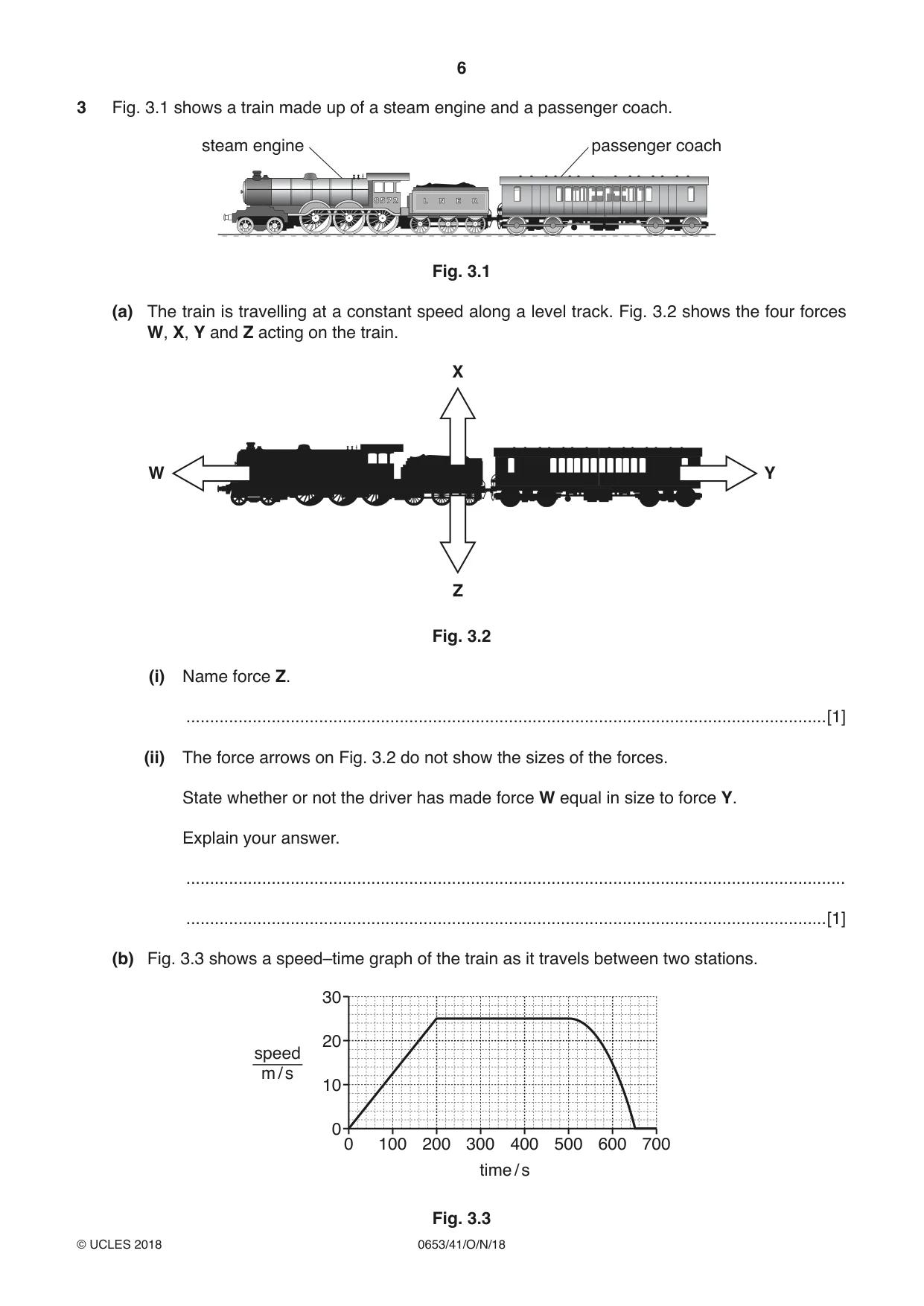
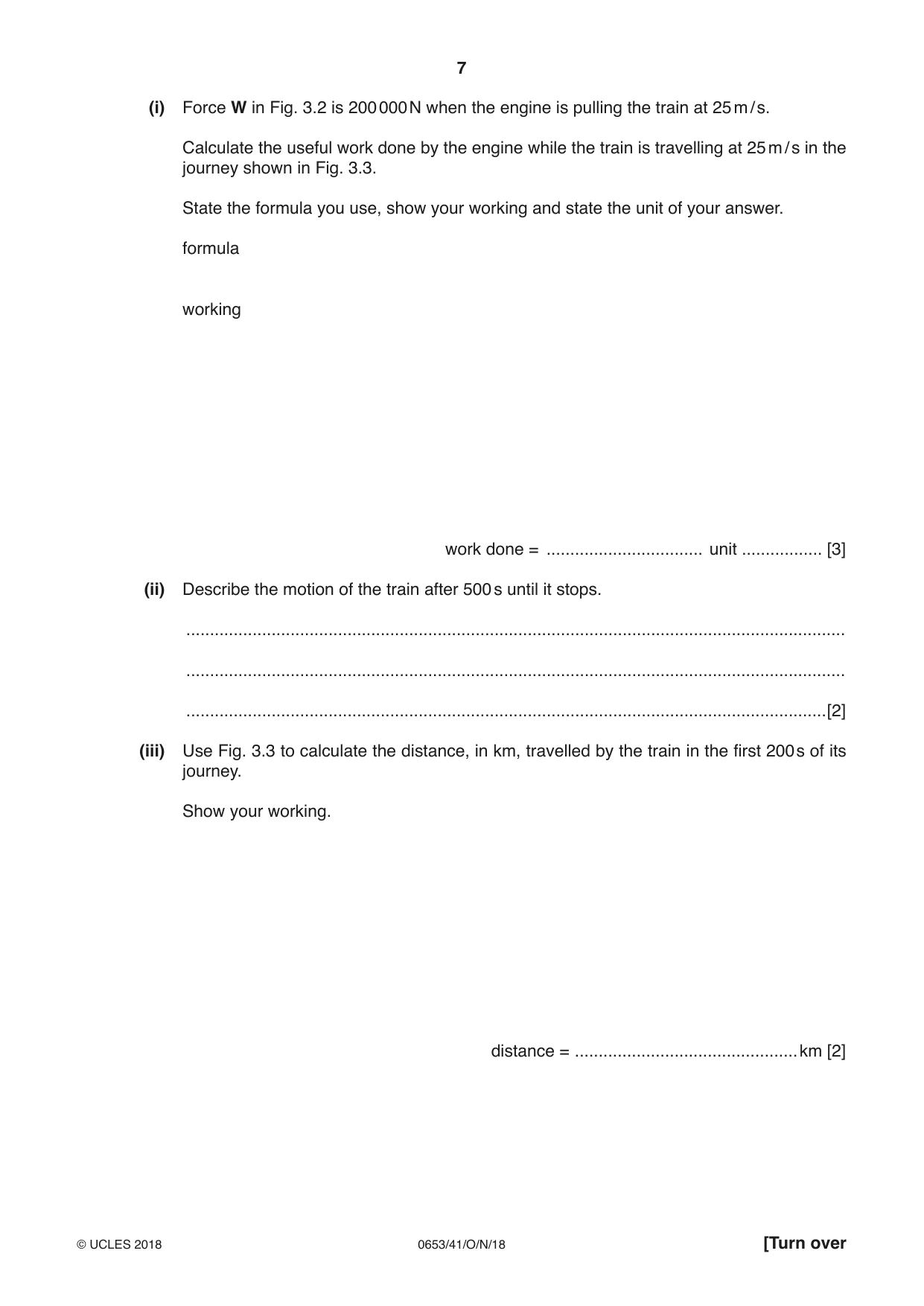
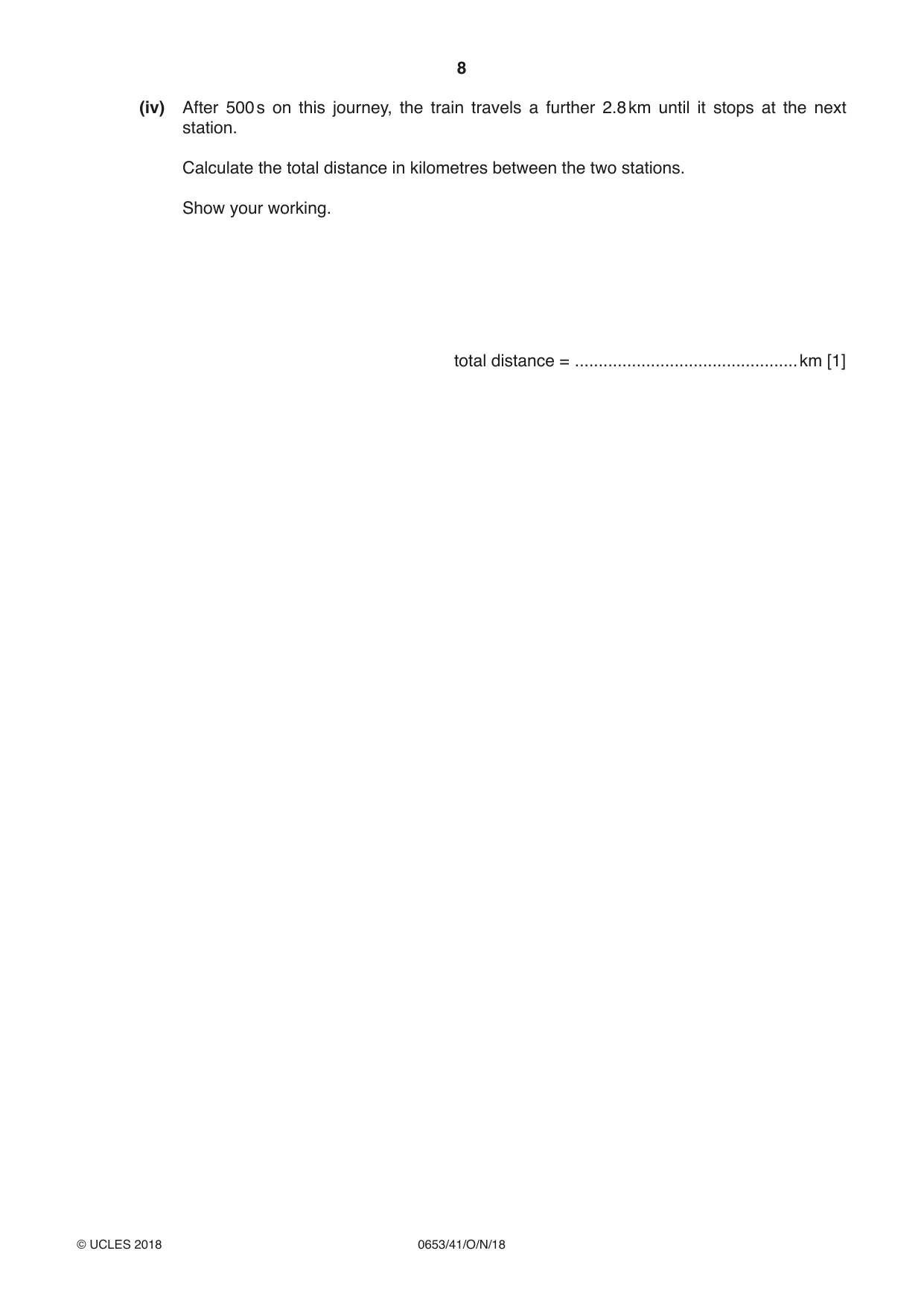
3 Fig. 3.1 shows a train made up of a steam engine and a passenger coach. steam engine passenger coach Fig. 3.1 (a) The train is travelling at a constant speed along a level track. Fig. 3.2 shows the four forces W, X, Y and Z acting on the train. X W Y Z Fig. 3.2 (i) Name force Z. .......................................................................................................................................[1] (ii) The force arrows on Fig. 3.2 do not show the sizes of the forces. State whether or not the driver has made force W equal in size to force Y. Explain your answer. ........................................................................................................................................... .......................................................................................................................................[1] (b) Fig. 3.3 shows a speed–time graph of the train as it travels between two stations. 30 20 speed m / s 10 0 0 100 200 300 400 500 600 700 time / s Fig. 3.3 (i) Force W in Fig. 3.2 is 200 000 N when the engine is pulling the train at 25 m / s. Calculate the useful work done by the engine while the train is travelling at 25 m / s in the journey shown in Fig. 3.3. State the formula you use, show your working and state the unit of your answer. formula working work done = ................................. unit ................. [3] (ii) Describe the motion of the train after 500 s until it stops. ........................................................................................................................................... ........................................................................................................................................... .......................................................................................................................................[2] (iii) Use Fig. 3.3 to calculate the distance, in km, travelled by the train in the first 200 s of its journey. Show your working. distance = ...............................................km [2] (iv) After 500 s on this journey, the train travels a further 2.8 km until it stops at the next station. Calculate the total distance in kilometres between the two stations. Show your working. total distance = ...............................................km [1]
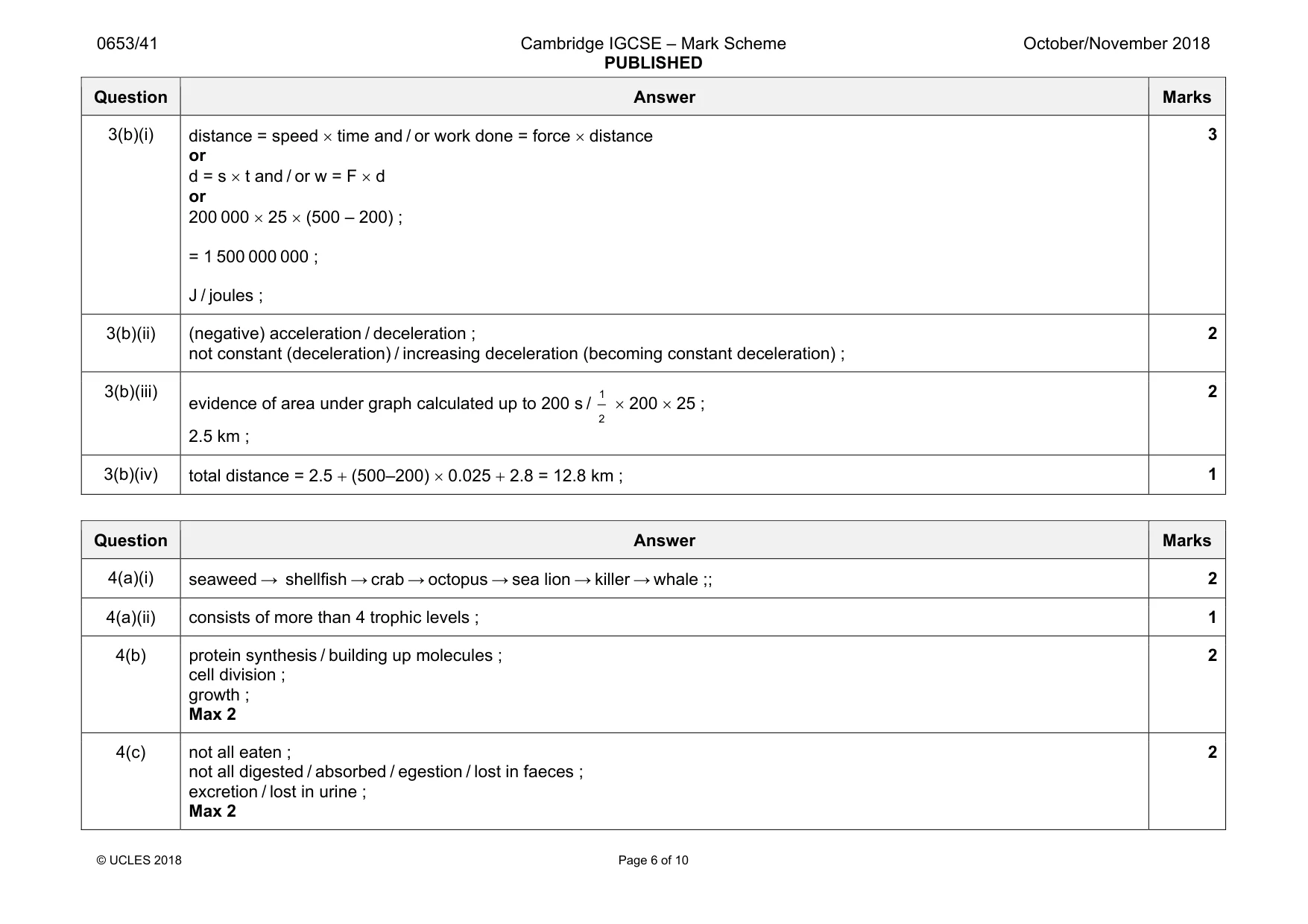
Mark scheme: 3(a)(i) weight / gravitational (force) ; 1 3(a)(ii) yes (no mark) constant speed / no acceleration, (so forces must balance) ; 1 Question Answer Marks 3(b)(i) distance = speed × time and / or work done = force × distance or d = s × t and / or w = F × d or 200 000 × 25 × (500 – 200) ; = 1 500 000 000 ; J / joules ; 3 3(b)(ii) (negative) acceleration / deceleration ; not constant (deceleration) / increasing deceleration (becoming constant deceleration) ; 2 3(b)(iii) evidence of area under graph calculated up to 200 s / 1 2 × 200 × 25 ; 2.5 km ; 2 3(b)(iv) total distance = 2.5 + (500–200) × 0.025 + 2.8 = 12.8 km ; 1
Q4 · An aquatic food web
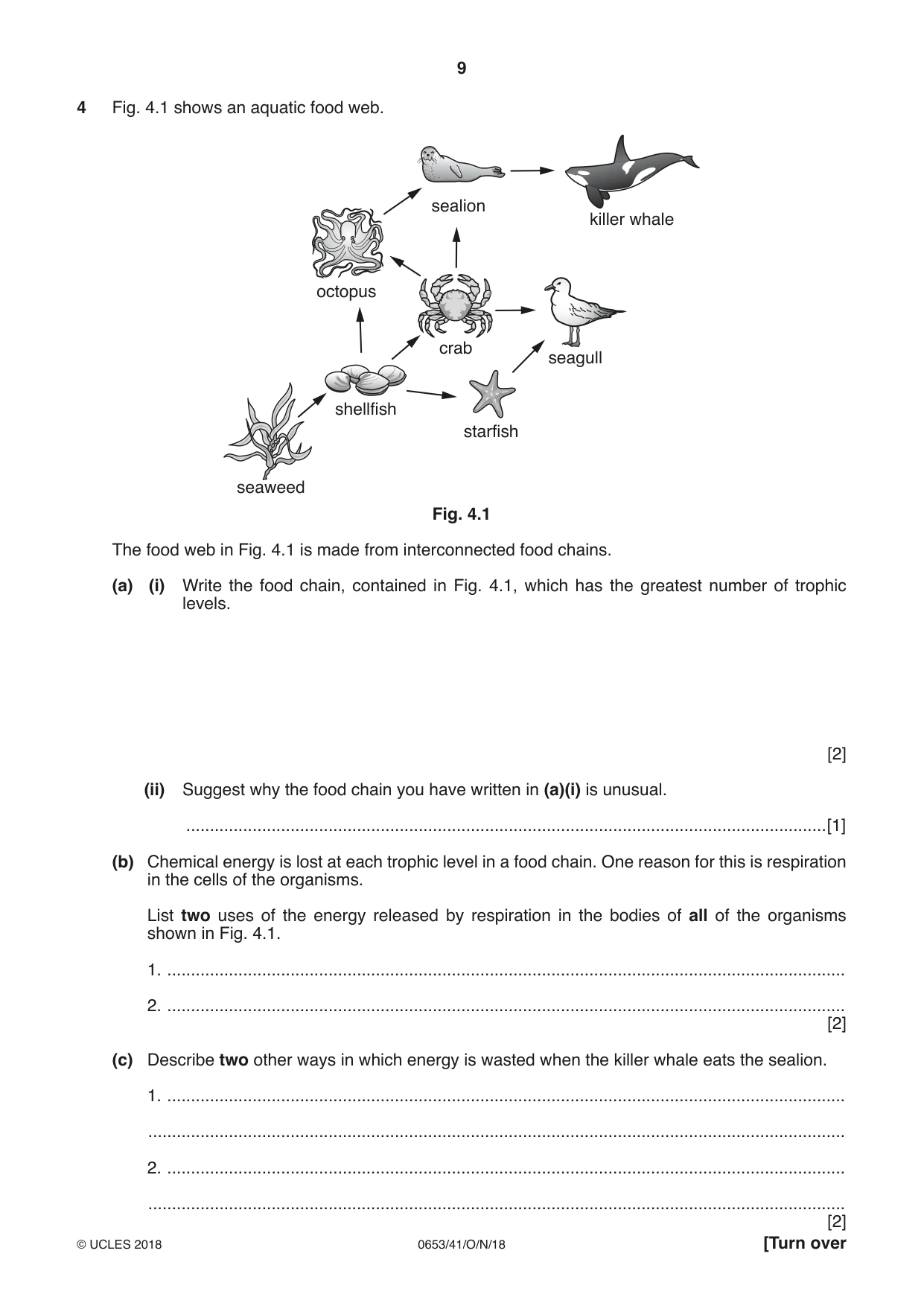
4 Fig. 4.1 shows an aquatic food web. sealion killer whale octopus crab seagull shellfish starfish seaweed Fig. 4.1 The food web in Fig. 4.1 is made from interconnected food chains. (a) (i) Write the food chain, contained in Fig. 4.1, which has the greatest number of trophic levels. [2] (ii) Suggest why the food chain you have written in (a)(i) is unusual. .......................................................................................................................................[1] (b) Chemical energy is lost at each trophic level in a food chain. One reason for this is respiration in the cells of the organisms. List two uses of the energy released by respiration in the bodies of all of the organisms shown in Fig. 4.1. 1. ............................................................................................................................................... 2. ............................................................................................................................................... [2] (c) Describe two other ways in which energy is wasted when the killer whale eats the sealion. 1. ............................................................................................................................................... ................................................................................................................................................... 2. ............................................................................................................................................... ...................................................................................................................................................
Mark scheme: 4(a)(i) 2 4(a)(ii) consists of more than 4 trophic levels ; 1 4(b) protein synthesis / building up molecules ; cell division ; growth ; Max 2 2 4(c) not all eaten ; not all digested / absorbed / egestion / lost in faeces ; excretion / lost in urine ; Max 2 2
Q5 · Calcium sulfate is an insoluble salt
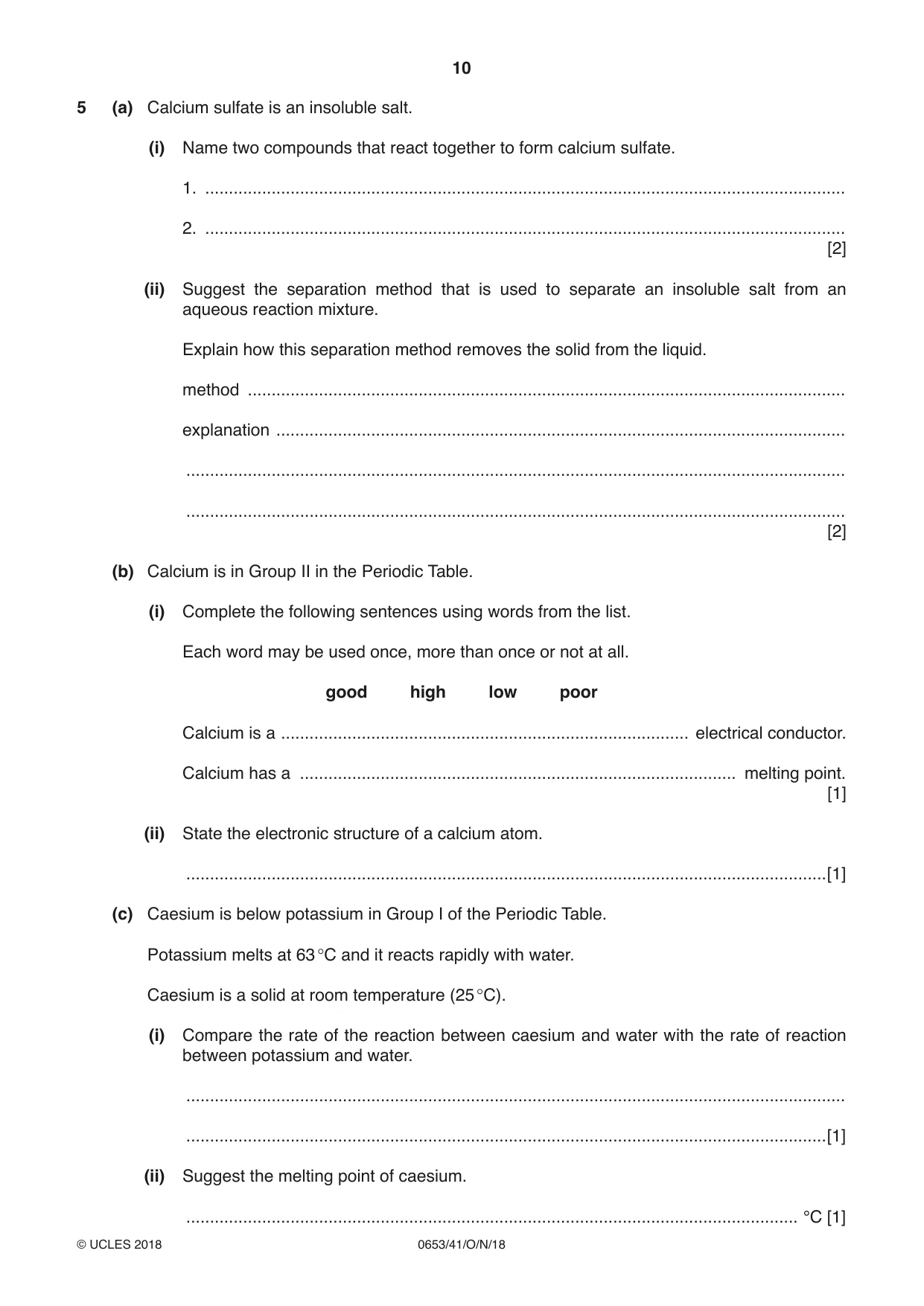
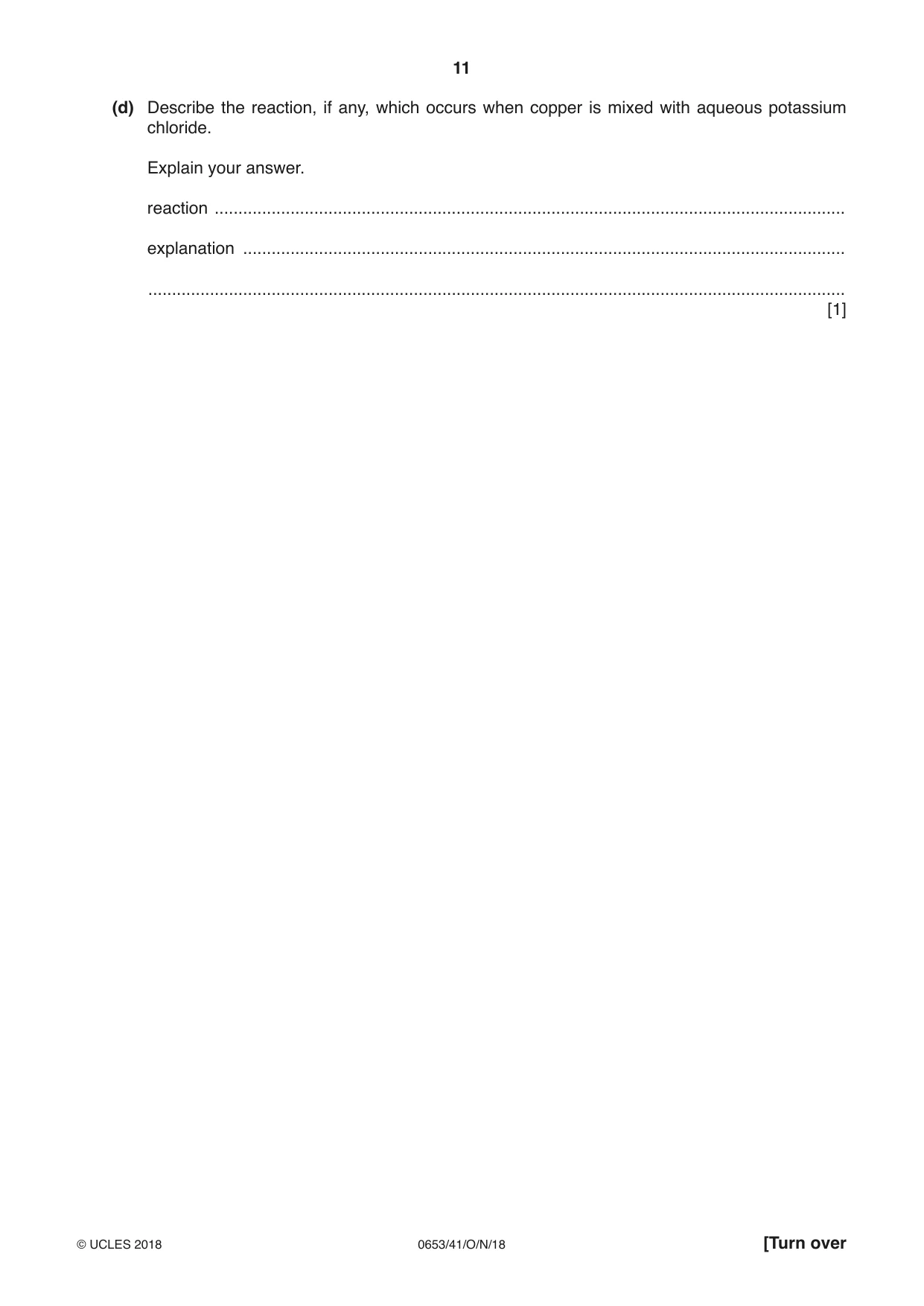
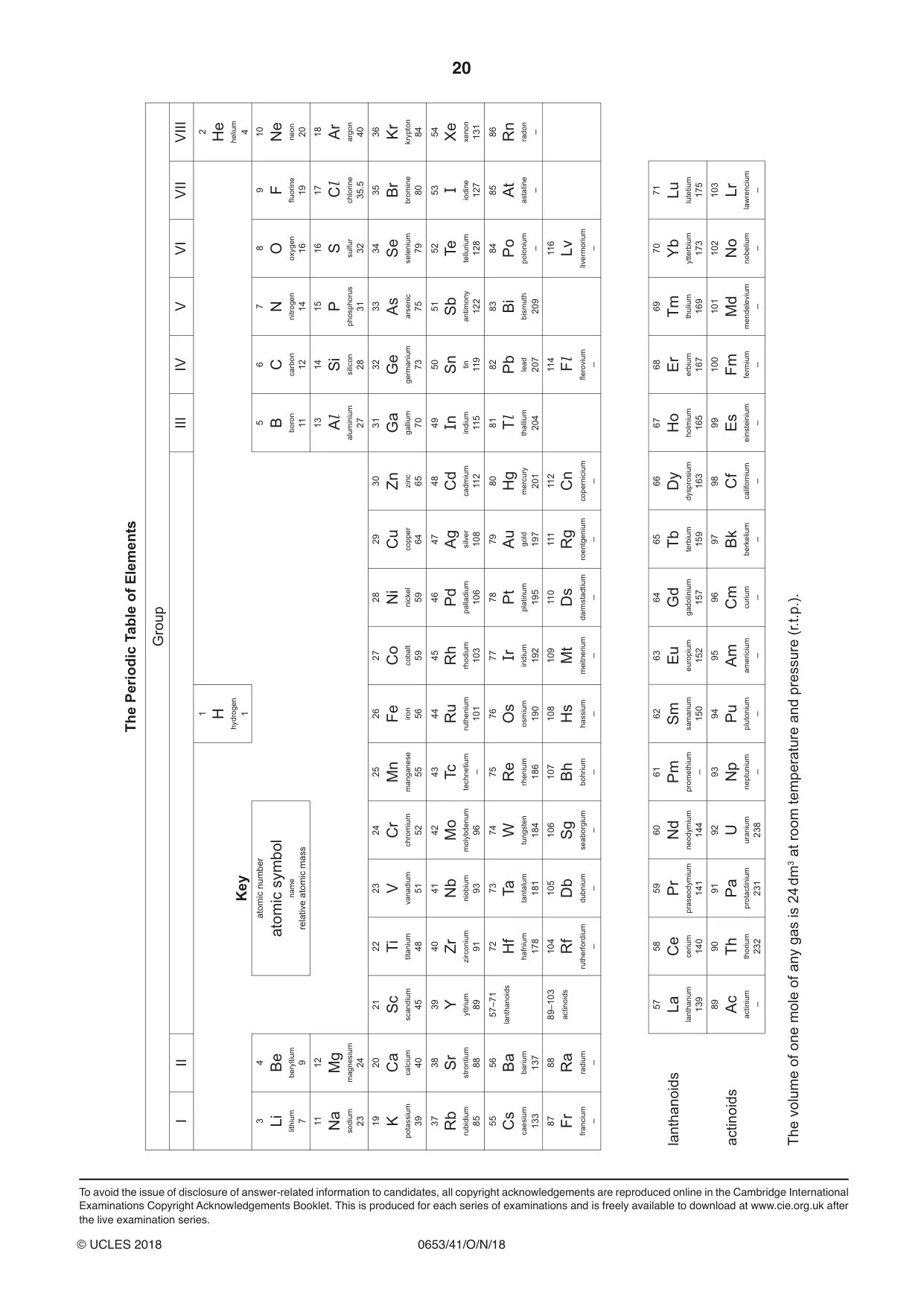
5 (a) Calcium sulfate is an insoluble salt. (i) Name two compounds that react together to form calcium sulfate. 1. ....................................................................................................................................... 2. ....................................................................................................................................... [2] (ii) Suggest the separation method that is used to separate an insoluble salt from an aqueous reaction mixture. Explain how this separation method removes the solid from the liquid. method .............................................................................................................................. explanation ........................................................................................................................ ........................................................................................................................................... ........................................................................................................................................... [2] (b) Calcium is in Group II in the Periodic Table. (i) Complete the following sentences using words from the list. Each word may be used once, more than once or not at all. good high low poor Calcium is a ...................................................................................... electrical conductor. Calcium has a ............................................................................................ melting point. [1] (ii) State the electronic structure of a calcium atom. .......................................................................................................................................[1] (c) Caesium is below potassium in Group I of the Periodic Table. Potassium melts at 63 °C and it reacts rapidly with water. Caesium is a solid at room temperature (25 °C). (i) Compare the rate of the reaction between caesium and water with the rate of reaction between potassium and water. ........................................................................................................................................... .......................................................................................................................................[1] (ii) Suggest the melting point of caesium. ................................................................................................................................. °C [1] (d) Describe the reaction, if any, which occurs when copper is mixed with aqueous potassium chloride. Explain your answer. reaction ..................................................................................................................................... explanation ............................................................................................................................... ................................................................................................................................................... [1]
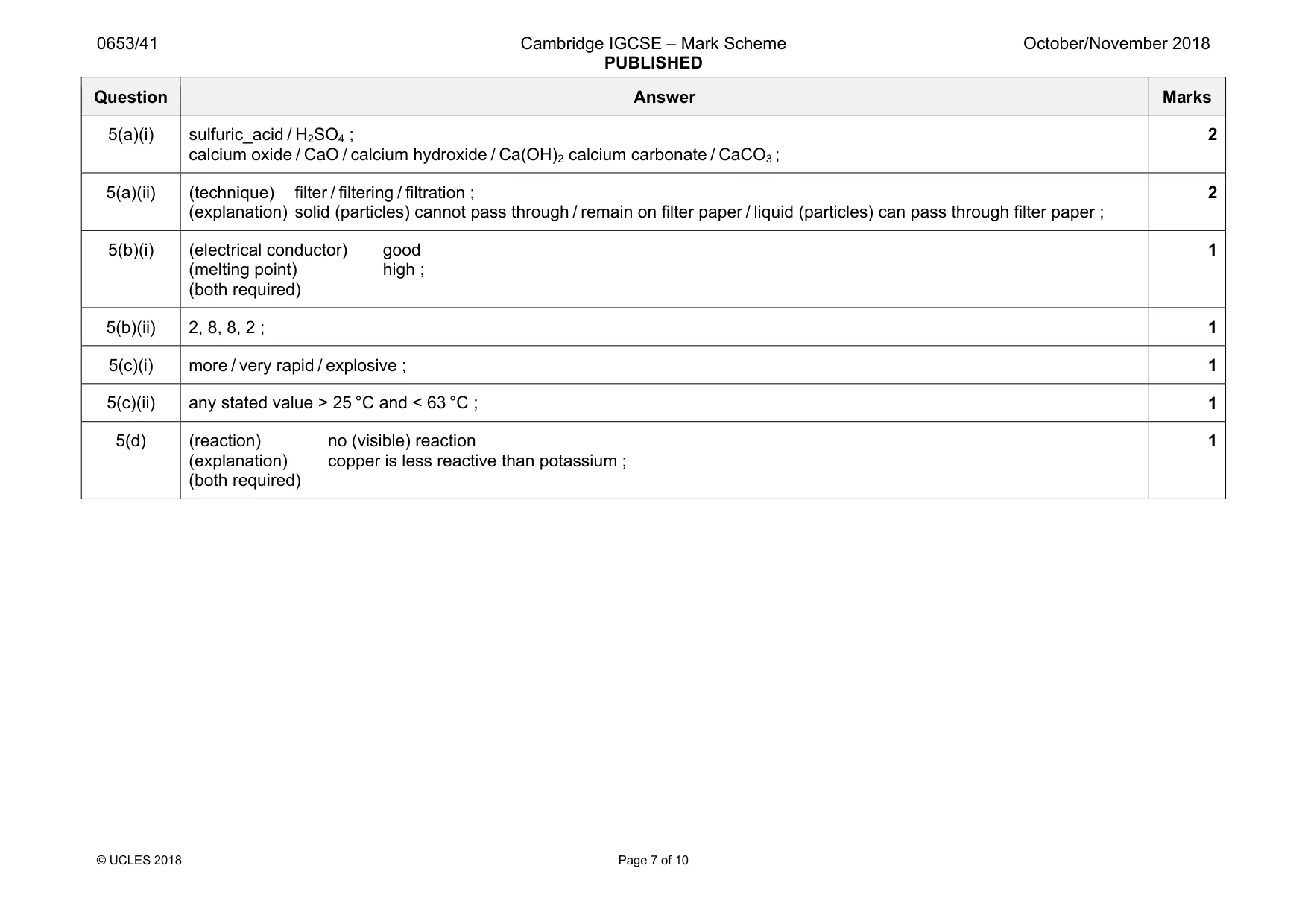
Mark scheme: 5(a)(i) sulfuric_acid / H2SO4 ; calcium oxide / CaO / calcium hydroxide / Ca(OH)2 calcium carbonate / CaCO3 ; 2 5(a)(ii) (technique) filter / filtering / filtration ; (explanation) solid (particles) cannot pass through / remain on filter paper / liquid (particles) can pass through filter paper ; 2 5(b)(i) (electrical conductor) good (melting point) high ; (both required) 1 5(b)(ii) 2, 8, 8, 2 ; 1 5(c)(i) more / very rapid / explosive ; 1 5(c)(ii) any stated value ˃ 25 °C and ˂ 63 °C ; 1 5(d) (reaction) no (visible) reaction (explanation) copper is less reactive than potassium ; (both required) 1
Q6 · A liquid-in-glass thermometer at room temperature
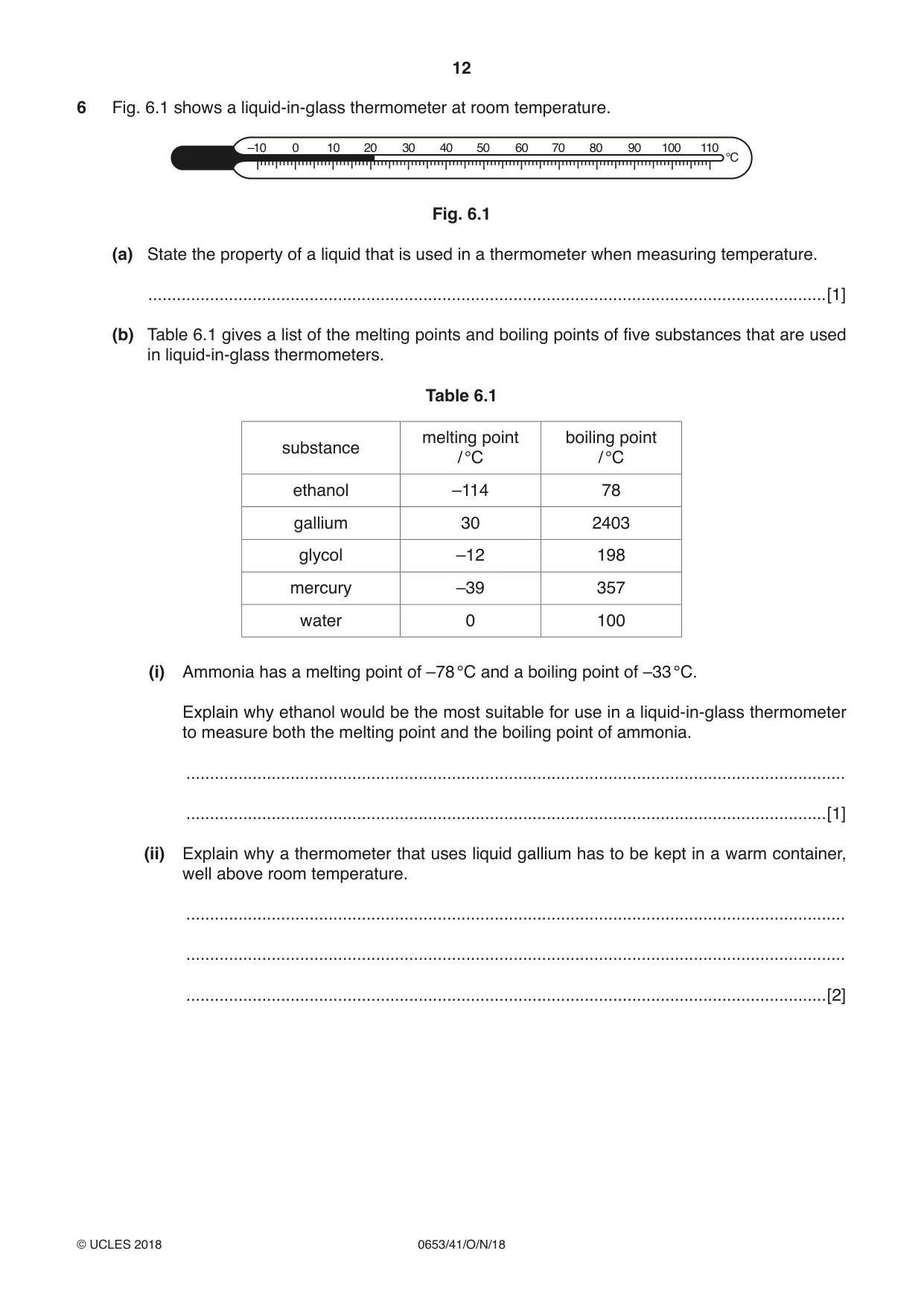
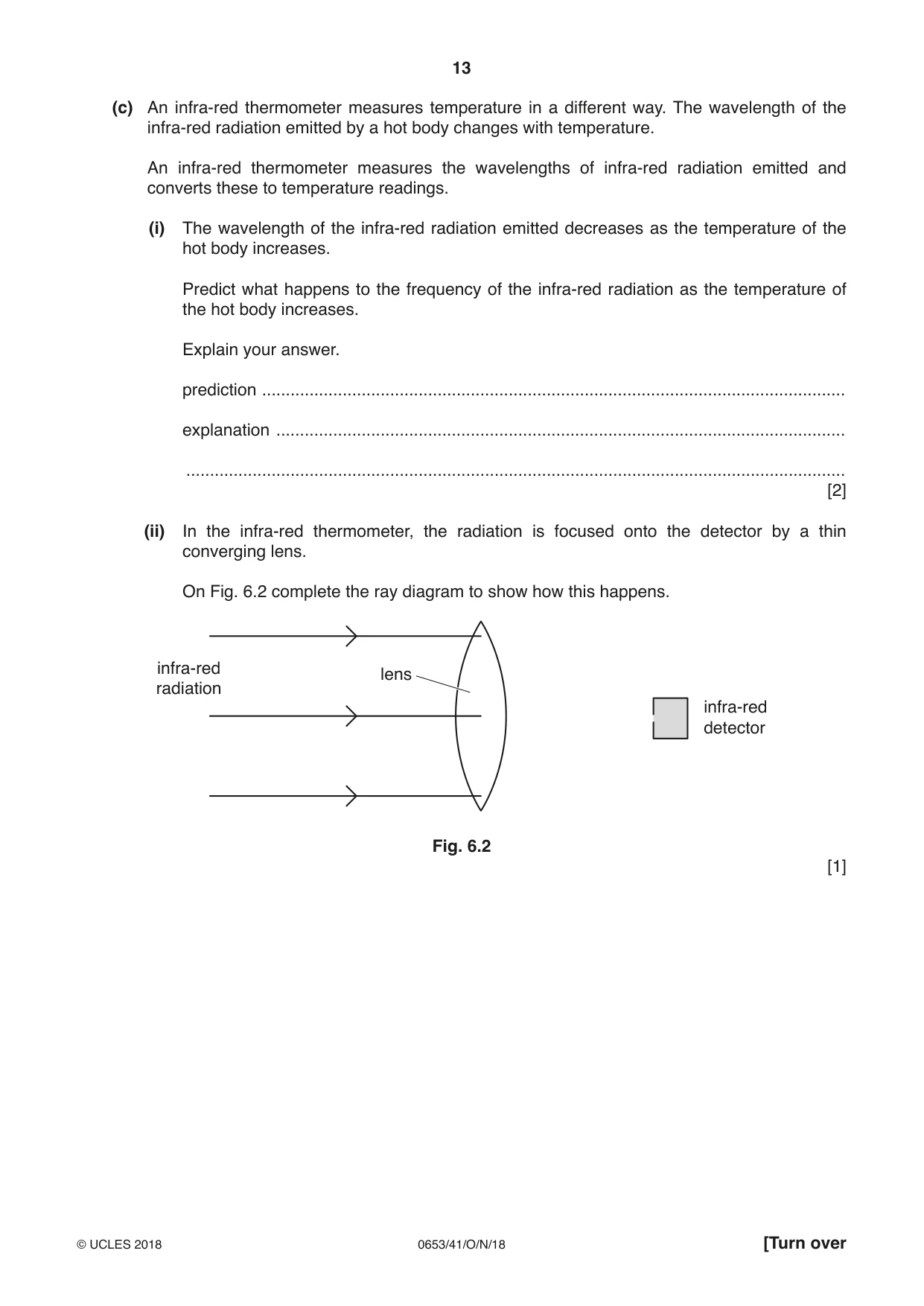
6 Fig. 6.1 shows a liquid-in-glass thermometer at room temperature. –10 0 10 20 30 40 50 60 70 80 90 100 110 °C Fig. 6.1 (a) State the property of a liquid that is used in a thermometer when measuring temperature. ...............................................................................................................................................[1] (b) Table 6.1 gives a list of the melting points and boiling points of five substances that are used in liquid-in-glass thermometers. Table 6.1 melting point boiling point substance / °C / °C ethanol –114 78 gallium 30 2403 glycol –12 198 mercury –39 357 water 0 100 (i) Ammonia has a melting point of –78 °C and a boiling point of –33 °C. Explain why ethanol would be the most suitable for use in a liquid-in-glass thermometer to measure both the melting point and the boiling point of ammonia. ........................................................................................................................................... .......................................................................................................................................[1] (ii) Explain why a thermometer that uses liquid gallium has to be kept in a warm container, well above room temperature. ........................................................................................................................................... ........................................................................................................................................... .......................................................................................................................................[2] (c) An infra-red thermometer measures temperature in a different way. The wavelength of the infra-red radiation emitted by a hot body changes with temperature. An infra-red thermometer measures the wavelengths of infra-red radiation emitted and converts these to temperature readings. (i) The wavelength of the infra-red radiation emitted decreases as the temperature of the hot body increases. Predict what happens to the frequency of the infra-red radiation as the temperature of the hot body increases. Explain your answer. prediction ........................................................................................................................... explanation ........................................................................................................................ ........................................................................................................................................... [2] (ii) In the infra-red thermometer, the radiation is focused onto the detector by a thin converging lens. On Fig. 6.2 complete the ray diagram to show how this happens. infra-red lens radiation infra-red detector Fig. 6.2 [1]
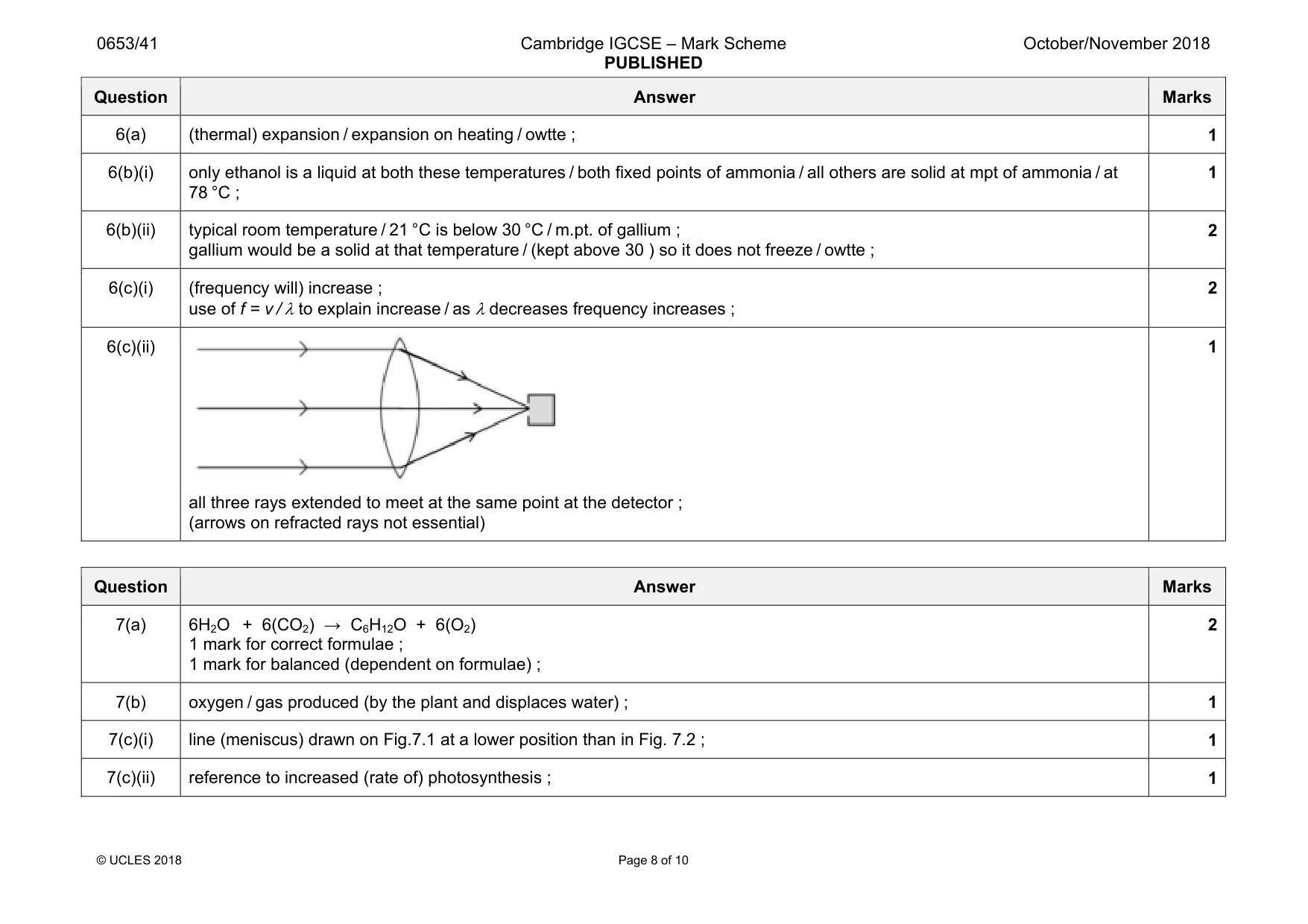
Mark scheme: 6(a) (thermal) expansion / expansion on heating / owtte ; 1 6(b)(i) only ethanol is a liquid at both these temperatures / both fixed points of ammonia / all others are solid at mpt of ammonia / at 78 °C ; 1 6(b)(ii) typical room temperature / 21 °C is below 30 °C / m.pt. of gallium ; gallium would be a solid at that temperature / (kept above 30 ) so it does not freeze / owtte ; 2 6(c)(i) (frequency will) increase ; use of f = v / λ to explain increase / as λ decreases frequency increases ; 2 6(c)(ii) all three rays extended to meet at the same point at the detector ; (arrows on refracted rays not essential) 1
Q7 · A student is investigating photosynthesis in an aquatic plant
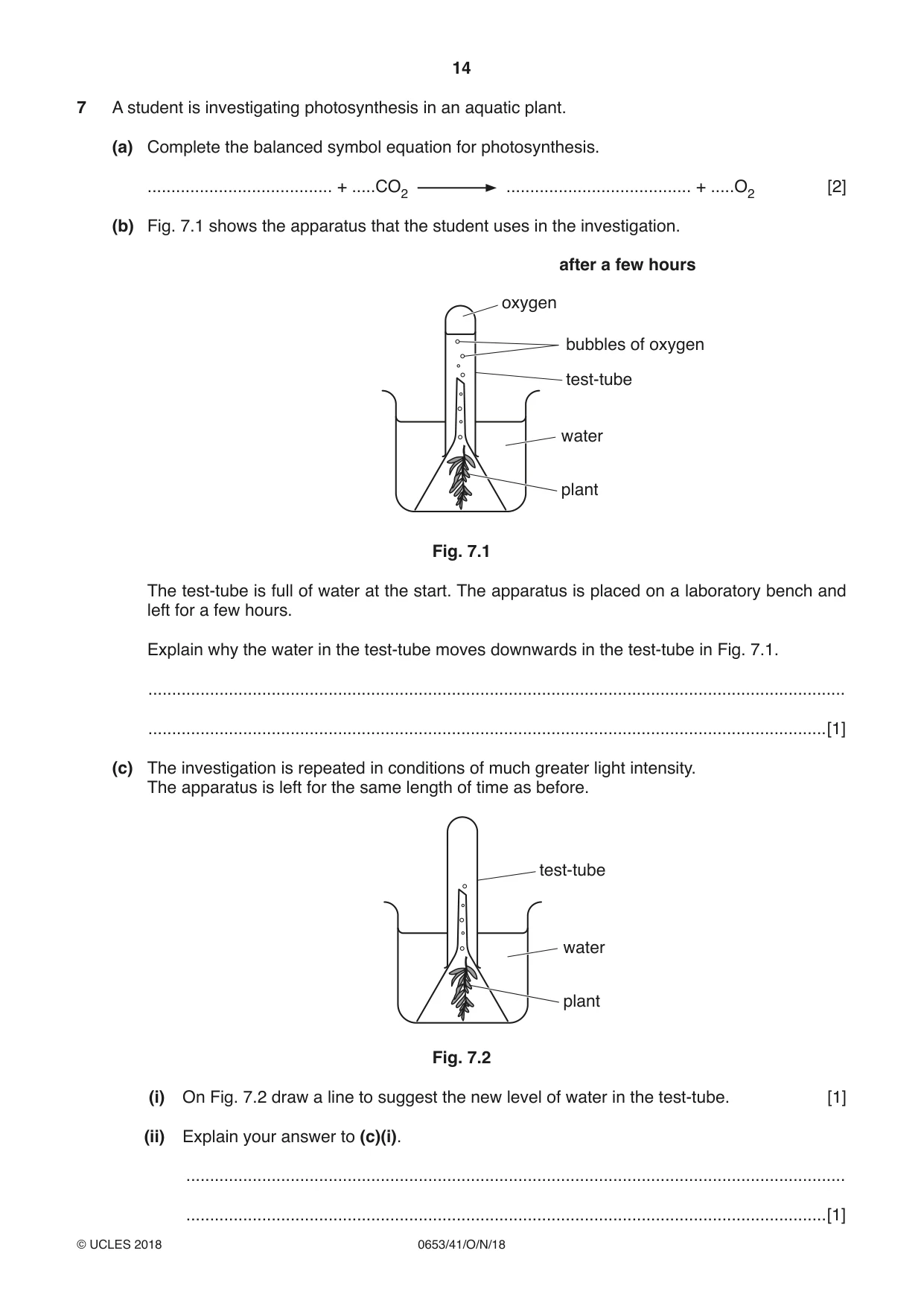
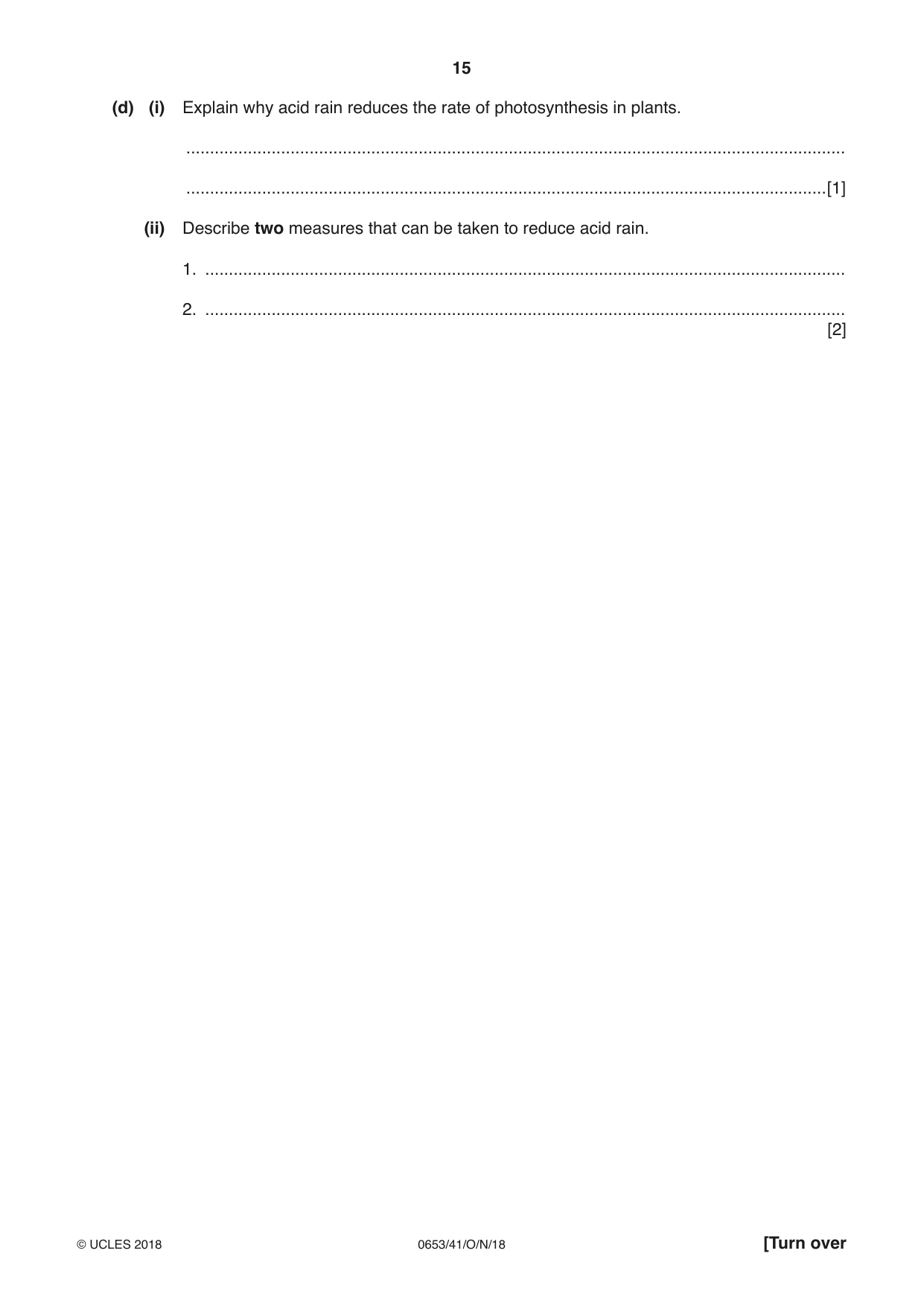
7 A student is investigating photosynthesis in an aquatic plant. (a) Complete the balanced symbol equation for photosynthesis. ....................................... + .....CO2 ....................................... + .....O2 [2] (b) Fig. 7.1 shows the apparatus that the student uses in the investigation. after a few hours oxygen bubbles of oxygen test-tube water plant Fig. 7.1 The test-tube is full of water at the start. The apparatus is placed on a laboratory bench and left for a few hours. Explain why the water in the test-tube moves downwards in the test-tube in Fig. 7.1. ................................................................................................................................................... ...............................................................................................................................................[1] (c) The investigation is repeated in conditions of much greater light intensity. The apparatus is left for the same length of time as before. test-tube water plant Fig. 7.2 (i) On Fig. 7.2 draw a line to suggest the new level of water in the test-tube. [1] (ii) Explain your answer to (c)(i). ........................................................................................................................................... .......................................................................................................................................[1] (d) (i) Explain why acid rain reduces the rate of photosynthesis in plants. ........................................................................................................................................... .......................................................................................................................................[1] (ii) Describe two measures that can be taken to reduce acid rain. 1. ....................................................................................................................................... 2. ....................................................................................................................................... [2]
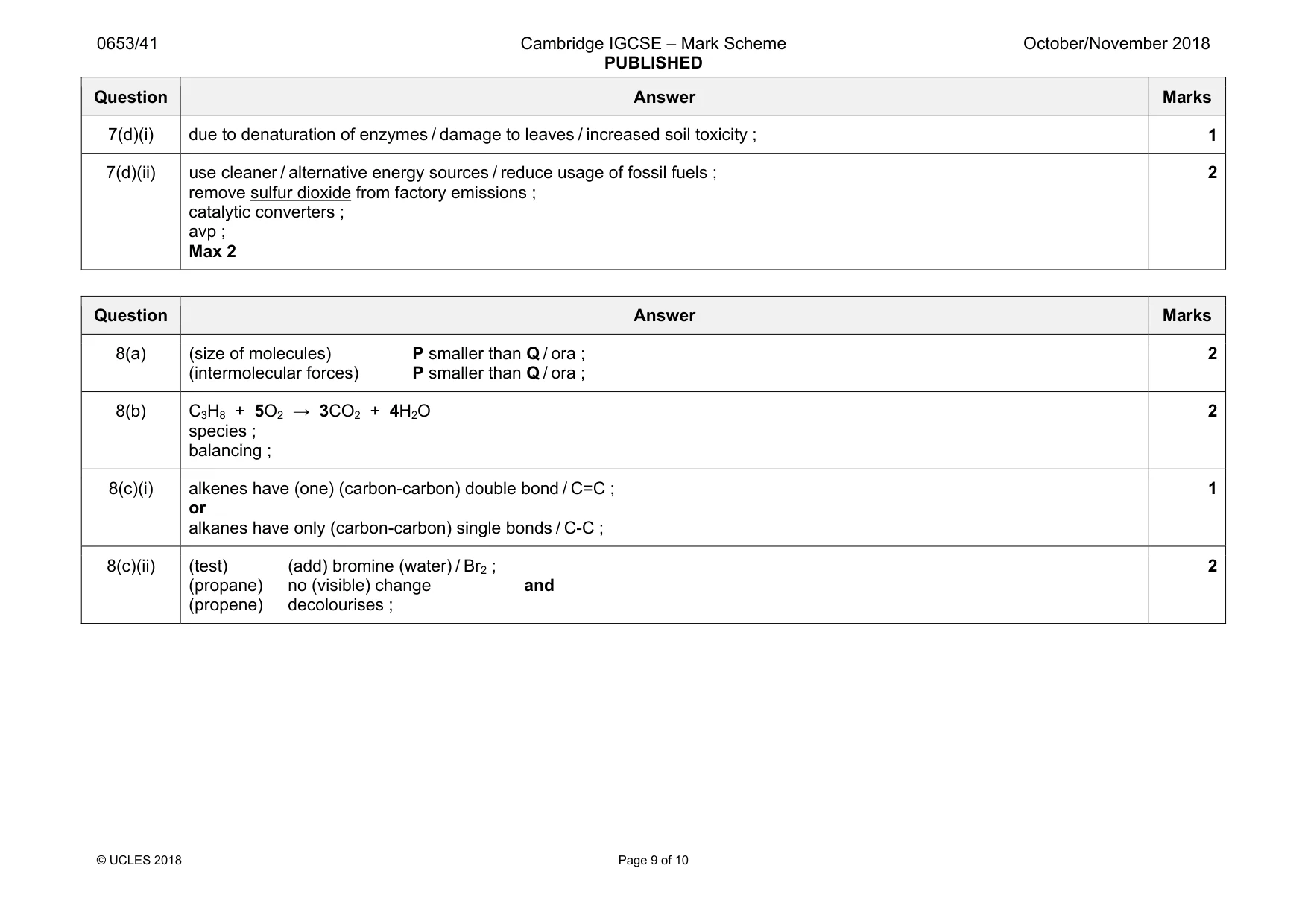
Mark scheme: 7(a) 6H2O + 6(CO2) → C6H12O + 6(O2) 1 mark for correct formulae ; 1 mark for balanced (dependent on formulae) ; 2 7(b) oxygen / gas produced (by the plant and displaces water) ; 1 7(c)(i) line (meniscus) drawn on Fig.7.1 at a lower position than in Fig. 7.2 ; 1 7(c)(ii) reference to increased (rate of) photosynthesis ; 1 Question Answer Marks 7(d)(i) due to denaturation of enzymes / damage to leaves / increased soil toxicity ; 1 7(d)(ii) use cleaner / alternative energy sources / reduce usage of fossil fuels ; remove sulfur dioxide from factory emissions ; catalytic converters ; avp ; Max 2 2
Q8 · Useful substances are obtained from petroleum using the processes shown in Fig
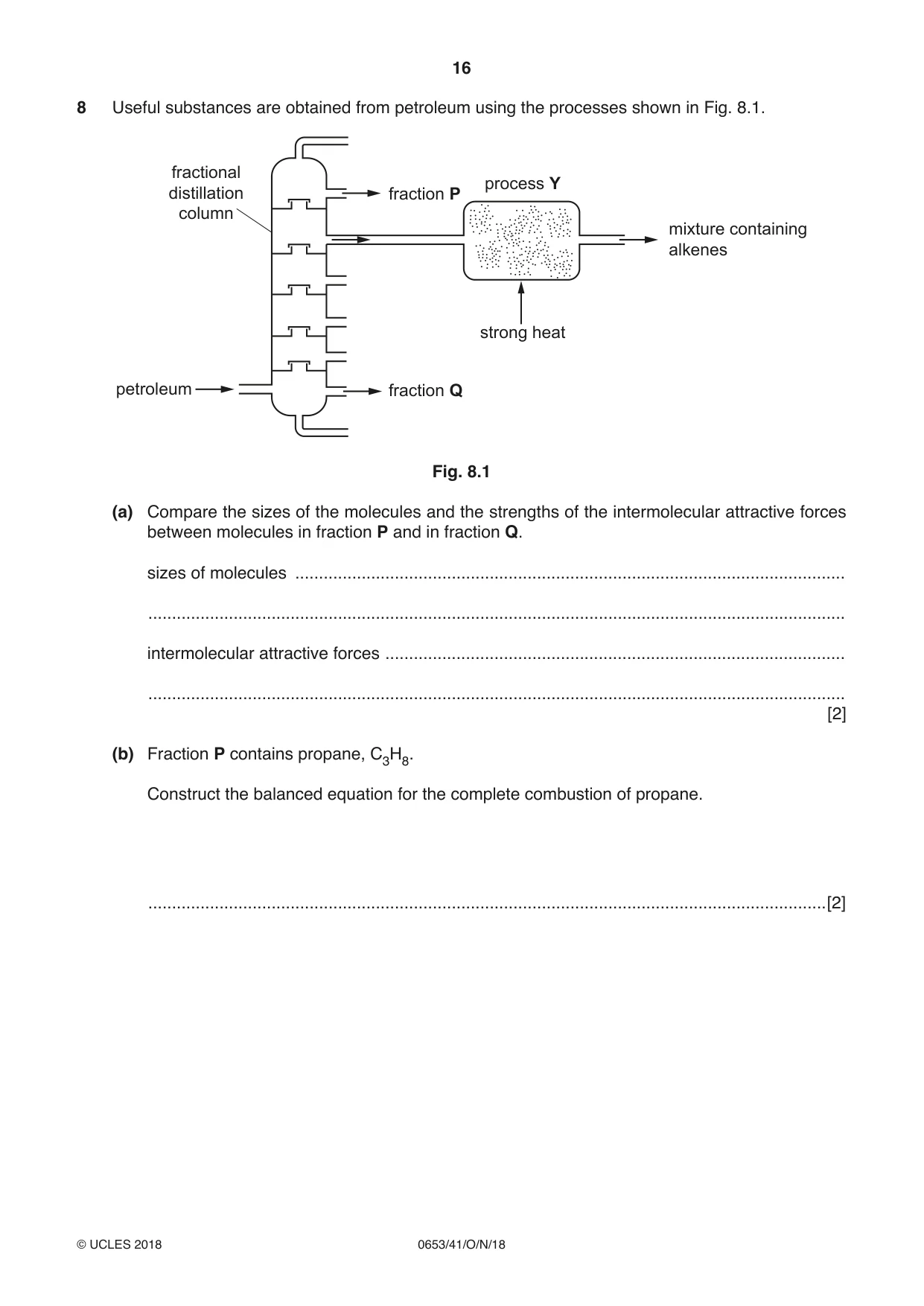
8 Useful substances are obtained from petroleum using the processes shown in Fig. 8.1. fractional process Y distillation fraction P column mixture containing alkenes strong heat petroleum fraction Q Fig. 8.1 (a) Compare the sizes of the molecules and the strengths of the intermolecular attractive forces between molecules in fraction P and in fraction Q. sizes of molecules .................................................................................................................... ................................................................................................................................................... intermolecular attractive forces ................................................................................................. ................................................................................................................................................... [2] (b) Fraction P contains propane, C3H8. Construct the balanced equation for the complete combustion of propane. ...............................................................................................................................................[2] (c) Process Y produces alkene molecules from large alkane molecules. (i) State how the molecular structure of alkenes differs from the molecular structure of alkanes. ........................................................................................................................................... .......................................................................................................................................[1] (ii) Describe a chemical test that is used to distinguish between propane and propene. State the observation for propane and for propene. test .................................................................................................................................... propane observation ......................................................................................................... ........................................................................................................................................... propene observation ......................................................................................................... ........................................................................................................................................... [2]
Mark scheme: 8(a) (size of molecules) P smaller than Q / ora ; (intermolecular forces) P smaller than Q / ora ; 2 8(b) C3H8 + 5O2 → 3CO2 + 4H2O species ; balancing ; 2 8(c)(i) alkenes have (one) (carbon-carbon) double bond / C=C ; or alkanes have only (carbon-carbon) single bonds / C-C ; 1 8(c)(ii) (test) (add) bromine (water) / Br2 ; (propane) no (visible) change and (propene) decolourises ; 2
Q9 · A dishwasher (an electric dishwashing machine)
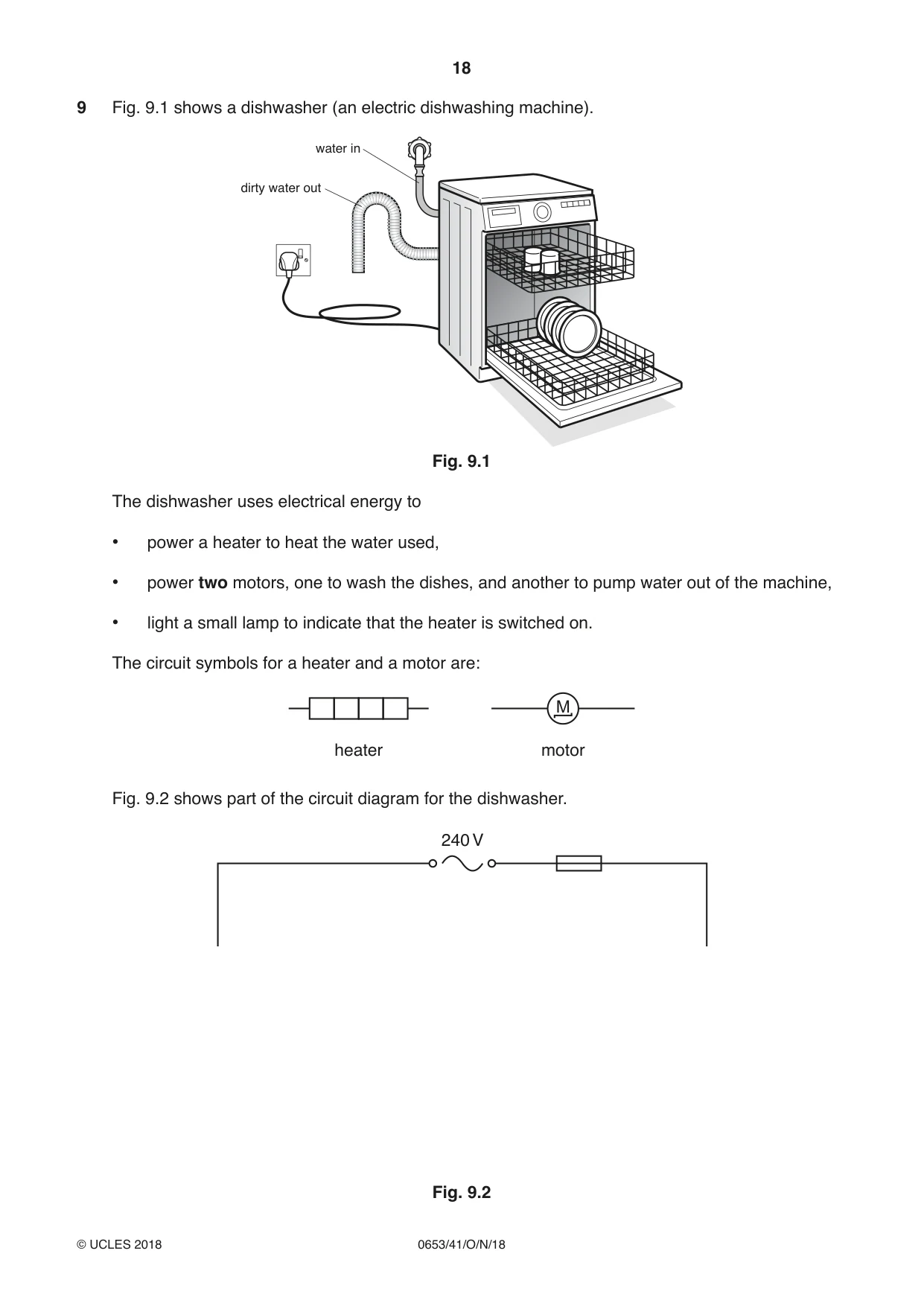
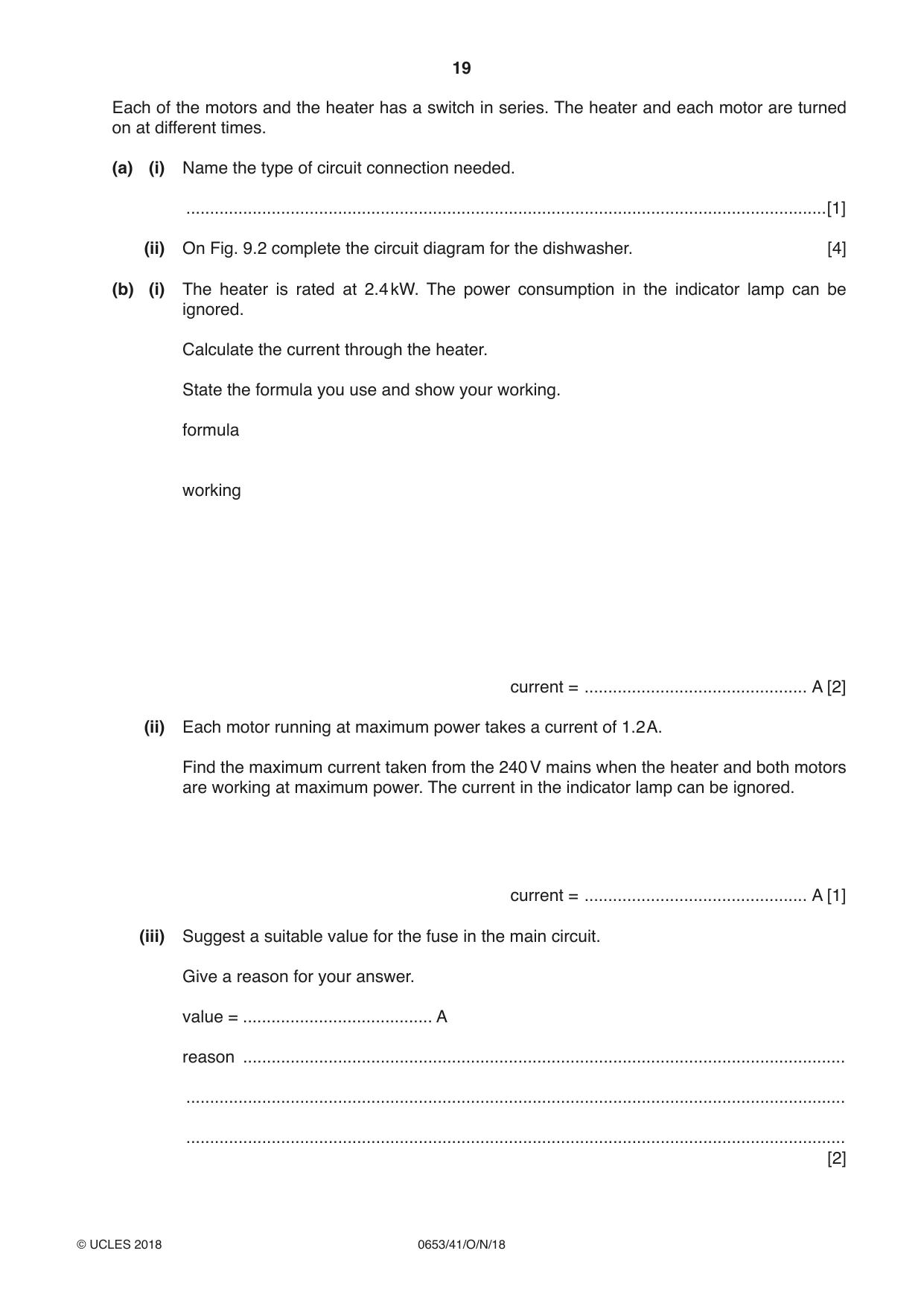
9 Fig. 9.1 shows a dishwasher (an electric dishwashing machine). water in dirty water out Fig. 9.1 The dishwasher uses electrical energy to • power a heater to heat the water used, • power two motors, one to wash the dishes, and another to pump water out of the machine, • light a small lamp to indicate that the heater is switched on. The circuit symbols for a heater and a motor are: M heater motor Fig. 9.2 shows part of the circuit diagram for the dishwasher. 240 V Fig. 9.2 Each of the motors and the heater has a switch in series. The heater and each motor are turned on at different times. (a) (i) Name the type of circuit connection needed. .......................................................................................................................................[1] (ii) On Fig. 9.2 complete the circuit diagram for the dishwasher. [4] (b) (i) The heater is rated at 2.4 kW. The power consumption in the indicator lamp can be ignored. Calculate the current through the heater. State the formula you use and show your working. formula working current = ............................................... A [2] (ii) Each motor running at maximum power takes a current of 1.2 A. Find the maximum current taken from the 240 V mains when the heater and both motors are working at maximum power. The current in the indicator lamp can be ignored. current = ............................................... A [1] (iii) Suggest a suitable value for the fuse in the main circuit. Give a reason for your answer. value = ........................................ A reason ............................................................................................................................... ........................................................................................................................................... ........................................................................................................................................... [2]
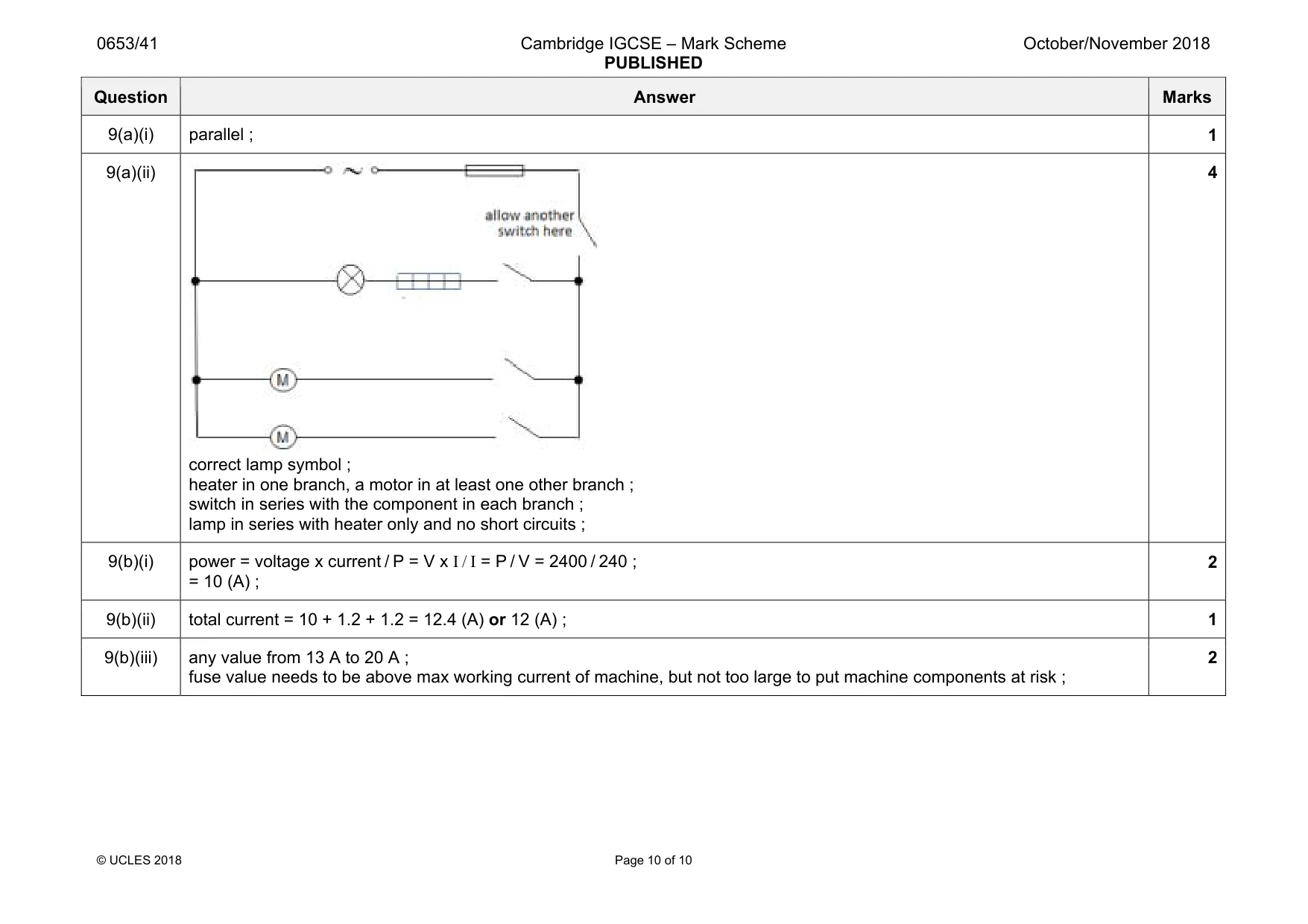
Mark scheme: 9(a)(i) parallel ; 1 9(a)(ii) correct lamp symbol ; heater in one branch, a motor in at least one other branch ; switch in series with the component in each branch ; lamp in series with heater only and no short circuits ; 4 9(b)(i) power = voltage x current / P = V x I / I = P / V = 2400 / 240 ; = 10 (A) ; 2 9(b)(ii) total current = 10 + 1.2 + 1.2 = 12.4 (A) or 12 (A) ; 1 9(b)(iii) any value from 13 A to 20 A ; fuse value needs to be above max working current of machine, but not too large to put machine components at risk ; 2
What was in this paper
The subtopics covered by these 9 questions, and how many questions each got. Open one in a new tab to see every Cambridge question on it.
What you needed in this session
Cambridge’s own grade thresholds for 2018 Oct/Nov, Paper 4 · Variant 1. A higher threshold means an easier paper — the bar moves with how the cohort did.