Cambridge IGCSE Science - Combined 0653 — 2024 May/June Paper 4 · Variant 3
0653/43/M/J/24 · 9 questions · 80 marks · ≈90 min
The question paper and its mark scheme, free to read here and free to download. This is Cambridge’s own paper, exactly as it was sat.
Question paper24 pages

Mark scheme10 pages
Answers below. Sit the paper first if you are practising.
Questions as text
Question 1
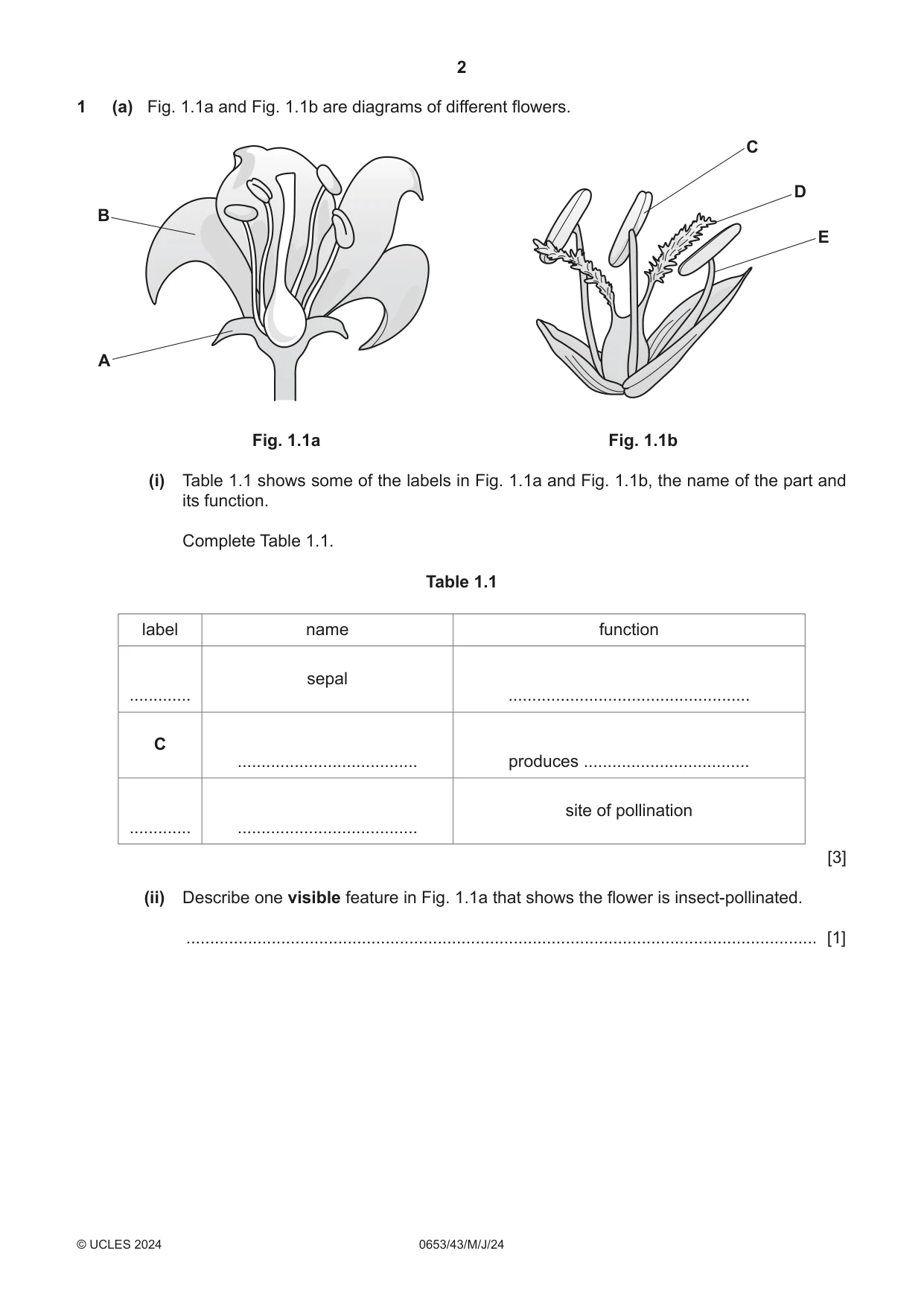
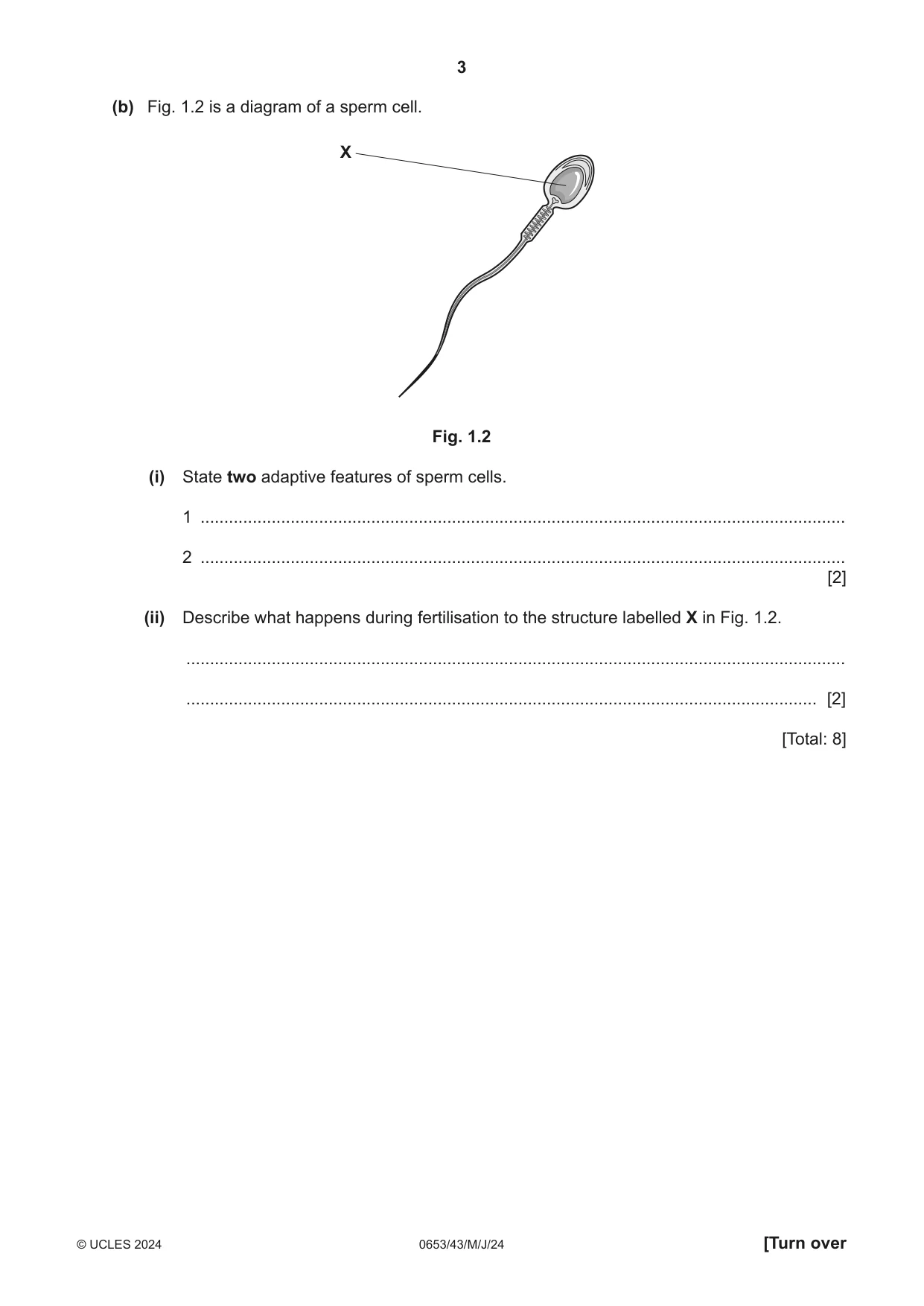
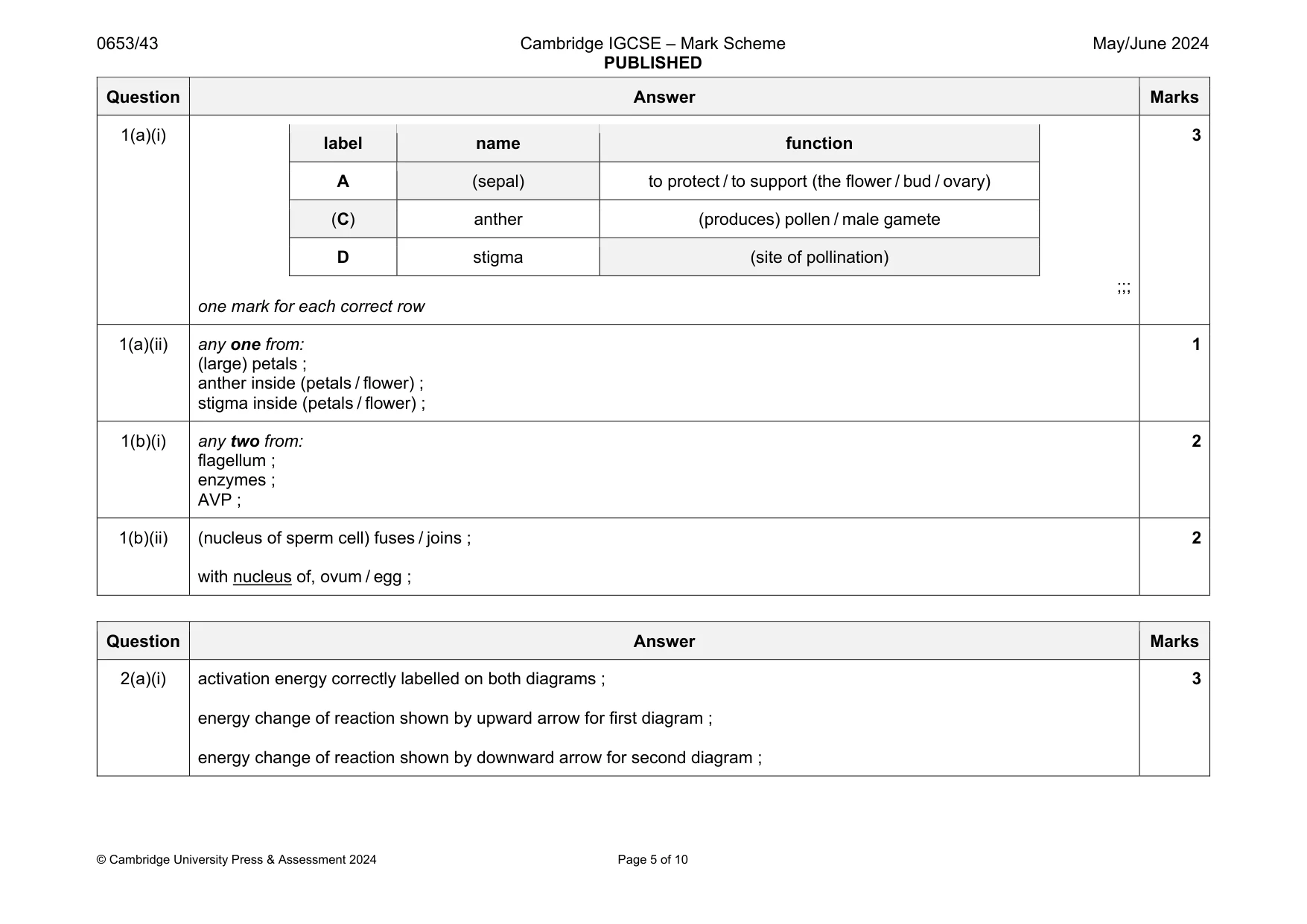
1 (a) Fig. 1.1a and Fig. 1.1b are diagrams of different flowers. C D B E A Fig. 1.1a Fig. 1.1b (i) Table 1.1 shows some of the labels in Fig. 1.1a and Fig. 1.1b, the name of the part and its function. Complete Table 1.1. Table 1.1 label name function sepal ............. ................................................... C ...................................... produces ................................... site of pollination ............. ...................................... [3] (ii) Describe one visible feature in Fig. 1.1a that shows the flower is insect‑pollinated. ..................................................................................................................................... [1] (b) Fig. 1.2 is a diagram of a sperm cell. X Fig. 1.2 (i) State two adaptive features of sperm cells. 1 ........................................................................................................................................ 2 ........................................................................................................................................ [2] (ii) Describe what happens during fertilisation to the structure labelled X in Fig. 1.2. ........................................................................................................................................... ..................................................................................................................................... [2] [Total: 8]
Mark scheme: 1(a)(i) label name function A (sepal) to protect / to support (the flower / bud / ovary) (C) anther (produces) pollen / male gamete D stigma (site of pollination) ;;; one mark for each correct row 3 1(a)(ii) any one from: (large) petals ; anther inside (petals / flower) ; stigma inside (petals / flower) ; 1 1(b)(i) any two from: flagellum ; enzymes ; AVP ; 2 1(b)(ii) (nucleus of sperm cell) fuses / joins ; with nucleus of, ovum / egg ; 2
Q2 · Oxides of nitrogen are pollutant gases formed in car engines
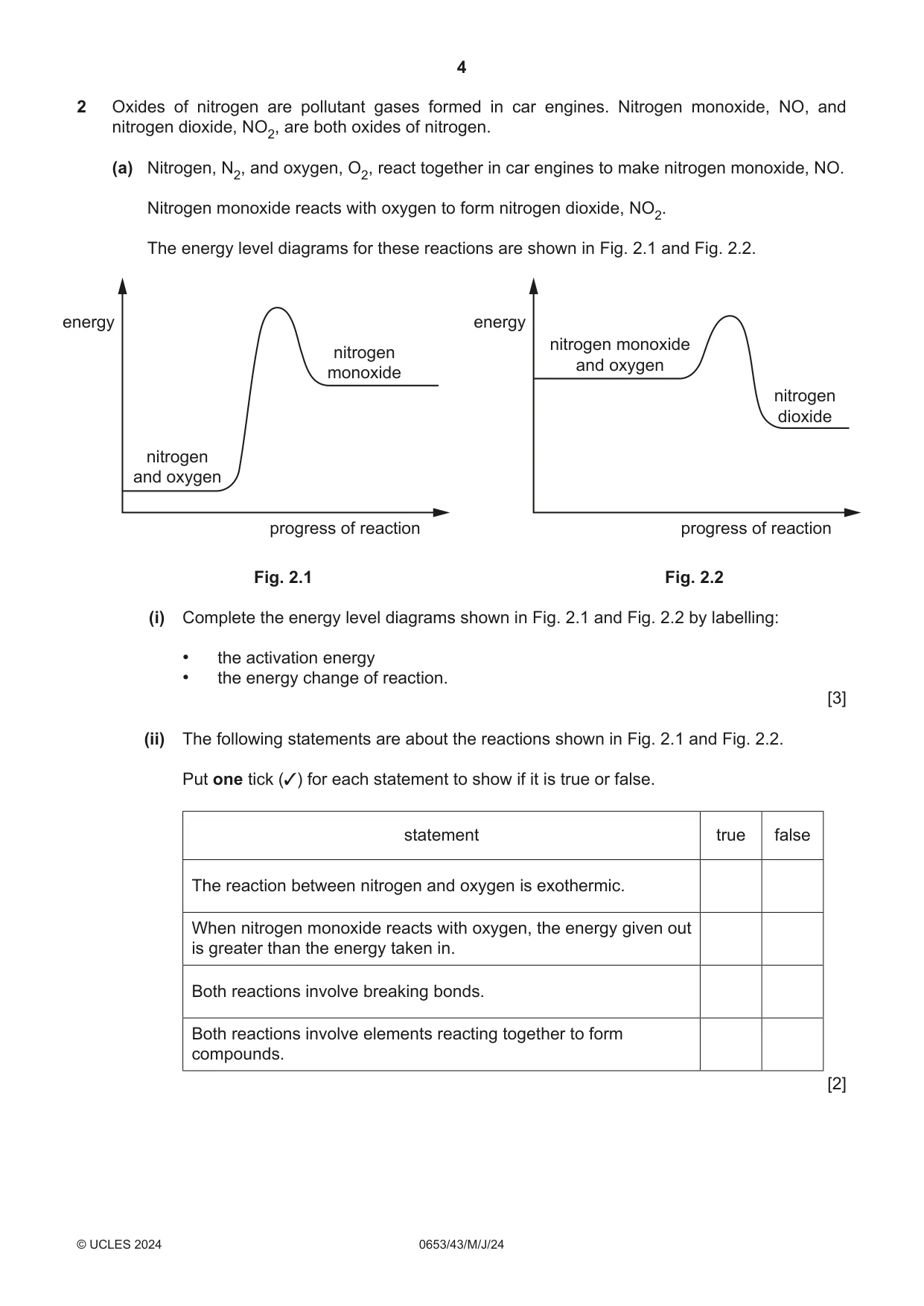
2 Oxides of nitrogen are pollutant gases formed in car engines. Nitrogen monoxide, NO, and nitrogen dioxide, NO2, are both oxides of nitrogen. (a) Nitrogen, N2, and oxygen, O2, react together in car engines to make nitrogen monoxide, NO. Nitrogen monoxide reacts with oxygen to form nitrogen dioxide, NO2. The energy level diagrams for these reactions are shown in Fig. 2.1 and Fig. 2.2. energy energy nitrogen monoxide nitrogen and oxygen monoxide nitrogen dioxide nitrogen and oxygen progress of reaction progress of reaction Fig. 2.1 Fig. 2.2 (i) Complete the energy level diagrams shown in Fig. 2.1 and Fig. 2.2 by labelling: • the activation energy • the energy change of reaction. [3] (ii) The following statements are about the reactions shown in Fig. 2.1 and Fig. 2.2. Put one tick (✓) for each statement to show if it is true or false. statement true false The reaction between nitrogen and oxygen is exothermic. When nitrogen monoxide reacts with oxygen, the energy given out is greater than the energy taken in. Both reactions involve breaking bonds. Both reactions involve elements reacting together to form compounds. [2] (iii) Write the balanced symbol equation for the reaction between nitrogen oxide, NO, and oxygen, O2, to make nitrogen dioxide, NO2. ..................................................................................................................................... [1] (b) Oxides of nitrogen are simple molecules. Explain why oxides of nitrogen have low boiling points. Use ideas about forces and energy in your answer. ................................................................................................................................................... ................................................................................................................................................... ............................................................................................................................................. [2] [Total: 8]
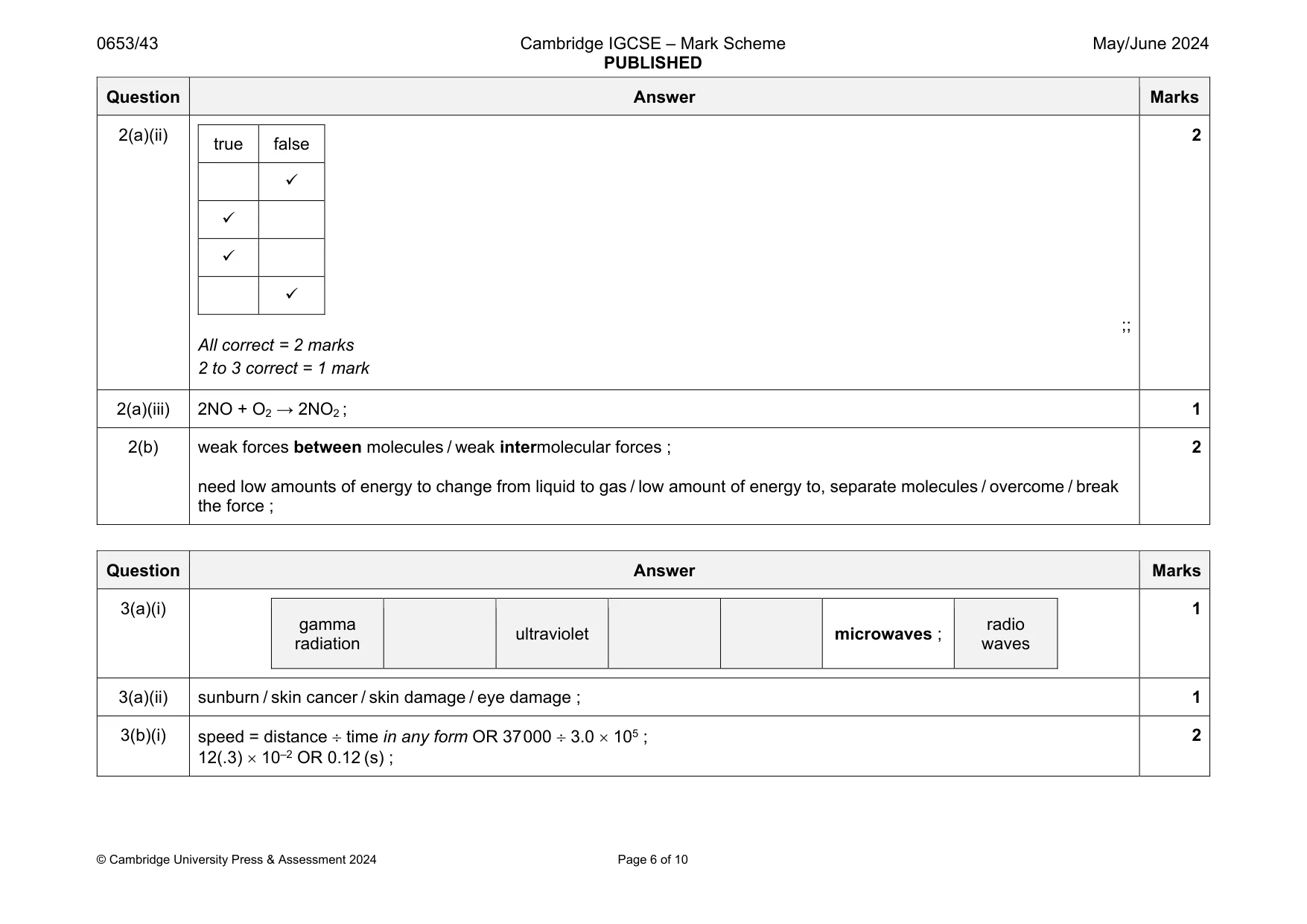
Mark scheme: 2(a)(i) activation energy correctly labelled on both diagrams ; energy change of reaction shown by upward arrow for first diagram ; energy change of reaction shown by downward arrow for second diagram ; 3 Question Answer Marks 2(a)(ii) true false ;; All correct = 2 marks 2 to 3 correct = 1 mark 2 2(a)(iii) 2NO + O2 → 2NO2 ; 1 2(b) weak forces between molecules / weak intermolecular forces ; need low amounts of energy to change from liquid to gas / low amount of energy to, separate molecules / overcome / break the force ; 2
Q3 · A television (TV) connected to a satellite dish
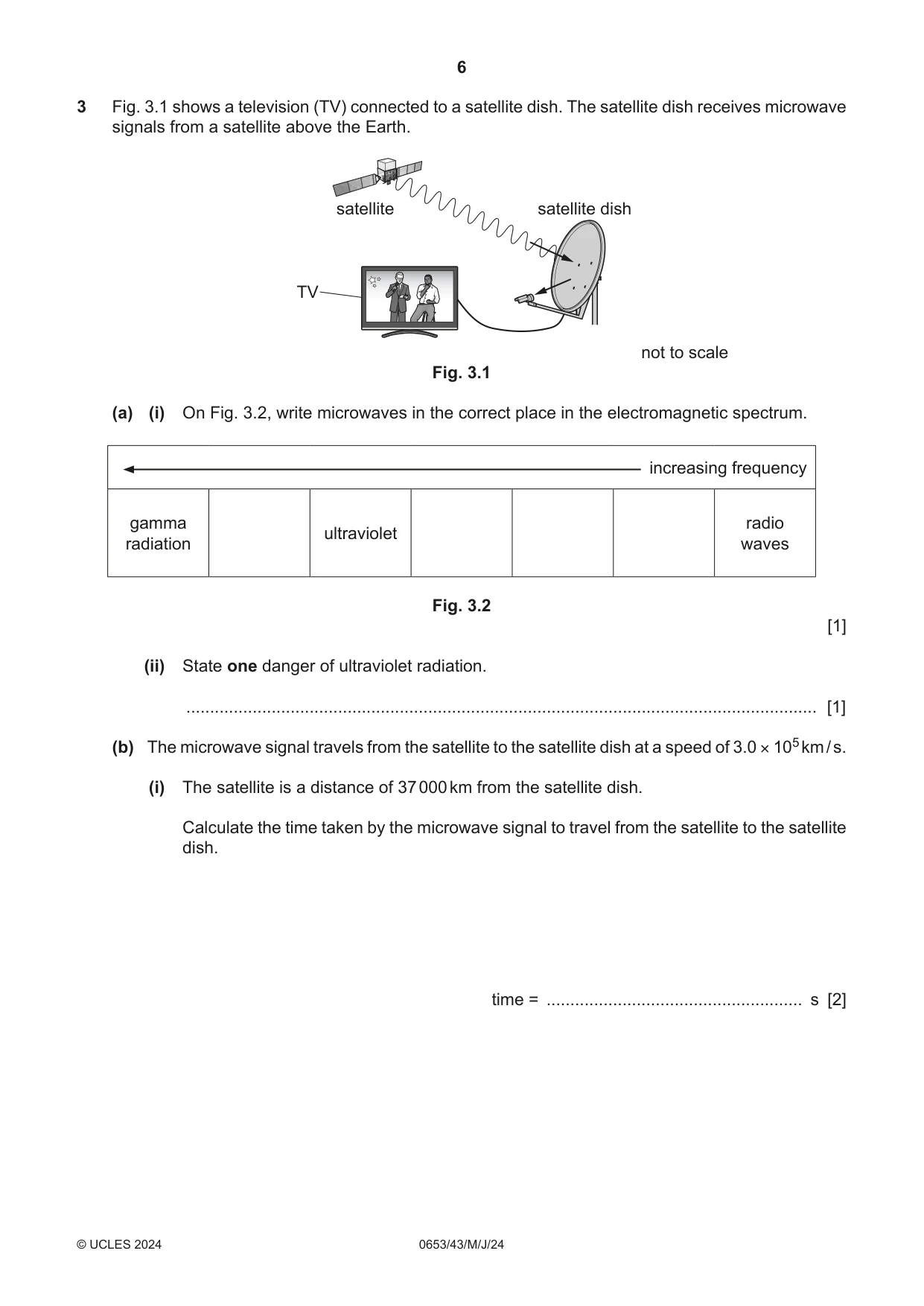
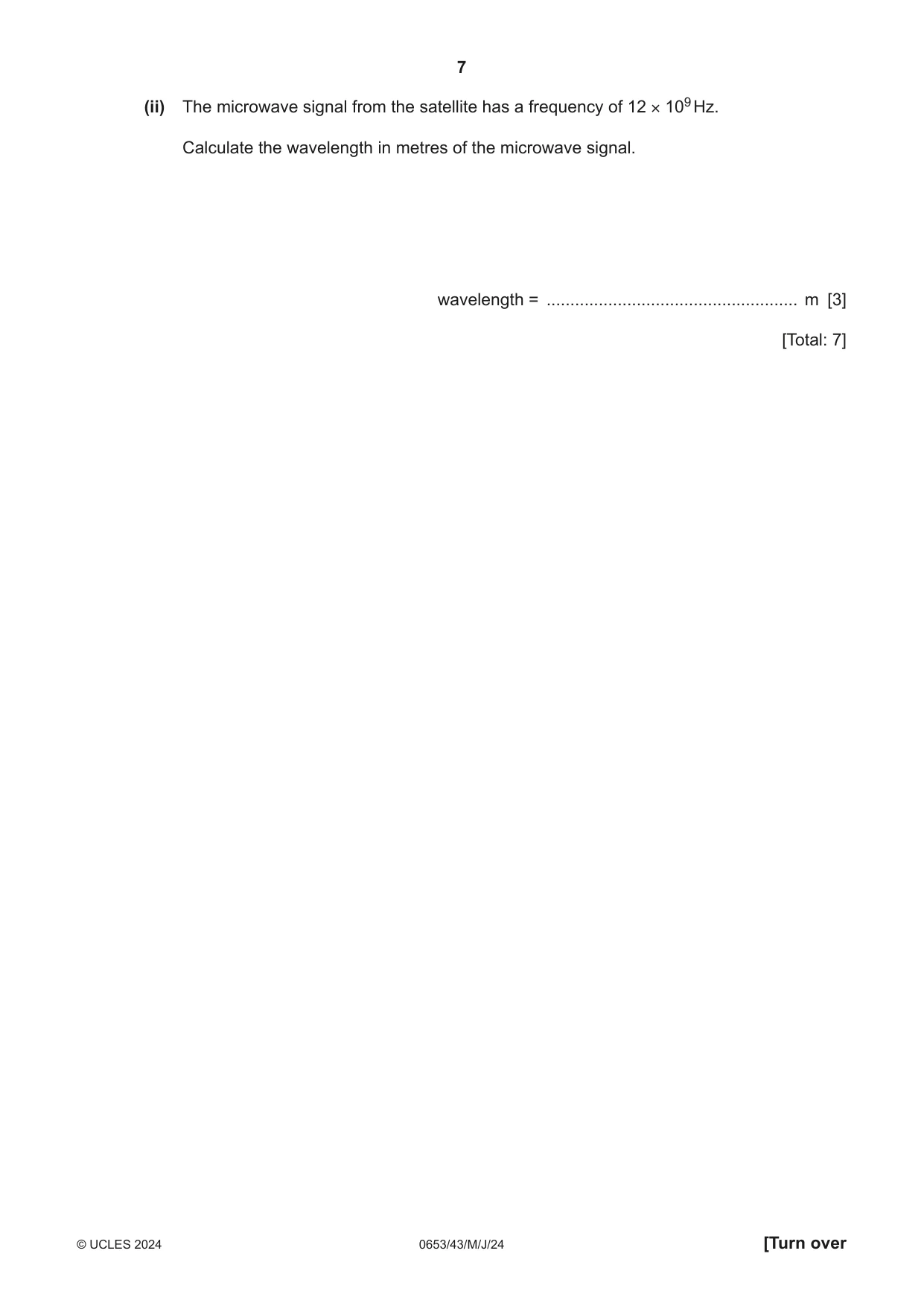
3 Fig. 3.1 shows a television (TV) connected to a satellite dish. The satellite dish receives microwave signals from a satellite above the Earth. satellite satellite dish TV not to scale Fig. 3.1 (a) (i) On Fig. 3.2, write microwaves in the correct place in the electromagnetic spectrum. increasing frequency gamma radio ultraviolet radiation waves Fig. 3.2 [1] (ii) State one danger of ultraviolet radiation. ..................................................................................................................................... [1] (b) The microwave signal travels from the satellite to the satellite dish at a speed of 3.0 × 10⁵ km / s. (i) The satellite is a distance of 37 000 km from the satellite dish. Calculate the time taken by the microwave signal to travel from the satellite to the satellite dish. time = ...................................................... s [2] (ii) The microwave signal from the satellite has a frequency of 12 × 109 Hz. Calculate the wavelength in metres of the microwave signal. wavelength = ..................................................... m [3] [Total: 7]
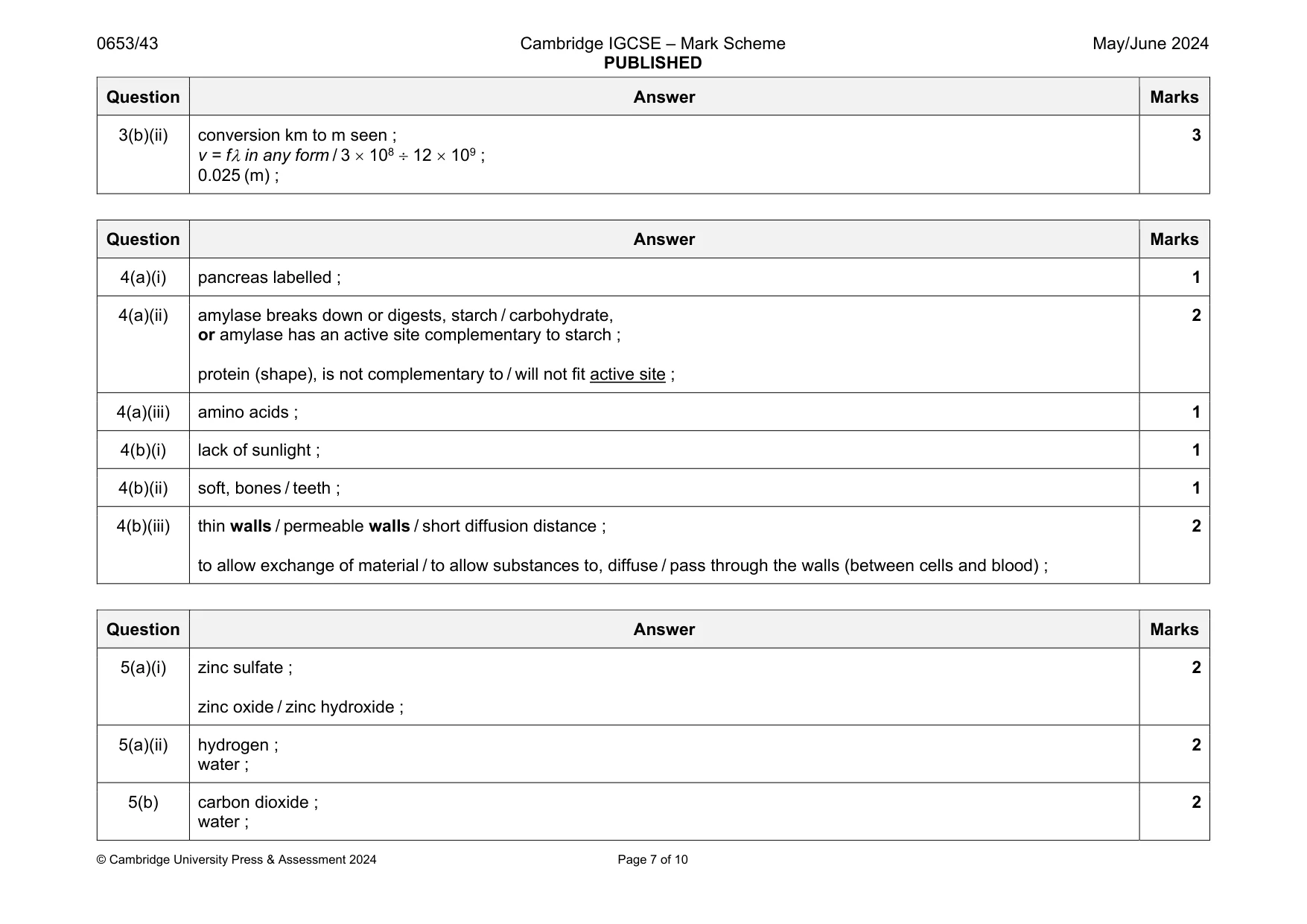
Mark scheme: 3(a)(i) gamma radiation ultraviolet microwaves ; radio waves 1 3(a)(ii) sunburn / skin cancer / skin damage / eye damage ; 1 3(b)(i) speed = distance time in any form OR 37 000 3.0 105 ; 12(.3) 10–2 OR 0.12 (s) ; 2 Question Answer Marks 3(b)(ii) conversion km to m seen ; v = f in any form / 3 108 12 109 ; 0.025 (m) ; 3
Q4 · A model of the alimentary canal and associated organs of humans
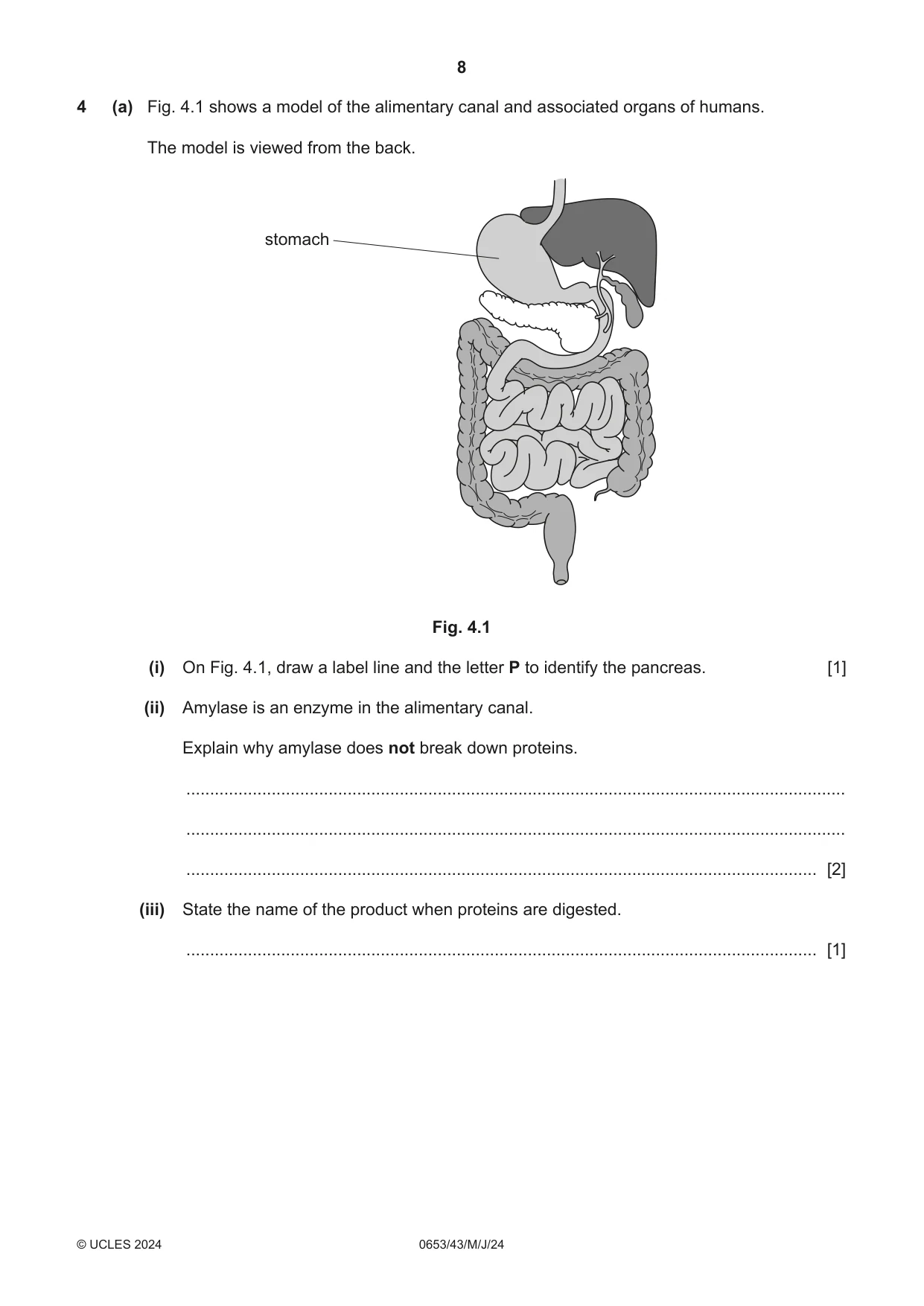
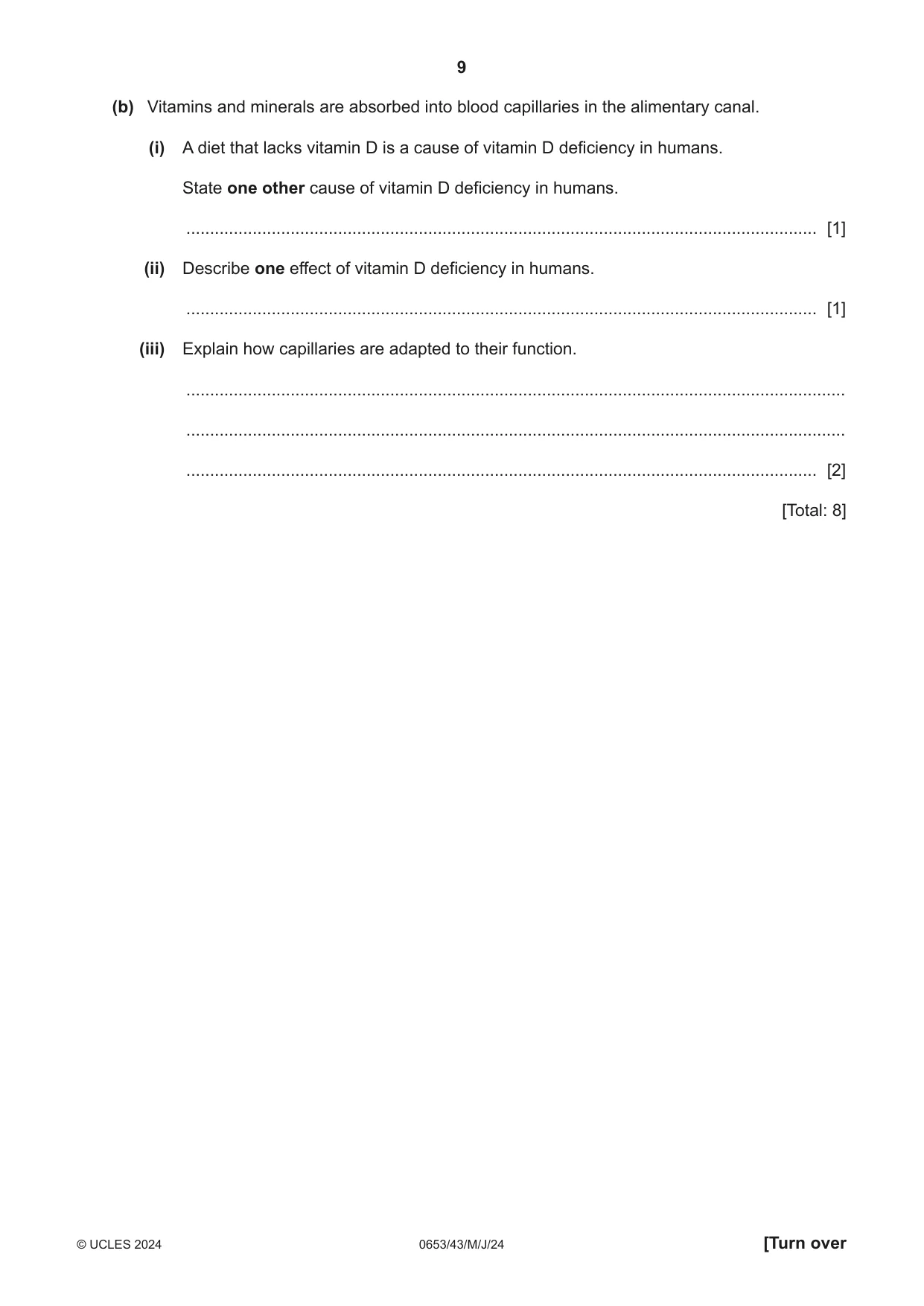
4 (a) Fig. 4.1 shows a model of the alimentary canal and associated organs of humans. The model is viewed from the back. stomach Fig. 4.1 (i) On Fig. 4.1, draw a label line and the letter P to identify the pancreas. [1] (ii) Amylase is an enzyme in the alimentary canal. Explain why amylase does not break down proteins. ........................................................................................................................................... ........................................................................................................................................... ..................................................................................................................................... [2] (iii) State the name of the product when proteins are digested. ..................................................................................................................................... [1] (b) Vitamins and minerals are absorbed into blood capillaries in the alimentary canal. (i) A diet that lacks vitamin D is a cause of vitamin D deficiency in humans. State one other cause of vitamin D deficiency in humans. ..................................................................................................................................... [1] (ii) Describe one effect of vitamin D deficiency in humans. ..................................................................................................................................... [1] (iii) Explain how capillaries are adapted to their function. ........................................................................................................................................... ........................................................................................................................................... ..................................................................................................................................... [2] [Total: 8]
Mark scheme: 4(a)(i) pancreas labelled ; 1 4(a)(ii) amylase breaks down or digests, starch / carbohydrate, or amylase has an active site complementary to starch ; protein (shape), is not complementary to / will not fit active site ; 2 4(a)(iii) amino acids ; 1 4(b)(i) lack of sunlight ; 1 4(b)(ii) soft, bones / teeth ; 1 4(b)(iii) thin walls / permeable walls / short diffusion distance ; to allow exchange of material / to allow substances to, diffuse / pass through the walls (between cells and blood) ; 2
Q5 · Zinc and some zinc compounds react with dilute acids to make salts
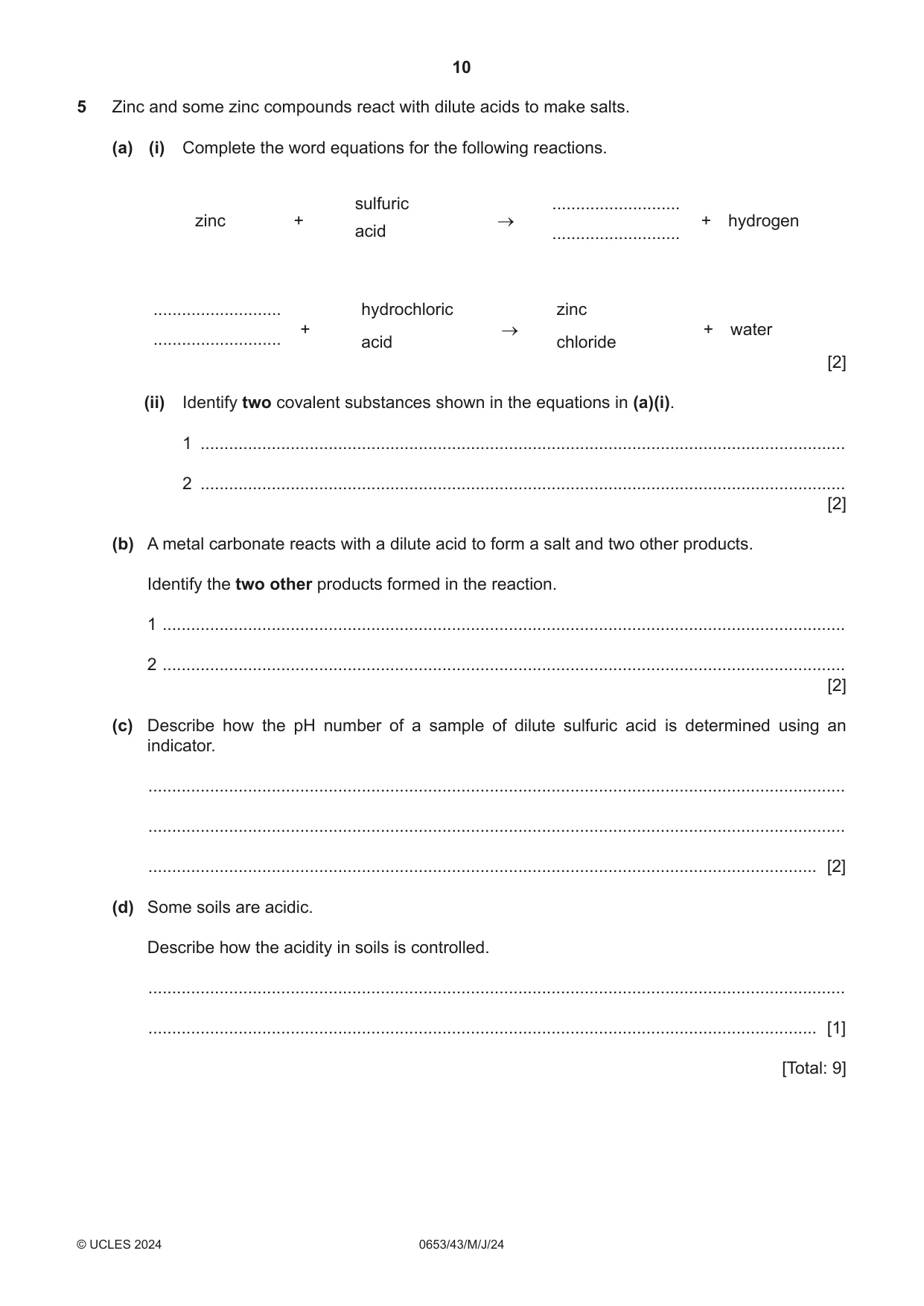
5 Zinc and some zinc compounds react with dilute acids to make salts. (a) (i) Complete the word equations for the following reactions. sulfuric ........................... zinc + + hydrogen acid ........................... ........................... hydrochloric zinc + + water ........................... acid chloride [2] (ii) Identify two covalent substances shown in the equations in (a)(i). 1 ........................................................................................................................................ 2 ........................................................................................................................................ [2] (b) A metal carbonate reacts with a dilute acid to form a salt and two other products. Identify the two other products formed in the reaction. 1 ................................................................................................................................................ 2 ................................................................................................................................................ [2] (c) Describe how the pH number of a sample of dilute sulfuric acid is determined using an indicator. ................................................................................................................................................... ................................................................................................................................................... ............................................................................................................................................. [2] (d) Some soils are acidic. Describe how the acidity in soils is controlled. ................................................................................................................................................... ............................................................................................................................................. [1] [Total: 9]
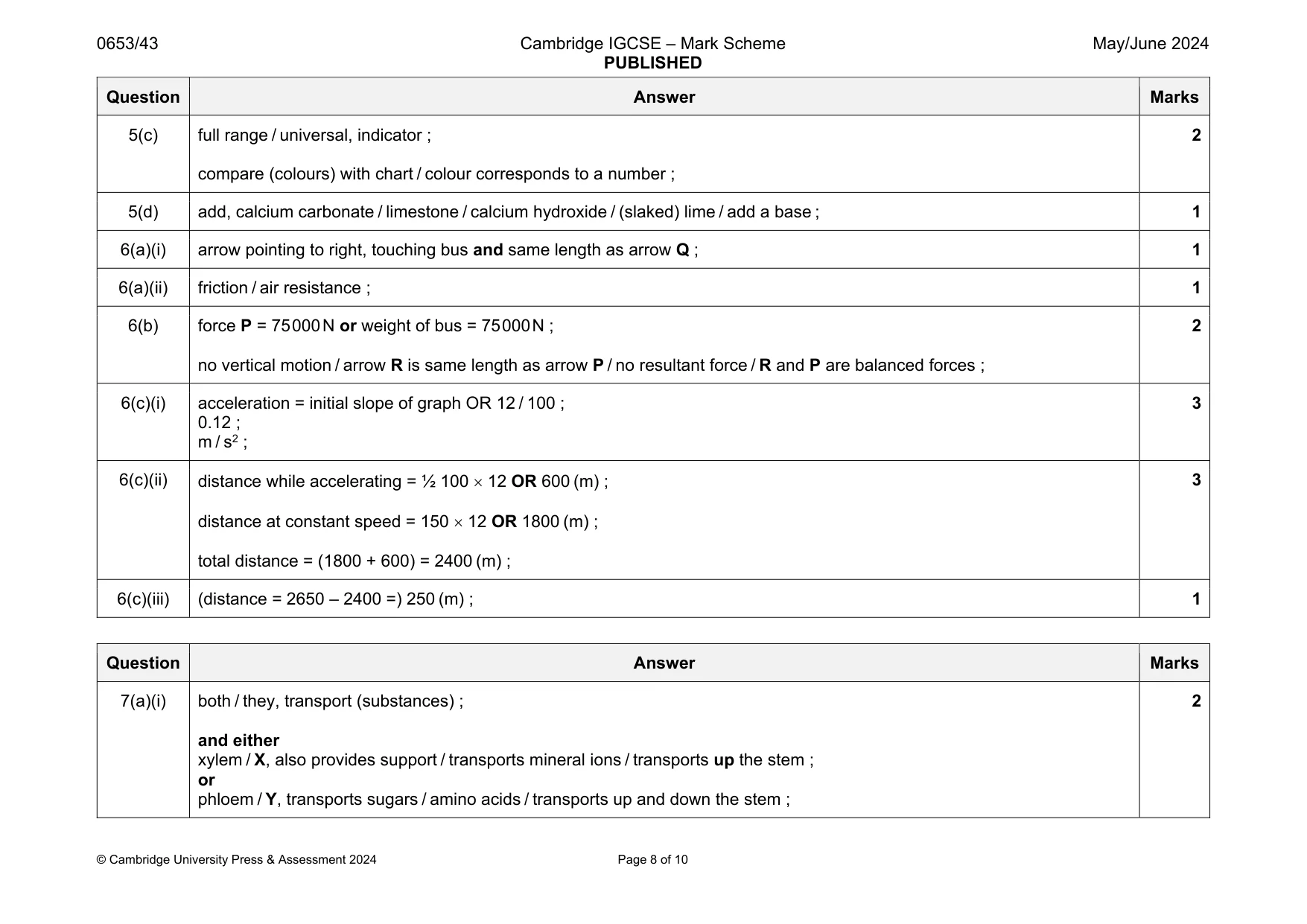
Mark scheme: 5(a)(i) zinc sulfate ; zinc oxide / zinc hydroxide ; 2 5(a)(ii) hydrogen ; water ; 2 5(b) carbon dioxide ; water ; 2 Question Answer Marks 5(c) full range / universal, indicator ; compare (colours) with chart / colour corresponds to a number ; 2 5(d) add, calcium carbonate / limestone / calcium hydroxide / (slaked) lime / add a base ; 1
Q6 · Three forces, Q, R and P, acting on a bus moving along a level road at constant speed
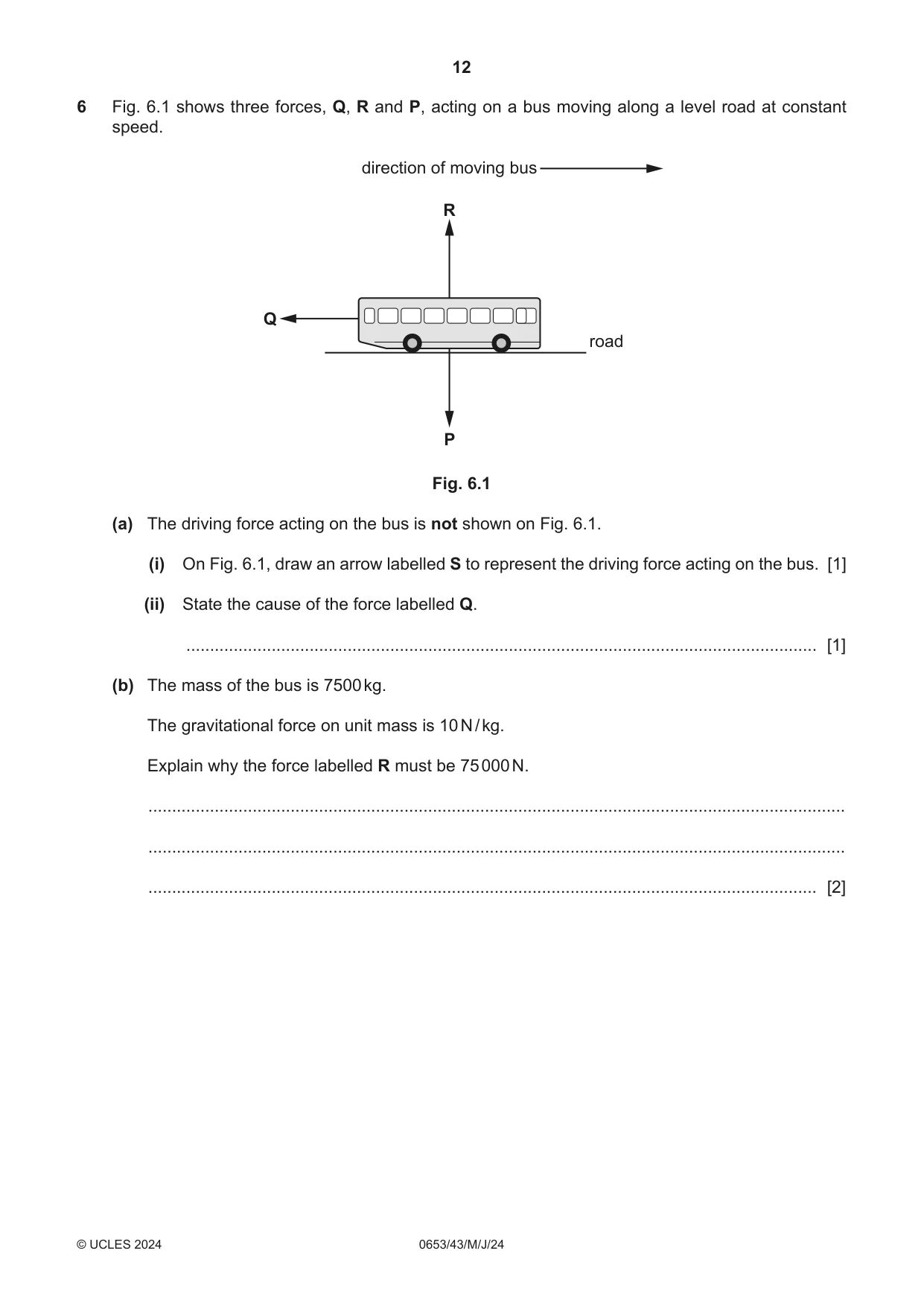
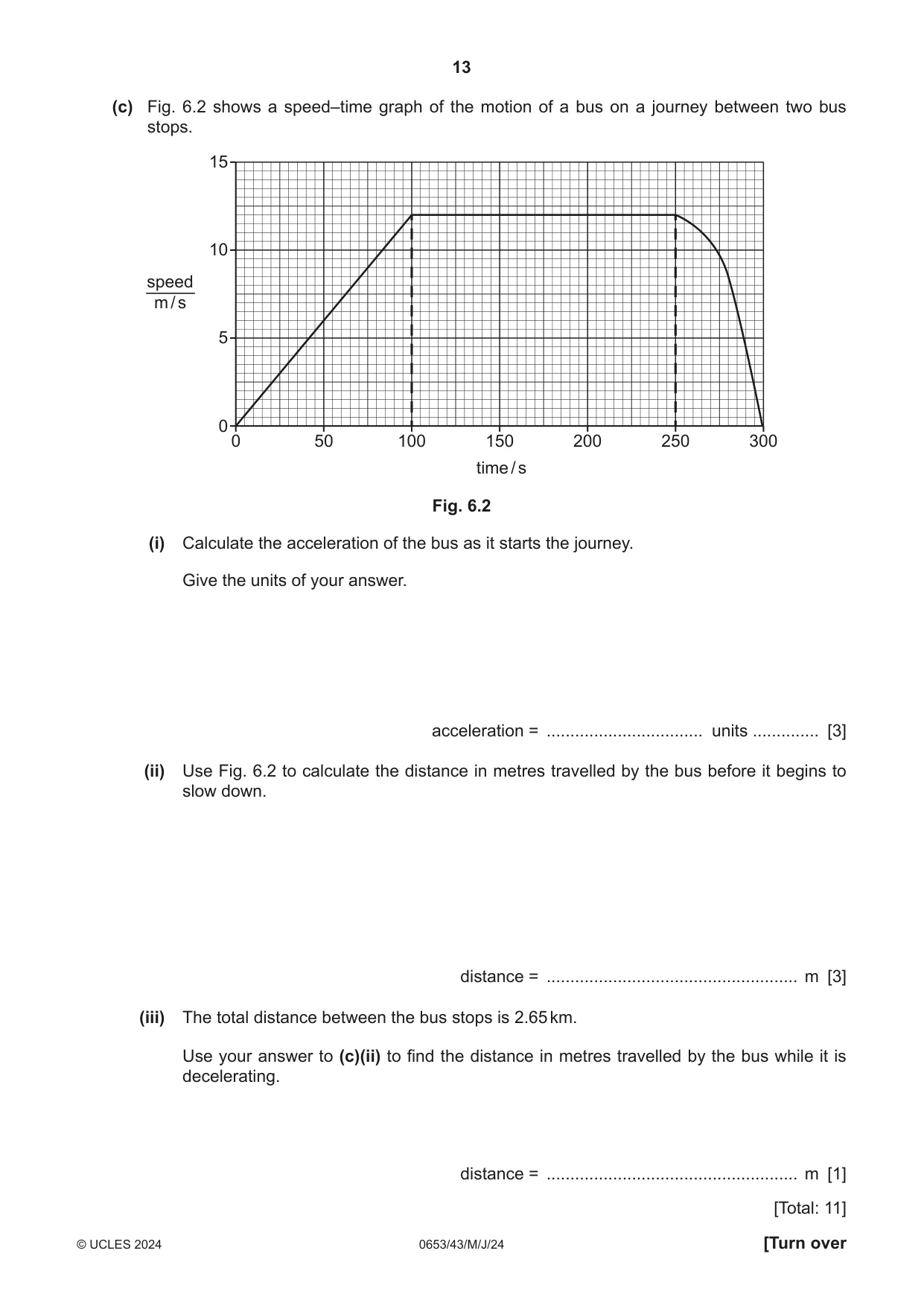
6 Fig. 6.1 shows three forces, Q, R and P, acting on a bus moving along a level road at constant speed. direction of moving bus R Q road P Fig. 6.1 (a) The driving force acting on the bus is not shown on Fig. 6.1. (i) On Fig. 6.1, draw an arrow labelled S to represent the driving force acting on the bus. [1] (ii) State the cause of the force labelled Q. ..................................................................................................................................... [1] (b) The mass of the bus is 7500 kg. The gravitational force on unit mass is 10 N / kg. Explain why the force labelled R must be 75 000 N. ................................................................................................................................................... ................................................................................................................................................... ............................................................................................................................................. [2] (c) Fig. 6.2 shows a speed–time graph of the motion of a bus on a journey between two bus stops. 15 10 speed m / s 5 0 0 50 100 150 200 250 300 time / s Fig. 6.2 (i) Calculate the acceleration of the bus as it starts the journey. Give the units of your answer. acceleration = ................................. units .............. [3] (ii) Use Fig. 6.2 to calculate the distance in metres travelled by the bus before it begins to slow down. distance = ..................................................... m [3] (iii) The total distance between the bus stops is 2.65 km. Use your answer to (c)(ii) to find the distance in metres travelled by the bus while it is decelerating. distance = ..................................................... m [1] [Total: 11]
Mark scheme: 6(a)(i) arrow pointing to right, touching bus and same length as arrow Q ; 1 6(a)(ii) friction / air resistance ; 1 6(b) force P = 75 000 N or weight of bus = 75 000 N ; no vertical motion / arrow R is same length as arrow P / no resultant force / R and P are balanced forces ; 2 6(c)(i) acceleration = initial slope of graph OR 12 / 100 ; 0.12 ; m / s2 ; 3 6(c)(ii) distance while accelerating = ½ 100 12 OR 600 (m) ; distance at constant speed = 150 12 OR 1800 (m) ; total distance = (1800 + 600) = 2400 (m) ; 3 6(c)(iii) (distance = 2650 – 2400 =) 250 (m) ; 1
Q7 · A diagram of a cross‑section through a leaf
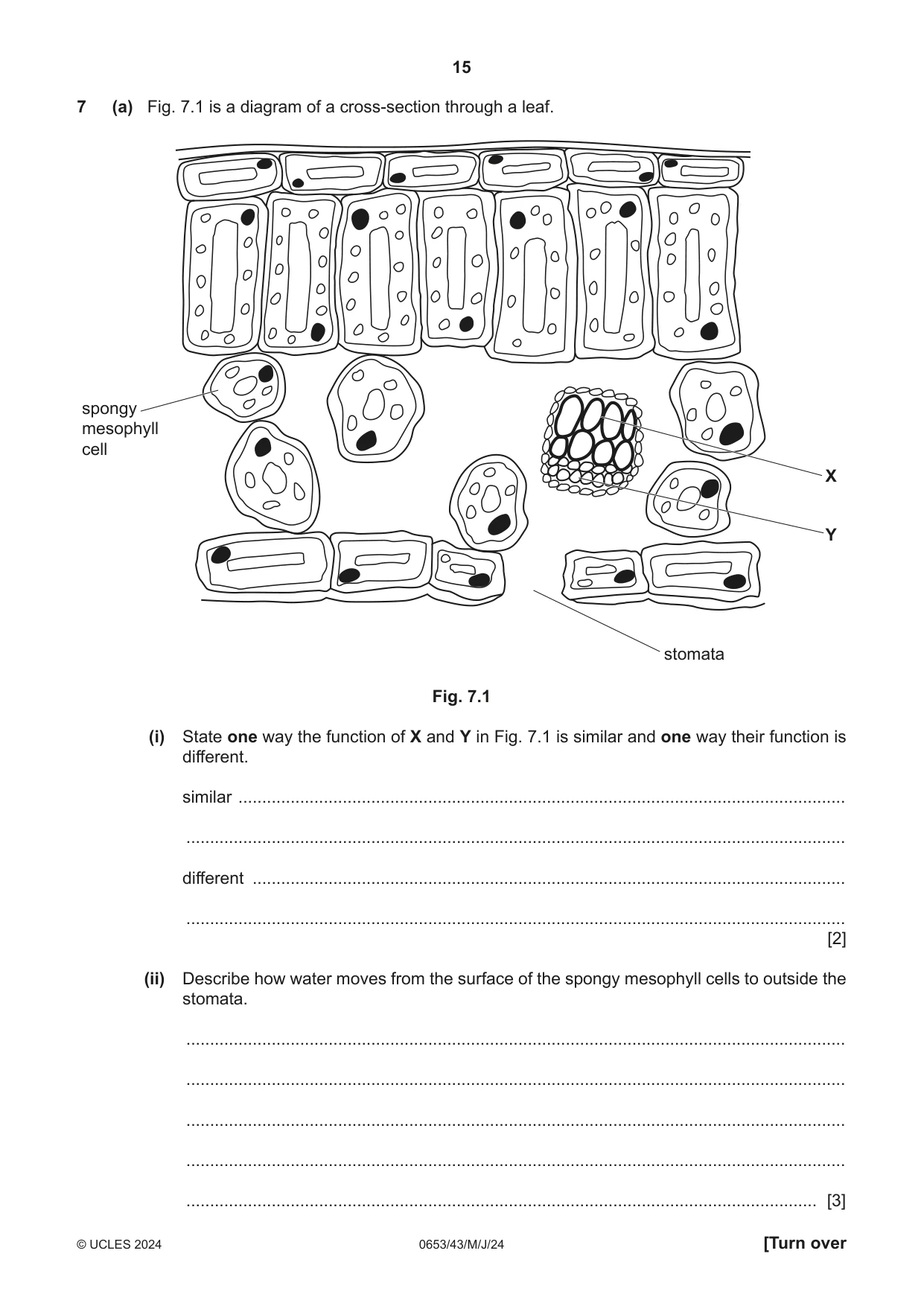
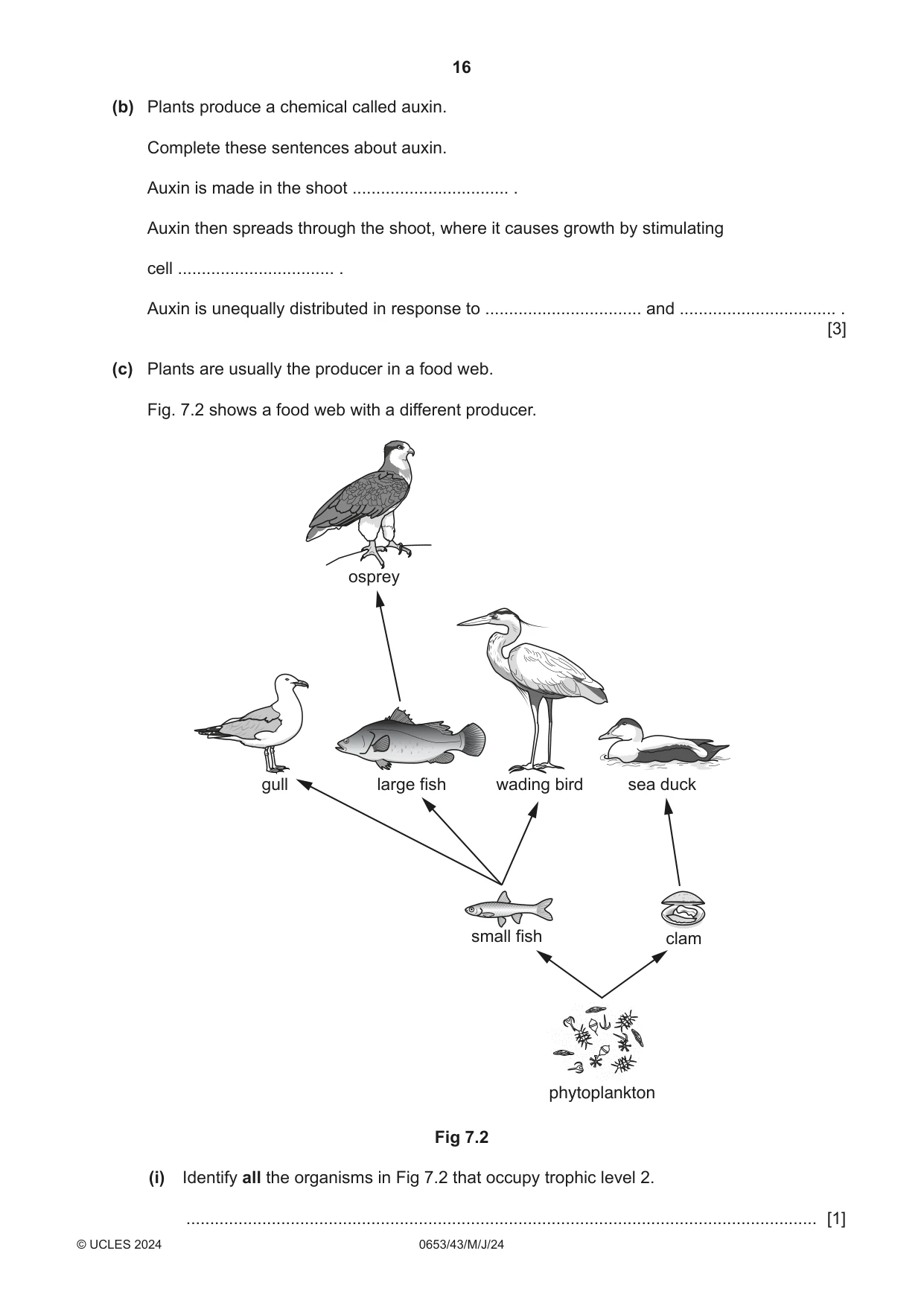
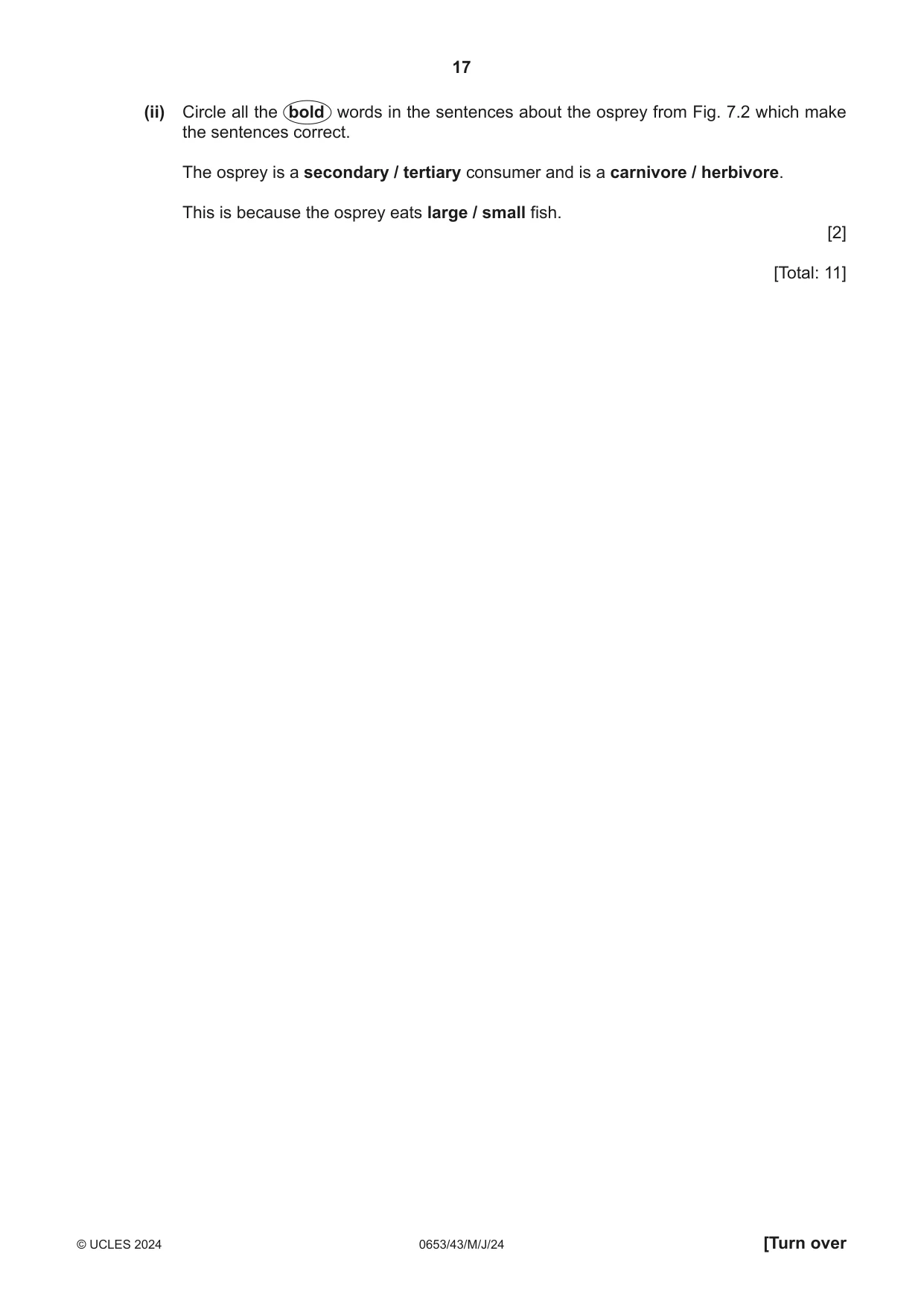
7 (a) Fig. 7.1 is a diagram of a cross‑section through a leaf. spongy mesophyll cell X Y stomata Fig. 7.1 (i) State one way the function of X and Y in Fig. 7.1 is similar and one way their function is different. similar ................................................................................................................................ ........................................................................................................................................... different ............................................................................................................................. ........................................................................................................................................... [2] (ii) Describe how water moves from the surface of the spongy mesophyll cells to outside the stomata. ........................................................................................................................................... ........................................................................................................................................... ........................................................................................................................................... ........................................................................................................................................... ..................................................................................................................................... [3] (b) Plants produce a chemical called auxin. Complete these sentences about auxin. Auxin is made in the shoot ................................. . Auxin then spreads through the shoot, where it causes growth by stimulating cell ................................. . Auxin is unequally distributed in response to ................................. and ................................. . [3] (c) Plants are usually the producer in a food web. Fig. 7.2 shows a food web with a different producer. osprey gull large fish wading bird sea duck small fish clam phytoplankton Fig 7.2 (i) Identify all the organisms in Fig 7.2 that occupy trophic level 2. ..................................................................................................................................... [1] (ii) Circle all the bold words in the sentences about the osprey from Fig. 7.2 which make the sentences correct. The osprey is a secondary / tertiary consumer and is a carnivore / herbivore. This is because the osprey eats large / small fish. [2] [Total: 11]
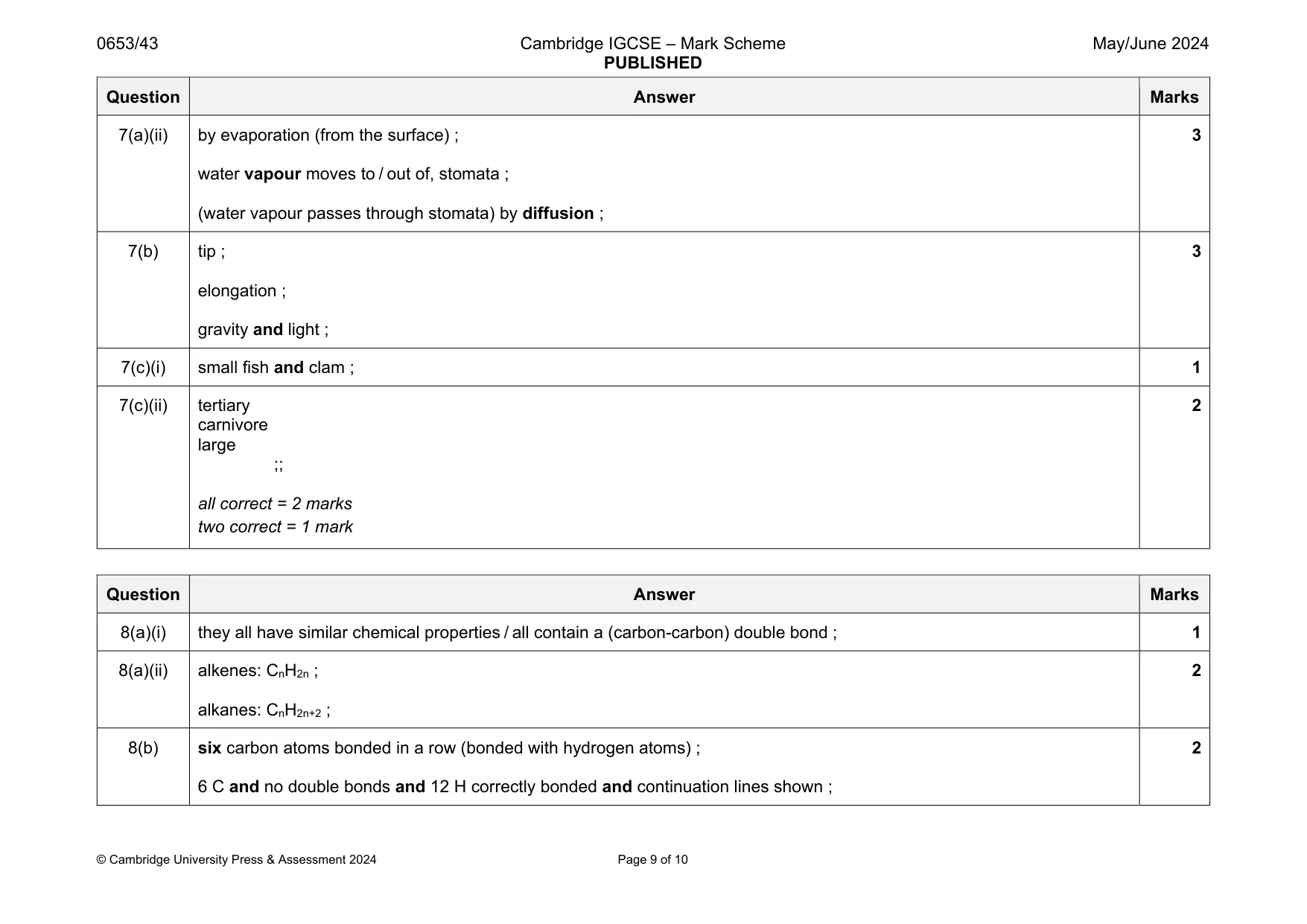
Mark scheme: 7(a)(i) both / they, transport (substances) ; and either xylem / X, also provides support / transports mineral ions / transports up the stem ; or phloem / Y, transports sugars / amino acids / transports up and down the stem ; Question Answer Marks 7(a)(ii) by evaporation (from the surface) ; water vapour moves to / out of, stomata ; (water vapour passes through stomata) by diffusion ; 3 7(b) tip ; elongation ; gravity and light ; 3 7(c)(i) small fish and clam ; 1 7(c)(ii) tertiary carnivore large ;; all correct = 2 marks two correct = 1 mark 2
Q8 · The structures of ethene and ethane are shown in Fig
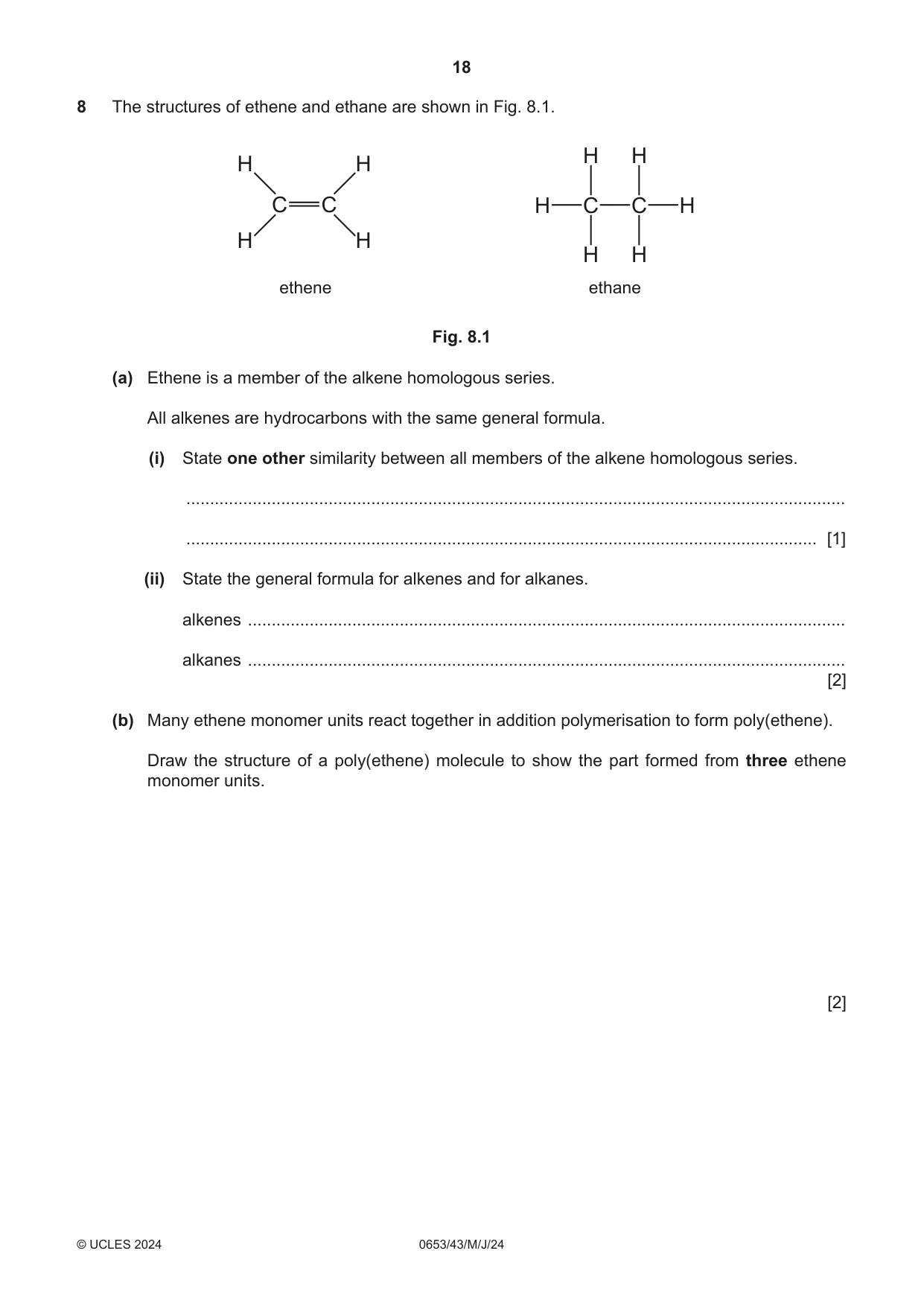
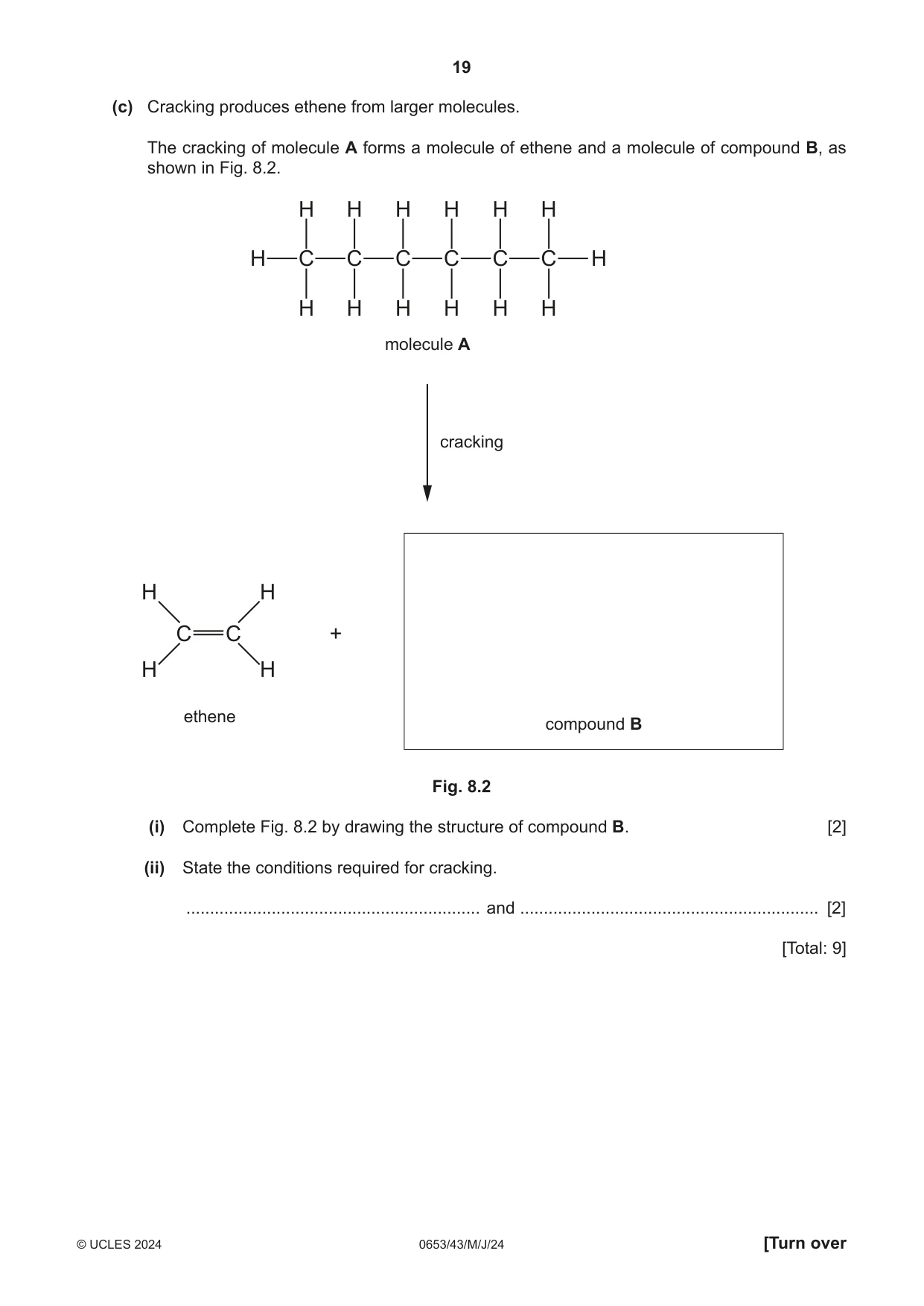
8 The structures of ethene and ethane are shown in Fig. 8.1. H H H H C C H C C H H H H H ethene ethane Fig. 8.1 (a) Ethene is a member of the alkene homologous series. All alkenes are hydrocarbons with the same general formula. (i) State one other similarity between all members of the alkene homologous series. ........................................................................................................................................... ..................................................................................................................................... [1] (ii) State the general formula for alkenes and for alkanes. alkenes .............................................................................................................................. alkanes .............................................................................................................................. [2] (b) Many ethene monomer units react together in addition polymerisation to form poly(ethene). Draw the structure of a poly(ethene) molecule to show the part formed from three ethene monomer units. [2] (c) Cracking produces ethene from larger molecules. The cracking of molecule A forms a molecule of ethene and a molecule of compound B, as shown in Fig. 8.2. H H H H H H H C C C C C C H H H H H H H molecule A cracking H H C C + H H ethene compound B Fig. 8.2 (i) Complete Fig. 8.2 by drawing the structure of compound B. [2] (ii) State the conditions required for cracking. .............................................................. and ............................................................... [2] [Total: 9]
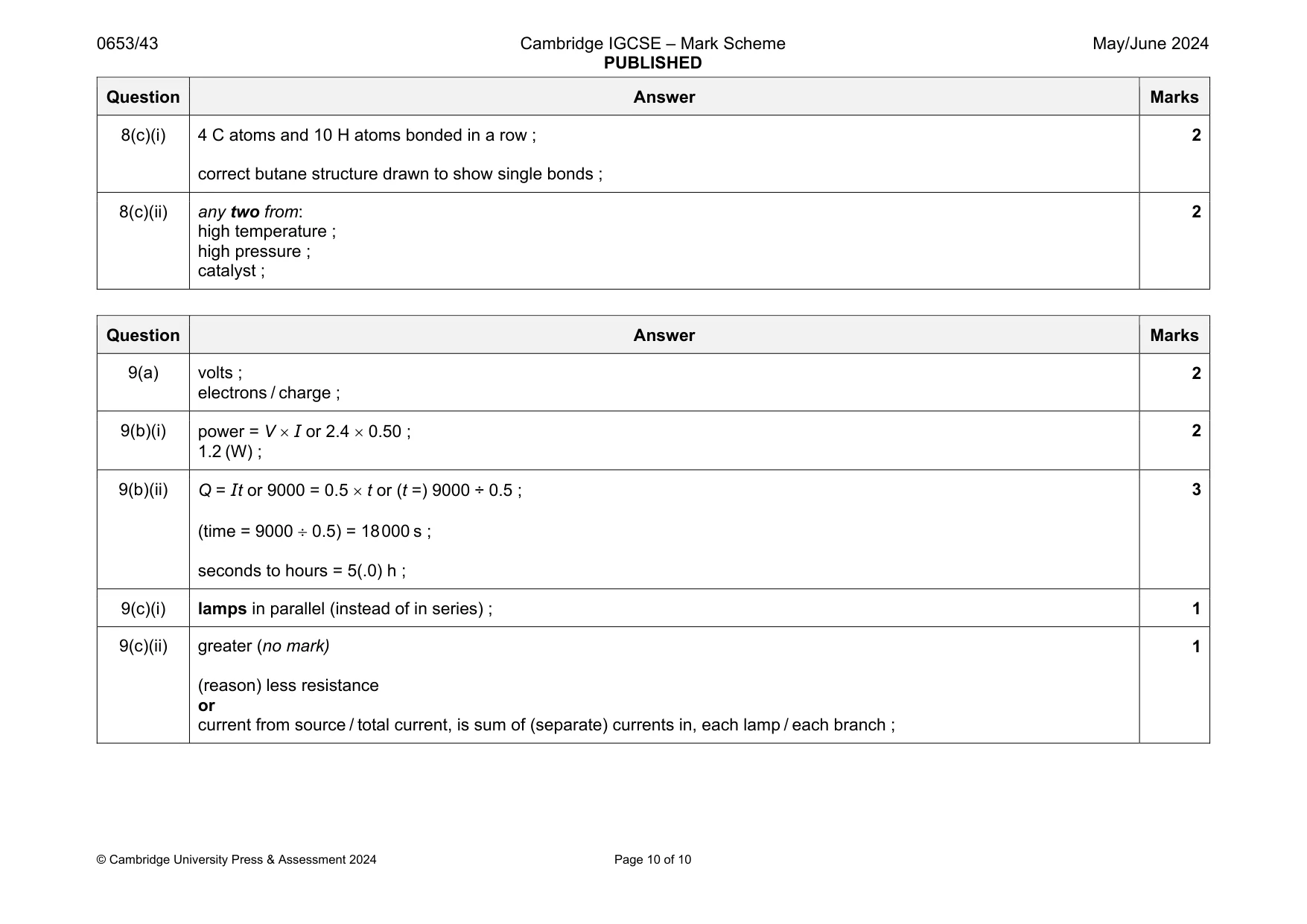
Mark scheme: 8(a)(i) they all have similar chemical properties / all contain a (carbon-carbon) double bond ; 1 8(a)(ii) alkenes: CnH2n ; alkanes: CnH2n+2 ; 2 8(b) six carbon atoms bonded in a row (bonded with hydrogen atoms) ; 6 C and no double bonds and 12 H correctly bonded and continuation lines shown ; 2 Question Answer Marks 8(c)(i) 4 C atoms and 10 H atoms bonded in a row ; correct butane structure drawn to show single bonds ; 2 8(c)(ii) any two from: high temperature ; high pressure ; catalyst ; 2
Q9 · A simple circuit containing two identical lamps
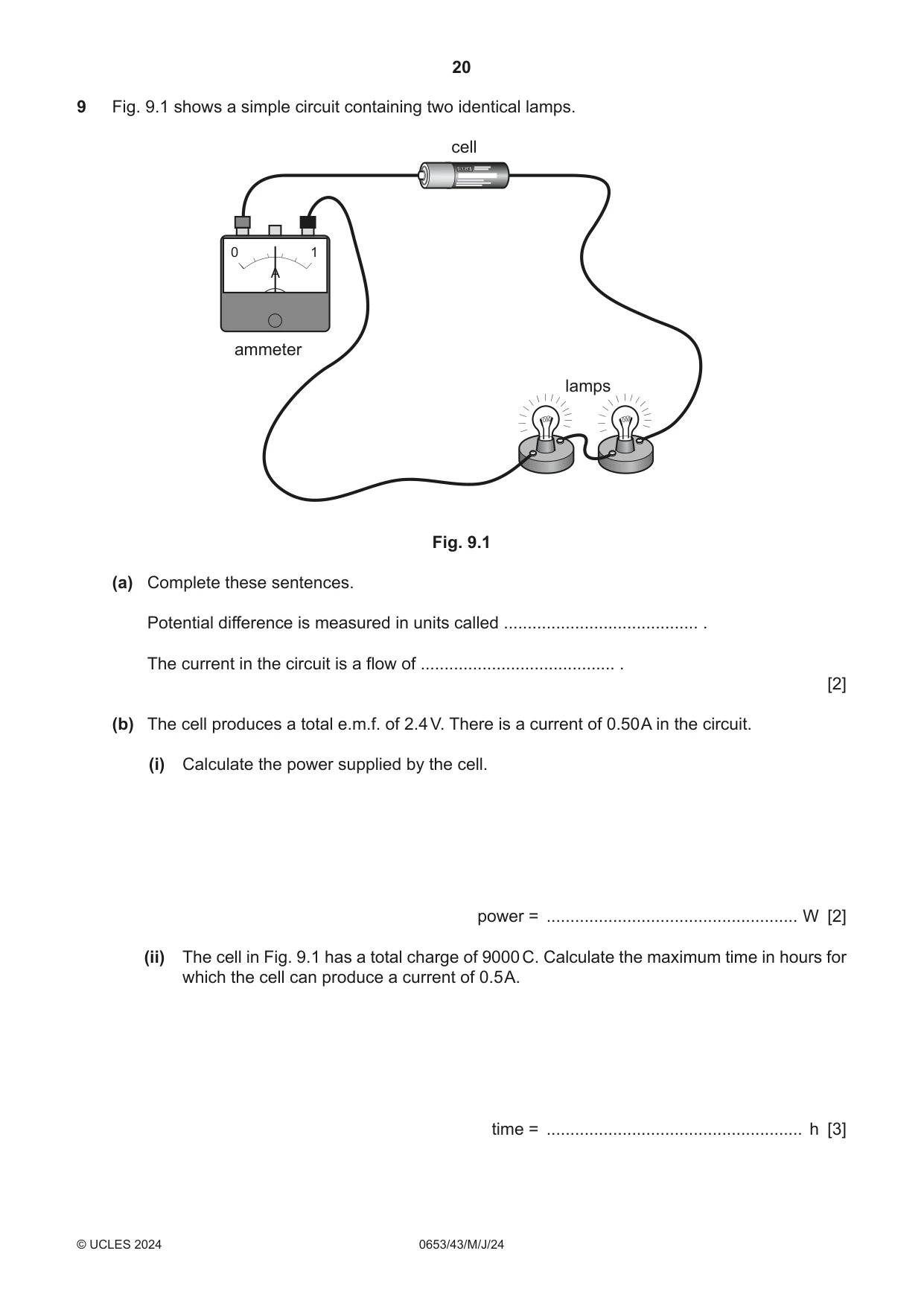
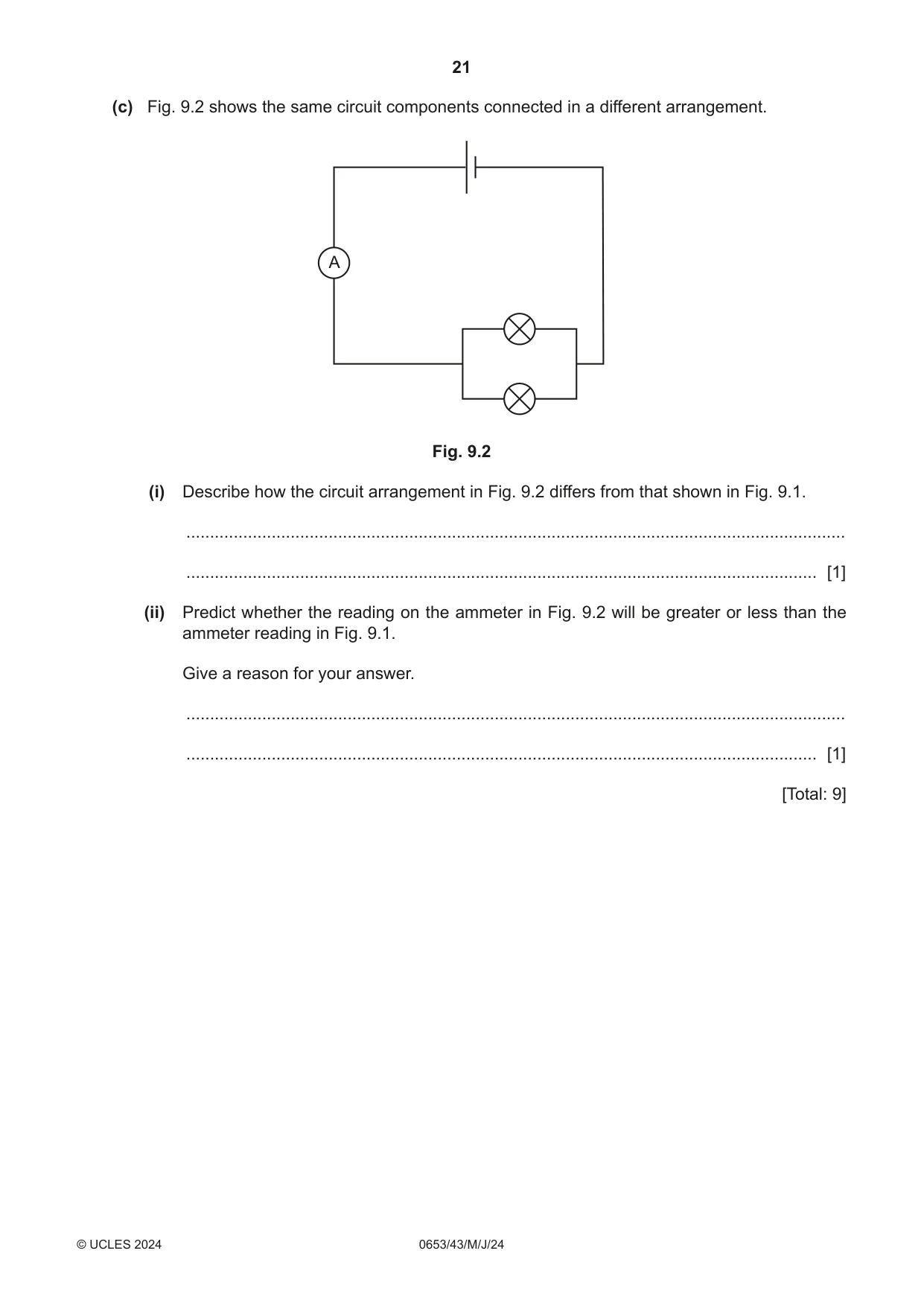
9 Fig. 9.1 shows a simple circuit containing two identical lamps. cell 0 1 A ammeter lamps Fig. 9.1 (a) Complete these sentences. Potential difference is measured in units called ......................................... . The current in the circuit is a flow of ......................................... . [2] (b) The cell produces a total e.m.f. of 2.4 V. There is a current of 0.50 A in the circuit. (i) Calculate the power supplied by the cell. power = ..................................................... W [2] (ii) The cell in Fig. 9.1 has a total charge of 9000 C. Calculate the maximum time in hours for which the cell can produce a current of 0.5 A. time = ...................................................... h [3] (c) Fig. 9.2 shows the same circuit components connected in a different arrangement. A Fig. 9.2 (i) Describe how the circuit arrangement in Fig. 9.2 differs from that shown in Fig. 9.1. ........................................................................................................................................... ..................................................................................................................................... [1] (ii) Predict whether the reading on the ammeter in Fig. 9.2 will be greater or less than the ammeter reading in Fig. 9.1. Give a reason for your answer. ........................................................................................................................................... ..................................................................................................................................... [1] [Total: 9]
Mark scheme: 9(a) volts ; electrons / charge ; 2 9(b)(i) power = V I or 2.4 0.50 ; 1.2 (W) ; 2 9(b)(ii) Q = It or 9000 = 0.5 t or (t =) 9000 ÷ 0.5 ; (time = 9000 0.5) = 18 000 s ; seconds to hours = 5(.0) h ; 3 9(c)(i) lamps in parallel (instead of in series) ; 1 9(c)(ii) greater (no mark) (reason) less resistance or current from source / total current, is sum of (separate) currents in, each lamp / each branch ; 1
What was in this paper
The subtopics covered by these 9 questions, and how many questions each got. Open one in a new tab to see every Cambridge question on it.
What you needed in this session
Cambridge’s own grade thresholds for 2024 May/June, Paper 4 · Variant 3. A higher threshold means an easier paper — the bar moves with how the cohort did.