Questions as text
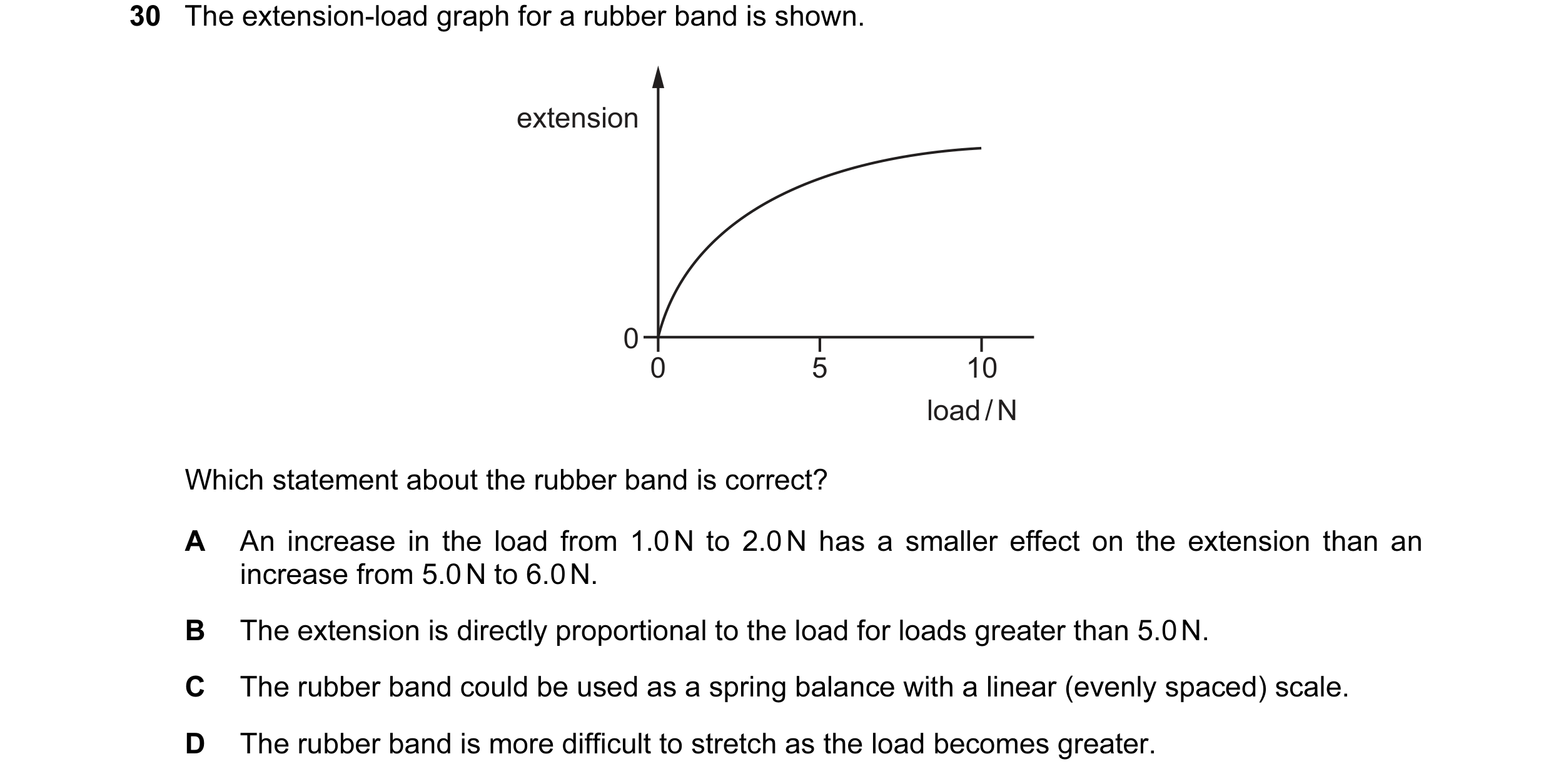
Q1 · The extension-load graph for a rubber band is shown 0653/22 Feb/March 2017
30 The extension-load graph for a rubber band is shown. extension 0 0 5 10 load / N Which statement about the rubber band is correct? A An increase in the load from 1.0 N to 2.0 N has a smaller effect on the extension than an increase from 5.0 N to 6.0 N. B The extension is directly proportional to the load for loads greater than 5.0 N. C The rubber band could be used as a spring balance with a linear (evenly spaced) scale. D The rubber band is more difficult to stretch as the load becomes greater.
1 marks
Answer: D
This question in 0653/22 Feb/March 2017
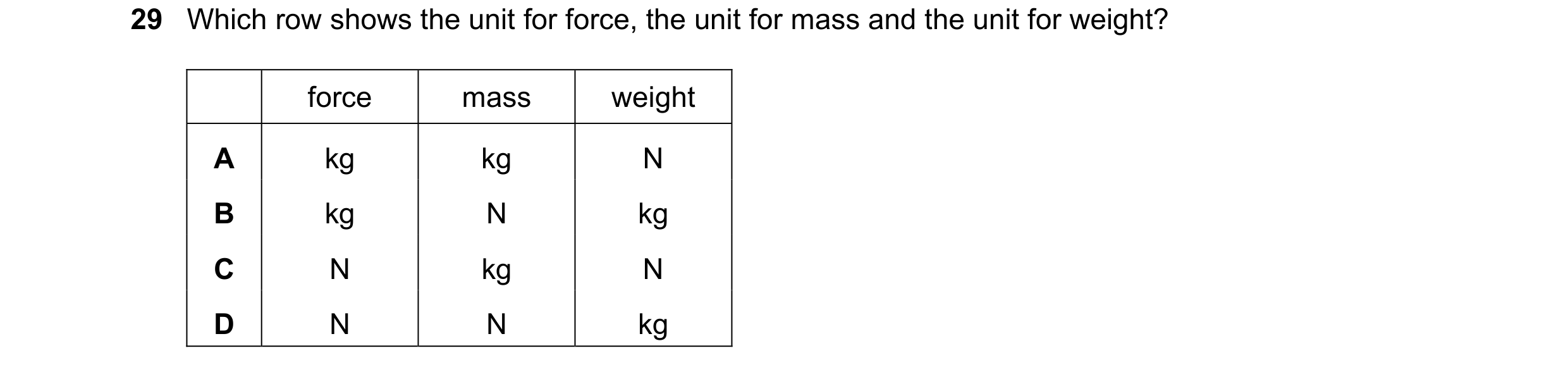
Q2 · Which row shows the unit for force, the unit for mass and the unit for weight? 0653/21 May/June 2017
29 Which row shows the unit for force, the unit for mass and the unit for weight? force mass weight A kg kg N B kg N kg C N kg N D N N kg
1 marks
Answer: C
This question in 0653/21 May/June 2017
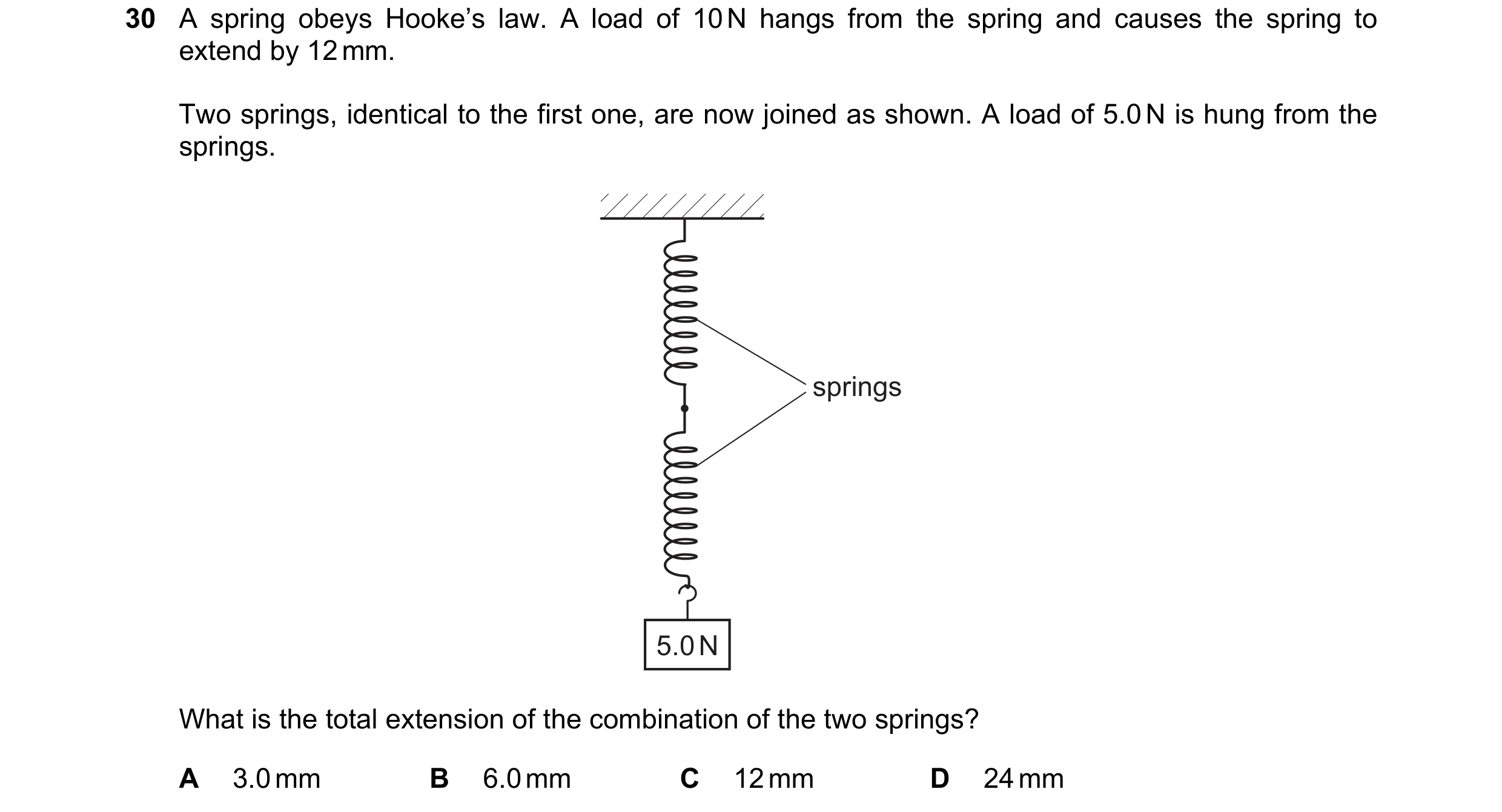
Q3 · A spring obeys Hooke’s law 0653/21 May/June 2017
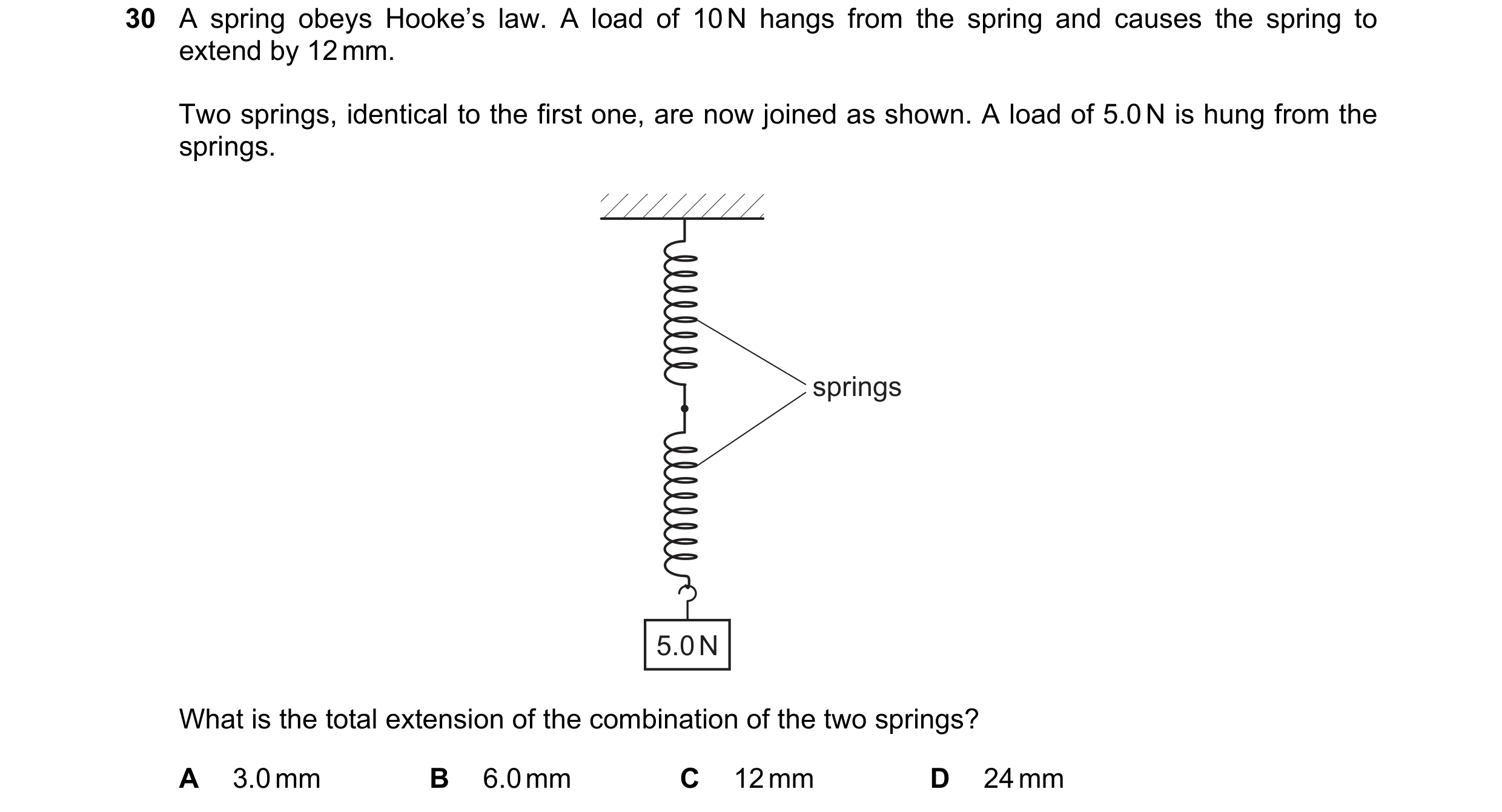
30 A spring obeys Hooke’s law. A load of 10 N hangs from the spring and causes the spring to extend by 12 mm. Two springs, identical to the first one, are now joined as shown. A load of 5.0 N is hung from the springs. springs 5.0 N What is the total extension of the combination of the two springs? A 3.0 mm B 6.0 mm C 12 mm D 24 mm
1 marks
Answer: C
This question in 0653/21 May/June 2017
Q4 · Which row shows the unit for force, the unit for mass and the unit for weight? 0653/22 May/June 2017
29 Which row shows the unit for force, the unit for mass and the unit for weight? force mass weight A kg kg N B kg N kg C N kg N D N N kg
1 marks
Answer: C
This question in 0653/22 May/June 2017
Q5 · A spring obeys Hooke’s law 0653/22 May/June 2017
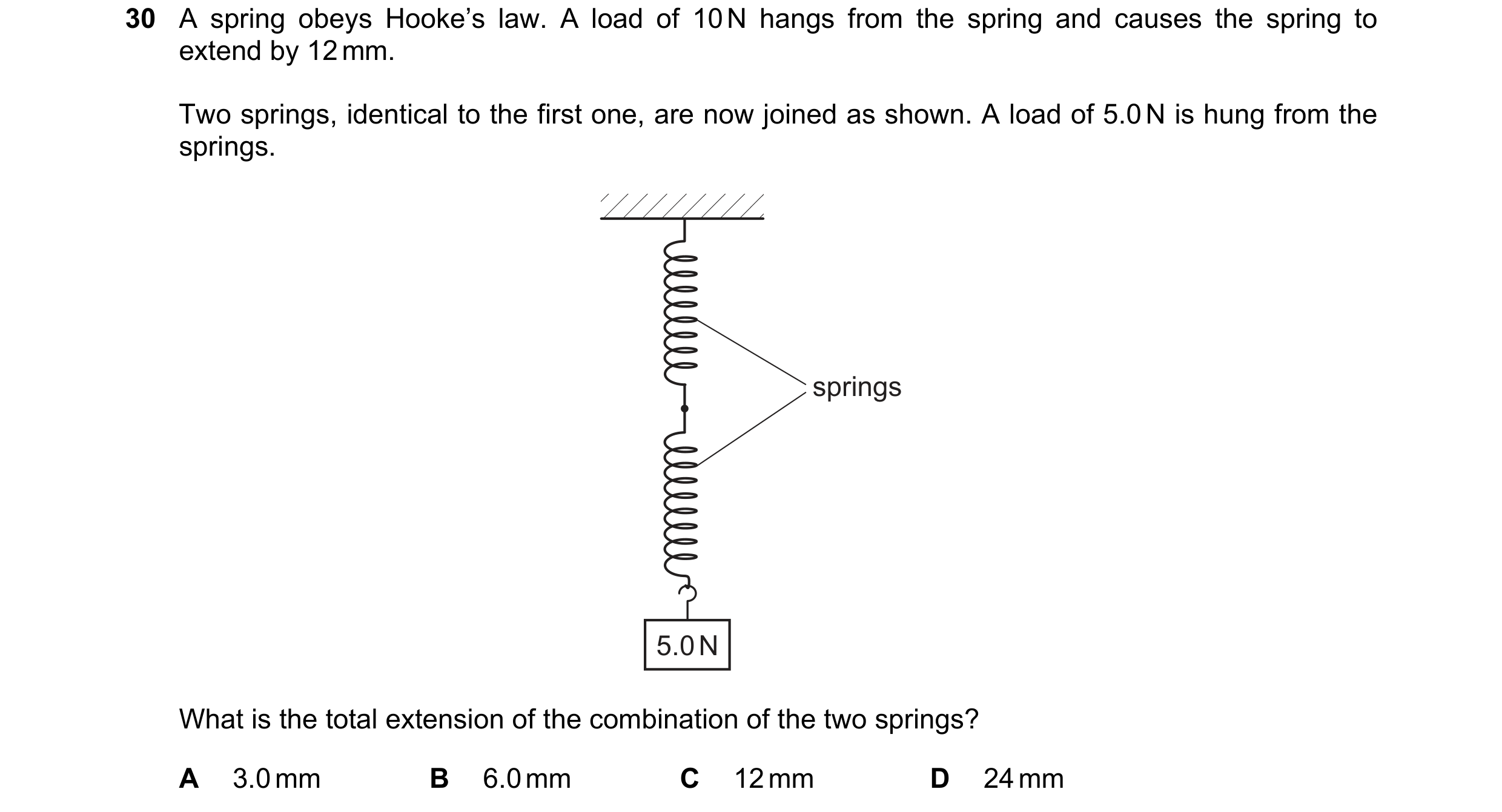
30 A spring obeys Hooke’s law. A load of 10 N hangs from the spring and causes the spring to extend by 12 mm. Two springs, identical to the first one, are now joined as shown. A load of 5.0 N is hung from the springs. springs 5.0 N What is the total extension of the combination of the two springs? A 3.0 mm B 6.0 mm C 12 mm D 24 mm
1 marks
Answer: C
This question in 0653/22 May/June 2017
Q6 · A spring obeys Hooke’s law 0653/23 May/June 2017
30 A spring obeys Hooke’s law. A load of 10 N hangs from the spring and causes the spring to extend by 12 mm. Two springs, identical to the first one, are now joined as shown. A load of 5.0 N is hung from the springs. springs 5.0 N What is the total extension of the combination of the two springs? A 3.0 mm B 6.0 mm C 12 mm D 24 mm
1 marks
Answer: C
This question in 0653/23 May/June 2017
Q7 · A student stretches a steel spring by hanging a load on it 0653/21 Oct/Nov 2017
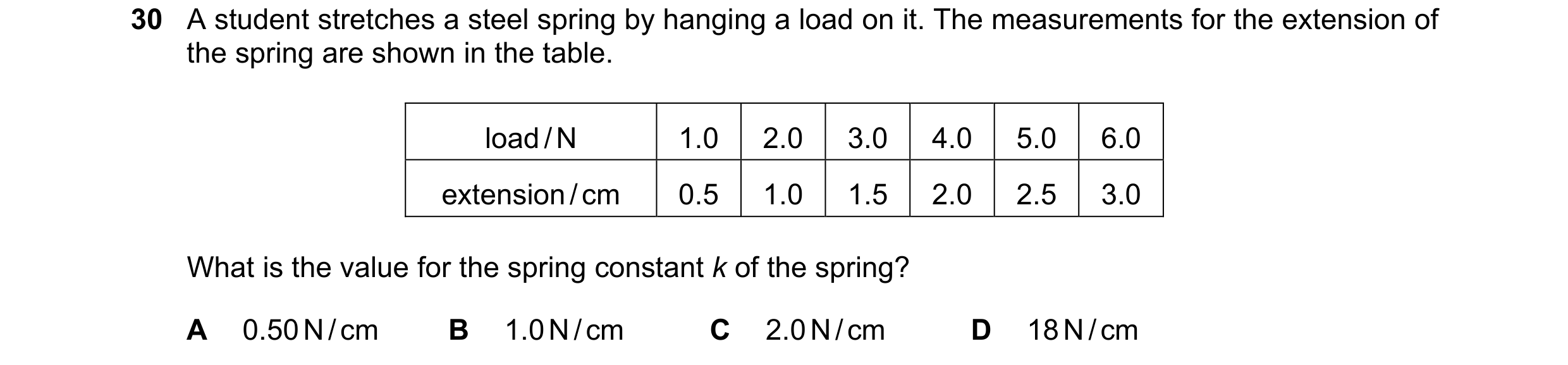
30 A student stretches a steel spring by hanging a load on it. The measurements for the extension of the spring are shown in the table. load / N 1.0 2.0 3.0 4.0 5.0 6.0 extension / cm 0.5 1.0 1.5 2.0 2.5 3.0 What is the value for the spring constant k of the spring? A 0.50 N / cm B 1.0 N / cm C 2.0 N / cm D 18 N / cm
1 marks
Answer: C
This question in 0653/21 Oct/Nov 2017
Q8 · A student stretches a steel spring by hanging a load on it 0653/22 Oct/Nov 2017
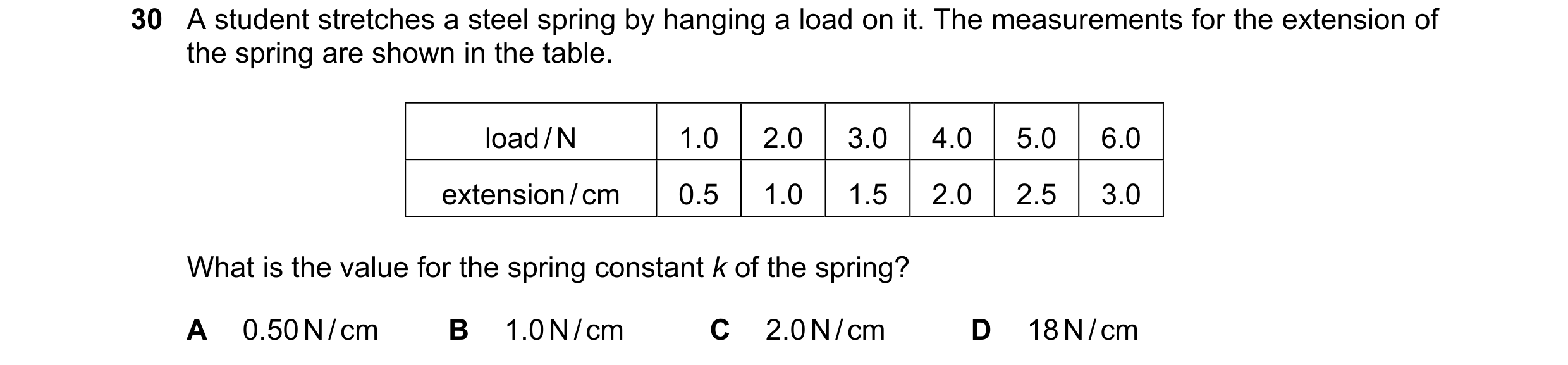
30 A student stretches a steel spring by hanging a load on it. The measurements for the extension of the spring are shown in the table. load / N 1.0 2.0 3.0 4.0 5.0 6.0 extension / cm 0.5 1.0 1.5 2.0 2.5 3.0 What is the value for the spring constant k of the spring? A 0.50 N / cm B 1.0 N / cm C 2.0 N / cm D 18 N / cm
1 marks
Answer: C
This question in 0653/22 Oct/Nov 2017
Q9 · A student stretches a steel spring by hanging a load on it 0653/23 Oct/Nov 2017
30 A student stretches a steel spring by hanging a load on it. The measurements for the extension of the spring are shown in the table. load / N 1.0 2.0 3.0 4.0 5.0 6.0 extension / cm 0.5 1.0 1.5 2.0 2.5 3.0 What is the value for the spring constant k of the spring? A 0.50 N / cm B 1.0 N / cm C 2.0 N / cm D 18 N / cm
1 marks
Answer: C
This question in 0653/23 Oct/Nov 2017
Q10 · A spring that obeys Hooke’s law has no load attached to it 0653/22 Feb/March 2018
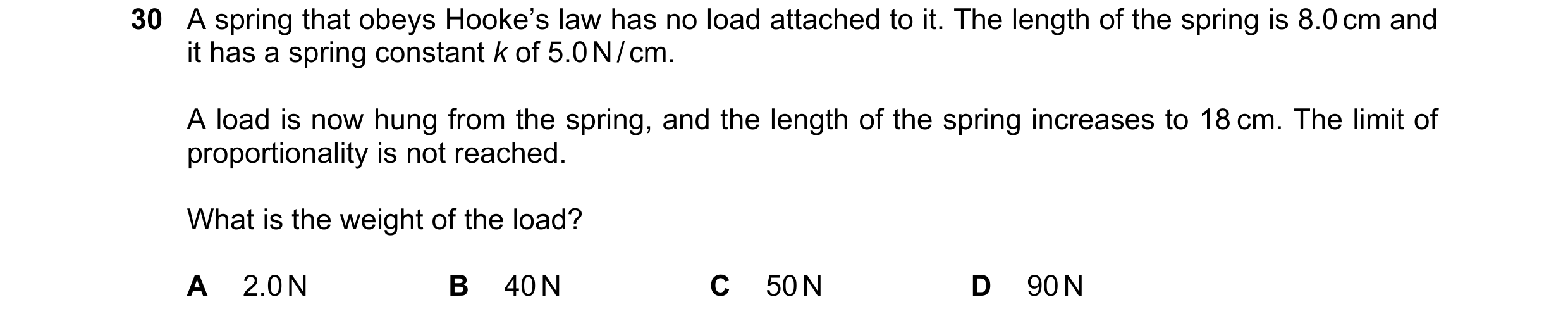
30 A spring that obeys Hooke’s law has no load attached to it. The length of the spring is 8.0 cm and it has a spring constant k of 5.0 N / cm. A load is now hung from the spring, and the length of the spring increases to 18 cm. The limit of proportionality is not reached. What is the weight of the load? A 2.0 N B 40 N C 50 N D 90 N
1 marks
Answer: C
This question in 0653/22 Feb/March 2018
Q11 · An unstretched spring obeys Hooke’s law and has a length of 10 cm 0653/21 May/June 2018
30 An unstretched spring obeys Hooke’s law and has a length of 10 cm. A load with a mass of 2.0 kg is hung from it, and its length becomes 14 cm. The load is now increased to 6.0 kg, and the new length of the spring is Y. The limit of proportionality is not reached. 10 cm 14 cm Y 2.0 kg 6.0 kg What is Y? A 22 cm B 26 cm C 30 cm D 42 cm
1 marks
Answer: A
This question in 0653/21 May/June 2018
Q12 · A negative ion X is close to a positive ion and another negative ion 0653/21 May/June 2018
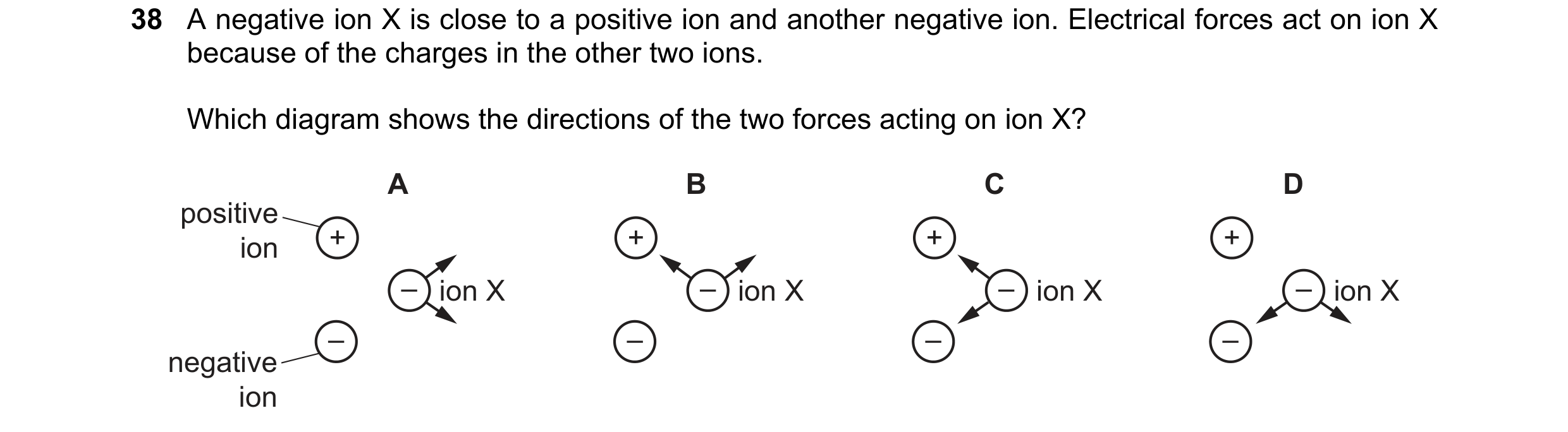
38 A negative ion X is close to a positive ion and another negative ion. Electrical forces act on ion X because of the charges in the other two ions. Which diagram shows the directions of the two forces acting on ion X? A B C D positive ion + + + + – ion X – ion X – ion X – ion X – – – – negative ion
1 marks
Answer: B
This question in 0653/21 May/June 2018
Q13 · An unstretched spring obeys Hooke’s law and has a length of 10 cm 0653/22 May/June 2018
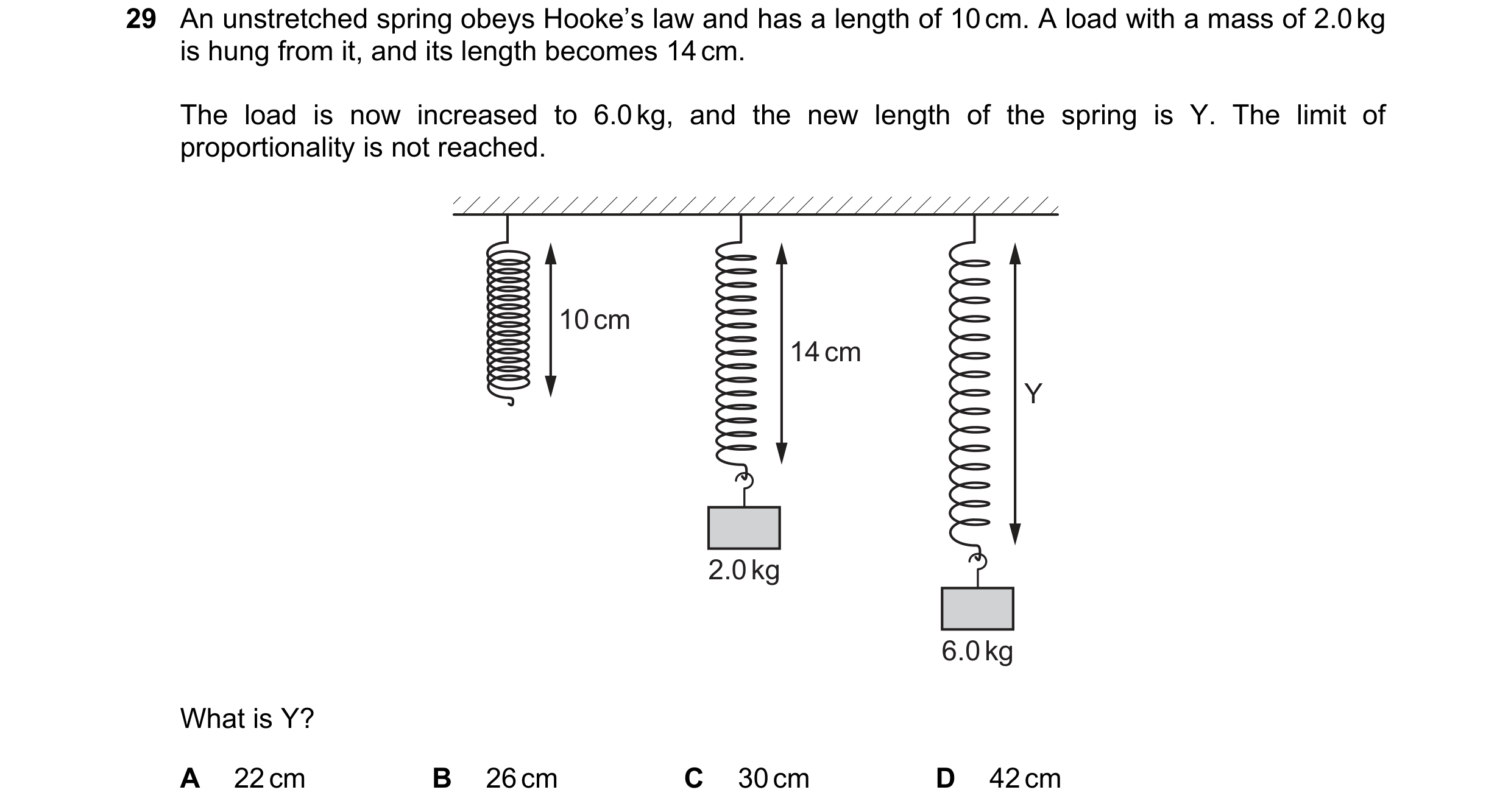
29 An unstretched spring obeys Hooke’s law and has a length of 10 cm. A load with a mass of 2.0 kg is hung from it, and its length becomes 14 cm. The load is now increased to 6.0 kg, and the new length of the spring is Y. The limit of proportionality is not reached. 10 cm 14 cm Y 2.0 kg 6.0 kg What is Y? A 22 cm B 26 cm C 30 cm D 42 cm
1 marks
Answer: A
This question in 0653/22 May/June 2018
Q14 · An unstretched spring obeys Hooke’s law and has a length of 10 cm 0653/23 May/June 2018
29 An unstretched spring obeys Hooke’s law and has a length of 10 cm. A load with a mass of 2.0 kg is hung from it, and its length becomes 14 cm. The load is now increased to 6.0 kg, and the new length of the spring is Y. The limit of proportionality is not reached. 10 cm 14 cm Y 2.0 kg 6.0 kg What is Y? A 22 cm B 26 cm C 30 cm D 42 cm
1 marks
Answer: A
This question in 0653/23 May/June 2018
Q15 · A spring that obeys Hooke’s law is 20 cm long when unstretched 0653/21 Oct/Nov 2018
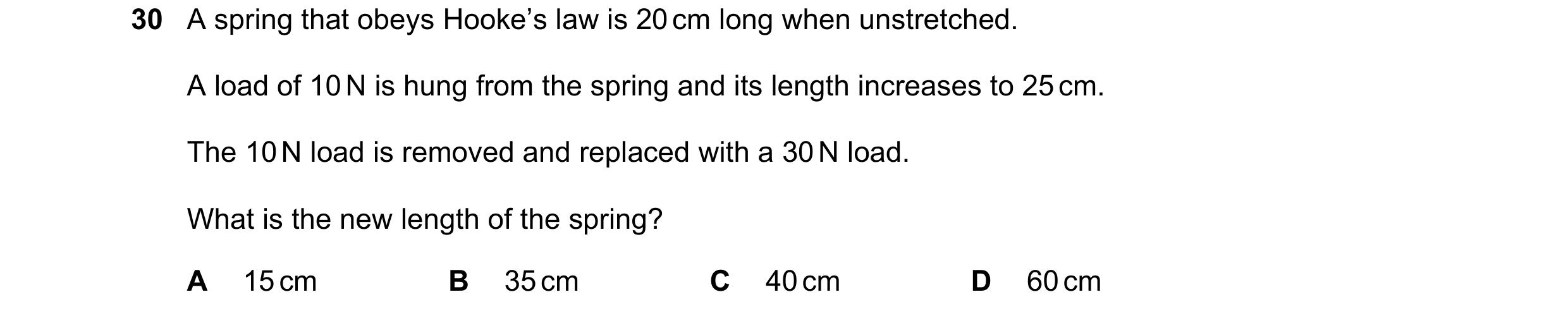
30 A spring that obeys Hooke’s law is 20 cm long when unstretched. A load of 10 N is hung from the spring and its length increases to 25 cm. The 10 N load is removed and replaced with a 30 N load. What is the new length of the spring? A 15 cm B 35 cm C 40 cm D 60 cm
1 marks
Answer: B
This question in 0653/21 Oct/Nov 2018
Q16 · A stretching force is applied to a copper wire 0653/23 Oct/Nov 2018
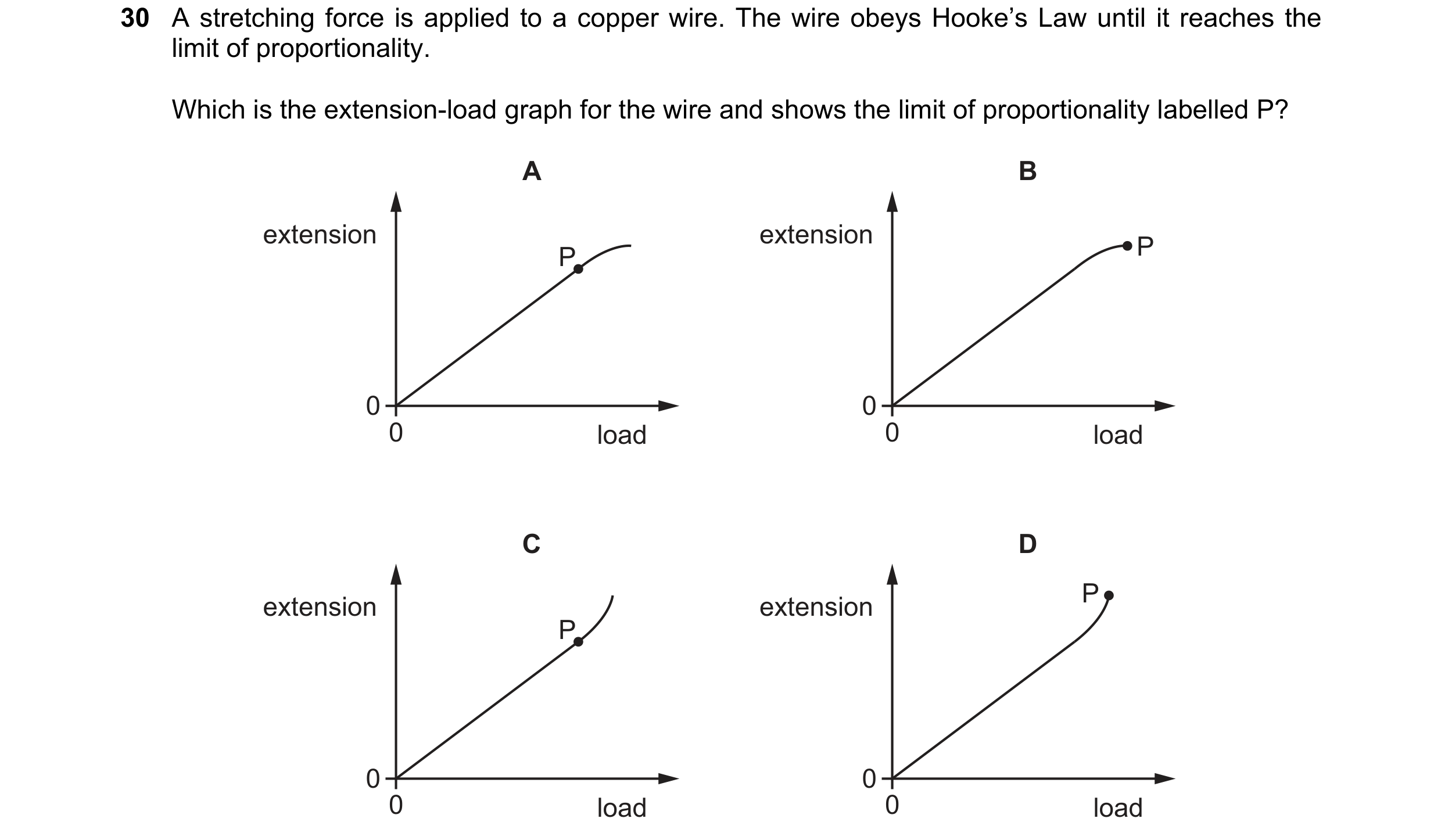
30 A stretching force is applied to a copper wire. The wire obeys Hooke’s Law until it reaches the limit of proportionality. Which is the extension-load graph for the wire and shows the limit of proportionality labelled P? A B extension extension P P 0 0 0 load 0 load C D P extension extension P 0 0 0 load 0 load
1 marks
Answer: C
This question in 0653/23 Oct/Nov 2018
Q17 · The diagram shows an extension-load graph for a spring 0653/21 May/June 2019
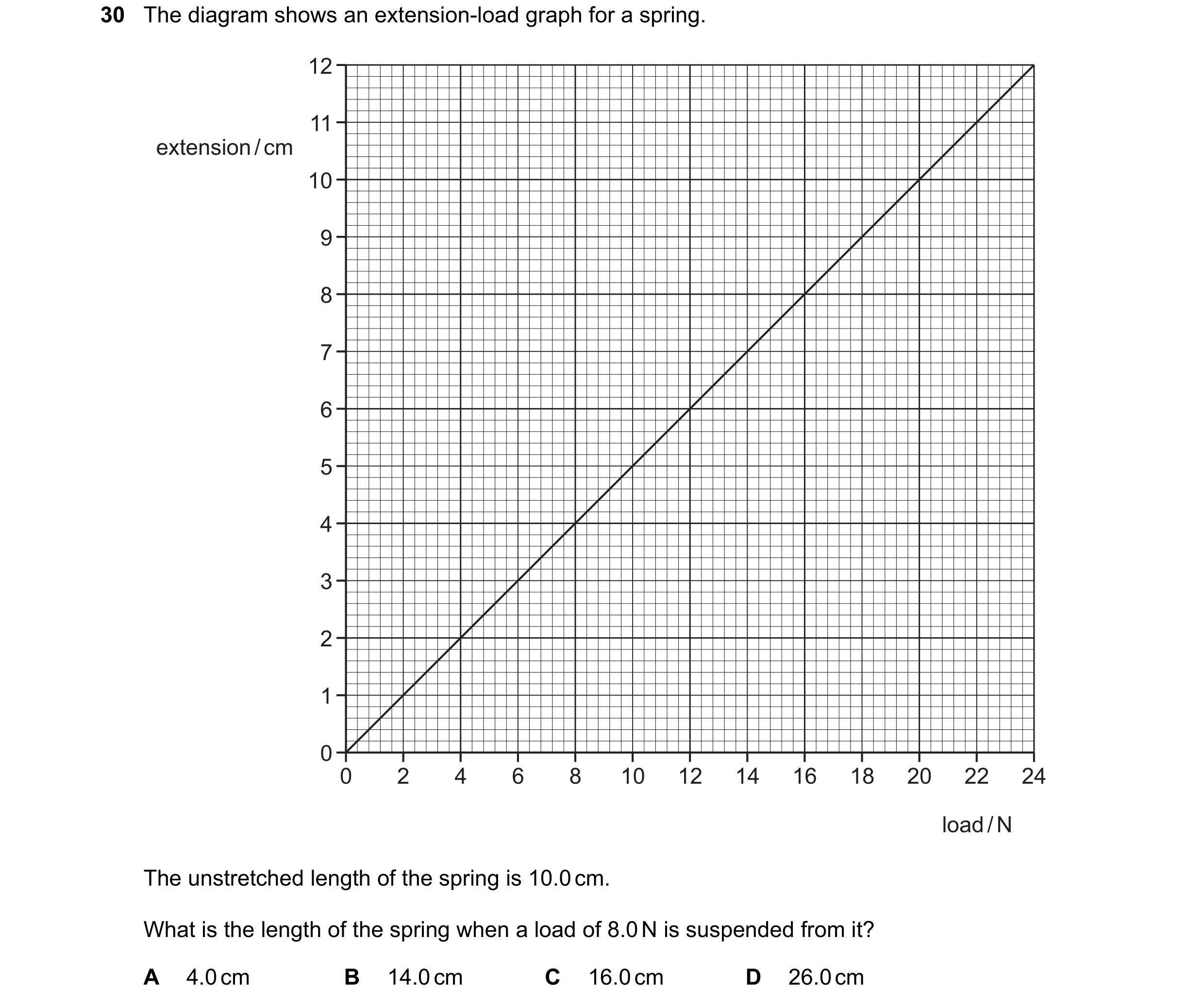
30 The diagram shows an extension-load graph for a spring. 12 11 extension / cm 10 9 8 7 6 5 4 3 2 1 0 0 2 4 6 8 10 12 14 16 18 20 22 24 load / N The unstretched length of the spring is 10.0 cm. What is the length of the spring when a load of 8.0 N is suspended from it? A 4.0 cm B 14.0 cm C 16.0 cm D 26.0 cm
1 marks
Answer: B
This question in 0653/21 May/June 2019
Q18 · A spring obeys Hooke’s law until it reaches its limit of proportionality 0653/22 Oct/Nov 2019
30 A spring obeys Hooke’s law until it reaches its limit of proportionality. A load is hung from the spring. The load is gradually increased and the spring is stretched beyond its limit of proportionality. Which is the extension-load graph for the spring? A B extension extension 0 0 0 load 0 load C D extension extension 0 0 0 load 0 load
1 marks
Answer: C
This question in 0653/22 Oct/Nov 2019
Q19 · Which of these bodies has a resultant force acting on it? 0653/23 Oct/Nov 2019
29 Which of these bodies has a resultant force acting on it? A a book at rest on a table B a car travelling up a hill in a straight line at constant speed C a football moving upwards freely after being kicked D a parachutist descending vertically at constant speed
1 marks
Answer: C
This question in 0653/23 Oct/Nov 2019
Q20 · The force acting on a spring is gradually increased from 0 N 0653/23 Oct/Nov 2019
30 The force acting on a spring is gradually increased from 0 N. The spring eventually passes its limit of proportionality. Which graph shows how the extension of the spring changes as the force increases? A B extension extension 0 0 0 force 0 force C D extension extension 0 0 0 force 0 force
1 marks
Answer: B
This question in 0653/23 Oct/Nov 2019
Q21 · A heavy bag of flour is dragged against friction along a horizontal floor at a constant… 0653/22 Feb/March 2020
30 A heavy bag of flour is dragged against friction along a horizontal floor at a constant speed of 12 m / s for 2.0 s. The energy input required is 3000 J. What is the force due to friction? A 125 N B 500 N C 18 000 N D 72 000 N
1 marks
Answer: A
This question in 0653/22 Feb/March 2020
Q22 · An object is travelling in a straight line at constant speed 0653/21 May/June 2020
30 An object is travelling in a straight line at constant speed. Which statement describes the resultant force on the object? A It acts in the opposite direction to the motion of the object. B It acts in the same direction as the motion of the object. C It is constant, but not zero. D It is zero.
1 marks
Answer: D
This question in 0653/21 May/June 2020
Q23 · A spring obeys Hooke’s law 0653/21 May/June 2020
31 A spring obeys Hooke’s law. A load of 10 N hangs from the spring and causes the spring to extend by 12 mm. Two springs, identical to the first one, are now joined as shown. A load of 5.0 N is hung from the springs. springs 5.0 N What is the total extension of the combination of the two springs? A 3.0 mm B 6.0 mm C 12 mm D 24 mm
1 marks
Answer: C
This question in 0653/21 May/June 2020
Q24 · A spring obeys Hooke’s law 0653/22 May/June 2020
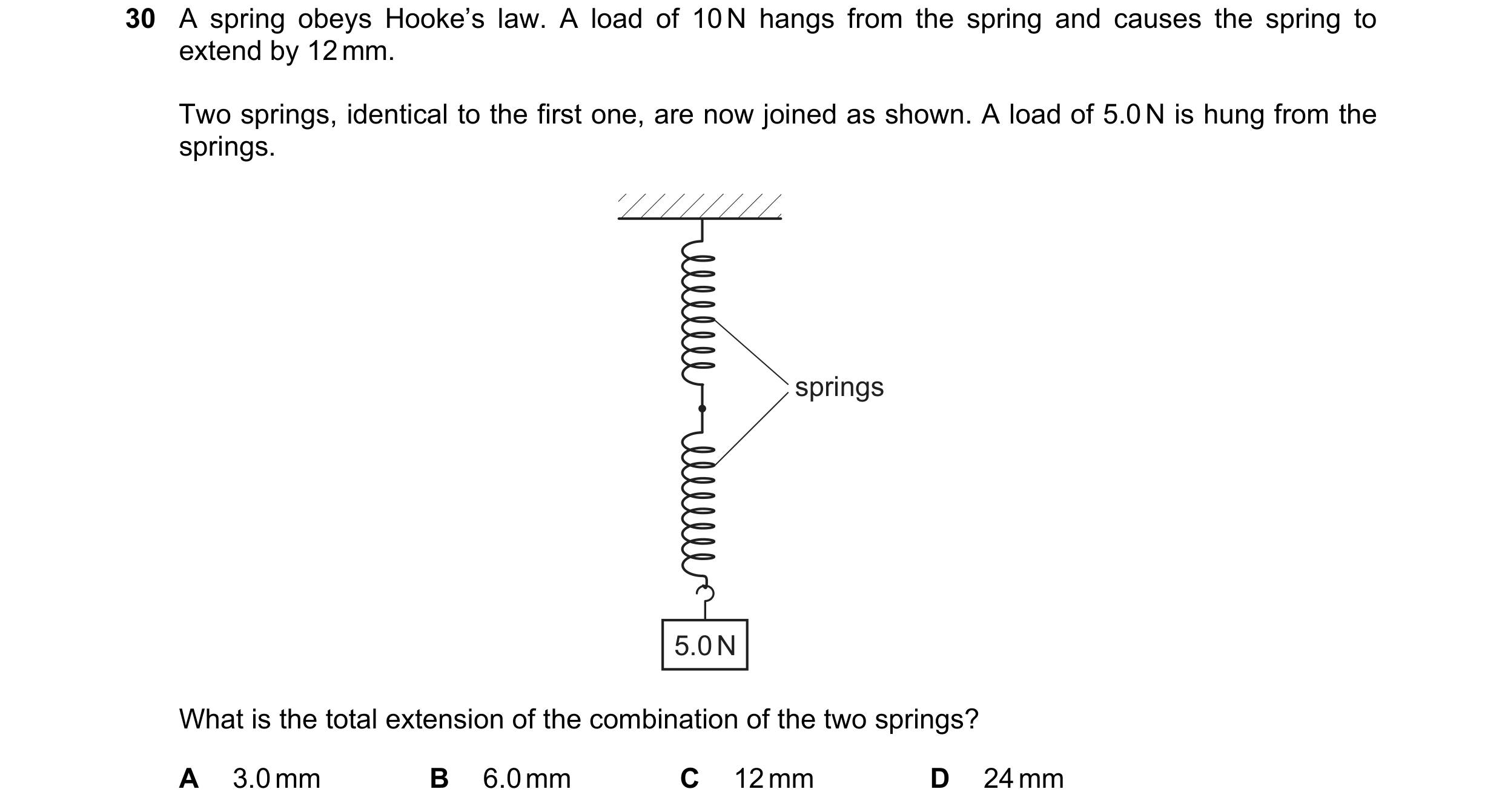
30 A spring obeys Hooke’s law. A load of 10 N hangs from the spring and causes the spring to extend by 12 mm. Two springs, identical to the first one, are now joined as shown. A load of 5.0 N is hung from the springs. springs 5.0 N What is the total extension of the combination of the two springs? A 3.0 mm B 6.0 mm C 12 mm D 24 mm
1 marks
Answer: C
This question in 0653/22 May/June 2020
Q25 · A raindrop falls vertically at a constant speed 0653/21 Oct/Nov 2020
30 A raindrop falls vertically at a constant speed. What is the resultant force on the raindrop as it falls? A It is equal to the air pressure on the drop. B It is equal to the air resistance on the drop. C It is equal to the weight of the drop. D It is zero.
1 marks
Answer: D
This question in 0653/21 Oct/Nov 2020
Q26 · A spring is stretched by a load that is gradually increased until the spring extends… 0653/22 Oct/Nov 2020
30 A spring is stretched by a load that is gradually increased until the spring extends beyond its limit of proportionality. Which graph shows the relationship between the load and the extension produced? A B extension extension 0 0 0 load 0 load C D extension extension 0 0 0 load 0 load
1 marks
Answer: B
This question in 0653/22 Oct/Nov 2020
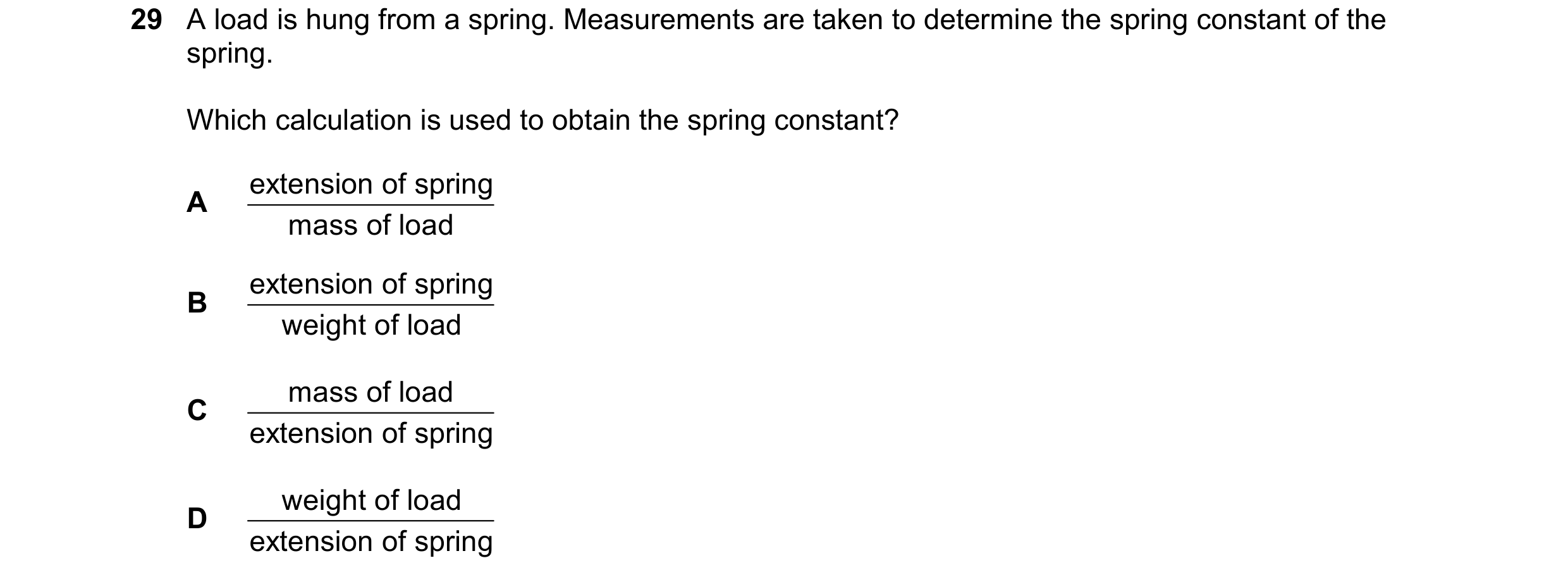
Q27 · A load is hung from a spring 0653/23 Oct/Nov 2020
29 A load is hung from a spring. Measurements are taken to determine the spring constant of the spring. Which calculation is used to obtain the spring constant? extension of spring A mass of load extension of spring B weight of load mass of load C extension of spring weight of load D extension of spring
1 marks
Answer: D
This question in 0653/23 Oct/Nov 2020
Q28 · The diagram shows the load–extension graph for a spring 0653/21 May/June 2021
30 The diagram shows the load–extension graph for a spring. Two points on the graph are labelled X and Y. Y load / N X 10 0 0 20 extension / cm What is the spring constant of the spring and which labelled point is the limit of proportionality? spring constant limit of N/cm proportionality A 0.50 X B 0.50 Y C 2.0 X D 2.0 Y
1 marks
Answer: A
This question in 0653/21 May/June 2021
Q29 · Which change cannot be caused by a force acting on an object? 0653/23 May/June 2021
28 Which change cannot be caused by a force acting on an object? A change of mass B change of motion C change of shape D change of size
1 marks
Answer: A
This question in 0653/23 May/June 2021
Q30 · A spring that obeys Hooke’s Law has unstretched length l 0653/23 Oct/Nov 2021
30 A spring that obeys Hooke’s Law has unstretched length l. A load F is suspended from the spring, and the spring extends by an amount x. Which equation is used to define the spring constant k ? F k = F k = x A k = Fx B k = ( C x D F l + x )
1 marks
Answer: C
This question in 0653/23 Oct/Nov 2021
Q31 · The diagram shows an extension–load graph for a spring 0653/22 Feb/March 2022
29 The diagram shows an extension–load graph for a spring. 20 extension / cm 15 10 5 0 0 1 2 3 4 load / N What is the spring constant k of the spring? A 0.20 N / cm B 5.0 N / cm C 40 N / cm D 80 N / cm
1 marks
Answer: A
This question in 0653/22 Feb/March 2022
Q32 · Which statement about forces is always correct? 0653/21 May/June 2022
28 Which statement about forces is always correct? A A resultant force is needed to keep an object moving at constant speed in a straight line. B Air resistance acting on an object falling in still air causes its speed to increase. C Friction on an object sliding along rough ground acts in the opposite direction to its motion. D No forces act on any object that is at rest.
1 marks
Answer: C
This question in 0653/21 May/June 2022
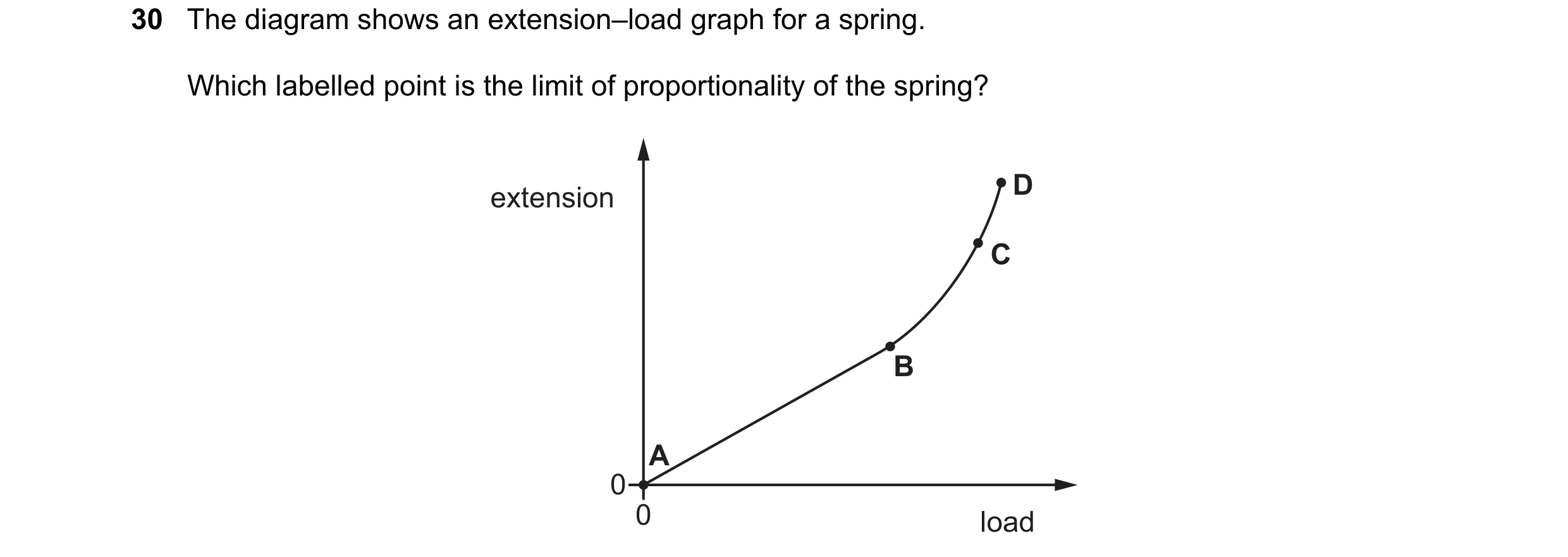
Q33 · The diagram shows an extension–load graph for a spring 0653/21 May/June 2022
30 The diagram shows an extension–load graph for a spring. Which labelled point is the limit of proportionality of the spring? D extension C B A 0 0 load
1 marks
Answer: B
This question in 0653/21 May/June 2022
Q34 · A student investigates a spring that obeys Hooke’s law 0653/22 May/June 2022
28 A student investigates a spring that obeys Hooke’s law. The student suspends loads with different weights from the spring and measures the length of the spring for each weight. Lo is the length of the spring when there is no load on it. Lw is the length of the spring when there is a load of weight W on it. The graph shows the student’s results. 0 0 W Which quantity is plotted on the y-axis? L A Lw – Lo B Lw + Lo C Lw D w L o
1 marks
Answer: A
This question in 0653/22 May/June 2022
Q35 · When a spring is stretched by a force of 20 N, its length increases from 3.2 cm to 5.4 cm 0653/21 Oct/Nov 2022
29 When a spring is stretched by a force of 20 N, its length increases from 3.2 cm to 5.4 cm. What is the spring constant of the spring? A 0.11 N / cm B 0.27 N / cm C 3.7 N / cm D 9.1 N / cm
1 marks
Answer: D
This question in 0653/21 Oct/Nov 2022
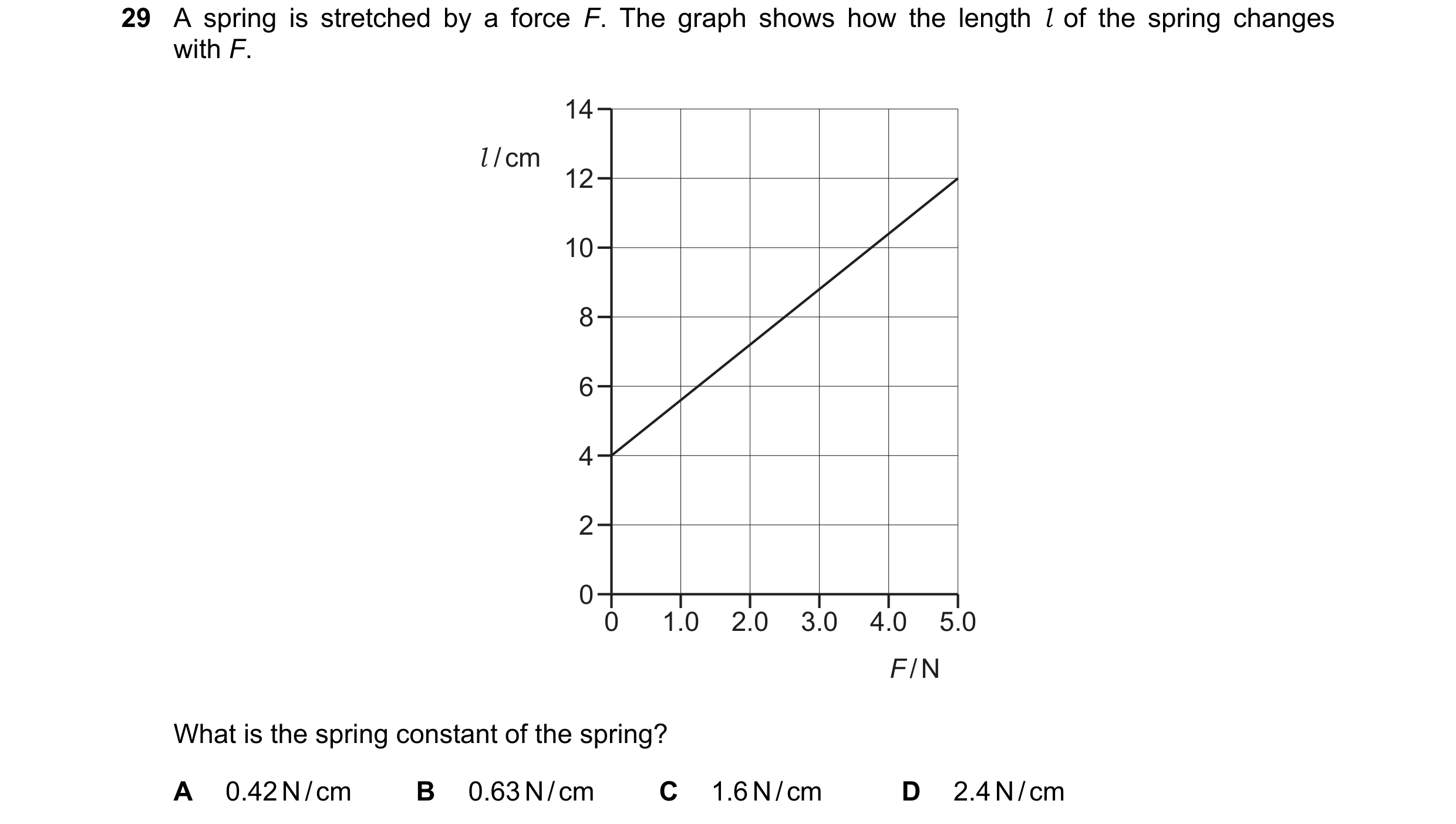
Q36 · A spring is stretched by a force F 0653/22 Oct/Nov 2022
29 A spring is stretched by a force F. The graph shows how the length l of the spring changes with F. 14 l / cm 12 10 8 6 4 2 0 0 1.0 2.0 3.0 4.0 5.0 F / N What is the spring constant of the spring? A 0.42 N / cm B 0.63 N / cm C 1.6 N / cm D 2.4 N / cm
1 marks
Answer: B
This question in 0653/22 Oct/Nov 2022
Q37 · The force acting on a spring is gradually increased from 0 N 0653/22 Feb/March 2023
29 The force acting on a spring is gradually increased from 0 N. The spring eventually passes its limit of proportionality. Which graph shows how the extension of the spring changes as the force increases? A B extension extension 0 0 0 force 0 force C D extension extension 0 0 0 force 0 force
1 marks
Answer: B
This question in 0653/22 Feb/March 2023
Q38 · Which object has a resultant force acting on it? 0653/22 Feb/March 2023
30 Which object has a resultant force acting on it? A a book at rest on a table B a car travelling up a hill in a straight line at constant speed C a football moving upwards freely after being kicked D a parachutist descending vertically at constant speed
1 marks
Answer: C
This question in 0653/22 Feb/March 2023
Q39 · A spring that obeys Hooke’s law is fixed at one end 0653/21 May/June 2023
30 A spring that obeys Hooke’s law is fixed at one end. When the spring is pulled by a force of 30 N, it has a stretched length of 14 cm. When the spring is pulled by a force of 48 N, it has a stretched length of 20 cm. What is the spring constant of the spring? A 2.1 N / cm B 2.4 N / cm C 3.0 N / cm D 8.0 N / cm
1 marks
Answer: C
This question in 0653/21 May/June 2023
Q40 · The diagram shows an extension–load graph for a spring 0653/23 May/June 2023
30 The diagram shows an extension–load graph for a spring. Which labelled point shows the limit of proportionality for the spring? D extension C B A 0 0 load
1 marks
Answer: C
This question in 0653/23 May/June 2023
Q41 · A spring that obeys Hooke’s law is stretched by a force of 4.0 N 0653/21 Oct/Nov 2023
30 A spring that obeys Hooke’s law is stretched by a force of 4.0 N. The length of the spring changes from 10 cm to 12 cm. What is the spring constant of the spring? A 0.33 N / cm B 0.50 N / cm C 2.0 N / cm D 3.0 N / cm
1 marks
Answer: C
This question in 0653/21 Oct/Nov 2023
Q42 · A spring obeys Hooke’s law 0653/22 May/June 2024
30 A spring obeys Hooke’s law. In which unit is its spring constant measured? A m / N B N C N / m D N m
1 marks
Answer: C
This question in 0653/22 May/June 2024
Q43 · A wire is stretched by a force 0653/23 May/June 2024
30 A wire is stretched by a force. A force–extension graph is produced. What is the significance of the extension at the limit of proportionality on the graph? A It is the maximum extension before the wire breaks. B It is the maximum extension for which Hooke’s law is obeyed. C It is the minimum extension before the wire breaks. D It is the minimum extension for which Hooke’s law is obeyed.
1 marks
Answer: B
This question in 0653/23 May/June 2024
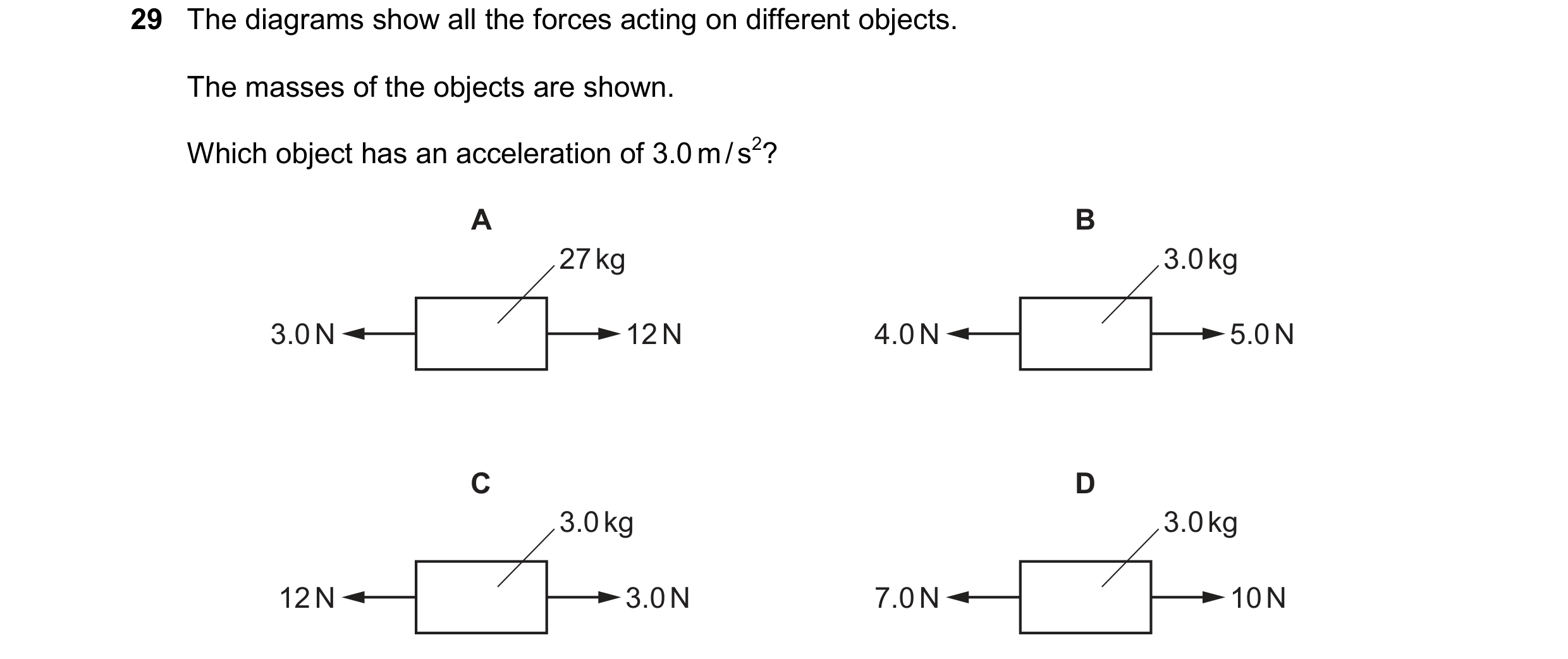
Q44 · The diagrams show all the forces acting on different objects 0653/21 May/June 2025
29 The diagrams show all the forces acting on different objects. The masses of the objects are shown. Which object has an acceleration of 3.0 m / s2? A B 27 kg 3.0 kg 3.0 N 12 N 4.0 N 5.0 N C D 3.0 kg 3.0 kg 12 N 3.0 N 7.0 N 10 N
1 marks
Answer: C
This question in 0653/21 May/June 2025
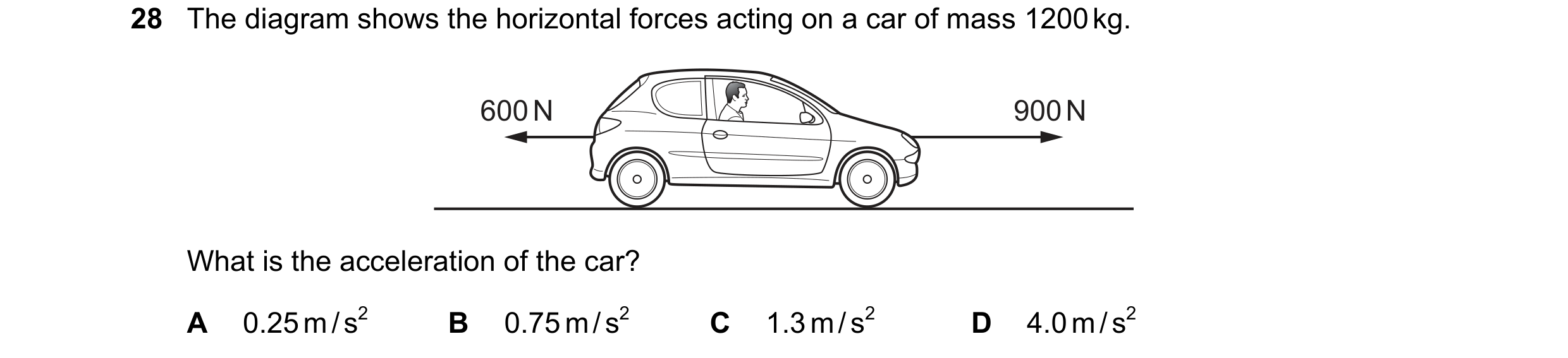
Q45 · The diagram shows the horizontal forces acting on a car of mass 1200 kg 0653/22 May/June 2025
28 The diagram shows the horizontal forces acting on a car of mass 1200 kg. 600 N 900 N What is the acceleration of the car? A 0.25 m / s2 B 0.75 m / s2 C 1.3 m / s2 D 4.0 m / s2
1 marks
Answer: A
This question in 0653/22 May/June 2025
 1 / 16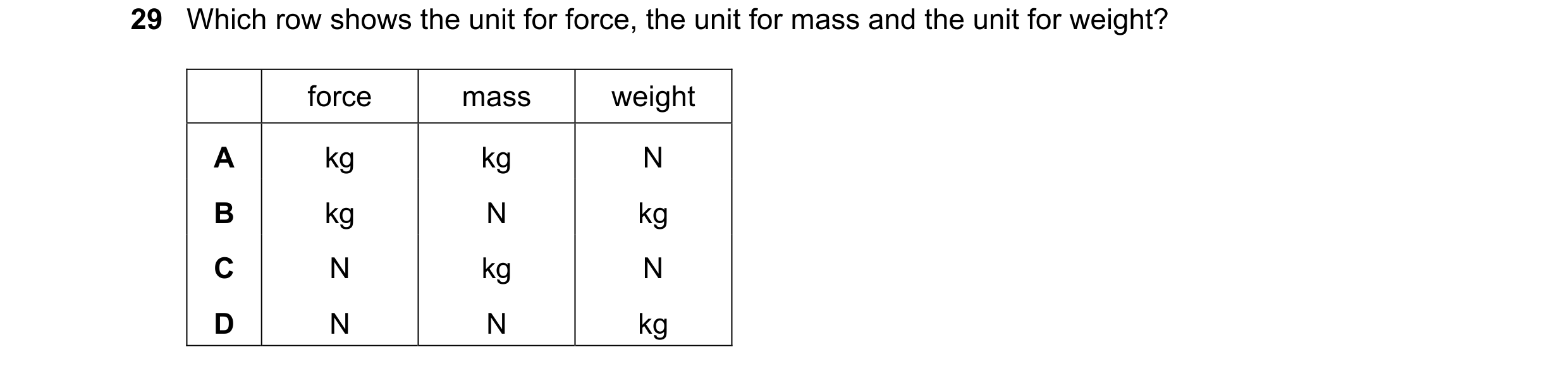
 2 / 16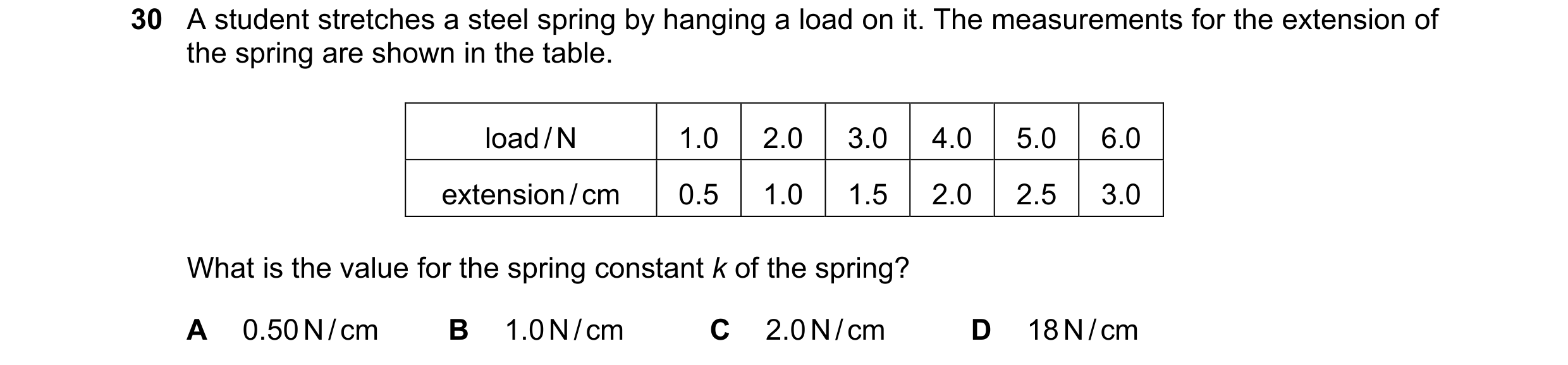
 3 / 16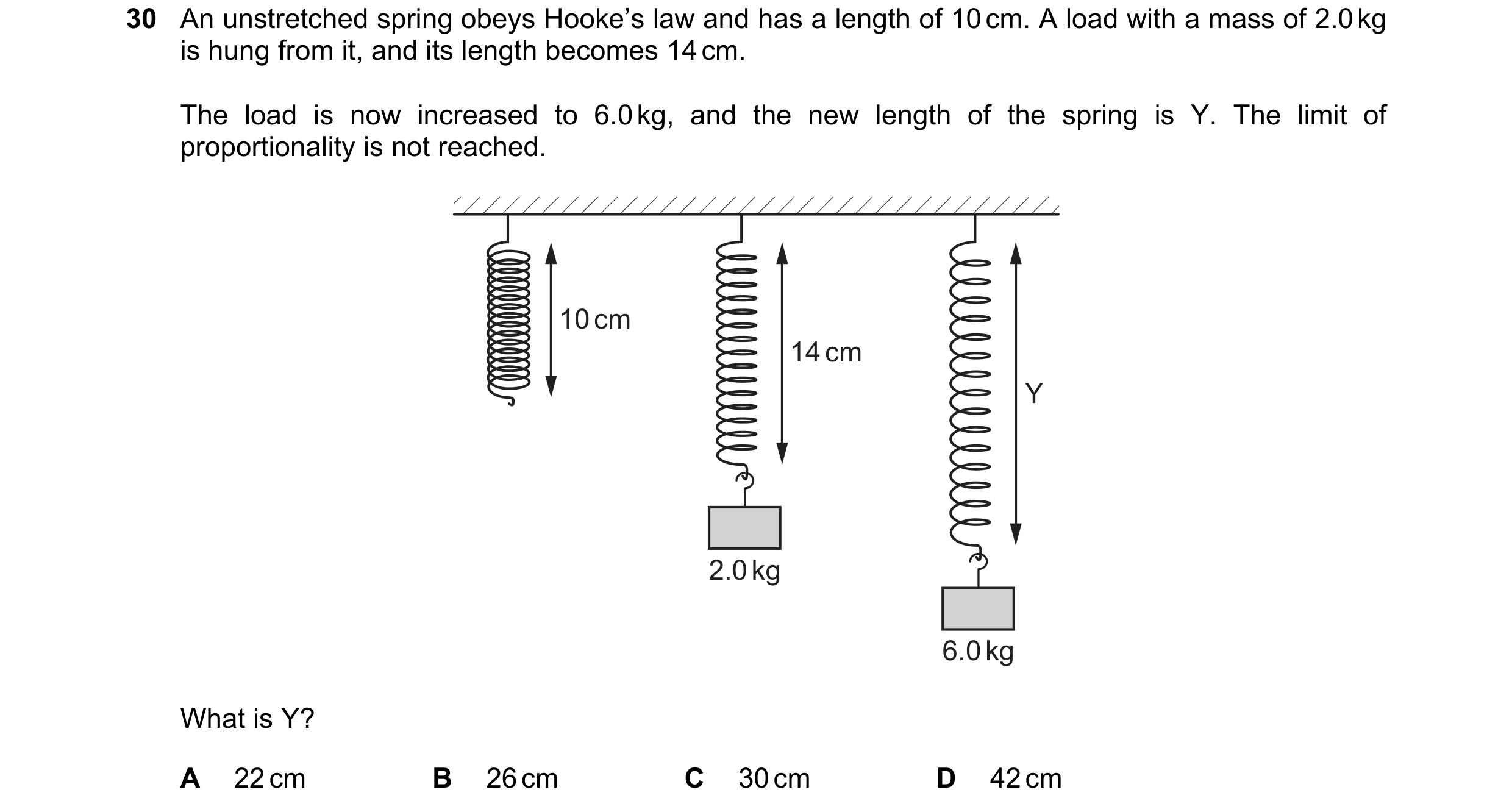
 4 / 16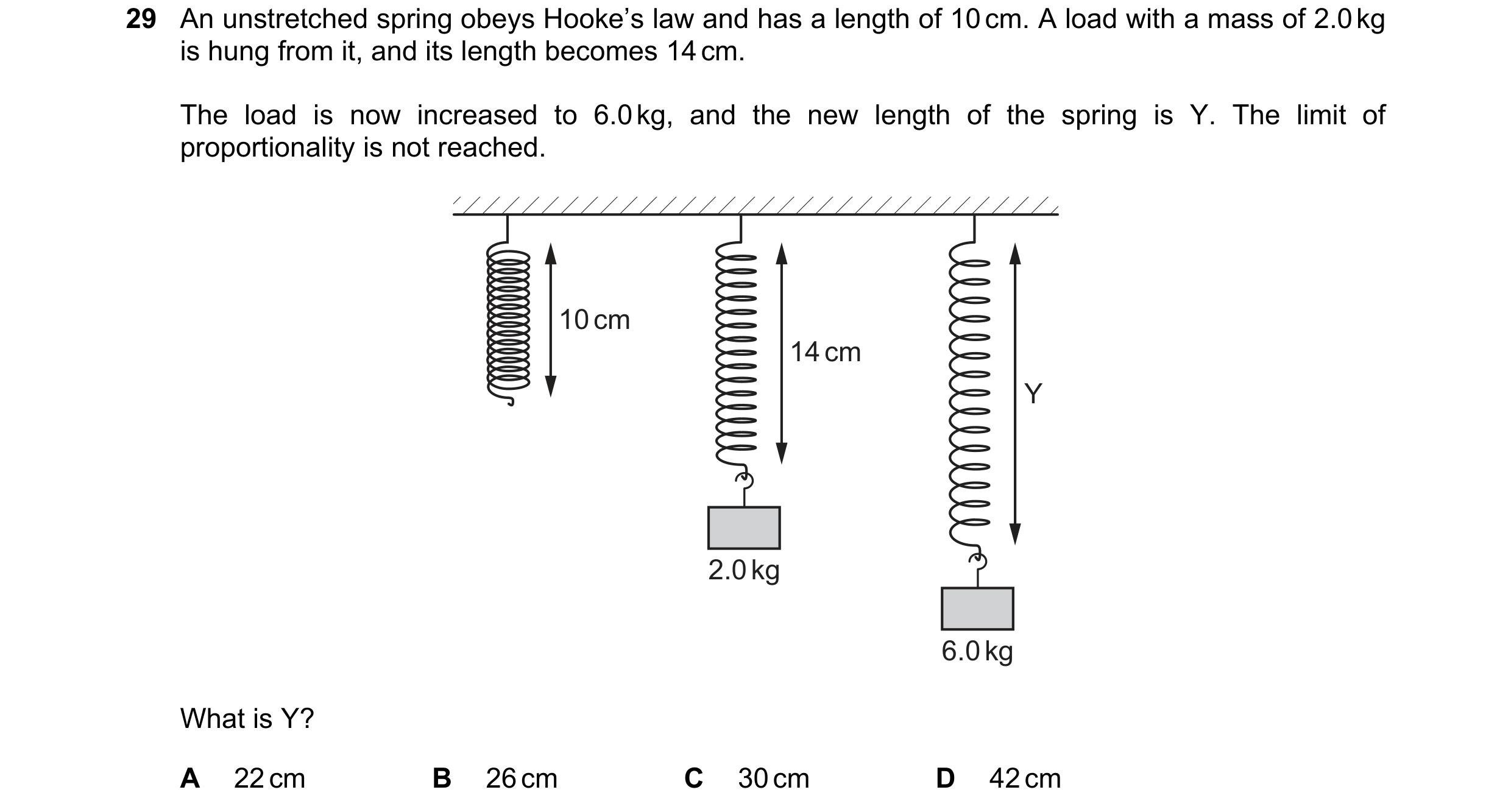
 5 / 16
 6 / 16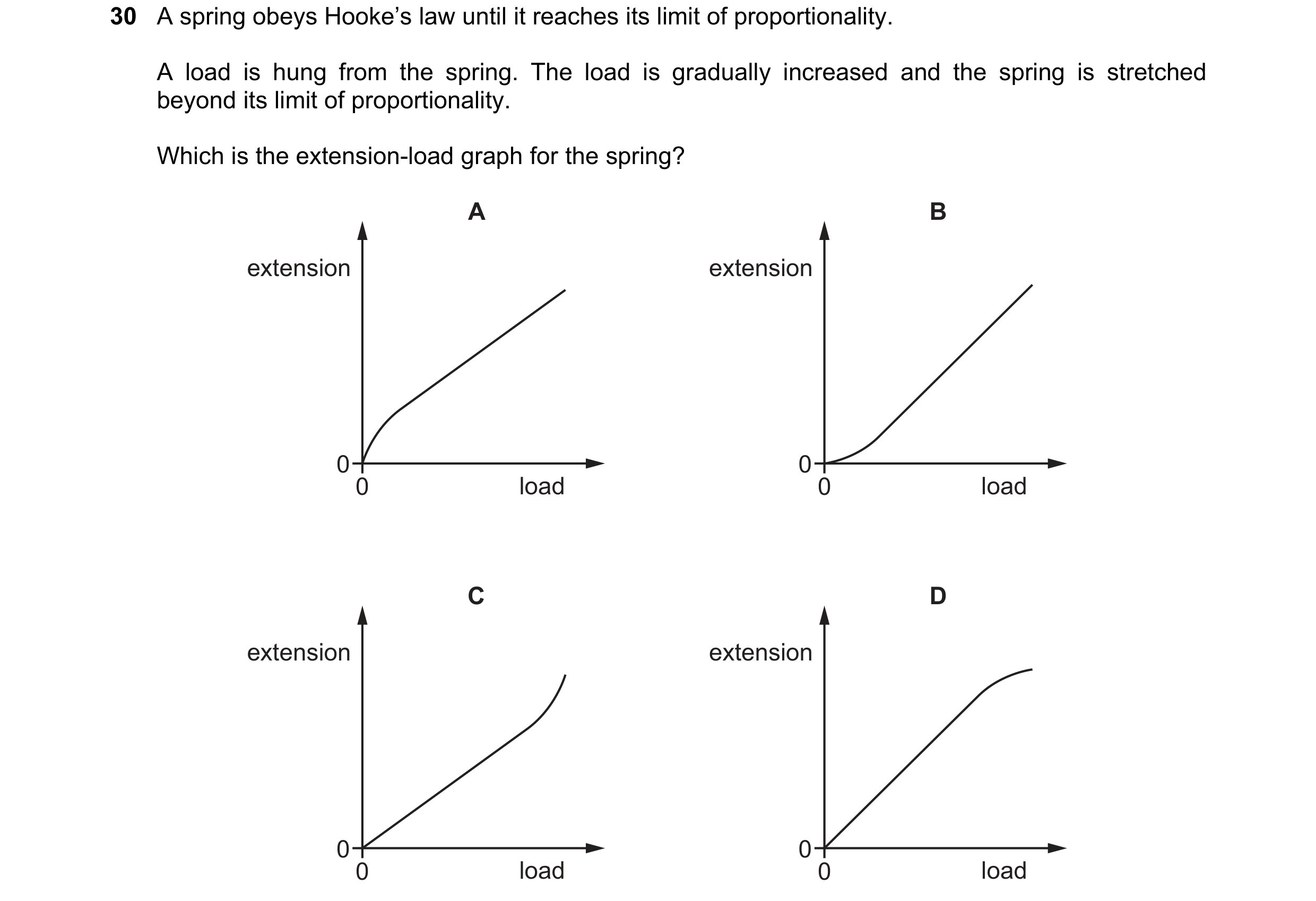
 7 / 16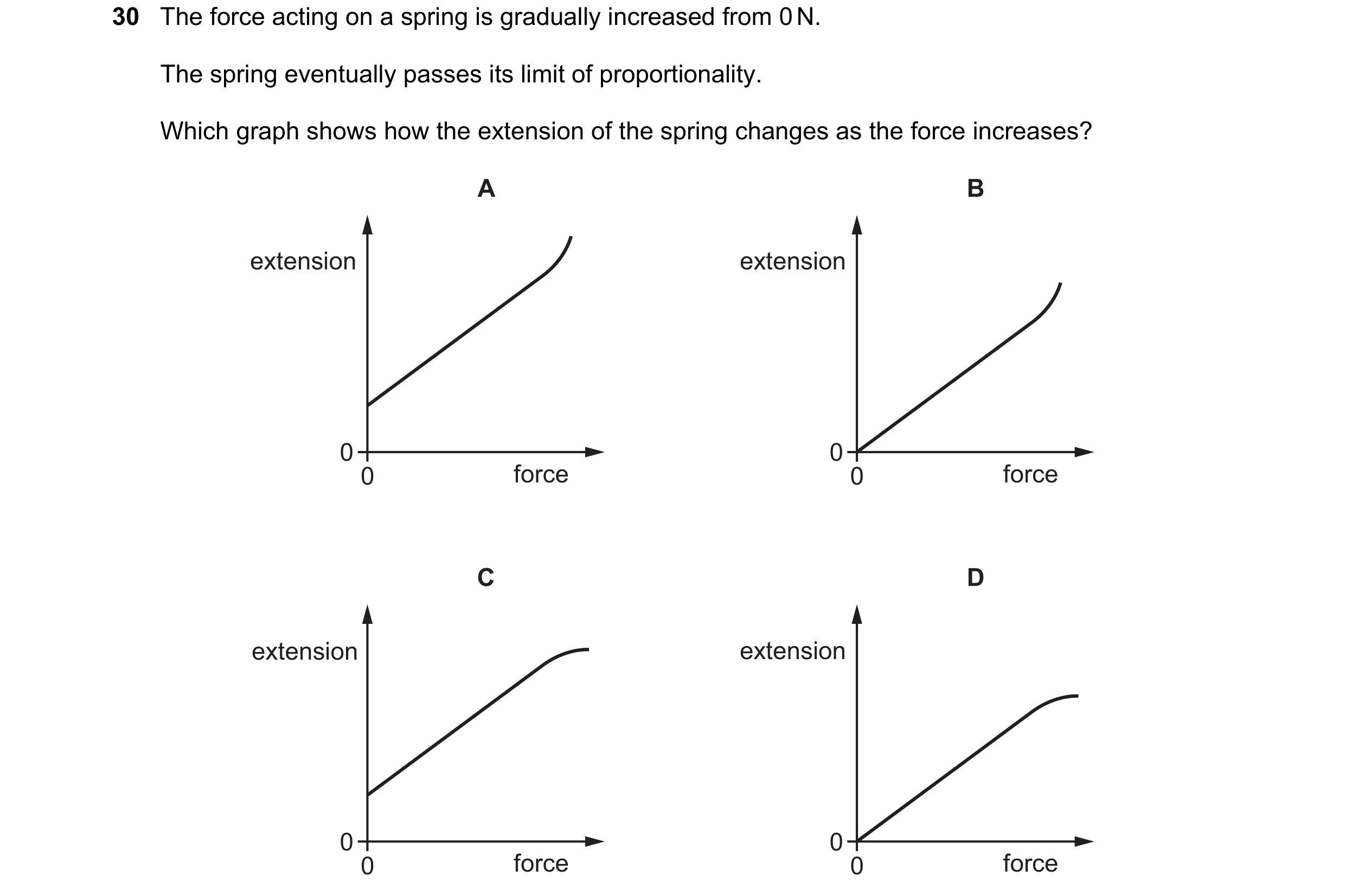

 8 / 16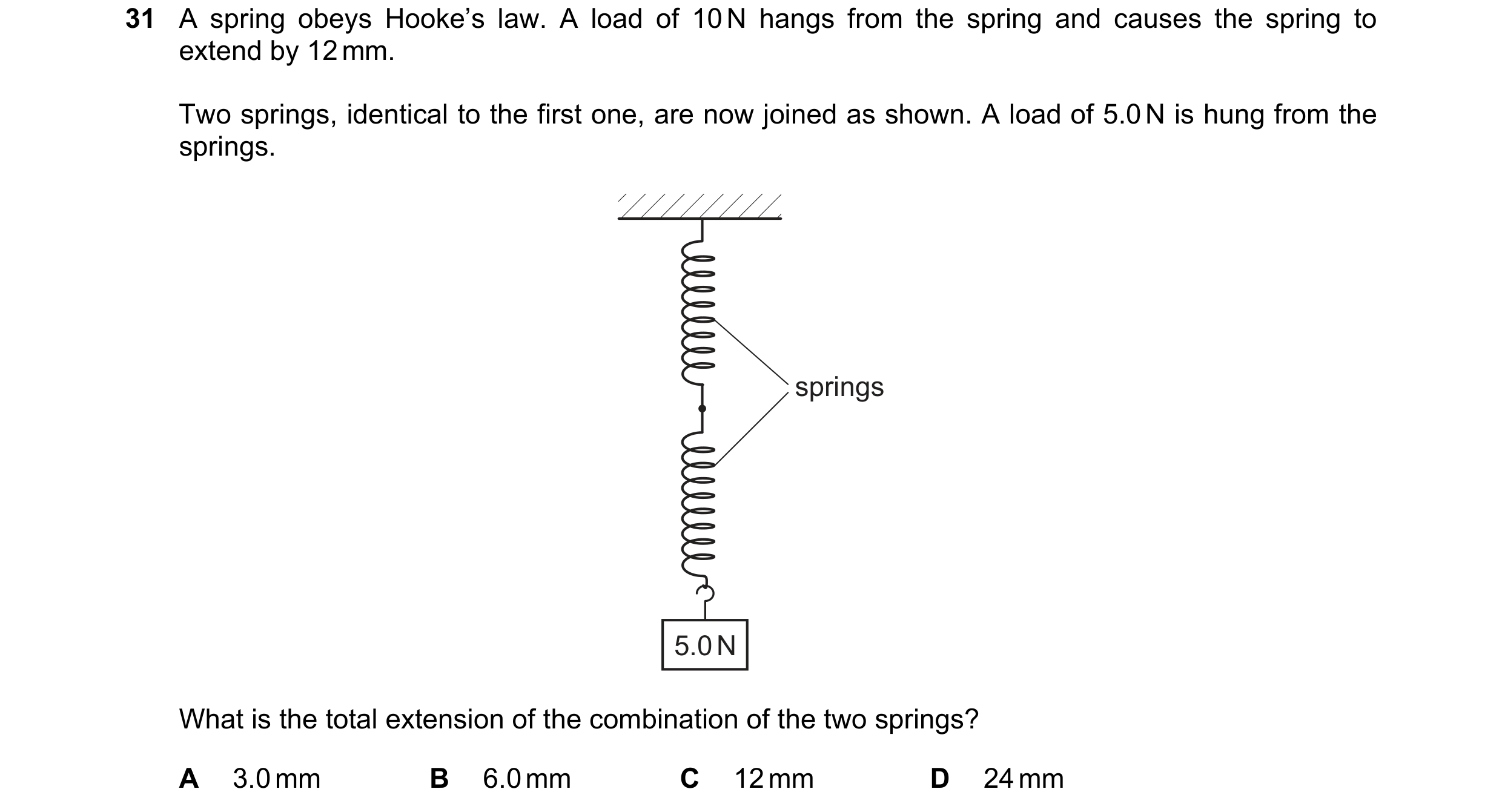
 9 / 16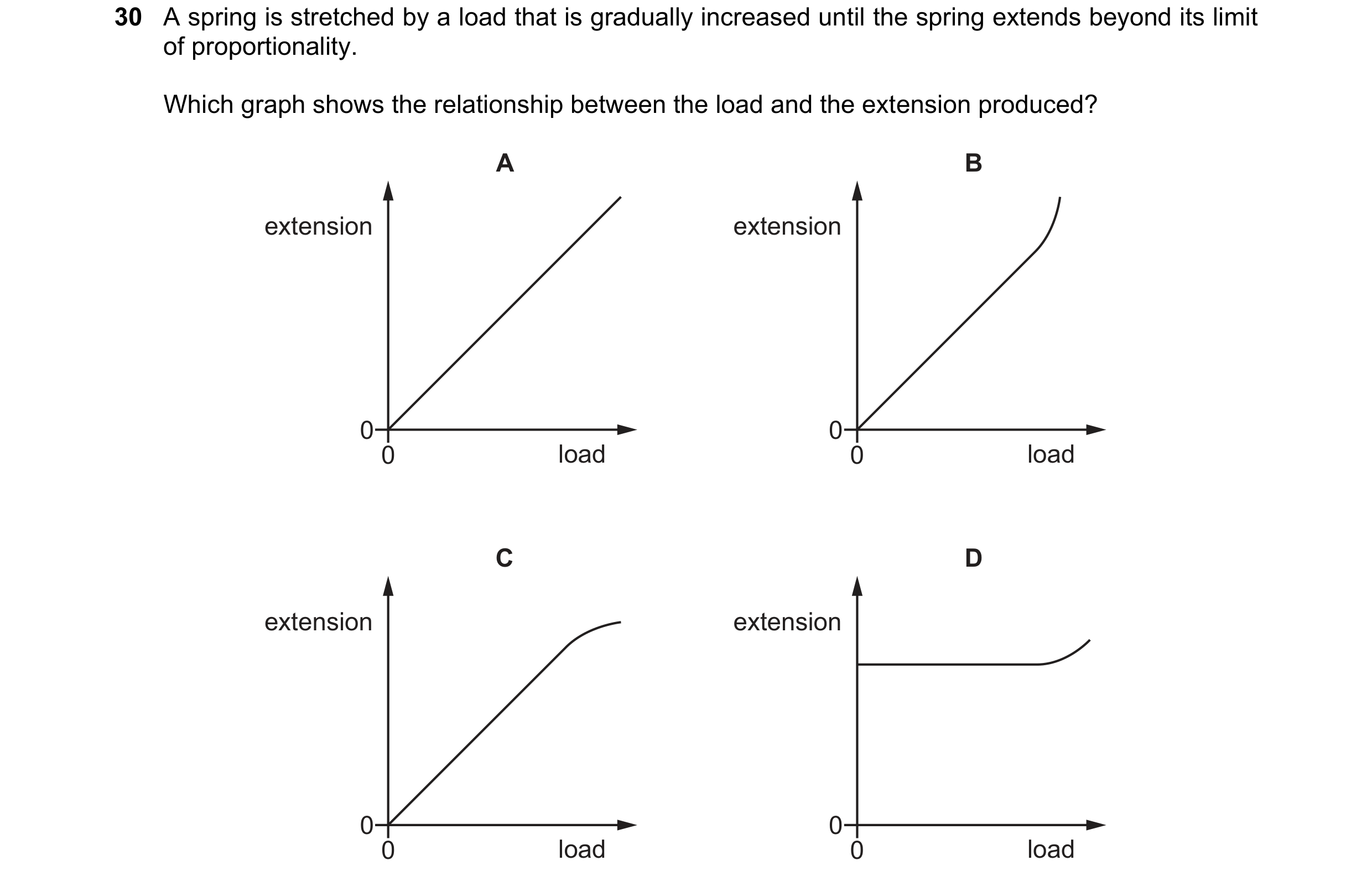
 10 / 16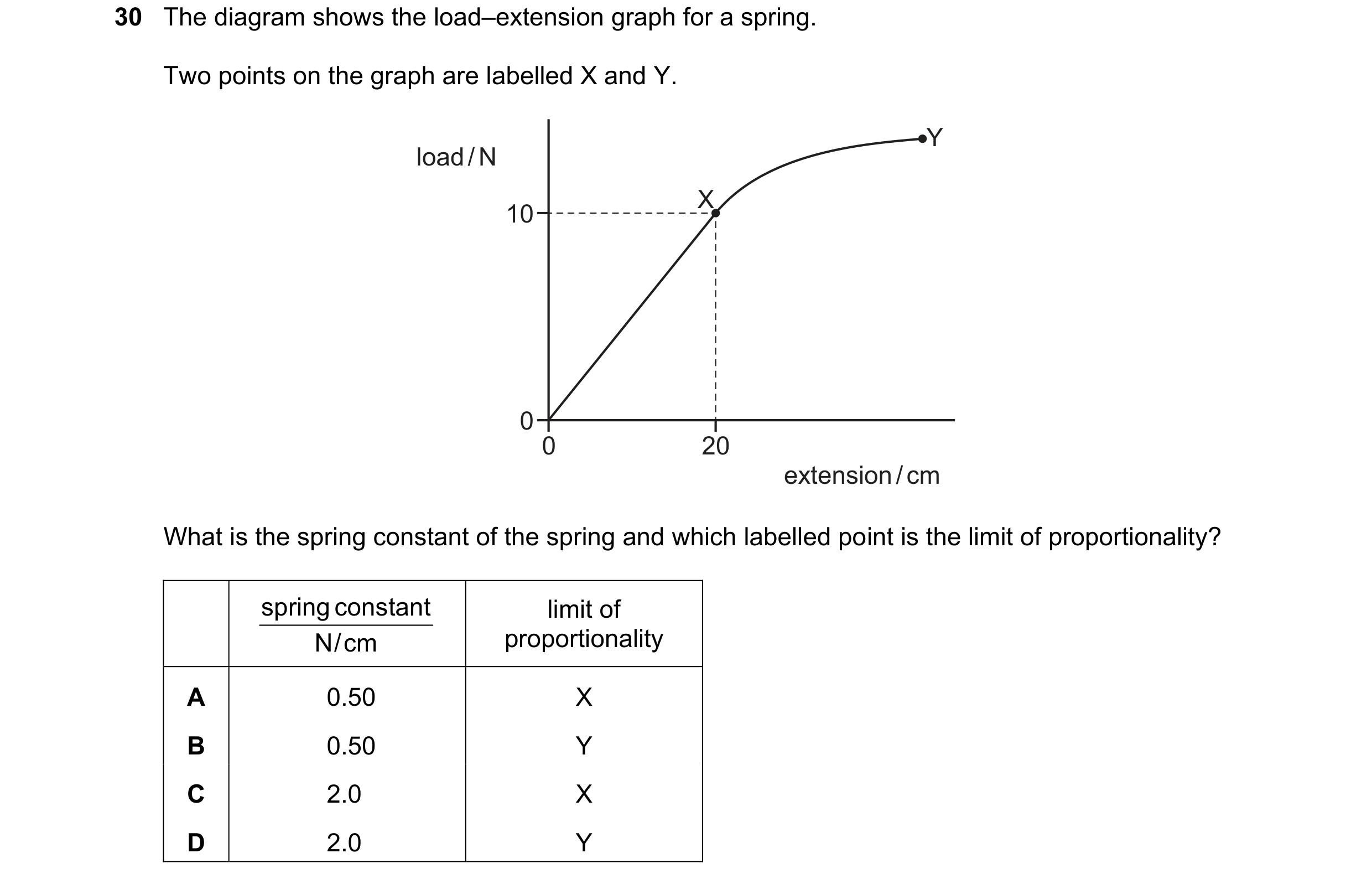

 11 / 16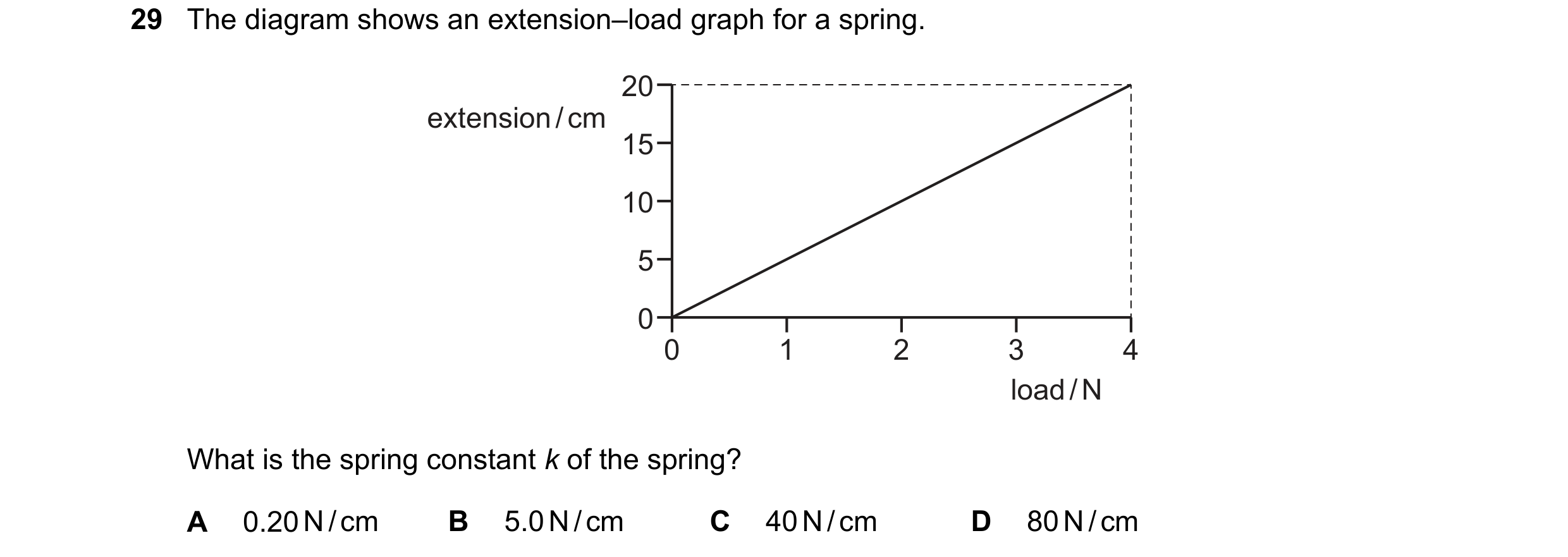

 12 / 16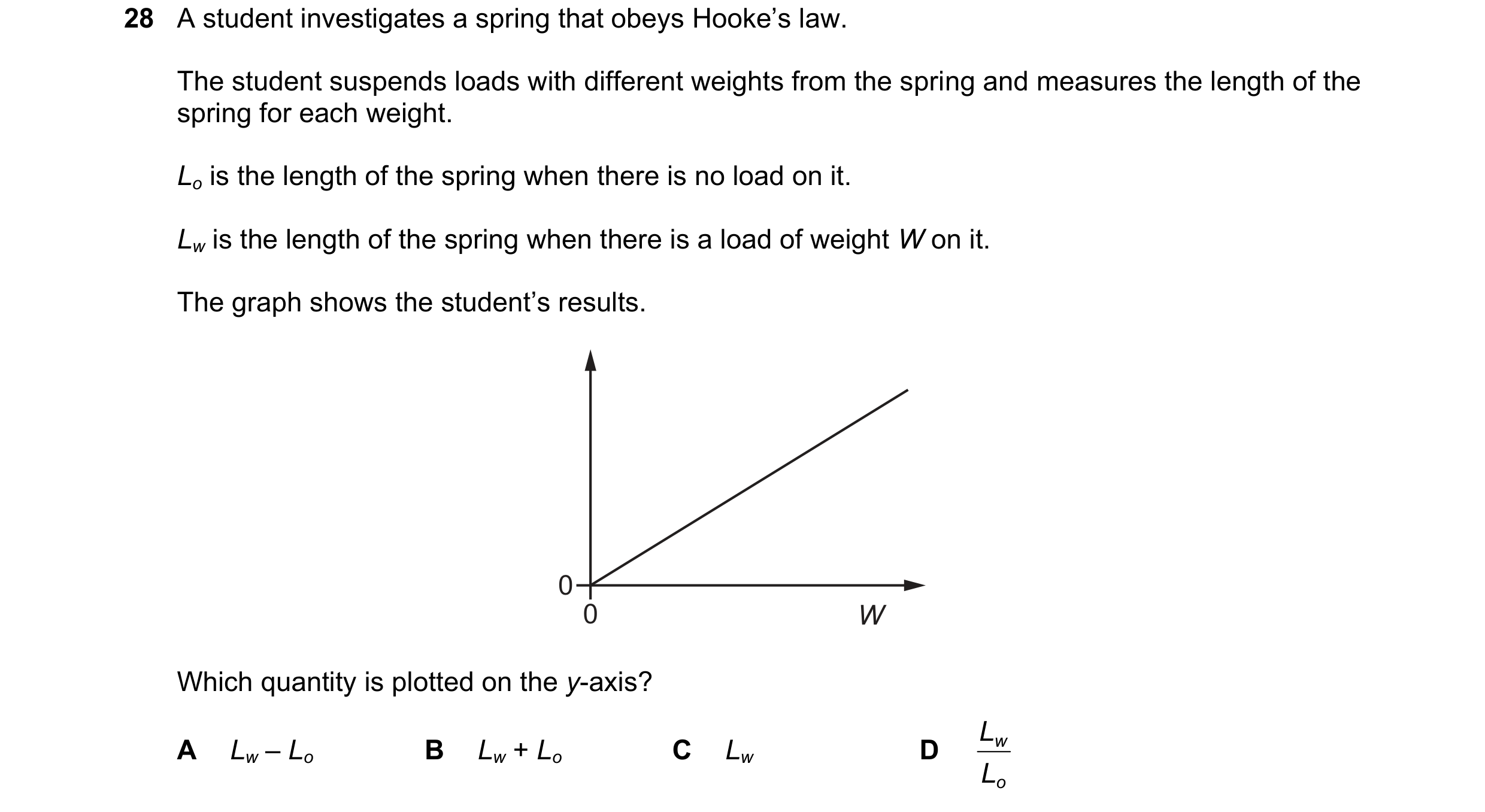

 13 / 16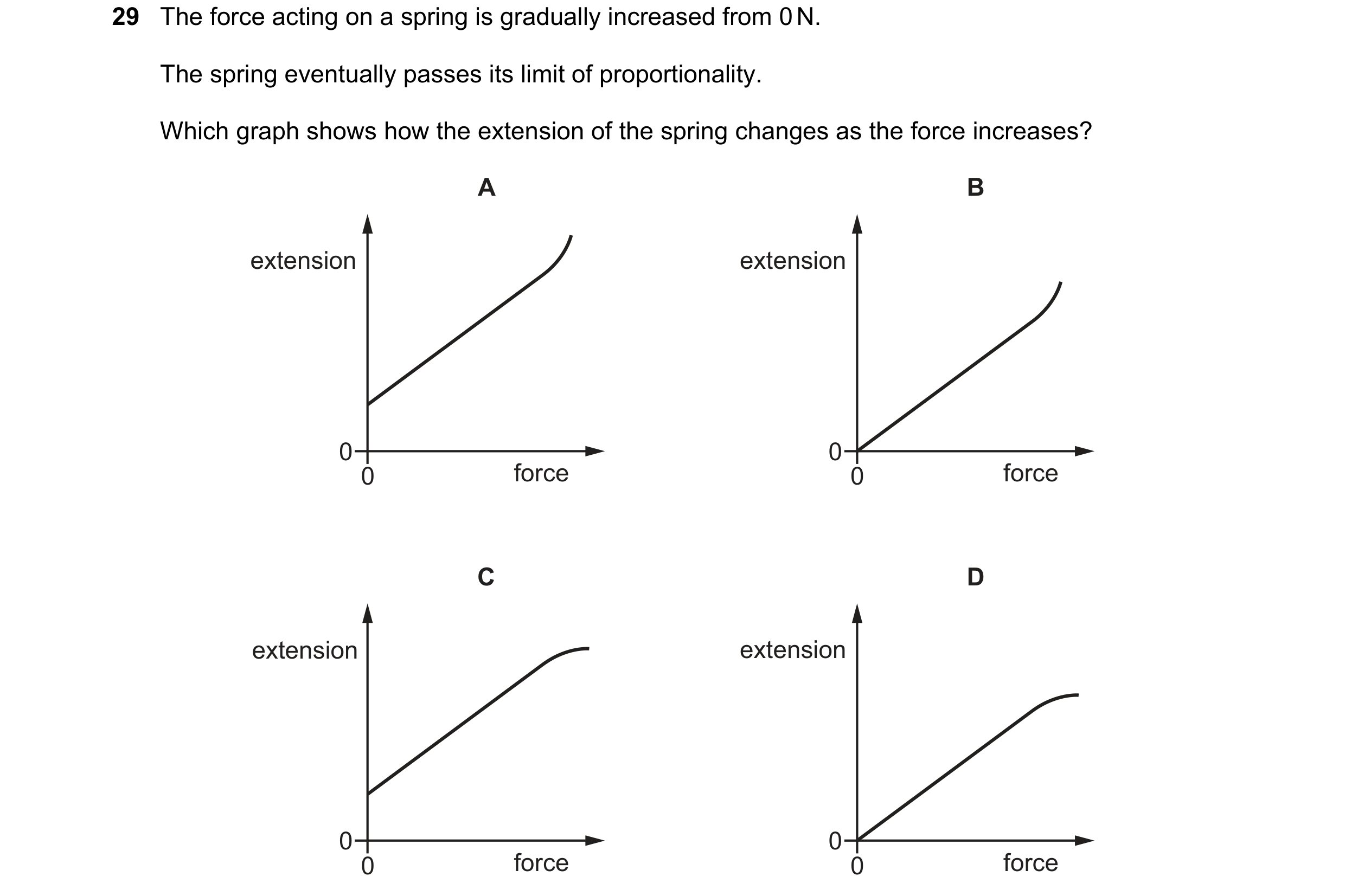

 14 / 16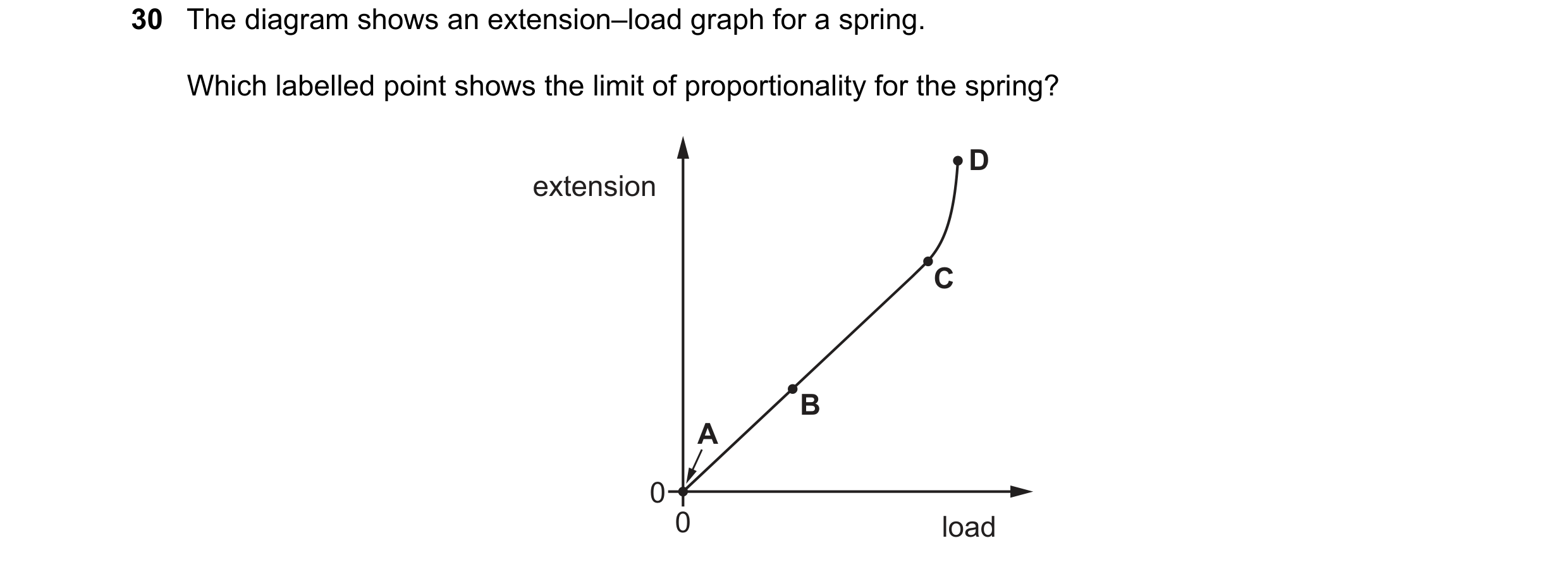


 15 / 16
 16 / 16