Cambridge IGCSE Science - Combined 0653 — 2018 May/June Paper 4 · Variant 2
0653/42/M/J/18 · 9 questions · 80 marks · ≈90 min
The question paper and its mark scheme, free to read here and free to download. This is Cambridge’s own paper, exactly as it was sat.
Question paper24 pages


Mark scheme10 pages
Answers below. Sit the paper first if you are practising.
Questions as text
Q1 · An experiment with a germinating seed
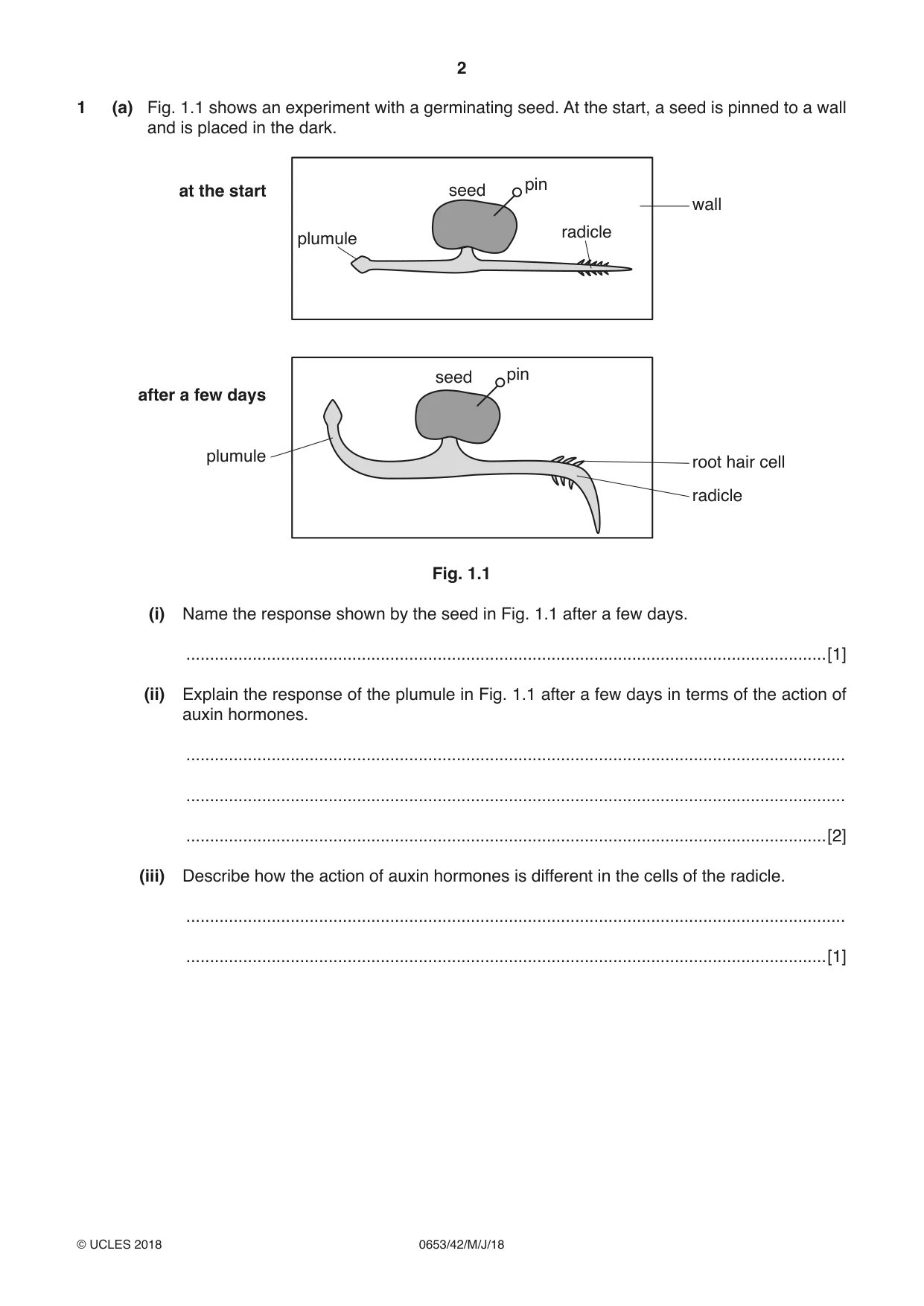
1 (a) Fig. 1.1 shows an experiment with a germinating seed. At the start, a seed is pinned to a wall and is placed in the dark. pin at the start seed wall radicle plumule seed pin after a few days plumule root hair cell radicle Fig. 1.1 (i) Name the response shown by the seed in Fig. 1.1 after a few days. .......................................................................................................................................[1] (ii) Explain the response of the plumule in Fig. 1.1 after a few days in terms of the action of auxin hormones. ........................................................................................................................................... ........................................................................................................................................... .......................................................................................................................................[2] (iii) Describe how the action of auxin hormones is different in the cells of the radicle. ........................................................................................................................................... .......................................................................................................................................[1] (b) A radicle has root hair cells which are used in water uptake from the soil. (i) Explain how the shape of the root hair cell helps it with its function of water uptake. ........................................................................................................................................... ........................................................................................................................................... .......................................................................................................................................[2] (ii) Explain why water moves into the root hair cell from the soil. ........................................................................................................................................... ........................................................................................................................................... .......................................................................................................................................[2] (c) State the tissue which carries water through the plant. ...............................................................................................................................................[1]
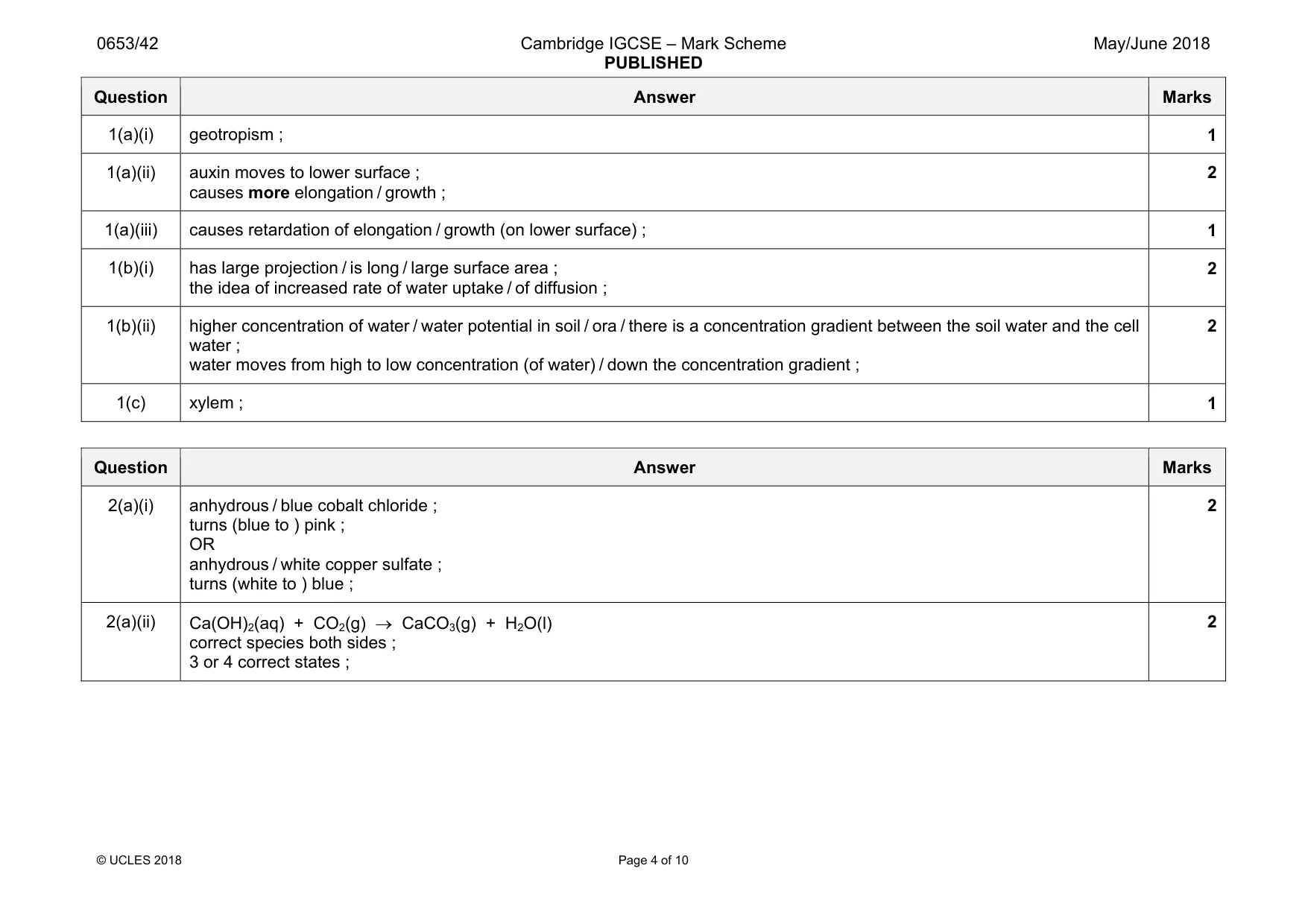
Mark scheme: 1(a)(i) geotropism ; 1 1(a)(ii) auxin moves to lower surface ; causes more elongation / growth ; 2 1(a)(iii) causes retardation of elongation / growth (on lower surface) ; 1 1(b)(i) has large projection / is long / large surface area ; the idea of increased rate of water uptake / of diffusion ; 2 1(b)(ii) higher concentration of water / water potential in soil / ora / there is a concentration gradient between the soil water and the cell water ; water moves from high to low concentration (of water) / down the concentration gradient ; 2 1(c) xylem ; 1
Q2 · A student investigates the combustion of a hydrocarbon, as shown in Fig
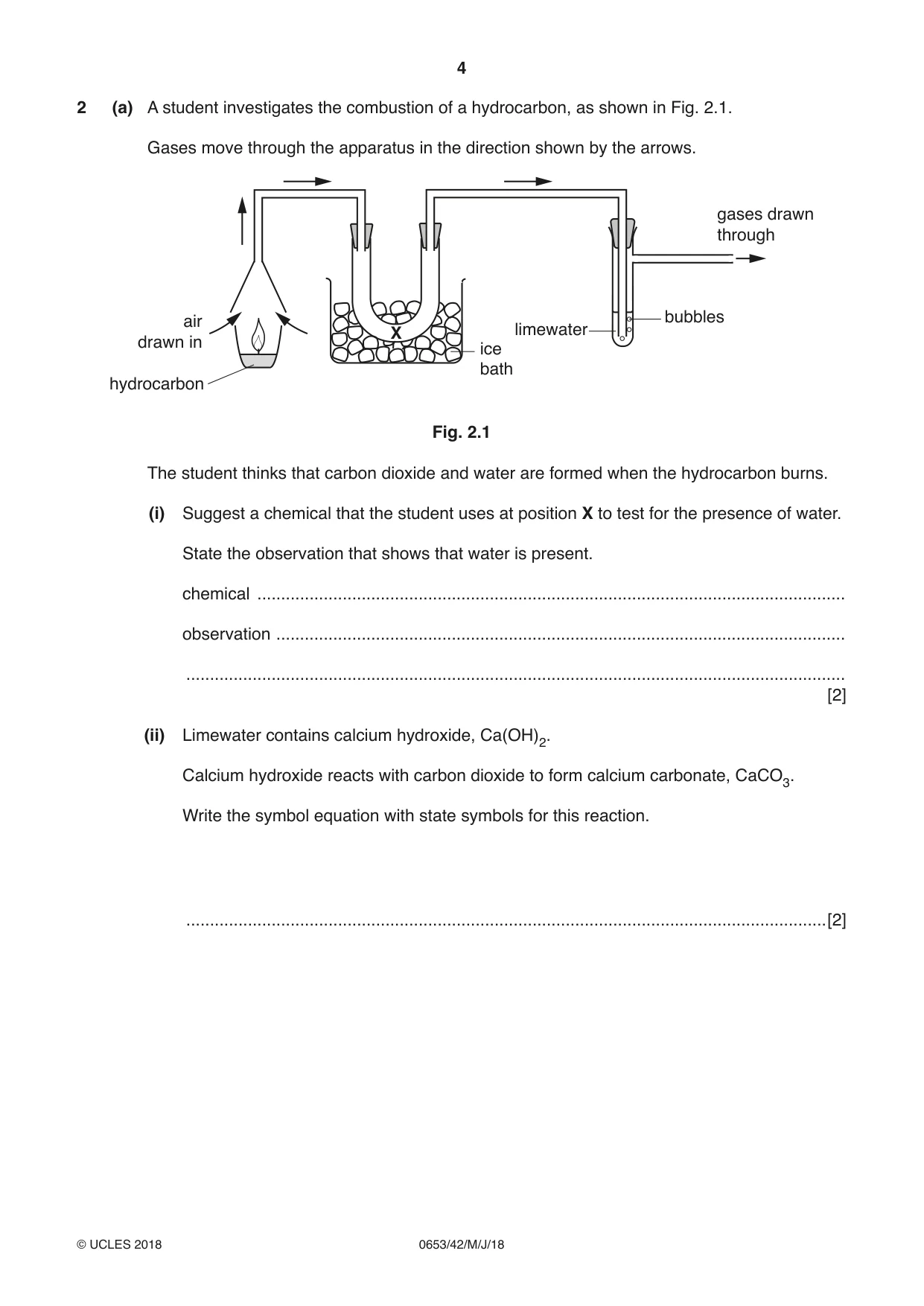
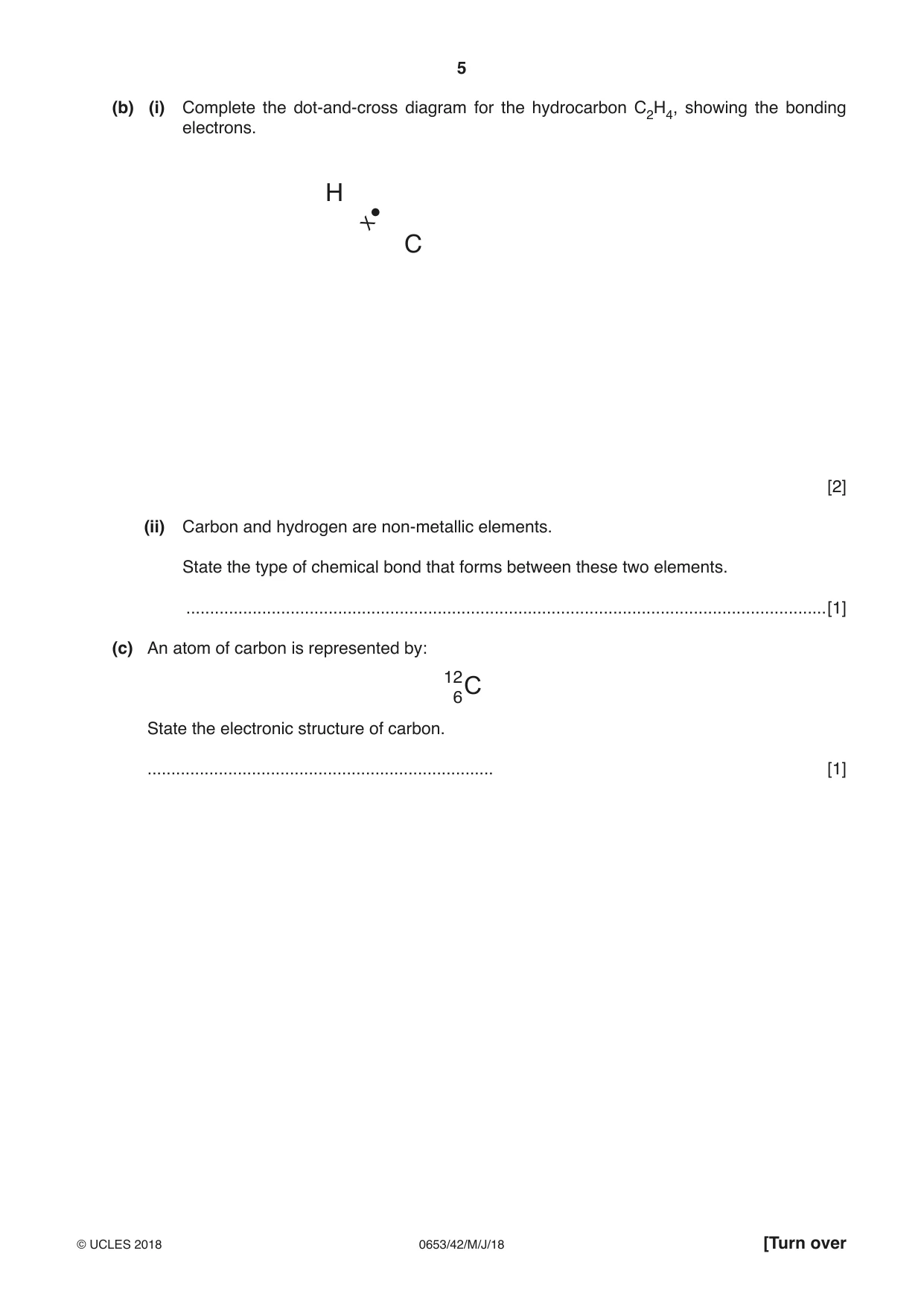
2 (a) A student investigates the combustion of a hydrocarbon, as shown in Fig. 2.1. Gases move through the apparatus in the direction shown by the arrows. gases drawn through X air bubbles X limewater drawn in ice bath hydrocarbon Fig. 2.1 The student thinks that carbon dioxide and water are formed when the hydrocarbon burns. (i) Suggest a chemical that the student uses at position X to test for the presence of water. State the observation that shows that water is present. chemical ............................................................................................................................ observation ........................................................................................................................ ........................................................................................................................................... [2] (ii) Limewater contains calcium hydroxide, Ca(OH)2. Calcium hydroxide reacts with carbon dioxide to form calcium carbonate, CaCO3. Write the symbol equation with state symbols for this reaction. .......................................................................................................................................[2] (b) (i) Complete the dot-and-cross diagram for the hydrocarbon C2H4, showing the bonding electrons. H X C [2] (ii) Carbon and hydrogen are non-metallic elements. State the type of chemical bond that forms between these two elements. .......................................................................................................................................[1] (c) An atom of carbon is represented by: 126C State the electronic structure of carbon. ......................................................................... [1]
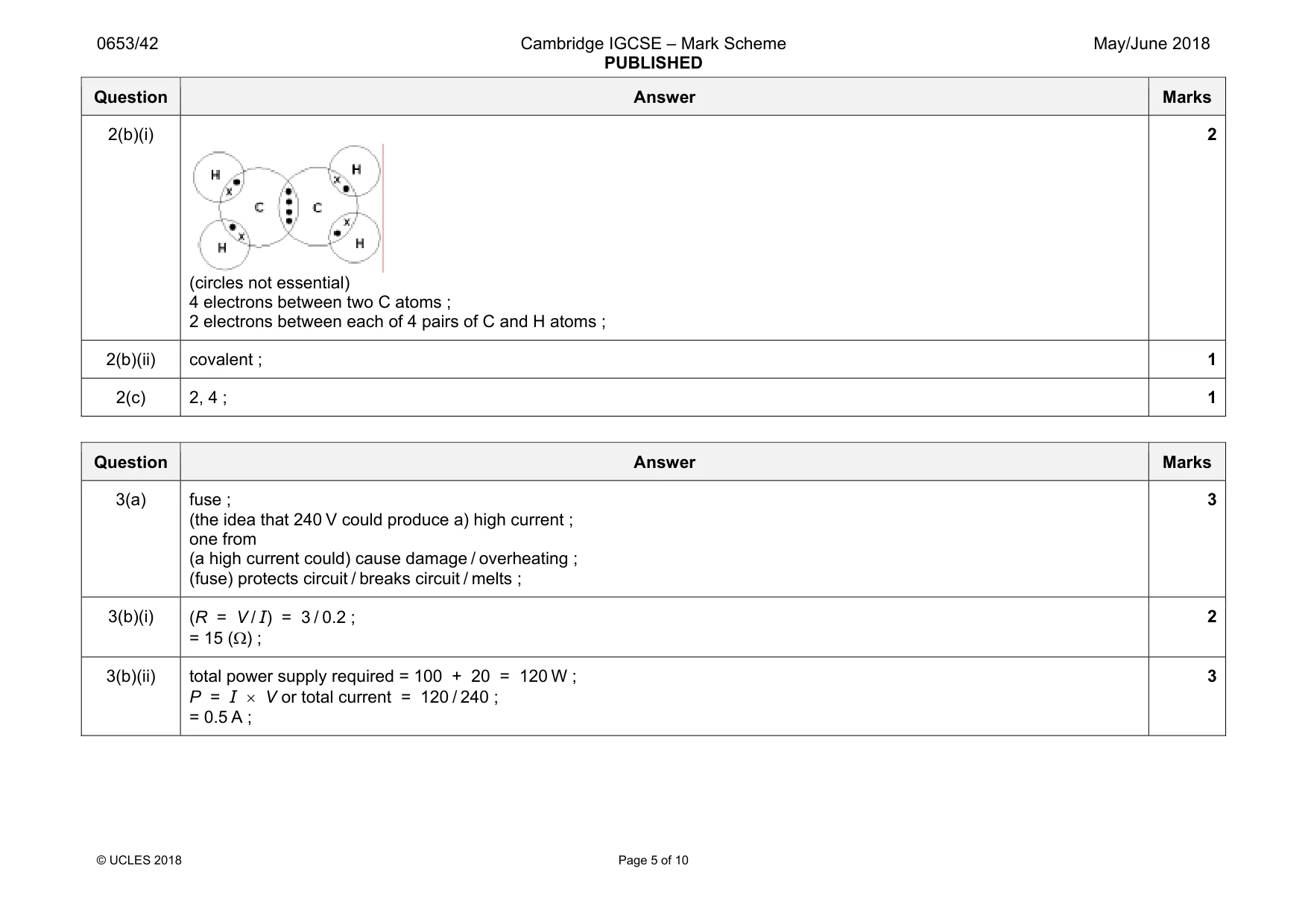
Mark scheme: 2(a)(i) anhydrous / blue cobalt chloride ; turns (blue to ) pink ; OR anhydrous / white copper sulfate ; turns (white to ) blue ; 2 2(a)(ii) Ca(OH)2(aq) + CO2(g) → CaCO3(g) + H2O(l) correct species both sides ; 3 or 4 correct states ; 2 Question Answer Marks 2(b)(i) (circles not essential) 4 electrons between two C atoms ; 2 electrons between each of 4 pairs of C and H atoms ; 2 2(b)(ii) covalent ; 1 2(c) 2, 4 ; 1
Question 3
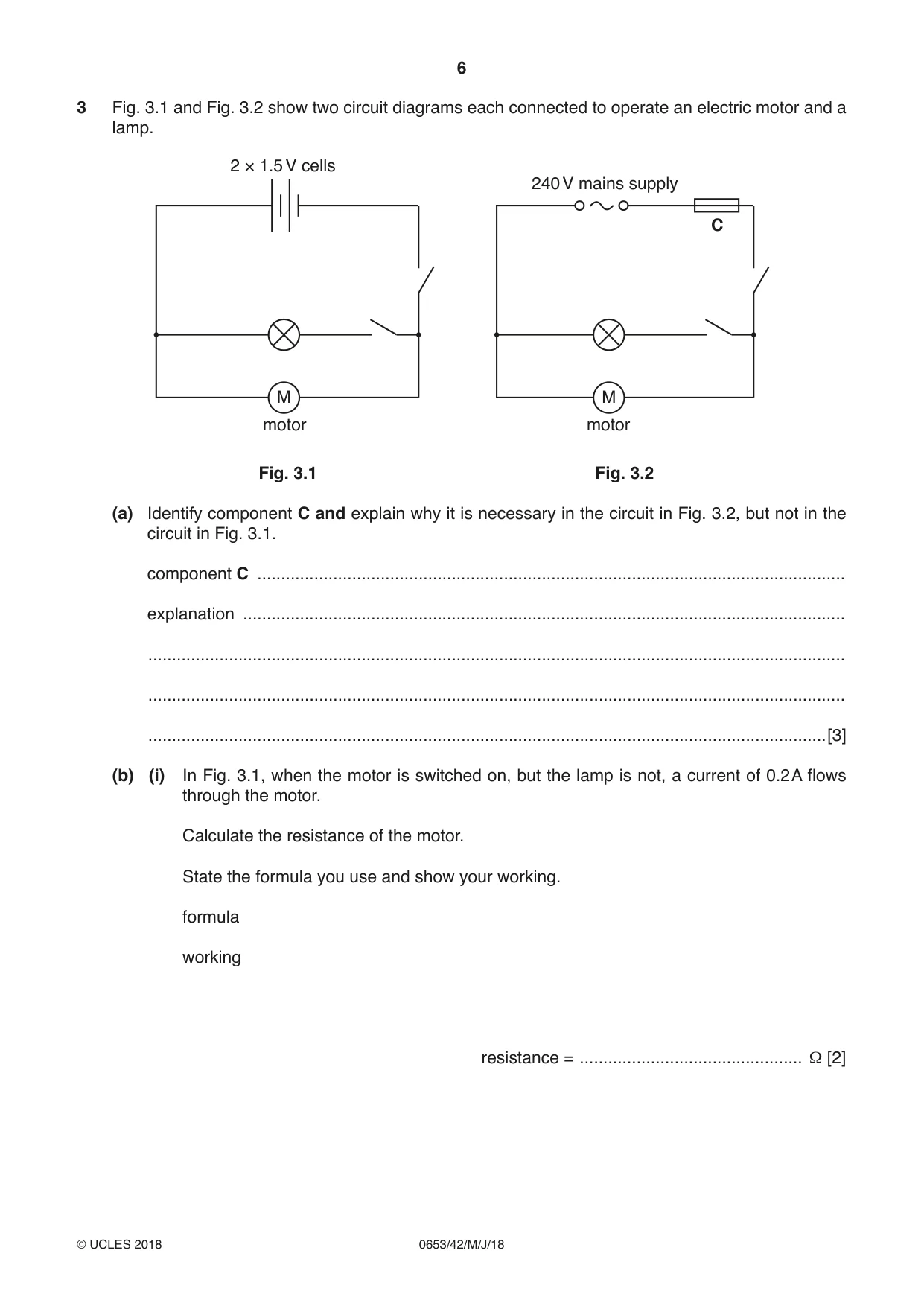
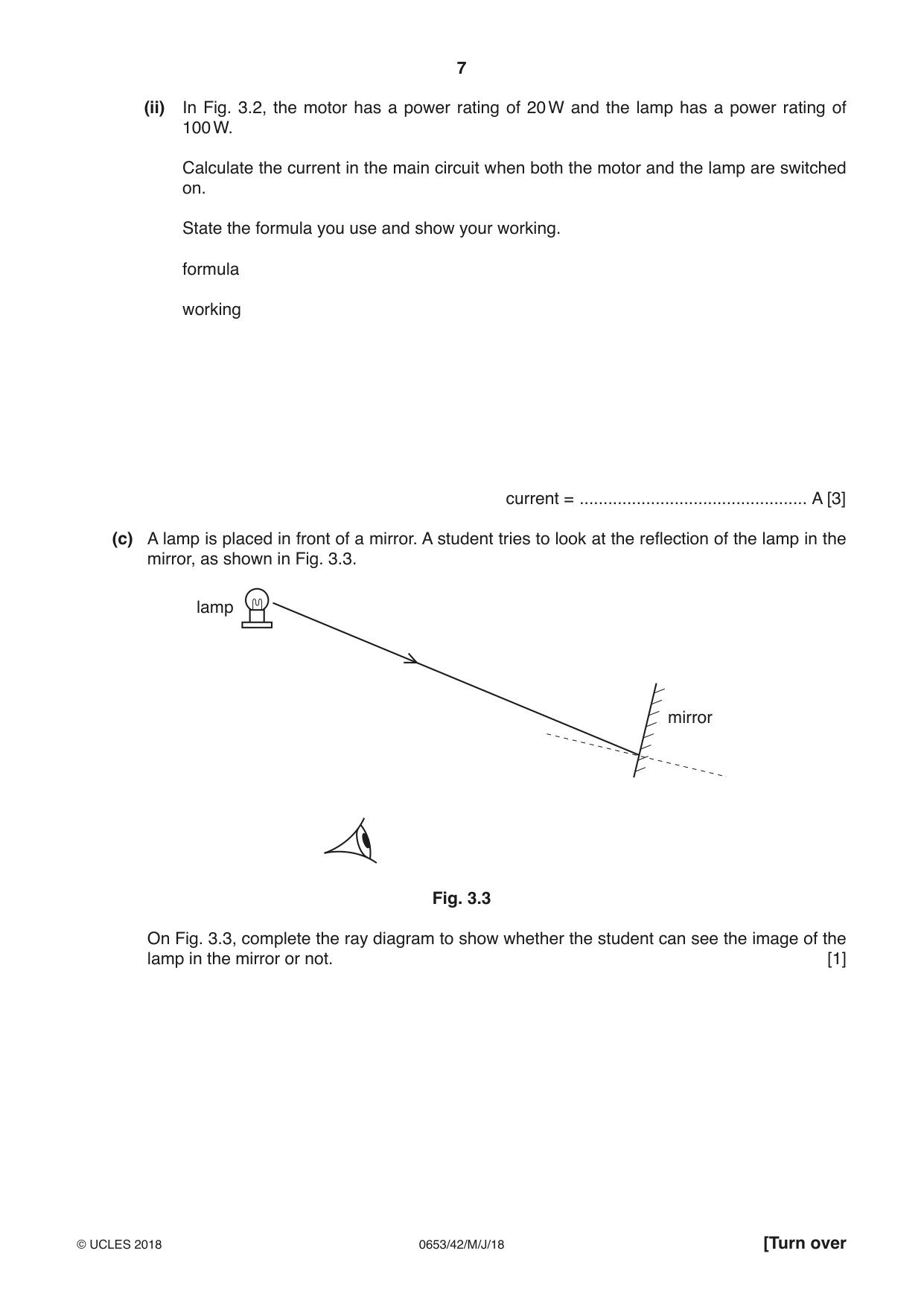
3 Fig. 3.1 and Fig. 3.2 show two circuit diagrams each connected to operate an electric motor and a lamp. 2 × 1.5 V cells 240 V mains supply C M M motor motor Fig. 3.1 Fig. 3.2 (a) Identify component C and explain why it is necessary in the circuit in Fig. 3.2, but not in the circuit in Fig. 3.1. component C ............................................................................................................................ explanation ............................................................................................................................... ................................................................................................................................................... ................................................................................................................................................... ...............................................................................................................................................[3] (b) (i) In Fig. 3.1, when the motor is switched on, but the lamp is not, a current of 0.2 A flows through the motor. Calculate the resistance of the motor. State the formula you use and show your working. formula working resistance = ............................................... Ω [2] (ii) In Fig. 3.2, the motor has a power rating of 20 W and the lamp has a power rating of 100 W. Calculate the current in the main circuit when both the motor and the lamp are switched on. State the formula you use and show your working. formula working current = ................................................ A [3] (c) A lamp is placed in front of a mirror. A student tries to look at the reflection of the lamp in the mirror, as shown in Fig. 3.3. lamp mirror Fig. 3.3 On Fig. 3.3, complete the ray diagram to show whether the student can see the image of the lamp in the mirror or not. [1]
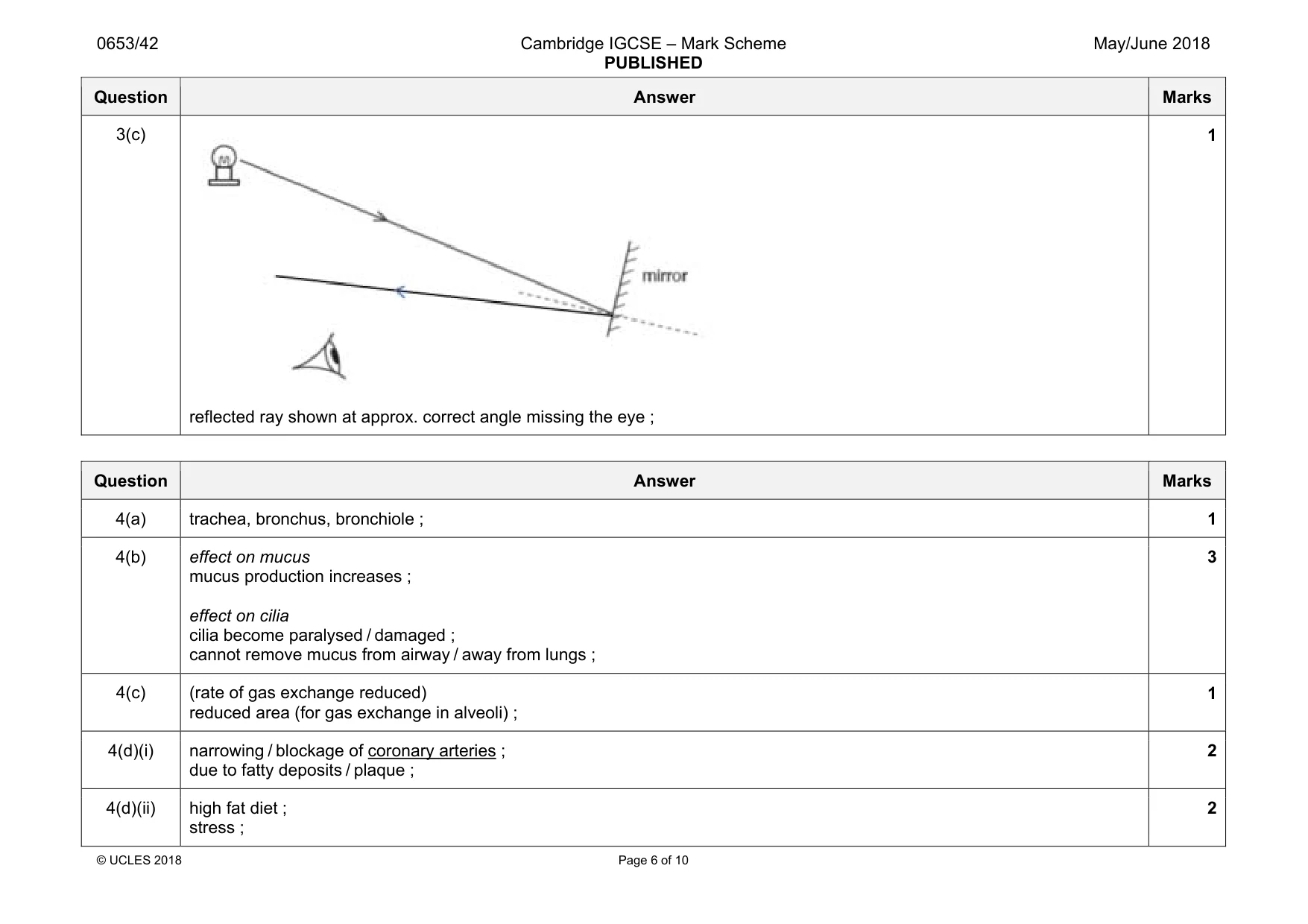
Mark scheme: 3(a) fuse ; (the idea that 240 V could produce a) high current ; one from (a high current could) cause damage / overheating ; (fuse) protects circuit / breaks circuit / melts ; 3 3(b)(i) (R = V / I) = 3 / 0.2 ; = 15 (Ω) ; 2 3(b)(ii) total power supply required = 100 + 20 = 120 W ; P = I × V or total current = 120 / 240 ; = 0.5 A ; 3 Question Answer Marks 3(c) reflected ray shown at approx. correct angle missing the eye ; 1
Q4 · During inspiration air passes through different parts of the airway to reach the alveoli
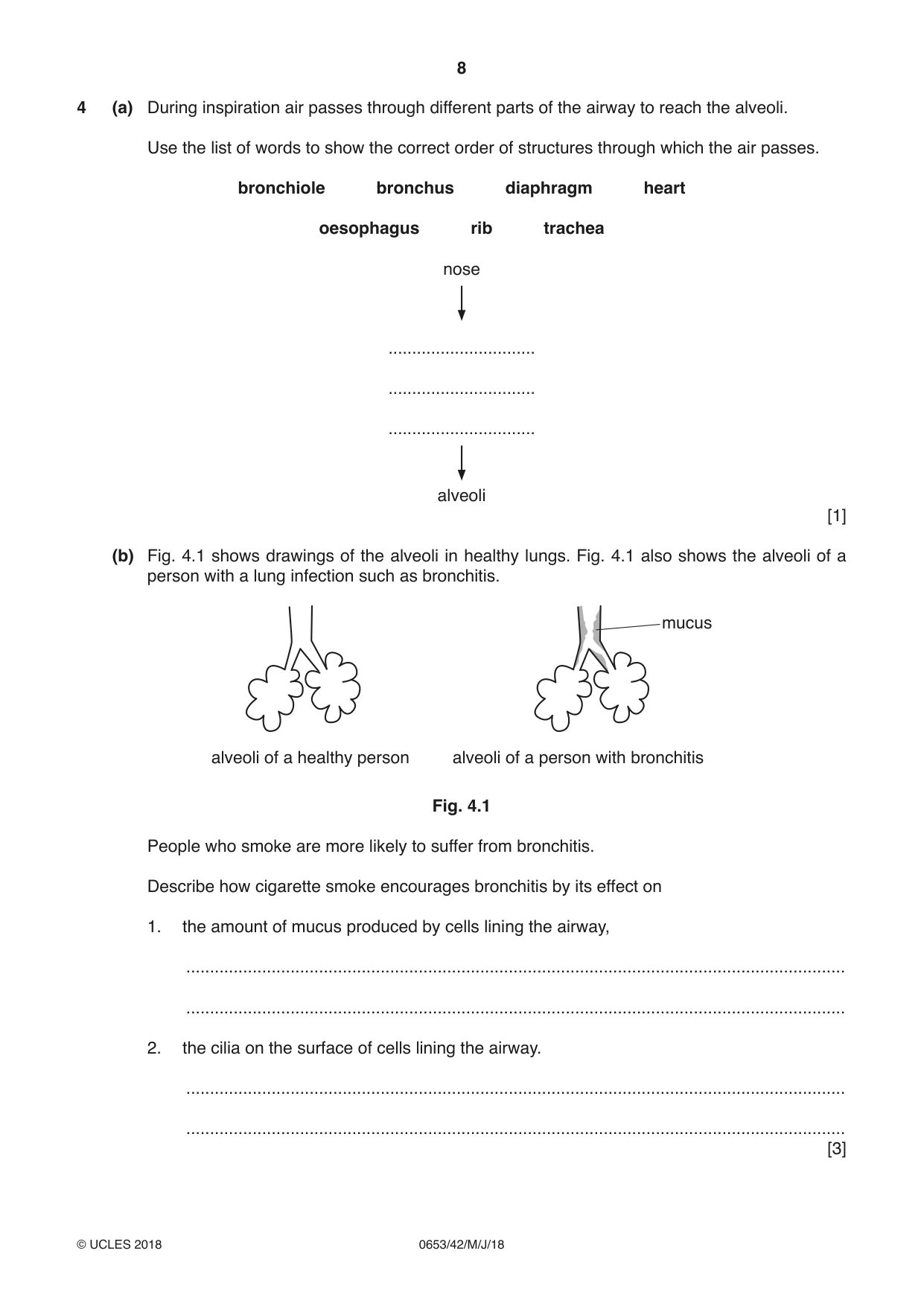
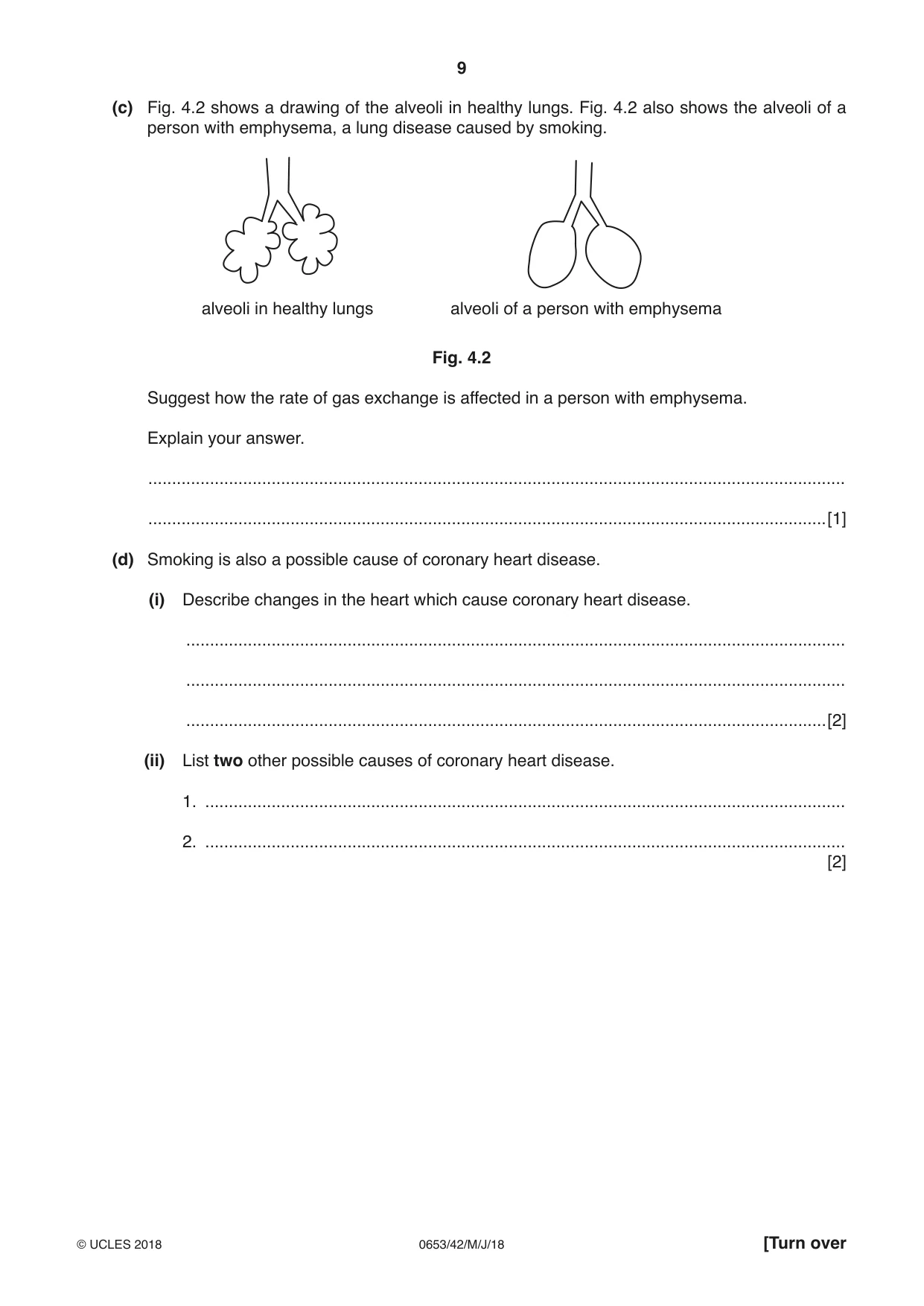
4 (a) During inspiration air passes through different parts of the airway to reach the alveoli. Use the list of words to show the correct order of structures through which the air passes. bronchiole bronchus diaphragm heart oesophagus rib trachea nose ............................... ............................... ............................... alveoli [1] (b) Fig. 4.1 shows drawings of the alveoli in healthy lungs. Fig. 4.1 also shows the alveoli of a person with a lung infection such as bronchitis. mucus alveoli of a healthy person alveoli of a person with bronchitis Fig. 4.1 People who smoke are more likely to suffer from bronchitis. Describe how cigarette smoke encourages bronchitis by its effect on 1. the amount of mucus produced by cells lining the airway, ........................................................................................................................................... ........................................................................................................................................... 2. the cilia on the surface of cells lining the airway. ........................................................................................................................................... ........................................................................................................................................... [3] (c) Fig. 4.2 shows a drawing of the alveoli in healthy lungs. Fig. 4.2 also shows the alveoli of a person with emphysema, a lung disease caused by smoking. alveoli in healthy lungs alveoli of a person with emphysema Fig. 4.2 Suggest how the rate of gas exchange is affected in a person with emphysema. Explain your answer. ................................................................................................................................................... ...............................................................................................................................................[1] (d) Smoking is also a possible cause of coronary heart disease. (i) Describe changes in the heart which cause coronary heart disease. ........................................................................................................................................... ........................................................................................................................................... .......................................................................................................................................[2] (ii) List two other possible causes of coronary heart disease. 1. ....................................................................................................................................... 2. ....................................................................................................................................... [2]
Mark scheme: 4(a) trachea, bronchus, bronchiole ; 1 4(b) effect on mucus mucus production increases ; effect on cilia cilia become paralysed / damaged ; cannot remove mucus from airway / away from lungs ; 3 4(c) (rate of gas exchange reduced) reduced area (for gas exchange in alveoli) ; 1 4(d)(i) narrowing / blockage of coronary arteries ; due to fatty deposits / plaque ; 2 4(d)(ii) high fat diet ; stress ; 2
Q5 · A student adds magnesium powder to dilute hydrochloric acid
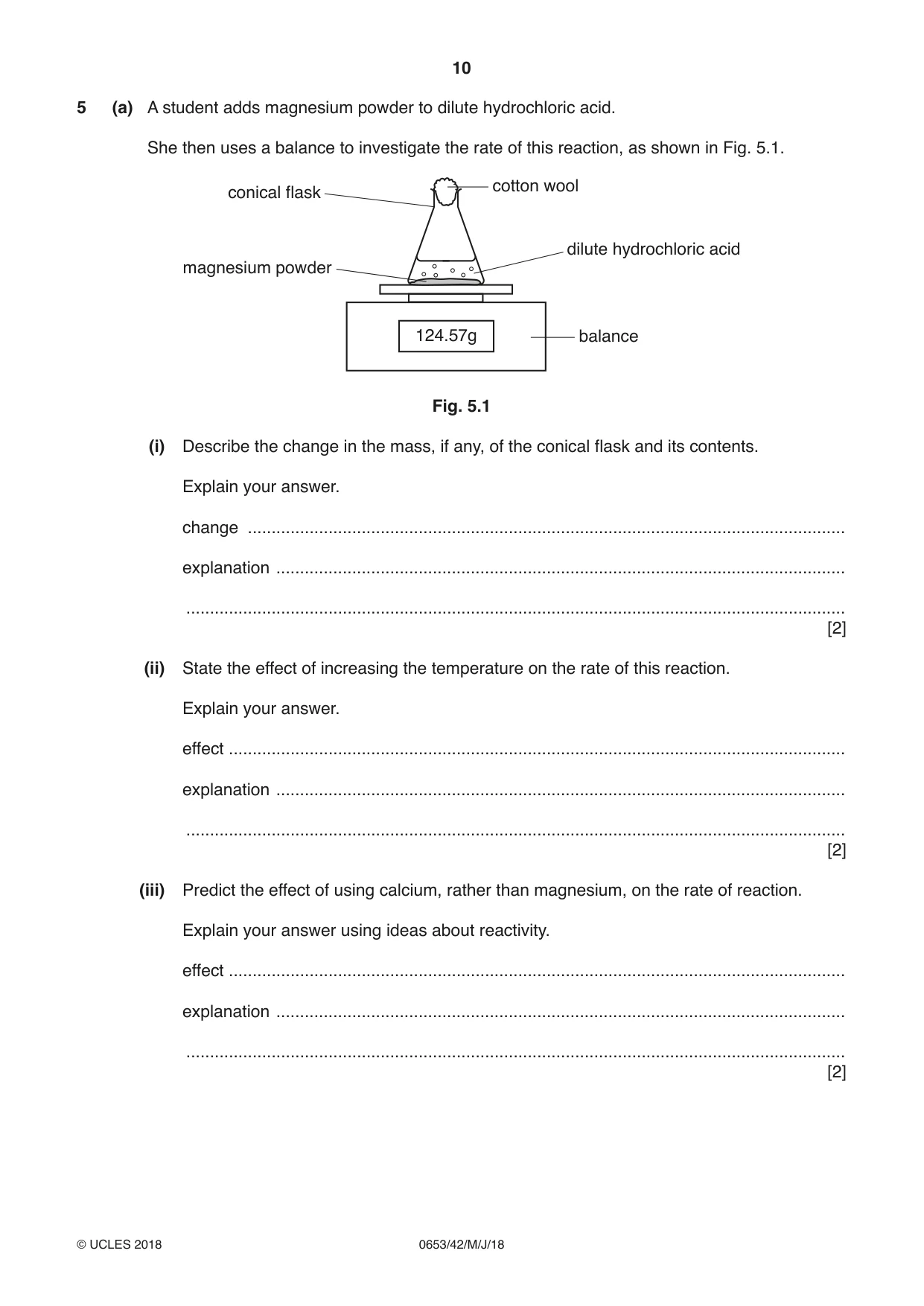
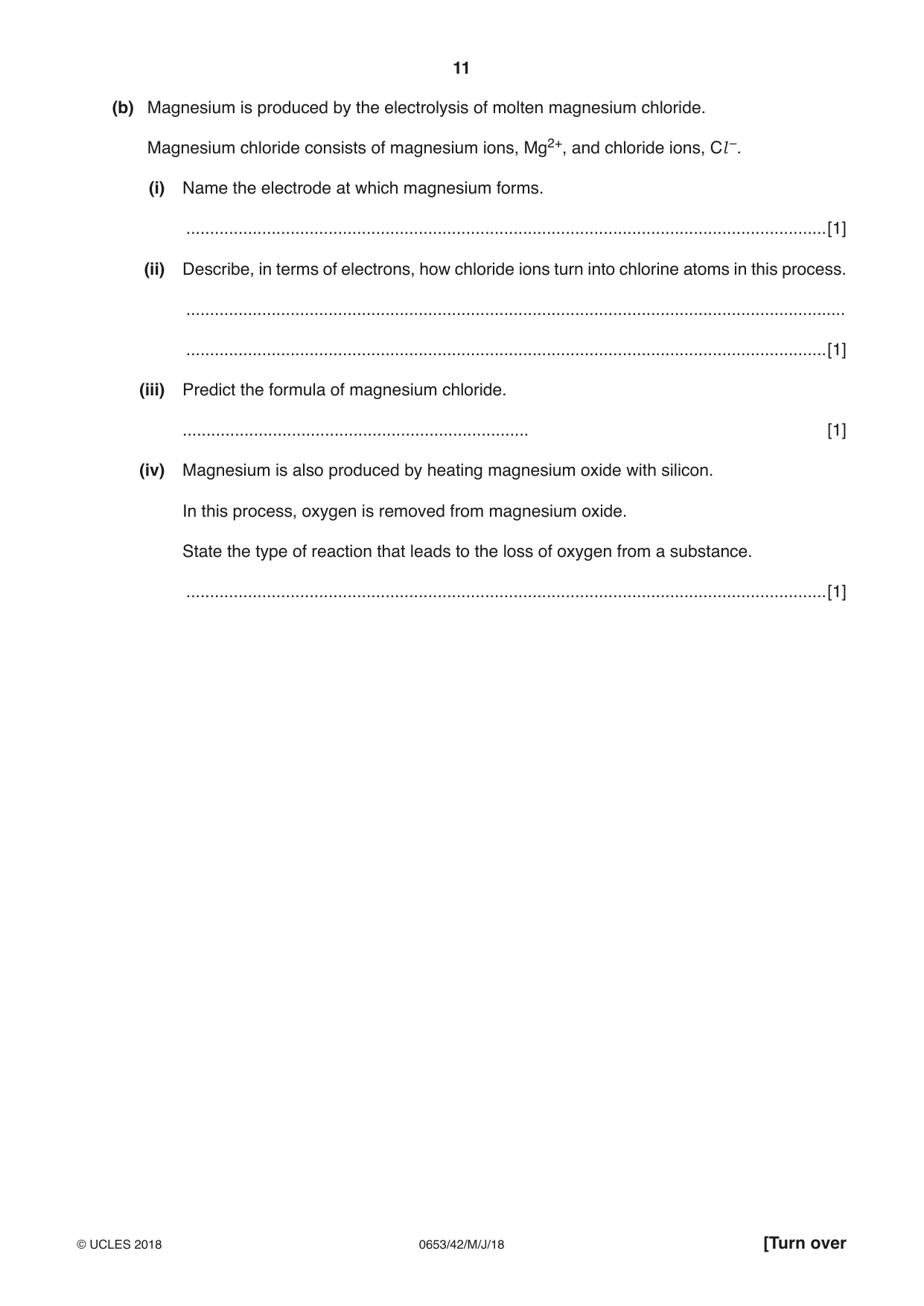
5 (a) A student adds magnesium powder to dilute hydrochloric acid. She then uses a balance to investigate the rate of this reaction, as shown in Fig. 5.1. cotton wool conical flask dilute hydrochloric acid magnesium powder 124.57g balance Fig. 5.1 (i) Describe the change in the mass, if any, of the conical flask and its contents. Explain your answer. change .............................................................................................................................. explanation ........................................................................................................................ ........................................................................................................................................... [2] (ii) State the effect of increasing the temperature on the rate of this reaction. Explain your answer. effect .................................................................................................................................. explanation ........................................................................................................................ ........................................................................................................................................... [2] (iii) Predict the effect of using calcium, rather than magnesium, on the rate of reaction. Explain your answer using ideas about reactivity. effect .................................................................................................................................. explanation ........................................................................................................................ ........................................................................................................................................... [2] (b) Magnesium is produced by the electrolysis of molten magnesium chloride. Magnesium chloride consists of magnesium ions, Mg2+, and chloride ions, Cl –. (i) Name the electrode at which magnesium forms. .......................................................................................................................................[1] (ii) Describe, in terms of electrons, how chloride ions turn into chlorine atoms in this process. ........................................................................................................................................... .......................................................................................................................................[1] (iii) Predict the formula of magnesium chloride. ......................................................................... [1] (iv) Magnesium is also produced by heating magnesium oxide with silicon. In this process, oxygen is removed from magnesium oxide. State the type of reaction that leads to the loss of oxygen from a substance. .......................................................................................................................................[1]
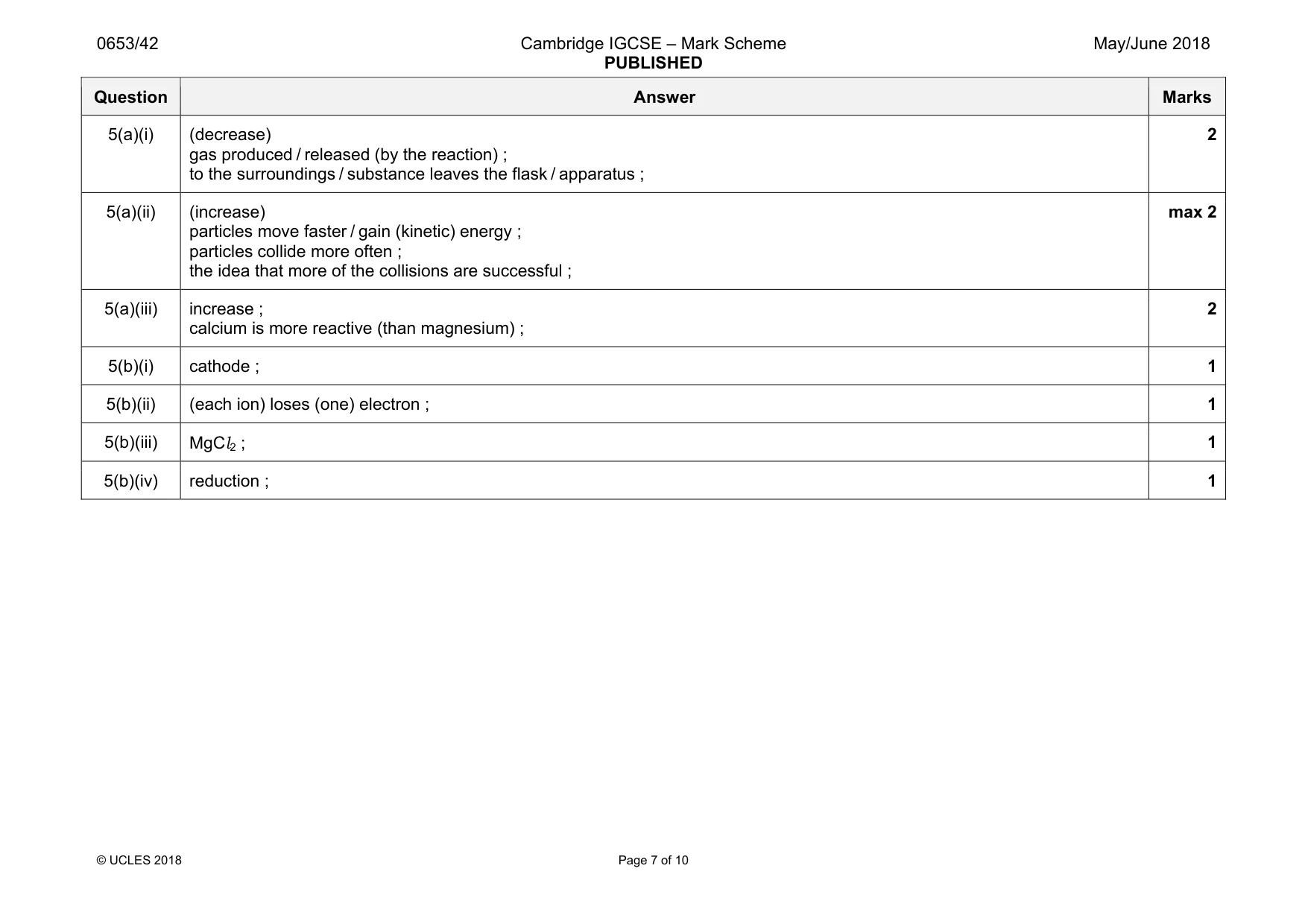
Mark scheme: 5(a)(i) (decrease) gas produced / released (by the reaction) ; to the surroundings / substance leaves the flask / apparatus ; 2 5(a)(ii) (increase) particles move faster / gain (kinetic) energy ; particles collide more often ; the idea that more of the collisions are successful ; max 2 5(a)(iii) increase ; calcium is more reactive (than magnesium) ; 2 5(b)(i) cathode ; 1 5(b)(ii) (each ion) loses (one) electron ; 1 5(b)(iii) MgCl2 ; 1 5(b)(iv) reduction ; 1 Que estion Answer Ma arks
Q6 · An incomplete electromagnetic spectrum linked to some uses of different parts of the…
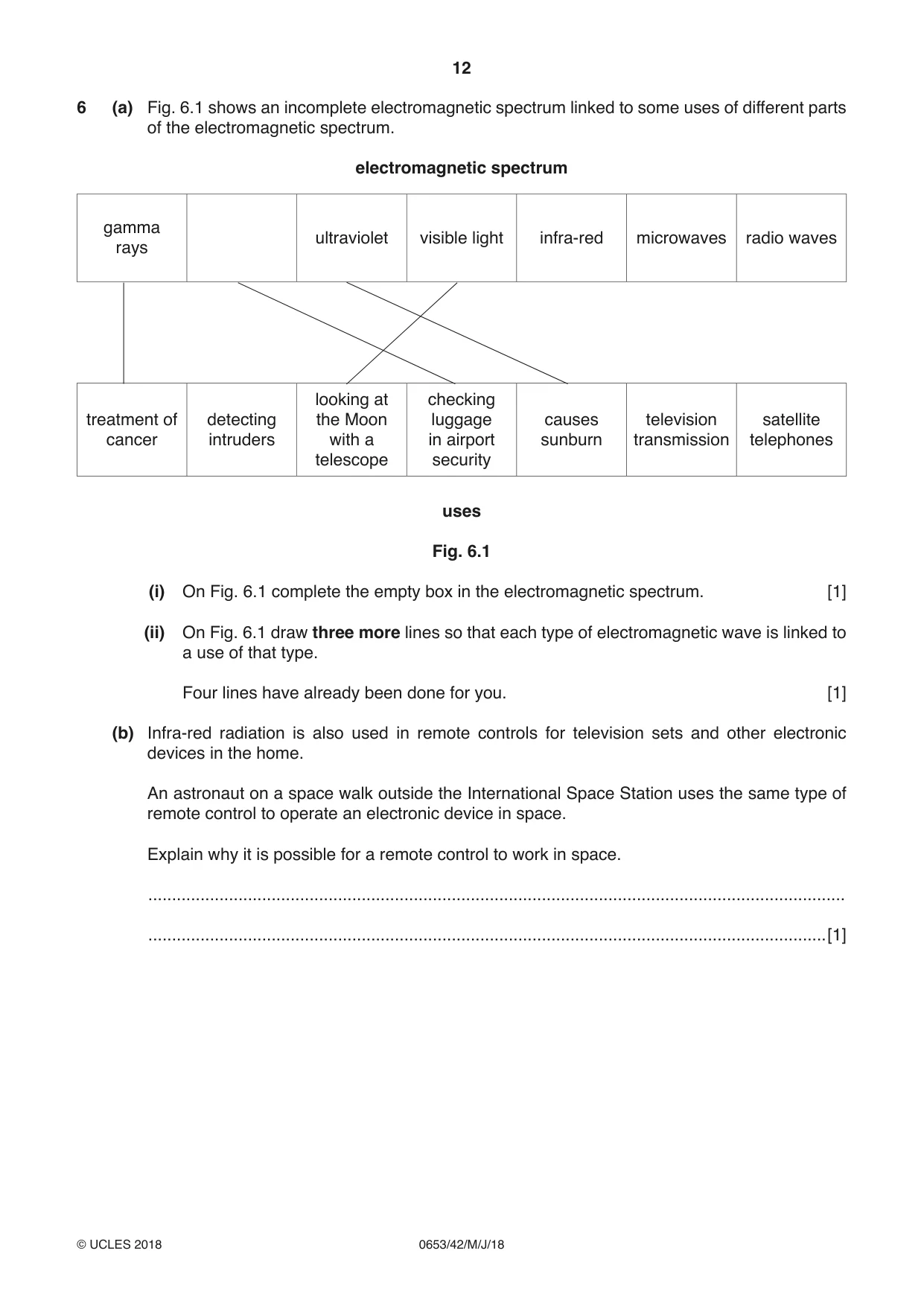
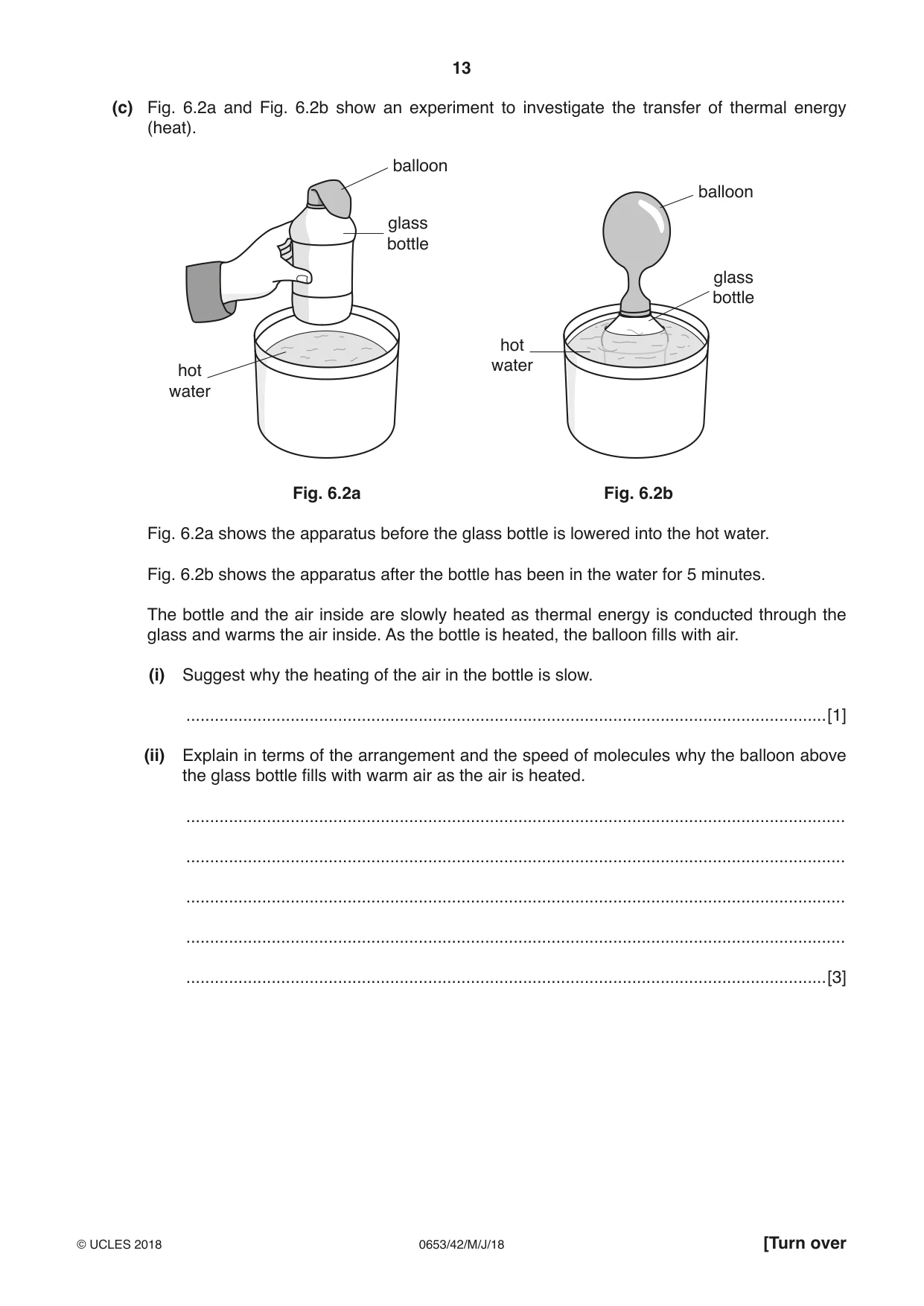
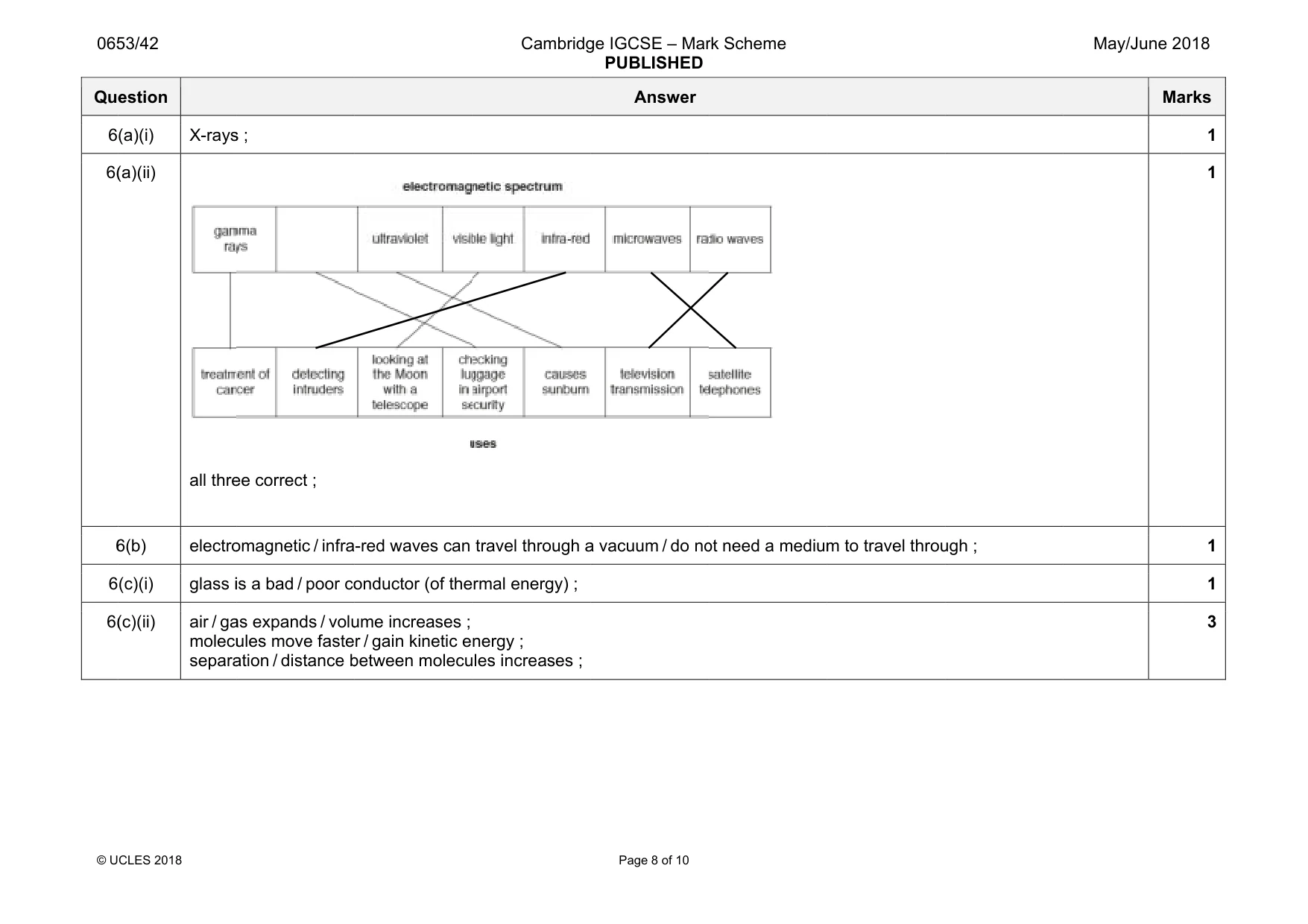
6 (a) Fig. 6.1 shows an incomplete electromagnetic spectrum linked to some uses of different parts of the electromagnetic spectrum. electromagnetic spectrum gamma ultraviolet visible light infra-red microwaves radio waves rays looking at checking treatment of detecting the Moon luggage causes television satellite cancer intruders with a in airport sunburn transmission telephones telescope security uses Fig. 6.1 (i) On Fig. 6.1 complete the empty box in the electromagnetic spectrum. [1] (ii) On Fig. 6.1 draw three more lines so that each type of electromagnetic wave is linked to a use of that type. Four lines have already been done for you. [1] (b) Infra-red radiation is also used in remote controls for television sets and other electronic devices in the home. An astronaut on a space walk outside the International Space Station uses the same type of remote control to operate an electronic device in space. Explain why it is possible for a remote control to work in space. ................................................................................................................................................... ...............................................................................................................................................[1] (c) Fig. 6.2a and Fig. 6.2b show an experiment to investigate the transfer of thermal energy (heat). balloon balloon glass bottle glass bottle hot water hot water Fig. 6.2a Fig. 6.2b Fig. 6.2a shows the apparatus before the glass bottle is lowered into the hot water. Fig. 6.2b shows the apparatus after the bottle has been in the water for 5 minutes. The bottle and the air inside are slowly heated as thermal energy is conducted through the glass and warms the air inside. As the bottle is heated, the balloon fills with air. (i) Suggest why the heating of the air in the bottle is slow. .......................................................................................................................................[1] (ii) Explain in terms of the arrangement and the speed of molecules why the balloon above the glass bottle fills with warm air as the air is heated. ........................................................................................................................................... ........................................................................................................................................... ........................................................................................................................................... ........................................................................................................................................... .......................................................................................................................................[3]
Mark scheme: 6 6( 6 6 6( (a)(i) X-rays (a)(ii) all thre 6(b) electro (c)(i) glass i (c)(ii) air / ga molecu separa s ; ee correct ; omagnetic / infra is a bad / poor co as expands / volu ules move faste ation / distance b -red waves can onductor (of the ume increases ; r / gain kinetic e between molecu travel through a rmal energy) ; nergy ; les increases ; a vacuum / do no ot need a medium m to travel through ; 1 1 1 1 3
Q7 · A simplified version of the carbon cycle
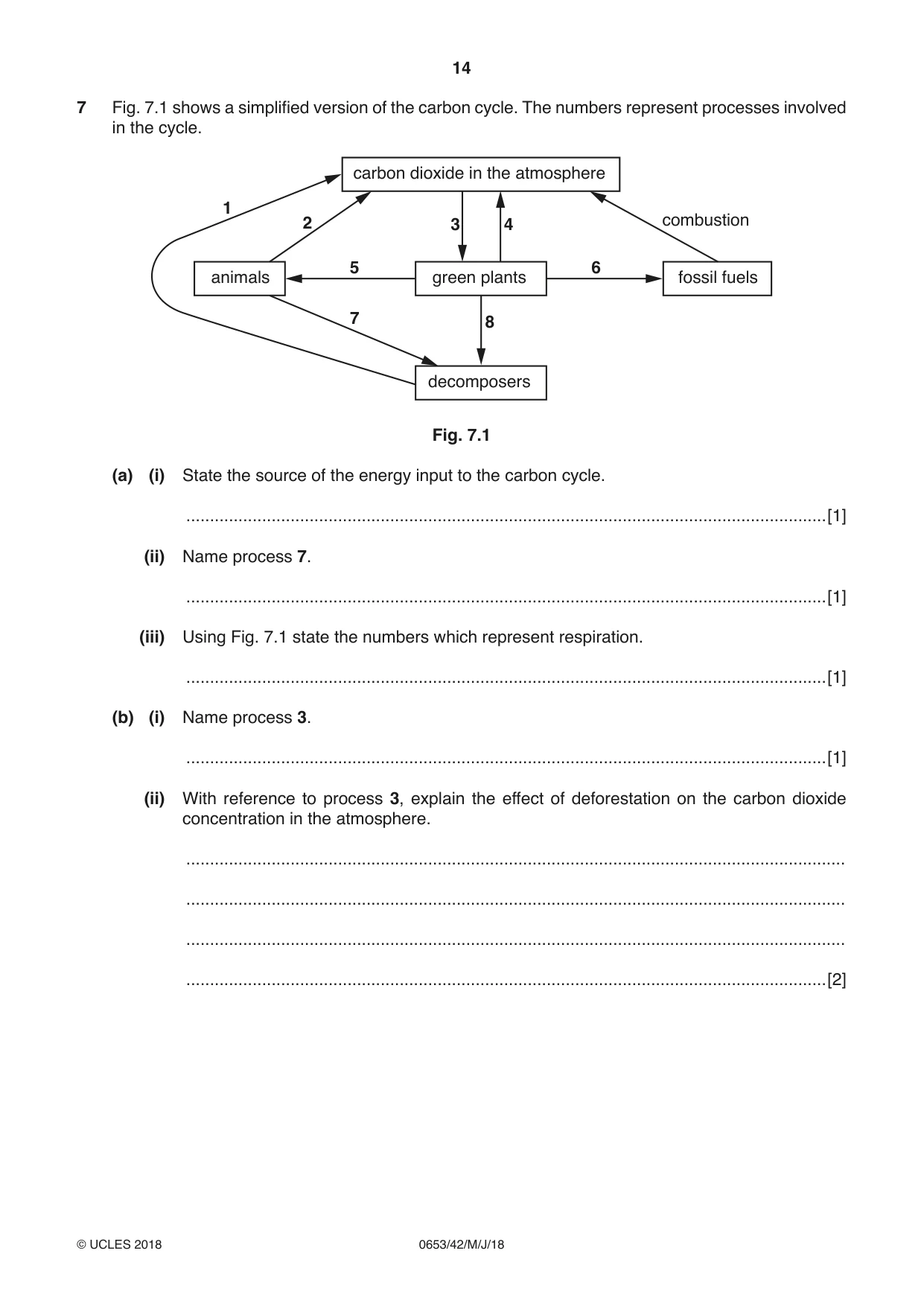
7 Fig. 7.1 shows a simplified version of the carbon cycle. The numbers represent processes involved in the cycle. carbon dioxide in the atmosphere 1 2 3 4 combustion 5 6 animals green plants fossil fuels 7 8 decomposers Fig. 7.1 (a) (i) State the source of the energy input to the carbon cycle. .......................................................................................................................................[1] (ii) Name process 7. .......................................................................................................................................[1] (iii) Using Fig. 7.1 state the numbers which represent respiration. .......................................................................................................................................[1] (b) (i) Name process 3. .......................................................................................................................................[1] (ii) With reference to process 3, explain the effect of deforestation on the carbon dioxide concentration in the atmosphere. ........................................................................................................................................... ........................................................................................................................................... ........................................................................................................................................... .......................................................................................................................................[2] (c) The gas sulfur dioxide is released into the atmosphere during the combustion of fossil fuels. Explain the consequences of adding sulfur dioxide to the atmosphere. ................................................................................................................................................... ................................................................................................................................................... ................................................................................................................................................... ...............................................................................................................................................[3]
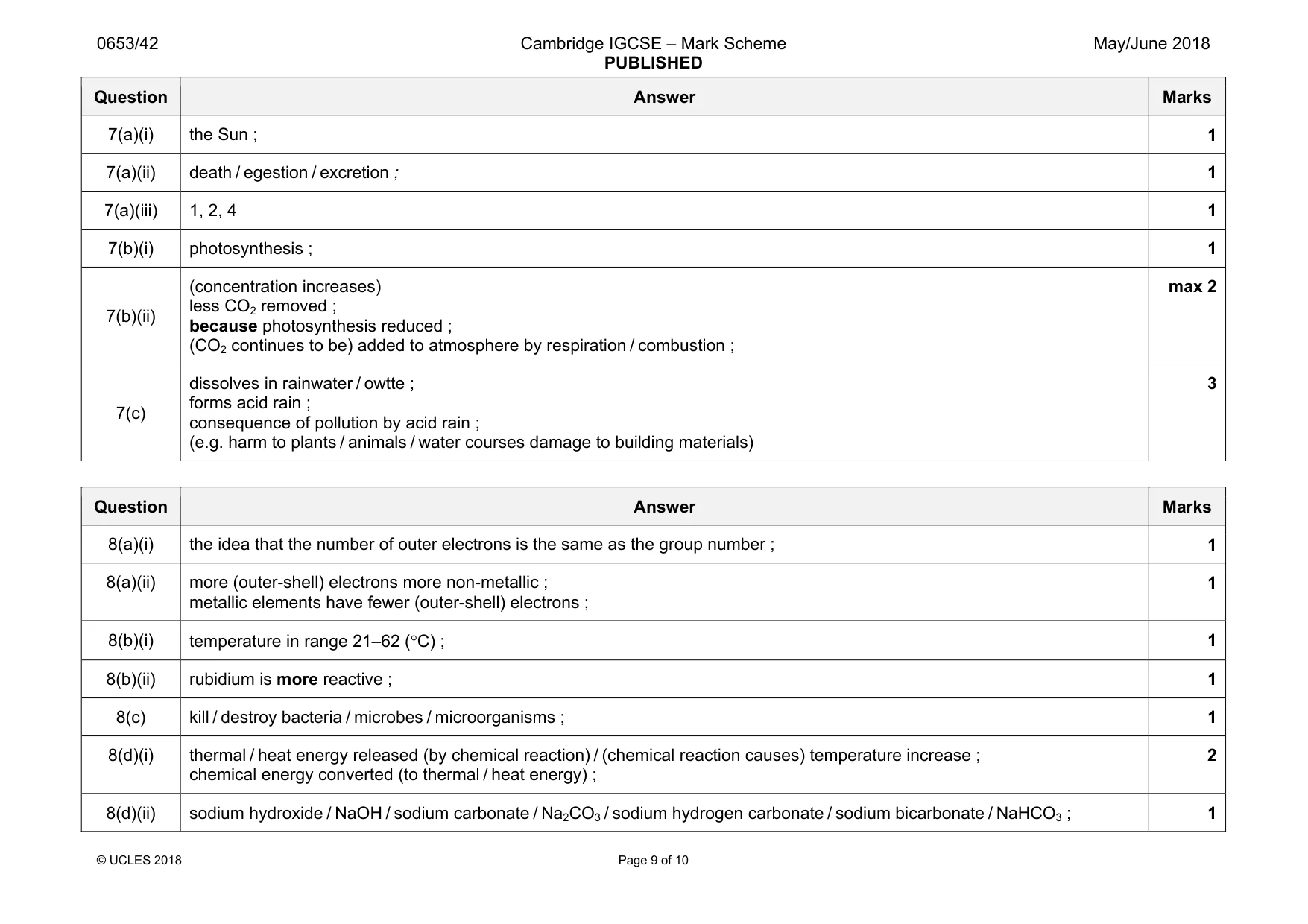
Mark scheme: 7(a)(i) the Sun ; 1 7(a)(ii) death / egestion / excretion ; 1 7(a)(iii) 1, 2, 4 1 7(b)(i) photosynthesis ; 1 7(b)(ii) (concentration increases) less CO2 removed ; because photosynthesis reduced ; (CO2 continues to be) added to atmosphere by respiration / combustion ; max 2 7(c) dissolves in rainwater / owtte ; forms acid rain ; consequence of pollution by acid rain ; (e.g. harm to plants / animals / water courses damage to building materials) 3
Q8 · Elements are arranged in the Periodic Table in atomic number order
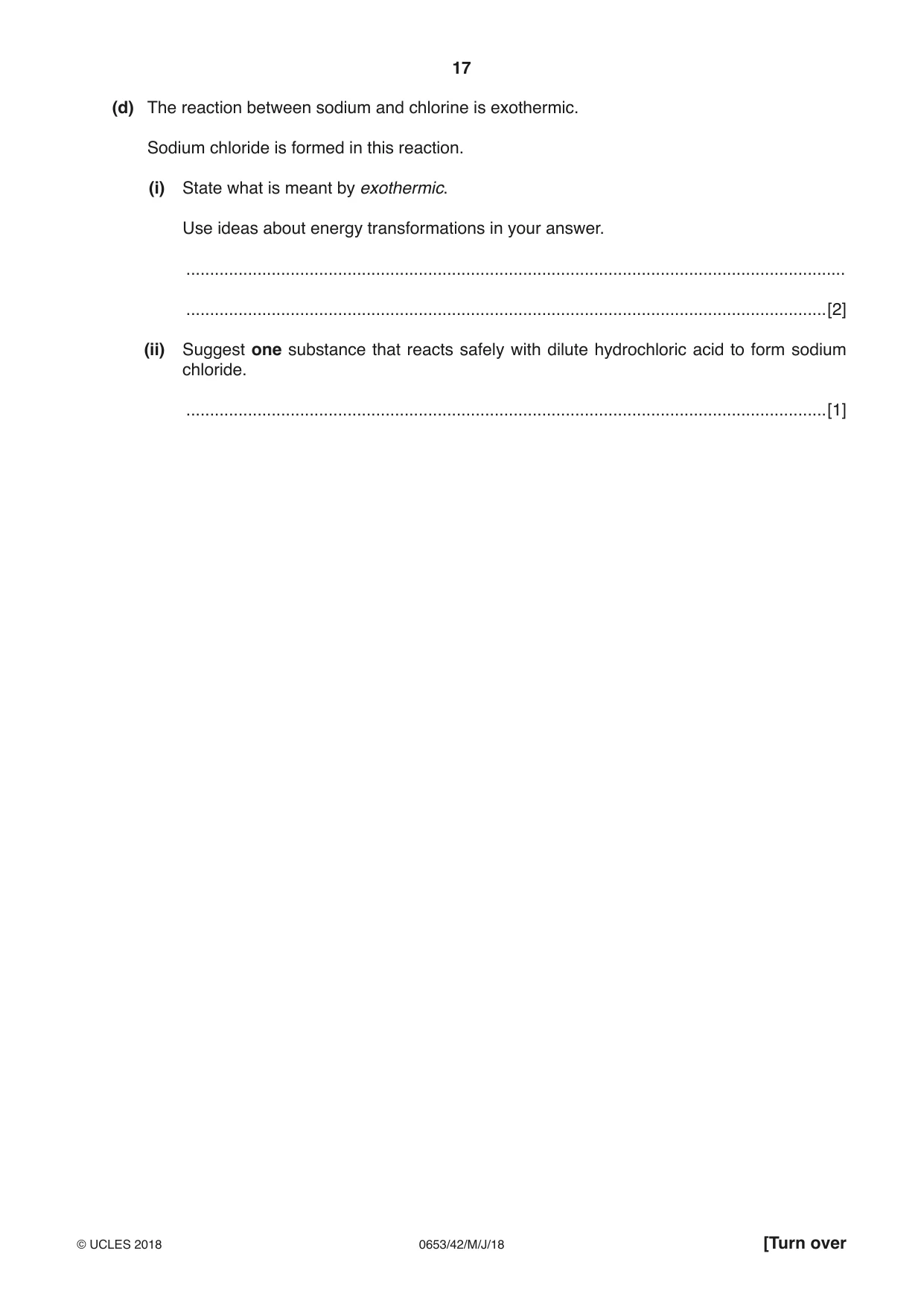
8 (a) (i) Elements are arranged in the Periodic Table in atomic number order. State the relationship between the group number of an element and the number of outer-shell electrons in an atom of the element. .......................................................................................................................................[1] (ii) Describe the relationship between the number of outer-shell electrons and the metallic/non-metallic character of an element. ........................................................................................................................................... .......................................................................................................................................[1] (b) Rubidium is a Group I metal below potassium in the Periodic Table. Rubidium is a solid at room temperature, 20 °C. Potassium melts at 63 °C and reacts vigorously with water. (i) Suggest the melting point of rubidium. ......................................................................... °C [1] (ii) Compare the reactivities of rubidium and of potassium with cold water. ........................................................................................................................................... .......................................................................................................................................[1] (c) Explain the use of chlorine in water purification. ................................................................................................................................................... ...............................................................................................................................................[1] (d) The reaction between sodium and chlorine is exothermic. Sodium chloride is formed in this reaction. (i) State what is meant by exothermic. Use ideas about energy transformations in your answer. ........................................................................................................................................... .......................................................................................................................................[2] (ii) Suggest one substance that reacts safely with dilute hydrochloric acid to form sodium chloride. .......................................................................................................................................[1]
Mark scheme: 8(a)(i) the idea that the number of outer electrons is the same as the group number ; 1 8(a)(ii) more (outer-shell) electrons more non-metallic ; metallic elements have fewer (outer-shell) electrons ; 1 8(b)(i) temperature in range 21–62 (°C) ; 1 8(b)(ii) rubidium is more reactive ; 1 8(c) kill / destroy bacteria / microbes / microorganisms ; 1 8(d)(i) thermal / heat energy released (by chemical reaction) / (chemical reaction causes) temperature increase ; chemical energy converted (to thermal / heat energy) ; 2 8(d)(ii) sodium hydroxide / NaOH / sodium carbonate / Na2CO3 / sodium hydrogen carbonate / sodium bicarbonate / NaHCO3 ; 1
Q9 · A crane carrying a load
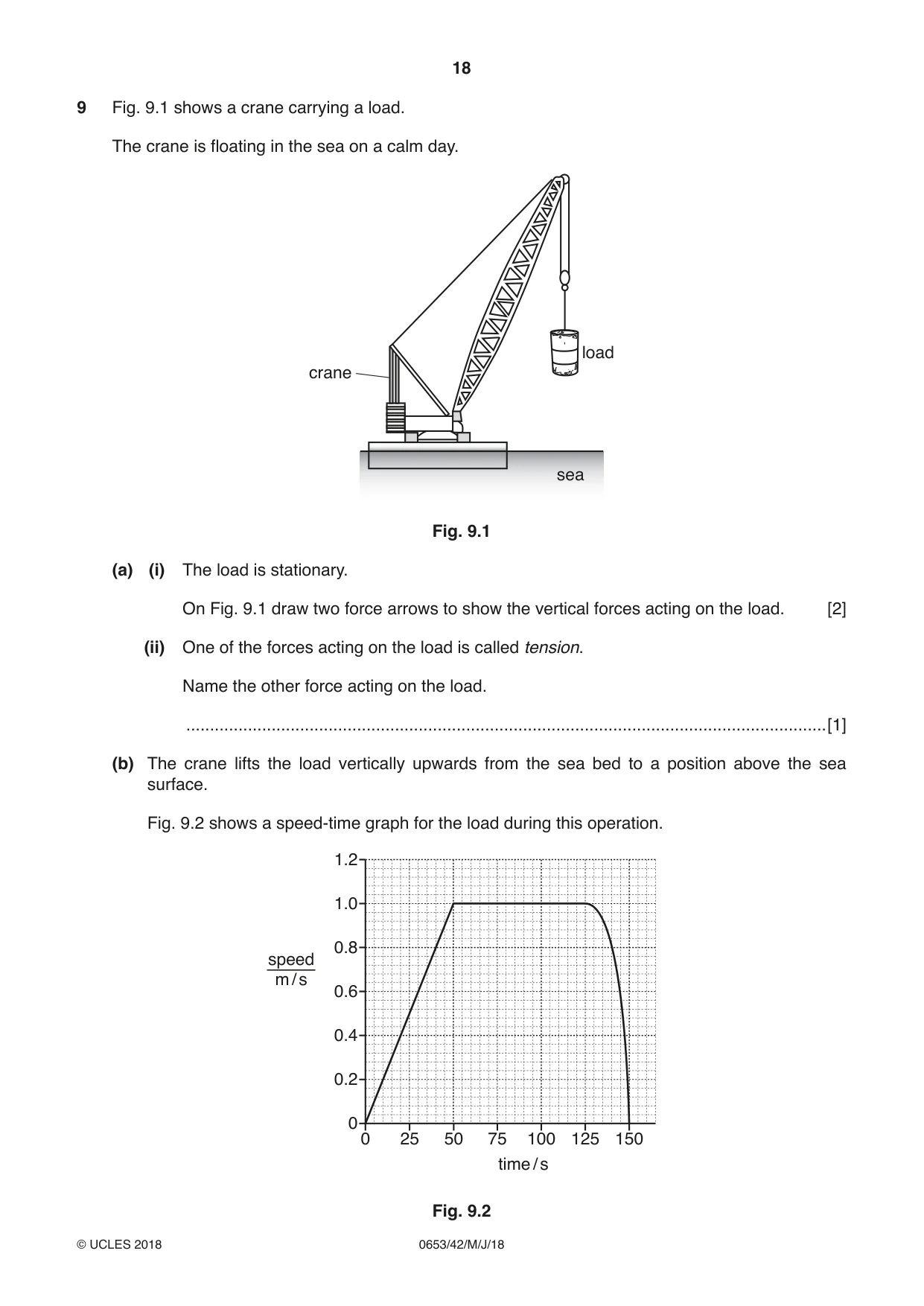
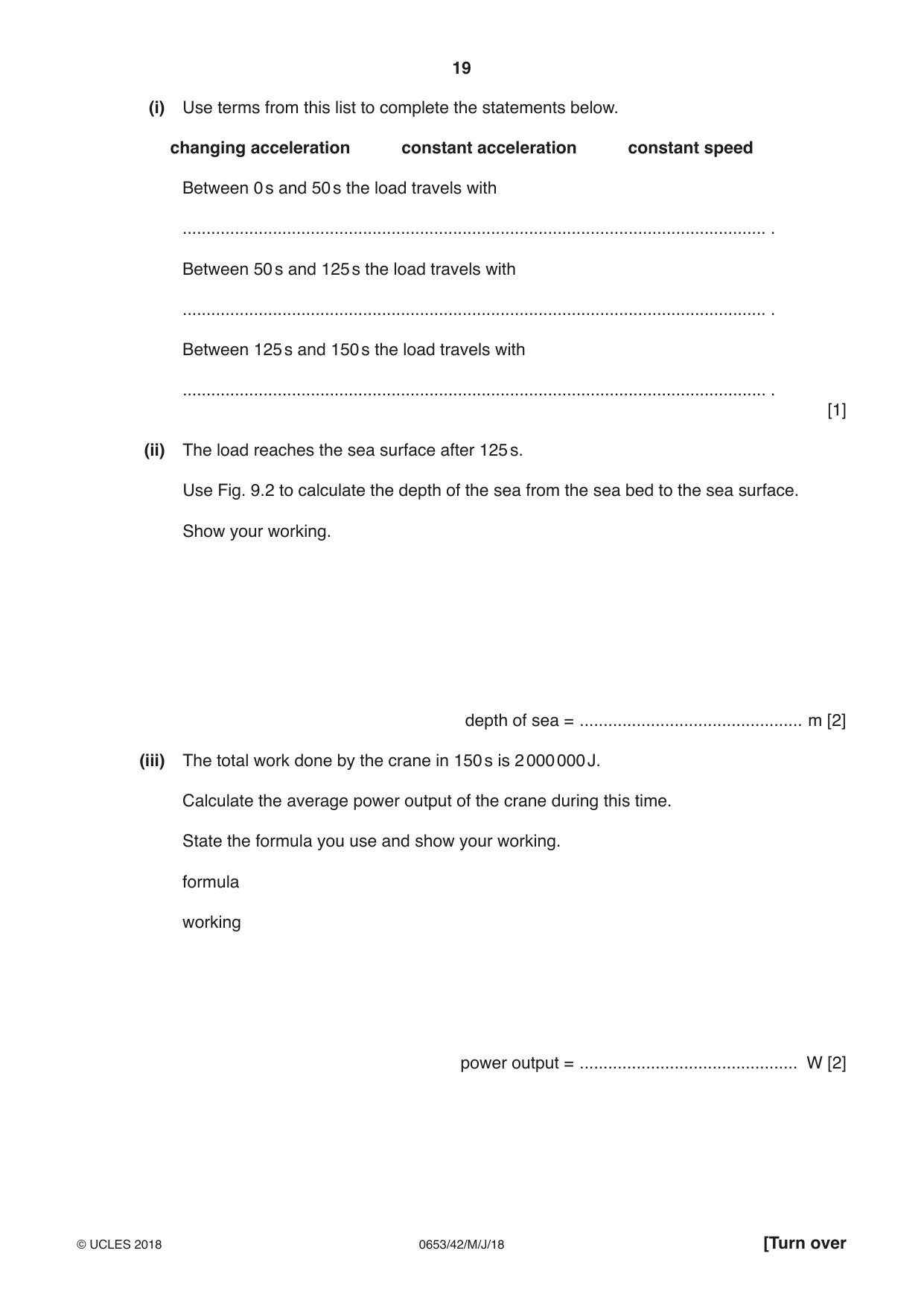
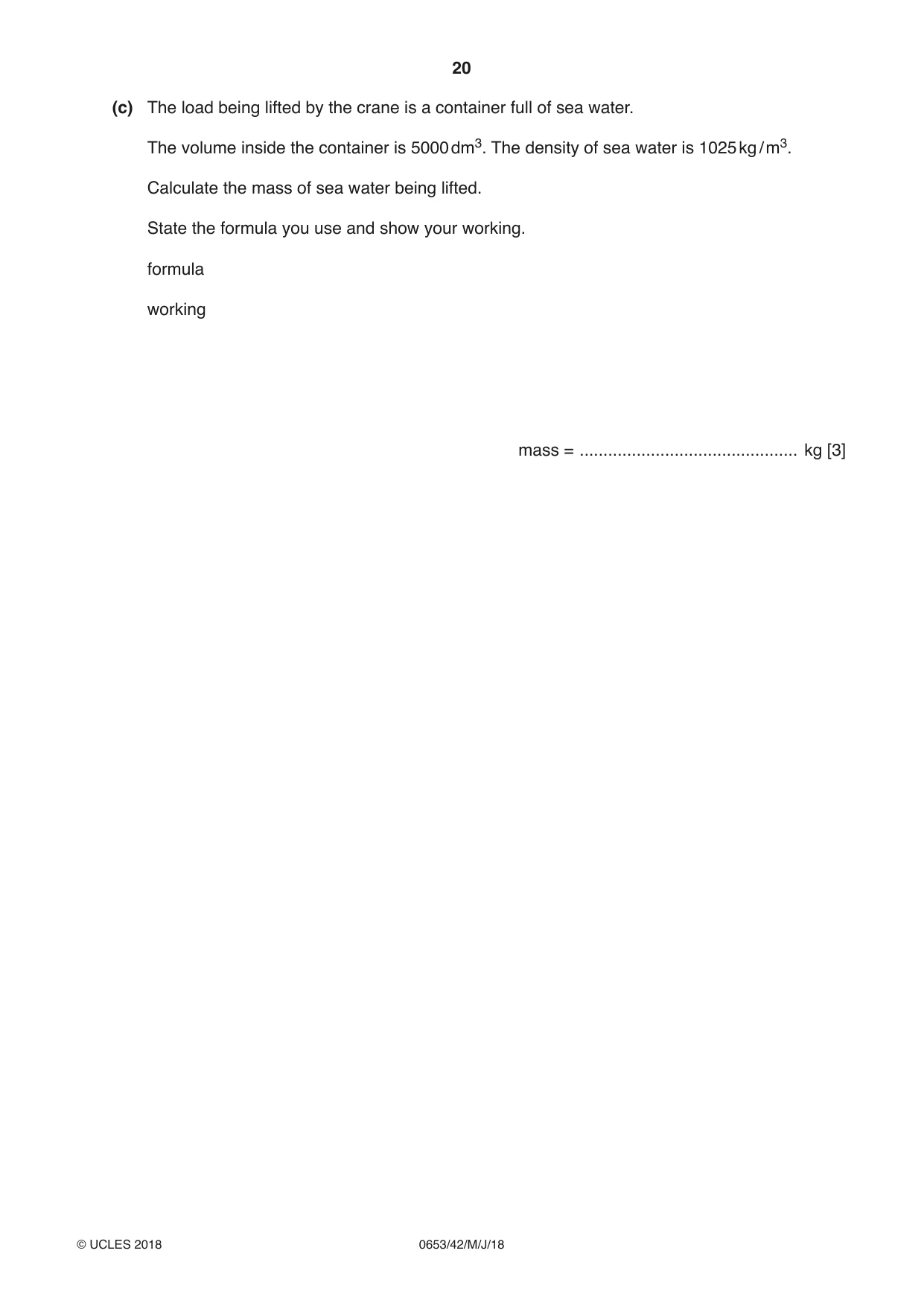
9 Fig. 9.1 shows a crane carrying a load. The crane is floating in the sea on a calm day. load crane sea Fig. 9.1 (a) (i) The load is stationary. On Fig. 9.1 draw two force arrows to show the vertical forces acting on the load. [2] (ii) One of the forces acting on the load is called tension. Name the other force acting on the load. .......................................................................................................................................[1] (b) The crane lifts the load vertically upwards from the sea bed to a position above the sea surface. Fig. 9.2 shows a speed-time graph for the load during this operation. 1.2 1.0 0.8 speed m / s 0.6 0.4 0.2 0 0 25 50 75 100 125 150 time / s Fig. 9.2 (i) Use terms from this list to complete the statements below. changing acceleration constant acceleration constant speed Between 0 s and 50 s the load travels with ........................................................................................................................... . Between 50 s and 125 s the load travels with ........................................................................................................................... . Between 125 s and 150 s the load travels with ........................................................................................................................... . [1] (ii) The load reaches the sea surface after 125 s. Use Fig. 9.2 to calculate the depth of the sea from the sea bed to the sea surface. Show your working. depth of sea = ............................................... m [2] (iii) The total work done by the crane in 150 s is 2 000 000 J. Calculate the average power output of the crane during this time. State the formula you use and show your working. formula working power output = .............................................. W [2] (c) The load being lifted by the crane is a container full of sea water. The volume inside the container is 5000 dm3. The density of sea water is 1025 kg / m3. Calculate the mass of sea water being lifted. State the formula you use and show your working. formula working mass = .............................................. kg [3]
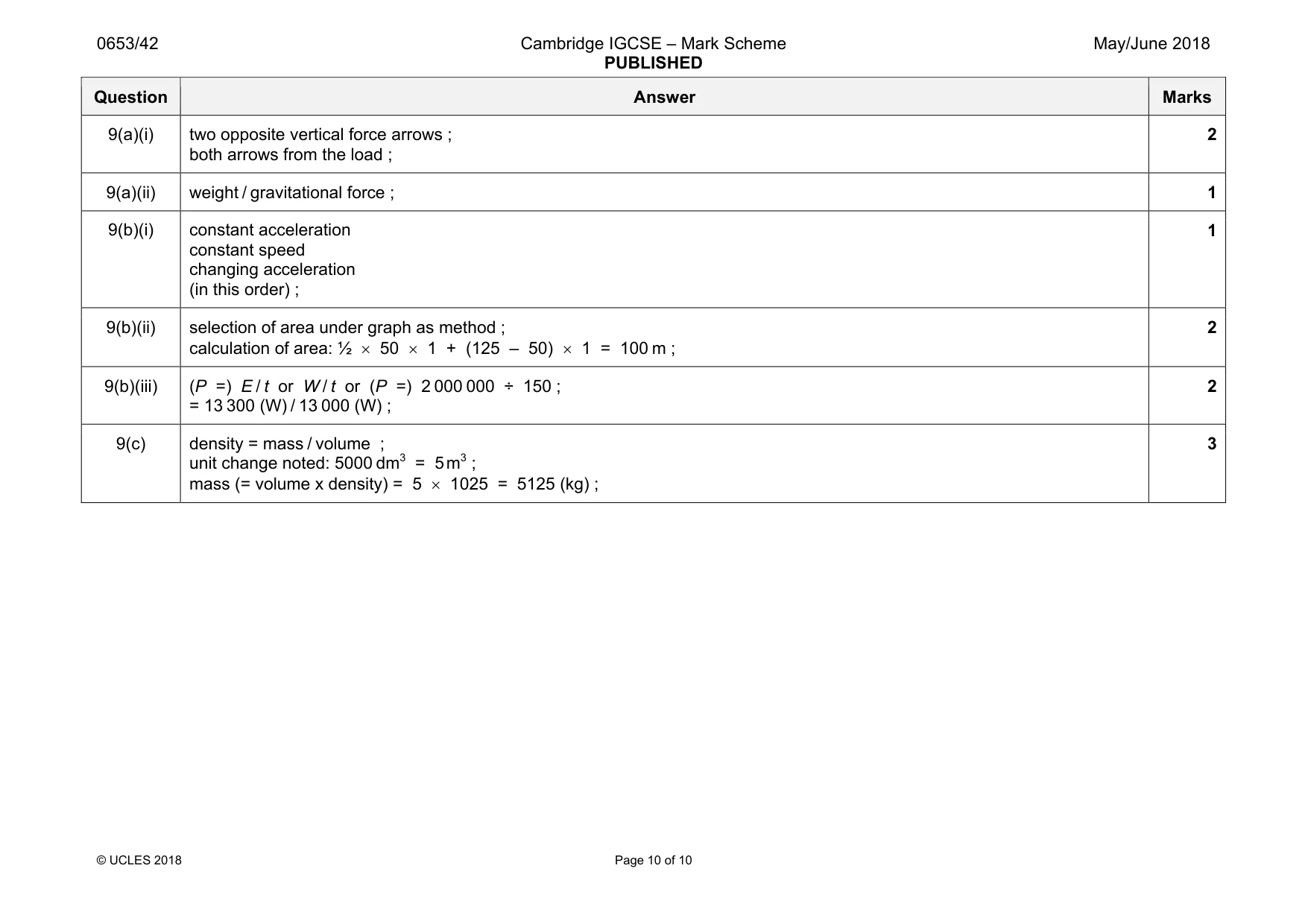
Mark scheme: 9(a)(i) two opposite vertical force arrows ; both arrows from the load ; 2 9(a)(ii) weight / gravitational force ; 1 9(b)(i) constant acceleration constant speed changing acceleration (in this order) ; 1 9(b)(ii) selection of area under graph as method ; calculation of area: ½ × 50 × 1 + (125 – 50) × 1 = 100 m ; 2 9(b)(iii) (P =) E / t or W / t or (P =) 2 000 000 ÷ 150 ; = 13 300 (W) / 13 000 (W) ; 2 9(c) density = mass / volume ; unit change noted: 5000 dm3 = 5 m3 ; mass (= volume x density) = 5 × 1025 = 5125 (kg) ; 3
What was in this paper
The subtopics covered by these 9 questions, and how many questions each got. Open one in a new tab to see every Cambridge question on it.
What you needed in this session
Cambridge’s own grade thresholds for 2018 May/June, Paper 4 · Variant 2. A higher threshold means an easier paper — the bar moves with how the cohort did.