Cambridge IGCSE Science - Combined 0653 — 2021 Feb/March Paper 4 · Variant 2
0653/42/F/M/21 · 9 questions · 80 marks · ≈90 min
The question paper and its mark scheme, free to read here and free to download. This is Cambridge’s own paper, exactly as it was sat.
Question paper24 pages



Mark scheme12 pages
Answers below. Sit the paper first if you are practising.
Questions as text
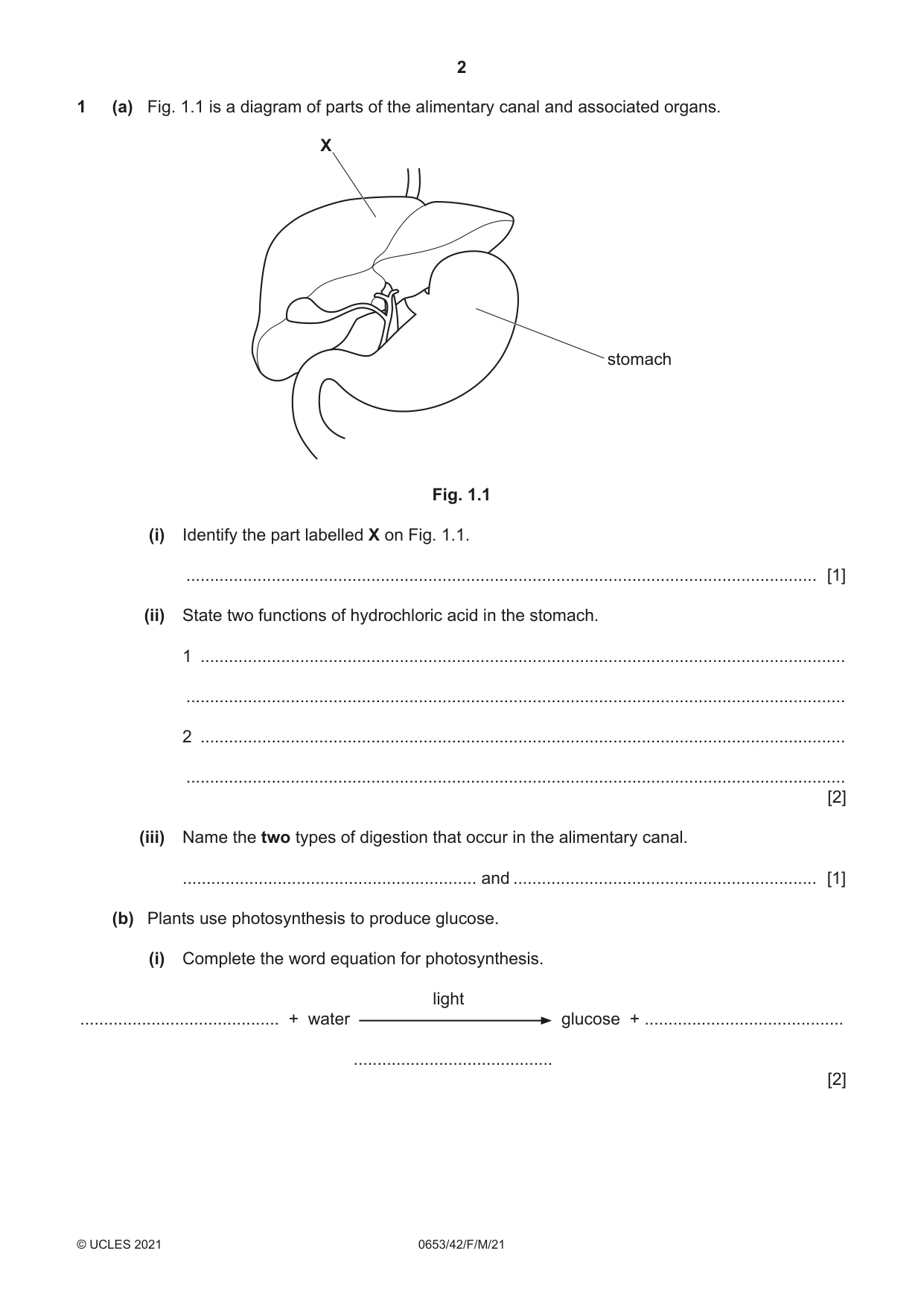
Q1 · A diagram of parts of the alimentary canal and associated organs
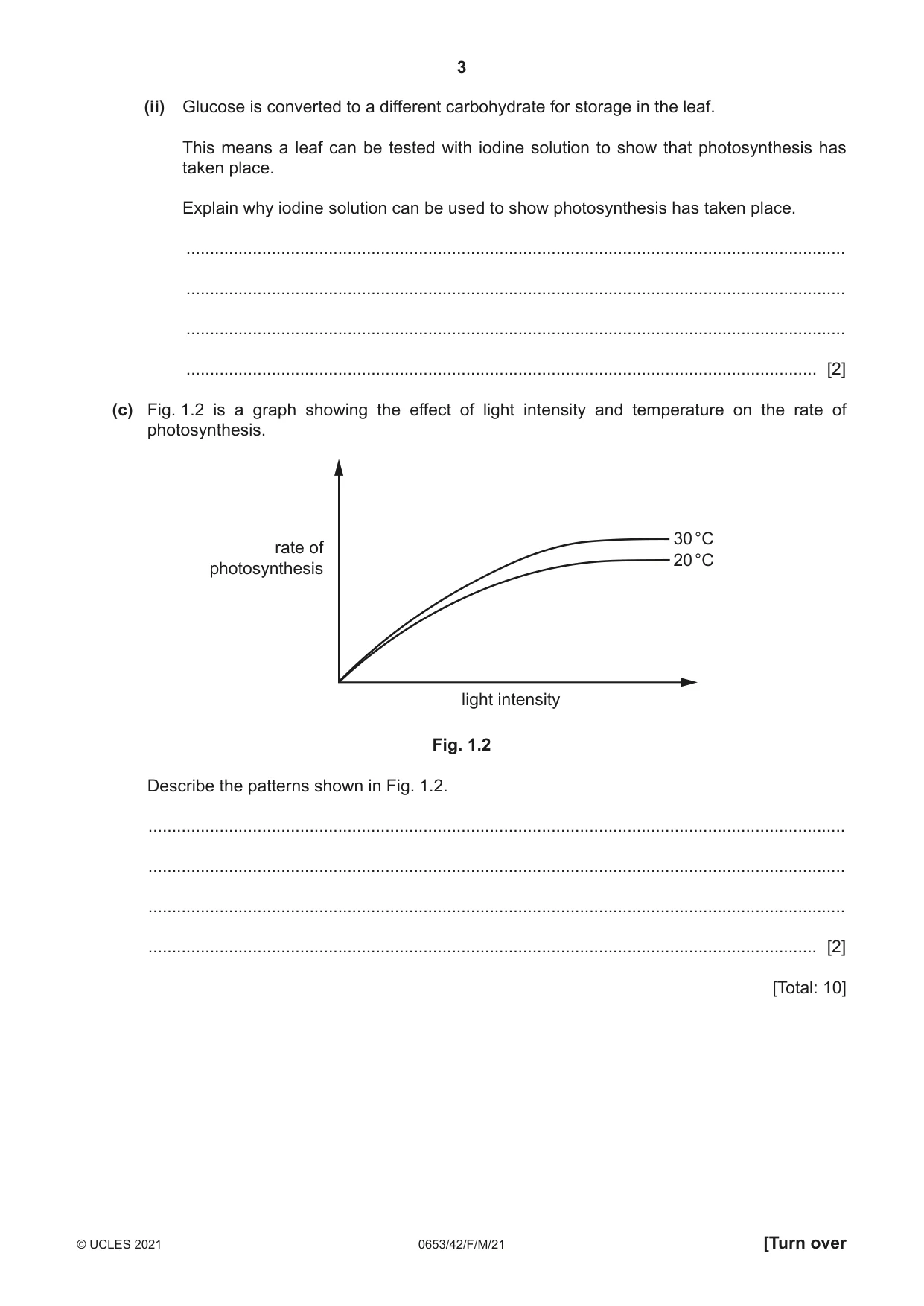
1 (a) Fig. 1.1 is a diagram of parts of the alimentary canal and associated organs. X stomach Fig. 1.1 (i) Identify the part labelled X on Fig. 1.1. ..................................................................................................................................... [1] (ii) State two functions of hydrochloric acid in the stomach. 1 ........................................................................................................................................ ........................................................................................................................................... 2 ........................................................................................................................................ ........................................................................................................................................... [2] (iii) Name the two types of digestion that occur in the alimentary canal. .............................................................. and ................................................................ [1] (b) Plants use photosynthesis to produce glucose. (i) Complete the word equation for photosynthesis. light .......................................... + water glucose + .......................................... .......................................... [2] (ii) Glucose is converted to a different carbohydrate for storage in the leaf. This means a leaf can be tested with iodine solution to show that photosynthesis has taken place. Explain why iodine solution can be used to show photosynthesis has taken place. ........................................................................................................................................... ........................................................................................................................................... ........................................................................................................................................... ..................................................................................................................................... [2] (c) Fig. 1.2 is a graph showing the effect of light intensity and temperature on the rate of photosynthesis. 30 °C rate of 20 °C photosynthesis light intensity Fig. 1.2 Describe the patterns shown in Fig. 1.2. ................................................................................................................................................... ................................................................................................................................................... ................................................................................................................................................... ............................................................................................................................................. [2] [Total: 10]
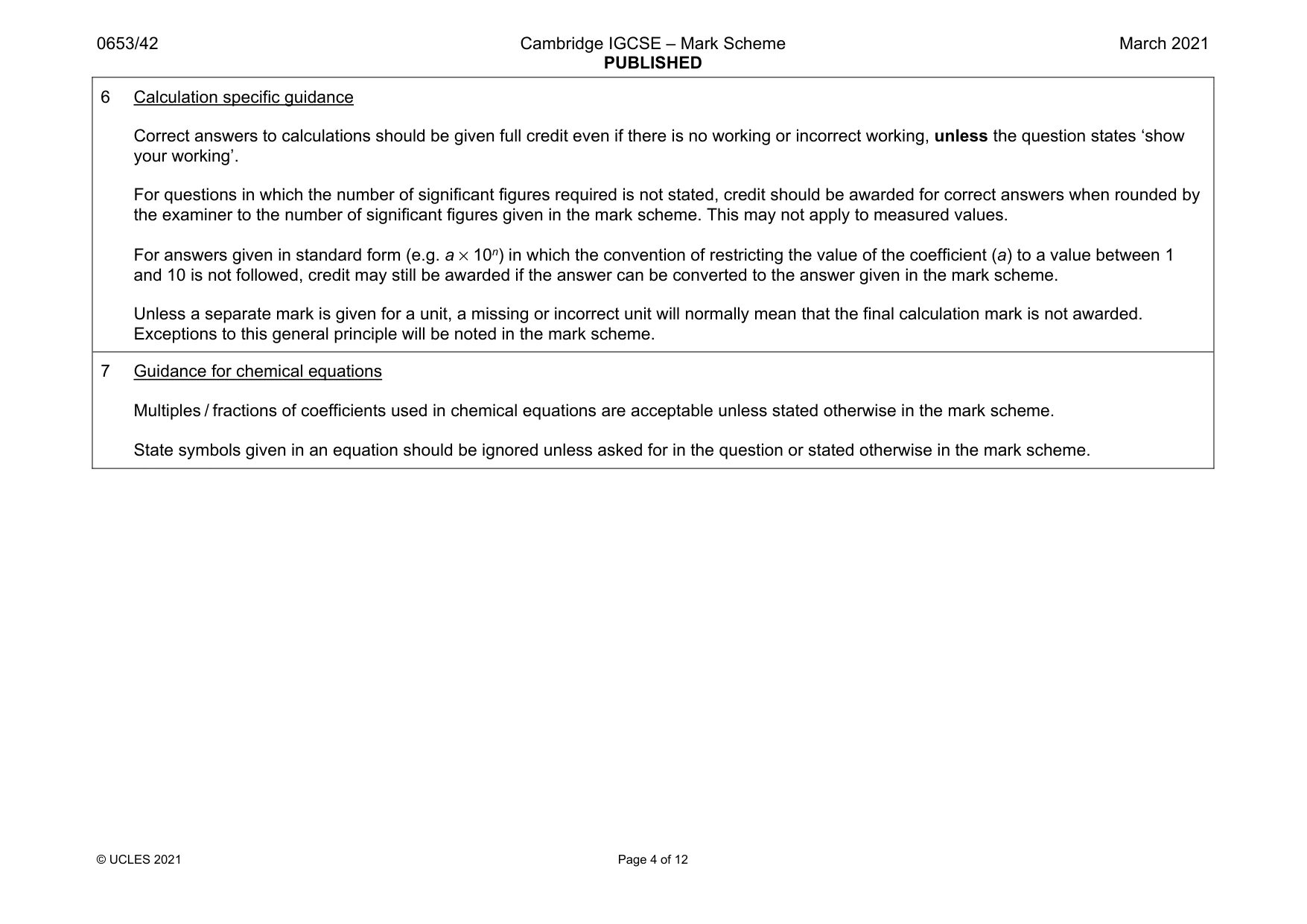
Mark scheme: 1(a)(i) liver ; 1 1(a)(ii) kill bacteria ; provide acidic pH for enzymes ; 2 1(a)(iii) chemical (digestion) AND mechanical (digestion) ; 1 1(b)(i) (light) carbon dioxide + (water) (glucose) + oxygen chlorophyll ;; one mark for carbon dioxide and oxygen one mark for chlorophyll 2 1(b)(ii) iodine (solution) tests for starch / shows blue-black with starch ; glucose made in photosynthesis is converted to starch ; 2 1(c) as light intensity increases so does (rate of) photosynthesis (then it levels off) ; idea that rate is higher, at 30°C than 20°C / at higher temperature ; 2
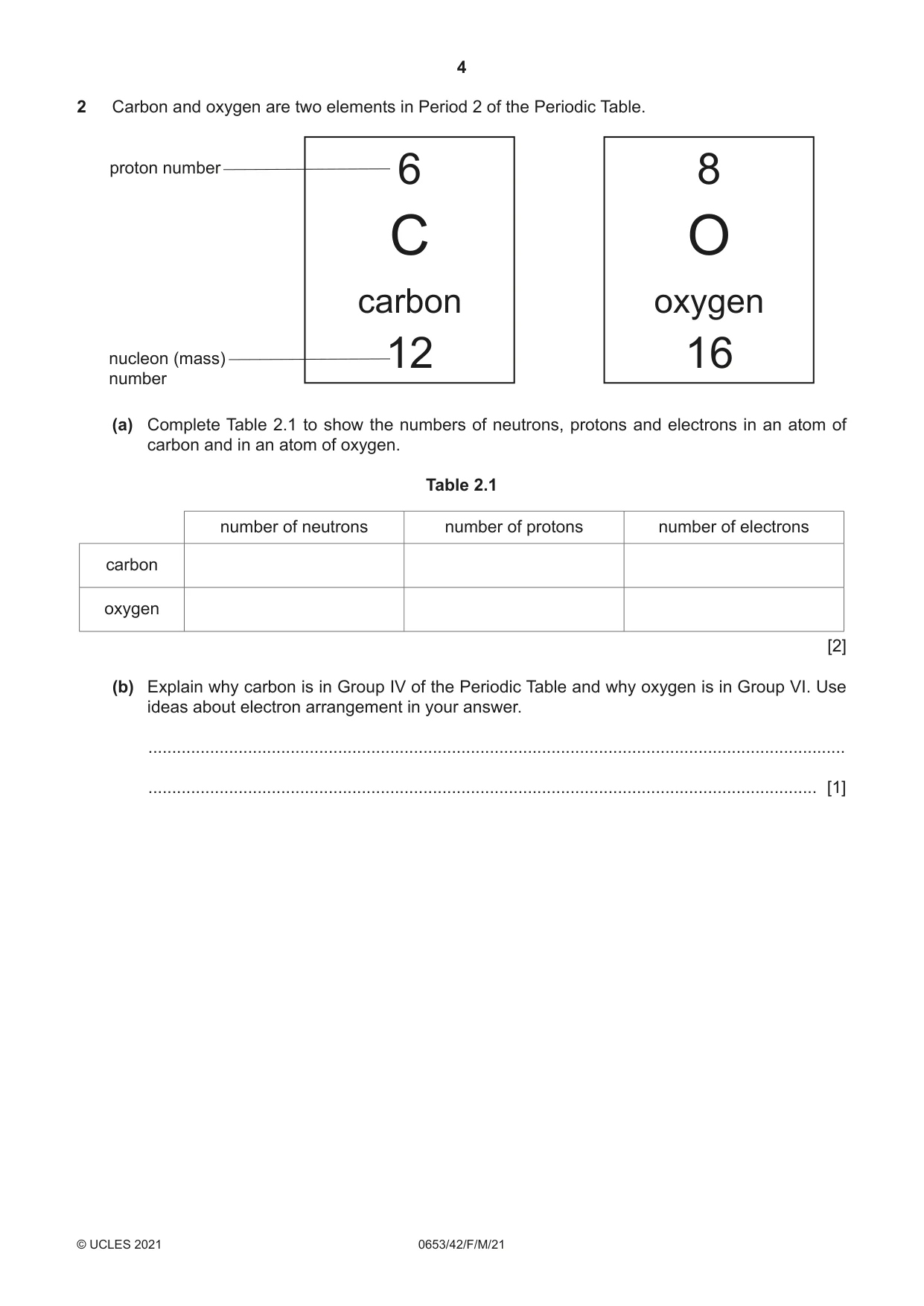
Q2 · Carbon and oxygen are two elements in Period 2 of the Periodic Table
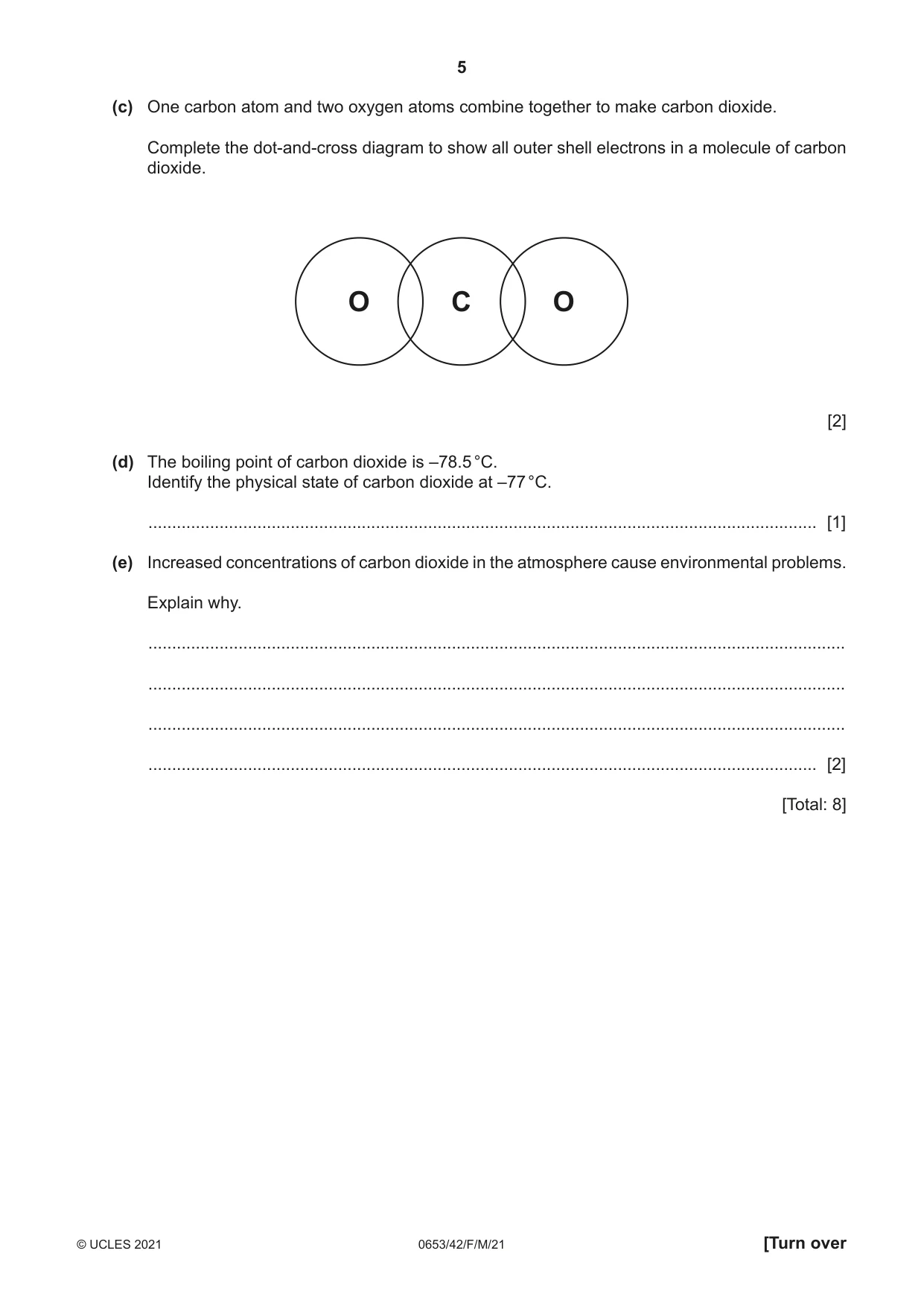
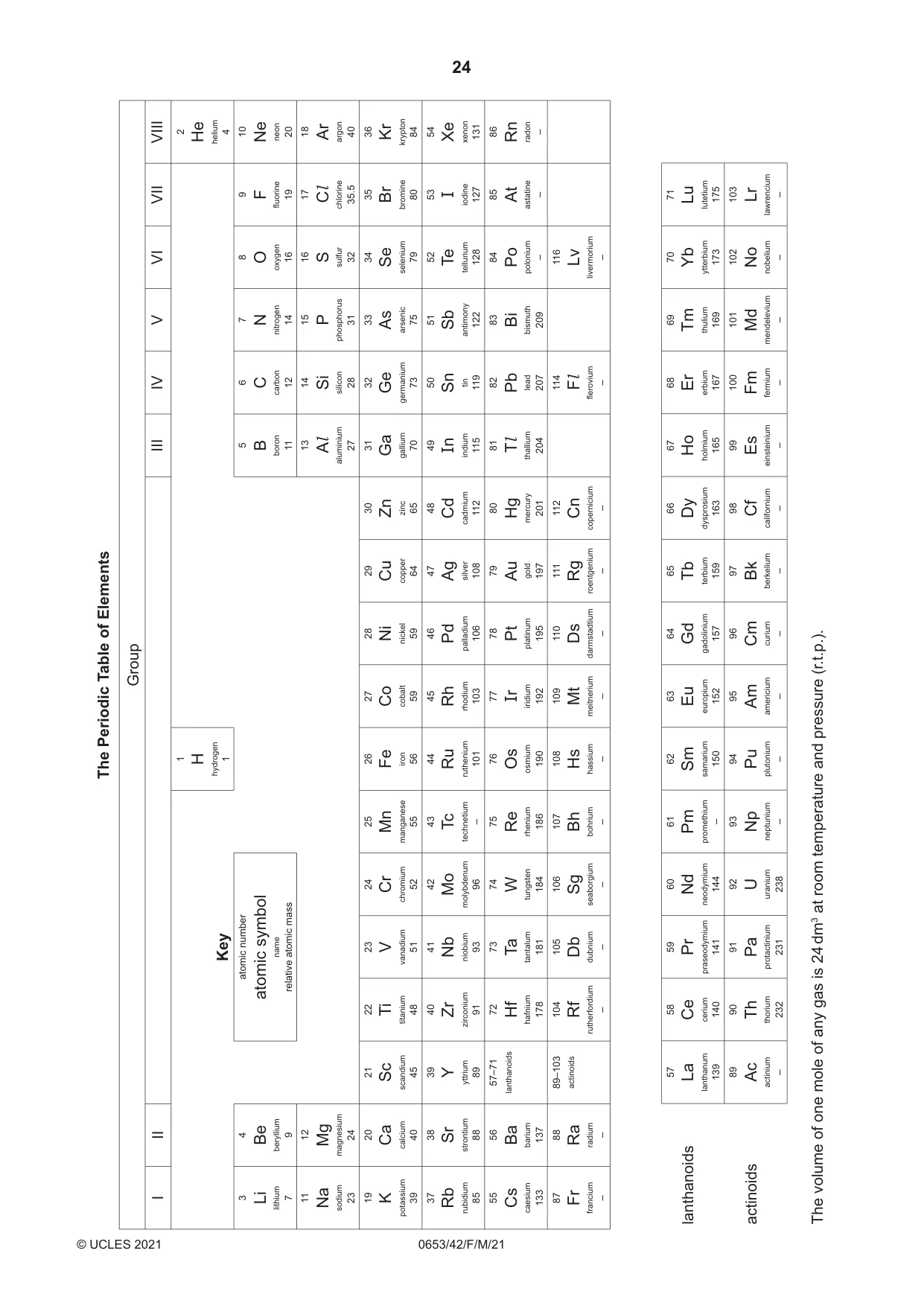
2 Carbon and oxygen are two elements in Period 2 of the Periodic Table. proton number 6 8 C O carbon oxygen nucleon (mass) 12 16 number (a) Complete Table 2.1 to show the numbers of neutrons, protons and electrons in an atom of carbon and in an atom of oxygen. Table 2.1 number of neutrons number of protons number of electrons carbon oxygen [2] (b) Explain why carbon is in Group IV of the Periodic Table and why oxygen is in Group VI. Use ideas about electron arrangement in your answer. ................................................................................................................................................... ............................................................................................................................................. [1] (c) One carbon atom and two oxygen atoms combine together to make carbon dioxide. Complete the dot-and-cross diagram to show all outer shell electrons in a molecule of carbon dioxide. O C O [2] (d) The boiling point of carbon dioxide is –78.5 °C. Identify the physical state of carbon dioxide at –77 °C. ............................................................................................................................................. [1] (e) Increased concentrations of carbon dioxide in the atmosphere cause environmental problems. Explain why. ................................................................................................................................................... ................................................................................................................................................... ................................................................................................................................................... ............................................................................................................................................. [2] [Total: 8]
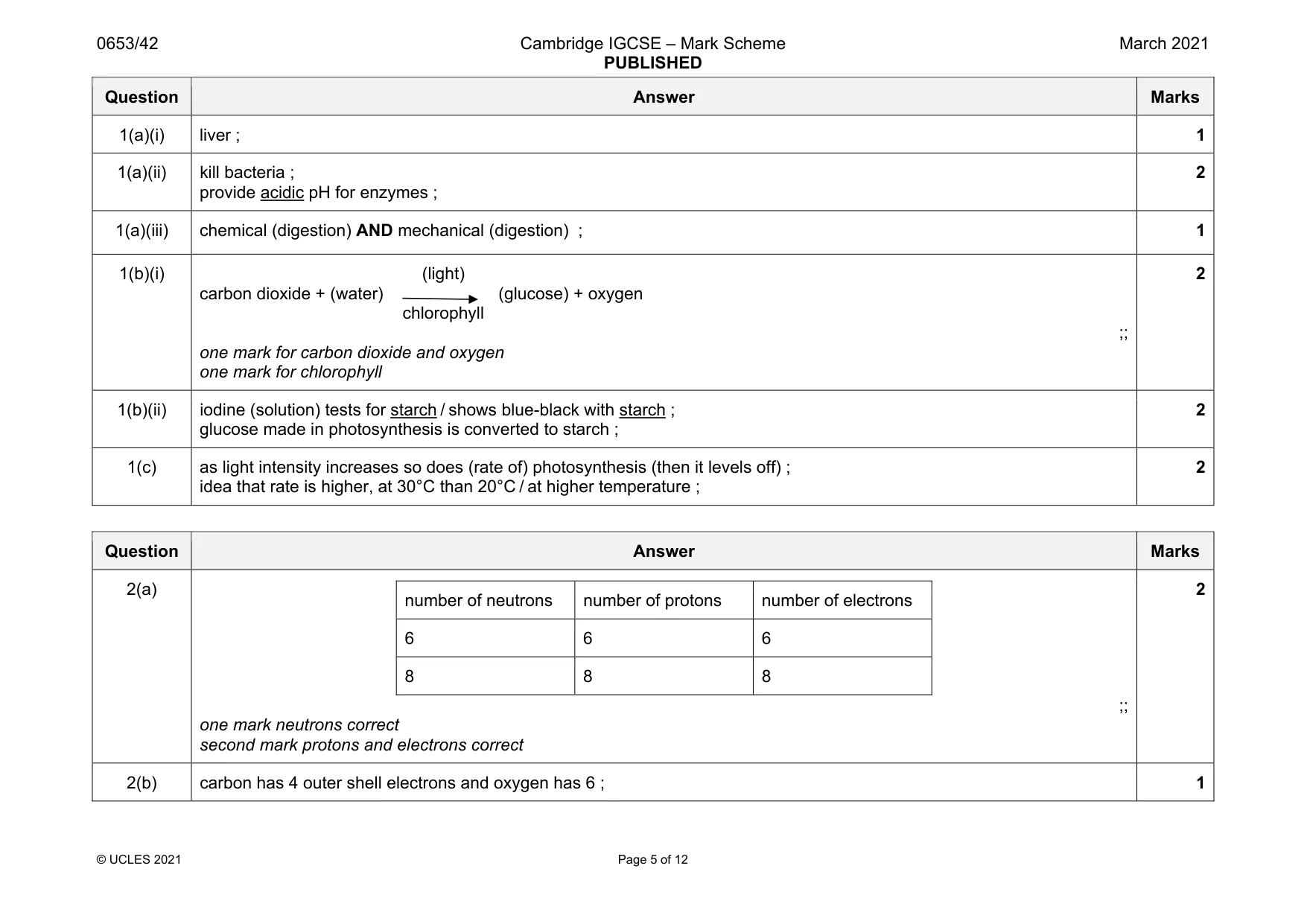
Mark scheme: 2(a) number of neutrons number of protons number of electrons 6 6 6 8 8 8 ;; one mark neutrons correct second mark protons and electrons correct 2 2(b) carbon has 4 outer shell electrons and oxygen has 6 ; 1 Question Answer Marks 2(c) four bonding electrons shown between carbon and each oxygen ; (dependent on MP1) rest of molecule correct ; 2 2(d) gas ; 1 2(e) one point from: CO2 is a greenhouse gas / causes enhanced greenhouse effect / causes atmosphere to heat up / traps excess heat in atmosphere / causes global warming ; and one point from: climate change ; extreme weather events / named example, e.g. hurricanes ; sea level rise / flooding (of coastal areas) ; polar ice caps melt ; 2
Q3 · A car moving forward along a level road before the road goes over a hill
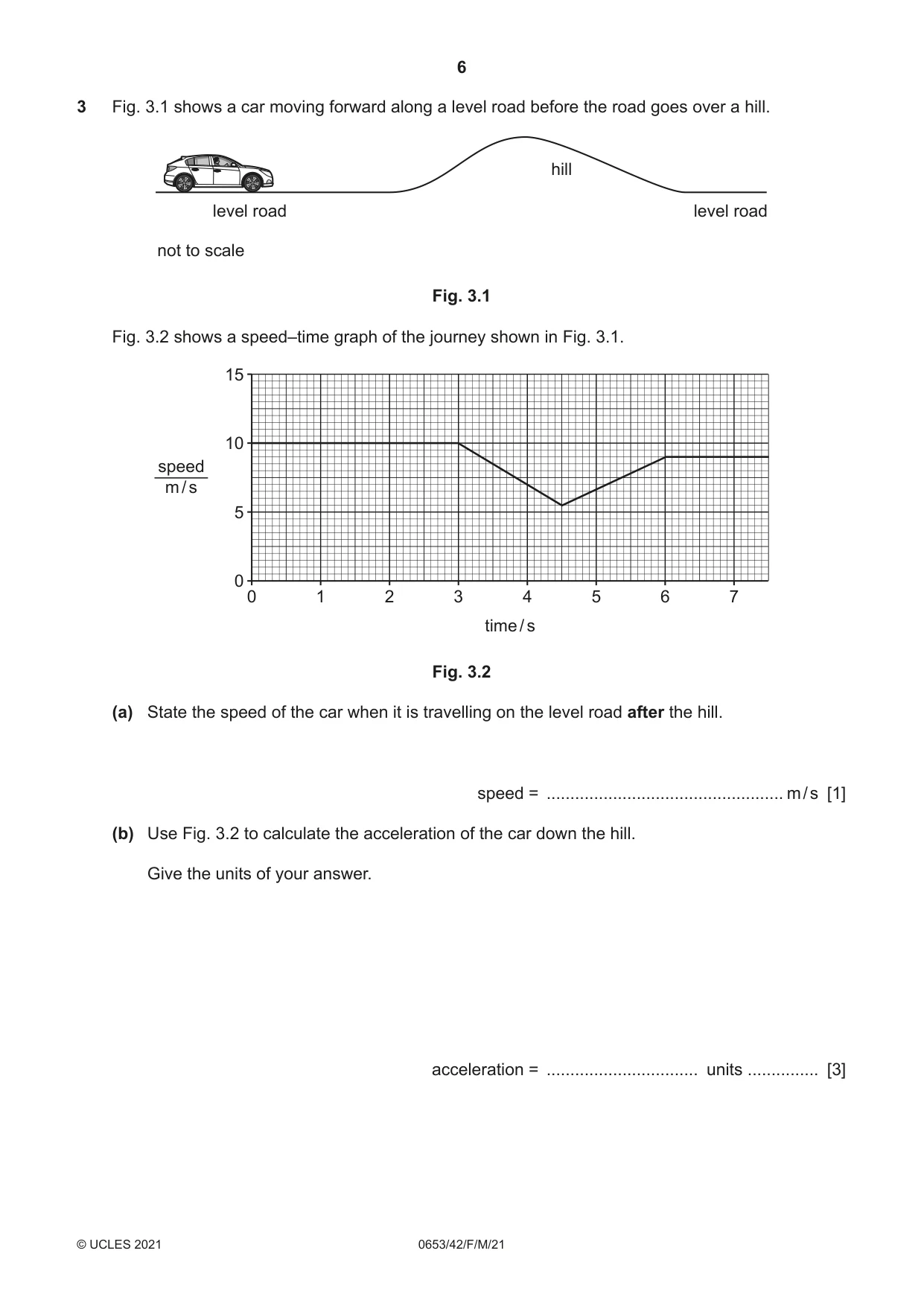
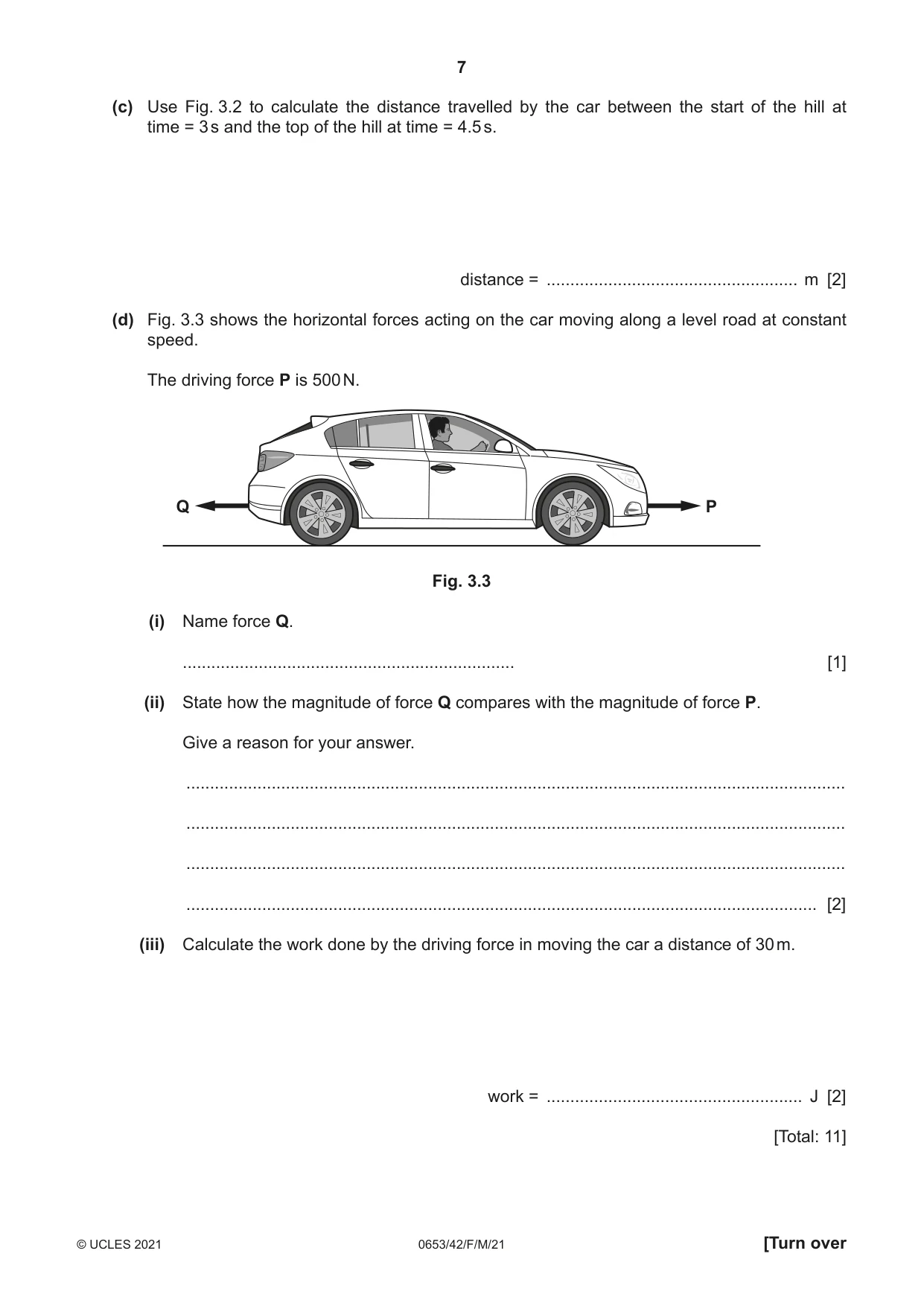
3 Fig. 3.1 shows a car moving forward along a level road before the road goes over a hill. hill level road level road not to scale Fig. 3.1 Fig. 3.2 shows a speed–time graph of the journey shown in Fig. 3.1. 15 10 speed m / s 5 0 0 1 2 3 4 5 6 7 time / s Fig. 3.2 (a) State the speed of the car when it is travelling on the level road after the hill. speed = .................................................. m / s [1] (b) Use Fig. 3.2 to calculate the acceleration of the car down the hill. Give the units of your answer. acceleration = ................................ units ............... [3] (c) Use Fig. 3.2 to calculate the distance travelled by the car between the start of the hill at time = 3 s and the top of the hill at time = 4.5 s. distance = ..................................................... m [2] (d) Fig. 3.3 shows the horizontal forces acting on the car moving along a level road at constant speed. The driving force P is 500 N. Q P Fig. 3.3 (i) Name force Q. ...................................................................... [1] (ii) State how the magnitude of force Q compares with the magnitude of force P. Give a reason for your answer. ........................................................................................................................................... ........................................................................................................................................... ........................................................................................................................................... ..................................................................................................................................... [2] (iii) Calculate the work done by the driving force in moving the car a distance of 30 m. work = ...................................................... J [2] [Total: 11]
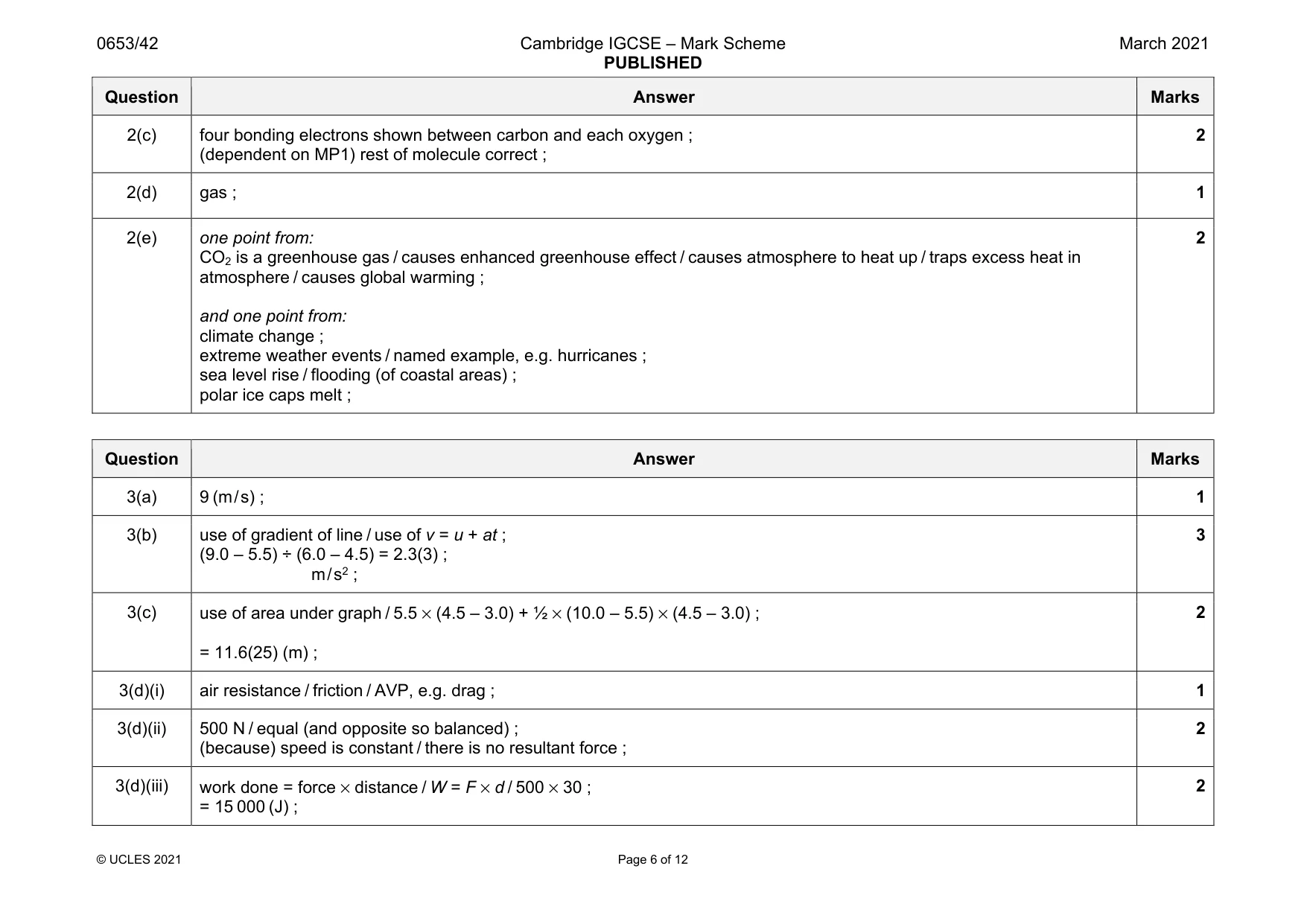
Mark scheme: 3(a) 9 (m / s) ; 1 3(b) use of gradient of line / use of v = u + at ; (9.0 – 5.5) ÷ (6.0 – 4.5) = 2.3(3) ; m / s2 ; 3 3(c) use of area under graph / 5.5 × (4.5 – 3.0) + ½ × (10.0 – 5.5) × (4.5 – 3.0) ; = 11.6(25) (m) ; 2 3(d)(i) air resistance / friction / AVP, e.g. drag ; 1 3(d)(ii) 500 N / equal (and opposite so balanced) ; (because) speed is constant / there is no resultant force ; 2 3(d)(iii) work done = force × distance / W = F × d / 500 × 30 ; = 15 000 (J) ; 2
Q4 · Part of a forest food web
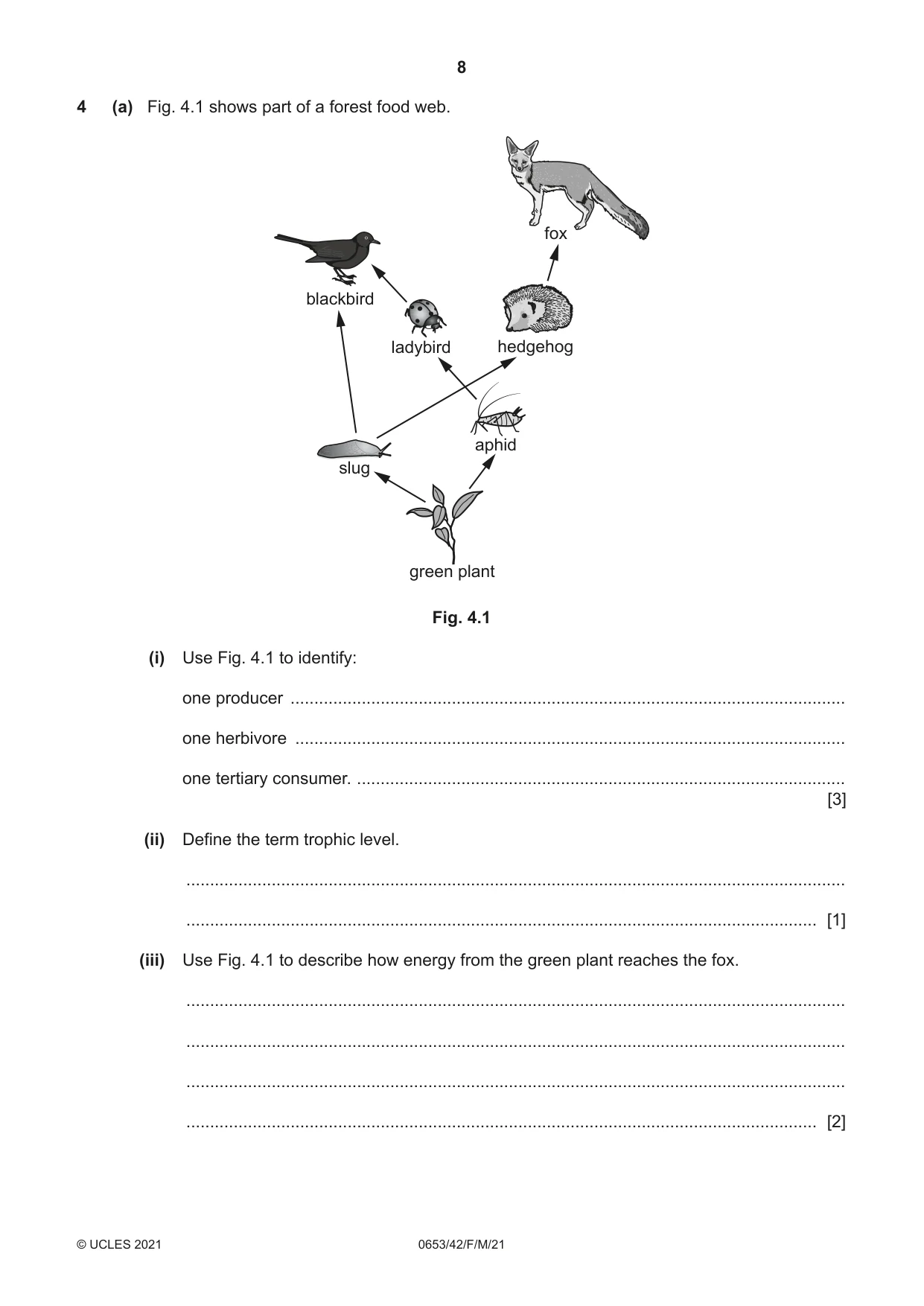
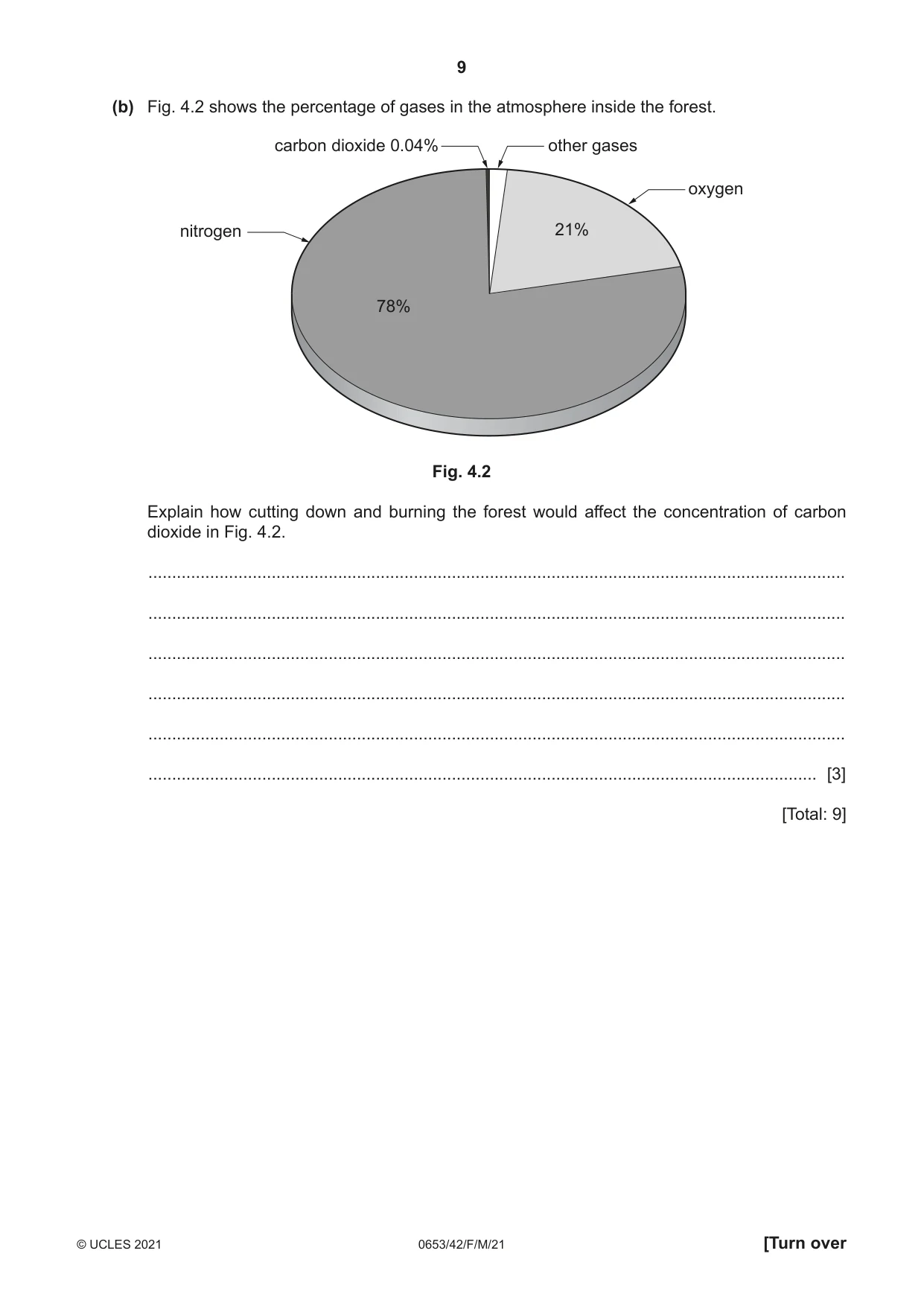
4 (a) Fig. 4.1 shows part of a forest food web. fox blackbird ladybird hedgehog aphid slug green plant Fig. 4.1 (i) Use Fig. 4.1 to identify: one producer ..................................................................................................................... one herbivore .................................................................................................................... one tertiary consumer. ....................................................................................................... [3] (ii) Define the term trophic level. ........................................................................................................................................... ..................................................................................................................................... [1] (iii) Use Fig. 4.1 to describe how energy from the green plant reaches the fox. ........................................................................................................................................... ........................................................................................................................................... ........................................................................................................................................... ..................................................................................................................................... [2] (b) Fig. 4.2 shows the percentage of gases in the atmosphere inside the forest. carbon dioxide 0.04% other gases oxygen nitrogen 21% 78% Fig. 4.2 Explain how cutting down and burning the forest would affect the concentration of carbon dioxide in Fig. 4.2. ................................................................................................................................................... ................................................................................................................................................... ................................................................................................................................................... ................................................................................................................................................... ................................................................................................................................................... ............................................................................................................................................. [3] [Total: 9]
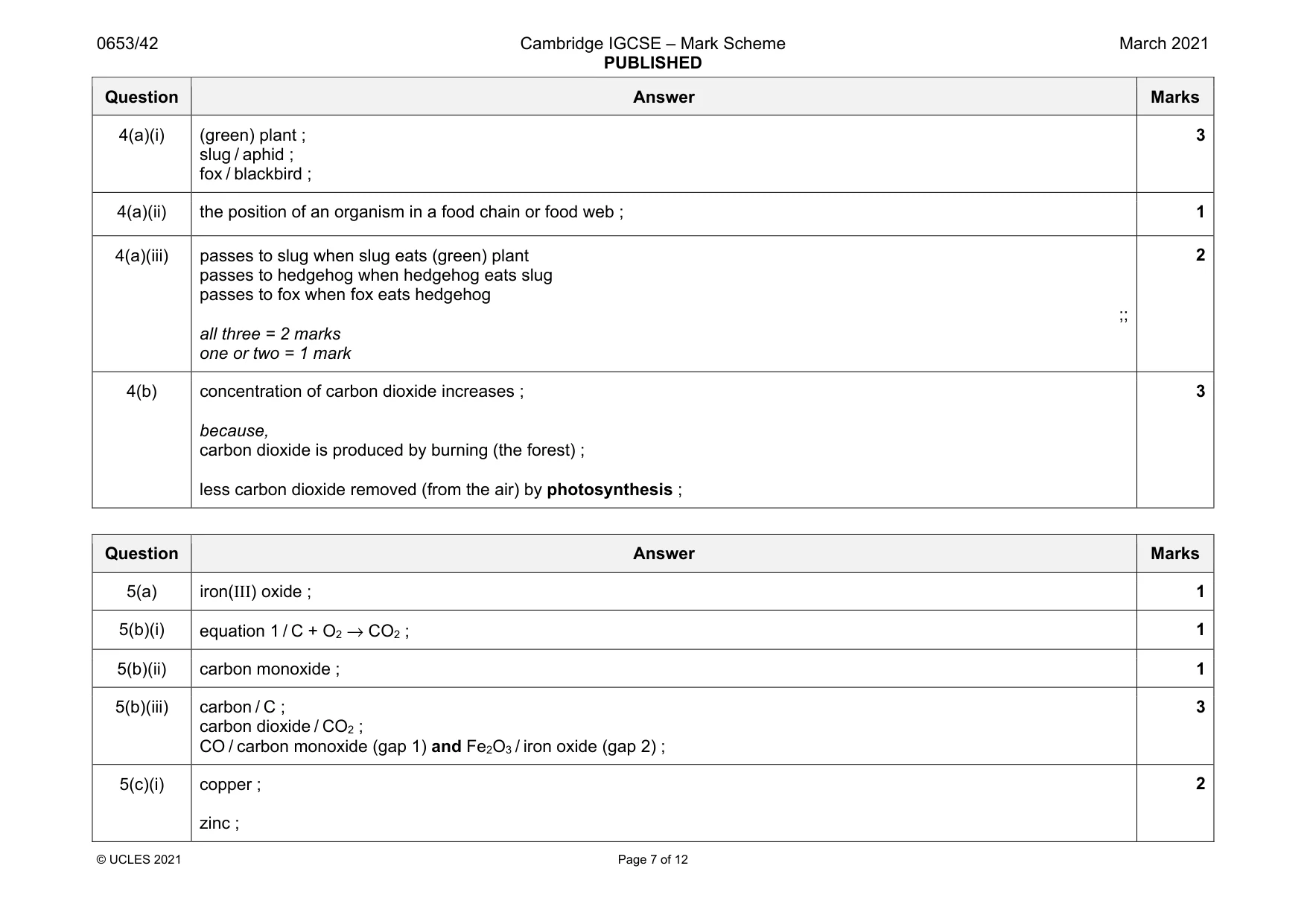
Mark scheme: 4(a)(i) (green) plant ; slug / aphid ; fox / blackbird ; 3 4(a)(ii) the position of an organism in a food chain or food web ; 1 4(a)(iii) passes to slug when slug eats (green) plant passes to hedgehog when hedgehog eats slug passes to fox when fox eats hedgehog ;; all three = 2 marks one or two = 1 mark 2 4(b) concentration of carbon dioxide increases ; because, carbon dioxide is produced by burning (the forest) ; less carbon dioxide removed (from the air) by photosynthesis ; 3
Q5 · Iron is extracted from hematite, an iron ore, in the blast furnace
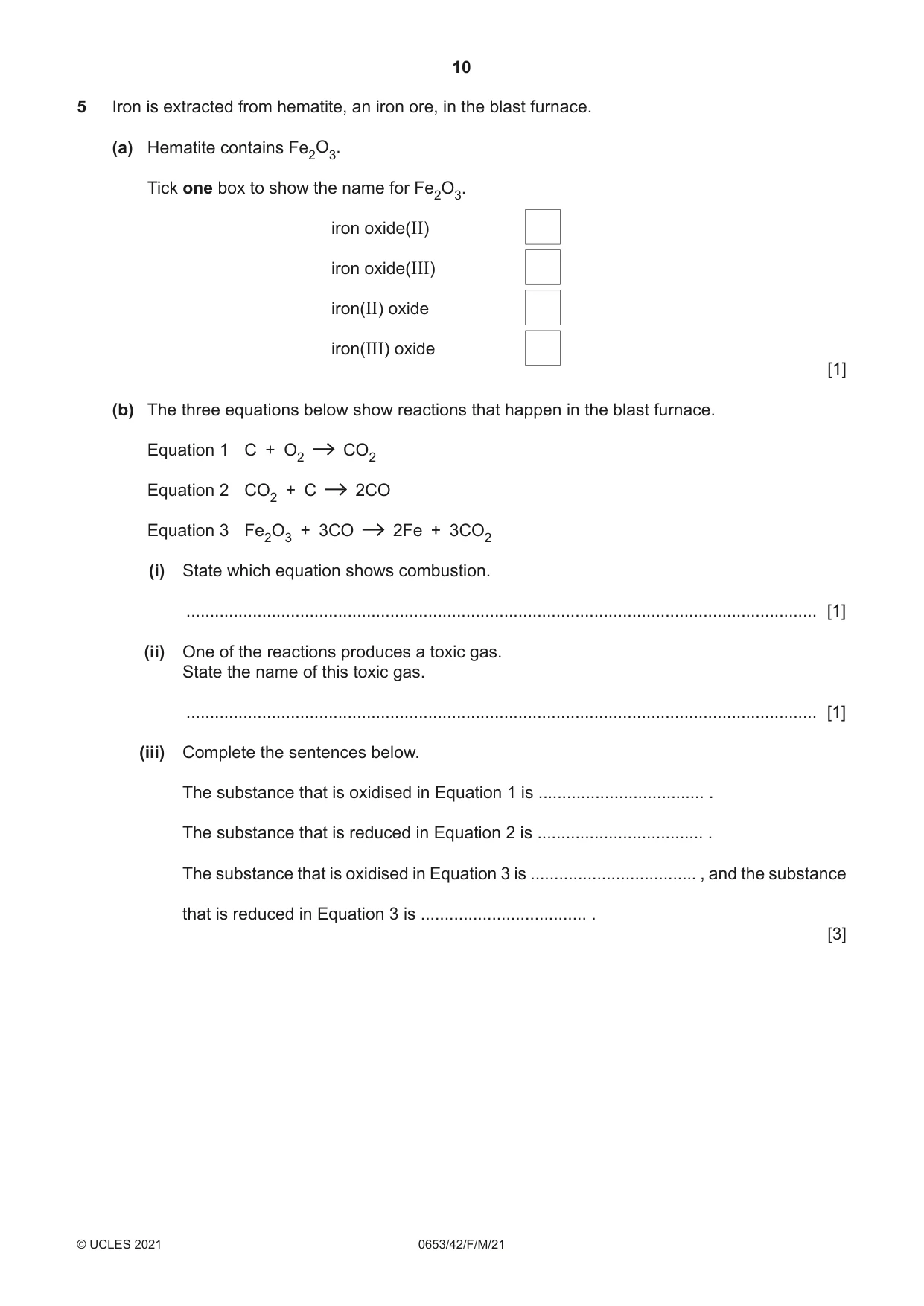
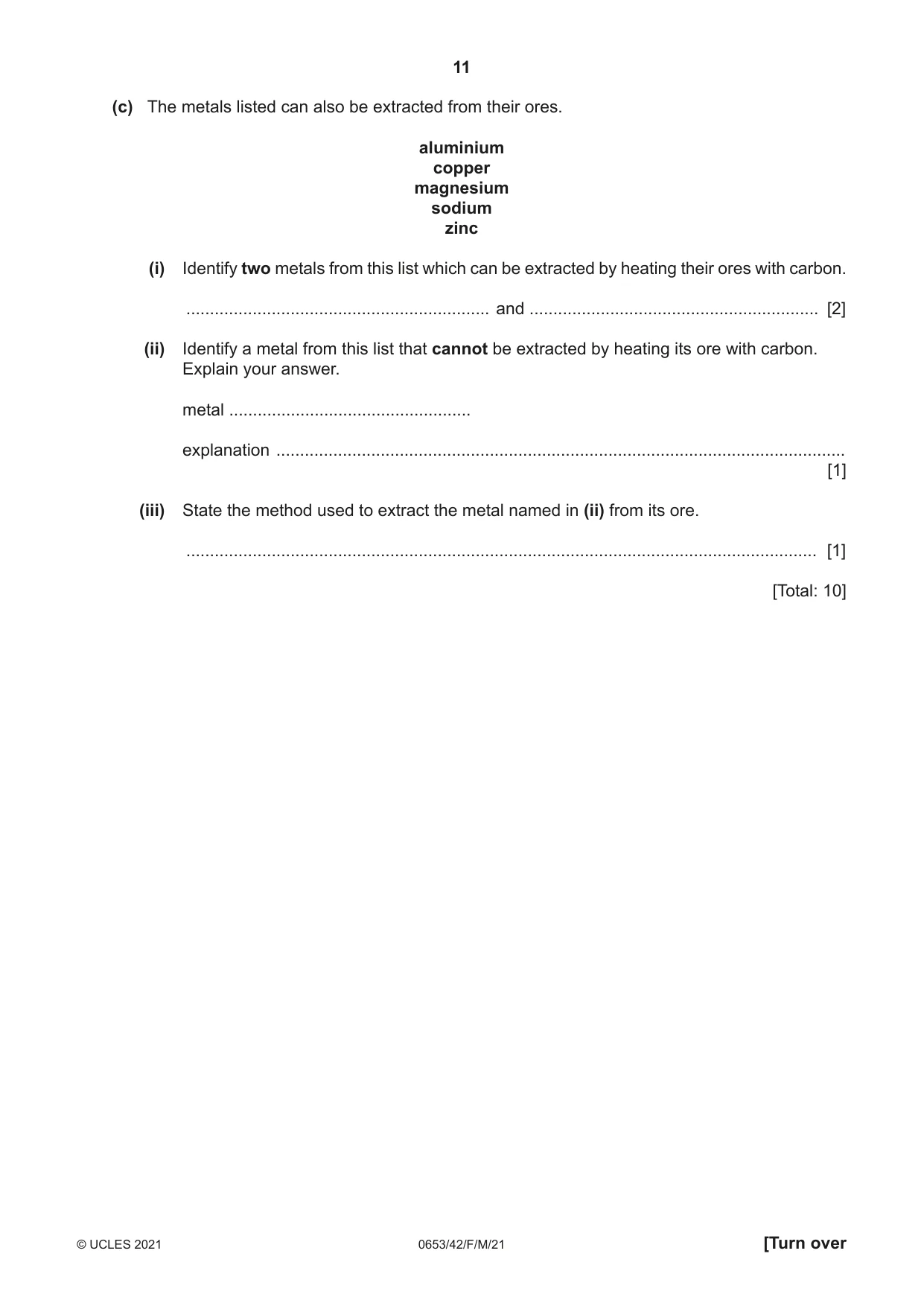
5 Iron is extracted from hematite, an iron ore, in the blast furnace. (a) Hematite contains Fe2O3. Tick one box to show the name for Fe2O3. iron oxide(II) iron oxide(III) iron(II) oxide iron(III) oxide [1] (b) The three equations below show reactions that happen in the blast furnace. Equation 1 C + O2 CO2 Equation 2 CO2 + C 2CO Equation 3 Fe2O3 + 3CO 2Fe + 3CO2 (i) State which equation shows combustion. ..................................................................................................................................... [1] (ii) One of the reactions produces a toxic gas. State the name of this toxic gas. ..................................................................................................................................... [1] (iii) Complete the sentences below. The substance that is oxidised in Equation 1 is ................................... . The substance that is reduced in Equation 2 is ................................... . The substance that is oxidised in Equation 3 is ................................... , and the substance that is reduced in Equation 3 is ................................... . [3] (c) The metals listed can also be extracted from their ores. aluminium copper magnesium sodium zinc (i) Identify two metals from this list which can be extracted by heating their ores with carbon. ................................................................ and ............................................................. [2] (ii) Identify a metal from this list that cannot be extracted by heating its ore with carbon. Explain your answer. metal ................................................... explanation ........................................................................................................................ [1] (iii) State the method used to extract the metal named in (ii) from its ore. ..................................................................................................................................... [1] [Total: 10]
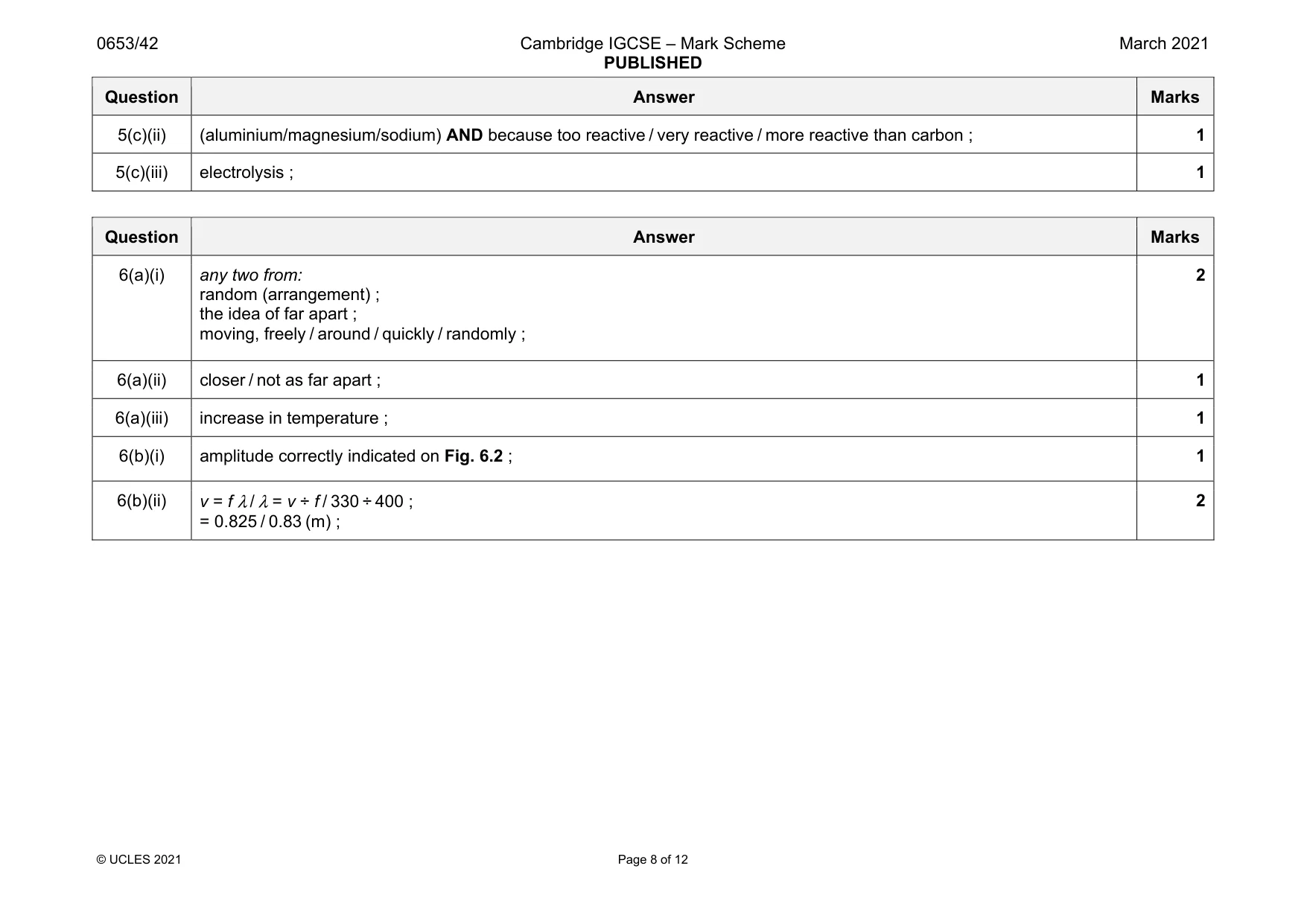
Mark scheme: 5(a) iron(III) oxide ; 1 5(b)(i) equation 1 / C + O2 → CO2 ; 1 5(b)(ii) carbon monoxide ; 1 5(b)(iii) carbon / C ; carbon dioxide / CO2 ; CO / carbon monoxide (gap 1) and Fe2O3 / iron oxide (gap 2) ; 3 5(c)(i) copper ; zinc ; 2 Question Answer Marks 5(c)(ii) (aluminium/magnesium/sodium) AND because too reactive / very reactive / more reactive than carbon ; 1 5(c)(iii) electrolysis ; 1
Question 6
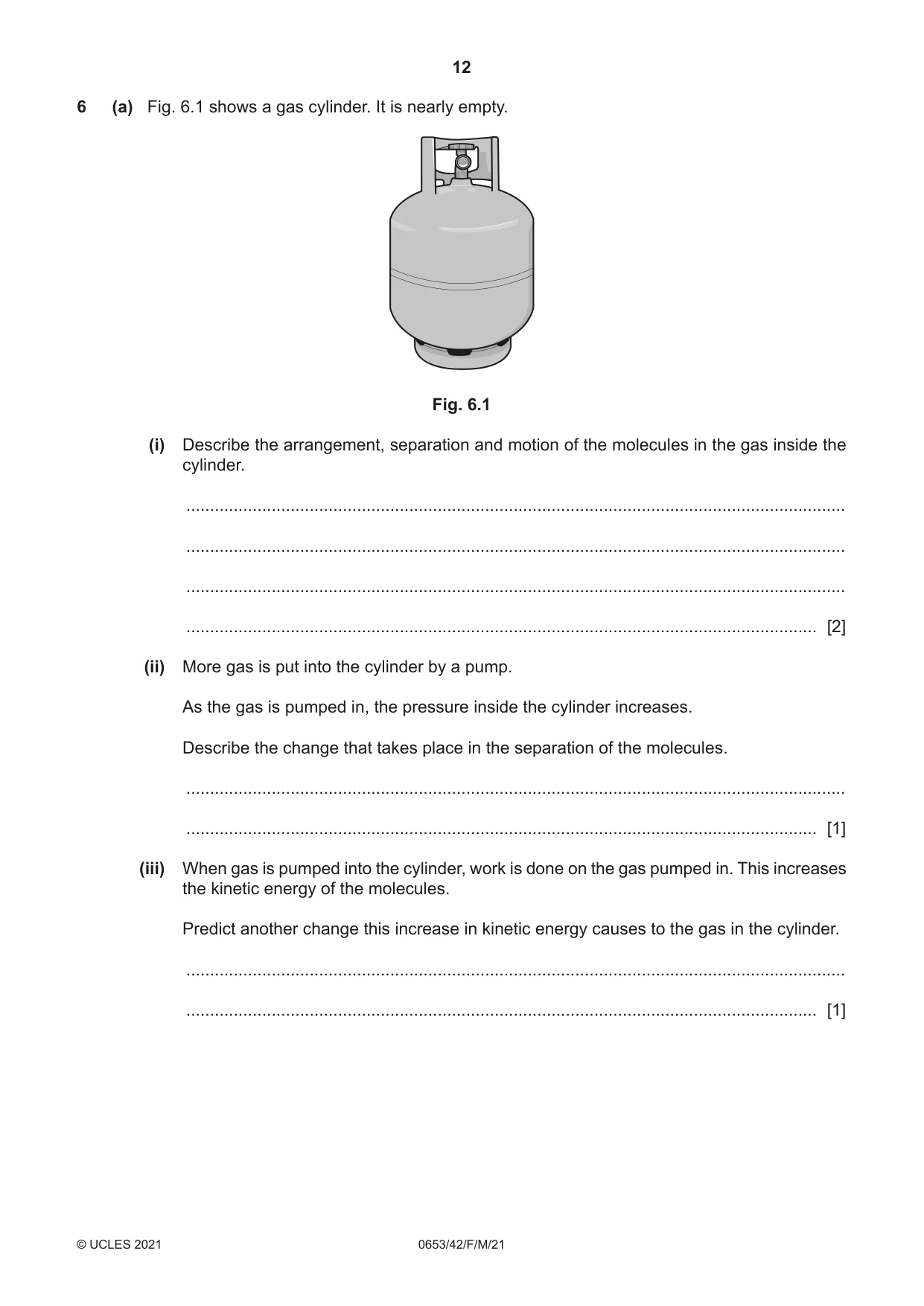
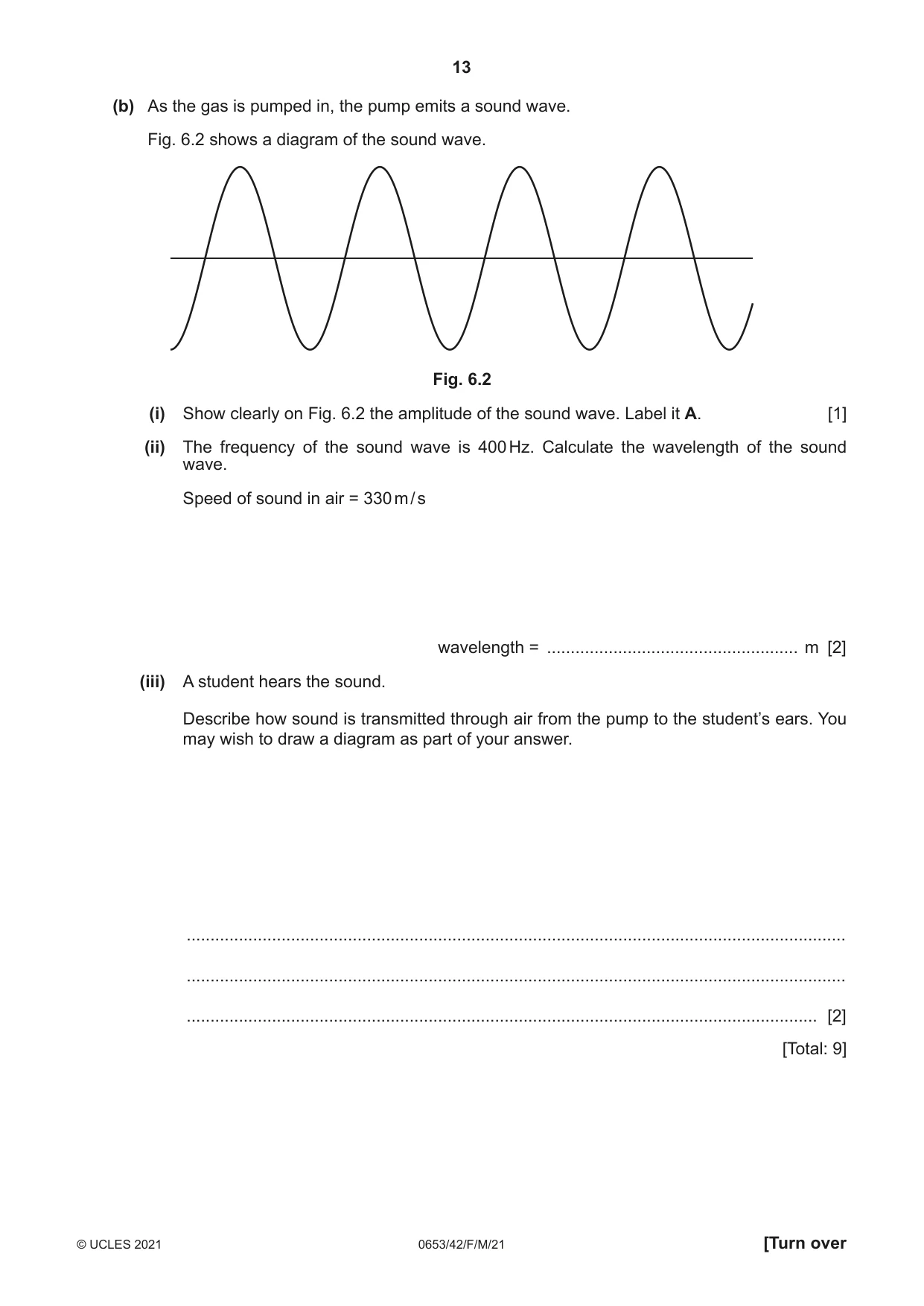
6 (a) Fig. 6.1 shows a gas cylinder. It is nearly empty. Fig. 6.1 (i) Describe the arrangement, separation and motion of the molecules in the gas inside the cylinder. ........................................................................................................................................... ........................................................................................................................................... ........................................................................................................................................... ..................................................................................................................................... [2] (ii) More gas is put into the cylinder by a pump. As the gas is pumped in, the pressure inside the cylinder increases. Describe the change that takes place in the separation of the molecules. ........................................................................................................................................... ..................................................................................................................................... [1] (iii) When gas is pumped into the cylinder, work is done on the gas pumped in. This increases the kinetic energy of the molecules. Predict another change this increase in kinetic energy causes to the gas in the cylinder. ........................................................................................................................................... ..................................................................................................................................... [1] (b) As the gas is pumped in, the pump emits a sound wave. Fig. 6.2 shows a diagram of the sound wave. Fig. 6.2 (i) Show clearly on Fig. 6.2 the amplitude of the sound wave. Label it A. [1] (ii) The frequency of the sound wave is 400 Hz. Calculate the wavelength of the sound wave. Speed of sound in air = 330 m / s wavelength = ..................................................... m [2] (iii) A student hears the sound. Describe how sound is transmitted through air from the pump to the student’s ears. You may wish to draw a diagram as part of your answer. ........................................................................................................................................... ........................................................................................................................................... ..................................................................................................................................... [2] [Total: 9]
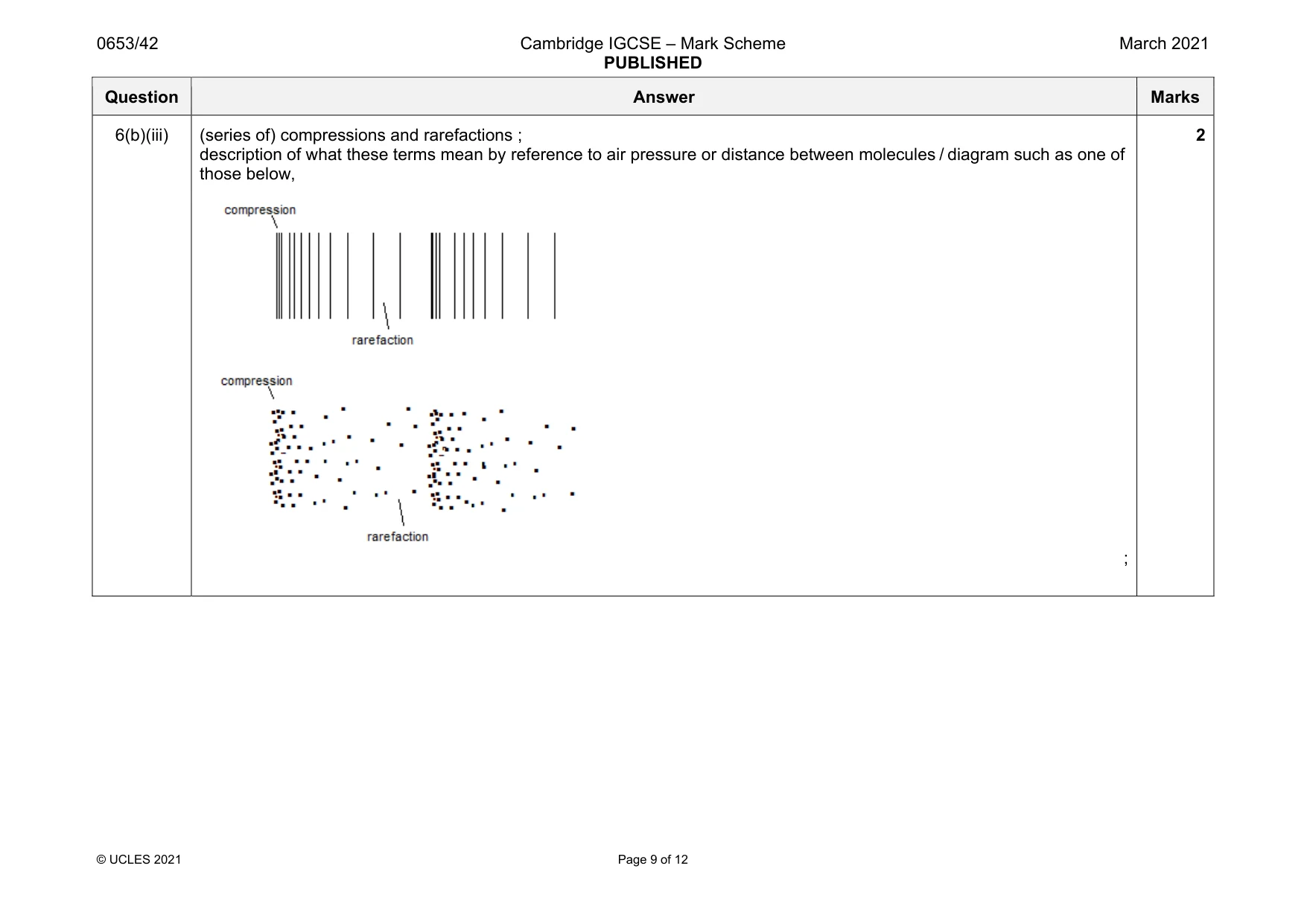
Mark scheme: 6(a)(i) any two from: random (arrangement) ; the idea of far apart ; moving, freely / around / quickly / randomly ; 2 6(a)(ii) closer / not as far apart ; 1 6(a)(iii) increase in temperature ; 1 6(b)(i) amplitude correctly indicated on Fig. 6.2 ; 1 6(b)(ii) v = f λ / λ = v ÷ f / 330 ÷ 400 ; = 0.825 / 0.83 (m) ; 2 Question Answer Marks 6(b)(iii) (series of) compressions and rarefactions ; description of what these terms mean by reference to air pressure or distance between molecules / diagram such as one of those below, ; 2
Q7 · A heart with coronary heart disease
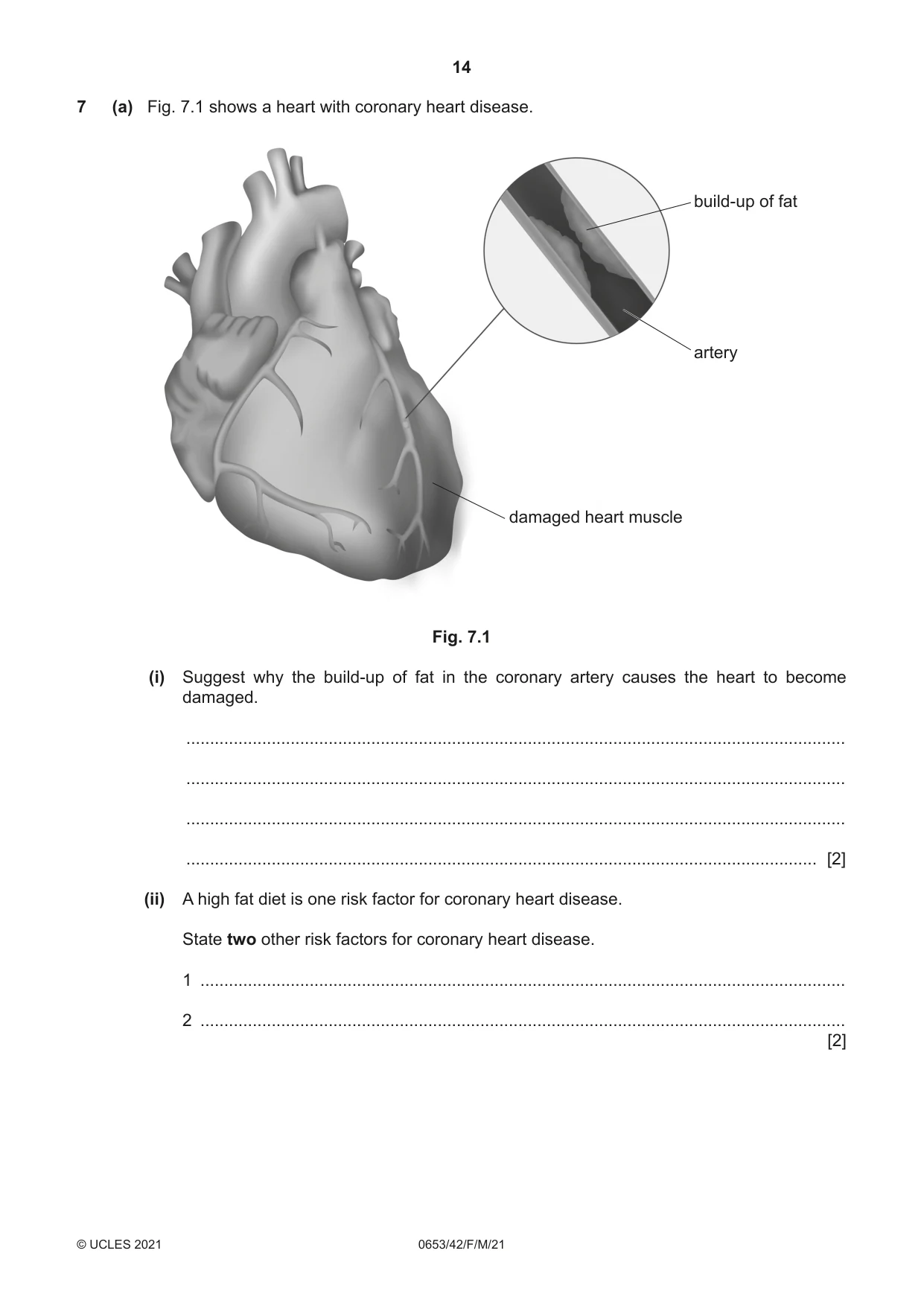
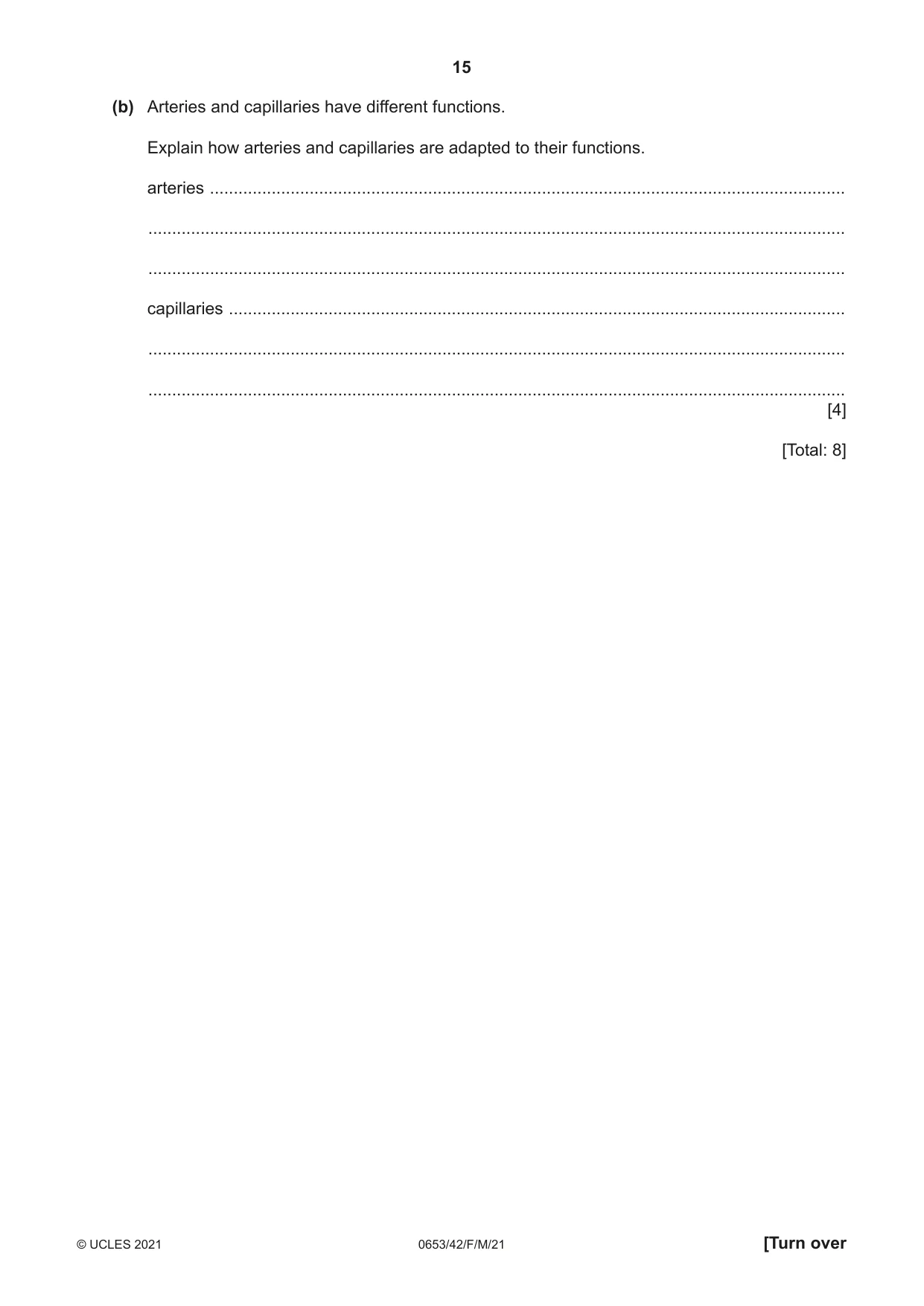
7 (a) Fig. 7.1 shows a heart with coronary heart disease. build-up of fat artery damaged heart muscle Fig. 7.1 (i) Suggest why the build-up of fat in the coronary artery causes the heart to become damaged. ........................................................................................................................................... ........................................................................................................................................... ........................................................................................................................................... ..................................................................................................................................... [2] (ii) A high fat diet is one risk factor for coronary heart disease. State two other risk factors for coronary heart disease. 1 ........................................................................................................................................ 2 ........................................................................................................................................ [2] (b) Arteries and capillaries have different functions. Explain how arteries and capillaries are adapted to their functions. arteries ...................................................................................................................................... ................................................................................................................................................... ................................................................................................................................................... capillaries .................................................................................................................................. ................................................................................................................................................... ................................................................................................................................................... [4] [Total: 8]
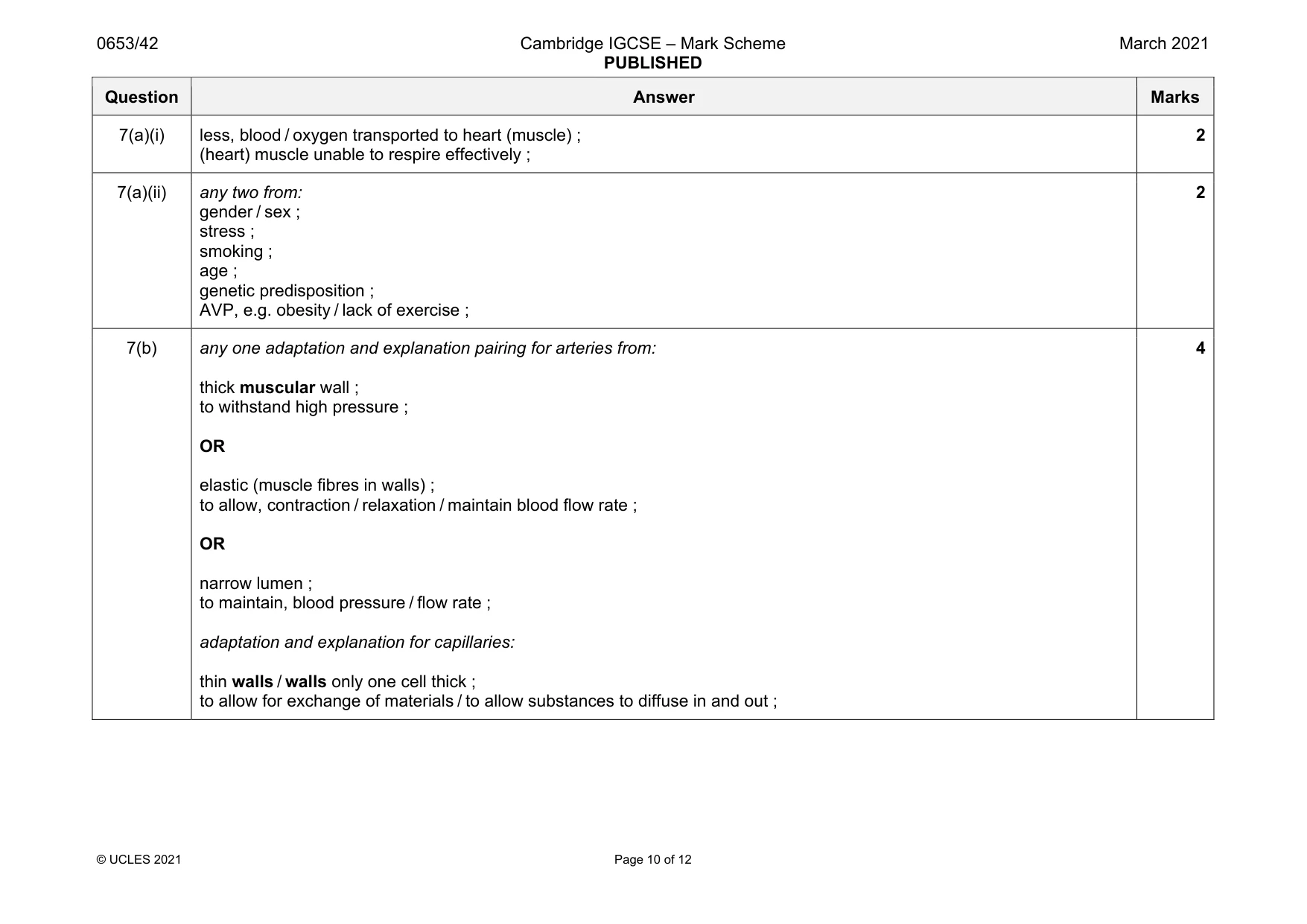
Mark scheme: 7(a)(i) less, blood / oxygen transported to heart (muscle) ; (heart) muscle unable to respire effectively ; 2 7(a)(ii) any two from: gender / sex ; stress ; smoking ; age ; genetic predisposition ; AVP, e.g. obesity / lack of exercise ; 2 7(b) any one adaptation and explanation pairing for arteries from: thick muscular wall ; to withstand high pressure ; OR elastic (muscle fibres in walls) ; to allow, contraction / relaxation / maintain blood flow rate ; OR narrow lumen ; to maintain, blood pressure / flow rate ; adaptation and explanation for capillaries: thin walls / walls only one cell thick ; to allow for exchange of materials / to allow substances to diffuse in and out ; 4
Q8 · Sodium is an element in Group I of the Periodic Table
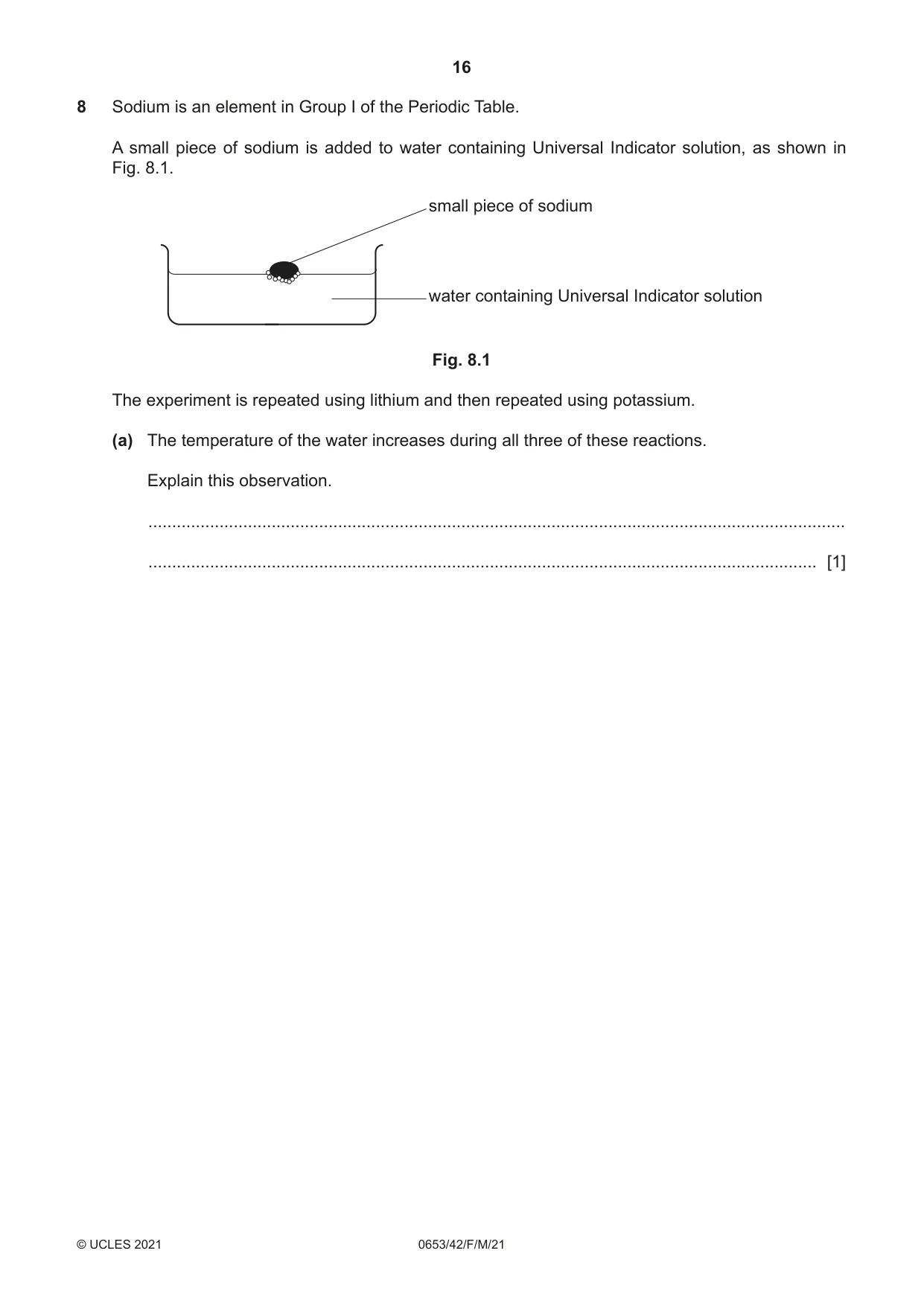
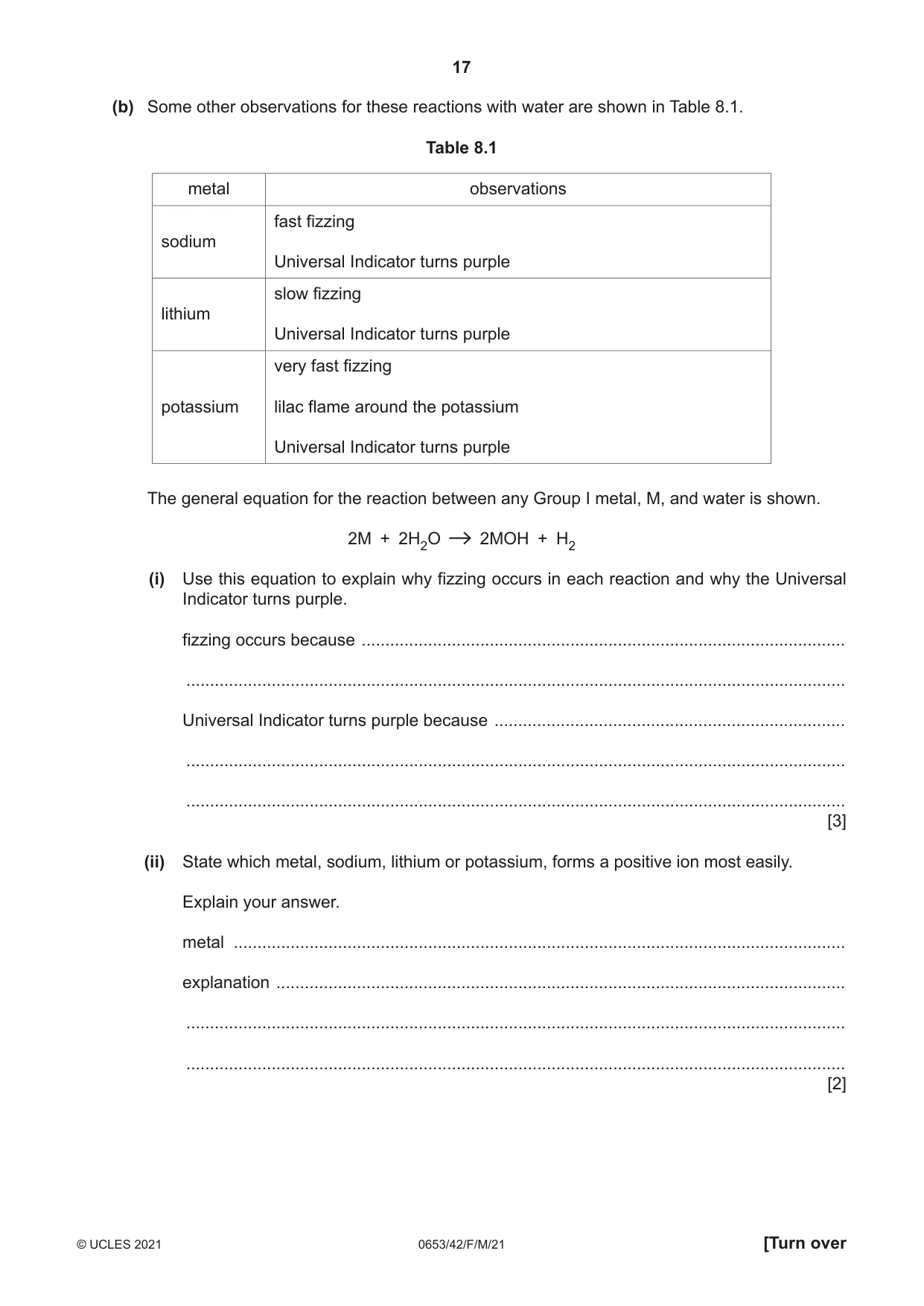
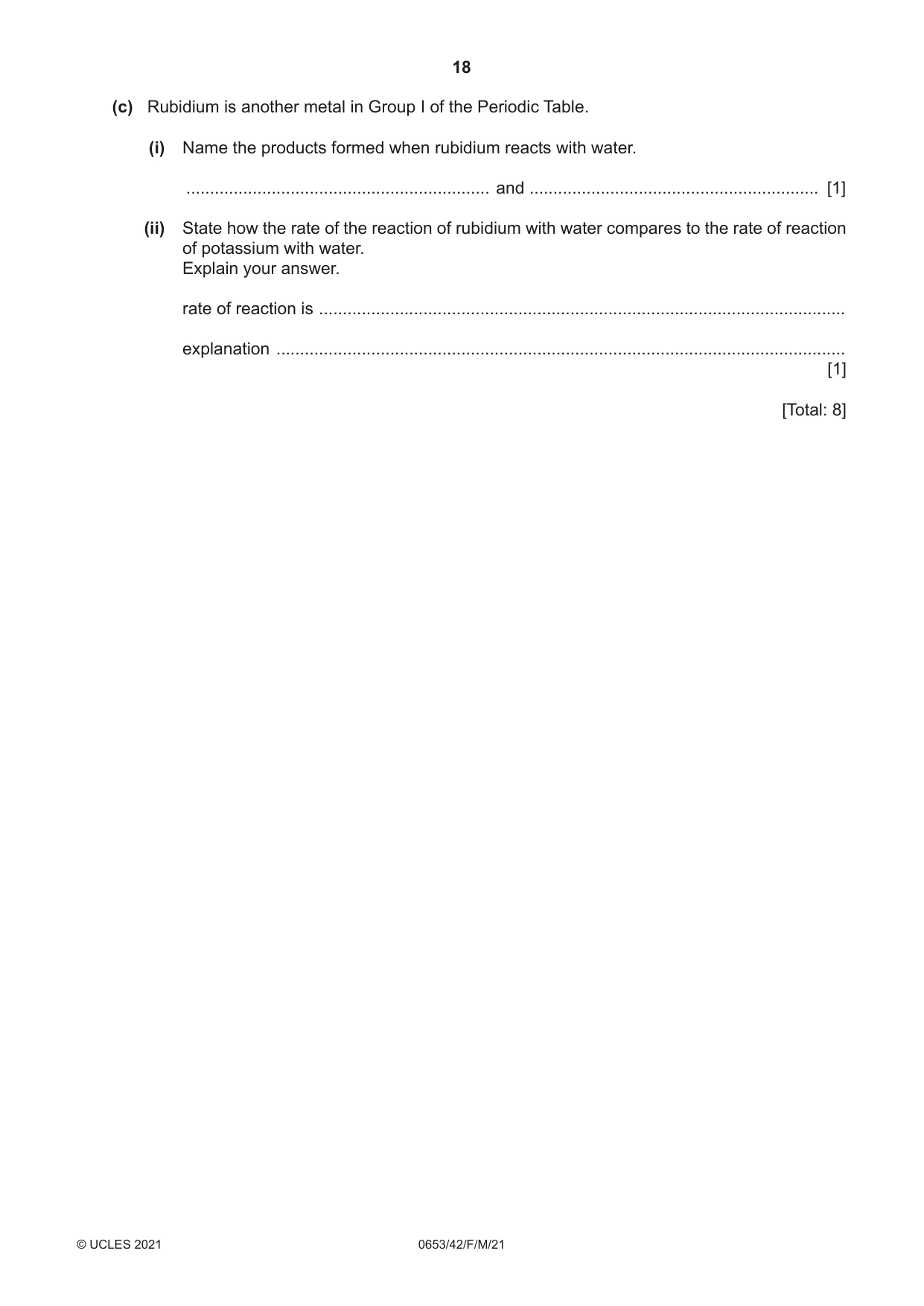
8 Sodium is an element in Group I of the Periodic Table. A small piece of sodium is added to water containing Universal Indicator solution, as shown in Fig. 8.1. small piece of sodium water containing Universal Indicator solution Fig. 8.1 The experiment is repeated using lithium and then repeated using potassium. (a) The temperature of the water increases during all three of these reactions. Explain this observation. ................................................................................................................................................... ............................................................................................................................................. [1] (b) Some other observations for these reactions with water are shown in Table 8.1. Table 8.1 metal observations fast fizzing sodium Universal Indicator turns purple slow fizzing lithium Universal Indicator turns purple very fast fizzing potassium lilac flame around the potassium Universal Indicator turns purple The general equation for the reaction between any Group I metal, M, and water is shown. 2M + 2H2O 2MOH + H2 (i) Use this equation to explain why fizzing occurs in each reaction and why the Universal Indicator turns purple. fizzing occurs because ...................................................................................................... ........................................................................................................................................... Universal Indicator turns purple because .......................................................................... ........................................................................................................................................... ........................................................................................................................................... [3] (ii) State which metal, sodium, lithium or potassium, forms a positive ion most easily. Explain your answer. metal ................................................................................................................................. explanation ........................................................................................................................ ........................................................................................................................................... ........................................................................................................................................... [2] (c) Rubidium is another metal in Group I of the Periodic Table. (i) Name the products formed when rubidium reacts with water. ................................................................ and ............................................................. [1] (ii) State how the rate of the reaction of rubidium with water compares to the rate of reaction of potassium with water. Explain your answer. rate of reaction is ............................................................................................................... explanation ........................................................................................................................ [1] [Total: 8]
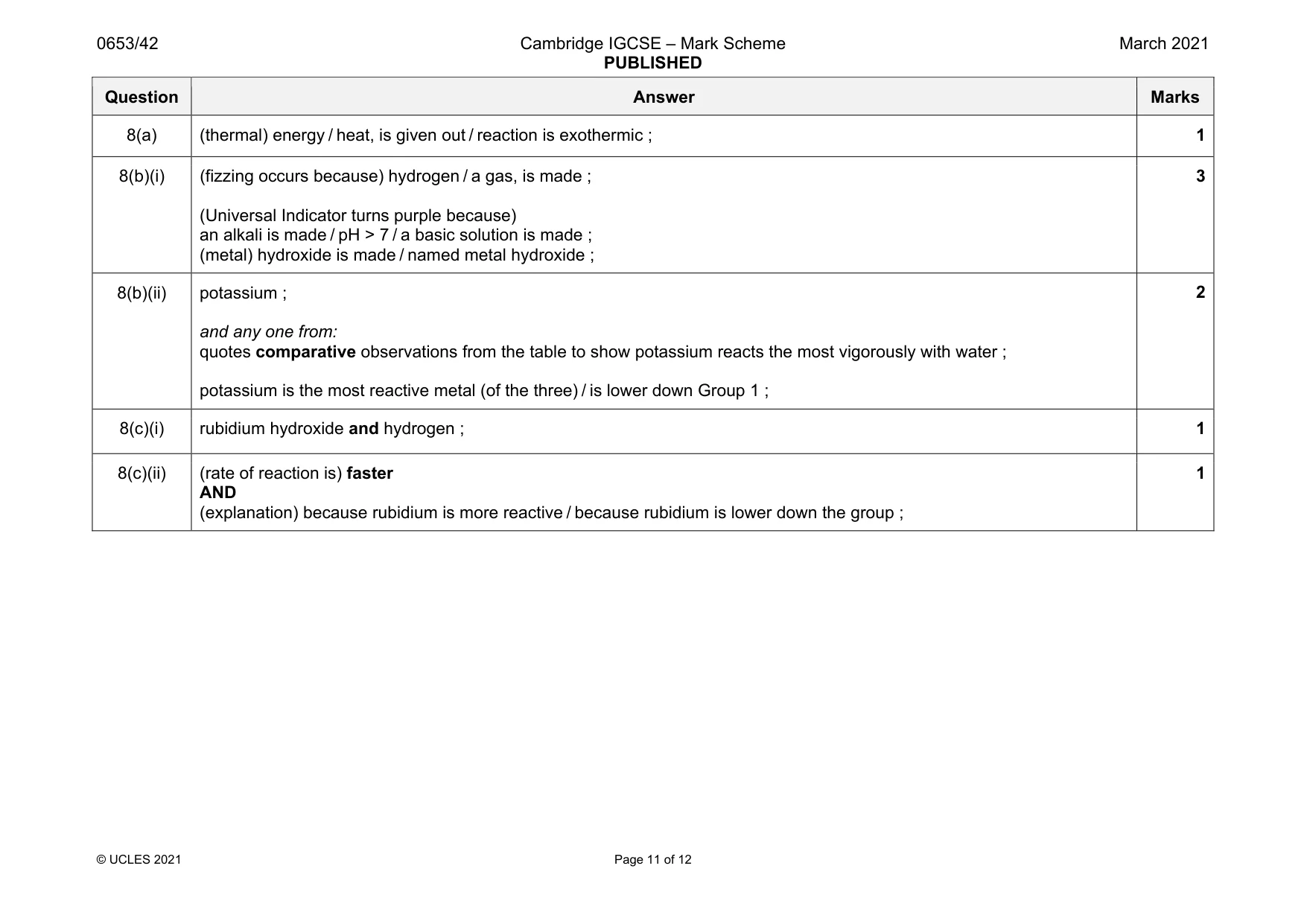
Mark scheme: 8(a) (thermal) energy / heat, is given out / reaction is exothermic ; 1 8(b)(i) (fizzing occurs because) hydrogen / a gas, is made ; (Universal Indicator turns purple because) an alkali is made / pH > 7 / a basic solution is made ; (metal) hydroxide is made / named metal hydroxide ; 3 8(b)(ii) potassium ; and any one from: quotes comparative observations from the table to show potassium reacts the most vigorously with water ; potassium is the most reactive metal (of the three) / is lower down Group 1 ; 2 8(c)(i) rubidium hydroxide and hydrogen ; 1 8(c)(ii) (rate of reaction is) faster AND (explanation) because rubidium is more reactive / because rubidium is lower down the group ; 1
Question 9
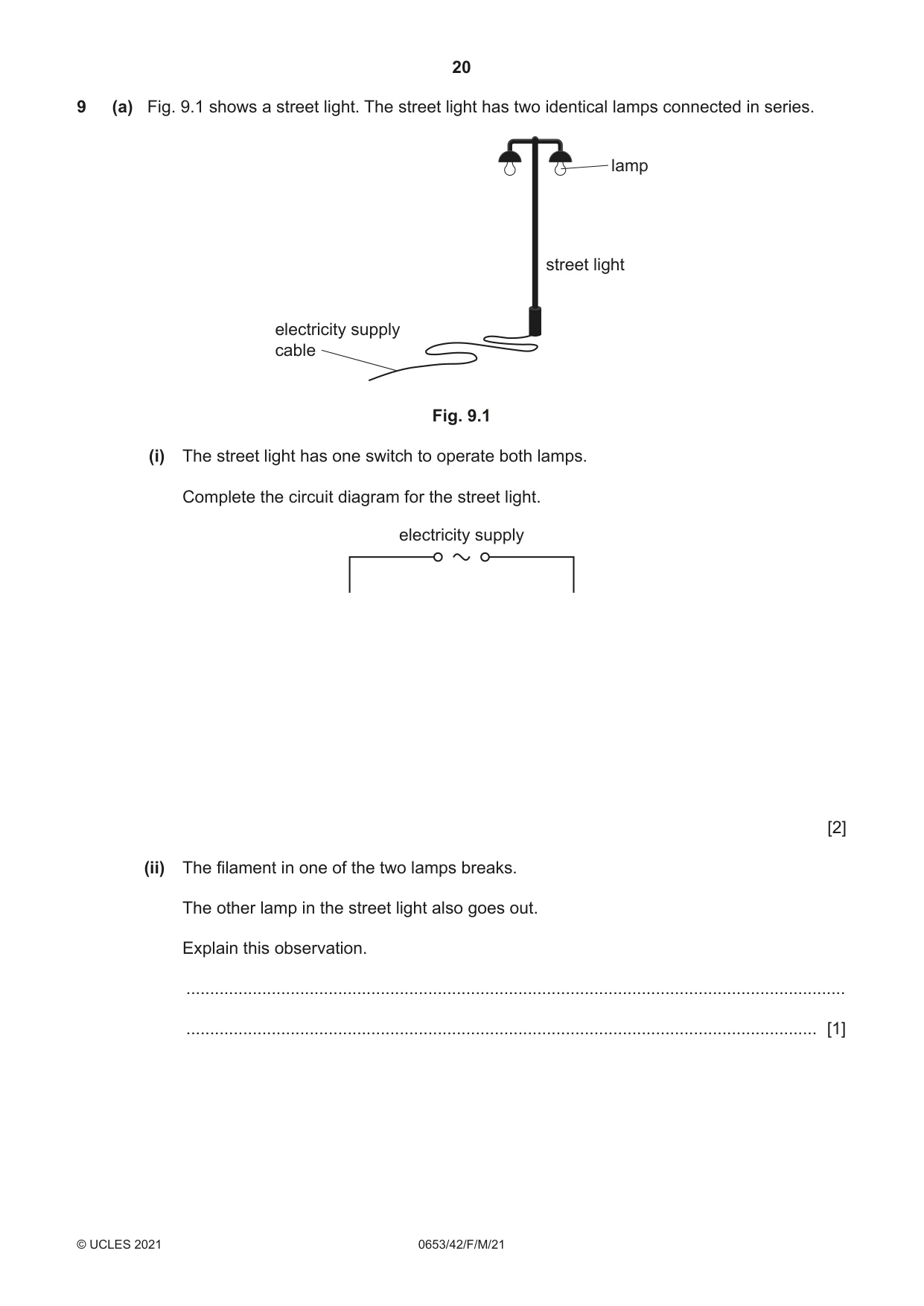
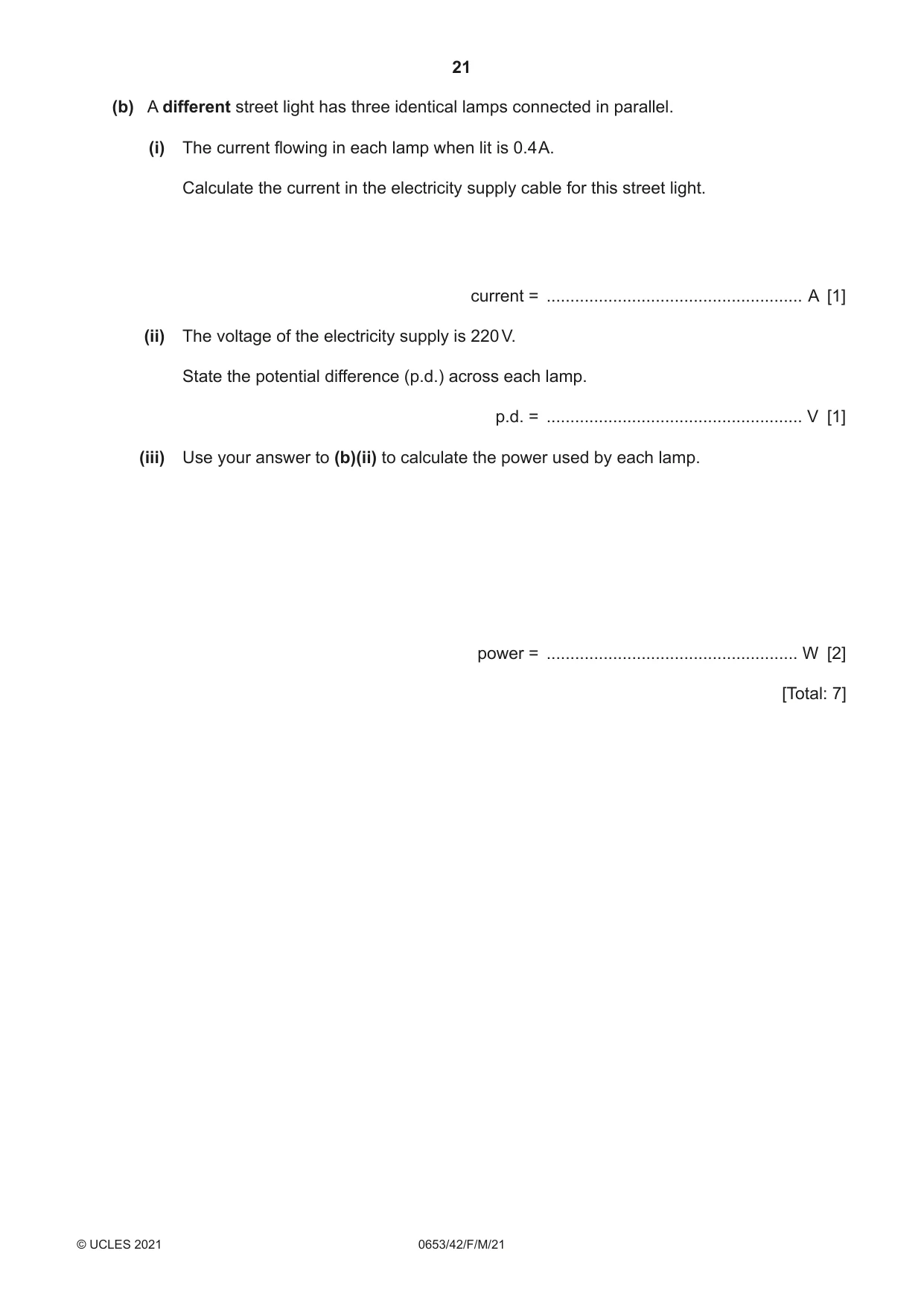
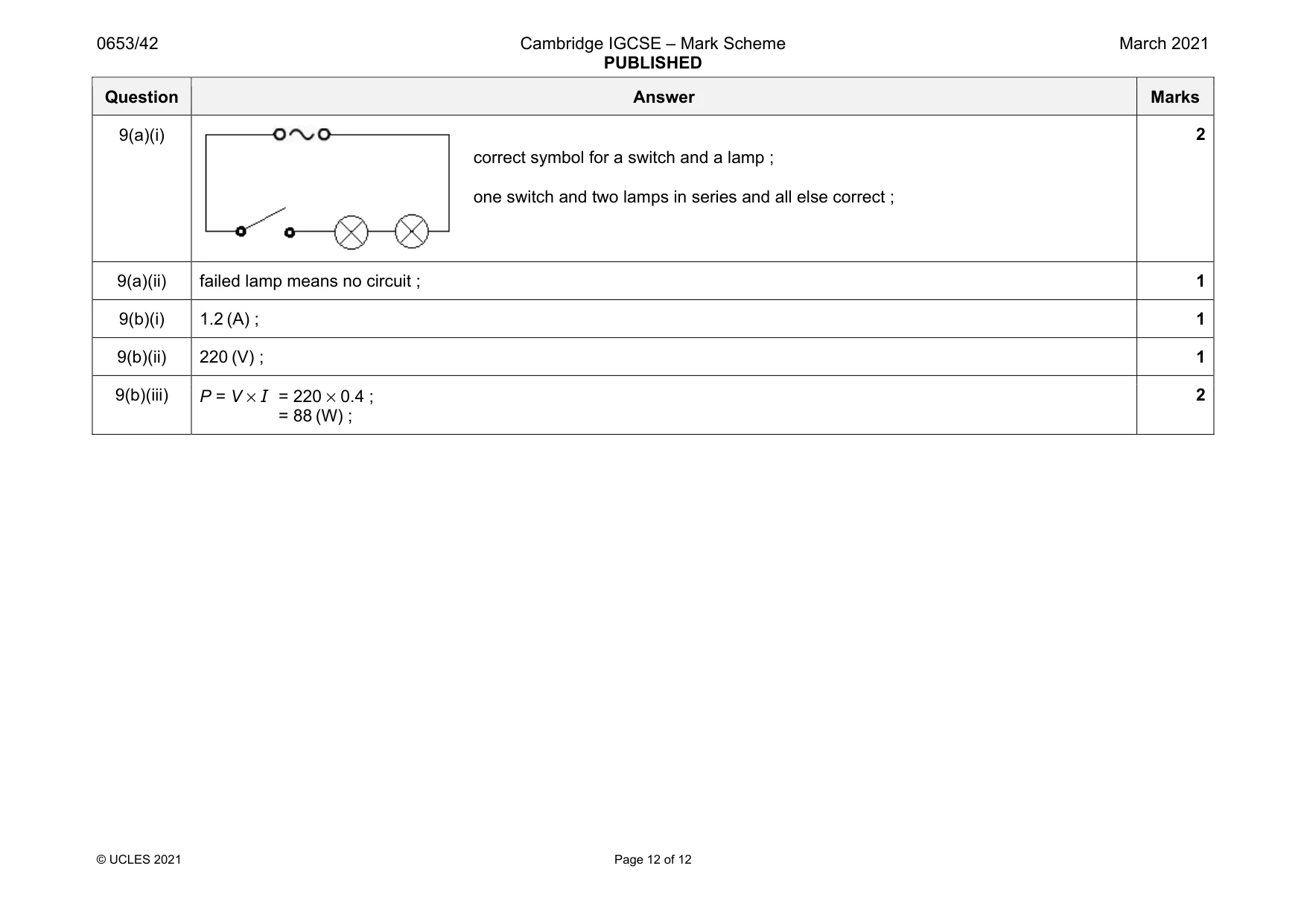
9 (a) Fig. 9.1 shows a street light. The street light has two identical lamps connected in series. lamp street light electricity supply cable Fig. 9.1 (i) The street light has one switch to operate both lamps. Complete the circuit diagram for the street light. electricity supply [2] (ii) The filament in one of the two lamps breaks. The other lamp in the street light also goes out. Explain this observation. ........................................................................................................................................... ..................................................................................................................................... [1] (b) A different street light has three identical lamps connected in parallel. (i) The current flowing in each lamp when lit is 0.4 A. Calculate the current in the electricity supply cable for this street light. current = ...................................................... A [1] (ii) The voltage of the electricity supply is 220 V. State the potential difference (p.d.) across each lamp. p.d. = ...................................................... V [1] (iii) Use your answer to (b)(ii) to calculate the power used by each lamp. power = ..................................................... W [2] [Total: 7]
Mark scheme: 9(a)(i) 9(a)(ii) failed lamp means no circuit ; 1 9(b)(i) 1.2 (A) ; 1 9(b)(ii) 220 (V) ; 1 9(b)(iii) P = V × I = 220 × 0.4 ; = 88 (W) ; 2 correct symbol for a switch and a lamp ; one switch and two lamps in series and all else correct ;
What was in this paper
The subtopics covered by these 9 questions, and how many questions each got. Open one in a new tab to see every Cambridge question on it.
What you needed in this session
Cambridge’s own grade thresholds for 2021 Feb/March, Paper 4 · Variant 2. A higher threshold means an easier paper — the bar moves with how the cohort did.