Questions as text
Q1 · ‘The pound sterling made a dramatic recovery in the world's currency markets yesterday.’… 0455/11 Oct/Nov 2004
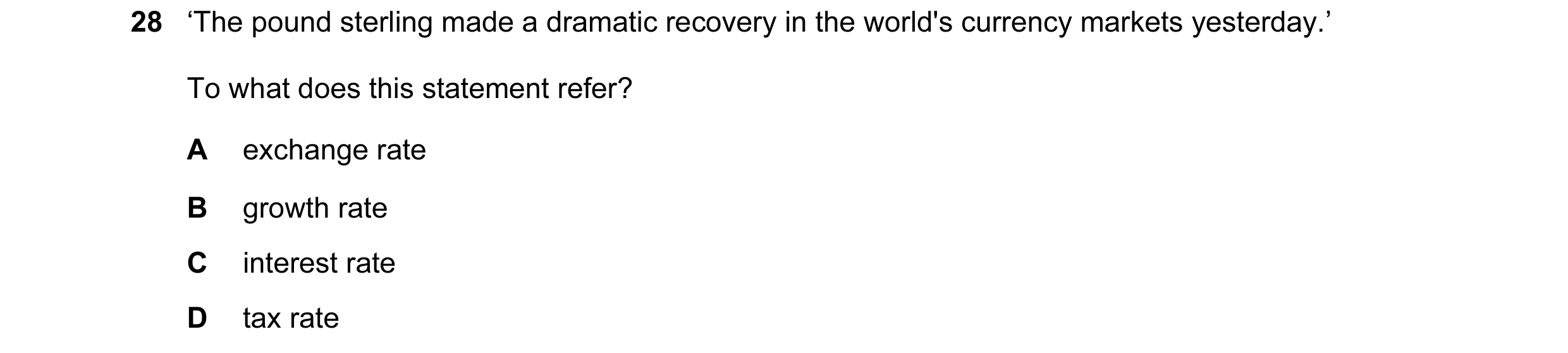
28 ‘The pound sterling made a dramatic recovery in the world's currency markets yesterday.’ To what does this statement refer? A exchange rate B growth rate C interest rate D tax rate
1 marks
Answer: A
This question in 0455/11 Oct/Nov 2004
Q2 · The table gives the price of a paperback book as printed on its back cover 0455/11 May/June 2006
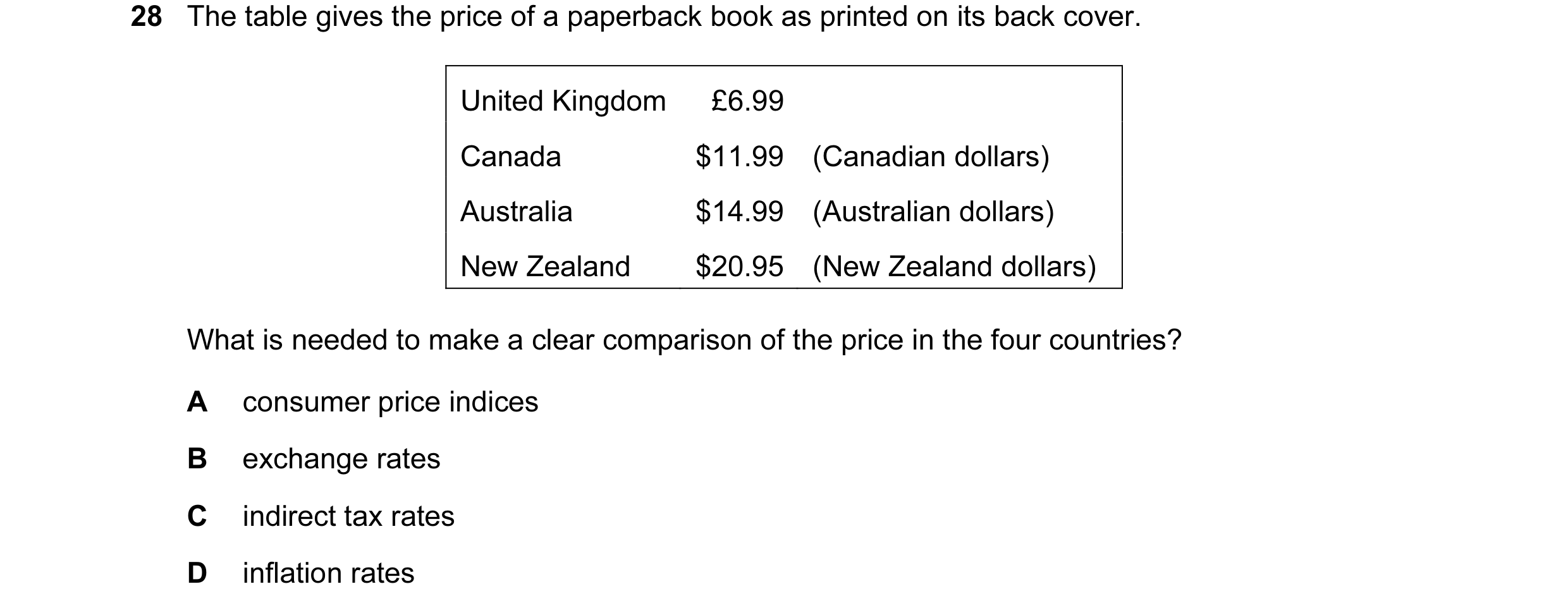
28 The table gives the price of a paperback book as printed on its back cover. United Kingdom £6.99 Canada $11.99 (Canadian dollars) Australia $14.99 (Australian dollars) New Zealand $20.95 (New Zealand dollars) What is needed to make a clear comparison of the price in the four countries? A consumer price indices B exchange rates C indirect tax rates D inflation rates
1 marks
Answer: B
This question in 0455/11 May/June 2006
Q3 · What would contribute to a fall in the value of the UK pound (£)? 0455/11 May/June 2006
30 What would contribute to a fall in the value of the UK pound (£)? A a fall in interest rates in other countries B a rise in the number of foreign tourists visiting the UK C the removal of import tariffs by the USA D the value of UK imports increasing more than the value of UK exports
1 marks
Answer: D
This question in 0455/11 May/June 2006
Q4 · What is meant by the depreciation of a currency? 0455/11 May/June 2006
31 What is meant by the depreciation of a currency? A a fall in its external value B a fall in its internal value C a rise in its external value D a rise in its internal value
1 marks
Answer: A
This question in 0455/11 May/June 2006
Q5 · The UK pound depreciates against the US dollar from £1 = $1.80 to £1 = $1.50 0455/11 Oct/Nov 2006
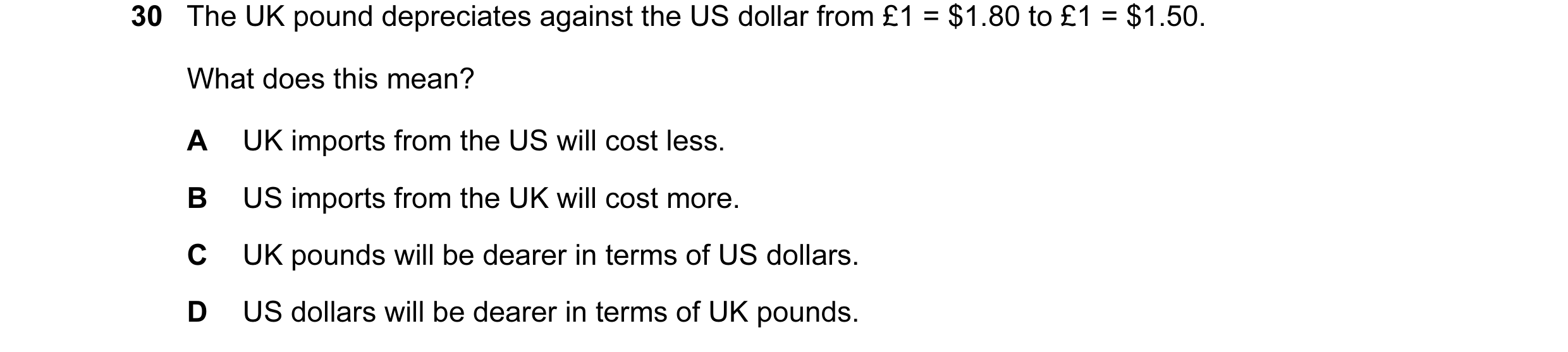
30 The UK pound depreciates against the US dollar from £1 = $1.80 to £1 = $1.50. What does this mean? A UK imports from the US will cost less. B US imports from the UK will cost more. C UK pounds will be dearer in terms of US dollars. D US dollars will be dearer in terms of UK pounds.
1 marks
Answer: D
This question in 0455/11 Oct/Nov 2006
Q6 · Two industries in Namibia are fishing and tourism 0455/11 May/June 2007
31 Two industries in Namibia are fishing and tourism. The value of the currency of Namibia fell in 2001. If there were no other changes, what resulted from the fall? A Imported goods in Namibian shops became cheaper. B The price of Namibia’s fish sold in foreign markets became cheaper. C The volume of Namibia’s exports decreased. D Tourists were discouraged by higher prices in Namibia.
1 marks
Answer: B
This question in 0455/11 May/June 2007
Q7 · ‘The pound sterling made a dramatic recovery in the world's currency markets yesterday.’… 0455/11 May/June 2008
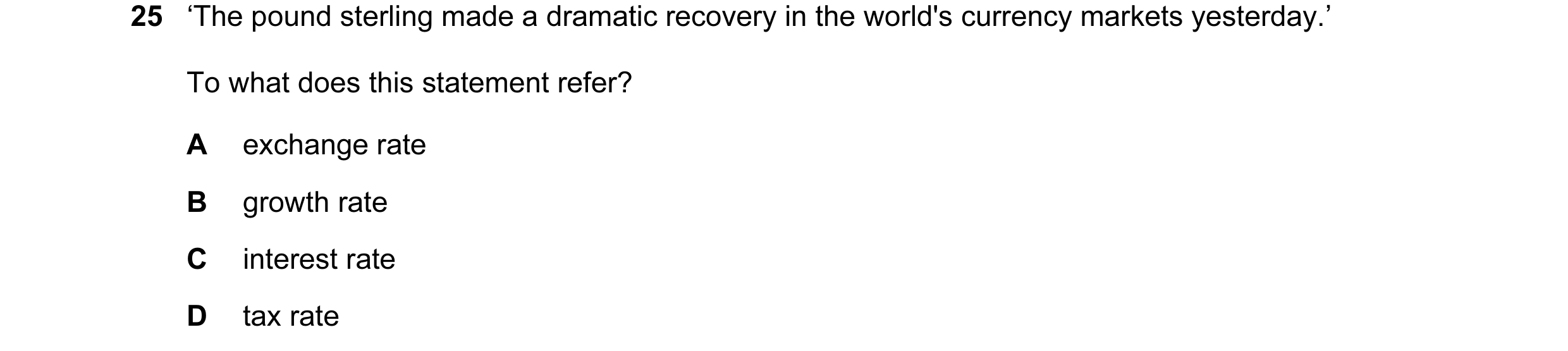
25 ‘The pound sterling made a dramatic recovery in the world's currency markets yesterday.’ To what does this statement refer? A exchange rate B growth rate C interest rate D tax rate
1 marks
Answer: A
This question in 0455/11 May/June 2008
Q8 · In an African country, large amounts of land were taken from farmers to make a national… 0455/11 May/June 2008
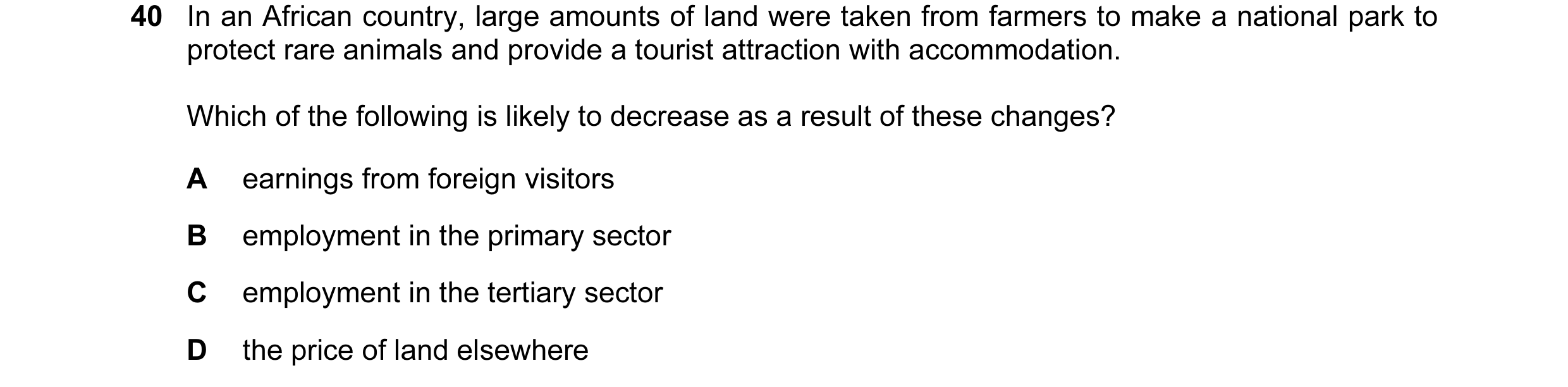
40 In an African country, large amounts of land were taken from farmers to make a national park to protect rare animals and provide a tourist attraction with accommodation. Which of the following is likely to decrease as a result of these changes? A earnings from foreign visitors B employment in the primary sector C employment in the tertiary sector D the price of land elsewhere
1 marks
Answer: B
This question in 0455/11 May/June 2008
Q9 · There was an increase in the value of the United States (US) dollar against the South… 0455/11 May/June 2010
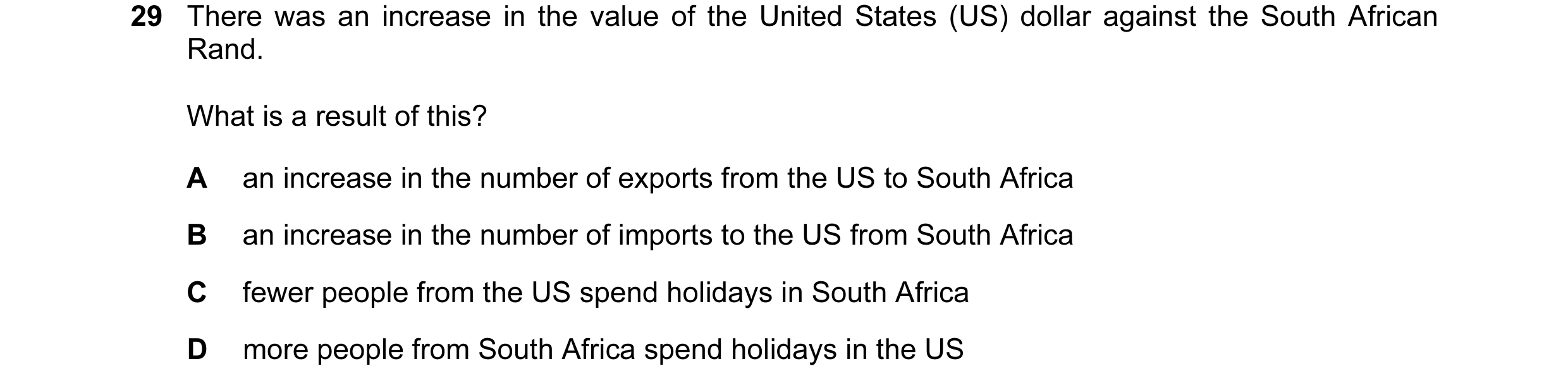
29 There was an increase in the value of the United States (US) dollar against the South African Rand. What is a result of this? A an increase in the number of exports from the US to South Africa B an increase in the number of imports to the US from South Africa C fewer people from the US spend holidays in South Africa D more people from South Africa spend holidays in the US
1 marks
Answer: B
This question in 0455/11 May/June 2010
Q10 · There was an increase in the value of the United States (US) dollar against the South… 0455/12 May/June 2010
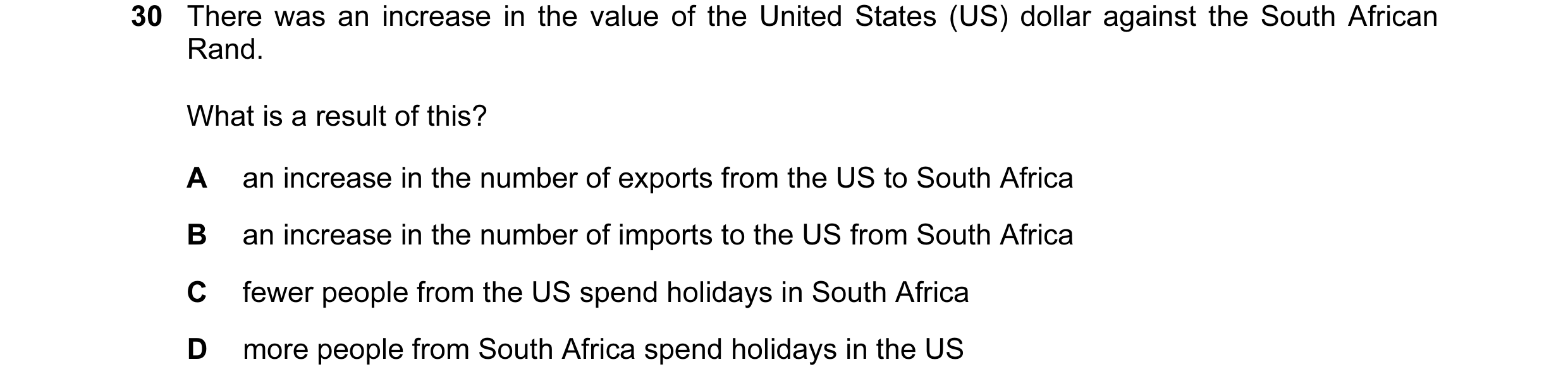
30 There was an increase in the value of the United States (US) dollar against the South African Rand. What is a result of this? A an increase in the number of exports from the US to South Africa B an increase in the number of imports to the US from South Africa C fewer people from the US spend holidays in South Africa D more people from South Africa spend holidays in the US
1 marks
Answer: B
This question in 0455/12 May/June 2010
Q11 · The table gives the retail price of a paperback book as printed on its back cover 0455/11 Oct/Nov 2011
30 The table gives the retail price of a paperback book as printed on its back cover. United Kingdom £6.99 Canada $11.99 (Canadian dollars) Australia $14.99 (Australian dollars) New Zealand $20.95 (New Zealand dollars) What is needed to make a clear comparison of the price in the four countries? A exchange rates B indirect tax rates C inflation rates D retail price indices
1 marks
Answer: A
This question in 0455/11 Oct/Nov 2011
Q12 · The table gives the retail price of a paperback book as printed on its back cover 0455/12 Oct/Nov 2011
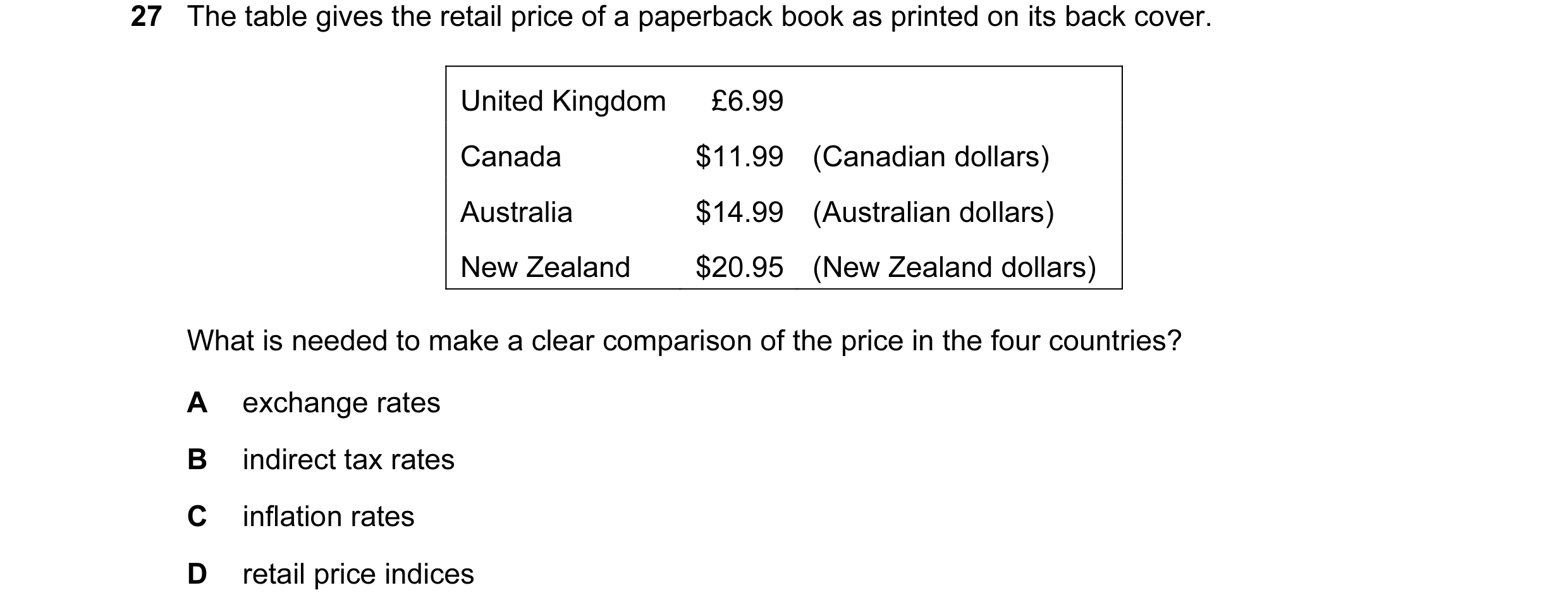
27 The table gives the retail price of a paperback book as printed on its back cover. United Kingdom £6.99 Canada $11.99 (Canadian dollars) Australia $14.99 (Australian dollars) New Zealand $20.95 (New Zealand dollars) What is needed to make a clear comparison of the price in the four countries? A exchange rates B indirect tax rates C inflation rates D retail price indices
1 marks
Answer: A
This question in 0455/12 Oct/Nov 2011
Q13 · The table gives the retail price of a paperback book as printed on its back cover 0455/13 Oct/Nov 2011
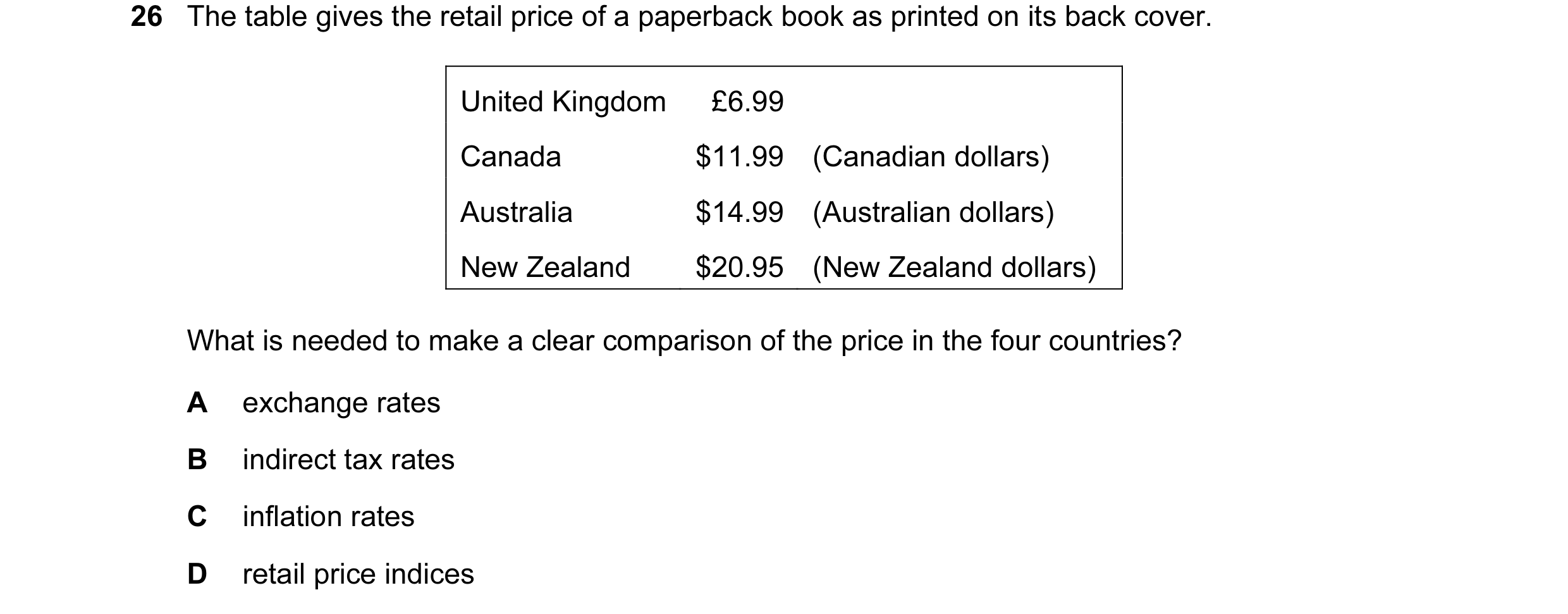
26 The table gives the retail price of a paperback book as printed on its back cover. United Kingdom £6.99 Canada $11.99 (Canadian dollars) Australia $14.99 (Australian dollars) New Zealand $20.95 (New Zealand dollars) What is needed to make a clear comparison of the price in the four countries? A exchange rates B indirect tax rates C inflation rates D retail price indices
1 marks
Answer: A
This question in 0455/13 Oct/Nov 2011
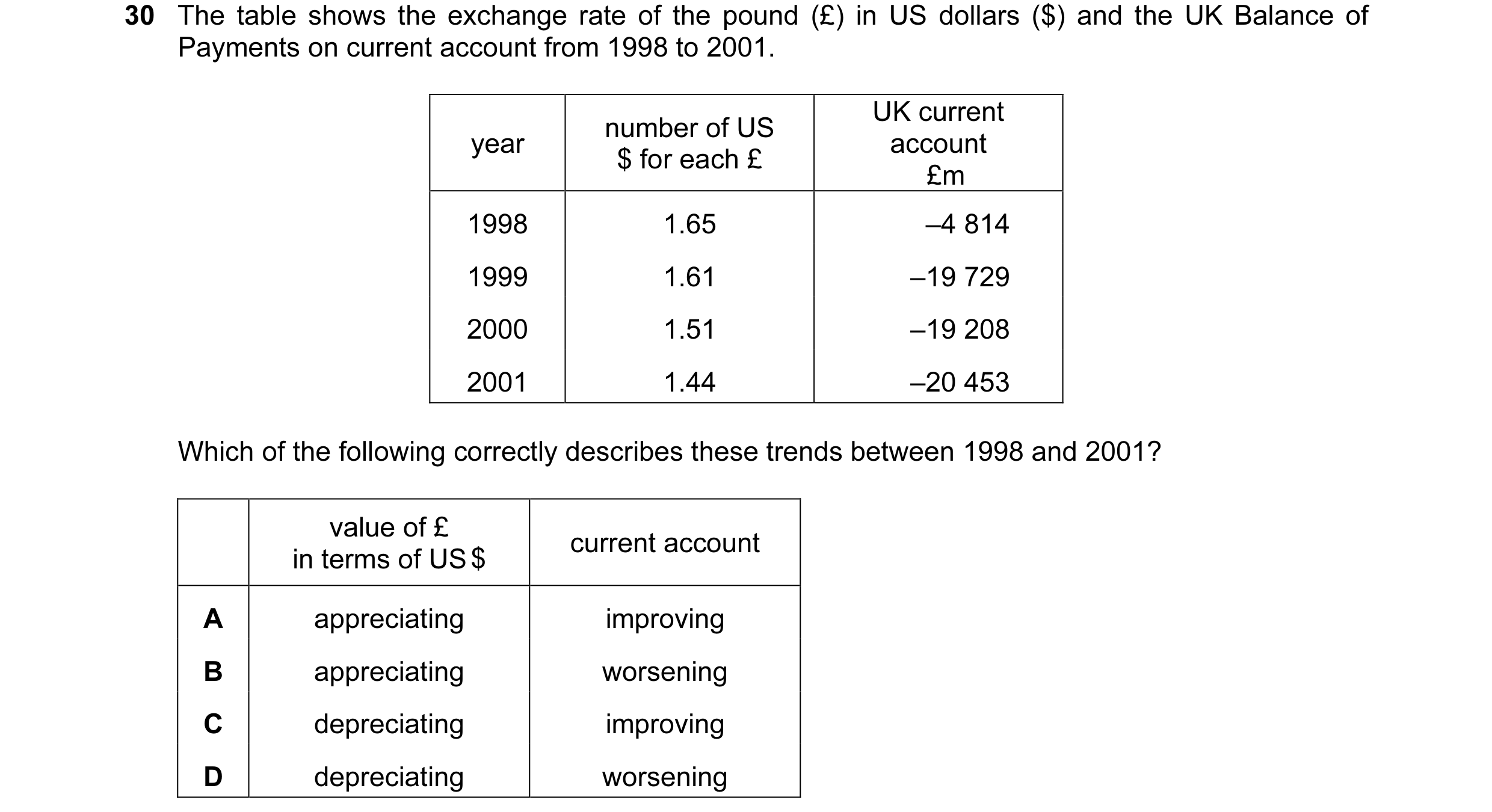
Q14 · The table shows the exchange rate of the pound (£) in US dollars ($) and the UK Balance… 0455/12 May/June 2012
30 The table shows the exchange rate of the pound (£) in US dollars ($) and the UK Balance of Payments on current account from 1998 to 2001. UK current number of US year account $ for each £ £m 1998 1.65 –4 814 1999 1.61 –19 729 2000 1.51 –19 208 2001 1.44 –20 453 Which of the following correctly describes these trends between 1998 and 2001? value of £ current account in terms of US $ A appreciating improving B appreciating worsening C depreciating improving D depreciating worsening
1 marks
Answer: D
This question in 0455/12 May/June 2012
Q15 · The table shows the exchange rate of the pound (£) in US dollars ($) and the UK Balance… 0455/13 May/June 2012
30 The table shows the exchange rate of the pound (£) in US dollars ($) and the UK Balance of Payments on current account from 1998 to 2001. UK current number of US year account $ for each £ £m 1998 1.65 –4 814 1999 1.61 –19 729 2000 1.51 –19 208 2001 1.44 –20 453 Which of the following correctly describes these trends between 1998 and 2001? value of £ current account in terms of US $ A appreciating improving B appreciating worsening C depreciating improving D depreciating worsening
1 marks
Answer: D
This question in 0455/13 May/June 2012
Q16 · The table gives the retail price of a paperback book as printed on its back cover 0455/11 May/June 2013
30 The table gives the retail price of a paperback book as printed on its back cover. United Kingdom £6.99 Canada $11.99 (Canadian dollars) Australia $14.99 (Australian dollars) New Zealand $20.95 (New Zealand dollars) What is needed to make a clear comparison of the price in the four countries? A direct tax rates B exchange rates C inflation rates D level of import tariffs
1 marks
Answer: B
This question in 0455/11 May/June 2013
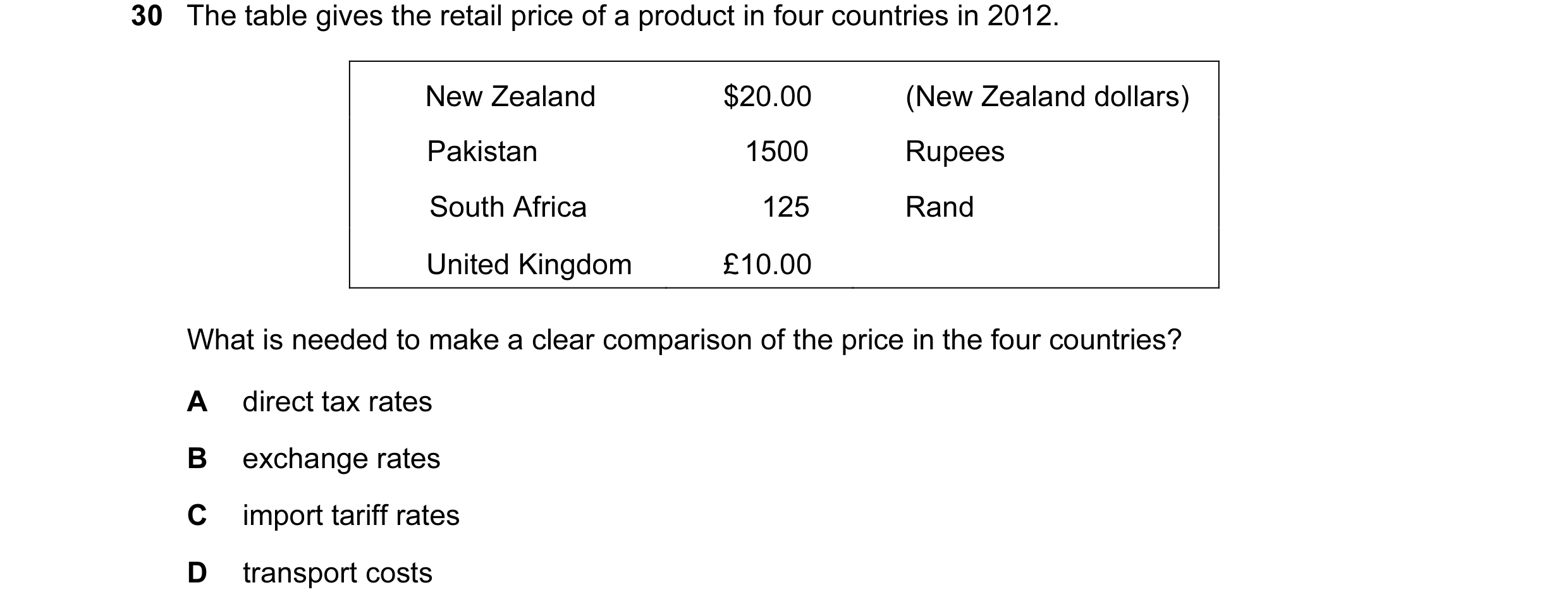
Q17 · The table gives the retail price of a product in four countries in 2012 0455/12 May/June 2013
30 The table gives the retail price of a product in four countries in 2012. New Zealand $20.00 (New Zealand dollars) Pakistan 1500 Rupees South Africa 125 Rand United Kingdom £10.00 What is needed to make a clear comparison of the price in the four countries? A direct tax rates B exchange rates C import tariff rates D transport costs
1 marks
Answer: B
This question in 0455/12 May/June 2013
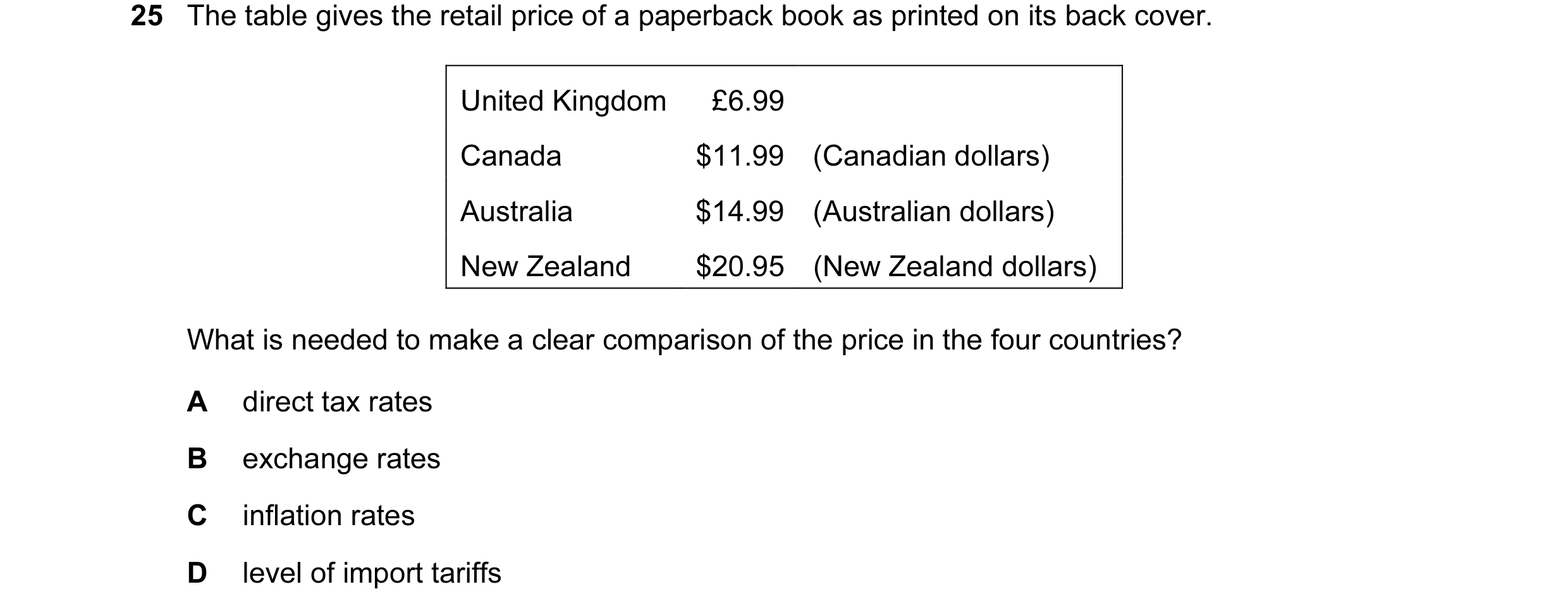
Q18 · The table gives the retail price of a paperback book as printed on its back cover 0455/13 May/June 2013
25 The table gives the retail price of a paperback book as printed on its back cover. United Kingdom £6.99 Canada $11.99 (Canadian dollars) Australia $14.99 (Australian dollars) New Zealand $20.95 (New Zealand dollars) What is needed to make a clear comparison of the price in the four countries? A direct tax rates B exchange rates C inflation rates D level of import tariffs
1 marks
Answer: B
This question in 0455/13 May/June 2013
Q19 · A developing country’s two major sources of income from international trade are fishing… 0455/11 Oct/Nov 2013
26 A developing country’s two major sources of income from international trade are fishing and tourism. If the country’s exchange rate depreciated, what is likely to happen? A Imported goods would become cheaper for local people. B The country would definitely become poorer. C The price of fish sold as exports would become cheaper. D Tourists to the country would be discouraged by higher prices.
1 marks
Answer: C
This question in 0455/11 Oct/Nov 2013
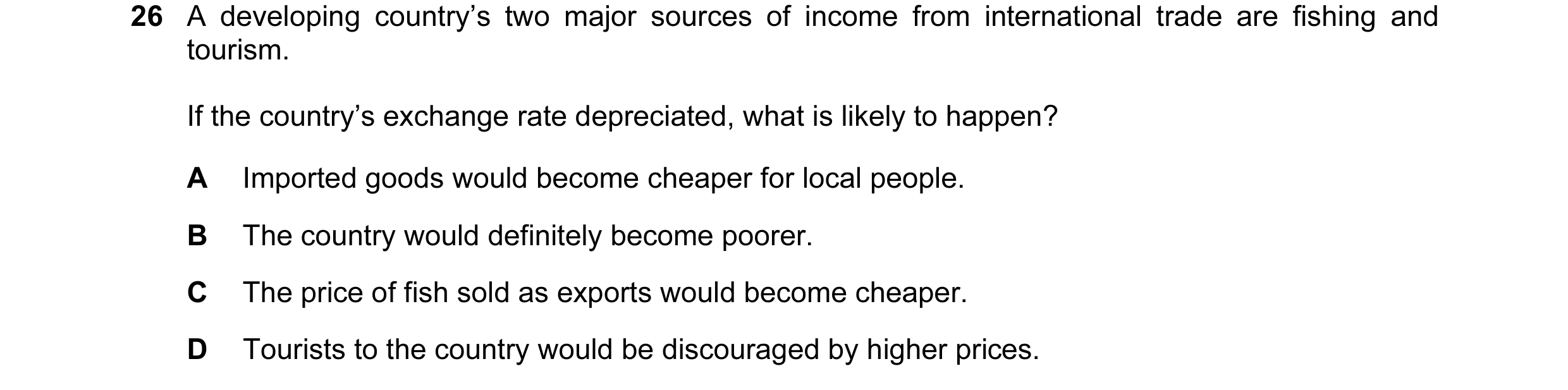
Q20 · A developing country’s two major sources of income from international trade are fishing… 0455/12 Oct/Nov 2013
26 A developing country’s two major sources of income from international trade are fishing and tourism. If the country’s exchange rate depreciated, what is likely to happen? A Imported goods would become cheaper for local people. B The country would definitely become poorer. C The price of fish sold as exports would become cheaper. D Tourists to the country would be discouraged by higher prices.
1 marks
Answer: C
This question in 0455/12 Oct/Nov 2013
Q21 · Which change will increase the demand for imports? 0455/11 Oct/Nov 2014
28 Which change will increase the demand for imports? A Consumer credit becomes more expensive. B Income tax rates increase. C The exchange rate appreciates. D The government increases tariffs.
1 marks
Answer: C
This question in 0455/11 Oct/Nov 2014
Q22 · When the US$ exchange rate falls it will usually A help to reduce a US trade deficit 0455/11 Oct/Nov 2014
30 When the US$ exchange rate falls it will usually A help to reduce a US trade deficit. B increase the foreign price of US exports. C reduce the price of US imports. D reduce US inflation.
1 marks
Answer: A
This question in 0455/11 Oct/Nov 2014
Q23 · When the US$ exchange rate falls it will usually A help to reduce a US trade deficit 0455/12 Oct/Nov 2014
28 When the US$ exchange rate falls it will usually A help to reduce a US trade deficit. B increase the foreign price of US exports. C reduce the price of US imports. D reduce US inflation.
1 marks
Answer: A
This question in 0455/12 Oct/Nov 2014
Q24 · Which change will increase the demand for imports? 0455/12 Oct/Nov 2014
29 Which change will increase the demand for imports? A Consumer credit becomes more expensive. B Income tax rates increase. C The exchange rate appreciates. D The government increases tariffs.
1 marks
Answer: C
This question in 0455/12 Oct/Nov 2014
Q25 · Which change would be most likely to cause an increase in the demand for the Turkish Lira? 0455/13 Oct/Nov 2014
28 Which change would be most likely to cause an increase in the demand for the Turkish Lira? A increased investments by Turkish firms in Italy B increased profits sent to France by French companies in Turkey C increased purchases of German chemicals by Turkish firms D increased speculation that the value of the Turkish Lira will rise in the future
1 marks
Answer: D
This question in 0455/13 Oct/Nov 2014
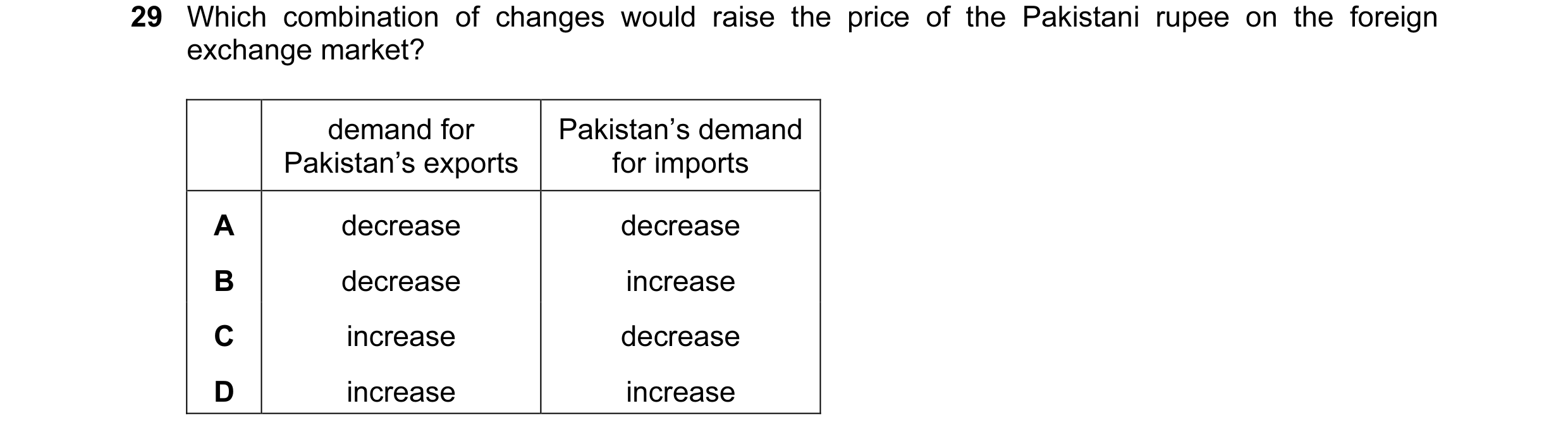
Q26 · Which combination of changes would raise the price of the Pakistani rupee on the foreign… 0455/13 May/June 2015
29 Which combination of changes would raise the price of the Pakistani rupee on the foreign exchange market? demand for Pakistan’s demand Pakistan’s exports for imports A decrease decrease B decrease increase C increase decrease D increase increase
1 marks
Answer: C
This question in 0455/13 May/June 2015
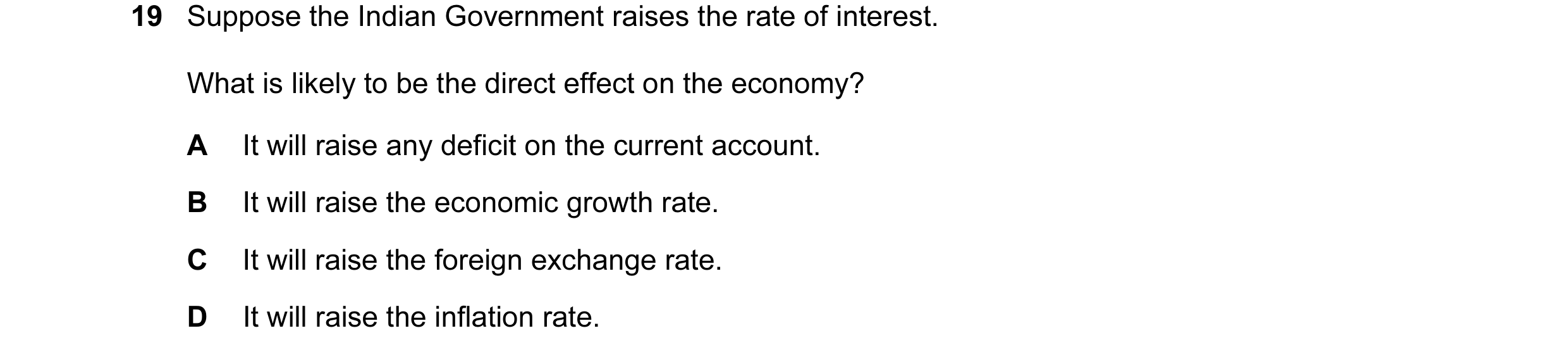
Q27 · Suppose the Indian Government raises the rate of interest 0455/12 Feb/March 2016
19 Suppose the Indian Government raises the rate of interest. What is likely to be the direct effect on the economy? A It will raise any deficit on the current account. B It will raise the economic growth rate. C It will raise the foreign exchange rate. D It will raise the inflation rate.
1 marks
Answer: C
This question in 0455/12 Feb/March 2016
Q28 · What is likely to cause a rise in a country’s foreign exchange rate? 0455/12 Feb/March 2016
27 What is likely to cause a rise in a country’s foreign exchange rate? A a fall in its exports of goods and services B a fall in its imports of goods and services C a fall in its inflow of income D a rise in its outflow of transfers
1 marks
Answer: B
This question in 0455/12 Feb/March 2016
Q29 · The US currently trades in oil with the UK 0455/12 May/June 2016
30 The US currently trades in oil with the UK. The discovery of new oil and gas deposits in the US will mean that its oil imports decrease and its oil exports increase. From the initial equilibrium point of X, which letter indicates the new equilibrium point for the US exchange rate? S1 B A S price of $ X S2 C D D1 D D2 O quantity of $
1 marks
Answer: B
This question in 0455/12 May/June 2016
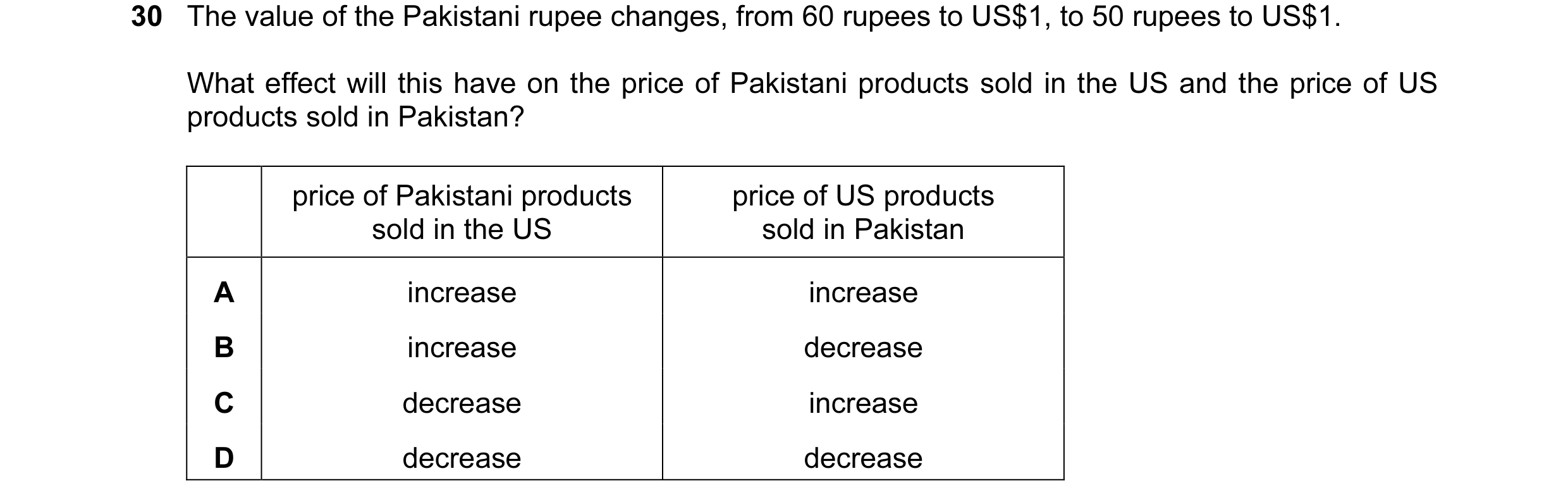
Q30 · The value of the Pakistani rupee changes, from 60 rupees to US$1, to 50 rupees to US$1 0455/13 May/June 2016
30 The value of the Pakistani rupee changes, from 60 rupees to US$1, to 50 rupees to US$1. What effect will this have on the price of Pakistani products sold in the US and the price of US products sold in Pakistan? price of Pakistani products price of US products sold in the US sold in Pakistan A increase increase B increase decrease C decrease increase D decrease decrease
1 marks
Answer: B
This question in 0455/13 May/June 2016
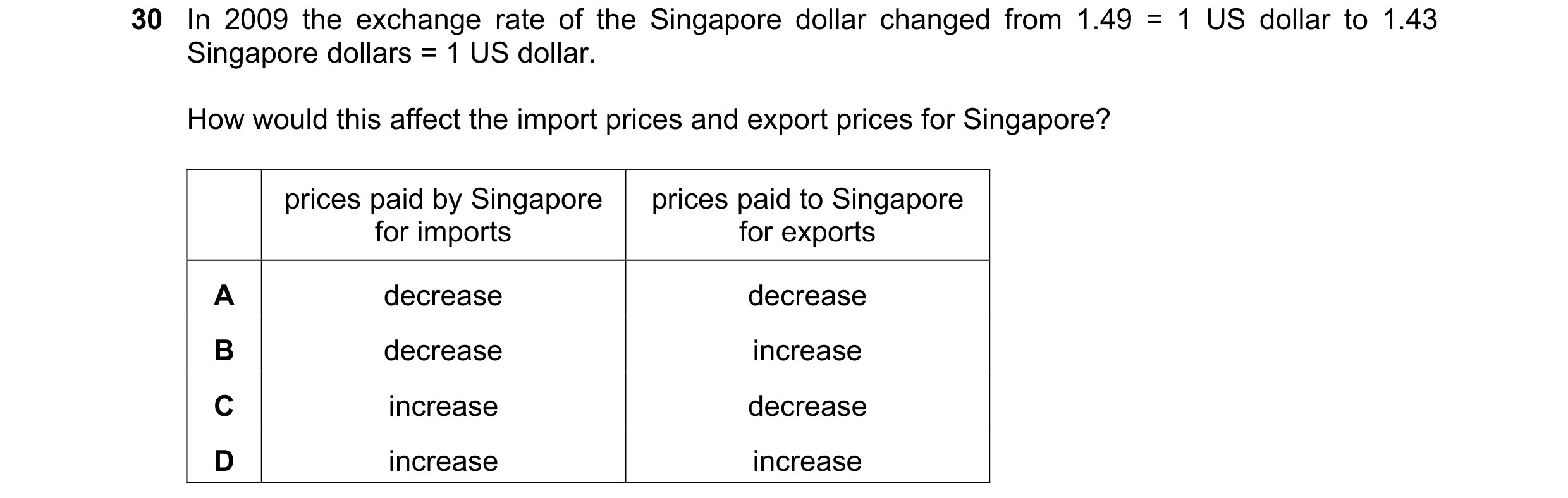
Q31 · In 2009 the exchange rate of the Singapore dollar changed from 1.49 = 1 US dollar to 1.43… 0455/13 Oct/Nov 2016
30 In 2009 the exchange rate of the Singapore dollar changed from 1.49 = 1 US dollar to 1.43 Singapore dollars = 1 US dollar. How would this affect the import prices and export prices for Singapore? prices paid by Singapore prices paid to Singapore for imports for exports A decrease decrease B decrease increase C increase decrease D increase increase
1 marks
Answer: B
This question in 0455/13 Oct/Nov 2016
Q32 · The diagram shows the market for the Indian rupee priced in US dollars 0455/12 Feb/March 2017
30 The diagram shows the market for the Indian rupee priced in US dollars. The equilibrium point is at X. If more Americans take holidays in India and fewer Indians buy American exports, in which sector of the diagram will the new equilibrium point for price and quantity of the Indian rupee be? S price of rupee (US$) A D B X C D O quantity of rupees
1 marks
Answer: A
This question in 0455/12 Feb/March 2017
Q33 · Which government policy is most likely to increase the volume of exports? 0455/11 May/June 2017
27 Which government policy is most likely to increase the volume of exports? A devaluation B embargoes C quotas D tariffs
1 marks
Answer: A
This question in 0455/11 May/June 2017
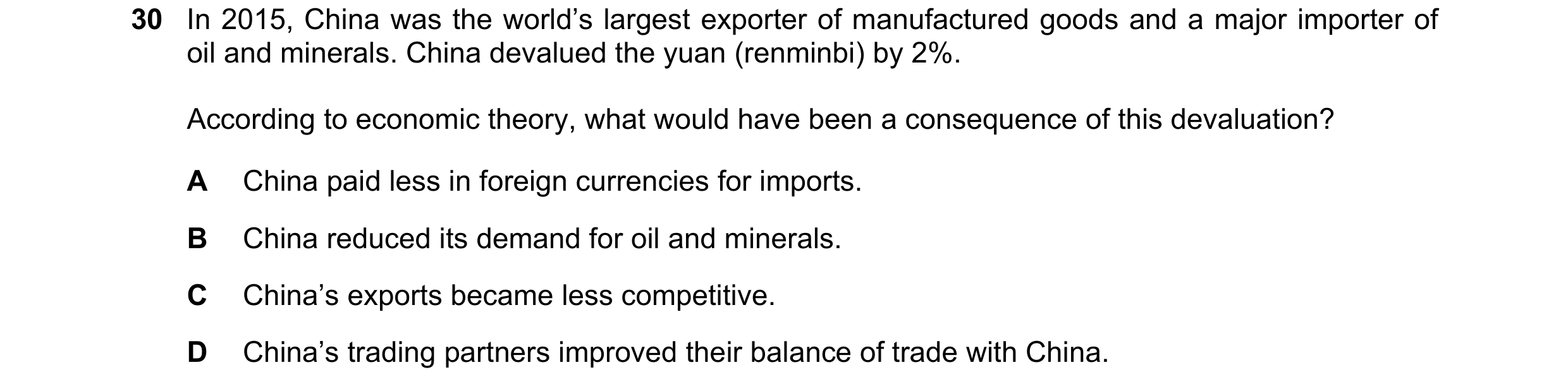
Q34 · In 2015, China was the world’s largest exporter of manufactured goods and a major… 0455/11 May/June 2017
30 In 2015, China was the world’s largest exporter of manufactured goods and a major importer of oil and minerals. China devalued the yuan (renminbi) by 2%. According to economic theory, what would have been a consequence of this devaluation? A China paid less in foreign currencies for imports. B China reduced its demand for oil and minerals. C China’s exports became less competitive. D China’s trading partners improved their balance of trade with China.
1 marks
Answer: B
This question in 0455/11 May/June 2017
Q35 · Which government policy is most likely to increase the volume of exports? 0455/12 May/June 2017
27 Which government policy is most likely to increase the volume of exports? A devaluation B embargoes C quotas D tariffs
1 marks
Answer: A
This question in 0455/12 May/June 2017
Q36 · Which government policy is most likely to increase the volume of exports? 0455/13 May/June 2017
27 Which government policy is most likely to increase the volume of exports? A devaluation B embargoes C quotas D tariffs
1 marks
Answer: A
This question in 0455/13 May/June 2017
Q37 · The currency exchange rate of the South African rand for the Botswana pula fell by 5.7%… 0455/13 May/June 2017
29 The currency exchange rate of the South African rand for the Botswana pula fell by 5.7% between August 2014 and August 2015. What would be the immediate effect of this? A Botswana’s level of protection would fall. B Botswana’s tourists travelling to South Africa would find it less expensive. C South Africa’s imports would be cheaper. D South Africa’s tourists travelling to Botswana would receive more pula per rand.
1 marks
Answer: B
This question in 0455/13 May/June 2017
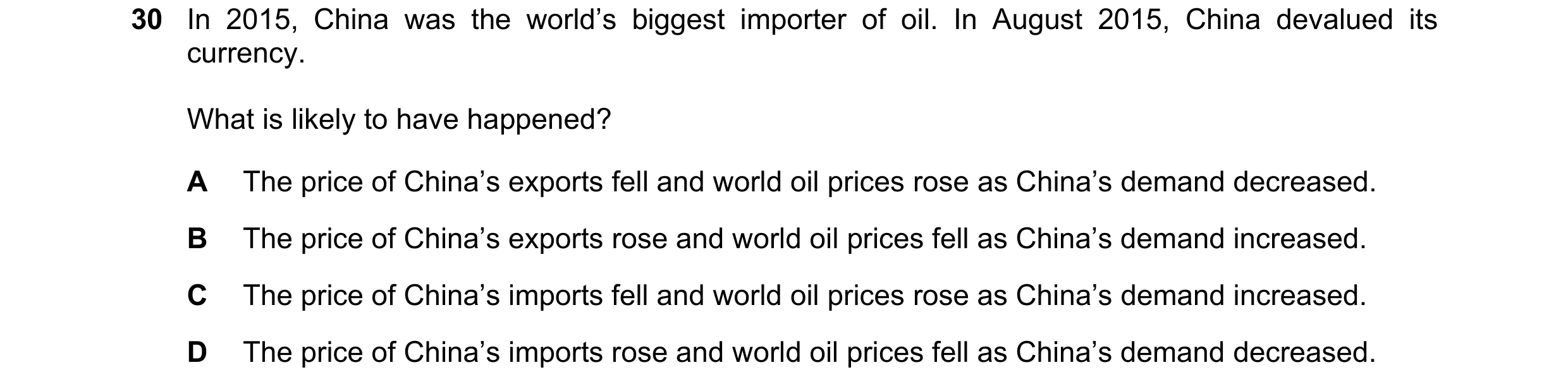
Q38 · In 2015, China was the world’s biggest importer of oil 0455/13 May/June 2017
30 In 2015, China was the world’s biggest importer of oil. In August 2015, China devalued its currency. What is likely to have happened? A The price of China’s exports fell and world oil prices rose as China’s demand decreased. B The price of China’s exports rose and world oil prices fell as China’s demand increased. C The price of China’s imports fell and world oil prices rose as China’s demand increased. D The price of China’s imports rose and world oil prices fell as China’s demand decreased.
1 marks
Answer: D
This question in 0455/13 May/June 2017
Q39 · What most accurately measures the international purchasing power of a currency? 0455/11 Oct/Nov 2017
24 What most accurately measures the international purchasing power of a currency? A the balance of payments B the exchange rate C the gross domestic product D the rate of inflation
1 marks
Answer: B
This question in 0455/11 Oct/Nov 2017
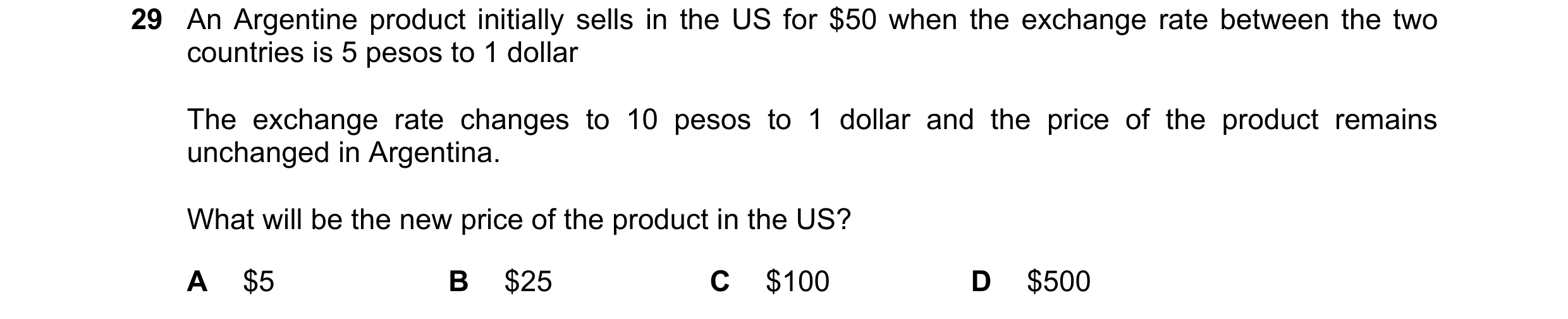
Q40 · An Argentine product initially sells in the US for $50 when the exchange rate between the… 0455/11 Oct/Nov 2017
29 An Argentine product initially sells in the US for $50 when the exchange rate between the two countries is 5 pesos to 1 dollar The exchange rate changes to 10 pesos to 1 dollar and the price of the product remains unchanged in Argentina. What will be the new price of the product in the US? A $5 B $25 C $100 D $500
1 marks
Answer: B
This question in 0455/11 Oct/Nov 2017
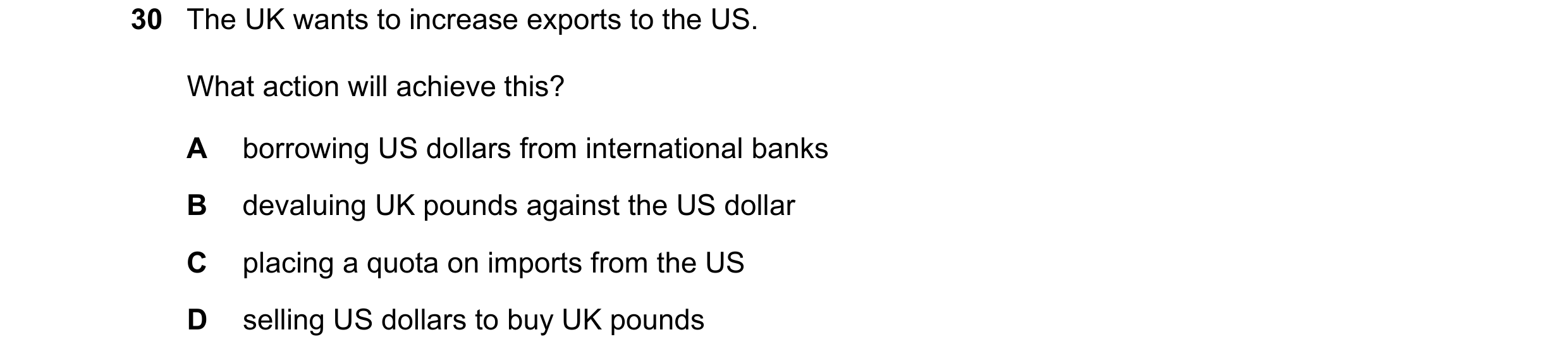
Q41 · The UK wants to increase exports to the US 0455/11 Oct/Nov 2017
30 The UK wants to increase exports to the US. What action will achieve this? A borrowing US dollars from international banks B devaluing UK pounds against the US dollar C placing a quota on imports from the US D selling US dollars to buy UK pounds
1 marks
Answer: B
This question in 0455/11 Oct/Nov 2017
Q42 · Which name is given to the external value of a currency in terms of another currency? 0455/12 Oct/Nov 2017
28 Which name is given to the external value of a currency in terms of another currency? A the balance of trade B the exchange rate C the relative inflation rate D the supply of money
1 marks
Answer: B
This question in 0455/12 Oct/Nov 2017
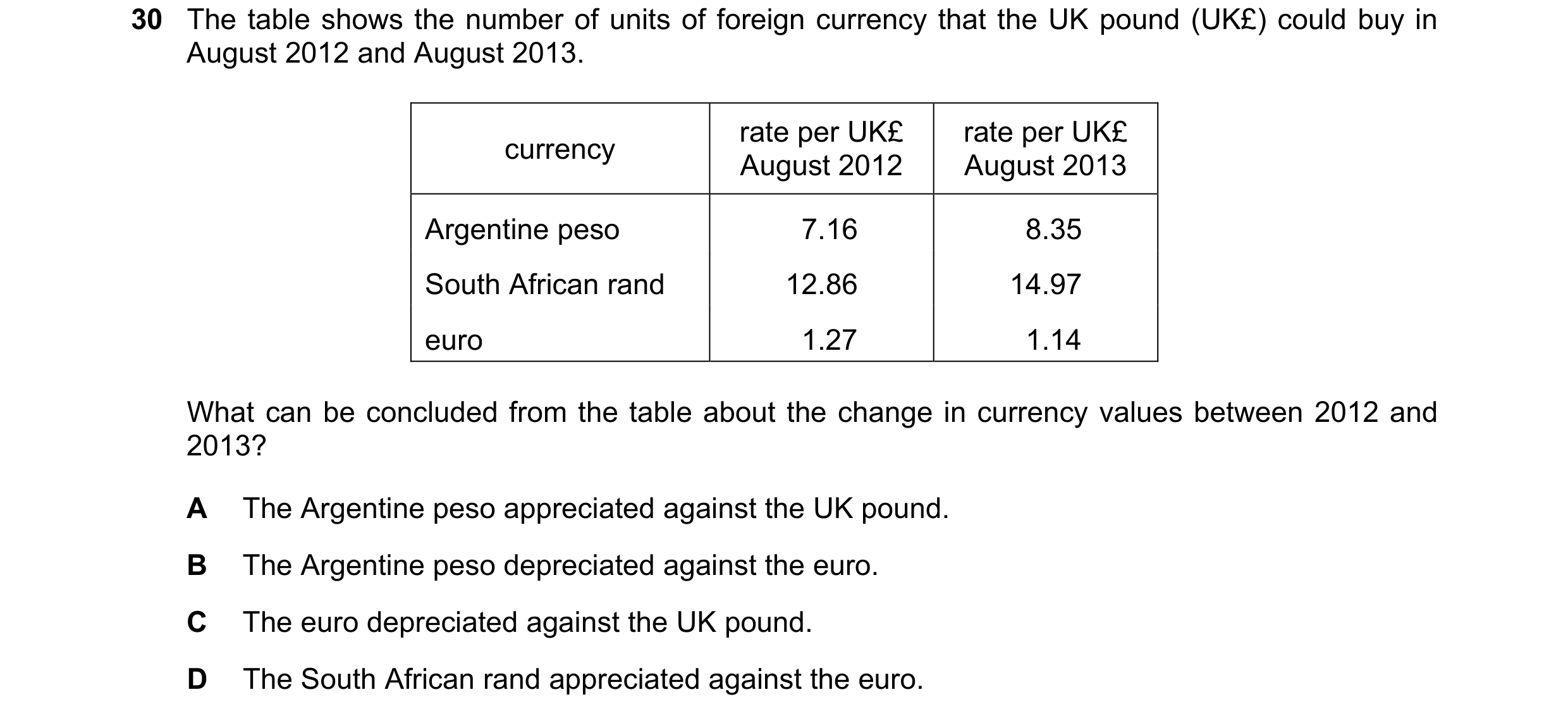
Q43 · The table shows the number of units of foreign currency that the UK pound (UK£) could buy… 0455/12 Oct/Nov 2017
30 The table shows the number of units of foreign currency that the UK pound (UK£) could buy in August 2012 and August 2013. rate per UK£ rate per UK£ currency August 2012 August 2013 Argentine peso 7.16 8.35 South African rand 12.86 14.97 euro 1.27 1.14 What can be concluded from the table about the change in currency values between 2012 and 2013? A The Argentine peso appreciated against the UK pound. B The Argentine peso depreciated against the euro. C The euro depreciated against the UK pound. D The South African rand appreciated against the euro.
1 marks
Answer: B
This question in 0455/12 Oct/Nov 2017
Q44 · What is an increase in the value of an exchange rate of a currency in a floating system… 0455/13 Oct/Nov 2017
28 What is an increase in the value of an exchange rate of a currency in a floating system called? A appreciation B depreciation C devaluation D revaluation
1 marks
Answer: A
This question in 0455/13 Oct/Nov 2017
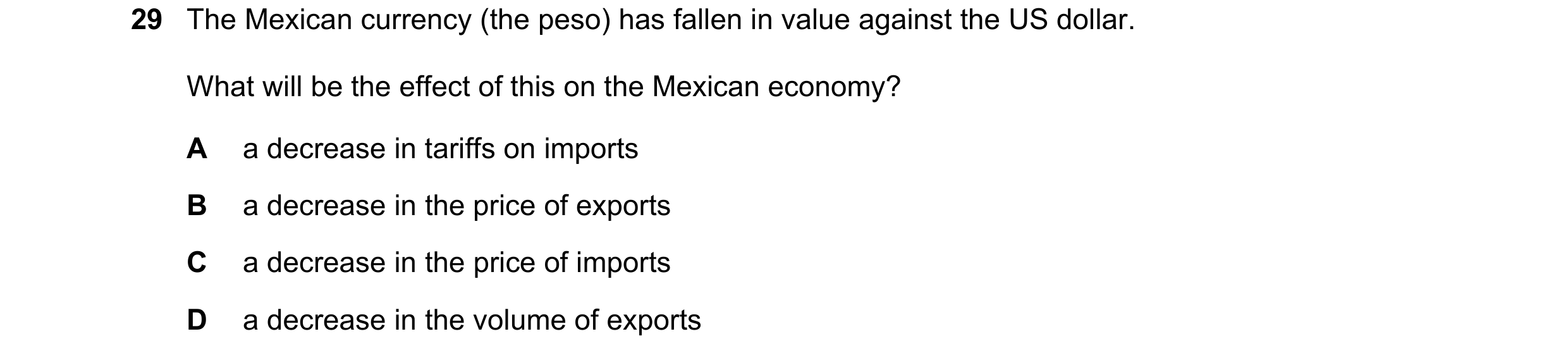
Q45 · The Mexican currency (the peso) has fallen in value against the US dollar 0455/11 May/June 2018
29 The Mexican currency (the peso) has fallen in value against the US dollar. What will be the effect of this on the Mexican economy? A a decrease in tariffs on imports B a decrease in the price of exports C a decrease in the price of imports D a decrease in the volume of exports
1 marks
Answer: B
This question in 0455/11 May/June 2018
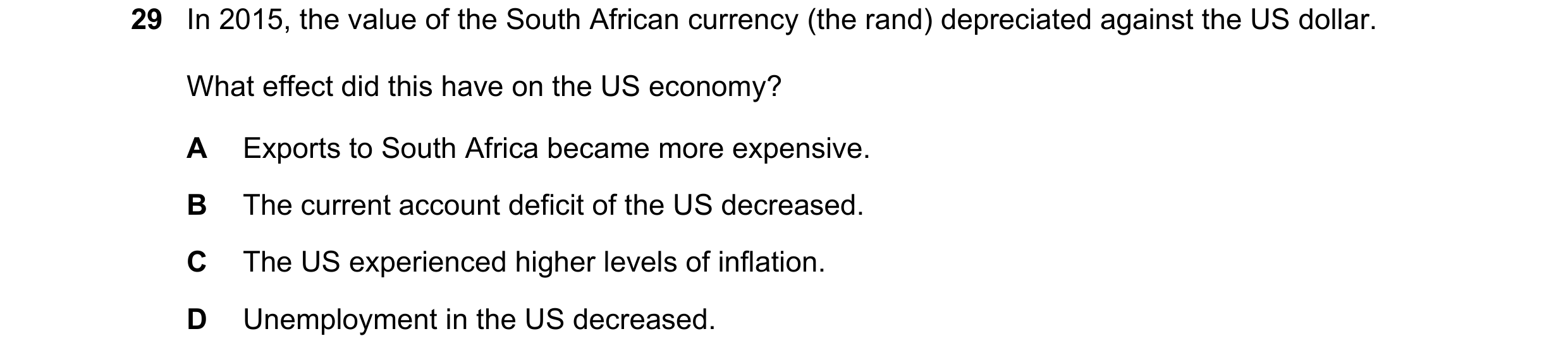
Q46 · In 2015, the value of the South African currency (the rand) depreciated against the US… 0455/12 May/June 2018
29 In 2015, the value of the South African currency (the rand) depreciated against the US dollar. What effect did this have on the US economy? A Exports to South Africa became more expensive. B The current account deficit of the US decreased. C The US experienced higher levels of inflation. D Unemployment in the US decreased.
1 marks
Answer: A
This question in 0455/12 May/June 2018
Q47 · A country has experienced a devaluation of its currency 0455/12 Oct/Nov 2018
29 A country has experienced a devaluation of its currency. What are the likely results of the devaluation? imports exports A price decreases value decreases B price decreases value increases C price increases quantity decreases D price increases quantity increases
1 marks
Answer: D
This question in 0455/12 Oct/Nov 2018
Q48 · What usually decreases when there is a depreciation of a country’s foreign exchange rate? 0455/12 Feb/March 2019
27 What usually decreases when there is a depreciation of a country’s foreign exchange rate? A the level of national debt B the level of trade protection C the price of exports D the price of imports
1 marks
Answer: C
This question in 0455/12 Feb/March 2019
Q49 · What is the most accurate definition of a foreign exchange rate? 0455/11 May/June 2019
28 What is the most accurate definition of a foreign exchange rate? A a rate at which exports are exchanged for imports B a rate determined by the demand and supply of the currency C a value of a currency as fixed by the government D a value of a currency expressed in terms of another currency
1 marks
Answer: D
This question in 0455/11 May/June 2019
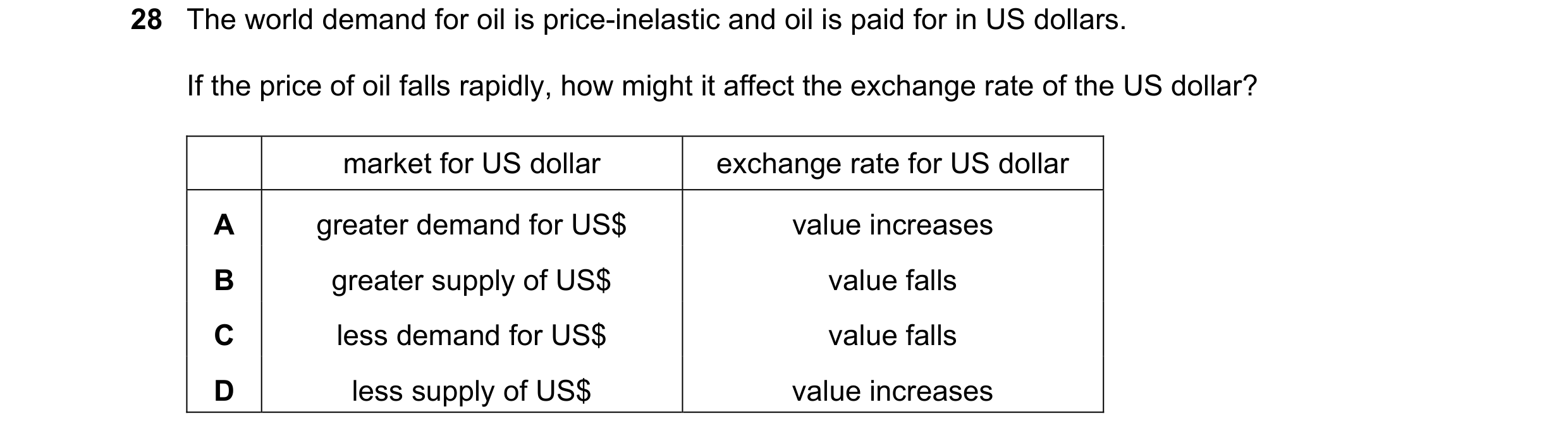
Q50 · The world demand for oil is price-inelastic and oil is paid for in US dollars 0455/12 May/June 2019
28 The world demand for oil is price-inelastic and oil is paid for in US dollars. If the price of oil falls rapidly, how might it affect the exchange rate of the US dollar? market for US dollar exchange rate for US dollar A greater demand for US$ value increases B greater supply of US$ value falls C less demand for US$ value falls D less supply of US$ value increases
1 marks
Answer: C
This question in 0455/12 May/June 2019
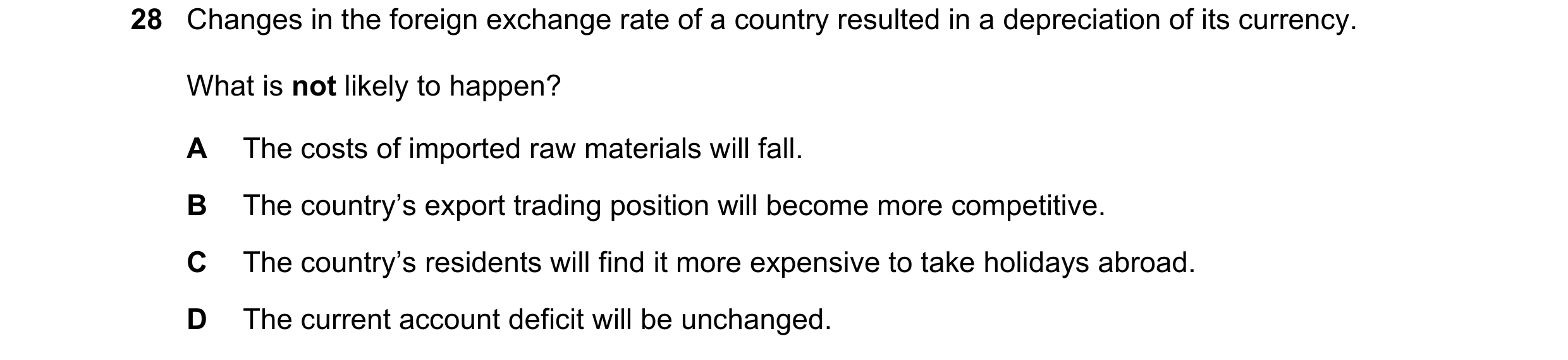
Q51 · Changes in the foreign exchange rate of a country resulted in a depreciation of its… 0455/13 May/June 2019
28 Changes in the foreign exchange rate of a country resulted in a depreciation of its currency. What is not likely to happen? A The costs of imported raw materials will fall. B The country’s export trading position will become more competitive. C The country’s residents will find it more expensive to take holidays abroad. D The current account deficit will be unchanged.
1 marks
Answer: A
This question in 0455/13 May/June 2019
Q52 · The table shows the current account balance for four countries in 2016 0455/11 Oct/Nov 2019
29 The table shows the current account balance for four countries in 2016. It also shows each country’s exchange rate against the US dollar for 2015 and 2016. Which country had a trade surplus and a strengthened currency against the US dollar? current number of units of currency country account balance against US dollar US$ billion 2016 2015 2016 A Australia –47.9 1.39 1.38 B Belgium +4.8 0.92 0.96 C China +266.6 6.48 6.95 D Taiwan +74.7 32.90 32.00
1 marks
Answer: D
This question in 0455/11 Oct/Nov 2019
Q53 · What would increase the demand for a country’s currency on the foreign exchange market? 0455/12 Feb/March 2020
28 What would increase the demand for a country’s currency on the foreign exchange market? A a decrease in its inward investment B a decrease in its rate of interest C an increase in its exports D an increase in its imports
1 marks
This question in 0455/12 Feb/March 2020
Q54 · There has been an appreciation of the value of a country’s currency against other… 0455/12 May/June 2020
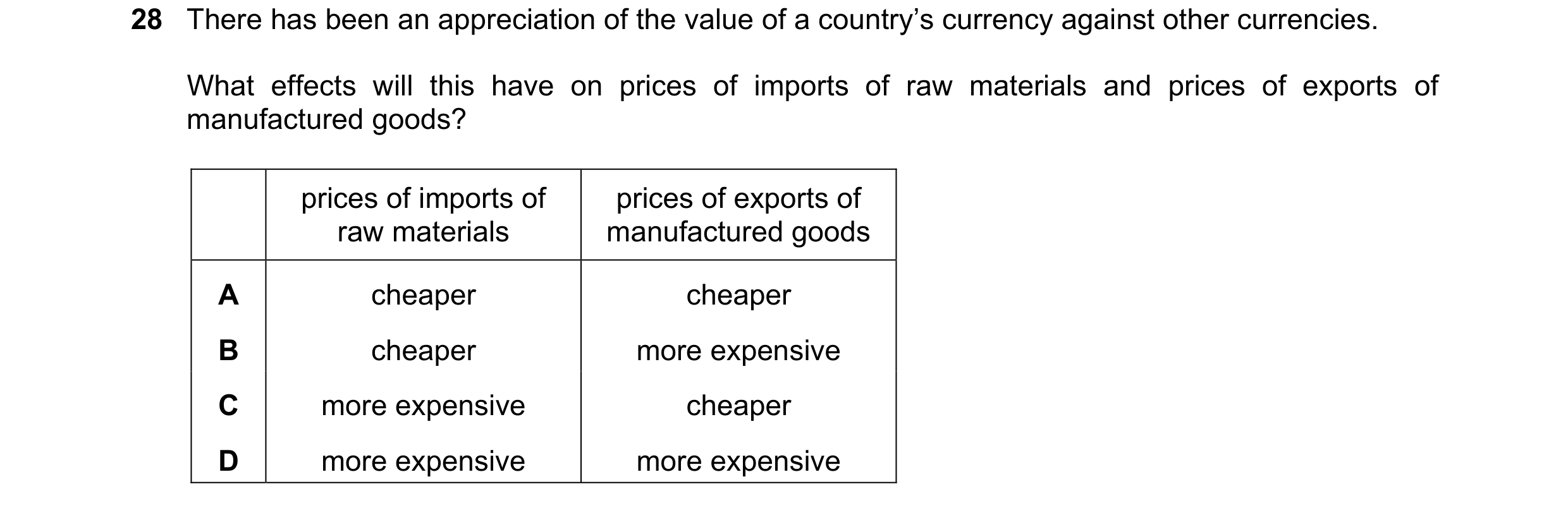
28 There has been an appreciation of the value of a country’s currency against other currencies. What effects will this have on prices of imports of raw materials and prices of exports of manufactured goods? prices of imports of prices of exports of raw materials manufactured goods A cheaper cheaper B cheaper more expensive C more expensive cheaper D more expensive more expensive
1 marks
Answer: B
This question in 0455/12 May/June 2020
Q55 · An economy with a floating exchange rate experiences an increased deficit on the current… 0455/13 May/June 2020
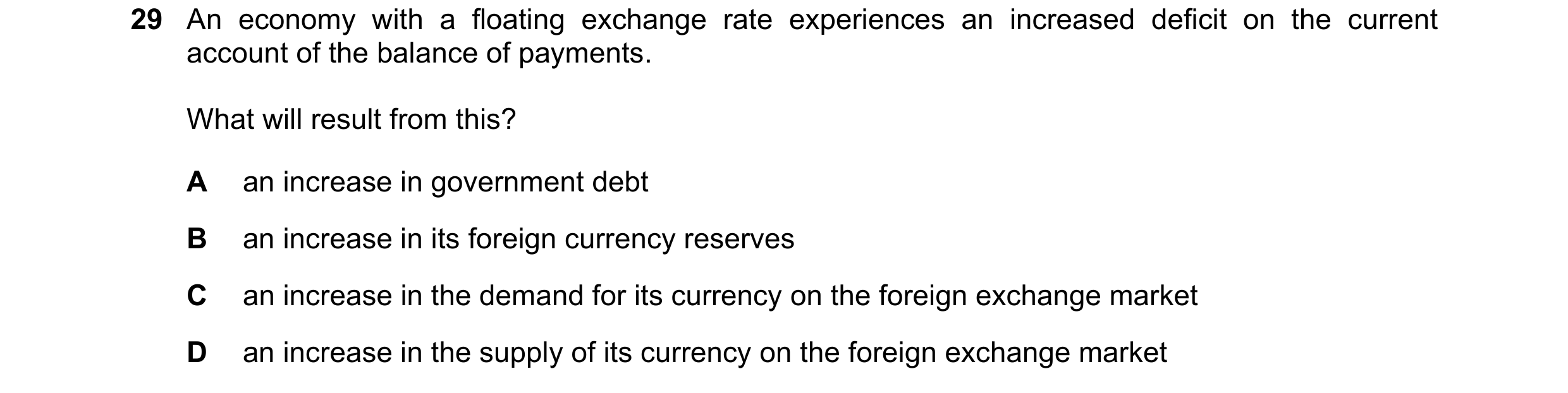
29 An economy with a floating exchange rate experiences an increased deficit on the current account of the balance of payments. What will result from this? A an increase in government debt B an increase in its foreign currency reserves C an increase in the demand for its currency on the foreign exchange market D an increase in the supply of its currency on the foreign exchange market
1 marks
Answer: D
This question in 0455/13 May/June 2020
Q56 · What is meant by a depreciation in the foreign exchange rate? 0455/11 Oct/Nov 2020
28 What is meant by a depreciation in the foreign exchange rate? A The government intervenes to reduce the exchange rate of the country’s currency. B The rate of exchange of exports for imports for a country deteriorates. C The rate of inflation in a country continues to rise. D The value of a country’s currency falls on the international exchange market.
1 marks
Answer: D
This question in 0455/11 Oct/Nov 2020
Q57 · A country has a current account deficit on its balance of payments 0455/12 Feb/March 2021
29 A country has a current account deficit on its balance of payments. Which measure is most likely to reduce the deficit? A a cut in interest rates B a cut in the rate of income tax C a depreciation of the exchange rate D an increase in government expenditure
1 marks
Answer: C
This question in 0455/12 Feb/March 2021
Q58 · A US car dealer agrees an import price of US$25 000 for a Japanese car at the current… 0455/11 May/June 2021
29 A US car dealer agrees an import price of US$25 000 for a Japanese car at the current rate of exchange. The US dollar then strengthens by 10% against the Japanese yen. What will be the new import price paid for the Japanese car? A US$20 000 B US$22 500 C US$25 000 D US$27 500
1 marks
Answer: B
This question in 0455/11 May/June 2021
Q59 · What may result from a balance of payments trade surplus? 0455/12 May/June 2021
29 What may result from a balance of payments trade surplus? A The exchange rate appreciates and causes export prices to fall. B The exchange rate appreciates and causes export prices to rise. C The exchange rate depreciates and causes export prices to fall. D The exchange rate depreciates and causes export prices to rise.
1 marks
Answer: B
This question in 0455/12 May/June 2021
Q60 · What does a foreign exchange rate between Malaysia and the US measure? 0455/13 May/June 2021
29 What does a foreign exchange rate between Malaysia and the US measure? A the cost of the Malaysian currency in the US currency B the difference in the cost of living between Malaysia and the US C the difference in the standard of living between Malaysia and the US D GDP of Malaysia divided by the GDP of the US
1 marks
Answer: A
This question in 0455/13 May/June 2021
Q61 · What is an immediate effect for a country of a fall in its foreign exchange rate? 0455/11 Oct/Nov 2021
30 What is an immediate effect for a country of a fall in its foreign exchange rate? A a fall in the money supply B an increase in purchasing power C cheaper imports D more competitive exports
1 marks
Answer: D
This question in 0455/11 Oct/Nov 2021
Q62 · What is an immediate effect for a country of a fall in its foreign exchange rate? 0455/12 Oct/Nov 2021
30 What is an immediate effect for a country of a fall in its foreign exchange rate? A a fall in the money supply B an increase in purchasing power C cheaper imports D more competitive exports
1 marks
Answer: D
This question in 0455/12 Oct/Nov 2021
Q63 · What is an immediate effect for a country of a fall in its foreign exchange rate? 0455/13 Oct/Nov 2021
30 What is an immediate effect for a country of a fall in its foreign exchange rate? A a fall in the money supply B an increase in purchasing power C cheaper imports D more competitive exports
1 marks
Answer: D
This question in 0455/13 Oct/Nov 2021
Q64 · What is the definition of foreign exchange rate? 0455/11 May/June 2022
27 What is the definition of foreign exchange rate? A the difference between emigration and immigration B the difference between the values of imports and exports C the price of one currency in terms of another D the price of one good in terms of another
1 marks
Answer: C
This question in 0455/11 May/June 2022
Q65 · The price of a currency in a fixed exchange rate system is reduced 0455/12 May/June 2022
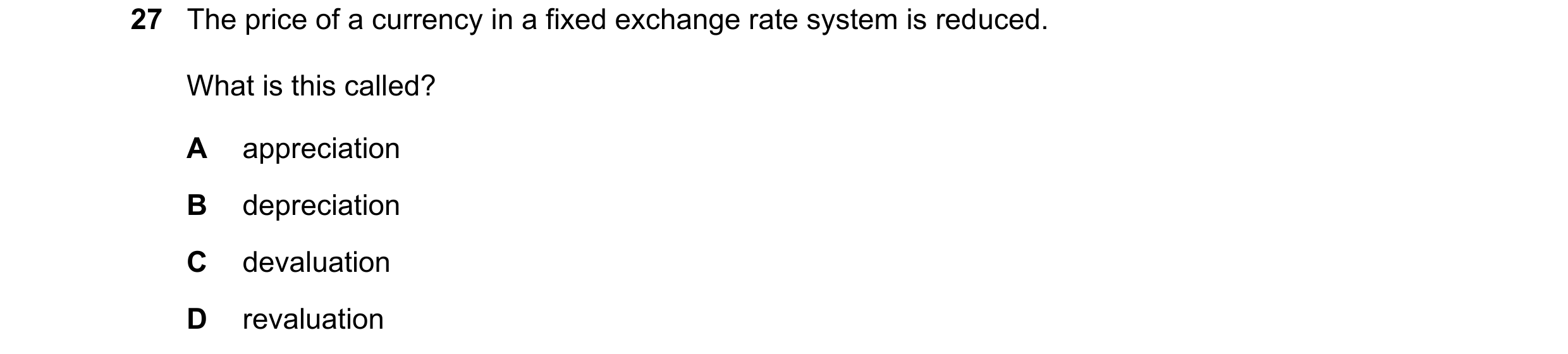
27 The price of a currency in a fixed exchange rate system is reduced. What is this called? A appreciation B depreciation C devaluation D revaluation
1 marks
Answer: C
This question in 0455/12 May/June 2022
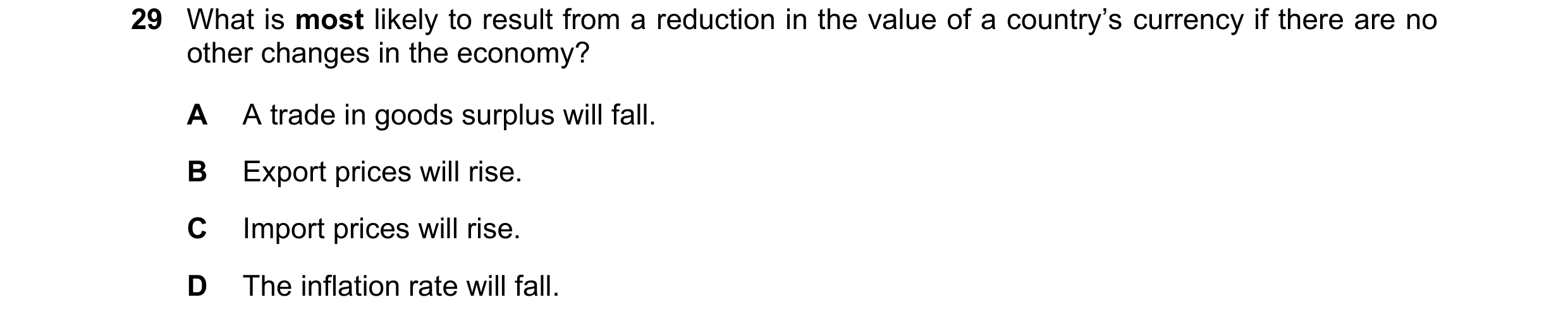
Q66 · What is most likely to result from a reduction in the value of a country’s currency if… 0455/12 May/June 2022
29 What is most likely to result from a reduction in the value of a country’s currency if there are no other changes in the economy? A A trade in goods surplus will fall. B Export prices will rise. C Import prices will rise. D The inflation rate will fall.
1 marks
Answer: C
This question in 0455/12 May/June 2022
Q67 · What is an advantage of a floating exchange rate for an economy? 0455/12 Feb/March 2023
29 What is an advantage of a floating exchange rate for an economy? A It can correct a current account deficit or surplus. B It creates certainty for firms importing goods. C It increases government control of the economy. D It stops money flows into and out of the economy.
1 marks
Answer: A
This question in 0455/12 Feb/March 2023
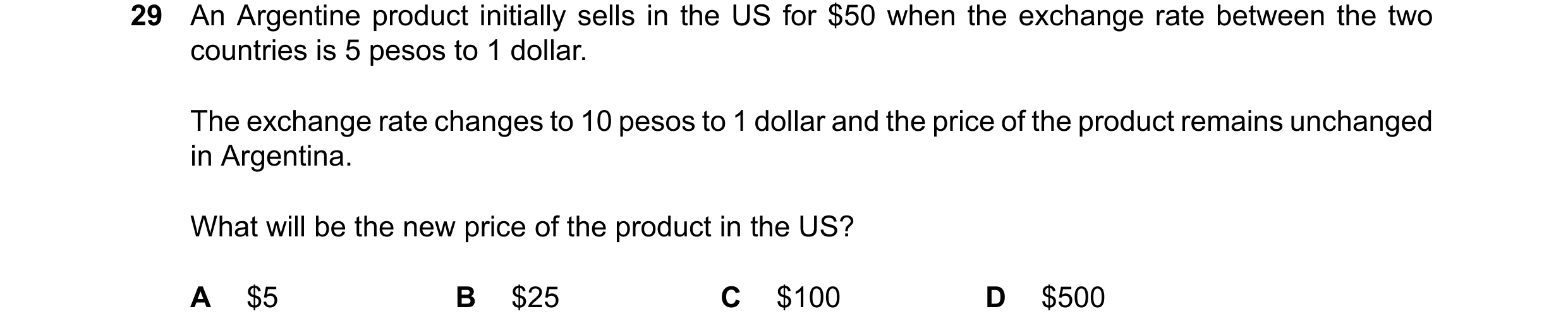
Q68 · An Argentine product initially sells in the US for $50 when the exchange rate between the… 0455/11 May/June 2023
29 An Argentine product initially sells in the US for $50 when the exchange rate between the two countries is 5 pesos to 1 dollar. The exchange rate changes to 10 pesos to 1 dollar and the price of the product remains unchanged in Argentina. What will be the new price of the product in the US? A $5 B $25 C $100 D $500
1 marks
Answer: B
This question in 0455/11 May/June 2023
Q69 · What would increase the demand for a country’s currency on the foreign exchange market? 0455/12 May/June 2023
29 What would increase the demand for a country’s currency on the foreign exchange market? A a decrease in its inward investment B a decrease in its rate of interest C an increase in its exports D an increase in its imports
1 marks
Answer: C
This question in 0455/12 May/June 2023
Q70 · Which government measure would lead directly to more exports of goods? 0455/13 May/June 2023
18 Which government measure would lead directly to more exports of goods? A a devaluation of the currency B a restriction of bank credit creation C an increase in the rate of interest D the issue of more bank notes and coins
1 marks
Answer: A
This question in 0455/13 May/June 2023
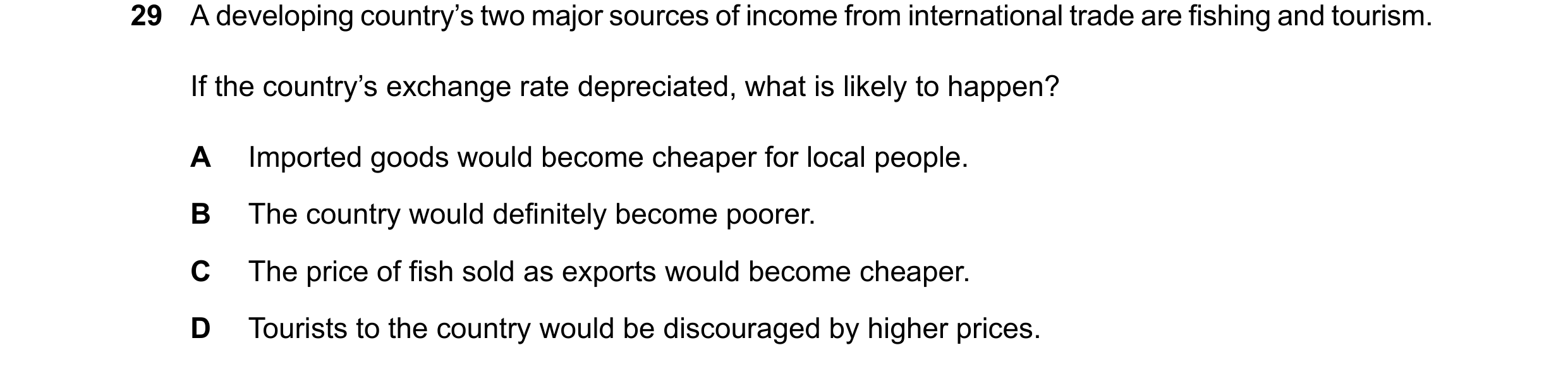
Q71 · A developing country’s two major sources of income from international trade are fishing… 0455/13 May/June 2023
29 A developing country’s two major sources of income from international trade are fishing and tourism. If the country’s exchange rate depreciated, what is likely to happen? A Imported goods would become cheaper for local people. B The country would definitely become poorer. C The price of fish sold as exports would become cheaper. D Tourists to the country would be discouraged by higher prices.
1 marks
Answer: C
This question in 0455/13 May/June 2023
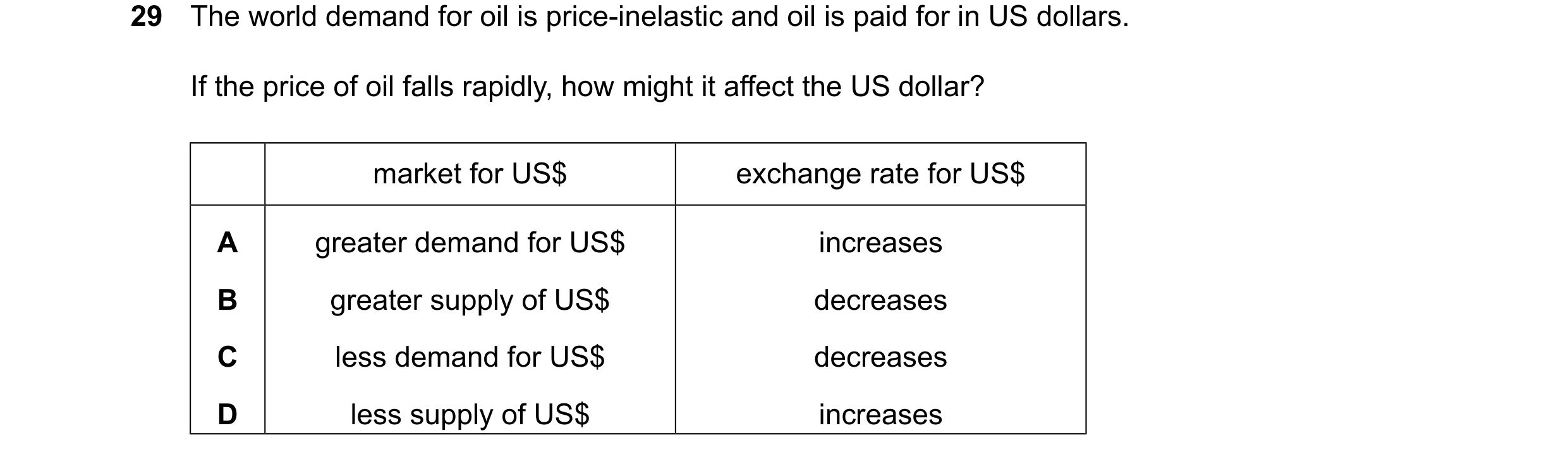
Q72 · The world demand for oil is price-inelastic and oil is paid for in US dollars 0455/11 Oct/Nov 2023
29 The world demand for oil is price-inelastic and oil is paid for in US dollars. If the price of oil falls rapidly, how might it affect the US dollar? market for US$ exchange rate for US$ A greater demand for US$ increases B greater supply of US$ decreases C less demand for US$ decreases D less supply of US$ increases
1 marks
Answer: C
This question in 0455/11 Oct/Nov 2023
Q73 · Why would devaluing the international value of an economy’s currency help reduce… 0455/12 Oct/Nov 2023
18 Why would devaluing the international value of an economy’s currency help reduce unemployment? A Devaluing the currency would increase the cost of production. B Devaluing the currency would increase the confidence of investors. C Devaluing the currency would increase the foreign demand for domestic products. D Devaluing the currency would increase the demand for imports.
1 marks
Answer: C
This question in 0455/12 Oct/Nov 2023
Q74 · Which factor would cause a country’s exchange rate to fall? 0455/12 Oct/Nov 2023
29 Which factor would cause a country’s exchange rate to fall? A Demand for imports increases. B Domestic interest rates rise. C Domestic savings increase. D More tourists visit the country.
1 marks
Answer: A
This question in 0455/12 Oct/Nov 2023
Q75 · A country’s foreign exchange rate appreciates significantly 0455/13 Oct/Nov 2023
29 A country’s foreign exchange rate appreciates significantly. Which group in the country will directly benefit from this change? A a government department which only buys locally made goods B retailers who get all their supplies from foreign producers C workers in local companies that compete with foreign firms in the local market D workers in local companies that sell only in foreign countries
1 marks
Answer: B
This question in 0455/13 Oct/Nov 2023
Q76 · The diagram shows the foreign exchange market for the Singapore dollar (S$) in exchange… 0455/12 Feb/March 2024
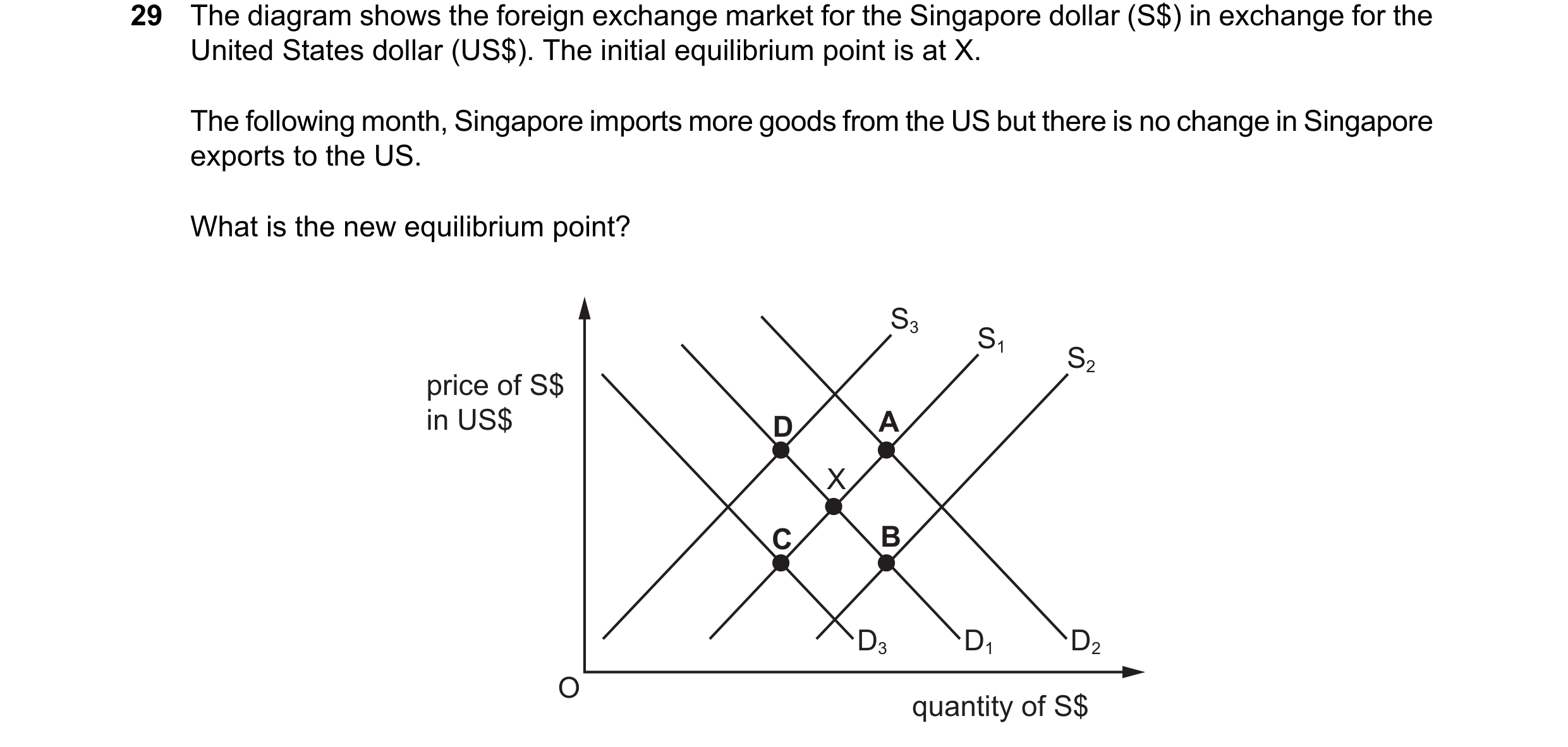
29 The diagram shows the foreign exchange market for the Singapore dollar (S$) in exchange for the United States dollar (US$). The initial equilibrium point is at X. The following month, Singapore imports more goods from the US but there is no change in Singapore exports to the US. What is the new equilibrium point? S3 S1 S2 price of S$ in US$ D A X C B D3 D1 D2 O quantity of S$
1 marks
Answer: B
This question in 0455/12 Feb/March 2024
Q77 · The diagram shows the market for the Chinese yuan (¥) priced in US dollars ($) 0455/12 May/June 2024
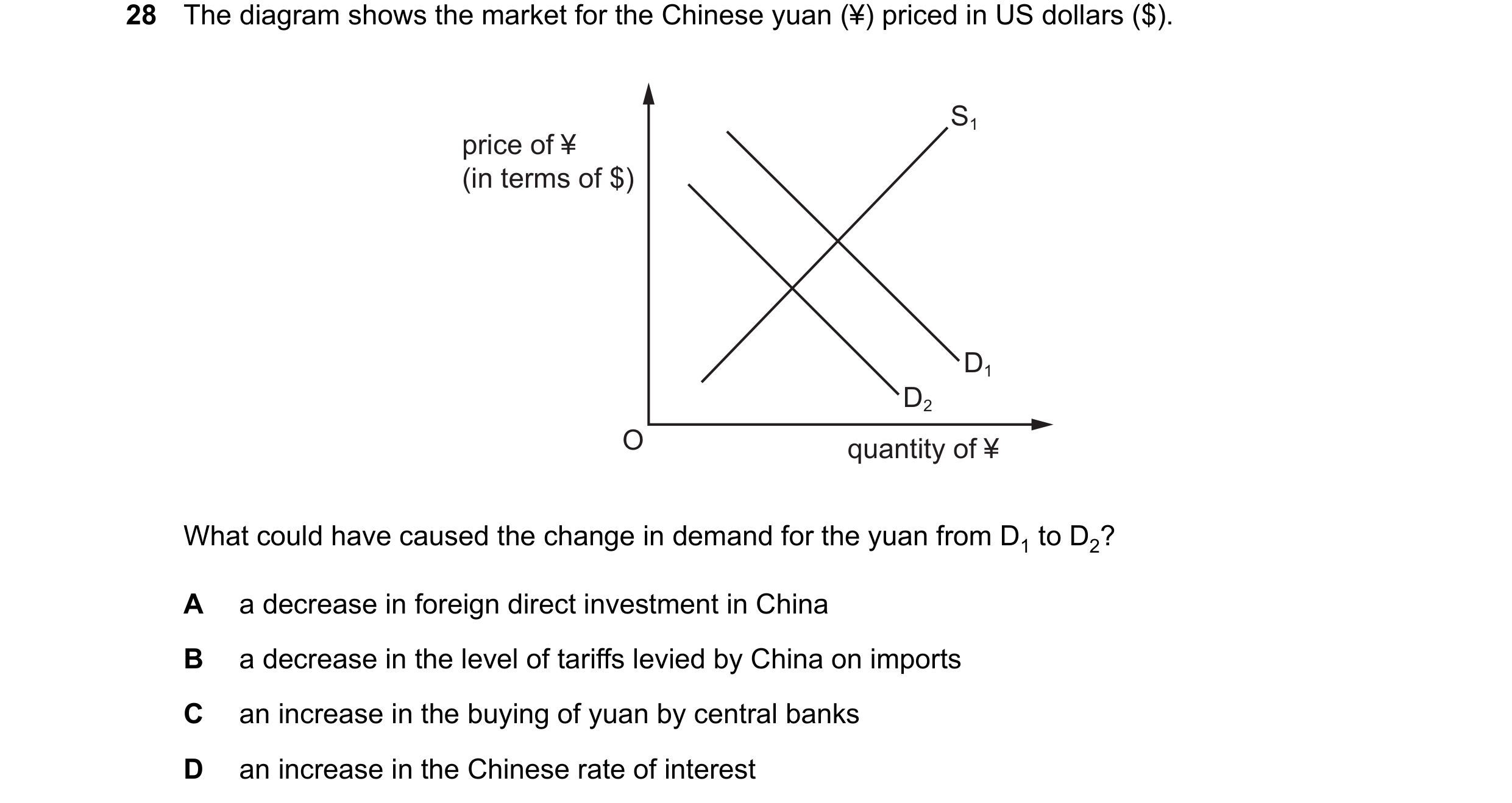
28 The diagram shows the market for the Chinese yuan (¥) priced in US dollars ($). S1 price of ¥ (in terms of $) D1 D2 O quantity of ¥ What could have caused the change in demand for the yuan from D1 to D2? A a decrease in foreign direct investment in China B a decrease in the level of tariffs levied by China on imports C an increase in the buying of yuan by central banks D an increase in the Chinese rate of interest
1 marks
Answer: A
This question in 0455/12 May/June 2024
Q78 · The table shows the average exchange rate of the UK pound (£) to the US dollar ($), that… 0455/12 May/June 2024
29 The table shows the average exchange rate of the UK pound (£) to the US dollar ($), that is the amount of $ that can be bought with £1. exchange rate year UK£ / US$ 1 1.64 2 1.52 3 1.35 4 1.25 What is a likely effect of this change on the UK economy? A decreased cost-push inflation B decreased current account deficit C increased quantity of imports D increased trade deficit
1 marks
Answer: B
This question in 0455/12 May/June 2024
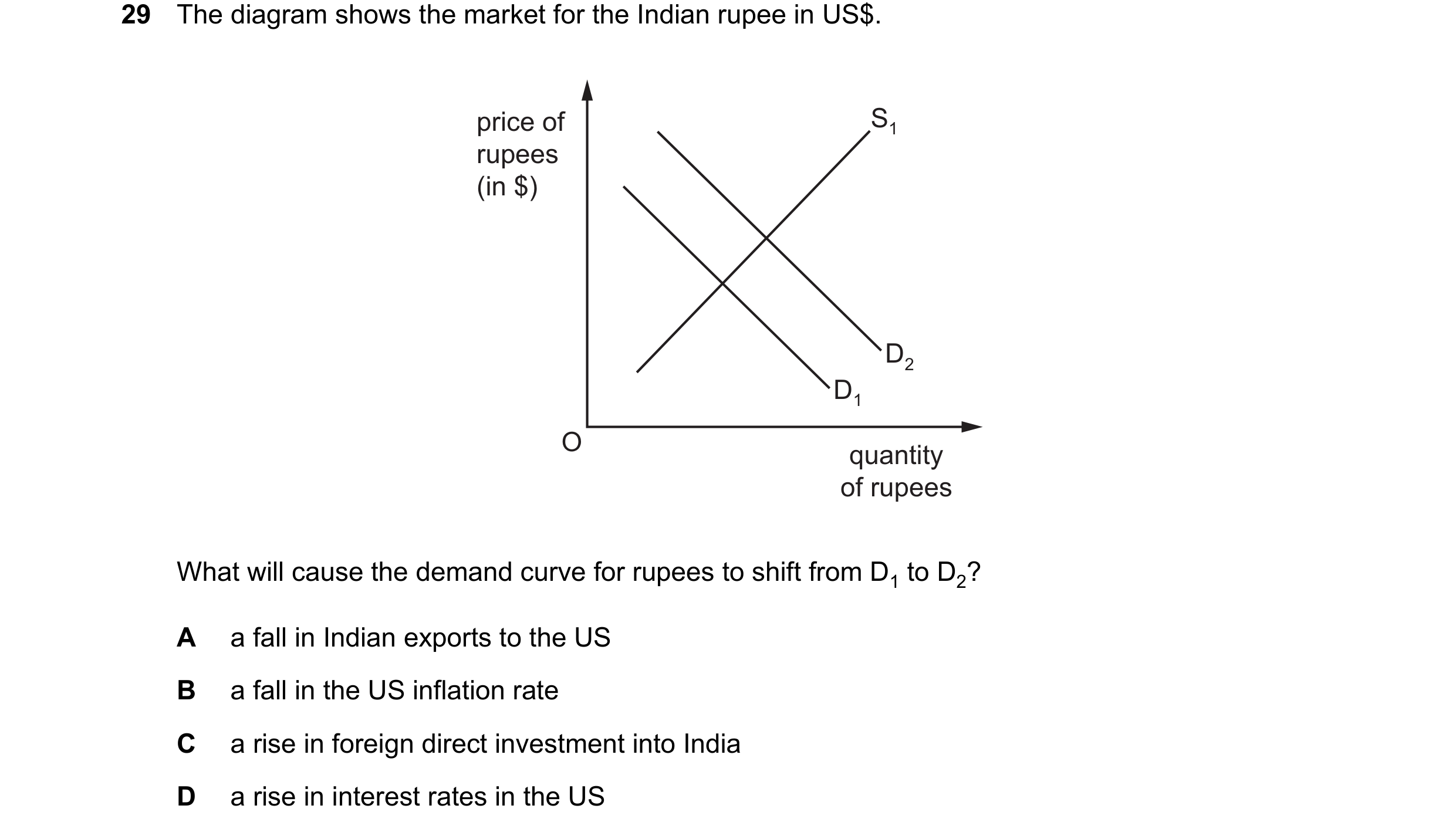
Q79 · The diagram shows the market for the Indian rupee in US$ 0455/13 May/June 2024
29 The diagram shows the market for the Indian rupee in US$. price of S1 rupees (in $) D2 D1 O quantity of rupees What will cause the demand curve for rupees to shift from D1 to D2? A a fall in Indian exports to the US B a fall in the US inflation rate C a rise in foreign direct investment into India D a rise in interest rates in the US
1 marks
Answer: C
This question in 0455/13 May/June 2024
Q80 · The diagram shows the change in the exchange rate market for country X’s $ 0455/11 Oct/Nov 2024
29 The diagram shows the change in the exchange rate market for country X’s $. S exchange rate D2 D1 O quantity of $ Which change in country X would have caused this? A a fall in its international competitiveness B a fall in its level of interest rates C a rise in its exports of services D a rise in its imports of goods
1 marks
Answer: C
This question in 0455/11 Oct/Nov 2024
Q81 · To what does this statement refer? 0455/12 Oct/Nov 2024
29 To what does this statement refer? A an alternative method of trade protection B the determination of the exchange rate in a fixed exchange rate system C the determination of the exchange rate in a floating exchange rate system D the increasing globalisation of international trade
1 marks
Answer: C
This question in 0455/12 Oct/Nov 2024
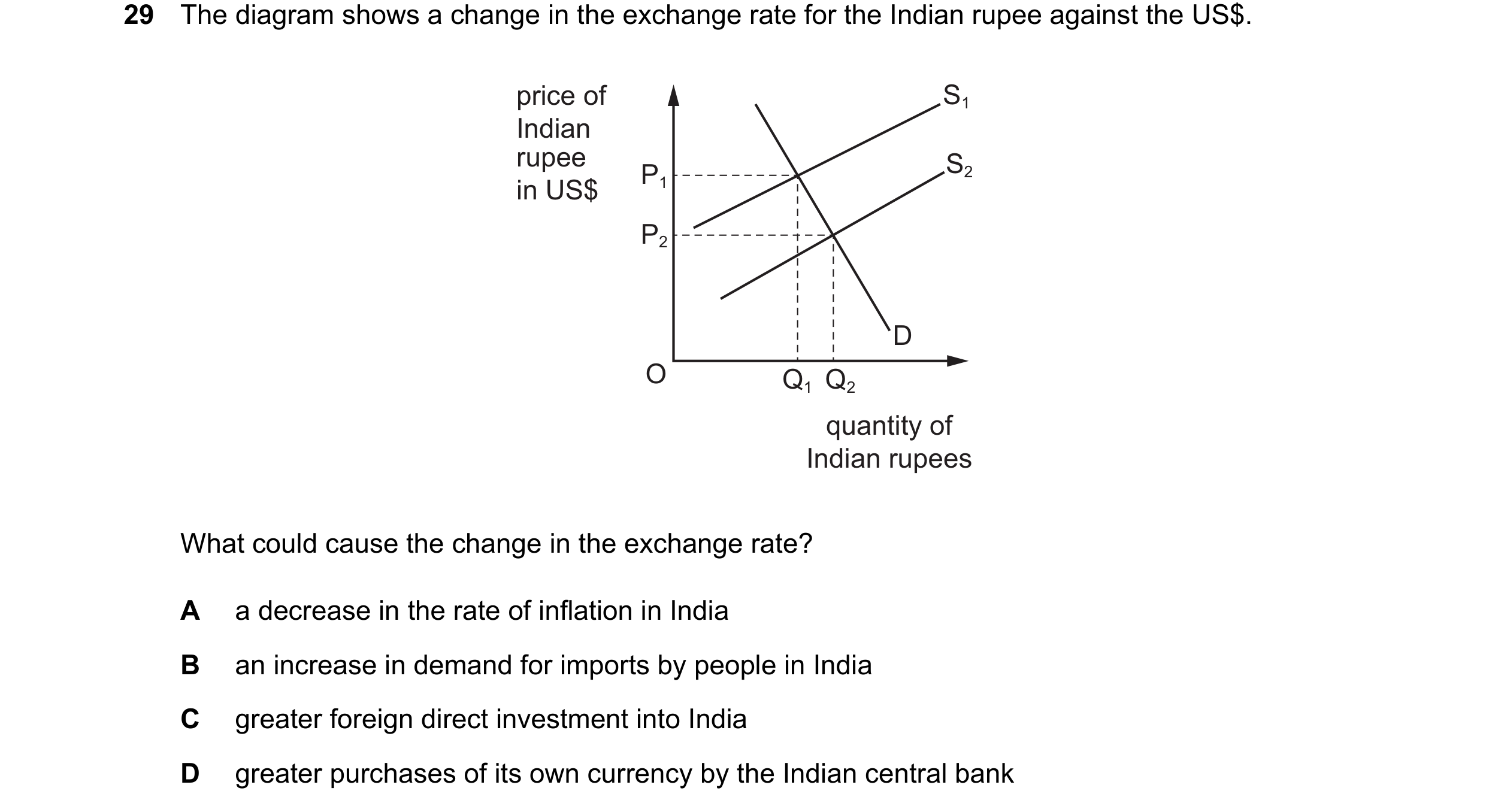
Q82 · The diagram shows a change in the exchange rate for the Indian rupee against the US$ 0455/13 Oct/Nov 2024
29 The diagram shows a change in the exchange rate for the Indian rupee against the US$. price of S1 Indian rupee S2 P1 in US$ P2 D O Q1 Q2 quantity of Indian rupees What could cause the change in the exchange rate? A a decrease in the rate of inflation in India B an increase in demand for imports by people in India C greater foreign direct investment into India D greater purchases of its own currency by the Indian central bank
1 marks
Answer: B
This question in 0455/13 Oct/Nov 2024
Q83 · What might a central bank do to stop a fall in the value of its country’s currency? 0455/12 Feb/March 2025
29 What might a central bank do to stop a fall in the value of its country’s currency? A raise interest rates B reduce taxes on imports C remove controls on currency outflows D sell their currency on the foreign exchange market
1 marks
Answer: A
This question in 0455/12 Feb/March 2025
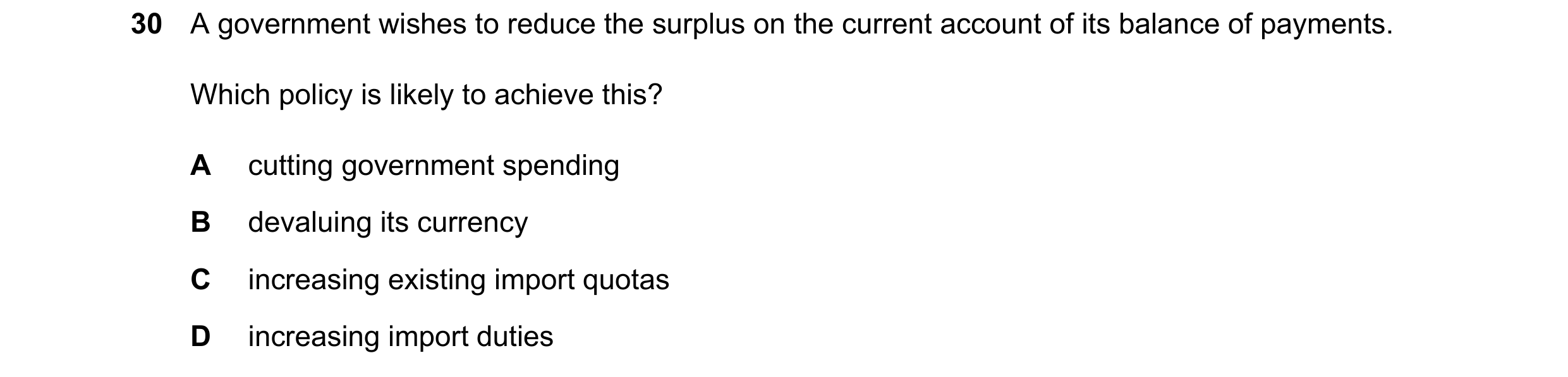
Q84 · A government wishes to reduce the surplus on the current account of its balance of… 0455/12 Feb/March 2025
30 A government wishes to reduce the surplus on the current account of its balance of payments. Which policy is likely to achieve this? A cutting government spending B devaluing its currency C increasing existing import quotas D increasing import duties
1 marks
Answer: C
This question in 0455/12 Feb/March 2025
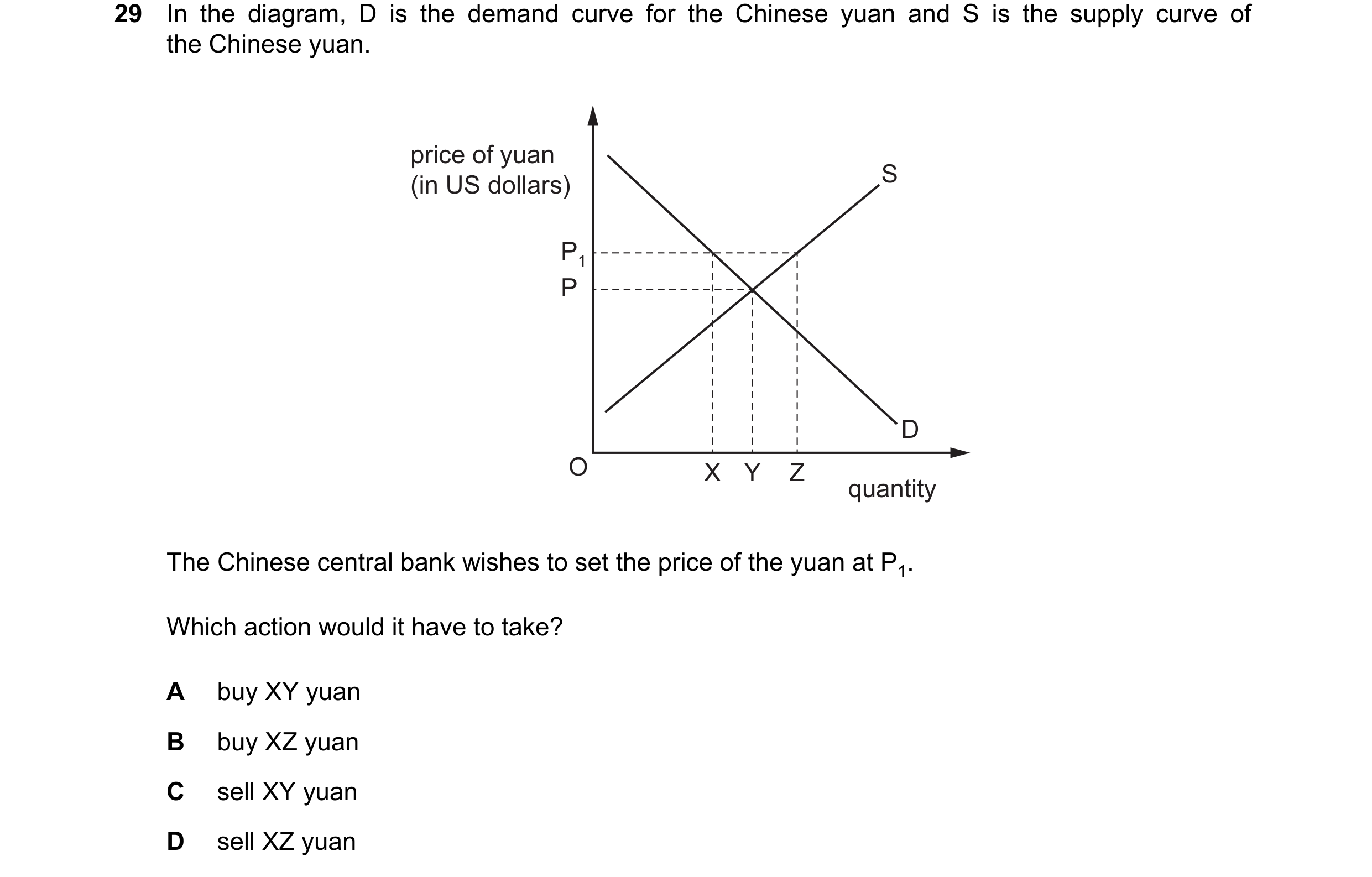
Q85 · In the diagram, D is the demand curve for the Chinese yuan and S is the supply curve of… 0455/11 May/June 2025
29 In the diagram, D is the demand curve for the Chinese yuan and S is the supply curve of the Chinese yuan. price of yuan (in US dollars) S P1 P D O X Y Z quantity The Chinese central bank wishes to set the price of the yuan at P1. Which action would it have to take? A buy XY yuan B buy XZ yuan C sell XY yuan D sell XZ yuan
1 marks
Answer: B
This question in 0455/11 May/June 2025
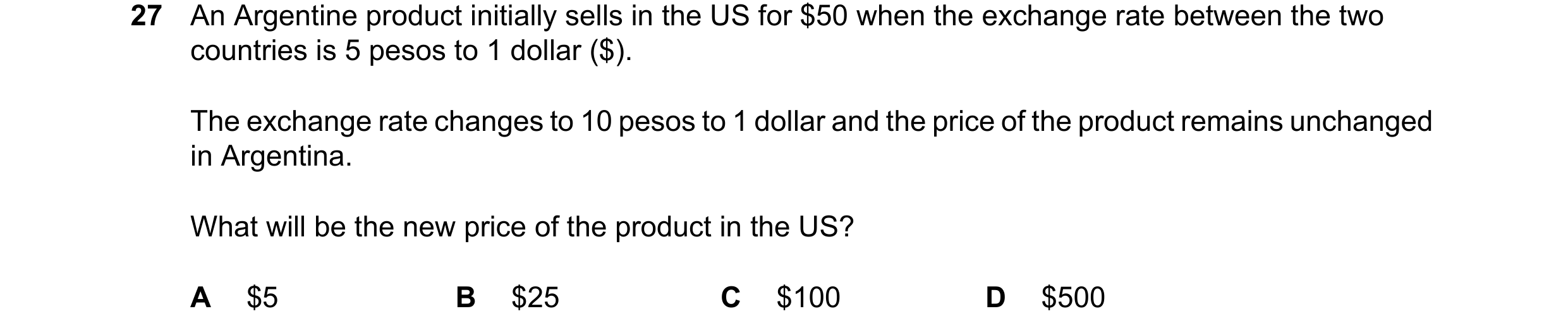
Q86 · An Argentine product initially sells in the US for $50 when the exchange rate between the… 0455/12 May/June 2025
27 An Argentine product initially sells in the US for $50 when the exchange rate between the two countries is 5 pesos to 1 dollar ($). The exchange rate changes to 10 pesos to 1 dollar and the price of the product remains unchanged in Argentina. What will be the new price of the product in the US? A $5 B $25 C $100 D $500
1 marks
Answer: B
This question in 0455/12 May/June 2025
Q87 · The table shows the retail price at which the same book can be bought in four countries 0455/12 May/June 2025
29 The table shows the retail price at which the same book can be bought in four countries. country price in local currency local currency Australia $14.99 Australian dollars Canada $11.99 Canadian dollars New Zealand $20.95 New Zealand dollars United Kingdom £6.99 GB pound What additional information is required to make a meaningful comparison of the price of the book between the countries? A direct tax rates B exchange rates C inflation rates D level of import tariffs
1 marks
Answer: B
This question in 0455/12 May/June 2025
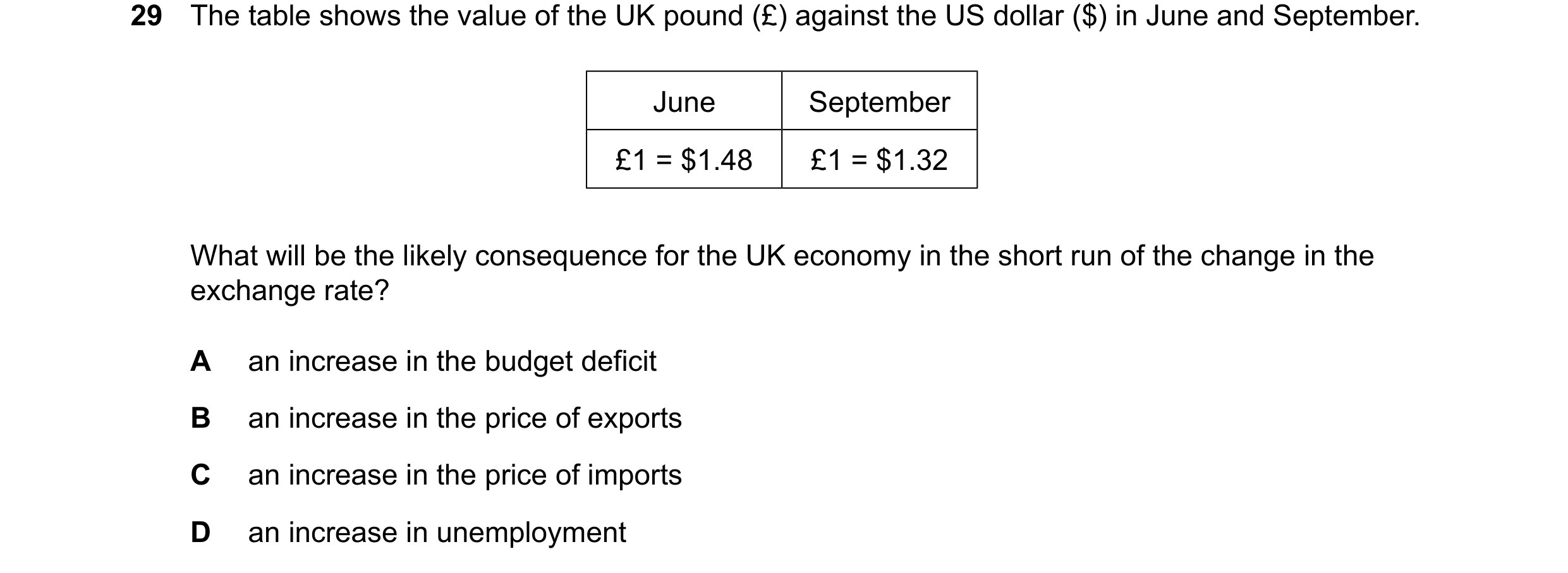
Q88 · The table shows the value of the UK pound (£) against the US dollar ($) in June and… 0455/13 May/June 2025
29 The table shows the value of the UK pound (£) against the US dollar ($) in June and September. June September £1 = $1.48 £1 = $1.32 What will be the likely consequence for the UK economy in the short run of the change in the exchange rate? A an increase in the budget deficit B an increase in the price of exports C an increase in the price of imports D an increase in unemployment
1 marks
Answer: C
This question in 0455/13 May/June 2025
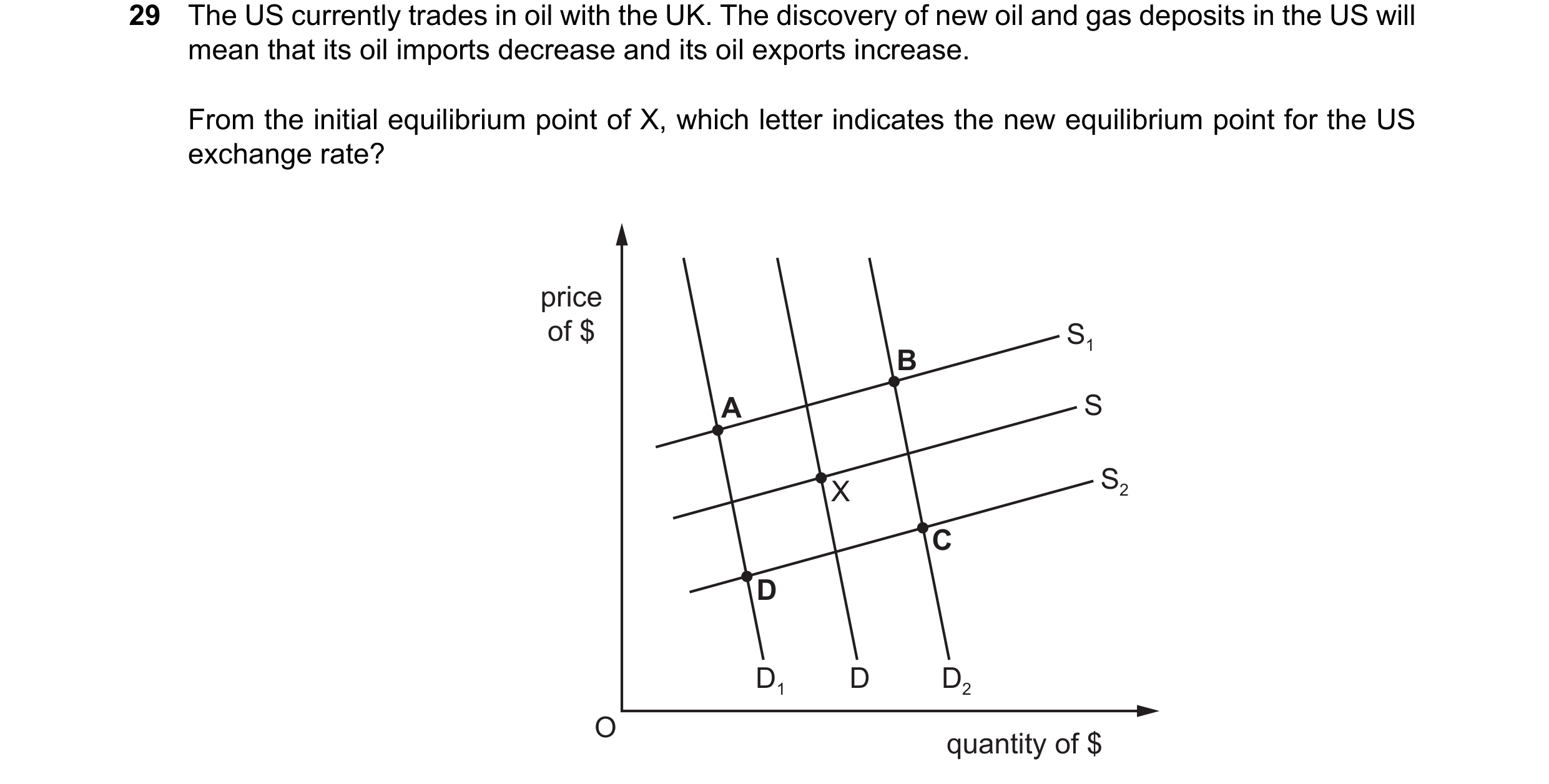
Q89 · The US currently trades in oil with the UK 0455/11 Oct/Nov 2025
29 The US currently trades in oil with the UK. The discovery of new oil and gas deposits in the US will mean that its oil imports decrease and its oil exports increase. From the initial equilibrium point of X, which letter indicates the new equilibrium point for the US exchange rate? price of $ S1 B A S X S2 C D D1 D D2 O quantity of $
1 marks
Answer: B
This question in 0455/11 Oct/Nov 2025
Q90 · Which combination of changes in export revenue and import expenditure is most likely to… 0455/12 Oct/Nov 2025
29 Which combination of changes in export revenue and import expenditure is most likely to cause a country’s exchange rate to depreciate? export revenue import expenditure A decreases decreases B decreases increases C increases decreases D increases increases
1 marks
Answer: B
This question in 0455/12 Oct/Nov 2025
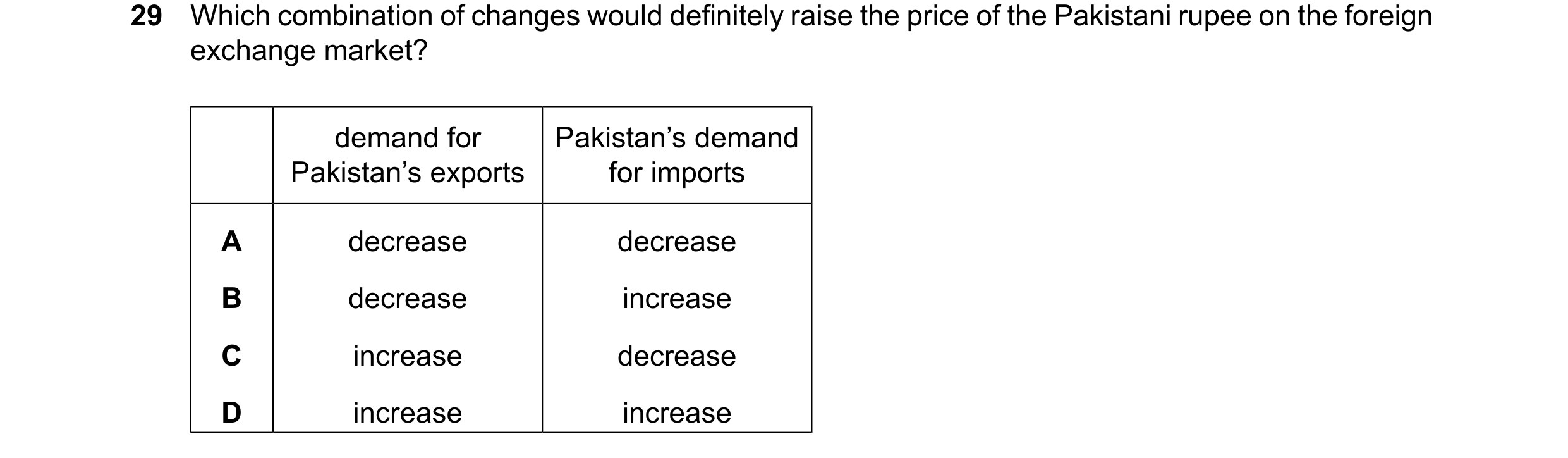
Q91 · Which combination of changes would definitely raise the price of the Pakistani rupee on… 0455/13 Oct/Nov 2025
29 Which combination of changes would definitely raise the price of the Pakistani rupee on the foreign exchange market? demand for Pakistan’s demand Pakistan’s exports for imports A decrease decrease B decrease increase C increase decrease D increase increase
1 marks
Answer: C
This question in 0455/13 Oct/Nov 2025


 1 / 22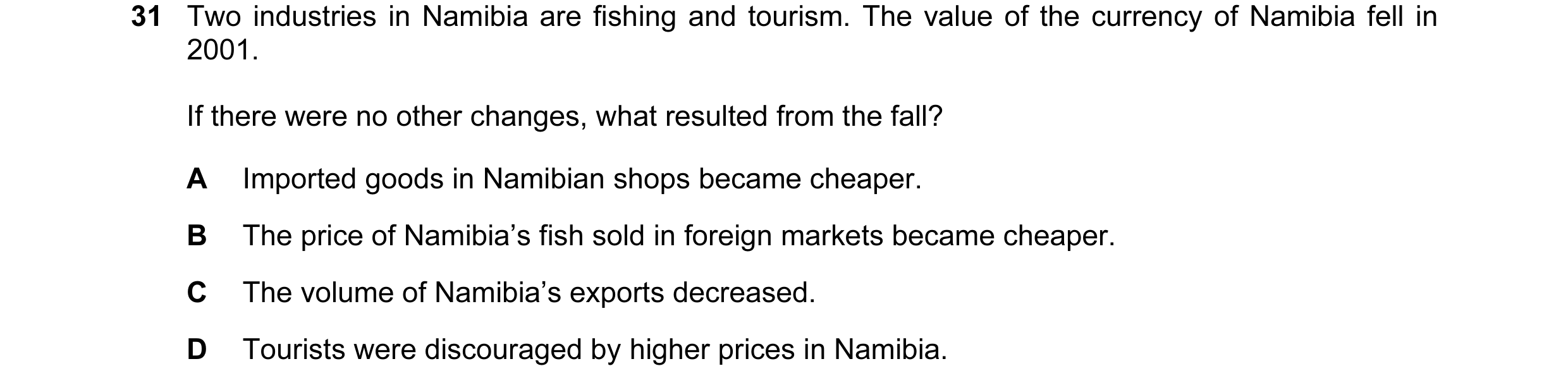
 2 / 22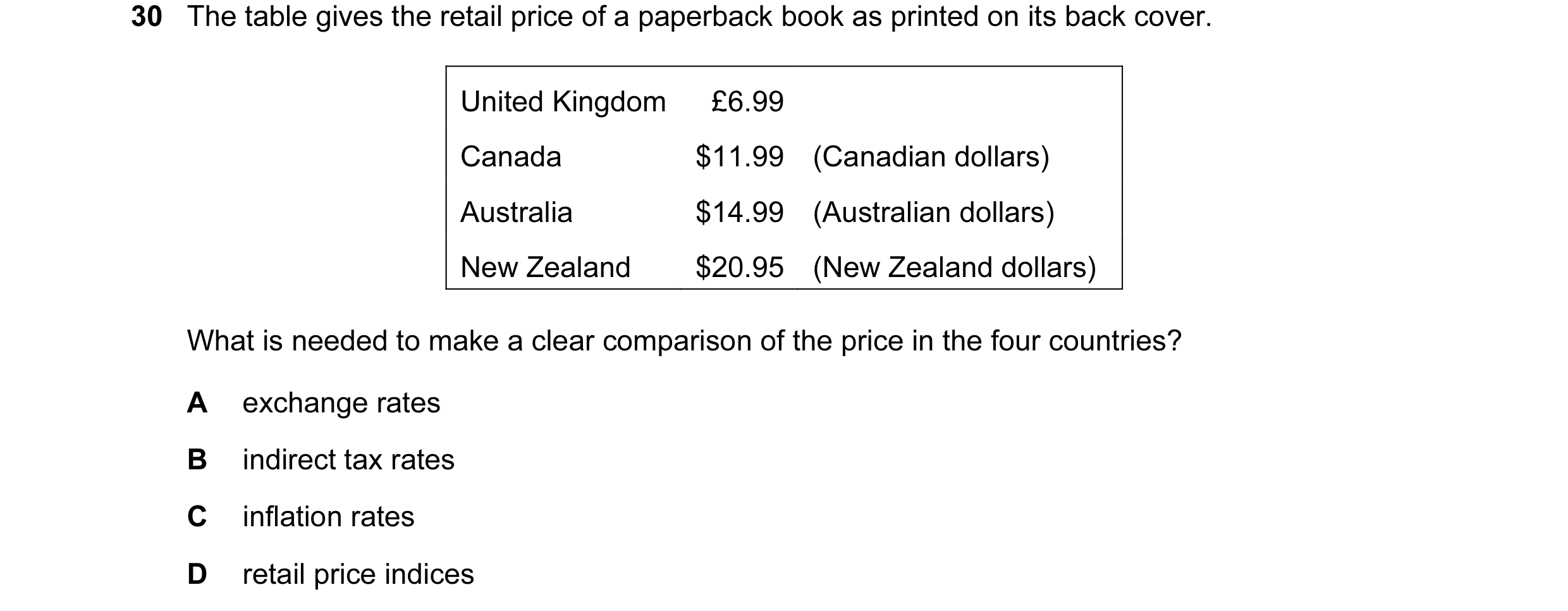
 3 / 22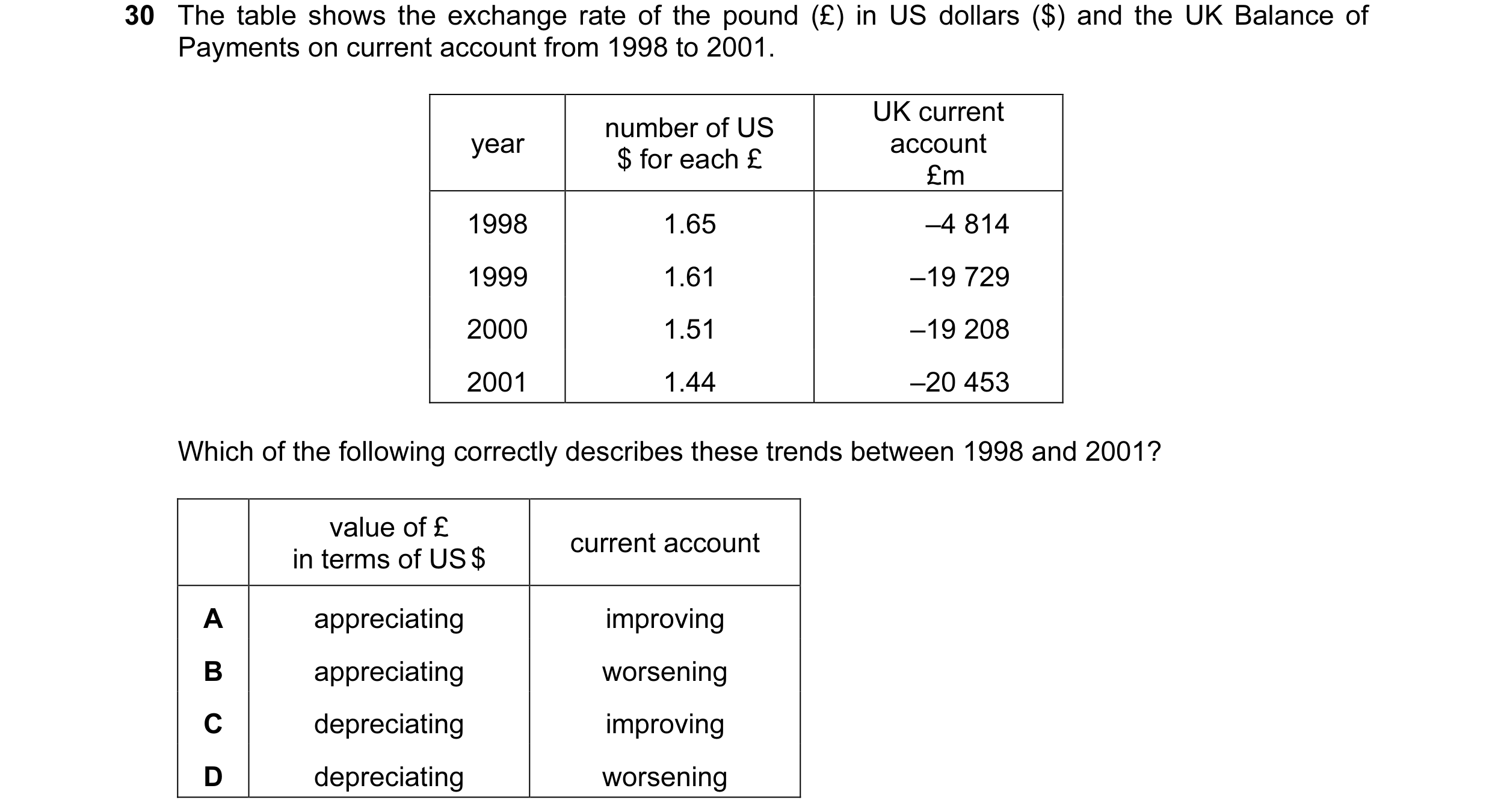
 4 / 22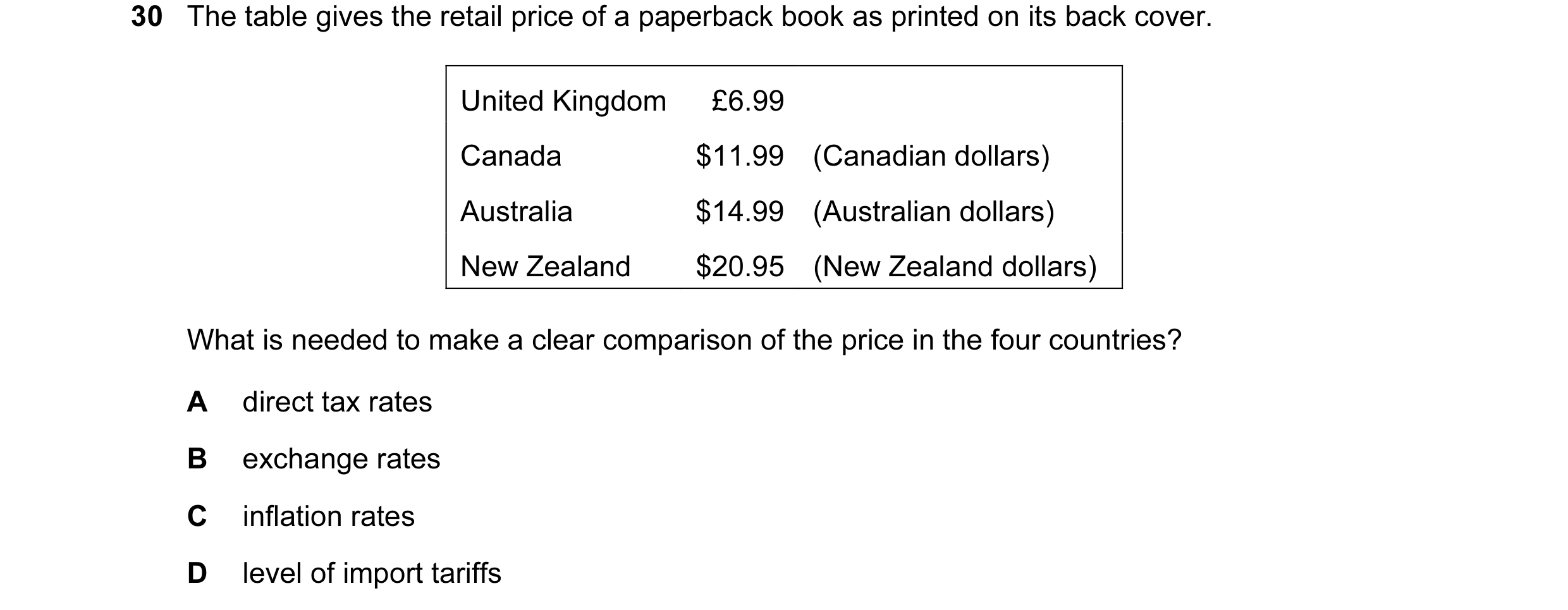
 5 / 22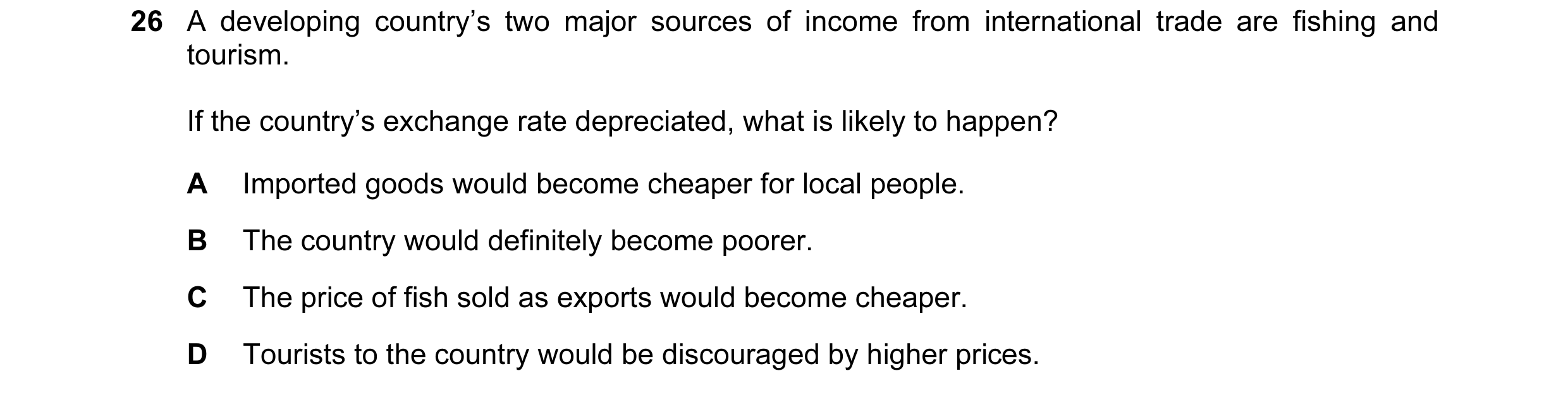



 6 / 22
 7 / 22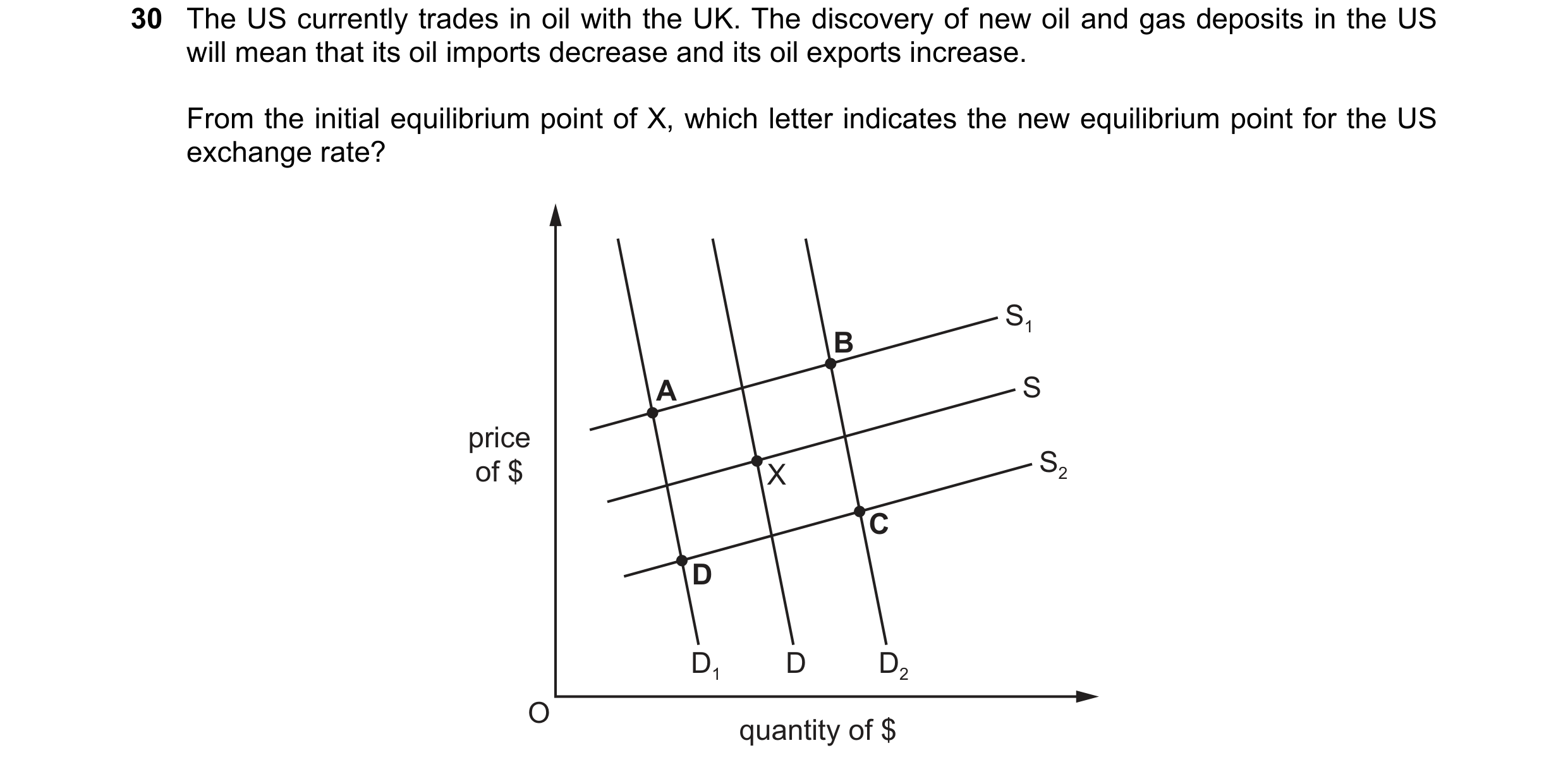
 8 / 22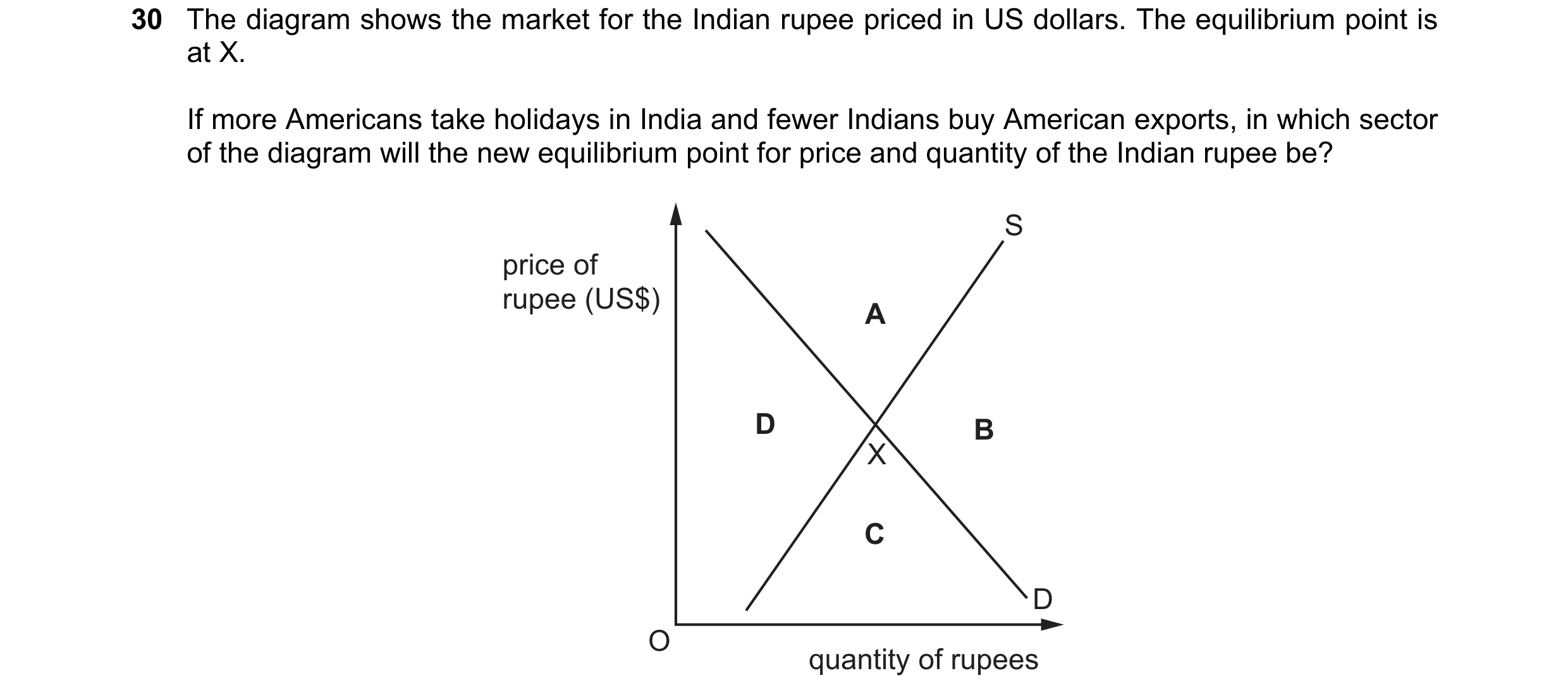


 9 / 22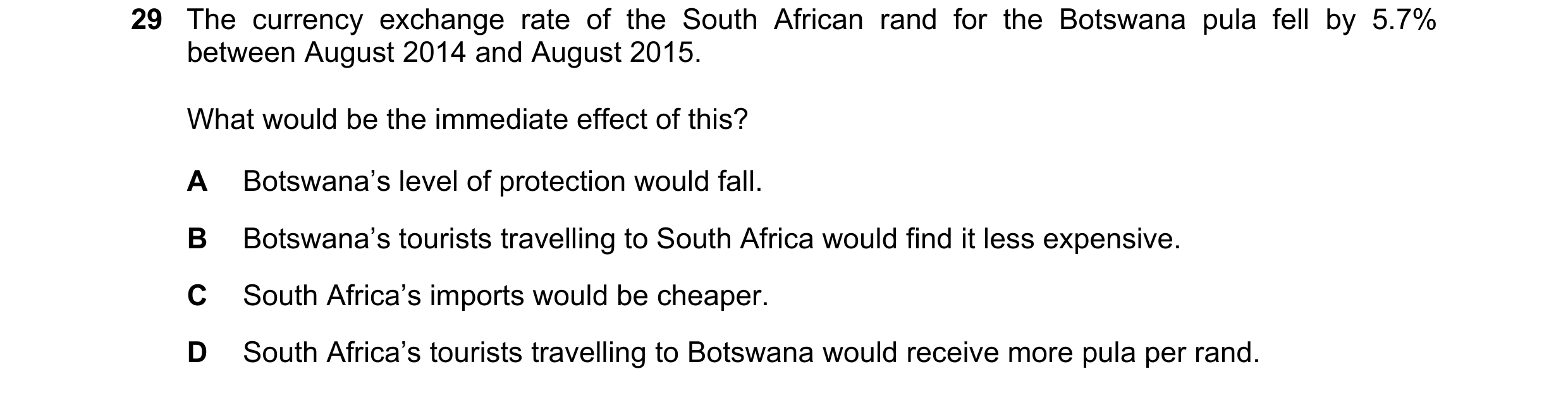

 10 / 22

 11 / 22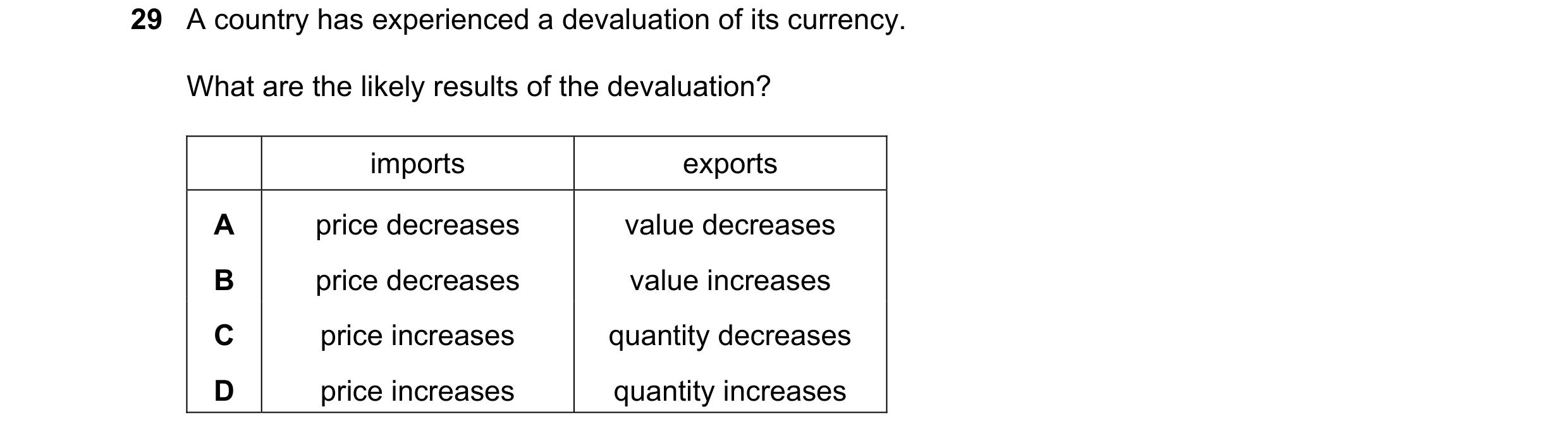


 12 / 22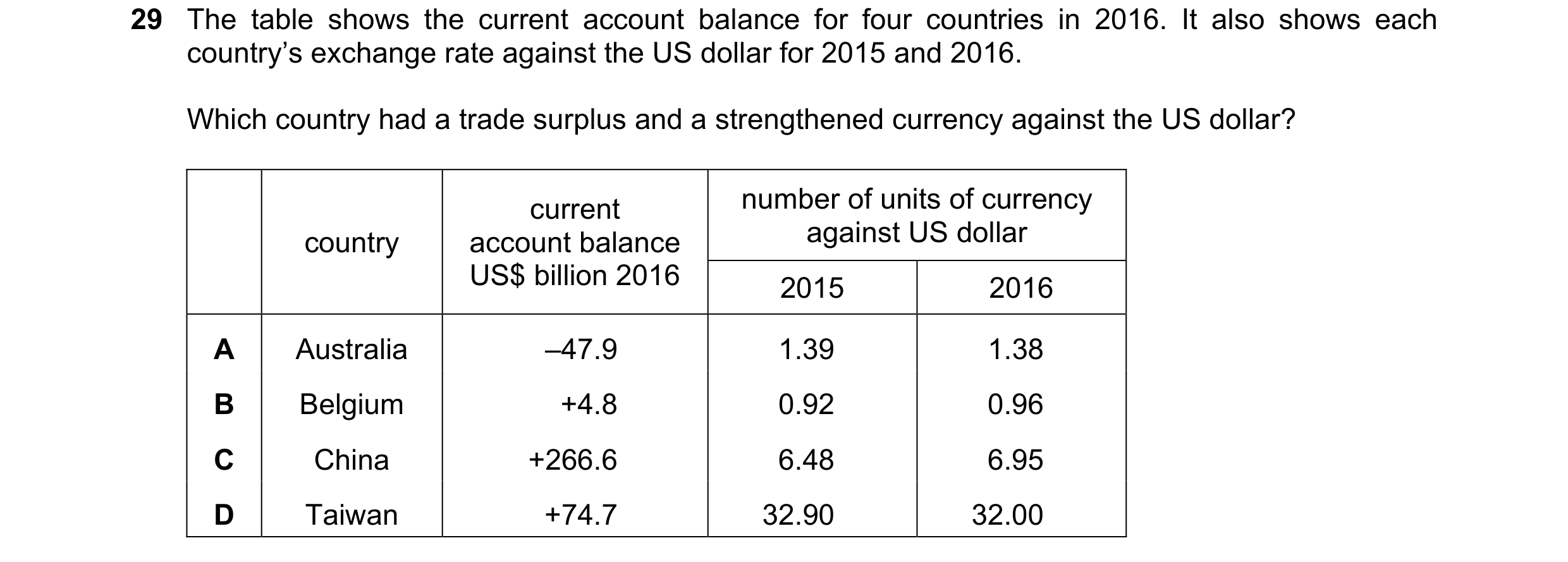

 13 / 22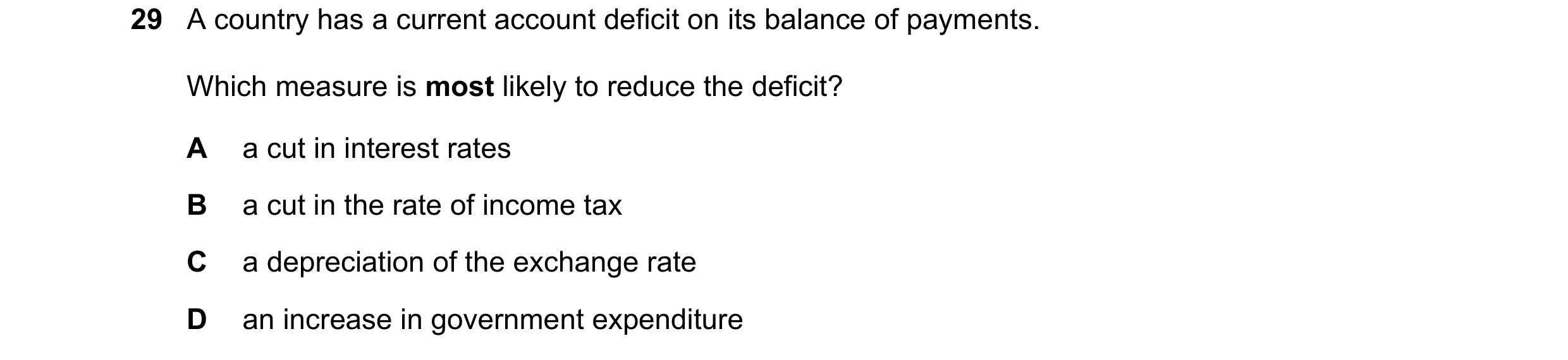




 14 / 22


 15 / 22


 16 / 22
 17 / 22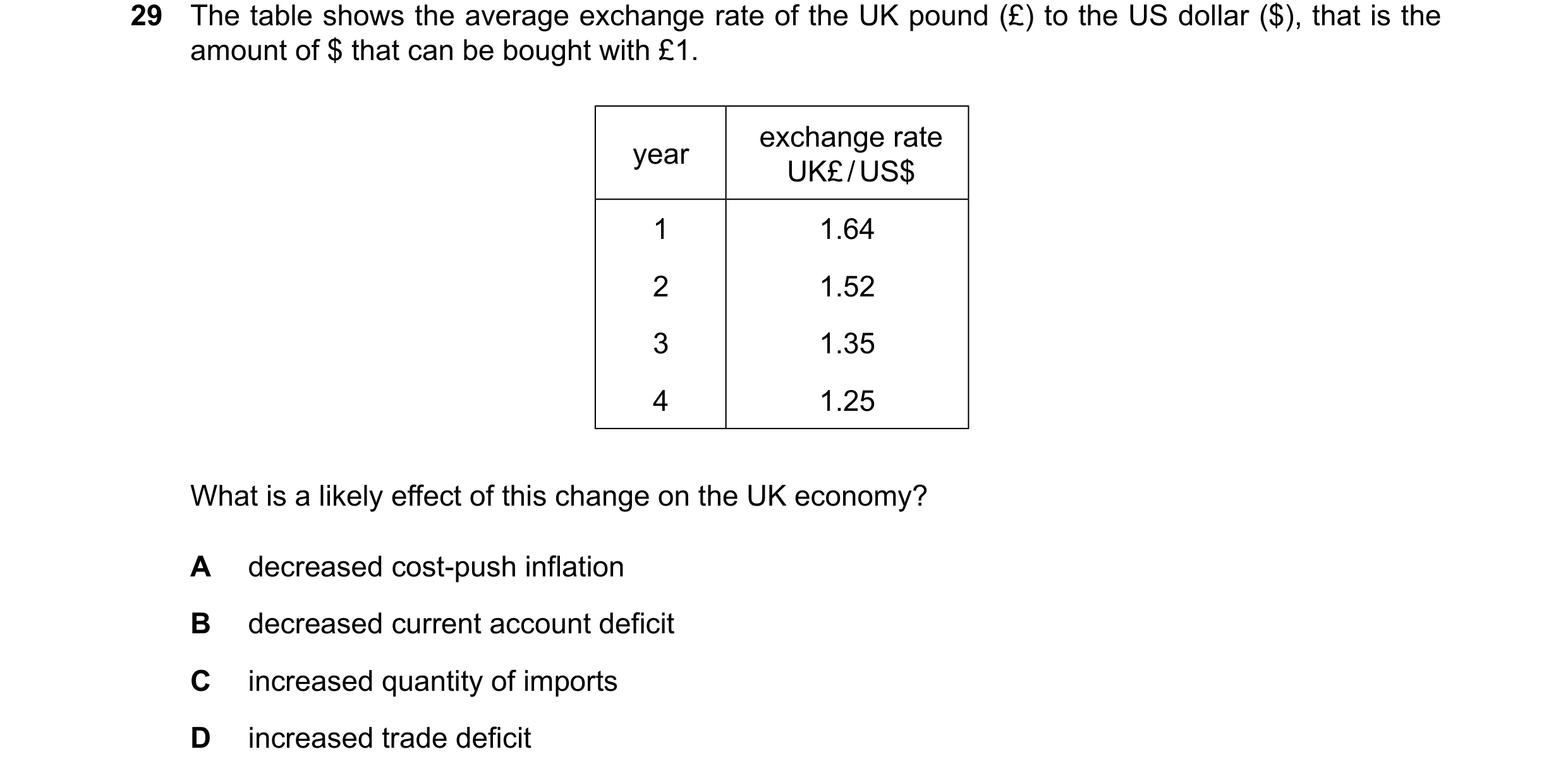
 18 / 22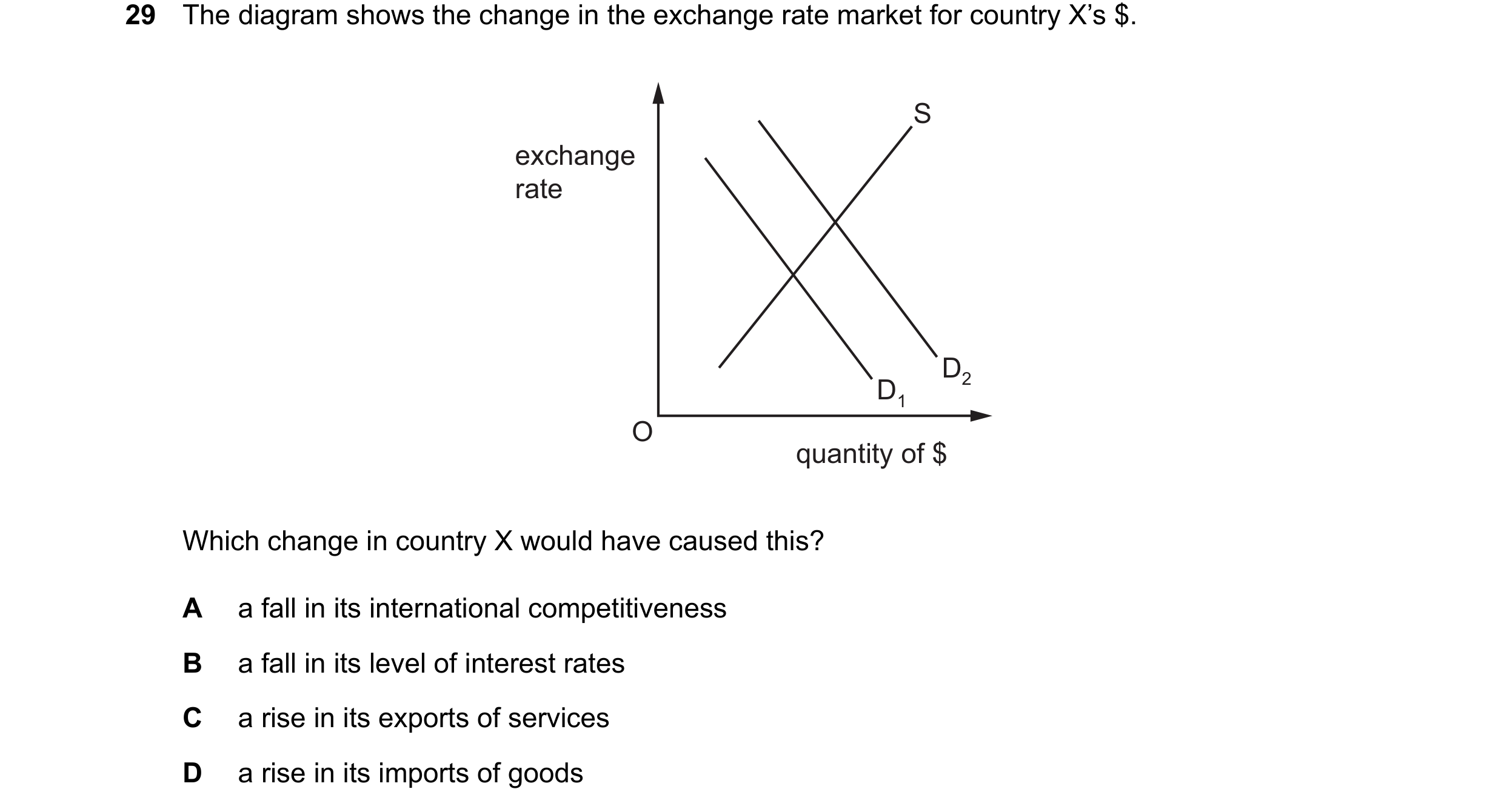
 19 / 22
 20 / 22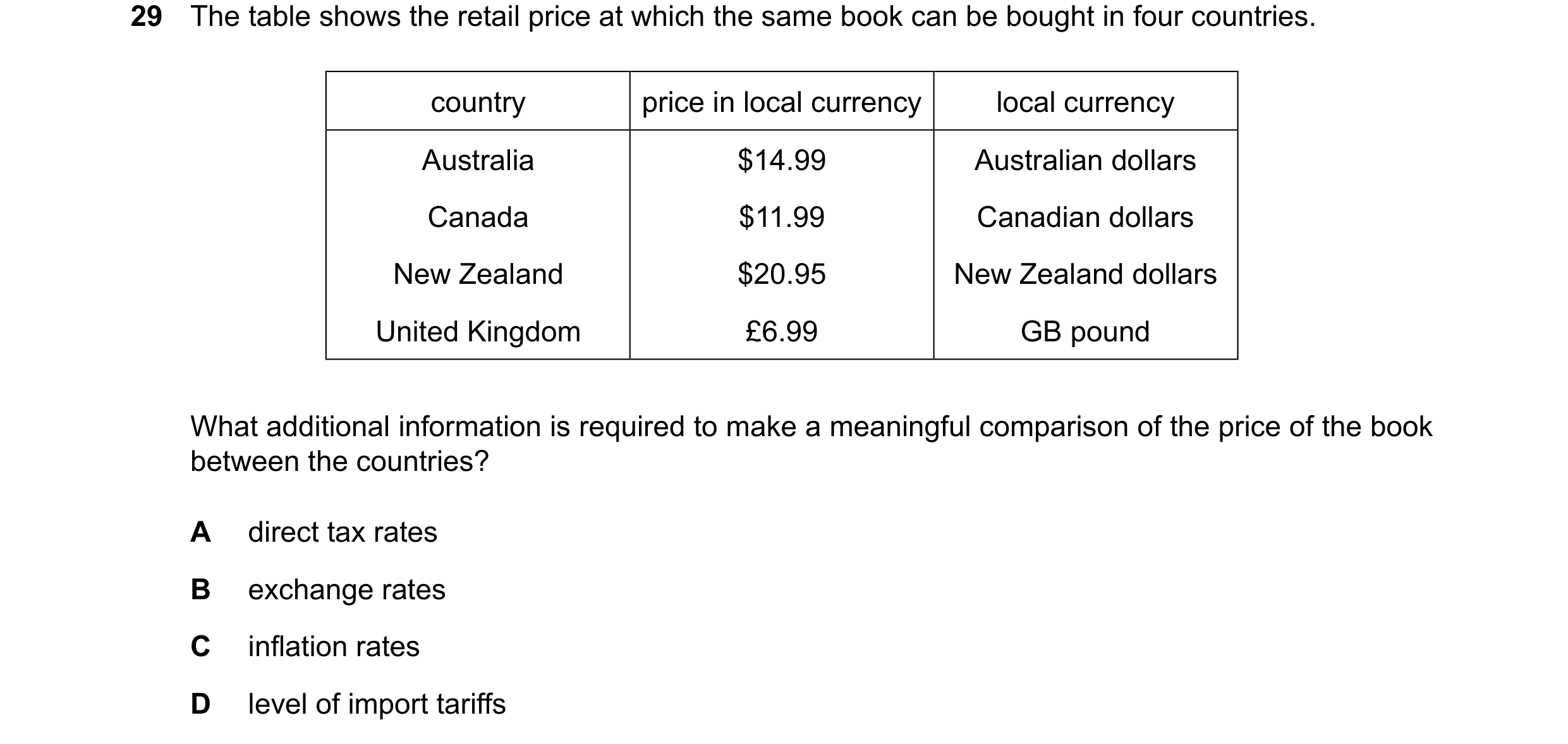
 21 / 22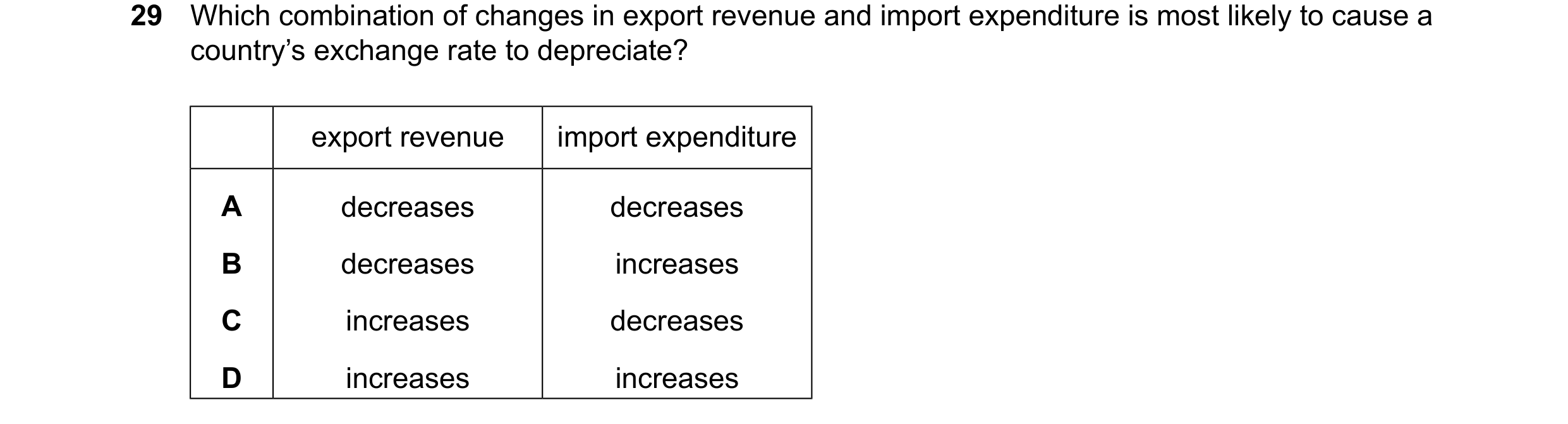
 22 / 22