Questions as text
Q1 · An experiment is set up to measure the rate of hydrolysis of methyl ethanoate 9701/11 Oct/Nov 2005
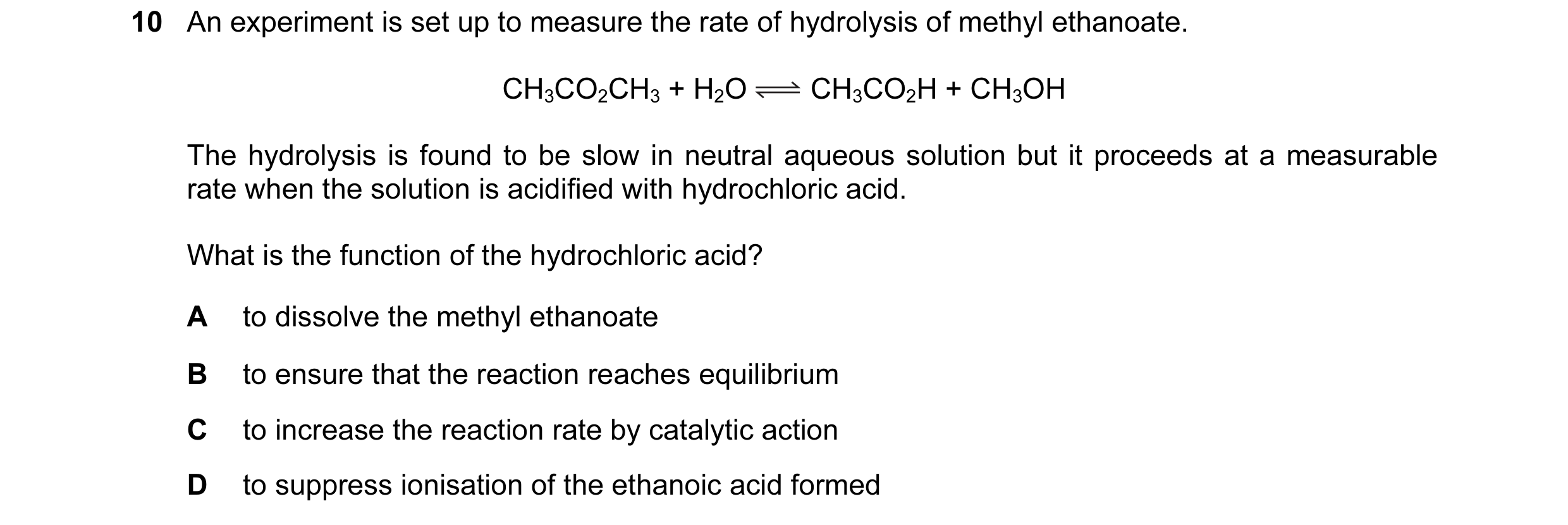
10 An experiment is set up to measure the rate of hydrolysis of methyl ethanoate. CH3CO2CH3 + H2O CH3CO2H + CH3OH The hydrolysis is found to be slow in neutral aqueous solution but it proceeds at a measurable rate when the solution is acidified with hydrochloric acid. What is the function of the hydrochloric acid? A to dissolve the methyl ethanoate B to ensure that the reaction reaches equilibrium C to increase the reaction rate by catalytic action D to suppress ionisation of the ethanoic acid formed
1 marks
Answer: C
This question in 9701/11 Oct/Nov 2005
Q2 · Modern cars are fitted with catalytic converters 9701/11 Oct/Nov 2005
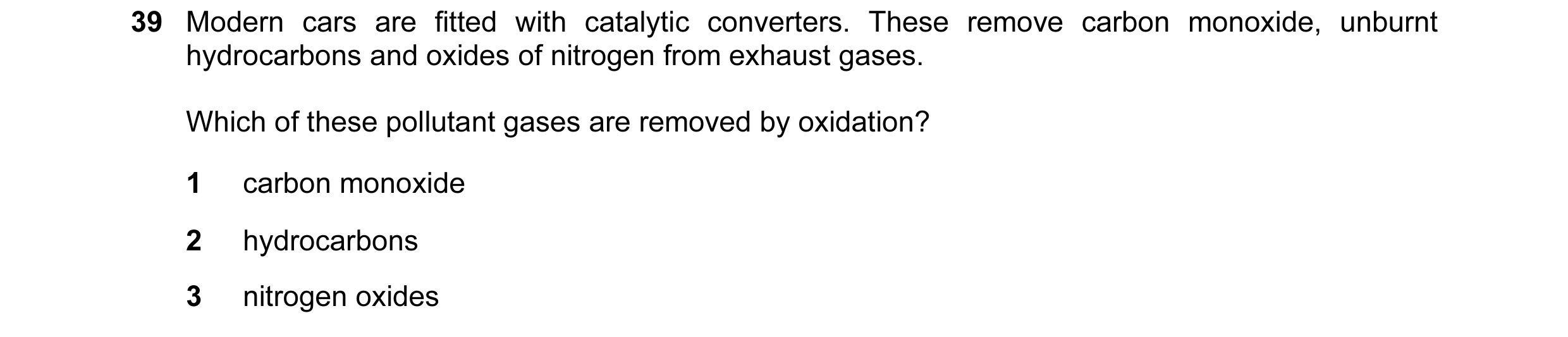
39 Modern cars are fitted with catalytic converters. These remove carbon monoxide, unburnt hydrocarbons and oxides of nitrogen from exhaust gases. Which of these pollutant gases are removed by oxidation? 1 carbon monoxide 2 hydrocarbons 3 nitrogen oxides
1 marks
Answer: B
This question in 9701/11 Oct/Nov 2005
Q3 · In the Contact process for the production of sulphuric acid, sulphur dioxide is mixed… 9701/11 Oct/Nov 2006
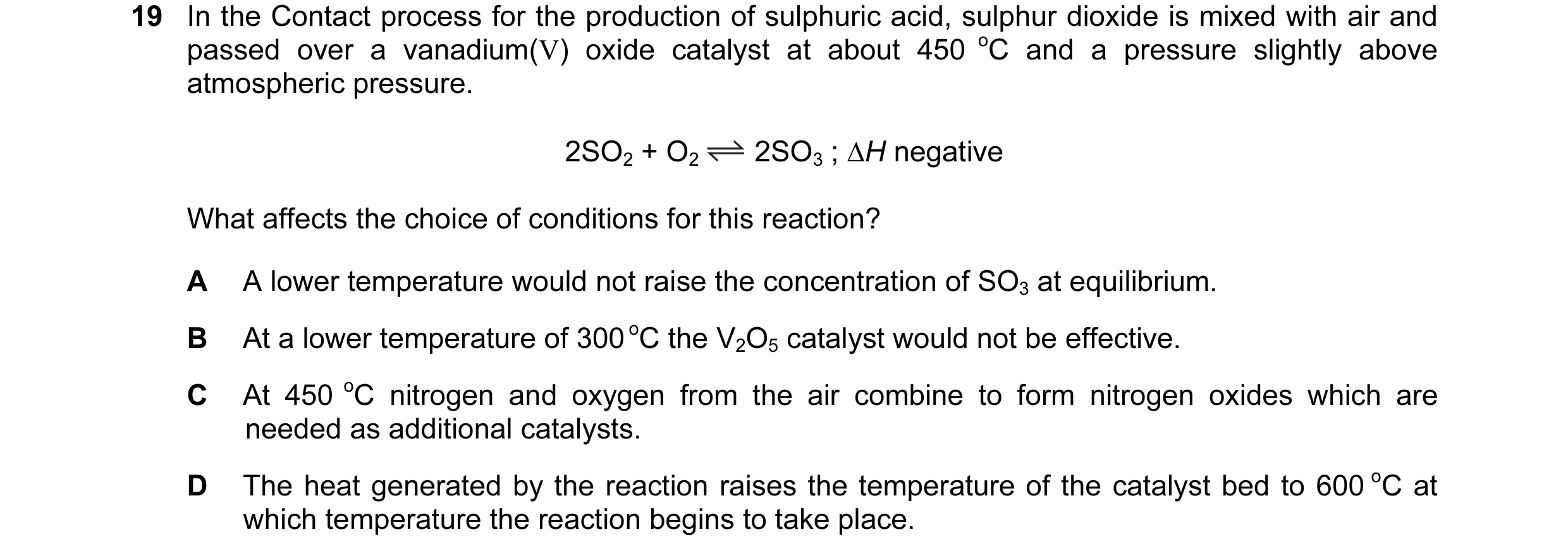
19 In the Contact process for the production of sulphuric acid, sulphur dioxide is mixed with air and passed over a vanadium(V) oxide catalyst at about 450 oC and a pressure slightly above atmospheric pressure. 2SO2 + O2 2SO3 ; ∆H negative What affects the choice of conditions for this reaction? A A lower temperature would not raise the concentration of SO3 at equilibrium. B At a lower temperature of 300 oC the V2O5 catalyst would not be effective. C At 450 oC nitrogen and oxygen from the air combine to form nitrogen oxides which are needed as additional catalysts. D The heat generated by the reaction raises the temperature of the catalyst bed to 600 oC at which temperature the reaction begins to take place.
1 marks
Answer: B
This question in 9701/11 Oct/Nov 2006
Q4 · Catalysts are used in many reversible reactions in the chemical industry 9701/11 May/June 2008
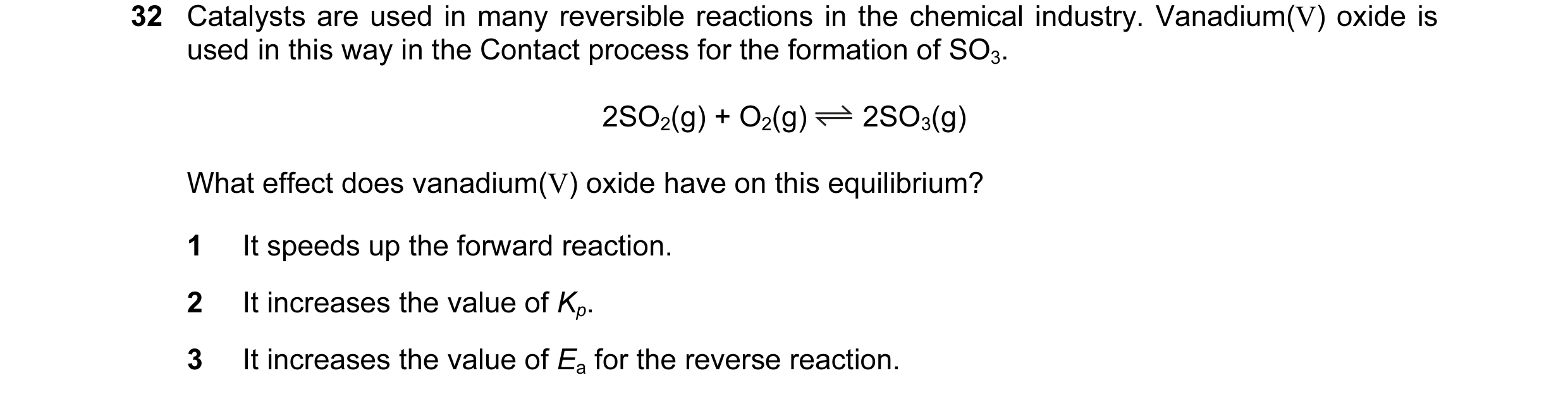
32 Catalysts are used in many reversible reactions in the chemical industry. Vanadium(V) oxide is used in this way in the Contact process for the formation of SO3. 2SO2(g) + O2(g) 2SO3(g) What effect does vanadium(V) oxide have on this equilibrium? 1 It speeds up the forward reaction. 2 It increases the value of Kp. 3 It increases the value of Ea for the reverse reaction.
1 marks
Answer: D
This question in 9701/11 May/June 2008
Q5 · Photochromic glass, used for sunglasses, darkens when exposed to bright light and becomes… 9701/11 Oct/Nov 2009
11 Photochromic glass, used for sunglasses, darkens when exposed to bright light and becomes more transparent again when the light is less bright. The depth of colour of the glass is related to the concentration of silver atoms. The following reactions are involved. reaction 1 Ag+ + Cl – Ag + Cl reaction 2 Cu+ + Cl → Cu2+ + Cl – reaction 3 Cu2+ + Ag → Cu+ + Ag+ Which statement about these reactions is correct? A Cu+ and Cu2+ ions act as catalysts. B Cu+ ions act as an oxidising agent in reaction 2. C Reaction 2 is the one in which light is absorbed. D Ag+ ions are oxidised in reaction 1.
1 marks
Answer: A
This question in 9701/11 Oct/Nov 2009
Q6 · In which ways are the main reactions in the Haber and Contact processes similar? 9701/12 Oct/Nov 2010
35 In which ways are the main reactions in the Haber and Contact processes similar? 1 A higher yield is favoured by higher pressures. 2 The reaction is a redox process. 3 The forward reaction is exothermic.
1 marks
Answer: A
This question in 9701/12 Oct/Nov 2010
Q7 · A car burning lead-free fuel has a catalytic converter fitted to its exhaust 9701/12 Oct/Nov 2010
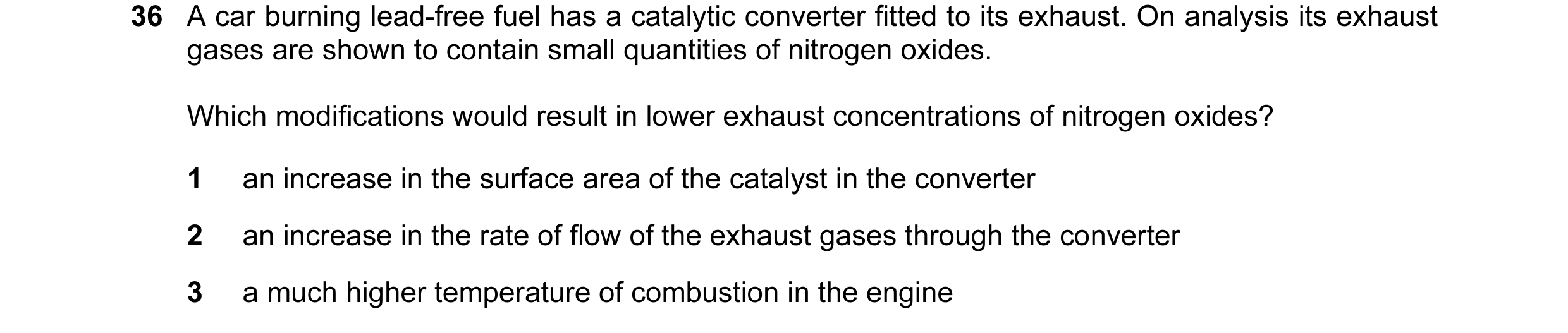
36 A car burning lead-free fuel has a catalytic converter fitted to its exhaust. On analysis its exhaust gases are shown to contain small quantities of nitrogen oxides. Which modifications would result in lower exhaust concentrations of nitrogen oxides? 1 an increase in the surface area of the catalyst in the converter 2 an increase in the rate of flow of the exhaust gases through the converter 3 a much higher temperature of combustion in the engine
1 marks
Answer: D
This question in 9701/12 Oct/Nov 2010
Q8 · Nitrogen monoxide, NO, is a primary pollutant produced by petrol engines and is found in… 9701/11 May/June 2011
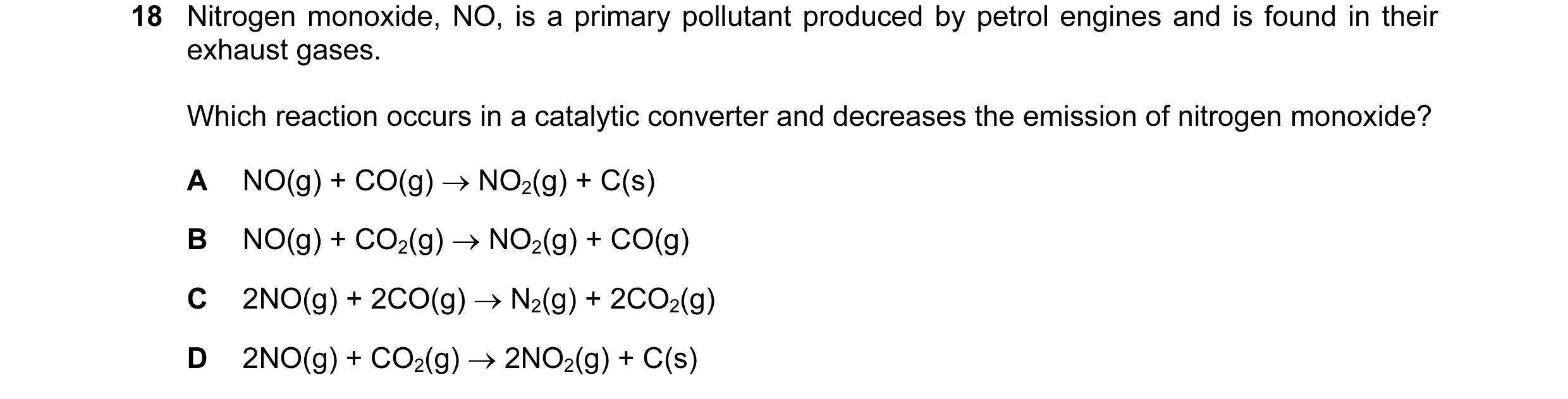
18 Nitrogen monoxide, NO, is a primary pollutant produced by petrol engines and is found in their exhaust gases. Which reaction occurs in a catalytic converter and decreases the emission of nitrogen monoxide? A NO(g) + CO(g) → NO2(g) + C(s) B NO(g) + CO2(g) → NO2(g) + CO(g) C 2NO(g) + 2CO(g) → N2(g) + 2CO2(g) D 2NO(g) + CO2(g) → 2NO2(g) + C(s)
1 marks
Answer: C
This question in 9701/11 May/June 2011
Q9 · In the Contact process, what is the nature of the gaseous product and what is the… 9701/12 May/June 2011
18 In the Contact process, what is the nature of the gaseous product and what is the identity of the catalyst? nature of catalyst gaseous product A acidic Fe B acidic V2O5 C basic Fe D basic V2O5
1 marks
Answer: B
This question in 9701/12 May/June 2011
Q10 · In the diagram, curve X was obtained by observing the decomposition of 100 cm3 of 1.0 mol… 9701/13 May/June 2011
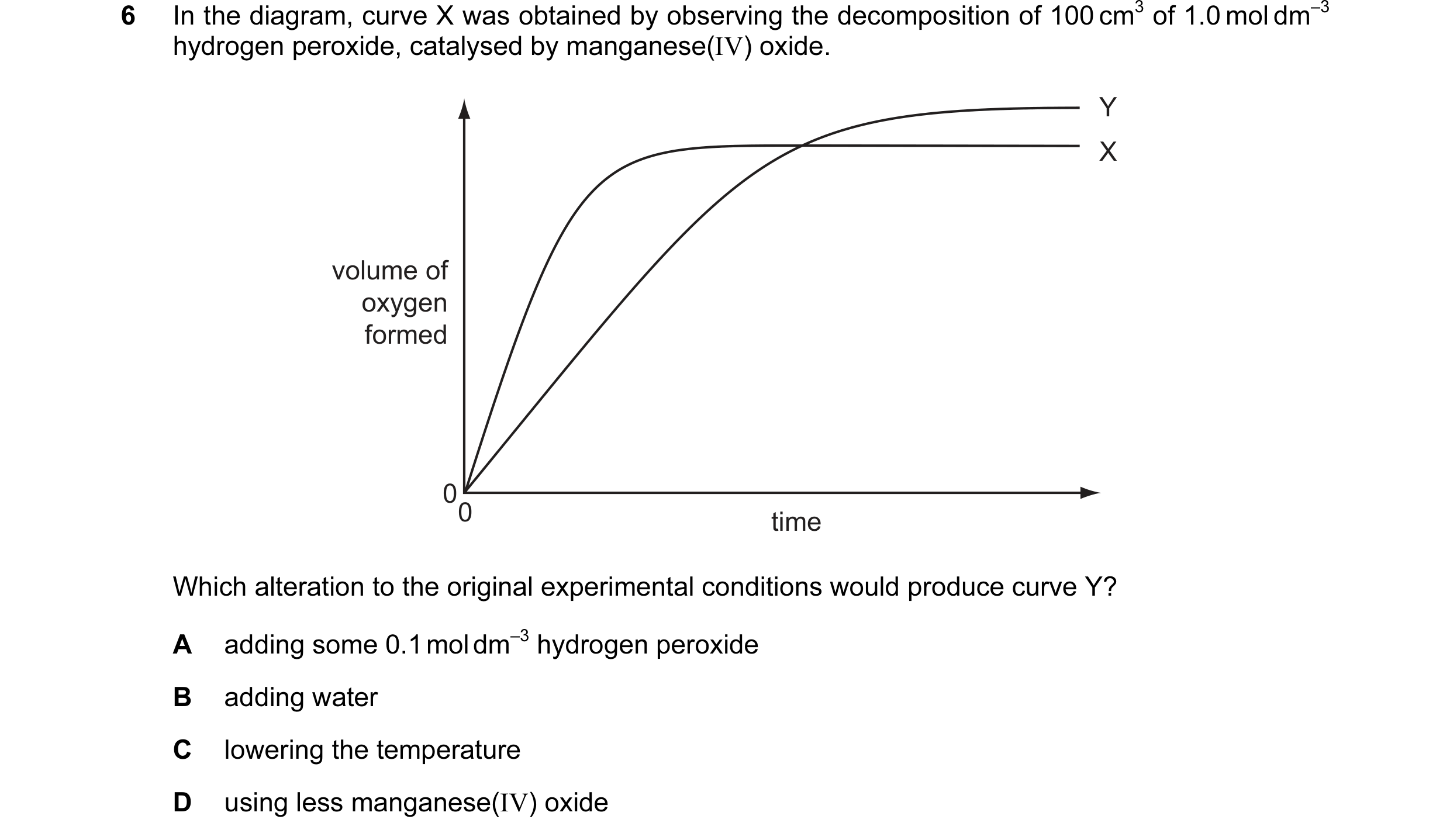
6 In the diagram, curve X was obtained by observing the decomposition of 100 cm3 of 1.0 mol dm–3 hydrogen peroxide, catalysed by manganese(IV) oxide. Y X volume of oxygen formed 00 time Which alteration to the original experimental conditions would produce curve Y? A adding some 0.1 mol dm–3 hydrogen peroxide B adding water C lowering the temperature D using less manganese(IV) oxide
1 marks
Answer: A
This question in 9701/13 May/June 2011
Q11 · Nitrogen monoxide, NO, is a primary pollutant produced by petrol engines and is found in… 9701/13 May/June 2011
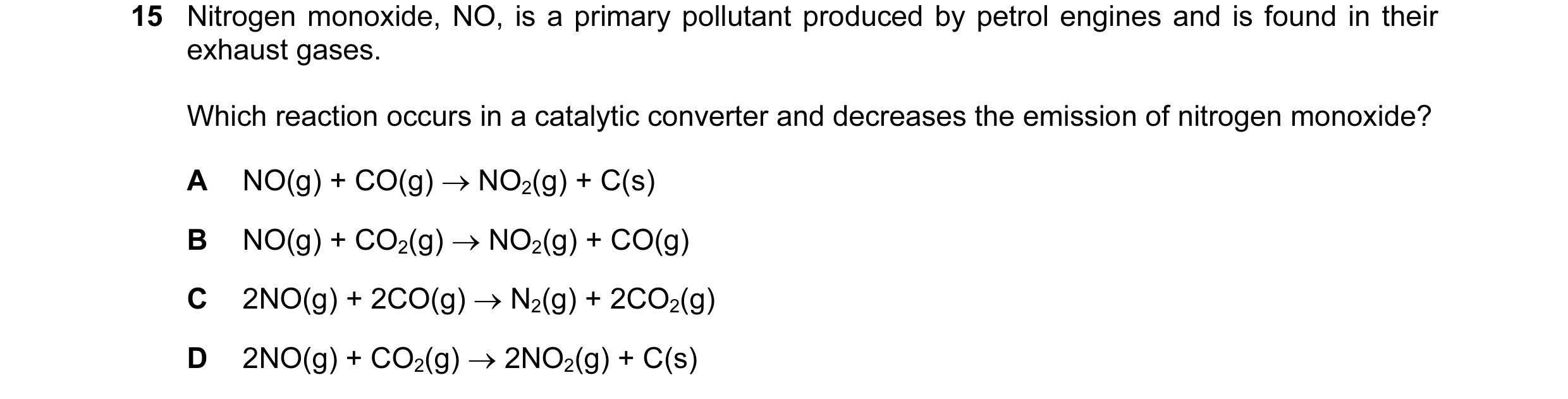
15 Nitrogen monoxide, NO, is a primary pollutant produced by petrol engines and is found in their exhaust gases. Which reaction occurs in a catalytic converter and decreases the emission of nitrogen monoxide? A NO(g) + CO(g) → NO2(g) + C(s) B NO(g) + CO2(g) → NO2(g) + CO(g) C 2NO(g) + 2CO(g) → N2(g) + 2CO2(g) D 2NO(g) + CO2(g) → 2NO2(g) + C(s)
1 marks
Answer: C
This question in 9701/13 May/June 2011
Q12 · Butanedioate ions can be dehydrogenated to form trans-butenedioate ions 9701/13 Oct/Nov 2011
11 Butanedioate ions can be dehydrogenated to form trans-butenedioate ions. The enzyme fumarase speeds up this reaction. Why does fumarase speed up this reaction? A Fumarase is a protein. B Fumarase is effective at body temperature. C Fumarase lowers the activation energy of the dehydrogenation reaction. D The enzyme fumarase is specific for this dehydrogenation reaction.
1 marks
Answer: C
This question in 9701/13 Oct/Nov 2011
Q13 · Which equations represent stages in the Contact process for manufacturing sulfuric acid? 9701/11 Oct/Nov 2012
35 Which equations represent stages in the Contact process for manufacturing sulfuric acid? 1 O2 → SO3 1 SO2 + 2 2 SO2 + H2O → H2SO3 1 O2 → H2SO4 3 H2SO3 + 2
1 marks
Answer: D
This question in 9701/11 Oct/Nov 2012
Q14 · Which equations represent stages in the Contact process for manufacturing sulfuric acid? 9701/12 Oct/Nov 2012
35 Which equations represent stages in the Contact process for manufacturing sulfuric acid? 1 O2 → SO3 1 SO2 + 2 2 SO2 + H2O → H2SO3 1 O2 → H2SO4 3 H2SO3 + 2
1 marks
Answer: D
This question in 9701/12 Oct/Nov 2012
Q15 · An experiment is set up to measure the rate of hydrolysis of ethyl ethanoate 9701/11 May/June 2013
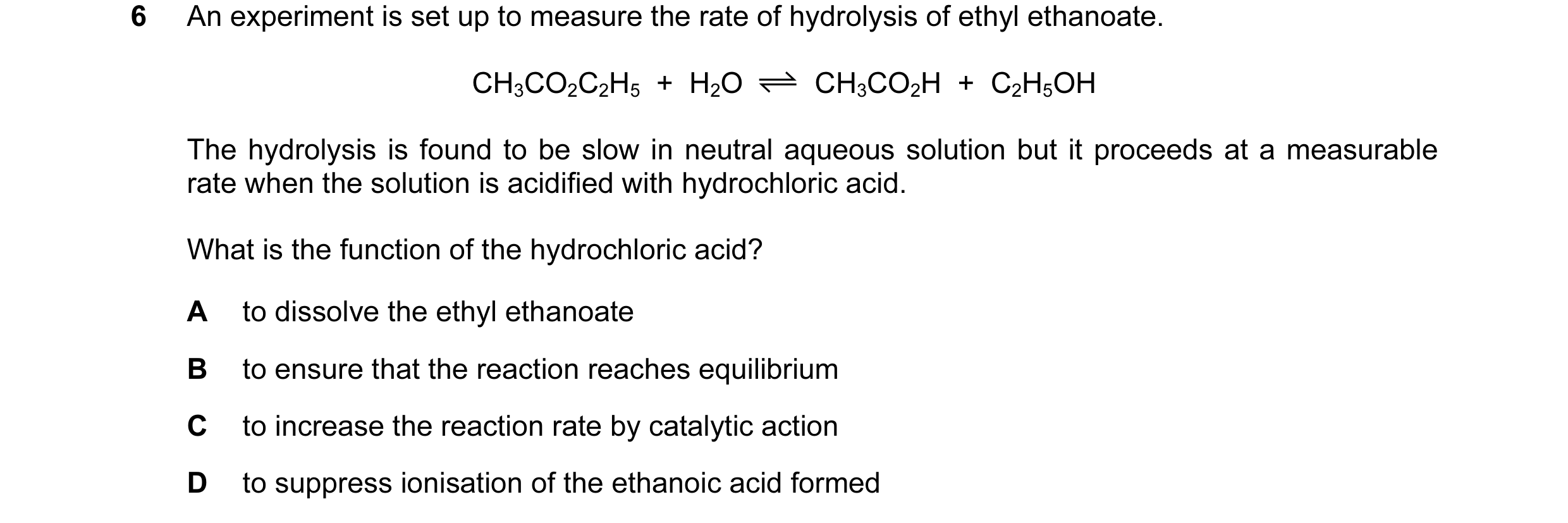
6 An experiment is set up to measure the rate of hydrolysis of ethyl ethanoate. CH3CO2C2H5 + H2O CH3CO2H + C2H5OH The hydrolysis is found to be slow in neutral aqueous solution but it proceeds at a measurable rate when the solution is acidified with hydrochloric acid. What is the function of the hydrochloric acid? A to dissolve the ethyl ethanoate B to ensure that the reaction reaches equilibrium C to increase the reaction rate by catalytic action D to suppress ionisation of the ethanoic acid formed
1 marks
Answer: C
This question in 9701/11 May/June 2013
Q16 · Transition metals and their compounds are used as catalysts 9701/12 Oct/Nov 2013
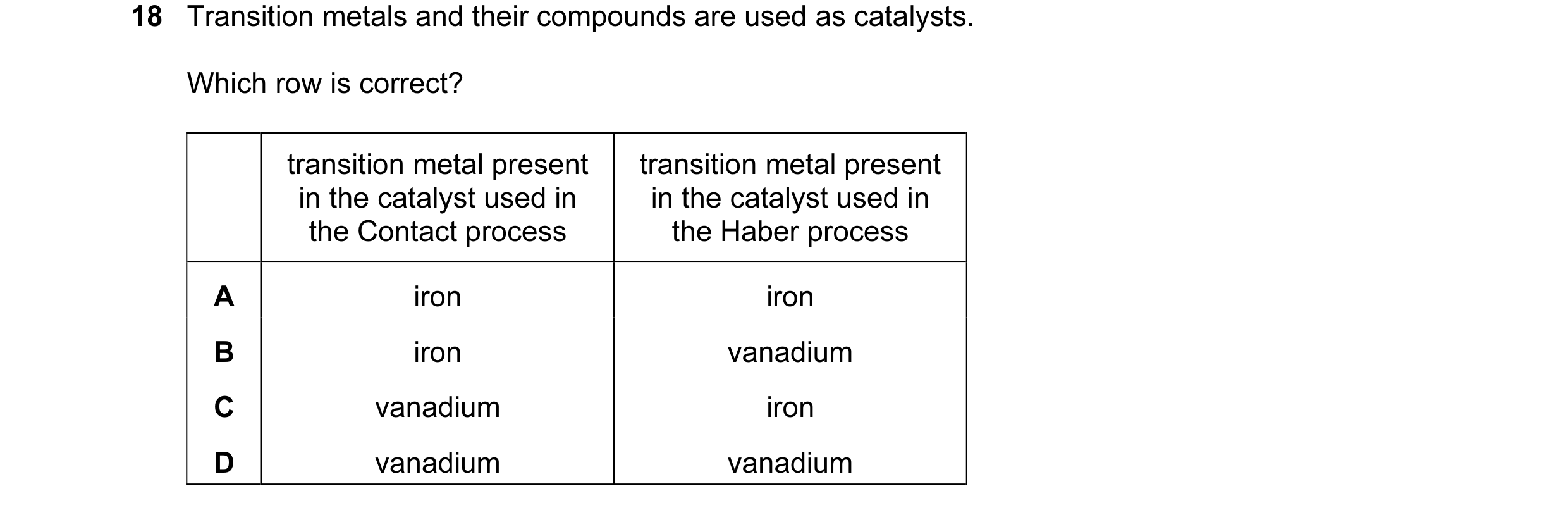
18 Transition metals and their compounds are used as catalysts. Which row is correct? transition metal present transition metal present in the catalyst used in in the catalyst used in the Contact process the Haber process A iron iron B iron vanadium C vanadium iron D vanadium vanadium
1 marks
Answer: C
This question in 9701/12 Oct/Nov 2013
Q17 · Which processes involve the conversion of sulfur dioxide into sulfur trioxide? 9701/13 Oct/Nov 2013
35 Which processes involve the conversion of sulfur dioxide into sulfur trioxide? 1 the combustion of sulfur contaminated fossil fuels 2 the Contact process for manufacturing sulfuric acid 3 the catalytic oxidation of sulfur dioxide by oxides of nitrogen
1 marks
Answer: C
This question in 9701/13 Oct/Nov 2013
Q18 · A car has a catalytic converter fitted to its exhaust 9701/12 May/June 2014
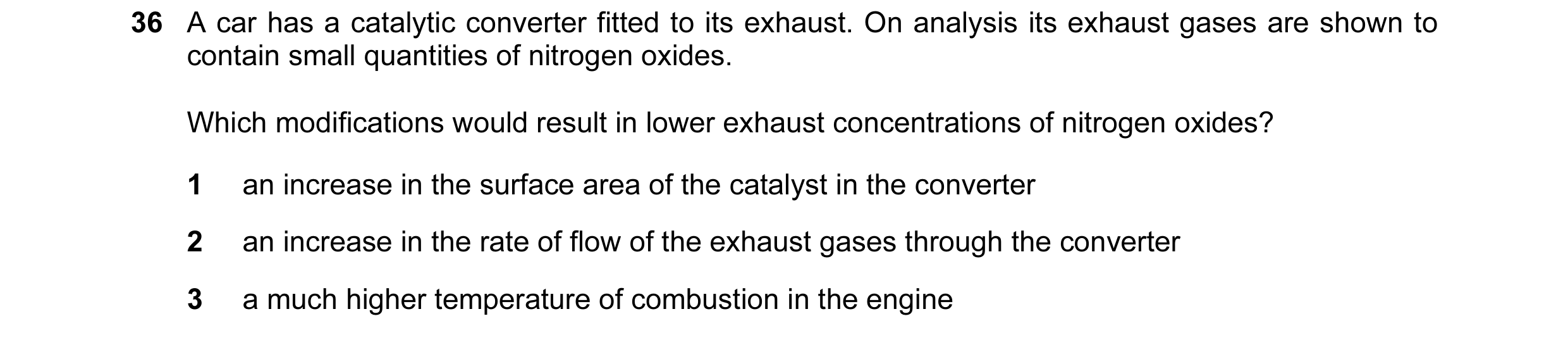
36 A car has a catalytic converter fitted to its exhaust. On analysis its exhaust gases are shown to contain small quantities of nitrogen oxides. Which modifications would result in lower exhaust concentrations of nitrogen oxides? 1 an increase in the surface area of the catalyst in the converter 2 an increase in the rate of flow of the exhaust gases through the converter 3 a much higher temperature of combustion in the engine
1 marks
Answer: D
This question in 9701/12 May/June 2014
Q19 · Which statements about the industrial manufacture of sulfuric acid are correct? 9701/11 May/June 2015
35 Which statements about the industrial manufacture of sulfuric acid are correct? 1 Sulfur is burned to form sulfur dioxide. 2 The stage that forms sulfur trioxide involves a V2O5 catalyst. 3 The stage that forms sulfur trioxide is non-reversible.
1 marks
Answer: B
This question in 9701/11 May/June 2015
Q20 · Photochromic glass, used for sunglasses, darkens when exposed to bright light and becomes… 9701/12 May/June 2015
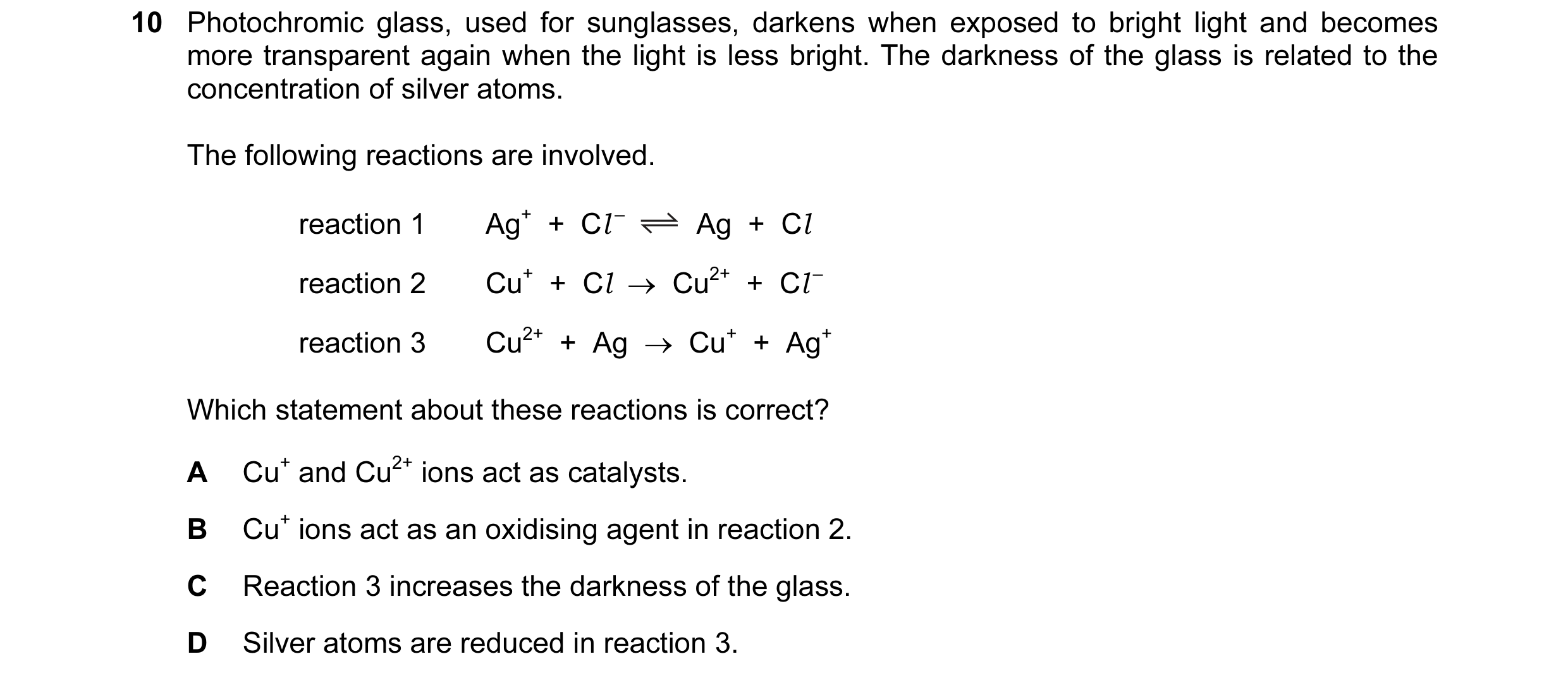
10 Photochromic glass, used for sunglasses, darkens when exposed to bright light and becomes more transparent again when the light is less bright. The darkness of the glass is related to the concentration of silver atoms. The following reactions are involved. reaction 1 Ag+ + Cl – Ag + Cl reaction 2 Cu+ + Cl → Cu2+ + Cl – reaction 3 Cu2+ + Ag → Cu+ + Ag+ Which statement about these reactions is correct? A Cu+ and Cu2+ ions act as catalysts. B Cu+ ions act as an oxidising agent in reaction 2. C Reaction 3 increases the darkness of the glass. D Silver atoms are reduced in reaction 3.
1 marks
Answer: A
This question in 9701/12 May/June 2015
Q21 · Chlorine atoms in the upper atmosphere cause the breakdown of ozone 9701/12 Feb/March 2016
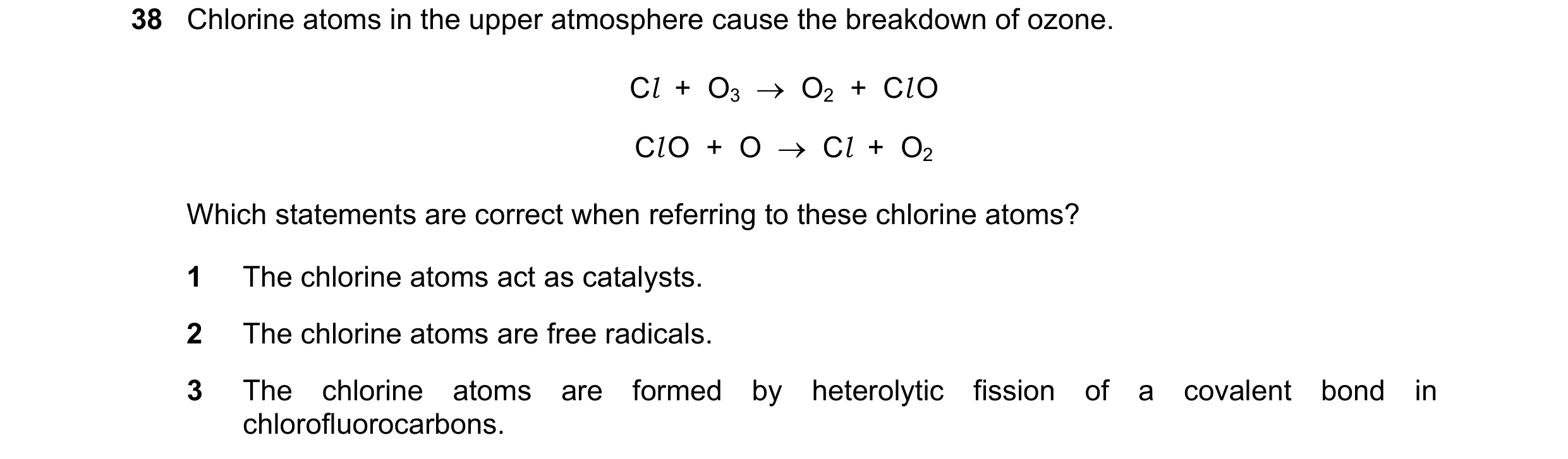
38 Chlorine atoms in the upper atmosphere cause the breakdown of ozone. Cl + O3 → O2 + Cl O Cl O + O → Cl + O2 Which statements are correct when referring to these chlorine atoms? 1 The chlorine atoms act as catalysts. 2 The chlorine atoms are free radicals. 3 The chlorine atoms are formed by heterolytic fission of a covalent bond in chlorofluorocarbons.
1 marks
Answer: B
This question in 9701/12 Feb/March 2016
Q22 · Enzymes are biological catalysts 9701/11 May/June 2016
11 Enzymes are biological catalysts. Many enzymes show specificity. An example of an enzyme which shows specificity is glucokinase. Glucokinase is involved in the metabolism of glucose. What does specificity mean in this context? A Glucokinase is most effective as a catalyst over a narrow pH range. B Glucokinase is most effective as a catalyst over a narrow range of temperatures. C Glucokinase only operates on a narrow range of substrate molecules. D Glucokinase provides an alternative route for the reactions it catalyses.
1 marks
Answer: C
This question in 9701/11 May/June 2016
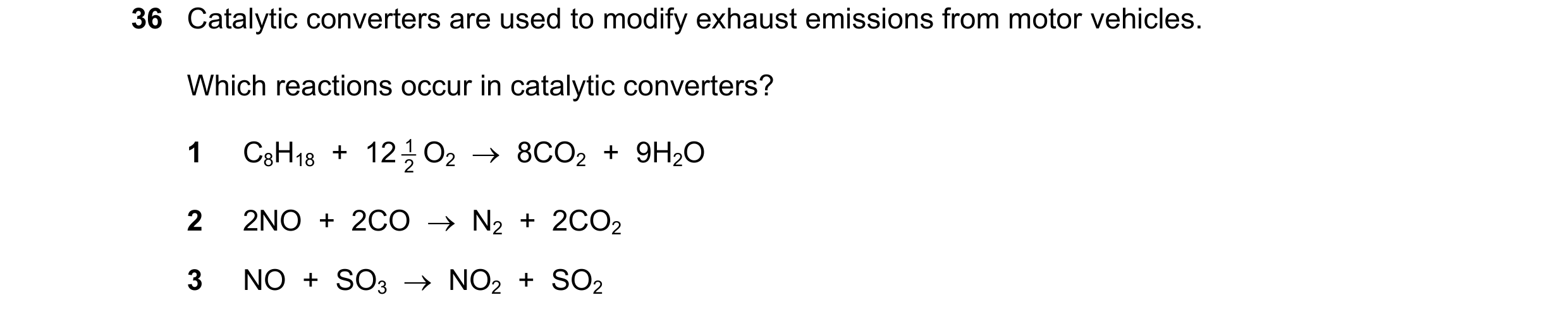
Q23 · Catalytic converters are used to modify exhaust emissions from motor vehicles 9701/13 Oct/Nov 2016
36 Catalytic converters are used to modify exhaust emissions from motor vehicles. Which reactions occur in catalytic converters? 1 C8H18 + 12 2 1 O2 → 8CO2 + 9H2O 2 2NO + 2CO → N2 + 2CO2 3 NO + SO3 → NO2 + SO2
1 marks
Answer: B
This question in 9701/13 Oct/Nov 2016
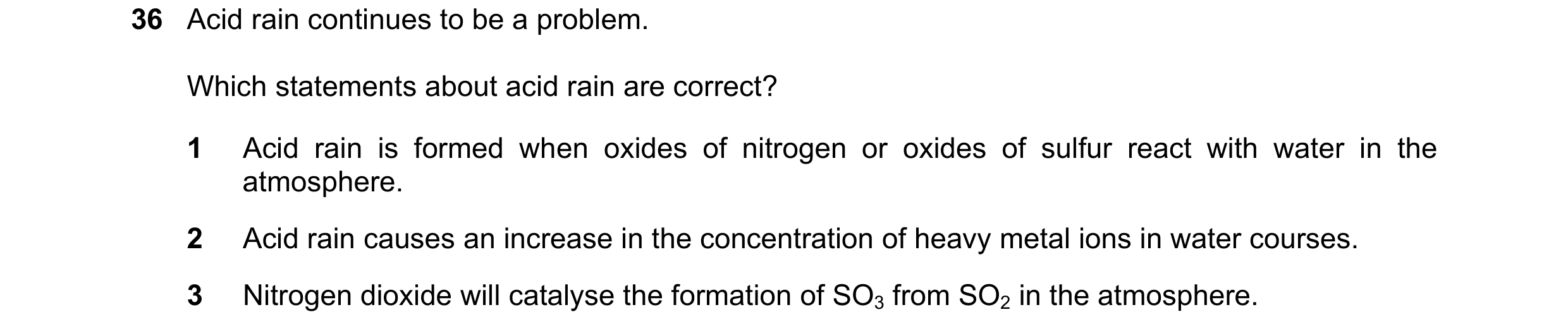
Q24 · Acid rain continues to be a problem 9701/12 May/June 2017
36 Acid rain continues to be a problem. Which statements about acid rain are correct? 1 Acid rain is formed when oxides of nitrogen or oxides of sulfur react with water in the atmosphere. 2 Acid rain causes an increase in the concentration of heavy metal ions in water courses. 3 Nitrogen dioxide will catalyse the formation of SO3 from SO2 in the atmosphere.
1 marks
Answer: A
This question in 9701/12 May/June 2017
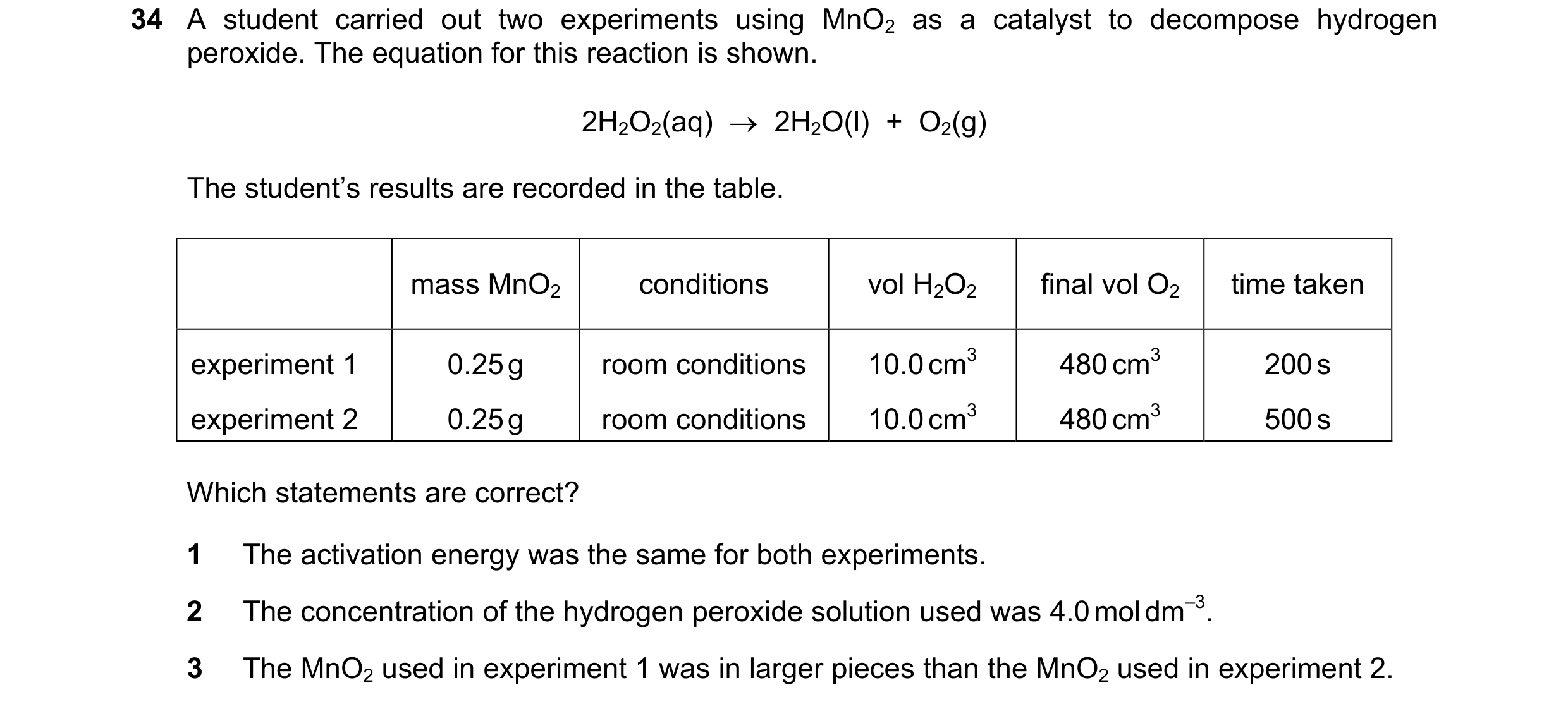
Q25 · A student carried out two experiments using MnO2 as a catalyst to decompose hydrogen… 9701/13 May/June 2017
34 A student carried out two experiments using MnO2 as a catalyst to decompose hydrogen peroxide. The equation for this reaction is shown. 2H2O2(aq) → 2H2O(l) + O2(g) The student’s results are recorded in the table. mass MnO2 conditions vol H2O2 final vol O2 time taken experiment 1 0.25 g room conditions 10.0 cm3 480 cm3 200 s experiment 2 0.25 g room conditions 10.0 cm3 480 cm3 500 s Which statements are correct? 1 The activation energy was the same for both experiments. 2 The concentration of the hydrogen peroxide solution used was 4.0 mol dm–3. 3 The MnO2 used in experiment 1 was in larger pieces than the MnO2 used in experiment 2.
1 marks
Answer: B
This question in 9701/13 May/June 2017
Q26 · Modern cars are fitted with catalytic converters to reduce atmospheric pollution caused… 9701/12 Oct/Nov 2017
36 Modern cars are fitted with catalytic converters to reduce atmospheric pollution caused by unwanted reactions during the combustion of the fuel. Which statements are correct? 1 Carbon monoxide is oxidised to carbon dioxide in a catalytic converter. 2 Catalytic converters have a very large surface area. 3 Nitrogen dioxide is reduced to nitrogen monoxide in a catalytic converter.
1 marks
Answer: B
This question in 9701/12 Oct/Nov 2017
Q27 · Which statement about the effect of a catalyst on a reversible reaction is correct? 9701/12 Feb/March 2018
12 Which statement about the effect of a catalyst on a reversible reaction is correct? A The activation energy of the forward reaction stays the same. B The composition of the equilibrium mixture stays the same. C The rate of the backward reaction stays the same. D The value of the equilibrium constant changes.
1 marks
Answer: B
This question in 9701/12 Feb/March 2018
Q28 · Hydrogen ions catalyse the hydrolysis of esters 9701/11 May/June 2018
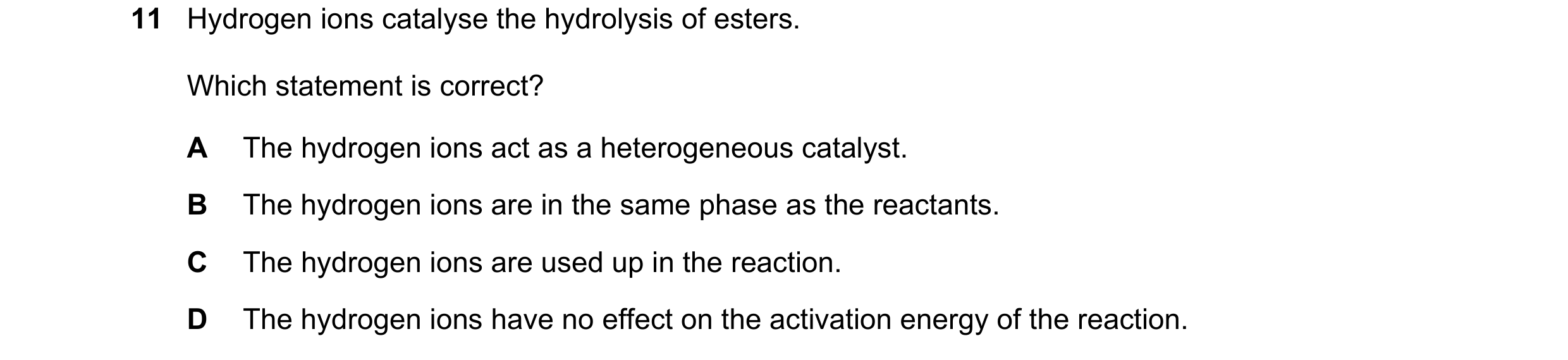
11 Hydrogen ions catalyse the hydrolysis of esters. Which statement is correct? A The hydrogen ions act as a heterogeneous catalyst. B The hydrogen ions are in the same phase as the reactants. C The hydrogen ions are used up in the reaction. D The hydrogen ions have no effect on the activation energy of the reaction.
1 marks
Answer: B
This question in 9701/11 May/June 2018
Q29 · Sulfur dioxide can be catalytically oxidised by an oxide of nitrogen in the atmosphere 9701/12 May/June 2018
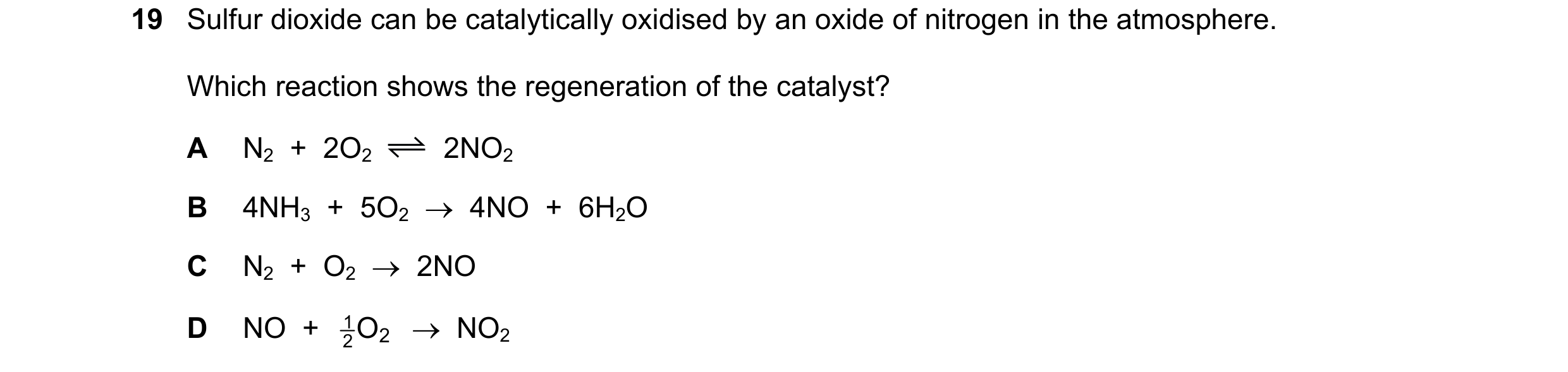
19 Sulfur dioxide can be catalytically oxidised by an oxide of nitrogen in the atmosphere. Which reaction shows the regeneration of the catalyst? A N2 + 2O2 2NO2 B 4NH3 + 5O2 → 4NO + 6H2O C N2 + O2 → 2NO D NO + 1 O → NO2 2 2
1 marks
Answer: D
This question in 9701/12 May/June 2018
Q30 · The diagram shows an experimental set-up which can be used in several different… 9701/12 May/June 2018
39 The diagram shows an experimental set-up which can be used in several different experiments. silica, alumina or baked clay liquid X on mineral wool gas collected support strong gentle heat trough of heat water Which processes could be demonstrated by using the above apparatus? 1 oxidation of ethanol (liquid X) 2 dehydration of ethanol (liquid X) 3 cracking of paraffin (liquid X)
1 marks
Answer: C
This question in 9701/12 May/June 2018
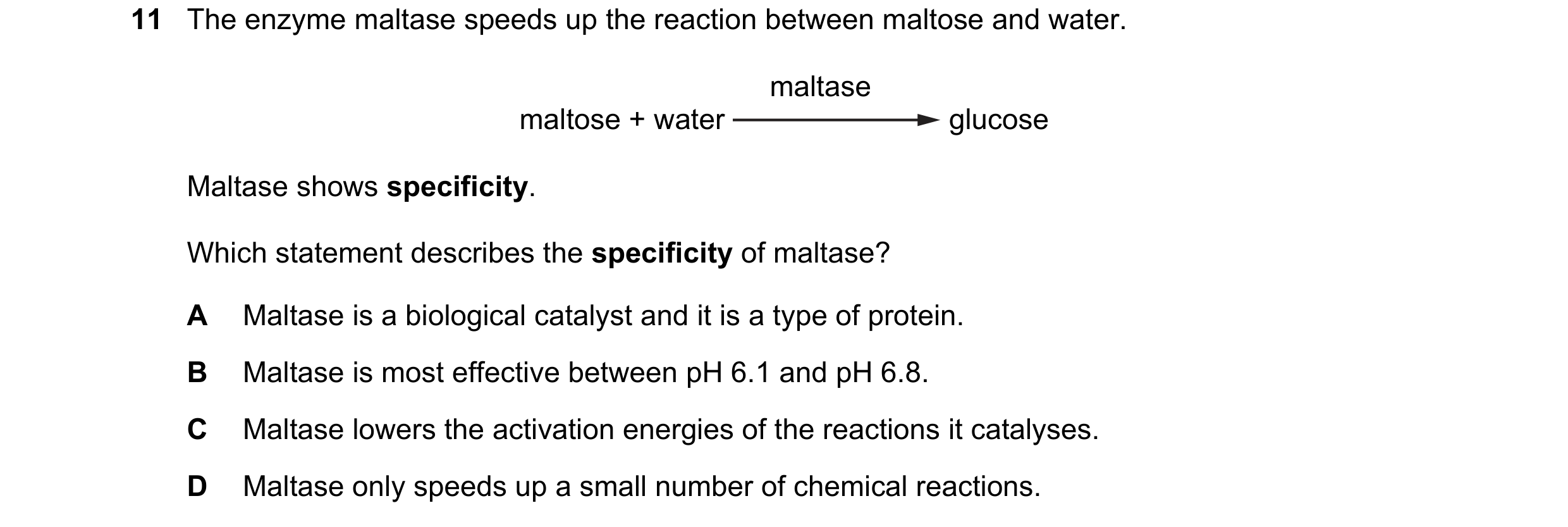
Q31 · The enzyme maltase speeds up the reaction between maltose and water 9701/13 May/June 2018
11 The enzyme maltase speeds up the reaction between maltose and water. maltase maltose + water glucose Maltase shows specificity. Which statement describes the specificity of maltase? A Maltase is a biological catalyst and it is a type of protein. B Maltase is most effective between pH 6.1 and pH 6.8. C Maltase lowers the activation energies of the reactions it catalyses. D Maltase only speeds up a small number of chemical reactions.
1 marks
Answer: D
This question in 9701/13 May/June 2018
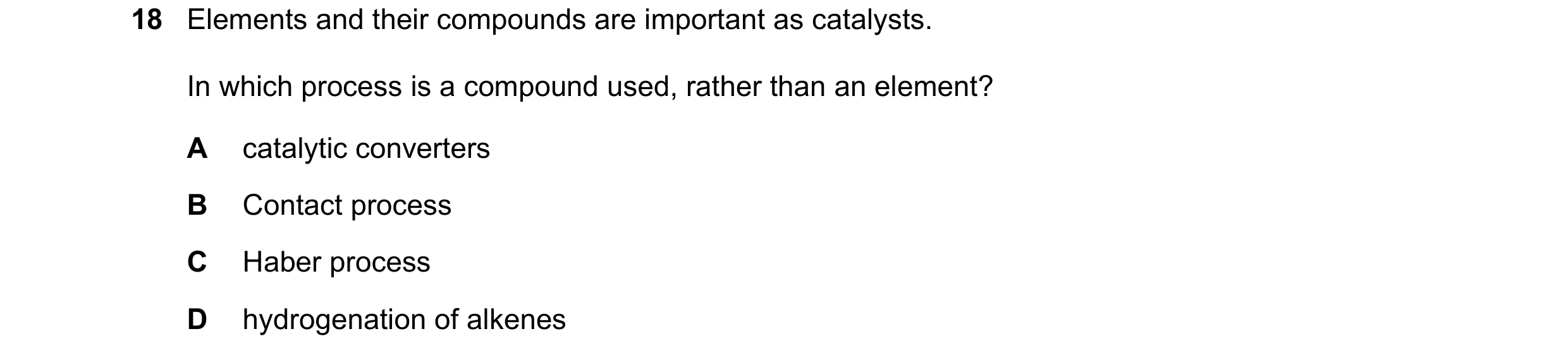
Q32 · Elements and their compounds are important as catalysts 9701/13 May/June 2018
18 Elements and their compounds are important as catalysts. In which process is a compound used, rather than an element? A catalytic converters B Contact process C Haber process D hydrogenation of alkenes
1 marks
Answer: B
This question in 9701/13 May/June 2018
Q33 · Two reactions are shown 9701/13 Oct/Nov 2018
11 Two reactions are shown. reaction 1 N2(g) + 3H2(g) 2NH3(g) reaction 2 2O3(g) 3O2(g) In reaction 1, a finely powdered iron catalyst is used. In reaction 2, a vaporised tetrachloromethane catalyst in ultraviolet light is used. Which statement about the catalysts used is correct? A Both reaction 1 and reaction 2 use a heterogeneous catalyst. B Both reaction 1 and reaction 2 use a homogeneous catalyst. C Reaction 1 uses a heterogeneous catalyst and reaction 2 uses a homogeneous catalyst. D Reaction 1 uses a homogeneous catalyst and reaction 2 uses a heterogeneous catalyst.
1 marks
Answer: C
This question in 9701/13 Oct/Nov 2018
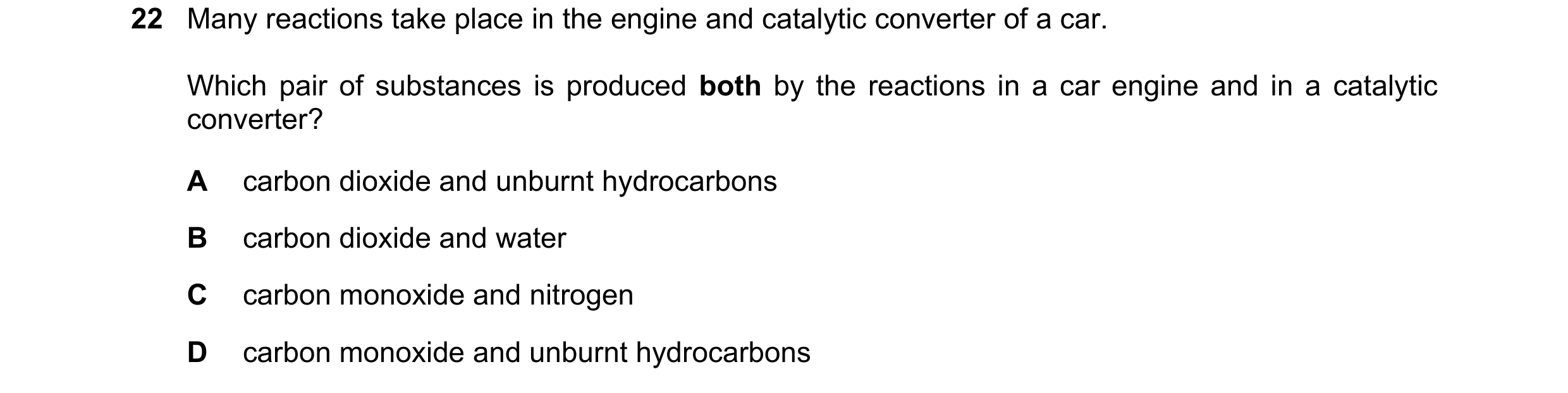
Q34 · Many reactions take place in the engine and catalytic converter of a car 9701/12 Feb/March 2019
22 Many reactions take place in the engine and catalytic converter of a car. Which pair of substances is produced both by the reactions in a car engine and in a catalytic converter? A carbon dioxide and unburnt hydrocarbons B carbon dioxide and water C carbon monoxide and nitrogen D carbon monoxide and unburnt hydrocarbons
1 marks
Answer: B
This question in 9701/12 Feb/March 2019
Q35 · Which row is an example of heterogeneous catalysis? 9701/12 May/June 2019
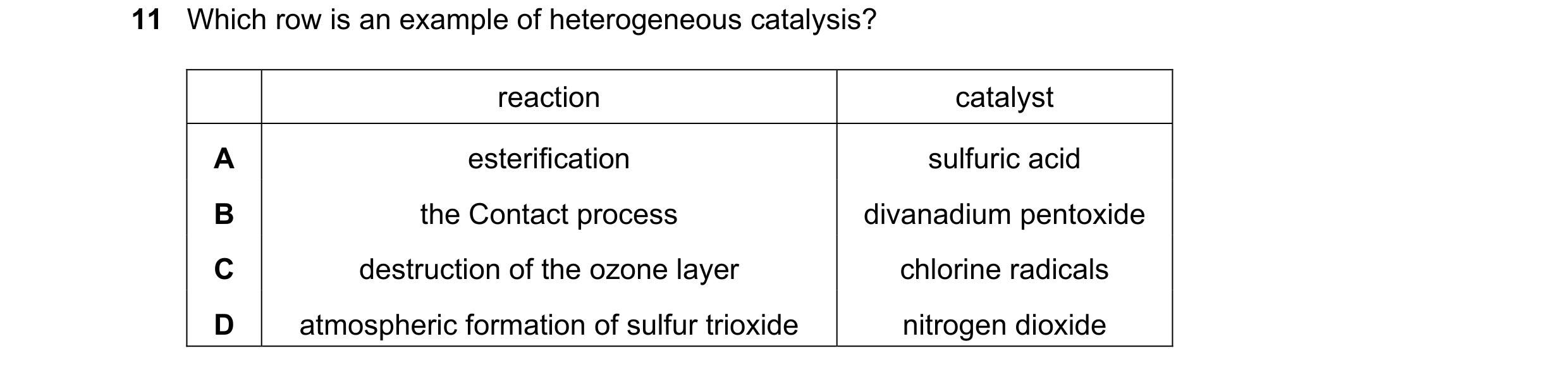
11 Which row is an example of heterogeneous catalysis? reaction catalyst A esterification sulfuric acid B the Contact process divanadium pentoxide C destruction of the ozone layer chlorine radicals D atmospheric formation of sulfur trioxide nitrogen dioxide
1 marks
Answer: B
This question in 9701/12 May/June 2019
Q36 · Catalytic converters are fitted in the exhaust systems of many cars 9701/11 Oct/Nov 2019
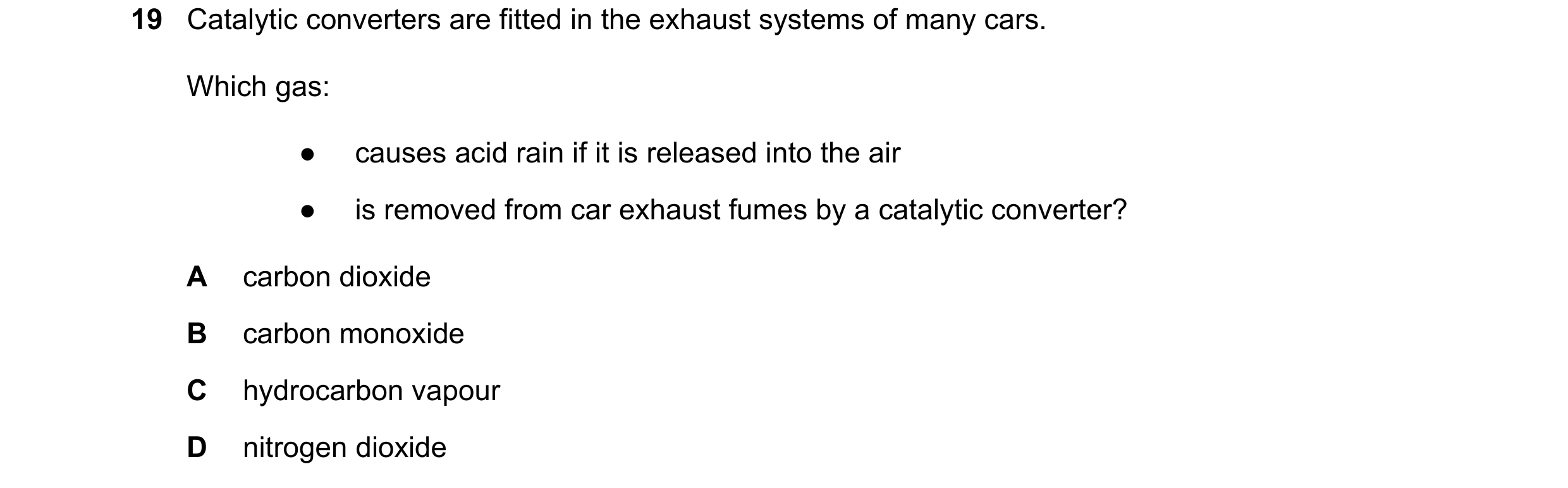
19 Catalytic converters are fitted in the exhaust systems of many cars. Which gas: ● causes acid rain if it is released into the air ● is removed from car exhaust fumes by a catalytic converter? A carbon dioxide B carbon monoxide C hydrocarbon vapour D nitrogen dioxide
1 marks
Answer: D
This question in 9701/11 Oct/Nov 2019
Q37 · Catalytic converters are fitted in the exhaust systems of many cars 9701/13 Oct/Nov 2019
19 Catalytic converters are fitted in the exhaust systems of many cars. Which gas: ● causes acid rain if it is released into the air ● is removed from car exhaust fumes by a catalytic converter? A carbon dioxide B carbon monoxide C hydrocarbon vapour D nitrogen dioxide
1 marks
Answer: D
This question in 9701/13 Oct/Nov 2019
Q38 · Hydrogen cyanide reacts with propanone in the presence of potassium cyanide 9701/13 Oct/Nov 2019
39 Hydrogen cyanide reacts with propanone in the presence of potassium cyanide. Which statements about this reaction are correct? 1 The cyanide ion is a catalyst for the reaction. 2 This is an addition reaction. 3 The intermediate behaves as a base.
1 marks
Answer: A
This question in 9701/13 Oct/Nov 2019
Q39 · The catalytic converters fitted to cars remove pollutants from the exhaust gases 9701/11 May/June 2020
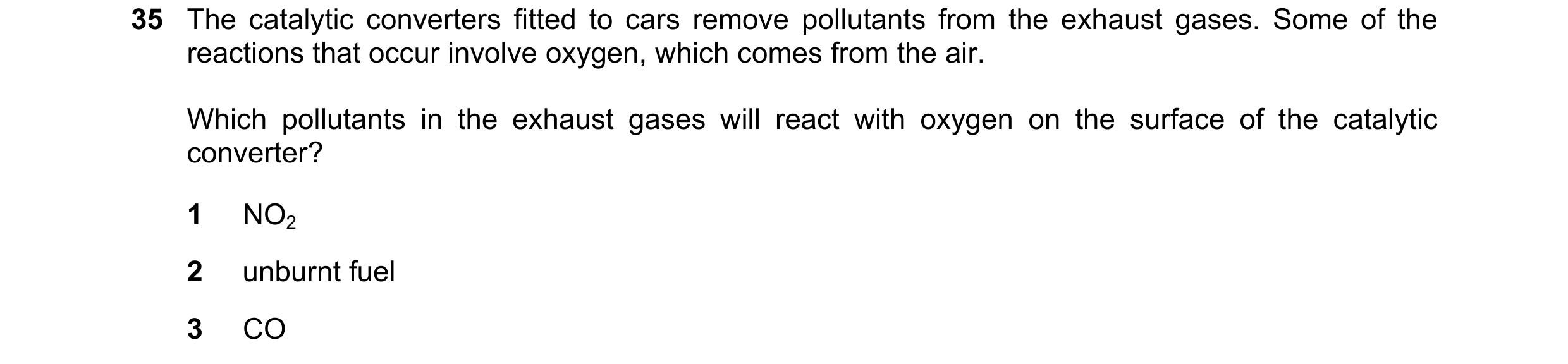
35 The catalytic converters fitted to cars remove pollutants from the exhaust gases. Some of the reactions that occur involve oxygen, which comes from the air. Which pollutants in the exhaust gases will react with oxygen on the surface of the catalytic converter? 1 NO2 2 unburnt fuel 3 CO
1 marks
Answer: C
This question in 9701/11 May/June 2020
Q40 · In the atmosphere, which transformations can involve sulfur dioxide as either a reagent… 9701/12 May/June 2020
35 In the atmosphere, which transformations can involve sulfur dioxide as either a reagent or a catalyst? 1 NO2 to NO 2 NO to NO2 3 CO to CO2
1 marks
Answer: D
This question in 9701/12 May/June 2020
Q41 · Nitrogen oxides are removed from the exhaust gases of internal combustion engines by the… 9701/13 May/June 2020
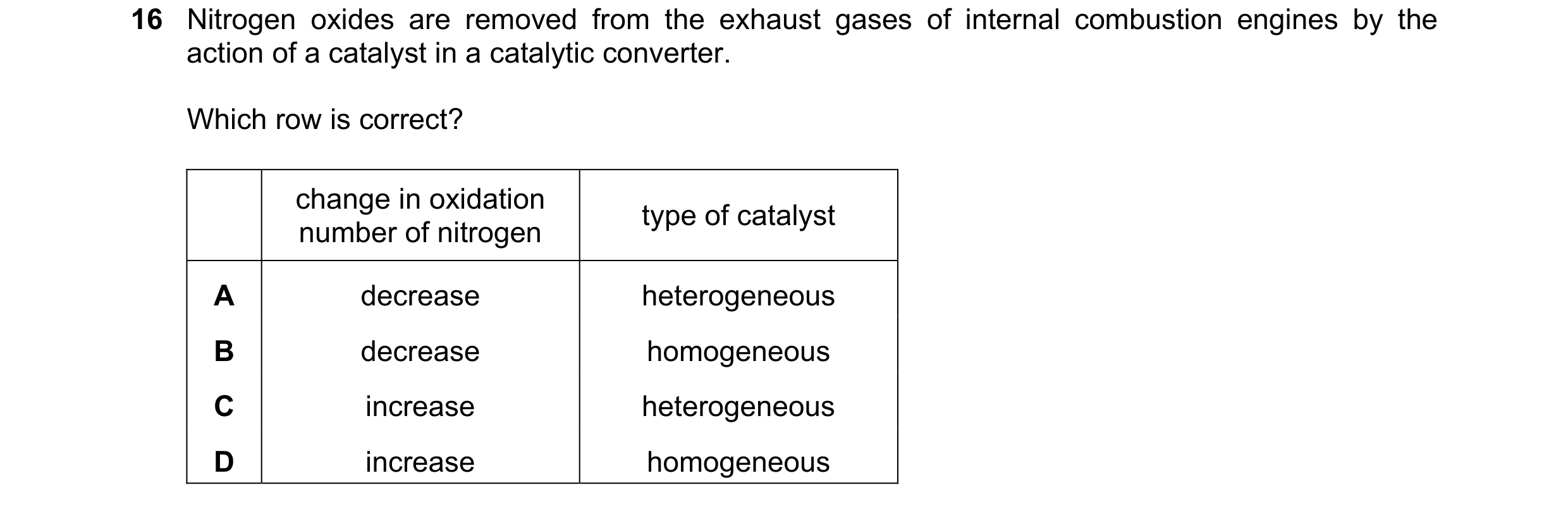
16 Nitrogen oxides are removed from the exhaust gases of internal combustion engines by the action of a catalyst in a catalytic converter. Which row is correct? change in oxidation type of catalyst number of nitrogen A decrease heterogeneous B decrease homogeneous C increase heterogeneous D increase homogeneous
1 marks
Answer: A
This question in 9701/13 May/June 2020
Q42 · The diagram represents the Haber process for the manufacture of ammonia from nitrogen and… 9701/11 May/June 2021
10 The diagram represents the Haber process for the manufacture of ammonia from nitrogen and hydrogen. heat exchanger N2 + H2 catalytic converter condenser NH3 What is the purpose of the heat exchanger? A to cool the incoming gas mixture to avoid overheating the catalyst B to cool the reaction products and separate the NH3 from unused N2 and H2 C to warm the incoming gas mixture and shift the equilibrium to give more NH3 D to warm the incoming gas mixture and speed up the reaction
1 marks
Answer: D
This question in 9701/11 May/June 2021
Q43 · Disaccharides are hydrolysed in slightly acidic solutions 9701/13 May/June 2021
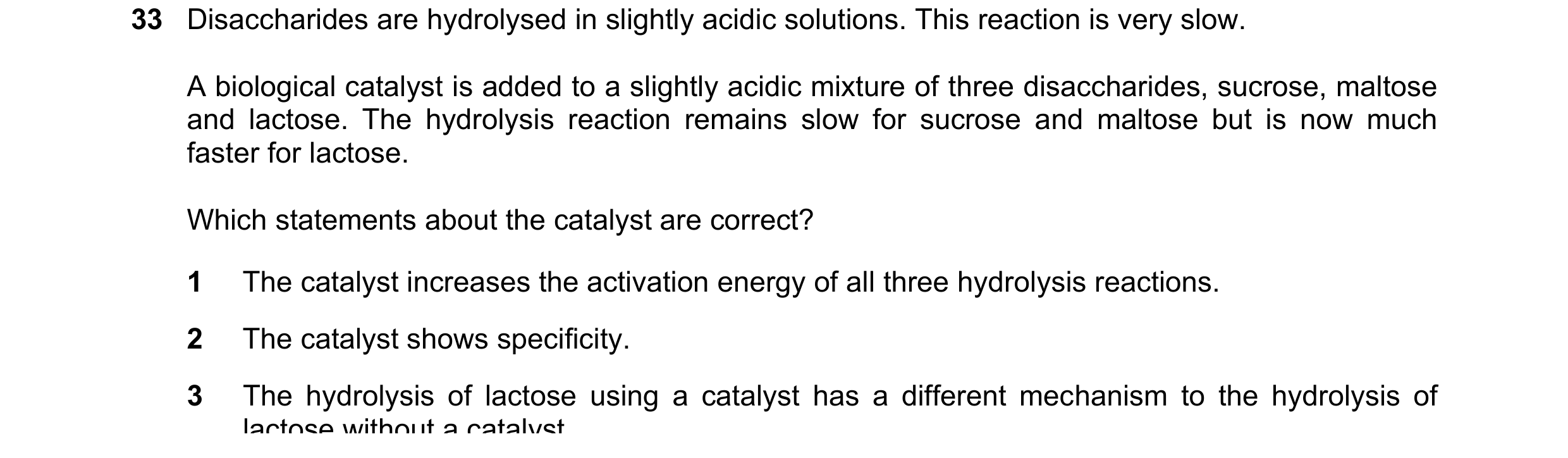
33 Disaccharides are hydrolysed in slightly acidic solutions. This reaction is very slow. A biological catalyst is added to a slightly acidic mixture of three disaccharides, sucrose, maltose and lactose. The hydrolysis reaction remains slow for sucrose and maltose but is now much faster for lactose. Which statements about the catalyst are correct? 1 The catalyst increases the activation energy of all three hydrolysis reactions. 2 The catalyst shows specificity. 3 The hydrolysis of lactose using a catalyst has a different mechanism to the hydrolysis of lactose without a catalyst.
1 marks
Answer: C
This question in 9701/13 May/June 2021
Q44 · SO3 is manufactured from SO2 and O2 in the Contact process 9701/11 May/June 2022
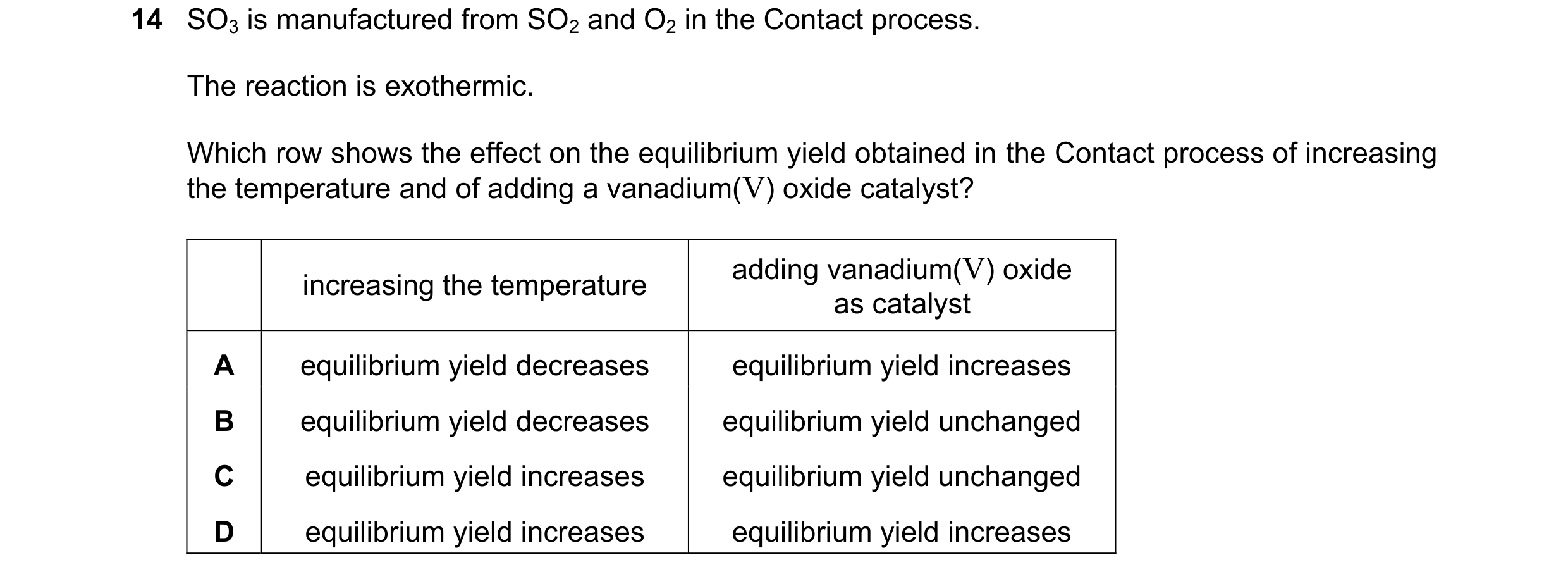
14 SO3 is manufactured from SO2 and O2 in the Contact process. The reaction is exothermic. Which row shows the effect on the equilibrium yield obtained in the Contact process of increasing the temperature and of adding a vanadium(V) oxide catalyst? adding vanadium(V) oxide increasing the temperature as catalyst A equilibrium yield decreases equilibrium yield increases B equilibrium yield decreases equilibrium yield unchanged C equilibrium yield increases equilibrium yield unchanged D equilibrium yield increases equilibrium yield increases
1 marks
Answer: B
This question in 9701/11 May/June 2022
Q45 · A large amount of N2O(g) decomposes into nitrogen gas and oxygen gas in the presence of a… 9701/12 May/June 2022
15 A large amount of N2O(g) decomposes into nitrogen gas and oxygen gas in the presence of a tiny amount of a gold foil catalyst. The gold foil provides a solid surface on which the catalysed reaction takes place. The graph shows the concentration of N2O(g) against time as it decomposes. The graph is a straight line. concentration of N2O(g) 0 0 time / min 10 Which row describes: ● the change in rate of reaction as N2O(g) decomposes from 0 to 10 minutes ● the effect of adding more gold foil catalyst on the rate of decomposition of the same amount and concentration of N2O(g)? change in effect of adding more rate of reaction as gold foil on the N2O(g) decomposes rate of decomposition A none increases B none none C decreases increases D decreases none
1 marks
Answer: A
This question in 9701/12 May/June 2022
Q46 · A catalytic converter reduces the amount of pollutants in the fumes from a car exhaust 9701/12 May/June 2022
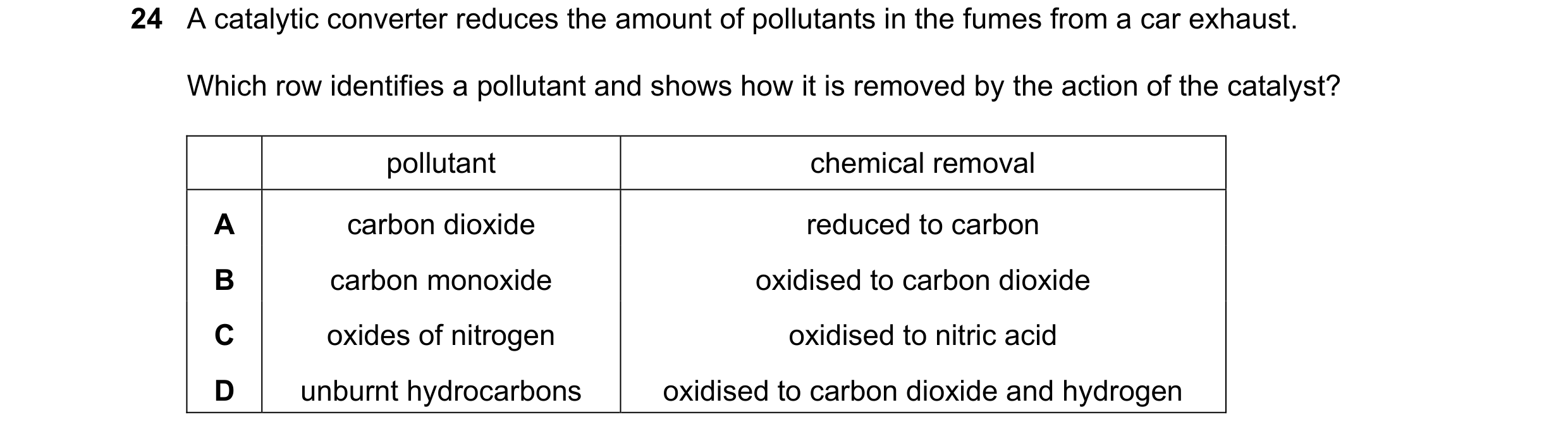
24 A catalytic converter reduces the amount of pollutants in the fumes from a car exhaust. Which row identifies a pollutant and shows how it is removed by the action of the catalyst? pollutant chemical removal A carbon dioxide reduced to carbon B carbon monoxide oxidised to carbon dioxide C oxides of nitrogen oxidised to nitric acid D unburnt hydrocarbons oxidised to carbon dioxide and hydrogen
1 marks
Answer: B
This question in 9701/12 May/June 2022
Q47 · Sulfur dioxide can be catalytically oxidised by an oxide of nitrogen in the atmosphere 9701/11 Oct/Nov 2022
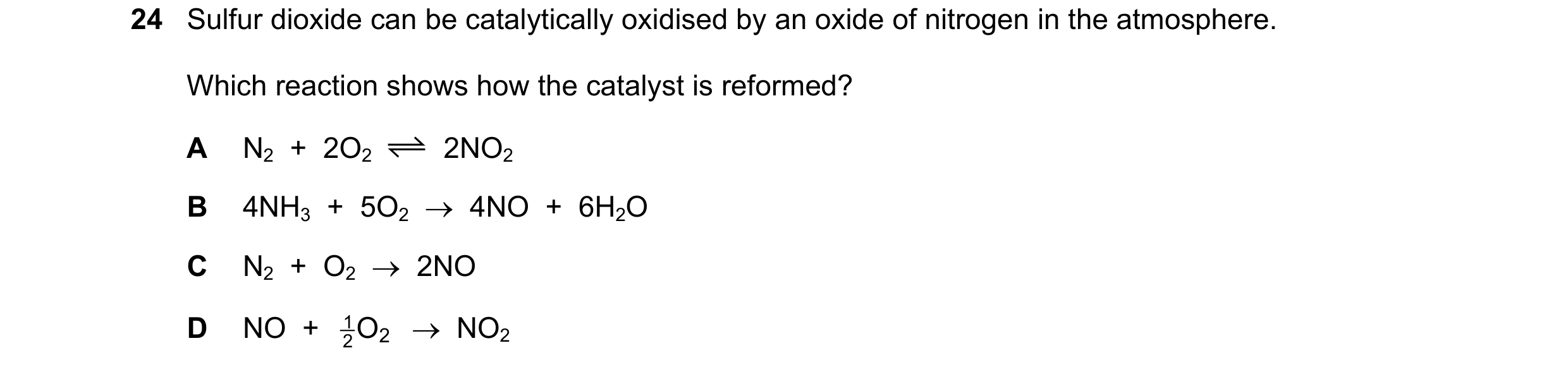
24 Sulfur dioxide can be catalytically oxidised by an oxide of nitrogen in the atmosphere. Which reaction shows how the catalyst is reformed? A N2 + 2O2 2NO2 B 4NH3 + 5O2 → 4NO + 6H2O C N2 + O2 → 2NO D NO + 1 O → NO2 2 2
1 marks
Answer: D
This question in 9701/11 Oct/Nov 2022
Q48 · Sulfur dioxide can be catalytically oxidised by an oxide of nitrogen in the atmosphere 9701/13 Oct/Nov 2022
24 Sulfur dioxide can be catalytically oxidised by an oxide of nitrogen in the atmosphere. Which reaction shows how the catalyst is reformed? A N2 + 2O2 2NO2 B 4NH3 + 5O2 4NO + 6H2O C N2 + O2 2NO D NO + 1 O NO2 2 2
1 marks
Answer: D
This question in 9701/13 Oct/Nov 2022
Q49 · Exhaust gases from an internal combustion engine are made less harmful by passing them… 9701/12 Feb/March 2023
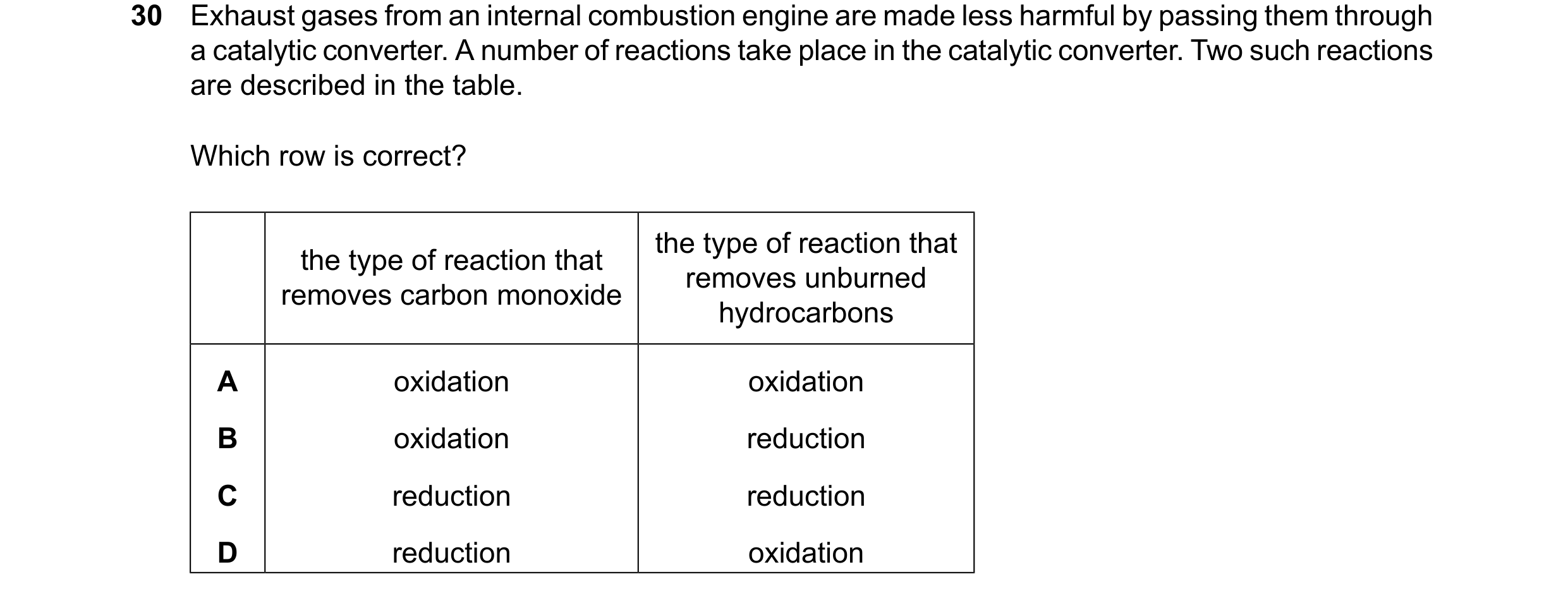
30 Exhaust gases from an internal combustion engine are made less harmful by passing them through a catalytic converter. A number of reactions take place in the catalytic converter. Two such reactions are described in the table. Which row is correct? the type of reaction that the type of reaction that removes unburned removes carbon monoxide hydrocarbons A oxidation oxidation B oxidation reduction C reduction reduction D reduction oxidation
1 marks
Answer: A
This question in 9701/12 Feb/March 2023
Q50 · What is produced when 60 g of nitrogen monoxide reacts with an excess of carbon monoxide… 9701/13 May/June 2024
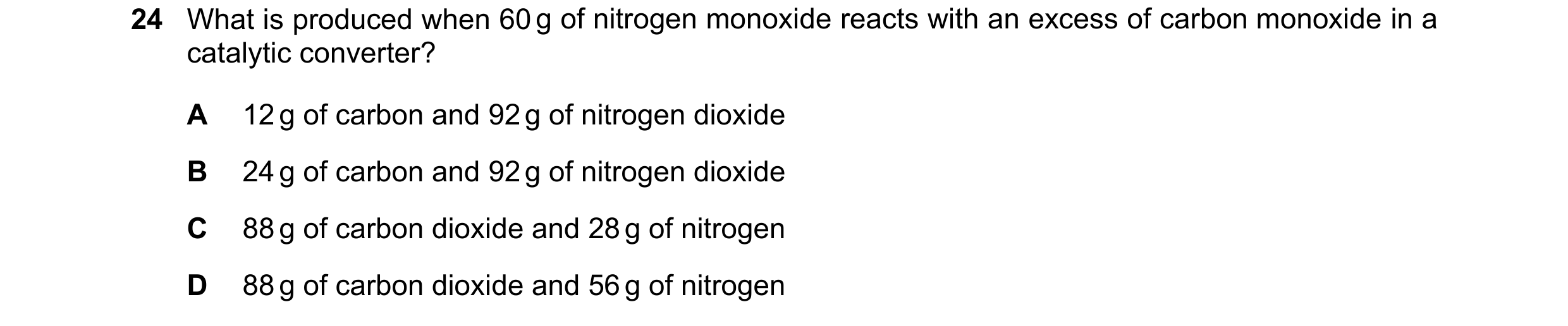
24 What is produced when 60 g of nitrogen monoxide reacts with an excess of carbon monoxide in a catalytic converter? A 12 g of carbon and 92 g of nitrogen dioxide B 24 g of carbon and 92 g of nitrogen dioxide C 88 g of carbon dioxide and 28 g of nitrogen D 88 g of carbon dioxide and 56 g of nitrogen
1 marks
Answer: C
This question in 9701/13 May/June 2024
Q51 · A reaction between two gases takes place on the surface of the catalytic converter of a… 9701/12 Oct/Nov 2024
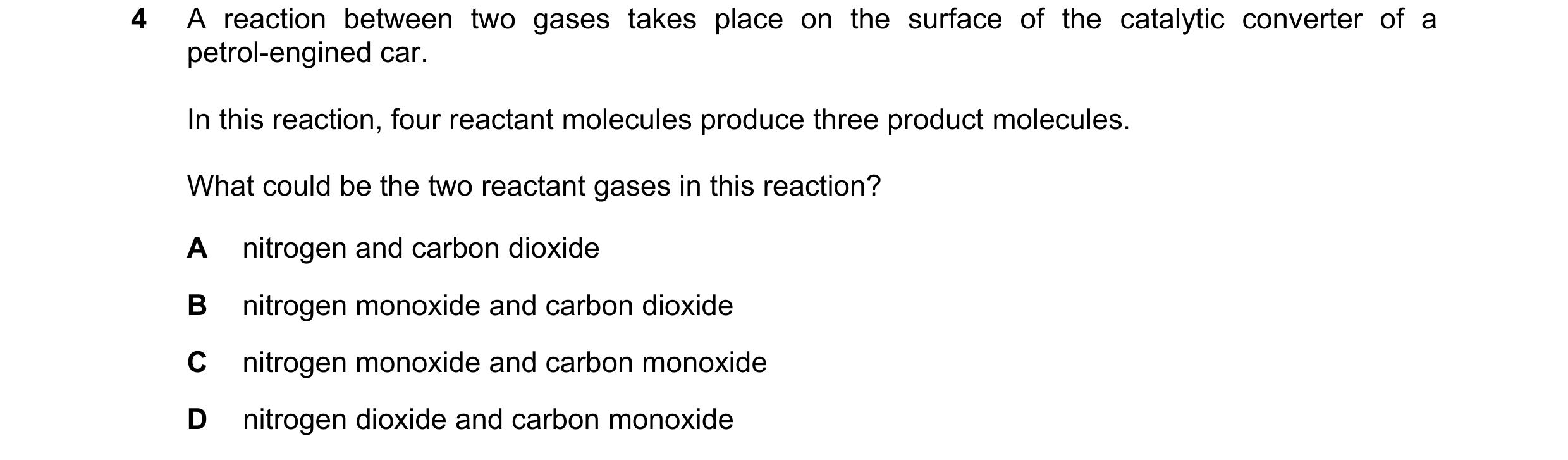
4 A reaction between two gases takes place on the surface of the catalytic converter of a petrol-engined car. In this reaction, four reactant molecules produce three product molecules. What could be the two reactant gases in this reaction? A nitrogen and carbon dioxide B nitrogen monoxide and carbon dioxide C nitrogen monoxide and carbon monoxide D nitrogen dioxide and carbon monoxide
1 marks
Answer: C
This question in 9701/12 Oct/Nov 2024
Q52 · Which reduction process occurs on the surface of a catalytic converter? 9701/11 May/June 2025
17 Which reduction process occurs on the surface of a catalytic converter? A reduction of carbon dioxide and nitrogen oxides B reduction of carbon dioxide only C reduction of nitrogen oxides only D reduction of carbon monoxide
1 marks
Answer: C
This question in 9701/11 May/June 2025
Q53 · In the Contact process, sulfur dioxide and oxygen react to form sulfur trioxide 9701/12 Oct/Nov 2025
13 In the Contact process, sulfur dioxide and oxygen react to form sulfur trioxide. In the Haber process, nitrogen and hydrogen react to form ammonia. Which statement about these processes is correct? A Kp for the Haber process has no unit. B In the Contact process, the value of Kp falls when pressure is increased at constant T. C The Haber process uses a homogeneous catalyst. D When V2O5 is used in the Contact process, the position of equilibrium is unchanged.
1 marks
Answer: D
This question in 9701/12 Oct/Nov 2025
Q54 · The reversible reaction between methanol and ethanoic acid liquids is catalysed by adding… 9701/13 Oct/Nov 2025
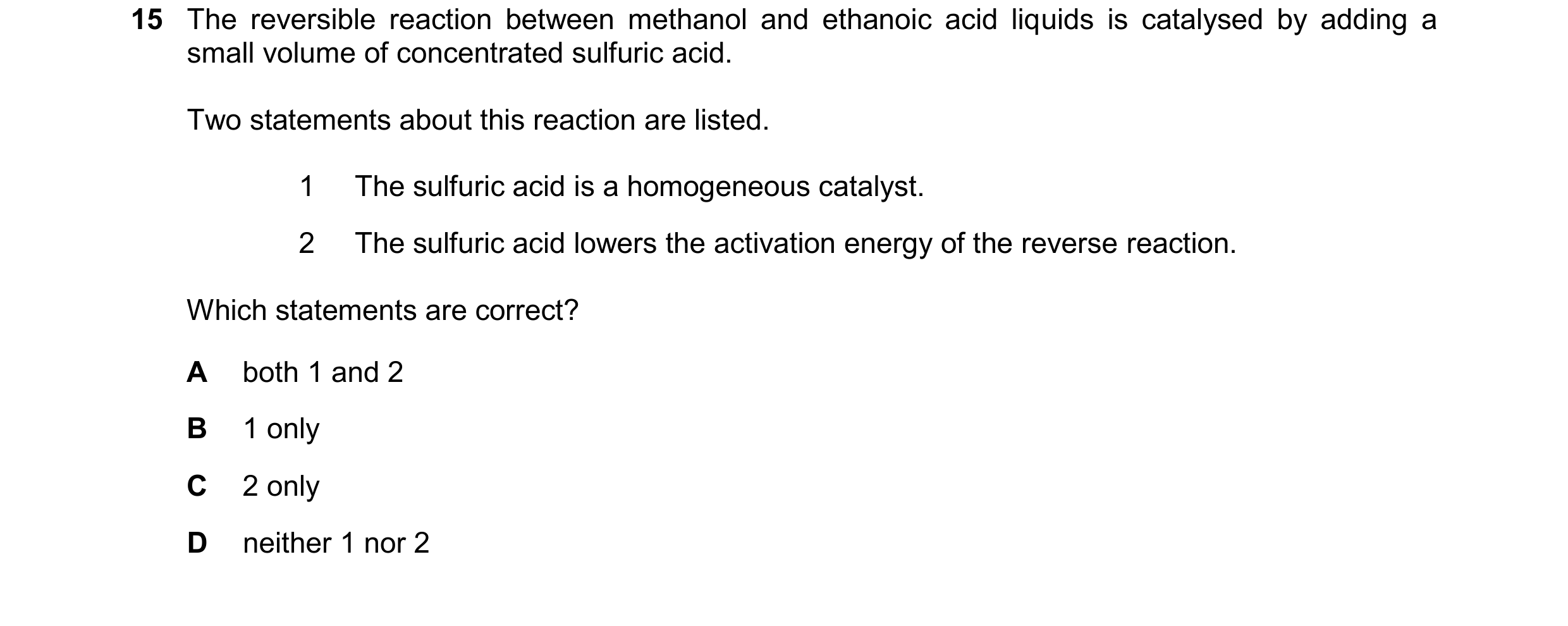
15 The reversible reaction between methanol and ethanoic acid liquids is catalysed by adding a small volume of concentrated sulfuric acid. Two statements about this reaction are listed. 1 The sulfuric acid is a homogeneous catalyst. 2 The sulfuric acid lowers the activation energy of the reverse reaction. Which statements are correct? A both 1 and 2 B 1 only C 2 only D neither 1 nor 2
1 marks
Answer: A
This question in 9701/13 Oct/Nov 2025
Q55 · The fumes from the exhausts of petrol-burning cars contain the following pollutants 9701/13 Oct/Nov 2025
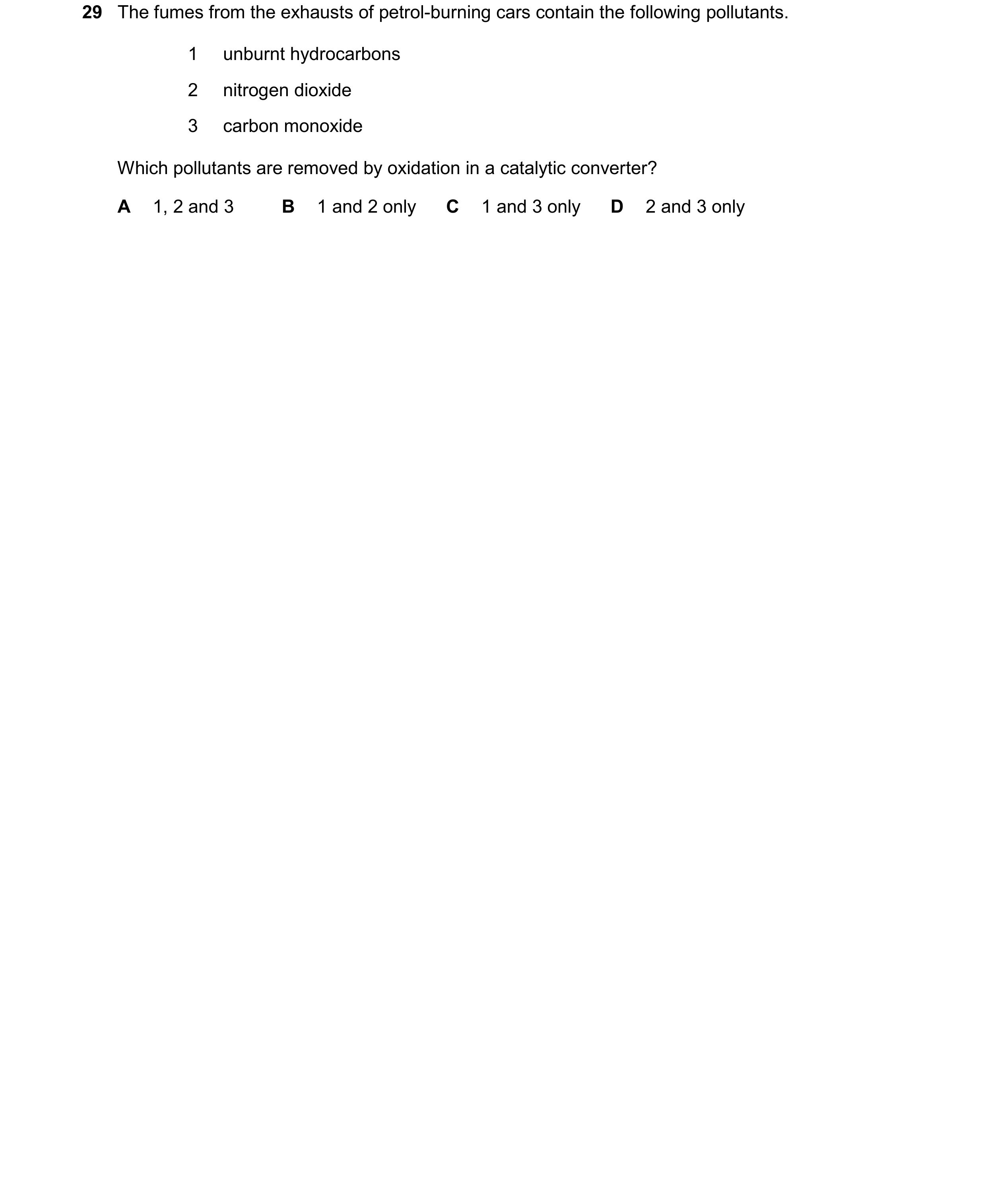
29 The fumes from the exhausts of petrol-burning cars contain the following pollutants. 1 unburnt hydrocarbons 2 nitrogen dioxide 3 carbon monoxide Which pollutants are removed by oxidation in a catalytic converter? A 1, 2 and 3 B 1 and 2 only C 1 and 3 only D 2 and 3 only
1 marks
Answer: C
This question in 9701/13 Oct/Nov 2025
 1 / 15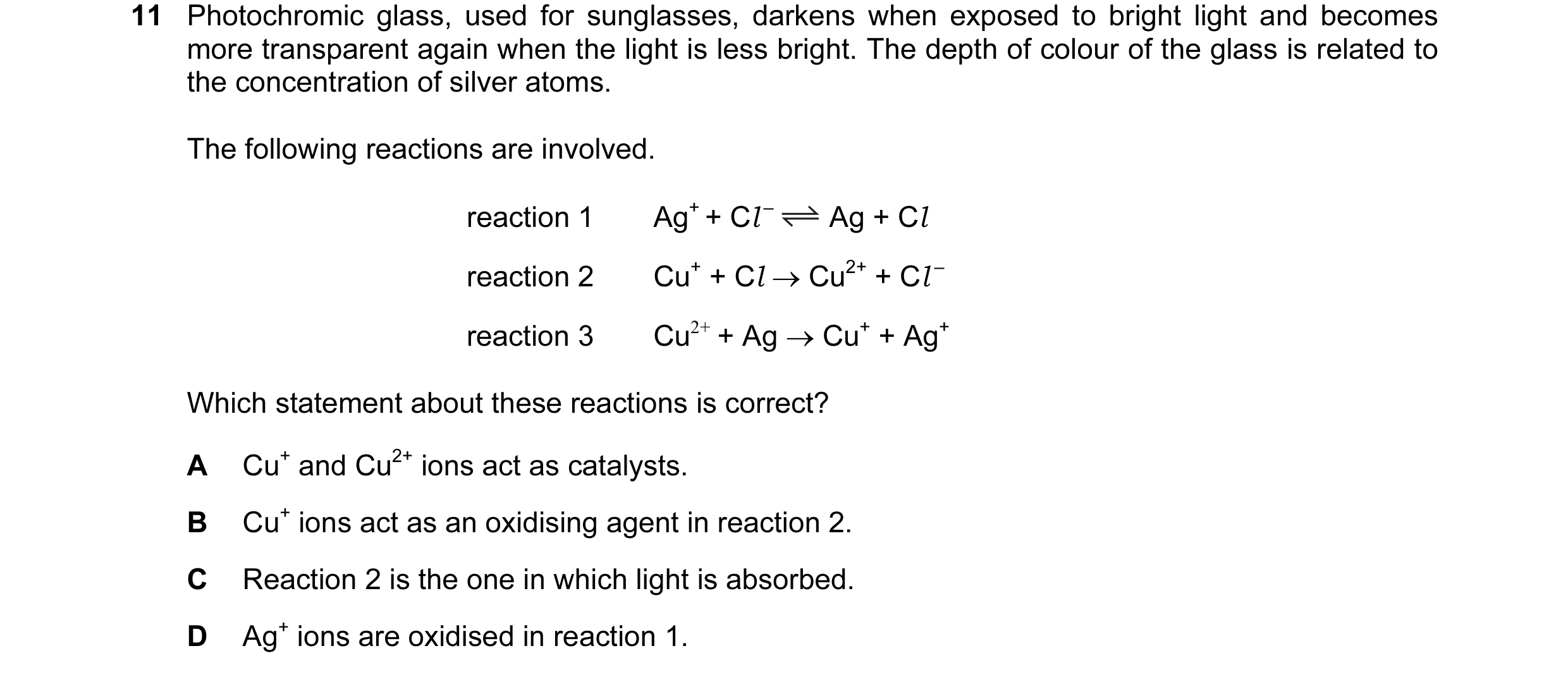

 2 / 15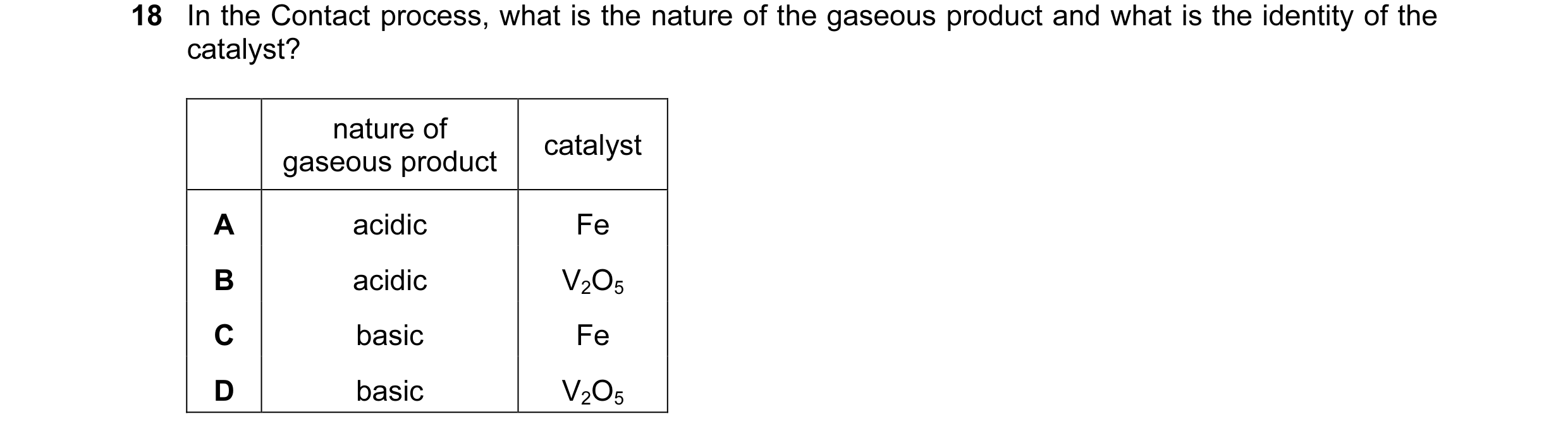
 3 / 15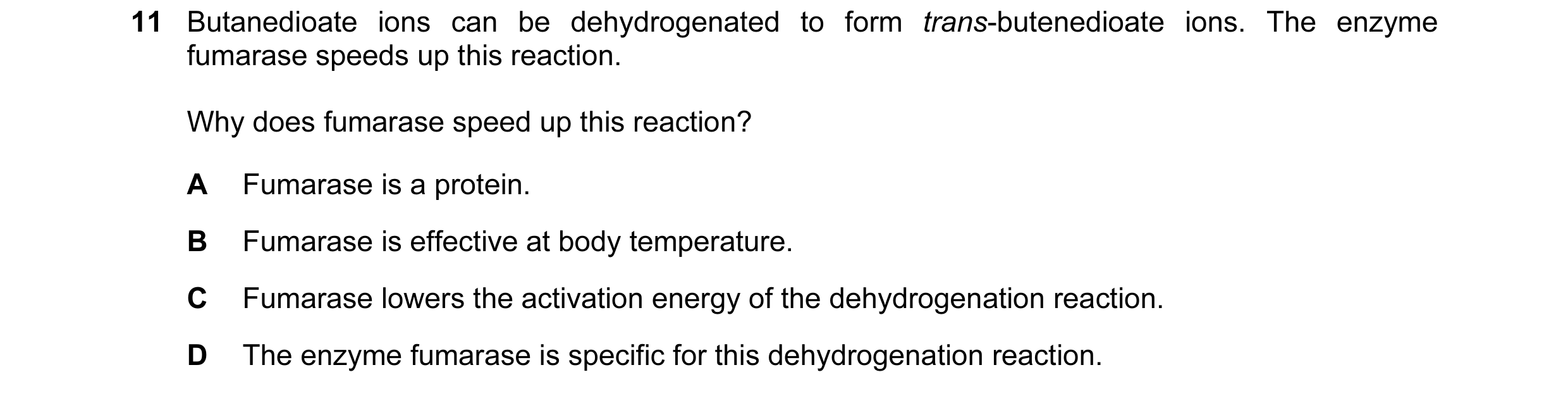


 4 / 15

 5 / 15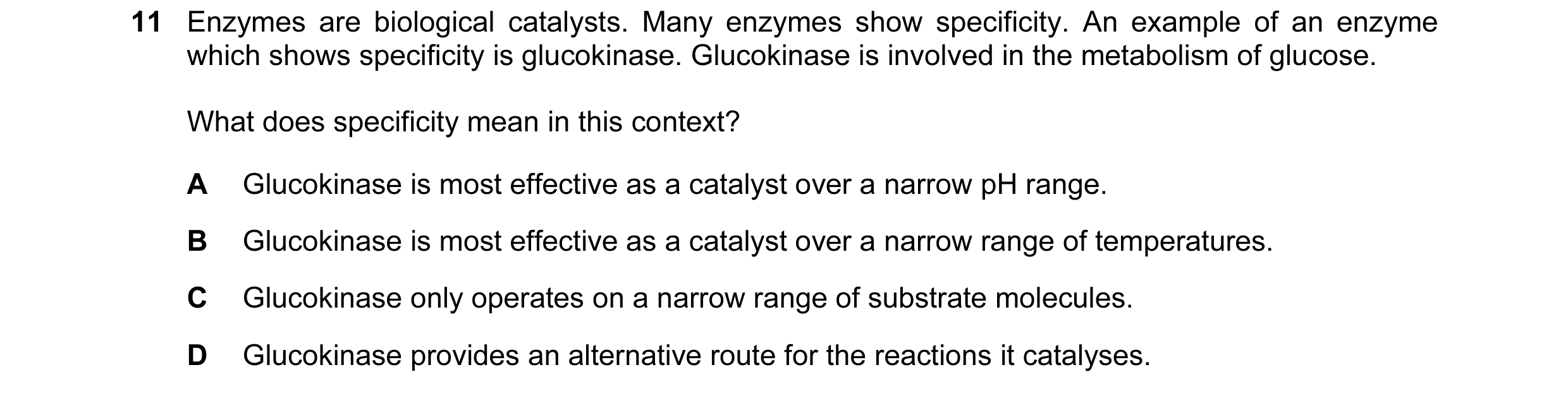
 6 / 15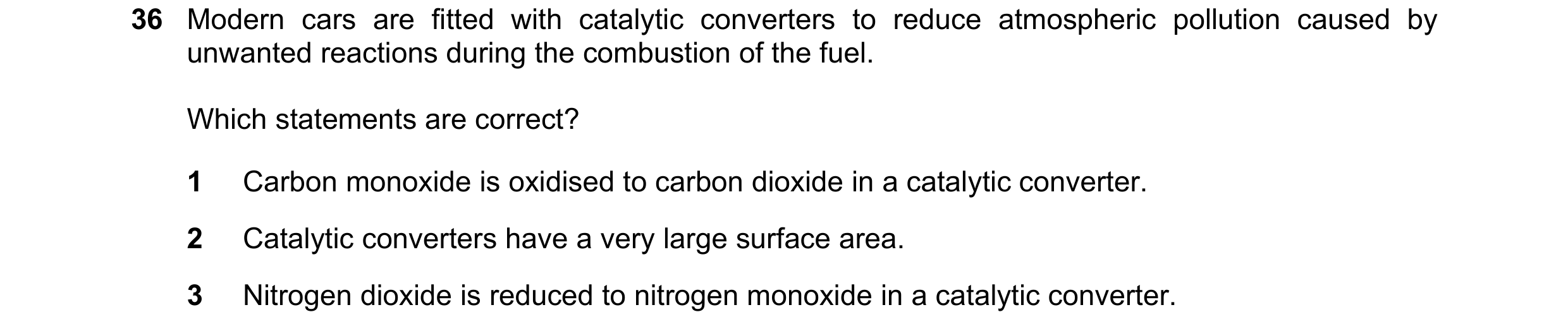

 7 / 15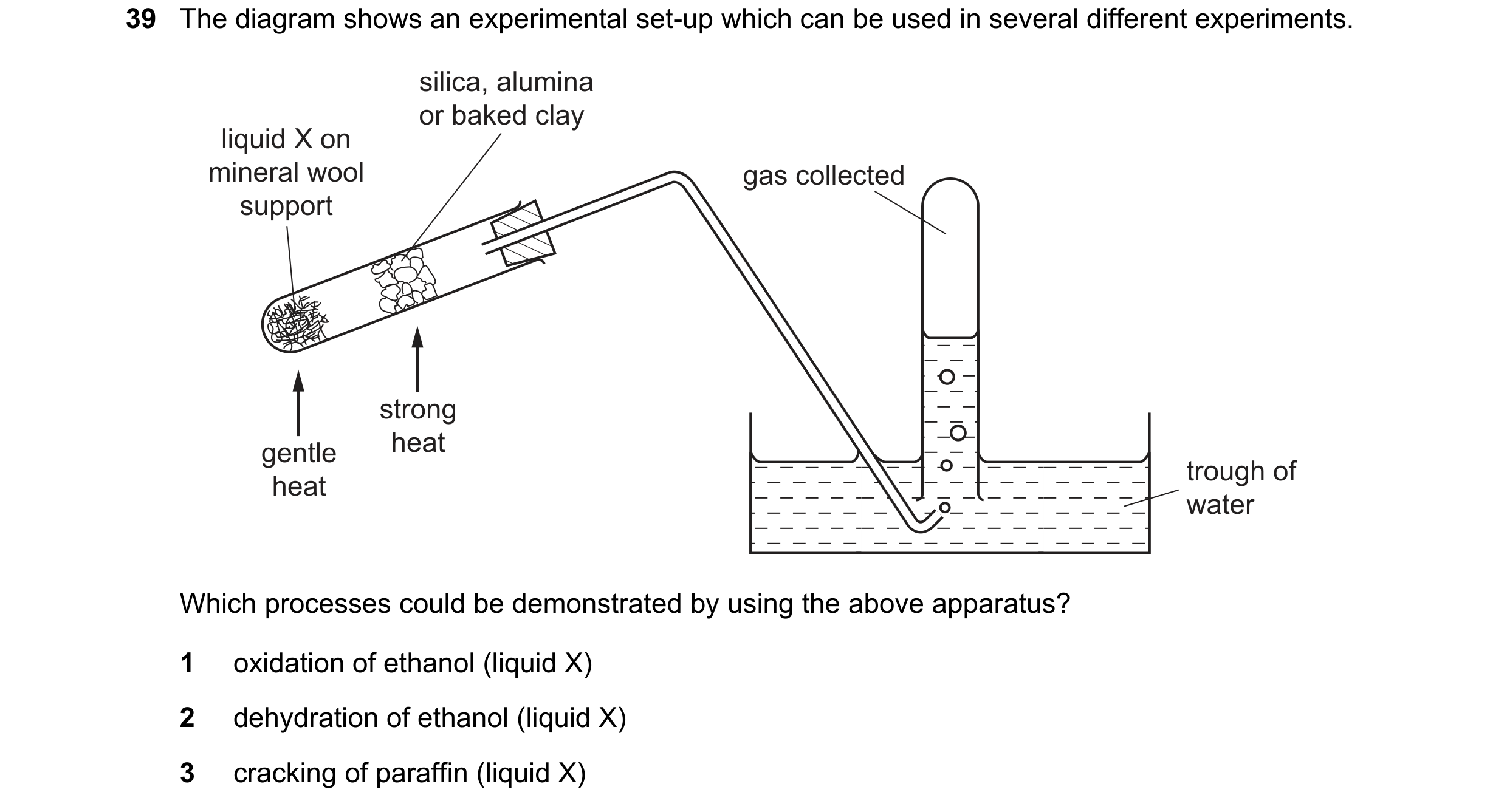
 8 / 15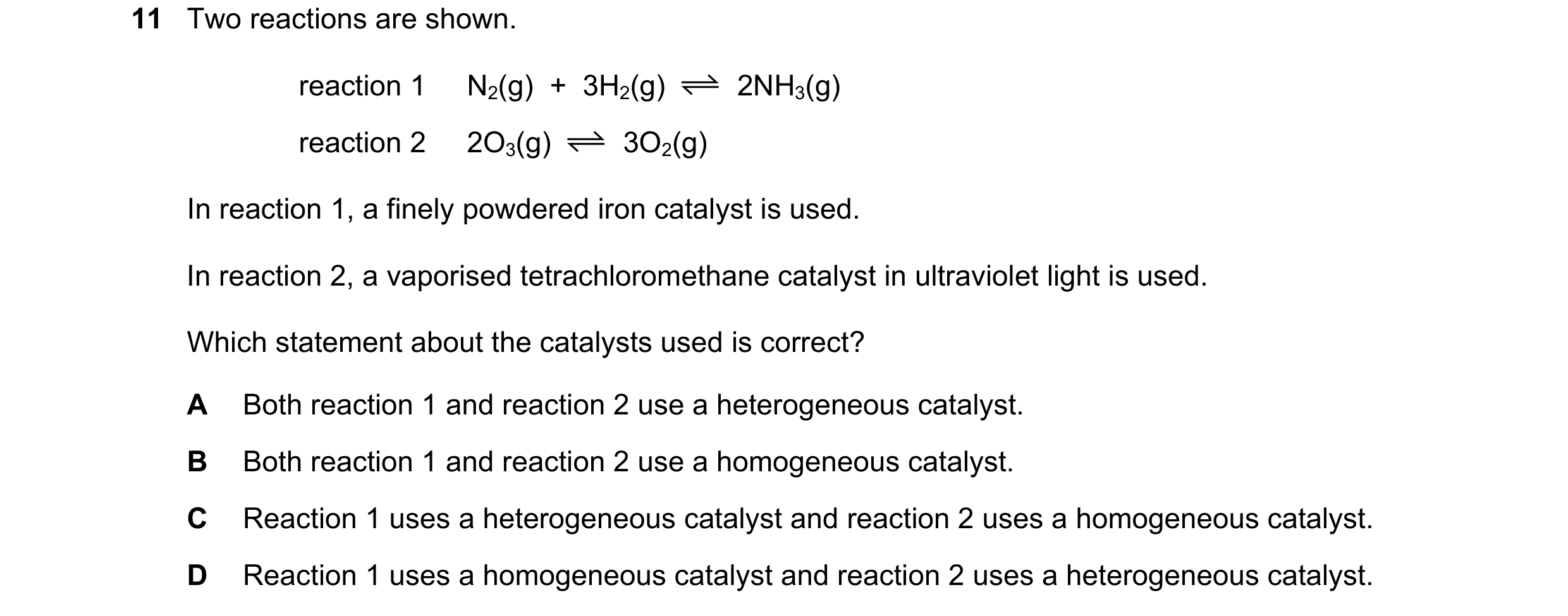
 9 / 15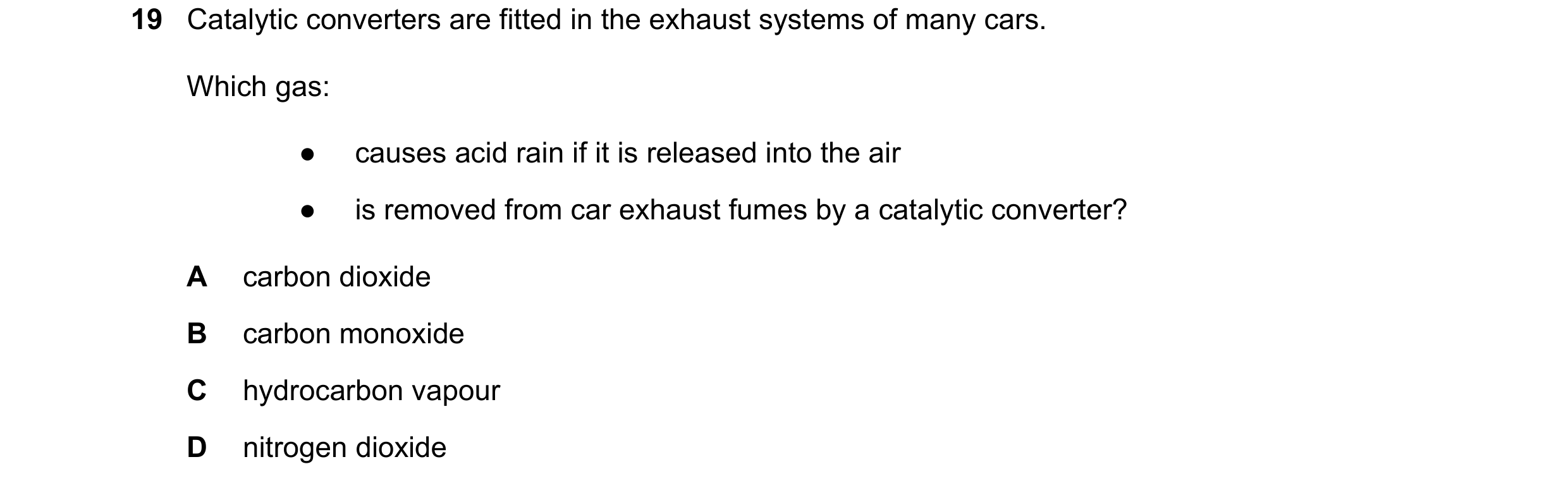


 10 / 15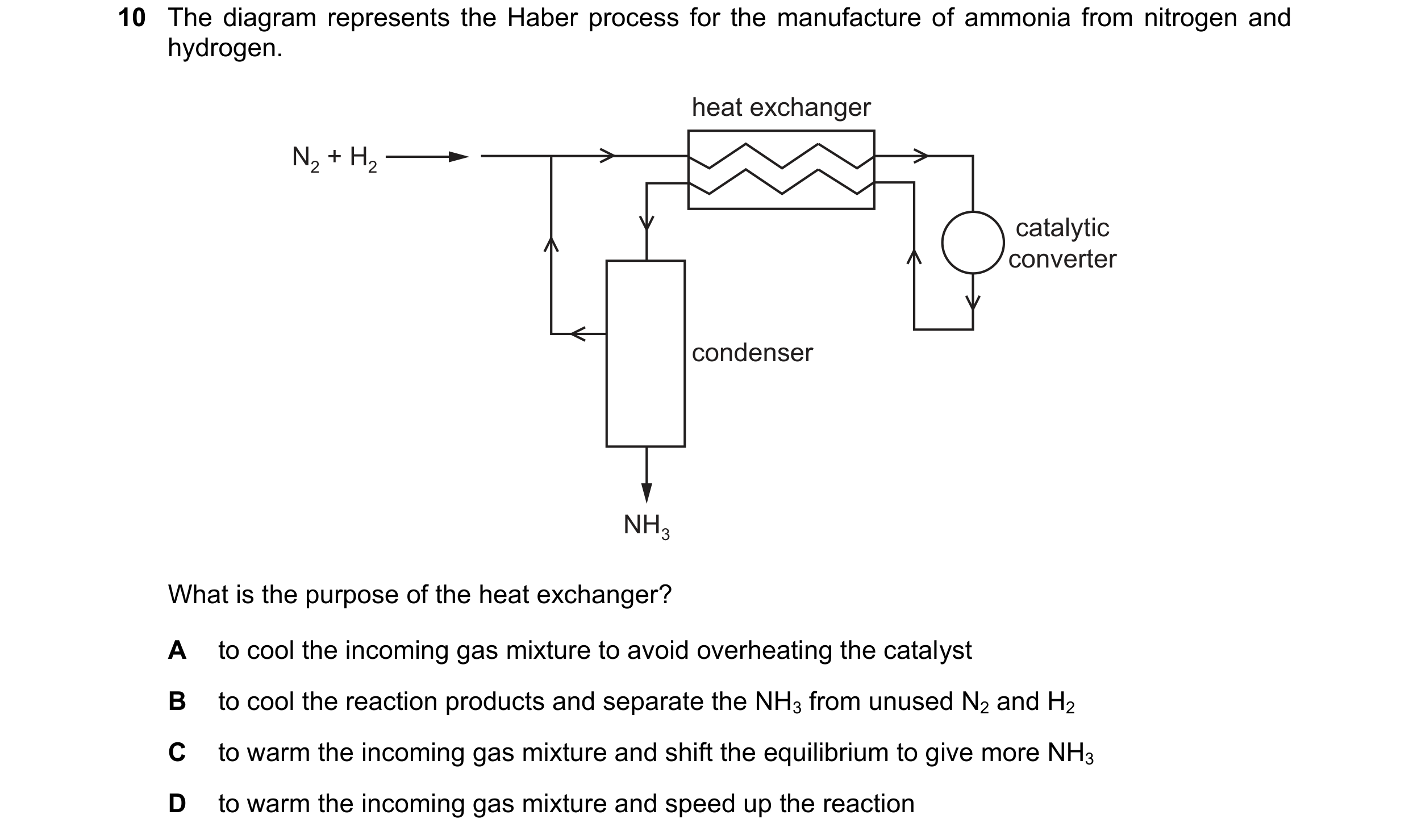
 11 / 15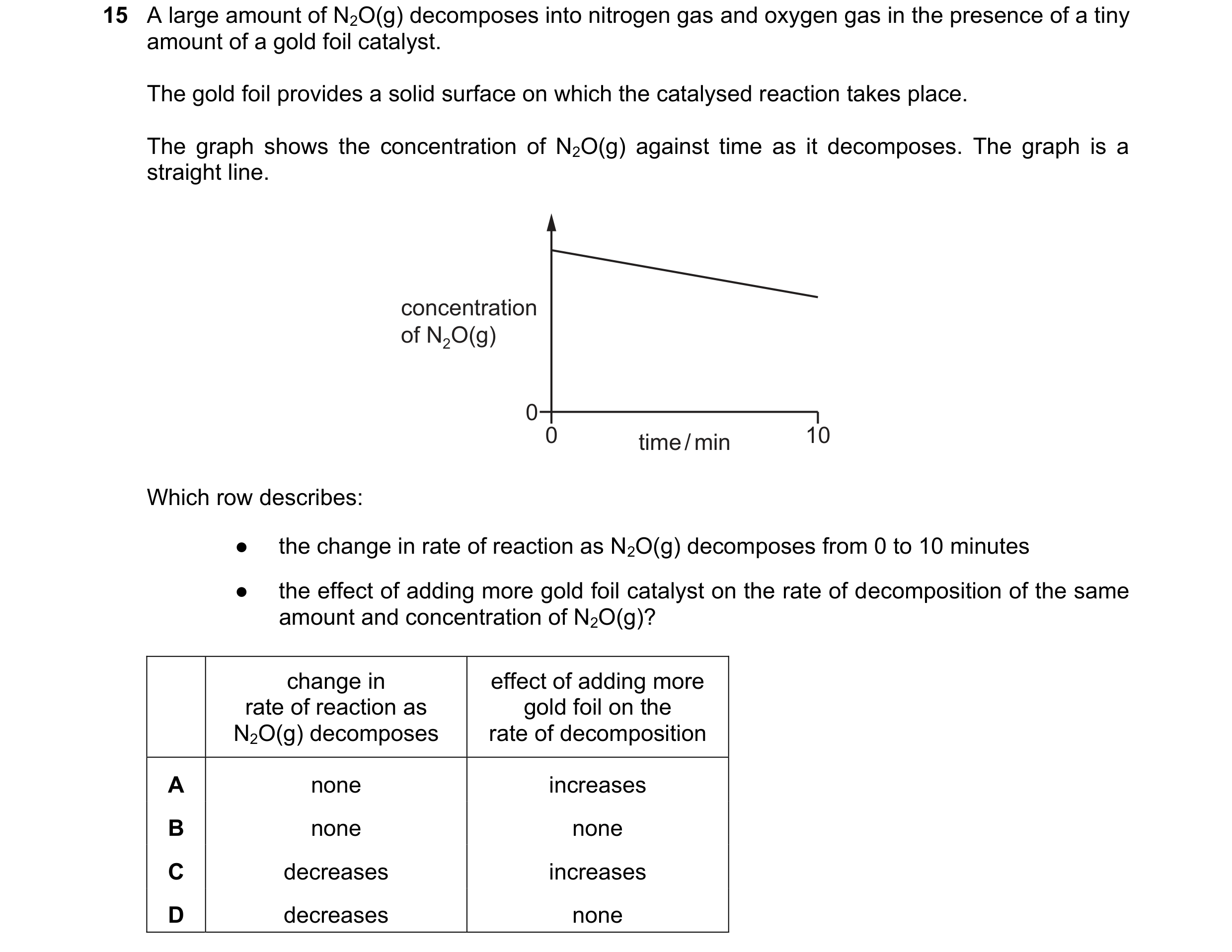
 12 / 15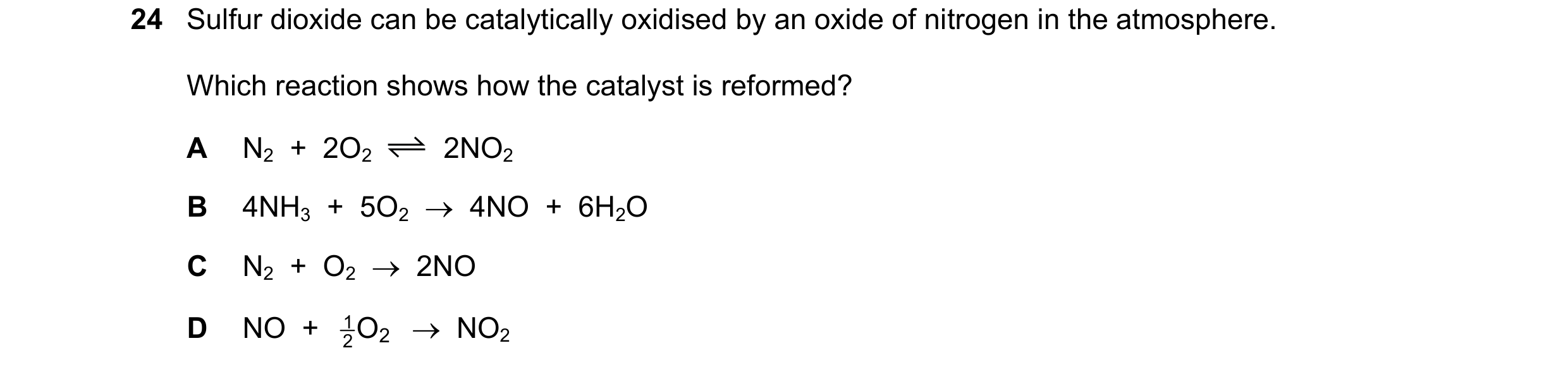
 13 / 15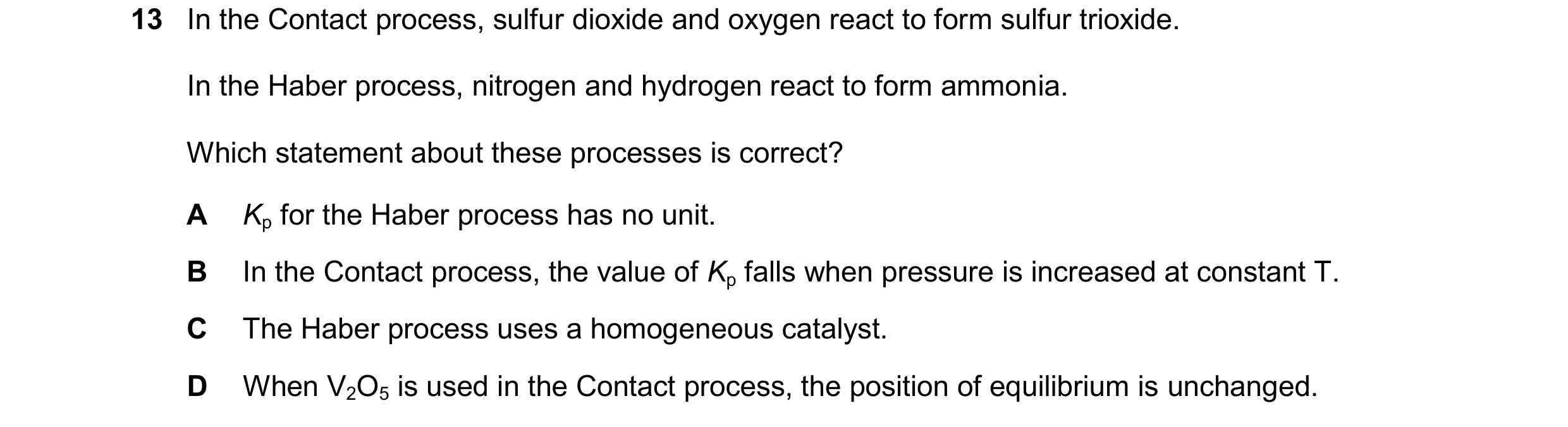
 14 / 15
 15 / 15