Questions as text
Q1 · Certain insects are able to stand on the surface of ponds 9700/11 Oct/Nov 2004
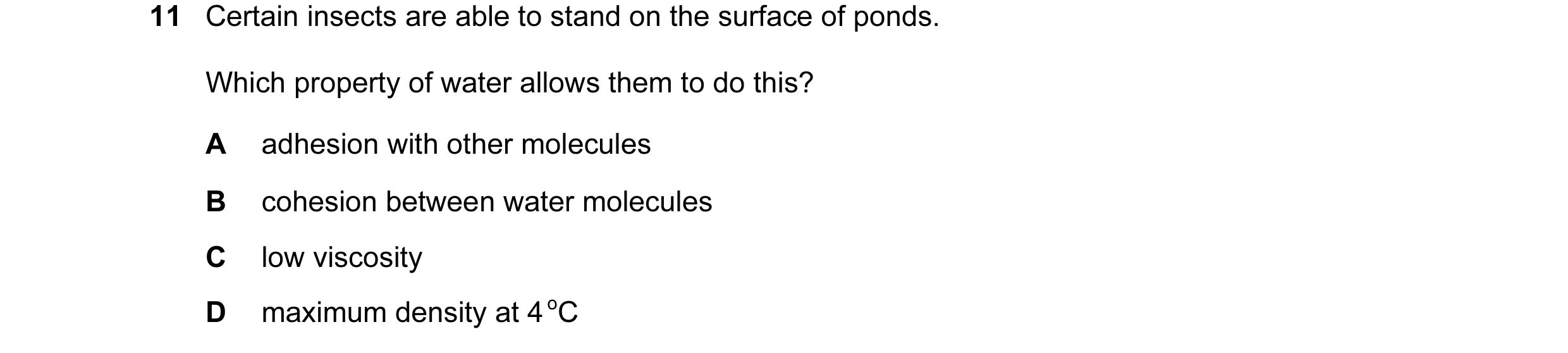
11 Certain insects are able to stand on the surface of ponds. Which property of water allows them to do this? A adhesion with other molecules B cohesion between water molecules C low viscosity D maximum density at 4 oC
1 marks
Answer: B
This question in 9700/11 Oct/Nov 2004
Q2 · The movement of water through the vascular tissue in plants relies on which property of… 9700/11 May/June 2006
12 The movement of water through the vascular tissue in plants relies on which property of water? A changes in density with temperature B good solvent for ions and polar molecules C high specific heat capacity D strong cohesive forces between molecules
1 marks
Answer: D
This question in 9700/11 May/June 2006
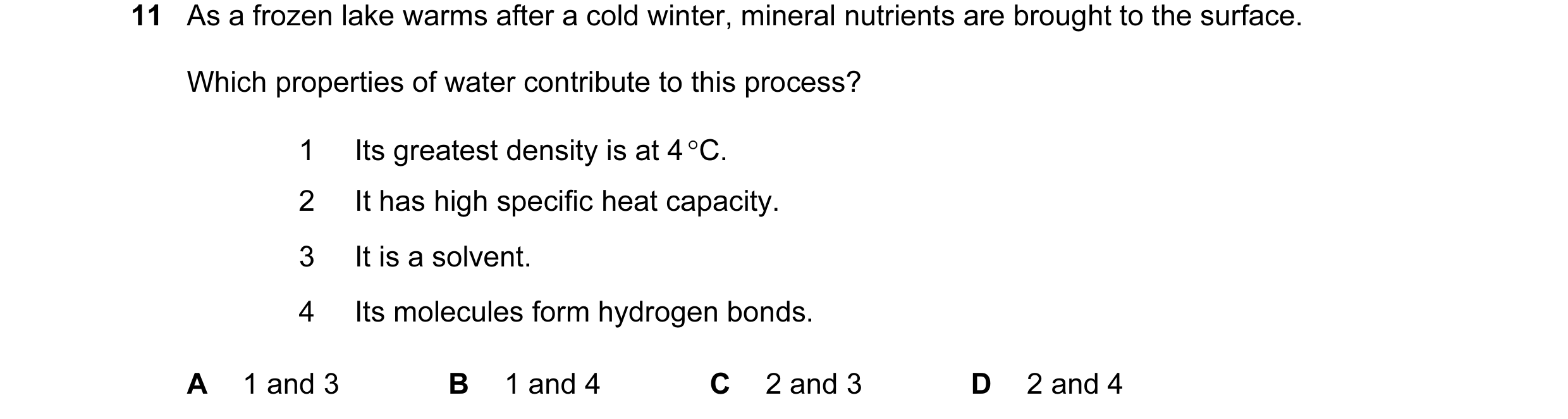
Q3 · As a frozen lake warms after a cold winter, mineral nutrients are brought to the surface 9700/11 Oct/Nov 2006
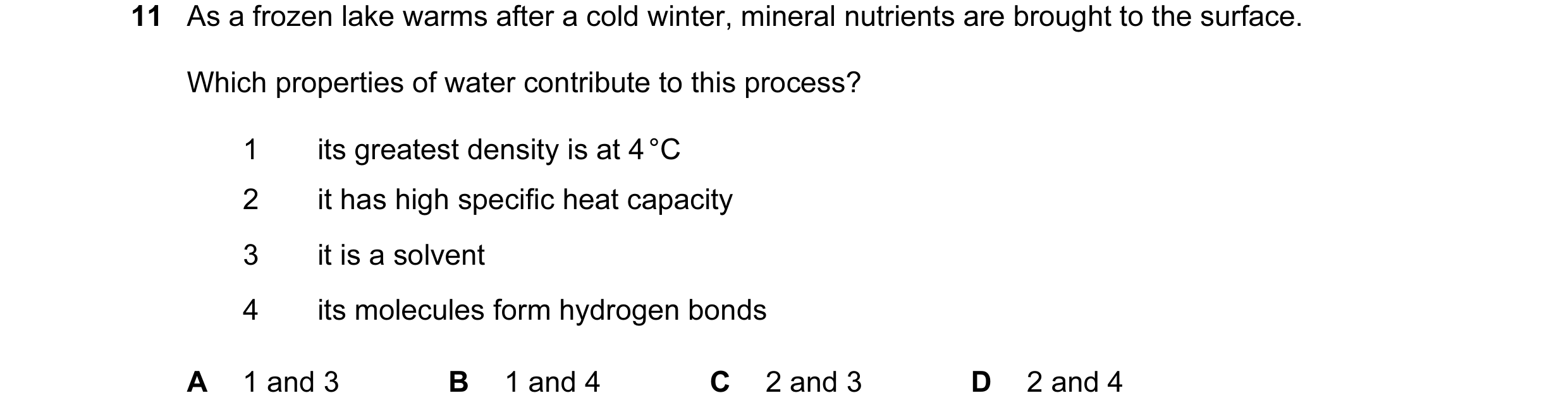
11 As a frozen lake warms after a cold winter, mineral nutrients are brought to the surface. Which properties of water contribute to this process? 1 its greatest density is at 4 °C 2 it has high specific heat capacity 3 it is a solvent 4 its molecules form hydrogen bonds A 1 and 3 B 1 and 4 C 2 and 3 D 2 and 4
1 marks
Answer: A
This question in 9700/11 Oct/Nov 2006
Q4 · As a frozen lake warms after a cold winter, mineral nutrients are brought to the surface 9700/11 May/June 2010
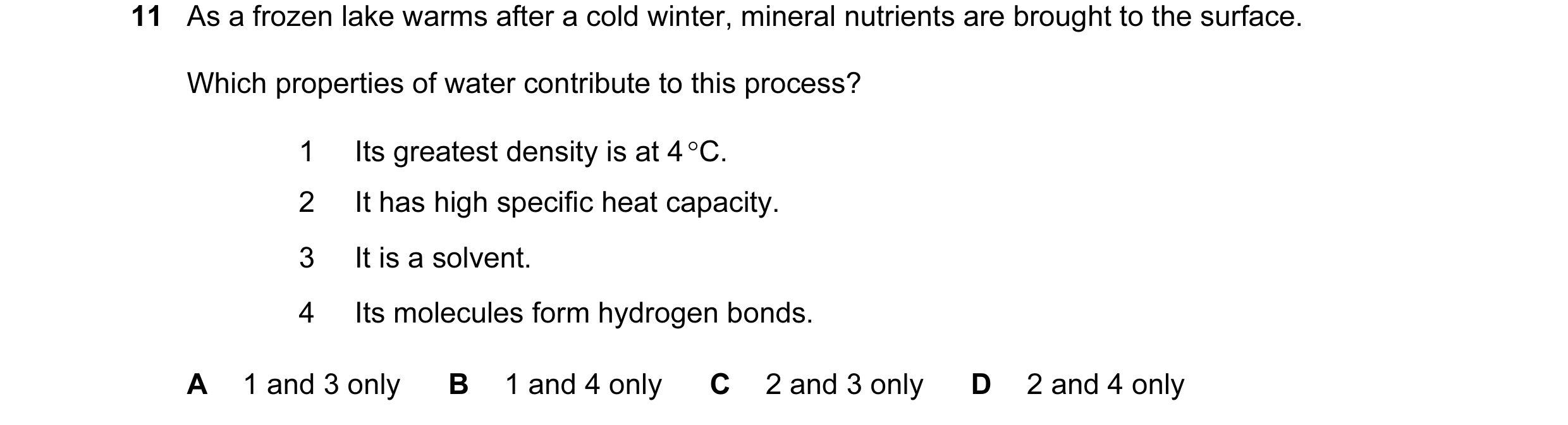
11 As a frozen lake warms after a cold winter, mineral nutrients are brought to the surface. Which properties of water contribute to this process? 1 Its greatest density is at 4 °C. 2 It has high specific heat capacity. 3 It is a solvent. 4 Its molecules form hydrogen bonds. A 1 and 3 only B 1 and 4 only C 2 and 3 only D 2 and 4 only
1 marks
Answer: A
This question in 9700/11 May/June 2010
Q5 · As a frozen lake warms after a cold winter, mineral nutrients are brought to the surface 9700/12 May/June 2010
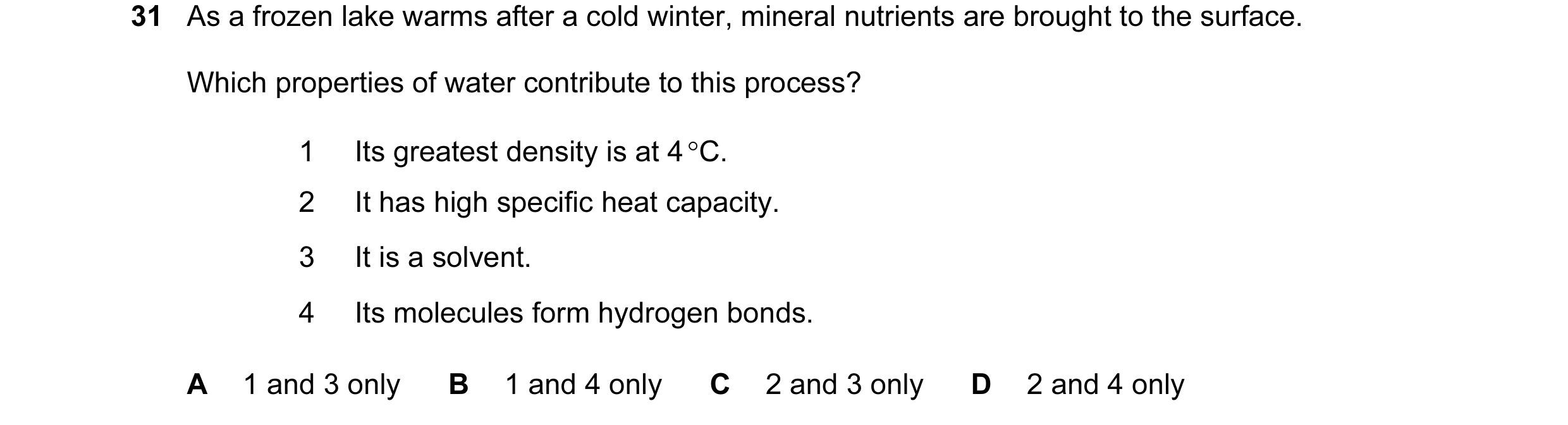
31 As a frozen lake warms after a cold winter, mineral nutrients are brought to the surface. Which properties of water contribute to this process? 1 Its greatest density is at 4 °C. 2 It has high specific heat capacity. 3 It is a solvent. 4 Its molecules form hydrogen bonds. A 1 and 3 only B 1 and 4 only C 2 and 3 only D 2 and 4 only
1 marks
Answer: A
This question in 9700/12 May/June 2010
Q6 · As a frozen lake warms after a cold winter, mineral nutrients are brought to the surface 9700/13 May/June 2010
37 As a frozen lake warms after a cold winter, mineral nutrients are brought to the surface. Which properties of water contribute to this process? 1 Its greatest density is at 4 °C. 2 It has high specific heat capacity. 3 It is a solvent. 4 Its molecules form hydrogen bonds. A 1 and 3 only B 1 and 4 only C 2 and 3 only D 2 and 4 only
1 marks
Answer: A
This question in 9700/13 May/June 2010
Q7 · Water is important to living organisms because it A acts as an excellent solvent for… 9700/11 Oct/Nov 2010
10 Water is important to living organisms because it A acts as an excellent solvent for transport of dissolved glucose and urea. B becomes more dense in its solid form, ice, than its liquid state. C is used in condensation reactions to synthesise macromolecules. D requires a small increase in heat energy to raise its temperature.
1 marks
Answer: A
This question in 9700/11 Oct/Nov 2010
Q8 · Which property of water makes it most suitable for transport in eukaryotic organisms? 9700/11 Oct/Nov 2011
11 Which property of water makes it most suitable for transport in eukaryotic organisms? A density B ionisation C latent heat of vaporisation D solvent properties
1 marks
Answer: D
This question in 9700/11 Oct/Nov 2011
Q9 · Which property of water makes it most suitable for transport in eukaryotic organisms? 9700/13 Oct/Nov 2011
17 Which property of water makes it most suitable for transport in eukaryotic organisms? A density B ionisation C latent heat of vaporisation D solvent properties
1 marks
Answer: D
This question in 9700/13 Oct/Nov 2011
Q10 · Which molecules have properties that are dependent on hydrogen bonds? 9700/11 May/June 2013
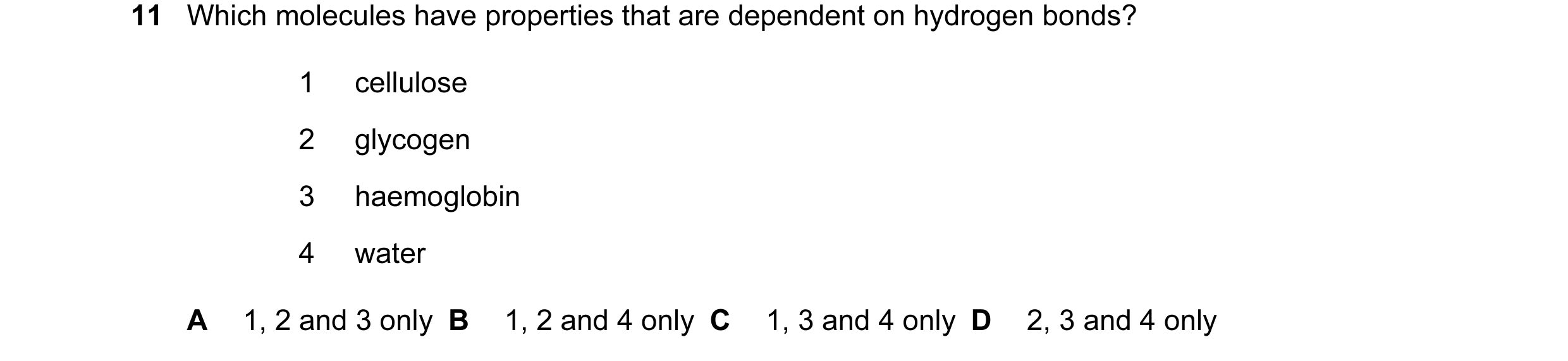
11 Which molecules have properties that are dependent on hydrogen bonds? 1 cellulose 2 glycogen 3 haemoglobin 4 water A 1, 2 and 3 only B 1, 2 and 4 only C 1, 3 and 4 only D 2, 3 and 4 only
1 marks
Answer: C
This question in 9700/11 May/June 2013
Q11 · Why may fish living in ponds survive temperatures below 0 °C in winter? 9700/11 May/June 2013
13 Why may fish living in ponds survive temperatures below 0 °C in winter? A Fish body tissues produce an enzyme which prevents blood from freezing. B The ice on the pond surface insulates the water in the pond. C The plants in the pond help to keep the water temperature above 0 °C. D The rocks in the pond warm up during the day and heat the water.
1 marks
Answer: B
This question in 9700/11 May/June 2013
Q12 · Which feature of water is least likely to affect the life of an animal in a tropical rain… 9700/12 May/June 2013
13 Which feature of water is least likely to affect the life of an animal in a tropical rain forest? A adhesion with other molecules B cohesion between water molecules C low viscosity D maximum density at 4 °C
1 marks
Answer: D
This question in 9700/12 May/June 2013
Q13 · Which molecule has properties that are not dependent on hydrogen bonds? 9700/13 May/June 2013
11 Which molecule has properties that are not dependent on hydrogen bonds? A cellulose B glycogen C haemoglobin D water
1 marks
Answer: B
This question in 9700/13 May/June 2013
Q14 · When the ice on the surface of a pond melts, which changes benefit the ecosystem in the… 9700/13 May/June 2013
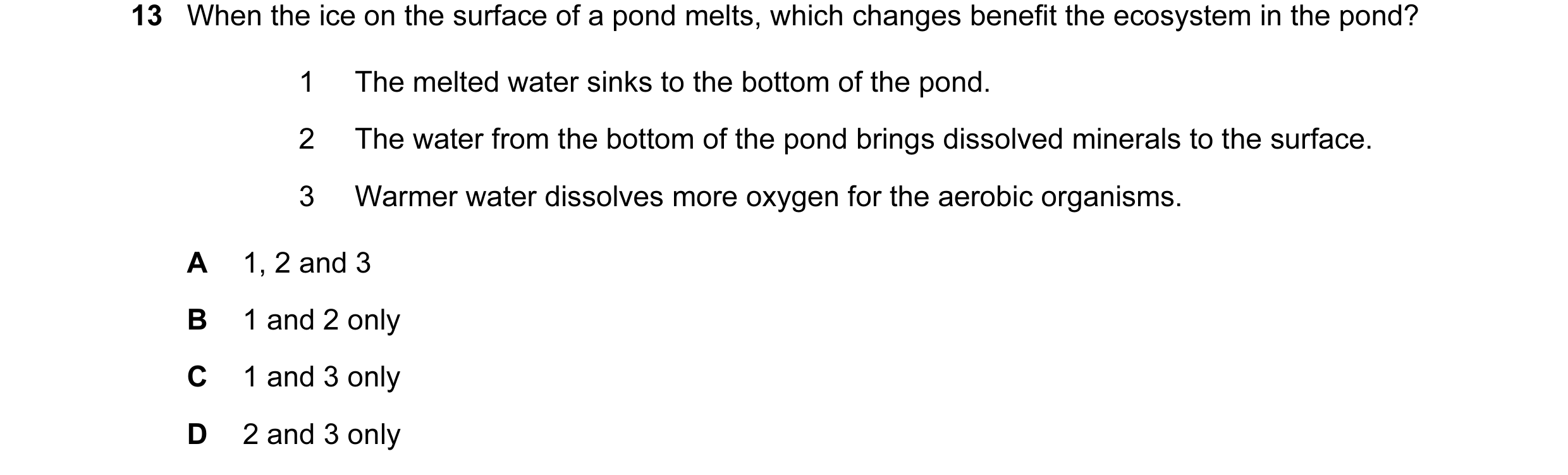
13 When the ice on the surface of a pond melts, which changes benefit the ecosystem in the pond? 1 The melted water sinks to the bottom of the pond. 2 The water from the bottom of the pond brings dissolved minerals to the surface. 3 Warmer water dissolves more oxygen for the aerobic organisms. A 1, 2 and 3 B 1 and 2 only C 1 and 3 only D 2 and 3 only
1 marks
Answer: B
This question in 9700/13 May/June 2013
Q15 · The statements describe some of the properties of water 9700/11 Oct/Nov 2013
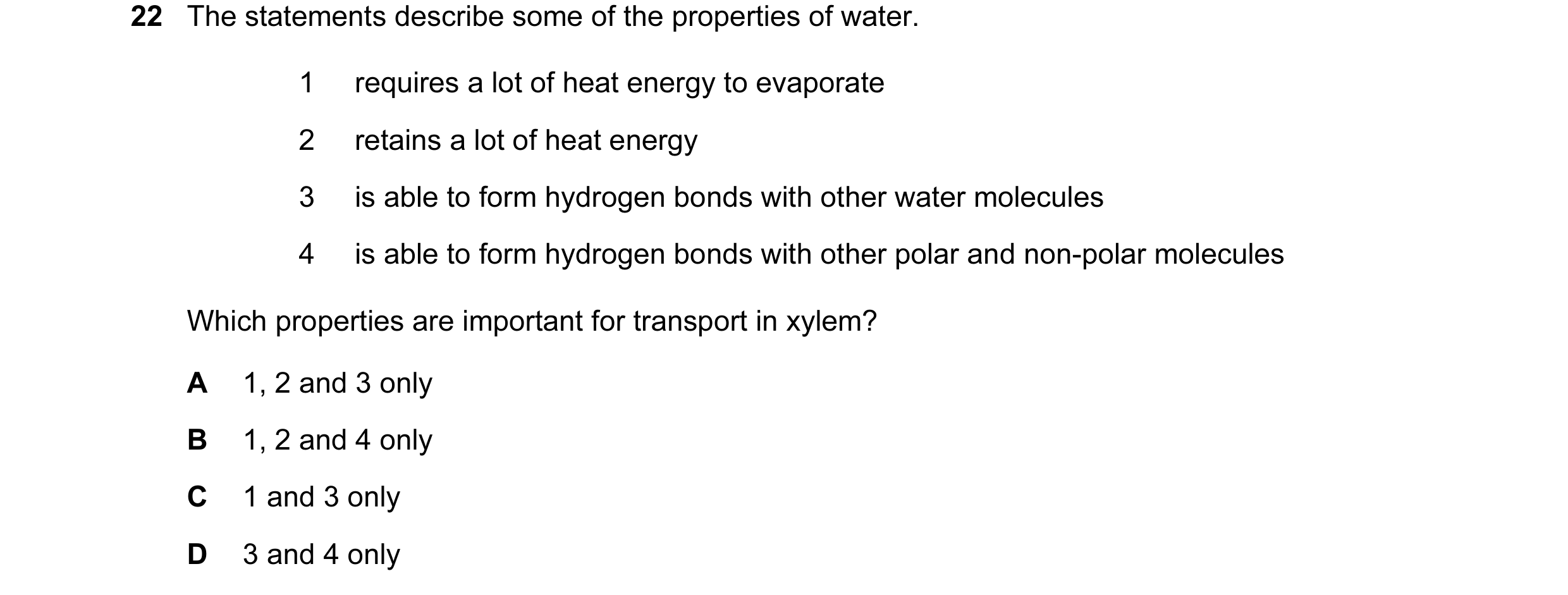
22 The statements describe some of the properties of water. 1 requires a lot of heat energy to evaporate 2 retains a lot of heat energy 3 is able to form hydrogen bonds with other water molecules 4 is able to form hydrogen bonds with other polar and non-polar molecules Which properties are important for transport in xylem? A 1, 2 and 3 only B 1, 2 and 4 only C 1 and 3 only D 3 and 4 only
1 marks
Answer: D
This question in 9700/11 Oct/Nov 2013
Q16 · The statements are about the properties of water 9700/12 Oct/Nov 2014
12 The statements are about the properties of water. 1 It requires a lot of heat to evaporate. 2 It retains a lot of heat. 3 It is able to form hydrogen bonds with other water molecules. 4 It is able to form hydrogen bonds with other polar and non-polar molecules. Which properties are important in transpiring plants to prevent enzymes in leaves from being denatured? A 1 only B 1 and 2 only C 2 and 3 only D 1, 2, 3 and 4
1 marks
Answer: A
This question in 9700/12 Oct/Nov 2014
Q17 · Polar molecules form hydrogen bonds with each other 9700/11 May/June 2015
12 Polar molecules form hydrogen bonds with each other. Which properties of water result from its molecules being polar? 1 good solvent 2 high specific heat capacity 3 high surface tension 4 cohesive A 1, 2, 3 and 4 B 1, 2 and 3 only C 1, 2 and 4 only D 3 and 4 only
1 marks
Answer: A
This question in 9700/11 May/June 2015
Q18 · The statements are about the properties of water 9700/12 May/June 2015
9 The statements are about the properties of water. 1 ability to form hydrogen bonds with other molecules 2 less dense when frozen 3 able to hold a lot of heat What allows a small insect to rest on the surface of a pond? A 1 and 2 B 2 and 3 C 1 only D 2 only
1 marks
Answer: C
This question in 9700/12 May/June 2015
Q19 · Which properties of water are a result of only cohesion? 9700/13 May/June 2015
10 Which properties of water are a result of only cohesion? 1 The water has a high surface tension. 2 Water moves up xylem vessels. 3 Water is an excellent solvent. A 1, 2 and 3 B 1 and 2 only C 1 only D 3 only
1 marks
Answer: C
This question in 9700/13 May/June 2015
Q20 · Which force holds water molecules on the surface of cell walls? 9700/13 May/June 2015
23 Which force holds water molecules on the surface of cell walls? A adhesion B capillarity C cohesion D surface tension
1 marks
Answer: A
This question in 9700/13 May/June 2015
Q21 · The statements are about the properties of water 9700/13 May/June 2015
24 The statements are about the properties of water. 1 requires a lot of heat to evaporate 2 holds a lot of heat 3 is able to form hydrogen bonds with other water molecules 4 is able to form hydrogen bonds with other polar molecules Which properties are important for translocation in phloem? A 1 and 2 B 1 and 3 C 2 and 3 D 3 and 4
1 marks
Answer: D
This question in 9700/13 May/June 2015
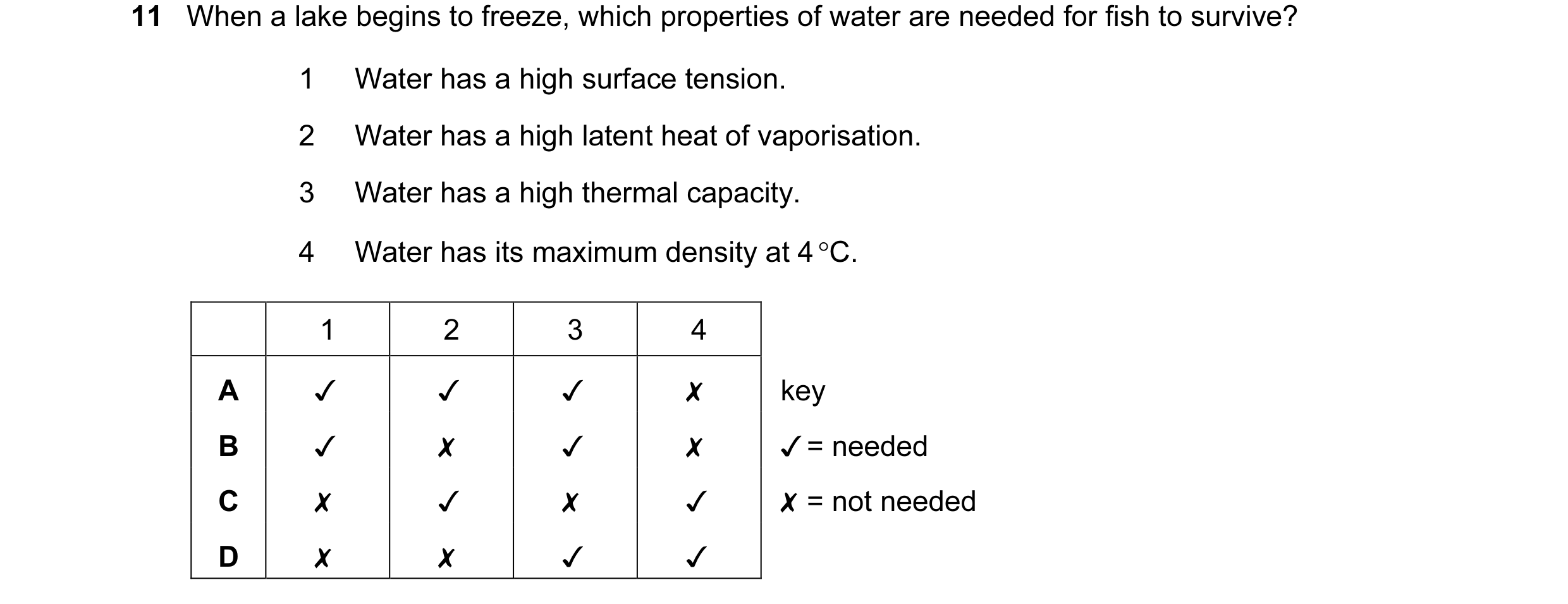
Q22 · When a lake begins to freeze, which properties of water are needed for fish to survive? 9700/11 Oct/Nov 2015
11 When a lake begins to freeze, which properties of water are needed for fish to survive?
1
2
3
4
—
Water has a high surface tension.
Water has a high latent heat of vaporisation.
Water has a high thermal capacity.
Water has its maximum density at 4°C.
0 0O WwW D>
x «KS
key
/ = needed
X = not needed
S << & & [a
~*~ QL €® LI
N €& NN fe
1 marks
Answer: D
This question in 9700/11 Oct/Nov 2015
Q23 · As a frozen lake warms after a cold winter, mineral nutrients are brought to the surface 9700/12 Oct/Nov 2015
11 As a frozen lake warms after a cold winter, mineral nutrients are brought to the surface. Which properties of water contribute to this process? 1 Its greatest density is at 4 °C. 2 It has high specific heat capacity. 3 It is a solvent. 4 Its molecules form hydrogen bonds. A 1 and 3 B 1 and 4 C 2 and 3 D 2 and 4
1 marks
Answer: A
This question in 9700/12 Oct/Nov 2015
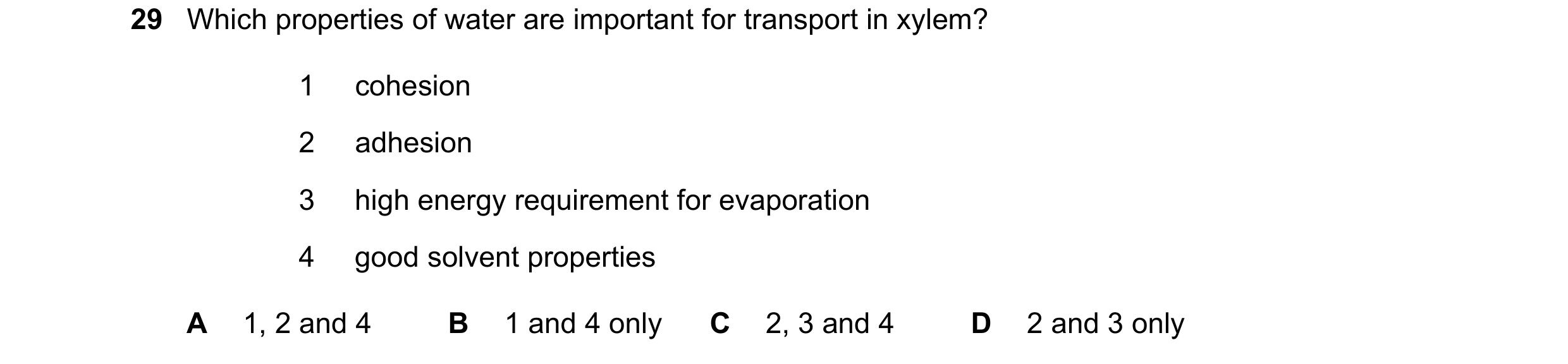
Q24 · Which properties of water are important for transport in xylem? 9700/12 Feb/March 2018
29 Which properties of water are important for transport in xylem? 1 cohesion 2 adhesion 3 high energy requirement for evaporation 4 good solvent properties A 1, 2 and 4 B 1 and 4 only C 2, 3 and 4 D 2 and 3 only
1 marks
Answer: A
This question in 9700/12 Feb/March 2018
Q25 · Which statement about the properties of water is correct? 9700/13 May/June 2018
12 Which statement about the properties of water is correct? A Bonds between hydrogen atoms cause water to have a high specific heat capacity. B The high latent heat of vaporisation of water is due to the presence of hydrogen bonds. C The high specific heat capacity of water causes cooling during evaporation. D Water can dissolve amylopectin as it has hydrophilic side chains.
1 marks
Answer: B
This question in 9700/13 May/June 2018
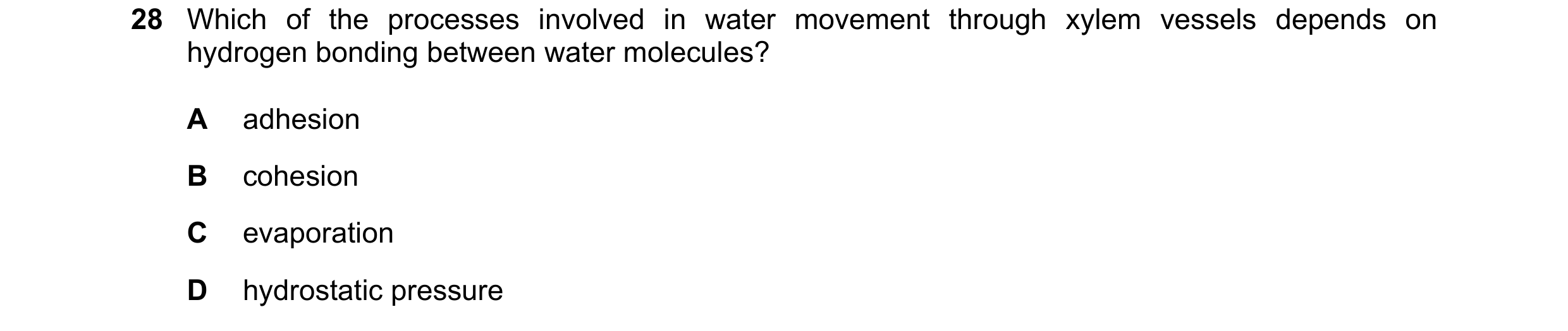
Q26 · Which of the processes involved in water movement through xylem vessels depends on… 9700/13 May/June 2018
28 Which of the processes involved in water movement through xylem vessels depends on hydrogen bonding between water molecules? A adhesion B cohesion C evaporation D hydrostatic pressure
1 marks
Answer: B
This question in 9700/13 May/June 2018
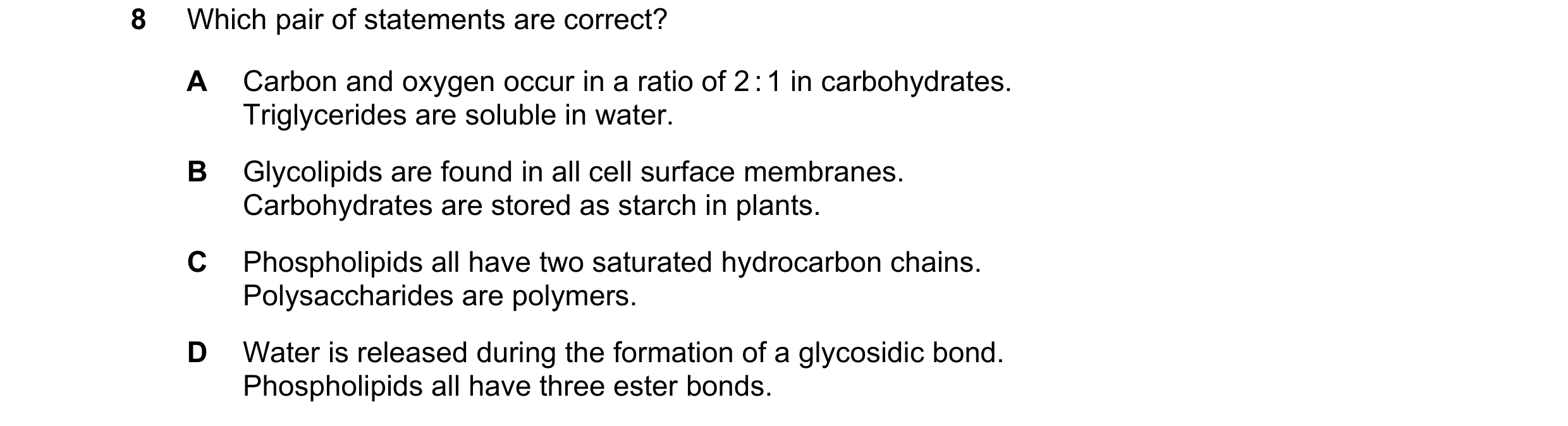
Q27 · Which pair of statements are correct? 9700/11 Oct/Nov 2018
8 Which pair of statements are correct? A Carbon and oxygen occur in a ratio of 2 : 1 in carbohydrates. Triglycerides are soluble in water. B Glycolipids are found in all cell surface membranes. Carbohydrates are stored as starch in plants. C Phospholipids all have two saturated hydrocarbon chains. Polysaccharides are polymers. D Water is released during the formation of a glycosidic bond. Phospholipids all have three ester bonds.
1 marks
Answer: B
This question in 9700/11 Oct/Nov 2018
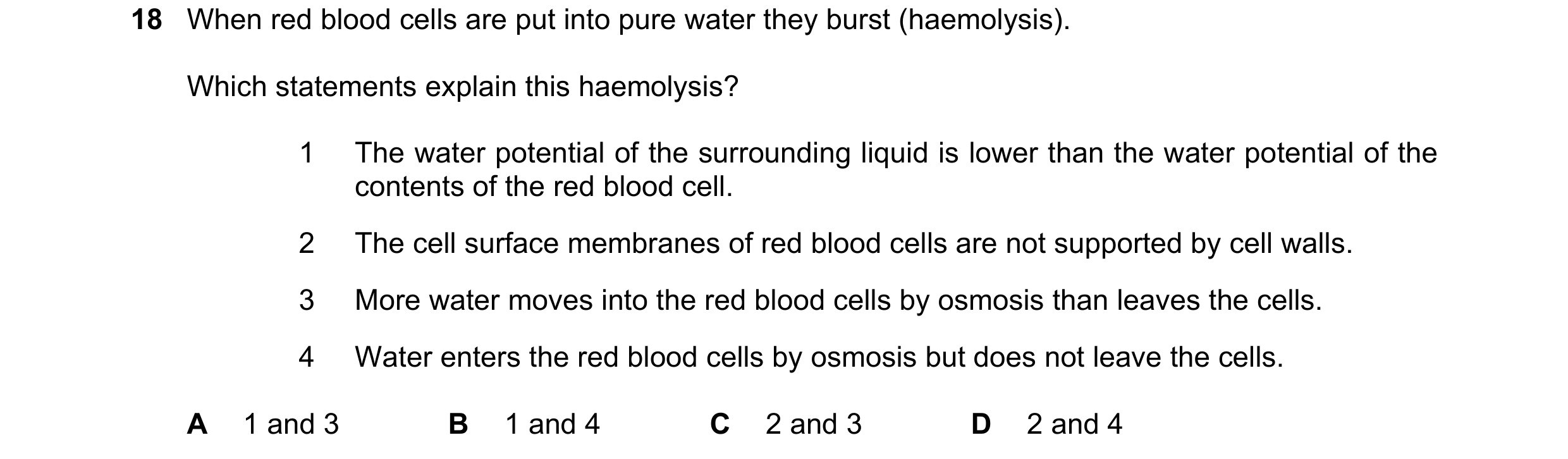
Q28 · When red blood cells are put into pure water they burst (haemolysis) 9700/11 Oct/Nov 2018
18 When red blood cells are put into pure water they burst (haemolysis). Which statements explain this haemolysis? 1 The water potential of the surrounding liquid is lower than the water potential of the contents of the red blood cell. 2 The cell surface membranes of red blood cells are not supported by cell walls. 3 More water moves into the red blood cells by osmosis than leaves the cells. 4 Water enters the red blood cells by osmosis but does not leave the cells. A 1 and 3 B 1 and 4 C 2 and 3 D 2 and 4
1 marks
Answer: C
This question in 9700/11 Oct/Nov 2018
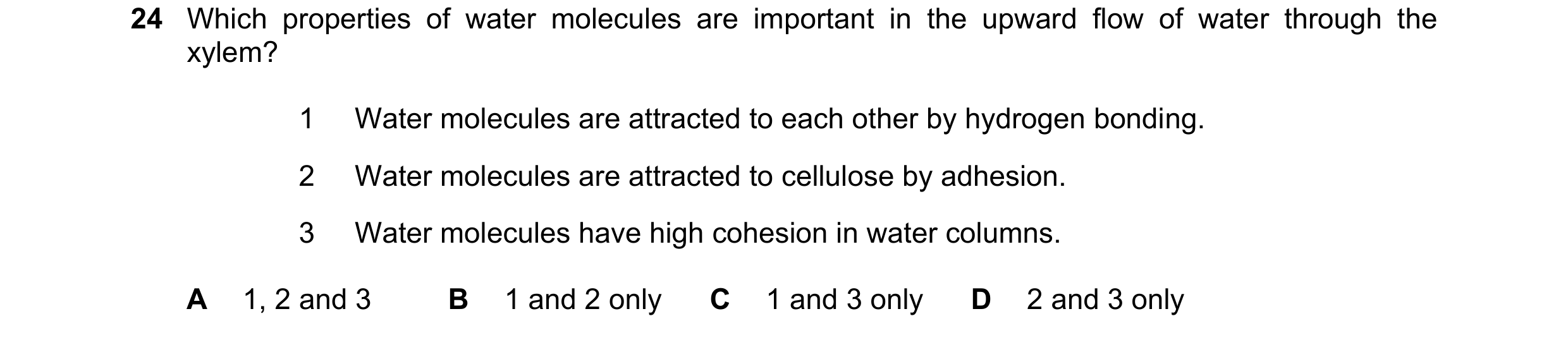
Q29 · Which properties of water molecules are important in the upward flow of water through… 9700/11 Oct/Nov 2018
26 Which properties of water molecules are important in the upward flow of water through xylem? 1 Water molecules are attracted to each other by hydrogen bonding. 2 Water molecules are attracted to cellulose by adhesion. 3 Water molecules have high cohesion in water columns. A 1, 2 and 3 B 1 and 2 only C 1 and 3 only D 2 and 3 only
1 marks
Answer: A
This question in 9700/11 Oct/Nov 2018
Q30 · Which diagram correctly shows hydrogen bonding between water molecules? 9700/12 Oct/Nov 2018
13 Which diagram correctly shows hydrogen bonding between water molecules? The symbol δ indicates the partial charge on an atom in the water molecule. A B C D δ+ δ+ δ– δ– O H O H δ– δ– δ– δ– δ+ δ+ δ– δ+ H H O O H H O O δ+ δ+ δ– δ– O H O H δ– δ– δ– δ– δ+ δ+ δ– δ+ H H O O H H O O
1 marks
Answer: C
This question in 9700/12 Oct/Nov 2018
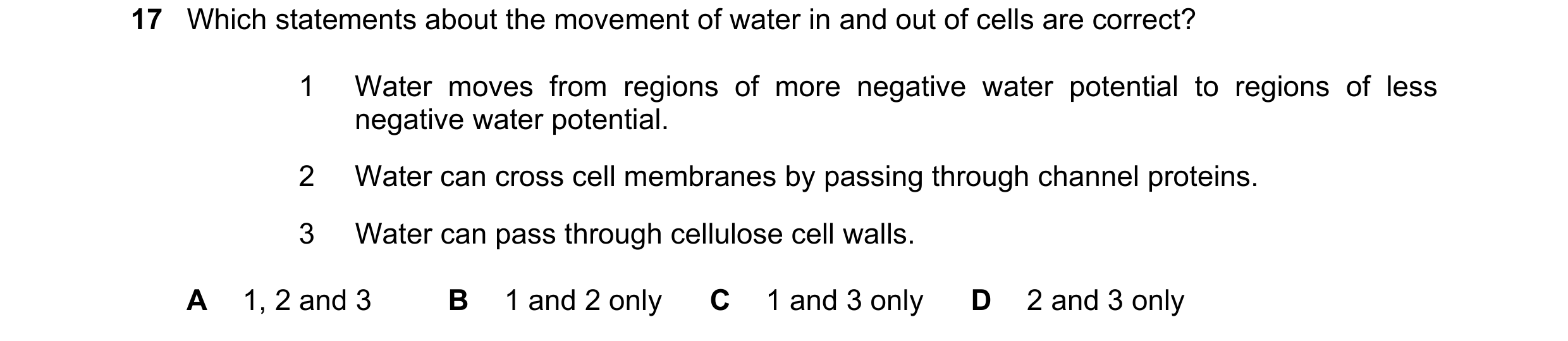
Q31 · Which statements about the movement of water in and out of cells are correct? 9700/12 Feb/March 2019
17 Which statements about the movement of water in and out of cells are correct? 1 Water moves from regions of more negative water potential to regions of less negative water potential. 2 Water can cross cell membranes by passing through channel proteins. 3 Water can pass through cellulose cell walls. A 1, 2 and 3 B 1 and 2 only C 1 and 3 only D 2 and 3 only
1 marks
Answer: D
This question in 9700/12 Feb/March 2019
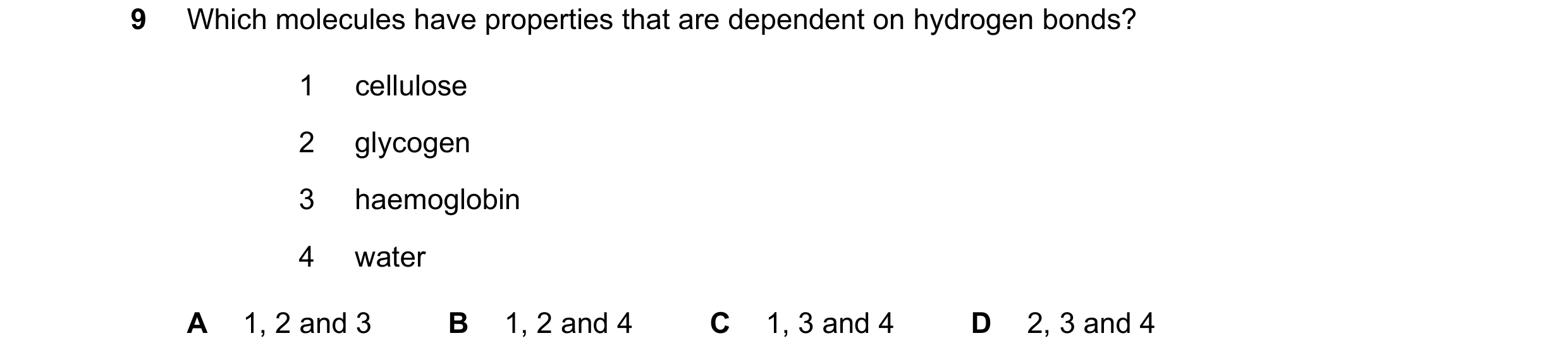
Q32 · Which molecules have properties that are dependent on hydrogen bonds? 9700/11 Oct/Nov 2019
9 Which molecules have properties that are dependent on hydrogen bonds? 1 cellulose 2 glycogen 3 haemoglobin 4 water A 1, 2 and 3 B 1, 2 and 4 C 1, 3 and 4 D 2, 3 and 4
1 marks
Answer: C
This question in 9700/11 Oct/Nov 2019
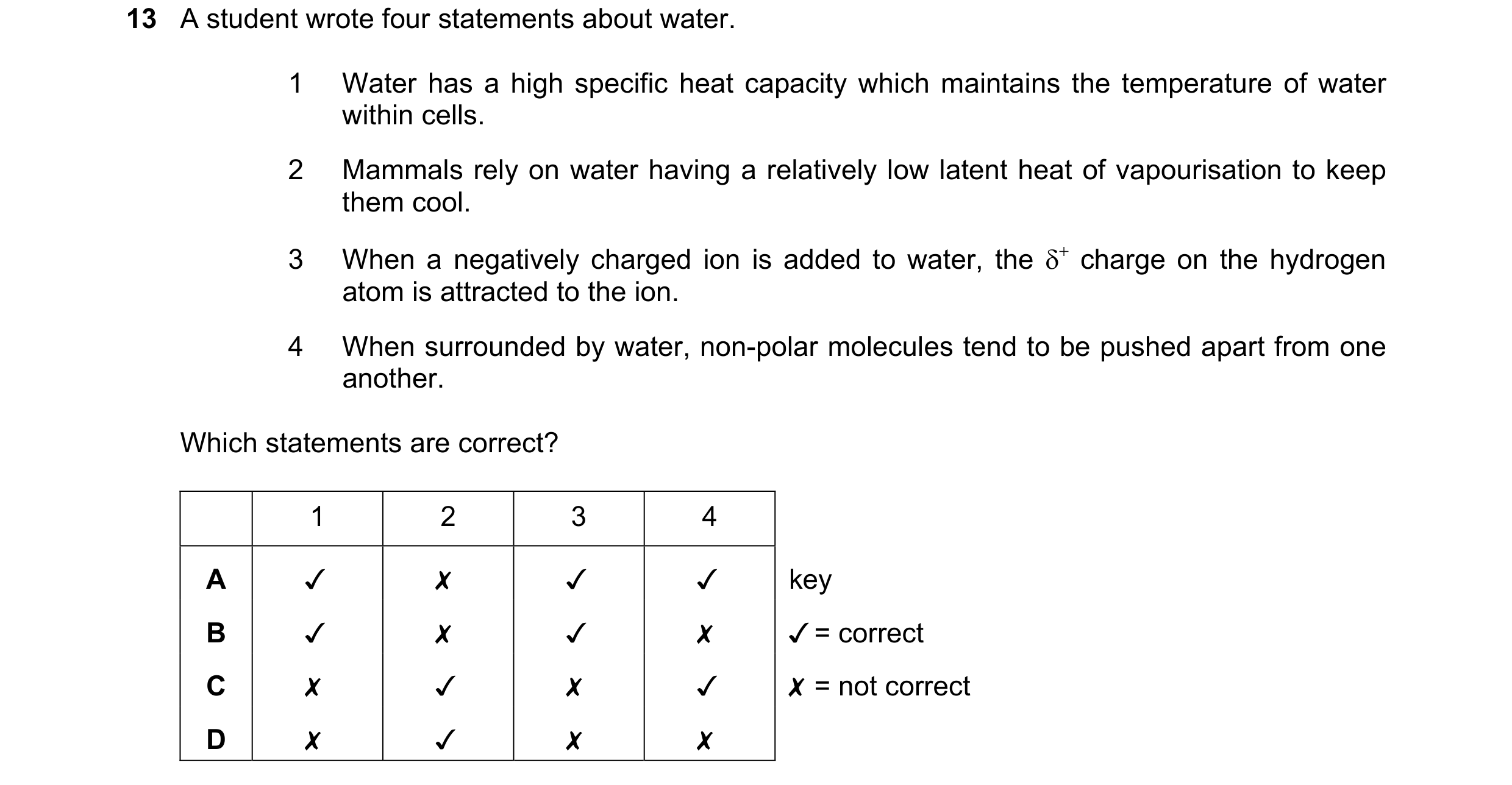
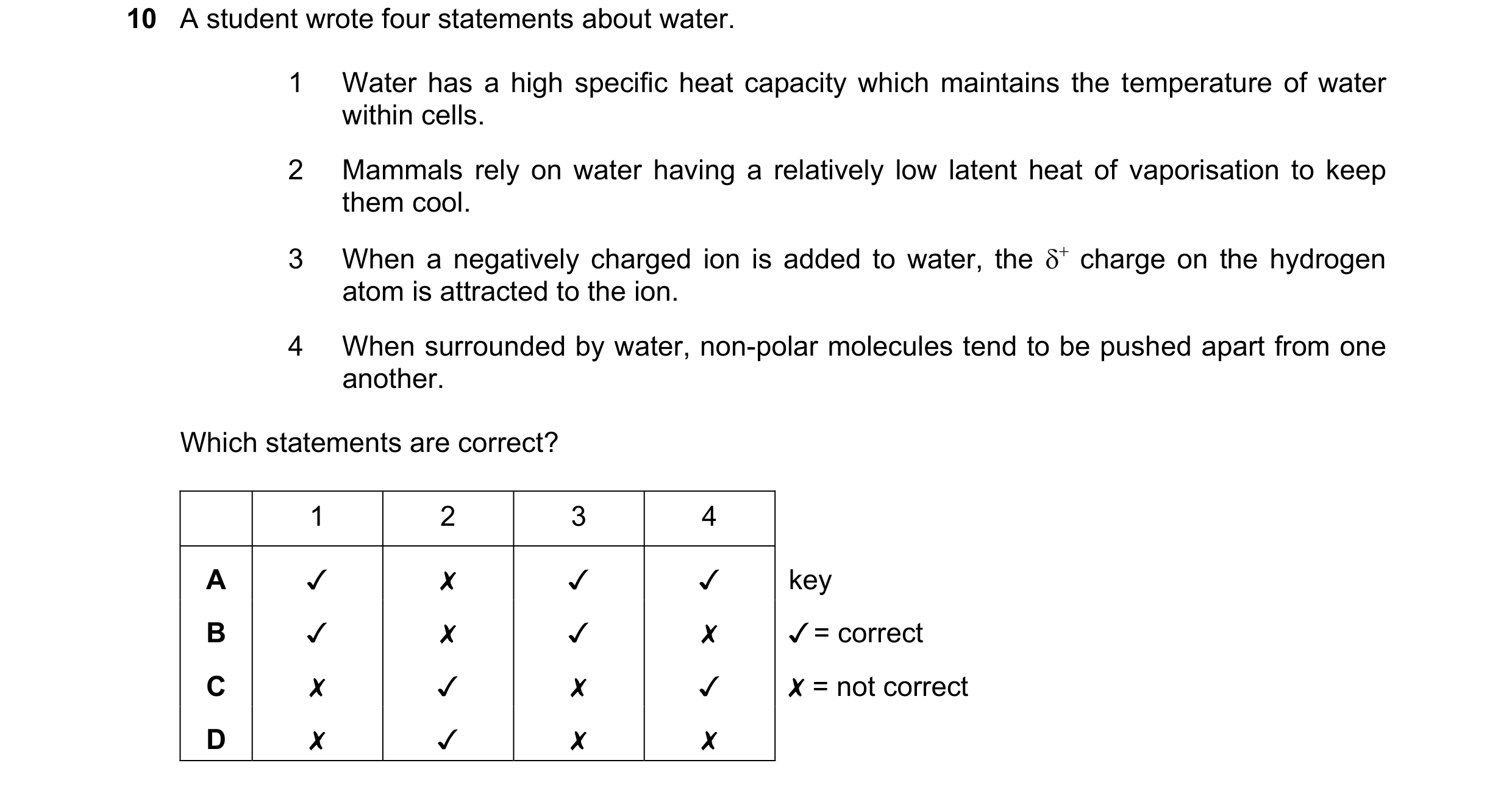
Q33 · A student wrote four statements about water 9700/12 Oct/Nov 2019
13 A student wrote four statements about water.
1
Water has a high specific heat capacity which maintains the temperature of water
within cells.
Mammals rely on water having a relatively low latent heat of vapourisation to keep
them cool.
When a negatively charged ion is added to water, the 5° charge on the hydrogen
atom is attracted to the ion.
When surrounded by water, non-polar molecules tend to be pushed apart from one
another.
Which statements are correct?
0 0O WwW D>
x KOK
key
JY = correct
X = not correct
\ <x x
x «KX
x K & &
1 marks
Answer: B
This question in 9700/12 Oct/Nov 2019
Q34 · Hydrogen bonding explains many of the properties of water, including the high latent heat… 9700/12 Feb/March 2020
12 Hydrogen bonding explains many of the properties of water, including the high latent heat of vapourisation and high specific heat capacity. For which processes in plants is hydrogen bonding in water important on hot sunny days? 1 preventing denaturation of enzymes in leaves 2 reducing water loss by evaporation 3 allowing leaves to cool down quickly at night 4 holding the column of water in xylem vessels together A 1, 2, 3 and 4 B 1, 2 and 4 only C 1, 3 and 4 only D 2 and 3 only
1 marks
Answer: B
This question in 9700/12 Feb/March 2020
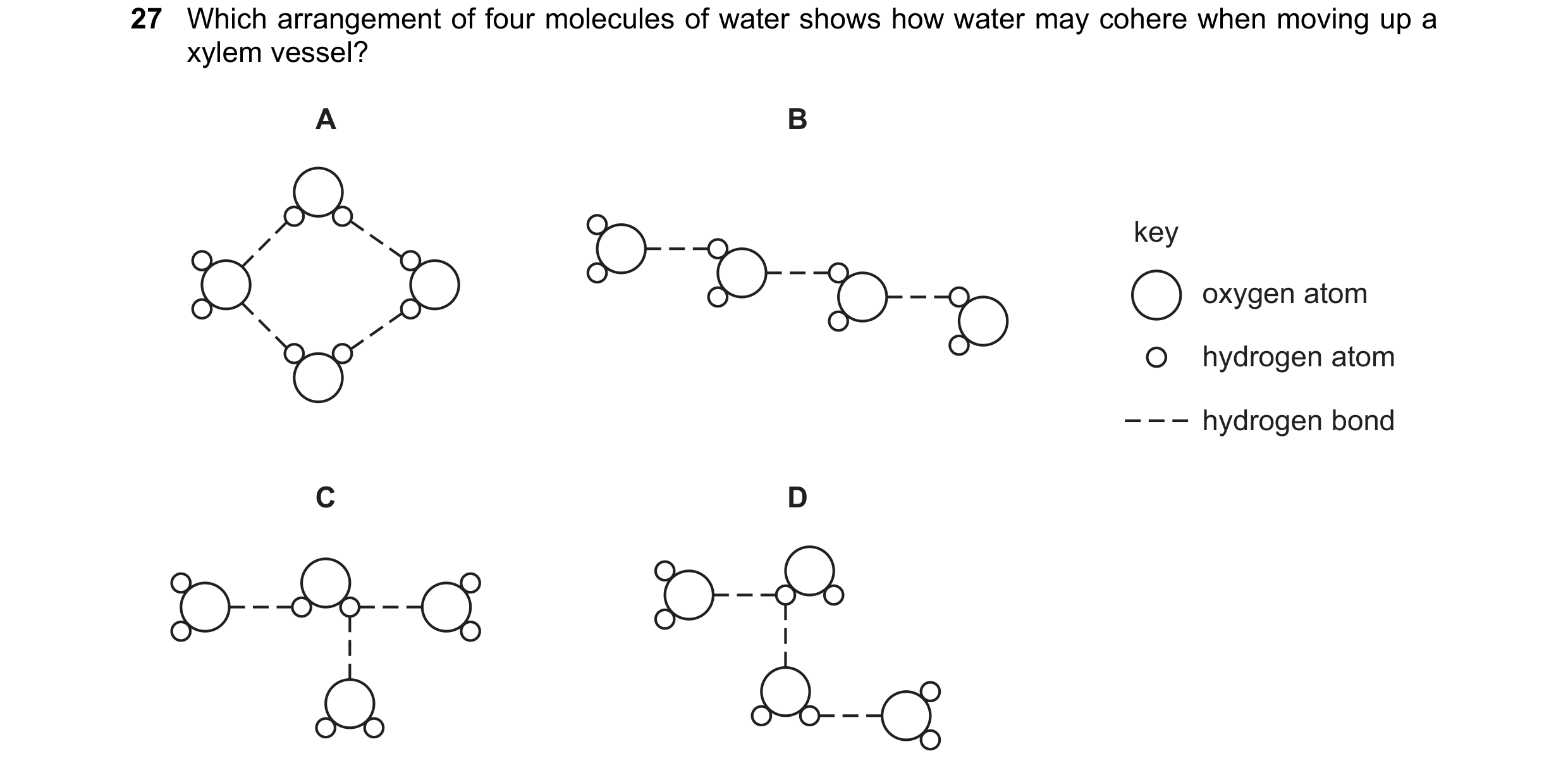
Q35 · Which arrangement of four molecules of water shows how water may cohere when moving up a… 9700/11 May/June 2020
27 Which arrangement of four molecules of water shows how water may cohere when moving up a xylem vessel? A B key oxygen atom hydrogen atom hydrogen bond C D
1 marks
Answer: B
This question in 9700/11 May/June 2020
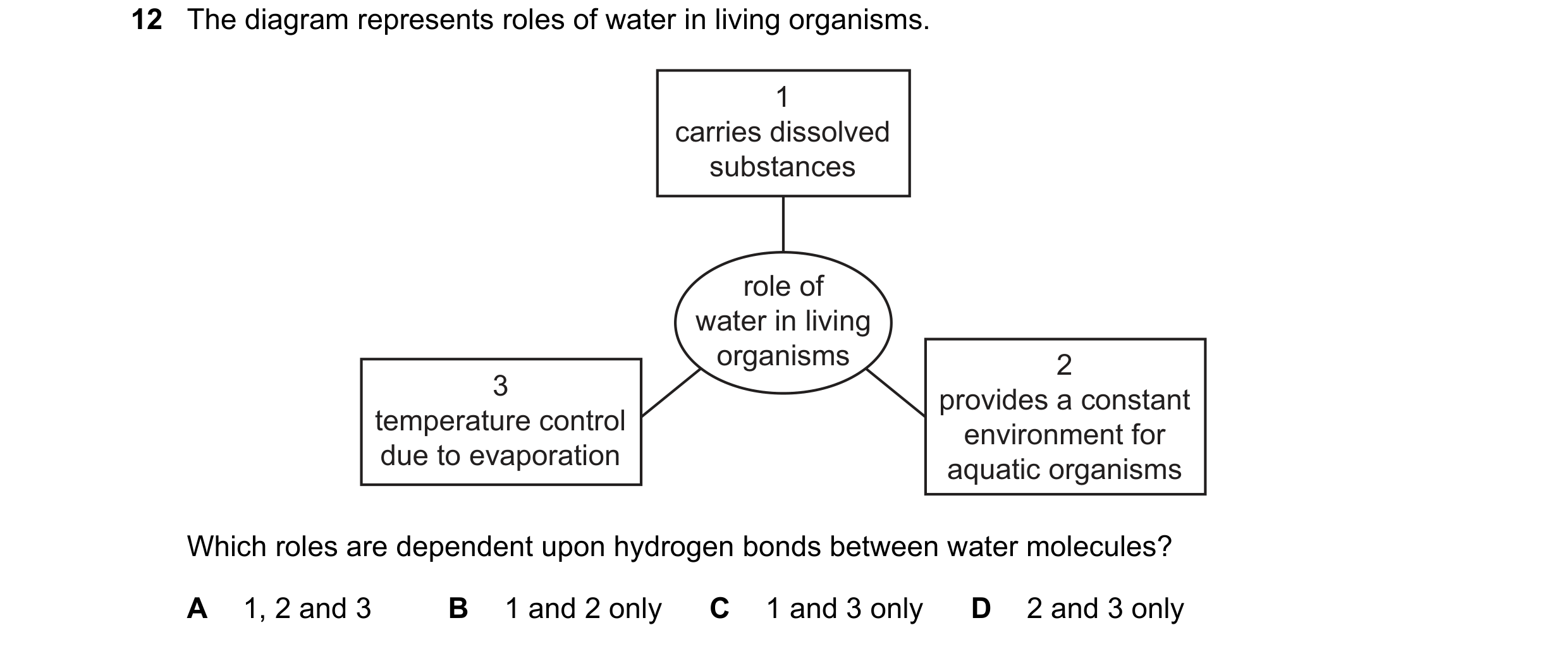
Q36 · The diagram represents roles of water in living organisms 9700/12 May/June 2020
12 The diagram represents roles of water in living organisms. 1 carries dissolved substances role of water in living organisms 2 3 provides a constant temperature control environment for due to evaporation aquatic organisms Which roles are dependent upon hydrogen bonds between water molecules? A 1, 2 and 3 B 1 and 2 only C 1 and 3 only D 2 and 3 only
1 marks
Answer: D
This question in 9700/12 May/June 2020
Q37 · Which properties of water reduce temperature changes inside cells? 9700/11 Oct/Nov 2020
12 Which properties of water reduce temperature changes inside cells? 1 cohesion 2 latent heat of vaporisation 3 specific heat capacity A 1 and 2 B 1 and 3 C 2 and 3 D 3 only
1 marks
Answer: D
This question in 9700/11 Oct/Nov 2020
Q38 · Which properties of water molecules are important in the upward flow of water through the… 9700/13 May/June 2021
24 Which properties of water molecules are important in the upward flow of water through the xylem? 1 Water molecules are attracted to each other by hydrogen bonding. 2 Water molecules are attracted to cellulose by adhesion. 3 Water molecules have high cohesion in water columns. A 1, 2 and 3 B 1 and 2 only C 1 and 3 only D 2 and 3 only
1 marks
Answer: A
This question in 9700/13 May/June 2021
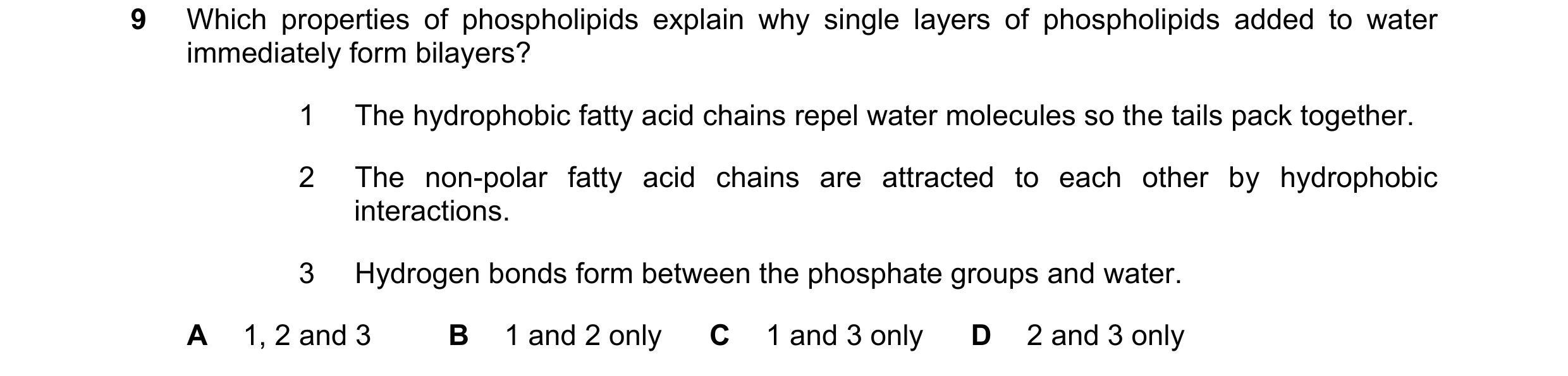
Q39 · Which properties of phospholipids explain why single layers of phospholipids added to… 9700/11 Oct/Nov 2021
9 Which properties of phospholipids explain why single layers of phospholipids added to water immediately form bilayers? 1 The hydrophobic fatty acid chains repel water molecules so the tails pack together. 2 The non-polar fatty acid chains are attracted to each other by hydrophobic interactions. 3 Hydrogen bonds form between the phosphate groups and water. A 1, 2 and 3 B 1 and 2 only C 1 and 3 only D 2 and 3 only
1 marks
Answer: A
This question in 9700/11 Oct/Nov 2021
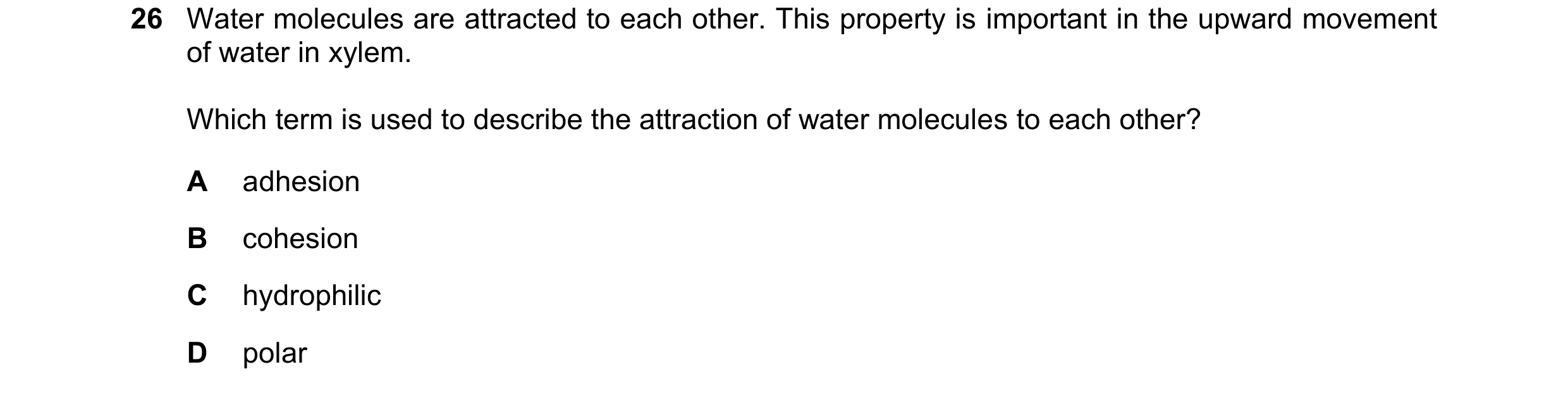
Q40 · Water molecules are attracted to each other 9700/11 Oct/Nov 2021
26 Water molecules are attracted to each other. This property is important in the upward movement of water in xylem. Which term is used to describe the attraction of water molecules to each other? A adhesion B cohesion C hydrophilic D polar
1 marks
Answer: B
This question in 9700/11 Oct/Nov 2021
Q41 · Which properties of water are the result of hydrogen bonding between water molecules? 9700/13 Oct/Nov 2021
13 Which properties of water are the result of hydrogen bonding between water molecules? 1 solvent action 2 specific heat capacity 3 latent heat of vapourisation A 1 and 3 B 1 only C 2 and 3 D 2 only
1 marks
Answer: C
This question in 9700/13 Oct/Nov 2021
Q42 · Which have properties that are dependent on hydrogen bonds? 9700/12 May/June 2022
7 Which have properties that are dependent on hydrogen bonds? 1 cellulose 2 a molecule of haemoglobin 3 water A 1, 2 and 3 B 1 and 2 only C 1 and 3 only D 2 and 3 only
1 marks
Answer: A
This question in 9700/12 May/June 2022
Q43 · A student wrote four statements about water 9700/12 May/June 2022
10
A student wrote four statements about water.
1
Water has a high specific heat capacity which maintains the temperature of water
within cells.
Mammals rely on water having a relatively low latent heat of vaporisation to keep
them cool.
When a negatively charged ion is added to water, the 5° charge on the hydrogen
atom is attracted to the ion.
When surrounded by water, non-polar molecules tend to be pushed apart from one
another.
Which statements are correct?
1 2 3 4
A Jv x Jv J key
B v x v Xx ¥ = correct
Cc x v x v X = not correct
D x Jv x x
1 marks
Answer: B
This question in 9700/12 May/June 2022
Q44 · Which molecules form hydrogen bonds with water during transpiration? 9700/12 May/June 2022
26 Which molecules form hydrogen bonds with water during transpiration? 1 cellulose in the xylem wall 2 suberin in the xylem wall 3 other water molecules in the xylem A 1, 2 and 3 B 1 and 2 only C 1 and 3 only D 2 and 3 only
1 marks
Answer: C
This question in 9700/12 May/June 2022
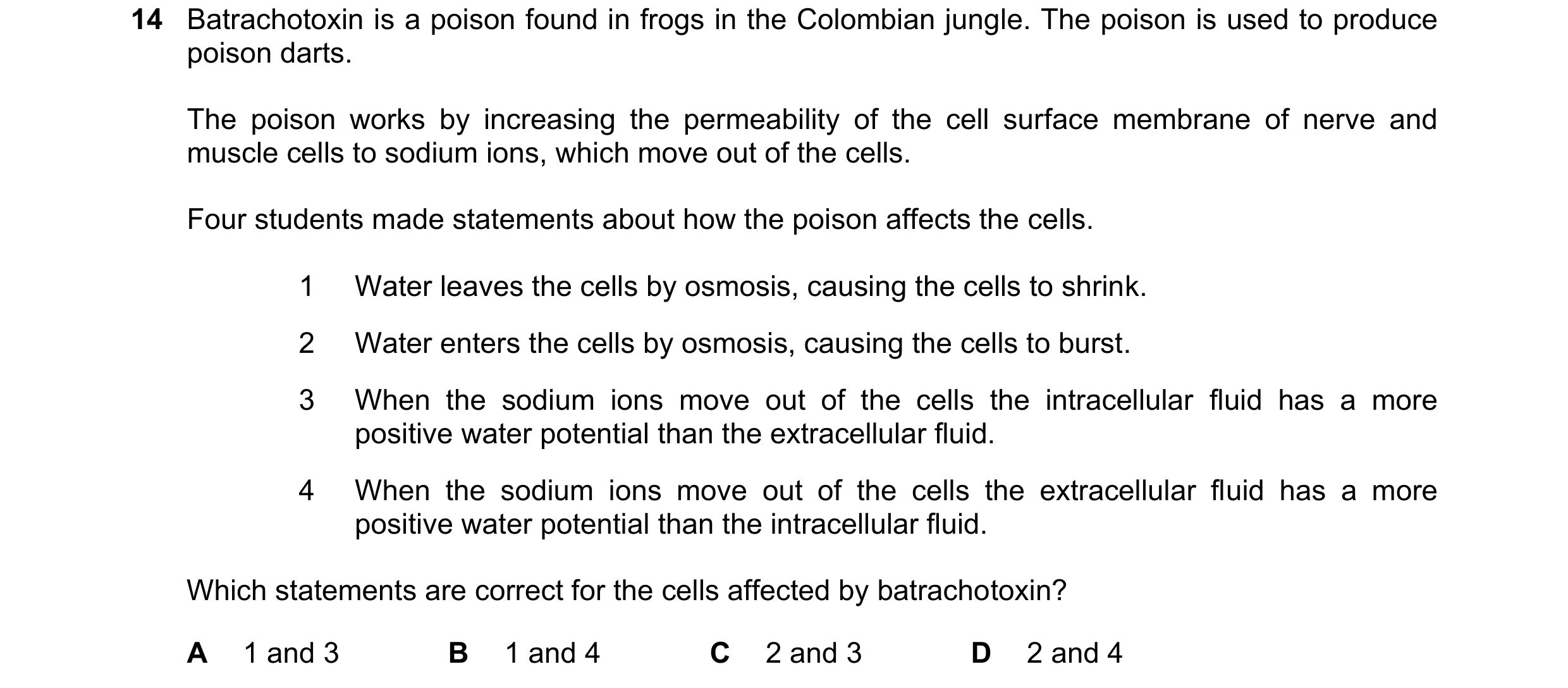
Q45 · Batrachotoxin is a poison found in frogs in the Colombian jungle 9700/13 May/June 2022
14 Batrachotoxin is a poison found in frogs in the Colombian jungle. The poison is used to produce poison darts. The poison works by increasing the permeability of the cell surface membrane of nerve and muscle cells to sodium ions, which move out of the cells. Four students made statements about how the poison affects the cells. 1 Water leaves the cells by osmosis, causing the cells to shrink. 2 Water enters the cells by osmosis, causing the cells to burst. 3 When the sodium ions move out of the cells the intracellular fluid has a more positive water potential than the extracellular fluid. 4 When the sodium ions move out of the cells the extracellular fluid has a more positive water potential than the intracellular fluid. Which statements are correct for the cells affected by batrachotoxin? A 1 and 3 B 1 and 4 C 2 and 3 D 2 and 4
1 marks
Answer: A
This question in 9700/13 May/June 2022
Q46 · The statements describe some of the properties of water 9700/13 Oct/Nov 2022
27 The statements describe some of the properties of water. 1 requires a lot of heat energy to evaporate 2 retains a lot of heat energy 3 is able to form hydrogen bonds with other water molecules 4 is able to form hydrogen bonds with other polar and non-polar molecules Which properties are also important for transport in xylem? A 1, 2 and 3 B 1, 2 and 4 C 1 and 3 only D 3 and 4
1 marks
Answer: D
This question in 9700/13 Oct/Nov 2022
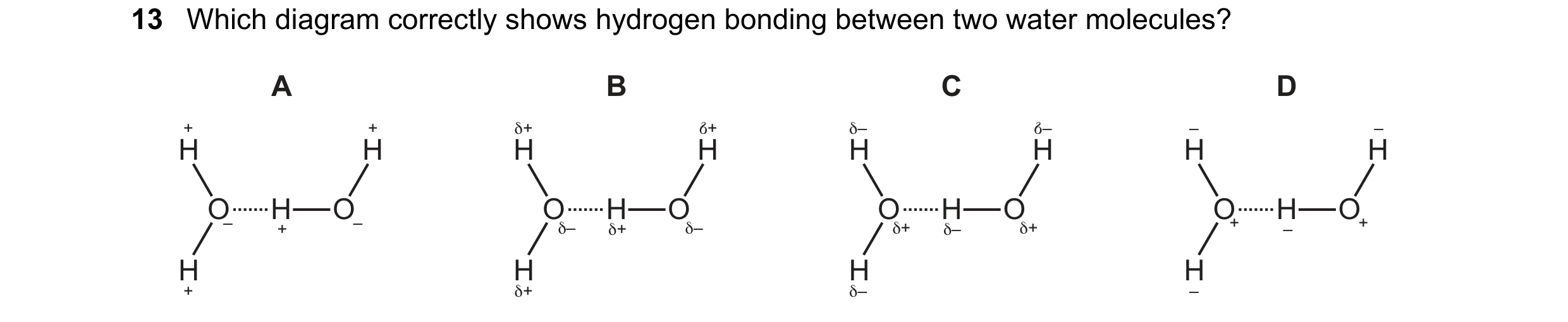
Q47 · Which diagram correctly shows hydrogen bonding between two water molecules? 9700/12 Feb/March 2023
13 Which diagram correctly shows hydrogen bonding between two water molecules? A B C D + + δ+ +δ δ– –δ – – H H H H H H H H O H O O H O O H O O H O – + – δ– δ+ δ– δ+ δ– δ+ + – + H H H H + δ+ δ– –
1 marks
Answer: B
This question in 9700/12 Feb/March 2023
Q48 · Which statement correctly explains why blood plasma can be maintained at a stable… 9700/11 May/June 2023
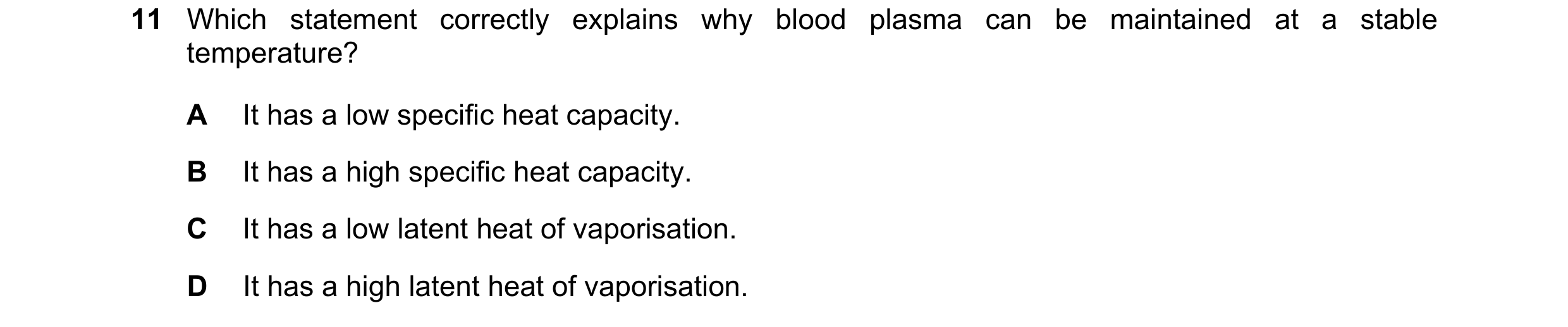
11 Which statement correctly explains why blood plasma can be maintained at a stable temperature? A It has a low specific heat capacity. B It has a high specific heat capacity. C It has a low latent heat of vaporisation. D It has a high latent heat of vaporisation.
1 marks
Answer: B
This question in 9700/11 May/June 2023
Q49 · What is the correct term to describe intermolecular hydrogen bonding between water… 9700/11 May/June 2023
24 What is the correct term to describe intermolecular hydrogen bonding between water molecules? A adhesion B cohesion C osmosis D diffusion
1 marks
Answer: B
This question in 9700/11 May/June 2023
Q50 · What is the maximum number of hydrogen bonds that can form between two single water… 9700/12 May/June 2023
12 What is the maximum number of hydrogen bonds that can form between two single water molecules? A 1 B 2 C 3 D 4
1 marks
Answer: A
This question in 9700/12 May/June 2023
Q51 · Which properties of water are essential for its role in the transport of blood in mammals? 9700/12 May/June 2023
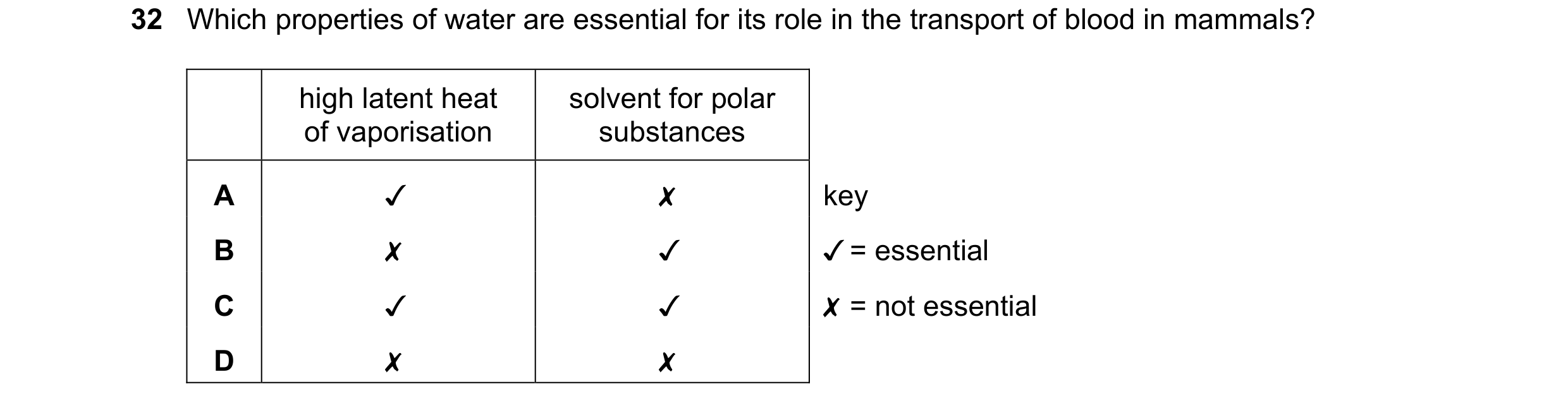
32 Which properties of water are essential for its role in the transport of blood in mammals?
high latent heat solvent for polar
of vaporisation substances
A v x key
B x v ¥ = essential
Cc v v X = not essential
D x x
1 marks
Answer: B
This question in 9700/12 May/June 2023
Q52 · Hydrogen bonding explains many of the properties of water, including the high latent heat… 9700/13 Oct/Nov 2023
12 Hydrogen bonding explains many of the properties of water, including the high latent heat of vaporisation and high specific heat capacity. For which processes in plants is hydrogen bonding in water important on hot sunny days? 1 preventing denaturation of enzymes in leaves 2 reducing water loss by evaporation 3 allowing leaves to cool down quickly at night 4 holding the column of water in xylem vessels together A 1, 2, 3 and 4 B 1, 2 and 4 only C 1, 3 and 4 only D 2 and 3 only
1 marks
Answer: B
This question in 9700/13 Oct/Nov 2023
Q53 · Which property of water, related to its role in blood and tissue fluid, is correctly… 9700/12 Feb/March 2024
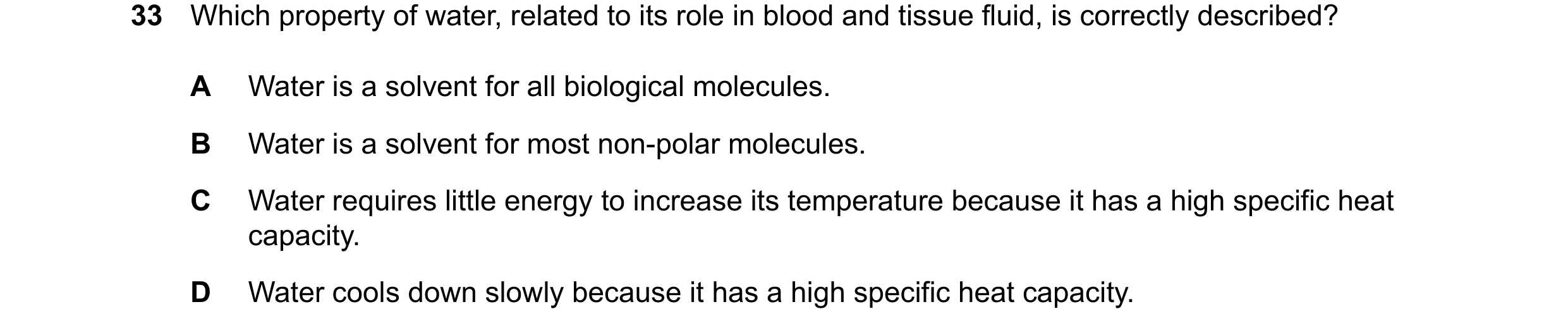
33 Which property of water, related to its role in blood and tissue fluid, is correctly described? A Water is a solvent for all biological molecules. B Water is a solvent for most non-polar molecules. C Water requires little energy to increase its temperature because it has a high specific heat capacity. D Water cools down slowly because it has a high specific heat capacity.
1 marks
Answer: D
This question in 9700/12 Feb/March 2024
Q54 · What is the maximum number of hydrogen bonds that can form between a single water… 9700/11 May/June 2024
5 What is the maximum number of hydrogen bonds that can form between a single water molecule and other water molecules? A 1 B 2 C 3 D 4
1 marks
Answer: D
This question in 9700/11 May/June 2024
Q55 · What causes the phosphate heads of phospholipids to become polar? 9700/13 May/June 2024
5 What causes the phosphate heads of phospholipids to become polar? A The phosphate heads are joined to water molecules by hydrogen bonds. B The phosphate heads are insoluble in water. C The phosphate heads become ionised in water. D The phosphate heads are joined to water molecules by covalent bonds.
1 marks
Answer: C
This question in 9700/13 May/June 2024
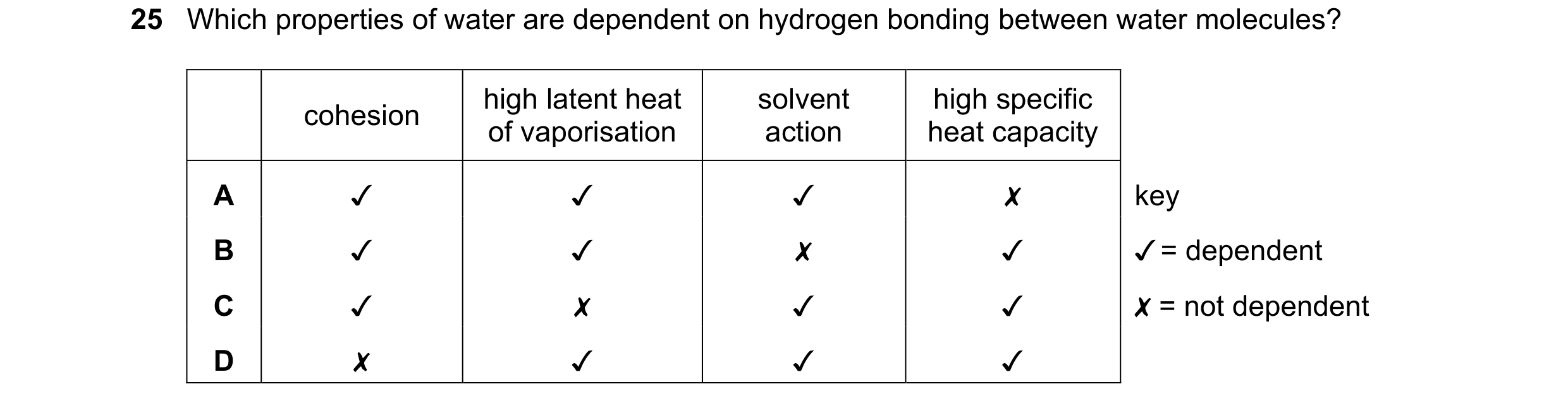
Q56 · Which properties of water are dependent on hydrogen bonding between water molecules? 9700/13 May/June 2024
25 Which properties of water are dependent on hydrogen bonding between water molecules?
cohesion high latent heat solvent high specific
of vaporisation action heat capacity
A v v v x
B v v x v
Cc v x v v
D x v v v
key
Jv = dependent
X = not dependent
1 marks
Answer: B
This question in 9700/13 May/June 2024
Q57 · Which statements are correct reasons for how animals cool down in hot environments using… 9700/13 Oct/Nov 2024
9 Which statements are correct reasons for how animals cool down in hot environments using latent heat of vaporisation of water? 1 Some animals lie down and roll in wet soil. 2 Fish move into deeper water. 3 Some animals lick their fur to make it wet. 4 Some animals breathe quickly with a wet tongue hanging out of their mouth. A 1, 2 and 3 B 1, 2 and 4 C 1, 3 and 4 D 2, 3 and 4
1 marks
Answer: C
This question in 9700/13 Oct/Nov 2024
Q58 · Which property of water enables sweating to be an efficient means of losing heat from the… 9700/12 May/June 2025
10 Which property of water enables sweating to be an efficient means of losing heat from the body? A The latent heat of vaporisation of water is high. B The specific heat capacity of water is high. C Each water molecule can form a hydrogen bond with four water molecules. D The forces of cohesion and adhesion on water molecules are very high.
1 marks
Answer: A
This question in 9700/12 May/June 2025
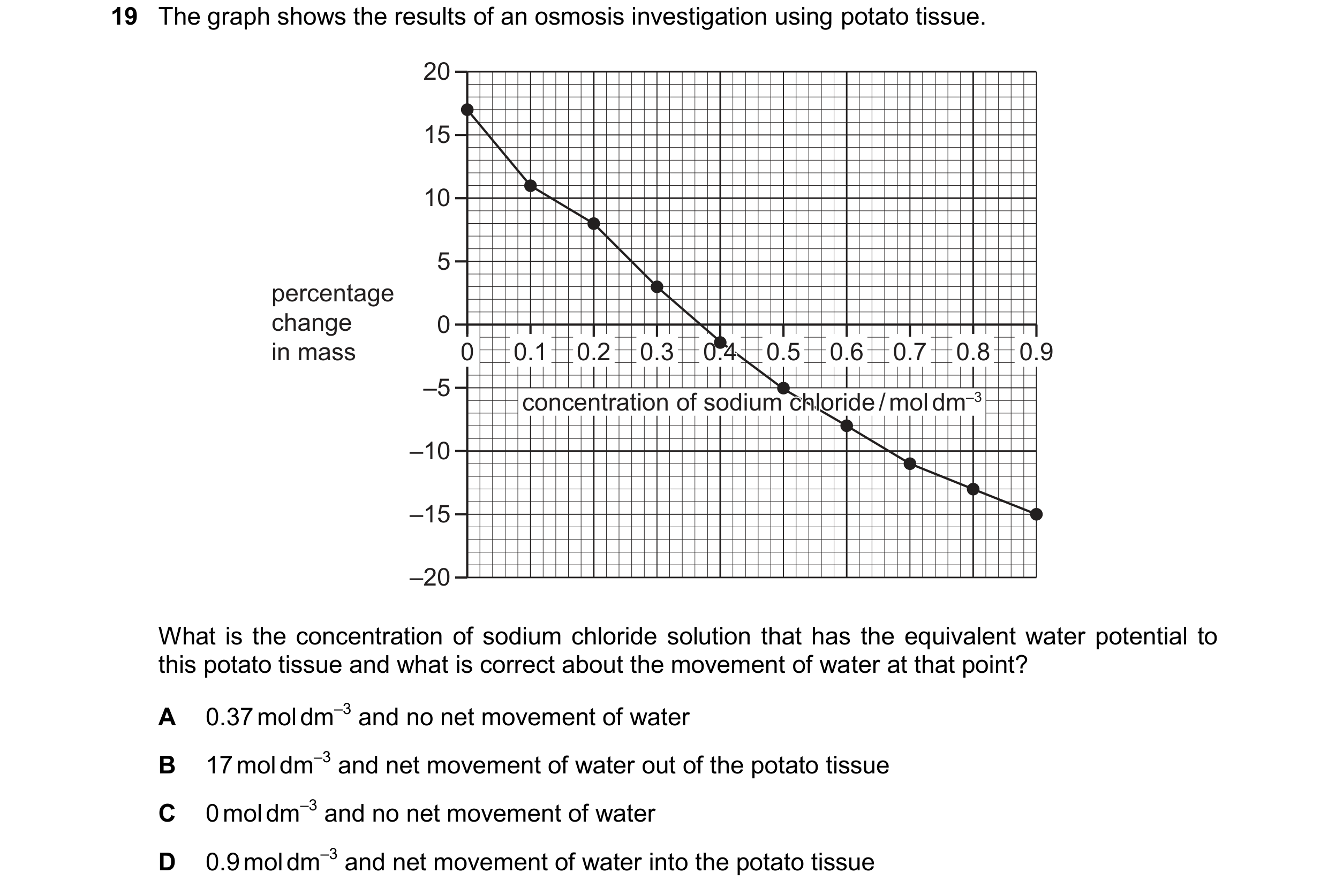
Q59 · The graph shows the results of an osmosis investigation using potato tissue 9700/12 May/June 2025
19 The graph shows the results of an osmosis investigation using potato tissue. 20 15 10 5 percentage change 0 in mass 0 0.1 0.2 0.3 0.4 0.4 0.4 0.5 0.6 0.7 0.8 0.9 –5 concentration of sodium chloride / mol dm–3 concentration of sodium chloride concentration of sodium chloride / mol mol dm dm–3 –3 –10 –15 –20 What is the concentration of sodium chloride solution that has the equivalent water potential to this potato tissue and what is correct about the movement of water at that point? A 0.37 mol dm–3 and no net movement of water B 17 mol dm–3 and net movement of water out of the potato tissue C 0 mol dm–3 and no net movement of water D 0.9 mol dm–3 and net movement of water into the potato tissue
1 marks
Answer: A
This question in 9700/12 May/June 2025
Q60 · Which property of water means that there are relatively small changes in the temperature… 9700/13 May/June 2025
14 Which property of water means that there are relatively small changes in the temperature of the oceans and of the cytoplasm within cells? A the high latent heat of vaporisation of water B the high specific heat capacity of water C the low specific heat capacity of water D the low latent heat of vaporisation of water
1 marks
Answer: B
This question in 9700/13 May/June 2025
Q61 · The diagram shows a bond between two molecules transported in a xylem vessel 9700/13 May/June 2025
28 The diagram shows a bond between two molecules transported in a xylem vessel. δ– O bond R δ+ δ+ H H δ– O δ+ δ+ H H Which row correctly names bond R and states the role of the bond between these molecules for their transport in a xylem vessel? role of the bond between name of bond R these molecules for their transport in a xylem vessel A hydrogen adhesion of the molecules to the wall of the xylem vessel B hydrogen cohesion of the molecules in the lumen of the xylem vessel C ionic adhesion of the molecules to the wall of the xylem vessel D ionic cohesion of the molecules in the lumen of the xylem vessel
1 marks
Answer: B
This question in 9700/13 May/June 2025
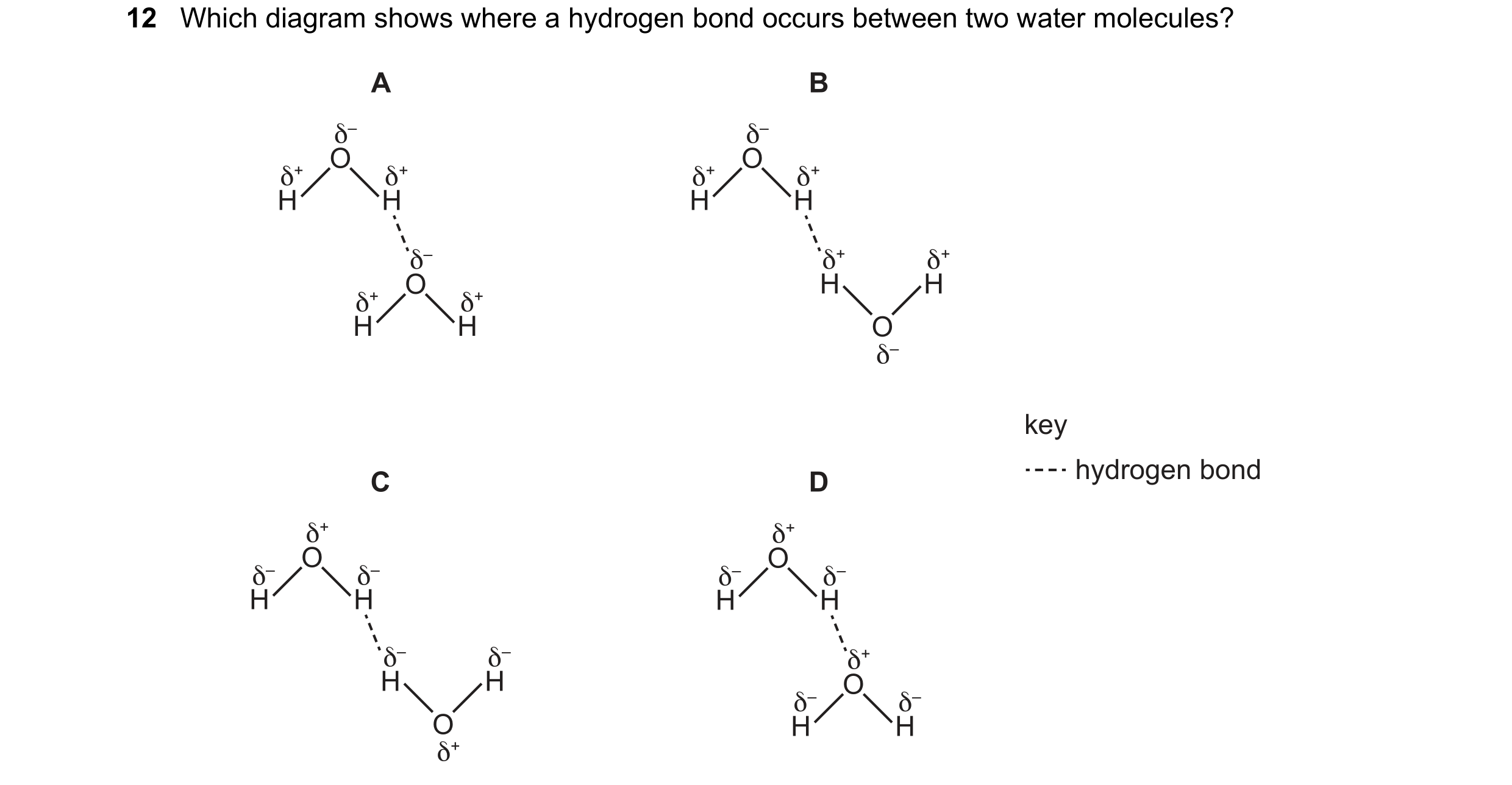
Q62 · Which diagram shows where a hydrogen bond occurs between two water molecules? 9700/14 May/June 2025
12 Which diagram shows where a hydrogen bond occurs between two water molecules? A B δ– δ– O O δ+ δ+ δ+ δ+ H H H H δ– δ+ δ+ O H H δ+ δ+ H H O δ– key C D hydrogen bond δ+ δ+ O O δ– δ– δ– δ– H H H H δ– δ– δ+ H H O δ– δ– O H H δ+
1 marks
Answer: A
This question in 9700/14 May/June 2025
Q63 · Some detergents disrupt hydrogen bonds between water molecules 9700/14 May/June 2025
13 Some detergents disrupt hydrogen bonds between water molecules. Which row shows the correct effects of detergent on the specific heat capacity and latent heat of vaporisation of water? specific heat latent heat of capacity vaporisation A decreases decreases B decreases increases C increases decreases D increases increases
1 marks
Answer: A
This question in 9700/14 May/June 2025
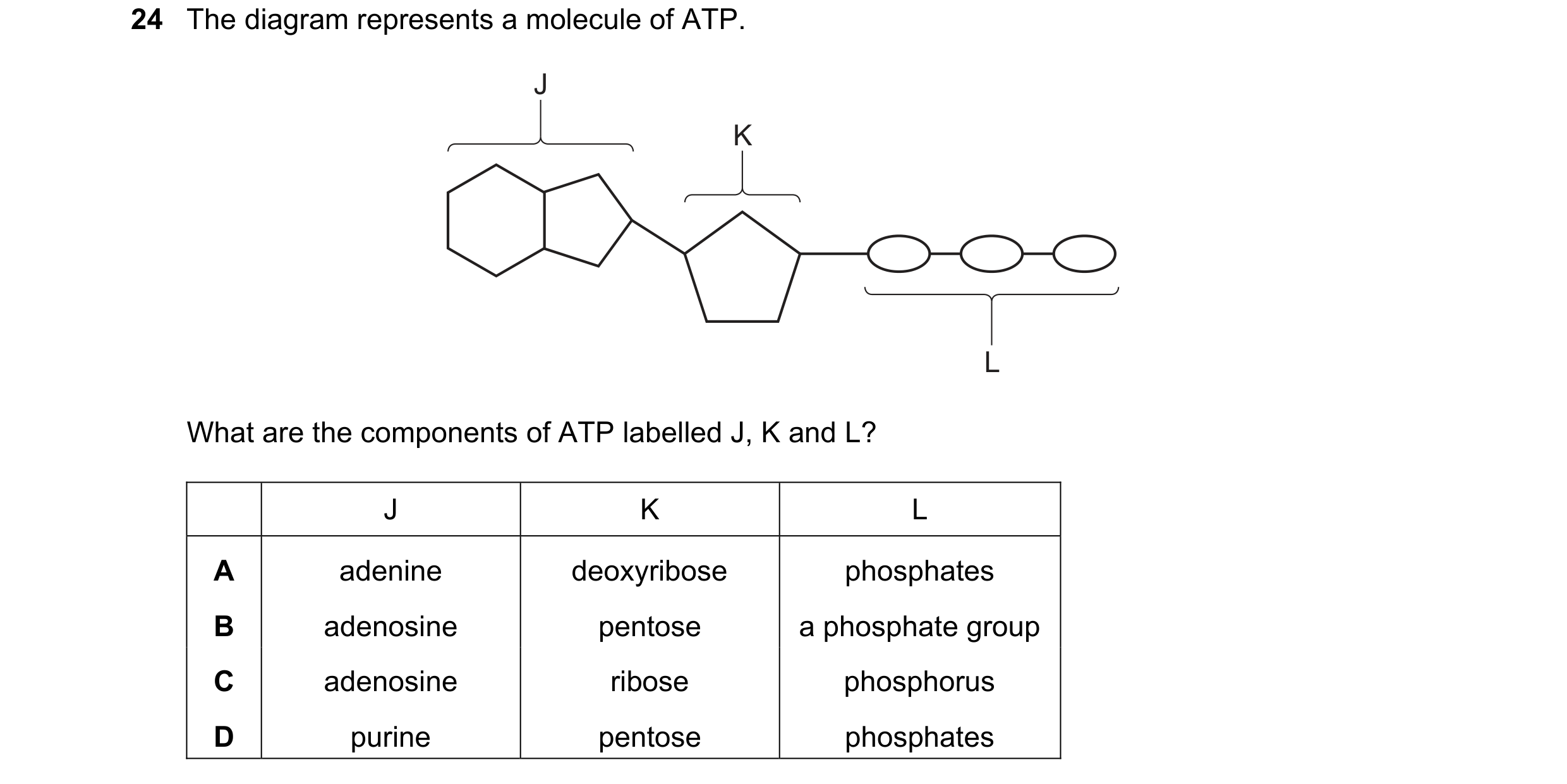
Q64 · The diagram represents a molecule of ATP 9700/13 Oct/Nov 2025
24 The diagram represents a molecule of ATP. J K L What are the components of ATP labelled J, K and L? J K L A adenine deoxyribose phosphates B adenosine pentose a phosphate group C adenosine ribose phosphorus D purine pentose phosphates
1 marks
Answer: D
This question in 9700/13 Oct/Nov 2025

 1 / 15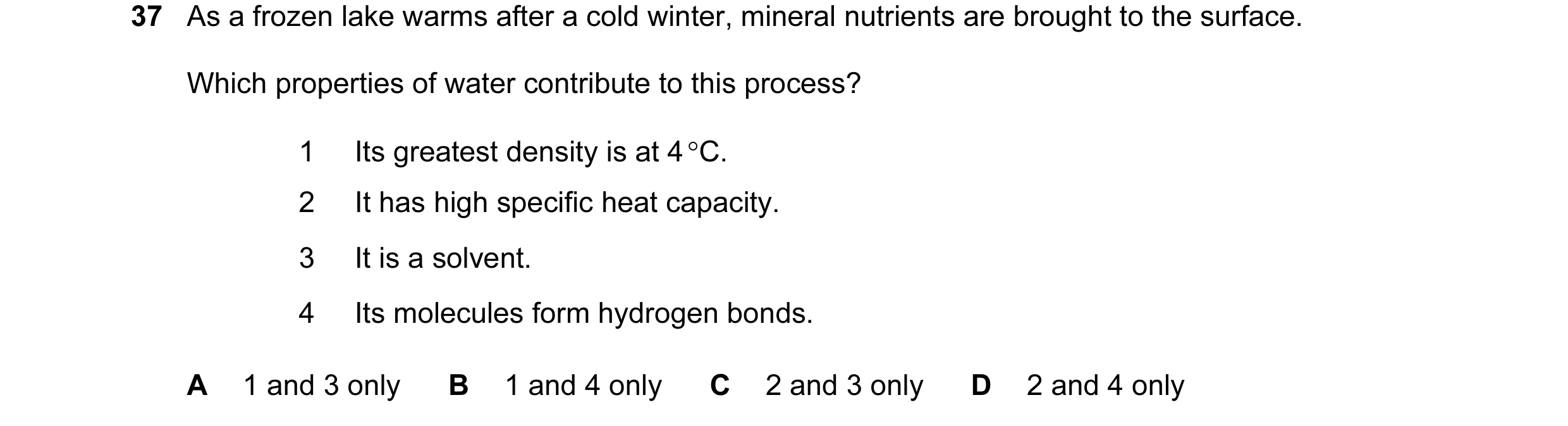



 2 / 15

 3 / 15

 4 / 15
 5 / 15
 6 / 15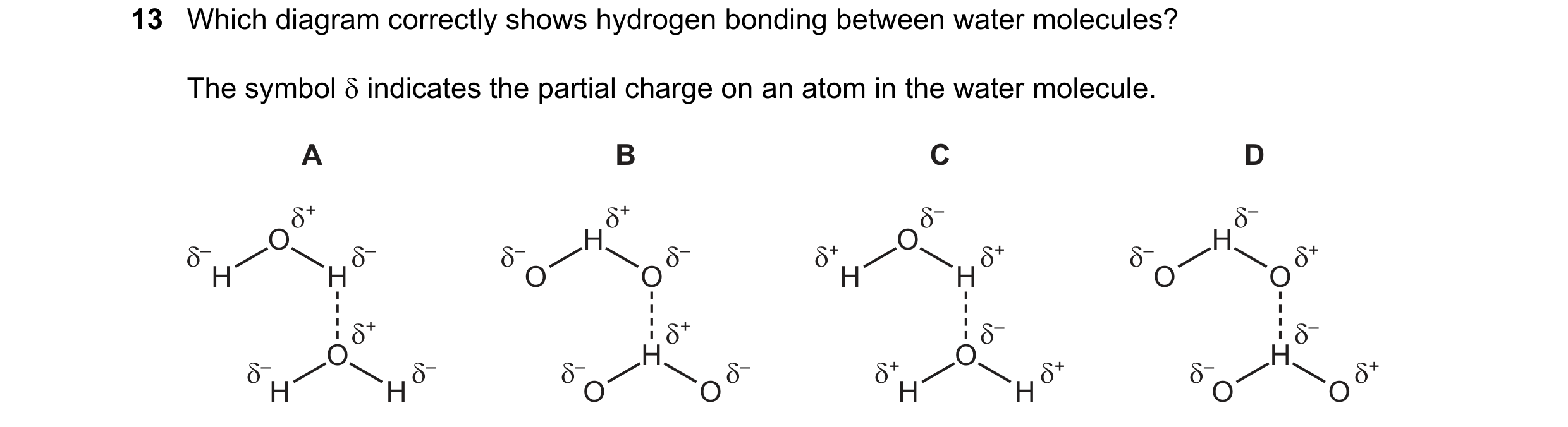
 7 / 15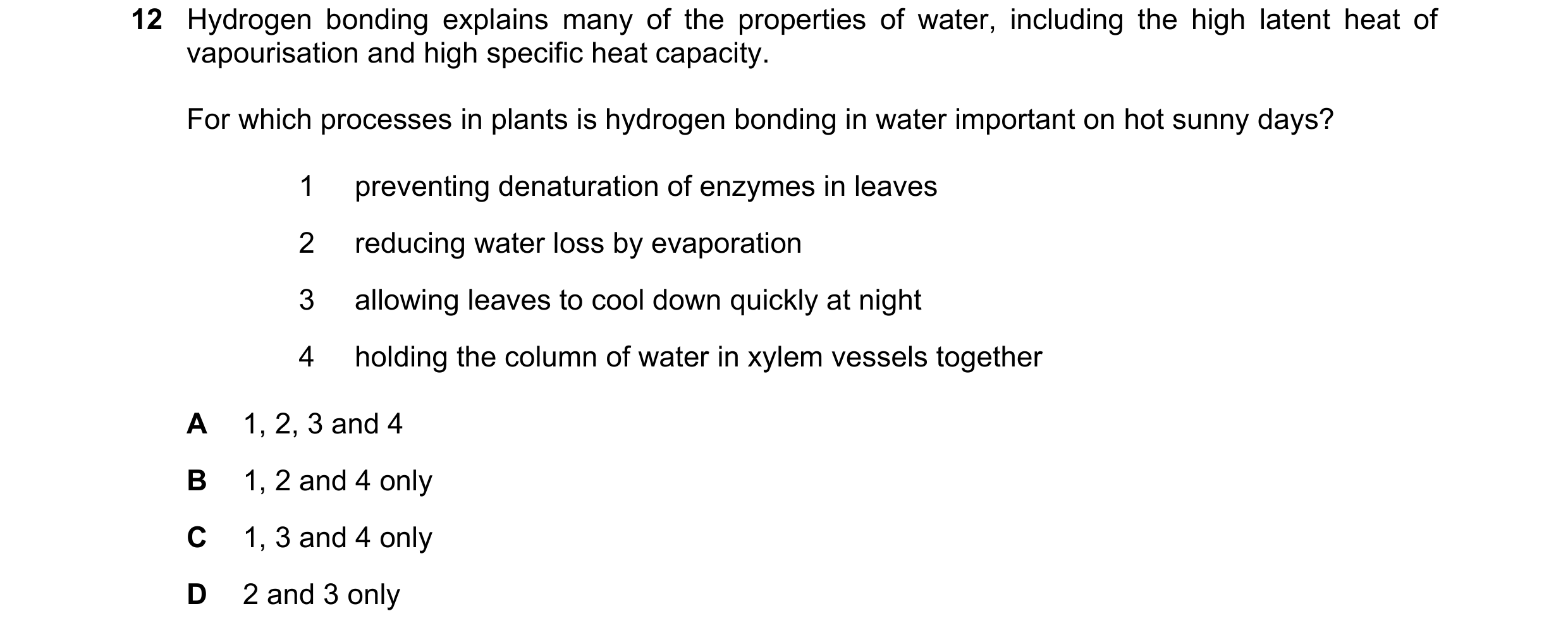
 8 / 15
 9 / 15

 10 / 15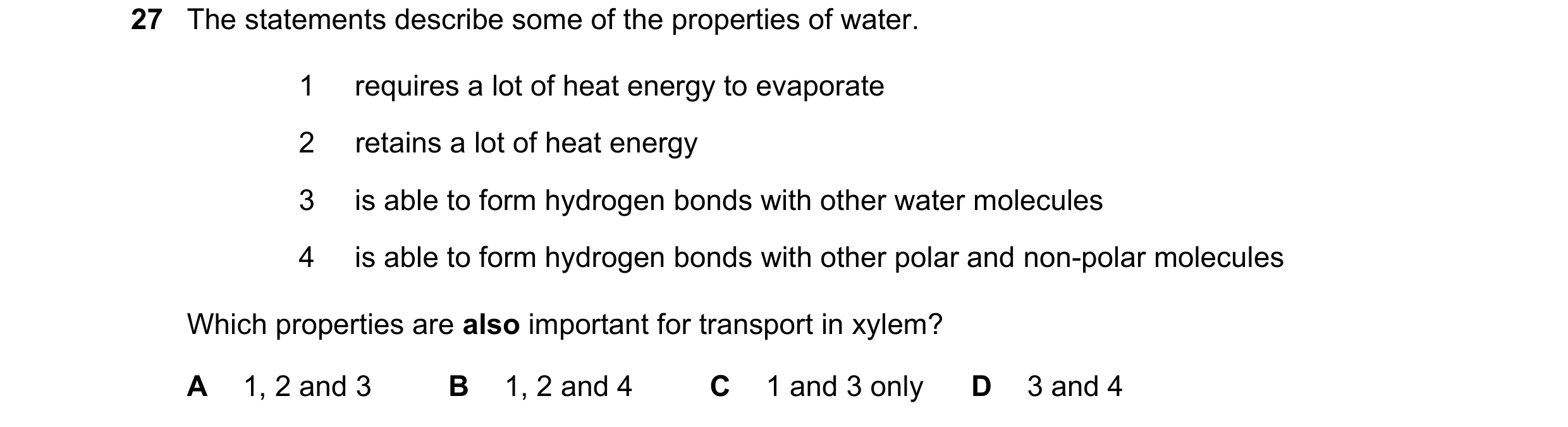


 11 / 15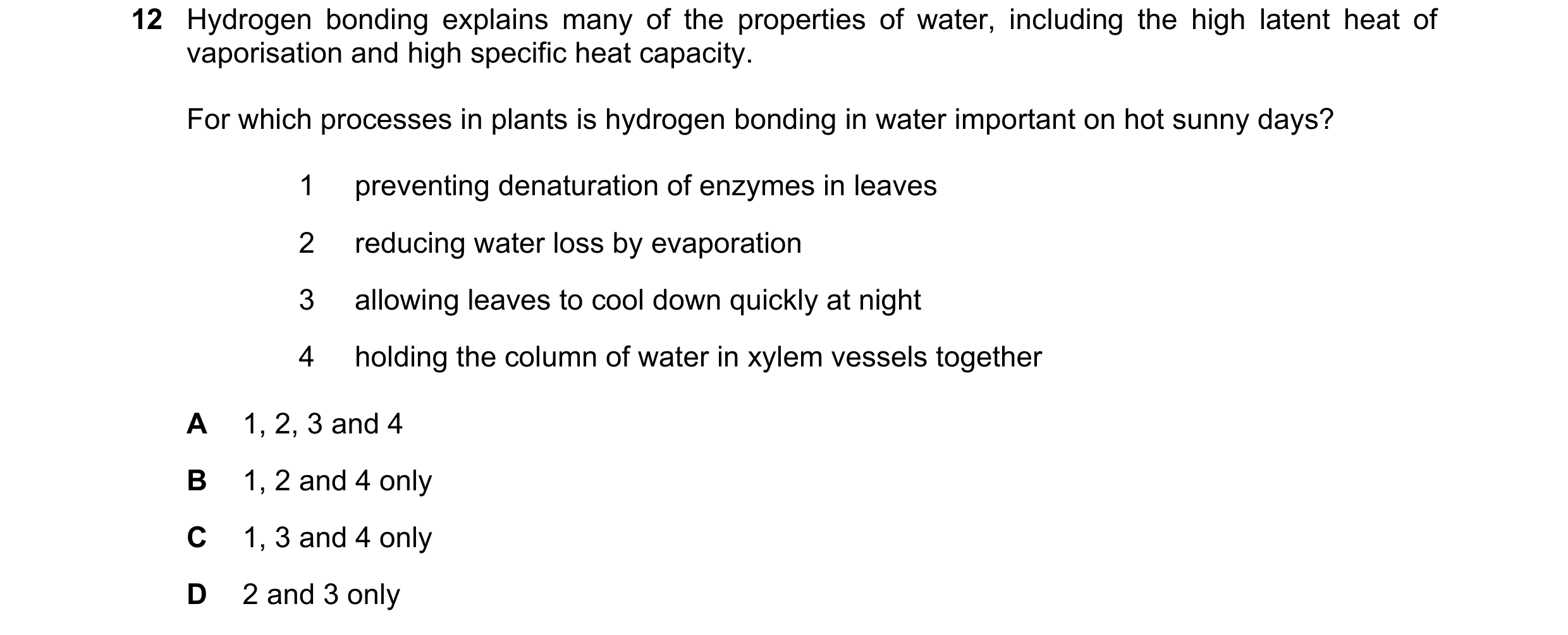


 12 / 15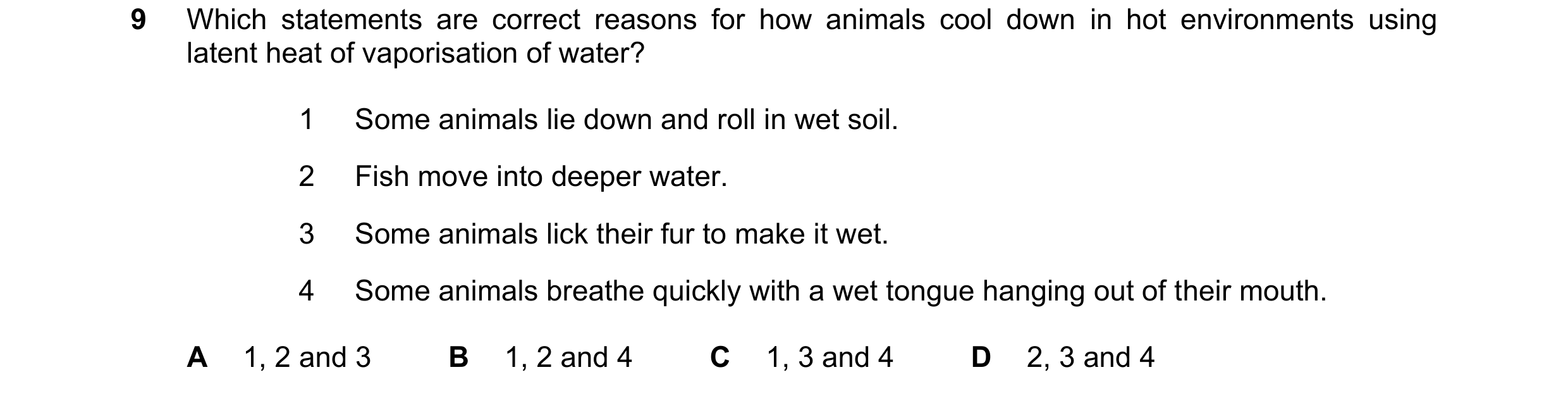

 13 / 15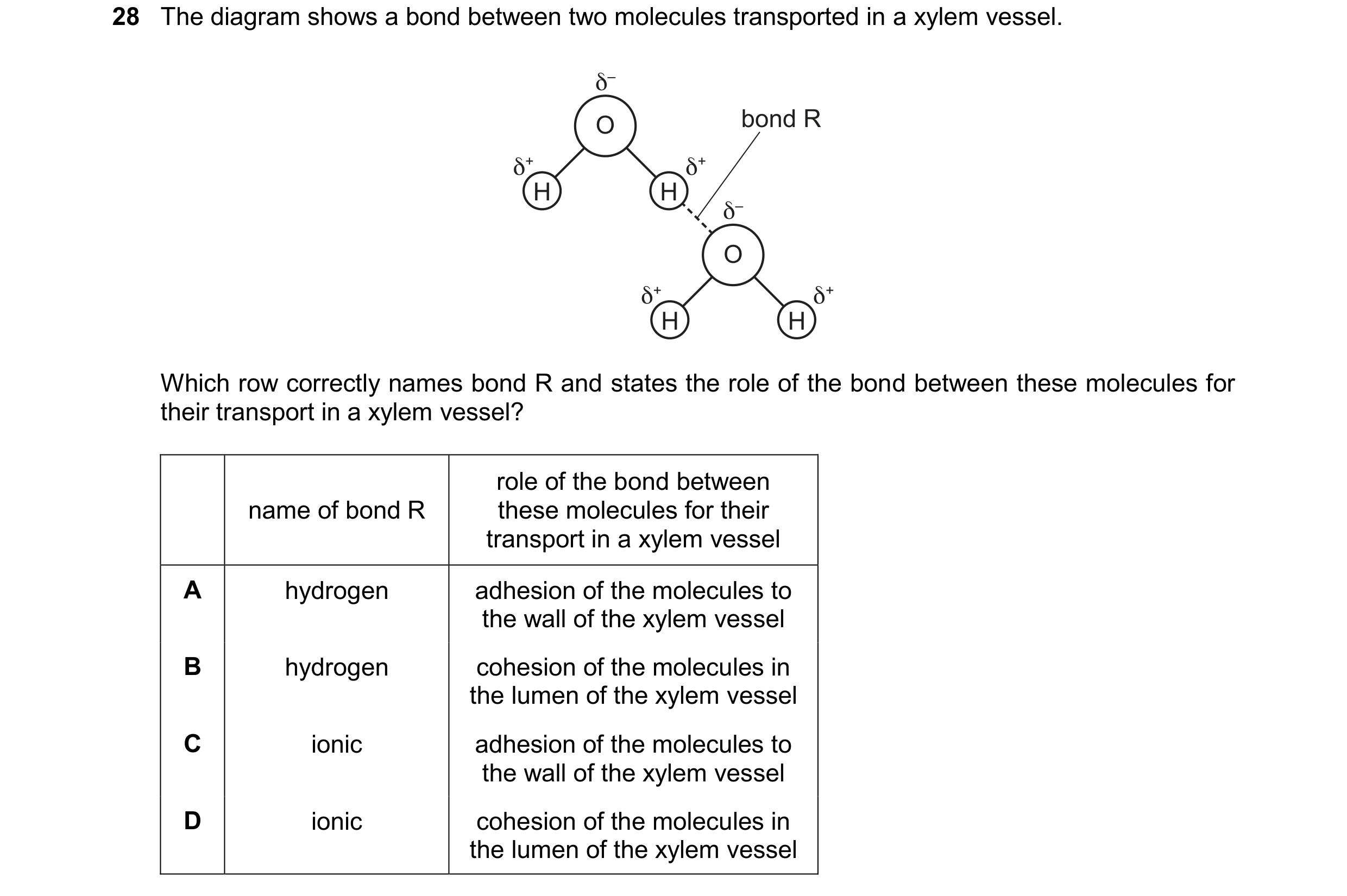
 14 / 15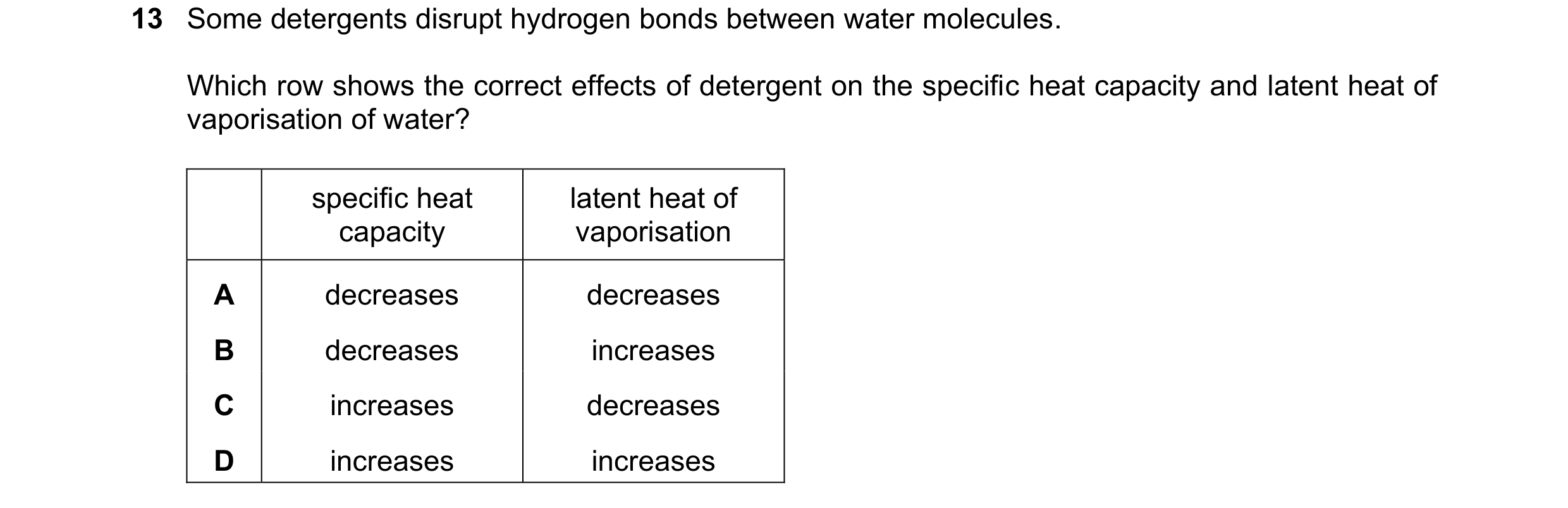
 15 / 15