Questions as text
Q1 · A spring of unstretched length 5.0 cm has a spring constant k of 20 N / cm 0654/21 May/June 2017
30 A spring of unstretched length 5.0 cm has a spring constant k of 20 N / cm. A load is suspended from the spring and its new length is 8.5 cm. What is the weight of the load? A 0.70 N B 1.7 N C 70 N D 170 N
1 marks
Answer: C
This question in 0654/21 May/June 2017
Q2 · A spring of unstretched length 5.0 cm has a spring constant k of 20 N / cm 0654/22 May/June 2017
30 A spring of unstretched length 5.0 cm has a spring constant k of 20 N / cm. A load is suspended from the spring and its new length is 8.5 cm. What is the weight of the load? A 0.70 N B 1.7 N C 70 N D 170 N
1 marks
Answer: C
This question in 0654/22 May/June 2017
Q3 · A spring of unstretched length 5.0 cm has a spring constant k of 20 N / cm 0654/23 May/June 2017
30 A spring of unstretched length 5.0 cm has a spring constant k of 20 N / cm. A load is suspended from the spring and its new length is 8.5 cm. What is the weight of the load? A 0.70 N B 1.7 N C 70 N D 170 N
1 marks
Answer: C
This question in 0654/23 May/June 2017
Q4 · A load is applied to a copper wire 0654/21 Oct/Nov 2017
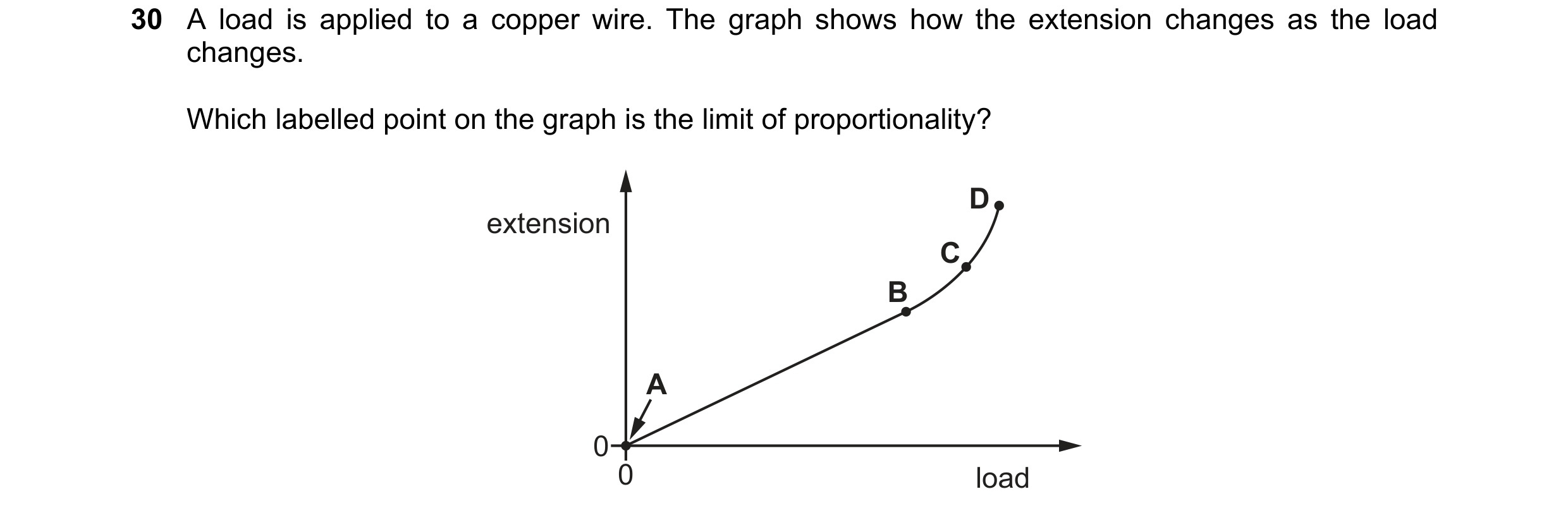
30 A load is applied to a copper wire. The graph shows how the extension changes as the load changes. Which labelled point on the graph is the limit of proportionality? D extension C B A 0 0 load
1 marks
Answer: B
This question in 0654/21 Oct/Nov 2017
Q5 · A load is applied to a spring 0654/22 Oct/Nov 2017
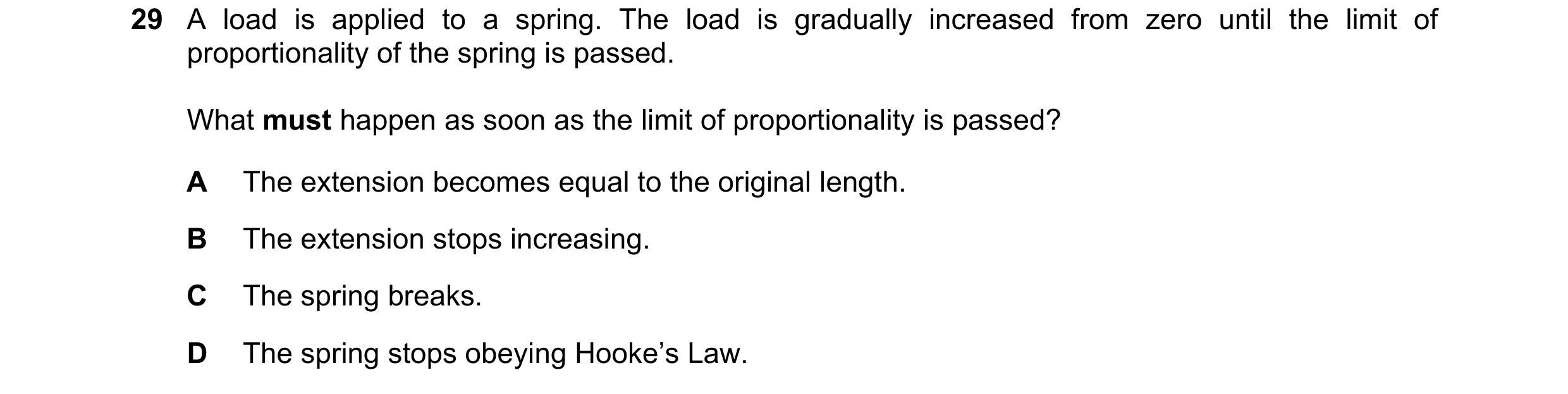
29 A load is applied to a spring. The load is gradually increased from zero until the limit of proportionality of the spring is passed. What must happen as soon as the limit of proportionality is passed? A The extension becomes equal to the original length. B The extension stops increasing. C The spring breaks. D The spring stops obeying Hooke’s Law.
1 marks
Answer: D
This question in 0654/22 Oct/Nov 2017
Q6 · A man is standing in a bus that is moving forwards 0654/21 Oct/Nov 2018
29 A man is standing in a bus that is moving forwards. The bus stops suddenly, causing the man to fall over. Which property of the man resists the change in his motion and in which direction does the man fall? property that resists direction of fall the change in motion A mass backwards B mass forwards C weight backwards D weight forwards
1 marks
Answer: B
This question in 0654/21 Oct/Nov 2018
Q7 · A spring that obeys Hooke’s law has an unstretched length of 5.0 cm 0654/21 May/June 2019
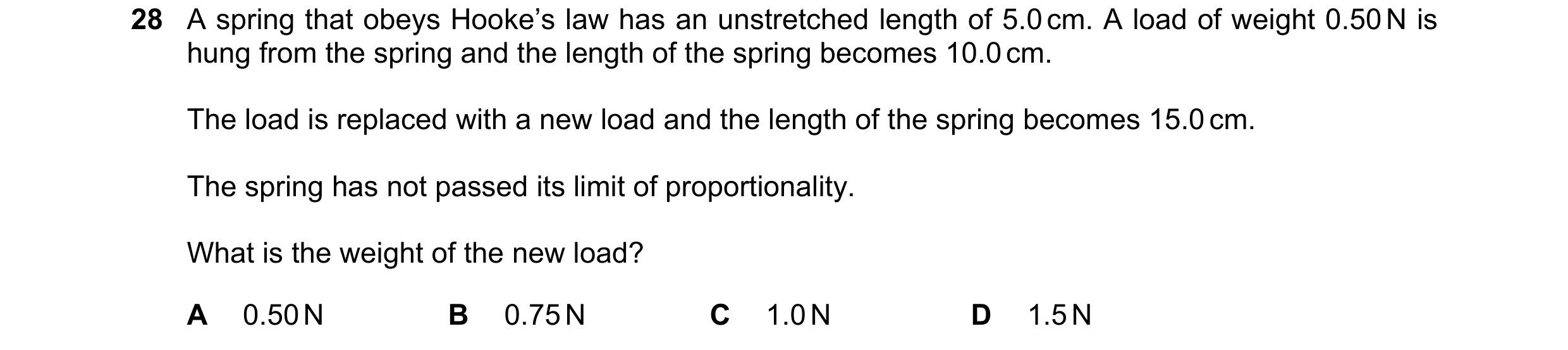
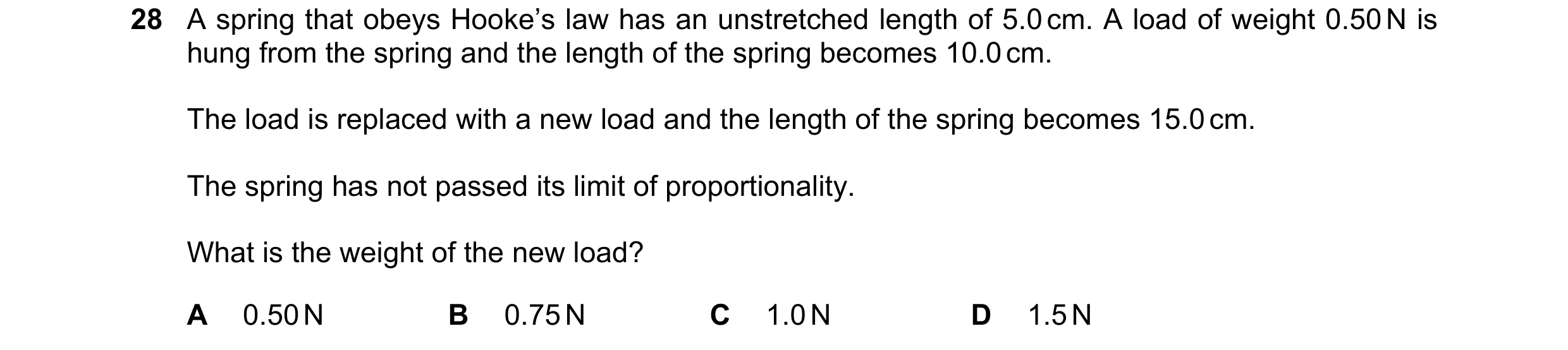
28 A spring that obeys Hooke’s law has an unstretched length of 5.0 cm. A load of weight 0.50 N is hung from the spring and the length of the spring becomes 10.0 cm. The load is replaced with a new load and the length of the spring becomes 15.0 cm. The spring has not passed its limit of proportionality. What is the weight of the new load? A 0.50 N B 0.75 N C 1.0 N D 1.5 N
1 marks
Answer: C
This question in 0654/21 May/June 2019
Q8 · A spring that obeys Hooke’s law has an unstretched length of 5.0 cm 0654/22 May/June 2019
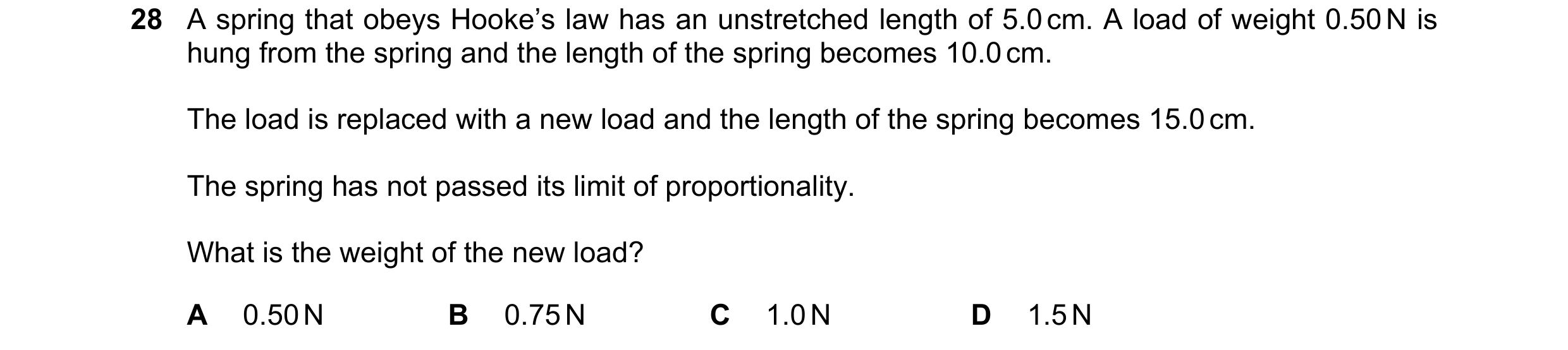
28 A spring that obeys Hooke’s law has an unstretched length of 5.0 cm. A load of weight 0.50 N is hung from the spring and the length of the spring becomes 10.0 cm. The load is replaced with a new load and the length of the spring becomes 15.0 cm. The spring has not passed its limit of proportionality. What is the weight of the new load? A 0.50 N B 0.75 N C 1.0 N D 1.5 N
1 marks
Answer: C
This question in 0654/22 May/June 2019
Q9 · A spring that obeys Hooke’s law has an unstretched length of 5.0 cm 0654/23 May/June 2019
28 A spring that obeys Hooke’s law has an unstretched length of 5.0 cm. A load of weight 0.50 N is hung from the spring and the length of the spring becomes 10.0 cm. The load is replaced with a new load and the length of the spring becomes 15.0 cm. The spring has not passed its limit of proportionality. What is the weight of the new load? A 0.50 N B 0.75 N C 1.0 N D 1.5 N
1 marks
Answer: C
This question in 0654/23 May/June 2019
Q10 · The diagram shows the two horizontal forces acting on a toy car of mass 2.0 kg that is… 0654/21 Oct/Nov 2019
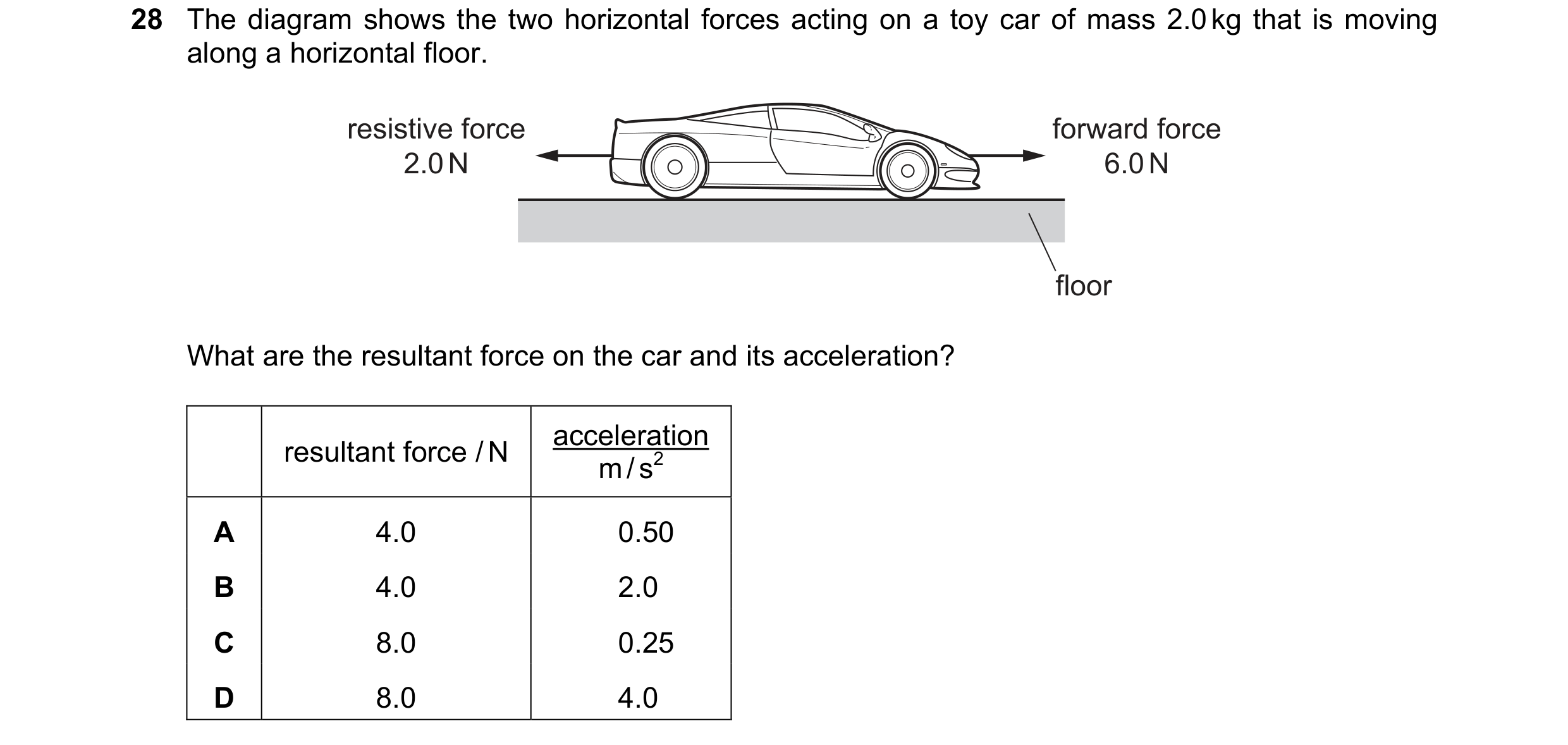
28 The diagram shows the two horizontal forces acting on a toy car of mass 2.0 kg that is moving along a horizontal floor. resistive force forward force 2.0 N 6.0 N floor What are the resultant force on the car and its acceleration? acceleration resultant force / N m / s2 A 4.0 0.50 B 4.0 2.0 C 8.0 0.25 D 8.0 4.0
1 marks
Answer: B
This question in 0654/21 Oct/Nov 2019
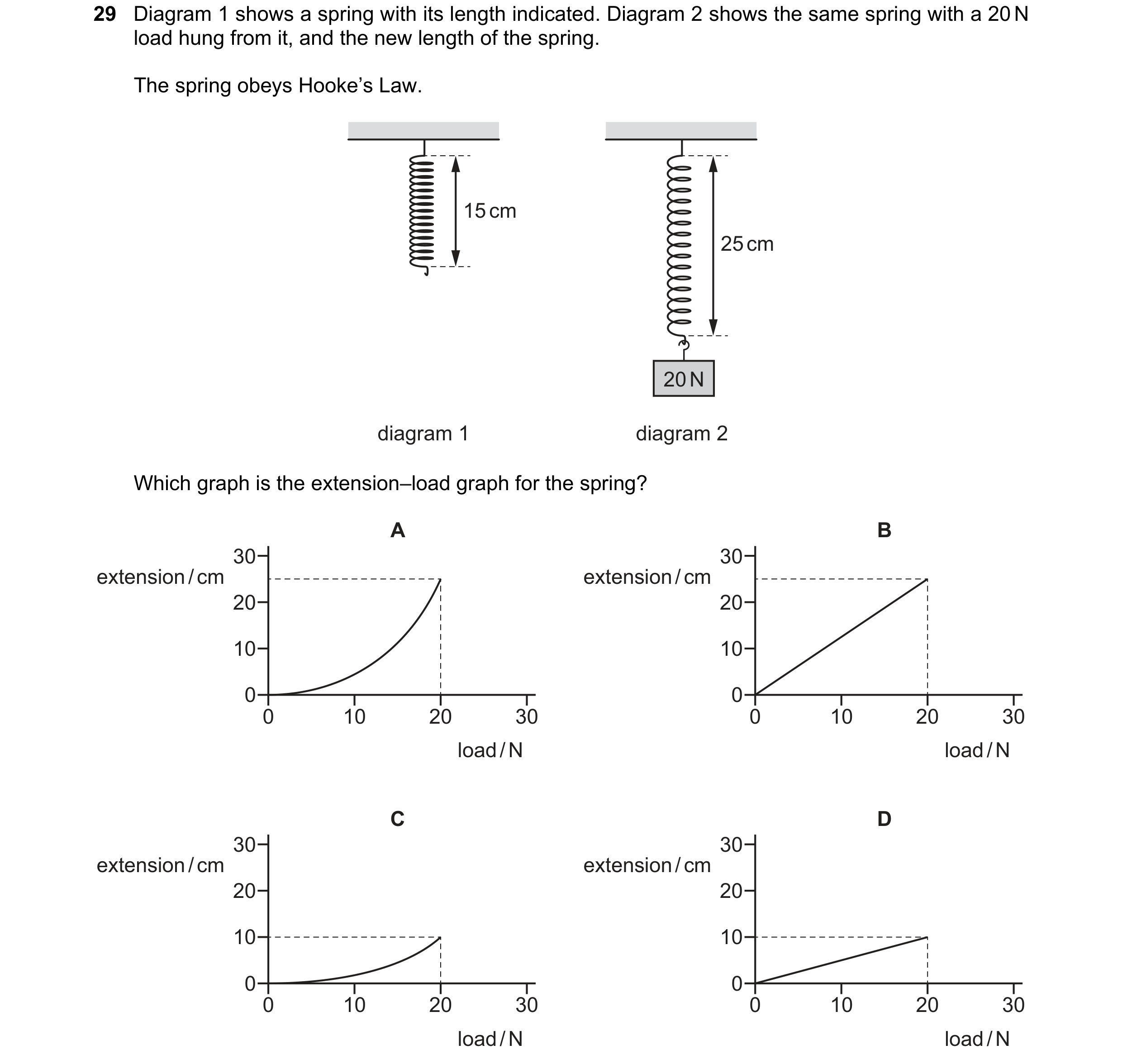
Q11 · A spring with its length indicated 0654/21 Oct/Nov 2019
29 Diagram 1 shows a spring with its length indicated. Diagram 2 shows the same spring with a 20 N load hung from it, and the new length of the spring. The spring obeys Hooke’s Law. 15 cm 25 cm 20 N diagram 1 diagram 2 Which graph is the extension-load graph for the spring? A B 30 30 extension / cm extension / cm 20 20 10 10 0 0 0 10 20 30 0 10 20 30 load / N load / N C D 30 30 extension / cm extension / cm 20 20 10 10 0 0 0 10 20 30 0 10 20 30 load / N load / N
1 marks
Answer: D
This question in 0654/21 Oct/Nov 2019
Q12 · What cannot be changed by a force acting on a body? 0654/22 Oct/Nov 2019
28 What cannot be changed by a force acting on a body? A the mass of the body B the motion of the body C the shape of the body D the size of the body
1 marks
Answer: A
This question in 0654/22 Oct/Nov 2019
Q13 · A spring with its length indicated 0654/22 Oct/Nov 2019
29 Diagram 1 shows a spring with its length indicated. Diagram 2 shows the same spring with a 20 N load hung from it, and the new length of the spring. The spring obeys Hooke’s Law. 15 cm 25 cm 20 N diagram 1 diagram 2 Which graph is the extension-load graph for the spring? A B 30 30 extension / cm extension / cm 20 20 10 10 0 0 0 10 20 30 0 10 20 30 load / N load / N C D 30 30 extension / cm extension / cm 20 20 10 10 0 0 0 10 20 30 0 10 20 30 load / N load / N
1 marks
Answer: D
This question in 0654/22 Oct/Nov 2019
Q14 · There is no resultant force acting on a body 0654/23 Oct/Nov 2019
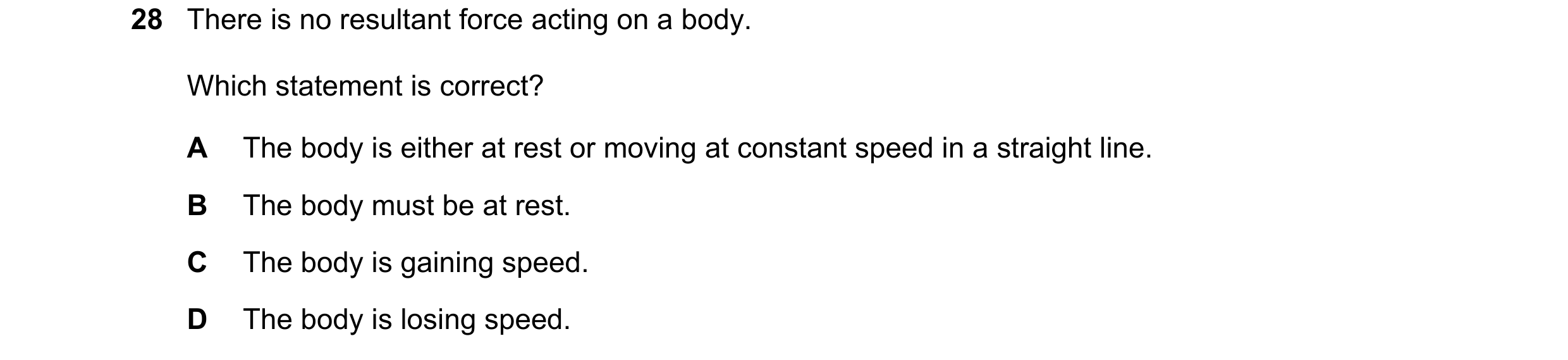
28 There is no resultant force acting on a body. Which statement is correct? A The body is either at rest or moving at constant speed in a straight line. B The body must be at rest. C The body is gaining speed. D The body is losing speed.
1 marks
Answer: A
This question in 0654/23 Oct/Nov 2019
Q15 · A spring with its length indicated 0654/23 Oct/Nov 2019
29 Diagram 1 shows a spring with its length indicated. Diagram 2 shows the same spring with a 20 N load hung from it, and the new length of the spring. The spring obeys Hooke’s Law. 15 cm 25 cm 20 N diagram 1 diagram 2 Which graph is the extension-load graph for the spring? A B 30 30 extension / cm extension / cm 20 20 10 10 0 0 0 10 20 30 0 10 20 30 load / N load / N C D 30 30 extension / cm extension / cm 20 20 10 10 0 0 0 10 20 30 0 10 20 30 load / N load / N
1 marks
Answer: D
This question in 0654/23 Oct/Nov 2019
Q16 · The diagram shows the extension–load graph for a spring 0654/21 Oct/Nov 2020
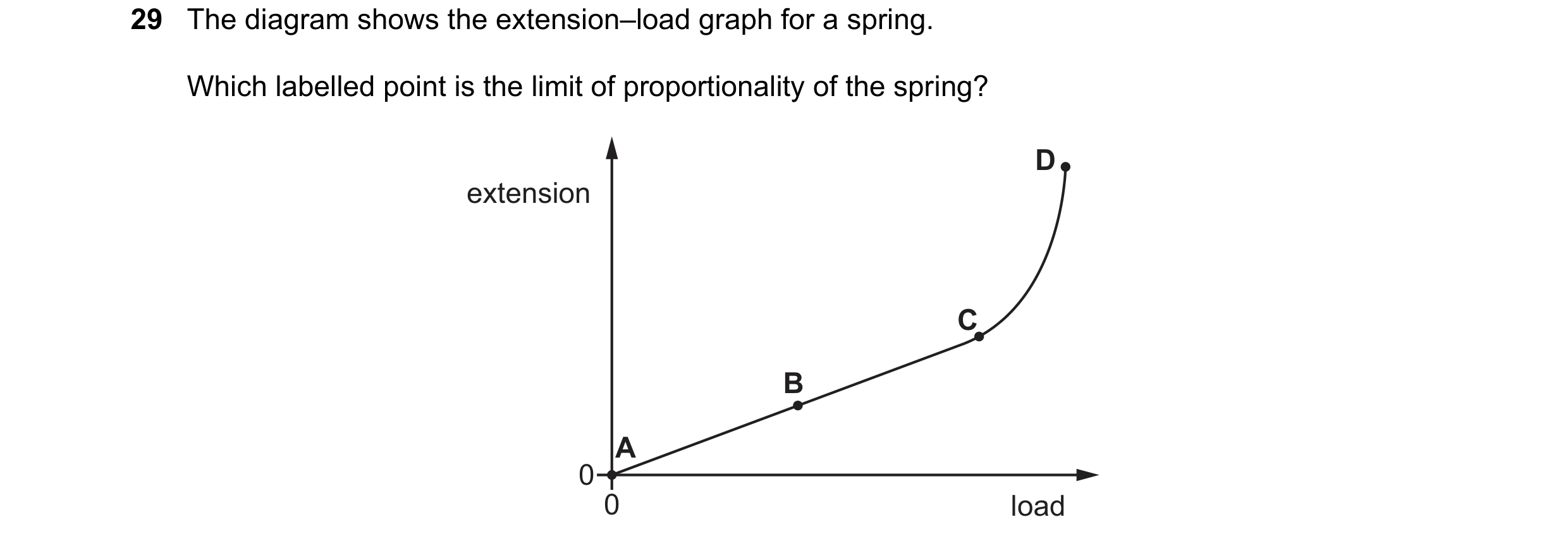
29 The diagram shows the extension–load graph for a spring. Which labelled point is the limit of proportionality of the spring? D extension C B A 0 0 load
1 marks
Answer: C
This question in 0654/21 Oct/Nov 2020
Q17 · The diagrams show uniform metre rules each pivoted at the 50 cm mark 0654/21 Oct/Nov 2020
30 The diagrams show uniform metre rules each pivoted at the 50 cm mark. Different weights are placed on the rules at different distances from the 0 cm end as shown. Which rule rotates in a clockwise direction? A B 0 20 50 60 100 cm 0 10 50 75 100 cm 4.0 N 12 N 3.0 N 5.0 N C D 0 10 50 65 100 cm 0 25 50 90 100 cm 6.0 N 8.0 N 8.0 N 4.0 N
1 marks
Answer: B
This question in 0654/21 Oct/Nov 2020
Q18 · The diagrams show four uniform beams, each supported by a pivot at its centre 0654/23 Oct/Nov 2020
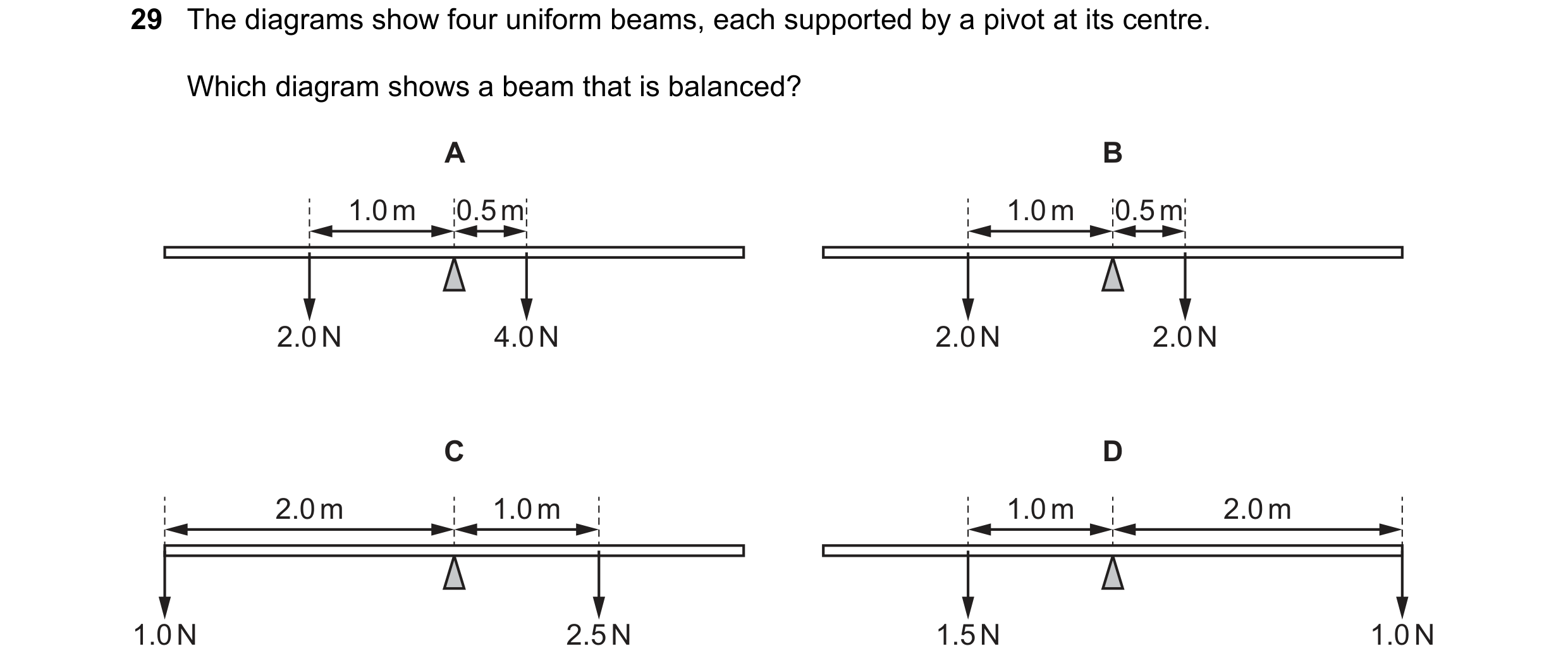
29 The diagrams show four uniform beams, each supported by a pivot at its centre. Which diagram shows a beam that is balanced? A B 1.0 m 0.5 m 1.0 m 0.5 m 2.0 N 4.0 N 2.0 N 2.0 N C D 2.0 m 1.0 m 1.0 m 2.0 m 1.0 N 2.5 N 1.5 N 1.0 N
1 marks
Answer: A
This question in 0654/23 Oct/Nov 2020
Q19 · A scientist uses a lever to lift a heavy load 0654/22 Feb/March 2021
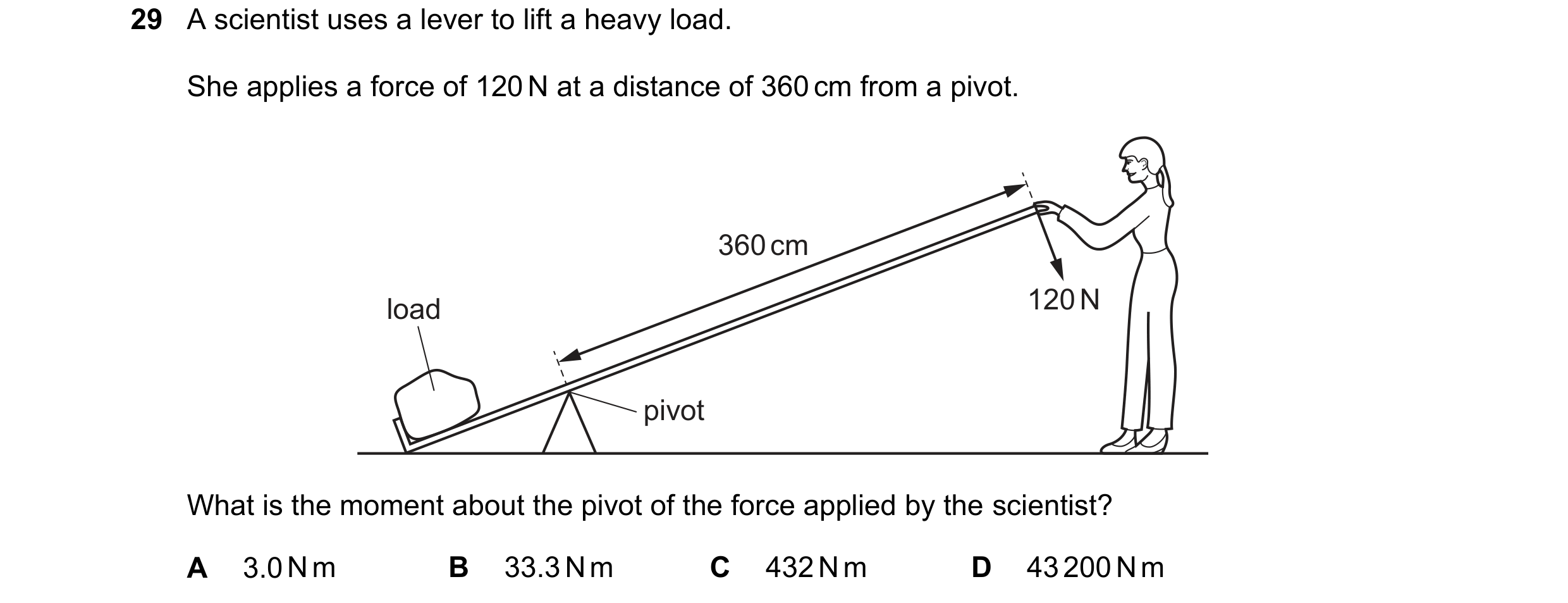
29 A scientist uses a lever to lift a heavy load. She applies a force of 120 N at a distance of 360 cm from a pivot. 360 cm load 120 N pivot What is the moment about the pivot of the force applied by the scientist? A 3.0 N m B 33.3 N m C 432 N m D 43 200 N m
1 marks
Answer: C
This question in 0654/22 Feb/March 2021
Q20 · Which two quantities can be used to calculate the acceleration of a rocket? 0654/21 May/June 2021
29 Which two quantities can be used to calculate the acceleration of a rocket? A the mass of the rocket and its speed B the mass of the rocket and its weight C the resultant force on the rocket and its mass D the resultant force on the rocket and its speed
1 marks
Answer: C
This question in 0654/21 May/June 2021
Q21 · Which statement applies to a system in equilibrium? 0654/21 May/June 2021
30 Which statement applies to a system in equilibrium? A There is a resultant force and there is a resultant turning effect on the system. B There is a resultant force but there is no resultant turning effect on the system. C There is no resultant force but there is a resultant turning effect on the system. D There is no resultant force and there is no resultant turning effect on the system.
1 marks
Answer: D
This question in 0654/21 May/June 2021
Q22 · Three objects X, Y and Z are at rest on a table 0654/22 May/June 2021
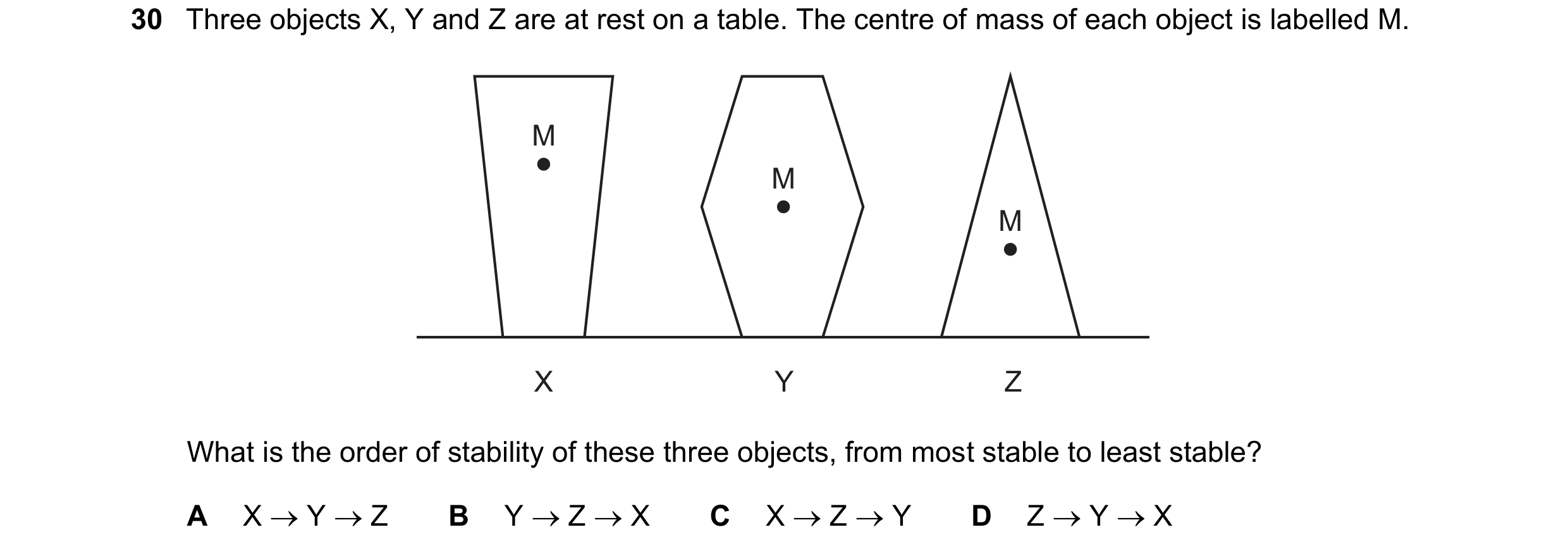
30 Three objects X, Y and Z are at rest on a table. The centre of mass of each object is labelled M. M M M X Y Z What is the order of stability of these three objects, from most stable to least stable? A X Y Z B Y Z X C X Z Y D Z Y X
1 marks
Answer: D
This question in 0654/22 May/June 2021
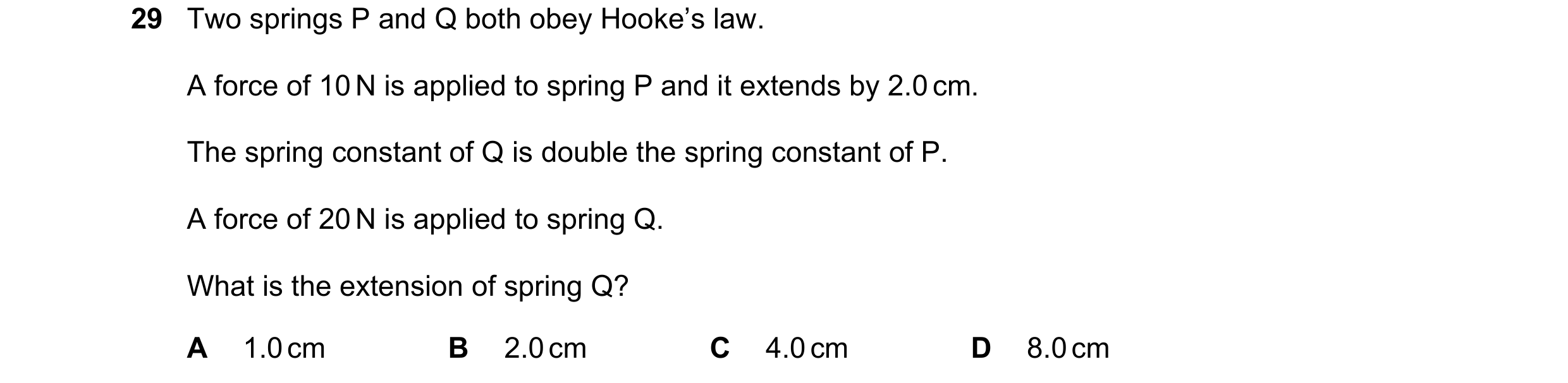
Q23 · Two springs P and Q both obey Hooke’s law 0654/23 May/June 2021
29 Two springs P and Q both obey Hooke’s law. A force of 10 N is applied to spring P and it extends by 2.0 cm. The spring constant of Q is double the spring constant of P. A force of 20 N is applied to spring Q. What is the extension of spring Q? A 1.0 cm B 2.0 cm C 4.0 cm D 8.0 cm
1 marks
Answer: B
This question in 0654/23 May/June 2021
Q24 · A student is investigating the extension of a spring 0654/21 Oct/Nov 2021
28 A student is investigating the extension of a spring. The diagrams show the spring before and after a 0.20 N load is added. cm cm 1 1 2 2 3 3 4 4 0.20 N load 5 5 6 6 What is the spring constant of the spring? A 0.070 N / cm B 0.16 N / cm C 0.25 N / cm D 4.0 N / cm
1 marks
Answer: C
This question in 0654/21 Oct/Nov 2021
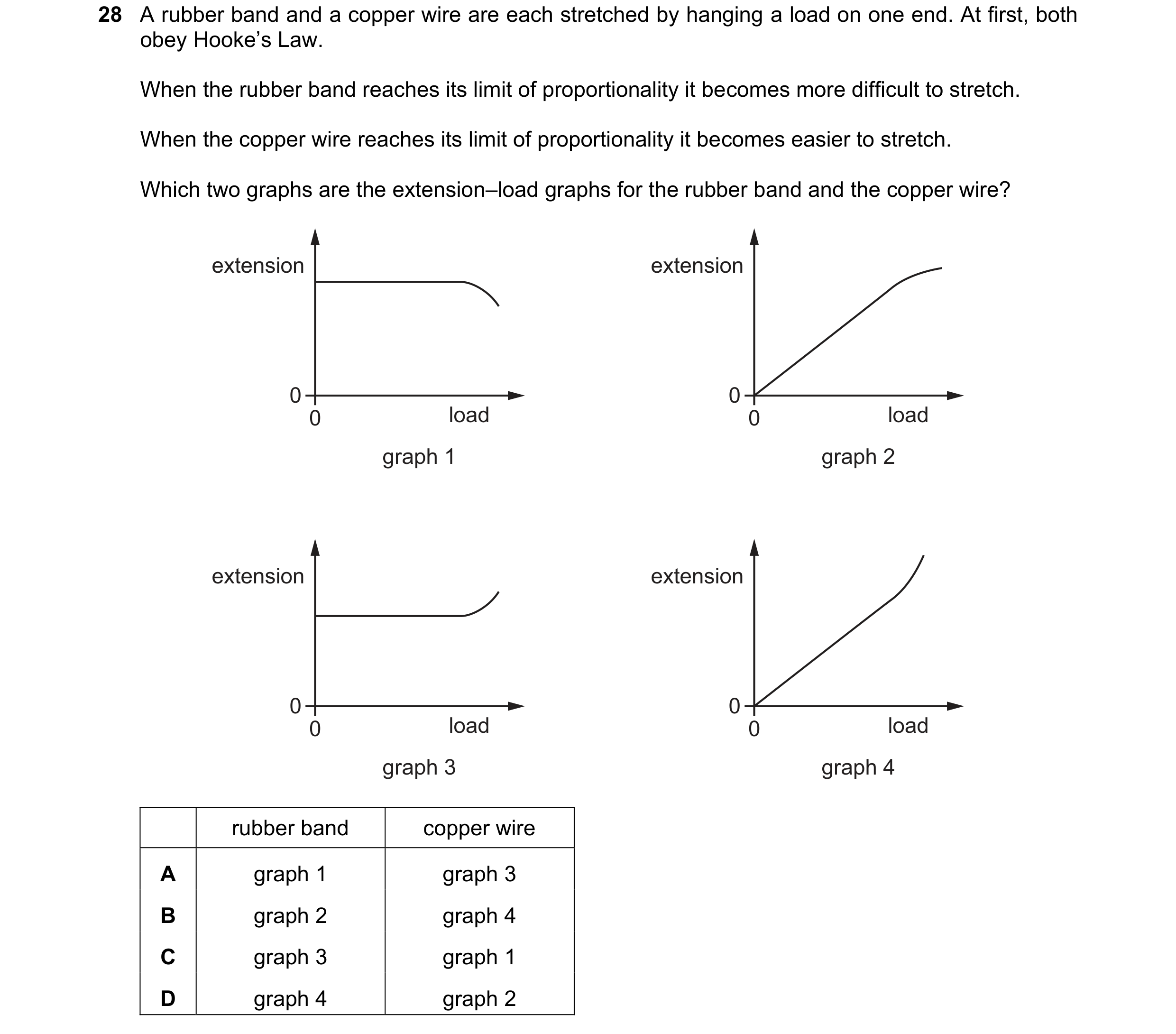
Q25 · A rubber band and a copper wire are each stretched by hanging a load on one end 0654/22 Oct/Nov 2021
28 A rubber band and a copper wire are each stretched by hanging a load on one end. At first, both obey Hooke’s Law. When the rubber band reaches its limit of proportionality it becomes more difficult to stretch. When the copper wire reaches its limit of proportionality it becomes easier to stretch. Which two graphs are the extension–load graphs for the rubber band and the copper wire? extension extension 0 0 0 load 0 load graph 1 graph 2 extension extension 0 0 0 load 0 load graph 3 graph 4 rubber band copper wire A graph 1 graph 3 B graph 2 graph 4 C graph 3 graph 1 D graph 4 graph 2
1 marks
Answer: B
This question in 0654/22 Oct/Nov 2021
Q26 · What is meant by the moment of a force? 0654/22 Oct/Nov 2021
29 What is meant by the moment of a force? A the speed of an object moved by a force B the time taken for a force to move an object C the turning effect of a force D the work done by a force
1 marks
Answer: C
This question in 0654/22 Oct/Nov 2021
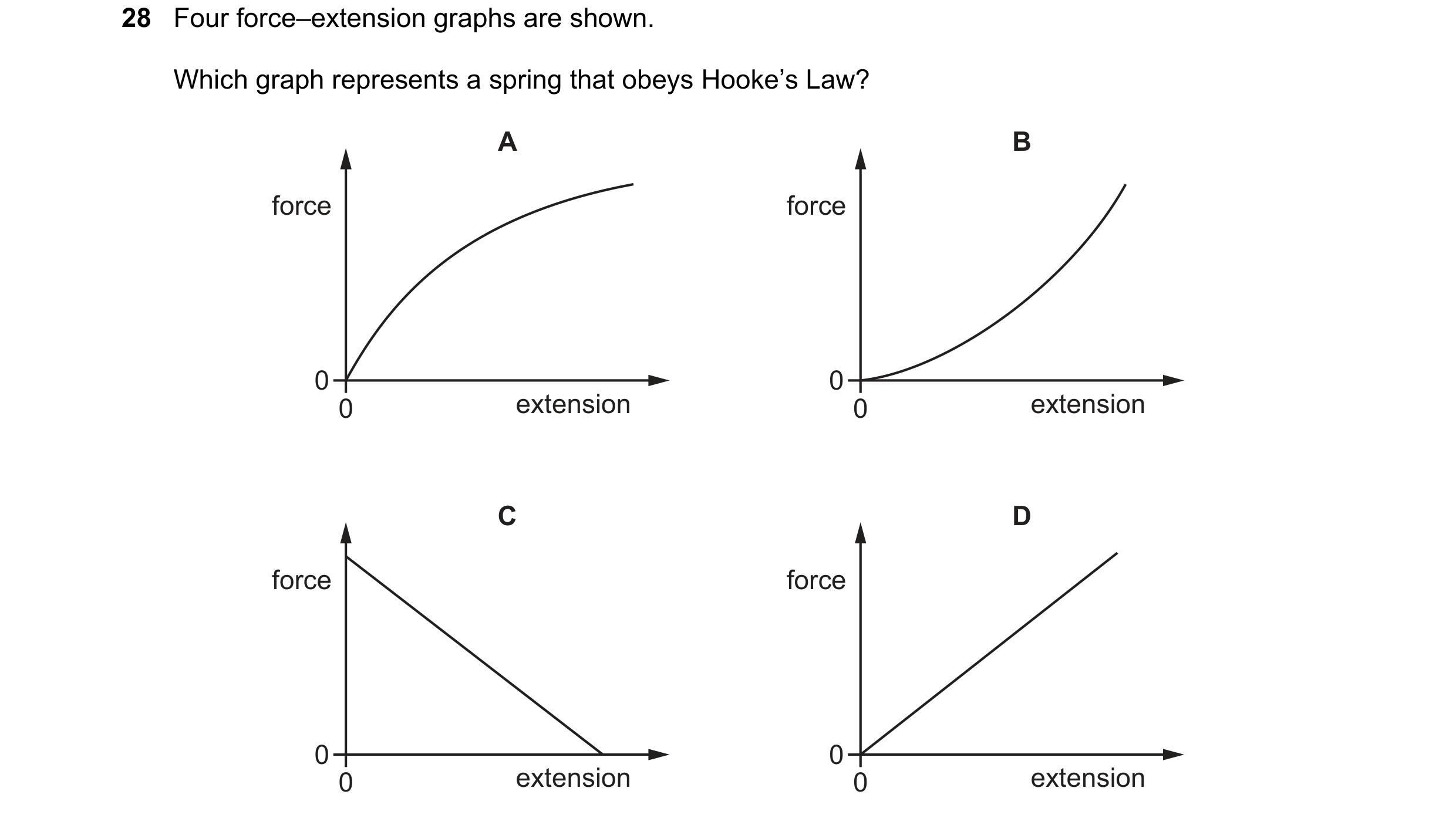
Q27 · Four force–extension graphs are shown 0654/23 Oct/Nov 2021
28 Four force–extension graphs are shown. Which graph represents a spring that obeys Hooke’s Law? A B force force 0 0 0 extension 0 extension C D force force 0 0 0 extension 0 extension
1 marks
Answer: D
This question in 0654/23 Oct/Nov 2021
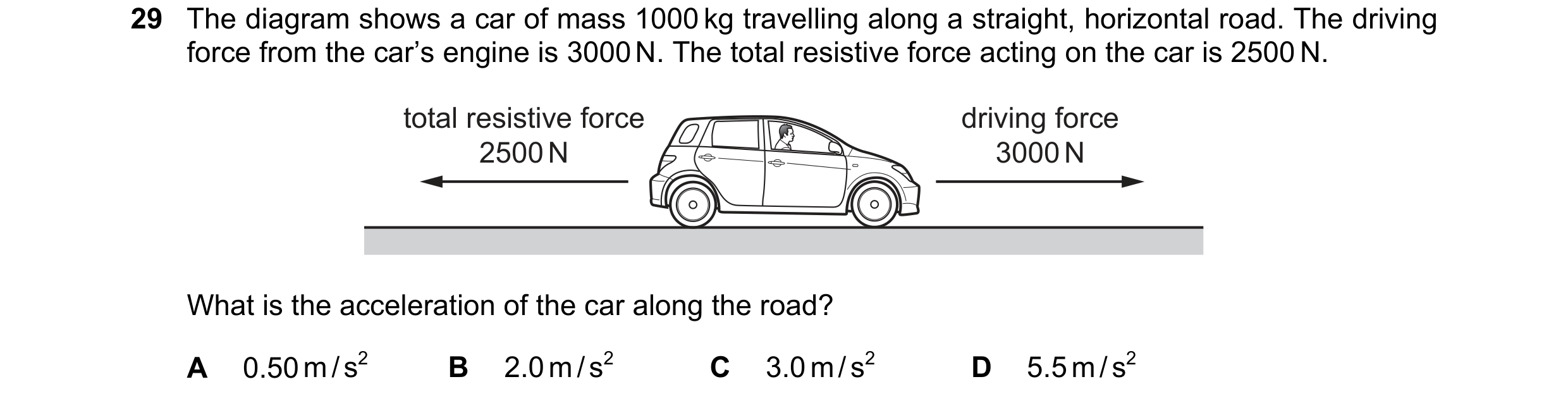
Q28 · The diagram shows a car of mass 1000 kg travelling along a straight, horizontal road 0654/21 May/June 2022
29 The diagram shows a car of mass 1000 kg travelling along a straight, horizontal road. The driving force from the car’s engine is 3000 N. The total resistive force acting on the car is 2500 N. total resistive force driving force 2500 N 3000 N What is the acceleration of the car along the road? A 0.50 m / s2 B 2.0 m / s2 C 3.0 m / s2 D 5.5 m / s2
1 marks
Answer: A
This question in 0654/21 May/June 2022
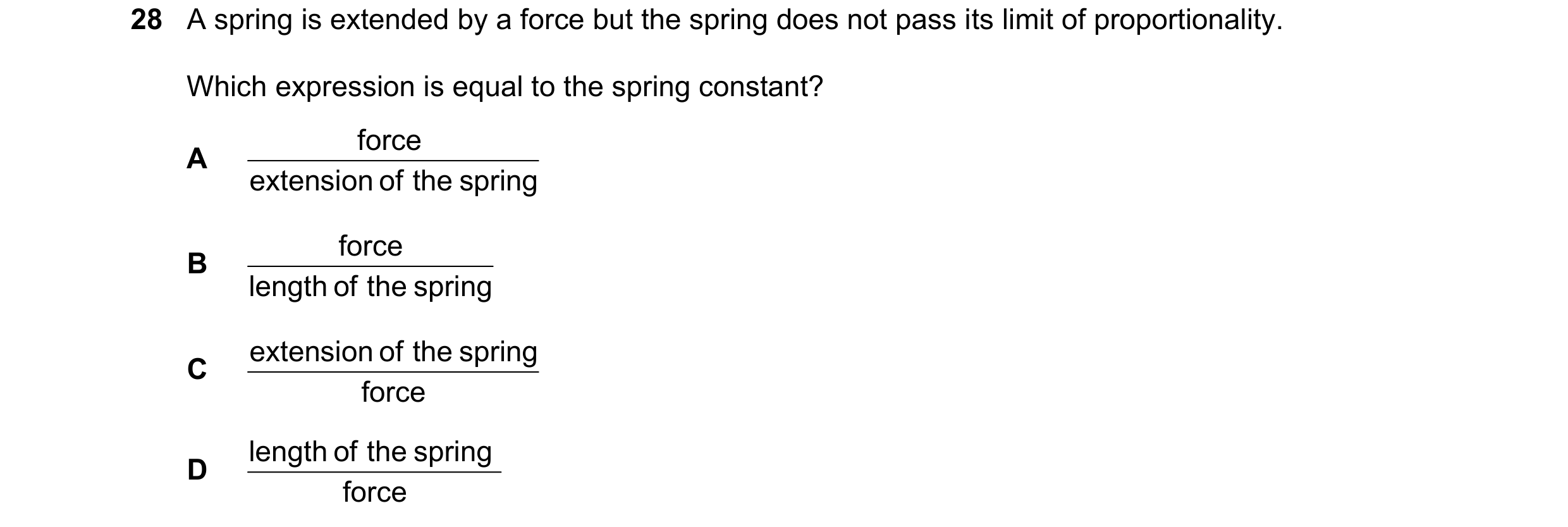
Q29 · A spring is extended by a force but the spring does not pass its limit of proportionality 0654/22 May/June 2022
28 A spring is extended by a force but the spring does not pass its limit of proportionality. Which expression is equal to the spring constant? force A extension of the spring force B length of the spring extension of the spring C force length of the spring D force
1 marks
Answer: A
This question in 0654/22 May/June 2022
Q30 · A parachutist falls vertically at constant speed 0654/23 May/June 2022
29 A parachutist falls vertically at constant speed. Which statement about the resultant force on the parachutist is correct? A The resultant force on the parachutist acts vertically downwards. B The resultant force on the parachutist acts vertically upwards. C The resultant force on the parachutist is equal to his weight. D The resultant force on the parachutist is equal to zero.
1 marks
Answer: D
This question in 0654/23 May/June 2022
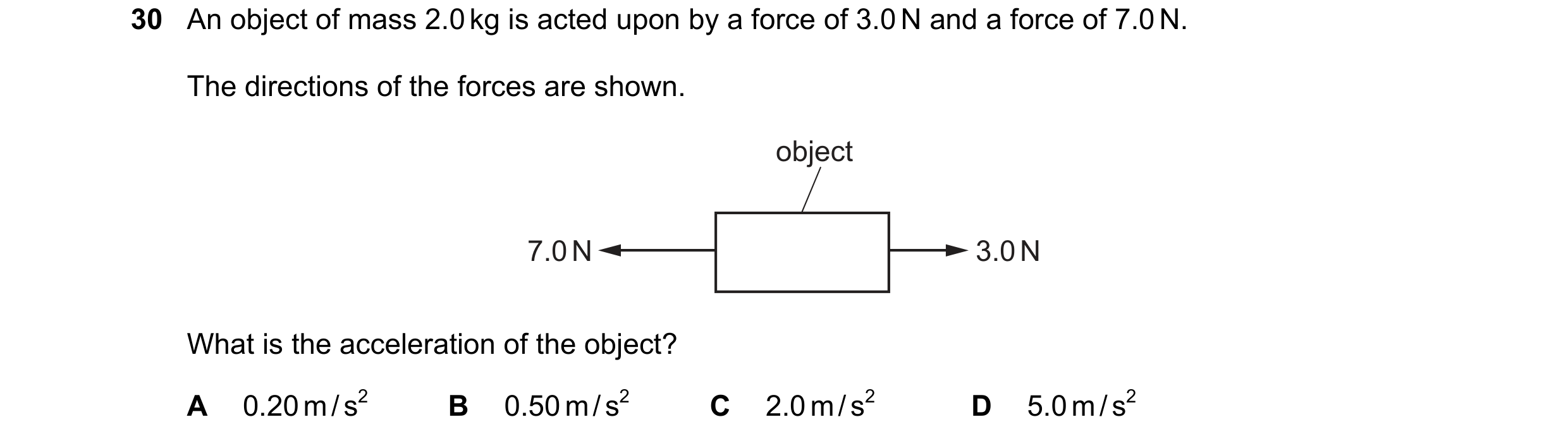
Q31 · An object of mass 2.0 kg is acted upon by a force of 3.0 N and a force of 7.0 N 0654/21 Oct/Nov 2022
30 An object of mass 2.0 kg is acted upon by a force of 3.0 N and a force of 7.0 N. The directions of the forces are shown. object 7.0 N 3.0 N What is the acceleration of the object? A 0.20 m / s2 B 0.50 m / s2 C 2.0 m / s2 D 5.0 m / s2
1 marks
Answer: C
This question in 0654/21 Oct/Nov 2022
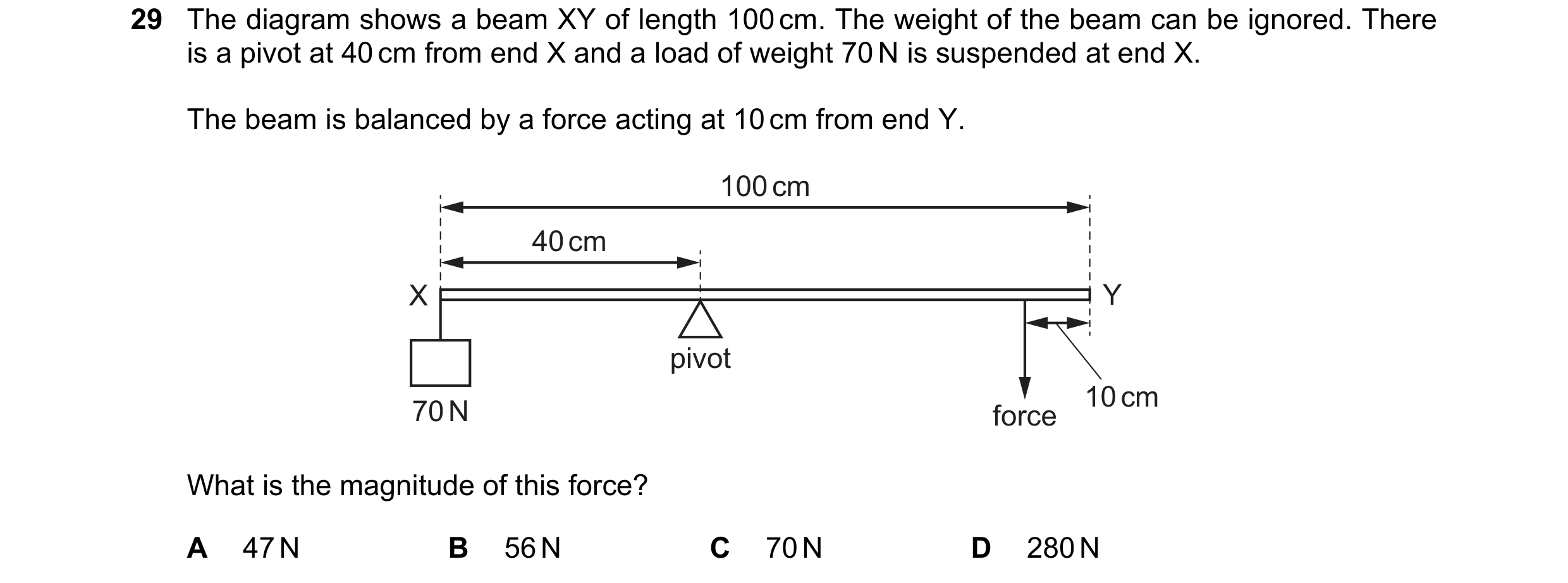
Q32 · The diagram shows a beam XY of length 100 cm 0654/22 Oct/Nov 2022
29 The diagram shows a beam XY of length 100 cm. The weight of the beam can be ignored. There is a pivot at 40 cm from end X and a load of weight 70 N is suspended at end X. The beam is balanced by a force acting at 10 cm from end Y. 100 cm 40 cm X Y pivot 10 cm 70 N force What is the magnitude of this force? A 47 N B 56 N C 70 N D 280 N
1 marks
Answer: B
This question in 0654/22 Oct/Nov 2022
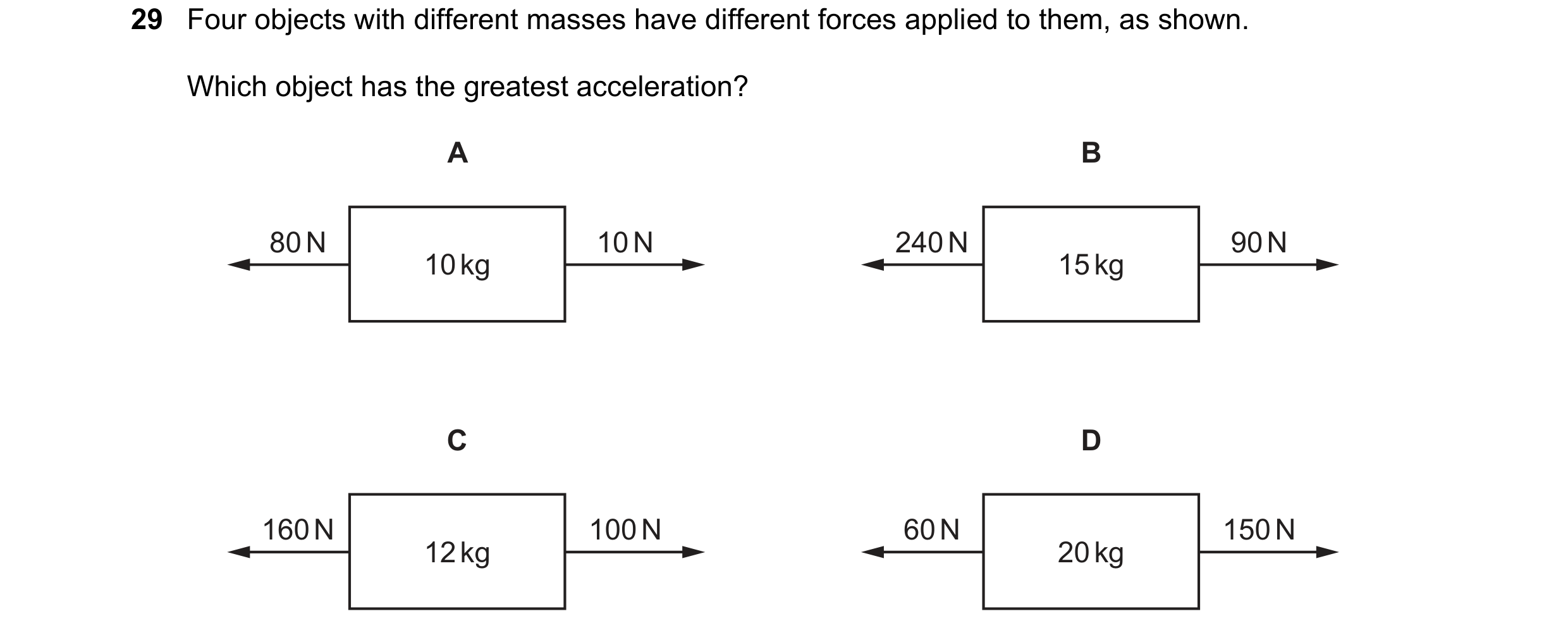
Q33 · Four objects with different masses have different forces applied to them, as shown 0654/22 Feb/March 2023
29 Four objects with different masses have different forces applied to them, as shown. Which object has the greatest acceleration? A B 80 N 10 N 240 N 90 N 10 kg 15 kg C D 160 N 100 N 60 N 150 N 12 kg 20 kg
1 marks
Answer: B
This question in 0654/22 Feb/March 2023
Q34 · The diagram shows a triangular sheet of metal with sides of length 50 cm, 40 cm and 30 cm 0654/21 May/June 2023
29 The diagram shows a triangular sheet of metal with sides of length 50 cm, 40 cm and 30 cm. The sheet is free to move about a pivot at the top corner, as shown. pivot 50 cm 40 cm 5.0 N 30 cm A cord is attached to the bottom left corner of the sheet and pulled with a horizontal force of 5.0 N to the left. What is the moment of the 5.0 N force about the pivot? A 150 N cm B 200 N cm C 250 N cm D 600 N cm
1 marks
Answer: B
This question in 0654/21 May/June 2023
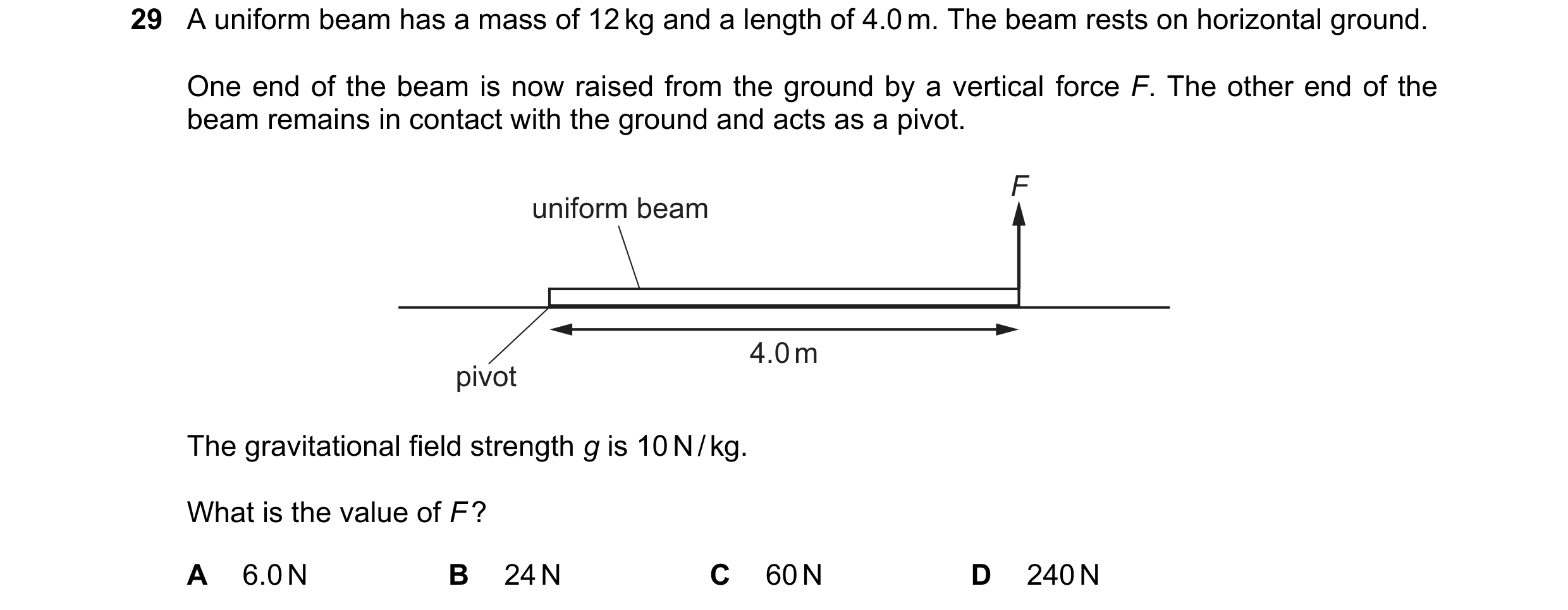
Q35 · A uniform beam has a mass of 12 kg and a length of 4.0 m 0654/22 May/June 2023
29 A uniform beam has a mass of 12 kg and a length of 4.0 m. The beam rests on horizontal ground. One end of the beam is now raised from the ground by a vertical force F. The other end of the beam remains in contact with the ground and acts as a pivot. F uniform beam 4.0 m pivot The gravitational field strength g is 10 N / kg. What is the value of F ? A 6.0 N B 24 N C 60 N D 240 N
1 marks
Answer: C
This question in 0654/22 May/June 2023
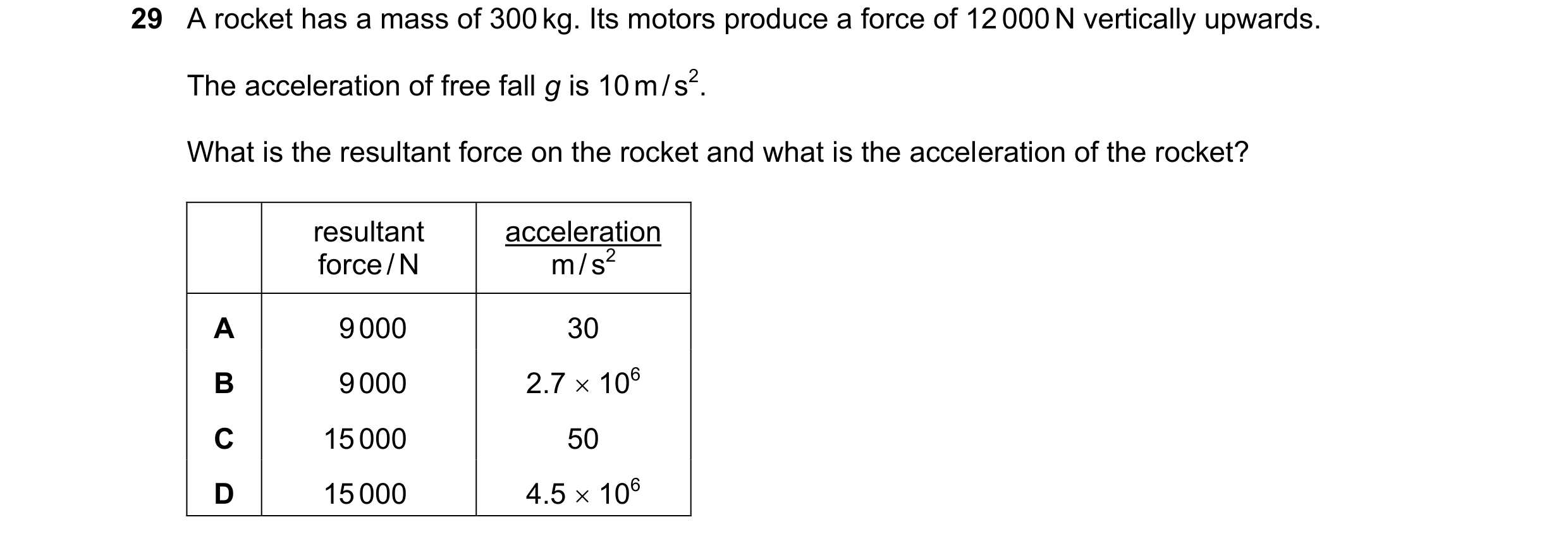
Q36 · A rocket has a mass of 300 kg 0654/21 Oct/Nov 2023
29 A rocket has a mass of 300 kg. Its motors produce a force of 12 000 N vertically upwards. The acceleration of free fall g is 10 m / s2. What is the resultant force on the rocket and what is the acceleration of the rocket? resultant acceleration force / N m / s2 A 9 000 30 B 9 000 2.7 106 C 15 000 50 D 15 000 4.5 106
1 marks
Answer: A
This question in 0654/21 Oct/Nov 2023
Q37 · A uniform metre rule rests on a pivot at the 50 cm mark 0654/21 Oct/Nov 2023
30 A uniform metre rule rests on a pivot at the 50 cm mark. A load L is placed at the 30 cm mark and a load of 6.0 N is placed at the 80 cm mark. The arrangement is balanced. 0 cm 30 cm 50 cm 80 cm 100 cm pivot L 6.0 N What is the weight of load L? A 6.0 N B 9.0 N C 16 N D 24 N
1 marks
Answer: B
This question in 0654/21 Oct/Nov 2023
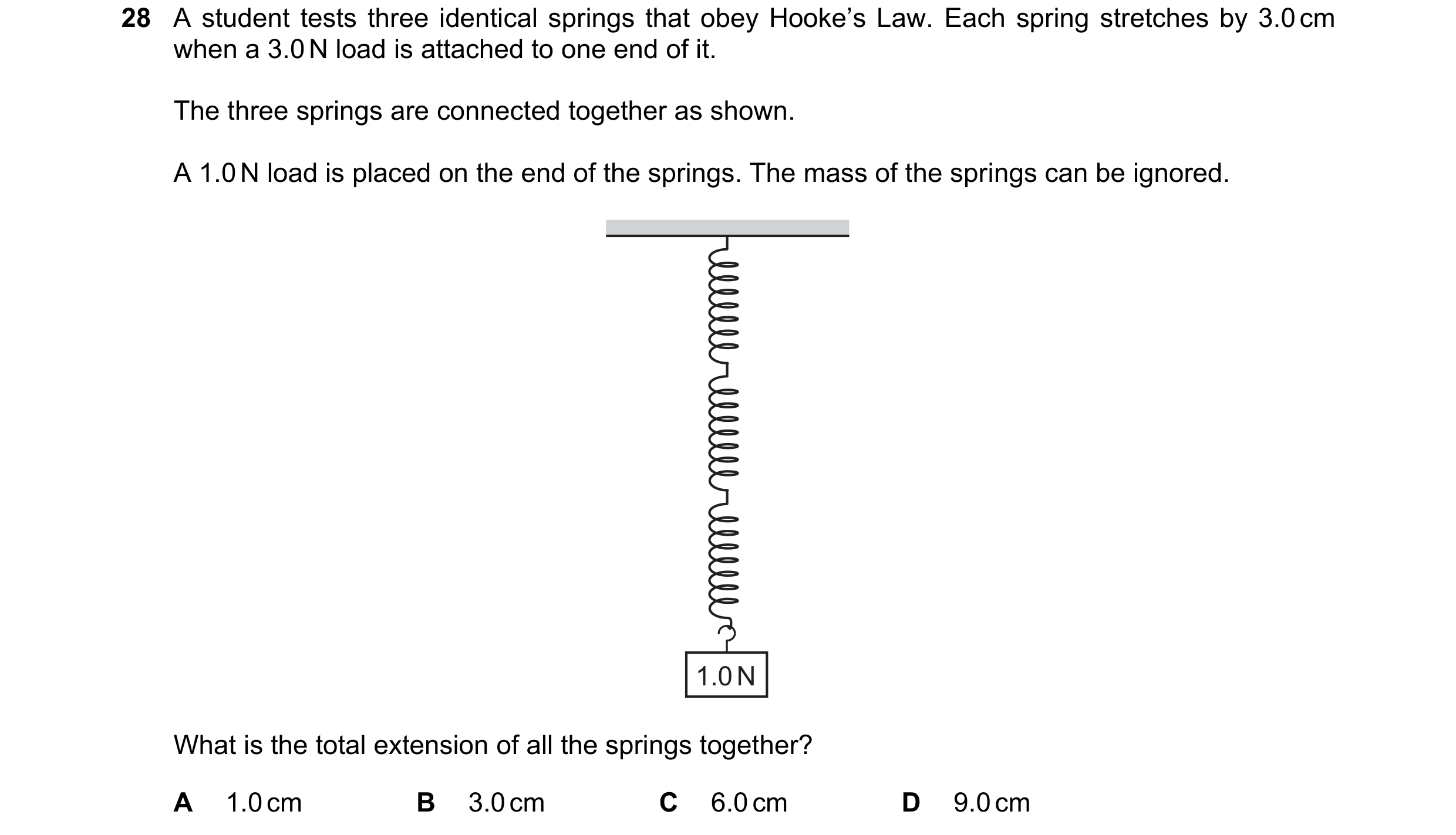
Q38 · A student tests three identical springs that obey Hooke’s Law 0654/22 Oct/Nov 2023
28 A student tests three identical springs that obey Hooke’s Law. Each spring stretches by 3.0 cm when a 3.0 N load is attached to one end of it. The three springs are connected together as shown. A 1.0 N load is placed on the end of the springs. The mass of the springs can be ignored. 1.0 N What is the total extension of all the springs together? A 1.0 cm B 3.0 cm C 6.0 cm D 9.0 cm
1 marks
Answer: B
This question in 0654/22 Oct/Nov 2023
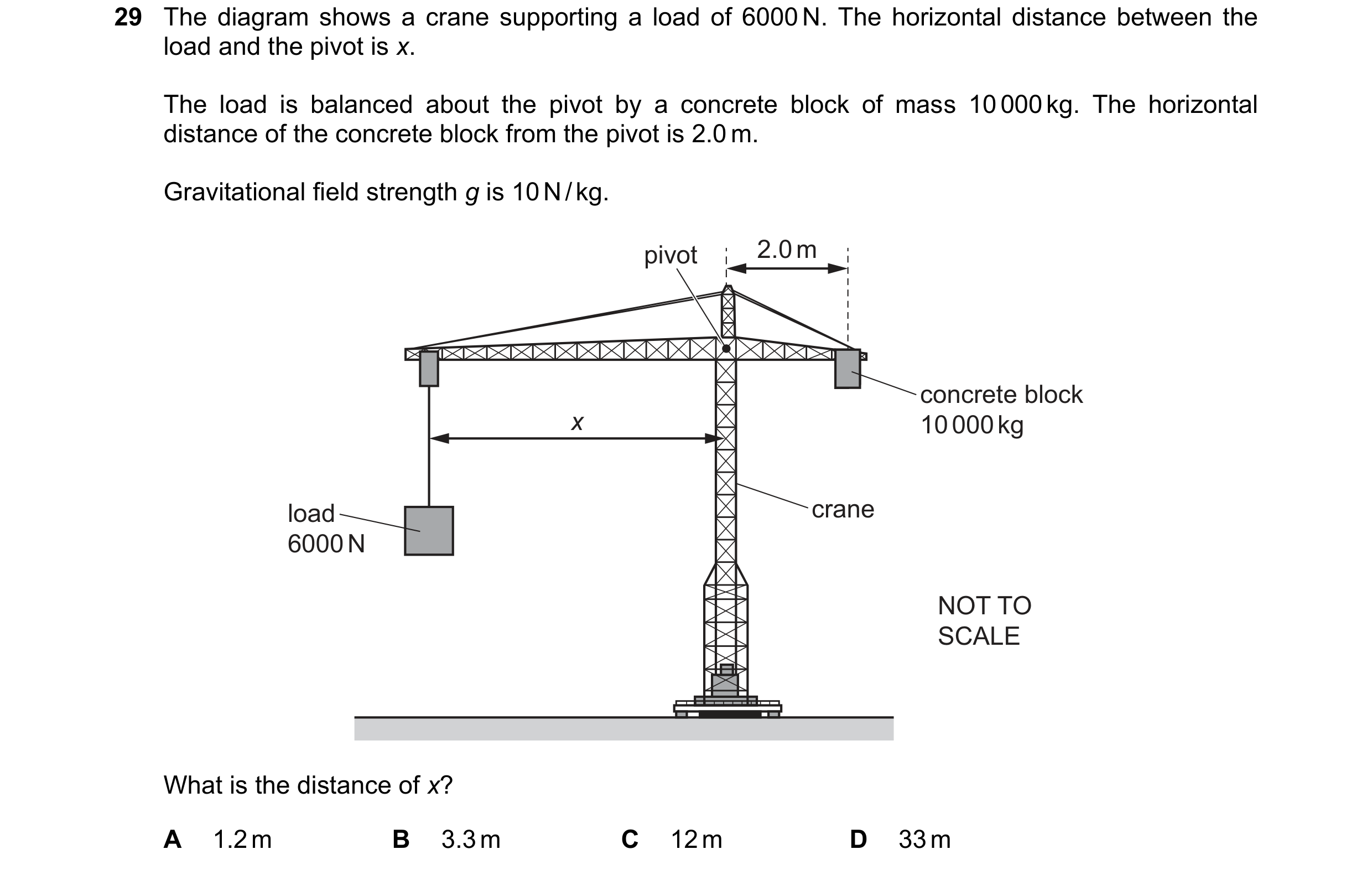
Q39 · The diagram shows a crane supporting a load of 6000 N 0654/22 Oct/Nov 2023
29 The diagram shows a crane supporting a load of 6000 N. The horizontal distance between the load and the pivot is x. The load is balanced about the pivot by a concrete block of mass 10 000 kg. The horizontal distance of the concrete block from the pivot is 2.0 m. Gravitational field strength g is 10 N / kg. pivot 2.0 m concrete block x 10 000 kg load crane 6000 N NOT TO SCALE What is the distance of x? A 1.2 m B 3.3 m C 12 m D 33 m
1 marks
Answer: D
This question in 0654/22 Oct/Nov 2023
Q40 · A spring with its length indicated 0654/23 Oct/Nov 2023
29 Diagram 1 shows a spring with its length indicated. Diagram 2 shows the same spring with a 20 N load hung from it, and the new length of the spring. The spring obeys Hooke’s Law. 15 cm 25 cm 20 N diagram 1 diagram 2 Which graph is the extension–load graph for the spring? A B 30 30 extension / cm extension / cm 20 20 10 10 0 0 0 10 20 30 0 10 20 30 load / N load / N C D 30 30 extension / cm extension / cm 20 20 10 10 0 0 0 10 20 30 0 10 20 30 load / N load / N
1 marks
Answer: D
This question in 0654/23 Oct/Nov 2023
Q41 · X and Y are two springs 0654/22 Feb/March 2024
28 X and Y are two springs. The graph shows how the lengths of X and Y vary with the loads suspended from them. X Y length 0 0 load Which statement about X and Y is correct? A Neither spring obeys Hooke’s law for any value of load. B The unstretched lengths of X and Y are different. C The spring constant of X is greater than the spring constant of Y. D Y needs a greater load than X to reach its limit of proportionality.
1 marks
Answer: D
This question in 0654/22 Feb/March 2024
Q42 · Which statement describes a system that is in equilibrium? 0654/21 May/June 2024
28 Which statement describes a system that is in equilibrium? A There is a resultant force and there is a resultant turning effect on the system. B There is a resultant force but there is no resultant turning effect on the system. C There is no resultant force but there is a resultant turning effect on the system. D There is no resultant force and there is no resultant turning effect on the system.
1 marks
Answer: D
This question in 0654/21 May/June 2024
Q43 · What is meant by the moment of a force? 0654/22 May/June 2024
29 What is meant by the moment of a force? A the speed of an object moved by a force B the time taken for a force to move an object C the turning effect of a force D the work done by a force
1 marks
Answer: C
This question in 0654/22 May/June 2024
Q44 · The diagram shows a spring without a load and then with a load of mass 500 g suspended… 0654/23 May/June 2024
29 The diagram shows a spring without a load and then with a load of mass 500 g suspended from the same spring. The spring obeys Hooke’s law. load The length of the unloaded spring is 30 cm. When the 500 g load is suspended from the spring, the spring extends to a new length of 35 cm. The gravitational field strength g is 10 N / kg. Which calculation gives the spring constant of the spring? 0.5 10 A N / cm 35 – 30 0.5 B N / cm 10 (35 – 30) 10 (35 – 30) C N / cm 0.5 D 0.5 10 (35 – 30) N / cm
1 marks
Answer: A
This question in 0654/23 May/June 2024
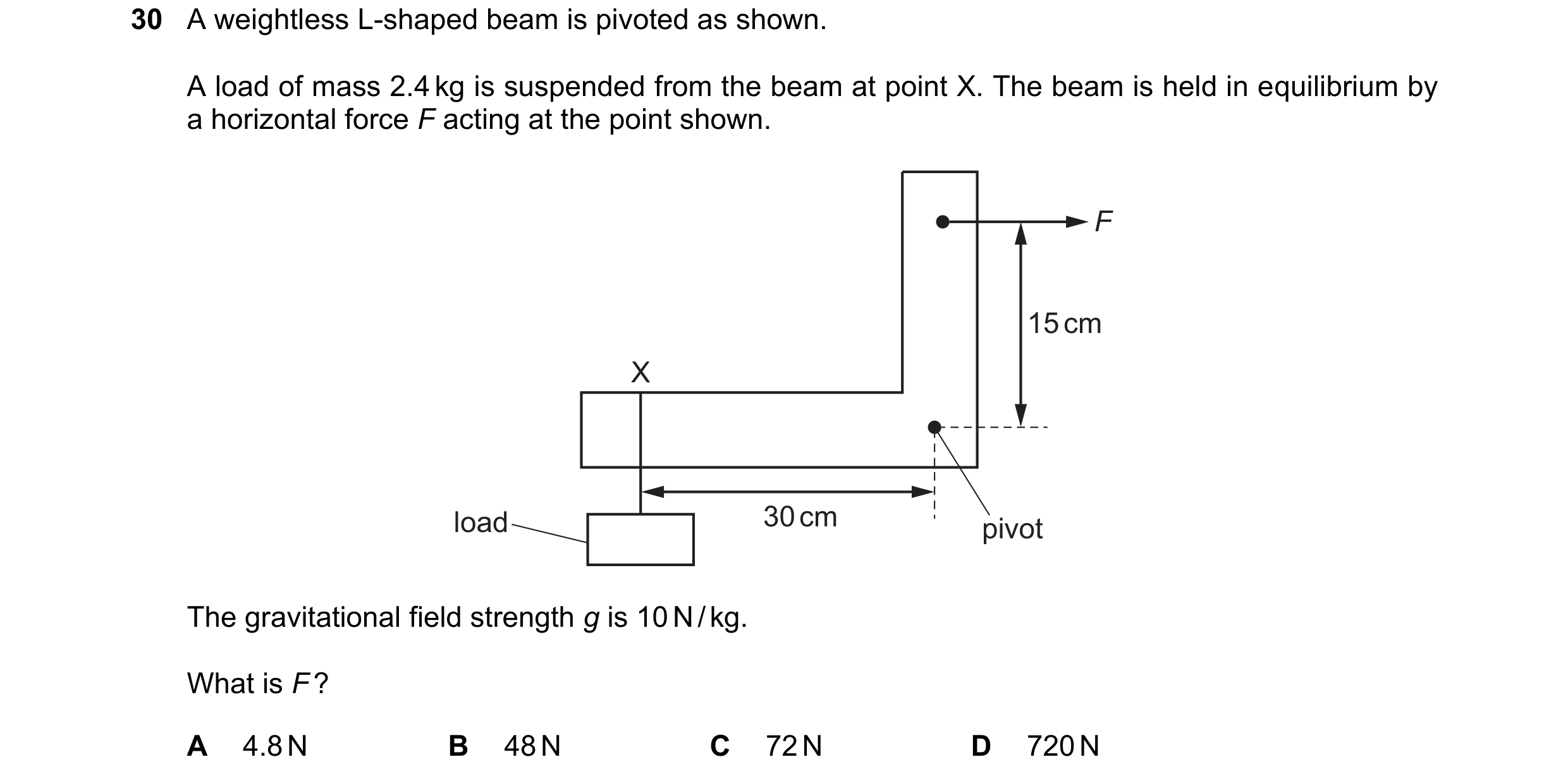
Q45 · A weightless L-shaped beam is pivoted as shown 0654/23 May/June 2024
30 A weightless L-shaped beam is pivoted as shown. A load of mass 2.4 kg is suspended from the beam at point X. The beam is held in equilibrium by a horizontal force F acting at the point shown. F 15 cm X load 30 cm pivot The gravitational field strength g is 10 N / kg. What is F ? A 4.8 N B 48 N C 72 N D 720 N
1 marks
Answer: B
This question in 0654/23 May/June 2024
Q46 · The length of a spring changes when a force is applied to stretch the spring 0654/21 Oct/Nov 2024
29 The length of a spring changes when a force is applied to stretch the spring. The table shows how the length of the spring depends on the force. force / N 0 1.0 2.0 3.0 4.0 5.0 length of spring / cm 22 25 28 31 35 45 What is the length of the spring when the limit of proportionality is reached? A exactly 22 cm B between 31 cm and 35 cm C exactly 35 cm D between 35 cm and 45 cm
1 marks
Answer: B
This question in 0654/21 Oct/Nov 2024
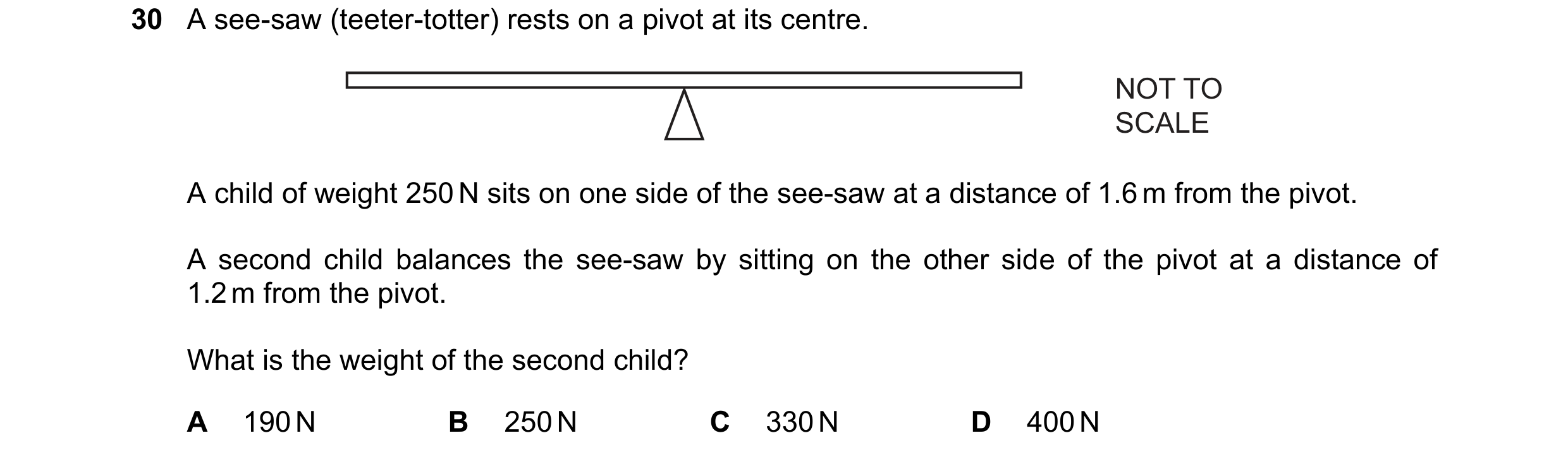
Q47 · A see-saw (teeter-totter) rests on a pivot at its centre 0654/21 Oct/Nov 2024
30 A see-saw (teeter-totter) rests on a pivot at its centre. NOT TO SCALE A child of weight 250 N sits on one side of the see-saw at a distance of 1.6 m from the pivot. A second child balances the see-saw by sitting on the other side of the pivot at a distance of 1.2 m from the pivot. What is the weight of the second child? A 190 N B 250 N C 330 N D 400 N
1 marks
Answer: C
This question in 0654/21 Oct/Nov 2024
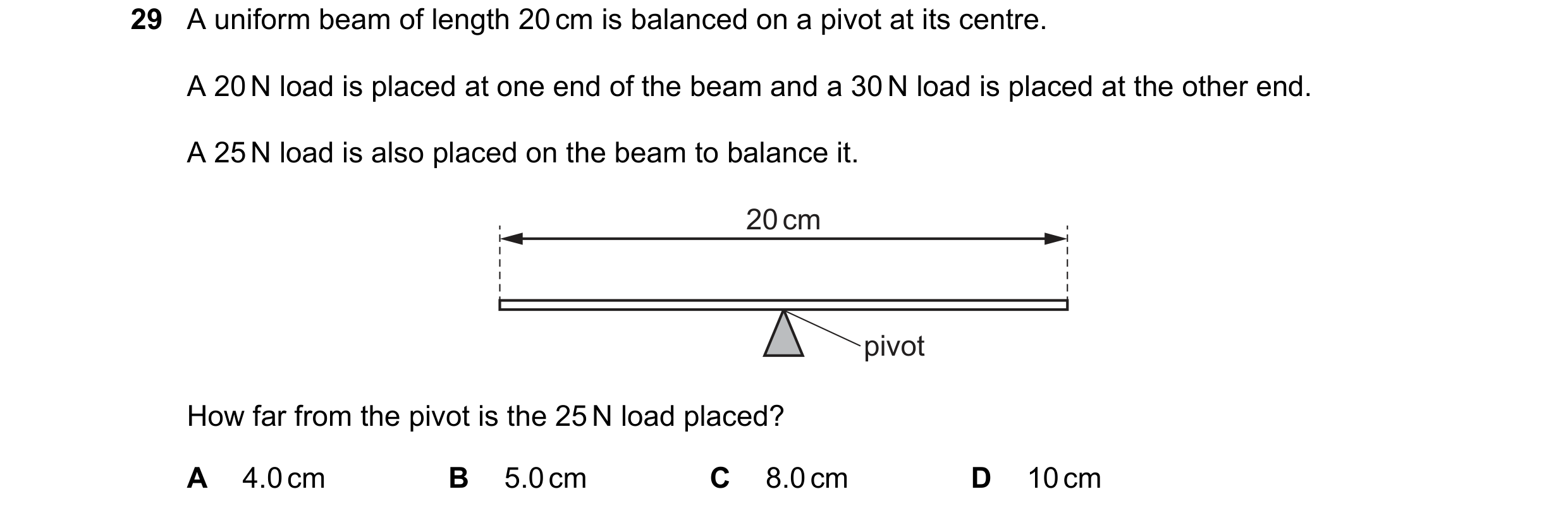
Q48 · A uniform beam of length 20 cm is balanced on a pivot at its centre 0654/22 Oct/Nov 2024
29 A uniform beam of length 20 cm is balanced on a pivot at its centre. A 20 N load is placed at one end of the beam and a 30 N load is placed at the other end. A 25 N load is also placed on the beam to balance it. 20 cm pivot How far from the pivot is the 25 N load placed? A 4.0 cm B 5.0 cm C 8.0 cm D 10 cm
1 marks
Answer: A
This question in 0654/22 Oct/Nov 2024
Q49 · A person uses a bar that is 3.0 m long to lift a rock of weight 900 N off the ground 0654/23 Oct/Nov 2024
29 A person uses a bar that is 3.0 m long to lift a rock of weight 900 N off the ground. There is a pivot under the bar at 0.50 m from the rock. The person pushes vertically downwards on the other end of the bar from the rock, as shown. 0.50 m rock 3.0 m bar force pivot Ignore the weight of the bar. What is the minimum force needed to lift the rock off the ground? A 150 N B 180 N C 4500 N D 5400 N
1 marks
Answer: B
This question in 0654/23 Oct/Nov 2024
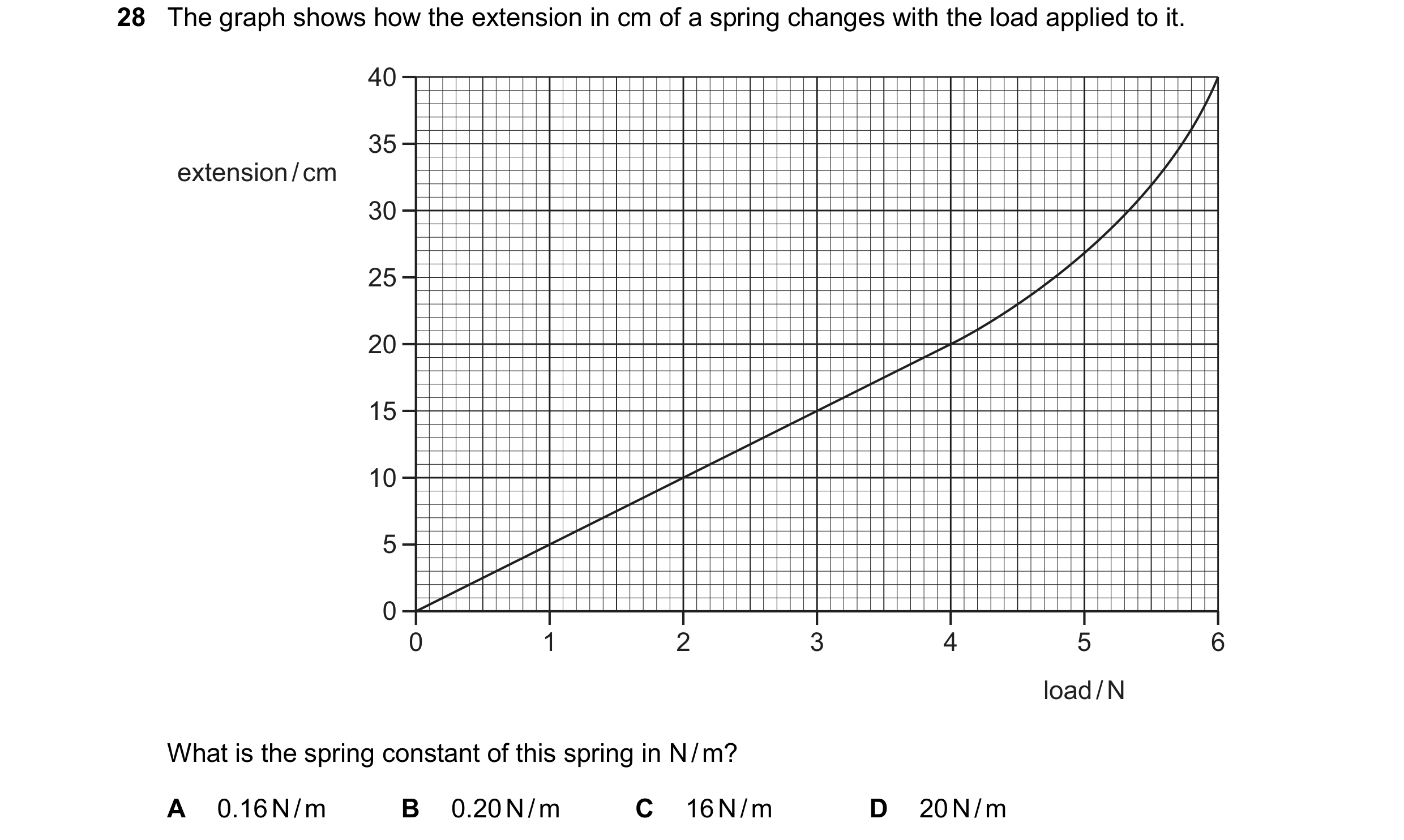
Q50 · The graph shows how the extension in cm of a spring changes with the load applied to it 0654/22 Feb/March 2025
28 The graph shows how the extension in cm of a spring changes with the load applied to it. 40 35 extension / cm 30 25 20 15 10 5 0 0 1 2 3 4 5 6 load / N What is the spring constant of this spring in N / m? A 0.16 N / m B 0.20 N / m C 16 N / m D 20 N / m
1 marks
Answer: D
This question in 0654/22 Feb/March 2025
Q51 · The diagrams show uniform metre rulers each pivoted at the 50 cm mark 0654/22 Feb/March 2025
29 The diagrams show uniform metre rulers each pivoted at the 50 cm mark. Different weights are placed on the rulers at different distances from the 0 cm end. Which ruler rotates in a clockwise direction? A B 0 10 50 75 100 cm 0 20 50 60 100 cm 3.0 N 5.0 N 4.0 N 12 N C D 0 10 50 65 100 cm 0 25 50 90 100 cm 6.0 N 8.0 N 8.0 N 4.0 N
1 marks
Answer: A
This question in 0654/22 Feb/March 2025
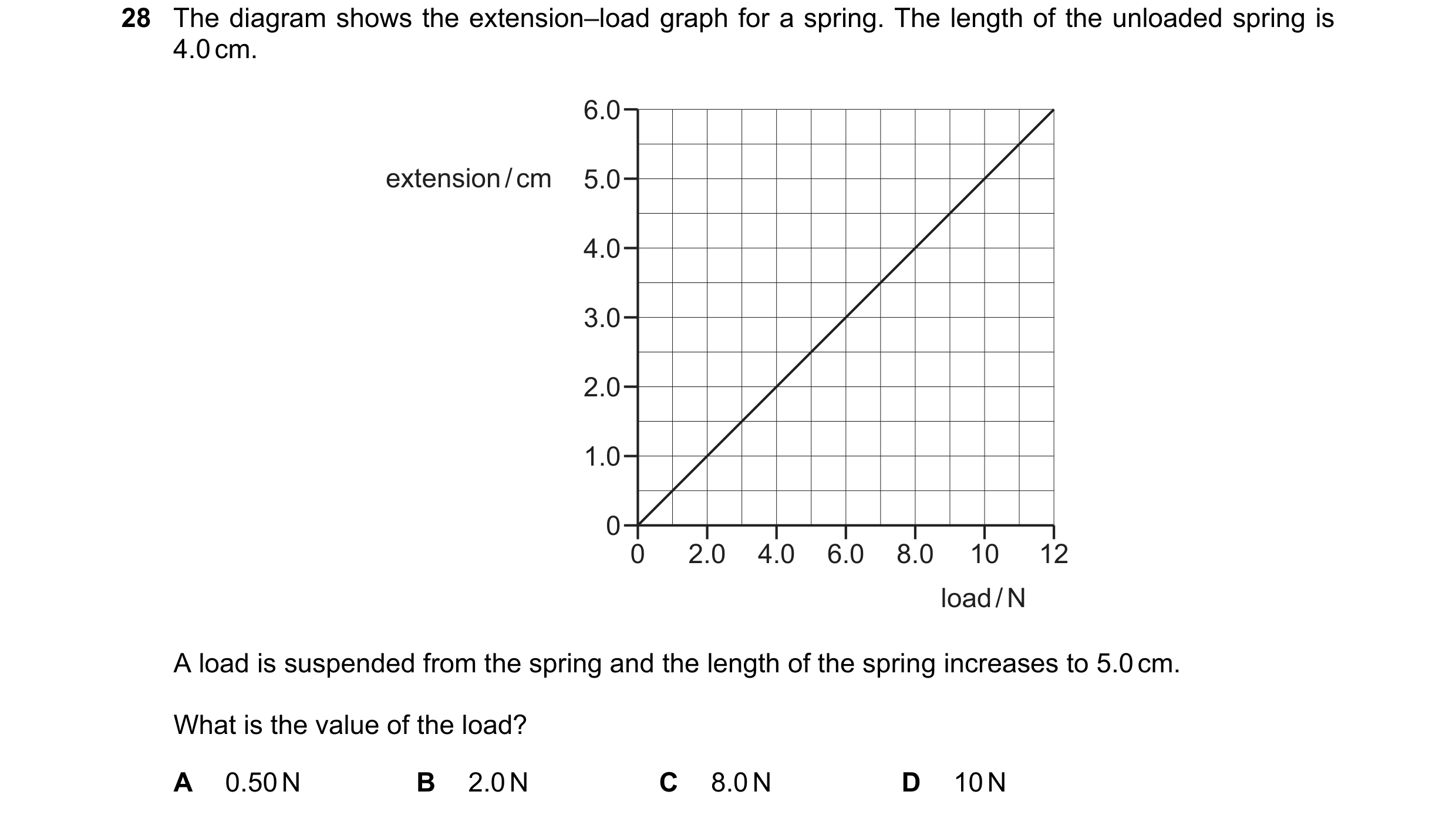
Q52 · The diagram shows the extension–load graph for a spring 0654/21 May/June 2025
28 The diagram shows the extension–load graph for a spring. The length of the unloaded spring is 4.0 cm. 6.0 extension / cm 5.0 4.0 3.0 2.0 1.0 0 0 2.0 4.0 6.0 8.0 10 12 load / N A load is suspended from the spring and the length of the spring increases to 5.0 cm. What is the value of the load? A 0.50 N B 2.0 N C 8.0 N D 10 N
1 marks
Answer: B
This question in 0654/21 May/June 2025
Q53 · The diagram shows the two vertical forces acting on an object of mass m falling through… 0654/21 Oct/Nov 2025
29 The diagram shows the two vertical forces acting on an object of mass m falling through the air. F W Which expression is equal to the magnitude of the vertical acceleration of the object? ( W – F ) ( W + F ) m m A B C F D F m m ( W – ) ( W + )
1 marks
Answer: A
This question in 0654/21 Oct/Nov 2025
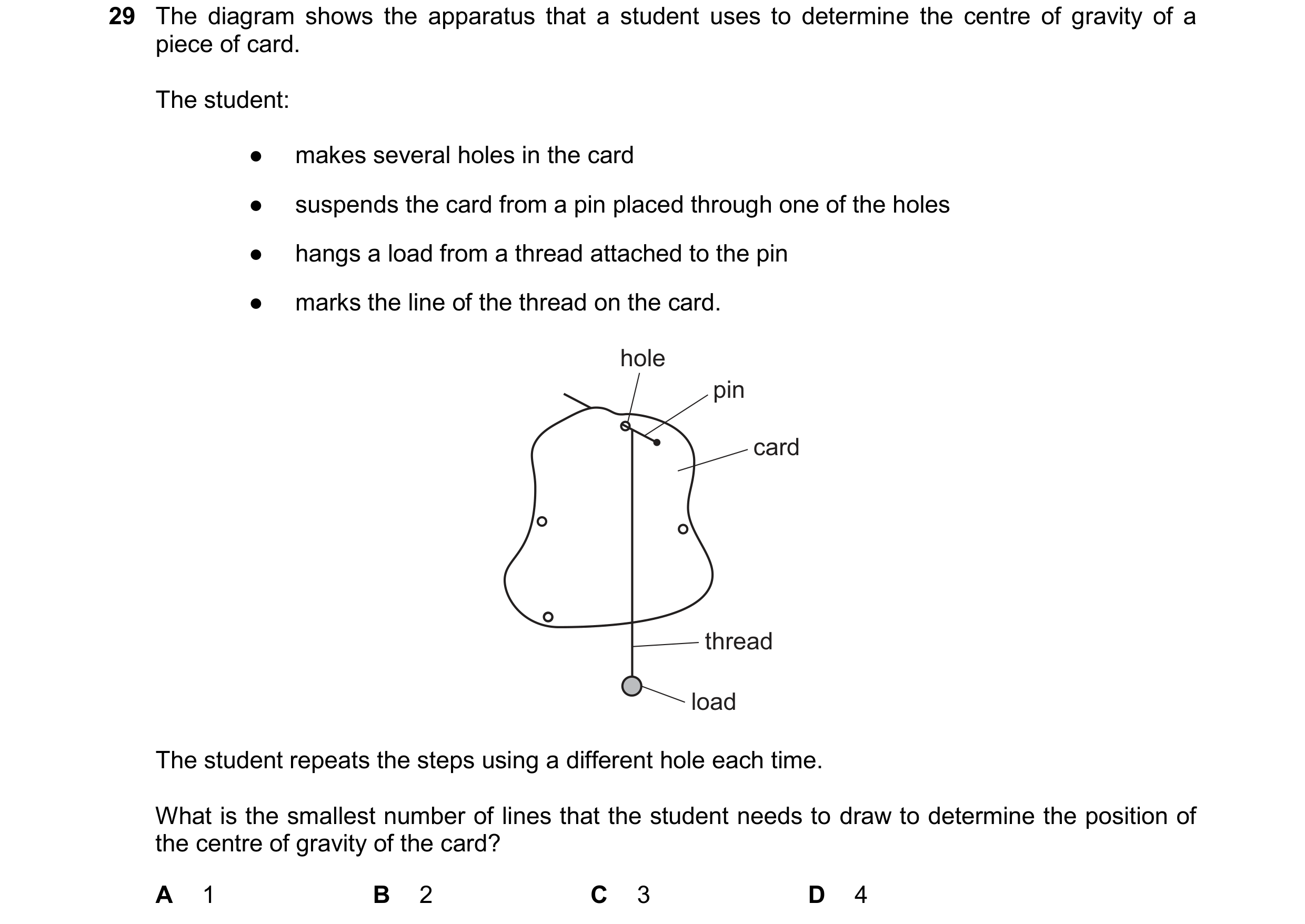
Q54 · The diagram shows the apparatus that a student uses to determine the centre of gravity of… 0654/22 Oct/Nov 2025
29 The diagram shows the apparatus that a student uses to determine the centre of gravity of a piece of card. The student: ● makes several holes in the card ● suspends the card from a pin placed through one of the holes ● hangs a load from a thread attached to the pin ● marks the line of the thread on the card. hole pin card thread load The student repeats the steps using a different hole each time. What is the smallest number of lines that the student needs to draw to determine the position of the centre of gravity of the card? A 1 B 2 C 3 D 4
1 marks
Answer: B
This question in 0654/22 Oct/Nov 2025
Q55 · A spring is 16 cm long when it supports a load of 12 N 0654/23 Oct/Nov 2025
28 A spring is 16 cm long when it supports a load of 12 N. The spring is 20 cm long when it supports a load of 20 N. What is the spring constant of the spring? A 0.50 N / cm B 1.0 N / cm C 2.0 N / cm D 5.0 N / cm
1 marks
Answer: C
This question in 0654/23 Oct/Nov 2025
Q56 · The diagram shows two teams, Y and Z, pulling on a rope 0654/23 Oct/Nov 2025
29 The diagram shows two teams, Y and Z, pulling on a rope. Team Y pulls with a force of 500 N to the left and team Z pulls with a force of 800 N to the right. team Y rope team Z 500 N 800 N What is the resultant force produced by the two forces? A 300 N to the left B 300 N to the right C 1300 N to the left D 1300 N to the right
1 marks
Answer: B
This question in 0654/23 Oct/Nov 2025
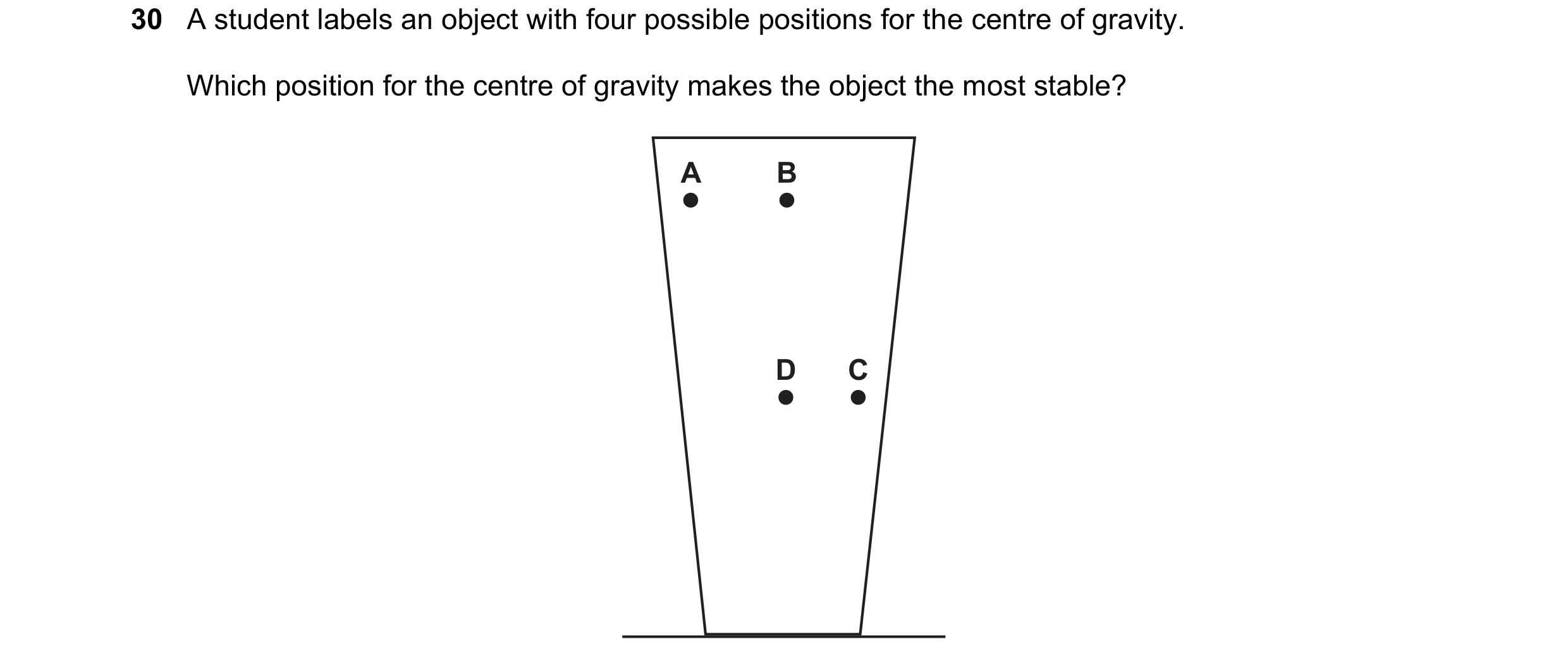
Q57 · A student labels an object with four possible positions for the centre of gravity 0654/23 Oct/Nov 2025
30 A student labels an object with four possible positions for the centre of gravity. Which position for the centre of gravity makes the object the most stable? A B D C
1 marks
Answer: D
This question in 0654/23 Oct/Nov 2025



 1 / 22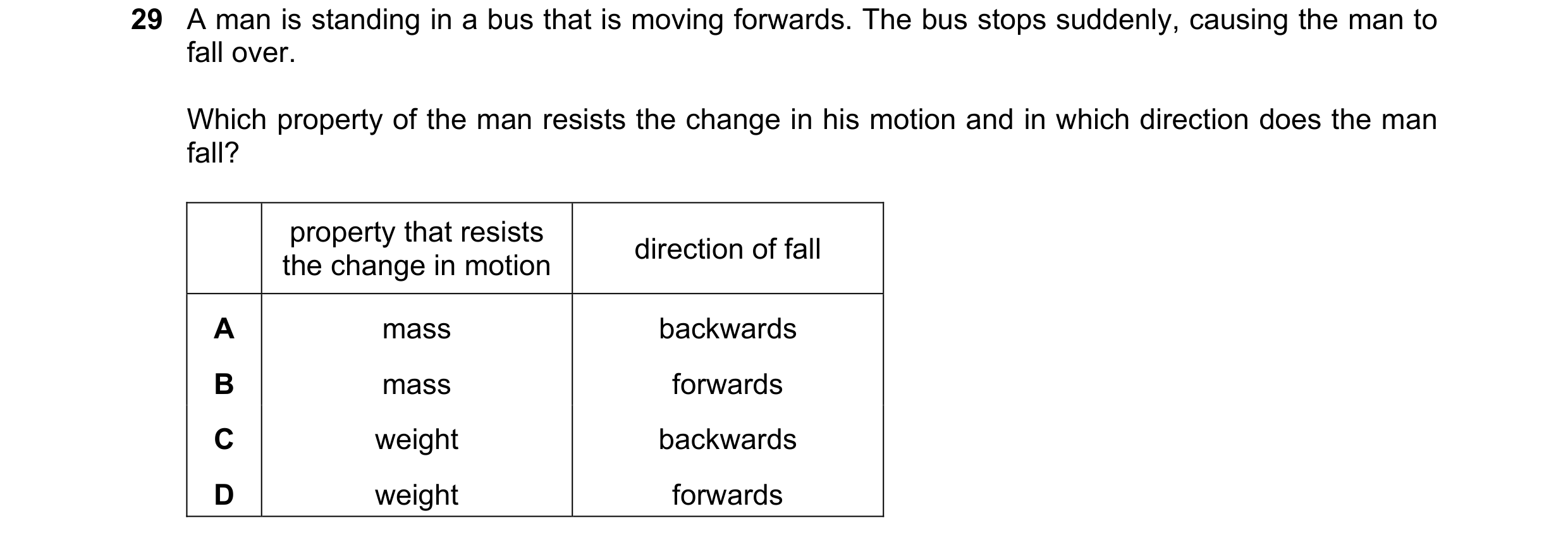
 2 / 22
 3 / 22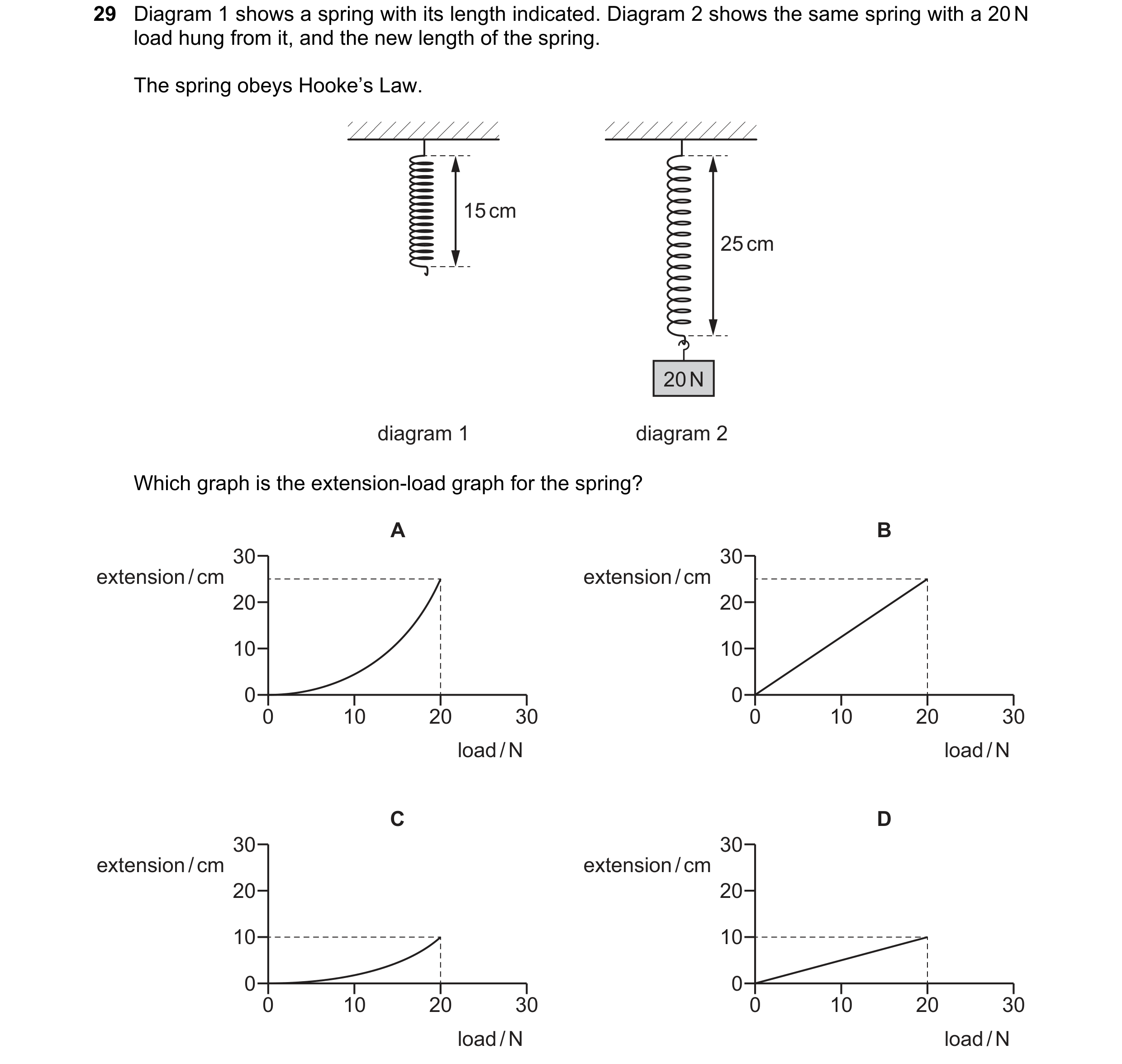
 4 / 22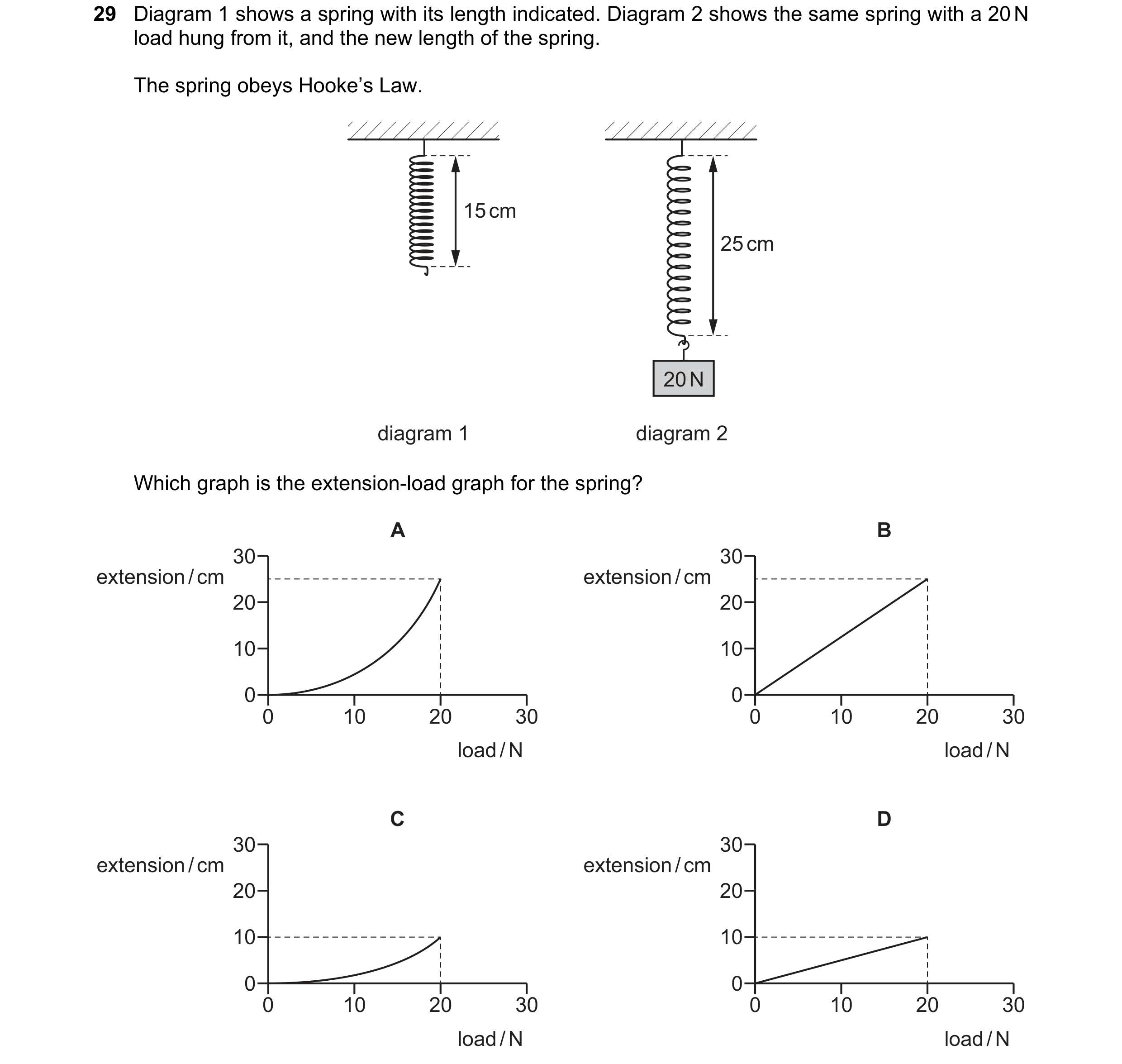
 5 / 22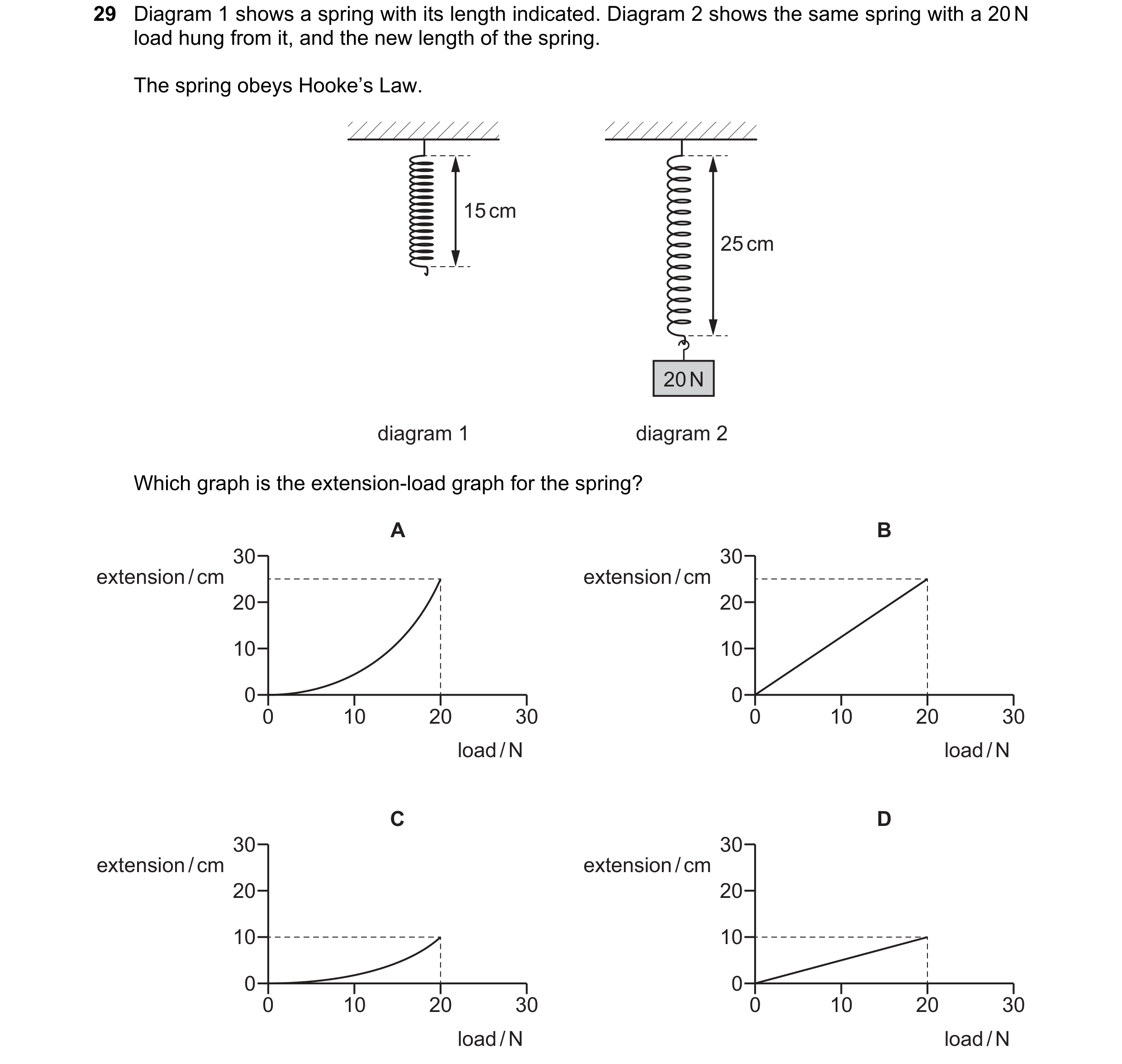
 6 / 22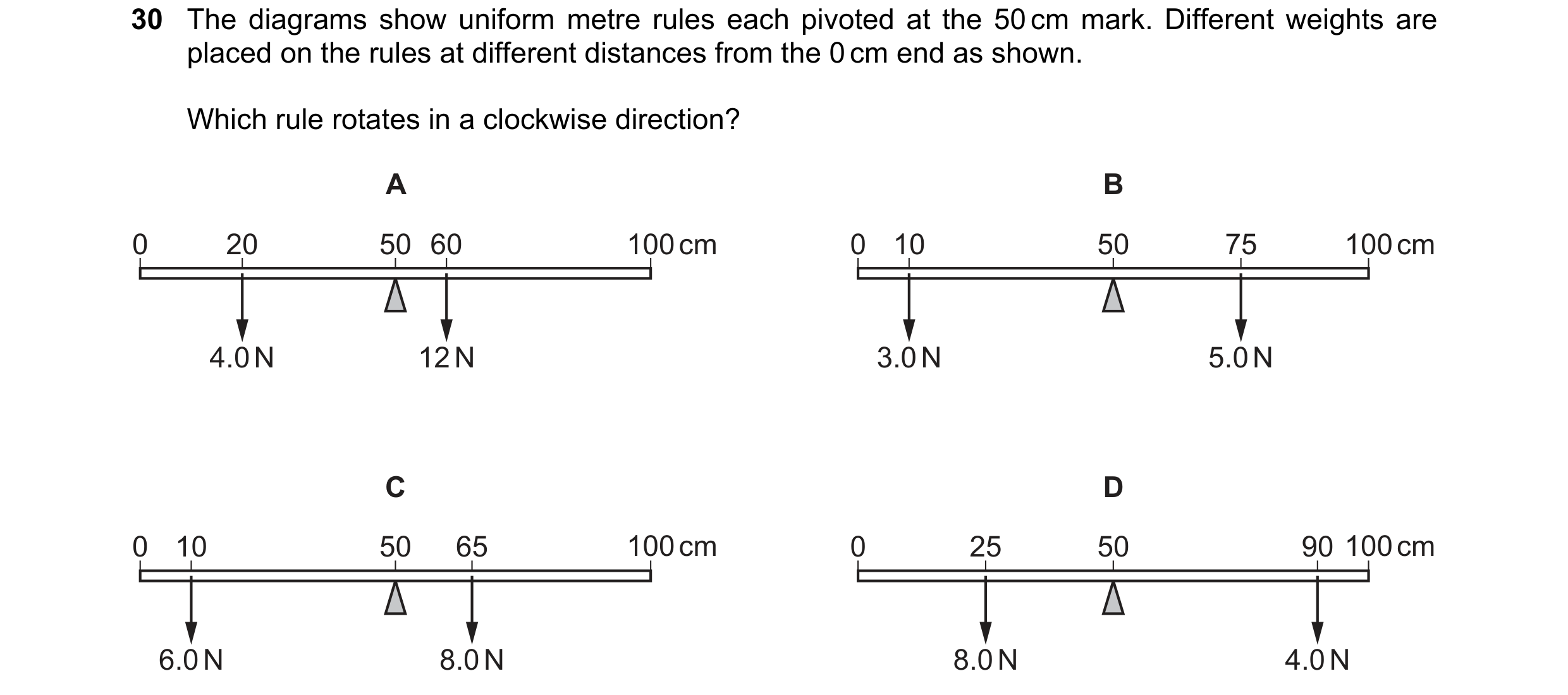
 7 / 22

 8 / 22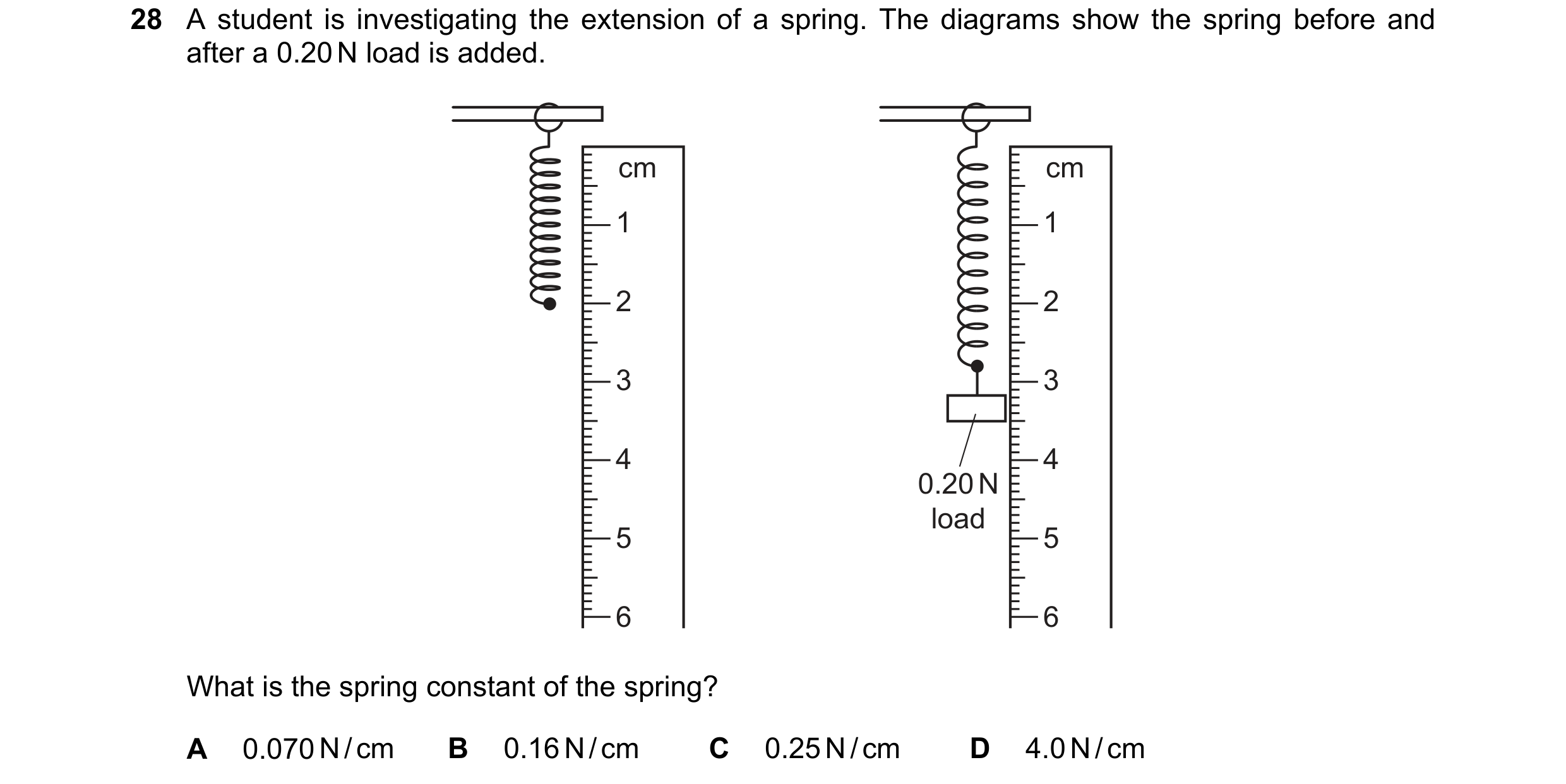
 9 / 22
 10 / 22
 11 / 22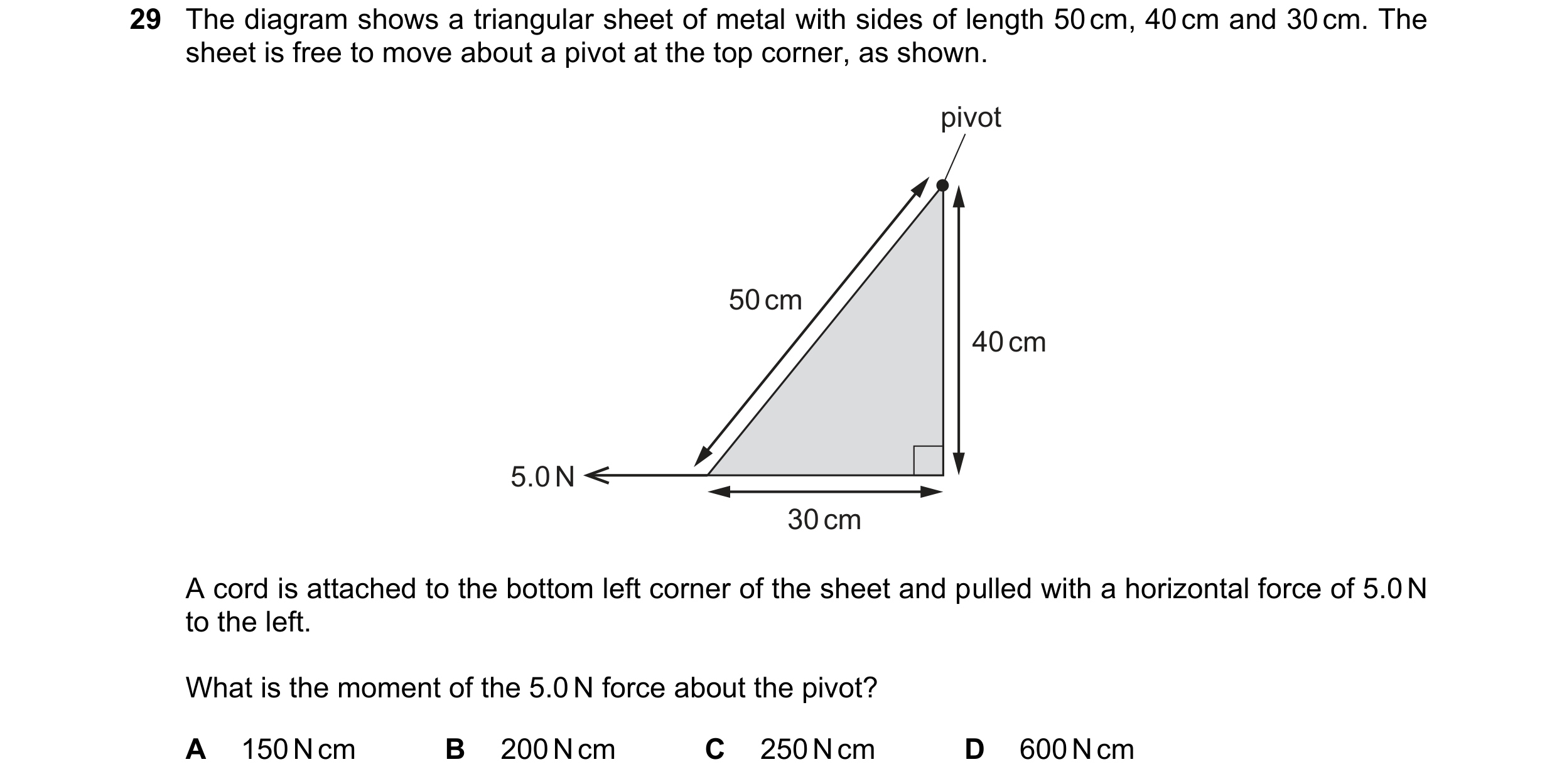
 12 / 22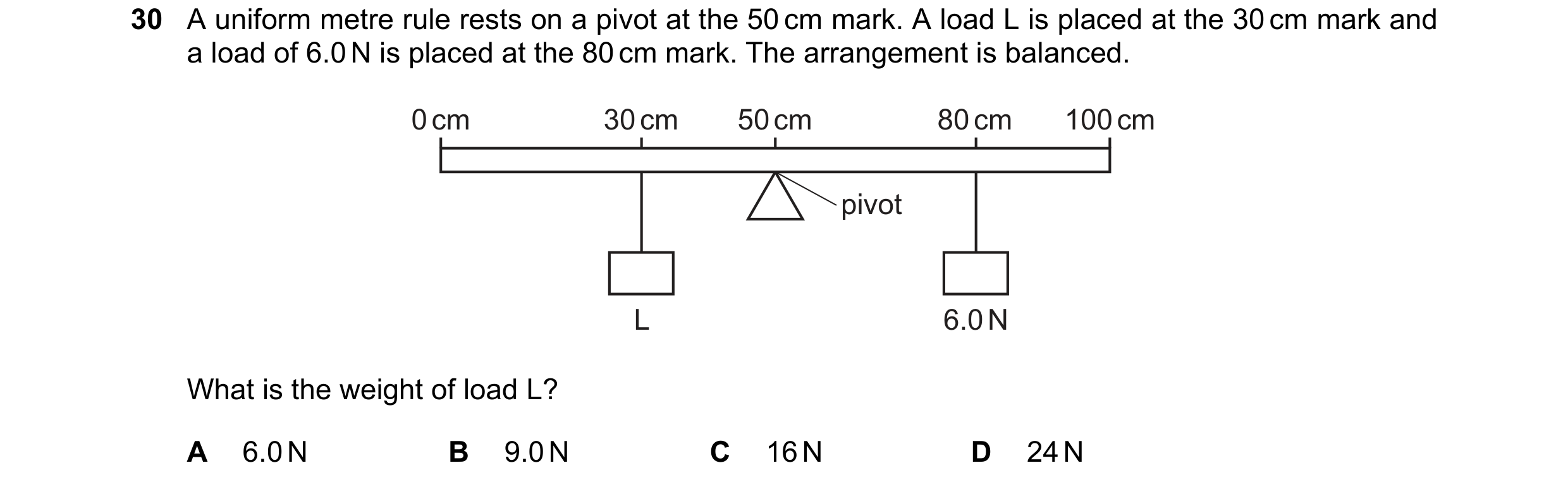
 13 / 22
 14 / 22
 15 / 22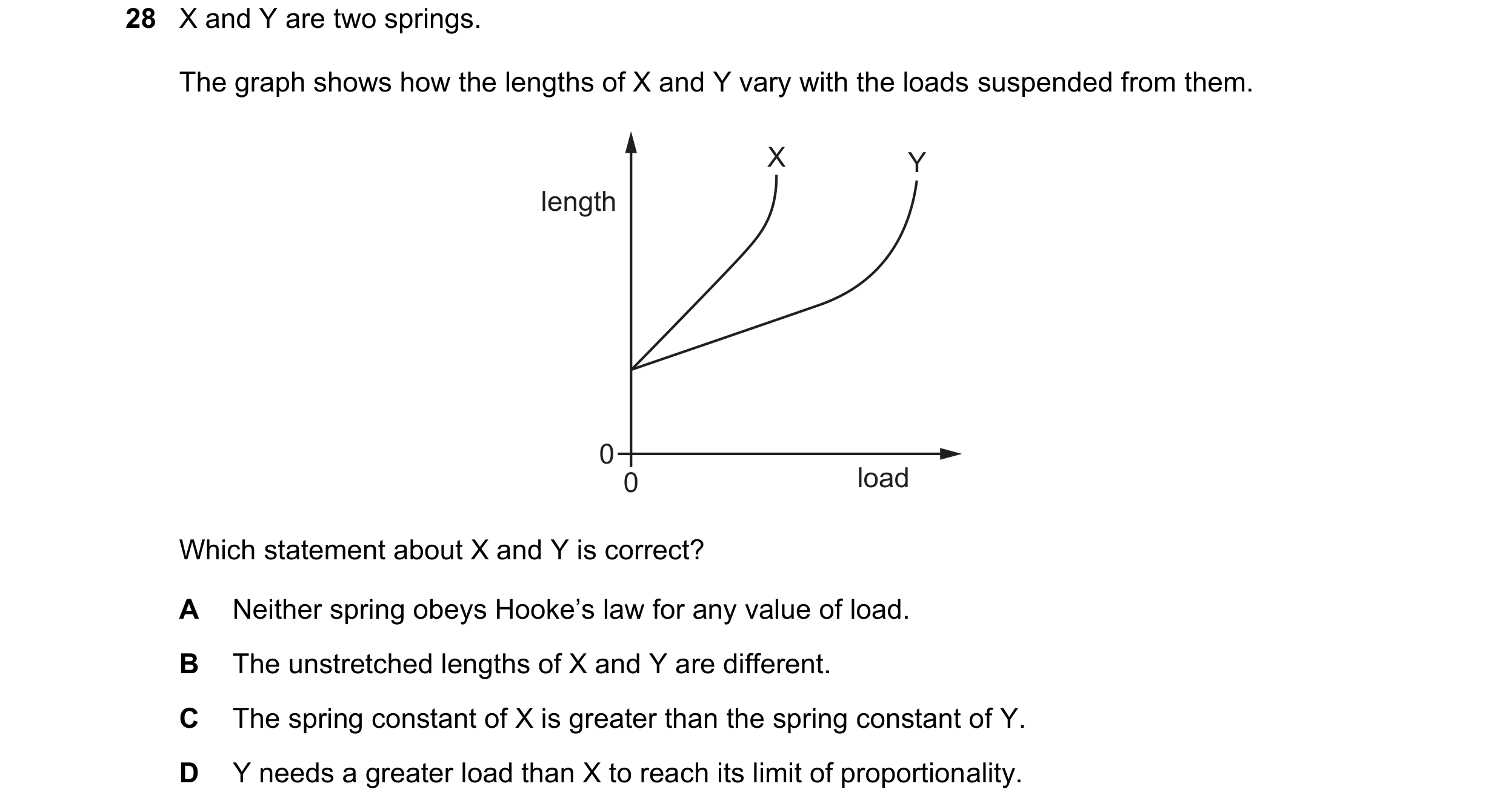

 16 / 22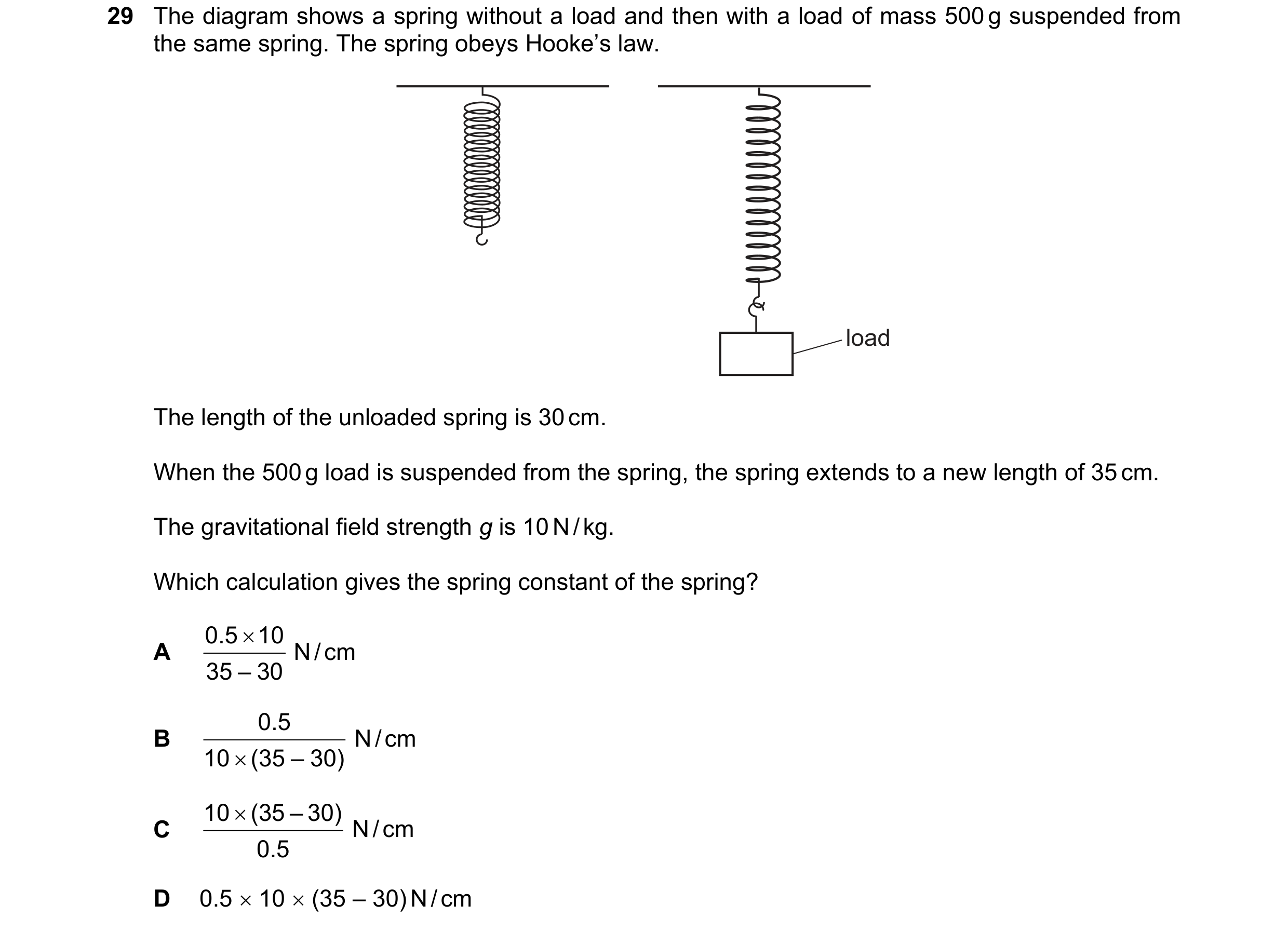
 17 / 22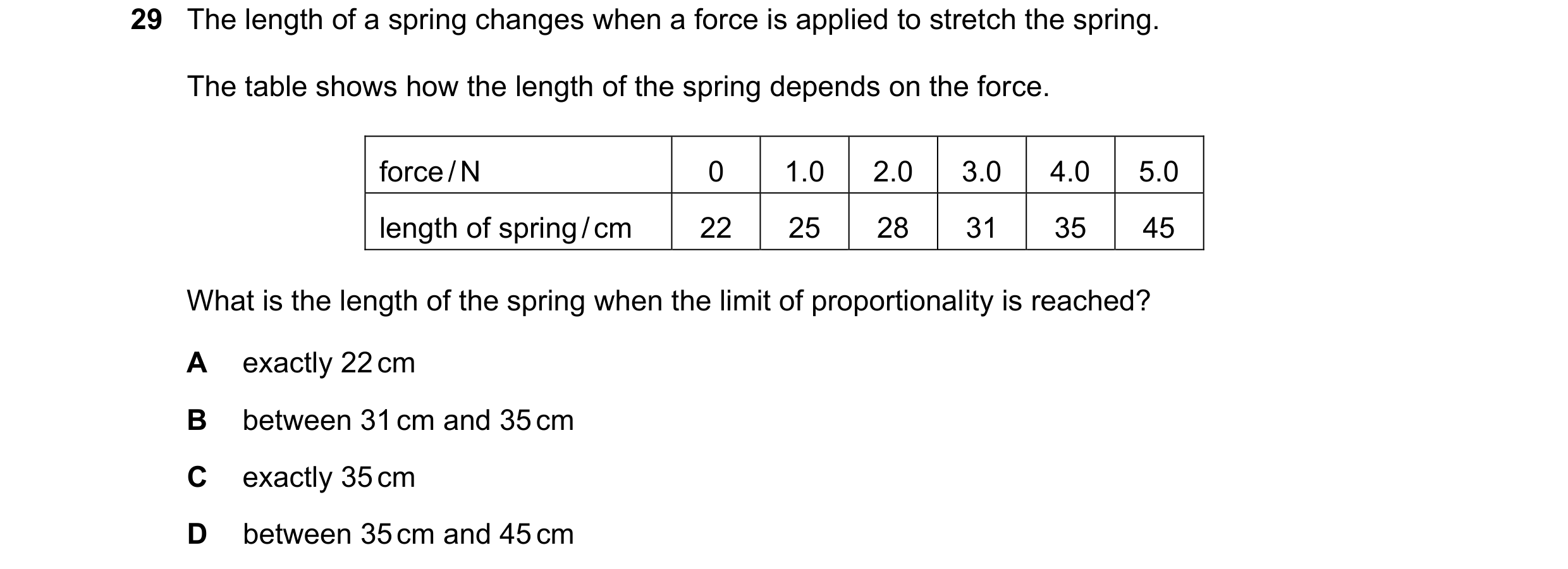
 18 / 22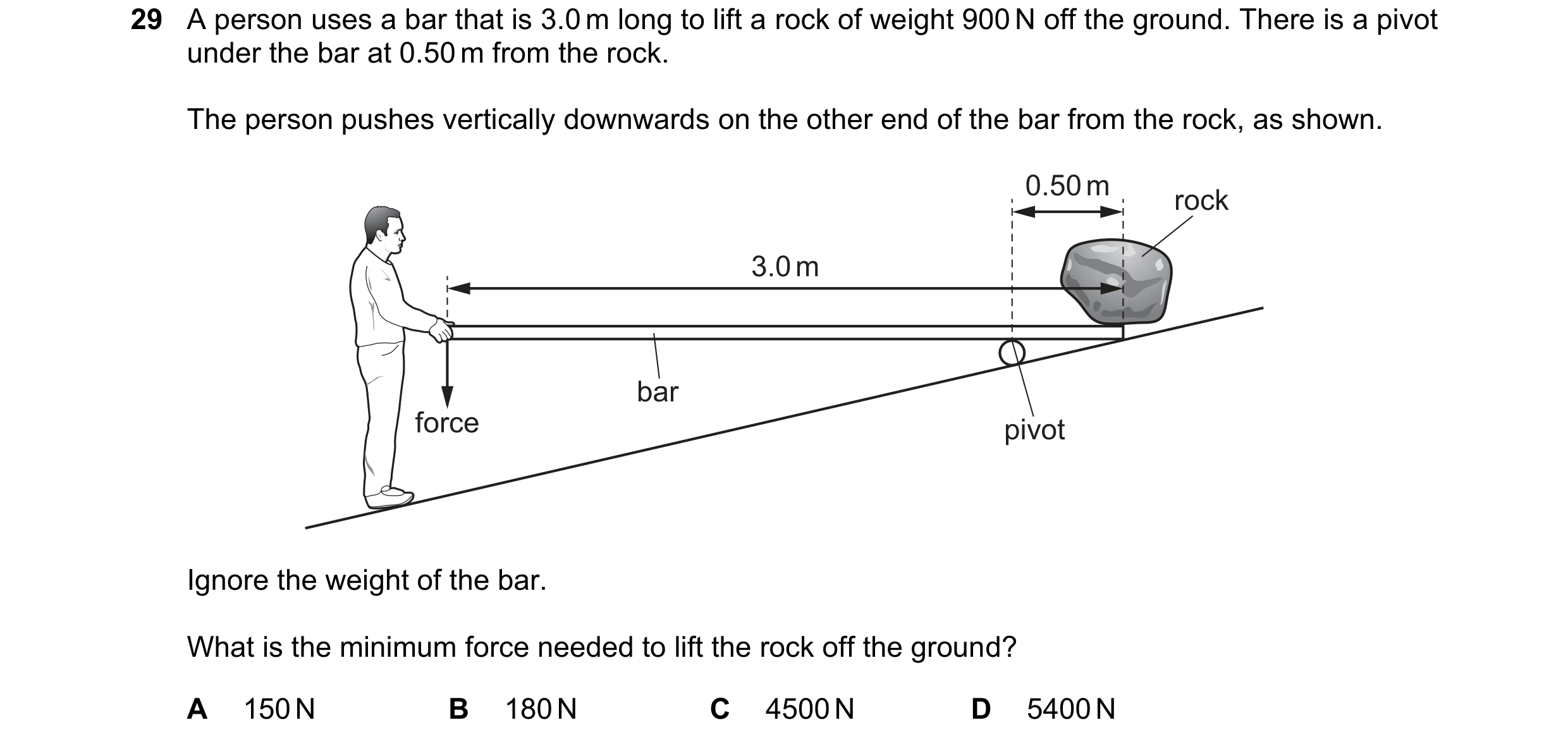
 19 / 22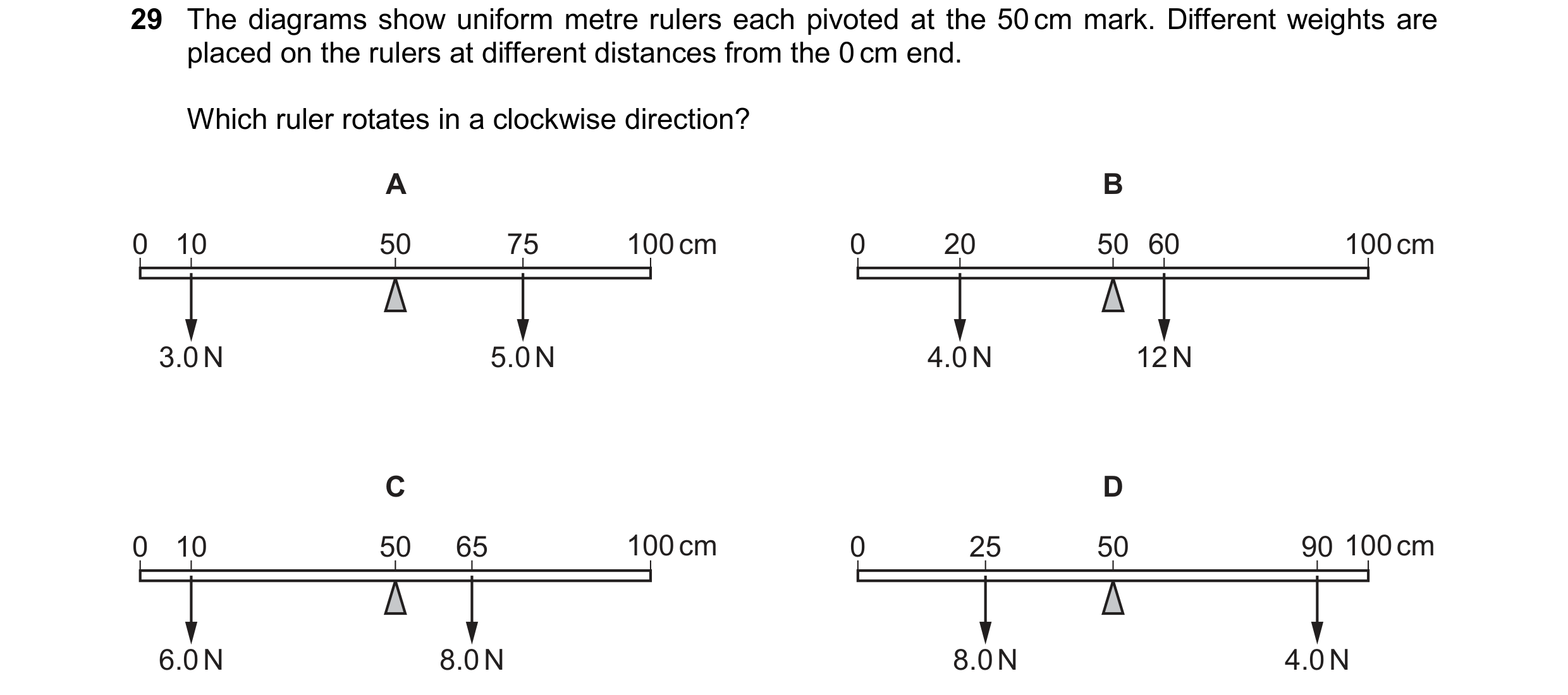
 20 / 22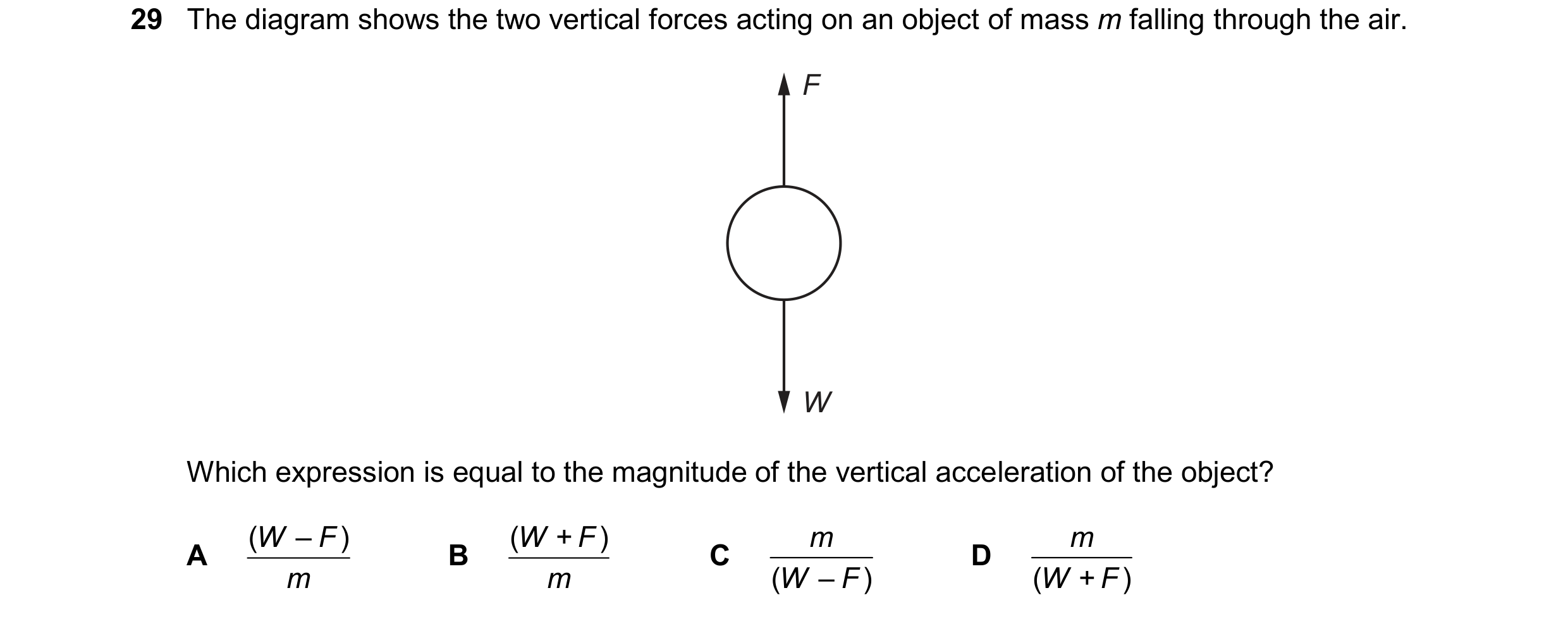
 21 / 22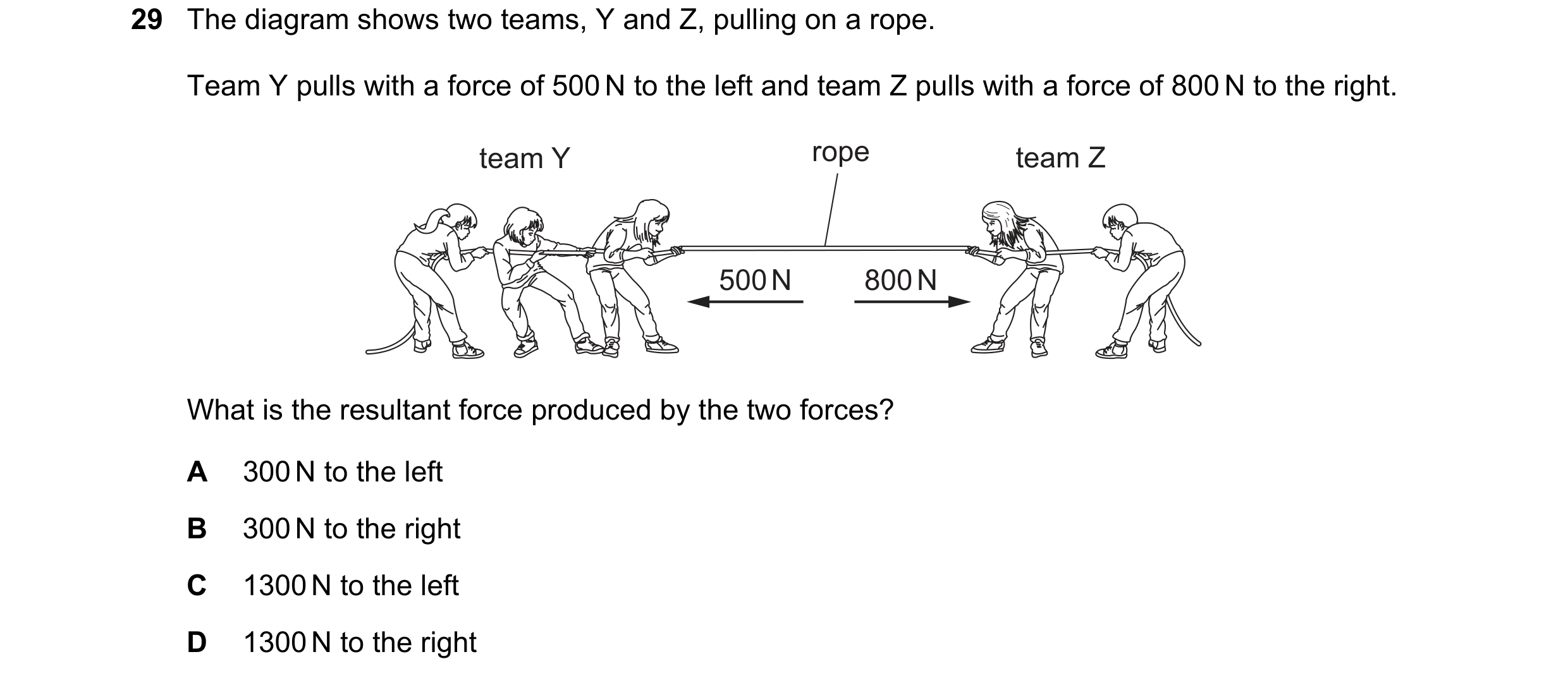
 22 / 22