Questions as text
Q1 · Two forces acting on a swimmer as he swims in a swimming pool 0654/41 Oct/Nov 2017
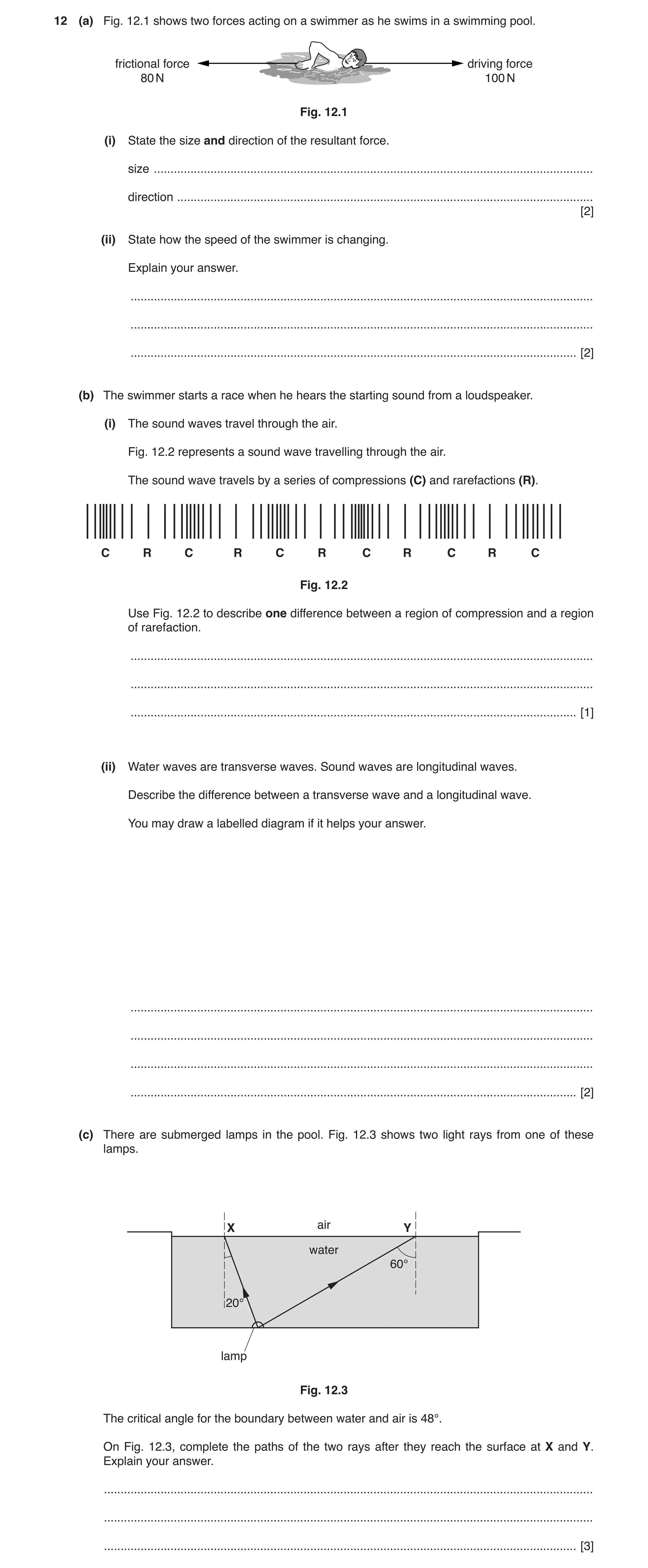
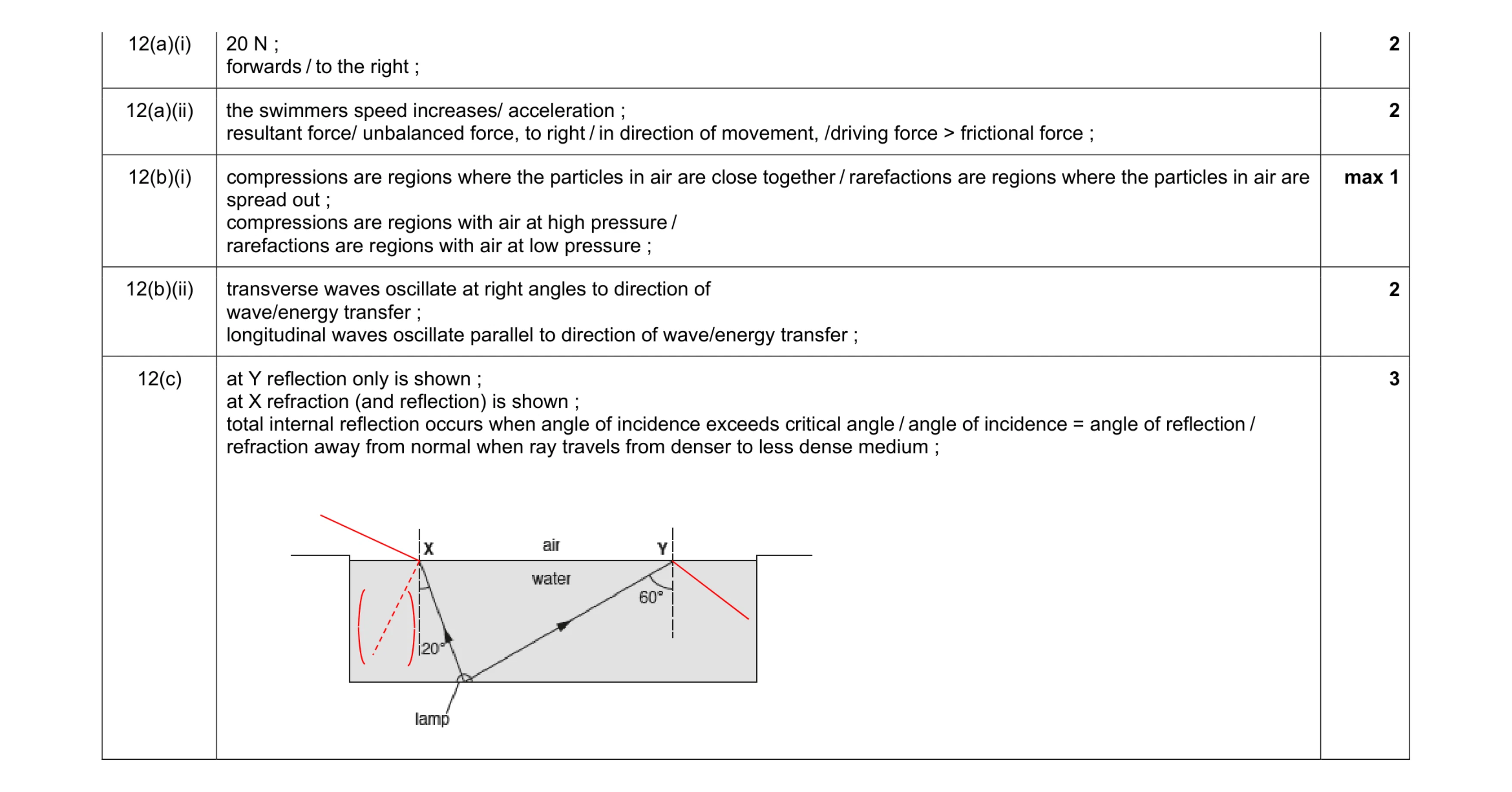
12 (a) Fig. 12.1 shows two forces acting on a swimmer as he swims in a swimming pool. frictional force driving force 80 N 100 N Fig. 12.1 (i) State the size and direction of the resultant force. size … direction … [2] (ii) State how the speed of the swimmer is changing. Explain your answer. … … … [2] (b) The swimmer starts a race when he hears the starting sound from a loudspeaker. (i) The sound waves travel through the air. Fig. 12.2 represents a sound wave travelling through the air. The sound wave travels by a series of compressions (C) and rarefactions (R). C R C R C R C R C R C Fig. 12.2 Use Fig. 12.2 to describe one difference between a region of compression and a region of rarefaction. … … … [1] (ii) Water waves are transverse waves. Sound waves are longitudinal waves. Describe the difference between a transverse wave and a longitudinal wave. You may draw a labelled diagram if it helps your answer. … … … … [2] (c) There are submerged lamps in the pool. Fig. 12.3 shows two light rays from one of these lamps. X air Y water 60° 20° lamp Fig. 12.3 The critical angle for the boundary between water and air is 48°. On Fig. 12.3, complete the paths of the two rays after they reach the surface at X and Y. Explain your answer. … … … [3]
10 marks
Mark scheme: 12(a)(i) 20 N ; forwards / to the right ; 2 12(a)(ii) the swimmers speed increases/ acceleration ; resultant force/ unbalanced force, to right / in direction of movement, /driving force > frictional force ; 2 12(b)(i) compressions are regions where the particles in air are close together / rarefactions are regions where the particles in air are spread out ; compressions are regions with air at high pressure / rarefactions are regions with air at low pressure ; max 1 12(b)(ii) transverse waves oscillate at right angles to direction of wave/energy transfer ; longitudinal waves oscillate parallel to direction of wave/energy transfer ; 2 12(c) at Y reflection only is shown ; at X refraction (and reflection) is shown ; total internal reflection occurs when angle of incidence exceeds critical angle / angle of incidence = angle of reflection / refraction away from normal when ray travels from denser to less dense medium ; 3
This question in 0654/41 Oct/Nov 2017
Q2 · A student is listening to music on her computer using headphones 0654/42 Oct/Nov 2017
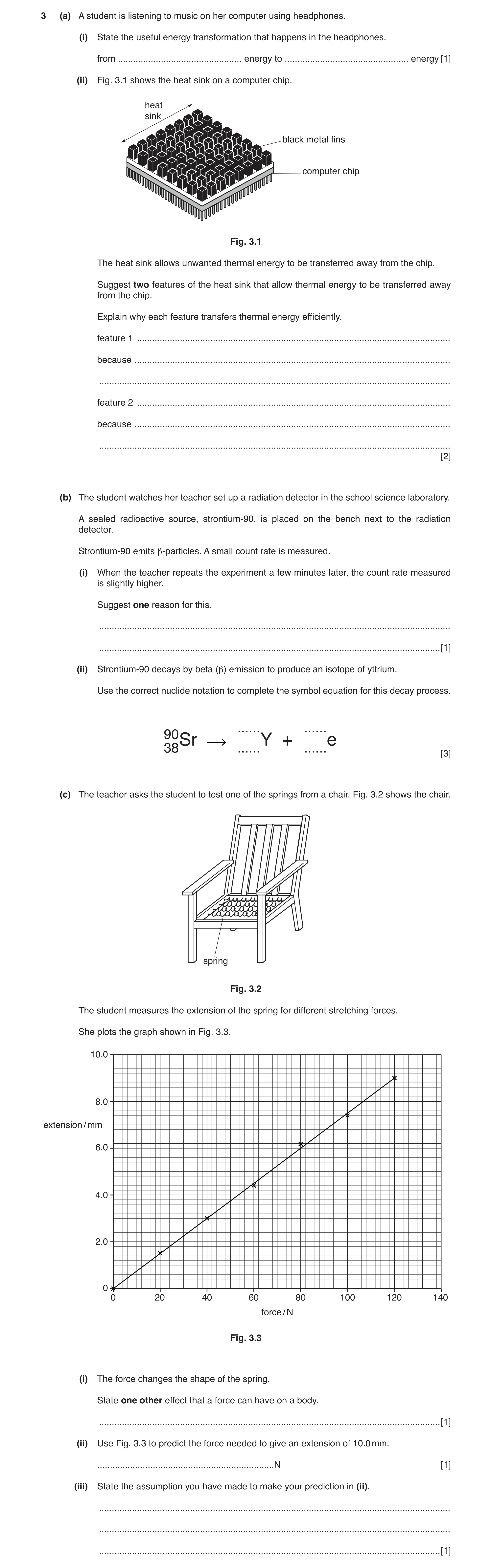
3 (a) A student is listening to music on her computer using headphones. (i) State the useful energy transformation that happens in the headphones. from … energy to … energy [1] (ii) Fig. 3.1 shows the heat sink on a computer chip. heat sink black metal fins computer chip Fig. 3.1 The heat sink allows unwanted thermal energy to be transferred away from the chip. Suggest two features of the heat sink that allow thermal energy to be transferred away from the chip. Explain why each feature transfers thermal energy efficiently. feature 1 … because … … feature 2 … because … … [2] (b) The student watches her teacher set up a radiation detector in the school science laboratory. A sealed radioactive source, strontium-90, is placed on the bench next to the radiation detector. Strontium-90 emits β-particles. A small count rate is measured. (i) When the teacher repeats the experiment a few minutes later, the count rate measured is slightly higher. Suggest one reason for this. … … [1] (ii) Strontium-90 decays by beta (β) emission to produce an isotope of yttrium. Use the correct nuclide notation to complete the symbol equation for this decay process. … … 9038Sr … Y + … e [3] (c) The teacher asks the student to test one of the springs from a chair. Fig. 3.2 shows the chair. spring Fig. 3.2 The student measures the extension of the spring for different stretching forces. She plots the graph shown in Fig. 3.3. 10.0 8.0 extension / mm 6.0 4.0 2.0 0 0 20 40 60 80 100 120 140 force / N Fig. 3.3 (i) The force changes the shape of the spring. State one other effect that a force can have on a body. … [1] (ii) Use Fig. 3.3 to predict the force needed to give an extension of 10.0 mm. … N [1] (iii) State the assumption you have made to make your prediction in (ii). … … … [1]
10 marks
Mark scheme: 3(a)(i) electrical to sound ; 1 3(a)(ii) lots of fins – large surface area or large surface area – more, conduction / convection / radiation / transfer, of heat / energy ; black fins – black is a good emitter of radiation ; metal fins – metal is a good conductor of heat ; max 2 3(b)(i) decay is a random process / ref to background radiation ; 1 3(b)(ii) mass number correct ; atomic number correct ; both numbers correct ; 3 3(c)(i) change in, speed / direction, of motion ; 1 Question Answer Marks 3(c)(ii) 133 N ; 1 3(c)(iii) the force needed to extend a spring is directly proportional to the extension / elastic limit not exceeded ; 1
This question in 0654/42 Oct/Nov 2017
Q3 · A cyclist accelerates along a straight road from a speed of 4 m / s to maximum speed 0654/42 May/June 2020
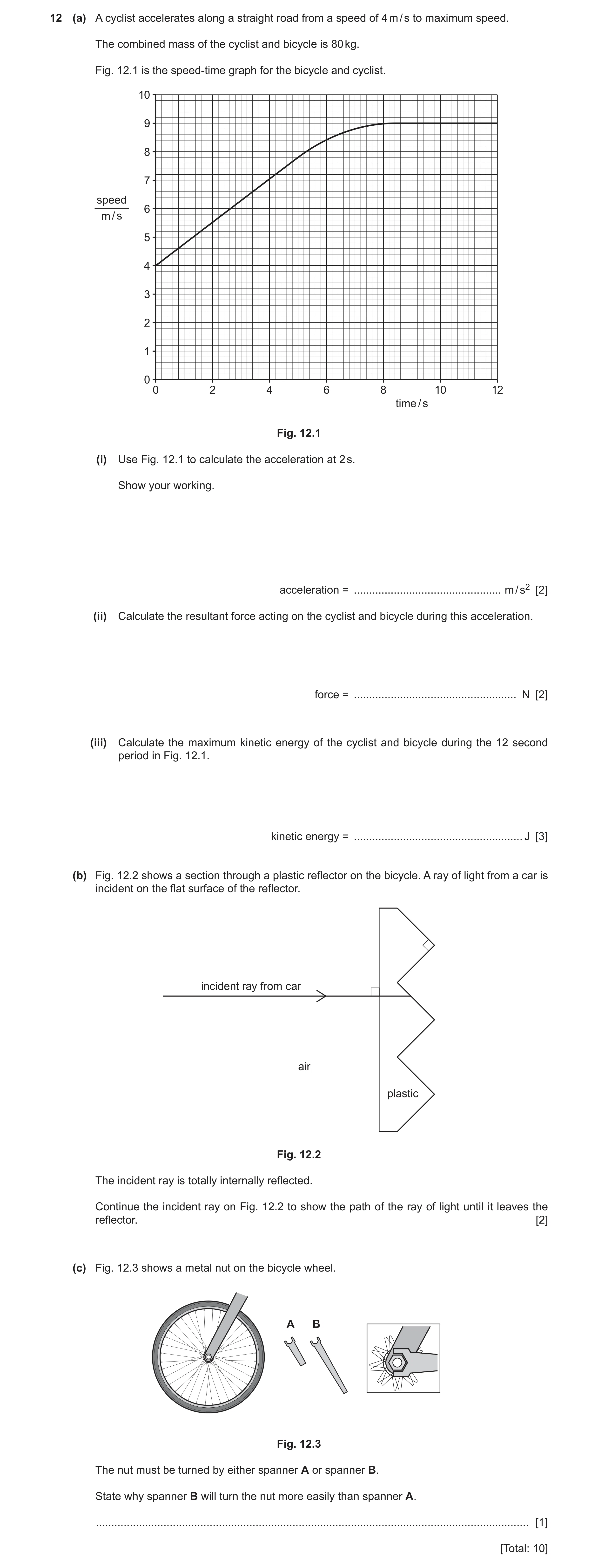
12 (a) A cyclist accelerates along a straight road from a speed of 4 m / s to maximum speed. The combined mass of the cyclist and bicycle is 80 kg. Fig. 12.1 is the speed-time graph for the bicycle and cyclist. 10 9 8 7 speed 6 m / s 5 4 3 2 1 0 0 2 4 6 8 10 12 time / s Fig. 12.1 (i) Use Fig. 12.1 to calculate the acceleration at 2 s. Show your working. acceleration = … m / s2 [2] (ii) Calculate the resultant force acting on the cyclist and bicycle during this acceleration. force = … N [2] (iii) Calculate the maximum kinetic energy of the cyclist and bicycle during the 12 second period in Fig. 12.1. kinetic energy = … J [3] (b) Fig. 12.2 shows a section through a plastic reflector on the bicycle. A ray of light from a car is incident on the flat surface of the reflector. incident ray from car air plastic Fig. 12.2 The incident ray is totally internally reflected. Continue the incident ray on Fig. 12.2 to show the path of the ray of light until it leaves the reflector. [2] (c) Fig. 12.3 shows a metal nut on the bicycle wheel. A B Fig. 12.3 The nut must be turned by either spanner A or spanner B. State why spanner B will turn the nut more easily than spanner A. … [1] [Total: 10]
10 marks
Mark scheme: 12(a)(i) change of speed or correct substitution (e.g. 1.55/2); 0.775 (m/s2); 2 12(a)(ii) F = ma or 80 × 0.775; 62 (N); 2 12(a)(iii) max speed = 9 m/s; KE = ½mv2 or ½ × 80 × 9 × 9; 3240 (J); 3 12(b) reflection only shown at first reflection; after second reflection ray emerges parallel to incident ray; 2 12(c) spanner B is longer / gives a bigger, moment / turning force ; 1
This question in 0654/42 May/June 2020
Q4 · A farmer drives his tractor at a constant speed 0654/41 Oct/Nov 2020
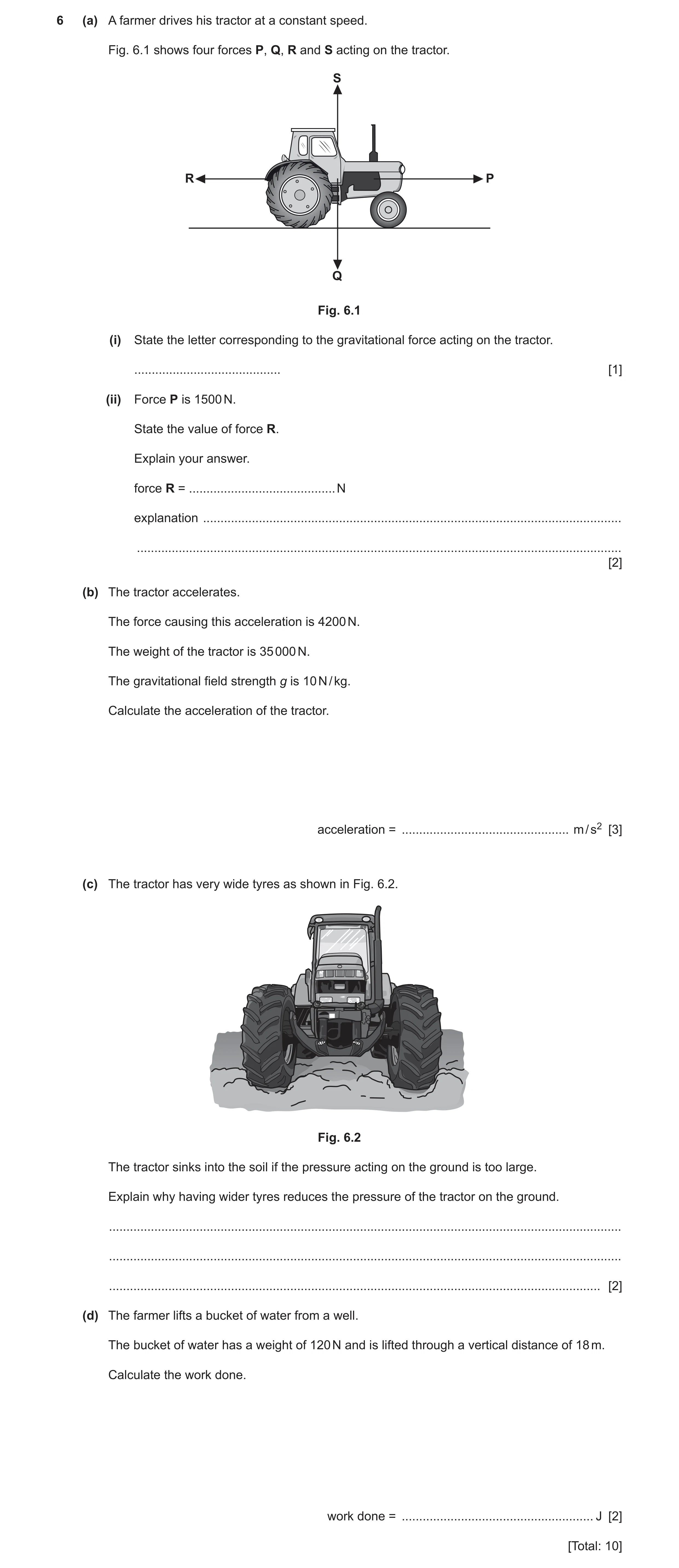
6 (a) A farmer drives his tractor at a constant speed. Fig. 6.1 shows four forces P, Q, R and S acting on the tractor. S R P Q Fig. 6.1 (i) State the letter corresponding to the gravitational force acting on the tractor. … [1] (ii) Force P is 1500 N. State the value of force R. Explain your answer. force R = … N explanation … … [2] (b) The tractor accelerates. The force causing this acceleration is 4200 N. The weight of the tractor is 35 000 N. The gravitational field strength g is 10 N / kg. Calculate the acceleration of the tractor. acceleration = … m / s2 [3] (c) The tractor has very wide tyres as shown in Fig. 6.2. Fig. 6.2 The tractor sinks into the soil if the pressure acting on the ground is too large. Explain why having wider tyres reduces the pressure of the tractor on the ground. … … … [2] (d) The farmer lifts a bucket of water from a well. The bucket of water has a weight of 120 N and is lifted through a vertical distance of 18 m. Calculate the work done. work done = … J [2] [Total: 10]
10 marks
Mark scheme: 6(a)(i) Q ; 1 6(a)(ii) 1500 (N) ; constant speed / forces are balanced / resultant is zero ; 2 6(b) mass = 3500 kg ; force / mass or 4200 / 3500 ; acceleration = 1.2 (m / s2) ; 3 Question Answer Marks 6(c) larger (surface) area ; (so pressure is less as) P = F / A ; 2 6(d) (work done =) force × distance or 120 × 18 ; = 2160 (J) ; 2
This question in 0654/41 Oct/Nov 2020
Q5 · A laptop computer and charger 0654/41 Oct/Nov 2020
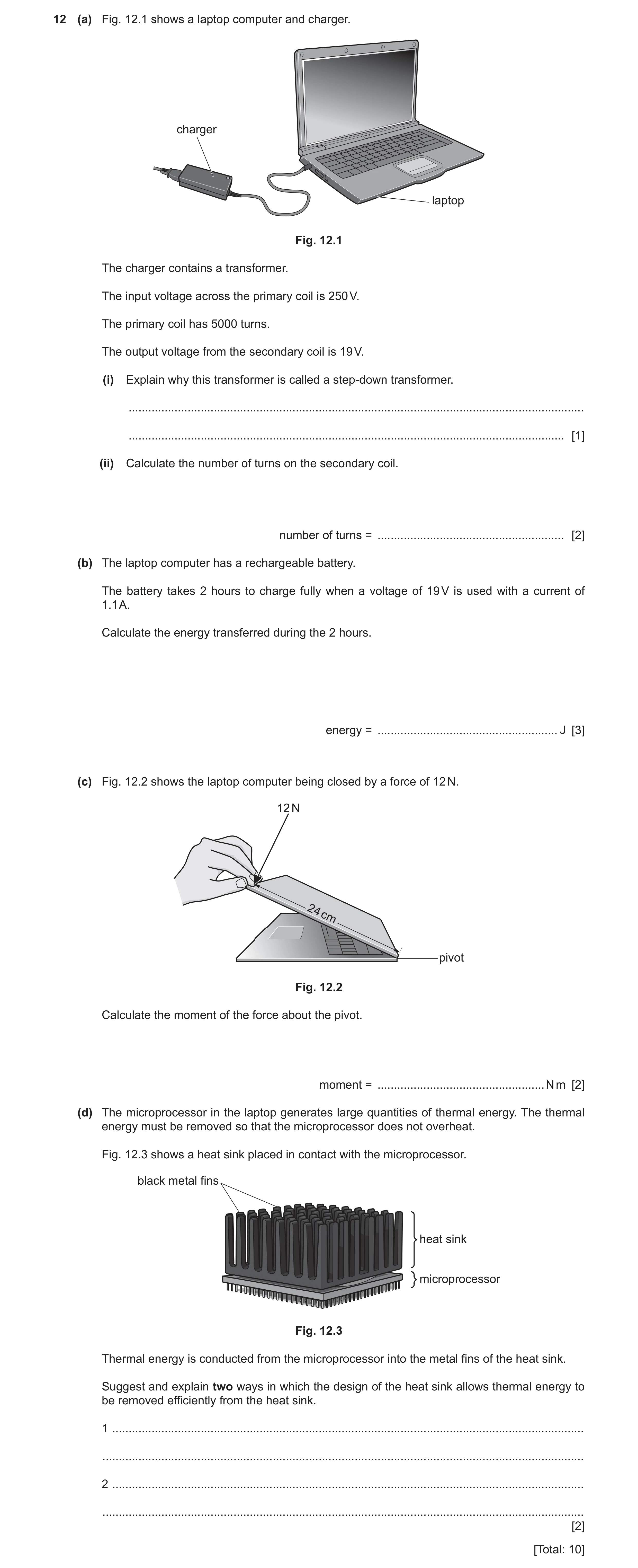
12 (a) Fig. 12.1 shows a laptop computer and charger. charger laptop Fig. 12.1 The charger contains a transformer. The input voltage across the primary coil is 250 V. The primary coil has 5000 turns. The output voltage from the secondary coil is 19 V. (i) Explain why this transformer is called a step‑down transformer. … … [1] (ii) Calculate the number of turns on the secondary coil. number of turns = … [2] (b) The laptop computer has a rechargeable battery. The battery takes 2 hours to charge fully when a voltage of 19 V is used with a current of 1.1 A. Calculate the energy transferred during the 2 hours. energy = … J [3] (c) Fig. 12.2 shows the laptop computer being closed by a force of 12 N. 12 N 24 cm pivot Fig. 12.2 Calculate the moment of the force about the pivot. moment = … N m [2] (d) The microprocessor in the laptop generates large quantities of thermal energy. The thermal energy must be removed so that the microprocessor does not overheat. Fig. 12.3 shows a heat sink placed in contact with the microprocessor. black metal fins heat sink microprocessor Fig. 12.3 Thermal energy is conducted from the microprocessor into the metal fins of the heat sink. Suggest and explain two ways in which the design of the heat sink allows thermal energy to be removed efficiently from the heat sink. 1 … … 2 … … [2] [Total: 10]
10 marks
Mark scheme: 12(a)(i) voltage is lowered ; 1 12(a)(ii) (NS =) NPVS/VP or 5000 × 19/250 ; number of coils = 380 ; 2 12(b) 2 hours = 2 × 3600 = 7200 s; (energy =) VIt / 19 × 1.1 × 7200 ; (energy =) 150 000 (J) ; 3 12(c) (moment =) force × (perpendicular) distance or 12 × 24(/100) ; 2.9 (Nm) ; 2 Question Answer Marks 12(d) black surfaces are good emitters of thermal energy ; large surface area enables efficient convection; 2
This question in 0654/41 Oct/Nov 2020
Q6 · A tennis player throwing a ball in the air before the player hits the ball 0654/42 Feb/March 2021
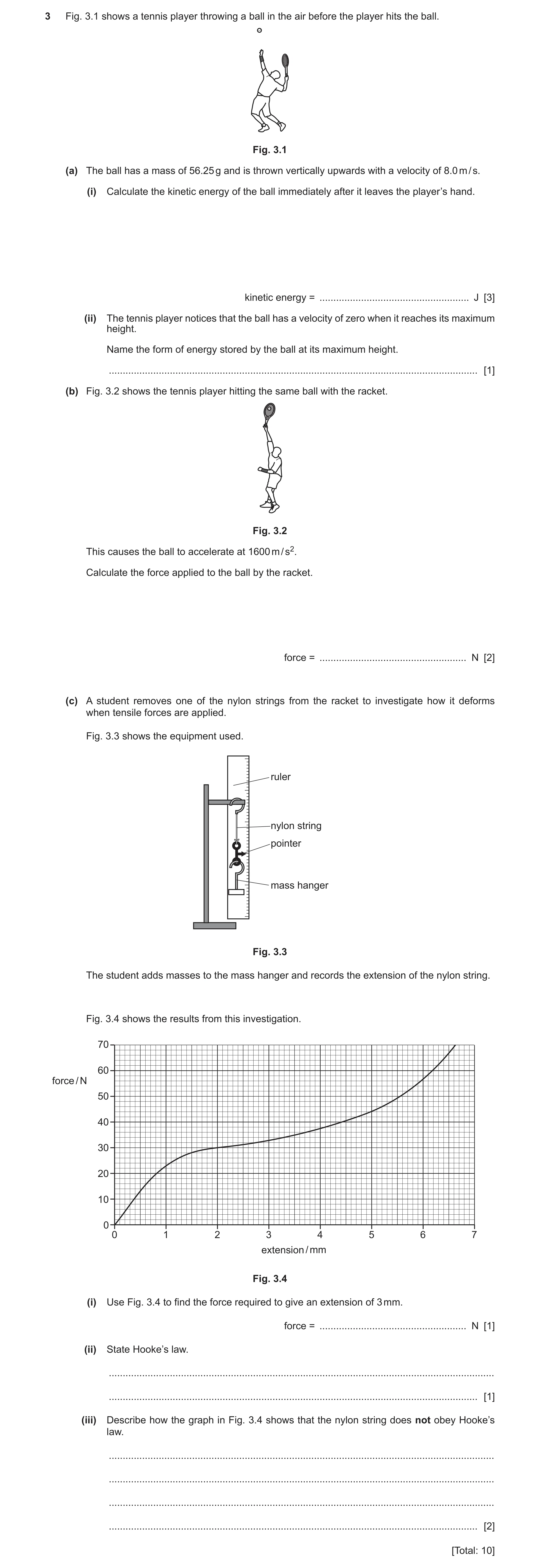
3 Fig. 3.1 shows a tennis player throwing a ball in the air before the player hits the ball. Fig. 3.1 (a) The ball has a mass of 56.25 g and is thrown vertically upwards with a velocity of 8.0 m / s. (i) Calculate the kinetic energy of the ball immediately after it leaves the player’s hand. kinetic energy = … J [3] (ii) The tennis player notices that the ball has a velocity of zero when it reaches its maximum height. Name the form of energy stored by the ball at its maximum height. … [1] (b) Fig. 3.2 shows the tennis player hitting the same ball with the racket. Fig. 3.2 This causes the ball to accelerate at 1600 m / s2. Calculate the force applied to the ball by the racket. force = … N [2] (c) A student removes one of the nylon strings from the racket to investigate how it deforms when tensile forces are applied. Fig. 3.3 shows the equipment used. ruler nylon string pointer mass hanger Fig. 3.3 The student adds masses to the mass hanger and records the extension of the nylon string. Fig. 3.4 shows the results from this investigation. 70 60 force / N 50 40 30 20 10 0 0 1 2 3 4 5 6 7 extension / mm Fig. 3.4 (i) Use Fig. 3.4 to find the force required to give an extension of 3 mm. force = … N [1] (ii) State Hooke’s law. … … [1] (iii) Describe how the graph in Fig. 3.4 shows that the nylon string does not obey Hooke’s law. … … … … [2] [Total: 10]
10 marks
Mark scheme: 3(a)(i) m = 0.05625 kg ; (KE=) ½ mv2 / 0.5 × 0.05625 × 8.02 ; 1.8 (J) ; 3 3(a)(ii) gravitational potential energy ; 1 3(b) (f =) ma / 0.05625 × 1600 ; 90 (N) ; 2 3(c)(i) 33 (N) ; 1 3(c)(ii) extension is directly proportional to the force applied ; 1 3(c)(iii) the graph is, a curve / not a straight line ; force is not directly proportional to extension ; 2
This question in 0654/42 Feb/March 2021
Q7 · A speed-time graph for a train 0654/42 Feb/March 2021
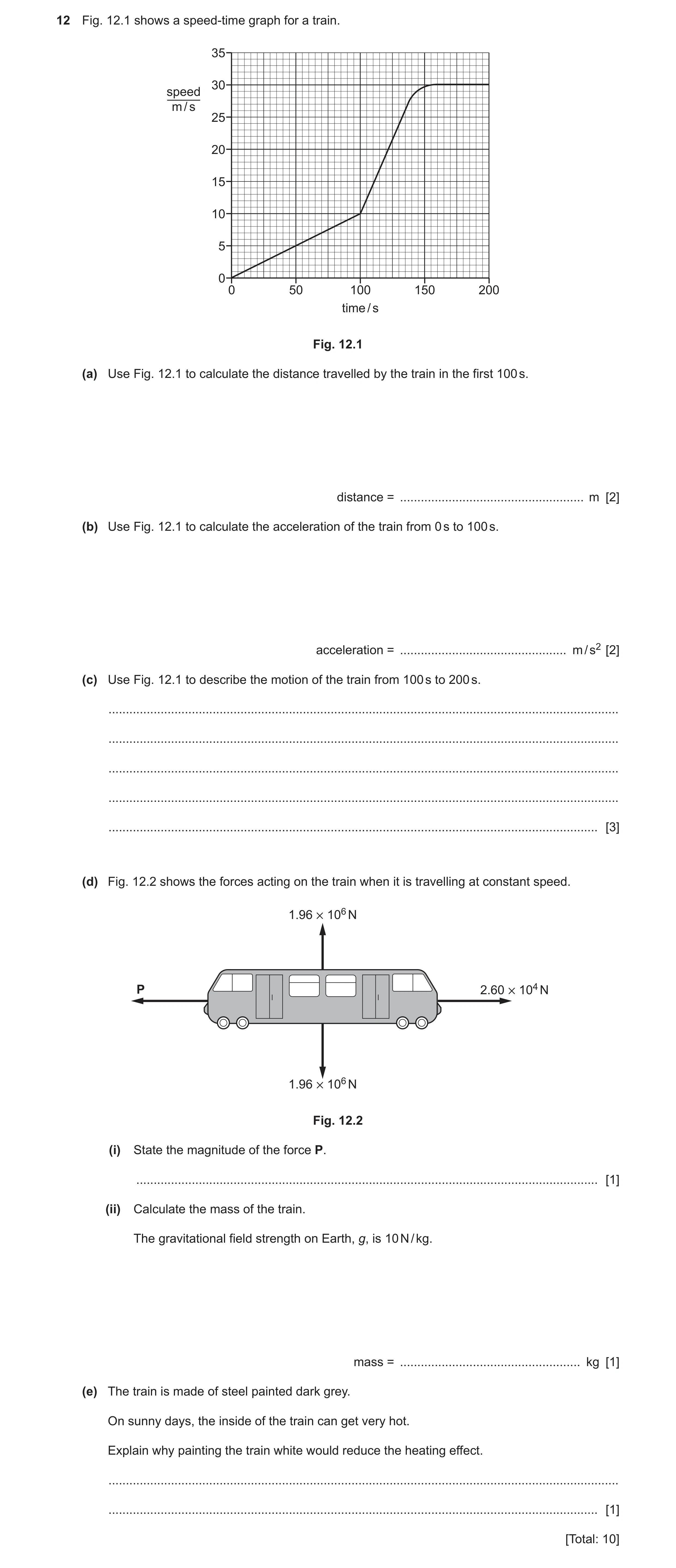
12 Fig. 12.1 shows a speed-time graph for a train. 35 30 speed m / s 25 20 15 10 5 0 0 50 100 150 200 time / s Fig. 12.1 (a) Use Fig. 12.1 to calculate the distance travelled by the train in the first 100 s. distance = … m [2] (b) Use Fig. 12.1 to calculate the acceleration of the train from 0 s to 100 s. acceleration = … m / s2 [2] (c) Use Fig. 12.1 to describe the motion of the train from 100 s to 200 s. … … … … … [3] (d) Fig. 12.2 shows the forces acting on the train when it is travelling at constant speed. 1.96 × 10⁶ N P 2.60 × 10⁴ N 1.96 × 10⁶ N Fig. 12.2 (i) State the magnitude of the force P. … [1] (ii) Calculate the mass of the train. The gravitational field strength on Earth, g, is 10 N / kg. mass = … kg [1] (e) The train is made of steel painted dark grey. On sunny days, the inside of the train can get very hot. Explain why painting the train white would reduce the heating effect. … … [1] [Total: 10]
10 marks
Mark scheme: 12(a) using area under graph ; 500 (m) ; 2 12(b) (a =) (v–u) ÷ t / 10÷100 ; 0.1 (m / s2) ; 2 12(c) constant acceleration initially ; non-uniform acceleration / rate of acceleration decreases, at 135 s ; then constant speed from 160s ; 3 12(d)(i) 2.60 × 10⁴ (N) ; 1 12(d)(ii) (m = W÷g / 1.96 × 10⁶ ÷ 10 =) 1.96 × 10⁵ (kg) ; 1 12(e) white paint absorbs less thermal / infra-red radiation or reflects more thermal / infra-red radiation ; 1
This question in 0654/42 Feb/March 2021
Q8 · The motion of a sprinter running a race 0654/41 May/June 2021
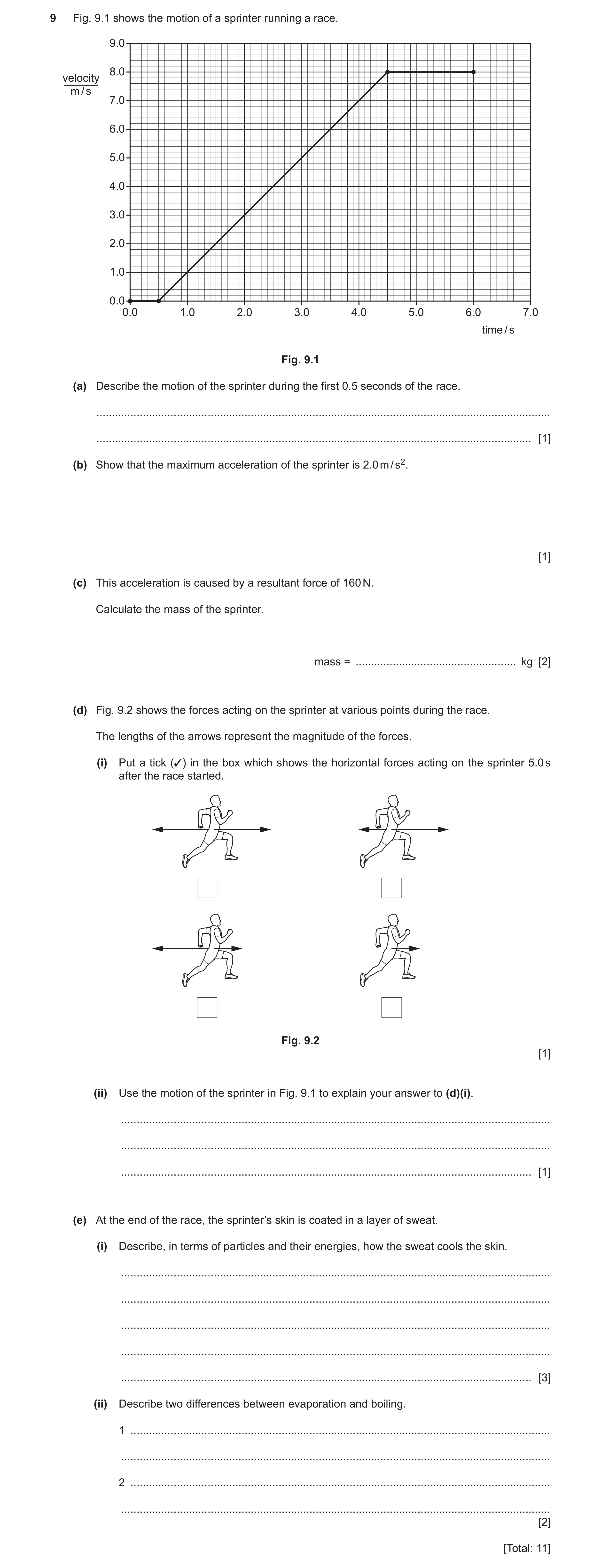
9 Fig. 9.1 shows the motion of a sprinter running a race. 9.0 8.0 velocity m / s 7.0 6.0 5.0 4.0 3.0 2.0 1.0 0.0 0.0 1.0 2.0 3.0 4.0 5.0 6.0 7.0 time / s Fig. 9.1 (a) Describe the motion of the sprinter during the first 0.5 seconds of the race. … … [1] (b) Show that the maximum acceleration of the sprinter is 2.0 m / s2. [1] (c) This acceleration is caused by a resultant force of 160 N. Calculate the mass of the sprinter. mass = … kg [2] (d) Fig. 9.2 shows the forces acting on the sprinter at various points during the race. The lengths of the arrows represent the magnitude of the forces. (i) Put a tick (3) in the box which shows the horizontal forces acting on the sprinter 5.0 s after the race started. Fig. 9.2 [1] (ii) Use the motion of the sprinter in Fig. 9.1 to explain your answer to (d)(i). … … … [1] (e) At the end of the race, the sprinter’s skin is coated in a layer of sweat. (i) Describe, in terms of particles and their energies, how the sweat cools the skin. … … … … … [3] (ii) Describe two differences between evaporation and boiling. 1 … … 2 … … [2] [Total: 11]
11 marks
Mark scheme: 9(a) stationary ; 1 9(b) (a =) 8.0 / 4.0 ; 1 9(c) (m =) F / a or 160 / 2.0 ; 80 (kg) ; 2 9(d)(i) first diagram ticked ; 1 9(d)(ii) constant velocity / no acceleration, so forces must be balanced / no resultant force ; 1 Question Answer Marks 9(e)(i) (water) evaporates ; most energetic particles leave (surface) ; average energy of the remaining particles is lower ; 3 9(e)(ii) evaporation can occur at any temperature / boiling only happens at the boiling point ; evaporation happens only at the surface / boiling happens throughout the liquid ; boiling takes energy in (endothermic) to occur / evaporation lets only the molecules with the highest kinetic energy out ; evaporation can occur using the internal energy of the system / boiling requires an external source of heat ; evaporation produces cooling / boiling does not ; evaporation is a slow process / boiling is a rapid process ; max 2 2 4
This question in 0654/41 May/June 2021
Question 9 0654/42 May/June 2021
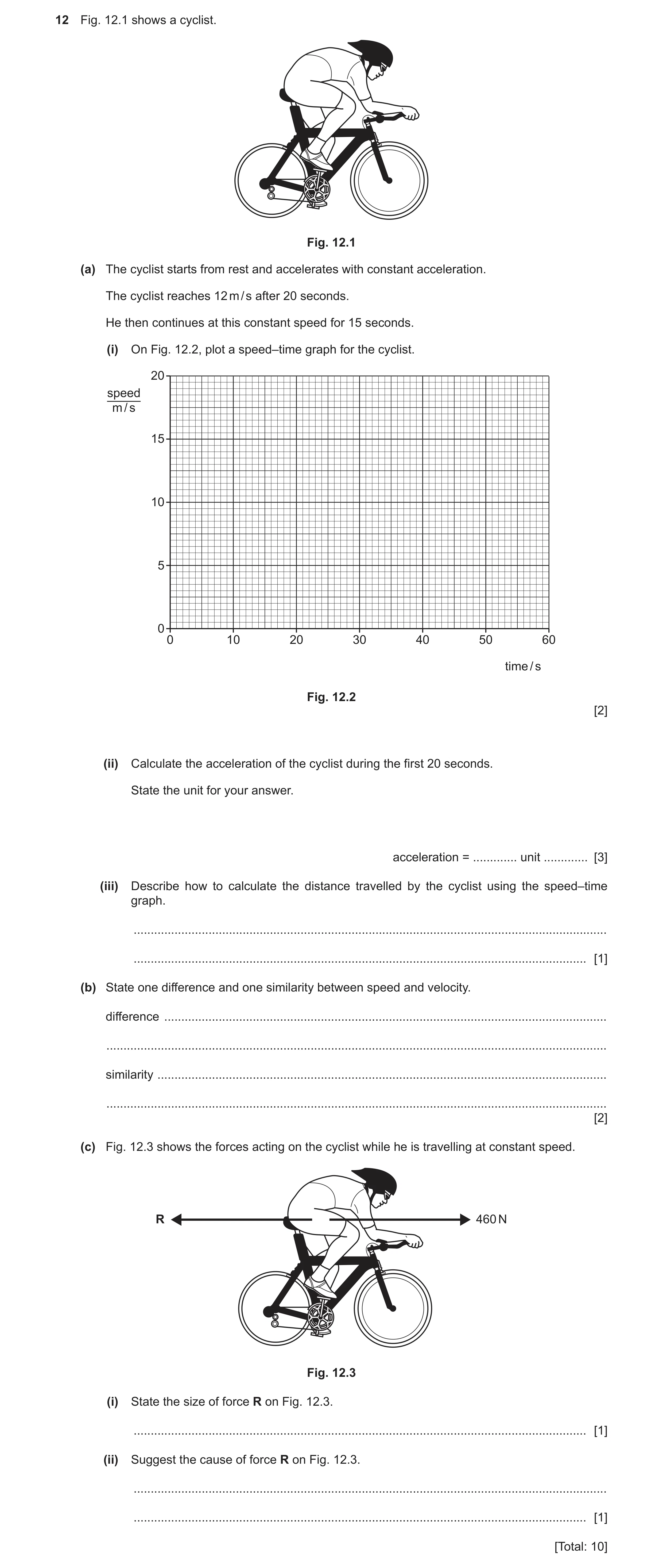
12 Fig. 12.1 shows a cyclist. Fig. 12.1 (a) The cyclist starts from rest and accelerates with constant acceleration. The cyclist reaches 12 m / s after 20 seconds. He then continues at this constant speed for 15 seconds. (i) On Fig. 12.2, plot a speed–time graph for the cyclist. 20 speed m / s 15 10 5 0 0 10 20 30 40 50 60 time / s Fig. 12.2 [2] (ii) Calculate the acceleration of the cyclist during the first 20 seconds. State the unit for your answer. acceleration = … unit … [3] (iii) Describe how to calculate the distance travelled by the cyclist using the speed–time graph. … … [1] (b) State one difference and one similarity between speed and velocity. difference … … similarity … … [2] (c) Fig. 12.3 shows the forces acting on the cyclist while he is travelling at constant speed. R 460 N Fig. 12.3 (i) State the size of force R on Fig. 12.3. … [1] (ii) Suggest the cause of force R on Fig. 12.3. … … [1] [Total: 10]
10 marks
Mark scheme: 12(a)(i) ;; 2 Question Answer Marks 12(a)(ii) (a =) Δv / t / 12 / 20 ; 0.6 ; m / s2 ; 3 12(a)(iii) area under the graph ; 1 12(b) velocity has a direction ORA ; both measure, rate of change of distance or displacement / same units ; 2 12(c)(i) 460 (N) ; 1 12(c)(ii) air resistance / friction / drag ; 1
This question in 0654/42 May/June 2021
Q10 · Some students are investigating moments and turning effects 0654/41 Oct/Nov 2021
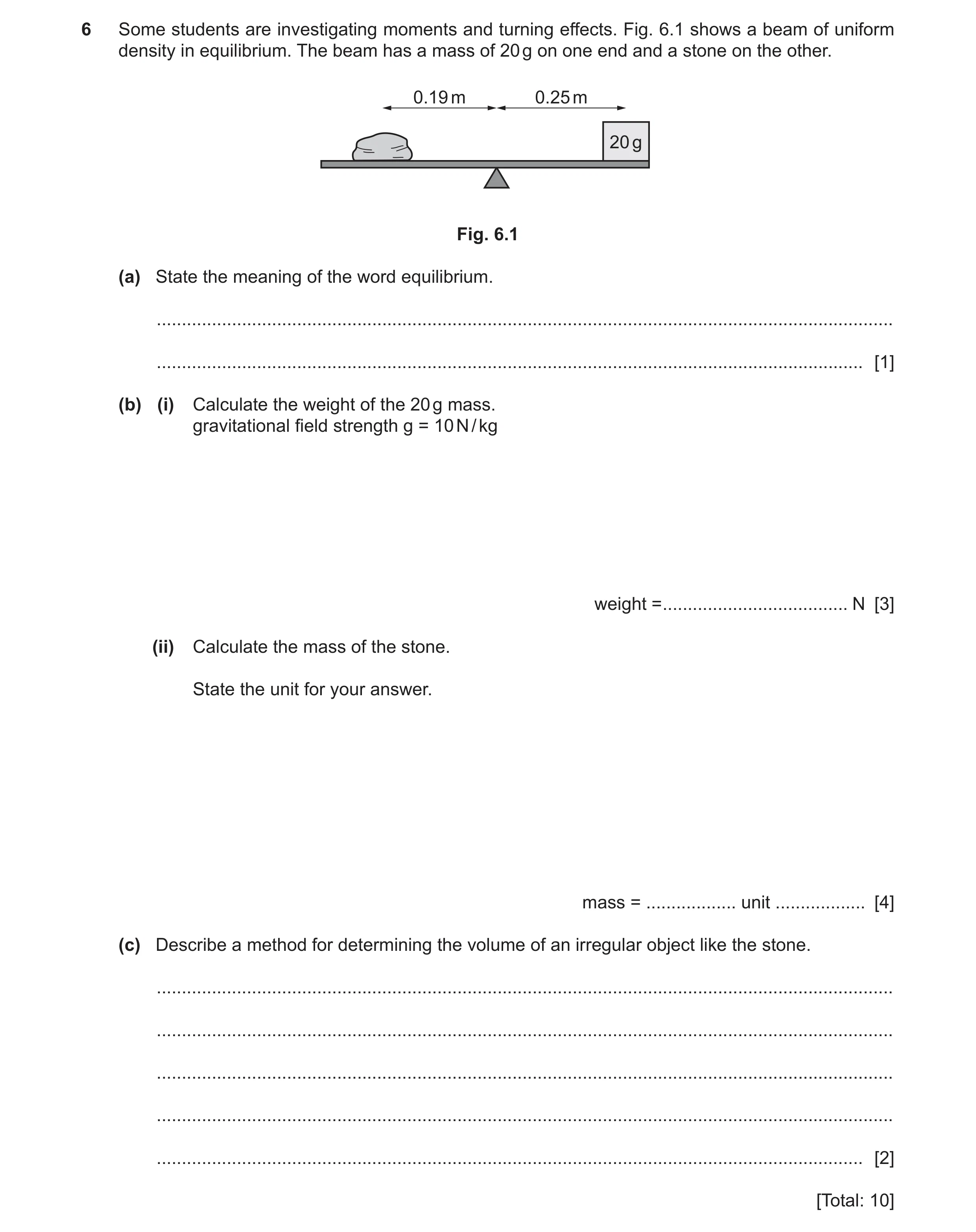
6 Some students are investigating moments and turning effects. Fig. 6.1 shows a beam of uniform density in equilibrium. The beam has a mass of 20 g on one end and a stone on the other. 0.19 m 0.25 m 20 g Fig. 6.1 (a) State the meaning of the word equilibrium. … … [1] (b) (i) Calculate the weight of the 20 g mass. gravitational field strength g = 10 N / kg weight = … N [3] (ii) Calculate the mass of the stone. State the unit for your answer. mass = … unit … [4] (c) Describe a method for determining the volume of an irregular object like the stone. … … … … … [2] [Total: 10]
10 marks
Mark scheme: 6(a) no resultant force and no resultant turning effect ; 1 6(b)(i) 0.02 or 20 × 10–3 (kg) ; (W =) mg or 0.02 × 10 ; 0.2 (N) ; 3 6(b)(ii) clockwise moment = force × distance or 0.2 × 0.25 or 0.05 ; anti-clockwise moment = clockwise moment ; F = 0.05 ÷ 0.19 or 0.263 / m = 0.263 ÷ 10 or 0.026 (kg) or 26 (g) ; g / kg ; 4 6(c) immerse in water ; measure volume of displaced water ; 2
This question in 0654/41 Oct/Nov 2021
Q11 · A student investigates the spring constant of three springs, A, B, and C, using Hooke’s… 0654/42 Feb/March 2022
9 A student investigates the spring constant of three springs, A, B, and C, using Hooke’s law and the equipment shown in Fig. 9.1. The student: • measures the unloaded lengths of each spring • hangs identical masses from each spring and measures the extended lengths. spring spring spring A B C Fig. 9.1 (a) Table 9.1 shows the results. Table 9.1 unloaded length / cm extended length / cm spring A 2.2 3.4 spring B 4.0 4.3 spring C 1.8 2.6 (i) Spring A has a spring constant of 0.50 N / cm. Calculate the weight of the mass hanging from spring A. weight = … N [3] (ii) In the investigation, the student hangs identical masses from each spring. State and explain which of the three springs has the largest spring constant. spring … explanation … … … [2] (b) The springs are all made of metals and conduct electricity. The student sets up a circuit to determine the electrical resistance of one of the springs. Fig. 9.2 shows the circuit used. The ammeter reads 0.75 A and the voltmeter reads 7.5 V. 9 V A 10 Ω spring V Fig. 9.2 (i) Calculate the resistance of the metal spring. resistance = … Ω [3] (ii) The spring acts like a solenoid when there is a current in it. Draw on Fig. 9.3 to show the shape, and direction, of the magnetic field due to the current in the solenoid. direction of current Fig. 9.3 [2] [Total: 10]
10 marks
Mark scheme: 9(a)(i) extension = 3.4 – 2.2 = 1.2 (cm) ; (F = ) kx or 0.50 × 1.2 ; (F = ) 0.6 N ; 9(a)(ii) B and smallest extension ; extension is inversely proportional to spring constant ; 2 Question Answer Marks 9(b)(i) pd across spring = 9 – 7.5 = 1.5 (V) ; (R =) V / I or 1.5 / 0.75 ; (R =) 2 (Ω) ; OR combined resistance = V / I or 9 / 0.75 or 12 Ω; resistance of spring = combined resistance – 10 Ω; resistance of spring = 2 (Ω) ; 3 9(b)(ii) correct shape ; correct direction ; 2
This question in 0654/42 Feb/March 2022
Q12 · A 35 kg child sliding down a long wire called a zipline 0654/42 May/June 2022
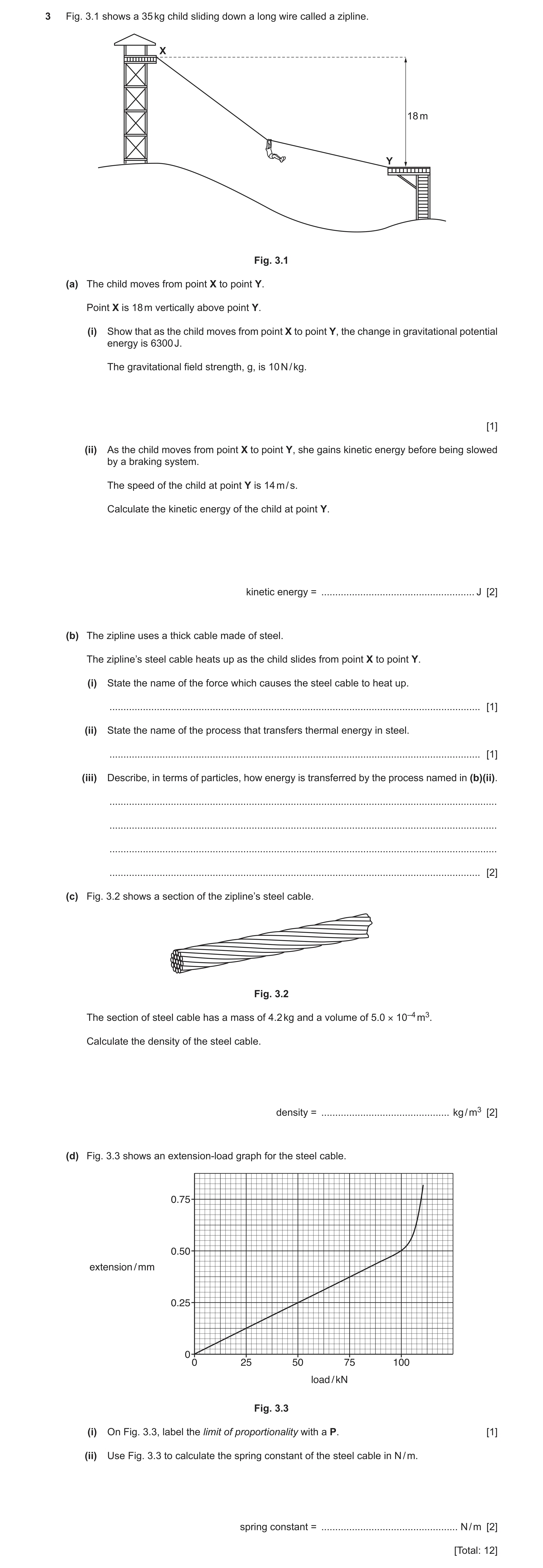
3 Fig. 3.1 shows a 35 kg child sliding down a long wire called a zipline. X 18 m Y Fig. 3.1 (a) The child moves from point X to point Y. Point X is 18 m vertically above point Y. (i) Show that as the child moves from point X to point Y, the change in gravitational potential energy is 6300 J. The gravitational field strength, g, is 10 N / kg. [1] (ii) As the child moves from point X to point Y, she gains kinetic energy before being slowed by a braking system. The speed of the child at point Y is 14 m / s. Calculate the kinetic energy of the child at point Y. kinetic energy = … J [2] (b) The zipline uses a thick cable made of steel. The zipline’s steel cable heats up as the child slides from point X to point Y. (i) State the name of the force which causes the steel cable to heat up. … [1] (ii) State the name of the process that transfers thermal energy in steel. … [1] (iii) Describe, in terms of particles, how energy is transferred by the process named in (b)(ii). … … … … [2] (c) Fig. 3.2 shows a section of the zipline’s steel cable. Fig. 3.2 The section of steel cable has a mass of 4.2 kg and a volume of 5.0 × 10⁻⁴ m3. Calculate the density of the steel cable. density = … kg / m3 [2] (d) Fig. 3.3 shows an extension‑load graph for the steel cable. 0.75 0.50 extension / mm 0.25 0 0 25 50 75 100 load / kN Fig. 3.3 (i) On Fig. 3.3, label the limit of proportionality with a P. [1] (ii) Use Fig. 3.3 to calculate the spring constant of the steel cable in N / m. spring constant = … N / m [2] [Total: 12]
12 marks
Mark scheme: 3(a)(i) 1 3(a)(ii) (KE =) ½ mv2 or ½ 35 142 ; 3430 (J) ; 2 3(b)(i) friction ; 1 3(b)(ii) conduction ; 1 3(b)(iii) idea of vibrations / oscillations, from particle to particle ; transferred by electrons ; 2 3(c) ( =) m / V or 4.2 / 5.0 10–4 ; 8400 (kg / m3) ; 2 3(d)(i) P at 100,0.5 ; 1 3(d)(ii) (k =) F / x or 100 000 / 0.0005 ; 200 000 000 (N / m) ; 2
This question in 0654/42 May/June 2022
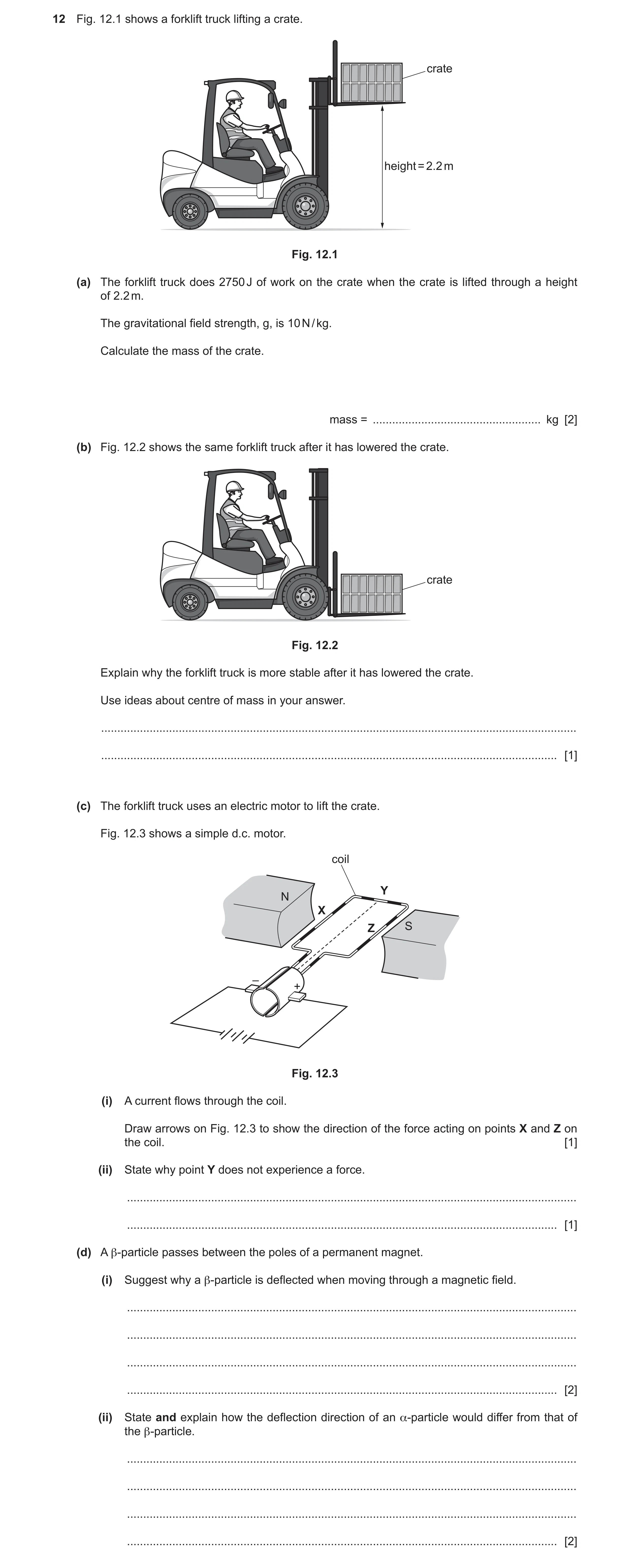
Q13 · A forklift truck lifting a crate 0654/43 May/June 2022
12 Fig. 12.1 shows a forklift truck lifting a crate. crate height = 2.2 m Fig. 12.1 (a) The forklift truck does 2750 J of work on the crate when the crate is lifted through a height of 2.2 m. The gravitational field strength, g, is 10 N / kg. Calculate the mass of the crate. mass = … kg [2] (b) Fig. 12.2 shows the same forklift truck after it has lowered the crate. crate Fig. 12.2 Explain why the forklift truck is more stable after it has lowered the crate. Use ideas about centre of mass in your answer. … … [1] (c) The forklift truck uses an electric motor to lift the crate. Fig. 12.3 shows a simple d.c. motor. coil Y N X Z S – + Fig. 12.3 (i) A current flows through the coil. Draw arrows on Fig. 12.3 to show the direction of the force acting on points X and Z on the coil. [1] (ii) State why point Y does not experience a force. … … [1] (d) A β-particle passes between the poles of a permanent magnet. (i) Suggest why a β-particle is deflected when moving through a magnetic field. … … … … [2] (ii) State and explain how the deflection direction of an α-particle would differ from that of the β-particle. … … … … [2]
9 marks
Mark scheme: 12(a) (m =) W / gh OR 2750 10 2.2 ; 125 (kg) ; 2 12(b) lower centre of mass ; 1 12(c)(i) X arrow pointing up AND Z arrow pointing down ; 1 12(c)(ii) the current is parallel to the magnetic field ; 1 12(d)(i) experiences a force ; it is a charged particle ; 2 Question Answer Marks 12(d)(ii) opposite direction ; because the charge is opposite / is positive and is negative ; OR less deflection ; due to (much) larger mass ; max 2 2
This question in 0654/43 May/June 2022
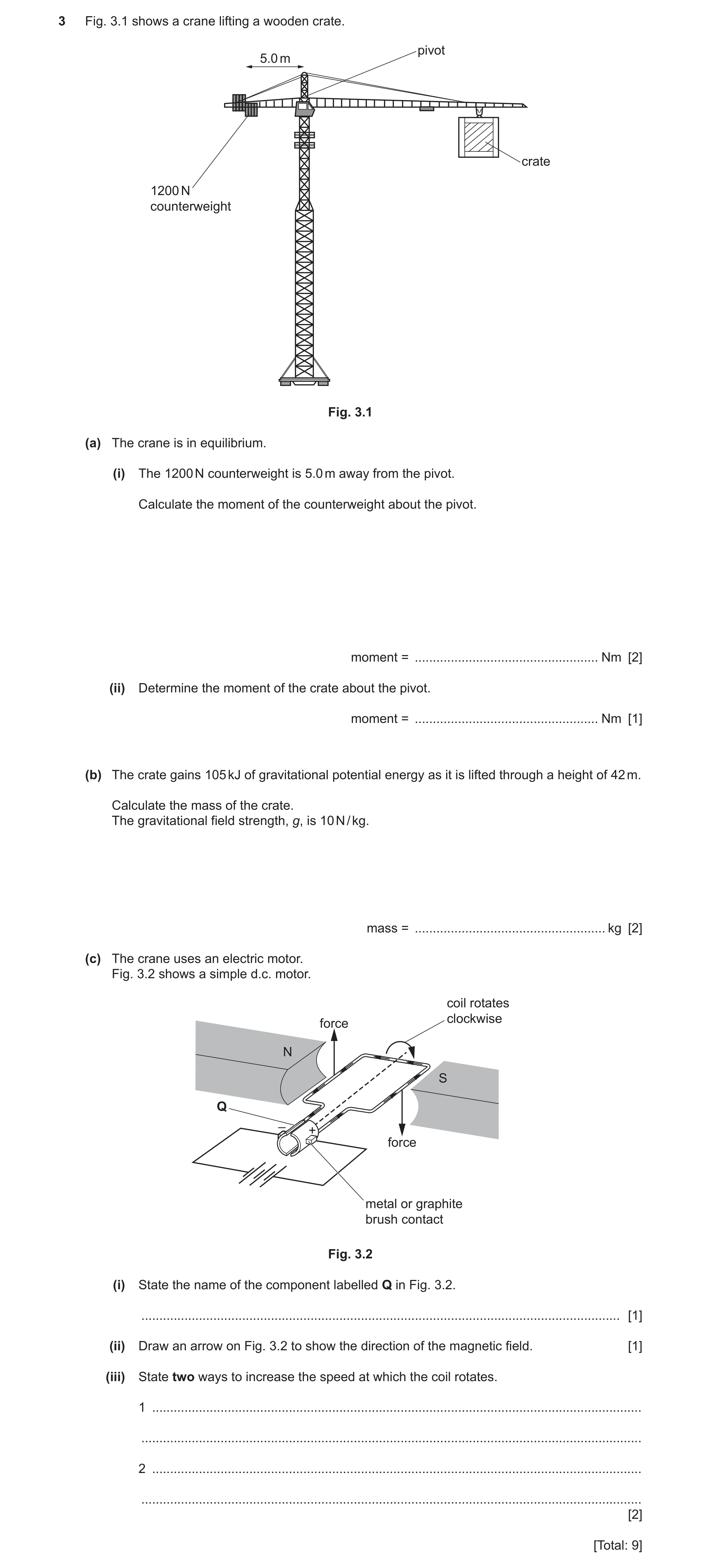
Q14 · A crane lifting a wooden crate 0654/41 Oct/Nov 2022
3 Fig. 3.1 shows a crane lifting a wooden crate. pivot 5.0 m crate 1200 N counterweight Fig. 3.1 (a) The crane is in equilibrium. (i) The 1200 N counterweight is 5.0 m away from the pivot. Calculate the moment of the counterweight about the pivot. moment = … Nm [2] (ii) Determine the moment of the crate about the pivot. moment = … Nm [1] (b) The crate gains 105 kJ of gravitational potential energy as it is lifted through a height of 42 m. Calculate the mass of the crate. The gravitational field strength, g, is 10 N / kg. mass = … kg [2] (c) The crane uses an electric motor. Fig. 3.2 shows a simple d.c. motor. coil rotates clockwise force N S Q _ + force metal or graphite brush contact Fig. 3.2 (i) State the name of the component labelled Q in Fig. 3.2. … [1] (ii) Draw an arrow on Fig. 3.2 to show the direction of the magnetic field. [1] (iii) State two ways to increase the speed at which the coil rotates. 1 … … 2 … … [2] [Total: 9]
9 marks
Mark scheme: 3(a)(i) (M =) F d OR 1200 5 ; 2 (M =) 6000 (Nm) ; 3(a)(ii) 6000 ; 1 3(b) (m =) GPE / (gh) or 105000/(42 10) or 105000 / 420 ; 2 (m =) 250 (kg) ; 3(c)(i) split–ring commutator ; 1 3(c)(ii) arrow drawn N to S ; 1 3(c)(iii) any two from: 2 increase the current ; increase magnetic field strength ; increase number of turns on the coil ;
This question in 0654/41 Oct/Nov 2022
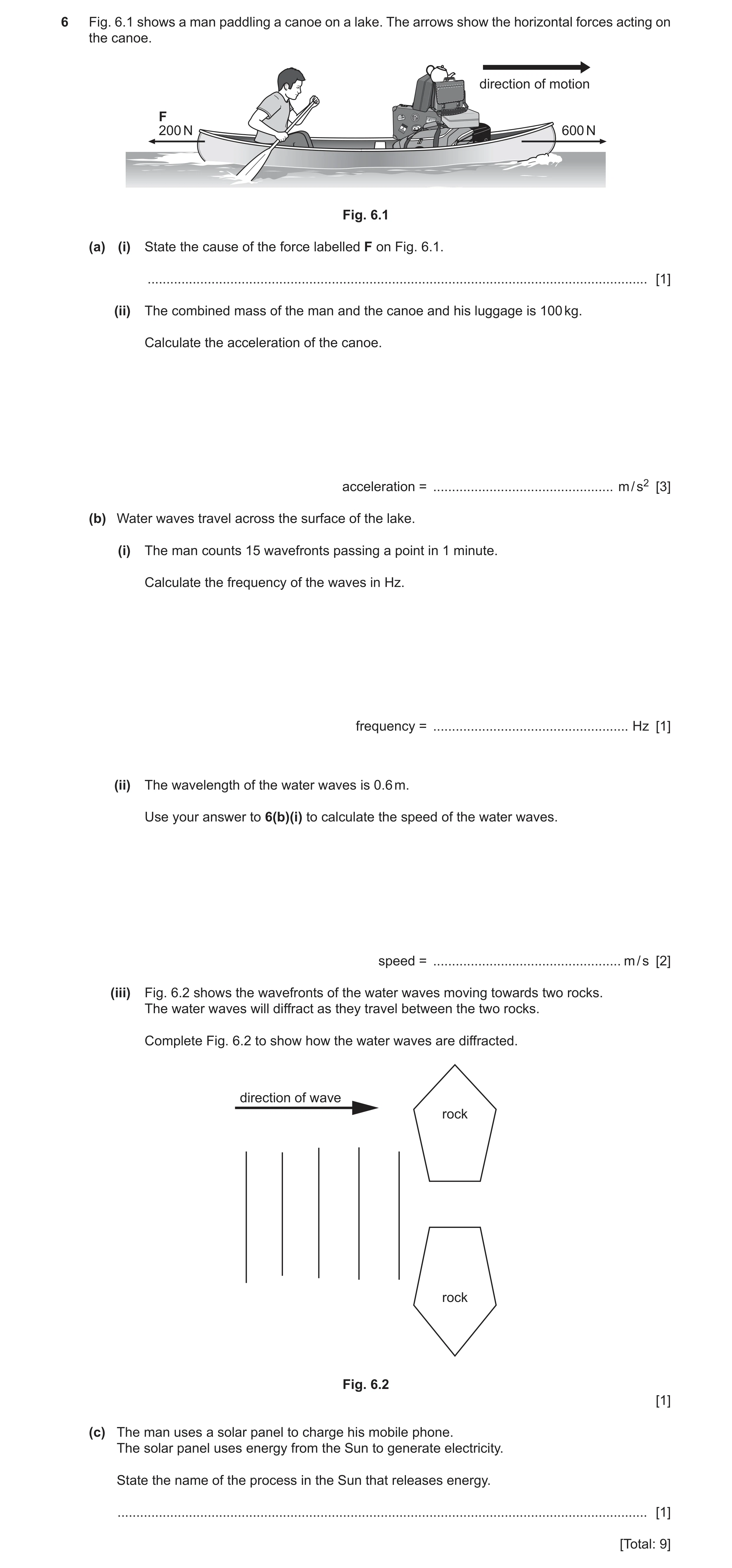
Q15 · A man paddling a canoe on a lake 0654/41 Oct/Nov 2022
6 Fig. 6.1 shows a man paddling a canoe on a lake. The arrows show the horizontal forces acting on the canoe. direction of motion F 200 N 600 N Fig. 6.1 (a) (i) State the cause of the force labelled F on Fig. 6.1. … [1] (ii) The combined mass of the man and the canoe and his luggage is 100 kg. Calculate the acceleration of the canoe. acceleration = … m / s2 [3] (b) Water waves travel across the surface of the lake. (i) The man counts 15 wavefronts passing a point in 1 minute. Calculate the frequency of the waves in Hz. frequency = … Hz [1] (ii) The wavelength of the water waves is 0.6 m. Use your answer to 6(b)(i) to calculate the speed of the water waves. speed = … m / s [2] (iii) Fig. 6.2 shows the wavefronts of the water waves moving towards two rocks. The water waves will diffract as they travel between the two rocks. Complete Fig. 6.2 to show how the water waves are diffracted. direction of wave rock rock Fig. 6.2 [1] (c) The man uses a solar panel to charge his mobile phone. The solar panel uses energy from the Sun to generate electricity. State the name of the process in the Sun that releases energy. … [1] [Total: 9]
9 marks
Mark scheme: 6(a)(i) friction / drag / air resistance / water resistance ; 1 6(a)(ii) resultant force = 400 N ; 3 (a =) F / m or 400 / 100 ; (a =) 4 (m / s2) ; 6(b)(i) 0.25 (Hz) ; 1 6(b)(ii) (v =) f / 0.25 0.6 ; 2 (v =) 0.15 (m / s) ; 6(b)(iii) circular wavefronts drawn in correct position, spreading out ; 1 6(c) (nuclear) fusion ; 1
This question in 0654/41 Oct/Nov 2022
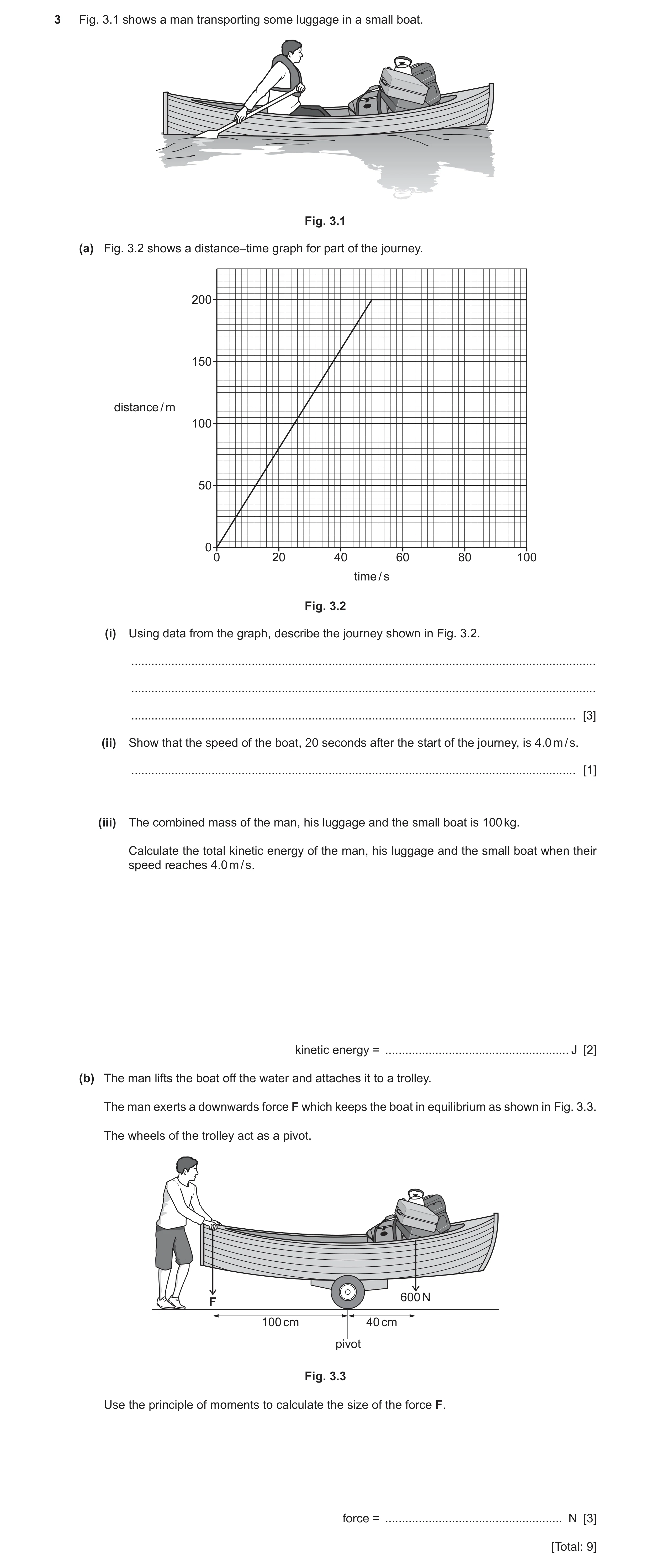
Q16 · A man transporting some luggage in a small boat 0654/42 Oct/Nov 2022
3 Fig. 3.1 shows a man transporting some luggage in a small boat. Fig. 3.1 (a) Fig. 3.2 shows a distance–time graph for part of the journey. 200 150 distance / m 100 50 0 0 20 40 60 80 100 time / s Fig. 3.2 (i) Using data from the graph, describe the journey shown in Fig. 3.2. … … … [3] (ii) Show that the speed of the boat, 20 seconds after the start of the journey, is 4.0 m / s. … [1] (iii) The combined mass of the man, his luggage and the small boat is 100 kg. Calculate the total kinetic energy of the man, his luggage and the small boat when their speed reaches 4.0 m / s. kinetic energy = … J [2] (b) The man lifts the boat off the water and attaches it to a trolley. The man exerts a downwards force F which keeps the boat in equilibrium as shown in Fig. 3.3. The wheels of the trolley act as a pivot. 600 N F 100 cm 40 cm pivot Fig. 3.3 Use the principle of moments to calculate the size of the force F. force = … N [3] [Total: 9]
9 marks
Mark scheme: 3(a)(i) constant speed ; 3 stationary ; use of data to identify change at 50 s or 200 m ; 3(a)(ii) (v =) 200 / 50 or 80 / 20 = (4 m / s) ; 1 3(a)(iii) (KE =) ½ mv2 or ½ 100 42 ; 2 (KE =) 800 (J) ; 3(b) (M =) f d or 600 40 or 24000 (Ncm) ; 3 (F =) 24000 / 100 ; (F =) 240 (N) ;
This question in 0654/42 Oct/Nov 2022
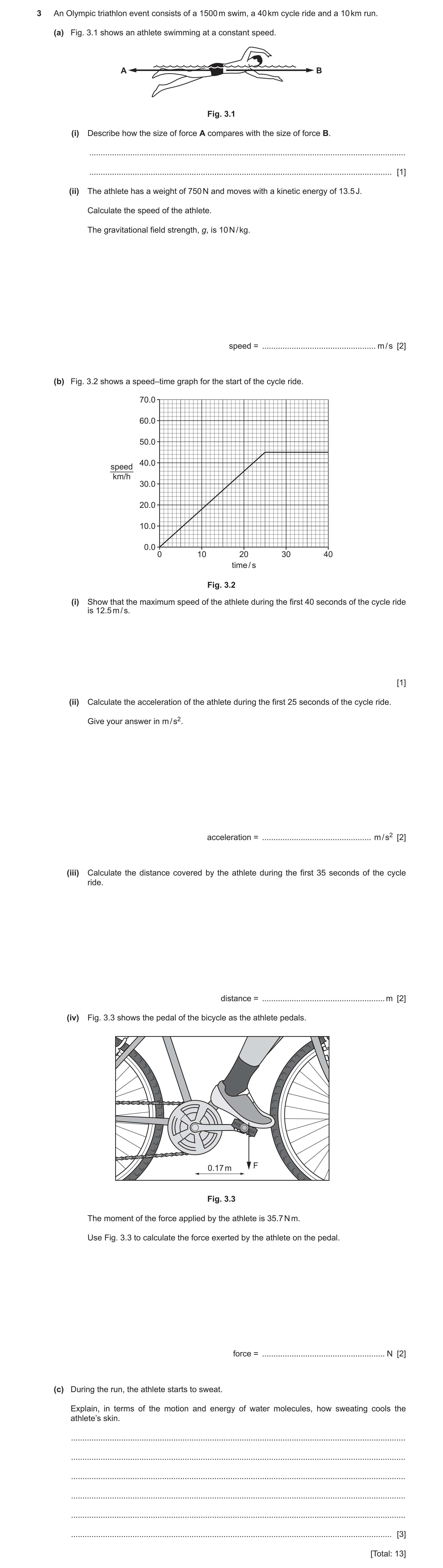
Q17 · An Olympic triathlon event consists of a 1500 m swim, a 40 km cycle ride and a 10 km run 0654/41 May/June 2023
3 An Olympic triathlon event consists of a 1500 m swim, a 40 km cycle ride and a 10 km run. (a) Fig. 3.1 shows an athlete swimming at a constant speed. A B Fig. 3.1 (i) Describe how the size of force A compares with the size of force B. … … [1] (ii) The athlete has a weight of 750 N and moves with a kinetic energy of 13.5 J. Calculate the speed of the athlete. The gravitational field strength, g, is 10 N / kg. speed = … m / s [2] (b) Fig. 3.2 shows a speed–time graph for the start of the cycle ride. 70.0 60.0 50.0 40.0 speed km/h 30.0 20.0 10.0 0.0 0 10 20 30 40 time / s Fig. 3.2 (i) Show that the maximum speed of the athlete during the first 40 seconds of the cycle ride is 12.5 m / s. [1] (ii) Calculate the acceleration of the athlete during the first 25 seconds of the cycle ride. Give your answer in m / s2. acceleration = … m / s2 [2] (iii) Calculate the distance covered by the athlete during the first 35 seconds of the cycle ride. distance = … m [2] (iv) Fig. 3.3 shows the pedal of the bicycle as the athlete pedals. F 0.17 m Fig. 3.3 The moment of the force applied by the athlete is 35.7 N m. Use Fig. 3.3 to calculate the force exerted by the athlete on the pedal. force = … N [2] (c) During the run, the athlete starts to sweat. Explain, in terms of the motion and energy of water molecules, how sweating cools the athlete’s skin. … … … … … … [3] [Total: 13]
13 marks
Mark scheme: 3(a)(i) (the forces are) the same size / equal ; 1 3(a)(ii) (mass =) 750 / 10 / 75 (kg) AND (speed = ) √ (2 13.5) / 75 ; (speed = ) 0.6 (m / s) ; 2 3(b)(i) 45000 / 3600 (=12.5 m / s) ; 1 3(b)(ii) (a = ) v / t / 12.5 / 25 ; (a = ) 0.5 (m / s2) ; 2 3(b)(iii) (0.5 25 12.5) + (12.5 10) ; 281.25 (m) ; 2 3(b)(iv) (force = ) moment / distance / 35.7 / 0.17 ; (force = ) 210 (N) ; 2 3(c) (thermal) energy is transferred (from skin / blood / capillaries) to water molecules (on skin surface) ; the most energetic molecules escape / evaporates from the surface ; average energy of remaining molecules decreases ; 3
This question in 0654/41 May/June 2023
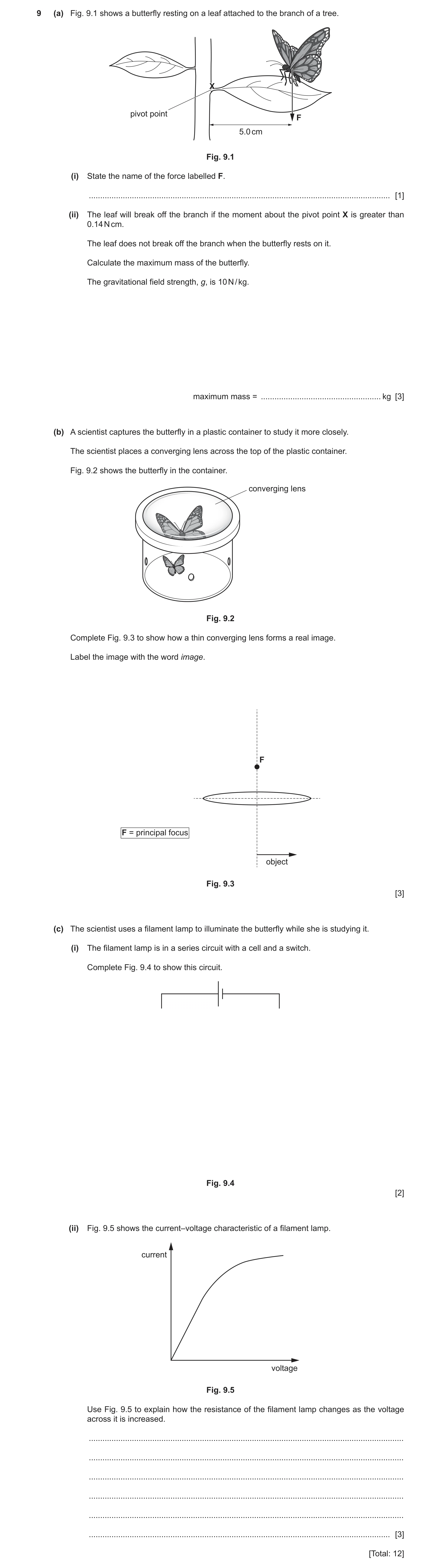
Q18 · A butterfly resting on a leaf attached to the branch of a tree 0654/43 May/June 2023
9 (a) Fig. 9.1 shows a butterfly resting on a leaf attached to the branch of a tree. X pivot point F 5.0 cm Fig. 9.1 (i) State the name of the force labelled F. … [1] (ii) The leaf will break off the branch if the moment about the pivot point X is greater than 0.14 N cm. The leaf does not break off the branch when the butterfly rests on it. Calculate the maximum mass of the butterfly. The gravitational field strength, g, is 10 N / kg. maximum mass = … kg [3] (b) A scientist captures the butterfly in a plastic container to study it more closely. The scientist places a converging lens across the top of the plastic container. Fig. 9.2 shows the butterfly in the container. converging lens Fig. 9.2 Complete Fig. 9.3 to show how a thin converging lens forms a real image. Label the image with the word image. F F = principal focus object Fig. 9.3 [3] (c) The scientist uses a filament lamp to illuminate the butterfly while she is studying it. (i) The filament lamp is in a series circuit with a cell and a switch. Complete Fig. 9.4 to show this circuit. Fig. 9.4 [2] (ii) Fig. 9.5 shows the current–voltage characteristic of a filament lamp. current voltage Fig. 9.5 Use Fig. 9.5 to explain how the resistance of the filament lamp changes as the voltage across it is increased. … … … … … … [3] [Total: 12]
12 marks
Mark scheme: 9(a)(i) weight ; 1 9(a)(ii) (weight =) moment / distance / 0.14 / 5.0 ; (weight =) 0.028 (N) ; (mass = W/g = 0.028 / 10 =) 0.0028 (kg) ; 3 9(b) first ray drawn ; second ray drawn ; image drawn and labelled ; 3 9(c)(i) correct symbols ; in series and all else correct ; 2 9(c)(ii) any three from: (as voltage increases) current increases ; (initially) straight line / gradient is constant, so resistance is constant ; (then) line curves / gradient reduces, so resistance increases ; (resistance increases because) the temperature (of the filament) increases ; 3
This question in 0654/43 May/June 2023
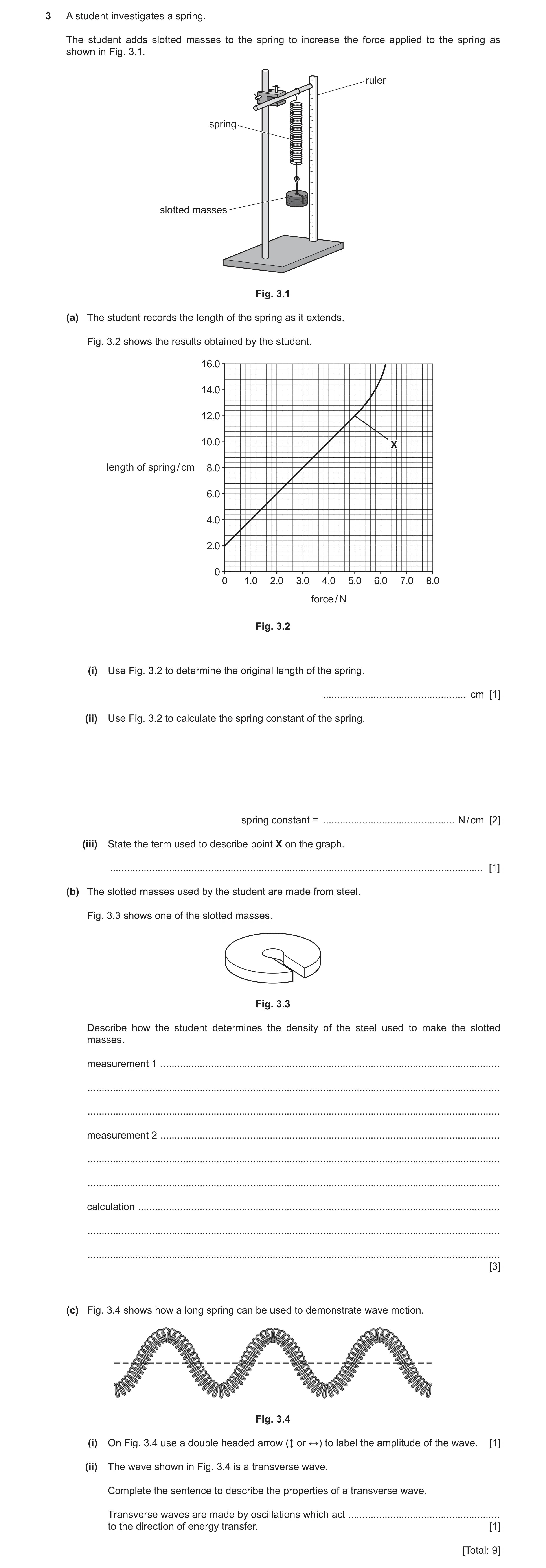
Q19 · A student investigates a spring 0654/42 Feb/March 2024
3 A student investigates a spring. The student adds slotted masses to the spring to increase the force applied to the spring as shown in Fig. 3.1. ruler spring slotted masses Fig. 3.1 (a) The student records the length of the spring as it extends. Fig. 3.2 shows the results obtained by the student. 16.0 14.0 12.0 10.0 X length of spring / cm 8.0 6.0 4.0 2.0 0 0 1.0 2.0 3.0 4.0 5.0 6.0 7.0 8.0 force / N Fig. 3.2 (i) Use Fig. 3.2 to determine the original length of the spring. … cm [1] (ii) Use Fig. 3.2 to calculate the spring constant of the spring. spring constant = … N / cm [2] (iii) State the term used to describe point X on the graph. … [1] (b) The slotted masses used by the student are made from steel. Fig. 3.3 shows one of the slotted masses. Fig. 3.3 Describe how the student determines the density of the steel used to make the slotted masses. measurement 1 … … … measurement 2 … … … calculation … … … [3] (c) Fig. 3.4 shows how a long spring can be used to demonstrate wave motion. Fig. 3.4 (i) On Fig. 3.4 use a double headed arrow (↕ or ↔) to label the amplitude of the wave. [1] (ii) The wave shown in Fig. 3.4 is a transverse wave. Complete the sentence to describe the properties of a transverse wave. Transverse waves are made by oscillations which act … to the direction of energy transfer. [1] [Total: 9]
9 marks
Mark scheme: 3(a)(i) 2.0 (cm) ; 1 3(a)(ii) use of data from graph OR use of F = k x OR 5.0 / 10 ; 2 (k=) 0.5 (N / cm) ; 3(a)(iii) limit of proportionality ; 1 3(b) volume using displacement method / eureka can ; 3 mass using, balance / scales ; density = mass / volume ; 3(c)(i) amplitude labelled from peak or trough to equilibrium position ; 1 3(c)(ii) perpendicular / at right angles / 90° ; 1
This question in 0654/42 Feb/March 2024
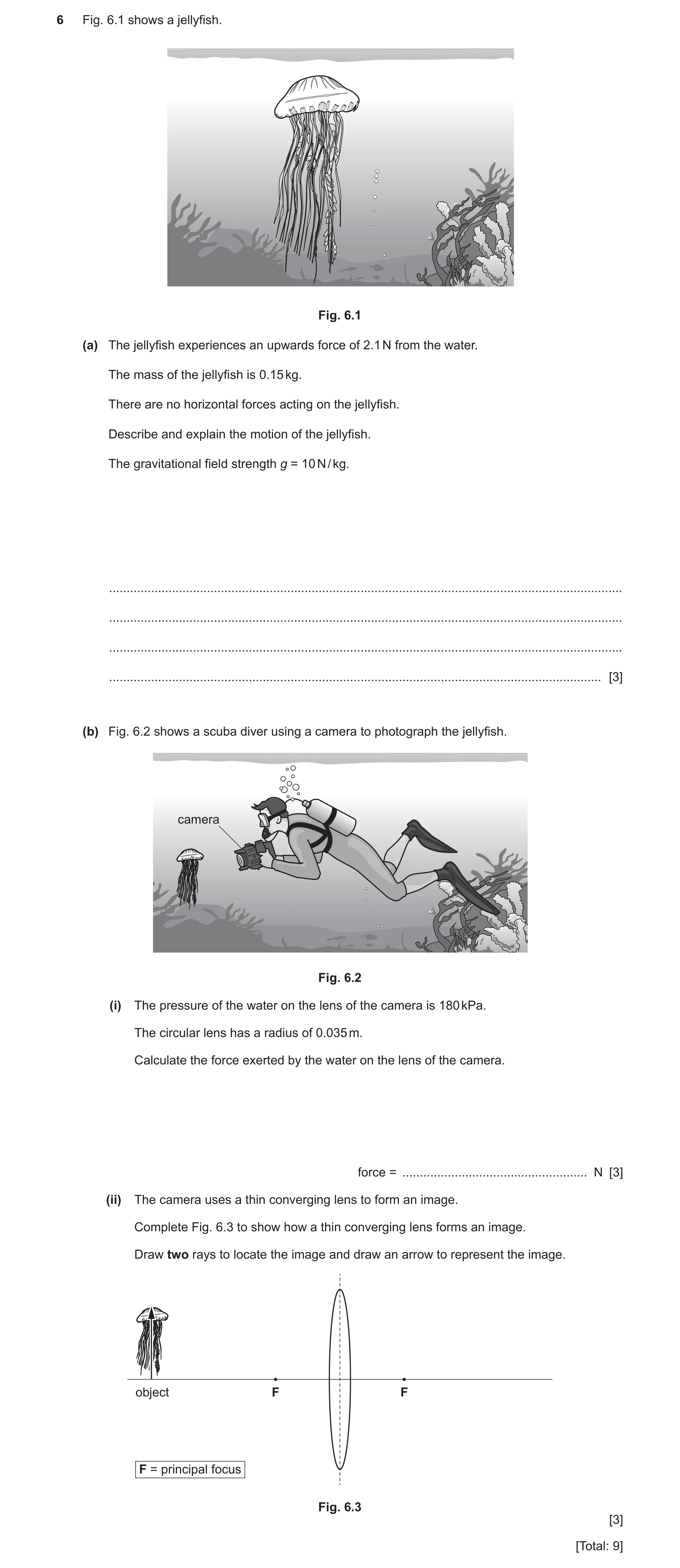
Question 20 0654/43 May/June 2024
6 Fig. 6.1 shows a jellyfish. Fig. 6.1 (a) The jellyfish experiences an upwards force of 2.1 N from the water. The mass of the jellyfish is 0.15 kg. There are no horizontal forces acting on the jellyfish. Describe and explain the motion of the jellyfish. The gravitational field strength g = 10 N / kg. … … … … [3] (b) Fig. 6.2 shows a scuba diver using a camera to photograph the jellyfish. camera Fig. 6.2 (i) The pressure of the water on the lens of the camera is 180 kPa. The circular lens has a radius of 0.035 m. Calculate the force exerted by the water on the lens of the camera. force = … N [3] (ii) The camera uses a thin converging lens to form an image. Complete Fig. 6.3 to show how a thin converging lens forms an image. Draw two rays to locate the image and draw an arrow to represent the image. object F F F = principal focus Fig. 6.3 [3] [Total: 9]
9 marks
Mark scheme: 6(a) weight = 1.5(N) OR resultant force = 0.6(N) ; upwards resultant force / 0.6 N upwards force ; accelerates upwards ; 3 6(b)(i) area = 0.0352 / 3.848 10–3 ; force = P A / 180000 area / 180000 3.848 10–3; = 690 (N) ; 3 Question Answer Marks 6(b)(ii) one correct ray drawn ; second correct ray drawn ; image correctly drawn ; 3
This question in 0654/43 May/June 2024
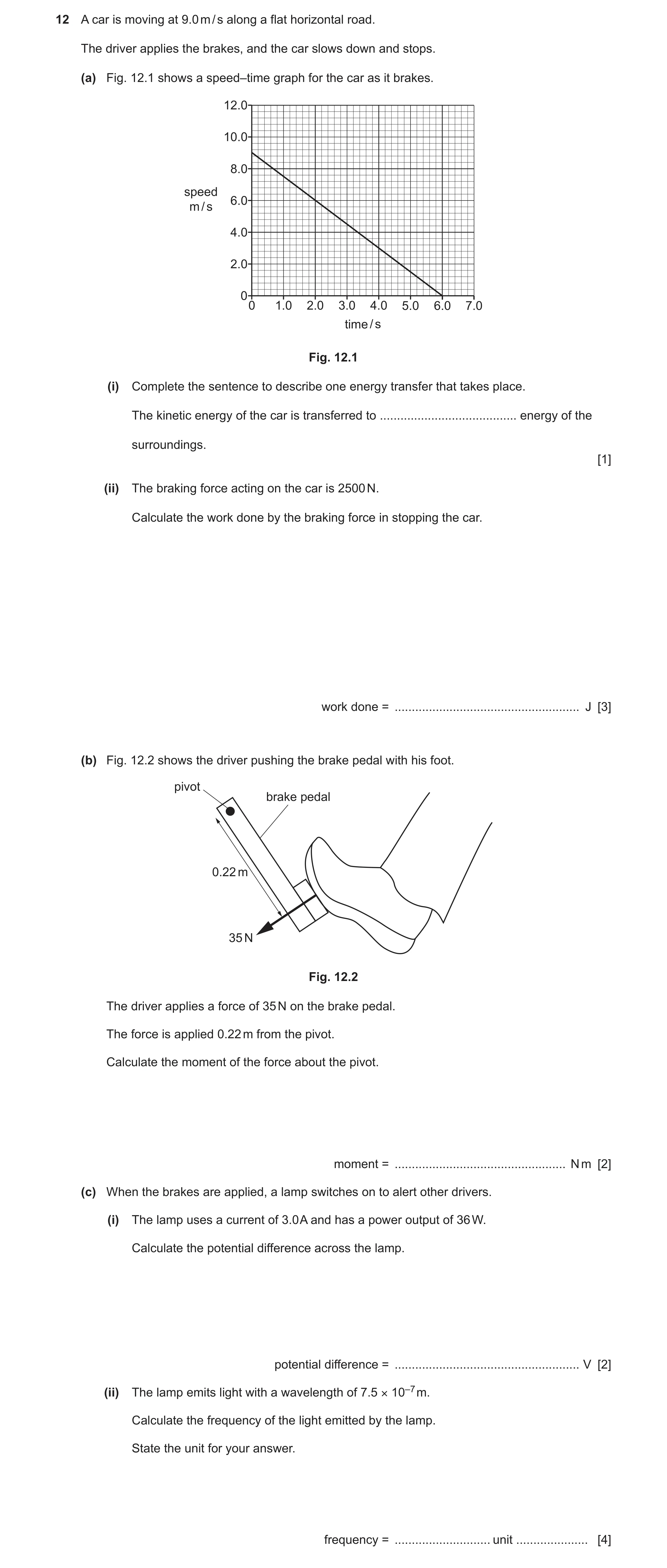
Q21 · A car is moving at 9.0 m / s along a flat horizontal road 0654/41 Oct/Nov 2024
12 A car is moving at 9.0 m / s along a flat horizontal road. The driver applies the brakes, and the car slows down and stops. (a) Fig. 12.1 shows a speed–time graph for the car as it brakes. 12.0 10.0 8.0 speed 6.0 m / s 4.0 2.0 0 0 1.0 2.0 3.0 4.0 5.0 6.0 7.0 time / s Fig. 12.1 (i) Complete the sentence to describe one energy transfer that takes place. The kinetic energy of the car is transferred to … energy of the surroundings. [1] (ii) The braking force acting on the car is 2500 N. Calculate the work done by the braking force in stopping the car. work done = … J [3] (b) Fig. 12.2 shows the driver pushing the brake pedal with his foot. pivot brake pedal 0.22 m 35 N Fig. 12.2 The driver applies a force of 35 N on the brake pedal. The force is applied 0.22 m from the pivot. Calculate the moment of the force about the pivot. moment = … N m [2] (c) When the brakes are applied, a lamp switches on to alert other drivers. (i) The lamp uses a current of 3.0 A and has a power output of 36 W. Calculate the potential difference across the lamp. potential difference = … V [2] (ii) The lamp emits light with a wavelength of 7.5 × 10⁻⁷ m. Calculate the frequency of the light emitted by the lamp. State the unit for your answer. frequency = … unit … [4]
12 marks
Mark scheme: 12(a)(i) thermal ; 1 12(a)(ii) (area under the graph to determine distance) 0.5 9.0 6.0 or 27 (m) ; 3 evidence of W = Fd or 2500 27 ; 68 000 (J) ; 12(b) evidence of moment = Fd or 35 0.22 ; 2 7.7 (N m) ; 12(c)(i) evidence of V = P ÷ I or 36 ÷ 3.(0) ; 2 12 (V) ; 12(c)(ii) use of 3 108 (m / s) ; 4 evidence of f = v ÷ or 3 108 ÷ 7.5 10–7 ; 4.0 1014 ; Hz ;
This question in 0654/41 Oct/Nov 2024
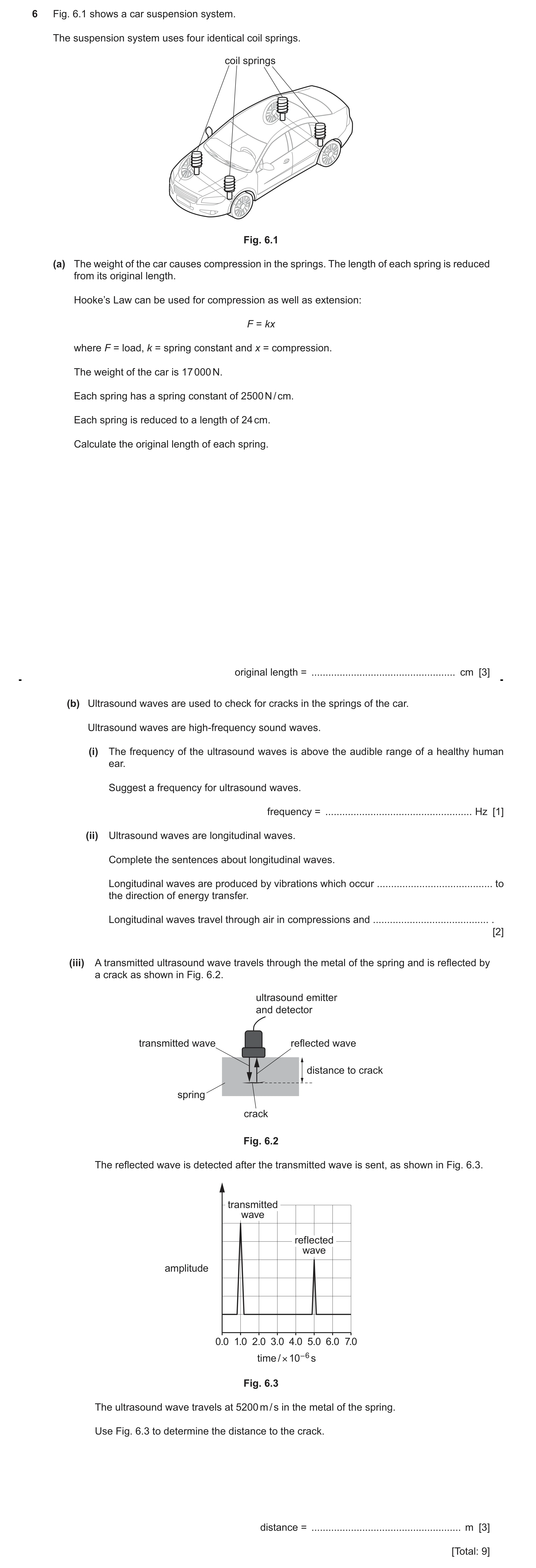
Q22 · A car suspension system 0654/43 Oct/Nov 2024
6 Fig. 6.1 shows a car suspension system. The suspension system uses four identical coil springs. coil springs Fig. 6.1 (a) The weight of the car causes compression in the springs. The length of each spring is reduced from its original length. Hooke’s Law can be used for compression as well as extension: F = kx where F = load, k = spring constant and x = compression. The weight of the car is 17 000 N. Each spring has a spring constant of 2500 N / cm. Each spring is reduced to a length of 24 cm. Calculate the original length of each spring. original length = … cm [3] (b) Ultrasound waves are used to check for cracks in the springs of the car. Ultrasound waves are high-frequency sound waves. (i) The frequency of the ultrasound waves is above the audible range of a healthy human ear. Suggest a frequency for ultrasound waves. frequency = … Hz [1] (ii) Ultrasound waves are longitudinal waves. Complete the sentences about longitudinal waves. Longitudinal waves are produced by vibrations which occur … to the direction of energy transfer. Longitudinal waves travel through air in compressions and … . [2] (iii) A transmitted ultrasound wave travels through the metal of the spring and is reflected by a crack as shown in Fig. 6.2. ultrasound emitter and detector transmitted wave reflected wave distance to crack spring crack Fig. 6.2 The reflected wave is detected after the transmitted wave is sent, as shown in Fig. 6.3. transmitted wave reflected wave amplitude 0.0 1.0 2.0 3.0 4.0 5.0 6.0 7.0 time / × 10–6 s Fig. 6.3 The ultrasound wave travels at 5200 m / s in the metal of the spring. Use Fig. 6.3 to determine the distance to the crack. distance = … m [3] [Total: 9]
9 marks
Mark scheme: 6(a) (force per spring) 17000 ÷ 4 or 4250 ; 3 (calculation of x) 1.7 (cm) ; (original length) 25.7 (cm) ; 6(b)(i) 20 000 (Hz): 1 6(b)(ii) parallel ; 2 rarefactions ; 6(b)(iii) (t =) 2.0 10–6 (s) ; 3 (d =) v t or 5200 2.0 10–6 ; (d =) 0.010(4) (m) ;
This question in 0654/43 Oct/Nov 2024
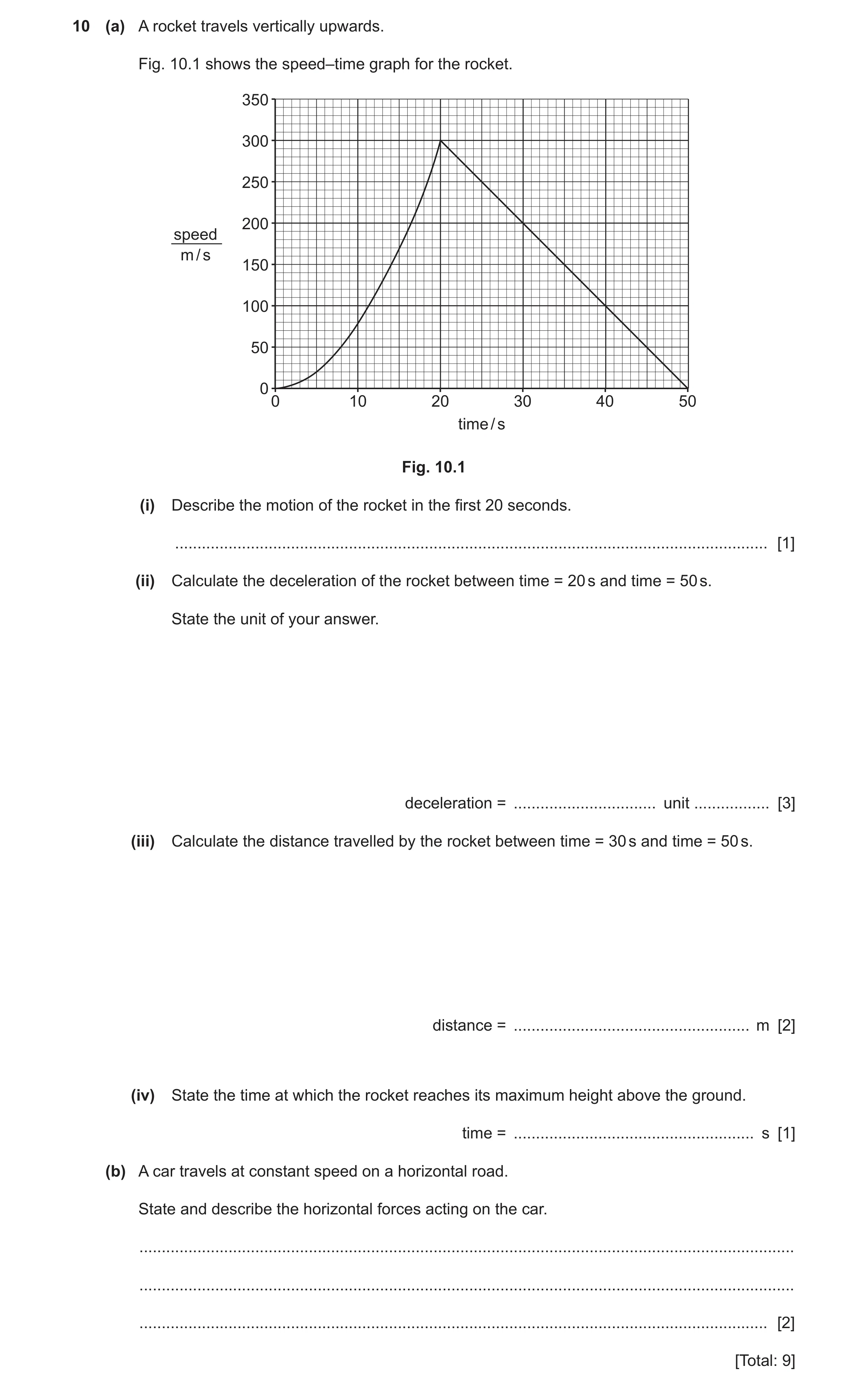
Q23 · A rocket travels vertically upwards 0654/41 May/June 2025
10 (a) A rocket travels vertically upwards. Fig. 10.1 shows the speed–time graph for the rocket. 350 300 250 200 speed m / s 150 100 50 00 10 20 30 40 50 time / s Fig. 10.1 (i) Describe the motion of the rocket in the first 20 seconds. … [1] (ii) Calculate the deceleration of the rocket between time = 20 s and time = 50 s. State the unit of your answer. deceleration = … unit … [3] (iii) Calculate the distance travelled by the rocket between time = 30 s and time = 50 s. distance = … m [2] (iv) State the time at which the rocket reaches its maximum height above the ground. time = … s [1] (b) A car travels at constant speed on a horizontal road. State and describe the horizontal forces acting on the car. … … … [2] [Total: 9]
9 marks
Mark scheme: 10(a)(i) changing / increasing acceleration ; 1 10(a)(ii) evidence of substitution into v/t or 300 / 30 ; 3 10 ; m / s² ; 10(a)(iii) evidence of area or 0.5 200 20 ; 2 2000 m ; 10(a)(iv) 50 (s) ; 1 10(b) driving force AND drag / air resistance / friction ; 2 equal (magnitude) and opposite (direction) ;
This question in 0654/41 May/June 2025
Q24 · Circle all the vector quantities 0654/43 May/June 2025
9 (a) (i) Circle all the vector quantities. energy gravitational field strength temperature time weight [2] (ii) Define the term velocity. … … [2] (b) Fig. 9.1 shows the speed–time graph for a cyclist travelling along a straight horizontal road. 6.0 5.0 4.0 speed 3.0 m / s 2.0 1.0 0 0 10 20 30 40 50 60 70 time / s Fig. 9.1 Calculate the acceleration of the cyclist during the first 12 seconds. acceleration = … m / s2 [2] (c) (i) In a crash test, a car experiences a deceleration of 35 m / s2. deceleration of car Calculate the ratio: acceleration due to gravity ratio = … [1] (ii) Before the crash, the car has a velocity of 28 m / s. The kinetic energy of the car is 470 kJ. Calculate the mass of the car. mass = … kg [2] [Total: 9]
9 marks
Mark scheme: 9(a)(i) weight; 2 gravitational field strength; 9(a)(ii) speed / distance travelled per unit time; 2 in a given direction; 9(b) evidence of a = ∆v / ∆t or gradient or 5.4 / 12; 2 0.45 (m/s²); 9(c)(i) (−)3.6; 1 9(c)(ii) evidence of E=0.5mv² / ½ mv² or 470 000 = 0.5 m 28²; 2 1200 (kg);
This question in 0654/43 May/June 2025
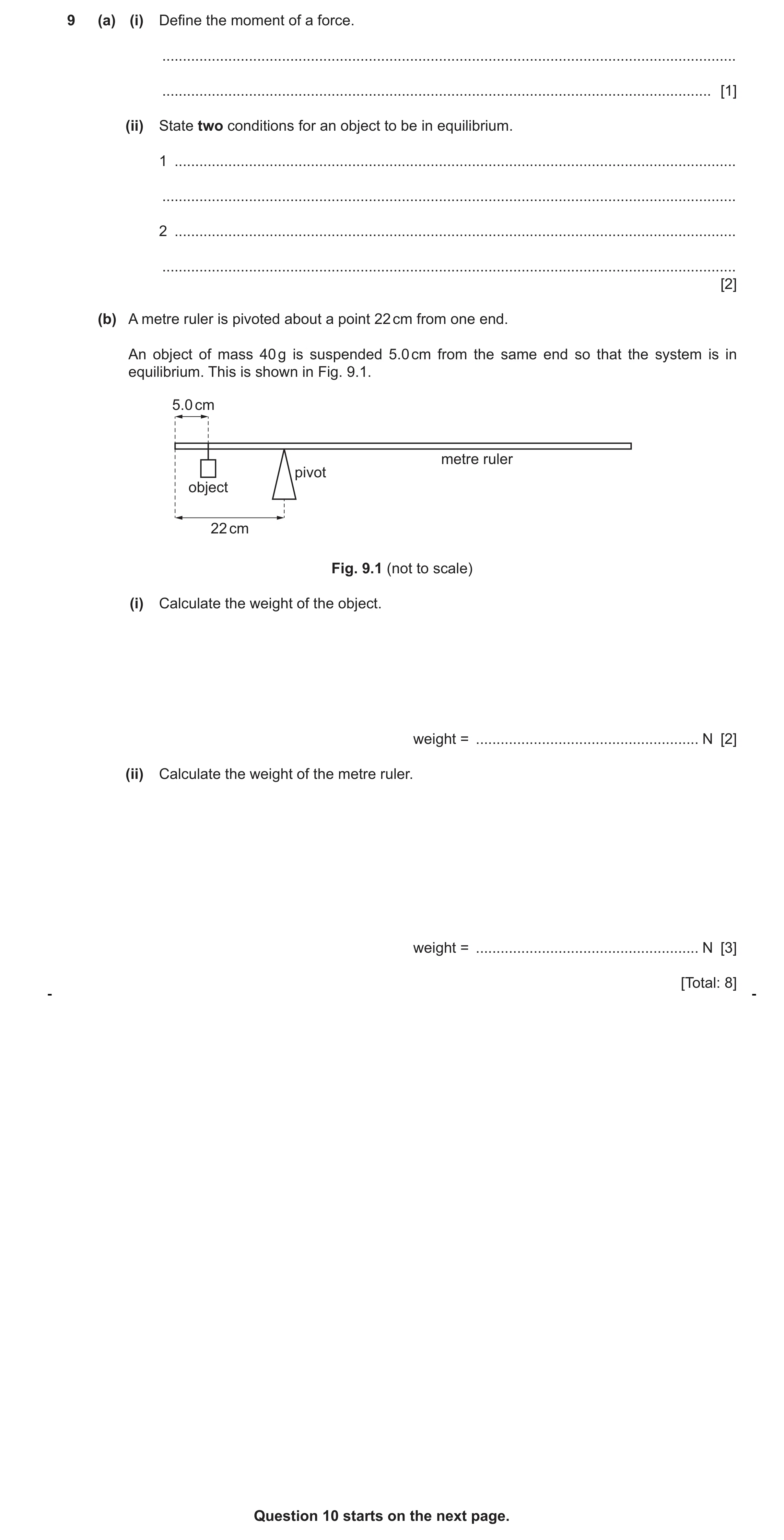
Q25 · Define the moment of a force 0654/41 Oct/Nov 2025
9 (a) (i) Define the moment of a force. … … [1] (ii) State two conditions for an object to be in equilibrium. 1 … … 2 … … [2] (b) A metre ruler is pivoted about a point 22 cm from one end. An object of mass 40 g is suspended 5.0 cm from the same end so that the system is in equilibrium. This is shown in Fig. 9.1. 5.0 cm metre ruler pivot object 22 cm Fig. 9.1 (not to scale) (i) Calculate the weight of the object. weight = … N [2] (ii) Calculate the weight of the metre ruler. weight = … N [3] [Total: 8] Question 10 starts on the next page.
8 marks
Mark scheme: 9(a)(i) force perpendicular distance from pivot ; 1 9(a)(ii) no resultant force ; 2 no resultant moment ; 9(b)(i) (W =) mg or (W =) 0.040 9.8 or (40 ÷ 1000) 9.8 ; 2 0.39 (N) ; 9(b)(ii) appreciation of weight acting from centre of ruler ; 3 0.39 17 = W 28 ; 0.24 (N) ;
This question in 0654/41 Oct/Nov 2025
 19 / 48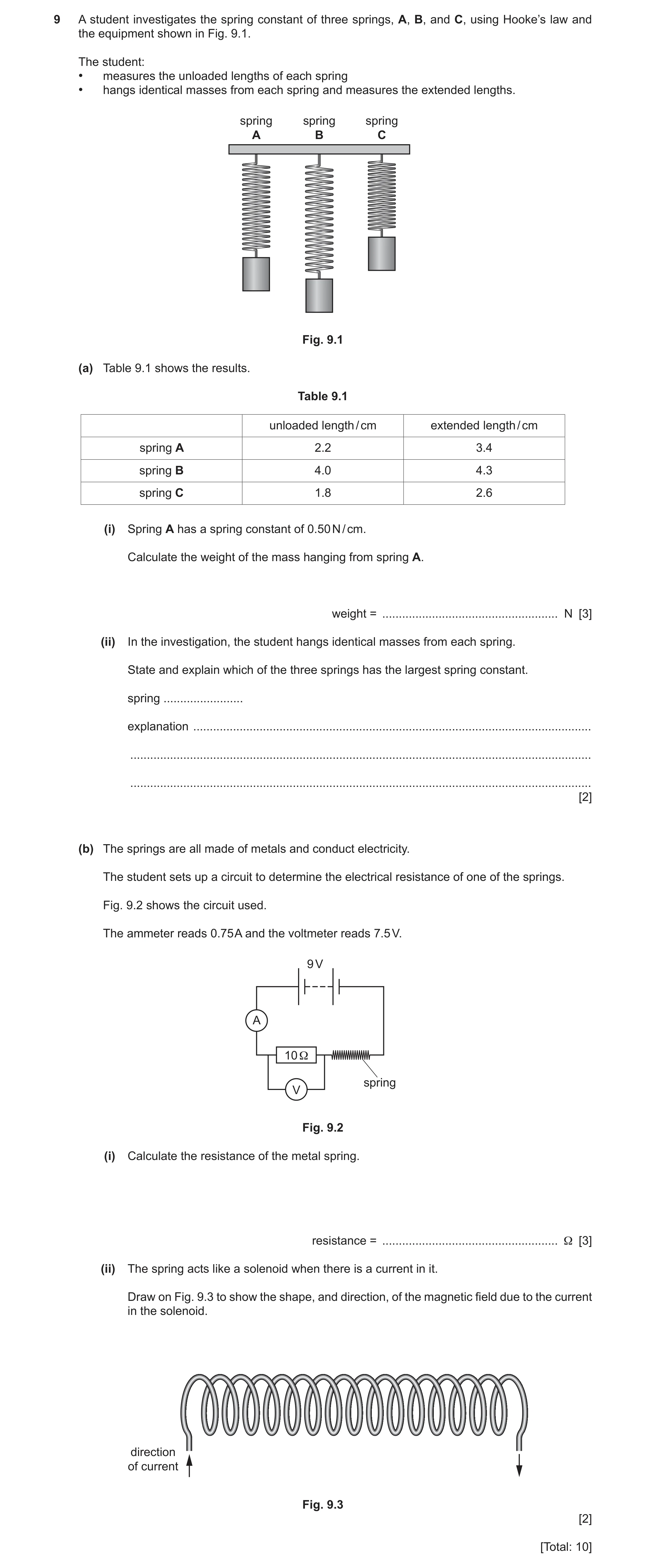
![Question 24: (a) (i) Circle all the vector quantities. energy gravitational field strength temperature time weight [2] (ii) Define the term velocity. ..…](https://img.pastlit.com/crops/5f469ae5-3ce9-4e60-9f50-777dbb641736/q9.webp)
 10
10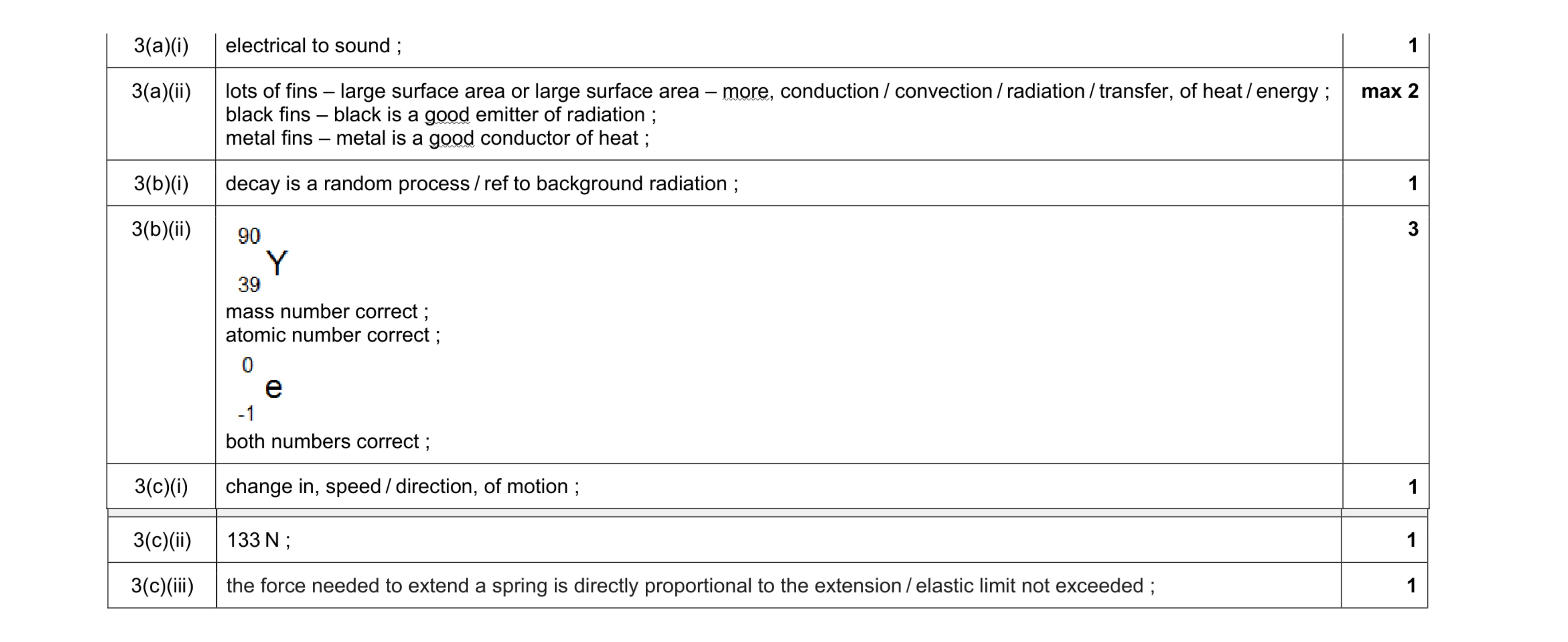 10
10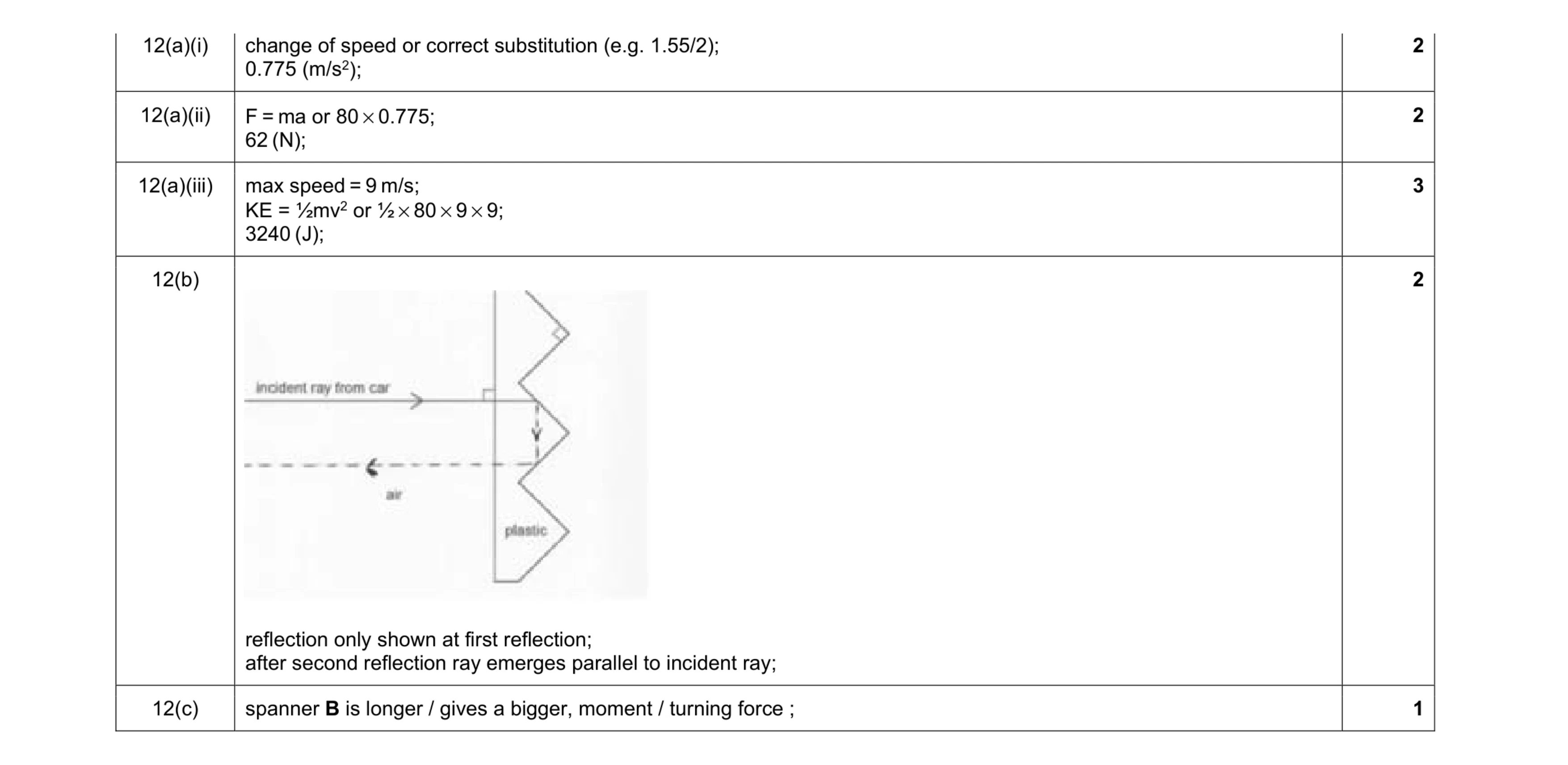 10
10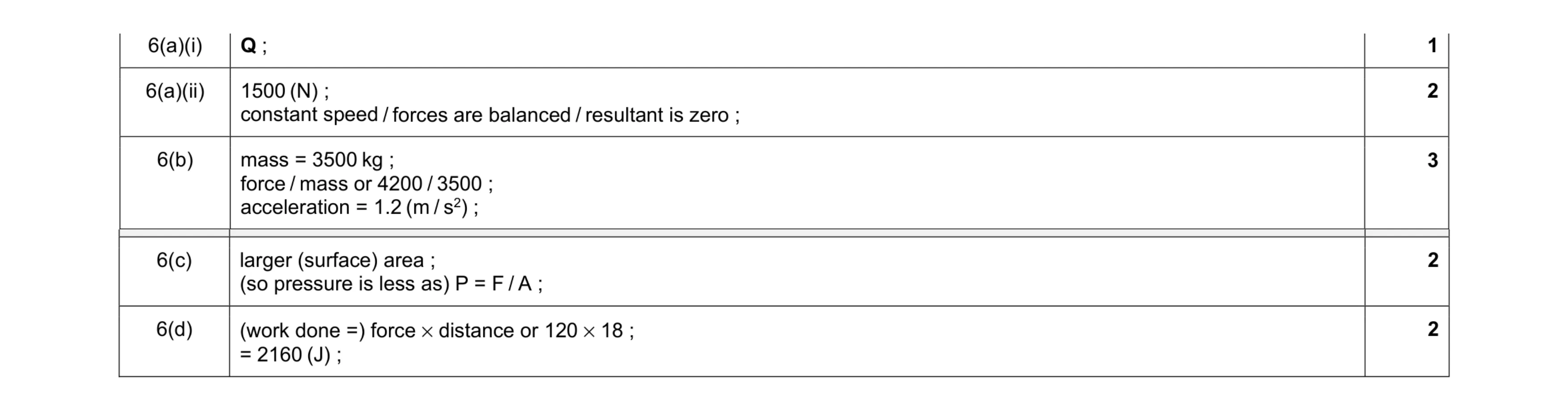 10
10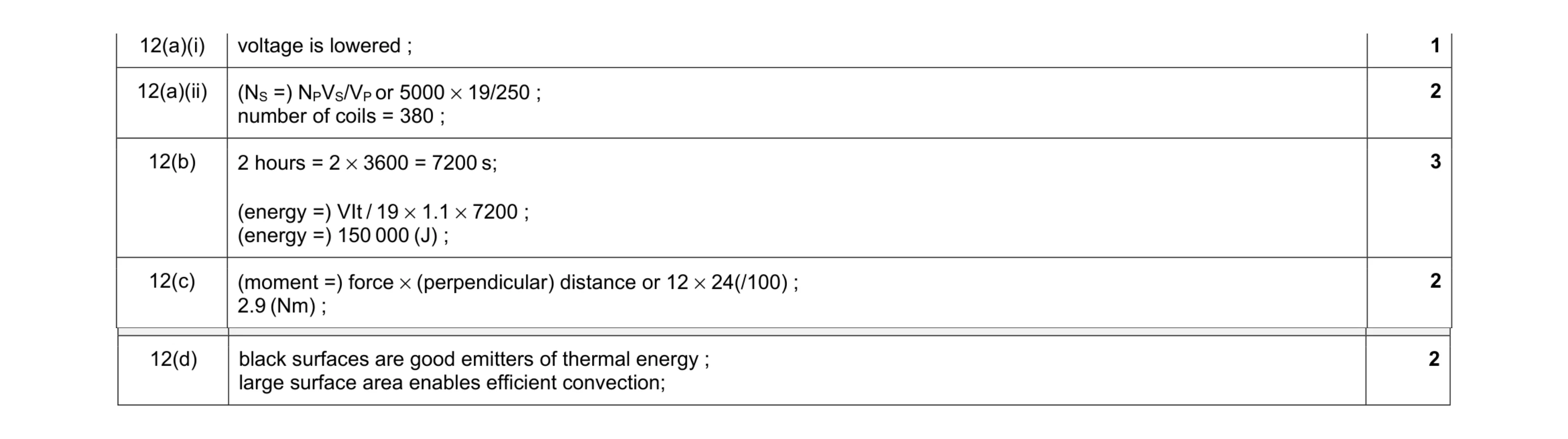 10
10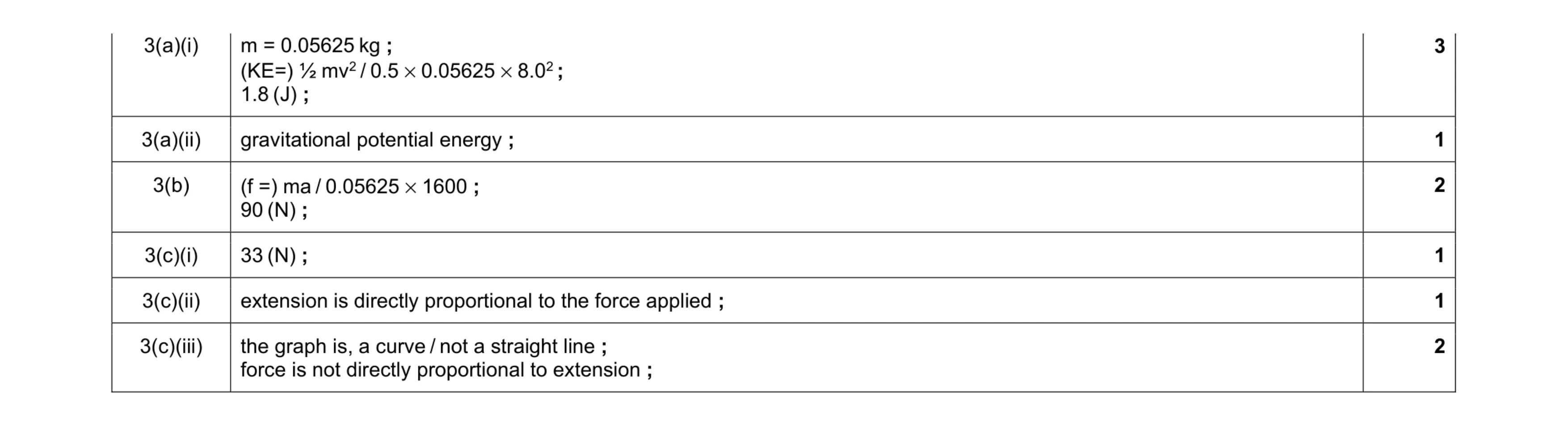 10
10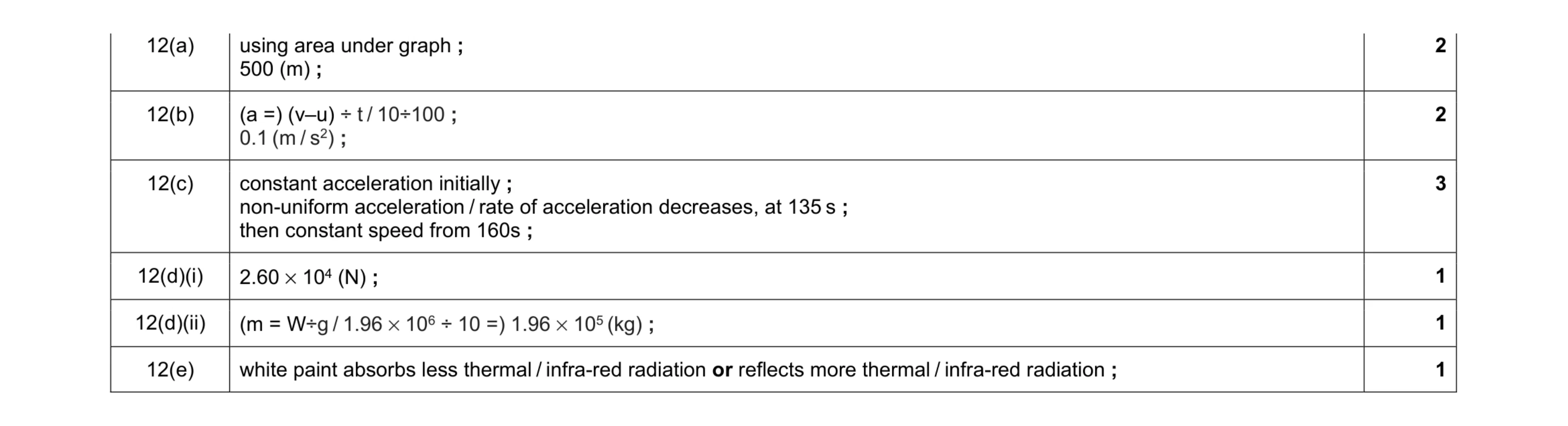 10
10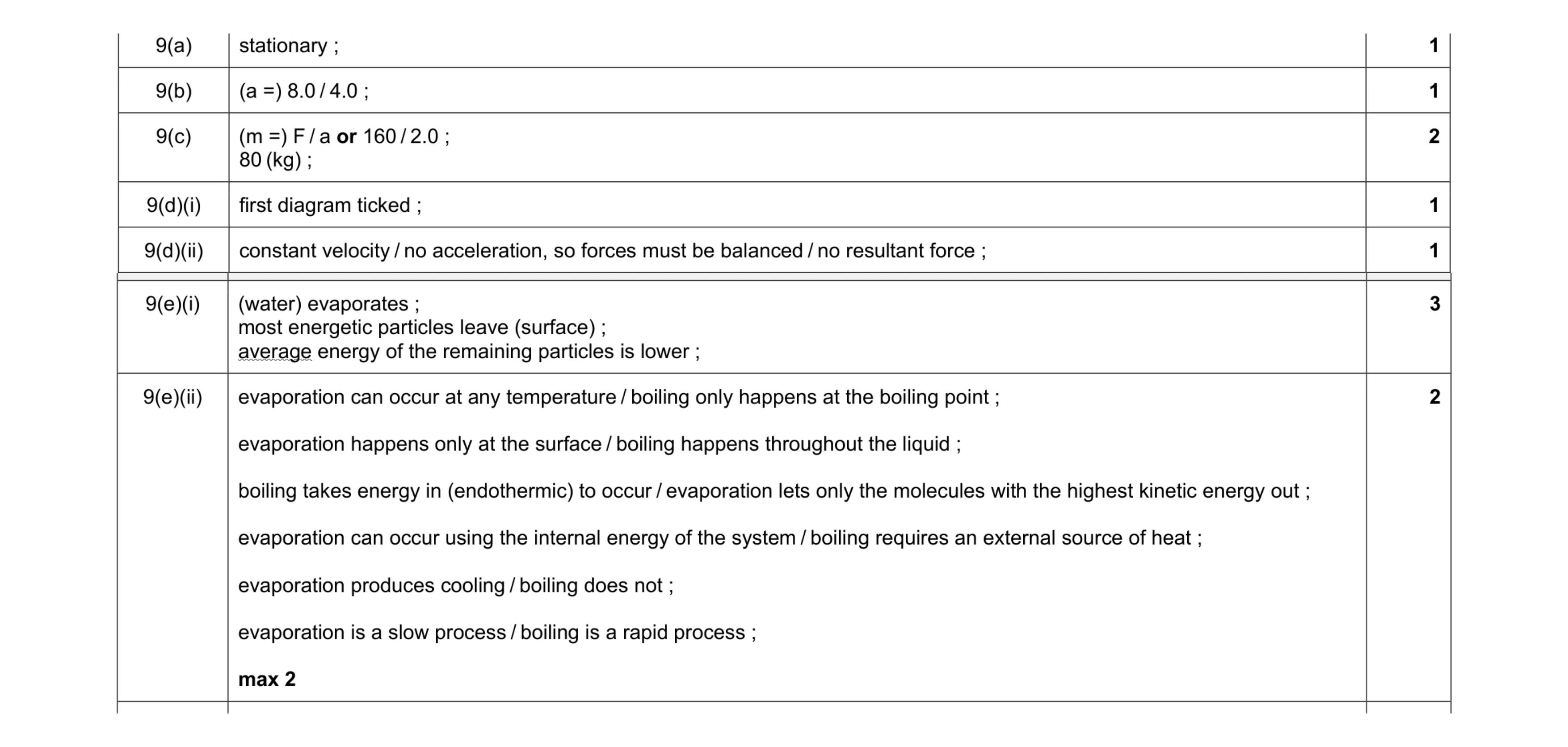 11
11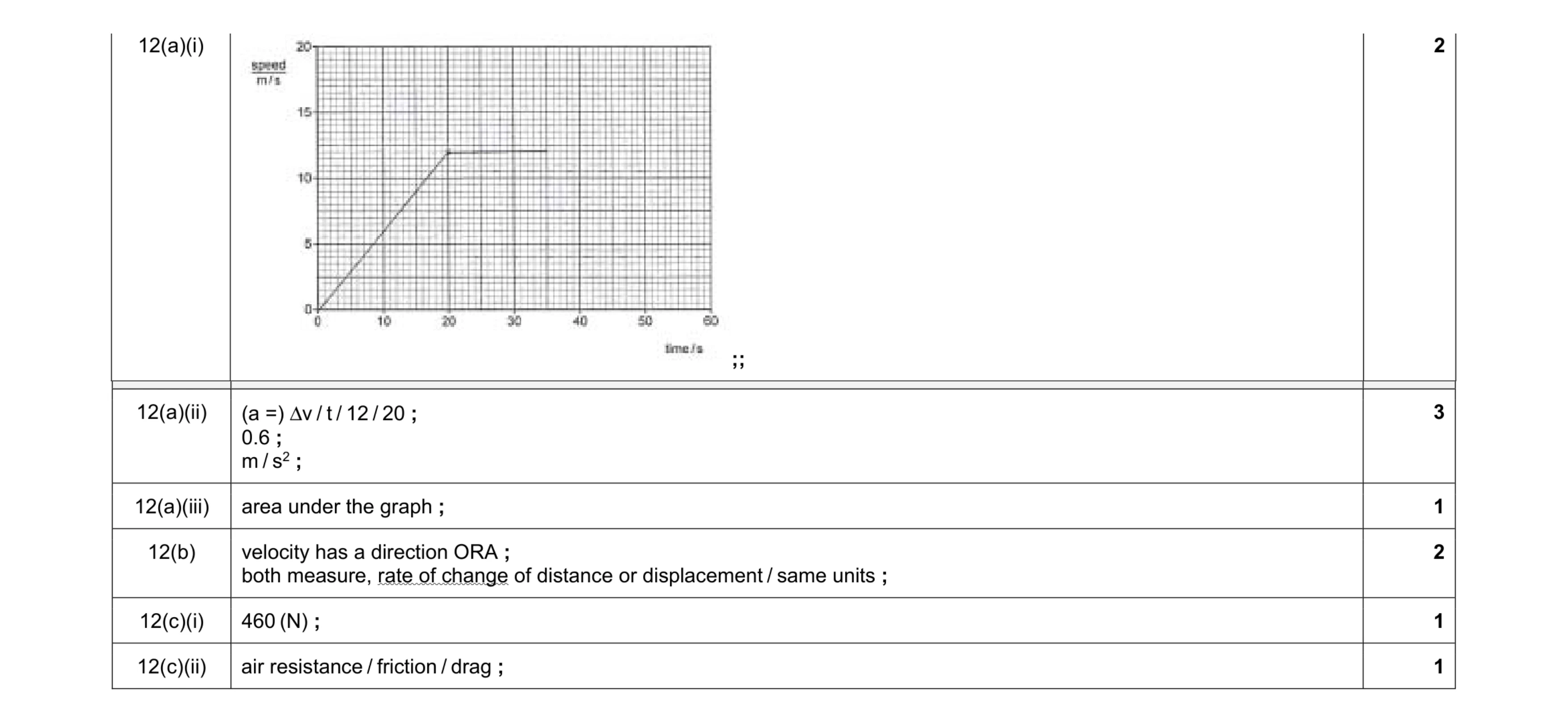 10
10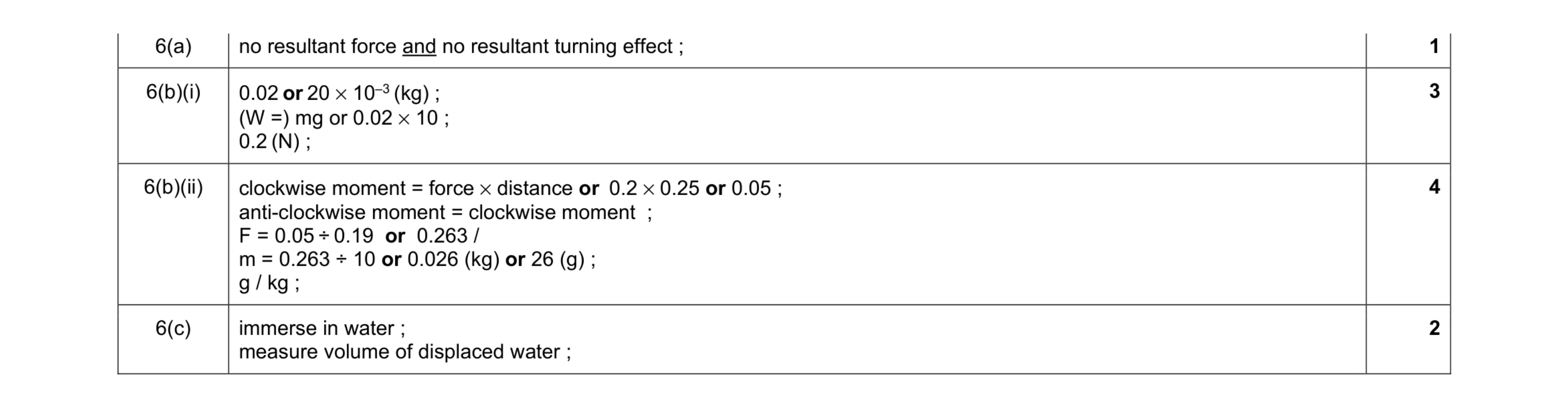 10
10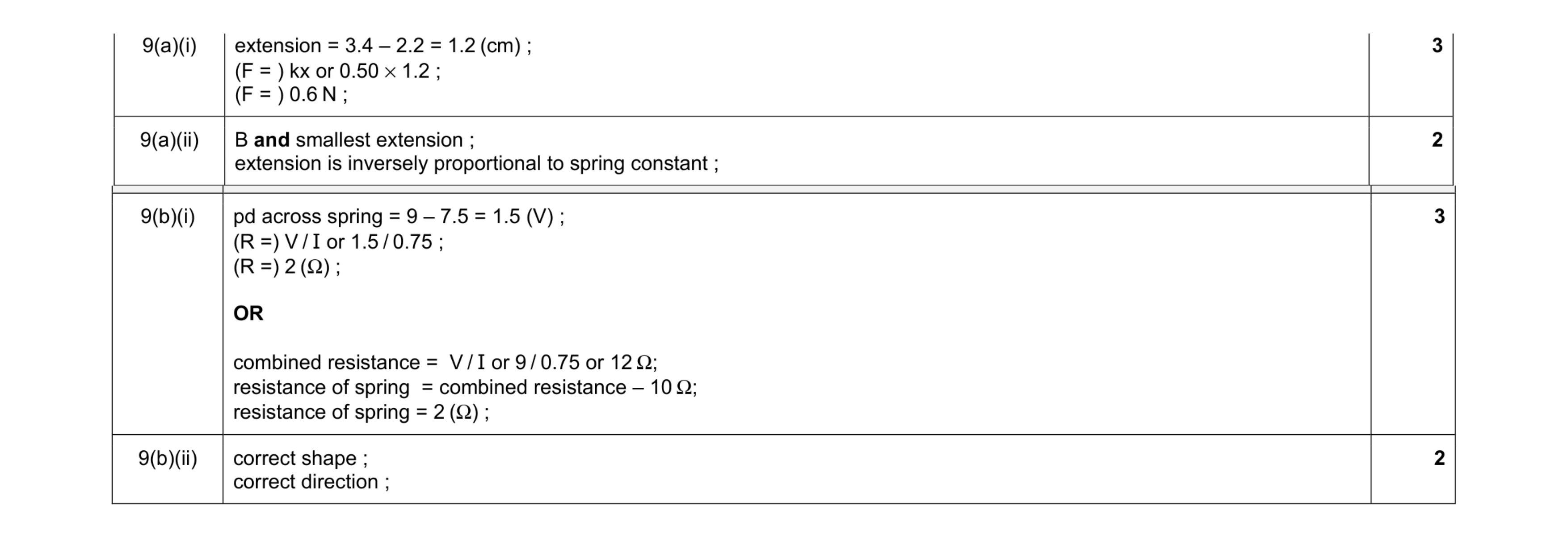 10
10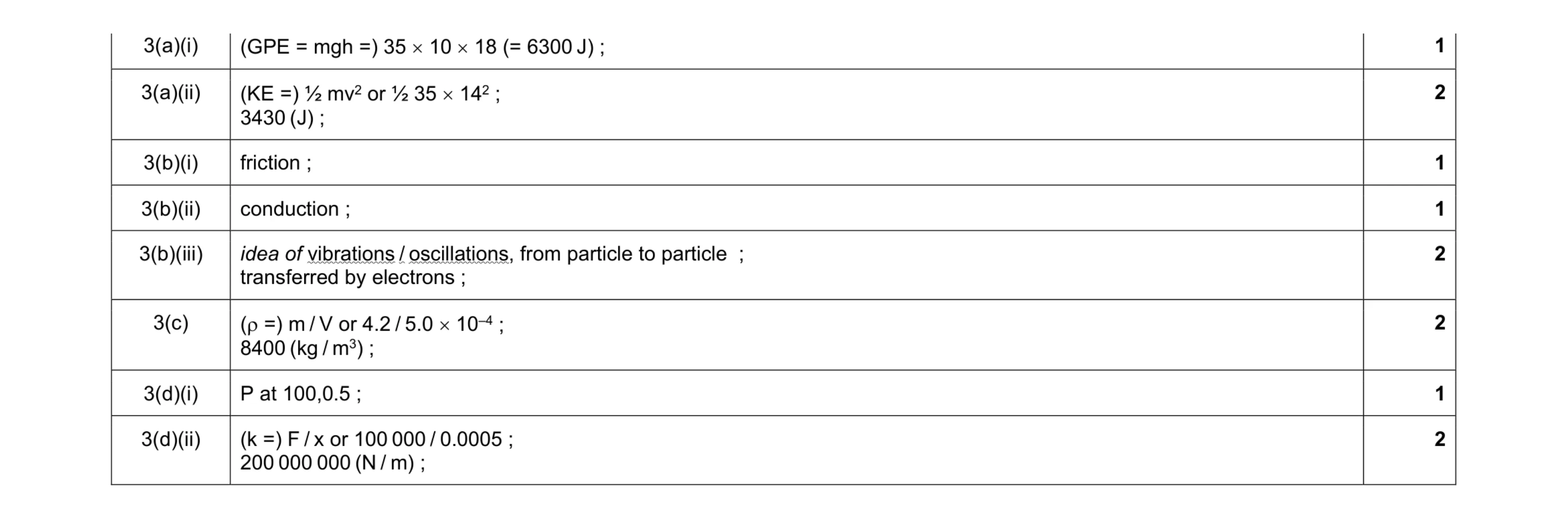 12
12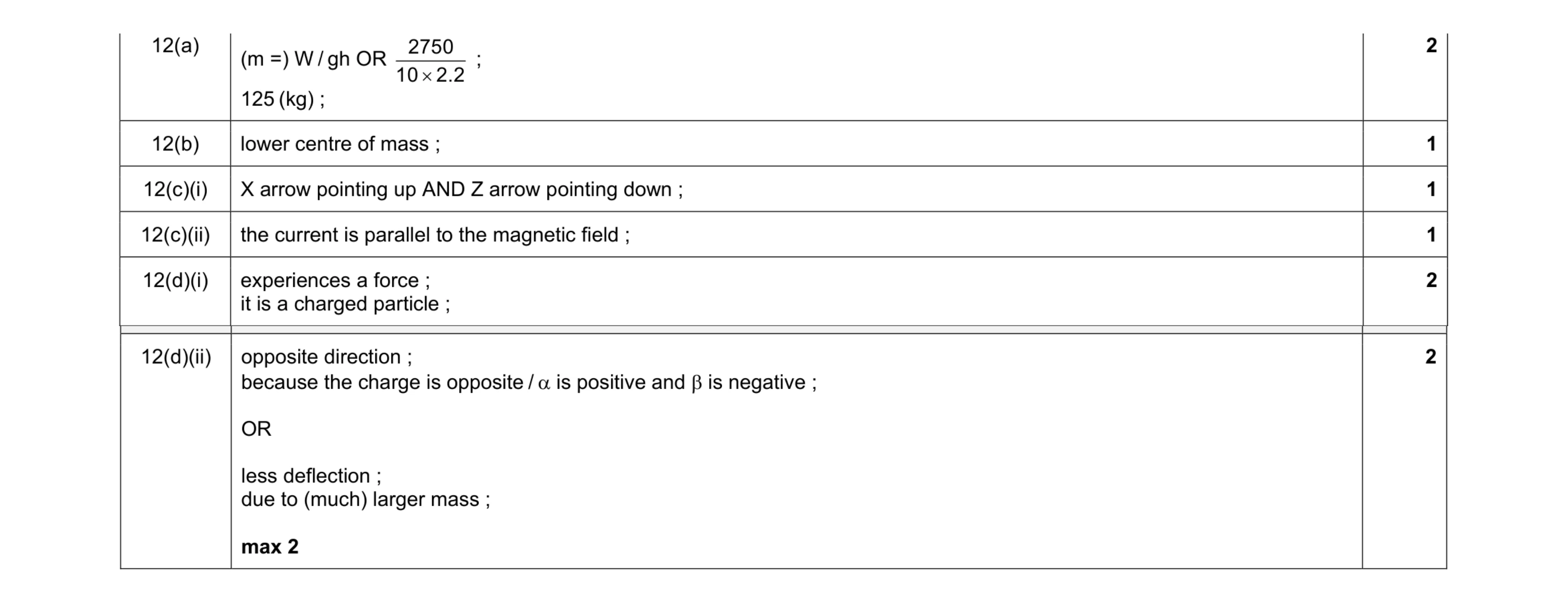 9
9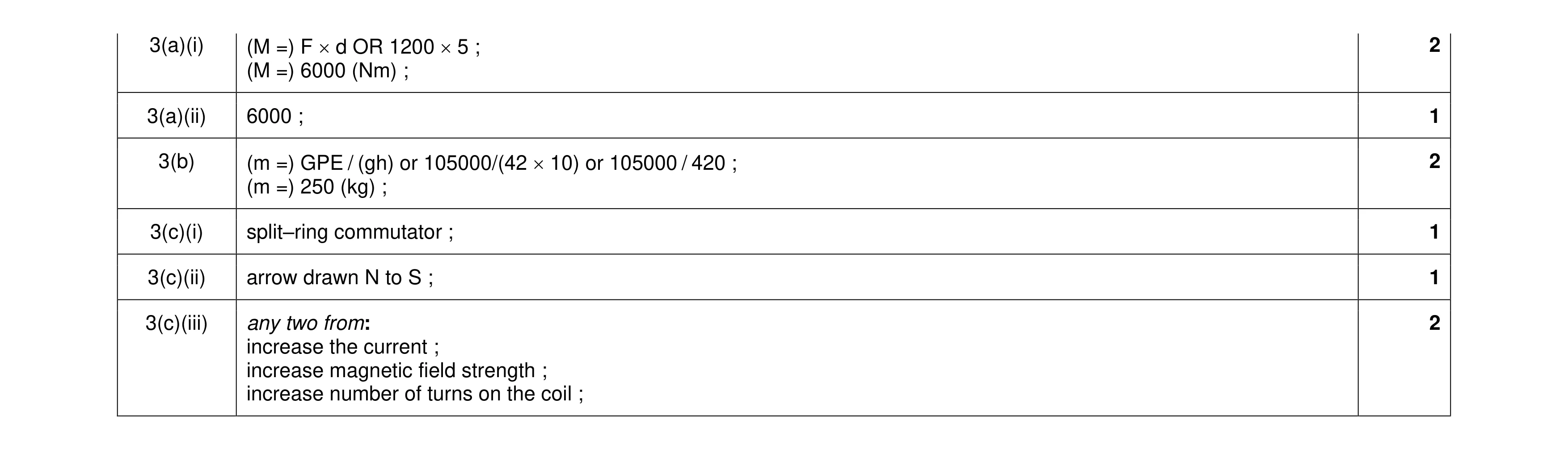 9
9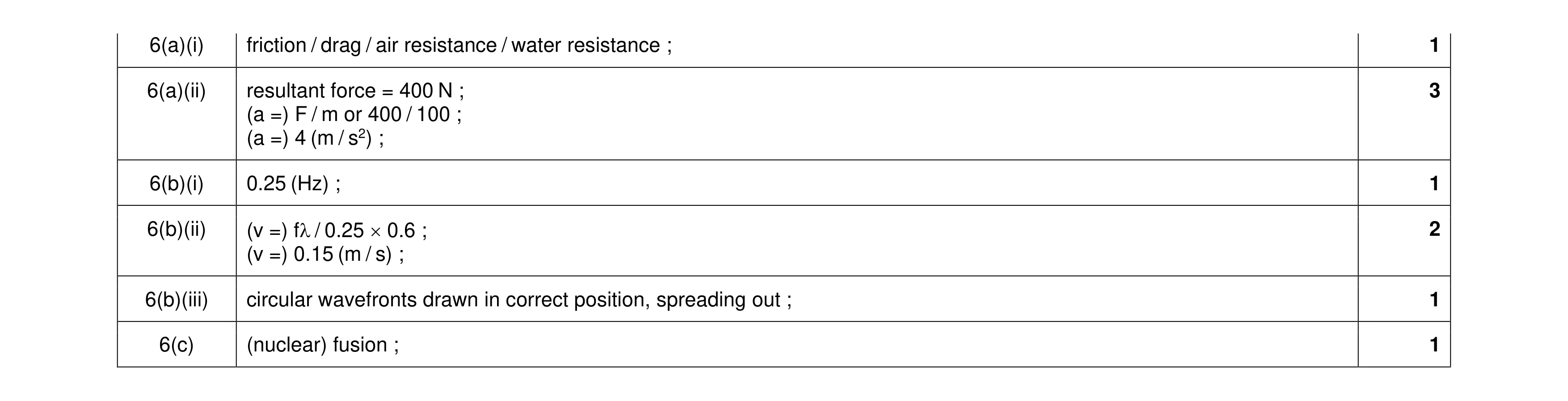 9
9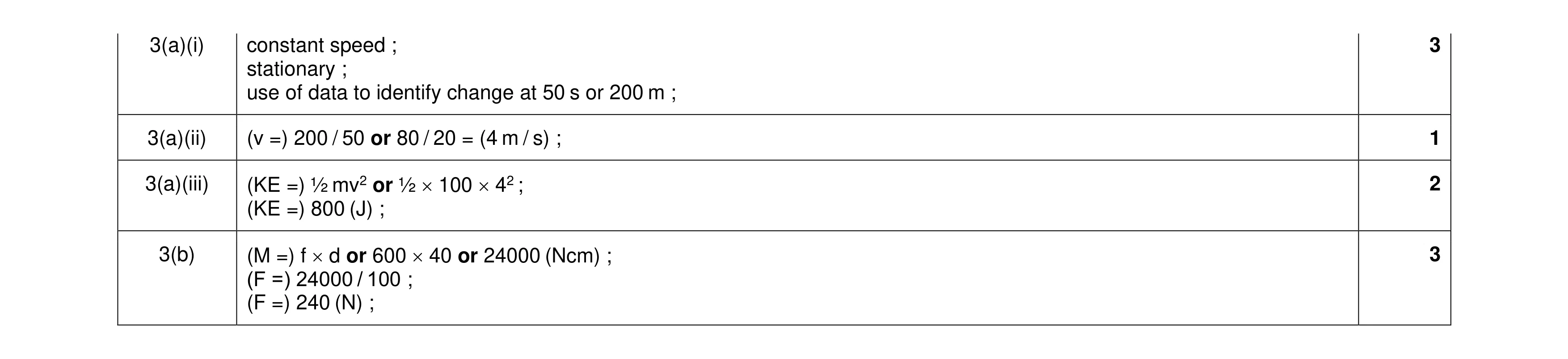 9
9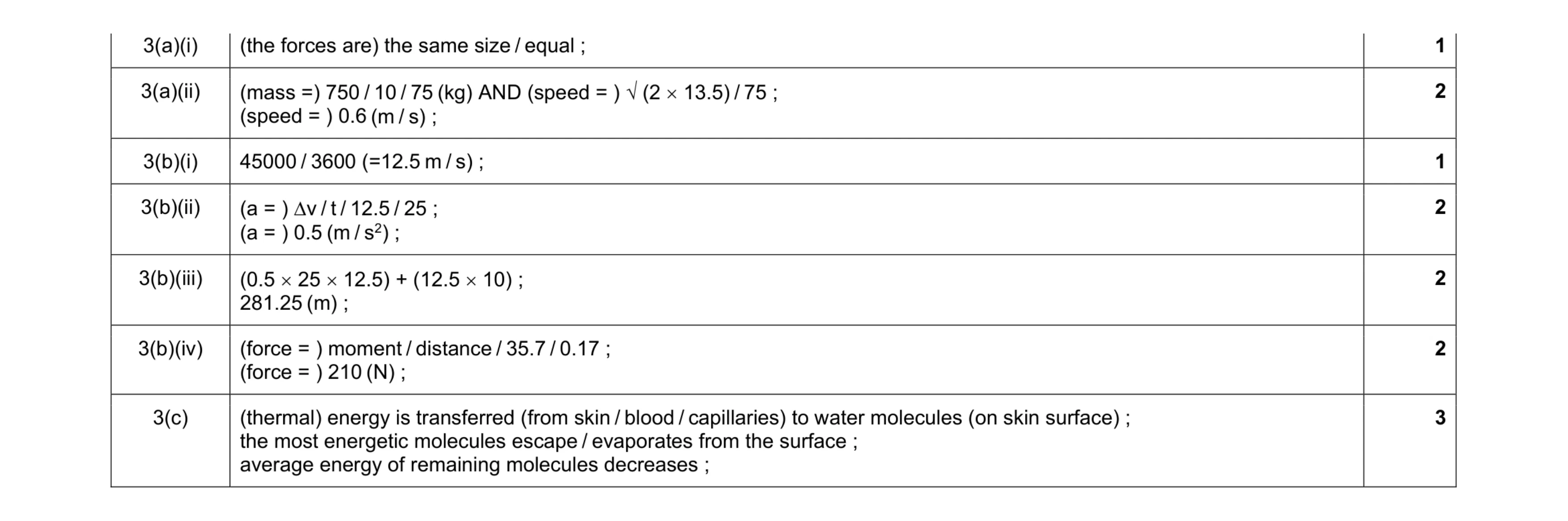 13
13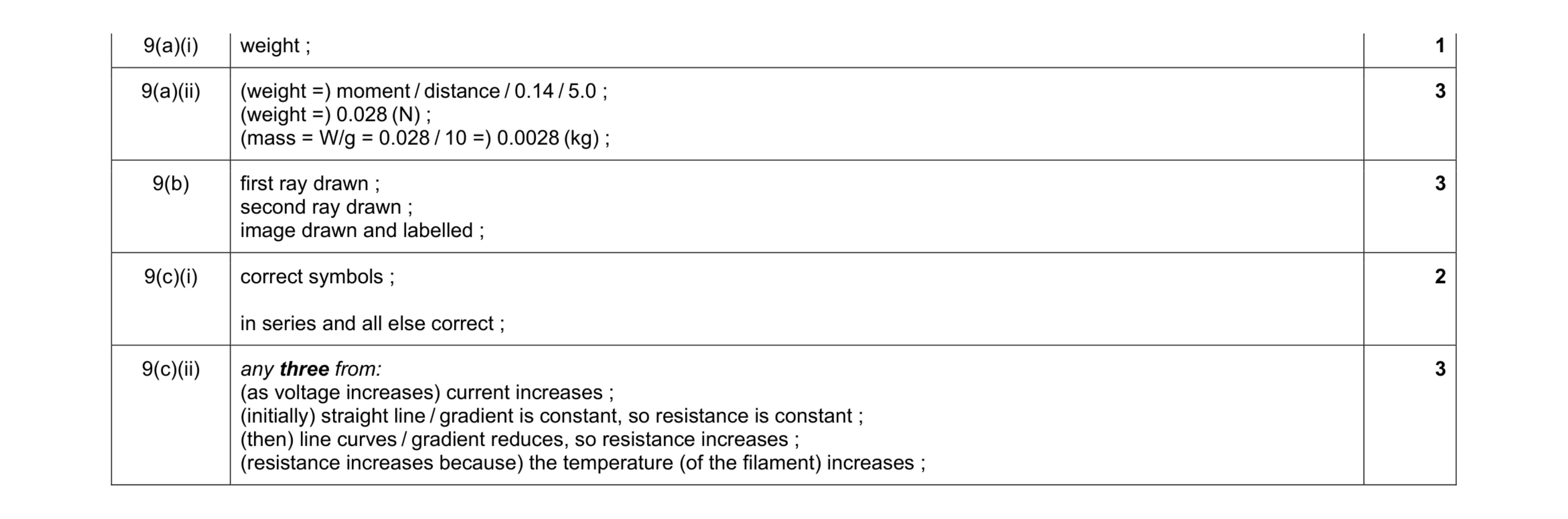 12
12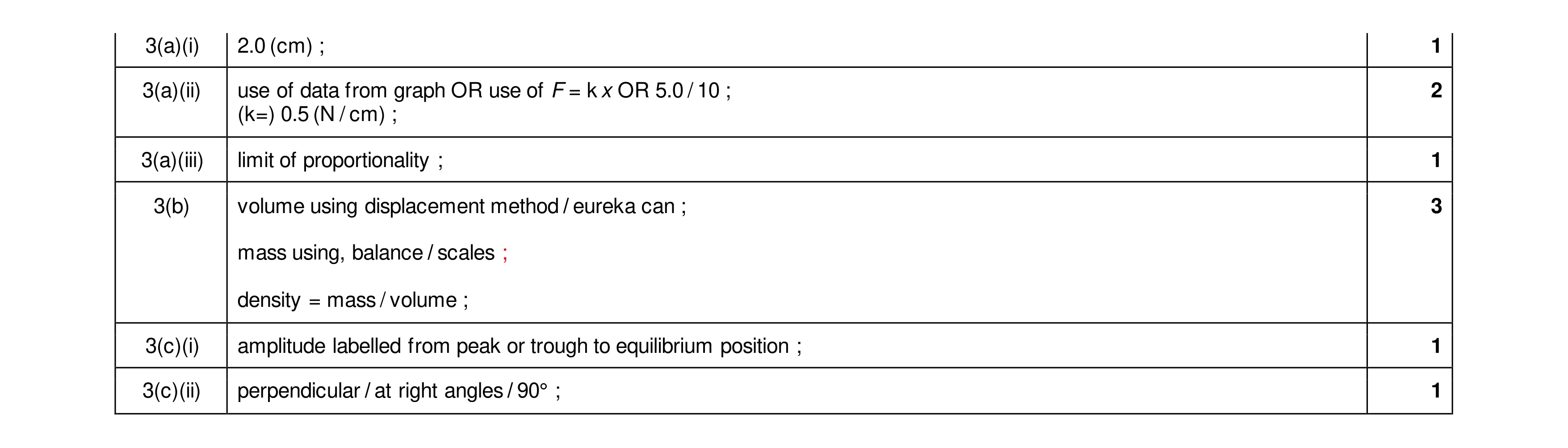 9
9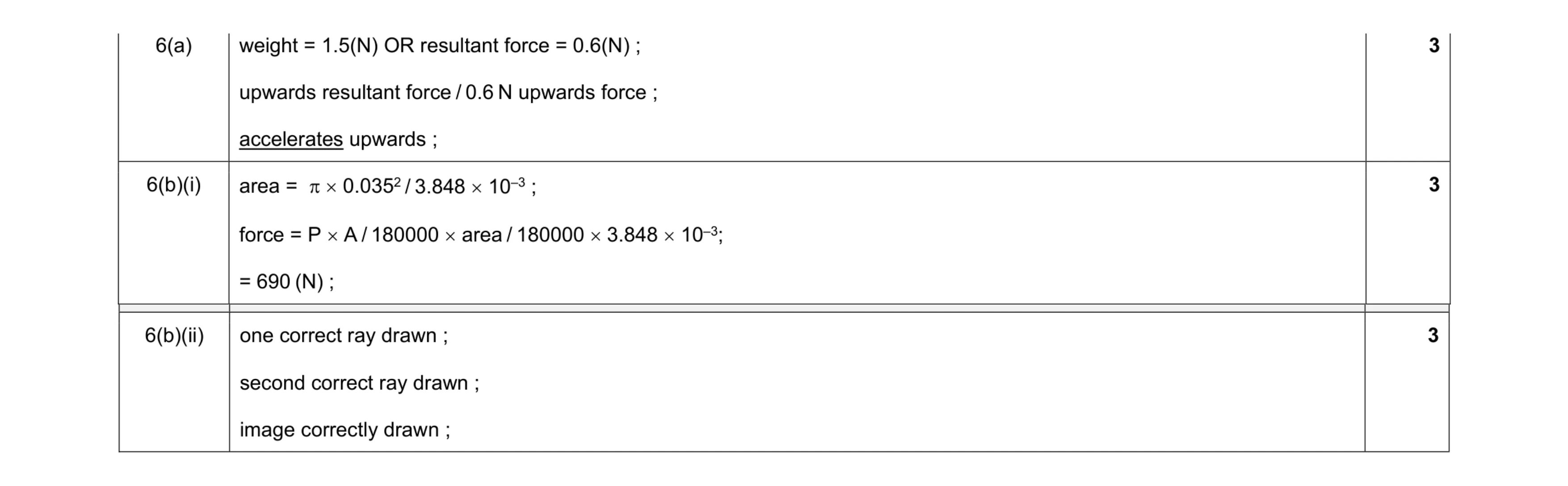 9
9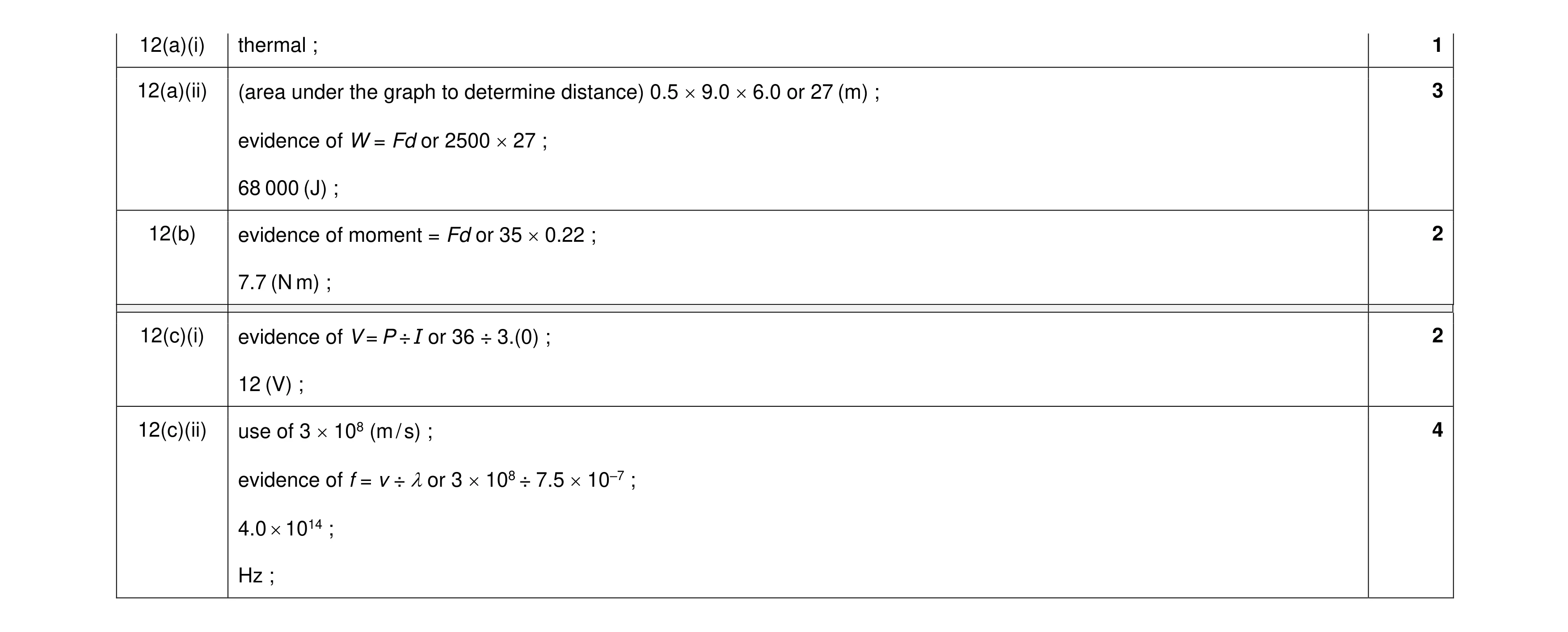 12
12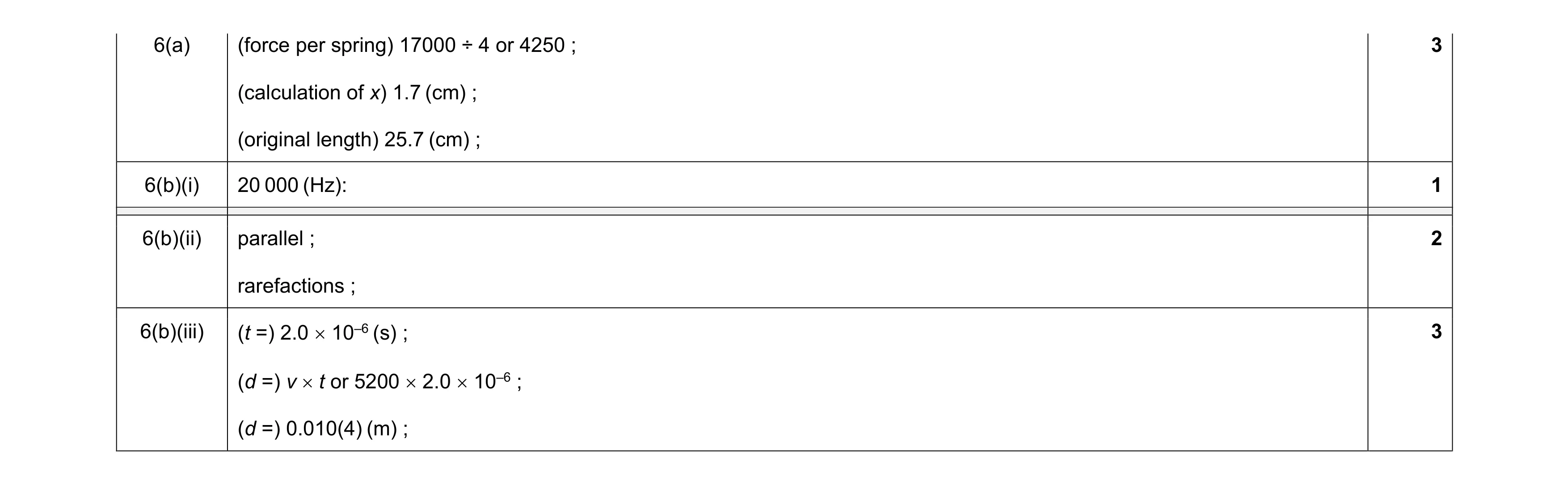 9
9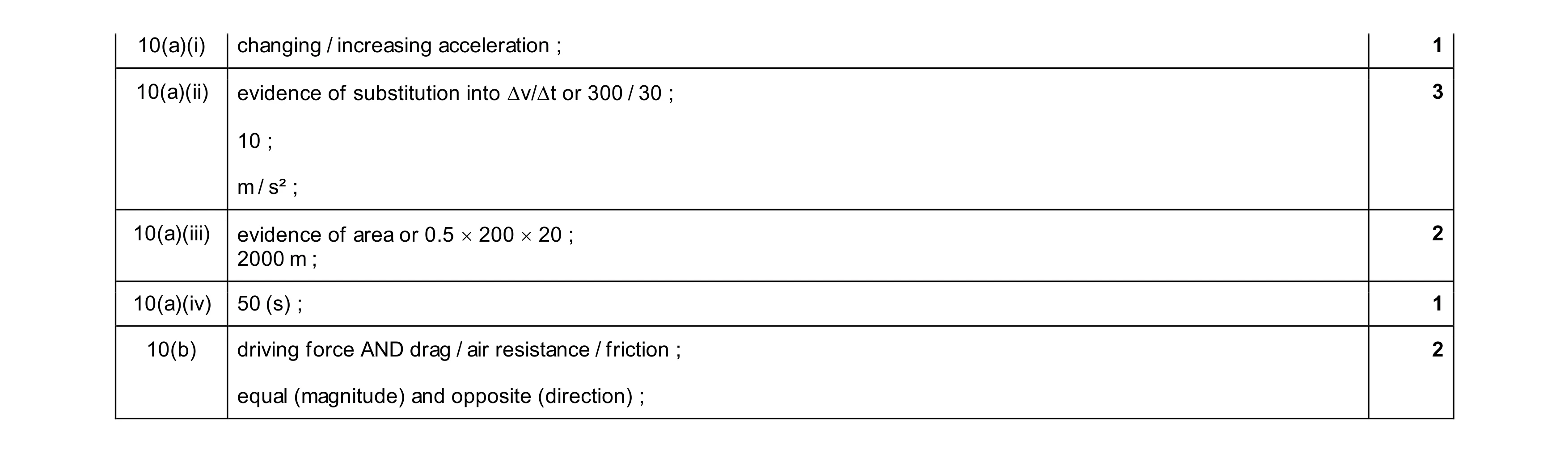 9
9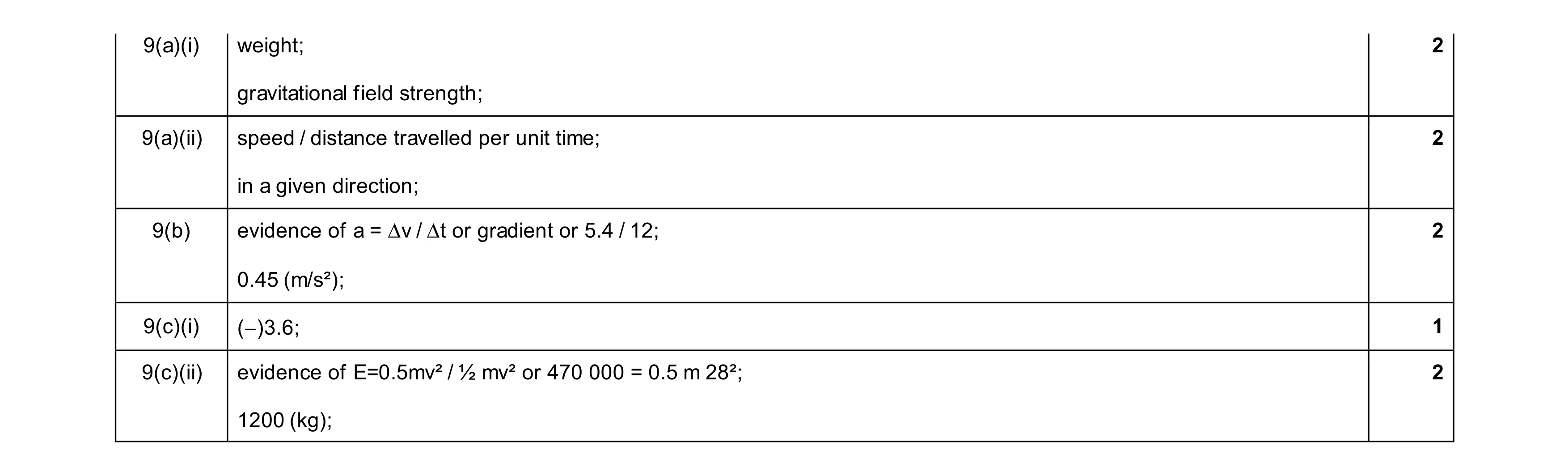 9
9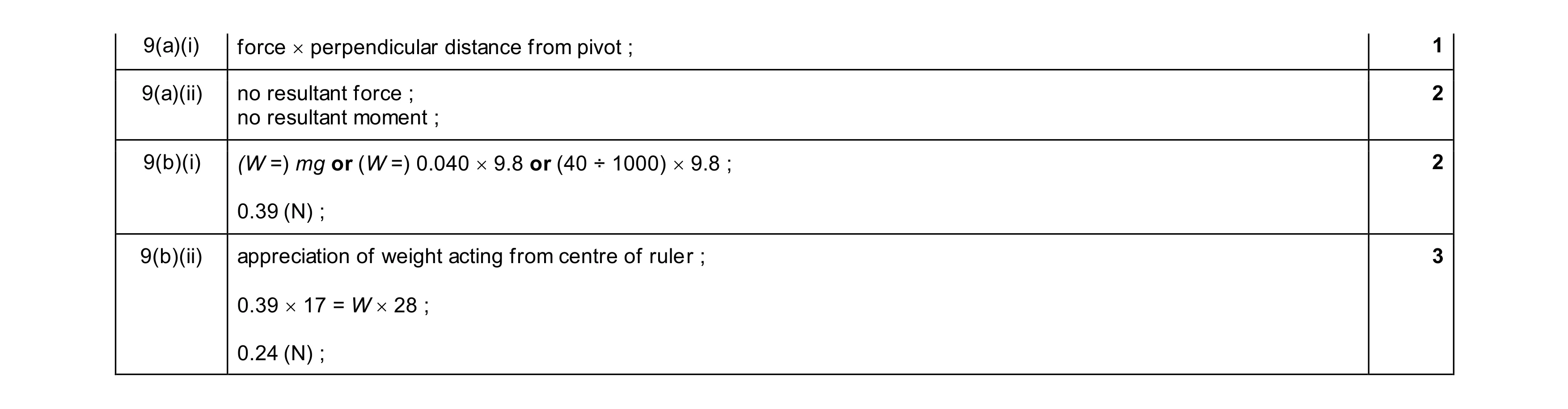 8
8