Questions as text
Q1 · A speed-time graph for a car over a period of 50 seconds 0654/41 May/June 2017
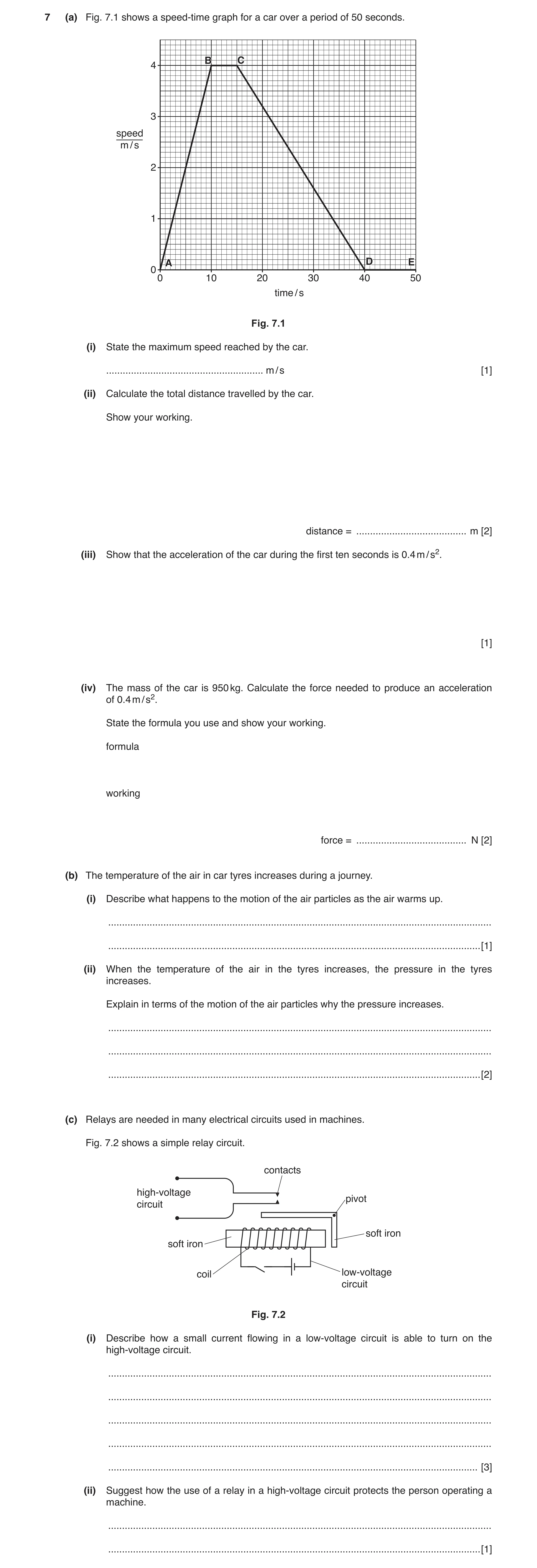
7 (a) Fig. 7.1 shows a speed-time graph for a car over a period of 50 seconds. BB CC 4 3 speed m / s 2 1 A DD EE 0 0 10 20 30 40 50 time / s Fig. 7.1 (i) State the maximum speed reached by the car. … m / s [1] (ii) Calculate the total distance travelled by the car. Show your working. distance = … m [2] (iii) Show that the acceleration of the car during the first ten seconds is 0.4 m / s2. [1] (iv) The mass of the car is 950 kg. Calculate the force needed to produce an acceleration of 0.4 m / s2. State the formula you use and show your working. formula working force = … N [2] (b) The temperature of the air in car tyres increases during a journey. (i) Describe what happens to the motion of the air particles as the air warms up. … … [1] (ii) When the temperature of the air in the tyres increases, the pressure in the tyres increases. Explain in terms of the motion of the air particles why the pressure increases. … … … [2] (c) Relays are needed in many electrical circuits used in machines. Fig. 7.2 shows a simple relay circuit. contacts high-voltage pivot circuit soft iron soft iron coil low-voltage circuit Fig. 7.2 (i) Describe how a small current flowing in a low-voltage circuit is able to turn on the high-voltage circuit. … … … … … [3] (ii) Suggest how the use of a relay in a high-voltage circuit protects the person operating a machine. … … [1]
13 marks
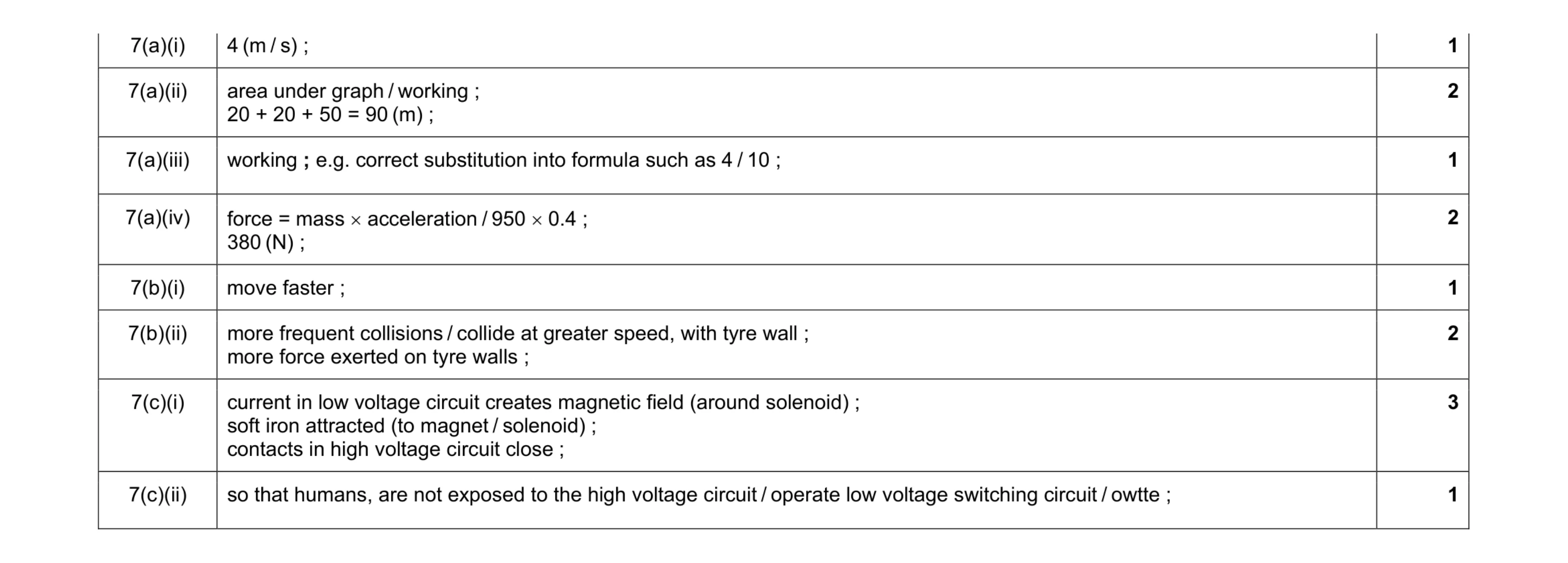
Mark scheme: 7(a)(i) 4 (m / s) ; 1 7(a)(ii) area under graph / working ; 20 + 20 + 50 = 90 (m) ; 2 7(a)(iii) working ; e.g. correct substitution into formula such as 4 / 10 ; 1 7(a)(iv) force = mass × acceleration / 950 × 0.4 ; 380 (N) ; 2 7(b)(i) move faster ; 1 7(b)(ii) more frequent collisions / collide at greater speed, with tyre wall ; more force exerted on tyre walls ; 2 7(c)(i) current in low voltage circuit creates magnetic field (around solenoid) ; soft iron attracted (to magnet / solenoid) ; contacts in high voltage circuit close ; 3 7(c)(ii) so that humans, are not exposed to the high voltage circuit / operate low voltage switching circuit / owtte ; 1
This question in 0654/41 May/June 2017
Q2 · An aircraft landing with constant deceleration along an airport runway 0654/42 May/June 2017
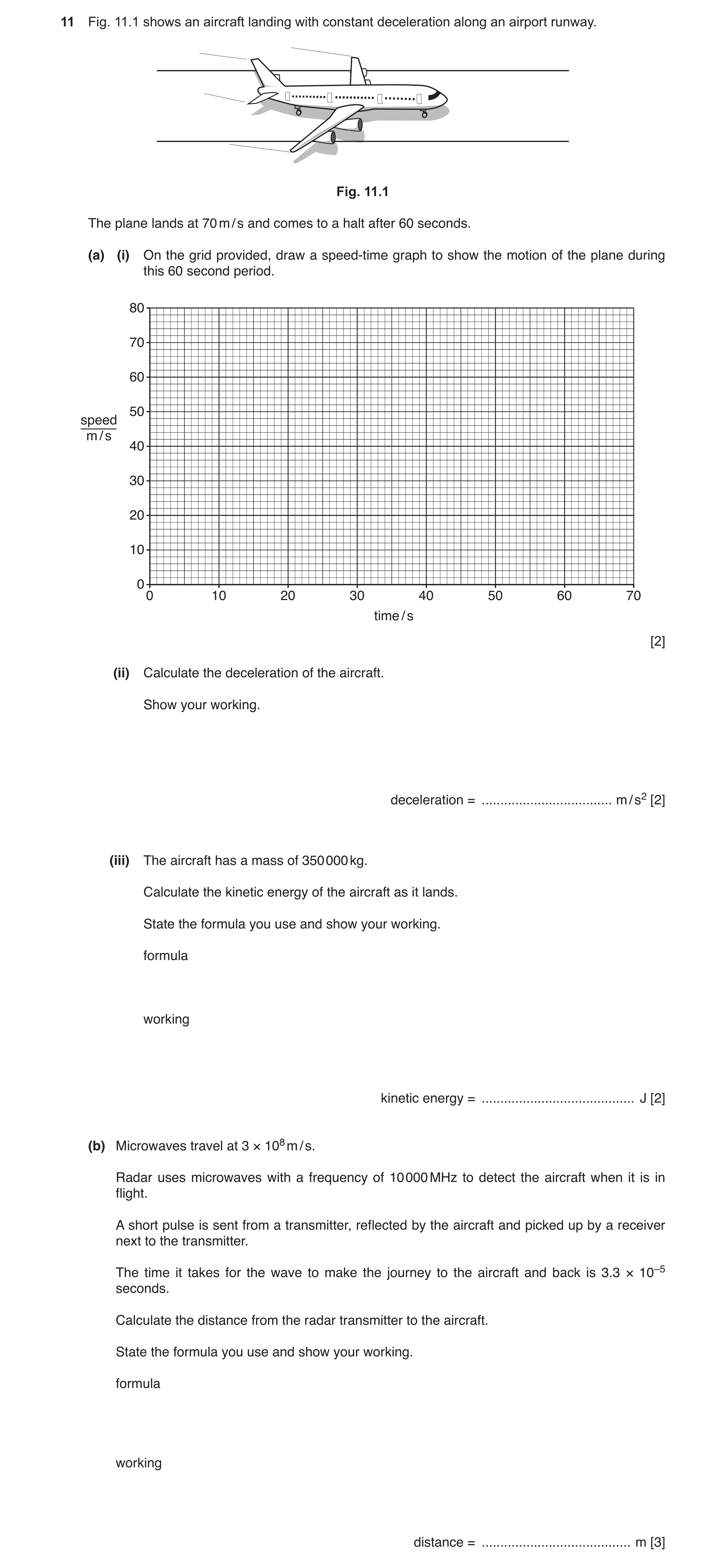
11 Fig. 11.1 shows an aircraft landing with constant deceleration along an airport runway. Fig. 11.1 The plane lands at 70 m / s and comes to a halt after 60 seconds. (a) (i) On the grid provided, draw a speed-time graph to show the motion of the plane during this 60 second period. 80 70 60 50 speed m / s 40 30 20 10 0 0 10 20 30 40 50 60 70 time / s [2] (ii) Calculate the deceleration of the aircraft. Show your working. deceleration = … m / s2 [2] (iii) The aircraft has a mass of 350 000 kg. Calculate the kinetic energy of the aircraft as it lands. State the formula you use and show your working. formula working kinetic energy = … J [2] (b) Microwaves travel at 3 × 10⁸ m / s. Radar uses microwaves with a frequency of 10 000 MHz to detect the aircraft when it is in flight. A short pulse is sent from a transmitter, reflected by the aircraft and picked up by a receiver next to the transmitter. The time it takes for the wave to make the journey to the aircraft and back is 3.3 × 10⁻⁵ seconds. Calculate the distance from the radar transmitter to the aircraft. State the formula you use and show your working. formula working distance = … m [3]
9 marks
Mark scheme: 11(a)(i) diagonal line from 0, 70 ; to 60, 0 ; 2 11(a)(ii) acceleration = change in speed / time / 70 / 60 ; = 1.17(m / s2) ; 2 11(a)(iii) KE = ½ mv2 / ½ × 350000 × 70 × 70 ; = 857500000 (J) ; 2 11(b) distance = speed x time or working ; = (3 x 108 × 3.3 × 10-5) / 2 = OR (3.3 × 10⁻⁵ / 2) × 3 × 108 ; distance = 4950 (m) ; 3
This question in 0654/42 May/June 2017
Q3 · During car journeys, a car will often become electrostatically charged 0654/42 Oct/Nov 2017
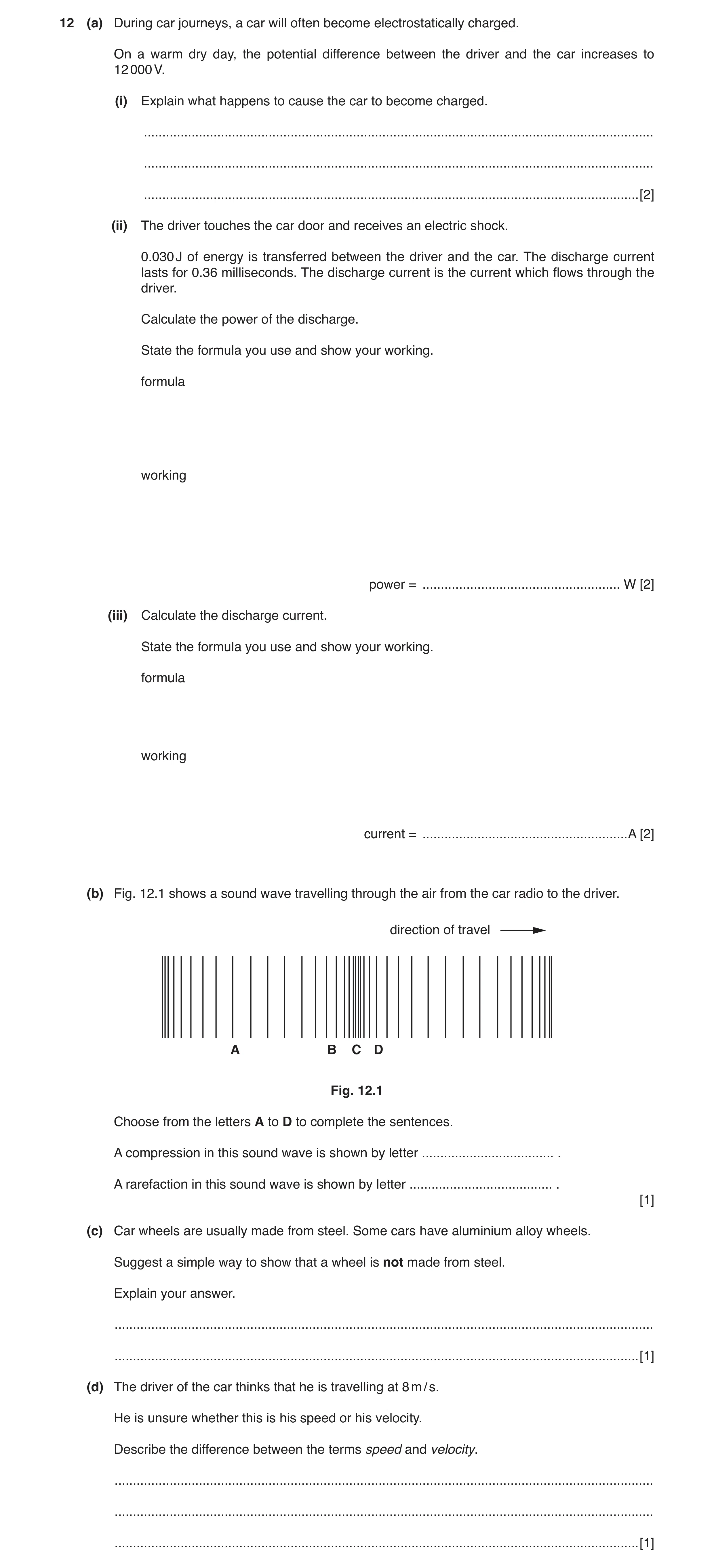
12 (a) During car journeys, a car will often become electrostatically charged. On a warm dry day, the potential difference between the driver and the car increases to 12 000 V. (i) Explain what happens to cause the car to become charged. … … … [2] (ii) The driver touches the car door and receives an electric shock. 0.030 J of energy is transferred between the driver and the car. The discharge current lasts for 0.36 milliseconds. The discharge current is the current which flows through the driver. Calculate the power of the discharge. State the formula you use and show your working. formula working power = … W [2] (iii) Calculate the discharge current. State the formula you use and show your working. formula working current = … A [2] (b) Fig. 12.1 shows a sound wave travelling through the air from the car radio to the driver. direction of travel A B C D Fig. 12.1 Choose from the letters A to D to complete the sentences. A compression in this sound wave is shown by letter … . A rarefaction in this sound wave is shown by letter … . [1] (c) Car wheels are usually made from steel. Some cars have aluminium alloy wheels. Suggest a simple way to show that a wheel is not made from steel. Explain your answer. … … [1] (d) The driver of the car thinks that he is travelling at 8 m / s. He is unsure whether this is his speed or his velocity. Describe the difference between the terms speed and velocity. … … … [1]
9 marks
Mark scheme: 12(a)(i) friction / description of friction ; transfer of electrons ; 2 12(a)(ii) power = energy / time or 0.03 / 0.00036 ; = 83.3 (W) ; 2 12(a)(iii) current = power / voltage or 83.3 / 12000 ; = 0.0069 (A) ; 2 12(b) C then A ; 1 12(c) use a magnet – aluminium is not magnetic steel is magnetic ; 1 12(d) speed – has magnitude only / scalar or velocity – has magnitude and direction / vector ; 1
This question in 0654/42 Oct/Nov 2017
Q4 · The speed-time graph for the journey of a bus along a road for 80 seconds 0654/43 Oct/Nov 2017
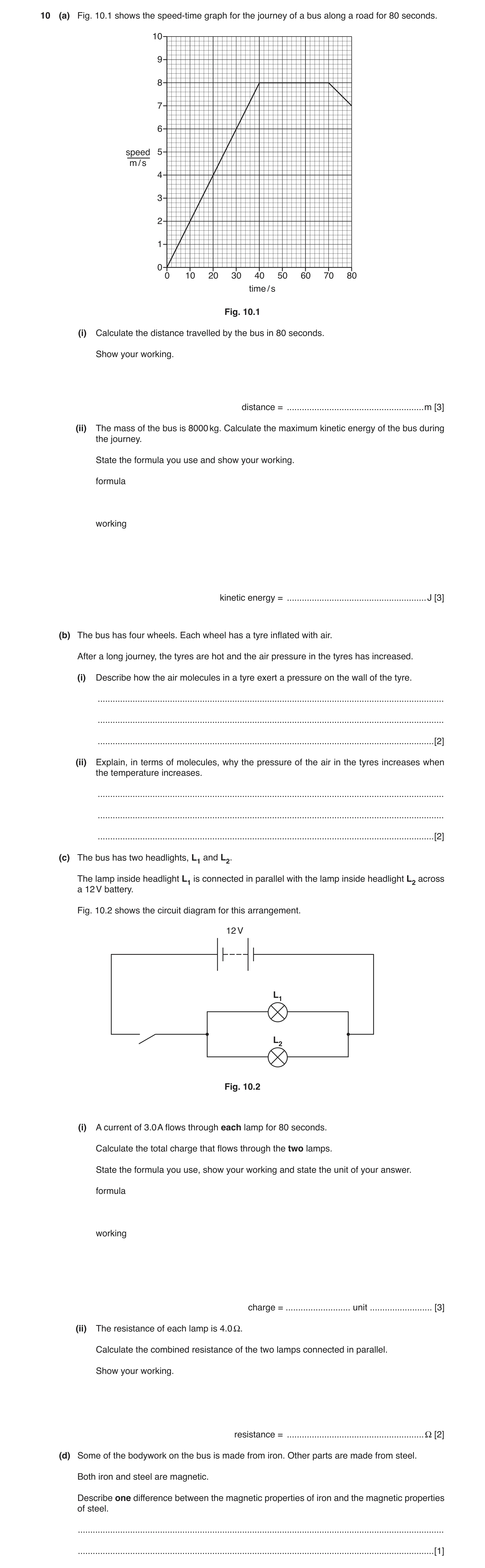
10 (a) Fig. 10.1 shows the speed-time graph for the journey of a bus along a road for 80 seconds. 10 9 8 7 6 speed 5 m / s 4 3 2 1 0 0 10 20 30 40 50 60 70 80 time / s Fig. 10.1 (i) Calculate the distance travelled by the bus in 80 seconds. Show your working. distance = … m [3] (ii) The mass of the bus is 8000 kg. Calculate the maximum kinetic energy of the bus during the journey. State the formula you use and show your working. formula working kinetic energy = … J [3] (b) The bus has four wheels. Each wheel has a tyre inflated with air. After a long journey, the tyres are hot and the air pressure in the tyres has increased. (i) Describe how the air molecules in a tyre exert a pressure on the wall of the tyre. … … … [2] (ii) Explain, in terms of molecules, why the pressure of the air in the tyres increases when the temperature increases. … … … [2] (c) The bus has two headlights, L1 and L2. The lamp inside headlight L1 is connected in parallel with the lamp inside headlight L2 across a 12 V battery. Fig. 10.2 shows the circuit diagram for this arrangement. 12 V L1 L2 Fig. 10.2 (i) A current of 3.0 A flows through each lamp for 80 seconds. Calculate the total charge that flows through the two lamps. State the formula you use, show your working and state the unit of your answer. formula working charge = … unit … [3] (ii) The resistance of each lamp is 4.0 Ω. Calculate the combined resistance of the two lamps connected in parallel. Show your working. resistance = … Ω [2] (d) Some of the bodywork on the bus is made from iron. Other parts are made from steel. Both iron and steel are magnetic. Describe one difference between the magnetic properties of iron and the magnetic properties of steel. … … [1]
16 marks
Mark scheme: 10(a)(i) evidence of area under graph ; = 160 + 240 + 75 ; 475 (m) ; 3 10(a)(ii) max speed = 8 m / s ; KE = ½ m v2 OR ½ × 8000 × 8 × 8 ; = 256 000 (J) ; 3 10(b)(i) particles collide with tyre / walls / it ; exert a force (on the tyre wall) ; 2 10(b)(ii) particles are moving faster / more (kinetic) energy ; greater rate of collision / more energetic collisions ; more force exerted (on tyre walls) ; max 2 10(c)(i) Q=It OR 3 × 80 OR 240 ; 2 × 240 OR 480 ; C ; 3 10(c)(ii) correct formula / substitution / explanation ; 2.0 (Ω) ; 2 10(d) iron magnetises quickly / steel magnetises slowly / iron loses magnetism quickly / steel loses magnetism slowly ; 1
This question in 0654/43 Oct/Nov 2017
Q5 · A boat pulling a water skier across a lake 0654/42 Oct/Nov 2018
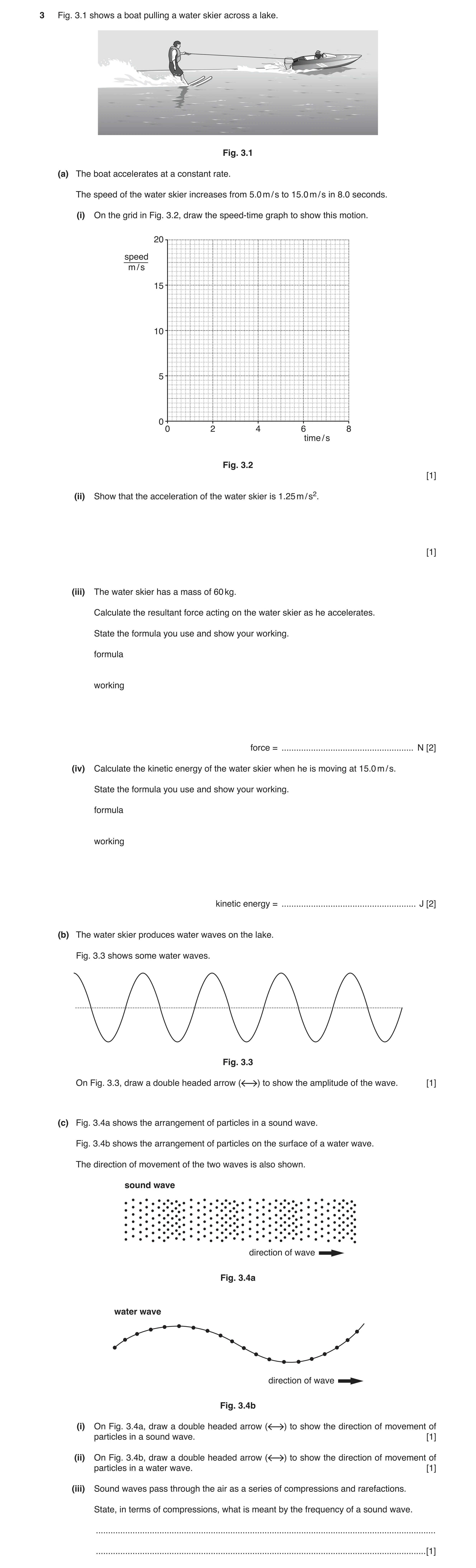
3 Fig. 3.1 shows a boat pulling a water skier across a lake. Fig. 3.1 (a) The boat accelerates at a constant rate. The speed of the water skier increases from 5.0 m / s to 15.0 m / s in 8.0 seconds. (i) On the grid in Fig. 3.2, draw the speed-time graph to show this motion. 20 speed m / s 15 10 5 0 0 2 4 6 8 time / s Fig. 3.2 [1] (ii) Show that the acceleration of the water skier is 1.25 m / s2. [1] (iii) The water skier has a mass of 60 kg. Calculate the resultant force acting on the water skier as he accelerates. State the formula you use and show your working. formula working force = … N [2] (iv) Calculate the kinetic energy of the water skier when he is moving at 15.0 m / s. State the formula you use and show your working. formula working kinetic energy = … J [2] (b) The water skier produces water waves on the lake. Fig. 3.3 shows some water waves. Fig. 3.3 On Fig. 3.3, draw a double headed arrow ( ) to show the amplitude of the wave. [1] (c) Fig. 3.4a shows the arrangement of particles in a sound wave. Fig. 3.4b shows the arrangement of particles on the surface of a water wave. The direction of movement of the two waves is also shown. sound wave direction of wave Fig. 3.4a water wave direction of wave Fig. 3.4b (i) On Fig. 3.4a, draw a double headed arrow ( ) to show the direction of movement of particles in a sound wave. [1] (ii) On Fig. 3.4b, draw a double headed arrow ( ) to show the direction of movement of particles in a water wave. [1] (iii) Sound waves pass through the air as a series of compressions and rarefactions. State, in terms of compressions, what is meant by the frequency of a sound wave. … … [1]
10 marks
Mark scheme: 3(a)(i) diagonal line starting at 0,5 and stopping at 8,15 ; 1 3(a)(ii) acceleration = change in speed / time or 10 / 8 = 1.25 ; 1 3(a)(iii) force = mass × acceleration or 60 × 1.25 ; = 75 (N) ; 2 3(a)(iv) kinetic energy = ½ mv2 or ½ × 60 × 15 × 15 ; = 6750 (J) / 6800 (J) ; 2 3(b) arrow drawn from middle to top or bottom of the wave ; 1 Question Answer Marks 3(c)(i) double headed arrow from left to right ; 1 3(c)(ii) water wave arrow up and down ; 1 3(c)(iii) number of compressions produced by the source per unit time / number of waves that pass a certain point per unit time ; 1
This question in 0654/42 Oct/Nov 2018
Q6 · The speed-time graph for part of a journey made by a train 0654/43 Oct/Nov 2018
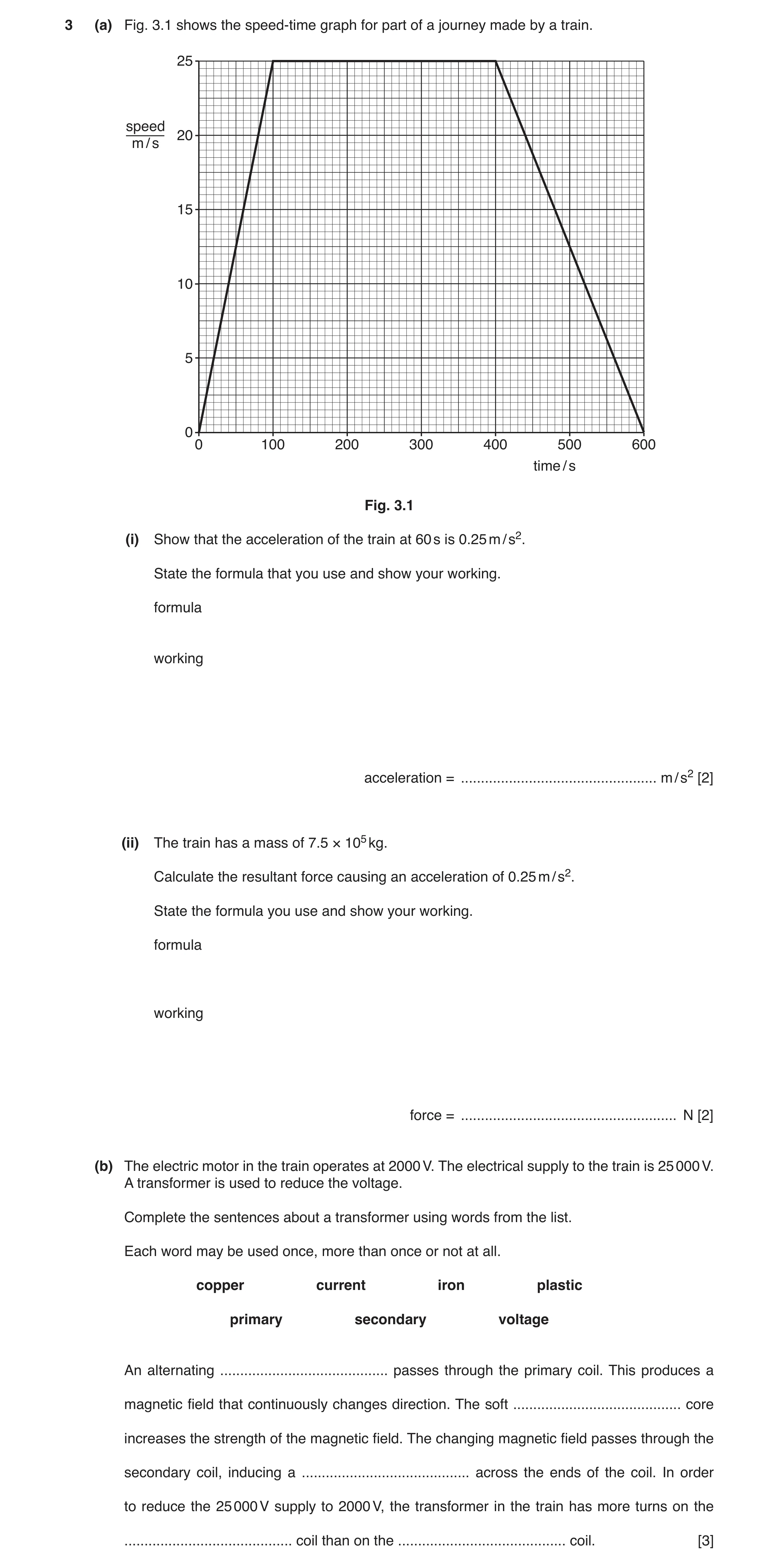
3 (a) Fig. 3.1 shows the speed-time graph for part of a journey made by a train. 25 speed 20 m / s 15 10 5 0 0 100 200 300 400 500 600 time / s Fig. 3.1 (i) Show that the acceleration of the train at 60 s is 0.25 m / s2. State the formula that you use and show your working. formula working acceleration = … m / s2 [2] (ii) The train has a mass of 7.5 × 10⁵ kg. Calculate the resultant force causing an acceleration of 0.25 m / s2. State the formula you use and show your working. formula working force = … N [2] (b) The electric motor in the train operates at 2000 V. The electrical supply to the train is 25 000 V. A transformer is used to reduce the voltage. Complete the sentences about a transformer using words from the list. Each word may be used once, more than once or not at all. copper current iron plastic primary secondary voltage An alternating … passes through the primary coil. This produces a magnetic field that continuously changes direction. The soft … core increases the strength of the magnetic field. The changing magnetic field passes through the secondary coil, inducing a … across the ends of the coil. In order to reduce the 25 000 V supply to 2000 V, the transformer in the train has more turns on the … coil than on the … coil. [3]
7 marks
Mark scheme: 3(a)(i) acceleration = change in speed / time ; 15 / 60 (= 0.25 (m / s2)) ; 2 3(a)(ii) force = mass × acceleration or 7.5 × 105 × 0.25 ; = 1.9 × 10⁵ (N) ; 2 3(b) current iron voltage primary secondary 1 or 2 correct ; 3 or 4 correct ; 5 correct ; 3
This question in 0654/43 Oct/Nov 2018
Q7 · During a mission to the Moon in 1971, an astronaut dropped a feather and a hammer 0654/41 May/June 2019
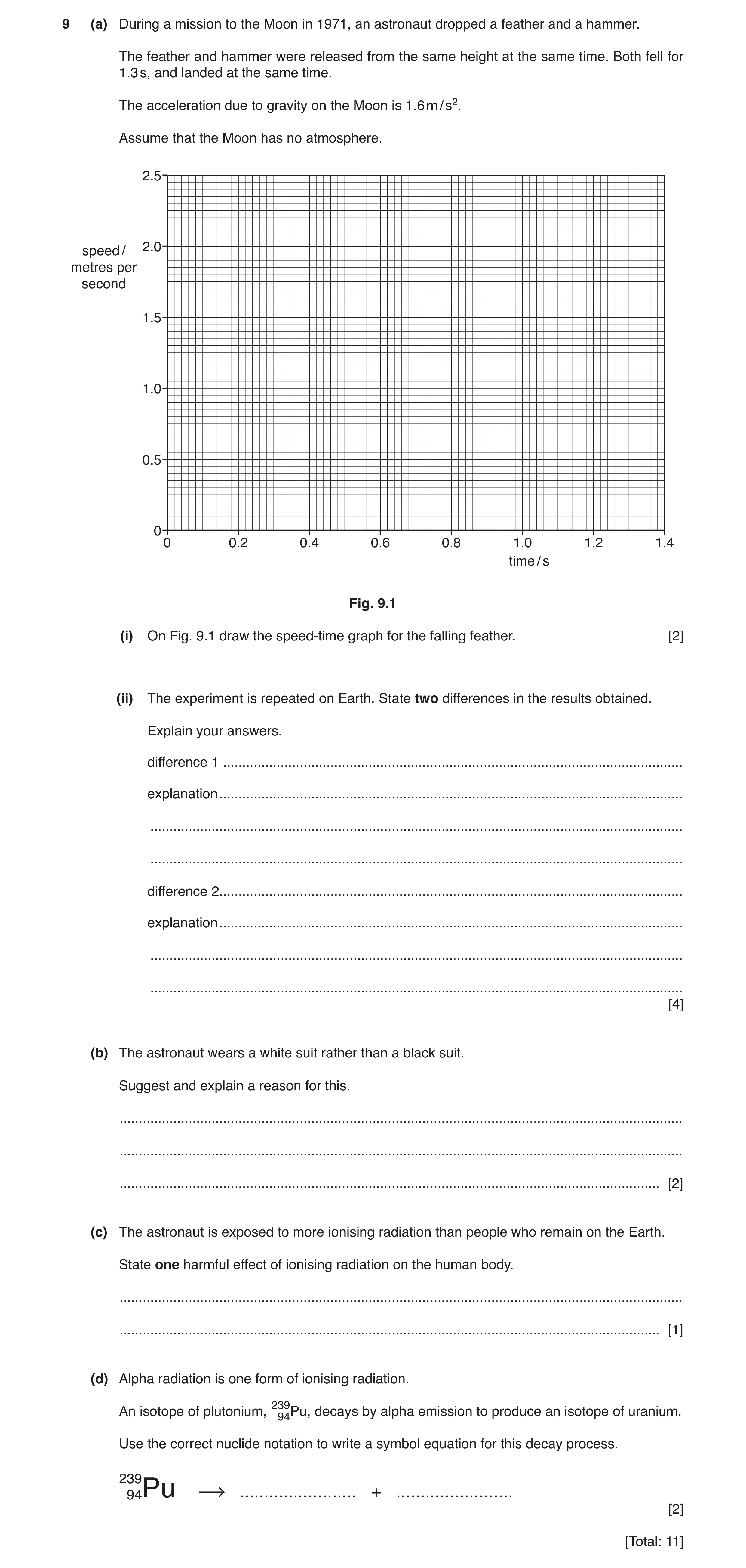
9 (a) During a mission to the Moon in 1971, an astronaut dropped a feather and a hammer. The feather and hammer were released from the same height at the same time. Both fell for 1.3 s, and landed at the same time. The acceleration due to gravity on the Moon is 1.6 m / s2. Assume that the Moon has no atmosphere. 2.5 2.0 speed / metres per second 1.5 1.0 0.5 0 0 0.2 0.4 0.6 0.8 1.0 1.2 1.4 time / s Fig. 9.1 (i) On Fig. 9.1 draw the speed-time graph for the falling feather. [2] (ii) The experiment is repeated on Earth. State two differences in the results obtained. Explain your answers. difference 1 … explanation … … … difference 2 … explanation … … … [4] (b) The astronaut wears a white suit rather than a black suit. Suggest and explain a reason for this. … … … [2] (c) The astronaut is exposed to more ionising radiation than people who remain on the Earth. State one harmful effect of ionising radiation on the human body. … … [1] (d) Alpha radiation is one form of ionising radiation. 239 An isotope of plutonium, 94Pu, decays by alpha emission to produce an isotope of uranium. Use the correct nuclide notation to write a symbol equation for this decay process. 239 … + … 94Pu [2] [Total: 11]
11 marks
Mark scheme: 9(a)(i) straight line from 0,0 through 1.0, 1.6 ; stopping at t = 1.3 ; 2 9(a)(ii) hammer falls faster on Earth than on the Moon ; gravity on Earth greater ; feather falls slower on Earth than on Moon ; reference to air resistance on Earth ; hammer falls faster than feather on Earth ; reference to air resistance on Earth ; max 4 9(b) astronaut stays cooler in white / would get very hot in black ; white surfaces are better reflectors of thermal radiation (than black surfaces) / black surfaces are better absorbers of thermal radiation (than white surfaces) ; 2 9(c) cancer/mutation ; 1 9(d) ; ; 2
This question in 0654/41 May/June 2019
Q8 · In 1971, an astronaut hit a golf ball on the surface of the Moon 0654/42 May/June 2019
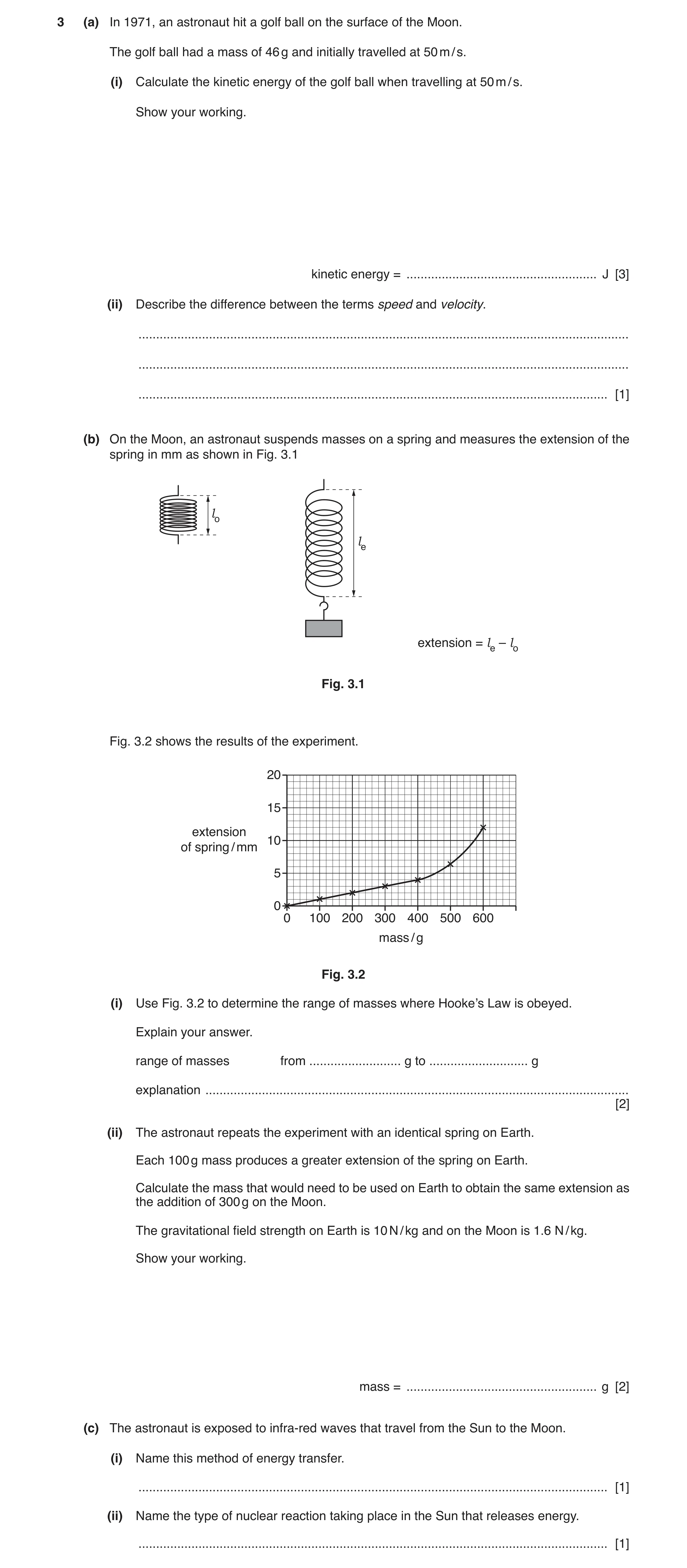
3 (a) In 1971, an astronaut hit a golf ball on the surface of the Moon. The golf ball had a mass of 46 g and initially travelled at 50 m / s. (i) Calculate the kinetic energy of the golf ball when travelling at 50 m / s. Show your working. kinetic energy = … J [3] (ii) Describe the difference between the terms speed and velocity. … … … [1] (b) On the Moon, an astronaut suspends masses on a spring and measures the extension of the spring in mm as shown in Fig. 3.1 lo le extension = le – lo Fig. 3.1 Fig. 3.2 shows the results of the experiment. 20 15 extension 10 of spring / mm 5 0 0 100 200 300 400 500 600 mass / g Fig. 3.2 (i) Use Fig. 3.2 to determine the range of masses where Hooke’s Law is obeyed. Explain your answer. range of masses from … g to … g explanation … [2] (ii) The astronaut repeats the experiment with an identical spring on Earth. Each 100 g mass produces a greater extension of the spring on Earth. Calculate the mass that would need to be used on Earth to obtain the same extension as the addition of 300 g on the Moon. The gravitational field strength on Earth is 10 N / kg and on the Moon is 1.6 N / kg. Show your working. mass = … g [2] (c) The astronaut is exposed to infra-red waves that travel from the Sun to the Moon. (i) Name this method of energy transfer. … [1] (ii) Name the type of nuclear reaction taking place in the Sun that releases energy. … [1]
10 marks
Mark scheme: 3(a)(i) g to kg conversion ; (KE) = ½ mv2 / ½ × 0.046 × 50 × 50 ; = 57.5 (J) ; 3 3(a)(ii) speed has magnitude (only) and velocity has magnitude and direction ; 1 3(b)(i) from 0 to 400 g ; extension directly proportional to mass / straight line ; 2 3(b)(ii) working e.g. 1.6 / 10 × 300 ; = 48 (g) ; 2 3(c)(i) radiation ; 1 3(c)(ii) fusion ; 1
This question in 0654/42 May/June 2019
Q9 · The forces acting on an aircraft 0654/43 May/June 2019
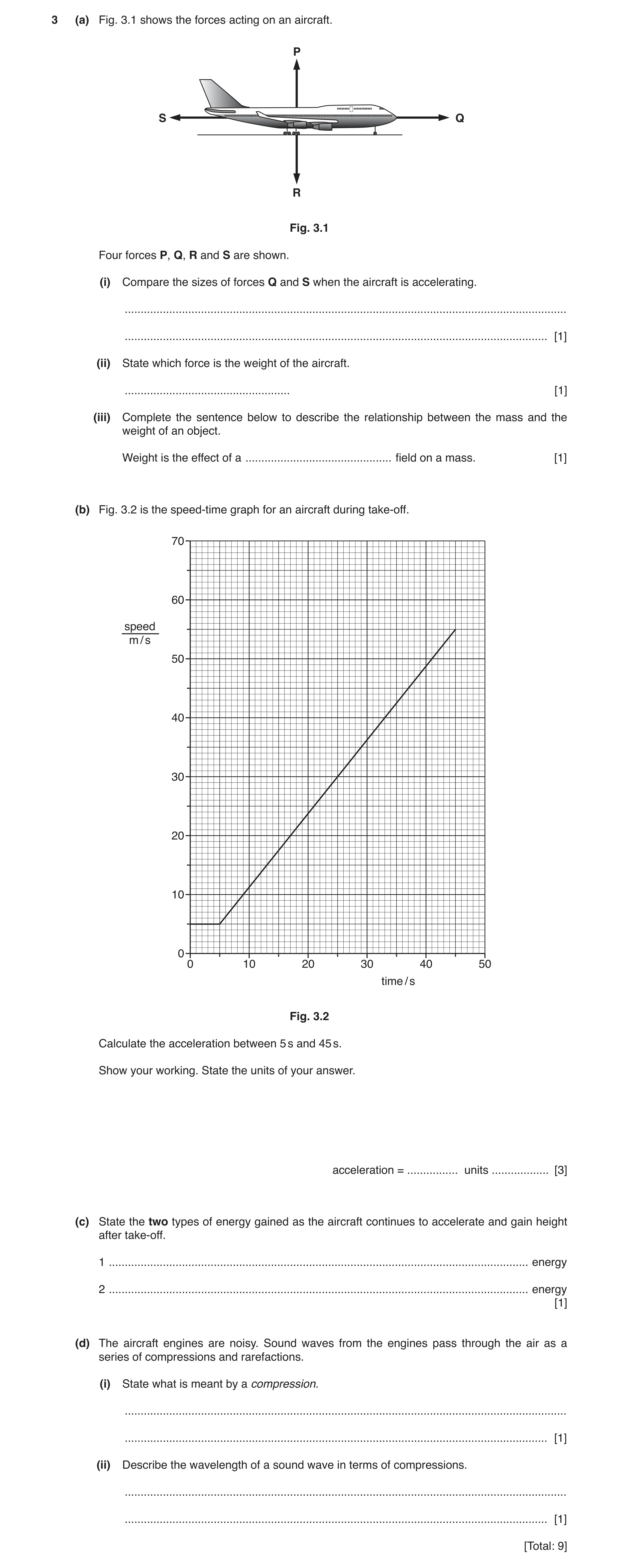
3 (a) Fig. 3.1 shows the forces acting on an aircraft. P S Q R Fig. 3.1 Four forces P, Q, R and S are shown. (i) Compare the sizes of forces Q and S when the aircraft is accelerating. … … [1] (ii) State which force is the weight of the aircraft. … [1] (iii) Complete the sentence below to describe the relationship between the mass and the weight of an object. Weight is the effect of a … field on a mass. [1] (b) Fig. 3.2 is the speed-time graph for an aircraft during take-off. 70 60 speed m / s 50 40 30 20 10 0 0 10 20 30 40 50 time / s Fig. 3.2 Calculate the acceleration between 5 s and 45 s. Show your working. State the units of your answer. acceleration = … units … [3] (c) State the two types of energy gained as the aircraft continues to accelerate and gain height after take-off. 1 … energy 2 … energy [1] (d) The aircraft engines are noisy. Sound waves from the engines pass through the air as a series of compressions and rarefactions. (i) State what is meant by a compression. … … [1] (ii) Describe the wavelength of a sound wave in terms of compressions. … … [1] [Total: 9]
9 marks
Mark scheme: 3(a)(i) Q is greater than S ; 1 3(a)(ii) R ; 1 3(a)(iii) gravitational ; 1 3(b) (acceleration =) change in speed/time or 50 / 40 ; = 1.3 / 1.25 ; m/s2 ; 3 3(c) kinetic and gravitational potential energy ; 1 3(d)(i) region of high pressure / where particles are closer together ; 1 3(d)(ii) distance between two successive compressions ; 1
This question in 0654/43 May/June 2019
Q10 · An aircraft has a mass of 400 000 kg 0654/41 Oct/Nov 2019
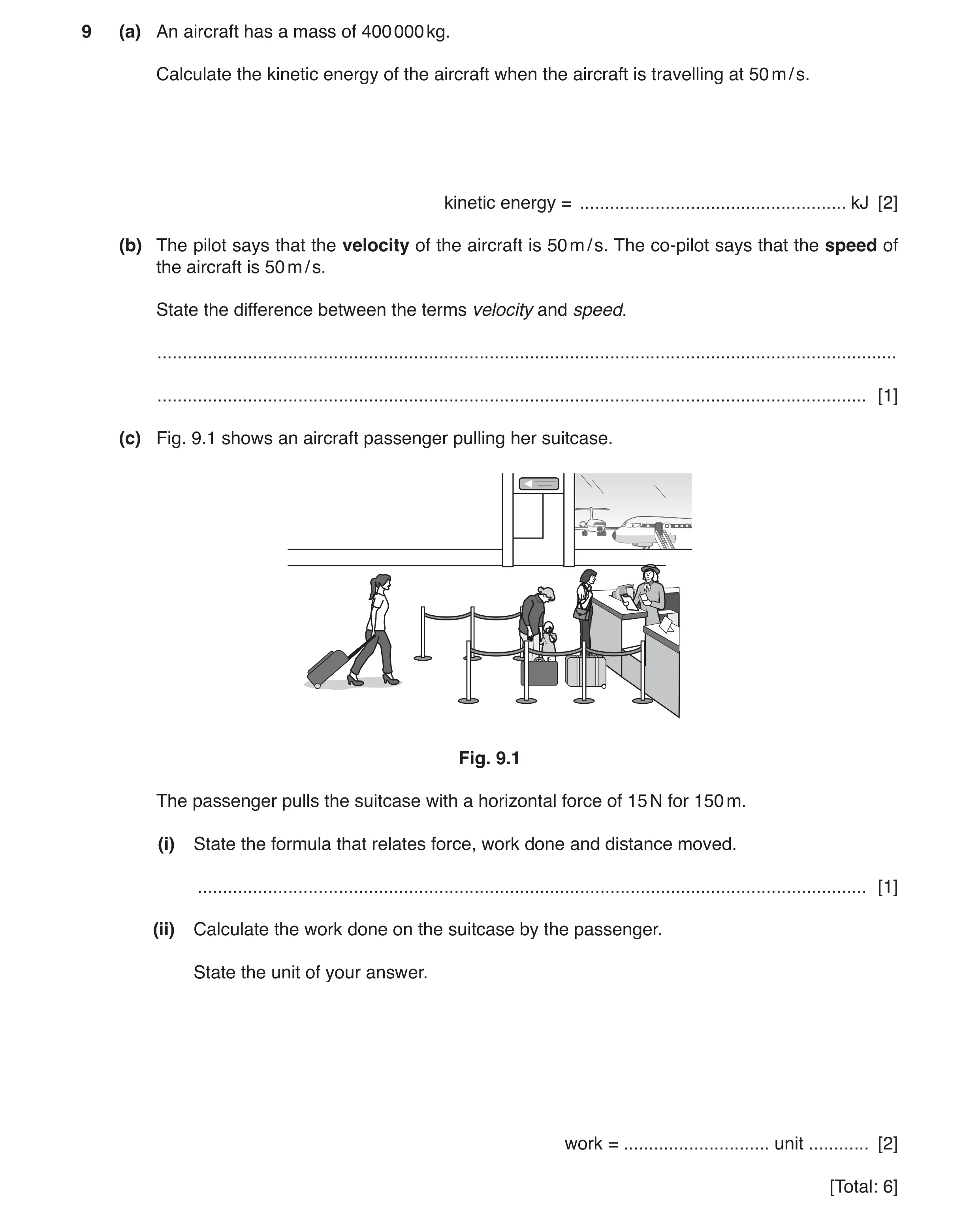
9 (a) An aircraft has a mass of 400 000 kg. Calculate the kinetic energy of the aircraft when the aircraft is travelling at 50 m / s. kinetic energy = … kJ [2] (b) The pilot says that the velocity of the aircraft is 50 m / s. The co-pilot says that the speed of the aircraft is 50 m / s. State the difference between the terms velocity and speed. … … [1] (c) Fig. 9.1 shows an aircraft passenger pulling her suitcase. Fig. 9.1 The passenger pulls the suitcase with a horizontal force of 15 N for 150 m. (i) State the formula that relates force, work done and distance moved. … [1] (ii) Calculate the work done on the suitcase by the passenger. State the unit of your answer. work = … unit … [2] [Total: 6]
6 marks
Mark scheme: 9(a) 1 2 mv2 OR 1 2 × 400000 × 50 × 50 ; = 500 000 (kJ) ; 2 9(b) velocity has direction but speed does not ; 1 9(c)(i) work done = force × distance (moved in direction of force) ; 1 9(c)(ii) 2250 ; J ; 2
This question in 0654/41 Oct/Nov 2019
Q11 · In a cartoon, a mouse is being chased by a cat 0654/43 Oct/Nov 2019
6 (a) In a cartoon, a mouse is being chased by a cat. The mouse accelerates constantly from rest for 1 second and reaches a speed of 3 m / s and then moves at a constant speed of 3 m / s for 8 seconds. (i) On the grid in Fig. 6.1 draw the speed-time graph to show the motion of the mouse. 4 3 speed m / s 2 1 0 0 1 2 3 4 5 6 7 8 9 time / s Fig. 6.1 [2] (ii) The cat accelerates constantly from rest for 9 seconds and reaches a speed of 2 m / s. Calculate the acceleration of the cat. acceleration = … m / s2 [2] (b) Fig. 6.2 shows the mouse sitting on a cube of cheese, which is on a wooden beam pivoted in the middle. cheese d cm 20 cm (not to scale) Fig. 6.2 The cat sits on the other end of the beam and balances it. The weight of the cat is 50 N and the combined weight of the mouse and cheese is 21 N. Calculate the distance d when the beam is balanced. distance d = … cm [2] (c) Each side of the cube of cheese is 12 cm. The weight of the cube of cheese is 20.5 N. Calculate the density of the cube of cheese in g / cm3. gravitational field strength = 10 N / kg density = … g / cm3 [4] (d) Water evaporates from the cat’s bowl. Liquid water turns into water vapour when it evaporates. Water also turns into water vapour when water boils. State two differences between the processes of evaporation and boiling. 1 … … 2 … … [2] [Total: 12]
12 marks
Mark scheme: 6(a)(i) acceleration section ; constant speed section ; 2 6(a)(ii) acceleration = change in speed / time OR 2 / 9 ; = 0.2 (m / s2) ; 2 6(b) f1d1 = f2d2 OR 50 × d = 21 × 20 ; d = 8.4 (cm) ; 2 6(c) volume = 1728 (cm3) / use of 123 ; mass = 20.5 / 10 OR 2.05 kg ; 2.05 × 1000 OR 2050 g ; (density = ) 1.2 (g / cm3) ; 4 6(d) evaporation can occur at any temperature / boiling only happens at the boiling point ; evaporation happens at the surface / boiling occurs throughout the liquid ; during boiling all / most molecules have enough energy to leave / evaporation lets only the molecules with most kinetic energy out ; evaporation can occur using the internal energy of the system / boiling a(n external) source of heat ; evaporation produces cooling / boiling does not produce cooling ; evaporation is a slow process / boiling is a rapid process ; max 2 2
This question in 0654/43 Oct/Nov 2019
Q12 · An aircraft being refuelled using a plastic pipe 0654/41 May/June 2020
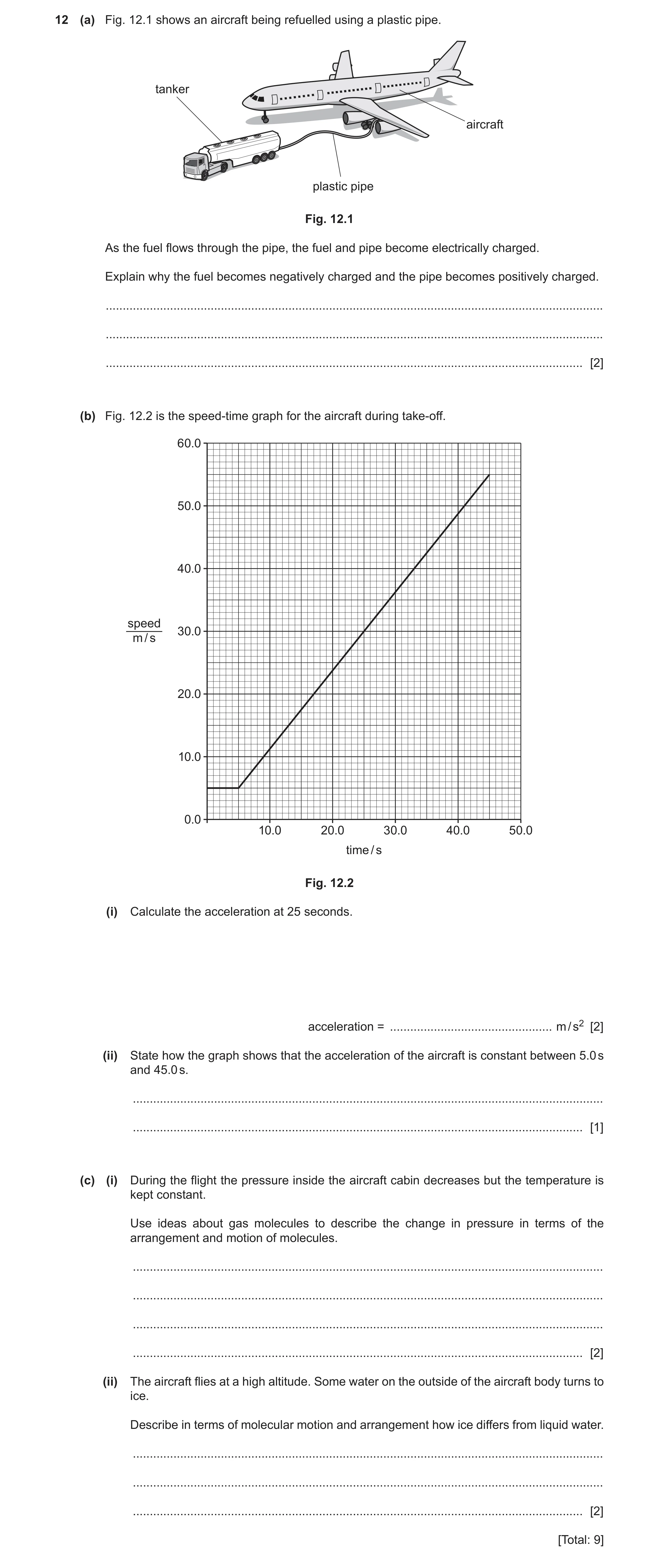
12 (a) Fig. 12.1 shows an aircraft being refuelled using a plastic pipe. tanker aircraft plastic pipe Fig. 12.1 As the fuel flows through the pipe, the fuel and pipe become electrically charged. Explain why the fuel becomes negatively charged and the pipe becomes positively charged. … … … [2] (b) Fig. 12.2 is the speed-time graph for the aircraft during take-off. 60.0 50.0 40.0 speed 30.0 m / s 20.0 10.0 0.0 10.0 20.0 30.0 40.0 50.0 time / s Fig. 12.2 (i) Calculate the acceleration at 25 seconds. acceleration = … m / s2 [2] (ii) State how the graph shows that the acceleration of the aircraft is constant between 5.0 s and 45.0 s. … … [1] (c) (i) During the flight the pressure inside the aircraft cabin decreases but the temperature is kept constant. Use ideas about gas molecules to describe the change in pressure in terms of the arrangement and motion of molecules. … … … … [2] (ii) The aircraft flies at a high altitude. Some water on the outside of the aircraft body turns to ice. Describe in terms of molecular motion and arrangement how ice differs from liquid water. … … … [2] [Total: 9]
9 marks
Mark scheme: 12(a) transfer of electrons; from pipe to fuel; 2 12(b)(i) correct working (e.g. 50/40) ; 1.25 (m/s2) ; 2 12(b)(ii) straight line; 1 Question Answer Marks 12(c)(i) molecules further apart ; fewer molecules collide with, surfaces / walls, in unit time / lower frequency of collision of molecules with, surfaces / walls ; 2 12(c)(ii) molecular motion – molecules in liquid water can move throughout but molecules in ice vibrate about a fixed point ; molecular arrangement – molecules in liquid water in random arrangement / molecules in ice in regular arrangement ; 2
This question in 0654/41 May/June 2020
Q13 · A cyclist accelerates along a straight road from a speed of 4 m / s to maximum speed 0654/42 May/June 2020
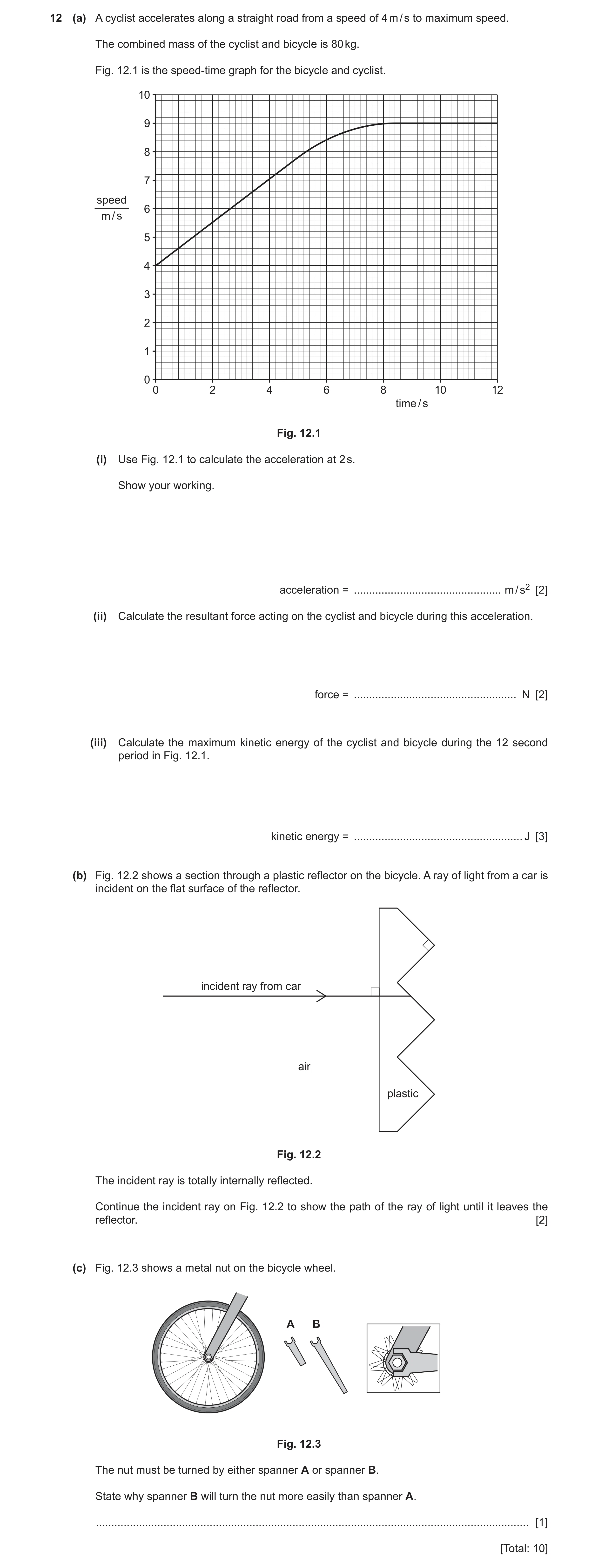
12 (a) A cyclist accelerates along a straight road from a speed of 4 m / s to maximum speed. The combined mass of the cyclist and bicycle is 80 kg. Fig. 12.1 is the speed-time graph for the bicycle and cyclist. 10 9 8 7 speed 6 m / s 5 4 3 2 1 0 0 2 4 6 8 10 12 time / s Fig. 12.1 (i) Use Fig. 12.1 to calculate the acceleration at 2 s. Show your working. acceleration = … m / s2 [2] (ii) Calculate the resultant force acting on the cyclist and bicycle during this acceleration. force = … N [2] (iii) Calculate the maximum kinetic energy of the cyclist and bicycle during the 12 second period in Fig. 12.1. kinetic energy = … J [3] (b) Fig. 12.2 shows a section through a plastic reflector on the bicycle. A ray of light from a car is incident on the flat surface of the reflector. incident ray from car air plastic Fig. 12.2 The incident ray is totally internally reflected. Continue the incident ray on Fig. 12.2 to show the path of the ray of light until it leaves the reflector. [2] (c) Fig. 12.3 shows a metal nut on the bicycle wheel. A B Fig. 12.3 The nut must be turned by either spanner A or spanner B. State why spanner B will turn the nut more easily than spanner A. … [1] [Total: 10]
10 marks
Mark scheme: 12(a)(i) change of speed or correct substitution (e.g. 1.55/2); 0.775 (m/s2); 2 12(a)(ii) F = ma or 80 × 0.775; 62 (N); 2 12(a)(iii) max speed = 9 m/s; KE = ½mv2 or ½ × 80 × 9 × 9; 3240 (J); 3 12(b) reflection only shown at first reflection; after second reflection ray emerges parallel to incident ray; 2 12(c) spanner B is longer / gives a bigger, moment / turning force ; 1
This question in 0654/42 May/June 2020
Q14 · A car travels along a road at 8 m / s 0654/41 Oct/Nov 2020
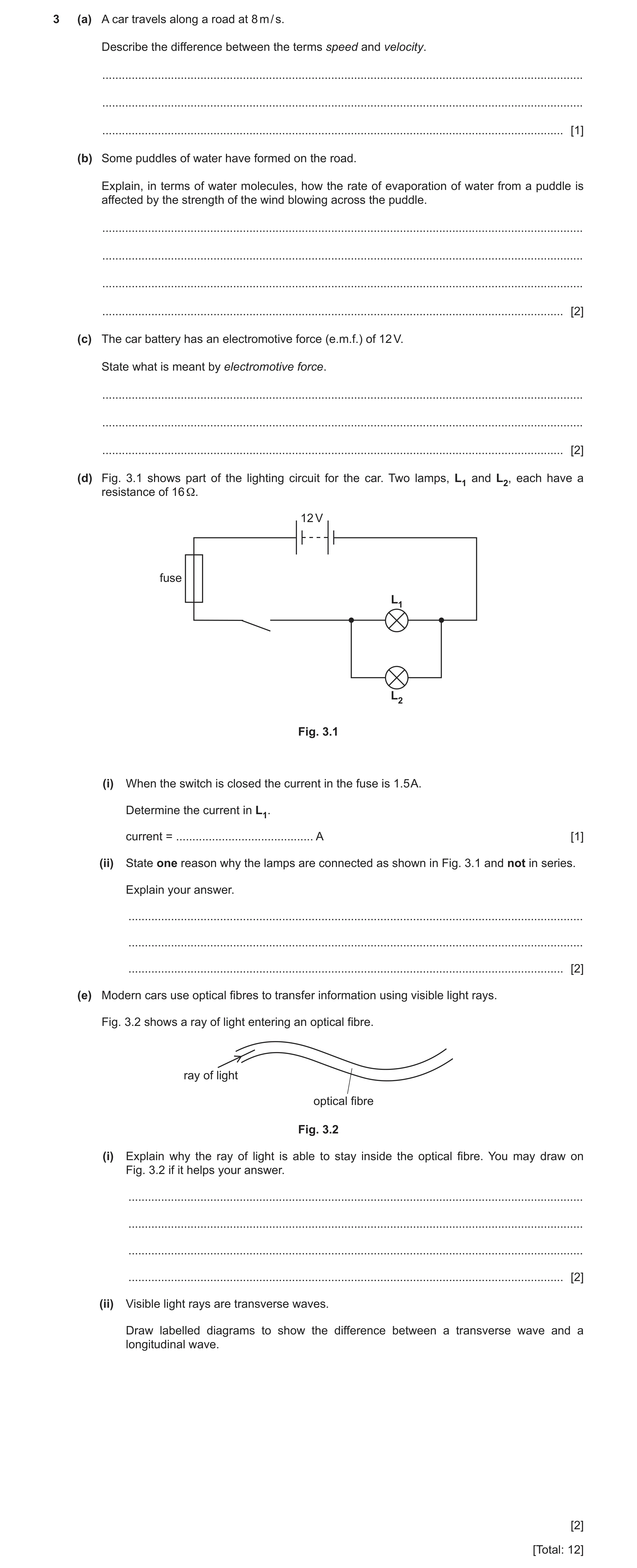
3 (a) A car travels along a road at 8 m / s. Describe the difference between the terms speed and velocity. … … … [1] (b) Some puddles of water have formed on the road. Explain, in terms of water molecules, how the rate of evaporation of water from a puddle is affected by the strength of the wind blowing across the puddle. … … … … [2] (c) The car battery has an electromotive force (e.m.f.) of 12 V. State what is meant by electromotive force. … … … [2] (d) Fig. 3.1 shows part of the lighting circuit for the car. Two lamps, L1 and L2, each have a resistance of 16 Ω. 12 V fuse L1 L2 Fig. 3.1 (i) When the switch is closed the current in the fuse is 1.5 A. Determine the current in L1. current = … A [1] (ii) State one reason why the lamps are connected as shown in Fig. 3.1 and not in series. Explain your answer. … … … [2] (e) Modern cars use optical fibres to transfer information using visible light rays. Fig. 3.2 shows a ray of light entering an optical fibre. ray of light optical fibre Fig. 3.2 (i) Explain why the ray of light is able to stay inside the optical fibre. You may draw on Fig. 3.2 if it helps your answer. … … … … [2] (ii) Visible light rays are transverse waves. Draw labelled diagrams to show the difference between a transverse wave and a longitudinal wave. [2] [Total: 12]
12 marks
Mark scheme: 3(a) speed has magnitude only / velocity has magnitude and direction / velocity has direction / speed does not have direction ; 1 3(b) increase in wind strength increases rate of evaporation / ORA ; (stronger wind) allows more molecules to escape / evaporate into the air above the puddle / ORA ; 2 3(c) the energy / work done (supplied by a source) ; per (unit) charge ; 2 3(d)(i) 0.75 (A) ; 1 Question Answer Marks 3(d)(ii) if one lamp fails the other will still work ; if one lamp fails still a complete circuit ; OR ref. to full brightness / brighter lamps ; because they each receive the full voltage ; 2 3(e)(i) ref. to total internal reflection / owtte / shown on diagram ; angle of incidence greater than the critical angle ; 2 3(e)(ii) correct diagrams for transverse and longitudinal waves ; vibrations perpendicular to direction of travel for transverse and parallel for longitudinal ; 2
This question in 0654/41 Oct/Nov 2020
Q15 · A student cycles to school 0654/41 Oct/Nov 2020
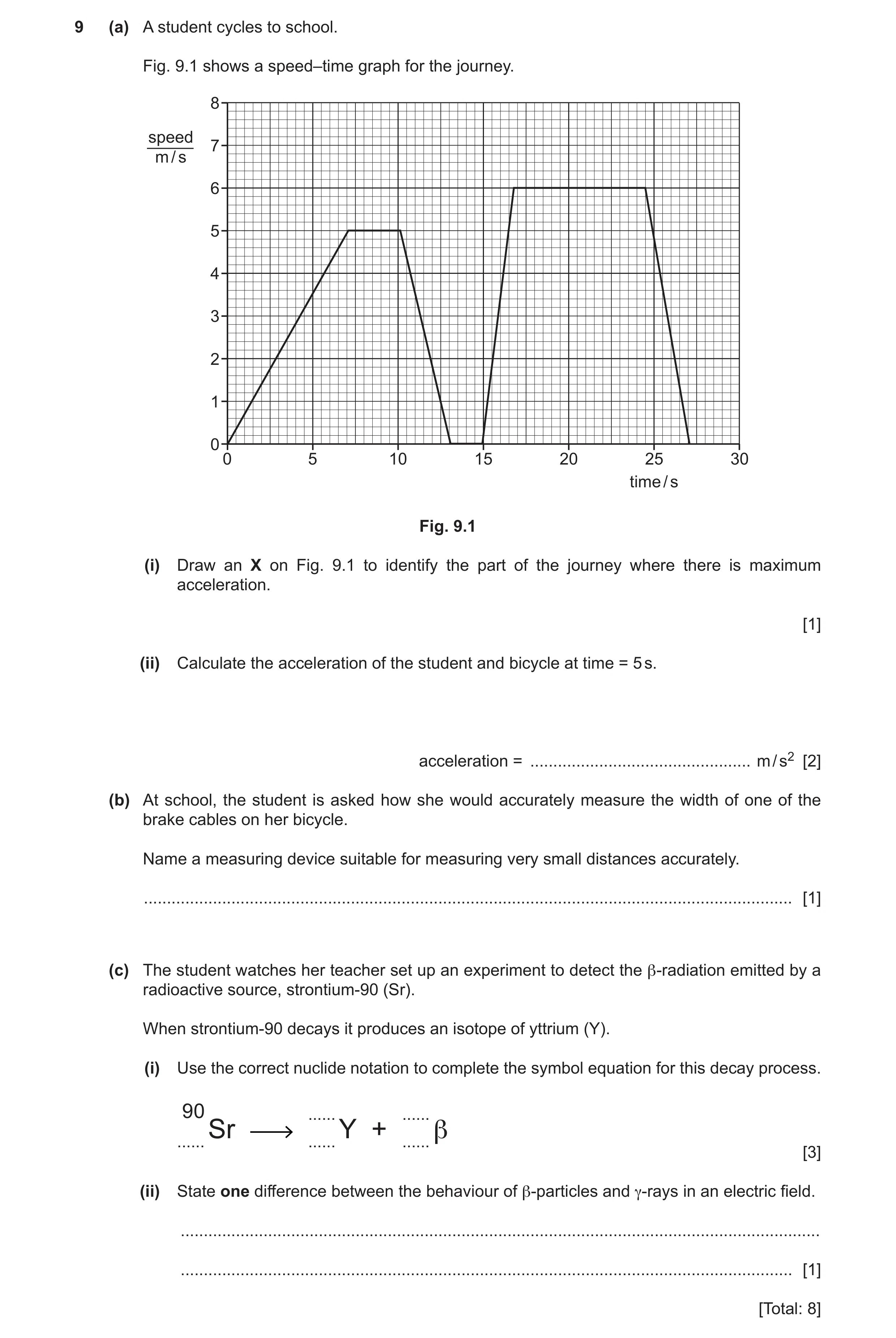
9 (a) A student cycles to school. Fig. 9.1 shows a speed–time graph for the journey. 8 speed 7 m / s 6 5 4 3 2 1 0 0 5 10 15 20 25 30 time / s Fig. 9.1 (i) Draw an X on Fig. 9.1 to identify the part of the journey where there is maximum acceleration. [1] (ii) Calculate the acceleration of the student and bicycle at time = 5 s. acceleration = … m / s2 [2] (b) At school, the student is asked how she would accurately measure the width of one of the brake cables on her bicycle. Name a measuring device suitable for measuring very small distances accurately. … [1] (c) The student watches her teacher set up an experiment to detect the β‑radiation emitted by a radioactive source, strontium‑90 (Sr). When strontium‑90 decays it produces an isotope of yttrium (Y). (i) Use the correct nuclide notation to complete the symbol equation for this decay process. 90 … … Sr Y + β … … … [3] (ii) State one difference between the behaviour of β‑particles and γ‑rays in an electric field. … … [1] [Total: 8]
8 marks
Mark scheme: 9(a)(i) X between t > 15 s and t < 16.8 s ; 1 9(a)(ii) change in speed or 5.0 or gradient calculation ; time taken 7.0 0.7 (m / s2) ; 2 9(b) micrometer screw gauge ; 1 9(c)(i) − → β 90 90 0 38 39 1 Sr Y+ strontium notation correct ; yttrium notation correct ; beta notation correct ; 3 9(c)(ii) β-particles deflected / gamma rays are not deflected ; 1
This question in 0654/41 Oct/Nov 2020
Q16 · A flea is a small insect 0654/43 Oct/Nov 2020
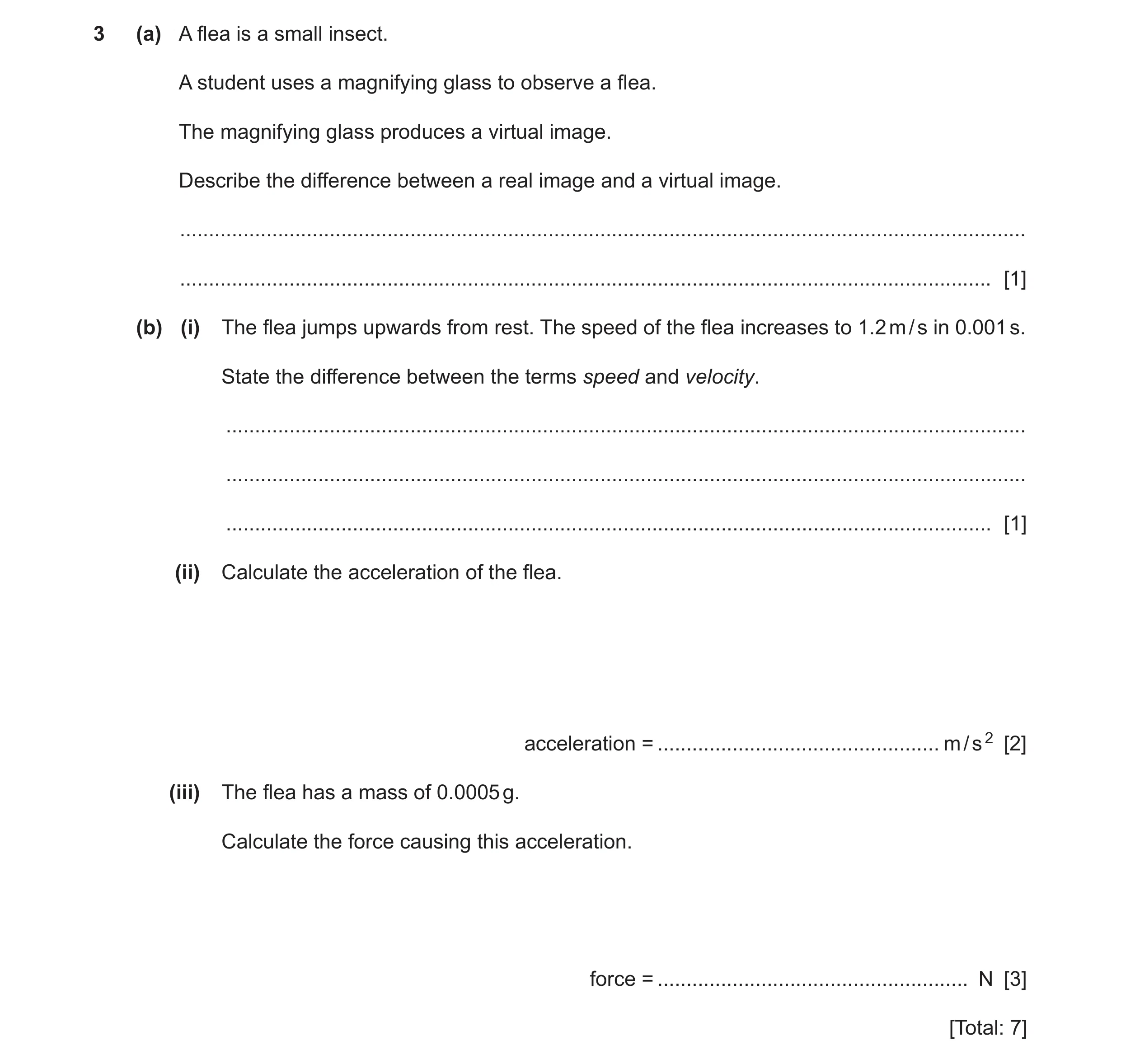
3 (a) A flea is a small insect. A student uses a magnifying glass to observe a flea. The magnifying glass produces a virtual image. Describe the difference between a real image and a virtual image. … … [1] (b) (i) The flea jumps upwards from rest. The speed of the flea increases to 1.2 m / s in 0.001 s. State the difference between the terms speed and velocity. … … … [1] (ii) Calculate the acceleration of the flea. acceleration = … m / s 2 [2] (iii) The flea has a mass of 0.0005 g. Calculate the force causing this acceleration. force = … N [3] [Total: 7]
7 marks
Mark scheme: 3(a) a real image is formed where light rays, converge / are focussed ; a virtual image is formed from where light rays appear to have diverged from ; a real image can be formed on a screen ; a virtual image cannot be formed on a screen ; max 1 3(b)(i) speed has magnitude only / velocity has magnitude and direction / velocity has direction / speed does not have direction ; 1 3(b)(ii) change in speed time taken or − v u t or Δv t or 1.2 0.001 ; 1200 (m / s2) ; 2 3(b)(iii) conversion of grams to kilograms; (force =) mass × acceleration or 0.0000005 × 1200 ; = 0.0006 (N); 3
This question in 0654/43 Oct/Nov 2020
Q17 · A speed-time graph for a train 0654/42 Feb/March 2021
12 Fig. 12.1 shows a speed-time graph for a train. 35 30 speed m / s 25 20 15 10 5 0 0 50 100 150 200 time / s Fig. 12.1 (a) Use Fig. 12.1 to calculate the distance travelled by the train in the first 100 s. distance = … m [2] (b) Use Fig. 12.1 to calculate the acceleration of the train from 0 s to 100 s. acceleration = … m / s2 [2] (c) Use Fig. 12.1 to describe the motion of the train from 100 s to 200 s. … … … … … [3] (d) Fig. 12.2 shows the forces acting on the train when it is travelling at constant speed. 1.96 × 10⁶ N P 2.60 × 10⁴ N 1.96 × 10⁶ N Fig. 12.2 (i) State the magnitude of the force P. … [1] (ii) Calculate the mass of the train. The gravitational field strength on Earth, g, is 10 N / kg. mass = … kg [1] (e) The train is made of steel painted dark grey. On sunny days, the inside of the train can get very hot. Explain why painting the train white would reduce the heating effect. … … [1] [Total: 10]
10 marks
Mark scheme: 12(a) using area under graph ; 500 (m) ; 2 12(b) (a =) (v–u) ÷ t / 10÷100 ; 0.1 (m / s2) ; 2 12(c) constant acceleration initially ; non-uniform acceleration / rate of acceleration decreases, at 135 s ; then constant speed from 160s ; 3 12(d)(i) 2.60 × 10⁴ (N) ; 1 12(d)(ii) (m = W÷g / 1.96 × 10⁶ ÷ 10 =) 1.96 × 10⁵ (kg) ; 1 12(e) white paint absorbs less thermal / infra-red radiation or reflects more thermal / infra-red radiation ; 1
This question in 0654/42 Feb/March 2021
Q18 · The motion of a sprinter running a race 0654/41 May/June 2021
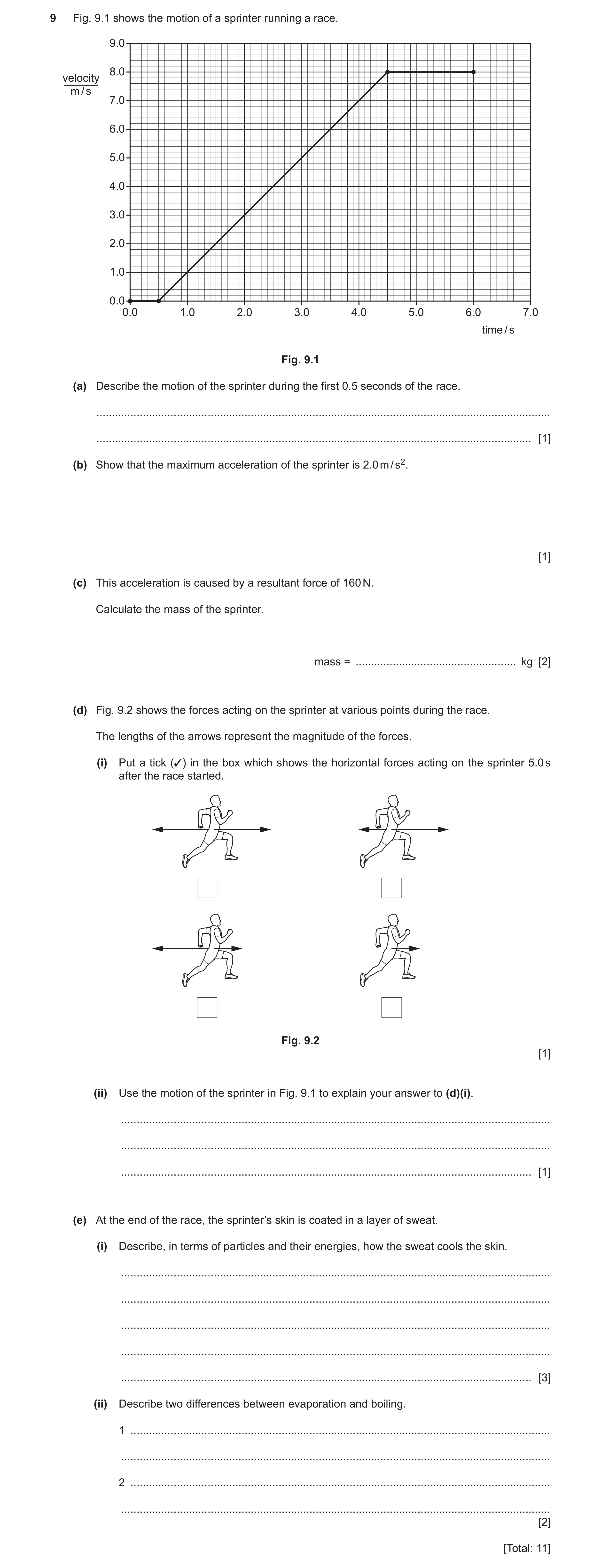
9 Fig. 9.1 shows the motion of a sprinter running a race. 9.0 8.0 velocity m / s 7.0 6.0 5.0 4.0 3.0 2.0 1.0 0.0 0.0 1.0 2.0 3.0 4.0 5.0 6.0 7.0 time / s Fig. 9.1 (a) Describe the motion of the sprinter during the first 0.5 seconds of the race. … … [1] (b) Show that the maximum acceleration of the sprinter is 2.0 m / s2. [1] (c) This acceleration is caused by a resultant force of 160 N. Calculate the mass of the sprinter. mass = … kg [2] (d) Fig. 9.2 shows the forces acting on the sprinter at various points during the race. The lengths of the arrows represent the magnitude of the forces. (i) Put a tick (3) in the box which shows the horizontal forces acting on the sprinter 5.0 s after the race started. Fig. 9.2 [1] (ii) Use the motion of the sprinter in Fig. 9.1 to explain your answer to (d)(i). … … … [1] (e) At the end of the race, the sprinter’s skin is coated in a layer of sweat. (i) Describe, in terms of particles and their energies, how the sweat cools the skin. … … … … … [3] (ii) Describe two differences between evaporation and boiling. 1 … … 2 … … [2] [Total: 11]
11 marks
Mark scheme: 9(a) stationary ; 1 9(b) (a =) 8.0 / 4.0 ; 1 9(c) (m =) F / a or 160 / 2.0 ; 80 (kg) ; 2 9(d)(i) first diagram ticked ; 1 9(d)(ii) constant velocity / no acceleration, so forces must be balanced / no resultant force ; 1 Question Answer Marks 9(e)(i) (water) evaporates ; most energetic particles leave (surface) ; average energy of the remaining particles is lower ; 3 9(e)(ii) evaporation can occur at any temperature / boiling only happens at the boiling point ; evaporation happens only at the surface / boiling happens throughout the liquid ; boiling takes energy in (endothermic) to occur / evaporation lets only the molecules with the highest kinetic energy out ; evaporation can occur using the internal energy of the system / boiling requires an external source of heat ; evaporation produces cooling / boiling does not ; evaporation is a slow process / boiling is a rapid process ; max 2 2 4
This question in 0654/41 May/June 2021
Q19 · A student observing an exploding firework 0654/42 May/June 2021
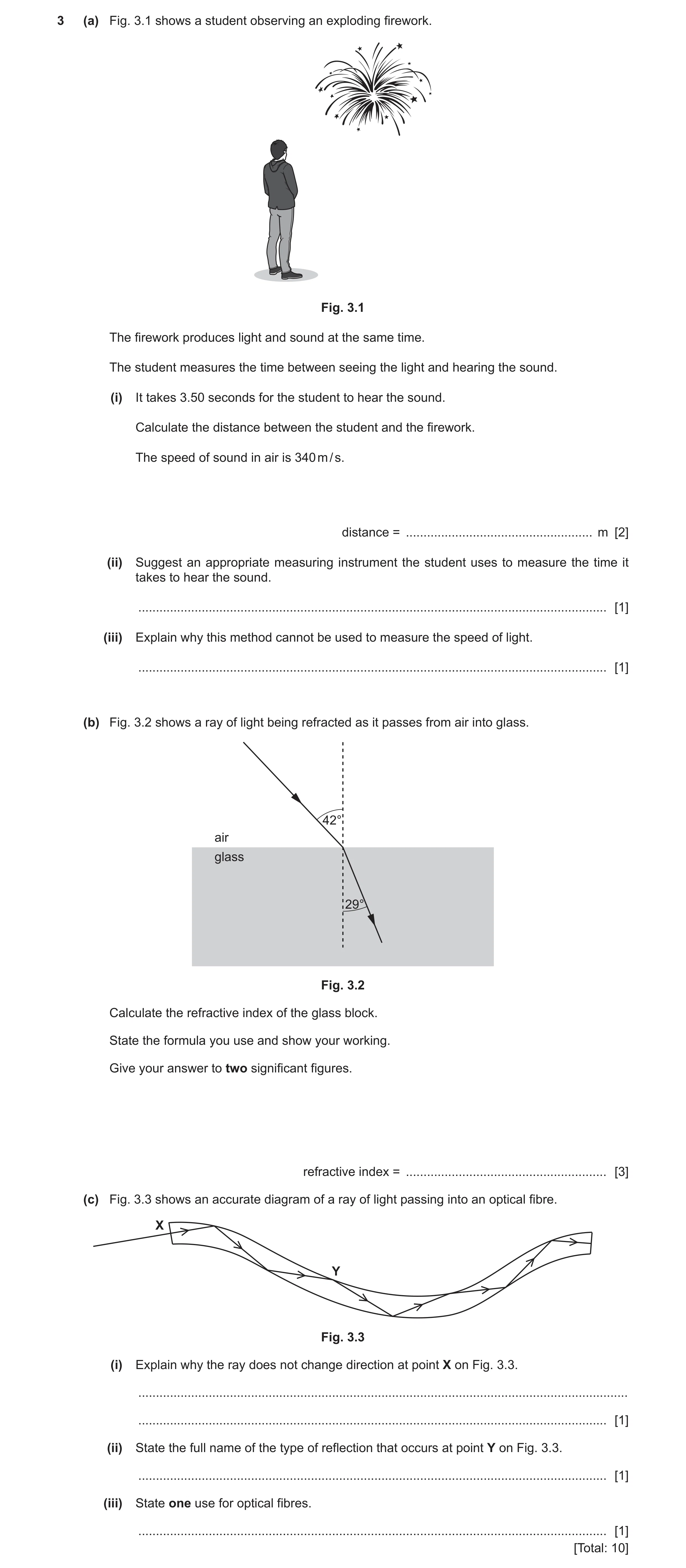
3 (a) Fig. 3.1 shows a student observing an exploding firework. Fig. 3.1 The firework produces light and sound at the same time. The student measures the time between seeing the light and hearing the sound. (i) It takes 3.50 seconds for the student to hear the sound. Calculate the distance between the student and the firework. The speed of sound in air is 340 m / s. distance = … m [2] (ii) Suggest an appropriate measuring instrument the student uses to measure the time it takes to hear the sound. … [1] (iii) Explain why this method cannot be used to measure the speed of light. … [1] (b) Fig. 3.2 shows a ray of light being refracted as it passes from air into glass. 42° air glass 29° Fig. 3.2 Calculate the refractive index of the glass block. State the formula you use and show your working. Give your answer to two significant figures. refractive index = … [3] (c) Fig. 3.3 shows an accurate diagram of a ray of light passing into an optical fibre. X Y Fig. 3.3 (i) Explain why the ray does not change direction at point X on Fig. 3.3. … … [1] (ii) State the full name of the type of reflection that occurs at point Y on Fig. 3.3. … [1] (iii) State one use for optical fibres. … [1] [Total: 10]
10 marks
Mark scheme: 3(a)(i) (d=) v × t / 340 × 3.50 ; 1190 (m) ; 2 3(a)(ii) stopwatch ; 1 3(a)(iii) time taken would be too short to measure / speed of light is much greater ; 1 3(b) (n =) sin i / sin r ; sin42 / sin29 or 1.380192509 ; 1.4 ; 3 3(c)(i) angle of incidence is zero / ray perpendicular to boundary / along normal ; 1 3(c)(ii) total internal reflection ; 1 3(c)(iii) communication / medicine ; 1
This question in 0654/42 May/June 2021
Question 20 0654/42 May/June 2021
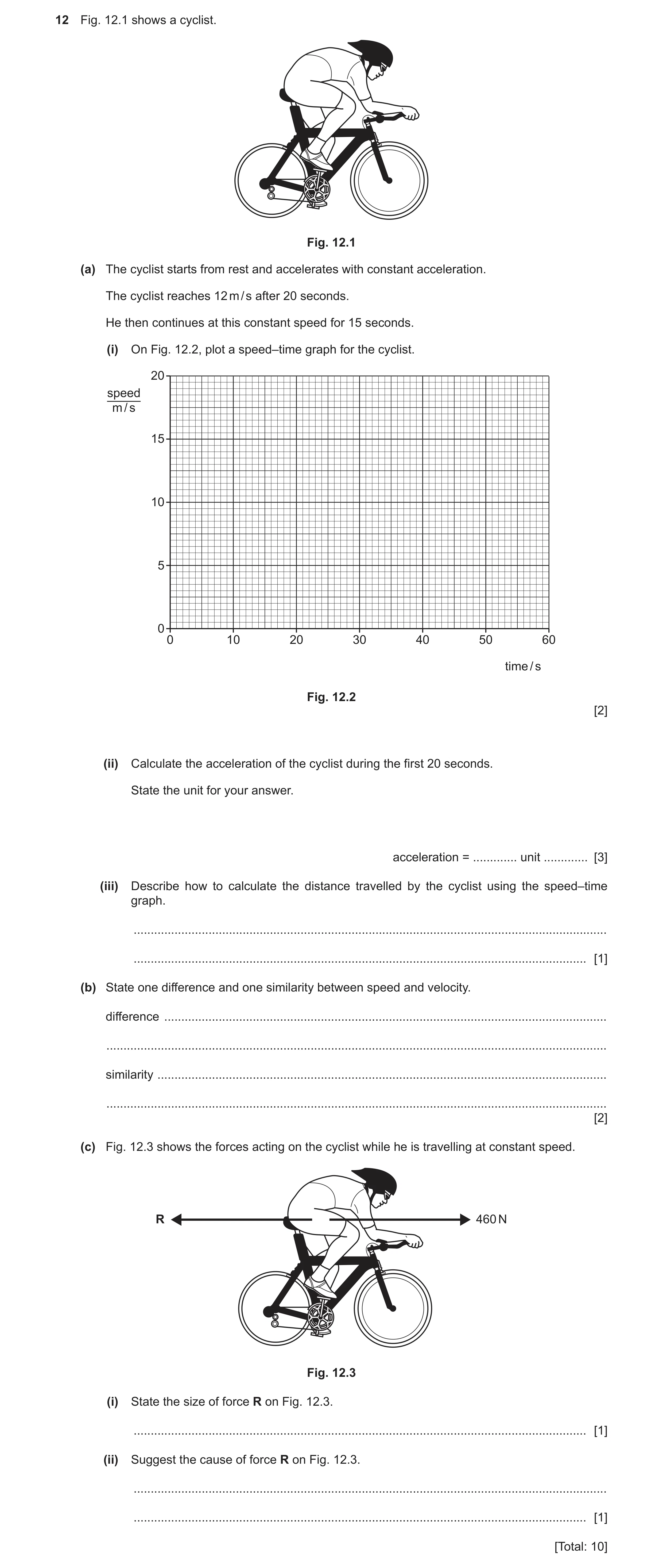
12 Fig. 12.1 shows a cyclist. Fig. 12.1 (a) The cyclist starts from rest and accelerates with constant acceleration. The cyclist reaches 12 m / s after 20 seconds. He then continues at this constant speed for 15 seconds. (i) On Fig. 12.2, plot a speed–time graph for the cyclist. 20 speed m / s 15 10 5 0 0 10 20 30 40 50 60 time / s Fig. 12.2 [2] (ii) Calculate the acceleration of the cyclist during the first 20 seconds. State the unit for your answer. acceleration = … unit … [3] (iii) Describe how to calculate the distance travelled by the cyclist using the speed–time graph. … … [1] (b) State one difference and one similarity between speed and velocity. difference … … similarity … … [2] (c) Fig. 12.3 shows the forces acting on the cyclist while he is travelling at constant speed. R 460 N Fig. 12.3 (i) State the size of force R on Fig. 12.3. … [1] (ii) Suggest the cause of force R on Fig. 12.3. … … [1] [Total: 10]
10 marks
Mark scheme: 12(a)(i) ;; 2 Question Answer Marks 12(a)(ii) (a =) Δv / t / 12 / 20 ; 0.6 ; m / s2 ; 3 12(a)(iii) area under the graph ; 1 12(b) velocity has a direction ORA ; both measure, rate of change of distance or displacement / same units ; 2 12(c)(i) 460 (N) ; 1 12(c)(ii) air resistance / friction / drag ; 1
This question in 0654/42 May/June 2021
Q21 · A sprinter runs a 200 m race in 25 seconds 0654/43 May/June 2021
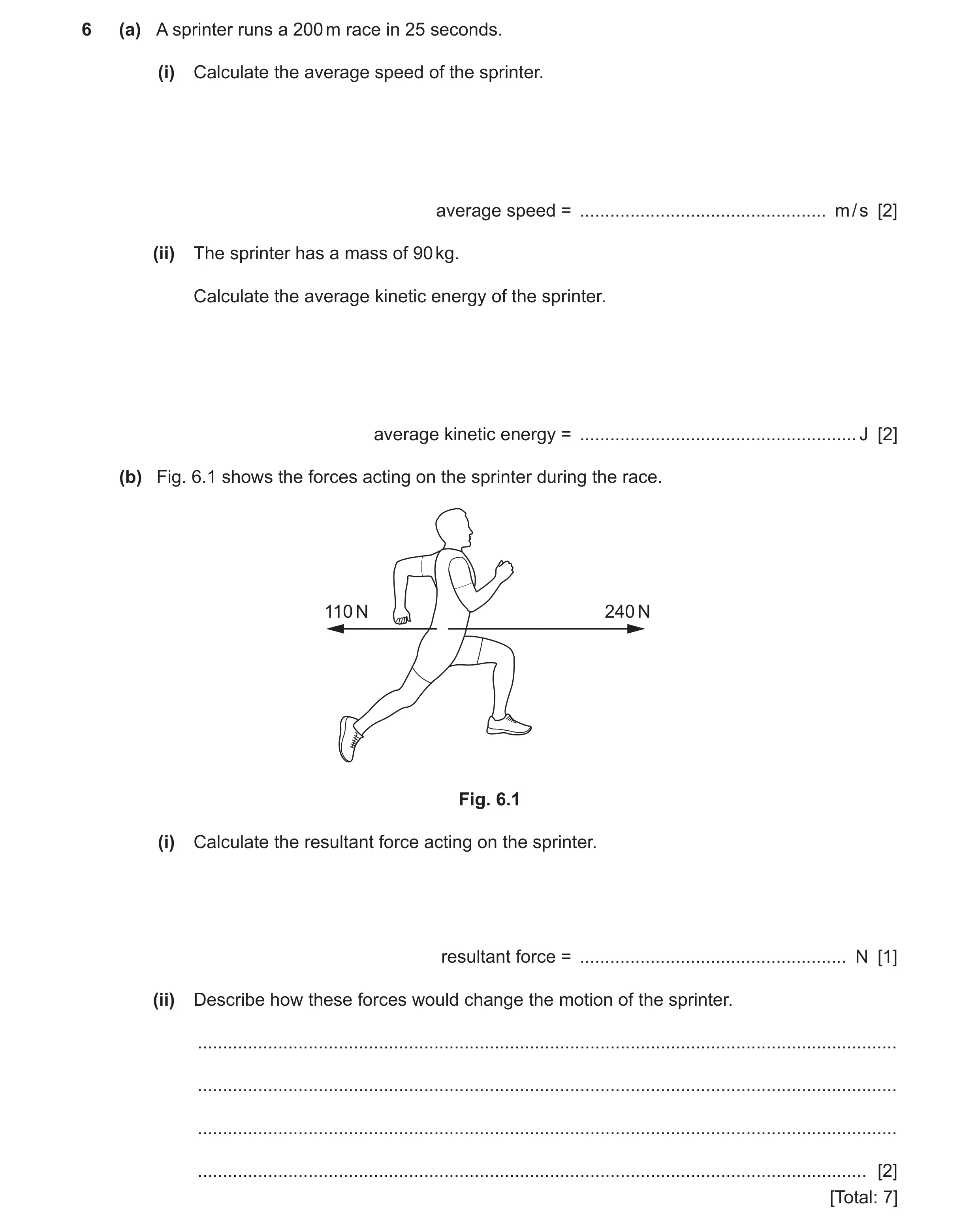
6 (a) A sprinter runs a 200 m race in 25 seconds. (i) Calculate the average speed of the sprinter. average speed = … m / s [2] (ii) The sprinter has a mass of 90 kg. Calculate the average kinetic energy of the sprinter. average kinetic energy = … J [2] (b) Fig. 6.1 shows the forces acting on the sprinter during the race. 110 N 240 N Fig. 6.1 (i) Calculate the resultant force acting on the sprinter. resultant force = … N [1] (ii) Describe how these forces would change the motion of the sprinter. … … … … [2] [Total: 7]
7 marks
Mark scheme: 6(a)(i) (speed =) d / t or 200 / 25 ; 8 (m / s) ; 2 6(a)(ii) (KE =) ½ mv2 or ½ × 90 × 82 ; 2880 (J) ; 2 6(b)(i) (240 – 110 =) 130 (N) ; 1 6(b)(ii) resultant force forward ; sprinter will accelerate / speed up ; 2
This question in 0654/43 May/June 2021
Q22 · A rollercoaster ride at a theme park 0654/42 Oct/Nov 2021
6 Fig. 6.1 shows a rollercoaster ride at a theme park. The rollercoaster travels on a frictionless track. rollercoaster car A E C B D ground level Fig. 6.1 (a) Use a letter from A to E to state the position at which the rollercoaster car has: • the least gravitational potential energy … • less kinetic energy than it does at position E … • the most kinetic energy. … [2] (b) The rollercoaster car has a mass of 750 kg. At position C the rollercoaster car is 36 m above the ground level and is moving at 20 m/s. (i) Calculate the gravitational potential energy lost by the rollercoaster car as it travels from C to the ground level. gravitational field strength g = 10 N / kg gravitational potential energy = … J [2] (ii) Calculate the kinetic energy of the rollercoaster car at C. kinetic energy = … J [2] (iii) State the change in the total energy of the rollercoaster car as it travels on the frictionless track from C to ground level. change in total energy = … J [1] (c) Fig. 6.2 shows a speed-time graph for the rollercoaster car’s journey between positions D and E. 40 30 speed 20 m / s 10 0 0 1 2 3 4 5 6 time / s Fig. 6.2 (i) Use Fig. 6.2 to determine the change in speed of the rollercoaster car between t = 2 s and t = 4 s. change in speed = … m / s [1] (ii) Calculate the acceleration of the rollercoaster car between t = 2 s and t = 4 s. acceleration = … m / s2 [2] (iii) Use Fig. 6.2 to describe the motion of the rollercoaster car between t = 0 s and t = 5 s. … … … … … [3] [Total: 13]
13 marks
Mark scheme: 6(a)(i) D, A, D ;; 2 6(b)(i) (GPE =) mgh or 750 × 10 × 36 ; 270 000 (J) ; 2 6(b)(ii) (KE=) ½ mv2 or ½ × 750 × 202 ; 150 000 (J) ; 2 6(b)(iii) 0 (J) ; 1 6(c)(i) (–)22 (m / s) ; 1 6(c)(ii) a = Δv / t or (–)22 / 2 ; (–)11 (m / s2) ; 2 6(c)(iii) decelerating / negative acceleration / slowing down ; non-constant (deceleration), at start / before 2 s ; constant (deceleration), at end / after 2 s ; 3
This question in 0654/42 Oct/Nov 2021
Q23 · A car travels at 12 m /s for 15 seconds 0654/43 Oct/Nov 2021
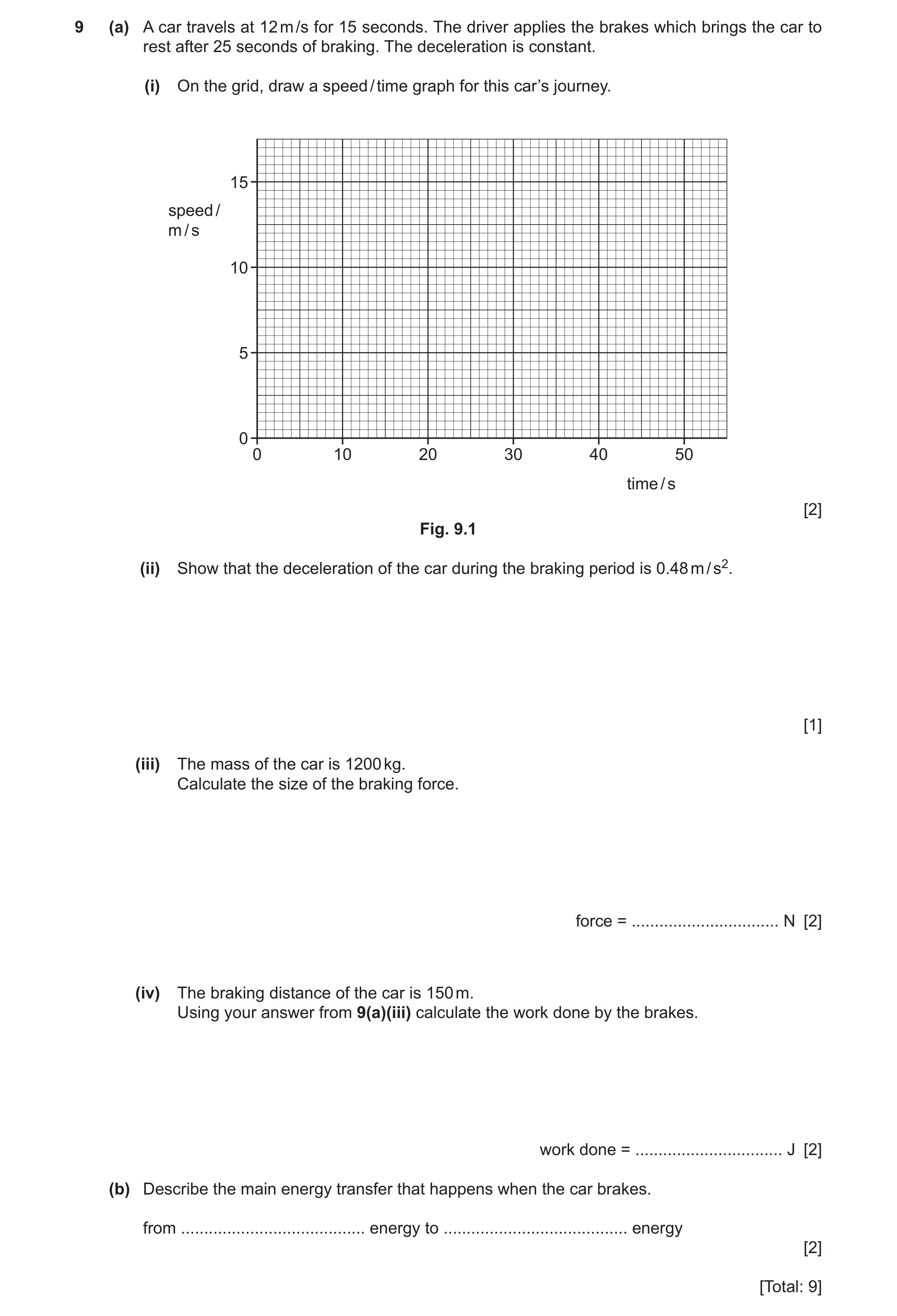
9 (a) A car travels at 12 m /s for 15 seconds. The driver applies the brakes which brings the car to rest after 25 seconds of braking. The deceleration is constant. (i) On the grid, draw a speed / time graph for this car’s journey. 15 speed / m / s 10 5 0 0 10 20 30 40 50 time / s [2] Fig. 9.1 (ii) Show that the deceleration of the car during the braking period is 0.48 m / s2. [1] (iii) The mass of the car is 1200 kg. Calculate the size of the braking force. force = … N [2] (iv) The braking distance of the car is 150 m. Using your answer from 9(a)(iii) calculate the work done by the brakes. work done = … J [2] (b) Describe the main energy transfer that happens when the car brakes. from … energy to … energy [2] [Total: 9]
9 marks
Mark scheme: 9(a)(i) horizontal line drawn at 12 m / s for 15 s ; straight line drawn from 12 m / s to 0 m / s taking 25 s ; 2 9(a)(ii) (a =) 12 / 25 (= 0.48 m / s2) ; 1 9(a)(iii) (F =) ma or 1200 × 0.48 ; 576 (N) ; 2 9(a)(iv) (W =) f × d or 576 × 150 ; 86 400 (J) ; 2 9(b) kinetic; thermal ; 2
This question in 0654/43 Oct/Nov 2021
Question 24 0654/42 Feb/March 2022
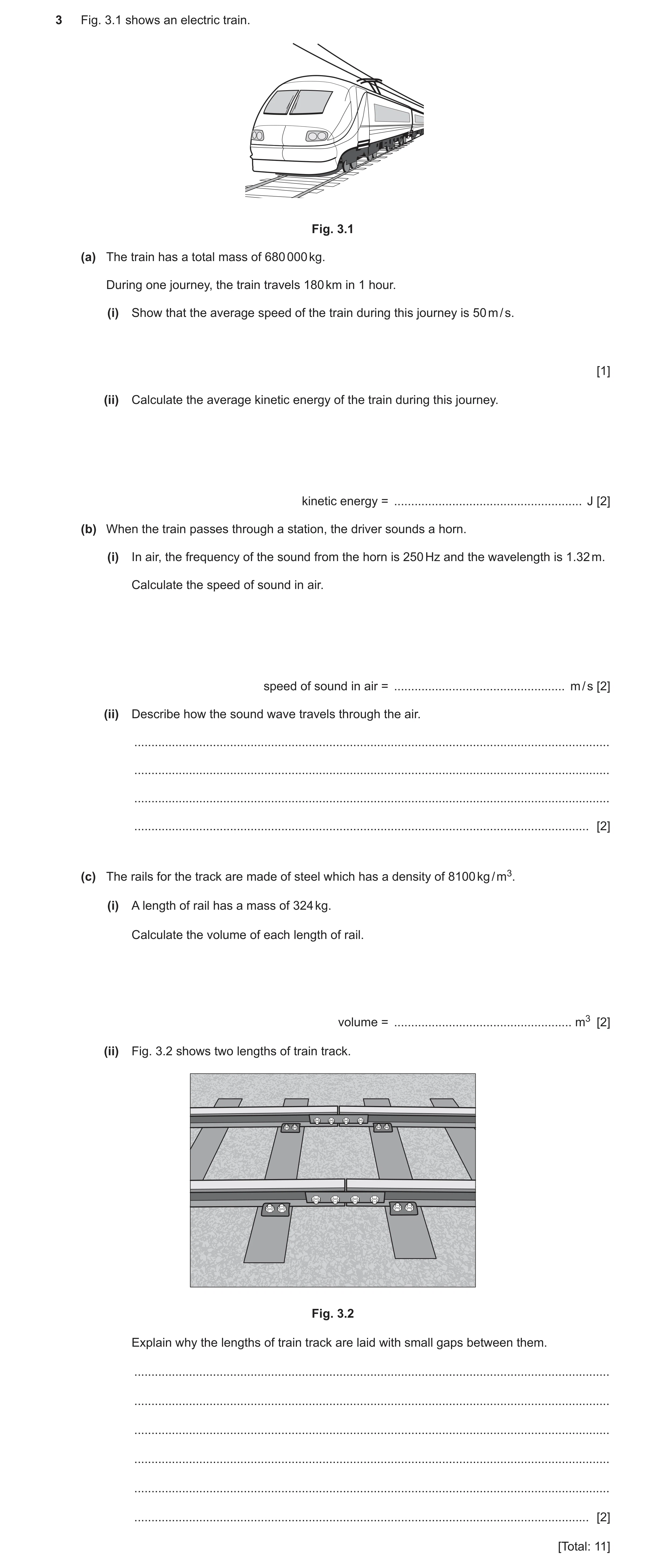
3 Fig. 3.1 shows an electric train. Fig. 3.1 (a) The train has a total mass of 680 000 kg. During one journey, the train travels 180 km in 1 hour. (i) Show that the average speed of the train during this journey is 50 m / s. [1] (ii) Calculate the average kinetic energy of the train during this journey. kinetic energy = … J [2] (b) When the train passes through a station, the driver sounds a horn. (i) In air, the frequency of the sound from the horn is 250 Hz and the wavelength is 1.32 m. Calculate the speed of sound in air. speed of sound in air = … m / s [2] (ii) Describe how the sound wave travels through the air. … … … … [2] (c) The rails for the track are made of steel which has a density of 8100 kg / m3. (i) A length of rail has a mass of 324 kg. Calculate the volume of each length of rail. volume = … m3 [2] (ii) Fig. 3.2 shows two lengths of train track. Fig. 3.2 Explain why the lengths of train track are laid with small gaps between them. … … … … … … [2] [Total: 11]
11 marks
Mark scheme: 3(a)(i) 180 000 / 3600 (= 50 m / s) ; 1 3(a)(ii) (KE = ) ½ mv2 or ½ × 680 000 × 502 ; (KE = ) 850 000 000 (J) ; 2 3(b)(i) (v = ) f λ or 250 × 1.32 ; (v = ) 330 (m / s) ; 2 3(b)(ii) vibrations / oscillations, of (air) particles ; rarefaction and compressions ; 2 3(c)(i) (V = ) m / ρ (in any form) or 324 / 8100 ; (V = ) 0.04 (m3) ; 2 3(c)(ii) when the temperature of the tracks increases, the tracks will expand ; the gaps prevent buckling of the tracks / owtte ; 2
This question in 0654/42 Feb/March 2022
Question 25 0654/42 Feb/March 2022
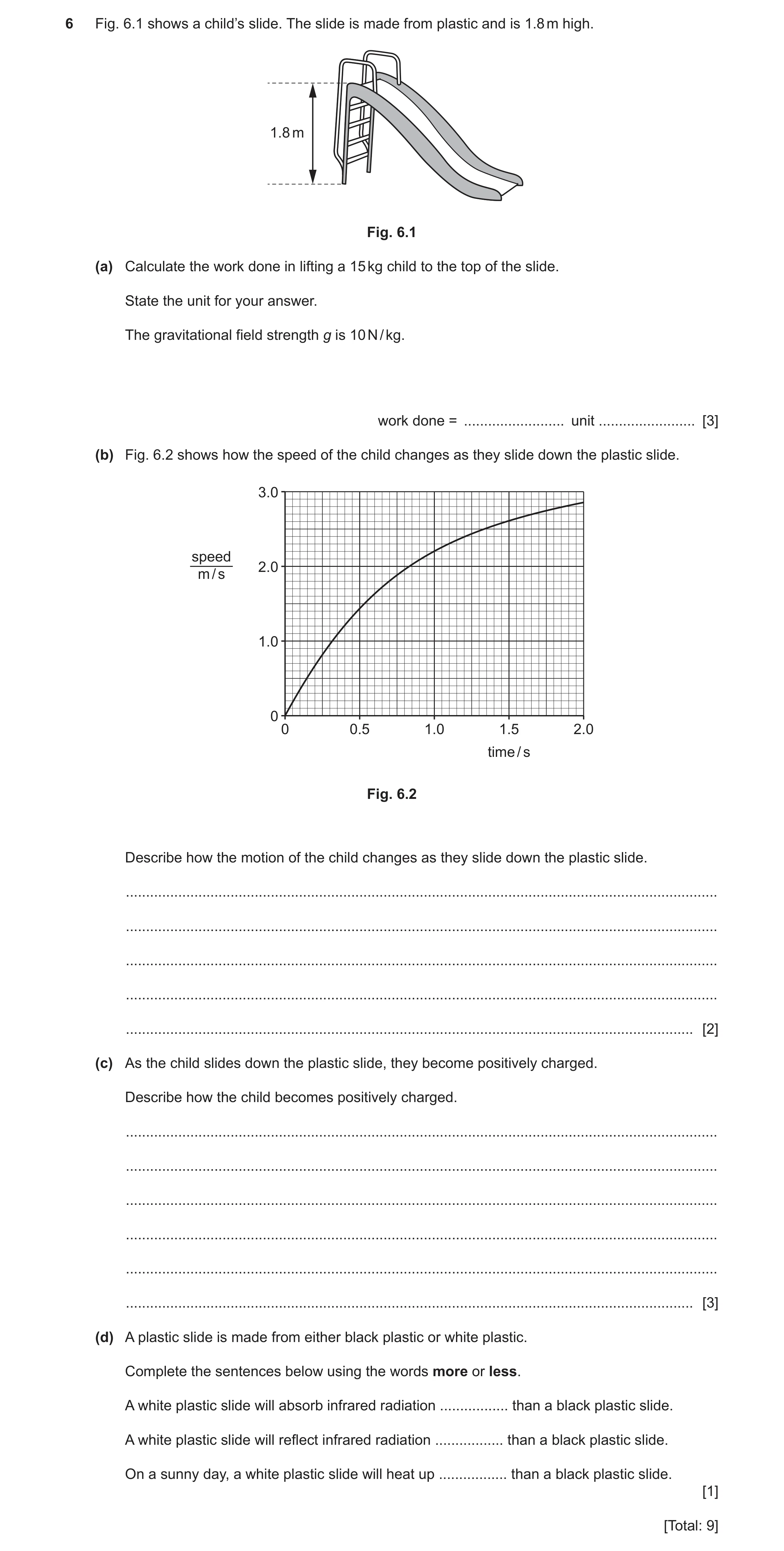
6 Fig. 6.1 shows a child’s slide. The slide is made from plastic and is 1.8 m high. 1.8 m Fig. 6.1 (a) Calculate the work done in lifting a 15 kg child to the top of the slide. State the unit for your answer. The gravitational field strength g is 10 N / kg. work done = … unit … [3] (b) Fig. 6.2 shows how the speed of the child changes as they slide down the plastic slide. 3.0 speed 2.0 m / s 1.0 0 0 0.5 1.0 1.5 2.0 time / s Fig. 6.2 Describe how the motion of the child changes as they slide down the plastic slide. … … … … … [2] (c) As the child slides down the plastic slide, they become positively charged. Describe how the child becomes positively charged. … … … … … … [3] (d) A plastic slide is made from either black plastic or white plastic. Complete the sentences below using the words more or less. A white plastic slide will absorb infrared radiation … than a black plastic slide. A white plastic slide will reflect infrared radiation … than a black plastic slide. On a sunny day, a white plastic slide will heat up … than a black plastic slide. [1] [Total: 9]
9 marks
Mark scheme: 6(a) (Wd =) mgh or 15 × 10 × 1.8 ; (Wd = ) 270 ; Joules / J ; 6(b) acceleration ; non-constant acceleration / high then low acceleration ; 2 6(c) transfer of electrons ; from the child / to the slide ; due to friction ; 3 6(d) less more less ; 1
This question in 0654/42 Feb/March 2022
Q26 · A baby elephant born in a wildlife sanctuary 0654/42 May/June 2022
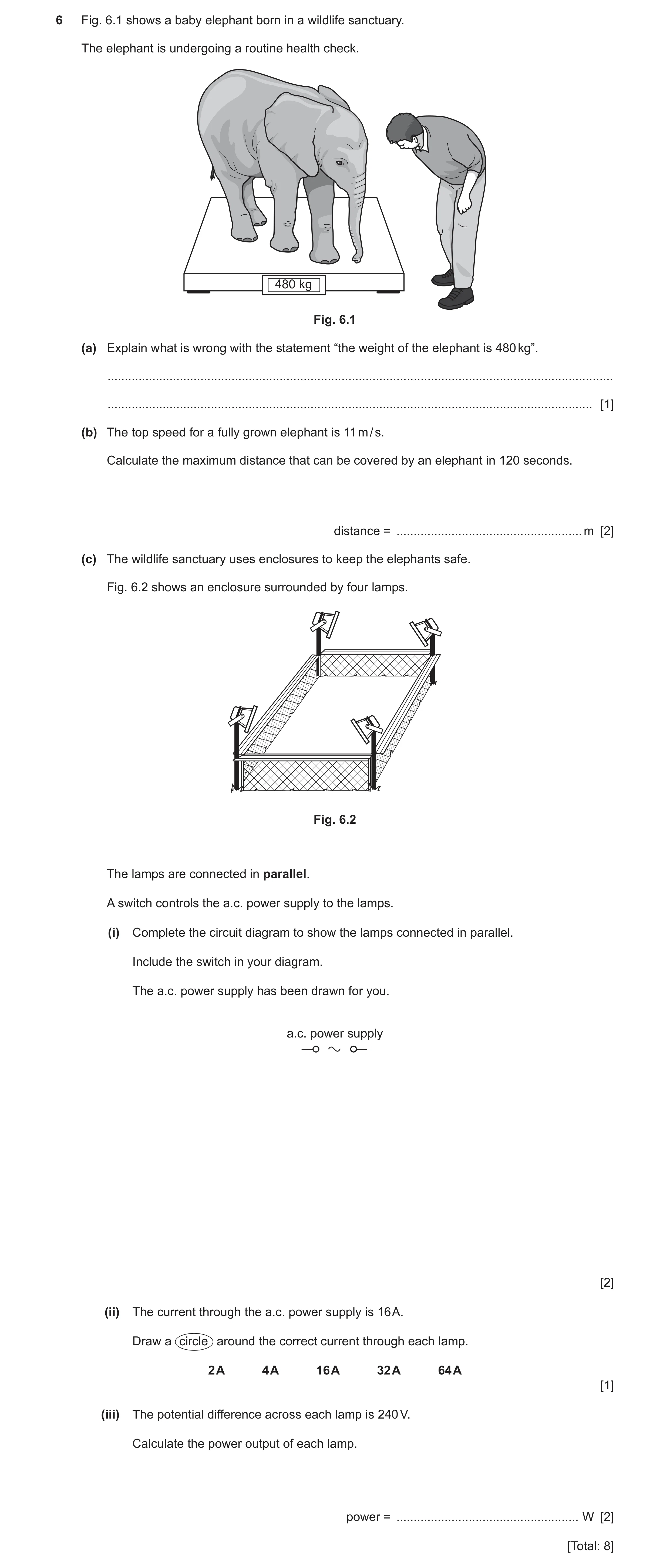
6 Fig. 6.1 shows a baby elephant born in a wildlife sanctuary. The elephant is undergoing a routine health check. 480 kg Fig. 6.1 (a) Explain what is wrong with the statement “the weight of the elephant is 480 kg”. … … [1] (b) The top speed for a fully grown elephant is 11 m / s. Calculate the maximum distance that can be covered by an elephant in 120 seconds. distance = … m [2] (c) The wildlife sanctuary uses enclosures to keep the elephants safe. Fig. 6.2 shows an enclosure surrounded by four lamps. Fig. 6.2 The lamps are connected in parallel. A switch controls the a.c. power supply to the lamps. (i) Complete the circuit diagram to show the lamps connected in parallel. Include the switch in your diagram. The a.c. power supply has been drawn for you. a.c. power supply [2] (ii) The current through the a.c. power supply is 16 A. Draw a circle around the correct current through each lamp. 2 A 4 A 16 A 32 A 64 A [1] (iii) The potential difference across each lamp is 240 V. Calculate the power output of each lamp. power = … W [2] [Total: 8]
8 marks
Mark scheme: 6(a) 480 kg is the mass / weight should be in Newtons ; 1 6(b) (d =) vxt or 11 120 ; 1320 (m) ; 2 6(c)(i) switch controls all lamps ; 4 lamps in parallel and all else correct ; 2 6(c)(ii) 4 A ; 1 6(c)(iii) (P =) IV / 4 240 ; 960 (W) ; 2
This question in 0654/42 May/June 2022
Question 27 0654/43 May/June 2022
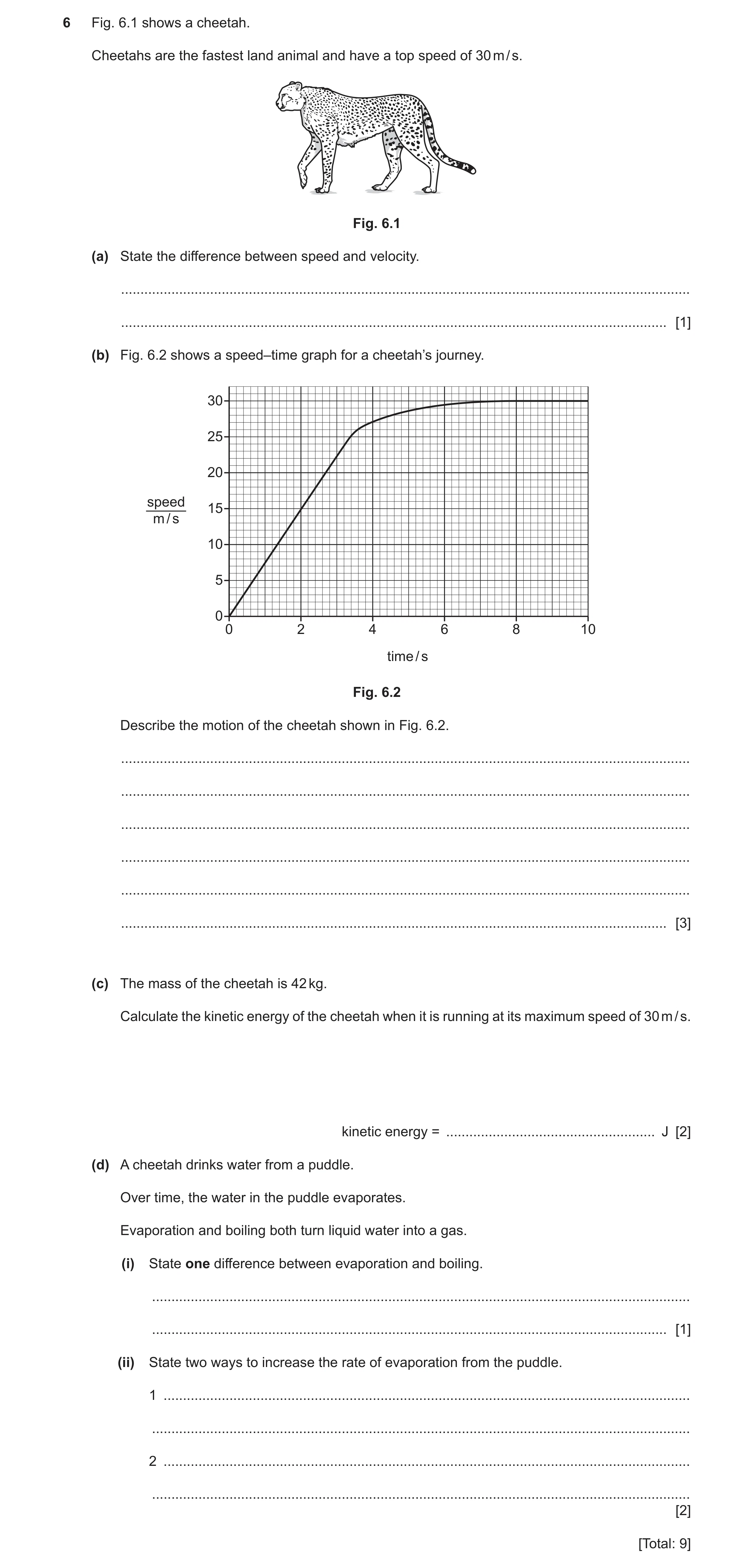
6 Fig. 6.1 shows a cheetah. Cheetahs are the fastest land animal and have a top speed of 30 m / s. Fig. 6.1 (a) State the difference between speed and velocity. … … [1] (b) Fig. 6.2 shows a speed–time graph for a cheetah’s journey. 30 25 20 speed 15 m / s 10 5 0 0 2 4 6 8 10 time / s Fig. 6.2 Describe the motion of the cheetah shown in Fig. 6.2. … … … … … … [3] (c) The mass of the cheetah is 42 kg. Calculate the kinetic energy of the cheetah when it is running at its maximum speed of 30 m / s. kinetic energy = … J [2] (d) A cheetah drinks water from a puddle. Over time, the water in the puddle evaporates. Evaporation and boiling both turn liquid water into a gas. (i) State one difference between evaporation and boiling. … … [1] (ii) State two ways to increase the rate of evaporation from the puddle. 1 … … 2 … … [2] [Total: 9]
9 marks
Mark scheme: 6(a) velocity has direction / ORA ; 1 6(b) acceleration ; constant followed by non-constant ; constant speed / zero acceleration ; 3 6(c) (KE =) ½ mv2 OR ½ 42 302 ; 18 900 (J); 2 6(d)(i) Any one from evaporation can occur at any temperature / boiling only happens at the boiling point ; evaporation happens only at the surface / boiling happens throughout the liquid; during evaporation only the molecules with the highest (kinetic) energy leave / during boiling all molecules have enough energy to leave ; evaporation can occur using the internal energy of the system / boiling requires an external source of heat ; evaporation produces cooling / boiling does not ; evaporation is a slow process / boiling is a rapid process ; 1 6(d)(ii) increase temperature ; increase surface area ; increase draught ; max 2 2
This question in 0654/43 May/June 2022
Q28 · A man transporting some luggage in a small boat 0654/42 Oct/Nov 2022
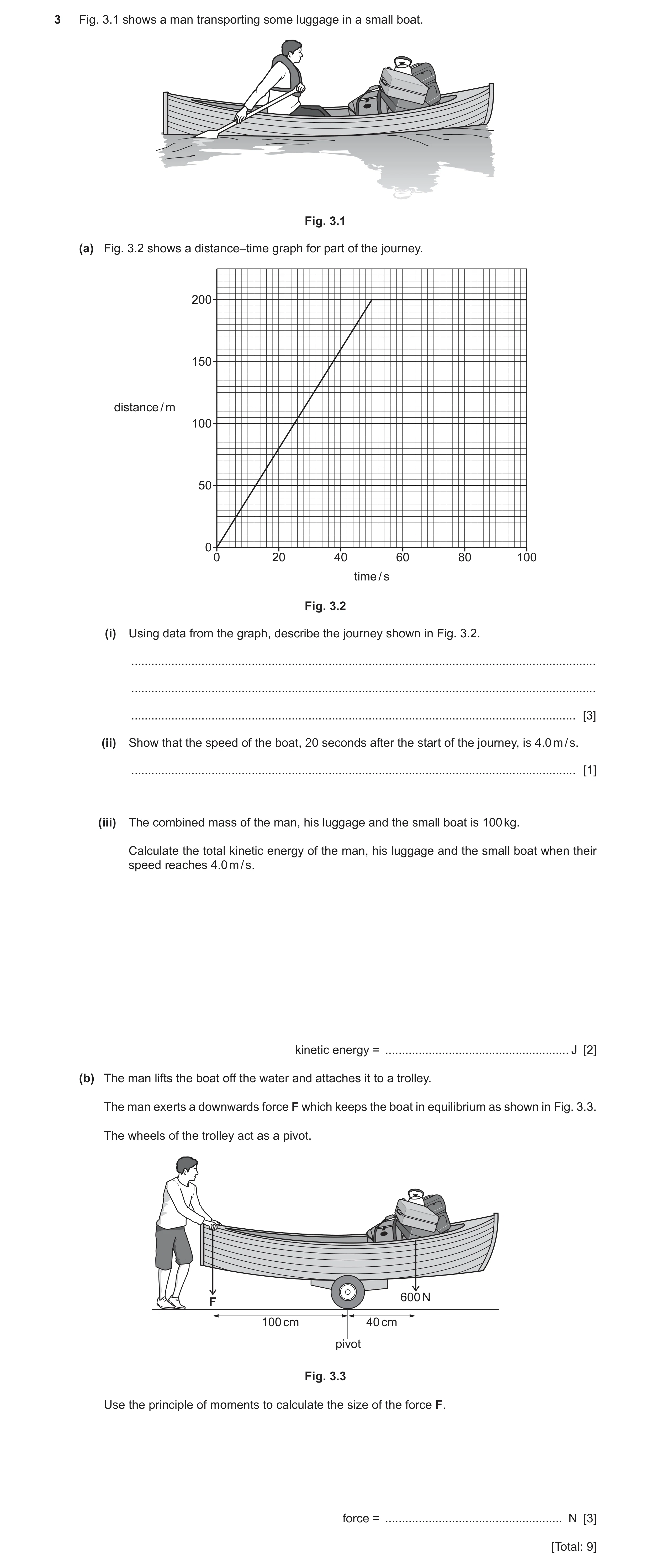
3 Fig. 3.1 shows a man transporting some luggage in a small boat. Fig. 3.1 (a) Fig. 3.2 shows a distance–time graph for part of the journey. 200 150 distance / m 100 50 0 0 20 40 60 80 100 time / s Fig. 3.2 (i) Using data from the graph, describe the journey shown in Fig. 3.2. … … … [3] (ii) Show that the speed of the boat, 20 seconds after the start of the journey, is 4.0 m / s. … [1] (iii) The combined mass of the man, his luggage and the small boat is 100 kg. Calculate the total kinetic energy of the man, his luggage and the small boat when their speed reaches 4.0 m / s. kinetic energy = … J [2] (b) The man lifts the boat off the water and attaches it to a trolley. The man exerts a downwards force F which keeps the boat in equilibrium as shown in Fig. 3.3. The wheels of the trolley act as a pivot. 600 N F 100 cm 40 cm pivot Fig. 3.3 Use the principle of moments to calculate the size of the force F. force = … N [3] [Total: 9]
9 marks
Mark scheme: 3(a)(i) constant speed ; 3 stationary ; use of data to identify change at 50 s or 200 m ; 3(a)(ii) (v =) 200 / 50 or 80 / 20 = (4 m / s) ; 1 3(a)(iii) (KE =) ½ mv2 or ½ 100 42 ; 2 (KE =) 800 (J) ; 3(b) (M =) f d or 600 40 or 24000 (Ncm) ; 3 (F =) 24000 / 100 ; (F =) 240 (N) ;
This question in 0654/42 Oct/Nov 2022
Q29 · A student investigates how different shaped objects fall 0654/42 Feb/March 2023
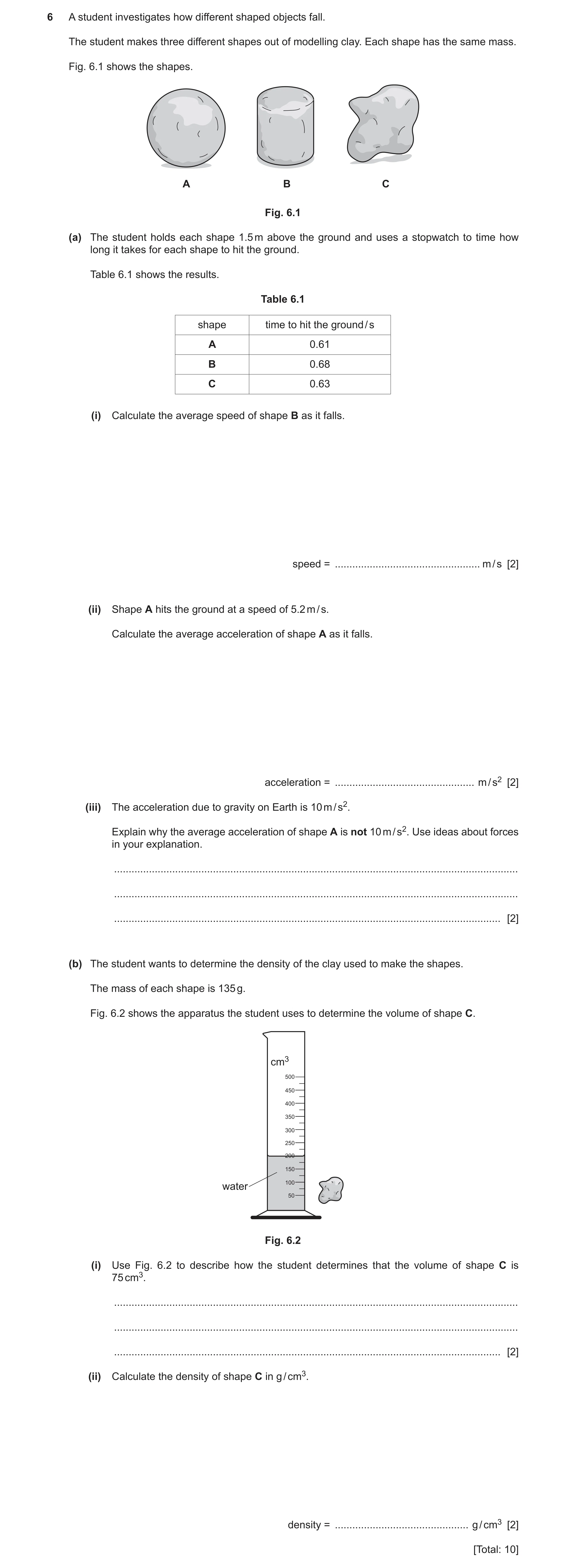
6 A student investigates how different shaped objects fall. The student makes three different shapes out of modelling clay. Each shape has the same mass. Fig. 6.1 shows the shapes. A B C Fig. 6.1 (a) The student holds each shape 1.5 m above the ground and uses a stopwatch to time how long it takes for each shape to hit the ground. Table 6.1 shows the results. Table 6.1 shape time to hit the ground / s A 0.61 B 0.68 C 0.63 (i) Calculate the average speed of shape B as it falls. speed = … m / s [2] (ii) Shape A hits the ground at a speed of 5.2 m / s. Calculate the average acceleration of shape A as it falls. acceleration = … m / s2 [2] (iii) The acceleration due to gravity on Earth is 10 m / s2. Explain why the average acceleration of shape A is not 10 m / s2. Use ideas about forces in your explanation. … … … [2] (b) The student wants to determine the density of the clay used to make the shapes. The mass of each shape is 135 g. Fig. 6.2 shows the apparatus the student uses to determine the volume of shape C. cm3 water Fig. 6.2 (i) Use Fig. 6.2 to describe how the student determines that the volume of shape C is 75 cm3. … … … [2] (ii) Calculate the density of shape C in g / cm3. density = … g / cm3 [2] [Total: 10]
10 marks
Mark scheme: 6(a)(i) evidence of (speed =) distance/time (in any form) or 1.5 / 0.68 ; 2 (speed =) 2.2 (m / s) ; 6(a)(ii) evidence of (a =) v / t (in any form) or 5.2 / 0.61 ; 2 (a =) 8.5 (m / s2) ; 6(a)(iii) reference to air resistance ; 2 (air resistance) acts in opposite direction to weight / upwards ; 6(b)(i) place shape in water ; 2 measure the volume of water displaced ; 6(b)(ii) evidence of (density =) m / V (in any form) or 135 / 75; 2 (density =) 1.8 (g / cm3)
This question in 0654/42 Feb/March 2023
Q30 · An Olympic triathlon event consists of a 1500 m swim, a 40 km cycle ride and a 10 km run 0654/41 May/June 2023
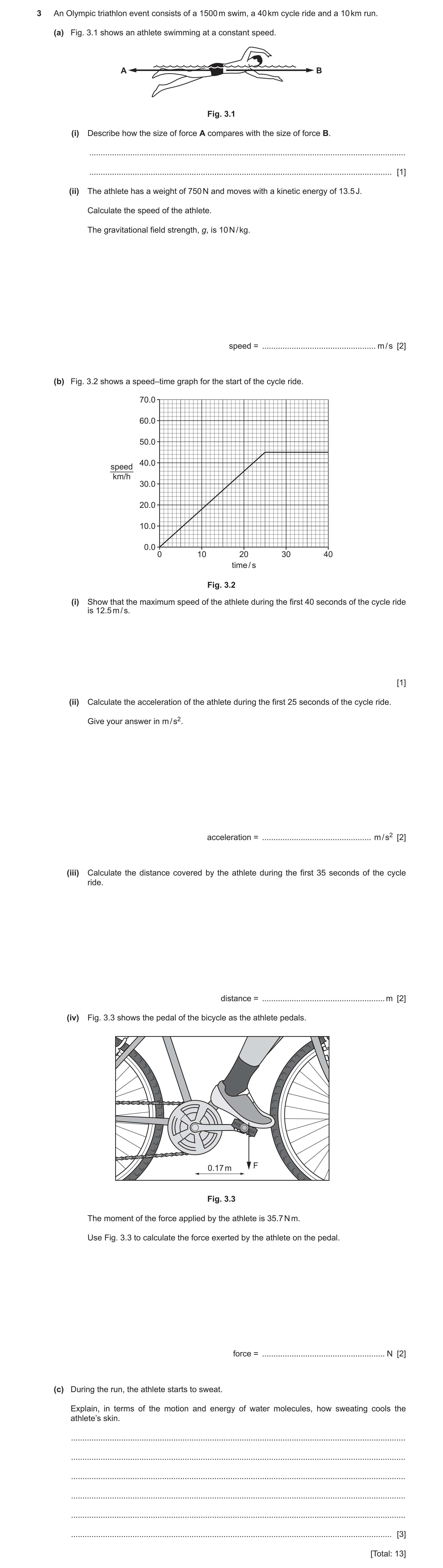
3 An Olympic triathlon event consists of a 1500 m swim, a 40 km cycle ride and a 10 km run. (a) Fig. 3.1 shows an athlete swimming at a constant speed. A B Fig. 3.1 (i) Describe how the size of force A compares with the size of force B. … … [1] (ii) The athlete has a weight of 750 N and moves with a kinetic energy of 13.5 J. Calculate the speed of the athlete. The gravitational field strength, g, is 10 N / kg. speed = … m / s [2] (b) Fig. 3.2 shows a speed–time graph for the start of the cycle ride. 70.0 60.0 50.0 40.0 speed km/h 30.0 20.0 10.0 0.0 0 10 20 30 40 time / s Fig. 3.2 (i) Show that the maximum speed of the athlete during the first 40 seconds of the cycle ride is 12.5 m / s. [1] (ii) Calculate the acceleration of the athlete during the first 25 seconds of the cycle ride. Give your answer in m / s2. acceleration = … m / s2 [2] (iii) Calculate the distance covered by the athlete during the first 35 seconds of the cycle ride. distance = … m [2] (iv) Fig. 3.3 shows the pedal of the bicycle as the athlete pedals. F 0.17 m Fig. 3.3 The moment of the force applied by the athlete is 35.7 N m. Use Fig. 3.3 to calculate the force exerted by the athlete on the pedal. force = … N [2] (c) During the run, the athlete starts to sweat. Explain, in terms of the motion and energy of water molecules, how sweating cools the athlete’s skin. … … … … … … [3] [Total: 13]
13 marks
Mark scheme: 3(a)(i) (the forces are) the same size / equal ; 1 3(a)(ii) (mass =) 750 / 10 / 75 (kg) AND (speed = ) √ (2 13.5) / 75 ; (speed = ) 0.6 (m / s) ; 2 3(b)(i) 45000 / 3600 (=12.5 m / s) ; 1 3(b)(ii) (a = ) v / t / 12.5 / 25 ; (a = ) 0.5 (m / s2) ; 2 3(b)(iii) (0.5 25 12.5) + (12.5 10) ; 281.25 (m) ; 2 3(b)(iv) (force = ) moment / distance / 35.7 / 0.17 ; (force = ) 210 (N) ; 2 3(c) (thermal) energy is transferred (from skin / blood / capillaries) to water molecules (on skin surface) ; the most energetic molecules escape / evaporates from the surface ; average energy of remaining molecules decreases ; 3
This question in 0654/41 May/June 2023
Q31 · An insect called a pond skater 0654/42 May/June 2023
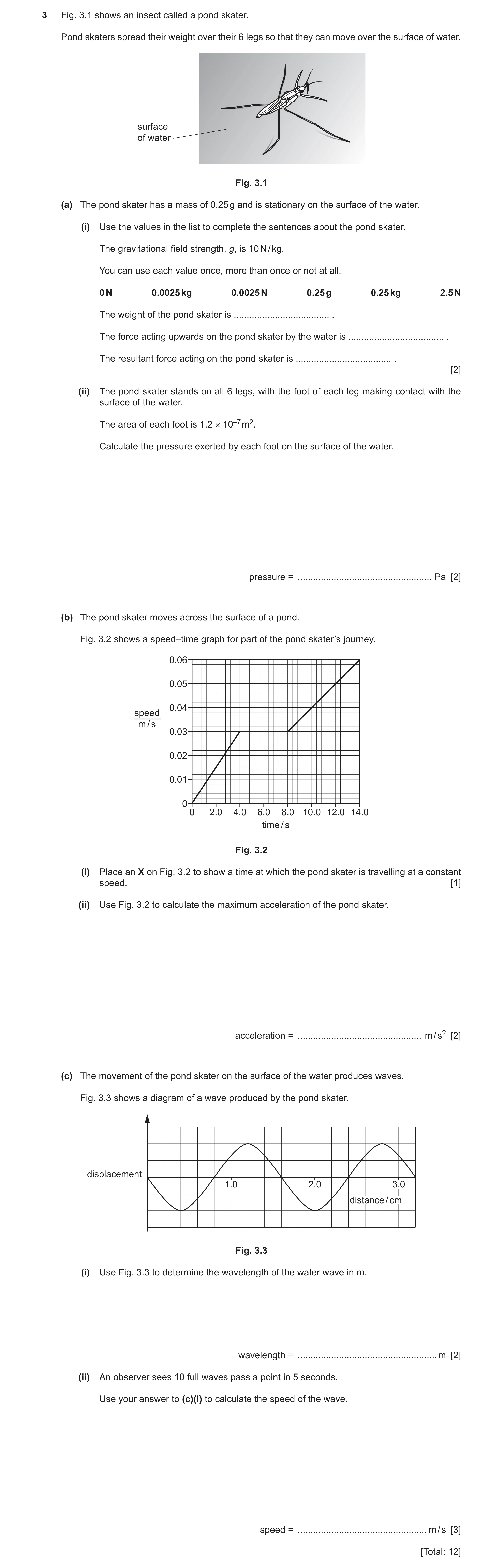
3 Fig. 3.1 shows an insect called a pond skater. Pond skaters spread their weight over their 6 legs so that they can move over the surface of water. surface of water Fig. 3.1 (a) The pond skater has a mass of 0.25 g and is stationary on the surface of the water. (i) Use the values in the list to complete the sentences about the pond skater. The gravitational field strength, g, is 10 N / kg. You can use each value once, more than once or not at all. 0 N 0.0025 kg 0.0025 N 0.25 g 0.25 kg 2.5 N The weight of the pond skater is … . The force acting upwards on the pond skater by the water is … . The resultant force acting on the pond skater is … . [2] (ii) The pond skater stands on all 6 legs, with the foot of each leg making contact with the surface of the water. The area of each foot is 1.2 × 10⁻⁷ m2. Calculate the pressure exerted by each foot on the surface of the water. pressure = … Pa [2] (b) The pond skater moves across the surface of a pond. Fig. 3.2 shows a speed–time graph for part of the pond skater’s journey. 0.06 0.05 0.04 speed m / s 0.03 0.02 0.01 0 0 2.0 4.0 6.0 8.0 10.0 12.0 14.0 time / s Fig. 3.2 (i) Place an X on Fig. 3.2 to show a time at which the pond skater is travelling at a constant speed. [1] (ii) Use Fig. 3.2 to calculate the maximum acceleration of the pond skater. acceleration = … m / s2 [2] (c) The movement of the pond skater on the surface of the water produces waves. Fig. 3.3 shows a diagram of a wave produced by the pond skater. displacement 1.0 2.0 3.0 distance / cm Fig. 3.3 (i) Use Fig. 3.3 to determine the wavelength of the water wave in m. wavelength = … m [2] (ii) An observer sees 10 full waves pass a point in 5 seconds. Use your answer to (c)(i) to calculate the speed of the wave. speed = … m / s [3] [Total: 12]
12 marks
Mark scheme: 3(a)(i) 0.0025 N ; 0.0025 N and 0 (N) ; 2 3(a)(ii) (P =) F / A or 0.0025 / (6 1.2 10–7) ; (P =) 3500 (Pa) ; 2 3(b)(i) X placed between 4.0 and 8.0 s ; 1 3(b)(ii) (a =) v / t or 0.03 / 4.0 ; (a =) 0.0075 (m / s2) ; 2 3(c)(i) 1.6 / 100 ; 0.016 (m) ; 2 Question Answer Marks 3(c)(ii) (f =) 2 (Hz) ; (v =) f or 2 0.016 ; (v =) 0.032 (m / s) ; 3
This question in 0654/42 May/June 2023
Q32 · Nuclear power stations use nuclear fission to generate electricity 0654/41 Oct/Nov 2023
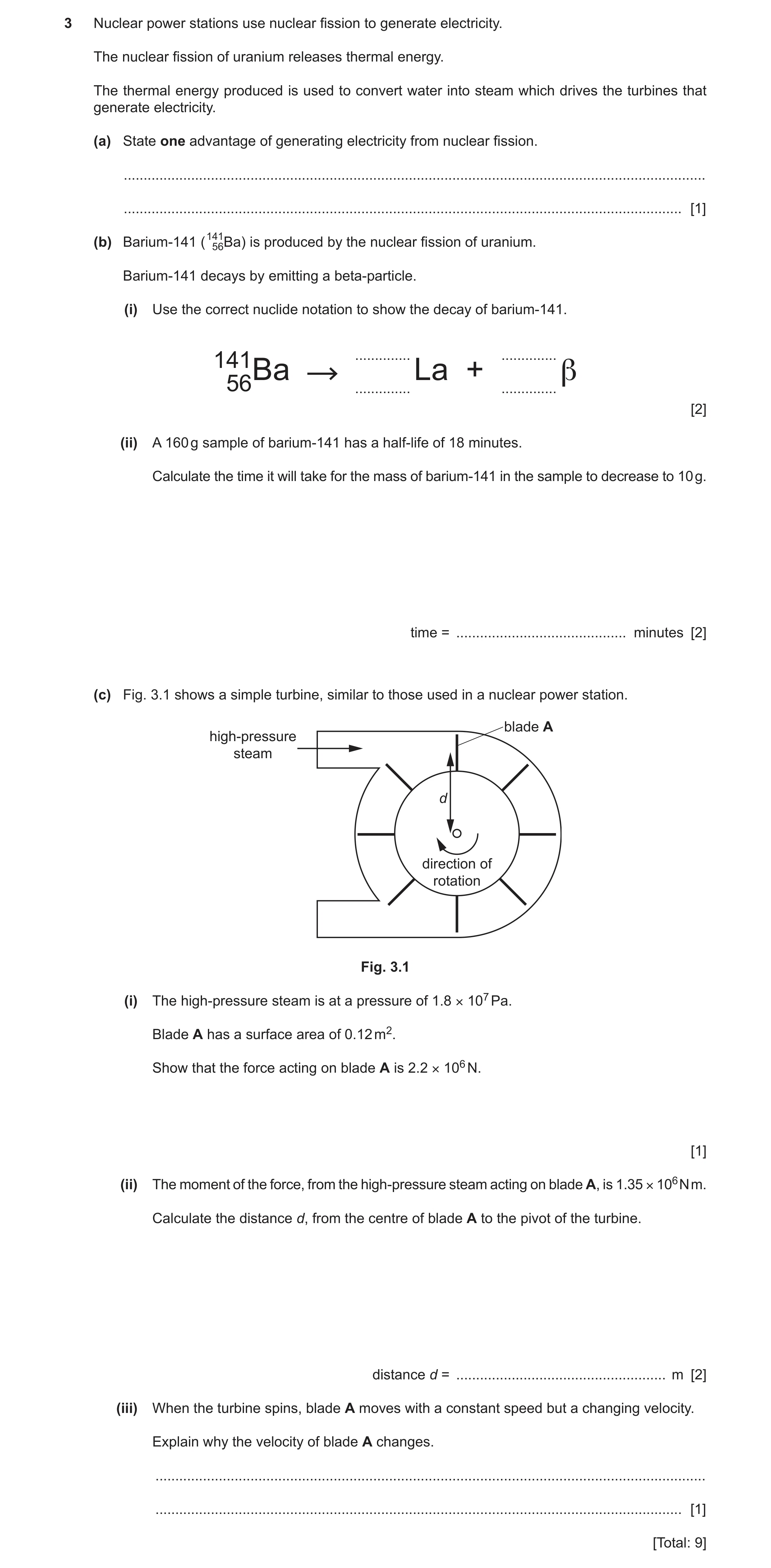
3 Nuclear power stations use nuclear fission to generate electricity. The nuclear fission of uranium releases thermal energy. The thermal energy produced is used to convert water into steam which drives the turbines that generate electricity. (a) State one advantage of generating electricity from nuclear fission. … … [1] (b) Barium-141 (14156Ba) is produced by the nuclear fission of uranium. Barium-141 decays by emitting a beta-particle. (i) Use the correct nuclide notation to show the decay of barium-141. 141 … … 56Ba … La + … β [2] (ii) A 160 g sample of barium-141 has a half-life of 18 minutes. Calculate the time it will take for the mass of barium-141 in the sample to decrease to 10 g. time = … minutes [2] (c) Fig. 3.1 shows a simple turbine, similar to those used in a nuclear power station. blade A high-pressure steam d direction of rotation Fig. 3.1 (i) The high-pressure steam is at a pressure of 1.8 × 10⁷ Pa. Blade A has a surface area of 0.12 m2. Show that the force acting on blade A is 2.2 × 10⁶ N. [1] (ii) The moment of the force, from the high-pressure steam acting on blade A, is 1.35 × 10⁶ N m. Calculate the distance d, from the centre of blade A to the pivot of the turbine. distance d = … m [2] (iii) When the turbine spins, blade A moves with a constant speed but a changing velocity. Explain why the velocity of blade A changes. … … [1] [Total: 9]
9 marks
Mark scheme: 3(a) any one from: 1 does not release, greenhouse gases / CO2 ; does not contribute to, global warming / climate change ; 3(b)(i) 141 56Ba → 14157La + -10β 2 La correct ; β correct ; 3(b)(ii) use of 4 half lives ; 2 (4 18 =) 72 (minutes) ; 3(c)(i) 1.8 107 0.12 ; 1 3(c)(ii) (d =) m ÷ f / (d =) 1.35 106 ÷ 2.2 106 ; 2 (d =) 0.61 or 0.63 (m) ; 3(c)(iii) the direction (of blade A) changes ; 1
This question in 0654/41 Oct/Nov 2023
Q33 · A bee collecting pollen from a flower 0654/41 Oct/Nov 2023
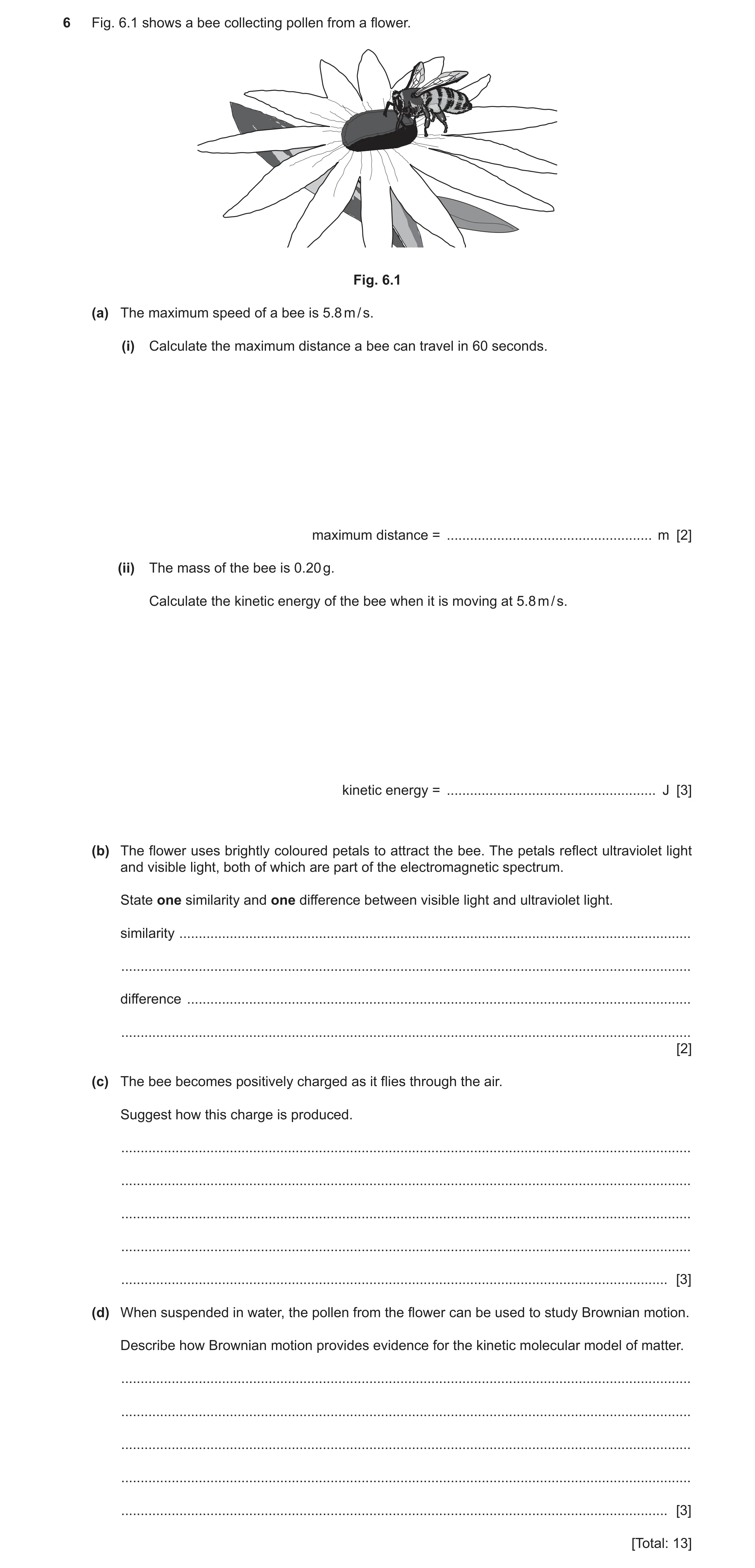
6 Fig. 6.1 shows a bee collecting pollen from a flower. Fig. 6.1 (a) The maximum speed of a bee is 5.8 m / s. (i) Calculate the maximum distance a bee can travel in 60 seconds. maximum distance = … m [2] (ii) The mass of the bee is 0.20 g. Calculate the kinetic energy of the bee when it is moving at 5.8 m / s. kinetic energy = … J [3] (b) The flower uses brightly coloured petals to attract the bee. The petals reflect ultraviolet light and visible light, both of which are part of the electromagnetic spectrum. State one similarity and one difference between visible light and ultraviolet light. similarity … … difference … … [2] (c) The bee becomes positively charged as it flies through the air. Suggest how this charge is produced. … … … … … [3] (d) When suspended in water, the pollen from the flower can be used to study Brownian motion. Describe how Brownian motion provides evidence for the kinetic molecular model of matter. … … … … … [3] [Total: 13]
13 marks
Mark scheme: 6(a)(i) (d =) v t / (d =) 5.8 60 ; 2 348 or 350 (m) ; 6(a)(ii) conversion: (0.20 g =) 0.00020 kg ; 3 (KE =) ½ mv2 / ½ 0.00020 5.82 ; (KE =) 0.0034 or 3.4 10–3 (J) ; 6(b) similarity: travel at speed of light / transverse waves ; 2 difference: (visible light has lower) frequency / (visible light has longer) wavelength / ORA ; 6(c) friction (with air) ; 3 (negative) electrons (move) ; (electrons move) off (surface of) bee ; 6(d) random motion (of pollen grains / particles) ; 3 caused by collisions with water / molecules / other particles ; (movement because of idea of) fast(er) moving small(er) particles ;
This question in 0654/41 Oct/Nov 2023
Question 34 0654/42 Oct/Nov 2023
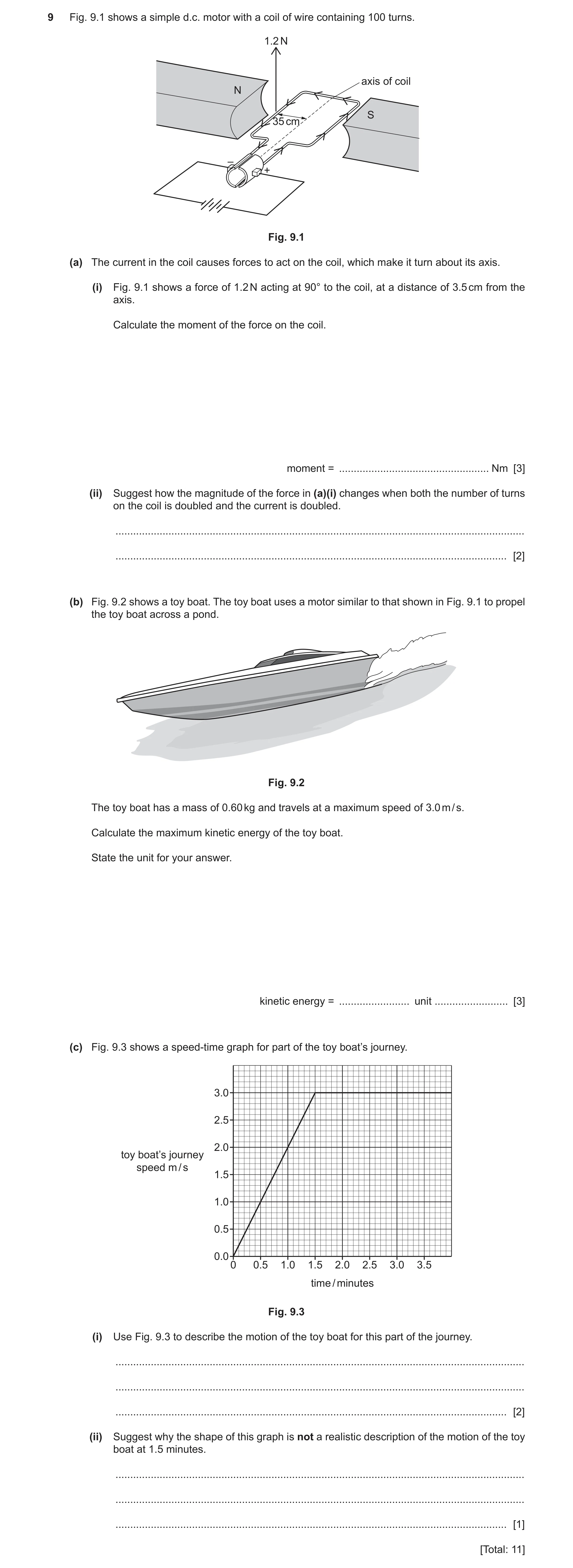
9 Fig. 9.1 shows a simple d.c. motor with a coil of wire containing 100 turns. 1.2 N axis of coil N S 35 cm – + Fig. 9.1 (a) The current in the coil causes forces to act on the coil, which make it turn about its axis. (i) Fig. 9.1 shows a force of 1.2 N acting at 90° to the coil, at a distance of 3.5 cm from the axis. Calculate the moment of the force on the coil. moment = … Nm [3] (ii) Suggest how the magnitude of the force in (a)(i) changes when both the number of turns on the coil is doubled and the current is doubled. … … [2] (b) Fig. 9.2 shows a toy boat. The toy boat uses a motor similar to that shown in Fig. 9.1 to propel the toy boat across a pond. Fig. 9.2 The toy boat has a mass of 0.60 kg and travels at a maximum speed of 3.0 m / s. Calculate the maximum kinetic energy of the toy boat. State the unit for your answer. kinetic energy = … unit … [3] (c) Fig. 9.3 shows a speed-time graph for part of the toy boat’s journey. 3.0 2.5 2.0 toy boat’s journey speed m / s 1.5 1.0 0.5 0.0 0 0.5 1.0 1.5 2.0 2.5 3.0 3.5 time / minutes Fig. 9.3 (i) Use Fig. 9.3 to describe the motion of the toy boat for this part of the journey. … … … [2] (ii) Suggest why the shape of this graph is not a realistic description of the motion of the toy boat at 1.5 minutes. … … … [1] [Total: 11]
11 marks
Mark scheme: 9(a)(i) (3.5 cm =) 0.035 (m) ; 3 (moment =) f d / 1.2 0.035 ; (moment =) 0.042 (N m) ; or (35 cm =) 0.35 (m) ; (moment =) f d / 1.2 0.35 ; (moment =) 0.42 (N m); 9(a)(ii) increases ; 2 by a factor of 4; 9(b) (kinetic energy =) ½ mv2 or ½ 0.60 3.02 ; 3 (kinetic energy = ) 2.7 ; J / joules ; 9(c)(i) initially / in first 1.5 mins, constant acceleration ; 2 then / after 1.5 min, acceleration is zero / constant speed ; 9(c)(ii) (idea that) change in acceleration would take some time / change more gradually / graph would be a curve at 1.5 mins ; 1
This question in 0654/42 Oct/Nov 2023
Q35 · Meteoroids are lumps of rock which travel through space 0654/43 Oct/Nov 2023
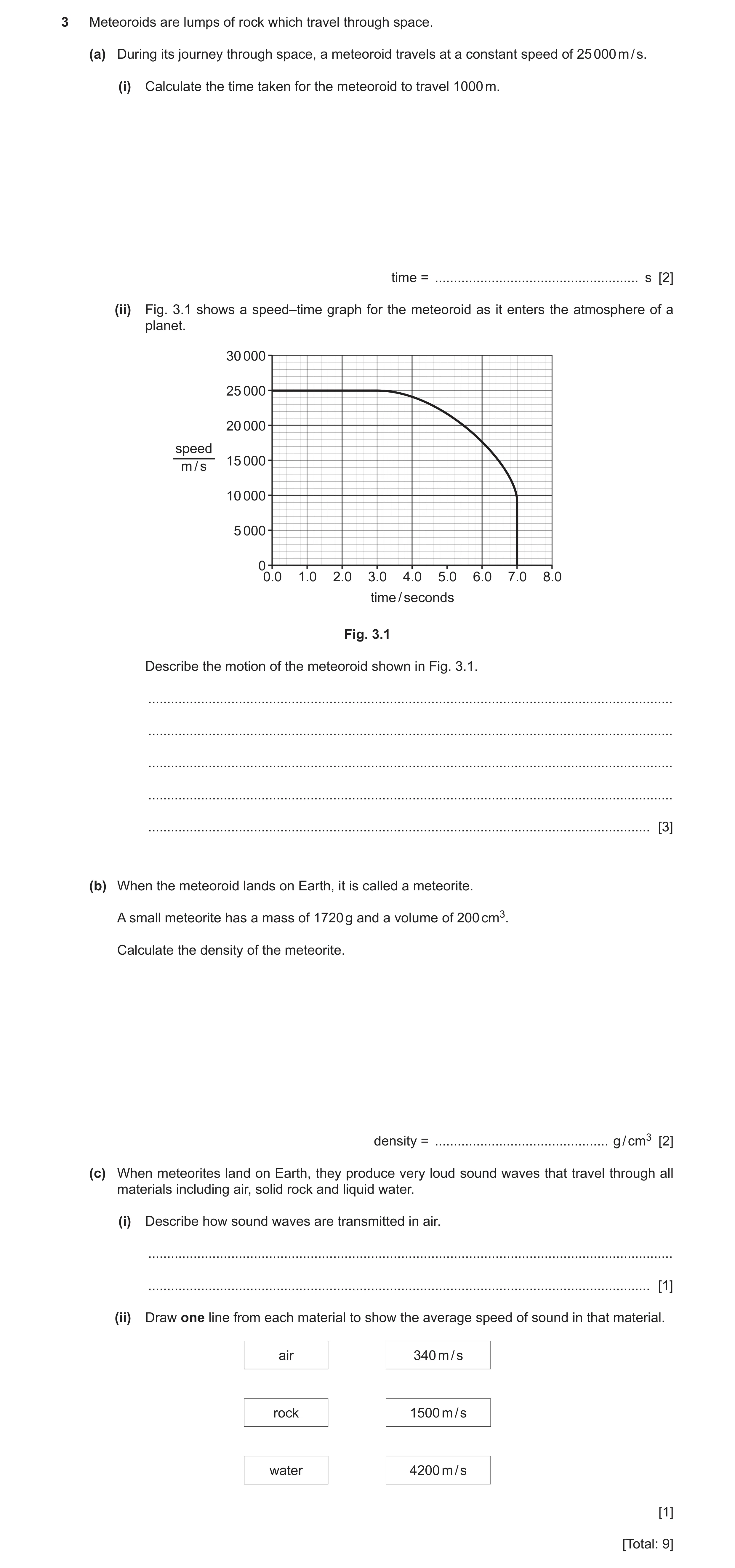
3 Meteoroids are lumps of rock which travel through space. (a) During its journey through space, a meteoroid travels at a constant speed of 25 000 m / s. (i) Calculate the time taken for the meteoroid to travel 1000 m. time = … s [2] (ii) Fig. 3.1 shows a speed–time graph for the meteoroid as it enters the atmosphere of a planet. 30 000 25 000 20 000 speed 15 000 m / s 10 000 5 000 0 0.0 1.0 2.0 3.0 4.0 5.0 6.0 7.0 8.0 time / seconds Fig. 3.1 Describe the motion of the meteoroid shown in Fig. 3.1. … … … … … [3] (b) When the meteoroid lands on Earth, it is called a meteorite. A small meteorite has a mass of 1720 g and a volume of 200 cm3. Calculate the density of the meteorite. density = … g / cm3 [2] (c) When meteorites land on Earth, they produce very loud sound waves that travel through all materials including air, solid rock and liquid water. (i) Describe how sound waves are transmitted in air. … … [1] (ii) Draw one line from each material to show the average speed of sound in that material. air 340 m / s rock 1500 m / s water 4200 m / s [1] [Total: 9]
9 marks
Mark scheme: 3(a)(i) (t =) d / v or 1000 / 25 000 ; (in any form) 2 (t =) 0.04 (s) ; 3(a)(ii) 0–3 s / initially constant speed ; 3 then slows down / decelerates / negative acceleration / non-constant deceleration ; (at 7 s) it stops / hits the ground / speed becomes 0 ; 3(b) (density =) mass / volume or 1720 / 200 (in any form) ; 2 8.6(0) (g / cm3) ; 3(c)(i) compressions and rarefactions ; 1 3(c)(ii) 1 air 340 m / s rock 1500 m / s water 4200 m / s all correct ;
This question in 0654/43 Oct/Nov 2023
Q36 · Asteroids are large rocks which orbit the Sun 0654/42 Feb/March 2024
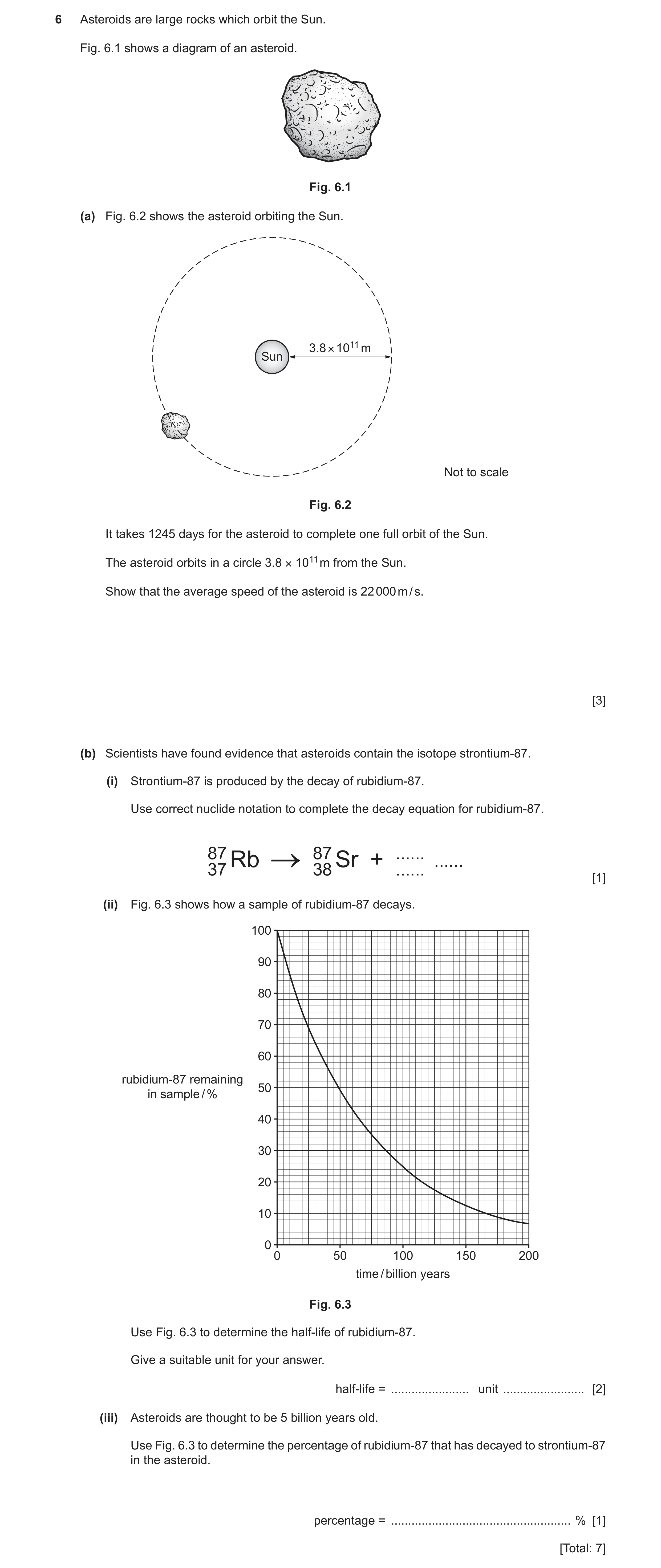
6 Asteroids are large rocks which orbit the Sun. Fig. 6.1 shows a diagram of an asteroid. Fig. 6.1 (a) Fig. 6.2 shows the asteroid orbiting the Sun. 3.8×10¹¹m Sun Not to scale Fig. 6.2 It takes 1245 days for the asteroid to complete one full orbit of the Sun. The asteroid orbits in a circle 3.8 × 10¹¹ m from the Sun. Show that the average speed of the asteroid is 22 000 m / s. [3] (b) Scientists have found evidence that asteroids contain the isotope strontium-87. (i) Strontium-87 is produced by the decay of rubidium-87. Use correct nuclide notation to complete the decay equation for rubidium-87. 87 Rb 87 Sr + … … 37 38 … [1] (ii) Fig. 6.3 shows how a sample of rubidium-87 decays. 100 90 80 70 60 rubidium-87 remaining 50 in sample / % 40 30 20 10 0 0 50 100 150 200 time / billion years Fig. 6.3 Use Fig. 6.3 to determine the half-life of rubidium-87. Give a suitable unit for your answer. half-life = … unit … [2] (iii) Asteroids are thought to be 5 billion years old. Use Fig. 6.3 to determine the percentage of rubidium-87 that has decayed to strontium-87 in the asteroid. percentage = … % [1] [Total: 7]
7 marks
Mark scheme: 6(a) (1245 days =) 1.1 108 (s) ; 3 (d=) 2r OR 2 3.8 1011 OR 2.4 1012 (m) ; (distance / time) OR 2.4 1012 / 1.1 108 (= 22 196 OR 22 000 m / s); 6(b)(i) −;01 1 6(b)(ii) 50 ; 2 billion years ; 6(b)(iii) 7 (%) ; 1
This question in 0654/42 Feb/March 2024
Question 37 0654/42 May/June 2024
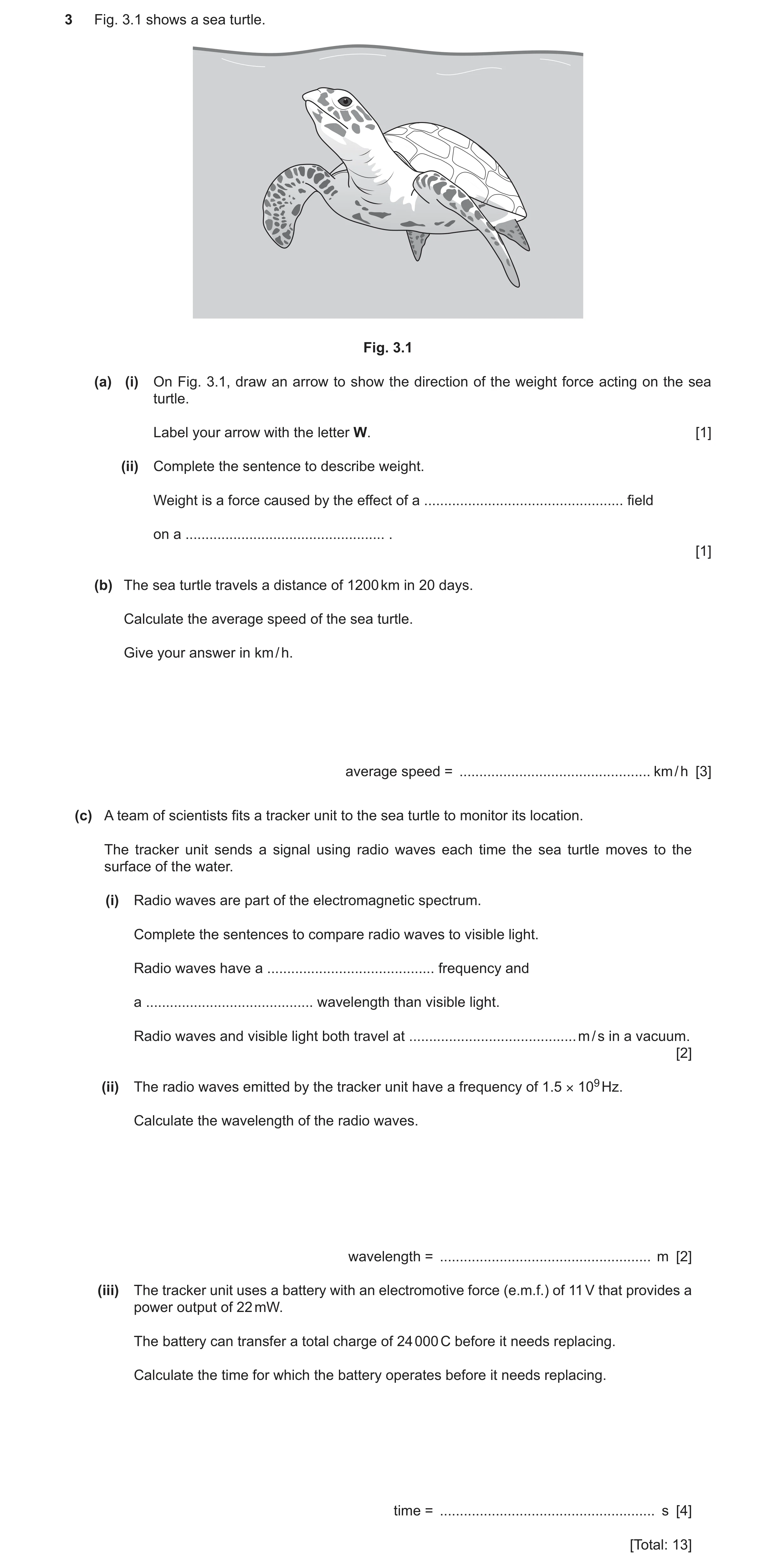
3 Fig. 3.1 shows a sea turtle. Fig. 3.1 (a) (i) On Fig. 3.1, draw an arrow to show the direction of the weight force acting on the sea turtle. Label your arrow with the letter W. [1] (ii) Complete the sentence to describe weight. Weight is a force caused by the effect of a … field on a … . [1] (b) The sea turtle travels a distance of 1200 km in 20 days. Calculate the average speed of the sea turtle. Give your answer in km / h. average speed = … km / h [3] (c) A team of scientists fits a tracker unit to the sea turtle to monitor its location. The tracker unit sends a signal using radio waves each time the sea turtle moves to the surface of the water. (i) Radio waves are part of the electromagnetic spectrum. Complete the sentences to compare radio waves to visible light. Radio waves have a … frequency and a … wavelength than visible light. Radio waves and visible light both travel at … m / s in a vacuum. [2] (ii) The radio waves emitted by the tracker unit have a frequency of 1.5 × 10⁹ Hz. Calculate the wavelength of the radio waves. wavelength = … m [2] (iii) The tracker unit uses a battery with an electromotive force (e.m.f.) of 11 V that provides a power output of 22 mW. The battery can transfer a total charge of 24 000 C before it needs replacing. Calculate the time for which the battery operates before it needs replacing. time = … s [4] [Total: 13]
13 marks
Mark scheme: 3(a)(i) downwards arrow labelled W ; 1 3(a)(ii) gravitational AND mass ; 1 3(b) (t=) 480 (hrs) ; (v=) d / t OR 1200 / 480 ; (v=) 2.5 (km / h) ; 3 3(c)(i) lower AND longer / bigger ; 3 108 ; 2 3(c)(ii) (=) v / f OR 3 108 / 1.5 109 ; (=) 0.20 (m) ; 2 Question Answer Marks 3(c)(iii) (P=) 0.022 (W) ; (I=) P / V OR 0.022 / 11 OR 0.002 ; (t=) Q / I OR 24000 / 0.002 ; (t=) 1.2 107 (s) ; 4
This question in 0654/42 May/June 2024
Q38 · A speed–time graph for a journey made by a car 0654/43 May/June 2024
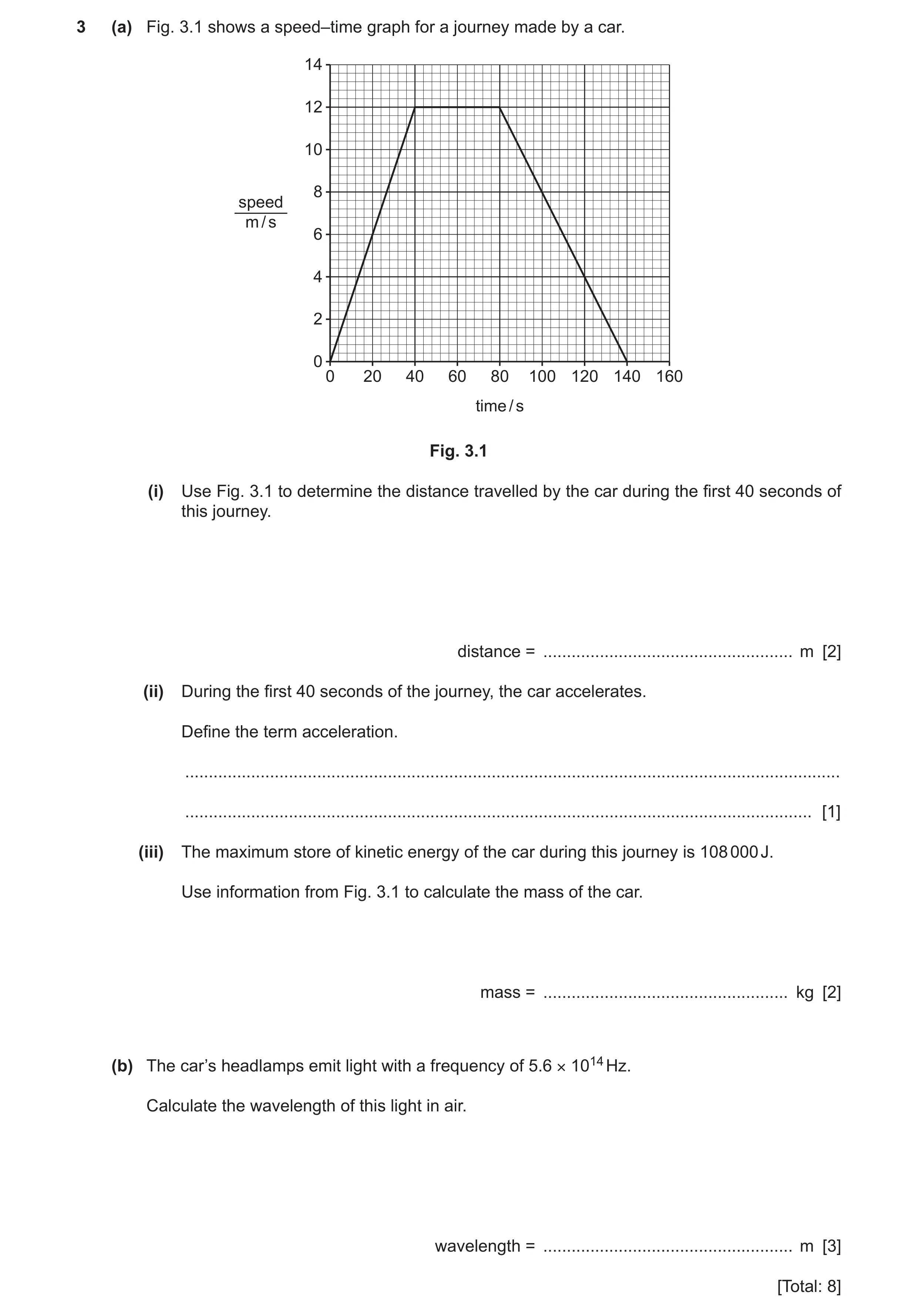
3 (a) Fig. 3.1 shows a speed–time graph for a journey made by a car. 14 12 10 8 speed m / s 6 4 2 0 0 20 40 60 80 100 120 140 160 time / s Fig. 3.1 (i) Use Fig. 3.1 to determine the distance travelled by the car during the first 40 seconds of this journey. distance = … m [2] (ii) During the first 40 seconds of the journey, the car accelerates. Define the term acceleration. … … [1] (iii) The maximum store of kinetic energy of the car during this journey is 108 000 J. Use information from Fig. 3.1 to calculate the mass of the car. mass = … kg [2] (b) The car’s headlamps emit light with a frequency of 5.6 × 10¹⁴ Hz. Calculate the wavelength of this light in air. wavelength = … m [3] [Total: 8]
8 marks
Mark scheme: 3(a)(i) 240 (m) ; 2 3(a)(ii) rate of change of velocity / change in velocity divided by time ; 1 3(a)(iii) (m=) 2Ek / v2 OR 2 10800 / 144 ; (m=) 1500 (kg) ; 2 Question Answer Marks 3(b) use of 3.0 108 (m / s) ; ( =) v / f OR 3.0 108 ÷ 5.6 1014 ; ( =) 5.4 10–7 (m) ; 3
This question in 0654/43 May/June 2024
Q39 · Distance–time graphs for a car journey and a bicycle journey 0654/43 Oct/Nov 2024
9 (a) Fig. 9.1 shows distance–time graphs for a car journey and a bicycle journey. bicycle 350 300 250 car distance / m 200 150 100 50 0 0 10 20 30 40 50 60 70 80 time / s Fig. 9.1 The car and bicycle both start from the same point and travel in the same direction along the same road. (i) Use Fig. 9.1 to describe the car journey. … … … [2] (ii) State the time at which the bicycle passes the car. time = … s [1] (iii) The bicycle and rider have a combined mass of 80 kg. Use Fig. 9.1 to calculate the kinetic energy of the bicycle during this journey. kinetic energy = … J [3] (b) Bicycles are fitted with reflectors which reflect light from car headlights. Fig. 9.2 shows a diagram of a reflector. X Y incident light reflected light air air transparent plastic reflector Fig. 9.2 Explain why refraction does not occur: (i) at point X. … … [1] (ii) at point Y. … … … [2] [Total: 9]
9 marks
Mark scheme: 9(a)(i) constant speed, for 20 s / 250 m ; 2 stopping / stationary after 20 s / 250 m ; 9(a)(ii) 50 (s) ; 1 9(a)(iii) (v =) 300 ÷ 60 or 5.0 (m / s) ; 3 (KE =) ½ mv2 or 0.5 80 5.02 ; (KE =) 1000 (J) ; 9(b)(i) (at X) the incident ray is at 90° / right angle to the surface / the angle of incidence is 0° / the incident ray is along the normal ; 1 9(b)(ii) (at Y) total internal reflection occurs ; 2 (because) angle of incidence is greater than the critical angle (for the two media) ;
This question in 0654/43 Oct/Nov 2024
Q40 · Circle two vector quantities 0654/42 Feb/March 2025
9 (a) Circle two vector quantities. acceleration speed temperature time weight [2] (b) Fig. 9.1 shows the speed–time graph for a car travelling along a straight horizontal road. 25 20 15 speed m / s 10 5 0 0 50 100 150 200 250 300 350 400 time / s Fig. 9.1 (i) Describe the motion of the car between time = 250 s and time = 375 s. … … … [2] (ii) Calculate the acceleration of the car in the first 40 s. State the unit. acceleration = … unit … [3] (c) (i) Complete the sentence to describe the changes to the energy stores when the car accelerates. The amount of energy in the … energy store decreases and the amount of energy in the kinetic energy store … . [2] (ii) When the car is travelling at constant speed there are changes to the amount of energy stored in two energy stores. State the name of the energy stores and describe these changes. … … … [1] [Total: 10]
10 marks
Mark scheme: 9(a) acceleration ; 2 weight ; 9(b)(i) constant speed ; 2 (constant) deceleration ; 9(b)(ii) evidence of a=v / t or a = 20 / 40 or gradient ; 3 0.50 ; m / s2 or m s–2 ; 9(c)(i) chemical ; 2 increases ; 9(c)(ii) chemical and thermal 1 and amount of energy in the chemical energy store decreases / amount of energy increases in the thermal energy store of surroundings ;
This question in 0654/42 Feb/March 2025
Q41 · 38Sr is a radioactive isotope 0654/42 Feb/March 2025
11 (a) 38Sr is a radioactive isotope. It undergoes beta decay with a half-life of 29 years. (i) Complete the equation for this nuclear decay. 90 … … 38Sr … Y + … β [3] 90 (ii) The mass of 38Sr in a sample is 1.6 mg. 90 Calculate the mass of 38Sr isotope remaining after 58 years. mass … mg [1] 90 (iii) A 38Sr source is used in a factory making aluminium foils. Describe three ways in which workers are kept safe from the effects of the radiation. 1 … 2 … 3 … [3] (b) Space vehicles used to explore the Moon can be powered by radioactive sources. The Moon takes 27.3 days to orbit the Earth. The mean distance from the Earth to the Moon is 3.84 × 10⁸ m. Calculate the mean orbital speed of the Moon around the Earth. speed = … m / s [2] [Total: 9]
9 marks
Mark scheme: 11(a)(i) beta with 0, –1; 3 (top row 90) 90Y ; (bottom row 39) 39Y ; 11(a)(ii) 0.4 (mg) ; 1 11(a)(iii) any three from: 3 minimise exposure time maximise distance use shielding radiation detection badge ; ; ; 11(b) evidence of v=2r / T or 2 3.84 108 or (27.3 24 3600) ; 2 1020 (m / s) ;
This question in 0654/42 Feb/March 2025
Q42 · A rocket travels vertically upwards 0654/41 May/June 2025
10 (a) A rocket travels vertically upwards. Fig. 10.1 shows the speed–time graph for the rocket. 350 300 250 200 speed m / s 150 100 50 00 10 20 30 40 50 time / s Fig. 10.1 (i) Describe the motion of the rocket in the first 20 seconds. … [1] (ii) Calculate the deceleration of the rocket between time = 20 s and time = 50 s. State the unit of your answer. deceleration = … unit … [3] (iii) Calculate the distance travelled by the rocket between time = 30 s and time = 50 s. distance = … m [2] (iv) State the time at which the rocket reaches its maximum height above the ground. time = … s [1] (b) A car travels at constant speed on a horizontal road. State and describe the horizontal forces acting on the car. … … … [2] [Total: 9]
9 marks
Mark scheme: 10(a)(i) changing / increasing acceleration ; 1 10(a)(ii) evidence of substitution into v/t or 300 / 30 ; 3 10 ; m / s² ; 10(a)(iii) evidence of area or 0.5 200 20 ; 2 2000 m ; 10(a)(iv) 50 (s) ; 1 10(b) driving force AND drag / air resistance / friction ; 2 equal (magnitude) and opposite (direction) ;
This question in 0654/41 May/June 2025
Q43 · Circle all the vector quantities 0654/43 May/June 2025
9 (a) (i) Circle all the vector quantities. energy gravitational field strength temperature time weight [2] (ii) Define the term velocity. … … [2] (b) Fig. 9.1 shows the speed–time graph for a cyclist travelling along a straight horizontal road. 6.0 5.0 4.0 speed 3.0 m / s 2.0 1.0 0 0 10 20 30 40 50 60 70 time / s Fig. 9.1 Calculate the acceleration of the cyclist during the first 12 seconds. acceleration = … m / s2 [2] (c) (i) In a crash test, a car experiences a deceleration of 35 m / s2. deceleration of car Calculate the ratio: acceleration due to gravity ratio = … [1] (ii) Before the crash, the car has a velocity of 28 m / s. The kinetic energy of the car is 470 kJ. Calculate the mass of the car. mass = … kg [2] [Total: 9]
9 marks
Mark scheme: 9(a)(i) weight; 2 gravitational field strength; 9(a)(ii) speed / distance travelled per unit time; 2 in a given direction; 9(b) evidence of a = ∆v / ∆t or gradient or 5.4 / 12; 2 0.45 (m/s²); 9(c)(i) (−)3.6; 1 9(c)(ii) evidence of E=0.5mv² / ½ mv² or 470 000 = 0.5 m 28²; 2 1200 (kg);
This question in 0654/43 May/June 2025
 19 / 76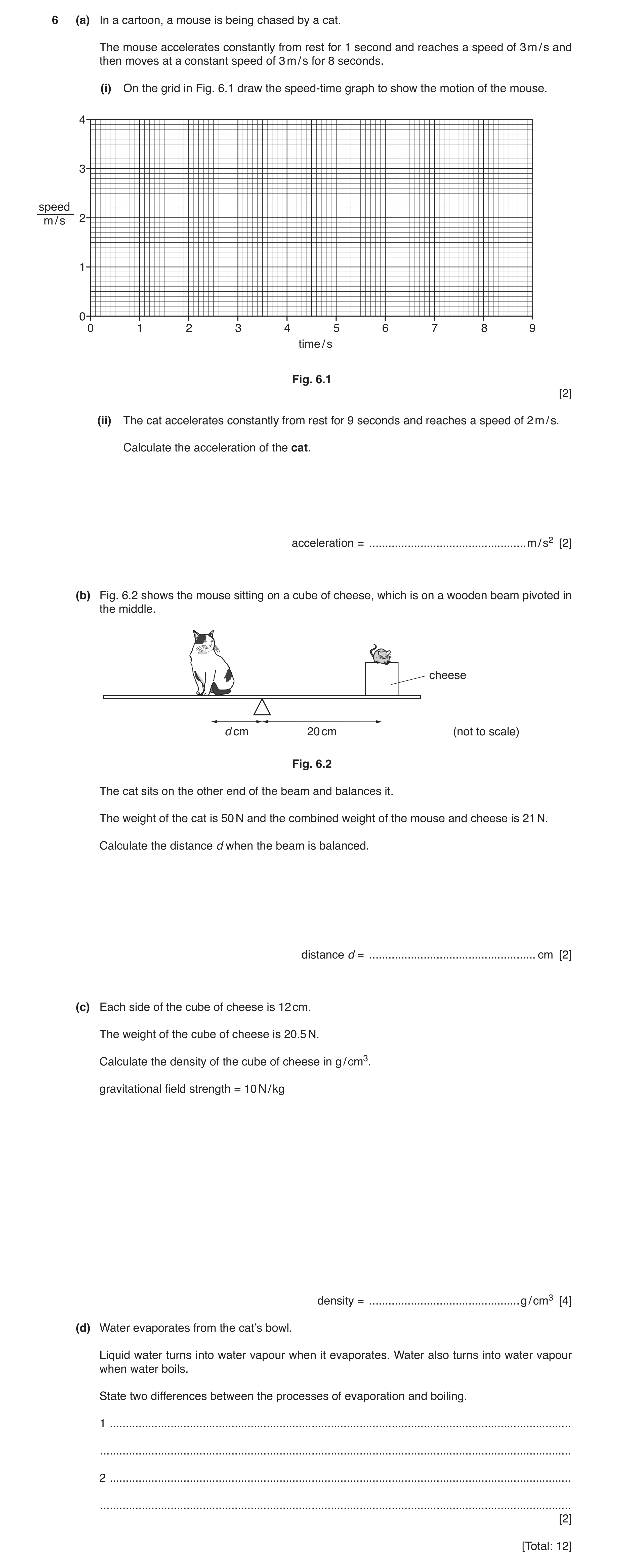
 29 / 76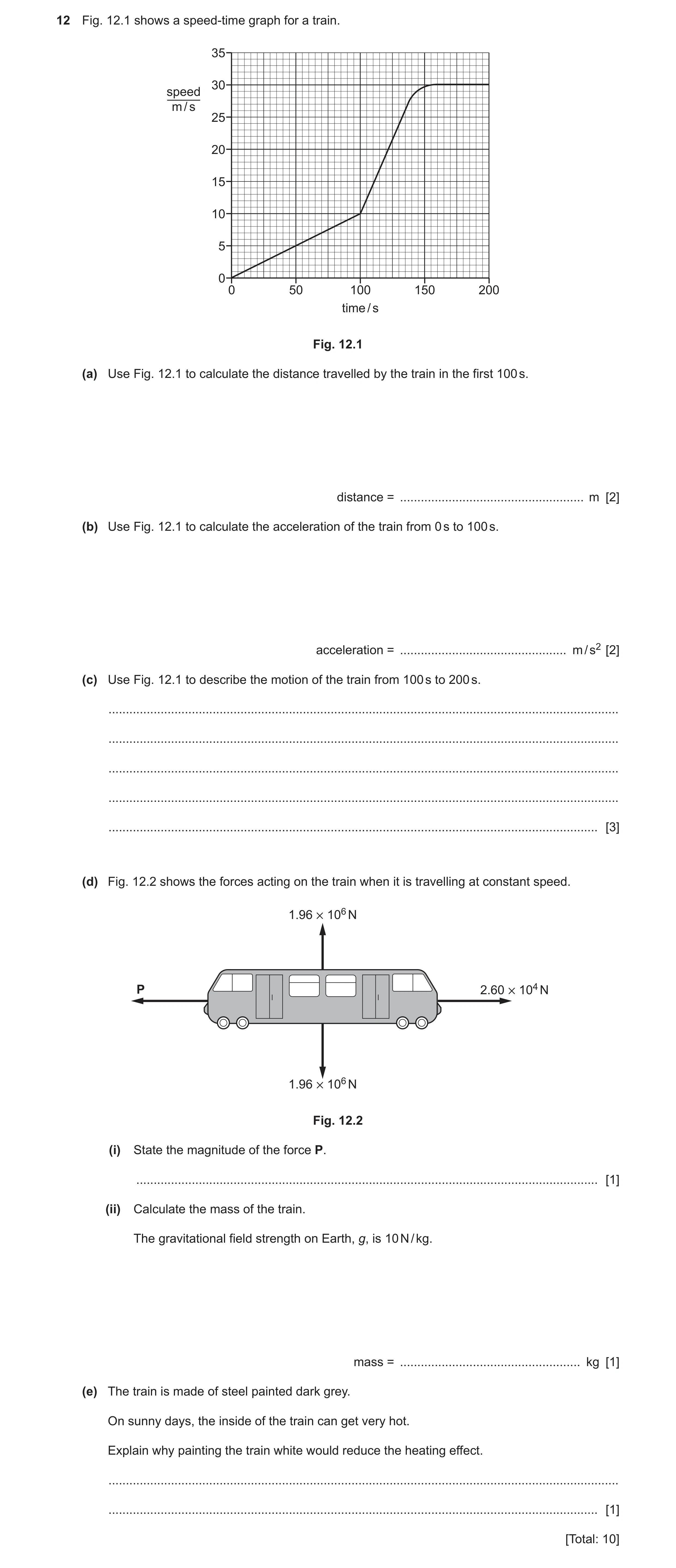
 38 / 76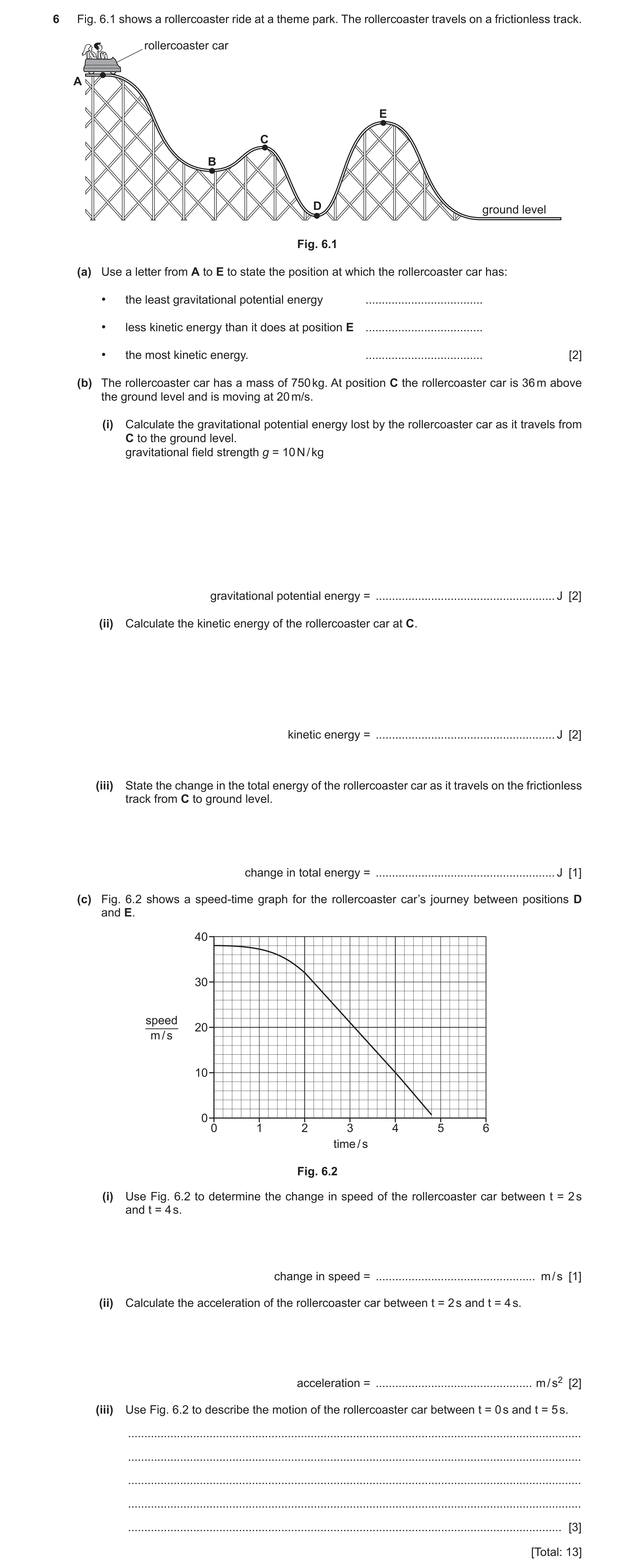
 69 / 76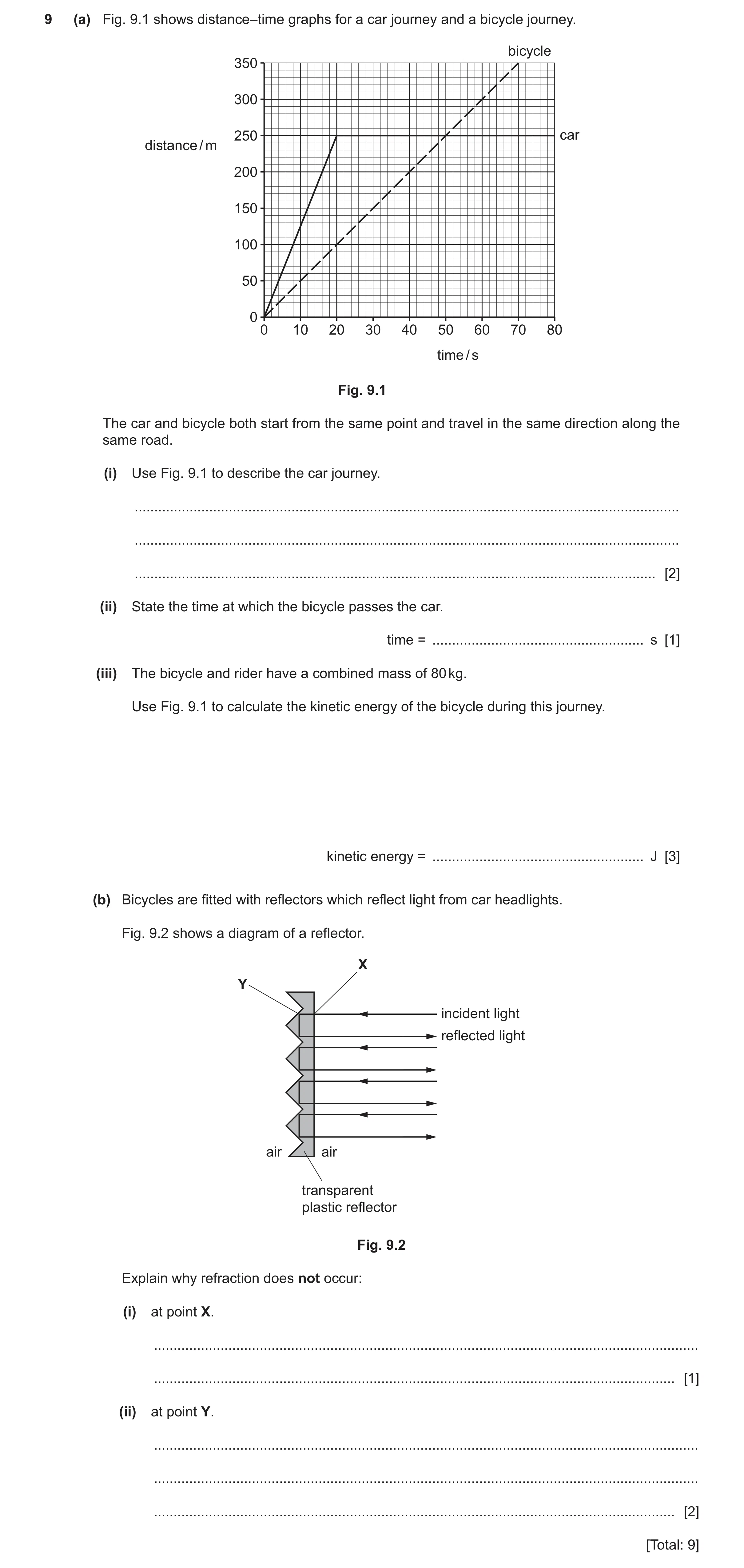
![Question 40: (a) Circle two vector quantities. acceleration speed temperature time weight [2] (b) Fig. 9.1 shows the speed–time graph for a car travelli…](https://img.pastlit.com/crops/08b2c75a-c309-4a7a-9c51-b158e998f79b/q9.webp)
 73 / 76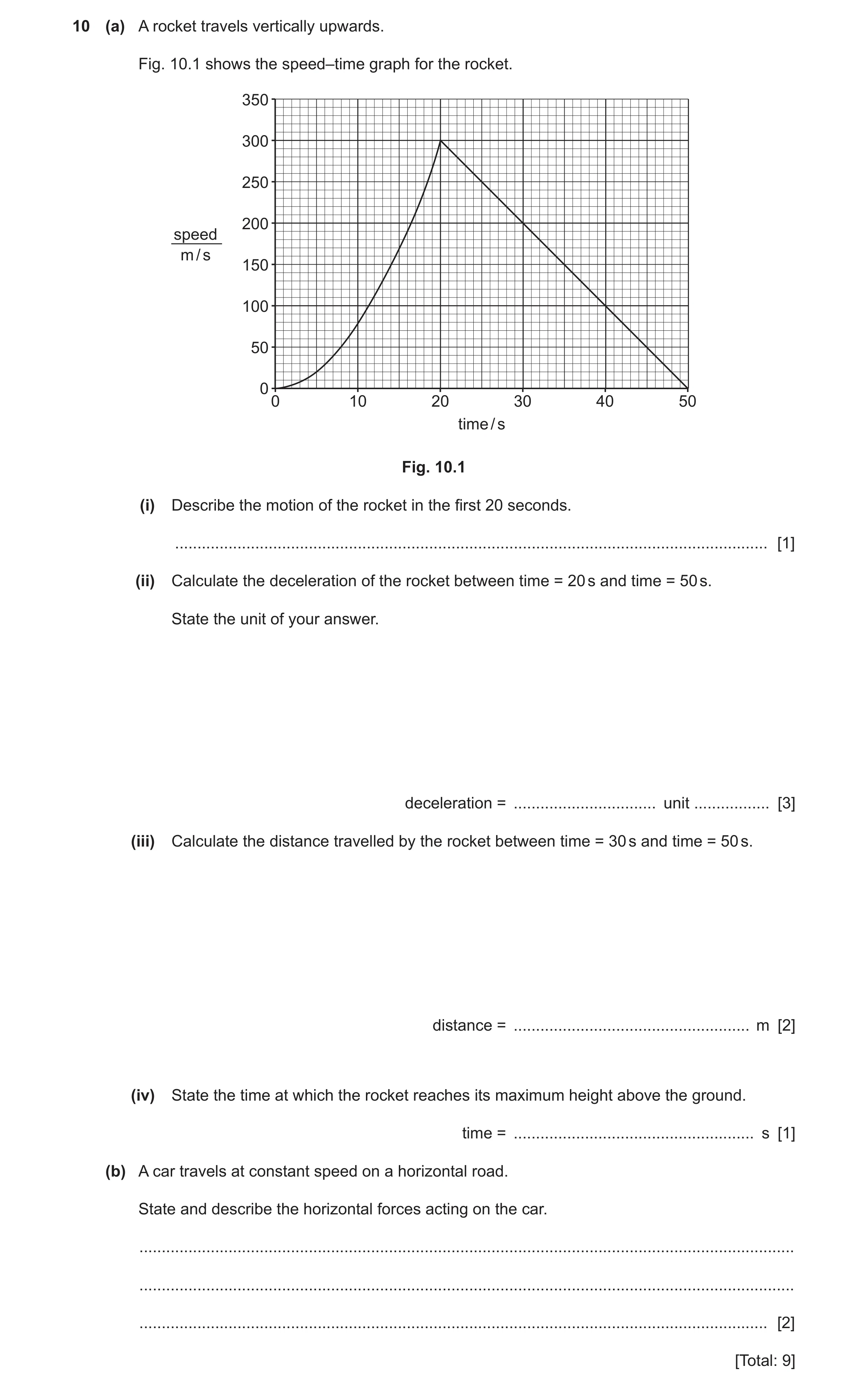
![Question 43: (a) (i) Circle all the vector quantities. energy gravitational field strength temperature time weight [2] (ii) Define the term velocity. ..…](https://img.pastlit.com/crops/5f469ae5-3ce9-4e60-9f50-777dbb641736/q9.webp)
 13
13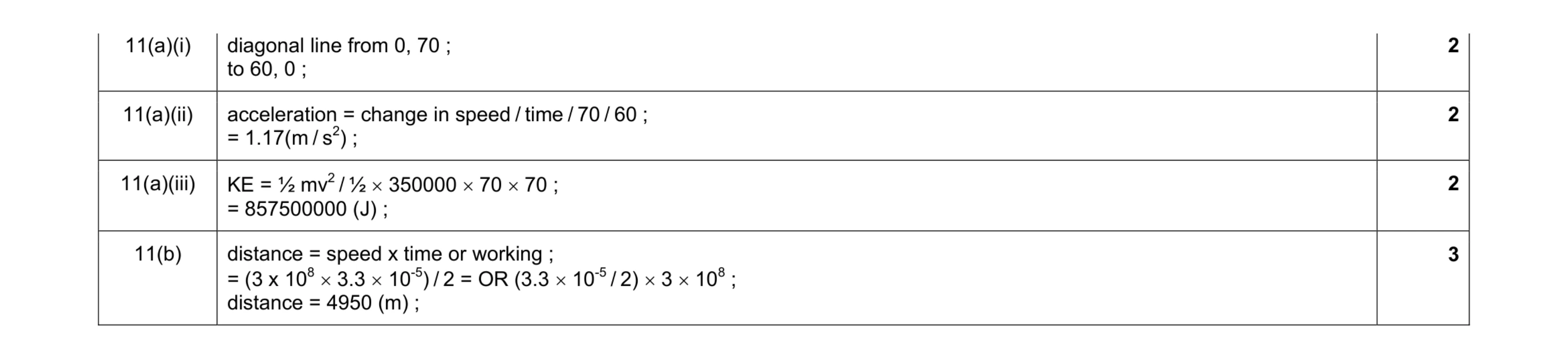 9
9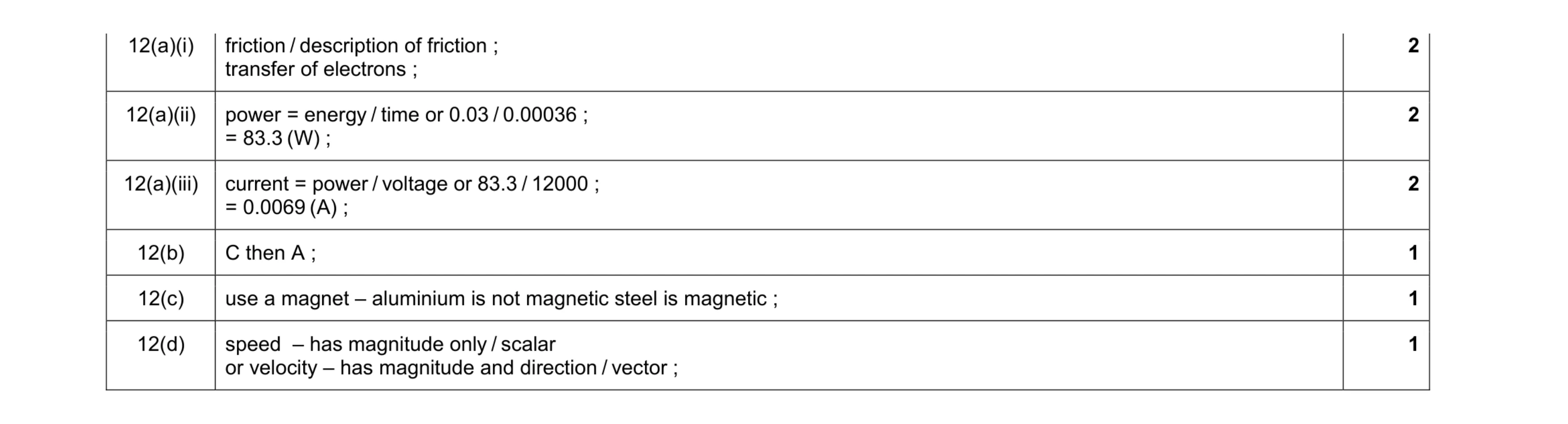 9
9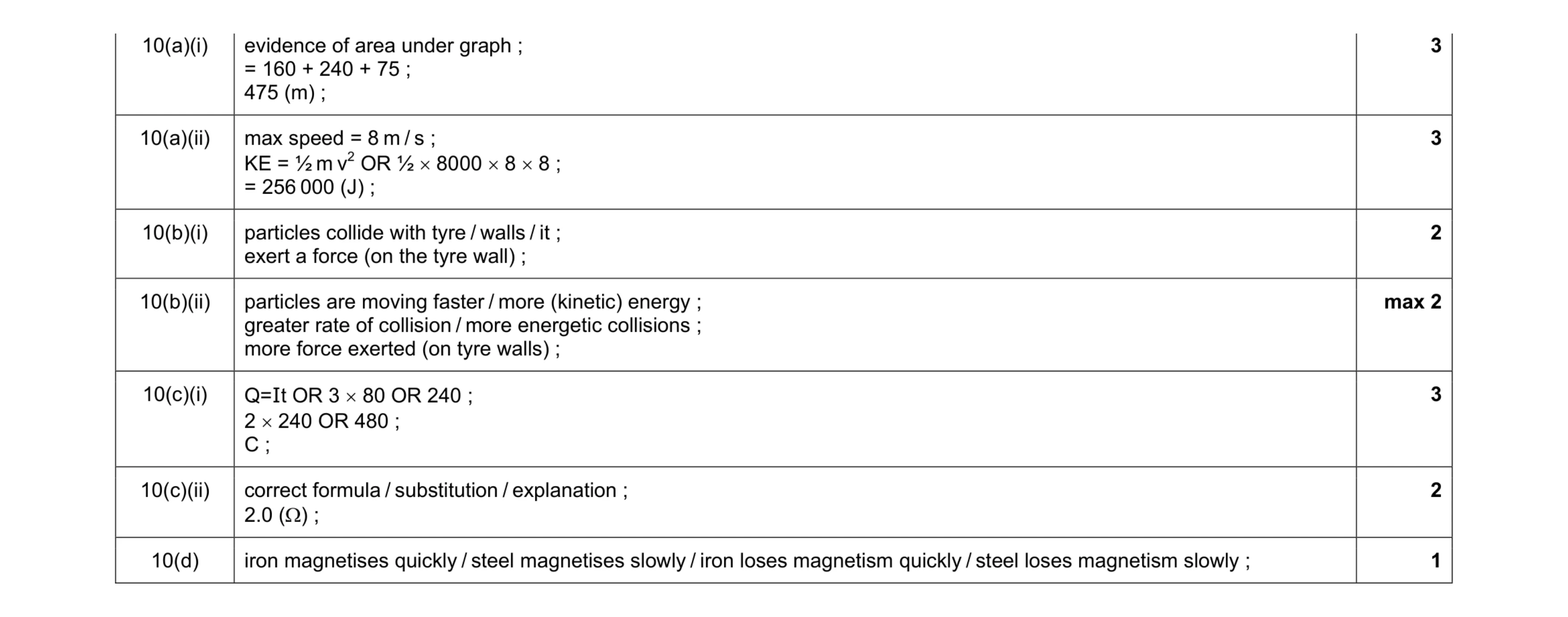 16
16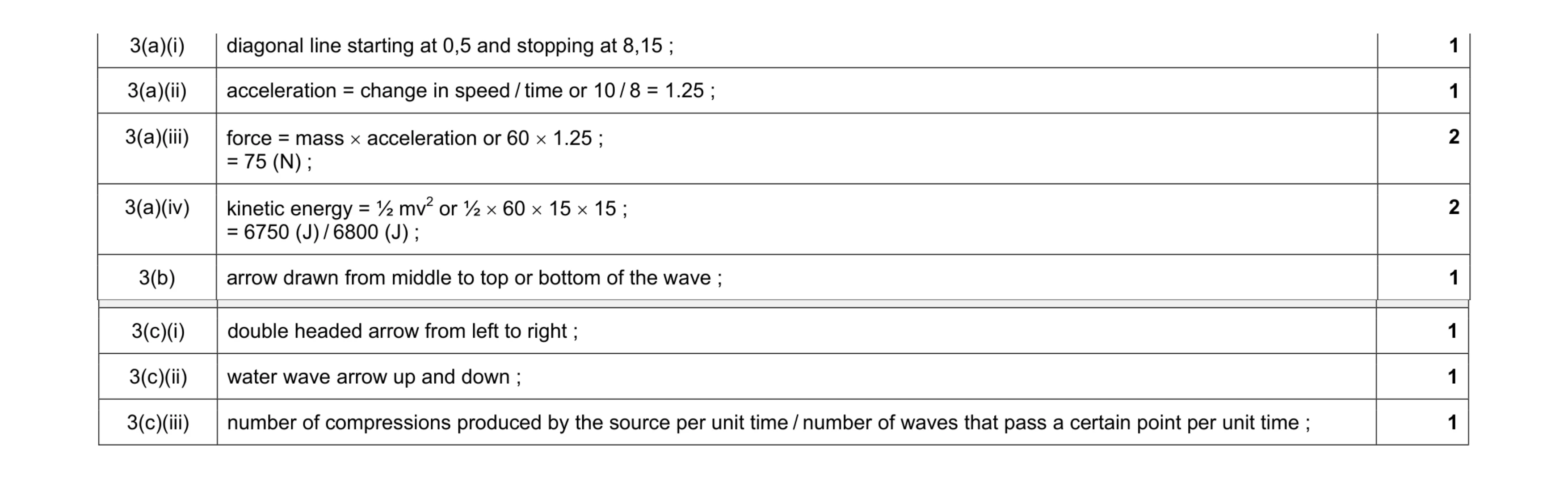 10
10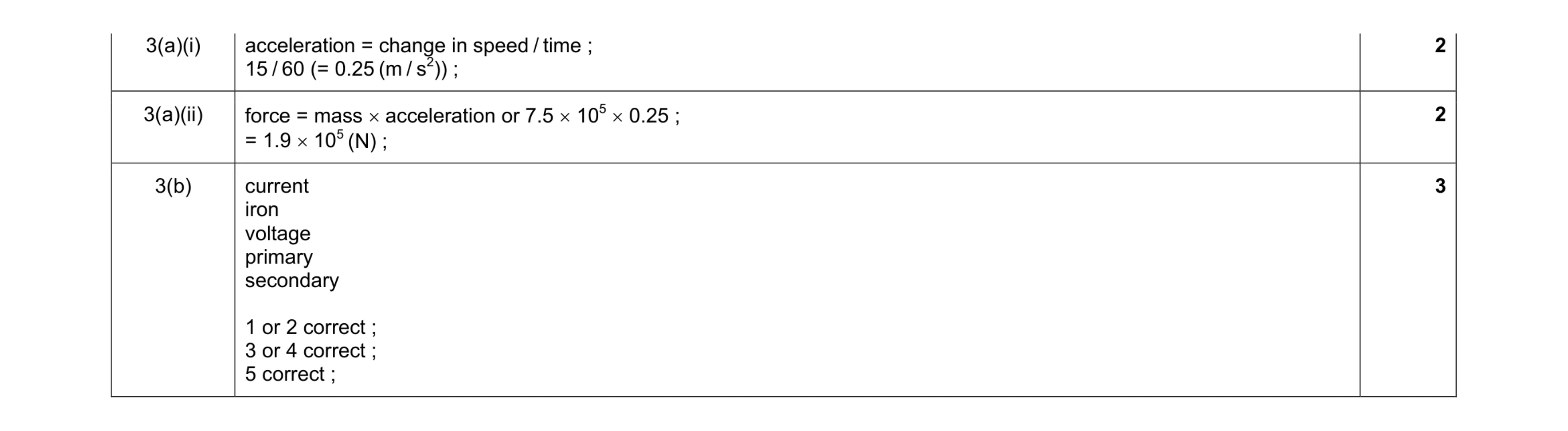 7
7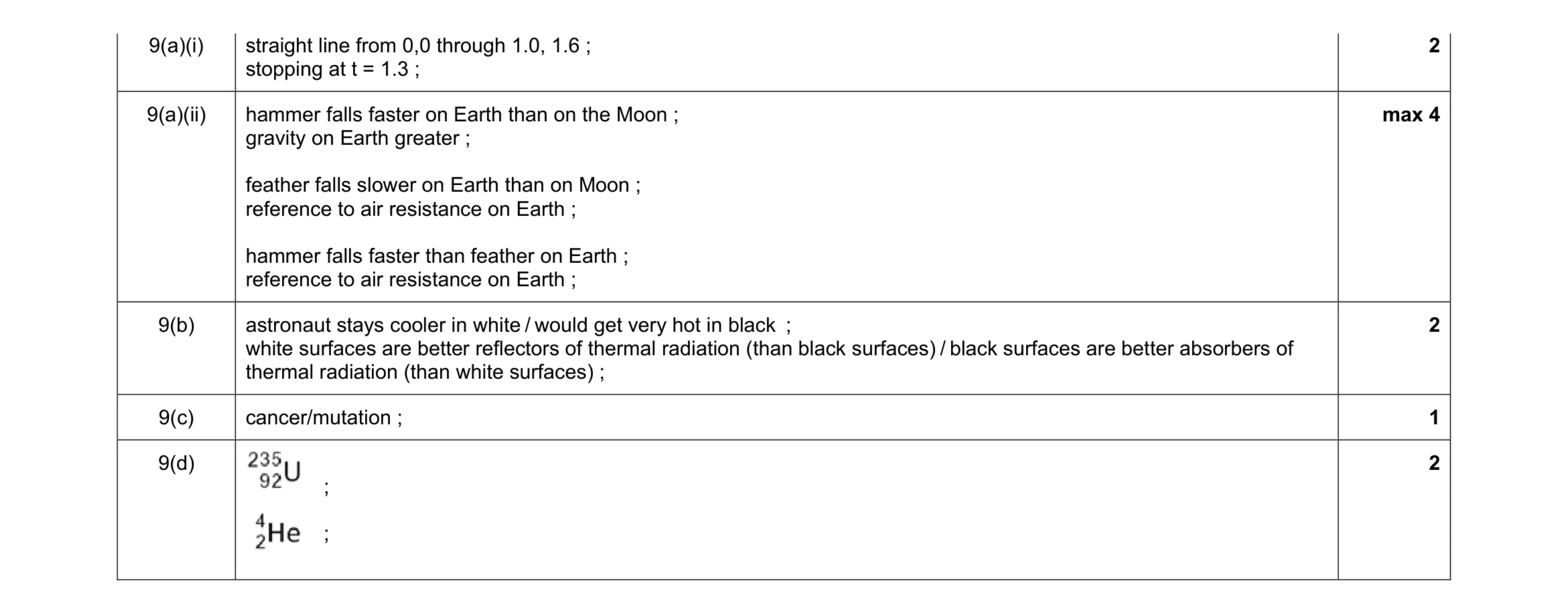 11
11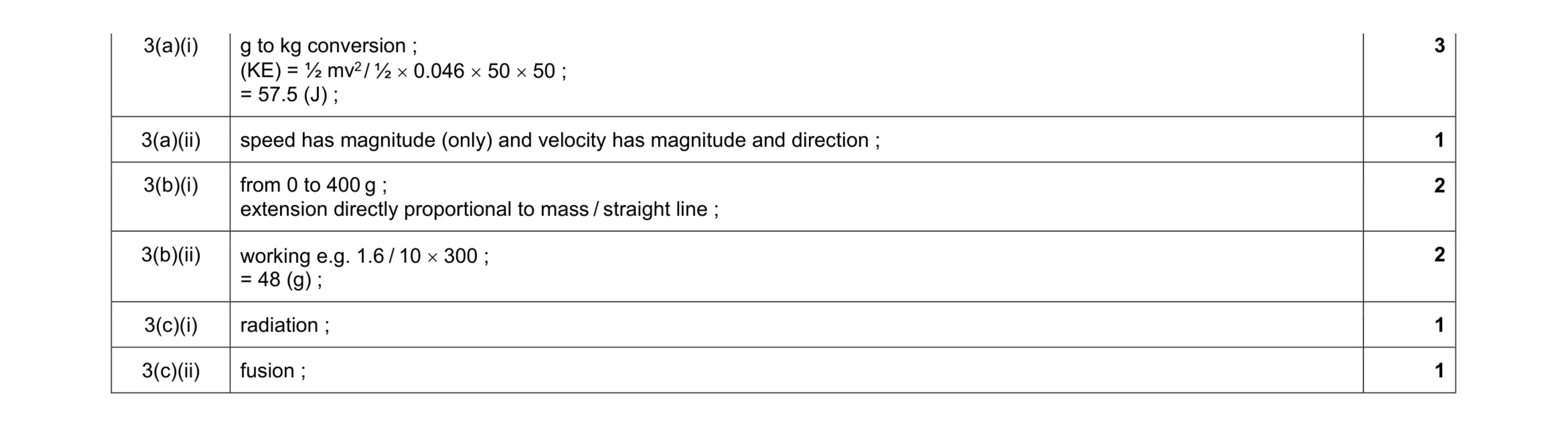 10
10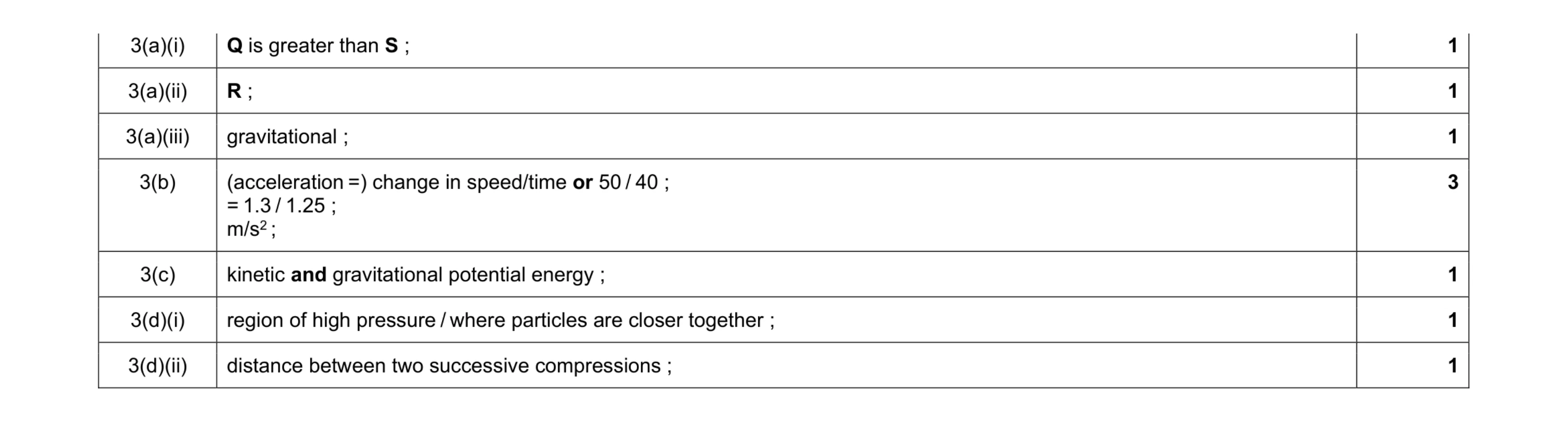 9
9 6
6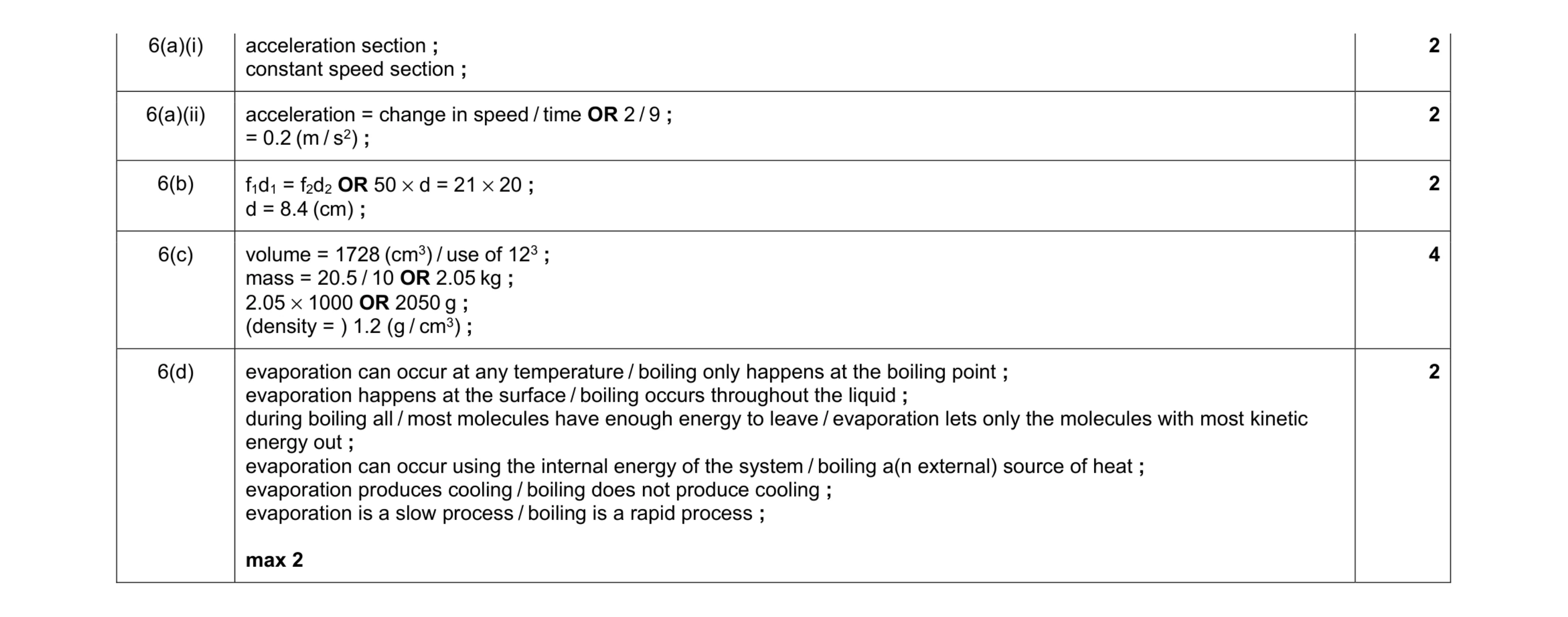 12
12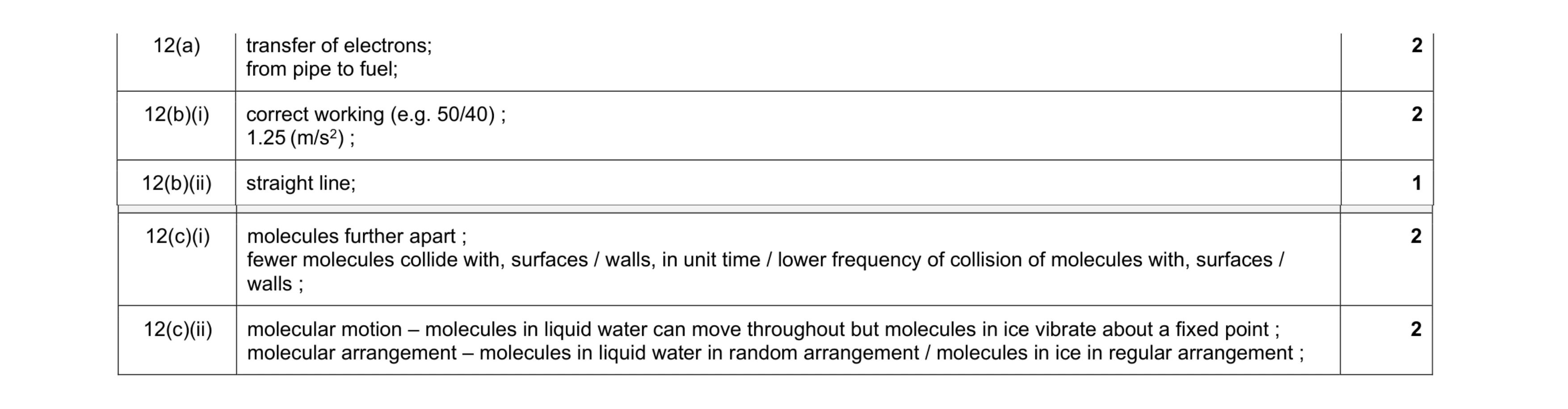 9
9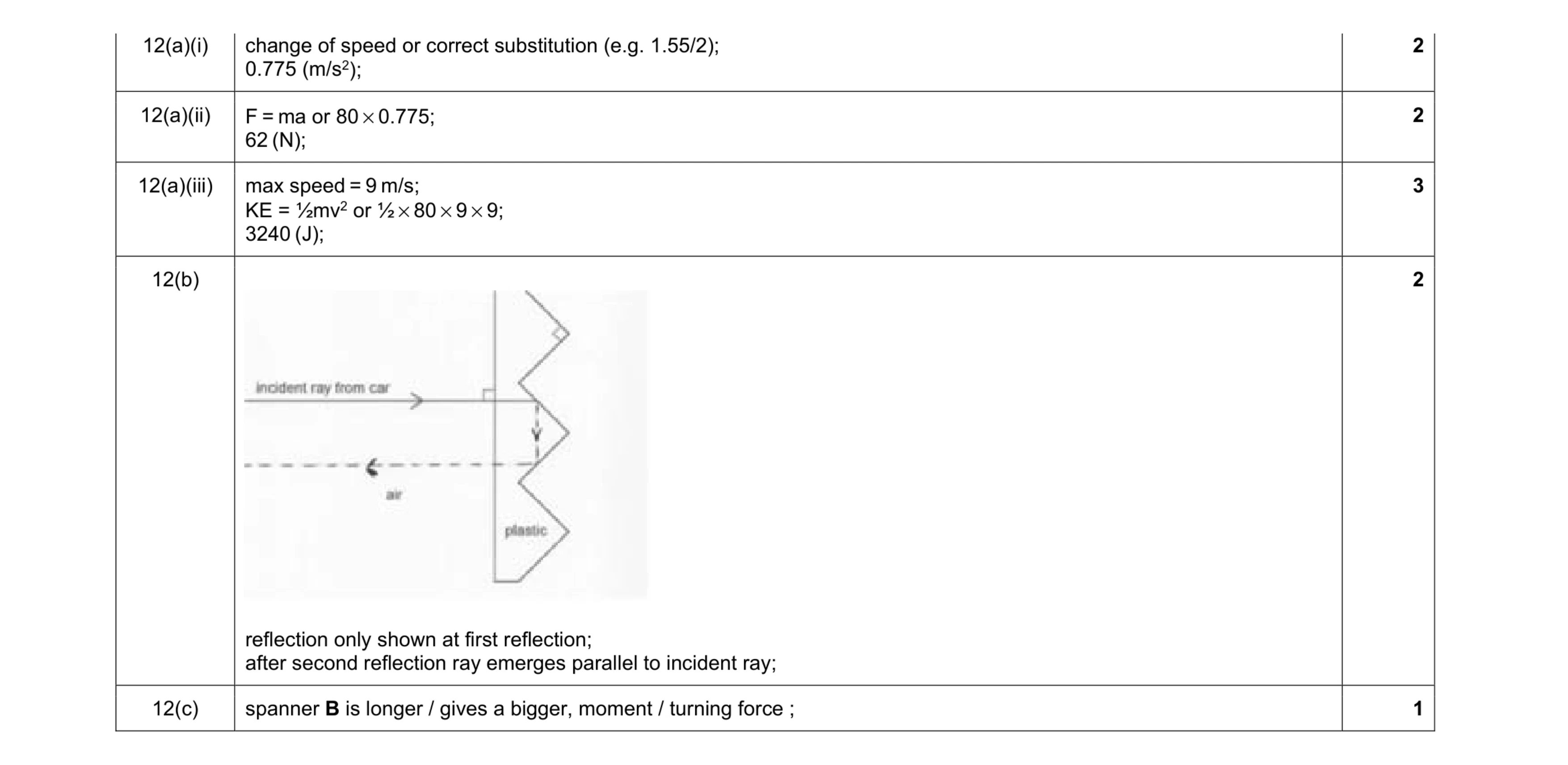 10
10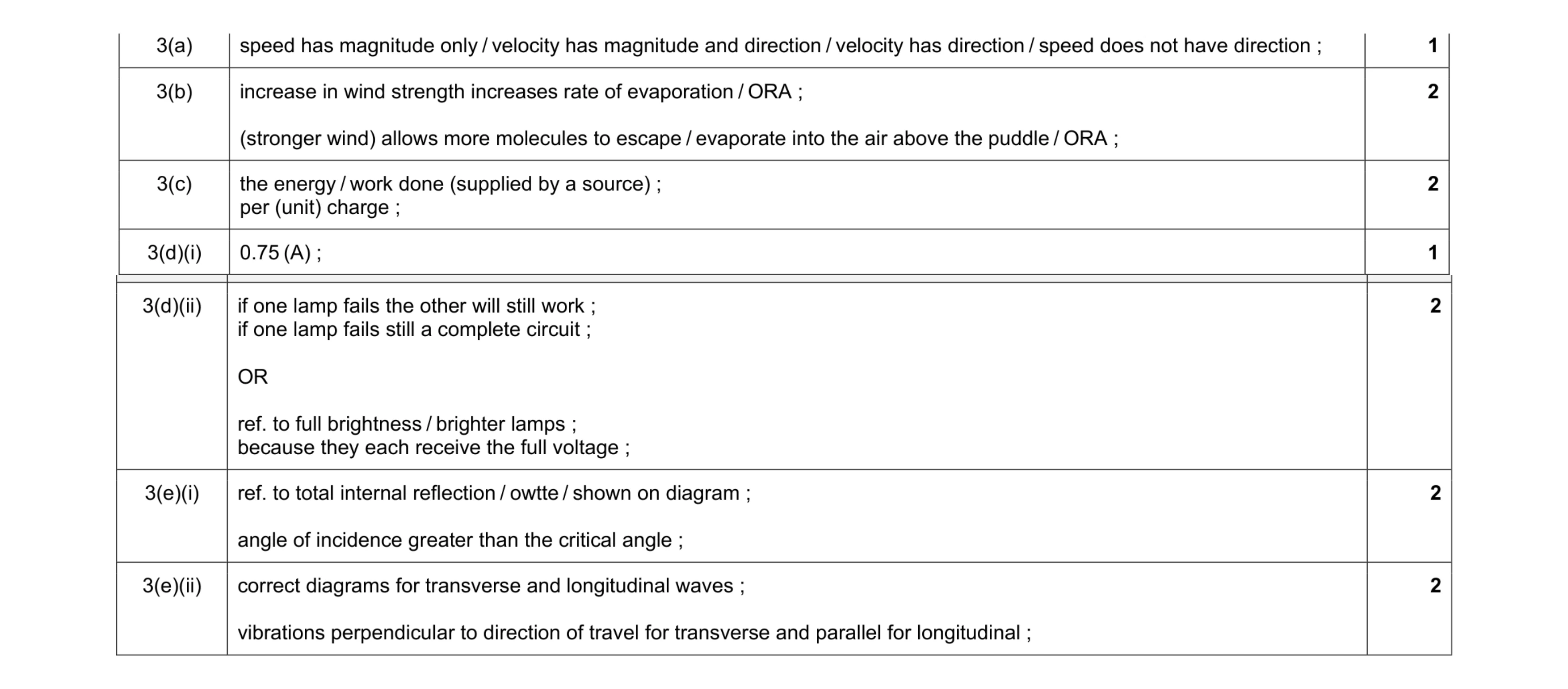 12
12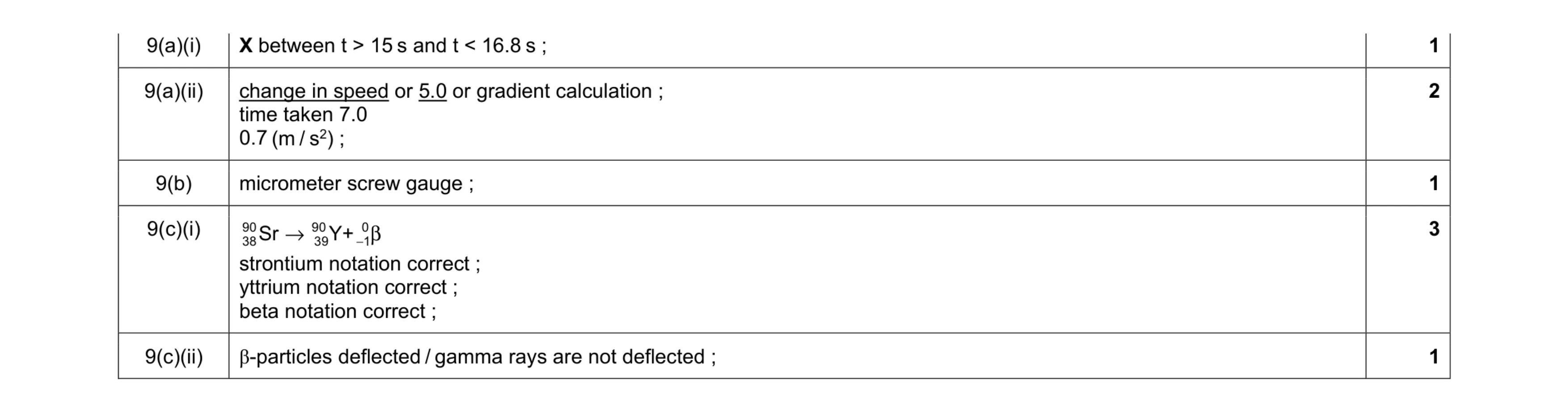 8
8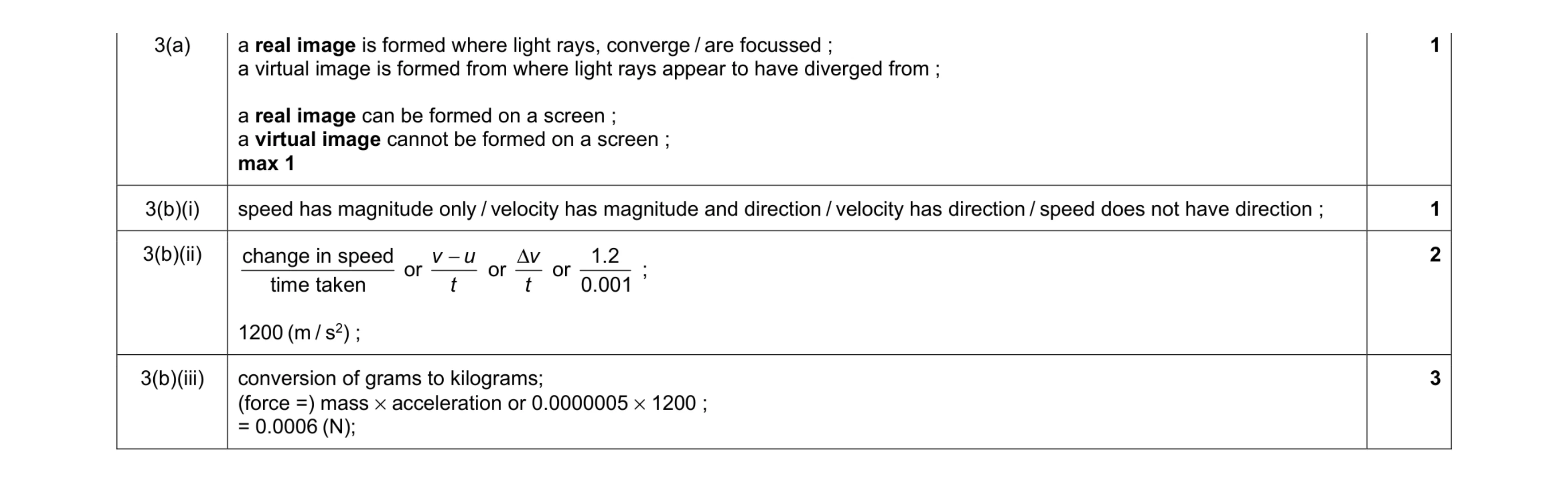 7
7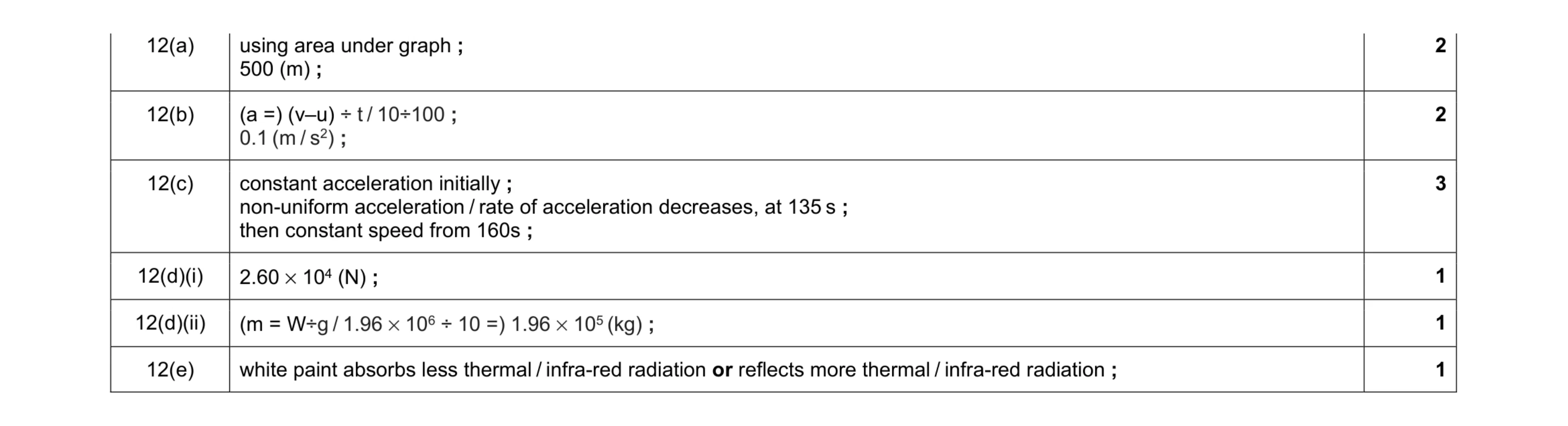 10
10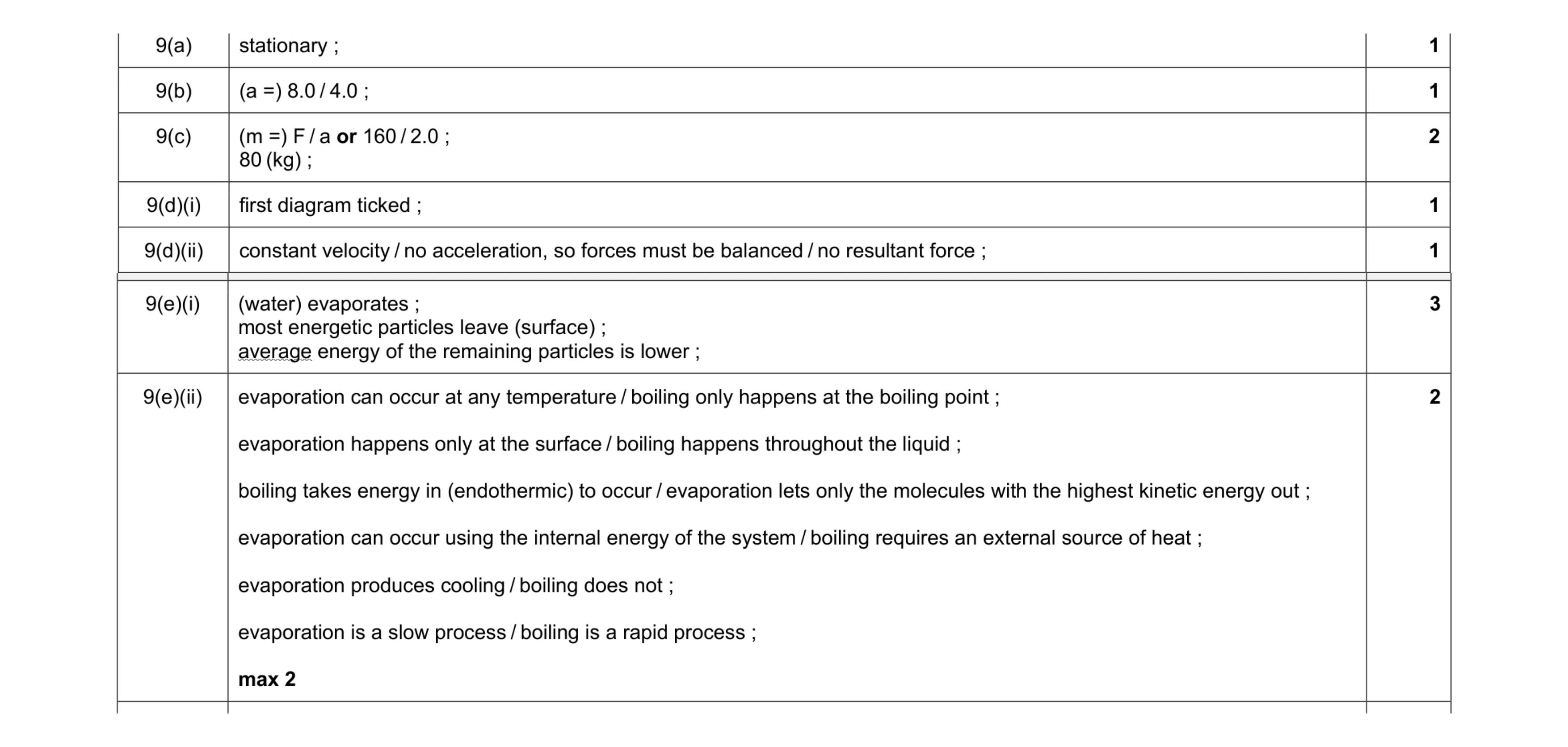 11
11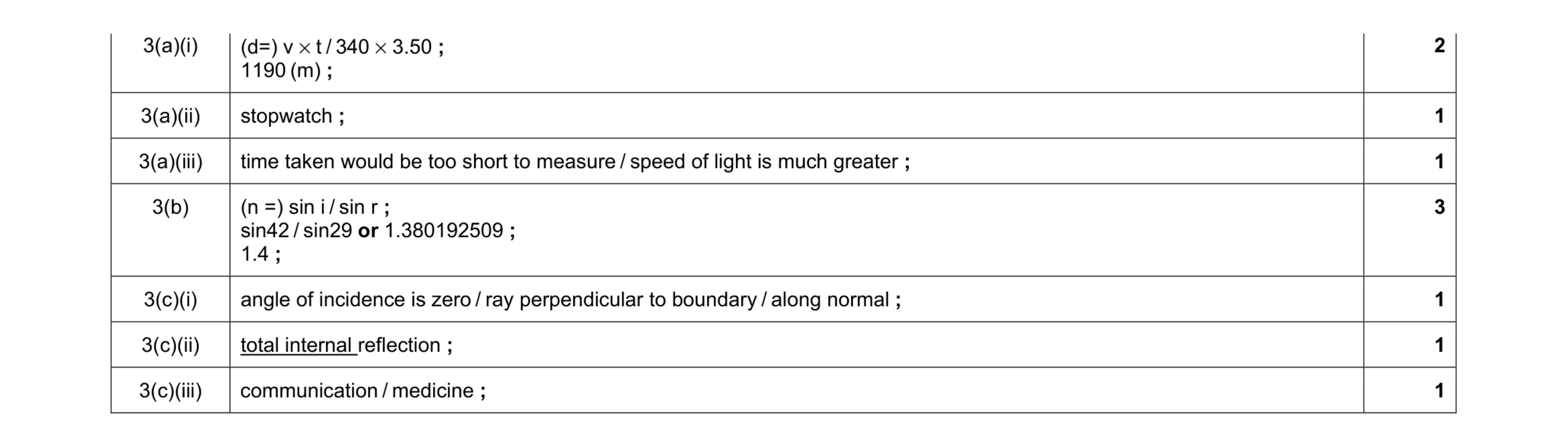 10
10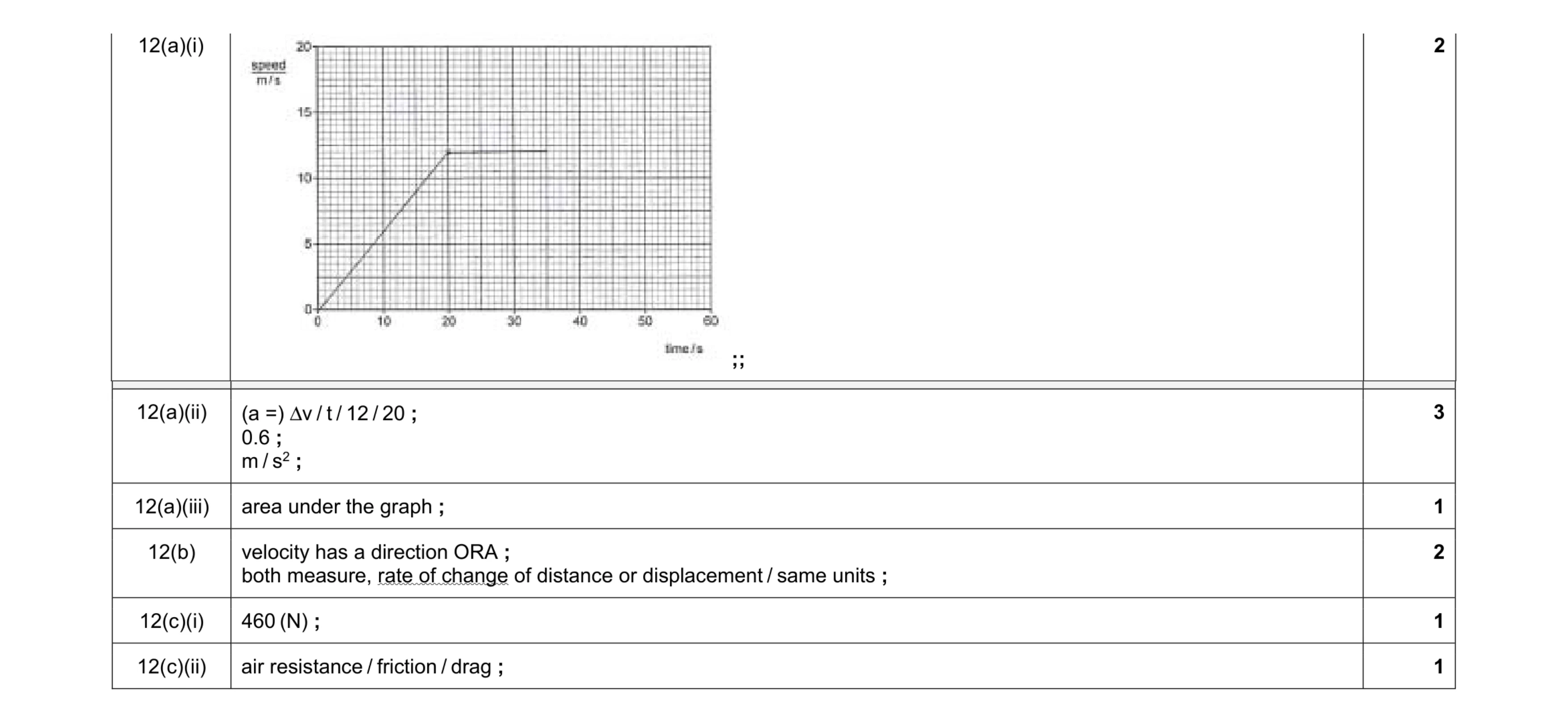 10
10 7
7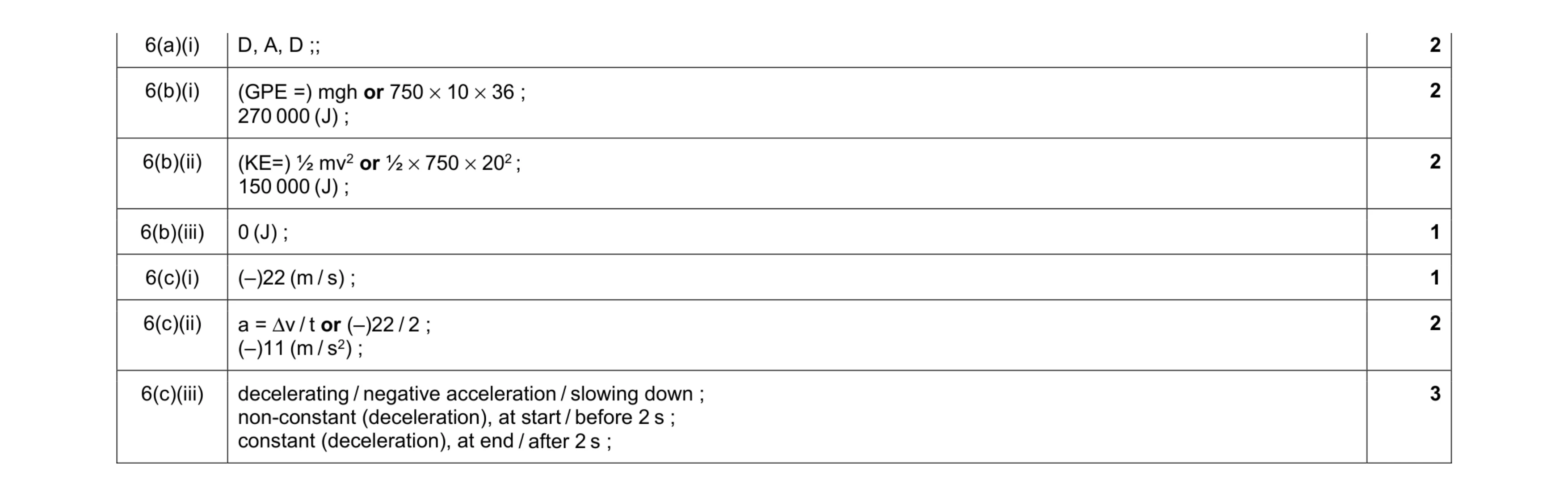 13
13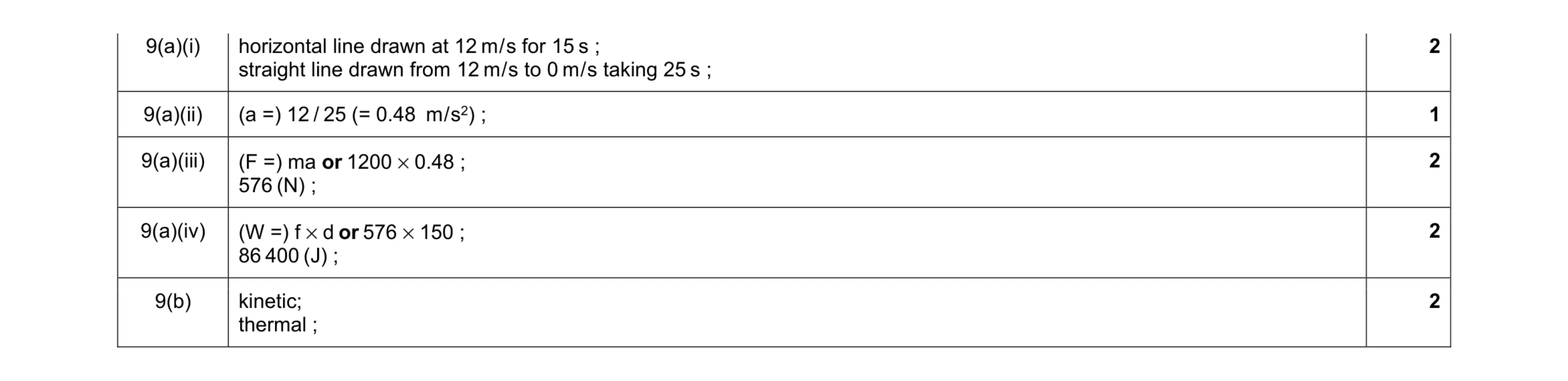 9
9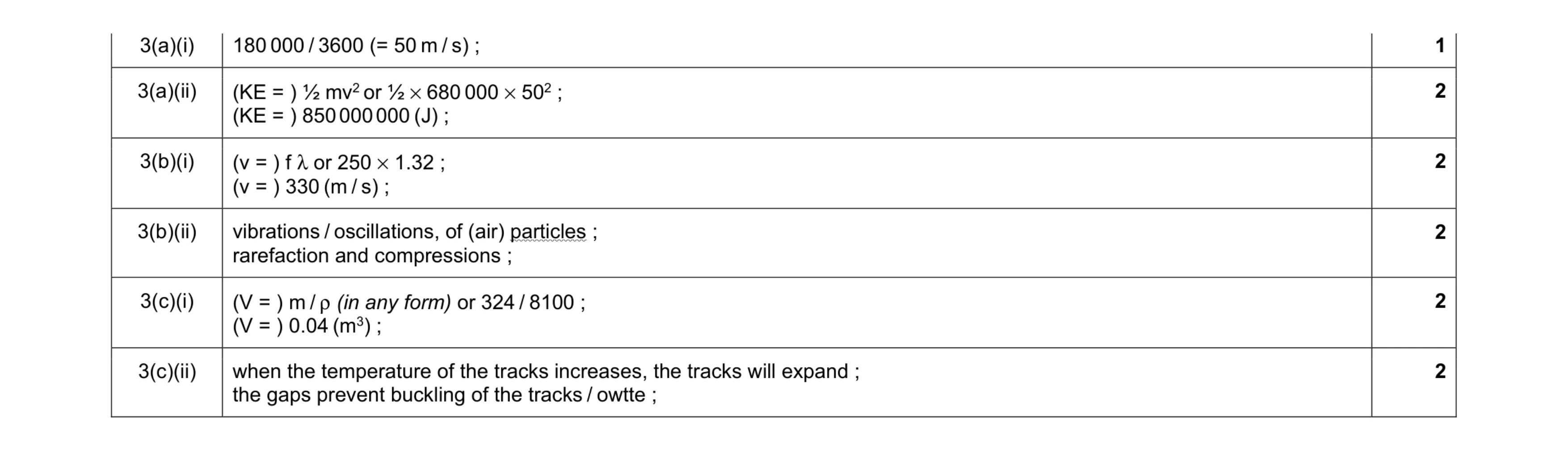 11
11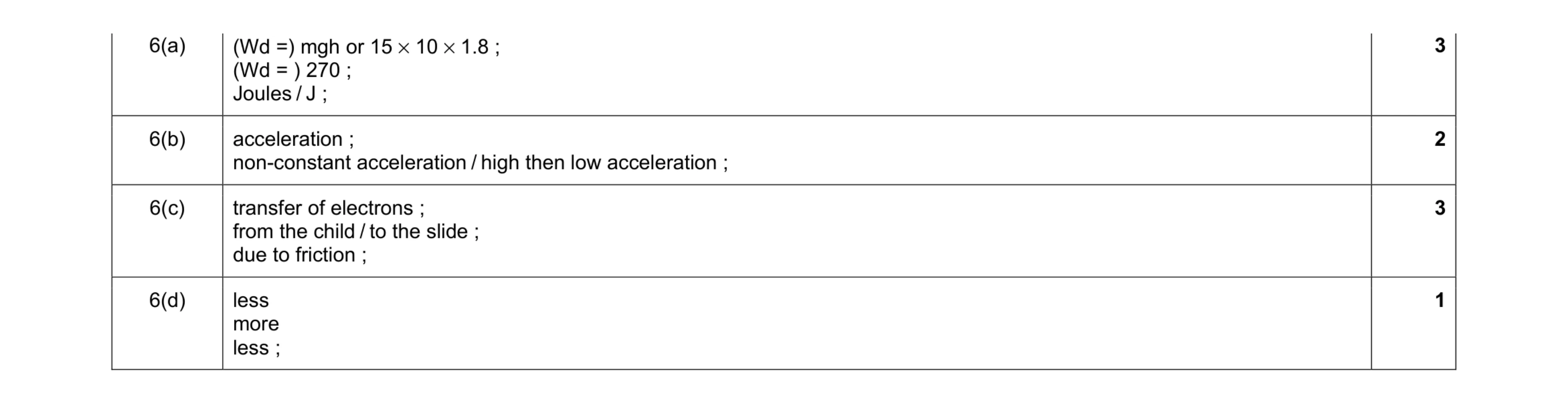 9
9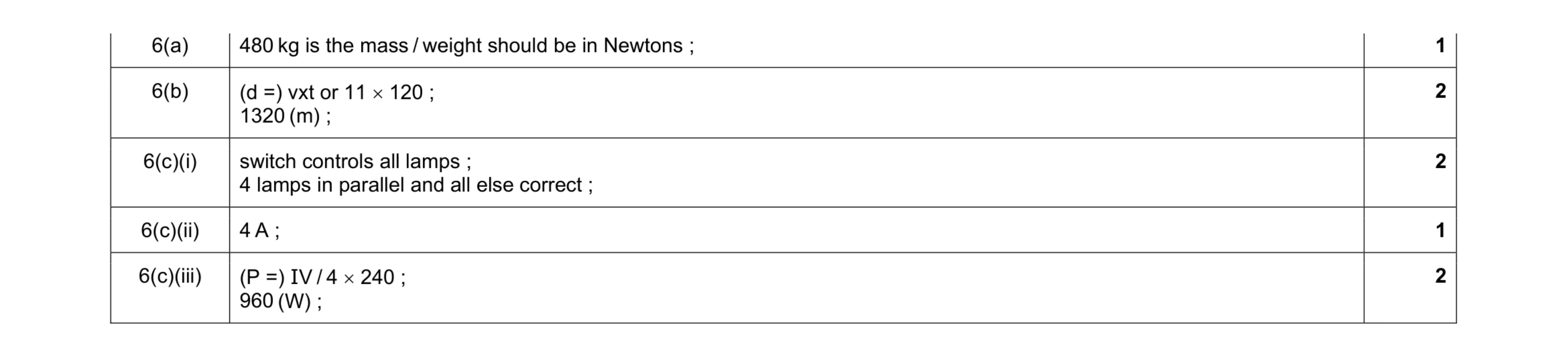 8
8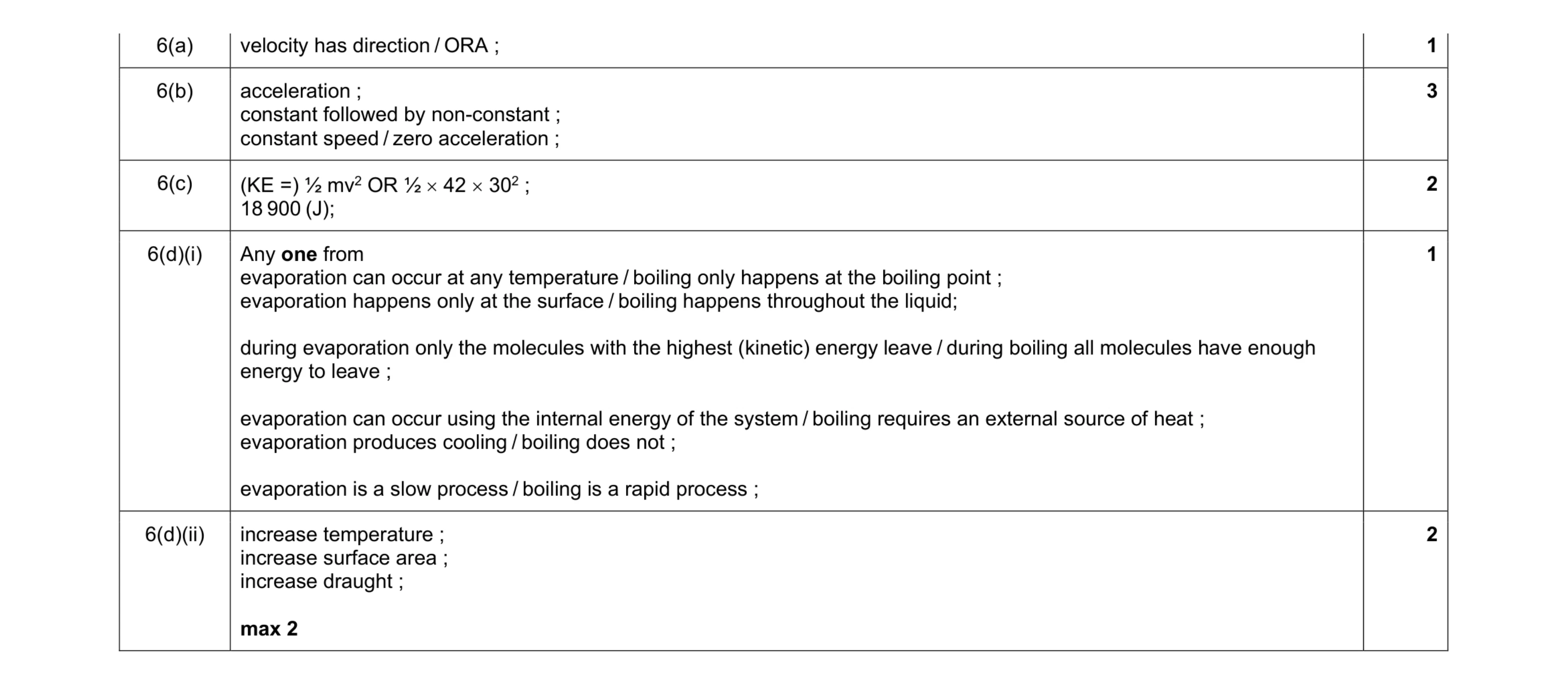 9
9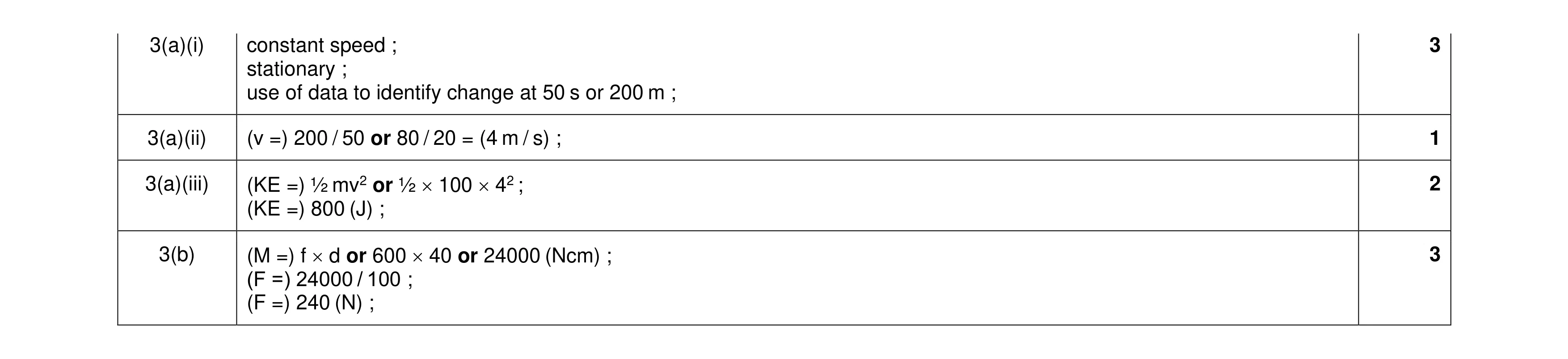 9
9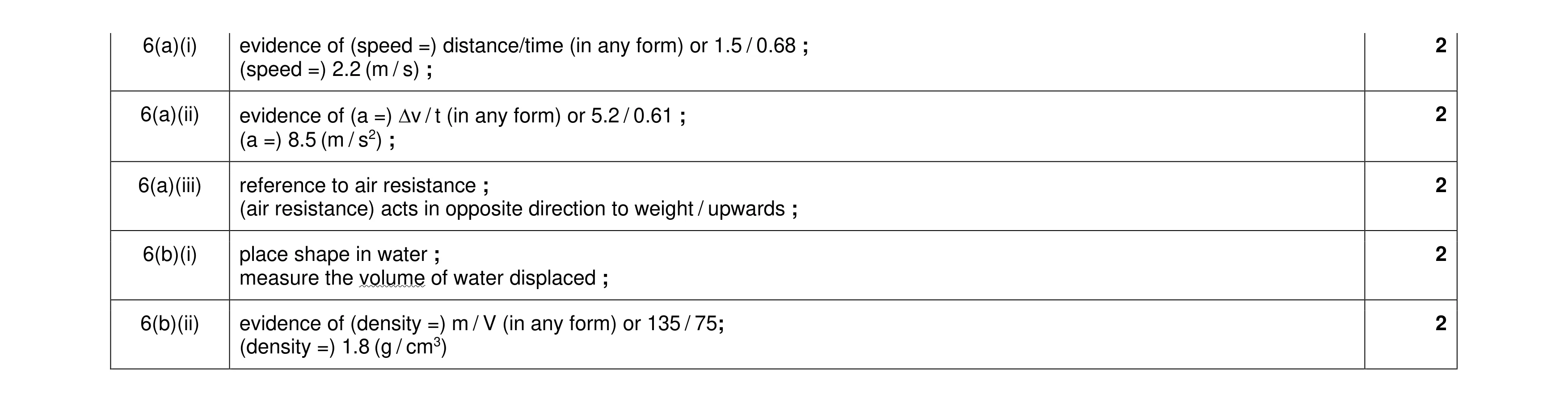 10
10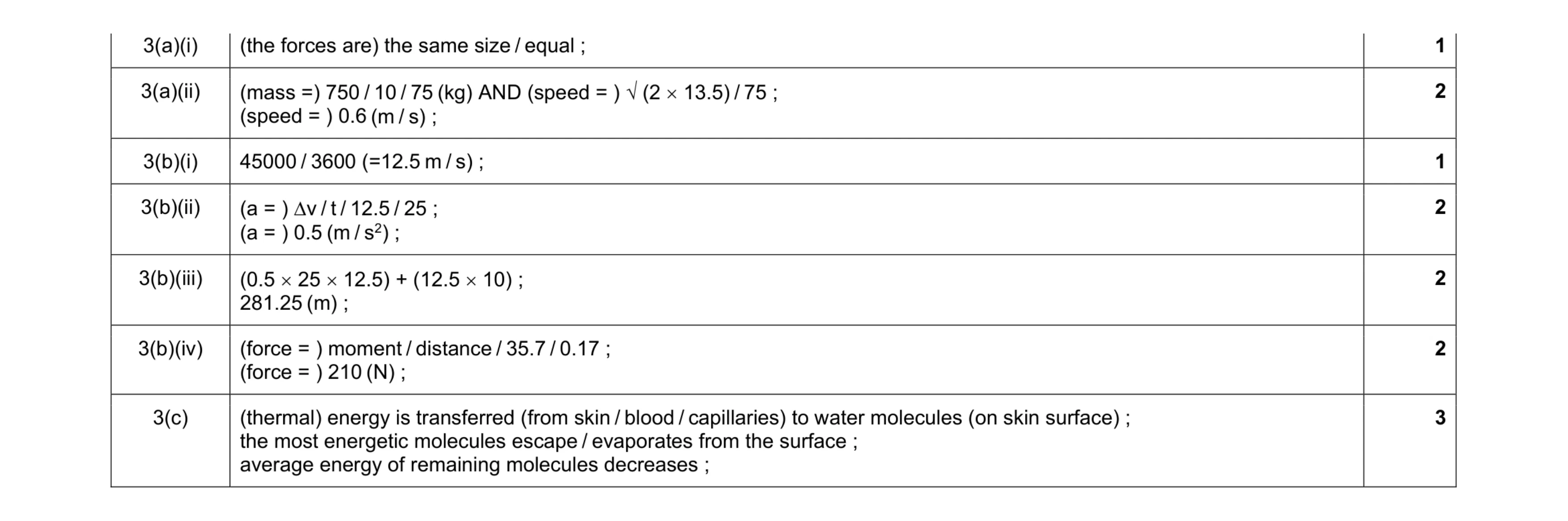 13
13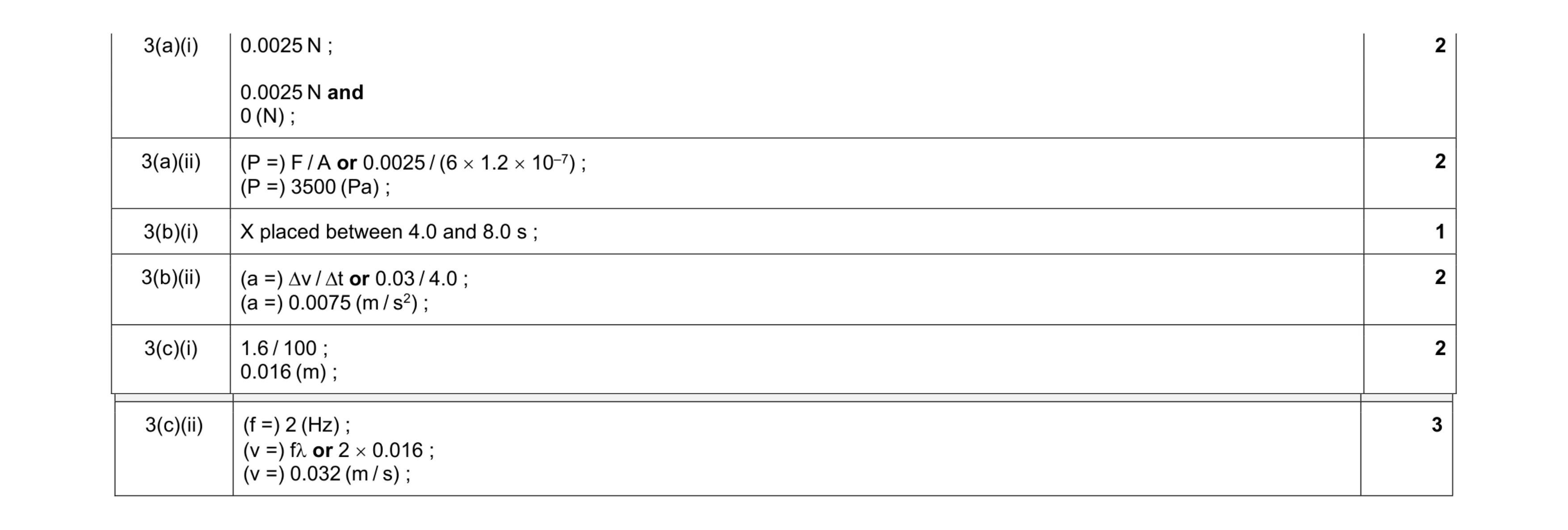 12
12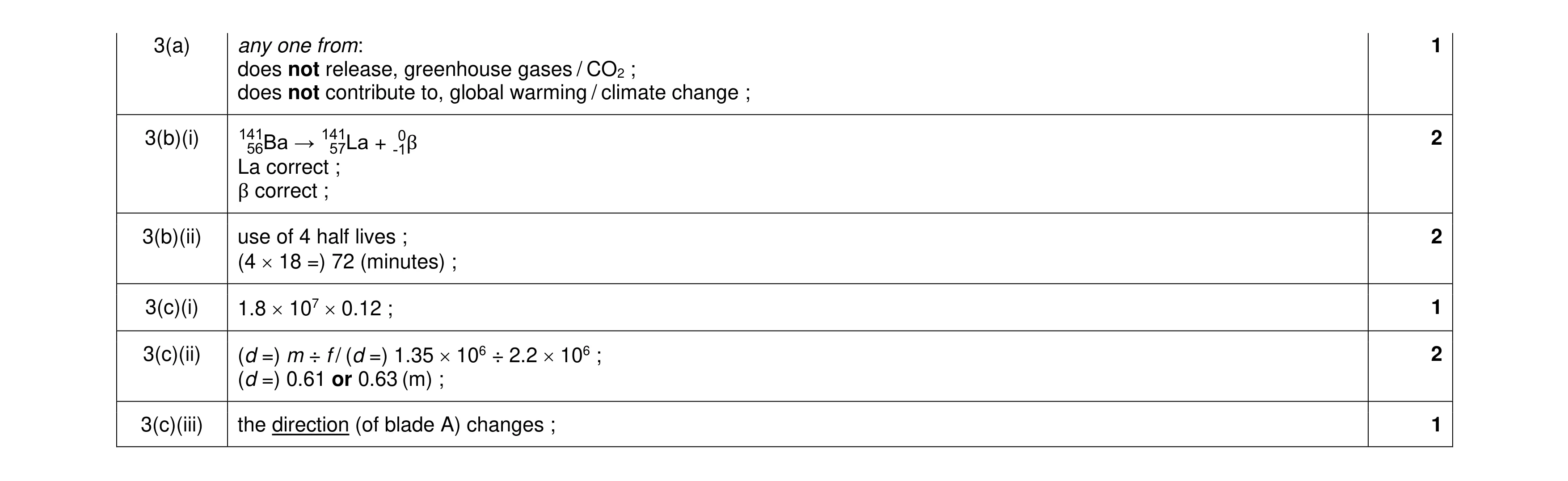 9
9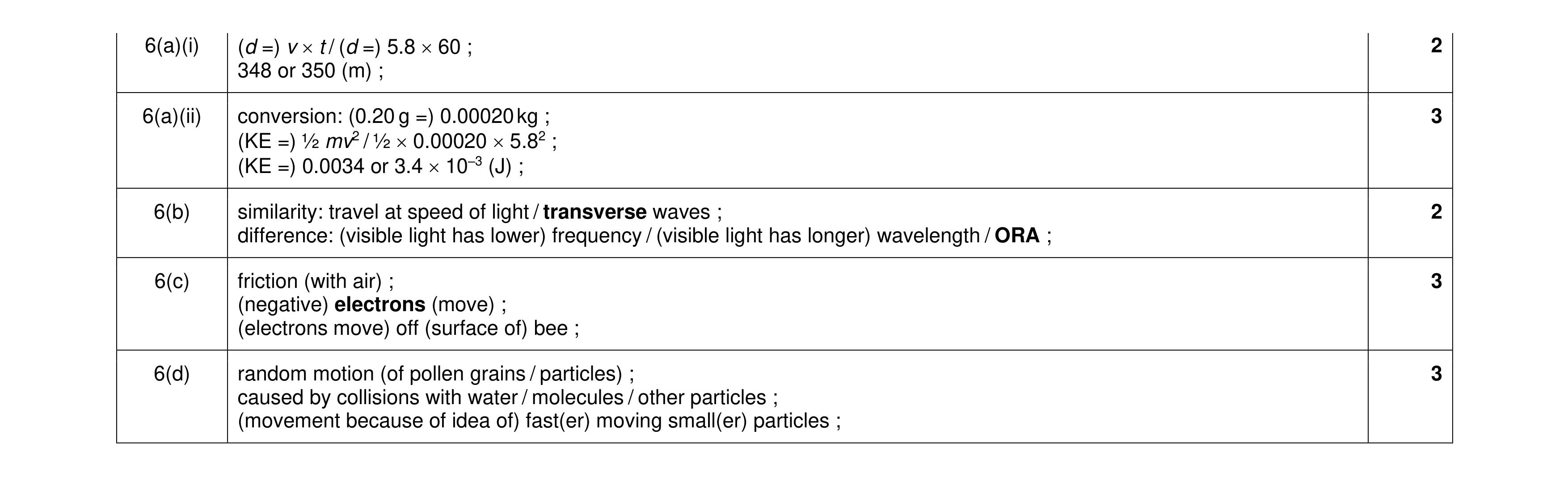 13
13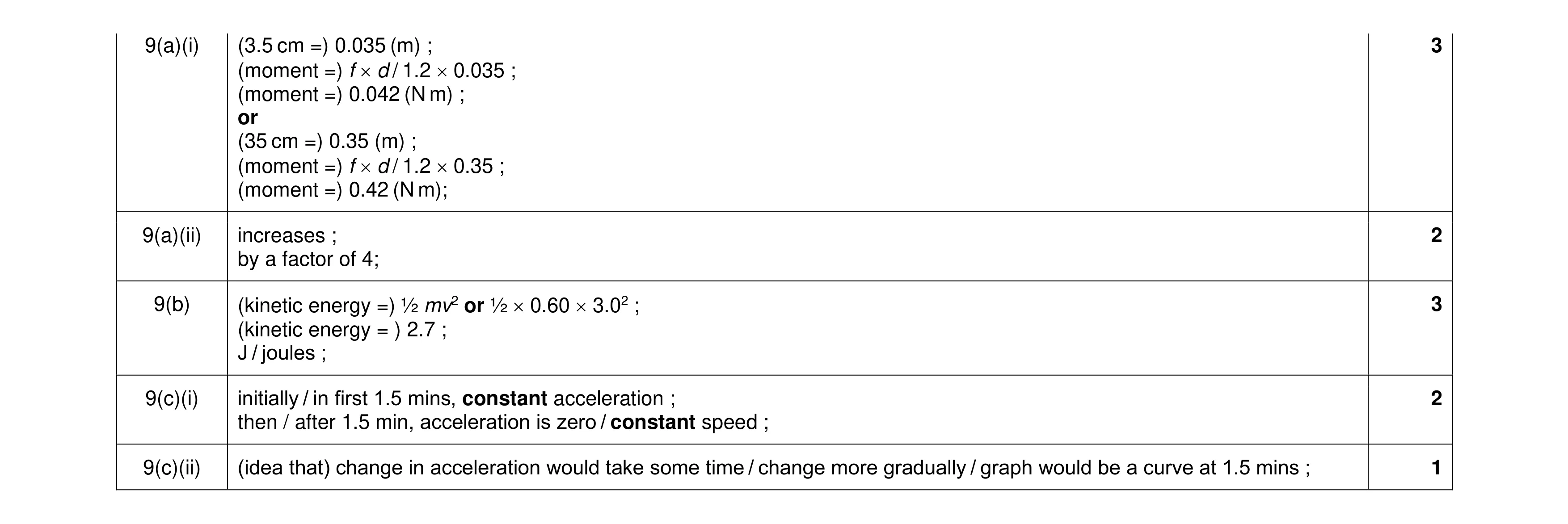 11
11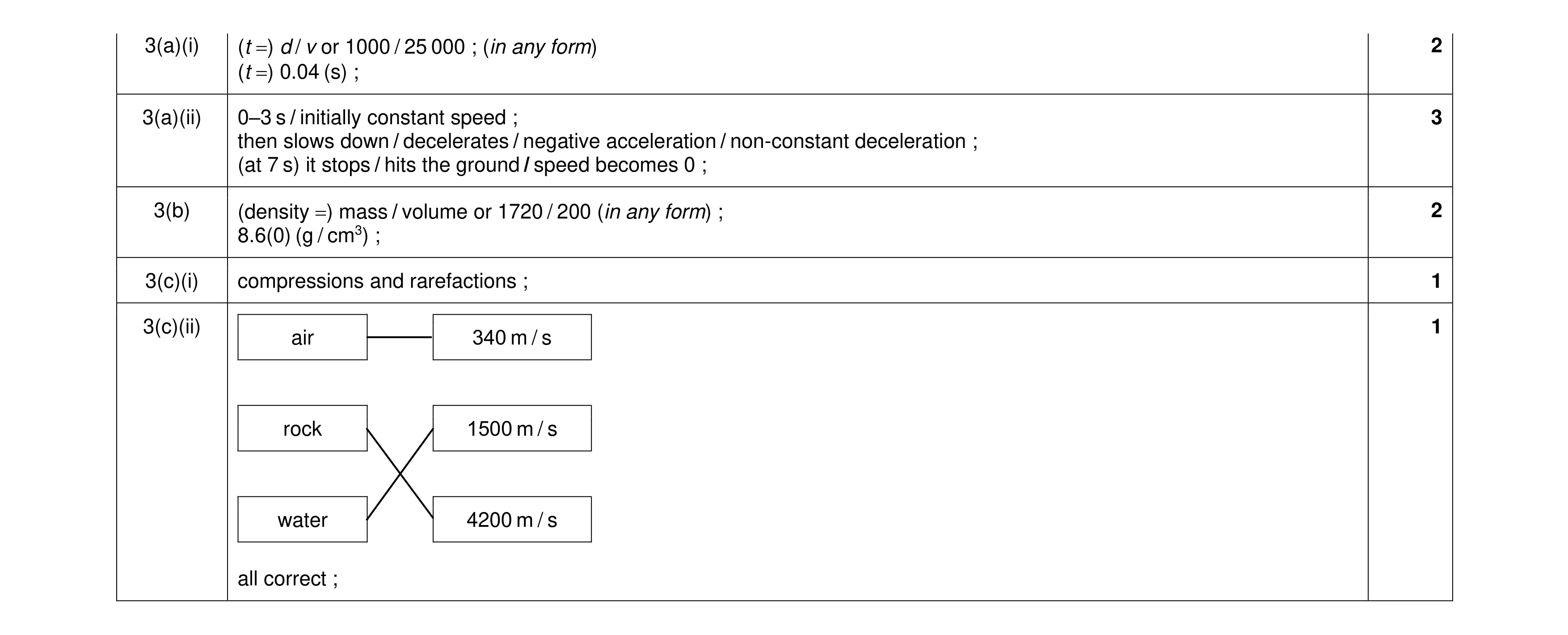 9
9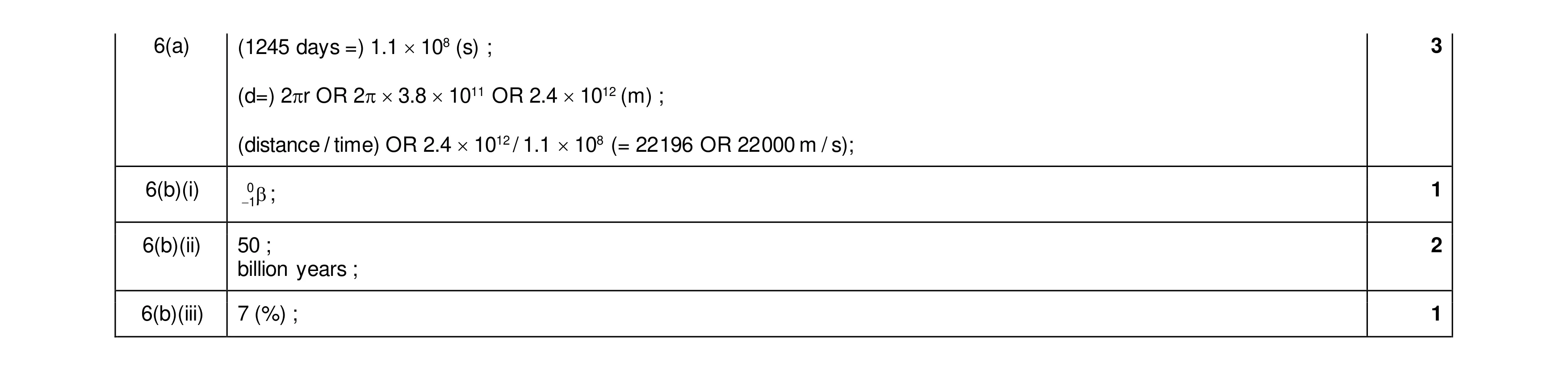 7
7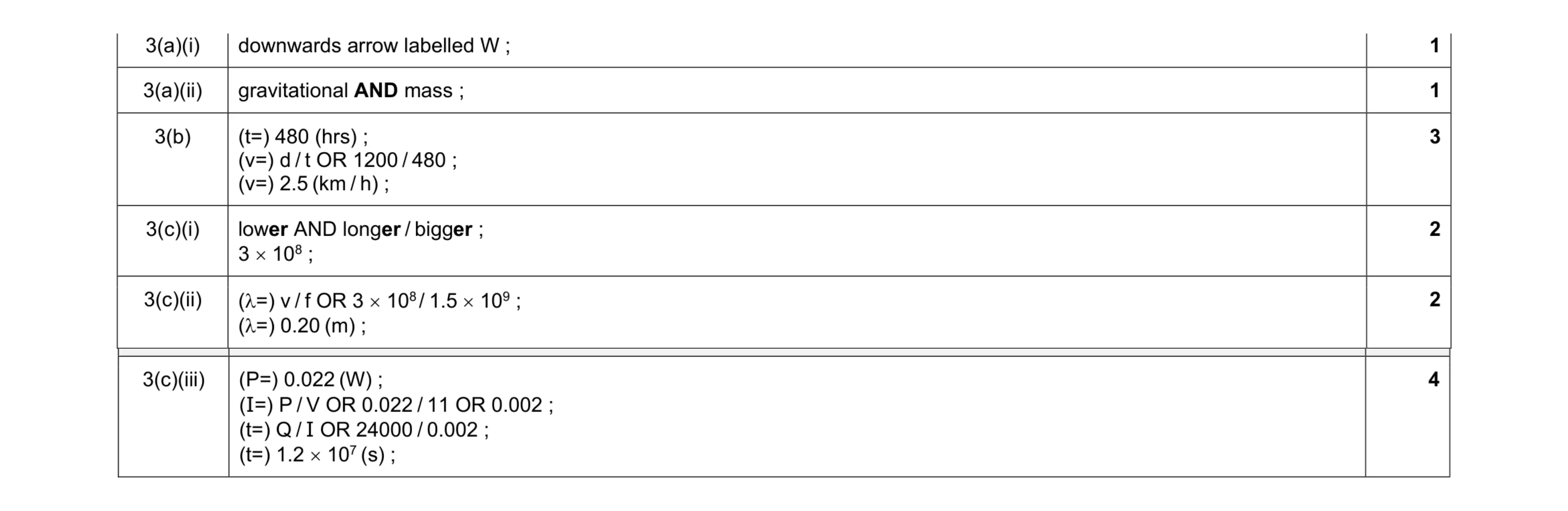 13
13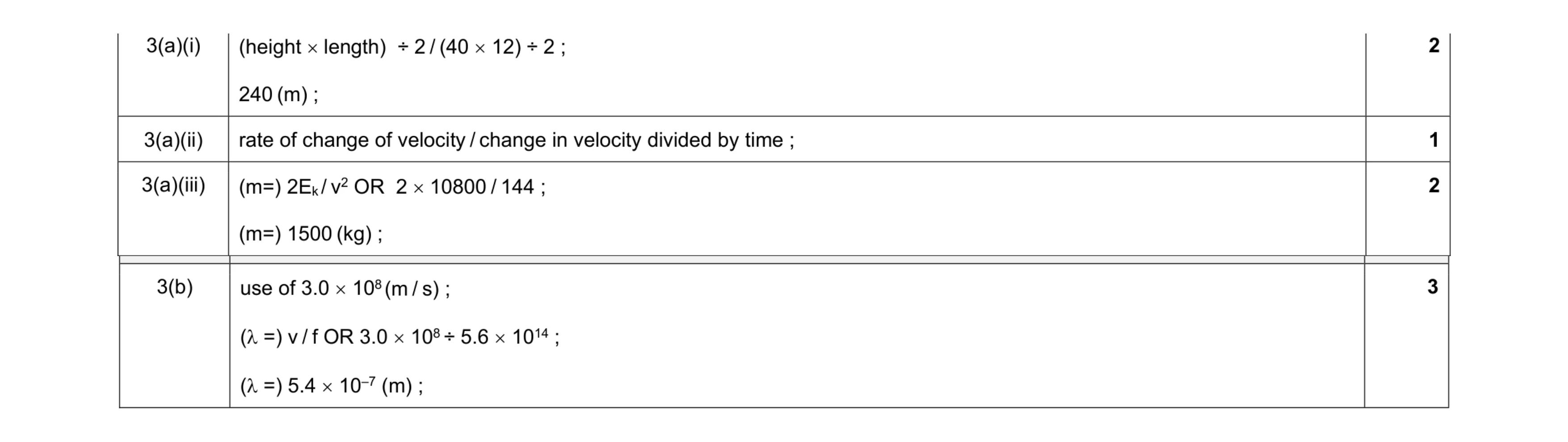 8
8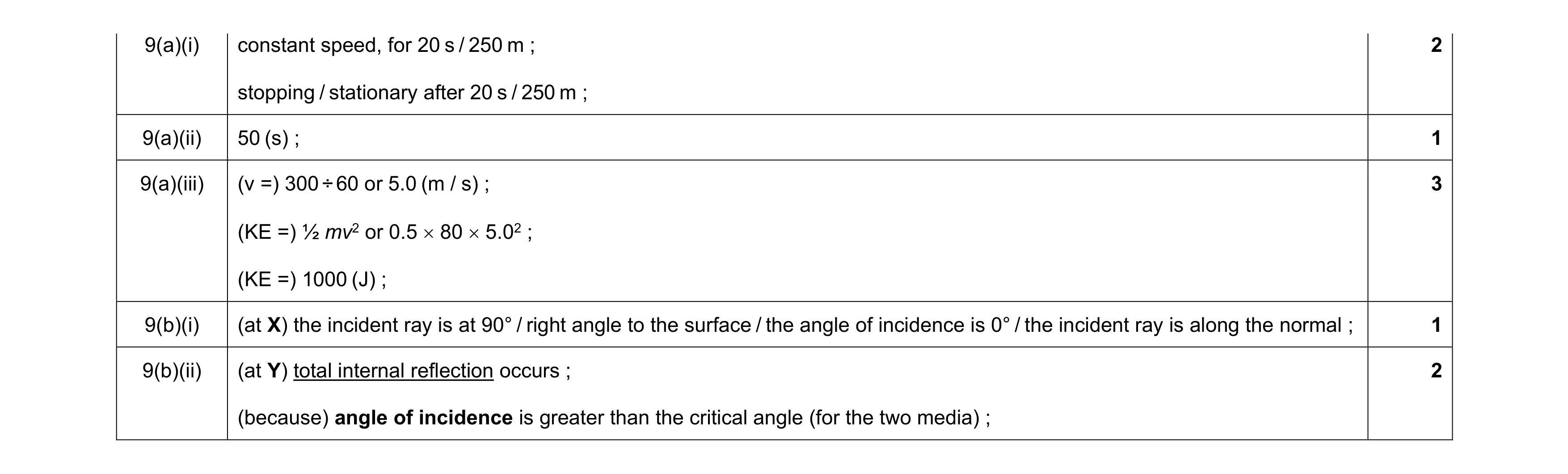 9
9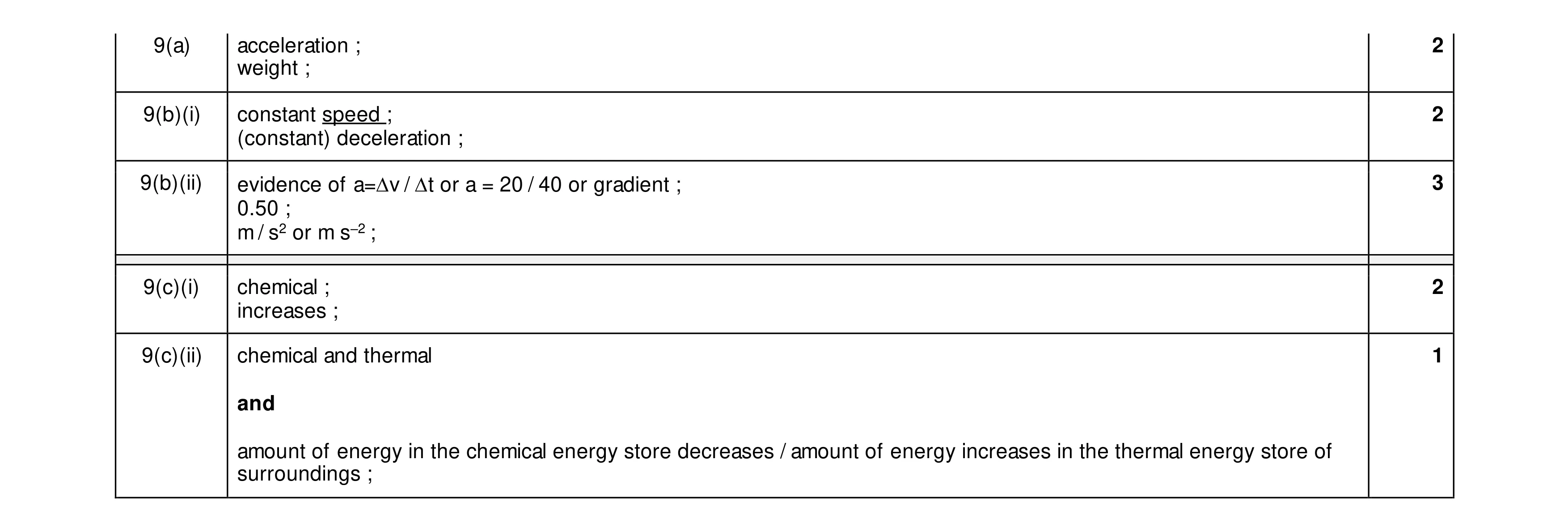 10
10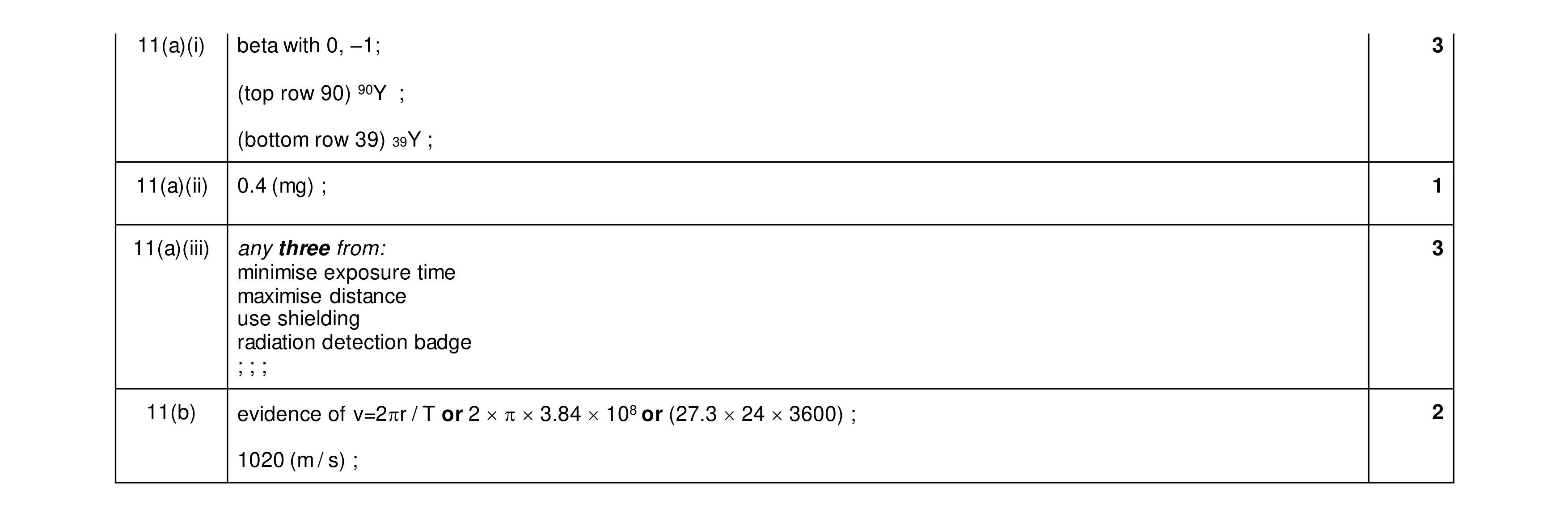 9
9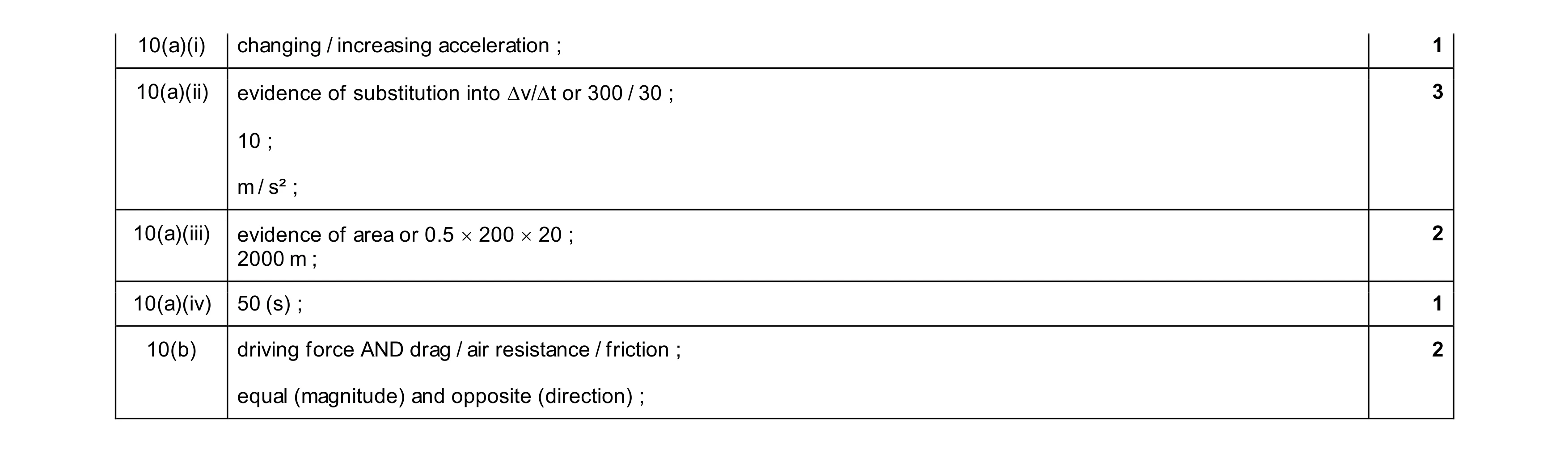 9
9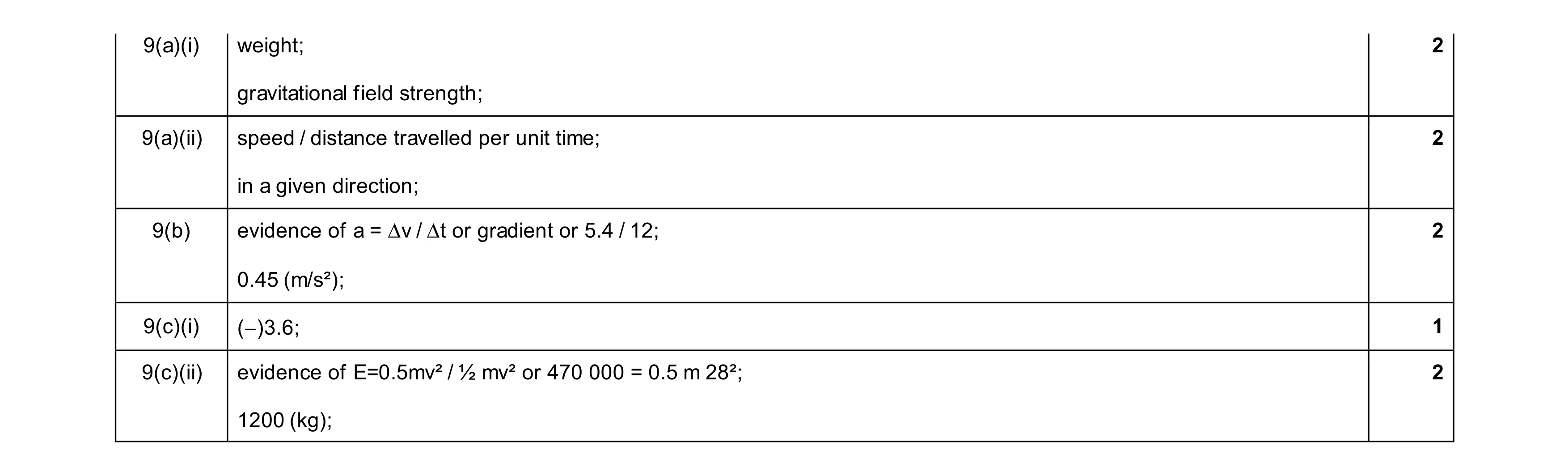 9
9