Cambridge IGCSE Sciences - Co-ordinated (Double) 0654 — 2020 May/June Paper 4 · Variant 2
0654/42/M/J/20 · 13 questions · 120 marks · ≈135 min
The question paper and its mark scheme, free to read here and free to download. This is Cambridge’s own paper, exactly as it was sat.
Question paper32 pages


Mark scheme13 pages
Answers below. Sit the paper first if you are practising.
Questions as text
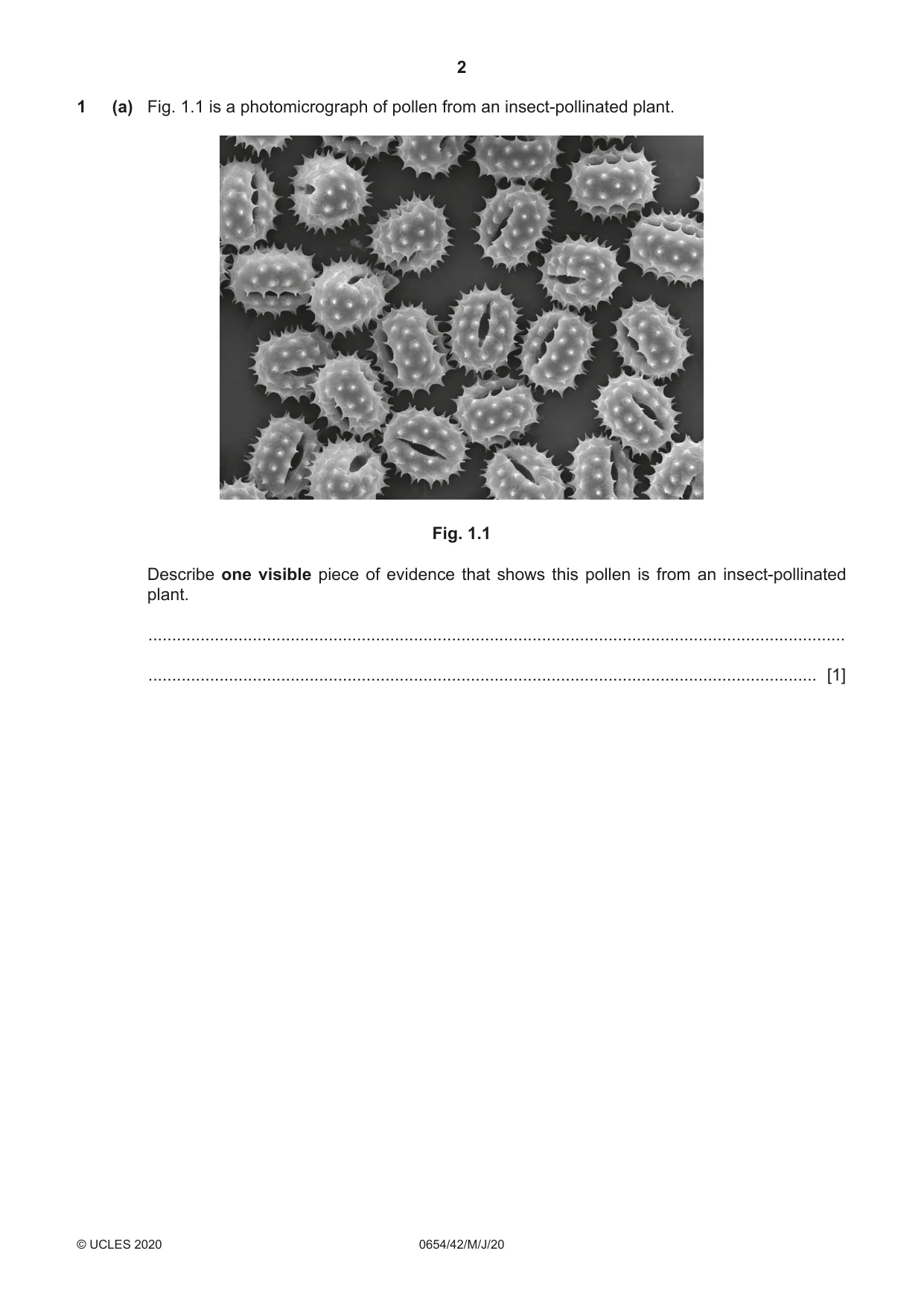
Q1 · A photomicrograph of pollen from an insect-pollinated plant
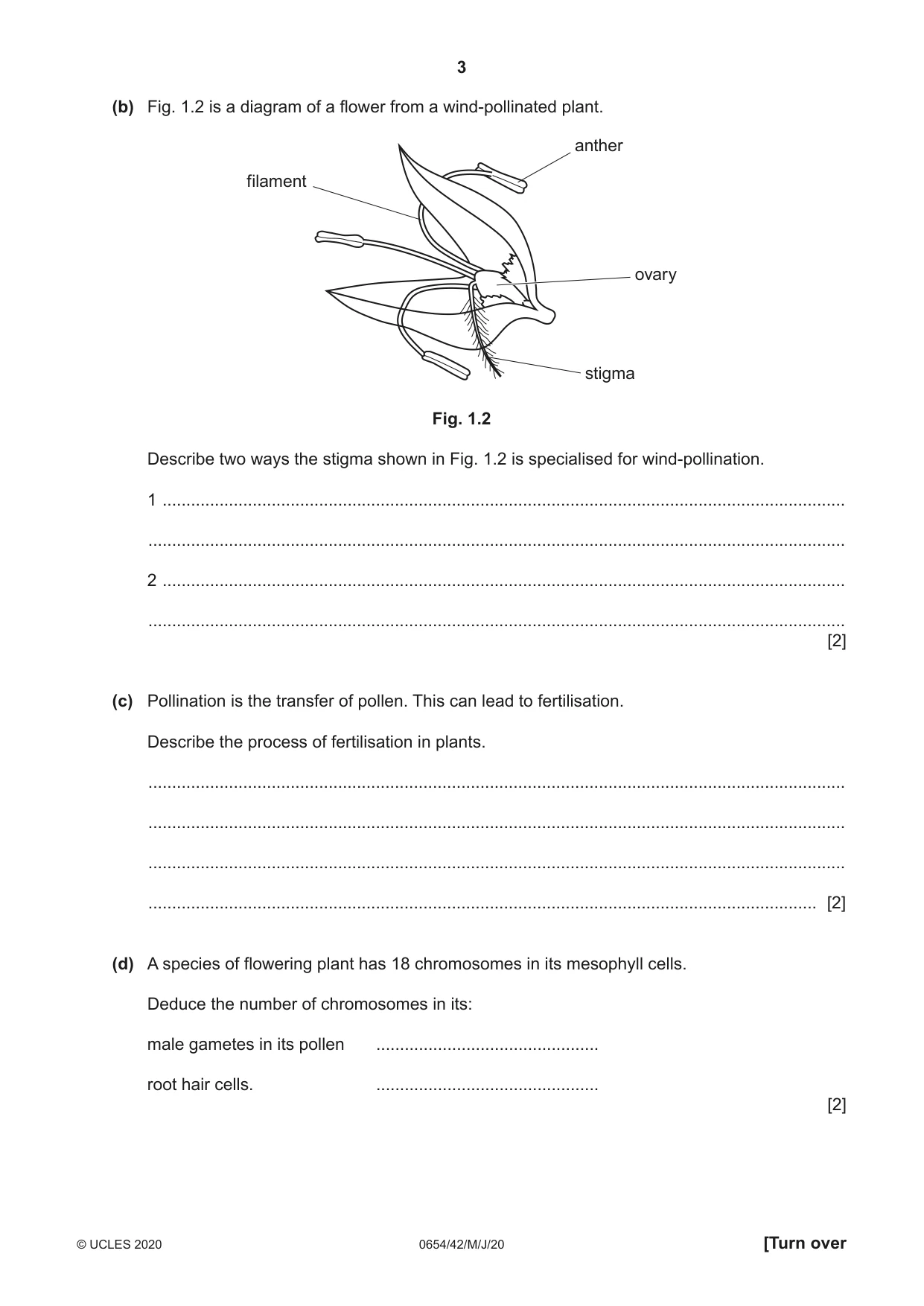
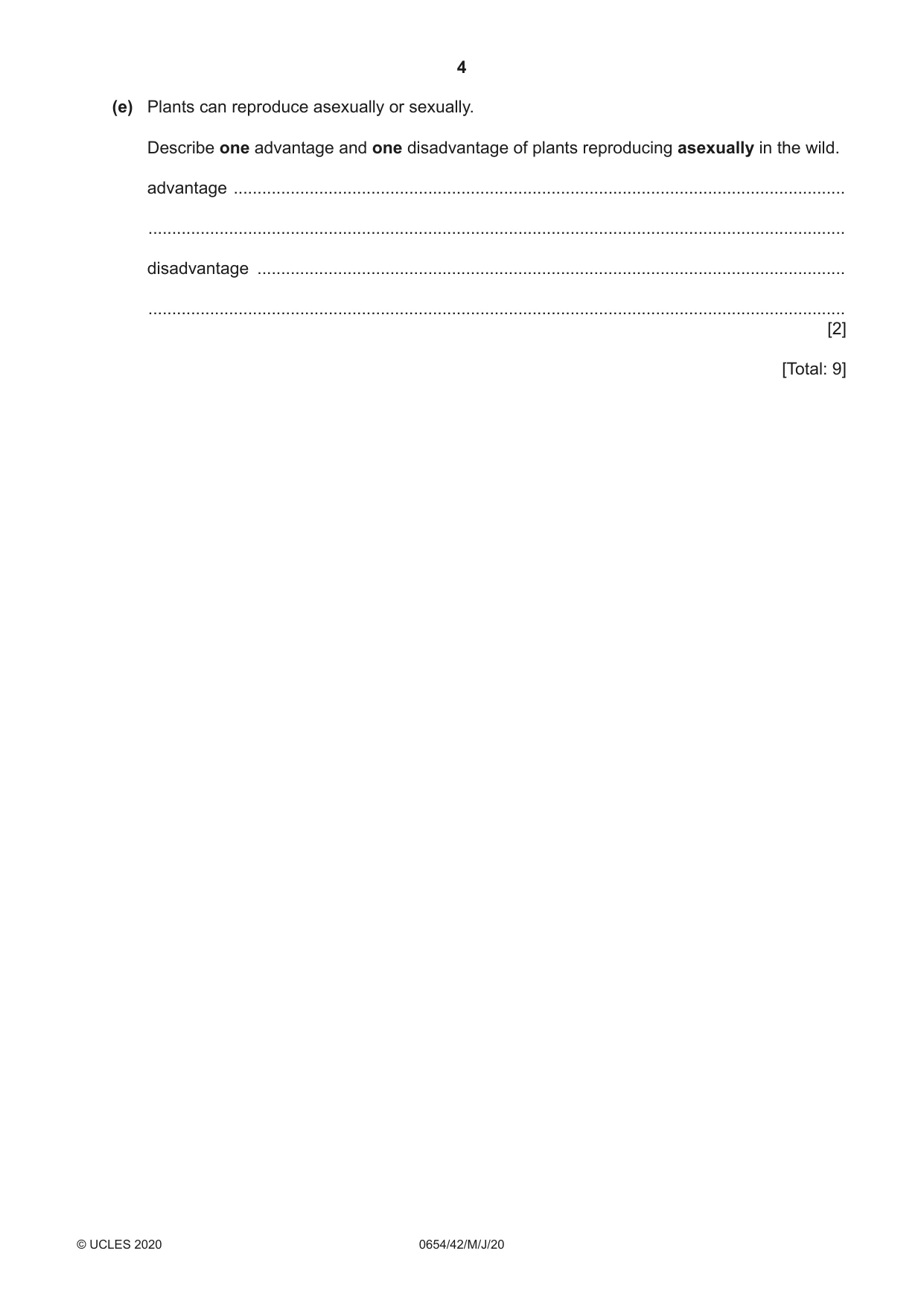
1 (a) Fig. 1.1 is a photomicrograph of pollen from an insect-pollinated plant. Fig. 1.1 Describe one visible piece of evidence that shows this pollen is from an insect-pollinated plant. ................................................................................................................................................... ............................................................................................................................................. [1] (b) Fig. 1.2 is a diagram of a flower from a wind-pollinated plant. anther filament ovary stigma Fig. 1.2 Describe two ways the stigma shown in Fig. 1.2 is specialised for wind-pollination. 1 ................................................................................................................................................ ................................................................................................................................................... 2 ................................................................................................................................................ ................................................................................................................................................... [2] (c) Pollination is the transfer of pollen. This can lead to fertilisation. Describe the process of fertilisation in plants. ................................................................................................................................................... ................................................................................................................................................... ................................................................................................................................................... ............................................................................................................................................. [2] (d) A species of flowering plant has 18 chromosomes in its mesophyll cells. Deduce the number of chromosomes in its: male gametes in its pollen ............................................... root hair cells. ............................................... [2] (e) Plants can reproduce asexually or sexually. Describe one advantage and one disadvantage of plants reproducing asexually in the wild. advantage ................................................................................................................................. ................................................................................................................................................... disadvantage ............................................................................................................................ ................................................................................................................................................... [2] [Total: 9]
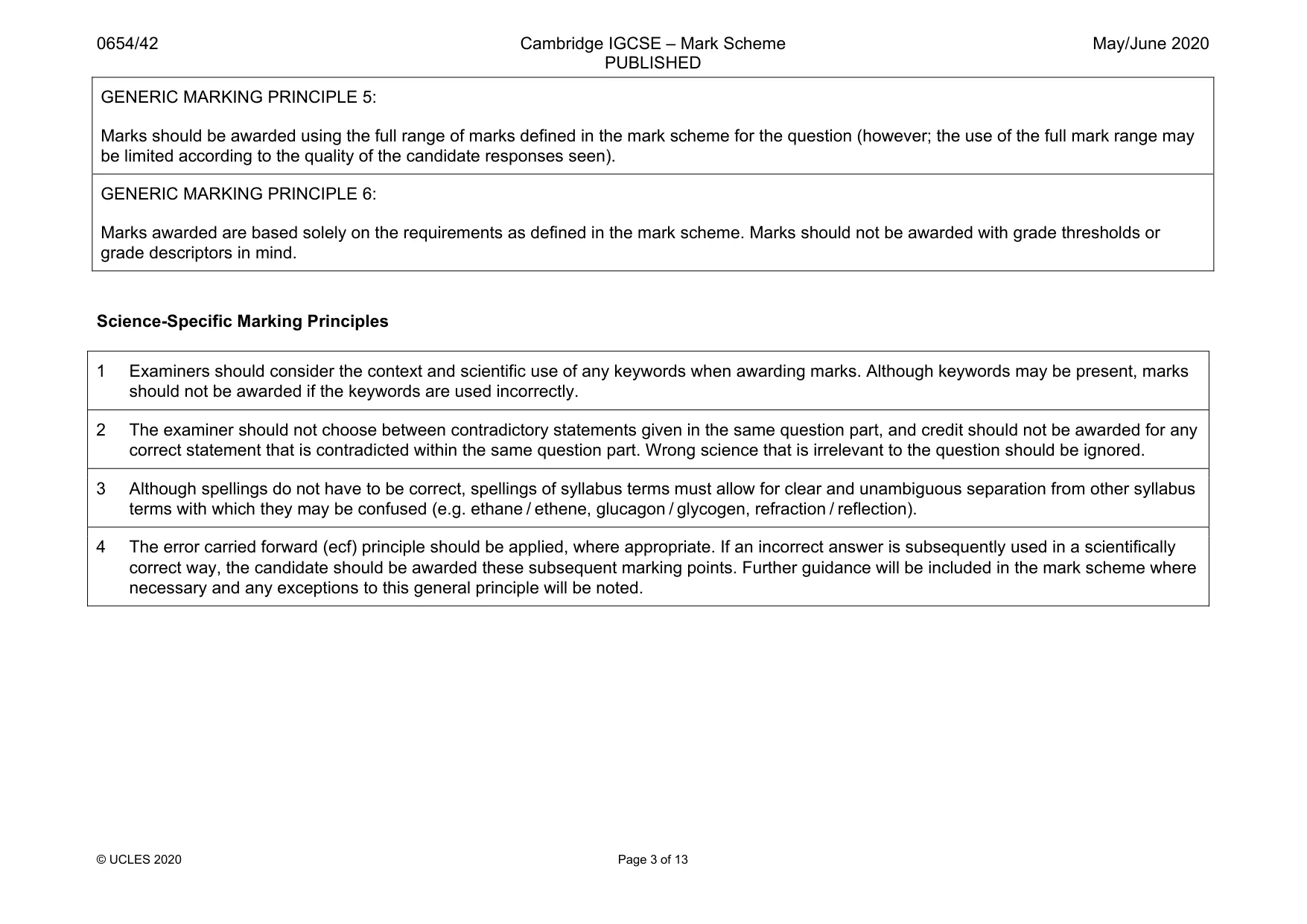
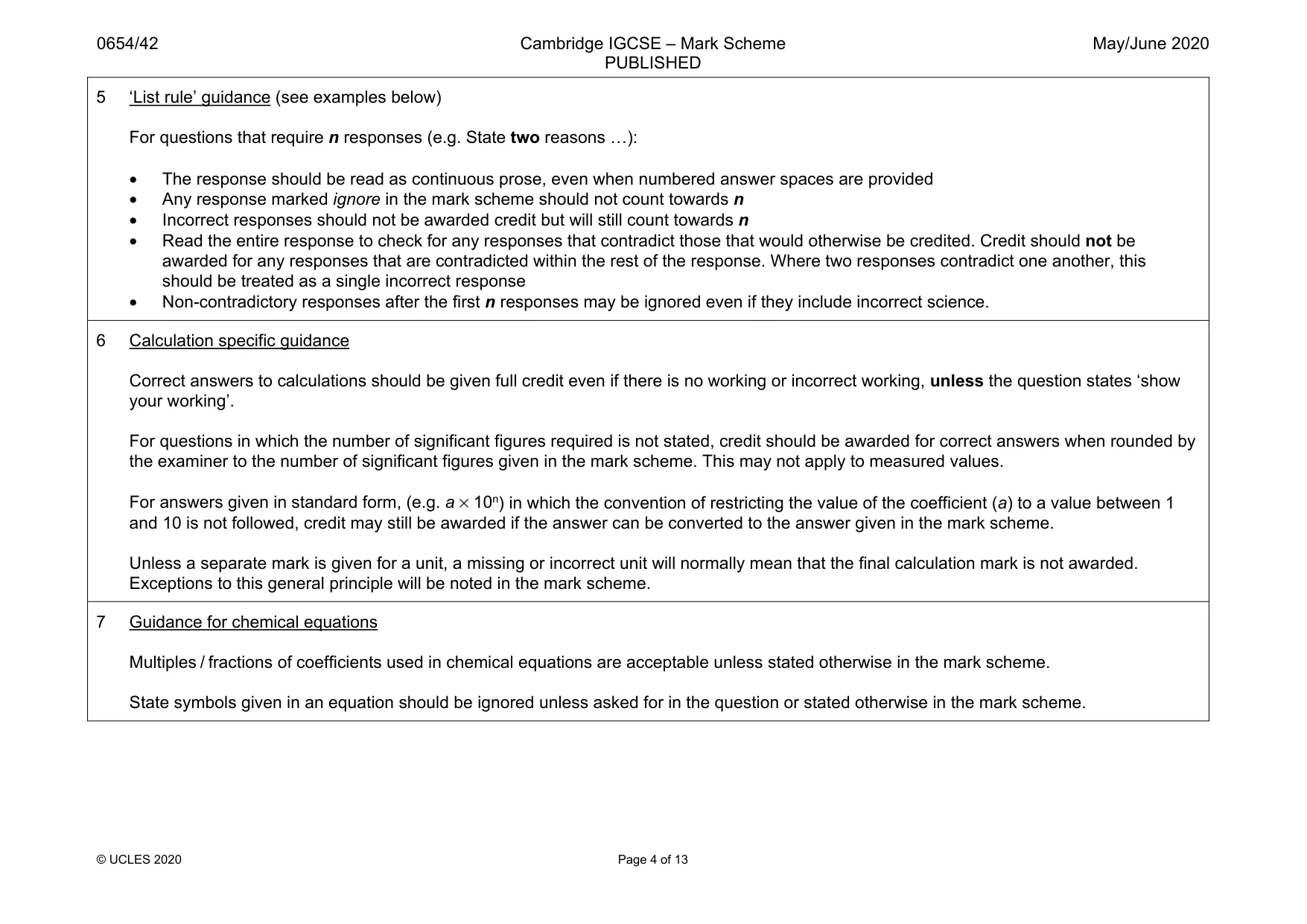
Mark scheme: 1(a) spiky (surface) ; 1 1(b) stigma feathery ; stigma hangs outside flower ; 2 1(c) fusion of nuclei ; ref to pollen and ovule ; 2 1(d) 9 ; 18 ; 2 1(e) advantage fast / colonise areas quickly / only requires one parent ; disadvantage no variety / more prone to extinction / more susceptible to disease ; 2
Q2 · The three states of matter
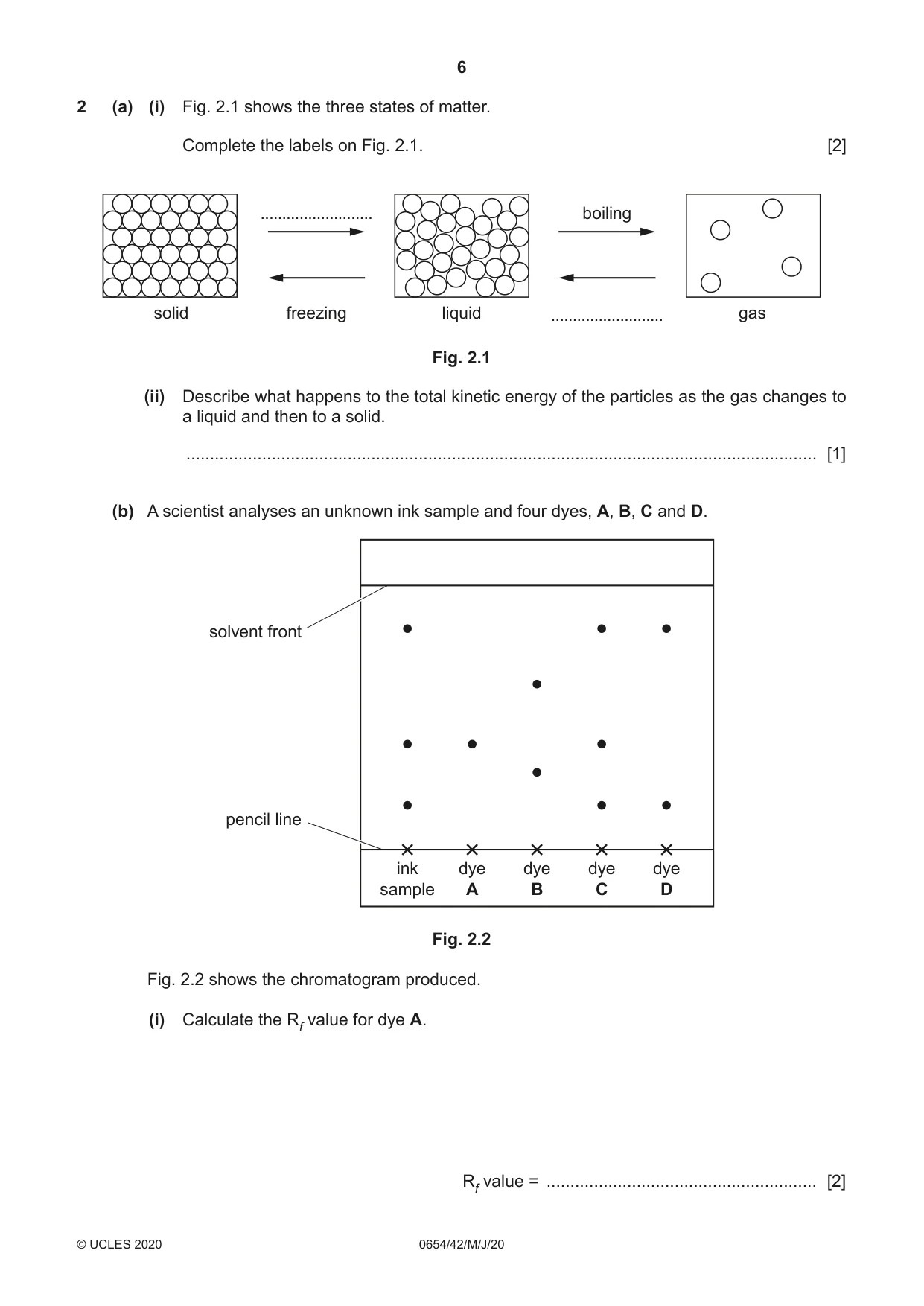
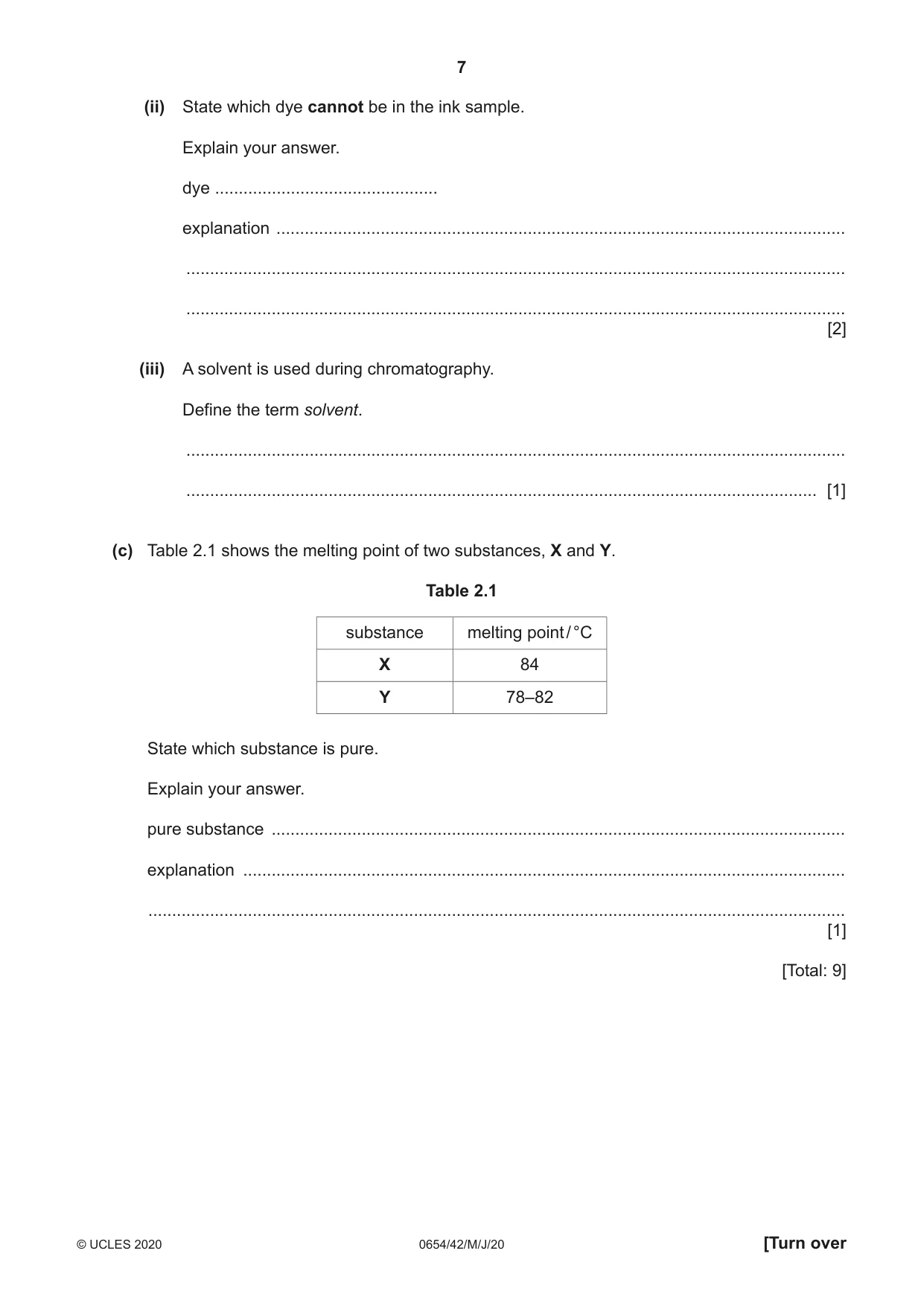
2 (a) (i) Fig. 2.1 shows the three states of matter. Complete the labels on Fig. 2.1. [2] .......................... boiling solid freezing liquid .......................... gas Fig. 2.1 (ii) Describe what happens to the total kinetic energy of the particles as the gas changes to a liquid and then to a solid. ..................................................................................................................................... [1] (b) A scientist analyses an unknown ink sample and four dyes, A, B, C and D. solvent front pencil line ink dye dye dye dye sample A B C D Fig. 2.2 Fig. 2.2 shows the chromatogram produced. (i) Calculate the Rf value for dye A. Rf value = ......................................................... [2] (ii) State which dye cannot be in the ink sample. Explain your answer. dye ............................................... explanation ........................................................................................................................ ........................................................................................................................................... ........................................................................................................................................... [2] (iii) A solvent is used during chromatography. Define the term solvent. ........................................................................................................................................... ..................................................................................................................................... [1] (c) Table 2.1 shows the melting point of two substances, X and Y. Table 2.1 substance melting point / °C X 84 Y 78–82 State which substance is pure. Explain your answer. pure substance ......................................................................................................................... explanation ............................................................................................................................... ................................................................................................................................................... [1] [Total: 9]
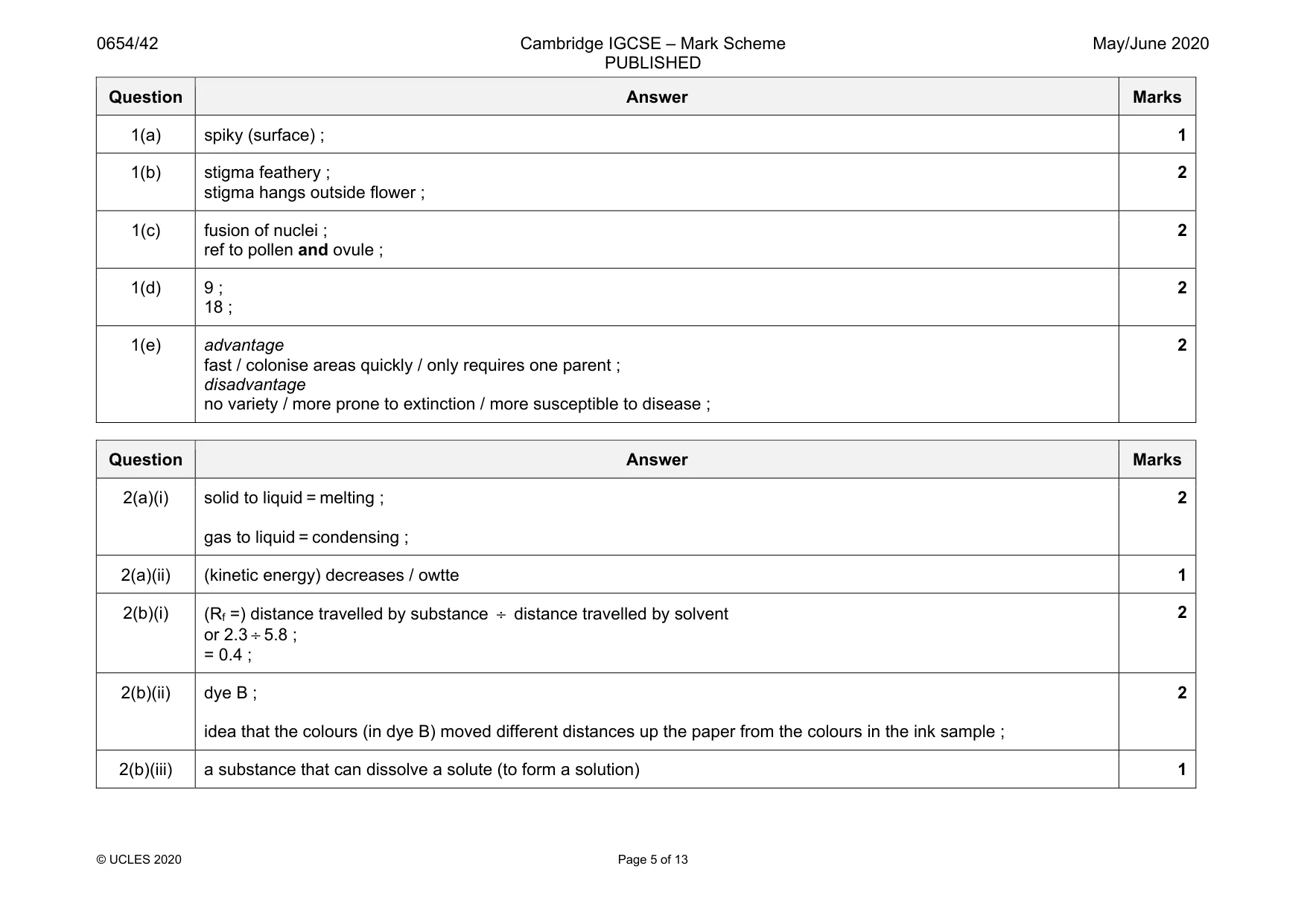
Mark scheme: 2(a)(i) solid to liquid = melting ; gas to liquid = condensing ; 2 2(a)(ii) (kinetic energy) decreases / owtte 1 2(b)(i) (Rf =) distance travelled by substance ÷ distance travelled by solvent or 2.3 ÷ 5.8 ; = 0.4 ; 2 2(b)(ii) dye B ; idea that the colours (in dye B) moved different distances up the paper from the colours in the ink sample ; 2 2(b)(iii) a substance that can dissolve a solute (to form a solution) 1 Question Answer Marks 2(c) (pure substance is X) no mark idea that pure substances have a specific melting point / ORA / idea that pure substances do not melt over a range (of temperatures) / ORA ; 1
Q3 · A car has two identical headlamps L1 and L2
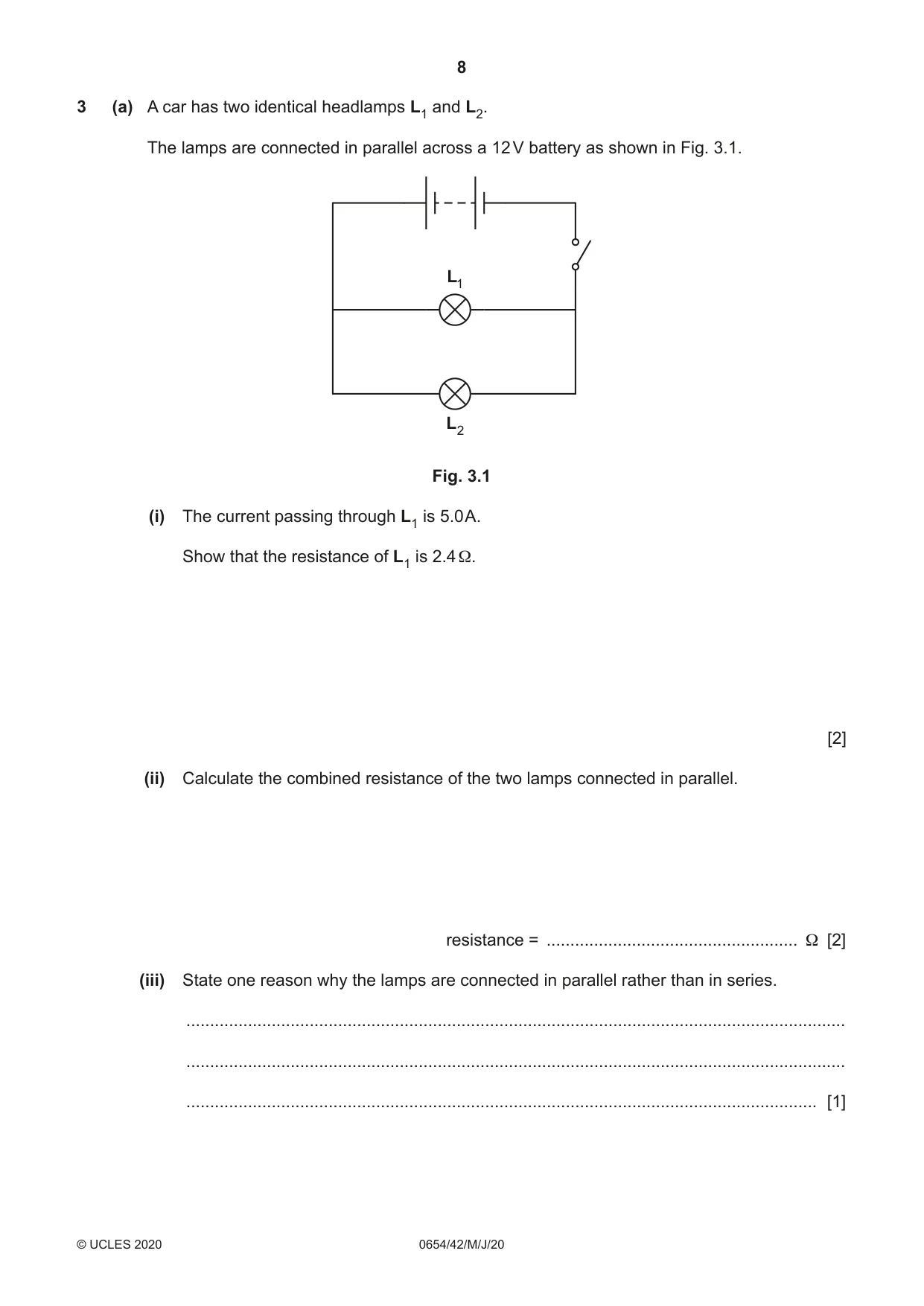
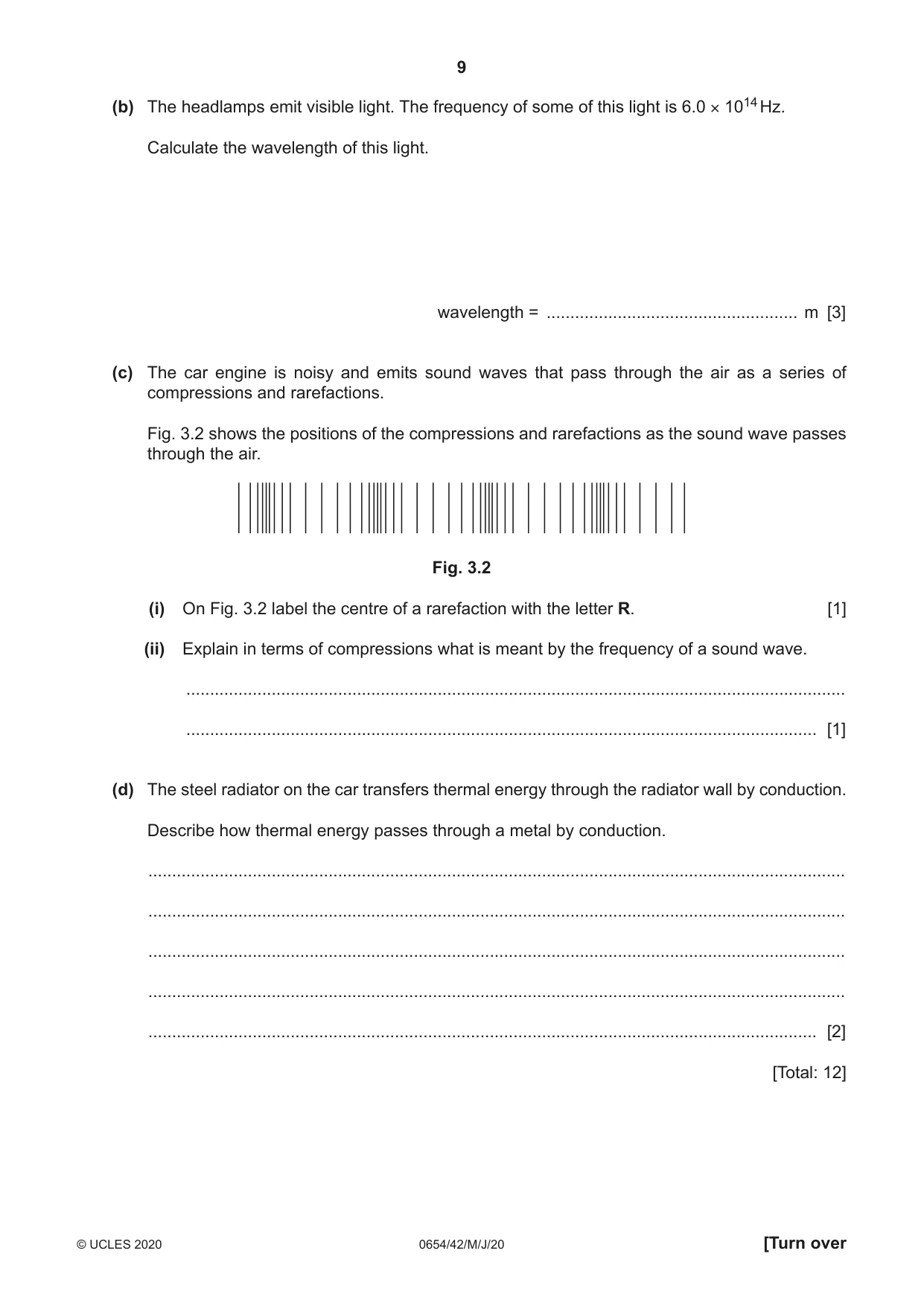
3 (a) A car has two identical headlamps L1 and L2. The lamps are connected in parallel across a 12 V battery as shown in Fig. 3.1. L1 L2 Fig. 3.1 (i) The current passing through L1 is 5.0 A. Show that the resistance of L1 is 2.4 Ω. [2] (ii) Calculate the combined resistance of the two lamps connected in parallel. resistance = ..................................................... Ω [2] (iii) State one reason why the lamps are connected in parallel rather than in series. ........................................................................................................................................... ........................................................................................................................................... ..................................................................................................................................... [1] (b) The headlamps emit visible light. The frequency of some of this light is 6.0 × 10¹⁴ Hz. Calculate the wavelength of this light. wavelength = ..................................................... m [3] (c) The car engine is noisy and emits sound waves that pass through the air as a series of compressions and rarefactions. Fig. 3.2 shows the positions of the compressions and rarefactions as the sound wave passes through the air. Fig. 3.2 (i) On Fig. 3.2 label the centre of a rarefaction with the letter R. [1] (ii) Explain in terms of compressions what is meant by the frequency of a sound wave. ........................................................................................................................................... ..................................................................................................................................... [1] (d) The steel radiator on the car transfers thermal energy through the radiator wall by conduction. Describe how thermal energy passes through a metal by conduction. ................................................................................................................................................... ................................................................................................................................................... ................................................................................................................................................... ................................................................................................................................................... ............................................................................................................................................. [2] [Total: 12]
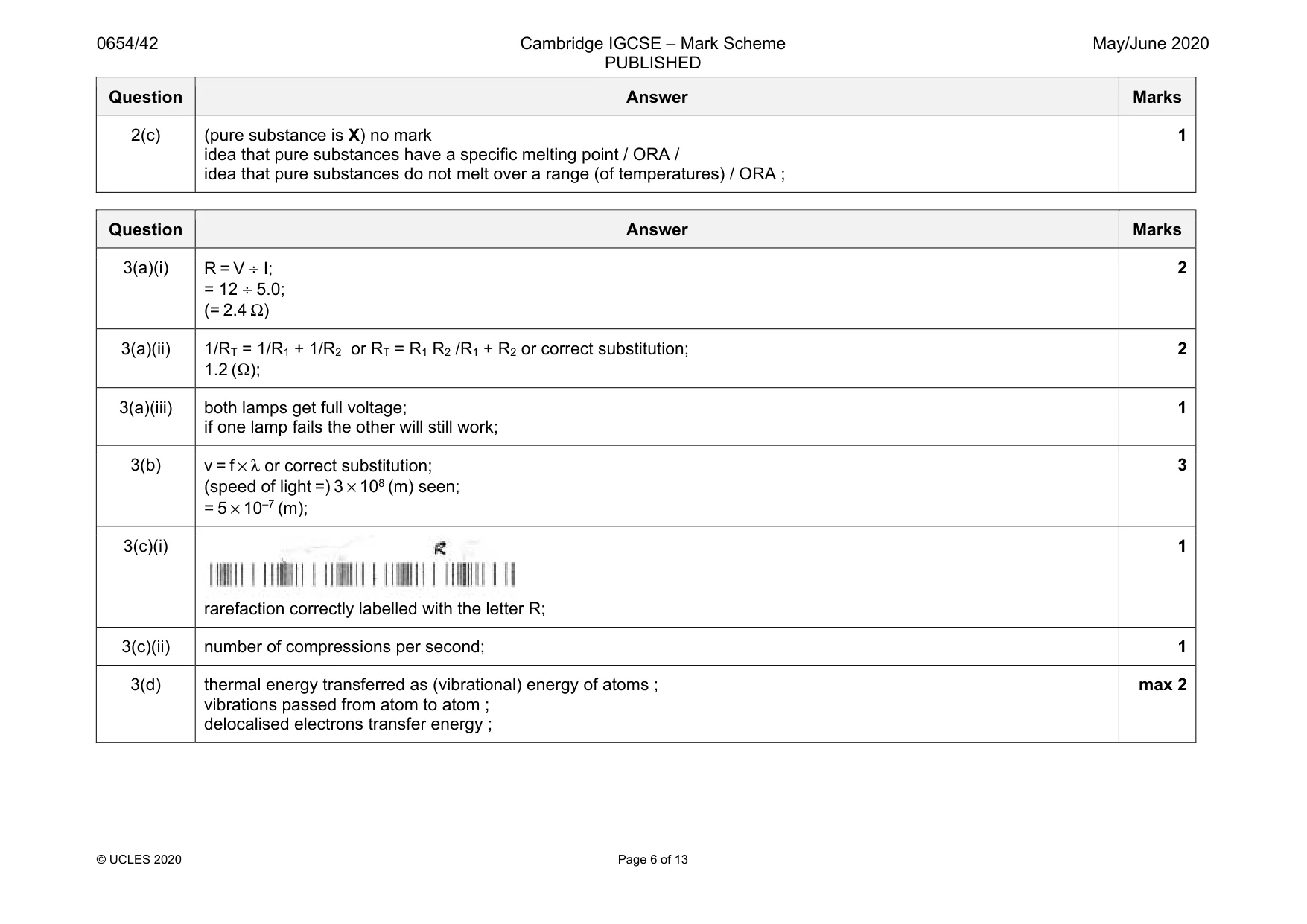
Mark scheme: 3(a)(i) R = V ÷ I; = 12 ÷ 5.0; (= 2.4 Ω) 3(a)(ii) 1/RT = 1/R1 + 1/R2 or RT = R1 R2 /R1 + R2 or correct substitution; 1.2 (Ω); 2 3(a)(iii) both lamps get full voltage; if one lamp fails the other will still work; 1 3(b) v = f × λ or correct substitution; (speed of light =) 3 × 10⁸ (m) seen; = 5 × 10⁻⁷ (m); 3 3(c)(i) rarefaction correctly labelled with the letter R; 1 3(c)(ii) number of compressions per second; 1 3(d) thermal energy transferred as (vibrational) energy of atoms ; vibrations passed from atom to atom ; delocalised electrons transfer energy ; max 2
Q4 · A student measures his breathing rate at rest and during exercise
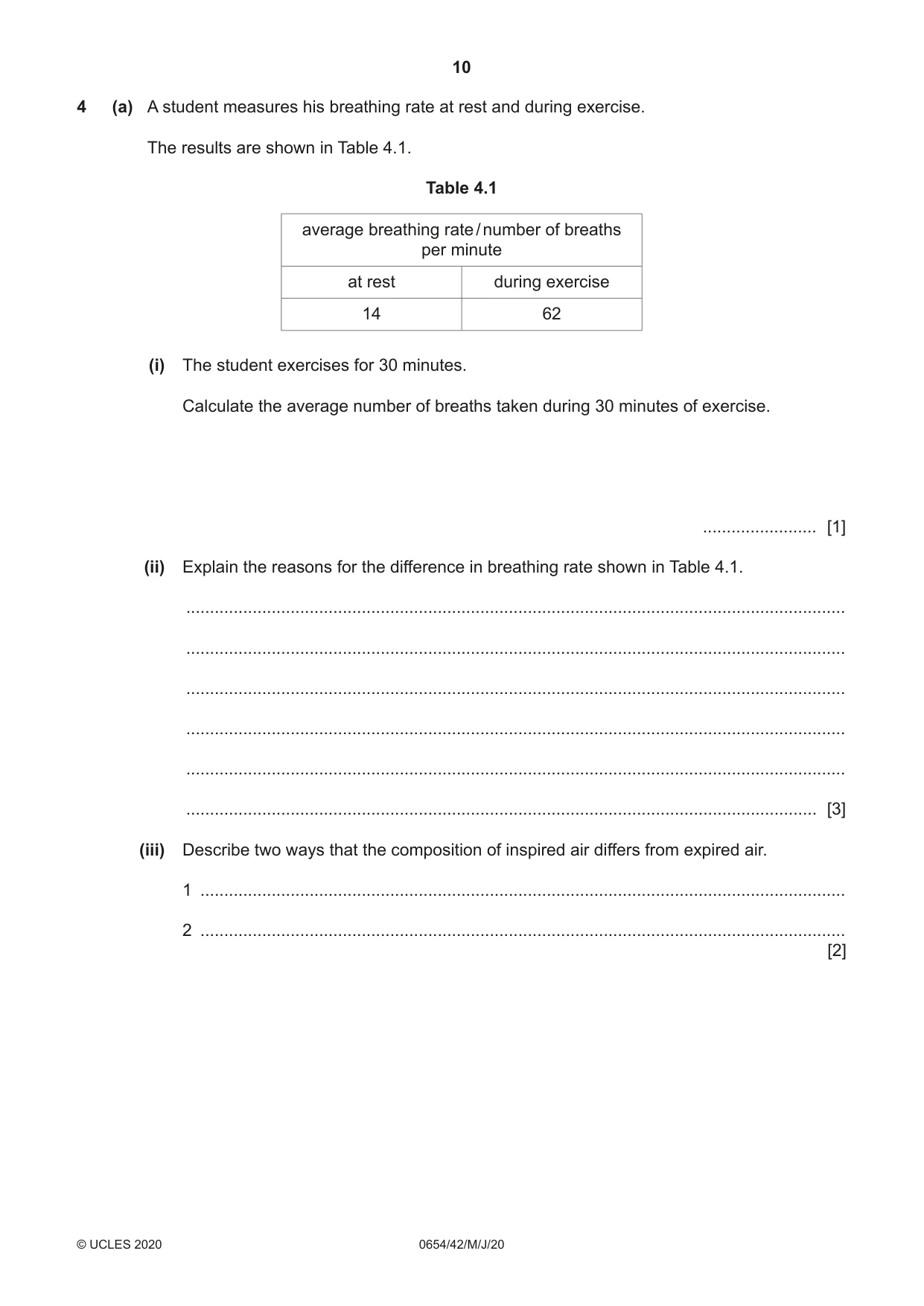
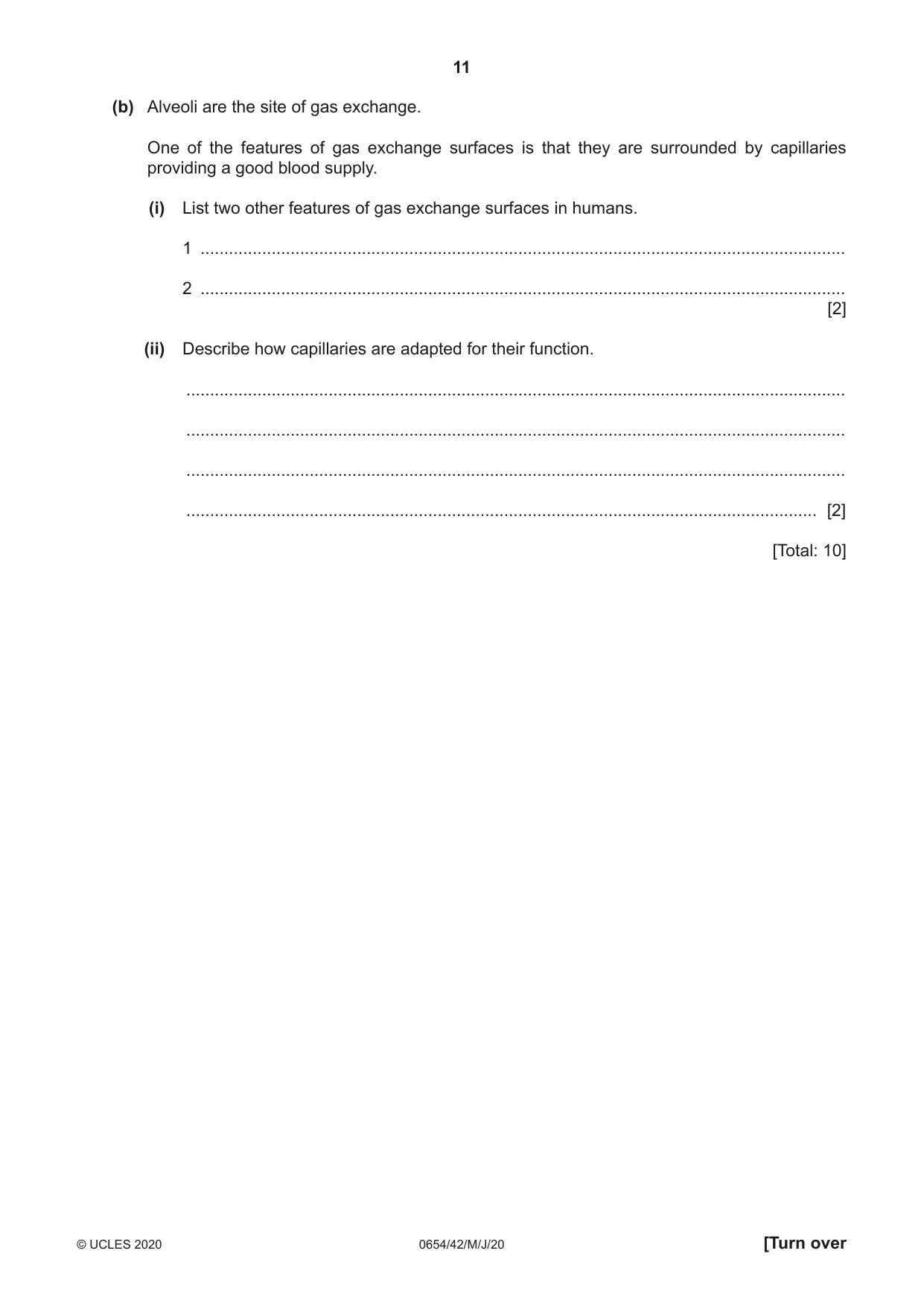
4 (a) A student measures his breathing rate at rest and during exercise. The results are shown in Table 4.1. Table 4.1 average breathing rate / number of breaths per minute at rest during exercise 14 62 (i) The student exercises for 30 minutes. Calculate the average number of breaths taken during 30 minutes of exercise. ........................ [1] (ii) Explain the reasons for the difference in breathing rate shown in Table 4.1. ........................................................................................................................................... ........................................................................................................................................... ........................................................................................................................................... ........................................................................................................................................... ........................................................................................................................................... ..................................................................................................................................... [3] (iii) Describe two ways that the composition of inspired air differs from expired air. 1 ........................................................................................................................................ 2 ........................................................................................................................................ [2] (b) Alveoli are the site of gas exchange. One of the features of gas exchange surfaces is that they are surrounded by capillaries providing a good blood supply. (i) List two other features of gas exchange surfaces in humans. 1 ........................................................................................................................................ 2 ........................................................................................................................................ [2] (ii) Describe how capillaries are adapted for their function. ........................................................................................................................................... ........................................................................................................................................... ........................................................................................................................................... ..................................................................................................................................... [2] [Total: 10]
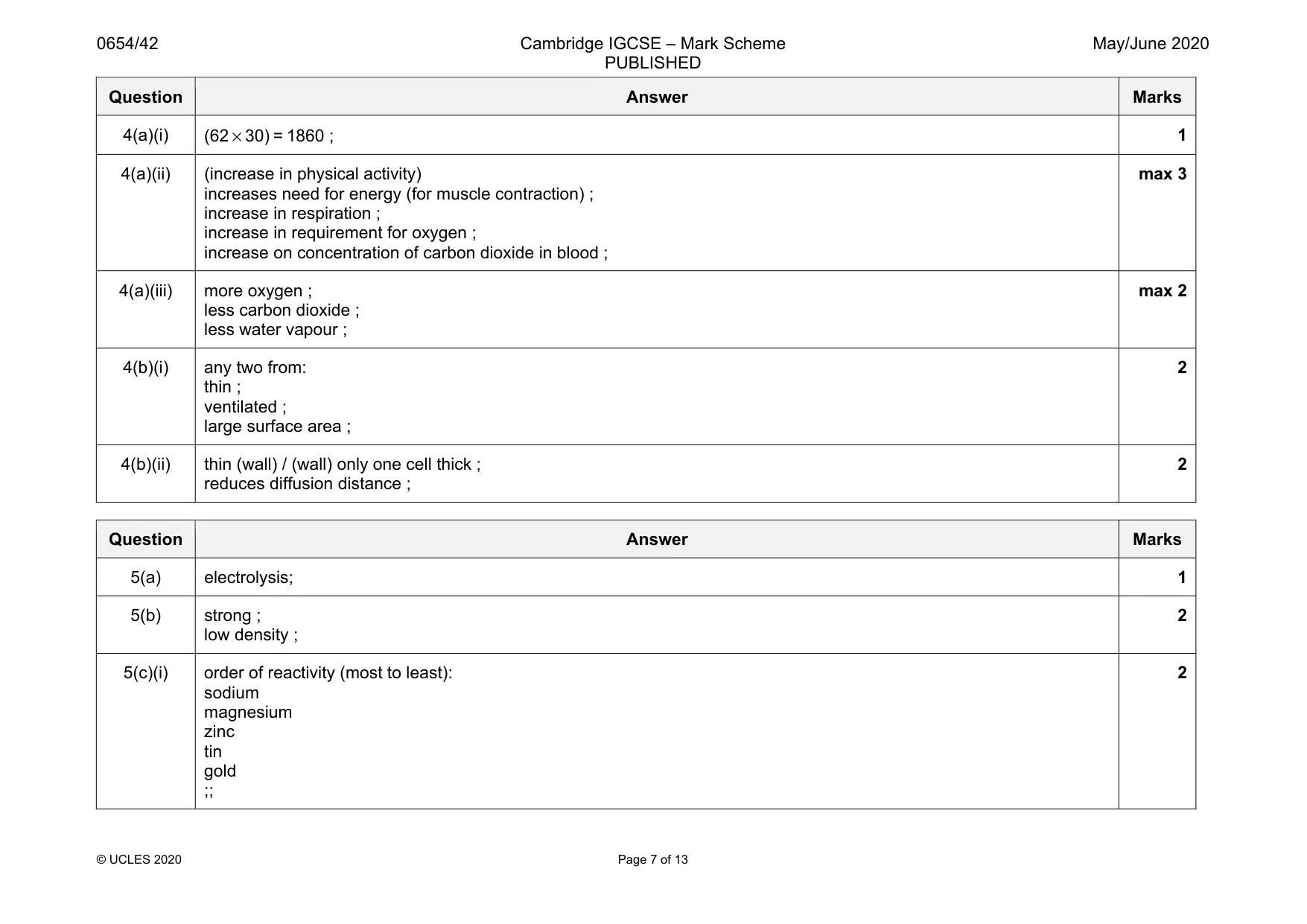
Mark scheme: 4(a)(i) (62 × 30) = 1860 ; 1 4(a)(ii) (increase in physical activity) increases need for energy (for muscle contraction) ; increase in respiration ; increase in requirement for oxygen ; increase on concentration of carbon dioxide in blood ; max 3 4(a)(iii) more oxygen ; less carbon dioxide ; less water vapour ; max 2 4(b)(i) any two from: thin ; ventilated ; large surface area ; 2 4(b)(ii) thin (wall) / (wall) only one cell thick ; reduces diffusion distance ; 2
Q5 · Aluminium is used to make aircraft parts
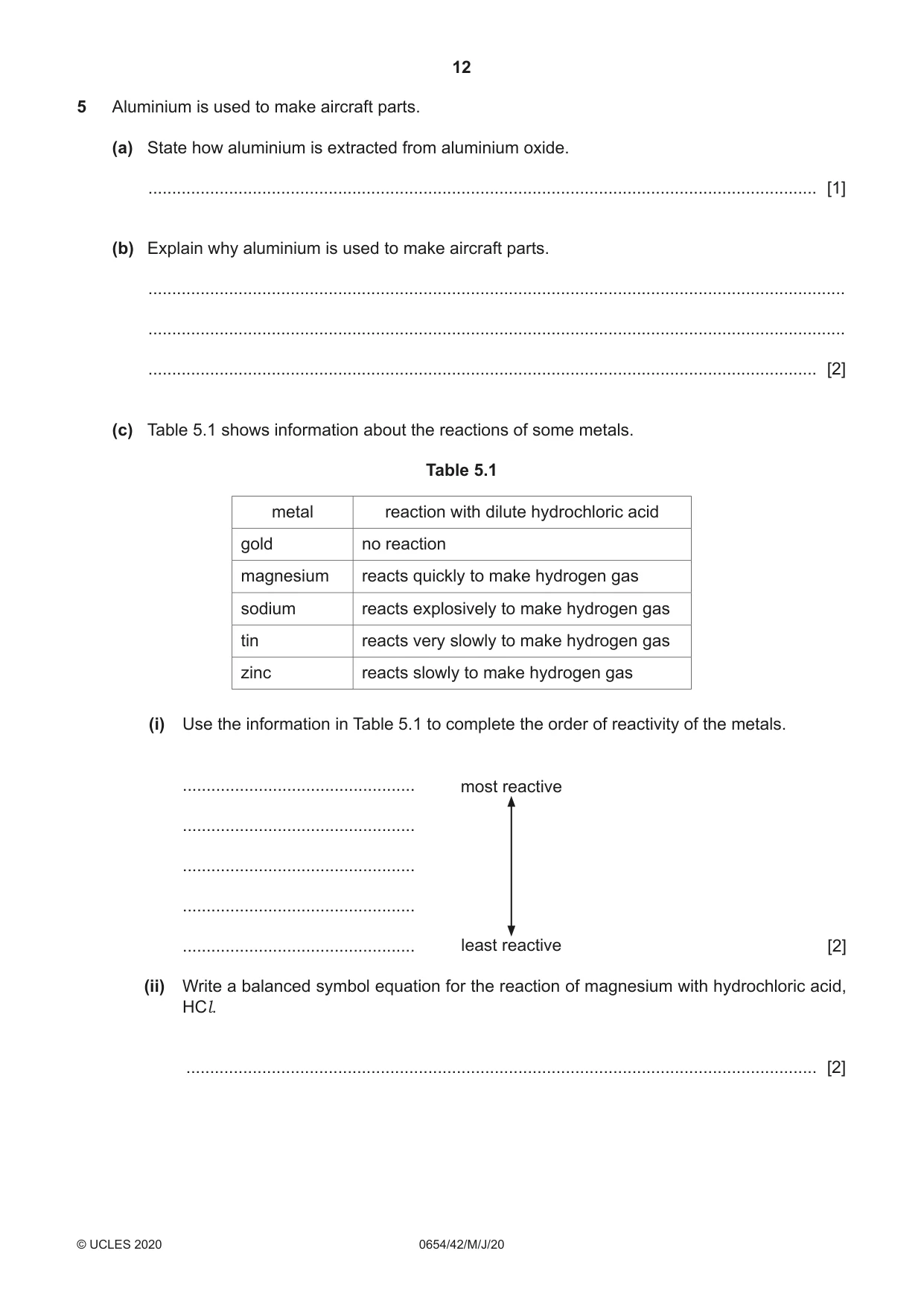
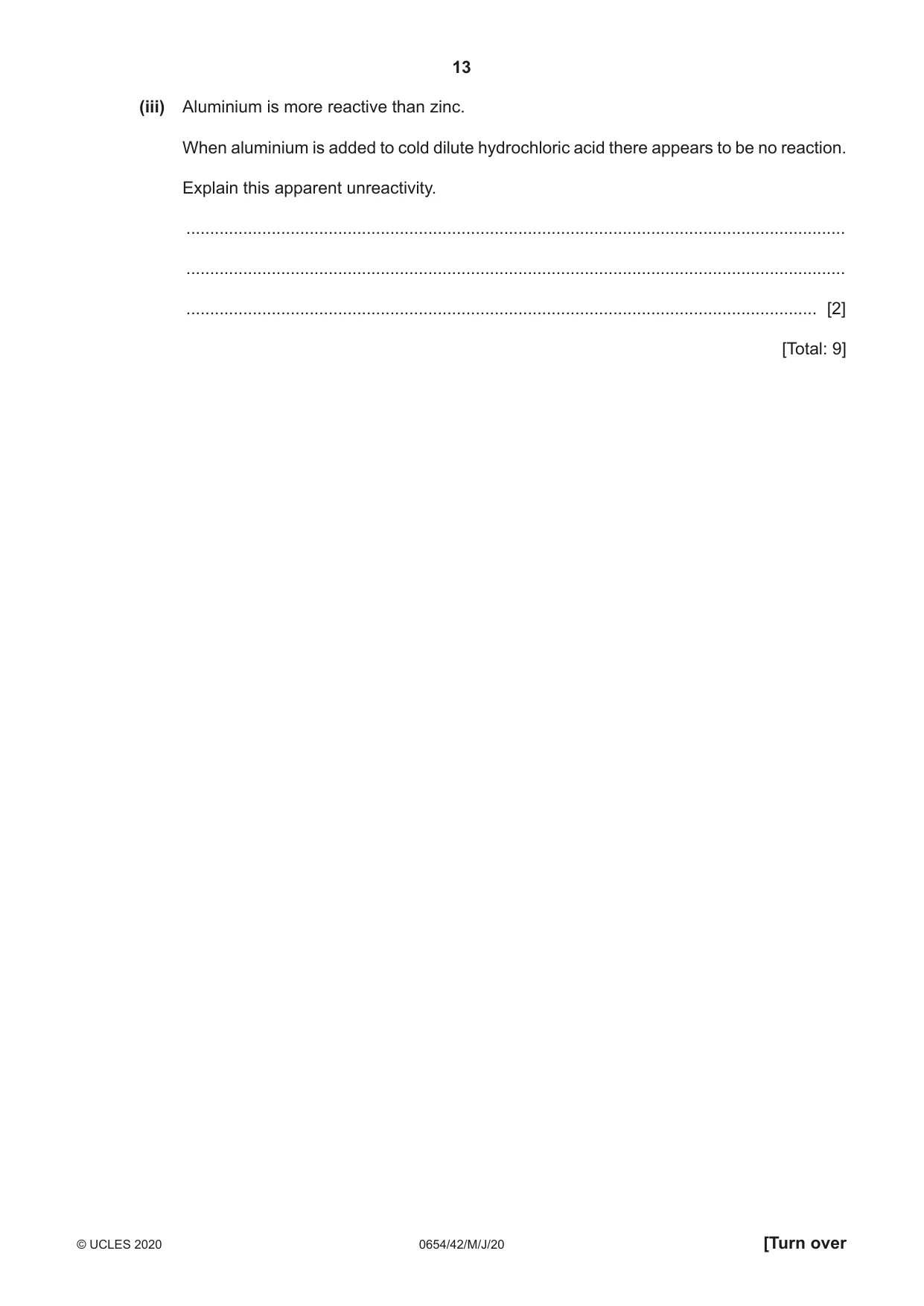
5 Aluminium is used to make aircraft parts. (a) State how aluminium is extracted from aluminium oxide. ............................................................................................................................................. [1] (b) Explain why aluminium is used to make aircraft parts. ................................................................................................................................................... ................................................................................................................................................... ............................................................................................................................................. [2] (c) Table 5.1 shows information about the reactions of some metals. Table 5.1 metal reaction with dilute hydrochloric acid gold no reaction magnesium reacts quickly to make hydrogen gas sodium reacts explosively to make hydrogen gas tin reacts very slowly to make hydrogen gas zinc reacts slowly to make hydrogen gas (i) Use the information in Table 5.1 to complete the order of reactivity of the metals. ................................................. most reactive ................................................. ................................................. ................................................. ................................................. least reactive [2] (ii) Write a balanced symbol equation for the reaction of magnesium with hydrochloric acid, HCl. ..................................................................................................................................... [2] (iii) Aluminium is more reactive than zinc. When aluminium is added to cold dilute hydrochloric acid there appears to be no reaction. Explain this apparent unreactivity. ........................................................................................................................................... ........................................................................................................................................... ..................................................................................................................................... [2] [Total: 9]
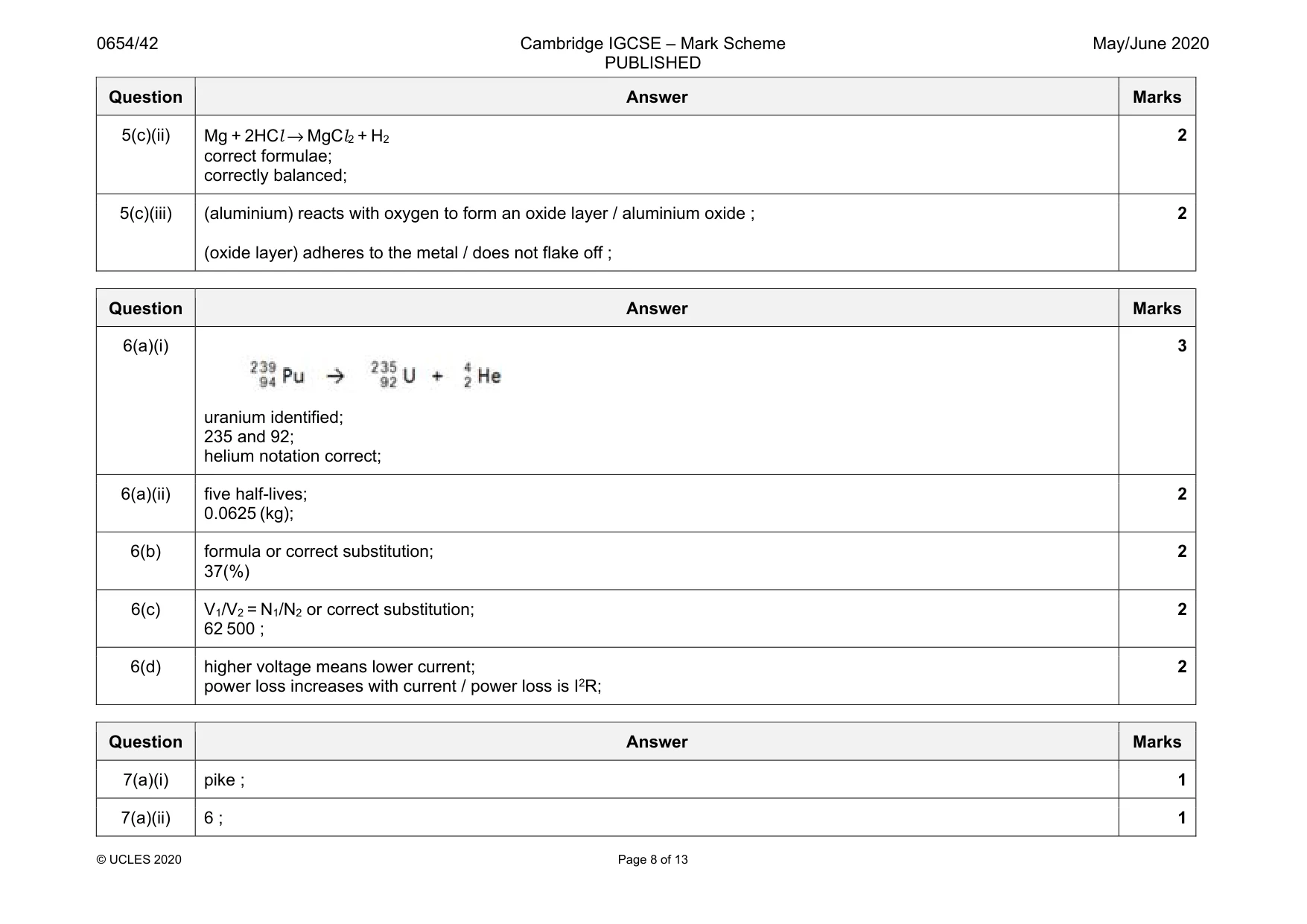
Mark scheme: 5(a) electrolysis; 1 5(b) strong ; low density ; 2 5(c)(i) order of reactivity (most to least): sodium magnesium zinc tin gold ;; 2 Question Answer Marks 5(c)(ii) Mg + 2HCl → MgCl2 + H2 correct formulae; correctly balanced; 2 5(c)(iii) (aluminium) reacts with oxygen to form an oxide layer / aluminium oxide ; (oxide layer) adheres to the metal / does not flake off ; 2
Q6 · The nuclear fuel used in some power stations is plutonium-239
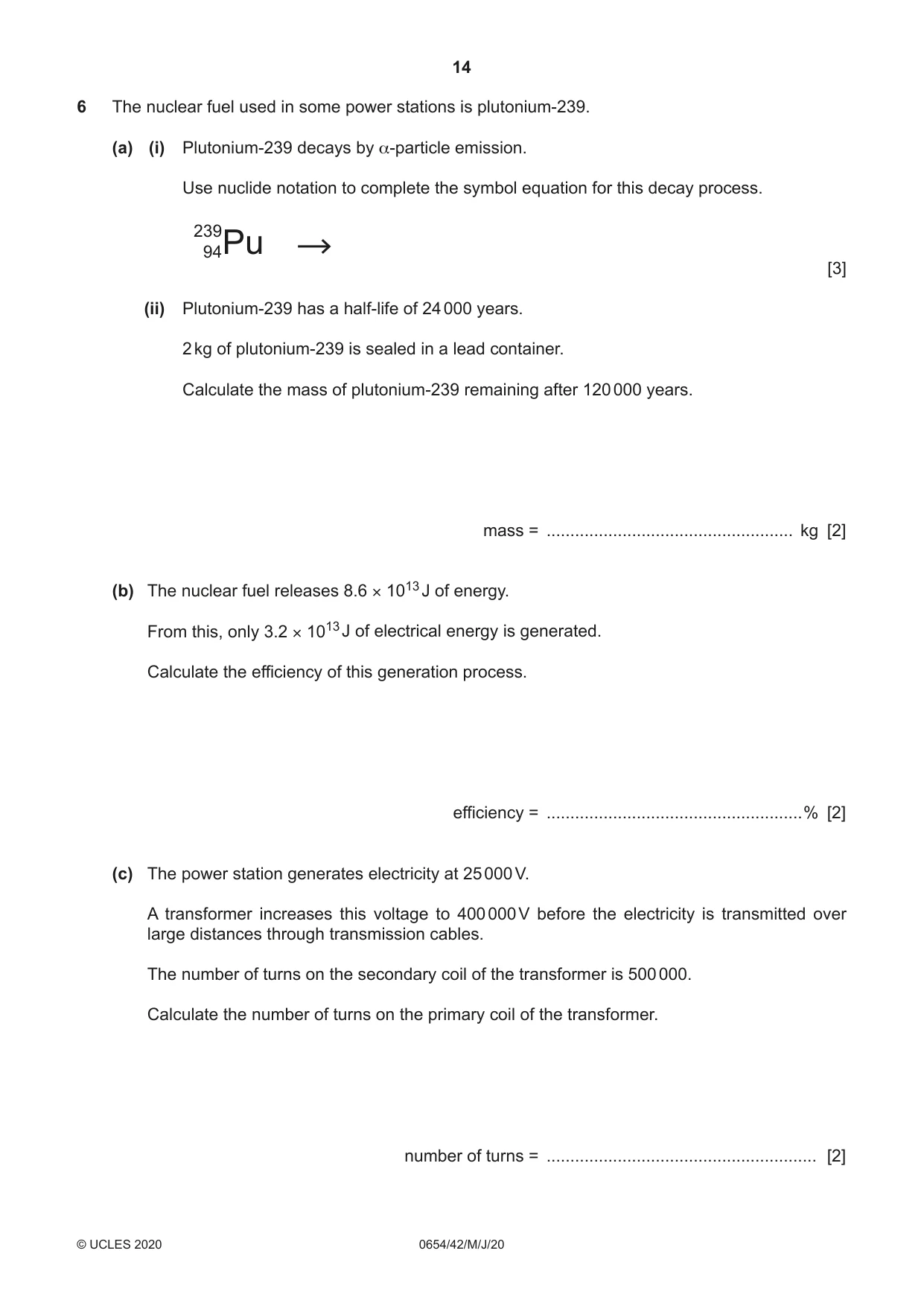
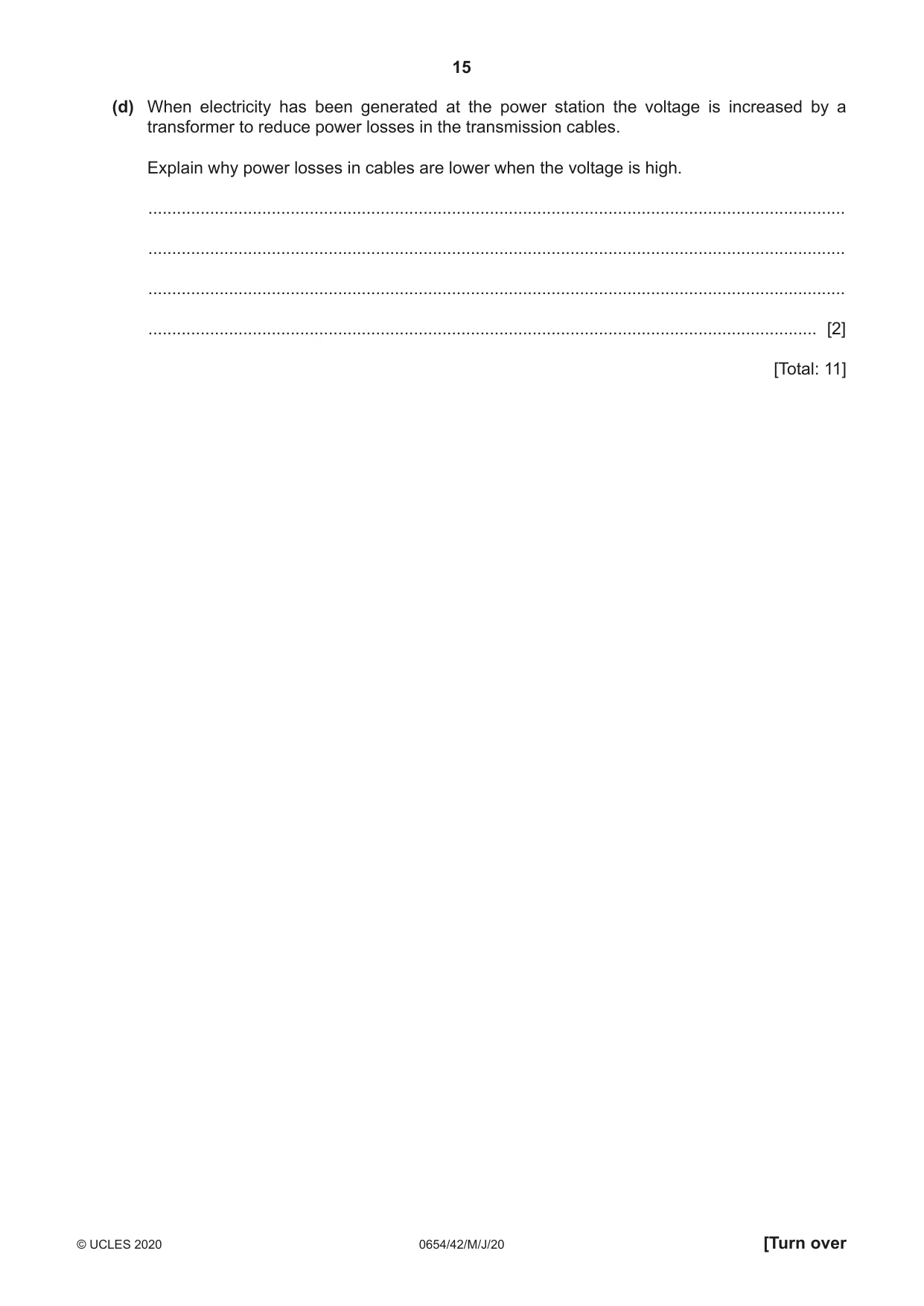
6 The nuclear fuel used in some power stations is plutonium-239. (a) (i) Plutonium-239 decays by α-particle emission. Use nuclide notation to complete the symbol equation for this decay process. 23994Pu [3] (ii) Plutonium-239 has a half-life of 24 000 years. 2 kg of plutonium-239 is sealed in a lead container. Calculate the mass of plutonium-239 remaining after 120 000 years. mass = .................................................... kg [2] (b) The nuclear fuel releases 8.6 × 10¹³ J of energy. From this, only 3.2 × 10¹³ J of electrical energy is generated. Calculate the efficiency of this generation process. efficiency = ......................................................% [2] (c) The power station generates electricity at 25 000 V. A transformer increases this voltage to 400 000 V before the electricity is transmitted over large distances through transmission cables. The number of turns on the secondary coil of the transformer is 500 000. Calculate the number of turns on the primary coil of the transformer. number of turns = ......................................................... [2] (d) When electricity has been generated at the power station the voltage is increased by a transformer to reduce power losses in the transmission cables. Explain why power losses in cables are lower when the voltage is high. ................................................................................................................................................... ................................................................................................................................................... ................................................................................................................................................... ............................................................................................................................................. [2] [Total: 11]
Mark scheme: 6(a)(i) uranium identified; 235 and 92; helium notation correct; 3 6(a)(ii) five half-lives; 0.0625 (kg); 2 6(b) formula or correct substitution; 37(%) 2 6(c) V1/V2 = N1/N2 or correct substitution; 62 500 ; 2 6(d) higher voltage means lower current; power loss increases with current / power loss is I2R; 2
Q7 · A lake is an example of an ecosystem
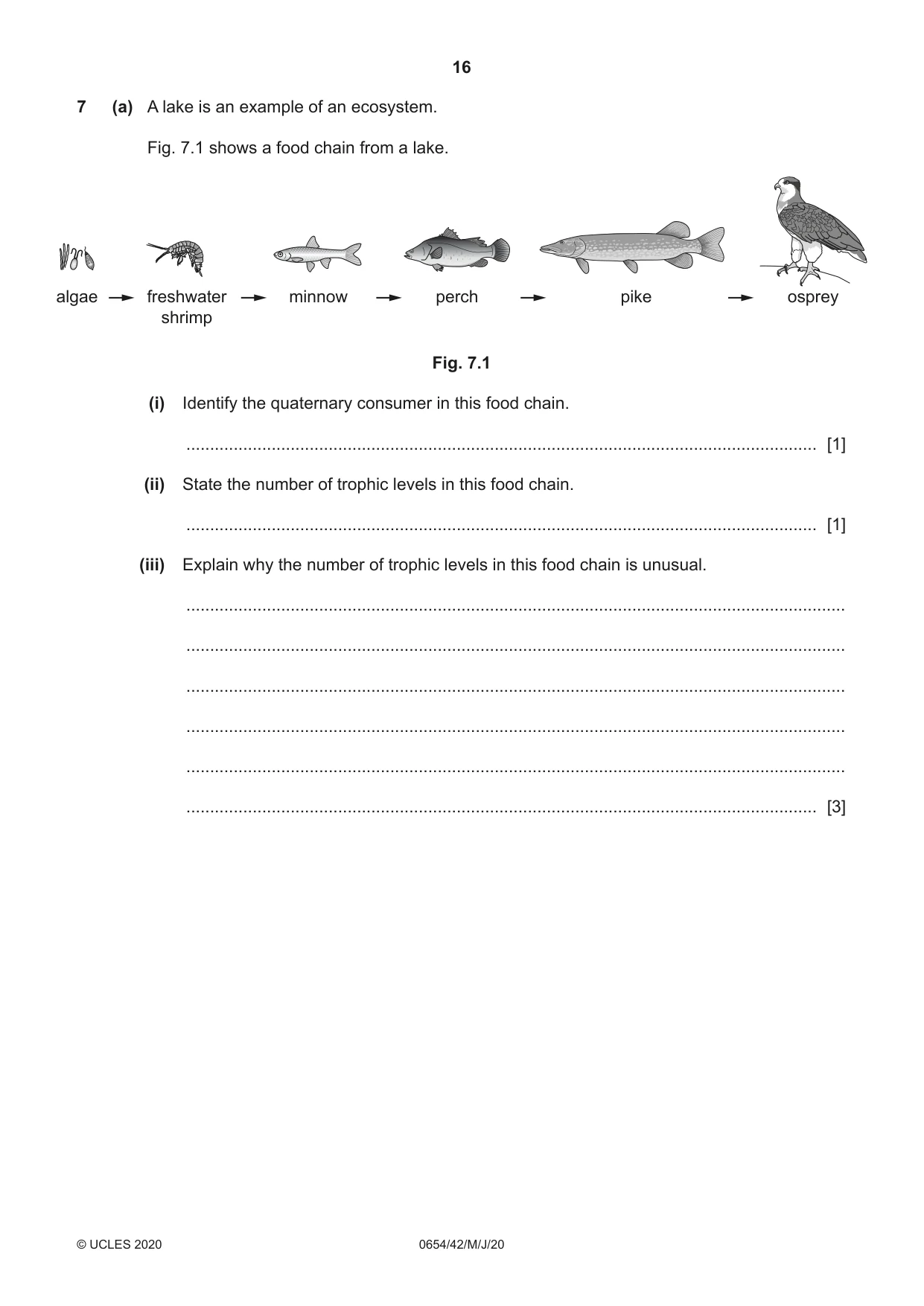
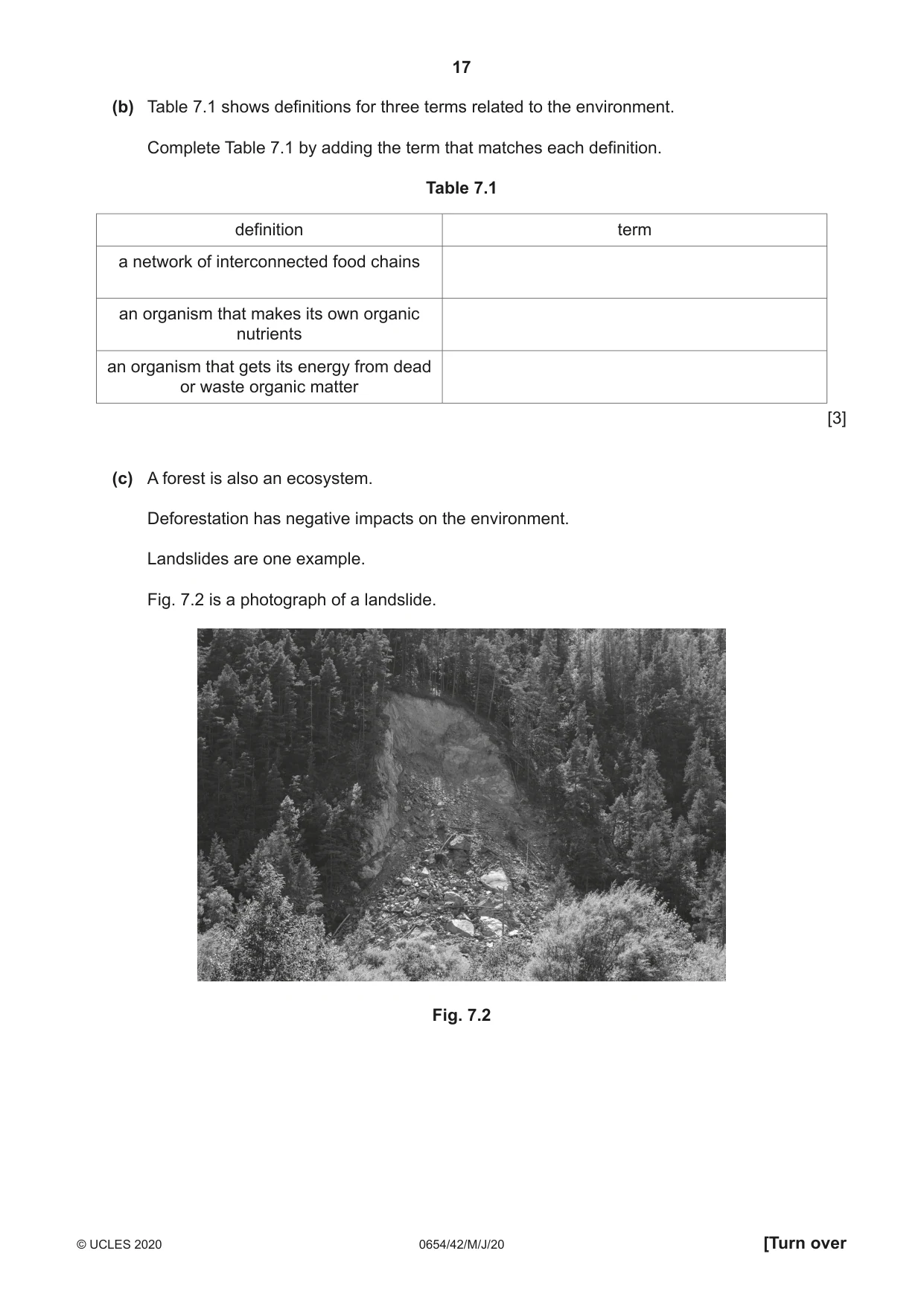
7 (a) A lake is an example of an ecosystem. Fig. 7.1 shows a food chain from a lake. algae freshwater minnow perch pike osprey shrimp Fig. 7.1 (i) Identify the quaternary consumer in this food chain. ..................................................................................................................................... [1] (ii) State the number of trophic levels in this food chain. ..................................................................................................................................... [1] (iii) Explain why the number of trophic levels in this food chain is unusual. ........................................................................................................................................... ........................................................................................................................................... ........................................................................................................................................... ........................................................................................................................................... ........................................................................................................................................... ..................................................................................................................................... [3] (b) Table 7.1 shows definitions for three terms related to the environment. Complete Table 7.1 by adding the term that matches each definition. Table 7.1 definition term a network of interconnected food chains an organism that makes its own organic nutrients an organism that gets its energy from dead or waste organic matter [3] (c) A forest is also an ecosystem. Deforestation has negative impacts on the environment. Landslides are one example. Fig. 7.2 is a photograph of a landslide. Fig. 7.2 (i) Explain why deforestation can increase the chance of a landslide. ........................................................................................................................................... ........................................................................................................................................... ........................................................................................................................................... ..................................................................................................................................... [2] (ii) Describe how deforestation can lead to a decrease in the concentration of oxygen in the atmosphere. ........................................................................................................................................... ........................................................................................................................................... ........................................................................................................................................... ..................................................................................................................................... [2] [Total: 12]
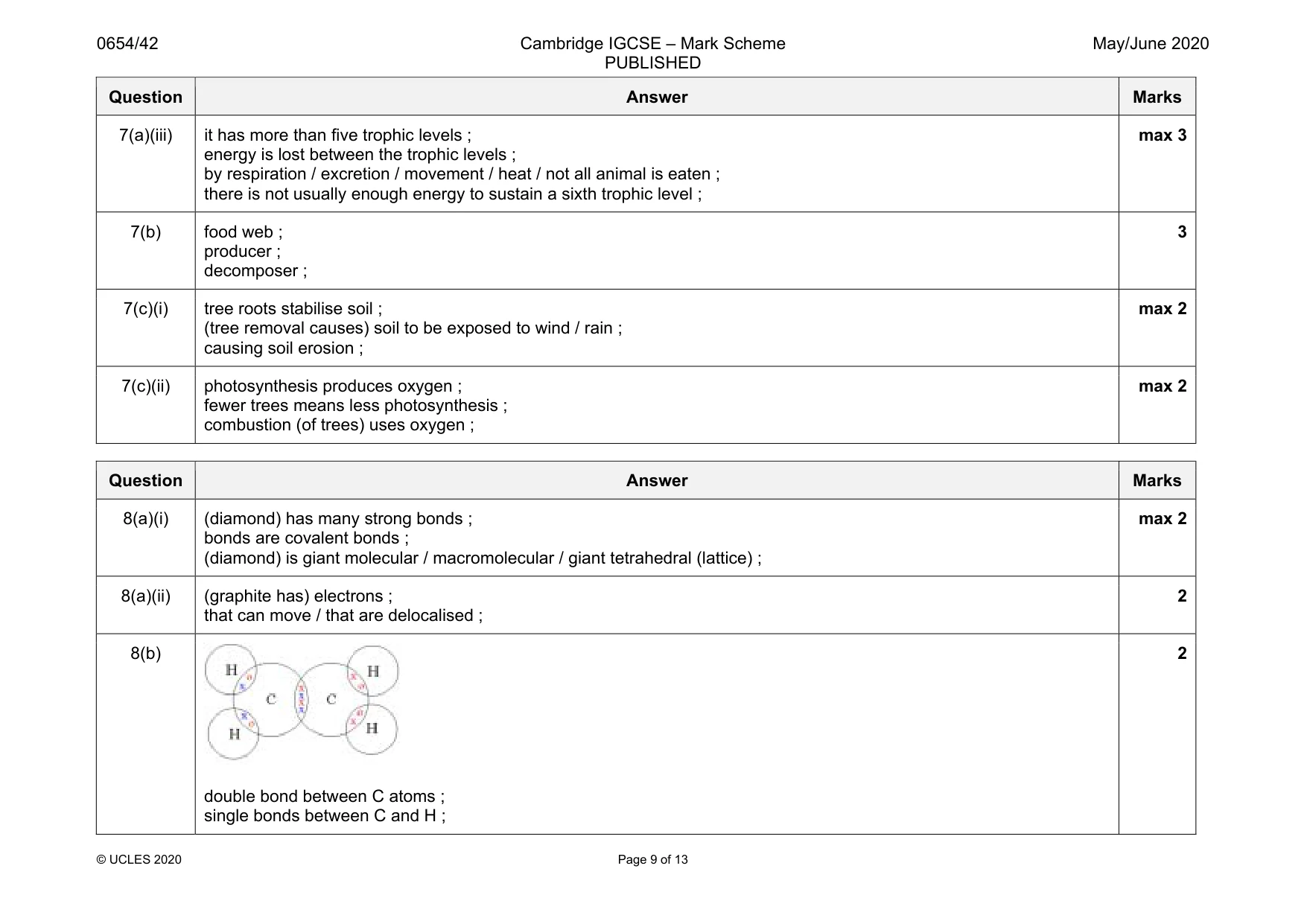
Mark scheme: 7(a)(i) pike ; 1 7(a)(ii) 6 ; 1 Question Answer Marks 7(a)(iii) it has more than five trophic levels ; energy is lost between the trophic levels ; by respiration / excretion / movement / heat / not all animal is eaten ; there is not usually enough energy to sustain a sixth trophic level ; max 3 7(b) food web ; producer ; decomposer ; 3 7(c)(i) tree roots stabilise soil ; (tree removal causes) soil to be exposed to wind / rain ; causing soil erosion ; max 2 7(c)(ii) photosynthesis produces oxygen ; fewer trees means less photosynthesis ; combustion (of trees) uses oxygen ; max 2
Q8 · Diamond and graphite are different forms of the element carbon
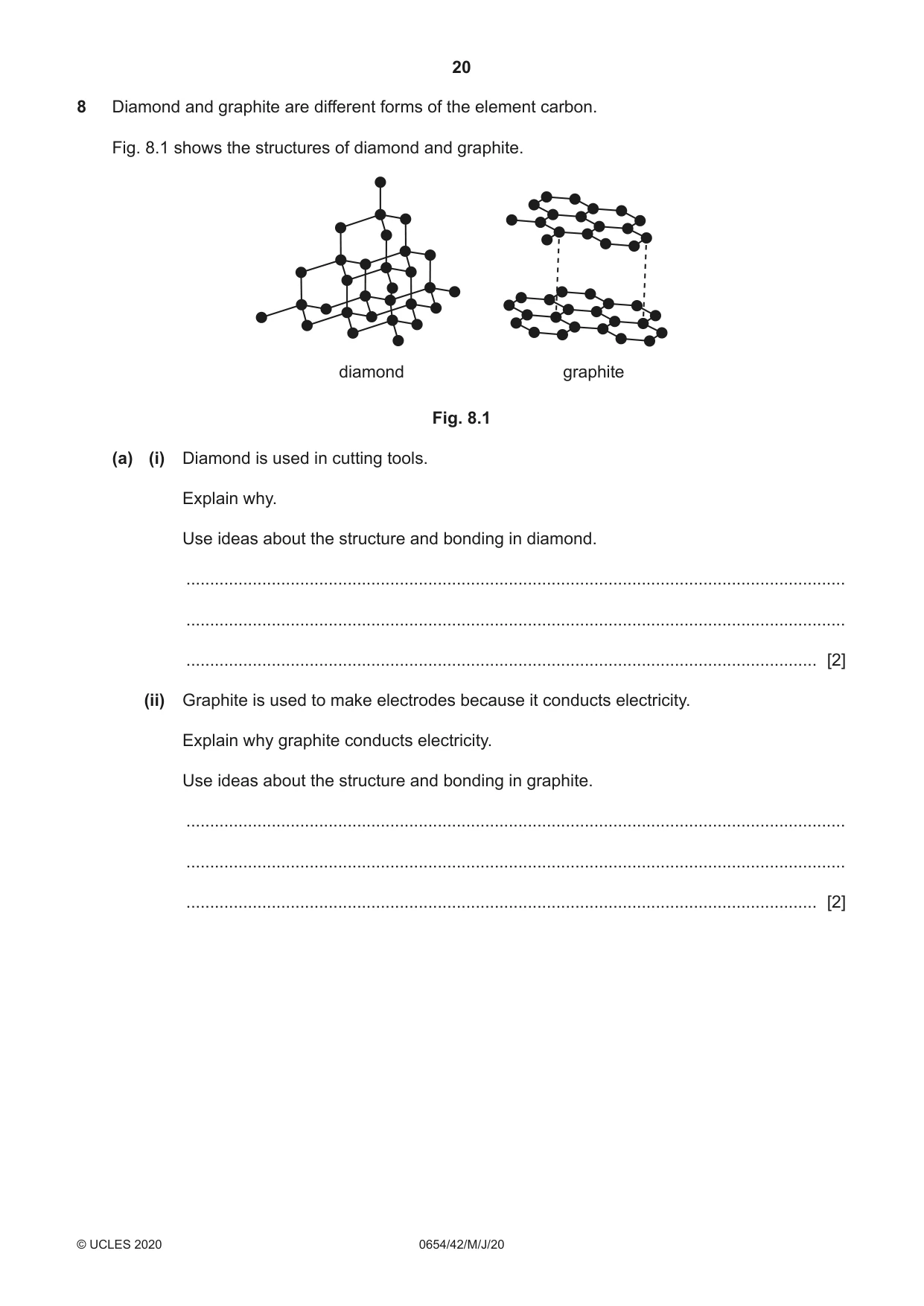
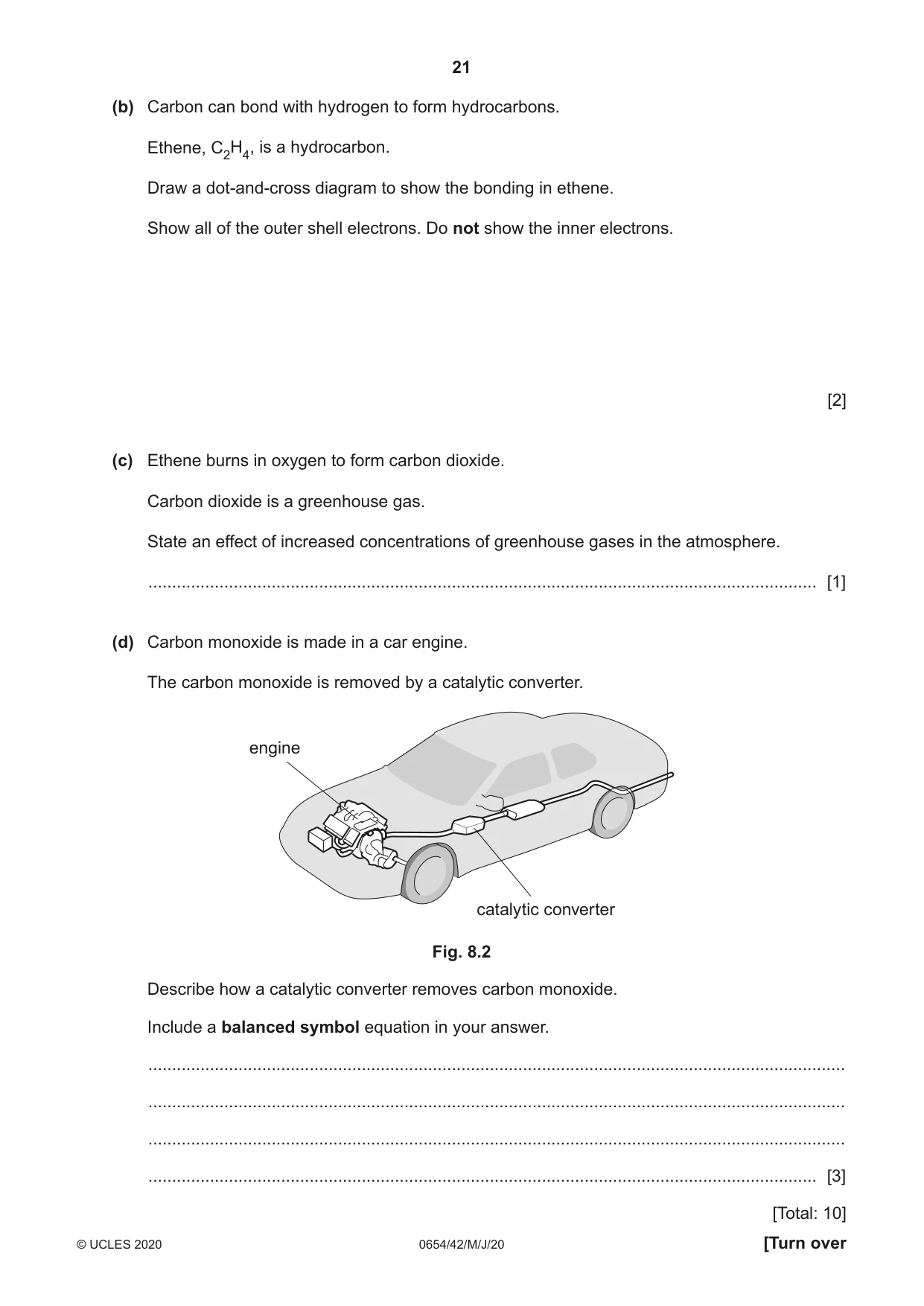
8 Diamond and graphite are different forms of the element carbon. Fig. 8.1 shows the structures of diamond and graphite. diamond graphite Fig. 8.1 (a) (i) Diamond is used in cutting tools. Explain why. Use ideas about the structure and bonding in diamond. ........................................................................................................................................... ........................................................................................................................................... ..................................................................................................................................... [2] (ii) Graphite is used to make electrodes because it conducts electricity. Explain why graphite conducts electricity. Use ideas about the structure and bonding in graphite. ........................................................................................................................................... ........................................................................................................................................... ..................................................................................................................................... [2] (b) Carbon can bond with hydrogen to form hydrocarbons. Ethene, C2H4, is a hydrocarbon. Draw a dot-and-cross diagram to show the bonding in ethene. Show all of the outer shell electrons. Do not show the inner electrons. [2] (c) Ethene burns in oxygen to form carbon dioxide. Carbon dioxide is a greenhouse gas. State an effect of increased concentrations of greenhouse gases in the atmosphere. ............................................................................................................................................. [1] (d) Carbon monoxide is made in a car engine. The carbon monoxide is removed by a catalytic converter. engine catalytic converter Fig. 8.2 Describe how a catalytic converter removes carbon monoxide. Include a balanced symbol equation in your answer. ................................................................................................................................................... ................................................................................................................................................... ................................................................................................................................................... ............................................................................................................................................. [3] [Total: 10]
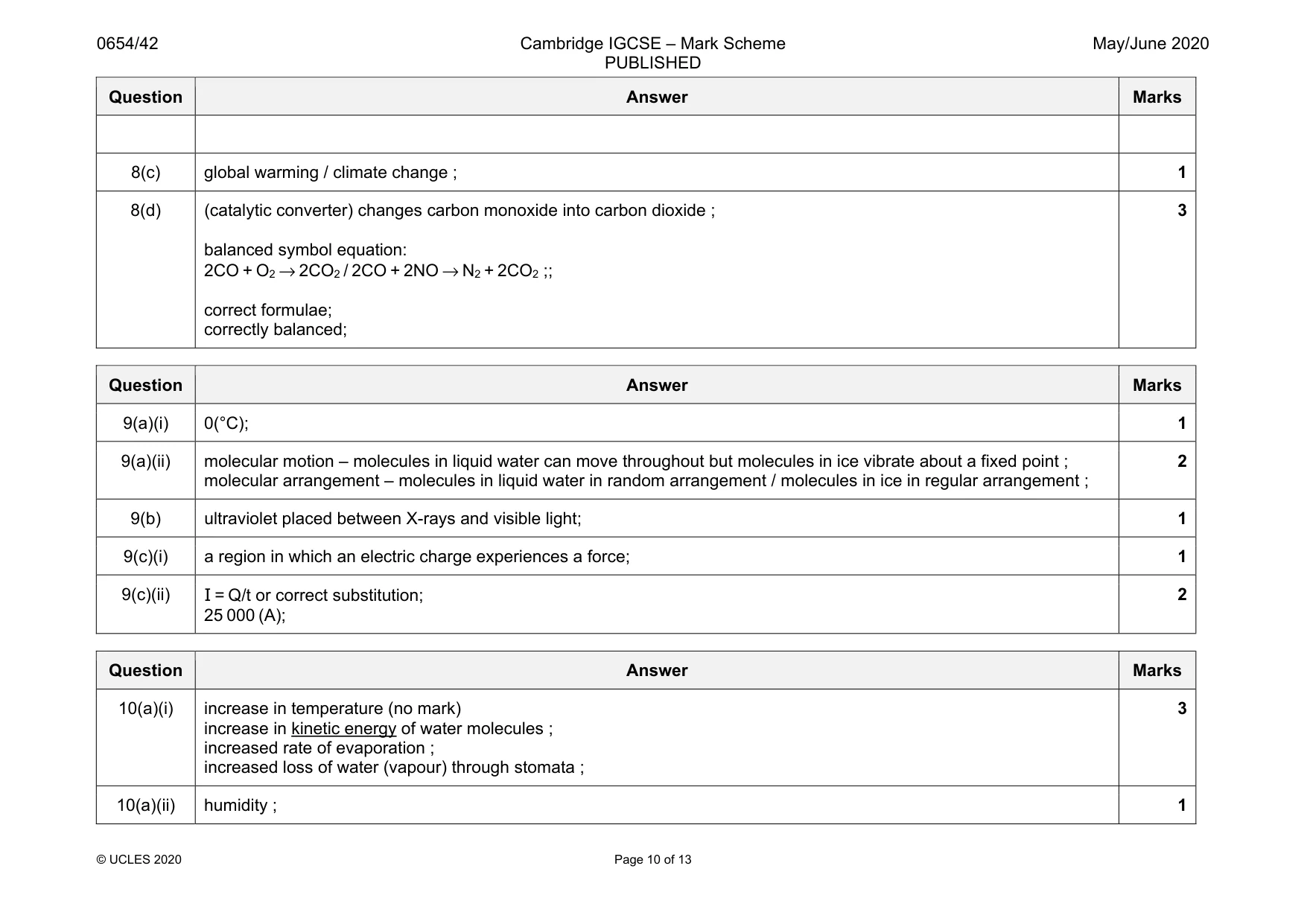
Mark scheme: 8(a)(i) (diamond) has many strong bonds ; bonds are covalent bonds ; (diamond) is giant molecular / macromolecular / giant tetrahedral (lattice) ; max 2 8(a)(ii) (graphite has) electrons ; that can move / that are delocalised ; 2 8(b) double bond between C atoms ; single bonds between C and H ; 2 Question Answer Marks 8(c) global warming / climate change ; 1 8(d) (catalytic converter) changes carbon monoxide into carbon dioxide ; balanced symbol equation: 2CO + O2 → 2CO2 / 2CO + 2NO → N2 + 2CO2 ;; correct formulae; correctly balanced; 3
Q9 · A mountaineer climbs a mountain
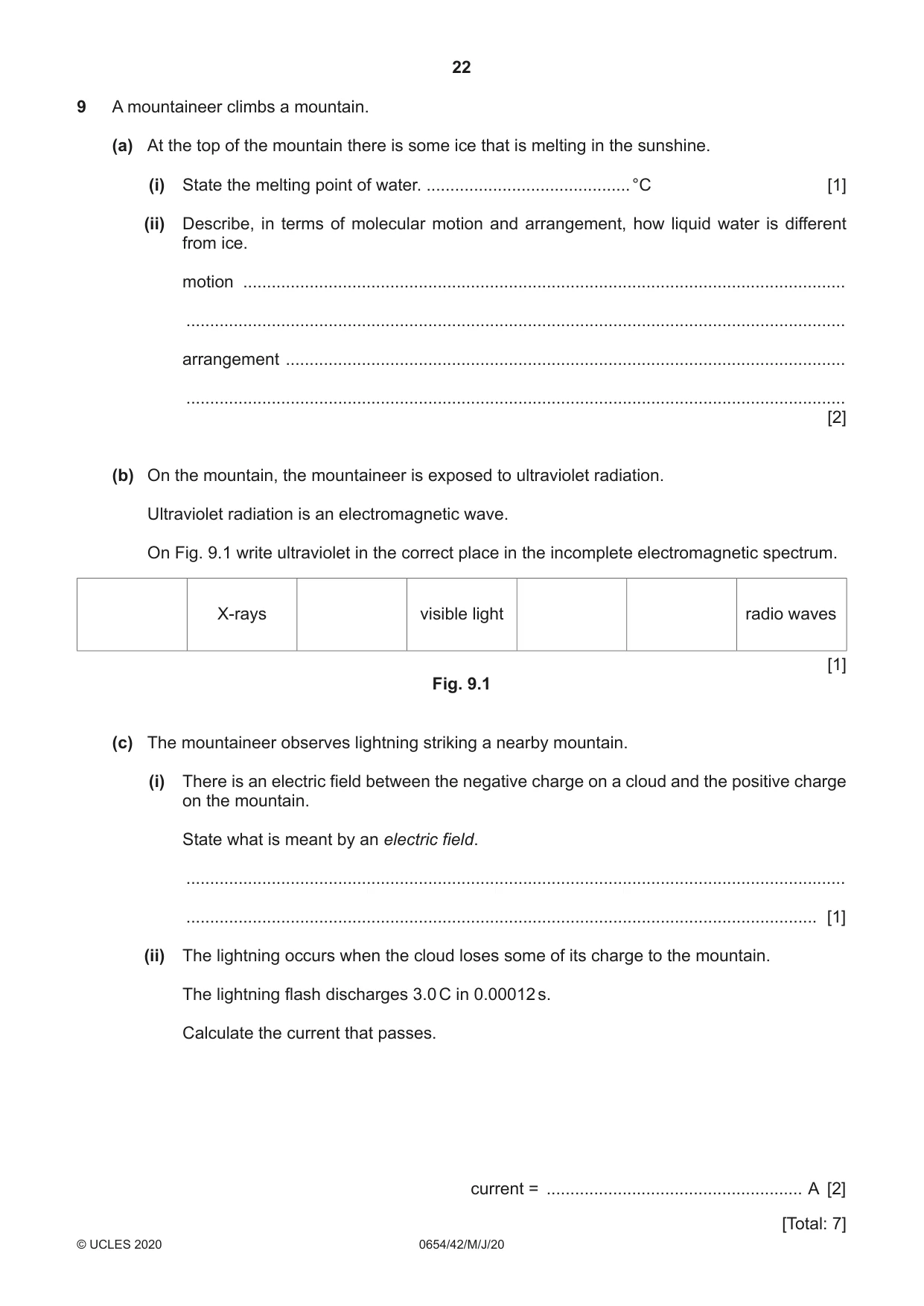
9 A mountaineer climbs a mountain. (a) At the top of the mountain there is some ice that is melting in the sunshine. (i) State the melting point of water. ........................................... °C [1] (ii) Describe, in terms of molecular motion and arrangement, how liquid water is different from ice. motion ............................................................................................................................... ........................................................................................................................................... arrangement ...................................................................................................................... ........................................................................................................................................... [2] (b) On the mountain, the mountaineer is exposed to ultraviolet radiation. Ultraviolet radiation is an electromagnetic wave. On Fig. 9.1 write ultraviolet in the correct place in the incomplete electromagnetic spectrum. X-rays visible light radio waves [1] Fig. 9.1 (c) The mountaineer observes lightning striking a nearby mountain. (i) There is an electric field between the negative charge on a cloud and the positive charge on the mountain. State what is meant by an electric field. ........................................................................................................................................... ..................................................................................................................................... [1] (ii) The lightning occurs when the cloud loses some of its charge to the mountain. The lightning flash discharges 3.0 C in 0.00012 s. Calculate the current that passes. current = ...................................................... A [2] [Total: 7]
Mark scheme: 9(a)(i) 0(°C); 1 9(a)(ii) molecular motion – molecules in liquid water can move throughout but molecules in ice vibrate about a fixed point ; molecular arrangement – molecules in liquid water in random arrangement / molecules in ice in regular arrangement ; 2 9(b) ultraviolet placed between X-rays and visible light; 1 9(c)(i) a region in which an electric charge experiences a force; 1 9(c)(ii) I = Q/t or correct substitution; 25 000 (A); 2
Q10 · A sketch graph showing the effect of temperature on the rate of transpiration (loss of…
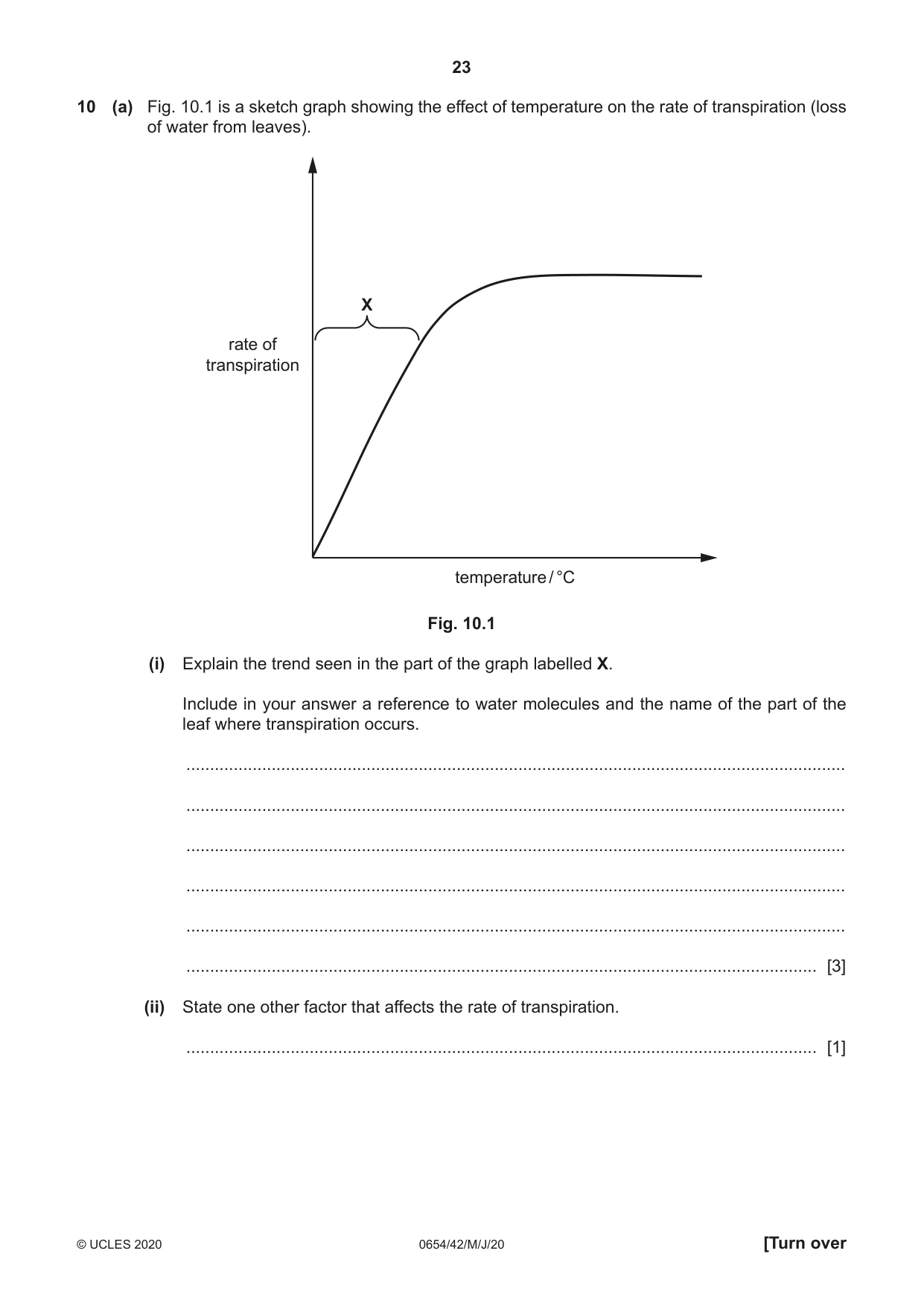
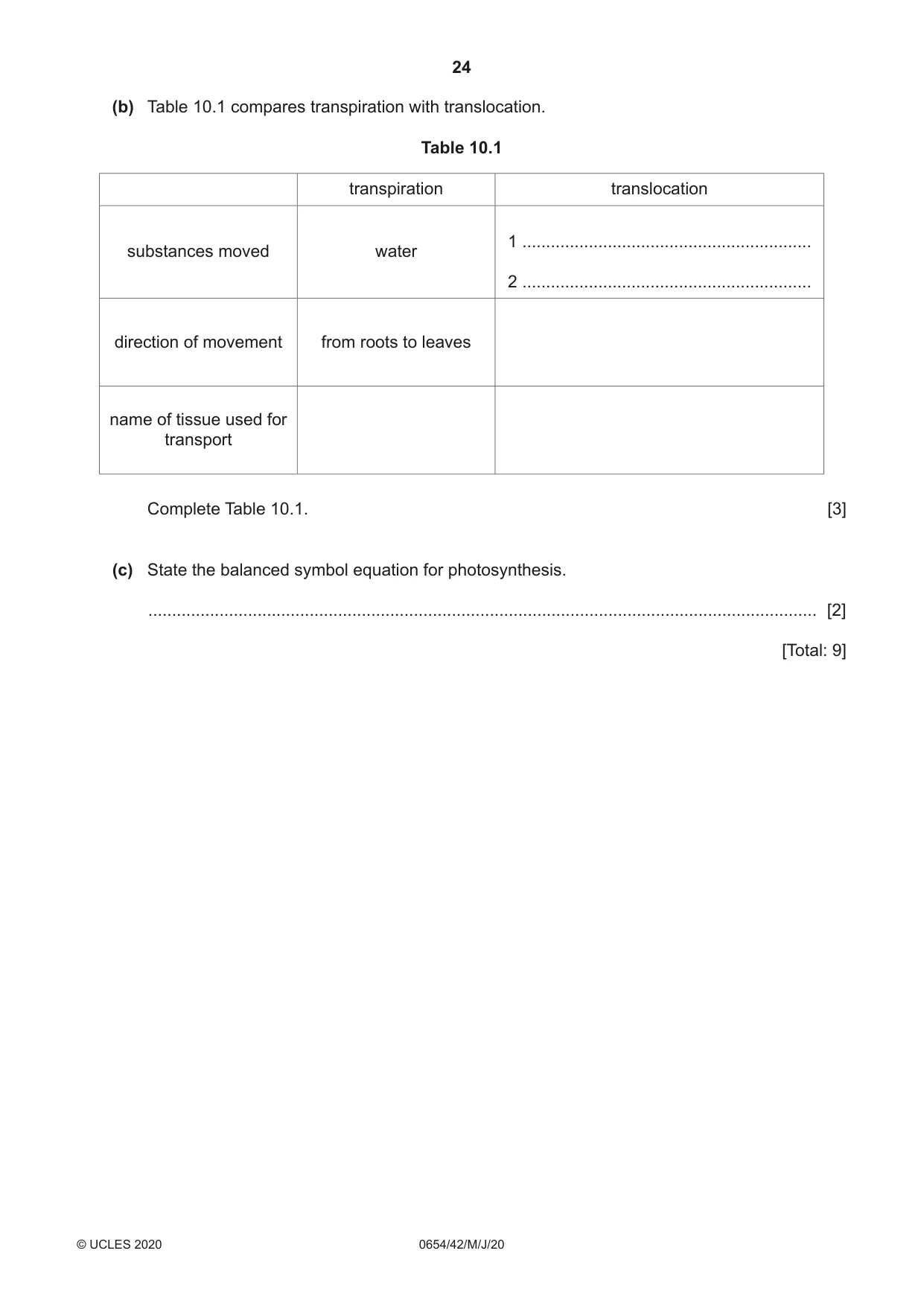
10 (a) Fig. 10.1 is a sketch graph showing the effect of temperature on the rate of transpiration (loss of water from leaves). X rate of transpiration temperature / °C Fig. 10.1 (i) Explain the trend seen in the part of the graph labelled X. Include in your answer a reference to water molecules and the name of the part of the leaf where transpiration occurs. ........................................................................................................................................... ........................................................................................................................................... ........................................................................................................................................... ........................................................................................................................................... ........................................................................................................................................... ..................................................................................................................................... [3] (ii) State one other factor that affects the rate of transpiration. ..................................................................................................................................... [1] (b) Table 10.1 compares transpiration with translocation. Table 10.1 transpiration translocation 1 ............................................................. substances moved water 2 ............................................................. direction of movement from roots to leaves name of tissue used for transport Complete Table 10.1. [3] (c) State the balanced symbol equation for photosynthesis. ............................................................................................................................................. [2] [Total: 9]
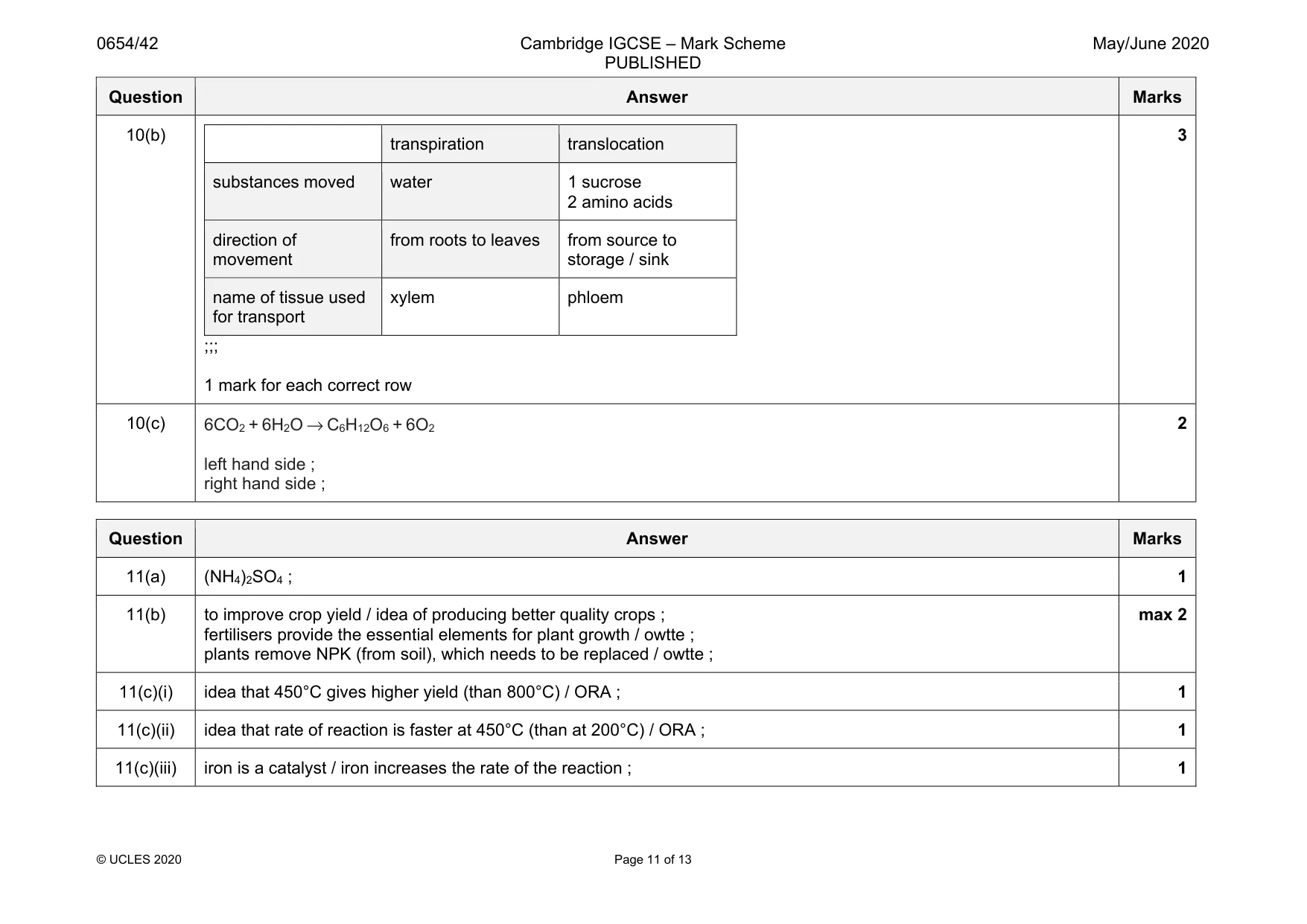
Mark scheme: 10(a)(i) increase in temperature (no mark) increase in kinetic energy of water molecules ; increased rate of evaporation ; increased loss of water (vapour) through stomata ; 3 10(a)(ii) humidity ; 1 Question Answer Marks 10(b) transpiration translocation substances moved water 1 sucrose 2 amino acids direction of movement from roots to leaves from source to storage / sink name of tissue used for transport xylem phloem ;;; 1 mark for each correct row 3 10(c) 6CO2 + 6H2O → C6H12O6 + 6O2 left hand side ; right hand side ; 2
Q11 · Ammonium sulfate is used as a fertiliser
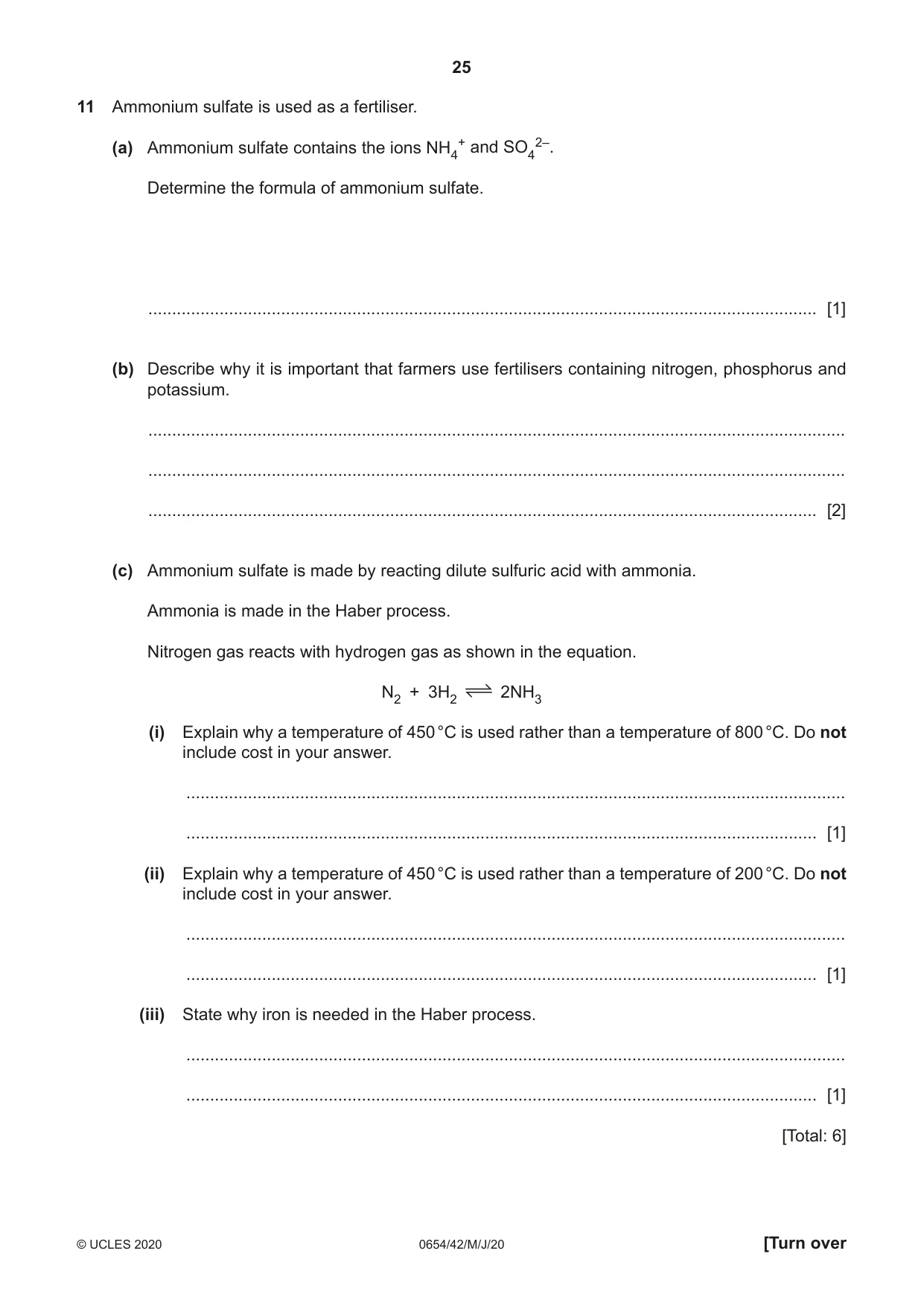
11 Ammonium sulfate is used as a fertiliser. (a) Ammonium sulfate contains the ions NH4+ and SO42–. Determine the formula of ammonium sulfate. ............................................................................................................................................. [1] (b) Describe why it is important that farmers use fertilisers containing nitrogen, phosphorus and potassium. ................................................................................................................................................... ................................................................................................................................................... ............................................................................................................................................. [2] (c) Ammonium sulfate is made by reacting dilute sulfuric acid with ammonia. Ammonia is made in the Haber process. Nitrogen gas reacts with hydrogen gas as shown in the equation. N2 + 3H2 2NH3 (i) Explain why a temperature of 450 °C is used rather than a temperature of 800 °C. Do not include cost in your answer. ........................................................................................................................................... ..................................................................................................................................... [1] (ii) Explain why a temperature of 450 °C is used rather than a temperature of 200 °C. Do not include cost in your answer. ........................................................................................................................................... ..................................................................................................................................... [1] (iii) State why iron is needed in the Haber process. ........................................................................................................................................... ..................................................................................................................................... [1] [Total: 6]
Mark scheme: 11(a) (NH4)2SO4 ; 1 11(b) to improve crop yield / idea of producing better quality crops ; fertilisers provide the essential elements for plant growth / owtte ; plants remove NPK (from soil), which needs to be replaced / owtte ; max 2 11(c)(i) idea that 450°C gives higher yield (than 800°C) / ORA ; 1 11(c)(ii) idea that rate of reaction is faster at 450°C (than at 200°C) / ORA ; 1 11(c)(iii) iron is a catalyst / iron increases the rate of the reaction ; 1
Q12 · A cyclist accelerates along a straight road from a speed of 4 m / s to maximum speed
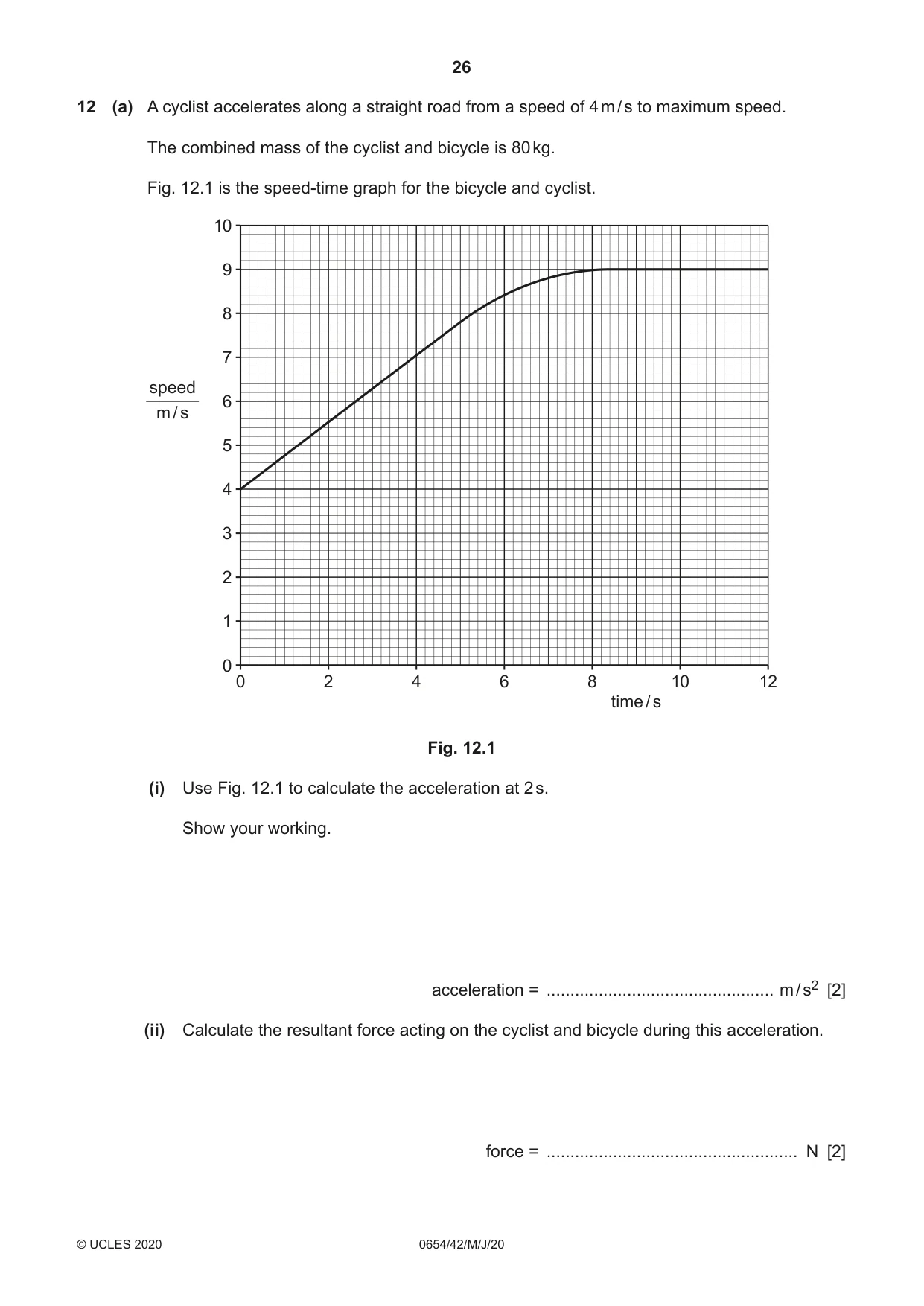
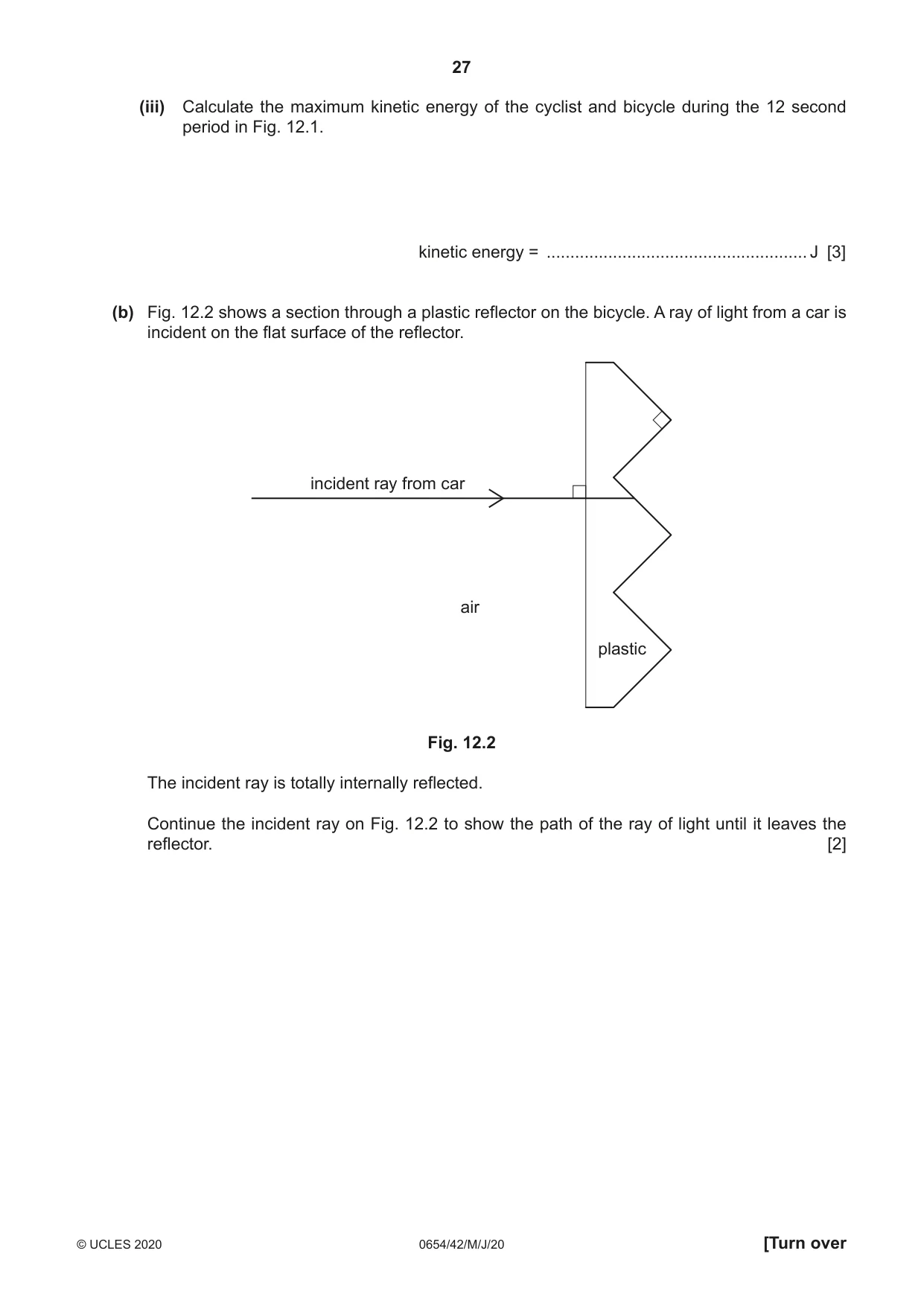
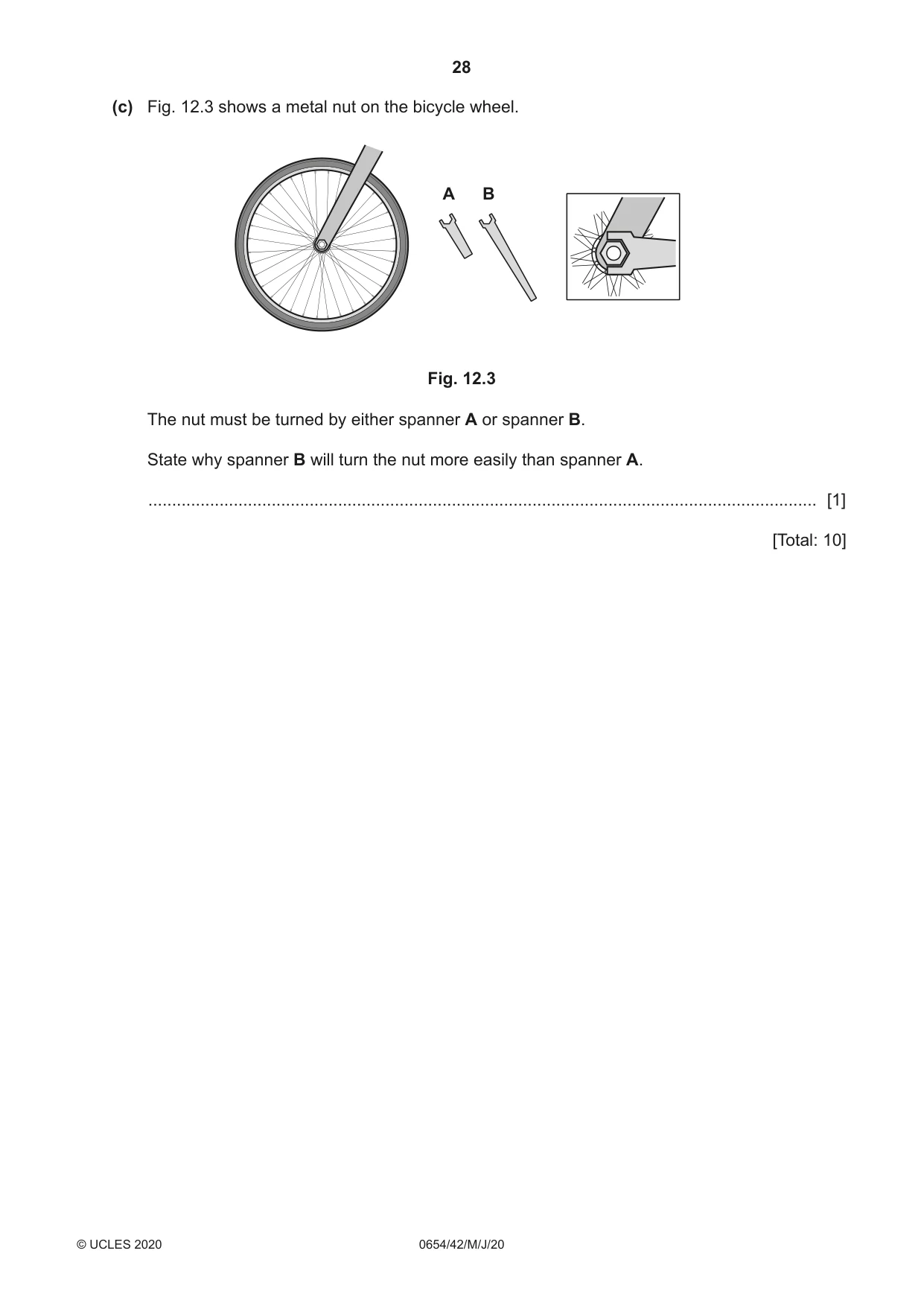
12 (a) A cyclist accelerates along a straight road from a speed of 4 m / s to maximum speed. The combined mass of the cyclist and bicycle is 80 kg. Fig. 12.1 is the speed-time graph for the bicycle and cyclist. 10 9 8 7 speed 6 m / s 5 4 3 2 1 0 0 2 4 6 8 10 12 time / s Fig. 12.1 (i) Use Fig. 12.1 to calculate the acceleration at 2 s. Show your working. acceleration = ................................................ m / s2 [2] (ii) Calculate the resultant force acting on the cyclist and bicycle during this acceleration. force = ..................................................... N [2] (iii) Calculate the maximum kinetic energy of the cyclist and bicycle during the 12 second period in Fig. 12.1. kinetic energy = ....................................................... J [3] (b) Fig. 12.2 shows a section through a plastic reflector on the bicycle. A ray of light from a car is incident on the flat surface of the reflector. incident ray from car air plastic Fig. 12.2 The incident ray is totally internally reflected. Continue the incident ray on Fig. 12.2 to show the path of the ray of light until it leaves the reflector. [2] (c) Fig. 12.3 shows a metal nut on the bicycle wheel. A B Fig. 12.3 The nut must be turned by either spanner A or spanner B. State why spanner B will turn the nut more easily than spanner A. ............................................................................................................................................. [1] [Total: 10]
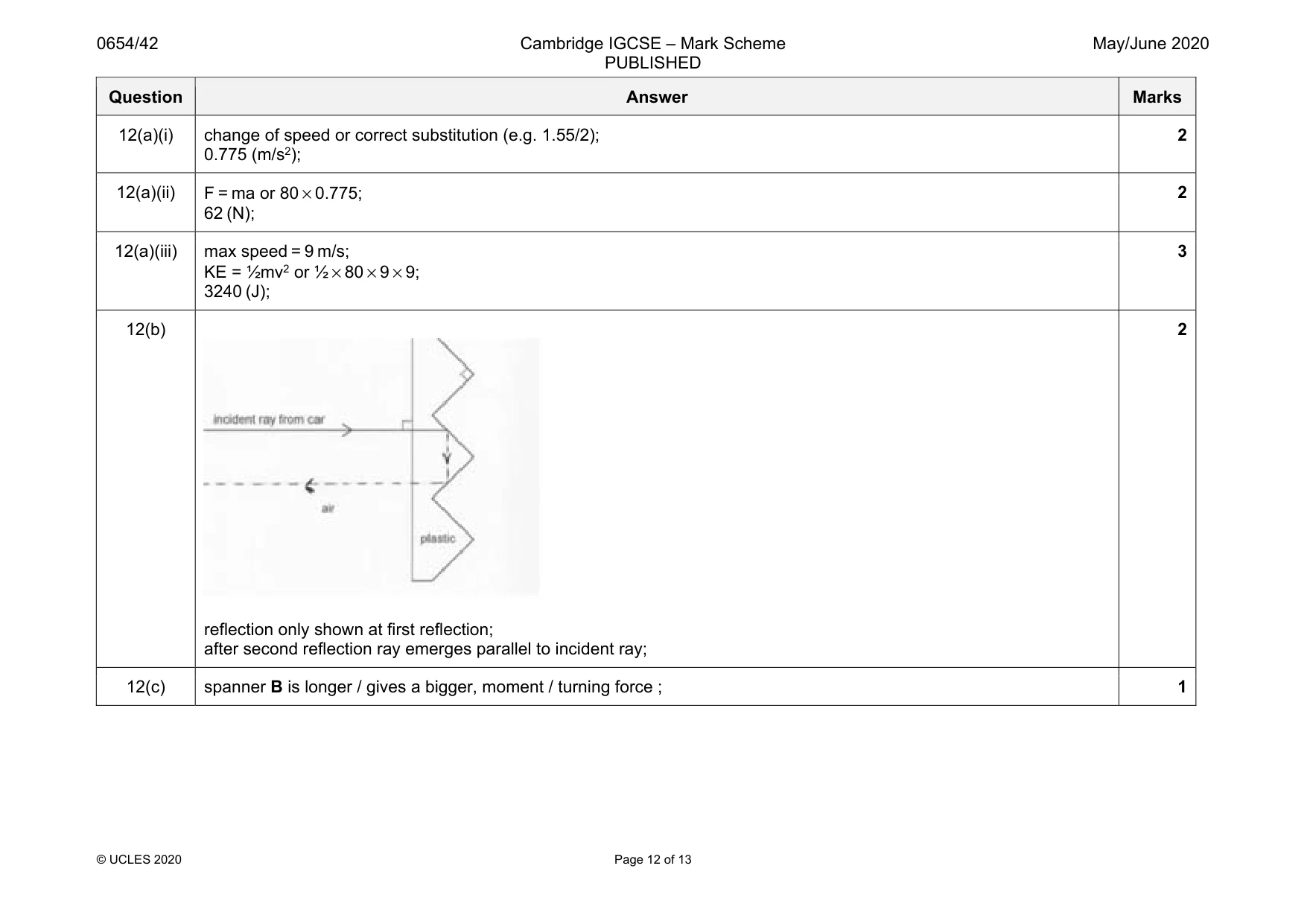
Mark scheme: 12(a)(i) change of speed or correct substitution (e.g. 1.55/2); 0.775 (m/s2); 2 12(a)(ii) F = ma or 80 × 0.775; 62 (N); 2 12(a)(iii) max speed = 9 m/s; KE = ½mv2 or ½ × 80 × 9 × 9; 3240 (J); 3 12(b) reflection only shown at first reflection; after second reflection ray emerges parallel to incident ray; 2 12(c) spanner B is longer / gives a bigger, moment / turning force ; 1
Q13 · Polymers are made from small molecules called monomers
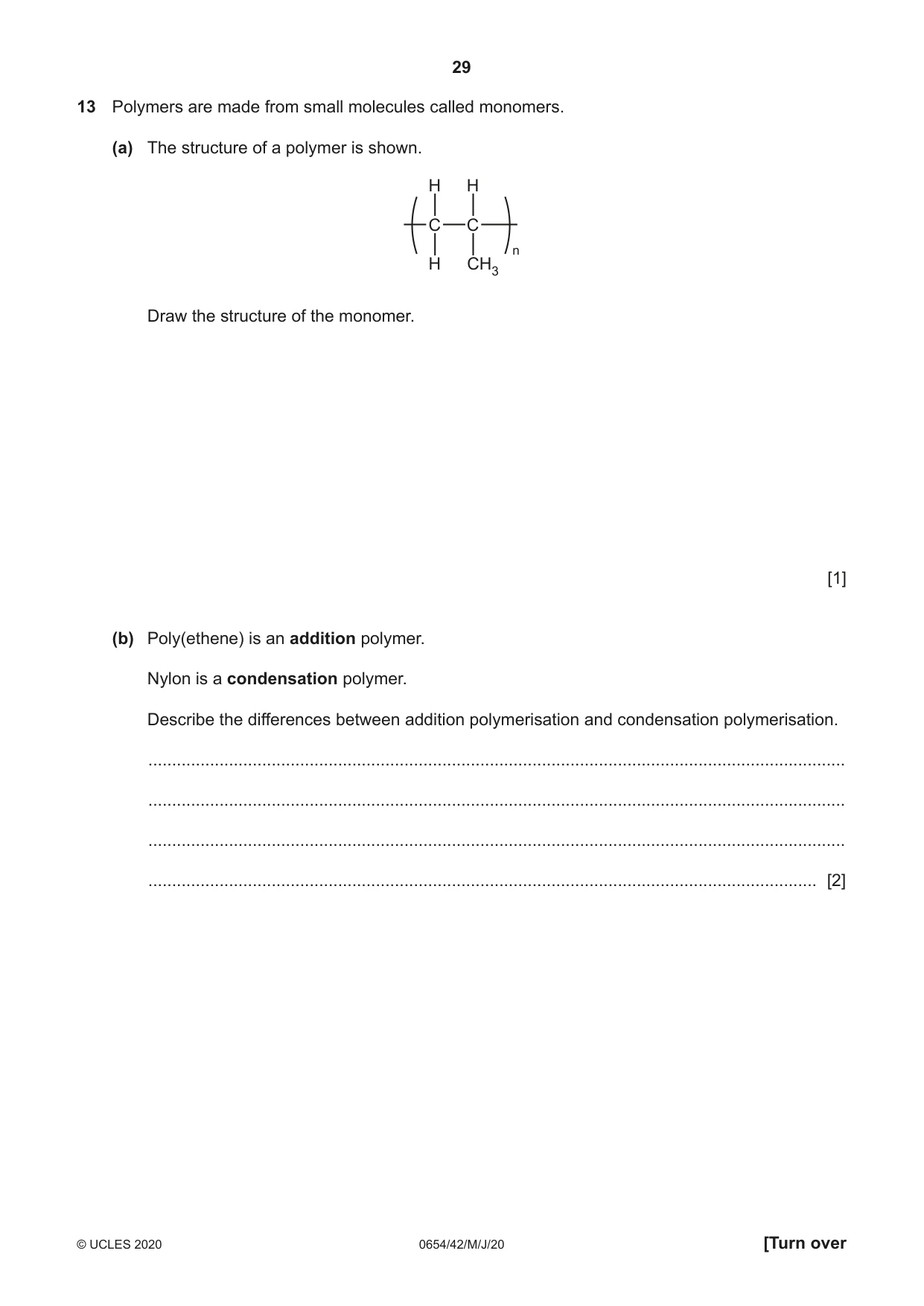
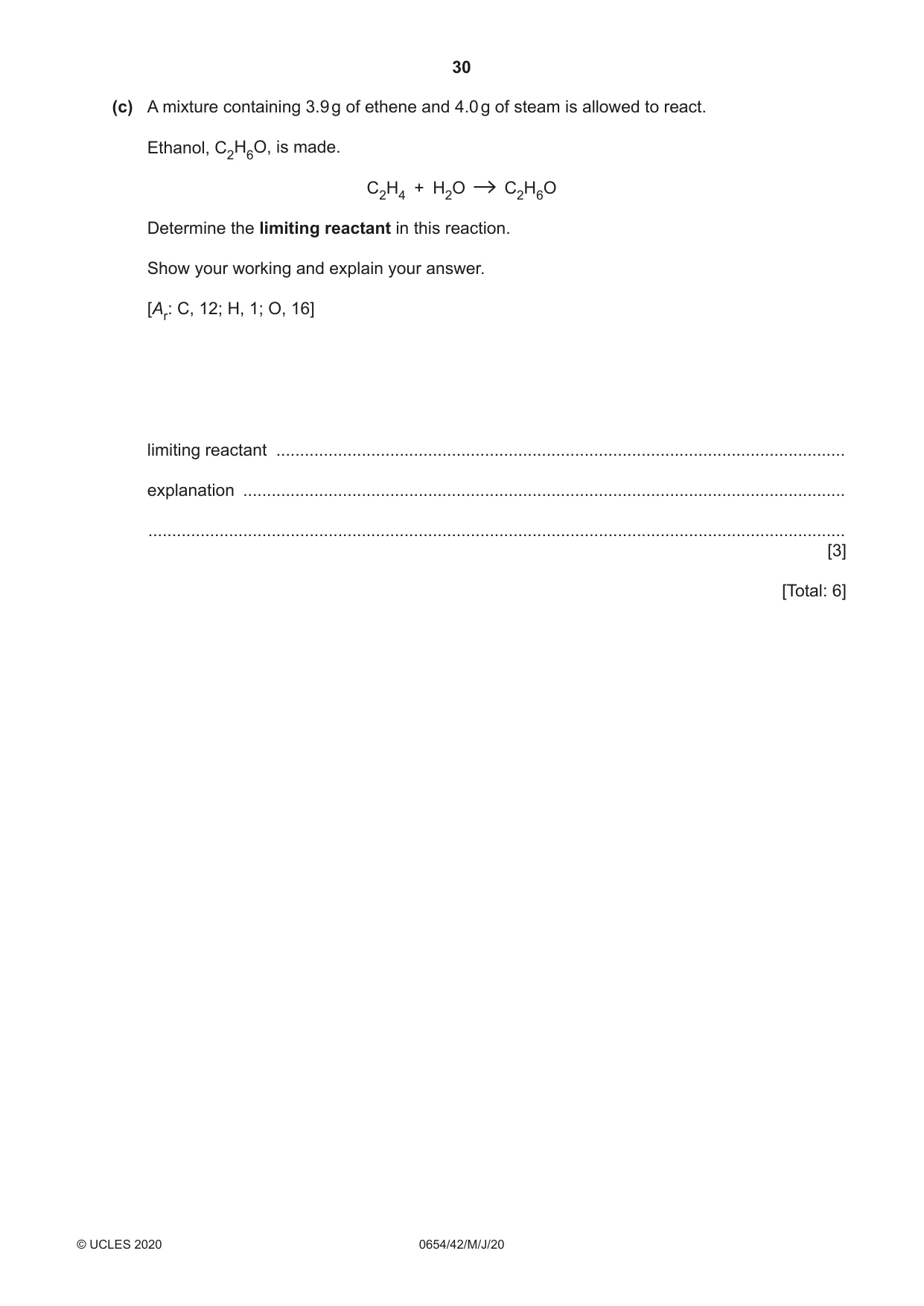
13 Polymers are made from small molecules called monomers. (a) The structure of a polymer is shown. H H C C n H CH3 Draw the structure of the monomer. [1] (b) Poly(ethene) is an addition polymer. Nylon is a condensation polymer. Describe the differences between addition polymerisation and condensation polymerisation. ................................................................................................................................................... ................................................................................................................................................... ................................................................................................................................................... ............................................................................................................................................. [2] (c) A mixture containing 3.9 g of ethene and 4.0 g of steam is allowed to react. Ethanol, C2H6O, is made. C2H4 + H2O C2H6O Determine the limiting reactant in this reaction. Show your working and explain your answer. [Ar: C, 12; H, 1; O, 16] limiting reactant ........................................................................................................................ explanation ............................................................................................................................... ................................................................................................................................................... [3] [Total: 6]
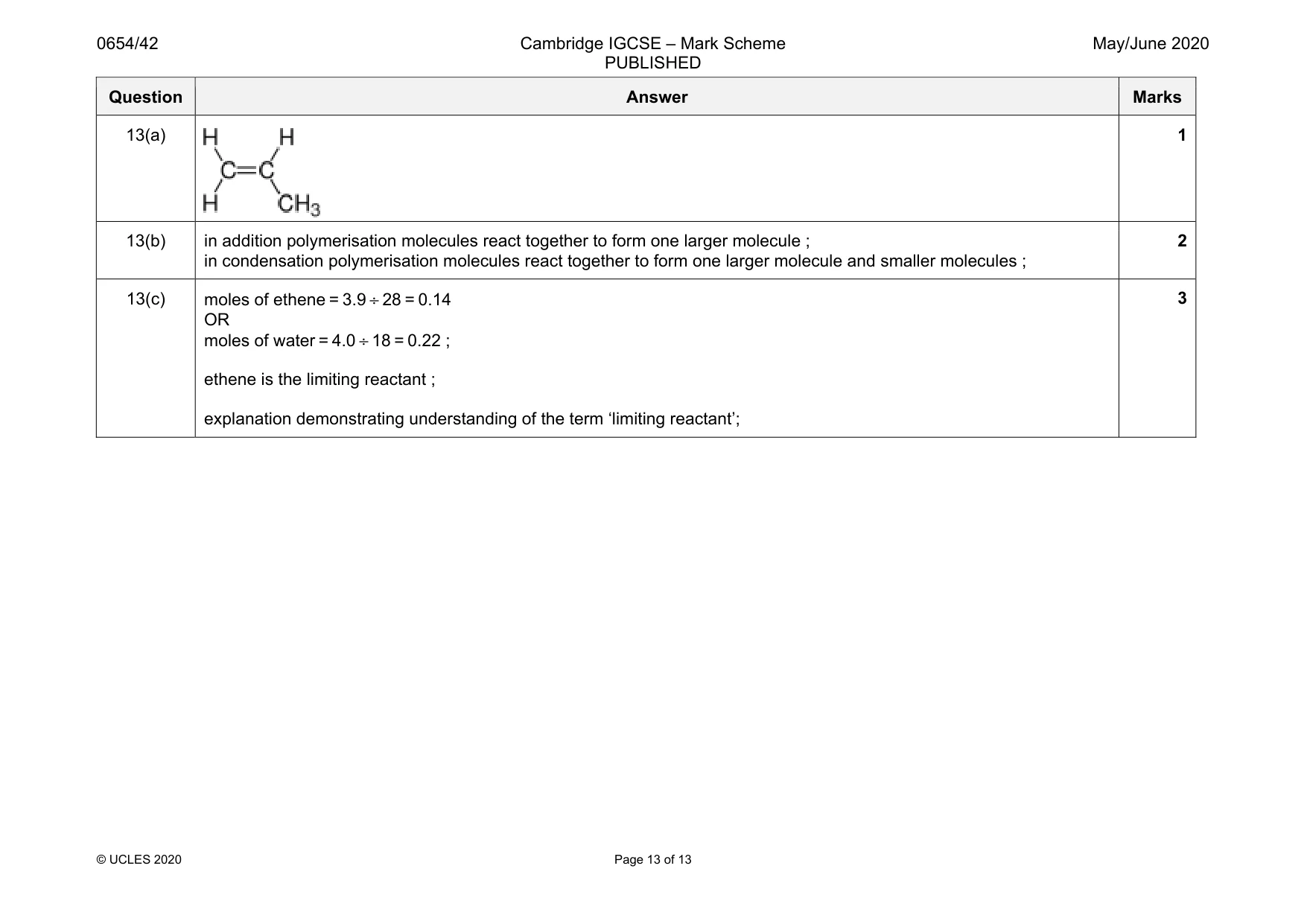
Mark scheme: 13(a) 1 13(b) in addition polymerisation molecules react together to form one larger molecule ; in condensation polymerisation molecules react together to form one larger molecule and smaller molecules ; 2 13(c) moles of ethene = 3.9 ÷ 28 = 0.14 OR moles of water = 4.0 ÷ 18 = 0.22 ; ethene is the limiting reactant ; explanation demonstrating understanding of the term ‘limiting reactant’; 3
What was in this paper
The subtopics covered by these 13 questions, and how many questions each got. Open one in a new tab to see every Cambridge question on it.