Cambridge IGCSE Sciences - Co-ordinated (Double) 0654 — 2025 May/June Paper 4 · Variant 1
0654/41/M/J/25 · 12 questions · 120 marks · 120 min
The question paper and its mark scheme, free to read here and free to download. This is Cambridge’s own paper, exactly as it was sat.
Question paper32 pages



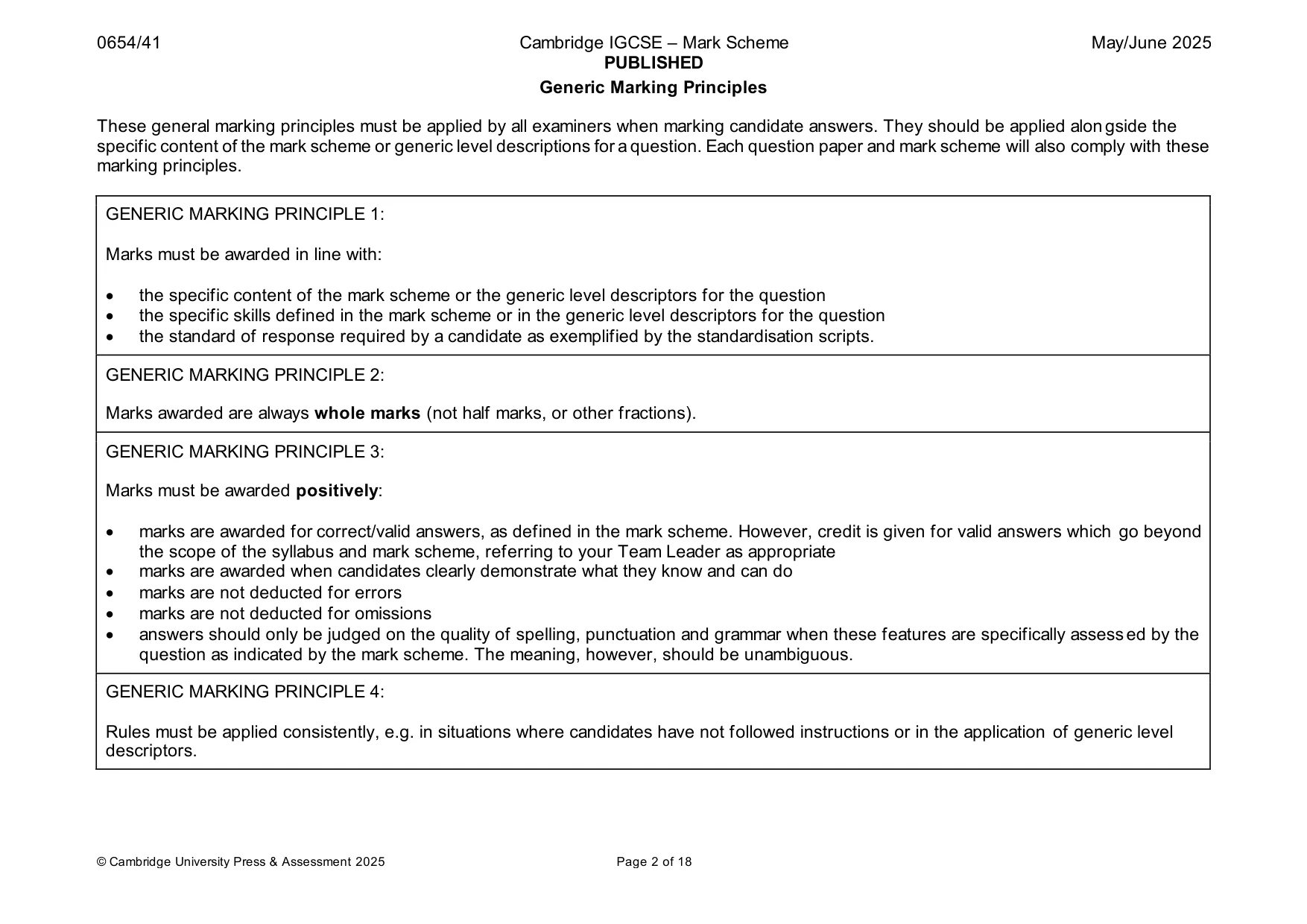
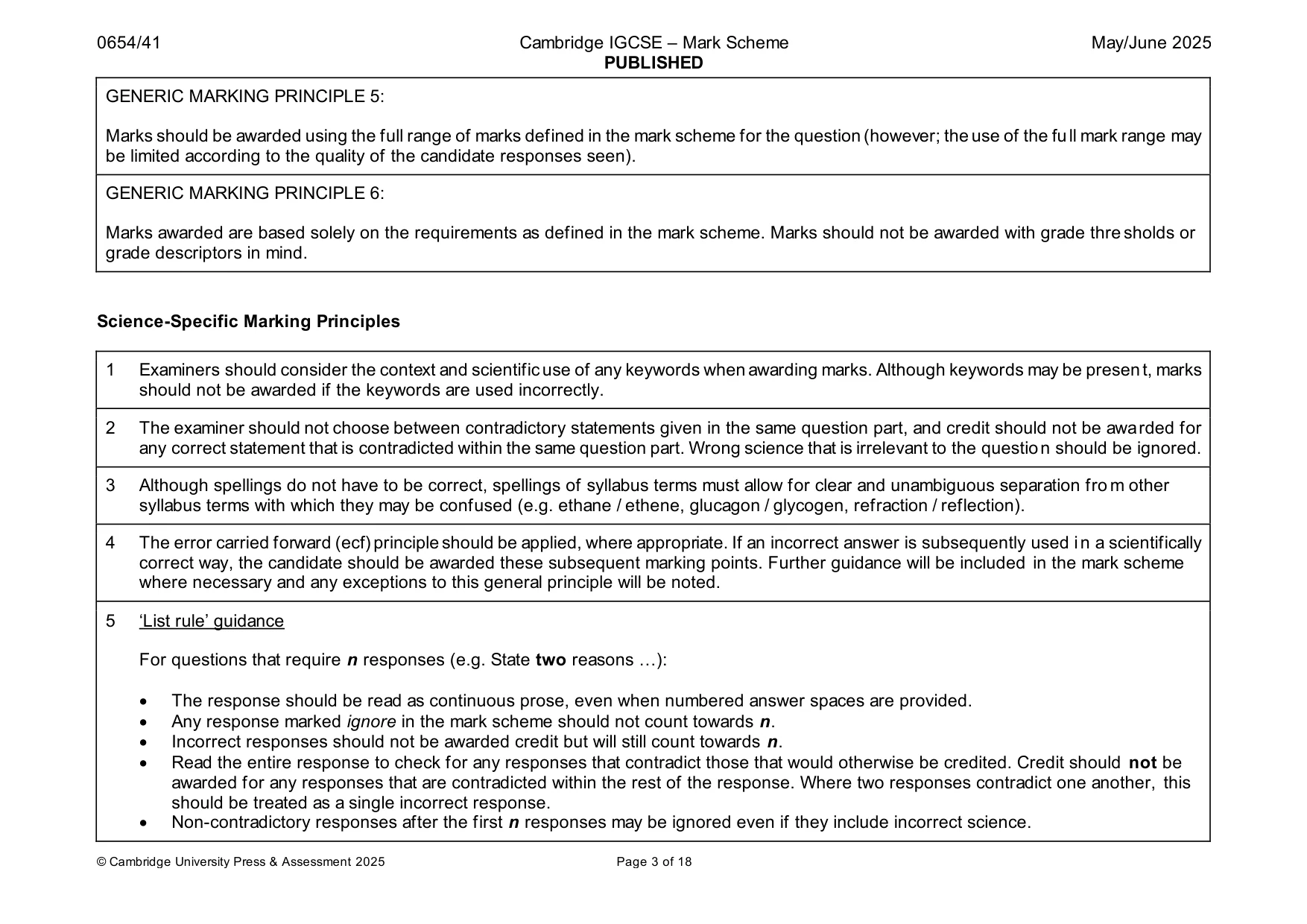
Mark scheme18 pages
Answers below. Sit the paper first if you are practising.
Questions as text
Q1 · Carbon dioxide is taken in for the process of photosynthesis
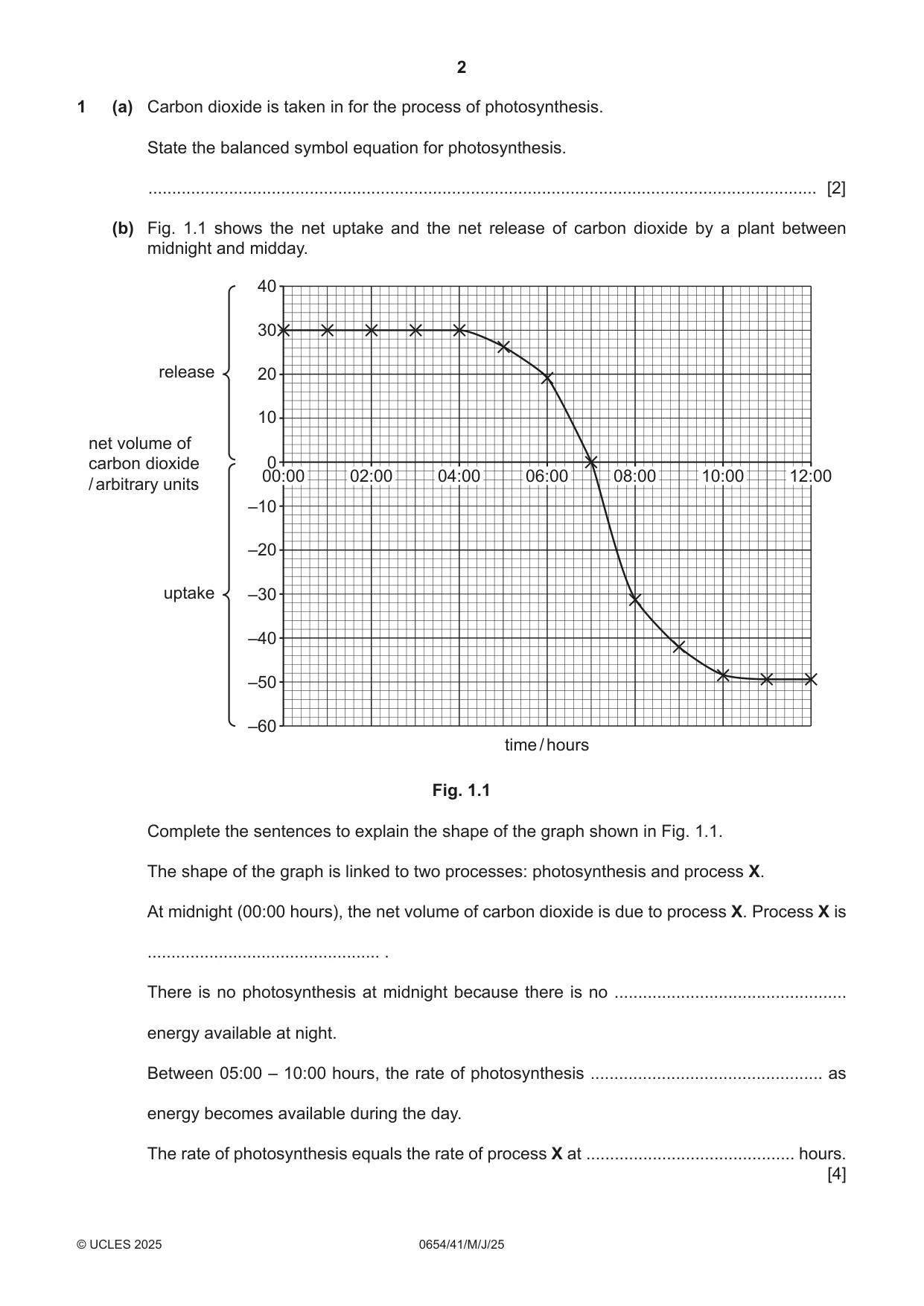
1 (a) Carbon dioxide is taken in for the process of photosynthesis. State the balanced symbol equation for photosynthesis. ............................................................................................................................................. [2] (b) Fig. 1.1 shows the net uptake and the net release of carbon dioxide by a plant between midnight and midday. 40 30 release 20 10 net volume of carbon dioxide 0 00:00 02:00 04:00 06:00 08:00 10:00 12:00 / arbitrary units –10 –20 uptake –30 –40 –50 –60 time / hours Fig. 1.1 Complete the sentences to explain the shape of the graph shown in Fig. 1.1. The shape of the graph is linked to two processes: photosynthesis and process X. At midnight (00:00 hours), the net volume of carbon dioxide is due to process X. Process X is ................................................. . There is no photosynthesis at midnight because there is no ................................................. energy available at night. Between 05:00 – 10:00 hours, the rate of photosynthesis ................................................. as energy becomes available during the day. The rate of photosynthesis equals the rate of process X at ............................................ hours. [4] (c) The uptake and release of carbon dioxide by the same plant is measured on a different day. On this day, the temperature is lower than the previous day. This time, the net volume of carbon dioxide uptake levels out at –40 arbitrary units. Enzymes are required for photosynthesis. Explain this difference in net volume of carbon dioxide uptake. ................................................................................................................................................... ................................................................................................................................................... ................................................................................................................................................... ................................................................................................................................................... ............................................................................................................................................. [3] [Total: 9]
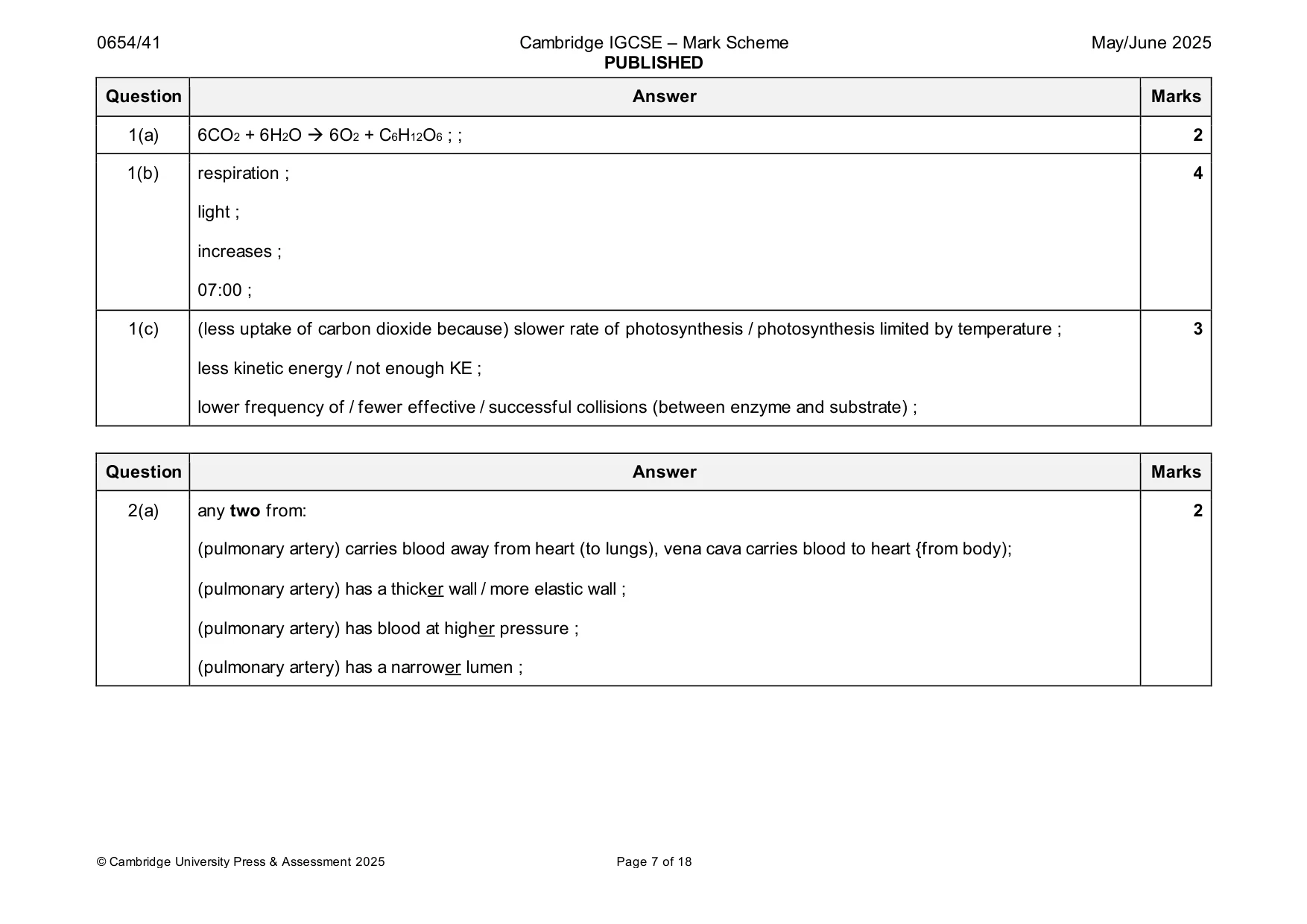
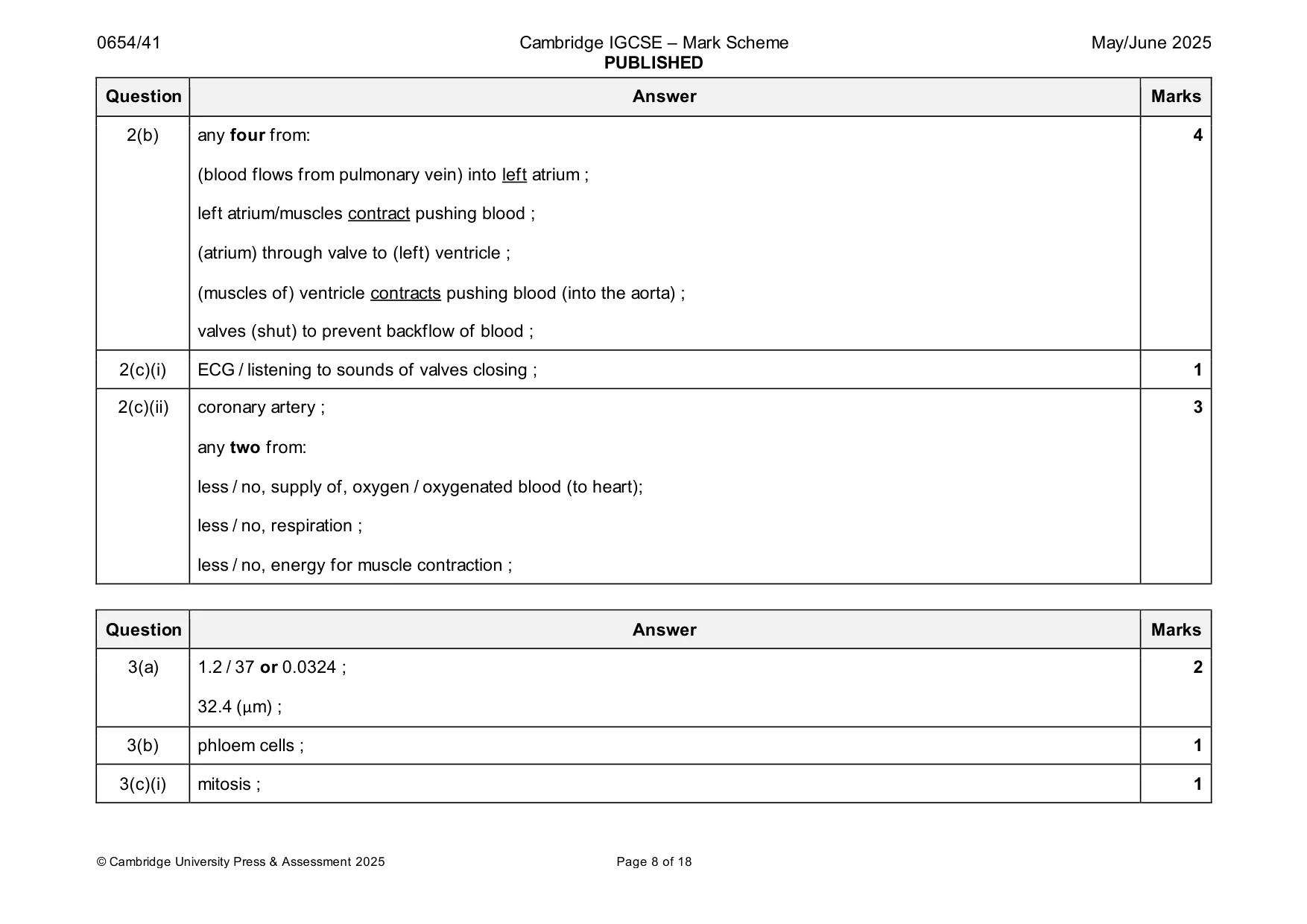
Mark scheme: Question Answer Marks 1(a) 6CO2 + 6H2O → 6O2 + C6H12O6 ; ; 2 1(b) respiration ; 4 light ; increases ; 07:00 ; 1(c) (less uptake of carbon dioxide because) slower rate of photosynthesis / photosynthesis limited by temperature ; 3 less kinetic energy / not enough KE ; lower frequency of / fewer effective / successful collisions (between enzyme and substrate) ;
Q2 · A diagram of the human heart and the blood vessels that connect with it
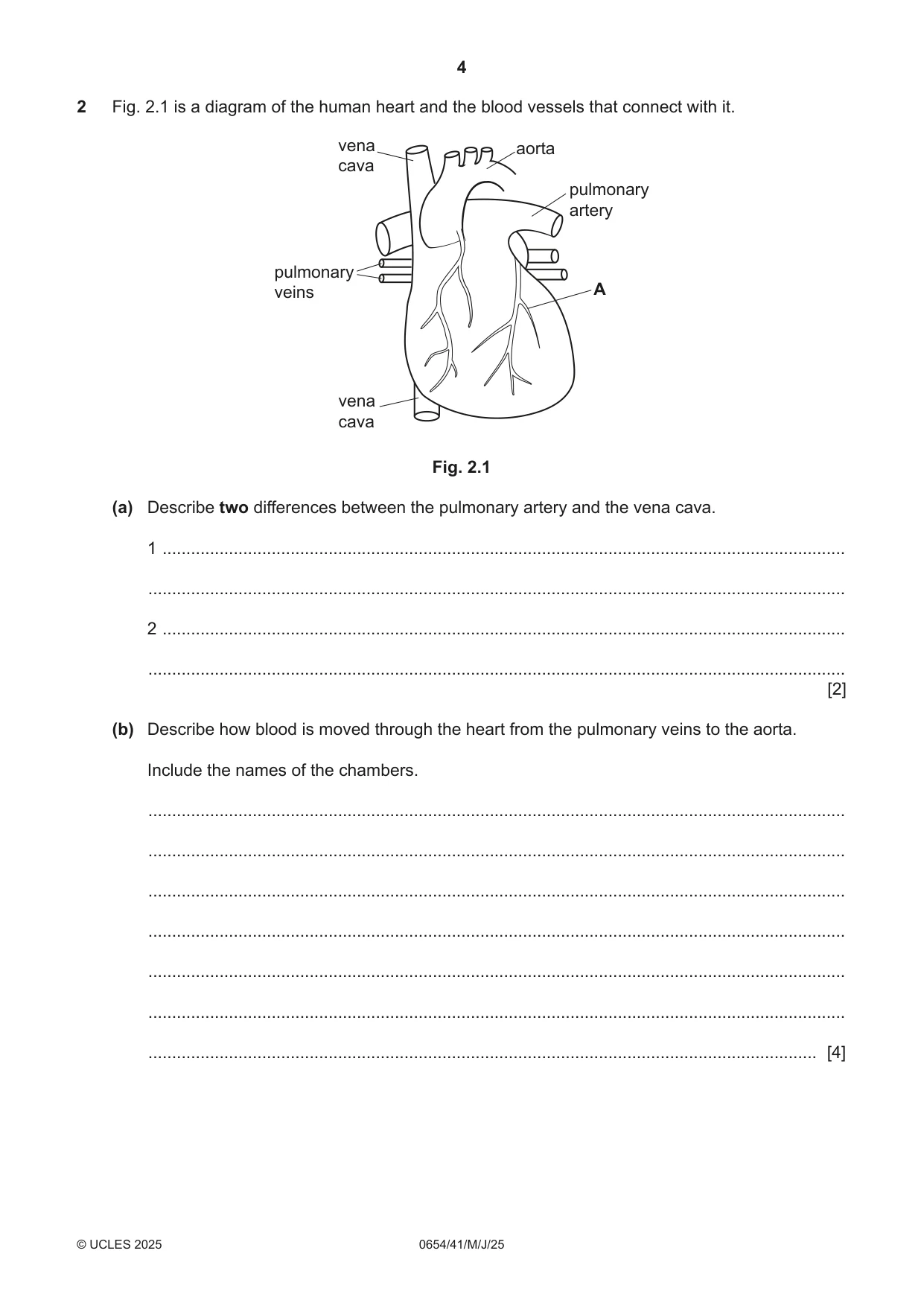
2 Fig. 2.1 is a diagram of the human heart and the blood vessels that connect with it. vena aorta cava pulmonary artery pulmonary veins A vena cava Fig. 2.1 (a) Describe two differences between the pulmonary artery and the vena cava. 1 ................................................................................................................................................ ................................................................................................................................................... 2 ................................................................................................................................................ ................................................................................................................................................... [2] (b) Describe how blood is moved through the heart from the pulmonary veins to the aorta. Include the names of the chambers. ................................................................................................................................................... ................................................................................................................................................... ................................................................................................................................................... ................................................................................................................................................... ................................................................................................................................................... ................................................................................................................................................... ............................................................................................................................................. [4] (c) A patient has a problem with his heart. (i) The doctor takes the patient’s pulse rate. State one other way doctors monitor the activity of the heart. ..................................................................................................................................... [1] (ii) The doctor thinks the blood vessel labelled A in Fig. 2.1 is blocked. Explain why this causes a problem with the function of the heart. Include the name of blood vessel A in your answer. ........................................................................................................................................... ........................................................................................................................................... ........................................................................................................................................... ........................................................................................................................................... ..................................................................................................................................... [3] [Total: 10]
Mark scheme: 2(a) any two from: 2 (pulmonary artery) carries blood away from heart (to lungs), vena cava carries blood to heart {from body); (pulmonary artery) has a thicker wall / more elastic wall ; (pulmonary artery) has blood at higher pressure ; (pulmonary artery) has a narrower lumen ; 2(b) any four from: 4 (blood flows from pulmonary vein) into left atrium ; left atrium/muscles contract pushing blood ; (atrium) through valve to (left) ventricle ; (muscles of) ventricle contracts pushing blood (into the aorta) ; valves (shut) to prevent backflow of blood ; 2(c)(i) ECG / listening to sounds of valves closing ; 1 2(c)(ii) coronary artery ; 3 any two from: less / no, supply of, oxygen / oxygenated blood (to heart); less / no, respiration ; less / no, energy for muscle contraction ;
Q3 · A magnified image of a plant root tip viewed using a light microscope
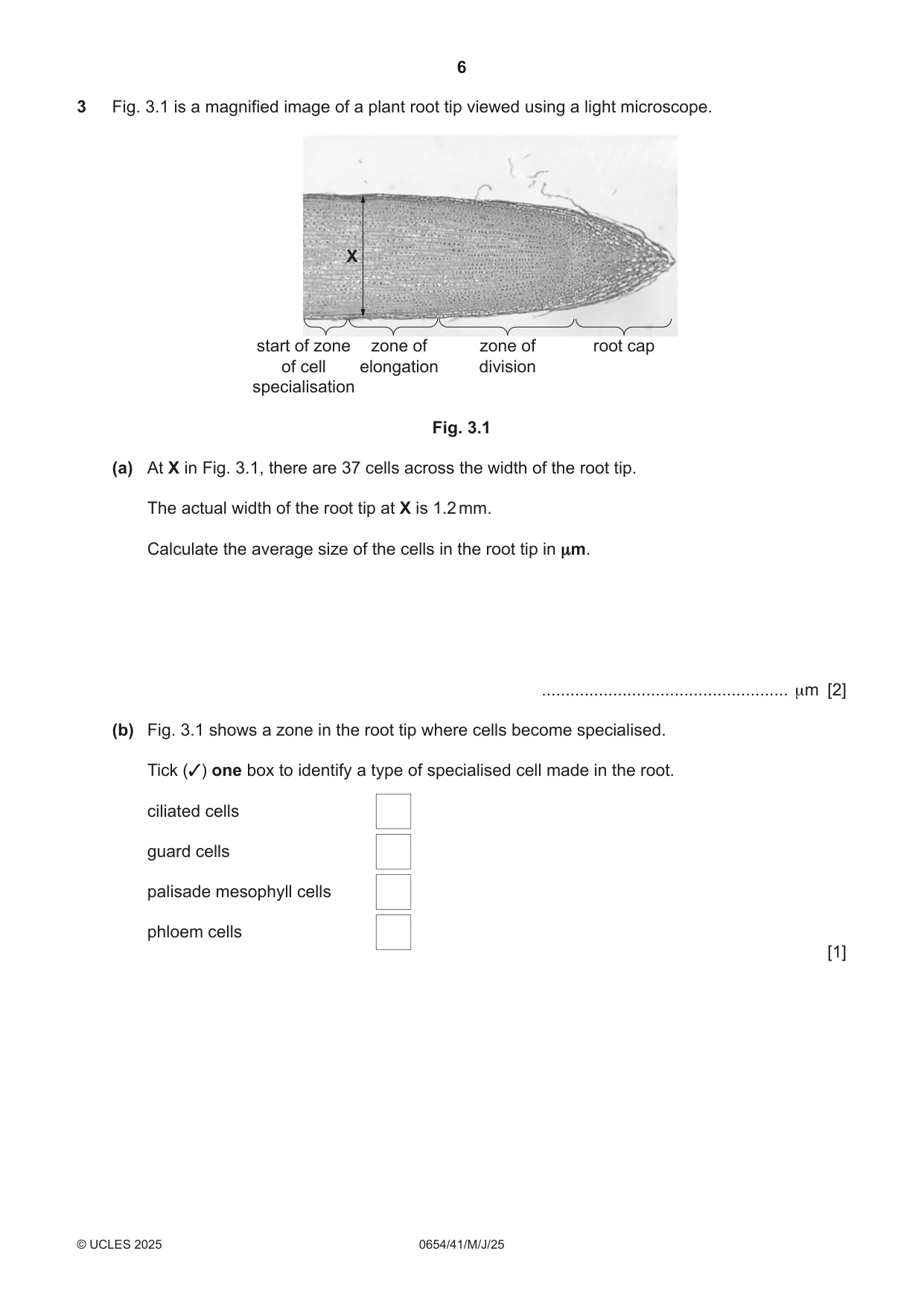
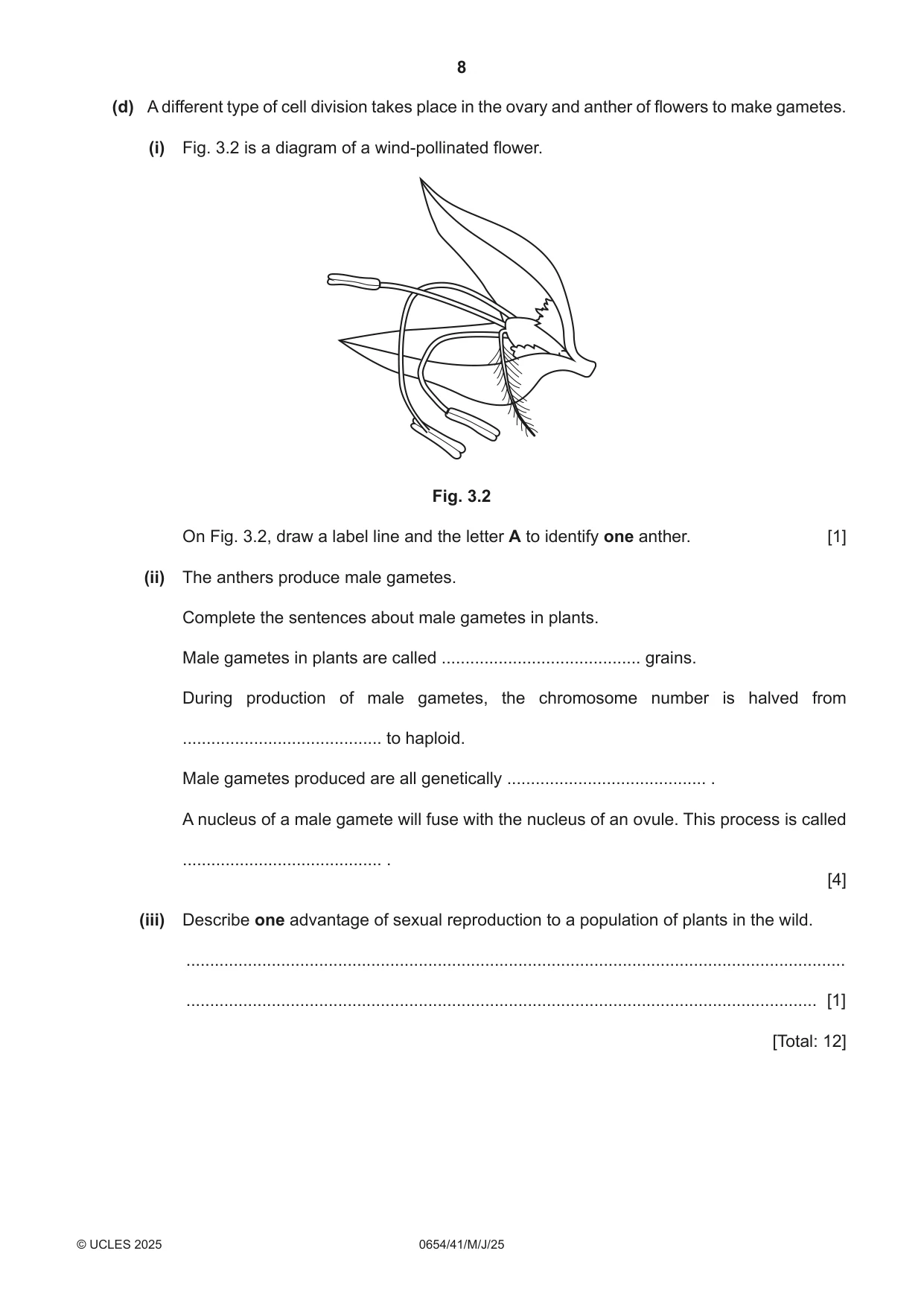
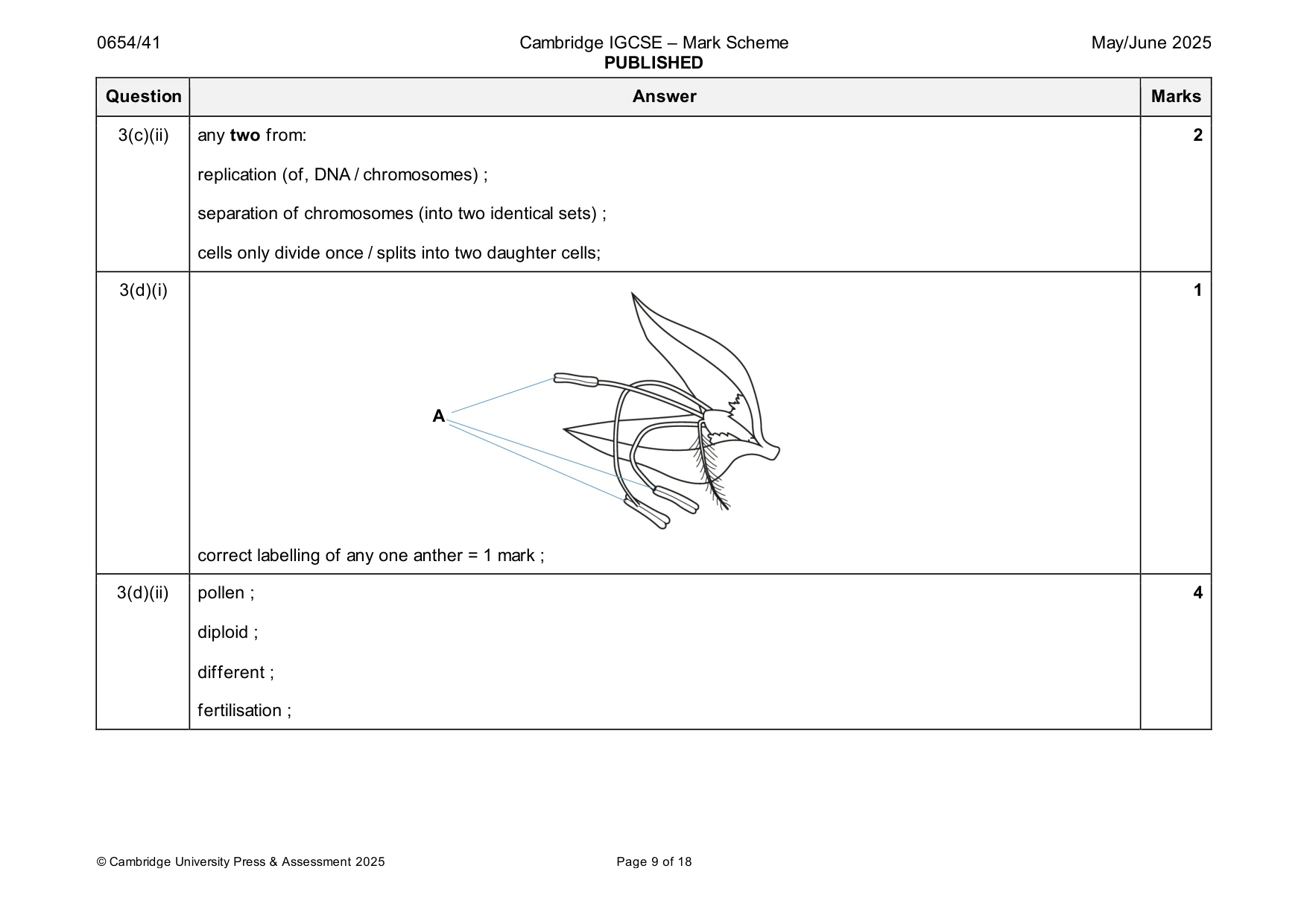
3 Fig. 3.1 is a magnified image of a plant root tip viewed using a light microscope. X start of zone zone of zone of root cap of cell elongation division specialisation Fig. 3.1 (a) At X in Fig. 3.1, there are 37 cells across the width of the root tip. The actual width of the root tip at X is 1.2 mm. Calculate the average size of the cells in the root tip in μm. .................................................... μm [2] (b) Fig. 3.1 shows a zone in the root tip where cells become specialised. Tick (3) one box to identify a type of specialised cell made in the root. ciliated cells guard cells palisade mesophyll cells phloem cells [1] (c) Fig. 3.1 shows a zone in the root tip where cells divide so the root can grow. (i) State the type of cell division needed for growth. ..................................................................................................................................... [1] (ii) During this type of cell division, the number of chromosomes is maintained in each daughter cell. Describe two processes in cell division that ensure that the chromosome number is maintained. 1 ........................................................................................................................................ ........................................................................................................................................... 2 ........................................................................................................................................ ........................................................................................................................................... [2] (d) A different type of cell division takes place in the ovary and anther of flowers to make gametes. (i) Fig. 3.2 is a diagram of a wind-pollinated flower. Fig. 3.2 On Fig. 3.2, draw a label line and the letter A to identify one anther. [1] (ii) The anthers produce male gametes. Complete the sentences about male gametes in plants. Male gametes in plants are called .......................................... grains. During production of male gametes, the chromosome number is halved from .......................................... to haploid. Male gametes produced are all genetically .......................................... . A nucleus of a male gamete will fuse with the nucleus of an ovule. This process is called .......................................... . [4] (iii) Describe one advantage of sexual reproduction to a population of plants in the wild. ........................................................................................................................................... ..................................................................................................................................... [1] [Total: 12]
Mark scheme: 3(a) 1.2 / 37 or 0.0324 ; 2 32.4 (μm) ; 3(b) phloem cells ; 1 3(c)(i) mitosis ; 1 3(c)(ii) any two from: 2 replication (of, DNA / chromosomes) ; separation of chromosomes (into two identical sets) ; cells only divide once / splits into two daughter cells; 3(d)(i) 1 A correct labelling of any one anther = 1 mark ; 3(d)(ii) pollen ; 4 diploid ; different ; fertilisation ; 3(d)(iii) any one from: 1 produces (genetic) variation ; able to adapt to change in environment ; spreads offspring through dispersal of pollen / seeds ;
Q4 · Tropical forests are some of the most important ecosystems in the world
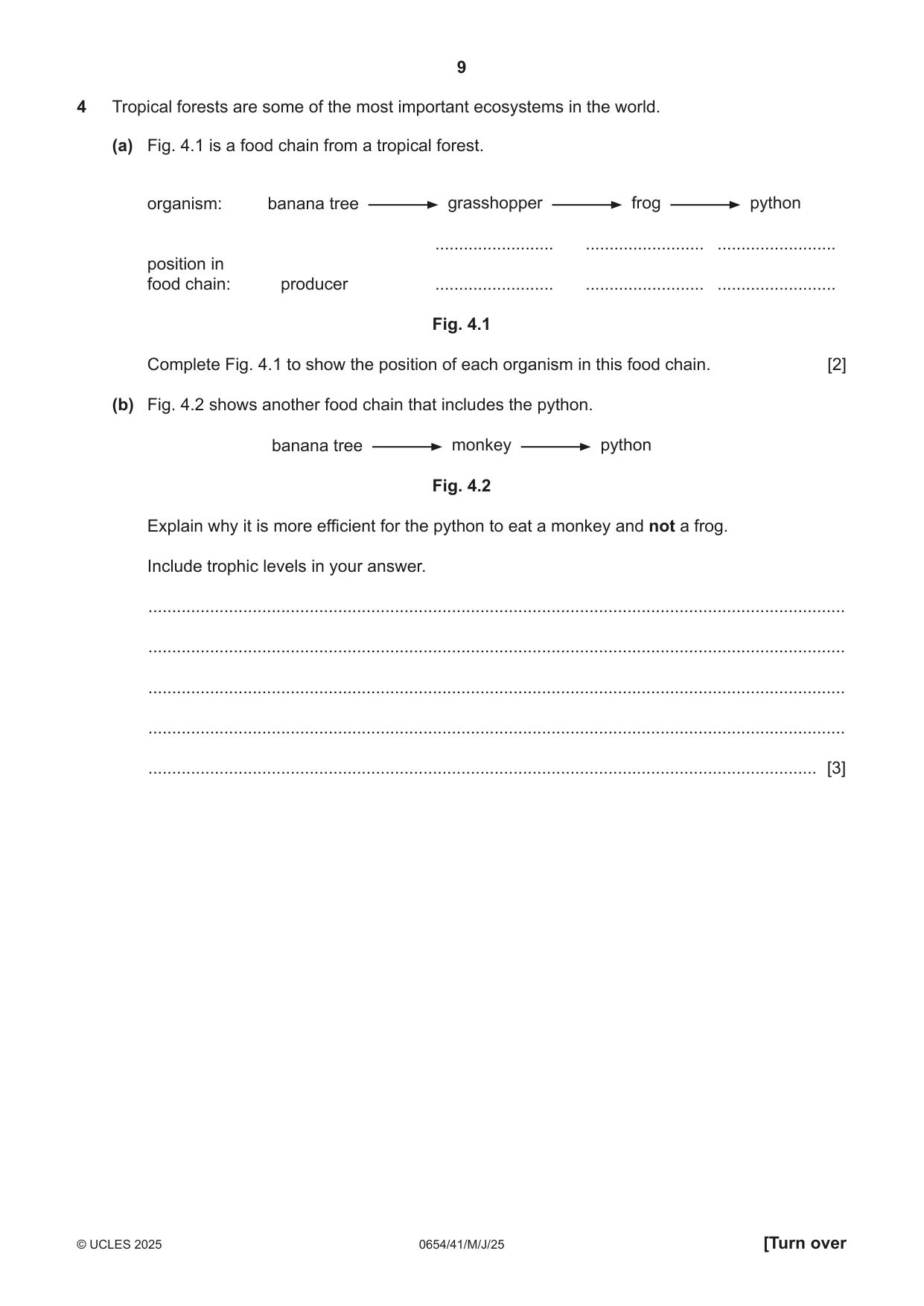
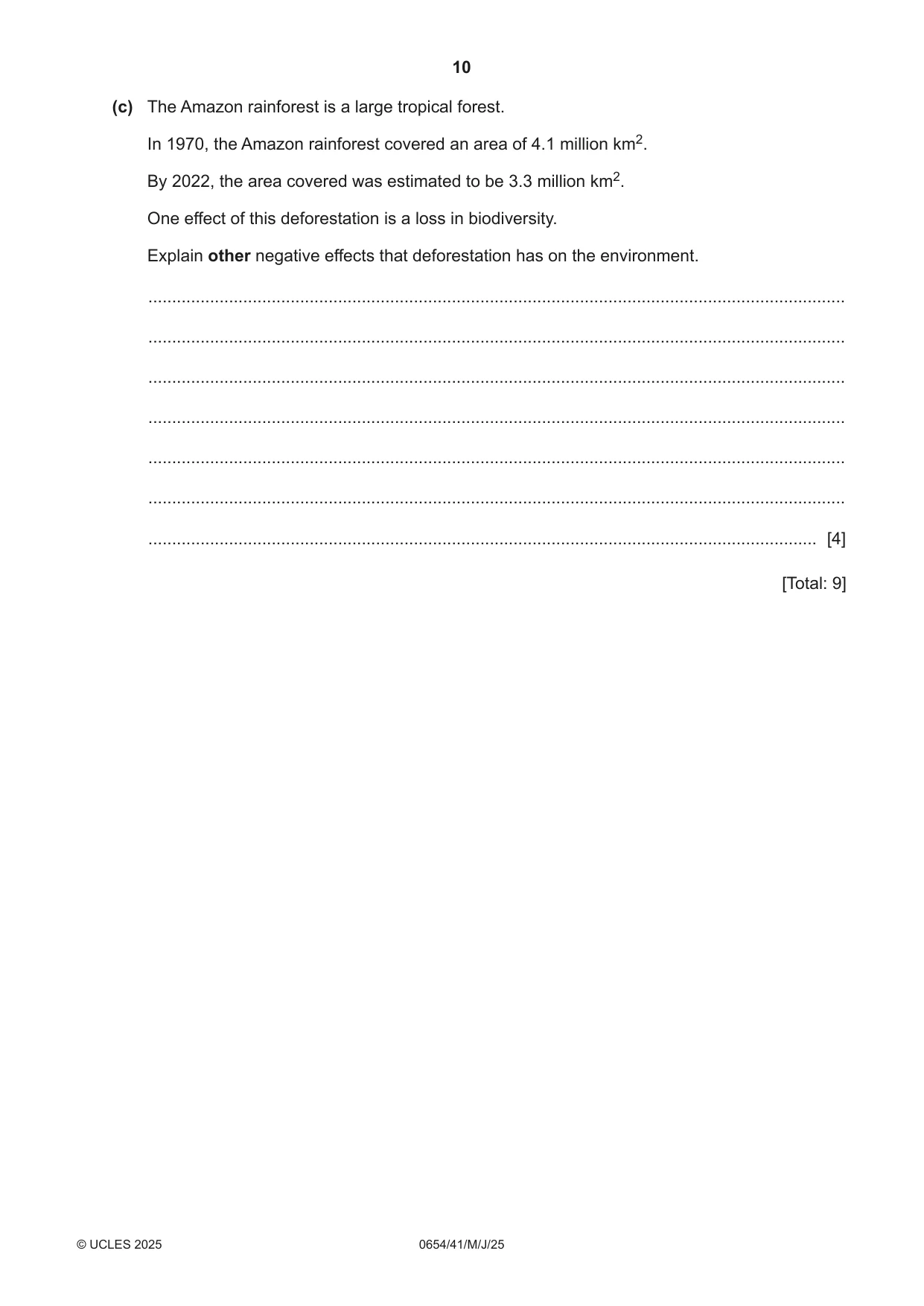
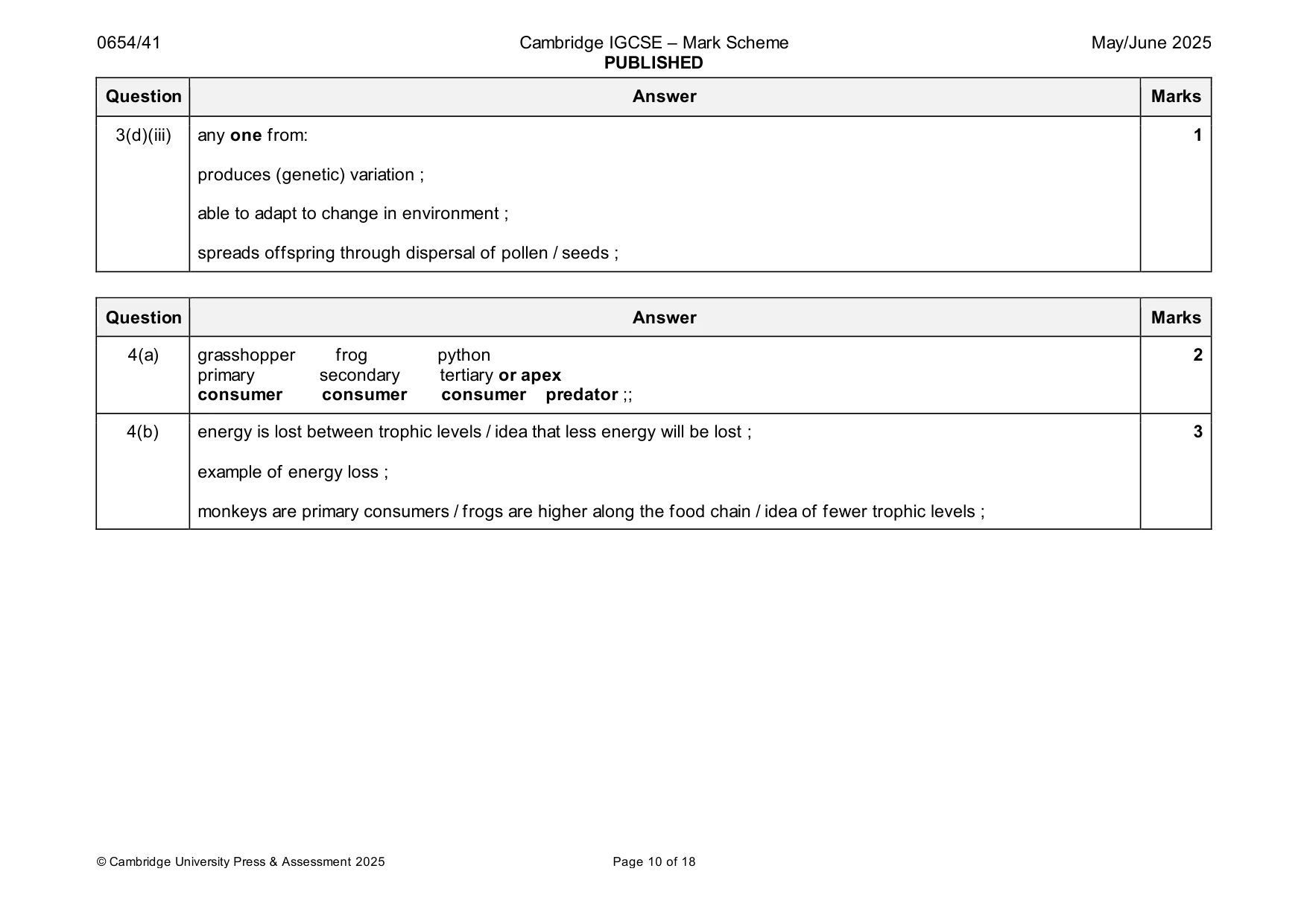
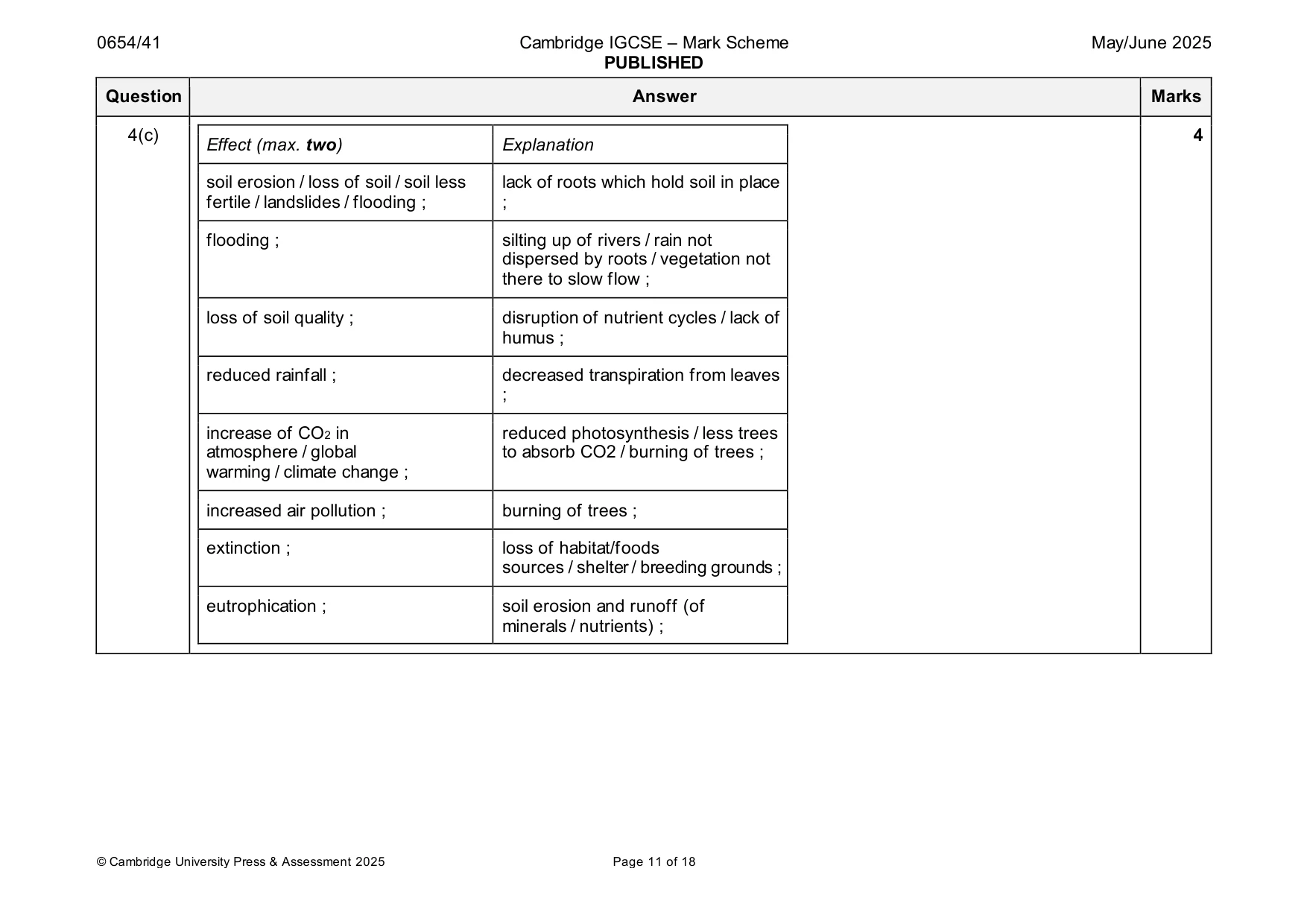
4 Tropical forests are some of the most important ecosystems in the world. (a) Fig. 4.1 is a food chain from a tropical forest. organism: banana tree grasshopper frog python ......................... ......................... ......................... position in food chain: producer ......................... ......................... ......................... Fig. 4.1 Complete Fig. 4.1 to show the position of each organism in this food chain. [2] (b) Fig. 4.2 shows another food chain that includes the python. banana tree monkey python Fig. 4.2 Explain why it is more efficient for the python to eat a monkey and not a frog. Include trophic levels in your answer. ................................................................................................................................................... ................................................................................................................................................... ................................................................................................................................................... ................................................................................................................................................... ............................................................................................................................................. [3] (c) The Amazon rainforest is a large tropical forest. In 1970, the Amazon rainforest covered an area of 4.1 million km2. By 2022, the area covered was estimated to be 3.3 million km2. One effect of this deforestation is a loss in biodiversity. Explain other negative effects that deforestation has on the environment. ................................................................................................................................................... ................................................................................................................................................... ................................................................................................................................................... ................................................................................................................................................... ................................................................................................................................................... ................................................................................................................................................... ............................................................................................................................................. [4] [Total: 9]
Mark scheme: 4(a) grasshopper frog python 2 primary secondary tertiary or apex consumer consumer consumer predator ;; 4(b) energy is lost between trophic levels / idea that less energy will be lost ; 3 example of energy loss ; monkeys are primary consumers / frogs are higher along the food chain / idea of fewer trophic levels ; 4(c) 4 Effect (max. two) Explanation soil erosion / loss of soil / soil less lack of roots which hold soil in place fertile / landslides / flooding ; ; flooding ; silting up of rivers / rain not dispersed by roots / vegetation not there to slow flow ; loss of soil quality ; disruption of nutrient cycles / lack of humus ; reduced rainfall ; decreased transpiration from leaves ; increase of CO2 in reduced photosynthesis / less trees atmosphere / global to absorb CO2 / burning of trees ; warming / climate change ; increased air pollution ; burning of trees ; extinction ; loss of habitat/foods sources / shelter / breeding grounds ; eutrophication ; soil erosion and runoff (of minerals / nutrients) ;
Q5 · Water exists in the solid, liquid or gas state
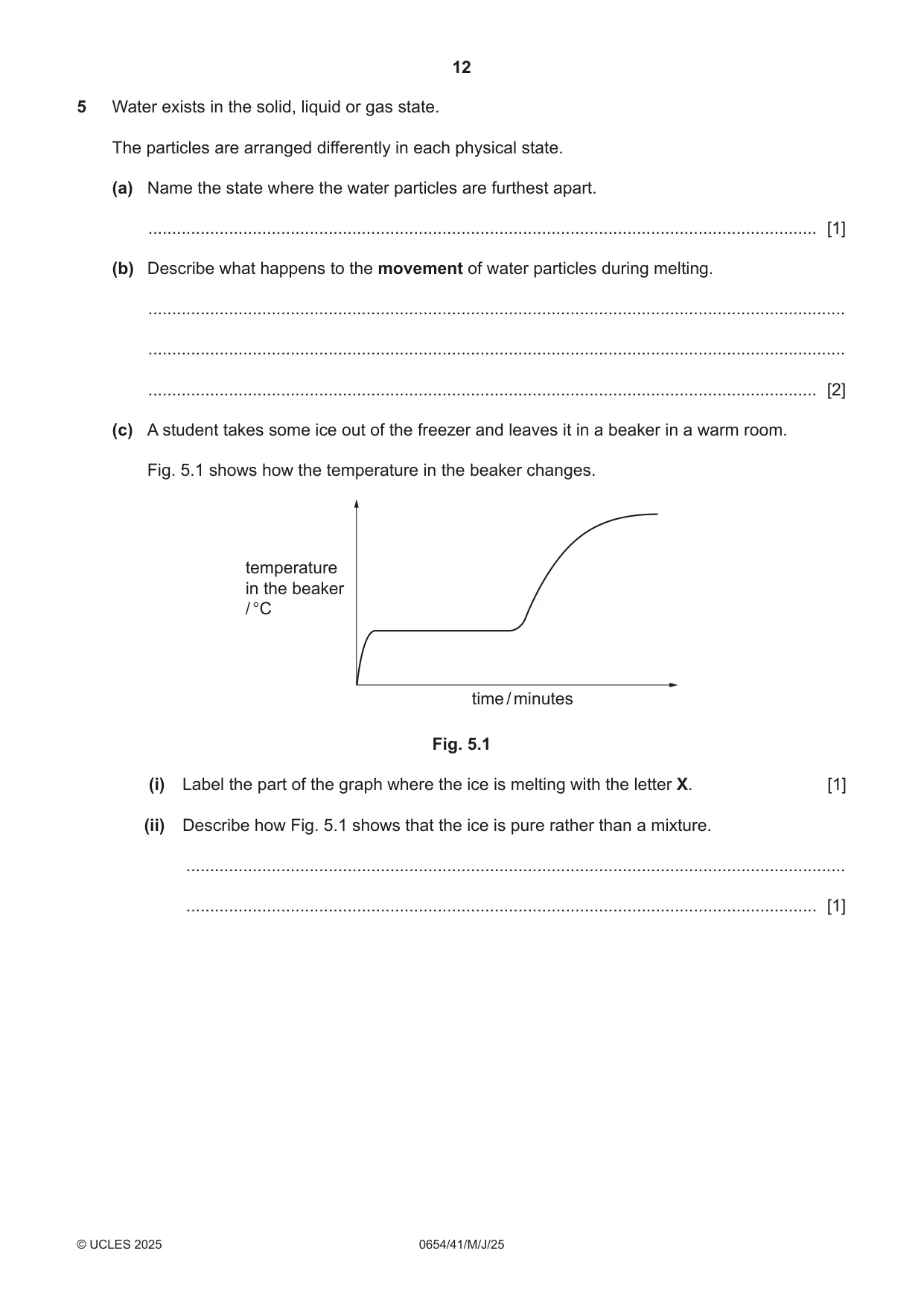
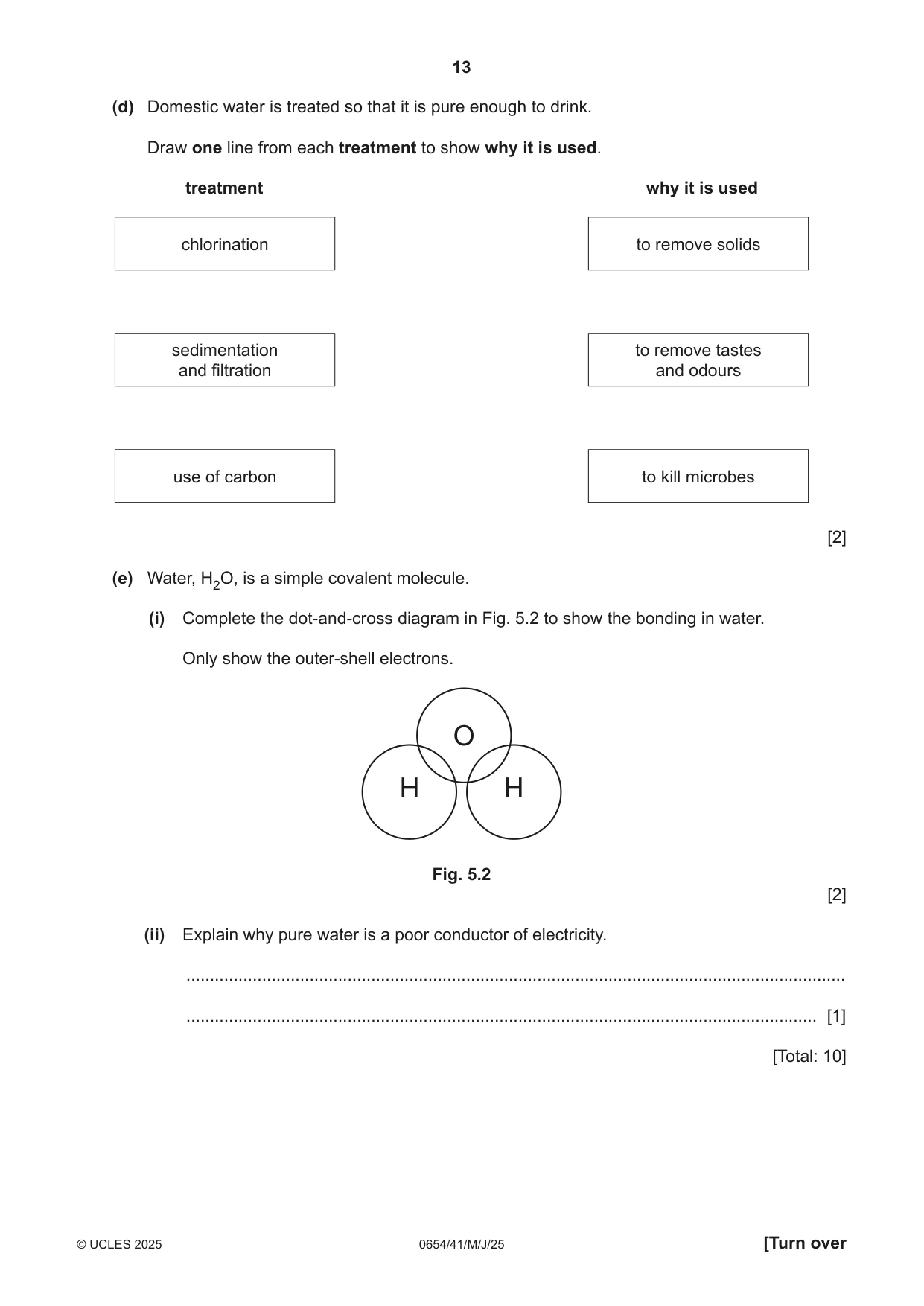
5 Water exists in the solid, liquid or gas state. The particles are arranged differently in each physical state. (a) Name the state where the water particles are furthest apart. ............................................................................................................................................. [1] (b) Describe what happens to the movement of water particles during melting. ................................................................................................................................................... ................................................................................................................................................... ............................................................................................................................................. [2] (c) A student takes some ice out of the freezer and leaves it in a beaker in a warm room. Fig. 5.1 shows how the temperature in the beaker changes. temperature in the beaker / °C time / minutes Fig. 5.1 (i) Label the part of the graph where the ice is melting with the letter X. [1] (ii) Describe how Fig. 5.1 shows that the ice is pure rather than a mixture. ........................................................................................................................................... ..................................................................................................................................... [1] (d) Domestic water is treated so that it is pure enough to drink. Draw one line from each treatment to show why it is used. treatment why it is used chlorination to remove solids sedimentation to remove tastes and filtration and odours use of carbon to kill microbes [2] (e) Water, H2O, is a simple covalent molecule. (i) Complete the dot-and-cross diagram in Fig. 5.2 to show the bonding in water. Only show the outer-shell electrons. O H H Fig. 5.2 [2] (ii) Explain why pure water is a poor conductor of electricity. ........................................................................................................................................... ..................................................................................................................................... [1] [Total: 10]
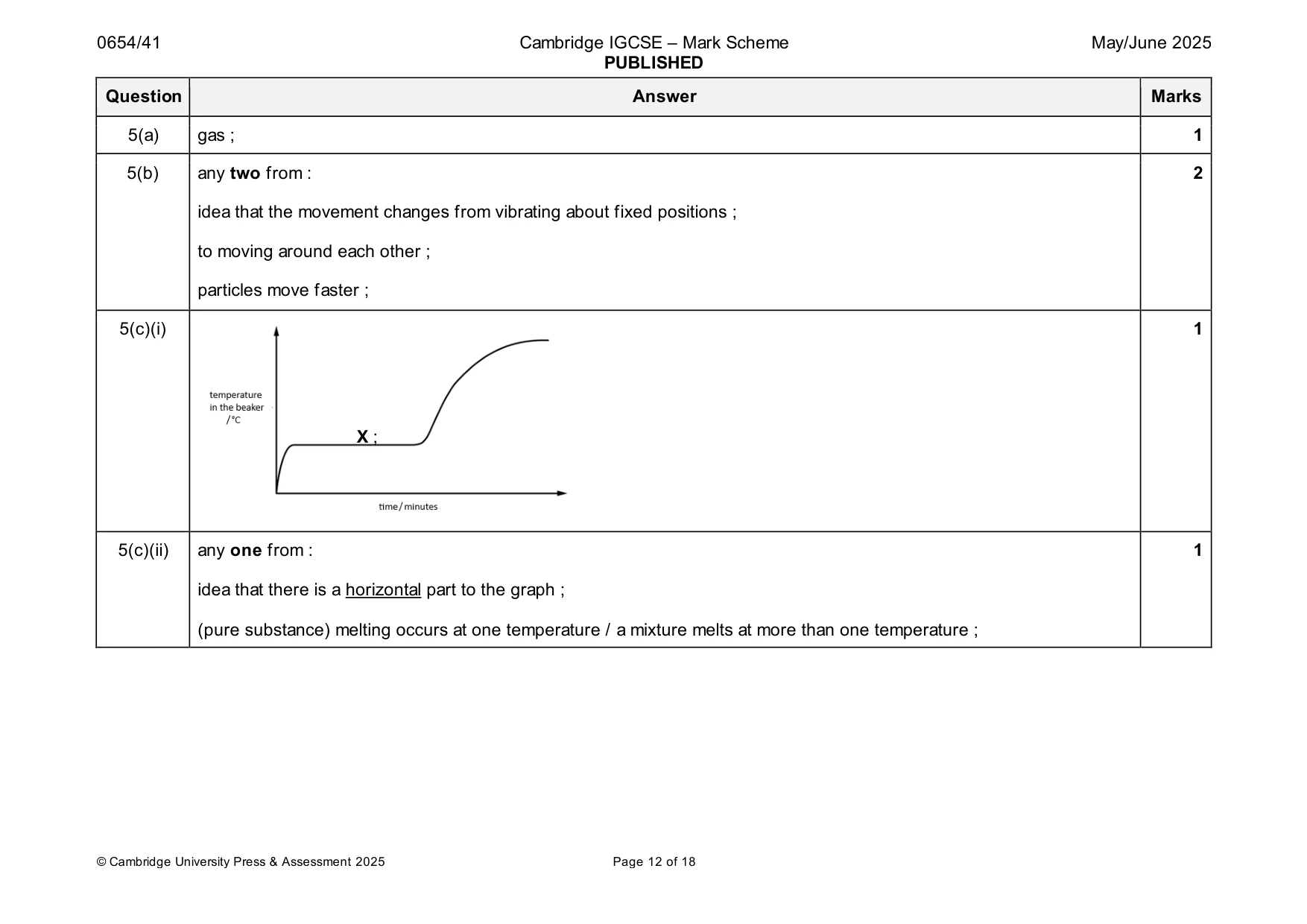
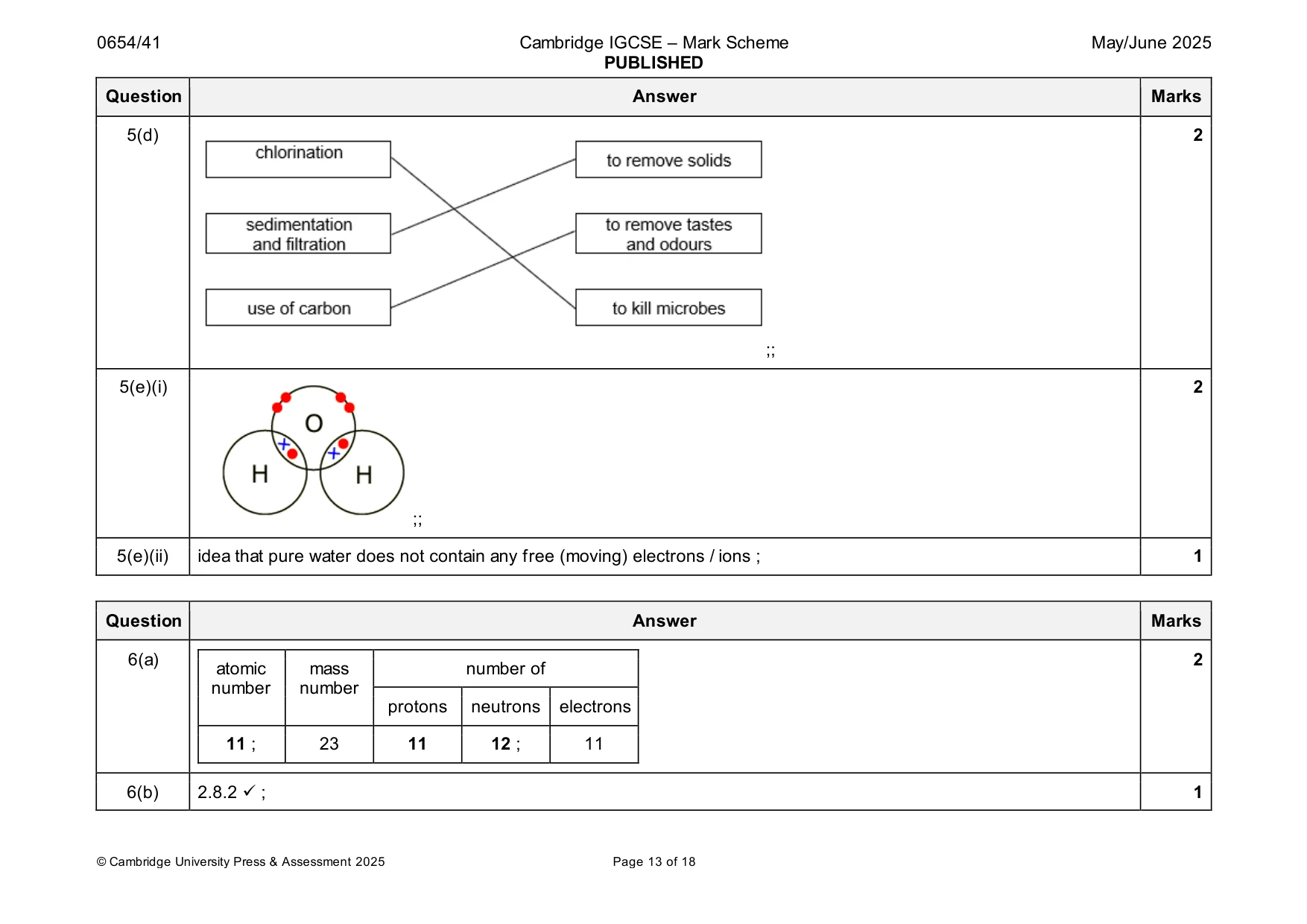
Mark scheme: 5(a) gas ; 1 5(b) any two from : 2 idea that the movement changes from vibrating about fixed positions ; to moving around each other ; particles move faster ; 5(c)(i) 1 X ; 5(c)(ii) any one from : 1 idea that there is a horizontal part to the graph ; (pure substance) melting occurs at one temperature / a mixture melts at more than one temperature ; 5(d) 2 ;; 5(e)(i) 2 ;; 5(e)(ii) idea that pure water does not contain any free (moving) electrons / ions ; 1
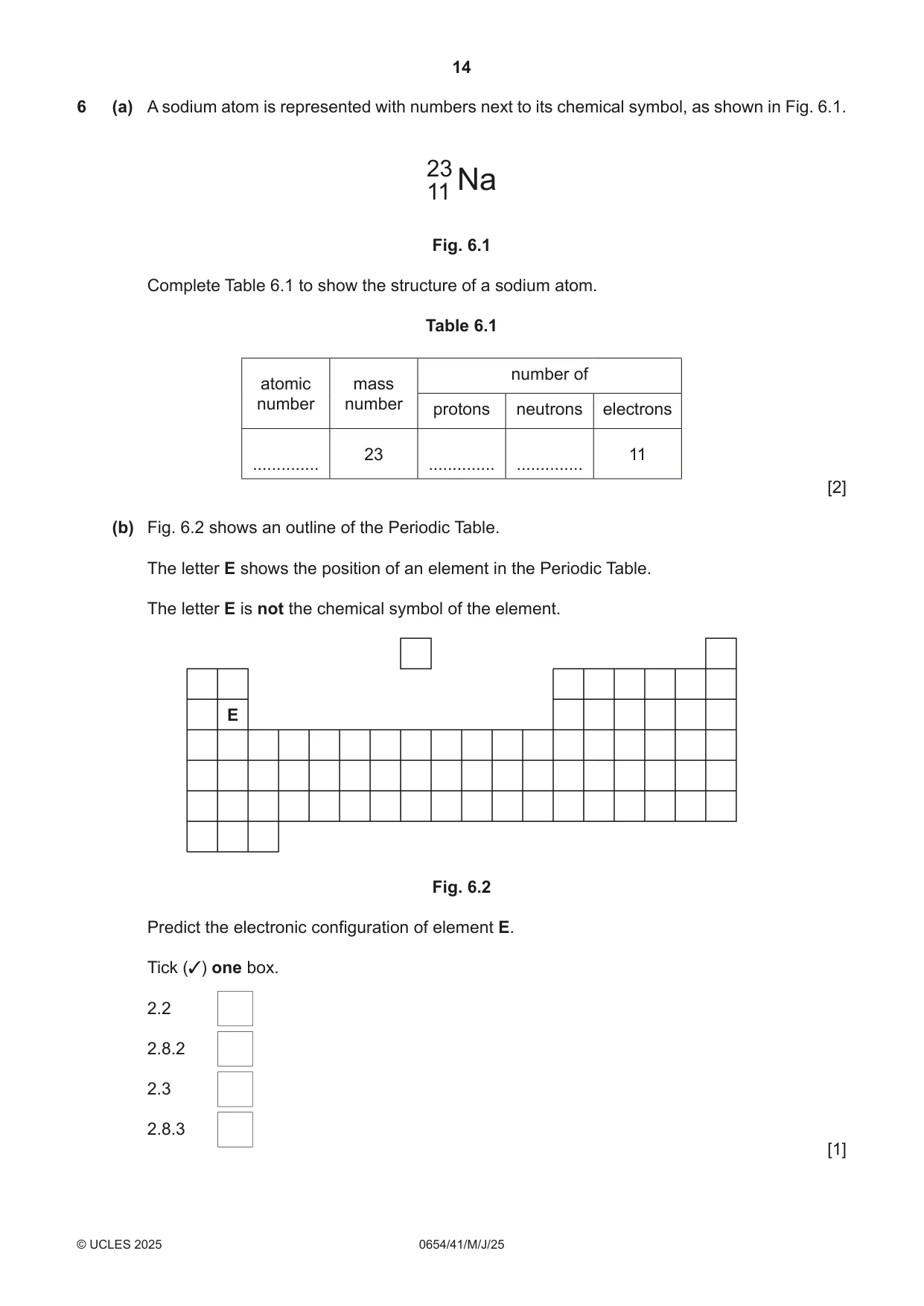
Q6 · A sodium atom is represented with numbers next to its chemical symbol, as shown in Fig
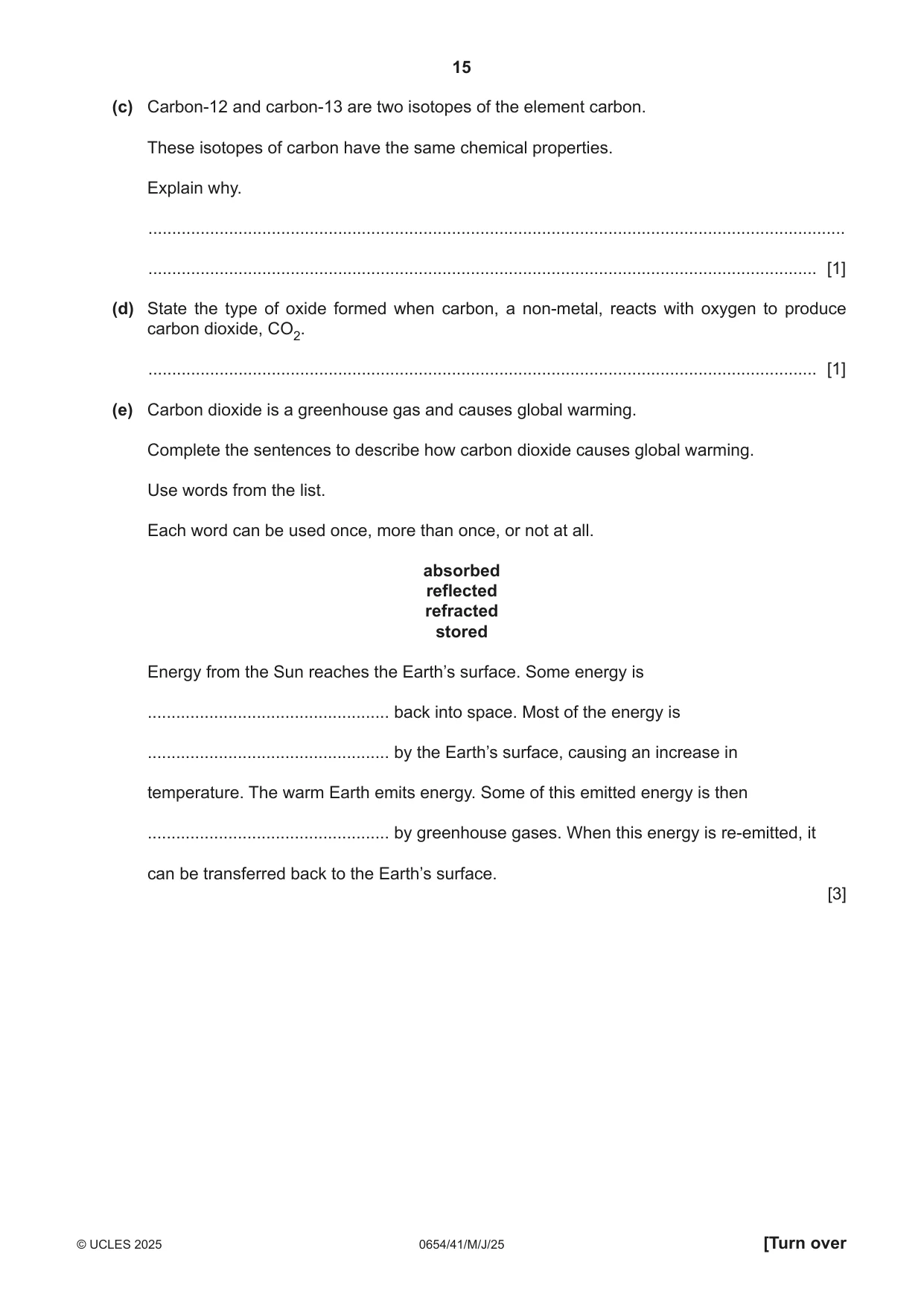
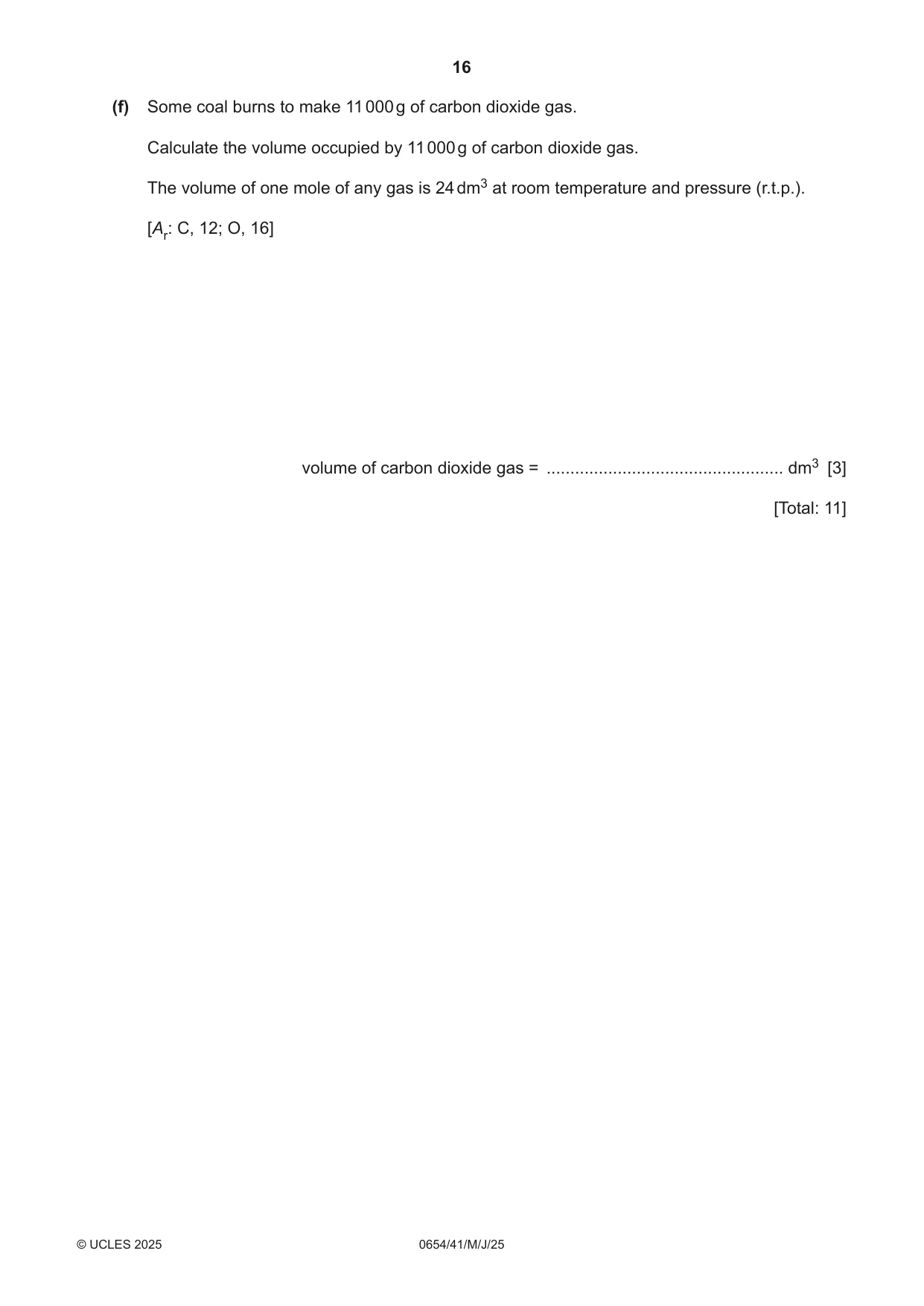
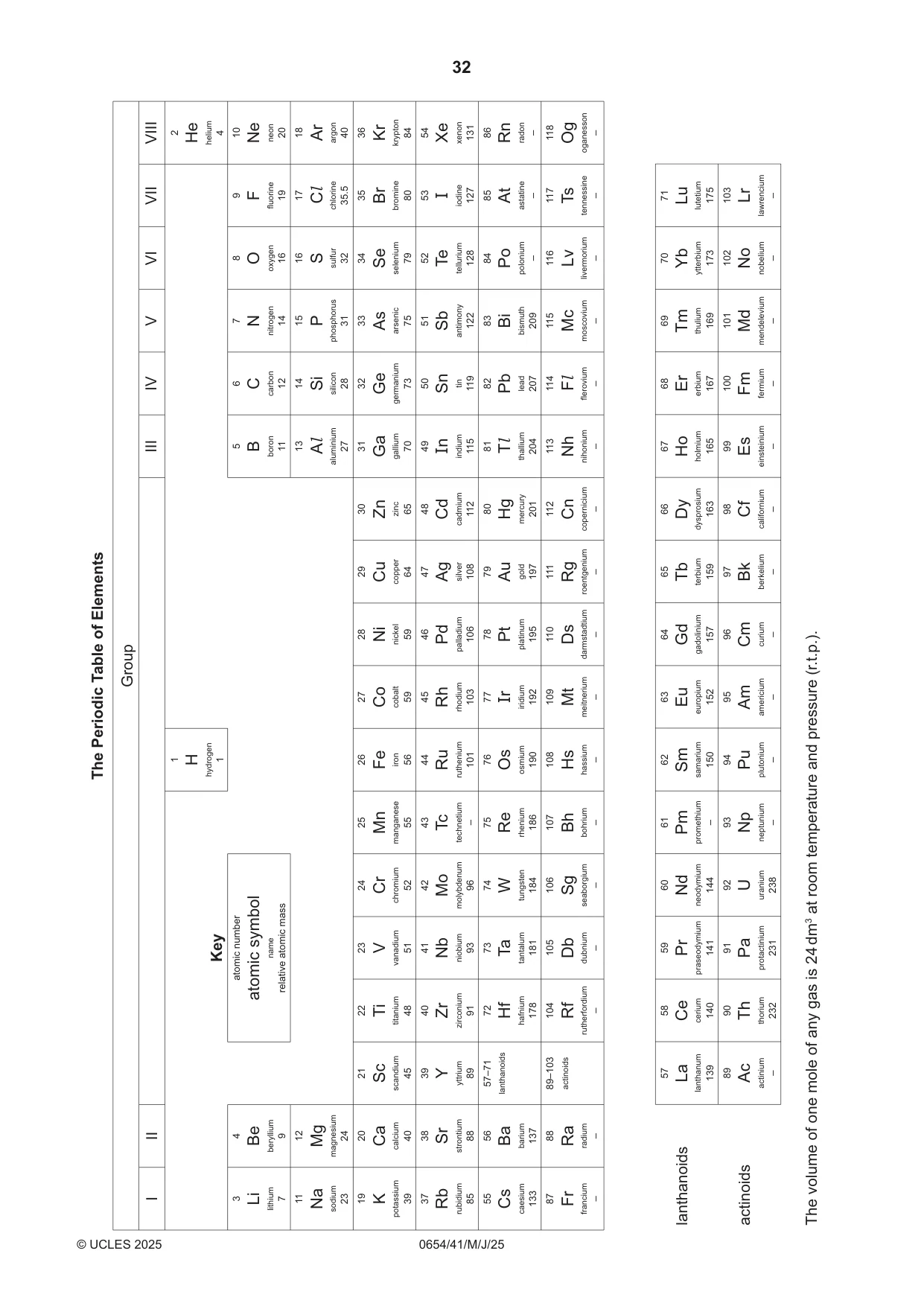
6 (a) A sodium atom is represented with numbers next to its chemical symbol, as shown in Fig. 6.1. 23 Na 11 Fig. 6.1 Complete Table 6.1 to show the structure of a sodium atom. Table 6.1 number of atomic mass number number protons neutrons electrons 23 11 .............. .............. .............. [2] (b) Fig. 6.2 shows an outline of the Periodic Table. The letter E shows the position of an element in the Periodic Table. The letter E is not the chemical symbol of the element. E Fig. 6.2 Predict the electronic configuration of element E. Tick (3) one box. 2.2 2.8.2 2.3 2.8.3 [1] (c) Carbon-12 and carbon-13 are two isotopes of the element carbon. These isotopes of carbon have the same chemical properties. Explain why. ................................................................................................................................................... ............................................................................................................................................. [1] (d) State the type of oxide formed when carbon, a non-metal, reacts with oxygen to produce carbon dioxide, CO2. ............................................................................................................................................. [1] (e) Carbon dioxide is a greenhouse gas and causes global warming. Complete the sentences to describe how carbon dioxide causes global warming. Use words from the list. Each word can be used once, more than once, or not at all. absorbed reflected refracted stored Energy from the Sun reaches the Earth’s surface. Some energy is ................................................... back into space. Most of the energy is ................................................... by the Earth’s surface, causing an increase in temperature. The warm Earth emits energy. Some of this emitted energy is then ................................................... by greenhouse gases. When this energy is re-emitted, it can be transferred back to the Earth’s surface. [3] (f) Some coal burns to make 11 000 g of carbon dioxide gas. Calculate the volume occupied by 11 000 g of carbon dioxide gas. The volume of one mole of any gas is 24 dm3 at room temperature and pressure (r.t.p.). [Ar: C, 12; O, 16] volume of carbon dioxide gas = .................................................. dm3 [3] [Total: 11]
Mark scheme: 6(a) 2 atomic mass number of number number protons neutrons electrons 11 ; 23 11 12 ; 11 6(b) 2.8.2 ✓ ; 1 6(c) (the isotopes have) the same number of electrons / 1 the same electronic configuration ; 6(d) acidic (oxide) ; 1 6(e) reflected ; 3 absorbed ; absorbed / stored ; 6(f) Mr of CO2 = 44 ; 3 moles of CO2 = 11000 44 = 250 ; volume of CO2 = 250 24 = 6000 dm³ ;
Q7 · The metal iron is extracted from hematite in a blast furnace
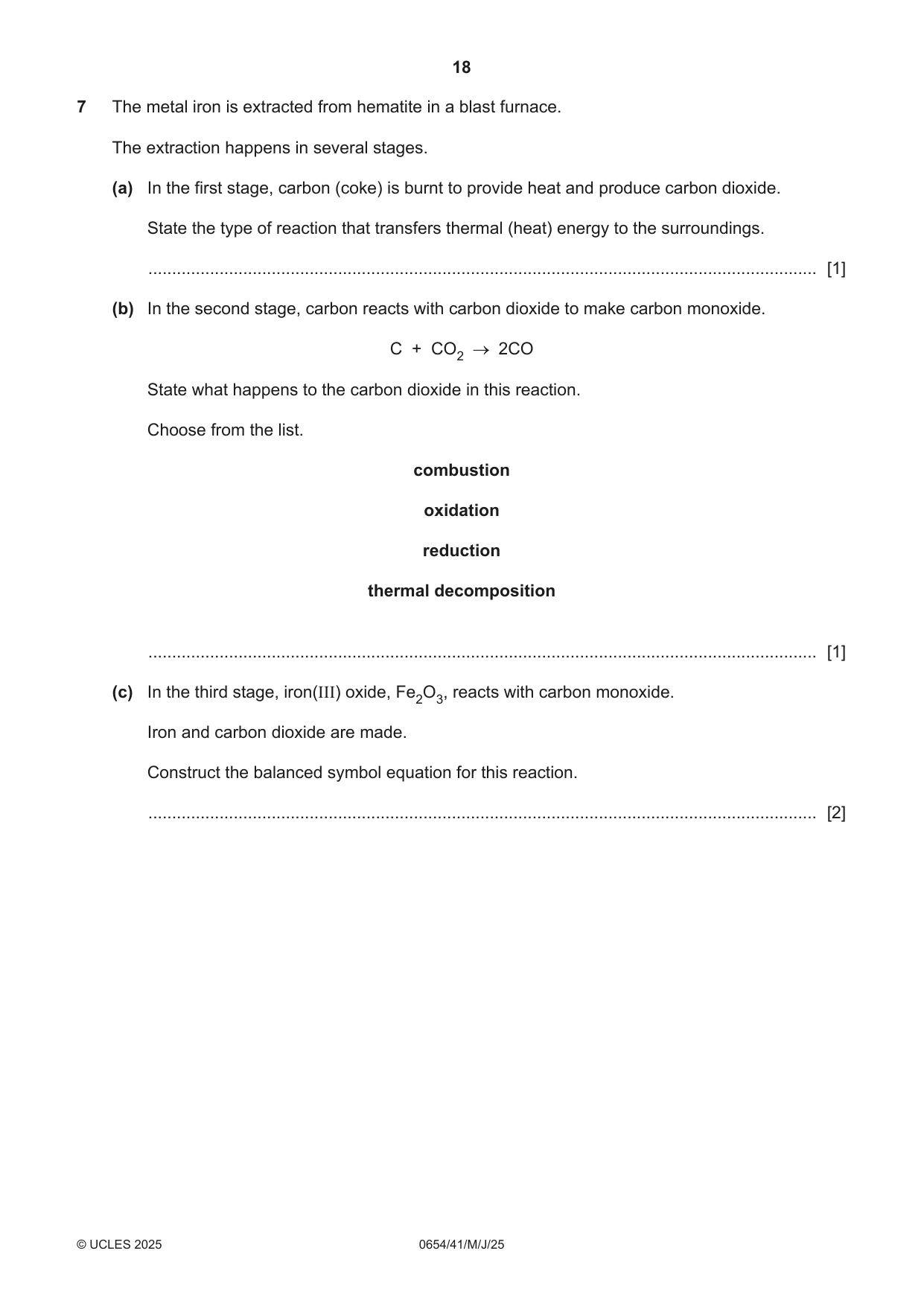
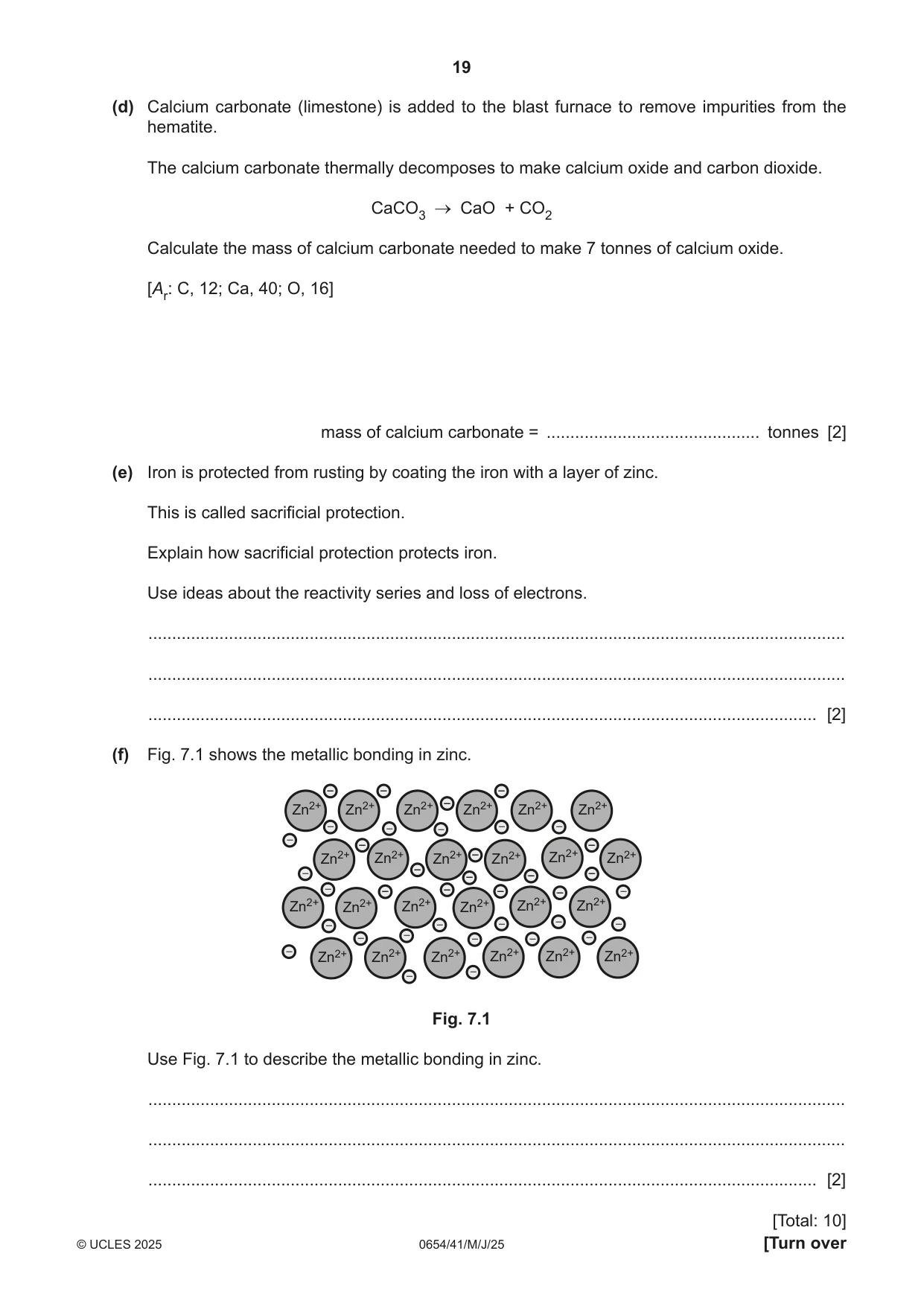
7 The metal iron is extracted from hematite in a blast furnace. The extraction happens in several stages. (a) In the first stage, carbon (coke) is burnt to provide heat and produce carbon dioxide. State the type of reaction that transfers thermal (heat) energy to the surroundings. ............................................................................................................................................. [1] (b) In the second stage, carbon reacts with carbon dioxide to make carbon monoxide. C + CO2 2CO State what happens to the carbon dioxide in this reaction. Choose from the list. combustion oxidation reduction thermal decomposition ............................................................................................................................................. [1] (c) In the third stage, iron(III) oxide, Fe2O3, reacts with carbon monoxide. Iron and carbon dioxide are made. Construct the balanced symbol equation for this reaction. ............................................................................................................................................. [2] (d) Calcium carbonate (limestone) is added to the blast furnace to remove impurities from the hematite. The calcium carbonate thermally decomposes to make calcium oxide and carbon dioxide. CaCO3 CaO + CO2 Calculate the mass of calcium carbonate needed to make 7 tonnes of calcium oxide. [Ar: C, 12; Ca, 40; O, 16] mass of calcium carbonate = ............................................. tonnes [2] (e) Iron is protected from rusting by coating the iron with a layer of zinc. This is called sacrificial protection. Explain how sacrificial protection protects iron. Use ideas about the reactivity series and loss of electrons. ................................................................................................................................................... ................................................................................................................................................... ............................................................................................................................................. [2] (f) Fig. 7.1 shows the metallic bonding in zinc. – – – Zn2+ Zn2+ Zn2+ – Zn2+ Zn2+ Zn2+ – – – – – – – – Zn2+ Zn2+ Zn2+ – Zn2+ Zn2+ Zn2+ – – – – – – – – – – – Zn2+ Zn2+ Zn2+ Zn2+ Zn2+ Zn2+ – – – – – – – – – – – Zn2+ Zn2+ Zn2+ Zn2+ Zn2+ Zn2+ – – Fig. 7.1 Use Fig. 7.1 to describe the metallic bonding in zinc. ................................................................................................................................................... ................................................................................................................................................... ............................................................................................................................................. [2] [Total: 10]
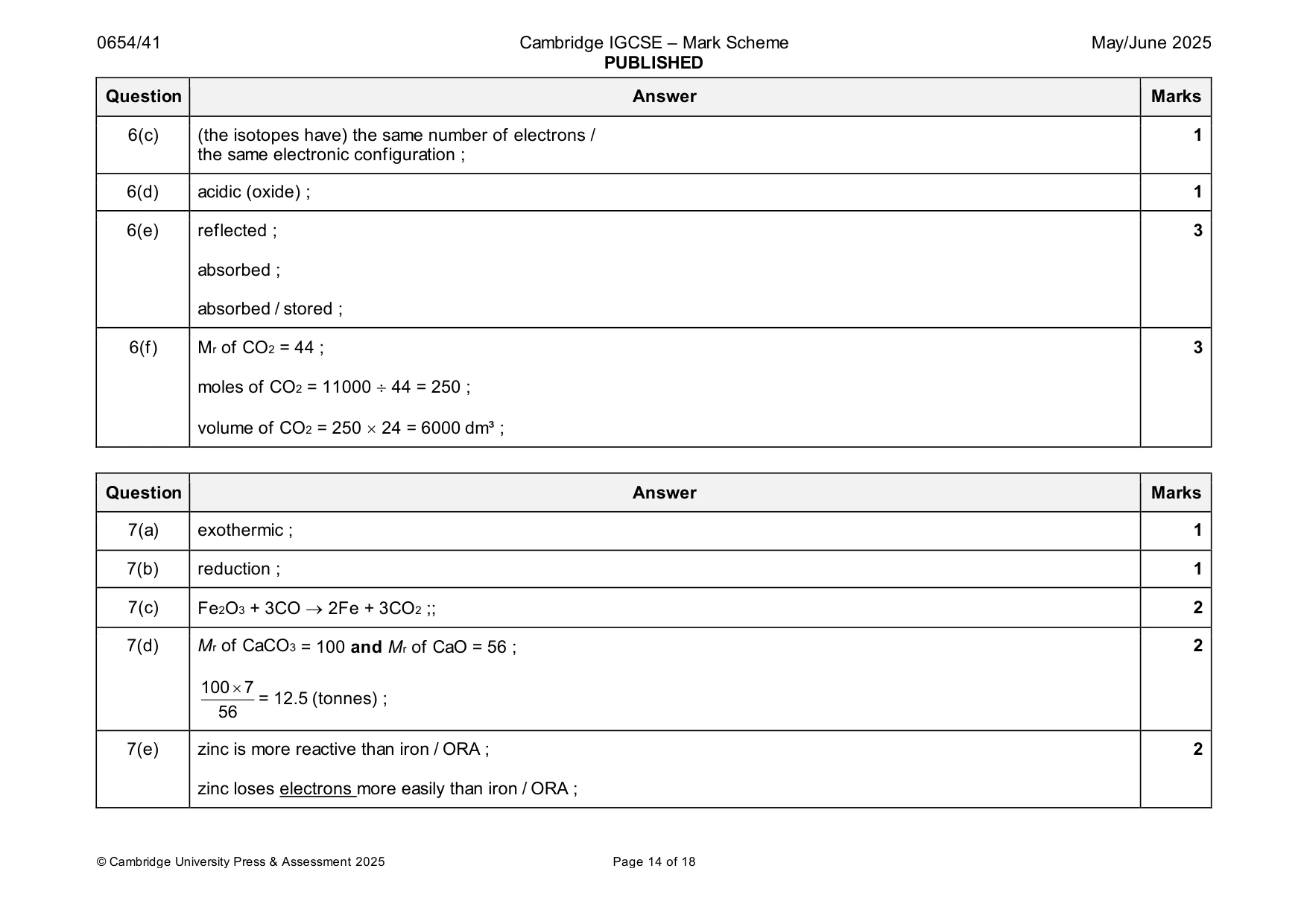
Mark scheme: 7(a) exothermic ; 1 7(b) reduction ; 1 7(c) Fe2O3 + 3CO → 2Fe + 3CO2 ;; 2 7(d) Mr of CaCO3 = 100 and Mr of CaO = 56 ; 2 100 7 = 12.5 (tonnes) ; 56 7(e) zinc is more reactive than iron / ORA ; 2 zinc loses electrons more easily than iron / ORA ; 7(f) electrostatic attraction ; 2 between positive (zinc / metal) ions and (a ‘sea’ of) delocalised electrons ;
Q8 · Petroleum is separated into useful fractions by fractional distillation
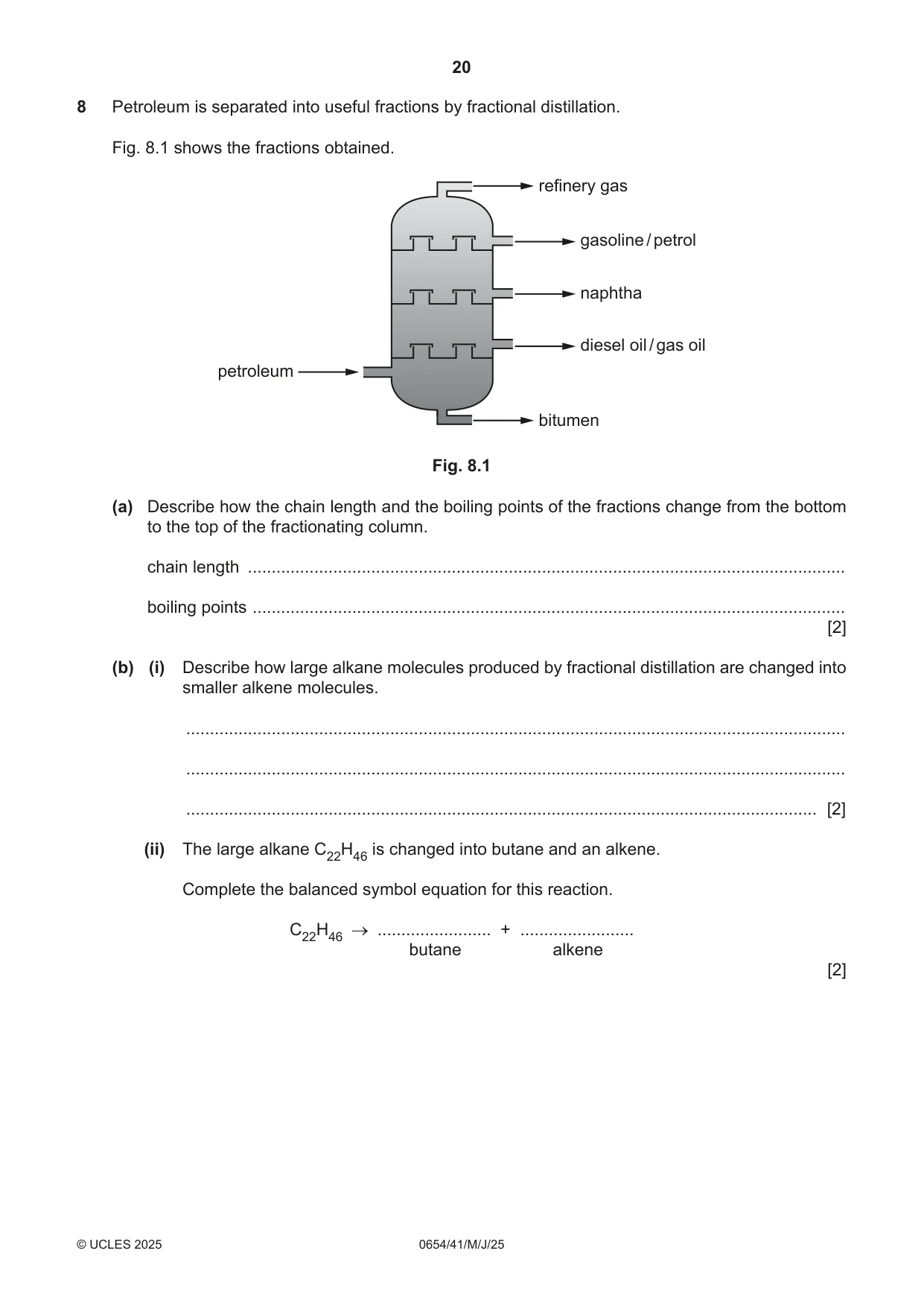
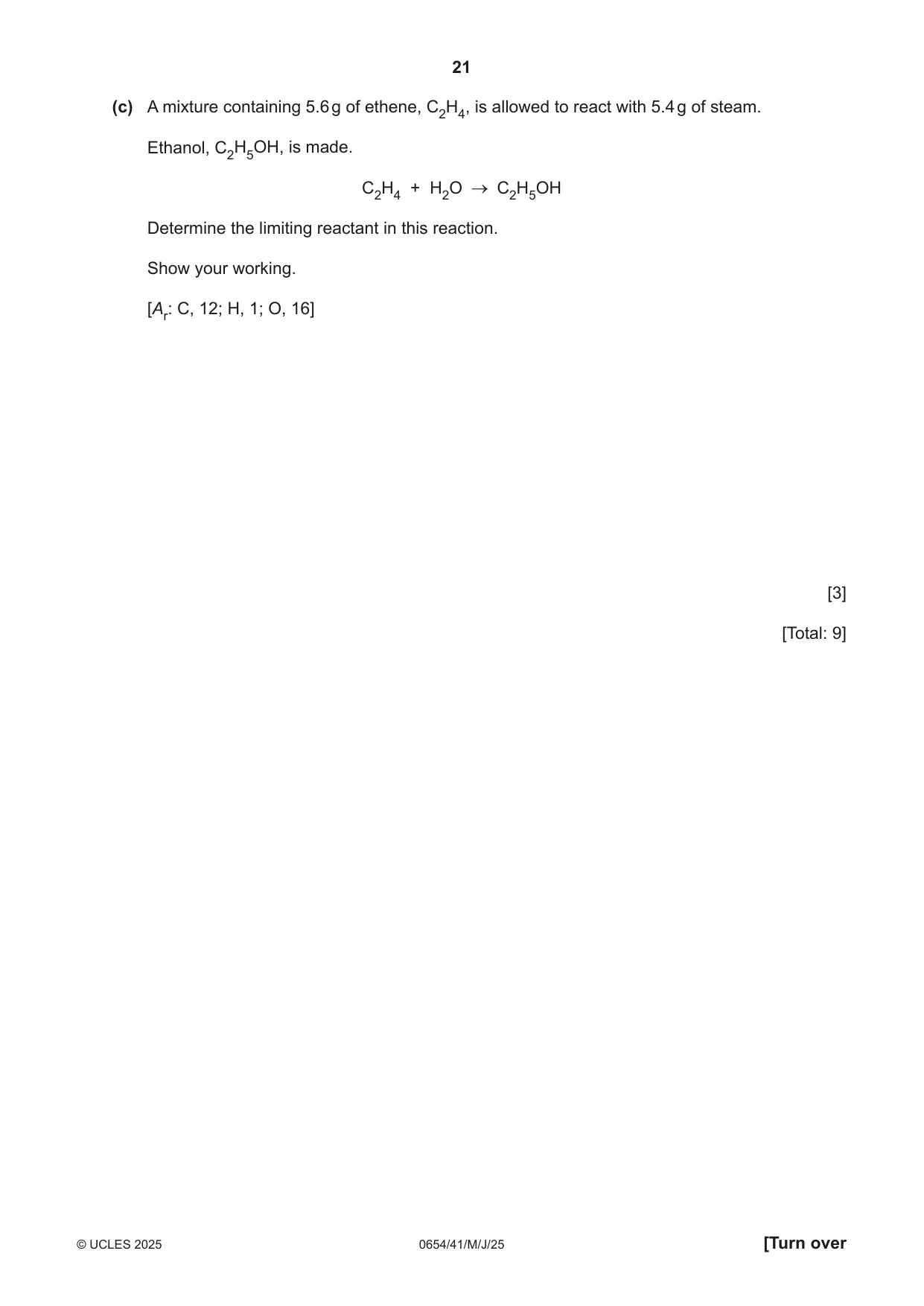
8 Petroleum is separated into useful fractions by fractional distillation. Fig. 8.1 shows the fractions obtained. refinery gas gasoline / petrol naphtha diesel oil / gas oil petroleum bitumen Fig. 8.1 (a) Describe how the chain length and the boiling points of the fractions change from the bottom to the top of the fractionating column. chain length .............................................................................................................................. boiling points ............................................................................................................................. [2] (b) (i) Describe how large alkane molecules produced by fractional distillation are changed into smaller alkene molecules. ........................................................................................................................................... ........................................................................................................................................... ..................................................................................................................................... [2] (ii) The large alkane C22H46 is changed into butane and an alkene. Complete the balanced symbol equation for this reaction. C22H46 ........................ + ........................ butane alkene [2] (c) A mixture containing 5.6 g of ethene, C2H4, is allowed to react with 5.4 g of steam. Ethanol, C2H5OH, is made. C2H4 + H2O C2H5OH Determine the limiting reactant in this reaction. Show your working. [Ar: C, 12; H, 1; O, 16] [3] [Total: 9]
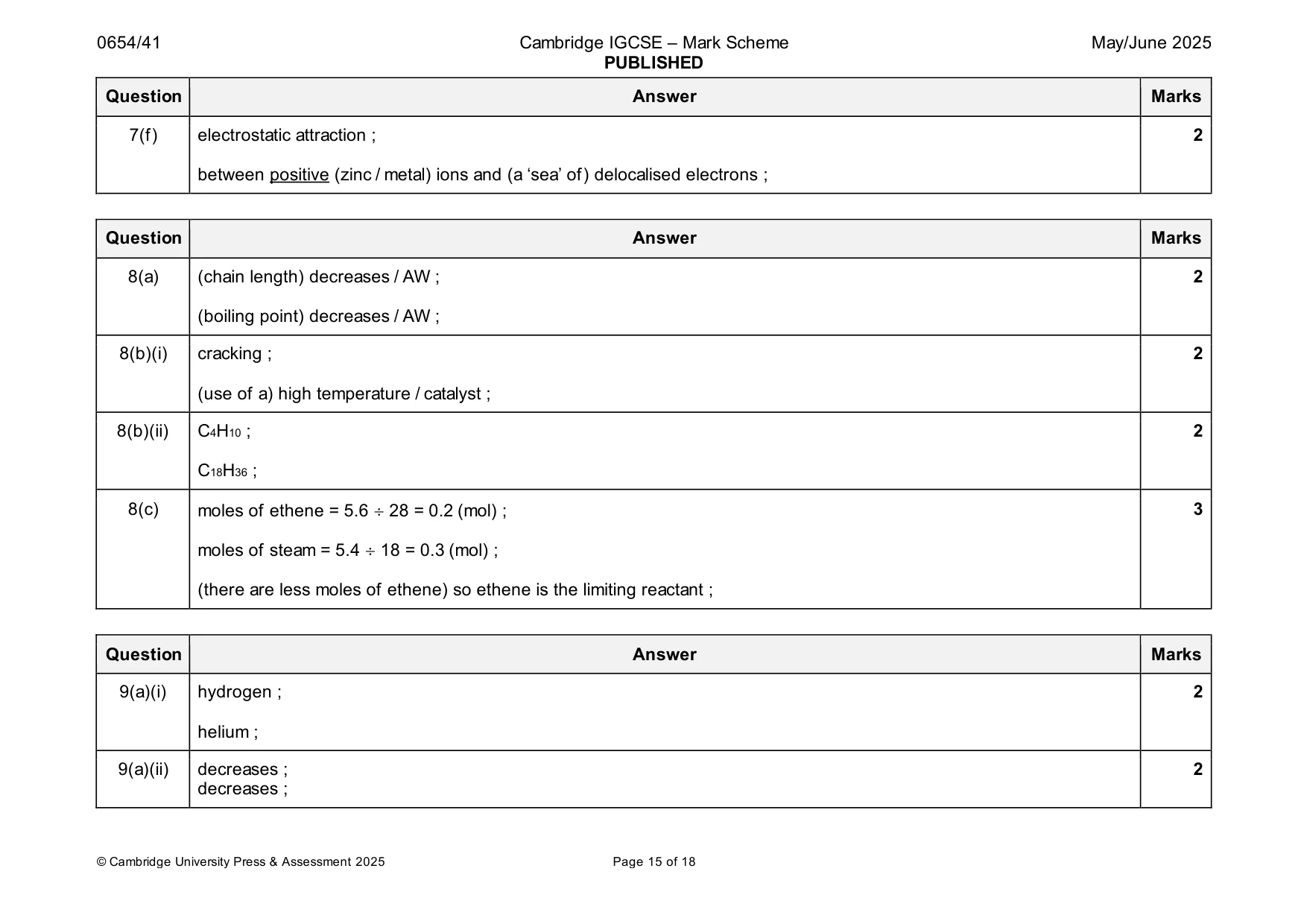
Mark scheme: 8(a) (chain length) decreases / AW ; 2 (boiling point) decreases / AW ; 8(b)(i) cracking ; 2 (use of a) high temperature / catalyst ; 8(b)(ii) C4H10 ; 2 C18H36 ; 8(c) moles of ethene = 5.6 28 = 0.2 (mol) ; 3 moles of steam = 5.4 18 = 0.3 (mol) ; (there are less moles of ethene) so ethene is the limiting reactant ;
Q9 · The Sun is the star in our Solar System
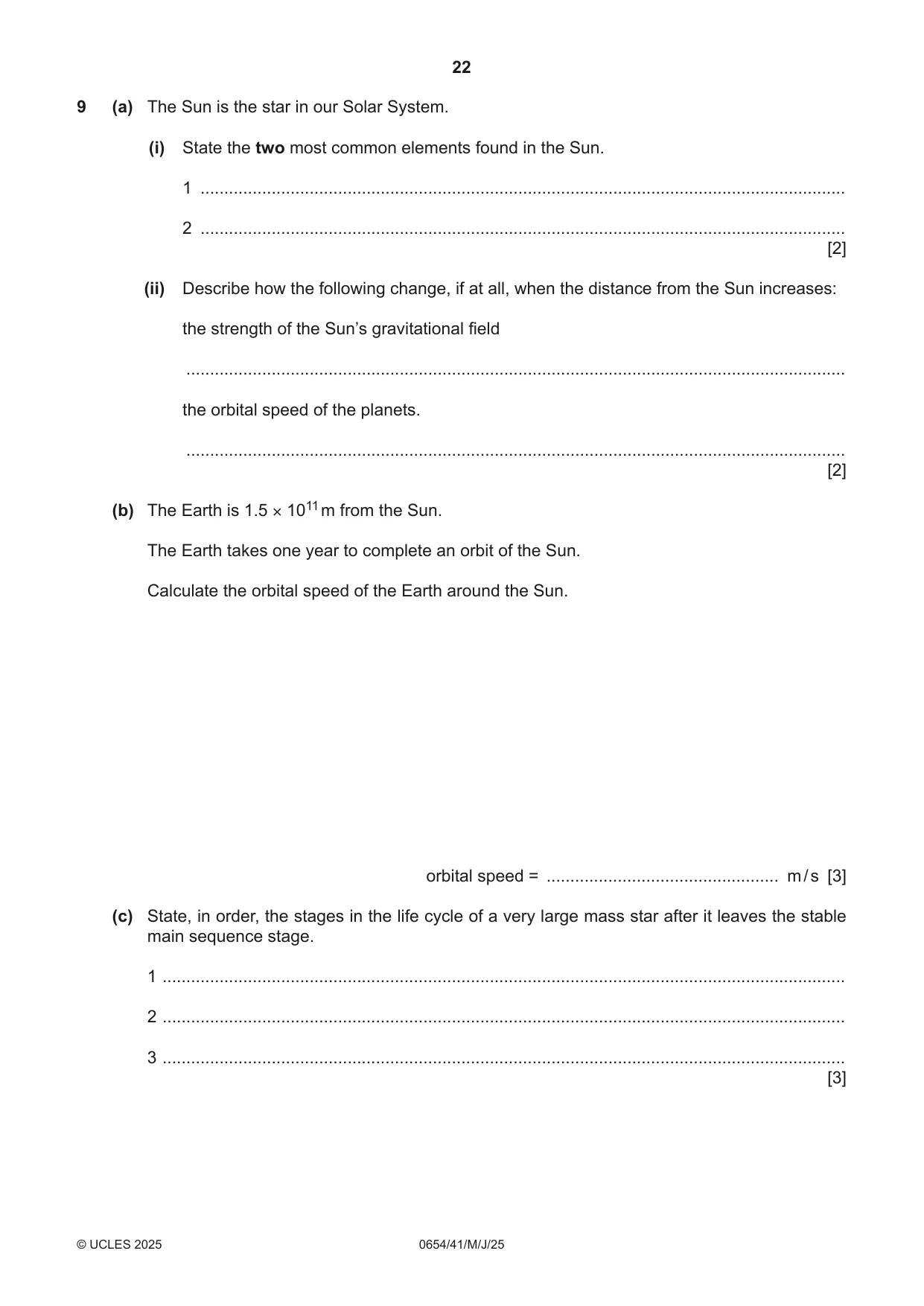
9 (a) The Sun is the star in our Solar System. (i) State the two most common elements found in the Sun. 1 ........................................................................................................................................ 2 ........................................................................................................................................ [2] (ii) Describe how the following change, if at all, when the distance from the Sun increases: the strength of the Sun’s gravitational field ........................................................................................................................................... the orbital speed of the planets. ........................................................................................................................................... [2] (b) The Earth is 1.5 × 10¹¹ m from the Sun. The Earth takes one year to complete an orbit of the Sun. Calculate the orbital speed of the Earth around the Sun. orbital speed = ................................................. m / s [3] (c) State, in order, the stages in the life cycle of a very large mass star after it leaves the stable main sequence stage. 1 ................................................................................................................................................ 2 ................................................................................................................................................ 3 ................................................................................................................................................ [3] (d) Describe the difference between the processes of nuclear fusion and nuclear fission. ................................................................................................................................................... ................................................................................................................................................... ............................................................................................................................................. [2] [Total: 12]
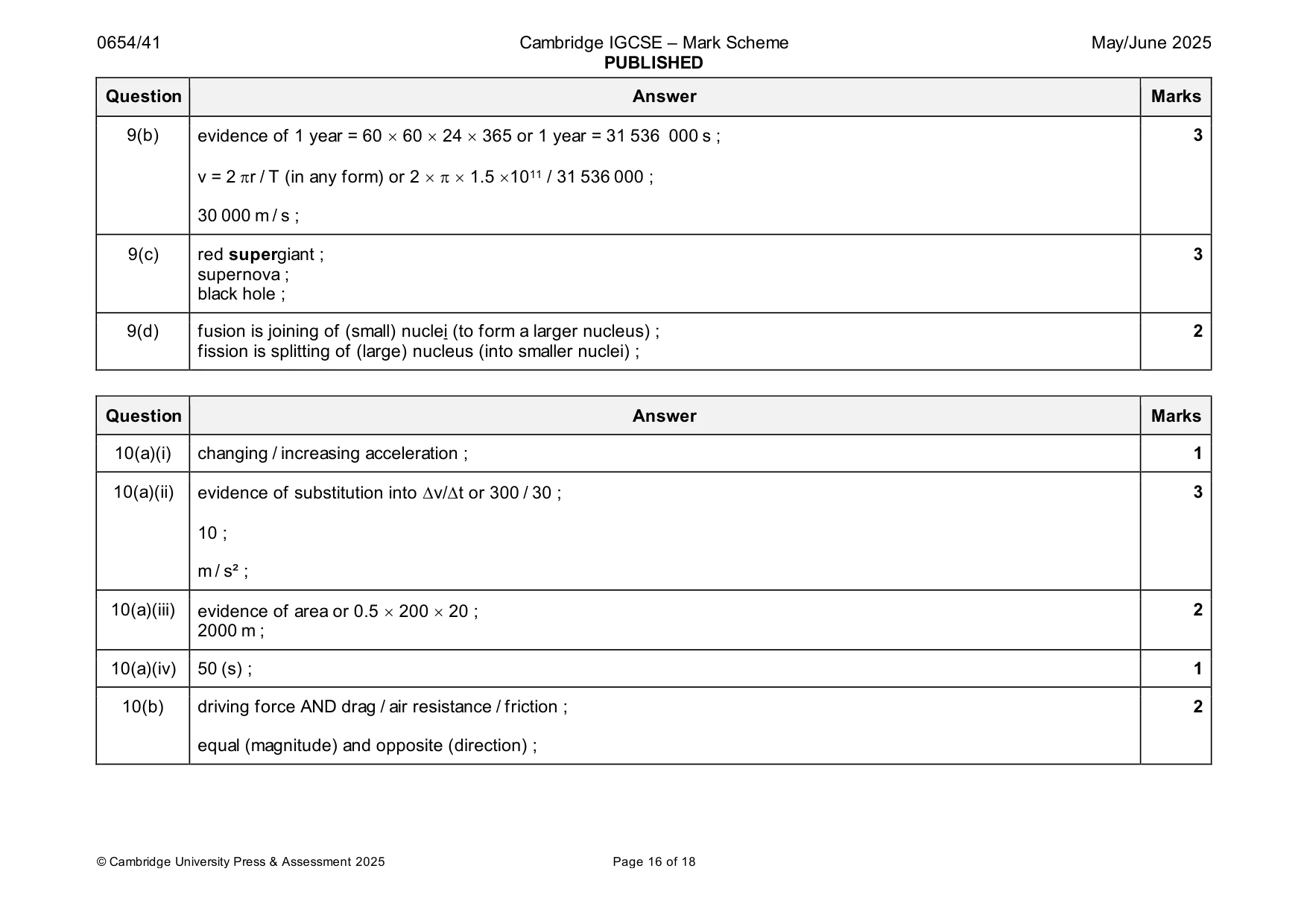
Mark scheme: 9(a)(i) hydrogen ; 2 helium ; 9(a)(ii) decreases ; 2 decreases ; 9(b) evidence of 1 year = 60 60 24 365 or 1 year = 31 536 000 s ; 3 v = 2 r / T (in any form) or 2 1.5 1011 / 31 536 000 ; 30 000 m / s ; 9(c) red supergiant ; 3 supernova ; black hole ; 9(d) fusion is joining of (small) nuclei (to form a larger nucleus) ; 2 fission is splitting of (large) nucleus (into smaller nuclei) ;
Q10 · A rocket travels vertically upwards
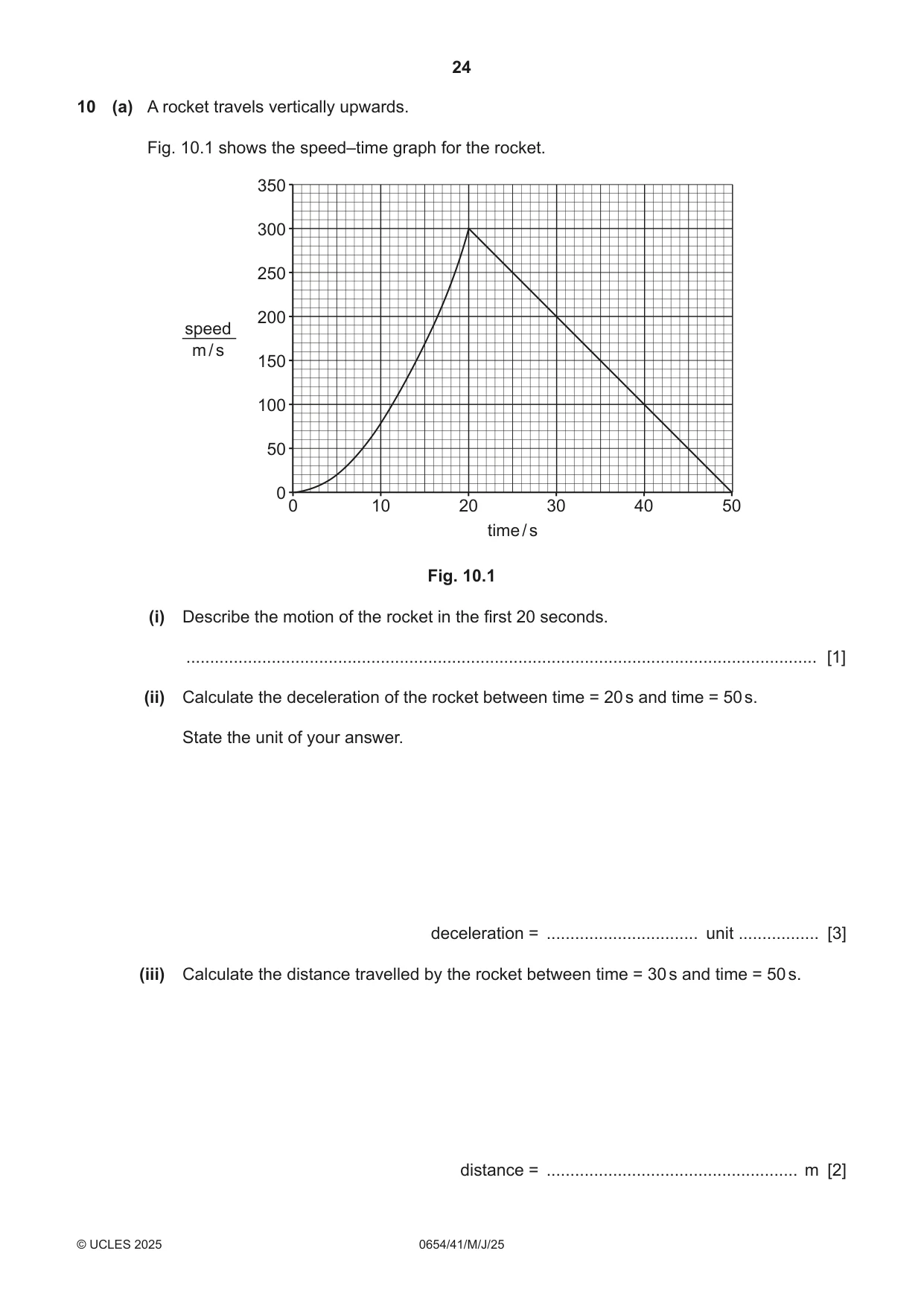
10 (a) A rocket travels vertically upwards. Fig. 10.1 shows the speed–time graph for the rocket. 350 300 250 200 speed m / s 150 100 50 00 10 20 30 40 50 time / s Fig. 10.1 (i) Describe the motion of the rocket in the first 20 seconds. ..................................................................................................................................... [1] (ii) Calculate the deceleration of the rocket between time = 20 s and time = 50 s. State the unit of your answer. deceleration = ................................ unit ................. [3] (iii) Calculate the distance travelled by the rocket between time = 30 s and time = 50 s. distance = ..................................................... m [2] (iv) State the time at which the rocket reaches its maximum height above the ground. time = ...................................................... s [1] (b) A car travels at constant speed on a horizontal road. State and describe the horizontal forces acting on the car. ................................................................................................................................................... ................................................................................................................................................... ............................................................................................................................................. [2] [Total: 9]
Mark scheme: 10(a)(i) changing / increasing acceleration ; 1 10(a)(ii) evidence of substitution into v/t or 300 / 30 ; 3 10 ; m / s² ; 10(a)(iii) evidence of area or 0.5 200 20 ; 2 2000 m ; 10(a)(iv) 50 (s) ; 1 10(b) driving force AND drag / air resistance / friction ; 2 equal (magnitude) and opposite (direction) ;
Q11 · Describe one similarity and two differences between boiling and evaporation
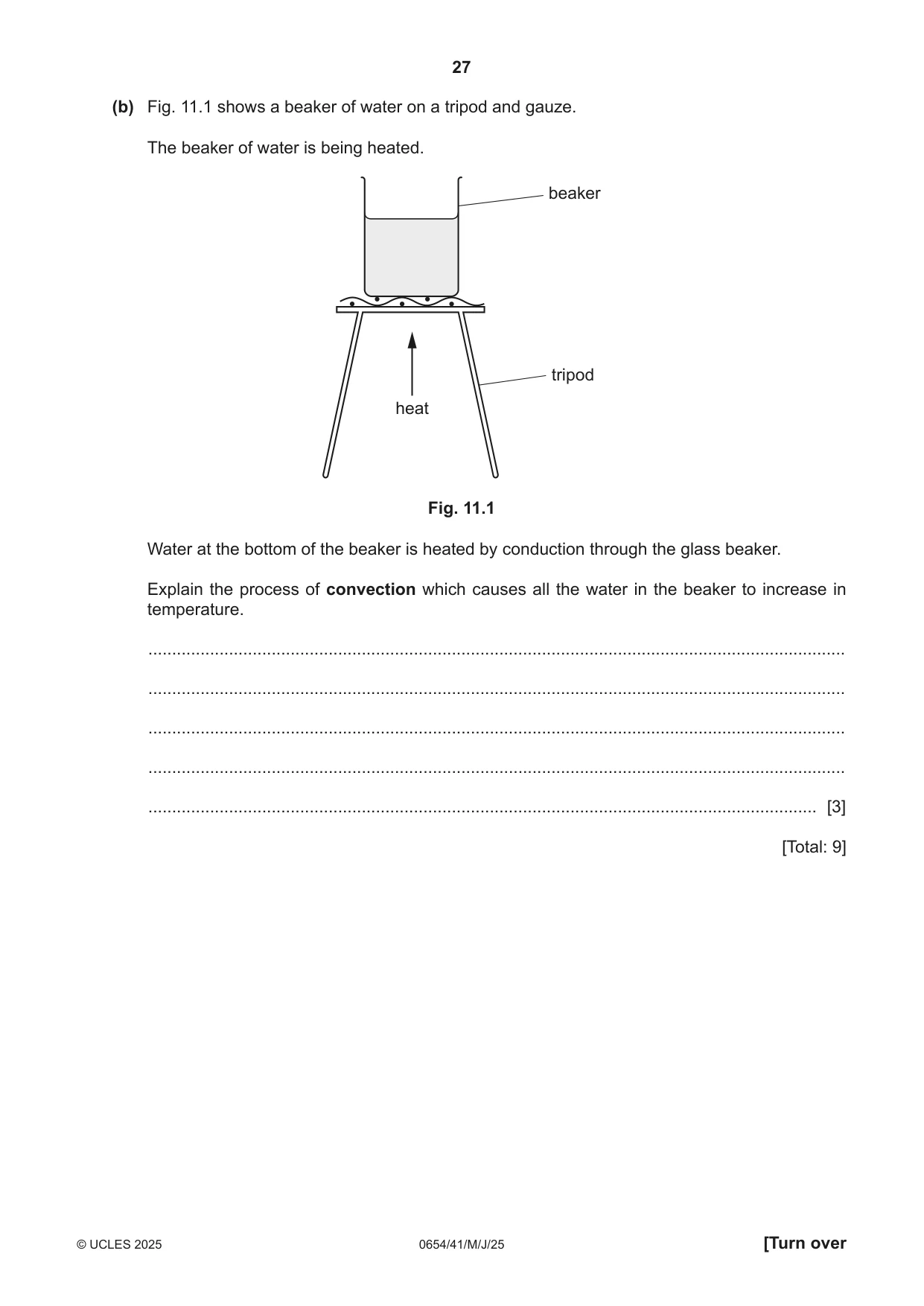
11 (a) (i) Describe one similarity and two differences between boiling and evaporation. similarity ............................................................................................................................ ........................................................................................................................................... difference 1 ........................................................................................................................ ........................................................................................................................................... difference 2 ........................................................................................................................ ........................................................................................................................................... [3] (ii) State three factors which increase the rate of evaporation. 1 ........................................................................................................................................ 2 ........................................................................................................................................ 3 ........................................................................................................................................ [3] (b) Fig. 11.1 shows a beaker of water on a tripod and gauze. The beaker of water is being heated. beaker tripod heat Fig. 11.1 Water at the bottom of the beaker is heated by conduction through the glass beaker. Explain the process of convection which causes all the water in the beaker to increase in temperature. ................................................................................................................................................... ................................................................................................................................................... ................................................................................................................................................... ................................................................................................................................................... ............................................................................................................................................. [3] [Total: 9]
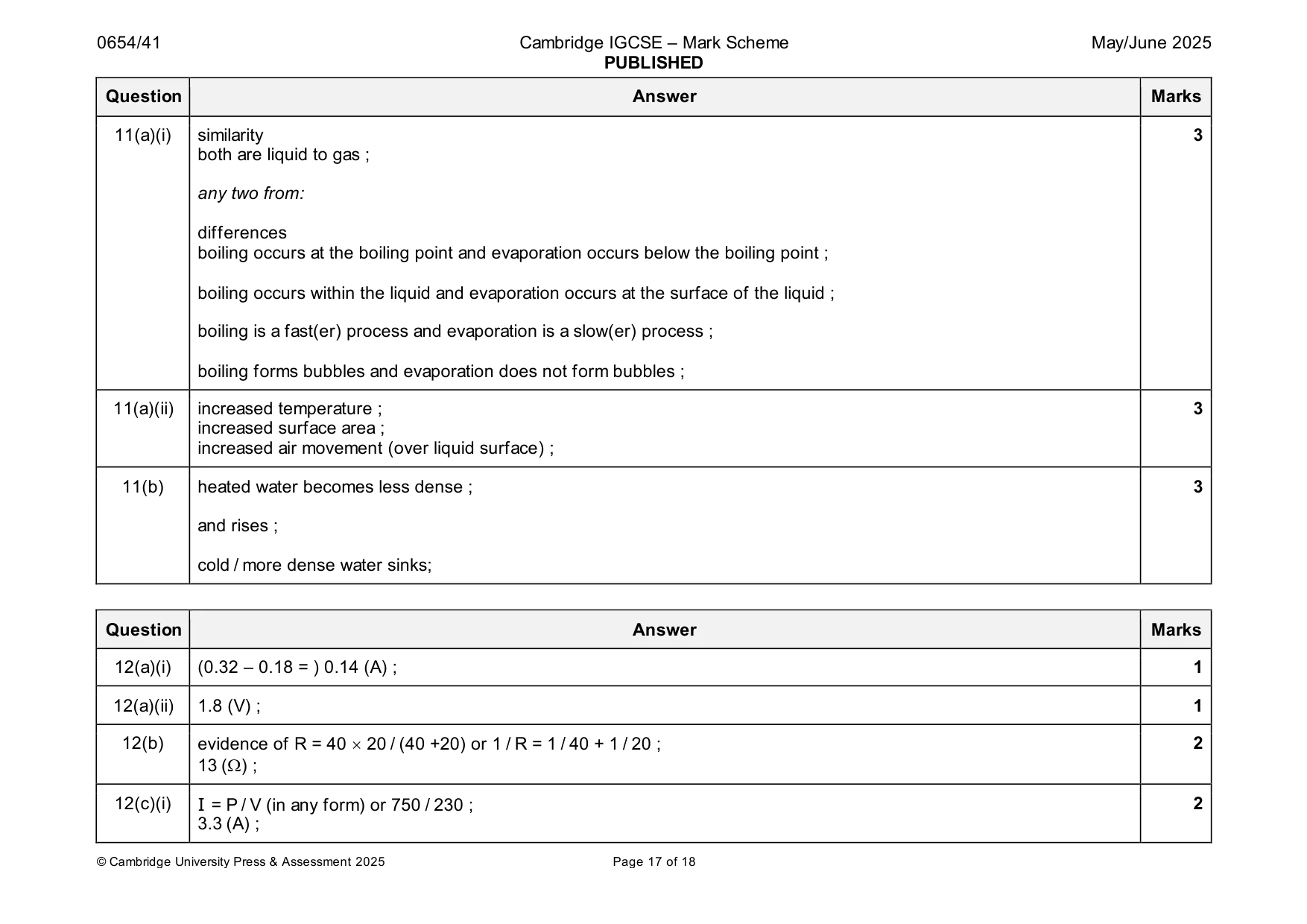
Mark scheme: 11(a)(i) similarity 3 both are liquid to gas ; any two from: differences boiling occurs at the boiling point and evaporation occurs below the boiling point ; boiling occurs within the liquid and evaporation occurs at the surface of the liquid ; boiling is a fast(er) process and evaporation is a slow(er) process ; boiling forms bubbles and evaporation does not form bubbles ; 11(a)(ii) increased temperature ; 3 increased surface area ; increased air movement (over liquid surface) ; 11(b) heated water becomes less dense ; 3 and rises ; cold / more dense water sinks;
Q12 · A 10 Ω resistor and a resistor R of unknown resistance connected in parallel with a 1.8 V…
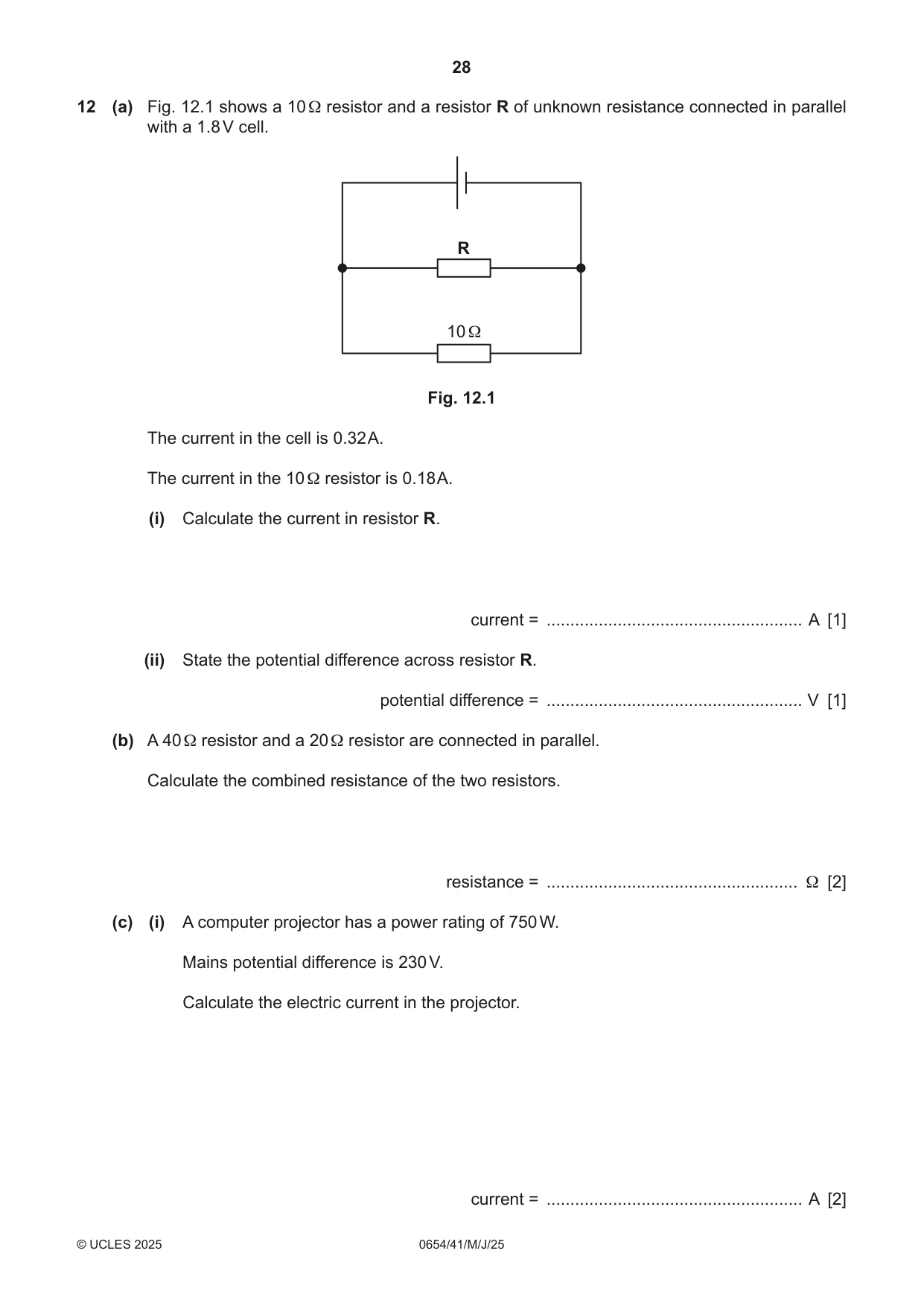
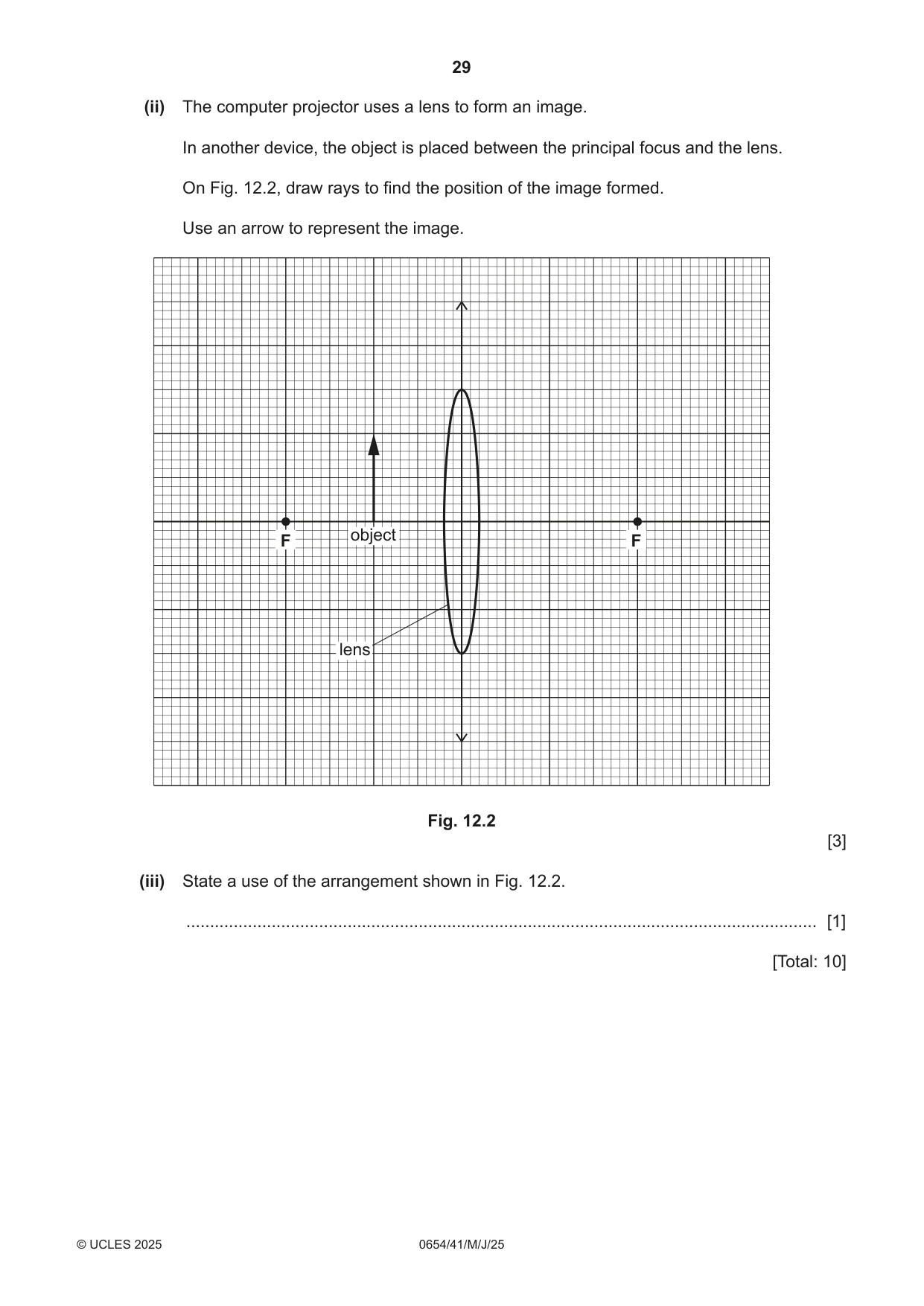
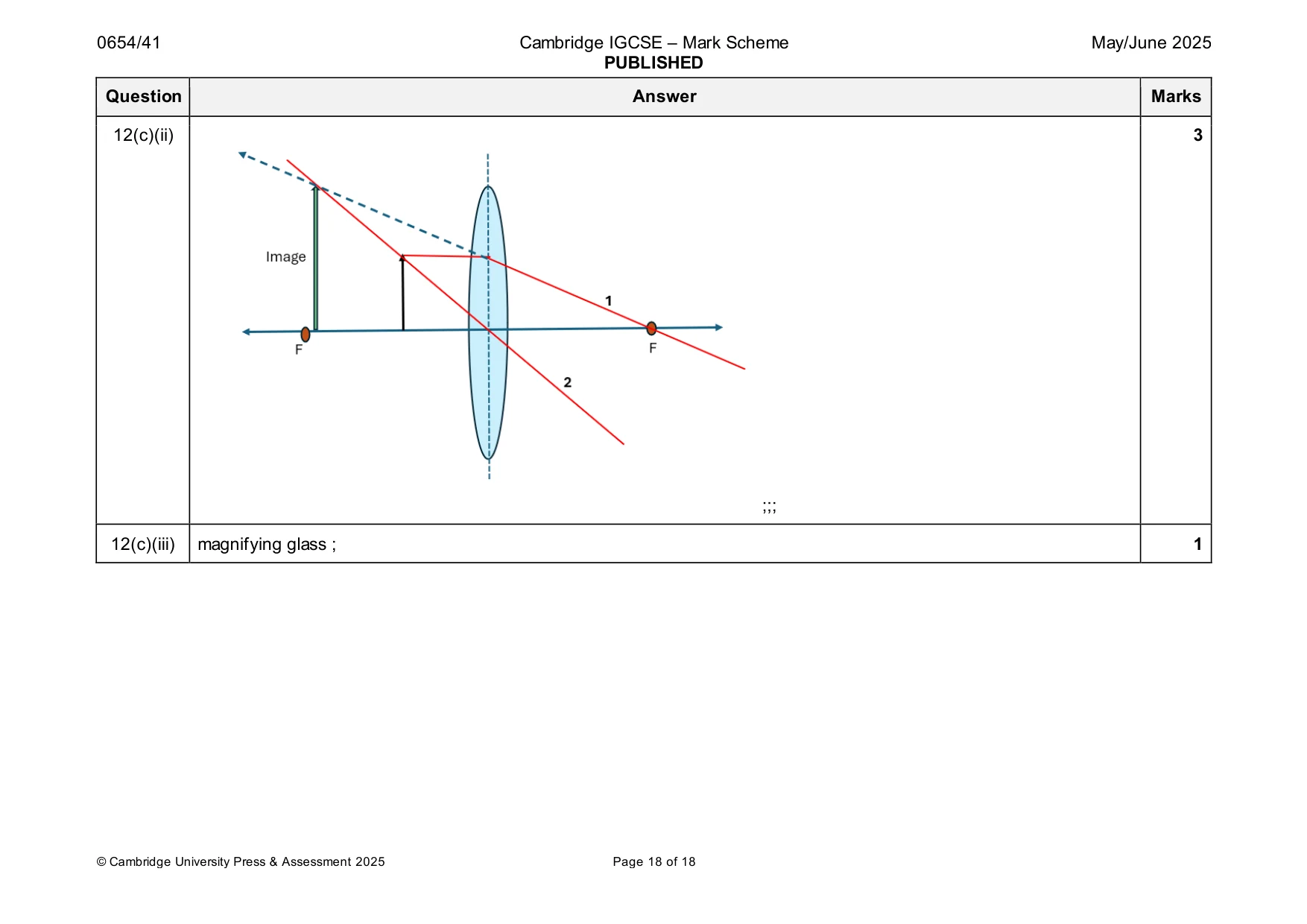
12 (a) Fig. 12.1 shows a 10 Ω resistor and a resistor R of unknown resistance connected in parallel with a 1.8 V cell. R 10 Ω Fig. 12.1 The current in the cell is 0.32 A. The current in the 10 Ω resistor is 0.18 A. (i) Calculate the current in resistor R. current = ...................................................... A [1] (ii) State the potential difference across resistor R. potential difference = ...................................................... V [1] (b) A 40 Ω resistor and a 20 Ω resistor are connected in parallel. Calculate the combined resistance of the two resistors. resistance = ..................................................... Ω [2] (c) (i) A computer projector has a power rating of 750 W. Mains potential difference is 230 V. Calculate the electric current in the projector. current = ...................................................... A [2] (ii) The computer projector uses a lens to form an image. In another device, the object is placed between the principal focus and the lens. On Fig. 12.2, draw rays to find the position of the image formed. Use an arrow to represent the image. object F F lens Fig. 12.2 [3] (iii) State a use of the arrangement shown in Fig. 12.2. ..................................................................................................................................... [1] [Total: 10]
Mark scheme: 12(a)(i) (0.32 – 0.18 = ) 0.14 (A) ; 1 12(a)(ii) 1.8 (V) ; 1 12(b) evidence of R = 40 20 / (40 +20) or 1 / R = 1 / 40 + 1 / 20 ; 2 13 () ; 12(c)(i) I = P / V (in any form) or 750 / 230 ; 2 3.3 (A) ; 12(c)(ii) 3 ;;; 12(c)(iii) magnifying glass ; 1
What was in this paper
The subtopics covered by these 12 questions, and how many questions each got. Open one in a new tab to see every Cambridge question on it.
What you needed in this session
Cambridge’s own grade thresholds for 2025 May/June, Paper 4 · Variant 1. A higher threshold means an easier paper — the bar moves with how the cohort did.