Questions as text
Q1 · A speed-time graph for a car over a period of 50 seconds 0654/31 May/June 2017
7 (a) Fig. 7.1 shows a speed-time graph for a car over a period of 50 seconds. BB CC 4 3 speed m / s 2 1 A DD EE 0 0 10 20 30 40 50 time / s Fig. 7.1 (i) State a time when the car is not moving. … s [1] (ii) State the maximum speed reached by the car. … m / s [1] (iii) Calculate the distance travelled by the car between 10 seconds and 15 seconds. Show your working. distance = … m [2] (b) A man has been riding in a car which has plastic seats. Suggest why an electric charge builds up on the man. … … [1] (c) The car has a warning triangle to alert other motorists. Fig. 7.2 shows a warning triangle. Fig. 7.2 The triangle contains many tiny prisms. Fig. 7.3 shows one prism. The rays of light undergo total internal reflection inside the prism. Fig. 7.3 Rays of light enter and leave the prism as shown. Complete Fig. 7.3 to show the path of the ray of light through the prism. [2] (d) The temperature of the air in car tyres increases during a journey. (i) Describe what happens to the motion of the air particles as the air warms up. … … [1] (ii) When the temperature of the air in the tyres increases, the pressure in the tyres increases. Explain in terms of the motion of the air particles why the pressure increases. … … … [2]
10 marks
Mark scheme: 7(a)(i) when time is 0 s / 40–50 s ; 1 7(a)(ii) 4 (m / s) ; 1 7(a)(iii) distance = speed × time / 5 × 4 ; = 20 (m) ; 2 7(b) reference to friction or description / transfer of electrons / negative charge ; 1 7(c) no deviation at first interface and first reflection correct ; second reflection correct ; 2 7(d)(i) move faster ; 1 7(d)(ii) more frequent collisions / collide at greater speed (with wall) ; more force exerted on tyre walls ; 2
This question in 0654/31 May/June 2017
Q2 · A school orchestra is practising 0654/32 May/June 2017
7 A school orchestra is practising. (a) Table 7.1 shows the highest and lowest sound frequencies of some of the musical instruments in the orchestra. Table 7.1 instrument highest frequency / Hz lowest frequency / Hz cymbals 900 300 flute 2600 260 piano 4200 30 trumpet 1050 170 violin 3500 200 (i) State the meaning of the term frequency. … … [1] (ii) State which instrument can produce the sound with the highest pitch. Explain your answer. instrument … explanation … … [2] (iii) State the highest and lowest frequencies that can normally be heard by a human. highest … Hz lowest … Hz [1] (b) A cymbal is made from brass. The volume of brass used to make the cymbal is 160 cm3. The mass of the cymbal is 1200 g. Calculate the density of brass. State the formula you use, show your working and state the unit of your answer. formula working density = … unit … [3] (c) Sound waves are longitudinal waves. (i) Give an example of a transverse wave. … [1] (ii) Describe the difference between a longitudinal wave and a transverse wave. … … … [1] (d) A teacher and a student are measuring the speed of sound. The teacher makes a loud sound by hitting two cymbals together. (i) The student stands 150 m from the teacher. She records the time between when she sees the teacher hit the cymbals and when she hears the sound. The sound takes 0.5 s to reach the student. Calculate the speed of sound in air. State the formula you use and show your working. formula working speed of sound = … m / s [2] (ii) Explain why a sound wave is produced when the cymbals hit each other. … … [1] (e) Fig. 7.1 shows a student working on her laptop computer at school. lamp laptop screen Fig. 7.1 not to scale Light from a lamp is reflected by the laptop screen into the student’s eyes. (i) On Fig. 7.1, label the angle of incidence with the letter i . [1] (ii) When the angle of reflection is 40°, state the angle of incidence. Explain your answer. angle of incidence … °. explanation … … [2] Question 8 starts on page 16.
15 marks
Mark scheme: 7(a)(i) no of waves / second ; 1 7(a)(ii) piano ; highest frequency ; 2 7(a)(iii) 20 000 Hz and 20 Hz ; 1 7(b) density = mass / volume ; = 1200 / 160 = 7.5 ; g / cm3 ; 3 7(c)(i) (named) electromagnetic wave / water waves ; 1 7(c)(ii) transverse waves oscillate at right angles to direction of wave / energy transfer or longitudinal waves oscillate parallel to direction of wave / energy transfer ; 1 7(d)(i) speed = distance / time ; = 150 / 0.5 = 300 (m / s) ; 2 7(d)(ii) vibration of air molecules produced ; 1 7(e)(i) angle of incidence correctly labelled ; 1 7(e)(ii) 40° ; angle of incidence = angle of reflection ; 2
This question in 0654/32 May/June 2017
Q3 · An aircraft landing with constant deceleration along an airport runway 0654/32 May/June 2017
9 Fig. 9.1 shows an aircraft landing with constant deceleration along an airport runway. Fig. 9.1 The plane lands at 70 m / s and comes to a stop after 60 seconds. (a) Calculate the landing speed in kilometres / hour. landing speed = … kilometres / hour [1] (b) (i) On the grid provided, draw a speed-time graph to show the motion of the plane during this 60 second period. 80 70 60 50 speed m / s 40 30 20 10 0 0 10 20 30 40 50 60 70 time / s [2] (ii) State the form of energy that decreases as the aircraft loses height on its descent to the runway. … [1] (iii) State the form of energy that the aircraft loses as it slows down on the runway. … [1] (iv) State the form of energy carried by the aircraft in its fuel tanks. … [1]
6 marks
Mark scheme: 9(a) 252 km / h ; 1 9(b)(i) diagonal line from 0, 70 ; to 60, 0 ; 2 9(b)(ii) gravitational (potential) energy ; 1 9(b)(iii) kinetic energy ; 1 9(b)(iv) chemical energy ; 1
This question in 0654/32 May/June 2017
Q4 · A polar bear swims 687 km in 9 days without stopping 0654/33 May/June 2017
4 (a) A polar bear swims 687 km in 9 days without stopping. Complete the following steps to calculate the average speed of the polar bear. Show your working in each step. Step 1 Calculate the distance in metres travelled by the polar bear. distance = … m Step 2 Calculate the time in seconds taken by the polar bear for this journey. time = … s Step 3 Use your answers to Steps 1 and 2 to calculate the average speed, in metres per second, of the polar bear for this journey. average speed = … m / s [3] (b) Polar bears spend a lot of time on floating ice. A polar bear must exert as small a pressure as possible when standing on the ice. State the two quantities that are needed to calculate the pressure exerted by the polar bear on the ice. … and … [2] (c) Recent research suggests that the audible frequency range for polar bears is between 50 Hz and 35 000 Hz. (i) State the audible frequency range for a human. from … Hz to … Hz [1] (ii) Ultrasound waves have a very high frequency that cannot be heard by humans. Devices which emit ultrasound waves have been tested to see if they can keep polar bears away from people. Suggest a suitable frequency for the waves emitted by such a device. … Hz [1] (d) Scientists use thermal imaging cameras to detect polar bears travelling on the ice. Thermal imaging cameras use infra-red radiation. Infra-red radiation is part of the electromagnetic spectrum. Name one other part of the electromagnetic spectrum and give a use for that radiation. radiation … use … … [2]
9 marks
Mark scheme: 4(a) distance = 687 000 (m) ; time = 777 600 (s) ; 0.88 (m / s) ; 3 4(b) area ; force (weight) ; 2 4(c)(i) 20 Hz to 20 000 Hz ; 1 4(c)(ii) any value between 20 000 to 35 000 Hz ; 1 4(d) named electromagnetic wave ; use ; 2
This question in 0654/33 May/June 2017
Q5 · The speed-time graph for a truck 0654/33 May/June 2017
7 (a) Fig. 7.1 shows the speed-time graph for a truck. 10 8 6 speed m / s 4 2 0 0 10 20 30 40 50 60 70 80 90 100 time / s Fig. 7.1 (i) State the maximum speed of the truck. … m / s [1] (ii) On Fig. 7.1, mark with an X the point when the truck has stopped moving. [1] (b) Fig. 7.2 shows four forces, P, Q, R and S, acting on the truck. P S Q road R Fig. 7.2 Compare the size and direction of forces Q and S when the truck is slowing down. size … direction … [2] (c) The air in the tyres of the truck is warmed during its journey. (i) Describe what happens to the motion of the air particles as the air warms up. … … [1] (ii) When the temperature of the air in the tyres increases, the pressure in the tyres increases. Explain, in terms of the motion of the air particles, why the pressure increases. … … … [2] (d) A reflector on the rear of the truck is made from many small red plastic prisms. One prism is shown in Fig. 7.3. Light from the headlight of a following car enters the prism. ray of light from car red plastic prism Fig. 7.3 Total internal reflection occurs within the prism. On Fig. 7.3, complete the path taken by the ray of light. [2] (e) The truck has two headlights. The lamp inside one headlight is connected in parallel with the lamp in the other headlight across a 24 V battery. (i) The resistance of each lamp is 5.6 Ω. Calculate the current passing through each lamp. State the formula you use and show your working. formula working current = … A [2] (ii) Suggest one important reason why the lamps in the headlights are connected in parallel rather than in series. … … … [1]
12 marks
Mark scheme: 7(a)(i) 8 (m / s) ; 1 7(a)(ii) X at 100 s ; 1 7(b) S greater than Q ; S and Q in opposite directions ; 2 7(c)(i) move faster ; 1 7(c)(ii) more frequent collisions / collide at greater speed (with wall) ; more force exerted on tyre walls ; 2 7(d) ray enters undeviated and first reflection ; second reflection and exit from prism ; 2 7(e)(i) I = V / R ; = 24 / 5.6 = 4.29 A ; 2 7(e)(ii) if one lamp fails the other will still light up / work / have a complete circuit ; 1
This question in 0654/33 May/June 2017
Q6 · A snowboarder on a ski slope 0654/31 Oct/Nov 2017
9 Fig. 9.1 shows a snowboarder on a ski slope. Fig. 9.1 (a) On Fig. 9.1, draw an arrow to indicate the direction in which the force of gravity acts on the snowboarder. [1] (b) Fig. 9.2 shows the speed-time graph for the snowboarder as she moves down the slope. 6 5 4 speed 3 m / s 2 1 0 0 5 10 15 20 25 30 time / s Fig. 9.2 (i) State a time when the snowboarder is accelerating. … s [1] (ii) State a time when the snowboarder is travelling at her maximum speed. … s [1] (c) Some of the snow is melting into water. (i) Fig. 9.3 shows the arrangement of particles in a gas, liquid and solid. A B C Fig. 9.3 State which diagram, A, B or C, best describes water. Explain your answer. diagram … explanation … … [1] (ii) Some snow is steadily heated in a beaker. The temperature of the snow is measured as it is heated. Fig. 9.4 shows a graph of the results. temperature / °C 0 time / minutes W X Y Z Fig. 9.4 State the section of the graph, W, X, Y or Z, where the snow is melting. Explain your answer. melting happens in section … explanation … … [2]
6 marks
Mark scheme: 9(a) arrow vertically downwards ; 1 9(b)(i) time between 0–12.5 s ; 1 9(b)(ii) time between 12.5 and 22.5 s ; 1 9(c)(i) B – particles close together and randomly arranged ; 1 9(c)(ii) section X ; ice melts at 0°C / temperature is constant ; 2
This question in 0654/31 Oct/Nov 2017
Q7 · A boy rides his bicycle along a straight level road 0654/32 Oct/Nov 2017
9 (a) A boy rides his bicycle along a straight level road. Fig. 9.1 shows a distance-time graph for his ride. 800 D CC 600 distance / m 400 200 B A 0 0 20 40 60 80 100 120 time / s Fig. 9.1 (i) Describe the motion of the bicycle between A and B. … [1] (ii) Calculate the speed of the bicycle between B and C. Show your working. speed = … m / s [2] (iii) State the main energy transfer that takes place as the bicycle slows down and stops. from … energy to … energy [1] (b) The bicycle frame is made from a block of aluminium of mass 7.5 kg. The dimensions of the block of aluminium are shown in Fig. 9.2. 12 cm 15 cm 15 cm Fig. 9.2 Calculate the density of this block of aluminium in g / cm3. State the formula you use and show your working. formula working density = … g / cm3 [3] (c) Fig. 9.3 shows a car behind a bicycle at night. Fig. 9.3 A reflector on the back of the bicycle is made from many small red plastic prisms, one of which is shown in Fig. 9.4. A ray of light from the headlamp of the car enters the prism. ray of light from the headlamp of the following car red plastic prism Fig. 9.4 Total internal reflection occurs within the prism. On Fig. 9.4, complete the path taken by the ray of light until it emerges from the prism. [2] (d) The bicycle has a front lamp, A, and a rear lamp, B, powered by the same battery. Fig. 9.5 shows how the lamps are connected. 12 V A B Fig. 9.5 (i) State the name given to this arrangement of lamps in a circuit. … [1] (ii) Lamp A has a resistance of 5.0 Ω. The battery has a voltage of 12 V. Calculate the current flowing through lamp A when the switch is closed. State the formula you use and show your working. formula working current … A [2]
12 marks
Mark scheme: 9(a)(i) accelerating / increasing speed ; 1 9(a)(ii) speed = distance / time / = 560 / 60 ; = 9.33 (m / s) ; 2 9(a)(iii) kinetic energy to thermal / sound ; 1 9(b) volume = 15 × 15 × 12 / = 2700 cm3 ; density = mass/volume or 7500 / 2700 ; = 2.78 (g / cm3) ; 3 9(c) first reflection ; second reflection parallel to incident ray ; 2 9(d)(i) Parallel ; 1 9(d)(ii) I = V / R or 12 / 5 ; = 2.4 (A) ; 2
This question in 0654/32 Oct/Nov 2017
Q8 · The distance-time graph for a bus travelling through part of a town 0654/33 Oct/Nov 2017
9 (a) Fig. 9.1 shows the distance-time graph for a bus travelling through part of a town. 2000 FF 1500 distance DD EE 1000 / m BB CC 500 AA 0 0 50 100 150 200 250 time / s Fig. 9.1 (i) Find the total distance travelled by the bus over 250 seconds. … m [1] (ii) Use the graph to calculate the maximum speed of the bus. Show your working. maximum speed = … m / s [3] (b) Fig. 9.2 shows the forces acting on the bus when the bus is travelling at constant speed. P S Q road R Fig. 9.2 Four forces, P, Q, R and S, are shown. (i) State which force from P, Q, R and S is the driving force. … [1] (ii) State which force from P, Q, R and S is the weight of the bus. … [1] (iii) Compare the magnitude and direction of forces Q and S when the bus is travelling at constant speed. … … … [2] (c) The bus has four wheels. Each wheel has a tyre inflated with air. (i) Describe how the air molecules in a tyre exert a pressure on the wall of the tyre. … … … … [2] (ii) After the journey, the tyres are hot. This means that the force of the air on the tyre wall has increased. Explain, in terms of moving molecules, why the force of the air on the tyre wall increases when the temperature increases. … … … … … [2] (d) The bus has two headlights, L1 and L2. The lamp inside headlight L1 is connected in parallel with the lamp inside headlight L2 across a 12 V battery. The resistance of each lamp is 4.0 Ω. Fig. 9.3 shows the circuit diagram for this arrangement. 12 V L1 L2 Fig. 9.3 (i) Calculate the current passing through each lamp when the switch is closed. State the formula you use and show your working. formula working current = … A [2] (ii) The combined resistance of the two lamps connected in parallel is one of the following values. 2.0 Ω 4.0 Ω 8.0 Ω 16.0 Ω State the correct value for the combined resistance. Explain your answer. combined resistance = … Ω because … … [2] (e) Some of the bodywork on the bus is made from iron. Other parts are made from steel. Both iron and steel are magnetic. Describe one difference between the magnetic properties of iron and the magnetic properties of steel. … … [1]
17 marks
Mark scheme: 9(a)(i) 1500 (m) ; 1 9(a)(ii) evidence that correct section has been identified / steepest gradient selected ; speed = distance / time or = 500 / 50 ; = 500 / 50 = 10 m / s ; 3 9(b)(i) Q ; 1 9(b)(ii) R ; 1 9(b)(iii) equal magnitude ; opposite directions ; 2 9(c)(i) particles collide with tyre walls ; particles exert a force (on the tyre wall) ; 2 9(c)(ii) particles are moving faster ; more collisions on tyre walls / collisions are more energetic ; 2 9(d)(i) I = V / R or 12 / 4.0 ; = 3.0 (A) ; 2 9(d)(ii) 2.0 Ω ; combined resistance of two resistances in parallel is less than that of either resistor by itself ; 2 9(e) iron magnetises quickly / steel magnetises slowly / iron loses magnetism quickly / steel loses magnetism slowly ; 1
This question in 0654/33 Oct/Nov 2017
Q9 · The speed‑time graph for a journey made by a train 0654/32 Oct/Nov 2018
9 (a) Fig. 9.1 shows the speed‑time graph for a journey made by a train. 30 speed 25 m /s 20 15 10 5 0 0 100 200 300 400 500 600 time / s Fig. 9.1 (i) State the time taken by the train for this journey. … s [1] (ii) The train travels a total distance of 11 250 metres in this journey. Using your answer to (i), calculate the average speed of the train for this journey. State the formula that you use and show your working. formula working … m/s [2] (b) The engine of the train is powered by diesel fuel. The combustion of diesel fuel produces thermal energy, which is transformed into kinetic energy. State the form of energy stored in diesel fuel. … [1] (c) Diesel fuel is made from petroleum (crude oil). Petroleum is a non‑renewable energy source. (i) State one other non‑renewable energy source. … [1] (ii) State one renewable energy source. … [1] (d) Fig. 9.2 shows the forces acting on the train engine when it accelerates. P direction of travel S Q R Fig. 9.2 Four forces P, Q, R and S are shown. The force arrows do not indicate the size of the forces. (i) State which force, P, Q, R or S, is the driving force of the train engine. … [1] (ii) State which force, P, Q, R or S, is the weight of the train engine. … [1] (iii) Compare the size and direction of forces Q and S when the train is accelerating. … … … [2]
10 marks
Mark scheme: 9(a)(i) 600 (s); 1 9(a)(ii) speed = distance / time; 11250 / 600 = 18.8 (m / s) 2 9(b) chemical; 1 9(c)(i) coal, natural gas, peat; 1 9(c)(ii) solar/wind/waves/HEP/geothermal/tides; 1 9(d)(i) Q; 1 9(d)(ii) R; 1 9(d)(iii) opposite directions; Q greater than S; 2
This question in 0654/32 Oct/Nov 2018
Q10 · A boy travels in an elevator from the ground floor of an apartment building 0654/31 May/June 2019
6 (a) A boy travels in an elevator from the ground floor of an apartment building. He goes up to the 10th floor. Fig. 6.1 shows a speed-time graph of the elevator. speed m / s 0 5 10 15 20 25 30 35 40 45 time / s Fig. 6.1 (i) The elevator travels 30 m upwards and stops. Calculate the average speed of the elevator as it travelled upwards. Show your working. average speed = … m / s [2] (ii) Use Fig. 6.1 to find the length of time the elevator travels at a constant speed. time = … seconds [1] (b) The boy makes a telephone call on his mobile phone (cell phone). The mobile phone screen provides information using visible light and it transmits conversations using microwaves. (i) Write microwaves and visible light in their correct positions in the electromagnetic spectrum in Fig. 6.2. gamma ultraviolet radio waves rays Fig. 6.2 [2] (ii) Draw a line from each type of electromagnetic radiation to its use. One of the lines has been drawn for you. infra-red TV remote control television signal microwaves transmission airport security radio waves bag checking X-rays mobile phone [2] (c) The mobile phone case uses a magnet and a strip of steel within the case to keep it closed. Describe how the magnet and the steel strip keeps the phone case closed. … [1] [Total: 8]
8 marks
Mark scheme: 6(a)(i) speed = distance / time or 30 / 35 ; 0.86 m / s ; 2 6(a)(ii) 20 seconds ; 1 6(b)(i) microwaves next to radio waves ; visible light in the middle ; 2 6(b)(ii) infra-red to TV remote control radio waves to television signal transmission X-rays to airport security bag checking 1 correct ; 3 correct ; 2 6(c) magnetic material is attracted to the magnet (or) force of attraction ; 1
This question in 0654/31 May/June 2019
Q11 · A teacher using a photocopier 0654/31 May/June 2019
9 (a) Fig. 9.1 shows a teacher using a photocopier. Fig. 9.1 Complete the sentences to describe how a photocopier works. Electrons are added to a light sensitive plate to give the plate a … charge. To attract ink to the light sensitive plate, the ink powder is given a … charge. This is because … charges attract. [3] (b) In a thunder cloud the movement of charge creates lightning and thunder together. A scientist sees the lightning and then hears the thunder 10 seconds later. (i) The sound travels at 330 m / s. Calculate how far away she is from the lightning. Show your working and state the unit distance = … unit … [3] (ii) Suggest why the scientist hears the thunder later than she sees the lightning. … … [1] (c) The scientist drives away from the thunder storm. The engine of the car provides a horizontal force of 5000 N. The wind from the storm also pushes the car forwards with a force of 500 N. (i) Calculate the resultant horizontal force acting on the car. resultant force = … N [1] (ii) The wind then changes direction and pushes the car backwards with a force of 500 N. Calculate the horizontal force the car engine must provide to produce the same resultant force as in (c)(i). force from car engine = … N [1] [Total: 9]
9 marks
Mark scheme: 9(a) negative ; positive ; unlike / opposite ; Max 3 9(b)(i) (distance =) speed × time or 330 × 10 ; 3300 ; m ; 3 9(b)(ii) sound travels slower than light ; 1 9(c)(i) 5500 N ; 1 9(c)(ii) 6000 N ; 1
This question in 0654/31 May/June 2019
Q12 · Four different parts of a cyclist’s journey 0654/32 May/June 2019
3 (a) Fig. 3.1 shows four different parts of a cyclist’s journey. 1. eating food 2. riding along a flat road 3. riding up a hill 4. riding down a hill Fig. 3.1 Complete the sentences about useful energy transformations using words or phrases from the list. You may use each word or phrase once, more than once or not at all. chemical potential gravitational potential kinetic sound thermal The cyclist starts his day by eating food. This provides a store of … energy within the cyclist’s body. This energy in the cyclist’s body is transferred to … energy as the cyclist rides along the flat road. The cyclist rides up a hill and some of the energy is transferred to … energy. When the cyclist rides down a hill he does not need to pedal. The cyclist gains speed as the … energy is transferred to kinetic energy. [3] (b) The cyclist rides the bicycle for a total of 0.5 hours and then stops. The journey was 12 km. Calculate the average speed of the cyclist. Show your working. average speed = … km / h [2] (c) Fig. 3.2 shows the speed-time graph for part of the cyclist’s journey. speed time Fig. 3.2 (i) Label with an X a point where the cyclist is at rest. [1] (ii) Label with a Y a point where the cyclist is moving with changing speed. [1] (iii) Label with a Z a point where the cyclist is moving with constant speed. [1] (d) The cyclist uses a bicycle light. The bicycle light circuit contains a cell, a switch and a lamp. (i) Draw a circuit diagram for the bicycle light. [2] (ii) The potential difference across the lamp is 1.5 V. The current flowing in the circuit is 0.75 A. Calculate the resistance of the lamp. Show your working. resistance = … Ω [2] [Total: 12]
12 marks
Mark scheme: 3(a) chemical potential kinetic gravitational potential gravitational potential 1 correct ; 2 or 3 correct ; all 4 correct ; 3 3(b) speed = distance/time, 12 / 0.5 ; 24 (km/h) ; 2 3(c)(i) X at start or end of the graph ; 1 3(c)(ii) Y on up or down diagonal sections ; 1 3(c)(iii) Z along horizontal flat section ; 1 3(d)(i) symbols correct ; cell, switch and lamp in series ; 2 3(d)(ii) R = V / I or 1.5 / 0.75 ; 2.0 (Ω) ; 2
This question in 0654/32 May/June 2019
Q13 · Four different parts of a cyclist’s journey 0654/33 May/June 2019
3 (a) Fig. 3.1 shows four different parts of a cyclist’s journey. 1. eating food 2. riding along a flat road 3. riding up a hill 4. riding down a hill Fig. 3.1 Complete the sentences about useful energy transformations using words or phrases from the list. You may use each word or phrase once, more than once or not at all. chemical potential gravitational potential kinetic sound thermal The cyclist starts his day by eating food. This provides a store of … energy within the cyclist’s body. This energy in the cyclist’s body is transferred to … energy as the cyclist rides along the flat road. The cyclist rides up a hill and some of the energy is transferred to … energy. When the cyclist rides down a hill he does not need to pedal. The cyclist gains speed as the … energy is transferred to kinetic energy. [3] (b) The cyclist rides the bicycle for a total of 0.5 hours and then stops. The journey was 12 km. Calculate the average speed of the cyclist. Show your working. average speed = … km / h [2] (c) Fig. 3.2 shows the speed-time graph for part of the cyclist’s journey. speed time Fig. 3.2 (i) Label with an X a point where the cyclist is at rest. [1] (ii) Label with a Y a point where the cyclist is moving with changing speed. [1] (iii) Label with a Z a point where the cyclist is moving with constant speed. [1] (d) The cyclist uses a bicycle light. The bicycle light circuit contains a cell, a switch and a lamp. (i) Draw a circuit diagram for the bicycle light. [2] (ii) The potential difference across the lamp is 1.5 V. The current flowing in the circuit is 0.75 A. Calculate the resistance of the lamp. Show your working. resistance = … Ω [2] [Total: 12]
12 marks
Mark scheme: 3(a) chemical potential kinetic gravitational potential gravitational potential 1 correct ; 2 or 3 correct ; all 4 correct ; 3 3(b) speed = distance/time, 12 / 0.5 ; 24 (km/h) ; 2 3(c)(i) X at start or end of the graph ; 1 3(c)(ii) Y on up or down diagonal sections ; 1 3(c)(iii) Z along horizontal flat section ; 1 3(d)(i) symbols correct ; cell, switch and lamp in series ; 2 3(d)(ii) R = V / I or 1.5 / 0.75 ; 2.0 (Ω) ; 2
This question in 0654/33 May/June 2019
Q14 · A skier at the top of a slope 0654/31 May/June 2020
3 (a) Fig. 3.1 shows a skier at the top of a slope. Fig. 3.1 (i) The skier travels 310.5 m in 20 s. Calculate the average speed of the skier. average speed = … m / s [2] (ii) Fig. 3.2 shows a speed-time graph of the skier. 25 20 speed m / s 15 10 5 0 0 2 4 6 8 10 12 14 16 18 20 time / s Fig. 3.2 Use Fig. 3.2 to determine the distance travelled while the skier has constant acceleration during the first 8 seconds. distance = … m [2] (iii) State the name of the force that impedes the skier’s motion. … [1] (b) (i) The skier has a mass of 85 kg. The gravitational field strength g is 10 N / kg. Calculate the weight of the skier. weight = … N [2] (ii) State the source of the gravitational field that causes the skier to accelerate down a slope. … [1] (iii) When the skier goes to the top of a slope, he does work. As he climbs, his gravitational potential energy increases. Choose from the list the correct word to complete the sentence below. created gained lost transferred The work done by the skier is equal to the total energy … . [1] [Total: 9]
9 marks
Mark scheme: 3(a)(i) speed = distance / time; 15.5 (m/s); 2 3(a)(ii) area under graph from 0 s to 8 s; 23 × 8 × 0.5 = 92 (m); 2 3(a)(iii) friction ; 1 Question Answer Marks 3(b)(i) weight = mass × g / W = mg / 85 × 10 ; = 850 (N); 2 3(b)(ii) the Earth; 1 3(b)(iii) transferred; 1
This question in 0654/31 May/June 2020
Q15 · A distance-time graph of a girl’s journey to school 0654/32 May/June 2020
3 (a) Fig. 3.1 shows a distance-time graph of a girl’s journey to school. 400 350 distance / m 300 250 200 150 100 50 0 0 100 200 300 400 500 600 700 800 time / s Fig. 3.1 (i) Write the letter X on part of the graph where the girl is walking fastest. [1] (ii) Write the letter Y on part of the graph where the girl is not moving for a period of time. [1] (iii) The girl walks a total distance of 400 m in 800 s. Calculate her average speed. average speed = … m / s [2] (b) At school, the girl places a brick onto a board with a rough surface, and raises one end of the board until the brick moves. Fig. 3.2 shows the angle of the board when the brick starts to move. brick board rough surface 40° Fig. 3.2 (i) Name the force that prevents the brick from moving before the board is raised to 40°. … [1] (ii) Suggest how the motion of the brick would be different if a board with a smooth surface was used. … … [1] (iii) State the type of energy that decreases as the brick moves down the board. … [1] (c) The girl then clamps a ruler to the side of a table as shown in Fig. 3.3. 40.0 N ruler clamp 0.27 m table Fig. 3.3 She applies a force of 40.0 N to the end of the ruler which is 0.27 m from the edge of the table. Calculate the moment of the force about the edge of the table. moment = … N m [2] [Total: 9]
9 marks
Mark scheme: 3(a)(i) X - any point on the steepest gradient (between t = 500s and t = 800s); 1 3(a)(ii) Y – any point on the middle horizontal section (between t = 300s and t = 500s); 1 3(a)(iii) speed = distance/time or 400/800 ; = 0.5m/s ; 2 3(b)(i) friction; 1 3(b)(ii) moves faster / starts to move at a shallower slope, less than 40°; 1 3(b)(iii) gravitational potential; 1 3(c) moment = distance × force or 40 × 0.27 ; = 10.8 (Nm) ; 2
This question in 0654/32 May/June 2020
Q16 · A distance-time graph of a girl’s journey to school 0654/33 May/June 2020
3 (a) Fig. 3.1 shows a distance-time graph of a girl’s journey to school. 400 350 distance / m 300 250 200 150 100 50 0 0 100 200 300 400 500 600 700 800 time / s Fig. 3.1 (i) Write the letter X on part of the graph where the girl is walking fastest. [1] (ii) Write the letter Y on part of the graph where the girl is not moving for a period of time. [1] (iii) The girl walks a total distance of 400 m in 800 s. Calculate her average speed. average speed = … m / s [2] (b) At school, the girl places a brick onto a board with a rough surface, and raises one end of the board until the brick moves. Fig. 3.2 shows the angle of the board when the brick starts to move. brick board rough surface 40° Fig. 3.2 (i) Name the force that prevents the brick from moving before the board is raised to 40°. … [1] (ii) Suggest how the motion of the brick would be different if a board with a smooth surface was used. … … [1] (iii) State the type of energy that decreases as the brick moves down the board. … [1] (c) The girl then clamps a ruler to the side of a table as shown in Fig. 3.3. 40.0 N ruler clamp 0.27 m table Fig. 3.3 She applies a force of 40.0 N to the end of the ruler which is 0.27 m from the edge of the table. Calculate the moment of the force about the edge of the table. moment = … N m [2] [Total: 9]
9 marks
Mark scheme: 3(a)(i) X - any point on the steepest gradient (between t = 500s and t = 800s); 1 3(a)(ii) Y – any point on the middle horizontal section (between t = 300s and t = 500s); 1 3(a)(iii) speed = distance/time or 400/800 ; = 0.5m/s ; 2 3(b)(i) friction; 1 3(b)(ii) moves faster / starts to move at a shallower slope, less than 40°; 1 3(b)(iii) gravitational potential; 1 3(c) moment = distance × force or 40 × 0.27 ; = 10.8 (Nm) ; 2
This question in 0654/33 May/June 2020
Q17 · A speed–time graph for a bus journey 0654/31 Oct/Nov 2020
3 (a) Fig. 3.1 shows a speed–time graph for a bus journey. 30 20 speed m / s 10 0 0 20 40 60 80 100 120 140 160 time / s Fig. 3.1 (i) Draw an X on the graph where the bus is not moving. [1] (ii) Calculate the distance travelled by the bus in the first 60 s of the journey. ������������������������������������������������������� m [2] (b) The bus has a mass of 5000 kg. (i) Calculate the weight of the bus. The gravitational field strength g is 10 N / kg. weight = ������������������������������������������������������ N [1] (ii) State the source of the gravitational field acting on the bus. (c) Fig. 3.2 shows the forces A, B, C and D as the bus moves forward at constant speed. A D B C Fig. 3.2 (i) Force B is increased. Describe how this affects the motion of the bus. (ii) Force B is 500 000 N. Force D is 100 000 N. Calculate the resultant force of these two forces. resultant force = ������������������������������������������������������ N [1] (d) The driver changes a wheel. Fig. 3.3 shows a wrench being used to loosen a wheel nut. 1000 N wheel nut wrench 45 cm Fig. 3.3 The driver applies a force of 1000 N on the wrench. Calculate the moment of this force on the wheel nut. moment = ��������������������������������������������������� N m [3] [Total: 10]
10 marks
Mark scheme: 3(a)(i) X at (0,0) or (160,0) ; 1 3(a)(ii) (distance travelled) = area under graph or (60 × 20) / 2 ; 600 (m) ; 2 3(b)(i) 50 000 (N) ; 1 3(b)(ii) Earth ; 1 3(c)(i) it accelerates / goes faster ; 1 3(c)(ii) 400 000 (N) ; 1 3(d) 45cm = 0.45 m ; force × distance or 1000 × 0.45 ; 450 (m) ; 3
This question in 0654/31 Oct/Nov 2020
Q18 · A skydiver jumps from an aircraft high above the ground 0654/32 Oct/Nov 2020
3 (a) A skydiver jumps from an aircraft high above the ground. Fig. 3.1 shows the speed–time graph of his descent. 60 50 speed m / s 40 30 20 10 0 0 10 20 30 40 50 60 70 80 90 100 110 120 130 t / s Fig. 3.1 Use the graph in Fig. 3.1 to calculate how far the skydiver falls from time t = 0 s to t = 10 s. distance = … m [2] (b) When the skydiver opens the parachute at t = 10 s, his speed decreases. Name the force that causes this decrease in speed. … [1] (c) The skydiver has a mass of 85 kg. His weight is 850 N. (i) State the size of the upwards force on the skydiver at t = 80 s. Explain your answer. size of upwards force = … N explanation … … [2] (ii) State the value of the gravitational field strength g that is used to determine the weight of the skydiver in (c). Give the units of g. value of g = … units … [2] (d) The skydiver lands in a pit full of sand. The dimensions of the sand pit are shown in Fig. 3.2. 0.5 m 5.0 m 6.0 m Fig. 3.2 The density of sand is 1800 kg / m3. Calculate the mass of the sand in the pit. mass = … kg [3] [Total: 10]
10 marks
Mark scheme: 3(a)(i) area under graph or 50 × 10/2; 250 (m); 2 3(b) friction / air resistance; 1 3(c)(i) 850(N); forces balance / travelling at constant speed; 2 3(c)(ii) 10; N/kg; 2 3(d) volume calculation – volume = 15 (m3); mass = density × volume or 1800 × 15; 27 000 (kg); 3
This question in 0654/32 Oct/Nov 2020
Q19 · A speed–time graph for a bus journey 0654/33 Oct/Nov 2020
3 (a) Fig. 3.1 shows a speed–time graph for a bus journey. 30 20 speed m / s 10 0 0 20 40 60 80 100 120 140 160 time / s Fig. 3.1 (i) Draw an X on the graph where the bus is not moving. [1] (ii) Calculate the distance travelled by the bus in the first 60 s of the journey. … m [2] (b) The bus has a mass of 5000 kg. (i) Calculate the weight of the bus. The gravitational field strength g is 10 N / kg. weight = … N [1] (ii) State the source of the gravitational field acting on the bus. … [1] (c) Fig. 3.2 shows the forces A, B, C and D as the bus moves forward at constant speed. A D B C Fig. 3.2 (i) Force B is increased. Describe how this affects the motion of the bus. … [1] (ii) Force B is 500 000 N. Force D is 100 000 N. Calculate the resultant force of these two forces. resultant force = … N [1] (d) The driver changes a wheel. Fig. 3.3 shows a wrench being used to loosen a wheel nut. 1000 N wheel nut wrench 45 cm Fig. 3.3 The driver applies a force of 1000 N on the wrench. Calculate the moment of this force on the wheel nut. moment = … N m [3] [Total: 10]
10 marks
Mark scheme: 3(a)(i) X at (0,0) or (160,0) ; 1 3(a)(ii) (distance travelled) = area under graph or (60 × 20) / 2 ; 600 (m) ; 2 3(b)(i) 50 000 (N) ; 1 3(b)(ii) Earth ; 1 3(c)(i) it accelerates / goes faster ; 1 3(c)(ii) 400 000 (N) ; 1 3(d) 45cm = 0.45 m ; force × distance or 1000 × 0.45 ; 450 (m) ; 3
This question in 0654/33 Oct/Nov 2020
Q20 · An aircraft on a runway 0654/32 Feb/March 2021
9 (a) Fig. 9.1 shows an aircraft on a runway. A D B C Fig. 9.1 Use the letters A, B, C or D to complete the sentences. Each letter may be used once, more than once or not at all. When the aircraft is at rest on the runway, force A is equal to force … and also force B is equal to force … . When the aircraft starts to accelerate along the runway, forces … and … are unbalanced. [2] (b) Fig. 9.2 shows the speed-time graph for the aircraft during part of its flight when it is travelling at constant height. Q R P speed time Fig. 9.2 (i) Label with a cross (X) a part of the flight when the aircraft is accelerating. [1] (ii) State which section of the graph shows the aircraft travelling with no acceleration. Explain your answer. section … explanation … [1] (c) The aircraft fuel is a non-renewable energy source obtained from petroleum. (i) Identify the form of energy stored in aircraft fuel. … [1] (ii) Name two renewable energy sources. 1 … 2 … [2] [Total: 7]
7 marks
Mark scheme: 9(a) (A =) C and (B =) D; in that order B and D; in either order 2 9(b)(i) P or R; 1 9(b)(ii) Q (no mark) constant speed; 1 9(c)(i) chemical ; 1 9(c)(ii) Any two from solar tidal geothermal HEP wind;; 2
This question in 0654/32 Feb/March 2021
Q21 · A cyclist starts from rest and accelerates for 20 s 0654/31 May/June 2021
3 (a) A cyclist starts from rest and accelerates for 20 s. The cyclist then travels at a constant speed of 5 m / s for 90 s. Finally the cyclist slows down and stops after a further 5 s. (i) On the grid in Fig. 3.1 draw a speed‑time graph for the cyclist’s journey. 6 5 4 speed 3 m / s 2 1 0 20 40 60 80 100 120 time / s Fig. 3.1 [3] (ii) Calculate the distance travelled when the cyclist is travelling at constant speed. distance = … m [2] (b) Energy from the Sun heats the black saddle of the bicycle. (i) State the method of energy transfer between the Sun and the Earth. … [1] (ii) Name the part of the Sun’s electromagnetic spectrum that is responsible for heating the saddle. … [1] (iii) The Sun also heats up the air in the bicycle tyres. This causes the pressure of the air in the tyres to increase. Describe, in terms of the motion of the air molecules, why the pressure of the air in the tyres increases as the temperature of the air increases. … … … … [2] (c) Fig. 3.2 shows a metal nut on the bicycle which is difficult to unscrew. metal nut Fig. 3.2 Fig. 3.3 shows two spanners A and B. A B Fig. 3.3 Explain why it is easier to use spanner B to unscrew the nut rather than spanner A. … … … [2] (d) The cyclist uses a plane mirror placed on his bicycle to see behind him. State two characteristics of an image seen in a plane mirror. 1 … 2 … [2] [Total: 13]
13 marks
Mark scheme: 3(a)(i) section from 0–20 s line rises from (0, 0) to (20, 5) ; section from 20–110 s horizontal line from (20 ,5) to (110, 5) ; section from 110–115 s line goes down from (110, 5) to (115, 0) ; 3 3(a)(ii) (constant speed = 5 m / s and time = 90 s) no mark distance = speed × time or 90 × 5 ; = 450 (m) ; 2 3(b)(i) radiation ; 1 3(b)(ii) infrared ; 1 3(b)(iii) increased kinetic energy / speed ; more (frequent) collisions (with tyre) ; 2 3(c) B is longer ; ref to moment = force × (perpendicular) distance ; greater moment ; max 2 2 3(d) upright ; laterally inverted ; same size (as object) ; max 2 2
This question in 0654/31 May/June 2021
Q22 · An astronaut travels to the Moon in a spacecraft 0654/31 Oct/Nov 2021
12 (a) An astronaut travels to the Moon in a spacecraft. The weight of the spacecraft at take-off is 25 000 000 N. When the spacecraft blasts off from Earth, it is pushed upwards by a force of 32 000 000 N. Calculate the resultant upward force on the spacecraft. resultant force = … N [1] (b) The spacecraft has solar panels to gather energy from the Sun. This energy is stored in batteries on the spacecraft. (i) Complete the sentences to describe the energy conversion that takes place in this process. The Sun’s light energy is transformed into … energy by the solar panels. This energy is stored as … energy in the batteries. [2] (ii) Solar energy is a renewable energy source. State one other renewable energy source. … [1] (c) The spacecraft travels 386 000 km from Earth to the Moon in 72 hours. Calculate the average speed of the spacecraft in km / s. Show your working. average speed = … km / s [3] (d) On Earth, the astronaut has a mass of 80 kg and a weight of 800 N. On the Moon the astronaut has a mass of 80 kg and a weight of 135 N. Describe the difference between mass and weight. … … [1] (e) The astronaut communicates with Earth using radio waves. (i) Fig. 12.1 shows an incomplete electromagnetic spectrum. X-rays ultraviolet microwaves Fig. 12.1 Place radio waves in the correct place in Fig. 12.1. [1] (ii) Explain why it is not possible for the astronaut to communicate with Earth using sound waves. … … … [1] (iii) Fig. 12.2 shows a sound wave. On Fig. 12.2 label with a double headed arrow ( or ) one wavelength of the sound wave. Fig. 12.2 [1] [Total: 11]
11 marks
Mark scheme: 12(a) 7 000 000 N ; 1 12(b)(i) electrical ; chemical potential ; 2 12(b)(ii) waves / HEP / tides / geothermal / wind ; 1 12(c) 72 hours = 259 200 s ; speed = distance ÷ time or 386 000÷ 259 200 ; 1.49 km / s ; 3 12(d) mass is the actual amount of material contained in a body (measured in kg or g) ; OR weight is the force exerted by the gravity on that object; 1 12(e)(i) radio waves in right hand box ; 1 12(e)(ii) sound waves need a medium / cannot travel through a vacuum ; 1 12(e)(iii) (double headed arrow from) peak to peak OR from trough to trough OR equivalent ; 1
This question in 0654/31 Oct/Nov 2021
Q23 · The horizontal forces acting on a motorcyclist and his motorcycle 0654/32 Oct/Nov 2021
12 (a) Fig. 12.1 shows the horizontal forces acting on a motorcyclist and his motorcycle. 400 N 100 N Fig. 12.1 (i) Calculate the resultant horizontal force acting on the motorcyclist and motorcycle. force … N [1] (ii) Describe how this resultant force changes the speed of the motorcycle. … [1] (b) Fig. 12.2 shows a speed‑time graph for the motorcycle’s journey over 80 s. 30 25 20 speed 15 m / s 10 5 0 0 10 20 30 40 50 60 70 80 time / s Fig. 12.2 (i) State a time when the motorcycle is not moving. … s [1] (ii) On Fig. 12.2 label with the letter C a point when the motorcycle is moving at a constant speed. [1] (iii) On Fig. 12.2 label with the letter S a point when the speed of the motorcycle is increasing. [1] (c) The motorcycle produces a loud sound with a high frequency when moving. Describe the pitch and amplitude of the sound waves produced. pitch … amplitude … [2] (d) As the motorcycle moves along the road, the temperature of the air in the tyres increases. Explain why the pressure of the air in the tyres increases. … … … … [2] [Total: 9]
9 marks
Mark scheme: 12(a)(i) 300 (N) ; 1 12(a)(ii) slows down ; 1 12(b)(i) 0 s, 40 s to 45 s or 80 s ; 1 12(b)(ii) anywhere between t = 15 s and t = 30 s or between t = 60 s and t =70 s ; 1 12(b)(iii) anywhere between t = 0 s and t = 15 s or between t = 45 s and t = 60 s ; 1 12(c) high pitch ; large amplitude ; 2 12(d) increased kinetic energy / speed (of molecules) ; more frequent collisions with tyre ; 2
This question in 0654/32 Oct/Nov 2021
Q24 · A speed-time graph for an aircraft taking off 0654/33 Oct/Nov 2021
12 (a) Fig. 12.1 is a speed-time graph for an aircraft taking off. 80 70 60 50 speed 40 m / s 30 20 10 0 0 10 20 30 40 50 60 time / s Fig. 12.1 (i) Calculate the distance travelled between t = 0 s and t = 25 s. distance = … m [2] (ii) On Fig. 12.1, identify a time when the aircraft has the greatest acceleration. Explain your answer. time = … s explanation … … [2] (iii) State two types of energy gained by the aircraft as it accelerates and gains height after take-off. 1 … energy 2 … energy [2] (b) Fig. 12.2 shows the four forces, A, B, C and D, acting on the aircraft flying at a constant height and constant speed. A D B C Fig. 12.2 (i) Compare the forces B and D. Explain your answer. … … … … [2] (ii) State which force, A, B, C or D, shows the weight of the aircraft. force … [1] (iii) The weight of the aircraft is 1 × 10⁶ N. Calculate the mass of the aircraft in kg. The gravitational field strength g is 10 N / kg. mass = … kg [2] [Total: 11]
11 marks
Mark scheme: 12(a)(i) area under graph or ½ × 46 × 25 or distance = average speed × time or 23 × 25 ; 575 m ; 2 12(a)(ii) between t = 0 and t = 34 s ; steepest gradient ; 2 12(a)(iii) kinetic energy ; gravitational potential energy ; 2 12(b)(i) equal and opposite ; travelling at constant speed ; 2 12(b)(ii) C ; 1 Question Answer Marks 12(b)(iii) m = W / g or 1 000 000 / 10 ; = 100 000 (kg) ; 2
This question in 0654/33 Oct/Nov 2021
Q25 · Two dolphins using sound waves to communicate with each other in the sea 0654/32 Feb/March 2022
6 (a) Fig. 6.1 shows two dolphins using sound waves to communicate with each other in the sea. Fig. 6.1 (i) Dolphins hear sounds in the frequency range from 75 Hz to 100 000 Hz. State why humans can hear some of these frequencies but not all of them. Refer to the human audible frequency range in your answer. … … … [2] (ii) A dolphin changes the frequency of a sound it makes from 1000 Hz to 2000 Hz. State what happens to the pitch of the sound. … … [1] (iii) The sound waves travel 80 m. The speed of sound in water is 1600 m / s. Calculate the time taken for a sound wave to travel 80 m in water. time = … s [2] (b) Fig. 6.2 shows a speed–time graph for a dolphin travelling through water. 8 7 6 5 speed 4 m / s 3 2 1 0 0 5 10 15 20 25 30 time / s Fig. 6.2 (i) Describe the motion of the dolphin between time = 0 and time = 5 s. … … [1] (ii) State the maximum speed of the dolphin as shown on the graph. speed = … m / s [1] (iii) Calculate the distance travelled by the dolphin between time = 15 s and time = 30 s. distance = … m [2] (c) The water in the sea is heated by the Sun. Some molecules of water evaporate. Describe the process of evaporation. Use ideas about particles in your answer. … … … … [2] [Total: 11]
11 marks
Mark scheme: 6(a)(i) can hear lower frequencies because lower level is 20 Hz; cannot hear frequencies above 20 kHz; 2 6(a)(ii) increases; 1 6(a)(iii) time = distance / speed or 80 / 1600; = 0.05(1) (s); 2 6(b)(i) accelerating / speed increasing; 1 6(b)(ii) 6 (m / s); 1 6(b)(iii) area under graph or ½ × 15 × 6; 45.0 (m) : 2 6(c) fast moving / most energetic particles; escape from surface of liquid; 2
This question in 0654/32 Feb/March 2022
Q26 · Four forces, P, Q, R and S, acting on a bus travelling along a level road at constant… 0654/32 Feb/March 2022
12 (a) Fig. 12.1 shows four forces, P, Q, R and S, acting on a bus travelling along a level road at constant speed. P S Q road R Fig. 12.1 (i) State which force is the weight of the bus. force … [1] (ii) Force Q is 500 000 N. State the size of force S. force S = … N [1] (b) The bus uses stored chemical energy from fuel to accelerate up a hill. Some of this energy is transferred to thermal energy and sound energy. State two other forms of energy transferred to the bus as it accelerates up the hill. 1 … energy 2 … energy [2] (c) The bus gets very hot on a sunny day. State the method of thermal energy transfer between the Sun and the Earth. … [1] (d) Some of the bus is made of iron. Other parts are made of steel. Iron and steel are both magnetic. Describe one difference between the magnetic properties of soft iron and the magnetic properties of steel. … … … [1] (e) The fuel used by the bus is produced from petroleum. Petroleum is a non-renewable energy source. Name one other non-renewable energy source and one renewable energy source. non-renewable energy source … renewable energy source … [2] (f) The air in the tyres of the bus warms up during a journey. Describe how the motion of the molecules inside the tyres changes as the air warms up. … … [1] [Total: 9]
9 marks
Mark scheme: 12(a)(i) R; 1 12(a)(ii) 500 000 N; 1 12(b) kinetic energy; gravitational potential energy; 2 12(c) radiation; 1 12(d) iron magnetises quicker / iron loses magnetism quicker; 1 Question Answer Marks 12(e) coal / natural gas; hydroelectric / solar / tidal / waves / geothermal / biogas / wind; 2 12(f) gain KE / move faster; 1
This question in 0654/32 Feb/March 2022
Q27 · A large snow tractor used in Antarctica 0654/31 May/June 2022
12 (a) Fig. 12.1 shows a large snow tractor used in Antarctica. large tracks Fig. 12.1 The snow tractor has large continuous tracks. These tracks allow the snow tractor to move across the snow without sinking. Explain why a tractor with normal wheels would sink into the snow. … … … [2] (b) When gasoline (petrol) burns in the engine of the snow tractor, carbon dioxide gas and water vapour are produced. State which of the diagrams, X, Y or Z in Fig. 12.2, shows the arrangement of gaseous carbon dioxide molecules. Give a reason for your answer. X Y Z Fig. 12.2 diagram … reason … … [1] (c) (i) The snow tractor accelerates. State the form of energy gained as the tractor accelerates. … [1] (ii) The snow tractor moves up a hill at constant speed. State the form of energy gained as the tractor moves up the hill. … [1] (d) Fig. 12.3 shows a distance-time graph for the snow tractor moving at constant speed. 8 7 6 5 distance / m 4 3 2 1 0 2 4 6 8 10 12 14 16 time / s Fig. 12.3 Calculate this constant speed. speed = … m / s [2] [Total: 7]
7 marks
Mark scheme: 12(a) area is less ; so pressure is greater; 2 12(b) Z (no mark) molecules are separated; 1 12(c)(i) kinetic; 1 12(c)(ii) gravitational potential; 1 12(d) speed = distance / time or correct numbers from graph; 0.5 (m / s); 2
This question in 0654/31 May/June 2022
Q28 · A farmer uses solar panels to generate the electricity needed for his farm 0654/32 May/June 2022
6 (a) A farmer uses solar panels to generate the electricity needed for his farm. Suggest why the farmer should have an alternative method of generating electricity rather than relying on just solar energy. … … [1] (b) Fig. 6.1 shows the farmer driving his tractor. Four forces, A, B, C and D, are acting on the tractor. A D B C Fig. 6.1 The tractor is moving at constant speed. The weight of the tractor is 40 000 N. (i) State which force, A, B, C or D, is the weight of the tractor. force … [1] (ii) Calculate the mass of the tractor. The gravitational field strength, g, is 10 N / kg. mass = … kg [2] (iii) Force B is 2000 N. State the value of force D. Explain your answer. force D = … N explanation … … [2] (c) The tractor uses diesel fuel. State the form of energy stored in the diesel fuel. … [1] (d) The farmer drives his tractor across a field. Fig. 6.2 shows the speed-time graph for the tractor. 3 2 speed m / s 1 0 5 10 15 20 time / s Fig. 6.2 (i) State the maximum speed of the tractor. speed = … m / s [1] (ii) On Fig. 6.2, mark with an X a time when the tractor is moving with changing speed. [1] (iii) Calculate the distance travelled by the tractor between time = 15 s and time = 20 s. distance = … m [2] [Total: 11]
11 marks
Mark scheme: 6(a) electricity will not be generated at night; 1 6(b)(i) C; 1 6(b)(ii) W = mg or m = W / g or mass = 40 000 / 10; mass = 4000 (kg); 2 6(b)(iii) 2000 N; (no resultant force) because constant speed; 2 6(c) chemical (potential) ; 1 6(d)(i) 2.0 m / s; 1 6(d)(ii) any time between 0 and 5 s or between 15 and 20 s; 1 6(d)(iii) evidence of working ½ 5 2 or area under graph; 5 (m) ; 2
This question in 0654/32 May/June 2022
Q29 · A farmer uses solar panels to generate the electricity needed for his farm 0654/33 May/June 2022
6 (a) A farmer uses solar panels to generate the electricity needed for his farm. Suggest why the farmer should have an alternative method of generating electricity rather than relying on just solar energy. … … [1] (b) Fig. 6.1 shows the farmer driving his tractor. Four forces, A, B, C and D, are acting on the tractor. A D B C Fig. 6.1 The tractor is moving at constant speed. The weight of the tractor is 40 000 N. (i) State which force, A, B, C or D, is the weight of the tractor. force … [1] (ii) Calculate the mass of the tractor. The gravitational field strength, g, is 10 N / kg. mass = … kg [2] (iii) Force B is 2000 N. State the value of force D. Explain your answer. force D = … N explanation … … [2] (c) The tractor uses diesel fuel. State the form of energy stored in the diesel fuel. … [1] (d) The farmer drives his tractor across a field. Fig. 6.2 shows the speed-time graph for the tractor. 3 2 speed m / s 1 0 5 10 15 20 time / s Fig. 6.2 (i) State the maximum speed of the tractor. speed = … m / s [1] (ii) On Fig. 6.2, mark with an X a time when the tractor is moving with changing speed. [1] (iii) Calculate the distance travelled by the tractor between time = 15 s and time = 20 s. distance = … m [2] [Total: 11]
11 marks
Mark scheme: 6(a) electricity will not be generated at night; 1 6(b)(i) C; 1 6(b)(ii) W = mg or m = W / g or mass = 40 000 / 10; mass = 4000 (kg); 2 6(b)(iii) 2000 N; (no resultant force) because constant speed; 2 6(c) chemical (potential) ; 1 6(d)(i) 2.0 m / s; 1 6(d)(ii) any time between 0 and 5 s or between 15 and 20 s; 1 6(d)(iii) evidence of working ½ 5 2 or area under graph; 5 (m) ; 2
This question in 0654/33 May/June 2022
Q30 · Four forces acting on a submarine 0654/33 Oct/Nov 2022
3 (a) Fig. 3.1 shows four forces acting on a submarine. The submarine is moving underwater at a constant speed. A D B C direction of motion Fig. 3.1 State which force A, B, C or D is the weight of the submarine. … [1] (b) The submarine travels 36 km in 2 hours. Calculate the speed of the submarine in m / s. speed = … m / s [3] (c) The submarine is powered by a small nuclear reactor. Ionising radiation is released in the reactor. The reactor must be shielded to protect the crew from this radiation. (i) State how exposure to ionising radiation can affect the human body. … … [1] (ii) Suggest a material which can be used to shield a nuclear reactor and stop α-radiation and β-radiation escaping. … [1] (d) Plutonium-239 (Pu-239) is the nuclear fuel used by the submarine. Pu-239 has a half life of 24 000 years. A small sample of Pu-239 has a mass of 1.0 g. Calculate the mass of Pu-239 remaining after 96 000 years. mass = … g [2] (e) When it is under the water, the submarine uses a periscope to view a ship on the surface of the sea. Fig. 3.2 shows a simple periscope. ship on surface mirror periscope observer looking at mirror object Fig. 3.2 On Fig. 3.2, draw a ray of light from the ship to the observer’s eye to show what happens to the light ray as it passes through the periscope. [2] [Total: 10]
10 marks
Mark scheme: 3(a) C ; 1 3(b) 36 km = 36 000 m and 2 hours = 7200 s ; 3 distance ÷ time (symbols or words) or substitution ; 5 (m / s) ; 3(c)(i) cancer / cell mutation ; 1 3(c)(ii) lead ; 1 3(d) 4 half-lives / division by 16 ; 2 0.0625 (g) ; 3(e) correct reflection at top mirror ; 2 correct reflection at bottom mirror ;
This question in 0654/33 Oct/Nov 2022
Q31 · An astronomer observes a large meteorite, a rock from outer space 0654/33 Oct/Nov 2022
12 An astronomer observes a large meteorite, a rock from outer space. The astronomer uses a telescope which contains mirrors. Fig. 12.1 shows the image of the meteorite seen in the mirror by the astronomer. Fig. 12.1 (a) Select two words or phrases from the list to describe the characteristics of an image formed by a single plane mirror. diminished enlarged inverted same size upright 1 … 2 … [2] (b) The meteorite enters the Earth’s atmosphere. Fig. 12.2 is a speed-time graph for the meteorite as it approaches Earth. 40 000 speed m / s 30 000 20 000 10 000 0 0 4.0 8.0 12.0 16.0 time / s Fig. 12.2 (i) On Fig. 12.2, label with an S a point when the meteorite is slowing down. [1] (ii) State the form of energy lost by the meteorite as it slows down. … [1] (iii) Use Fig. 12.2 to determine the maximum speed of the meteorite. speed … m / s [1] (c) The mass of the meteorite is 22 500 kg. The density of the meteorite is 7500 kg / m3. (i) Calculate the volume of the meteorite. volume = … m3 [2] (ii) A scientist suggests that the meteorite contains metallic iron. Suggest a simple way for the scientist to test for iron in an object found on Earth. … … [1] (d) The meteorite’s temperature is 1500 °C when it falls into the sea. The meteorite loses thermal energy to the water. (i) State the main method of thermal energy transfer from the meteorite into the water. … [1] (ii) Some of the seawater evaporates. Describe the process of evaporation in terms of the movement and energy of water molecules. … … … [2] (iii) The meteorite is a solid and the seawater is a liquid. Draw more circles in the boxes in Fig. 12.3 to show the arrangement and separation of particles in a solid and in a liquid. solid liquid Fig. 12.3 [2] [Total: 13]
13 marks
Mark scheme: 12(a) same size ; 2 upright ; 12(b)(i) S somewhere between 5 s and 12 s ; 1 12(b)(ii) kinetic energy ; 1 12(b)(iii) 36 000 m / s ; 1 12(c)(i) volume = mass ÷ density (words or symbols) or 22 500 ÷ 7500 ; 2 = 3.0 m3 ; 12(c)(ii) use a magnet ; 1 12(d)(i) conduction ; 1 12(d)(ii) fastest moving / most energetic molecules ; 2 escape at surface ; 12(d)(iii) solid – all touching and regular arrangement ; 2 liquid – all / most touching and irregular arrangement ;
This question in 0654/33 Oct/Nov 2022
Q32 · High frequency sound waves are called ultrasound 0654/32 Feb/March 2023
3 (a) High frequency sound waves are called ultrasound. An ultrasound wave travels 13.5 cm in 0.000 090 s through water. Calculate the speed of the ultrasound wave in m / s. speed = … m / s [3] (b) Ultrasound waves are used in hospitals to scan unborn babies. (i) Suggest a reason why it is not safe to scan unborn babies with X-rays. … [1] (ii) State one use for X-rays in a hospital. … [1] (c) (i) γ-radiation is used in hospitals to kill cancerous cells. Fig. 3.1 shows an incomplete electromagnetic spectrum. Write γ-radiation in its correct place. increasing frequency X-rays ultraviolet infrared Fig. 3.1 [1] (ii) A source of γ-radiation in a hospital is technetium-99. Technetium-99 has a half-life of 6 hours. The source contains 1280 undecayed atoms. Calculate how many atoms will have decayed after 12 hours. number of decayed atoms = … [2] [Total: 8]
8 marks
Mark scheme: 3(a) evidence of 13.5 cm = 0.135 m ; 3 evidence of speed = distance / time (in any form) or 0.135 / 0.000090; = 1500 (m / s) ; 3(b)(i) ionising radiation damages / kills human cells or damages DNA ; 1 3(b)(ii) observing broken bones etc ; 1 3(c)(i) - radiation on left hand side ; 1 3(c)(ii) 2 half lives ; 2 (320 remain so ) 960 atoms decayed ;
This question in 0654/32 Feb/March 2023
Q33 · A spacecraft carrying an astronaut travels 384 000 km from the Earth to the Moon in 78… 0654/32 May/June 2023
3 (a) A spacecraft carrying an astronaut travels 384 000 km from the Earth to the Moon in 78 hours. Calculate the average speed of the spacecraft in km / s. average speed = … km / s [3] (b) The mass of the astronaut on the Earth is 90 kg. (i) Calculate the weight of the astronaut on the Earth. The gravitational force on unit mass, g, is 10 N / kg. weight = … N [2] (ii) State the mass of the astronaut on the Moon. mass = … kg [1] (c) (i) The astronaut communicates with Earth using radio waves. Fig. 3.1 shows an incomplete electromagnetic spectrum. Write radio waves in the correct position in Fig. 3.1. increasing frequency visible X-rays light Fig. 3.1 [1] (ii) Explain why it is not possible for the astronaut to communicate with Earth using sound waves. … … [1] (d) The astronaut collects a lump of moon rock. The rock contains iron-60, a radioactive isotope. (i) State the meaning of the term isotope. … … [1] (ii) Iron-60 decays by the emission of β-particles. Complete the sentences to describe the nature of β-particles. β-particles are identical in nature to … . β-particles have a single … charge. [2] [Total: 11]
11 marks
Mark scheme: 3(a) speed = distance / time (in any form) or 384 000 / 280 800 ; = 1.37 (km / s) ; 3 3(b)(i) weight = mass g (in any form) or 90 10 ; = 900 (N) ; 2 3(b)(ii) 90 (kg) ; 1 3(c)(i) radio (waves) in right hand box ; 1 3(c)(ii) sound waves need a medium / sound waves do not travel through a vacuum ; 1 3(d)(i) atoms of the same element that have different numbers of neutrons ; OR atoms which have the same number of protons and different numbers of neutrons ; OR atoms which have the same atomic number but different mass number ; 1 Question Answer Marks 3(d)(ii) electrons ; negative ; 2
This question in 0654/32 May/June 2023
Q34 · An oil tanker is carrying petroleum 0654/32 May/June 2023
12 (a) An oil tanker is carrying petroleum. Petroleum is a non-renewable energy source. Identify the energy sources in Table 12.1 as renewable or non-renewable by placing a tick (3) for each one in the correct column. One has been done for you. Table 12.1 energy source renewable non-renewable coal hydroelectric (HEP) natural gas solar 3 tidal [2] (b) Fig. 12.1 shows a speed–time graph for the oil tanker. The graph is divided into sections P, Q, R and S. 6 S 5 4 speed 3 R m / s 2 Q 1 P 0 0 100 200 300 400 500 600 700 800 900 1000 time / s Fig. 12.1 (i) State a section of the graph (P, Q, R or S) when the oil tanker is travelling at a constant speed and state this speed. section … speed … m / s [1] (ii) State the section of the graph (P, Q, R or S) when the oil tanker has the greatest acceleration. Explain your answer. section … explanation … … [1] (iii) Calculate the distance travelled by the oil tanker during section P. distance = … m [2] (c) The captain of the oil tanker uses a telescope to look at another ship. The telescope uses a converging lens to focus the light and form an image of the other ship. Fig. 12.2 shows two parallel light rays passing through a convex lens. F Fig. 12.2 (i) Complete the light rays in Fig. 12.2 to show how the light rays are focused by the lens at point F. [1] (ii) State the name of point F. … [1] (d) Fig. 12.3 shows a wave similar to a water wave on the surface of the sea. A C D B E Fig. 12.3 (i) State which letter, A, B, C, D or E, is the amplitude of the wave. letter … [1] (ii) State which letter, A, B, C, D or E, is the wavelength of the wave. letter … [1] [Total: 10]
10 marks
Mark scheme: 12(a) energy source renewable non-renewable coal hydroelectric (HEP) natural gas solar tidal 2 or 3 correct ; 4 correct ; 12(b)(i) section Q and 1 (m / s) OR section S and 5 (m / s) ; 1 12(b)(ii) section R AND greatest gradient ; 1 12(b)(iii) area under graph or 1/2 1 300 ; 150 (m) ; 2 12(c)(i) both rays meet at F ; 1 12(c)(ii) principal focus ; 1 Question Answer Marks 12(d)(i) B ; 1 12(d)(ii) E ; 1
This question in 0654/32 May/June 2023
Q35 · A spacecraft carrying an astronaut travels 384 000 km from the Earth to the Moon in 78… 0654/33 May/June 2023
3 (a) A spacecraft carrying an astronaut travels 384 000 km from the Earth to the Moon in 78 hours. Calculate the average speed of the spacecraft in km / s. average speed = … km / s [3] (b) The mass of the astronaut on the Earth is 90 kg. (i) Calculate the weight of the astronaut on the Earth. The gravitational force on unit mass, g, is 10 N / kg. weight = … N [2] (ii) State the mass of the astronaut on the Moon. mass = … kg [1] (c) (i) The astronaut communicates with Earth using radio waves. Fig. 3.1 shows an incomplete electromagnetic spectrum. Write radio waves in the correct position in Fig. 3.1. increasing frequency visible X-rays light Fig. 3.1 [1] (ii) Explain why it is not possible for the astronaut to communicate with Earth using sound waves. … … [1] (d) The astronaut collects a lump of moon rock. The rock contains iron-60, a radioactive isotope. (i) State the meaning of the term isotope. … … [1] (ii) Iron-60 decays by the emission of β-particles. Complete the sentences to describe the nature of β-particles. β-particles are identical in nature to … . β-particles have a single … charge. [2] [Total: 11]
11 marks
Mark scheme: 3(a) speed = distance / time (in any form) or 384 000 / 280 800 ; = 1.37 (km / s) ; 3 3(b)(i) weight = mass g (in any form) or 90 10 ; = 900 (N) ; 2 3(b)(ii) 90 (kg) ; 1 3(c)(i) radio (waves) in right hand box ; 1 3(c)(ii) sound waves need a medium / sound waves do not travel through a vacuum ; 1 3(d)(i) atoms of the same element that have different numbers of neutrons ; OR atoms which have the same number of protons and different numbers of neutrons ; OR atoms which have the same atomic number but different mass number ; 1 Question Answer Marks 3(d)(ii) electrons ; negative ; 2
This question in 0654/33 May/June 2023
Q36 · An oil tanker is carrying petroleum 0654/33 May/June 2023
12 (a) An oil tanker is carrying petroleum. Petroleum is a non-renewable energy source. Identify the energy sources in Table 12.1 as renewable or non-renewable by placing a tick (3) for each one in the correct column. One has been done for you. Table 12.1 energy source renewable non-renewable coal hydroelectric (HEP) natural gas solar 3 tidal [2] (b) Fig. 12.1 shows a speed–time graph for the oil tanker. The graph is divided into sections P, Q, R and S. 6 S 5 4 speed 3 R m / s 2 Q 1 P 0 0 100 200 300 400 500 600 700 800 900 1000 time / s Fig. 12.1 (i) State a section of the graph (P, Q, R or S) when the oil tanker is travelling at a constant speed and state this speed. section … speed … m / s [1] (ii) State the section of the graph (P, Q, R or S) when the oil tanker has the greatest acceleration. Explain your answer. section … explanation … … [1] (iii) Calculate the distance travelled by the oil tanker during section P. distance = … m [2] (c) The captain of the oil tanker uses a telescope to look at another ship. The telescope uses a converging lens to focus the light and form an image of the other ship. Fig. 12.2 shows two parallel light rays passing through a convex lens. F Fig. 12.2 (i) Complete the light rays in Fig. 12.2 to show how the light rays are focused by the lens at point F. [1] (ii) State the name of point F. … [1] (d) Fig. 12.3 shows a wave similar to a water wave on the surface of the sea. A C D B E Fig. 12.3 (i) State which letter, A, B, C, D or E, is the amplitude of the wave. letter … [1] (ii) State which letter, A, B, C, D or E, is the wavelength of the wave. letter … [1] [Total: 10]
10 marks
Mark scheme: 12(a) energy source renewable non-renewable coal hydroelectric (HEP) natural gas solar tidal 2 or 3 correct ; 4 correct ; 12(b)(i) section Q and 1 (m / s) OR section S and 5 (m / s) ; 1 12(b)(ii) section R AND greatest gradient ; 1 12(b)(iii) area under graph or 1/2 1 300 ; 150 (m) ; 2 12(c)(i) both rays meet at F ; 1 12(c)(ii) principal focus ; 1 Question Answer Marks 12(d)(i) B ; 1 12(d)(ii) E ; 1
This question in 0654/33 May/June 2023
Q37 · Train track is made of lengths of steel rails with small gaps between them 0654/31 Oct/Nov 2023
9 (a) Train track is made of lengths of steel rails with small gaps between them. Fig. 9.1 shows some train track. small gaps Fig. 9.1 (i) Suggest why gaps are left between the steel rails. … … … [2] (ii) A steel rail has a volume of 0.13 m3. The density of steel is 7900 kg / m3. Calculate the mass of the steel rail. mass = … kg [2] (b) (i) A train travels along the track for 600 s. The train starts from rest and accelerates to a speed of 12.5 m / s in 200 s. The train then travels at a constant speed for 300 s before slowing down and stopping after a further 100 s. Complete the speed–time graph shown in Fig. 9.2 to show the motion of the train. 15 speed m / s 10 5 0 0 100 200 300 400 500 600 time / s Fig. 9.2 [2] (ii) During the journey, the train engine transfers 5 × 10⁹ J of energy to the train. State the work done on the train by the engine. work done = … J [1] (c) Nuclear waste is carried by trains. Nuclear waste emits ionising radiation. (i) State one harmful effect of ionising radiation on human health. … … [1] (ii) Suggest how the nuclear waste is stored safely during the train journey. … … [1] (d) The headlamps of a train produce visible light. Visible light is part of the electromagnetic spectrum. Fig. 9.3 shows an incomplete electromagnetic spectrum. Complete Fig. 9.3 to show all the parts of the electromagnetic spectrum. increasing frequency gamma X-rays infrared microwaves radiation Fig. 9.3 [2] [Total: 11]
11 marks
Mark scheme: 9(a)(i) to allow for expansion ; 2 so rails are not damaged / in hot weather ; 9(a)(ii) mass = density volume (in any form) or 7900 0.13 ; 2 1000 (kg) or 1027 (kg) ; 9(b)(i) horizontal section correct ; 2 slowing down section taking 100 s ; 9(b)(ii) 5 109 (J) ; 1 9(c)(i) cancer / radiation burns / AVP ; 1 9(c)(ii) lead lined container ; 1 9(d) 2 gamma visible radio X-rays ultraviolet infrared microwaves radiation light waves three correct ; in correct order ;
This question in 0654/31 Oct/Nov 2023
Q38 · The highest and lowest frequencies that five animals can hear 0654/32 Oct/Nov 2023
9 (a) Table 9.1 shows the highest and lowest frequencies that five animals can hear. Table 9.1 animal highest frequency / Hz lowest frequency / Hz bat 200 000 2000 dog 50 000 50 dolphin 130 000 1000 elephant 12 000 5 rat 76 000 200 (i) State which animals from Table 9.1 can hear sounds with a pitch higher than a rat can hear. Explain your answer. … … [2] (ii) A bat emits a high frequency sound. State the range of frequencies emitted by a bat that a healthy human ear can hear. highest frequency … Hz lowest frequency … Hz [2] (b) (i) A bat flies at a constant speed of 40 m / s. Calculate the time taken by the bat to travel 200 m. time = … s [2] (ii) Bats and birds often fly into wind turbines and are killed. State one other disadvantage of using wind turbines to generate electrical energy. … … [1] (iii) Wind energy is an example of a renewable energy source. State one other renewable energy source. … [1] (c) (i) Some bats are able to detect ultraviolet radiation. Ultraviolet radiation is part of the electromagnetic spectrum. Fig. 9.1 shows an incomplete electromagnetic spectrum. Write ultraviolet in the correct position in the electromagnetic spectrum. increasing frequency X-rays visible light radiowaves Fig. 9.1 [1] (ii) State one danger of ultraviolet radiation to humans. … [1] [Total: 10]
10 marks
Mark scheme: 9(a)(i) bat and dolphin ; 2 pitch is frequency ; 9(a)(ii) highest 20 000 Hz ; 2 lowest 2000 Hz ; 9(b)(i) time = distance/speed (in any form) or 200 ÷ 40 ; 2 = 5 (s) ; 9(b)(ii) unreliable / depends on the wind blowing ; 1 9(b)(iii) HEP /solar / tides / waves / geothermal ; 1 9(c)(i) ultraviolet in box between X-rays and visible light ; 1 9(c)(ii) skin cancer / sunburn ; 1
This question in 0654/32 Oct/Nov 2023
Q39 · A distance–time graph for two cyclists A and B who are racing for a distance of 1000 m 0654/33 Oct/Nov 2023
12 (a) Fig. 12.1 is a distance–time graph for two cyclists A and B who are racing for a distance of 1000 m. A B 1000 800 600 distance / m 400 200 0 20 40 60 80 100 120 time / s Fig. 12.1 (i) Calculate the time difference over the 1000 m for cyclist A compared to cyclist B. time difference = … s [1] (ii) Calculate the speed of cyclist B. speed = … m / s [2] (iii) Describe how the graph shows that cyclist B moves at a constant speed. … … [1] (b) (i) Fig. 12.2 shows a cyclist moving along a flat road. Fig. 12.2 Choose words or phrases from the list to complete the sentence. Each word or phrase may be used once, more than once or not at all. chemical potential elastic potential gravitational potential kinetic As the cyclist’s speed increases, the … energy in the cyclist’s body decreases and the … energy of the cyclist increases. [2] (ii) As the cyclist rides along the road, the temperature of the air in the tyres increases. Describe the change in the motion of the air molecules. … … [1] (c) The cyclist has a tyre puncture and needs to remove the wheel. Fig. 12.3 shows the wheel nut that must be unscrewed. wheel nut Fig. 12.3 The cyclist has two spanners X and Y which can be used to unscrew the wheel nut. X Y Fig. 12.4 Fig. 12.4 shows the two spanners. Explain why spanner X will unscrew the wheel nut more easily than spanner Y. … … … [2] [Total: 9]
9 marks
Mark scheme: 12(a)(i) 20 (s) ; 1 12(a)(ii) speed = distance / time or formula or 1000 / 120 ; 2 = 8.3 or 8.33 (m / s) ; 12(a)(iii) constant gradient ; 1 12(b)(i) chemical (potential) ; 2 kinetic ; 12(b)(ii) molecules move faster ; 1 12(c) X is longer ; 2 so greater moment ;
This question in 0654/33 Oct/Nov 2023
Q40 · A speed-time graph for a penguin swimming in the sea 0654/32 Feb/March 2024
9 (a) Fig. 9.1 shows a speed-time graph for a penguin swimming in the sea. 3.0 2.0 speed m / s 1.0 0 0 10 20 30 40 time / s Fig. 9.1 (i) On Fig. 9.1 mark with the letter A a time when the penguin has greatest acceleration. [1] (ii) On Fig. 9.1 mark with the letter M a time when the penguin is swimming at constant speed and state this speed. speed = … m / s [2] (b) Fig. 9.2 shows a penguin walking on ice in Antarctica. Fig. 9.2 A scientist is studying the penguin. (i) State the two quantities that the scientist needs to know to calculate the pressure exerted by the penguin on the ice. 1 … 2 … [2] (ii) The scientist can detect the penguin moving on the ice using thermal imaging cameras. These use infrared radiation. State one other use for infrared radiation. … [1] (c) The penguin hears a sound of 400 Hz made by the scientist. The audible frequency range for the penguin has a higher minimum frequency and a lower maximum frequency compared to a human. Suggest the audible frequency range for the penguin. minimum frequency = … Hz maximum frequency = … Hz [2] (d) Describe how the scientist could measure the speed of sound. Include the measurements that need to be taken. … … … … … [3] [Total: 11]
11 marks
Mark scheme: 9(a)(i) letter A somewhere between t = 20 s and t = 25 s ; 1 9(a)(ii) letter M somewhere between t = 10 s and t = 20 s; 2 speed 1.0 m / s ; or letter M somewhere between t = 25 s and t = 40 s; speed 2.0 m / s ; 9(b)(i) weight of penguin ; 2 area of feet (in contact with the ice) ; 9(b)(ii) TV remote controller/ intruder alarms ; 1 9(c) minimum – 21 to 400 ; 2 maximum – 401 to 19 999 Hz ; 9(d) make a loud noise ; 3 time how long it takes to travel a measured distance ; divide distance by time ;
This question in 0654/32 Feb/March 2024
Q41 · A train travels between two stations X and Y 0654/31 May/June 2024
6 (a) A train travels between two stations X and Y. Fig. 6.1 shows a speed–time graph for the journey. 30 25 20 speed 15 m / s 10 5 X Y 0 0 200 400 600 800 1000 1200 time / s Fig. 6.1 (i) State the time taken for the journey from station X to station Y. time = … s [1] (ii) On Fig. 6.1, mark with the letter C a point on the graph when the train is travelling at a constant speed. [1] (iii) Calculate the distance travelled by the train between station X and station Y. distance = … m [3] (b) Fig. 6.2 shows some railway track. Railway track is made of lengths of steel rails with small gaps between them. gap rail Fig. 6.2 (i) Explain why leaving gaps in the rails avoids damage to the track in hot weather. … … [1] (ii) A length of steel rail has a weight of 10 270 N. The density of steel is 7870 kg / m3. Calculate the volume of steel used to make the steel rail. The gravitational force g on unit mass is 10 N / kg. volume = … m3 [3] [Total: 9]
9 marks
Mark scheme: 6(a)(i) 1200 (s) ; 1 6(a)(ii) anywhere between 200 s and 800 s ; 1 6(a)(iii) idea of area under graph ; 25 200 0.5 + 25 600 + 25 400 0.5 or 2500 + 15 000 + 5000 ; = 22 500 (m) ; 3 6(b)(i) gap allows track to expand / stops rail buckling when track expands ; 1 6(b)(ii) mass of rail = 1027 kg ; volume = mass/density (in any form) or 1027 / 7870 ; = 0.13 (m3) ; 3
This question in 0654/31 May/June 2024
Q42 · Four forces acting on a submarine 0654/31 May/June 2024
9 (a) Fig. 9.1 shows four forces acting on a submarine. The submarine is moving underwater from right to left. A D B C direction of motion Fig. 9.1 (i) State which force A, B, C or D is the weight of the submarine. … [1] (ii) Force B has the same magnitude as force D. Describe the motion of the submarine. … … [1] (b) The submarine is powered by a small nuclear reactor. In the nuclear reactor, energy is released by the nuclear fission of an isotope of uranium. (i) Describe what happens to an atom during nuclear fission. … … … [2] (ii) Ionising radiation is released in the reactor during nuclear fission. Suggest why the nuclear reactor is surrounded by a thick layer made of lead. … … [1] (c) Ultrasound waves have a frequency higher than the maximum audible frequency for a human. (i) The submarine uses ultrasound waves to calculate the depth of the water below the submarine. A pulse of ultrasound is sent through the water and reaches the sea floor after 0.8 s. Ultrasound waves travel through seawater at a speed of 1550 m / s. Calculate the distance of the sea floor below the submarine. distance = … m [2] (ii) Ultrasound waves are not part of the electromagnetic spectrum. State the name of one region of the electromagnetic spectrum and give one use for waves in this region. name … use … [2] [Total: 9]
9 marks
Mark scheme: 9(a)(i) C ; 1 9(a)(ii) (moving at) constant speed ; 1 9(b)(i) nucleus ; splits ; 2 9(b)(ii) Stop the escape of / provide better shielding from ionising radiation OWTTE ; 1 9(c)(i) distance = speed time (in any form) or 1550 0.8 ; = 1240 (m) ; 2 9(c)(ii) region ; correct use ; 2
This question in 0654/31 May/June 2024
Q43 · A farmer drives his tractor in a field 0654/32 May/June 2024
6 (a) A farmer drives his tractor in a field. Fig. 6.1 shows the forces J, K, L and M acting on the tractor as the tractor accelerates towards the right. J M K ground L direction of motion Fig. 6.1 (i) State which force J, K, L or M is the weight of the tractor. … [1] (ii) Explain why force K must be greater than force M. … … [1] (b) Fig. 6.2 shows a speed‑time graph for the tractor as it travels across the field. Q R 6 speed m / s 4 2 P S 0 0 50 100 150 200 time / s Fig. 6.2 (i) Describe the motion of the tractor during the section PQ. … [1] (ii) Calculate the distance travelled by the tractor during section QR. distance = … m [2] (c) The tractor pulls a tank full of water. The mass of the water is 2500 kg. The density of water is 1000 kg / m3. Calculate the volume of the water. volume = … m3 [2] (d) Suggest two renewable sources of energy that the farmer uses to generate electricity for the farm. 1 … 2 … [2] [Total: 9]
9 marks
Mark scheme: 6(a)(i) L ; 1 6(a)(ii) resultant force needed to cause acceleration / change in speed (to the right) ; 1 6(b)(i) tractor has constant acceleration ; 1 6(b)(ii) distance = speed time (in any form) or 6 70 ; = 420 (m) ; 2 6(c) volume = mass / density (in any form) or 2500 / 1000 ; = 2.5 (m3) ; 2 6(d) wind ; solar ; 2
This question in 0654/32 May/June 2024
Q44 · A farmer drives his tractor in a field 0654/33 May/June 2024
6 (a) A farmer drives his tractor in a field. Fig. 6.1 shows the forces J, K, L and M acting on the tractor as the tractor accelerates towards the right. J M K ground L direction of motion Fig. 6.1 (i) State which force J, K, L or M is the weight of the tractor. … [1] (ii) Explain why force K must be greater than force M. … … [1] (b) Fig. 6.2 shows a speed‑time graph for the tractor as it travels across the field. Q R 6 speed m / s 4 2 P S 0 0 50 100 150 200 time / s Fig. 6.2 (i) Describe the motion of the tractor during the section PQ. … [1] (ii) Calculate the distance travelled by the tractor during section QR. distance = … m [2] (c) The tractor pulls a tank full of water. The mass of the water is 2500 kg. The density of water is 1000 kg / m3. Calculate the volume of the water. volume = … m3 [2] (d) Suggest two renewable sources of energy that the farmer uses to generate electricity for the farm. 1 … 2 … [2] [Total: 9]
9 marks
Mark scheme: 6(a)(i) L ; 1 6(a)(ii) resultant force needed to cause acceleration / change in speed (to the right) ; 1 6(b)(i) tractor has constant acceleration ; 1 6(b)(ii) distance = speed time (in any form) or 6 70 ; = 420 (m) ; 2 6(c) volume = mass / density (in any form) or 2500 / 1000 ; = 2.5 (m3) ; 2 6(d) wind ; solar ; 2
This question in 0654/33 May/June 2024
Q45 · A rock that travels through space and hits the Earth’s surface is called a meteorite 0654/31 Oct/Nov 2024
3 (a) A rock that travels through space and hits the Earth’s surface is called a meteorite. Fig. 3.1 shows a speed–time graph for a meteorite as it: • travels through space • slows down through the Earth’s atmosphere • hits the Earth’s surface. 35 000 30 000 25 000 speed m / s 20 000 15 000 10 000 5000 0 0 5 10 15 20 25 time / s Fig. 3.1 (i) State the maximum speed of the meteorite. maximum speed = … m / s [1] (ii) State the time at which the meteorite hits the surface of the Earth. time = … s [1] (iii) State the name of the force that causes the meteorite to slow down through the Earth’s atmosphere. … [1] (b) (i) The weight of the meteorite is 3.3 × 10⁸ N. The gravitational force on unit mass, g, is 10 N / kg. Calculate the mass of the meteorite. mass = … kg [2] (ii) The volume of the meteorite is 4200 m3. Use your answer to (b)(i) to calculate the density of the meteorite. State the units of your answer. density = … units … [3] (c) The meteorite contains large amounts of iron. Magnets are made from iron. A piece of iron can be magnetised by stroking it with a magnet. Describe one other method of magnetisation. … … … [1] (d) The nuclide notations for two iron isotopes are shown. 54 56 26 Fe 26 Fe isotope A isotope B (i) Complete the sentence to define the term isotope. Isotopes are atoms of the same element which have the same … number but a different … number. [1] (ii) State the number of neutrons in an atom of isotope A and in an atom of isotope B. isotope A … isotope B … [1] [Total: 11]
11 marks
Mark scheme: 3(a)(i) 30 000 (m / s) ; 1 3(a)(ii) 20 (s) ; 1 3(a)(iii) friction / air resistance ; 1 3(b)(i) evidence of mass = weight / g or 3.3 108 / 10 ; 2 mass = 3.3 107 (kg) ; 3(b)(ii) evidence of density = mass / volume (in any form) or 3.3 107 ÷ 4200 ; 3 7900 ; kg / m3 ; 3(c) place in solenoid / coil and pass (d.c.) electric current through solenoid / coil or 1 place in direction of Earth’s magnetic field and hammer it (gently) ; 3(d)(i) proton / atomic and 1 nucleon / mass ; 3(d)(ii) isotope A = 28 neutrons and isotope B = 30 neutrons ; 1
This question in 0654/31 Oct/Nov 2024
Q46 · Visible light travels 1.5 × 10⁸ km from the Sun to the Earth 0654/31 Oct/Nov 2024
12 Visible light travels 1.5 × 10⁸ km from the Sun to the Earth. (a) The speed of light is 3.0 × 10⁸ m / s. Calculate the time taken for visible light to travel from the Sun to the Earth. time = … s [3] (b) Visible light is part of the electromagnetic spectrum. Fig. 12.1 shows an incomplete electromagnetic spectrum. increasing frequency radio J K visible ultraviolet L gamma waves light radiation Fig. 12.1 Identify regions J, K and L shown in Fig. 12.1. J … K … L … [3] (c) Explain why energy is transferred through space from the Sun to the Earth by radiation and not by conduction or convection. … … … [2] (d) Solar energy is a renewable source of energy. The list shows some renewable energy sources and some non-renewable energy sources. coal geothermal hydroelectric natural gas waves wind (i) Identify two renewable energy sources from the list. 1 … 2 … [1] (ii) Identify two non-renewable energy sources from the list. 1 … 2 … [1] [Total: 10]
10 marks
Mark scheme: 12(a) evidence of, unit conversion km to m ; 3 evidence of, time = distance ÷ speed / 1.5 1011 ÷ 3.0 108 ; 500 (s) ; 12(b) J = microwaves ; 3 K = infrared (radiation) ; L = X-rays ; 12(c) space is a vacuum ; 2 radiation does not need a medium to pass through / conduction and convection need a medium to pass through ; 12(d)(i) any two from: 1 geothermal hydroelectric waves wind ;; 12(d)(ii) coal AND natural gas ; 1
This question in 0654/31 Oct/Nov 2024
Q47 · A person climbs a mountain 0654/32 Oct/Nov 2024
3 A person climbs a mountain. (a) The person is exposed to infrared and ultraviolet radiation from the Sun. Infrared and ultraviolet radiation are part of the electromagnetic spectrum. (i) Fig. 3.1 shows an incomplete electromagnetic spectrum. On Fig. 3.1, write infrared and ultraviolet in their correct places. increasing frequency radio visible light γ-rays waves Fig. 3.1 [2] (ii) Ultraviolet waves travel at 300 000 000 m / s in a vacuum. State the speed of infrared waves in a vacuum. speed = … m / s [1] (b) The person makes a loud sound and then hears an echo. State what is meant by an echo. … … [1] (c) The person takes a photograph with a camera. The camera contains a thin converging lens. Fig. 3.2 shows an incomplete ray diagram for a thin converging lens forming an image. object ray 1 ray 2 F F thin converging lens Fig. 3.2 (i) State the name of the points labelled F on Fig. 3.2. … [1] (ii) On Fig. 3.2: • draw a line to complete the path of ray 2 • draw the image formed • label the image. [2] (d) The person drops the camera from the top of the mountain. The camera falls down the mountain. Fig. 3.3 shows the distance–time graph for the motion of the camera over the first 6.0 s. 200 150 distance / m 100 50 0 1 2 3 4 5 6 time / s Fig. 3.3 Use Fig. 3.3 to determine the average speed of the camera over 6.0 s. speed = … m / s [3] [Total: 10]
10 marks
Mark scheme: 3(a)(i) 2 radio waves infrared visible light ultraviolet γ - rays infrared correct ; ultraviolet correct ; 3(a)(ii) 300 000 000 (m / s) ; 1 3(b) the reflection of sound ; 1 3(c)(i) principal focus / focal point ; 1 3(c)(ii) horizontal line drawn from lens to intersect with ray 1 ; 2 inverted (labelled) arrow for image ; 3(d) total distance 180 m ; 3 evidence of speed = distance ÷ time / 180 ÷ 6.0 ; 30 (m / s) ;
This question in 0654/32 Oct/Nov 2024
Q48 · A person climbs a mountain 0654/33 Oct/Nov 2024
3 A person climbs a mountain. (a) The person is exposed to infrared and ultraviolet radiation from the Sun. Infrared and ultraviolet radiation are part of the electromagnetic spectrum. (i) Fig. 3.1 shows an incomplete electromagnetic spectrum. On Fig. 3.1, write infrared and ultraviolet in their correct places. increasing frequency radio visible light γ-rays waves Fig. 3.1 [2] (ii) Ultraviolet waves travel at 300 000 000 m / s in a vacuum. State the speed of infrared waves in a vacuum. speed = … m / s [1] (b) The person makes a loud sound and then hears an echo. State what is meant by an echo. … … [1] (c) The person takes a photograph with a camera. The camera contains a thin converging lens. Fig. 3.2 shows an incomplete ray diagram for a thin converging lens forming an image. object ray 1 ray 2 F F thin converging lens Fig. 3.2 (i) State the name of the points labelled F on Fig. 3.2. … [1] (ii) On Fig. 3.2: • draw a line to complete the path of ray 2 • draw the image formed • label the image. [2] (d) The person drops the camera from the top of the mountain. The camera falls down the mountain. Fig. 3.3 shows the distance–time graph for the motion of the camera over the first 6.0 s. 200 150 distance / m 100 50 0 1 2 3 4 5 6 time / s Fig. 3.3 Use Fig. 3.3 to determine the average speed of the camera over 6.0 s. speed = … m / s [3] [Total: 10]
10 marks
Mark scheme: 3(a)(i) 2 radio waves infrared visible light ultraviolet γ - rays infrared correct ; ultraviolet correct ; 3(a)(ii) 300 000 000 (m / s) ; 1 3(b) the reflection of sound ; 1 3(c)(i) principal focus / focal point ; 1 3(c)(ii) horizontal line drawn from lens to intersect with ray 1 ; 2 inverted (labelled) arrow for image ; 3(d) total distance 180 m ; 3 evidence of speed = distance ÷ time / 180 ÷ 6.0 ; 30 (m / s) ;
This question in 0654/33 Oct/Nov 2024
Q49 · A student walks to school 0654/32 Feb/March 2025
9 (a) A student walks to school. Fig. 9.1 shows a speed–time graph for part of the journey. 0.5 0.4 0.3 speed m / s 0.2 0.1 0 0 200 400 600 800 time / s Fig. 9.1 (i) Write the letter C on a part of the graph where the student is walking at constant speed. [1] (ii) State a time when the student accelerates. time = … s [1] (iii) State the maximum speed of the student. maximum speed = … m / s [1] (b) In the classroom, the student uses a laptop computer. Fig. 9.2 shows the power cable from the mains supply to the laptop. The power cable insulation is damaged. Fig. 9.2 State one danger of using this laptop with damaged insulation. … … [1] (c) Fig. 9.3 shows a ray of light reflecting off the laptop screen. laptop screen ray of light Fig. 9.3 (i) On Fig. 9.3, label the angle of incidence with the letter i and the angle of reflection with the letter r. [2] (ii) State the relationship between the angle of incidence and the angle of reflection. … … [1] (d) The student watches the teacher demonstrate an experiment using the isotope strontium-90. Strontium-90 is radioactive and emits β-particles. (i) State the charge on a β-particle. … [1] (ii) State one method of storing safely a small quantity of strontium-90 in a school. … … [1] (e) Fig. 9.4 shows the student sitting on a chair. Fig. 9.4 Fig. 9.5 shows the student balancing on the chair which is tilted backwards. Fig. 9.5 Explain why the student and chair fall over when the chair is tilted further backwards. Use ideas about centre of gravity and moments in your answer. … … … … [2] [Total: 11]
11 marks
Mark scheme: 9(a)(i) C anywhere between t = 0 and t = 400 or between t = 440 and t = 800 ; 1 9(a)(ii) anywhere from t = 400(s) to t = 440(s) ; 1 9(a)(iii) 0.4 (m / s) ; 1 9(b) electrocution/electric shock; 1 9(c)(i) i indicated correctly on the figure ; 2 r indicated correctly on the figure ; 9(c)(ii) angle of incidence = angle of reflection ; 1 9(d)(i) negative/minus 1 / – ; 1 9(d)(ii) in lead container ; 1 9(e) centre of gravity is not over the base ; 2 moment produced (by weight) ;
This question in 0654/32 Feb/March 2025
Q50 · A horse and cart 0654/31 May/June 2025
9 (a) Fig. 9.1 shows a horse and cart. Fig. 9.1 (i) The horse and cart travel for a distance of 400 m in 300 s. Calculate the average speed of the horse and cart. average speed = … m / s [2] (ii) The horse pulls the cart with a constant force of 1200 N. Show that the work done by the horse on the cart over a distance of 400 m is 480 000 J. [1] (iii) Calculate the power output of the horse over the time of 300 s. power output = … W [2] (b) The audible frequency range for a horse is from 55 Hz to 33 kHz. Compare this range to that of a human. … … … [2] (c) The horse is treated by a vet (a doctor who treats animals). The vet uses the isotope iridium-192 which decays by β-emission. The nuclide notation for iridium-192 is 19 2 7 7Ir. (i) State the number of protons in an atom of iridium-192. number of protons = … [1] (ii) Deduce the number of neutrons in an atom of iridium-192. number of neutrons = … [1] (iii) The half-life of iridium-192 is 74 days. Calculate the time taken for the mass of iridium-192 to decay to 25% of its original mass. time taken = … days [2] [Total: 11]
11 marks
Mark scheme: 9(a)(i) speed = distance / time (in any form) or 400 / 300; 2 1.3 (m / s) ; 9(a)(ii) work done = force × distance (in any form) = 1200 × 400 ; 1 (= 480 000 J) 9(a)(iii) power = work done / time (in any form) or 480 000 / 300 ; 2 = 1600 (W) ; 9(b) any two from: 2 range for human is from 20 Hz / up to 20 000 Hz ; humans can hear lower frequencies than horses / ora ; horses can hear higher frequencies than humans / ora ; horses can hear a wider / higher range of frequencies than humans / ora ; 9(c)(i) 77 (protons) ; 1 9(c)(ii) 115 (neutrons) ; 1 9(c)(iii) 2 half-lives ; 2 148 (days) ;
This question in 0654/31 May/June 2025
Q51 · A climber climbs to the top of a rock face 0654/31 May/June 2025
12 (a) A climber climbs to the top of a rock face. At the top, there is snow that is melting in the sunshine. (i) State the melting temperature of water at standard atmospheric pressure. … °C [1] (ii) Describe, in terms of the motion and arrangement of particles, how liquid water is different from solid water. motion … … arrangement … … [2] (iii) The climber is exposed to ultraviolet radiation from the Sun. Describe one danger to humans of too much exposure to ultraviolet radiation. … … [1] (b) Fig. 12.1 shows the climber moving down the rock face from A to B. A rock face 30 m climber B Fig. 12.1 Fig. 12.2 shows a distance–time graph for the climber’s descent. B 30 20 distance / m 10 A 0 0 10 20 30 40 50 60 time / s Fig. 12.2 (i) Describe the motion of the climber between time = 20 s and time = 40 s. … [1] (ii) Calculate the maximum speed of the climber. maximum speed = … m / s [2] (iii) As the climber descends, the rope passes through the climber’s hands as he controls his speed of descent and his hands get hot. Name the force between two surfaces that produces heating. … [1] [Total: 8]
8 marks
Mark scheme: 12(a)(i) 0 (°C) ; 1 12(a)(ii) (motion) liquid: random motion / solid: vibrate (in place) ; 2 (arrangement) liquid: irregular / solid: regular arrangement ; 12(a)(iii) damage surface cells / eyes / skin cancer / eye conditions ; 1 12(b)(i) not moving / AW ; 1 12(b)(ii) speed = distance / time (in any form) or gradient = 18 / 20 ; 2 0.9 (m / s) ; 12(b)(iii) friction ; 1
This question in 0654/31 May/June 2025
Q52 · A student runs 100 m 0654/32 Oct/Nov 2025
11 (a) A student runs 100 m. The running track is divided into five 20 m sections. The student is timed over each 20 m section. Table 11.1 shows the results. Table 11.1 section time taken / s 0 m–20 m 3.7 20 m–40 m 3.1 40 m–60 m 2.6 60 m–80 m 2.6 80 m–100 m 3.0 (i) Use Table 11.1 to calculate the average speed of the student over the 100 m run. average speed = … m / s [3] (ii) The average power output of the student over the final section is 600 W. Calculate the work done by the student in 3.0 s. State the unit of your answer. work done = … unit … [3] (b) (i) After the run the student starts sweating and the student’s body cools down. State the process responsible for this cooling down by sweating. … [1] (ii) The student wears a black T‑shirt in the Sun and becomes too hot. Another student wears a white T‑shirt in the Sun and does not become as hot. Explain why. … … … [1] (iii) The Sun consists mostly of two elements. State the name of one of these elements. … [1] (iv) Most of the energy emitted by the Sun is from three regions of the electromagnetic spectrum. Name these three regions. 1 … 2 … 3 … [2] [Total: 11]
11 marks
Mark scheme: 11(a)(i) evidence of total time = 15 (s) ; 3 v = s / t (in any form) OR (average speed =) 100 / 15 ; 6.7 (m / s) ; 11(a)(ii) P = W / t (in any form) 3 OR (work done =) 600 3.0 ; 1800 ; J ; 11(b)(i) evaporation ; 1 11(b)(ii) white absorbs less (thermal) radiation / white reflects more (thermal) radiation / ORA ; 1 11(b)(iii) helium or hydrogen ; 1 11(b)(iv) infrared 2 (visible) light ultraviolet 1 or 2 correct – 1 mark all 3 correct – 2 marks
This question in 0654/32 Oct/Nov 2025
Q53 · A student runs 100 m 0654/33 Oct/Nov 2025
11 (a) A student runs 100 m. The running track is divided into five 20 m sections. The student is timed over each 20 m section. Table 11.1 shows the results. Table 11.1 section time taken / s 0 m–20 m 3.7 20 m–40 m 3.1 40 m–60 m 2.6 60 m–80 m 2.6 80 m–100 m 3.0 (i) Use Table 11.1 to calculate the average speed of the student over the 100 m run. average speed = … m / s [3] (ii) The average power output of the student over the final section is 600 W. Calculate the work done by the student in 3.0 s. State the unit of your answer. work done = … unit … [3] (b) (i) After the run the student starts sweating and the student’s body cools down. State the process responsible for this cooling down by sweating. … [1] (ii) The student wears a black T‑shirt in the Sun and becomes too hot. Another student wears a white T‑shirt in the Sun and does not become as hot. Explain why. … … … [1] (iii) The Sun consists mostly of two elements. State the name of one of these elements. … [1] (iv) Most of the energy emitted by the Sun is from three regions of the electromagnetic spectrum. Name these three regions. 1 … 2 … 3 … [2] [Total: 11]
11 marks
Mark scheme: 11(a)(i) evidence of total time = 15 (s) ; 3 v = s / t (in any form) OR (average speed =) 100 / 15 ; 6.7 (m / s) ; 11(a)(ii) P = W / t (in any form) 3 OR (work done =) 600 3.0 ; 1800 ; J ; 11(b)(i) evaporation ; 1 11(b)(ii) white absorbs less (thermal) radiation / white reflects more (thermal) radiation / ORA ; 1 11(b)(iii) helium or hydrogen ; 1 11(b)(iv) infrared 2 (visible) light ultraviolet 1 or 2 correct – 1 mark all 3 correct – 2 marks
This question in 0654/33 Oct/Nov 2025
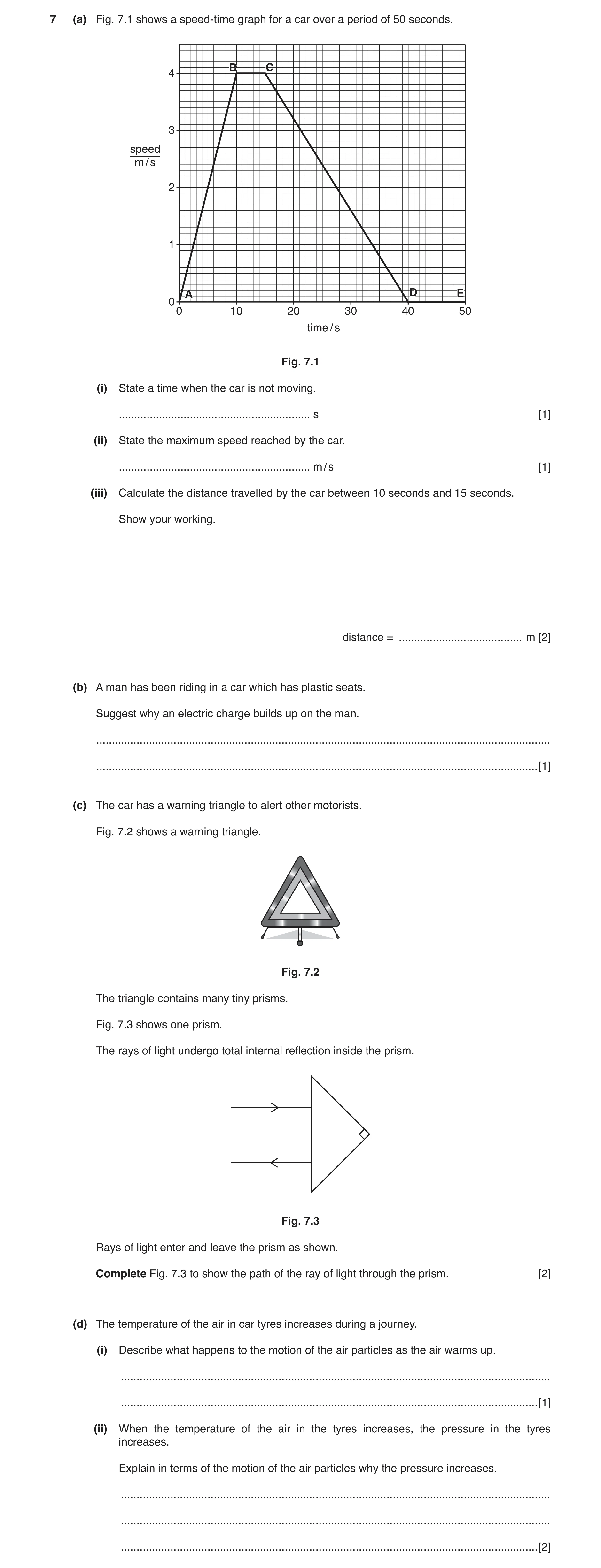
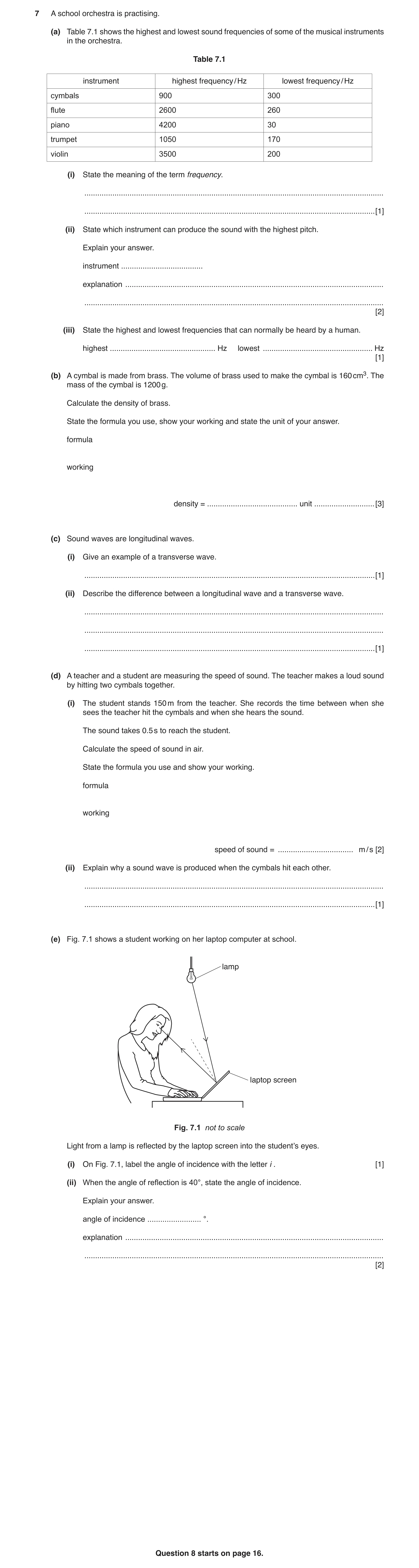
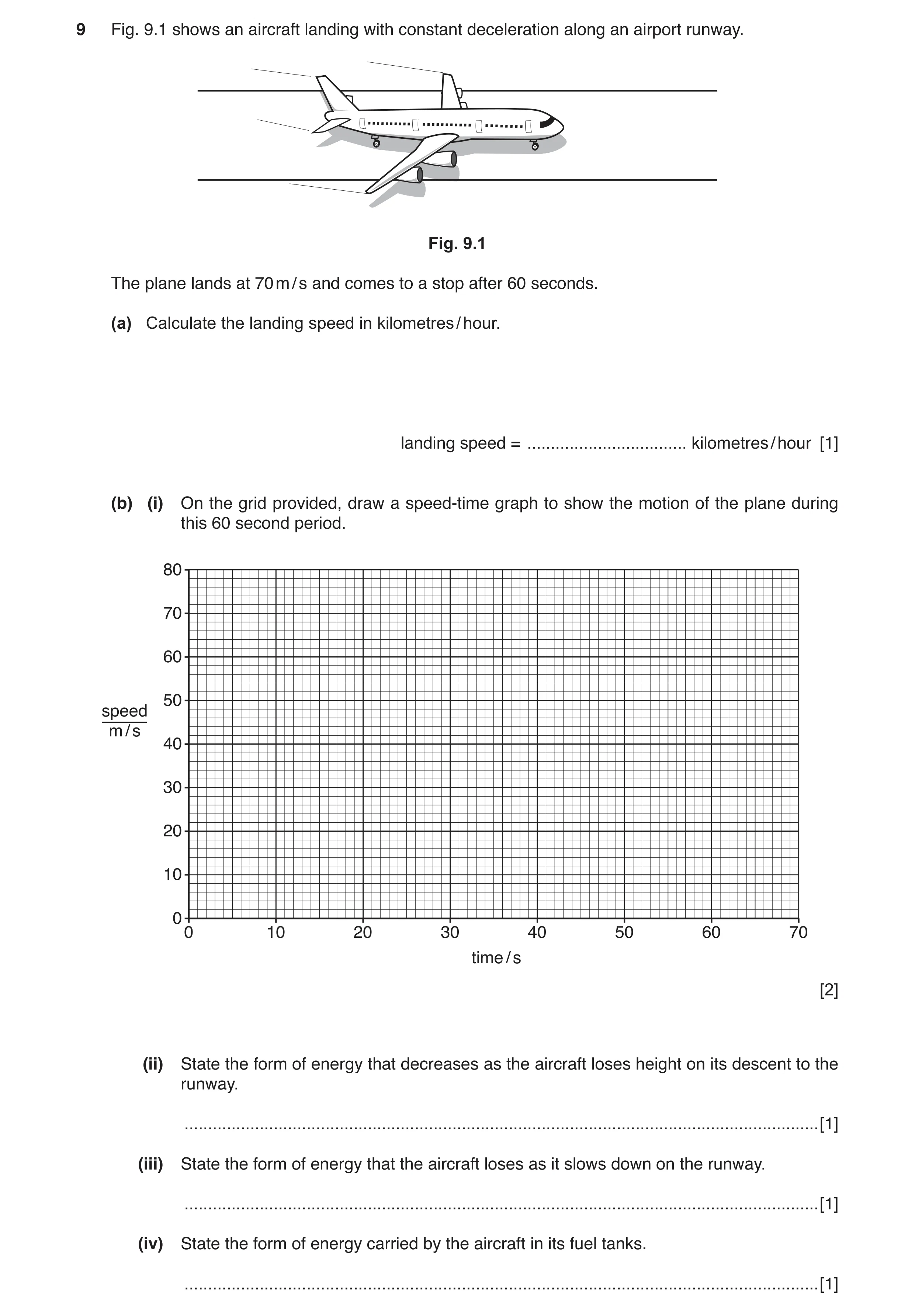 6 / 98
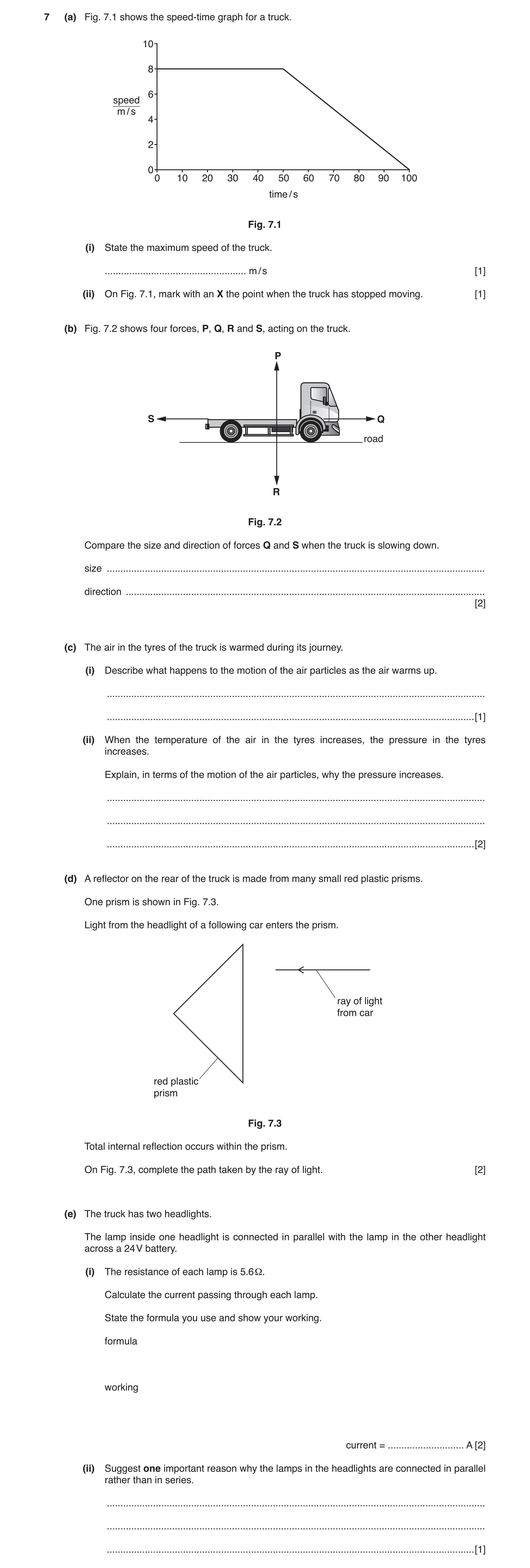
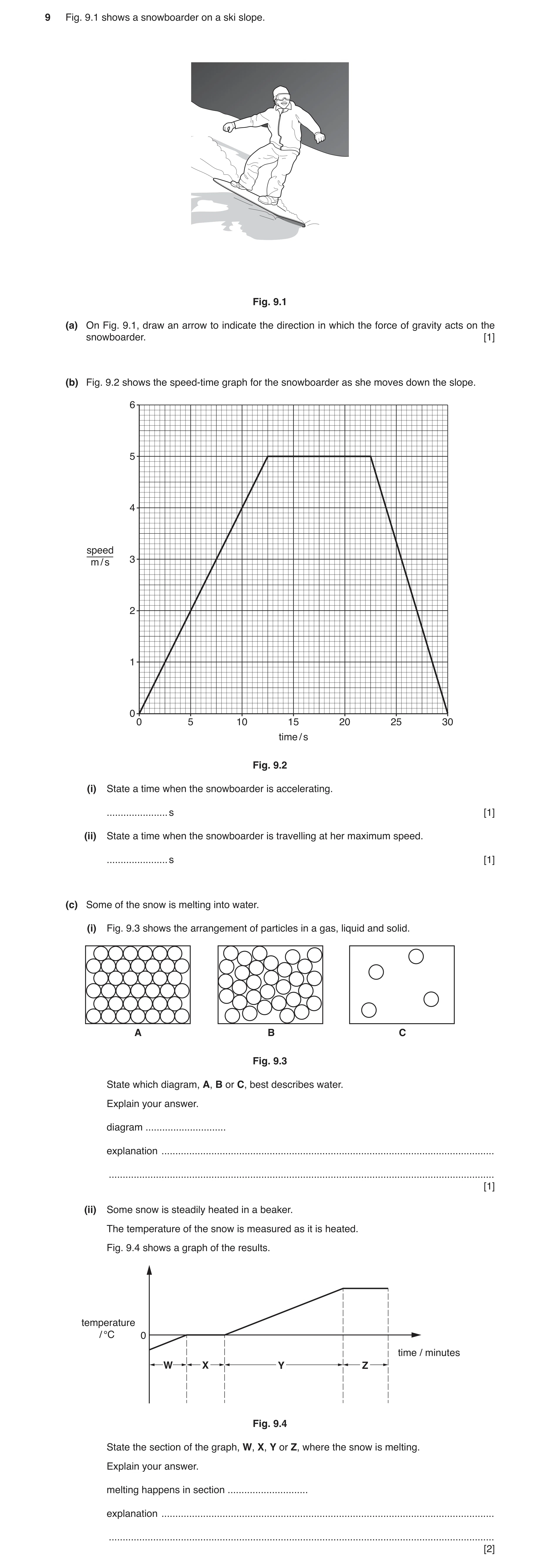
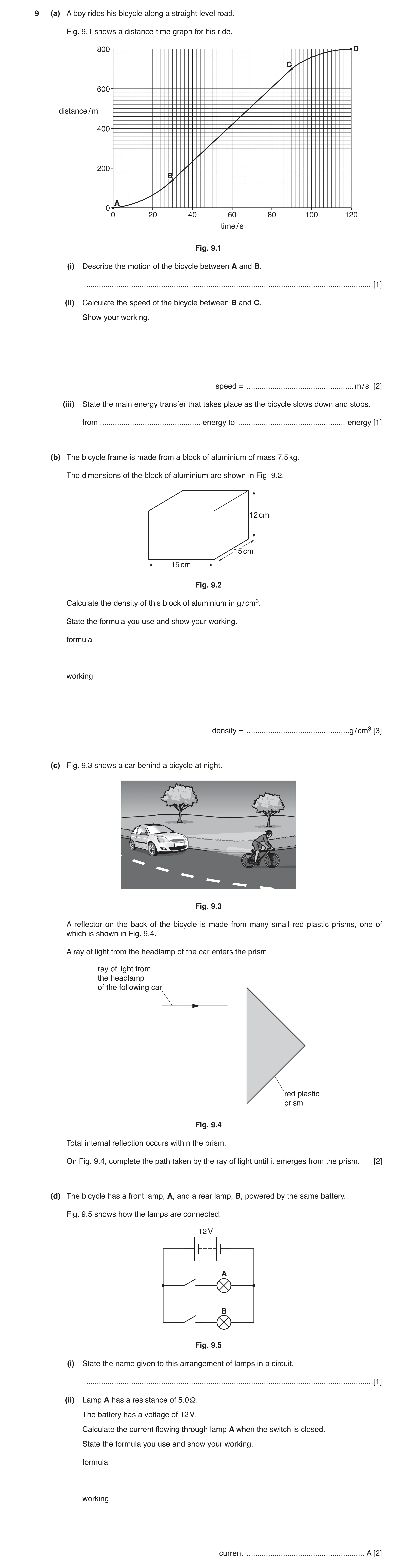
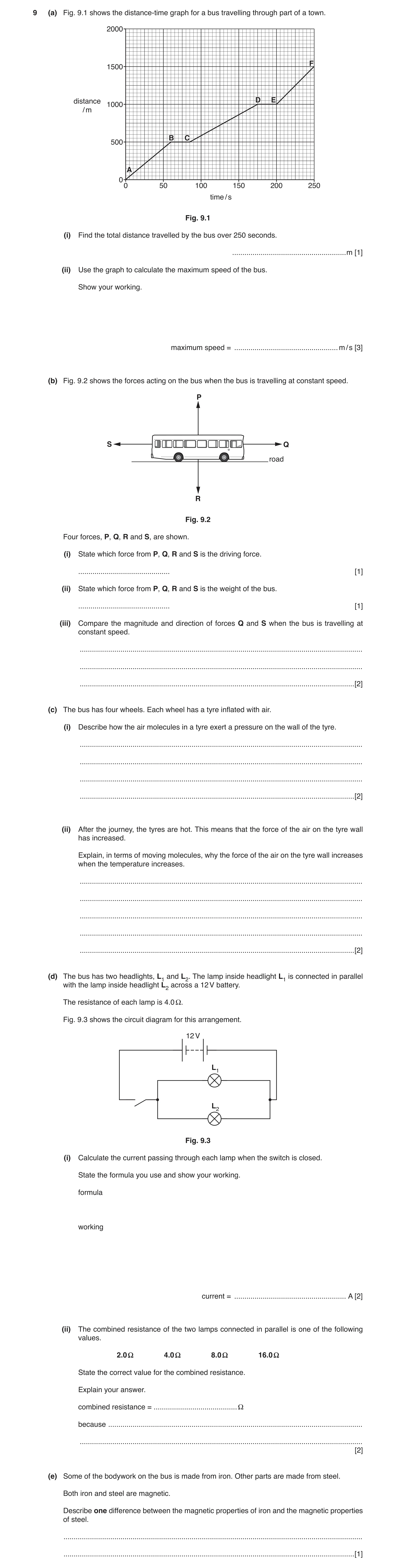
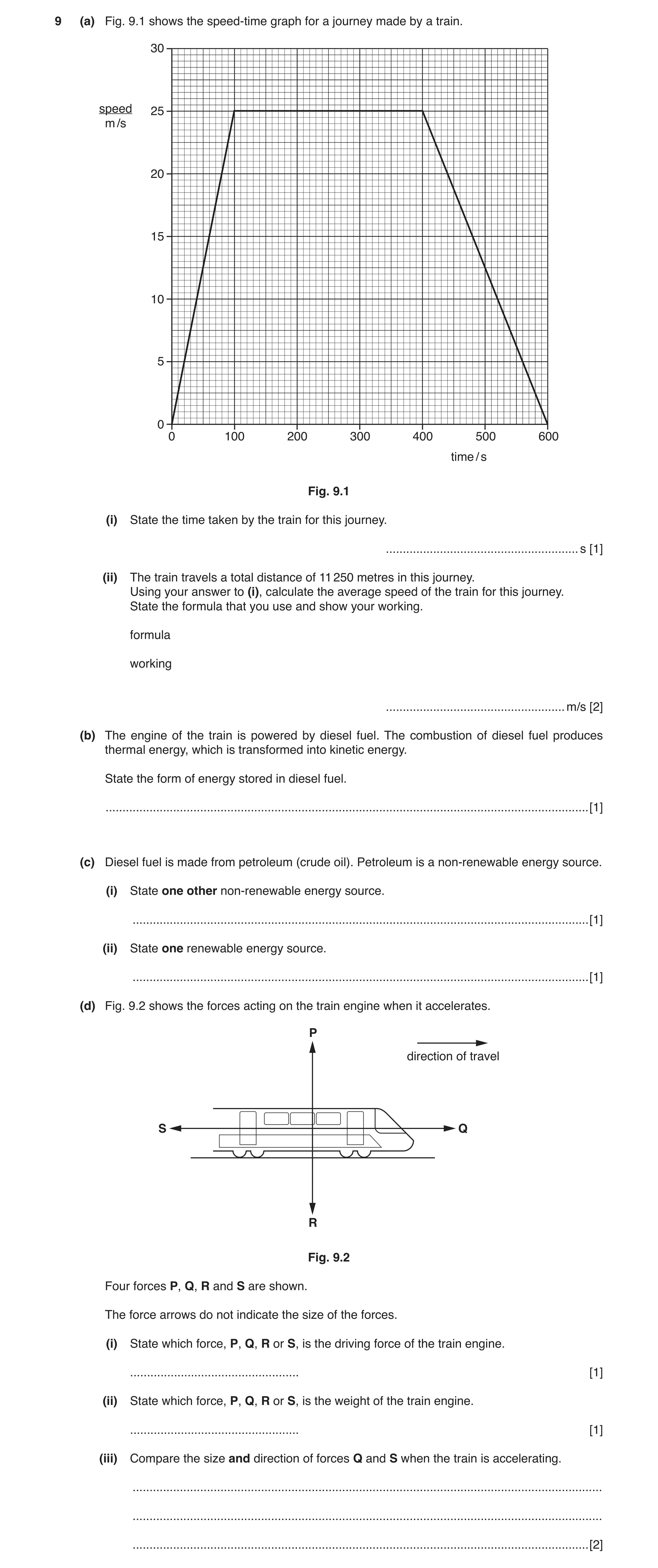
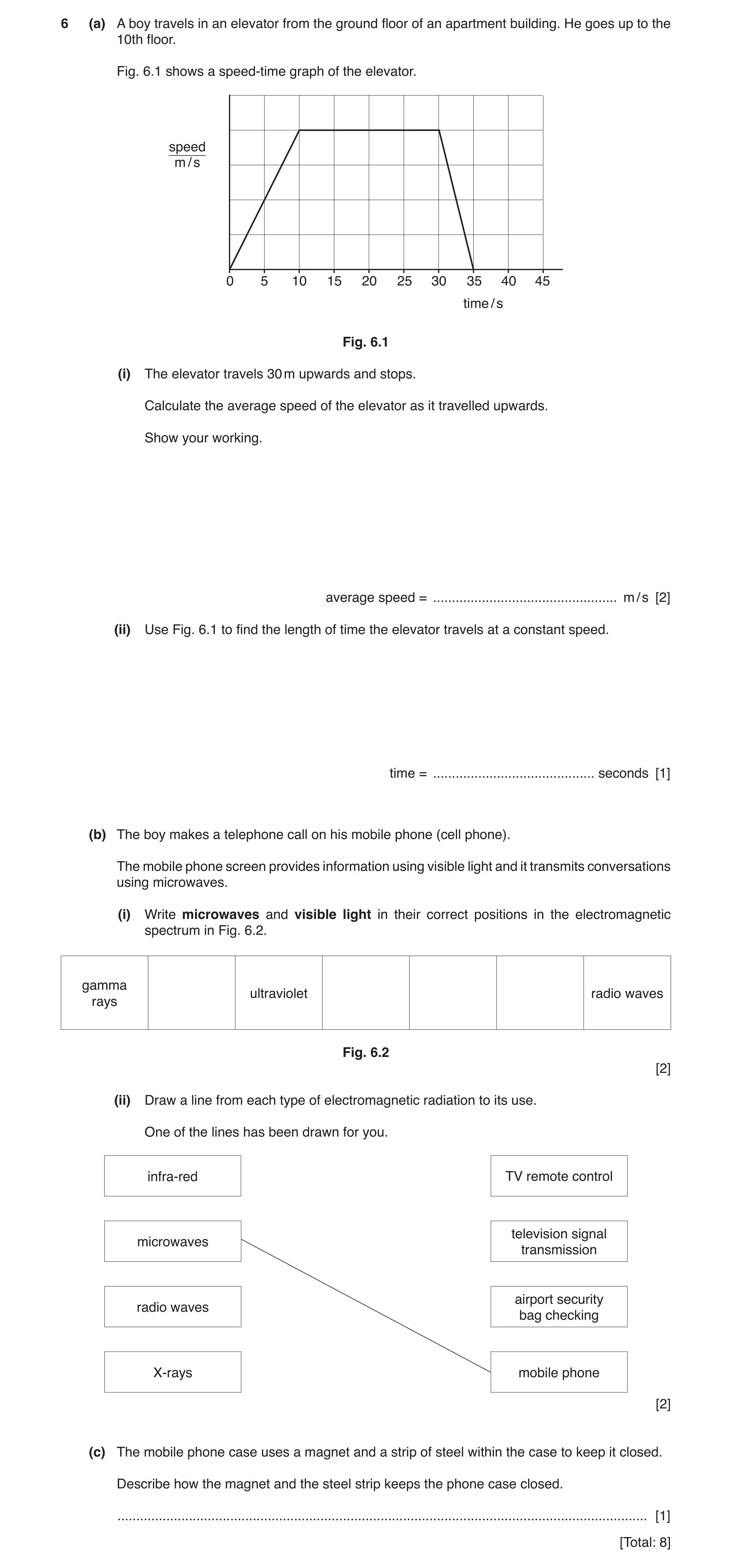
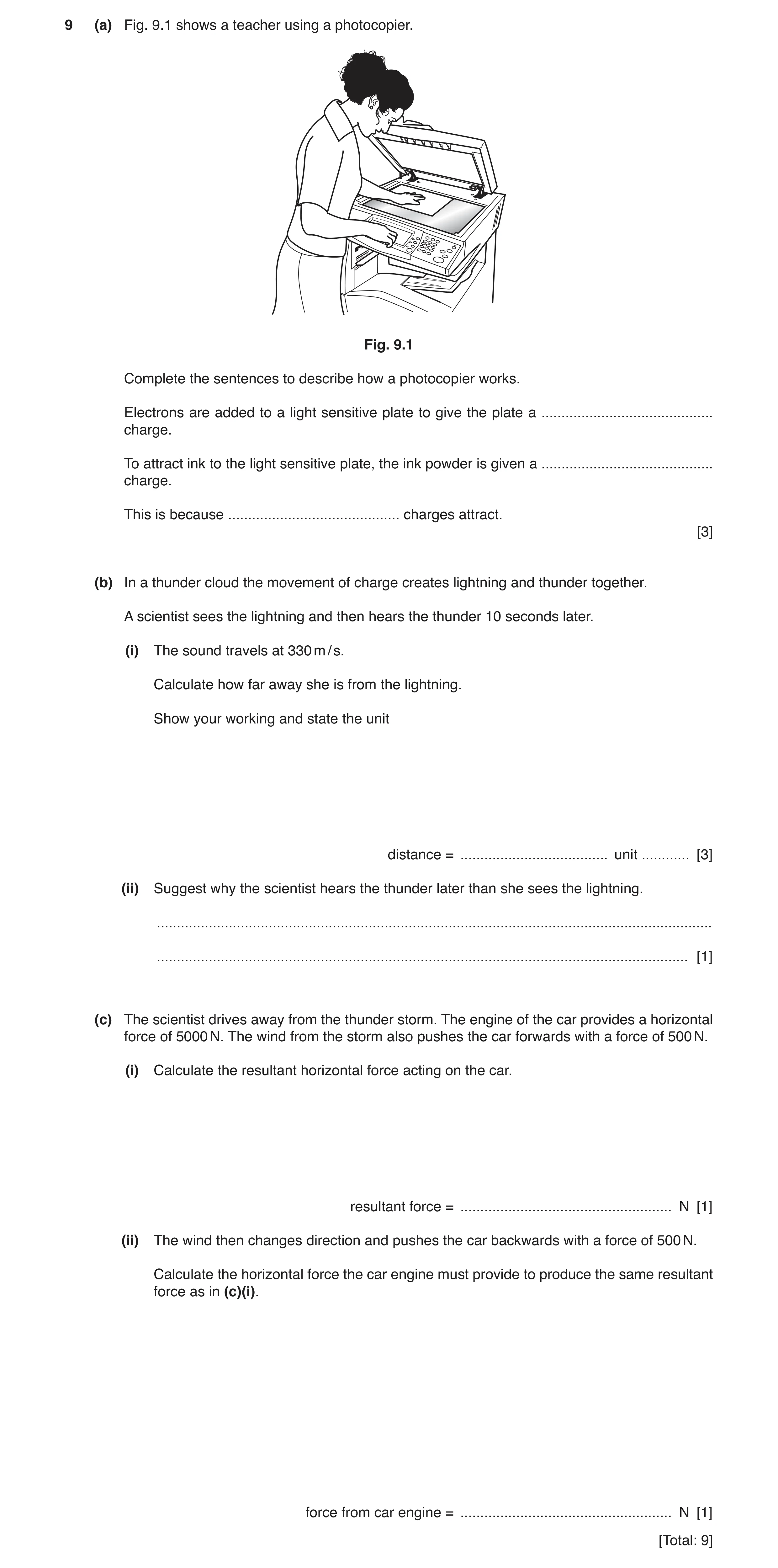
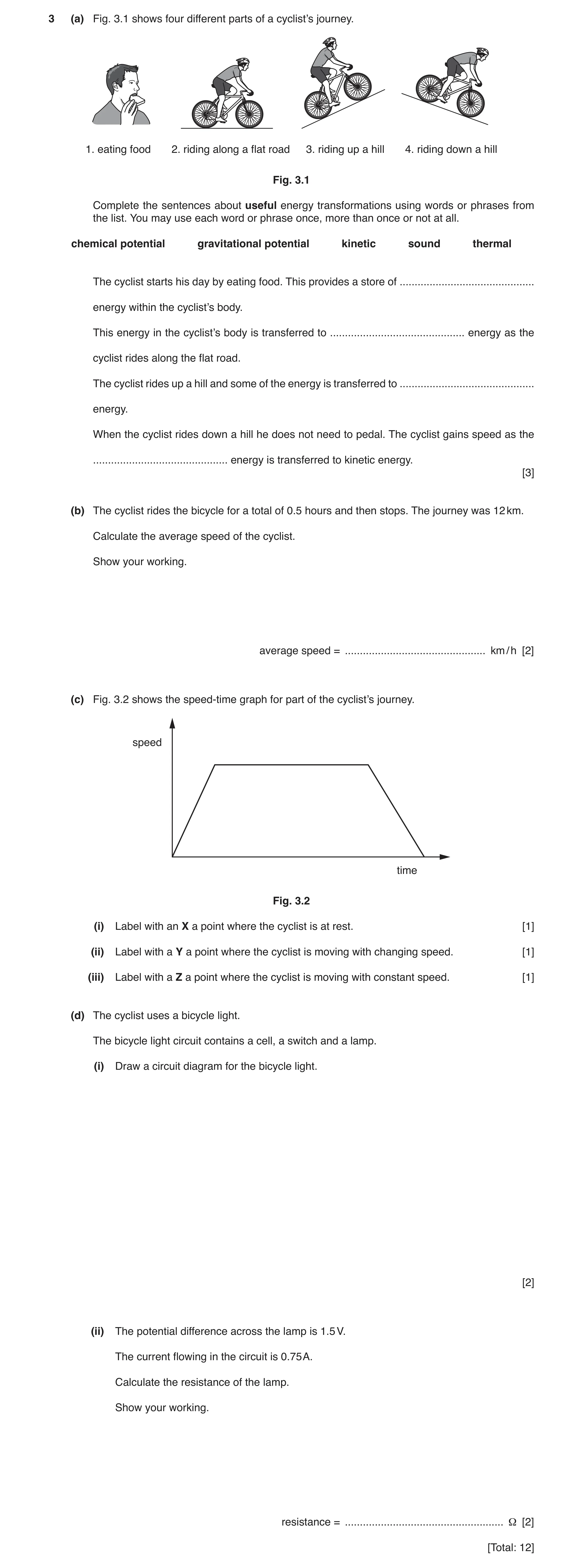
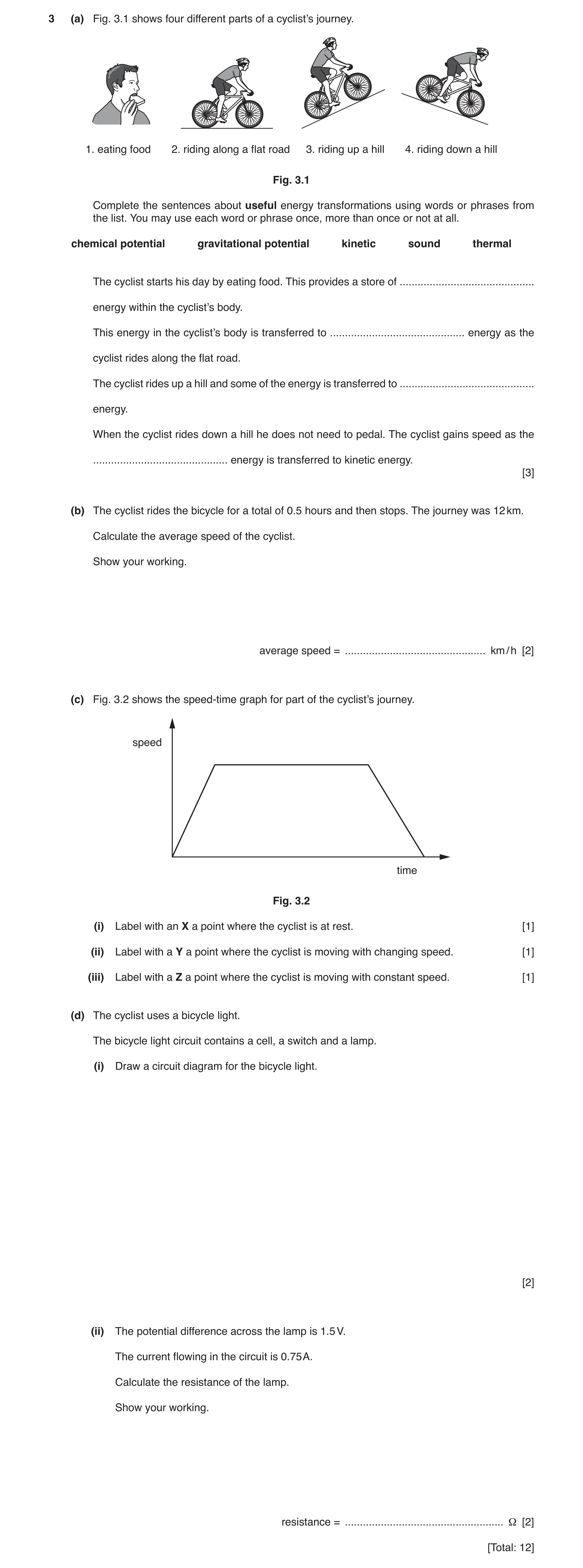
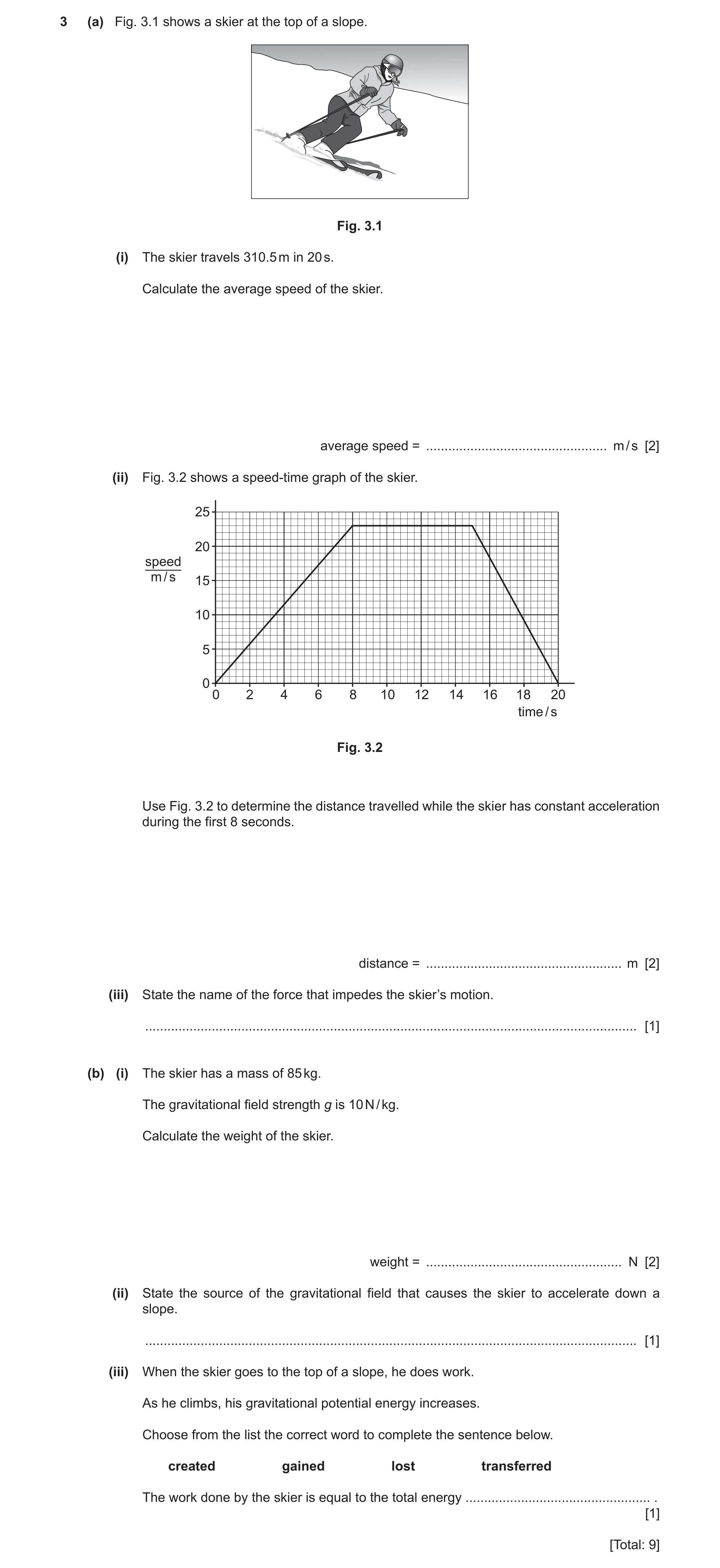
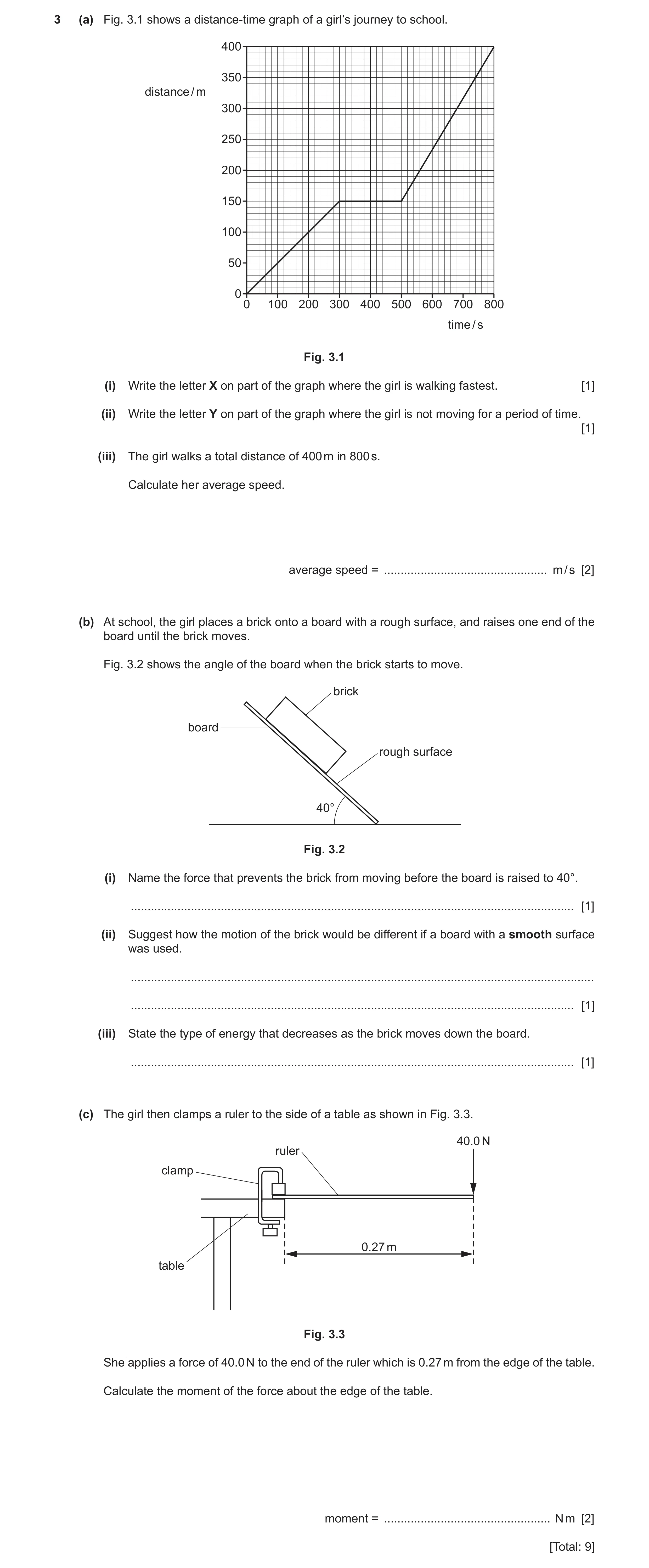
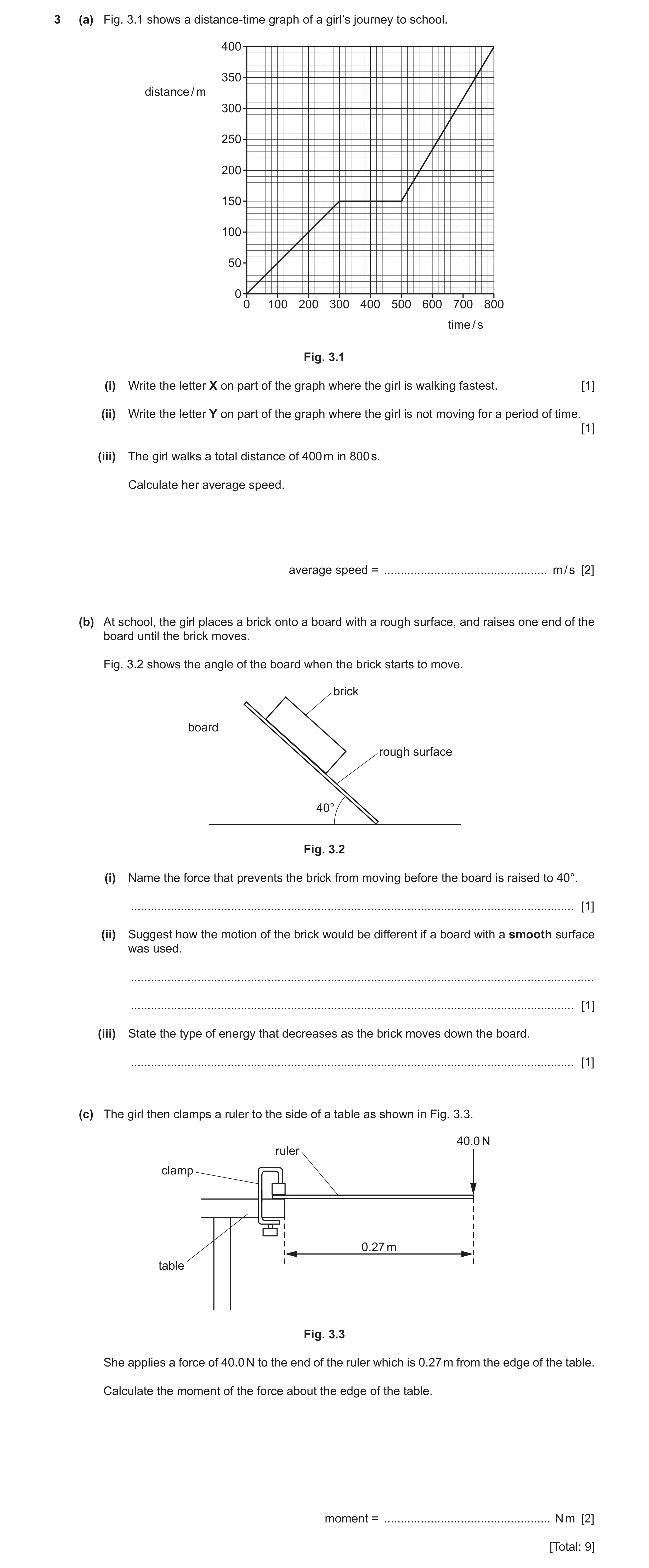
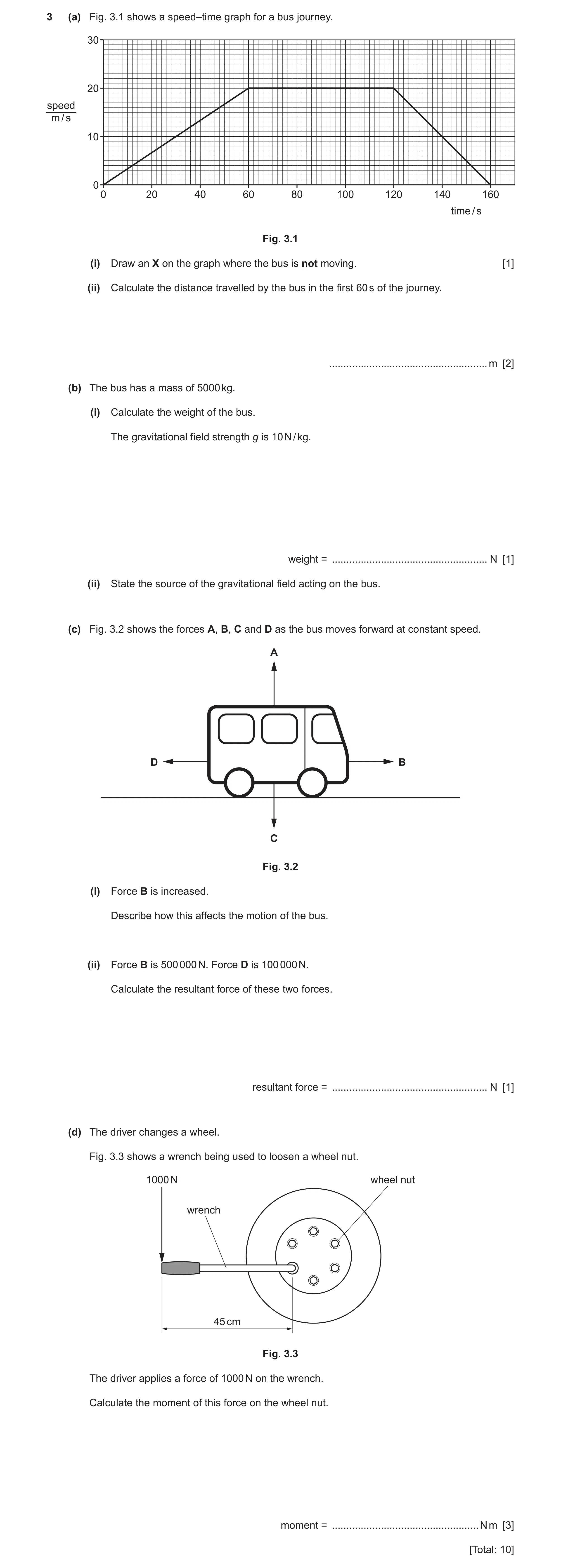
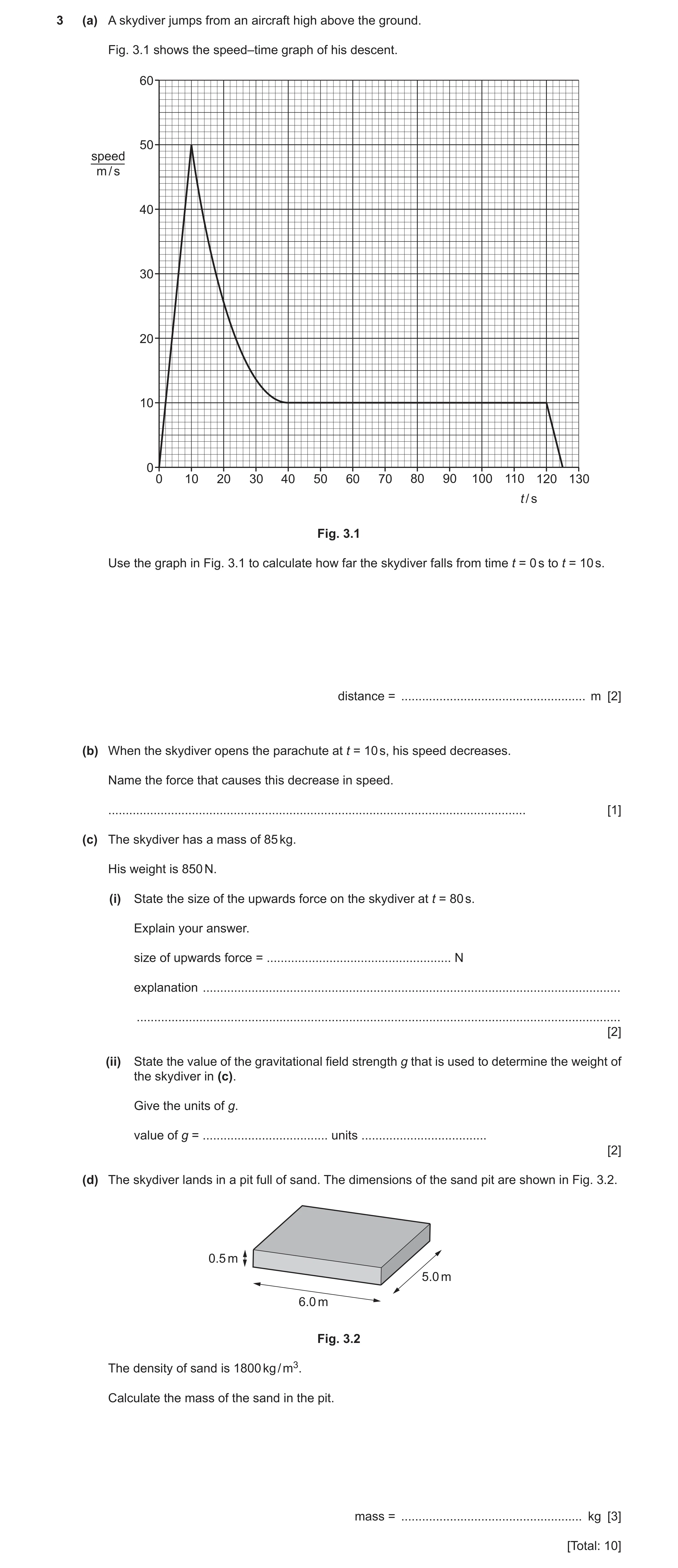
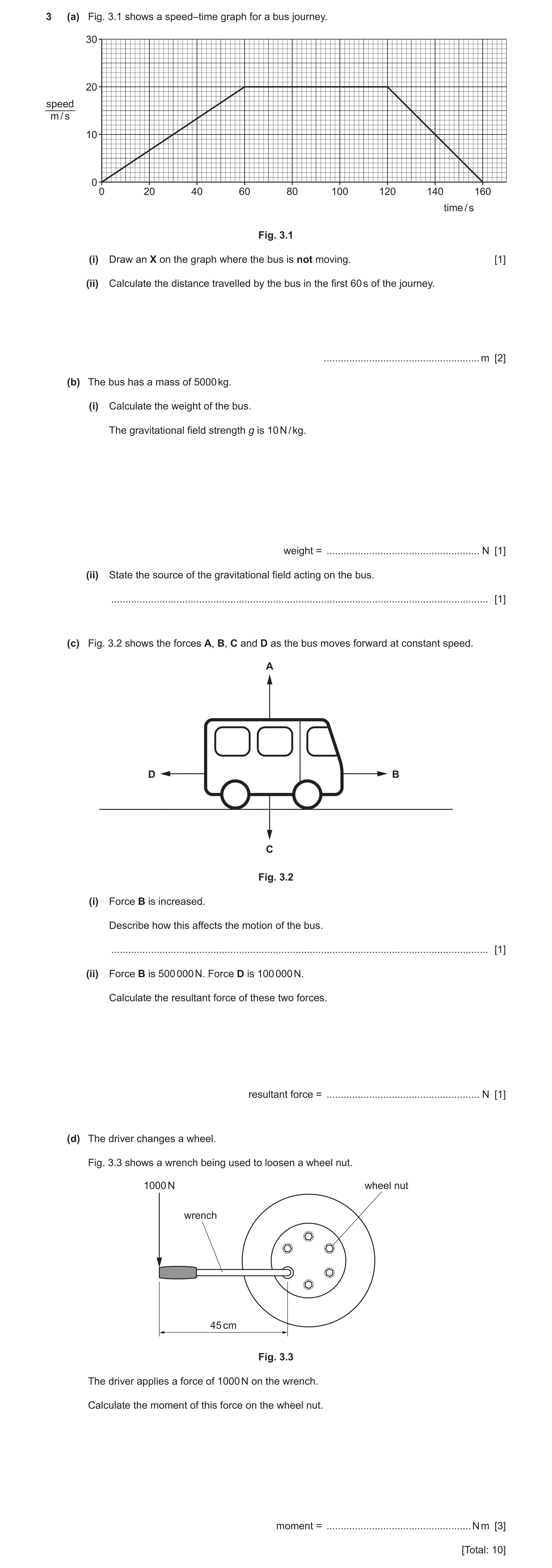
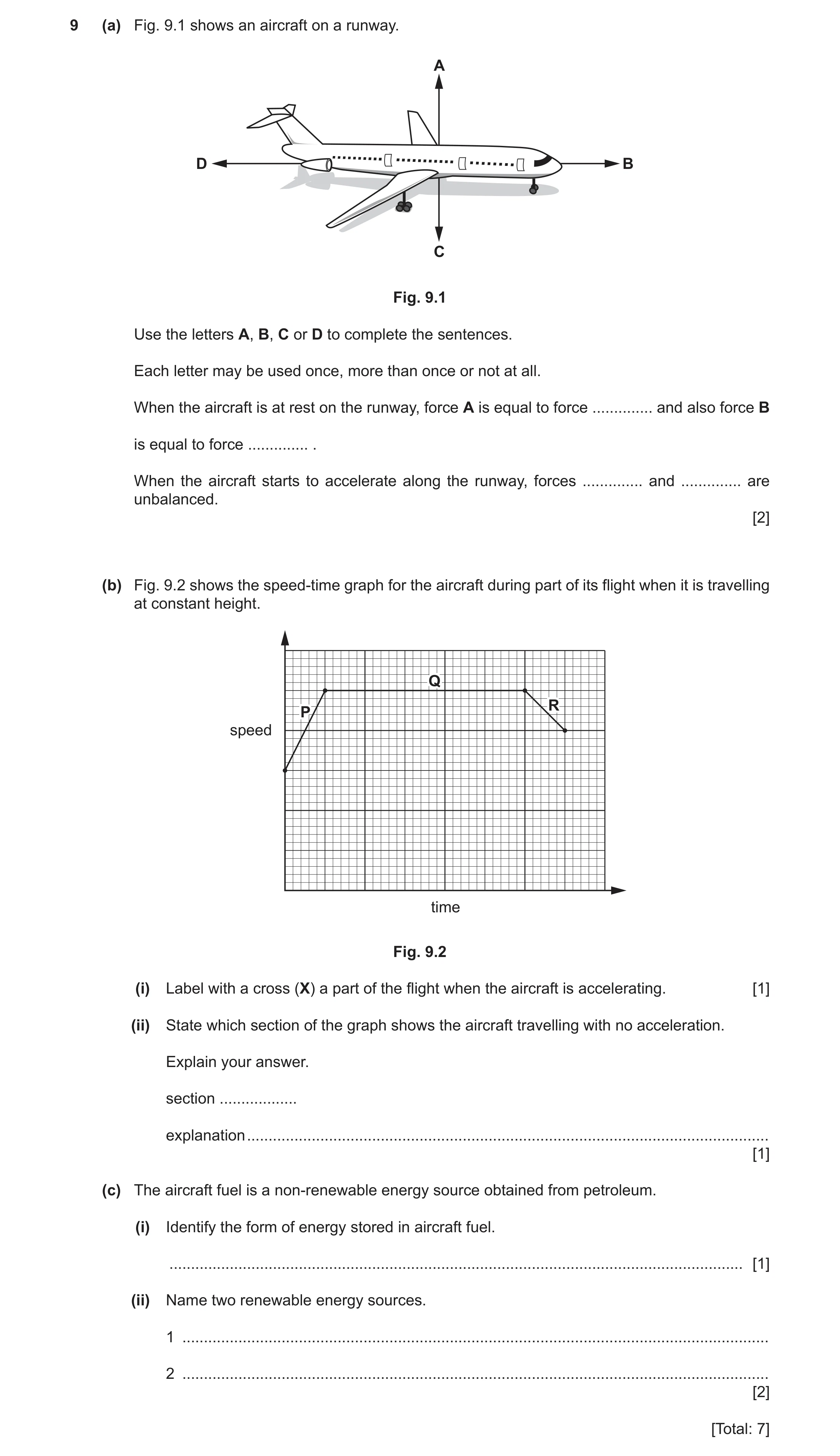
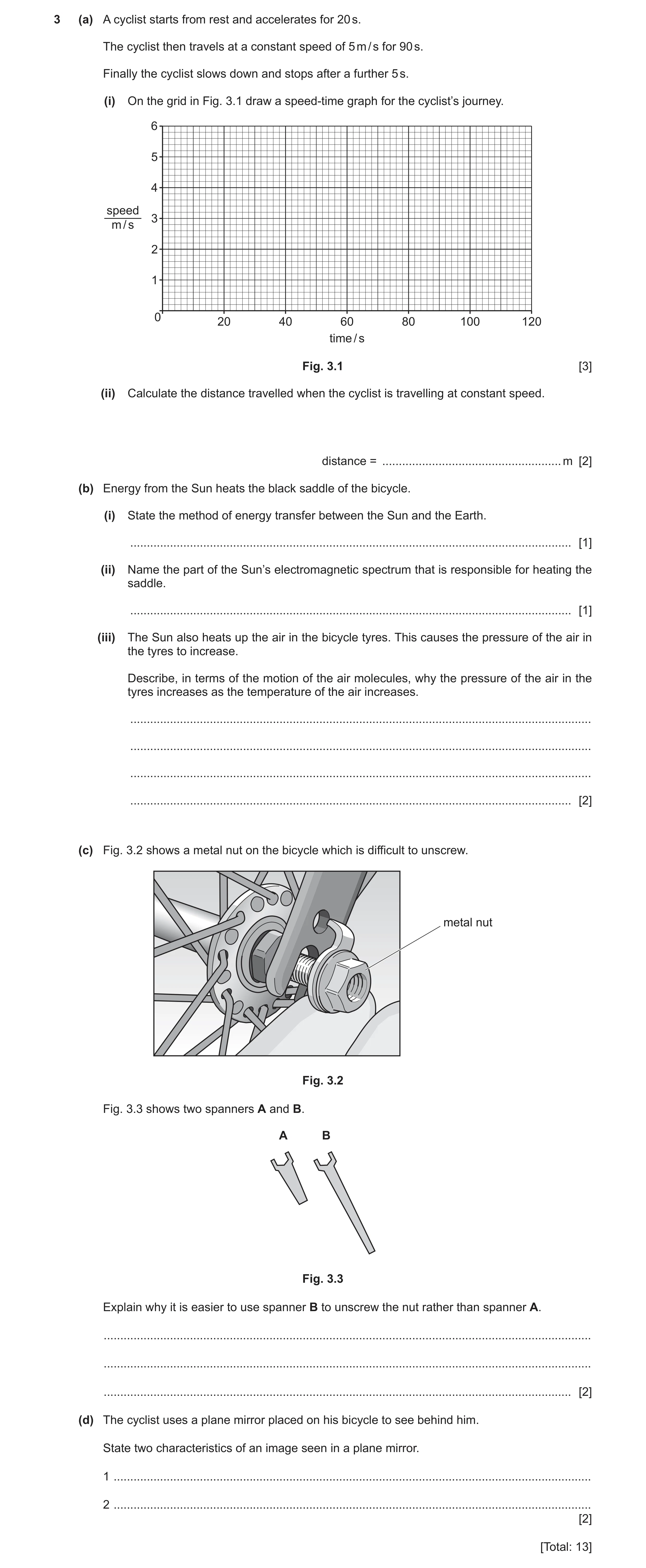
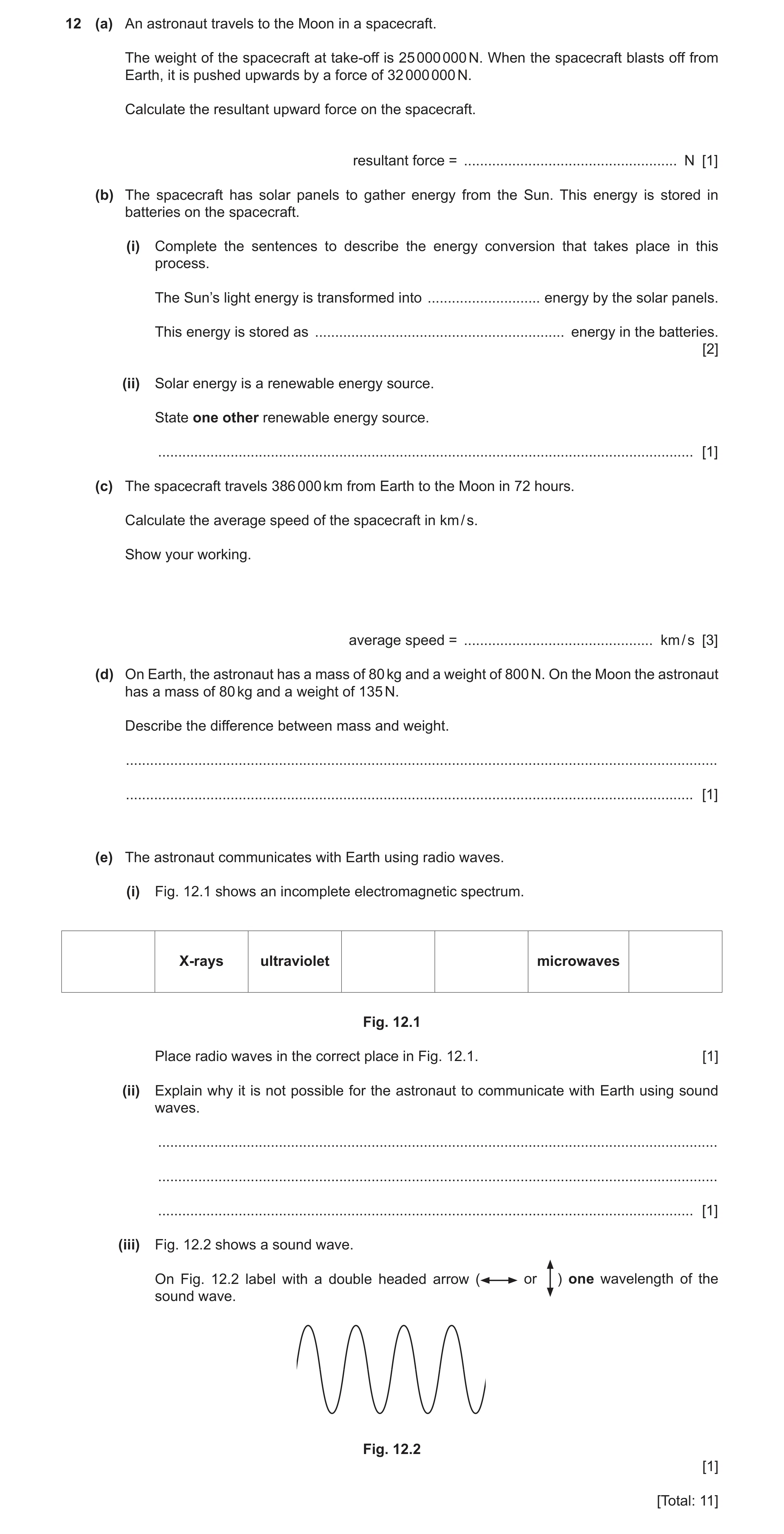
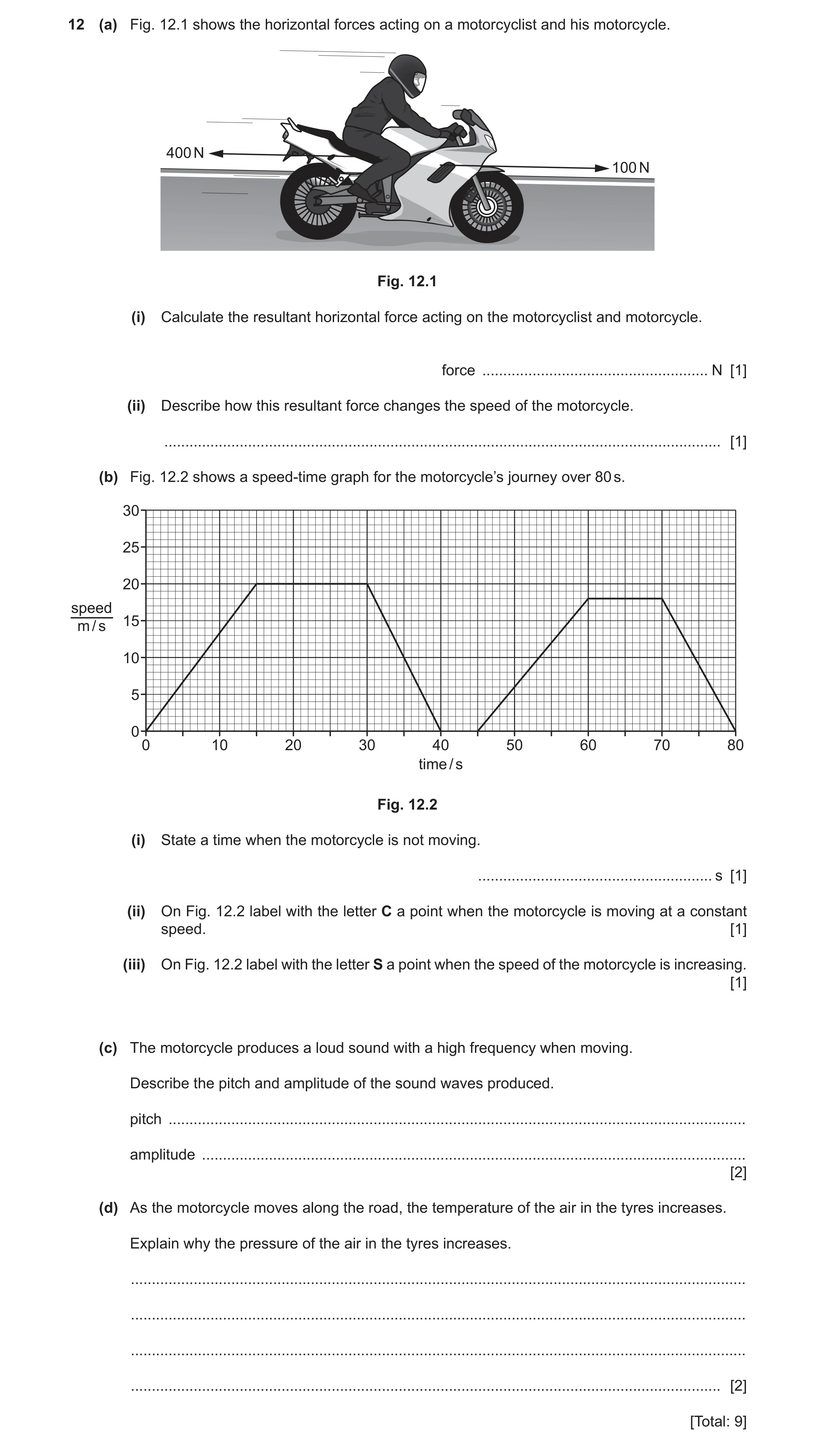
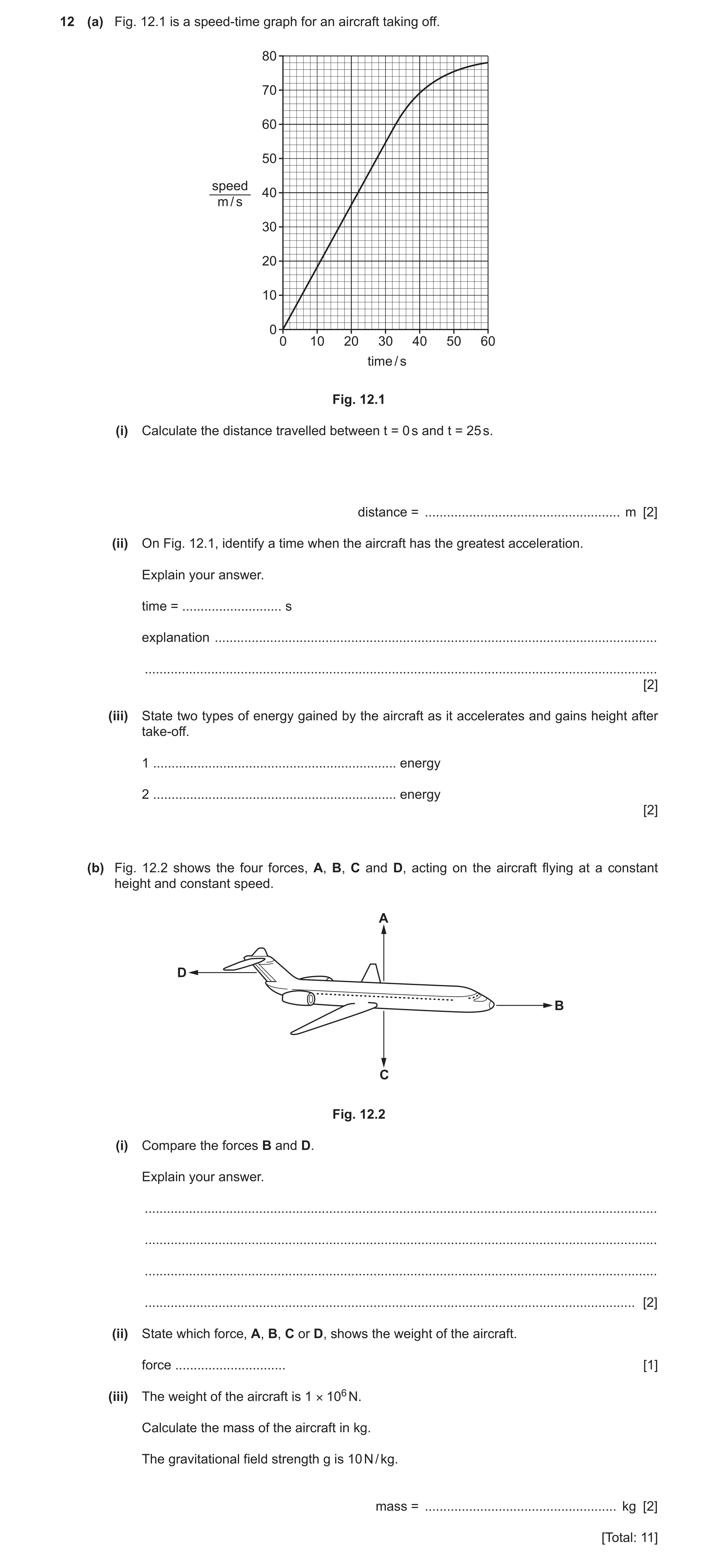
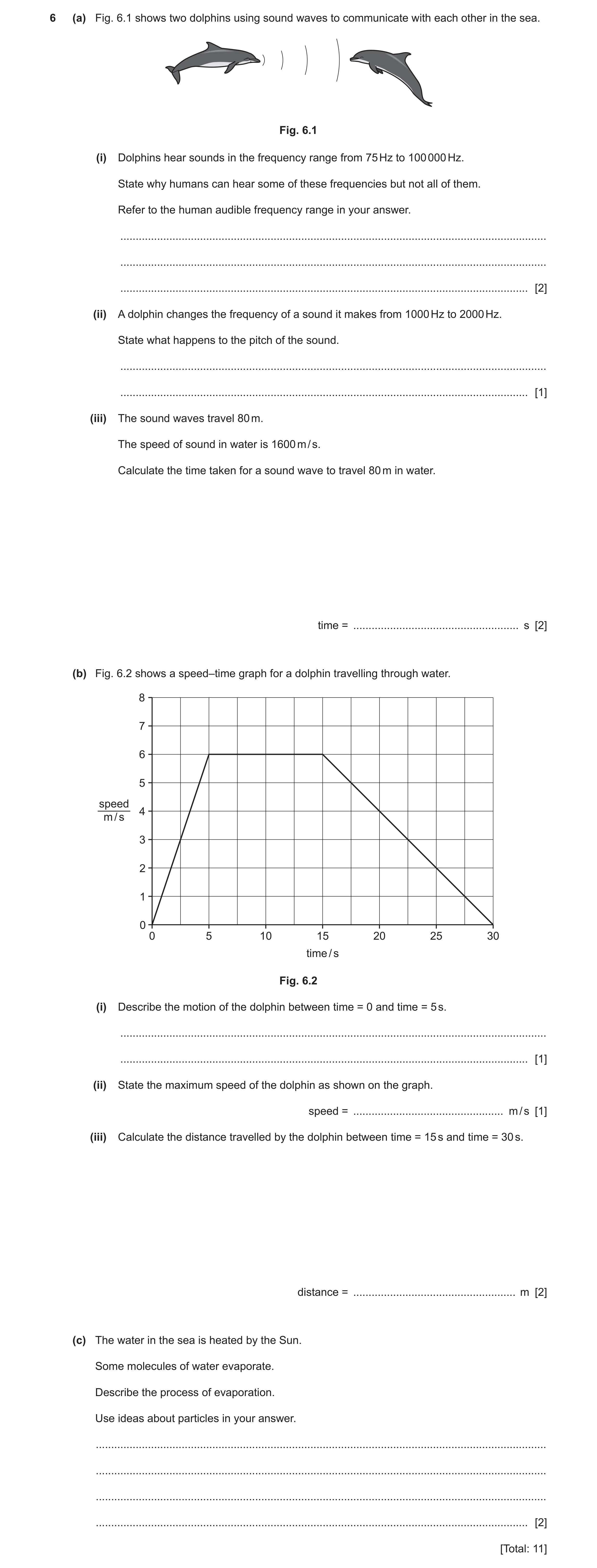
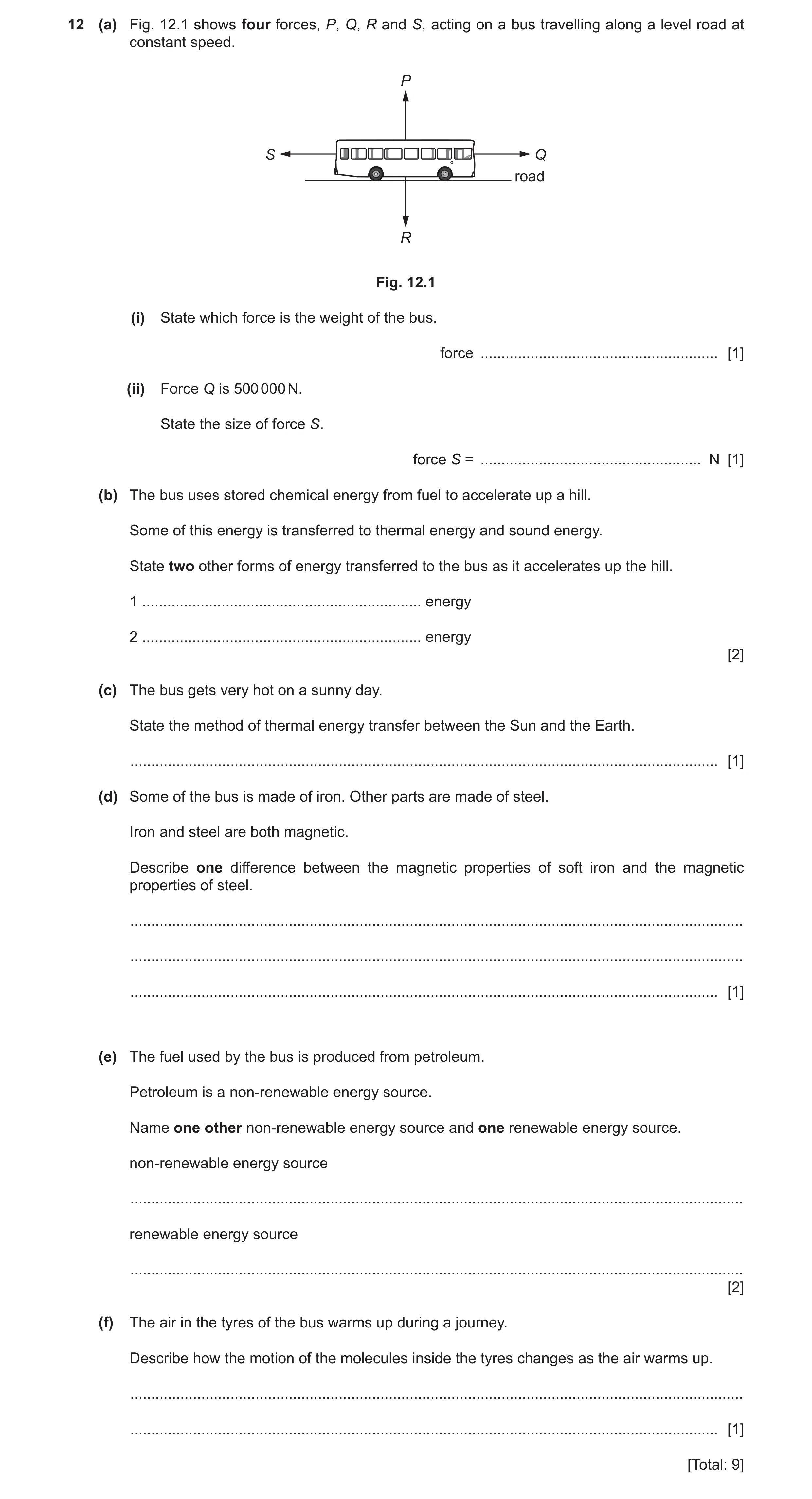
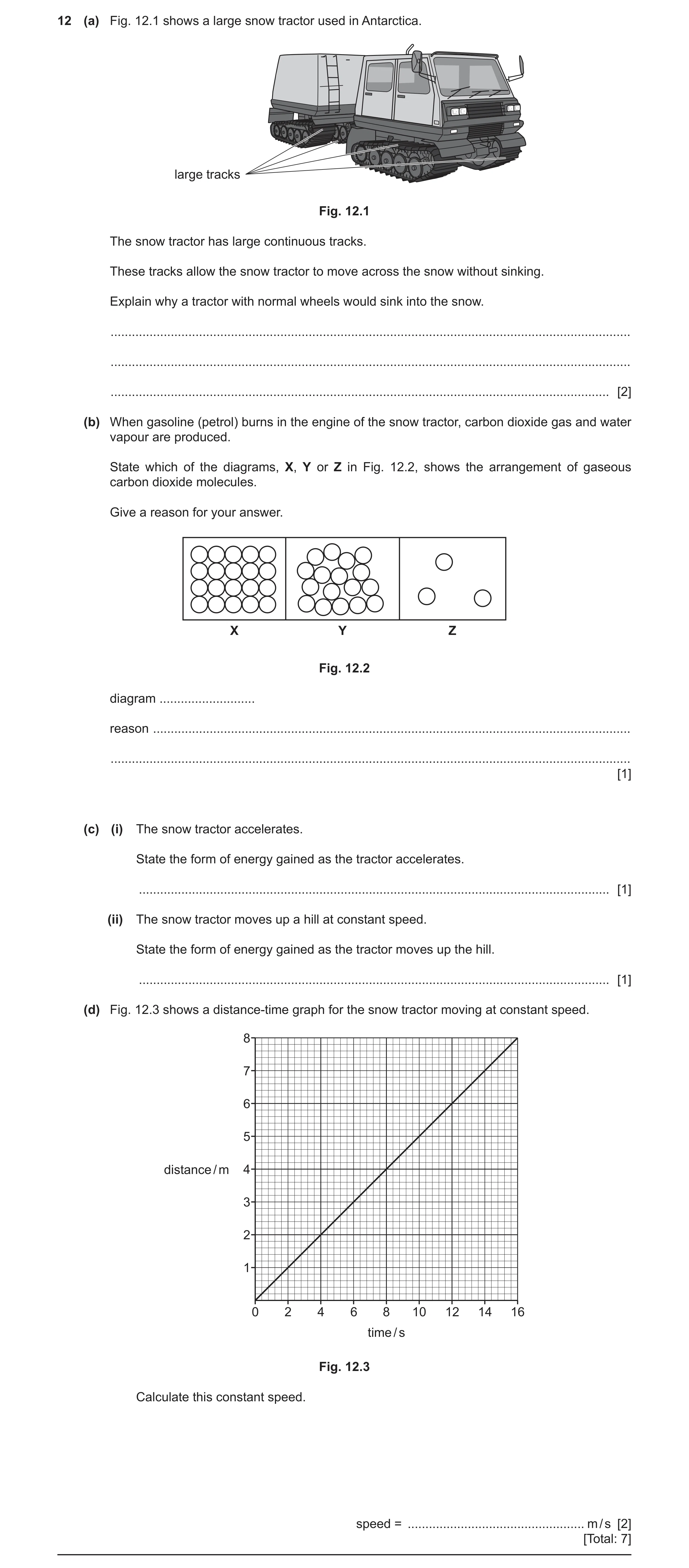
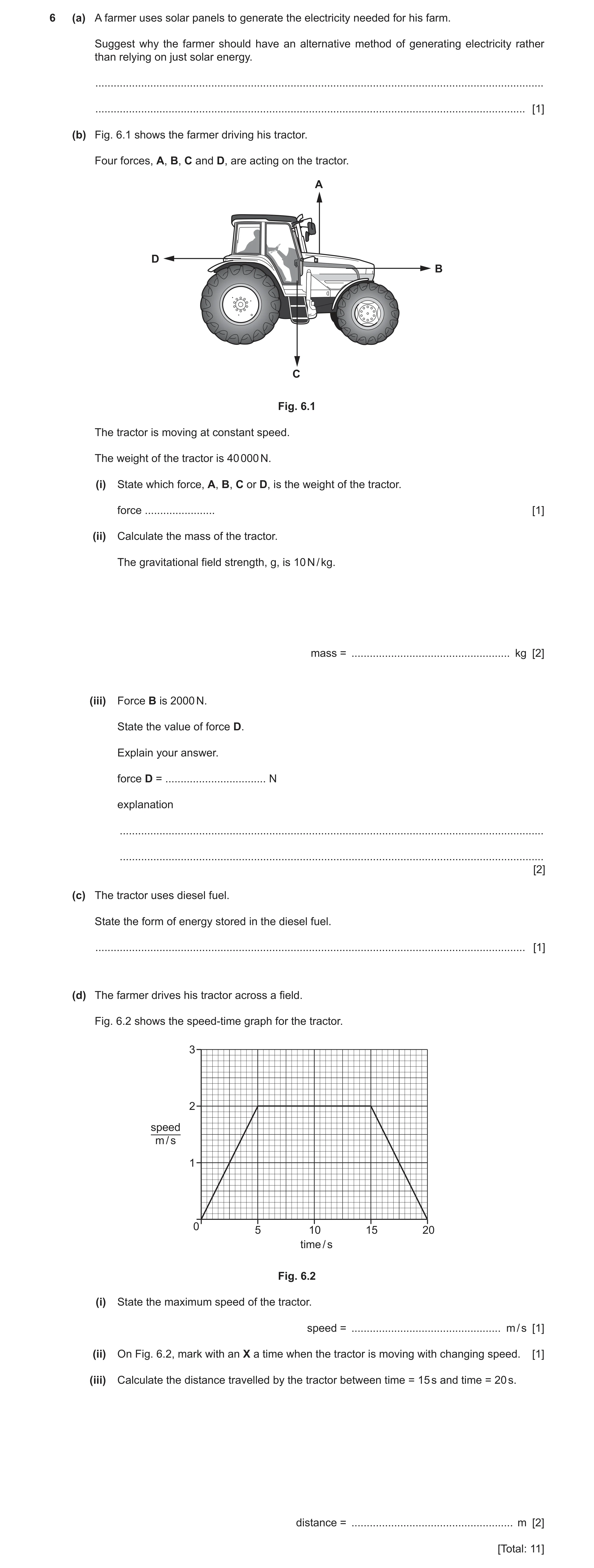
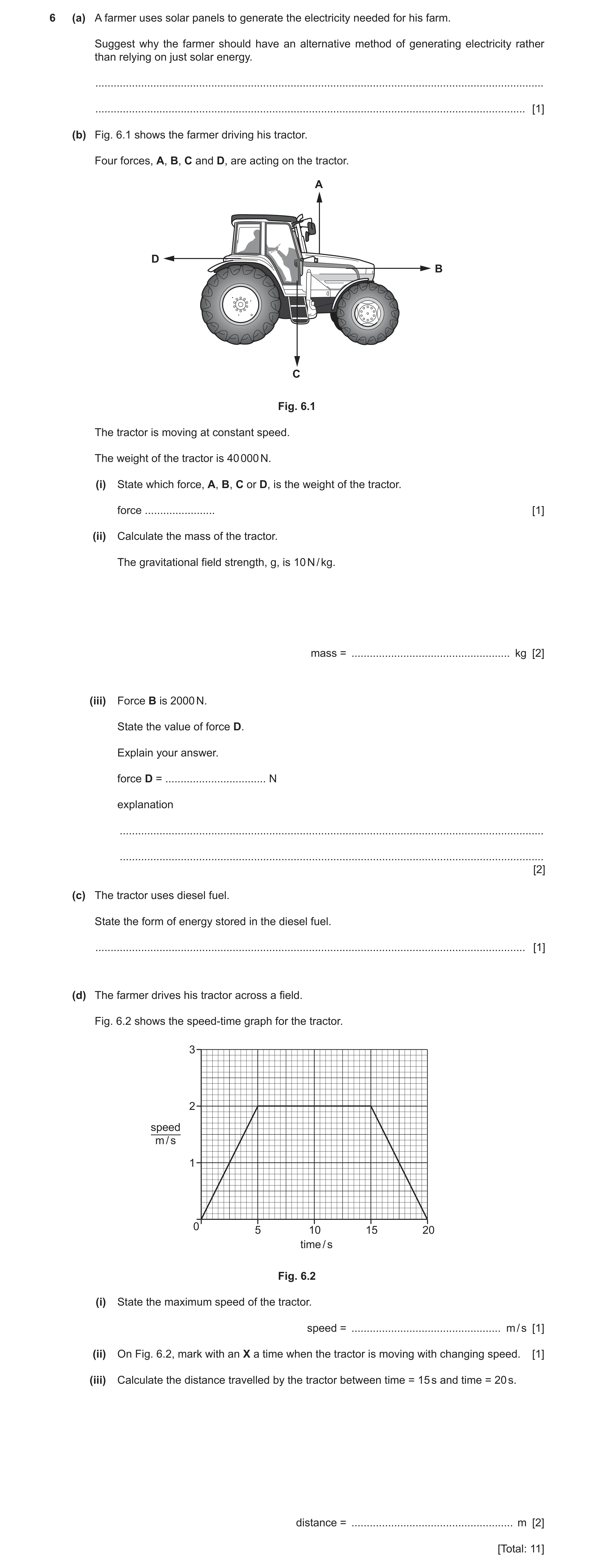
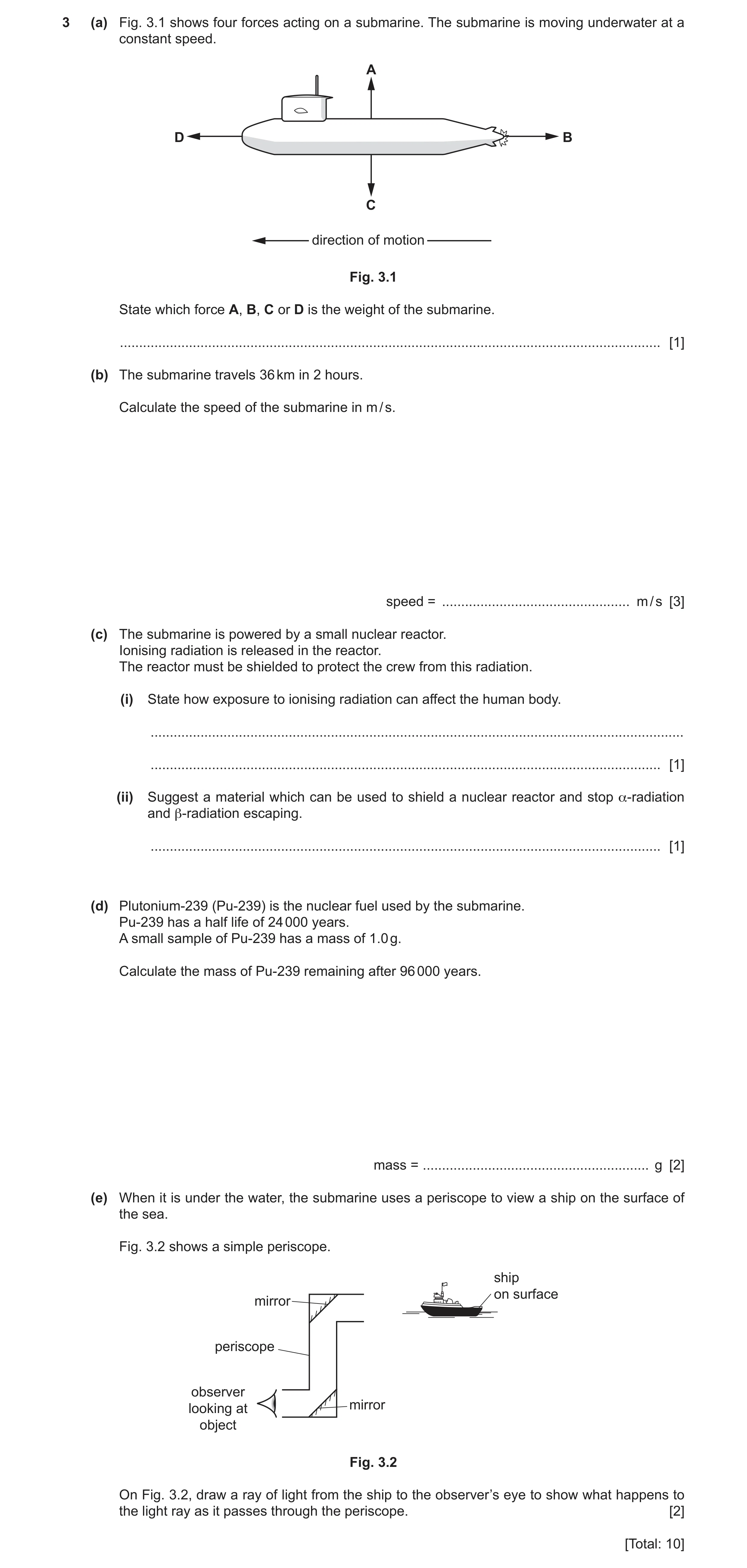
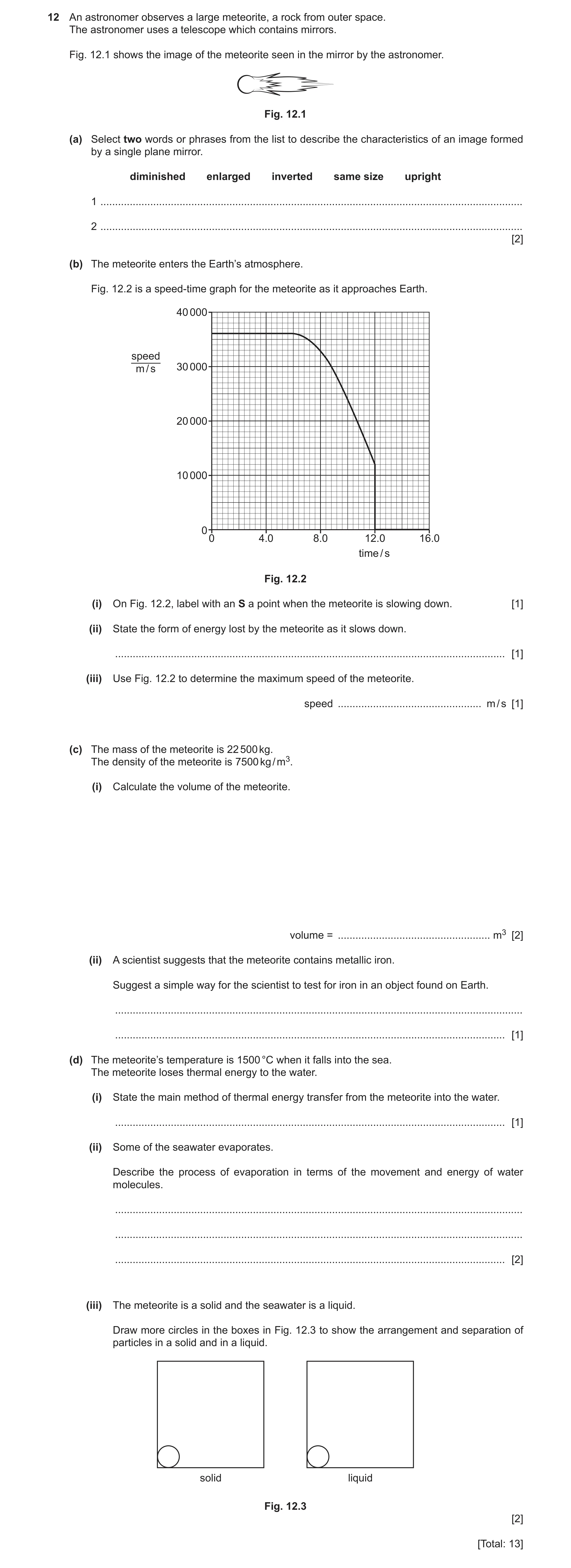
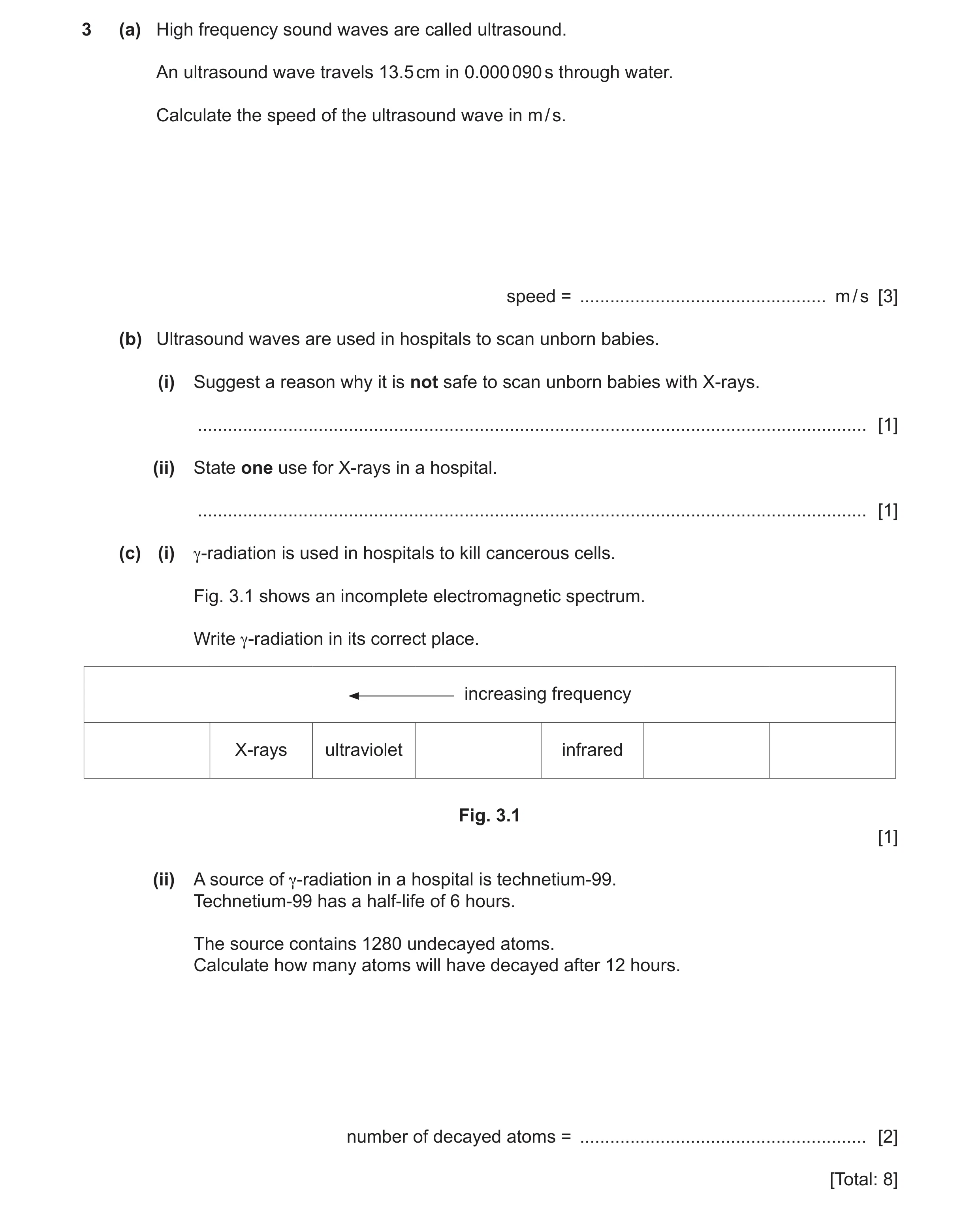 62 / 98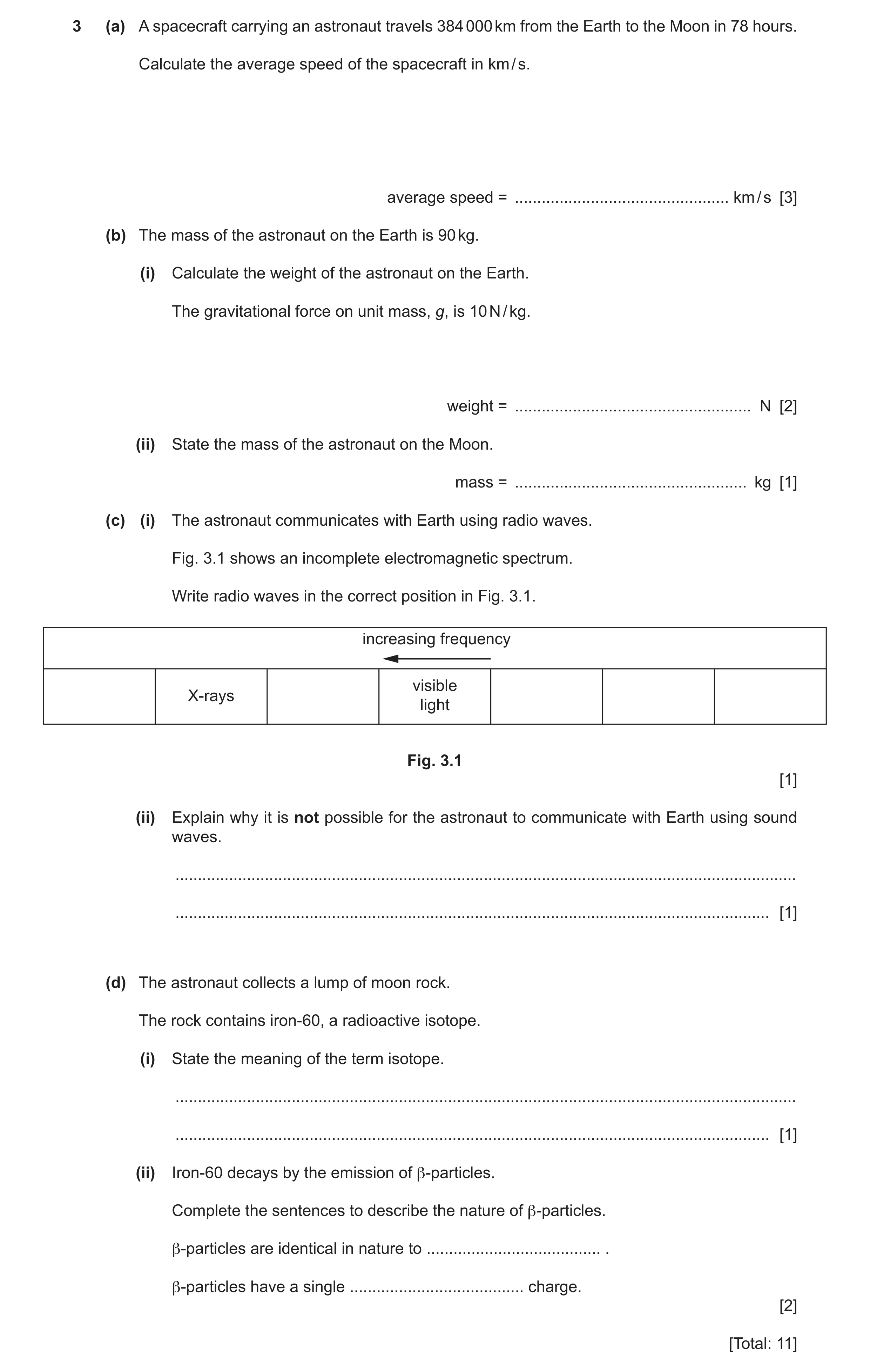
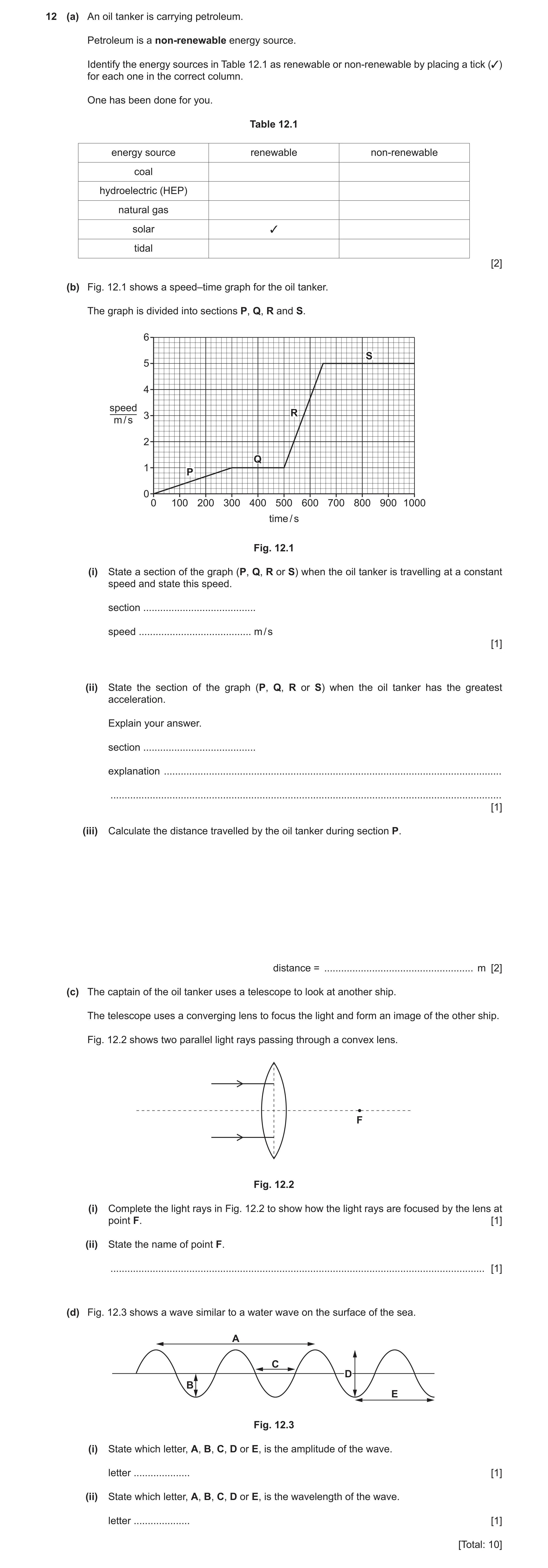
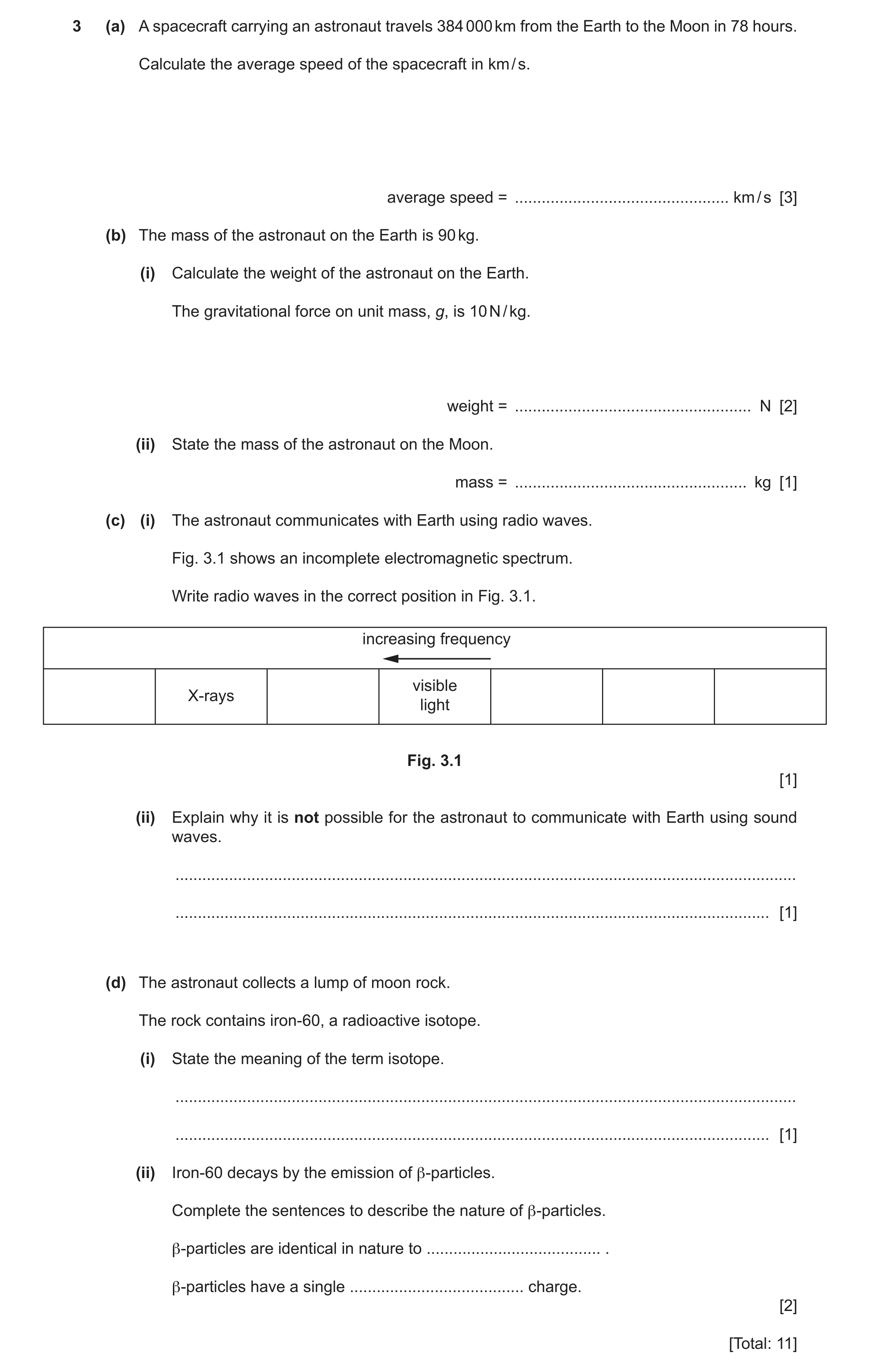
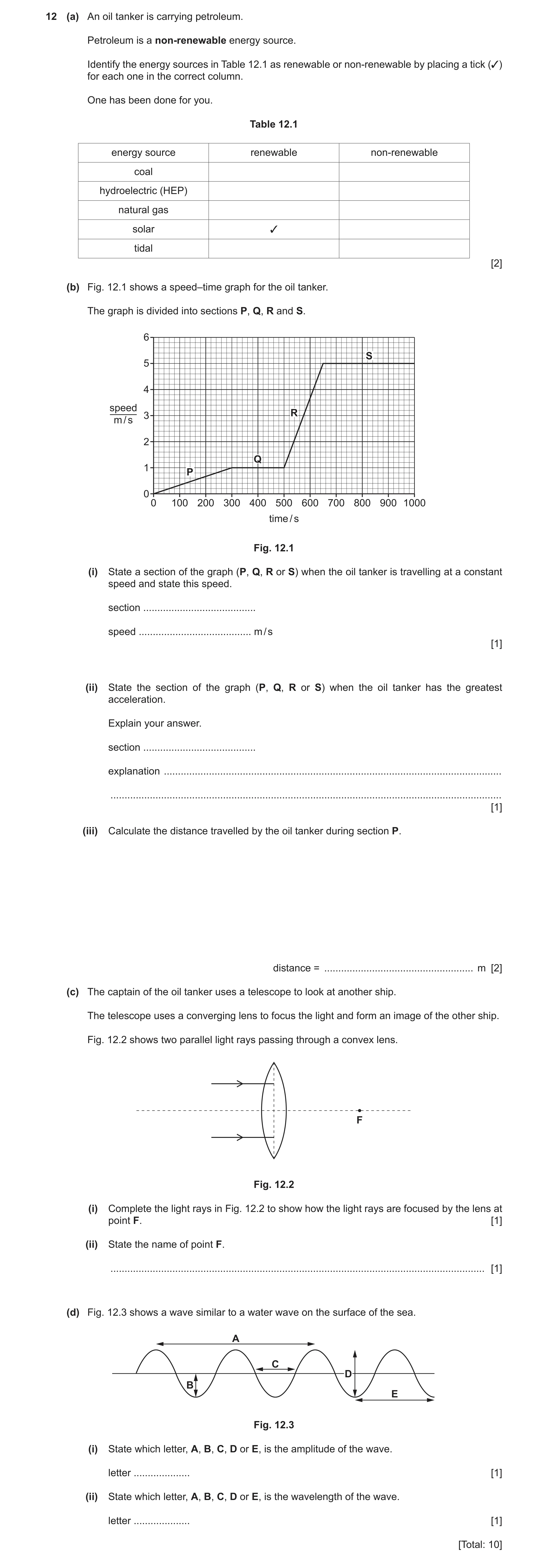
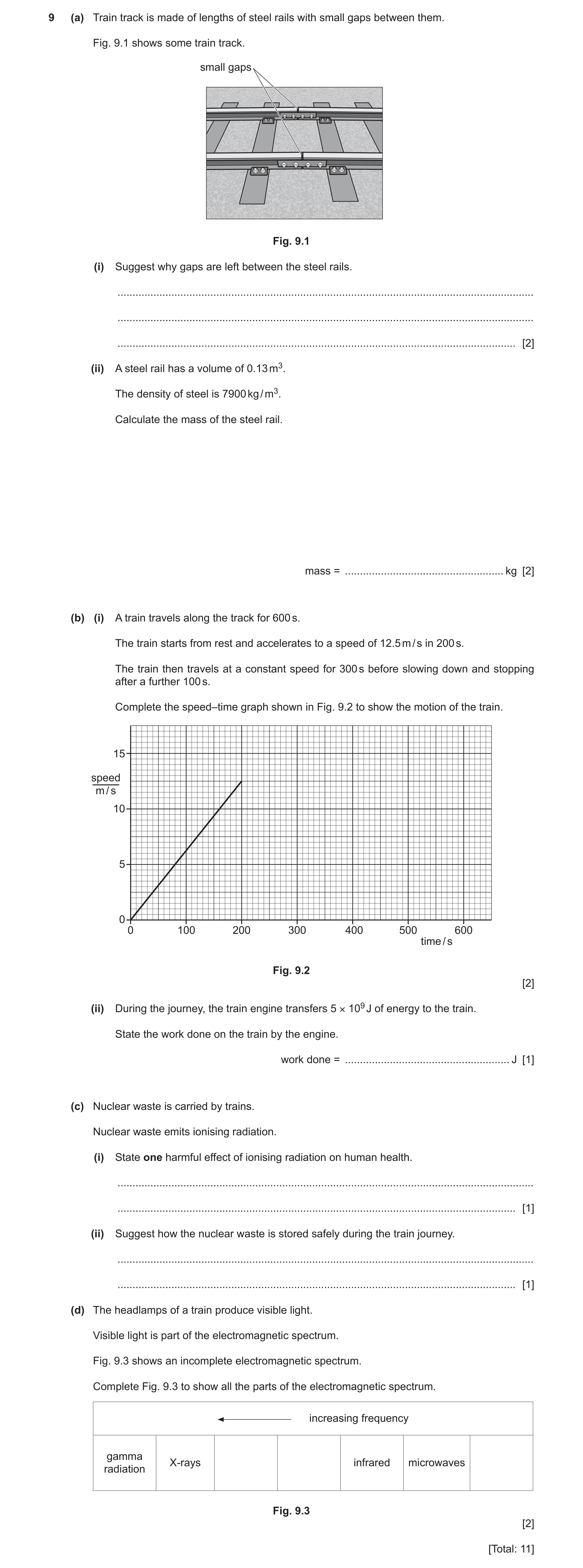
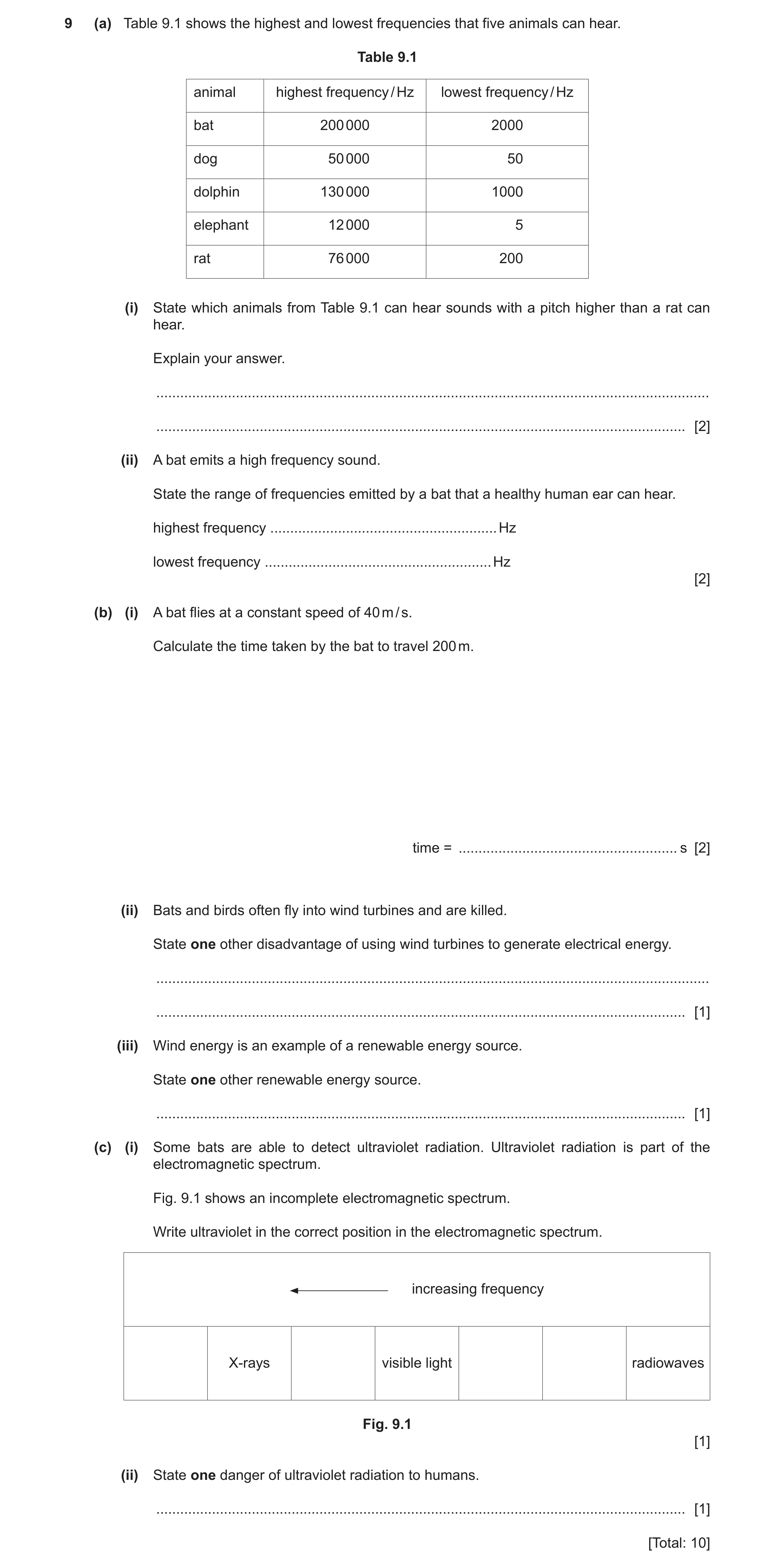
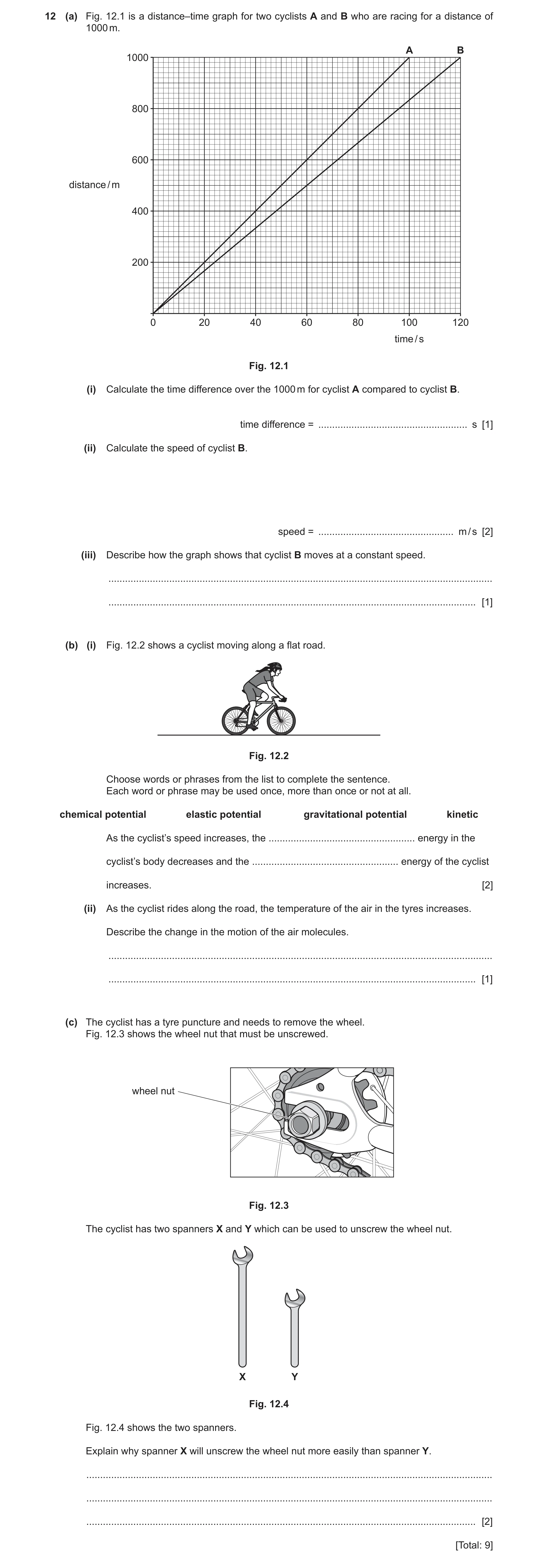
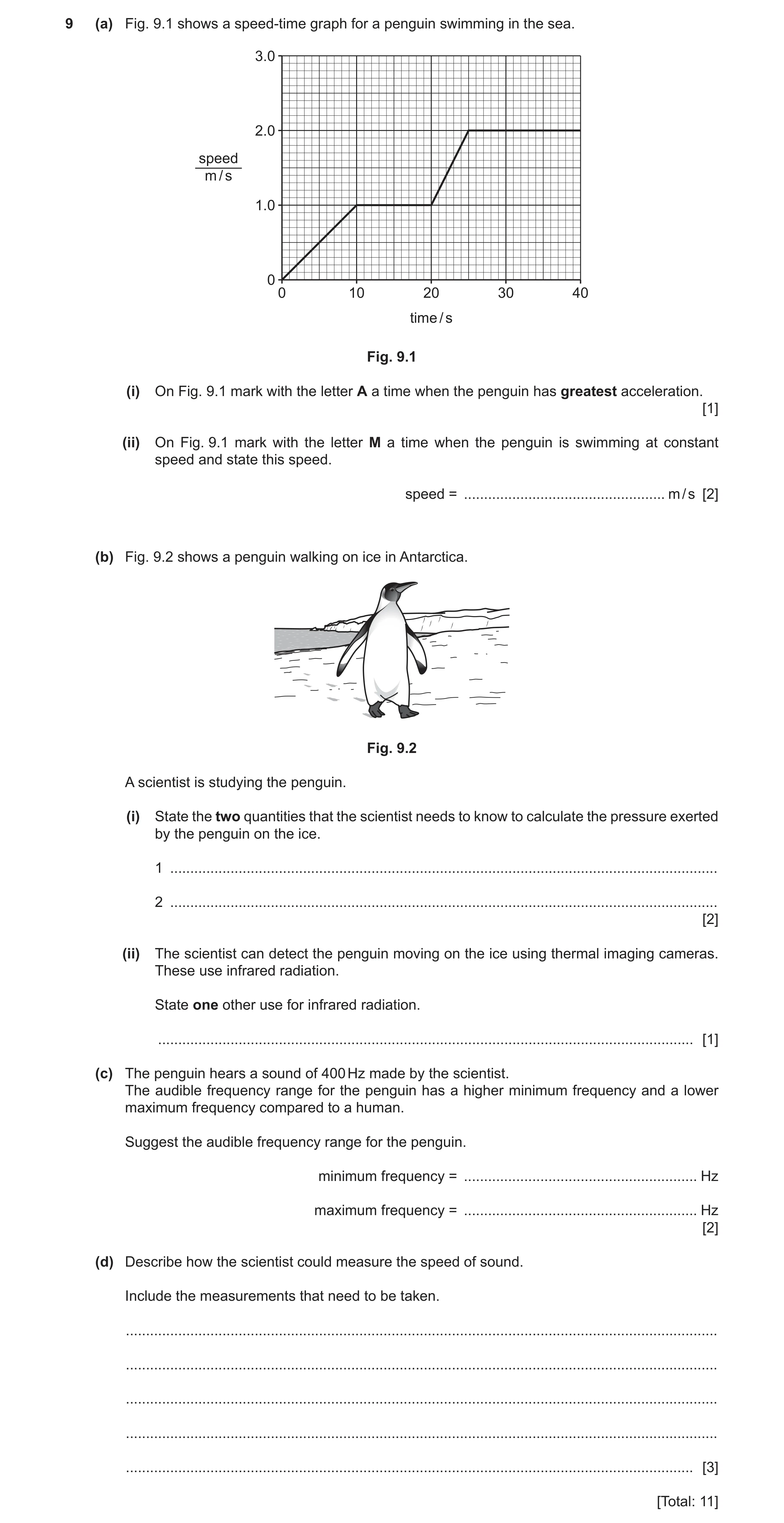
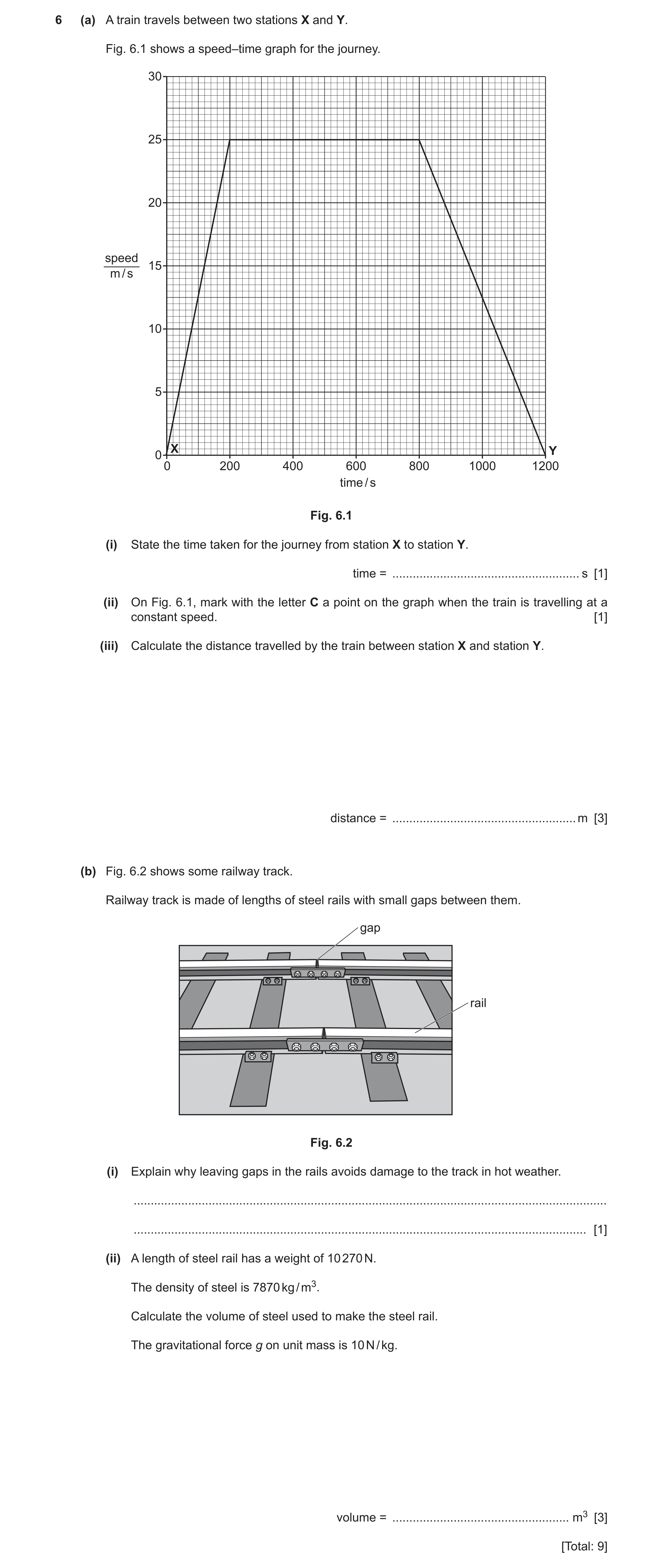
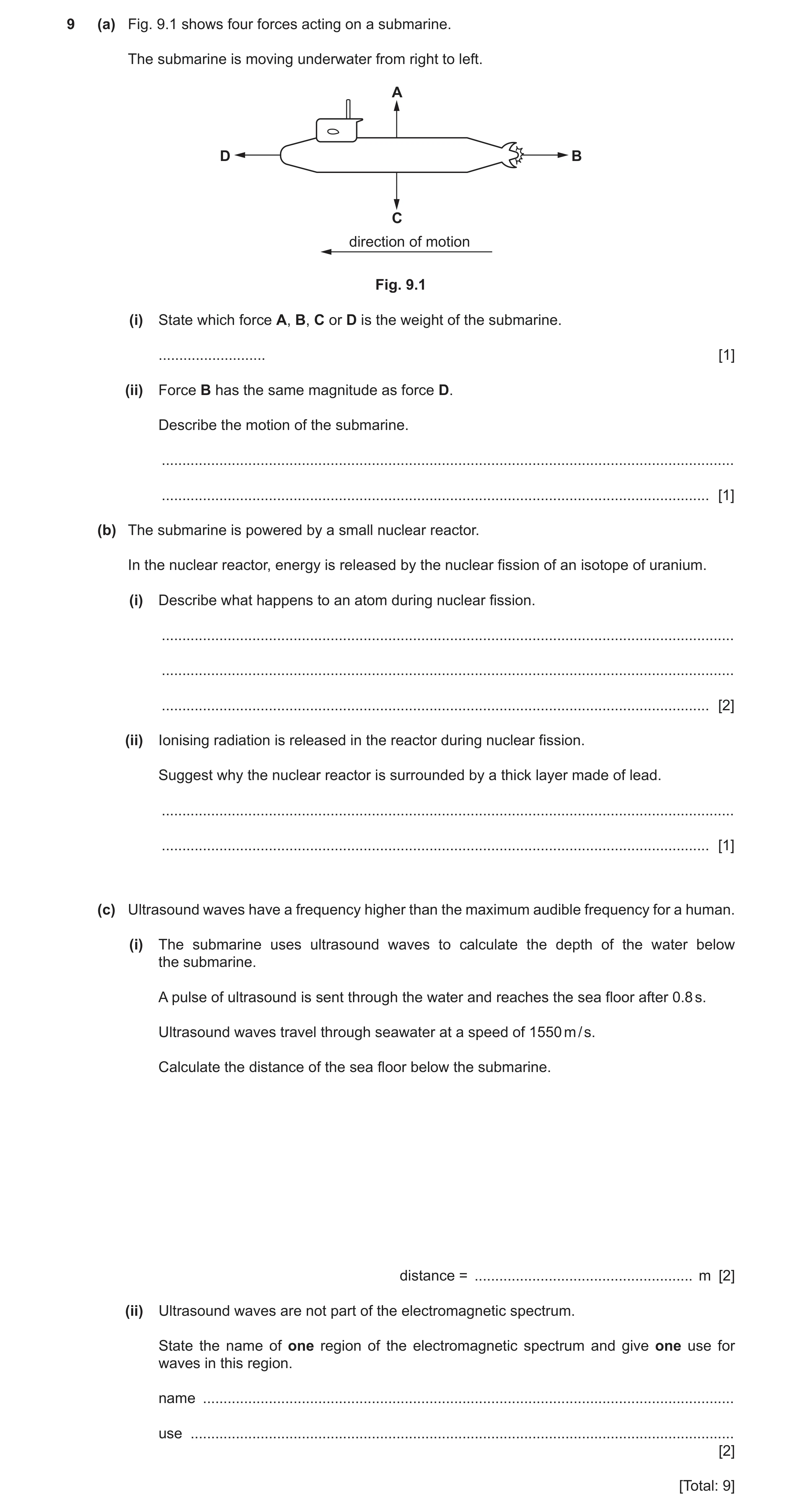
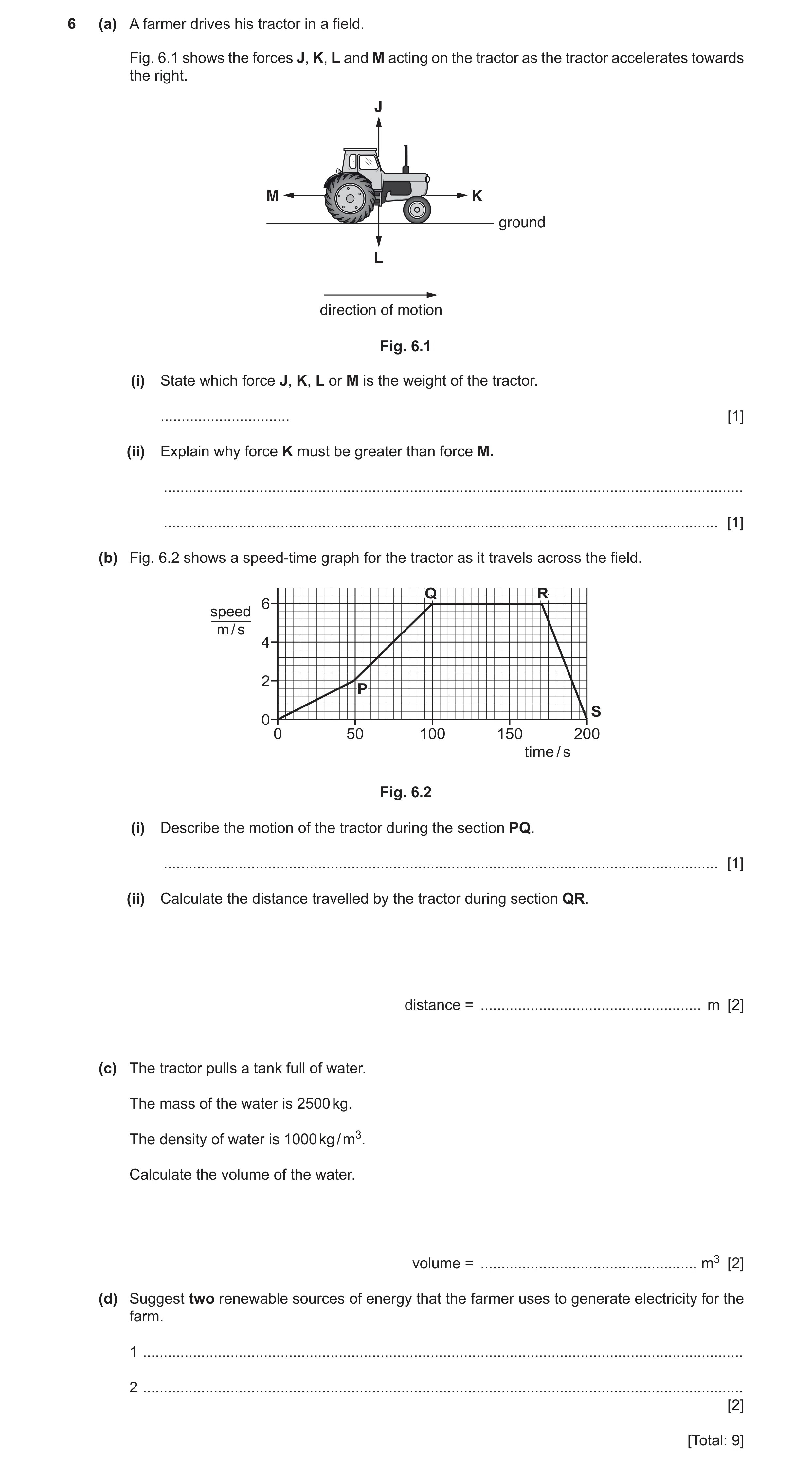
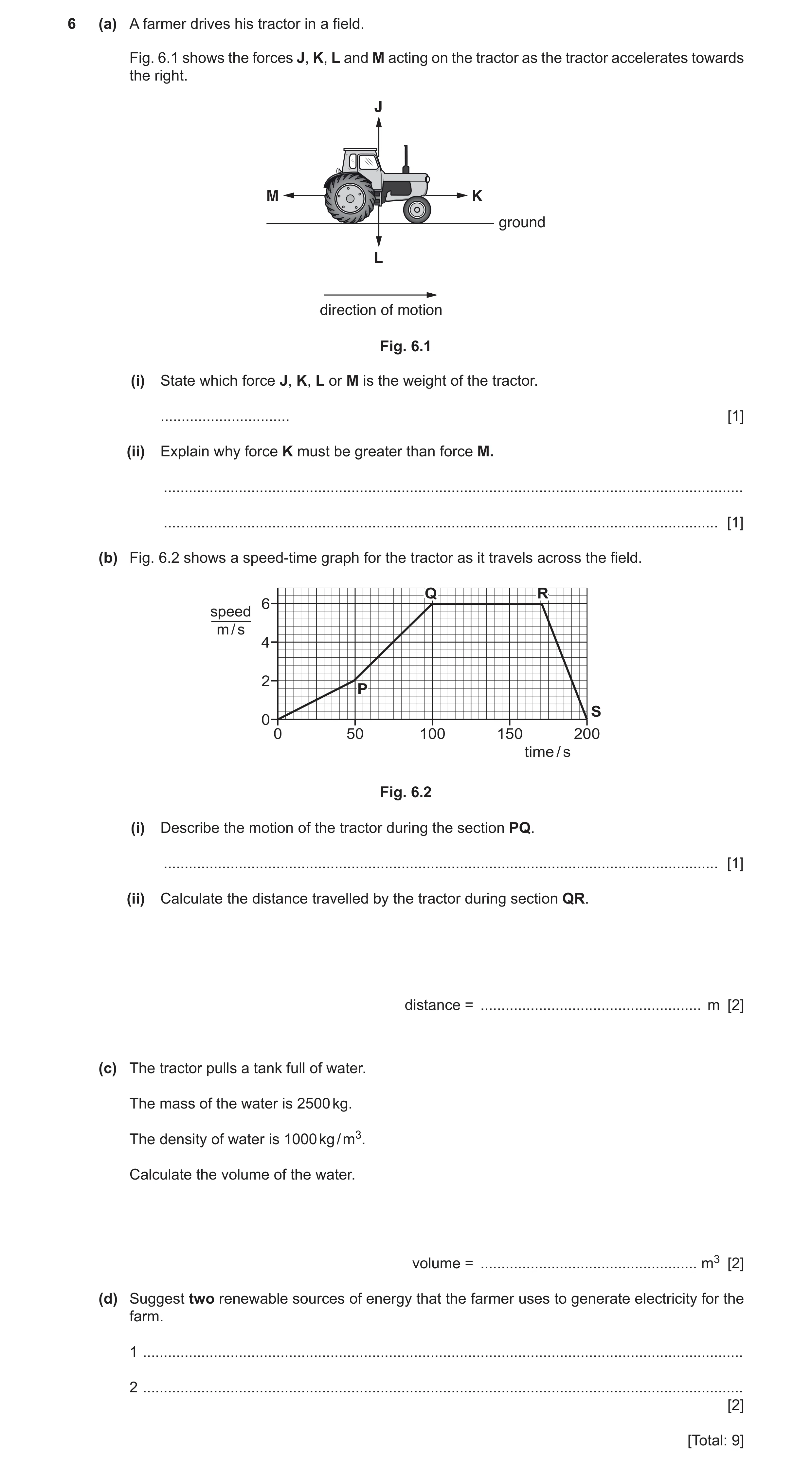
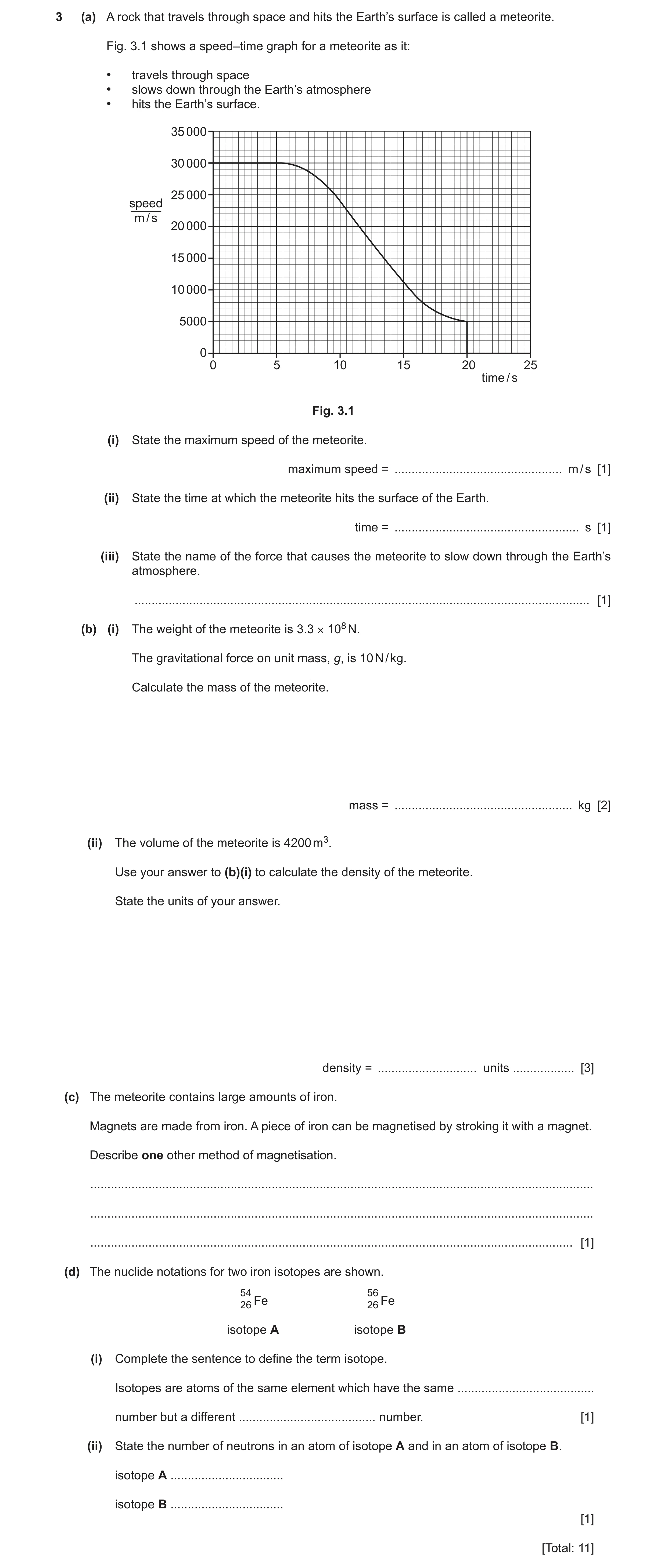
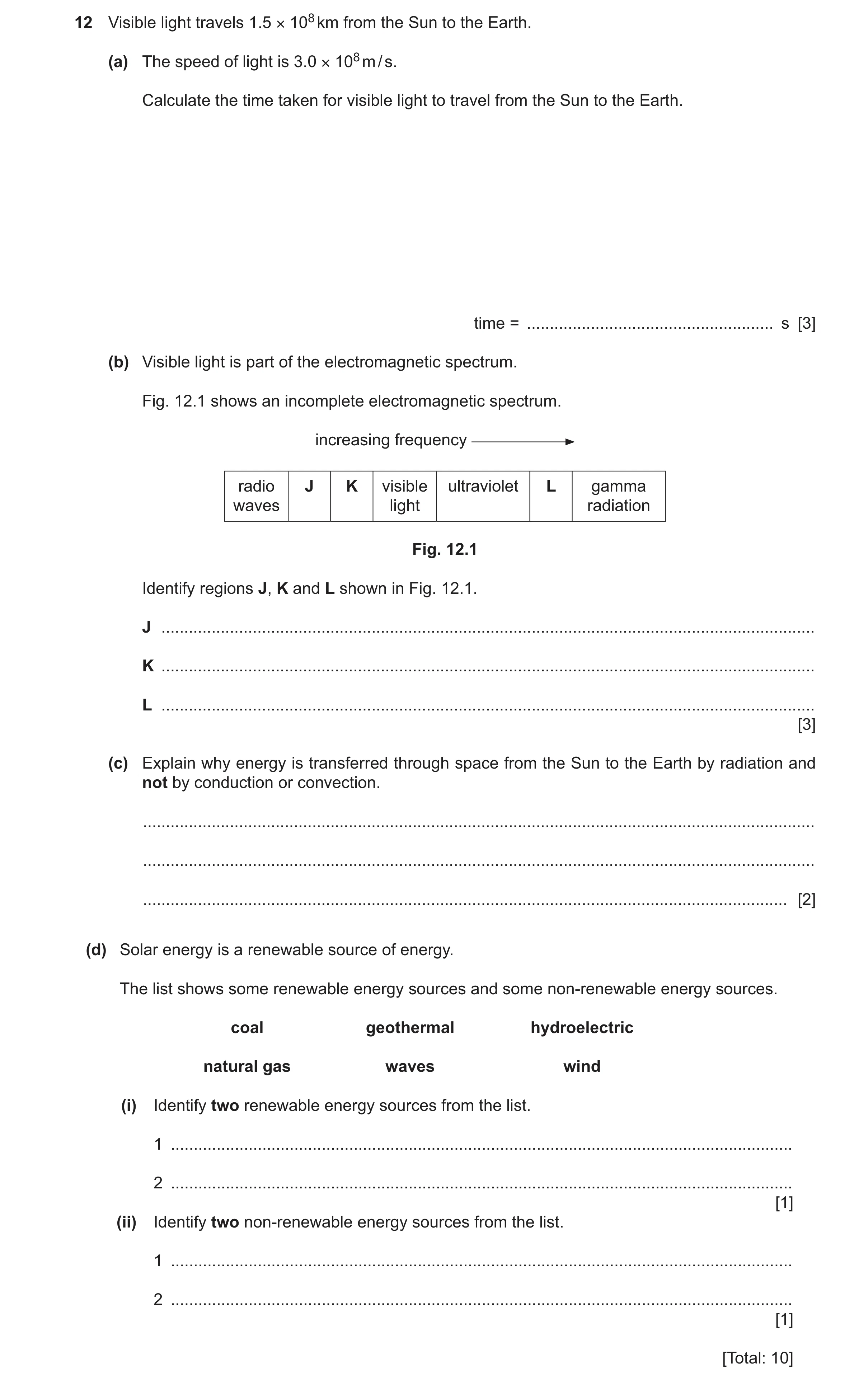
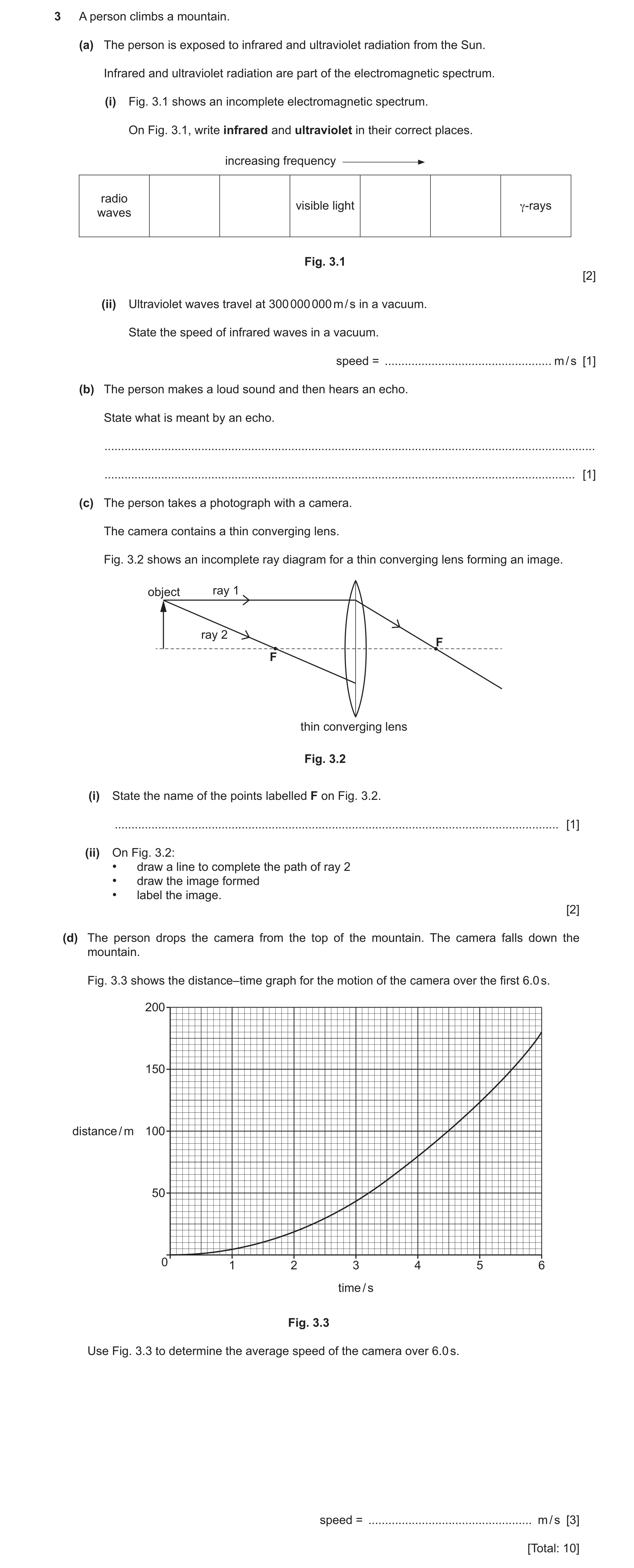
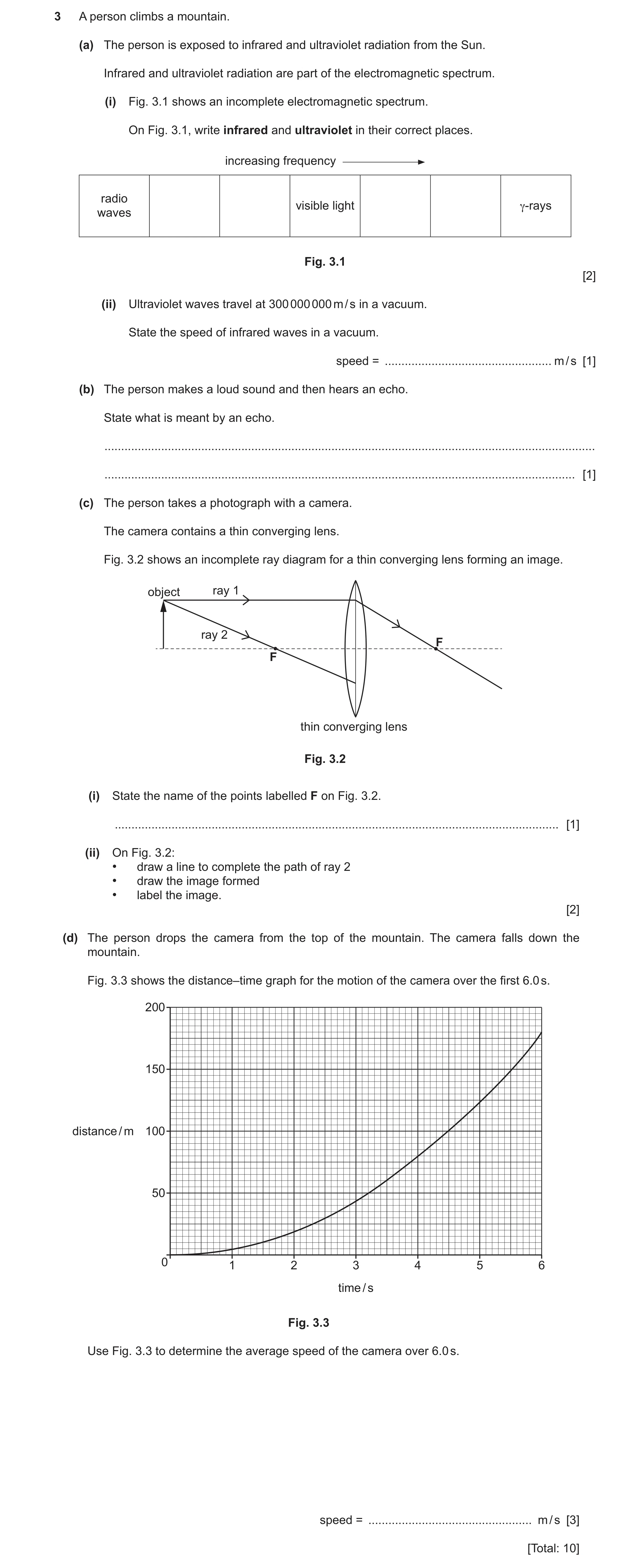
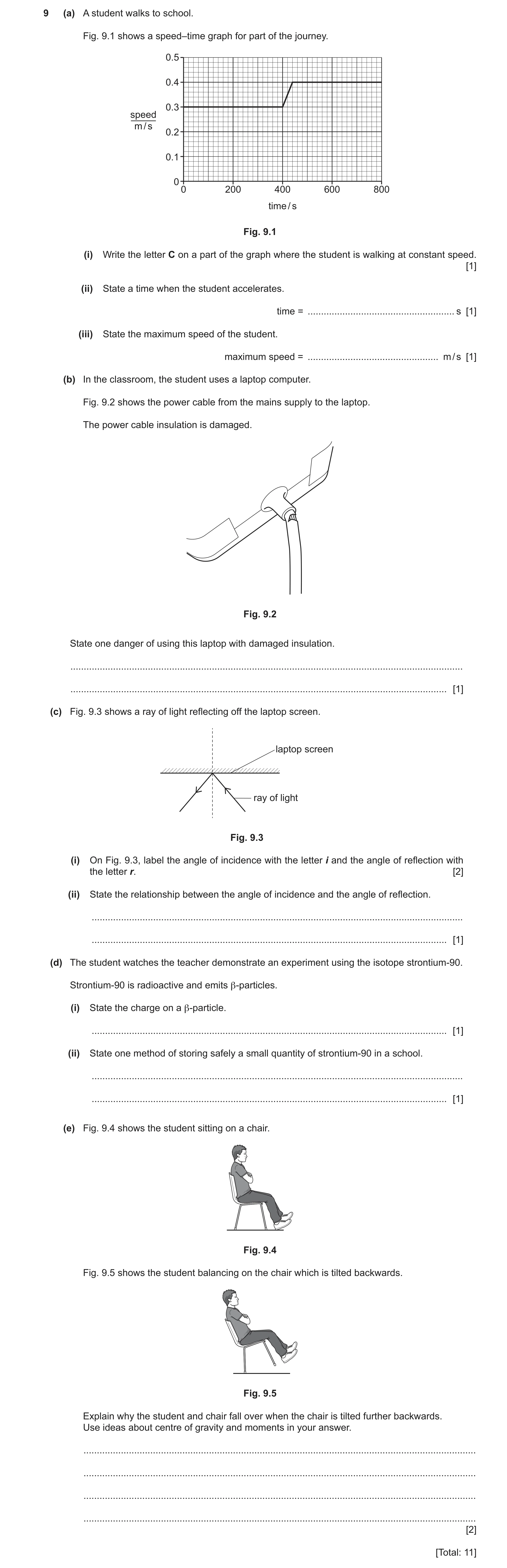
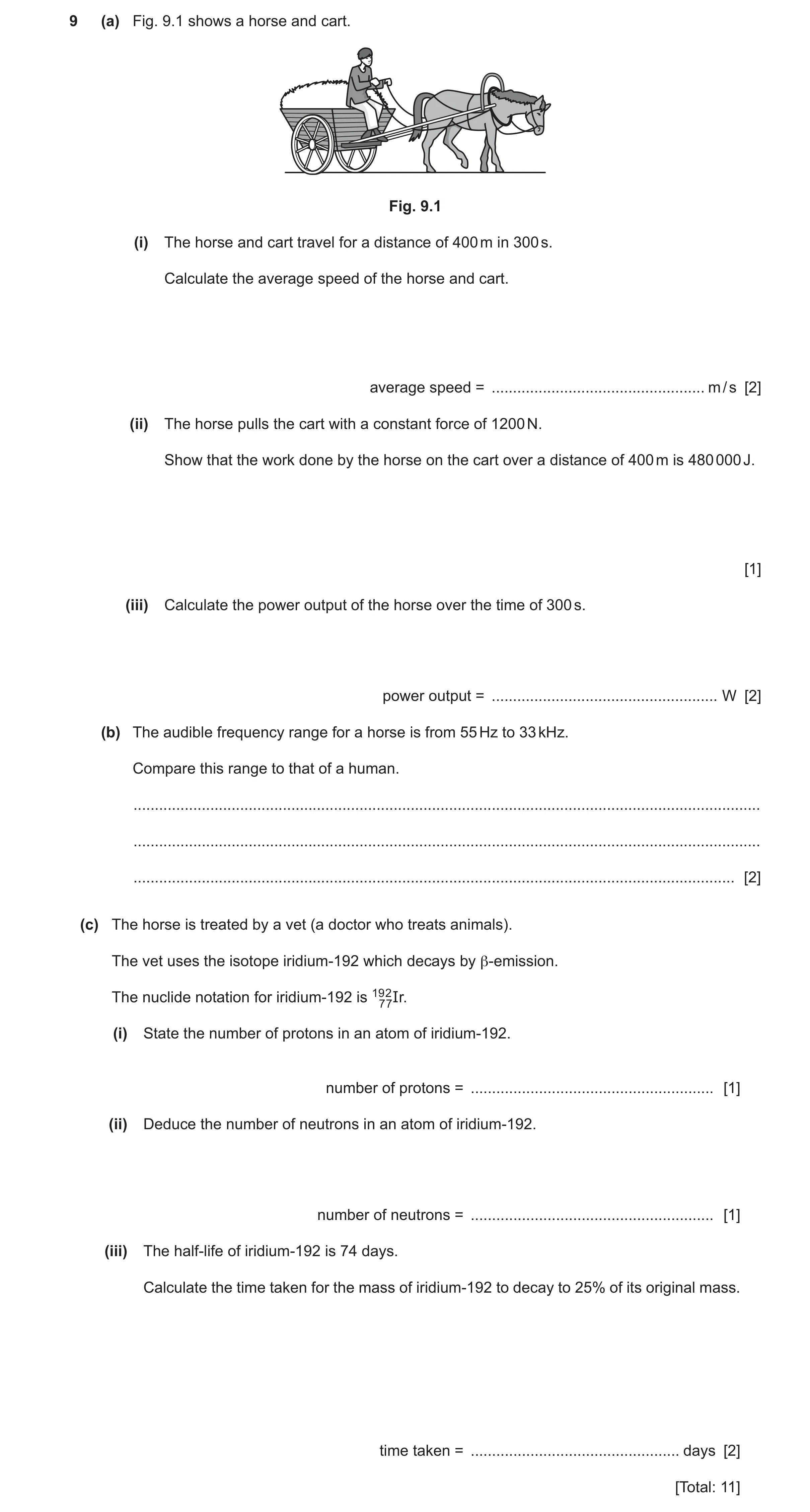
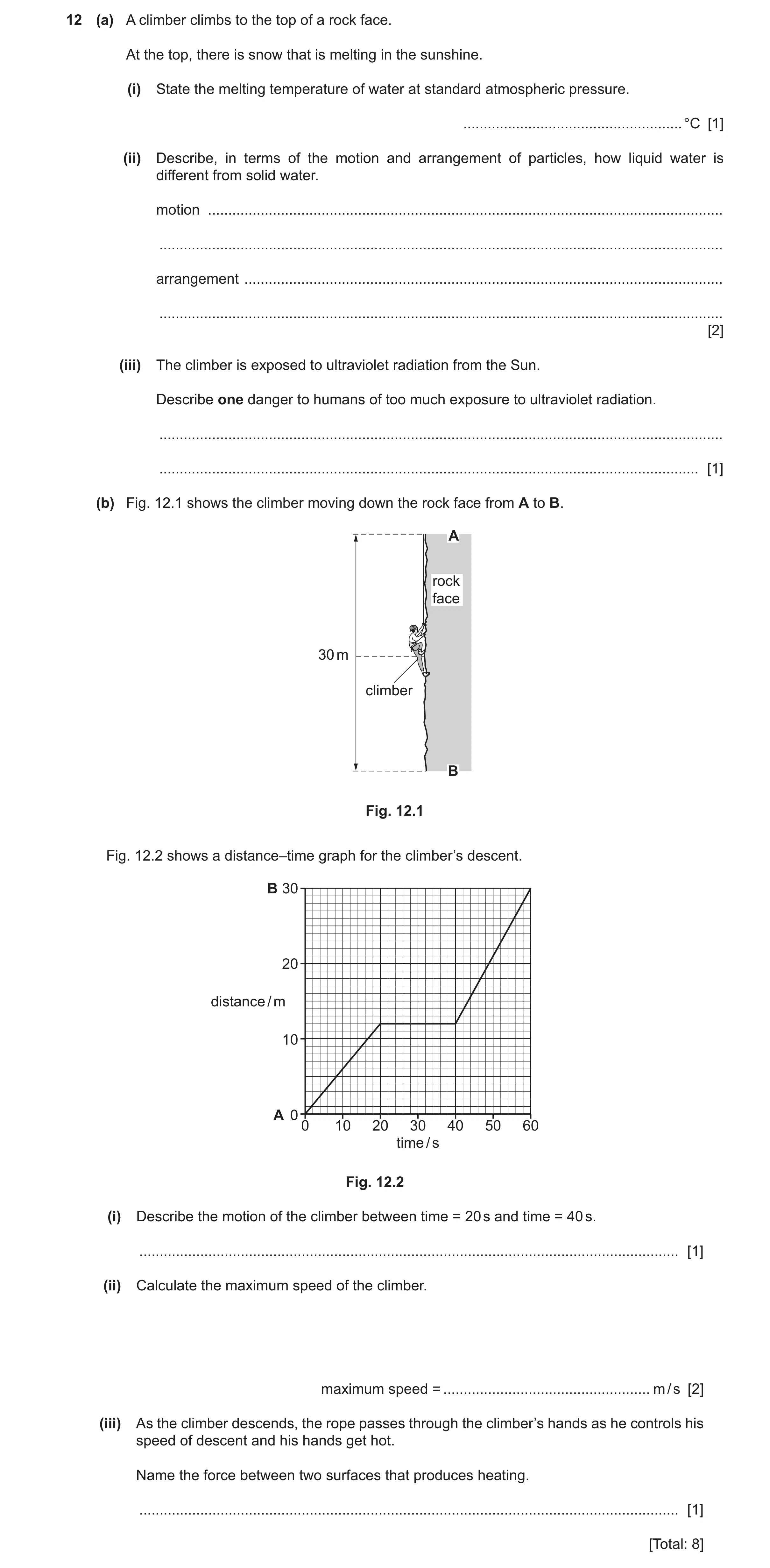
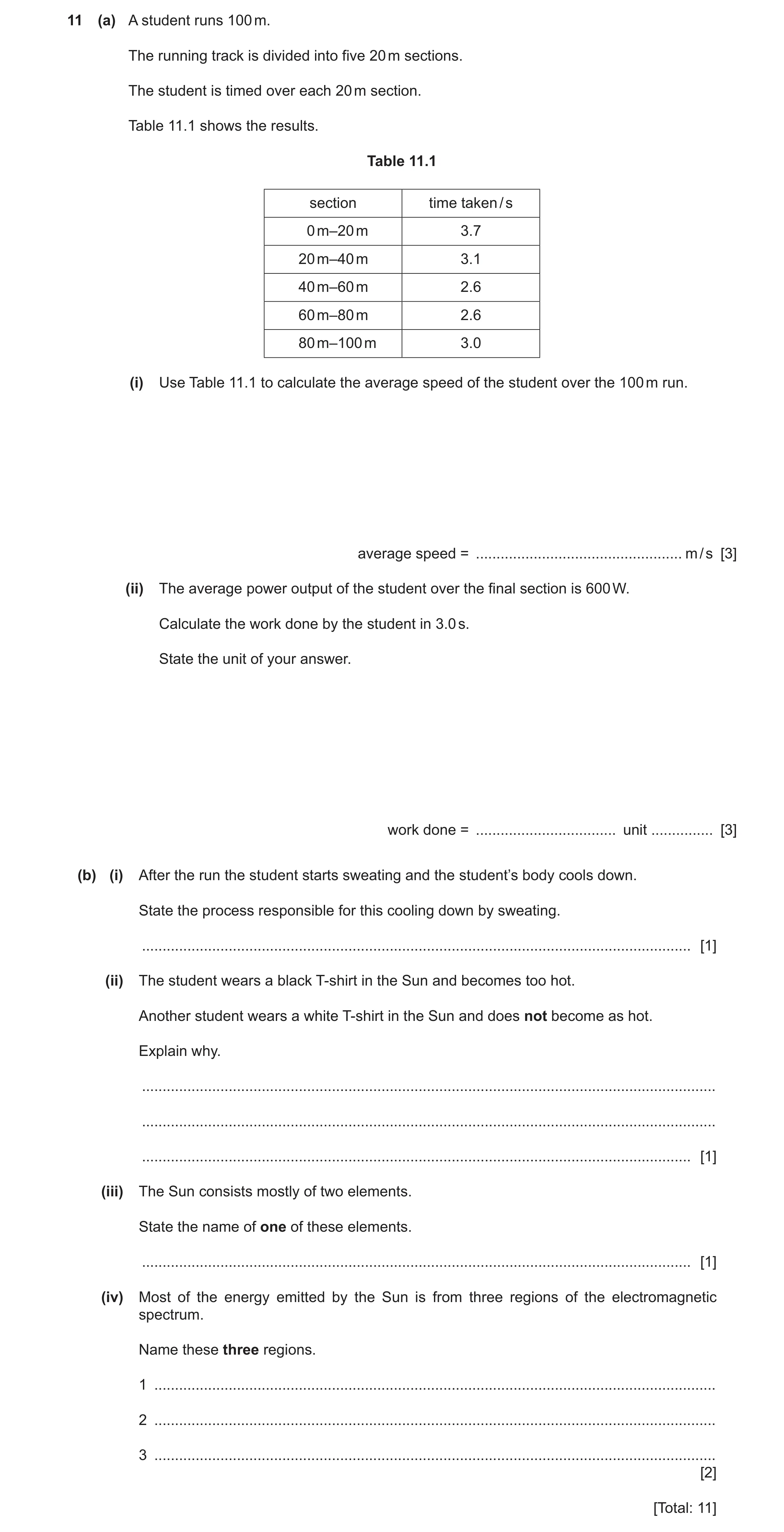
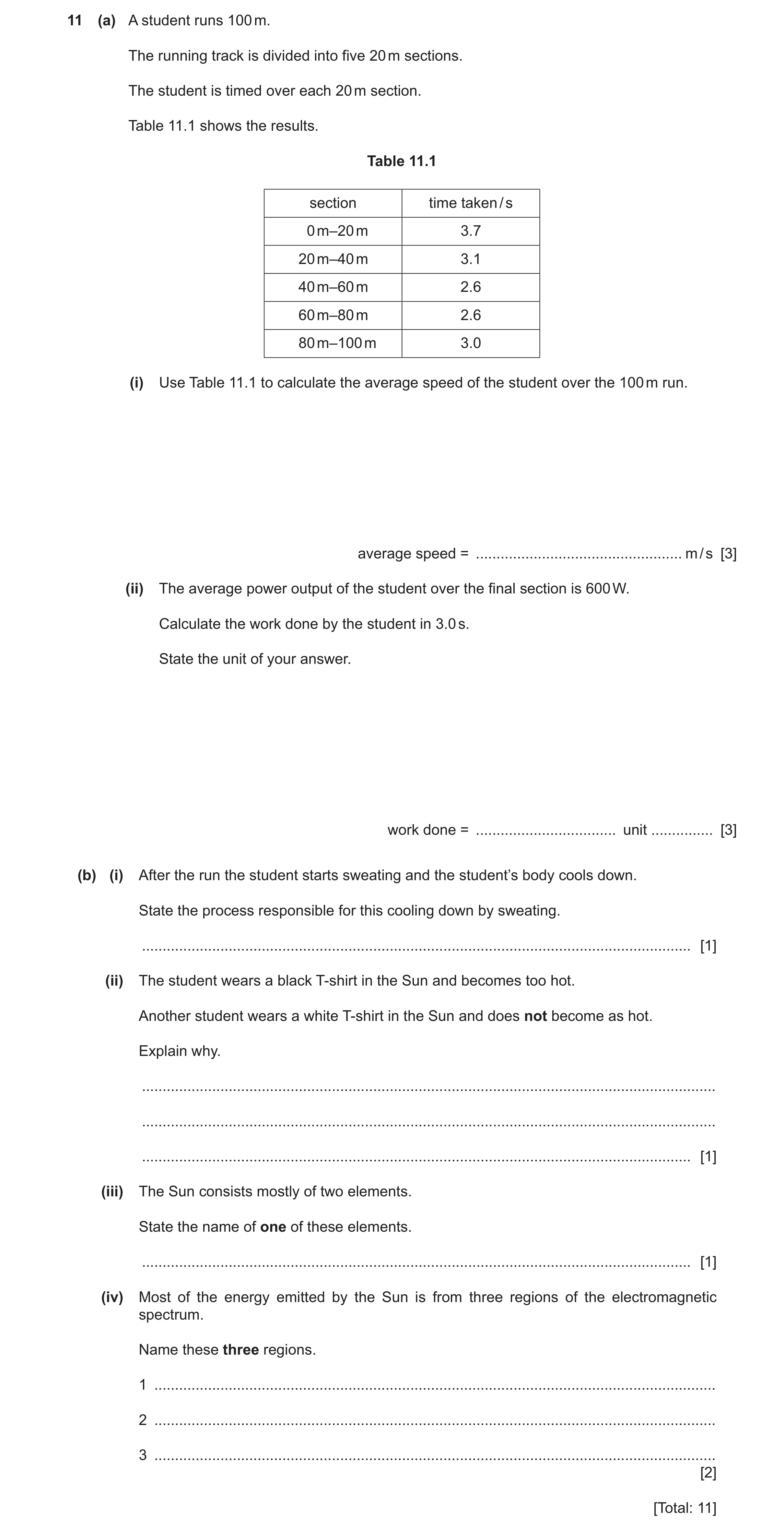
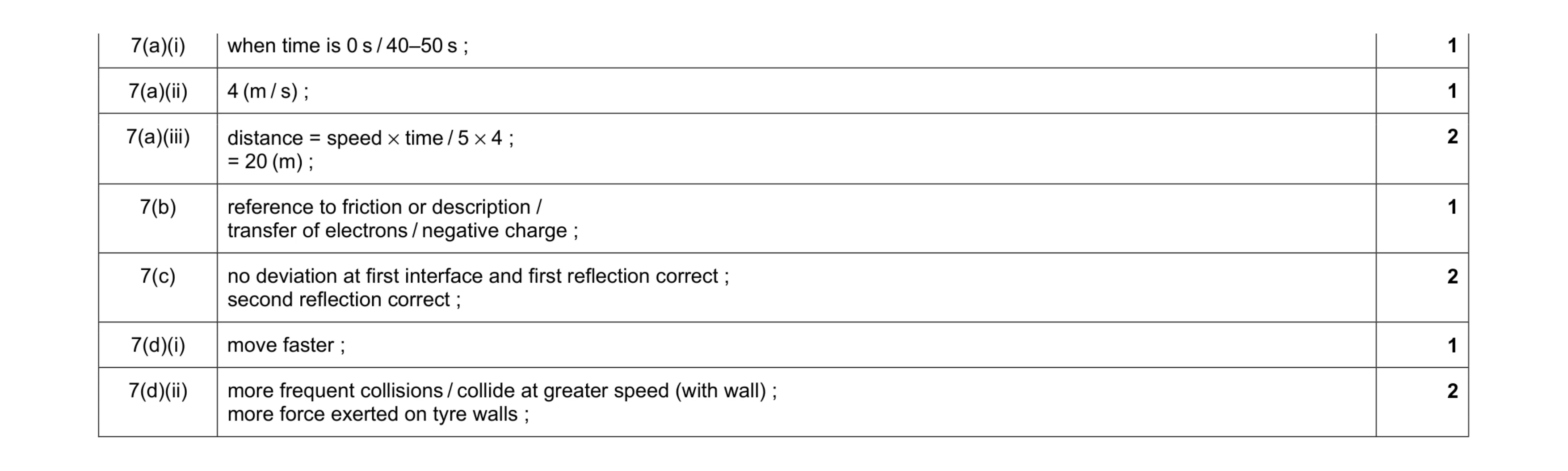 10
10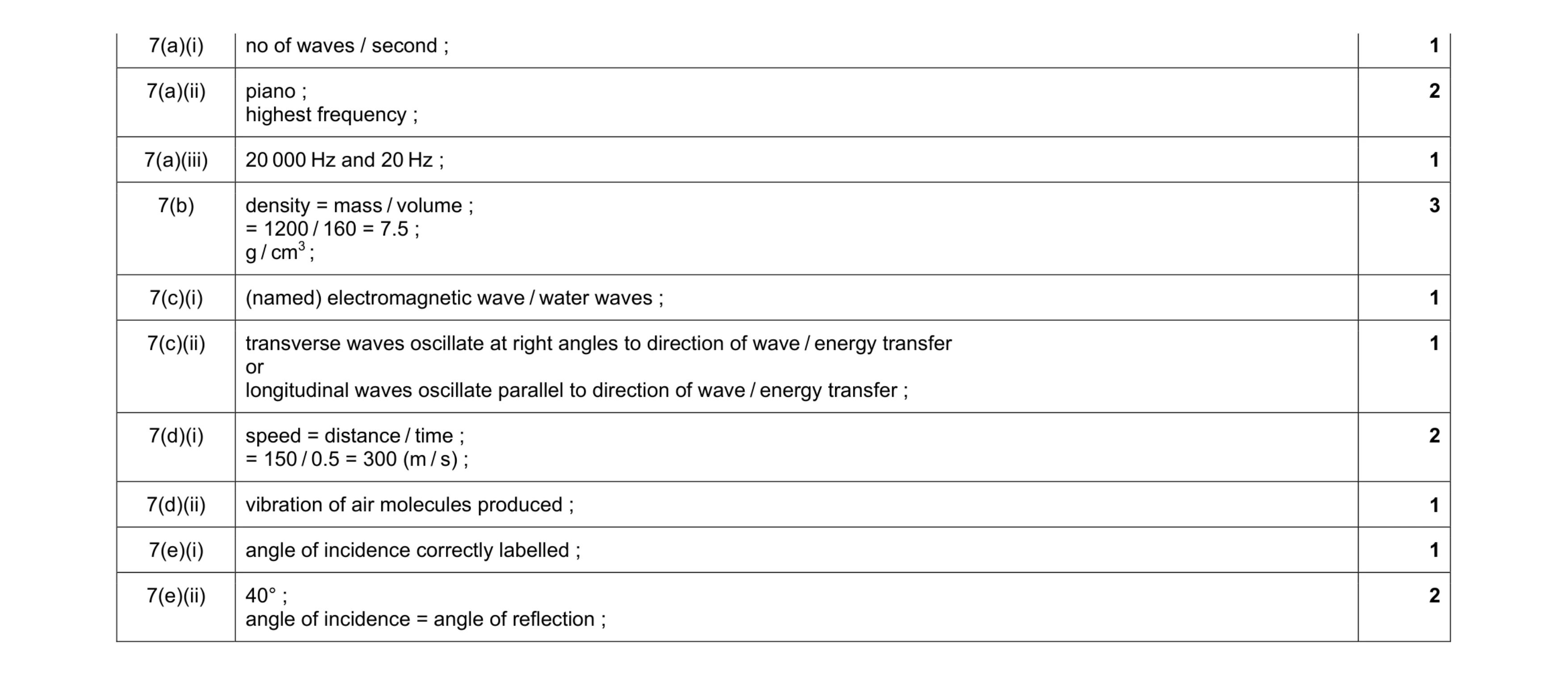 15
15 6
6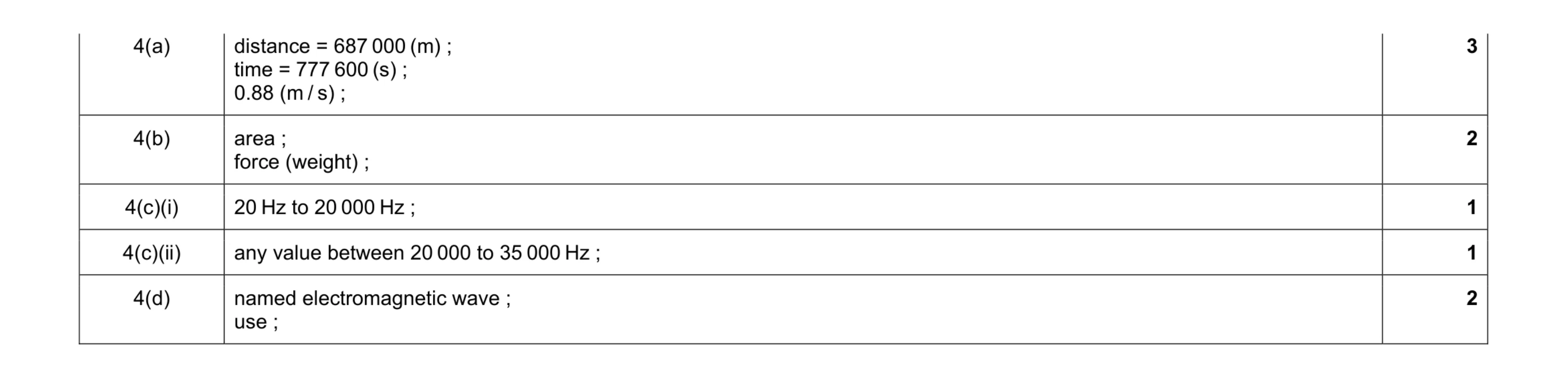 9
9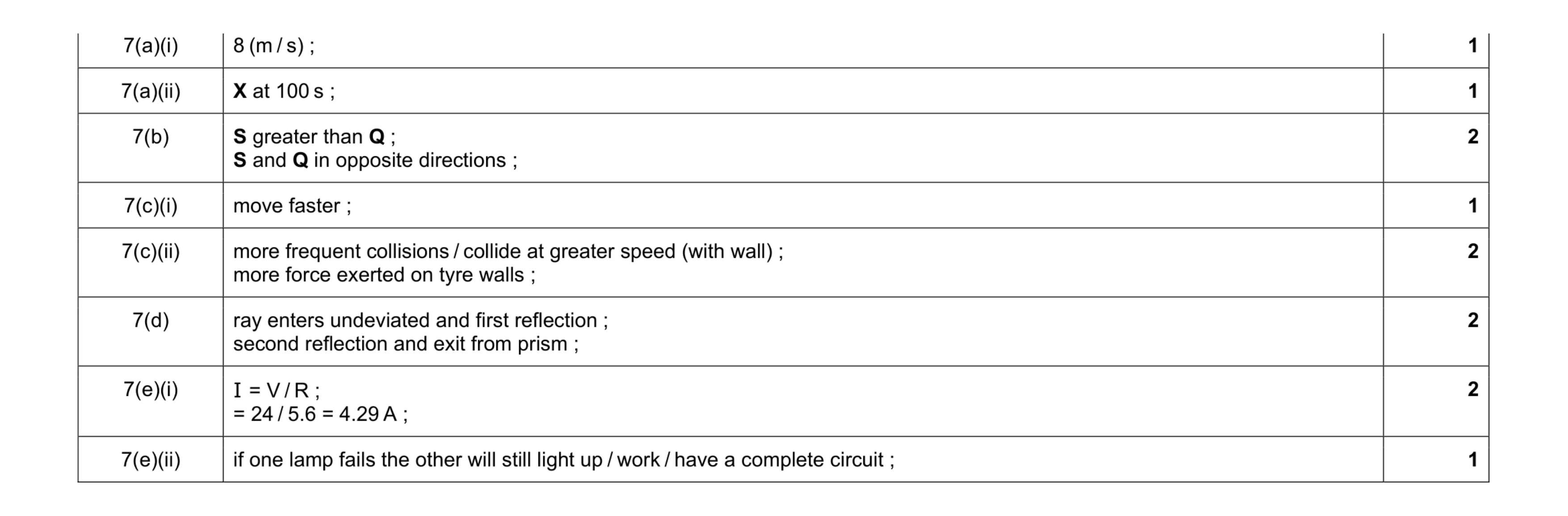 12
12 6
6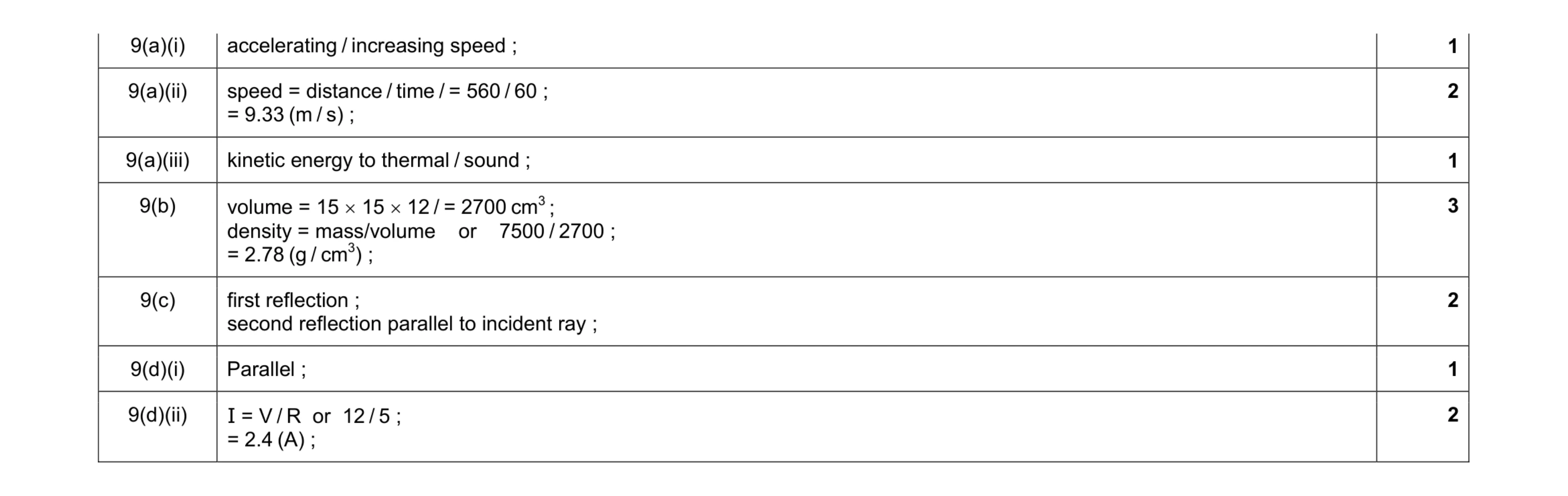 12
12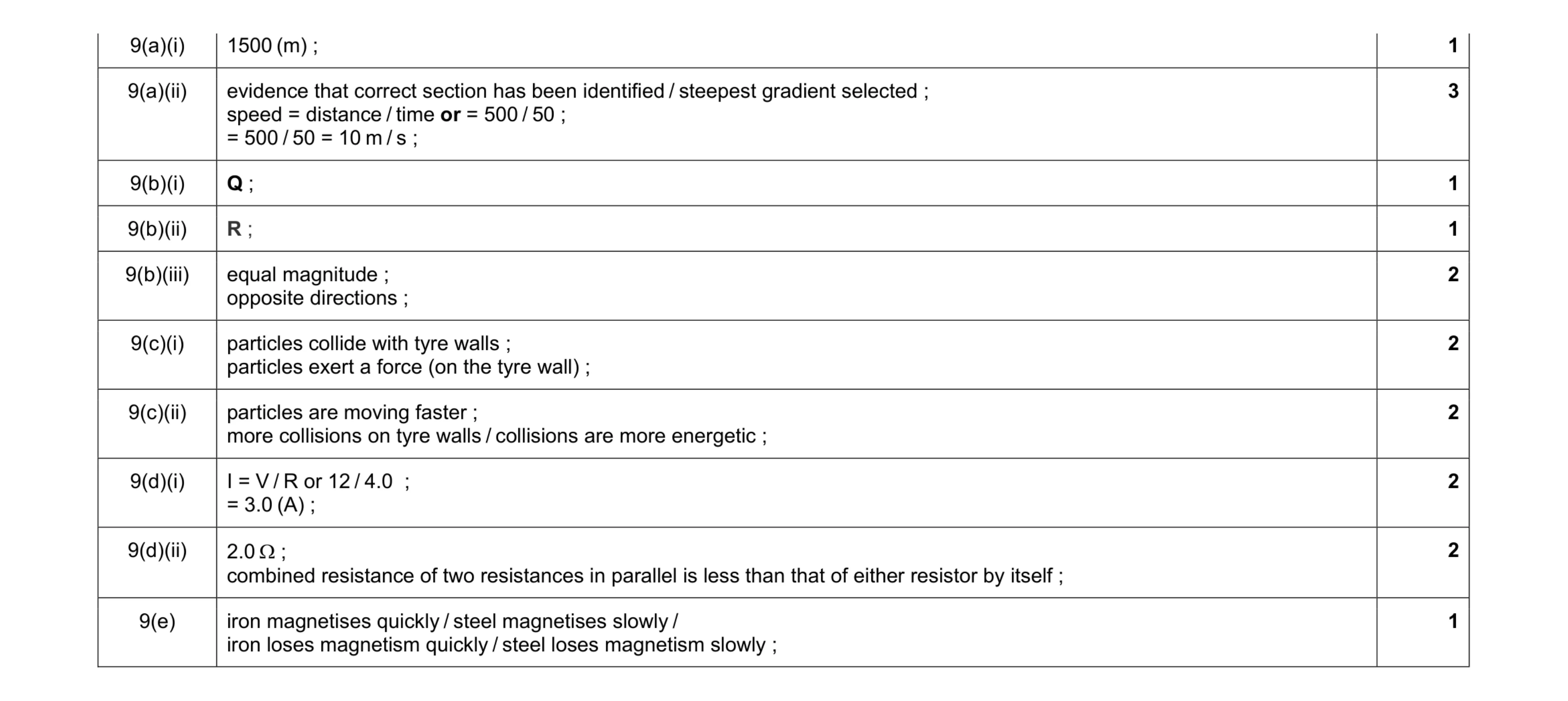 17
17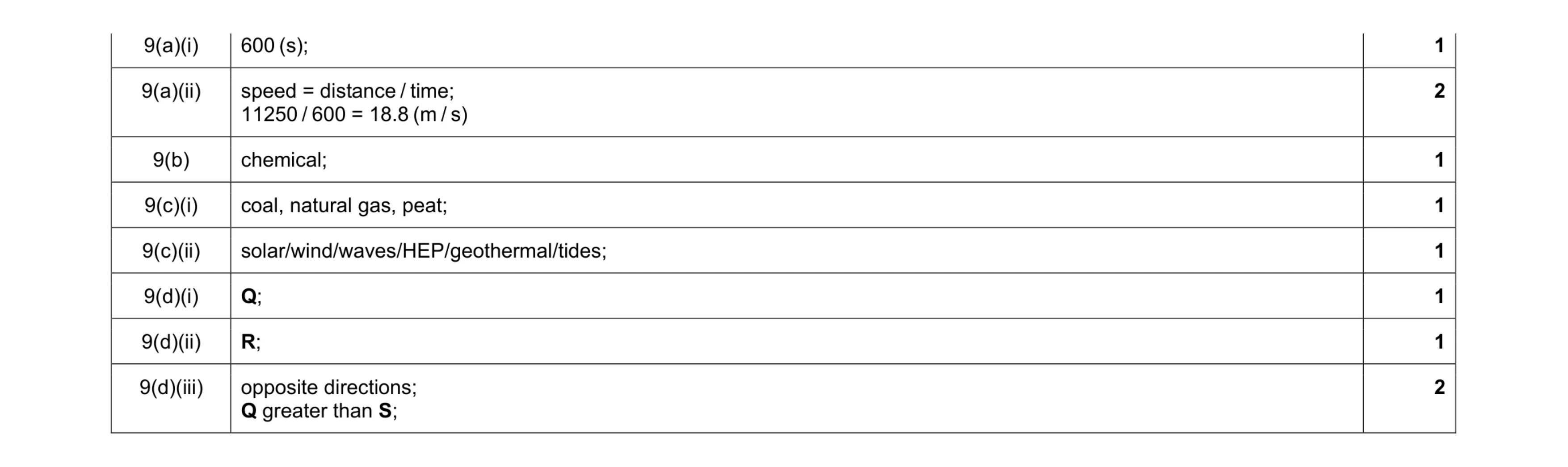 10
10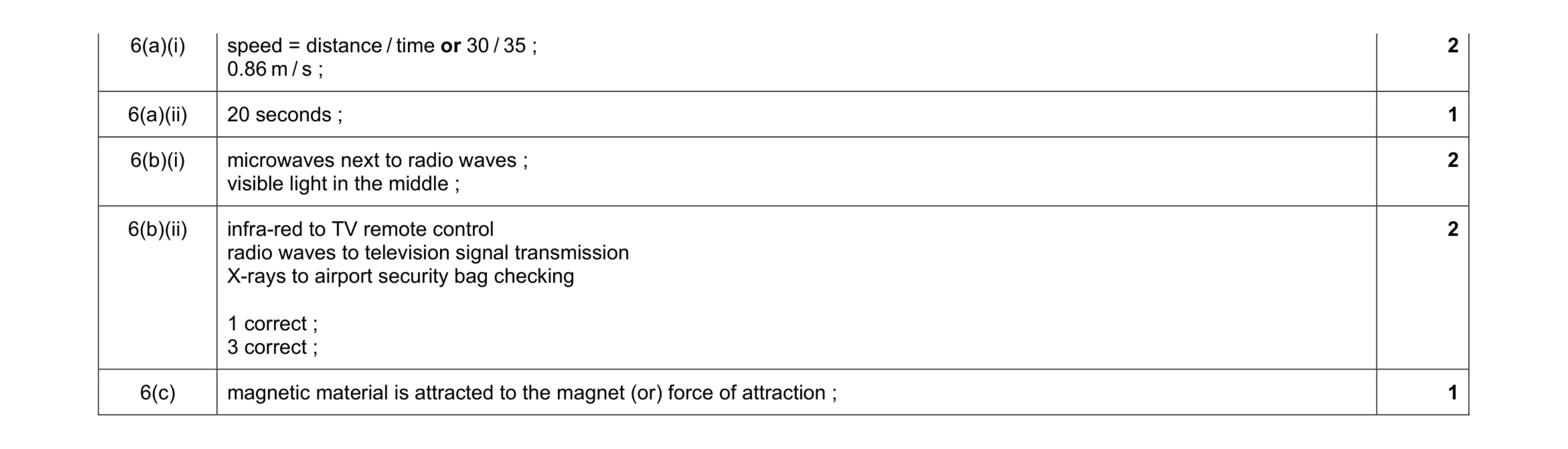 8
8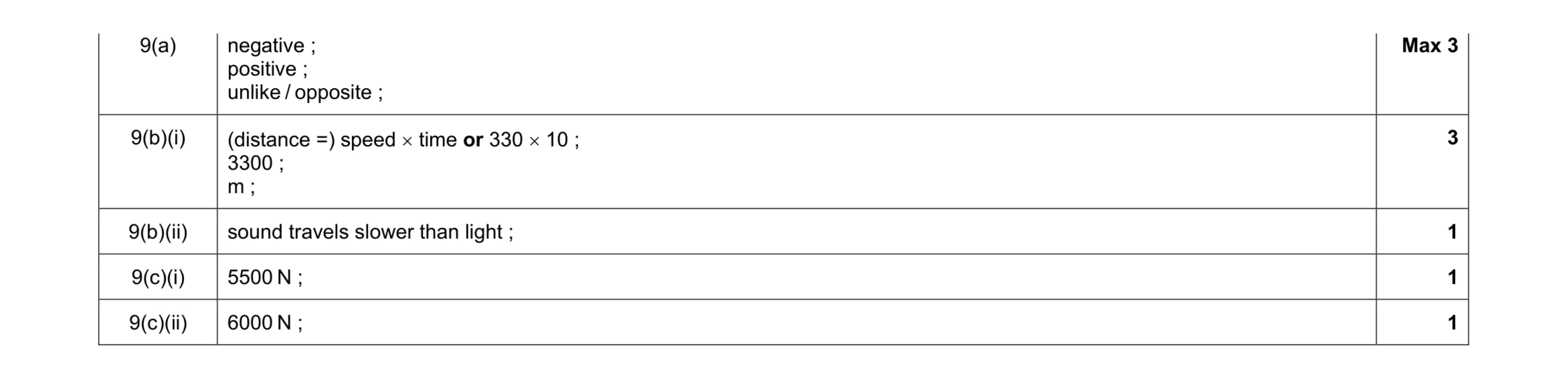 9
9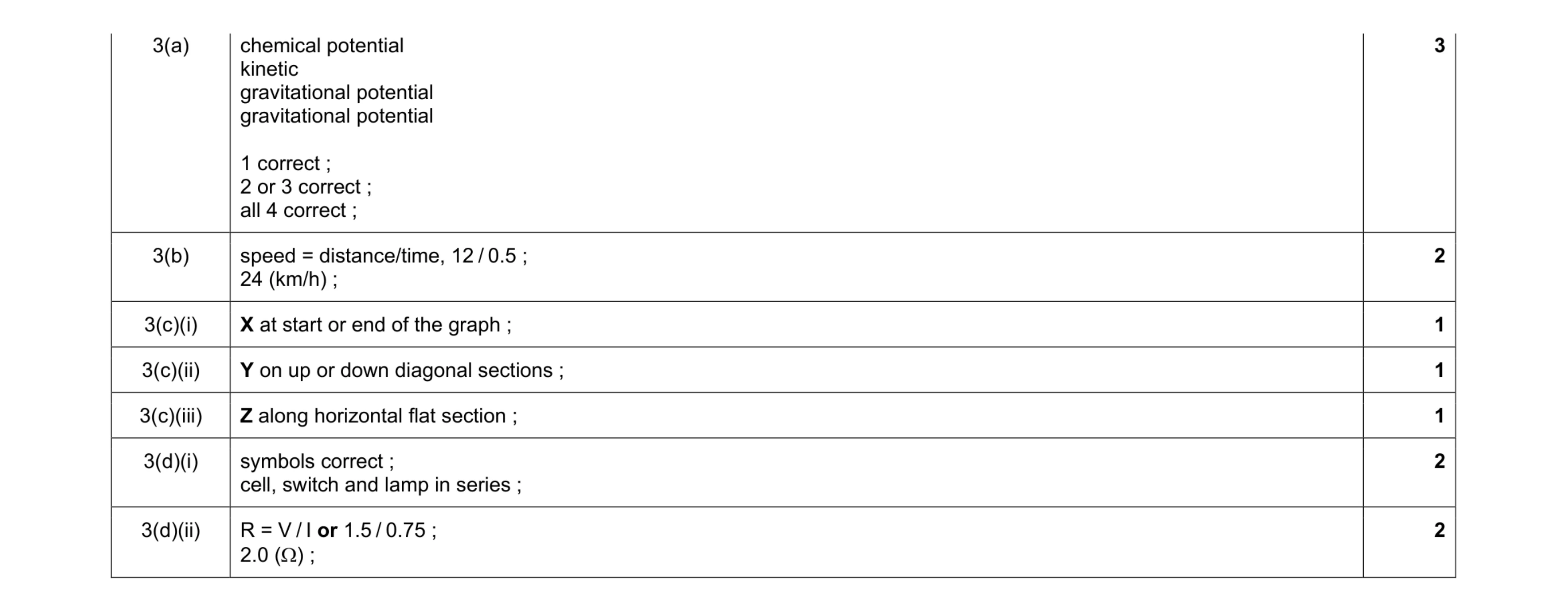 12
12 12
12 9
9 9
9 9
9 10
10 10
10 10
10 7
7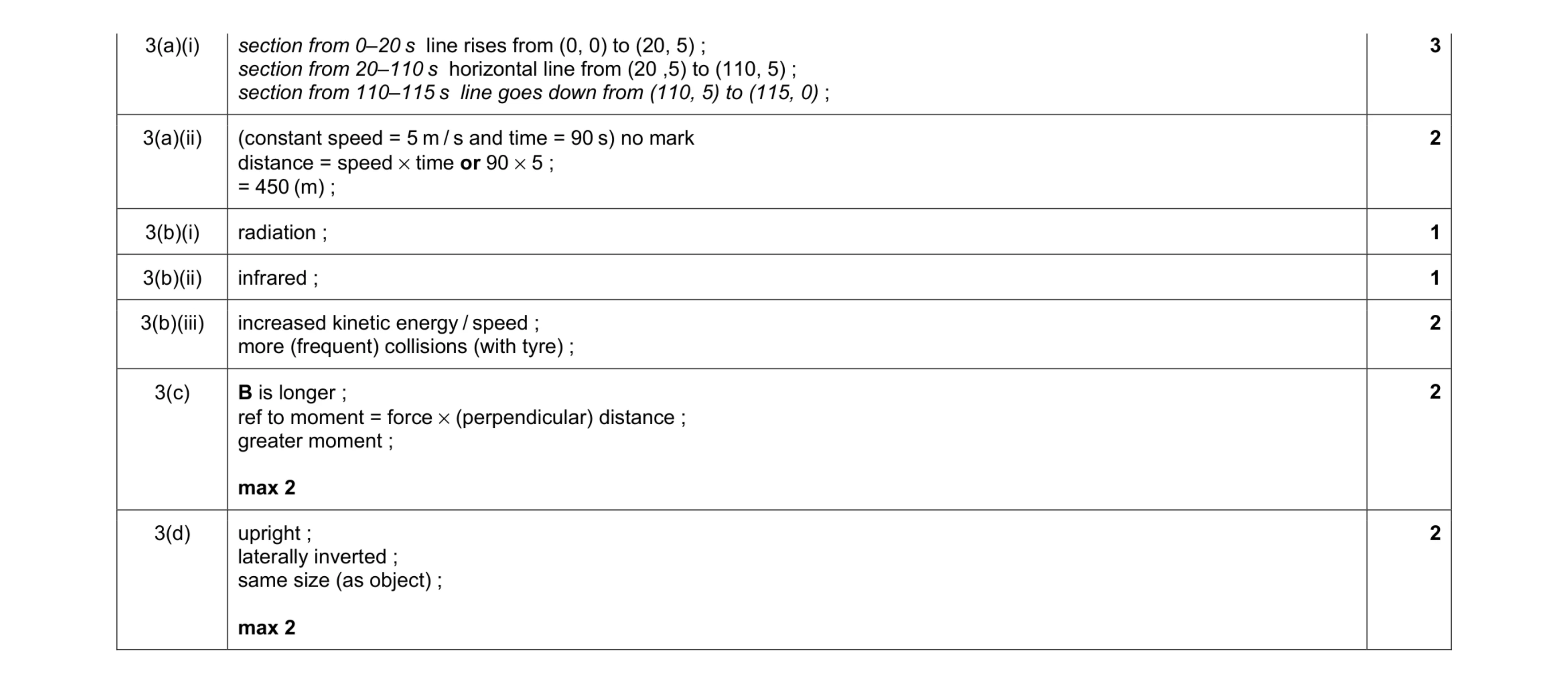 13
13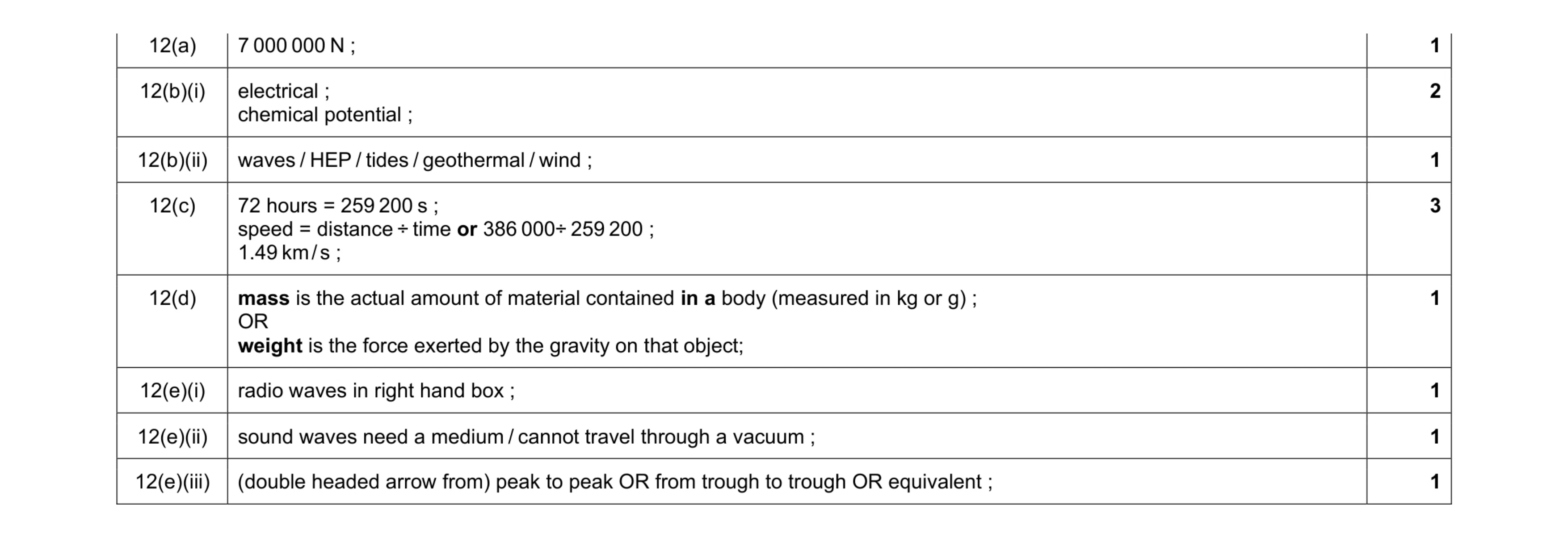 11
11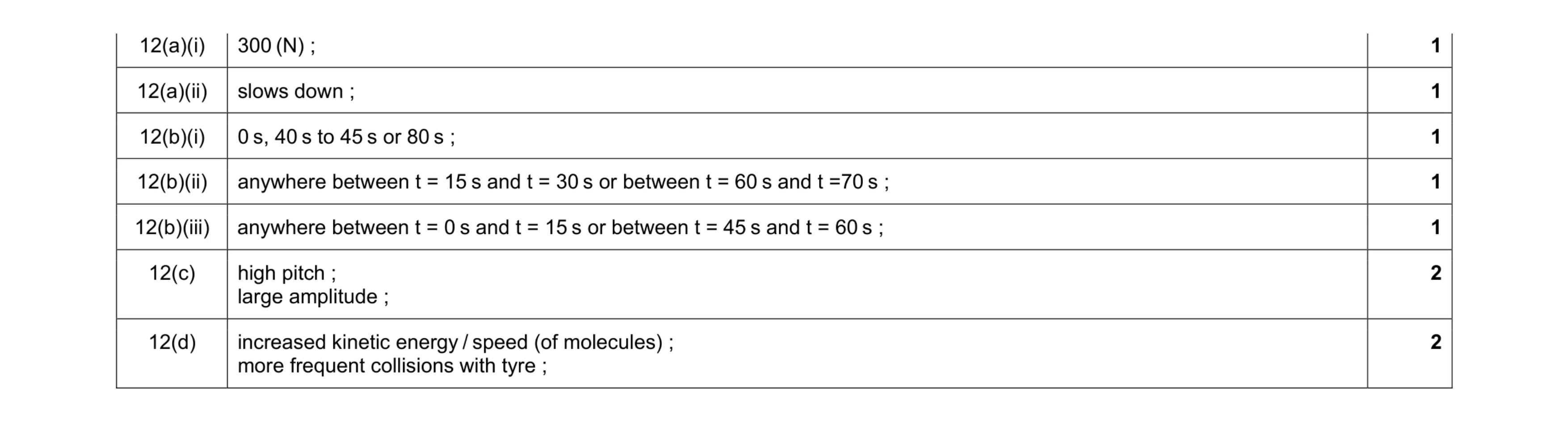 9
9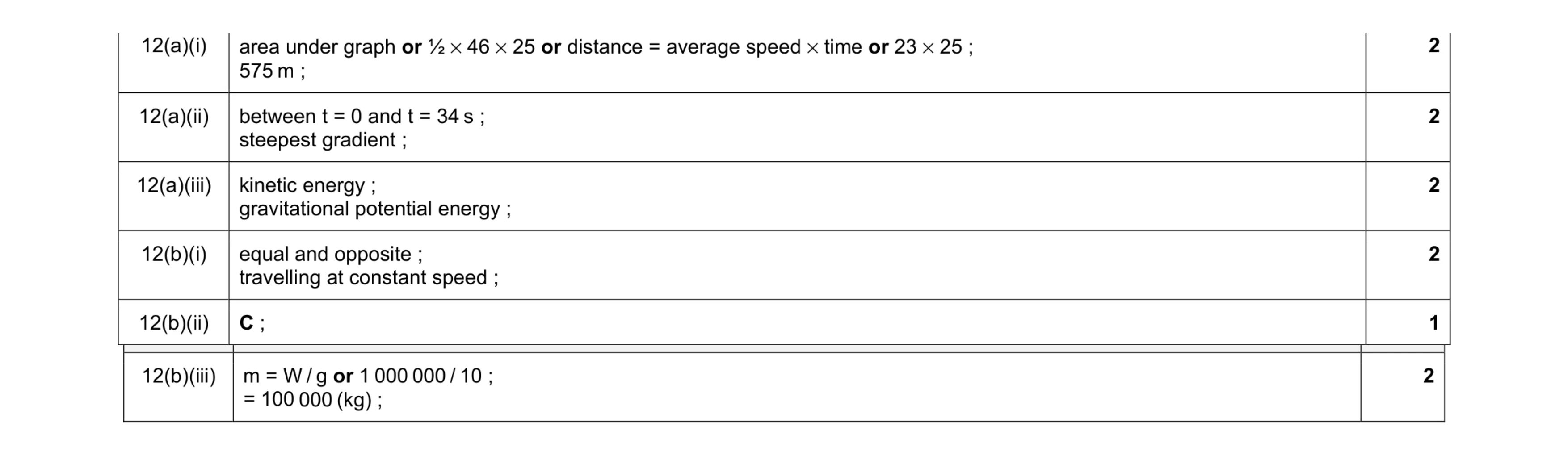 11
11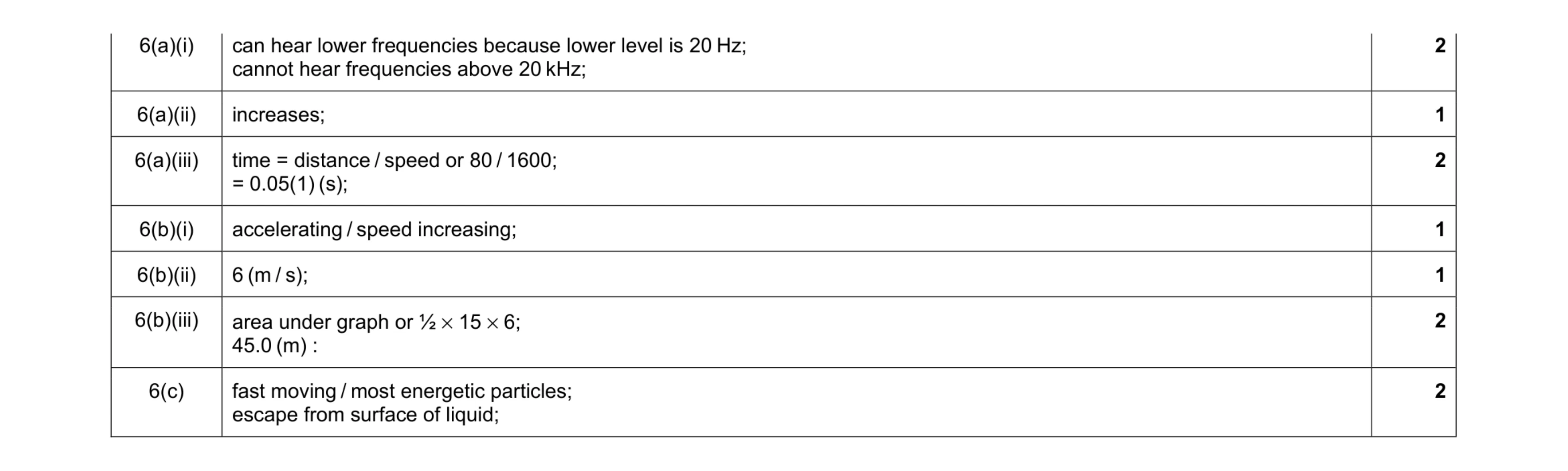 11
11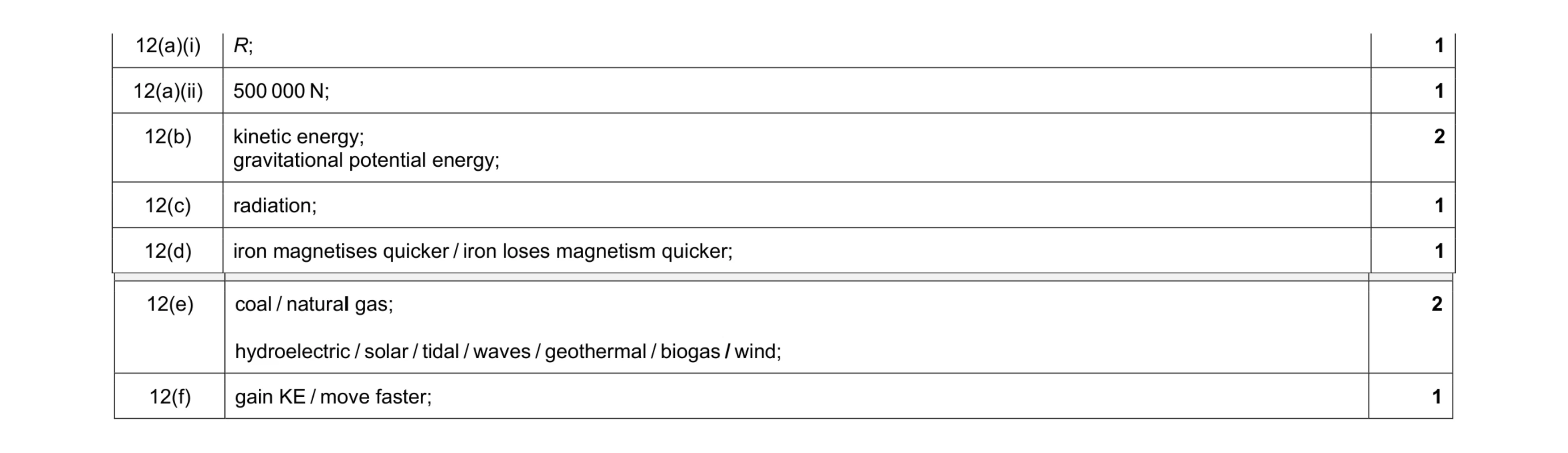 9
9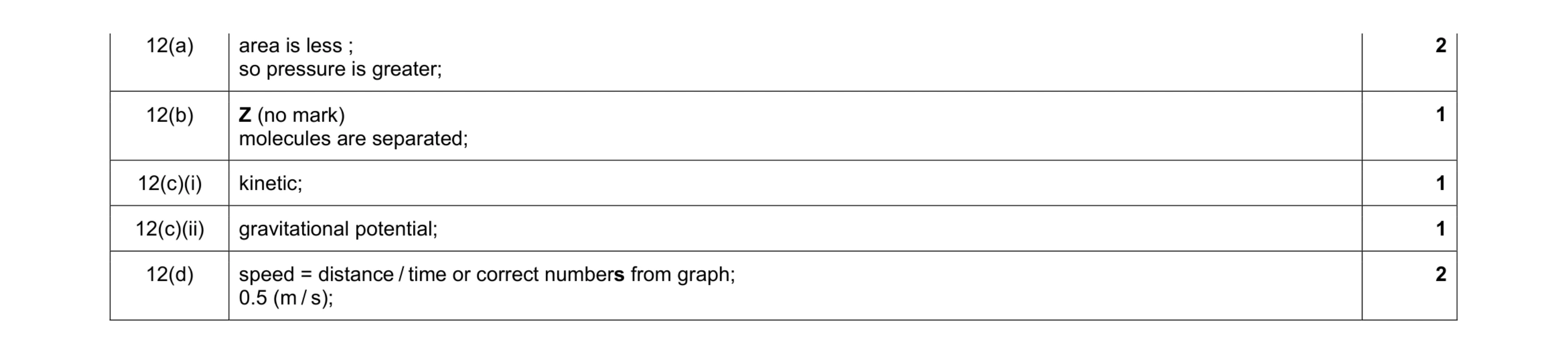 7
7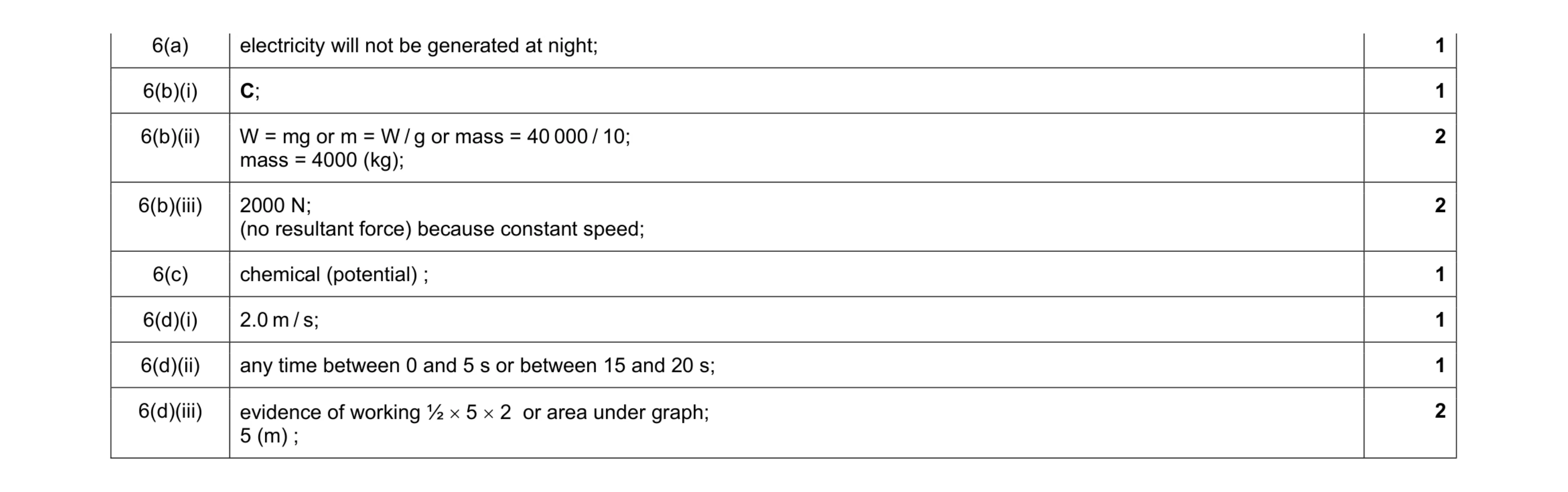 11
11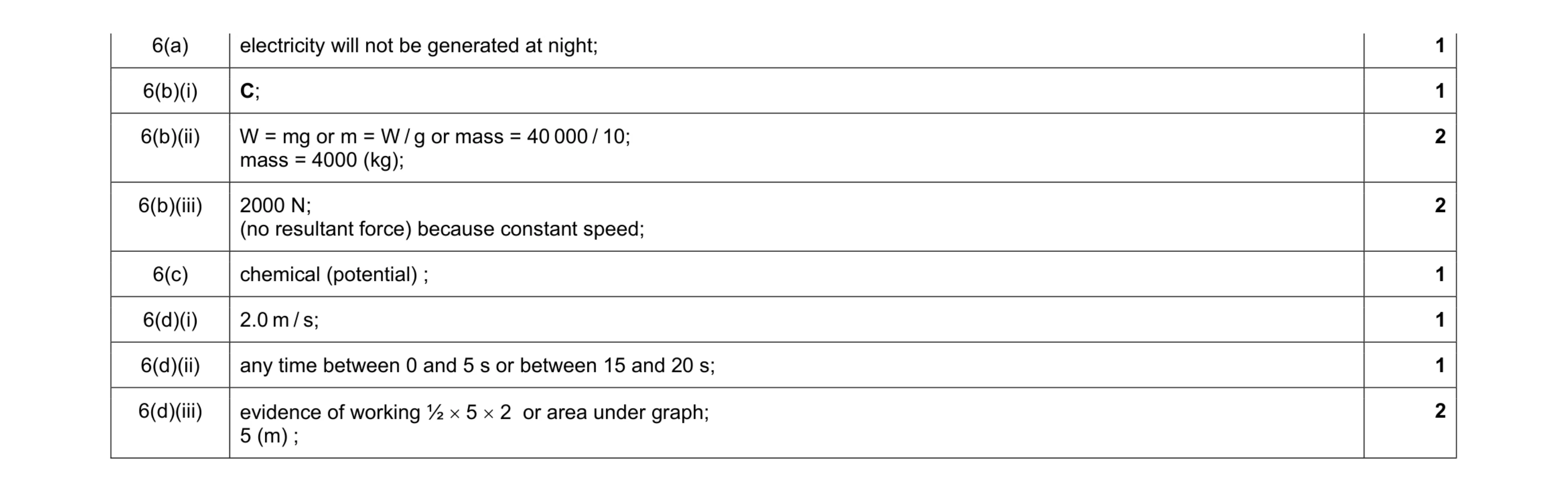 11
11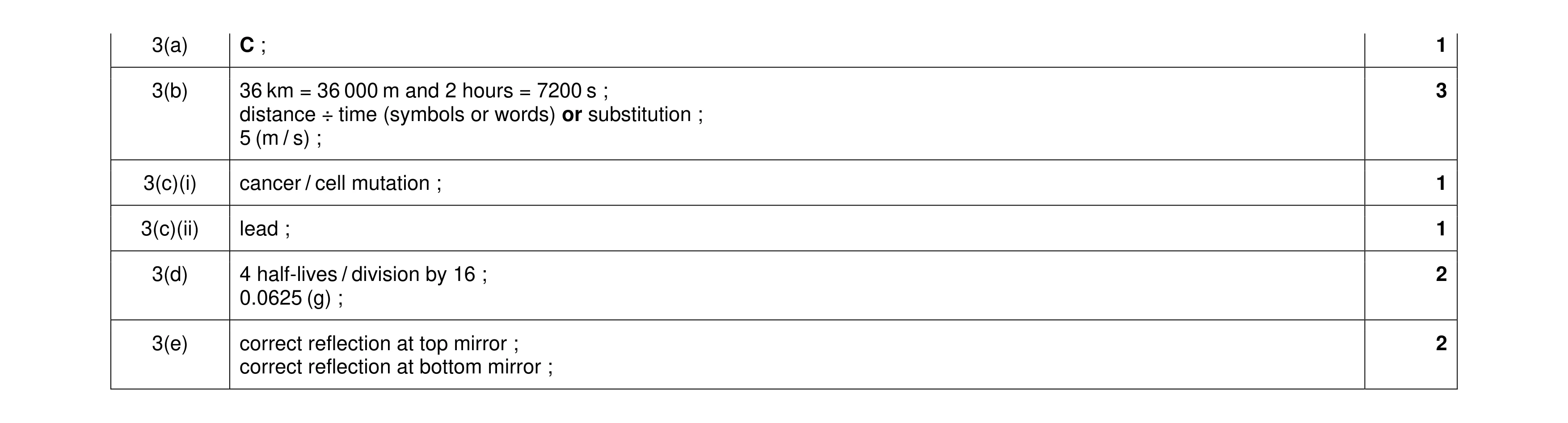 10
10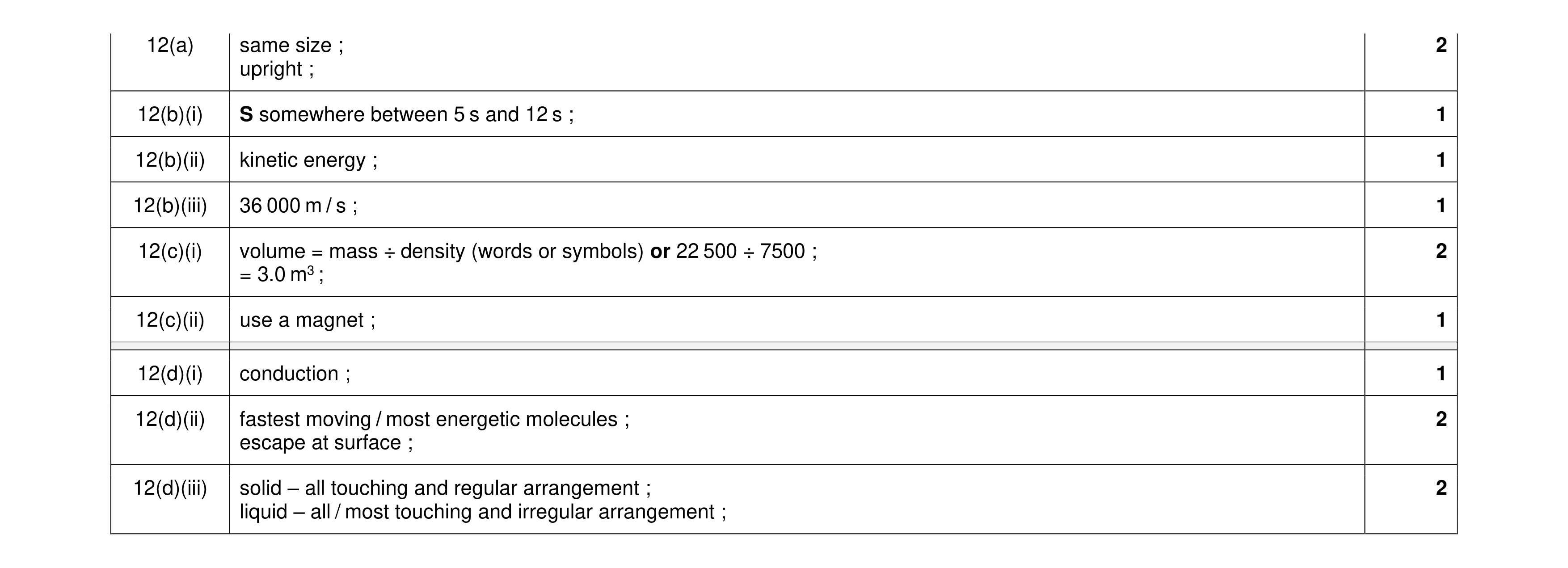 13
13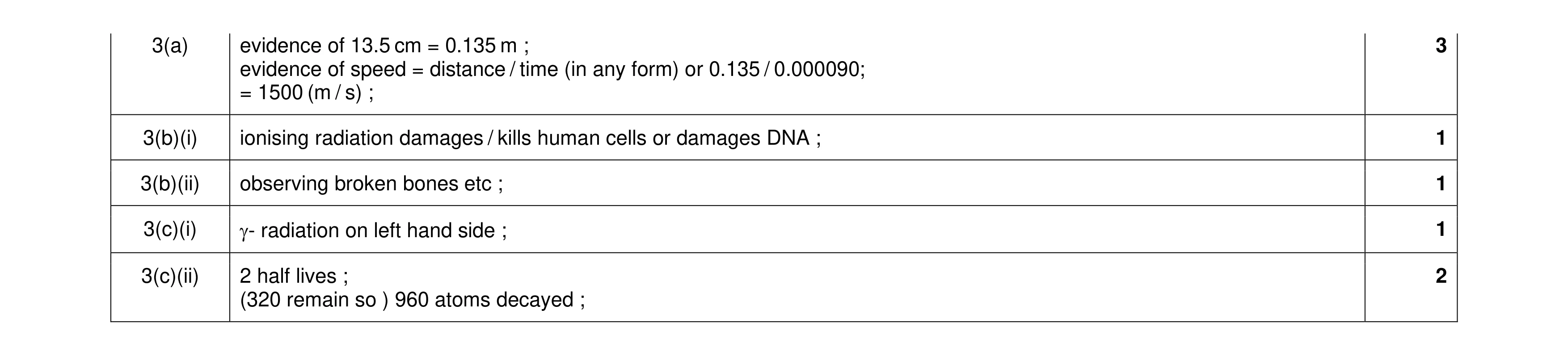 8
8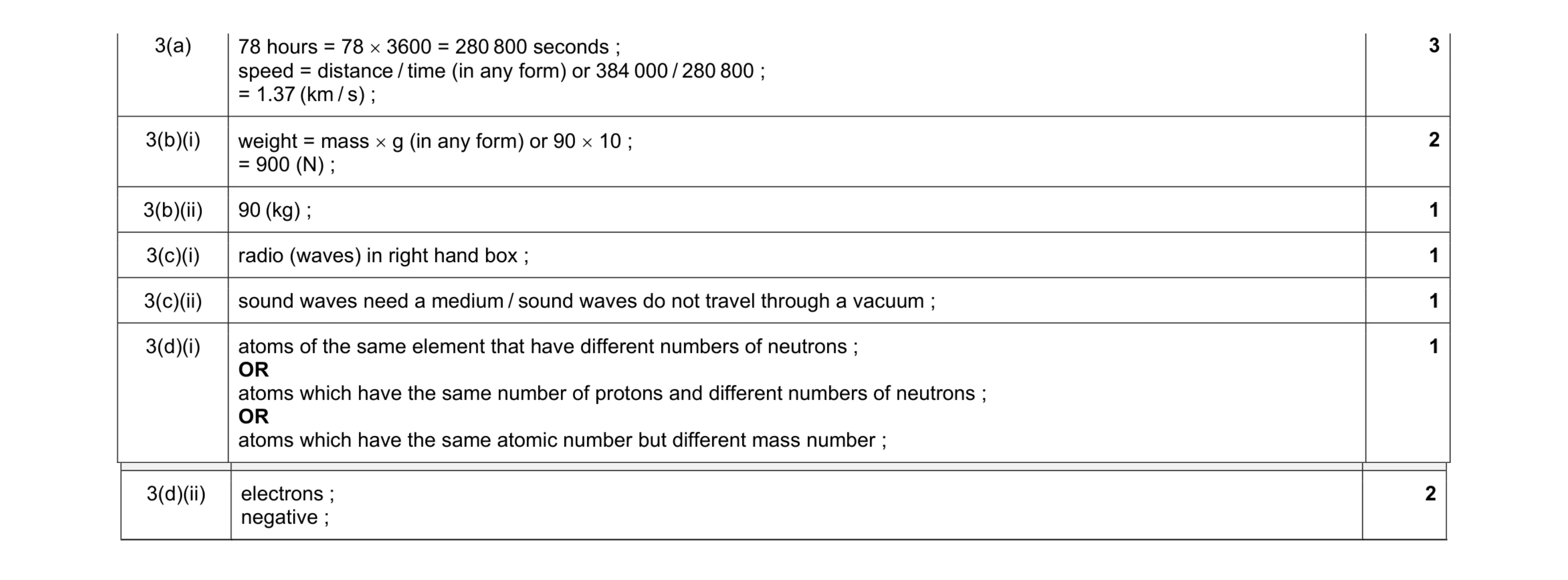 11
11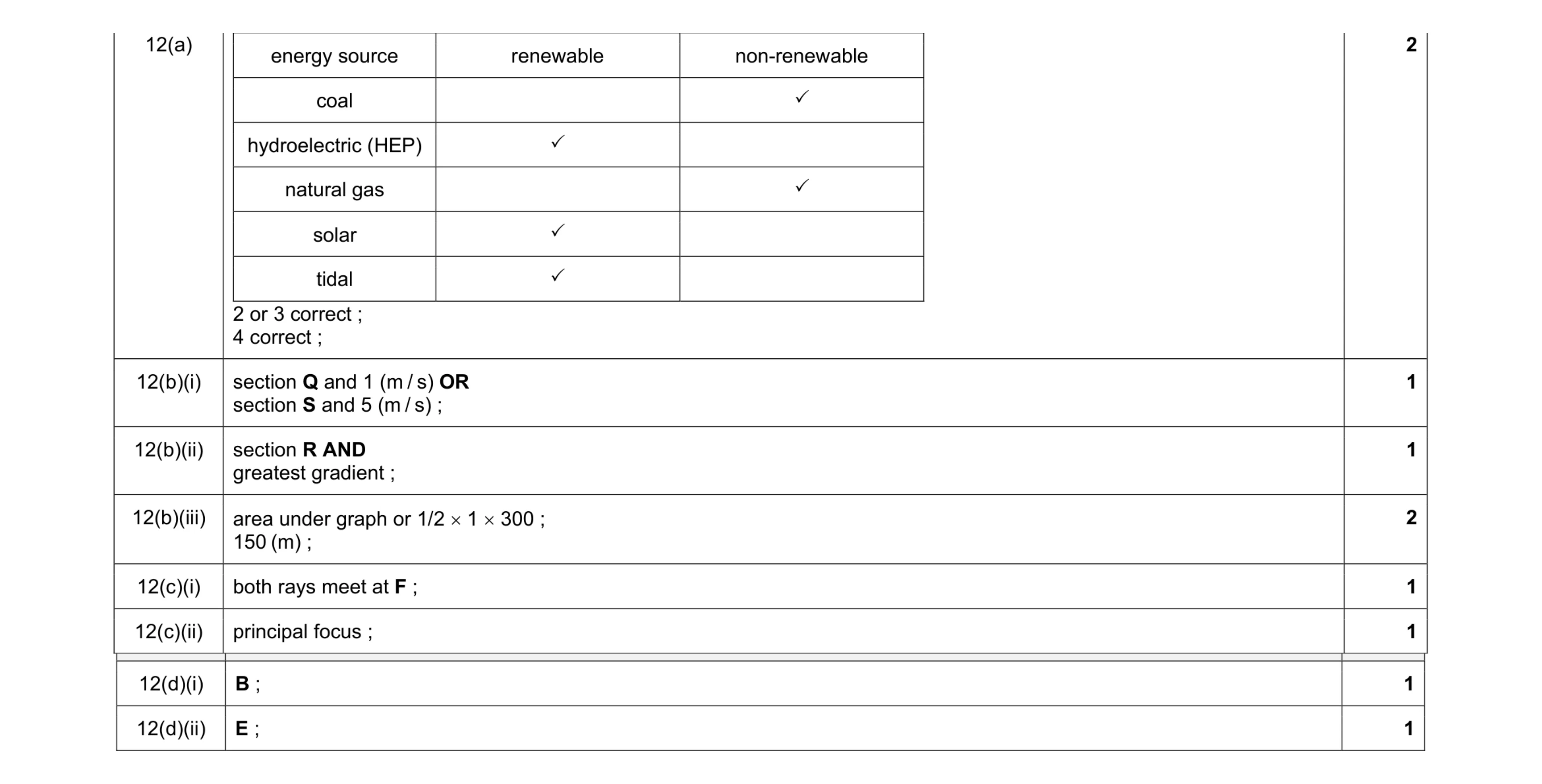 10
10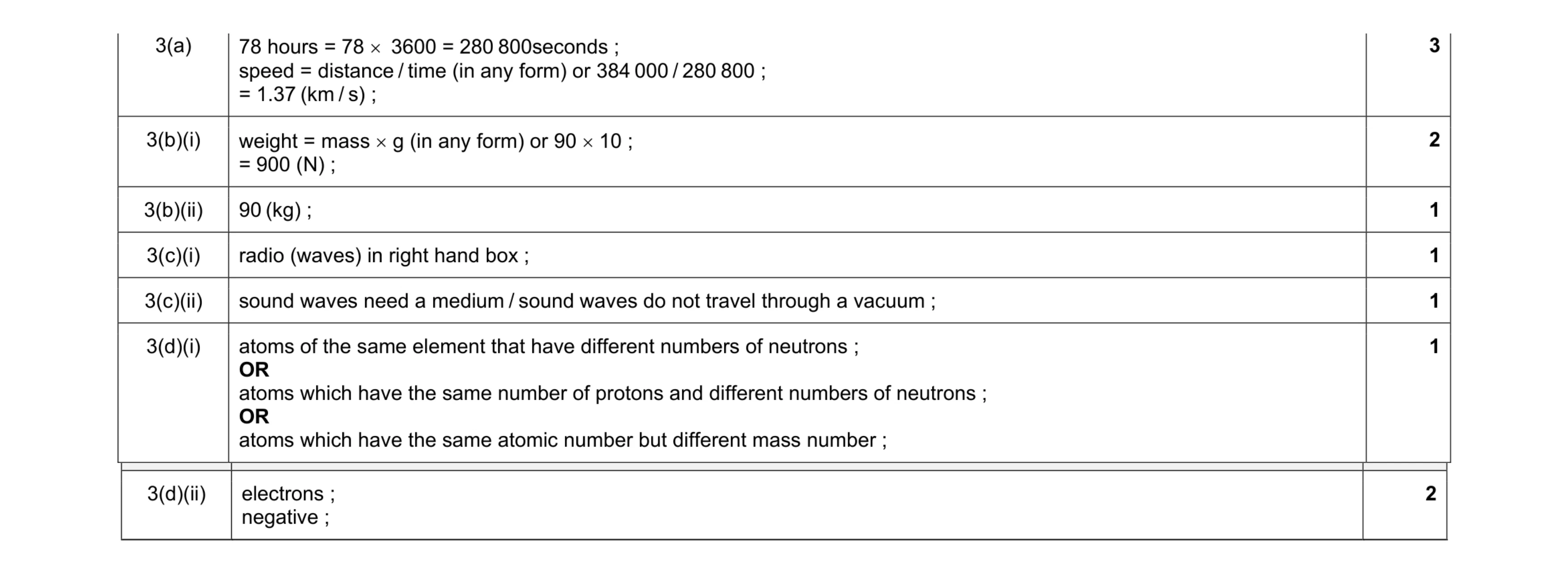 11
11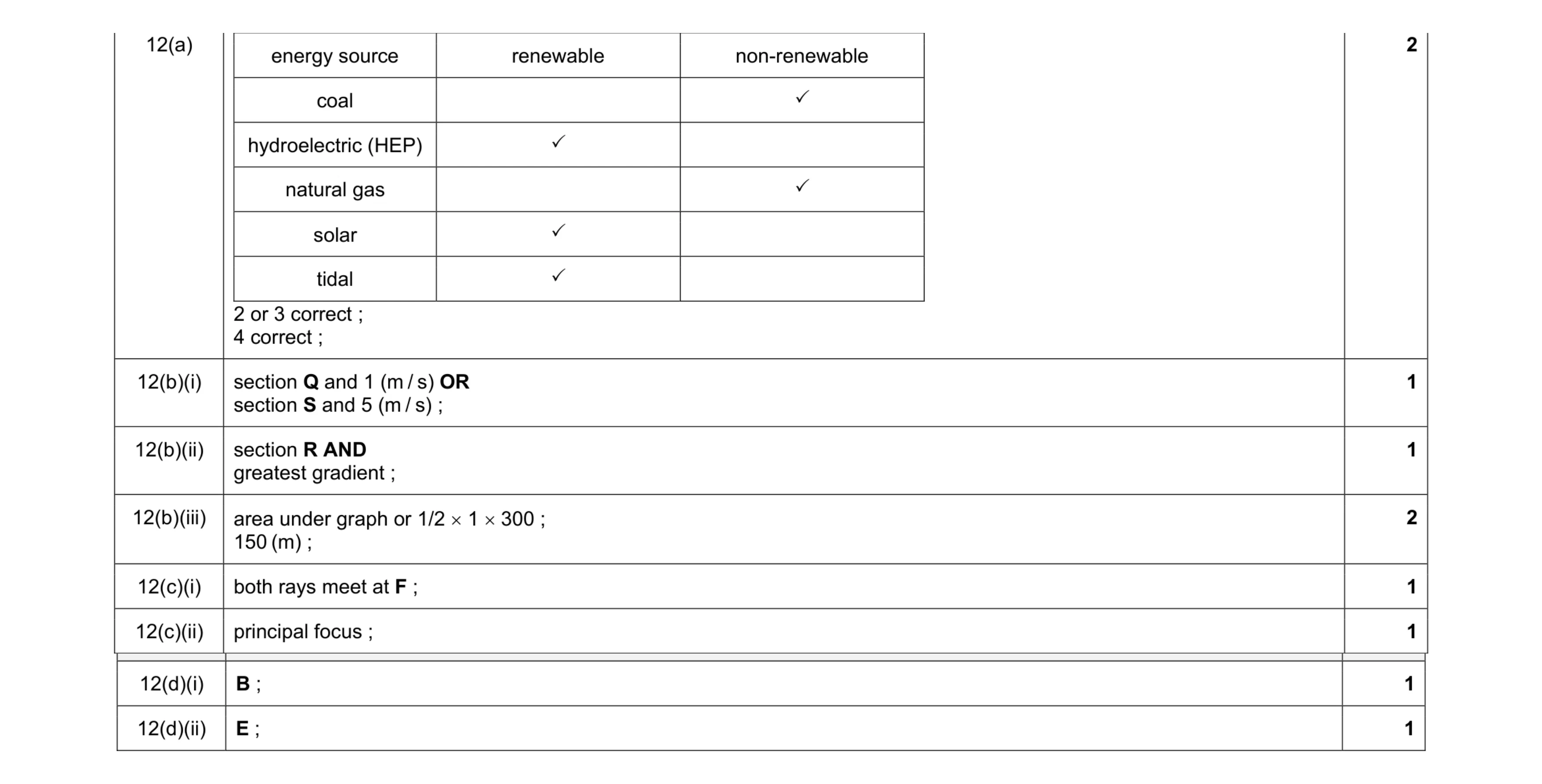 10
10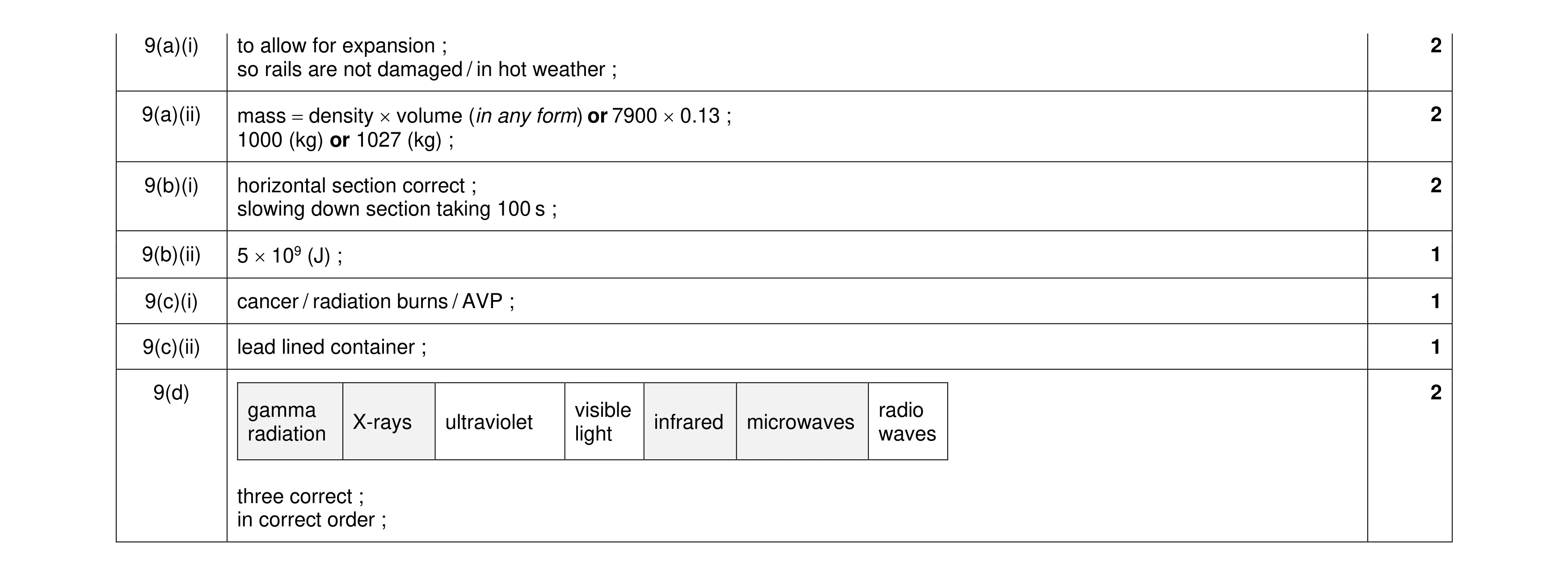 11
11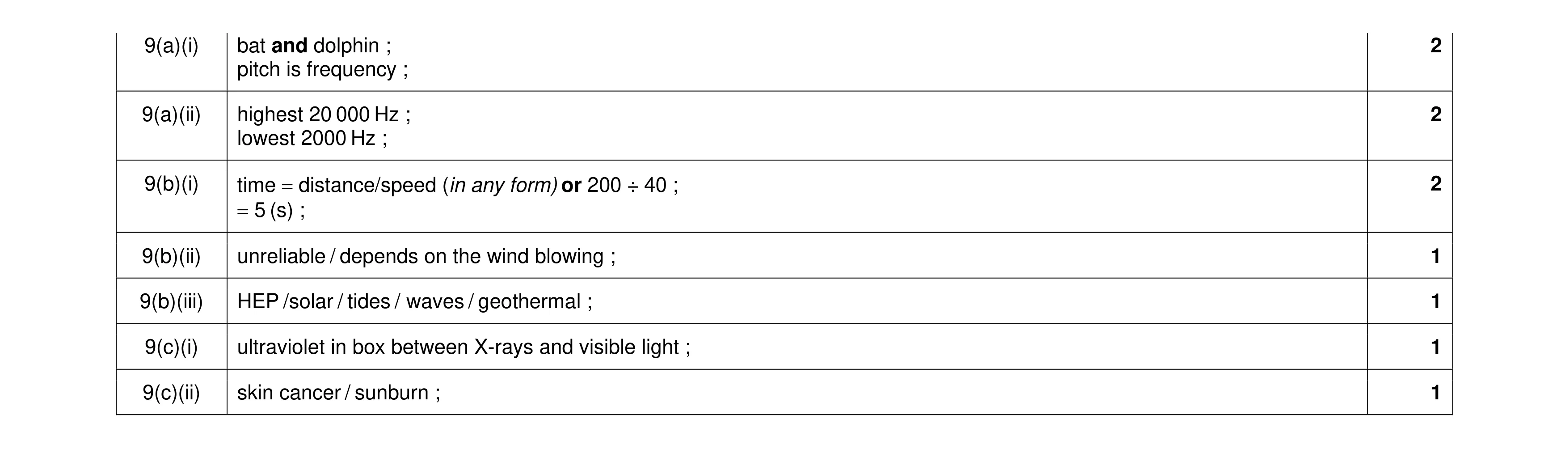 10
10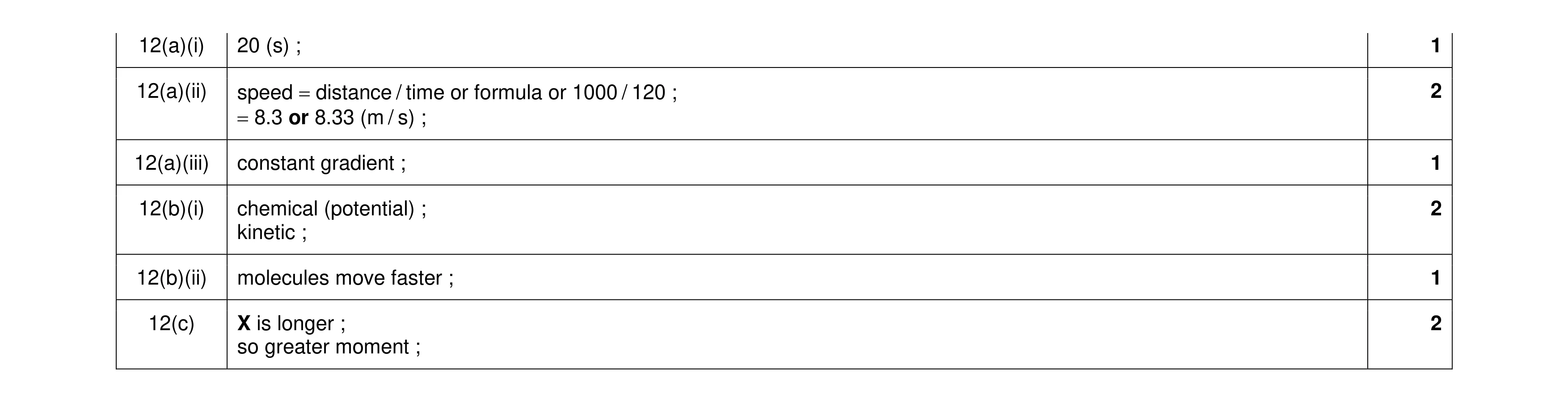 9
9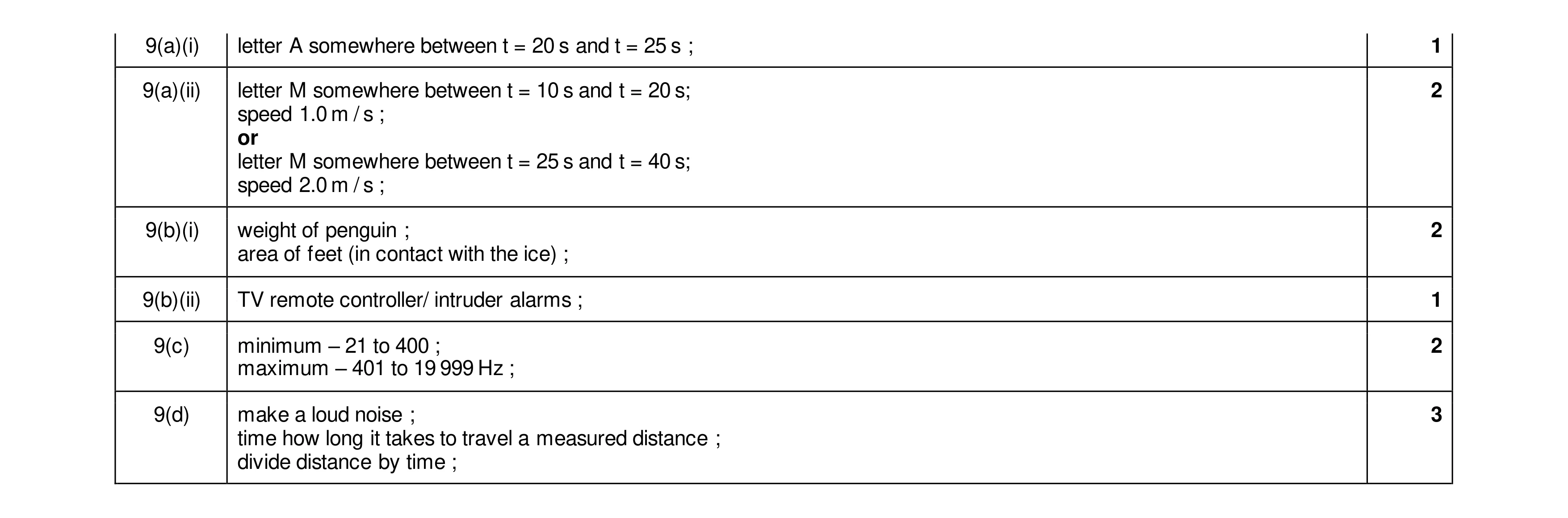 11
11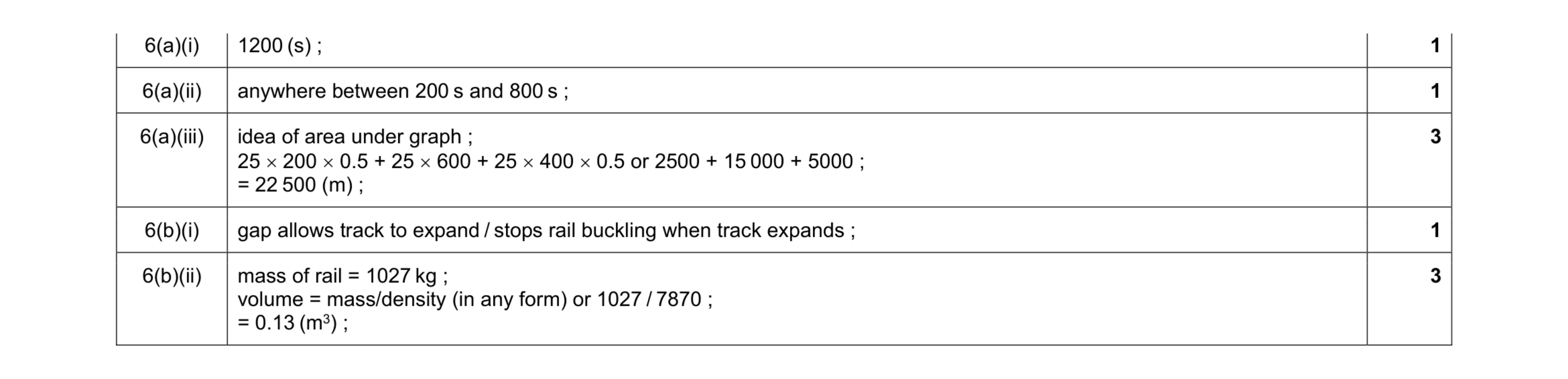 9
9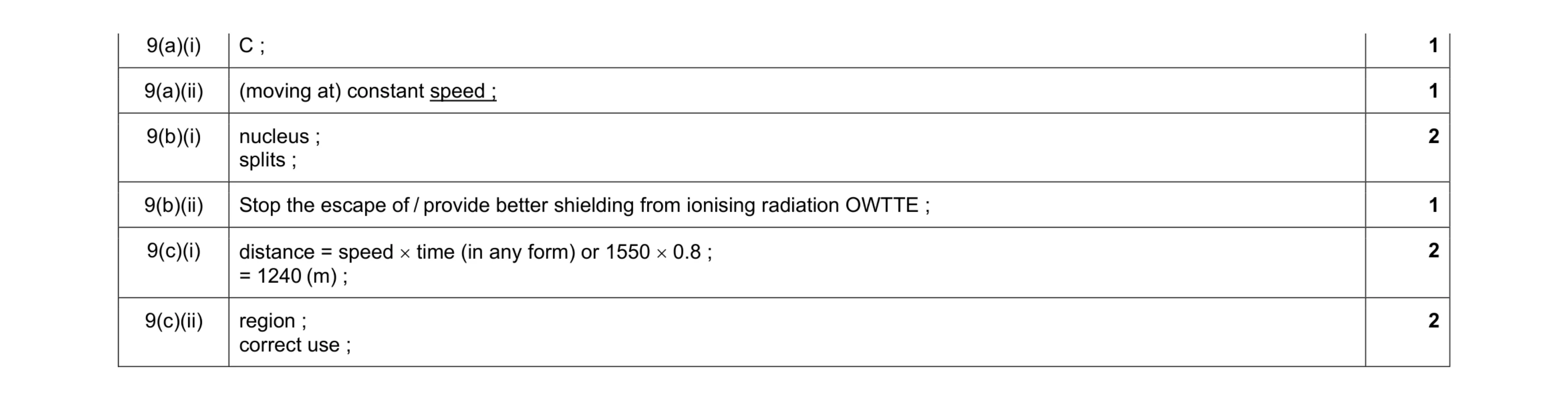 9
9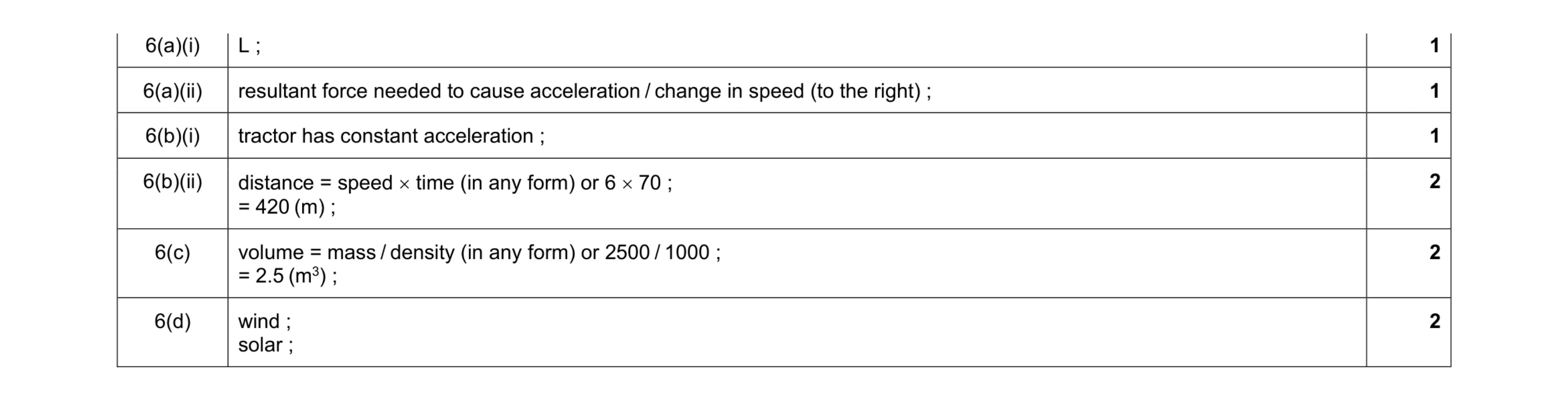 9
9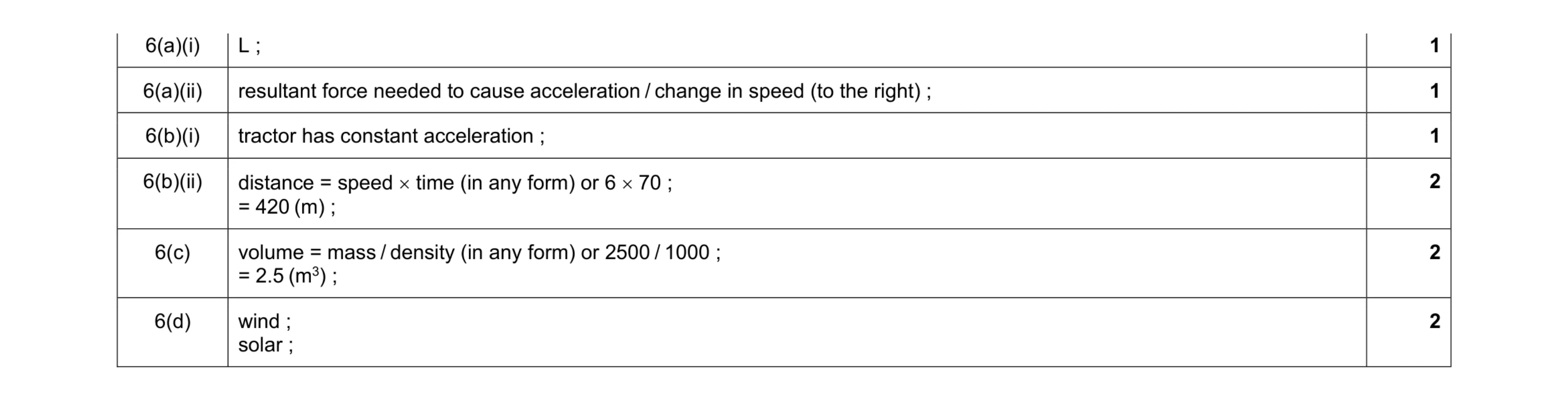 9
9 11
11 10
10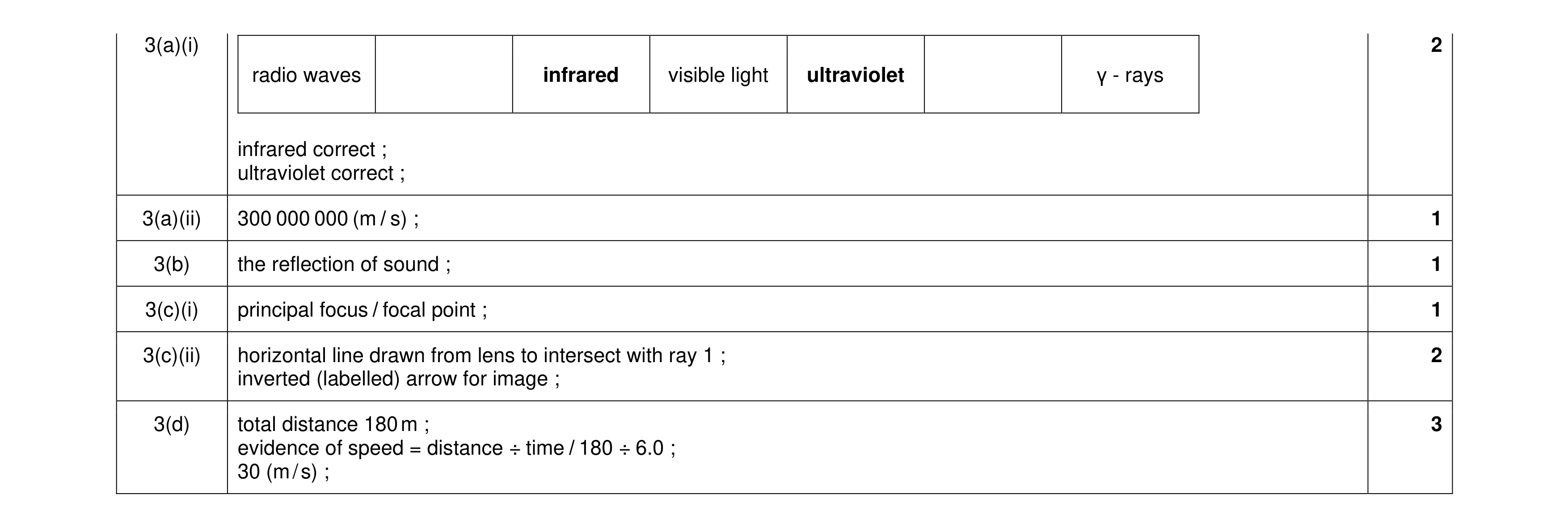 10
10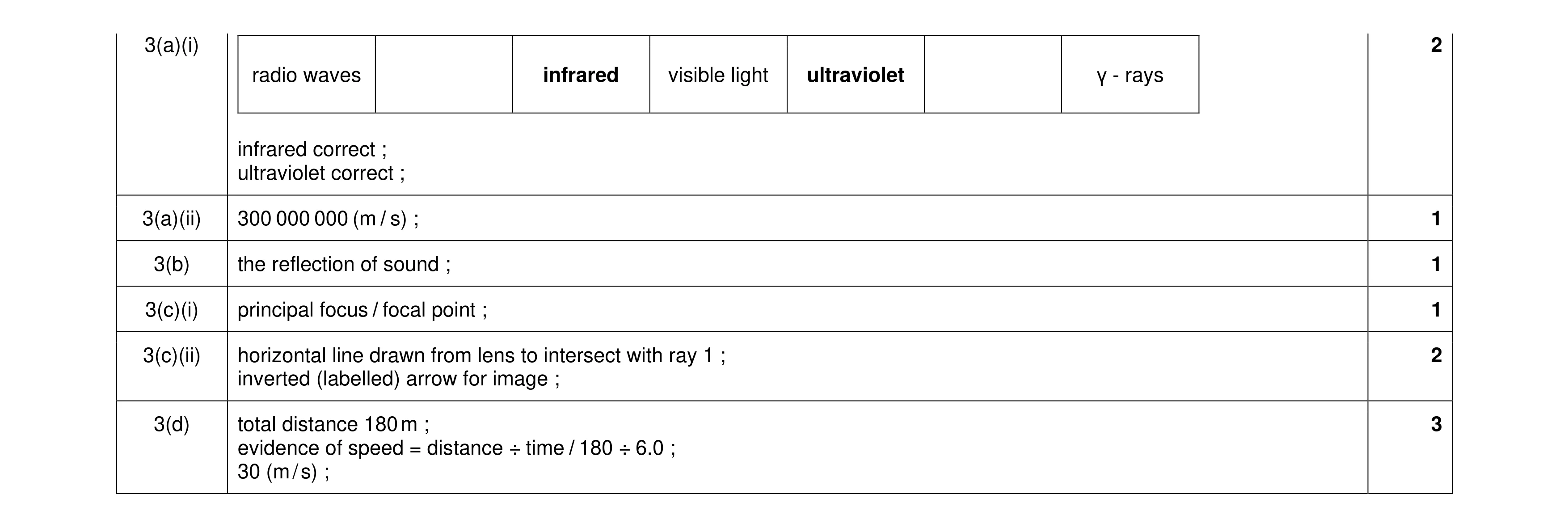 10
10 11
11 11
11 8
8 11
11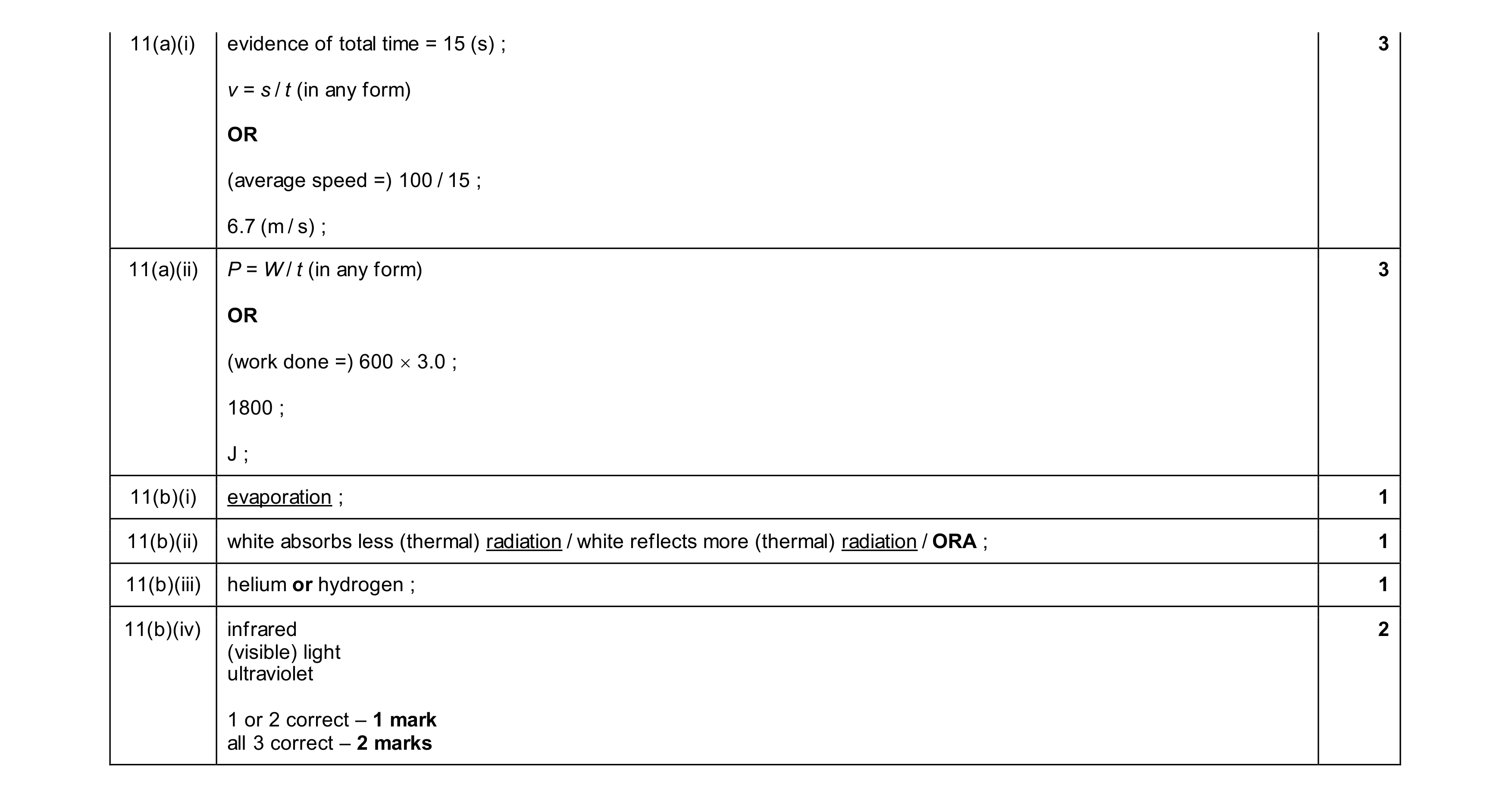 11
11