Cambridge IGCSE Sciences - Co-ordinated (Double) 0654 — 2018 Oct/Nov Paper 4 · Variant 2
0654/42/O/N/18 · 13 questions · 120 marks · ≈135 min
The question paper and its mark scheme, free to read here and free to download. This is Cambridge’s own paper, exactly as it was sat.
Question paper36 pages





Mark scheme12 pages
Answers below. Sit the paper first if you are practising.
Questions as text
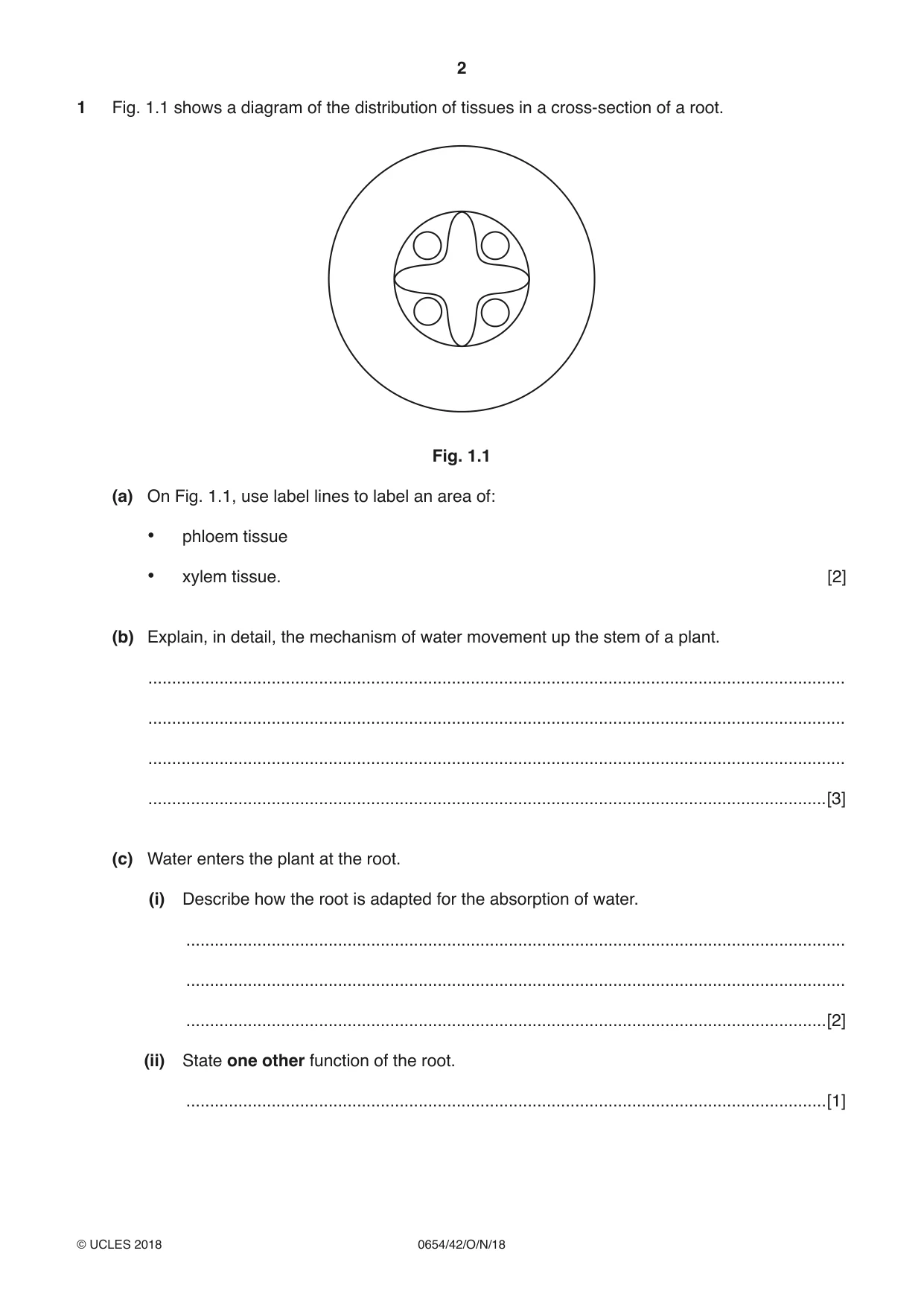
Q1 · A diagram of the distribution of tissues in a cross-section of a root
1 Fig. 1.1 shows a diagram of the distribution of tissues in a cross-section of a root. Fig. 1.1 (a) On Fig. 1.1, use label lines to label an area of: • phloem tissue • xylem tissue. [2] (b) Explain, in detail, the mechanism of water movement up the stem of a plant. ................................................................................................................................................... ................................................................................................................................................... ................................................................................................................................................... ...............................................................................................................................................[3] (c) Water enters the plant at the root. (i) Describe how the root is adapted for the absorption of water. ........................................................................................................................................... ........................................................................................................................................... .......................................................................................................................................[2] (ii) State one other function of the root. .......................................................................................................................................[1]
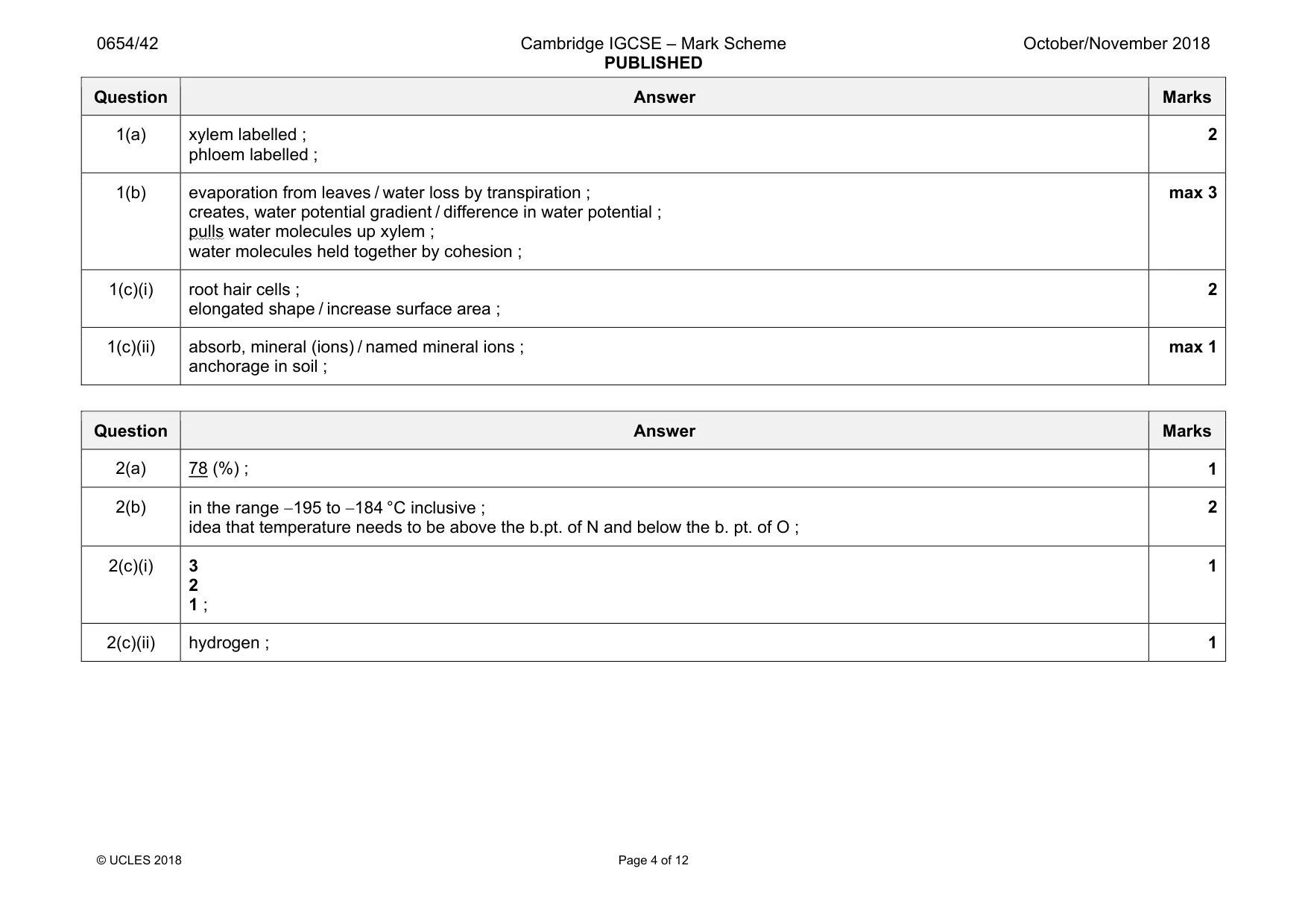
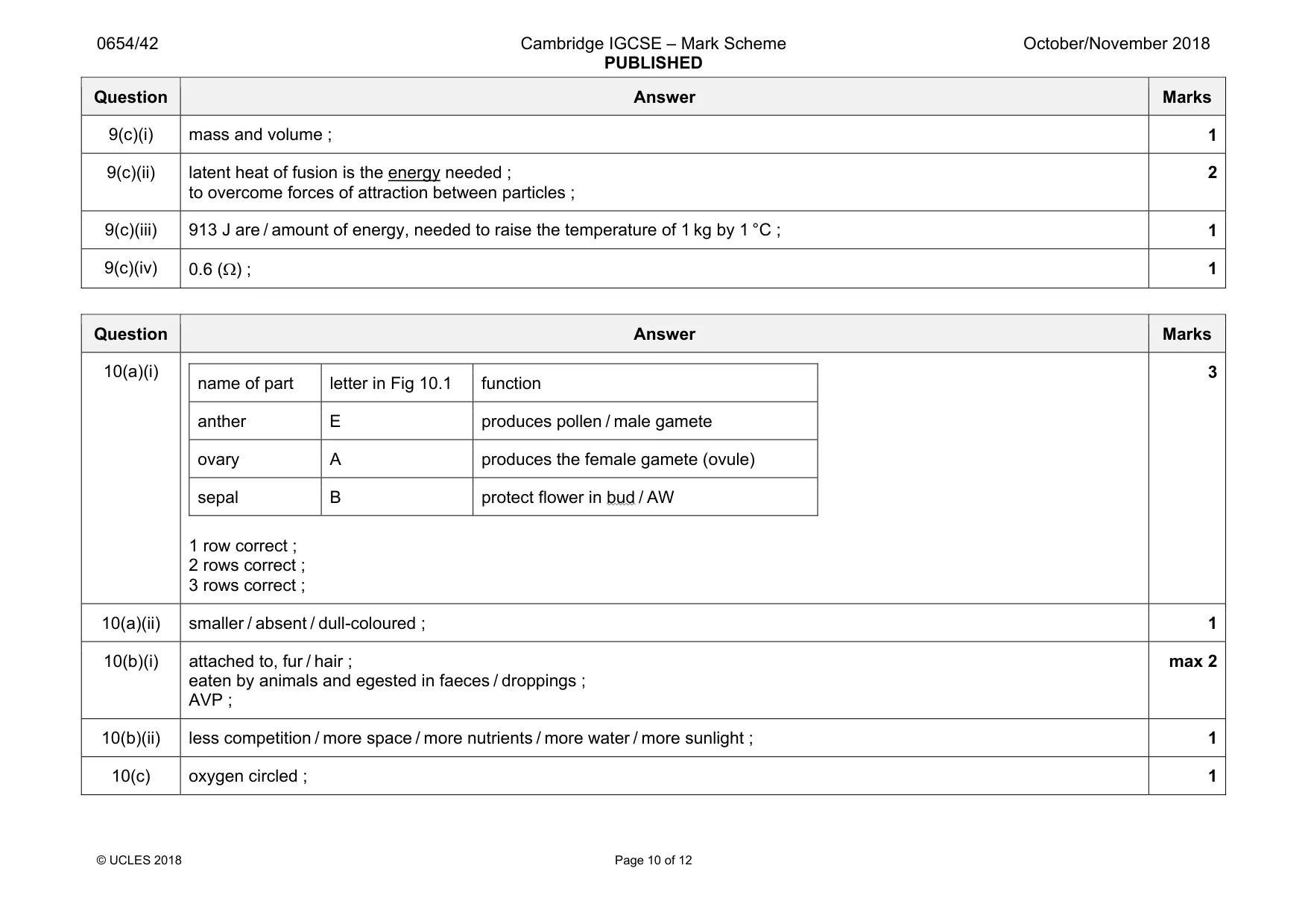
Mark scheme: 1(a) xylem labelled ; phloem labelled ; 2 1(b) evaporation from leaves / water loss by transpiration ; creates, water potential gradient / difference in water potential ; pulls water molecules up xylem ; water molecules held together by cohesion ; max 3 1(c)(i) root hair cells ; elongated shape / increase surface area ; 2 1(c)(ii) absorb, mineral (ions) / named mineral ions ; anchorage in soil ; max 1
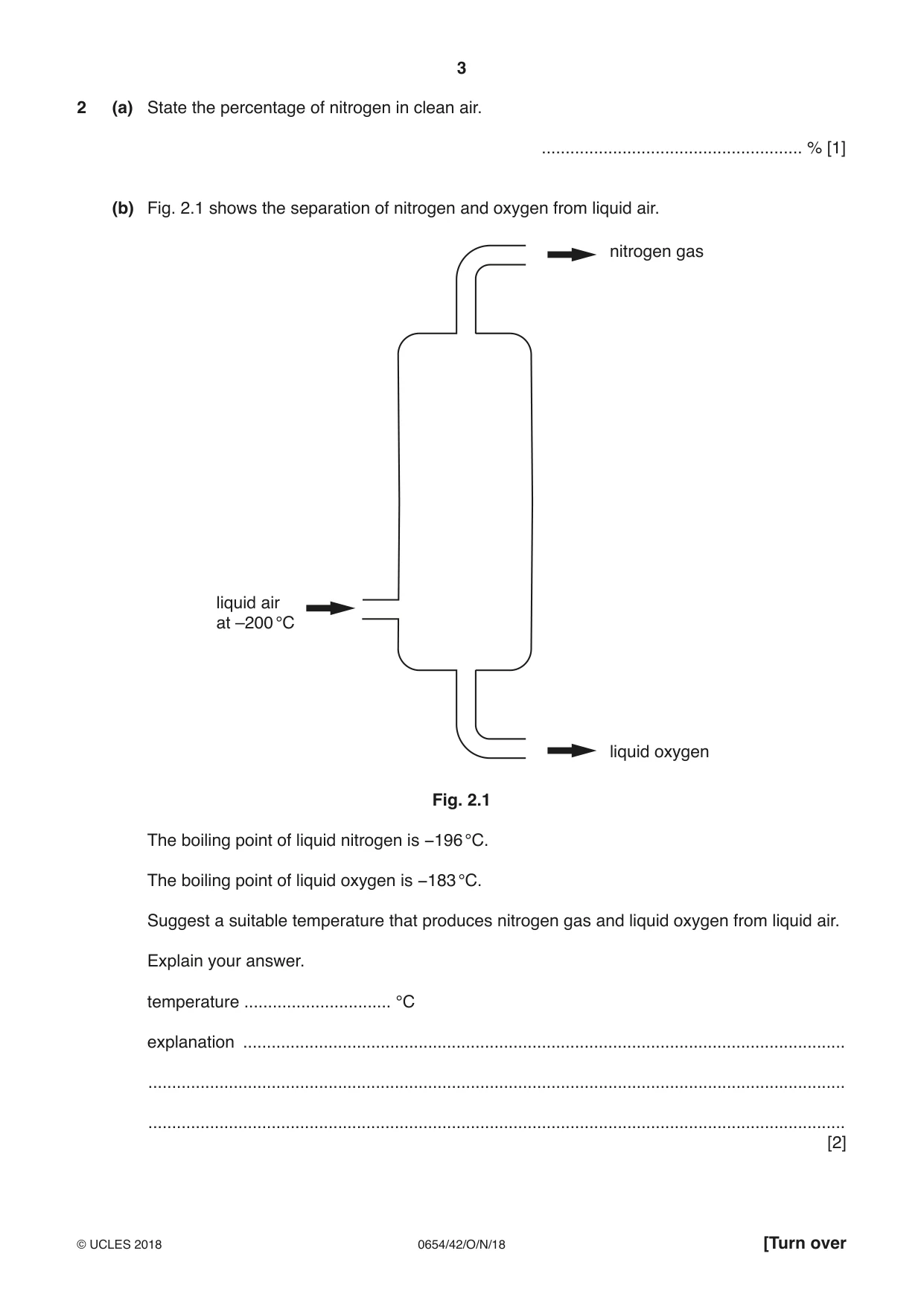
Q2 · State the percentage of nitrogen in clean air
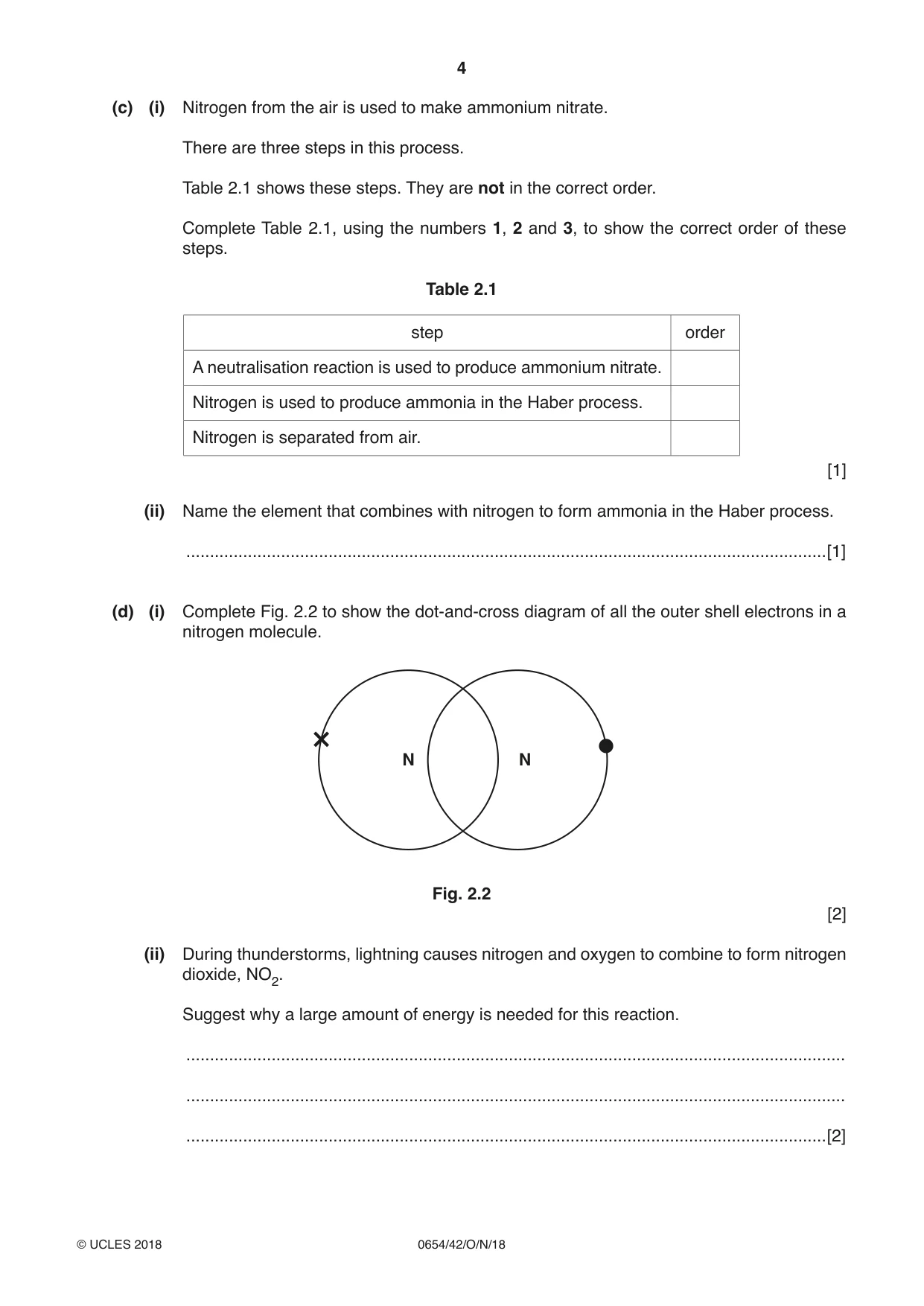
2 (a) State the percentage of nitrogen in clean air. ....................................................... % [1] (b) Fig. 2.1 shows the separation of nitrogen and oxygen from liquid air. nitrogen gas liquid air at –200 °C liquid oxygen Fig. 2.1 The boiling point of liquid nitrogen is −196 °C. The boiling point of liquid oxygen is −183 °C. Suggest a suitable temperature that produces nitrogen gas and liquid oxygen from liquid air. Explain your answer. temperature ............................... °C explanation ............................................................................................................................... ................................................................................................................................................... ................................................................................................................................................... [2] (c) (i) Nitrogen from the air is used to make ammonium nitrate. There are three steps in this process. Table 2.1 shows these steps. They are not in the correct order. Complete Table 2.1, using the numbers 1, 2 and 3, to show the correct order of these steps. Table 2.1 step order A neutralisation reaction is used to produce ammonium nitrate. Nitrogen is used to produce ammonia in the Haber process. Nitrogen is separated from air. [1] (ii) Name the element that combines with nitrogen to form ammonia in the Haber process. .......................................................................................................................................[1] (d) (i) Complete Fig. 2.2 to show the dot-and-cross diagram of all the outer shell electrons in a nitrogen molecule. N N Fig. 2.2 [2] (ii) During thunderstorms, lightning causes nitrogen and oxygen to combine to form nitrogen dioxide, NO2. Suggest why a large amount of energy is needed for this reaction. ........................................................................................................................................... ........................................................................................................................................... .......................................................................................................................................[2] (iii) Predict the effect that nitrogen dioxide has, if any, on the pH of rainwater. Explain your answer. effect on pH ....................................................................................................................... explanation ........................................................................................................................ ........................................................................................................................................... [2]
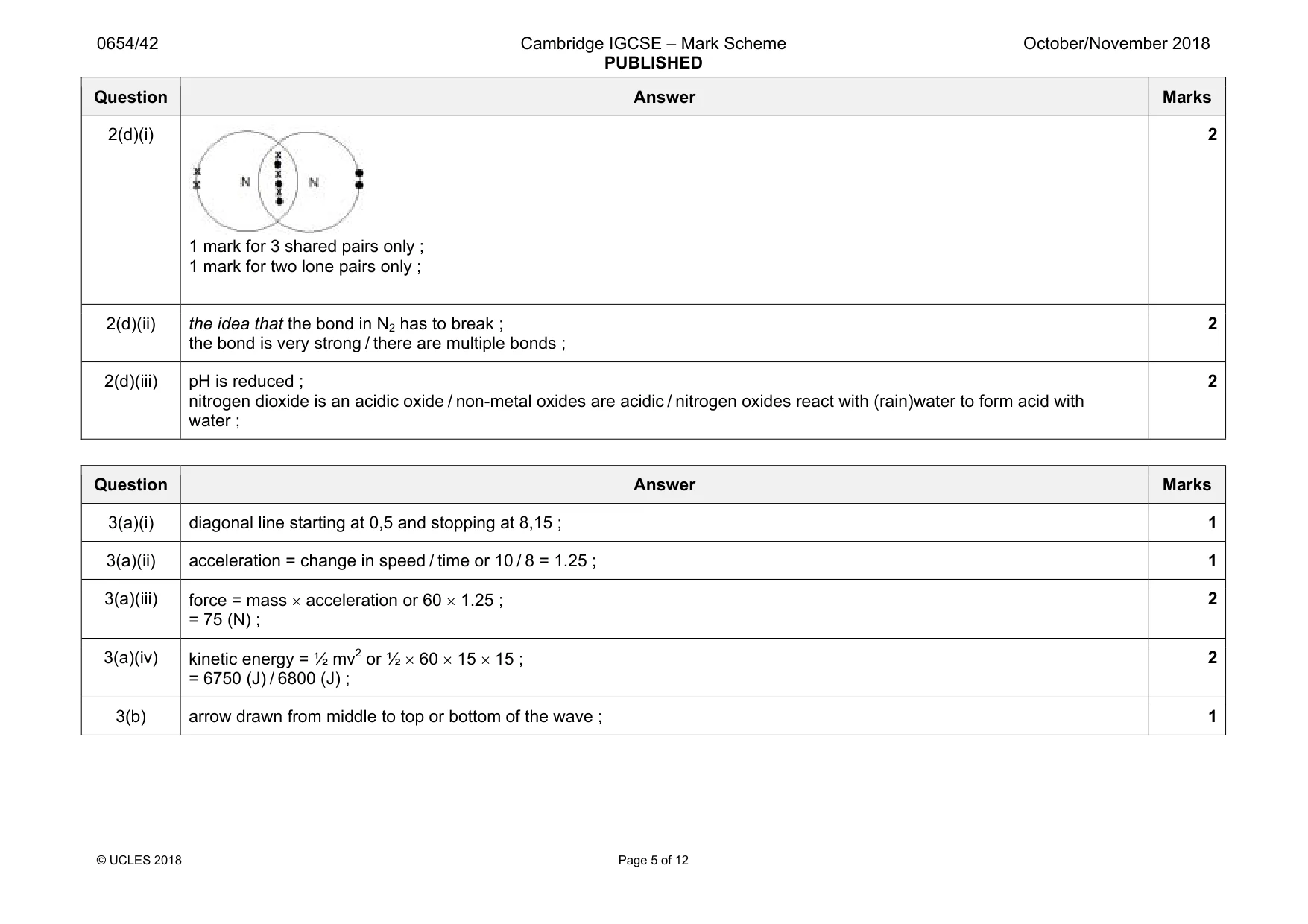
Mark scheme: 2(a) 78 (%) ; 1 2(b) in the range −195 to −184 °C inclusive ; idea that temperature needs to be above the b.pt. of N and below the b. pt. of O ; 2 2(c)(i) 3 2 1 ; 1 2(c)(ii) hydrogen ; 1 Question Answer Marks 2(d)(i) 1 mark for 3 shared pairs only ; 1 mark for two lone pairs only ; 2 2(d)(ii) the idea that the bond in N2 has to break ; the bond is very strong / there are multiple bonds ; 2 2(d)(iii) pH is reduced ; nitrogen dioxide is an acidic oxide / non-metal oxides are acidic / nitrogen oxides react with (rain)water to form acid with water ; 2
Q3 · A boat pulling a water skier across a lake
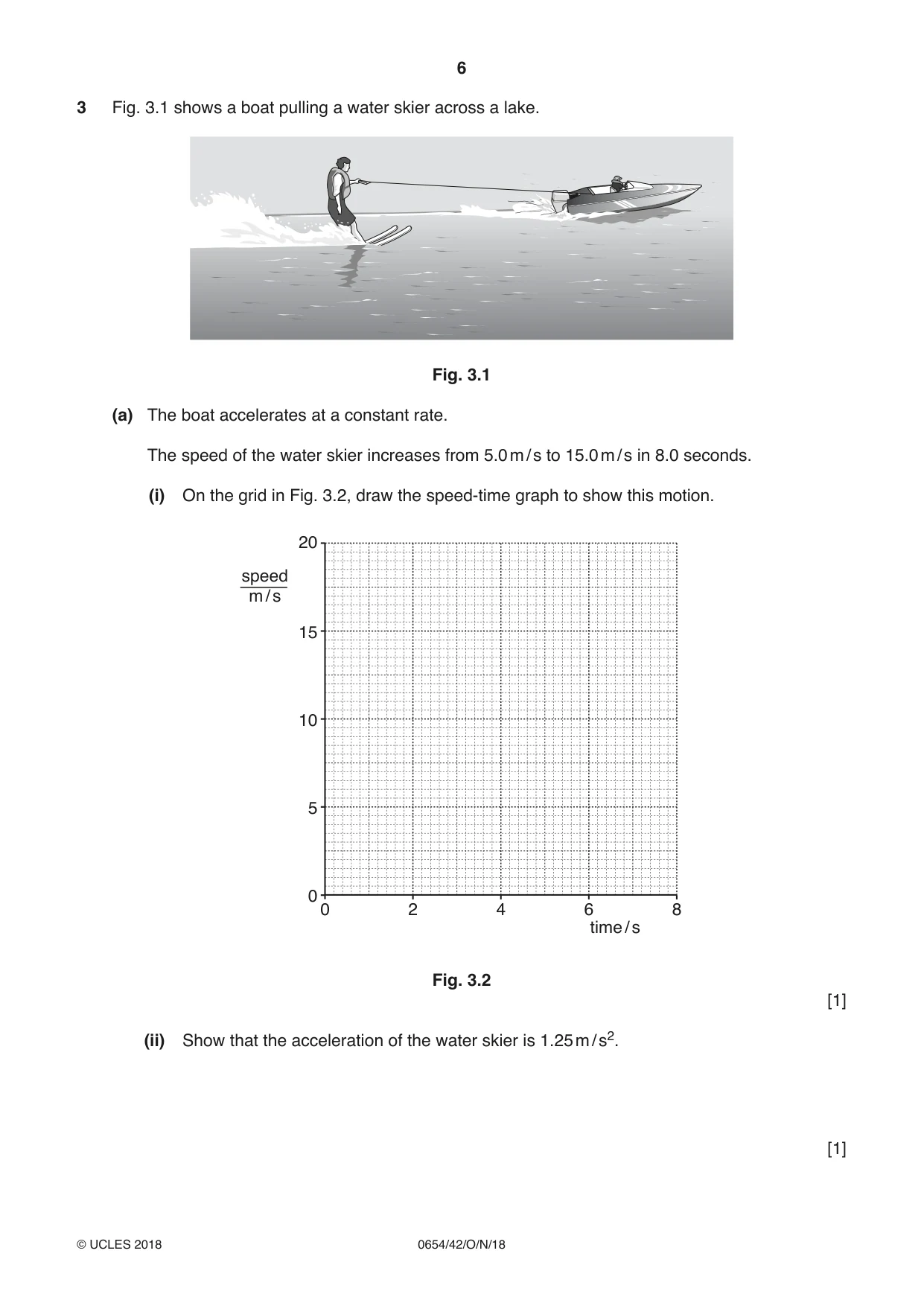
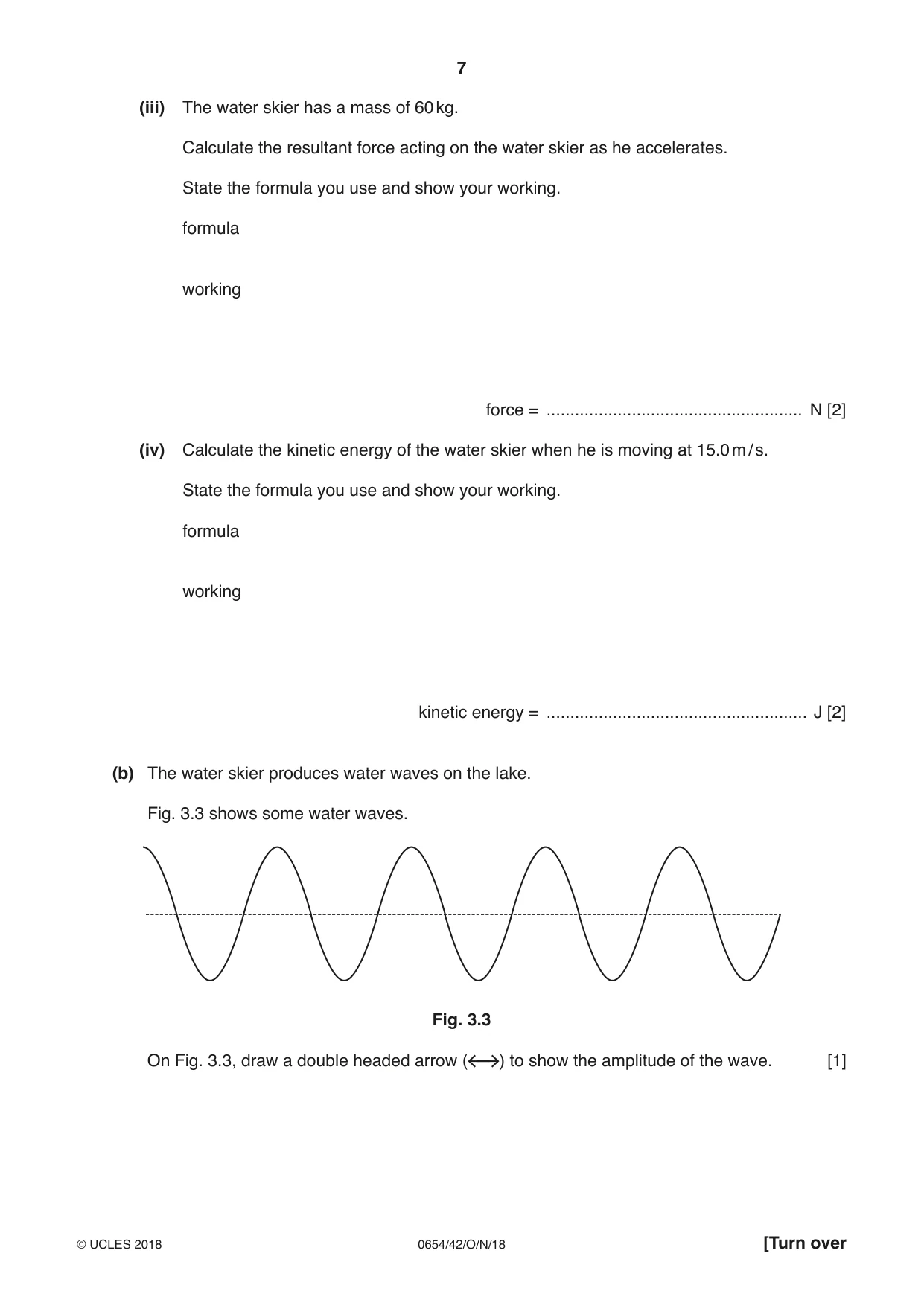
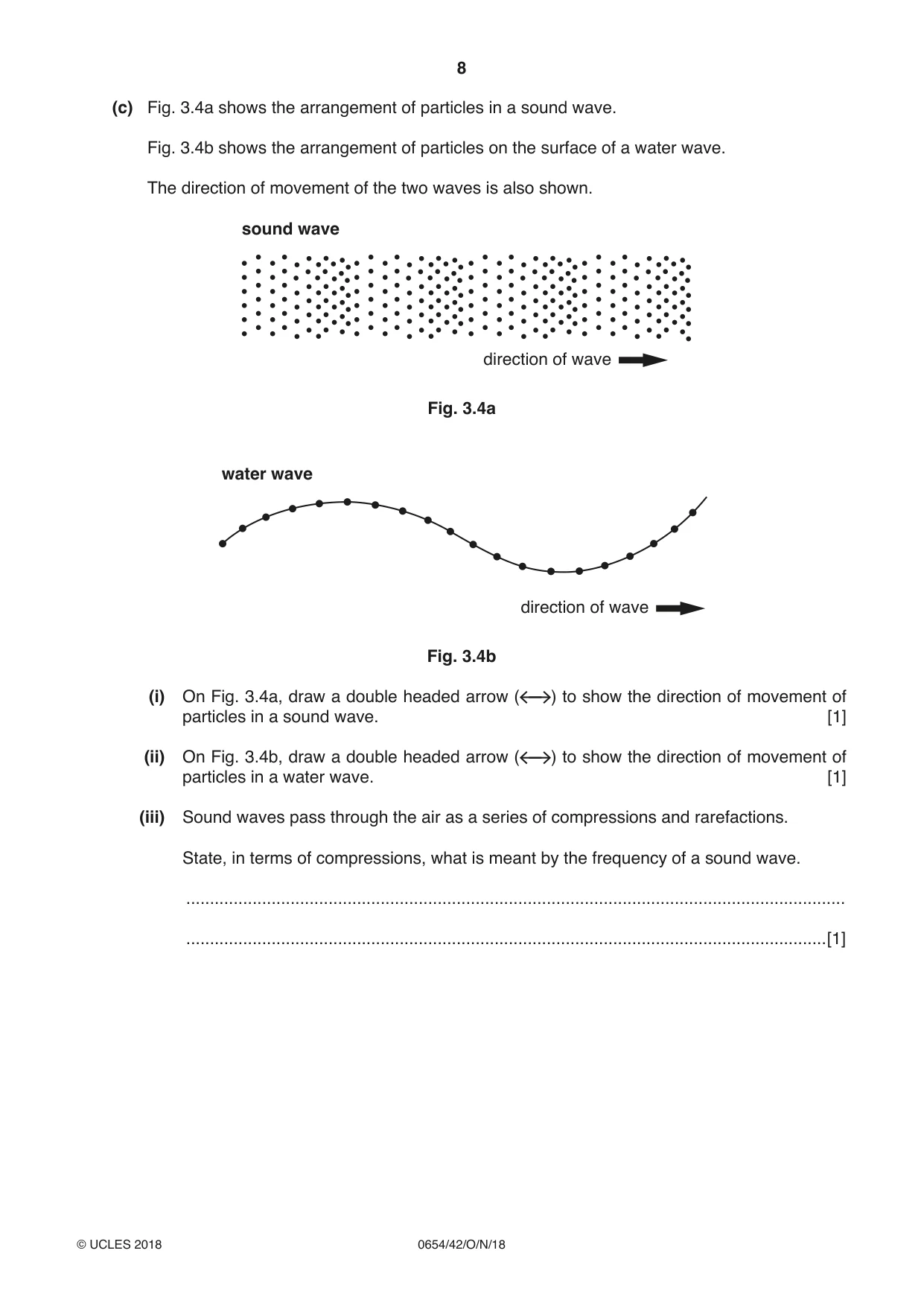
3 Fig. 3.1 shows a boat pulling a water skier across a lake. Fig. 3.1 (a) The boat accelerates at a constant rate. The speed of the water skier increases from 5.0 m / s to 15.0 m / s in 8.0 seconds. (i) On the grid in Fig. 3.2, draw the speed-time graph to show this motion. 20 speed m / s 15 10 5 0 0 2 4 6 8 time / s Fig. 3.2 [1] (ii) Show that the acceleration of the water skier is 1.25 m / s2. [1] (iii) The water skier has a mass of 60 kg. Calculate the resultant force acting on the water skier as he accelerates. State the formula you use and show your working. formula working force = ...................................................... N [2] (iv) Calculate the kinetic energy of the water skier when he is moving at 15.0 m / s. State the formula you use and show your working. formula working kinetic energy = ....................................................... J [2] (b) The water skier produces water waves on the lake. Fig. 3.3 shows some water waves. Fig. 3.3 On Fig. 3.3, draw a double headed arrow ( ) to show the amplitude of the wave. [1] (c) Fig. 3.4a shows the arrangement of particles in a sound wave. Fig. 3.4b shows the arrangement of particles on the surface of a water wave. The direction of movement of the two waves is also shown. sound wave direction of wave Fig. 3.4a water wave direction of wave Fig. 3.4b (i) On Fig. 3.4a, draw a double headed arrow ( ) to show the direction of movement of particles in a sound wave. [1] (ii) On Fig. 3.4b, draw a double headed arrow ( ) to show the direction of movement of particles in a water wave. [1] (iii) Sound waves pass through the air as a series of compressions and rarefactions. State, in terms of compressions, what is meant by the frequency of a sound wave. ........................................................................................................................................... .......................................................................................................................................[1]
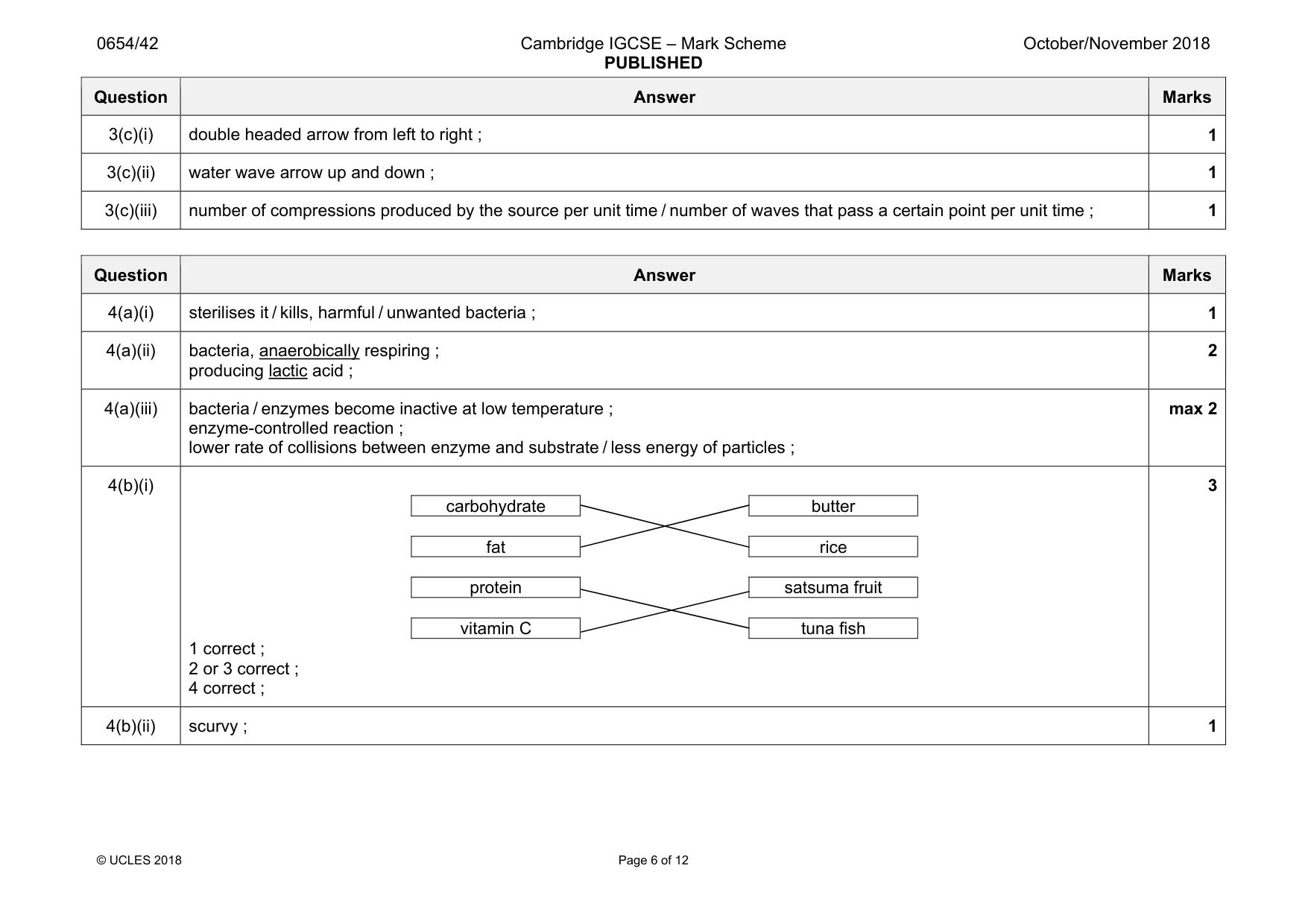
Mark scheme: 3(a)(i) diagonal line starting at 0,5 and stopping at 8,15 ; 1 3(a)(ii) acceleration = change in speed / time or 10 / 8 = 1.25 ; 1 3(a)(iii) force = mass × acceleration or 60 × 1.25 ; = 75 (N) ; 2 3(a)(iv) kinetic energy = ½ mv2 or ½ × 60 × 15 × 15 ; = 6750 (J) / 6800 (J) ; 2 3(b) arrow drawn from middle to top or bottom of the wave ; 1 Question Answer Marks 3(c)(i) double headed arrow from left to right ; 1 3(c)(ii) water wave arrow up and down ; 1 3(c)(iii) number of compressions produced by the source per unit time / number of waves that pass a certain point per unit time ; 1
Q4 · The stages involved in the production of yoghurt
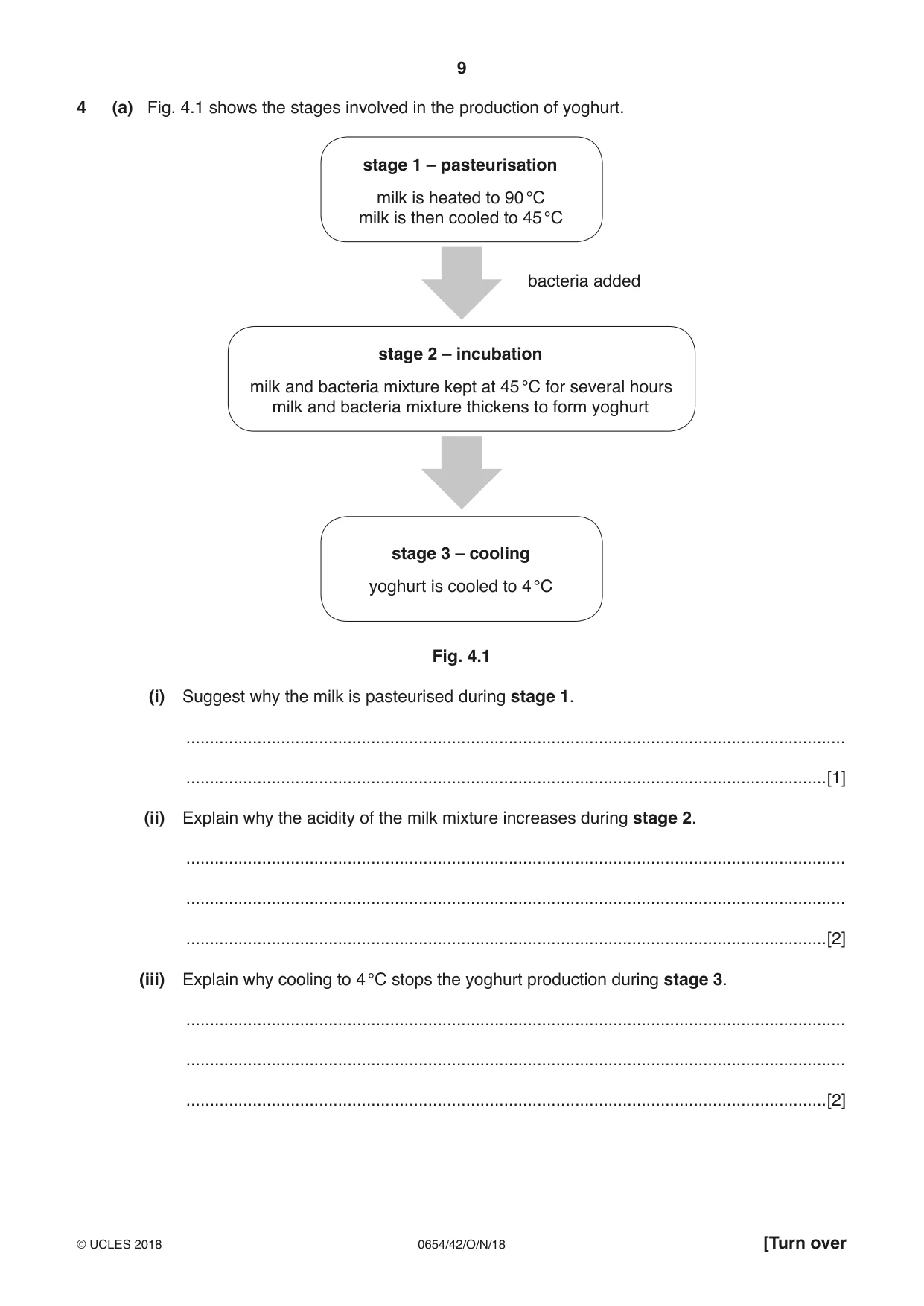
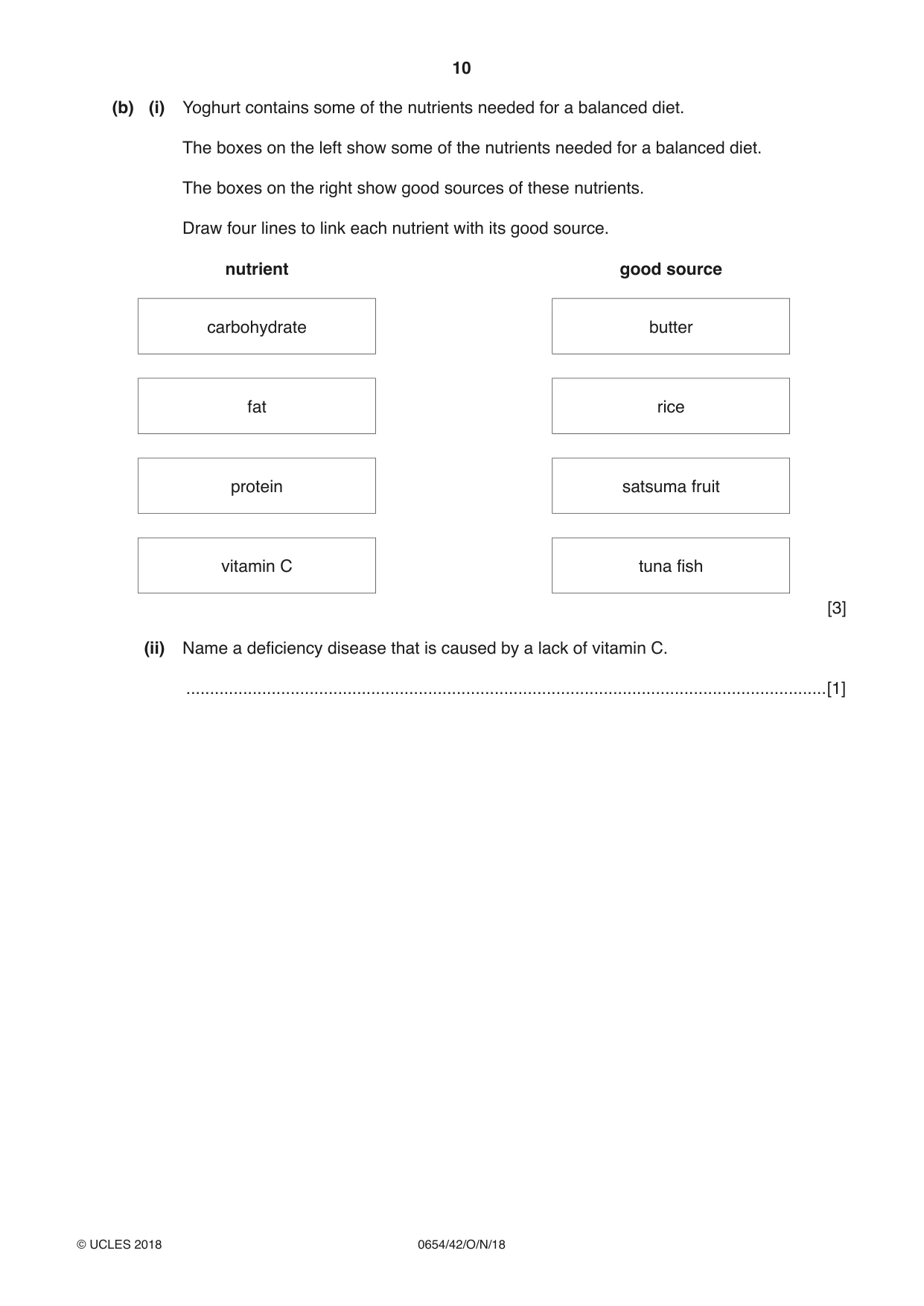
4 (a) Fig. 4.1 shows the stages involved in the production of yoghurt. stage 1 – pasteurisation milk is heated to 90 °C milk is then cooled to 45 °C bacteria added stage 2 – incubation milk and bacteria mixture kept at 45 °C for several hours milk and bacteria mixture thickens to form yoghurt stage 3 – cooling yoghurt is cooled to 4 °C Fig. 4.1 (i) Suggest why the milk is pasteurised during stage 1. ........................................................................................................................................... .......................................................................................................................................[1] (ii) Explain why the acidity of the milk mixture increases during stage 2. ........................................................................................................................................... ........................................................................................................................................... .......................................................................................................................................[2] (iii) Explain why cooling to 4 °C stops the yoghurt production during stage 3. ........................................................................................................................................... ........................................................................................................................................... .......................................................................................................................................[2] (b) (i) Yoghurt contains some of the nutrients needed for a balanced diet. The boxes on the left show some of the nutrients needed for a balanced diet. The boxes on the right show good sources of these nutrients. Draw four lines to link each nutrient with its good source. nutrient good source carbohydrate butter fat rice protein satsuma fruit vitamin C tuna fish [3] (ii) Name a deficiency disease that is caused by a lack of vitamin C. .......................................................................................................................................[1]
Mark scheme: 4(a)(i) sterilises it / kills, harmful / unwanted bacteria ; 1 4(a)(ii) bacteria, anaerobically respiring ; producing lactic acid ; 2 4(a)(iii) bacteria / enzymes become inactive at low temperature ; enzyme-controlled reaction ; lower rate of collisions between enzyme and substrate / less energy of particles ; max 2 4(b)(i) carbohydrate butter fat rice protein satsuma fruit vitamin C tuna fish 1 correct ; 2 or 3 correct ; 4 correct ; 3 4(b)(ii) scurvy ; 1
Q5 · A student reacts iron with dilute sulfuric acid as shown in Fig
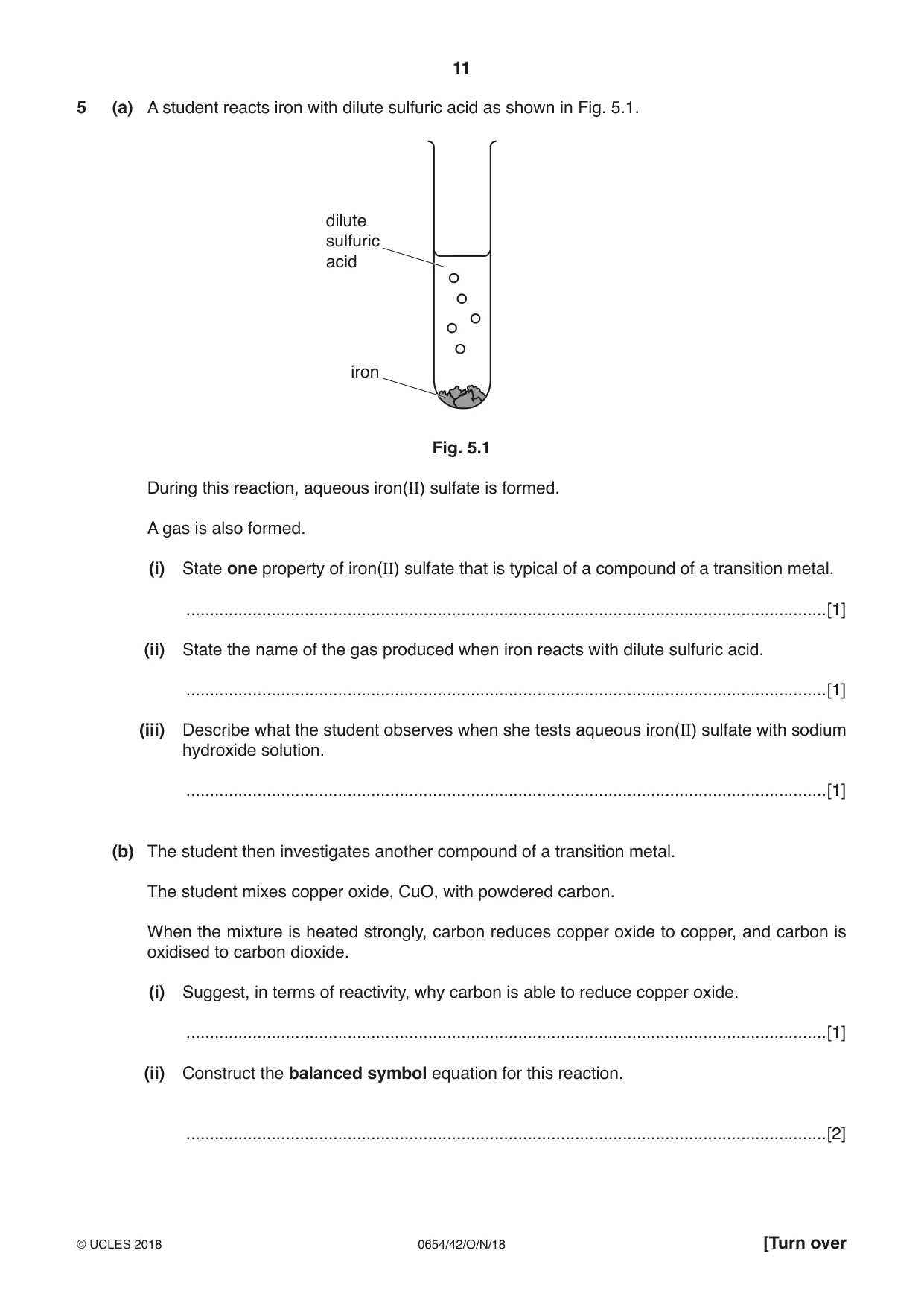
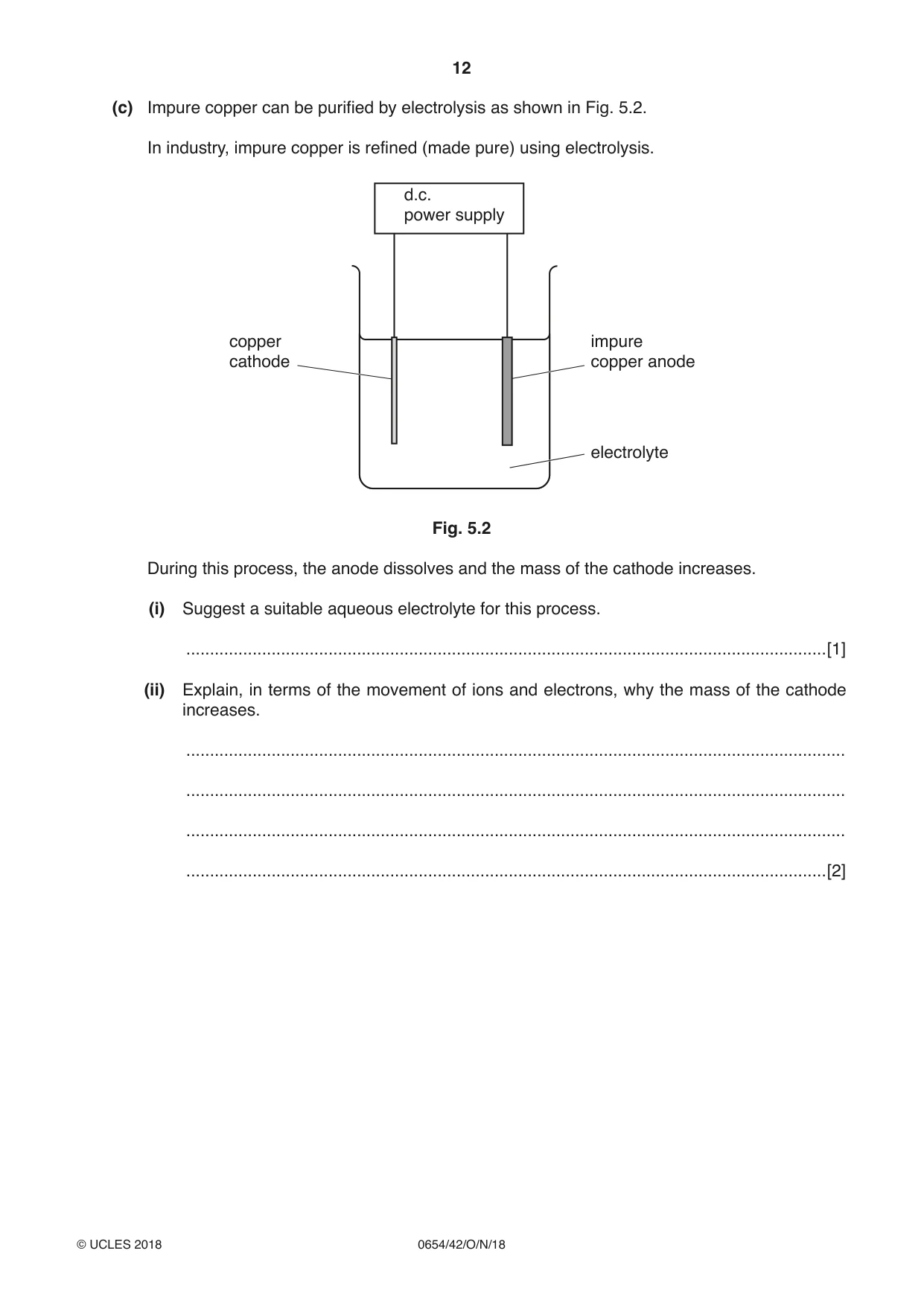
5 (a) A student reacts iron with dilute sulfuric acid as shown in Fig. 5.1. dilute sulfuric acid iron Fig. 5.1 During this reaction, aqueous iron(II) sulfate is formed. A gas is also formed. (i) State one property of iron(II) sulfate that is typical of a compound of a transition metal. .......................................................................................................................................[1] (ii) State the name of the gas produced when iron reacts with dilute sulfuric acid. .......................................................................................................................................[1] (iii) Describe what the student observes when she tests aqueous iron(II) sulfate with sodium hydroxide solution. .......................................................................................................................................[1] (b) The student then investigates another compound of a transition metal. The student mixes copper oxide, CuO, with powdered carbon. When the mixture is heated strongly, carbon reduces copper oxide to copper, and carbon is oxidised to carbon dioxide. (i) Suggest, in terms of reactivity, why carbon is able to reduce copper oxide. .......................................................................................................................................[1] (ii) Construct the balanced symbol equation for this reaction. .......................................................................................................................................[2] (c) Impure copper can be purified by electrolysis as shown in Fig. 5.2. In industry, impure copper is refined (made pure) using electrolysis. d.c. power supply copper impure cathode copper anode electrolyte Fig. 5.2 During this process, the anode dissolves and the mass of the cathode increases. (i) Suggest a suitable aqueous electrolyte for this process. .......................................................................................................................................[1] (ii) Explain, in terms of the movement of ions and electrons, why the mass of the cathode increases. ........................................................................................................................................... ........................................................................................................................................... ........................................................................................................................................... .......................................................................................................................................[2]
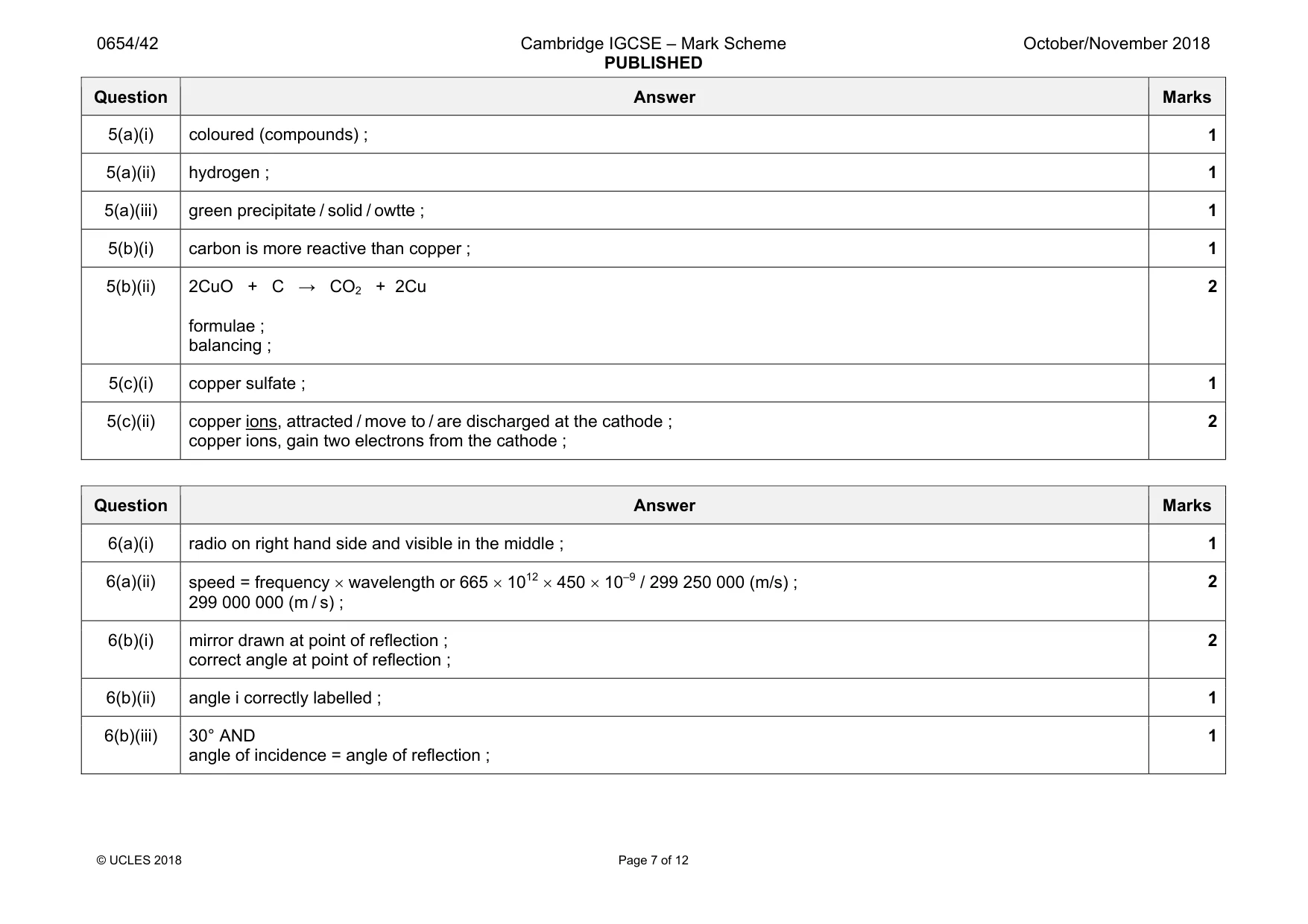
Mark scheme: 5(a)(i) coloured (compounds) ; 1 5(a)(ii) hydrogen ; 1 5(a)(iii) green precipitate / solid / owtte ; 1 5(b)(i) carbon is more reactive than copper ; 1 5(b)(ii) 2CuO + C → CO2 + 2Cu formulae ; balancing ; 2 5(c)(i) copper sulfate ; 1 5(c)(ii) copper ions, attracted / move to / are discharged at the cathode ; copper ions, gain two electrons from the cathode ; 2
Q6 · A fire engine communicates with the fire station using radio waves
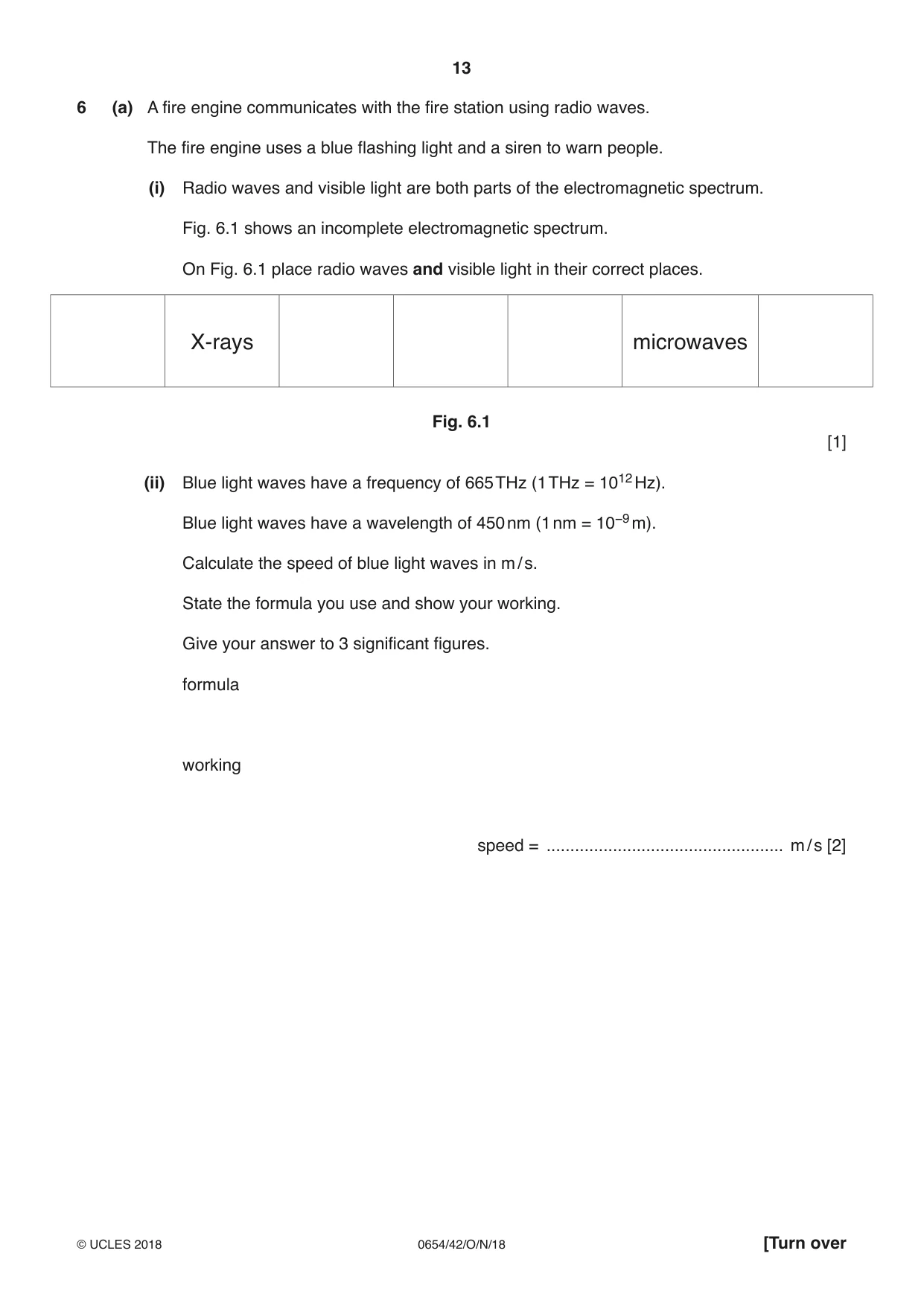
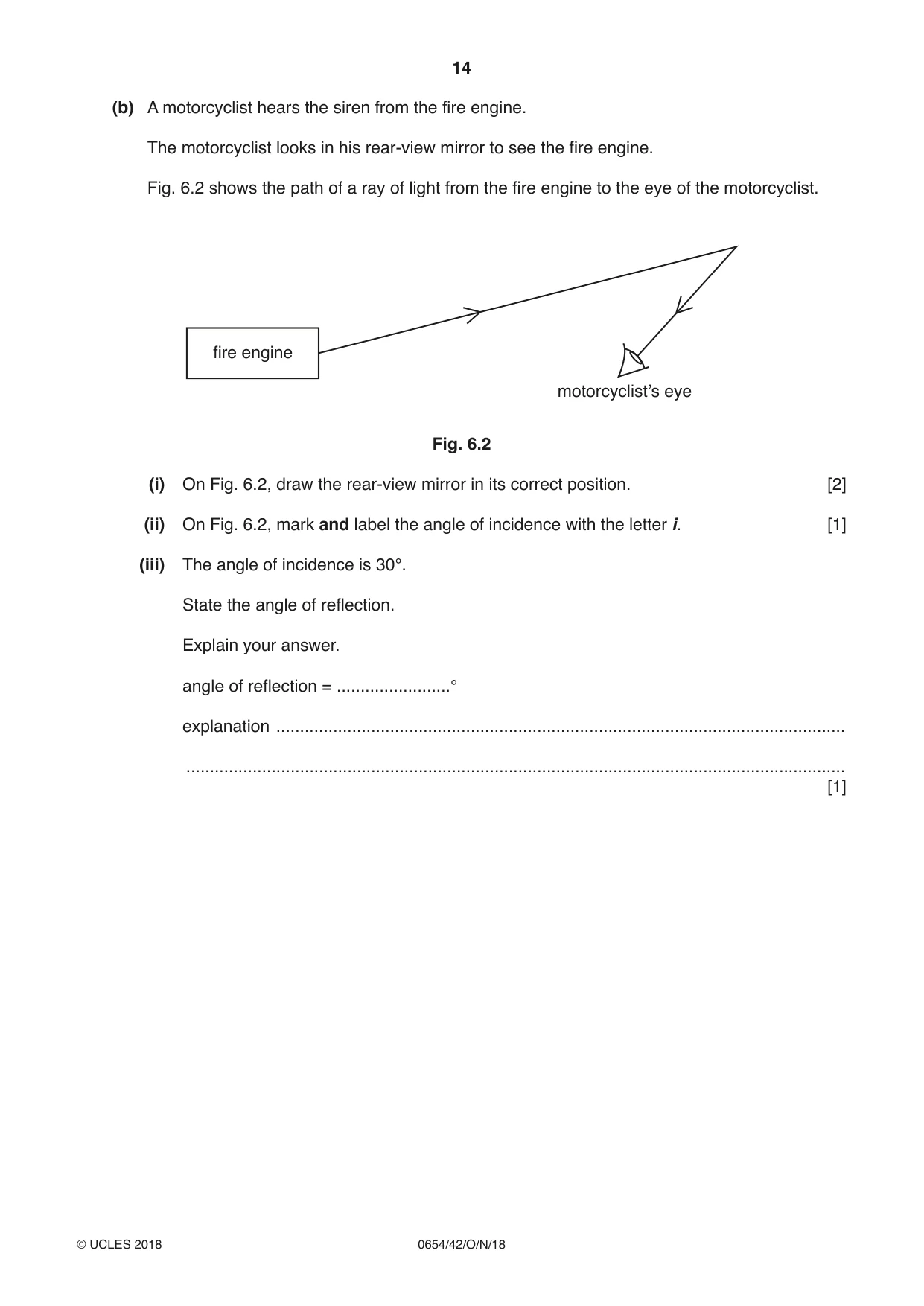
6 (a) A fire engine communicates with the fire station using radio waves. The fire engine uses a blue flashing light and a siren to warn people. (i) Radio waves and visible light are both parts of the electromagnetic spectrum. Fig. 6.1 shows an incomplete electromagnetic spectrum. On Fig. 6.1 place radio waves and visible light in their correct places. X-rays microwaves Fig. 6.1 [1] (ii) Blue light waves have a frequency of 665 THz (1 THz = 1012 Hz). Blue light waves have a wavelength of 450 nm (1 nm = 10−9 m). Calculate the speed of blue light waves in m / s. State the formula you use and show your working. Give your answer to 3 significant figures. formula working speed = .................................................. m / s [2] (b) A motorcyclist hears the siren from the fire engine. The motorcyclist looks in his rear-view mirror to see the fire engine. Fig. 6.2 shows the path of a ray of light from the fire engine to the eye of the motorcyclist. fire engine motorcyclist’s eye Fig. 6.2 (i) On Fig. 6.2, draw the rear-view mirror in its correct position. [2] (ii) On Fig. 6.2, mark and label the angle of incidence with the letter i. [1] (iii) The angle of incidence is 30°. State the angle of reflection. Explain your answer. angle of reflection = ........................° explanation ........................................................................................................................ ........................................................................................................................................... [1]
Mark scheme: 6(a)(i) radio on right hand side and visible in the middle ; 1 6(a)(ii) speed = frequency × wavelength or 665 × 1012 × 450 × 10–9 / 299 250 000 (m/s) ; 299 000 000 (m / s) ; 2 6(b)(i) mirror drawn at point of reflection ; correct angle at point of reflection ; 2 6(b)(ii) angle i correctly labelled ; 1 6(b)(iii) 30° AND angle of incidence = angle of reflection ; 1
Q7 · The blood glucose concentration of a person during a period of exercise and recovery
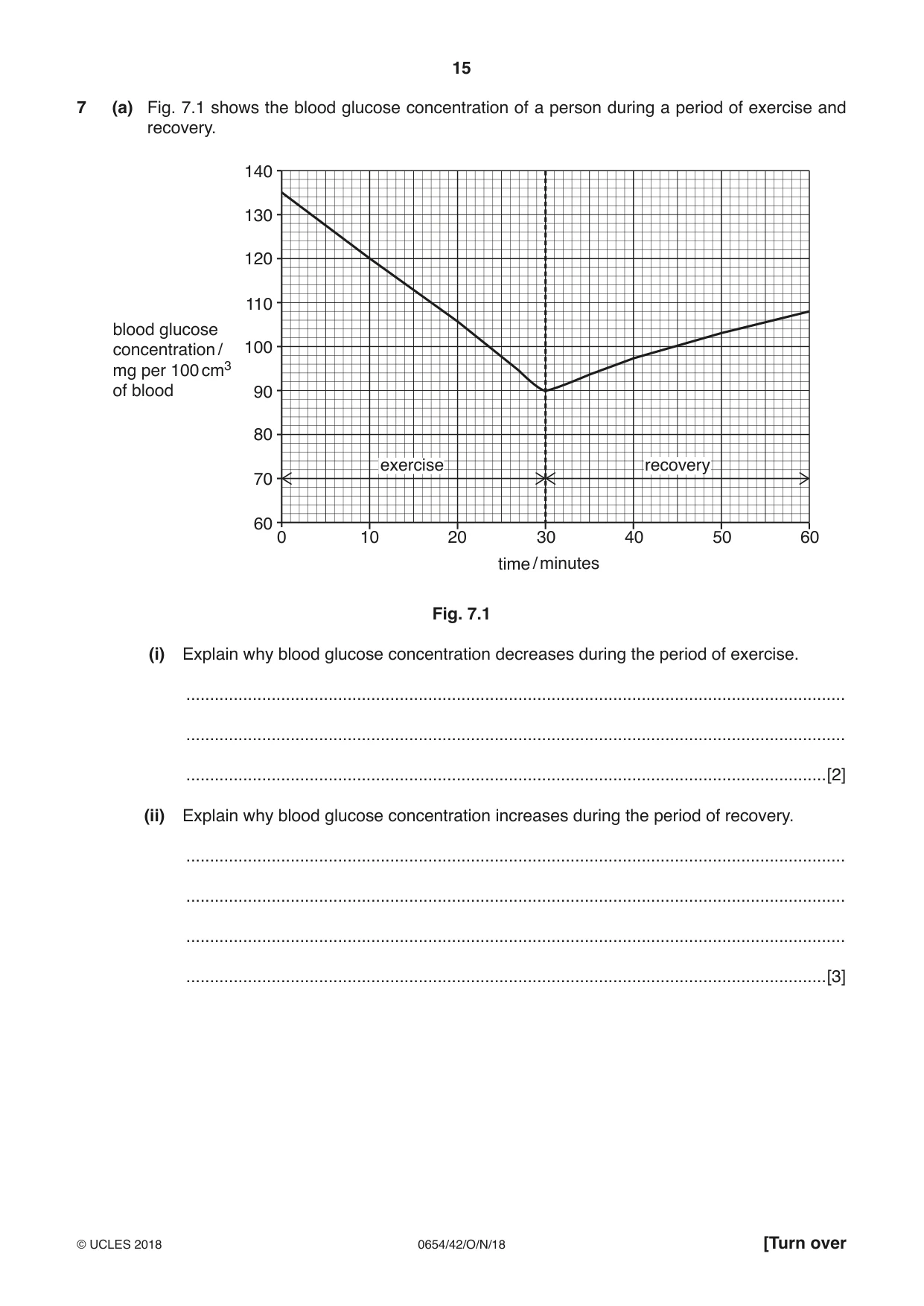
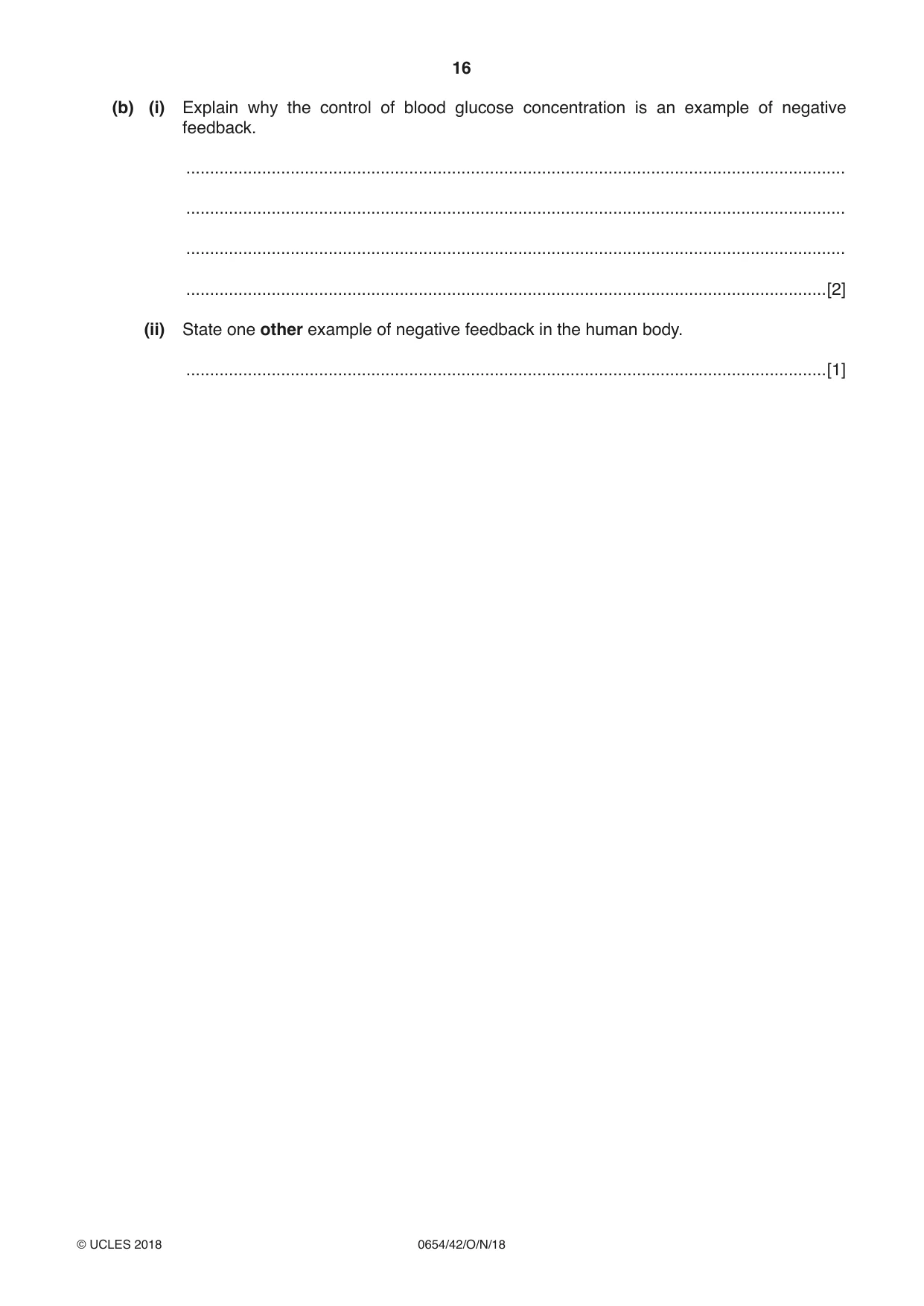
7 (a) Fig. 7.1 shows the blood glucose concentration of a person during a period of exercise and recovery. 140 130 120 110 blood glucose concentration / 100 mg per 100 cm3 of blood 90 80 exercise recovery 70 60 0 10 20 30 40 50 60 time / minutes Fig. 7.1 (i) Explain why blood glucose concentration decreases during the period of exercise. ........................................................................................................................................... ........................................................................................................................................... .......................................................................................................................................[2] (ii) Explain why blood glucose concentration increases during the period of recovery. ........................................................................................................................................... ........................................................................................................................................... ........................................................................................................................................... .......................................................................................................................................[3] (b) (i) Explain why the control of blood glucose concentration is an example of negative feedback. ........................................................................................................................................... ........................................................................................................................................... ........................................................................................................................................... .......................................................................................................................................[2] (ii) State one other example of negative feedback in the human body. .......................................................................................................................................[1] Please turn over for Question 8.
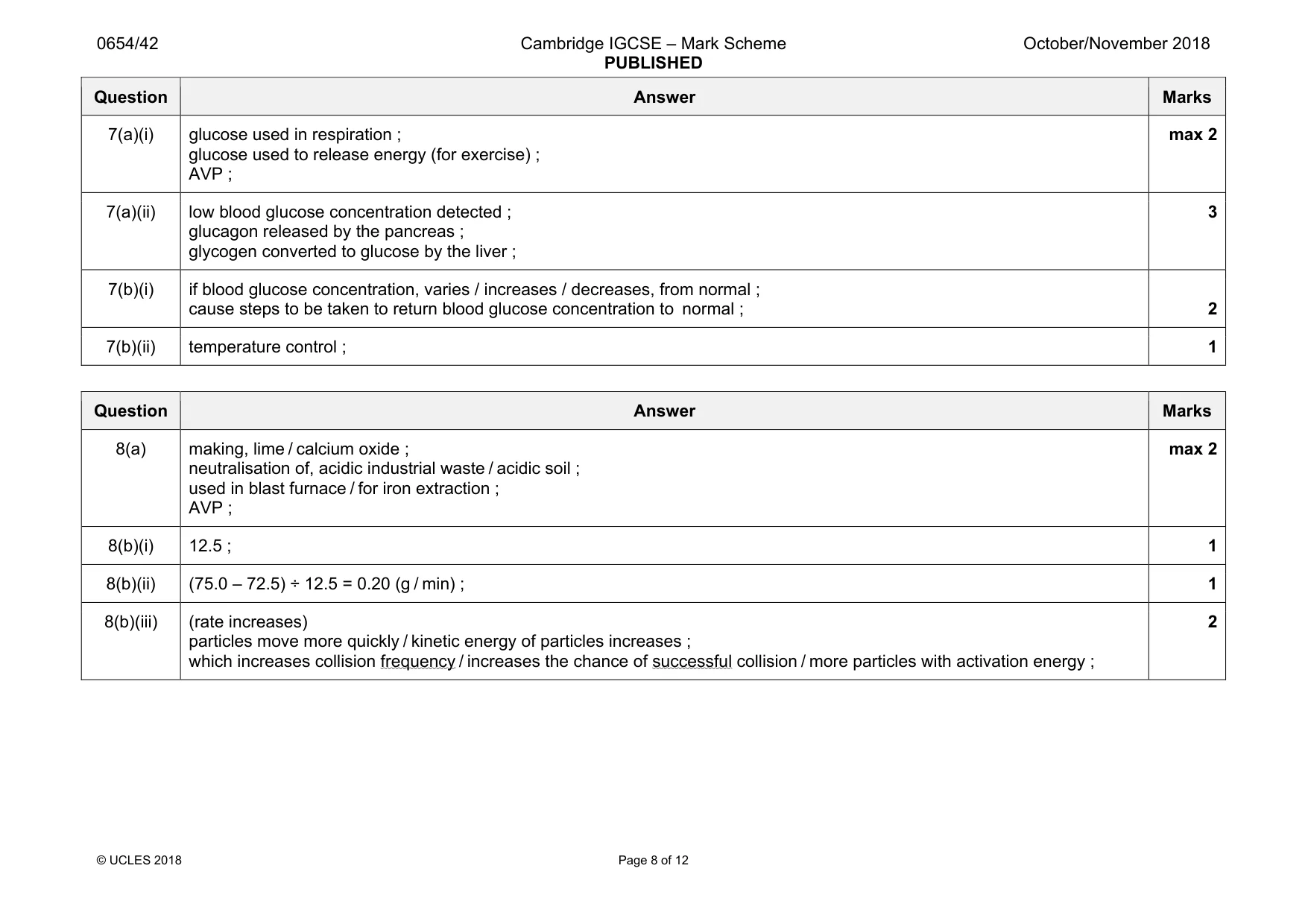
Mark scheme: 7(a)(i) glucose used in respiration ; glucose used to release energy (for exercise) ; AVP ; max 2 7(a)(ii) low blood glucose concentration detected ; glucagon released by the pancreas ; glycogen converted to glucose by the liver ; 3 7(b)(i) if blood glucose concentration, varies / increases / decreases, from normal ; cause steps to be taken to return blood glucose concentration to normal ; 2 7(b)(ii) temperature control ; 1
Q8 · Limestone is a useful material obtained from the Earth’s crust
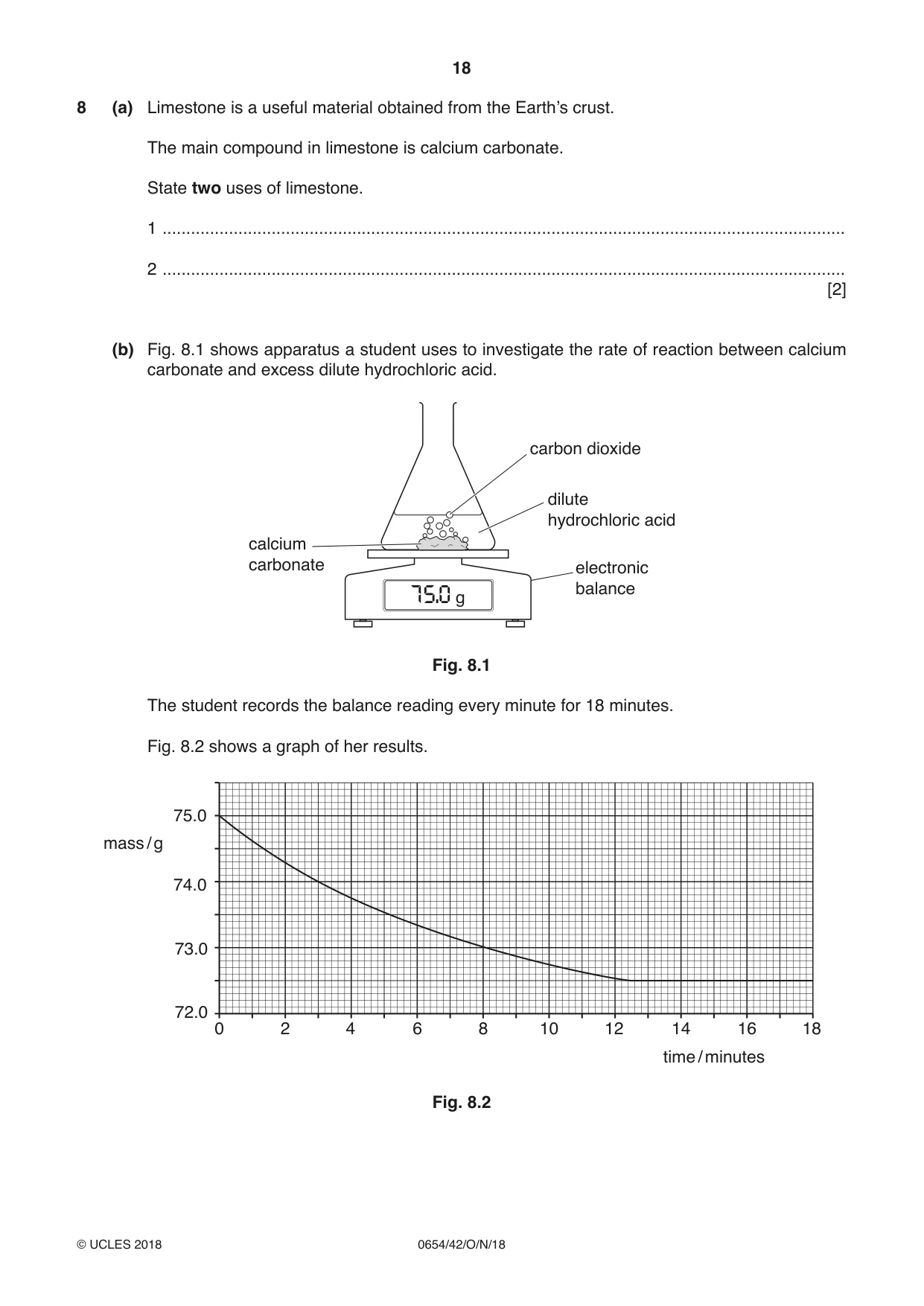
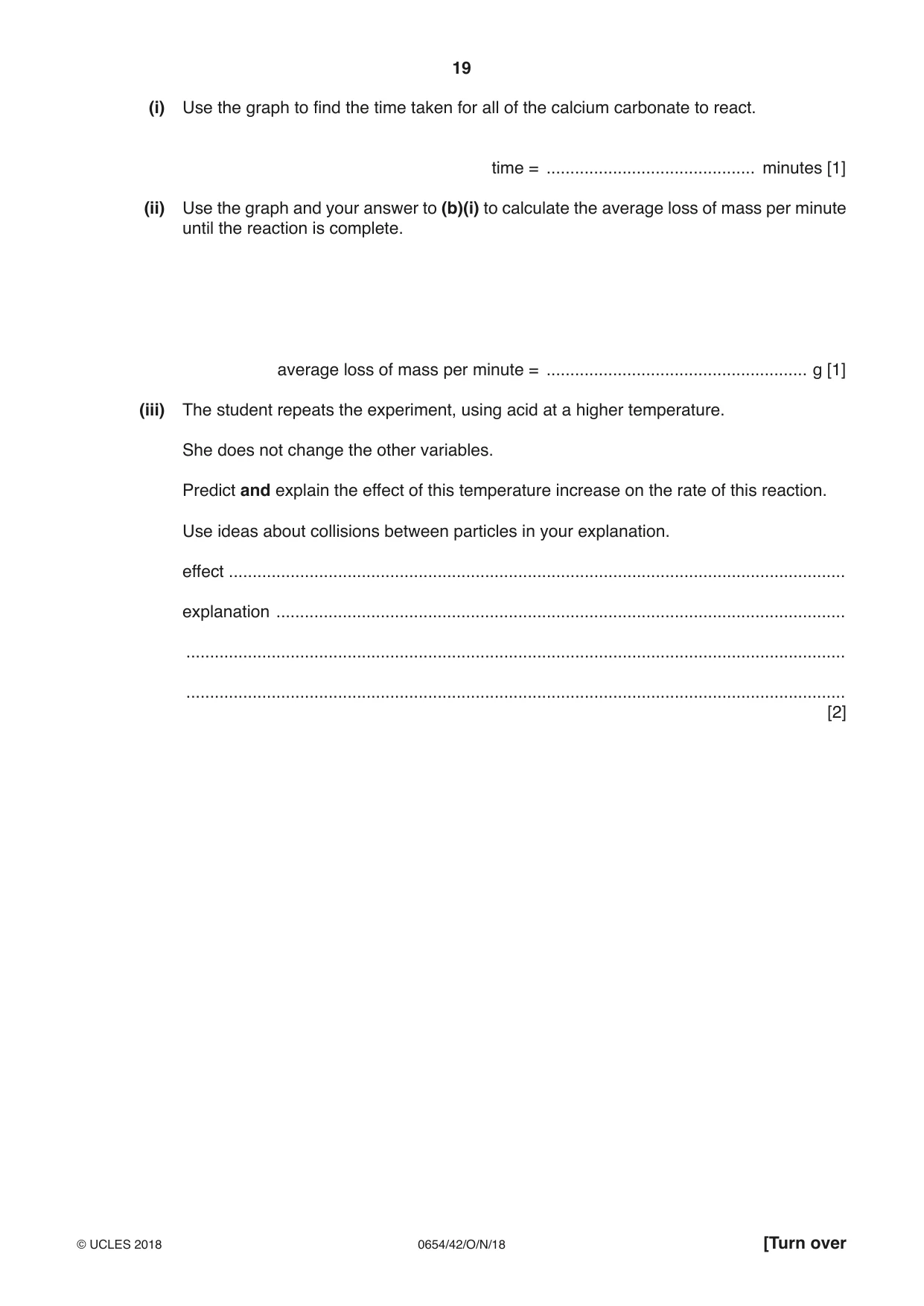
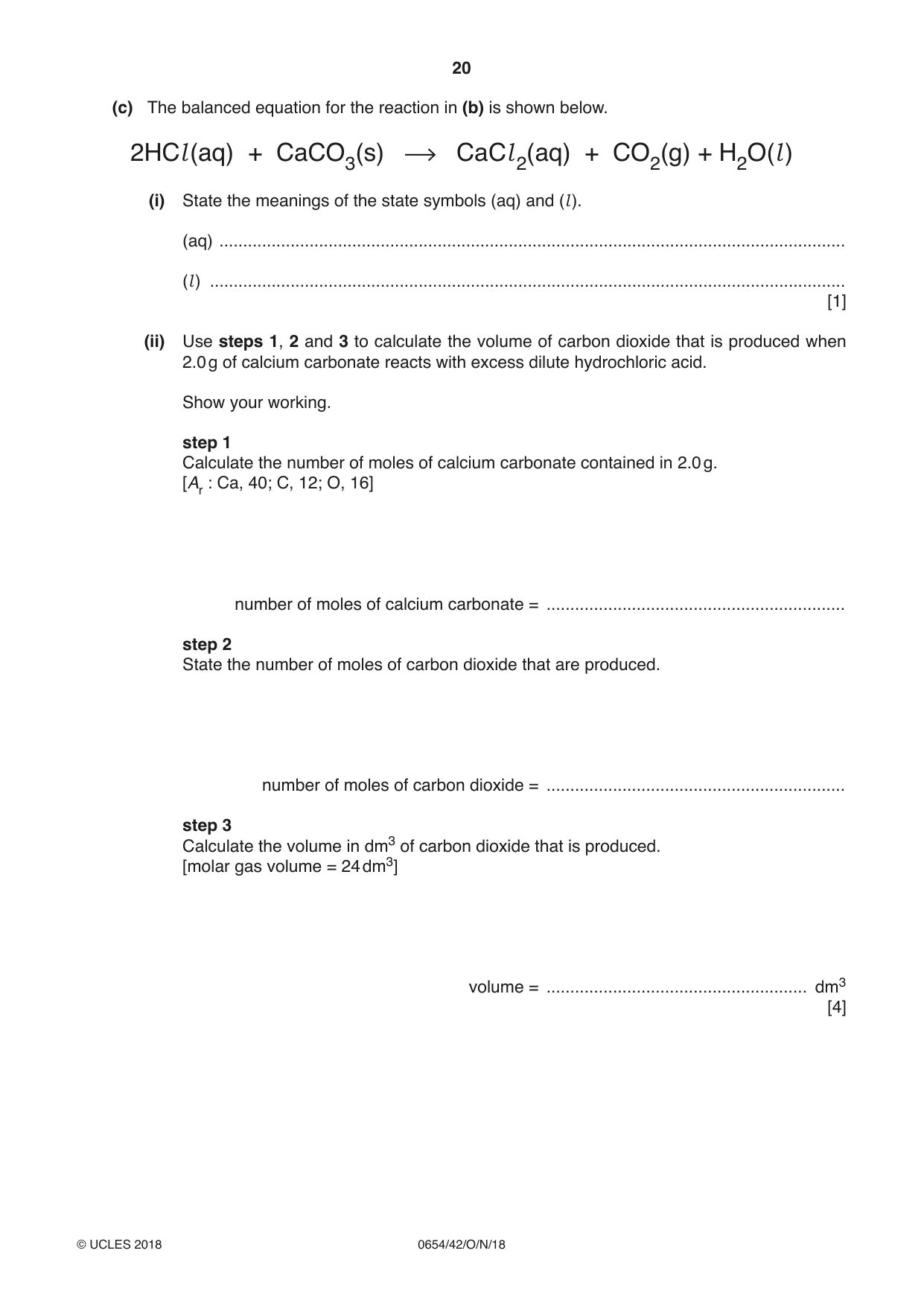
8 (a) Limestone is a useful material obtained from the Earth’s crust. The main compound in limestone is calcium carbonate. State two uses of limestone. 1 ................................................................................................................................................ 2 ................................................................................................................................................ [2] (b) Fig. 8.1 shows apparatus a student uses to investigate the rate of reaction between calcium carbonate and excess dilute hydrochloric acid. carbon dioxide dilute hydrochloric acid calcium carbonate electronic 75.0 g balance Fig. 8.1 The student records the balance reading every minute for 18 minutes. Fig. 8.2 shows a graph of her results. 75.0 mass / g 74.0 73.0 72.0 0 2 4 6 8 10 12 14 16 18 time / minutes Fig. 8.2 (i) Use the graph to find the time taken for all of the calcium carbonate to react. time = ............................................ minutes [1] (ii) Use the graph and your answer to (b)(i) to calculate the average loss of mass per minute until the reaction is complete. average loss of mass per minute = ....................................................... g [1] (iii) The student repeats the experiment, using acid at a higher temperature. She does not change the other variables. Predict and explain the effect of this temperature increase on the rate of this reaction. Use ideas about collisions between particles in your explanation. effect .................................................................................................................................. explanation ........................................................................................................................ ........................................................................................................................................... ........................................................................................................................................... [2] (c) The balanced equation for the reaction in (b) is shown below. 2HCl (aq) + CaCO3(s) CaCl 2(aq) + CO2(g) + H2O(l ) (i) State the meanings of the state symbols (aq) and (l ). (aq) .................................................................................................................................... (l ) ...................................................................................................................................... [1] (ii) Use steps 1, 2 and 3 to calculate the volume of carbon dioxide that is produced when 2.0 g of calcium carbonate reacts with excess dilute hydrochloric acid. Show your working. step 1 Calculate the number of moles of calcium carbonate contained in 2.0 g. [Ar : Ca, 40; C, 12; O, 16] number of moles of calcium carbonate = ............................................................... step 2 State the number of moles of carbon dioxide that are produced. number of moles of carbon dioxide = ............................................................... step 3 Calculate the volume in dm3 of carbon dioxide that is produced. [molar gas volume = 24 dm3] volume = ....................................................... dm3 [4] Please turn over for Question 9.
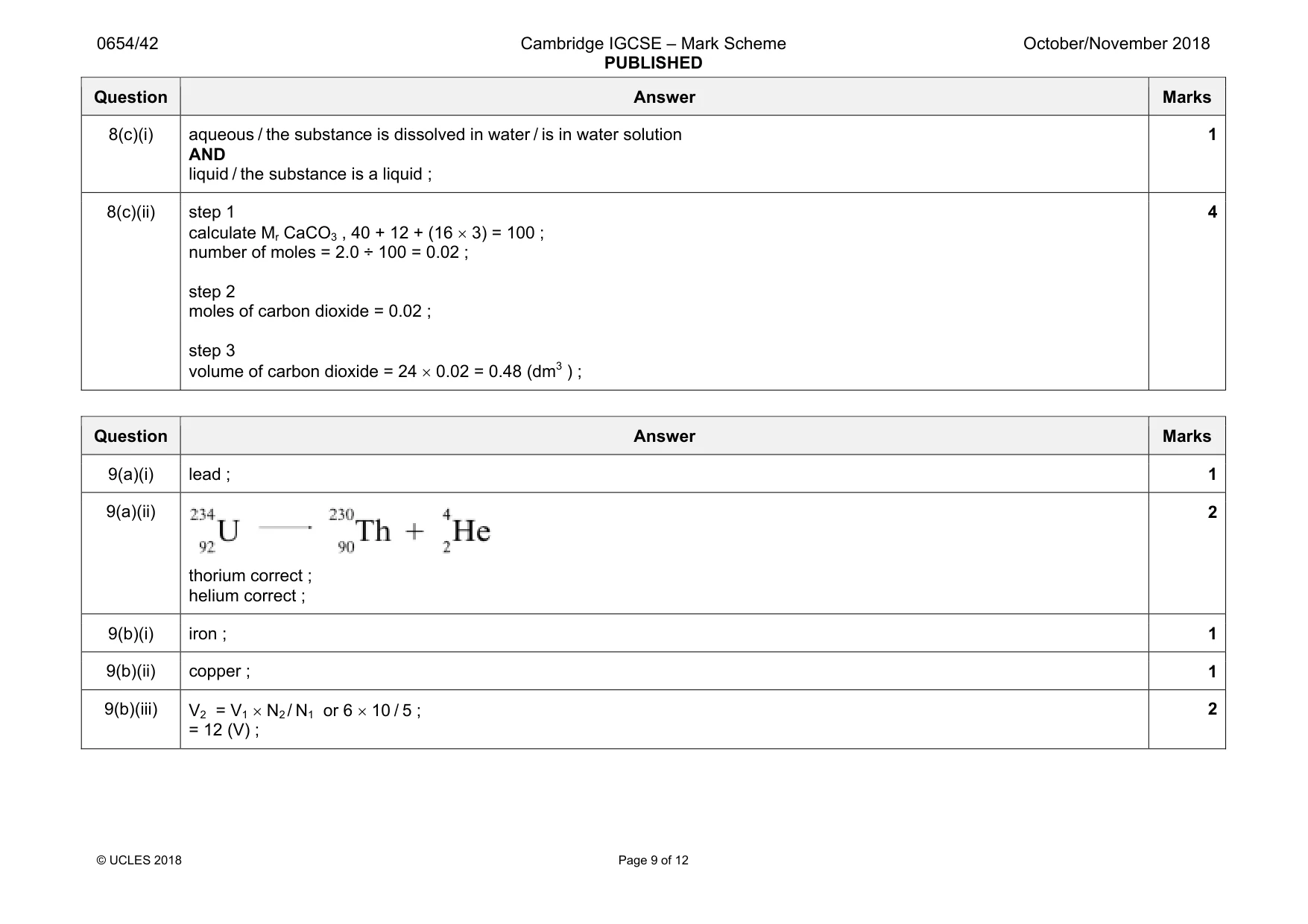
Mark scheme: 8(a) making, lime / calcium oxide ; neutralisation of, acidic industrial waste / acidic soil ; used in blast furnace / for iron extraction ; AVP ; max 2 8(b)(i) 12.5 ; 1 8(b)(ii) (75.0 – 72.5) ÷ 12.5 = 0.20 (g / min) ; 1 8(b)(iii) (rate increases) particles move more quickly / kinetic energy of particles increases ; which increases collision frequency / increases the chance of successful collision / more particles with activation energy ; 2 Question Answer Marks 8(c)(i) aqueous / the substance is dissolved in water / is in water solution AND liquid / the substance is a liquid ; 1 8(c)(ii) step 1 calculate Mr CaCO3 , 40 + 12 + (16 × 3) = 100 ; number of moles = 2.0 ÷ 100 = 0.02 ; step 2 moles of carbon dioxide = 0.02 ; step 3 volume of carbon dioxide = 24 × 0.02 = 0.48 (dm3 ) ; 4
Q9 · A list of metals is shown
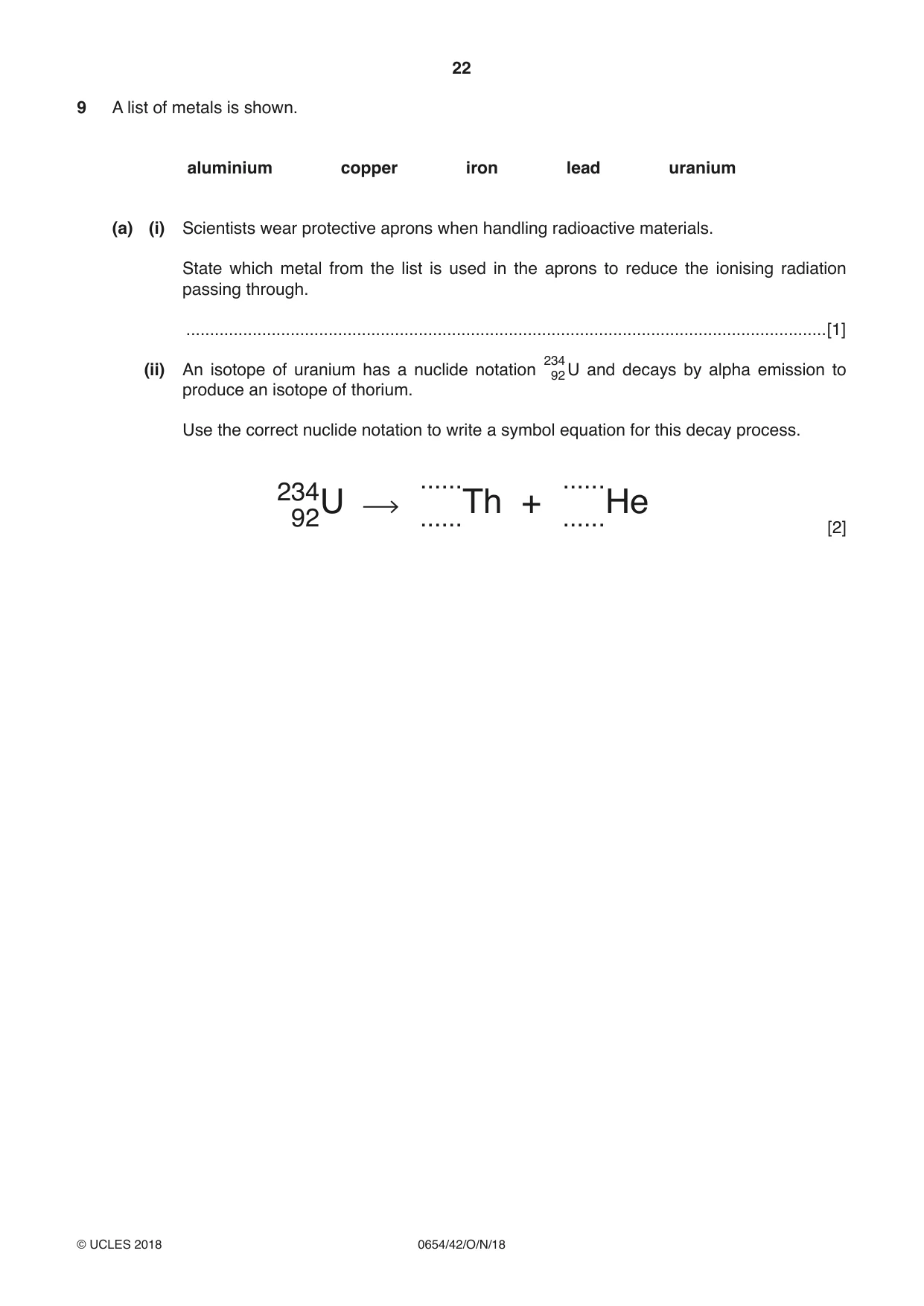
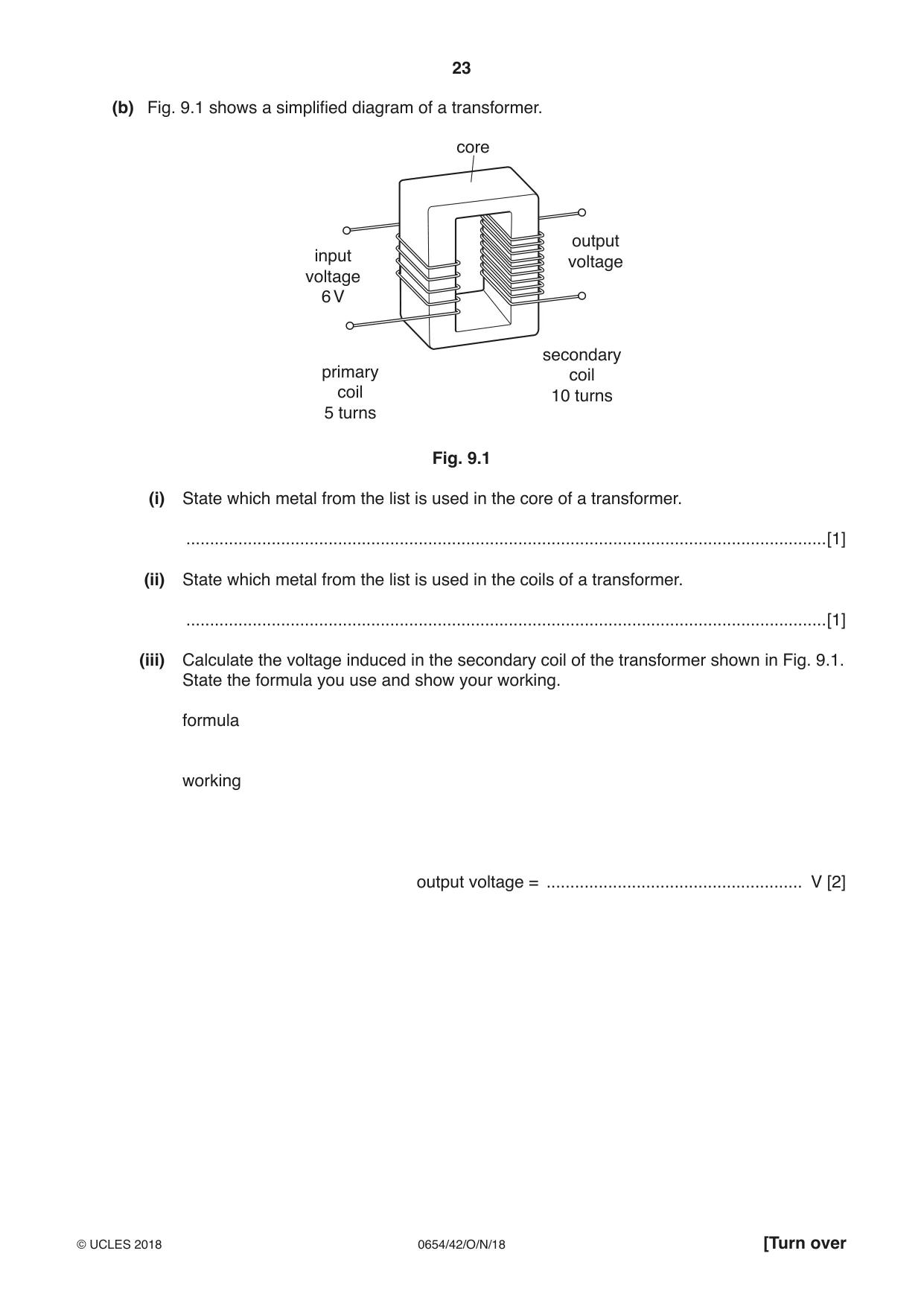
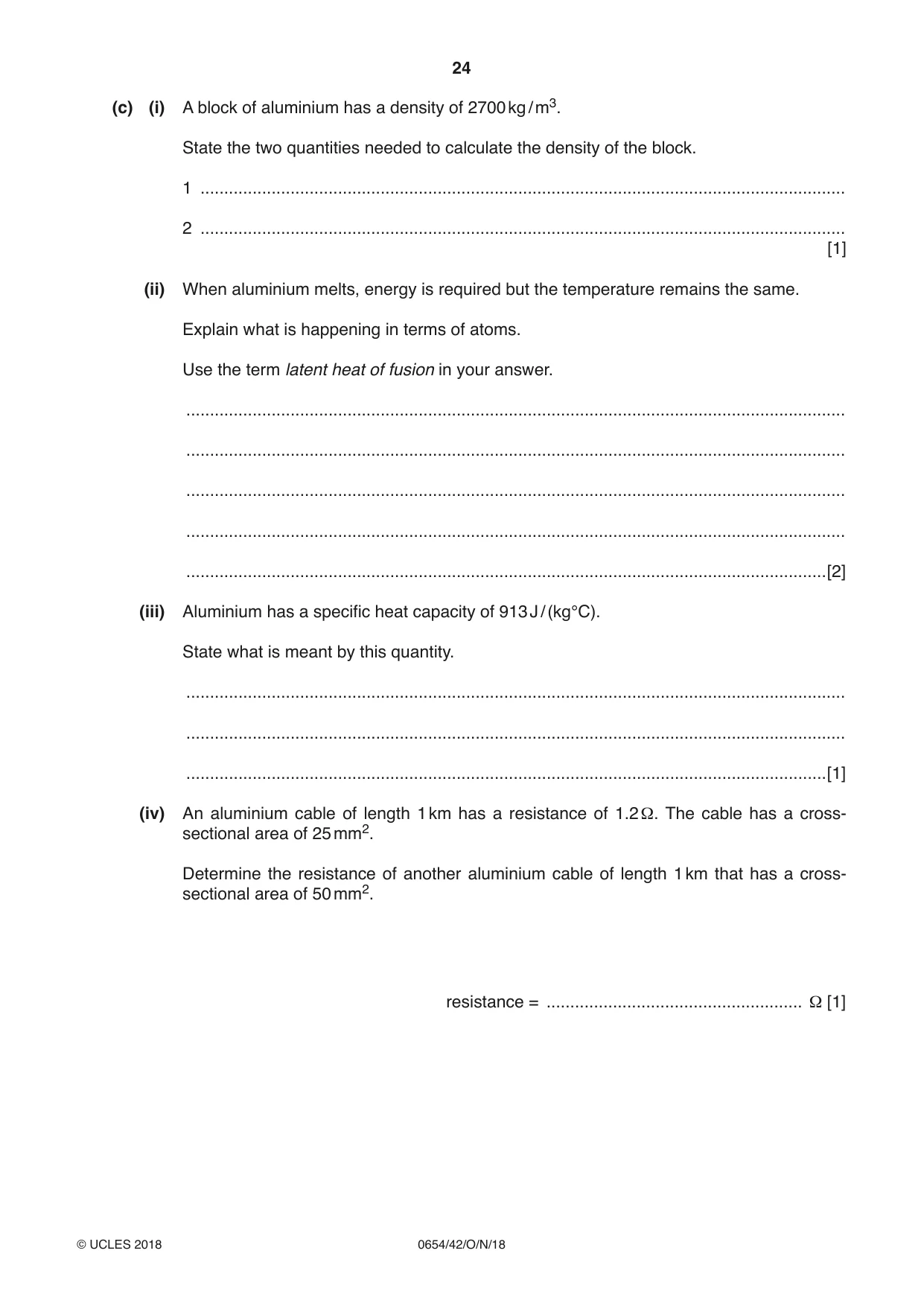
9 A list of metals is shown. aluminium copper iron lead uranium (a) (i) Scientists wear protective aprons when handling radioactive materials. State which metal from the list is used in the aprons to reduce the ionising radiation passing through. .......................................................................................................................................[1] 234 (ii) An isotope of uranium has a nuclide notation 92 U and decays by alpha emission to produce an isotope of thorium. Use the correct nuclide notation to write a symbol equation for this decay process. ...... ...... 23492U ......Th + ......He [2] (b) Fig. 9.1 shows a simplified diagram of a transformer. core output input voltage voltage 6 V secondary primary coil coil 10 turns 5 turns Fig. 9.1 (i) State which metal from the list is used in the core of a transformer. .......................................................................................................................................[1] (ii) State which metal from the list is used in the coils of a transformer. .......................................................................................................................................[1] (iii) Calculate the voltage induced in the secondary coil of the transformer shown in Fig. 9.1. State the formula you use and show your working. formula working output voltage = ...................................................... V [2] (c) (i) A block of aluminium has a density of 2700 kg / m3. State the two quantities needed to calculate the density of the block. 1 ........................................................................................................................................ 2 ........................................................................................................................................ [1] (ii) When aluminium melts, energy is required but the temperature remains the same. Explain what is happening in terms of atoms. Use the term latent heat of fusion in your answer. ........................................................................................................................................... ........................................................................................................................................... ........................................................................................................................................... ........................................................................................................................................... .......................................................................................................................................[2] (iii) Aluminium has a specific heat capacity of 913 J / (kg°C). State what is meant by this quantity. ........................................................................................................................................... ........................................................................................................................................... .......................................................................................................................................[1] (iv) An aluminium cable of length 1 km has a resistance of 1.2 Ω. The cable has a cross- sectional area of 25 mm2. Determine the resistance of another aluminium cable of length 1 km that has a cross- sectional area of 50 mm2. resistance = ...................................................... Ω [1]
Mark scheme: 9(a)(i) lead ; 1 9(a)(ii) thorium correct ; helium correct ; 2 9(b)(i) iron ; 1 9(b)(ii) copper ; 1 9(b)(iii) V2 = V1 × N2 / N1 or 6 × 10 / 5 ; = 12 (V) ; 2 Question Answer Marks 9(c)(i) mass and volume ; 1 9(c)(ii) latent heat of fusion is the energy needed ; to overcome forces of attraction between particles ; 2 9(c)(iii) 913 J are / amount of energy, needed to raise the temperature of 1 kg by 1 °C ; 1 9(c)(iv) 0.6 (Ω) ; 1
Q10 · A diagram of an insect-pollinated flower
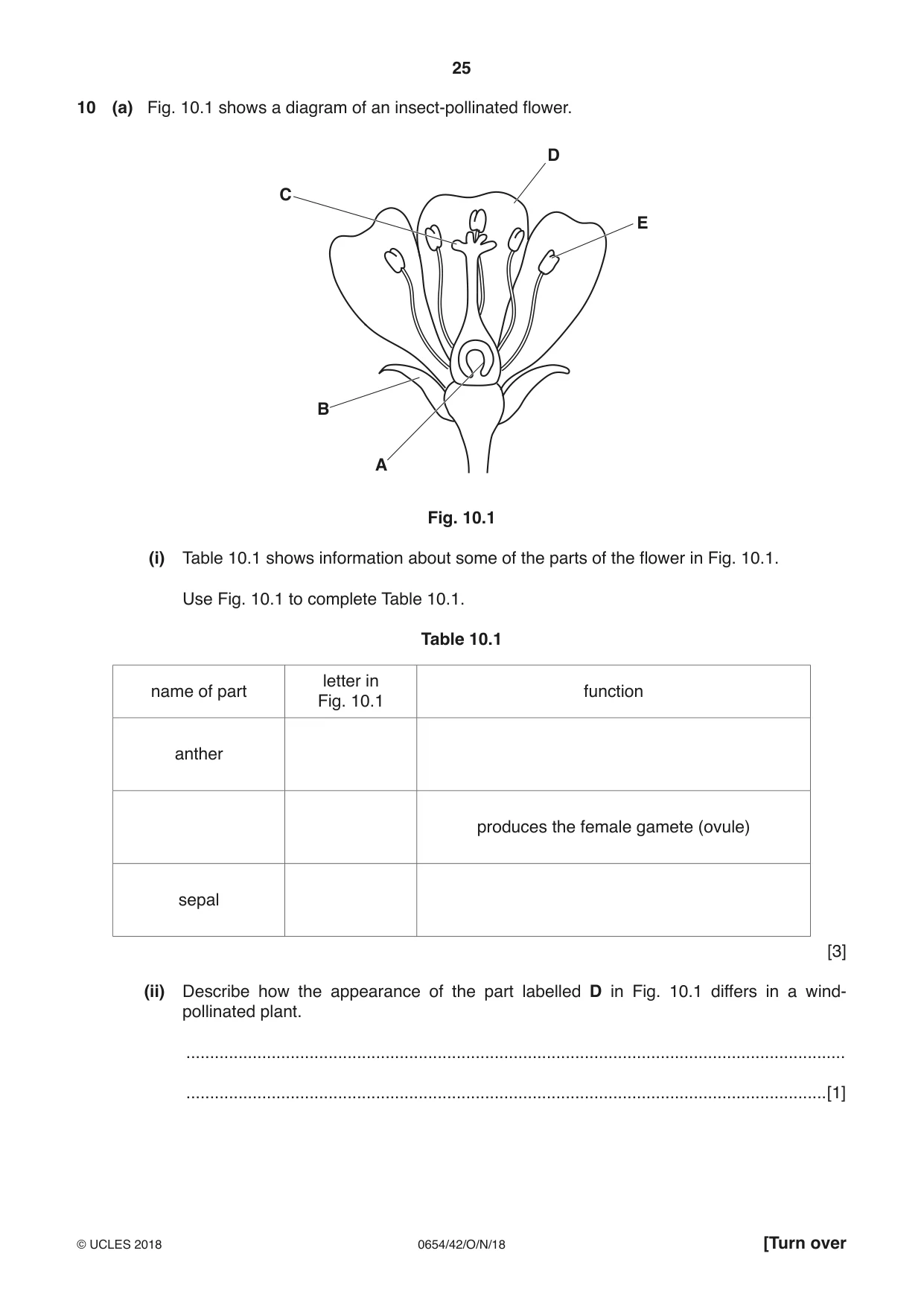
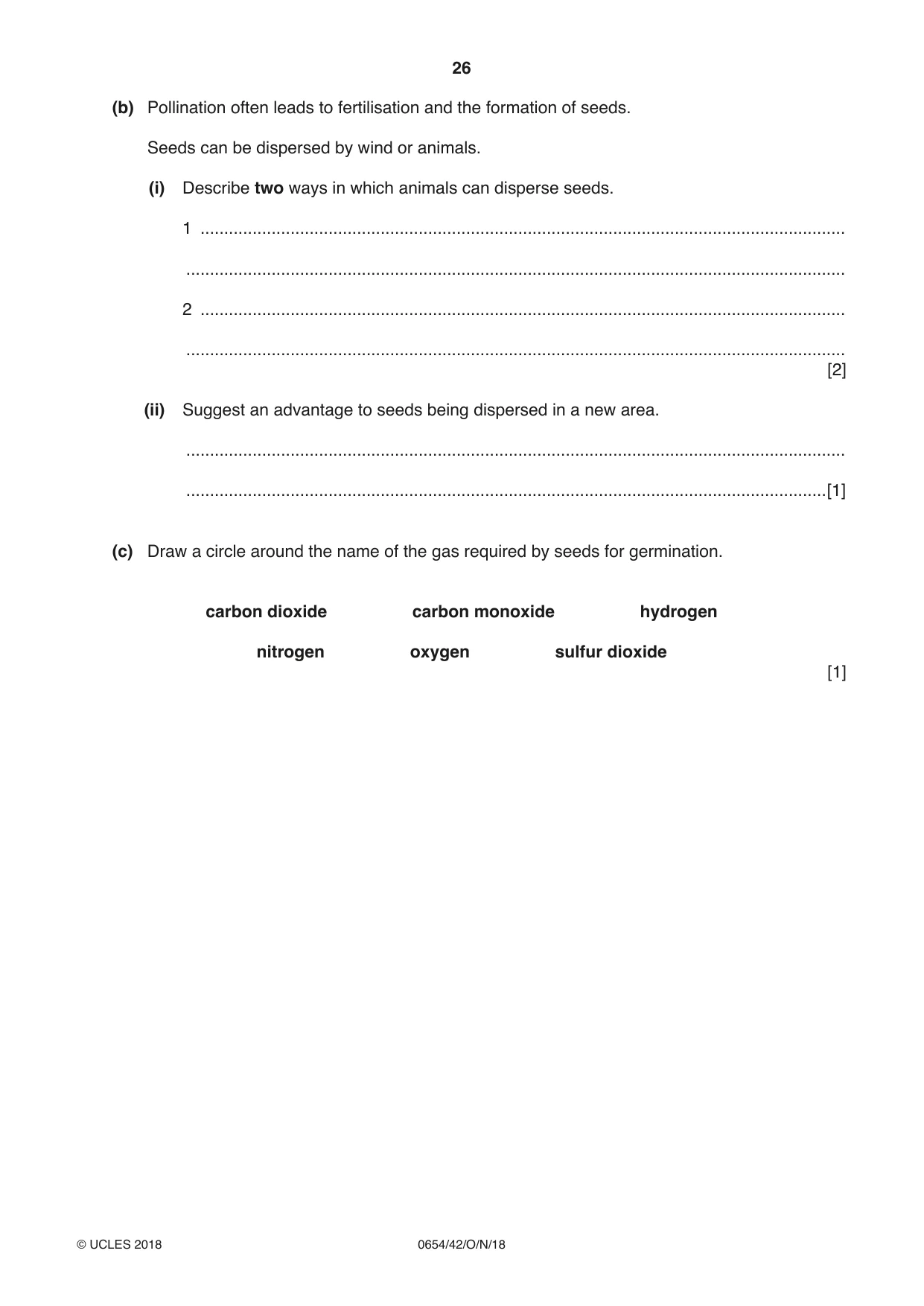
10 (a) Fig. 10.1 shows a diagram of an insect-pollinated flower. D C E B A Fig. 10.1 (i) Table 10.1 shows information about some of the parts of the flower in Fig. 10.1. Use Fig. 10.1 to complete Table 10.1. Table 10.1 letter in name of part function Fig. 10.1 anther produces the female gamete (ovule) sepal [3] (ii) Describe how the appearance of the part labelled D in Fig. 10.1 differs in a wind- pollinated plant. ........................................................................................................................................... .......................................................................................................................................[1] (b) Pollination often leads to fertilisation and the formation of seeds. Seeds can be dispersed by wind or animals. (i) Describe two ways in which animals can disperse seeds. 1 ........................................................................................................................................ ........................................................................................................................................... 2 ........................................................................................................................................ ........................................................................................................................................... [2] (ii) Suggest an advantage to seeds being dispersed in a new area. ........................................................................................................................................... .......................................................................................................................................[1] (c) Draw a circle around the name of the gas required by seeds for germination. carbon dioxide carbon monoxide hydrogen nitrogen oxygen sulfur dioxide [1]
Mark scheme: 10(a)(i) name of part letter in Fig 10.1 function anther E produces pollen / male gamete ovary A produces the female gamete (ovule) sepal B protect flower in bud / AW 1 row correct ; 2 rows correct ; 3 rows correct ; 3 10(a)(ii) smaller / absent / dull-coloured ; 1 10(b)(i) attached to, fur / hair ; eaten by animals and egested in faeces / droppings ; AVP ; max 2 10(b)(ii) less competition / more space / more nutrients / more water / more sunlight ; 1 10(c) oxygen circled ; 1
Q11 · Polymers form from monomer units
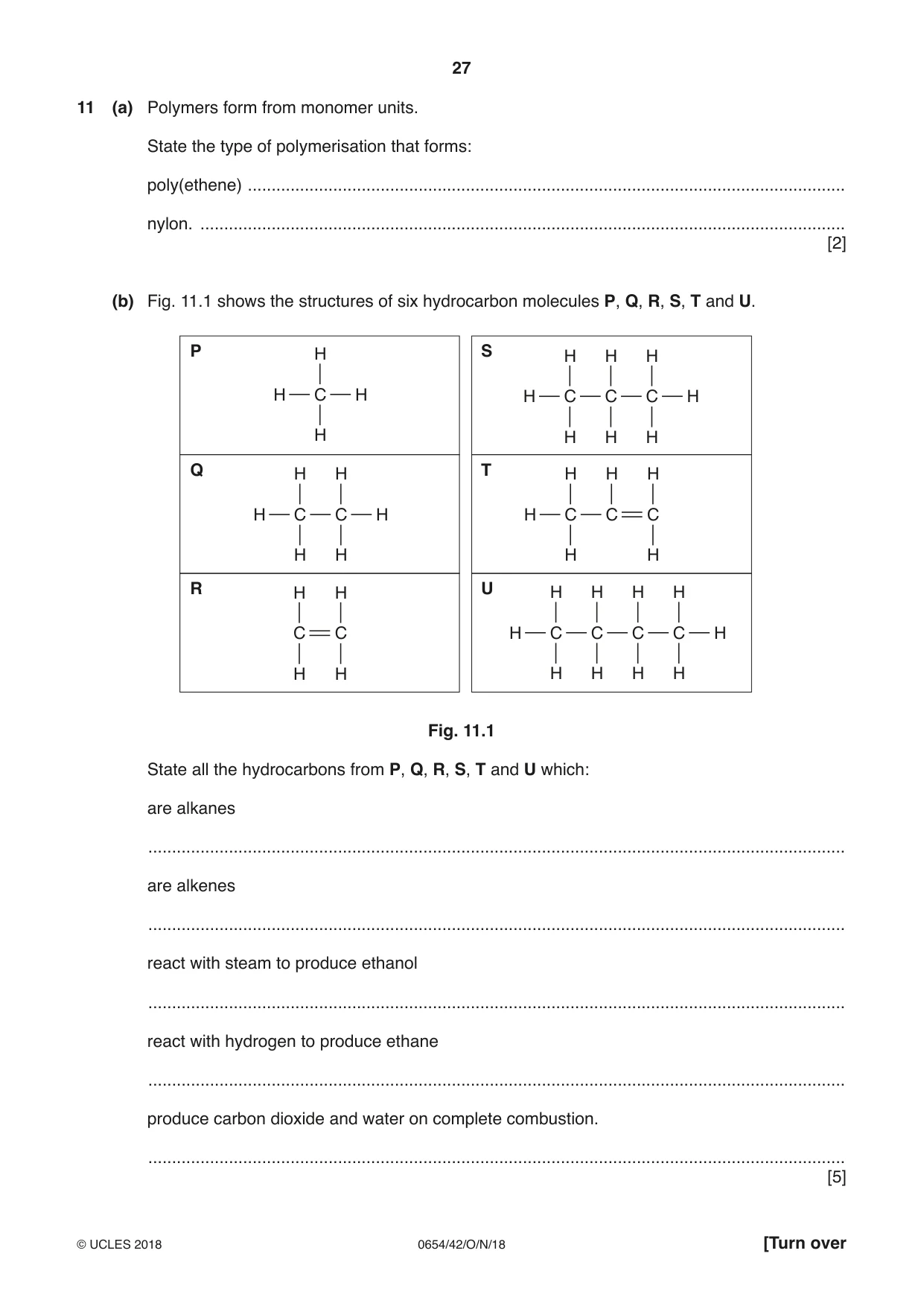
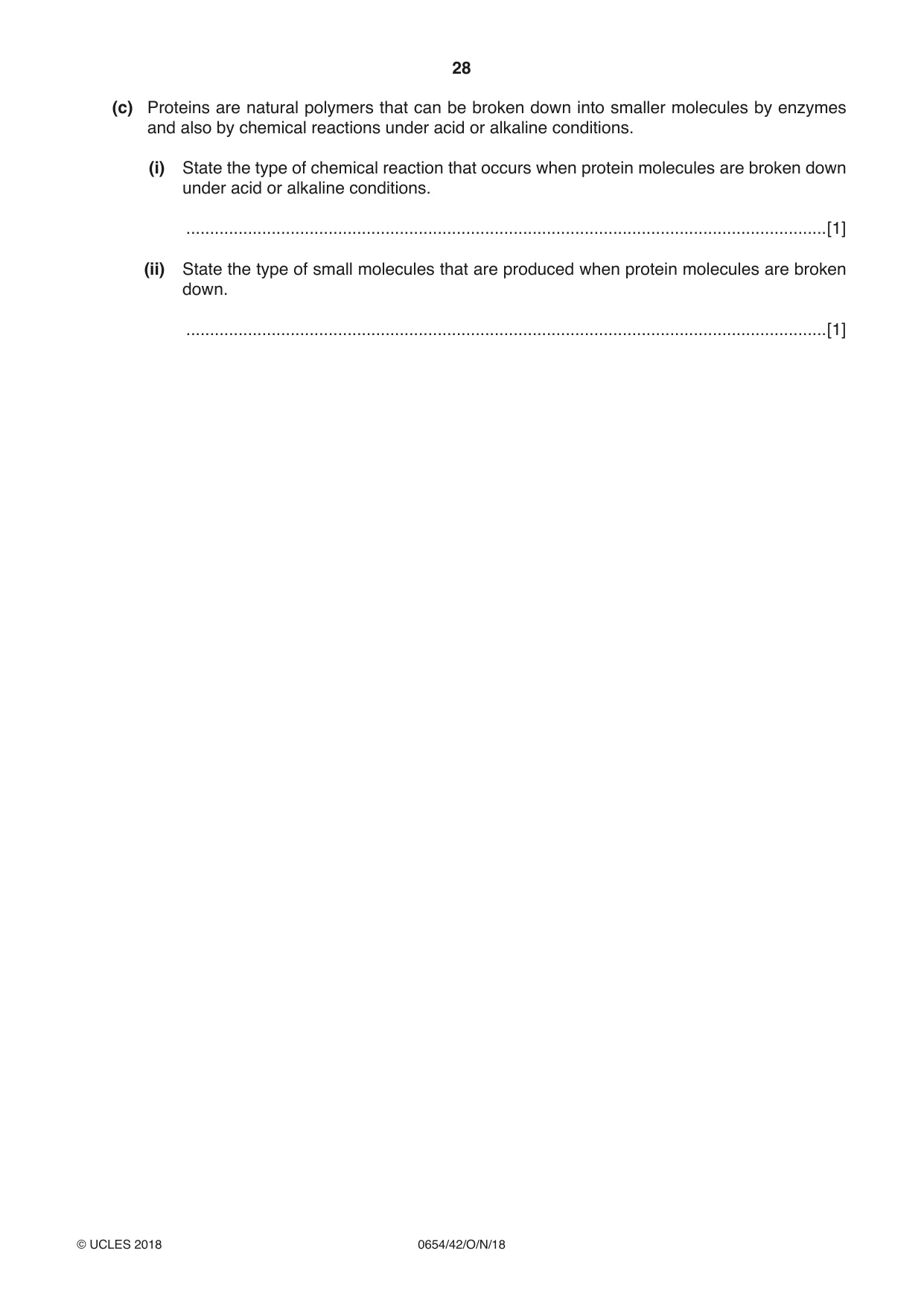
11 (a) Polymers form from monomer units. State the type of polymerisation that forms: poly(ethene) .............................................................................................................................. nylon. ........................................................................................................................................ [2] (b) Fig. 11.1 shows the structures of six hydrocarbon molecules P, Q, R, S, T and U. P H S H H H H C H H C C C H H H H H Q H H T H H H H C C H H C C C H H H H R H H U H H H H C C H C C C C H H H H H H H Fig. 11.1 State all the hydrocarbons from P, Q, R, S, T and U which: are alkanes ................................................................................................................................................... are alkenes ................................................................................................................................................... react with steam to produce ethanol ................................................................................................................................................... react with hydrogen to produce ethane ................................................................................................................................................... produce carbon dioxide and water on complete combustion. ................................................................................................................................................... [5] (c) Proteins are natural polymers that can be broken down into smaller molecules by enzymes and also by chemical reactions under acid or alkaline conditions. (i) State the type of chemical reaction that occurs when protein molecules are broken down under acid or alkaline conditions. .......................................................................................................................................[1] (ii) State the type of small molecules that are produced when protein molecules are broken down. .......................................................................................................................................[1]
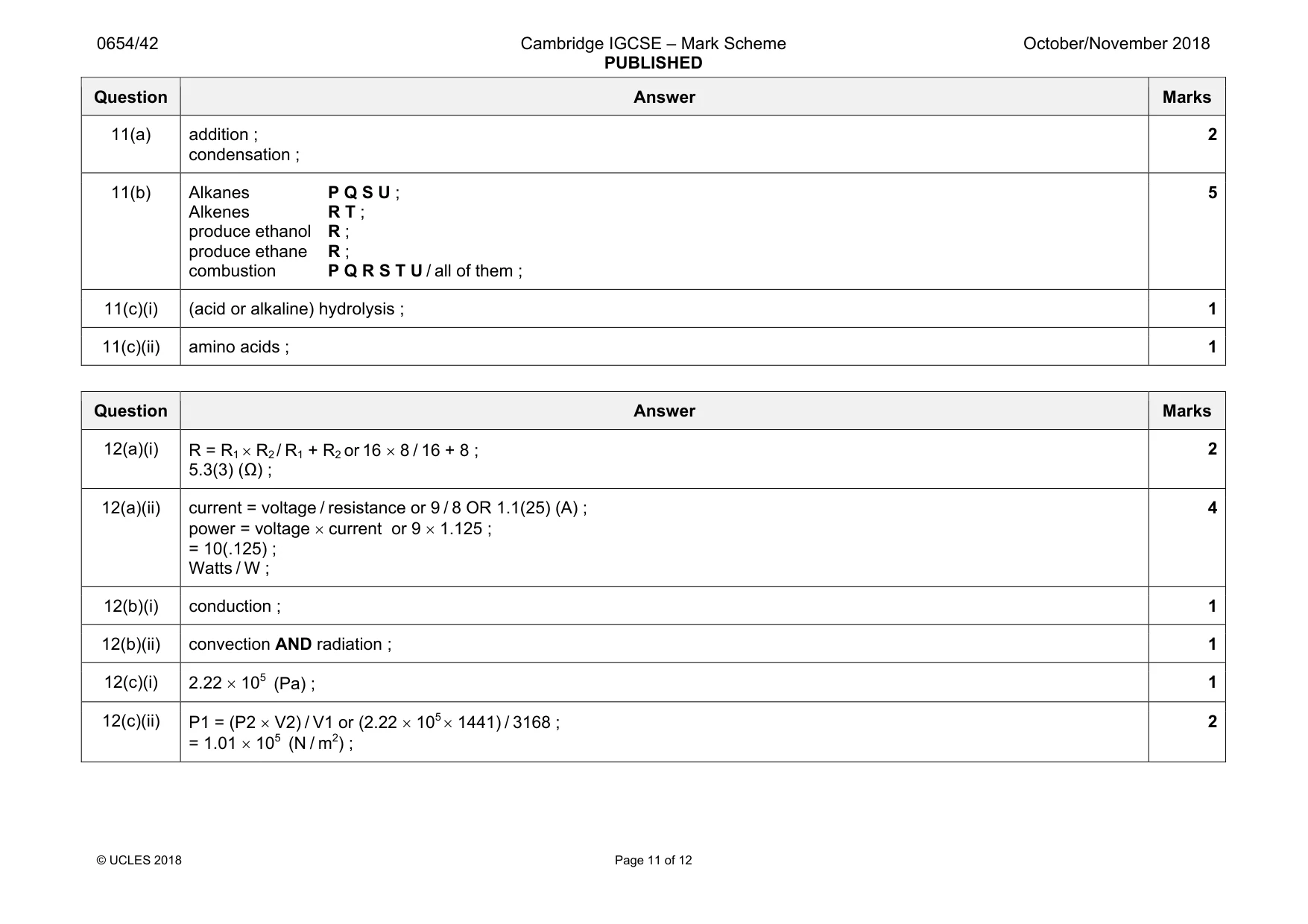
Mark scheme: 11(a) addition ; condensation ; 2 11(b) Alkanes P Q S U ; Alkenes R T ; produce ethanol R ; produce ethane R ; combustion P Q R S T U / all of them ; 5 11(c)(i) (acid or alkaline) hydrolysis ; 1 11(c)(ii) amino acids ; 1
Q12 · A bicycle with a front lamp A and a rear lamp B powered by the same battery
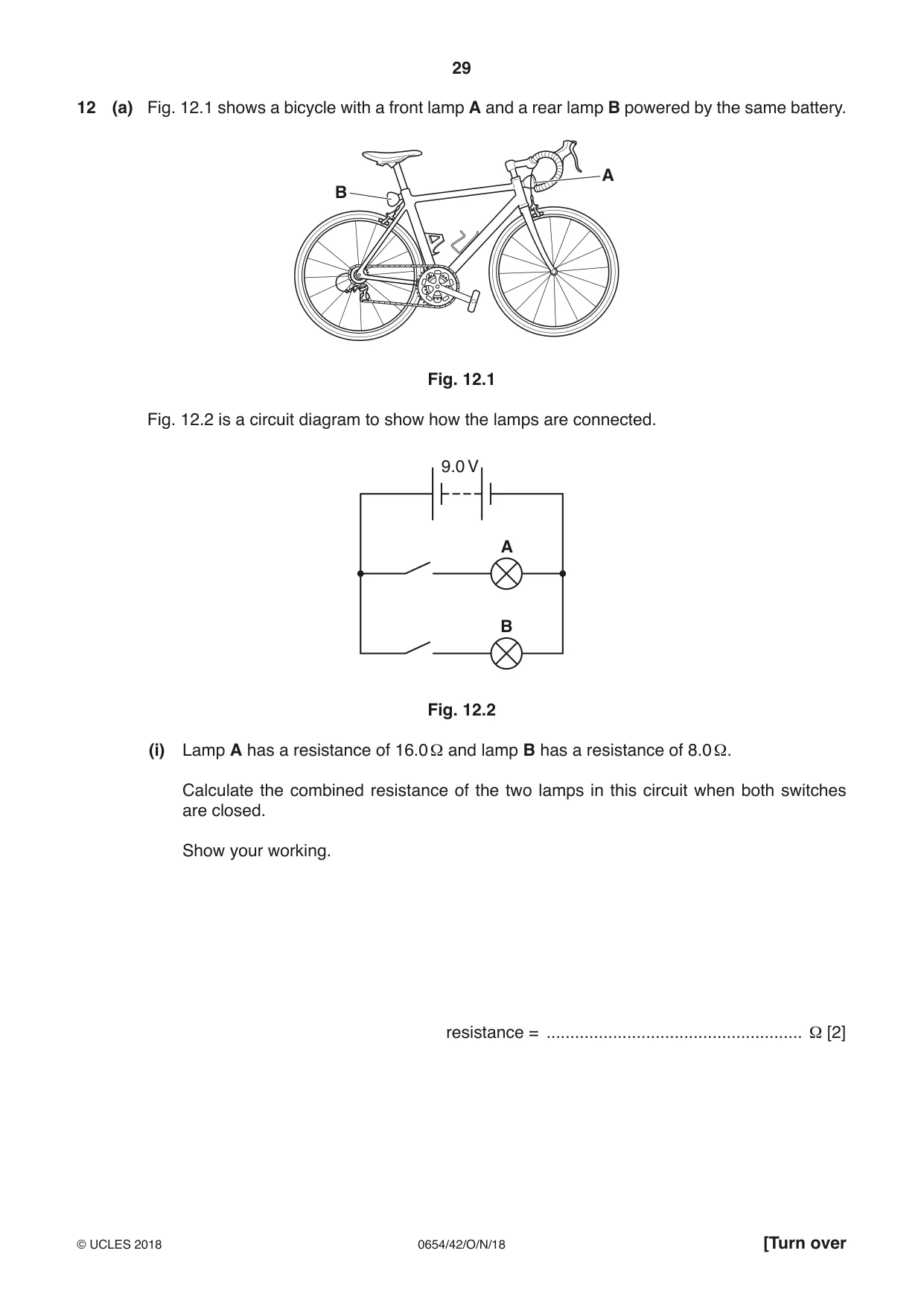
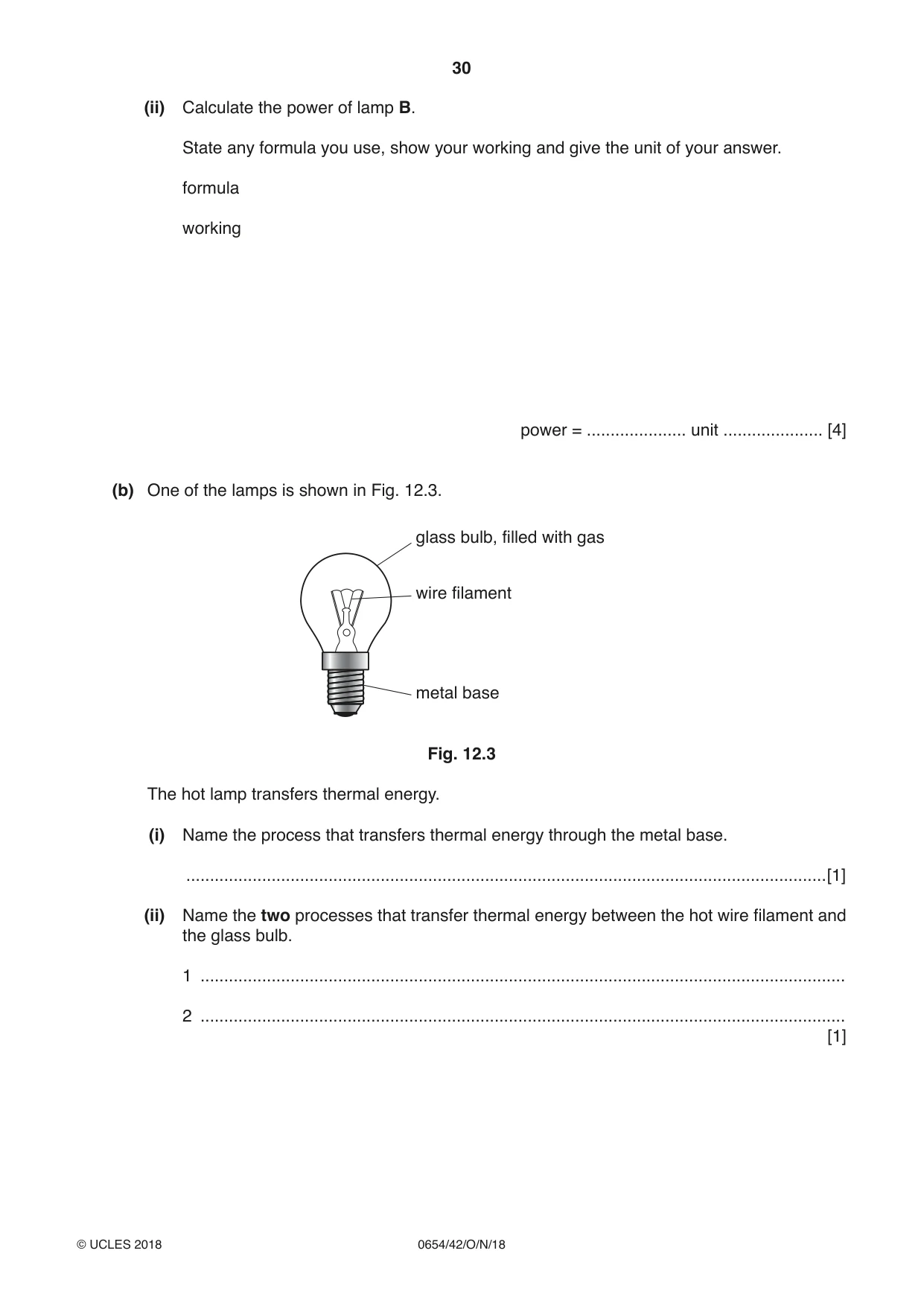
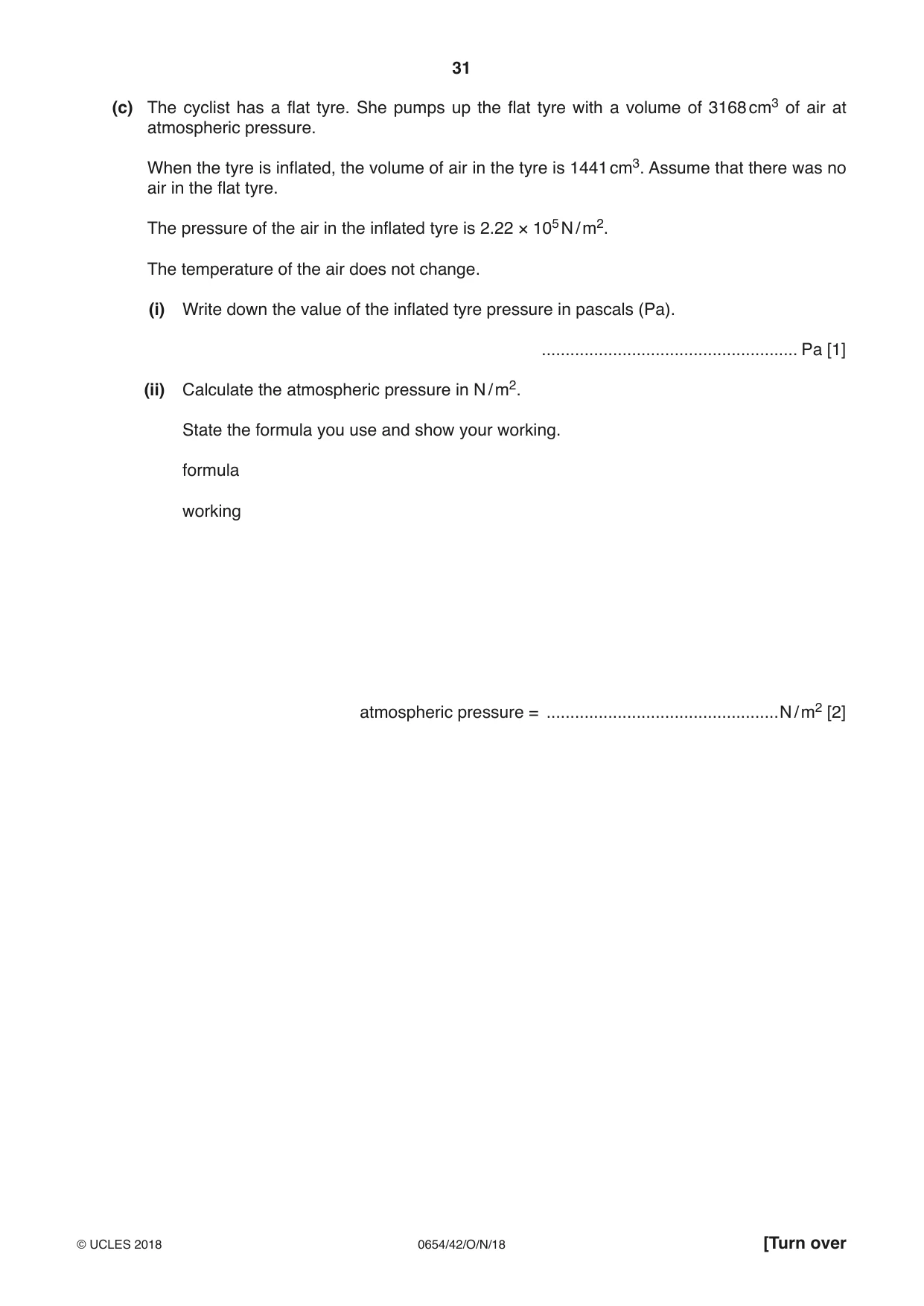
12 (a) Fig. 12.1 shows a bicycle with a front lamp A and a rear lamp B powered by the same battery. A B Fig. 12.1 Fig. 12.2 is a circuit diagram to show how the lamps are connected. 9.0 V A B Fig. 12.2 (i) Lamp A has a resistance of 16.0 Ω and lamp B has a resistance of 8.0 Ω. Calculate the combined resistance of the two lamps in this circuit when both switches are closed. Show your working. resistance = ...................................................... Ω [2] (ii) Calculate the power of lamp B. State any formula you use, show your working and give the unit of your answer. formula working power = ..................... unit ..................... [4] (b) One of the lamps is shown in Fig. 12.3. glass bulb, filled with gas wire filament metal base Fig. 12.3 The hot lamp transfers thermal energy. (i) Name the process that transfers thermal energy through the metal base. .......................................................................................................................................[1] (ii) Name the two processes that transfer thermal energy between the hot wire filament and the glass bulb. 1 ........................................................................................................................................ 2 ........................................................................................................................................ [1] (c) The cyclist has a flat tyre. She pumps up the flat tyre with a volume of 3168 cm3 of air at atmospheric pressure. When the tyre is inflated, the volume of air in the tyre is 1441 cm3. Assume that there was no air in the flat tyre. The pressure of the air in the inflated tyre is 2.22 × 10⁵ N / m2. The temperature of the air does not change. (i) Write down the value of the inflated tyre pressure in pascals (Pa). ...................................................... Pa [1] (ii) Calculate the atmospheric pressure in N / m2. State the formula you use and show your working. formula working atmospheric pressure = .................................................N / m2 [2]
Mark scheme: 12(a)(i) 5.3(3) (Ω) ; 2 12(a)(ii) current = voltage / resistance or 9 / 8 OR 1.1(25) (A) ; power = voltage × current or 9 × 1.125 ; = 10(.125) ; Watts / W ; 4 12(b)(i) conduction ; 1 12(b)(ii) convection AND radiation ; 1 12(c)(i) 2.22 × 10⁵ (Pa) ; 1 12(c)(ii) P1 = (P2 × V2) / V1 or (2.22 × 105× 1441) / 3168 ; = 1.01 × 10⁵ (N / m2) ; 2
Q13 · Mitosis and meiosis are two types of cell division
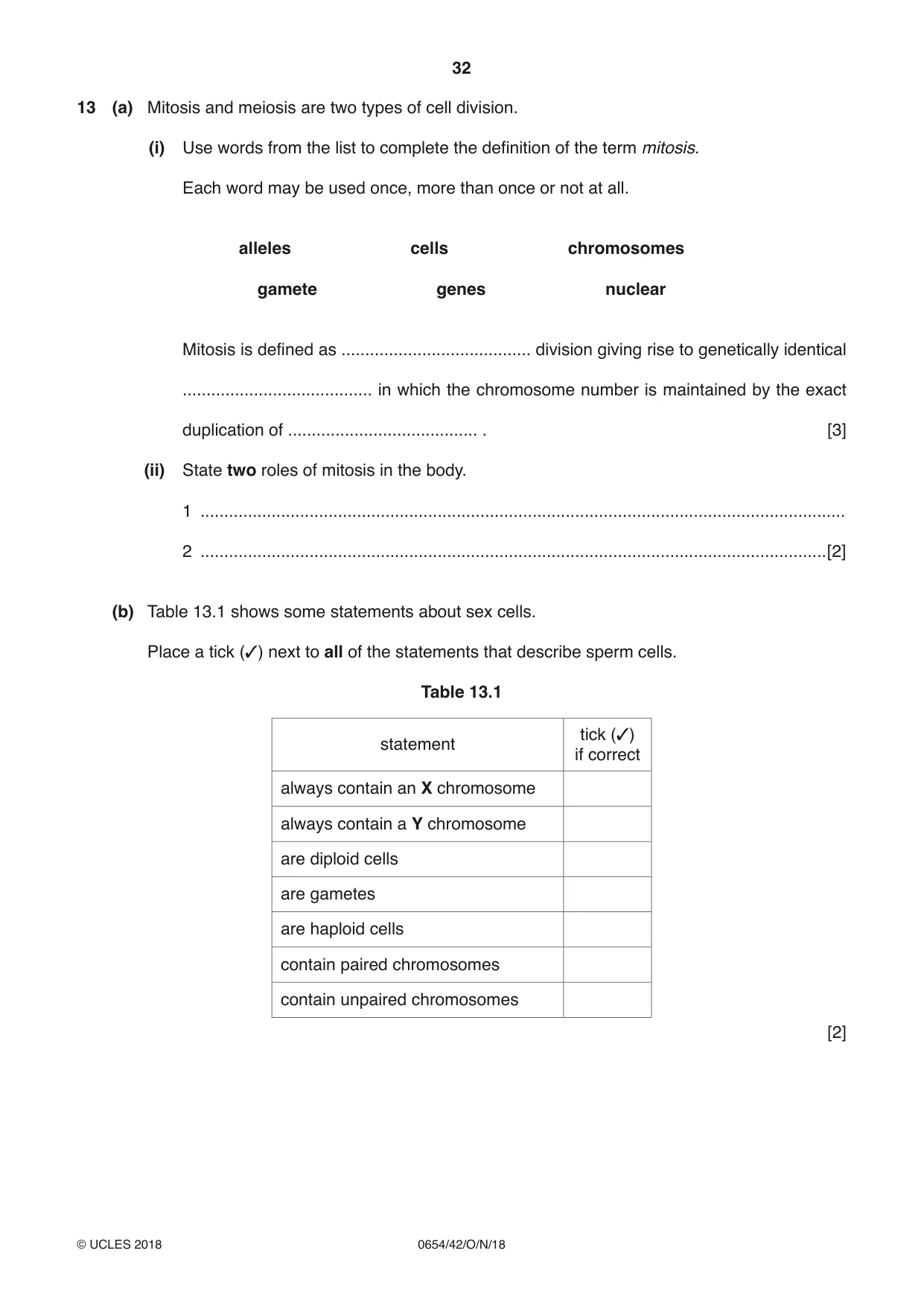
13 (a) Mitosis and meiosis are two types of cell division. (i) Use words from the list to complete the definition of the term mitosis. Each word may be used once, more than once or not at all. alleles cells chromosomes gamete genes nuclear Mitosis is defined as ........................................ division giving rise to genetically identical ........................................ in which the chromosome number is maintained by the exact duplication of ........................................ . [3] (ii) State two roles of mitosis in the body. 1 ........................................................................................................................................ 2 ....................................................................................................................................[2] (b) Table 13.1 shows some statements about sex cells. Place a tick (3) next to all of the statements that describe sperm cells. Table 13.1 tick (3) statement if correct always contain an X chromosome always contain a Y chromosome are diploid cells are gametes are haploid cells contain paired chromosomes contain unpaired chromosomes [2]
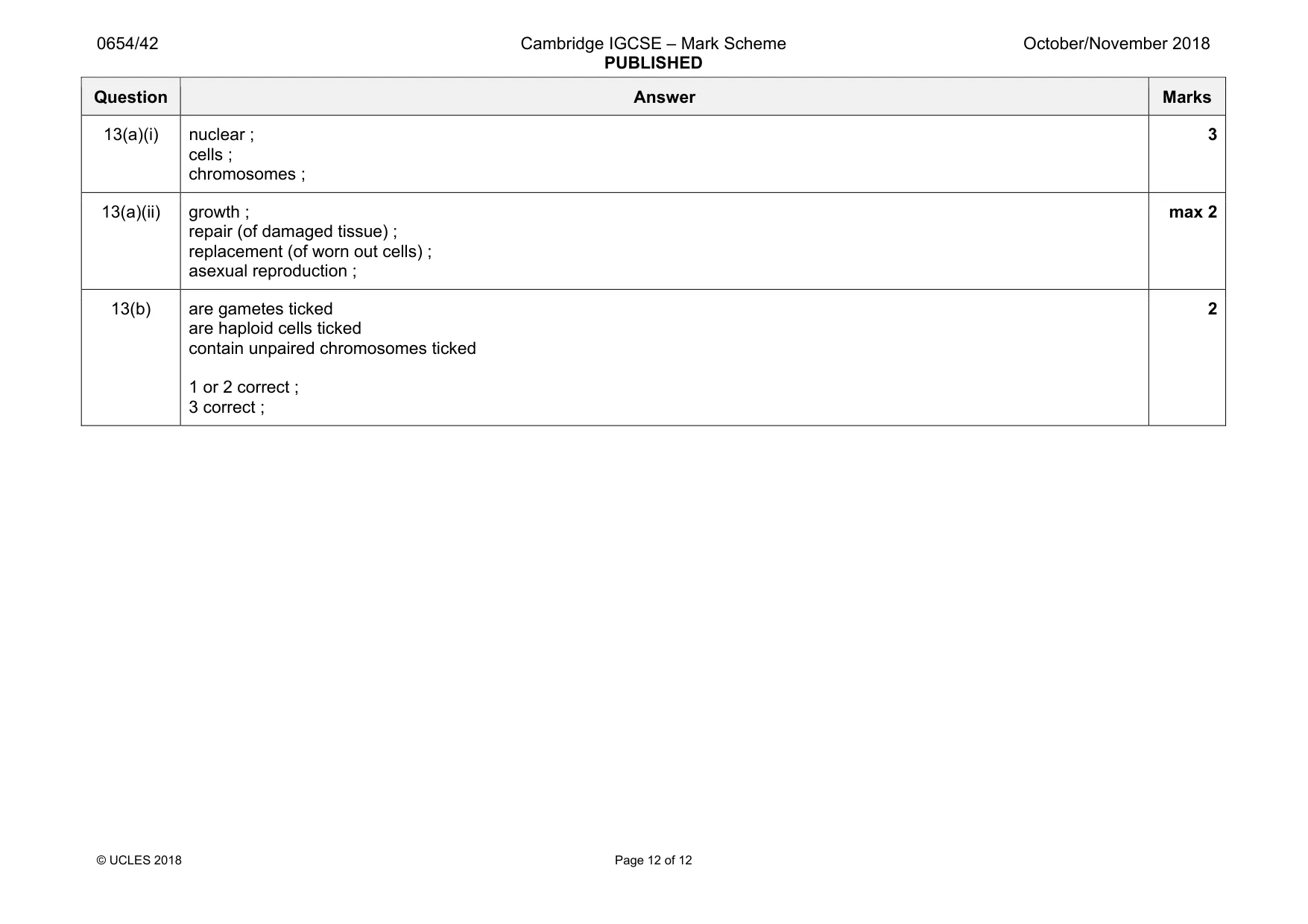
Mark scheme: 13(a)(i) nuclear ; cells ; chromosomes ; 3 13(a)(ii) growth ; repair (of damaged tissue) ; replacement (of worn out cells) ; asexual reproduction ; max 2 13(b) are gametes ticked are haploid cells ticked contain unpaired chromosomes ticked 1 or 2 correct ; 3 correct ; 2
What was in this paper
The subtopics covered by these 13 questions, and how many questions each got. Open one in a new tab to see every Cambridge question on it.
What you needed in this session
Cambridge’s own grade thresholds for 2018 Oct/Nov, Paper 4 · Variant 2. A higher threshold means an easier paper — the bar moves with how the cohort did.