Cambridge IGCSE Sciences - Co-ordinated (Double) 0654 — 2017 May/June Paper 4 · Variant 1
0654/41/M/J/17 · 13 questions · 120 marks · ≈135 min
The question paper and its mark scheme, free to read here and free to download. This is Cambridge’s own paper, exactly as it was sat.
Question paper28 pages
Mark scheme11 pages
Answers below. Sit the paper first if you are practising.
Questions as text
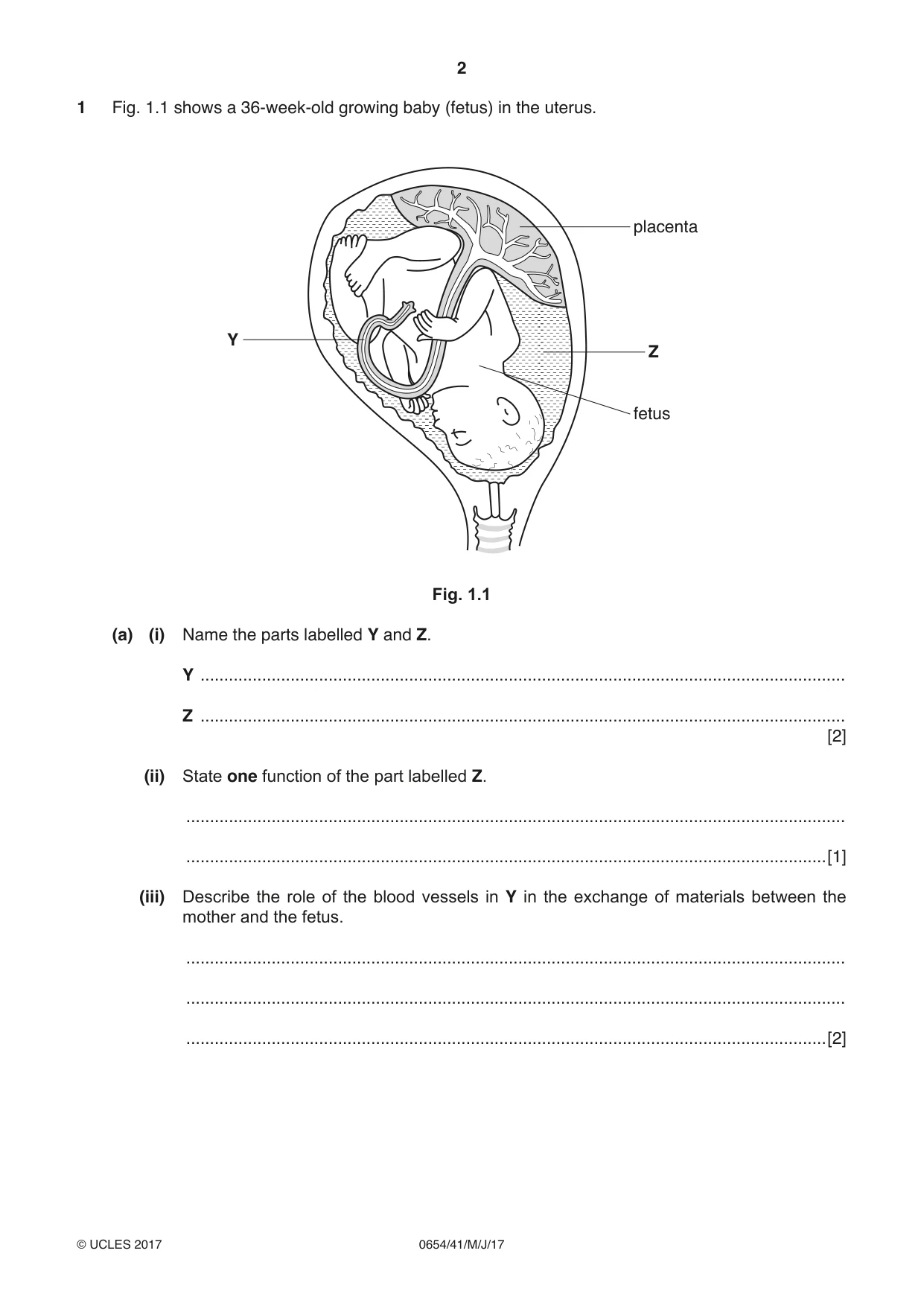
Q1 · A 36-week-old growing baby (fetus) in the uterus
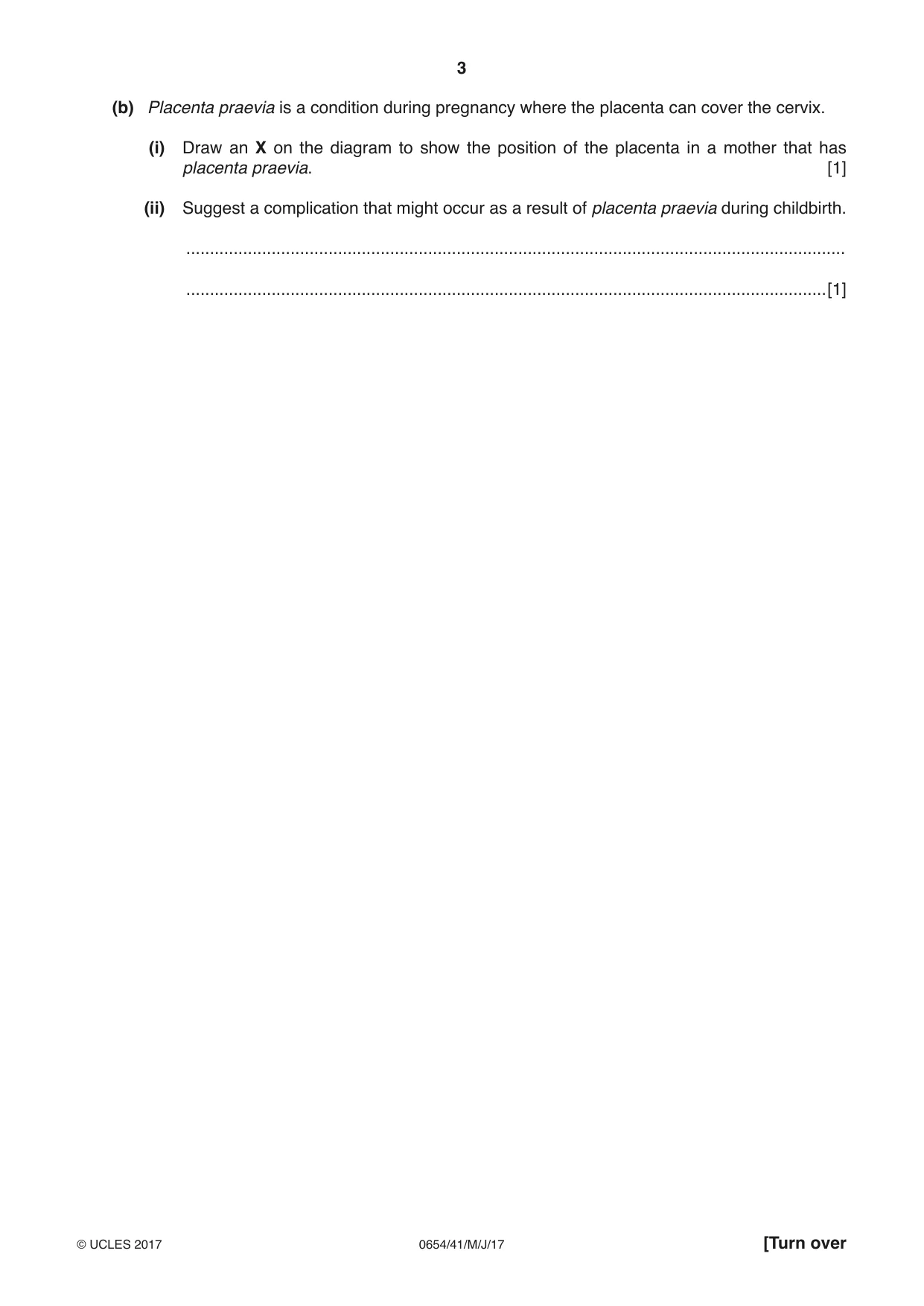
1 Fig. 1.1 shows a 36-week-old growing baby (fetus) in the uterus. placenta Y Z fetus Fig. 1.1 (a) (i) Name the parts labelled Y and Z. Y ........................................................................................................................................ Z ........................................................................................................................................ [2] (ii) State one function of the part labelled Z. ........................................................................................................................................... .......................................................................................................................................[1] (iii) Describe the role of the blood vessels in Y in the exchange of materials between the mother and the fetus. ........................................................................................................................................... ........................................................................................................................................... .......................................................................................................................................[2] (b) Placenta praevia is a condition during pregnancy where the placenta can cover the cervix. (i) Draw an X on the diagram to show the position of the placenta in a mother that has placenta praevia. [1] (ii) Suggest a complication that might occur as a result of placenta praevia during childbirth. ........................................................................................................................................... .......................................................................................................................................[1]
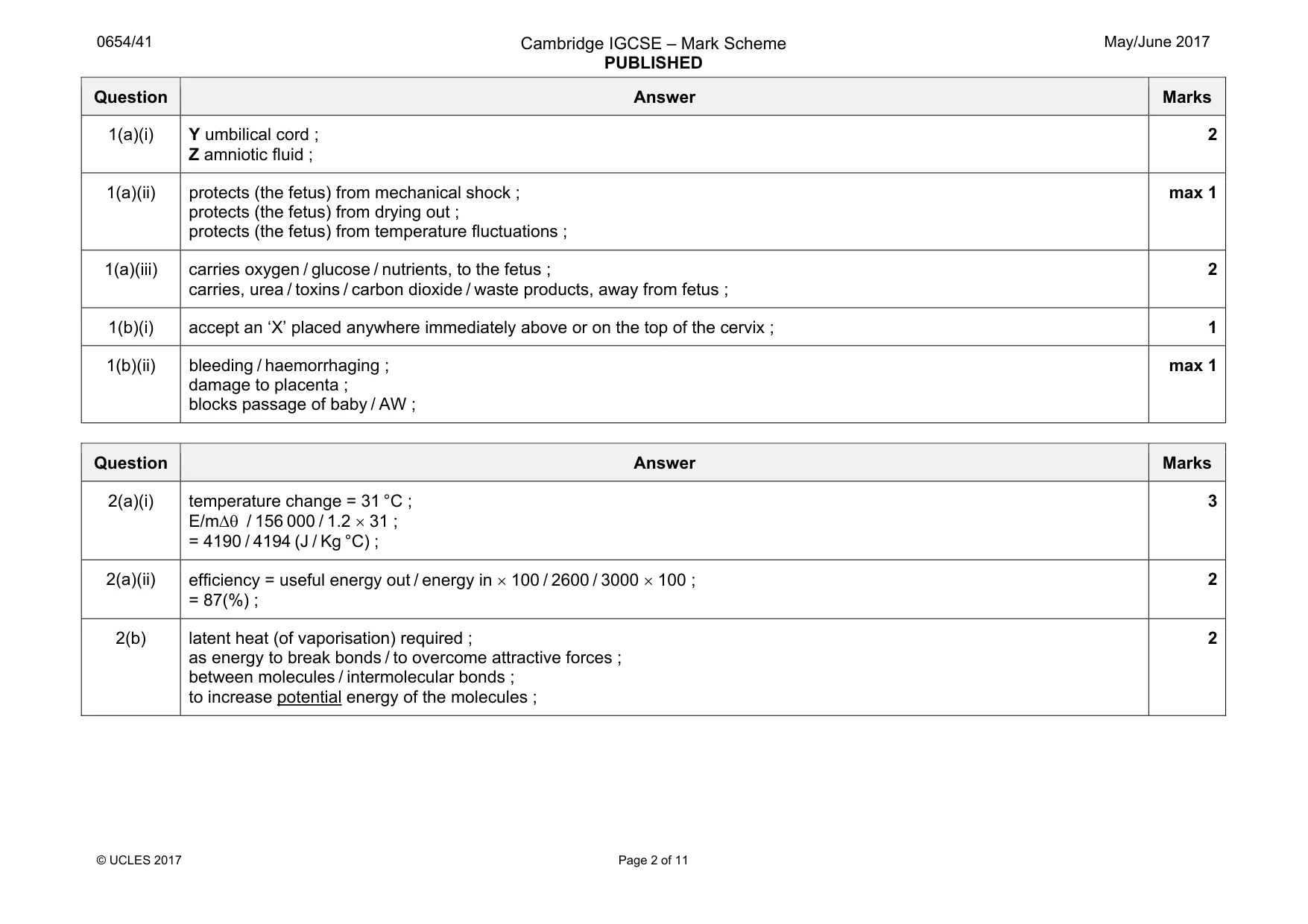
Mark scheme: 1(a)(i) Y umbilical cord ; Z amniotic fluid ; 2 1(a)(ii) protects (the fetus) from mechanical shock ; protects (the fetus) from drying out ; protects (the fetus) from temperature fluctuations ; max 1 1(a)(iii) carries oxygen / glucose / nutrients, to the fetus ; carries, urea / toxins / carbon dioxide / waste products, away from fetus ; 2 1(b)(i) accept an ‘X’ placed anywhere immediately above or on the top of the cervix ; 1 1(b)(ii) bleeding / haemorrhaging ; damage to placenta ; blocks passage of baby / AW ; max 1
Q2 · A student plans an experiment to calculate the specific heat capacity of water by heating…
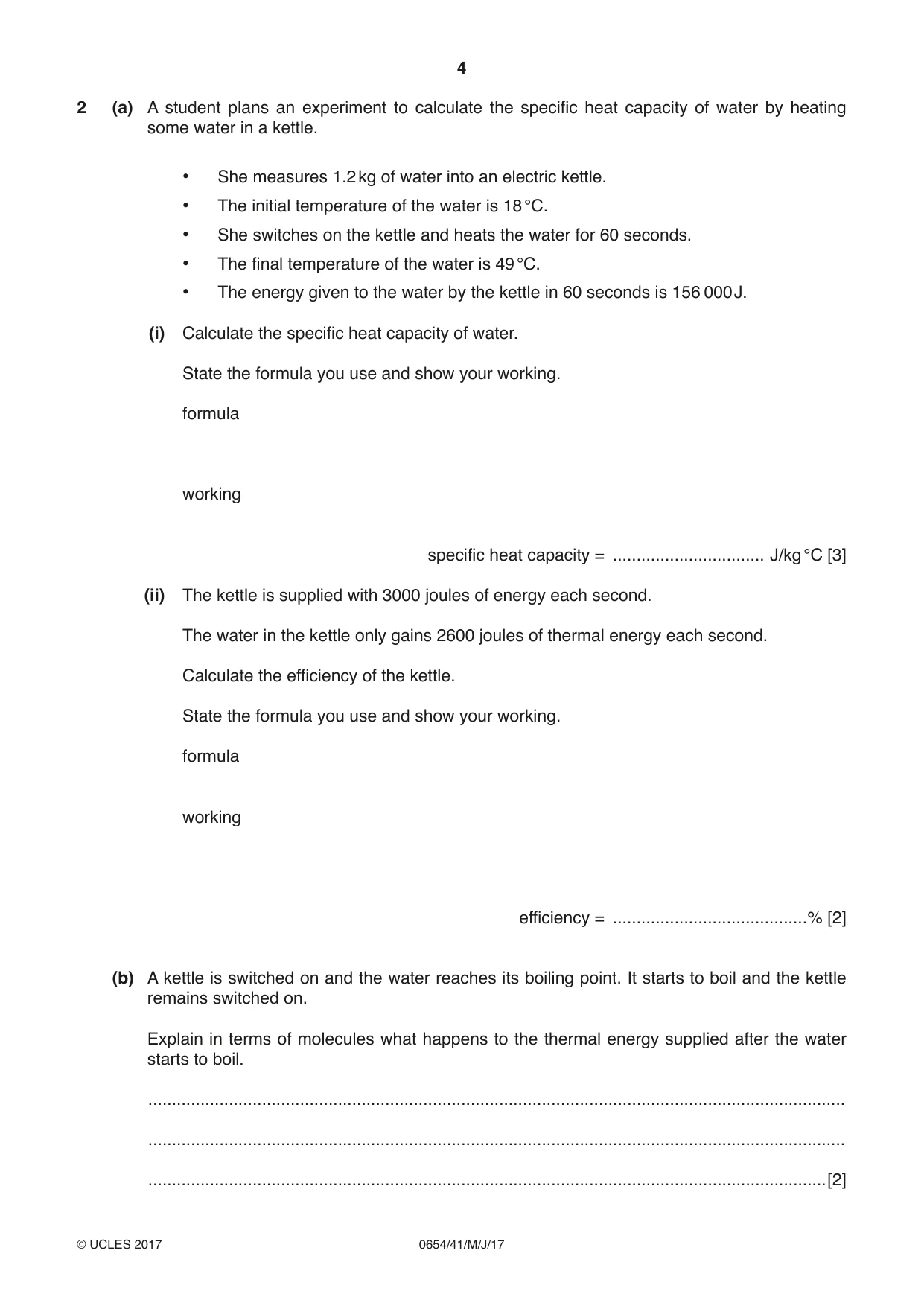
2 (a) A student plans an experiment to calculate the specific heat capacity of water by heating some water in a kettle. • She measures 1.2 kg of water into an electric kettle. • The initial temperature of the water is 18 °C. • She switches on the kettle and heats the water for 60 seconds. • The final temperature of the water is 49 °C. • The energy given to the water by the kettle in 60 seconds is 156 000 J. (i) Calculate the specific heat capacity of water. State the formula you use and show your working. formula working specific heat capacity = ................................ J/kg °C [3] (ii) The kettle is supplied with 3000 joules of energy each second. The water in the kettle only gains 2600 joules of thermal energy each second. Calculate the efficiency of the kettle. State the formula you use and show your working. formula working efficiency = .........................................% [2] (b) A kettle is switched on and the water reaches its boiling point. It starts to boil and the kettle remains switched on. Explain in terms of molecules what happens to the thermal energy supplied after the water starts to boil. ................................................................................................................................................... ................................................................................................................................................... ...............................................................................................................................................[2]
Mark scheme: 2(a)(i) temperature change = 31 °C ; E/m∆θ / 156 000 / 1.2 × 31 ; = 4190 / 4194 (J / Kg °C) ; 3 2(a)(ii) efficiency = useful energy out / energy in × 100 / 2600 / 3000 × 100 ; = 87(%) ; 2 2(b) latent heat (of vaporisation) required ; as energy to break bonds / to overcome attractive forces ; between molecules / intermolecular bonds ; to increase potential energy of the molecules ; 2
Q3 · Nitrogen combines with different elements to make ammonia and nitrogen oxides
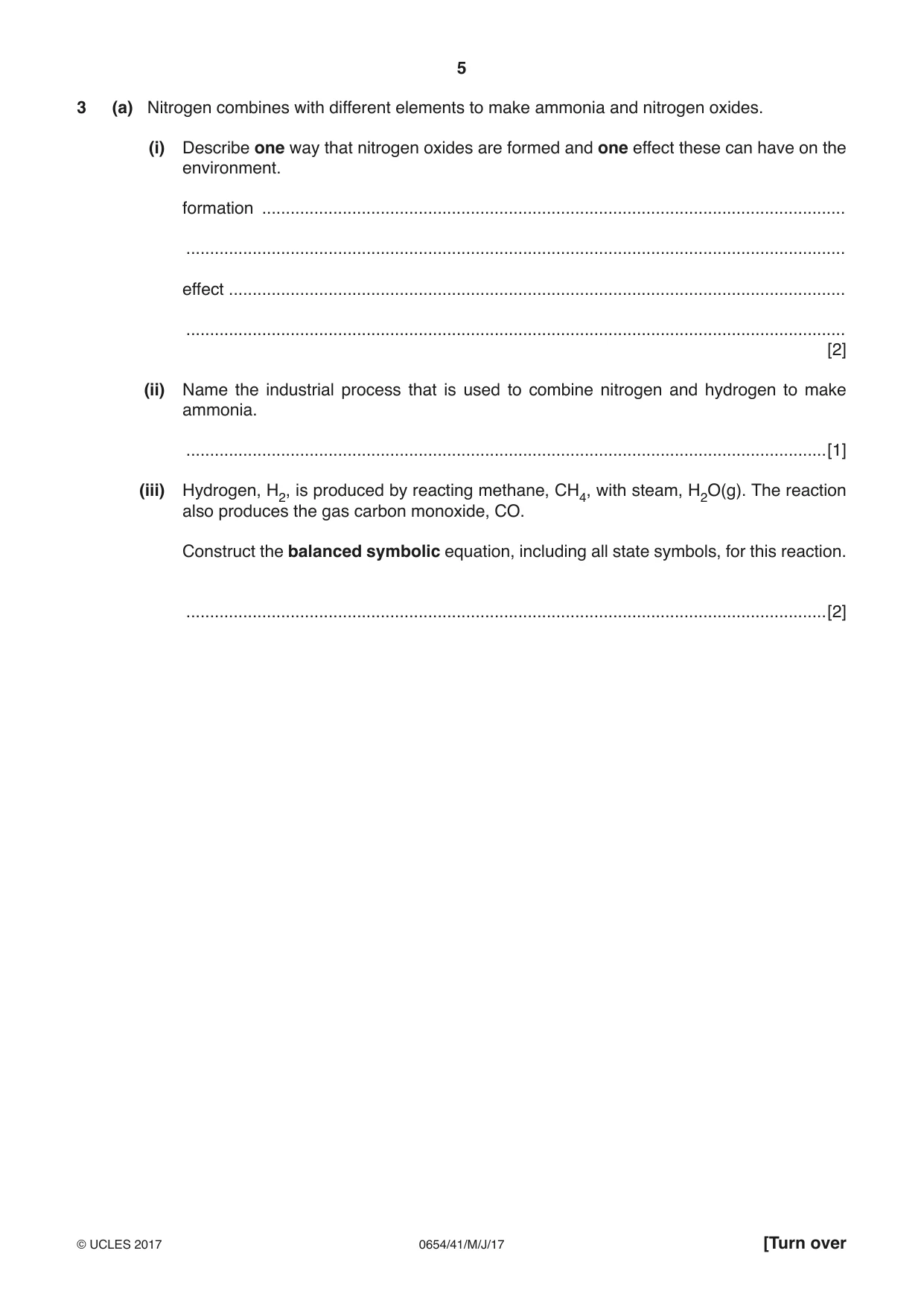
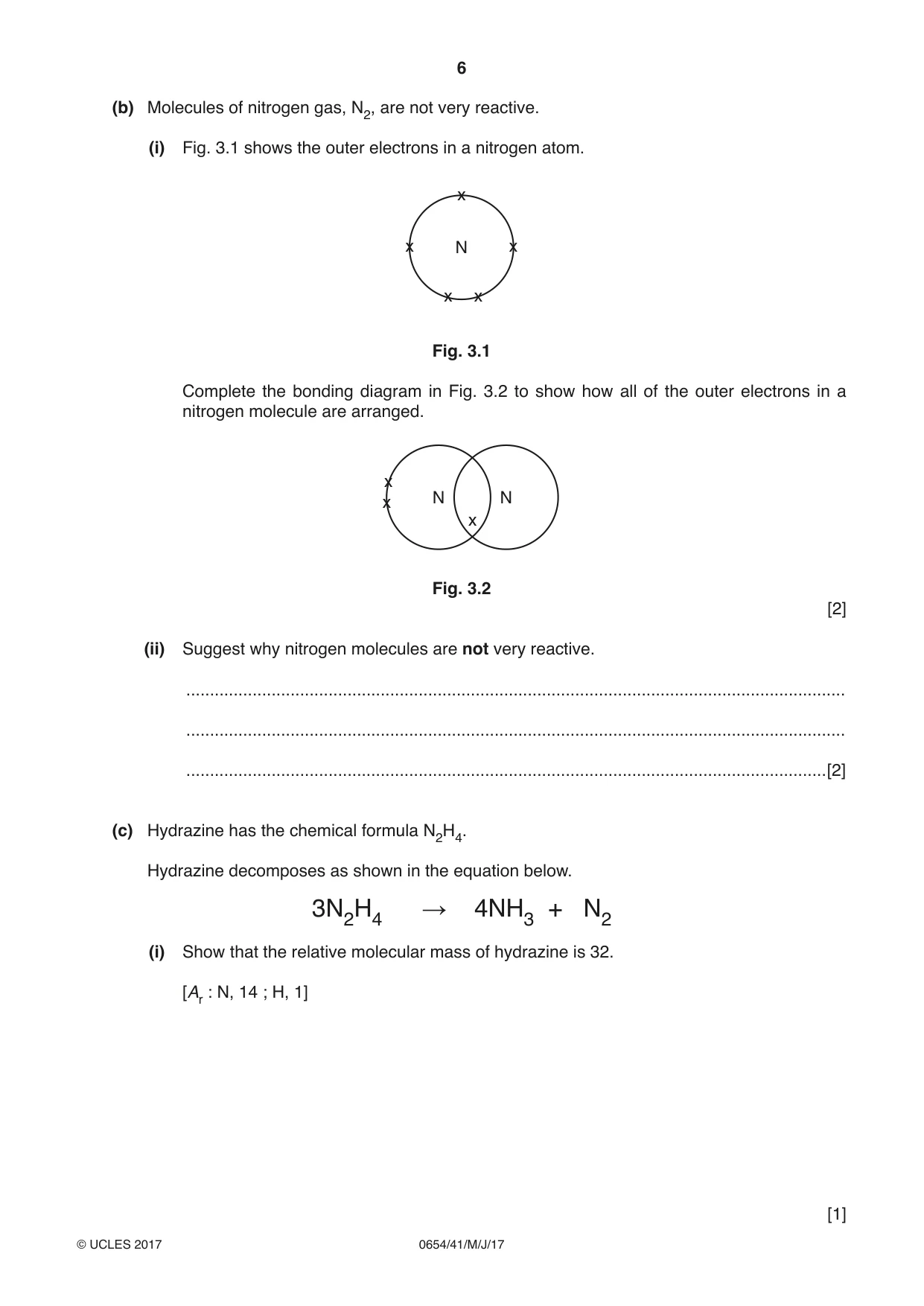
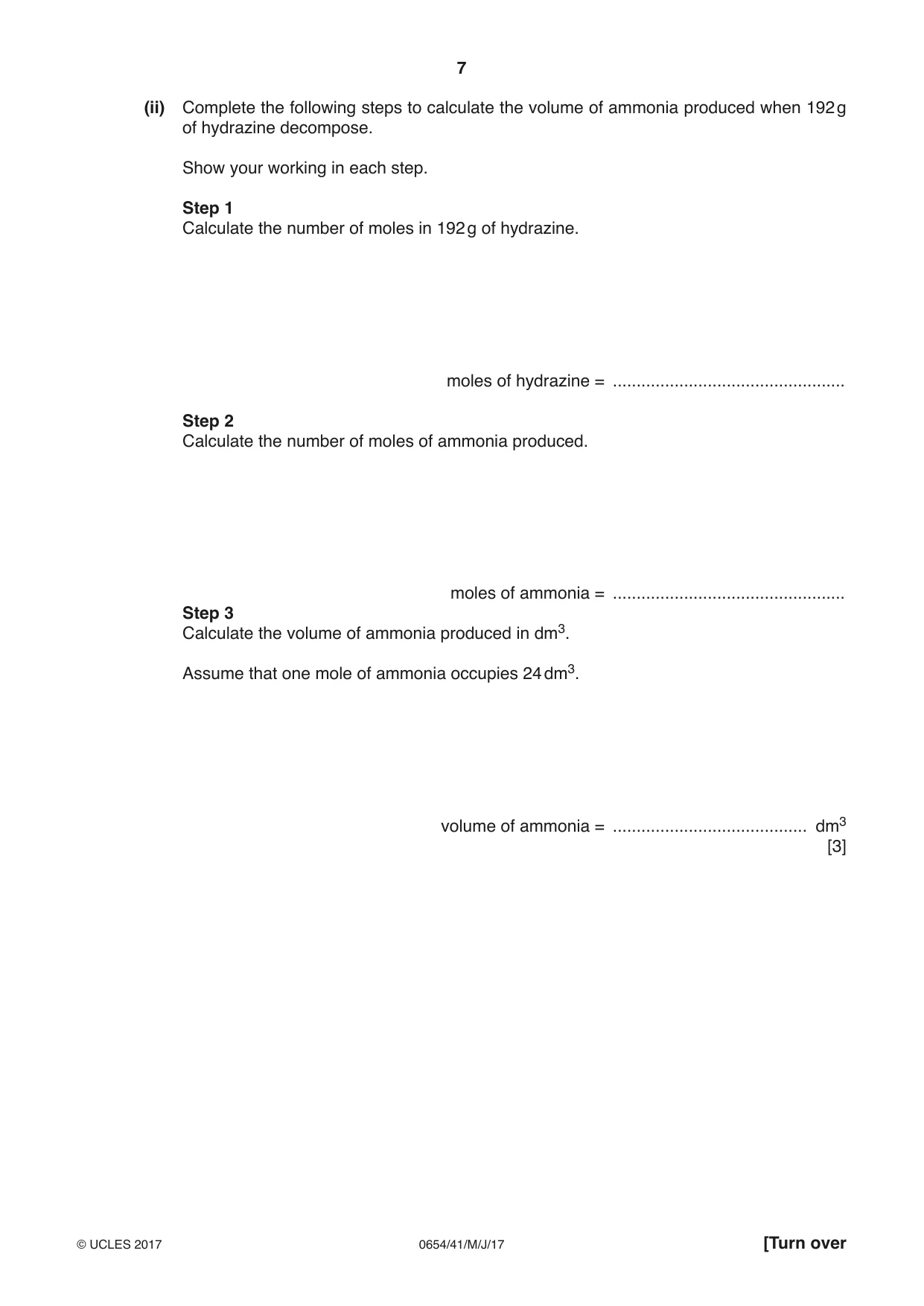
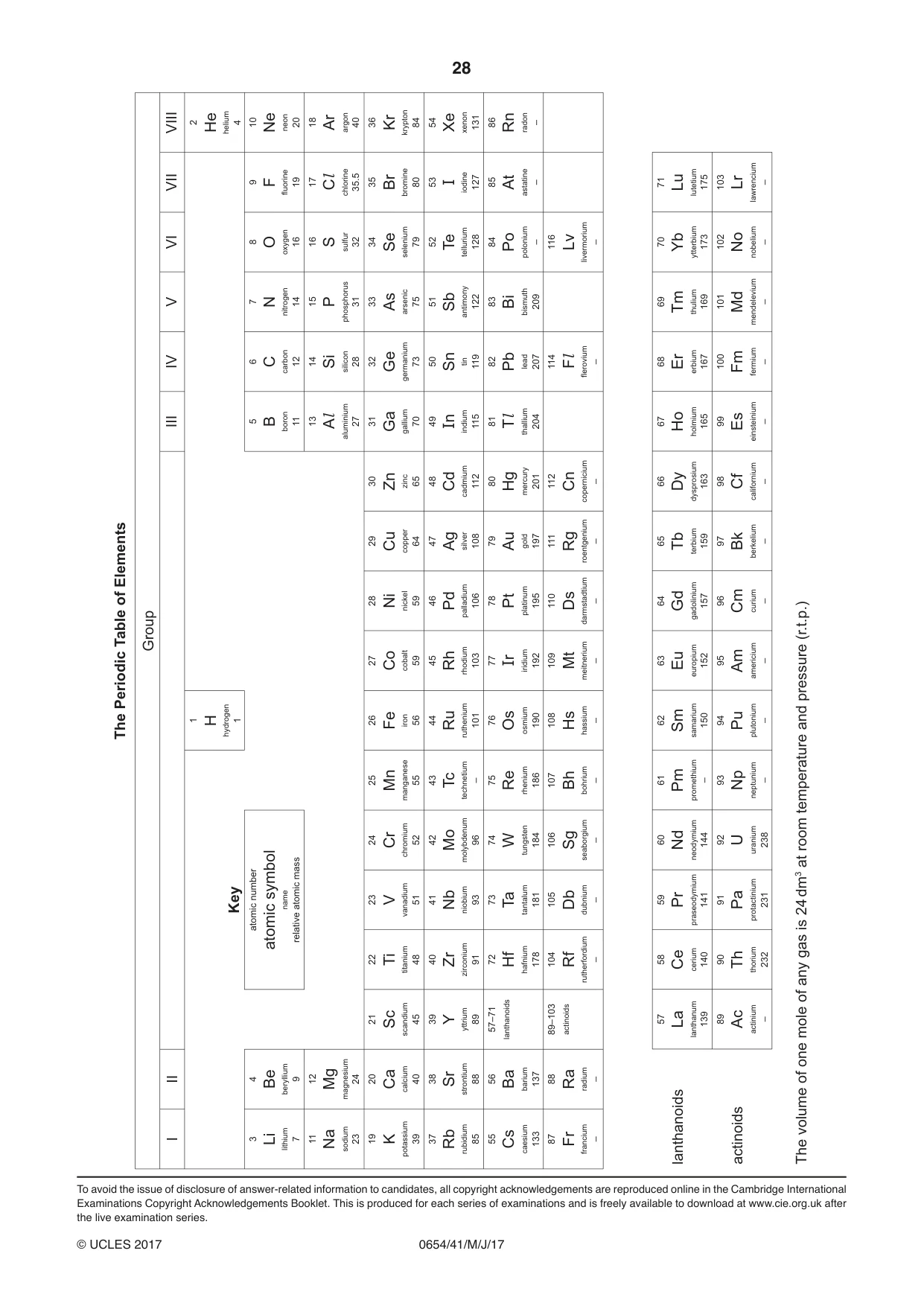
3 (a) Nitrogen combines with different elements to make ammonia and nitrogen oxides. (i) Describe one way that nitrogen oxides are formed and one effect these can have on the environment. formation ........................................................................................................................... ........................................................................................................................................... effect .................................................................................................................................. ........................................................................................................................................... [2] (ii) Name the industrial process that is used to combine nitrogen and hydrogen to make ammonia. .......................................................................................................................................[1] (iii) Hydrogen, H2, is produced by reacting methane, CH4, with steam, H2O(g). The reaction also produces the gas carbon monoxide, CO. Construct the balanced symbolic equation, including all state symbols, for this reaction. .......................................................................................................................................[2] (b) Molecules of nitrogen gas, N2, are not very reactive. (i) Fig. 3.1 shows the outer electrons in a nitrogen atom. x x N x x x Fig. 3.1 Complete the bonding diagram in Fig. 3.2 to show how all of the outer electrons in a nitrogen molecule are arranged. x x N N x Fig. 3.2 [2] (ii) Suggest why nitrogen molecules are not very reactive. ........................................................................................................................................... ........................................................................................................................................... .......................................................................................................................................[2] (c) Hydrazine has the chemical formula N2H4. Hydrazine decomposes as shown in the equation below. 3N2H4 → 4NH3 + N2 (i) Show that the relative molecular mass of hydrazine is 32. [Ar : N, 14 ; H, 1] [1] (ii) Complete the following steps to calculate the volume of ammonia produced when 192 g of hydrazine decompose. Show your working in each step. Step 1 Calculate the number of moles in 192 g of hydrazine. moles of hydrazine = ................................................. Step 2 Calculate the number of moles of ammonia produced. moles of ammonia = ................................................. Step 3 Calculate the volume of ammonia produced in dm3. Assume that one mole of ammonia occupies 24 dm3. volume of ammonia = ......................................... dm3 [3]
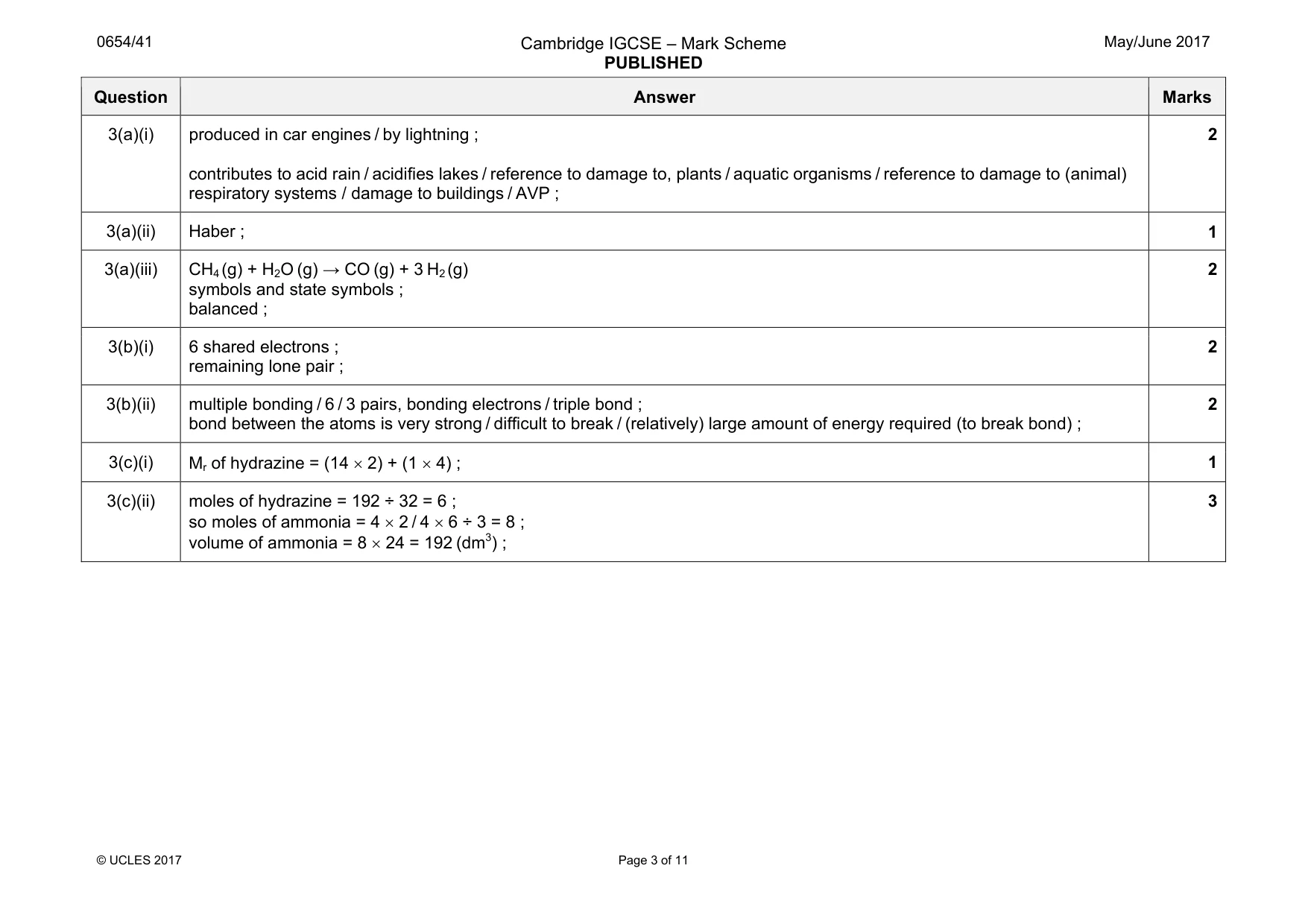
Mark scheme: 3(a)(i) produced in car engines / by lightning ; contributes to acid rain / acidifies lakes / reference to damage to, plants / aquatic organisms / reference to damage to (animal) respiratory systems / damage to buildings / AVP ; 2 3(a)(ii) Haber ; 1 3(a)(iii) CH4 (g) + H2O (g) → CO (g) + 3 H2 (g) symbols and state symbols ; balanced ; 2 3(b)(i) 6 shared electrons ; remaining lone pair ; 2 3(b)(ii) multiple bonding / 6 / 3 pairs, bonding electrons / triple bond ; bond between the atoms is very strong / difficult to break / (relatively) large amount of energy required (to break bond) ; 2 3(c)(i) Mr of hydrazine = (14 × 2) + (1 × 4) ; 1 3(c)(ii) moles of hydrazine = 192 ÷ 32 = 6 ; so moles of ammonia = 4 × 2 / 4 × 6 ÷ 3 = 8 ; volume of ammonia = 8 × 24 = 192 (dm3) ; 3
Q4 · The activity of three enzymes, A, B and C, at different pHs
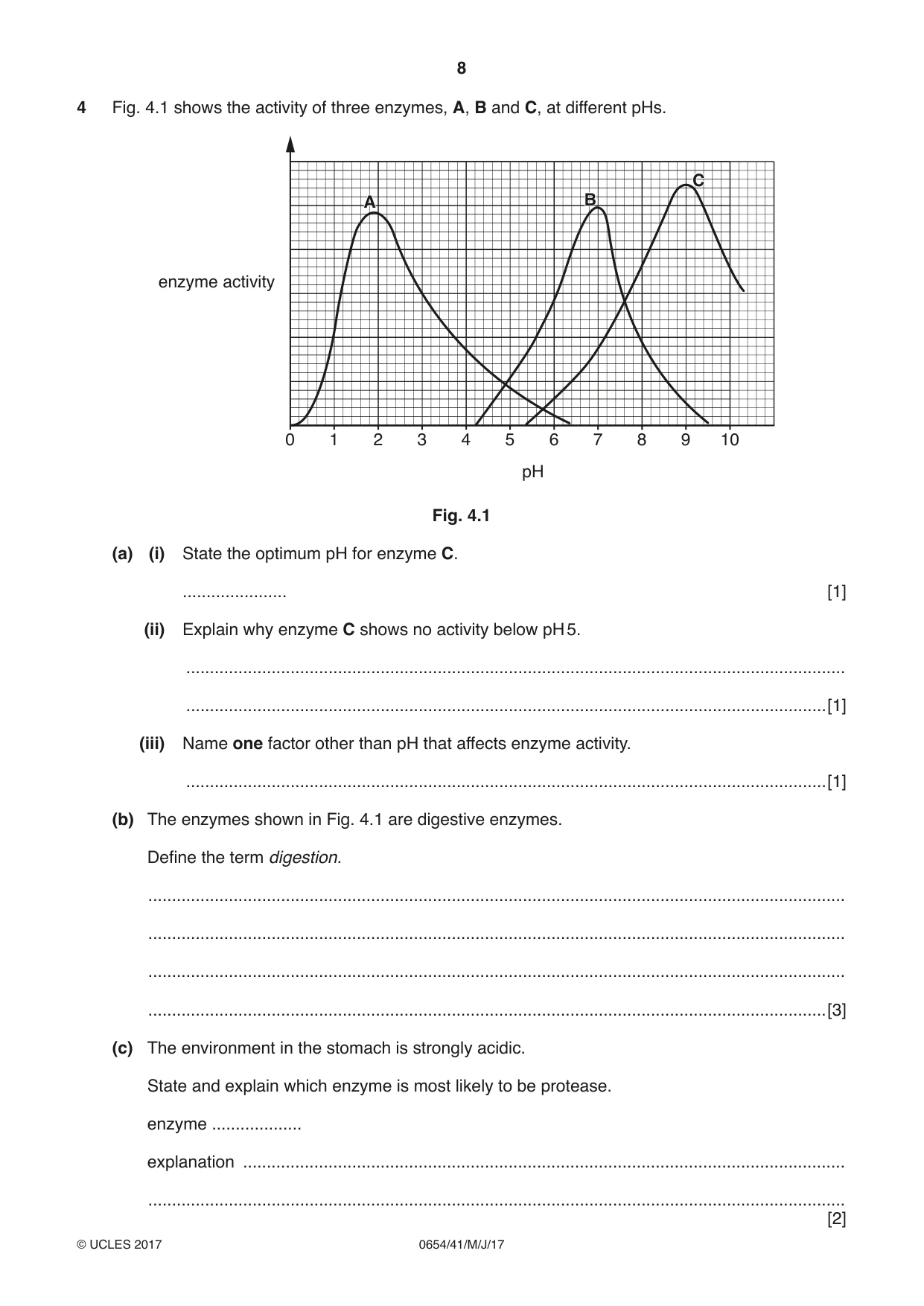
4 Fig. 4.1 shows the activity of three enzymes, A, B and C, at different pHs. C A B enzyme activity 0 1 2 3 4 5 6 7 8 9 10 pH Fig. 4.1 (a) (i) State the optimum pH for enzyme C. ...................... [1] (ii) Explain why enzyme C shows no activity below pH 5. ........................................................................................................................................... .......................................................................................................................................[1] (iii) Name one factor other than pH that affects enzyme activity. .......................................................................................................................................[1] (b) The enzymes shown in Fig. 4.1 are digestive enzymes. Define the term digestion. ................................................................................................................................................... ................................................................................................................................................... ................................................................................................................................................... ...............................................................................................................................................[3] (c) The environment in the stomach is strongly acidic. State and explain which enzyme is most likely to be protease. enzyme ................... explanation ............................................................................................................................... ................................................................................................................................................... [2]
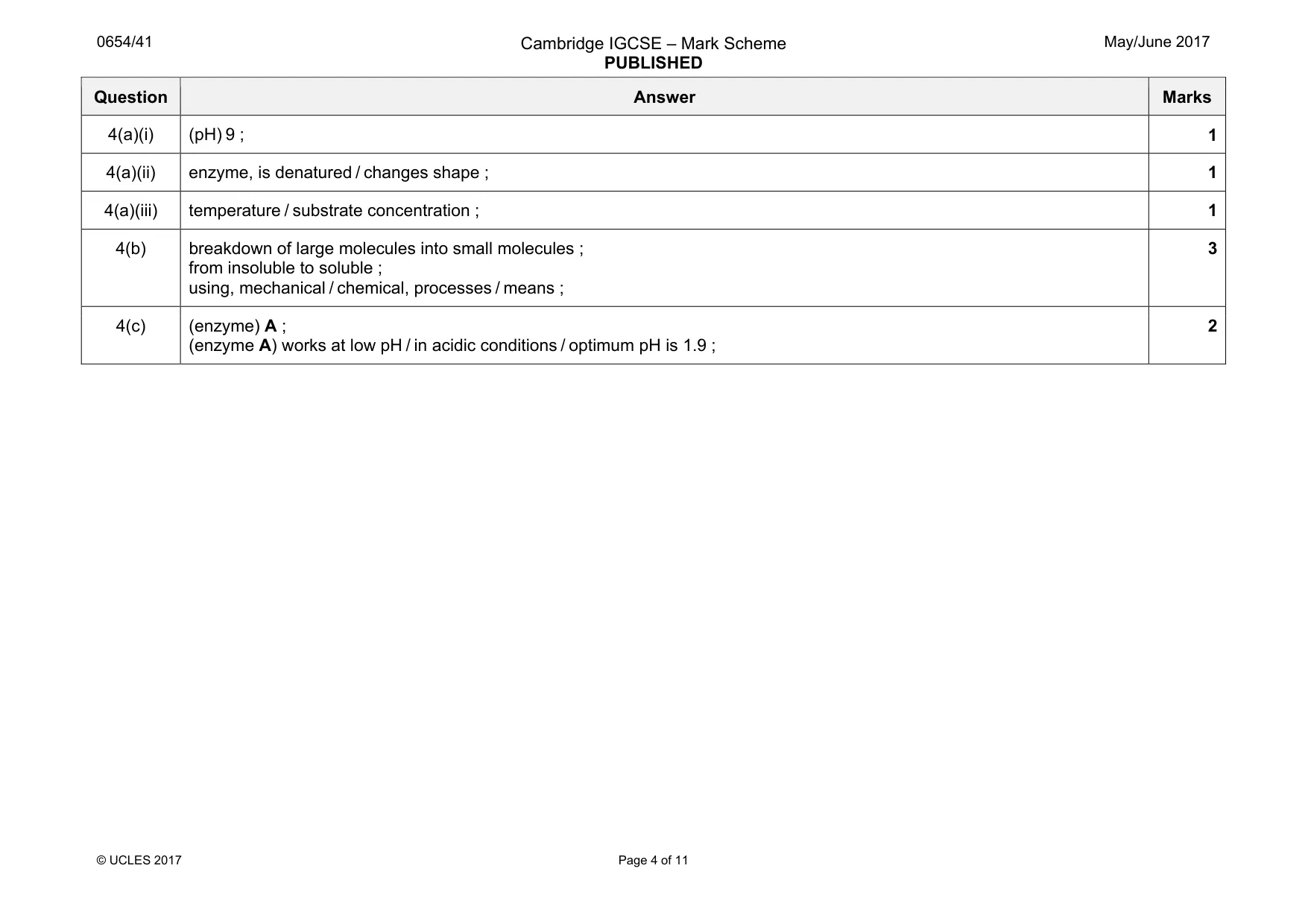
Mark scheme: 4(a)(i) (pH) 9 ; 1 4(a)(ii) enzyme, is denatured / changes shape ; 1 4(a)(iii) temperature / substrate concentration ; 1 4(b) breakdown of large molecules into small molecules ; from insoluble to soluble ; using, mechanical / chemical, processes / means ; 3 4(c) (enzyme) A ; (enzyme A) works at low pH / in acidic conditions / optimum pH is 1.9 ; 2
Q5 · Plants need to use several substances in order to photosynthesise
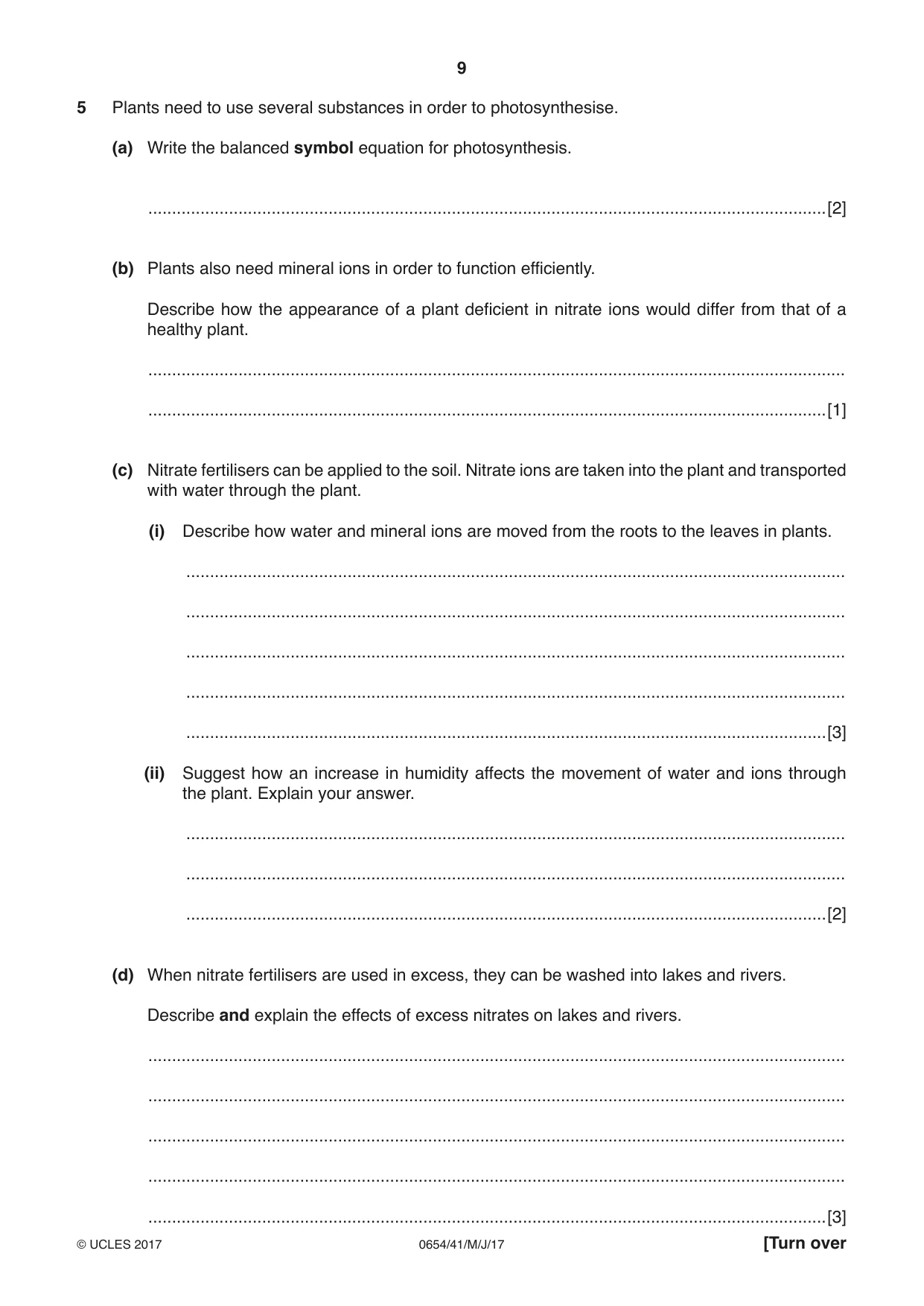
5 Plants need to use several substances in order to photosynthesise. (a) Write the balanced symbol equation for photosynthesis. ...............................................................................................................................................[2] (b) Plants also need mineral ions in order to function efficiently. Describe how the appearance of a plant deficient in nitrate ions would differ from that of a healthy plant. ................................................................................................................................................... ...............................................................................................................................................[1] (c) Nitrate fertilisers can be applied to the soil. Nitrate ions are taken into the plant and transported with water through the plant. (i) Describe how water and mineral ions are moved from the roots to the leaves in plants. ........................................................................................................................................... ........................................................................................................................................... ........................................................................................................................................... ........................................................................................................................................... .......................................................................................................................................[3] (ii) Suggest how an increase in humidity affects the movement of water and ions through the plant. Explain your answer. ........................................................................................................................................... ........................................................................................................................................... .......................................................................................................................................[2] (d) When nitrate fertilisers are used in excess, they can be washed into lakes and rivers. Describe and explain the effects of excess nitrates on lakes and rivers. ................................................................................................................................................... ................................................................................................................................................... ................................................................................................................................................... ................................................................................................................................................... ...............................................................................................................................................[3]
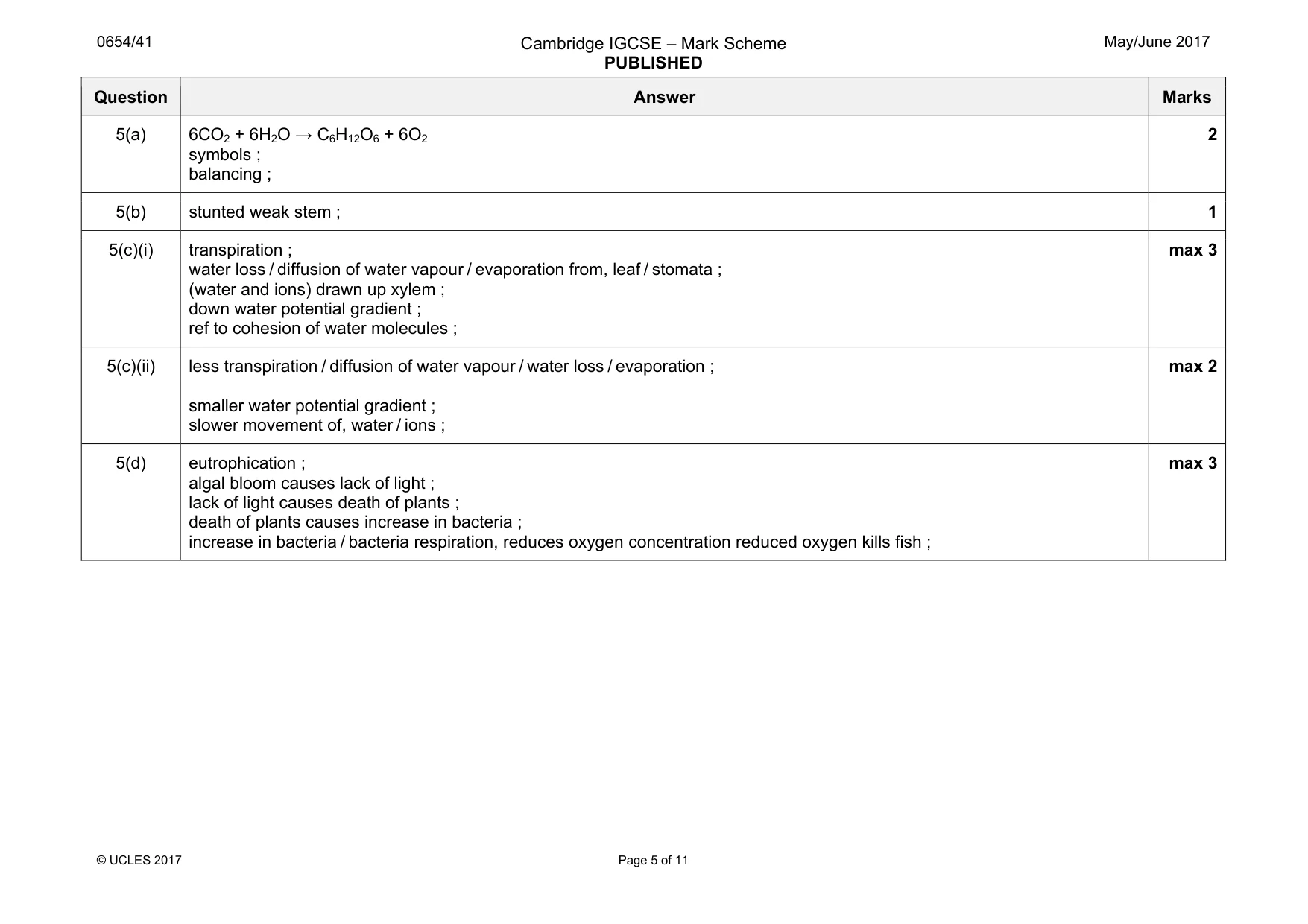
Mark scheme: 5(a) 6CO2 + 6H2O → C6H12O6 + 6O2 symbols ; balancing ; 2 5(b) stunted weak stem ; 1 5(c)(i) transpiration ; water loss / diffusion of water vapour / evaporation from, leaf / stomata ; (water and ions) drawn up xylem ; down water potential gradient ; ref to cohesion of water molecules ; max 3 5(c)(ii) less transpiration / diffusion of water vapour / water loss / evaporation ; smaller water potential gradient ; slower movement of, water / ions ; max 2 5(d) eutrophication ; algal bloom causes lack of light ; lack of light causes death of plants ; death of plants causes increase in bacteria ; increase in bacteria / bacteria respiration, reduces oxygen concentration reduced oxygen kills fish ; max 3
Q6 · Petroleum is a black liquid
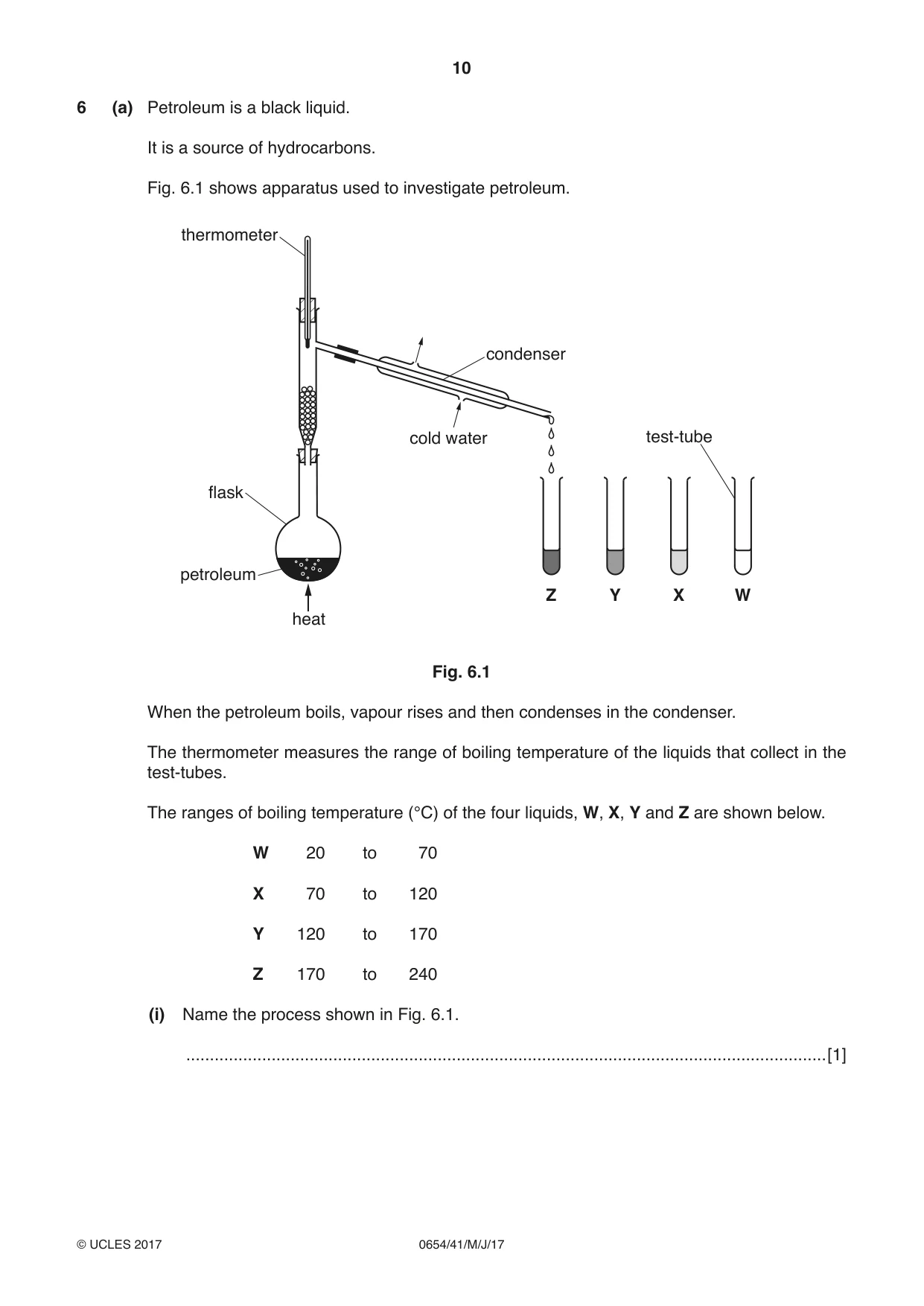
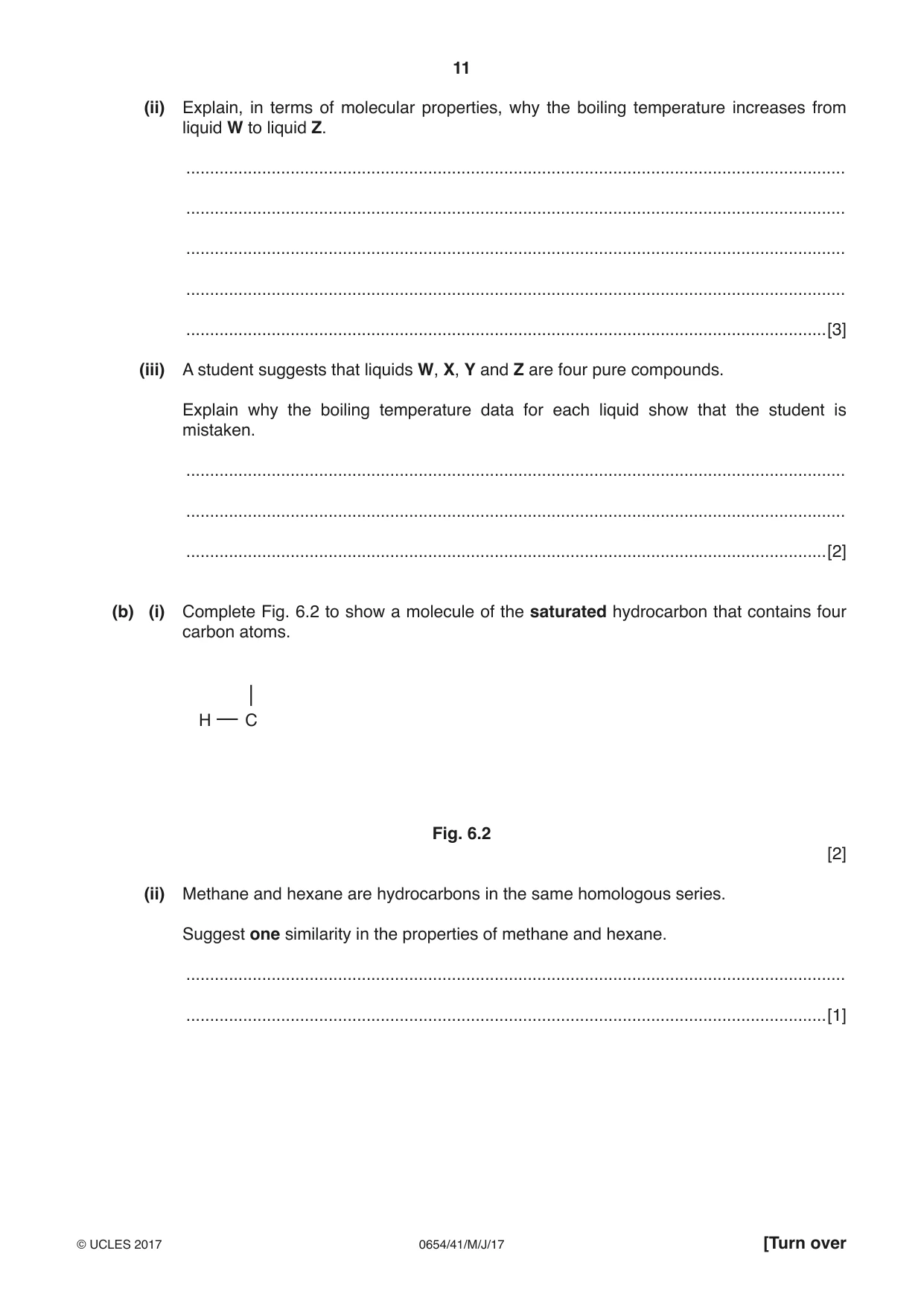
6 (a) Petroleum is a black liquid. It is a source of hydrocarbons. Fig. 6.1 shows apparatus used to investigate petroleum. thermometer condenser cold water test-tube flask petroleum Z Y X W heat Fig. 6.1 When the petroleum boils, vapour rises and then condenses in the condenser. The thermometer measures the range of boiling temperature of the liquids that collect in the test-tubes. The ranges of boiling temperature (°C) of the four liquids, W, X, Y and Z are shown below. W 20 to 70 X 70 to 120 Y 120 to 170 Z 170 to 240 (i) Name the process shown in Fig. 6.1. .......................................................................................................................................[1] (ii) Explain, in terms of molecular properties, why the boiling temperature increases from liquid W to liquid Z. ........................................................................................................................................... ........................................................................................................................................... ........................................................................................................................................... ........................................................................................................................................... .......................................................................................................................................[3] (iii) A student suggests that liquids W, X, Y and Z are four pure compounds. Explain why the boiling temperature data for each liquid show that the student is mistaken. ........................................................................................................................................... ........................................................................................................................................... .......................................................................................................................................[2] (b) (i) Complete Fig. 6.2 to show a molecule of the saturated hydrocarbon that contains four carbon atoms. H C Fig. 6.2 [2] (ii) Methane and hexane are hydrocarbons in the same homologous series. Suggest one similarity in the properties of methane and hexane. ........................................................................................................................................... .......................................................................................................................................[1]
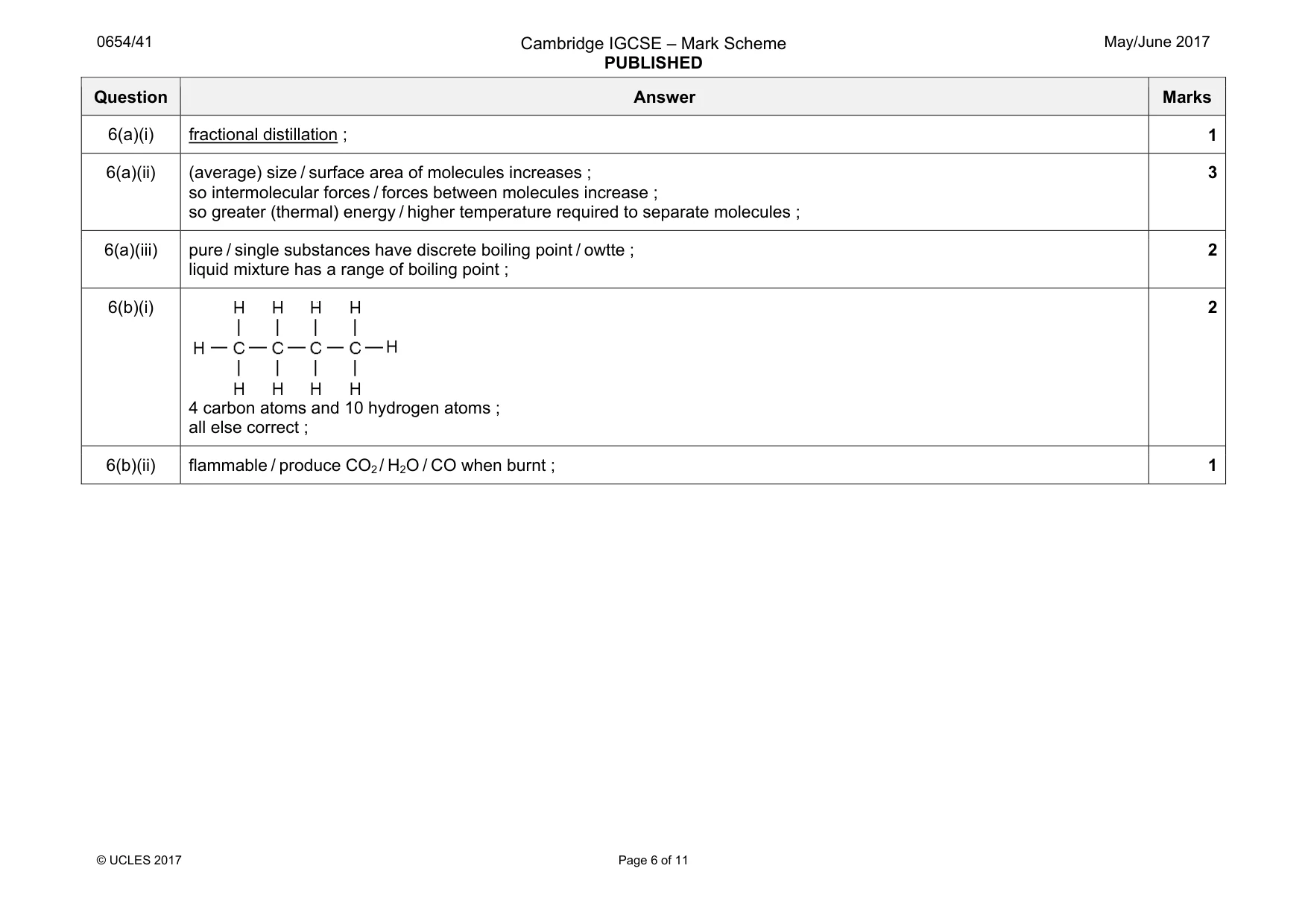
Mark scheme: 6(a)(i) fractional distillation ; 1 6(a)(ii) (average) size / surface area of molecules increases ; so intermolecular forces / forces between molecules increase ; so greater (thermal) energy / higher temperature required to separate molecules ; 3 6(a)(iii) pure / single substances have discrete boiling point / owtte ; liquid mixture has a range of boiling point ; 2 6(b)(i) 4 carbon atoms and 10 hydrogen atoms ; all else correct ; 2 6(b)(ii) flammable / produce CO2 / H2O / CO when burnt ; 1
Q7 · A speed-time graph for a car over a period of 50 seconds
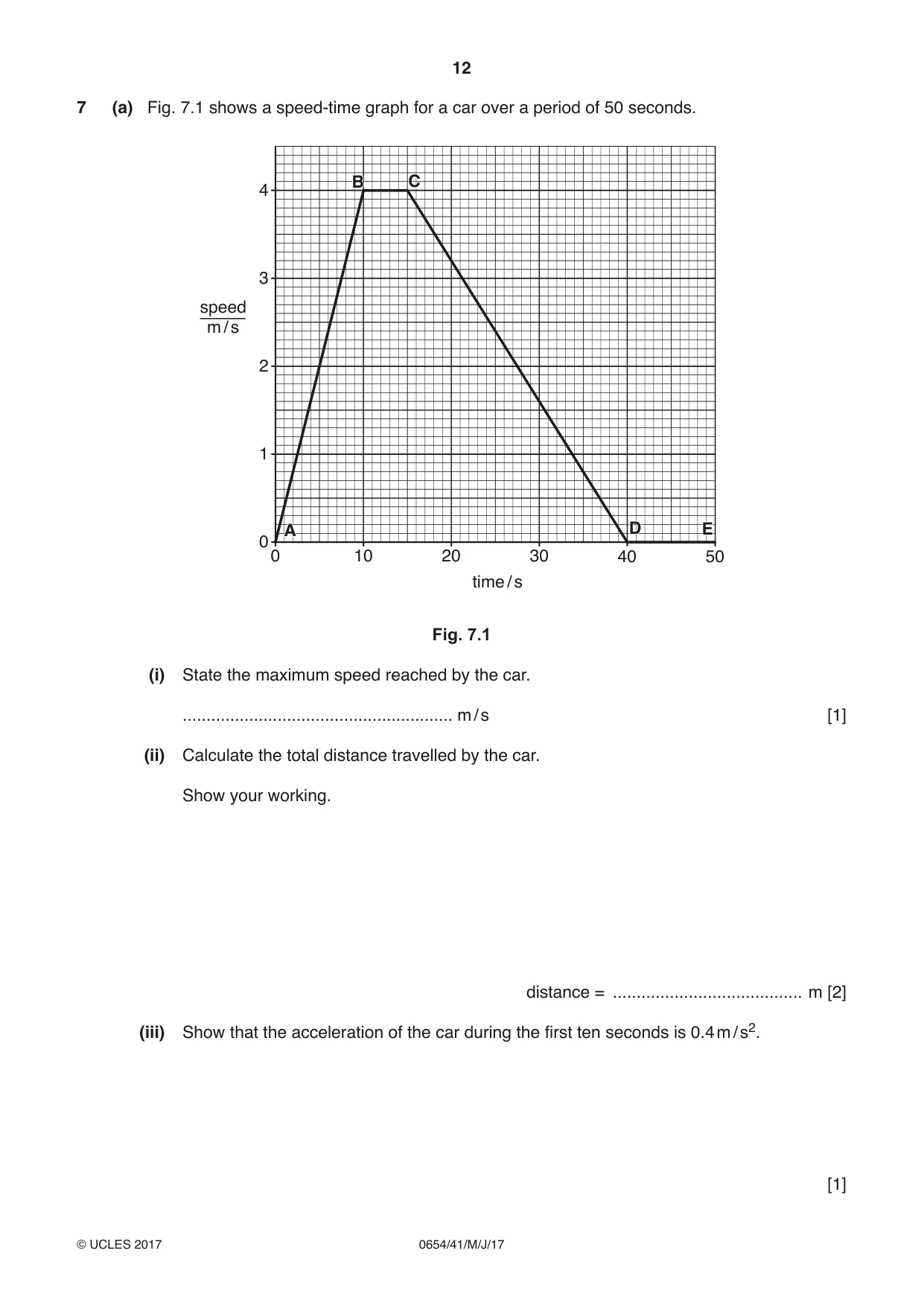
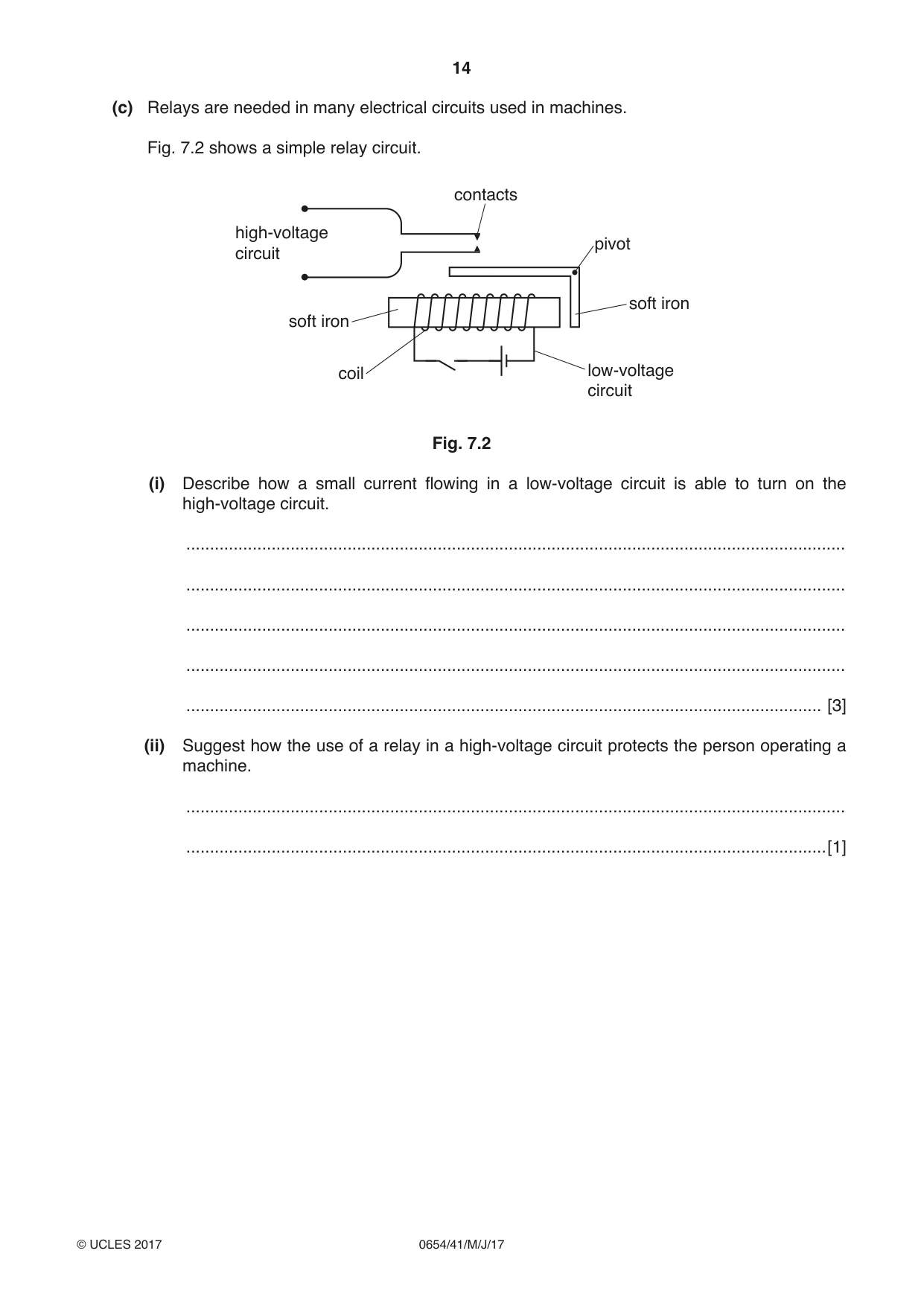
7 (a) Fig. 7.1 shows a speed-time graph for a car over a period of 50 seconds. BB CC 4 3 speed m / s 2 1 A DD EE 0 0 10 20 30 40 50 time / s Fig. 7.1 (i) State the maximum speed reached by the car. ......................................................... m / s [1] (ii) Calculate the total distance travelled by the car. Show your working. distance = ........................................ m [2] (iii) Show that the acceleration of the car during the first ten seconds is 0.4 m / s2. [1] (iv) The mass of the car is 950 kg. Calculate the force needed to produce an acceleration of 0.4 m / s2. State the formula you use and show your working. formula working force = ........................................ N [2] (b) The temperature of the air in car tyres increases during a journey. (i) Describe what happens to the motion of the air particles as the air warms up. ........................................................................................................................................... .......................................................................................................................................[1] (ii) When the temperature of the air in the tyres increases, the pressure in the tyres increases. Explain in terms of the motion of the air particles why the pressure increases. ........................................................................................................................................... ........................................................................................................................................... .......................................................................................................................................[2] (c) Relays are needed in many electrical circuits used in machines. Fig. 7.2 shows a simple relay circuit. contacts high-voltage pivot circuit soft iron soft iron coil low-voltage circuit Fig. 7.2 (i) Describe how a small current flowing in a low-voltage circuit is able to turn on the high-voltage circuit. ........................................................................................................................................... ........................................................................................................................................... ........................................................................................................................................... ........................................................................................................................................... ...................................................................................................................................... [3] (ii) Suggest how the use of a relay in a high-voltage circuit protects the person operating a machine. ........................................................................................................................................... .......................................................................................................................................[1]
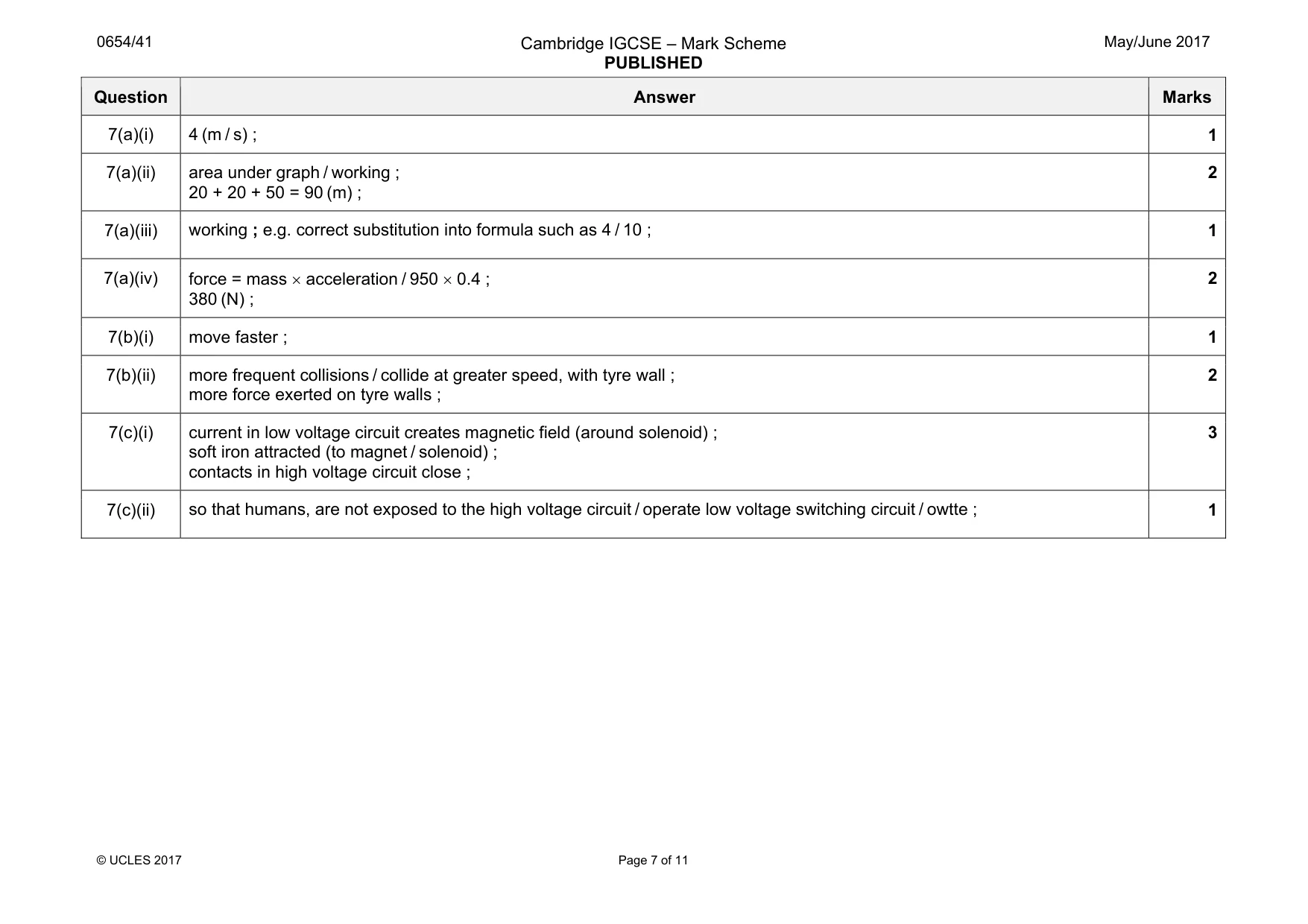
Mark scheme: 7(a)(i) 4 (m / s) ; 1 7(a)(ii) area under graph / working ; 20 + 20 + 50 = 90 (m) ; 2 7(a)(iii) working ; e.g. correct substitution into formula such as 4 / 10 ; 1 7(a)(iv) force = mass × acceleration / 950 × 0.4 ; 380 (N) ; 2 7(b)(i) move faster ; 1 7(b)(ii) more frequent collisions / collide at greater speed, with tyre wall ; more force exerted on tyre walls ; 2 7(c)(i) current in low voltage circuit creates magnetic field (around solenoid) ; soft iron attracted (to magnet / solenoid) ; contacts in high voltage circuit close ; 3 7(c)(ii) so that humans, are not exposed to the high voltage circuit / operate low voltage switching circuit / owtte ; 1
Q8 · The pupil reflex to light is an example of a reflex action
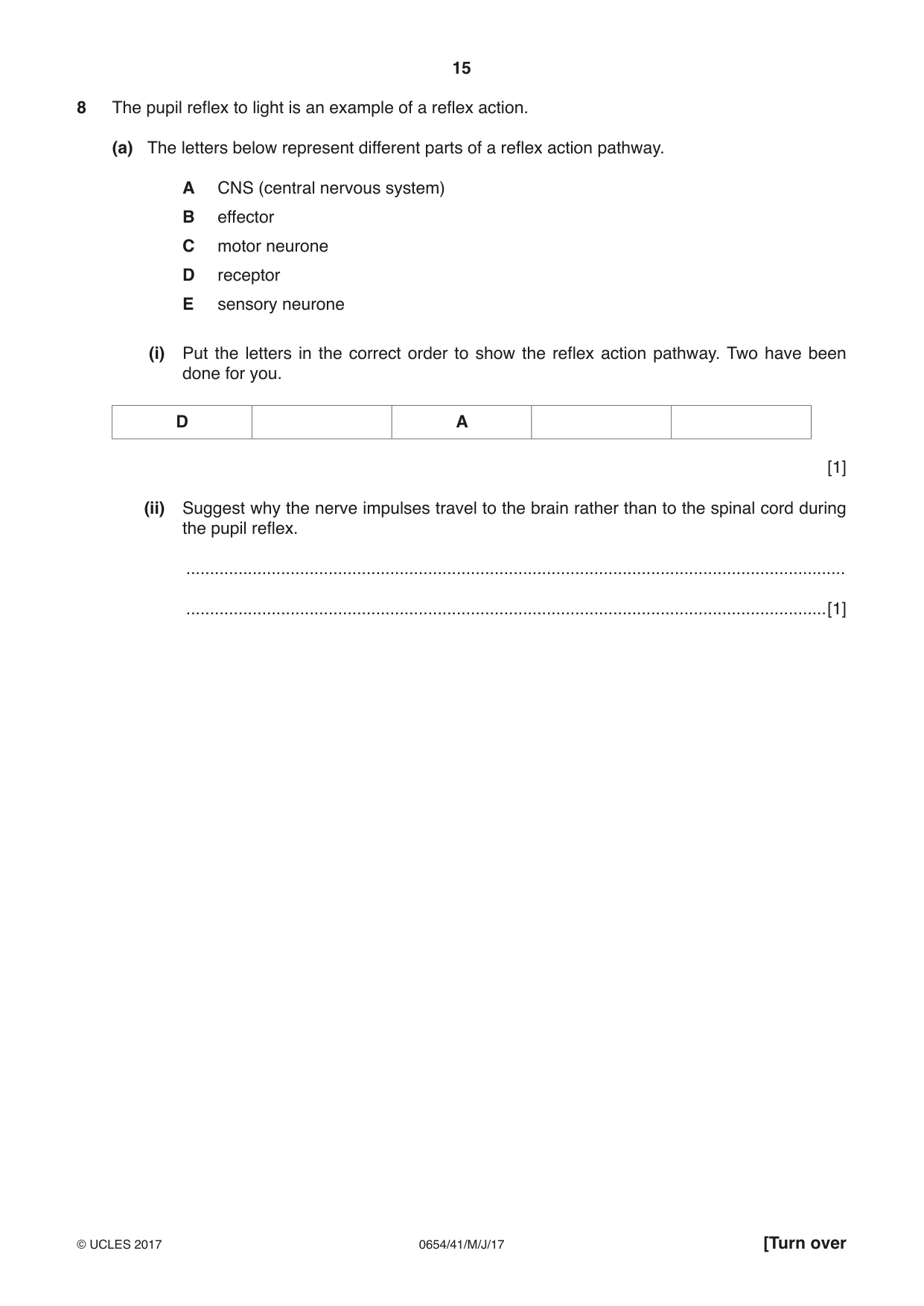
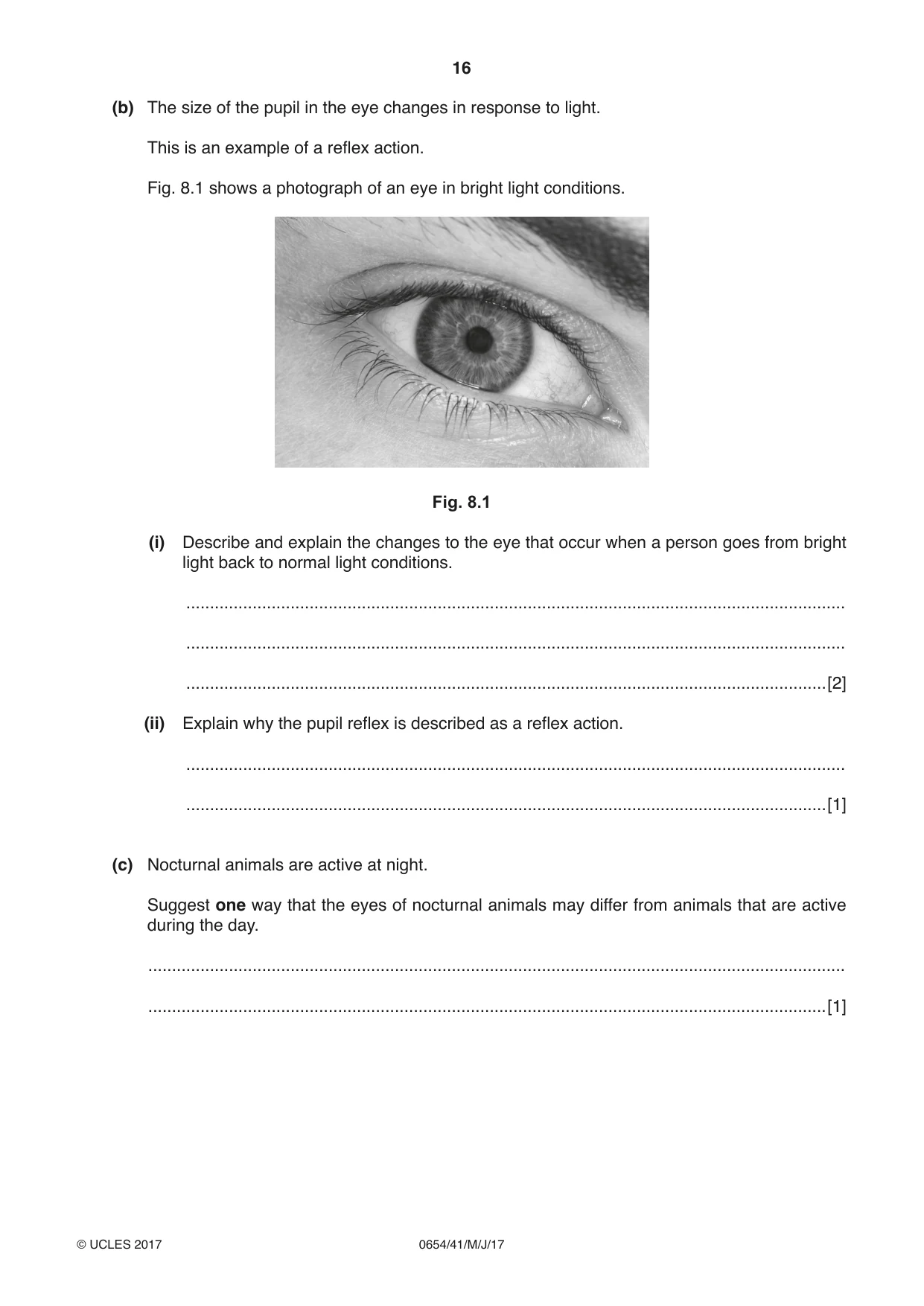
8 The pupil reflex to light is an example of a reflex action. (a) The letters below represent different parts of a reflex action pathway. A CNS (central nervous system) B effector C motor neurone D receptor E sensory neurone (i) Put the letters in the correct order to show the reflex action pathway. Two have been done for you. D A [1] (ii) Suggest why the nerve impulses travel to the brain rather than to the spinal cord during the pupil reflex. ........................................................................................................................................... .......................................................................................................................................[1] (b) The size of the pupil in the eye changes in response to light. This is an example of a reflex action. Fig. 8.1 shows a photograph of an eye in bright light conditions. Fig. 8.1 (i) Describe and explain the changes to the eye that occur when a person goes from bright light back to normal light conditions. ........................................................................................................................................... ........................................................................................................................................... .......................................................................................................................................[2] (ii) Explain why the pupil reflex is described as a reflex action. ........................................................................................................................................... .......................................................................................................................................[1] (c) Nocturnal animals are active at night. Suggest one way that the eyes of nocturnal animals may differ from animals that are active during the day. ................................................................................................................................................... ...............................................................................................................................................[1]
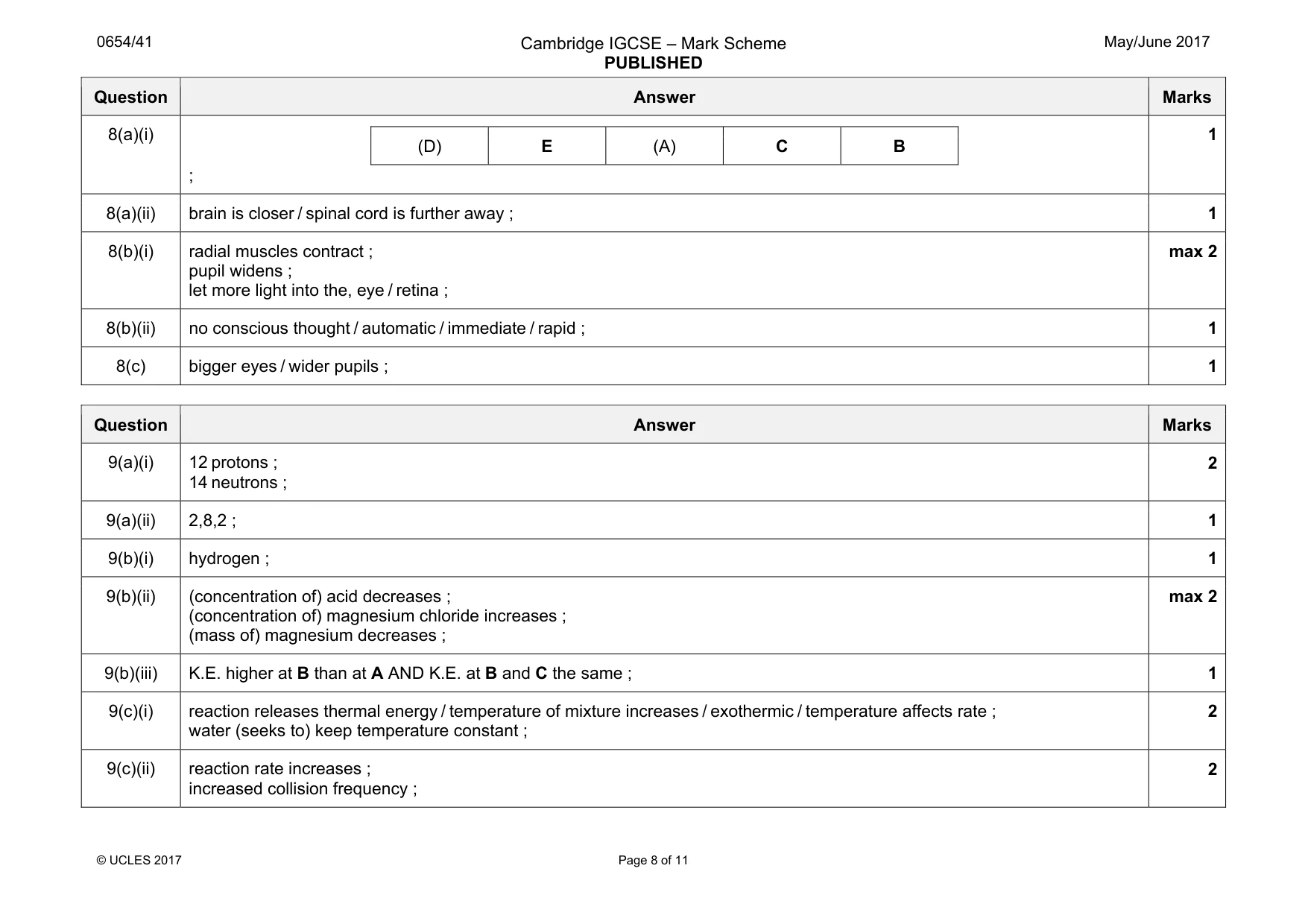
Mark scheme: 8(a)(i) (D) E (A) C B ; 1 8(a)(ii) brain is closer / spinal cord is further away ; 1 8(b)(i) radial muscles contract ; pupil widens ; let more light into the, eye / retina ; max 2 8(b)(ii) no conscious thought / automatic / immediate / rapid ; 1 8(c) bigger eyes / wider pupils ; 1
Q9 · Magnesium is an element in Group II of the Periodic Table
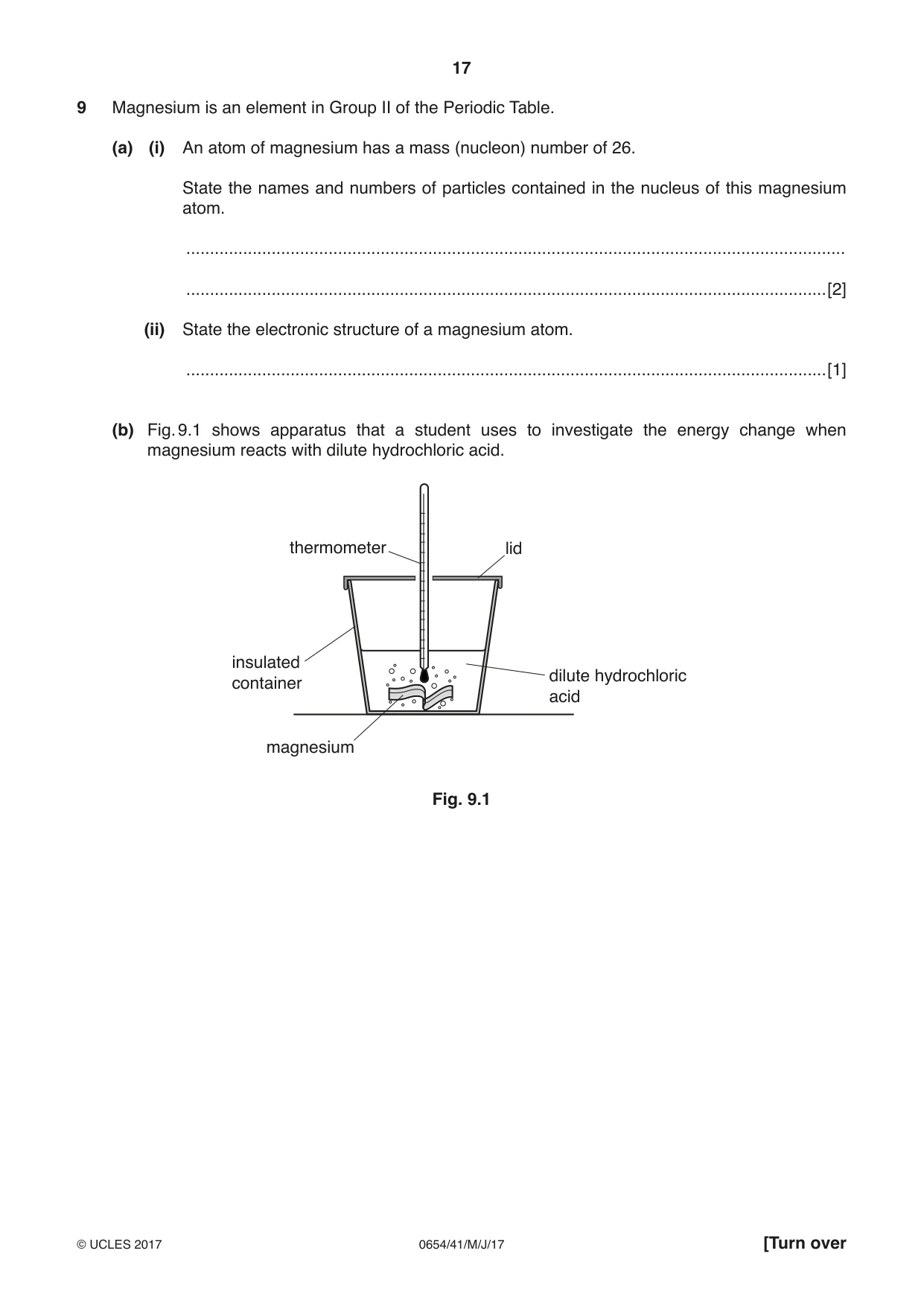
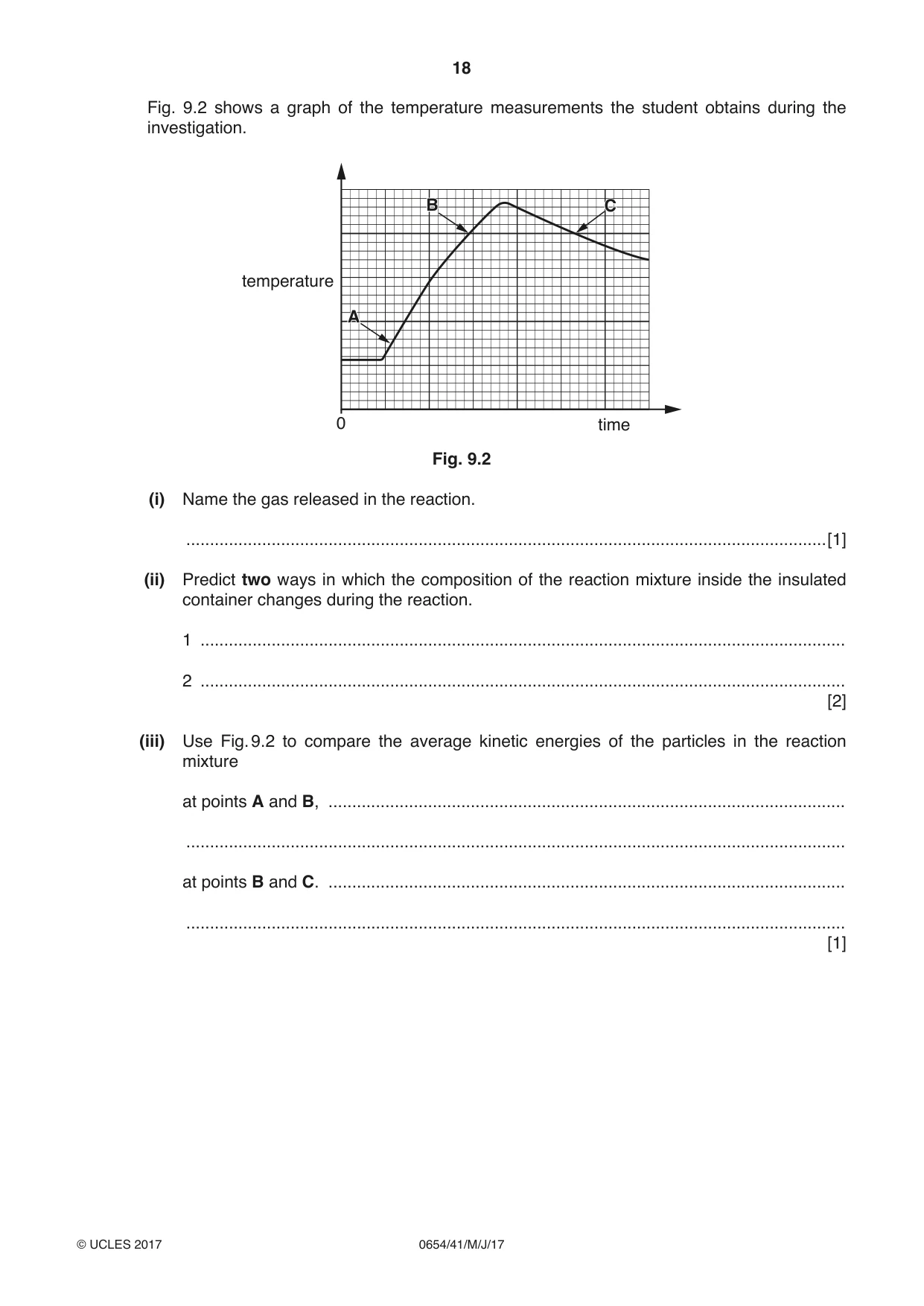
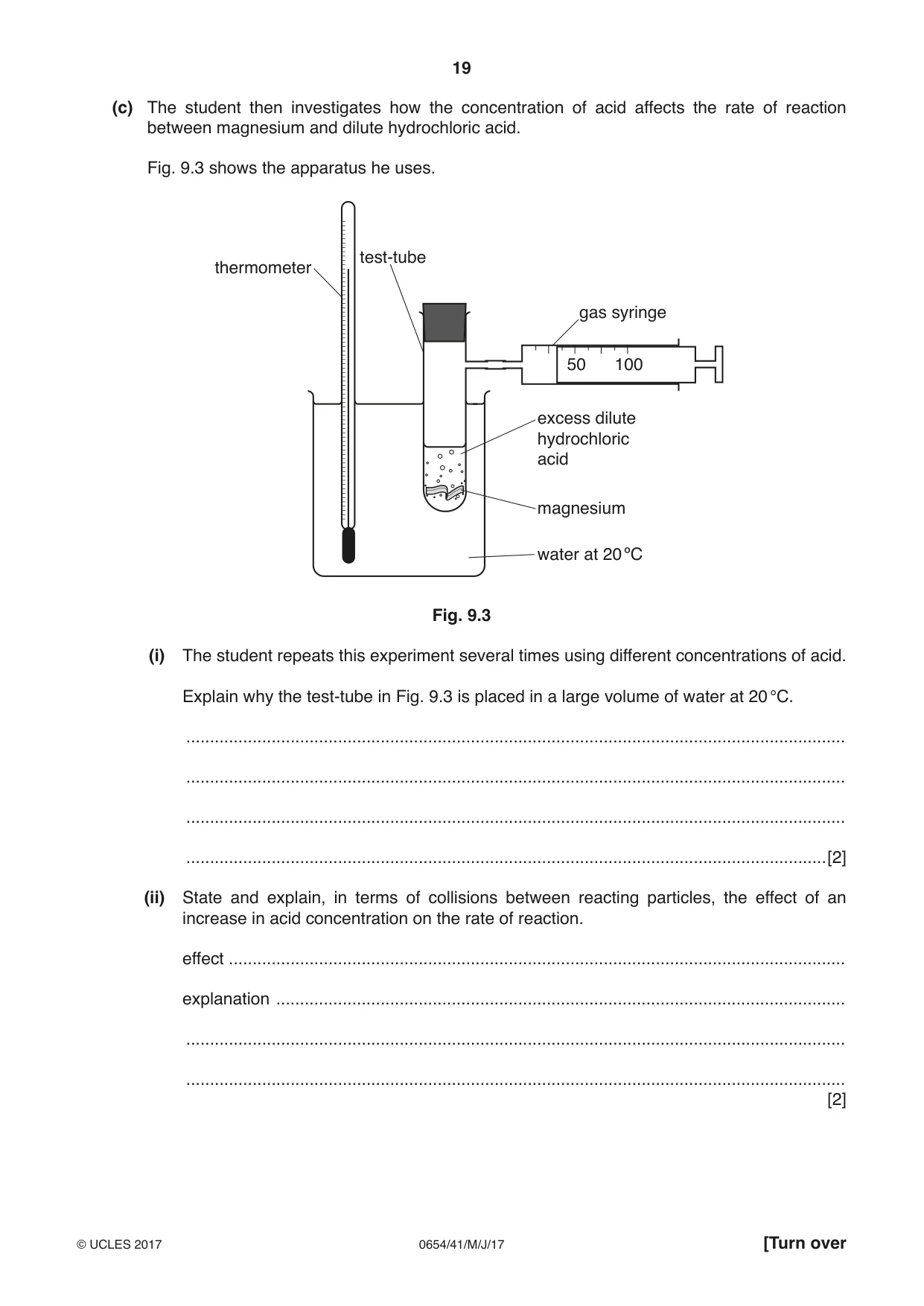
9 Magnesium is an element in Group II of the Periodic Table. (a) (i) An atom of magnesium has a mass (nucleon) number of 26. State the names and numbers of particles contained in the nucleus of this magnesium atom. ........................................................................................................................................... .......................................................................................................................................[2] (ii) State the electronic structure of a magnesium atom. .......................................................................................................................................[1] (b) Fig. 9.1 shows apparatus that a student uses to investigate the energy change when magnesium reacts with dilute hydrochloric acid. thermometer lid insulated dilute hydrochloric container acid magnesium Fig. 9.1 Fig. 9.2 shows a graph of the temperature measurements the student obtains during the investigation. BB CC temperature A 0 time Fig. 9.2 (i) Name the gas released in the reaction. .......................................................................................................................................[1] (ii) Predict two ways in which the composition of the reaction mixture inside the insulated container changes during the reaction. 1 ........................................................................................................................................ 2 ........................................................................................................................................ [2] (iii) Use Fig. 9.2 to compare the average kinetic energies of the particles in the reaction mixture at points A and B, ............................................................................................................. ........................................................................................................................................... at points B and C. ............................................................................................................. ........................................................................................................................................... [1] (c) The student then investigates how the concentration of acid affects the rate of reaction between magnesium and dilute hydrochloric acid. Fig. 9.3 shows the apparatus he uses. test-tube thermometer gas syringe 50 100 excess dilute hydrochloric acid magnesium water at 20 ºC Fig. 9.3 (i) The student repeats this experiment several times using different concentrations of acid. Explain why the test-tube in Fig. 9.3 is placed in a large volume of water at 20 °C. ........................................................................................................................................... ........................................................................................................................................... ........................................................................................................................................... .......................................................................................................................................[2] (ii) State and explain, in terms of collisions between reacting particles, the effect of an increase in acid concentration on the rate of reaction. effect .................................................................................................................................. explanation ........................................................................................................................ ........................................................................................................................................... ........................................................................................................................................... [2]
Mark scheme: 9(a)(i) 12 protons ; 14 neutrons ; 2 9(a)(ii) 2,8,2 ; 1 9(b)(i) hydrogen ; 1 9(b)(ii) (concentration of) acid decreases ; (concentration of) magnesium chloride increases ; (mass of) magnesium decreases ; max 2 9(b)(iii) K.E. higher at B than at A AND K.E. at B and C the same ; 1 9(c)(i) reaction releases thermal energy / temperature of mixture increases / exothermic / temperature affects rate ; water (seeks to) keep temperature constant ; 2 9(c)(ii) reaction rate increases ; increased collision frequency ; 2
Q10 · A student investigates the respiration rate of germinating seeds using the apparatus…
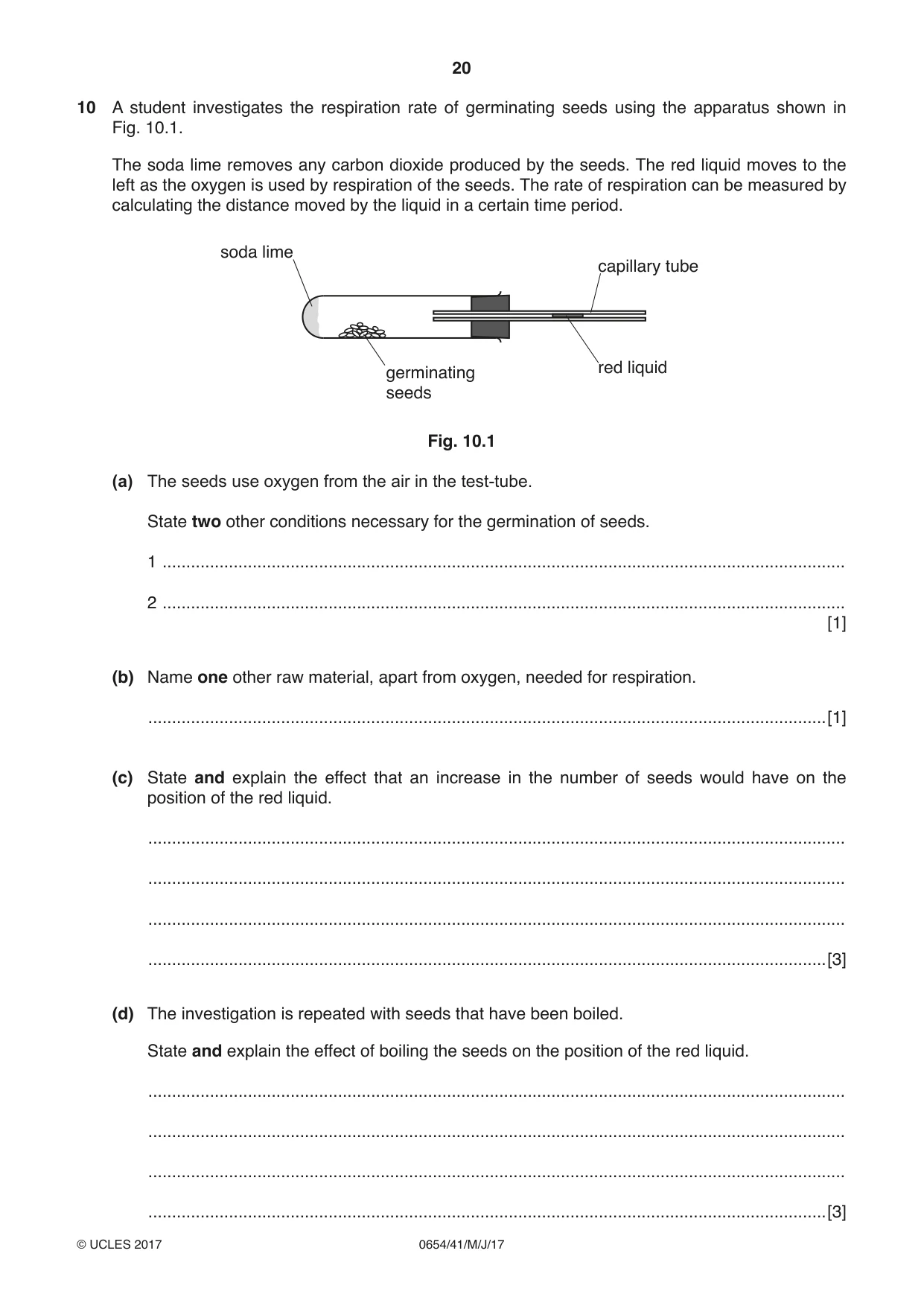
10 A student investigates the respiration rate of germinating seeds using the apparatus shown in Fig. 10.1. The soda lime removes any carbon dioxide produced by the seeds. The red liquid moves to the left as the oxygen is used by respiration of the seeds. The rate of respiration can be measured by calculating the distance moved by the liquid in a certain time period. soda lime capillary tube red liquid germinating seeds Fig. 10.1 (a) The seeds use oxygen from the air in the test-tube. State two other conditions necessary for the germination of seeds. 1 ................................................................................................................................................ 2 ................................................................................................................................................ [1] (b) Name one other raw material, apart from oxygen, needed for respiration. ...............................................................................................................................................[1] (c) State and explain the effect that an increase in the number of seeds would have on the position of the red liquid. ................................................................................................................................................... ................................................................................................................................................... ................................................................................................................................................... ...............................................................................................................................................[3] (d) The investigation is repeated with seeds that have been boiled. State and explain the effect of boiling the seeds on the position of the red liquid. ................................................................................................................................................... ................................................................................................................................................... ................................................................................................................................................... ...............................................................................................................................................[3]
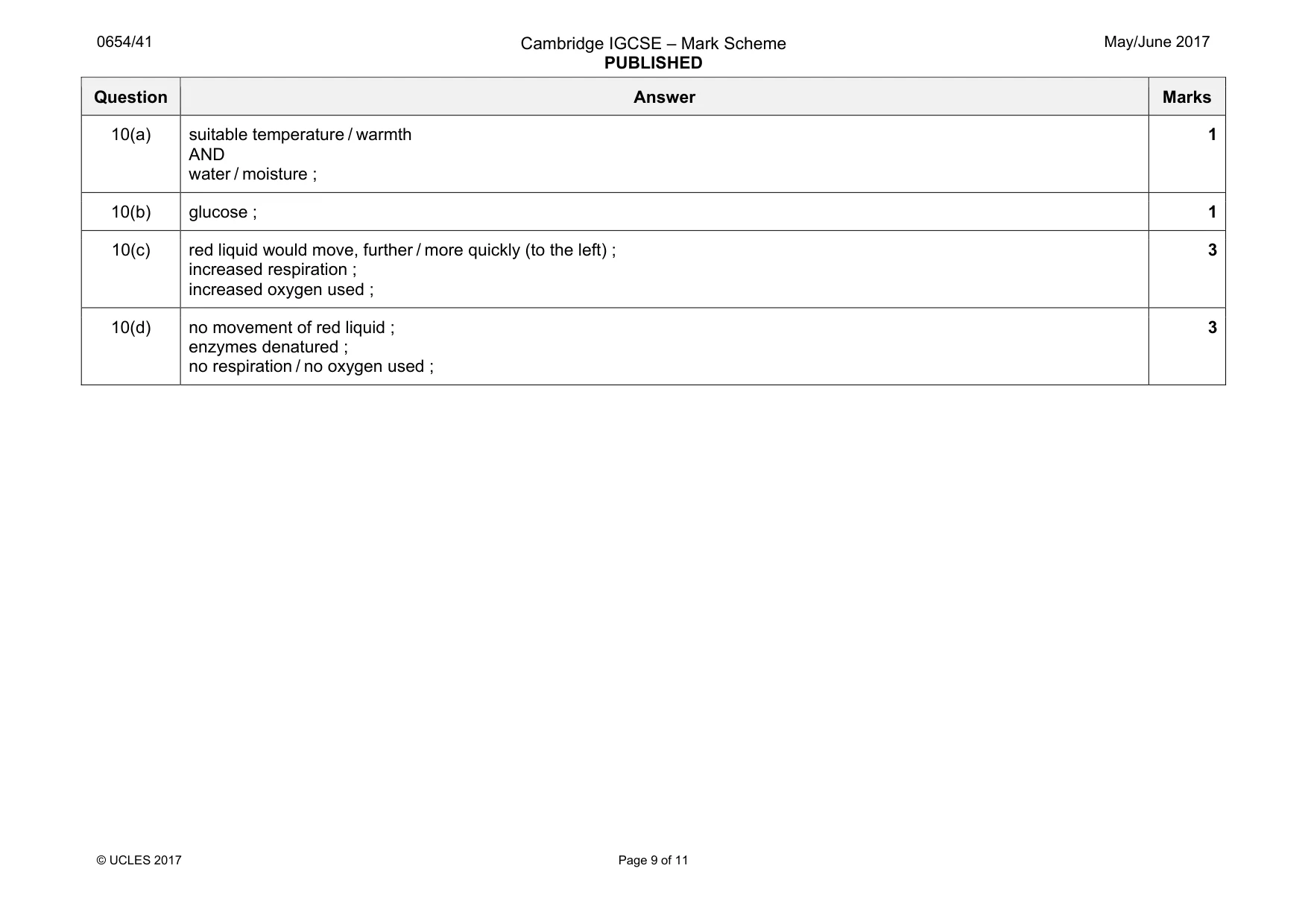
Mark scheme: 10(a) suitable temperature / warmth AND water / moisture ; 1 10(b) glucose ; 1 10(c) red liquid would move, further / more quickly (to the left) ; increased respiration ; increased oxygen used ; 3 10(d) no movement of red liquid ; enzymes denatured ; no respiration / no oxygen used ; 3
Q11 · A small quantity of radioactive material is taken from a nuclear reactor
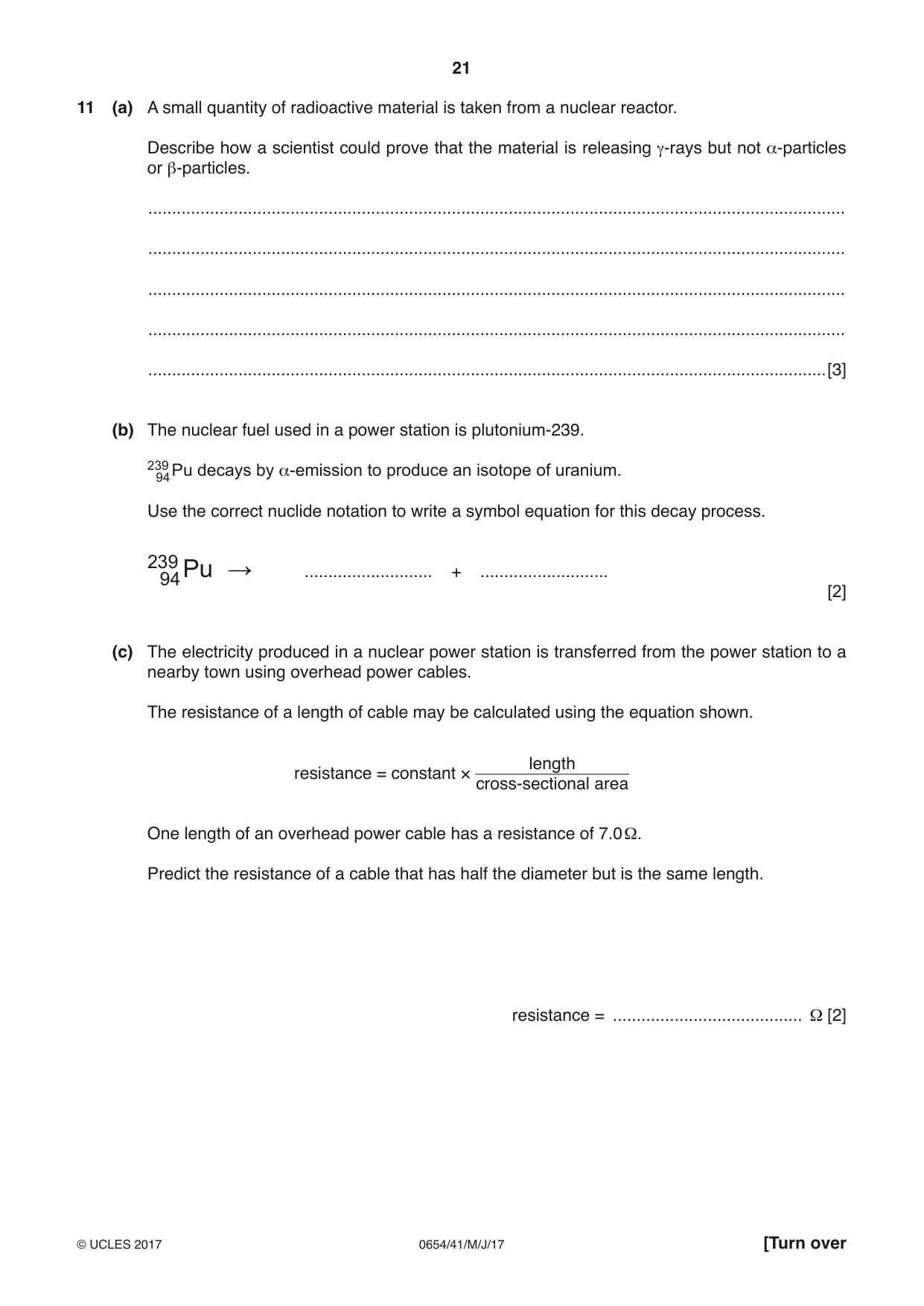
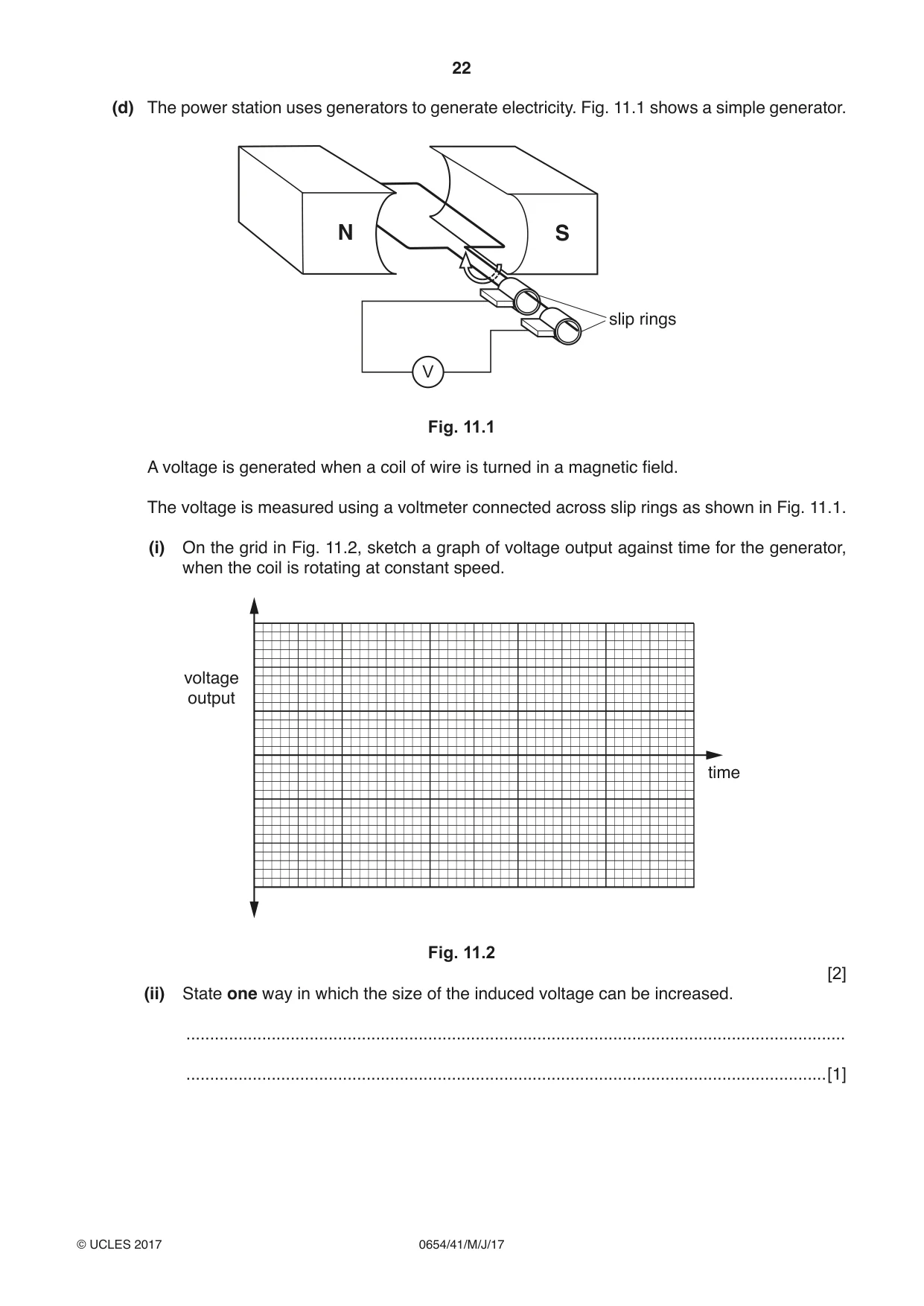
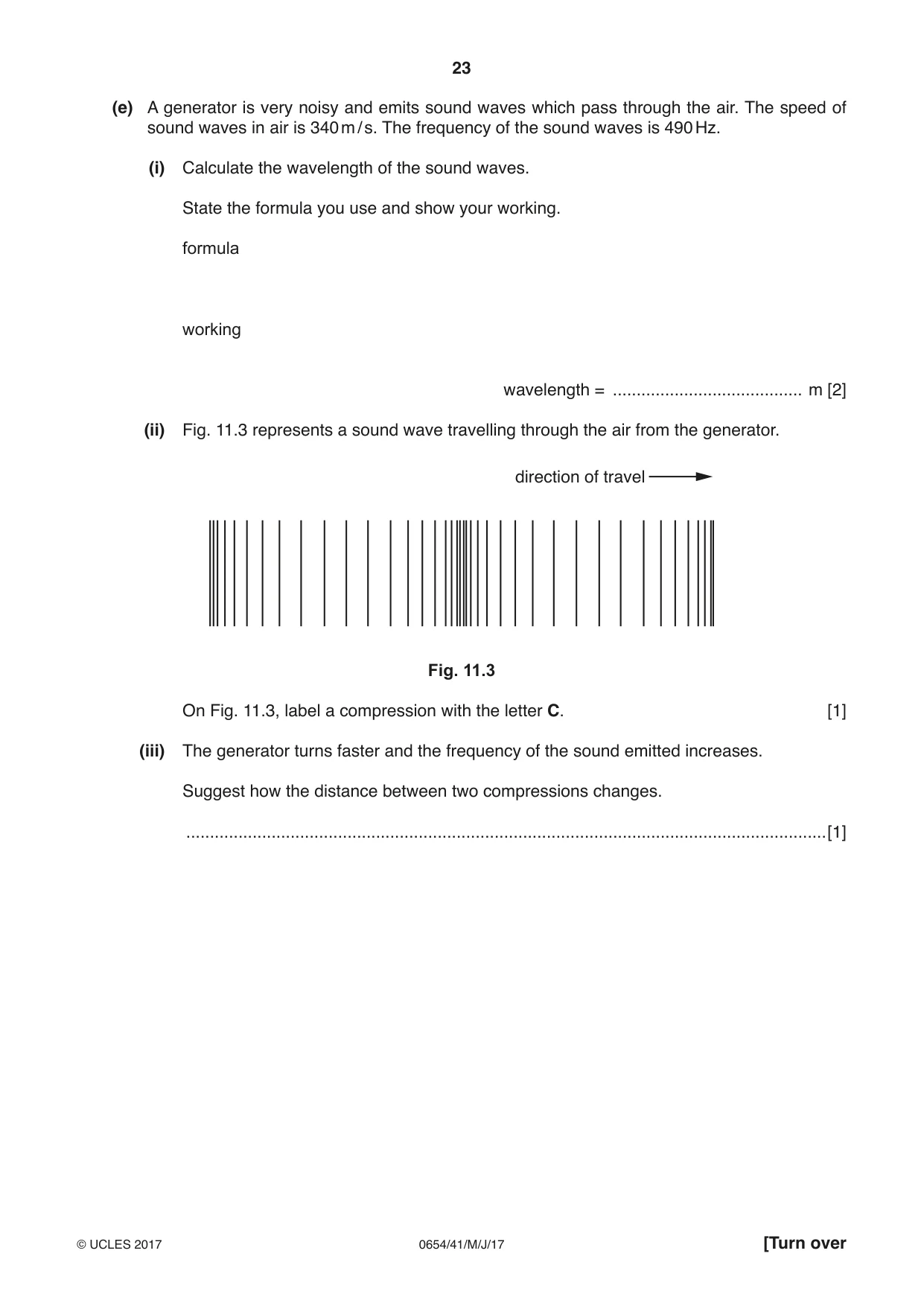
11 (a) A small quantity of radioactive material is taken from a nuclear reactor. Describe how a scientist could prove that the material is releasing γ-rays but not α-particles or β-particles. ................................................................................................................................................... ................................................................................................................................................... ................................................................................................................................................... ................................................................................................................................................... ...............................................................................................................................................[3] (b) The nuclear fuel used in a power station is plutonium-239. 239 94 Pu decays by α-emission to produce an isotope of uranium. Use the correct nuclide notation to write a symbol equation for this decay process. 239 Pu → ........................... + ........................... 94 [2] (c) The electricity produced in a nuclear power station is transferred from the power station to a nearby town using overhead power cables. The resistance of a length of cable may be calculated using the equation shown. length resistance = constant × cross-sectional area One length of an overhead power cable has a resistance of 7.0 Ω. Predict the resistance of a cable that has half the diameter but is the same length. resistance = ........................................ Ω [2] (d) The power station uses generators to generate electricity. Fig. 11.1 shows a simple generator. N S slip rings V Fig. 11.1 A voltage is generated when a coil of wire is turned in a magnetic field. The voltage is measured using a voltmeter connected across slip rings as shown in Fig. 11.1. (i) On the grid in Fig. 11.2, sketch a graph of voltage output against time for the generator, when the coil is rotating at constant speed. voltage output time Fig. 11.2 [2] (ii) State one way in which the size of the induced voltage can be increased. ........................................................................................................................................... .......................................................................................................................................[1] (e) A generator is very noisy and emits sound waves which pass through the air. The speed of sound waves in air is 340 m / s. The frequency of the sound waves is 490 Hz. (i) Calculate the wavelength of the sound waves. State the formula you use and show your working. formula working wavelength = ........................................ m [2] (ii) Fig. 11.3 represents a sound wave travelling through the air from the generator. direction of travel Fig. 11.3 On Fig. 11.3, label a compression with the letter C. [1] (iii) The generator turns faster and the frequency of the sound emitted increases. Suggest how the distance between two compressions changes. .......................................................................................................................................[1]
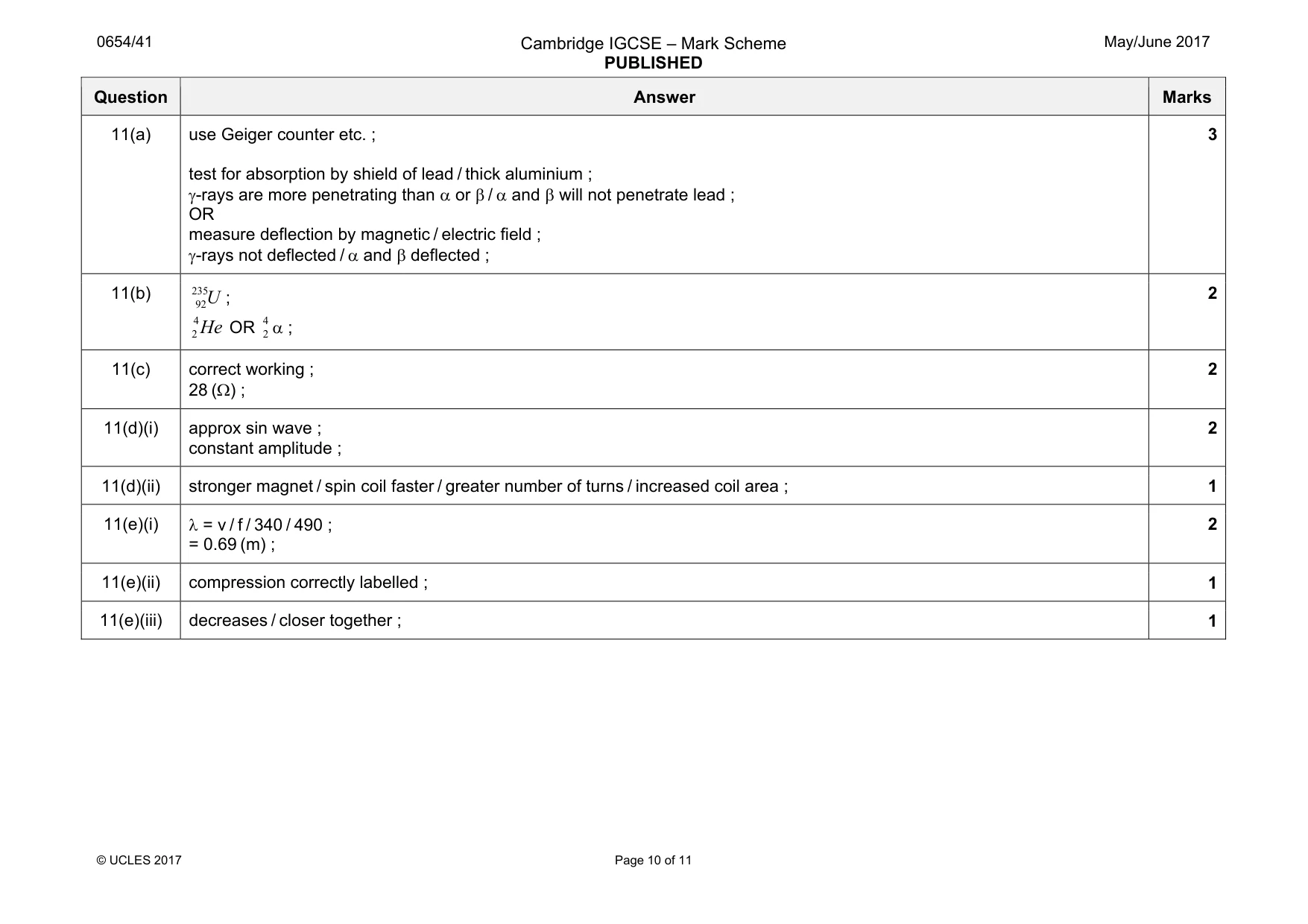
Mark scheme: 11(a) use Geiger counter etc. ; test for absorption by shield of lead / thick aluminium ; γ-rays are more penetrating than α or β / α and β will not penetrate lead ; OR measure deflection by magnetic / electric field ; γ-rays not deflected / α and β deflected ; 3 11(b) U 235 92 ; He 4 2 OR 4 2 α ; 2 11(c) correct working ; 28 (Ω) ; 2 11(d)(i) approx sin wave ; constant amplitude ; 2 11(d)(ii) stronger magnet / spin coil faster / greater number of turns / increased coil area ; 1 11(e)(i) λ = v / f / 340 / 490 ; = 0.69 (m) ; 2 11(e)(ii) compression correctly labelled ; 1 11(e)(iii) decreases / closer together ; 1
Q12 · Sodium reacting with chlorine gas
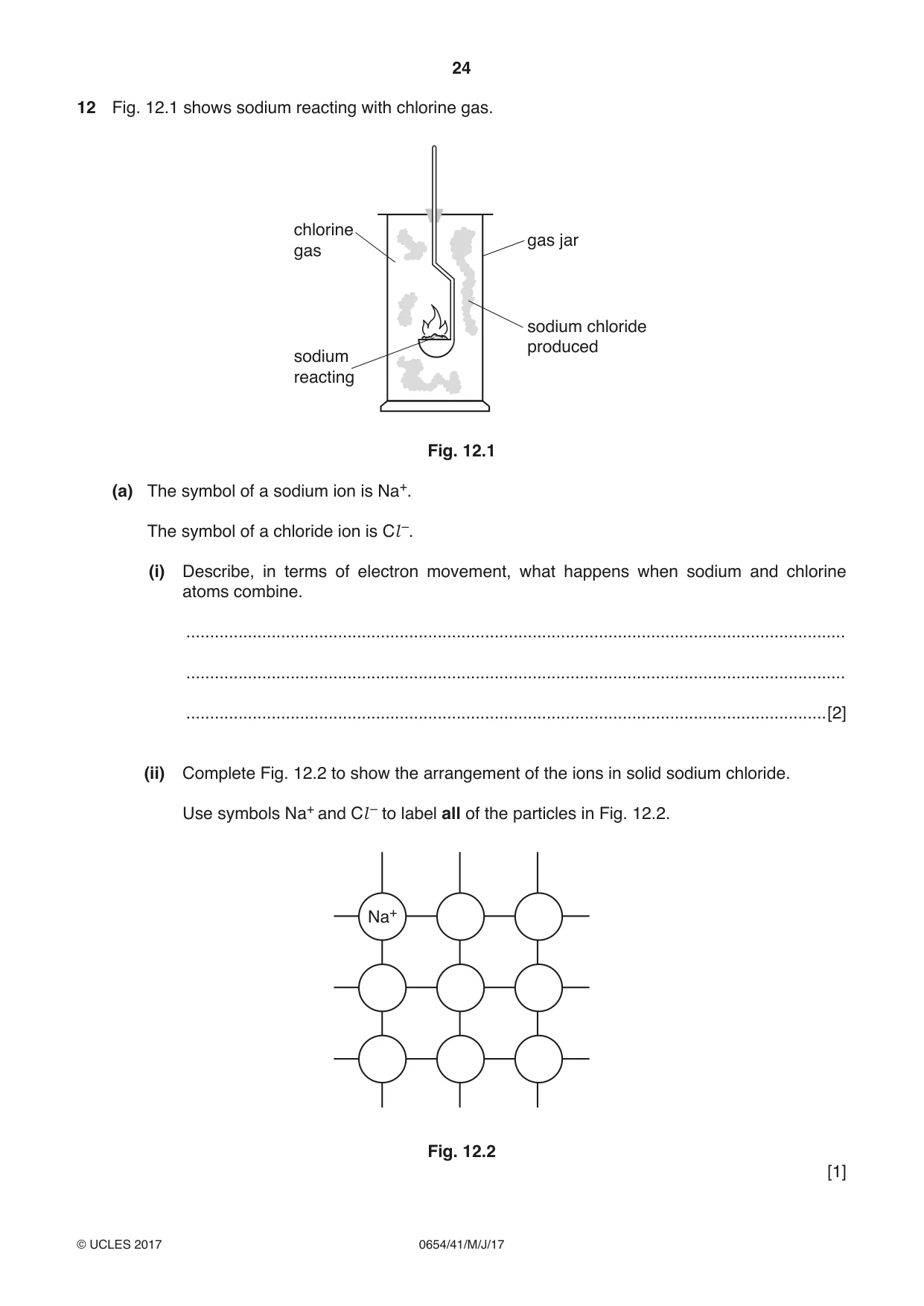
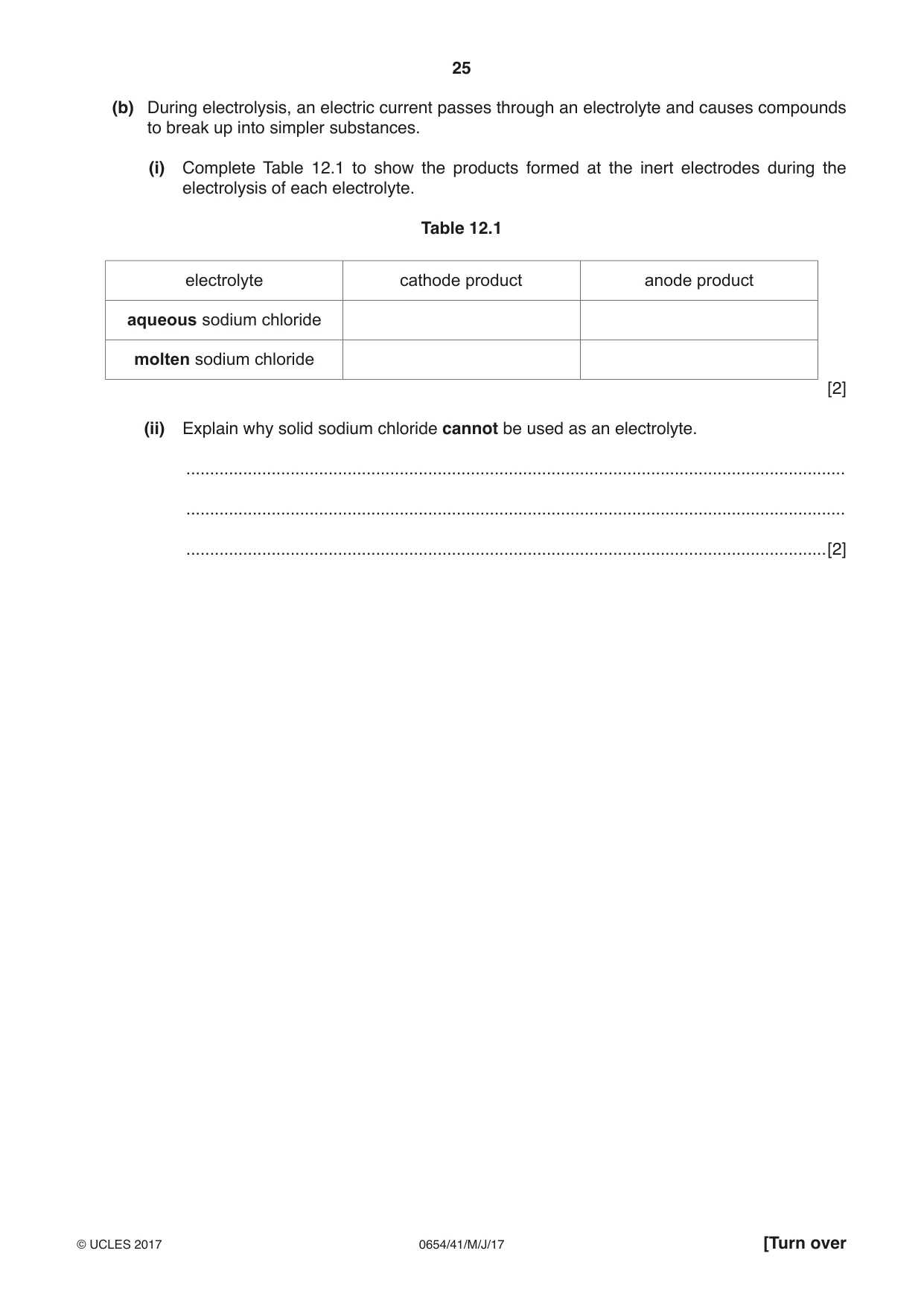
12 Fig. 12.1 shows sodium reacting with chlorine gas. chlorine gas jar gas sodium chloride produced sodium reacting Fig. 12.1 (a) The symbol of a sodium ion is Na+. The symbol of a chloride ion is Cl –. (i) Describe, in terms of electron movement, what happens when sodium and chlorine atoms combine. ........................................................................................................................................... ........................................................................................................................................... .......................................................................................................................................[2] (ii) Complete Fig. 12.2 to show the arrangement of the ions in solid sodium chloride. Use symbols Na+ and Cl – to label all of the particles in Fig. 12.2. Na+ Fig. 12.2 [1] (b) During electrolysis, an electric current passes through an electrolyte and causes compounds to break up into simpler substances. (i) Complete Table 12.1 to show the products formed at the inert electrodes during the electrolysis of each electrolyte. Table 12.1 electrolyte cathode product anode product aqueous sodium chloride molten sodium chloride [2] (ii) Explain why solid sodium chloride cannot be used as an electrolyte. ........................................................................................................................................... ........................................................................................................................................... .......................................................................................................................................[2]
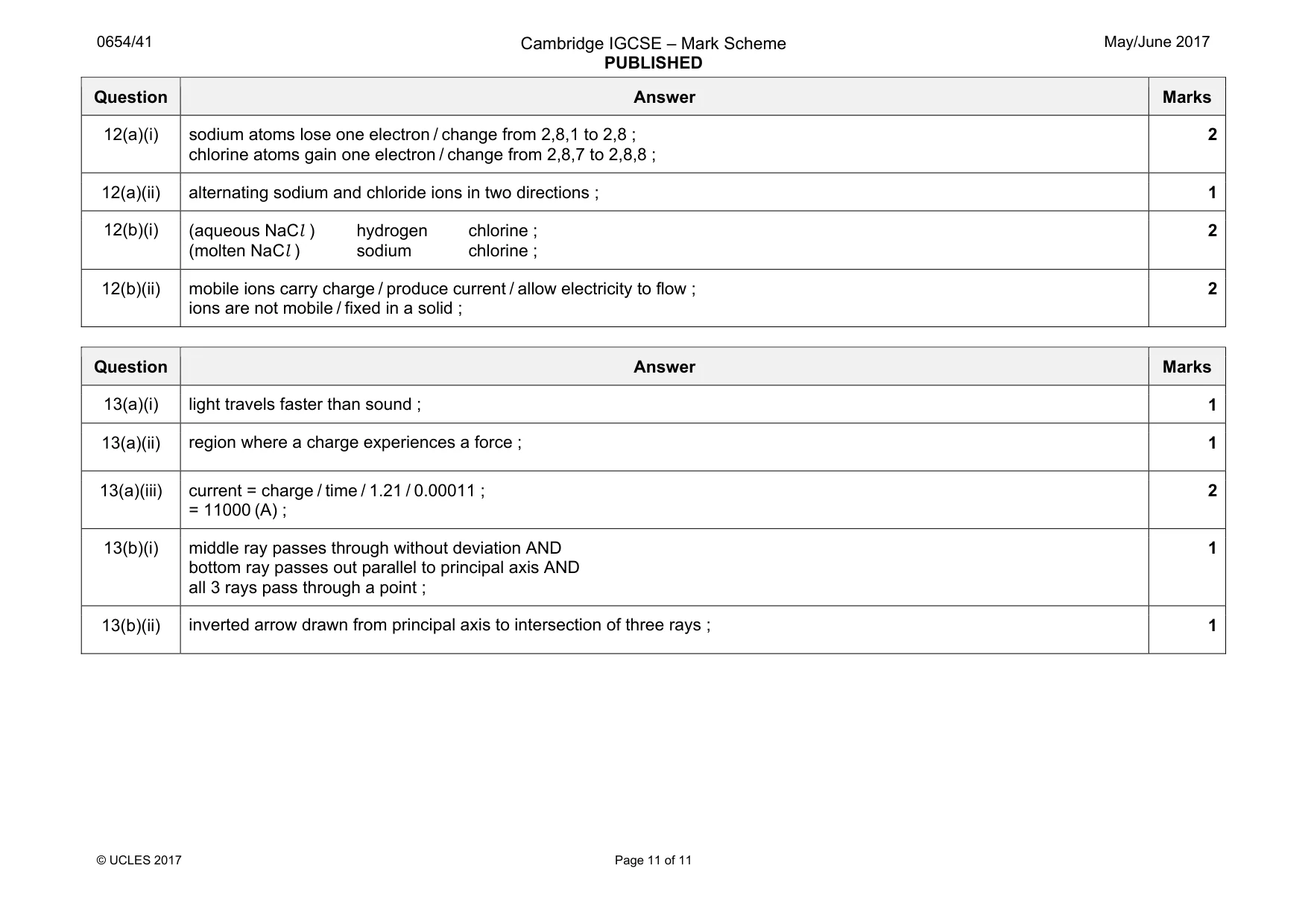
Mark scheme: 12(a)(i) sodium atoms lose one electron / change from 2,8,1 to 2,8 ; chlorine atoms gain one electron / change from 2,8,7 to 2,8,8 ; 2 12(a)(ii) alternating sodium and chloride ions in two directions ; 1 12(b)(i) (aqueous NaCl ) hydrogen chlorine ; (molten NaCl ) sodium chlorine ; 2 12(b)(ii) mobile ions carry charge / produce current / allow electricity to flow ; ions are not mobile / fixed in a solid ; 2
Q13 · A student is climbing a mountain
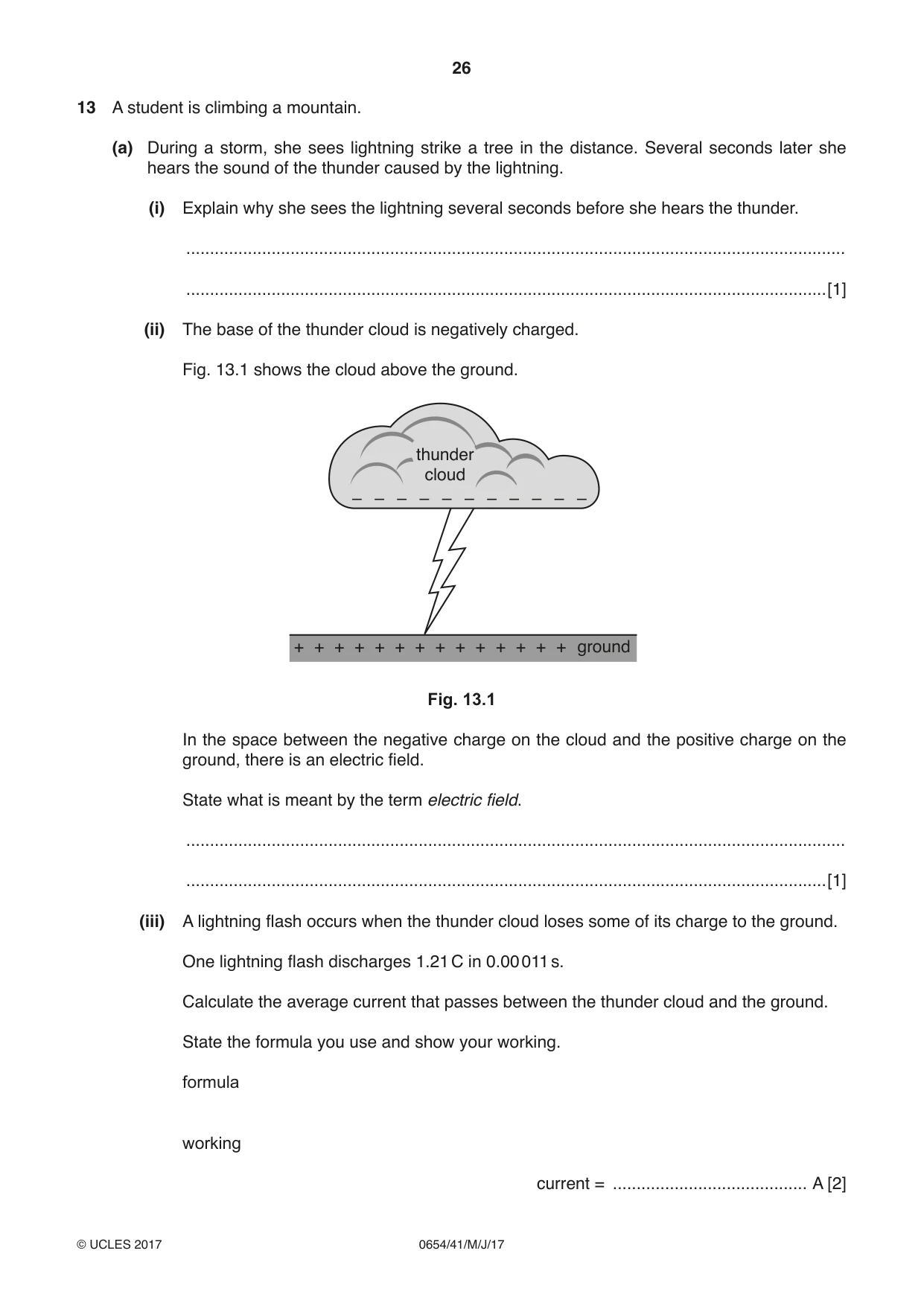
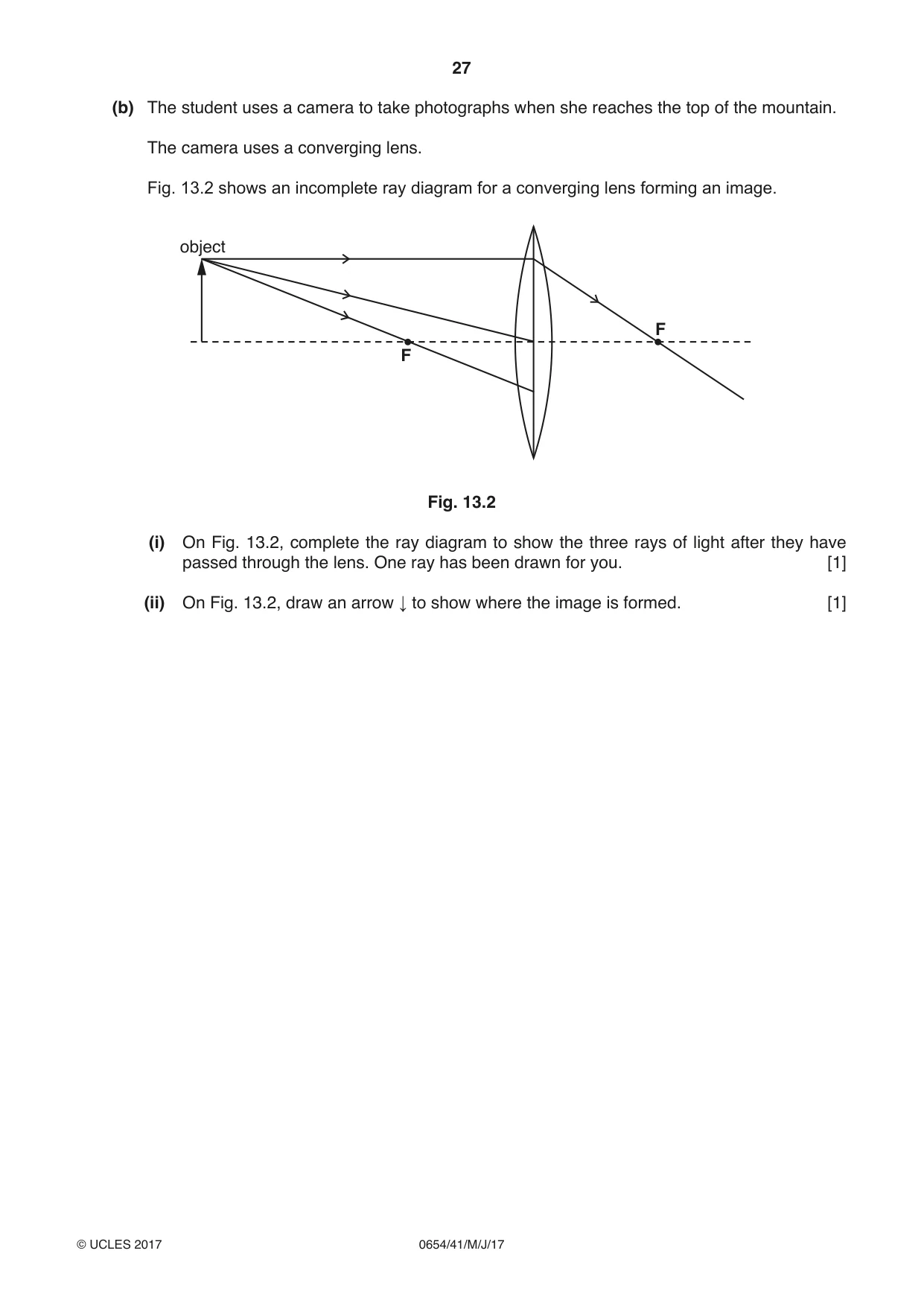
13 A student is climbing a mountain. (a) During a storm, she sees lightning strike a tree in the distance. Several seconds later she hears the sound of the thunder caused by the lightning. (i) Explain why she sees the lightning several seconds before she hears the thunder. ........................................................................................................................................... .......................................................................................................................................[1] (ii) The base of the thunder cloud is negatively charged. Fig. 13.1 shows the cloud above the ground. thunder cloud – – – – – – – – – – – + + + + + + + + + + + + + + ground Fig. 13.1 In the space between the negative charge on the cloud and the positive charge on the ground, there is an electric field. State what is meant by the term electric field. ........................................................................................................................................... .......................................................................................................................................[1] (iii) A lightning flash occurs when the thunder cloud loses some of its charge to the ground. One lightning flash discharges 1.21 C in 0.00 011 s. Calculate the average current that passes between the thunder cloud and the ground. State the formula you use and show your working. formula working current = ......................................... A [2] (b) The student uses a camera to take photographs when she reaches the top of the mountain. The camera uses a converging lens. Fig. 13.2 shows an incomplete ray diagram for a converging lens forming an image. object F F Fig. 13.2 (i) On Fig. 13.2, complete the ray diagram to show the three rays of light after they have passed through the lens. One ray has been drawn for you. [1] (ii) On Fig. 13.2, draw an arrow ↓ to show where the image is formed. [1]
Mark scheme: 13(a)(i) light travels faster than sound ; 1 13(a)(ii) region where a charge experiences a force ; 1 13(a)(iii) current = charge / time / 1.21 / 0.00011 ; = 11000 (A) ; 2 13(b)(i) middle ray passes through without deviation AND bottom ray passes out parallel to principal axis AND all 3 rays pass through a point ; 1 13(b)(ii) inverted arrow drawn from principal axis to intersection of three rays ; 1
What was in this paper
The subtopics covered by these 13 questions, and how many questions each got. Open one in a new tab to see every Cambridge question on it.
What you needed in this session
Cambridge’s own grade thresholds for 2017 May/June, Paper 4 · Variant 1. A higher threshold means an easier paper — the bar moves with how the cohort did.