Cambridge IGCSE Sciences - Co-ordinated (Double) 0654 — 2017 May/June Paper 4 · Variant 2
0654/42/M/J/17 · 13 questions · 120 marks · ≈135 min
The question paper and its mark scheme, free to read here and free to download. This is Cambridge’s own paper, exactly as it was sat.
Question paper28 pages

Mark scheme10 pages
Answers below. Sit the paper first if you are practising.
Questions as text
Q1 · A diagram of the human circulatory system
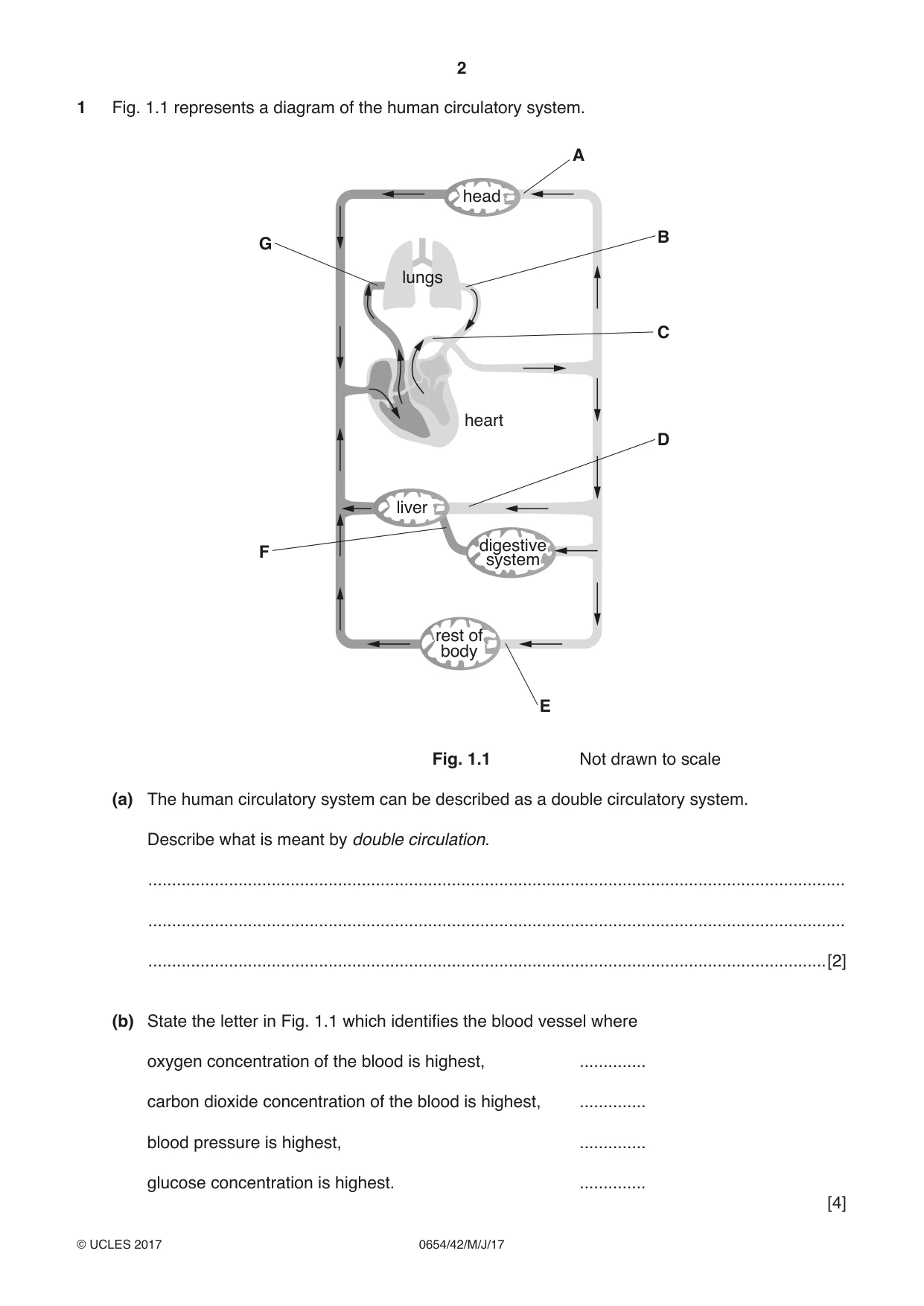
1 Fig. 1.1 represents a diagram of the human circulatory system. A head B G lungs C heart D liver digestive F system rest of body E Fig. 1.1 Not drawn to scale (a) The human circulatory system can be described as a double circulatory system. Describe what is meant by double circulation. ................................................................................................................................................... ................................................................................................................................................... ...............................................................................................................................................[2] (b) State the letter in Fig. 1.1 which identifies the blood vessel where oxygen concentration of the blood is highest, .............. carbon dioxide concentration of the blood is highest, .............. blood pressure is highest, .............. glucose concentration is highest. .............. [4] (c) (i) Name the blood vessels which become blocked when suffering from coronary heart disease. .......................................................................................................................................[1] (ii) A person has a family history of coronary heart disease. State two lifestyle recommendations to reduce the chances of the person developing coronary heart disease. 1 ........................................................................................................................................ 2 ........................................................................................................................................ [2]
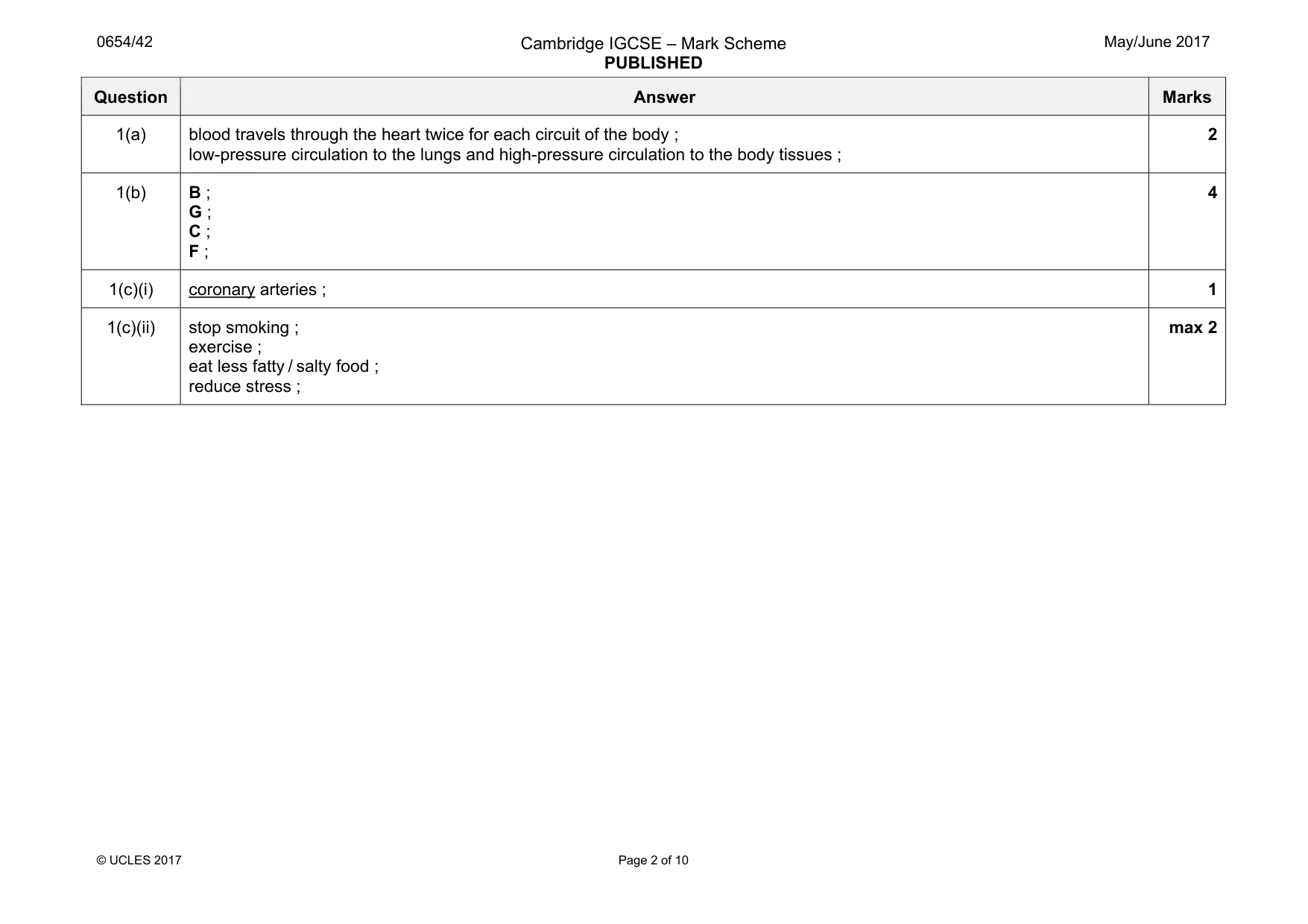
Mark scheme: 1(a) blood travels through the heart twice for each circuit of the body ; low-pressure circulation to the lungs and high-pressure circulation to the body tissues ; 2 1(b) B ; G ; C ; F ; 4 1(c)(i) coronary arteries ; 1 1(c)(ii) stop smoking ; exercise ; eat less fatty / salty food ; reduce stress ; max 2
Q2 · The electronic structures of atoms of four elements, A, B, C and D
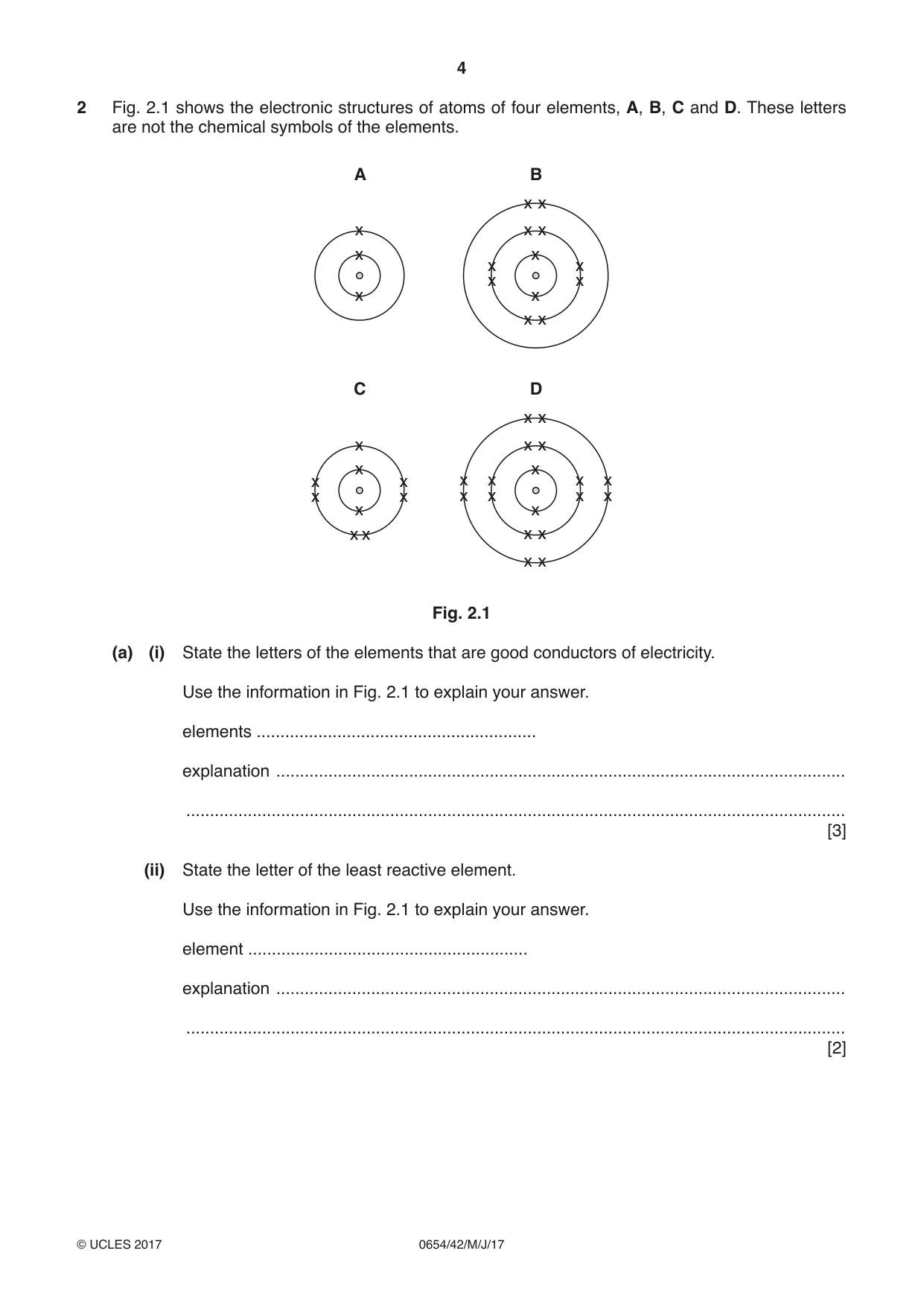
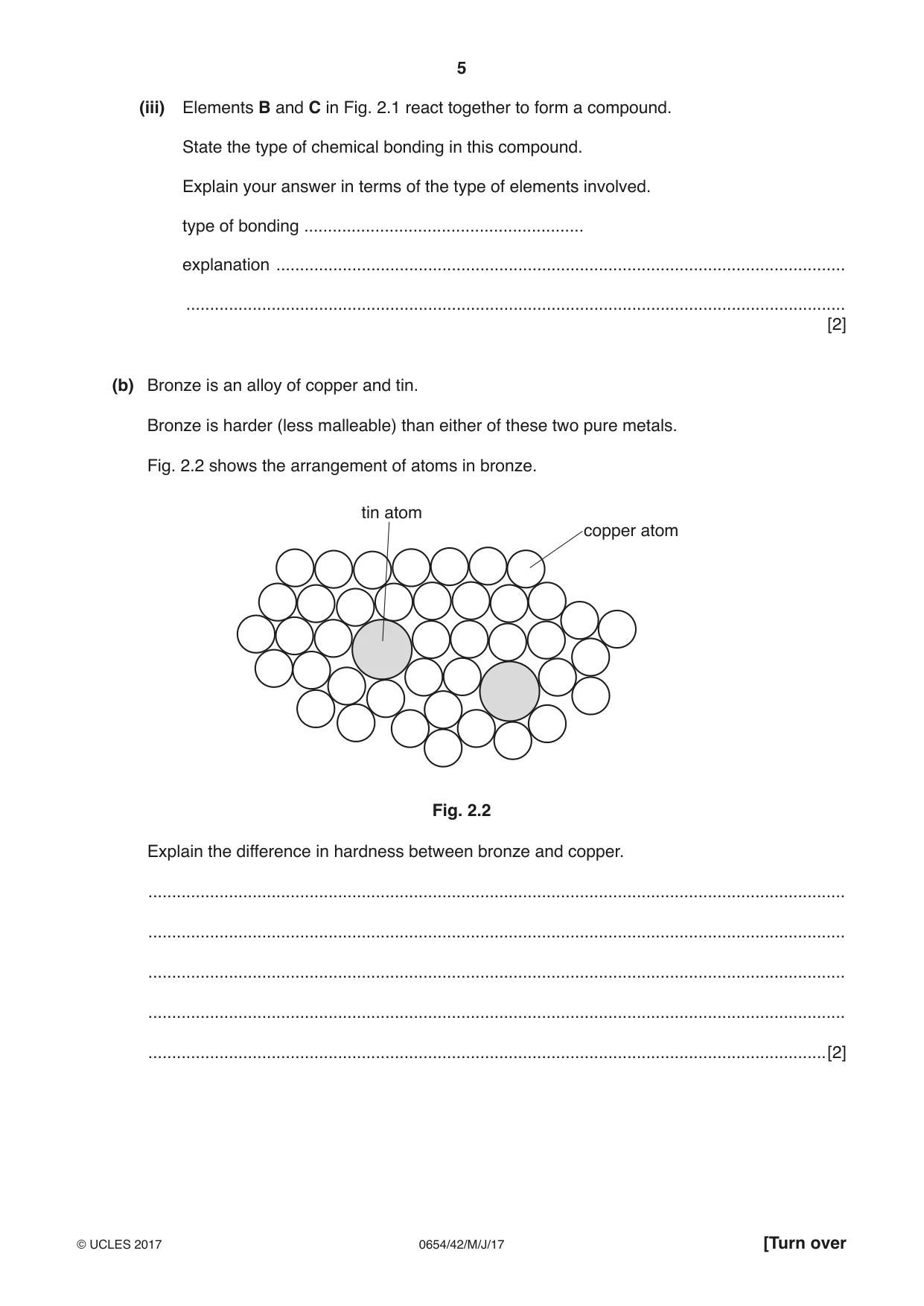
2 Fig. 2.1 shows the electronic structures of atoms of four elements, A, B, C and D. These letters are not the chemical symbols of the elements. A B x x x x x x x x x x x x x x x C D x x x x x x x x x x x x x x x x x x x x x x x x x x x Fig. 2.1 (a) (i) State the letters of the elements that are good conductors of electricity. Use the information in Fig. 2.1 to explain your answer. elements ........................................................... explanation ........................................................................................................................ ........................................................................................................................................... [3] (ii) State the letter of the least reactive element. Use the information in Fig. 2.1 to explain your answer. element ........................................................... explanation ........................................................................................................................ ........................................................................................................................................... [2] (iii) Elements B and C in Fig. 2.1 react together to form a compound. State the type of chemical bonding in this compound. Explain your answer in terms of the type of elements involved. type of bonding ........................................................... explanation ........................................................................................................................ ........................................................................................................................................... [2] (b) Bronze is an alloy of copper and tin. Bronze is harder (less malleable) than either of these two pure metals. Fig. 2.2 shows the arrangement of atoms in bronze. tin atom copper atom Fig. 2.2 Explain the difference in hardness between bronze and copper. ................................................................................................................................................... ................................................................................................................................................... ................................................................................................................................................... ................................................................................................................................................... ...............................................................................................................................................[2]
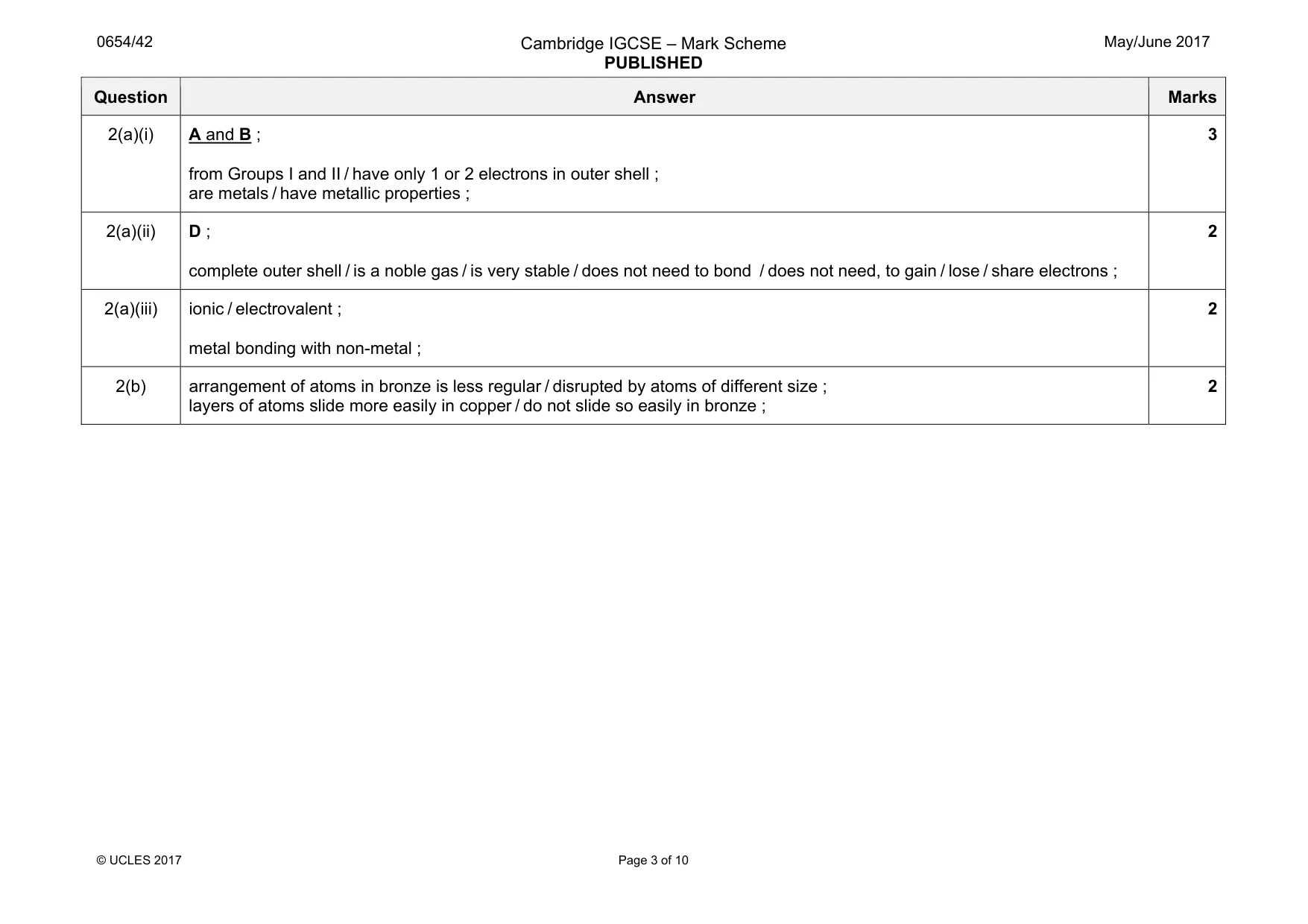
Mark scheme: 2(a)(i) A and B ; from Groups I and II / have only 1 or 2 electrons in outer shell ; are metals / have metallic properties ; 3 2(a)(ii) D ; complete outer shell / is a noble gas / is very stable / does not need to bond / does not need, to gain / lose / share electrons ; 2 2(a)(iii) ionic / electrovalent ; metal bonding with non-metal ; 2 2(b) arrangement of atoms in bronze is less regular / disrupted by atoms of different size ; layers of atoms slide more easily in copper / do not slide so easily in bronze ; 2
Q3 · A list of metals is shown below
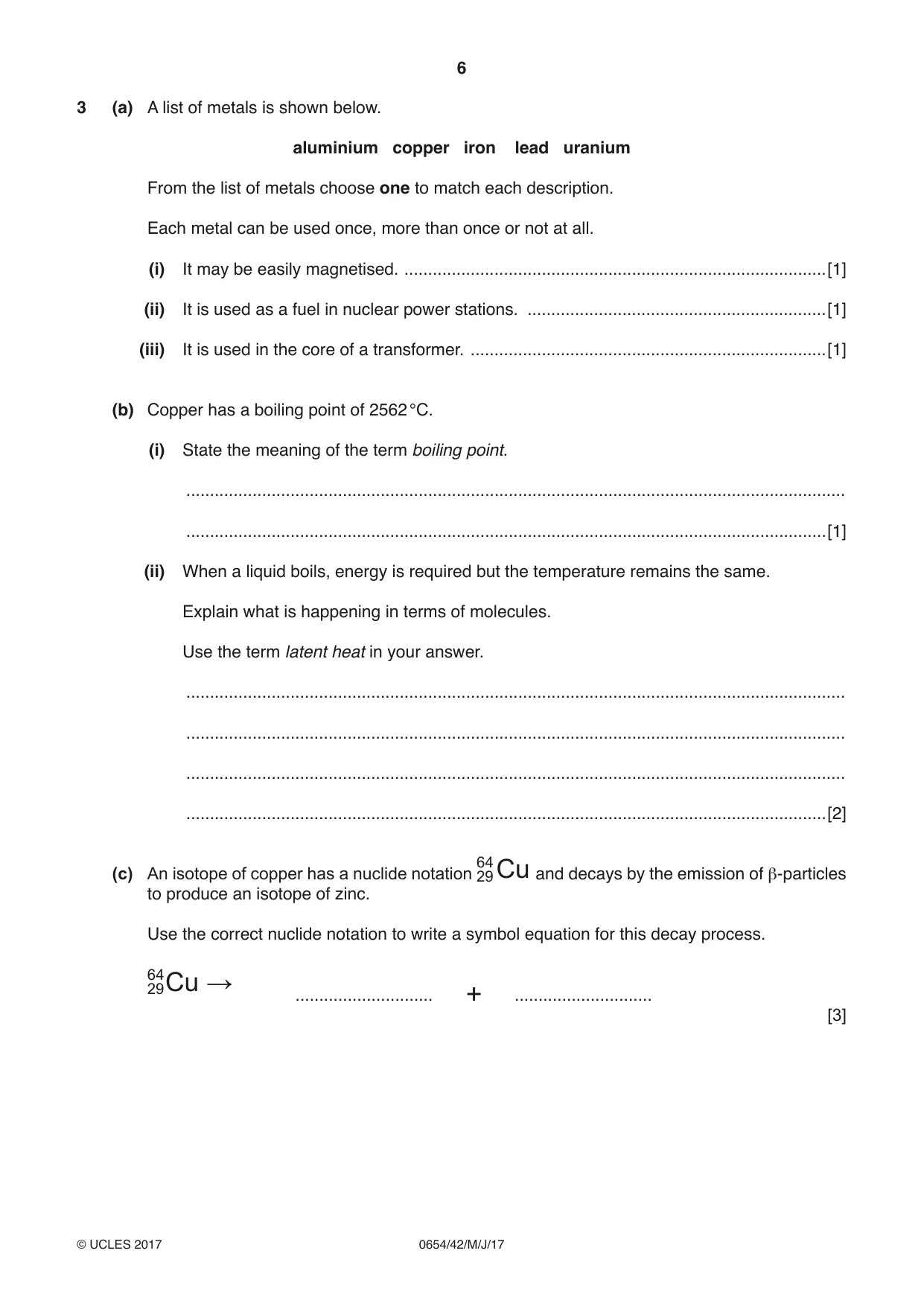
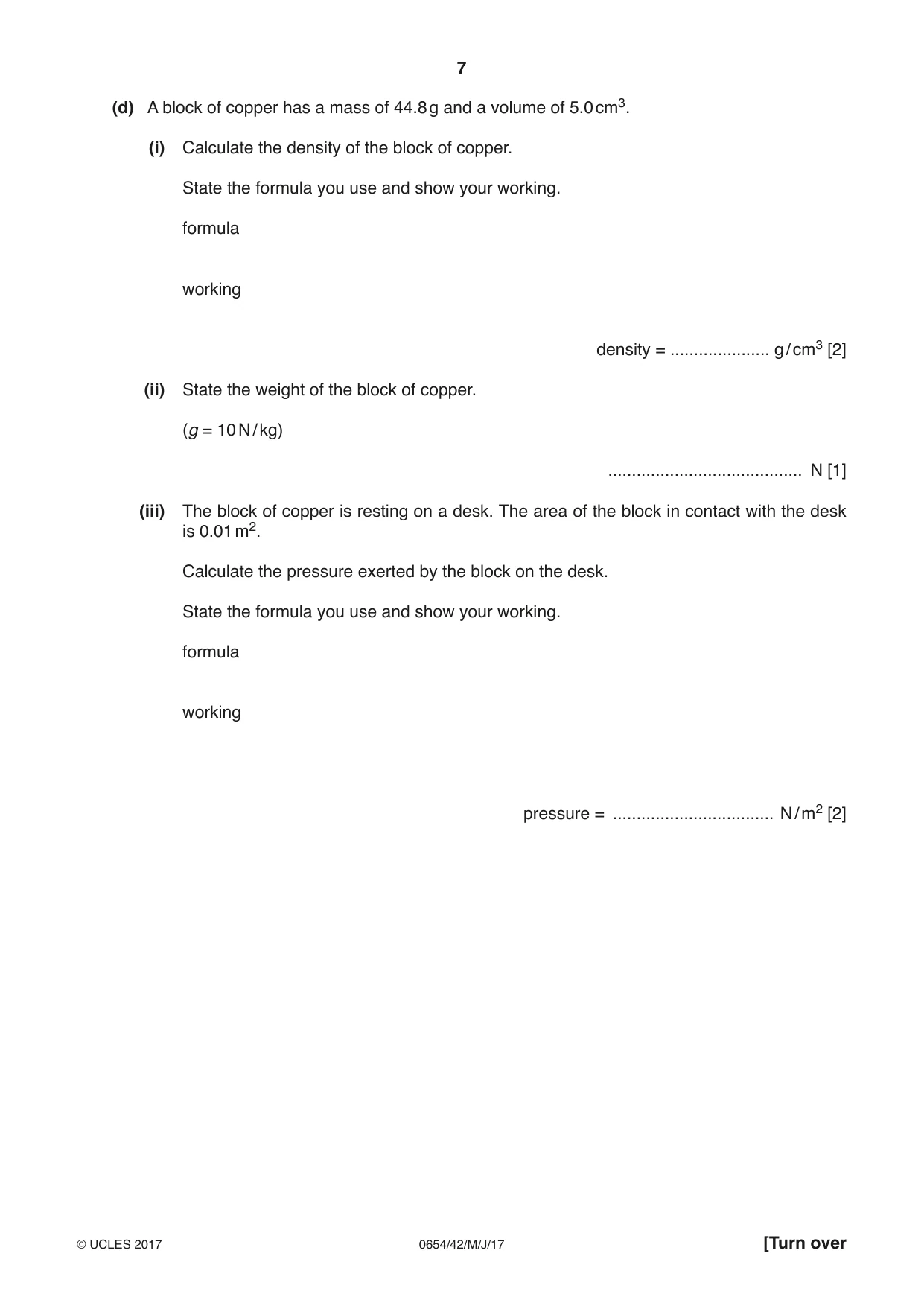
3 (a) A list of metals is shown below. aluminium copper iron lead uranium From the list of metals choose one to match each description. Each metal can be used once, more than once or not at all. (i) It may be easily magnetised. .........................................................................................[1] (ii) It is used as a fuel in nuclear power stations. ...............................................................[1] (iii) It is used in the core of a transformer. ...........................................................................[1] (b) Copper has a boiling point of 2562 °C. (i) State the meaning of the term boiling point. ........................................................................................................................................... .......................................................................................................................................[1] (ii) When a liquid boils, energy is required but the temperature remains the same. Explain what is happening in terms of molecules. Use the term latent heat in your answer. ........................................................................................................................................... ........................................................................................................................................... ........................................................................................................................................... .......................................................................................................................................[2] 64 (c) An isotope of copper has a nuclide notation 29 Cu and decays by the emission of β-particles to produce an isotope of zinc. Use the correct nuclide notation to write a symbol equation for this decay process. 29 Cu64 → ............................. + ............................. [3] (d) A block of copper has a mass of 44.8 g and a volume of 5.0 cm3. (i) Calculate the density of the block of copper. State the formula you use and show your working. formula working density = ..................... g / cm3 [2] (ii) State the weight of the block of copper. (g = 10 N / kg) ......................................... N [1] (iii) The block of copper is resting on a desk. The area of the block in contact with the desk is 0.01 m2. Calculate the pressure exerted by the block on the desk. State the formula you use and show your working. formula working pressure = .................................. N / m2 [2]
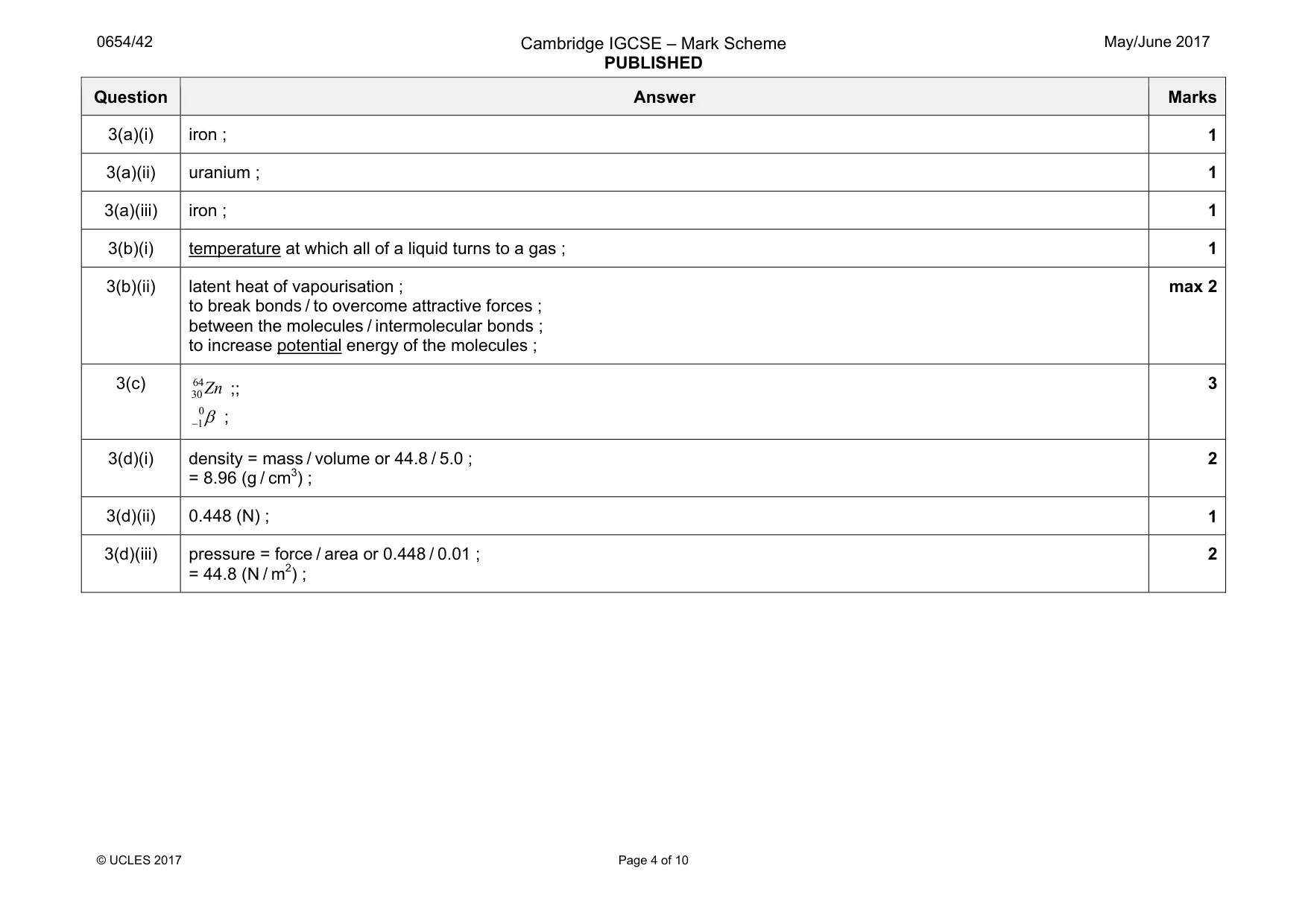
Mark scheme: 3(a)(i) iron ; 1 3(a)(ii) uranium ; 1 3(a)(iii) iron ; 1 3(b)(i) temperature at which all of a liquid turns to a gas ; 1 3(b)(ii) latent heat of vapourisation ; to break bonds / to overcome attractive forces ; between the molecules / intermolecular bonds ; to increase potential energy of the molecules ; max 2 3(c) 64 30Zn ;; 0 1β − ; 3 3(d)(i) density = mass / volume or 44.8 / 5.0 ; = 8.96 (g / cm3) ; 2 3(d)(ii) 0.448 (N) ; 1 3(d)(iii) pressure = force / area or 0.448 / 0.01 ; = 44.8 (N / m2) ; 2
Q4 · The shell colour in crabs has two alleles as shown
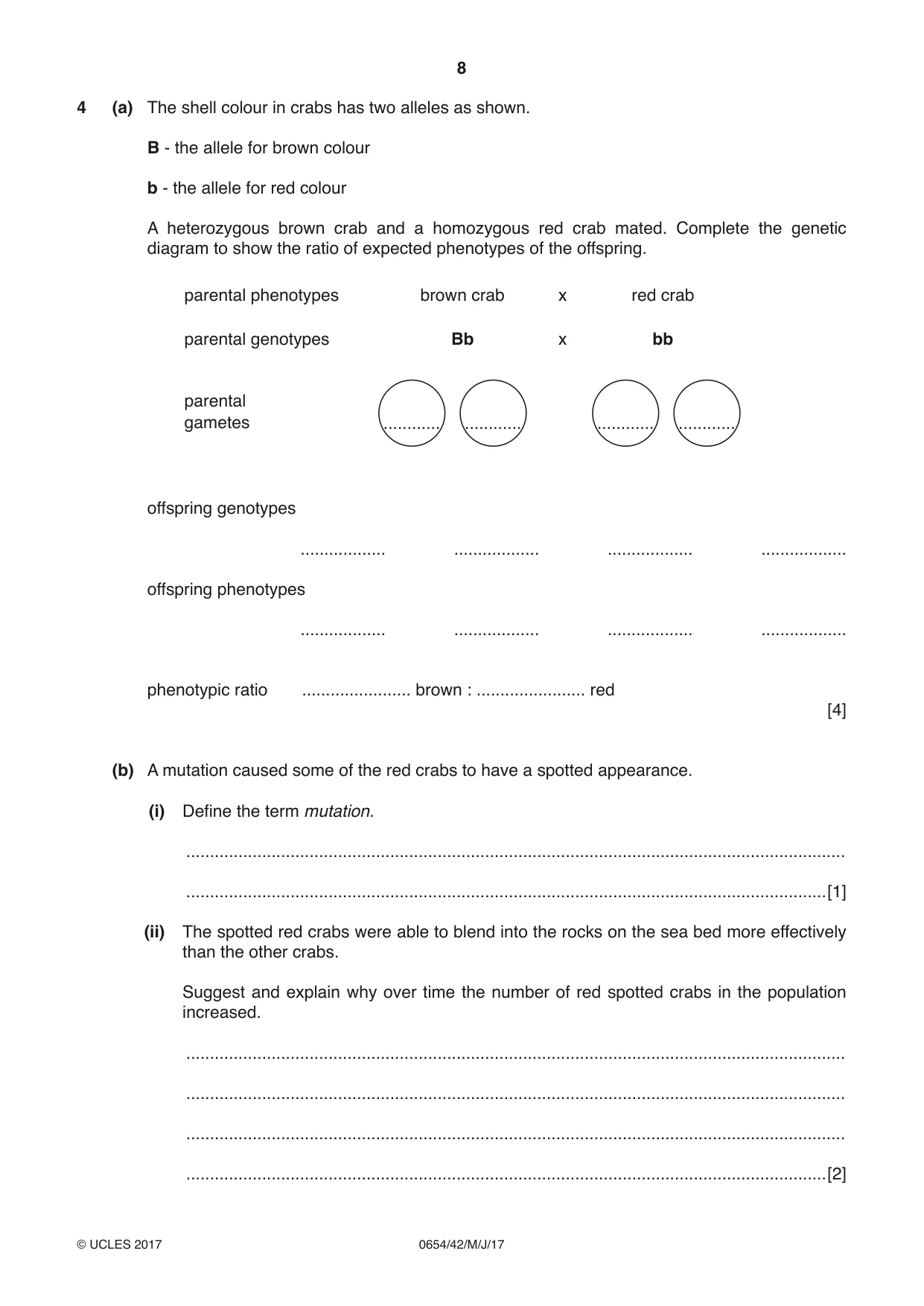
4 (a) The shell colour in crabs has two alleles as shown. B - the allele for brown colour b - the allele for red colour A heterozygous brown crab and a homozygous red crab mated. Complete the genetic diagram to show the ratio of expected phenotypes of the offspring. parental phenotypes brown crab x red crab parental genotypes Bb x bb parental gametes ............ ............ ............ ............ offspring genotypes .................. .................. .................. .................. offspring phenotypes .................. .................. .................. .................. phenotypic ratio ....................... brown : ....................... red [4] (b) A mutation caused some of the red crabs to have a spotted appearance. (i) Define the term mutation. ........................................................................................................................................... .......................................................................................................................................[1] (ii) The spotted red crabs were able to blend into the rocks on the sea bed more effectively than the other crabs. Suggest and explain why over time the number of red spotted crabs in the population increased. ........................................................................................................................................... ........................................................................................................................................... ........................................................................................................................................... .......................................................................................................................................[2]
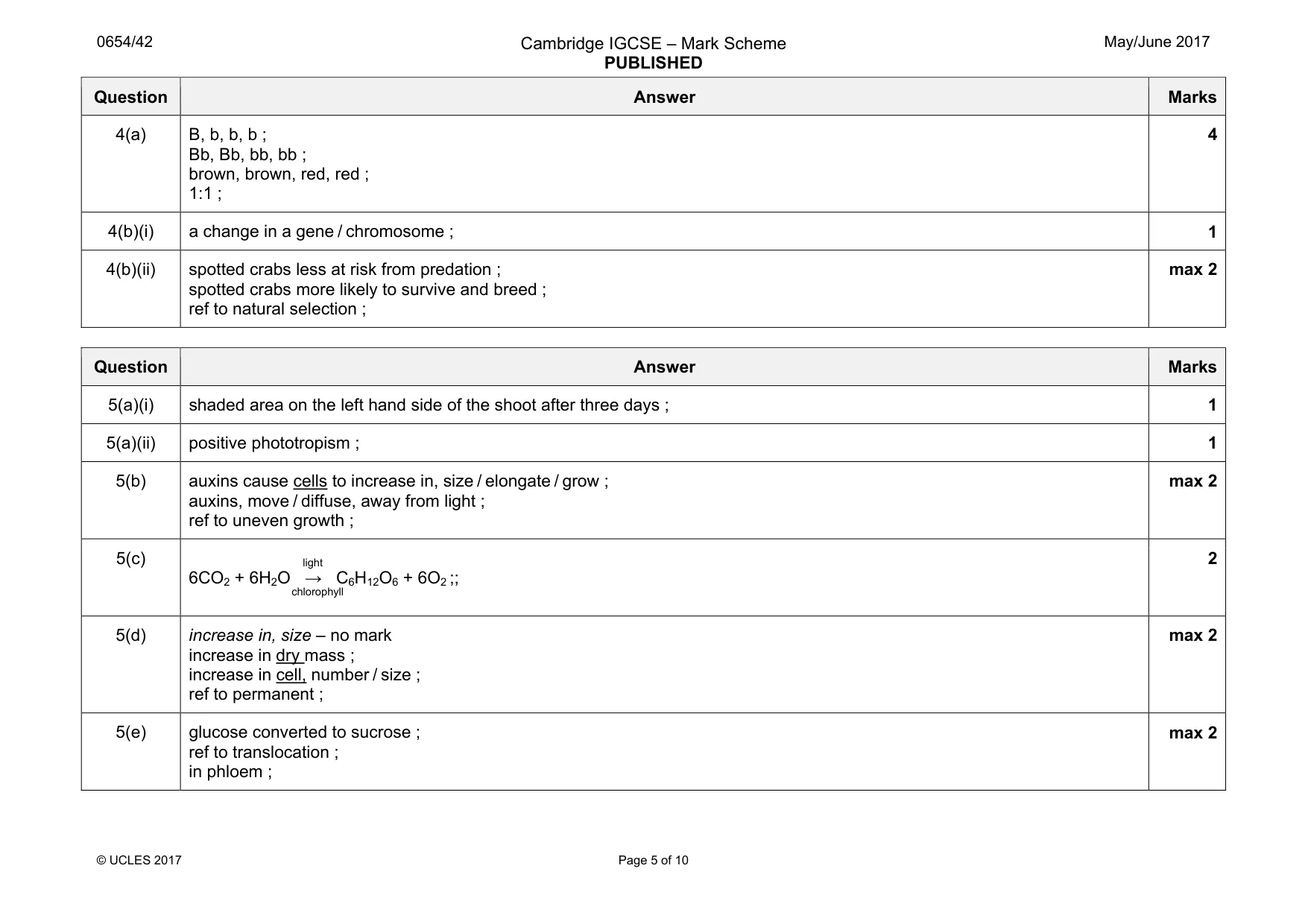
Mark scheme: 4(a) B, b, b, b ; Bb, Bb, bb, bb ; brown, brown, red, red ; 1:1 ; 4 4(b)(i) a change in a gene / chromosome ; 1 4(b)(ii) spotted crabs less at risk from predation ; spotted crabs more likely to survive and breed ; ref to natural selection ; max 2
Q5 · A student carries out an investigation of the growth of a plant shoot by auxins
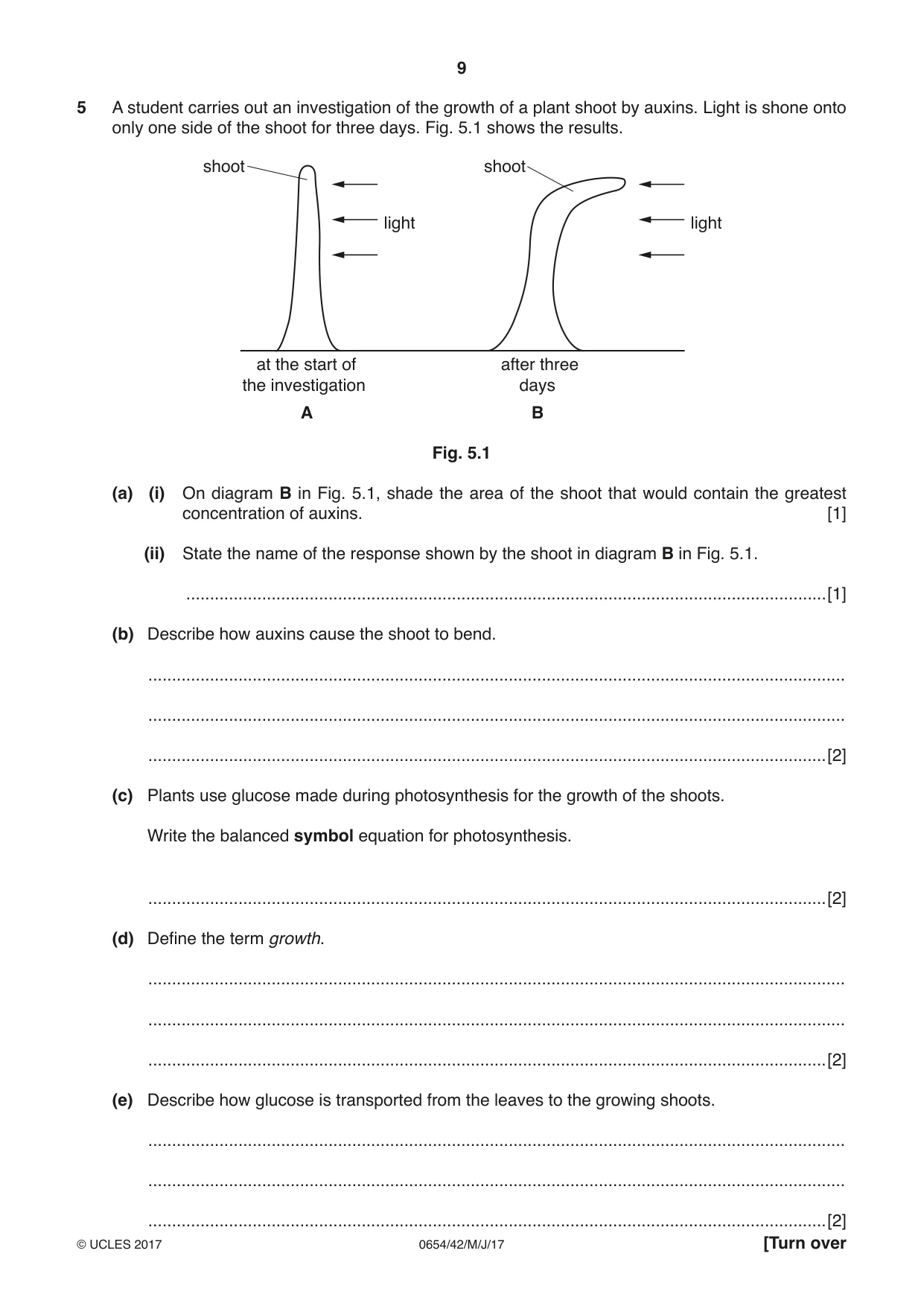
5 A student carries out an investigation of the growth of a plant shoot by auxins. Light is shone onto only one side of the shoot for three days. Fig. 5.1 shows the results. shoot shoot light light at the start of after three the investigation days A B Fig. 5.1 (a) (i) On diagram B in Fig. 5.1, shade the area of the shoot that would contain the greatest concentration of auxins. [1] (ii) State the name of the response shown by the shoot in diagram B in Fig. 5.1. .......................................................................................................................................[1] (b) Describe how auxins cause the shoot to bend. ................................................................................................................................................... ................................................................................................................................................... ...............................................................................................................................................[2] (c) Plants use glucose made during photosynthesis for the growth of the shoots. Write the balanced symbol equation for photosynthesis. ...............................................................................................................................................[2] (d) Define the term growth. ................................................................................................................................................... ................................................................................................................................................... ...............................................................................................................................................[2] (e) Describe how glucose is transported from the leaves to the growing shoots. ................................................................................................................................................... ...................................................................................................................................................
Mark scheme: 5(a)(i) shaded area on the left hand side of the shoot after three days ; 1 5(a)(ii) positive phototropism ; 1 5(b) auxins cause cells to increase in, size / elongate / grow ; auxins, move / diffuse, away from light ; ref to uneven growth ; max 2 5(c) light 6CO2 + 6H2O → C6H12O6 + 6O2 ;; chlorophyll 2 5(d) increase in, size – no mark increase in dry mass ; increase in cell, number / size ; ref to permanent ; max 2 5(e) glucose converted to sucrose ; ref to translocation ; in phloem ; max 2
Q6 · Alkanes and alkenes are two homologous series (families) of hydrocarbons
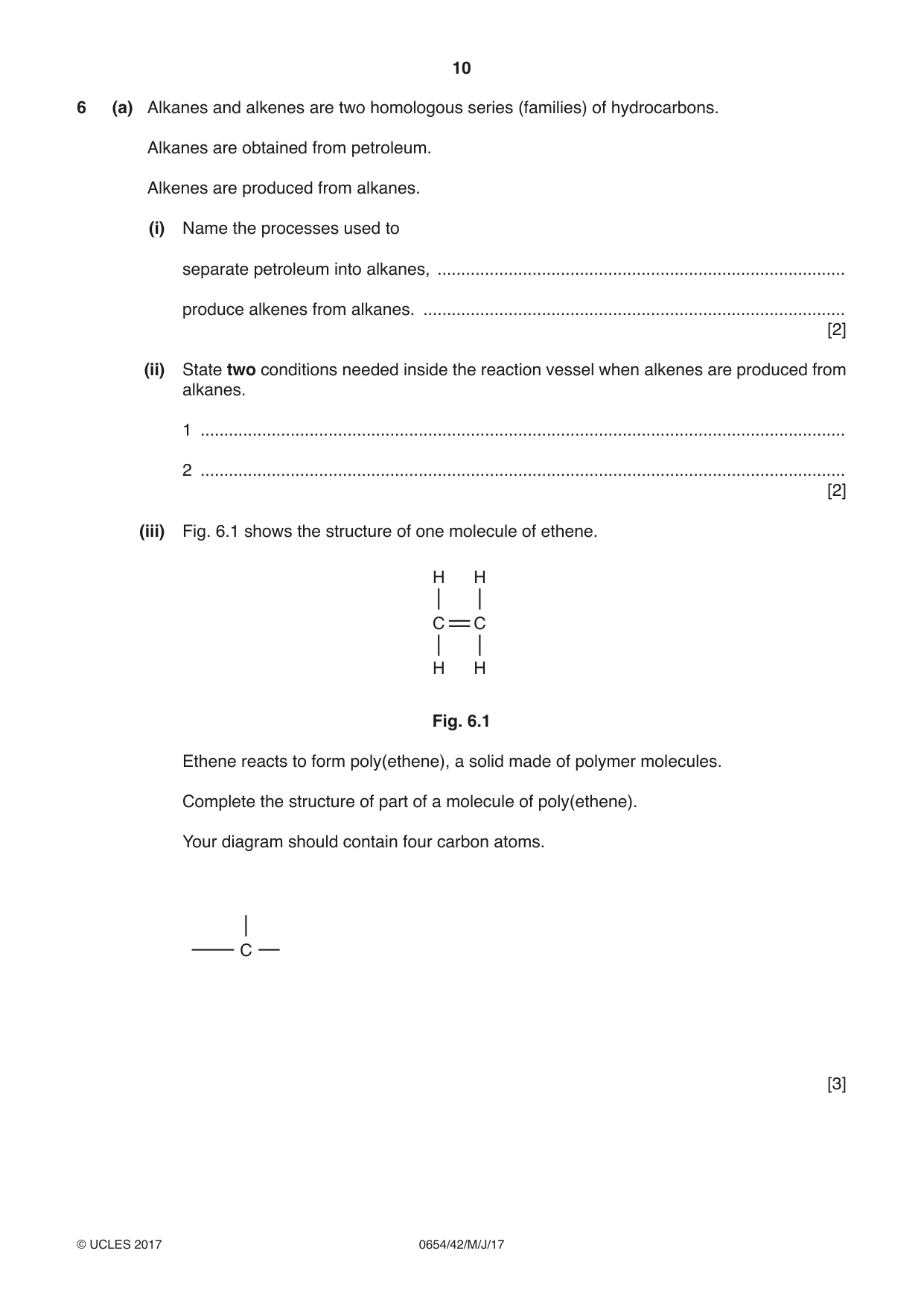
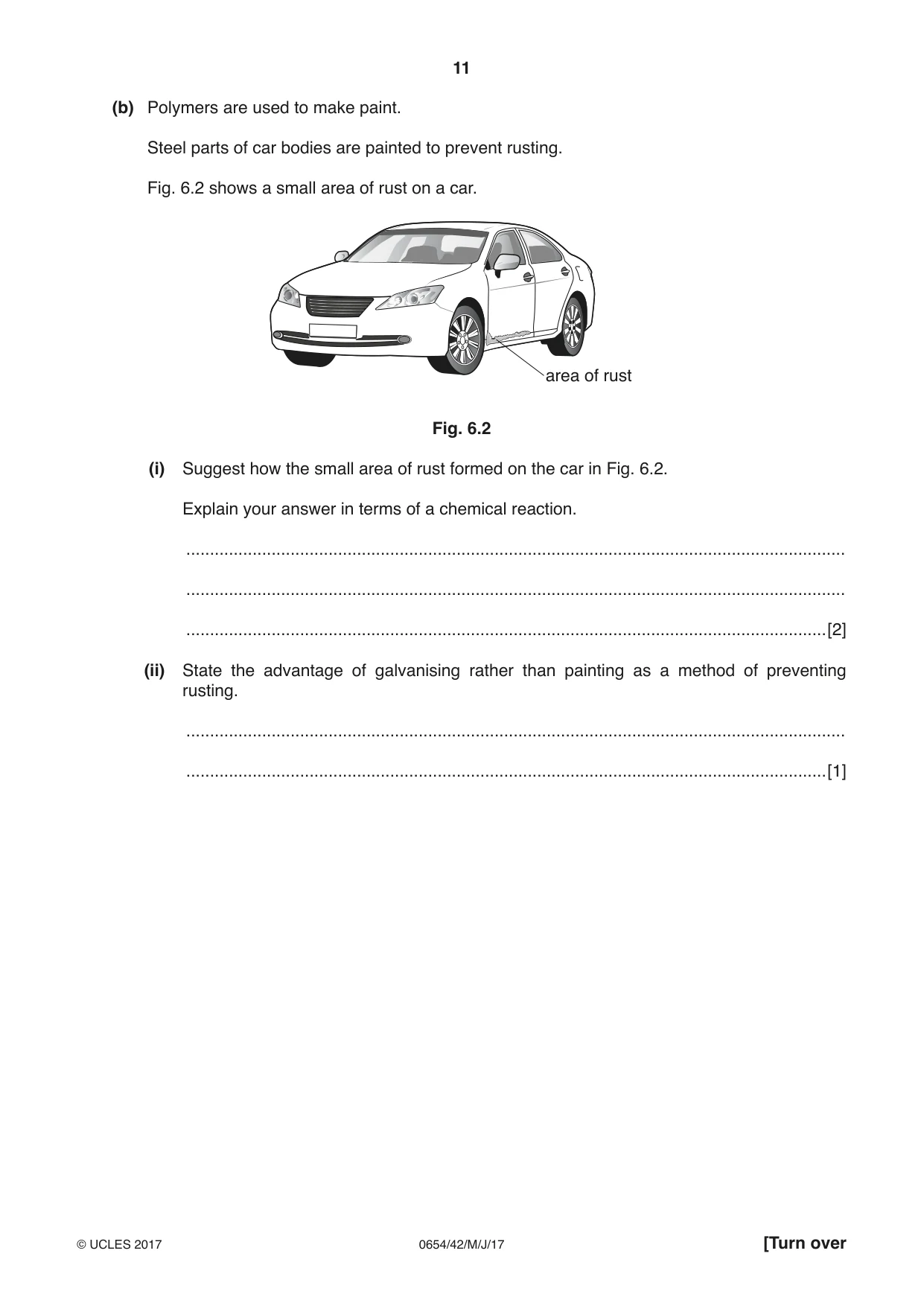
6 (a) Alkanes and alkenes are two homologous series (families) of hydrocarbons. Alkanes are obtained from petroleum. Alkenes are produced from alkanes. (i) Name the processes used to separate petroleum into alkanes, ...................................................................................... produce alkenes from alkanes. ......................................................................................... [2] (ii) State two conditions needed inside the reaction vessel when alkenes are produced from alkanes. 1 ........................................................................................................................................ 2 ........................................................................................................................................ [2] (iii) Fig. 6.1 shows the structure of one molecule of ethene. H H C C H H Fig. 6.1 Ethene reacts to form poly(ethene), a solid made of polymer molecules. Complete the structure of part of a molecule of poly(ethene). Your diagram should contain four carbon atoms. C [3] (b) Polymers are used to make paint. Steel parts of car bodies are painted to prevent rusting. Fig. 6.2 shows a small area of rust on a car. area of rust Fig. 6.2 (i) Suggest how the small area of rust formed on the car in Fig. 6.2. Explain your answer in terms of a chemical reaction. ........................................................................................................................................... ........................................................................................................................................... .......................................................................................................................................[2] (ii) State the advantage of galvanising rather than painting as a method of preventing rusting. ........................................................................................................................................... .......................................................................................................................................[1]
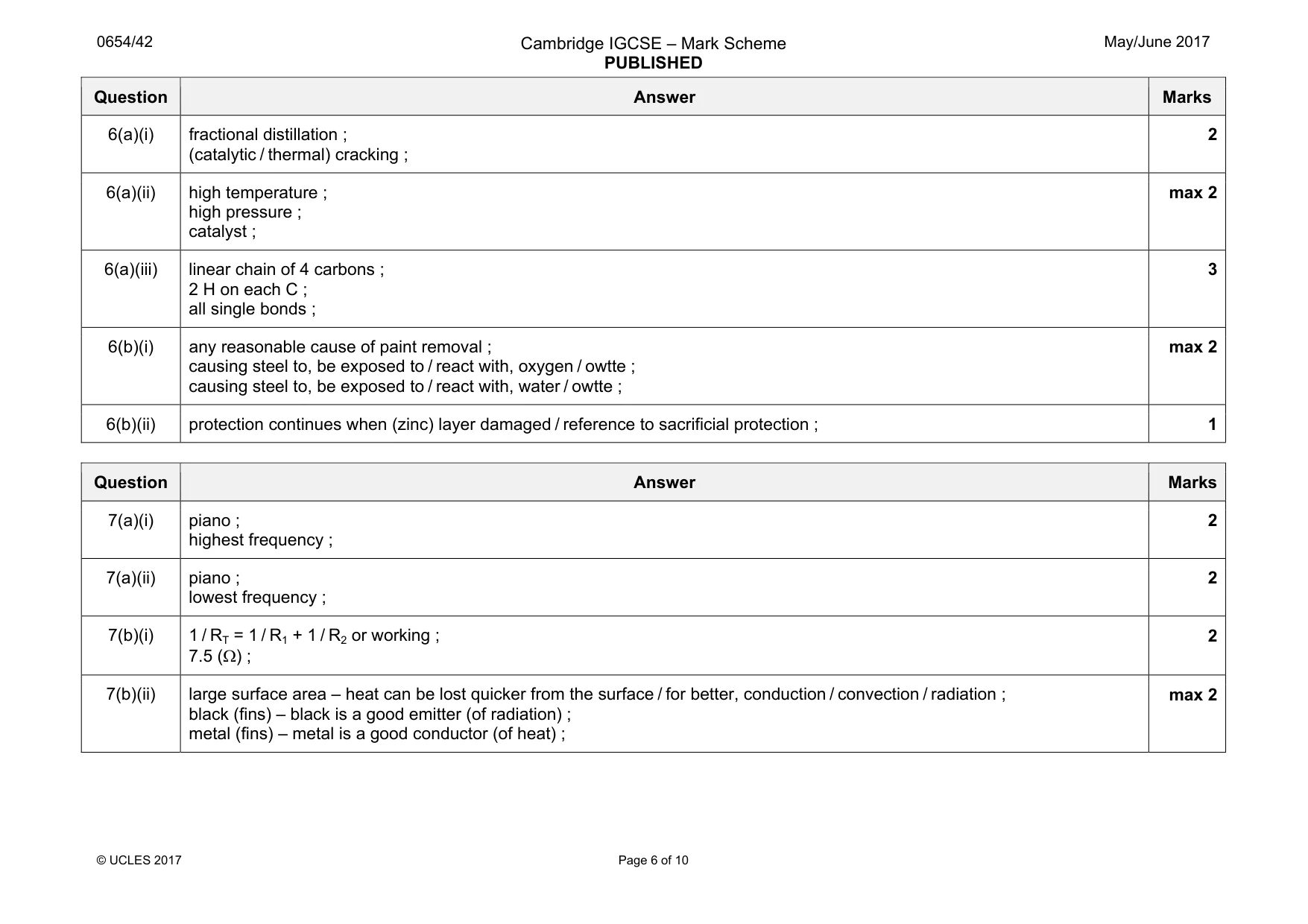
Mark scheme: 6(a)(i) fractional distillation ; (catalytic / thermal) cracking ; 2 6(a)(ii) high temperature ; high pressure ; catalyst ; max 2 6(a)(iii) linear chain of 4 carbons ; 2 H on each C ; all single bonds ; 3 6(b)(i) any reasonable cause of paint removal ; causing steel to, be exposed to / react with, oxygen / owtte ; causing steel to, be exposed to / react with, water / owtte ; max 2 6(b)(ii) protection continues when (zinc) layer damaged / reference to sacrificial protection ; 1
Q7 · A school orchestra is practising
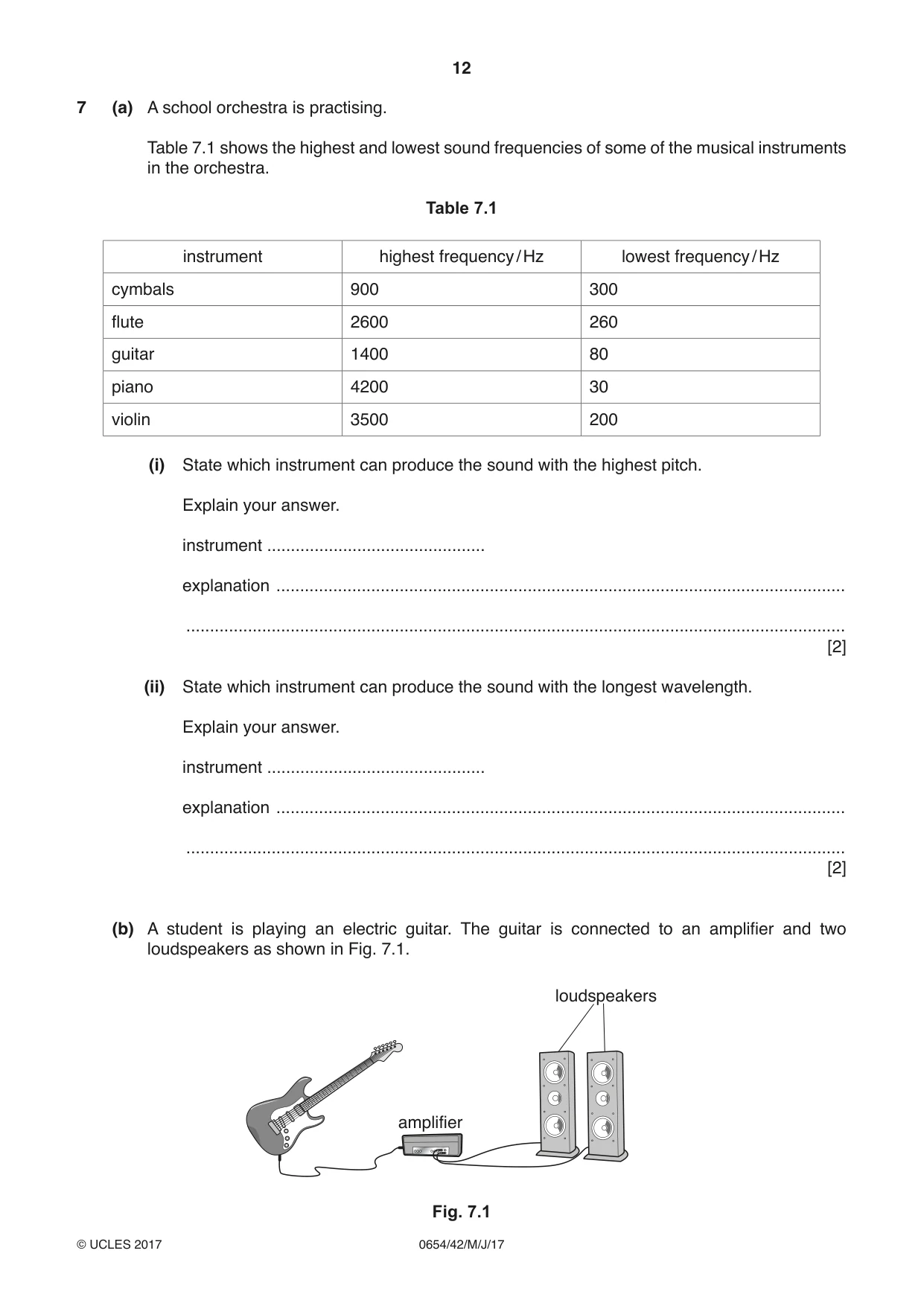
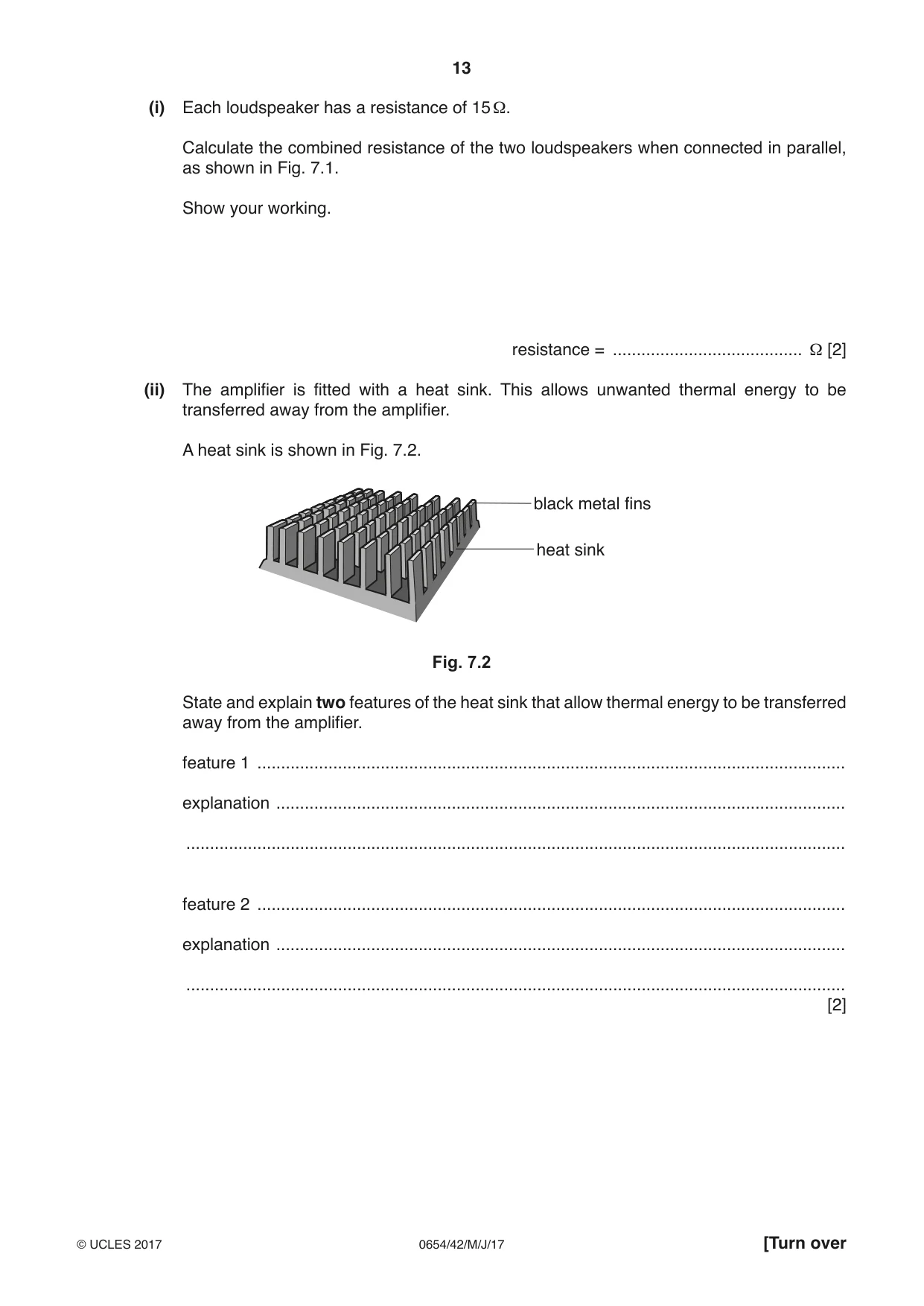
7 (a) A school orchestra is practising. Table 7.1 shows the highest and lowest sound frequencies of some of the musical instruments in the orchestra. Table 7.1 instrument highest frequency / Hz lowest frequency / Hz cymbals 900 300 flute 2600 260 guitar 1400 80 piano 4200 30 violin 3500 200 (i) State which instrument can produce the sound with the highest pitch. Explain your answer. instrument .............................................. explanation ........................................................................................................................ ........................................................................................................................................... [2] (ii) State which instrument can produce the sound with the longest wavelength. Explain your answer. instrument .............................................. explanation ........................................................................................................................ ........................................................................................................................................... [2] (b) A student is playing an electric guitar. The guitar is connected to an amplifier and two loudspeakers as shown in Fig. 7.1. loudspeakers amplifier Fig. 7.1 (i) Each loudspeaker has a resistance of 15 Ω. Calculate the combined resistance of the two loudspeakers when connected in parallel, as shown in Fig. 7.1. Show your working. resistance = ........................................ Ω [2] (ii) The amplifier is fitted with a heat sink. This allows unwanted thermal energy to be transferred away from the amplifier. A heat sink is shown in Fig. 7.2. black metal fins heat sink Fig. 7.2 State and explain two features of the heat sink that allow thermal energy to be transferred away from the amplifier. feature 1 ............................................................................................................................ explanation ........................................................................................................................ ........................................................................................................................................... feature 2 ............................................................................................................................ explanation ........................................................................................................................ ........................................................................................................................................... [2]
Mark scheme: 7(a)(i) piano ; highest frequency ; 2 7(a)(ii) piano ; lowest frequency ; 2 7(b)(i) 1 / RT = 1 / R1 + 1 / R2 or working ; 7.5 (Ω) ; 2 7(b)(ii) large surface area – heat can be lost quicker from the surface / for better, conduction / convection / radiation ; black (fins) – black is a good emitter (of radiation) ; metal (fins) – metal is a good conductor (of heat) ; max 2
Q8 · A diagram of a grass flower
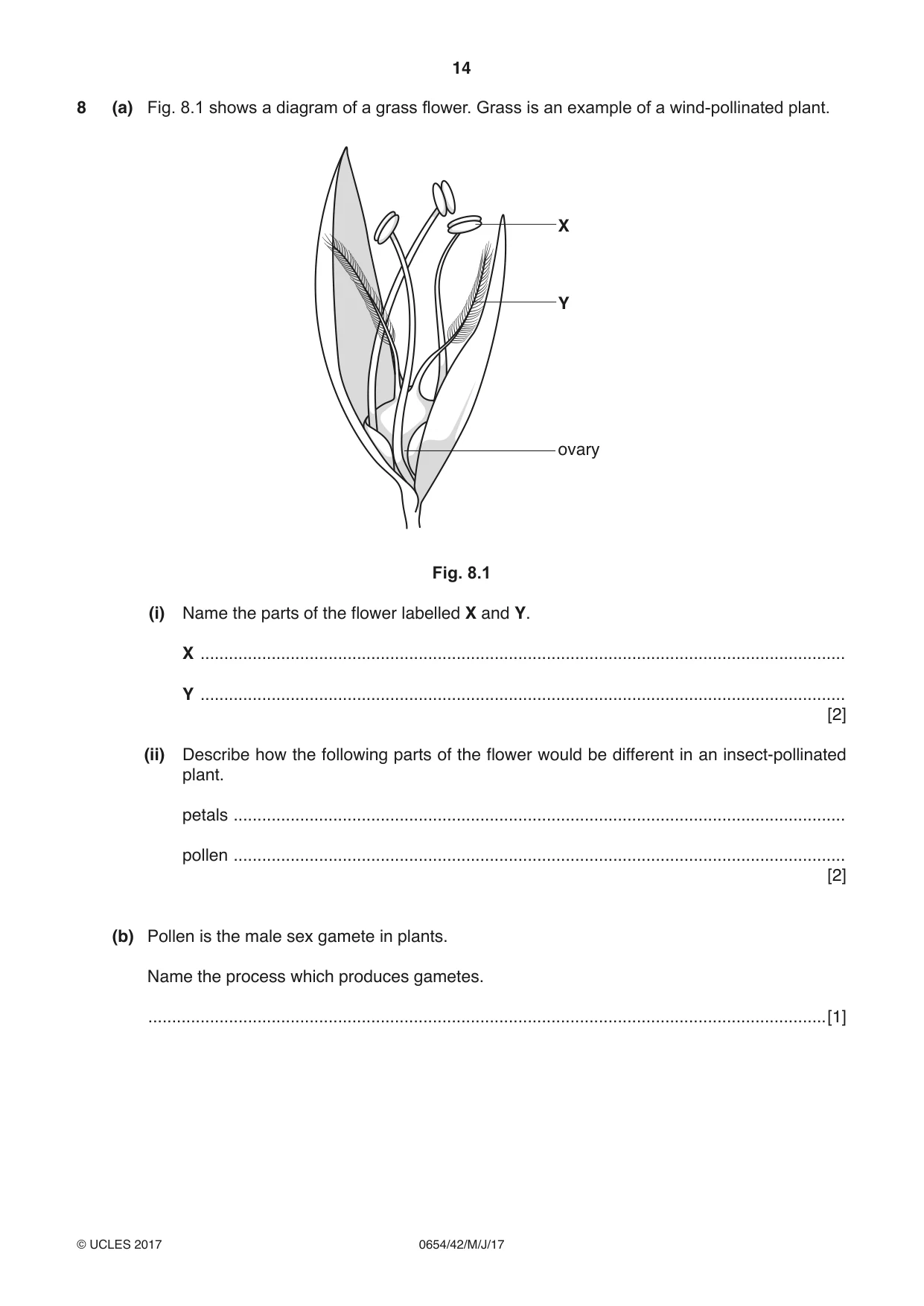
8 (a) Fig. 8.1 shows a diagram of a grass flower. Grass is an example of a wind-pollinated plant. X Y ovary Fig. 8.1 (i) Name the parts of the flower labelled X and Y. X ........................................................................................................................................ Y ........................................................................................................................................ [2] (ii) Describe how the following parts of the flower would be different in an insect-pollinated plant. petals ................................................................................................................................. pollen ................................................................................................................................. [2] (b) Pollen is the male sex gamete in plants. Name the process which produces gametes. ...............................................................................................................................................[1] (c) In insect-pollinated plants, pollen is transferred by insects to other plants, which may result in fertilisation. This is an example of sexual reproduction. State one advantage and one disadvantage of sexual reproduction. advantage ................................................................................................................................. ................................................................................................................................................... disadvantage ............................................................................................................................ ................................................................................................................................................... [2] (d) After sexual reproduction, seeds are produced. Seeds are dispersed so that plants can colonise new areas. Describe two ways in which seeds can be dispersed by animals. ................................................................................................................................................... ................................................................................................................................................... ...............................................................................................................................................[2]
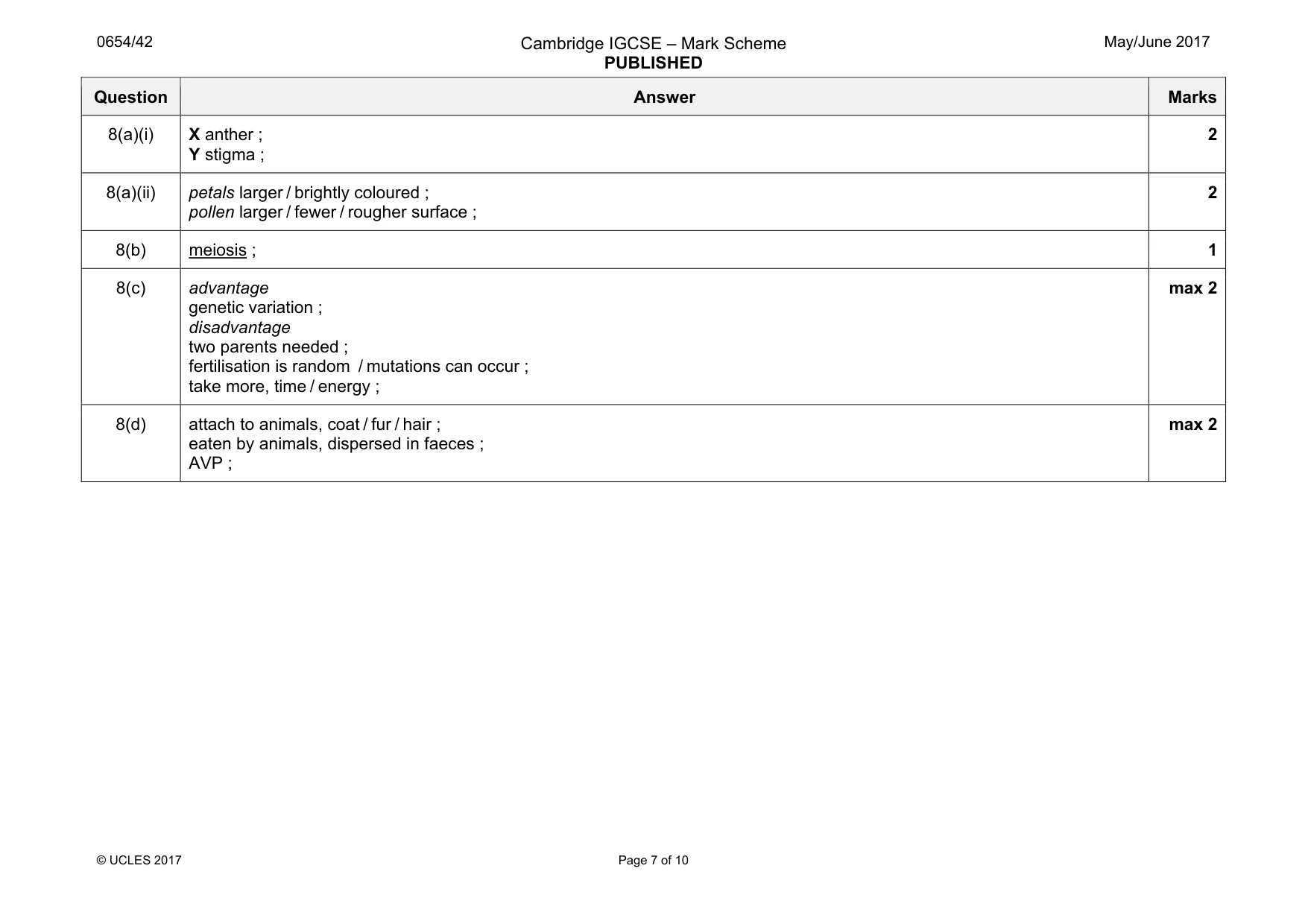
Mark scheme: 8(a)(i) X anther ; Y stigma ; 2 8(a)(ii) petals larger / brightly coloured ; pollen larger / fewer / rougher surface ; 2 8(b) meiosis ; 1 8(c) advantage genetic variation ; disadvantage two parents needed ; fertilisation is random / mutations can occur ; take more, time / energy ; max 2 8(d) attach to animals, coat / fur / hair ; eaten by animals, dispersed in faeces ; AVP ; max 2
Q9 · Four elements are shown in order of reactivity
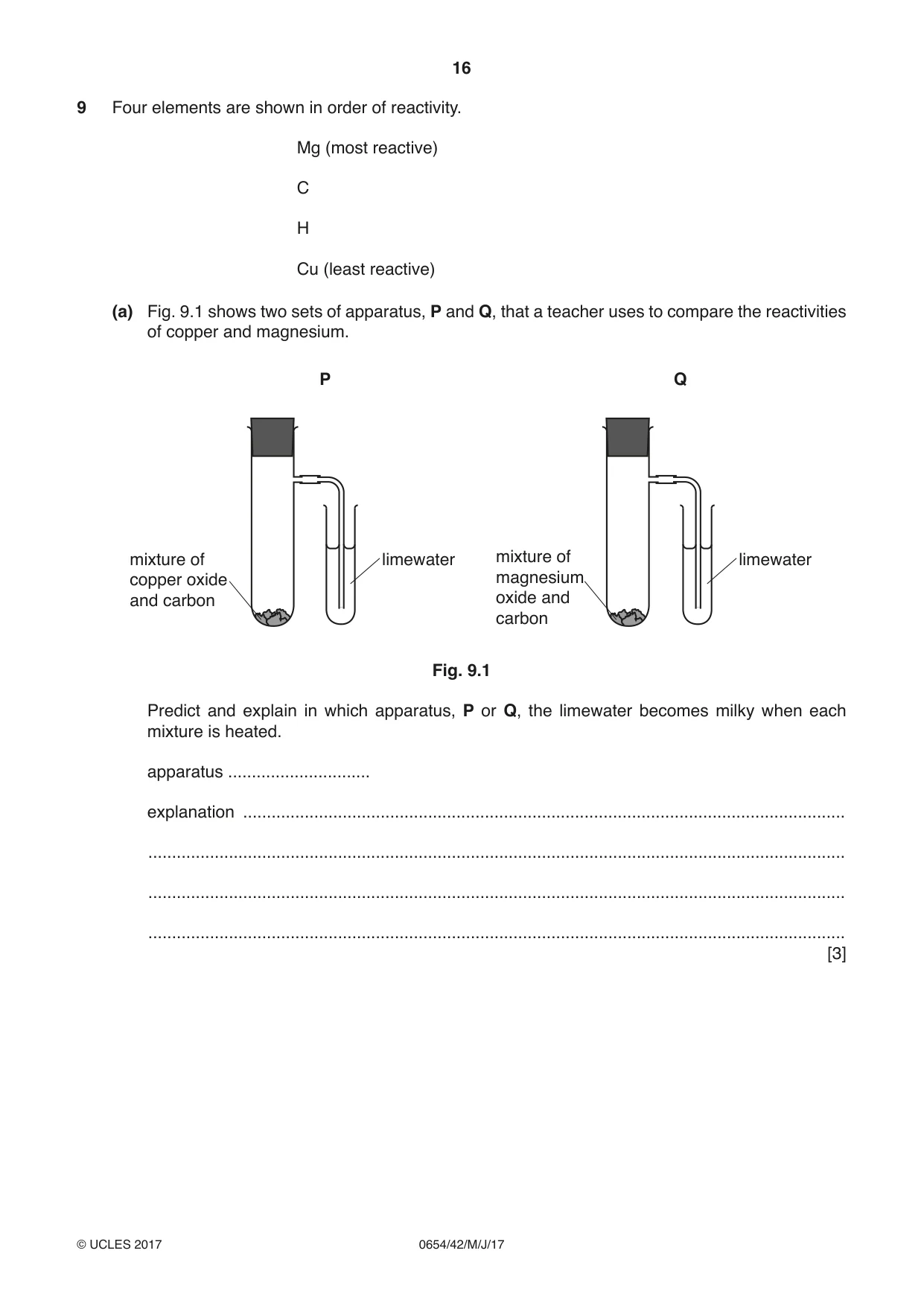
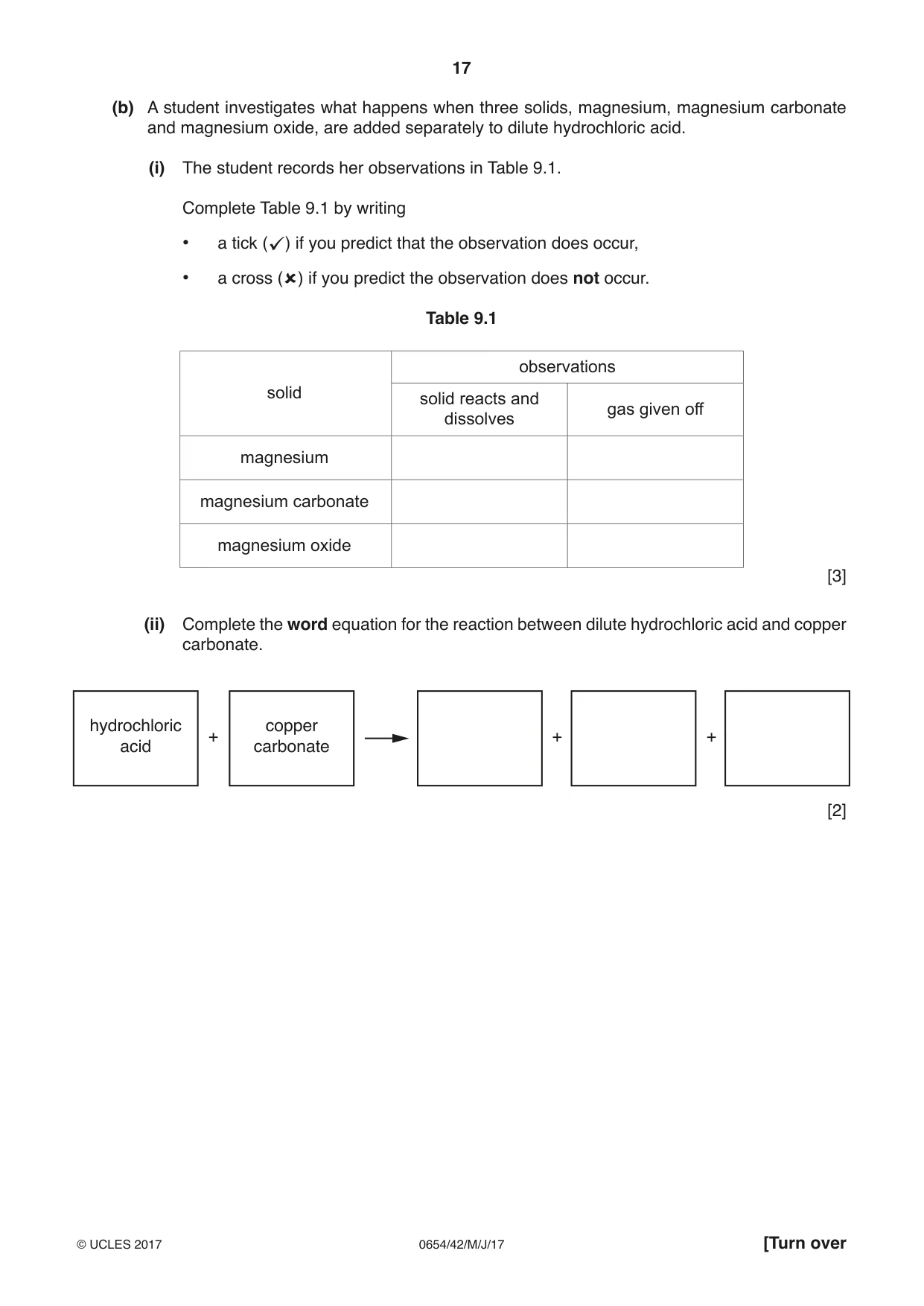
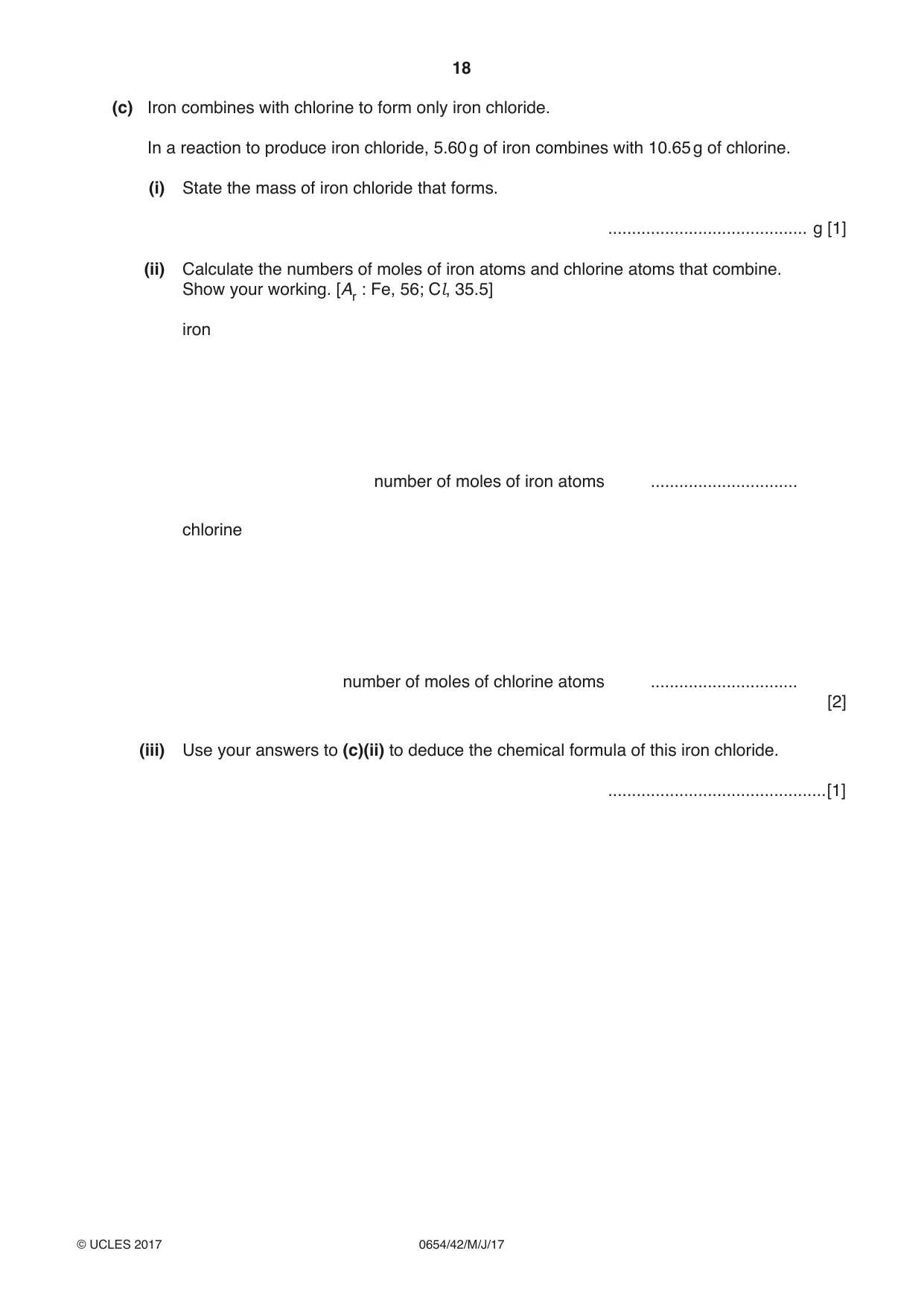
9 Four elements are shown in order of reactivity. Mg (most reactive) C H Cu (least reactive) (a) Fig. 9.1 shows two sets of apparatus, P and Q, that a teacher uses to compare the reactivities of copper and magnesium. P Q mixture of limewater mixture of limewater copper oxide magnesium and carbon oxide and carbon Fig. 9.1 Predict and explain in which apparatus, P or Q, the limewater becomes milky when each mixture is heated. apparatus .............................. explanation ............................................................................................................................... ................................................................................................................................................... ................................................................................................................................................... ................................................................................................................................................... [3] (b) A student investigates what happens when three solids, magnesium, magnesium carbonate and magnesium oxide, are added separately to dilute hydrochloric acid. (i) The student records her observations in Table 9.1. Complete Table 9.1 by writing • a tick () if you predict that the observation does occur, • a cross (û) if you predict the observation does not occur. Table 9.1 observations solid solid reacts and gas given off dissolves magnesium magnesium carbonate magnesium oxide [3] (ii) Complete the word equation for the reaction between dilute hydrochloric acid and copper carbonate. hydrochloric copper + + + acid carbonate [2] (c) Iron combines with chlorine to form only iron chloride. In a reaction to produce iron chloride, 5.60 g of iron combines with 10.65 g of chlorine. (i) State the mass of iron chloride that forms. .......................................... g [1] (ii) Calculate the numbers of moles of iron atoms and chlorine atoms that combine. Show your working. [Ar : Fe, 56; Cl, 35.5] iron number of moles of iron atoms ............................... chlorine number of moles of chlorine atoms ............................... [2] (iii) Use your answers to (c)(ii) to deduce the chemical formula of this iron chloride. ..............................................[1] Question 10 starts on page 20.
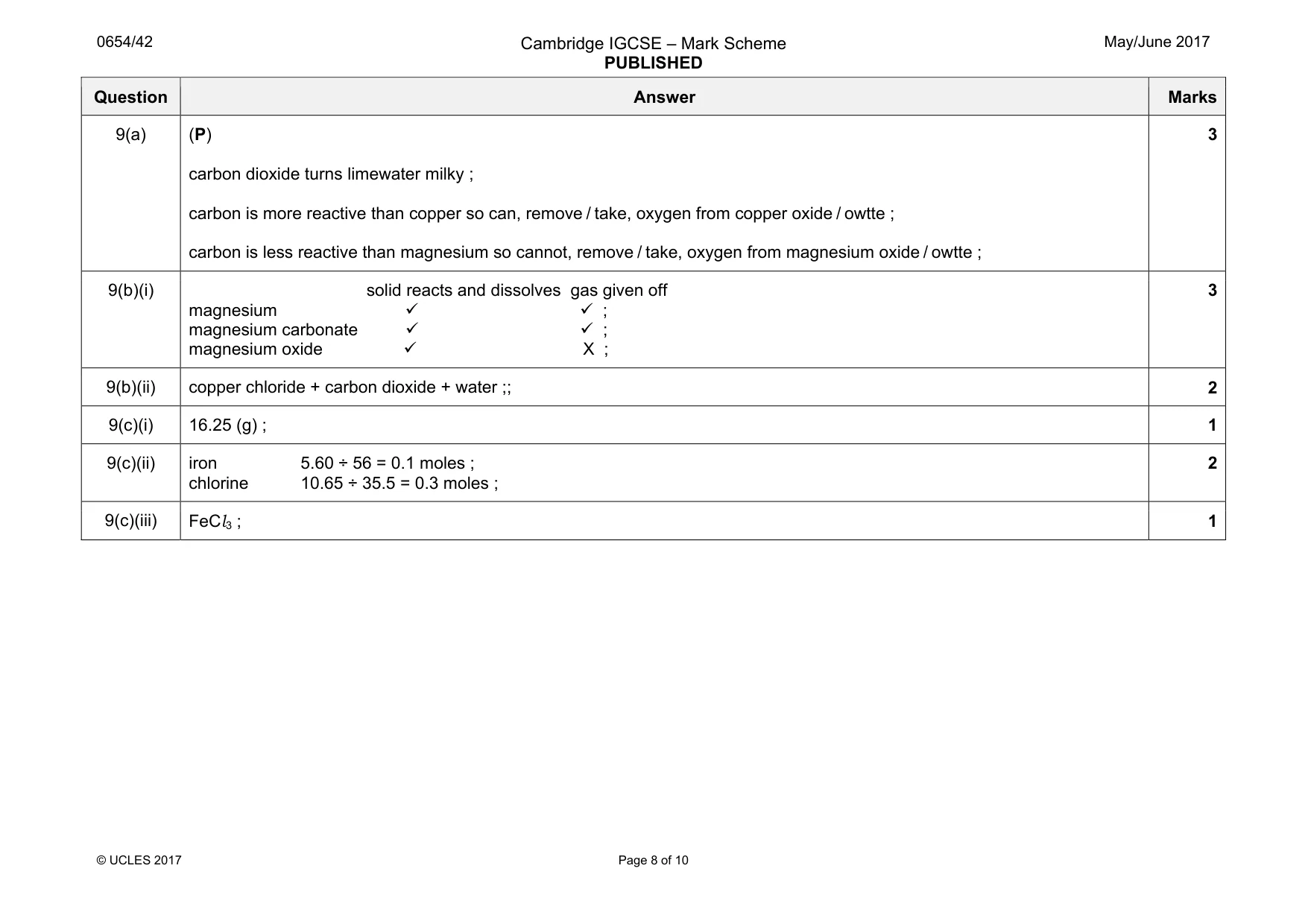
Mark scheme: 9(a) (P) carbon dioxide turns limewater milky ; carbon is more reactive than copper so can, remove / take, oxygen from copper oxide / owtte ; carbon is less reactive than magnesium so cannot, remove / take, oxygen from magnesium oxide / owtte ; 3 9(b)(i) solid reacts and dissolves gas given off magnesium 9 9 ; magnesium carbonate 9 9 ; magnesium oxide 9 X ; 3 9(b)(ii) copper chloride + carbon dioxide + water ;; 2 9(c)(i) 16.25 (g) ; 1 9(c)(ii) iron 5.60 ÷ 56 = 0.1 moles ; chlorine 10.65 ÷ 35.5 = 0.3 moles ; 2 9(c)(iii) FeCl3 ; 1
More questions on The characteristic properties of acids and bases
Q10 · Electrolysis occurs when an electric current passes through an electrolyte
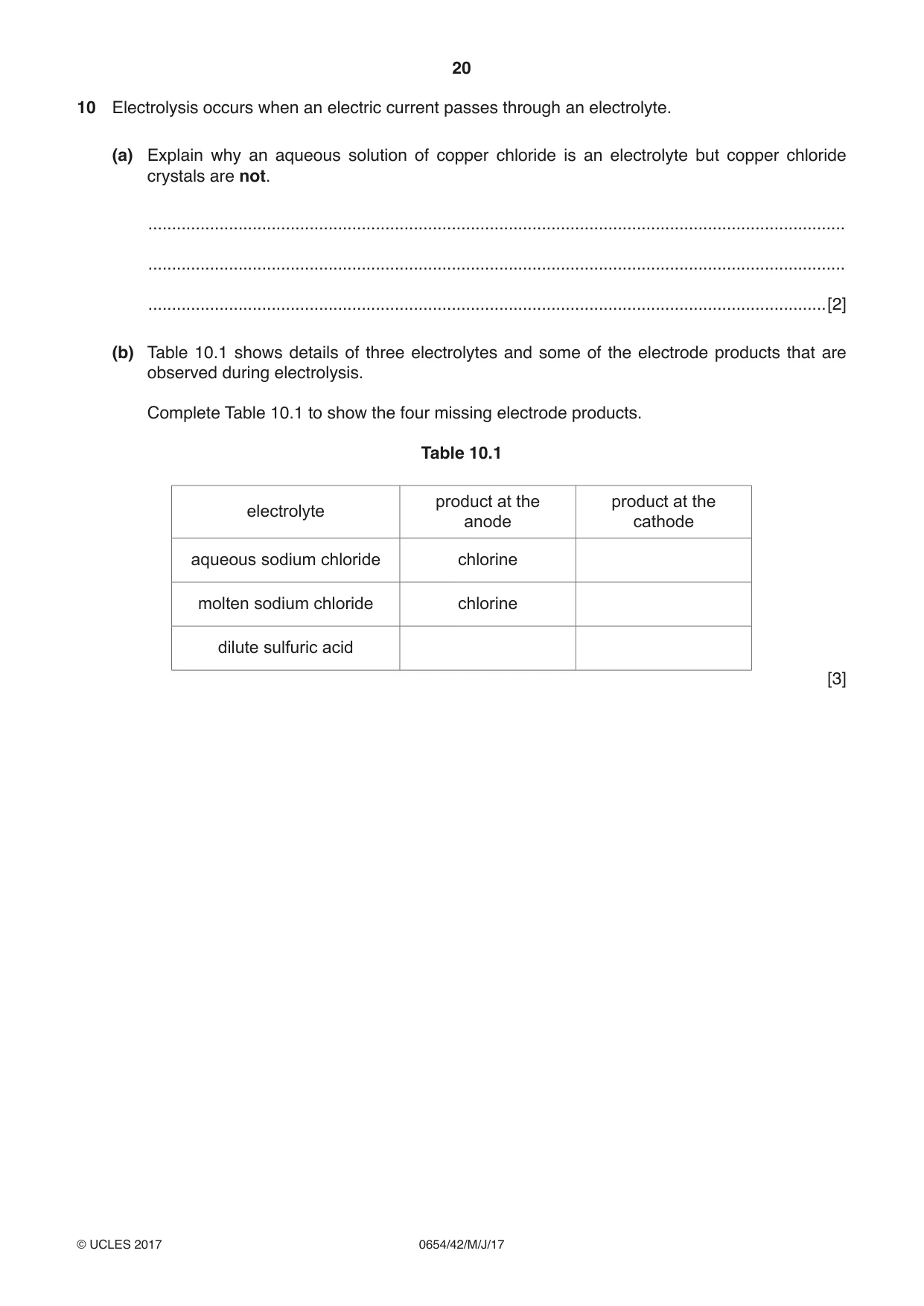
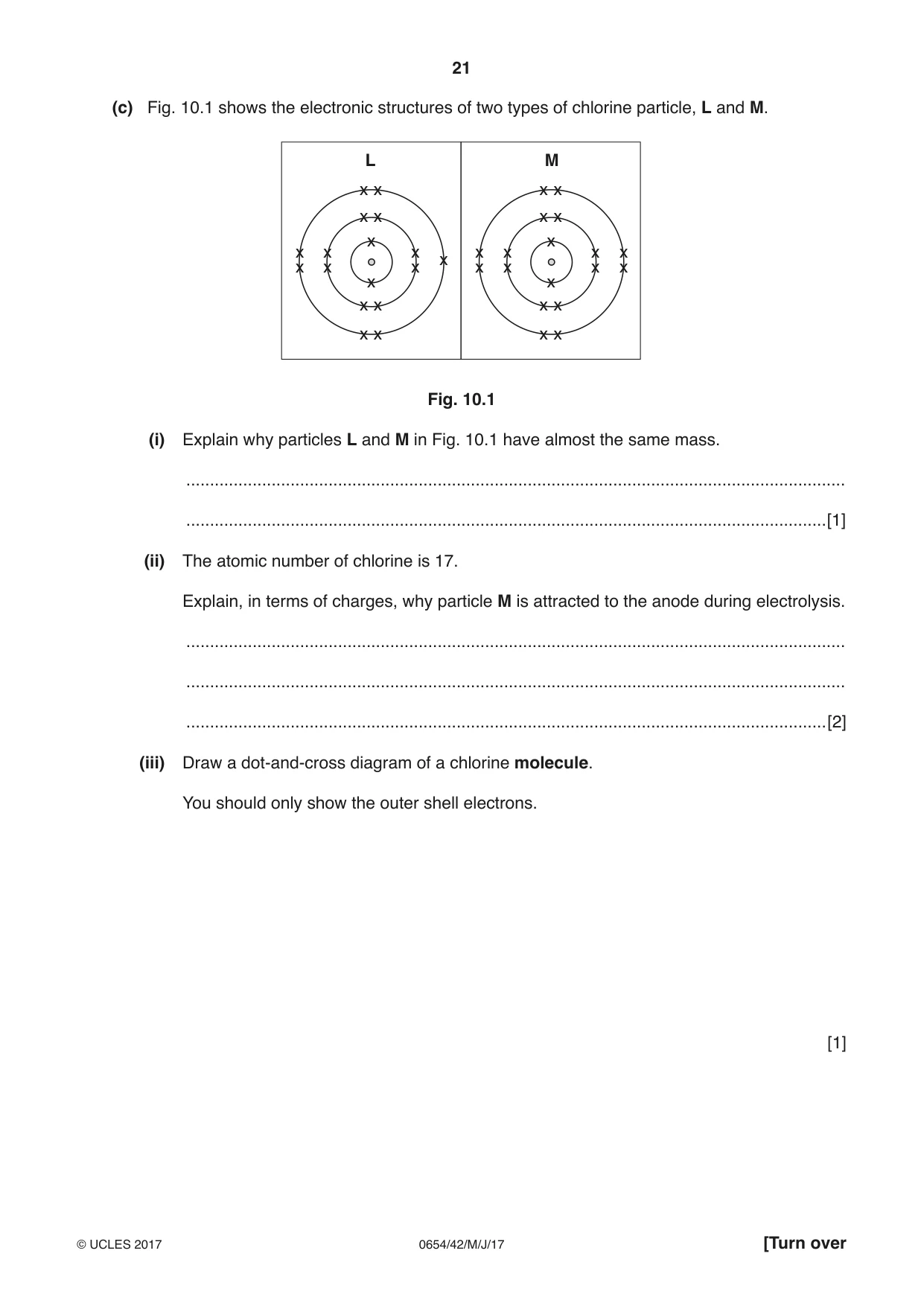
10 Electrolysis occurs when an electric current passes through an electrolyte. (a) Explain why an aqueous solution of copper chloride is an electrolyte but copper chloride crystals are not. ................................................................................................................................................... ................................................................................................................................................... ...............................................................................................................................................[2] (b) Table 10.1 shows details of three electrolytes and some of the electrode products that are observed during electrolysis. Complete Table 10.1 to show the four missing electrode products. Table 10.1 product at the product at the electrolyte anode cathode aqueous sodium chloride chlorine molten sodium chloride chlorine dilute sulfuric acid [3] (c) Fig. 10.1 shows the electronic structures of two types of chlorine particle, L and M. L M x x x x x x x x x x x x x x x x x x x x x x x x x x x x x x x x x x x Fig. 10.1 (i) Explain why particles L and M in Fig. 10.1 have almost the same mass. ........................................................................................................................................... .......................................................................................................................................[1] (ii) The atomic number of chlorine is 17. Explain, in terms of charges, why particle M is attracted to the anode during electrolysis. ........................................................................................................................................... ........................................................................................................................................... .......................................................................................................................................[2] (iii) Draw a dot-and-cross diagram of a chlorine molecule. You should only show the outer shell electrons. [1]
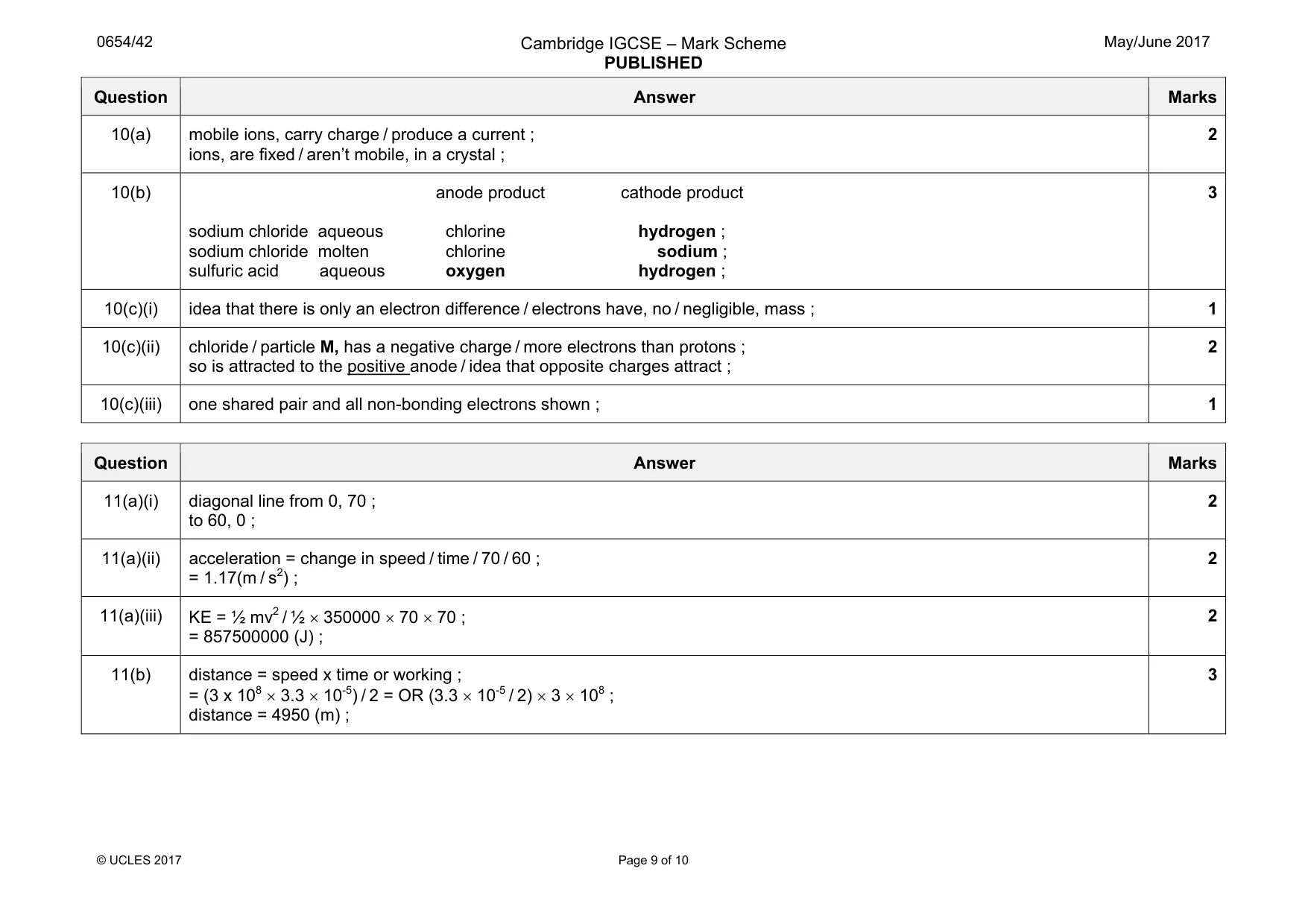
Mark scheme: 10(a) mobile ions, carry charge / produce a current ; ions, are fixed / aren’t mobile, in a crystal ; 2 10(b) anode product cathode product sodium chloride aqueous chlorine hydrogen ; sodium chloride molten chlorine sodium ; sulfuric acid aqueous oxygen hydrogen ; 3 10(c)(i) idea that there is only an electron difference / electrons have, no / negligible, mass ; 1 10(c)(ii) chloride / particle M, has a negative charge / more electrons than protons ; so is attracted to the positive anode / idea that opposite charges attract ; 2 10(c)(iii) one shared pair and all non-bonding electrons shown ; 1
Q11 · An aircraft landing with constant deceleration along an airport runway
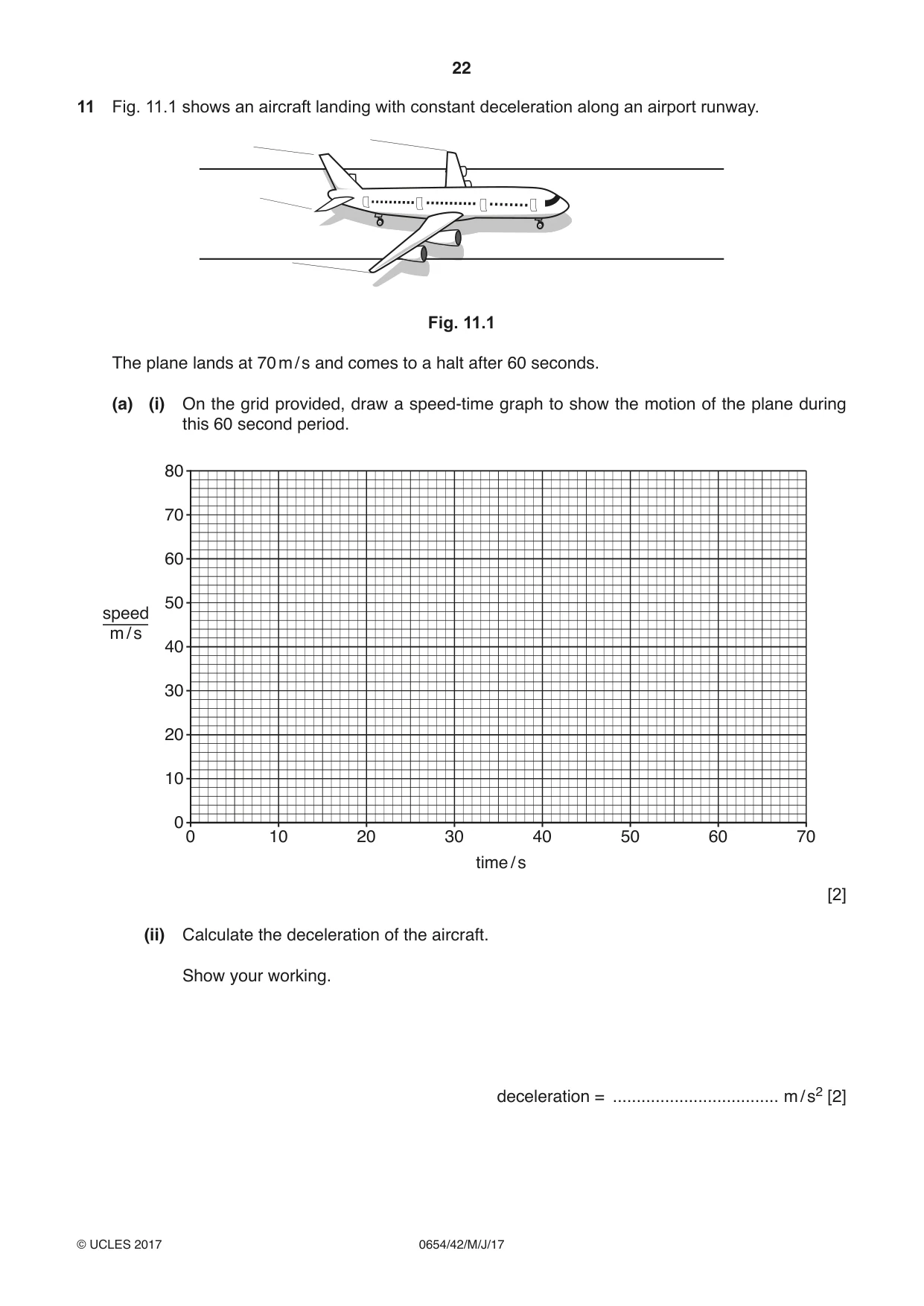
11 Fig. 11.1 shows an aircraft landing with constant deceleration along an airport runway. Fig. 11.1 The plane lands at 70 m / s and comes to a halt after 60 seconds. (a) (i) On the grid provided, draw a speed-time graph to show the motion of the plane during this 60 second period. 80 70 60 50 speed m / s 40 30 20 10 0 0 10 20 30 40 50 60 70 time / s [2] (ii) Calculate the deceleration of the aircraft. Show your working. deceleration = ................................... m / s2 [2] (iii) The aircraft has a mass of 350 000 kg. Calculate the kinetic energy of the aircraft as it lands. State the formula you use and show your working. formula working kinetic energy = ......................................... J [2] (b) Microwaves travel at 3 × 10⁸ m / s. Radar uses microwaves with a frequency of 10 000 MHz to detect the aircraft when it is in flight. A short pulse is sent from a transmitter, reflected by the aircraft and picked up by a receiver next to the transmitter. The time it takes for the wave to make the journey to the aircraft and back is 3.3 × 10⁻⁵ seconds. Calculate the distance from the radar transmitter to the aircraft. State the formula you use and show your working. formula working distance = ........................................ m [3]
Mark scheme: 11(a)(i) diagonal line from 0, 70 ; to 60, 0 ; 2 11(a)(ii) acceleration = change in speed / time / 70 / 60 ; = 1.17(m / s2) ; 2 11(a)(iii) KE = ½ mv2 / ½ × 350000 × 70 × 70 ; = 857500000 (J) ; 2 11(b) distance = speed x time or working ; = (3 x 108 × 3.3 × 10-5) / 2 = OR (3.3 × 10⁻⁵ / 2) × 3 × 108 ; distance = 4950 (m) ; 3
Q12 · A student investigates anaerobic respiration in yeast
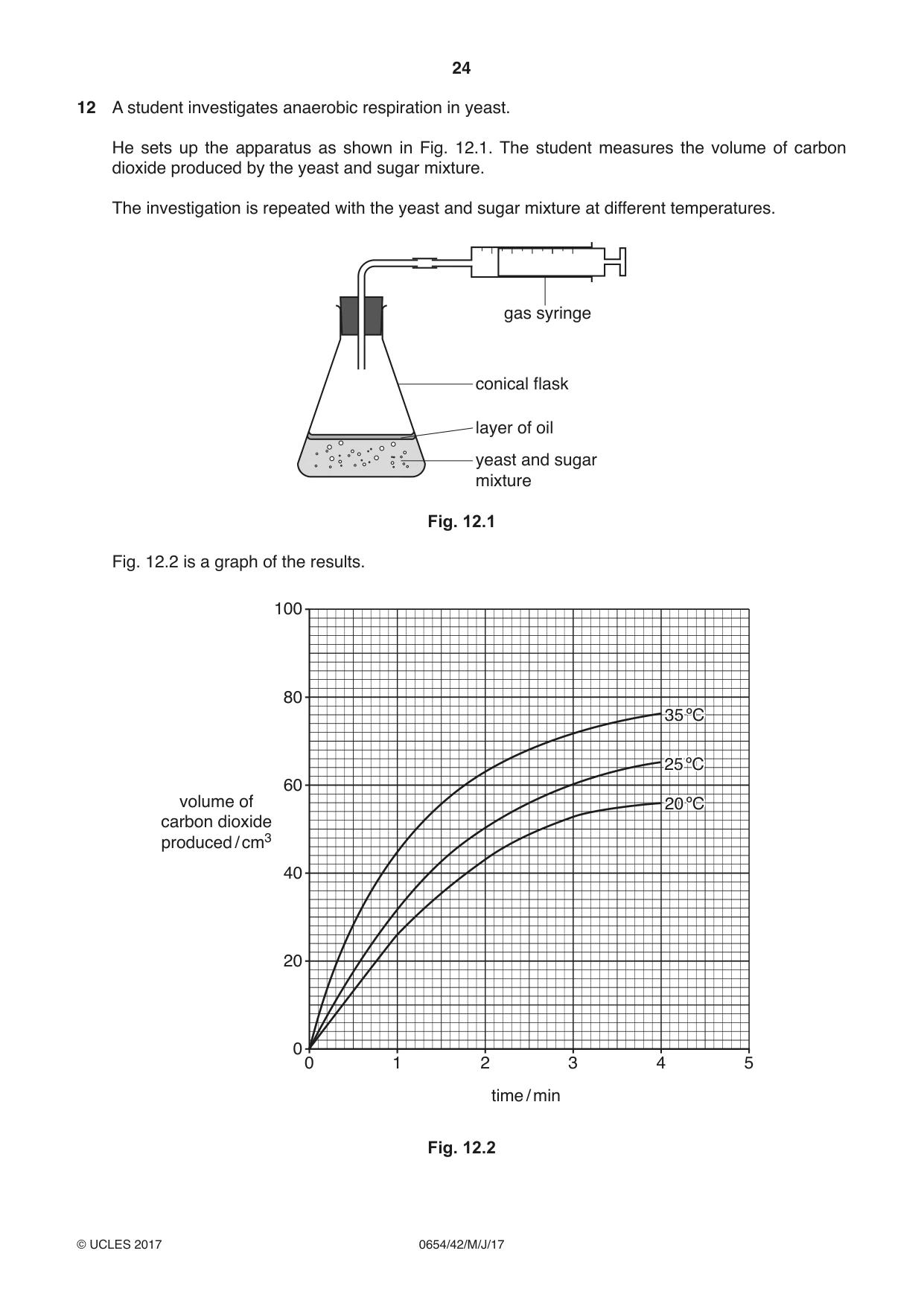
12 A student investigates anaerobic respiration in yeast. He sets up the apparatus as shown in Fig. 12.1. The student measures the volume of carbon dioxide produced by the yeast and sugar mixture. The investigation is repeated with the yeast and sugar mixture at different temperatures. gas syringe conical flask layer of oil yeast and sugar mixture Fig. 12.1 Fig. 12.2 is a graph of the results. 100 80 3535 ºCºC 2525 ºCºC 60 volume of 2020 ºCºC carbon dioxide produced / cm3 40 20 0 0 1 2 3 4 5 time / min Fig. 12.2 (a) (i) Use Fig. 12.2 to predict the volume of carbon dioxide produced in 3 minutes at 30 °C. ...................................... cm3 [1] (ii) No carbon dioxide was produced when the temperature was increased to 60 °C. Suggest why. ........................................................................................................................................... .......................................................................................................................................[1] (iii) State one modification, apart from changing the temperature, the student could make to his investigation to increase the volume of carbon dioxide produced by the yeast in the first 2 minutes. ........................................................................................................................................... .......................................................................................................................................[1] (b) Carbon dioxide is produced by the anaerobic respiration of yeast but not by the anaerobic respiration of animals. State one other difference between the anaerobic respiration of yeast and the anaerobic respiration of animals. ................................................................................................................................................... ...............................................................................................................................................[1] (c) Anaerobic respiration in yeast is used commercially in bread making. Name one other commercial use of the anaerobic respiration in yeast. ...............................................................................................................................................[1]
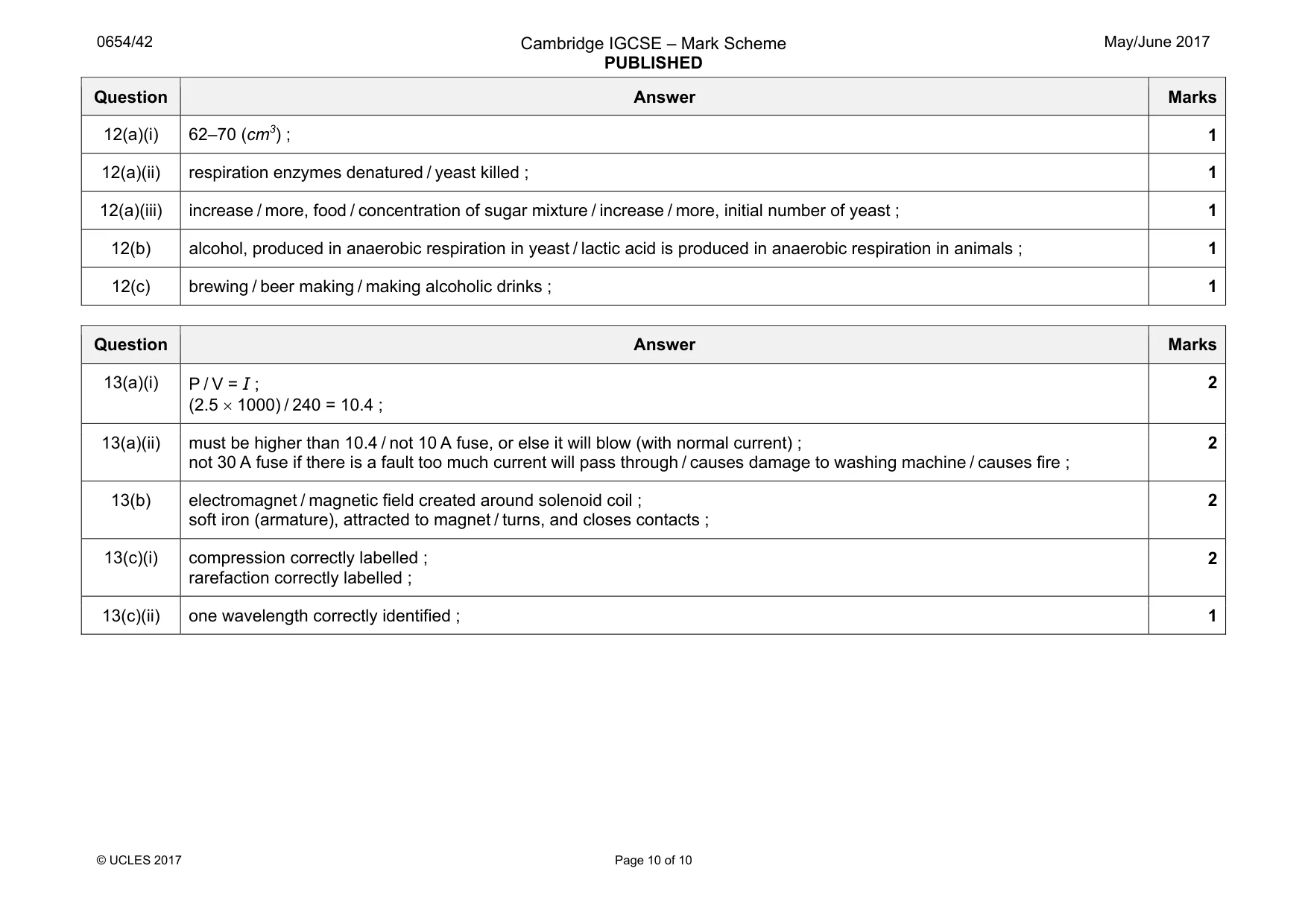
Mark scheme: 12(a)(i) 1 12(a)(ii) respiration enzymes denatured / yeast killed ; 1 12(a)(iii) increase / more, food / concentration of sugar mixture / increase / more, initial number of yeast ; 1 12(b) alcohol, produced in anaerobic respiration in yeast / lactic acid is produced in anaerobic respiration in animals ; 1 12(c) brewing / beer making / making alcoholic drinks ; 1
Q13 · Information which is on the label attached to a washing machine
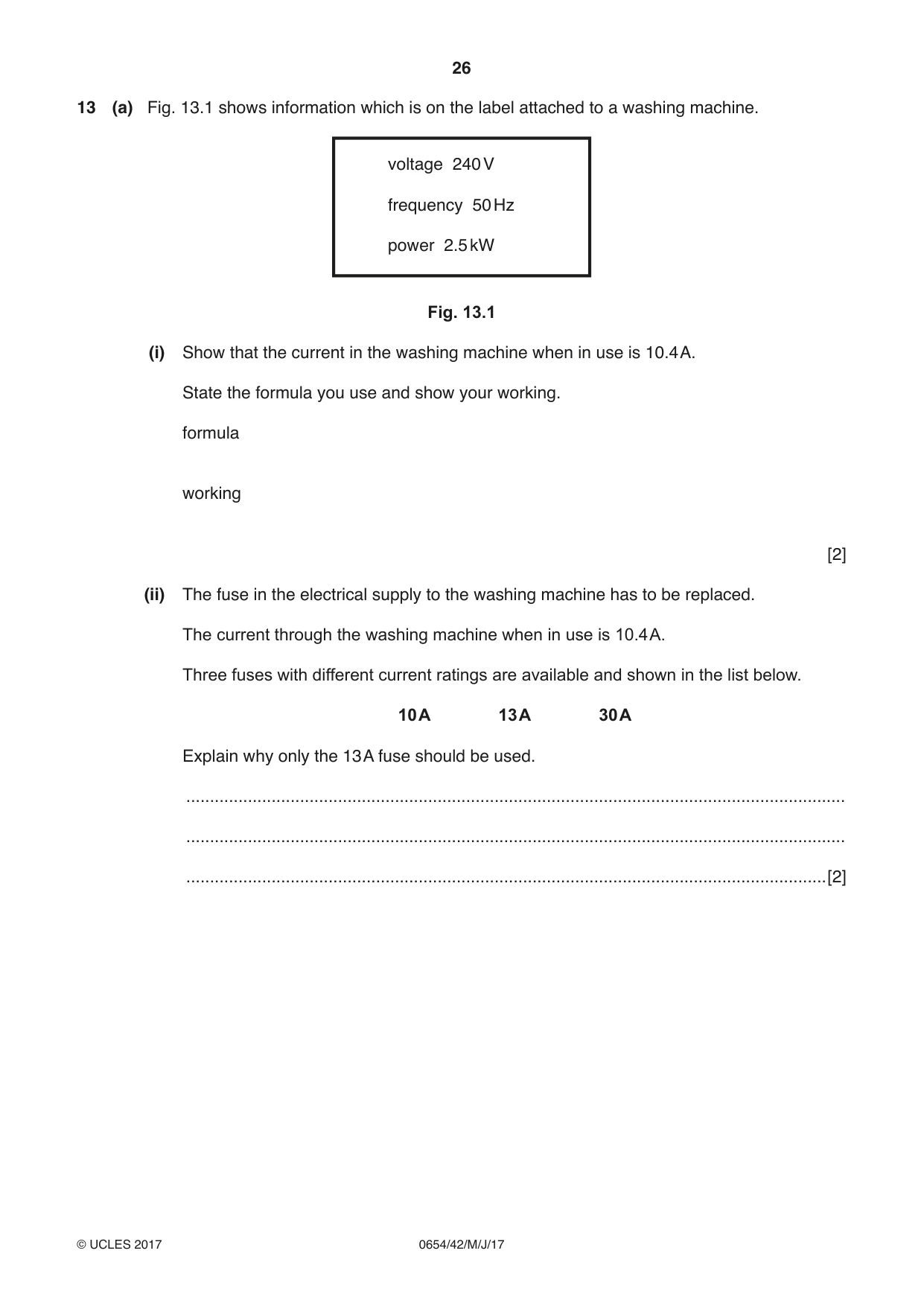
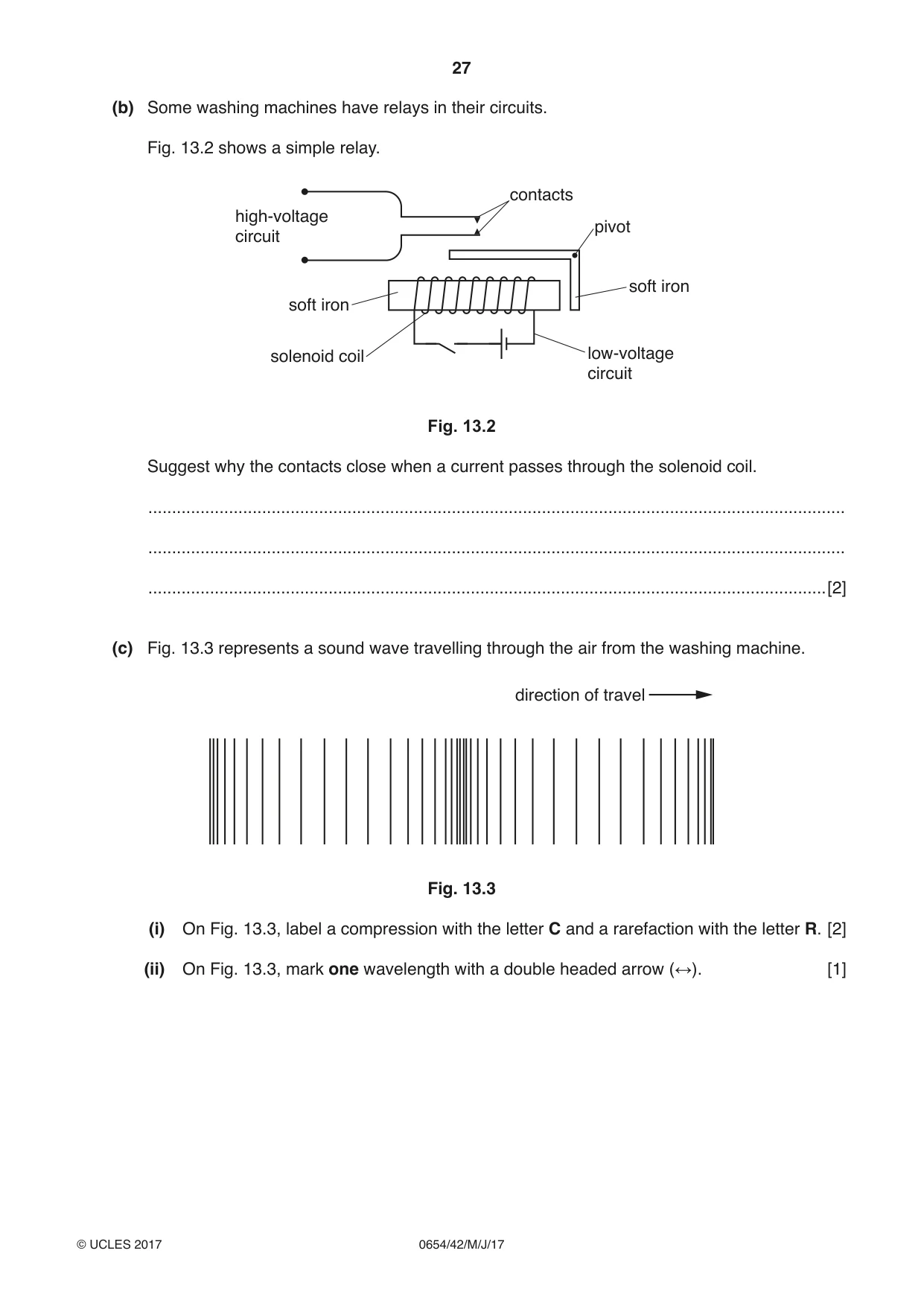
13 (a) Fig. 13.1 shows information which is on the label attached to a washing machine. voltage 240 V frequency 50 Hz power 2.5 kW Fig. 13.1 (i) Show that the current in the washing machine when in use is 10.4 A. State the formula you use and show your working. formula working [2] (ii) The fuse in the electrical supply to the washing machine has to be replaced. The current through the washing machine when in use is 10.4 A. Three fuses with different current ratings are available and shown in the list below. 10 A 13 A 30 A Explain why only the 13 A fuse should be used. ........................................................................................................................................... ........................................................................................................................................... .......................................................................................................................................[2] (b) Some washing machines have relays in their circuits. Fig. 13.2 shows a simple relay. contacts high-voltage pivot circuit soft iron soft iron solenoid coil low-voltage circuit Fig. 13.2 Suggest why the contacts close when a current passes through the solenoid coil. ................................................................................................................................................... ................................................................................................................................................... ...............................................................................................................................................[2] (c) Fig. 13.3 represents a sound wave travelling through the air from the washing machine. direction of travel Fig. 13.3 (i) On Fig. 13.3, label a compression with the letter C and a rarefaction with the letter R. [2] (ii) On Fig. 13.3, mark one wavelength with a double headed arrow (↔). [1]
Mark scheme: 13(a)(i) (2.5 × 1000) / 240 = 10.4 ; 2 13(a)(ii) must be higher than 10.4 / not 10 A fuse, or else it will blow (with normal current) ; not 30 A fuse if there is a fault too much current will pass through / causes damage to washing machine / causes fire ; 2 13(b) electromagnet / magnetic field created around solenoid coil ; soft iron (armature), attracted to magnet / turns, and closes contacts ; 2 13(c)(i) compression correctly labelled ; rarefaction correctly labelled ; 2 13(c)(ii) one wavelength correctly identified ; 1
What was in this paper
The subtopics covered by these 13 questions, and how many questions each got. Open one in a new tab to see every Cambridge question on it.
What you needed in this session
Cambridge’s own grade thresholds for 2017 May/June, Paper 4 · Variant 2. A higher threshold means an easier paper — the bar moves with how the cohort did.